Foreword
Congratulations on choosing a SUBARU vehicle. This Owner’s
Manual has all the information necessary to keep your SUBARU in
excellent condition and to properly maintain the emission control
system for minimizing emission pollutants. We urge you to read
this manual carefully so that you may understand your vehicle and
its operation. For information not found in this Owner’s Manual,
such as details concerning repairs or adjustments, please contact
the dealer from whom you purchased your SUBARU or the nearest
SUBARU dealer.
The inform ation, specifications and illustrations found in this
manual are those in effect at the time of printing. FUJI HEAVY
INDUSTRIES LTD. reserves the right to change specifications and
designs at any time without prior notice and without incurring any
obligation to make the same or similar changes on vehicles
previously sold. This Owner’s Manual applies to all models and
covers all equipment, including factory installed options. Some
explanations, therefore may be for equipment not installed in your
vehicle.
Please leave this manual in the vehicle at the time of resale. The
next owner will need the information found herein.
FUJI HEAVY INDUSTRIES LTD., TOKYO, JAPAN
is a registered trademark of FUJI HEAVY INDUSTRIES LTD.
*
C
copyright 2007 FUJI HEAVY INDUSTRIES LTD.
Black plate (2,1)
北米Model "A8130BE-B" EDITED: 2007/ 7/ 25
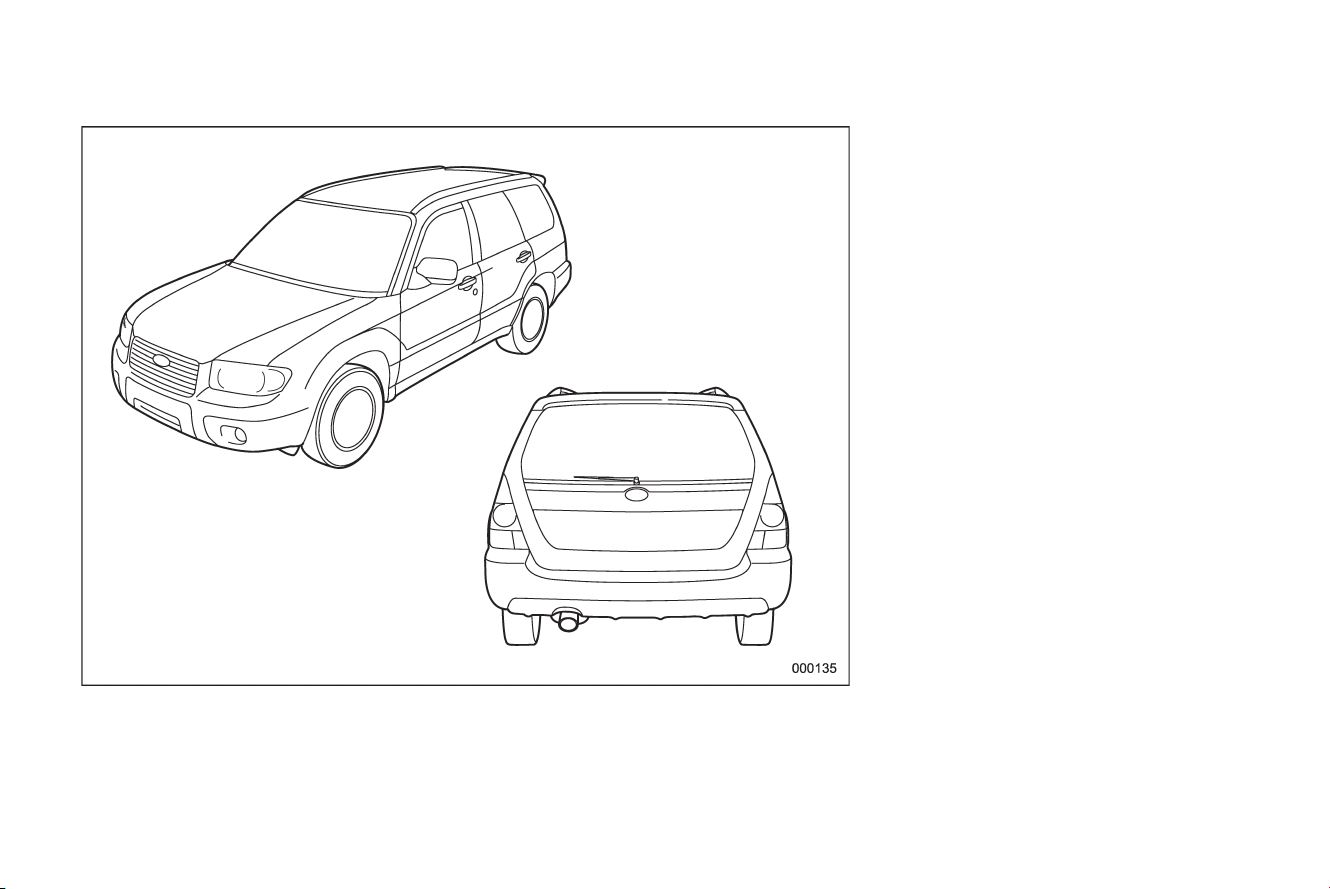
This manual describes the following vehicle types.*
* The illustrated vehicle is one of the FORESTER series.

Black plate (2,1)
北米Model "ALL_MODEL_SHIRO" EDITED: 2006/ 4/ 17
Black plate (3,1)
北米Model "A8130BE-B" EDITED: 2007/ 7/ 25
Warranties
& Warranties for U.S.A.
All SUBARU vehicles distributed by
Subaru of America, Inc. and sold at retail
by an authorized SUBARU dealer in the
United States come with the following
warranties:
. SUBARU Limited Warranty
. Emission Control Systems Warranty
. Emissions Performance Warranty
All warranty information, including details
of coverage and exclusions, is in the
“ Warranty and Maint enance Booklet”.
Please read these warranties carefully.
& Warranties for Canada
All SUBARU vehicles distributed by
Subaru Canada, Inc. and sold at retail by
an authorized SUBARU dealer in Canada
come with the following warranties:
. SUBARU Limited Warranty
. Anti-Corrosion Warranty
. Emission Control Warranty
All warranty information, including details
of coverage and exclusions, is in the
Warranty and Service Booklet. Please
read these warranties carefully.
! Vehicle with HID headlights
CAUTION
High Intensity Discharge (HID) head-
lights contain mercury. For that
reason, it is necessary to remove
HID headlights before vehicle dis-
posal. Once removed, please reuse,
recycle or dispose of the HID head-
lights as hazardous waste.
! Vehicle without HID headlights
CAUTION
This vehicle does not contain mer-
cury devices or parts.
How to use this Owner’s
Manual
& Using your Owner’s Manual
Before you operate your vehicle, carefully
read this manual. To protect yourself and
extend the service life of your vehicle,
follow the instructions in this manual.
Failure to observe these instructions may
result in serious injury and damage to your
vehicle.
This manual is composed of fourteen
chapters. Each chapter begins with a brief
table of contents, so you can usually tell at
a glance if that chapter contains the
information you want.
Chapter 1: Seat, seatbelt and SRS
airbags
This chapter informs you how to use the
seat and seatbelt and contains precau-
tions for the SRS airbags.
Chapter 2: Keys and doors
This chapter informs you how to operate
the keys, locks and windows.
Chapter 3: Instruments and controls
This chapter informs you about the opera-
tion of instrument panel indicators and
how to use the instruments and other
switches.
1
– CONTINUED –
0
Black plate (4,1)
北米Model "A8130BE-B" EDITED: 2007/ 7/ 25
2
Chapter 4: Climate Control
This chapter informs you how to operate
the climate control.
Chapter 5: Audio
This chapter informs you how to operate
your audio system.
Chapter 6: Interior equipment
This chapter informs you how to operate
interior equipment.
Chapter 7: Starting and operating
This chapter informs you how to start and
operate your SUBARU.
Chapter 8: Driving tips
This chapter informs you how to drive your
SUBARU in various conditions and ex-
plains some safety tips on driving.
Chapter 9: In case of emergency
This chapter informs you what to do if you
have a problem while driving, such as a
flat tire or engine overheating.
Chapter 10: Appearance care
This chapter informs you how to keep your
SUBARU looking good.
Chapter 11: Maintenance and service
This chapter informs you when you need
to take your SUBARU to the dealer for
scheduled maintenance and informs you
how to keep your SUB ARU running
properly.
Chapter 12: Specifications
This chapter informs you about dimension
and capacities of your SUBARU.
Chapter 13: Consumer information and
Reporting safety defects
This chapter informs you about Uniform
tire quality grading standards and Report-
ing safety defects.
Chapter 14: Index
This is an alphabetical listing of all that’sin
this manual. You can use it to quickly find
something you want to read.
& Safety warnings
You will find a number of WARNINGs,
CAUTIONs and NOTEs in this manual.
These safety warnings alert you to poten-
tial hazards that could result in injury to
you or others.
Please read these safety warnings as well
as all other portions of this manual care-
fully in order to gain a better understand-
ing of how to use your SUBARU vehicle
safely.
WARNING
A WARNING indicates a situation in
which serious injury or death could
result if the warning is ignored.
CAUTION
A CAUTION indicates a situation in
which injury or damage to you r
vehicle, or both, could result if the
caution is ignored.
NOTE
A NOTE gives information or sugges-
tions how to make better use of your
vehicle.
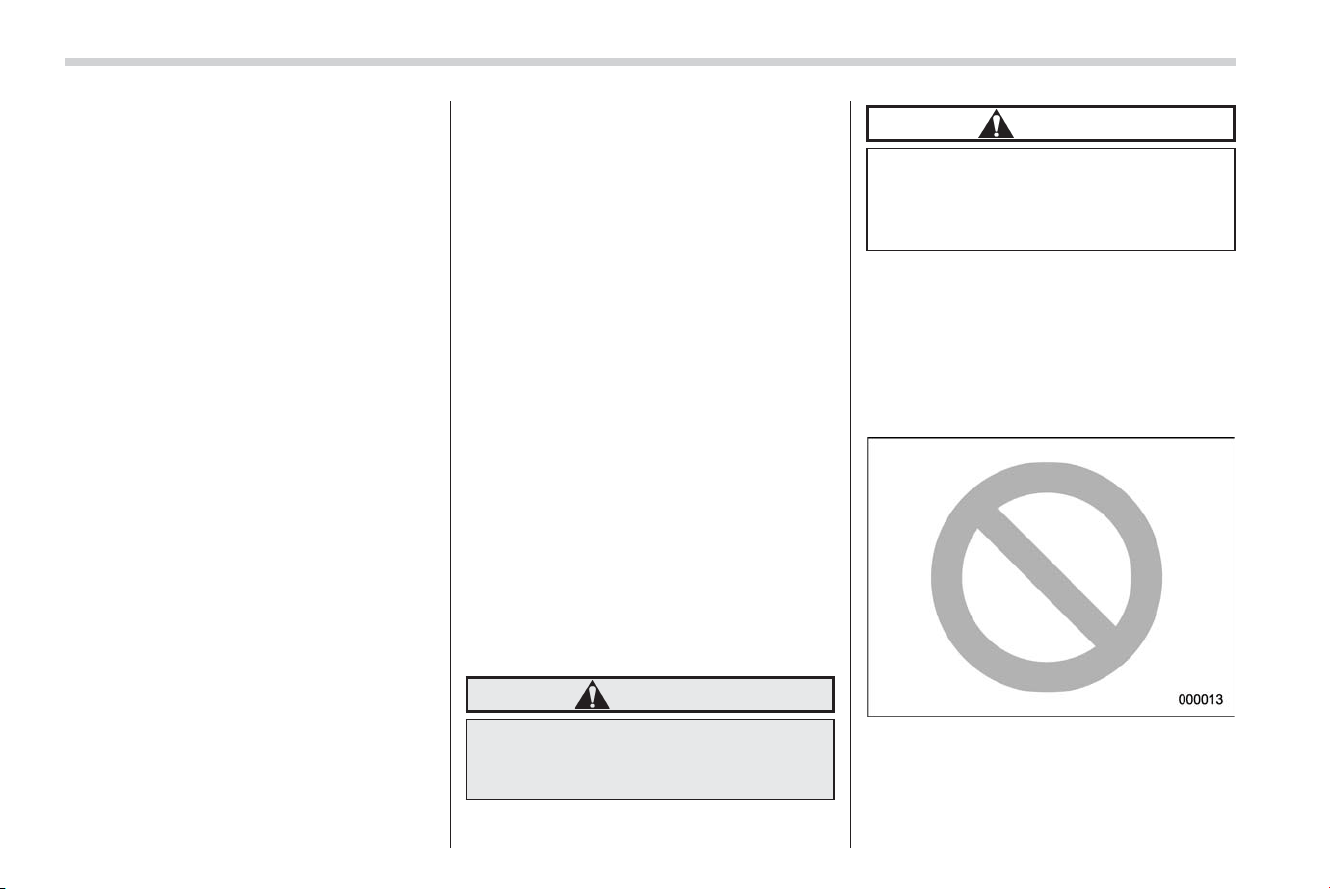
& Safety symbol
You will find a circle with a slash through it
in this manual. This symbol means “Do
not”, “Do not do this”,or“Do not let this
happen”, depending upon the context.
Black plate (5,1)
北米Model "A8130BE-B" EDITED: 2007/ 7/ 25
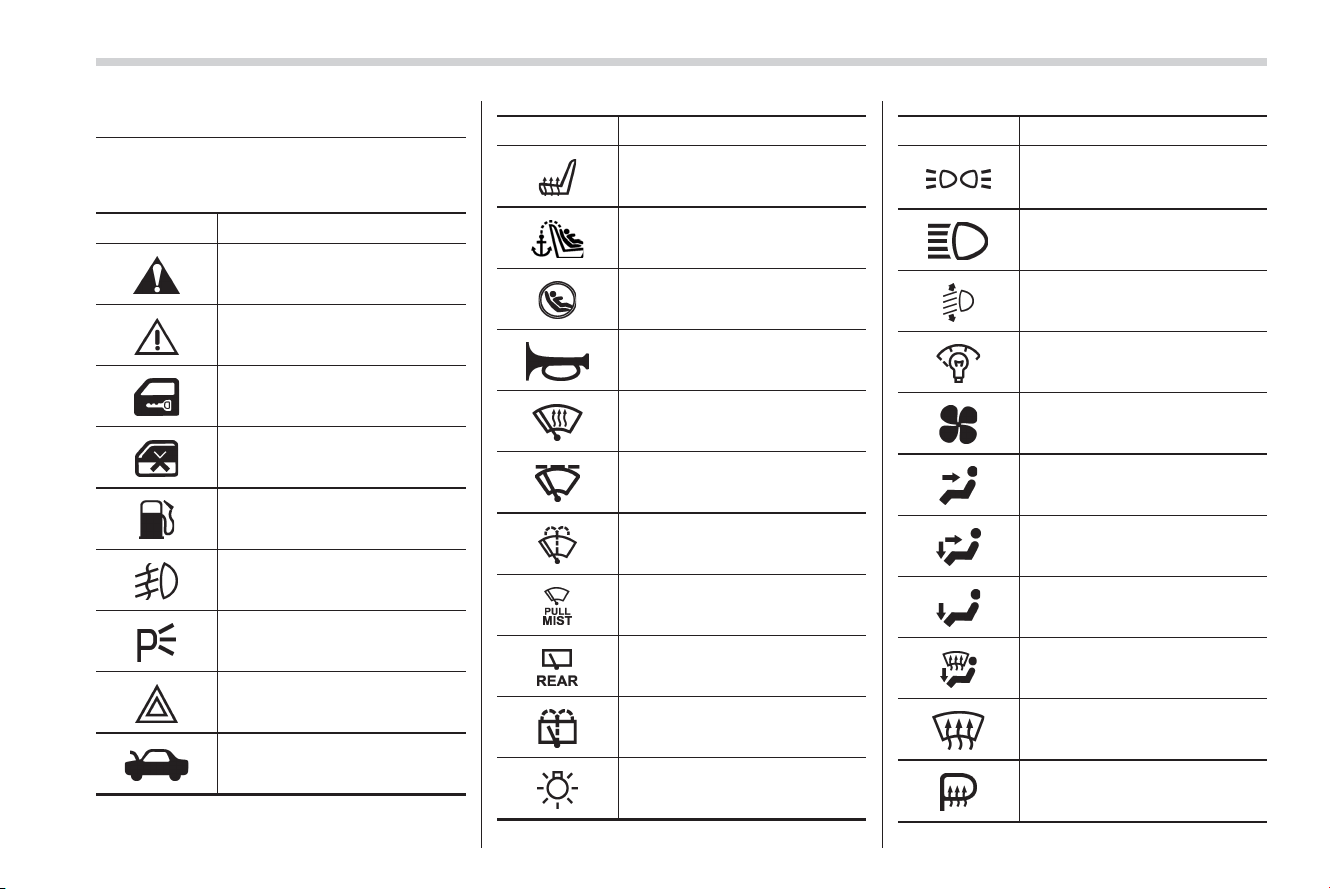
Vehicle symbols
There are some of the symbols you may
see on your vehicle.
Mark Name
WARNING
CAUTION
Power door lock
Passengers’ windows lock
Fuel
Front fog lights
Parking lights
Hazard warning flasher
Engine hood
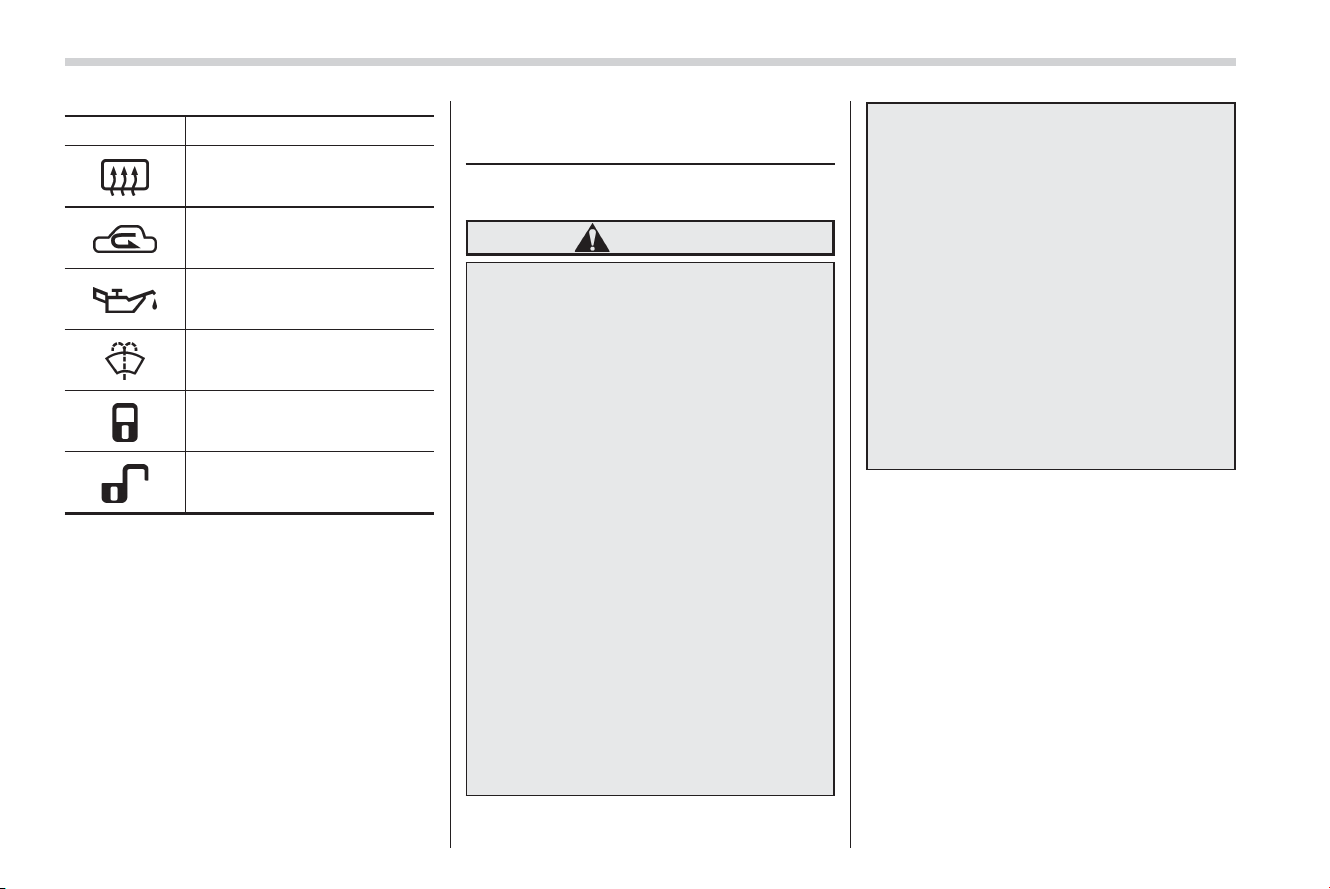
Mark Name
Seat heater
Child restraint top tether an-
chorages
Child restraint lower an-
chorages
Horn
Windshield wiper deicer
Wiper intermittent
Windshield washer
Windshield wiper mist (for
single wipe)
Rear window wiper
Rear window washer
Lights
Mark Name
Parking lights, tail lights, li-
cense plate light and instru-
ment panel illumination
Headlights
Headlight beam leveler
Illumination brightness
Fan speed
Instrument panel outlets
Instrument panel outlets and
foot outlets
Foot outlets
Windshield defroster and foot
outlets
Windshield defroster
Outside mirror defogger
3
– CONTINUED –
0
Black plate (6,1)
北米Model "A8130BE-B" EDITED: 2007/ 7/ 25
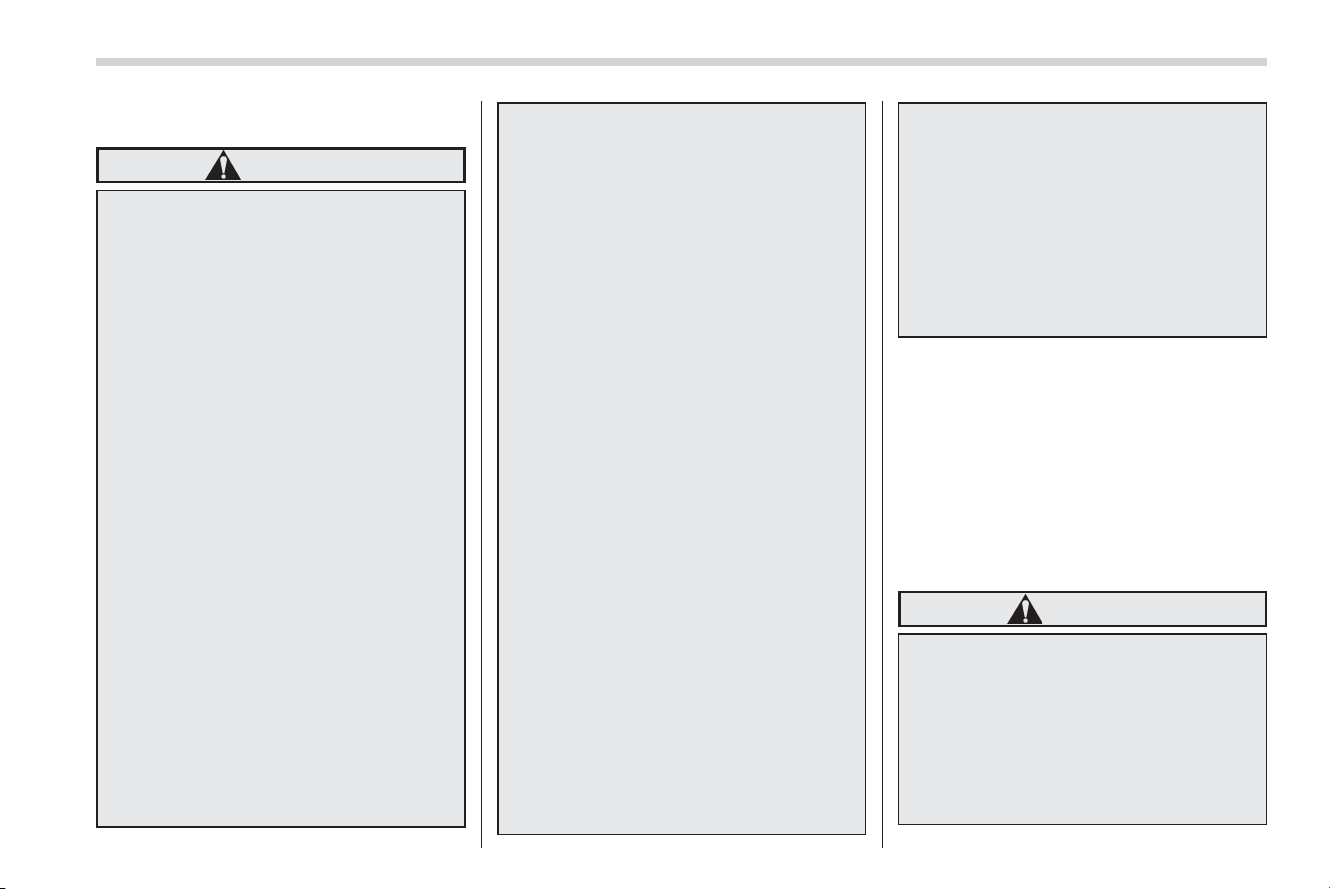
4
Mark Name
Rear window defogger
Air recirculation
Engine oil
Washer
Door lock (Transmitter)
Door unlock (Transmitter)
Safety precautions when
driving
& Seatbelt and SRS airbag
WARNING
. All persons in the vehicle should
fasten their seatbelts BEFORE
the vehicle starts to move. Other-
wise, the possibility of serious
injury becomes greater in the
event of a sudden stop or acci-
dent.
. To obtain maximum protection in
the event of an accident, the
driver and all passengers in the
vehicle should always wear seat-
belts when the vehicle is moving.
The SRS (Supplemental Restraint
System) airbag does not do away
with the need to fasten seatbelts.
In combination with the seat-
belts, it offers the best combined
protection in case of a serious
accident.
Not wearing a seatbelt increases
the chance of severe injury or
death in a crash even when the
vehicle has the SRS airbag.
. The SRS airbags deploy with
consider able speed and force.
Occupants who are out of proper
position when the SRS airbag
deploys could suffer very serious
injuries. Because the SRS airbag
needs enough space for deploy-
ment, the driver should always
sit upright and well back in the
seat as far from the steering
wheel as practical while still
maintaining full vehicle control
and the front passenger should
move the seat as far back as
possible and sit upright and well
back in the seat.
Carefully read the sections “Seatbelts”
and “*SRS airbag (Supplemental Restraint
System airbag)” in chapter 1 of this Own-
er’s Manual for instructions and precau-
tions concerning the seatbelt system and
SRS airbag system.
Black plate (7,1)
北米Model "A8130BE-B" EDITED: 2007/ 7/ 25
& Child safety
WARNING
. Never hold a child on your lap or
in your arms while the vehicle is
moving. The passenger cannot
protect the child from injury in a
collision, because the child will
be caught between the passen-
ger and objects inside the vehi-
cle.
. While riding in the vehicle, in-
fants and small children should
always be placed in the REAR
seat in an infant or child restraint
system which is appropriate for
the child’s age, height and
weight. If a child is too big for a
child restraint system, the child
should sit in the REAR seat and
be restrained using the seatbelts.
According to accident statistics,
children are safer when properly
restrained in the rear seating
positions than in the front seat-
ing positions. Never allow a child
to stand up or kneel on the seat.
. Put children aged 12 and under in
the REAR seat properly re-
strained at all times in a child
restraint device or in a seatbelt.
The SRS airbag deploys with
considerable speed and force
and can injure or even kill chil-
dren, especially if they are 12
years of age and under and are
not restrained or improperly re-
strained. Because children are
lighter and weaker than adults,
their risk being injured from
deployment is greater.
. NEVER INSTALL A REARWARD
FACING CHILD SEAT IN THE
FRONT SEAT. DOING SO RISKS
SERIOUS INJURY OR DEATH TO
THE CHILD BY PLACING THE
CHILD’S HEAD TOO CLOSE TO
THE SRS AIRBAG.
. Always use the child safety locks
whenever a child rides in the rear
seat. Serious injury could result
if a child accidentally opened the
door and fell out. Refer to the
“Child safety locks” section in
chapter 2.
. Always lock the passenger’s win-
dows using the lock switch when
children are riding in the vehicle.
Failure to follow this procedure
could result in injury to a child
operating the power window. Re-
fer to the “ Windows” section in
chapter 2.
. Never leave unattended children
in the vehicle. They could acci-
dentally injure themselves or
others through inadvertent op-
eration of the vehicle. Also, on
hot or sunny days, temperature
in a closed vehicle could quickly
become high enough to cause
severe or possibly fatal injuries
to them.
Carefully read the sections “Child restraint
systems”, “*SRS airbag (Supplemental
Restraint System airbag)”, and “Seatbelts”
in chapter 1 of this Owner’s Manual for
instructions and precautions concerning
the child restraint system, seatbelt system
and SRS airbag system.
& Engine exhaust gas (Carbon
monoxide)
WARNING
. Never inhale engine exhaust gas.
Engine exhaust gas contains
carbon monoxide, a colorless
and odorless gas which is dan-
gerous, or even lethal, if inhaled.
. Always properly maintain the en-
gine exhaust system to prevent
engine exhaust gas from enter-
5
– CONTINUED –
0
Black plate (8,1)
北米Model "A8130BE-B" EDITED: 2007/ 7/ 25
6
ing the vehicle.
. Never run the engine in a closed
space, such as a garage, except
for the brief time needed to drive
the vehicle in or out of it.
. Avoid remaining in a parked
vehicle for a lengthy time while
the engine is running. If that is
unavoidable, then use the venti-
lation fan to force fresh air into
the vehicle.
. Always keep the front ventilator
inlet grille free from snow, leaves
or other obstructions to ensure
that the ventilation system al-
ways works properly.
. If at any time you suspect that
exhaust fumes are entering the
vehicle, have the problem
checked and corrected as soon
as possible. If you must drive
under these conditions, drive
only with all windows fully open.
. Keep the rear gate closed while
driving to prevent exhaust gas
from entering the vehicle.
& Drinking and driving
WARNING
Drinking and then driving is very
dangerous. Alcohol in the blood-
stream delays your reaction and
impairs your perception, judgment
and attentiveness. If you drive after
drinking – even if you drink just a
little – it will increase the risk of
being involved in a serious or fatal
accident, injuring or killing yourself,
your passengers and others. In
addition, if you are injured in the
accident, alcohol may increase the
severity of that injury.
Please don’t drink and drive.
Drunken dri ving is one of the most
frequent causes of accidents. Since alco-
hol affects all people differently, you may
have consumed too much alcohol to drive
safely even if the level of alcohol in your
blood is below the legal limit. The safest
thing you can do is never drink and drive.
However if you have no choice but to
drive, stop drinking and sober up comple-
tely before getting behind the wheel.
& Drugs and driving
WARNING
There are some drugs (over the
counter and prescription) that can
delay your reaction time and impair
your perception, judgment and at-
tentiveness. If you drive after taking
them, it may increase your, your
passengers’ and other persons’ risk
of being involved in a serious or
fatal accident.
If you are taking any drugs, check with
your doctor or pharmacist or read the
literature that accompanies the medication
to determine if the drug you are taking can
impair your driving ability. Do not drive
after taking any medications that can
make you drowsy or otherwise affect your
ability to safely operate a motor vehicle. If
you have a medical condition that requires
you to take drugs, please consult with
your doctor.
Never drive if you are under the influence
of any illicit mind-altering drugs. For your
own health and well-being, we urge you
not to take illegal drugs in the first place
and to seek treatment if you are addicted
to those drugs.
Black plate (9,1)
北米Model "A8130BE-B" EDITED: 2007/ 7/ 25
& Driving when tired or sleepy
WARNING
When you are tired or sleepy, your
reaction will be delayed and your
perception, judgment and attentive-
ness will be impaired. If you drive
when tired or sleepy, your, your
passengers’ and other persons ’
chances of being involved in a
serious accident may increase.
Please do not continue to drive but
instead find a safe place to rest if you
are tired or sleepy. On long trips, you
should make periodic rest stops to refresh
yourself before continuing on your journey.
When possible, you should share the
driving with others.
& Modification of your vehicle
CAUTION
Your vehicle should not be modified
other than with genuine Su baru
parts and accessories. Other types
of modifications could affect its
performance, safety or durability,
and may even violate governmental
regulations. In addition, damage or
performance problems resulting
from modification may not be cov-
ered under warranties.
& Car phone/cell phone and
driving
CAUTION
Do not use a car phone/cell phone
while driving; it may distract your
attention from driving and can lead
to an accident. If you use a car
phone/cell phone, pull off the road
and park in a safe place before
using your phone. In some States/
Provinces, only hands-free phones
may legally be used while driving.
& Driving with pets
Unrestrained pets can interfere with your
driving and distract your attention from
driving. In a collision or sudden stop,
unrestrained pets or cages can be thrown
around inside the vehicle and hurt you or
your passengers. Besides, the pets can
be hurt under these situations. It is also for
their own safety that pets should be
properly restrained in your vehicle. Re-
strain a pet with a special traveling
harness which can be secured to the rear
seat with a seatbelt or use a pet carrier
which can be secured to the rear seat by
routing a seatbelt through the carrier’s
handle. Never restrain pets or pet carriers
in the front passenger’s seat. For further
information, consult your veterinarian,
local animal protection so ciety or pet
shop.
& Tire pressures
Check and, if n ecessary, adjust the
pressure of each tire (including the spare)
at least once a month and before any long
journey.
Check the tire pressure when the tires are
cold. Use a pressure gauge to adjust the
tire pressures to the values shown on the
tire placard.
Refer to the “Tires and wheels” section in
chapter 11 for detailed information.
WARNING
Driving at high speeds with exces-
sively low tire pressures can cause
the tires to deform severely and to
rapidly become hot. A sharp in-
crease in temperature could cause
tread separation, and destruction of
the tires. The resulting loss of
7
– CONTINUED –
0
Black plate (10,1)
北米Model "A8130BE-B" EDITED: 2007/ 7/ 25
8
vehicle control could lead to an
accident.
& California proposition 65
warning
WARNING
Engine exhaust, some of its consti-
tuents, and certain vehicle compo-
nents contain or emit chemicals
known to the State of California to
cause cancer and birth defects or
other reproductive harm. In addi-
tion, certain fluids in vehicles and
certain components of product wear
contain or emit chemicals known to
the State of California to cause
cancer and birth defects or other
reproductive harm.
Black plate (1,1)
Table of contents
Seat, seatbelt and SRS airbags
1
Keys and doors
2
Instruments and controls
Climate control
4
Audio
5
Interior equipment
6
Starting and operating
7
Driving tips
8
In case of emergency
9
Appearance care
10
Maintenance and service
11
Specifications
12
Consumer information and Reporting safety defects
13
Index
14
3
北米Model "A8130BE-B" Edited: 2007/ 7/ 25
Black plate (12,1)
北米Model "A8130BE-B" EDITED: 2007/ 7/ 25
10
Illustrated index
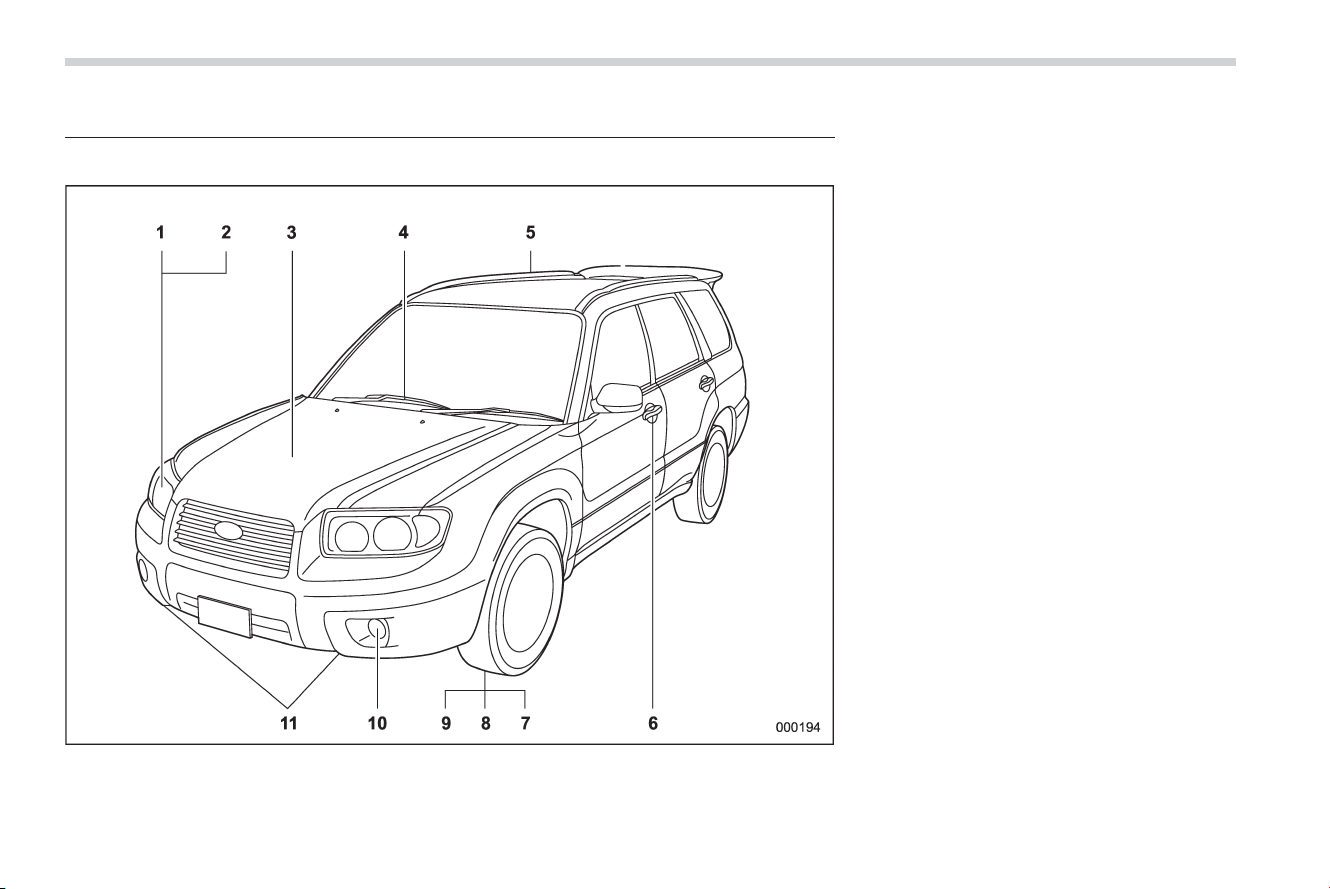
& Exterior
1) Headlight switch (page 3-20)
2) Replacing bulbs (page 11-46)
3) Engine hood (page 11-4)
4) Wiper switch (page 3-25)
5) Roof rails (page 8-13)
6) Door locks (page 2-4)
7) Tire pressure (page 11-33)
8) Flat tires (page 9-4)
9) Tire chains (page 8-10)
10) Front fog light button (page 3-24)
11) Tie-down/Towing hooks (page 9-12)
Black plate (13,1)
北米Model "A8130BE-B" EDITED: 2007/ 7/ 25
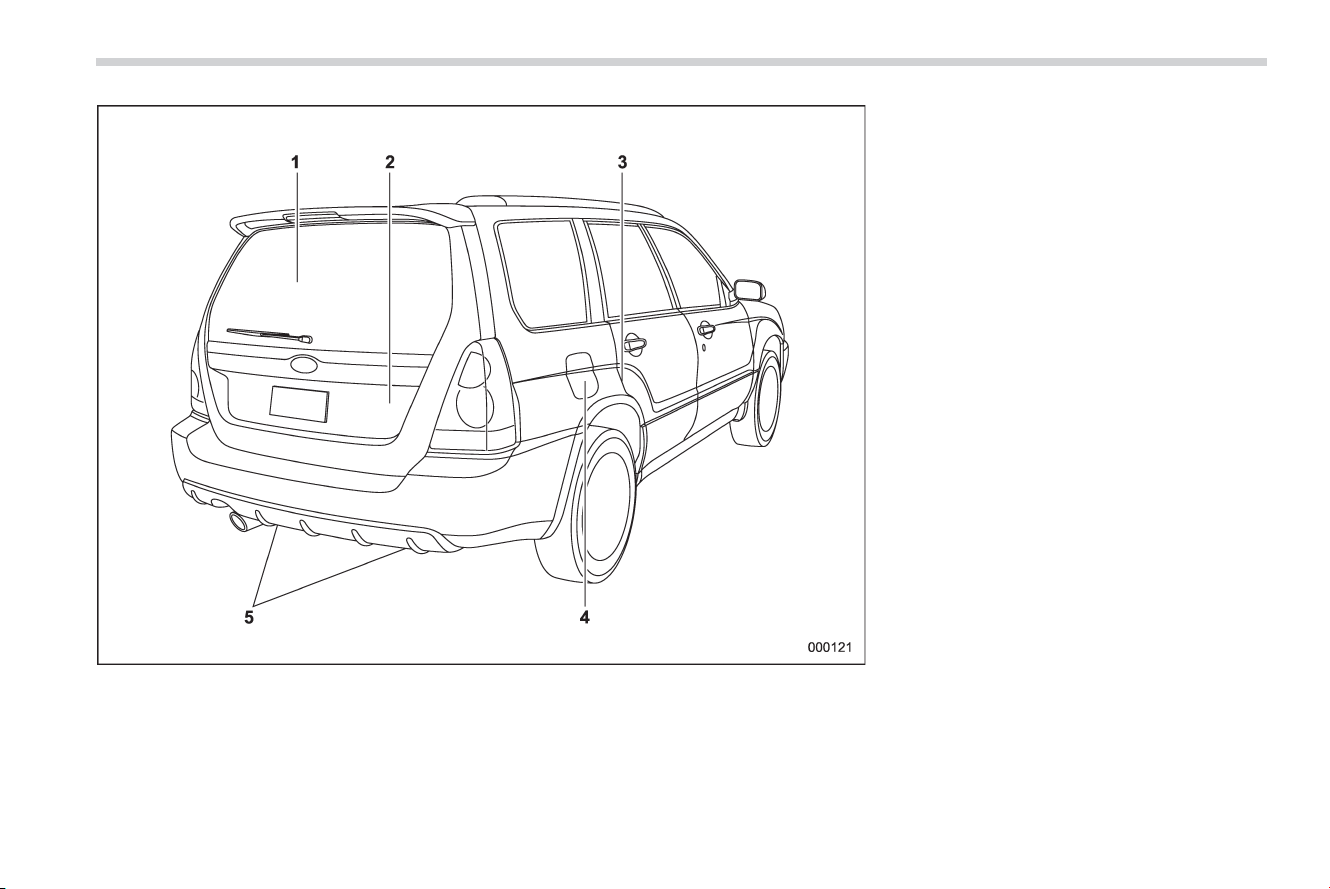
1) Rear window defogger button
(page 3-28)
2) Rear gate (page 2-20)
3) Child safety locks (page 2-17)
4) Fuel filler lid and cap (page 7-3)
5) Tie-down/Towing hook (page 9-12)
11
– CONTINUED –
0
Black plate (14,1)
北米Model "A8130BE-B" EDITED: 2007/ 7/ 25
12
& Interior
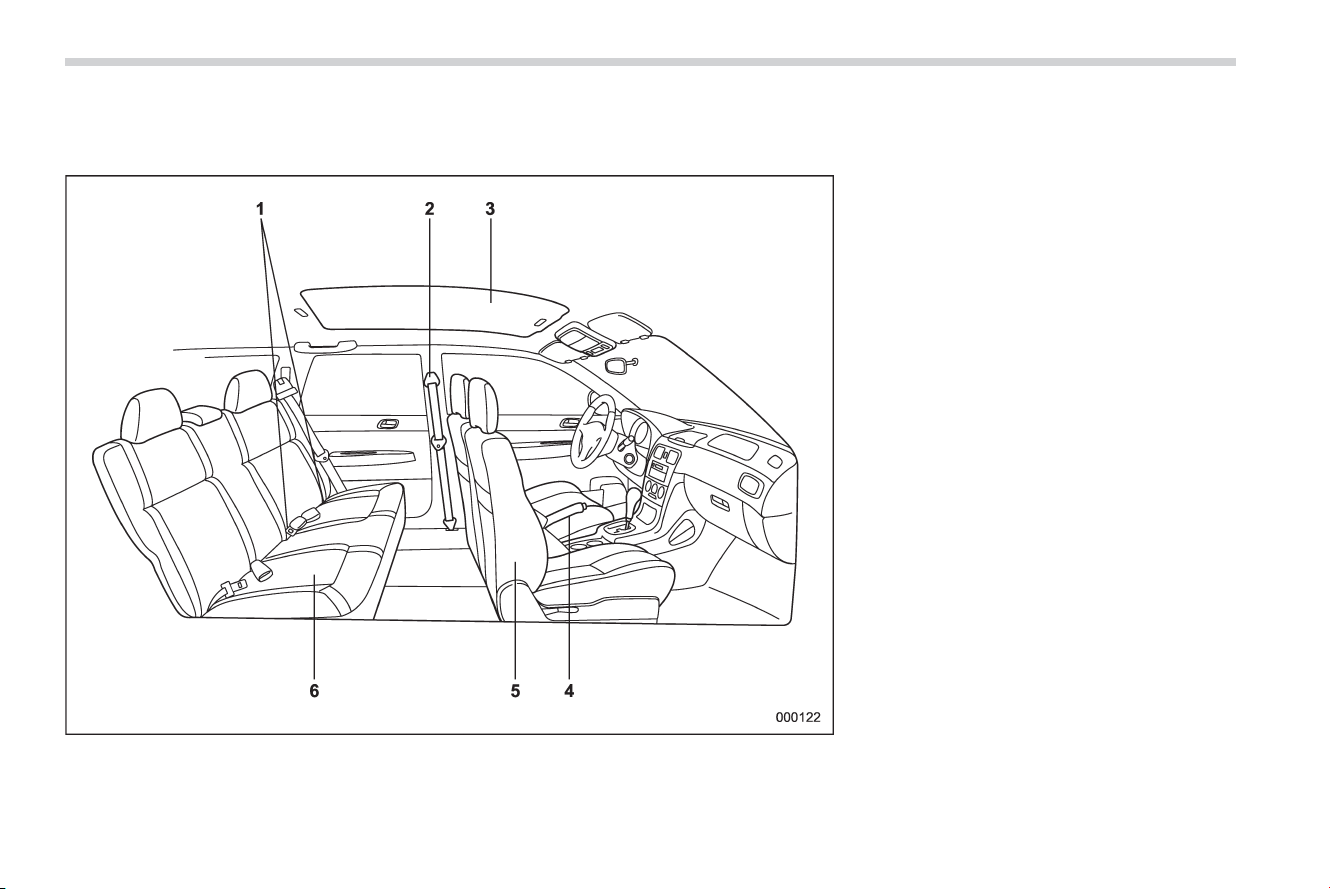
! Passenger compartment area
1) Lower anchorage for child restraint sys-
tem (page 1-31)
2) Seatbelt (page 1-10)
3) Moonroof (page 2-21)
4) Parking brake lever (page 7-26)
5) Front seat (page 1-2)
6) Rear seat (page 1-7)
Black plate (15,1)
北米Model "A8130BE-B" EDITED: 2007/ 7/ 25
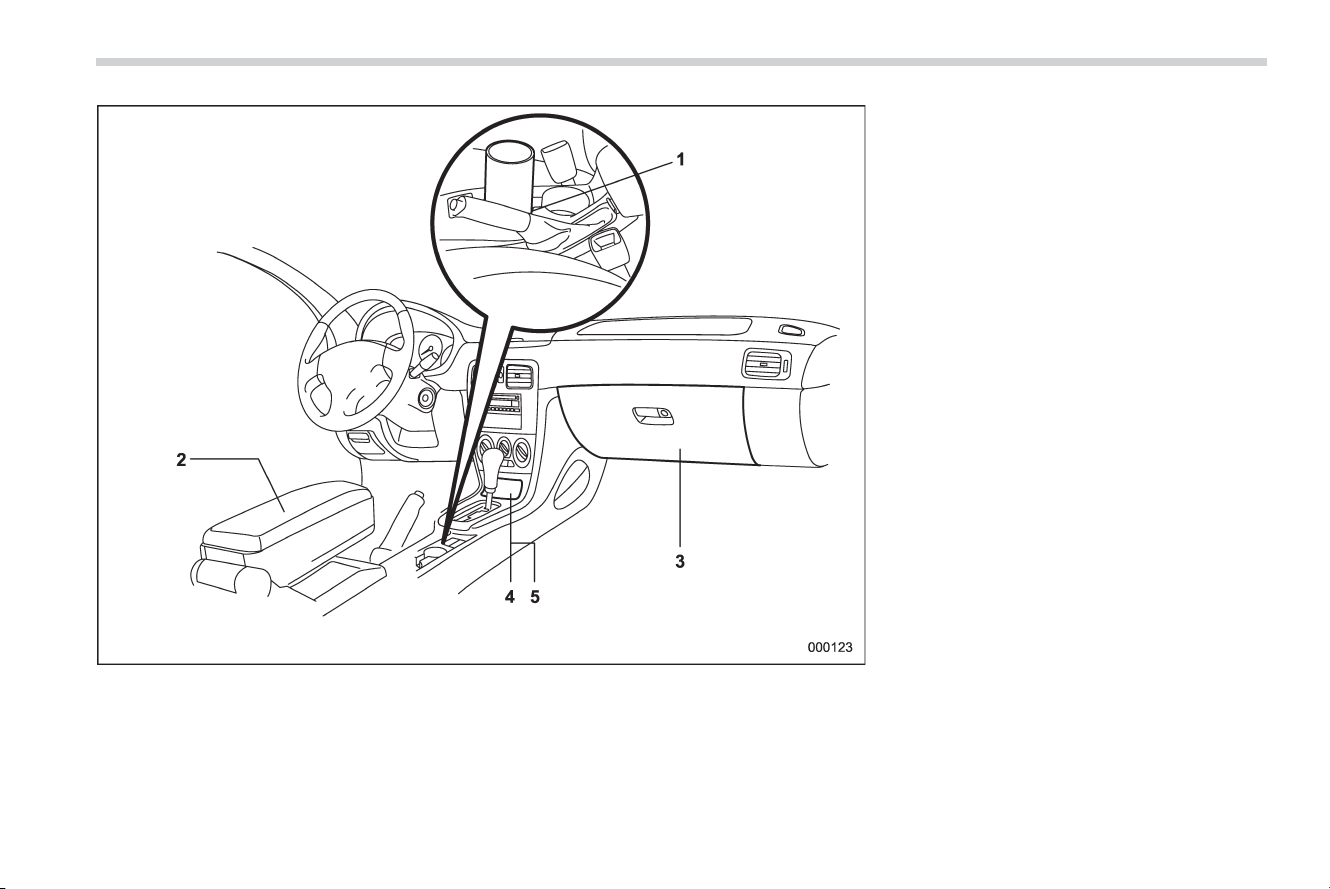
1) Cup holder (page 6-7)
2) Center console (page 6-4)
3) Glove box (page 6-4)
4) Front power supply socket (page 6-8)
5) Pocket (if equipped) (page 6-7)
AUX unit (if equipped) (page 6-8)
13
– CONTINUED –
0
Black plate (16,1)
北米Model "A8130BE-B" EDITED: 2007/ 7/ 25
14
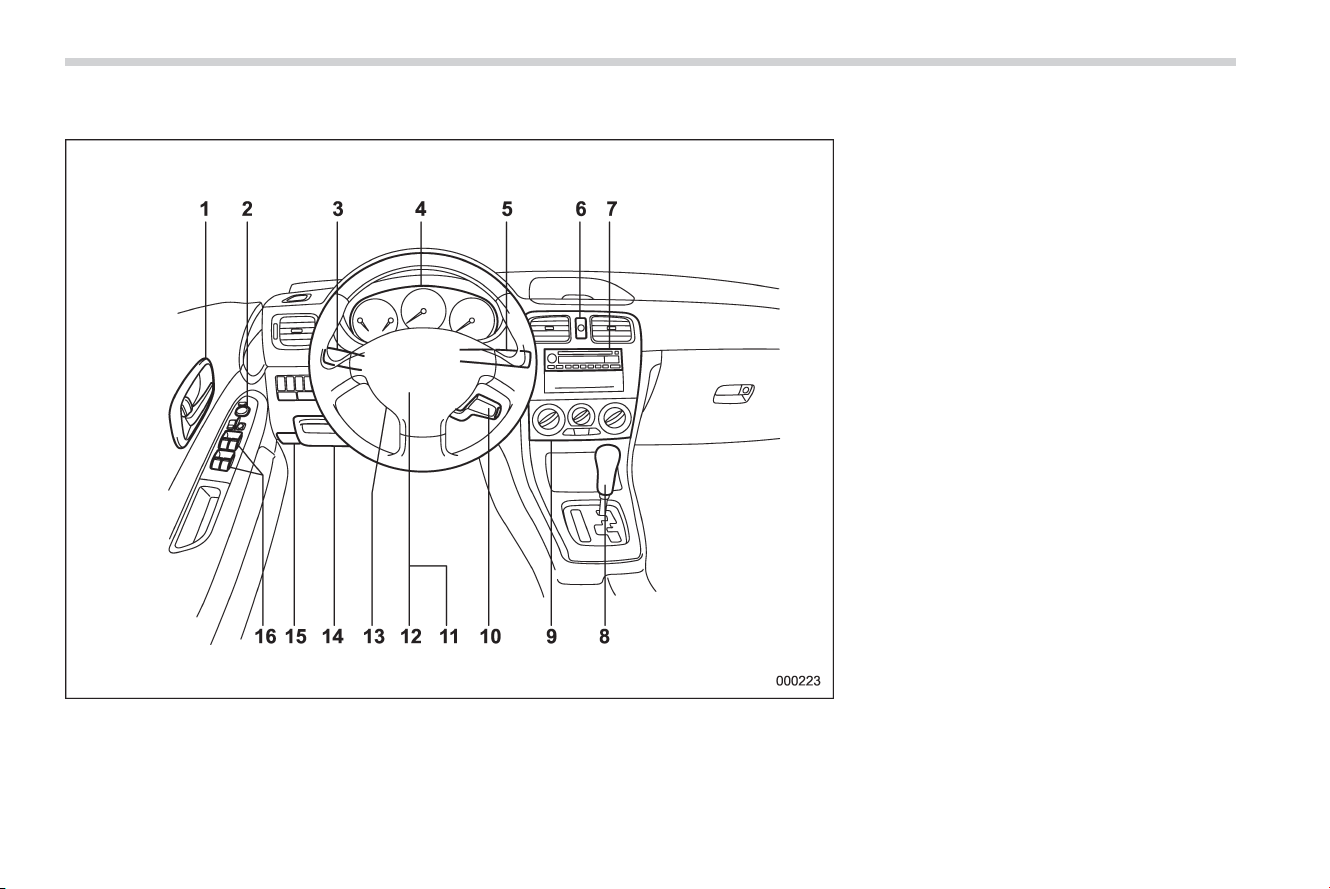
& Instrument panel
1) Door locks (page 2-4)
2) Outside mirror switch (page 3-30)
3) Light control lever (page 3-20)
4) Combination meter (page 3-6)
5) Wiper control lever (page 3-24)
6) Hazard warning flasher switch (page 3-6)
7) Audio (page 5-1)
8) Gear shift lever (MT) (page 7-9)
Selector lever (AT) (page 7-11)
9) Climate control (page 4-1)
10) Cruise control (page 7-28)
11) Horn (page 3-32)
12) SRS airbag (page 1-35)
13) Tilt steering (page 3-32)
14) Fuse (page 11-43)
15) Hood lock release knob (page 11-4)
16) Power windows (page 2-18)
Black plate (17,1)
北米Model "A8130BE-B" EDITED: 2007/ 7/ 25
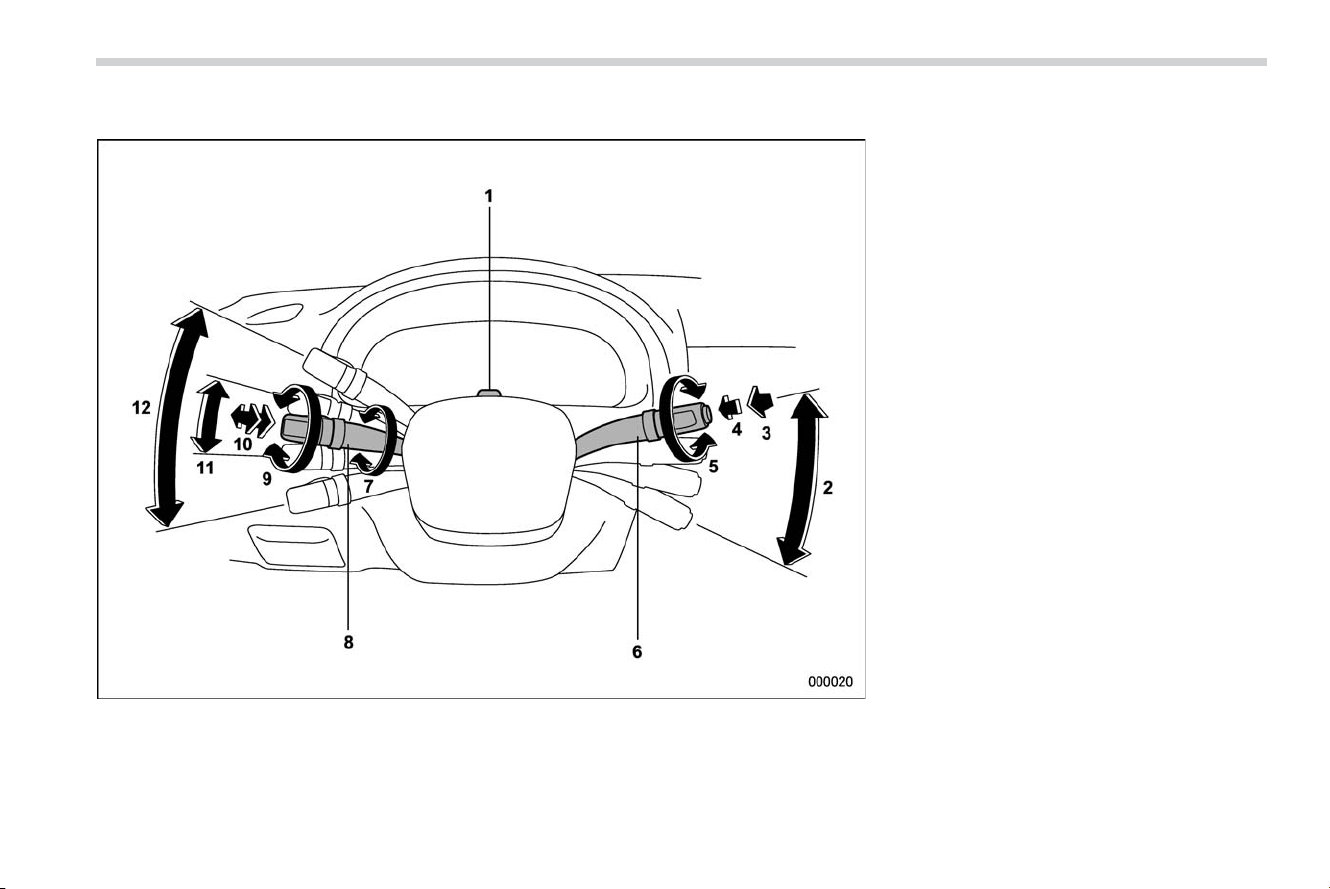
& Light control and wiper control levers/switches
1) Parking light switch (page 3-23)
2) Windshield wiper (page 3-24)
3) Mist (page 3-26)
4) Windshield washer (page 3-26)
5) Rear window wiper and washer switch
(page 3-26)
6) Wiper control lever (page 3-25)
7) Illumination brightness control
(page 3-23)
8) Light control lever (page 3-20)
9) Headlight ON/OFF (page 3-20)
10) Headlight flasher High/Low beam
change (page 3-21)
11) Turn signal (for lane change) (page 3-22)
12) Turn signal (page 3-22)
15
– CONTINUED –
0
Black plate (18,1)
北米Model "A8130BE-B" EDITED: 2007/ 7/ 25
16
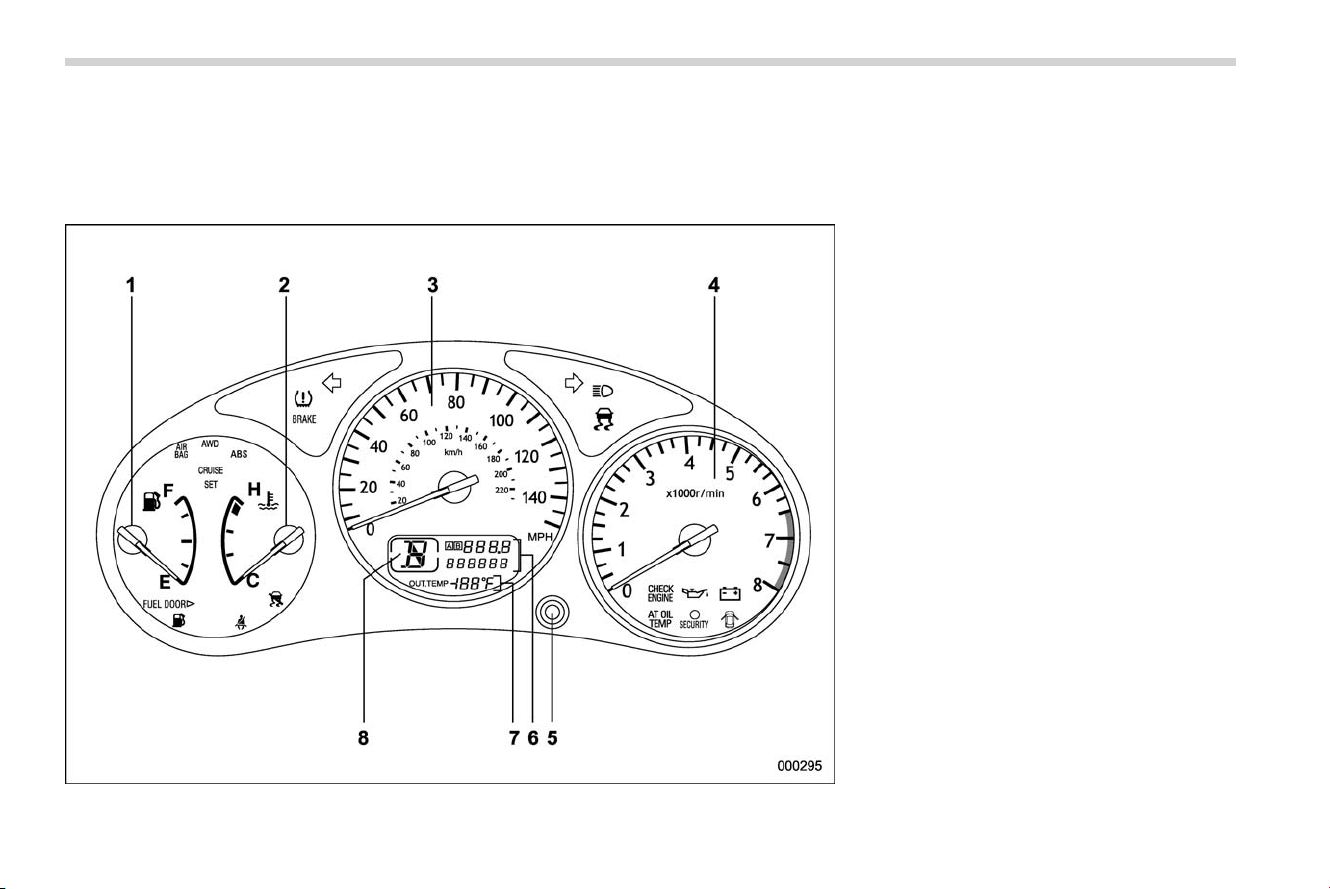
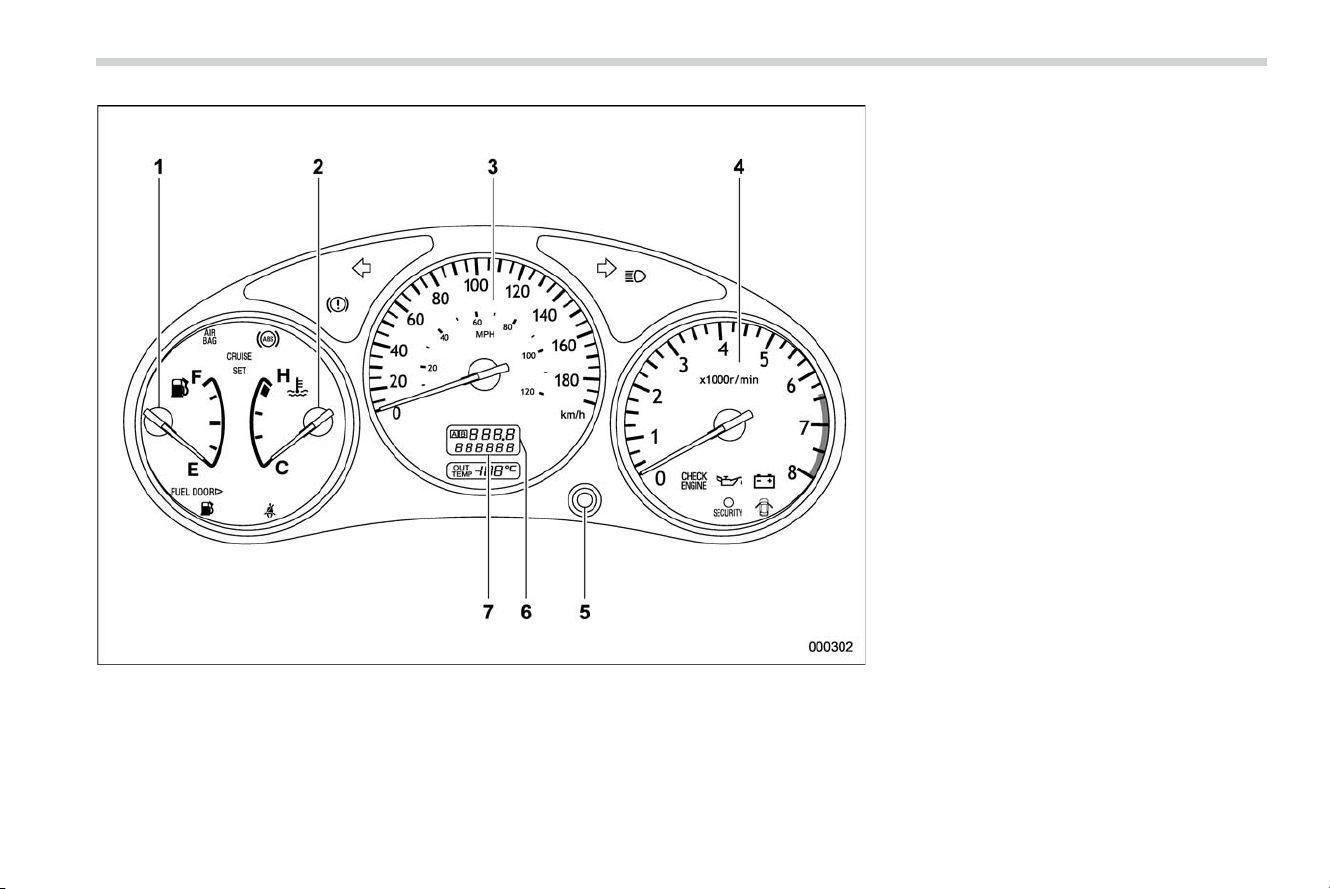
& Combination meter
! U.S.-spec. models
! AT vehicles
Type A
1) Fuel gauge (page 3-7)
2) Temperature gauge (page 3-8)
3) Speedometer (page 3-6)
4) Tachometer (page 3-7)
5) Trip meter A/B selection and trip meter
reset knob (page 3-6)
6) Odometer and trip meter (page 3-6)
7) Outside temperature indicator (page 3-9)
8) Select lever position indicator
(page 3-17)
Black plate (19,1)
北米Model "A8130BE-B" EDITED: 2007/ 7/ 25
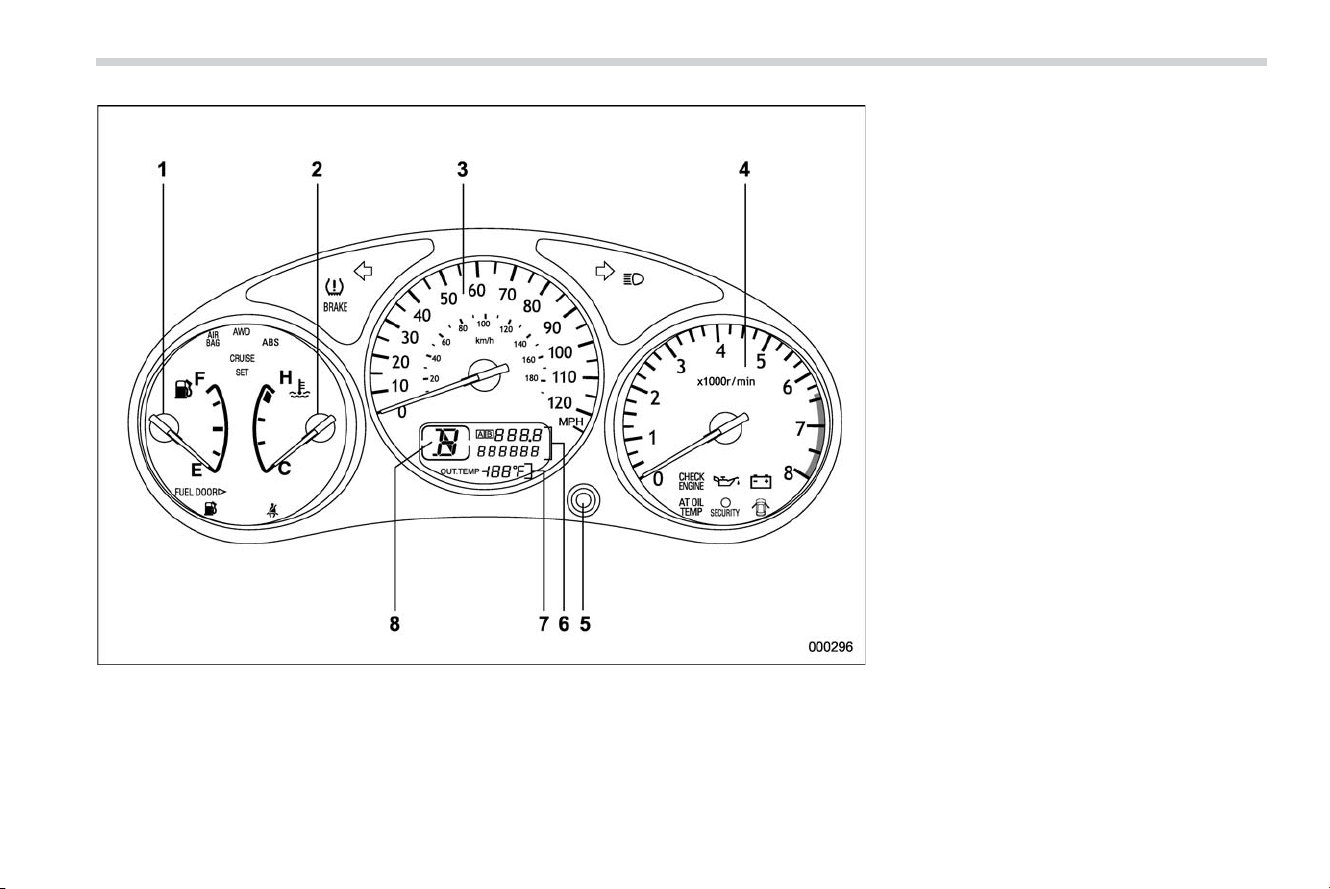
Type B
1) Fuel gauge (page 3-7)
2) Temperature gauge (page 3-8)
3) Speedometer (page 3-6)
4) Tachometer (page 3-7)
5) Trip meter A/B selection and trip meter
reset knob (page 3-6)
6) Odometer and trip meter (page 3-6)
7) Outside temperature indicator (page 3-9)
8) Select lever position indicator
(page 3-17)
17
– CONTINUED –
0
Black plate (20,1)
北米Model "A8130BE-B" EDITED: 2007/ 7/ 25
18
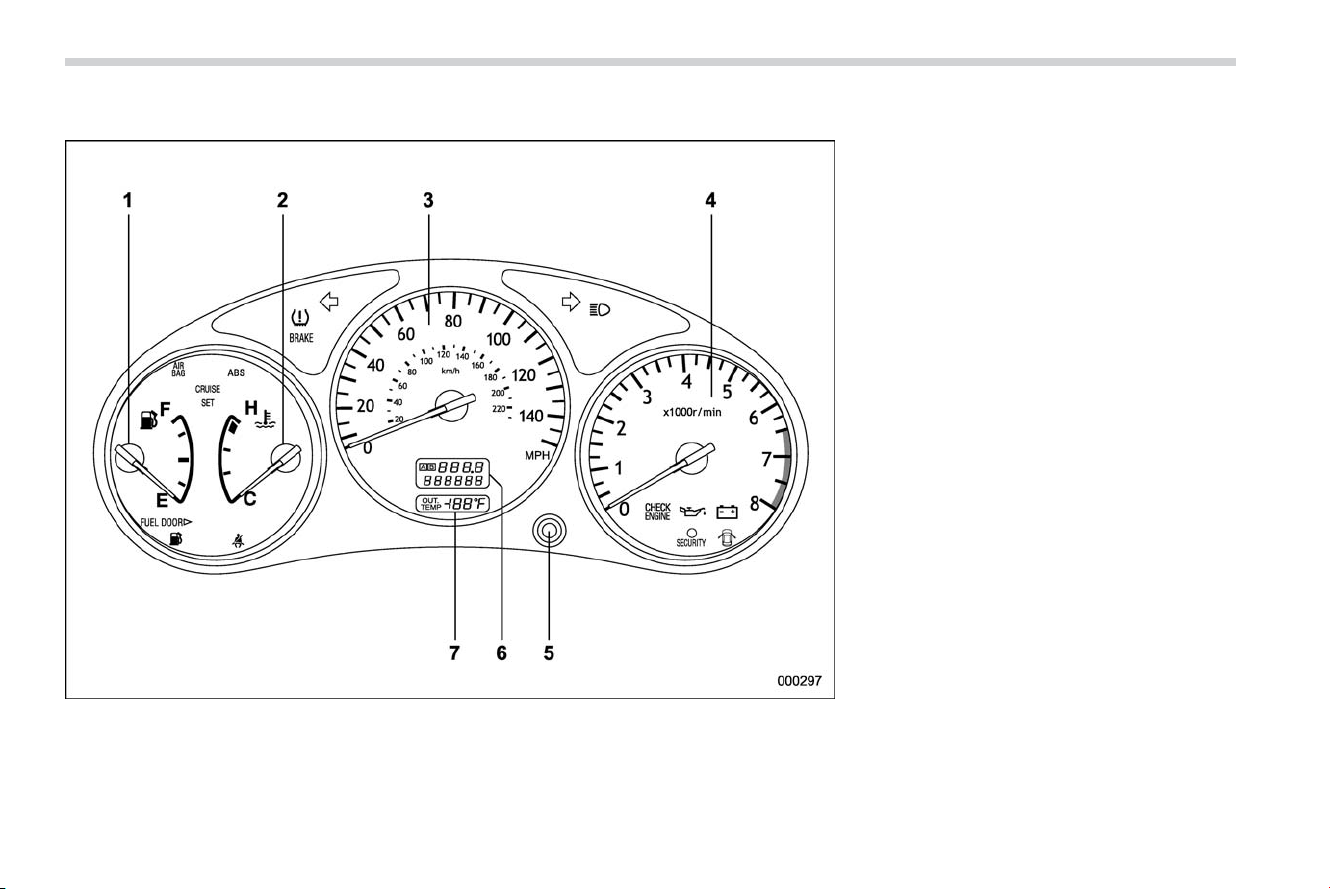
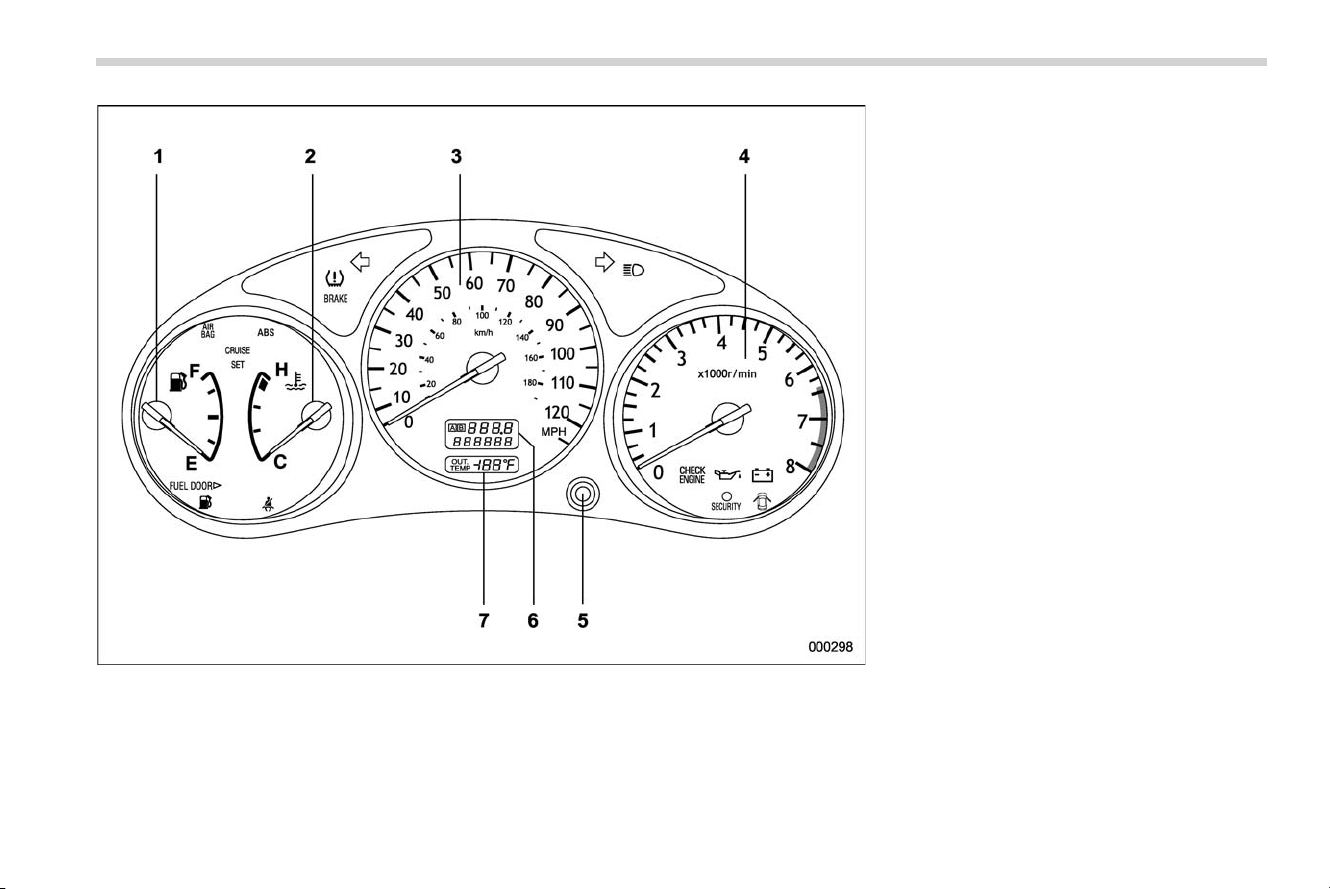
! MT vehicles
Type A
1) Fuel gauge (page 3-7)
2) Temperature gauge (page 3-8)
3) Speedometer (page 3-6)
4) Tachometer (page 3-7)
5) Trip meter A/B selection and trip meter
reset knob (page 3-6)
6) Odometer and trip meter (page 3-6)
7) Outside temperature indicator (page 3-9)
Black plate (21,1)
北米Model "A8130BE-B" EDITED: 2007/ 7/ 25
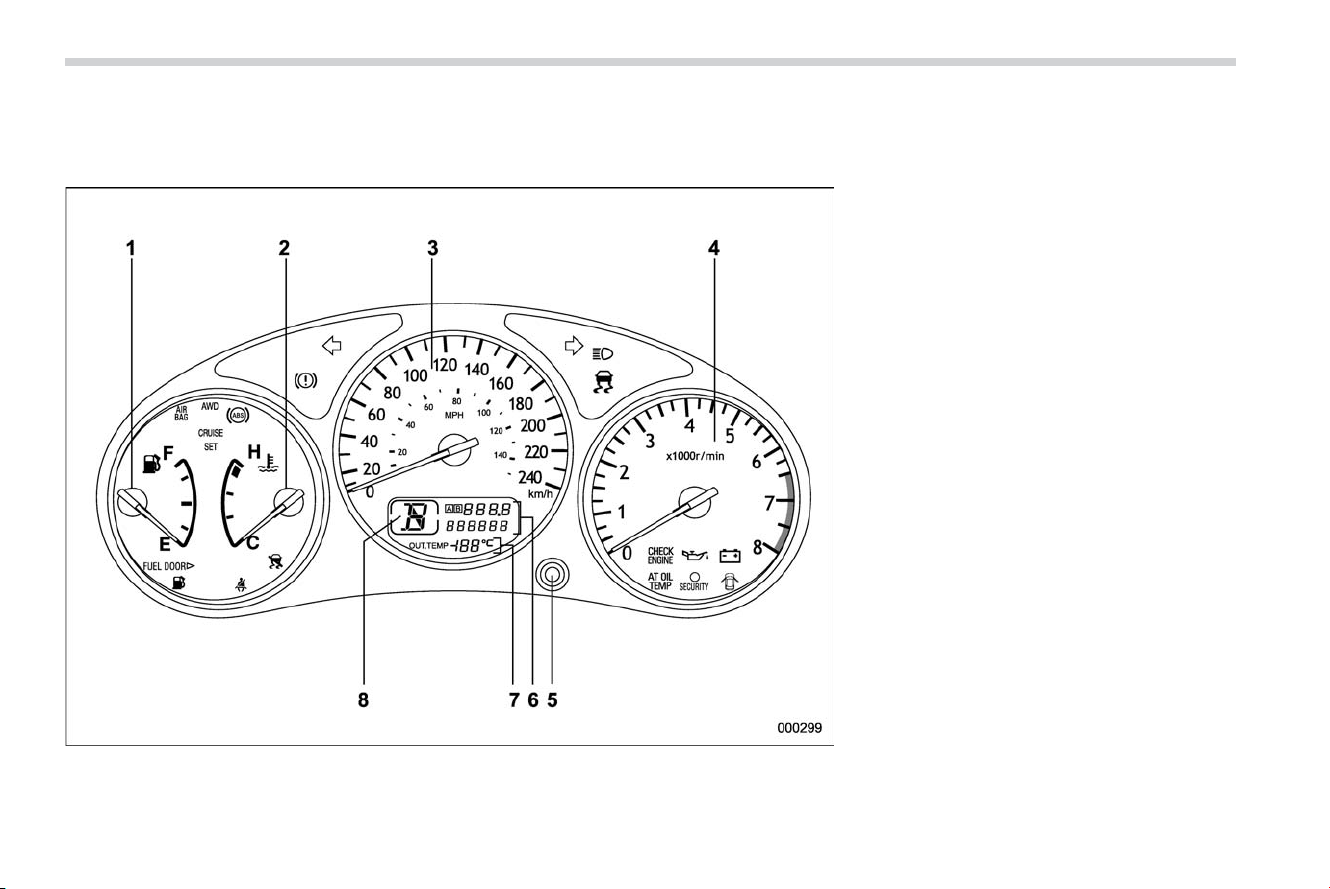
Type B
1) Fuel gauge (page 3-7)
2) Temperature gauge (page 3-8)
3) Speedometer (page 3-6)
4) Tachometer (page 3-7)
5) Trip meter A/B selection and trip meter
reset knob (page 3-6)
6) Odometer and trip meter (page 3-6)
7) Outside temperature indicator (page 3-9)
19
– CONTINUED –
0
Black plate (22,1)
北米Model "A8130BE-B" EDITED: 2007/ 7/ 25
20
! Canada-spec. models
! AT vehicles
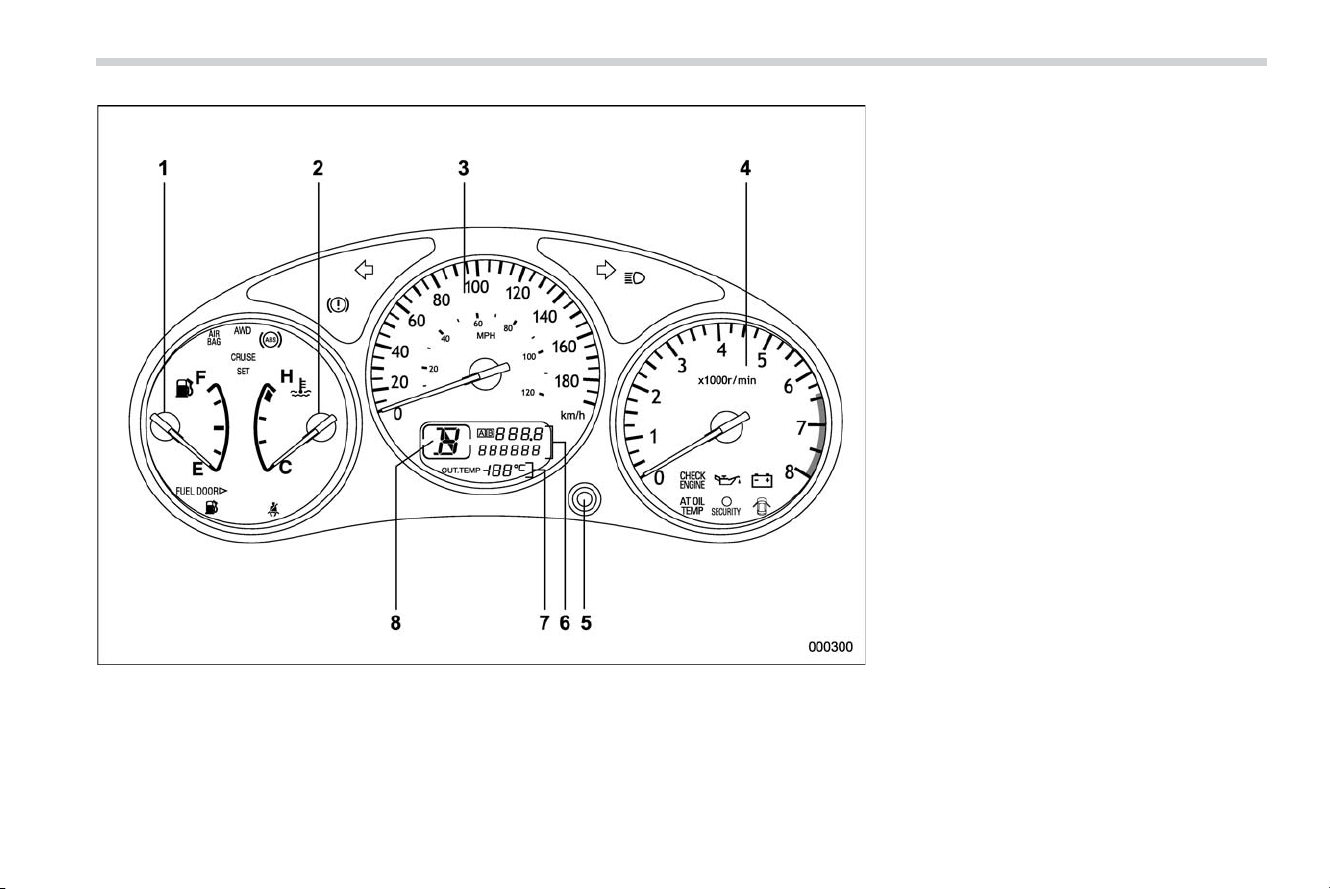
Type A
1) Fuel gauge (page 3-7)
2) Temperature gauge (page 3-8)
3) Speedometer (page 3-6)
4) Tachometer (page 3-7)
5) Trip meter A/B selection and trip meter
reset knob (page 3-6)
6) Odometer and trip meter (page 3-6)
7) Outside temperature indicator (page 3-9)
8) Select lever position indicator
(page 3-17)
Black plate (23,1)
北米Model "A8130BE-B" EDITED: 2007/ 7/ 25
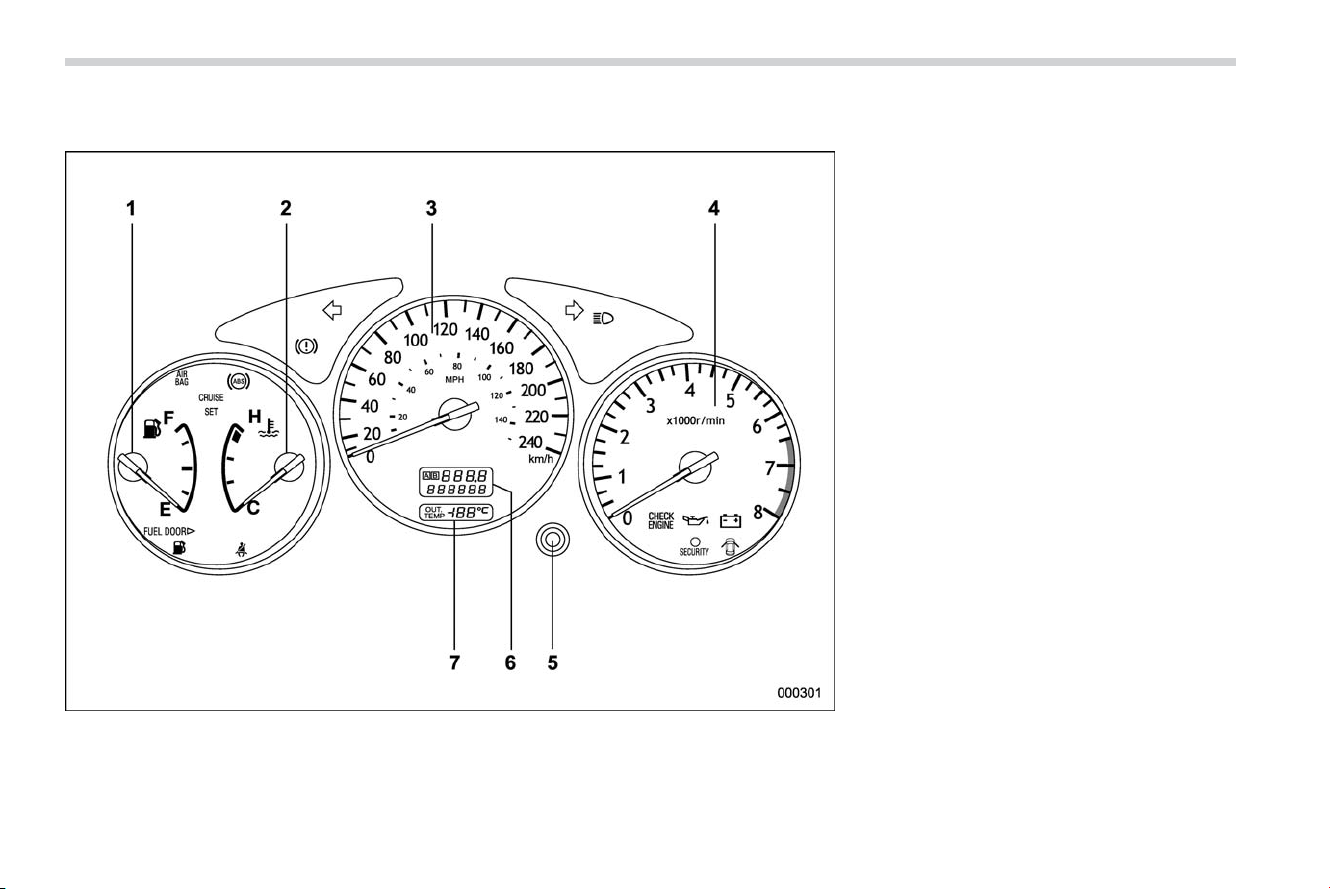
Type B
1) Fuel gauge (page 3-7)
2) Temperature gauge (page 3-8)
3) Speedometer (page 3-6)
4) Tachometer (page 3-7)
5) Trip meter A/B selection and trip meter
reset knob (page 3-6)
6) Odometer and trip meter (page 3-6)
7) Outside temperature indicator (page 3-9)
8) Select lever position indicator
(page 3-17)
21
– CONTINUED –
0
Black plate (24,1)
北米Model "A8130BE-B" EDITED: 2007/ 7/ 25
22
! MT vehicles
Type A
1) Fuel gauge (page 3-7)
2) Temperature gauge (page 3-8)
3) Speedometer (page 3-6)
4) Tachometer (page 3-7)
5) Trip meter A/B selection and trip meter
reset knob (page 3-6)
6) Odometer and trip meter (page 3-6)
7) Outside temperature indicator (page 3-9)
Black plate (25,1)
北米Model "A8130BE-B" EDITED: 2007/ 7/ 25
Type B
1) Fuel gauge (page 3-7)
2) Temperature gauge (page 3-8)
3) Speedometer (page 3-6)
4) Tachometer (page 3-7)
5) Trip meter A/B selection and trip meter
reset knob (page 3-6)
6) Odometer and trip meter (page 3-6)
7) Outside temperature indicator (page 3-9)
23
– CONTINUED –
0
Black plate (26,1)
北米Model "A8130BE-B" EDITED: 2007/ 7/ 25
24
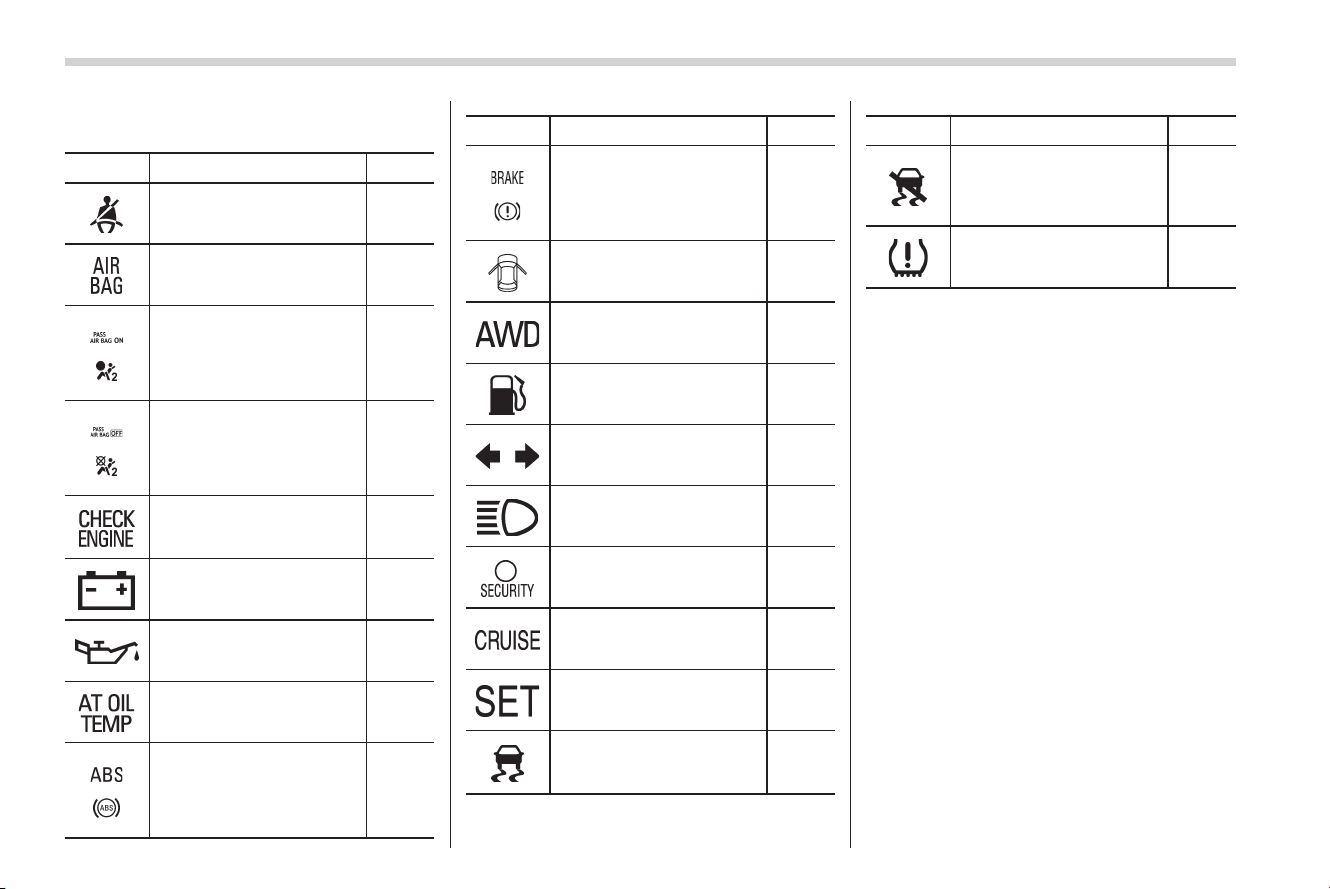
& Warning and indicator light
Mark Name Page
Seatbelt warning light 3-10
SRS airbag system warn-
ing light
3-10
or
Front passenger’s frontal
airbag ON indicator light
3-11
or
Front passenger’s frontal
airbag OFF indicator light
3-11
CHECK ENGINE warning
light/Malfunction indicator
lamp
3-12
Charge warning light 3-12
Oil pressure warning light 3-12
AT OIL temperature
warning light (AT vehicles)
3-13
or ABS warning light 3-13
Mark Name Page
or
Brake system warning
light
3-15
Door open warning light 3-16
All-Wheel Drive warning
light (AT vehicles)
3-16
Low fuel warning light 3-16
Turn signal indicator lights 3-17
High beam indicator light 3-17
Security indicator light (if
equipped)
2-4
Cruise control indicator
light (if equipped)
3-19
Cruise control set indica-
tor light (if equipped)
3-19
Vehicle Dynamics Control
operation indicator light (if
equipped)
3-16
Mark Name Page
Vehicle Dynamics Control
warning light/Vehicle Dy-
namics Control OFF indi-
cator light (if equipped)
3-14
Low tire pressure warning
light (if equipped)
3-17

Black plate (27,1)
北米Model "A8130BE-B" EDITED: 2007/ 7/ 25
& Tire changing tools
1) Jack (page 9-15)
2) Jack handle (page 9-15)
3) Spare tire (page 9-4)
25
– CONTINUED –
0
Black plate (28,1)
北米Model "A8130BE-B" EDITED: 2007/ 7/ 25
26
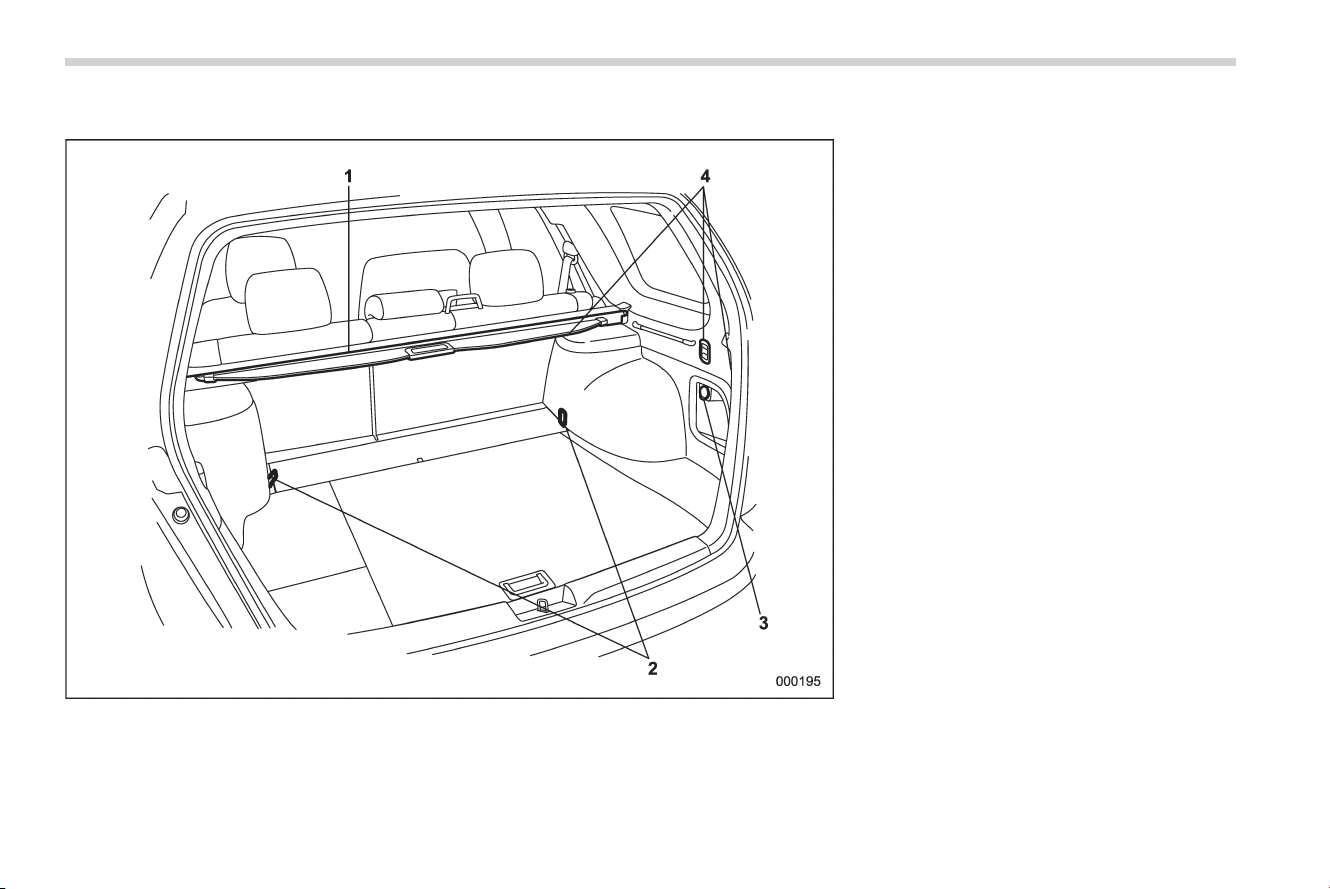
& Cargo area cover
1) Cargo area cover (page 6-13)
2) Cargo tie-down hook (page 6-14)
3) Accessory power outlet (page 6-8)
4) Shopping bag hook (page 6-14)

Black plate (1,1)
北米Model "A8130BE-B" EDITED: 2007/ 7/ 25
Front seats........................................................... 1-2
Manual seat ........................................................ 1-3
Power seat (if equipped)...................................... 1-4
Lumbar support (Driver’s seat) ............................ 1-5
Head restraint adjustment.................................... 1-6
Active head restraint ........................................... 1-6
Seat heater (if equipped) .................................... 1-7
Rear seats............................................................ 1-7
Head restraint adjustment.................................... 1-8
Folding down the rear seatback........................... 1-9
Armrest (if equipped) ......................................... 1-10
Seatbelts ............................................................. 1-10
Seatbelt safety tips............................................. 1-10
Emergency Locking Retractor (ELR) ................... 1-11
Automatic/Emergency Locking Retractor
(A/ELR) ............................................................ 1-11
Seatbelt warning light and chime ........................ 1-12
Fastening the seatbelt ........................................ 1-12
Seatbelt maintenance ......................................... 1-19
Seatbelt extender ............................................... 1-19
Front seatbelt pretensioners ............................. 1-20
System monitors ................................................ 1-22
System servicing ............................................... 1-23
Precautions against vehicle modification............ 1-23
Child restraint systems ..................................... 1-24
Where to place a child restraint system.............. 1-25
Choosing a child restraint system ...................... 1-26
Installing child restraint systems with A/ELR
seatbelt ........................................................... 1-26
Installing a booster seat..................................... 1-29
Installation of child restraint systems by use of
lower and tether anchorages (LATCH) .............. 1-31
Top tether anchorages ....................................... 1-33
*SRS airbag (Supplemental Restraint
System airbag)................................................ 1-35
Vehicle with driver’s and front passenger’s SRS
airbags and lap/shoulder restraints .................. 1-35
Subaru advanced frontal airbag system.............. 1-39
SRS side airbag (if equipped)............................. 1-51
SRS airbag system monitors.............................. 1-56
SRS airbag system servicing ............................. 1-57
Precautions against vehicle modification............ 1-58
Seat, seatbelt and SRS airbags
1
Black plate (32,1)
北米Model "A8130BE-B" EDITED: 2007/ 7/ 25
1-2 Seat, seatbelt and SRS airbags
Front seats
WARNING
. Never adjust the seat while driv-
ing to avoid the possibility of
loss of vehicle control and of
personal injury.
. Before adjusting the seat, make
sure the hands and feet of rear
seat passengers are clear of the
adjusting mechanism.
. Seatbelts provide maximum re-
straint when the occupant sits
well back and upright in the seat.
To reduce the risk of sliding
under the seatbelt in a collision,
the front seatbacks should be
always used in the upright posi-
tion while the vehicle is running.
If the front seatbacks are not
used in the upright position in a
collision, the risk of sliding under
the lap belt and of the lap belt
sliding up over the abdomen will
increase, and both can result in
serious internal injury or death.
. The SRS airbags deploy with
consider able speed and force.
Occupants who are out of proper
position when th e SRS airbag
deploys could suffer very serious
injuries. Because the SRS airbag
needs enough space for deploy-
ment, the driver should always
sit upright and well back in the
seat as far from the steering
wheel as practical while still
maintaining full vehicle control
and the front passenger should
move the seat as far back as
possible and sit upright and well
back in the seat.
WARNING
Put children aged 12 and under in
the rear seat properly restrained at
all times. The SRS airbag deploys
with considerable speed and force
and can injure or even kill children,
especially if they are 12 years of age
and under and are not restrained or
improperly restrained. Because chil-
dren are lighter and weaker than
adults, their risk of being injured
from deployment is greater. Conse-
quently, we strongly recommend
that ALL children (including those
in child seats and those that have
outgrown child restraint devices) sit
in the REAR seat properly re-
strained at all times in a child
restraint device or in a seatbelt,
whichever is appropriate for the
child’s age, height and weight. Se-
cure ALL types of child restraint
devices (including forward faci ng
child seat) in the REAR seats at all
times.
NEVER INSTALL A REARWARD FA-
CING CHILD SEAT IN THE FRONT
SEAT. DOING SO RISKS SERIOUS
INJURY OR DEATH TO THE CHILD
BY PLACING THE CHILD’S HEAD
TOO CLOSE TO THE SRS AIRBAG.
According to accident statistics,
children are safer when properly
restrained in the rear seating posi-
tions than in the front seating posi-
tions. For instructions and precau-
tions concerning child restraint sys-
Black plate (33,1)
北米Model "A8130BE-B" EDITED: 2007/ 7/ 25
tems, see the “Child restraint sys-
tems” section in this chapter.
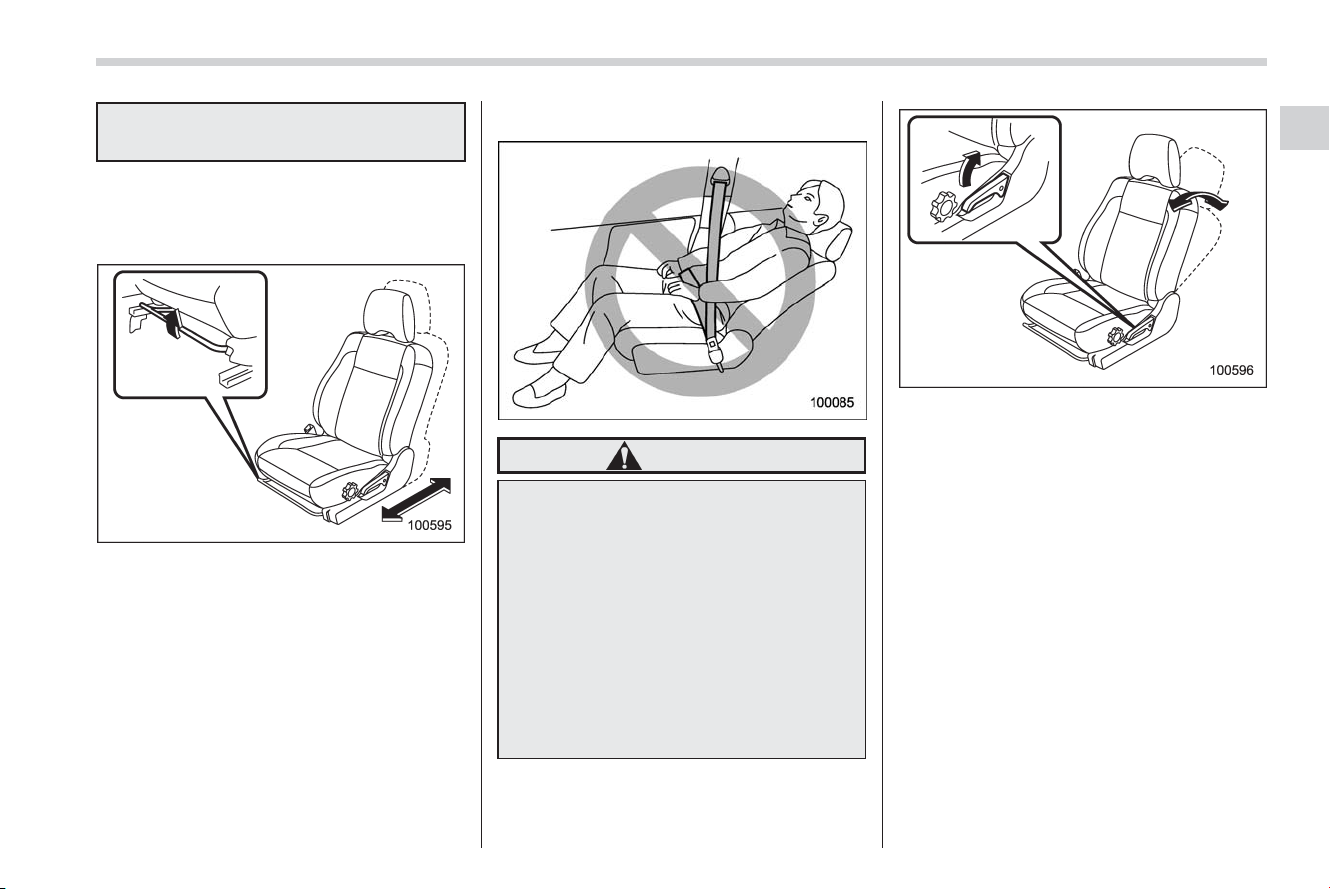
& Manual seat
! Fore and aft adjustment
Pull the lever upward and slide the seat to
the desired position. Then release the
lever and move the seat back and forth to
make sure that it is securely locked into
place.
! Reclining the seatback
WARNING
To prevent the passenger from slid-
ing under the seatbelt in the event of
a collision, always put the seatback
in the upright position while the
vehicle is in motion. Also, do not
place objects such as cushions
between the passenger and the
seatback. If you do so, the risk of
sliding under the lap belt and of the
lap belt sliding up over the abdomen
will increase, and both can result in
serious internal injury or death.
Pull the reclining lever up and adjust the
seatback to the desired position. Then
release the l ever and make sure the
seatback is securely locked into place.
The seatback placed in a reclined position
can spring back upward with force when
released. When operating the reclining
lever to return the seatback, hold it lightly
so that it may be raised back gradually.
Seat, seatbelt and SRS airbags 1-3
– CONTINUED –
1
Black plate (34,1)
北米Model "A8130BE-B" EDITED: 2007/ 7/ 25
1-4 Seat, seatbelt and SRS airbags
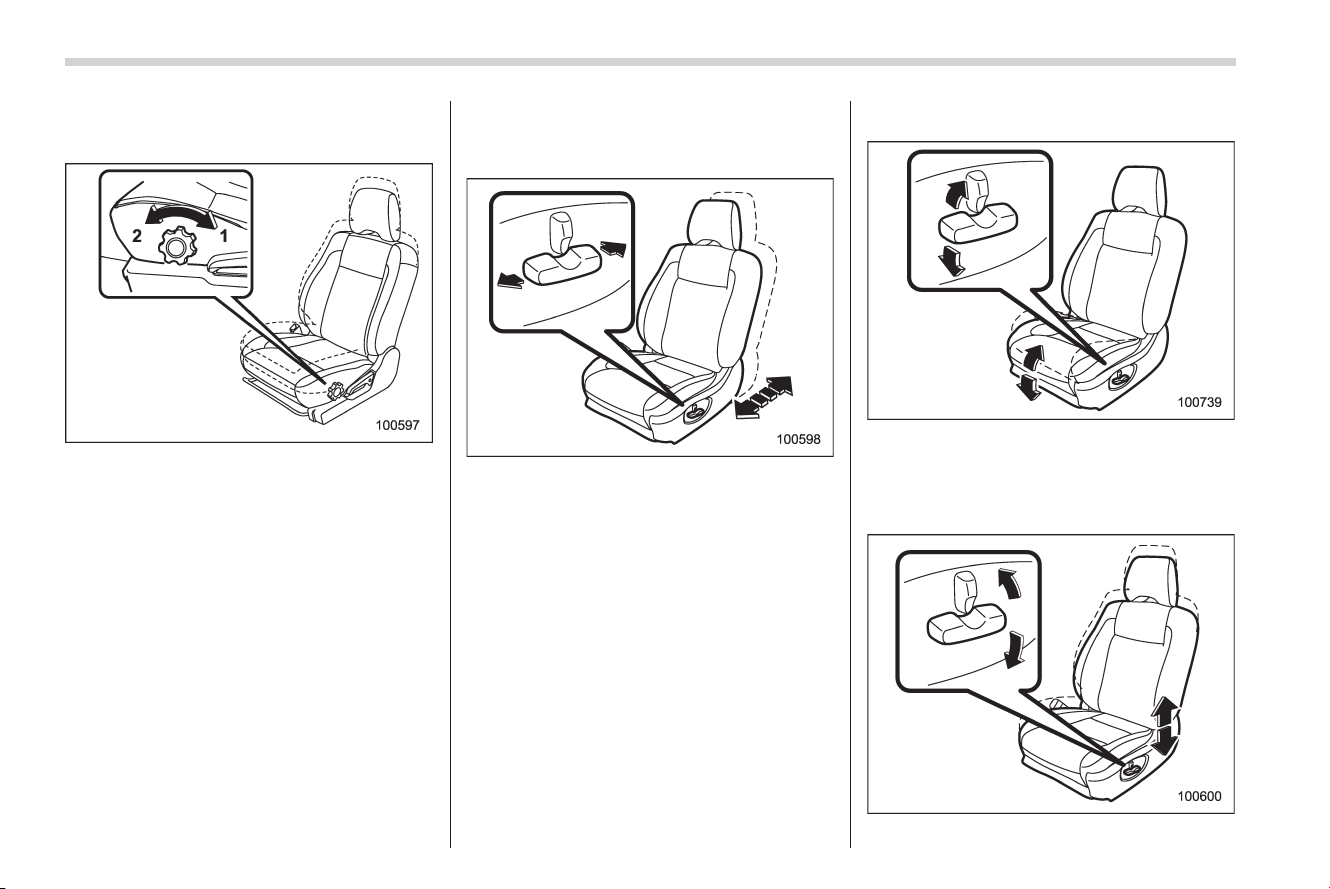
! Seat height adjustment (Driver’s
seat)
1) Turn the dial backward to lower the seat.
2) Turn the dial forward to raise the seat.
Use the adjusting dial to adjust the height
of the seat.
& Power seat (if equipped)
! Fore and aft adjustment
To adjust the seat forward or backward,
move the control switch forward or back-
ward.
! Seat cushion angle adjustment
To adjust the seat cushion angle, pull up
or push down the front end of the control
switch.
! Seat height adjustment

Black plate (35,1)
北米Model "A8130BE-B" EDITED: 2007/ 7/ 25
To adjust the seat height, pull up or push
down the rear end of the control switch.
! Reclining the seatback
WARNING
To prevent the passenger from slid-
ing under the seatbelt in the event of
a collision, always put the seatback
in the upright position while the
vehicle is in motion. Also, do not
place objects such as cushions
between the passenger and the
seatback. If you do so, the risk of
sliding under the lap belt and of the
lap belt sliding up over the abdomen
will increase, and both can result in
serious internal injury or death.
To adjust the angle of the seatback, move
the control switch forward or backward.
& Lumbar support (Driver’s
seat)
Pull the lever forward or backward.
Pulling the lever forward will increase the
amount of support for your lower back.
Seat, seatbelt and SRS airbags 1-5
– CONTINUED –
1
Black plate (36,1)
北米Model "A8130BE-B" EDITED: 2007/ 7/ 25
1-6 Seat, seatbelt and SRS airbags
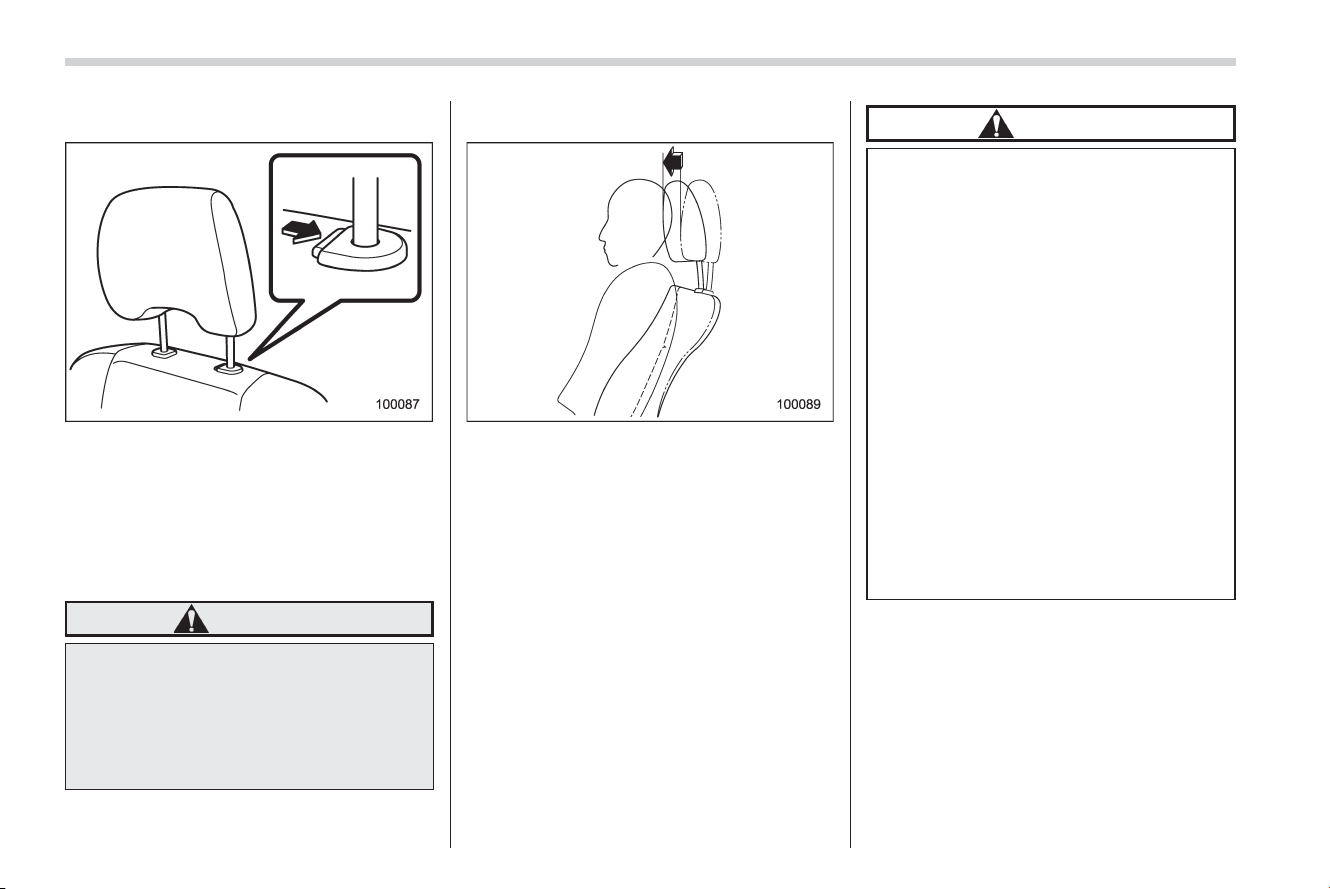
& Head restraint adjustment
To raise the head restraint, pull it up.
To lower it, push the head restraint down
while pressing the release button on the
top of the seatback.
The head restraint should be adjusted so
that the center of the head restraint is
closest to the top of the occupant’s ears.
WARNING
Never drive the vehicle with the
head restraints removed because
they are designed to reduce the risk
of serious neck injury in the event
that the vehicle is struck from the
rear.
& Active head restraint
The front seats of your vehicle are
equipped with active head restraints. They
automatically tilt forward slightly in the
event the vehicle is struck from the rear,
decreasing the amount of rearward head
movement and thus reducing the risk of
whiplash. For maximum effectiveness the
head restraint should be adjust so that the
center of the head restraint is closest to
the top of the occupant’s ears.
CAUTION
. Each active head restraint is
effective only when its height is
properly adjusted and the driver/
passenger sits in the correct
position on the seat.
. If your vehicle is involved in a
rear-end collision, have an
authorized SUBARU dealer in-
spect the active head restraints.
. The active head restraints may
not operate in the event the
vehicle experiences only a slight
impact in the rear.
. The active head restraints may be
damaged if they are pushed hard
from behind or subjected to
shock. As a result, they may not
function if the vehicle suffers a
rear impact.
Black plate (37,1)
北米Model "A8130BE-B" EDITED: 2007/ 7/ 25
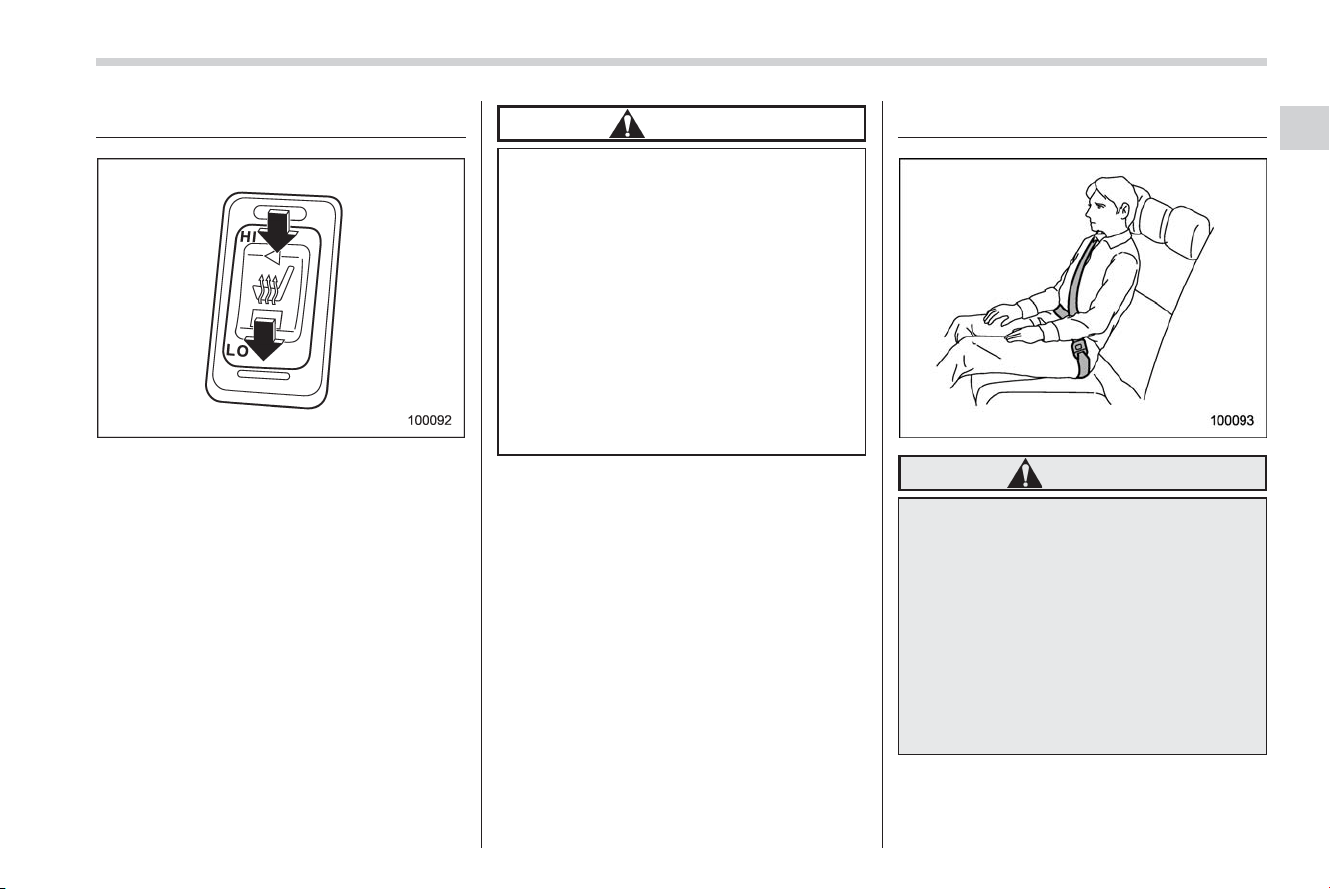
Seat heater (if equipped)
HI – Rapid heating
LO – Normal heating
The seat heater operates when the igni-
tion switch is either in the “Acc” or “ON”
position.
To turn on the seat heater, push the “LO”
or “HI” position on the switch, as desired,
depending on the temperature. Selecting
the “HI” position will cause the seat to heat
up quicker.
The indicator located on the switch comes
on when the seat heater is in operation.
When the vehicle’s interior is warmed
enough or before you leave the vehicle,
be sure to turn the switch off.
CAUTION
. There is a possibility that people
with delicate skin may suffer
slight burns even at low tempera-
tures if he/she uses the seat
heater for a long period of time.
When using the heater, always be
sure to warn the persons con-
cerned.
. Do not put anything on the seat
which insulates against heat,
such as a blanket, cushion, or
similar items. This may cause the
seat heater to overheat.
NOTE
Use of the seat heater for a long period
of time while the engine is not running
can cause battery discharge.
Rear seats
WARNING
Seatbelts provide maximum re-
straint when the occupant sits well
back and upright in the seat. Do not
put cushions or any other materials
between occupants and seatbacks
or seat cushions. If you do so, the
risk of sliding under the lap belt and
of the lap belt sliding up over the
abdomen will increase, and both can
result in serious internal injury or
death.
Seat, seatbelt and SRS airbags 1-7
– CONTINUED –
1
Black plate (38,1)
北米Model "A8130BE-B" EDITED: 2007/ 7/ 25
1-8 Seat, seatbelt and SRS airbags
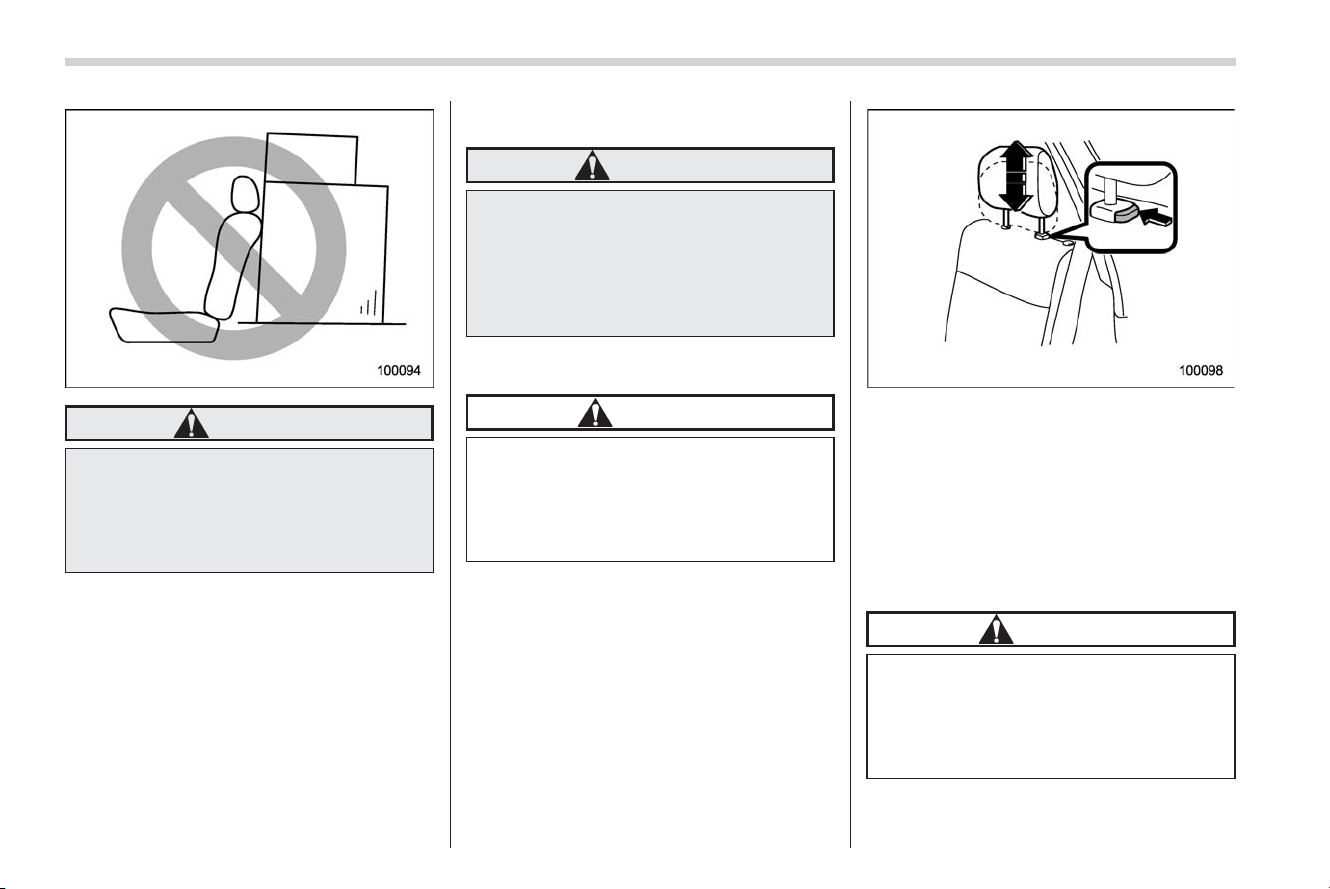
WARNING
Never stack luggage or other cargo
higher than the top of the seatback
because it could tumble forward and
injure passengers in the event of a
sudden stop or accident.
& Head restraint adjustment
WARNING
Never drive the vehicle with the
head restraints removed because
they are designed to reduce the risk
of serious neck injury in the event
that the vehicle is struck from the
rear.
! Rear windows side seating position
CAUTION
The head restraint is not intended to
be used at the lowest position.
Before sitting on the seat, raise the
head restraint to the click position
depending on your sitting height.
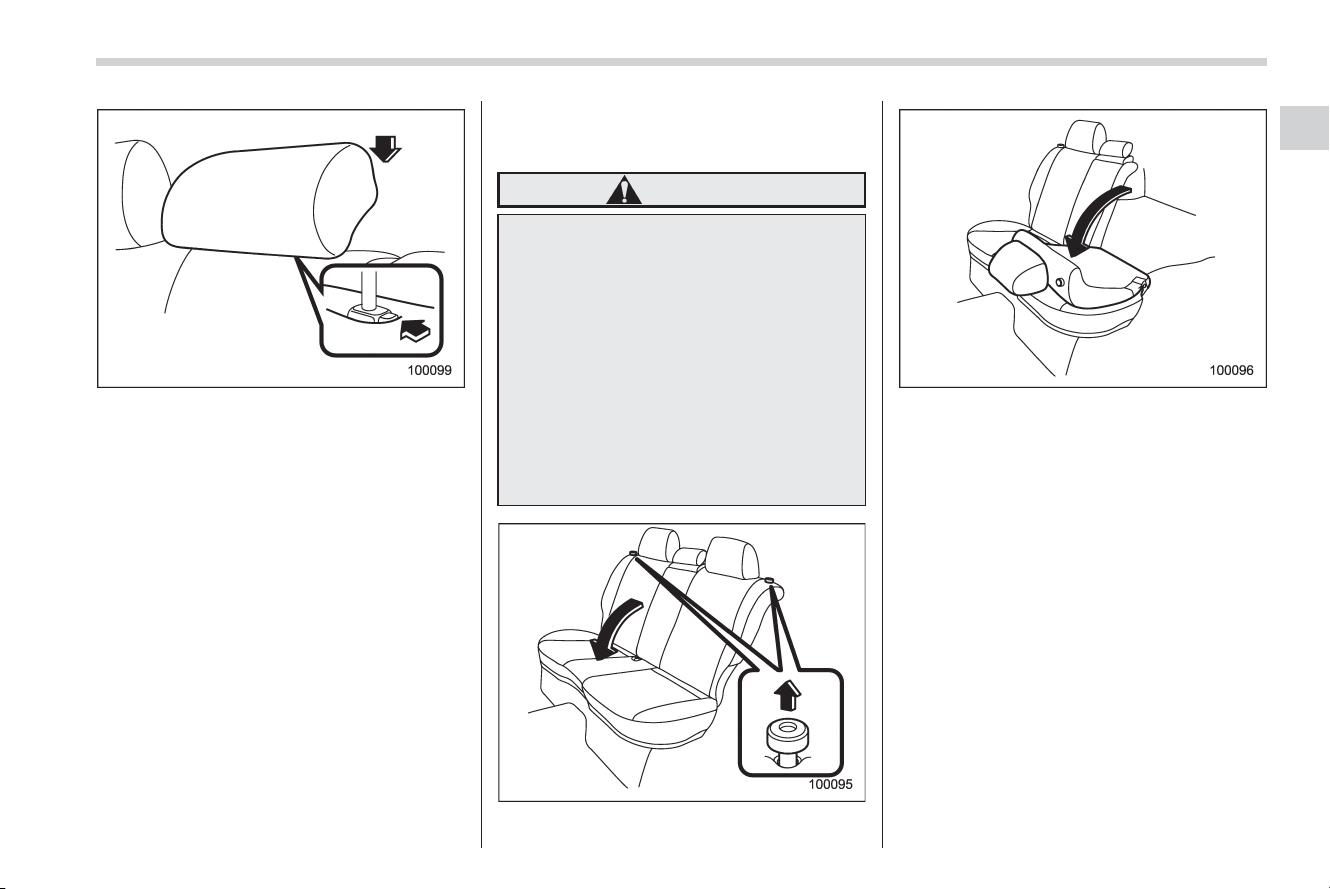
To raise the head restraint, pull it up.
To lower it, push the head restraint down
while pressing the release button on the
top of the seatback.
When the seats are not occupied, lower
the head restraint to improve rearward
visibility.
! Rear center seating position
CAUTION
The head restraint is not intended to
be used at the lowest position.
Before sitting on the seat, raise the
head restraint to the click position
depending on your sitting height.
Black plate (39,1)
北米Model "A8130BE-B" EDITED: 2007/ 7/ 25
To raise the head restraint, pull it up.
To lower it, push the head restraint down
while pressing the release button on the
top of the seatback.
When the rear center seating position is
occupied, place the head restraint to the
click position. When the rear center seat-
ing position is not occupied, lower the
head restraint to improve rearward visibi-
lity.
& Folding down the rear seat-
back
WARNING
. After returning the rear seatback
to its original position, make
certain that the shoulder belts
are fully visible.
. Never allow passengers to ride
on the folded rear seatback or in
the cargo area. Doing so may
result in serious injury or death.
. Secure lengthy items properly to
prevent them from shooting for-
ward and causing serious injury
during a sudden stop.
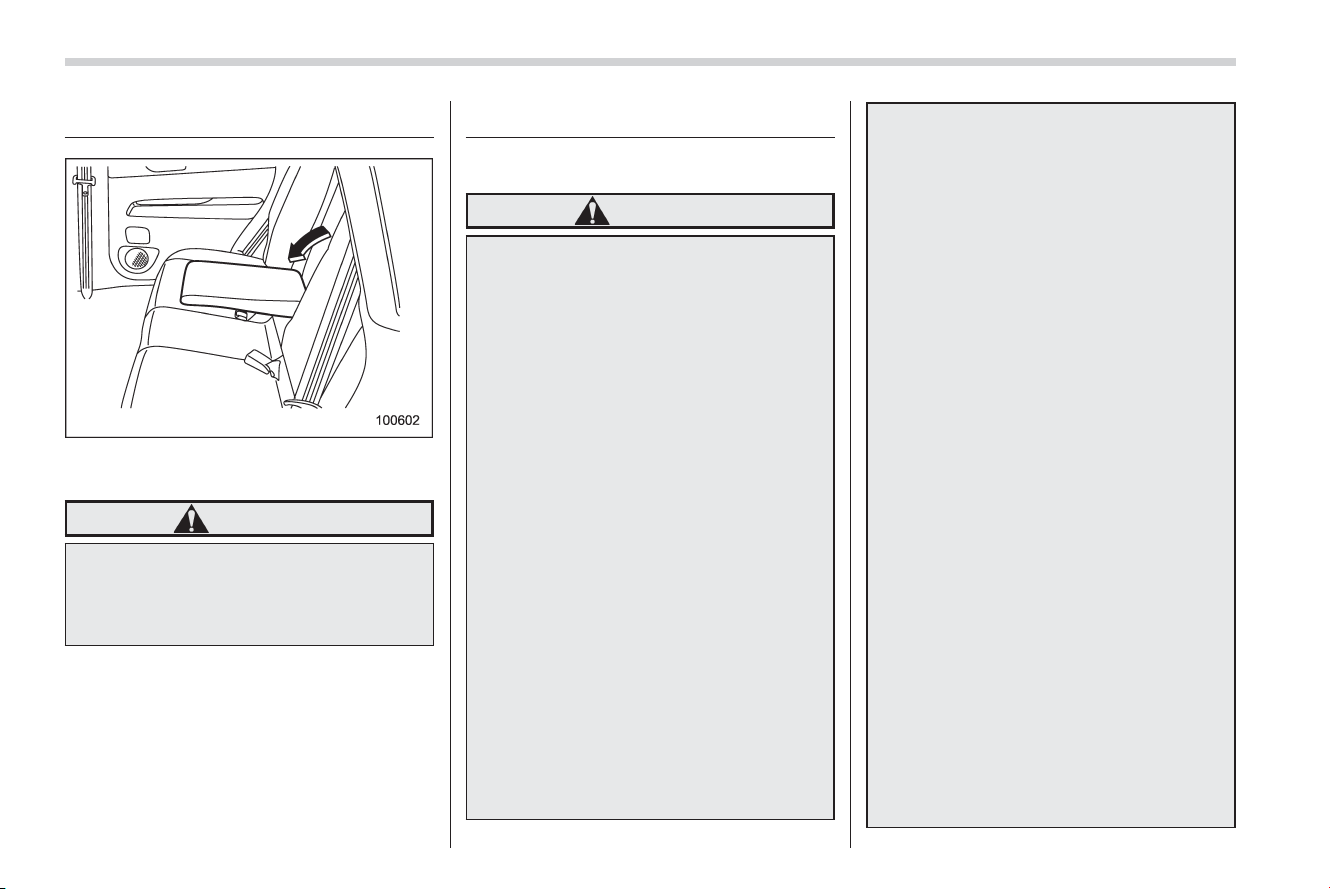
1. Lower the head restraints.
2. Unlock the seatback by pulling the
release knob and then fold the seatback
down.
To return the seatback to its original
position, raise the seatback until it locks
into place and make sure that it is securely
locked.
Seat, seatbelt and SRS airbags 1-9
1
Black plate (40,1)
北米Model "A8130BE-B" EDITED: 2007/ 7/ 25
1-10 Seat, seatbelt and SRS airbags
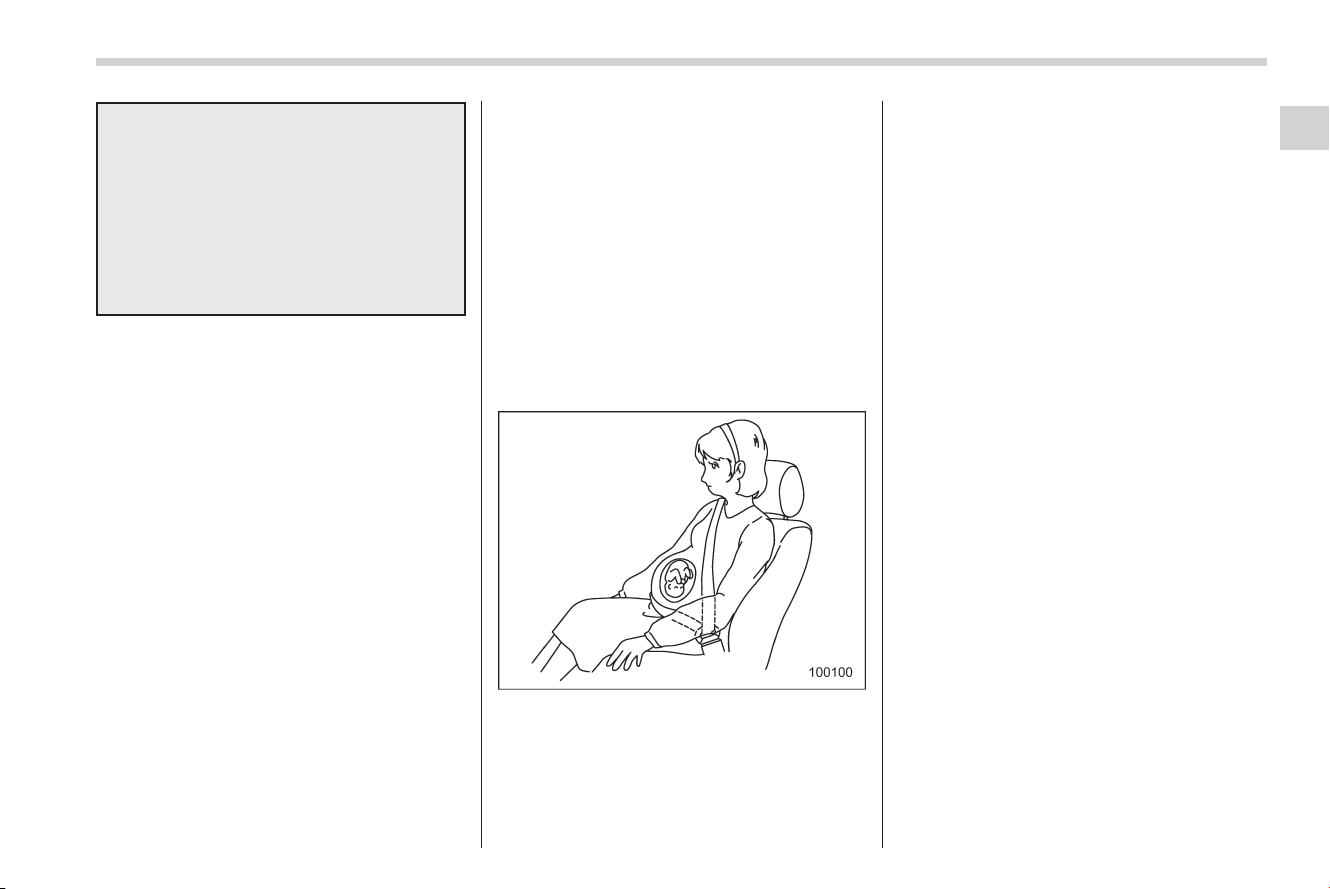
Armrest (if equipped)
To lower the armrest, pull on the top edge
of the armrest.
WARNING
To avoid the possibility of serious
injury, passengers must never be
allowed to sit on the center armrest
while the vehicle is in motion.
Seatbelts
& Seatbelt safety tips
WARNING
. All persons in the vehicle should
fasten their seatbelts BEFORE
the vehicle starts to move. Other-
wise, the possibility of serious
injury becomes greater in the
event of a sudden stop or acci-
dent.
. All belts should fit snugly in order
to provide full restraint. Loose
fitting belts are not as effective in
preventing or reducing injury.
. Each seatbelt is designed to
support only one person. Never
use a single belt for two or more
persons – even children. Other-
wise, in an accident, serious
injury or death could result.
. Replace all seatbelt assemblies
including retractors and attach-
ing hardware worn by occupants
of a vehicle that has been in a
serious accident. The entire as-
sembly should be replaced even
if damage is not obvious.
. Put children aged 12 and under in
the rear seat properly restrained
at all times. The SRS airbag
deploys with considerable speed
and force and can injure or even
kill children, especially if they are
12 years of age and under and
are not restrained or improperly
restrained. Because children are
lighter and weaker than adults,
their risk of being injured from
deployment is greater. Conse-
quently, we strongly recommend
that ALL children (including
those in child seats and those
that have outgrown child re-
straint devices) sit in the REAR
seat properly restrained at all
times in a child restraint device
or in a seatbe lt, whichever is
appropriate for the child’s height
and weight.
Secure ALL types of child re-
straint devices (including for-
ward facing child seats) in the
REAR seats at all times.
NEVER INSTALL A REARWARD
FACING CHILD SEAT IN THE
FRONT SEAT. DOING SO RISKS
SERIOUS INJURY OR DEATH TO
THE CHILD BY PLACING THE
CHILD’S HEAD TOO CLOSE TO
THE SRS AIRBAG.
Black plate (41,1)
北米Model "A8130BE-B" EDITED: 2007/ 7/ 25
According to accident statistics,
children are safer when properly
restrained in the rear seating
positions than in the front seat-
ing positions. For instructions
and precautions concerning the
child restraint system, see the
“Child restraint systems” section
in this chapter.
Your vehicle is equipped with a crash
sensing and diagnostic module, which will
record the use of the seatbelt(s) by the
driver and/or front passenger when any of
the SRS frontal and side airbags deploys.
! Infants or small children
Use a child restraint system that is
suitable for your vehicle. See information
on “Child restraint systems” in this chap-
ter.
! Children
If a child is too big for a child restraint
system, the child should sit in the rear seat
and be restrained using the seatbelts.
According to accident statistics, children
are safer when properly restrained in the
rear seating positions than in the front
seating positions. Never allow a child to
stand up or kneel on the seat.
If the shoulder portion of the belt crosses
the face or neck, adjust the shoulder belt
anchor height (window-side seating posi-
tions only) and then if necessary move the
child closer to the belt buckle to help
provide a good shoulder belt fit. Care must
be taken to securely place the lap belt as
low as possible on the hips and not on the
child’s waist. If the shoulder portion of the
belt cannot be properly positioned, a child
restraint system should be used. Never
place the shoulder belt under the child’s
arm or behind the child’s back.
! Expectant mothers
Expectant mothers also need to use the
seatbelts. They should consult their doctor
for specific recommendations. The lap belt
should be worn securely and as low as
possible over the hips, not over the waist.
& Emergency Locking Retrac-
tor (ELR)
The driver’s seatbelt has an Emergency
Locking Retractor (ELR).
The emergency locking retractor allows
normal body movement but the retractor
locks automatically during a sudden stop,
impact or if you pull the belt very quickly
out of the retractor.
& Automatic/Emergency Lock-
ing Retractor (A/ELR)
Each passenger’s seatbelt has an Auto-
matic/Emergency Locking Retractor (A/
ELR). The Automatic/Emergency Locking
Retractor normally functions as an Emer-
gency Locking Retractor (ELR). The A/
ELR has an additional locking mode
“Automatic Locking Retractor (ALR)
mode” intended to secure a child restraint
system. When the seatbelt is once drawn
out completely and is then retracted even
slightly, the retractor locks the seatbelt in
that position and the seatbelt cannot be
extended. As the belt is rewinding, clicks
will be heard which indicate the retractor
functions as an ALR. When the seatbelt is
retracted fully, the ALR mode is released.
When securing a child restraint system on
the rear seats by the use of the seatbelt,
the seatbelt must be changed over to the
Seat, seatbelt and SRS airbags 1-11
– CONTINUED –
1
Black plate (42,1)
北米Model "A8130BE-B" EDITED: 2007/ 7/ 25
1-12 Seat, seatbelt and SRS airbags
Automatic Locking Retractor (ALR) mode.
When the child restraint system is re-
moved, make sure that the seatbelt
retracts fully and the retractor returned to
the Emergency Locking Retractor (ELR)
mode.
For instructions on how to convert the
retractor to the ALR mode and restore it to
the ELR mode, see the “Child restraint
systems” section in this chapter.
& Seatbelt warning light
and chime
Your vehicle is equipped with a seatbelt
warning device at the driver’s seat, as
required by current safety standards.
There is a seatbelt warning light in the
combination meter.
If the driver has not yet fastened the
seatbelt when the ignition switch is turned
to the “ON” position, the seatbelt warning
light will flash for 6 seconds, to warn that
the seatbelt is unfastened. If the driver’s
seatbelt is not fastened, a chime will also
sound simultaneously.
If the driver’s seatbelt is still not fastened 6
seconds later, the warning light will remain
lit for 15 seconds. If the driver’s seatbelt is
still not fastened even 15 seconds later
(21 seconds after turning ON the ignition
switch), the warning lights will alternate
between flashing and steady illumination
at 15-second intervals, and the chime will
sound while the warning light is flashing.
Alternate flashing and steady illumination
of the warning lights and sounding of the
chime will continue until the driver fastens
the seatbelt.
NOTE
. If the driver unfastens the seatbelt
after fastening, the seatbelt warning
device operates as follows according
to the vehicle speed.
. At speeds lower than appr oxi-
mately 9 mph (15 km/h)
The warning light will alternate
between flashing and steady illumi-
nation at 15-second intervals. The
chime will not sound.
. At speeds higher than approxi-
mately 9 mph (15 km/h)
The warning light will alternate
between flashing and steady illumi-
nation at 15-second intervals and
the chime will sound whil e the
warning light is flashing.
. It is possible to cancel the warning
operation that follows the 6-second
warning after turning ON the ignition
switch. When the ignition switch is
turned ON next time, however, the
complete sequence of warning opera-
tion resumes. For further details about
canceling the warning operation,
please contact your SUBARU dealer.
& Fastening the seatbelt
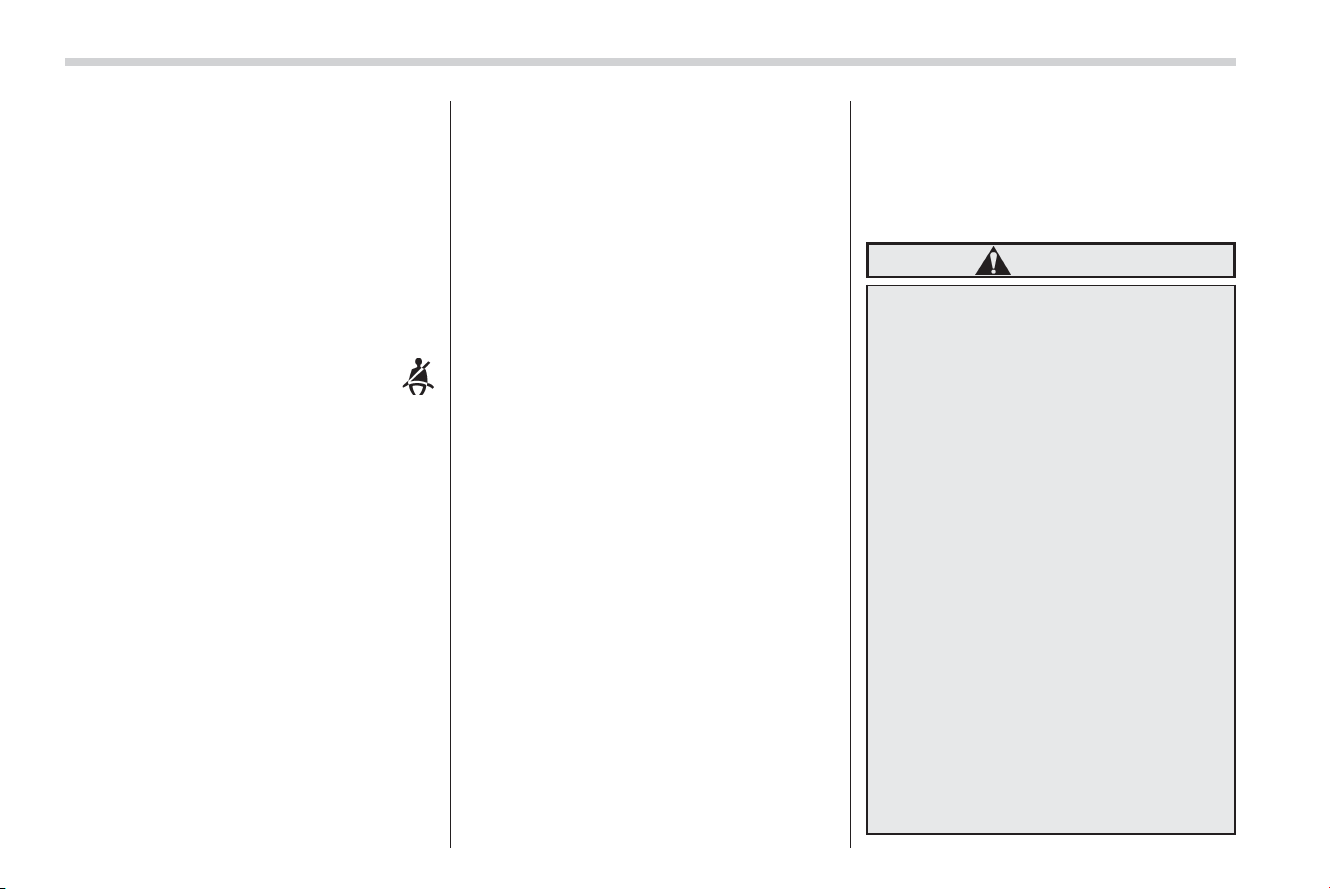
WARNING
. Never use a belt that is twisted or
reversed. In an accident, this can
increase the risk or severity of
injury.
. Keep the lap belt as low as
possible on your hips. In a colli-
sion, this spreads the force of the
lap belt over stronger hip bones
instead of across the weaker
abdomen.
. Seatbelts provide maximum re-
straint when the occupant sits
well back and upright in the seat.
To reduce the risk of sliding
under the seatbelt in a collision,
the front seatbacks should be
always used in the upright posi-
tion while the vehicle is running.
If the front seatbacks are not
used in the upright position in a
collision, the risk of sliding under
the lap belt and of the lap belt
sliding up over the abdomen will
increase, and both can result in
Black plate (43,1)
北米Model "A8130BE-B" EDITED: 2007/ 7/ 25
serious internal injury or death.
. Do not put cushions or any other
materials between occupants
and seatbacks or seat cushions.
If you do so, the risk of sliding
under the lap belt and of the lap
belt sliding up over the abdomen
will increase, and both can result
in seri ous internal injury or
death.
WARNING
Never place the shoulder belt under
the arm or behind the back. If an
accident occurs, this can increase
the risk or severity of injury.
CAUTION
Metallic parts of the seatbelt can
become very hot in a vehicle that
has been closed up in sunny weath-
er; they could burn an occupant. Do
not touch such hot parts until they
cool.
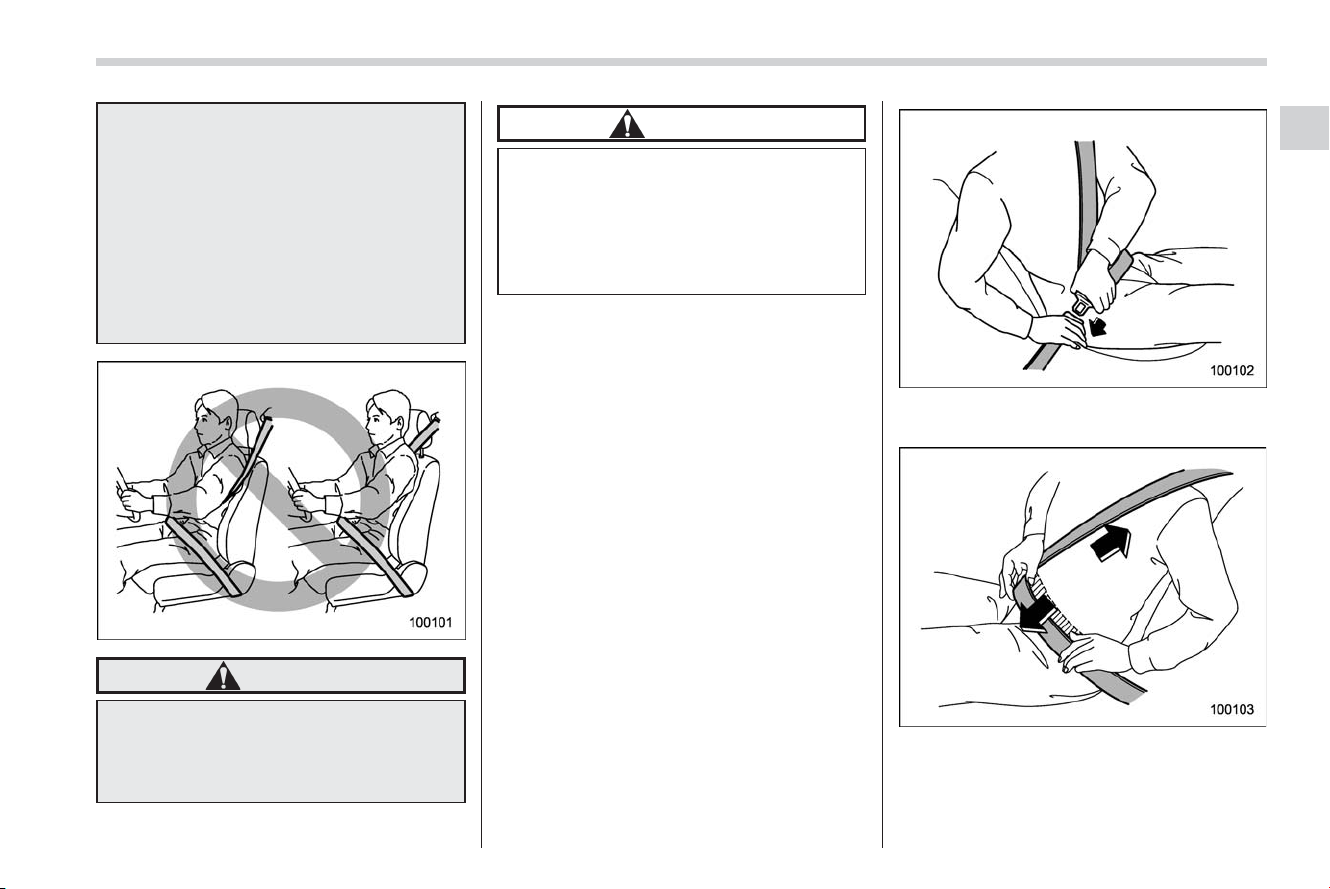
! Front seatbelts
1. Adjust the seat position:
Driver’s seat: Adjust the seatback to the
upright position. Move the seat as far from
the steering wheel as practical while still
maintaining full vehicle control.
Front passenger’s seat: Adjust the seat-
back to the upright position. Move the seat
as far back as possible.
2. Sit well back in the seat.
3. Pick up the tongue plate and pull the
belt out slowly. Do not let it get twisted. If
the belt stops before reaching the buckle,
return the belt slightly and pull it out more
slowly. If the belt still cannot be unlocked,
let the belt retract slightly after giving it a
strong pull, then pull it out slowly again.
4. Insert the tongue plate into the buckle
until you hear a click.
5. To make the lap part tight, pull up on
the shoulder belt.
6. Place the lap belt as low as possible
on your hips, not on your waist.
Seat, seatbelt and SRS airbags 1-13
– CONTINUED –
1
Black plate (44,1)
北米Model "A8130BE-B" EDITED: 2007/ 7/ 25
1-14 Seat, seatbelt and SRS airbags
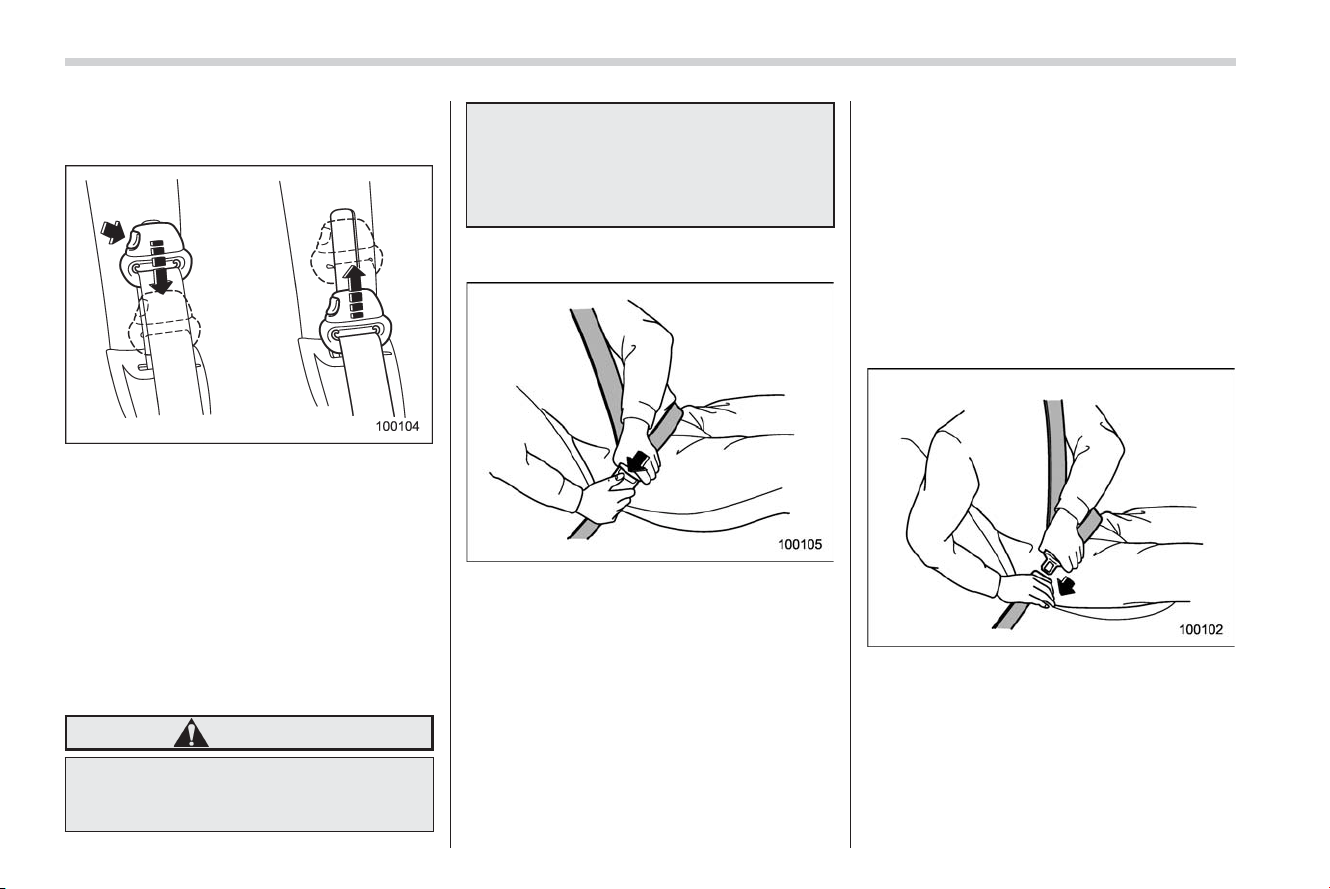
! Adjusting the front seat shoulder
belt anchor height
The shoulder belt anchor height should be
adjusted to the position best suited for the
driver/front passenger.
To lower the anchor height, push the
release button and slide the anchor down.
To raise the anchor height, slide the
anchor up. Pull down on the anchor to
make sure that it is locked in place.
Always adjust the anchor height so that
the shoulder belt passes over the middle
of the shoulder without touching the neck.
WARNING
When wearing the seatbelts, make
sure the shoul der portion of the
webbing does not pass over your
neck. If it does, adjust the seatbelt
anchor to a lower position. Placing
the shoulder belt over the neck may
result in neck injury during sudden
braking or in a collision.
! Unfastening the seatbelt
Push the button on the buckle.
Before closing the door, make sure that
the belts are retracted properly to avoid
catching the belt webbing in the door.
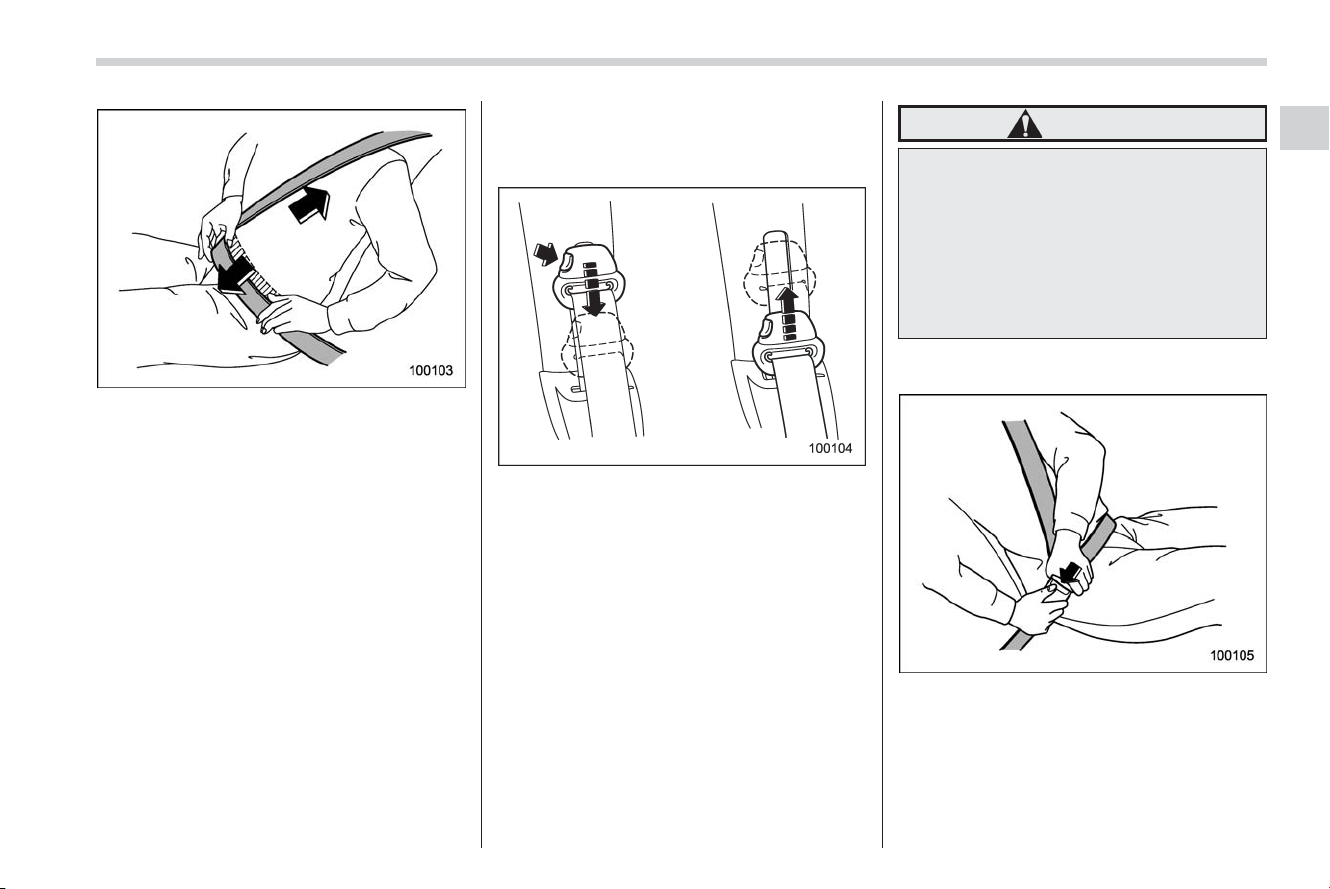
! Rear seatbelts (except rear center
seatbelt)
1. Sit well back in the seat.
2. Pick up the tongue plate and pull the
belt out slowly. Do not let it get twisted. If
the belt stops before reaching the buckle,
return the belt slightly and pull it out more
slowly. If the belt still cannot be unlocked,
let the belt retract slightly after giving a
strong pull on it, then pull it out slowly
again.
3. Insert the tongue plate into the buckle
until you hear a click.
Black plate (45,1)
北米Model "A8130BE-B" EDITED: 2007/ 7/ 25
4. To make the lap part tight, pull up on
the shoulder belt.
5. Place the lap belt as low as possible
on your hips, not on your waist.
! Adjusting the rear seat shoulder belt
anchor height (window-side seating
positions only)
The shoulder belt anchor height should be
adjusted to the position best suited for
you.
To lower the anchor height, push the
release button and slide the anchor down.
To raise the anchor height, slide the
anchor up. Pull down on the anchor to
make sure that it is locked in place.
Always adjust the anchor height so that
the shoulder belt passes over the middle
of the shoulder without touching the neck.
WARNING
When wearing the seatbelts, make
sure the shoul der portion of the
webbing does not pass over your
neck. If it does, adjust the seatbelt
anchor to a lower position. Placing
the shoulder belt over the neck may
result in neck injury during sudden
braking or in a collision.
! Unfastening the seatbelt
Push the button on the buckle.
Before closing the door, make sure that
the belts are retracted properly to avoid
catching the belt webbing in the door.
Seat, seatbelt and SRS airbags 1-15
– CONTINUED –
1
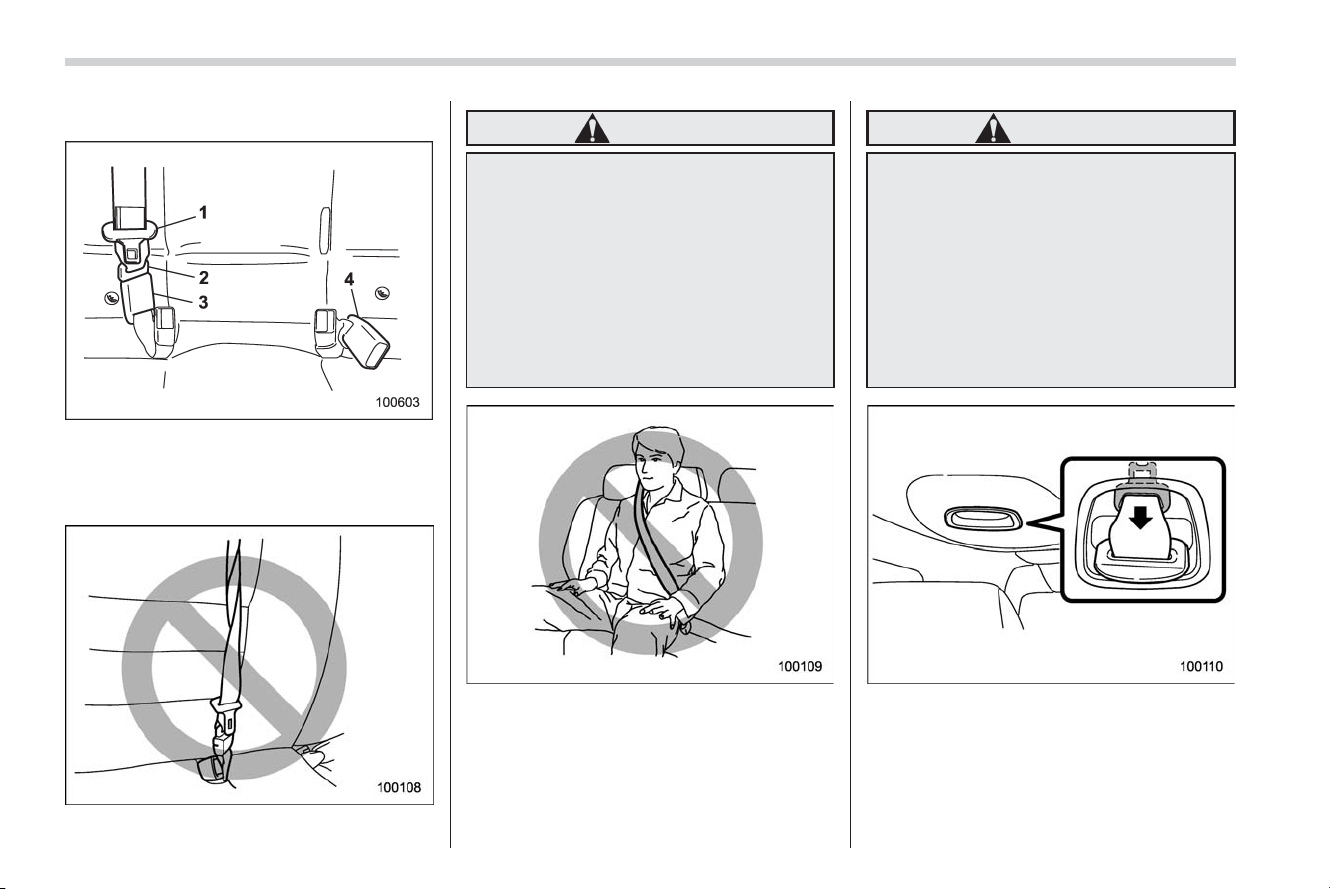
Black plate (46,1)
北米Model "A8130BE-B" EDITED: 2007/ 7/ 25
1-16 Seat, seatbelt and SRS airbags
! Rear center seatbelt
1) Center seatbelt tongue plate
2) Connector (tongue)
3) Connector (buckle)
4) Center seatbelt buckle
WARNING
Fastening the seatbelt with the web-
bing twisted can increase the risk or
severity of injury in an accident.
When fastening the belt after it is
pulled out from the retractor, espe-
cially when inserting the connec-
tor’s tongue plate into the mating
buckle (on right-hand side), always
check that the webbing is not
twisted.
WARNING
Be sure to fasten both tongue plates
to the respective buckles. If the
seatbelt is used only as a shoulder
belt (with the connector’s tongue
plate not fastened to the connec-
tor’s buckle on the right-hand side),
it cannot properly restrain the wear-
er in position in an accident, possi-
bly resulting in serious injury or
death.
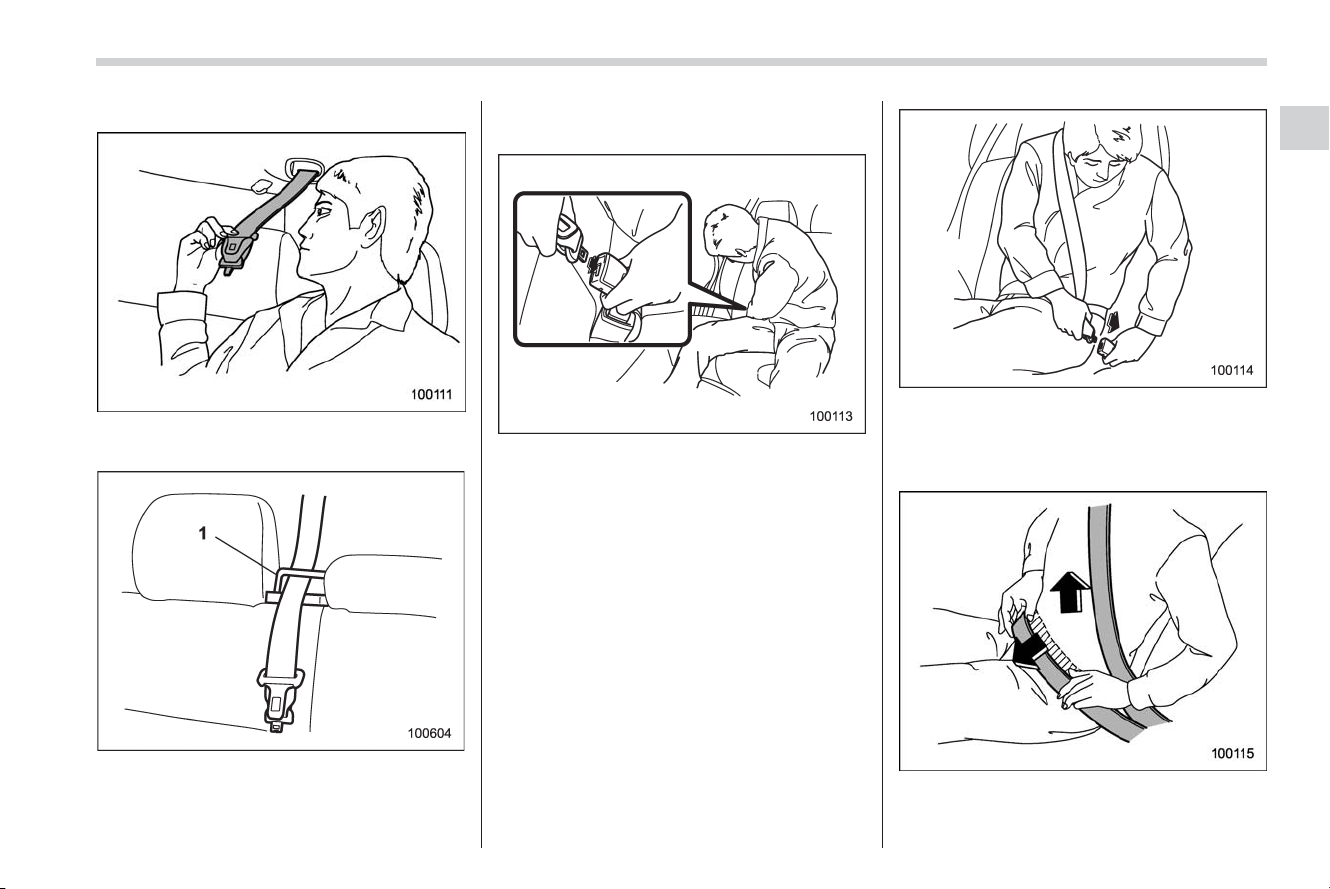
Rear center seatbelt is stowed in the
recess of the ceiling.
1. Remove the connector (tongue) plate
from the slot located at the front of the
recess by pulling the connector (tongue)
Black plate (47,1)
北米Model "A8130BE-B" EDITED: 2007/ 7/ 25
plate rearward.
2. Pull out the seatbelt slowly from the
overhead retractor.
1) Seatbelt comfort guide
3. Pass the seatbelt through the seatbelt
comfort guide located beside the head
restraint.
4. After confirming that the webbing is not
twisted, insert the connector (tongue)
attached at the w ebbing end into the
buckle on the right-hand side until a click
is heard.
If the belt stops before reaching the
buckle, return the belt slightly and pull it
out more slowly. If the belt still cannot be
unlocked, let the belt retract slightly after
giving it a strong pull, then pull it out slowly
again.
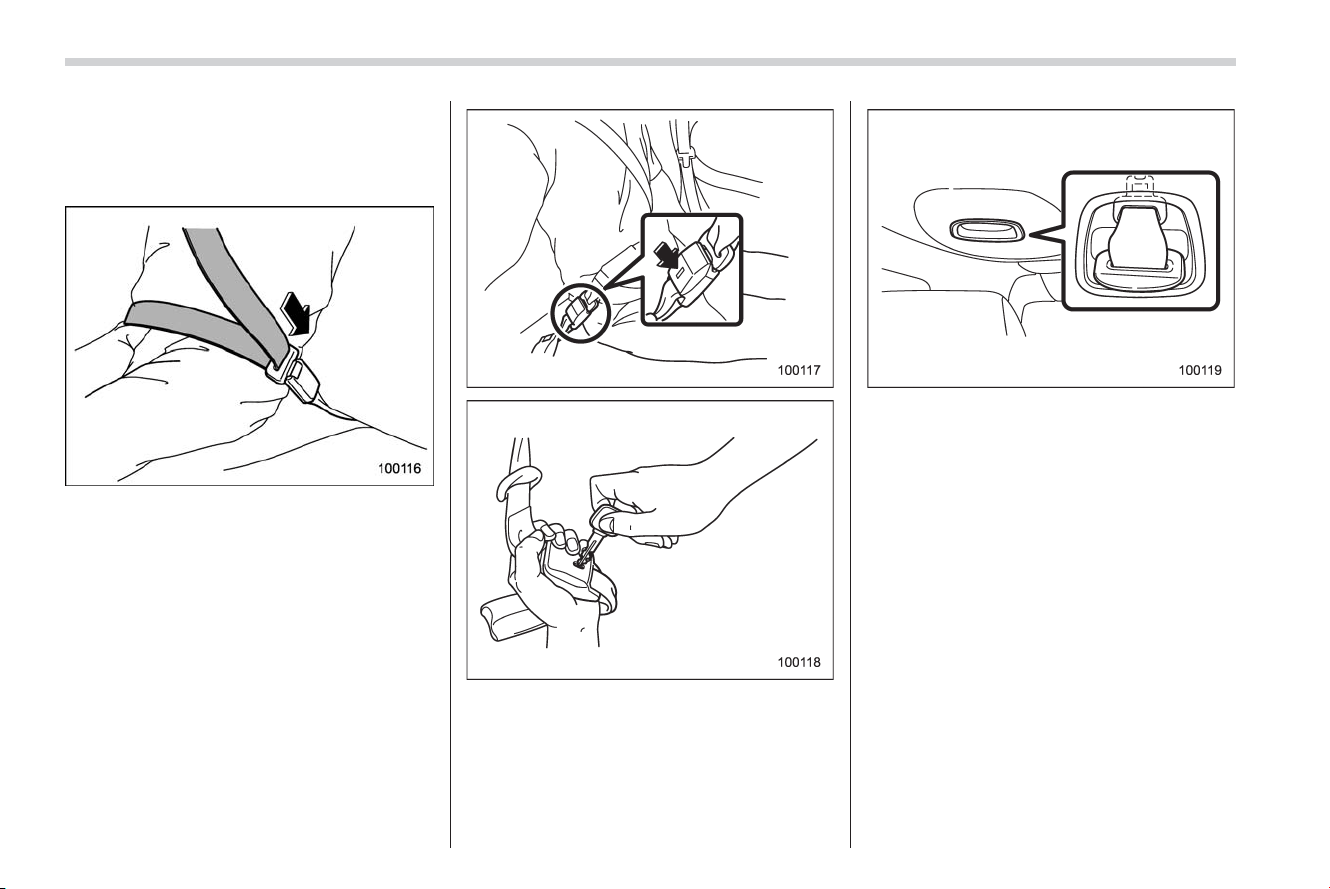
5. Insert the center seatbelt tongue plate
into the center seatbelt buckle marked
“CENTER” on the left-hand side until it
clicks.
6. To make the lap part tight, pull up on
the shoulder belt.
Seat, seatbelt and SRS airbags 1-17
– CONTINUED –
1
Black plate (48,1)
北米Model "A8130BE-B" EDITED: 2007/ 7/ 25
1-18 Seat, seatbelt and SRS airbags
7. Place the lap belt as low as possible
on your hips, not on your waist.
! Unfastening the seatbelt
Push the release button of the center
seatbelt buckle (on the left-hand side) to
unfasten the seatbelt.
NOTE
When the seatback is folded down for
greater cargo area, it is necessary to
disconnect the connector.
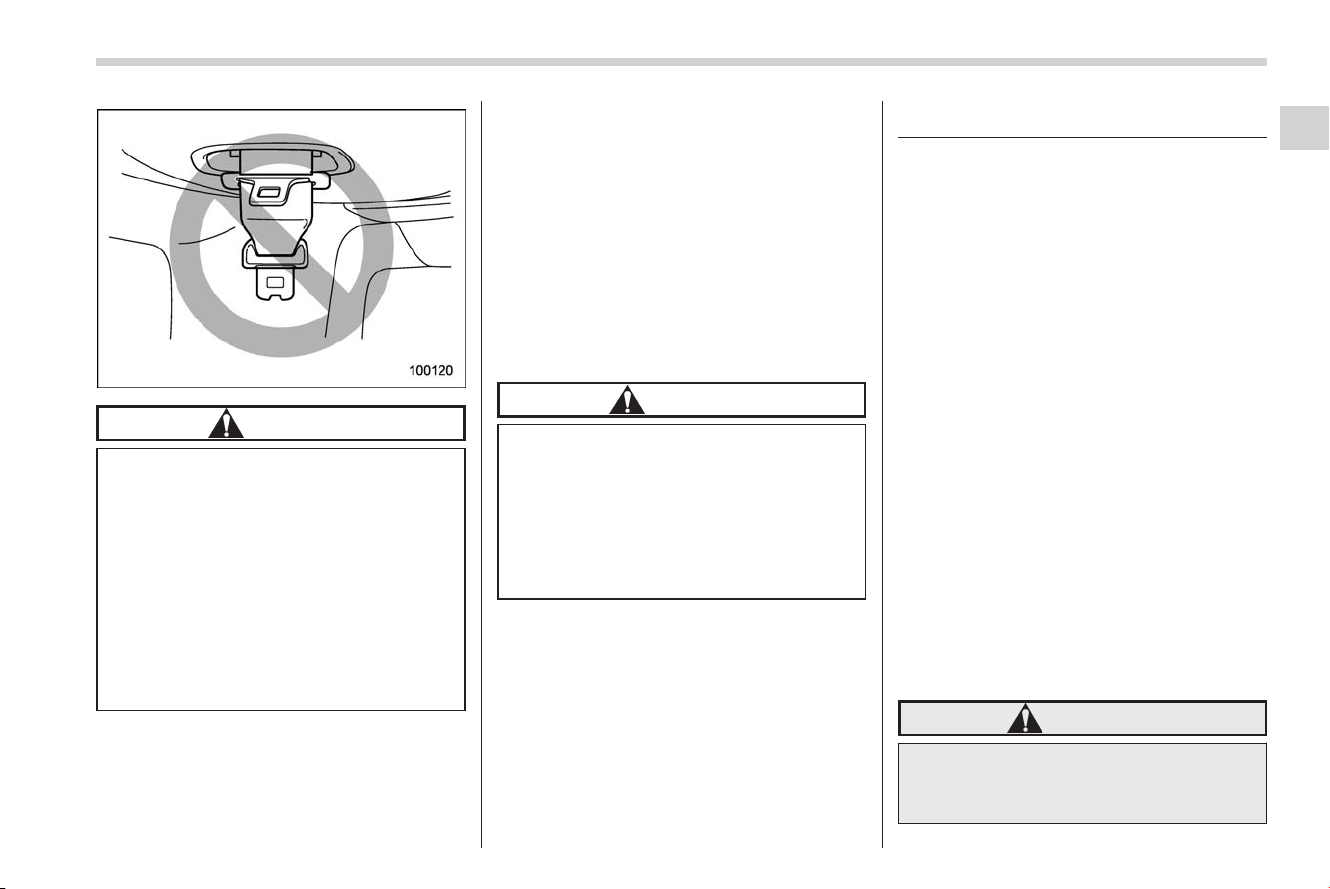
1. Insert a key or other hard pointed
object into the slot in the connector
(buckle) on the right-hand side and push
it in, and the connector (tongue) plate will
disconnect from the buckle.
2. Allow the retractor to roll up the belt.
You should hold the webbing end and
guide it back into the retractor while it is
rolling up. Neatly store the tongue plates
in the recess on the ceiling and then insert
the connector (tongue) plate into the slot
located at the front of the recess.
Black plate (49,1)
北米Model "A8130BE-B" EDITED: 2007/ 7/ 25
CAUTION
. Do not allow the retractor to roll
up the seatbelt too quickly.
Otherwise, the metal tongue
plates may hit against the trim,
resulting in damaged trim.
. Have the seatbelt fully rolled up
so that the tongue plates are
neatly stored. A hanging tongue
plate can swing and hit against
the trim during driving, causing
damage to the trim.
& Seatbelt maintenance
To clean the seatbelts, use a mild soap
and lukewarm water. Never bleach or dye
the belts because this could seriously
affect their strength.
Inspect the seatbelts and attachme nts
including the webbing and all hardware
periodically for cracks, cuts, gashes,
tears, damage, loose bolts or worn areas.
Replace the seatbelts even if only minor
damage is found.
CAUTION
. Keep the belts free of polishes,
oils, chemicals and particularly
battery acid.
. Never attempt to make modifica-
tions or changes that will prevent
the seatbelt from operating prop-
erly.
Seatbelt extender
If the front seatbelts are not long enough
to permit the tongue plate to engage with
the seatbelt buckle, an optional seatbelt
extender is available from your SUBARU
dealer. When ordering an extender, only
order one particularly designed for your
vehicle. Several different types of exten-
ders are available to match various
varieties of front seatbelt designs. See
your SUBARU dealer for assistance.
The extender adds approximately 8
inches (200 mm) of length and it can be
used for either the driver or front passen-
ger seating position.
For the safety of others, the extender
should be removed after each use, espe-
cially if the next person using the seatbelt
does not need one.
Note that leaving the seatbelt extender’s
tongue plate engaged with the seatbelt
buckle may prevent the Subaru advanced
front airbag system from functioning cor-
rectly or cause the system to fail.
WARNING
Be sure to observe the following
when using the seatbelt extender.
Failure to follow these instructions
Seat, seatbelt and SRS airbags 1-19
– CONTINUED –
1
Black plate (50,1)
北米Model "A8130BE-B" EDITED: 2007/ 7/ 25
1-20 Seat, seatbelt and SRS airbags
and warnings could reduce the
effectiveness of the seatbelt and
result in more serious injury in the
event of a collision.
. Never use the extender when the
belt itself is long enough to
permit it to be buckled properly.
If removal of heavy clothing is all
that is needed to permit the
seatbelt to be buckled properly,
remove the heavy clothing and
do not use the extender.
. Do not use the extender if the
buckle of the extender rests over
the abdomen.
. Do not let someone else use the
extender. Use of an extender
when it is not needed could
reduce the effectiveness of the
seatbelt and result in more ser-
ious injury in the event of a
collision.
. Use the extender only for the
front seatbelts and only for the
model for which it was originally
provided. Never use the extender
for the rear seatbelts or for a
different model.
NOTE
When the seatbelt extender is used by
a pregnant passenger, consult a doctor
to get approval in advance.
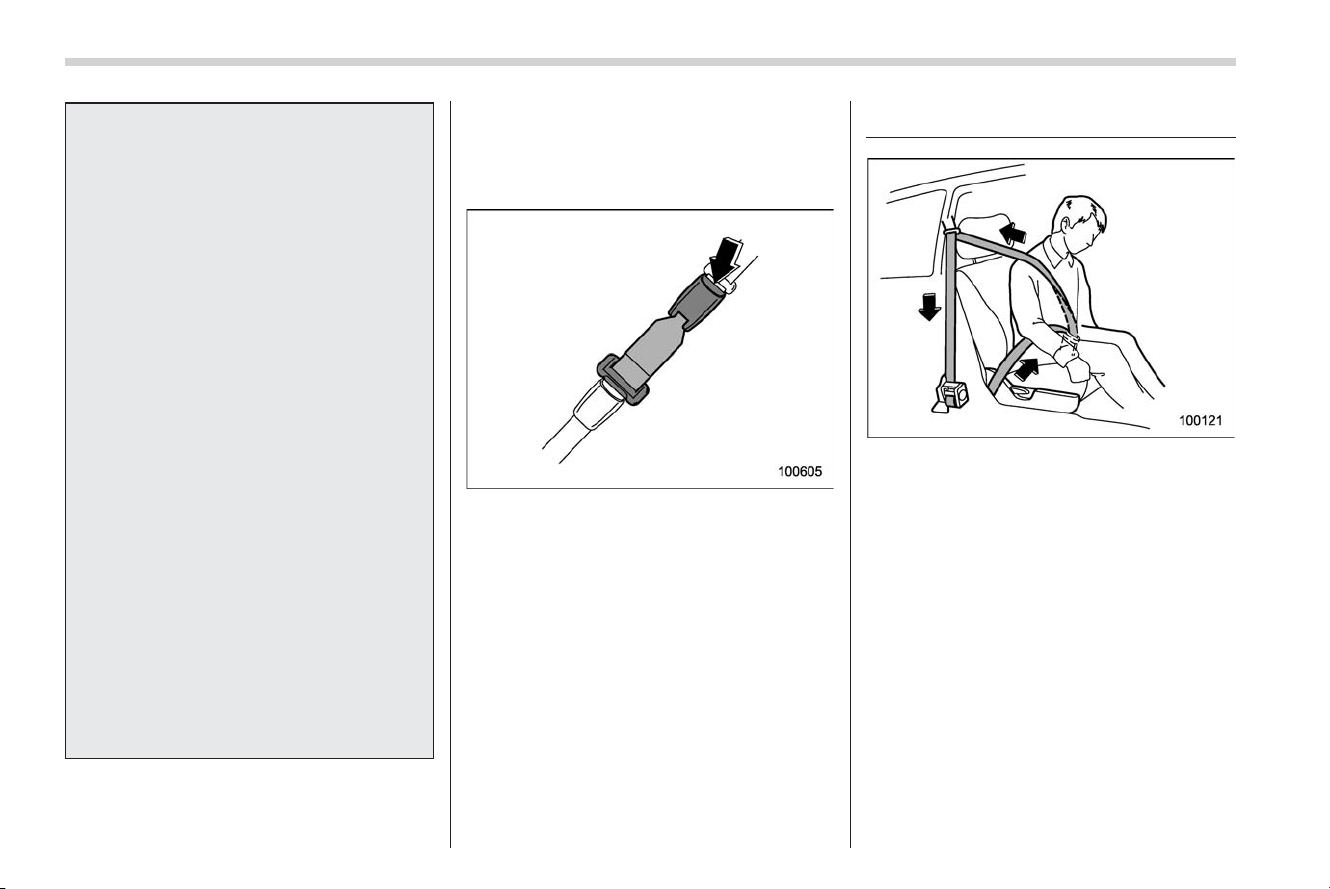
To connect the extender to the seatbelt,
insert the tongue plate into the seatbelt
buckle so that the “PRESS” signs on the
buckle-release buttons of the extender
and the seatbelt are both facing outward
as shown in the diagram. You will hear a
click when the tongue plate locks into the
buckle.
When releasing the seatbelt, press on the
buckle-release button on the extender, not
on the seatbelt. This helps to prevent
damage to the vehicle interior and ex-
tender itself.
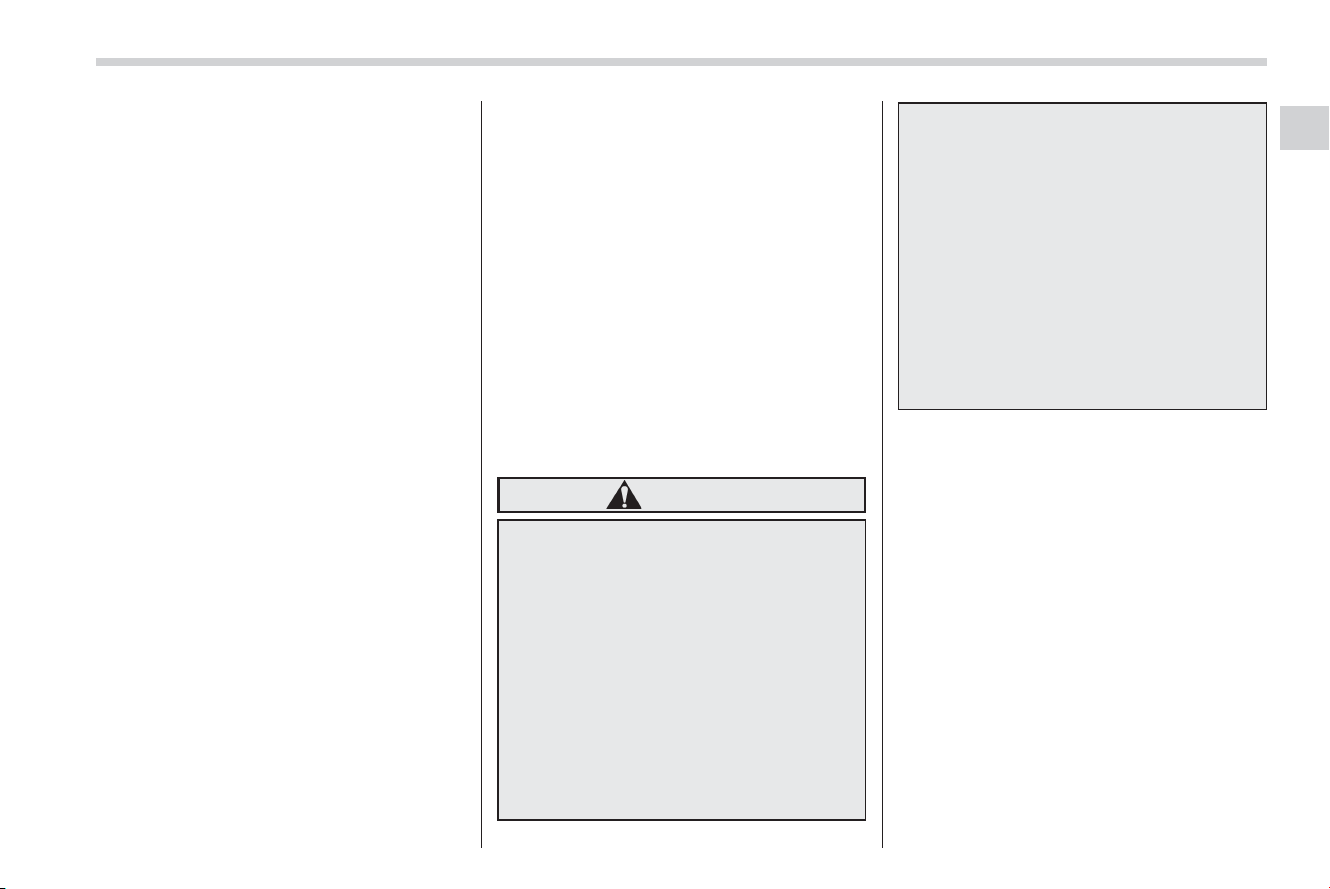
Front seatbelt pretensioners
The driver’s and front passenger’s seat-
belts have a seatbelt pretensioner. The
seatbelt pretensioners are designed to be
activated in the e vent of an accident
involving a moderate to severe frontal
collision.
Also, the seatbelt pretensioners are de-
signed to be activated in the event of an
accident involving a moderate to severe
side impact collision.
The pretensioner sensor also serves as
the frontal and side SRS airbag sensors. If
the sensors detect a certain predeter-
mined amount of force during a frontal
collision or a side impact collision, the
front seatbelt is quickly drawn back in by
Black plate (51,1)
北米Model "A8130BE-B" EDITED: 2007/ 7/ 25
the retractor to take up the slack so that
the belt more effectively restrains the front
seat occupant.
When a seatbelt pretensioner is activated,
an operating noise will be heard and a
small amount of smoke will be released.
These occurrences are normal and not
harmful. This smoke does not indicate a
fire in the vehicle.
Once the seatbelt pretensioner has been
activated, the seatbelt retractor remains
locked. Consequently, the seatbelt can not
be pulled out and retracted and therefore
must be replaced.
NOTE
. Seatbelt pretensioners are not de-
signed to activate in minor frontal
impacts, in minor side impacts or in
rear impacts or in roll-over accidents.
. The driver’s seat and passenger’s
seat pretensioners and frontal SRS
airbag operate simultaneously.
. The driver’s and passenger’s seat-
belt pretensioners and the SRS side
airbag operate simultaneously.
. Pretensioners are designed to func-
tion on a one-time-only basis. In the
event that a pretensioner is activated,
both the driver’s and front passenger’s
seatbelt retractor assemblies must be
replaced only by an authorized
SUBARU dealer. When replacing seat-
belt retractor assemblies, use only
genuine SUBARU parts.
. If either front seatbelt does not
retract or cannot be pulled out due to
a malfunction or activation of the
pretensioner, contact your SUBARU
dealer as soon as possible.
. If the front seatbelt retractor assem-
bly or surrounding area has been
damaged, contact your SUBARU dealer
as soon as possible.
. When you sell your vehicle, we urge
you to explain to the buyer that it has
seatbelt pretensioners by alerting him
to the contents of this section.
WARNING
. To obtain maximum protection,
the occupants should sit in an
upright position with their seat-
belts properly fastened. Refer to
the “Seatbelts” section in this
chapter.
. Do not modify, remove or strike
the front seatbelt retractor as-
semblies or surrounding area.
This could result in accidental
activation of the seatbelt preten-
sioners or could make the sys-
tem inoperative, possibly result-
ing in serious injury. Seatbelt
pretensioners have no user-ser-
viceable parts. For required ser-
vicing of front seatbelt retractors
equipped with seatbelt preten-
sioners, see your nearest
SUBARU dealer.
. When discarding front seatbelt
retractor assemblies or scrap-
ping the entire vehicle due to
collision damage or for other
reasons, consult your SUBARU
dealer.
Seat, seatbelt and SRS airbags 1-21
– CONTINUED –
1
Black plate (52,1)
北米Model "A8130BE-B" EDITED: 2007/ 7/ 25
1-22 Seat, seatbelt and SRS airbags
& System monitors
A diagnostic system continually monitors
the readiness of the seatbelt pretensioner
while the vehicle is being driven. The
seatbelt pretensioners share the control
modulewiththeSRSairbagsystem.
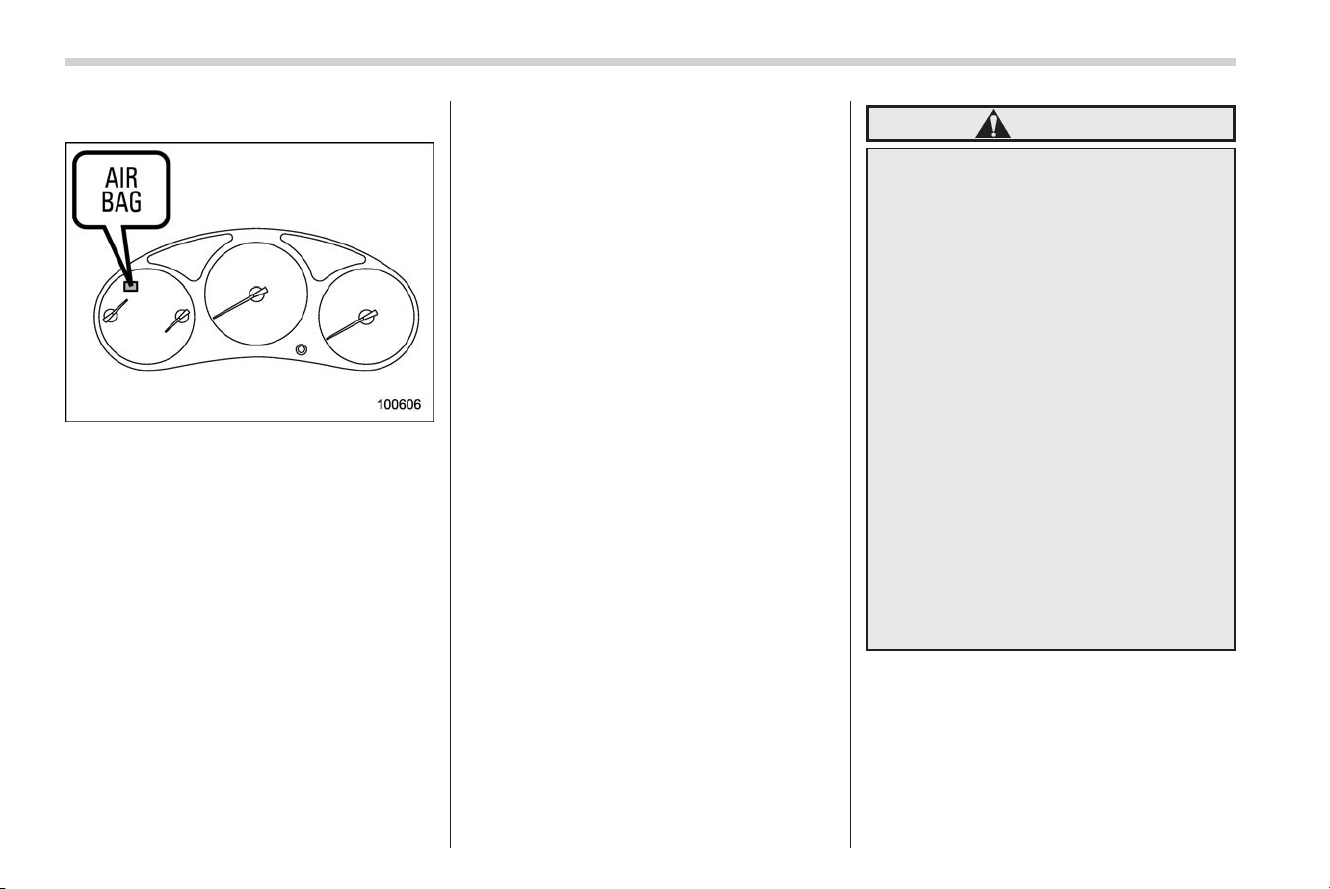
Therefore, if any malfunction occurs in a
seatbelt pretensioner, the S RS airbag
system warning light will illuminate. The
SRS airbag system warning light will show
normal system operation by lighting for
approximately 6 seconds when the igni-
tion switch is turned to the “ON” position.
The following components are monitored
by the indicator:
. Front sub sensor (Right-hand side)
. Front sub sensor (Left-hand side)
. Airbag control module (including im-
pact sensors)
. Frontal airbag module (Driver’s side)
. Frontal airbag module (Front passen-
ger’s side)
. Side airbag sensor (Center pillar right-
hand side)
. Side airbag sensor (Center pillar left-
hand side)
. Side airbag module (Driver’s side)
. Side airbag module (Front passenger’s
side)
. Seatbelt pretensioner (Driver’s side)
. Seatbelt pretensioner (Front passen-
ger’s side)
. Seatbelt buckle switch (Driver’s side)
. Seatbelt buckle switch (Front passen-
ger’s side)
. Driver’s seat position sensor
. Front passenger’s seatbelt tension
sensor
. Front passenger’s occupant detection
system weight sensor
. Front passenger’s occupant detection
control module
. Front passenger’s frontal airbag ON
and OFF indicator
. All related wiring
WARNING
If the warning light exhibits any of
the following conditions, there may
be a malfunction in the seatbelt
pretensioners and/or SRS airbag
system. Immediately take your vehi-
cle to your nearest SUBARU dealer
to have the system checked. Unless
checked and properly repaired, the
seatbelt pretensioners and/or SRS
airbags will not operate properly in
the event of a collision, which may
increase the risk of injury.
. Flashing or flickering of the warn-
ing light
. No illumination of the warning
light when the ignition switch is
first turned to the “ON” position
. Continuous illumination of the
warning light
. Illumination of the warning light
while driving
Black plate (53,1)
北米Model "A8130BE-B" EDITED: 2007/ 7/ 25
& System servicing
WARNING
. When discarding a seatbelt re-
tractor assembly or scrapping
the entire vehicle damaged by a
collision, consult your SUBARU
dealer.
. Tampering with or disconnecting
the system’s wiring could result
in accidental activation of the
seatbelt pretensioner and/or
SRS airbag or could make the
system inoperative, which may
result in serious injury. The wir-
ing harnesses of the seatbelt
pretensioner and SRS airbag
systems are covered with yellow
insulation and the connectors of
the system are yellow for easy
identification. Do not use electri-
cal test equipment on any circuit
rel ated to the seatbelt preten-
sioner and SRS airbag systems.
For required servicing of the
seatbelt pretensioner, see your
nearest SUBARU dealer.
CAUTION
The front sub sensors are located
near the bottom of the radiator and
the side airbag sensor is located
inside each center pillar and the
SRS airbag control module includ-
ing the impact sensors is located
under the center console. If you
need service or repair in those areas
or near the front seatbelt retractors,
we recommend that you have an
authorized SUBARU dealer perform
the work.
NOTE
If the front part of the vehicle is
damaged in an accident to the extent
that the seatbelt pretensioner does not
operate, contact your SUBARU dealer
as soon as possible.
& Precautions against vehicle
modification
Always consult your SUBARU dealer if
you want to install any accessory parts to
your vehicle.
CAUTION
Do not perform any of the following
modifications. Such modifications
can interfere with proper operation
of the seatbelt pretensioners.
. Attachment of any equip ment
(bush bar, winches, snow plow,
skid plate, etc.) other than genu-
ine SUBARU accessory parts to
the front end.
. Modification of the suspension
system or front end structure.
. Installation of a tire of different
size and construction from the
tires specified on the vehicle
placard attached to the driver’s
door pillar or specified for indivi-
dual vehicle models in this Own-
er’s Manual.
Seat, seatbelt and SRS airbags 1-23
1
Black plate (54,1)
北米Model "A8130BE-B" EDITED: 2007/ 7/ 25
1-24 Seat, seatbelt and SRS airbags
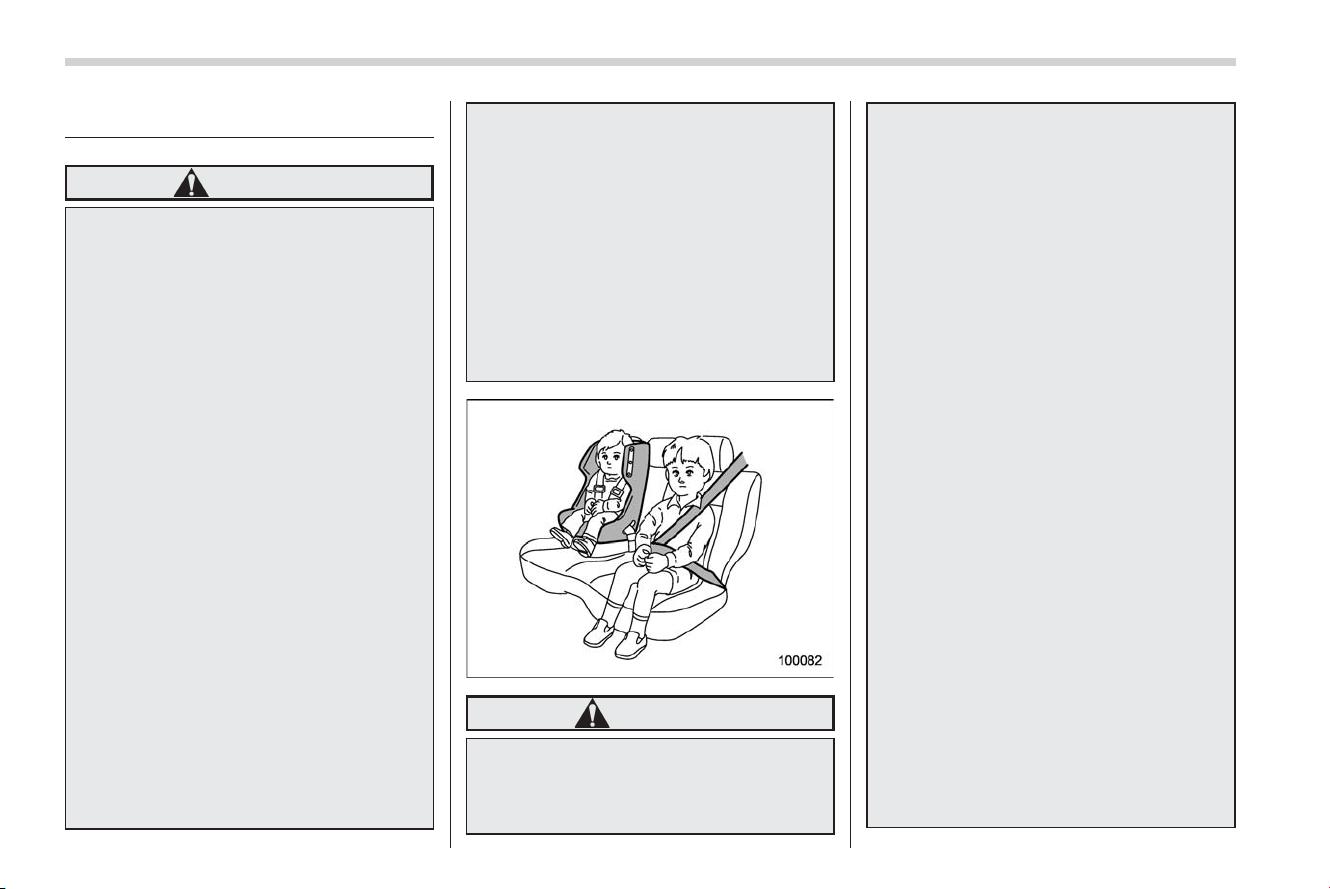
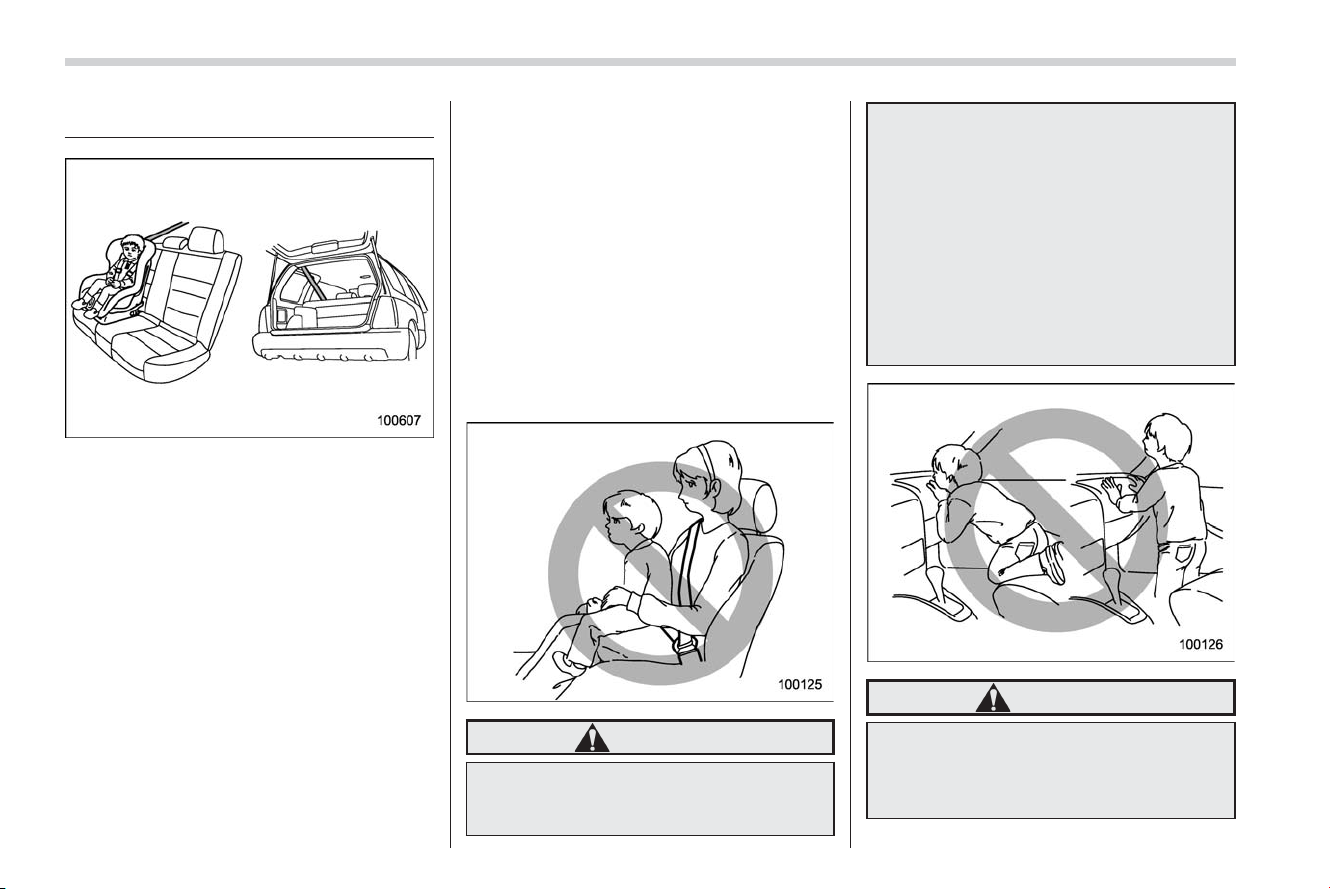
Child restraint systems
Infants and small children should always
be placed in an infant or child restraint
system in the rear seat while riding in the
vehicle. You should use an infant or child
restraint system that meets Federal Motor
Vehicle Safety Standards or Canada
Motor Vehicle Safety Standards, is com-
patible with your vehicle and is appro-
priate for the child’s age and size. All child
restraint systems are designed to be
secured in vehicle seats by lap belts or
the lap belt portion of a lap/shoulder belt
(except those covered under the section in
this manual, entitled “Installation of child
restraint systems by use of lower and
tether anchorages (LATCH)”).
Children could be endangered in an
accident if their child restraints are not
properly secured in the vehicle. When
installing the child restraint system, care-
fully follow the manufacturer’s instructions.
According to accident statistics, children
are safer when properly restrained in the
rear seating positions than in the front
seating positions.
All U.S. states and Canadian provinces
require that infants and small children be
restrained in an approved child restraint
system at all times while the vehicle is
moving.
WARNING
Never let a passenger hold a child
on his or her lap or in his or her
arms while the vehicle is moving.
The passenger cannot protect the
child from injury in a collision,
because the child will be caught
between the passenger and objects
inside the vehicle.
Additionally, holding a child in your
lap or arms in the front seat exposes
that child to another serious danger.
Since the SRS airbag deploys with
considerable speed and force, the
child could be injured or even killed.
WARNING
Children should be p roperly re-
strained at all times. Never allow a
child to stand up, or to kneel on any
seat. Unrestrained children will be
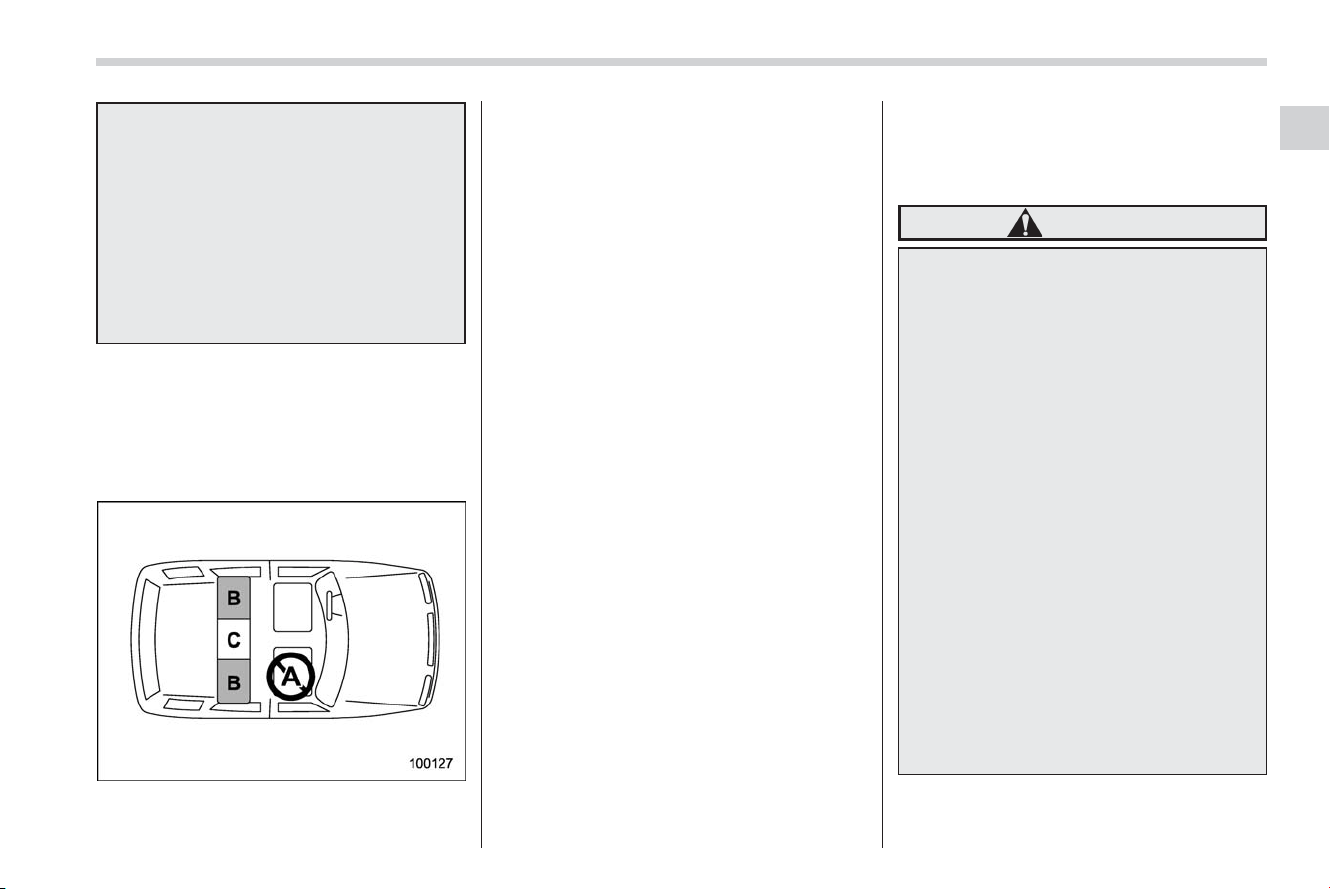
Black plate (55,1)
北米Model "A8130BE-B" EDITED: 2007/ 7/ 25
thrown forward during sudden stop
or in an accident and can be injured
seriously.
Additionally, children standing up or
kneeling on or in front of the front
seat are exposed another serious
danger. Since the SRS airbag de-
ploys with considerable speed and
force, the child could be injured or
even killed.
& Where to place a child re-
straint system
The following are SUBARU’s recommen-
dations on where to place a child restraint
system in your vehicle.
A: Front passenger ’s seat
You should not install a child restraint
system (including a booster seat) due to
the hazard to child ren posed by the
passenger’s airbag.
B: Rear seat, window-side seating
positions
Recommended positions for all types of
child restraint systems.
In these positions, Automatic/Emergency
Locking Retractor (A/ELR) seatbelts and
lower anchorages (bars) are provided for
installing a child restraint system.
Some types of child restraints might not be
able to be secured firmly due to projection
of the seat cushion.
In this seating position, you should use
only a child restraint system that has a
bottom base that fits snugly against the
contours of the seat cushion and can be
securely retained using the seatbelt.
C: Rear seat, center seating position
Installing a child restraint system is not
recommended, although the A/ELR seat-
belt and an upper anchorage (tether
anchorage) are provided in this position.
Some types of child restraints might not be
able to be secured firmly due to projection
of the seat cushion.
In this seating position, you should use
only a child restraint system that has a
bottom base that fits snugly against the
contours of the seat cushion and can be
securely retained using the seatbelt.
WARNING
Put children aged 12 and under in
the rear seat properly restrained at
all times. The SRS airbag deploys
with considerable speed and force
and can injure or even kill children,
especially if they are 12 years of age
and under and are not restrained or
improperly restrained. Because chil-
dren are lighter and weaker than
adults, their risk of being injured
from deployment is greater.
Consequently, be sure to secure
ALL types of child restraint devices
(including forward facing child
seats) in the REAR seats at all times.
You should choose a restraint de-
vice which is appropriate for the
child’s age, height and weight. Ac-
cording to accident statistics, chil-
dren are safer when properly re-
strained in the rear seating posi-
tions than in the front seating posi-
tions.
Seat, seatbelt and SRS airbags 1-25
– CONTINUED –
1
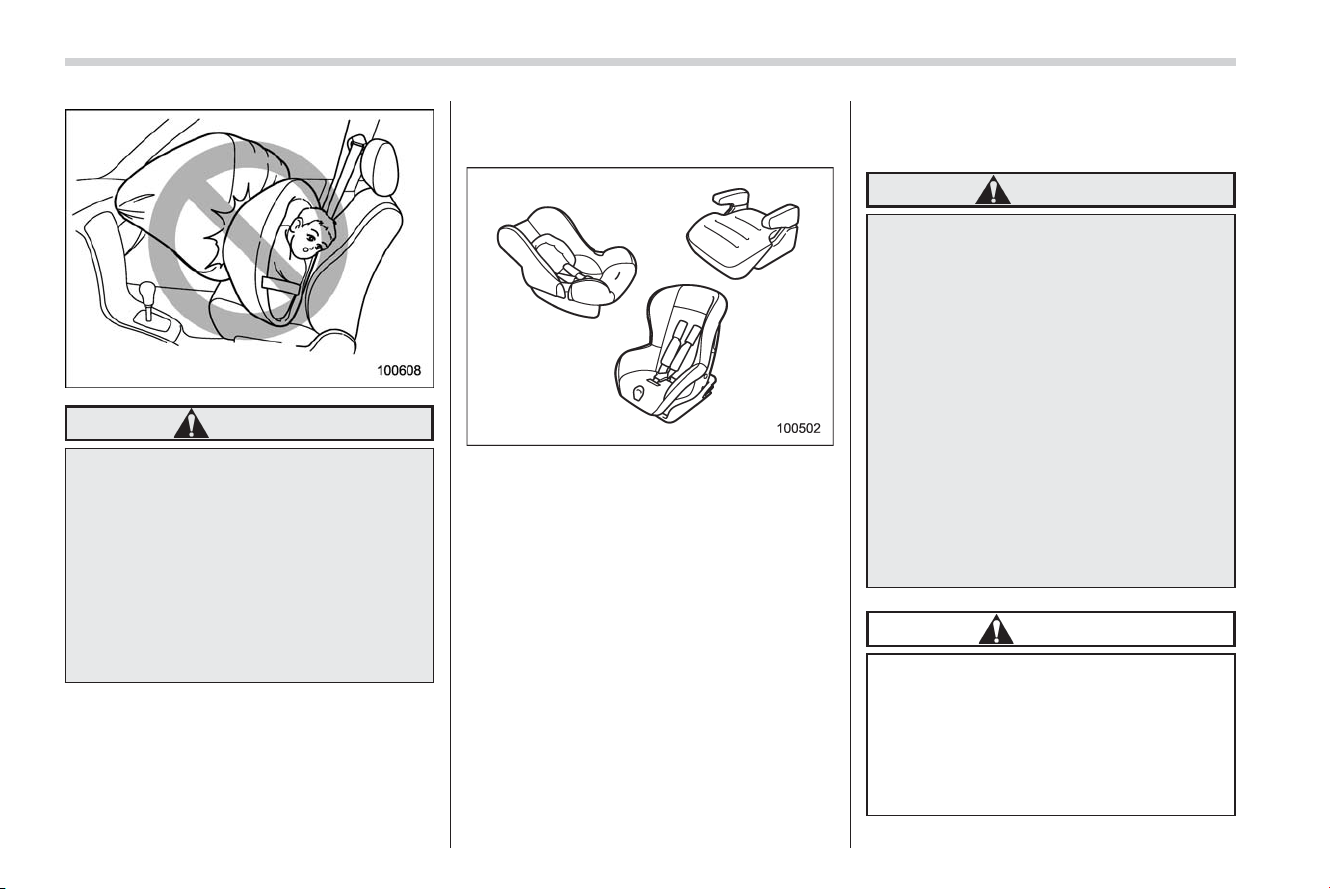
Black plate (56,1)
北米Model "A8130BE-B" EDITED: 2007/ 7/ 25
1-26 Seat, seatbelt and SRS airbags
WARNING
SINCE YOUR VEHICLE IS
EQUIPPED WITH A PASSENGER’S
SRS AIRBAG, NEVER INSTALL A
REARWARD FACING CHILD
SAFETY SEAT IN THE FRONT PAS-
SENGER’S SEAT. DOING SO RISKS
SERIOUS INJURY OR DEATH TO
THE CHILD BY PLACING THE
CHILD’SHEADTOOCLOSETO
THE SRS AIRBAG.
& Choosing a child restraint
system
Choose a child restraint system that is
appropriate for the child’s age and size
(weight and height) in order to provide the
child with proper protection. The child
restraint system should meet all applic-
able requirements of Federal Motor Vehi-
cle Safety Standards for United States or
Canada Motor Vehicle Safety Standards
for Canada. It can be identified by looking
for the label on the child restraint system
or the manufacture’s statement of com-
pliance in the document attached to the
system. Also it is important for you to
make sure that the child restraint system
is compatible with the vehicle in which it
will be used.
& Installing child restraint sys-
tems with A/ELR seatbelt
WARNING
. Child restraint systems and seat-
belts can become hot in a vehicle
that has been closed up in sunny
weather; they could burn a small
child. Check the child restraint
system before you place a child
in it.
. Do not leave an unsecured child
restraint system in your vehicle.
Unsecured child restraint sys-
tems can be thrown around in-
side of the vehicle in a sudden
stop, turn or accident; they can
strike and injure vehicle occu-
pants as well as result in serious
injuries or death to the child.
CAUTION
When you install a child restraint
system, follow the manufacturer’s
instructions supplied with it. After
installing the child restraint system,
check to ensure that it is held
securely in position. If it is not held
tight and secure, the danger of your
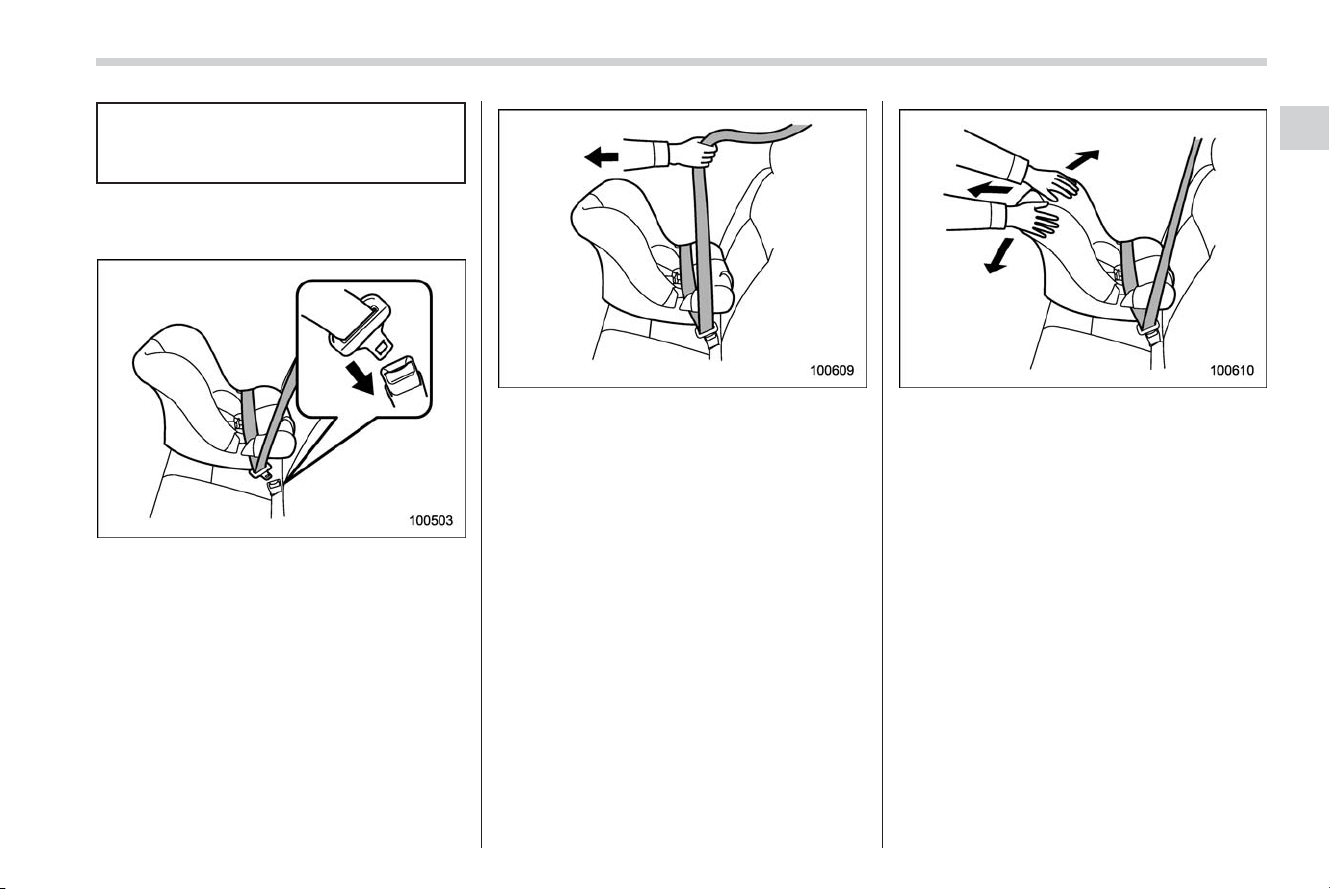
Black plate (57,1)
北米Model "A8130BE-B" EDITED: 2007/ 7/ 25
child suffering personal injury in the
event of an accident may be in-
creased.
! Installing a rearward facing child
restraint
1. Place the child restraint system in the
rear seating position.
2. Run the lap and shoulder belt through
or around the child restraint system
following the instructions provided by its
manufacturer.
3. Insert the tongue plate into the buckle
until you hear a click.
4. Take up the slack in the lap belt.
5. Pull out the seatbelt fully from the
retractor to change the retractor over from
the Emergency Locking Retractor (ELR)
to the Automatic Locking Retractor (ALR)
function. Then, allow the belt to rewind
into the retractor. As the belt is rewinding,
clicks will be heard which indicate the
retractor functions as ALR.
6. Push and pull the child restraint
system forward and from side to side to
check if it is firmly secured.
Sometime a child restraint can be more
firmly secured by pushing it down into the
seat cushion and then tightening the
seatbelt.
7. Pull at the shoulder portion of the belt
to confirm that it cannot be pulled out (ALR
properly functioning).
Seat, seatbelt and SRS airbags 1-27
– CONTINUED –
1
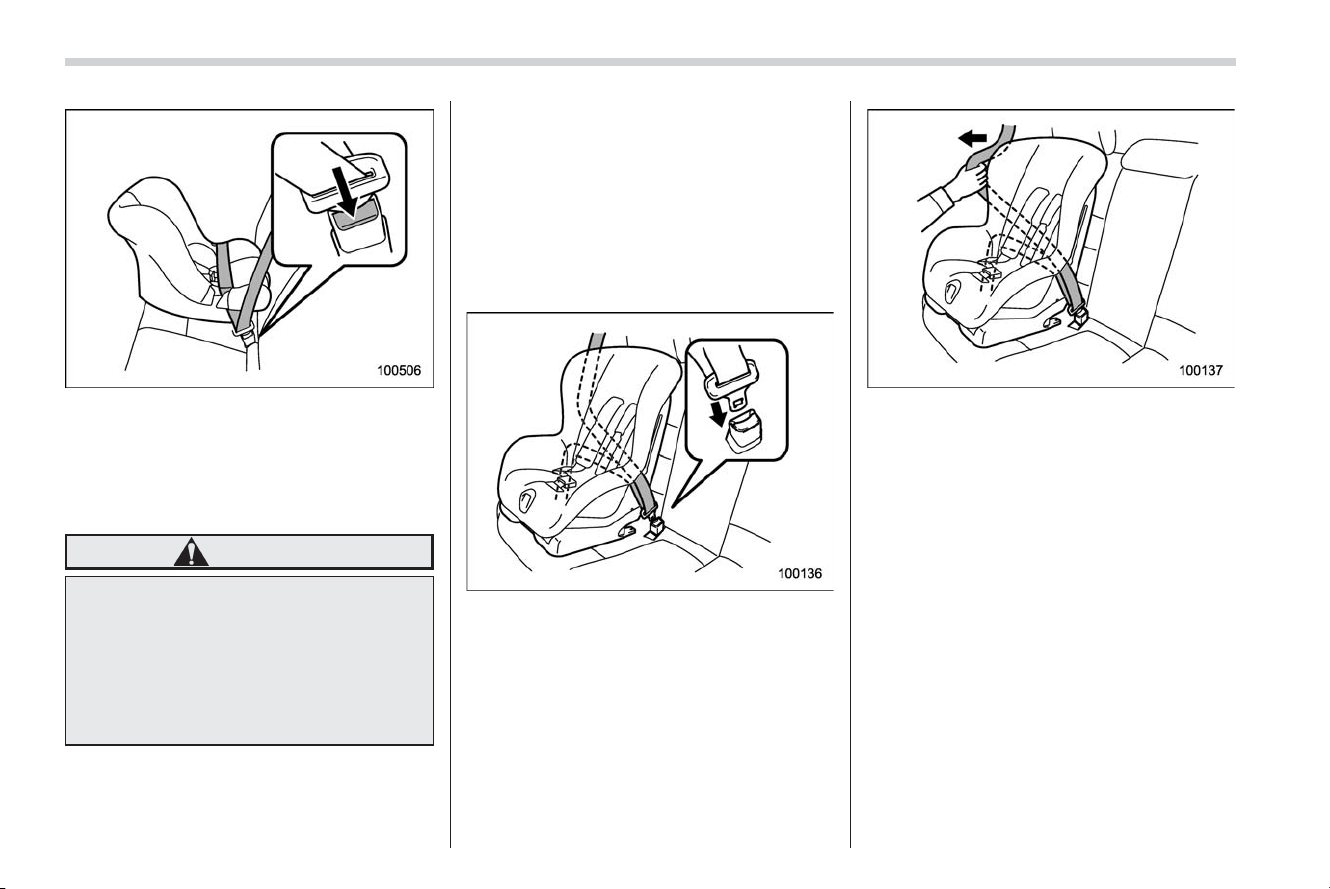
Black plate (58,1)
北米Model "A8130BE-B" EDITED: 2007/ 7/ 25
1-28 Seat, seatbelt and SRS airbags
8. To remove the child restraint system,
press the release button on the seatbelt
buckle and allow the b elt to retract
completely. The belt will return to the
ELR mode.
WARNING
NEVER INSTALL A REARWARD FA-
CING CHILD SEAT IN THE FRONT
PASSENGER’SSEAT.DOINGSO
RISKS SERIOUS INJURY OR DEATH
TO THE CHILD BY PLACING THE
CHILD’S HEAD TOO CLOSE TO THE
SRS AIRBAG.
NOTE
When the child restraint system is no
longer in use, remove it and restore the
ELR function of the retractor. That
function is restored by allowing the
seatbelt to retract fully.
! Installing forward facing child re-
straint
1. Place the child restraint system in the
rear seating position.
2. Run the lap and shoulder belt through
or around the child restraint system
following the instructions provided by its
manufacturer.
3. Insert the tongue plate into the buckle
until you hear a click.
4. Take up the slack in the lap belt.
5. Pull out the seatbelt fully from the
retractor to change the retractor over from
the Emergency Locking Retractor (ELR)
to the Automatic Locking Retractor (ALR)
function. Then, allow the belt to rewind
into the retractor. As the belt is rewinding,
clicks will be heard which indicate the
retractor functions as ALR.

Black plate (59,1)
北米Model "A8130BE-B" EDITED: 2007/ 7/ 25
6. Before having a child sit in the child
restraint system, move it back and forth
and right and left to check if it is firmly
secured. Sometimes a child restraint can
be more firmly secured by pushing it down
into the seat cushion and then tightening
the seatbelt.
7. Pull at the shoulder portion of the belt
to confirm that it cannot be pulled out (ALR
properly functioning).
8. If the child restraint system requires a
top tether, latch the hook onto the top
tether anchor and tighten the top tether.
See the “Top tether anchorages” for
additional instructions.
9. To remove the child restraint system,
press the release button on the seatbelt
buckle and allow the belt to retract
completely. The belt will return to the
ELR mode. Unhook the top tether hook
from the top tether anchor.
NOTE
When the child restraint system is no
longer in use, remove it and restore the
ELR function of the retractor. That
function is restored by allowing the
seatbelt to retract fully.
& Installing a booster seat
WARNING
. Child restraint systems and seat-
belts can become hot in a vehicle
that has been closed up in sunny
weather; they could burn a small
child. Check the child restraint
system before you place a child
in it.
. Do not leave an unsecured child
restraint system in your vehicle.
Unsecured child restraint sys-
tems can be thrown around in-
side of the vehicle in a sudden
stop, turn or accident; they can
strike and injure vehicle occu-
pants as well as result in serious
Seat, seatbelt and SRS airbags 1-29
– CONTINUED –
1
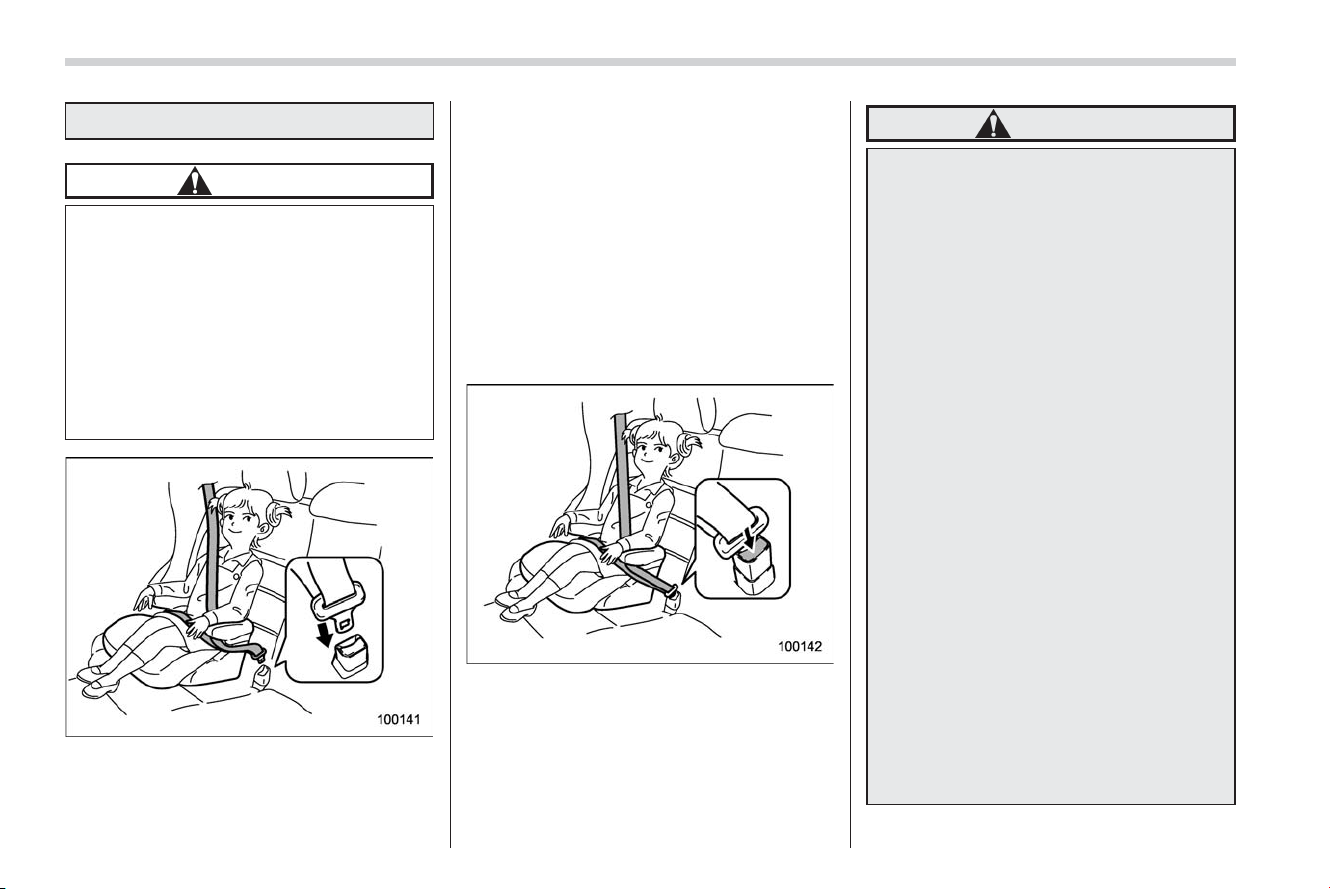
Black plate (60,1)
北米Model "A8130BE-B" EDITED: 2007/ 7/ 25
1-30 Seat, seatbelt and SRS airbags
injuries or death to the child.
CAUTION
When you install a child restraint
system, follow the manufacturer’s
instructions supplied with it. After
installing the child restraint system,
check to ensure that it is held
securely in position. If it is not held
tight and secure, the danger of your
child suffering personal injury in the
event of an accident may be in-
creased.
1. Place the booster seat in the rear
seating position and sit the child on it. The
child should sit well back on the booster
seat.
2. Run the lap and shoulder belt through
or around the booster seat and the child
following the instructions provided by its
manufacturer.
3. Insert the tongue plate into the buckle
until you hear a click. Take care not to
twist the seatbelt.
Make sure the shoulder belt is positioned
across the center of child’s shoulder and
that the lap belt is positioned as low as
possible on the child’s hips.
4. To remove the booster seat, press the
release button on the seatbelt buckle and
allow the belt to retract.
WARNING
. Never use a belt that is twisted or
reversed. In an accident, this can
increase the risk or severity of
injury to the child.
. Never place the shoulder belt
under the child’s arm or behind
the child ’s back. If an accident
occurs, this can increase the risk
or severity of injury to the child.
. The seatbelt should fit snugly in
ord er to provide full restrain t.
Loose fitting belts are not as
effective in preventing or redu-
cing injury.
. Place the lap belt as low as
possible on the child’s hips. A
high-positioned lap belt will in-
crease the risk of sliding under
the lap belt and of the lap belt
sliding up over the abdomen, and
both can result in serious inter-
nal injury or death.
. Make sure the shoulder belt is
positioned across the center of
child’s shoulder. Pl acing the
shoulder belt over the neck may
result in neck injury during sud-
den braking or in a collision.
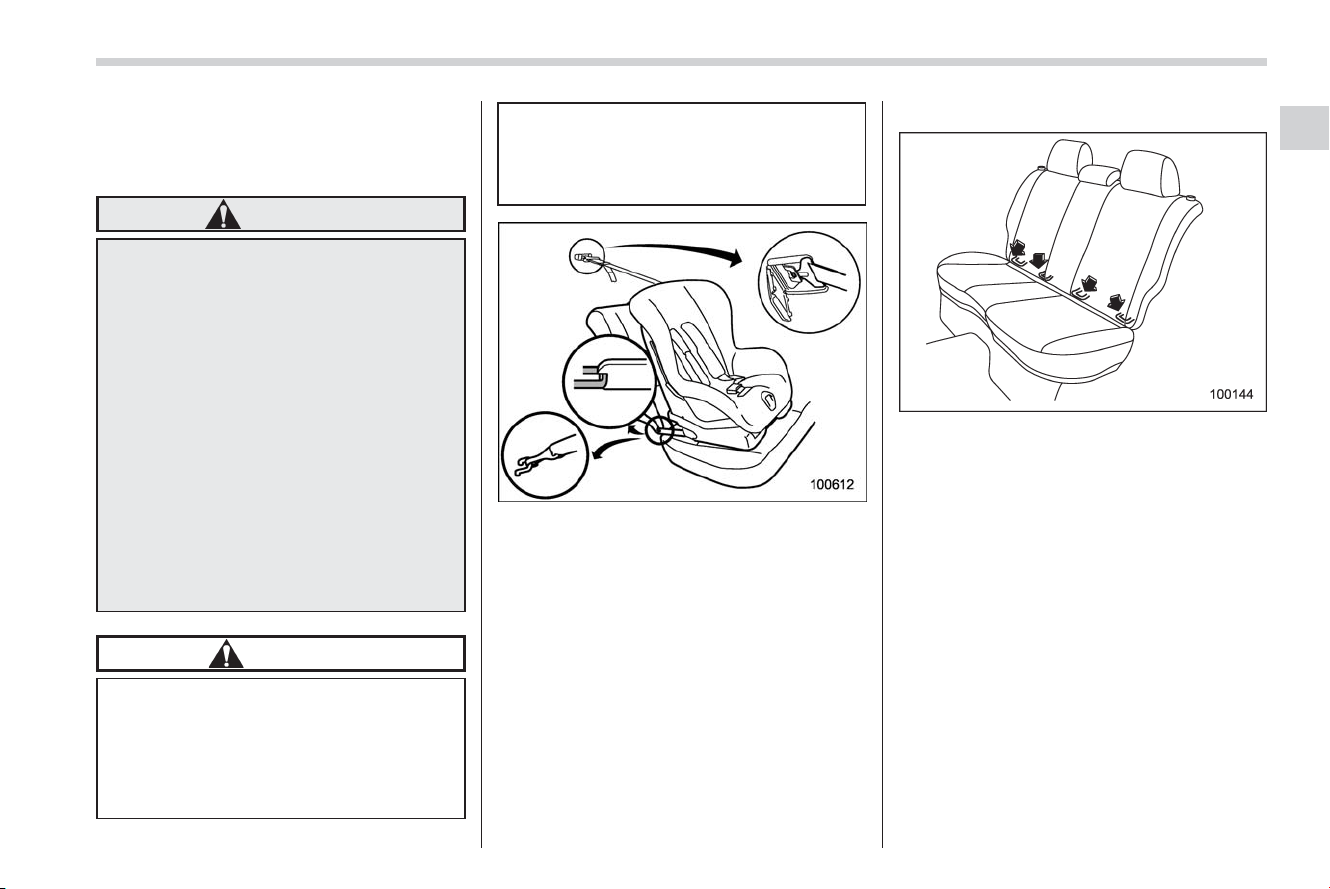
Black plate (61,1)
北米Model "A8130BE-B" EDITED: 2007/ 7/ 25
& Installation of child restraint
systems by use of lower and
tether anchorages (LATCH)
WARNING
. Child restraint systems and seat-
belts can become hot in a vehicle
that has been closed up in sunny
weather; they could burn a small
child. Check the child restraint
system before you place a child
in it.
. Do not leave an unsecured child
restraint system in your vehicle.
Unsecured child restraint sys-
tems can be thrown around in-
side of the vehicle in a sudden
stop, turn or accident; they can
strike and injure vehicle occu-
pants as well as result in serious
injuries or death to the child.
CAUTION
When you install a child restraint
system, follow the manufacturer’s
instructions supplied with it. After
installing the child restraint system,
check to ensure that it is held
securely in position. If it is not held
tight and secure, the danger of your
child suffering personal injury in the
event of an accident may be in-
creased.
Some types of child restraint systems can
be installed on the rear seat of your
vehicle without use of the seatbelts. Such
child restraint systems are secured to the
designated anchorages provided on the
vehicle body.
The lower and tether anchorages are
sometimes referred to as the LATCH
system (Lower Anchors and Tethers for
CHildren).
Your vehicle is equipped with four lower
anchorages (bars) and three upper an-
chorages (tether anchorages) for accom-
modating such child restraint systems.
The lower anchorages (bars) are used for
installing a child restraint system only on
the rear seat window-side seating posi-
tions. For each window-side seating posi-
tion, two lower anchorages are provided.
Each anchor bar is located where the seat
cushion meets the seatback.
Seat, seatbelt and SRS airbags 1-31
– CONTINUED –
1
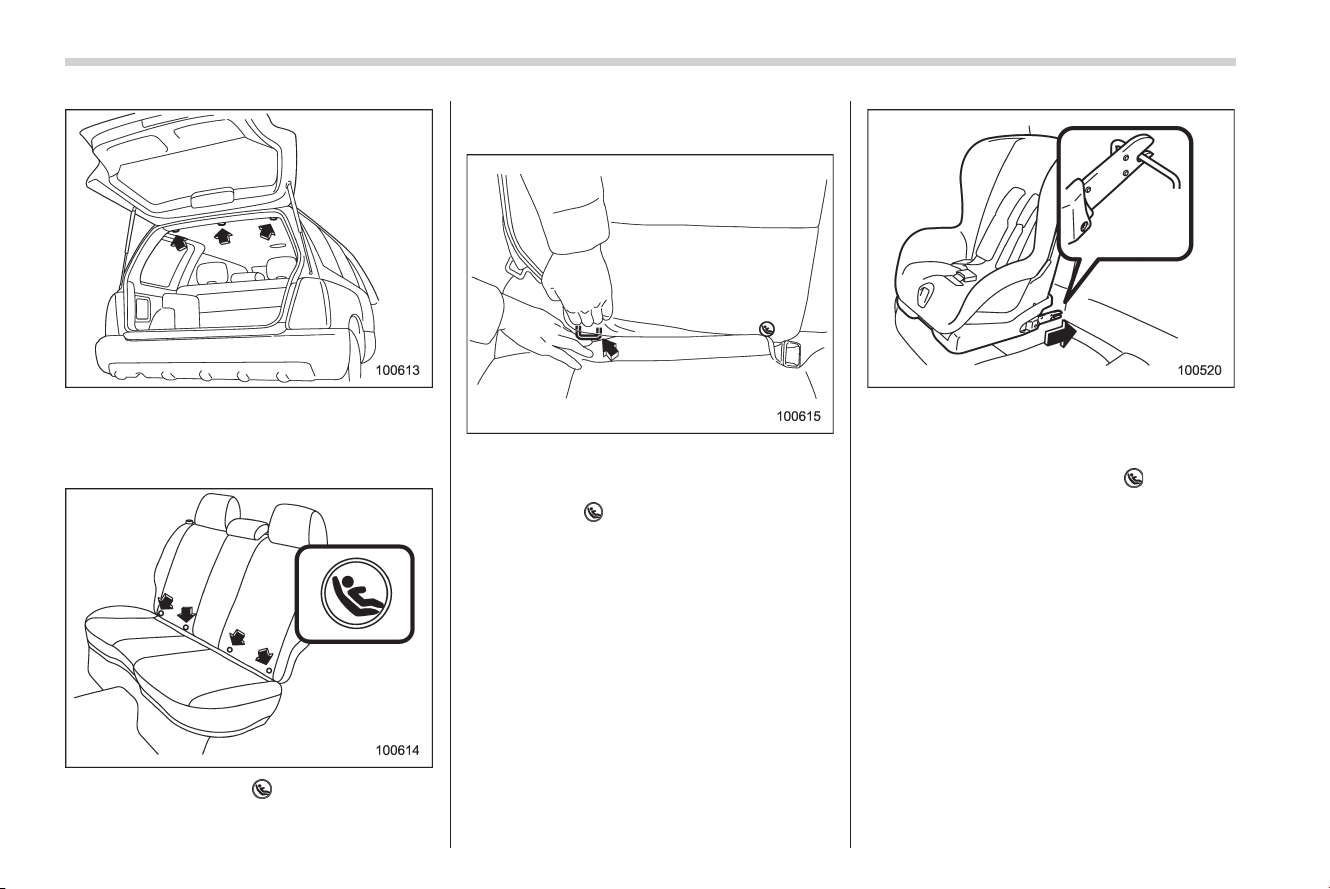
Black plate (62,1)
北米Model "A8130BE-B" EDITED: 2007/ 7/ 25
1-32 Seat, seatbelt and SRS airbags
The tether anchorages (upper an-
chorages) are provided for all the seating
positions (center and both window-side
ones) of the rear seat.
You will find marks “ ” at the bottom of
the rear seat seatbacks. These marks
indicate the positions of the lower an-
chorages (bars).
Each lower anchorage is located where
the seat cushion meets the seatback.
1. Use the “
” marks to locate the two
lower anchorages (bars) for the position
where you want to install the child restraint
system.
2. While following the instructions sup-
plied by the child restraint system manu-
facturer, connect the lower hooks onto the
lower anchorages located at “
” marks on
the bottom of the rear seatback. When the
hooks are connected, make sure the
adjacent seatbelts are not caught.
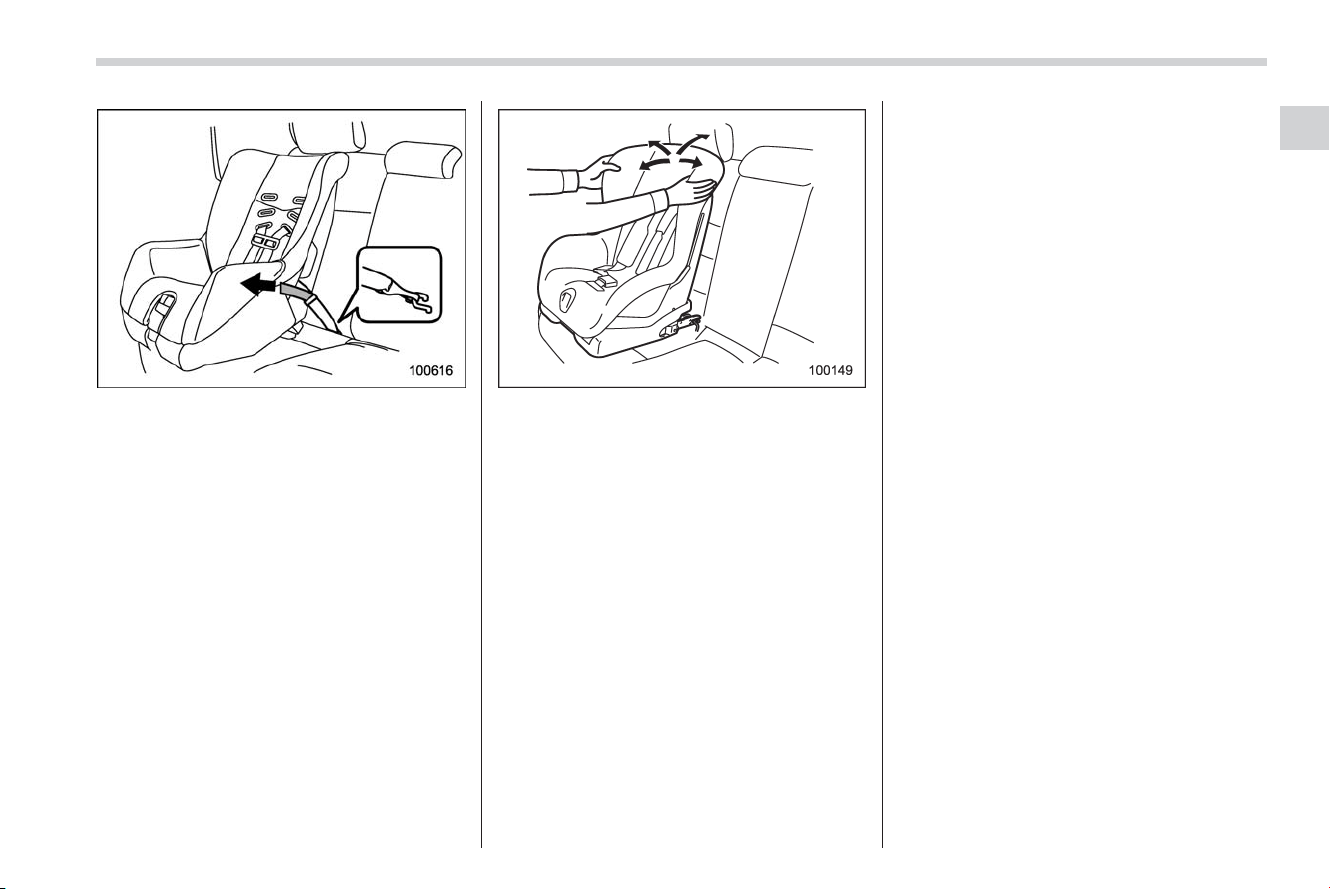
Black plate (63,1)
北米Model "A8130BE-B" EDITED: 2007/ 7/ 25
3. [If your child restraint system is of a
flexible attachment type (which uses
tether belts to connect the child restraint
system properly to the lower anchorages)]
While pushing the child restraint into the
seat cushion, pull both left and right lower
tether belts up to secure the child restraint
system firmly by taking up the slack in the
belt.
4. Connect the top tether hook to the
tether anchorage and firmly tighten the
tether.
For information on how to set the top
tether, read the following “Top tether
anchorages”.
5. Before seating a child in the child
restraint system, try to move seat back
and forth and left and right to verify that it
is held securely in position.
6. To remove the child restraint system,
follow the reverse procedures of installa-
tion.
If you have any question concerning this
type of child restraint system, ask your
SUBARU dealer.
& Top tether anchorages
Your vehicle is equipped with three top
tether anchorages so that a child restraint
system having a top tether can be
installed in the rear seat. When installing
a child restraint system using top tether,
proceed as follows, while observing the
instructions by the child restraint system
manufacturer.
Since a top tether can provide additional
stability by offering another connection
between a child restraint system and the
vehicle, we recommend that you use a top
tether whenever one is required or avail-
able.
Seat, seatbelt and SRS airbags 1-33
– CONTINUED –
1
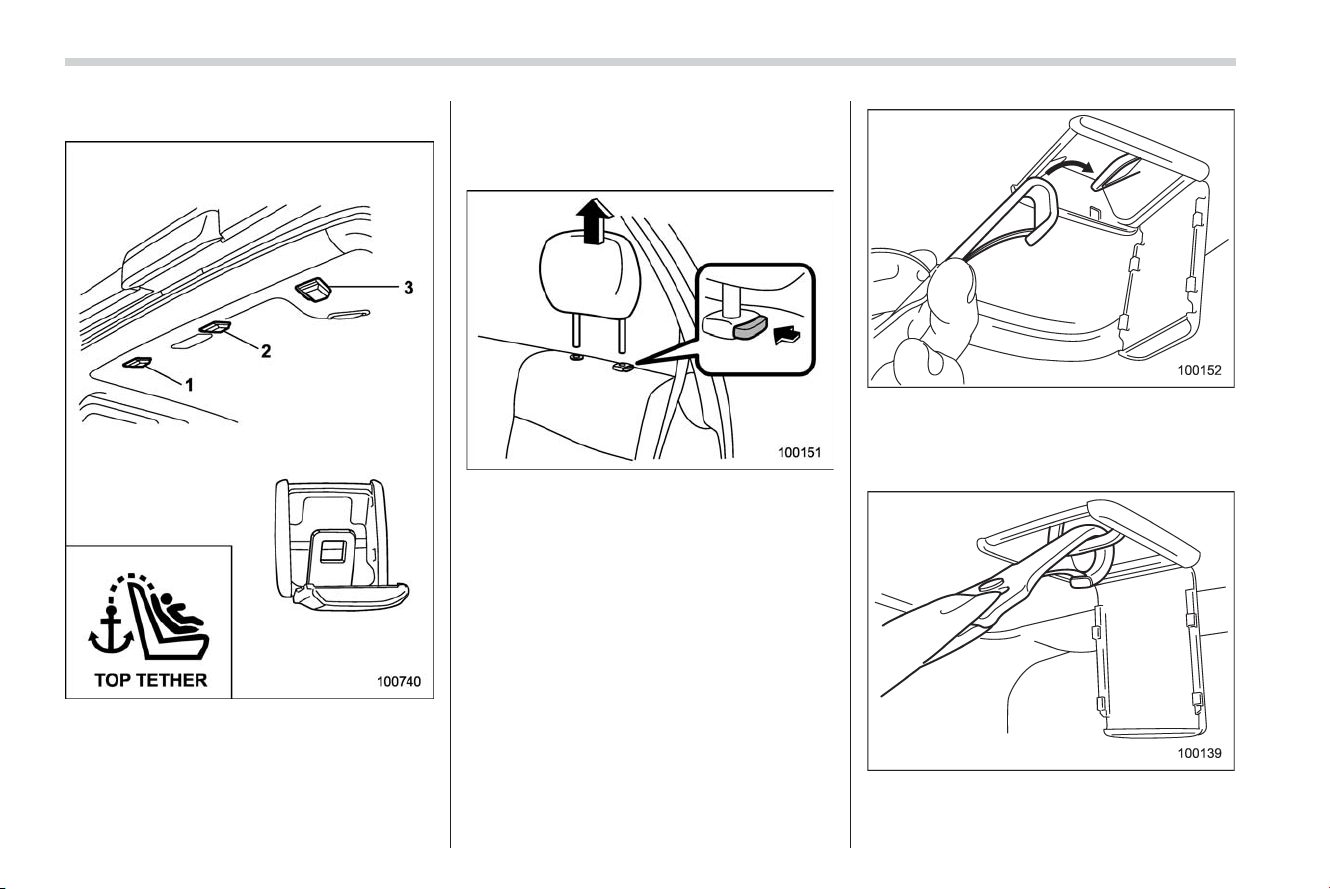
Black plate (64,1)
北米Model "A8130BE-B" EDITED: 2007/ 7/ 25
1-34 Seat, seatbelt and SRS airbags
! Anchorage location
1) For left seat
2) For center seat
3) For right seat
Three upper anchorages are installed on
the rear edge of the roof.
Open the cover flaps to use the tether
anchorages.
! To hook the top tether
1. Remove the head restraint at the
seating position where the child restraint
system has been installed with the lower
anchorages or seatbelt; lift up the head
restraint while pressing the release button.
Store the head restraint in the cargo area.
Avoid placing the head restraint in the
passenger compartment to prevent it from
being thrown around in the passenger
compartment in a sudden stop or a sharp
turn.
2. Open the cover flaps to use the
anchorages. Fasten the top tether hook
of the child restraint system to the appro-
priate top tether anchorage.
3. Tighten the top tether securely.
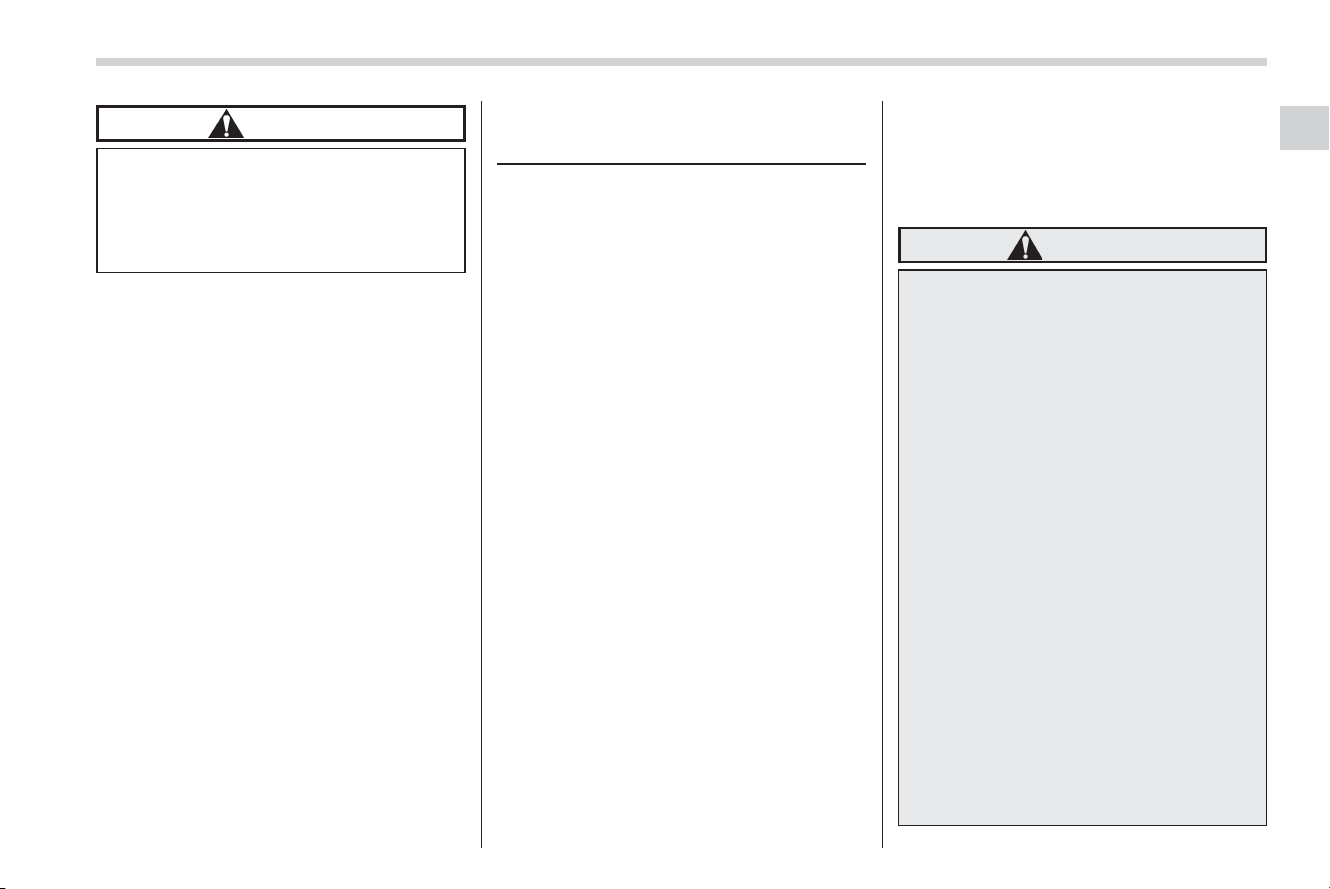
Black plate (65,1)
北米Model "A8130BE-B" EDITED: 2007/ 7/ 25
CAUTION
Always remove the head restraint
when mounting a child restraint
system with a top tether. Otherwise,
it may not be possible to fasten the
top tether tightly.
*SRS airbag (Supplemental
Restraint System airbag)
*SRS: This stands for supplemental re-
straint system. This name is used be-
cause the airbag system supplements the
vehicle’s seatbelts.
Your vehicle is equipped with a crash
sensing and diagnostic module, which will
record the use of the seatbelt(s) by the
driver and/or front passenger when any of
the SRS frontal and side airbags deploys.
& Vehicle with driver’s and
front passenger’s SRS air-
bags and lap/shoulder re-
straints
Your vehicle is equipped with a supple-
mental restraint system in addition to a
lap/shoulder belt at each front seating
position.
The supplemental restraint system (SRS)
consists of two airbag (driver’s and front
passenger’s frontal airbags) or four air-
bags (driver’s and front passenger’s fron-
tal airbags and driver’s and front passen-
ger’s side airbags).
These SRS airbags are designed only
as a supplement to the primary protec-
tion provided by the seatbelt.
The system also controls front seatbelt
pretensioners. For operation instructions
and precautions concerning the seatbelt
pretensioner, see the “Front seatbelt pre-
tensioners” section in this chapter.
WARNING
. To obtain maximum protection in
the event of an accident, the
driver and all passengers in the
vehicle should always wear seat-
belts when the vehicle is moving.
The SRS airbag is designed only
as a supplement to the primary
protection provided by the seat-
belt. It does not do away with the
need to fasten seatbelts. In com-
bination with the seatbelts, it
offers the best combined protec-
tion in case of a serious accident.
Not wearing a seatbelt increases
the chance of severe injury or
death in a crash even when the
vehicle has the SRS airbag.
For instructions and precautions
concerning the seatbelt system,
see the “ Seatbelts” section in
this chapter.
. Do not sit or lean unnecessarily
close to the SRS airbag. Because
the SRS airbag deploys with
Seat, seatbelt and SRS airbags 1-35
– CONTINUED –
1
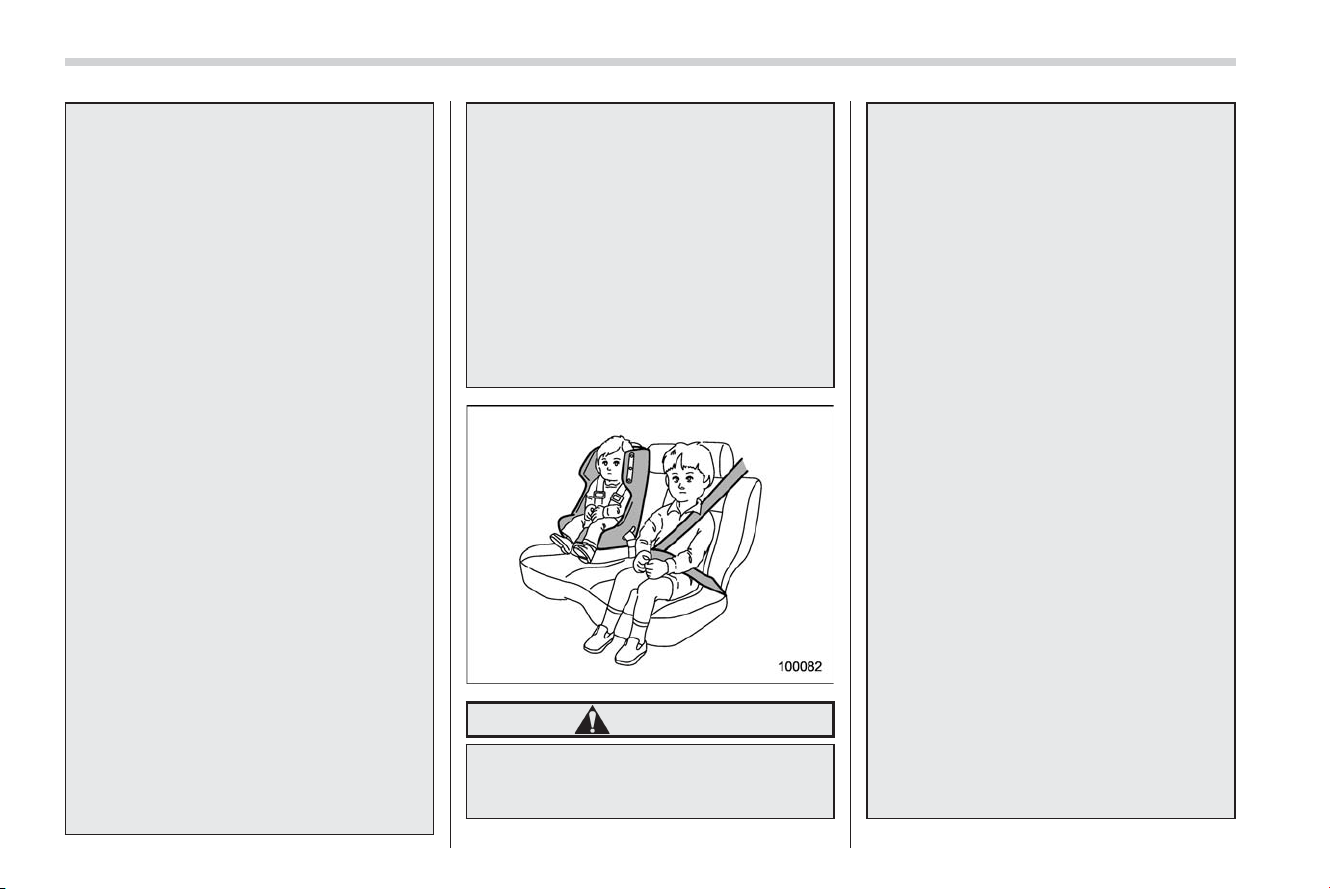
Black plate (66,1)
北米Model "A8130BE-B" EDITED: 2007/ 7/ 25
1-36 Seat, seatbelt and SRS airbags
considerable speed – faster than
the blink of an eye – and force to
protect in high speed collisions,
the force of an airbag can injure
an occupant whose body is too
close to SRS airbag.
It is also important to wear your
seatbelt to help avoid injuries
that can result when the SRS
airbag contacts an occupant not
in proper position such as one
thrown forward during pre-acci-
dent braking.
Even when properly positioned,
there remains a possibility that
an occupant may suffer minor
injury such as abrasions and
bruises to the face or arms
because of the SRS airbag de-
ployment force.
. The SRS airbags deploy with
consider able speed and force.
Occupants who are out of proper
position when th e SRS airbag
deploys could suffer very serious
injuries. Because the SRS airbag
needs enough space for deploy-
ment, the driver should always
sit upright and well back in the
seat as far from the steering
wheel as practical while still
maintaining full vehicle control
and the front passenger should
move the seat as far back as
possible and sit upright and well
back in the seat.
. Do not place any objects over or
near the SRS airbag cover or
between you and the SRS airbag.
If the SRS airbag deploys, those
objects could interfere with its
proper operation and could be
propelled inside the vehicle and
cause injury.
WARNING
. Put children aged 12 and under in
the rear seat properly restrained
at all times. The SRS airbag
deploys with considerable speed
and force and can injure or even
kill children, especially if they are
12 years of age and under and
are not restrained or improperly
restrained. Because children are
lighter and weaker than adults,
their risk of being injured from
deployment is greater.
Consequently, we strongly re-
commend that ALL children (in-
cluding those in child seats and
those that have outgrown child
restraint devices) sit in the REAR
seat properly restrained at all
times in a child restraint device
or in a seatbe lt, whichever is
appropriate for the child’s age,
height and weight.
Secure ALL types of child re-
straint devices (including for-
ward facing child seats) in the
REAR seats at all times.
According to accident statistics,
children are safer when properly
restrained in the rear seating
positions than in the front seat-
ing positions.
For instructions and precautions
concerning the child restraint
system, see the “Child restraint
Black plate (67,1)
北米Model "A8130BE-B" EDITED: 2007/ 7/ 25
systems” section in this chapter.
. NEVER INSTALL A REARWARD
FACING CHILD SEAT IN THE
FRONT SEAT. DOING SO RISKS
SERIOUS INJURY OR DEATH TO
THE CHILD BY PLACING THE
CHILD’S HEAD TOO CLOSE TO
THE SRS AIRBAG.
. Never allow a child to stand up,
or to kneel on the front passen-
ger’s seat, or never hold a child
on your lap or in your arms. The
SRS airbag deploys with consid-
erable force and can injure or
even kill the child.
CAUTION
. When the SRS airbag deploys,
some smoke will be released.
This smoke could cause breath-
ing problems for people with a
history of asthma or other
breathing trouble. If you or your
passengers have breathing pro-
blems after SRS airbag deploys,
get fresh air promptly.
. A deploying SRS airbag releases
hot gas. Occupants could get
burned if they come into direct
contact with the hot gas.
NOTE
When you sell your vehicle, we urge
you to explain to the buyer that it is
equipped with SRS airbags by alerting
him or her to the applicable section in
this Owner’s Manual.
Seat, seatbelt and SRS airbags 1-37
– CONTINUED –
1
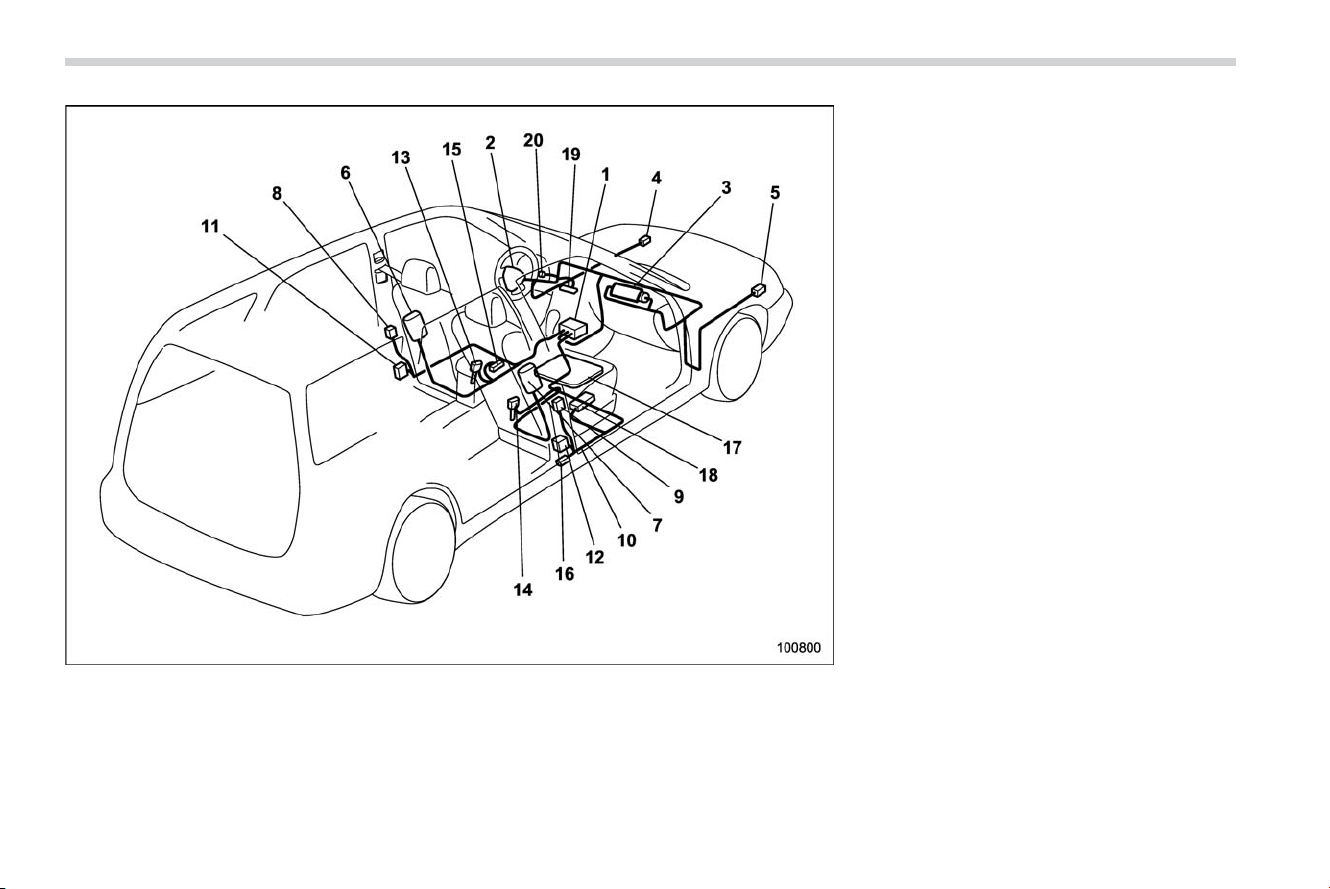
Black plate (68,1)
北米Model "A8130BE-B" EDITED: 2007/ 7/ 25
1-38 Seat, seatbelt and SRS airbags
1) Airbag control module (including impact
sensors)
2) Frontal airbag module (driver’s side)
3) Frontal airbag module (front passenger’s
side)
4) Front sub sensor (left-hand side)
5) Front sub sensor (right-hand side)
6) Side airbag module (driver’s side)
7) Side airbag module (front passenger’s
side)
8) Side airbag sensor (center pillar left-hand
side)
9) Side airbag sensor (center pillar right-
hand side)
10) Airbag wiring (yellow)
11) Seatbelt pretensioner (driver ’s side)
12) Seatbelt pretensioner (front passenger’s
side)
13) Seatbelt buckle switch (front passenger’s
side)
14) Seatbelt buckle switch (driver ’s side)
15) Driver’s seat position sensor
16) Front passenger’s seatbelt tension sen-
sor
17) Front passenger’s occupant detection
system weight sensor
18) Front passenger’s occupant detection
control module
19) Front passenger’s frontal airbag ON and
OFF indicator
20) SRS airbag system warning light
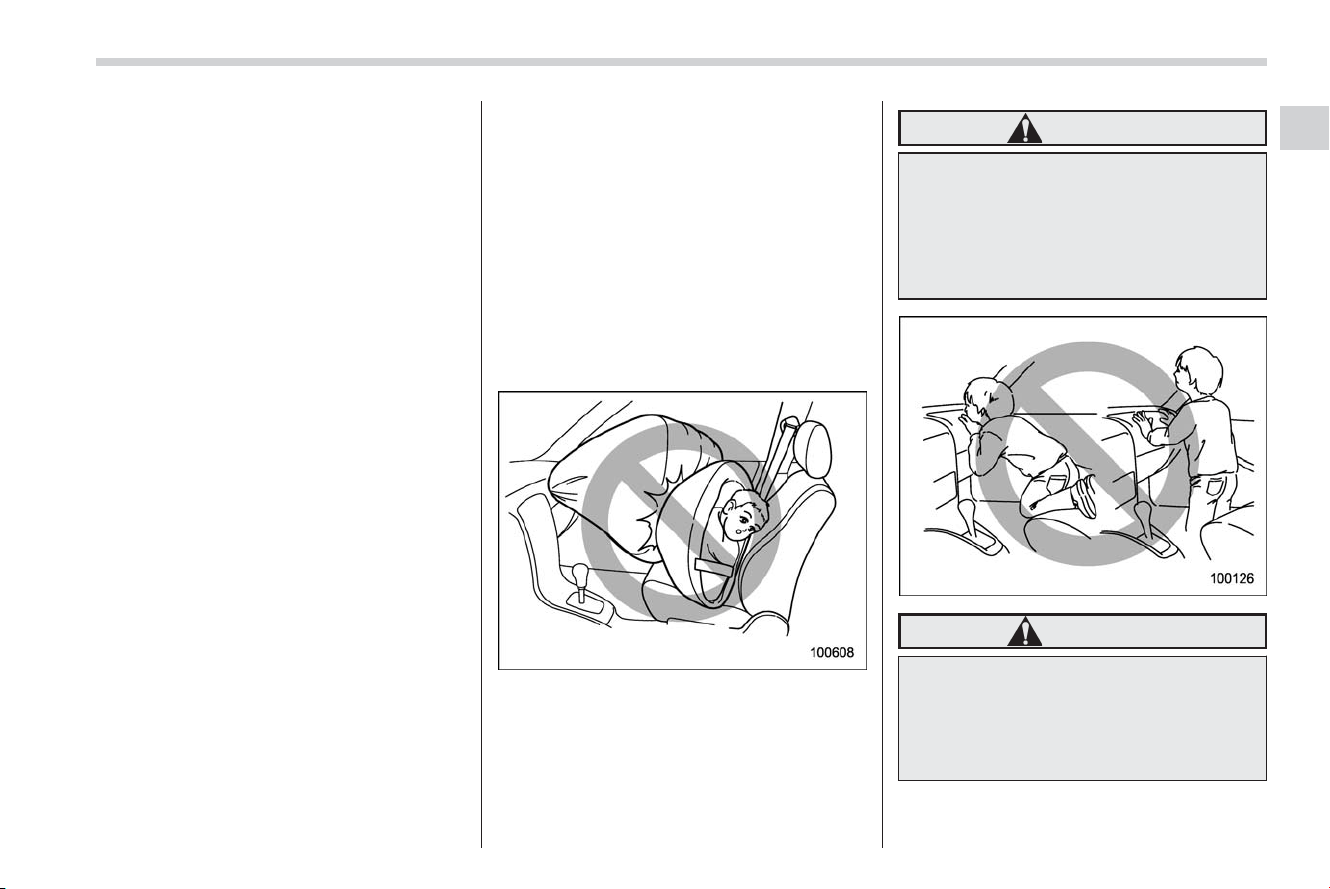
Black plate (69,1)
北米Model "A8130BE-B" EDITED: 2007/ 7/ 25
& Subaru advanced frontal air-
bag system
Your vehicle is equipped with a Subaru
advanced frontal airbag system that com-
plies with the new advanced frontal airbag
requirements in the amended Federal
Motor Vehicle Safety Standard (FMVSS)
No. 208.
The Subaru advanced frontal airbag sys-
tem automatically determines the deploy-
ment force of the driver’s SRS frontal
airbag at the time of deployment as well as
whether or not to activate the front
passenger’s SRS frontal airbag and, if
activated, the deployment force of the
SRS frontal airbag at the time of deploy-
ment.
Your vehicle has warning labels on the
driver’s and front passenger’s sun visors
beginning with the phrase “EVEN WITH
ADVANCED AIR BAGS” and a tag
attached to the glove box lid beginning
with the phrase “Even with Advanced Air
Bags”. Make sure that you carefully read
the instructions on the warning labels and
tag.
Always wear your seatbelt. The subaru
advanced frontal airbag system is a
supplemental restraint system and must
be used in combination with a seatbelt. All
occupants should wear a seatbelt or be
seated in an appropriate child restraint
system.
The driver’s SRS frontal airbag is stowed
in the center portion of the steering wheel.
The front passenger’s SRS frontal airbag
is stowed near the top of the dashboard
under an “SRS AIRBAG” mark.
In a moderate to severe frontal collision,
the driver’s and front passenger’s SRS
frontal airbags deploy and supplement the
seatbelts by reducing the impact on the
driver’s and front passenger’s head and
chest.
WARNING
NEVER INSTALL A REARWARD FA-
CING CHILD SEAT IN THE FRONT
SEAT. DOING SO RISKS SERIOUS
INJURY OR DEATH TO THE CHILD
BY PLACING THE CHILD’S HEAD
TOO CLOSE TO THE SRS AIRBAG.
WARNING
Never allow a child to stand up, or to
kneel on the front passenger’s seat.
The SRS airbag deploys with con-
siderable force and can injure or
even kill the child.
Seat, seatbelt and SRS airbags 1-39
– CONTINUED –
1
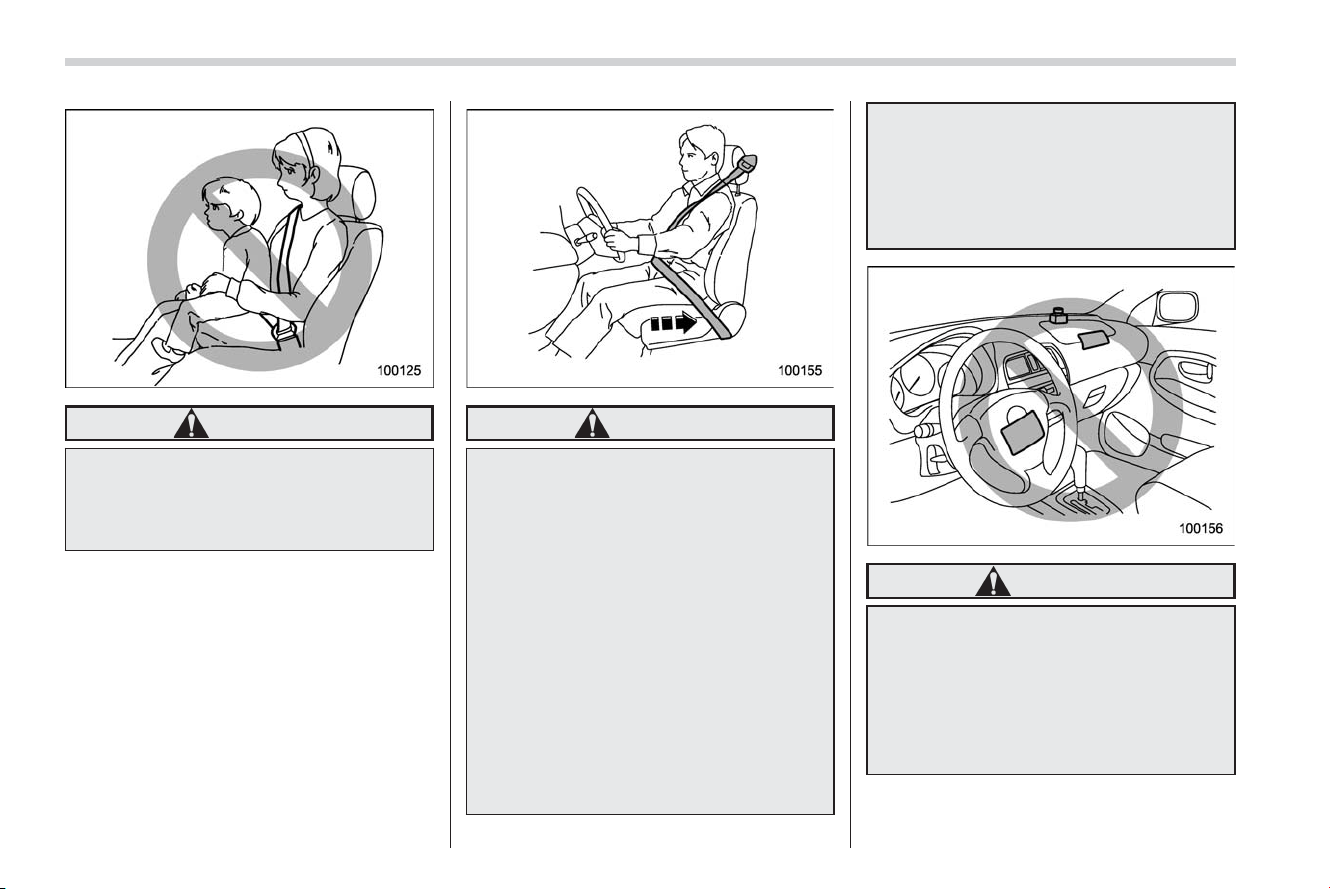
Black plate (70,1)
北米Model "A8130BE-B" EDITED: 2007/ 7/ 25
1-40 Seat, seatbelt and SRS airbags
WARNING
Never hold a child on your lap or in
your arms. The SRS airbag deploys
with considerable force and can
injure or even kill the child.
WARNING
The SRS airbag deploys with con-
siderable speed and force. Occu-
pants who are out of proper position
when the SRS airbag deploys could
suffer very serious inj uries. Be-
cause the SRS airbag needs enough
space fo r deployment, the drive r
should always sit upright and well
back in the seat as far from the
steering wheel as practical whil e
still maintaining full vehicle control
and the front passenger should
move the seat as far back as
possible and sit upright and well
back in the seat.
It is also important to wear your
seatbelt to help avoid injuries that
can result when the SRS airbag
contacts an occupant not in proper
position such as one thrown toward
the front of the vehicle during pre-
accident braking.
WARNING
Do not put any objects over the
steering wheel pad and dashboard.
If the SRS frontal airbag deploys,
those objects could interfere with its
proper operation and could be pro-
pelled inside the vehicle and cause
injury.
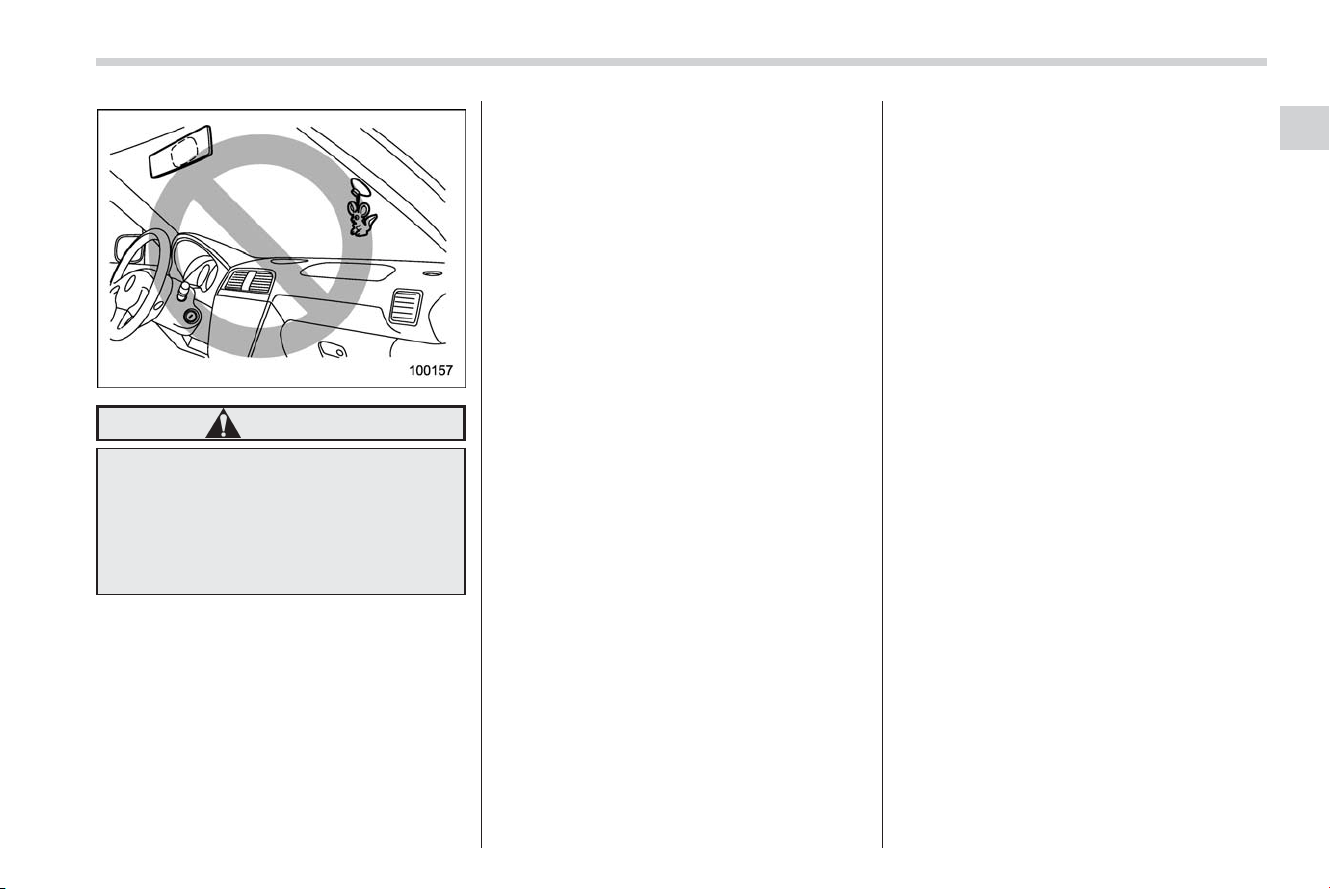
Black plate (71,1)
北米Model "A8130BE-B" EDITED: 2007/ 7/ 25
WARNING
Do not attach accessories to the
windshield, or fit an extra-wide mir-
ror over the rear view mirror. If the
SRS airbag deploys, those objects
could become projectiles that could
seriously injure vehicle occupants.
! Driver’s SRS frontal airbag
The driver’s SRS frontal airbag uses a
dual stage inflator. The inflator operates in
different ways depending on the severity
of impact, backward-forward adjustment
of the driver’s seat position and whether or
not he/she is wearing the seatbelt.
The backward-forward adjustment of the
driver’s seat position is monitored by the
driver’s seat position sensor under the
driver’s seat.
Whether or not the driver is wearing the
seatbelt is monitored by the seatbelt
buckle switch.
Observe the following precautions. Failure
to do so may cause the seatbelt buckle
switch and/or the seat position sensor to
malfunction, preventing the Subaru ad-
vanced frontal airbag system from func-
tioning correctly or causing the system to
fail.
. Do not place articles/metal objects or
install any accessory other than a genuine
SUBARU accessory under the driver’s
seat. Do not allow the rear seat occupant
to kick the driver’s seat or push up its
bottom surface with his/her feet.
. Do not place a magnet near the
seatbelt buckle or under the driver’s seat.
If the seatbelt buckle switch and/or the
driver’s seat position sensor have failed,
the SRS airbag system warning light will
illuminate. Although the driver’sSRS
frontal airbag can deploy regardless of
the backward-forward adjustment of the
driver ’ s seat position even when the
warning light is on, have the system
inspected by your SUBARU dealer im-
mediately if the SRS airbag system warn-
ing light comes on.
NOTE
The driver ’s SRS side airbag and
seatbelt pretensioner are not controlled
by the Subaru advanced frontal airbag
system.
! Front passenger’s SRS frontal air-
bag
The front passenger’s SRS frontal airbag
uses a dual stage inflator. The inflator
operates in different ways depending on
the severity of impact.
The total load on the seat is monitored by
the occupant detection system’s weight
sensor located under the seat.
The system has another sensor that
monitors the tension of the front passen-
ger seatbelt. Using the total seat load and
seatbelt tension data from the sensors,
the occupant detection system determines
whether the front passenger’s SRS frontal
airbag should or should not be inflated.
The occupant detection system may not
inflate the front passenger’s SRS frontal
airbag even when the driver’s SRS frontal
airbag deploys. This is normal.
Observe the following precautions. Failure
to do so may prevent the Subaru ad-
vanced frontal airbag system from func-
tioning correctly or cause the system to
fail.
. Do not apply any strong impact to the
Seat, seatbelt and SRS airbags 1-41
– CONTINUED –
1
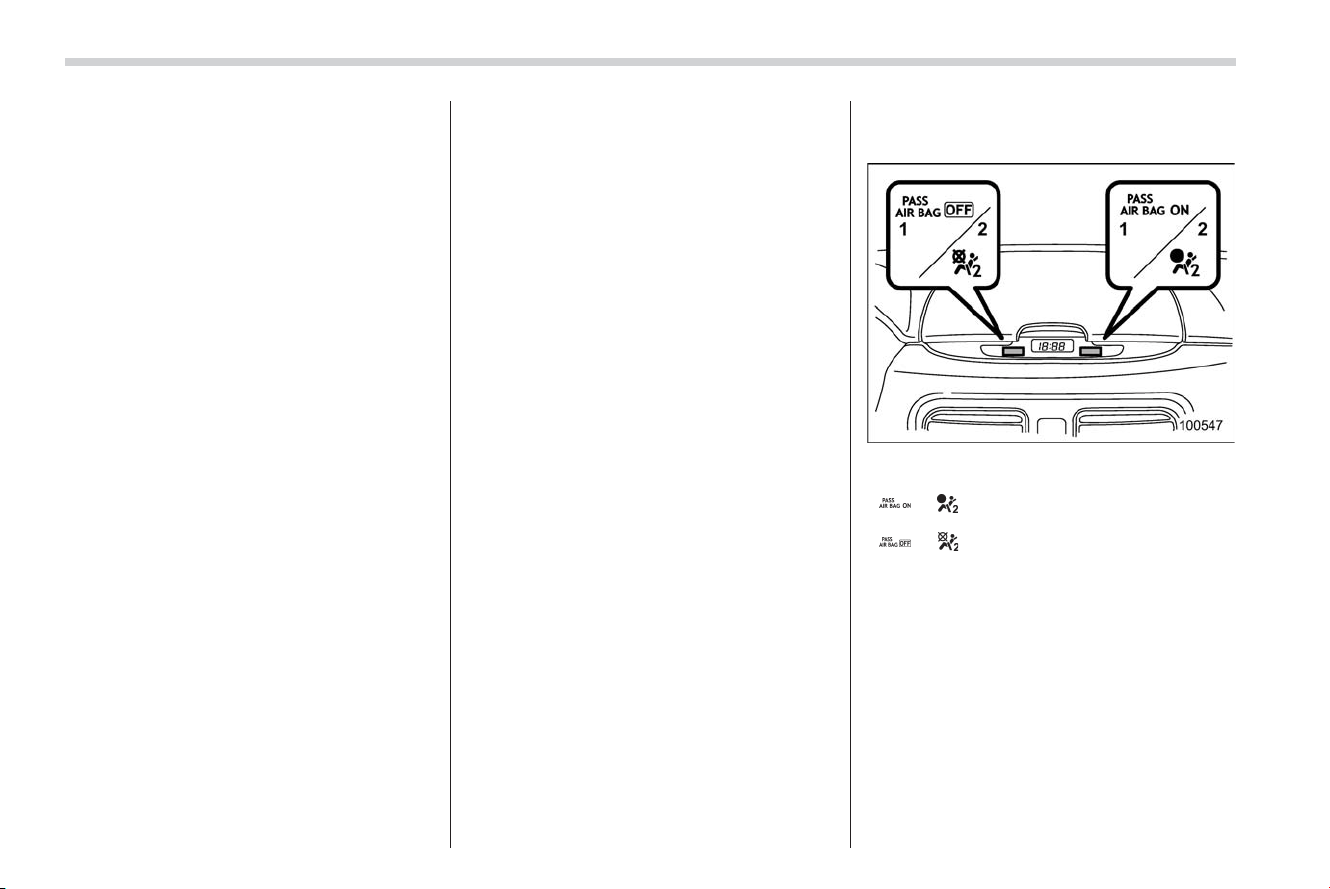
Black plate (72,1)
北米Model "A8130BE-B" EDITED: 2007/ 7/ 25
1-42 Seat, seatbelt and SRS airbags
front passenger’s seat such as by kicking.
. Do not spill liquid on the front passen-
ger’s seat. If liquid is spilled, wipe it off
immediately.
. Do not remove or disassemble the front
passenger’s seat.
. Do not install any accessory (such as
an audio amplifier) other than a genuine
SUBARU accessory under the front pas-
senger’s seat.
. Do not place anything (shoes, umbrel-
la, etc.) under the front passenger’s seat.
. The front passenger’s seat must not be
used with the head restraint removed.
. Do not leave any article including a
child restraint system on the front passen-
ger’s seat or the seatbelt tongue and
buckle engaged when you leave your
vehicle.
. Do not place a magnet near the
seatbelt buckle and the seatbelt retractor.
. Do not use front seats with their back-
ward-forward position and seatback not
being locked into place securely. If any of
them are not locked securely, adjust them
again. For adjusting procedure, refer to
the “Manual seat” in the front seats section
in chapter 1 in this Owner’s Manual.
(Models equipped with manual seats only)
. If you use an optional seatbelt exten-
der, remove it after each use. (Refer to the
“Seatbelt extender” section in this chap-
ter.)
If the seatbelt buckle switch and/or front
passenger’s occupant detection system
have failed, the SRS airbag system
warning light will illuminate. Have the
system inspected by your SUBARU deal-
er immediately if the SRS airbag system
warning light comes on.
If your vehicle has sustained impact, this
may affect the proper function of the
Subaru advanced frontal airbag system.
Have your vehicle inspected at your
SUBARU dealer.
NOTE
The front passenger’s SRS side airbag
and seatbelt pretensioner are not con-
trolled by the Subaru advanced frontal
airbag system.
! Passenger’s frontal airbag ON and
OFF indicators
1) U.S.-spec. models
2) Canada-spec. models
or : Front passenger’s frontal airbag
ON indicator
or : Front passenger’s frontal airbag
OFF indicator
The front passenger’s frontal airbag ON
and OFF indicators show you the status of
the front passenger’s SRS frontal airbag.
The indicators are located next to the
clock in the central portion of the instru-
ment panel.
When the ignition switch is turned to the
“ON” position, both the ON and OFF
indicators illuminate for 6 seconds during
which time the system is checked. Follow-
ing the syst em check, both indicators
Black plate (73,1)
北米Model "A8130BE-B" EDITED: 2007/ 7/ 25
extinguish for 2 seconds. After this, one of
the indicators illuminates depending on
the status of the front passenger’s SRS
frontal airbag reached by the Subaru
advanced frontal airbag system monitor-
ing.
If the front passenger’s SRS frontal airbag
is activated, the passenger’s frontal airbag
ON indicator will illuminate while the OFF
indicator will remain extinguished.
If the front passenger’s SRS frontal airbag
is deactivated, the passenger’s frontal
airbag ON indicator will remain extin-
guished whil e the OFF indi cator will
illuminate.
With the ignition switch turned to the “ON”
position, if both the ON and OFF indica-
tors remain lit or extinguished simulta-
neously even after the system check
period, the system is faulty. Contact your
SUBARU dealer immediately for an in-
spection.
! Conditions in which front passen-
ger’s SRS frontal airbag is not
activated
The front passenger’s SRS frontal airbag
will not be activated when any of the
following conditions are met regarding the
front passenger’s seat:
. The seat is empty.
. The seat is equipped with a rearward
facing child restraint system and an infant
is restrained with it. (See WARNING that
follows.)
. The seat is equipped with a forward
facing child restraint system and a small
child is restrained with it. (See WARNING
that follows.)
. The seat is equipped with a booster
seat and a small child is in the booster
seat. (See WARNING that follows.)
. The seat is relieved of the occupant
load for a time exceeding the predeter-
mined period.
. The seat is occupied by a child who
has outgrown a child restraint system
(See WARNING that follows.) or a small
adult.
. The front passenger’s occupant detec-
tion system is faulty.
WARNING
NEVER INSTALL A REARWARD FA-
CING CHILD SEAT IN THE FRONT
PASSENGER’S SEAT EVEN IF THE
FRONT PASSENGER’S SRS FRON-
TAL AIRBAG IS DEACTIVATED. Be
sure to install it in the REAR seat in
a correct manner. Also, it is strongly
recommended that any forward fa-
cing child seat or booster seat be
installed in the REAR seat, and that
even children who have outgrown a
child restraint system be also
seated in the REAR seat. This is
because children sitting in the front
passenger’s seat may be killed or
severely injured shou ld the front
passenger’s SRS frontal airbag de-
ploy. REAR seats are the safest
place for children.
When the front passenger’s seat is occu-
pied by a child, observe the following
precautions. Failure to do so may increase
the load on the front passenger’s seat,
activating the front passenger’sSRS
frontal airbag even though that seat is
occupied by a child.
. Do not place any article on the seat
other than the child occupant and a child
restraint system.
. Do not place more than one child on
the seat.
. Do not install any accessory such as a
table or TV onto the seatback.
. Do not store a heavy load in the
seatback pocket.
. Do not allow the rear seat occupant to
place his/her hands or legs on the front
passenger’s seatback, or allow him/her to
pull the seatback.
Seat, seatbelt and SRS airbags 1-43
– CONTINUED –
1

Black plate (74,1)
北米Model "A8130BE-B" EDITED: 2007/ 7/ 25
1-44 Seat, seatbelt and SRS airbags
! If the front passenger’s frontal air-
bag ON indicator illuminates and the
OFF indicator extinguishes even
when an infant or a small child is in
a child restraint system (including
booster seat)
Turn the ignition switch to the “LOCK”
position if the front passenger’s frontal
airbag ON indicator illuminates and the
OFF indicator extinguishes even when an
infant or a small child is in a child restraint
system (including booster seat). Remove
the child restraint system from the seat. By
referring to the child restraint manufac-
turer’s recommendations as well as the
child restraint system installation proce-
dures in the “Child restraint systems”
section in this chapter, correctly install
the child restraint system. Turn the ignition
switch to the “ON” position and make sure
that the front passenger’s frontal airbag
ON indicator goes out and the OFF
indicator comes on.
If the ON indicator remains illuminated
while the OFF indicator extinguishes, take
the following actions.
. Ensure that no article is placed on the
seat other than the child restraint system
and the child occupant.
. Ensure that there is no article left in the
seatback pocket.
. Ensure that the backward-forward po-
sition and seatback of front passenger’s
seat are locked into place securely by
moving the seat back and forth. (Models
equipped with manual seats only)
If the ON indicator still illuminates while
the OFF indicator extinguishes after taking
relevant cor rective actio ns described
above, relocate the child restraint system
to the rear seat and immediately contact
your SUBARU dealer for an inspection.
NOTE
When a child who has outgrown a child
restraint system or a small adult is
seated in the front passenger’s seat,
the Subaru advanced frontal airbag
system may or may not activate the
front passenger’s SRS frontal airbag
depending on the occupant’s seating
posture. If the front passenger’s SRS
frontal airbag is activated (the ON
indicator illuminates while the OFF
indicator extinguishes), take the follow-
ing actions.
. Ensure that no article is placed on
the seat other than the occupant.
. Ensure that there is no article left in
the seatback pocket.
If the ON indicator still illuminates while
the OFF indicator extinguishes despite
the fact that the actions noted above
have been taken, seat the child/small
adult in the rear seat and immediately
contact your SUBARU dealer for an
inspection. Even if the system has
passed the dealer inspection, it is
recommended that on subsequent trips
the child/small adult always take the
rear seat.
Children who have outgrown a child
restraint system should always wear the
seatbelt irrespective of whether the airbag
is deactivated or activated.
! Conditions in which front passen-
ger’s SRS frontal airbag is activated
The front passenger’s SRS frontal airbag
will be activated for deployment upon
impact when any of the following condi-
tions is met regarding the front passen-
ger’s seat.
. When the seat is occupied by an adult.
. When a heavy article is placed on the
seat.
When the front passenger’s seat is occu-
pied by an adult, observe the following
precautions. Failure to do so may lessen
the load on the front passenger’s seat,
deactivating the front passenger’s SRS
frontal airbag despite the fact that the seat
is occupied by an adult.

Black plate (75,1)
北米Model "A8130BE-B" EDITED: 2007/ 7/ 25
. Do not allow the rear seat occupant to
lift the front passenger’s seat cushion
using his/her feet.
. Do not place any article under the front
passenger’s seat, or squeeze any article
from behind and under the seat. This may
lift the seat cushion.
. Do not squeeze any article between
the front passenger’s seat and side trim/
pillar, door or center console box. This
may lift the seat cushion.
! If the passenger’s frontal airbag OFF
indicator illuminates and the ON
indicator extinguishes even when
the front passenger’s seat is occu-
pied by an adult
This can be caused by the adult incor-
rectly sitting in the front passenger’s seat.
Turn the ignition switch to the “LOCK”
position. Ask the front passenger to set
the seatback to the upright position, sit up
straight in the center of the seat cushion,
correctly fasten the seatbelt, position his/
her legs out forward, and adjust the seat to
the rearmost position. Turn the ignition
switch to the “ON” position. If the OFF
indicator remains illuminated while the ON
indicator remains extinguished, take the
following actions.
. Turn the ignition switch to the “LOCK”
position.
. Ensure that there are no articl es,
books, shoes or other objects trapped
under the seat, at the rear of the seat, or
on the side of the seat.
. Ensure that the backward-forward po-
sition and seatback of front passenger’s
seat are locked into place securely by
moving the seat back and forth. (Models
equipped with manual seats only)
. Next, turn the ignition switch to the
“ON” position and wait 6 seconds to allow
the system to complete self-checkin g.
Following the system check, both indica-
tors extinguish for 2 seconds. Now, the
ON indicator should illuminate while the
OFF indicator remains extinguished.
If the OFF indicator still illuminates while
the ON indicator remains extinguished,
ask the occupant to move to the rear seat
and immediately contact your SUBARU
dealer for an inspection.
! Effect vehicle modifications made
for persons with disabilities may
have on Subaru advanced frontal
airbag system operation (U.S. only)
Changing or moving any parts of the front
seats, seatbelts, front bumper, front side
frame, instrument panel, combination me-
ter, steering wheel, steering column, tire,
suspension or floor panel can affect the
operation of the Subaru advanced airbag
system. If you have any questions, you
may contact the following Subaru distribu-
tors:
<Continental U.S., Alaska and the District
of Columbia>
Subaru of America, Inc.
Customer Dealer Services Department
P.O. Box 6000
Cherry Hill, NJ 08034-6000
1-800-SUBARU3 (1-800-782-2783)
<Hawaii>
Servco Subaru Inc., dba Subaru Hawaii
2850 Pukoloa Street, Suite 202, Honolulu,
HI 96819
808-839-2273
<Guam>
Shen’s Corporation dba Prestige
Automobile
491, East Marine Drive, Route 1 Dededo,
Guam
671-633-2698
<Puerto Rico>
Trebol Motors
P.O. Box 11204, San Juan, Puerto Rico
00910
787-793-2828
There are currently no Subaru distributors
in any other U.S. territories. If you are in
Seat, seatbelt and SRS airbags 1-45
– CONTINUED –
1

Black plate (76,1)
北米Model "A8130BE-B" EDITED: 2007/ 7/ 25
1-46 Seat, seatbelt and SRS airbags
such an area, please contact the Subaru
distributor or dealer from whi ch you
bought your vehicle.
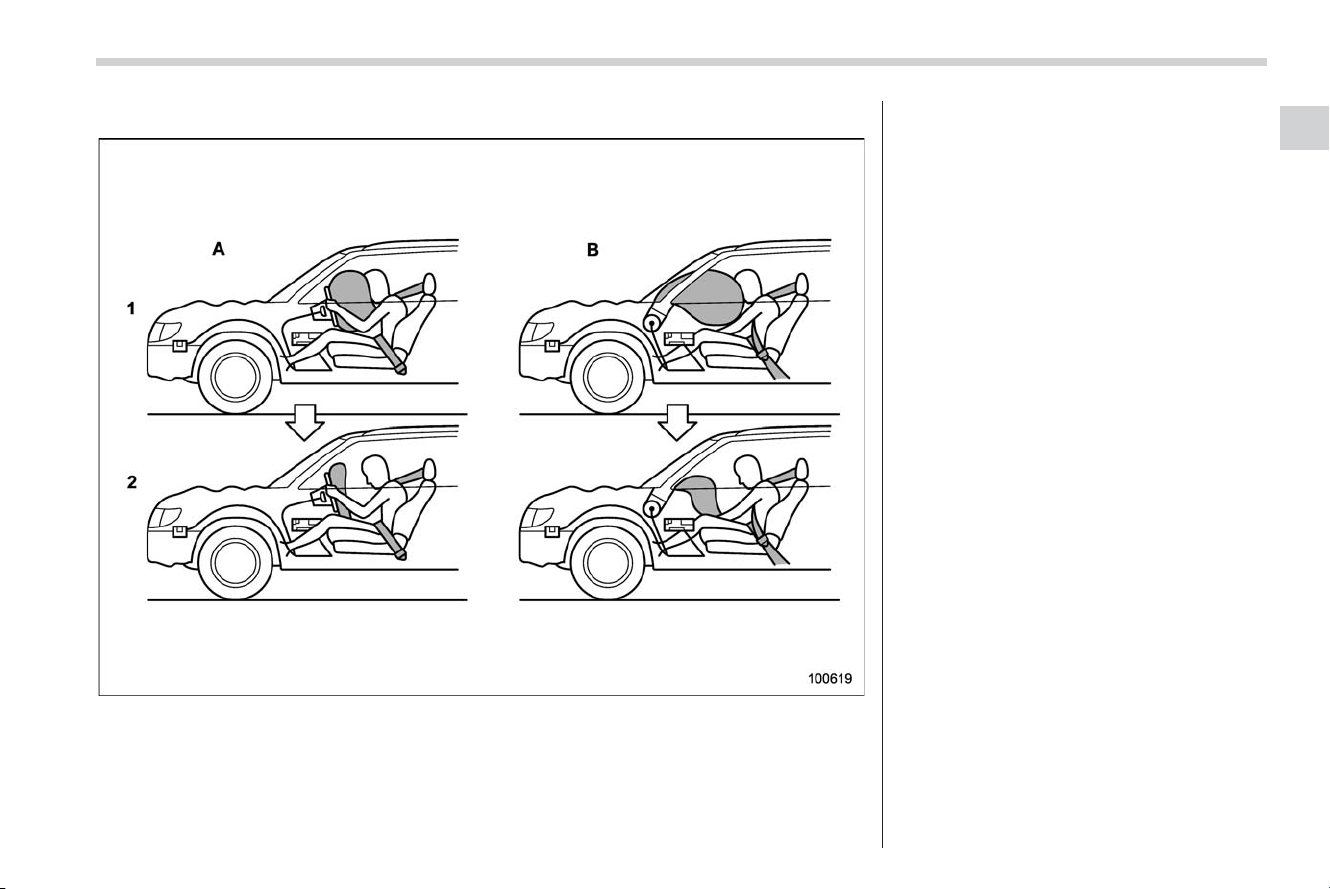
Black plate (77,1)
北米Model "A8130BE-B" EDITED: 2007/ 7/ 25
! Operation
A) Driver ’s side
B) Passenger’s side
1) SRS AIRBAGs deploy as soon as a collision occurs.
2) After deployment, SRS AIRBAGs start to deflate immediately so that the driver’s vision is not
obstructed.
The SRS airbag can function only when
the ignition switch is in the “ON” position.
The Subaru advanced frontal airbag sys-
tem is designed to determine the activa-
tion or deactivation condition of the front
passenger’s SRS frontal airbag depend-
ing on the total load on the front passen-
ger’s seat monitored by the front passen-
ger’s occupant detection system weight
sensor. For this reason, only the driver’s
SRS frontal airbag may deploy in the
event of a collision, but this does not mean
failure of the system.
Seat, seatbelt and SRS airbags 1-47
– CONTINUED –
1
Black plate (78,1)
北米Model "A8130BE-B" EDITED: 2007/ 7/ 25
1-48 Seat, seatbelt and SRS airbags
If the front sub sensors inside both front
fenders and the impact sensors in the
airbag control module detect a predeter-
mined amount of force during a frontal
collision, the control module sends signals
to the airbag module(s) (only driver’s
module or both driver’s and front passen-
ger’s modules) instructing the module(s)
to inflate the SRS frontal airbag(s). The
driver’s and front passenger’s SRS frontal
airbags use dual stage inflators. The two
inflators of each airbag are triggered either
sequentially or simultaneously, depending
on the severity of impact, backward-
forward adjustment of the driver’s seat
position and fastening/unfastening of the
seatbelt in the case of the driver’s SRS
frontal airbag and depending on the
severity of impact and the total load on
the seat in the case of the front passen-
ger’s SRS frontal airbag. After deploy-
ment, the SRS airbags immediately start
to deflate so that the driver’s vision is not
obstructed. The time required from detect-
ing impact to the deflation of the SRS
airbag after deployment is shorter than the
blink of an eye.
Both when only the driver’s SRS frontal
airbag deploys and the driver’s and front
passenger’s SRS frontal airbags deploy,
the driver’s and front passenger’s seatbelt
pretensioners operate at the same time.
Although it is highly unlikely that the SRS
airbag would activate in a non-accident
situation, should it occur, the SRS airbag
will deflate quickly, not obscuring vision
and will not interfere with the driver’s
ability to maintain control of the vehicle.
When the SRS airbag deploys, a sudden,
fairly loud inflation noise will be heard and
some smoke will be released. These
occurrences are a normal result of the
deployment. This smoke does not indicate
a fire in the vehicle.
CAUTION
Do not touch the SRS airbag system
components around the steering
wheel and dashboard with bare
hands right after deployment. Doing
so can cause burns because the
components can be very hot as a
result of deployment.
The driver’s SRS frontal airbag and front
passenger’s SRS frontal airbag are de-
signed to deploy in the event of an
accident involving a moderate to severe
frontal collision. They are basically not
designed to deploy in lesser frontal im-
pacts because the necessary protection
can be achieved by the seatbelt alone.
Also, they are basically not designed to
deploy in side or rear impacts or in roll-
over accidents because deployment of
only the driver’s SRS frontal airbag or both
driver’s and front passenger’s SRS frontal
airbags would not help the occupant in
those situations. The driver ’s and front
passenger’s SRS frontal airbags are de-
signed to function on a one-time-only
basis.
SRS airbag deployment depends on the
level of force experienced in the passen-
ger compartment during a collision. That
level differs from one type of collision to
another, and it may have no bearing on
the visible damage done to the vehicle
itself.
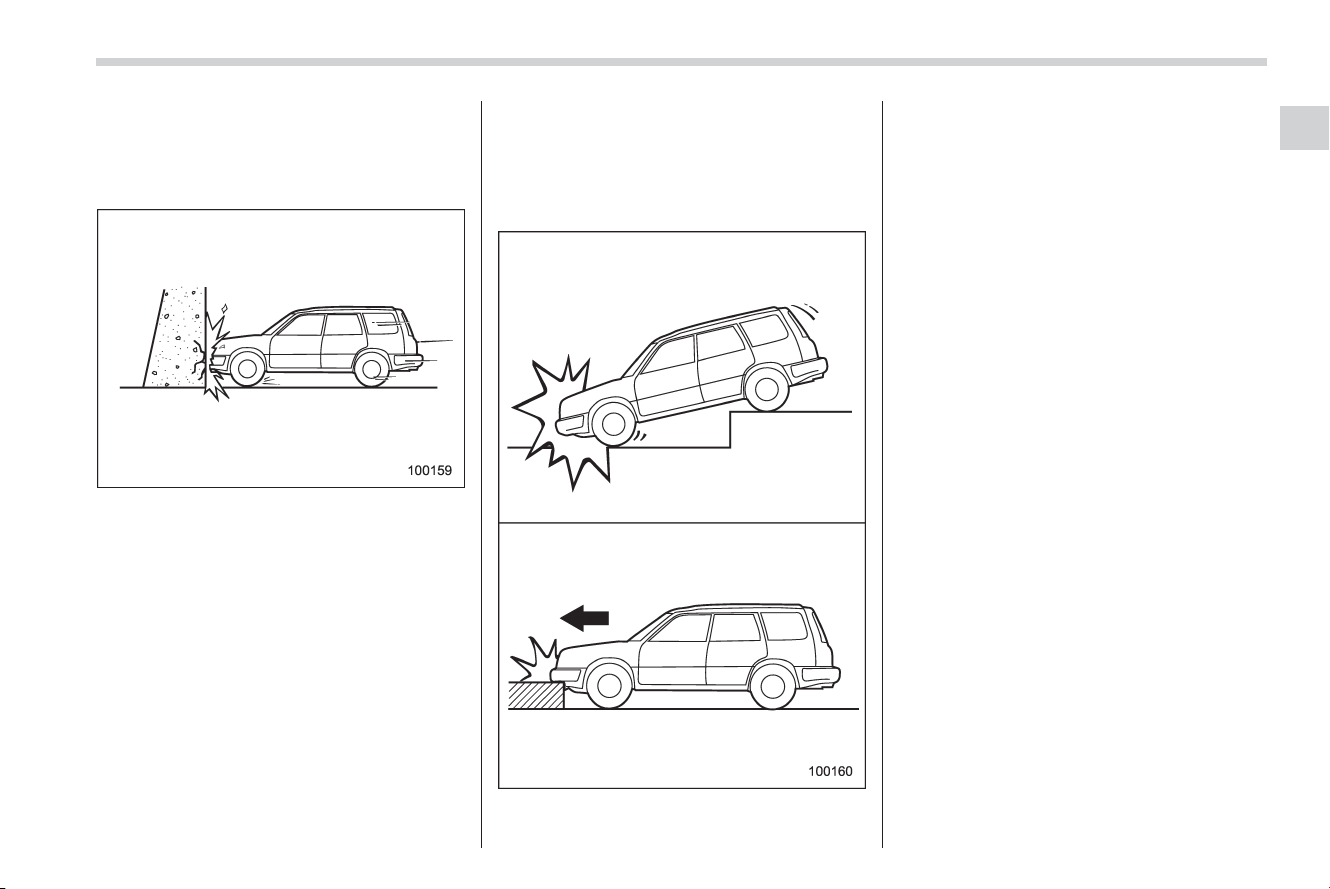
Black plate (79,1)
北米Model "A8130BE-B" EDITED: 2007/ 7/ 25
! Examples of accidents in which the
driver’s/driver’s and front passen-
ger’s SRS frontal airbag(s) will most
likely deploy.
A head-on collision against a thick con-
crete wall at a vehicle speed of 12 to 19
mph (20 to 30 km/h) or higher activates
only the driver’s SRS frontal airbag or both
driver’s and front passenger’s SRS frontal
airbags. The airbag(s) will also be acti-
vated when the vehicle is exposed to a
frontal impact similar in fashion and
magnitude to the co llision described
above.
! Examples of the types of accidents
in which it is possible that the
driver’s/driver’s and front passen-
ger’s SRS frontal airbag(s) will de-
ploy.
Only the driver’s SRS frontal airbag or
both driver’s and front passenger’s SRS
frontal airbags may be activated when the
vehicle sustains a hard impact in the
undercarriage area from the road surface
(such as when the vehicle plunges into a
deep ditch, is severely impacted or
knocked hard against an obstacle on the
road such as a curb).
Seat, seatbelt and SRS airbags 1-49
– CONTINUED –
1
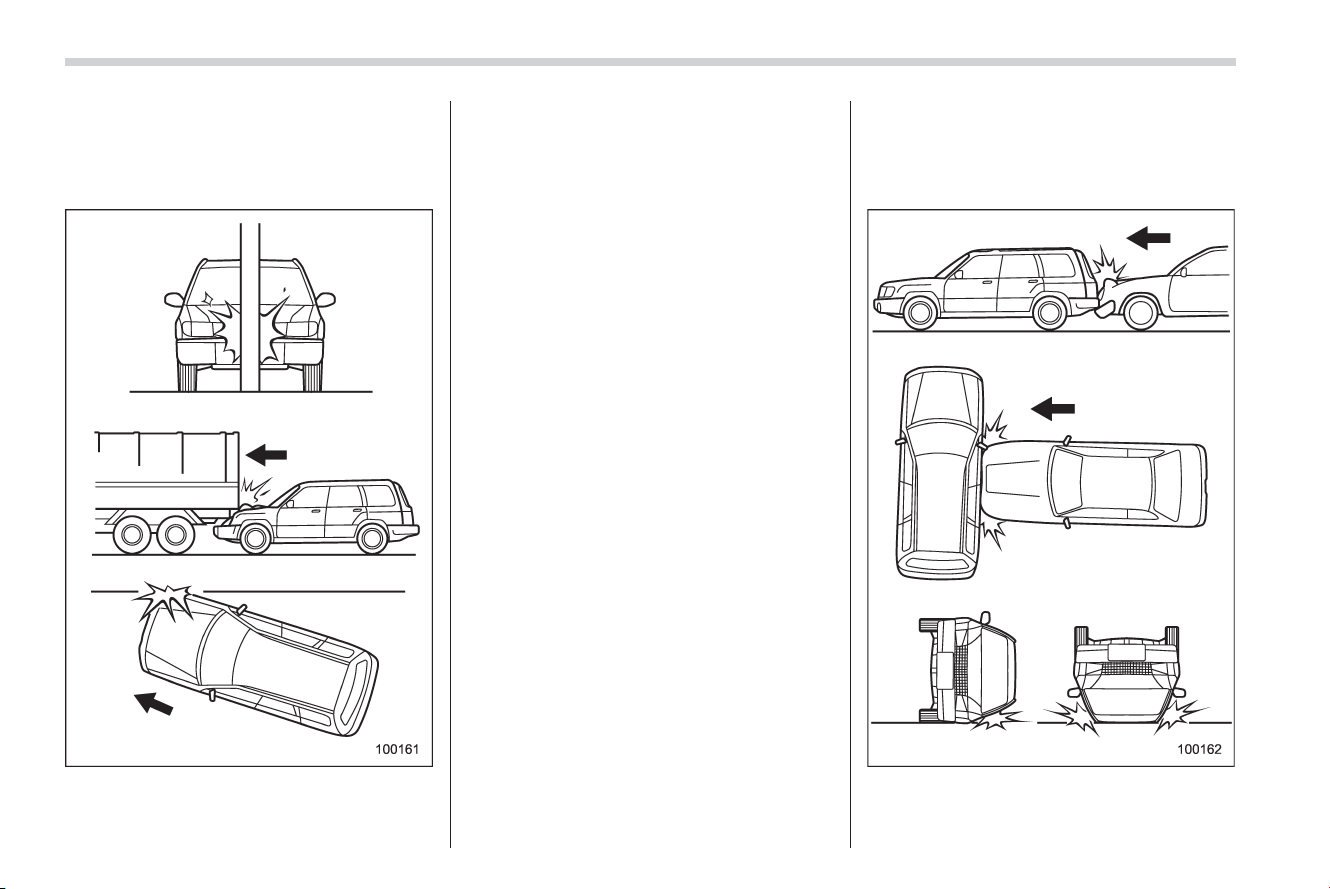
Black plate (80,1)
北米Model "A8130BE-B" EDITED: 2007/ 7/ 25
1-50 Seat, seatbelt and SRS airbags
! Examples of the types of accidents
in which deployment of the driver’s/
driver’s and front passenger’s SRS
frontal airbag(s) is unlikely to occur.
There are many types of collisions which
might not necessarily require deployment
of driver’s/driver’s and front passenger’s
SRS frontal airbag(s). If the vehicle strikes
an object, such as a telephone pole or
sign pole, or if it slides under a truck’s load
bed, or if it sustains an oblique offset
frontal impact, the driver’s/driver’sand
front passenger’s SRS frontal airbag(s)
may not deploy depending on the level of
accident forces involved.
! Examples of the types of accidents
in which the driver’s/driver’s and
front passenger’s SRS frontal
airbag(s) will basically not deploy.
The driver’s and front passenger’s SRS
frontal airbags are designed basically not
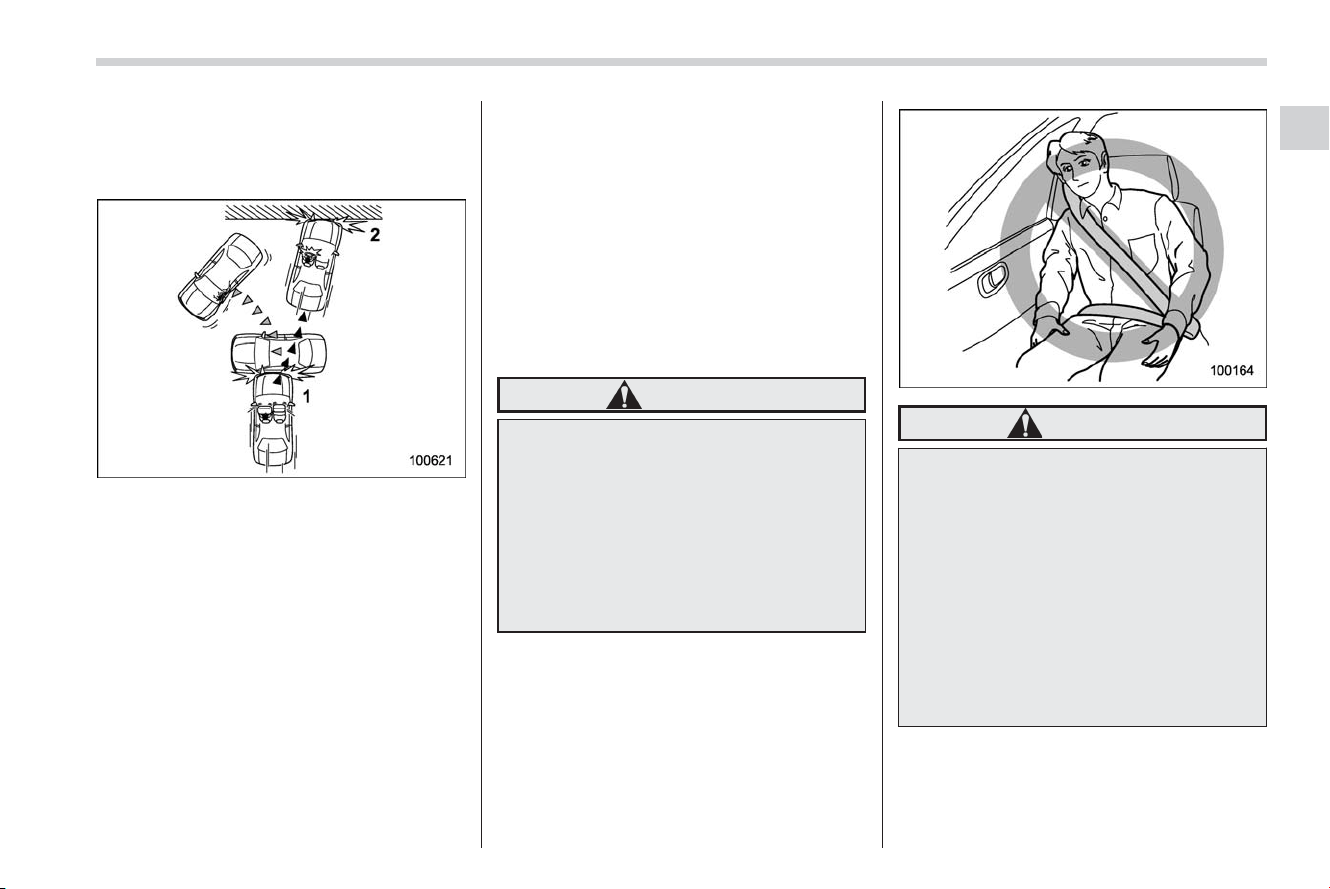
Black plate (81,1)
北米Model "A8130BE-B" EDITED: 2007/ 7/ 25
to deploy if the vehicle is struck from the
side or from behind, or if it rolls onto its
side or roof, or if it is involved in a low-
speed frontal collision.
1) First impact
2) Second impact
In an accident where the vehicle is
impacted more than once, the driver’s
and/or front passenger’s SRS frontal
airbag(s) will deploy only once on the first
impact.
Example: In the case of a double collision,
first with another vehicle, then against a
concrete wall in immediate succession,
once either or both of the driver’s and front
passenger’s SRS frontal airbags is/are
activated on the first impact, it/they will not
be activated on the second impact.
& SRS side airbag (if equipped)
The SRS side airbag is stored in the door
side of each front seat seatback, which
bears an “SRS AIRBAG” label.
In a moderate to s evere side impact
collision, the SRS side airbag on the
impacted side of the vehicle deploys
between the occupant and the door panel
and supplements the seatbelt by reducing
the impact on the occupant ’s chest and
head.
WARNING
The SRS side airbag is designed as
only a supplement to the primary
protection provided by the seatbelt.
They do not do away with the need
to fasten seatbelts. It is also impor-
tant to wear your seatbelt to help
avoid injuries that can result when
an occupant is not seated in a
proper upright position.
WARNING
Do not sit or lean unnecessarily
close to either front door. The SRS
side airbag is stored in both front
seat seatbacks next to the door, and
it provides protection by deploying
rapidly (faster than the blink of an
eye) in the event of a side impact
collision. However, the force of SRS
side airbag deployment may cause
injuries if your head or other parts of
the body are too close to the SRS
side airbag.
Seat, seatbelt and SRS airbags 1-51
– CONTINUED –
1
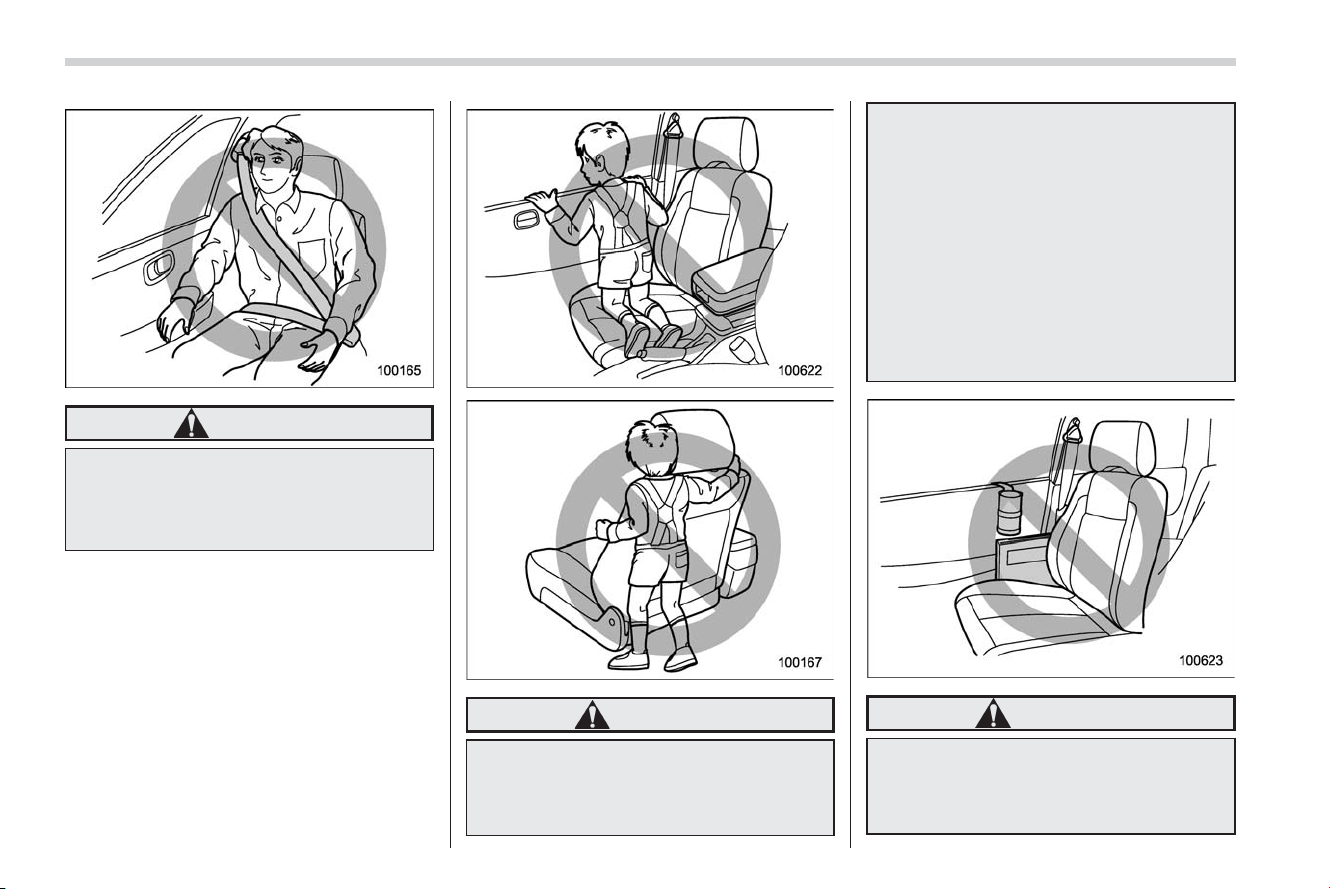
Black plate (82,1)
北米Model "A8130BE-B" EDITED: 2007/ 7/ 25
1-52 Seat, seatbelt and SRS airbags
WARNING
Do not rest your arm on either front
door or its internal trim. It could be
injured in the event of SRS side
airbag deployment.
WARNING
Never allow a child to kneel on the
front passenger’s seat facing the
side window or to wrap his/her arms
around the front seat seatback. In
the event of an accident, the force of
the SRS side airbag deployment
could injure the child serio usly
because his/her head or arms or
other parts of the body are too close
to the SRS side airbag. Since your
vehicle is also equipped with a
passenger ’s SRS frontal airbag,
children aged 12 and under should
be placed in the rear seat anyway
and should be properly restrained at
all times.
WARNING
Do not attach accessories to the
door trim or near either SRS side
airbags and do not place objects
near the SRS side airbags. In the
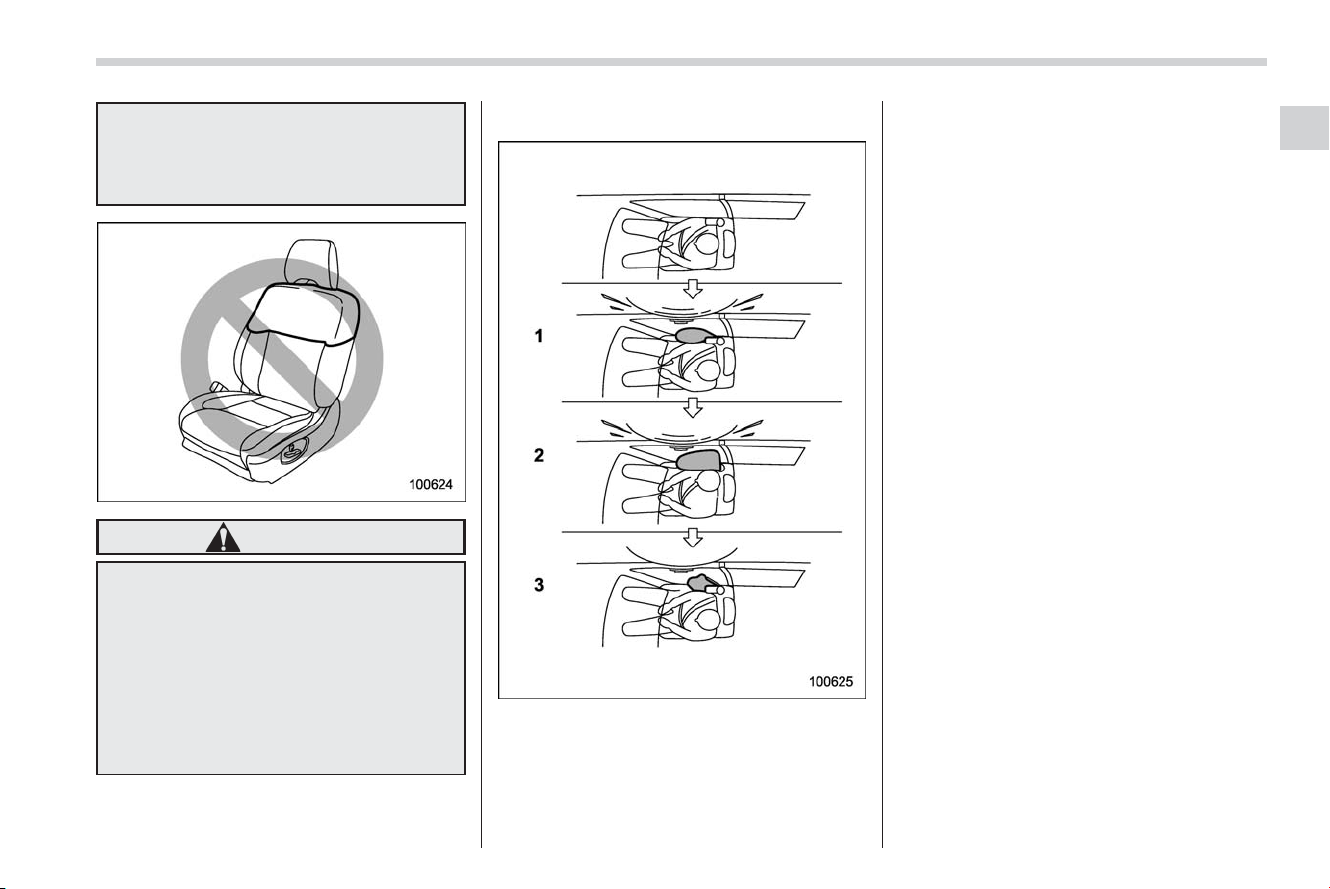
Black plate (83,1)
北米Model "A8130BE-B" EDITED: 2007/ 7/ 25
event of the SRS side airbag deploy-
ment, they could be propelled dan-
gerously toward the vehicle’s occu-
pants and cause injuries.
WARNING
Do not put any kind of cover or
clothes or other objects over either
front seatback and do not attach
labels or stickers to the front seat
surface on or near the SRS side
airbag. They could prevent proper
deployment of the SRS side airbag,
reducing protection available to the
front seat’s occupant.
! Operation
1) SRS side airbag deploys as soon as a
collision occurs.
2) SRS side airbag protects the front
passenger’s head and chest.
3) After deployment, SRS side airbag starts
to deflate immediately.
The SRS side airbag can function only
when the ignition switch is in the “ON”
position.
The driver’s and front passenger’s SRS
side airbags deploy independently of each
other since each has its own impact
sensor. Also, the SRS side airbag deploys
independently of the frontal airbags in the
steering wheel and instrument panel.
An impact sensor is incorporated into
each of the vehicle’s center pillars. If
either sensor detects a certain predeter-
mined amount of force during a side
impact collision, the control module sends
a signal to the side airbag module on the
impacted side of the vehicle, instructing it
to inflate the SRS side airbag. Then the
side airbag module produces gas, which
instantly inflates the SRS side airbag.
After deployment, the SRS side airbag
will deflate in a few seconds.
The SRS side airbag deploys even when
no one occupies the seat on the side on
which an impact is applied.
When the SRS side airbag deploys, a
sudden, fairly loud inflation noise will be
heard and some smoke will be released.
These occurrences are a normal result of
the deployment. This smoke does not
indicate a fire in the vehicle.
Seat, seatbelt and SRS airbags 1-53
– CONTINUED –
1
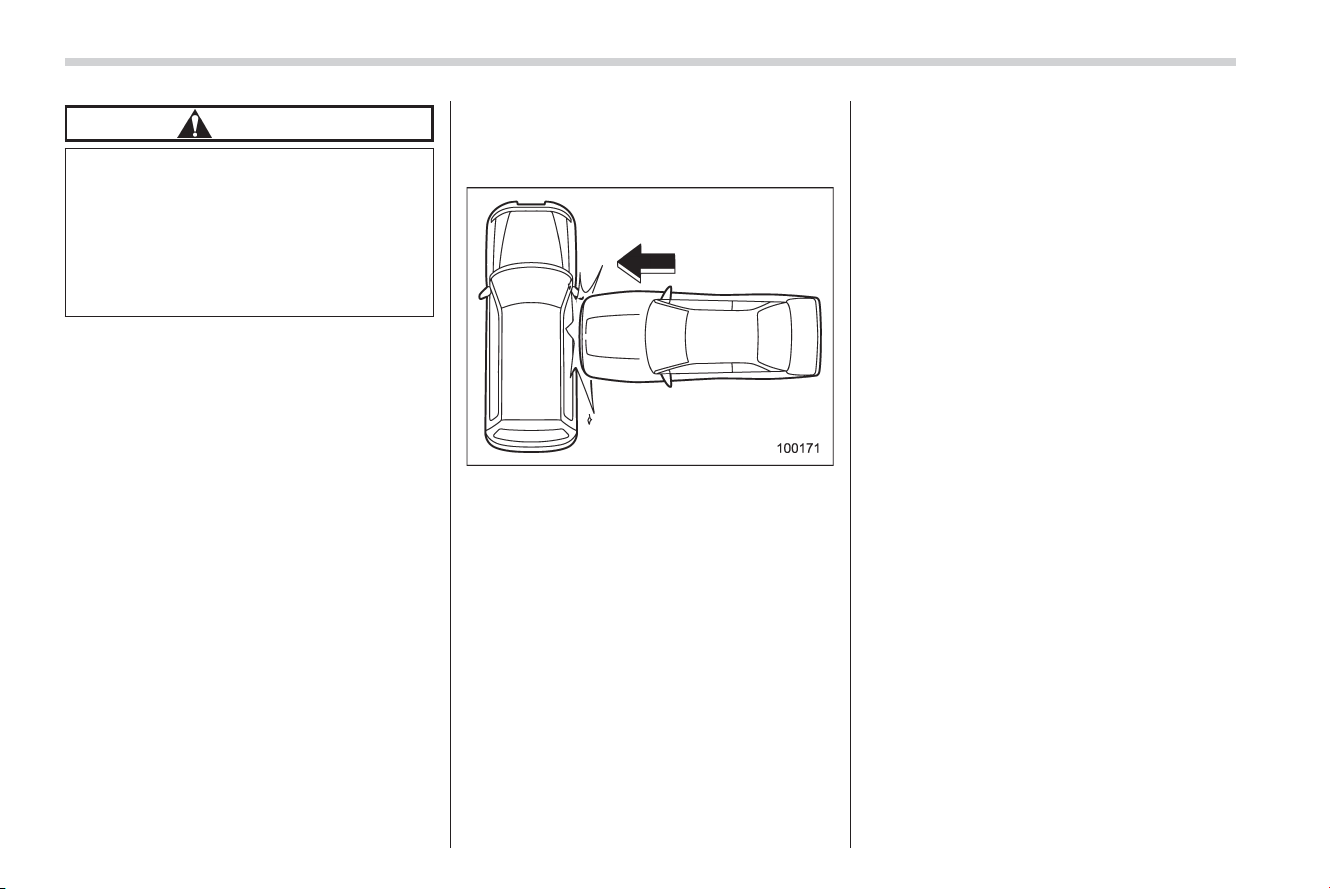
Black plate (84,1)
北米Model "A8130BE-B" EDITED: 2007/ 7/ 25
1-54 Seat, seatbelt and SRS airbags
CAUTION
Do not touch the SRS side airbag
system components around the
front seat seatback with bare hands
right after deployment. Doing so can
cause burns because the compo-
nents can be very hot as a result of
deployment.
The SRS side airbag is designed to
deploy in the event of an accident invol-
ving a moderate to severe side impact
collision. It is basically not designed to
deploy in a lesser side impact. Also, it is
basically not designed to deploy in frontal
or rear impacts because SRS side airbag
deployment would not help the occupant
in those situations.
Each SRS side airbag is designed to
function on a one-time-only basis.
SRS side airbag deployment depends on
the level of force experienced in the
passenger co mpartment during a side
impact collision. That level differs from
one type of collision to another, and it may
have no bearing on the visible damage
done to the vehicle itself.
! Example of the type of accident in
which the SRS side airbag will most
likely deploy.
A severe side impact near the front seat
activates the SRS side airbag.
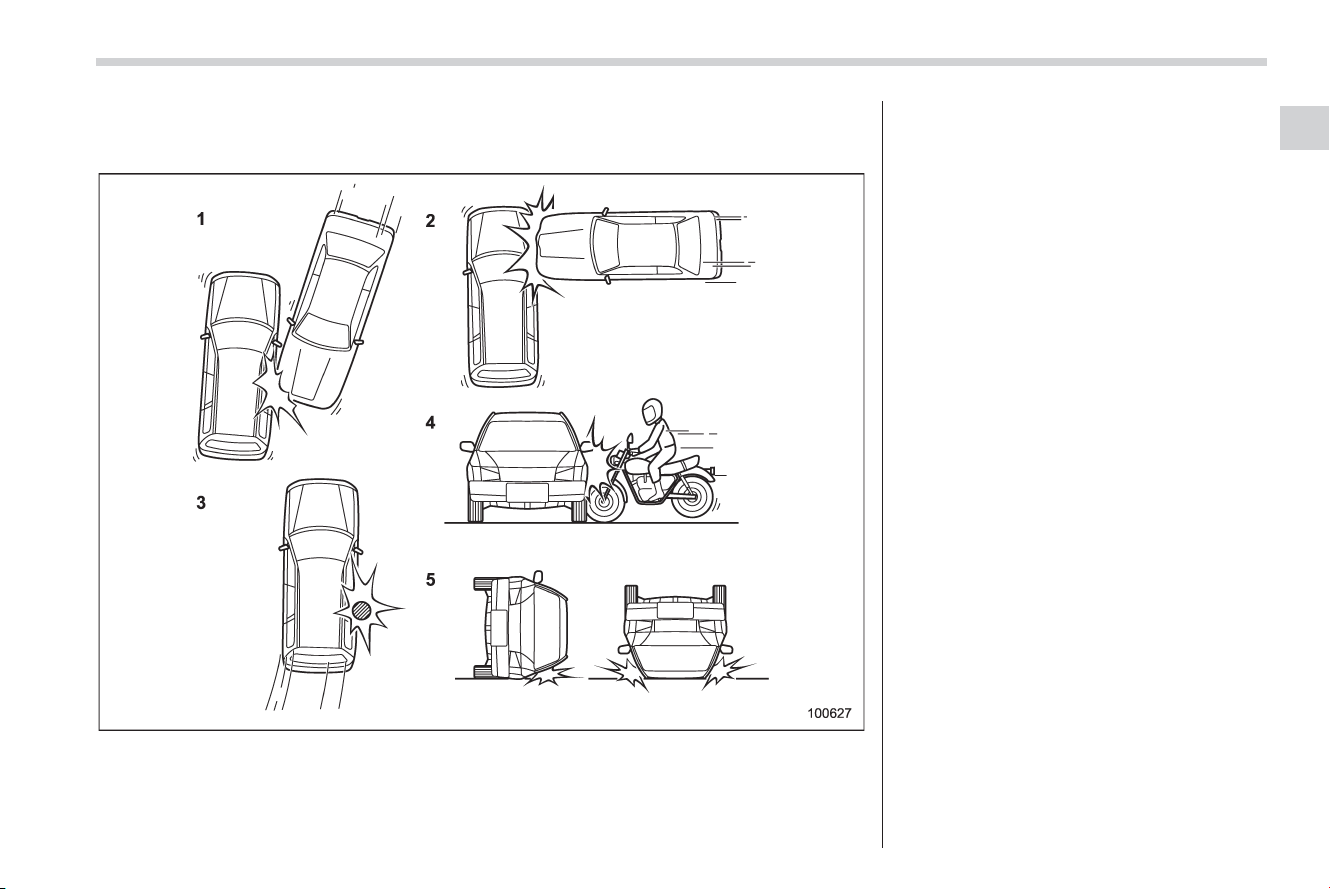
Black plate (85,1)
北米Model "A8130BE-B" EDITED: 2007/ 7/ 25
! Examples of the types of accidents in which the SRS side airbag is unlikely to
deploy.
1) The vehicle is involved in an oblique
side-on impact.
2) The vehicle is involved in a side-on
impact in an area outside the vicinity of
the passenger compartment.
3) The vehicle strikes a telephone pole or
similar object.
4) The vehicle is involved in a side-on
impact from a motorcycle.
5) The vehicle rolls onto its side or roof.
There are many types of collisions which
might not necessarily require SRS side
airbag deployment. In the event of acci-
dents like those illustrated, the SRS side
airbag may not deploy depending on the
level of accident forces involved.
Seat, seatbelt and SRS airbags 1-55
– CONTINUED –
1
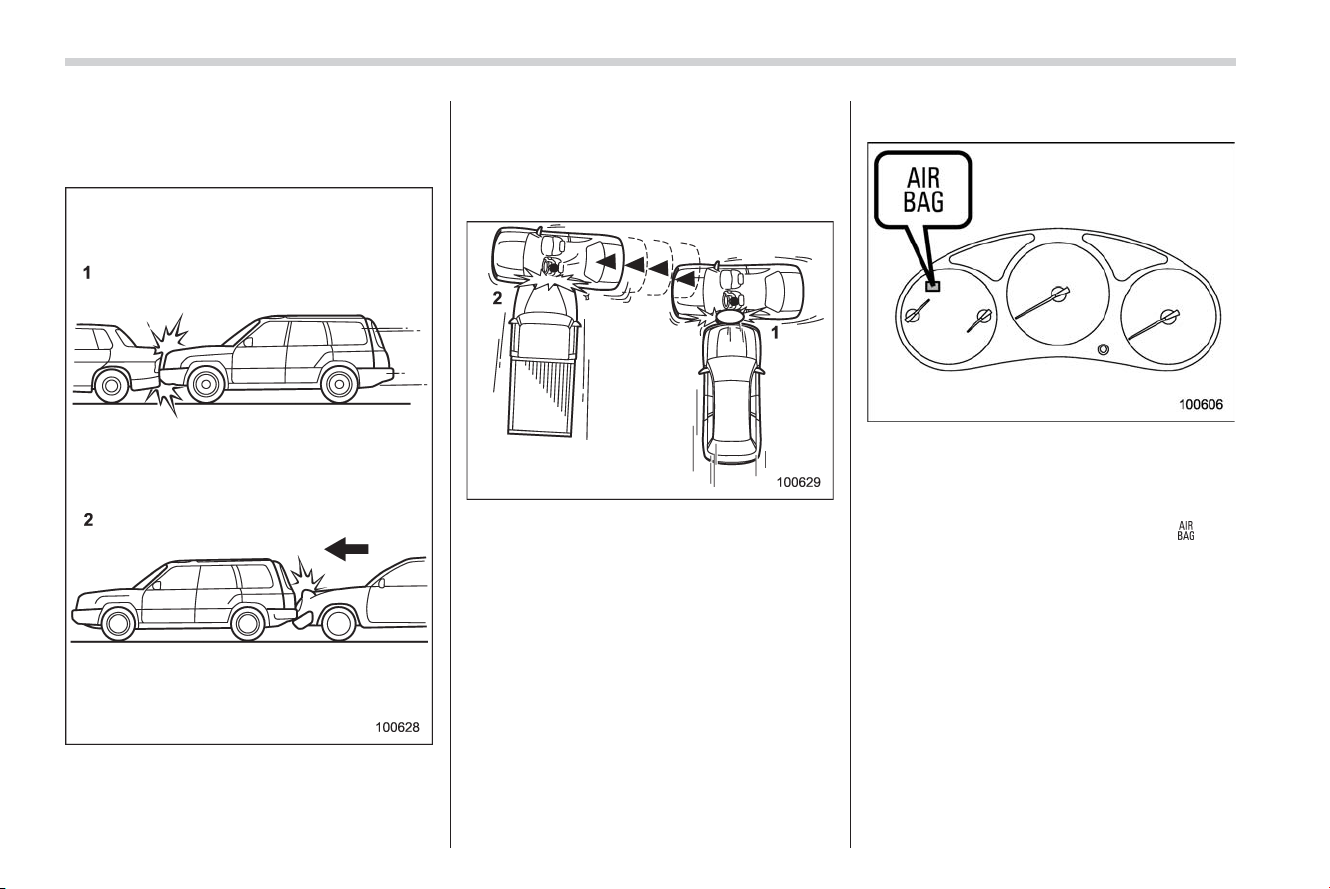
Black plate (86,1)
北米Model "A8130BE-B" EDITED: 2007/ 7/ 25
1-56 Seat, seatbelt and SRS airbags
! Examples of the types of accidents
in which the SRS side airbag will
basically not deploy.
1) The vehicle is involved in frontal collision
with another vehicle (moving or station-
ary).
2) The vehicle is struck from behind.
The SRS side airbag is basic ally not
designed to deploy if the vehicle is
involved in a frontal collision or is struck
from behind. Examples of such accidents
are illustrated.
1) First impact
2) Second impact
In an accident where the vehicle is struck
from the side more than once, the SRS
side airbag deploys only once on the first
impact.
Example: In the case of a double side
impact collision, first with one vehicle and
immediately followed by another from the
same direction, once the SRS side airbag
is activated on the first impact, it will not be
activated on the second.
& SRS airbag system monitors
A diagnostic system continually monitors
the readiness of the SRS airbag system
(including front seatbelt pretensioners)
while the vehicle is being driven. The
SRS airbag system warning light “
” will
show normal system operation by lighting
for approximately 6 seconds when the
ignition switch is turned to the “ON”
position.
The following components are monitored
by the indicator:
. Front sub sensor (Right-hand side)
. Front sub sensor (Left-hand side)
. Airbag control module (including im-
pact sensors)
. Frontal airbag module (Driver’s side)
. Frontal airbag module (Front passen-
Black plate (87,1)
北米Model "A8130BE-B" EDITED: 2007/ 7/ 25
ger’s side)
. Side airbag sensor (Center pillar right-
hand side)
. Side airbag sensor (Center pillar left-
hand side)
. Side airbag module (Driver’s side)
. Side airbag module (Front passenger’s
side)
. Seatbelt pretensioner (Driver’s side)
. Seatbelt pretensioner (Front passen-
ger’s side)
. Seatbelt buckle switch (Driver’s side)
. Seatbelt buckle switch (Front passen-
ger’s side)
. Driver’s seat position sensor
. Front passenger’s seatbelt tension
sensor
. Front passenger’s occupant detection
system weight sensor
. Front passenger’s occupant detection
control module
. Front passenger’s frontal airbag ON
and OFF indicator
. All related wiring
WARNING
If the warning light exhibits any of
the following conditions, there may
be a malfunction in the seatbelt
pretensioners and/or SRS airbag
system. Immediately take your vehi-
cle to your nearest SUBARU dealer
to have the system checked. Unless
checked and properly repaired, the
seatbelt pretensioners and/or SRS
airbags will not operate properly in
the event of a collision, which may
increase the risk of injury.
. Flashing or flickering of the warn-
ing light
. No illumination of the warning
light when the ignition switch is
first turned to the “ON” position
. Continuous ill umination of the
warning light
. Illumination of the warning light
while driving
& SRS airbag system servicing
WARNING
. When discarding an airbag mod-
ule or scrapping the entire vehi-
cle damaged by a collision, con-
sult your SUBARU dealer.
. The SRS airbag has no user-
serviceable parts. Do not use
electrical test equipment on any
circuit related to the SRS airbag
system. For required servicing of
the SRS airbag, see your nearest
SUBARU dealer. Tampering with
or disconnecting the system’s
wiring could result in accidental
inflation of the SRS airbag or
could make the system inopera-
tive, which may result in serious
injury. The wiring harnesses of
the SRS airbag system are cov-
ered with yellow insulation and
system connectors are yellow for
easy identification.
CAUTION
If you need service or repair in areas
listed below, have an authorized
SUBARU dealer perform the work.
The SRS airbag control module,
impact sensors and airbag modules
are stored in these areas.
. Under the center console
. Inside each front fender
. Steering wheel and column and
nearby areas
. Top of the dashboard on front
passenger ’s side and nearby
areas
. Each front seat and nearby area
Seat, seatbelt and SRS airbags 1-57
– CONTINUED –
1

Black plate (88,1)
北米Model "A8130BE-B" EDITED: 2007/ 7/ 25
1-58 Seat, seatbelt and SRS airbags
. Inside each center pillar
In the event that the SRS airbag is
deployed, replacement of the system
should be performed only by an author-
ized SUBARU dealer. When the compo-
nents of the SRS airbag system are
replaced, use only genuine SUBARU
parts.
NOTE
In the following cases, contact your
SUBARU dealer as soon as possible.
. The front part of the vehicle was
involved in an accident in which only
the driver’s SRS frontal airbag or both
driver ’s and front passenger’sSRS
frontal airbags did not deploy.
. The pad section of the steering
wheel or front passenger’s frontal air-
bag cover is scratched, cracked, or
otherwise damaged.
In addition, if your vehicle is equipped
with SRS side airbags, contact your
SUBARU dealer as soon as possible in
the following cases.
. Either center pillar or a nearby area
of the vehicle was involved in an
accident in which the SRS side airbag
did not deploy.
. The fabric or leather of either front
seatback is cut, frayed, or otherwise
damaged.
& Precautions against vehicle
modification
WARNING
. To avoid accidental activation of
the system or rendering the sys-
tem inoperative, which may re-
sult in serious injury, no modifi-
cations should be made to any
components or wiring of the SRS
airbag system.
This includes following modifica-
tions:
. Installation of custom steering
wheels
. Attachment of additional trim
materials to the dashboard
. Installation of custom seats
. Replacement of seat fabric or
leather
. Installation of additional fabric
or leather on the front seat
. Installation of additional elec-
trical/electronic equipment
such as a mobile two-way
radioonorneartheSRS
airbag system components
and/or wiring is not advisable.
This could interfere with prop-
er operation of the SRS airbag
system.
CAUTION
Do not perform any of the following
modifications. Such modifications
can interfere with proper operation
of the SRS airbag system.
. Attachment of any equip ment
(brush bar, winches, snow plow,
skid plate, etc.) other than genu-
ine SUBARU accessory parts to
the front end.
. Modification of the suspension
system or front end structure.
. Installation of a tire of different
size and construction from the
tires specified on the vehicle
placard attached to the driver’s
door pillar or specified for indivi-
dual vehicle models in this Own-
er’s Manual.
. Attachment of any equip ment
(side steps or side sill protectors,
etc.) other than genuine SUBARU
accessory parts to the side body.

Black plate (89,1)
北米Model "A8130BE-B" EDITED: 2007/ 7/ 25
Always consult your SUBARU dealer if
you want to install any accessory parts on
your vehicle.
Seat, seatbelt and SRS airbags 1-59
1

Black plate (2,1)
Model "ALL_MODEL_MEMO" EDITED: 2006/ 1/ 17
Left Page
————————————————————————————————————————
————————————————————————————————————————
————————————————————————————————————————
————————————————————————————————————————
————————————————————————————————————————
————————————————————————————————————————
————————————————————————————————————————
————————————————————————————————————————
————————————————————————————————————————
————————————————————————————————————————
————————————————————————————————————————
————————————————————————————————————————
————————————————————————————————————————

Black plate (3,1)
北米Model "A8130BE-B" EDITED: 2007/ 7/ 25
Keys ..................................................................... 2-2
Key number ........................................................ 2-2
Immobilizer (if equipped) .................................... 2-3
Security ID plate.................................................. 2-3
Security indicator light ........................................ 2-4
Key replacement ................................................. 2-4
Door locks ........................................................... 2-4
Locking and unlocking from the outside .............. 2-4
Locking and unlocking from the inside ................ 2-5
Power door locking switches............................. 2-6
Key lock-in prevention function ........................... 2-6
Remote keyless entry system ............................ 2-7
Locking the doors ............................................... 2-7
Unlocking the doors ............................................ 2-8
Illuminated entry ................................................. 2-8
Vehicle finder function......................................... 2-8
Sounding a panic alarm....................................... 2-8
Selecting audible signal operation ....................... 2-8
Replacing the battery .......................................... 2-9
Replacing lost transmitters.................................. 2-9
Alarm system ..................................................... 2-13
System operation............................................... 2-13
Activating and deactivating the alarm system ..... 2-13
If you have accidentally triggered the alarm
system ............................................................ 2-13
Arming the system ............................................ 2-13
Disarming the system ........................................ 2-15
Valet mode ........................................................ 2-15
Passive arming.................................................. 2-15
Tripped sensor identification .............................. 2-16
Shock sensors (dealer option)............................ 2-17
Child safety locks .............................................. 2-17
Windows............................................................. 2-18
Power windows ................................................. 2-18
Rear gate............................................................ 2-20
Moonroof (if equipped)...................................... 2-21
To open the moonroof ....................................... 2-22
To close the moonroof ....................................... 2-22
Anti-entrapment function.................................... 2-22
Sun shade ......................................................... 2-22
Keys and doors
2
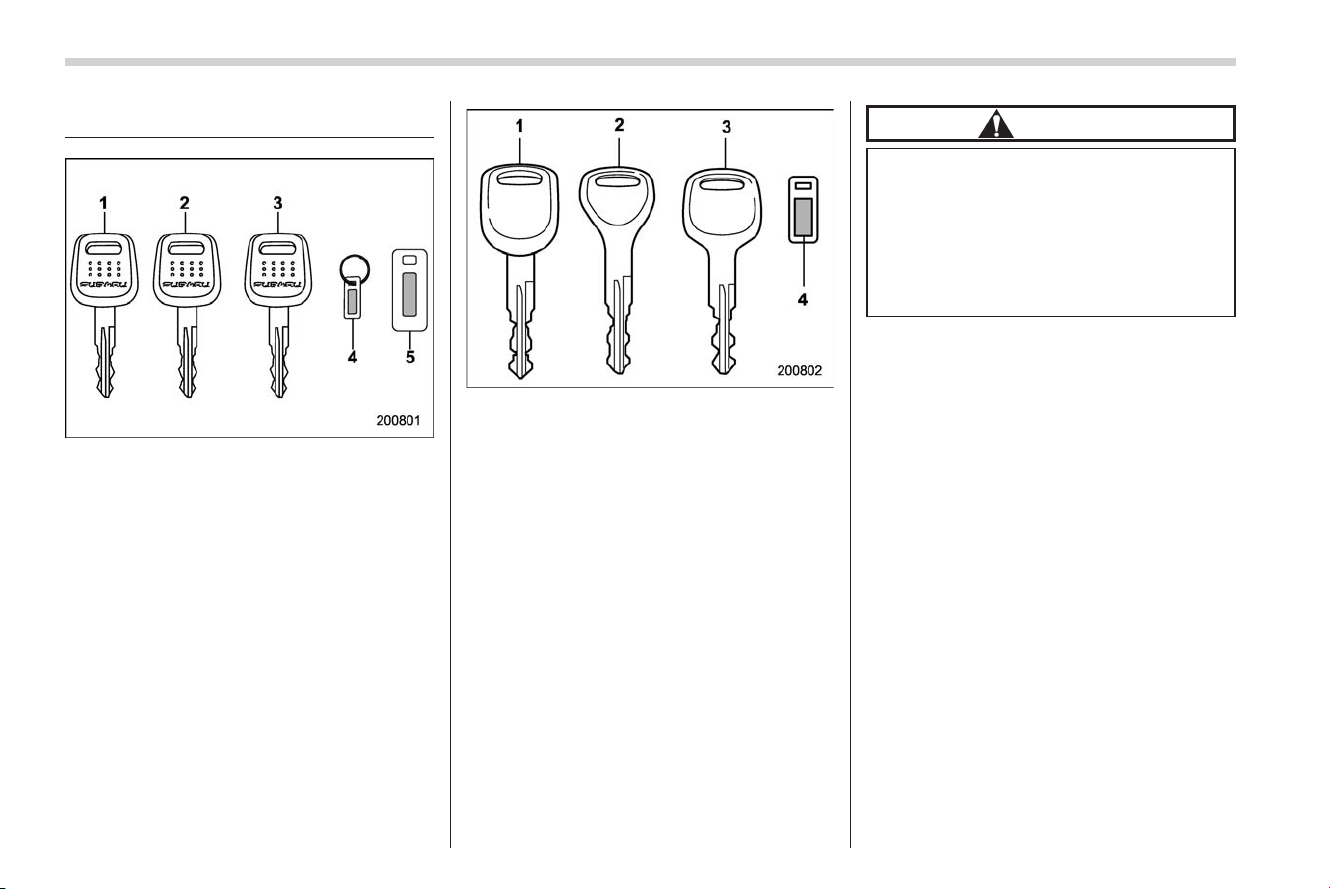
Black plate (92,1)
北米Model "A8130BE-B" EDITED: 2007/ 7/ 25
2-2 Keys and doors
Keys
Vehicle with immobilizer system
1) Master key (Black)
2) Submaster key (Black)
3) Valet key (Gray)
4) Key number plate
5) Security ID plate
Vehicle without immobilizer system
1) Master key
2) Submaster key
3) Valet key
4) Key number plate
Three types of keys are provided for your
vehicle:
Master key, submaster key and valet key.
The master key and submaster key fit all
locks on your vehicle.
. Ignition switch
. Driver’s door
. Glove box
The valet key fits only the ignition switch
and door lock. You can keep the glove box
locked when you leave your vehicle and
valet key at a parking facility.
CAUTION
Do not attach a large key holder or
key case to either key. If it bangs
against your knees while you are
driving, it could turn the ignition
switch from the “ON” position to the
“Acc” or “LOCK” position, thereby
stopping the engine.
& Key number
The key number is stamped on the key
number plate attached to the key set.
Write down the key number and keep it in
another safe place, not in the vehicle. This
number is needed to make a replacement
key if you lose your key or lock it inside the
vehicle.
For information on making replacement
keys for vehicles with the immobilizer
system, refer to the “Immobilizer” section
in this chapter.
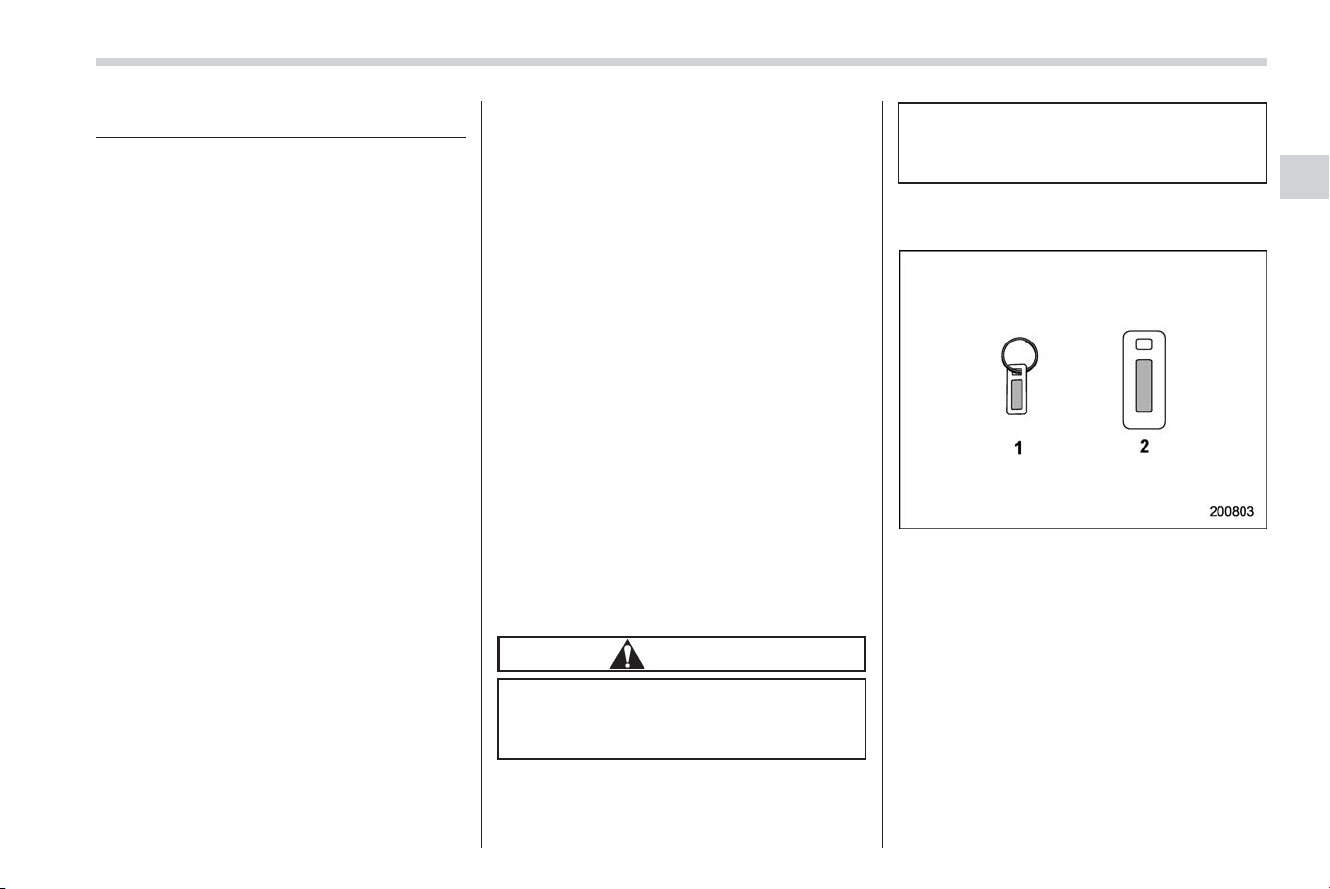
Black plate (93,1)
北米Model "A8130BE-B" EDITED: 2007/ 7/ 25
Immobilizer (if equipped)
The immobilizer system is designed to
prevent an unauthorized persons from
starting the engine. Only keys registered
with your vehicle’s immobilizer system can
be used to operate your vehicle. Even if
an unregistered key fits into the ignition
switch and can be turned to the “START”
position, the engine will automatically stop
after several seconds.
Each immobilizer key contains a trans-
ponder in which the key’s ID code is
stored. When a key is inserted into the
ignition switch and turned to the “ON”
position, the transponder transmits the
key’s ID code to the immobilizer system’s
receiver. If the transmitted ID code
matches the ID code registered in the
immobilizer system, the system allows the
engine to be started. Since the ID code is
transmitted and acted upon almost in-
stantly, the immobilizer system does not
impede normal starting of the engine.
If the engine fails to start, pull out the key
once before trying again. (Refer to the
“Ignition switch” section [chapter 3].)
This device complies with Part 15 of
the FCC Rules and with RSS-210 of
Industry Canada. Operation is subject
to the following two conditions: (1) This
device may not cause harmful inter-
ference, and (2) this device must
accept any interference received, in-
cluding interference that may cause
undesired operation.
Changes or modifications not ex-
pressly approved by the party respon-
sible for compliance could void the
user’s authority to operate the equip-
ment.
NOTE
To protect your vehicl e from theft,
please pay close attention to the fol-
lowing security precautions:
. Never leave your vehicle unattended
with its keys inside.
. Before leaving your vehicle, close all
windows and lock the doors and rear
gate.
. Do not leave spare keys or any
record of your key number in the
vehicle.
CAUTION
. Do not place the key under direct
sunlight or anywhere it may
become hot.
. Do not get the key wet. If the key
gets wet, wipe it dry with a cloth
immediately.
& Security ID plate
1) Key number plate
2) Security ID plate
The security ID is stamped on the security
ID plate attached to the key set. Write
down the security ID and keep it in
another safe place, not in the vehicle.
This number is needed to make a replace-
ment key if you lose your key or lock it
inside the vehicle.
This number is also needed for replace-
ment or repair of the engine control
module and immobilizer control module.
Keys and doors 2-3
– CONTINUED –
2
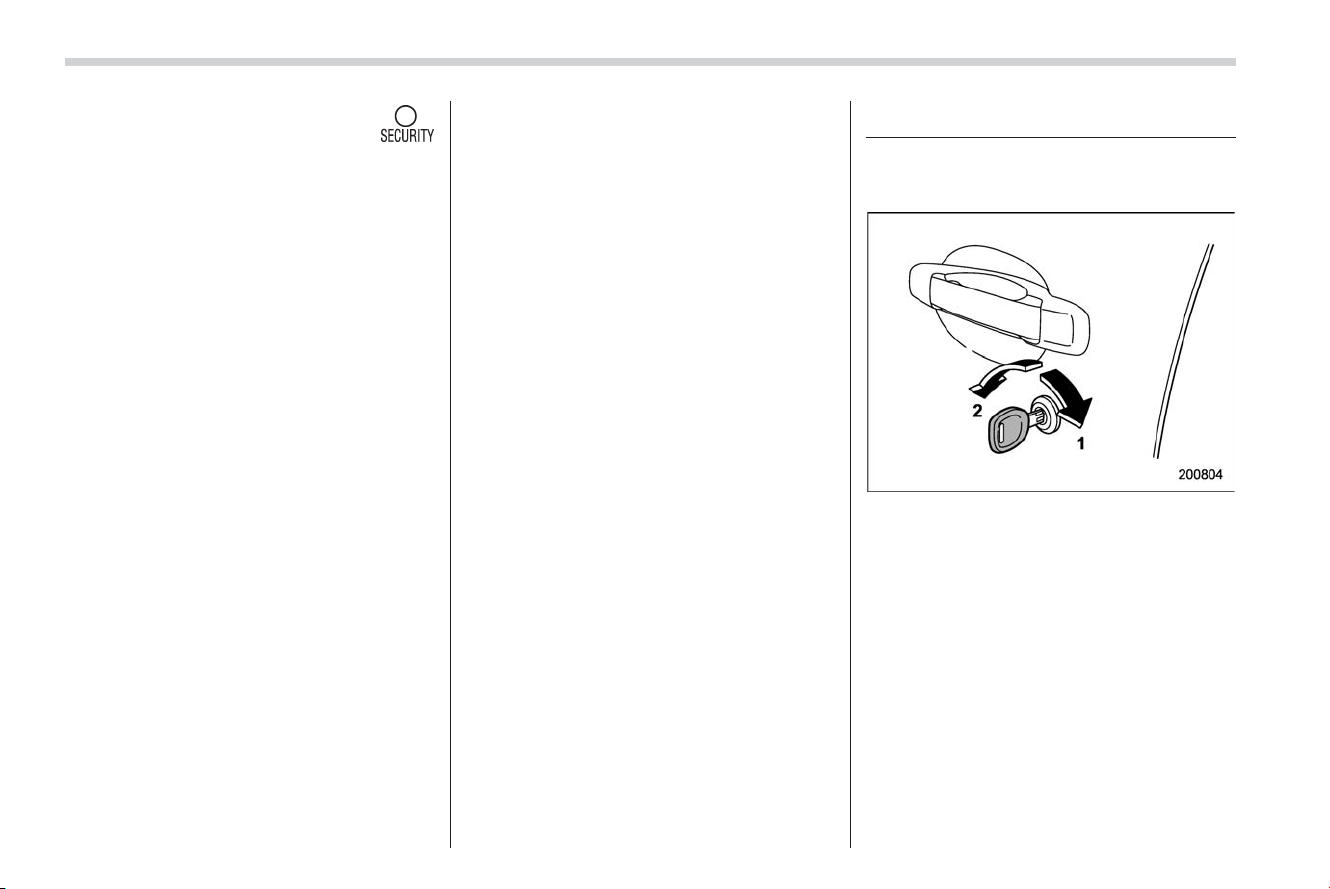
Black plate (94,1)
北米Model "A8130BE-B" EDITED: 2007/ 7/ 25
2-4 Keys and doors
& Security indicator light
The security indicator light deters potential
thieves by indicating that the vehicle is
equipped with an immobilizer system. It
begins flashing approximately 60 seconds
after the ignition switch is turned from the
“ON” position t o the “Acc” or “LOCK”
position or immediately after the key is
pulled out.
If the security indicator light does not flash,
the immobilizer system may be faulty. If
this occurs, contact your SUBARU dealer
as soon as possible.
In case an unauthorized key is used (e.g.
an imitation key), the security indicator
light comes on.
NOTE
Even if the security indicator light
flashes irregularly or its fuse blows
(the light does not flash if its fuse is
blown), the immobilizer system will
function normally.
& Key replacement
Your key number plate and security ID
plate will be required if you ever need a
replacement key made. Any new key must
be registered for use with your vehicle’s
immobilizer system before it can be used.
Up to four keys can be registered for use
with one vehicle.
For security, all the keys registered with
your vehicle’s immobilizer system will
have their ID codes erased and re-
registered when a new key is made.
Therefore, all of your vehicle’s keys must
be presented when a new key is regis-
tered. Any key that is not re-registered
when a new key is made cannot be used
after the other keys are re-registered. For
information on replacement keys and on
the registration of keys with your immo-
bilizer system, contact your SUBARU
dealer.
Door locks
& Locking and unlocking from
the outside
1) Lock
2) Unlock
To lock the driver’s door from the outside
with the key, turn the key toward the rear.
To unlock the door, turn the key toward the
front (Driver’s side only).
Pull the outside door handle to open the
unlocked door.
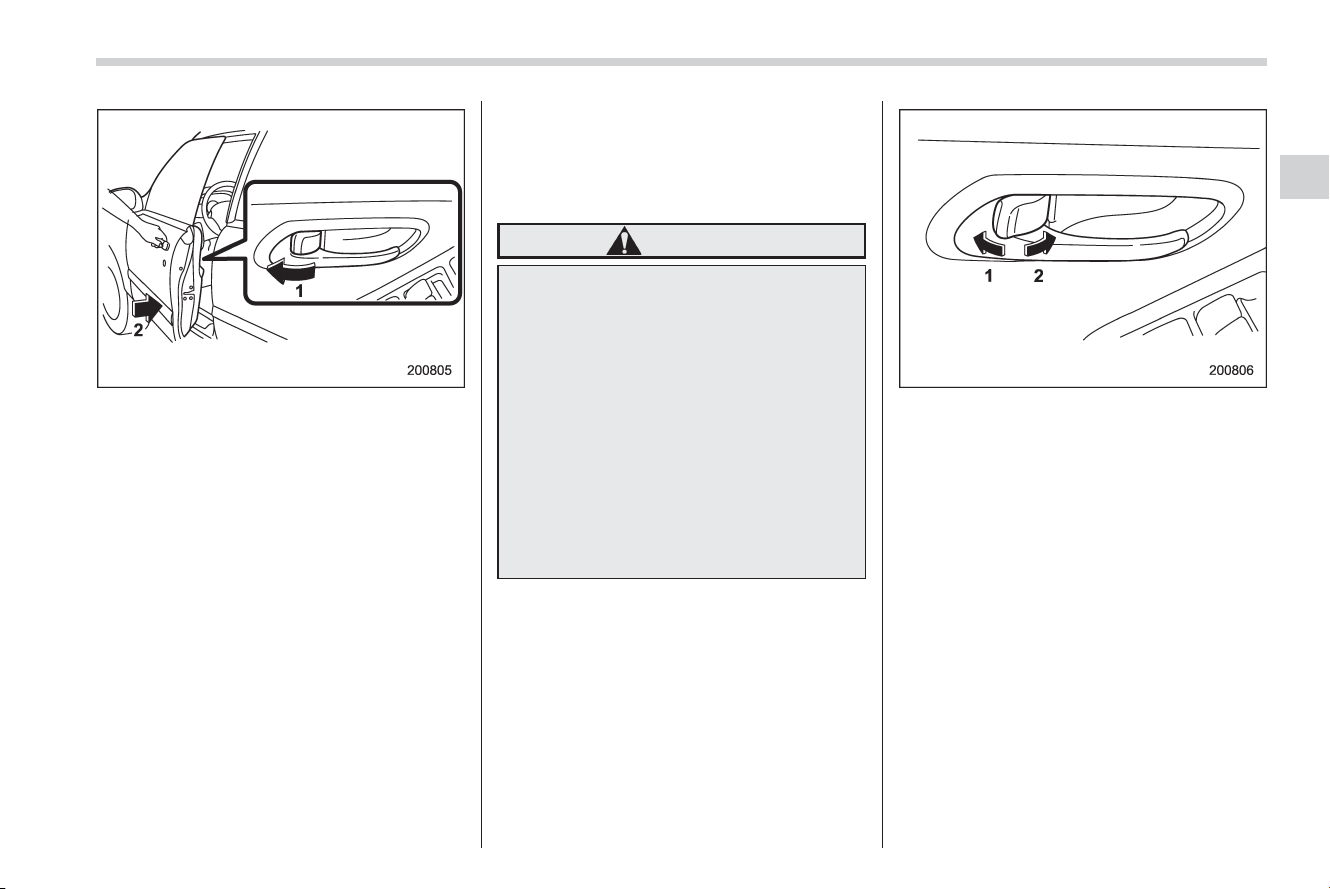
Black plate (95,1)
北米Model "A8130BE-B" EDITED: 2007/ 7/ 25
1) Rotate the lock lever rearward.
2) Close the door.
To lock the door from the outside without
the key, rotate the lock lever rearward and
then close the door.
To lock the door from the outside using the
power door locking switch, push the front
side of the switch (“LOCK” side) and then
close the door. In this case, all closed
doors and the rear gate are locked at the
same time.
Always make sure that all doors and the
rear gate are locked before leaving your
vehicle.
NOTE
Make sure that you do not leave the key
inside the vehicle when locking the
doors from the outside without the key.
& Locking and unlocking from
the inside
WARNING
Keep all doors locked when you
drive, especially when small chil-
dren are in your vehicle.
Along with the proper use of seat-
belts and child restraints, locking
the doors reduces the chance of
being thrown out of the vehicle in an
accident.
It also helps prevent passengers
from falling out if a door is acciden-
tally opened, and intruders from
unexpectedly opening doors and
entering your vehicle.
1) Lock
2) Unlock
To lock the door from the inside, rotate the
lock lever rearward. To unlock the door
from the inside, rotate the lock lever
forward.
The red mark on the lock lever appears
when the door is unlocked.
Pull the inside door handle to open an
unlocked door.
Always make sure that all doors and the
rear gate are closed before starting to
drive.
Keys and doors 2-5
2
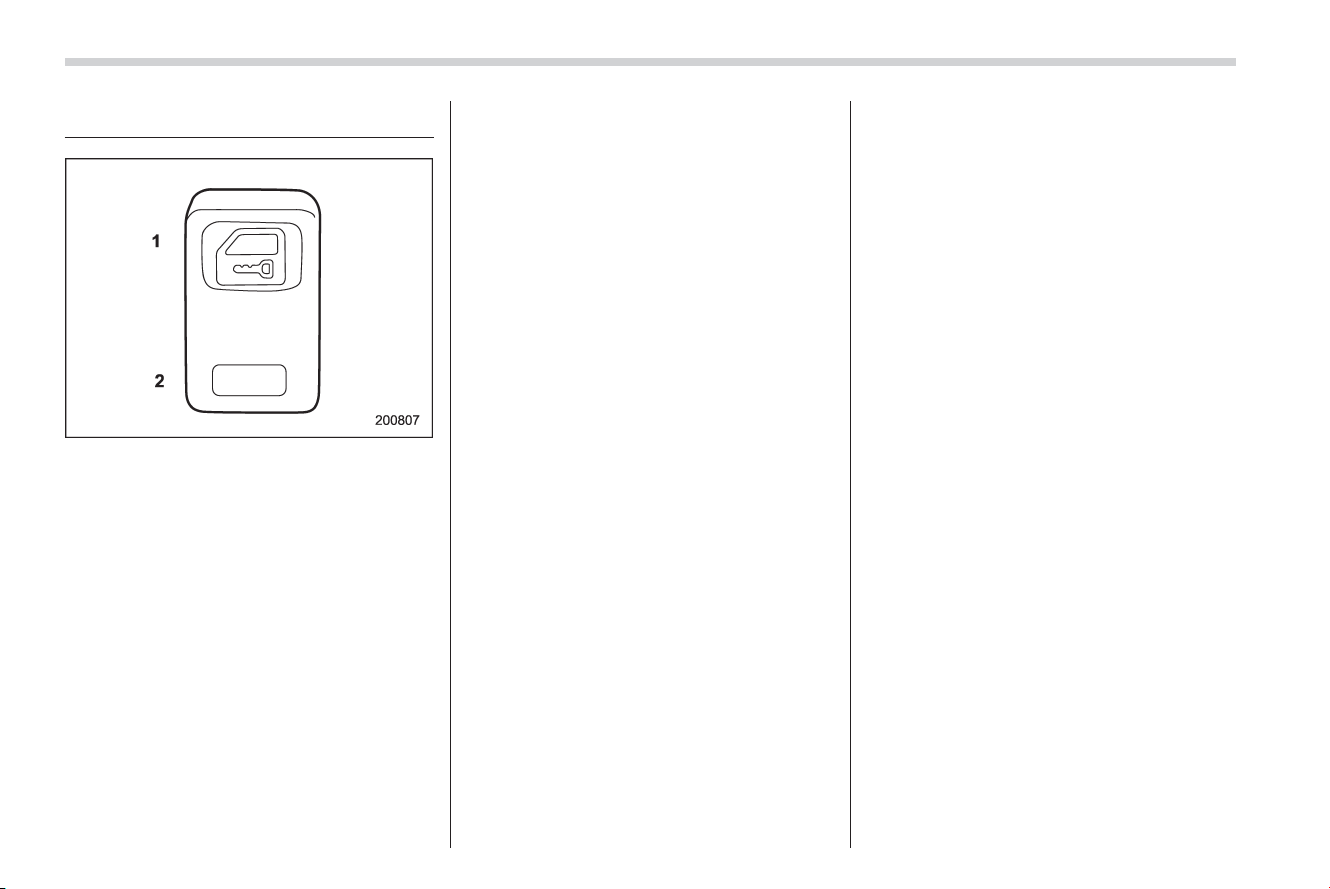
Black plate (96,1)
北米Model "A8130BE-B" EDITED: 2007/ 7/ 25
2-6 Keys and doors
Power door locking switches
1) Lock
2) Unlock
All doors and the rear gate can be locked
and unlocked by the power door locking
switches located at the driver’s side and
the front passenger’s side doors.
To lock all the doors and the rear gate,
push the “LOCK” side of the switch.
To unlock all the doors and the rear gate,
push the “UNLOCK” side of the switch.
When you close the doors after you set
the door locks, the doors remain locked.
NOTE
Make sure that you do not leave the key
inside the vehicle before locking the
doors from the outside using the power
door locking switches.
& Key lock-in prevention func-
tion
This function prevents the doors from
being locked with the key still in the
ignition switch.
! Behavior with key lock-in preven-
tion function operational
With the driver’s door open, the doors are
automatically kept unlocked even if the
door locking switch is pushed to the
“LOCK” side.
! Behavior with key lock-in preven-
tion function non-operational
. If the lock lever is turned to the rear
(“LOCK”) position with the driver’s door
open and the driver’s door is then closed
with the lock lever in that position, the
driver’s door is locked.
. If the spare key is used to lock the
driver’s door from the outside of the
vehicle, the door is locked.
NOTE
When leaving the vehicle, make sure
you are holding the key before locking
the doors.
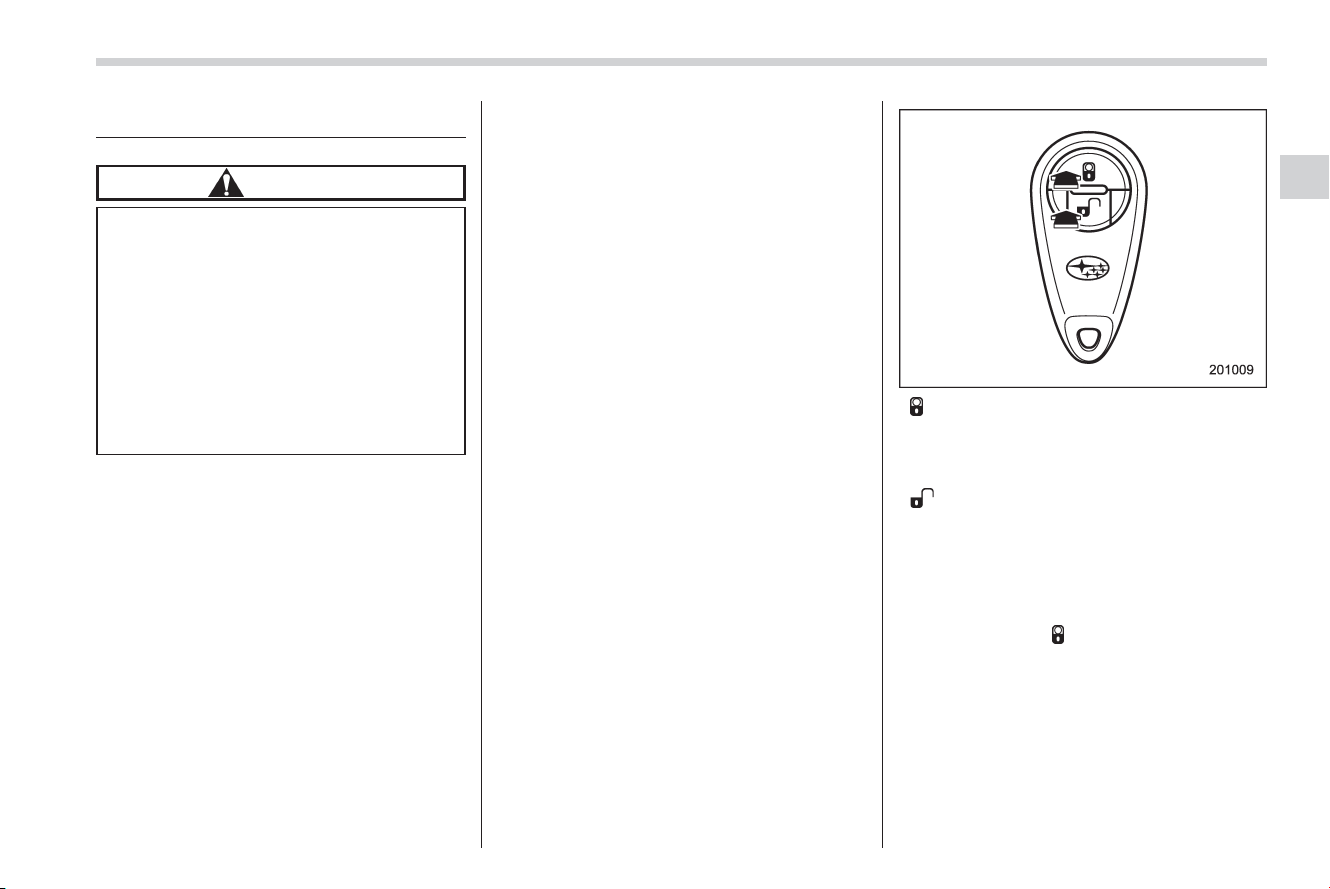
Black plate (97,1)
北米Model "A8130BE-B" EDITED: 2007/ 7/ 25
Remote keyless entry system
CAUTION
. Do not expose the transmitter to
severe shocks, such as those
experienced as a result of drop-
ping or throwing.
. Do not take the transmitter apart
except when replacing the bat-
tery.
. Do not get the transmitter wet. If it
gets wet, wipe it dry with a cloth
immediately.
This device complies with Part 15 of
the FCC Rules and with RSS-210 of
Industry Canada. Operation is subject
to the following two conditions: (1) This
device may not cause harmful inter-
ference, and (2) this device must
accept any interference received, in-
cluding interference that may cause
undesired operation.
Changes or modifications not ex-
pressly approved by the party respon-
sible for compliance could void the
user’s authority to operate the equip-
ment.
Two transmitters are provided for your
vehicle.
The remote keyless entry system has the
following functions.
. Locking and unlocking the doors and
rear gate without a key
. Sounding a panic alarm
. Arming and disarming the alarm sys-
tem (if your vehicle is equipped with an
optional alarm system). See the next
section “Alarm system” for detailed infor-
mation.
The operable distance of the keyless entry
system is approximately 30 feet (10
meters). However, this distance will vary
depending on environmental conditions.
The system’s operable distance will be
shorter in areas near a facility or electronic
equipment emitting strong radio waves
such as a power plant, broadcast station,
TV tower, or remote controller of home
electronic appliances.
The keyless entry system does not oper-
ate when the key is inserted in the ignition
switch to prevent accidental lockout.
: LOCK/ARM button
Press to Lock all doors.
Press and Hold to activate panic alarm.
Press 3 times in a 5-second period to use
vehicle finder function.
: UNLOCK/DISARM button
1) Press once to Unlock driver ’s door.
2) Press a second time to Unlock all
other doors and rear gate.
& Locking the doors
Briefly press the “ ” button (for less than 2
seconds) to lock all doors and rear gate.
An electronic chirp will sound once and
the turn signal lights will flash once.
If any of the doors or the rear gate is not
fully closed, an electronic chirp will sound
5 times and the turn signal lights will flash
5 times to alert you that the doors or the
rear gate are not properly closed. When
Keys and doors 2-7
– CONTINUED –
2
Black plate (98,1)
北米Model "A8130BE-B" EDITED: 2007/ 7/ 25
2-8 Keys and doors
you close the door, it will automatically
lock.
NOTE
If the “ ” button is pressed for 2
seconds or longer, the panic alarm will
sound. When locking t he doors in
normal circumstances, press the “
”
button for less than 2 seconds. For
details on the panic alarm, refer to
“Sounding a panic alarm”.
& Unlocking the doors
Briefly press the “ ” button (for less than
2 seconds) to unlock the driver’s door. An
electronic chirp will sound twice and the
turn signal lights will flash twice. To unlock
all other doors and the rear gate, briefly
press the “
” button a second time within
5 seconds.
NOTE
If the interval between the first and
second presses of the “
” button (for
unlocking of all of the doors and the
rear gate) is extremely short, the sys-
tem may not respond.
& Illuminated entry
The interior (dome and cargo area) light
will illuminate when the “
” button is
pressed. This light stay illuminated for
approximately 30 seconds if any of the
doors or the rear gate is not opened.
If the “
” button is pressed before 30
seconds have elapsed, this light will go
out.
To activate this function, set the following
interior light switches to the indicated
positions:
Dome light: Middle position
Cargo area light: DOOR position
& Vehicle finder function
Use this function to find your vehicle
parked among many vehicles in a large
parking lot. Provided you are within 30 feet
(10 meters) of the vehicle, pressing the “
”
button 3 times in a 5-second period will
cause your vehicle’s horn to sound once
and its turn signal lights to flash 3 times.
NOTE
If the interval between presses is too
short when you press the “
” button 3
times, the system may not respond to
the signals from the remote transmitter.
& Sounding a panic alarm
To activate the alarm, keep the “ ” button
pressed for more than 2 seconds.
The horn will sound and the turn signal
lights will flash.
To deactivate it, press any button on the
remote transmitter. Unless a button on the
remote is pressed, the alarm will be
deactivated after approximately 30 sec-
onds.
& Selecting audible signal op-
eration
Using an electronic chirp, the system will
give you an audible signal when the doors
lock and unlock. If desired, you may turn
the audible signal off.
Do the following to deactivate the audible
signal. You can also use the same steps
to restore the function.
1. Sit in the driver’s seat and shut all
doors and the rear gate.
2. Open the driver’s door, then remove
the key from the ignition switch.
3. Hold down the “UNLOCK” side of the
power door locking switch.
4. While holding down the “UNLOCK ”
side of the power door locking switch,
insert the key into the ignition switch and
remove it again at least 6 times within 10
seconds after Step 3.

Black plate (99,1)
北米Model "A8130BE-B" EDITED: 2007/ 7/ 25
5. While still holding down the “UNLOCK”
side of the power door locking switch,
close the driver’s door once within 10
seconds after Step 4.
6. The turn signal lights flashes 3 times to
indicate completion of the setting.
NOTE
If you do not close the driver’s door
within 10 seconds after Step 4, a flash
of the turn signal lights will signal time-
out. If this happens, repeat the whole
procedure from Step 1.
You may have the above settings done by
your SUBARU dealer.
& Replacing the battery
CAUTION
. Do not let dust, oil or water get on
or in the transmitter when repla-
cing the battery.
. Be careful not to damage the
printed circuit board in the trans-
mitter when replacing the battery.
When the transmitter battery begins to get
weak, transmitter range will begin to
decrease. Replace the battery as soon
as possible.
To replace the battery:
1. Open the transmitter case using a flat-
head screwdriver.
2. Separate the case.
3. Remove the old battery from the
holder.
1) Negative (−) side facing up
4. Replace wi th a new battery (Type
CR2025 or equivalent) making sure to
install the new battery with the negative
(−) side facing up.
5. Reinstall the back half of the transmit-
ter case by snapping it back on.
After the battery is replaced, the trans-
mitter must be synchronized with the
keyless entry system’s control unit.
Press either the “
” or “ ” button 6
times to synchronize the unit.
& Replacing lost transmitters
If you lose a transmitter or want to
purchase additional transmitters (up to
four can be programmed), you should re-
program all of your transmitters for secur-
Keys and doors 2-9
– CONTINUED –
2
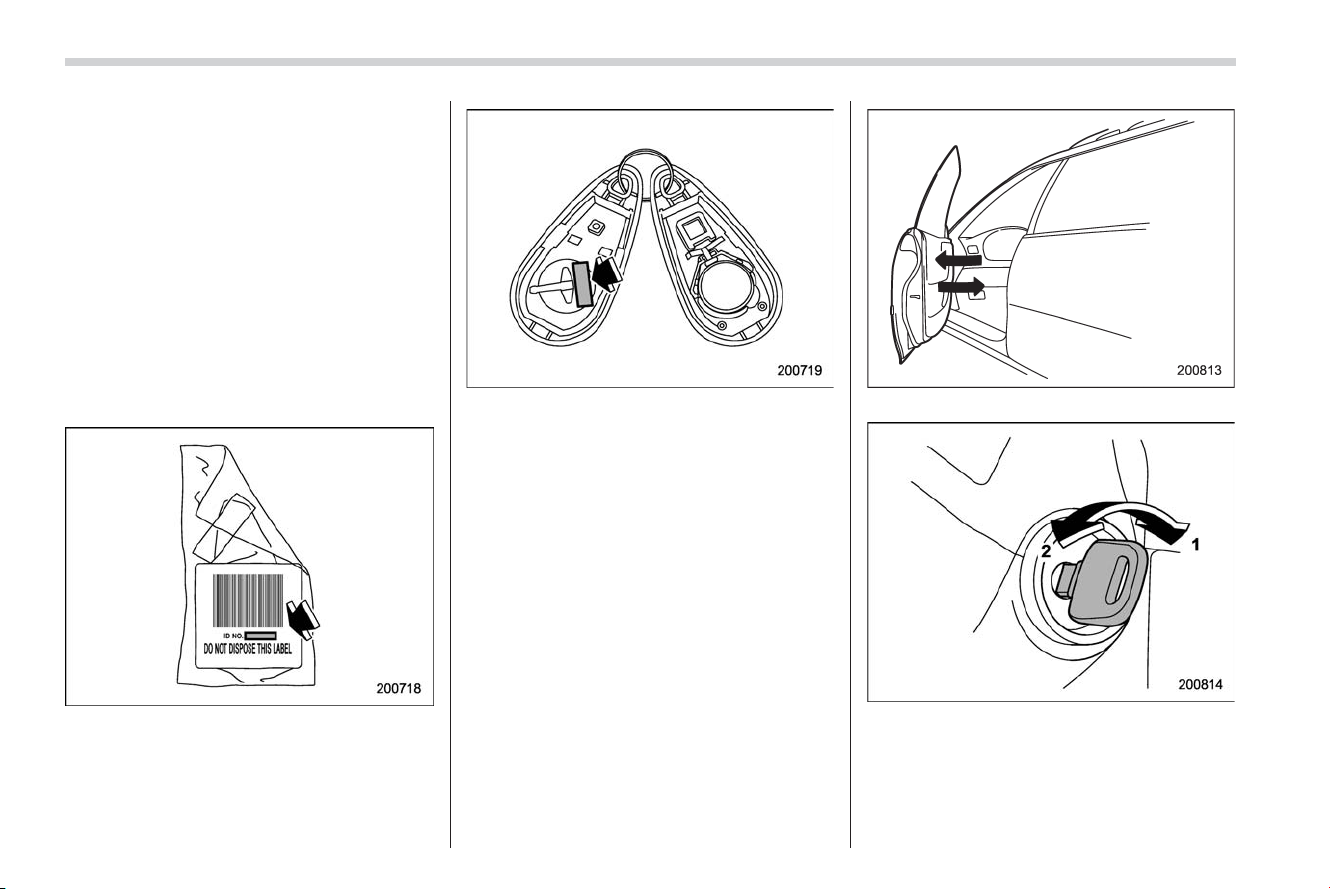
Black plate (100,1)
北米Model "A8130BE-B" EDITED: 2007/ 7/ 25
2-10 Keys and doors
ity reasons. It is recommended that you
have your dealer program all of your
transmitters into your system.
! Programming the transmitters
The keyless entry system is equipped with
a special code learning feature that allows
you to program new transmitter codes into
the system or to delete old ones. The
system can learn up to four unique
transmitter codes. The four transmitter
codes may be the same or different.
Programming transmitter codes into
system:
Bag containing transmitter
Transmitter circuit board
To register a new transmitter with the
keyless entry system, it is necessary to
program the transmitter’s code (identifica-
tion number) into the system. A label
showing the code is affixed to the bag
containing the transmitter, and another is
affixed to the circuit board inside the
transmitter. If there is no bag, open the
transmitter case and make a note of the
eight-digit number. Program the number
into the system in accordance with the
following procedure:
1. Firmly close the doors and the rear
gate.
2. Open the driver’s door, sit on the
driver’s seat, and close the door.
3. Perform the following steps within 45
seconds.
1) Open and close the driver’s door once.
1) ON
2) LOCK
2) Insert the key into the ignition switch,
then turn it from the “LOCK” position to the
“ON” position 10 times within 15 seconds.
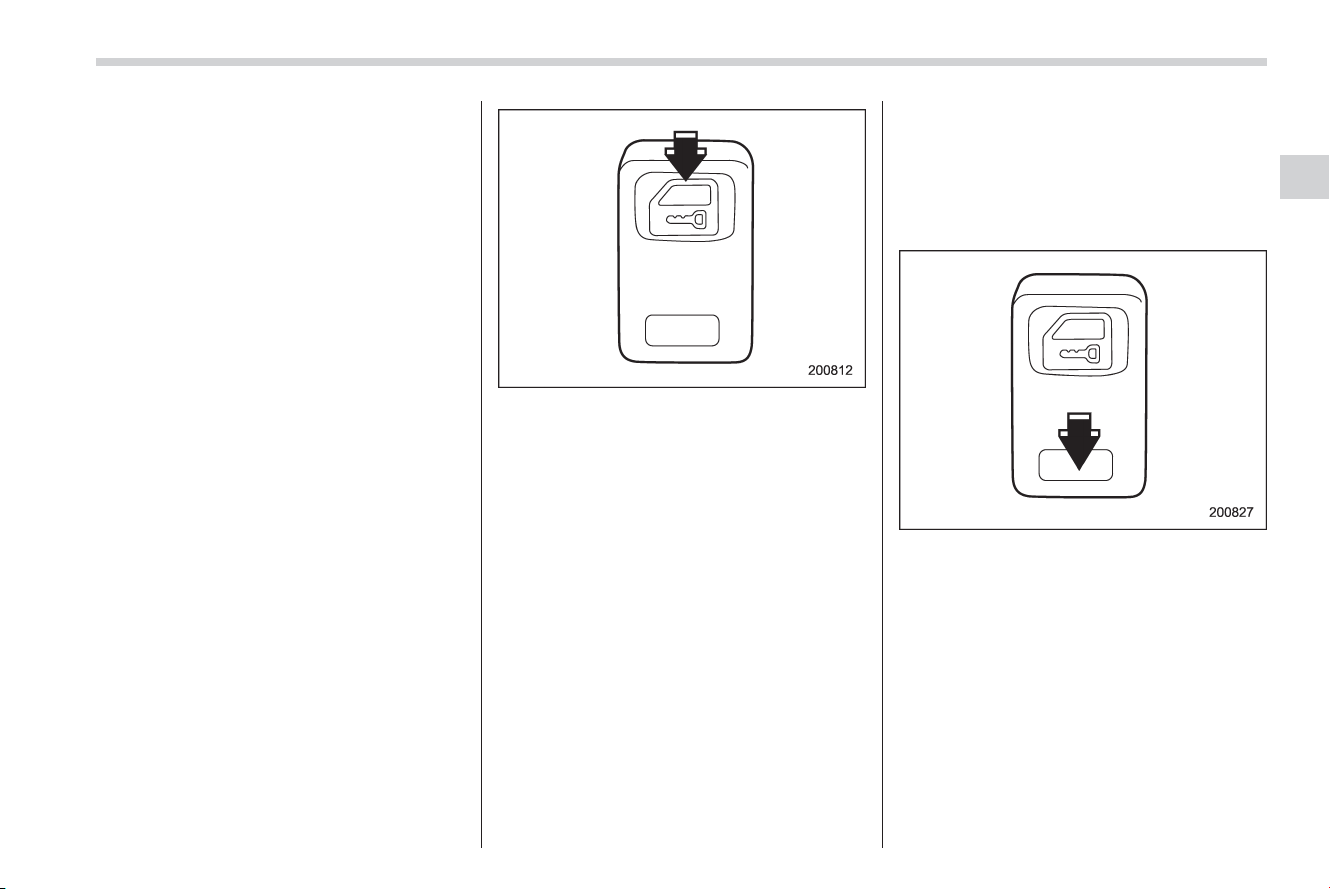
Black plate (101,1)
北米Model "A8130BE-B" EDITED: 2007/ 7/ 25
NOTE
. When you complete step 2), an
electronic tone will sound once.
. If you do not perform steps 1) and 2)
within 45 seconds, an error will occur.
An electronic tone will not sound. In
this event, perform the whole proce-
dure again beginning with part 1.
4. Open and close the door once within
15 seconds.
NOTE
. When part 4 of the procedure is
completed, an electronic tone will
sound for 30 seconds.
. If you do not perform the operations
in part 4 within 15 seconds, an error
will occur and the electronic tone will
not sound. In this event, perform the
registration steps again beginning with
part 3 of the procedure.
5. Before the electronic tone stops
sounding, push the “LOCK” side of the
power door lock switch the same number
of times as the leftmost digit of the
transmitter code. For example, push the
lock switch 8 times if the leftmost digit of
the code is 8.
NOTE
. The electronic tone will stop sound-
ing when you start entering the num-
ber.
. If you do not start entering the
number using the lock switch before
the electronic tone stops sounding, an
error will occur. In this event, perform
the registration steps again beginning
with part 3 of the procedure.
. If the interval between one push of
the switch and the next exceeds 5
seconds, an error will occur. In this
event, perform the procedure again
beginning with part 4. If an error occurs
6 times, perform the procedure again
starting with part 3.
6. When you have finished entering the
number, push the “UNLOCK” side of the
lock switch within 5 seconds.
NOTE
. An electronic tone will sound.
. If you push the “UNLOCK” side of
the lock switch when more than 5
seconds have passed, an error will
occur. In this event, perform the proce-
dure again beginning with part 4. If an
error occurs 6 times, perform the
procedure again starting with part 3.
Keys and doors 2-11
– CONTINUED –
2

Black plate (102,1)
北米Model "A8130BE-B" EDITED: 2007/ 7/ 25
2-12 Keys and doors
7. Perform parts 5 and 6 of the procedure
for each of the remaining digits of the
transmitter code beginning with the sec-
ond digit (counting from the left) and
finishing with the eighth digit.
NOTE
. When you finish entering the eighth
digit, an electronic tone will sound for
30 seconds.
. If the interval between one push of
the switch and the next exceeds 5
seconds, an error will occur. In this
event, perform the procedure again
beginning with part 4. If an error occurs
6 times, perform the procedure again
starting with part 3.
8. Before the electronic tone stops
sounding, use the power door lock switch
to reenter the transmitter code beginning
with the leftmost digit.
NOTE
If you do not start entering the number
using the lock switch before the elec-
tronic tone stops sounding, an error
will occur. In this event, perform the
procedure again beginning with part 3.
9. When you have finished entering the
code a second time, an electronic tone will
sound for 1 second to indicate completion
of registration, provided the code entered
the second time is identical to that entered
the first time.
NOTE
If the code entered the second time is
not identical to the code entered the
first time, an error will occur. In this
event, perform the procedure again
beginning with part 5. If an error occurs
5 times, perform the procedure again
starting with part 3.
10. If you wish to program another trans-
mitter code into the system (up to four
transmitter codes can be programmed into
the system), perform the procedure begin-
ning with part 4. When you have finished
programming all of the necessary trans-
mitter codes into the system, remove the
key from the ignition switch.
11. Test every registered transmitter to
confirm correct operation.
! Deleting old transmitter codes
The control un it of the keyless entry
system has four memory locations to store
transmitter codes, giving it the ability to
operate with up to four transmitters. When
you lose a transmitter, the lost transmit-
ter’s code remains in the memory. For
security reasons, lost transmitter codes
should be deleted from the memory.
To delete old transmitter codes, program
four transmitter codes into the system. If
you have only one current transmitter,
program it 4 times. If you have two current
transmitters, program each one twice. If
you have three current transmitters, pro-
gram two of them once and the third one
twice. This process will leave only current
transmitter codes in the system’s memory.
NOTE
Make sure no one else is operating
their keyless entry system within range
of your vehicle when programming
transmitters. If someone else were to
operate their remote transmitter while
you are programming your transmit-
ters, it is possible that their transmitter
code will be programmed into your
system, allowing them unauthorized
access to your vehicle.

Black plate (103,1)
北米Model "A8130BE-B" EDITED: 2007/ 7/ 25
Alarm system
The alarm system helps to protect your
vehicle and valuables from theft. The horn
sounds and the turn signal lights flash if
someone attempts to break into your
vehicle. The starter motor is also inter-
rupted to preve nt starting the vehicle
without a key.
The system can be armed and disarmed
with the remote transmitter.
The system does not operate when the
key is inserted into the ignition switch.
Your vehicle’s alarm system has been set
for activation at the time of shipment from
the factory. You can set the system for
deactivation yourself or have it done by
your SUBARU dealer.
& System operation
The alarm system will give the following
alarm when triggered:
. The vehicle’s horn will sound and the
turn signal lights will flash for 30 seconds.
. If any door or the rear gate remains
open after the 30-second period, the horn
will continue to sound for a maximum of 3
minutes. If the door and the rear gate are
closed while the horn is sounding, the
horn will stop sounding with a delay of up
to 30 seconds.
The alarm is triggered by:
. Opening a door or the rear gate.
. Physical impact to the vehicle, such as
forced entry (only vehicles with shock
sensors (dealer option))
& Activating and deactivating
the alarm system
To change the setting of your vehicle’s
alarm system for activation or deactiva-
tion, do the following.
1. Disarm the alarm system (see “Dis-
arming the system” in this section).
2. Sit in the driver’s seat and shut all
doors and the rear gate.
3. Turn the ignition switch to the “ON”
position.
4. Hold down the UNLOCK side of the
driver’s power door locking switch, open
the driver’s door within the following 1
second, and wait 10 seconds without
releasing the switch. The setting will then
be changed as follows:
If the system was previously activated:
The horn sounds twice, indicating that the
system is now deactivated.
If the system was previously deactivated:
The horn sounds once, indicating that the
system is now activated.
NOTE
You may have the above setting
change done by your SUBARU dealer.
& If you have accidentally trig-
gered the alarm system
! To stop the alarm
Do any of the following operations:
. Press any button on the remote trans-
mitter.
. Cycle the ignition switch from the
“LOCK” to “ON” position 3 times within 5
seconds.
& Arming the system
! To arm the system using remote
transmitter
1. Close all windows and the moonroof (if
so equipped).
2. Remove the key from the ignition
switch.
3. Open the doors and get out of the
vehicle.
4. Make sure that the engine hood is
locked.
5. Close all doors and the rear gate.
Keys and doors 2-13
– CONTINUED –
2

Black plate (104,1)
北米Model "A8130BE-B" EDITED: 2007/ 7/ 25
2-14 Keys and doors
: Press to Arm the system.
: Press to Disarm the system.
Security indicator light
6. Briefly press the “ ” button (for less
than 2 seconds). All doors and the rear
gate will lock, an electric chirp will sound
once, the turn signal lights will flash once,
and the indicator lights will start flashing
rapidly. After rapid flashing for 30 seconds
(standby time), the indicator lights will then
flash slowly (twice approximately every 2
seconds), indicating that the system has
been armed for surveillance.
If any of the doors or the rear gate is not
fully closed, an electronic chirp sounds 5
times, the turn signal lights flash 5 times to
alert you that the doors or the rear gate
are not properly closed. When you close
the door, the system will automatically arm
and doors will automatically lock.
! To arm the system using power
door locking switches
1. Close all windows.
2. Remove the key from the ignition
switch.
3. Open the doors and get out of the
vehicle.
4. Make sure that the engine hood is
locked.
5. Close the doors and the rear gate but
leave only the driver’s door or the front
passenger’s door open.
6. Push the front side (“LOCK” side) of
the power door locking switch to set the
door locks.
7. Close the door. An electronic chirp will
sound once, the turn signal lights will flash
once, and the indicator lights will start
flashing rapidly. After rapid flashing for 30
seconds (standby time), the indicator
lights will then flash slowly (twice approxi-
mately every 2 seconds), indicating that
the system has been armed for surveil-
lance.
NOTE
. The system can be armed even if the
engine hood, the windows and/or
moonroof are opened. Always make
sure that they are fully closed before
arming the system.

Black plate (105,1)
北米Model "A8130BE-B" EDITED: 2007/ 7/ 25
. The 30-second standby time can be
eliminated if you prefer. Have it per-
formed by your SUBARU dealer.
. The system is in the standby mode
for a 30-second period after locking the
doors with the remote transmitter. The
security indicator light will flash at
short intervals during this period.
. If any of the following actions is
done during the standby period, the
system will not switch to the surveil-
lance state.
. Doors are unlocked using the
remote transmitter.
. Any door or the rear gate is
opened.
. Ignition switch is turned to the
“ON” position.
. The engine does not start even
when the ignition switch is turned to
the “START ” position once the alarm
system has been triggered.
& Disarming the system
Briefly press the “ ” button (for less than
2 seconds) on the remote transmitter. The
driver’s door will unlock, an electronic
chirp will sound twice, the turn signal
lights will flash twice and the indicator
light will go off.
NOTE (Models with immobilizer)
If your vehicle is equipped with an
immobilizer, the immobilizer’s function
will cause the security indicator light to
flash (approximately once every 3
seconds) even after the system is
disarmed.
NOTE
The system can be disarmed by the
following method, too.
. Cycle the ignition switch from the
“LOCK” to the “ON” position 3 times
within 5 seconds.
! Emergency disarming
If you cannot disarm the system using the
transmitter (i.e. the transmitter is lost,
broken or the transmitter battery is too
weak), you can disarm the system without
using the transmitter.
1. Unlock the door with the key and then
open the door.
2. Insert the key into the ignition switch
and cycle it from the “LOCK” to the “ON”
position 3 times within 5 seconds.
& Valet mode
When you choose the valet mode, the
security system does not operate. In valet
mode, the remote transmitter is used only
for locking and unlocking the doors and
rear gate and panic activation.
To enter the valet mode, change the
setting of your vehicle’s alarm system for
deactivation mode. (Refer to “Activating
and deactivating the alarm system” in this
section.) The security indicator light will
continue to flash once every 3 seconds
indicating that the system is in the valet
mode (only vehicle with an immobilizer).
To exit valet mode, change the setting of
your vehicle’s alarm system for activation
mode. (Refer to “Activating and deactivat-
ing the alarm system” in this section.)
NOTE
If your vehicle is not equipped with an
immobilizer, the security indicator light
does not flash during the valet mode.
& Passive arming
When passive arming mode has been
programmed by the dealer, arming of the
system is automatically accomplished
without using the remote transmitter. Note
that in this mode, DOORS MUST BE
MANUALLY LOCKED.
! To enter the passive mode
If you wish to program the passive arming
mode, have it done by your SUBARU
Keys and doors 2-15
– CONTINUED –
2
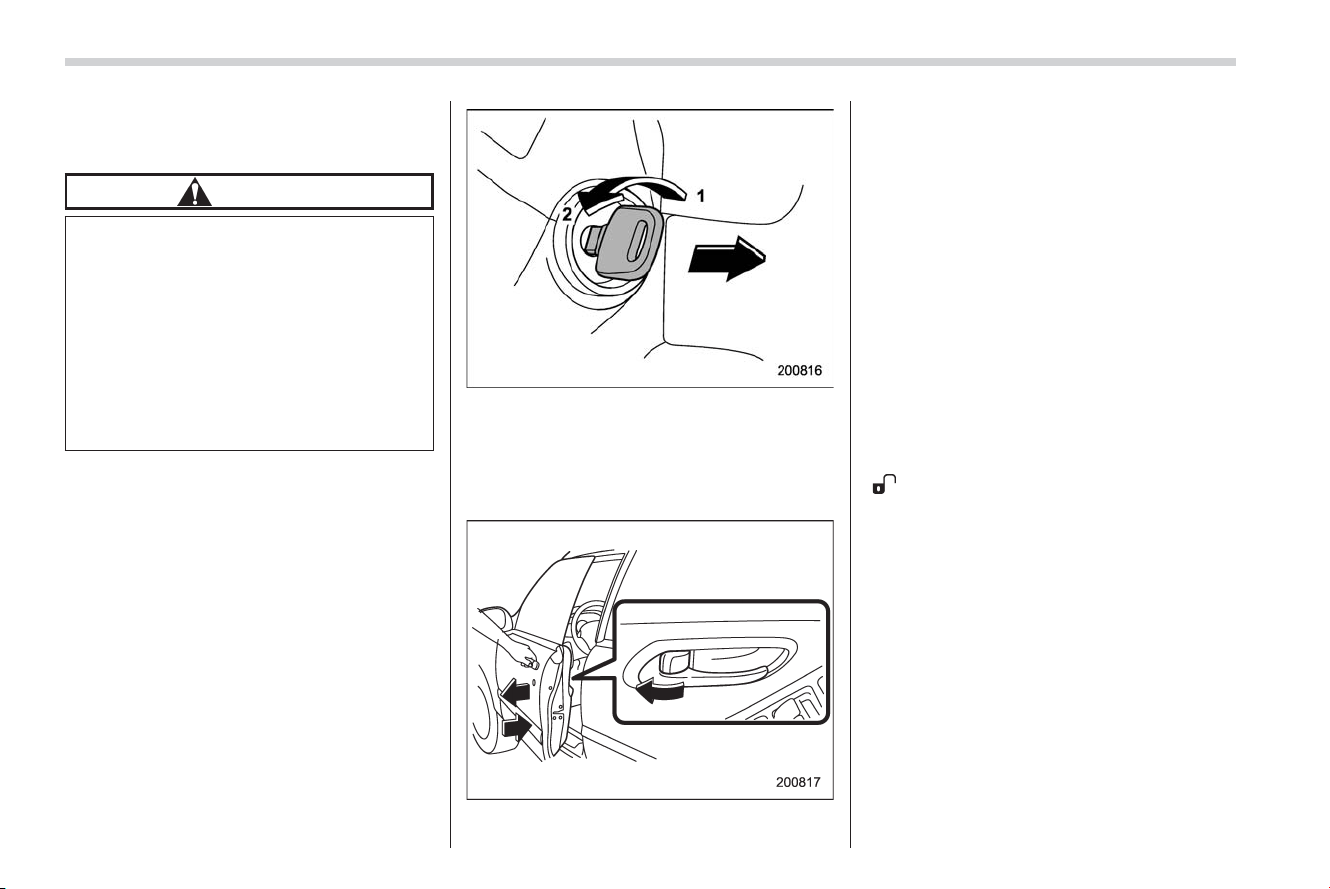
Black plate (106,1)
北米Model "A8130BE-B" EDITED: 2007/ 7/ 25
2-16 Keys and doors
dealer.
! Arming the system
CAUTION
In passive mode, the system will
automatically activate the alarm but
WILL NOT automatically lock the
doors. In order to lock the doors
you must either lock them as in-
dicated in the following step 4 or
with the key once they have been
closed. Failure to lock the doors
manually will result in a higher
security risk.
1. Turn the ignition switch to the “ON”
position.
1) ON
2) LOCK
2. Turn the ignition switch from “ON” to
“LOCK” position and remove the key from
the ignition switch.
3. Open the doors and get out of the
vehicle.
4. Before closing the doors, lock all doors
with the inside door lock levers.
5. Close the doors. The system will
automatically arm after one minute.
In the passive mode, the system can also
be armed with the remote transmitter or
with the power door locking switches. If
the remote transmitter or power door
locking switch is used to lock the vehicle,
arming will take place immediately regard-
less of whether or not the passive mode
has been selected.
! Disarming the system
To disarm the system, briefly press the
“
” button on the transmitter.
& Tripped sensor identification
The security indicator light flashes when
the alarm system has been triggered.
Also, the number of flashes indicates the
location of unauthorized intrusion or the
severity of impact on the vehicle.
. When the ignition switch is turned to
the “ON” position, the indicator light will
light for 1 second and then flash as
follows:
When a door or rear gate was opened:
5 times
When the ignition switch was turned to
the “ON” position: 3 times
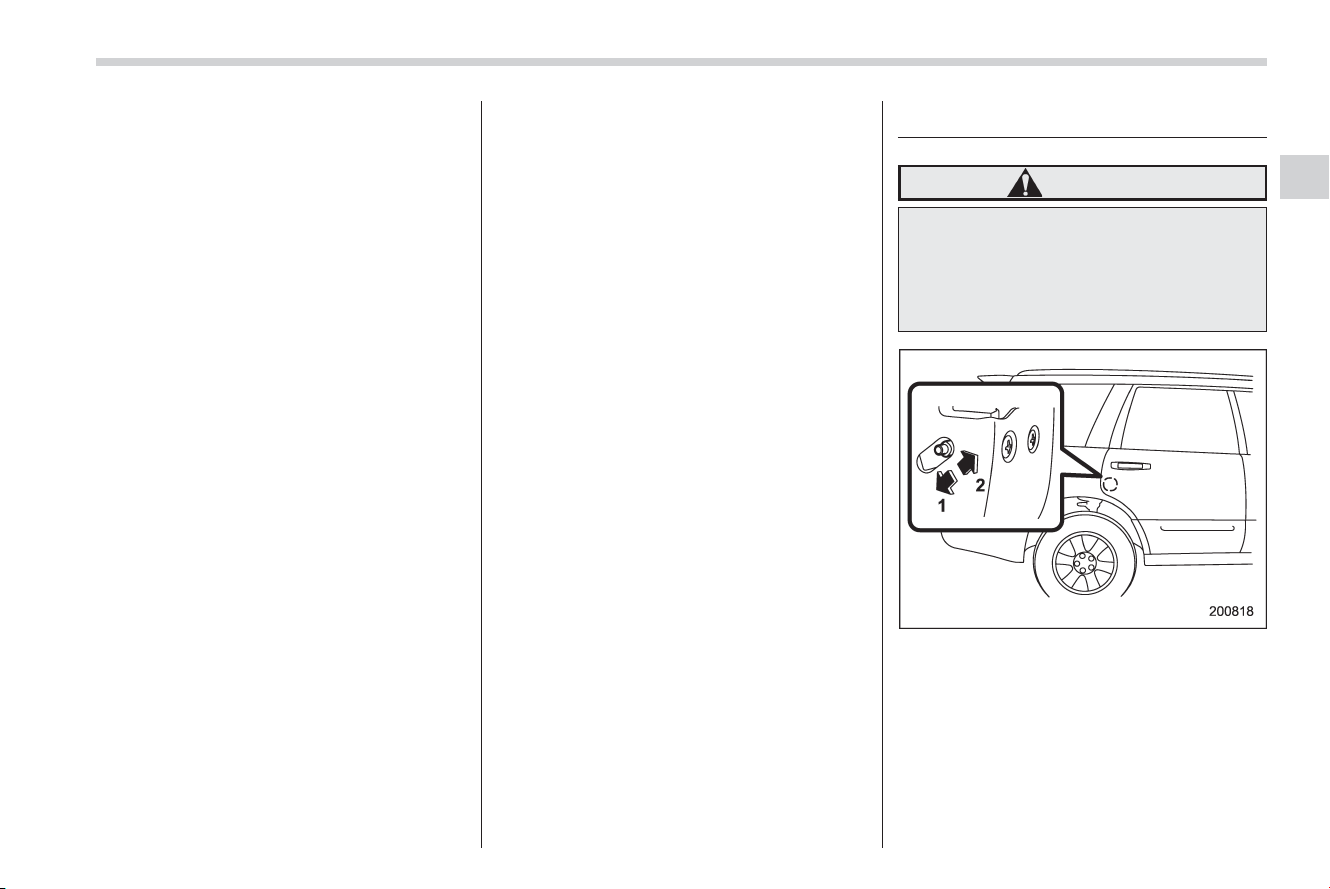
Black plate (107,1)
北米Model "A8130BE-B" EDITED: 2007/ 7/ 25
When a strong impact or multiple
impacts were sensed: twice (only
vehicles with shock sensors (dealer
option))
When a light impact was sensed: once
(only vehicles with shock sensors
(dealer option))
NOTE
Any of the above indicator light flash-
ings will recur each time the ignition
switch is turned to the “ON” position.
Rearming the alarm system cancels the
flashing.
& Shock sensors (dealer op-
tion)
The shock sensors trigger the alarm
system when they sense impacts applied
to the vehicle and when any of their
electric wires is cut. The alarm system
causes the horn to sound and the turn
signal lights to flash for a short time when
the sensed impact is weak, but it warns of
a strong impact or multiple impacts by
sounding the horn and flashing the turn
signal lights, both lasting approximately 30
seconds.
If you desire, your SUBARU dealer can
connect them and set them for activation
or deactivation.
NOTE
. The shock sensors are not always
able to sense impacts caused by break-
ing in, and cannot sense an impact that
does not cause vibration (such as
breaking the glass using a rescue
hammer).
. The shock sensors may sense vi-
bration like those shown below and
trigger the alarm system. Select the
settings of the alarm system and shock
senso rs appropriately depending on
where you usually park your vehicle.
Example:
Vibration from a construction site
Vibration in a multistory parkin g
garage
Vibration from trains
. You can have the sensitivity of the
shock sensors adjusted to your pre-
ference by your SUBARU dealer.
Child safety locks
WARNING
Always use the child safety lock
whenever a child rides in the rear
seat. Serious injury could result if a
child accidentally opened the door
and fell out.
1) Lock
2) Unlock
Each rear door has a child safety lock that
prevents the doors from being opened
even if the inside door handle is pulled.
When the child safety lock lever is in the
lock position, the door cannot be opened
from inside regardless of the position of
Keys and doors 2-17
– CONTINUED –
2
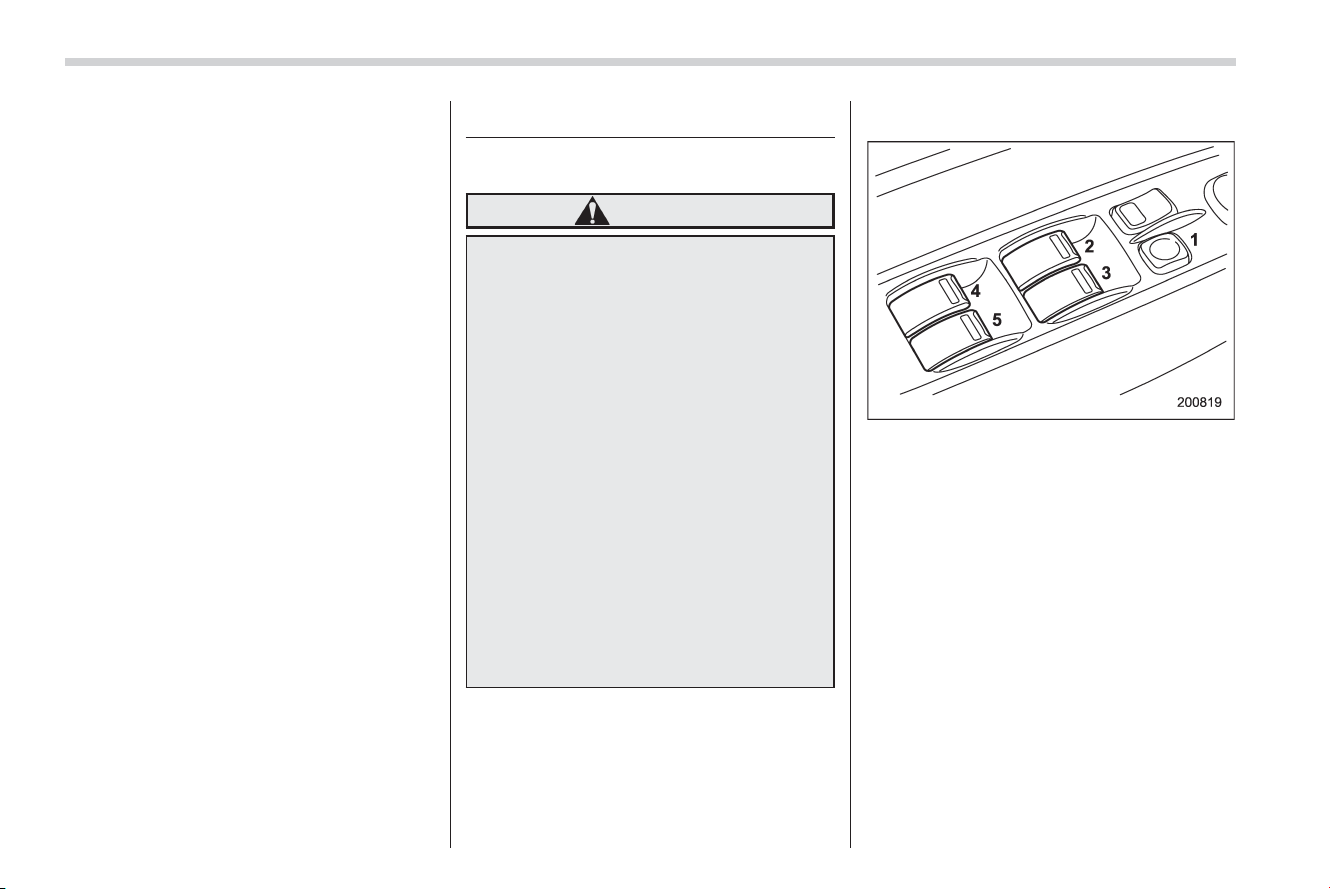
Black plate (108,1)
北米Model "A8130BE-B" EDITED: 2007/ 7/ 25
2-18 Keys and doors
the inner door handle lock lever. The door
can only be opened from the outside.
Windows
& Power windows
WARNING
To avoid serious personal injury
caused by entrapment, you must
do the following.
. When operating the power win-
dows, be extremely careful to
prevent anyone’s fingers, arms,
neck or head from being caught
in the window.
. Always lock the passengers’ win-
dows using the lock switch when
children are riding in the vehicle.
. Before leaving the vehicle, al-
ways remove the key from the
ignition switch for safety and
never allow an unattended child
to remain in the vehicle. Failure
to follow this procedure could
result in injury to a child operat-
ing the power window.
The power windows operate only when
the ignition switch is in the “ON” position.
! Driver’s side switches
1) Lock switch
2) For driver’s window (with one-touch auto
down feature)
3) For front passenger’s window
4) For rear left window
5) For rear right window
All door windows can be controlled by the
power window switch cluster at the driver
side door.
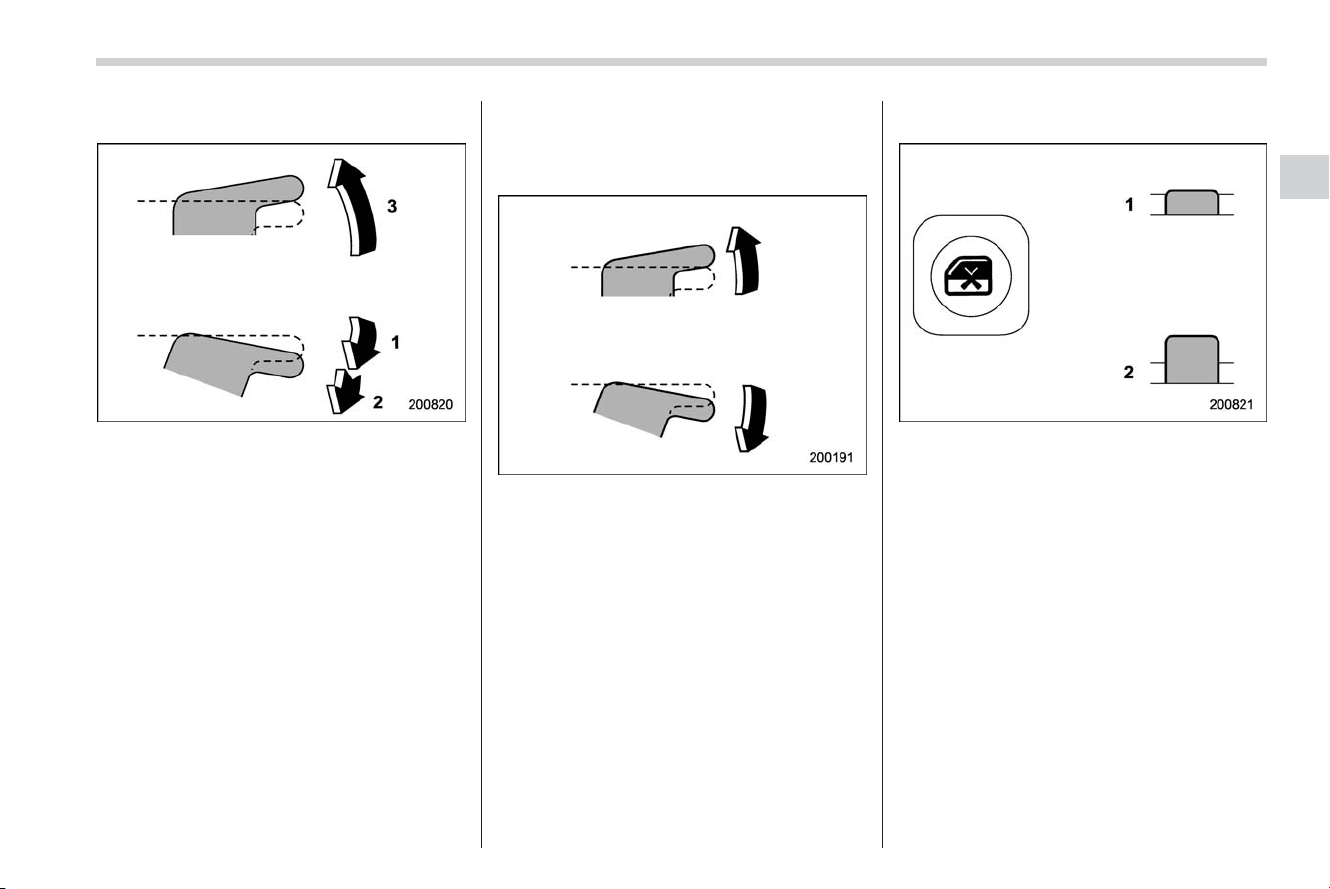
Black plate (109,1)
北米Model "A8130BE-B" EDITED: 2007/ 7/ 25
! Operating the driver’s window
1) Open
2) Automatically open
3) Close
To open:
Push the switch down lightly and hold it.
The window will open as long as the
switch is held.
This switch also has a one-touch auto
down feature that allows the window to be
opened fully without holding the switch.
Push the switch down until it clicks and
release it, and the window will fully open.
To stop the window halfway, pull the
switch up lightly.
To close:
Pull the switch up lightly and hold it. The
window will close as long as the switch is
held.
! Operating the passengers’ windows
To open the passengers’ windows, push
the appropriate switch down and hold it
until the win dow reaches the desired
position.
To close the window, pull the switch up
and hold it until it reaches the desired
position.
! Locking the passengers’ windows
1) Lock
2) Unlock
To lock the passengers’ windows, push
the lock switch. When the lock switch is in
the “LOCK” position, the passengers’
windows cannot be opened or closed.
Press the switch again to cancel the
passengers’ window locking.
! Passengers’ side switches
To open the window, push the switch
down and hold it until the window reaches
the desired position.
To close the window, pull the switch up
and hold it until the window reaches the
desired position.
When the lock switch on the power
Keys and doors 2-19
– CONTINUED –
2

Black plate (110,1)
北米Model "A8130BE-B" EDITED: 2007/ 7/ 25
2-20 Keys and doors
window switch cluster, located on the
driver ’s side door, is in the “LOCK”
position, the passengers’ windows cannot
be operated with the passengers’
switches.
Rear gate
WARNING
. Do not attempt to shut the rear
gate while holding the inside
handle. Also avoid closing the
rear gate by pulling on the inside
handle from inside the cargo
space. There is a danger of your
hand being caught and injured.
. To prevent dangerous exhaust
gas from ent ering the vehicle,
always keep the rear gate closed
while driving.
CAUTION
. Do not jam a plastic bag in or
place cellophane tape on the rear
gate stays or scratch the stays
while loading or unloading cargo.
That could cause leakage of gas
from the stays, which may result
in their inability to hold the rear
gate open.
. Be careful not to hit your head or
face on the rear gate when open-
ing or closing the rear gate and
when loading or unloading car-
go.
The rear gate can be locked and unlocked
using either the keyless entry system or
the power door locking switches.
Refer to the “Power door locking switches”
and “Remote keyless entry system” sec-
tions in this chapter.
To open the rear gate, first unlock the rear
gate lock then pull the outside handle up.
Then, hold the rear gate and raise it as
high as it will go.
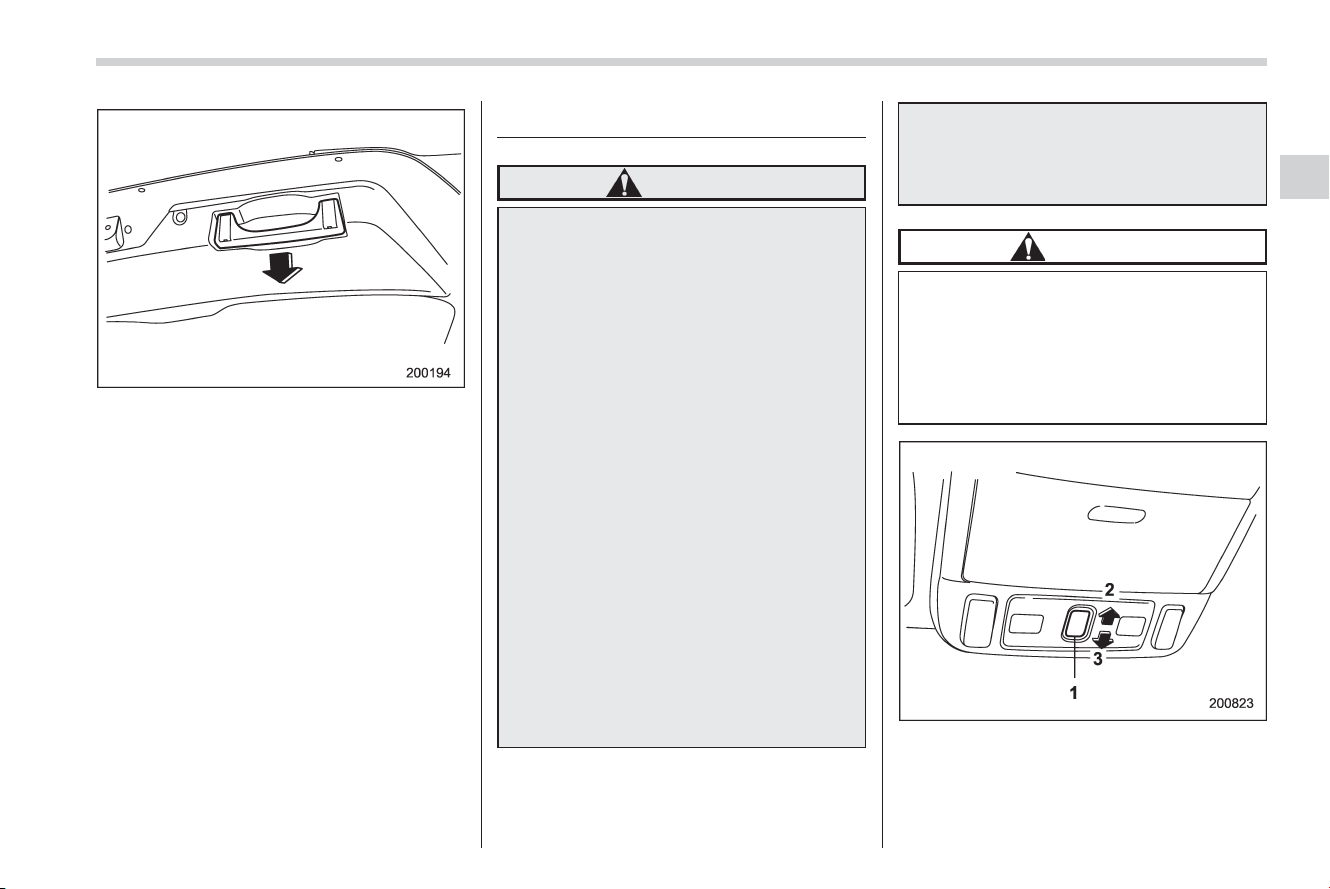
Black plate (111,1)
北米Model "A8130BE-B" EDITED: 2007/ 7/ 25
To close the rear gate, lower it slowly and
push down firmly until the latch engages.
The rear gate can be lowered easily if you
pull down holding the recessed grip.
NOTE
If the rear gate cannot be unlocked due
to a discharged battery, a fault in the
door locking/unlocking system or other
causes, you can unlock it by manually
operating the rear gate lock release
lever.
For the procedure, refer to “Rear gate –
if the rear gate cannot be unlocked” in
chapter 9 “In case of emergency”.
Moonroof (if equipped)
WARNING
. Never let anyone’s hands, arms,
head or any objects protrude
from the moonroof. A person
could be seriously injured if the
vehicle stops suddenly or turns
sharply or if the vehicle is in-
volved in an accident.
To avoid serious personal injury
caused by entrapment, you must
do the following.
. Before closing the moonroof,
make sure that no one’s hands,
arms, head or other objects will
be accidentally caught in the
moonroof.
. Before leaving the vehicle, al-
ways remove the key from the
ignition switch for safety and
never allow an unattended child
to remain in the vehicle. Failure
to follow this procedure could
result in injury to a child operat-
ing the moonroof.
. Never try to check the anti-en-
trapment function by deliberately
placing part of your body in the
moonroof.
CAUTION
. Do not sit on the edge of the open
moonroof.
. Do not operate the moonroof if
falling snow or extremely cold
conditions have caused it to
freeze shut.
1) Open/close switch
2) Open
3) Close
The moonroof operates only when the
Keys and doors 2-21
– CONTINUED –
2
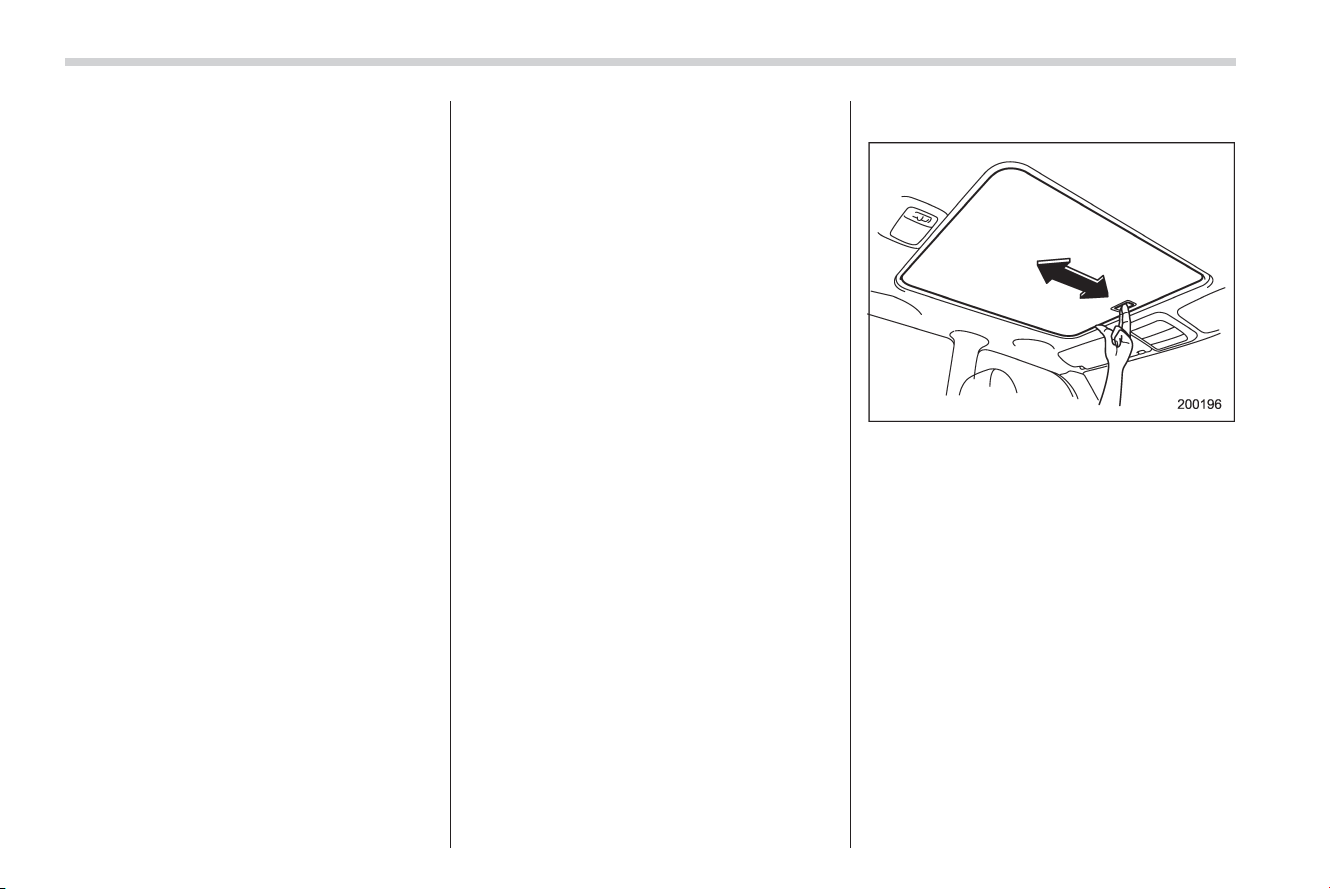
Black plate (112,1)
北米Model "A8130BE-B" EDITED: 2007/ 7/ 25
2-22 Keys and doors
ignition switch is in the “ON” position.
& To open the moonroof
Push and quickly release the rear part of
the switch to open the moonroof. The sun
shade will also be opened together with
the moonroof. The moonroof will stop at a
position 20 in (50 cm) away from the fully
closed position. Push the switch again to
open the moonroof completely.
To stop the moonroof at a desired position,
simply push the opposite side of the
switch.
After washing the vehicle or after it rains,
wipe away water on the roof prior to
opening the moonroof to prevent drops
of water from falling into the passenger
compartment.
& To close the moonroof
Push and quickly release the front part of
the switch to close the moonroof. The
moonroof will stop at a position 8 in (20
cm) away from the fully closed position.
Push the switch again to close the moon-
roof completely.
To stop the moonroof at a desired position,
simply push the opposite side of the
switch.
& Anti-entrapment function
When the moonroof senses an object
trapped between its glass and the vehi-
cle’s roof during closure, it automatically
moves back by 6 in (15 cm) from that point
and then stops. The anti-entrapment
function may also be activated by a strong
shock on the moonroof even when there is
nothing trapped.
NOTE
. For the sake of safety, it is recom-
mended that you avoid driving with the
moonroof fully opened.
. Driving with the moonroof fully open
can cause an annoying sound to gen-
erate at high speeds. If such a condi-
tion has been encountered, use the
moonroof at the initial stop position of
20 in (50 cm).
. If the moonroof cannot be closed
through switch operation because of
system failure, it can be closed manu-
ally using a hex-head wrench. For the
procedure, refer to “Moonroof – if the
moonroof cannot be closed” in chapter
9 “In case of emergency”.
& Sun shade
The sun shade can be slid forward or
backward by hand while the moonroof is
closed.
If the moonroof is opened, the sun shade
also moves back.

Black plate (5,1)
北米Model "A8130BE-B" EDITED: 2007/ 7/ 25
Ignition switch ..................................................... 3-3
LOCK.................................................................. 3-3
Acc ..................................................................... 3-4
ON ...................................................................... 3-4
START ................................................................ 3-4
Key reminder chime ............................................ 3-5
Ignition switch light (if equipped) ......................... 3-5
Key interlock release (AT vehicles only) ............... 3-5
Hazard warning flasher....................................... 3-6
Meters and gauges.............................................. 3-6
Speedometer....................................................... 3-6
Odometer/Trip meter............................................ 3-6
Tachometer ......................................................... 3-7
Fuel gauge.......................................................... 3-7
Temperature gauge ............................................. 3-8
Outside temperature indicator ............................. 3-9
Warning and indicator lights .............................. 3-9
Seatbelt warning light and chime ........................ 3-10
SRS airbag system warning light ........................ 3-10
Front passenger’s frontal airbag ON and OFF
indicators......................................................... 3-11
CHECK ENGINE warning light/Malfunction
indicator lamp .................................................. 3-12
Charge warning light .......................................... 3-12
Oil pressure warning light .................................. 3-12
AT OIL TEMPerature warning light
(AT vehicles) .................................................... 3-13
ABS warning light .............................................. 3-13
Vehicle Dynamics Control warning light (if
equipped)/Vehicle Dynamics Control OFF
indicator light (if equipped) .............................. 3-14
Brake system warning light................................ 3-15
Door open warning light .................................... 3-16
Low fuel warning light ....................................... 3-16
All-Wheel Drive warning light (AT vehicles)......... 3-16
Vehicle Dynamics Control operation indicator
light (if equipped)............................................. 3-16
Shift position indicator (AT vehicles) .................. 3-17
Turn signal indicator lights................................. 3-17
High beam indicator light ................................... 3-17
Low tire pressure warning light (if equipped) ...... 3-17
Cruise control indicator light.............................. 3-19
Cruise control set indicator light ........................ 3-19
Clock .................................................................. 3-19
Light control switch........................................... 3-20
Headlights ......................................................... 3-20
High/low beam change (dimmer) ........................ 3-21
Headlight flasher ............................................... 3-21
Daytime running light system............................. 3-21
Turn signal lever ................................................ 3-22
Illumination brightness control......................... 3-23
Headlight beam leveler (Vehicle with HID
headlights) ...................................................... 3-23
Parking light switch........................................... 3-23
Front fog light button ........................................ 3-24
Instruments and controls
3

Black plate (6,1)
北米Model "A8130BE-B" EDITED: 2007/ 7/ 25
Instruments and controls
Wiper and washer .............................................. 3-24
Windshield wiper and washer switches............... 3-25
Rear window wiper and washer switch................ 3-26
Windshield wiper deicer (if equipped) .............. 3-27
Rear window defogger button........................... 3-28
Mirrors ................................................................ 3-29
Inside mirror...................................................... 3-29
Outside mirrors ................................................. 3-30
Tilt steering wheel ............................................. 3-32
Horn.................................................................... 3-32
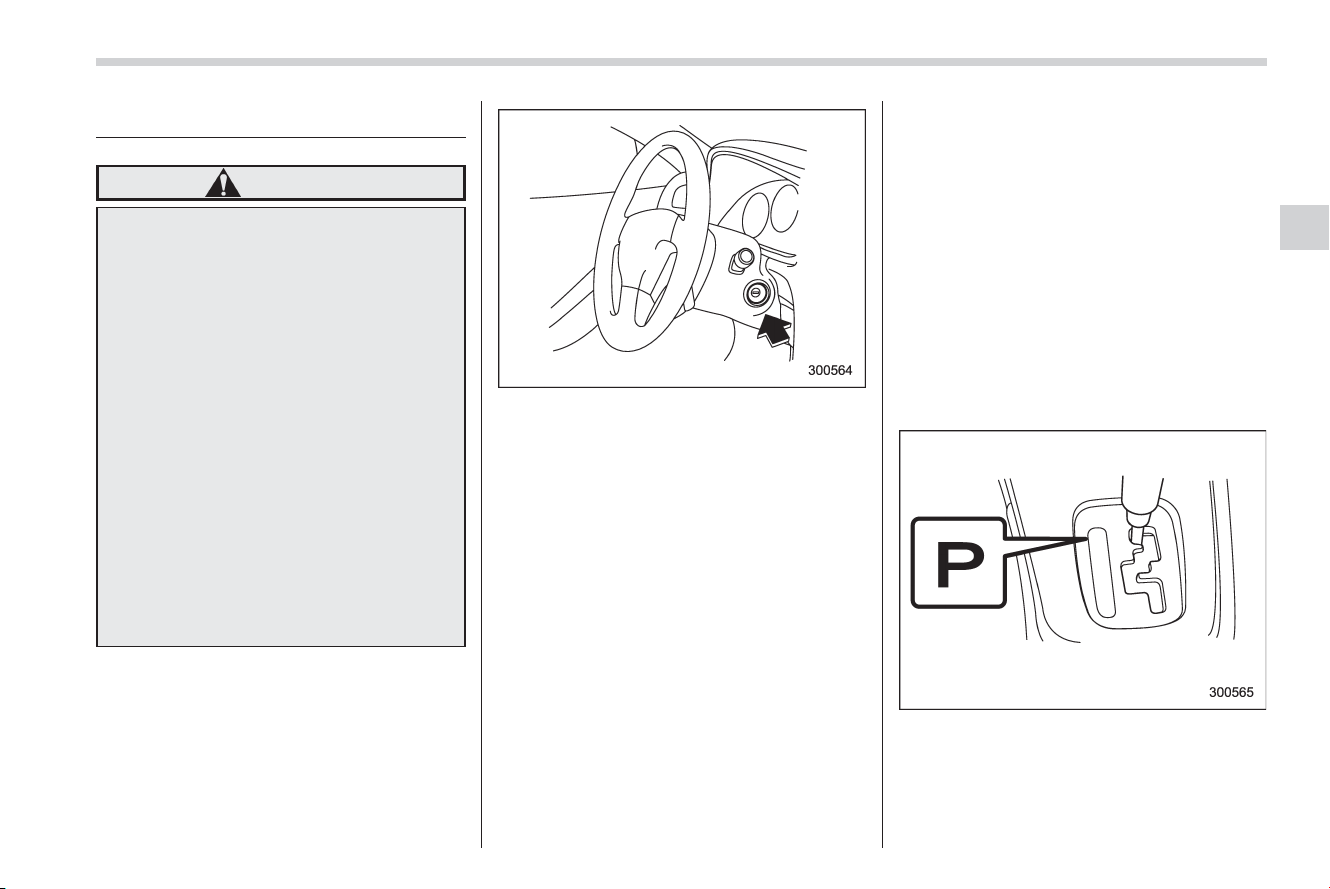
Black plate (117,1)
北米Model "A8130BE-B" EDITED: 2007/ 7/ 25
Ignition switch
WARNING
. Never turn the ignition switch to
“LOCK” while the vehicle is
being driven or towed because
that will lock the steering wheel,
preventing steering control. And
when the engine is turned off, it
takes a much greater effort than
usual to steer.
. Before leaving the vehicle, al-
ways remove the key from the
ignition switch for safety and
never allow an unattended child
to remain in the vehicle. Failure
to follow this procedure could
result in injury to a child or
others. Children could operate
the power windows, the sunroof
or other controls or even make
the vehicle move.
The ignition switch has four positions:
LOCK, Acc, ON and START.
NOTE
. Keep the ignition switch in the
“LOCK” position when the engine is
not running.
. Using electrical accessories for a
long time with the ignition switch in the
“ON” or “Acc” position can cause the
battery to go dead.
If the ignition switch will not move from
the “LOCK” position to the “Acc”
position, turn the steering wheel
slightly to the left and right as you turn
the ignition switch.
. If the key is attached to a keyholder
or to a large bunch of other keys,
centrifugal force may act on it as the
vehicle moves, resulting in unwanted
turning of the ignition switch. Also, if a
large keyholder is attached to the key,
your knees or hands may accidentally
touch it in a way that turns the ignition
switch.
& LOCK
The key can only be inserted or removed
in this position. The ignition switch will lock
the steering wheel when you remove the
key.
If turning the key is di fficult, turn the
steering wheel slightly to the right and left
as you turn the key.
! Automatic transmission vehicles
Instruments and controls 3-3
– CONTINUED –
3
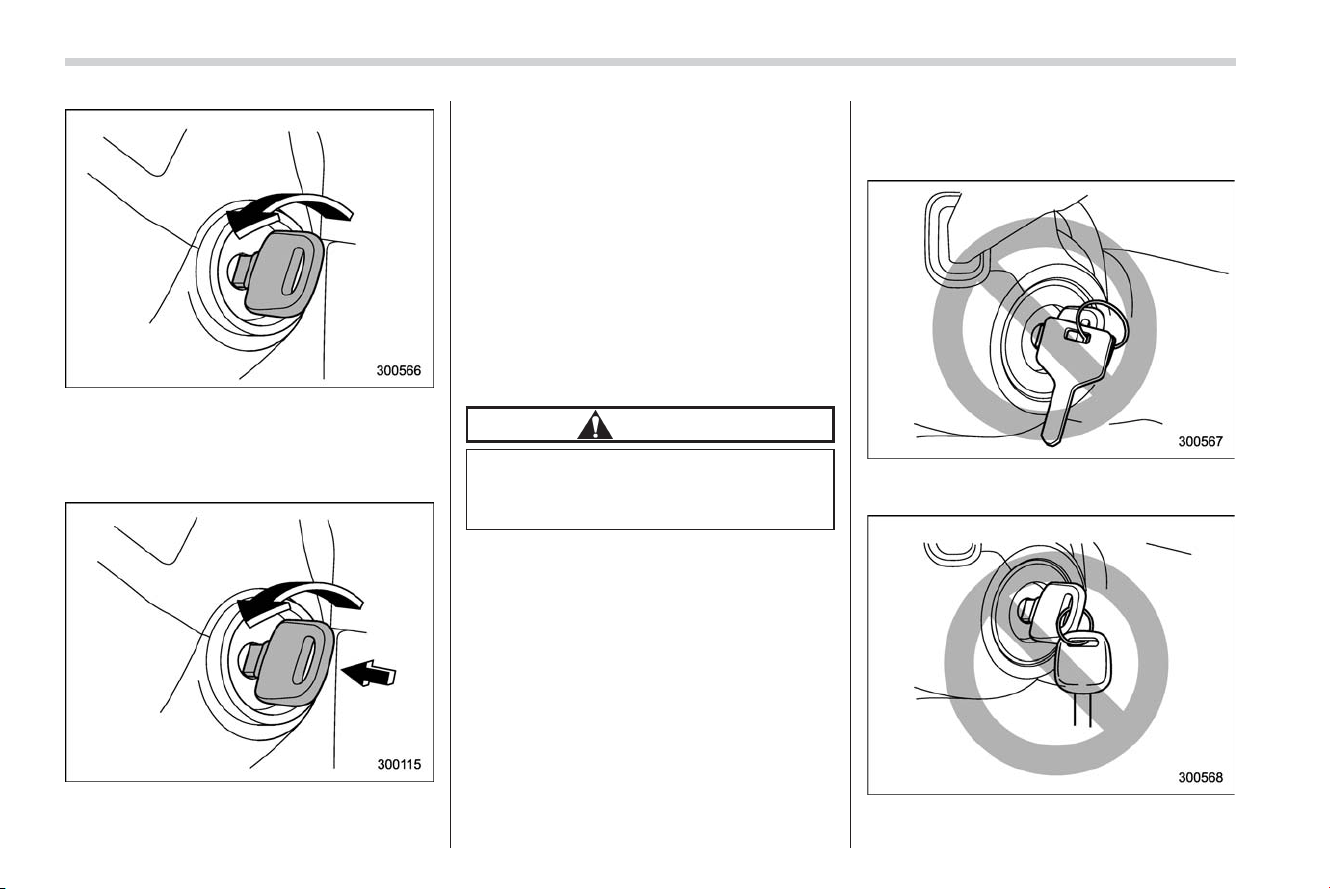
Black plate (118,1)
北米Model "A8130BE-B" EDITED: 2007/ 7/ 25
3-4 Instruments and controls
The key can be turned from “Acc” to
“LOCK” only when the selector lever is in
the “P” position.
! Manual transmission vehicles
The key can be turned from “Acc” to
“LOCK” only when the key is pushed in
while turning it.
& Acc
In this position the electrical accessories
(radio, accessory power outlet, etc.) can
be used.
& ON
This is the normal operating position after
the engine is started.
& START
CAUTION
Do not turn the ignition switch to the
“START” position while the engine
is running.
The engine is started in this position. The
starter cranks the engine to start it. When
the key is released (after the engine has
started), the key automatically returns to
the “ON” position.
! For models with immobilizer
If you fail to start your engine with your
registered key, once pull out the key (at
this time, the security indicator light
blinks), and then insert the key in the
ignition switch and turn it to the “ START”
position and again try to start your engine.
NOTE
The engine may not start in the follow-
ing cases:
. The key grip is touching another key
or a metallic key holder.
. The key is near another key that
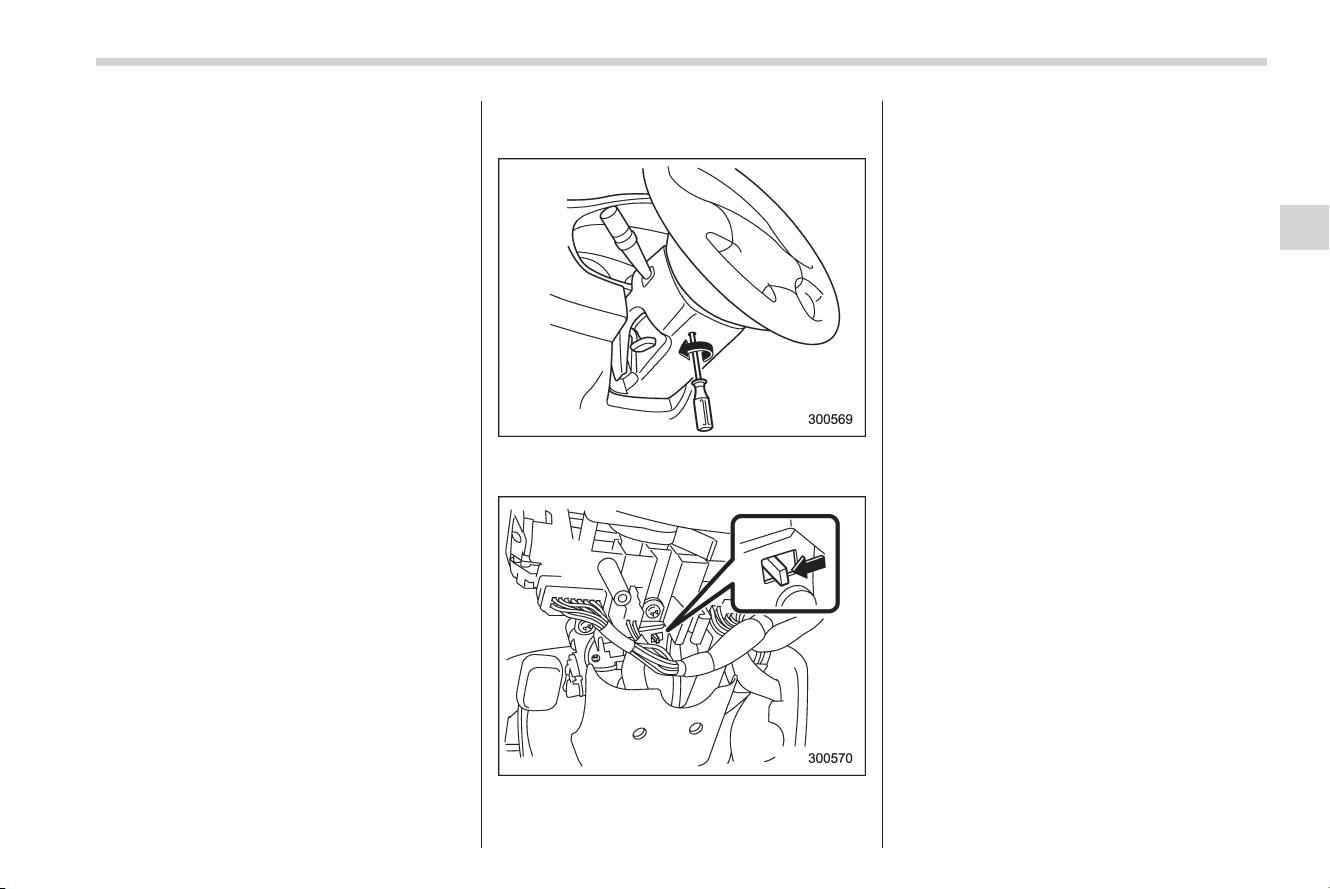
Black plate (119,1)
北米Model "A8130BE-B" EDITED: 2007/ 7/ 25
contains an immobilizer transponder.
. The key is near or touching another
transmitter.
& Key reminder chime
The reminder chime sounds when the
driver’s door opens and the key is in the
“LOCK” or “Acc” positions. The chime
stops when the key is removed from the
ignition switch.
NOTE
The ignition switch light flashes when
the reminder chime sounds.
& Ignition switch light (if
equipped)
For easy access to the ignition switch in
the dark, the ignition switch light comes on
when the driver’s door is opened. After
closing the door, the light remains lit for 5
seconds and then dims before it goes out.
The light flashes if you insert the key into
the ignition switch with the driver’s door
open.
& Key interlock release (AT ve-
hicles only)
If the key can not be turned to the “LOCK”
position even when the selector lever is in
the “P” position:
1. Take out the screwdriver.
2. Remove the cover under the steering
column using a Phillips screwdriver.
3. Turn the ignition key while pressing the
key interlock release lever.
Take your vehicle to the nearest SUBARU
dealer immediately to have the key inter-
lock system repaired.
Instruments and controls 3-5
3
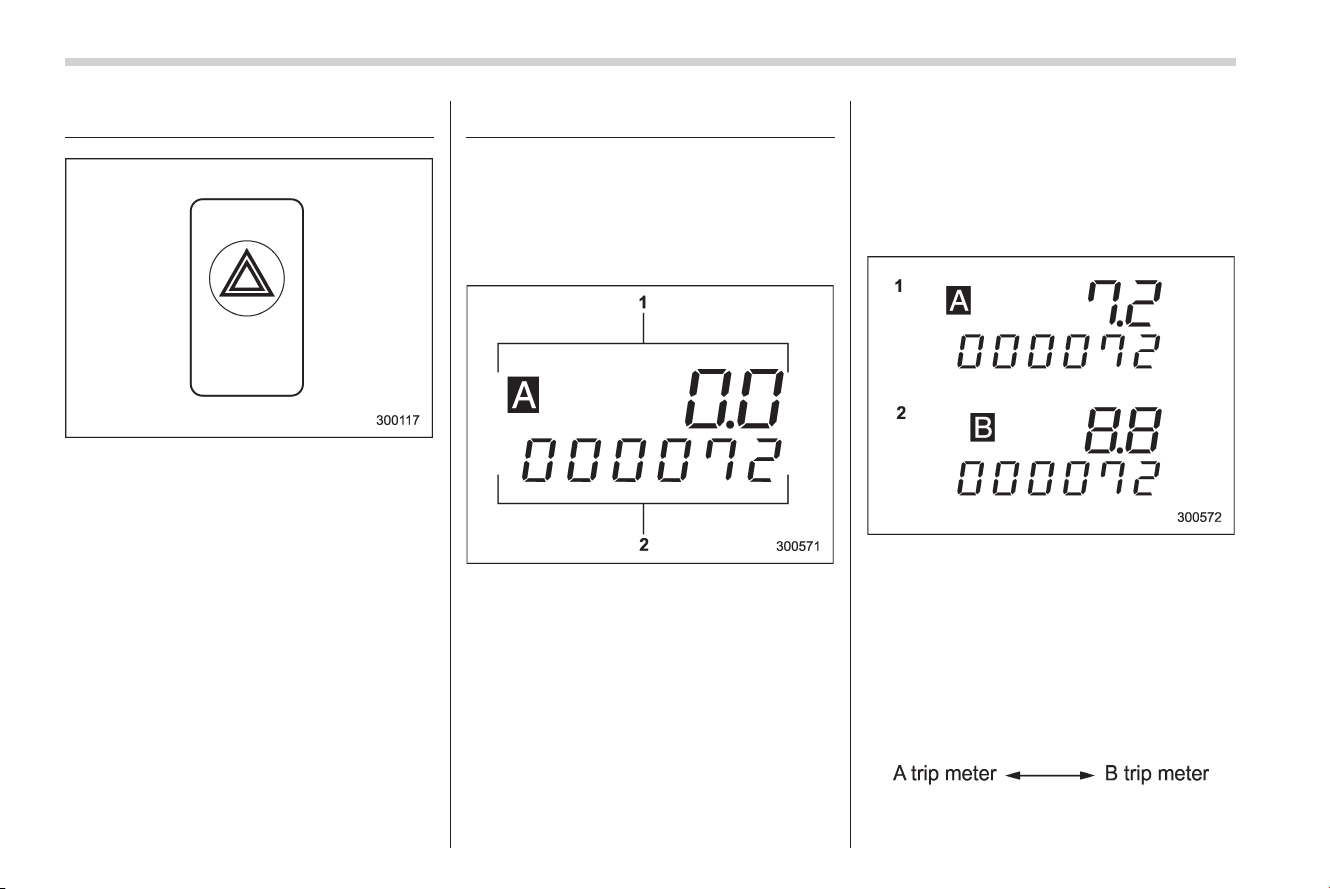
Black plate (120,1)
北米Model "A8130BE-B" EDITED: 2007/ 7/ 25
3-6 Instruments and controls
Hazard warning flasher
The hazard warning flasher is used to
warn other drivers when you have to park
your vehicle under emergency conditions.
The hazard warning flasher works with the
ignition switch in any position.
To turn on the hazard warning flasher,
push the hazard warning button on the
instrument panel. To turn off the flasher,
push the button again.
NOTE
When the hazard warning flasher is on,
the turn signals do not work.
Meters and gauges
& Speedometer
The speedometer shows the vehicle
speed.
& Odometer/Trip meter
1) Trip meter
2) Odometer
This meter displays the odometer and two
trip meters when the ignition switch is in
the “ON” position.
NOTE
Even with the ignition switch in the
“Acc” or “LOCK” position, the od-
ometer and trip meters are displayed
for 10 seconds when you press the
knob.
! Odometer
The odometer shows the total distance
that the vehicle has been driven.
! Double trip meter
1) A trip meter
2) B trip meter
The trip meter shows the distance that the
vehicle has been driven since you last set
it to zero.
To change the mode indication, briefly
push the knob.
Each press of the knob changes the
function alternately.
To set the trip meter to zero, select the A
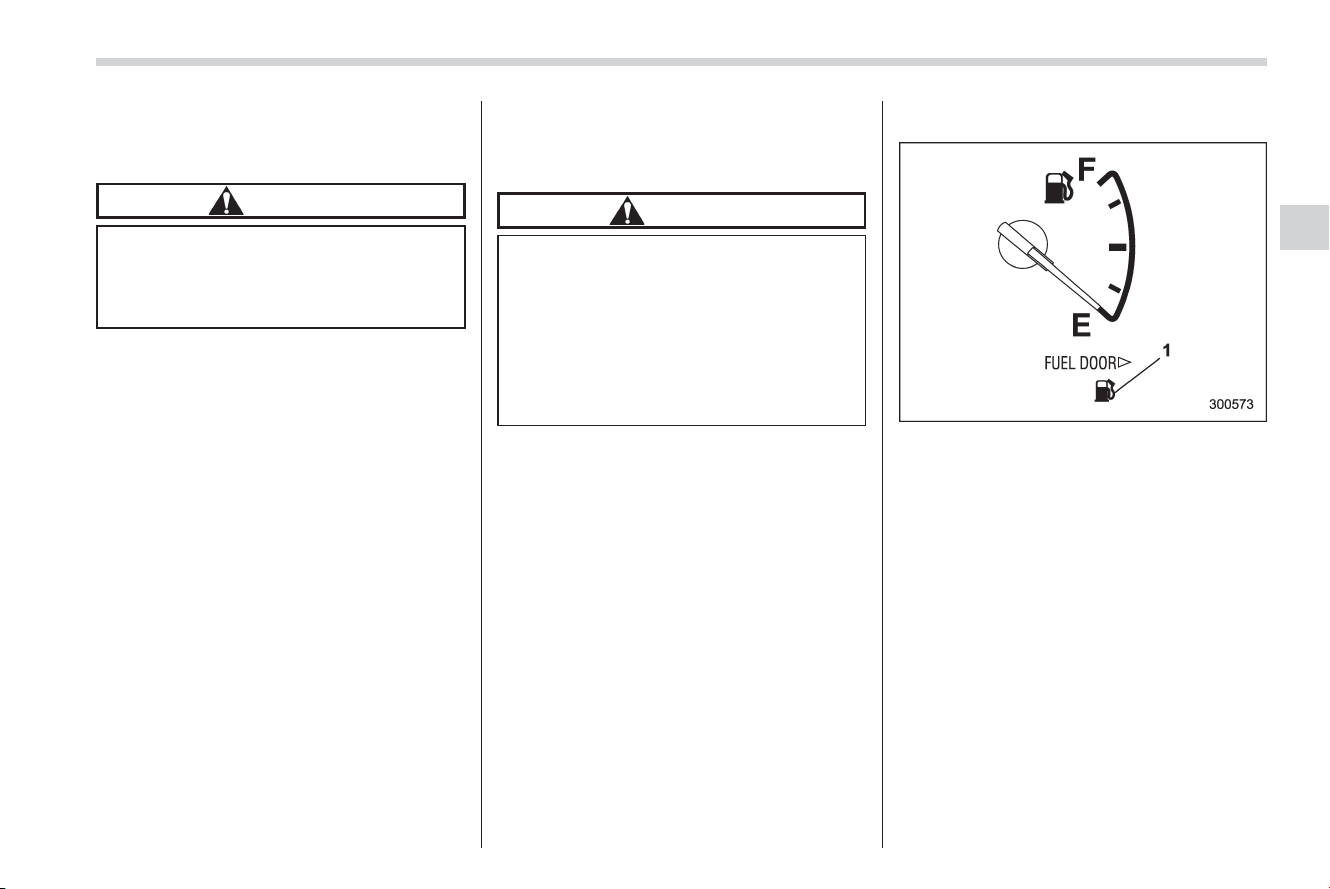
Black plate (121,1)
北米Model "A8130BE-B" EDITED: 2007/ 7/ 30
trip or B trip meter by pushing the knob
and keep the knob pushed for more than 2
seconds.
CAUTION
To ensure safety, do not attempt to
change the function of the indicator
during driving, as an accident could
result.
NOTE
If the connection between the combina-
tion meter and battery is broken for any
reason such as vehicle maintenance or
fuse replacement, the data recorded on
the trip meter will be lost.
& Tachometer
The tachometer shows the engine speed
in thousands of revolutions per minute.
CAUTION
Do not operate the engine with the
pointer of the tachometer in the red
zone. In this range, fuel injection will
be cut by the engine control module
to protect the engine from overrev-
ving. The engine will resume run-
ning normally after the engine speed
is reduced below the red zone.
NOTE (non-turbo models only)
To protect the engine while the “P” or
“N” position is selected (for AT models)
or while the shift lever is in neutral (for
MT models), the engine is controlled so
that the engine speed does not become
too high even if the accelerator pedal is
fully depressed.
& Fuel gauge
1) Low fuel warning light
The fuel gauge shows the approximate
amount of fuel remaining in the tank.
The gauge does not return to “E” even
though the ignition switch is in the “Acc” or
“LOCK” position.
The gauge may move slightly during
braking, turning or acceleration due to fuel
level movement in the tank.
Instruments and controls 3-7
– CONTINUED –
3
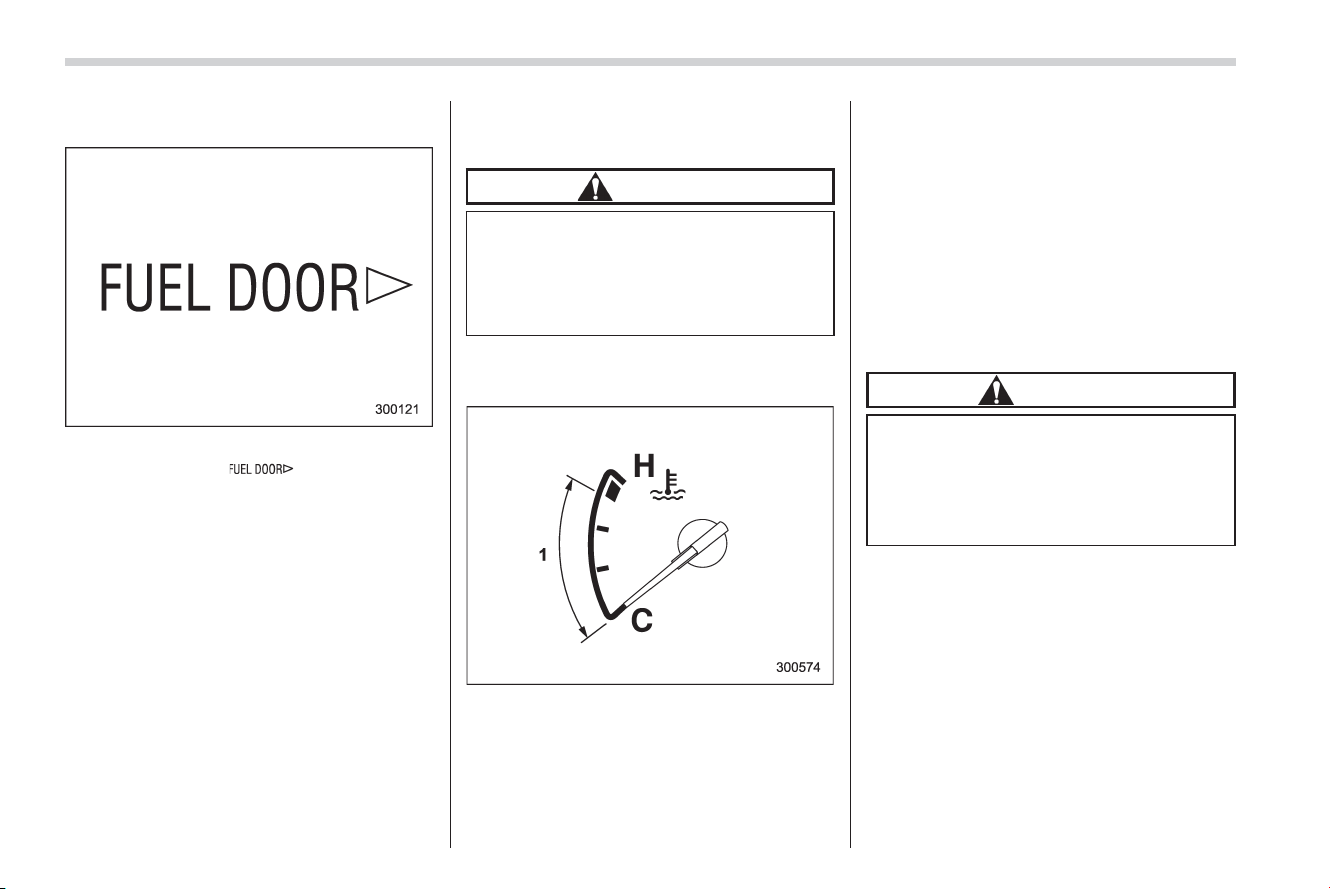
Black plate (122,1)
北米Model "A8130BE-B" EDITED: 2007/ 7/ 25
3-8 Instruments and controls
NOTE
You will see the “ ” sign near the
fuel gauge.
This indicates that the fuel filler door
(lid) is located on the right side of the
vehicle.
! Low fuel warning light
The low fuel warning light comes on when
the tank is nearly empty [approximately
2.3 US gal (9.0 liters, 1.9 Imp gal)]. It only
operates when the ignition switch is in the
“ON” position. When this light illuminates,
fill the fuel tank immediately.
NOTE
This light does not go out unless the
tank is replenished up to an internal
fuel quantity of approximately 4.0 US
gal (15 liters, 3.3 Imp gal).
CAUTION
Immediately put fuel in the tank
whenever the low fuel warning light
comes on. Engine misfires as a
result of an empty tank could cause
damage to the engine.
& Temperature gauge
1) Normal operating range
The temperature gauge shows engine
coolant temperature when the ignition
switch is in the “ON” position.
The coolant temperature will vary in
accordance with the outside temperature
and driving conditions.
We recommend that you drive moderately
until the pointer of the temperature gauge
reaches near the middle of the range.
Eng ine opera tion is optimum with the
engine coolant at this temperature range
and high revving operation when the
engine is not warmed up enough should
be avoided.
CAUTION
If the pointer exceeds the normal
operating range, safely stop the
vehicle as soon as possible.
See “In case of emergency” in
chapter 9.
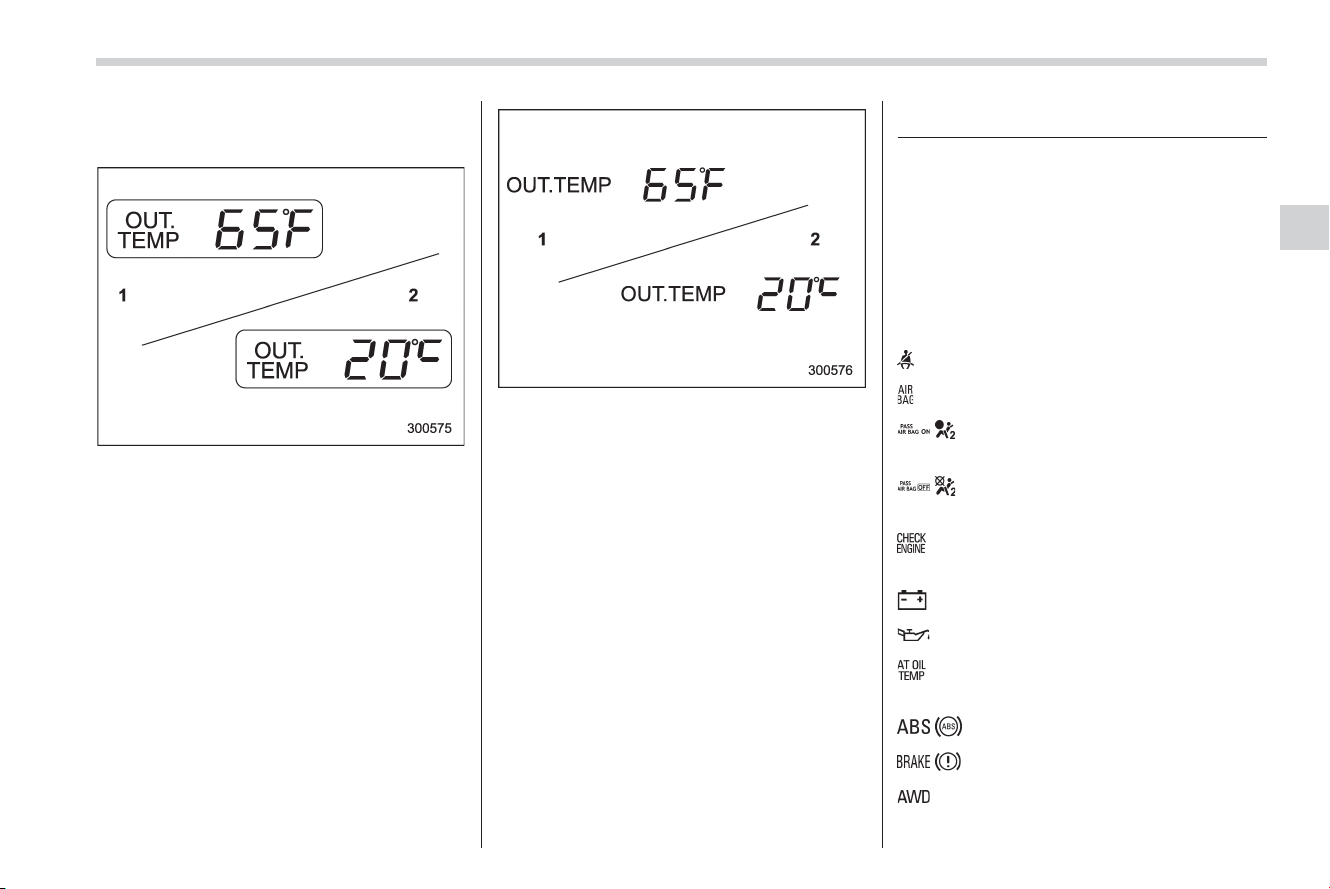
Black plate (123,1)
北米Model "A8130BE-B" EDITED: 2007/ 7/ 25
& Outside temperature indica-
tor
MT vehicles
1) U.S.-spec. models
2) Canada-spec. models
AT vehicles
1) U.S.-spec. models
2) Canada-spec. models
The outside temperature indicator is lo-
cated below the odometer/trip meter. The
indicator can indicate an outside tempera-
ture ranging from −22 to 1228F(−30 to
508C).
The indicator can give a false reading
under any of the following conditions:
. When there is too much sun.
. During idling; while running at low
speeds in a traffic jam; when the engine
is restarted immediately following a shut-
down.
. When the actual outside temperature
falls outside the specified indicator range.
Warning and indicator lights
Several of the warning and indicator lights
come on momentarily and then go out
when the ignition switch is initially turned
to the “ON” position. This permits check-
ing the operation of the bulbs.
Apply the parking brake and turn the
ignition switch to the “ON” position. The
following lights come on:
: Seatbelt warning light
: SRS airbag system warning light
/ : Front passenger’s frontal airbag
ON indicator light
/ : Front passenger’s frontal airbag
OFF indicator light
: CHECK ENGINE warning light/Mal-
function indicator lamp
: Charge warning light
: Oil pressure warning light
: AT OIL temperature warning light (AT
vehicles)
/ : ABS warning light
/ : Brake system warning light
: All-Wheel Drive warning light (AT
vehicles)
Instruments and controls 3-9
– CONTINUED –
3
Black plate (124,1)
北米Model "A8130BE-B" EDITED: 2007/ 7/ 25
3-10 Instruments and controls
: Vehicle Dynamics Control operation
indicator light (if equipped)
: Vehicle Dynamics Control warning light
(if equipped)/Vehicle Dynamics Control
OFF indicator light (if equipped)
: Low tire pressure warning light (if
equipped)
: Cruise control indicator light
: Cruise control set indicator light
If any lights fail to come on, it indicates a
burned-out bulb or a malfunction of the
corresponding system.
Consult your authorized SUBARU dealer
for repair.
& Seatbelt warning light
and chime
Your vehicle is equipped with a seatbelt
warning device at the driver’s seat, as
required by current safety standards.
There is a seatbelt warning light in the
combination meter.
If the driver has not yet fastened the
seatbelt when the ignition switch is turned
to the “ON” position, the seatbelt warning
light will flash for 6 seconds, to warn that
the seatbelt is unfastened. If the driver’s
seatbelt is not fastened, a chime will also
sound simultaneously.
If the driver’s seatbelt is still not fastened 6
seconds later, the warning light will remain
lit for 15 seconds. If the driver’s seatbelt is
still not fastened even 15 seconds later
(21 seconds after turning ON the ignition
switch), the warning lights will alternate
between flashing and steady illumination
at 15-second intervals, and the chime will
sound while the warning light is flashing.
Alternate flashing and steady illumination
of the warning lights and sounding of the
chime will continue until the driver fastens
the seatbelt.
NOTE
. If the driver unfastens the seatbelt
after fastening, the seatbelt warning
device operates as follows according
to the vehicle speed.
. At speeds lower than appr oxi-
mately 9 mph (15 km/h)
The warning light will alternate
between flashing and steady illumi-
nation at 15-second intervals. The
chime will not sound.
. At speeds higher than approxi-
mately 9 mph (15 km/h)
The warning light will alternate
between flashing and steady illumi-
nation at 15-second intervals and
the chime will sound whil e the
warning light is flashing.
. It is possible to cancel the warning
operation that follows the 6-s econd
warning after turning ON the ignition
switch. When the ignition switch is
turned ON next time, however, the
complete sequence of warning opera-
tion resumes. For further details about
canceling the warning operation,
please contact your SUBARU dealer.
& SRS airbag system
warning light
When the ignition switch is turned to the
“ON” position, the SRS airbag system
warning light will come on for approxi-
mately 6 seconds and go out. This shows
the SRS frontal airbag and SRS side
airbag and seatbelt pretensioners are in
normal operation.
WARNING
If the warning light exhibits any of
the following conditions, there may
be a malfunction in the seatbelt
pretensioners and/or SRS airbag
system. Immediately take your vehi-
cle to your nearest SUBARU dealer
to have the system checked. Unless
checked and properly repaired, the
seatbelt pretensioners and/or SRS
airbags will operate improperly (e.g.
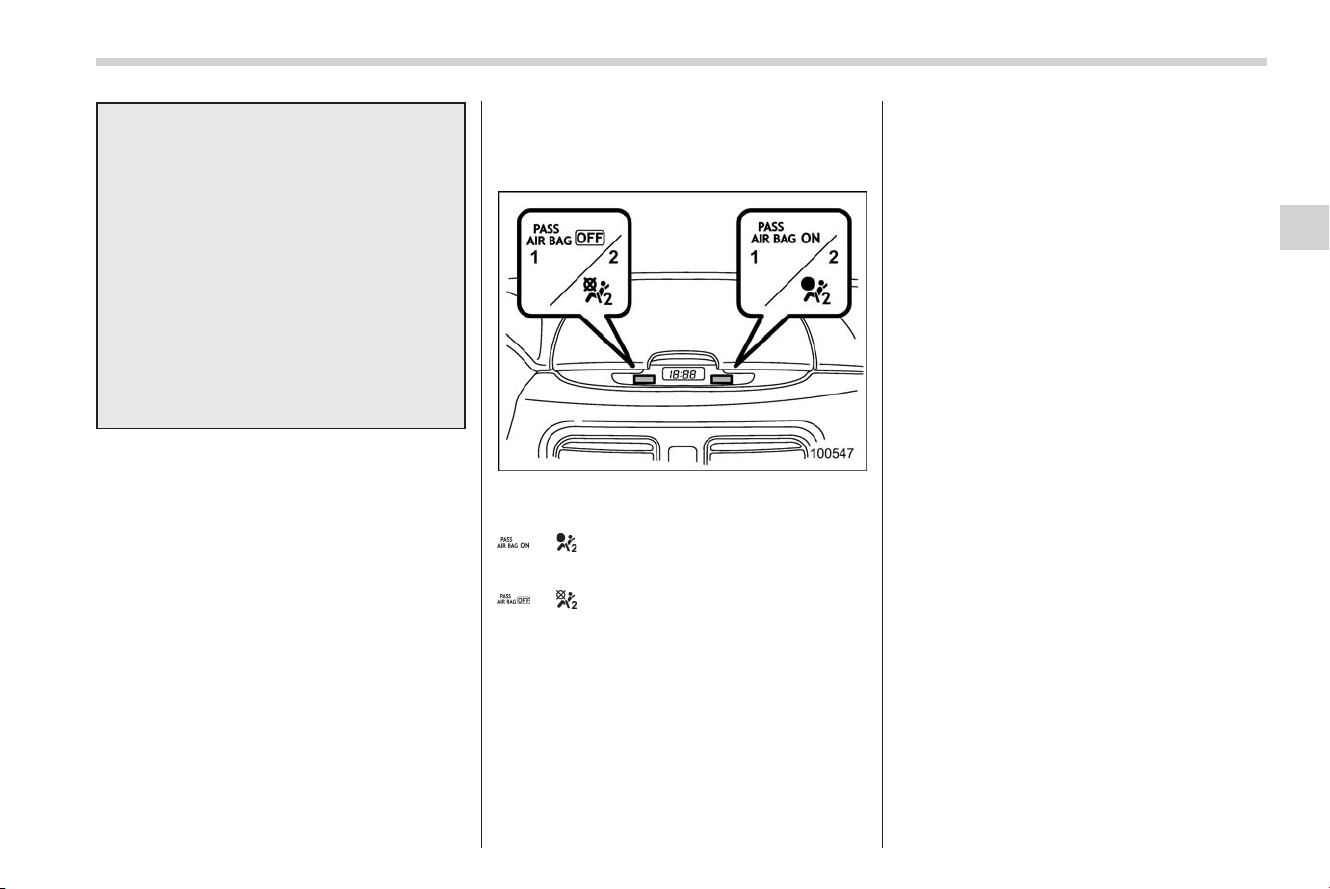
Black plate (125,1)
北米Model "A8130BE-B" EDITED: 2007/ 7/ 30
SRS airbags may inflate in a very
minor collision or not inflate in a
severe collision), which may in-
crease the risk of injury.
. Flashing or flickering of the warn-
ing light
. No illumination of the warning
light when the ignition switch is
first turned to the “ON” position
. Continuous illumination of the
warning light
. Illumination of the warning light
while driving
& Front passenger’s frontal
airbag ON and OFF indica-
tors
1) U.S.-spec. models
2) Canada-spec. models
or : Front passenger’s frontal airbag
ON indicator
or : Front passenger’s frontal airbag
OFF indicator
The front passenger’s frontal airbag ON
and OFF indicators show you the status of
the front passenger’s SRS frontal airbag.
The indicators are located next to the
clock in the central portion of the instru-
ment panel.
When the ignition switch is turned to the
“ON” position, both the ON and OFF
indicators illuminate for 6 seconds during
which time the system is checked. Follow-
ing the syst em check, both indicators
extinguish for 2 seconds. After this, one
of the indicators illuminates depending on
the status of the front passenger’s SRS
frontal airbag reached by the Subaru
advanced frontal airbag system monitor-
ing.
If the front passenger’s SRS frontal airbag
is activated, the passenger’s frontal airbag
ON indicator will illuminate while the OFF
indicator will remain extinguished.
If the front passenger’s SRS frontal airbag
is deactivated, the passenger’s frontal
airbag ON indicator will remain extin-
guished while the OFF indicator will
illuminate.
With the ignition switch turned to the “ON”
position, if both the ON and OFF indica-
tors remain lit or extinguished simulta-
neously even after the system check
period, the system is faulty. Contact your
SUBARU dealer immediately for an in-
spection.
Instruments and controls 3-11
– CONTINUED –
3
Black plate (126,1)
北米Model "A8130BE-B" EDITED: 2007/ 7/ 25
3-12 Instruments and controls
& CHECK ENGINE warn-
ing light/Malfunction in-
dicator lamp
CAUTION
If the CHECK ENGINE light comes
on while you are driving, have your
vehicle checked/repaired by your
SUBARU dealer as soon as possi-
ble. Continued vehicle operation
without having the emission control
sys tem checked and repaired as
necessary could cause serious da-
mage, which may not be covered by
your vehicle’s warranty.
If this light comes on steadily or blinks
while the engine is running, it may indicate
that there is a problem or potential
problem somewhere in the emission con-
trol system.
! If the light comes on steadily:
If the light comes on steadily while driving
or does not go out after the engine starts,
an emission control system malfunction
has been detected.
You should have your vehicle checked by
an authorized SUBARU dealer immedi-
ately.
NOTE
This light also comes on when the fuel
filler cap is not tightened until it clicks.
If you have recently refueled your vehicle,
the cause of the CHECK ENGINE warning
light/malfunction indicator lamp coming on
could be a loose or missing fuel filler cap.
Remove the cap and retighten it until it
clicks. Make sure nothing is interfering
with the sealing of the cap. Tightening the
cap will not make the CHECK ENGINE
warning light turn off immediately. It may
take several driving trips. If the light does
not go out, take your vehicle to your
authorized SUBARU dealer immediately.
! If the light is blinking:
If the light is blinking while driving, an
engine misfire condition has been de-
tected which may damage the emission
control system.
To prevent serious damage to the emis-
sion control system, you should do the
following.
. Reduce vehicle speed.
. Avoid hard acceleration.
. Avoid steep uphill grades.
. Reduce the amount of cargo, if possi-
ble.
. Stop towing a trailer as soon as
possible.
The CHECK ENGINE warning light may
stop blinking and come on steadily after
several driving trips. You should have your
vehicle checked by an authorized
SUBARU dealer immediately.
& Charge warning light
If this light comes on when the engine is
running, it may indicate that the charging
system is not working properly.
If the light comes on while driving or does
not go out after the engine starts, stop the
engine at the first safe opportunity and
check the alternator belt. If the belt is
loose, broken or if the belt is in good
condition but the light remains on, contact
your nearest SUBARU dealer immedi-
ately.
& Oil pressure warning
light
CAUTION
Do not operate the engine with the
oil pressure warning light on. This
may cause serious engine damage.
If this light comes on when the engine is
running, it may indicate that the engine oil
pressure is low and the lubricating system
is not working properly.
Black plate (127,1)
北米Model "A8130BE-B" EDITED: 2007/ 7/ 25
If the light comes on while driving or does
not go out after the engine starts, stop the
engine at the first safe opportunity and
check the engine oil level. If the oil level is
low, add oil immediately. If the engine oil is
at the proper level but the light remains on,
contact your nearest SUBARU dealer
immediately.
& AT OIL TEMPerature
warning light (AT vehi-
cles)
The AT oil temperature warning light
comes on when the ignition switch is
turned to the “ON” position and goes out
after the engine has started.
If this light comes on when the engine is
running, it may indicate that the automatic
transmission fluid temperature is too hot.
If the light comes on while driving,
immediately stop the vehicle in a safe
place and let the engine idle until the
warning light goes off.
! Automatic transmission control
system warning
If the light flashes after the engine starts, it
may indicate that the automatic transmis-
sion control system is not working prop-
erly. Contact your nearest SUBARU deal-
er for service immediately.
& ABS warning light
The ABS warning light comes on when the
ignition switch is turned to the “ON”
position and goes out after approximately
2 seconds.
This is an indication that the ABS system
is working properly.
CAUTION
If the warning light behaves as
follows, the ABS system may not
work properly.
When the warning light is on, the
ABS function shuts down; however,
the conventional brake system con-
tinues to operate normally.
. The warning light does not come
on when the ignition switch is
turned to the “ON” position.
. The warning light comes on when
the ignition switch is turned to
the “ON” position, but it does not
go out even when the vehicle
speed exceeds approximately 8
mph (12 km/h).
. The warning light comes on dur-
ing driving.
If any of these conditions occur,
have the ABS system repaired at
the first available opportunity by
your SUBARU dealer.
The ABS warning light comes on together
with the brake system warning light if the
EBD system becomes faulty. For further
details of the EBD system fault warning,
refer to “Brake system warning light”.
NOTE
If the warning light behavior is as
described in the following, the ABS
system may be considered normal.
. The warning light comes on right
after the engine is started but goes out
immediately, remaining off.
. The warning light remains on after
the engine has been started, but it goes
out when the vehicle speed reaches
approximately 8 mph (12 km/h).
. The warning light comes on during
driving, but it goes out immediately and
remains off.
When driving with an insufficient battery
voltage such as when the engine is jump
started, the ABS warning light may come
on. This is due to the low battery voltage
and does not i ndicate a malfunction.
When the battery becomes fully charged,
the light will go out.
Instruments and controls 3-13
– CONTINUED –
3

Black plate (128,1)
北米Model "A8130BE-B" EDITED: 2007/ 7/ 25
3-14 Instruments and controls
& Vehicle Dynamics
Control warning light (if
equipped)/Vehicle Dy-
namics Control OFF in-
dicator light (if
equipped)
This warning light has the function of
indicating faults in the Vehicle Dynamics
Control system and the function of indicat-
ing that the Vehicle Dynamics Control
system has been deactivated.
It comes on in the event of a fault in the
system and is on when the system is not
operating.
This warning light comes on when the
ignition switch is turned to the “ON”
position and goes out after the engine
has started. It indicates that the Vehicle
Dynamics Control system is in normal
operation.
! Vehicle Dynamics Control warning
light
The Vehicle Dynamics Control system is
probabl y inoperative under any of the
following conditions. Have your vehicle
checked at a SUBARU dealer immedi-
ately.
. The warning light does not come on
when the ignition switch is turned to the
“ON” position.
. The warning light comes on while the
vehicle is running.
. If the electrical circuit of the Vehicle
Dynamics Control system itself becomes
faulty, the warning light only comes on. At
this time, the ABS (Anti-lock Brake Sys-
tem) remains fully operational.
. The warning light comes on when the
electronic control system of the ABS/
Vehicle Dynamics Control system be-
comes faulty.
The Veh icle Dynamics Control system
provides its ABS control through the
electrical circuit of the ABS system.
Accordingly, if the ABS is inoperative, the
Vehicle Dynamics Control system be-
comes unable to provide ABS control. As
a result, the Vehicle Dynamics Control
system also becomes inoperative, caus-
ing the warning light to come on. Though
both the Vehicle Dynamics Control and
ABS systems are inoperative in this case,
the ordinary functions of the brake system
are still available. You will be safe while
driving with this condition, but have your
vehicle checked at a SUBARU dealer as
soon as possible.
NOTE
If the warning light behavior is as
shown in the following, the Vehicle
Dynamics Control system may be con-
sidered normal.
. The warning light comes on right
after the engine is started but goes out
immediately, remaining off.
. The warning light comes on after
engine startup and goes off while the
vehicle is subsequently being driven.
. The warning light comes on during
driving, but it goes out immediately and
remains off.
! Vehicle Dynamics Control OFF in-
dicator light
. It comes on when the Vehicle Dy-
namics Control OFF switch is pressed.
. It also comes on when the Vehicle
Dynamics Control system is deactivated.
NOTE
. The light may stay on for a while
after the engine has been started,
especially in cold weather. This does
not indicate the existence of a problem.
The light should go out as soon as the
engine has warmed up.
. The indicator light comes on when
the engine has developed a problem
and the Malfunction indicator light is
on.
The Vehicle Dynamics Control system is
probably faulty under the following condi-
tion. Have your vehicle checked at a
Black plate (129,1)
北米Model "A8130BE-B" EDITED: 2007/ 7/ 25
SUBARU dealer as soon as possible.
. The light does not go out even after the
lapse of several minutes (the engine has
warmed up) after the engine has started.
& Brake system warning
light
WARNING
. Driving with the brake system
warning light on is dangerous.
This indicates your brake system
may not be working properly. If
the light remains on, have the
brakes inspected by a SUBARU
dealer immediately.
. If at all in doubt about whether
the brakes are operating prop-
erly, do not drive the vehicle.
Have your vehicle towed to the
nearest SUBARU dealer for re-
pair.
This light has the following three functions:
! Parking brake warning
The light comes on with the parking brake
applied while the ignition switch is in the
“ ON ” position. It goes out when the
parking brake is fully released.
! Brake fluid level warning
This light comes on when the brake fluid
level has dropped to near the “MIN” level
of the brake fluid reservoir with the ignition
switch in the “ON” position and with the
parking brake fully released.
If the brake system warning light should
come on while driving (with the parking
brake fully released and with the ignition
switch positioned in “ON”), it could be an
indication of leaking of brake fluid or worn
brake pads. If this occurs, immediately
stop the vehicle at the nearest safe place
and check the brake fluid level. If the fluid
level is below the “MIN” mark in the
reservoir, do not drive the vehicle. Have
the vehicle towed to the nearest SUBARU
dealer for repair.
! Electronic Brake Force Distribution
(EBD) system warning
The brake system warning light also
illuminates if a malfunction occurs in the
EBD system. In that event, it comes on
together with the ABS warning light.
The EBD system may be malfunctioning if
the brake system warning light and ABS
warning light i lluminate simultaneously
during driving.
Even if the EBD system fails, the conven-
tional braking system will still function.
However, the rear wheels will be more
prone to locking when the brakes are
applied harder than usual and the vehi-
cle’s motion may therefore become some-
what harder to control.
If the brake system warning light and ABS
warning light illuminate simultaneously,
take the following steps:
1. Stop the vehicle in the nearest safe,
flat place.
2. Shut down the engine, then restart it.
3. Release the parking brake. If both
warning lights go out, the EBD system
may be faulty.
Drive carefully to the nearest SUBARU
dealer and have the system inspected.
4. If both warning lights come on again
and stay illuminated after the engine has
been restart ed, shut down the engine
again, apply the parking brake, and check
the brake fluid level.
5. If the brake fluid level is not below the
“MIN” mark, the EBD system may be
faulty. Drive carefully to the nearest
SUBARU dealer and have the system
inspected.
6. If the brake fluid level is below the
“MIN” mark, DO NOT drive the vehicle.
Instead, have the vehicle towed to the
nearest SUBARU dealer for repair.
Instruments and controls 3-15
– CONTINUED –
3
Black plate (130,1)
北米Model "A8130BE-B" EDITED: 2007/ 7/ 25
3-16 Instruments and controls
& Door open warning
light
The door open warning light illuminates if
any door or the rear gate is not fully
closed.
Always make sure this light is out before
you start to drive.
& Low fuel warning light
The low fuel warning light illuminates
when the tank is nearly empty [approxi-
mately 2.3 US gal (9.0 liters, 1.9 Imp gal)].
It only operates when the ignition switch is
in the “ON” position. When this light
illuminates, fill the fuel tank immediately.
NOTE
This light does not go out unless the
tank is replenished up to an internal
fuel quantity of approximately 4.0 US
gal (15 liters, 3.3 Imp gal).
& All-Wheel Drive warn-
ing light (AT vehicles)
WARNING
Continued driving with the AWD
warning light flashing can lead to
powertrain damage. If the AWD
warning light flashes, promptly park
in a safe place then check whether
all four tires are the same diameter
and whether any of the tires has a
puncture or has lost air pressure for
some other reason.
The All-Wheel Drive warning light comes
on when the ignition switch is turned to the
“ON” position and goes out after engine
has started.
! For vehicles with Vehicle Dynamics
Control system
This light flashes if the vehicle is driven
with tires of different diameters or with the
air pressure excessively low in any of its
tires.
! For vehicles without Vehicle Dy-
namics Control system
This light comes on when All-Wheel Drive
is disengaged and the drive mechanism is
switched to Front Wheel Drive for main-
tenance or similar purposes.
This light flashes if the vehicle is driven
with tires of different diameters or with the
air pressure excessively low in any of its
tires.
& Vehicle Dynamics
Control operation indi-
cator light (if equipped)
This light comes on when the ignition
switch is ON and goes out approximately
2 seconds later.
It blinks when the skid suppression func-
tion is activated. It illuminates when only
the traction control function is operating.
The Vehicle Dynamics Control system is
probably faulty under any of the following
conditions. Have your vehicle checked at
a SUBARU dealer immediately.
. The light does not come on when the
ignition switch is turned to the “ON”
position.
. The light does not go out even after a
period of approximately 2 seconds after
the ignition switch has been turned to the
“ON” position.
Black plate (131,1)
北米Model "A8130BE-B" EDITED: 2007/ 7/ 25
& Shift position indicator (AT
vehicles)
This indicator shows the position of the
shift lever.
& Turn signal indicator
lights
These lights show the operation of the turn
signal or lane change signal.
If the indicator lights do not blink or blink
rapidly, the turn signal bulb may be burned
out. Replace the bulb as soon as possible.
Refer to the “Replacing bulbs” section in
chapter 11.
& High beam indicator
light
This light shows that the headlights are in
the high beam mode.
This indicator light also comes on when
the headlight flasher is operated.
& Low tire pressure
warning light (if
equipped)
When the ignition switch is turned to the
“ON” position, the low tire pressure warn-
ing light will come on for approximately 2
seconds to check that the tire pressure
monitoring system (TPMS) is functioning
properly. If there is no problem and all tires
are properly inflated, the light will go out.
Each tire, including the spare (if provided),
should be checked monthly when cold
and inflated to the inflation pressure
recommended by the vehicle manufac-
turer on the vehicle placard or tire inflation
pressure label. (If your vehicle has tires of
a different size than the size indicated on
the vehicle placard or tire inflation pres-
sure label, you should determine the
proper inflation pressure for those tires.)
As an added safety feature, your vehicle
has been equipped with a tire pressure
monitoring system (TPMS) that illuminates
a low tire pressure telltale when one or
more of your tires is significantly under-
inflated. Accordingly, when the low tire
pressure telltale illuminates, you should
stop and check your tires as soon as
possible, and inflate them to the proper
pressure. Driving on a significantly under-
inflated tire causes the tire to overheat and
can lead to tire failure. Under-inflation also
reduces fuel efficiency and tire tread life,
and may affect the vehicle ’s handling and
stopping ability.
Please note that the TPMS is not a
substitute for proper tire maintenance,
and it is the driver ’s responsibility to
maintain correct tire pressure, even if
under-inflation has not reached the level
to trigger illumination of the TPMS low tire
pressure telltale.
Your vehicle has also been equipped with
a TPMS malfunction indicator to indicate
when the system is not operating properly.
The TPMS malfunction indicator is com-
bined with the low tire pressure telltale.
When the system detects a malfunction,
the telltale will flash for approximately one
minute and then remain continuously
illuminated. This sequence will continue
upon subsequent vehicle start-ups as long
as the malfunction exists. When the
malfunction indicator is illuminated, the
system may not be able to detect or signal
Instruments and controls 3-17
– CONTINUED –
3
Black plate (132,1)
北米Model "A8130BE-B" EDITED: 2007/ 7/ 25
3-18 Instruments and controls
low tire pressure as intended. TPMS
malfunctions may occur for a variety of
reasons, including the installation of re-
placement or alternate tires or wheels on
the vehicle that prevent the TPMS from
functioning properly. Always check the
TPMS malfunction telltale after replacing
one or more tires or wheels on your
vehicle to ensure that the replacement or
alternate tires and wheels allow the TPMS
to continue to function properly.
Should the warning light illuminate stea-
dily after blinking for approximately one
minute, have the system inspected by
your nearest SUBARU dealer as soon as
possible.
WARNING
If this light does not come on briefly
after the ignition switch is turned ON
or the light illuminates steadily after
blinking for approximately one min-
ute, you should have your Tire
Pressure Monitoring System
checked at a SUBARU dealer as
soon as possible.
If this light comes on while driving,
never brake suddenly and keep
driving straight ahead while gradu-
ally reducing speed. Then slowly
pull off the road to a safe place.
Otherwise an accident involving
serious vehicle damage and serious
personal injury could occur.
If this light still comes on while
driving after adjusting the tire pres-
sure, a tire may have significant
damage and a fast leak that causes
the tire to lose air rapidly. If you have
a flat tire, replace it with a spare tire
as soon as possible.
When a spare tire is mounted or a
wheel rim is replaced without the
original pressure sensor/transmitter
being transferred, the Low tire pres-
sure warning light will illuminates
steadily after blinking for approxi-
mately one minute. This indicates
the TPMS is unable to monitor all
four road wheels. Contact your
SUBARU dealer as soon as possible
for tire and sensor replacement and/
or system resetting. If the light
illuminates steadily after blinking
for approximately one minute,
promptly contact a SUBARU dealer
to have the system inspected.
CAUTION
The tire pressure monitoring system
is NOT a substitute for manually
checking tire pressure. The tire
pressure should be checked peri-
odically (at least monthly) using a
tire gauge. After any change to tire
pressure(s), the tire pressure mon-
itoring system will not re-check tire
inflation pressures until the vehicle
is first driven more than 20 mph (32
km/h). After adjusting the tire pres-
sures, increase the vehicle speed to
at least 20 mph (32 km/h) to start the
TPMS re-checking of the tire infla-
tion pressures. If the tire pressures
are now above the severe low
pressure threshold, the low tire
pressure warning light should go
off a few minutes later. Therefore, be
sure to install the specified size for
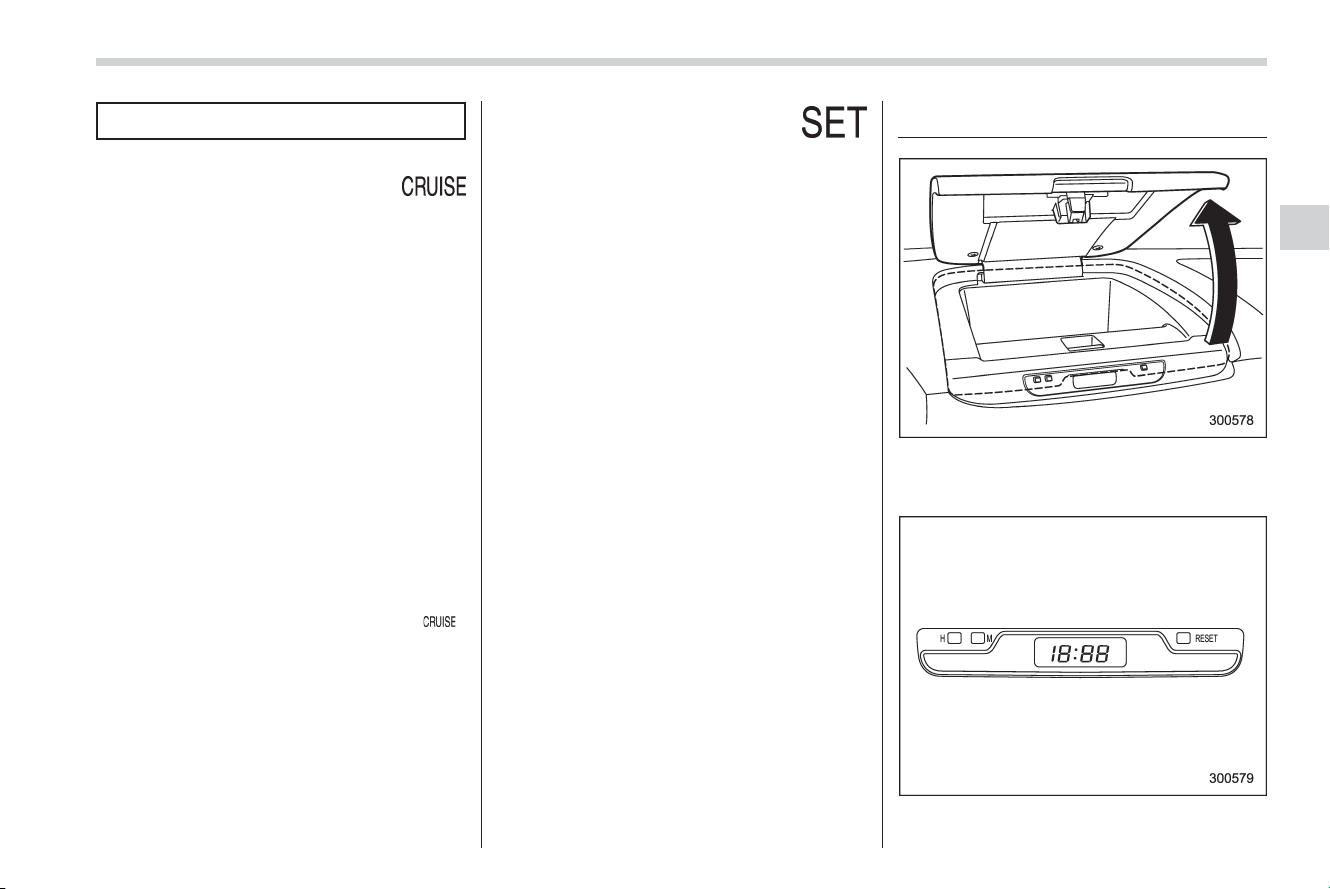
Black plate (133,1)
北米Model "A8130BE-B" EDITED: 2007/ 7/ 30
the front and rear tires.
& Cruise control indica-
tor light
The cruise control indicator light comes on
when the ignition switch is turned to the
“ON” position and goes out after approxi-
mately 3 seconds.
This light comes on when the “CRUISE”
main switch is pressed.
NOTE
. If you move the cruise control lever
or press the main switch button while
turning the ignition switch “ON”, the
cruise control function is deactivated
and the “ CRUISE” indicator light
flashes. To reactivate the cruise control
function, turn the ignition switch back
to the “Acc” or “LOCK” position, and
then turn it again to the “ON” position.
. If this indicator light and the “
”
indicator light flash simultaneously
during driving, have the vehicle
checked by your nearest SUBARU
dealer.
& Cruise control set in-
dicator light
The cruise control set indicator light
comes on when the ignition switch is
turned to the “ON” position and goes out
after approximately 3 seconds.
This light comes on when vehicle speed
has been set.
Clock
To adjust the clock, open the small article
storage compartment in the dashboard
with the vehicle parked in a safe place.
To set the hour, press the “H” button. To
Instruments and controls 3-19
– CONTINUED –
3
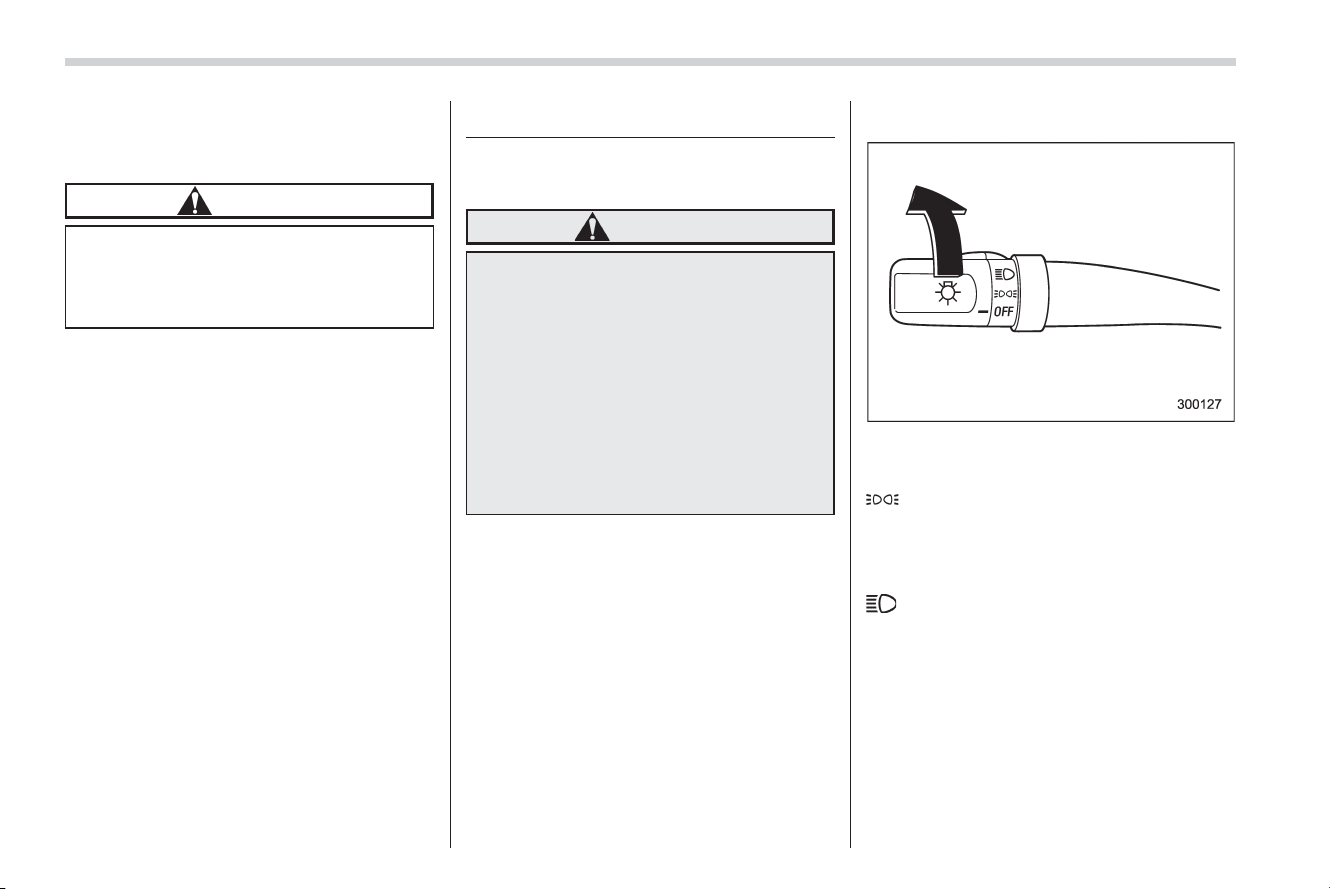
Black plate (134,1)
北米Model "A8130BE-B" EDITED: 2007/ 7/ 25
3-20 Instruments and controls
set the minutes, press the “M” button. To
reset the minutes to “00” with a radio time
signal, push the “Reset” button.
CAUTION
To ensure safety, do not attempt to
set the time while driving, as an
accident from inadequate attention
to the road could result.
NOTE
The clock uses a liquid crystal display.
You will find time indications hard to
see if you wear polarized glasses.
Light control switch
The light switch operates only when the
ignition switch is in the “ON” position.
WARNING
To prevent battery discharge result-
ing from accidentally leaving your
lights on when your vehicle is
parked, the light switch operates
only when the ignition switch is in
the “ON” position. In any other
position, the vehicle’s lights will be
out.
If you park your vehicle on a road-
side at night, use the hazard warn-
ing flasher to alert the other drivers.
& Headlights
To turn on the headlights, turn the knob on
the end of the turn signal lever.
first position:
Parking lights, instrument panel illumina-
tion, front side marker lights, tail lights and
license plate light are on.
second position:
Headlights, parking lights, instrument pa-
nel illumination, front side marker lights,
tail lights, and license plate light are on.
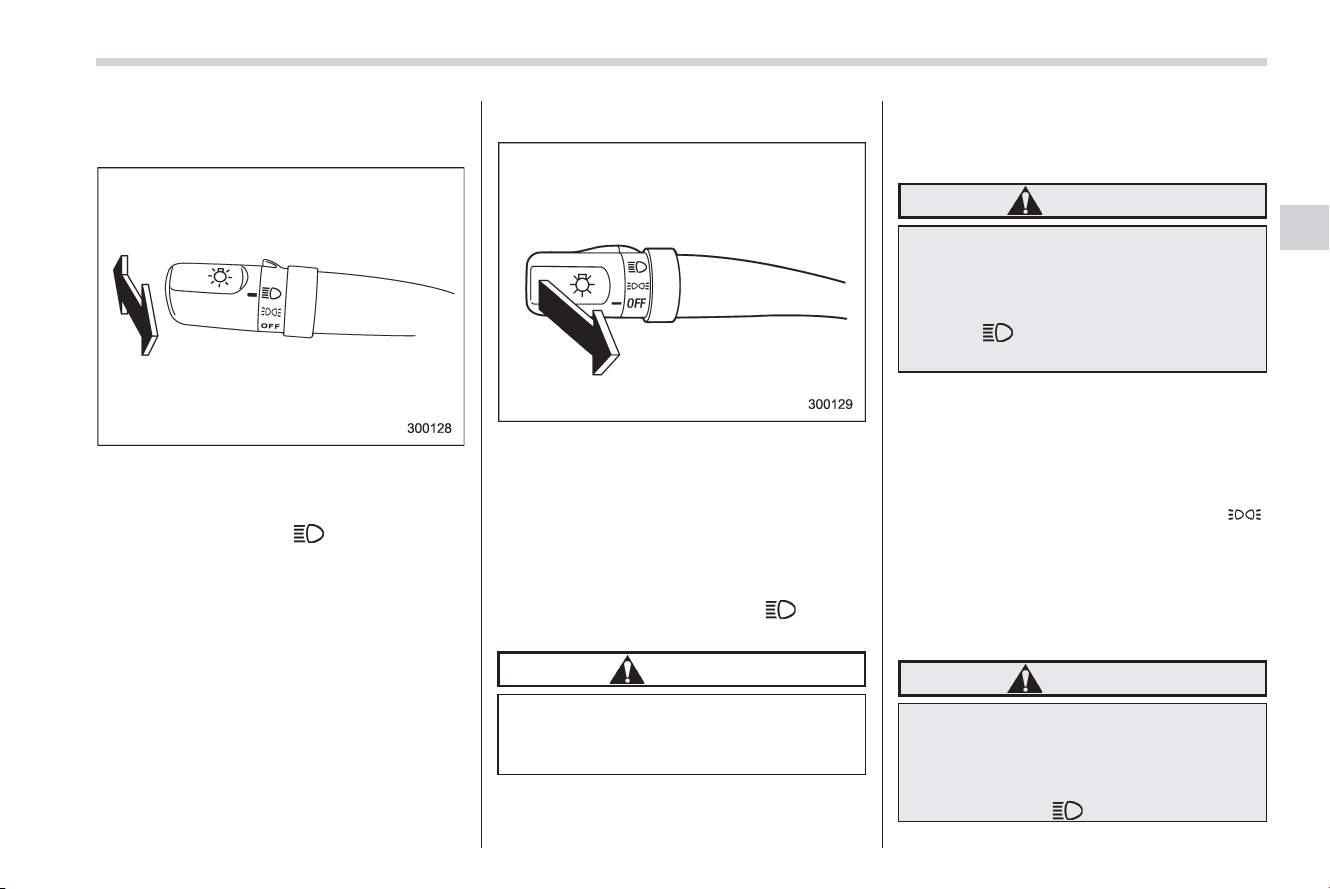
Black plate (135,1)
北米Model "A8130BE-B" EDITED: 2007/ 7/ 25
& High/low beam change (dim-
mer)
To change from low beam to high beam,
push the turn signal lever forward. When
the headlights are on high beam, the high
beam indicator light “
” on the instru-
ment panel is also on.
To switch back to low beam, pull the lever
back to the detent position.
& Headlight flasher
To flash the headlights, pull the lever
toward you and then release it. The high
beam will stay on for as long as you hold
the lever. The he adlight flasher works
even though the lighting switch is in the
“OFF” position.
When the headlights are on high beam,
the high beam indicator light “
” on the
instrument panel also comes on.
CAUTION
Do not hold the lever in the flashing
position for more than just a few
seconds.
& Daytime running light system
! Canada-spec. 2.5XT
WARNING
The parking lights, and side marker
lights are not turned on by the
daytime running light system. The
light switch must always be turned
to the “
” position when it is dark
outside.
The low beam headlights and tail lights will
automatically come on when the engine
has started, under the following condi-
tions:
. The parking brake is fully released.
. The light switch is in the “OFF ” or “
”
position.
. The automatic transmission selector
lever is set at other than the “P” position.
! All models except Canada-spec.
2.5XT
WARNING
The tail lights, parking lights, and
side marker lights are not turned on
by the daytime running light system.
The light switch must always be
turned to the “
” position when it
Instruments and controls 3-21
– CONTINUED –
3
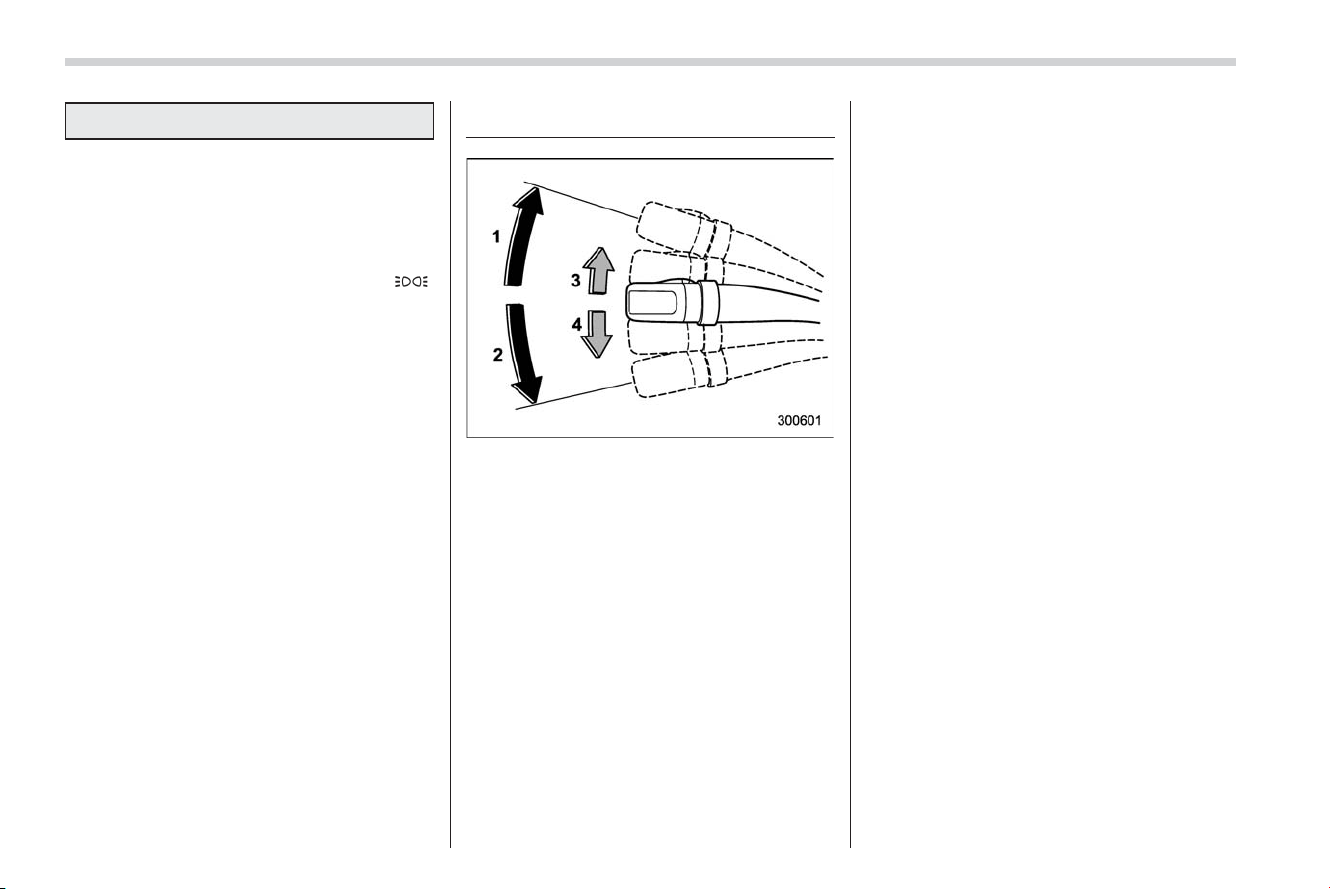
Black plate (136,1)
北米Model "A8130BE-B" EDITED: 2007/ 7/ 25
3-22 Instruments and controls
is dark outside.
The low beam headlights will automati-
cally come on at reduced brightness when
the engine has started, under the following
conditions:
. The parking brake is fully released.
. The light switch is in the “OFF ” or “
”
position.
. The automatic transmission selector
lever is set at other than the “P” position.
Turn signal lever
1) Right turn
2) Left turn
3) Lane change for right
4) Lane change for left
To activate the right turn signal, push the
turn signal lever up. To activate the left
turn signal, push the turn signal lever
down. When the turn is finished, the lever
will return automatically. If the lever does
not return after cornering, return the lever
to the neutral position by hand.
To signal a lane change, push the turn
signal lever up or down slightly and hold it
during the lane change. The turn signal
indicator lights will flash in the direction of
the turn or lane change. The lever will
return automatically to the neutral position
when you release it.
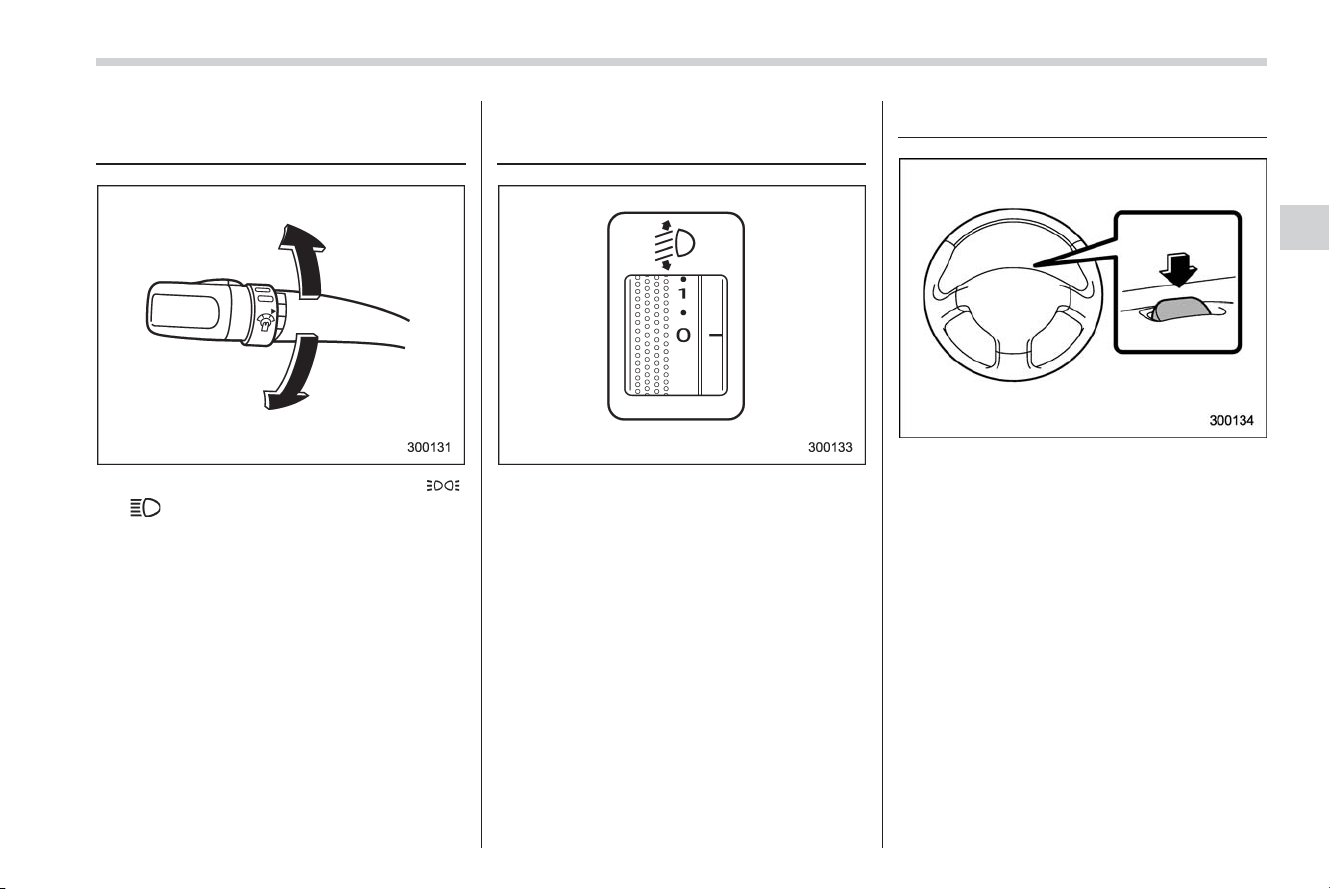
Black plate (137,1)
北米Model "A8130BE-B" EDITED: 2007/ 7/ 25
Illumination brightnes s con-
trol
When the headlight switch is in the “ ”
or “
” position, you can adjust bright-
ness of the instrument panel illumination
for better visibility.
To brighten, turn the control dial upward.
To darken, turn the control dial downward.
Headlight beam leveler (Ve-
hicle with HID headlights)
The HID headlights generate more light
than conventional halogen headlights.
Therefore a driver of an oncoming vehicle
may experience too much glare when your
headlight beam height adjustment is high
due to the vehicle carrying a heavy load.
The headlight beam leveler can be used
to adjust beam height to avoid such a
condition.
The higher the number the switch is
turned to, the lower the beam height
becomes.
Parking light switch
The parking light switch operates regard-
less of the ignition switch position.
By pushing the front end of this switch,
following lights will come on.
– Parking lights
– Front side marker lights
– Tail lights
– License plate lights
To turn off, push the rear end of the
parking light switch.
Avoid leaving these lights on for a long
time because that will run down the
battery.
Instruments and controls 3-23
3
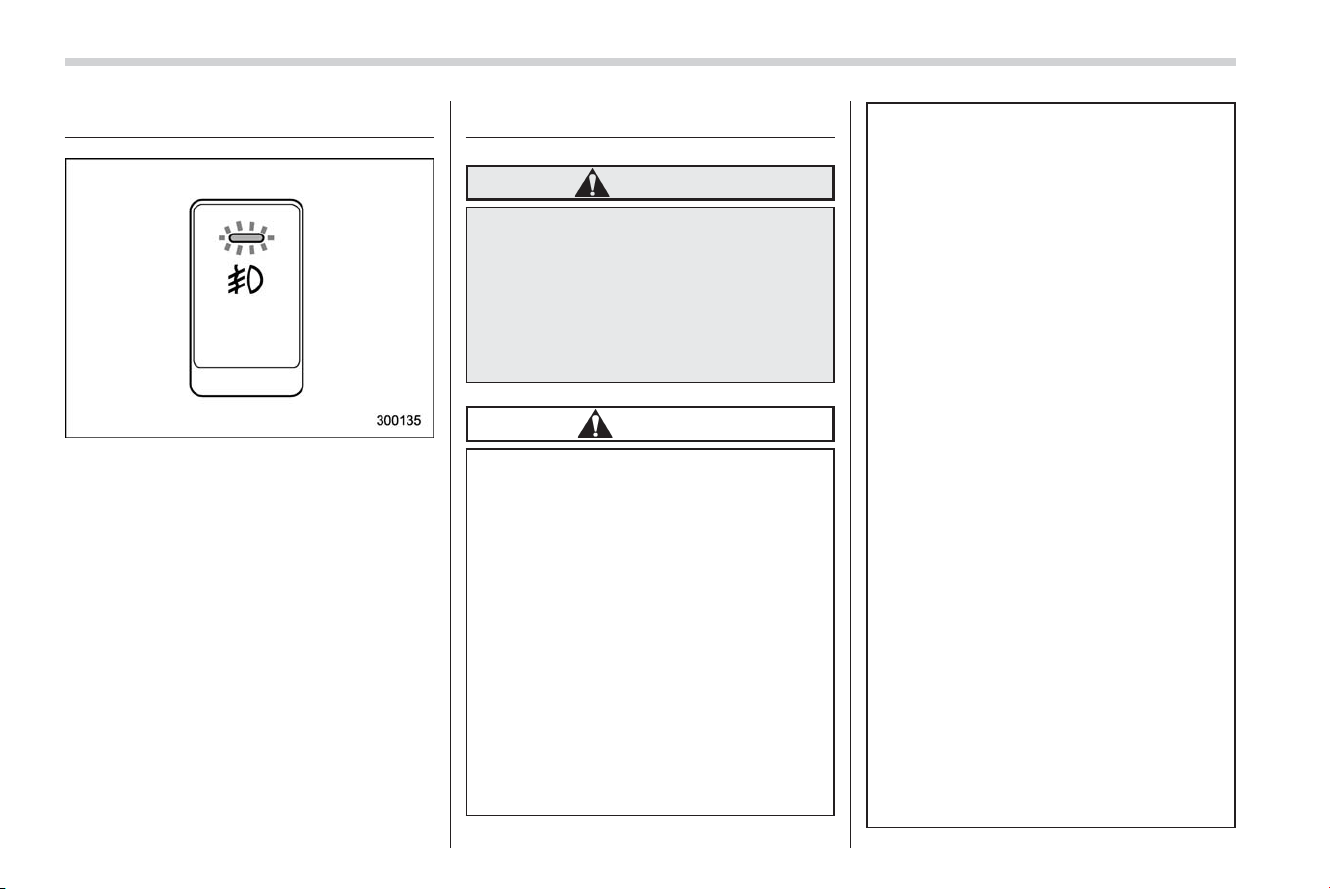
Black plate (138,1)
北米Model "A8130BE-B" EDITED: 2007/ 7/ 25
3-24 Instruments and controls
Front fog light button
The front fog lights operate only when the
headlights are on low beam. Push the
front fog light button to turn the front fog
lights on.
However, the front fog lights turn off when
the headlights are switched to high beam.
Press the button again to turn them off.
The indicator light located on the button
will illuminate when the front fog lights are
on.
Wiper and washer
WARNING
In freezing weather, do not use the
windshield washer until the wind-
shield is sufficiently warmed by the
defroster.
Otherwise the washer f luid can
freeze on the windshield, blocking
your view.
CAUTION
. Do not operate the washer con-
tinuously for more than 10 sec-
onds, or when the washer fluid
tank is empty. This may cause
overheating of the washer motor.
Check the washer fluid level
frequently, such as at fuel stops.
. Do not operate the wipers when
the windshield or rear window is
dry. This may scratch the glass,
damage the wiper blades and
cause the wiper motor to burn
out. Before operating the wiper
on a dry windshield or re ar
window, al ways us e the wind-
shield washer.
. In freezing weather, be sure that
the wiper blades are not frozen to
the windshield or rear window
before switching on the wipers.
Attempting to operate the wiper
with the blades frozen to the
window glass could cause not
only the wiper blades to be
damaged but also the wiper mo-
tor to burn out. If the wiper
blades are frozen to the window
glass, be sure to operate the
defroster, windshield wiper dei-
cer (if equipped) or rear window
defogger before turning on the
wiper.
. If the wipers stop during opera-
tion because of ice or some other
obstruction on the window, the
wiper motor could burn out even
if the wiper switch is turned off. If
this occurs, promptly stop the
vehicle in a safe place, turn the
ignition switch to the “LOCK”
position and clean the window
glass to allow proper wiper op-
eration.
. Use clean water if windshield
washer fluid is unavailable. In
areas where water freezes in
winter, use SUBARU Windshield
Washer Fluid or the equivalent.
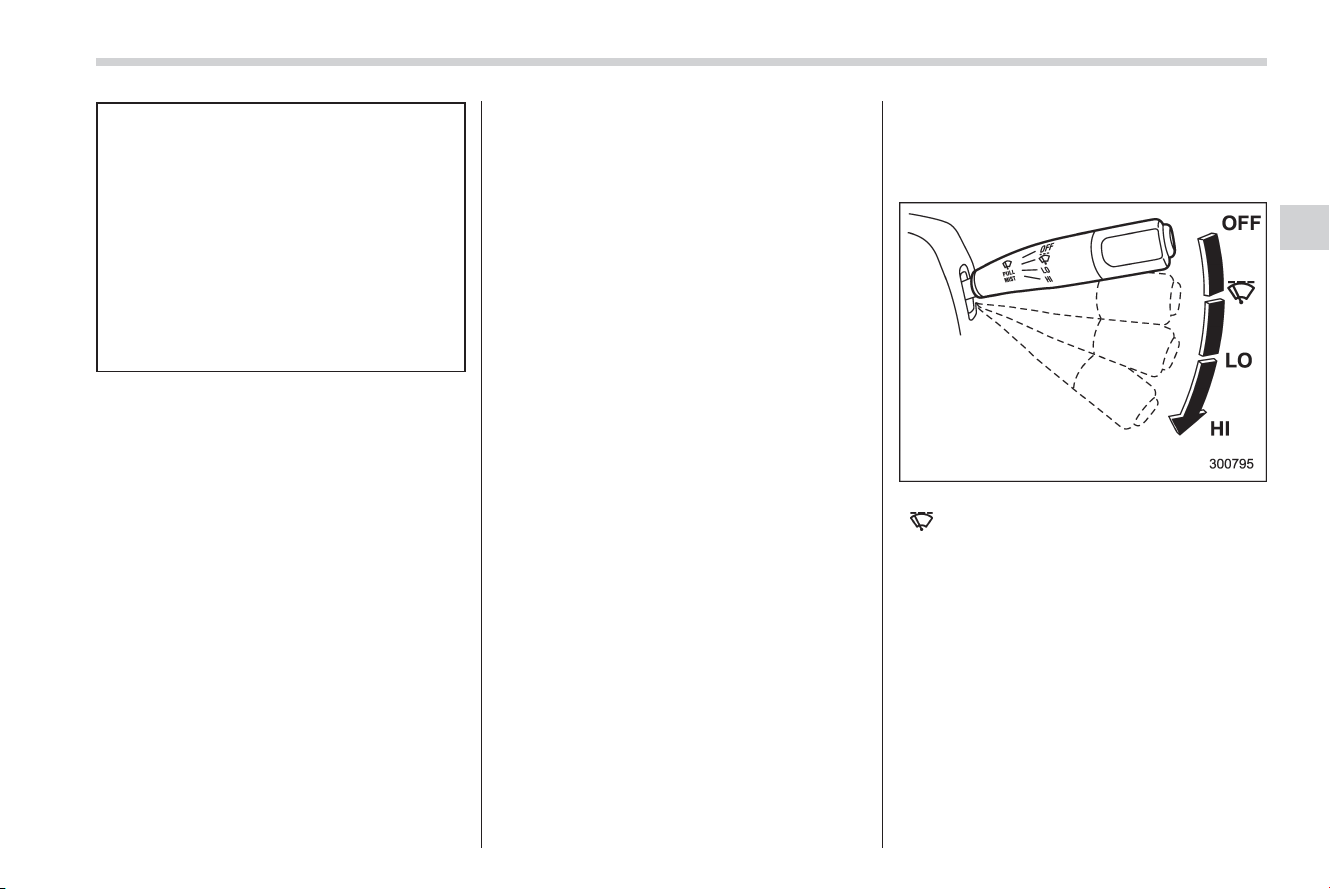
Black plate (139,1)
北米Model "A8130BE-B" EDITED: 2007/ 7/ 25
(See the “Windshield washer
fluid” section in chapter 11.)
Also, when driving the vehicle
when there are freezing tempera-
tures, use non-freezing type wi-
per blades.
. Do not clean the wiper blades
with gasoline or a solvent, such
as paint thinner or benzene. This
will cause deteri oration of the
wiper blades.
NOTE
. The wiper operates only when the
ignition switch is in the “ON” or “Acc”
position.
. Clean your wiper blades and win-
dow glass periodically with a washer
solution to prevent streaking, and to
remove accumulations of road salt or
road film. Keep the washer button
depressed at least for 1 second so that
washer solution will be sprinkled all
over the windshield or rear window.
. Grease, wax, insects or other mate-
rial on the windshield or the wiper
blade results in jerky wiper operation
and streaking on the glass. If you
cannot remove those streaks after
operating the washer or if the wiper
operation is jerky, clean the outer sur-
face of the windshield or rear window
and the wiper blades using a sponge or
soft cloth with a neutral detergent or
mild abrasive cleaner. After cleaning,
rinse the window glass and wiper
blades with clean water. The glass is
clean if no beads form on the glass
when you rinse with water.
. If you cannot eliminate the streaking
even after following this procedure,
replace the wiper blades with new
ones. Refer to the “Replacement of
wiper blades” section (chapter 11) for
replacement instructions.
& Windshield wiper and washer
switches
! Windshield wipers
OFF: Park
: Intermittent
LO: Low speed
HI: High speed
To turn the wipers on, push the wiper
control lever down.
To turn the wipers off, return the lever to
the “OFF” position.
Instruments and controls 3-25
– CONTINUED –
3
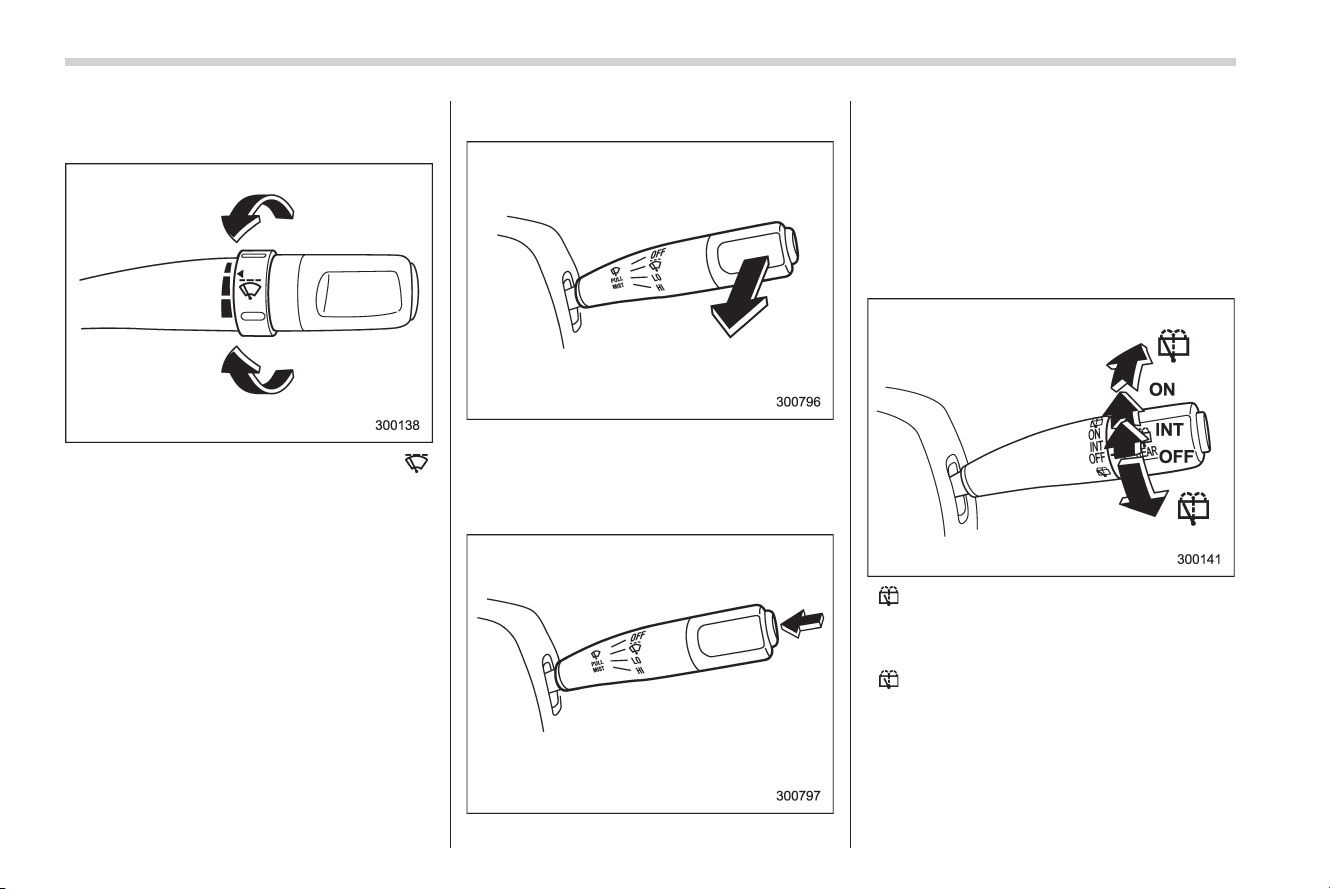
Black plate (140,1)
北米Model "A8130BE-B" EDITED: 2007/ 7/ 25
3-26 Instruments and controls
! Wiper intermittent time control (if
equipped)
When the wip er switch is in the “ ”
position, turn the dial to adjust the operat-
ing interval of the wiper.
The operating interval can be adjusted
continuously from the shortest interval to
the longest.
Two click stop positions of the dial may
help you to aim at your desired interval.
! Mist (for a single wipe)
For a single wipe of the wipers, pull the
lever toward you. The wipers operate until
you release the lever.
! Washer
To wash the windshield, push the washer
button at the end of the wiper control lever.
The washer fluid sprays until you release
the washer button. The wipers operate
while you push the button.
& Rear window wiper and
washer switch
: Washer (accompanied by wiper operation)
ON: Normal
INT: Intermittent
OFF: Park
: Washer
! Rear wiper
To turn the rear wiper on, turn the knob on
the end of the wiper control lever upward.
INT: Intermittent
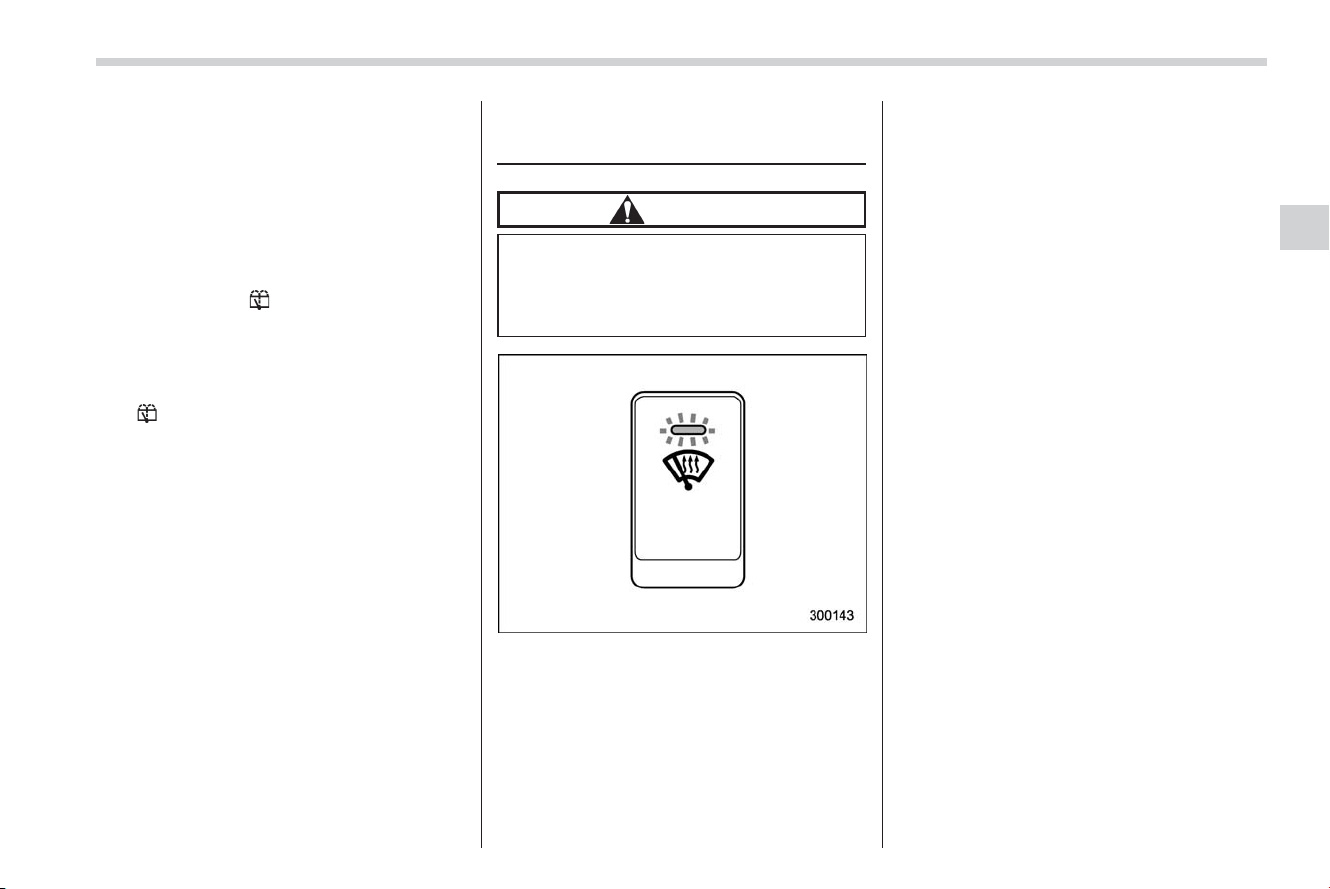
Black plate (141,1)
北米Model "A8130BE-B" EDITED: 2007/ 7/ 25
ON: Normal
To turn the wiper off, return the knob on
the end of the lever to the “OFF” position.
! Washer
To wash the rear window while the rear
wiper is operating, turn the knob on the
end of the wiper control lever counter-
clockwise to the “
” position. The washer
fluid sprays until you release the knob.
To wash the rear window when the rear
wiper is not in use, turn the knob on the
end of the wiper control lever clockwise to
the “
” position. The washer fluid sprays
and the wiper operates until you release
the knob.
Windshield wiper deicer (if
equipped)
CAUTION
To prevent the battery from being
discharged, do not operate the
windshield wiper deicer continu-
ously for any longer than necessary.
The windshield wiper deicer operates only
when the ignition switch is in the “ON”
position.
Before turning on the windshield wiper
deicer, remove any snow from the wind-
shield. To turn on the windshield wiper
deicer, push the button. The indicator light
located on the button lights up while the
windshield wiper deicer is operating.
The windshield wiper deicer will automa-
tically shut off after approximately 15
minutes. If the wiper blades have been
deiced completely before that time, push
the button to turn it off. It also turns off
when the ignition switch is turned to the
“Acc” or “LOCK” position. If deicing is not
complete, you have to push the button to
turn the deicer on again.
NOTE
If your vehicle is equipped with the
outside mirror defogger, the outside
mirror defogger operates while the
windshield wiper deicer is operating.
Instruments and controls 3-27
3
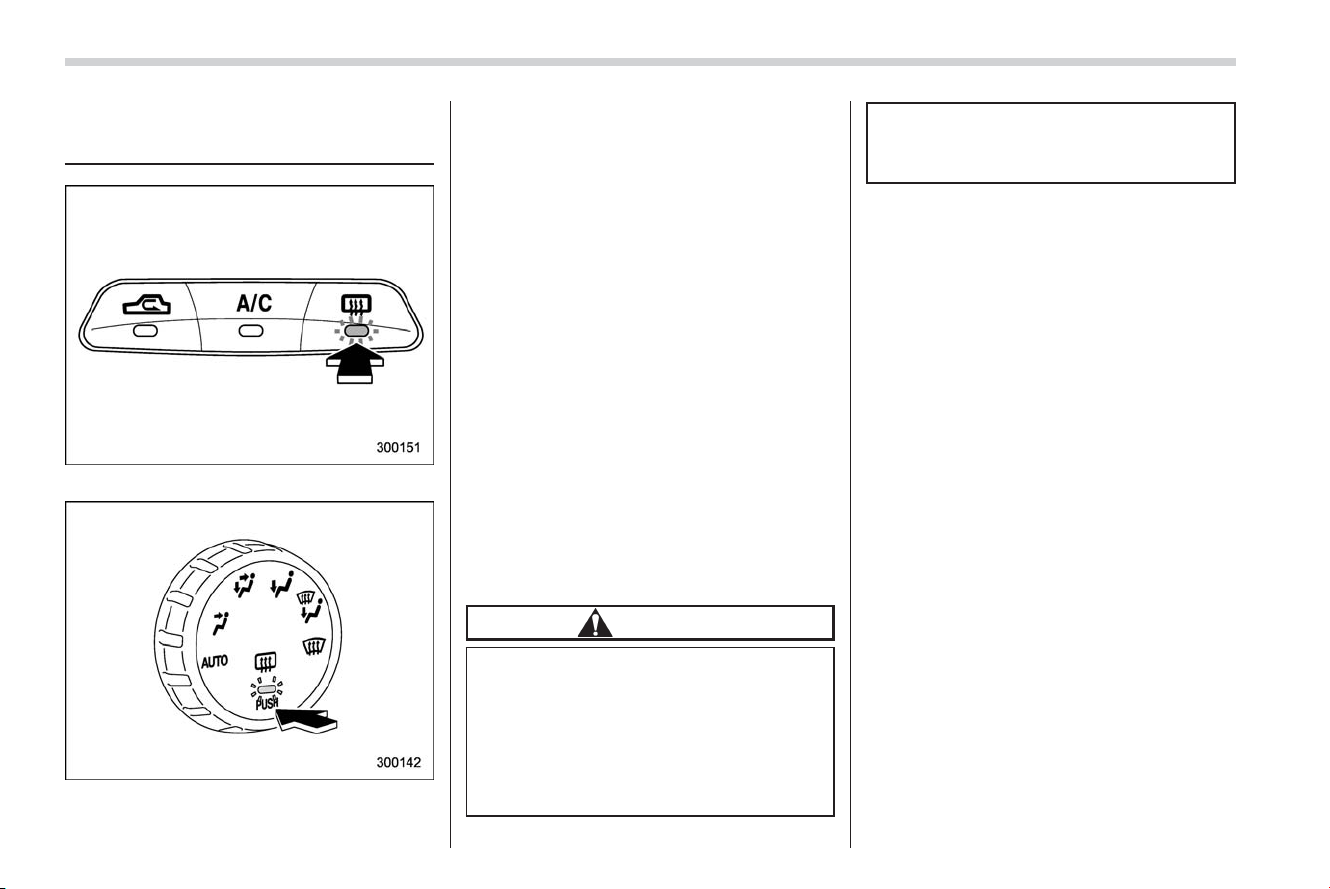
Black plate (142,1)
北米Model "A8130BE-B" EDITED: 2007/ 7/ 25
3-28 Instruments and controls
Rear window defogger but-
ton
Manual climate control system
Automatic climate control system
The rear window defogger operates only
when the ignition switch is in the “ON”
position.
The rear window defogger button is
located on the climate control panel.
To turn on the defogger, push the button.
To turn it off, push the button again.
The indicator light located on the button
lights up while the rear window defogger is
operating.
The defogger will automatically shut off
afte r approximately 15 minutes. If the
window clears before that time, push the
button to turn it off. It also turns off when
the ignition switch is turned to the “Acc” or
“LOCK” position. If defrosting or defogging
is desired when you restart your vehicle,
you have to push the button to turn it on
again.
Turn on the rear window defogger if the
wiper is frozen to the glass.
CAUTION
. Do not use sharp instruments or
window cleaner containing abra-
sives to clean the inner surface
of the rear window. They may
damage the conductors printed
on the window.
. To prevent the battery from being
discharged, do not operate the
defogger continuously for any
longer than necessary.
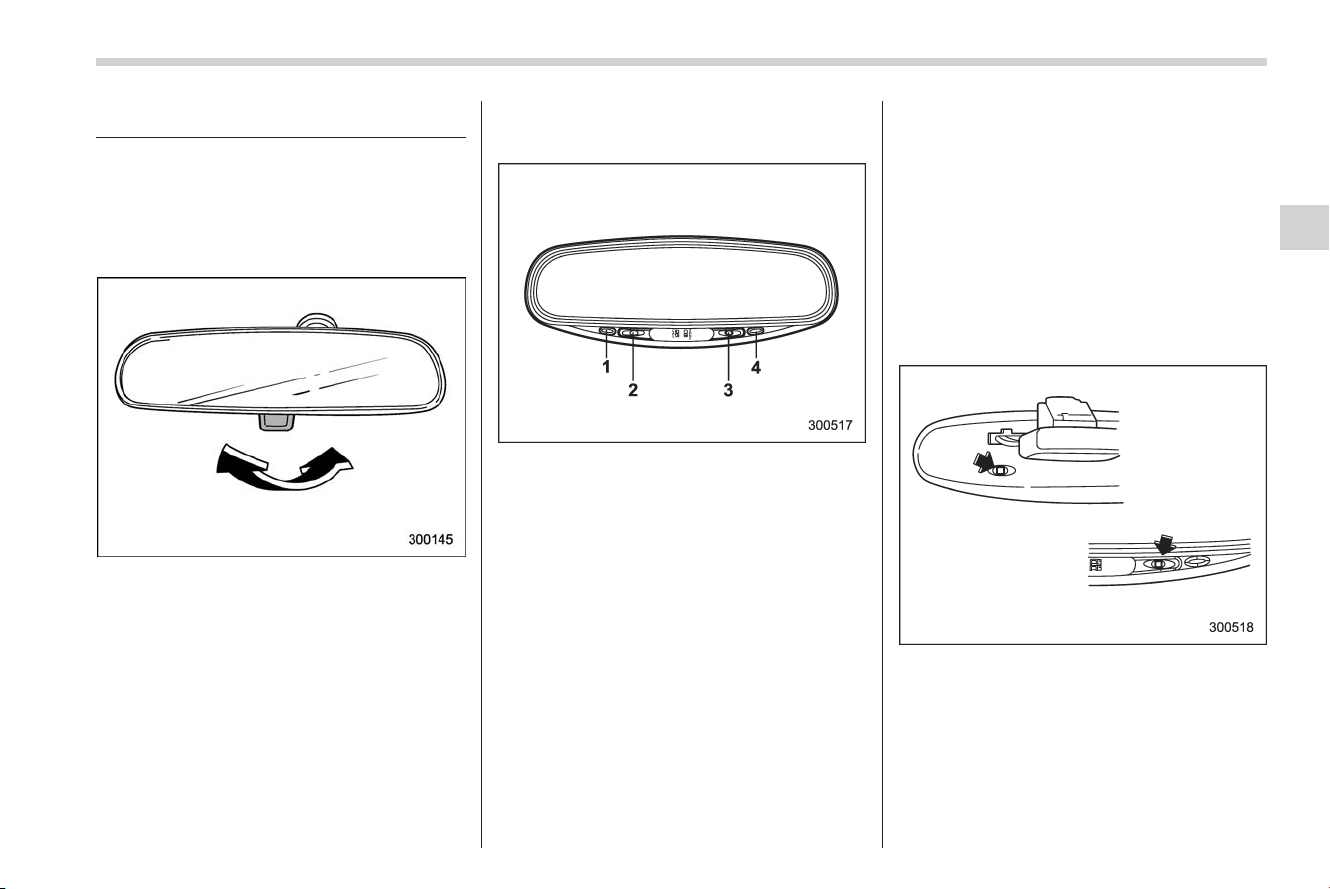
Black plate (143,1)
北米Model "A8130BE-B" EDITED: 2007/ 7/ 25
Mirrors
Always check that the inside and outside
mirrors are properly adjusted before you
start driving.
& Inside mirror
The inside mirror has a day and night
position. Pull the tab at the bottom of the
mirror toward you for the night position.
Push it away for the day position. The
night position reduces glare from head-
lights.
! Auto-dimming mirror/compass (if
equipped)
1) Left button
2) Auto dimming indicator
3) Photosensor
4) Right button
The auto-dimming mirror/compass has an
anti-glare feature which automatically re-
duces glare coming from headlights of
vehicles behind you. It also contains a
built-in compass.
. By pressing and releasing the left
button, the automatic dimming function is
toggled on or off. When the automatic
dimming function is on, the auto dimming
indicator light (green) located to the right
of the button will illuminate.
. By pressing and releasing the right
button, the compass display is toggled on
or off. When the compass is on, an
illuminated compass reading will appear
in the lower part of the mirror.
Even with the mirror in anti-glare mode,
the mirror surface turns bright if the
transmission is shifted into reverse. This
is to ensure good rearward visibility during
reversing.
! Photosensors
The mirror has a photosensor attached on
both the front and back sides. If the glare
from the headlights of vehicles behind you
strikes the mirror, these sensors detect it
and make the reflection surface of the
mirror dimmer to help prevent you from
being blinded. For this reason, use care
not to cover the sensors with stickers, or
Instruments and controls 3-29
– CONTINUED –
3
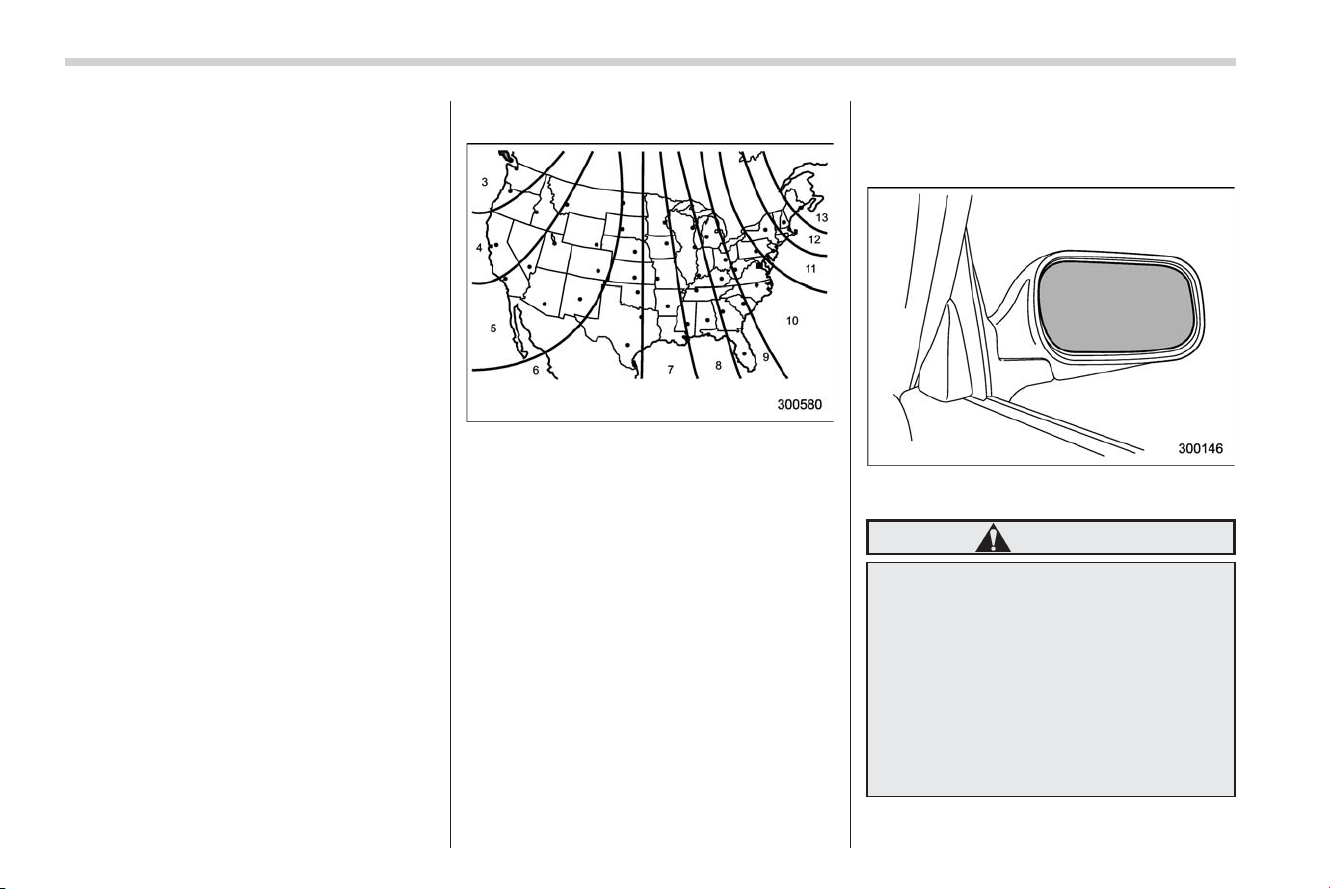
Black plate (144,1)
北米Model "A8130BE-B" EDITED: 2007/ 7/ 25
3-30 Instruments and controls
other similar items. Periodically wipe the
sensors clean using a piece of dry soft
cotton cloth or an applicator.
! Compass calibration
1. For optimum calibration, switch off all
nonessential electrical accessories (rear
window defogger, heater/air conditioning
system, spotlight, etc.) and ensure all
doors are shut.
2. Drive to an open, level area away from
large metallic objects or structures and
make certain the ignition switch is in the
“ON” position.
3. Press and hold the left button for 3
seconds then release, and the compass
will enter the calibration mode. “CAL” and
direction will be displayed.
4. Drive slowly in a circle until “CAL”
disappears from the display (approxi-
mately two or three circles).
5. The compass is now calibrated.
Further calibration is not required. The
compass will automatically calibrate from
this point forward.
! Compass zone adjustment
Compass calibration zones
1. The zone setting is factory preset to
Zone 8. Refer to the “Compass calibration
zone” map shown above or one attached
to the end of this manual to verify that the
compass zone setting is correct for your
geographical location.
2. Press and hold the right button for 3
seconds then release, and the word
“ZONE” will briefly appear and then the
zone number will be displayed.
3. Press the right-hand button repeatedly
to cycle the display through all possible
zone settings. Stop cycling when the
correct zone setting for your location is
displayed.
4. Releasing the button for 3 seconds will
exit the zone setting mode.
& Outside mirrors
! Convex mirror (passenger side)
WARNING
Objects look smaller in a convex
mirror and farther away than when
viewed in a flat mirror. Do not use
the convex mirror to judge th e
distance of vehicles behind you
when changing lanes. Use the inside
mirror (or glance backwards) to
determine the actual size and dis-
tance of objects that you view in
convex mirror.
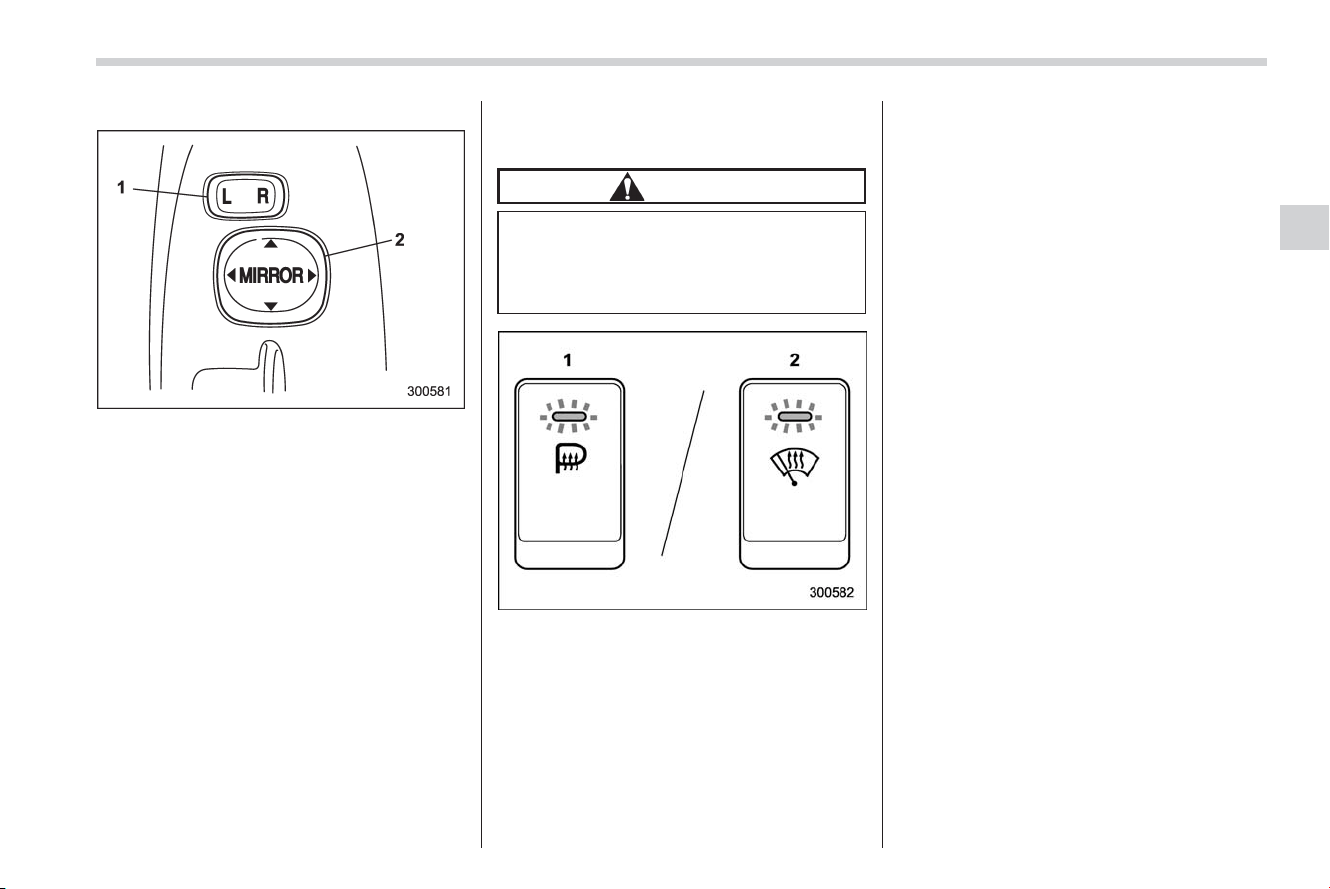
Black plate (145,1)
北米Model "A8130BE-B" EDITED: 2007/ 7/ 25
! Remote control mirror switch
1) Selection switch
2) Direction control switch
The remote control mirrors operate only
when the ignition switch is in the “ON” or
“Acc” position.
1. Press either end of the selection
switch, “L” for the left, “R” for the right.
2. Move the direction control switch in the
direction you want to move the mirror.
3. Return the selection switch t o t he
neutral position to prevent unintentional
operation.
The mirrors can also be adjusted manu-
ally.
! Outside mirror defogger (if
equipped)
CAUTION
To prevent the battery from being
discharged, do not operate the de-
fogger continuously for any longer
than necessary.
1) Outsi de mirror defogger button (if
equipped)
2) Outside mirror defogger and windshield
wiper deicer button (if equipped)
The outside mirror defogger operates only
when the ignition switch is in the “ON”
position.
To turn on the outside mirror defogger,
push the button. To turn it off, push the
button again. The indicator light located on
the button lights up while the outside
mirror defogger is operating.
The defogger will automatically shut off
after approximately 15 minutes. If the
mirror clears before that time, push the
button to turn it off. It also turns off when
the ignition switch is turned to the “Acc” or
“LOCK” position. If defrosting or defogging
is desired when you restart your vehicle,
you have to push the button to turn it on
again.
NOTE
On vehicles equipped with a wind-
shield wiper deicer, the windshield
wiper deicer switch is also used to
operate the outside mirror defogger.
Instruments and controls 3-31
3
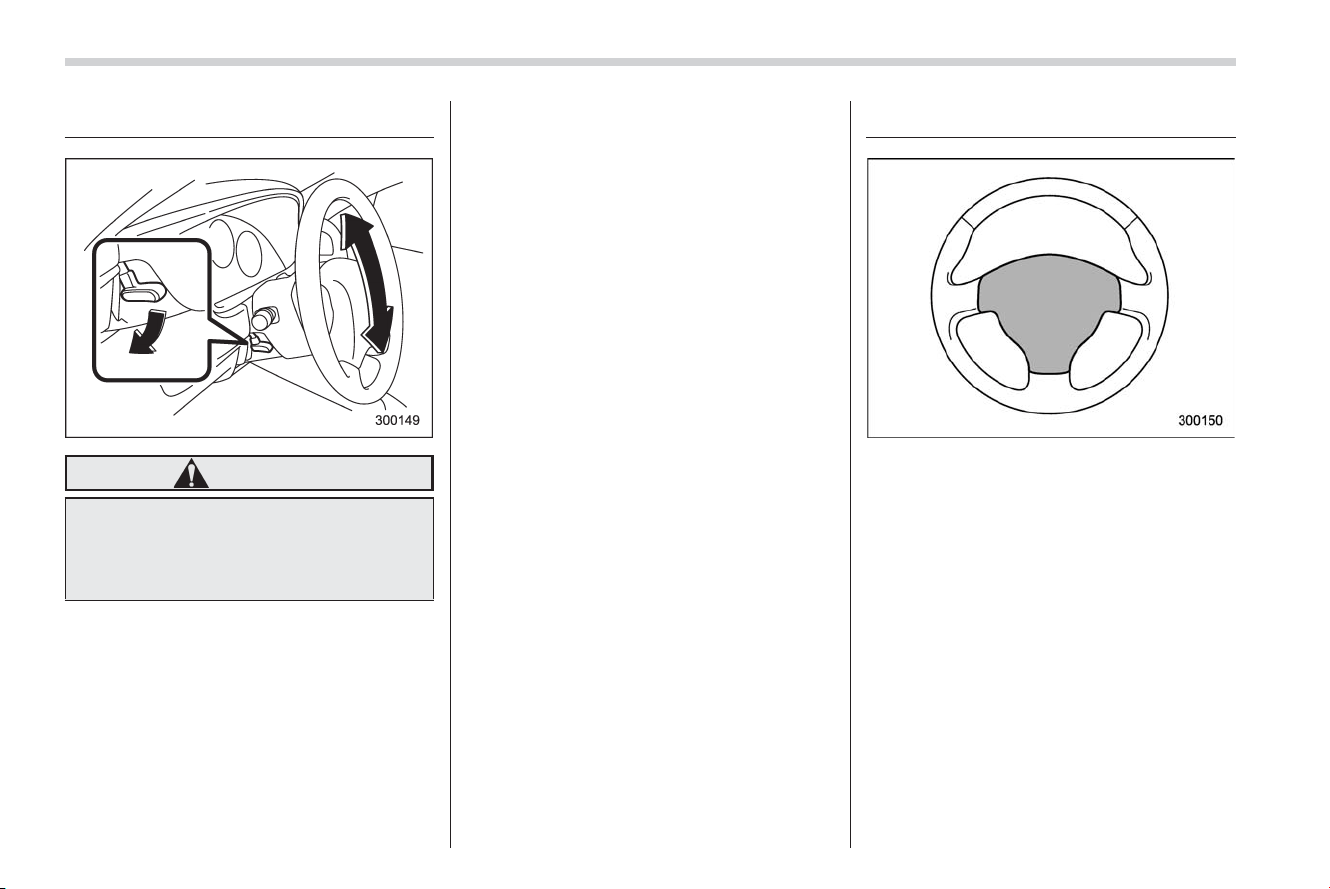
Black plate (146,1)
北米Model "A8130BE-B" EDITED: 2007/ 7/ 25
3-32 Instruments and controls
Tilt steering wheel
WARNING
Do not adjust the steering wheel tilt
position while driving. This may
cause loss of vehicle control and
result in personal injury.
1. Adjust the seat position. Refer to the
“Front seats” section (chapter 1).
2. Push the tilt lock lever down.
3. Move the steering wheel to the desired
level.
4. Pull the lever up to lock the steering
wheel in place.
5. Make sure that the steering wheel is
securely locked by moving it up and down.
Horn
To sound the horn, push the horn pad.

Black plate (7,1)
北米Model "A8130BE-B" EDITED: 2007/ 7/ 25
Ventilator.............................................................. 4-2
Air flow selection ................................................ 4-2
Center and side ventilators.................................. 4-3
Manual climate control system
(if equipped) ..................................................... 4-3
Control panel ...................................................... 4-3
Heater operation ................................................. 4-5
Air conditioner operation..................................... 4-7
Automatic climate control system
(if equipped) ..................................................... 4-8
Control panel ...................................................... 4-8
To use as full-automatic climate control
system.............................................................. 4-8
To use as semi-automatic climate control
system.............................................................. 4-8
Fan speed control dial......................................... 4-9
Temperature control dial...................................... 4-9
Air flow control dial............................................. 4-9
Air inlet selection button .................................... 4-10
Air conditioner button........................................ 4-10
Temperature sensors ......................................... 4-11
Operating tips for heater and air
conditioner ...................................................... 4-11
Cleaning ventilation grille................................... 4-11
Efficient cooling after parking in direct
sunlight ........................................................... 4-11
Lubrication oil circulation in the refrigerant
circuit.............................................................. 4-12
Checking air conditioning system before summer
season ............................................................ 4-12
Cooling and dehumidifying in high humidity and
low temperature weather conditions ................. 4-12
Air conditioner compressor shut-off when engine
is heavily loaded.............................................. 4-12
Refrigerant for your climate control system ........ 4-12
Air filtration system (if equipped)..................... 4-12
Replacing an air filter......................................... 4-13
Climate control
4
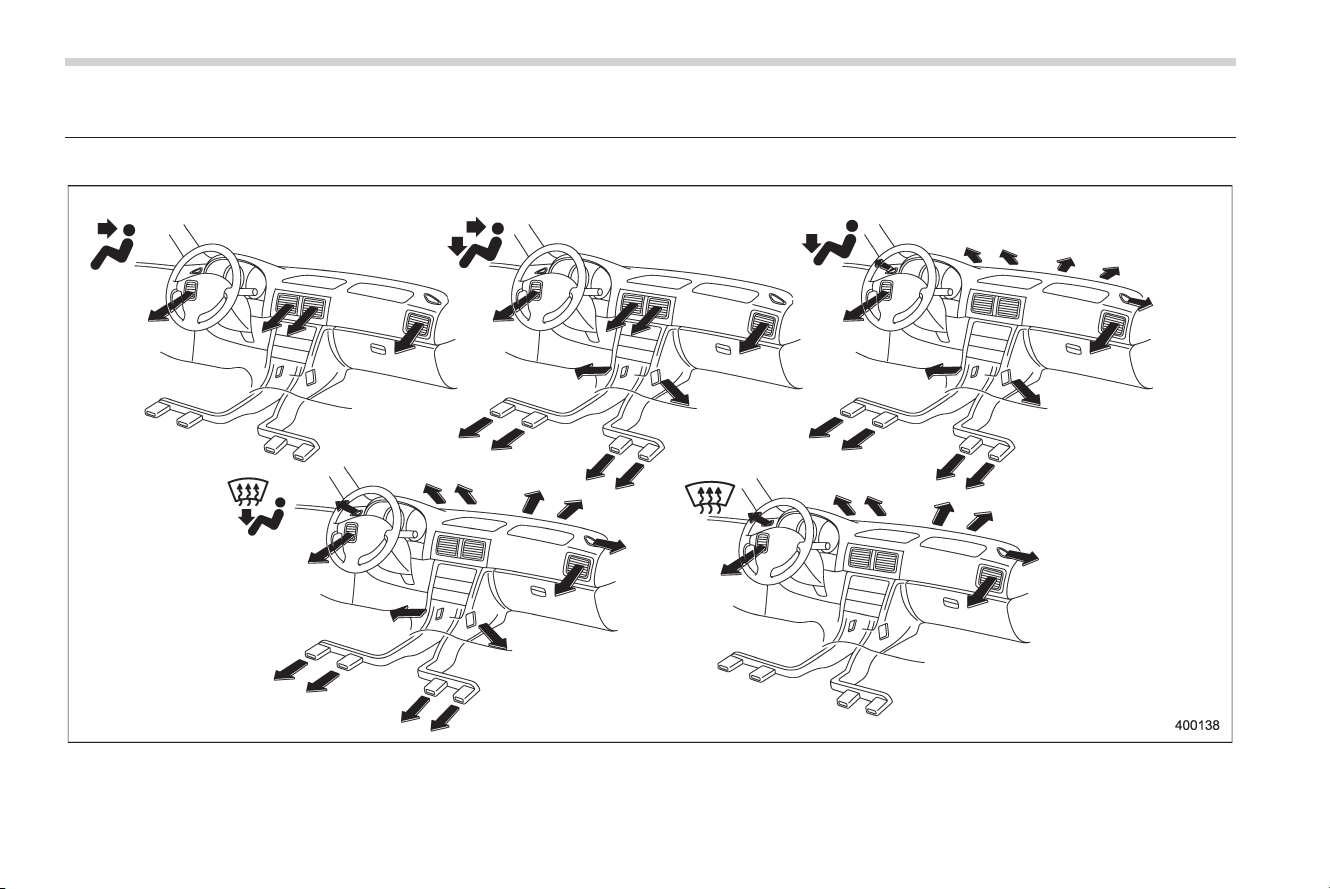
Black plate (150,1)
北米Model "A8130BE-B" EDITED: 2007/ 7/ 25
4-2 Climate control
Ventilator
& Air flow selection
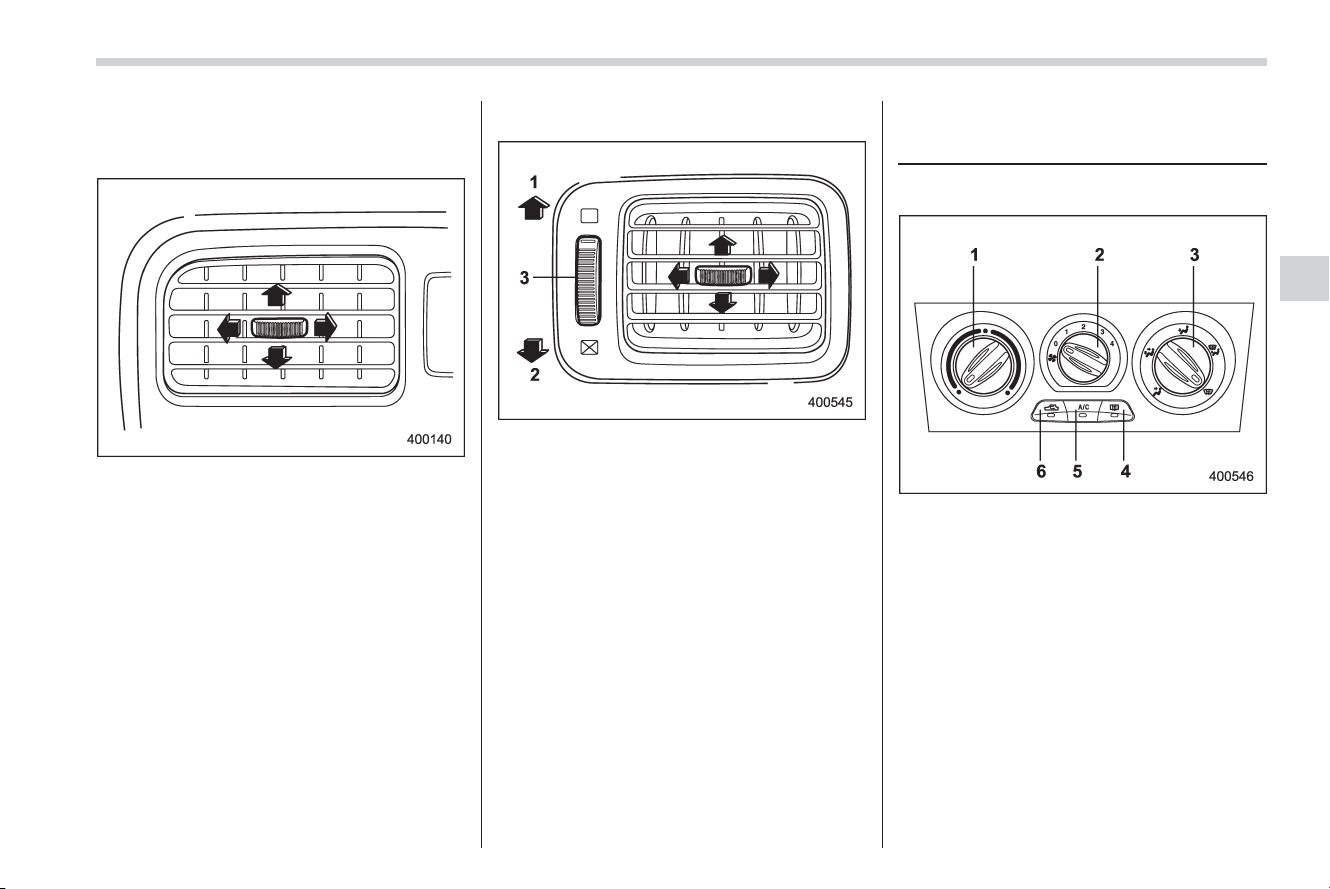
Black plate (151,1)
北米Model "A8130BE-B" EDITED: 2007/ 7/ 25
& Center and side ventilators
! Center ventilators
Move the tab up and down or right and left
to adjust the flow direction.
! Side ventilators
1) Open
2) Close
3) Thumbwheel
Move the tab up and down or right and left
to adjust the flow direction.
To open or close the ventilator, turn the
thumbwheel up or down.
Manual climate control sys-
tem (if equipped)
& Control panel
1) Temperature control dial
2) Fan speed control dial
3) Air flow control dial
4) Rear window defogger button (Refer to
the “Rear window defogger button” in
chapter 3.)
5) Air conditioner button
6) Air inlet selection button
! Temperature control dial
This dial regulates the temperature of air
flow from the air outlets over a range from
the blue side (cool) to red side (warm).
Climate control 4-3
– CONTINUED –
4
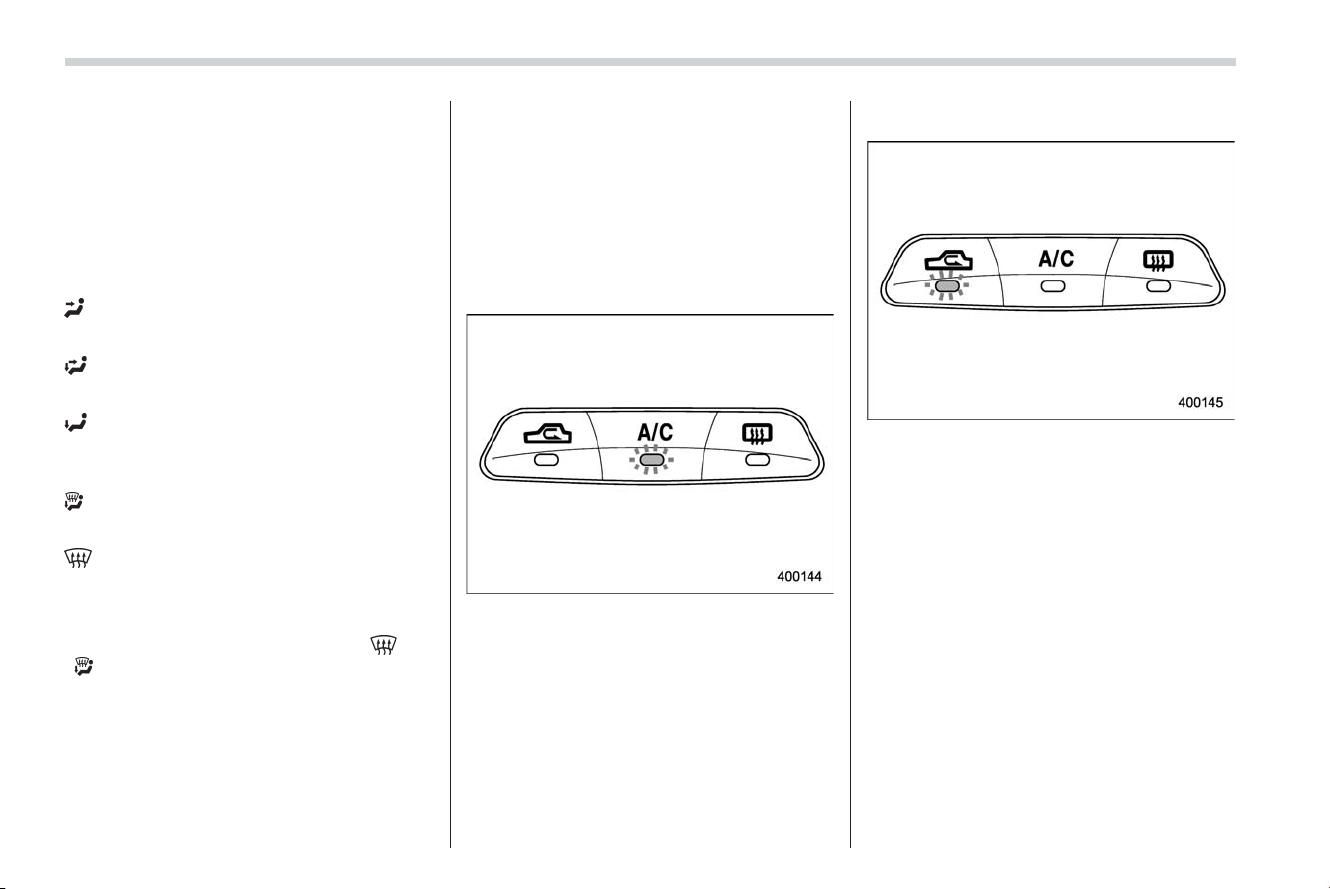
Black plate (152,1)
北米Model "A8130BE-B" EDITED: 2007/ 7/ 25
4-4 Climate control
! Fan speed control dial
The fan operates only when the ignition
switch is turned to the “ON” position. The
fan speed control dial is used to select
four fan speeds.
! Air flow control dial
This dial has the following five positions:
: Air flows through the instrument panel
outlets.
: Air flows through the instrument panel
outlets and the foot outlets.
: Air flows through the foot outlets and
some through the windshield defroster
outlets.
: Air flows through the windshield
defroster outlets and foot outlets.
: Air flows through the windshield
defroster outlets.
NOTE
When the dial is placed in the “ ” or
“
” position, the air conditioner com-
pressor operates automatically regard-
less of the position of the air condi-
tioner button to defog the windshield
quickly. However the indicator on the
air conditioner button will not come on.
At the same time, the air inlet selection
is automatically set to “outside air”
mode.
In this state, you cannot select “recir-
culation” mode by manually pressing
the air inlet selection button.
Also, you cannot stop the air condi-
tioner compressor by pressing the air
conditioner button.
! Air conditioner button
The air conditioner operates only when
the engine is running.
Push the air conditioner button while the
fan is in operation to turn on the air
conditioner. The indicator light will come
on.
Push it again to turn off the air conditioner.
! Air inlet selection button
ON position (Recirculation): Interior air
is recirculated inside the vehicle. Push the
air inlet selection button to the ON posi-
tion. The indicator light will come on.
Place the air inlet selection button to the
ON position for fast cooling with the air
conditioner or when driving on a dusty
road.
OFF position (Outside air): Outside air is
drawn into the passenger compartment.
Push the air inlet selection button again to
the OFF position. The indicator light will go
off.
Place the air inlet selection button to the
OFF position when the interior has cooled
to a comfortable temperature and the road
is no longer dusty.
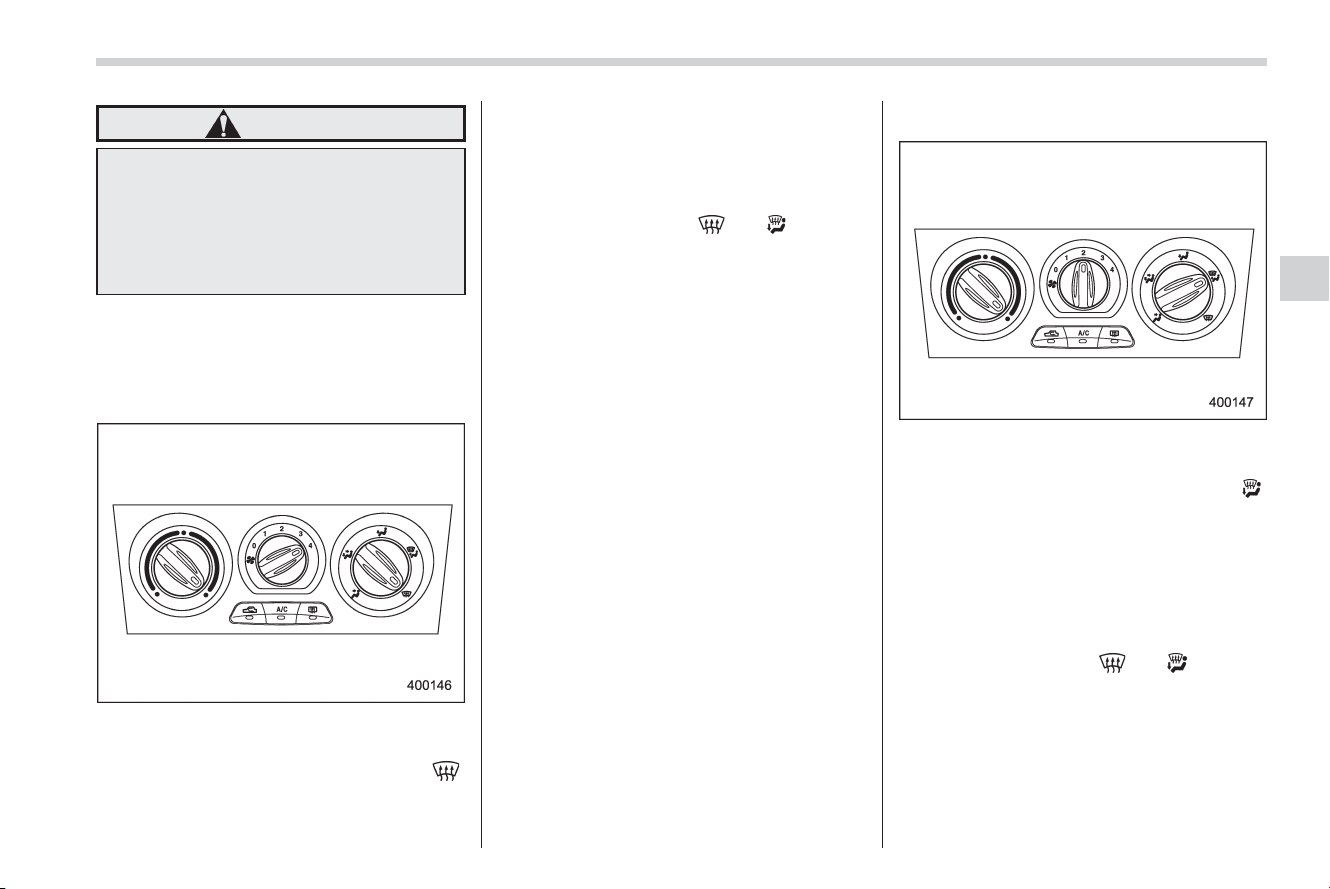
Black plate (153,1)
北米Model "A8130BE-B" EDITED: 2007/ 7/ 25
WARNING
Continued operation with the air
inletselectionbuttonintheON
position may fog up the windows.
Switch to the OFF position as soon
as the outside dusty condition
clears.
& Heater operation
! Defrosting or defogging the wind-
shield
To direct warm air to the windshield and
front door windows:
1. Set the air flow control dial to the “
”
position.
2. Turn the temperature control dial all
the way to the right.
3. Set the fan speed control dial to the
highest speed.
If your vehicle is equipped with an air
conditioner, when the “
” or “ ” position
is selected, the air conditioner compressor
automatically operates regardless of the
position of the air conditioner button to
defog the windshield quickly.
However, the air conditioner indicator light
does not come on at this time.
NOTE
Warm air also comes out from the right
and left air outlets. To stop warm air
flow from these outlets, turn the corre-
sponding thumbwheel down.
! Heating and defrosting
To direct warm air toward the floor and the
windshield:
1. Set the air flow control dial to the “
”
position.
2. Set the temperature control dial to the
most comfortable level.
3. Set the fan speed control dial to the
desired speed.
If your vehicle is equipped with an air
conditioner, when the “
” or “ ” position
is selected, the air conditioner compressor
automatically operates regardless of the
position of the air conditioner button to
defog the windshield quickly.
However, the air conditioner indicator light
does not come on at this time.
Climate control 4-5
– CONTINUED –
4
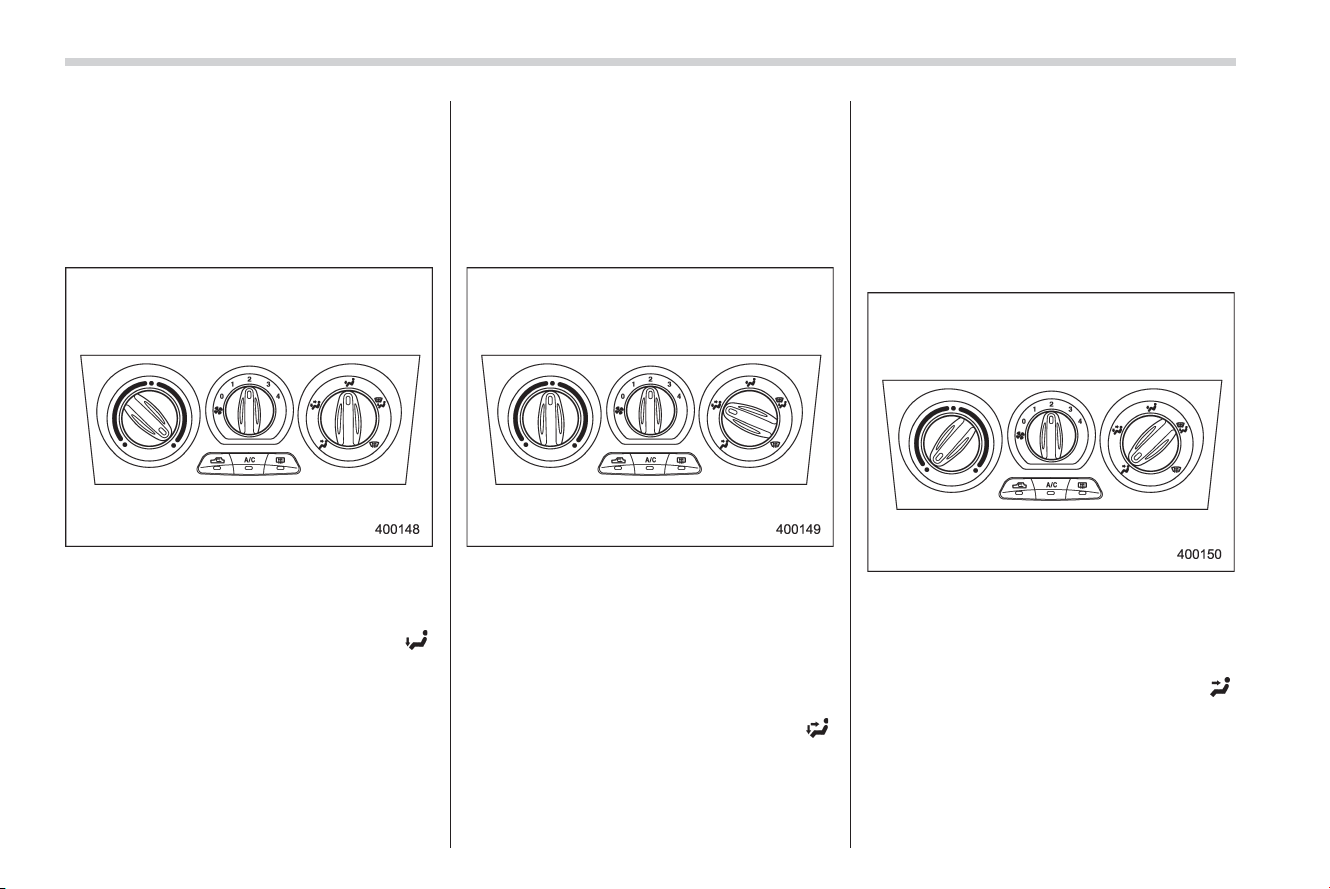
Black plate (154,1)
北米Model "A8130BE-B" EDITED: 2007/ 7/ 25
4-6 Climate control
NOTE
Warm air also comes out from the right
and left air outlets. To stop warm air
flow from these outlets, turn the corre-
sponding thumbwheel down.
! Heating
To direct warm air toward the floor:
1. Set the air inlet selection button to the
OFF position.
2. Set the air flow control dial to the “
”
position.
3. Set the temperature control dial to the
most comfortable level.
4. Set the fan speed control dial to the
desired speed.
NOTE
Warm air also comes out from the right
and left air outlets. To stop warm air
flow from these outlets, turn the corre-
sponding thumbwheel down.
! Bi-level heating
This setting allows you to direct air of
different temperatures from the instrument
panel and foot outlets. The air from the
foot outlets is slightly warmer than from
the instrument panel outlets.
1. Set the air inlet selection button to the
OFF position.
2. Set the air flow control dial to the “
”
position.
3. Set the temperature control dial to the
desired temperature level.
4. Set the fan speed control dial to the
desired speed.
Setting the temperature control dial fully
turned to the red area or blue area
decreases the temperature difference
between the air from the instrument panel
outlets and the air from the foot outlets.
! Ventilation
To force outside air through the instrument
panel outlets:
1. Set the air inlet selection button to the
OFF position.
2. Set the air flow control dial to the “
”
position.
3. Set the temperature control dial all the
way left.
4. Set the fan speed control dial to the
desired speed.
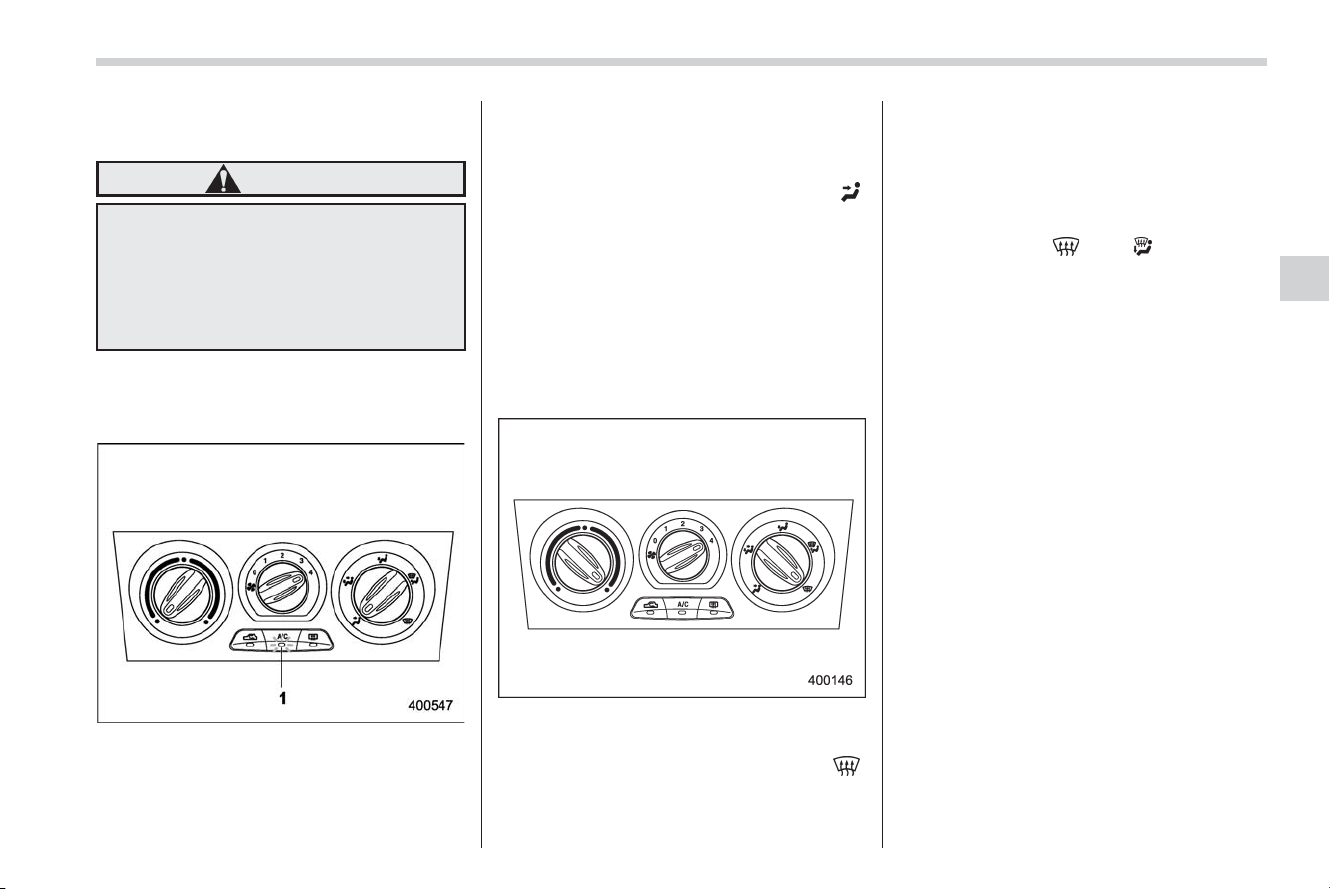
Black plate (155,1)
北米Model "A8130BE-B" EDITED: 2007/ 7/ 25
When driving on a dusty road, set the air
inlet selection button to the “ON” position.
WARNING
Continued operation with the air
inletselectionbuttonintheON
position may fog up the windows.
Switch to the OFF position as soon
as the outside dusty condition
clears.
& Air conditioner operation
! Cooling or dehumidifying
1) ON position
For cooling and dehumidification of the
passenger compartment, performing the
following steps will allow air to flow
through the instrument panel outlets:
1. Set the air inlet selection button to the
OFF position.
2. Set the air flow control dial to the “
”
position.
3. Set the air conditioner button to the
“ON” position.
4. Set the temperature control dial to the
blue side.
5. Set the fan speed control dial at the
highest speed.
! Defrosting or defogging
To direct warm air to the windshield and
front door windows:
1. Set the air flow control dial to the “
”
position.
2. Set the temperature control dial to the
red side.
3. Set the fan speed control dial at the
highest speed.
The air conditioner compressor automati-
cally operates when the air flow control
dial set in the “
” or “ ” position to
provide better defogging performance.
However, the air conditioner indicator light
does not come on at this time.
Climate control 4-7
4
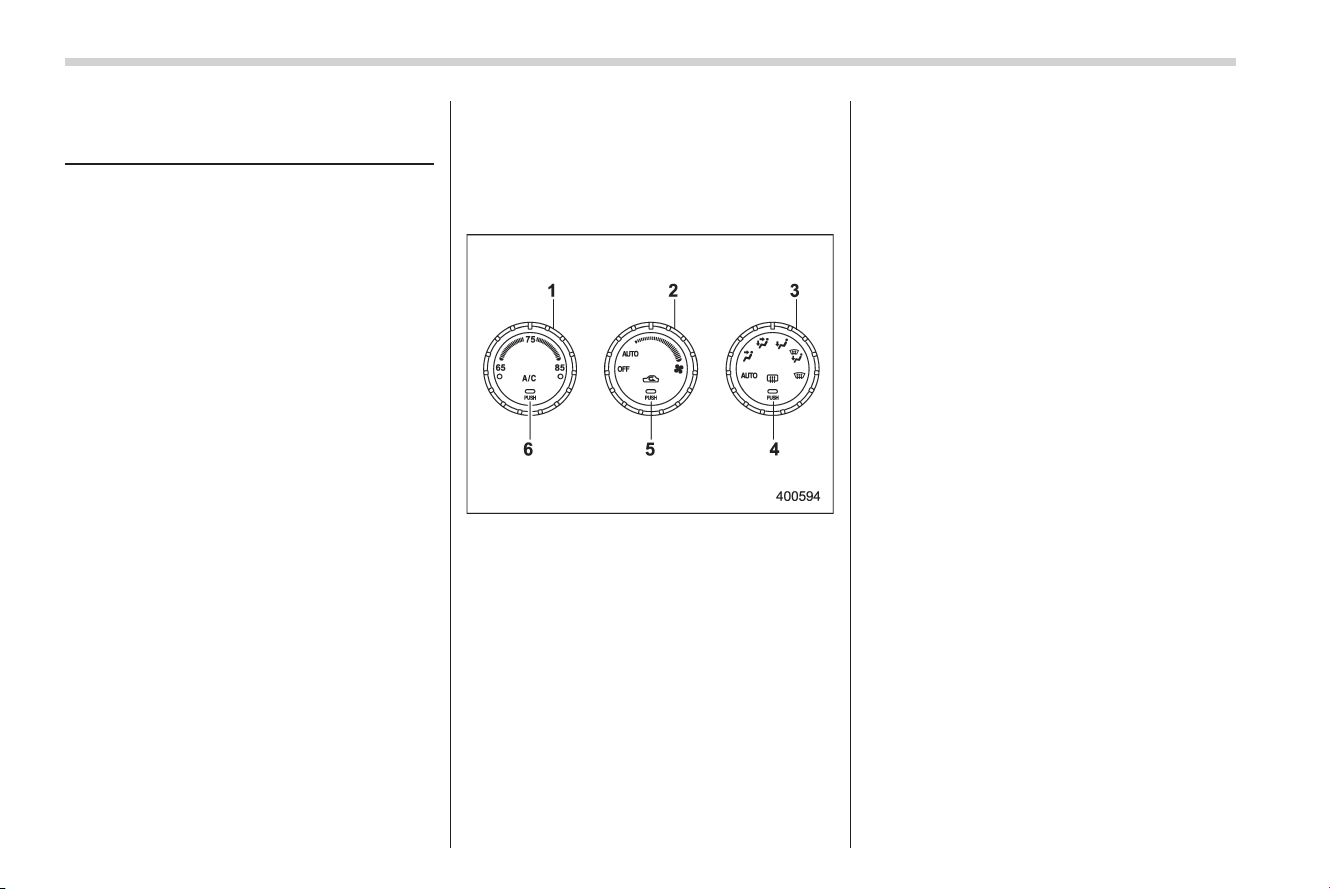
Black plate (156,1)
北米Model "A8130BE-B" EDITED: 2007/ 7/ 25
4-8 Climate control
Automatic climate control
system (if equipped)
Although this climate control system can
be used as a full-automatic climate control
system, it can also, if desired, be used as
a semi-automatic climate control system.
When it is used as a full-automatic climate
control system, the outlet air temperature,
fan speed, air flow distribution, air inlet
control, and air conditioner compressor
operation are all automatically controlled
to maintain a constant, comfortable tem-
perature inside the vehicle.
NOTE
. Operate the automatic climate con-
trol system when the engine is running.
. When the engine coolant is cold, the
blower does not run.
. In the “AUTO” mode, when the air
temperature in the passenger compart-
ment is sufficiently cool, the air condi-
tioner compressor does not operate.
For efficient defogging or dehumidify-
ing in cold weather, press the “A/C”
button to operate the air conditioner
compressor.
. Even when cooling is not necessary,
setting the temperature much lower
than the current outlet air temperature
turns on the air conditioner compres-
sor automatically and the “A/C” indi-
cator light on the control panel comes
on.
& Control panel
1) Temperature control dial
2) Fan speed control dial
3) Air flow control dial
4) Rear window defogger button (Refer to
the “Rear window defogger button” in
chapter 3.)
5) Air inlet selection button
6) Air conditioner button
& To use as full-automatic cli-
mate control system
Place the temperature control dial in the
position for your desired temperature, then
set the other dials and buttons as de-
scribed in the following. The system’s
functions will then switch to AUTO mode
and be controlled automatically.
. Air flow control dial: AUTO position
. Fan speed control dial: AUTO position
. Air inlet selection button: Press for at
least 1 second. (Indicator will flash twice.)
. Air conditioner button: Press for at least
1 second. (Indicator will flash twice.)
& To use as semi-automatic
climate control system
Each function can be individually set to
AUTO mode independently of the others.
Any function set to AUTO mode is con-
trolled automatically. Any function not set
to AUTO mode can be manually adjusted
as desired.
The temperature can be set within a range
of 65 to 858F (20 to 308C).
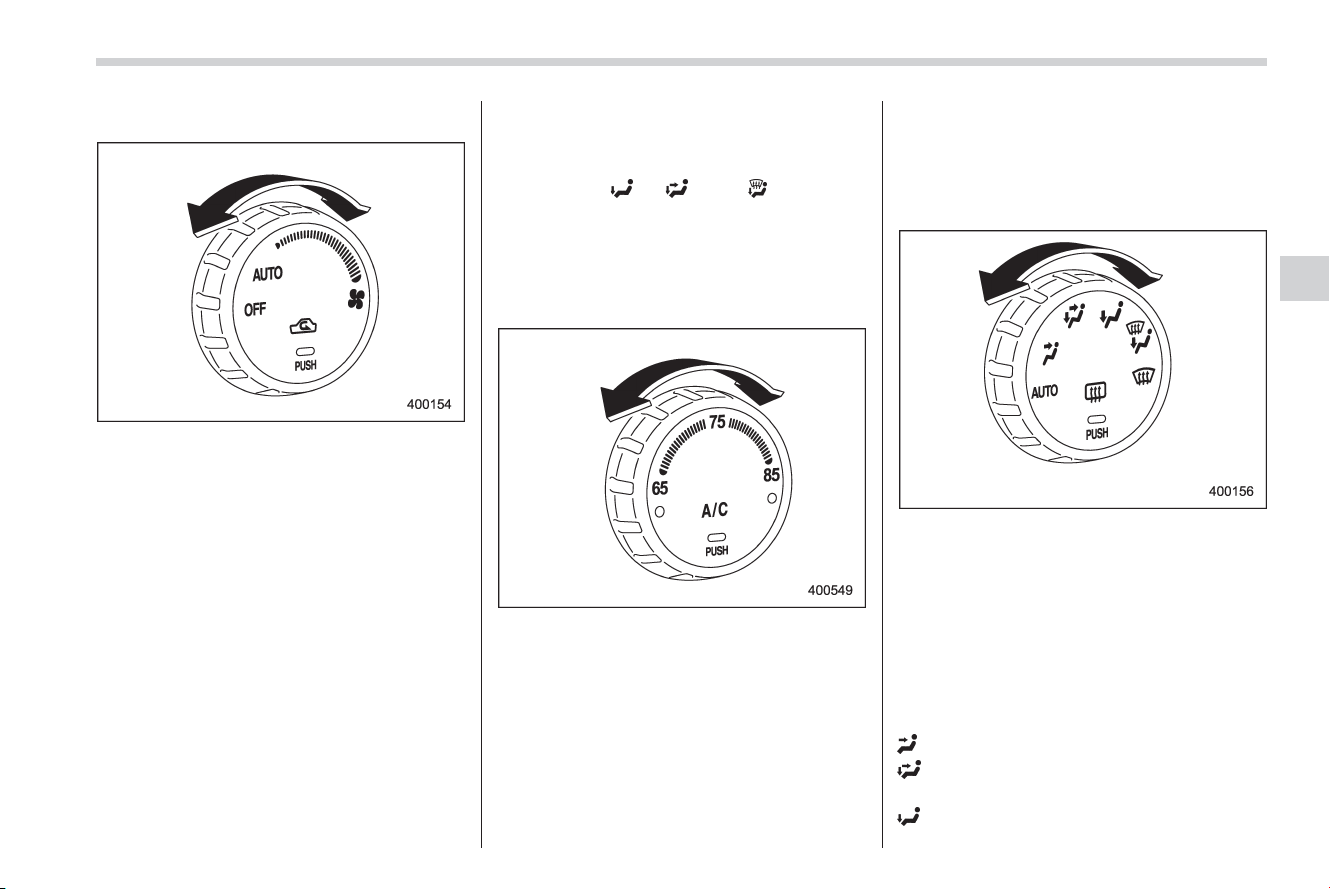
Black plate (157,1)
北米Model "A8130BE-B" EDITED: 2007/ 7/ 25
& Fan speed control dial
The fan operates only with the ignition
switch in the “ON” position. The fan speed
control dial is used to select the AUTO
(automatic control) mode or to select the
desired fan speed. The dial’s positions
and their functions are as follows:
OFF: The fan does not operate.
AUTO: The fan speed is adjusted auto-
maticallyinaccordancewiththeair
temperature inside and outside the pas-
senger compartment, the intensity of sun-
light, and other factors. SUBARU recom-
mends using the AUTO position.
Other positions: The fan speed can be
adjusted in seven steps.
NOTE
With the fan speed control dial in the
AUTO position and the air flow control
dial in the “
”, “ ”,or“ ” position,
the fan does not operate during engine
warm-up until the engine coolant tem-
perature exceeds approx. 122 8 F (508C).
& Temperature control dial
This dial is used to set the desired interior
temperature. With the dial set to your
desired temperature, the system automa-
tically adjusts the temperature of air
supplied from the outlets such that the
desired temperature is ach ieved and
maintained.
If the dial is turned fully counterclockwise,
the system gives maximum cooling per-
formance. If the dial is turned fully clock-
wise, the system gives maximum heating
performance.
& Air flow control dial
This dial has the following six positions.
The outlets from which air is supplied in
each position are as follows:
AUTO: The air flow control is adjusted
automatically in accordance with the air
temperature inside and outside the pas-
senger compartment, the intensity of sun-
light, and other factors. SUBARU recom-
mends using the AUTO position.
: Instrument panel outlets
: Instrument panel outlets and foot
outlets
: Foot outlets and windshield defroster
Climate control 4-9
– CONTINUED –
4
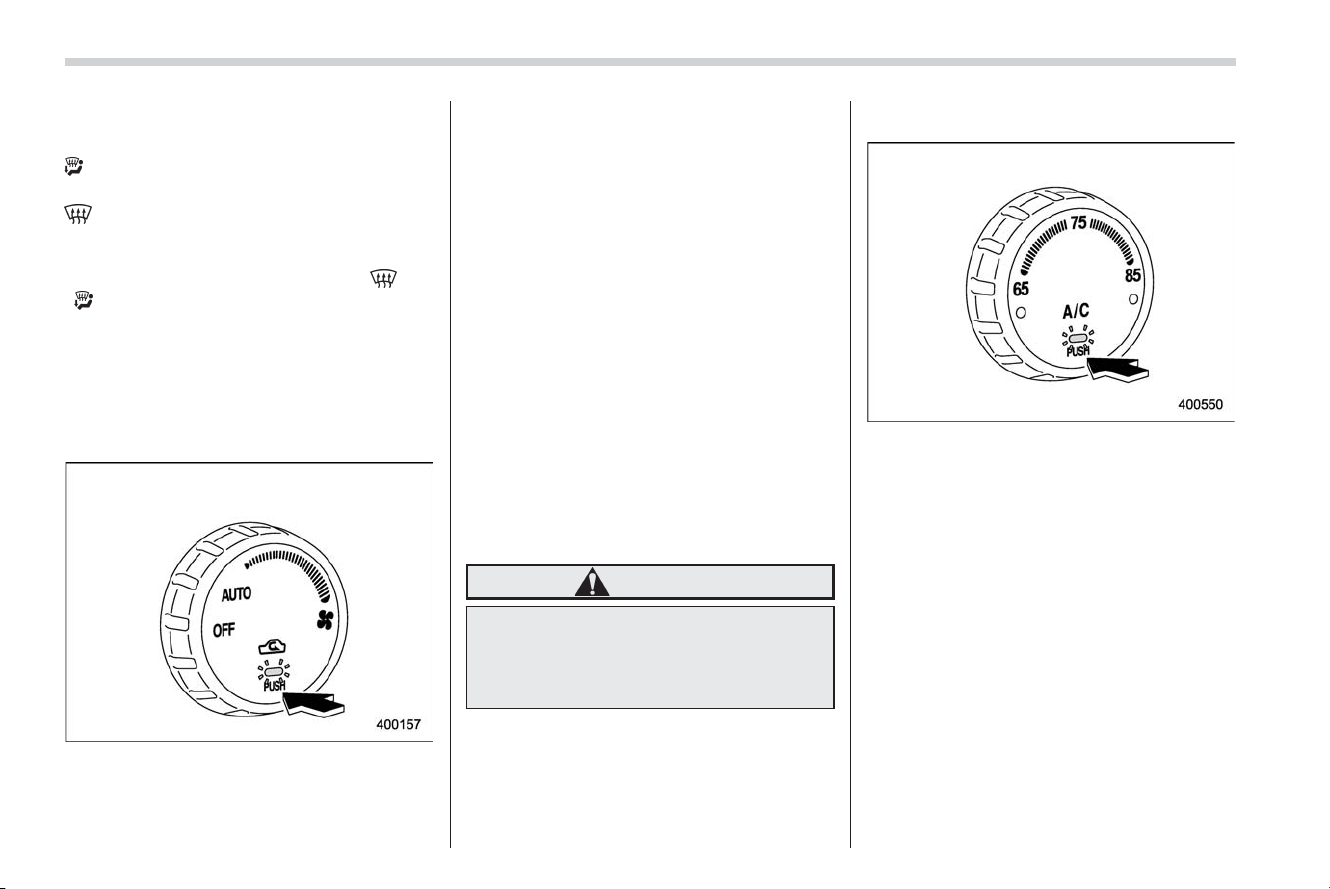
Black plate (158,1)
北米Model "A8130BE-B" EDITED: 2007/ 7/ 25
4-10 Climate control
outlets (relatively little air from windshield
defroster outlets)
: Windshield defroster outlets and foot
outlets
: Windshield defroster outlets
NOTE
When the dial is placed in the “ ” or
“
” position, the air conditioner com-
pressor operates automatically to de-
fog the windshield quickly. At the same
time, the air inlet selection is automa-
tically set to “outside air” mode.
& Air inlet selection button
ON position (Recirculation): Interior air
is recirculated inside the vehicle. Push the
air inlet selection button to the ON position
for fast cooling with the air conditioner or
when driving on a dusty road. The
indicator light will come on.
OFF position (Outside Air): Outside air
is drawn into the passenger compartment.
Push the air inlet selection button to the
OFF position when the interior has cooled
to a comfortable temperature and the road
is no longer dusty. The indicator light will
go off.
AUTO: When the air inlet selection button
is pressed for at least 1 second, the
indicator flashes twice. The air inlet control
is then adjusted automatically in accor-
dance with the air temperature inside and
outside the passenger compartment, the
intensity of sunlight, and other factors.
Pressing the air inlet selection button
cancels the AUTO mode. SUBARU re-
commends using the AUTO position.
WARNING
Continued operation in the ON posi-
tion may fog up the windows. Switch
to the OFF position as soon as the
outside dusty condition clears.
& Air conditioner button
The button’s positions and their functions
are as follows:
ON: The air conditioner operates while the
fan is running.
Push the button to select this position. The
indicator light will come on.
OFF: The air conditioner does not oper-
ate.
Push the button again to select this
position. The indicator light will go off.
AUTO: When the button is pressed for at
least 1 second, the indicator flashes twice.
The air conditioner compressor operation
is then adjusted automatically in accor-
dance with the air temperature inside and
outside the passenger compartment, the
intensity of sunlight, and other factors.
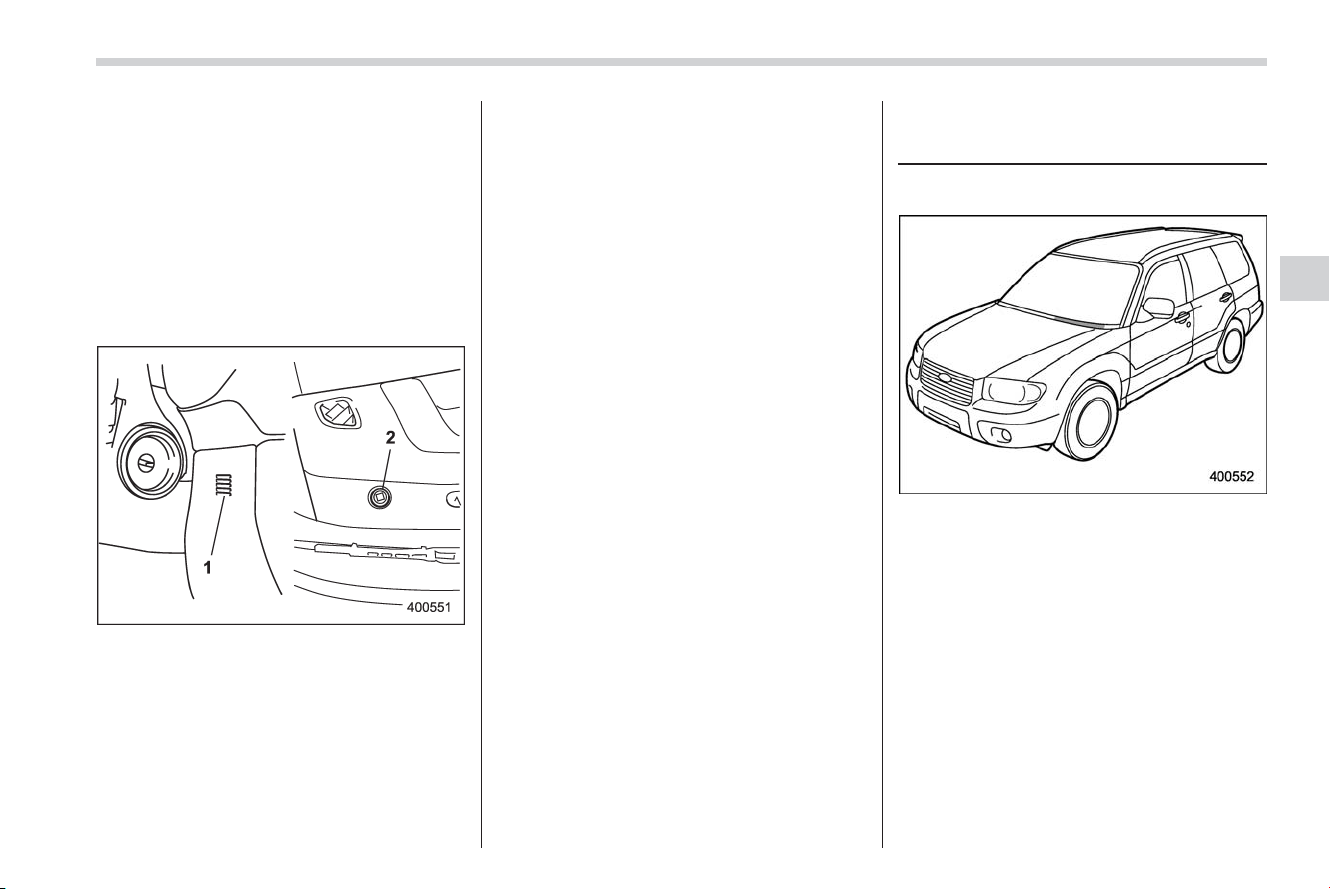
Black plate (159,1)
北米Model "A8130BE-B" EDITED: 2007/ 7/ 25
Pressing the button cancels the AUTO
mode. SUBARU recommends using the
AUTO position.
NOTE
The air conditioner’s compressor does
not operate with an outside tempera-
ture of 328F(08C) or lower.
& Temperature sensors
1) Interior air temperature sensor
2) Solar sensor
The automatic climate control system
employs several sensors. These sensors
are delicate. If they are not treated
properly and become damaged, the sys-
tem may not be able to control the interior
temperature correctly. To avoid damaging
the sensors, observe the following pre-
cautions:
– Do not subject the sensors to impact.
– Keep water away from the sensors.
– Do not cover the sensors.
The sensors are located as follows:
– Solar sensor: beside the windshield
defroster grille.
– Interior air temperature sensor: near
the ignition switch.
– Outside temperature sensor: behind
the front grille.
Operating tips for heater and
air conditioner
& Cleaning ventilation grille
Always keep the front ventilation inlet grille
free of snow, leaves, or other obstructions
to ensure efficient heating and defrosting.
Since the condenser is located in front of
the radiator, this area should be kept clean
because cooling performance is impaired
by any accumulation of insects and leaves
on the condenser.
& Efficient cooling after parking
in direct sunlight
After parking in direct sunlight, drive with
the windows open for a few minutes to
allow outside air to circulate into the
Climate control 4-11
– CONTINUED –
4
Black plate (160,1)
北米Model "A8130BE-B" EDITED: 2007/ 7/ 25
4-12 Climate control
heated interior. This results in quicker
cooling by the air conditioner. Keep the
windows closed during the operation of
the air conditioner for maximum cooling
efficiency.
& Lubrication oil circulation in
the refrigerant circuit
Operate the air conditioner compressor at
a low engine speed (at idle or low driving
speeds) a few minutes each month during
the off-season to circulate its oil.
& Checking air conditioning
system before summer sea-
son
Check the air conditioner unit for refriger-
ant leaks, hose conditions, and proper
operation each spring. Have your
SUBARU dealer perform this check.
& Cooling and dehumidifying in
high humidity and low tem-
perature weather conditions
Under certain weather conditions (high
relative humidity, low temperatures, etc.) a
small amount of water vapor emission
from the air outlets may be noticed. This
condition is normal and does not indicate
any problem with the air conditioning
system.
& Air conditioner compressor
shut-off when engine is
heavily loaded
To improve acceleration and gas mileage,
the air conditioner compressor is designed
to temporarily shut off during air condi-
tioner operation whenever the accelerator
is fully depressed such as during rapid
acceleration or when driving on a steep
upgrade.
& Refrigerant for your climate
control system
Your air conditioner uses ozone friendly
refrigerant HFC134a. Therefore, the meth-
od of adding, changing or checking the
refrigerant is different from the method for
CFC12 (freon). Consult your SUBARU
dealer for service. Repairs needed as a
result of using the wrong refrigerant are
not covered under warranty.
Air filtration system (if
equipped)
If your vehicle’s air conditioning system is
equipped with an air filtration system,
replace the filter element according to
the replacement schedule shown in the
following. This schedule should be fol-
lowed to maintain the filter’s dust collec-
tion ability. Under extremely dusty condi-
tions, the filter should be replaced more
frequently. It is recommended that you
have your filter checked or replaced by
your SUBARU dealer. For replacement,
use only a genuine SUBARU air filter kit.
Replacement schedule:
Every 12 months or 7,500 miles (12,000
km) whichever comes first
CAUTION
Contact your SUBARU dealer if the
following occurs, even if it is not yet
time to change the filter:
– Reduction of the air flow through
the vents.
– Windshield gets easily fogged or
misted.
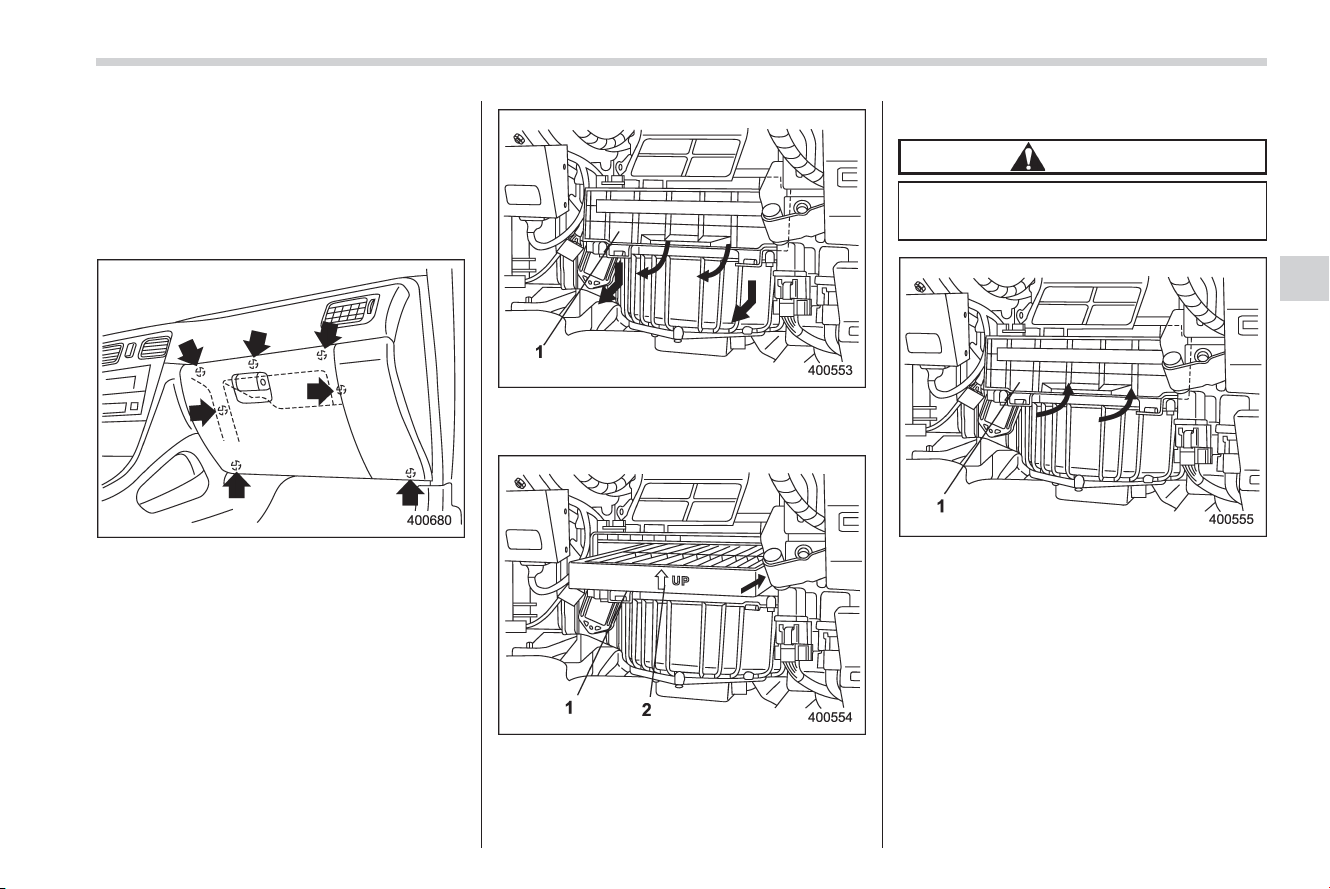
Black plate (161,1)
北米Model "A8130BE-B" EDITED: 2007/ 7/ 25
NOTE
The filter can influence the air condi-
tioning, heating and defroster perfor-
mance if not properly maintained.
& Replacing an air filter
1. Remove the glove box.
(1) Open the glove box.
(2) Remove the nine screws securing
the glove box.
1) Air filter cover
2. Remove the air filter cover.
1) Air filter element
2) Arrow mark
3. Replace the air filter element with new
one.
CAUTION
The arrow mark on the filter must
point UP.
1) Air filter cover
4. Reinstall the air filter cover.
Climate control 4-13
– CONTINUED –
4
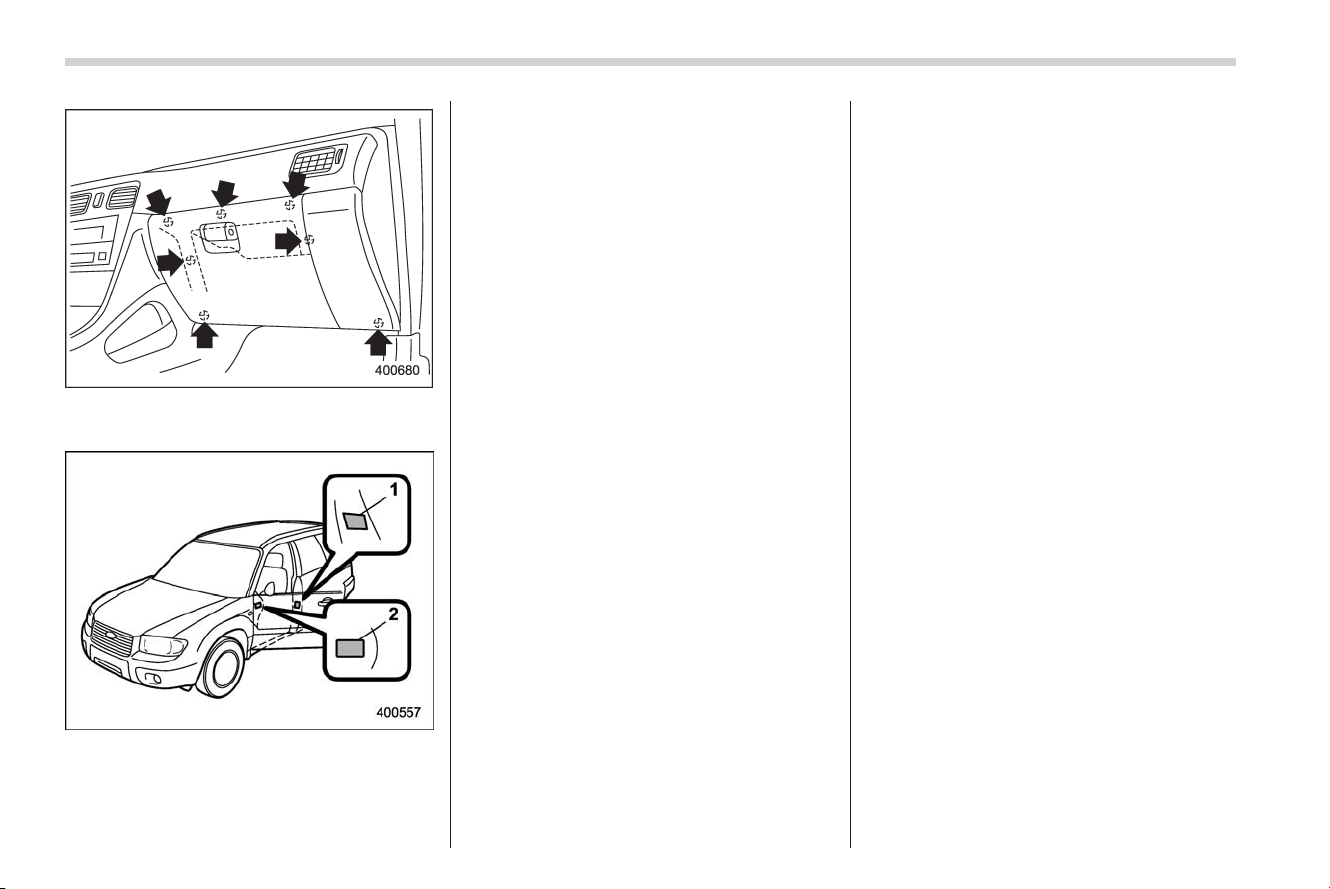
Black plate (162,1)
北米Model "A8130BE-B" EDITED: 2007/ 7/ 25
4-14 Climate control
5. Reinstall the glove box.
6. Close the glove box.
1) Service label
2) Caution label
7. LABEL installation
(1) Fill out the information on the
service label (small).
(2) Attach the service label to the
driver side door pillar and the caution
label to the driver side end of the
instrument panel.

Black plate (9,1)
北米Model "A8130BE-B" EDITED: 2007/ 7/ 25
Antenna system .................................................. 5-2
FM reception....................................................... 5-2
Installation of accessories.................................. 5-2
Audio set ............................................................. 5-3
Type A audio set ................................................. 5-3
Type B audio set ................................................. 5-3
In-dash 6 CD auto changer (Optional audio unit –
if equipped)....................................................... 5-3
Type A audio set (if equipped) ........................... 5-4
Radio operation................................................... 5-4
Compact disc player operation ............................ 5-7
CD changer control (if optional in-dash CD
changer is connected) ....................................... 5-9
Type B audio set (if equipped).......................... 5-11
Radio operation ................................................. 5-11
Built-in CD changer control................................ 5-15
Auxiliary unit and satellite radio operation.......... 5-20
In-dash 6 CD auto changer (if equipped)......... 5-23
Loading and unloading compact discs ............... 5-23
Precautions to observe when handling a
compact disc................................................... 5-25
Audio
5
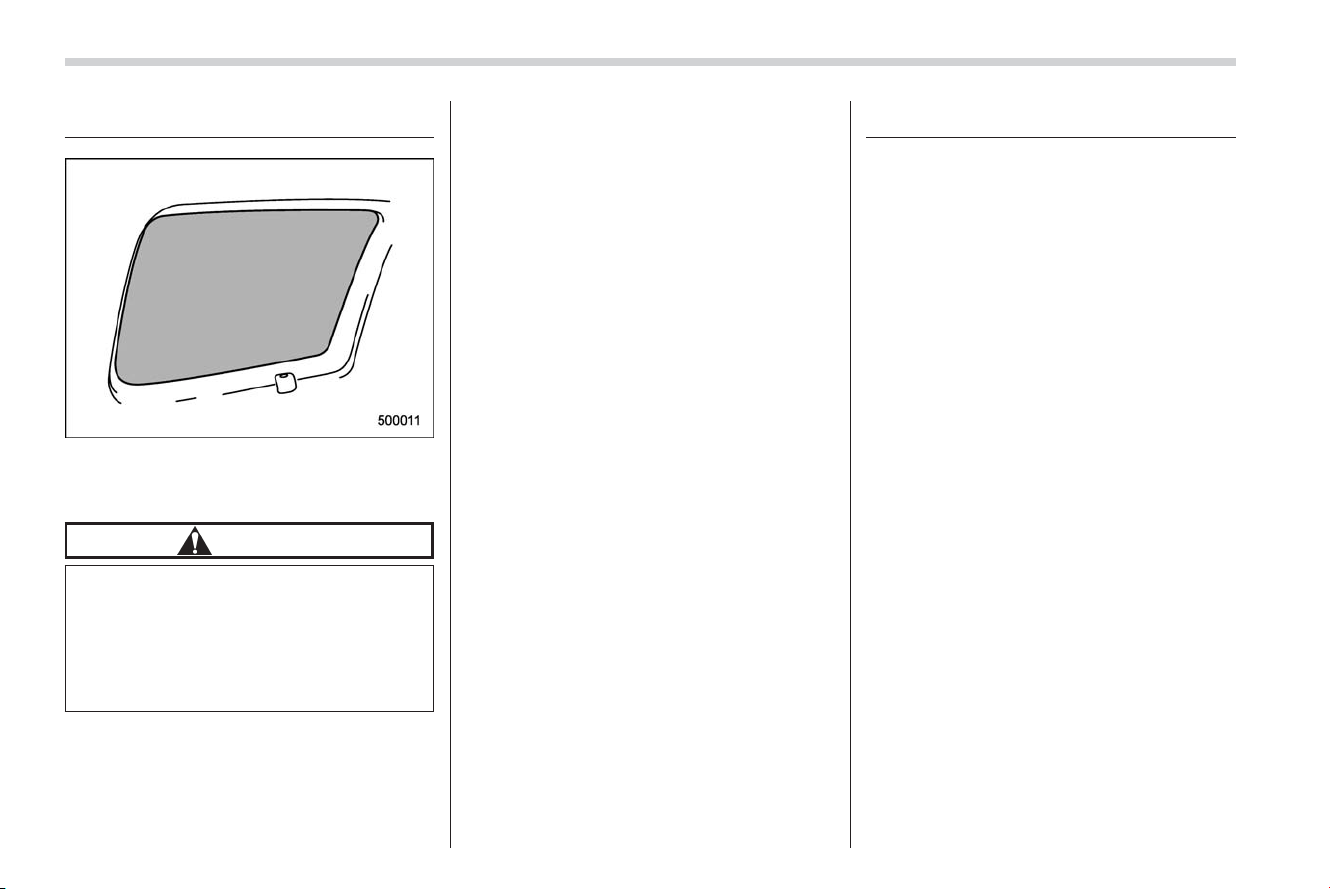
Black plate (166,1)
北米Model "A8130BE-B" EDITED: 2007/ 7/ 25
5-2 Audio
Antenna system
The antenna is printed on the inner
surface of the left side rear quarter window
glass.
CAUTION
Do not use sharp instruments or
window cleaner containing abra-
sives to clean the inner surface of
the window on which the antenna is
printed. Doing so may damage the
antenna printed on the window.
& FM reception
Although FM is normally static free,
reception can be affected by the surround-
ing area, atmospheric conditions, station
strength and transmitter distance. Build-
ings or ot her obstructions may ca use
momentary static, flutter or station inter-
ference. If reception continues to be
unsatisfactory, switch to a stronger station.
Installation of accessories
Always consult your SUBARU dealer
before installing a citizen band radio or
other transmitting device in your vehicle.
Such devices may cause the electronic
control system to malfunction if they are
incorrect ly installed or if they are not
suited for the vehicle.
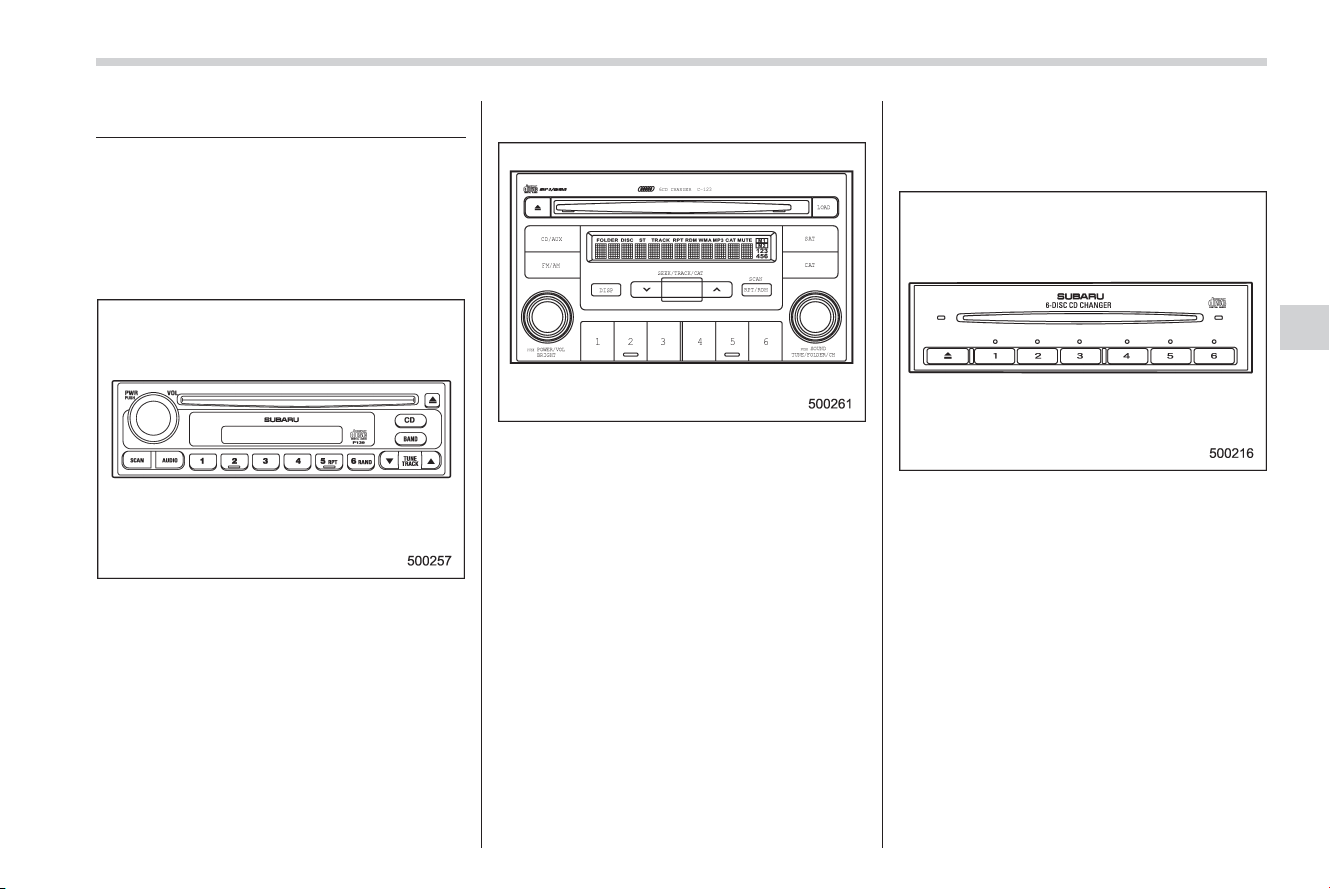
Black plate (167,1)
北米Model "A8130BE-B" EDITED: 2007/ 7/ 25
Audio set
Your SUBARU may be equipped with one
of the following audio sets. See the pages
indicated in this section for operating
details.
& Type A audio set
. Radio operation: refer to page 5-4
. Compact disc player operation: refer to
page 5-7
. CD changer control: refer to page 5-9
& Type B audio set
. Radio operation: refer to page 5-11
. Built-in CD changer operation: refer to
page 5-15
. Auxiliary unit operation: refer to page 5-
20
& In-dash 6 CD auto changer
(Optional audio unit – if
equipped)
. Inserting and removing a disc or all
discs: refer to page 5-23
Audio 5-3
5
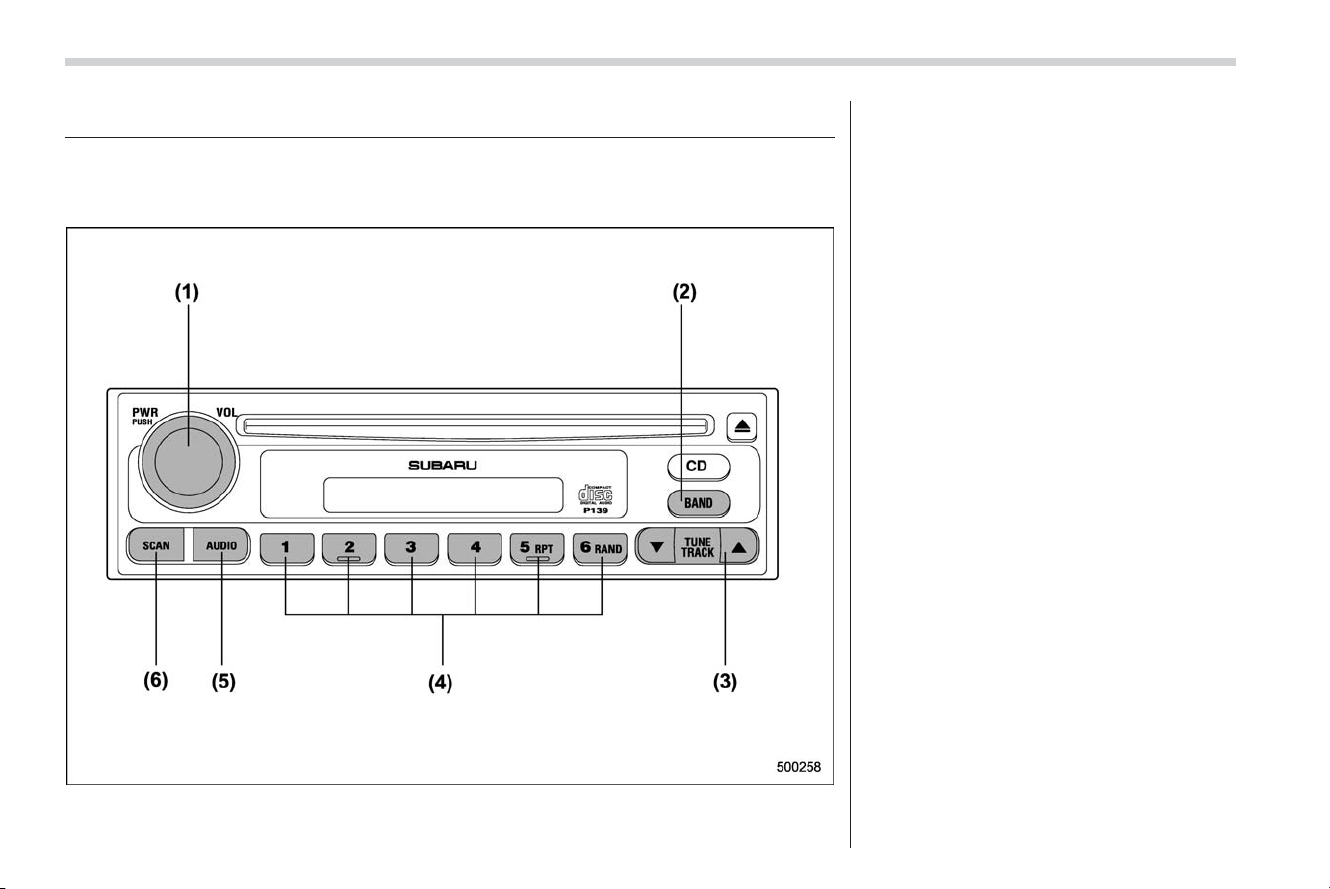
Black plate (168,1)
北米Model "A8130BE-B" EDITED: 2007/ 7/ 25
5-4 Audio
Type A audio set (if equipped)
The radio will operate only when the ignition switch is in the “Acc” or “ON” position.
& Radio operation
(1) Power switch, Vo lume control, Tone/
Fader/Balance control dial
(2) BAND button
(3) Tuning buttons
(4) Preset buttons
(5) AUDIO button
(6) SCAN button
! Power switch and volume/bass/tre-
ble/fader/balance control (PWR/
VOL)
The dial (1) is used for both power (ON/
OFF) and volume control. The radio is
turned ON and OFF by pushing the dial
and the volume is controlled by turning the
dial.
! Tone and balance control
The “VOLUME” control knob normally
function as volume control. This knob
become a control for Treble, Bass, Fader
or Balance when you select the appro-
priate audio mode.
Choose desired volume level for each
mode by turning the “VOLUME” control
knob. The control fun ction returns to
volume control mode after approximately
5 seconds.
To change control modes: Each brief
press of the “AUDIO” button chang es
control modes in the following sequence
starting from volume control mode. (When
the radio is first turned on, the control
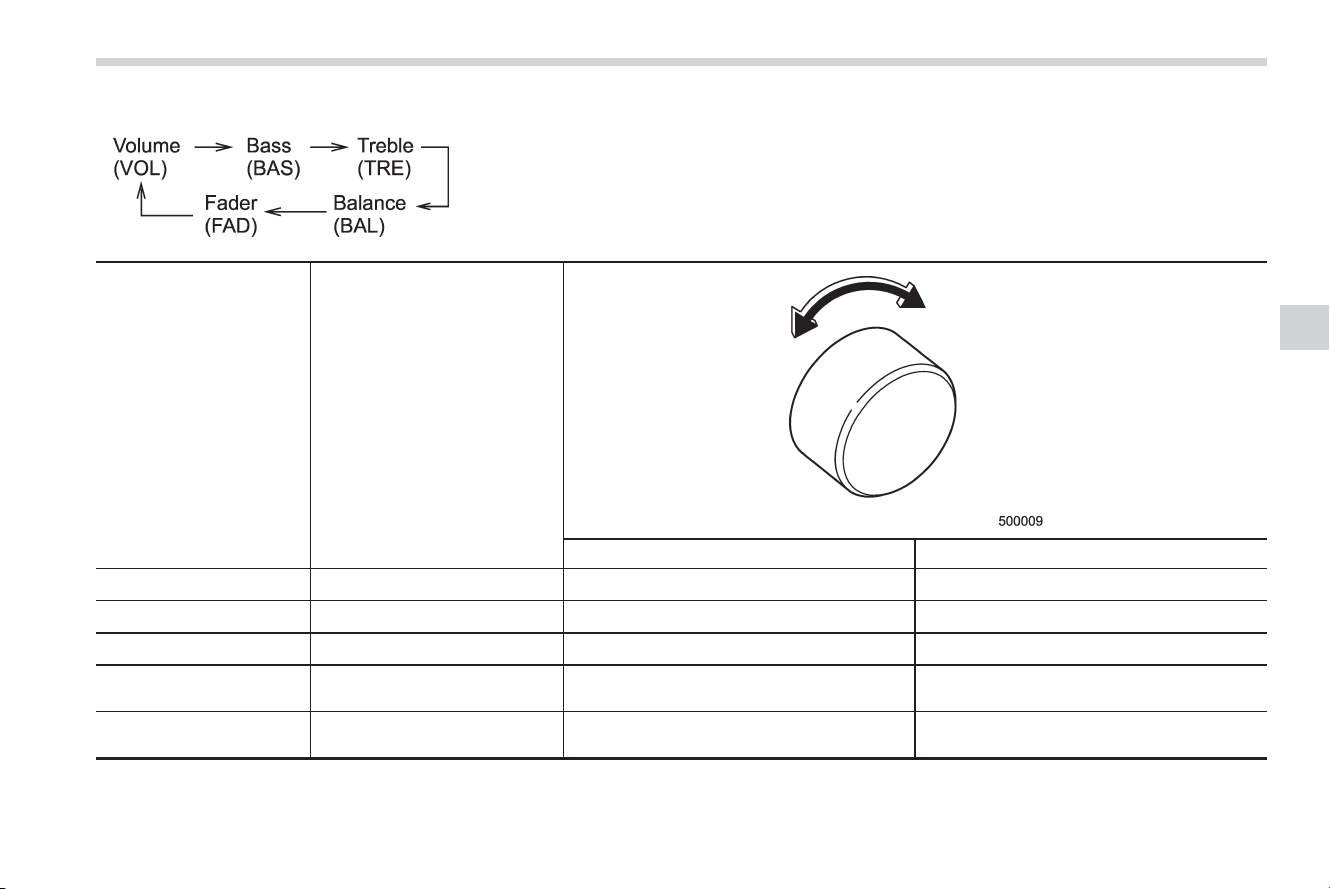
Black plate (169,1)
北米Model "A8130BE-B" EDITED: 2007/ 7/ 25
mode is in the volume control.)
Display Control mode
Turn counterclockwise Turn clockwise
VOL
Volume control For less volume For more volume
BAS
Bass control For less bass sound For more bass sound
TRE
Treble control For less treble sound For more treble sound
BAL
Balance control
To increase left speaker volume and de-
crease right speaker volume
To increase right speaker volume and
decrease left speaker volume
FAD
Fader control
To increase rear speaker volume and
decrease front speaker volume
To increase front speaker volume and
decrease rear speaker volume
Audio
5-5
– CONTINUED –
5
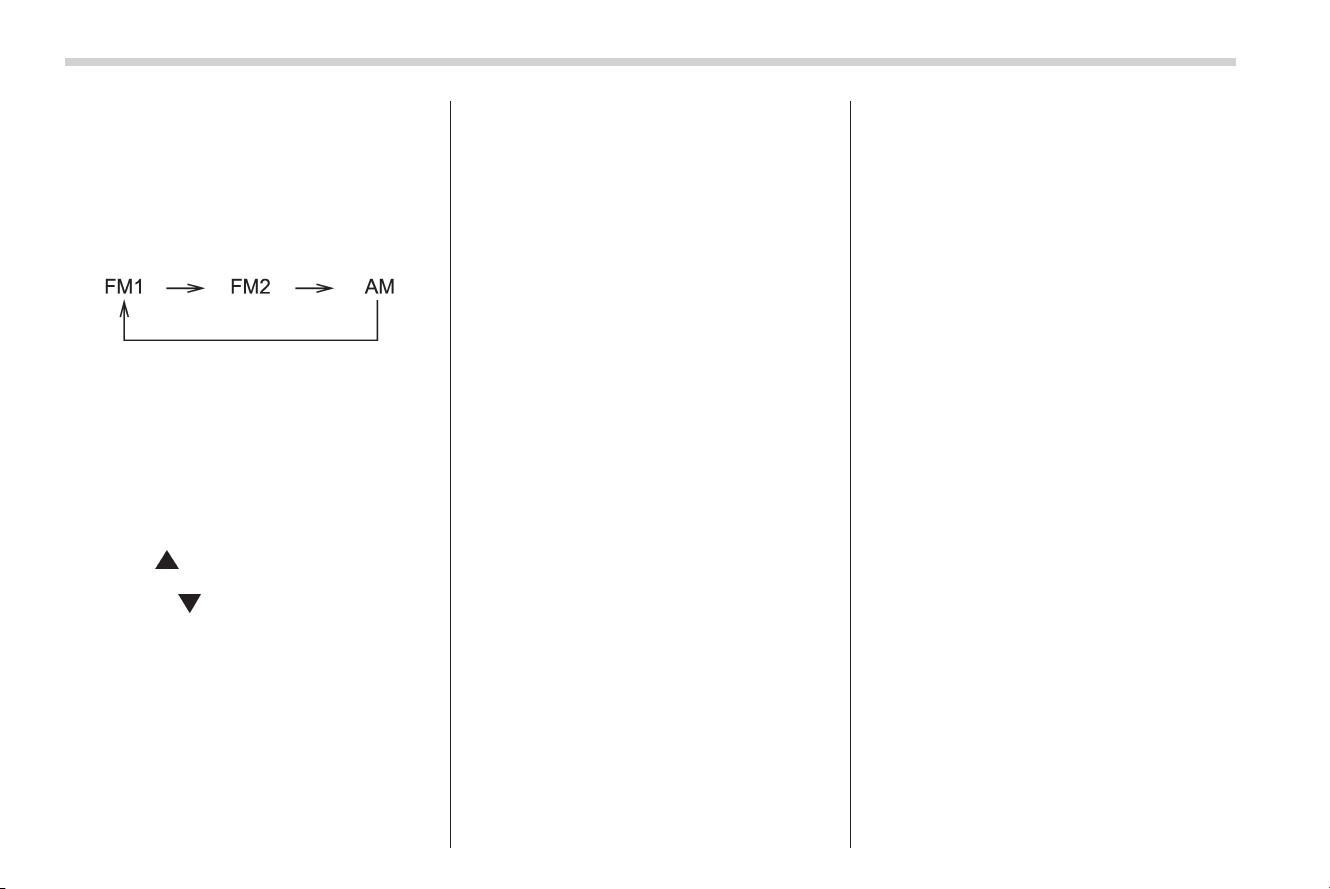
Black plate (170,1)
北米Model "A8130BE-B" EDITED: 2007/ 7/ 25
5-6 Audio
! FM/AM band selection button
(BAND)
Push the “BAND” button when the radio is
on to select FM1, FM2 or AM band
reception. Each time this button is
pressed, the band will change in the
following order:
The display indicates which one is cur-
rently selected.
! Stereo indicator
The stereo indicator “ST” will come on
when an FM stereo broadcast is received.
! Tuning (TUNE)
! Manual tuning (TUNE)
Push the “
” side of the tuning button (3)
to increase the tuning freque ncy and
press the “
” side of the button to
decrease it.
Each time the button is pressed, the
frequency changes 10 kHz in the AM
waveband and 0.2 MHz in the FM wave-
band.
! Seek tuning
If the tuning button (3) is pressed for
longer than half of a second, the radio will
begin to automatically search for receiva-
ble frequencies and will stop at the first
one f ound. This function may not be
available, however, when radio signals
are weak. In such a situation, perform
manual tuning to select the desired
station.
! Automatic tuning (SCAN)
Press the “SCAN” button (6) to change the
radio to the SCAN mode. In this mode, the
radio scans through the radio band until a
station is found. The radio will stop at the
station for 5 seconds while displaying the
frequency, after which scanning will con-
tinue until the entire band has been
scanned from the low end to the high end.
Press the “SCAN” button again to cancel
the SCAN mode and to stop on any
displayed frequency.
When the “SCAN” button is pressed for
automatic tuning, stations are scanned in
the direction of low frequencies to high
frequencies only.
Automatic tuning may not function prop-
erly if the station reception is weakened by
distance from the station or proximity to
tall buildings and hills.
! Selecting preset stations
Presetting a station with a preset button
(4) allows you to select that station in a
single operation. Up to six AM, FM1 and
FM2 stations each may be preset.
! How to preset stations
1. Press the “BAND” selection button to
select AM, FM1 or FM2 reception.
2. Press the “ SCAN ” button (6) or tune
the radio manually until the desired station
frequency is displayed.
3. Press one of the preset buttons (4) for
at least 2 seconds to store the frequency.
At this time, there will momentarily be no
sound from the radio. If the button is
pressed for less than 2 seconds, the
preceding selection will remain in memory.
NOTE
. If the connection between the radio
and battery is broken for any reason
such as vehicle maintenance or radio
removal, all stations stored in the
preset buttons are cleared. If this
occurs, it is necessary to reset the
preset buttons.
. If a cell phone is placed near the
radio, it may cause the radio to emit
noise when it receives calls. This noise
does not indicate a radio fault.
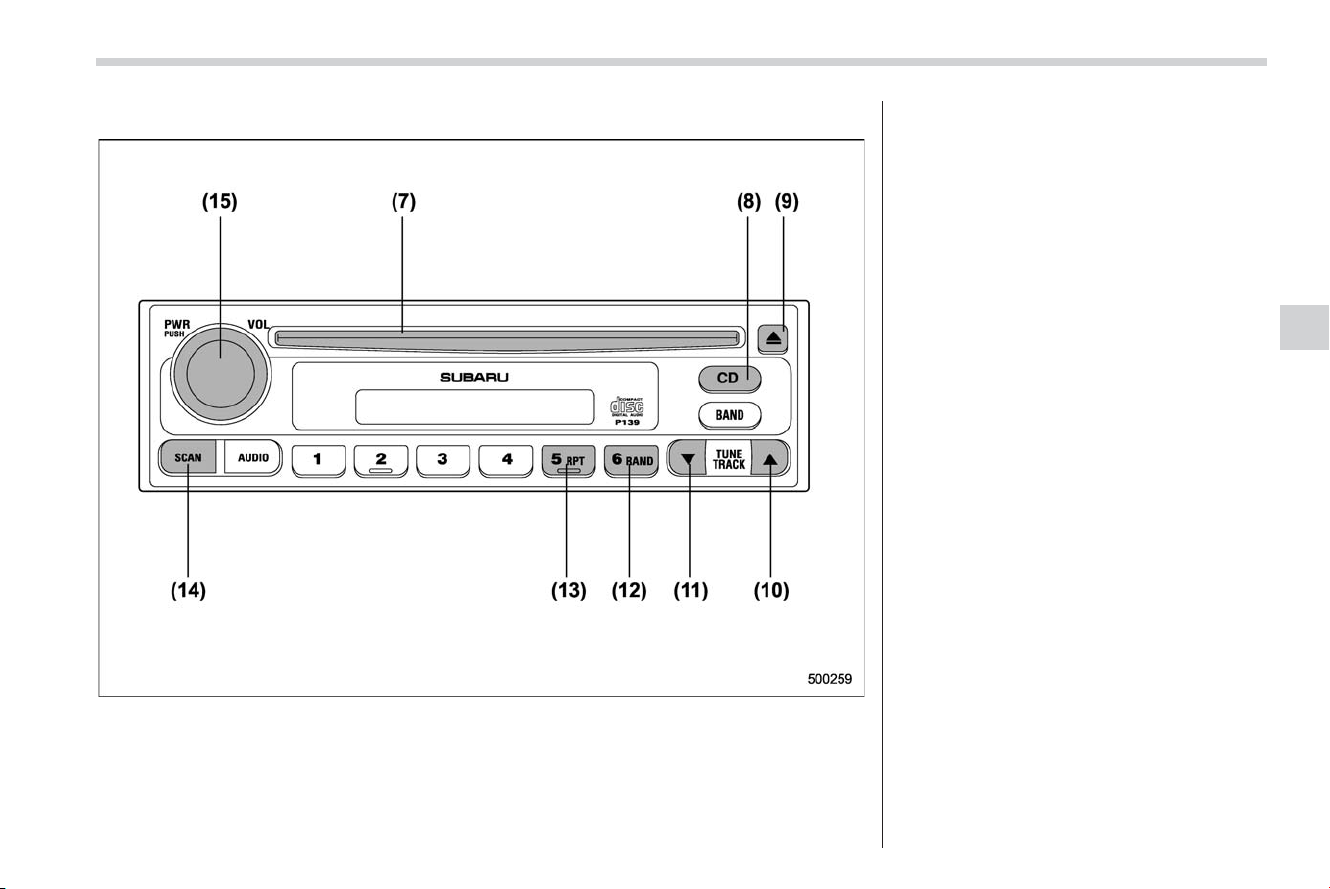
Black plate (171,1)
北米Model "A8130BE-B" EDITED: 2007/ 7/ 25
& Compact disc player operation
(7) Disc slot
(8) CD button
(9) Eject button
(10) Fast-forwarding and track up button
(11) Fast-reversing and track down button
(12) Random button
(13) Repeat button
(14) Scan button
(15) PWR (power) switch
! To play back a compact disc
! When CD is not in the player
Hold a disc with a finger in the center hole
while gripping the edge of the disc, then
insert it in to the slot (with the label side
up) and the player will automatically pull
the disc into position.
A single CD (8 cm/3 inch CD) may also be
used without any adapter.
NOTE
. Make sure to always insert a disc
with the label side up. If a disc is
inserted with the label side down, it
might be ejected or the player might
shut off.
. After the last song finishes, the
player will automatically return to track
1 (the first song on the disc).
Audio 5-7
– CONTINUED –
5
Black plate (172,1)
北米Model "A8130BE-B" EDITED: 2007/ 7/ 25
5-8 Audio
! When CD is in the player
Press the “CD” button (8). The display will
show “CD-IN” and the player will start
playback.
NOTE
After the last song finishes, playback
will automatically return to track 1 (the
first song on the disc).
! To stop playback of a CD
When the “PWR” button (15) is pressed
during playback of a CD, the CD stops
playing temporarily. To let the CD resume
playing, press the button again.
! To select a song from its beginning
! Forward direction
Briefly press the “
” side of the button
(10) to skip to the beginning of the next
track. Each time this side of the button is
pressed, the indicated track number will
increase.
! Backward direction
Briefly press the “
” side of the button
(11) to skip to the beginning of the current
track. Each time this side of the button is
pressed, the indicated track number will
decrease.
! Fast-forwarding and fast-reversing
! Fast-forwarding
Press the “
” side of the button (10)
continuously to fast-forward the disc.
Release the button to stop fast-forwarding.
! Fast-reversing
Press the “
” side of the button (11)
continuously to fast-reverse the disc.
Release the button to stop fast-reversing.
! Repeat playback
Briefly press the “RPT” button (13) while a
song is playing to play the song repeat-
edly. The “RPT” indicator will come on and
the song will be played continuously. To
cancel the repeat mode, press the button
again. Then the “RPT” indicator goes out,
and normal playback mode is restored.
! Random playback
Briefly press the “RAND” button (12) while
a disc is being played back to play all
songs on the disc in a random order. The
“RAND” indicator will come on and all
songs on the disc will be played in a
random order.
To cancel the random mode, press the
button again. Then the “RAND” indicator
goes out, and normal playback mode is
restored.
! Scan
Briefly press the “SCAN” button (14), and
you can hear the first 10 seconds of each
track to search for the desired program. To
continue listening to the program, press
the “SCAN” button again. After all tracks
on the disc has been scanned, normal
playback mode is restored.
! To eject a disc from the player
When a disc is being played back or when
a disc is in the player, press the eject
button “
” (9). The disc will be ejected.
The disc may be removed even when the
ignition switch is in the “LOCK” position.
NOTE
Avoid driving the vehicle with a CD
sticking out, because vibration might
make it fall out.
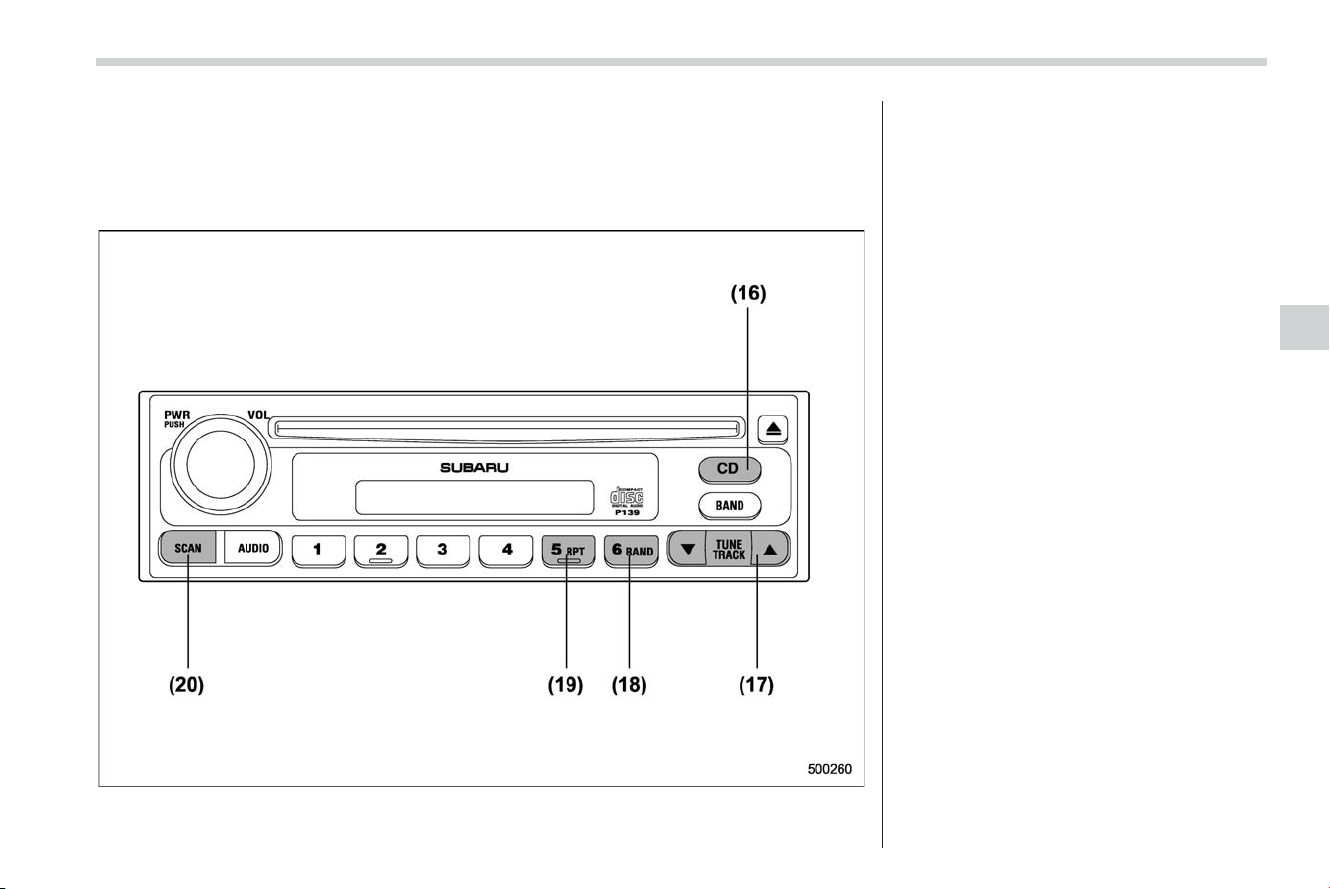
Black plate (173,1)
北米Model "A8130BE-B" EDITED: 2007/ 7/ 25
& CD changer control (if optional in-dash CD changer is con-
nected)
An optional CD changer can be connected to this audio unit. Consult the instructions that
accompany the CD changer for operating the CD changer itself (e.g., how to load or
unload CDs). See your SUBARU dealer for more information.
(16) CD button
(17) Track selection buttons
(18) RAND (Random) button
(19) RPT (Repeat) button
(20) SCAN button
! To start playback
When the “CD” button (16) is pressed, the
CD changer will start playback. The dis-
play shows the current disc number, track
number and the elapsed time during
playback.
NOTE
. If a disc is in the player, the “DISC”
button is used to change from CD
player operation to DISC changer op-
eration. Each time the “DISC ” button is
pressed, the operating mode will
change alternately.
. At the end of the disc, the player
automatically continues with the next
disc.
. After playback on the last disc
finishes, playback will automatically
return to the first disc.
. If you have loaded fewer than 6
discs, any missing disc is automati-
cally skipped.
Audio 5-9
– CONTINUED –
5
Black plate (174,1)
北米Model "A8130BE-B" EDITED: 2007/ 7/ 25
5-10 Audio
! Selection of a desired disc
You can select a desired disc from among
the discs contained in the CD changer
only by pressing the corresponding num-
ber on one of the disc select buttons. If
you are to listen to the 5th disc in the CD
changer, press the “5” button of the disc
select buttons. All other discs in the CD
changer can also be selected in a similar
way.
NOTE
. No disc change takes place if the
button corresponding to the storage
tray i n which no disc is loaded is
pressed.
. If the disc select button correspond-
ing to the disc now in playback is
pressed again, the disc will be replayed
from its beginning.
! To select a song from its beginning
! Forward direction
Briefly press the “
” side of the button
(17) to skip to the beginning of the next
track. Each time this side of the button is
pressed, the indicated track number will
increase.
! Backward direction
Briefly press the “
” side of the button
(17) to skip to the beginning of the current
track. Each time this side of the button is
pressed, the indicated track number will
decrease.
! Fast-forwarding and fast-reversing
! Fast-forwarding
Press the “
” side of the button (17)
continuously to fast-forward the disc.
Release the button to stop fast-forwarding.
If you continue fast-forwarding to the end
of the disc, the CD changer will auto-
matically stop fast-forwarding and start
playback beginning with the first track on
the current disc.
! Fast-reversing
Press the “
” side of the button (17)
continuously to fast-reverse the disc.
Release the button to stop fast-reversing.
If you continue fast-reversing to the
beginning of the disc, the CD changer will
automatically stop fast-reversing and start
playback beginning with the first track on
the current disc.
! Repeat playback
Press the “RPT” button (19) while a song
is playing to play the song repeatedly. The
“RPT” indicator will come on and the song
will be played continuously. To cancel the
repeat mode, press the button again.
Then the “RPT” indicator goes out, and
normal playback mode is restored.
! Random playback
Press the “RAND” button (18) while a disc
is being played back to play all songs on
the disc in a random order. The “ RAND”
indicator will come on and all songs on the
disc will be played in a random order.
To cancel the random mode, press the
button again. Then the “RAND” indicator
goes out, and normal playback mode is
restored.
! Scan (a convenient way to become
familiar with a disc)
1. Press the “SCAN” button (20).
– The display shows “SCAN” and the track
number being scanned.
– You hear the first 10 seconds of each
track.
– The operation is automatically cleared
after playing all programs. Then, normal
playback starts.
2. Press the “SCAN” button again when
you hear a track you like.
– Normal playback resumes.
! To stop playback
To stop playback and switch over to the
radio mode, press the “BAND” button.
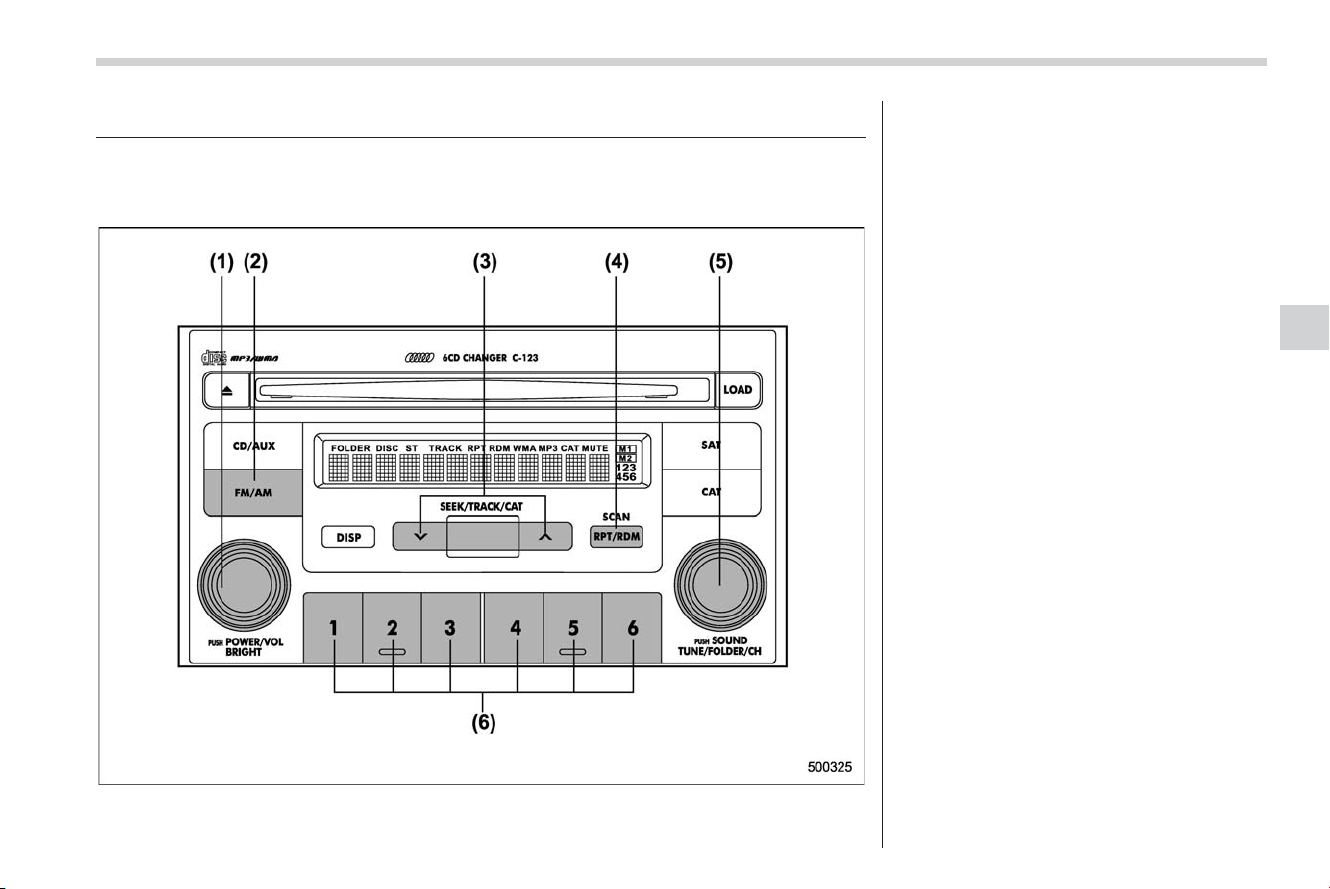
Black plate (175,1)
北米Model "A8130BE-B" EDITED: 2007/ 7/ 25
Type B audio set (if equipped)
The audio set will operate only when the ignition switch is in the “Acc” or “ON” position.
& Radio operation
(1) Power switch, Volume, Brightness con-
trol dial
(2) FM/AM selection button
(3) Seek button
(4) Scan button
(5) Sound/Tune control dial
(6) Preset buttons
! Power switch and volume/bright-
ness control (POWER/VOL/
BRIGHT)
The dial (1) is used for both power (ON/
OFF) and volume control. The radio is
turned ON and OFF by pushing the dial,
and the volume is controlled by turning the
dial.
! Sound control and tune/folder se-
lect/channel control (SOUND/TUNE/
FOLDER/CH)
The dial (5) is used for selecting the sound
control mode with each brief press of the
dial, and for adjusting each level by
turning it. It is also used for tuning the
radio/folder selection (only when playing
MP3 or WMA)/channel selection (satellite
radio*) when the “FM/AM”, “CD/AUX” and
“SAT” are selected.
(*: Use of satellite radio (Sirius) requires a
tuner, antenna and a service contract. For
details, please contact your SUBARU
dealer.)
Audio 5-11
– CONTINUED –
5
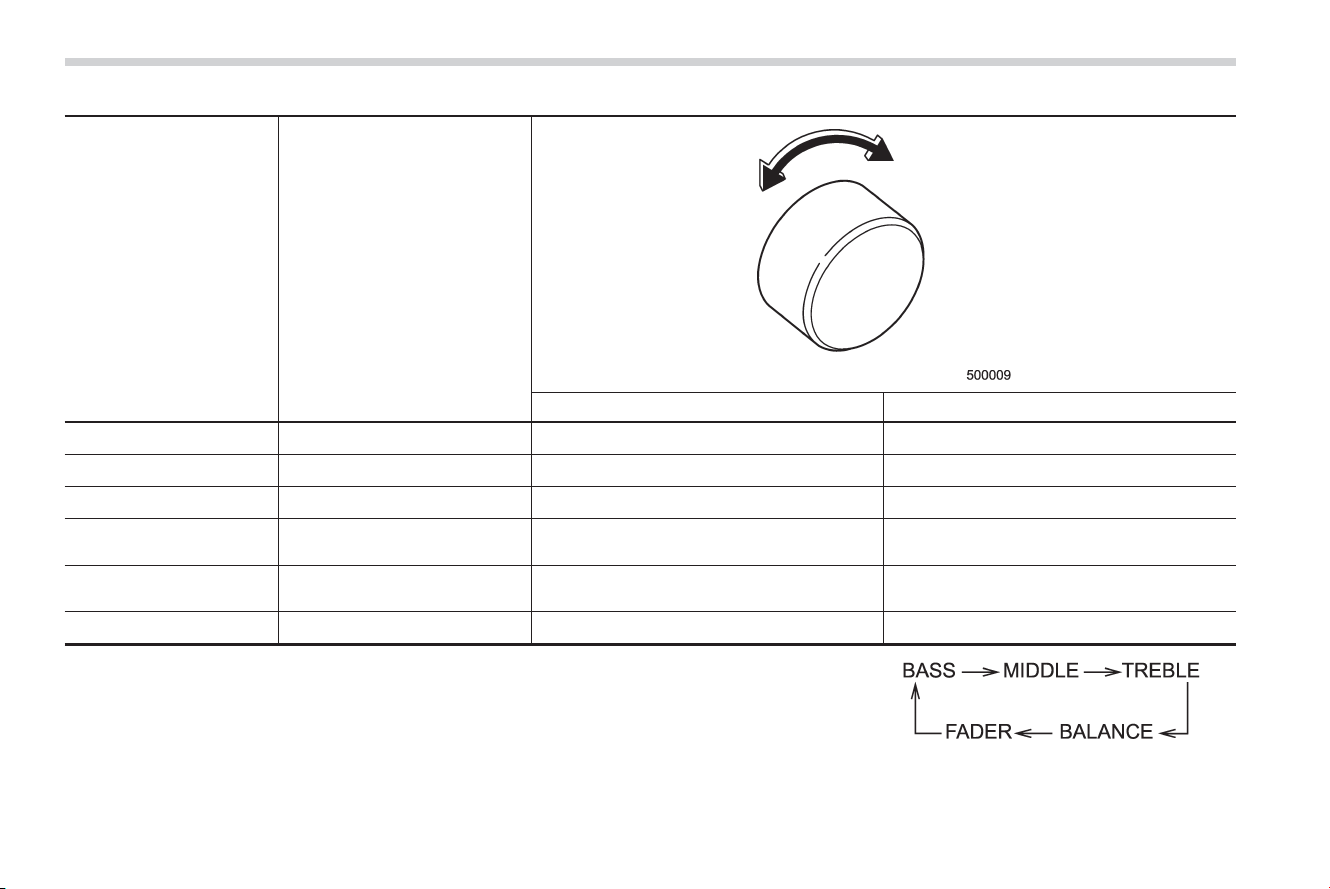
Black plate (176,1)
北米Model "A8130BE-B" EDITED: 2007/ 7/ 25
5-12 Audio
Display Control mode
Turn counterclockwise Turn clockwise
BASS
Bass control For less bass sound For more bass sound
MIDDLE
Midrange control For less midrange sound For more midrange sound
TREBLE
Treble control For less treble sound For more treble sound
FADER
Fader control
To increase rear speaker volume and
decrease front speaker volume
To increase front speaker volume and
decrease rear speaker volume
BALANCE
Balance control
To increase left speaker volume and de-
crease right speaker volume
To increase right speaker volume and
decrease left speaker volume
VOLUME
Volume control For less volume
For more volume
! Sound control
The dial (5) controls the Bass, Midrange,
Treble, Balance and Fader when you
select the appropriate sound control
mode . Choose the desired setting for
each mode by depressing the “SOUND”
controldial(5).Thecontrolfunction
returns to last mode after approximately
5 seconds.
To change control modes: Each brief
press of the “SOUND” button (5) changes
control modes in the following sequence
starting from bass control mode.
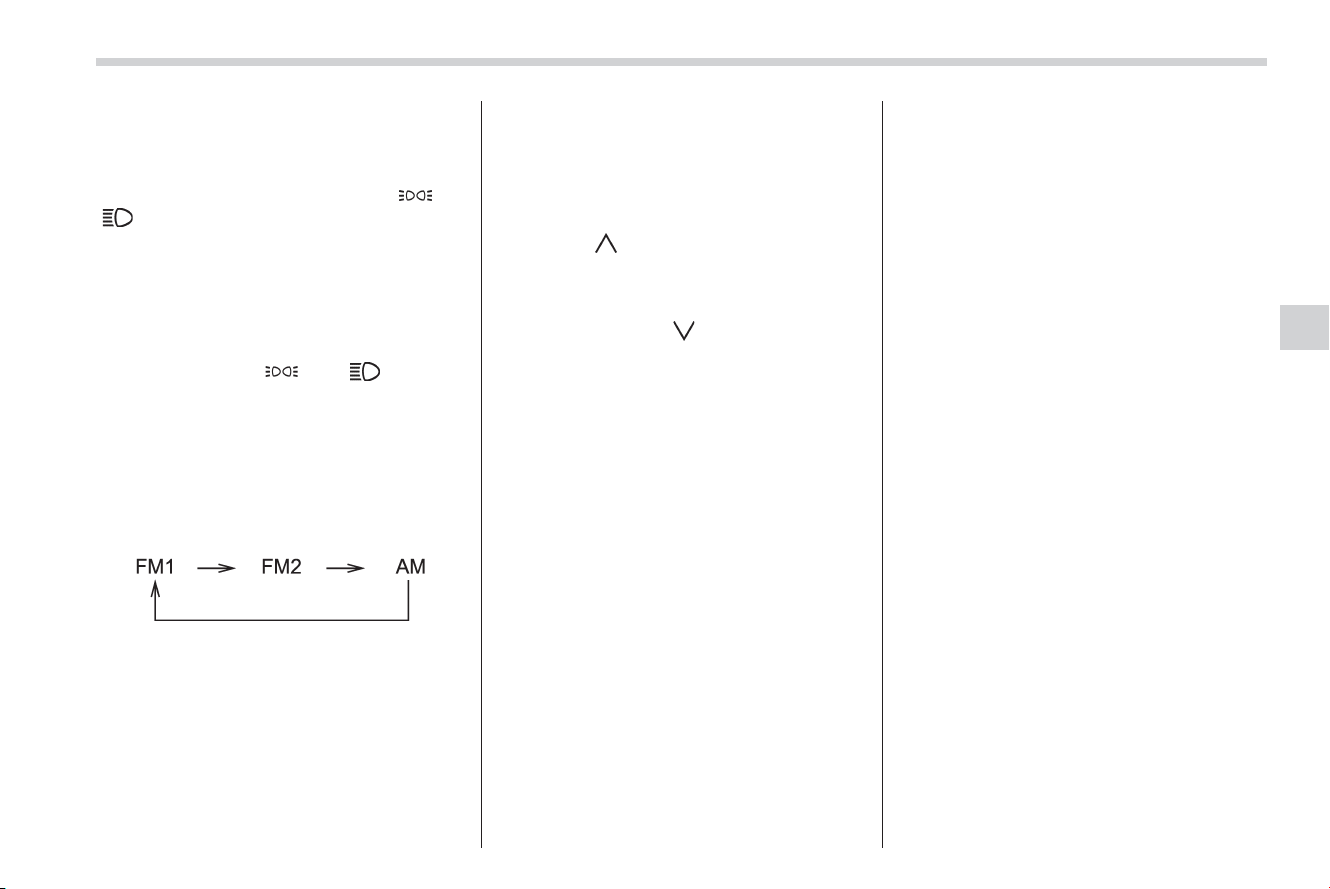
Black plate (177,1)
北米Model "A8130BE-B" EDITED: 2007/ 7/ 25
! Display illumination dimness can-
cellation (BRIGHT)
The brightness of the radio display dims
when the light switch is in the “
” or
“
” position. If this makes the display
difficult to read, press the volume dial for
more than 2 seconds to return the display
to original brig htness. Subseque ntly
pressing the volume dial again for more
than 2 seconds or if you can safely do so,
turning the light switch to the OFF position
and back to the “
” or “ ” position
makes the radio display dim again.
! FM/AM selection button (FM/AM)
Push the “ FM/AM” button (2) when the
radio is on to select FM1, FM2 or AM
reception. Each time this button is
pressed, the band will change in the
following order:
The display indicates which one is cur-
rently selected.
! Stereo indicator
The stereo indicator “ST” will come on
when an FM stereo broadcast is received.
! Manual tuning (TUNE)
Turn the tuning dial (5) clockwise to
increase the tuning frequency and turn
the dial counterclockwise to decrease it.
Each click the dial is turned, the frequency
changes 10 kHz in the AM waveband and
0.2 MHz in the FM waveband.
! Seek tuning
When the “
” side of the “SEEK/TRACK/
CAT” button (3) is depressed, the radio will
begin to automatically seek up for recei-
vable frequencies and will stop at the first
one found. For the “
” side, the radio will
begin to automatically seek down. This
function may not be available, however,
when radio signals are weak. In such a
situation, perform manual tuning to select
the desired station.
! Automatic tuning (SCAN)
Press the “SCAN” button (4) to change the
radio to the SCAN mode. In this mode, the
radio scans through the radio band until a
station is found. The radio will stop at a
receivable station for 5 seconds while
displaying the frequency by blinking, after
which scanni ng will continue until the
entire band has been scanned from the
low end to the high end. Press the “SCAN”
button again to cancel the SCAN mode
and to stop on any displayed frequency.
When the “SCAN” button is pressed for
automatic tuning, stations are scanned in
the direction of low frequencies to high
frequencies only. Automatic tuning may
not function properly if the station recep-
tion is weakened by distance from the
station or proximity to tall buildings and
hills.
! Selecting preset stations
Presetting a station with a preset button
(6) allows you to select that station in a
single operation. Up to six AM, FM1 and
FM2 stations each may be preset.
! How to preset stations
1. Press the “FM/AM” button (2) to select
AM, FM1 or FM2 reception.
2. Press the “ SCAN ” button (4) or tune
the radio manually until the desired station
frequency is displayed.
3. Press one of the preset buttons (6) for
at least 2 seconds to store the frequency.
The frequency of the station will flash once
on the display at this time.
NOTE
. If the connection between the radio
and battery is broken for any reason
such as vehicle maintenance or radio
removal, all stations stored in the
preset buttons are cleared. If this
occurs, it is necessary to reset the
preset buttons.
. If a cell phone is placed near the
radio, it may cause the radio to emit
Audio 5-13
– CONTINUED –
5

Black plate (178,1)
北米Model "A8130BE-B" EDITED: 2007/ 7/ 25
5-14 Audio
noise when the phone receives calls.
This noise does not indicate a problem
with the radio.
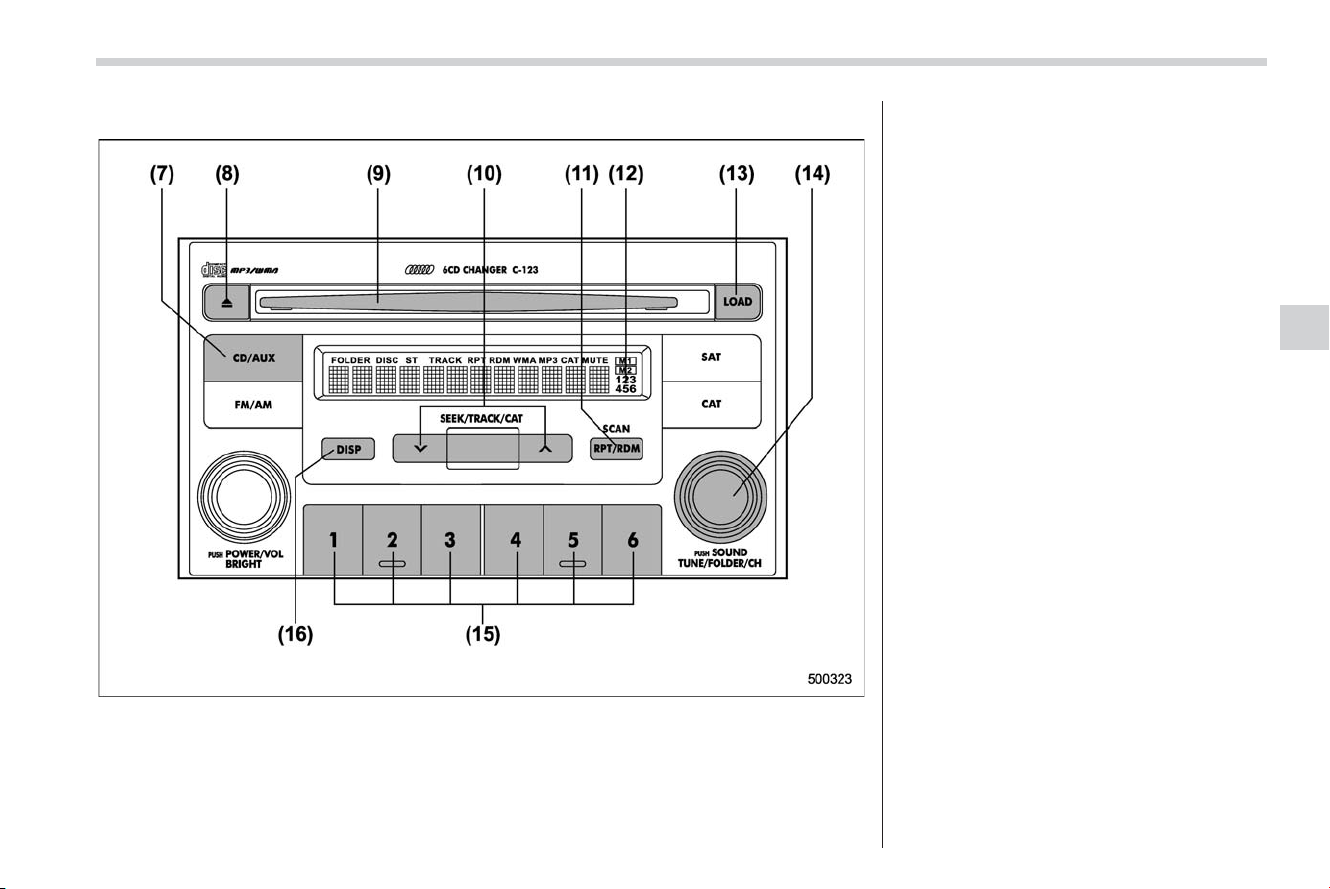
Black plate (179,1)
北米Model "A8130BE-B" EDITED: 2007/ 7/ 25
& Built-in CD changer control
(7) CD button
(8) Eject button
(9) Disc slot
(10) Track selection buttons
(11) Repeat/Random button
(12) Disc number indicator
(13) Load button
(14) Folder selection dial
(15) Disc selection buttons
(16) Display button
NOTE
. Make sure to always insert a disc
with the label side up. If a disc is
inserted with the label side down, it
might be ejected or the player might
shut off.
. If a disc is inserted during a radio
broadcast, the disc will interrupt the
broadcast.
. The player is designed to be able to
play music CD-Rs and music CD-RWs,
but it may not be able to play certain
ones.
. 8 cm/3 inch CDs are not supported,
and if inserted, they will be immediately
ejected.
Audio 5-15
– CONTINUED –
5

Black plate (180,1)
北米Model "A8130BE-B" EDITED: 2007/ 7/ 25
5-16 Audio
! How to insert a CD(s)
! Inserting a CD
1. Briefly press the “LOAD” button (13). If
the magazine in the player has an idle
position where you can insert a disc, the
disc number indicator associated with the
idle position will blink. If no indicator
blinks, it means that ther e is no idle
position in the magazine.
2. When “IN” is displayed, insert the disc.
Once you have inserted the disc, the disc
number indicator will stop blinking. The
disc will be then automatically drawn in,
and the player will begin to play back the
first track of the disc.
. To insert more discs in succession,
repeat Steps 1 and 2. The magazine will
be loaded with discs in the ascending
order of position number. If you do not
insert any disc within 15 seconds after you
have pressed the “LOAD” button and “IN”
is displayed, the player will begin to play
back the first track of the last disc you
have inserted.
. While the player is in the loading mode,
if you press the “FM/AM” button (2), the
player will enter the standby mode. Press
the “CD/AUX” button (7) to start playback.
! Inserting a disc in a desired position
1. Briefly press the “LOAD” button (13). If
the magazine in the player has an idle
position where you can insert a disc, the
disc number indicator (12) associated with
the idle position will blink.
2. Press the disc selection button (15) at
the position where you want to insert a
disc. The associated disc number indica-
tor will blink.
3. If you insert a disc during the 15-
second period while “IN” is displayed, the
disc will be automatically drawn in, and the
player will sta rt playback of the disc,
beginning with the first track.
. To insert more discs in succession,
repeat Steps 1 and 3.
. While the player is in the loading mode,
if you press the “FM/AM” button (2), the
player will enter standby mode. Press the
“CD/AUX” button (7) to start playback.
! Loading all the magazine (Full disc
loading mode)
1. If you continue to press the “LOAD”
button (13) for more than 2 seconds, the
player will enter the full disc loading mode.
2. The disc number indicator (12) asso-
ciated with the idle position will blink. The
magazine will be loaded with discs in the
ascending order of position number.
3. When the loading of a disc is com-
plete, the next disc number indicator (12)
will blink. Then repeat Step 2.
4. When the magazine is filled with discs
by repeating Steps 2 and 3, the player will
start playback of the discs, beginning with
the one inserted first. If you fail to insert
any disc during each 15-second interval,
the full disc loading mode will be can-
celed, and the player will start playback of
the disc inserted first.
! How to play back a CD or make a
pause
! When there is no CD inserted:
Insert a CD by referring to “How to insert a
CD(s)”.
When a CD is loaded, the player will start
playback of the CD, beginning with the
first track.
! When there are CDs loaded:
Depress the “CD/AUX ” button to turn on
the CD (when the last mode of the player
is CD) and press a desired one of the disc
select buttons (15). The player will then
start playback of the selected CD, begin-
ning with the first track.
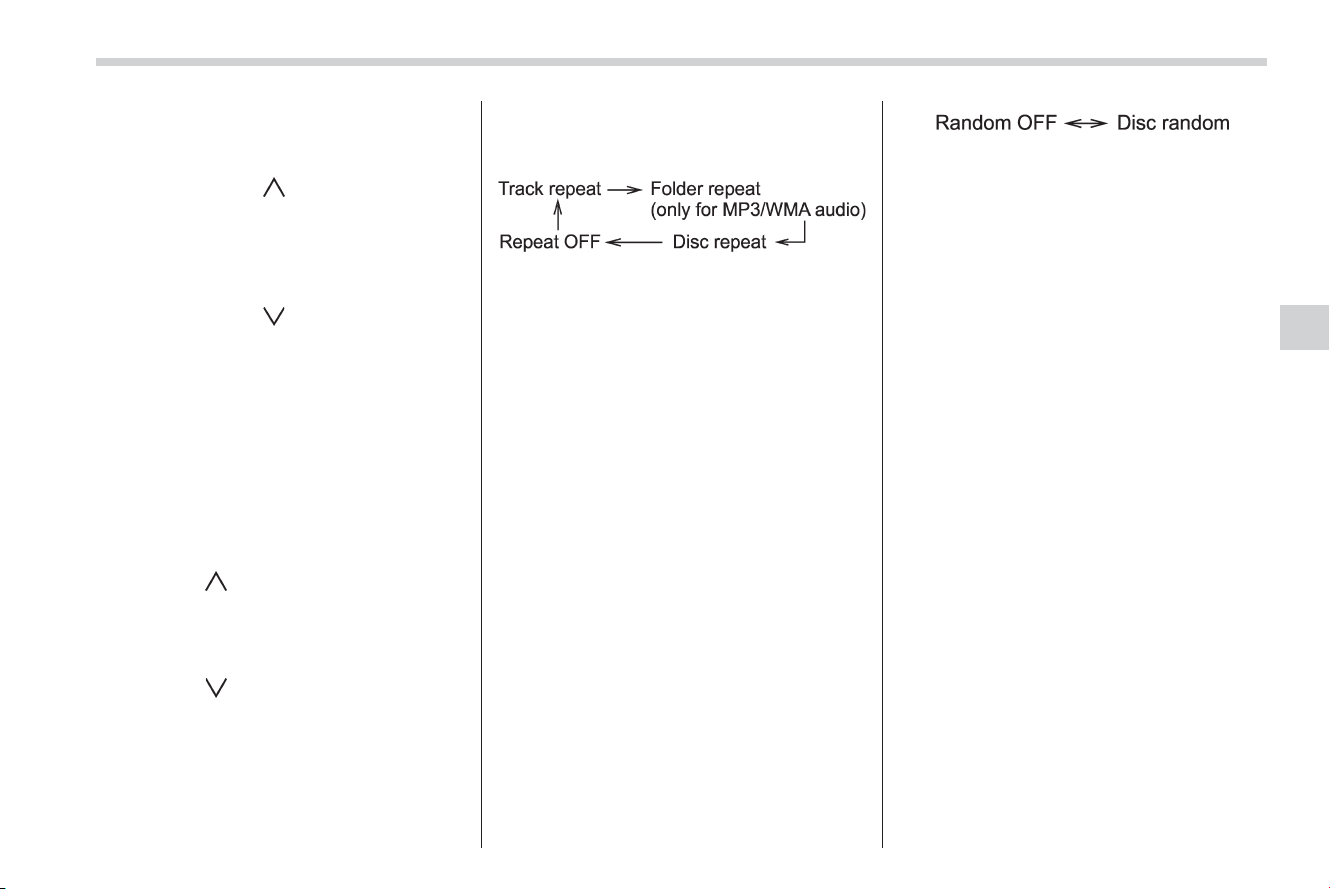
Black plate (181,1)
北米Model "A8130BE-B" EDITED: 2007/ 7/ 25
! To select a track from its beginning
! Forward direction
Briefly press the “
” side of the button
(10) to skip to the beginning of the next
track. Each time the button is pressed, the
indicated track number will increase.
! Backward direction
Briefly press the “
” side of the button
(10) to skip to the beginning of the current
track. Each time the button is pressed, the
indicated track number will decrease.
! To select a folder (for MP3/WMA
audio)
Turn the “TUNE/FOLDER/CH” dial (14) to
select the folder.
! Fast-forwarding and fast-reversing
! Fast-forwarding
Press the “
” side of the button (10)
continuously to fast-forward the disc.
Release the button to stop fast-forwarding.
! Fast-reversing
Press the “
” side of the button (10)
continuously to fast-reverse the disc.
Release the button to stop fast-reversing.
! Repeat playback
Depress the “RPT/RDM” button (11) while
a song is p laying to play the song
repeatedly. Each time this button is
pressed, the repeat play mode will change
in the following order:
The “RPT” indicator will come on and the
song will be played continuously. When
the repeat OFF is selected, the “RPT”
indicator goes out and normal playback
mode is restored.
. The repeat play mode will be can-
celled if you perform any of the follow-
ing steps:
– Press the “RPT/RDM” button to
select the repeat OFF.
– Press the eject button.
– Press the “LOAD” button.
– Select the radio mode.
– Turn the “TUNE/ FOLDER/C H”
dial (for MP3/WMA audio).
– Turn off the power of the audio
equipment.
– Turn the ignition switch to the
“LOCK” position.
! Random playback
Press the “RPT/RDM” button (11) for more
than 2 seconds while a disc is being
played back to play all songs on the disc in
a random order.
The “RDM” indicator will come on and all
songs on the disc will be played in a
random order. When the random OFF is
selected, the “RDM” indicator goes out
and normal playback mode is restored.
. The random play mode will be
cancelled if you perform any of the
following steps:
– Press the “RPT/RDM” button to
select the random OFF.
– Press the eject button.
– Press the “LOAD” button.
– Select the radio mode.
– Turn the “TUNE/FOLDER/CH”
dial (for MP3/WMA audio).
– Turn off the power of the audio
equipment.
– Turn the ignition switch to the
“LOCK” position.
! How to unload CDs from the player
! Ejecting a CD from the player
Of the discs loaded, you can select and
remove only one disc.
1. Press the disc select button (15) of the
disc whose disc number indicator (12) is
ON.
2. Press the eject button (8). Then the
disc number indicator associated with the
Audio 5-17
– CONTINUED –
5
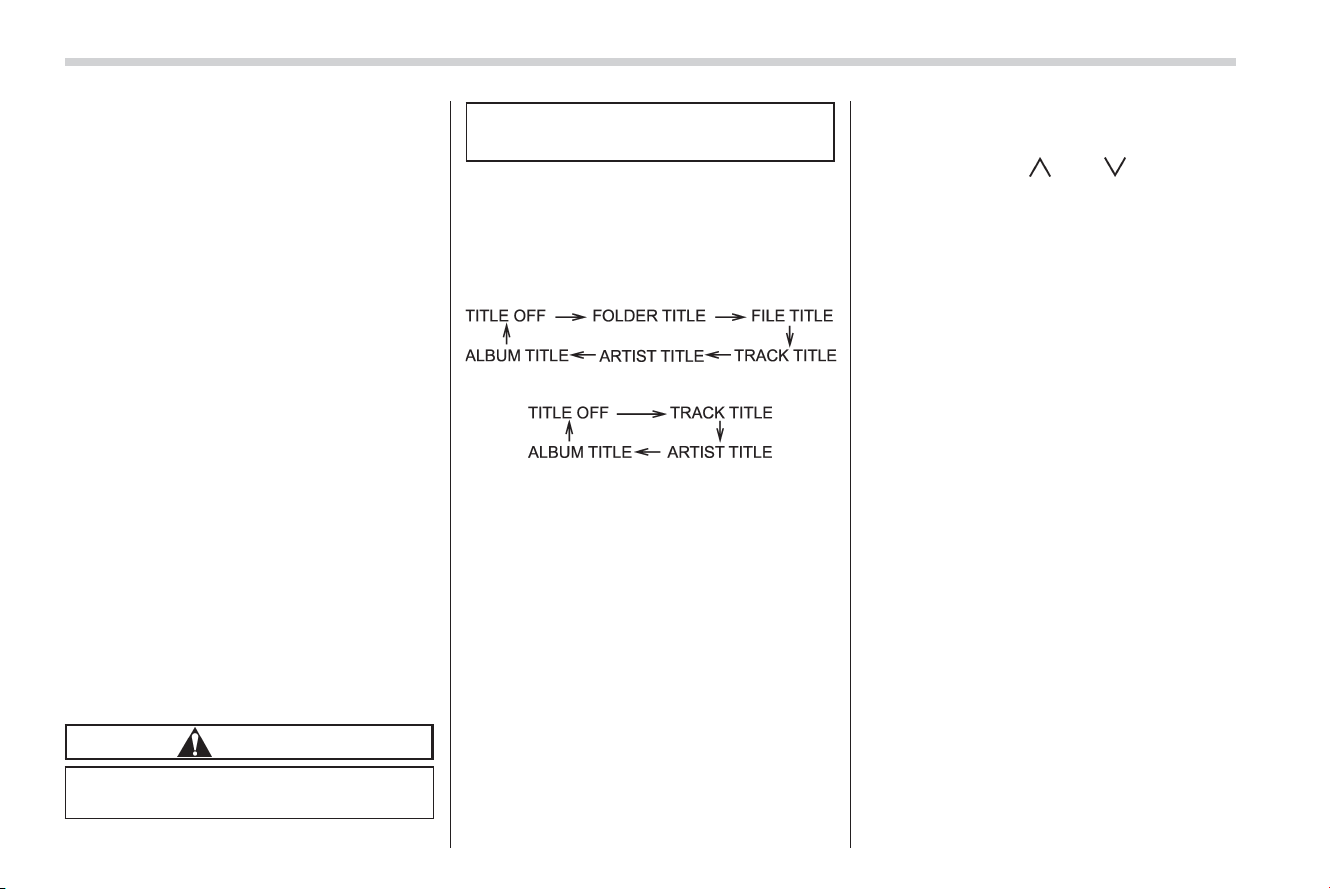
Black plate (182,1)
北米Model "A8130BE-B" EDITED: 2007/ 7/ 25
5-18 Audio
disc you have selected will blink, and the
disc will be ejected. To remove more discs
in succession, repeat Steps 1 and 2. If you
press the eject button after turning OFF
the ignition switch, only one disc will be
ejected.
! Ejecting all discs from the player (All
disc ejection mode)
1. If you continue to press the eject
button (8) for more than 2 seconds, the
player will enter the all disc ejection mode.
2. Remove the disc tha t has been
ejected, the display indicates “CD ALL
EJECT” (when the ignition switch is in the
“Acc” position) and disc indicator will blink.
The other discs loaded will then be
ejected one after another. If you do not
remove the ejected disc within 15 sec-
onds, the “All disc ejection mode” will be
canceled.
NOTE
Avoid driving the vehicle with a CD
sticking out, because vibration might
make it fall out.
CAUTION
Do not attempt to insert two or more
discs into the slot at a time. Doing
so can cause mechanical damage to
the CD changer.
! Title display selection
If you briefly press the “DISP” button (16)
during playback, the indication will change
to the next one in the following sequence.
. For MP3/WMA:
. For Satellite radio:
The display mode that you selected will
not be changed until you select the display
mode again.
When you depress the “DISP” button for
more than 2 seconds, the title will be
scrolled so you can see all of it. You will
see 12 characters at a time.
. The page scroll mode will be can-
celled if you perform any of the follow-
ing steps:
– When you do not operate any
button within 10 seconds.
– Press any button to select an-
other play mode.
– Press the eject button.
– Press the disc selection button.
– Select the radio mode.
– Press the “
” or “ ” button.
– Turn off the power of the audio
equipment.
– Turn the ignition switch to the
“LOCK” position.
NOTE
When the disc has no title, the display
indicates “NO TITLE”.
! When the following messages are
displayed
If one of the following messages is
displayed while operating the CD player,
determine the cause based on the follow-
ing information. If you cannot clear those
messages, please contact your SUBARU
dealer.
! When “PUSH EJECT” is displayed
This message means that there is a
mechanical error. Depress the eject button
to unload the disc. Check the disc for
damage or deformation, and also check
that the correct disc is inserted. Do not try
to unload the disc forcibly. 8 cm/3 inch
CDs are not supported, and if inserted,
they will be immediately ejected and this
message will be displayed. If the disc
cannot be unloaded or the message

Black plate (183,1)
北米Model "A8130BE-B" EDITED: 2007/ 7/ 25
remains displayed, please contact your
SUBARU dealer.
! When “CHECK DISC” is displayed
Press the eject button to unload the discs.
Check that the disc is not damaged or
scratched, and also check that the disc is
inserted correctly. Some CD-RW discs
may be causing this message to appear.
Check that the disc type (i.e., 8 cm/3 inch
CDs are not supported) and data format
are correct. This player can only play MP3
and WMA data formats. If the disc cannot
be unloaded or the message remains
displayed, please contact your SUBARU
dealer.
Audio 5-19
– CONTINUED –
5
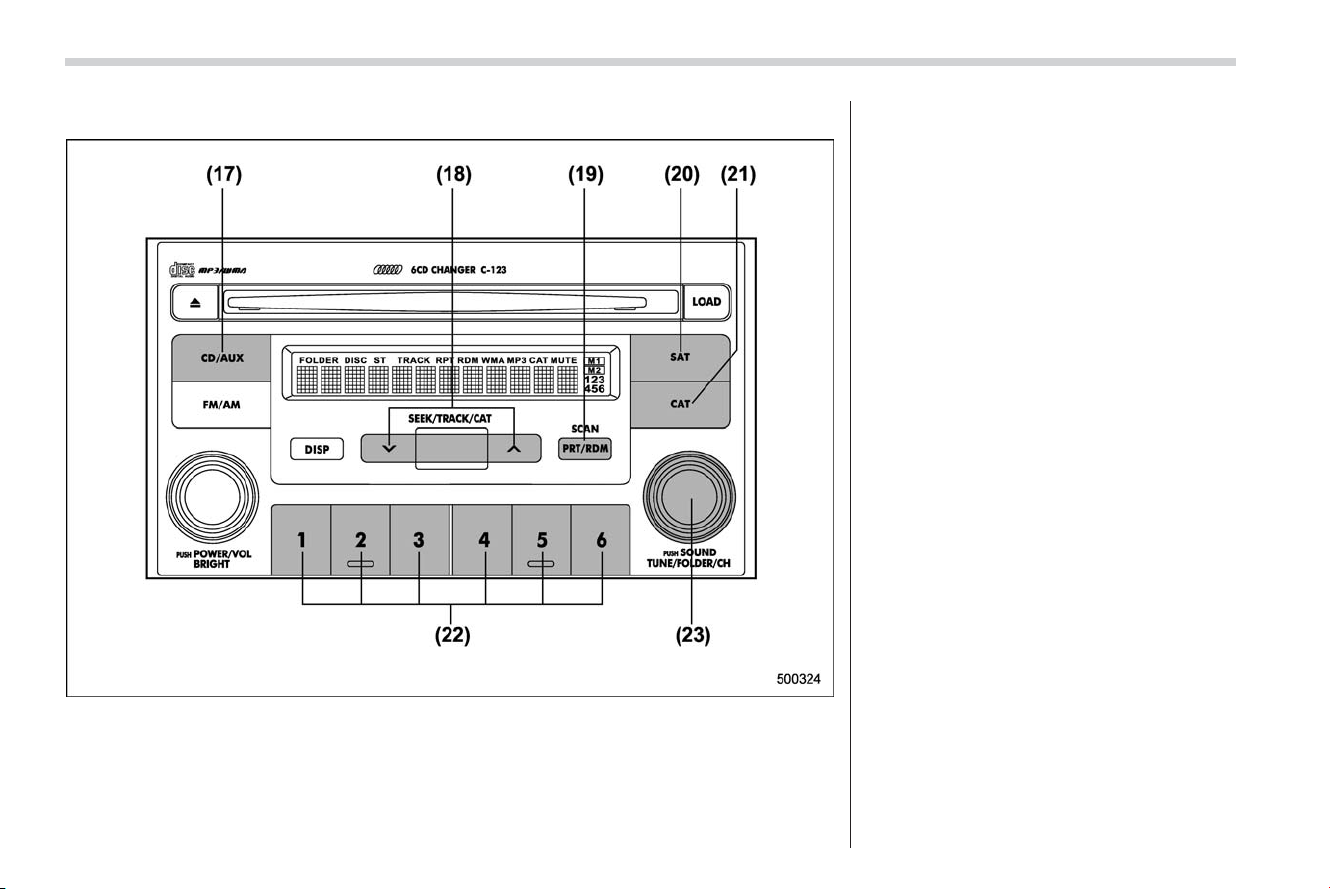
Black plate (184,1)
北米Model "A8130BE-B" EDITED: 2007/ 7/ 25
5-20 Audio
& Auxiliary unit and satellite radio operation
(17) AUX button
(18) Category button
(19) Scan button
(20) Satellite radio* button
(21) Category selection button
(22 Preset buttons
(23) Channel selection dial
(*: Use of satellite radio requires a tuner,
antenna and a service contract. For de-
tails, please contact your SUBARU deal-
er.)
NOTE
. For use of the In-dash CD changer,
refer to the section of “In-dash 6 CD
auto changer” in this chapter.
. Use of satellite radio requires a
tuner, antenna and a service contract.
For details, please contact your
SUBARU dealer.
. The “AUX mode” can be used when
the appropriate device is connected to
the AUX jack.
. The output sound of the portable
audio player is not loud, and the sound
via the vehicle’s speakers that are
connected to the vehicle audio set is
very quiet. If you turn up the volume of
the audio set, the volume becomes
louder. However, when you change
the audio to the radio mode or to a
CD player, the sound becomes a lot
louder. Remember to turn down the
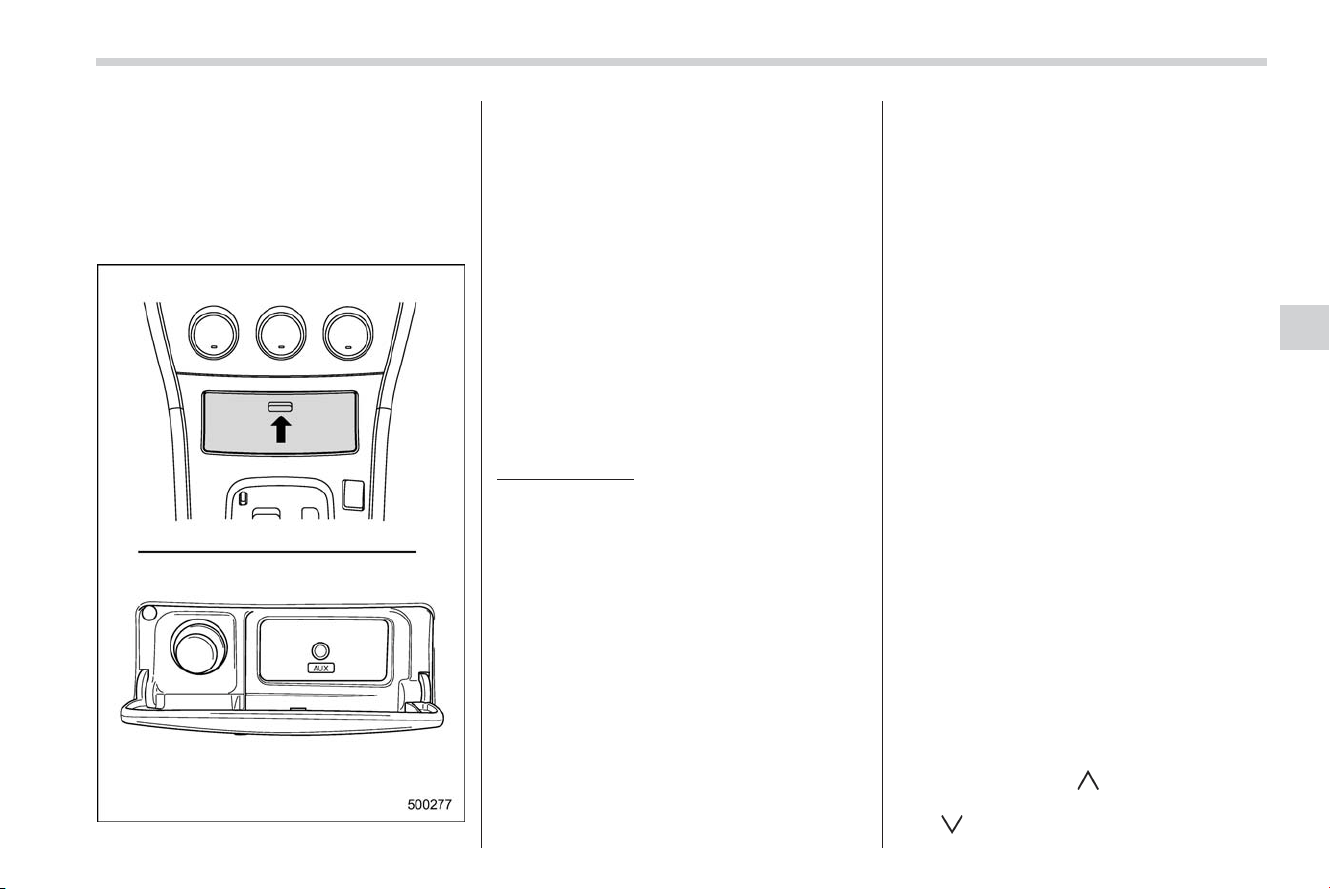
Black plate (185,1)
北米Model "A8130BE-B" EDITED: 2007/ 7/ 25
volume when you change between
them.
! AUX audio jack (if equipped)
The AUX (auxiliary) audio jack is located
behind the lid under the climate controls.
Push gently on the lid to open it.
! Satellite Radio mode (if equipped)
Press the “SAT” button (20) to select the
“Satellite radio mode” (when the SR-BB is
connected).
! Sirius satellite radio
Sirius satellite radio is a recent innovation
that allows the listener to experience
digital sound quality and to have a greater
variety of channels to choose from (more
than 160 channels with the relevant
subscription).
Use of satellite radio (Sirius) requires a
tuner, antenna and a service contract. For
details, please contact your SUBARU
dealer or visit Sirius Satellite Radio at
www.sirius.com or call 1-888-539-SIRIUS
(7474) for more information. Sirius, the
Sirius dog logo, channel names and logos
are trademarks of SIRIUS Satellite Radio
Inc.
! Satellite radio reception
Satellite radio signals are best received in
areas with a clear view of the open sky. In
areas where there are tall buildings, trees,
tunnels or other structures that may
obstruct the signal of the satellites, there
may be signal interruptions. Other circum-
stances that may result in signal loss
include driving near a wall, steep cliff or
hill, or driving on the lower level of a multi-
tiered road or inside a parking garage.
To help reduce this condition, satellite
radio providers have installed ground-
based repeaters in heavily populated
areas. However, you may still experience
reception problems in some areas.
! Displaying satellite radio ID of tuner
When you activate satellite radio, you
should have your satellite radio tuner ID
ready because each tuner is identified by
its unique satellite radio tuner ID.
The satellite radio ID will be needed when
you activate satellite radio and receive
satellite radio customer support.
The satellite radio ID can be found on the
audio display by tuning the channel to “0”.
Turn the “TUNE/FOLDER/CH” dial (23) to
select the satellite radio channel.
! Channel selection
Turn the “TUNE/FOLDER/CH” dial (23) to
select the radio channel. Turn the tuning
dial clockwise to change the channel
upward and turn the dial counterclockwise
to change the channel downward with
each click of the dial.
! Category selection
Press the “SEEK/TRACK/CAT” button
(18) to select the category of radio
channel. Press the “
” side of the button
(18) to change the category upward and
the “
” side of the button to downward
Audio 5-21
– CONTINUED –
5
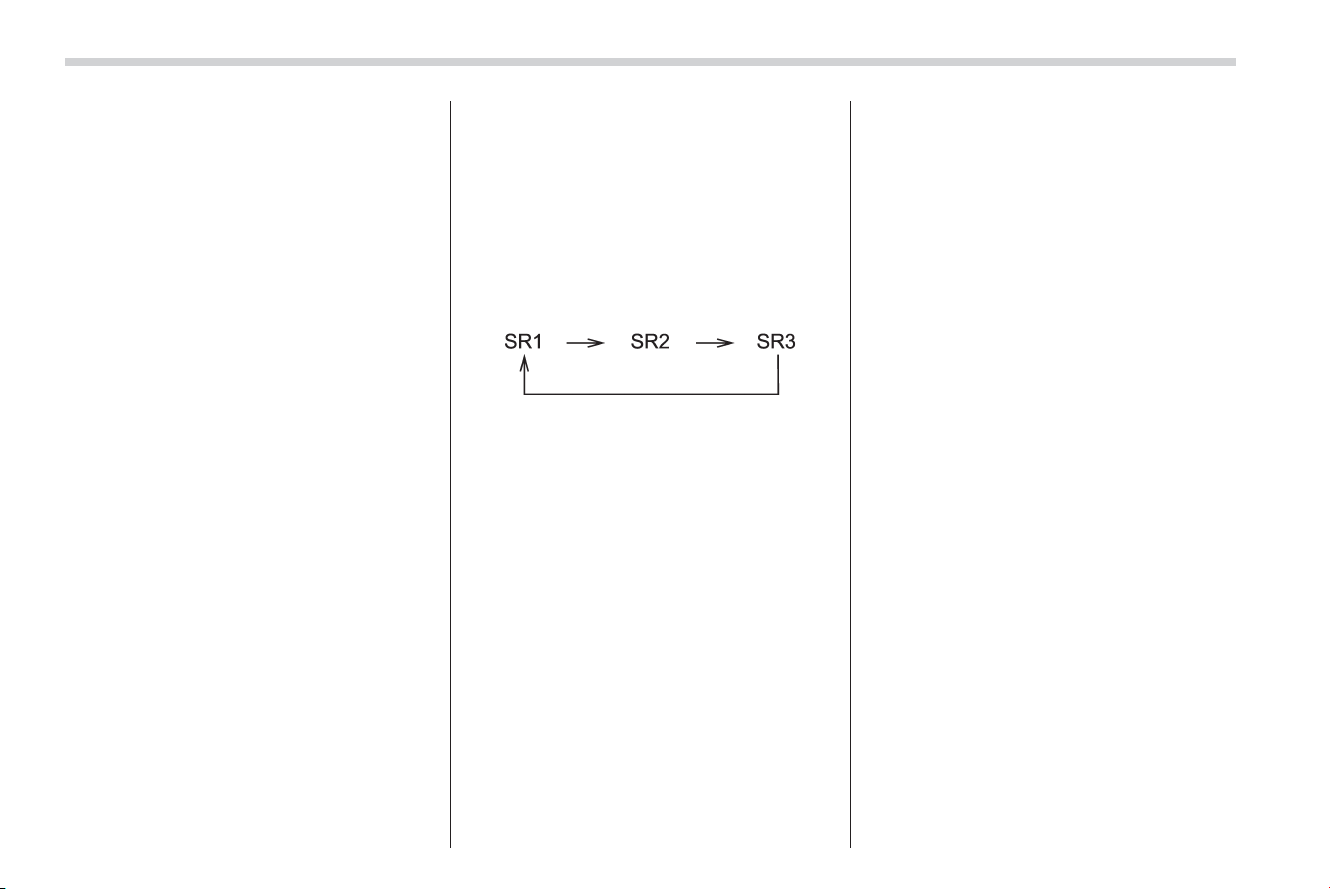
Black plate (186,1)
北米Model "A8130BE-B" EDITED: 2007/ 7/ 25
5-22 Audio
with each press of the button.
! Channel preset
Presetting a channel with a preset button
(22) allows you to select that station in a
single operation. Up to six SR1, SR2 and
SR3 channels each may be preset.
Press one of the preset buttons for at
least 2 seconds to store the channel. The
number of the channel will flash once on
the display, and the unit produces a beep
sound at this time.
! Channel scan
Press the “SCAN” button (19) to change
the radio to the SCAN mode. In this mode,
the radio scans through the channel until a
station is found. The radio will stop at the
station for 5 seconds while displaying the
channel number, after which scanning will
continue until the entire channel has been
scanned from the low end to the high end.
Press the “SCAN” button (19) again to
cancel the SCAN mode and to stop on any
displayed station.
When the “SCAN” button is pressed for
automatic tuning, stations are only
scanned in an upward direction.
! Category mode
Press the “CAT” button (21) for at least 2
seconds to turn the category mode on. In
this mode, the radio operations (channel
selection, channel scan) are performed
only in the selected category. To cancel
the category mode, press the “CAT” button
(21) for at least 2 seconds again.
! Band selection
Push the “SAT” button (20) when the radio
is on to select SR1, SR2 or SR3 reception.
Each time this button is pressed, the band
will change in the following order:
! AUX mode
Press the “CD/AUX” button (17) to select
the “AUX mode” (when the AUX unit is
connected to the AUX jack).
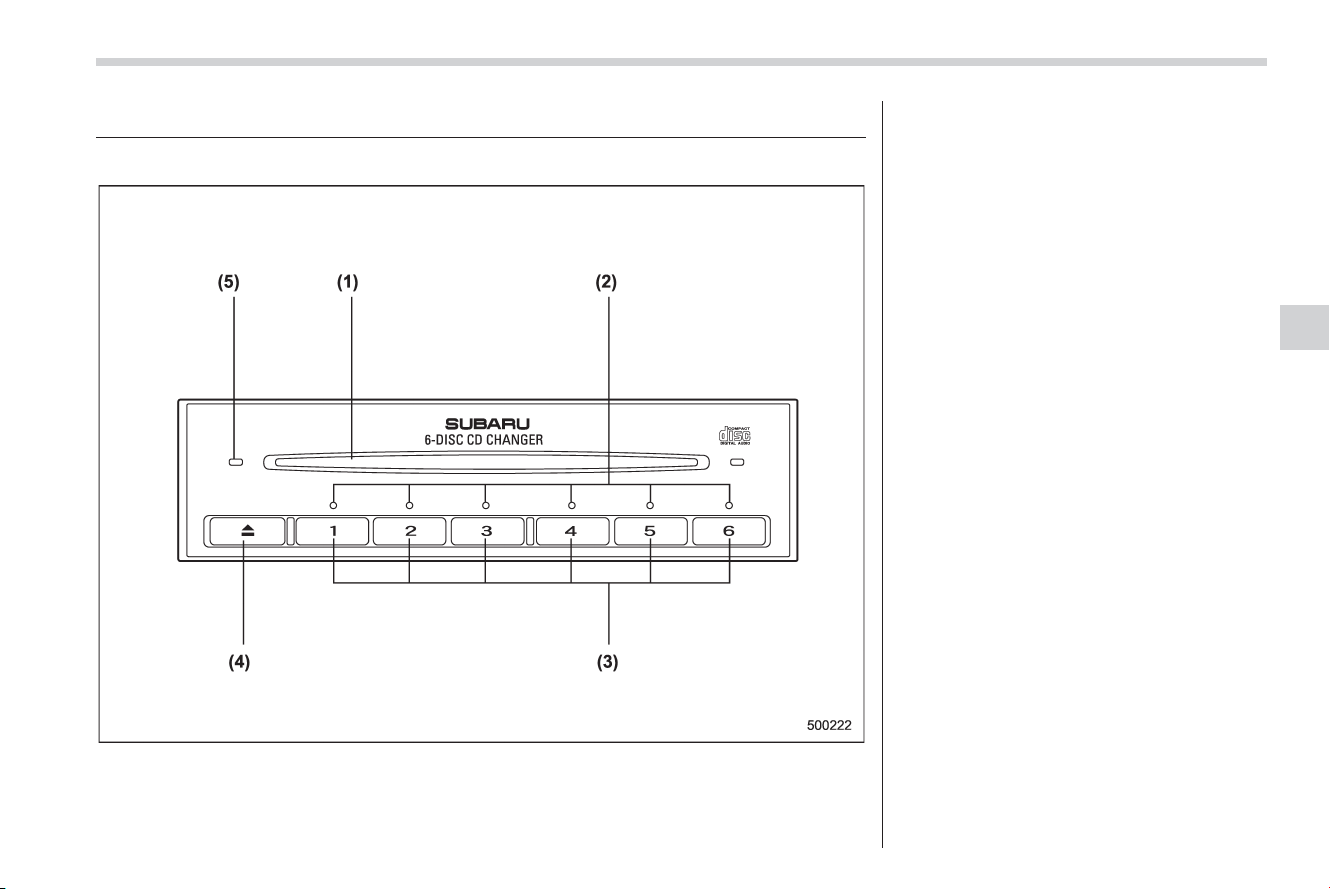
Black plate (187,1)
北米Model "A8130BE-B" EDITED: 2007/ 7/ 25
In-dash 6 CD auto changer (if equipped )
& Loading and unloading compact discs
(1) Disc slot
(2) Disc indicators (disc No.1 to 6)
(3) Disc select buttons (disc No.1 to 6)
(4) Eject button
(5) Disc slot indicator
Audio
5-23
– CONTINUED –
5
Black plate (188,1)
北米Model "A8130BE-B" EDITED: 2007/ 7/ 25
5-24 Audio
CAUTION
. Do not attempt to insert two or
more discs into the slot at a time.
Doing so can cause mechanical
damage to the CD changer.
. Use only music CDs identified by
a
mark.
. Do not use CDs listed in the
following which could cause da-
mage to the CD player.
– 3 inch (8 cm) compact disc
– Any disc with a peel-off or seal
on it
– Bent disc
– Cleaning disc
– CD accessory (e.g., 3 inch (8
cm) disc adapter)
. Do not insert or remove any disc
when the automatic transmission
selector lever is in the park
position; the selector lever in that
position can interfere with disc
insertion or removal, causing
scratches on the disc surface
(for AT vehicles).
! To insert a disc
1. Press one of the disc select buttons (3)
(numbered from 1 to 6) for which the disc
indicator light (2) is “OFF”.
The disc indicator lights are located
directly above the co rrespond ing disc
select buttons.
2. The indicator will begin blinking. The
blinking will last for 15 seconds.
During this period, insert a desired disc,
and the disc will begin to play. (If any disc
is not inserted during this period, the “Disc
slot” (1) door will close. Repeat Step 1.)
Be sure to hold a disc with the label side
(the side where titles are printed) up.
3. To insert another disc, repeat Steps 1
and 2 choosing a different disc select
button.
! To insert six discs at a time
1. Press and hold the disc select button
number 1 until all disc indicators begin
blinking (approximately 1.5 seconds).
2. The indicators will blink for 15 sec-
onds. During this period, insert desired six
discs.
3. When all discs are loaded, the first
disc will begin to play. (If no disc is
inserted within this 15 seconds, the entire
disc load sequence will be canceled.)
! To remove a disc
1. Press the desired one of the disc
select buttons (3) (numbered from 1 to 6)
for which the disc indicator light is on.
2. Press the eject button (4). The se-
lected disc will be ejected and the
indicator light will begin blinking.
3. To remove another disc, repeat Steps
1 and 2 choosing a different disc select
button.
(To remove discs when the ignition switch
is in the “Lock” position, press the eject
button, and the first disc will be ejected.
Press the eject button again, and the next
disc will be ejected and so on. At this time,
the disc select buttons are disabled.)
! To remove all discs at one time
1. Press and hold the eject button (4)
until all “Disc” indicators begin blinking
(approximately 1.5 seconds), and the first
disc will be ejected.
2. When the disc is removed, the next
one will be ejected, and so on.
! To replace a playing disc with
another
Simply press the desired one of disc
select buttons (3) (numbered from 1 to 6)
or press the disc select button on the radio
unit to select the desired disc, and the disc
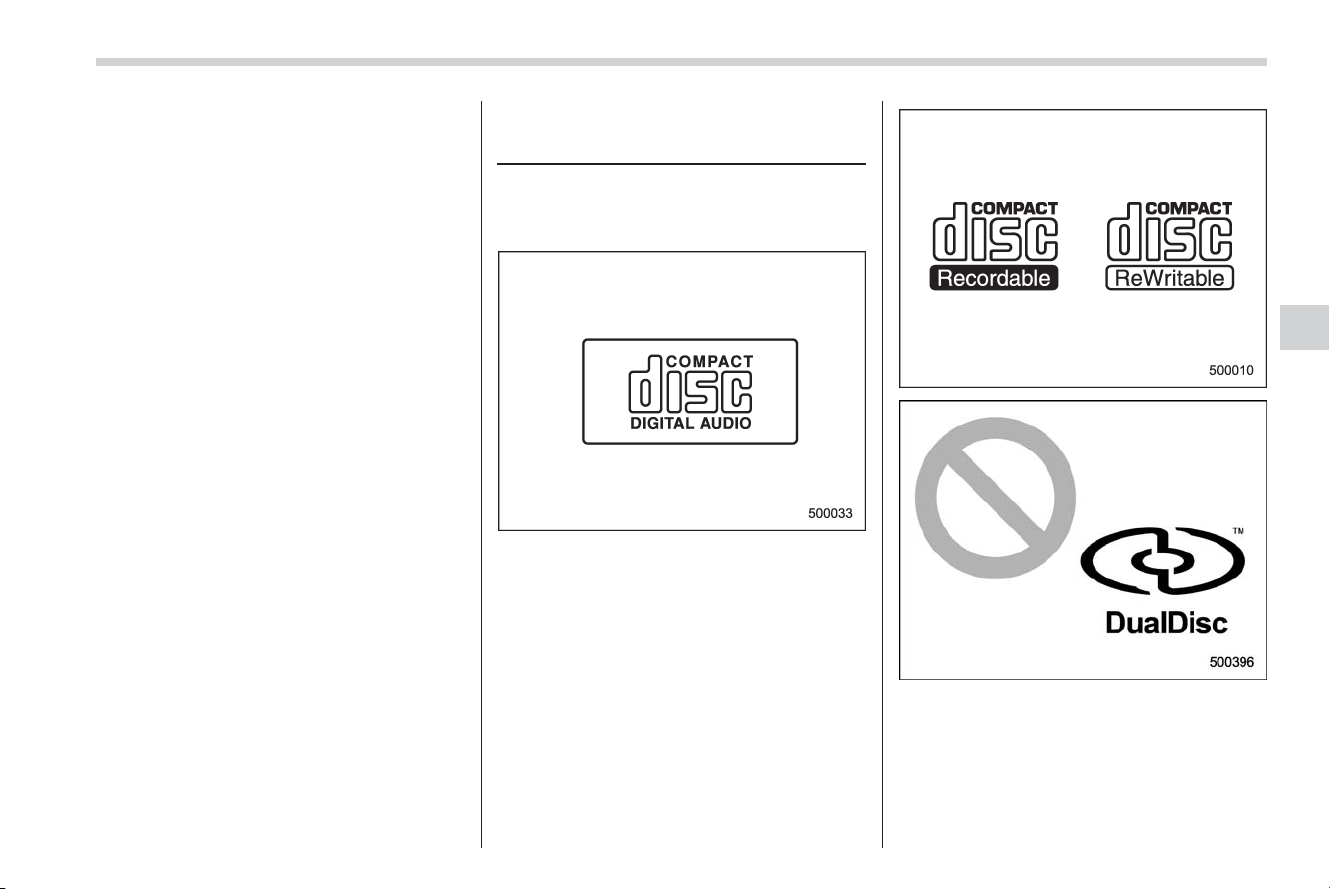
Black plate (189,1)
北米Model "A8130BE-B" EDITED: 2007/ 7/ 25
will begin to play.
! Disc indicators
Lit: when the corresponding storage tray is
occupied by a disc.
Blinking: Disc player is either in loading,
eject or changing mode.
OFF: No disc is loaded or the ignition
switch is in the “LOCK” position.
! Open/Closed disc slot indicator
When the disc slot is open, the disc
indicators on both sides of the slot
illuminate.
! Function control
Refer to CD changer control operating
instructions described in the “Type A audio
set” section.
Precautions to observe when
handling a compact disc
Use only compact discs (CDs) that have
the mark shown in the following illustra-
tion.
You may also use compact discs (CD-Rs
and CD-RWs) that have the following
marks, but you may not use some discs
if they were produced using writing meth-
ods not compatible with your vehicle’s
audio system.
. You cannot use a DualDisc in the CD
player. If you insert a DualDisc into the
player, the disc may not come out again,
possibly causing the player to malfunction.
. In cold and/or rainy weather, dew can
form inside the CD player, preventing
Audio 5-25
– CONTINUED –
5
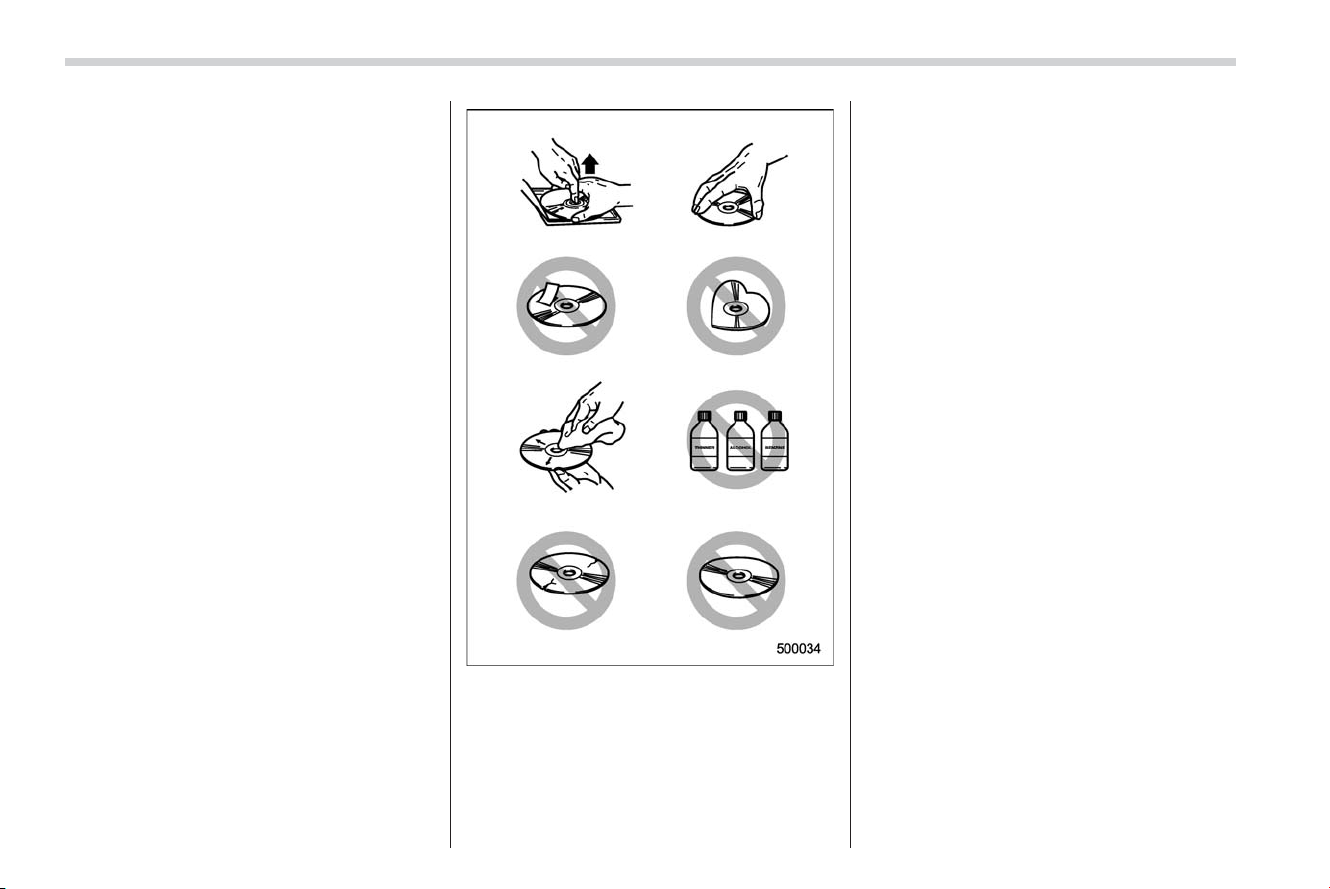
Black plate (190,1)
北米Model "A8130BE-B" EDITED: 2007/ 7/ 25
5-26 Audio
normal operation. If this happens, eject
the CD and wait for the player to dry out.
. Skipping may occur when the CD
player is subjected to severe vibration
(for example, when the vehicle is driven
on a rough surface).
. To remove a disc from the case, press
the center of the case and hold both
edges of the disc. If the disc surface is
touched directly, contamination could
cause poor tone quality. Do not touch the
disc surface.
. Use a clean disc whenever possible. If
there are deposits, wipe the disc surface
from the center outward with a dry, soft
cloth. Be sure not to use a hard cloth,
thinner, benzene, alcohol, etc.
. Do not use any disc that is scratched,
deformed, or cracked. Also, do not use
any disc that has a non-standard shape
(for example, a heart shape). Malfunctions
or problems might result.
. A disc is vulnerable to heat. Never
keep it either in places exposed to direct
sunlight, near heaters or in vehicles
parked in the sun or on hot days.

Black plate (11,1)
北米Model "A8130BE-B" EDITED: 2007/ 7/ 25
Interior lights ....................................................... 6-2
Dome light .......................................................... 6-2
Cargo area light .................................................. 6-2
Map lights ............................................................ 6-3
Sun visors ........................................................... 6-3
Vanity mirror ....................................................... 6-3
Storage compartments ....................................... 6-4
Glove box ........................................................... 6-4
Center console.................................................... 6-4
Overhead console ............................................... 6-6
Dashboard storage compartment ......................... 6-6
Convenience net ................................................. 6-6
Pocket (if equipped) ............................................ 6-7
Cup holders ......................................................... 6-7
Front passenger’s cup holder .............................. 6-7
Rear passenger’s cup holder ............................... 6-8
Accessory power outlets .................................... 6-8
Use with a cigarette lighter
(Canada only, if equipped)................................ 6-10
Ashtray (Canada only, if equipped) .................. 6-11
Floor mat ............................................................ 6-12
Coat hook........................................................... 6-12
Cargo area cover (if equipped)......................... 6-13
Using the cover ................................................. 6-13
To remove the cover housing............................. 6-13
Stowage of the cover ......................................... 6-13
To install the cover housing ............................... 6-13
Shopping bag hook ........................................... 6-14
Cargo tie-down hooks ....................................... 6-14
Cargo area bars ................................................. 6-14
Under-floor storage compartment .................... 6-15
Front, left and right side storage
compartment ................................................... 6-16
Center storage compartment
(Storage bucket) .............................................. 6-16
Interior equipment
6
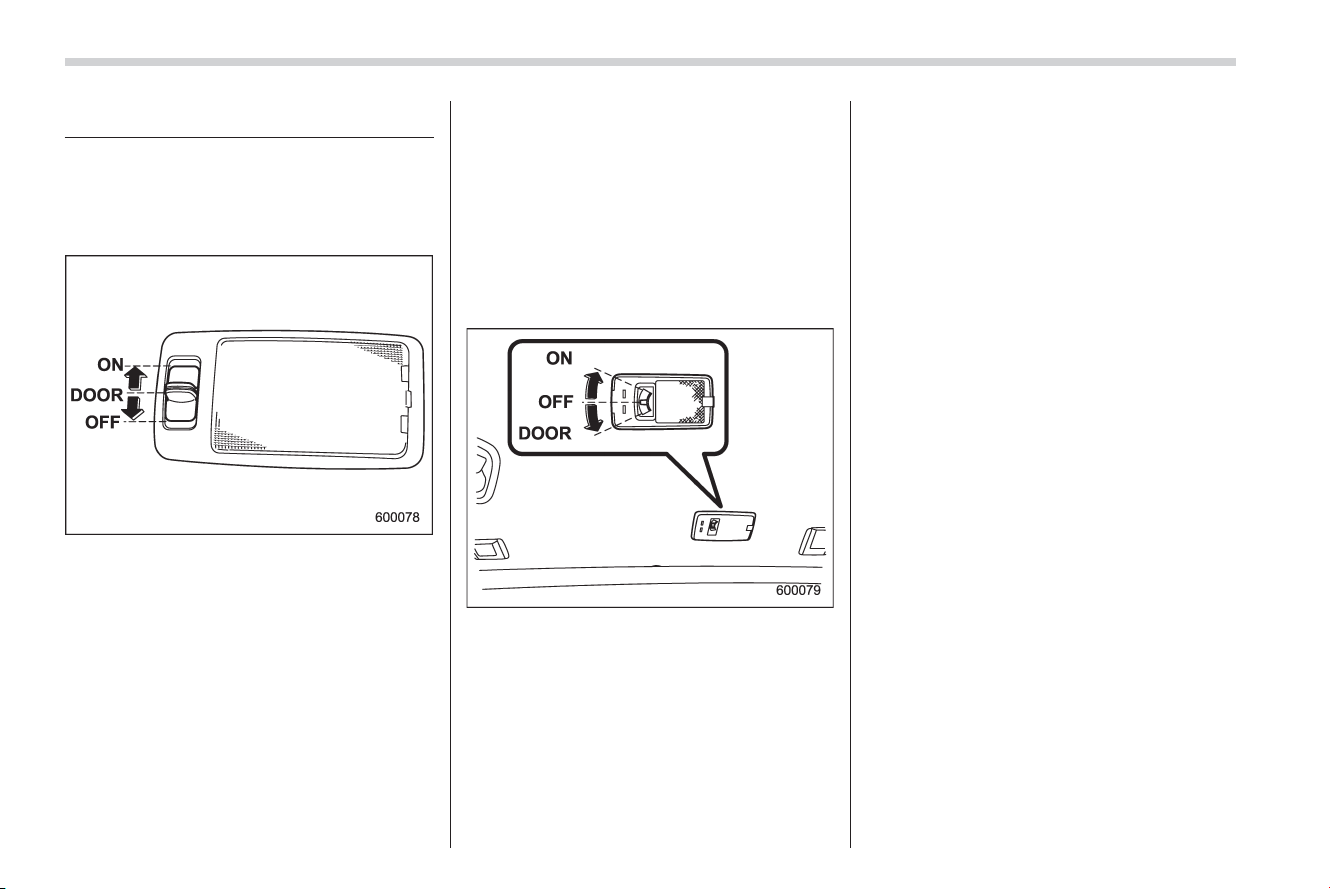
Black plate (192,1)
北米Model "A8130BE-B" EDITED: 2007/ 7/ 25
6-2 Interior equipment
Interior lights
When leaving your vehicle, make sure the
light goes out to avoid battery discharge.
& Dome light
The dome light switch has three positions:
ON: The light stays on continuously.
DOOR (middle position): The dome light
comes on when any of the doors or the
rear gate is opened. The light remains on
for several seconds and gradually goes
out after all doors and the rear gate are
closed.
NOTE
If a door or the rear gate is left open,
the light flashes and a chime sounds
about 30 minutes later and then the
light is turned off automatically.
The light also can be turned on by use of
the keyless entry transmitter. See the
“Remote keyless entry system” section in
chapter 2 for detailed information.
OFF: The light stays off.
& Cargo area light
The cargo area light switch has three
positions:
ON: The light stays on continuously.
OFF: The light stays off.
DOOR: The light comes on only when the
rear gate is opened.
NOTE
If a door or the rear gate is left open,
the light flashes and a chime sounds
about 30 minutes later and then the
light is turned off automatically.
The light also can be turned on by use of
the keyless entry transmitter. See the
“Remote keyless entry system” section in
chapter 2 for detailed information.
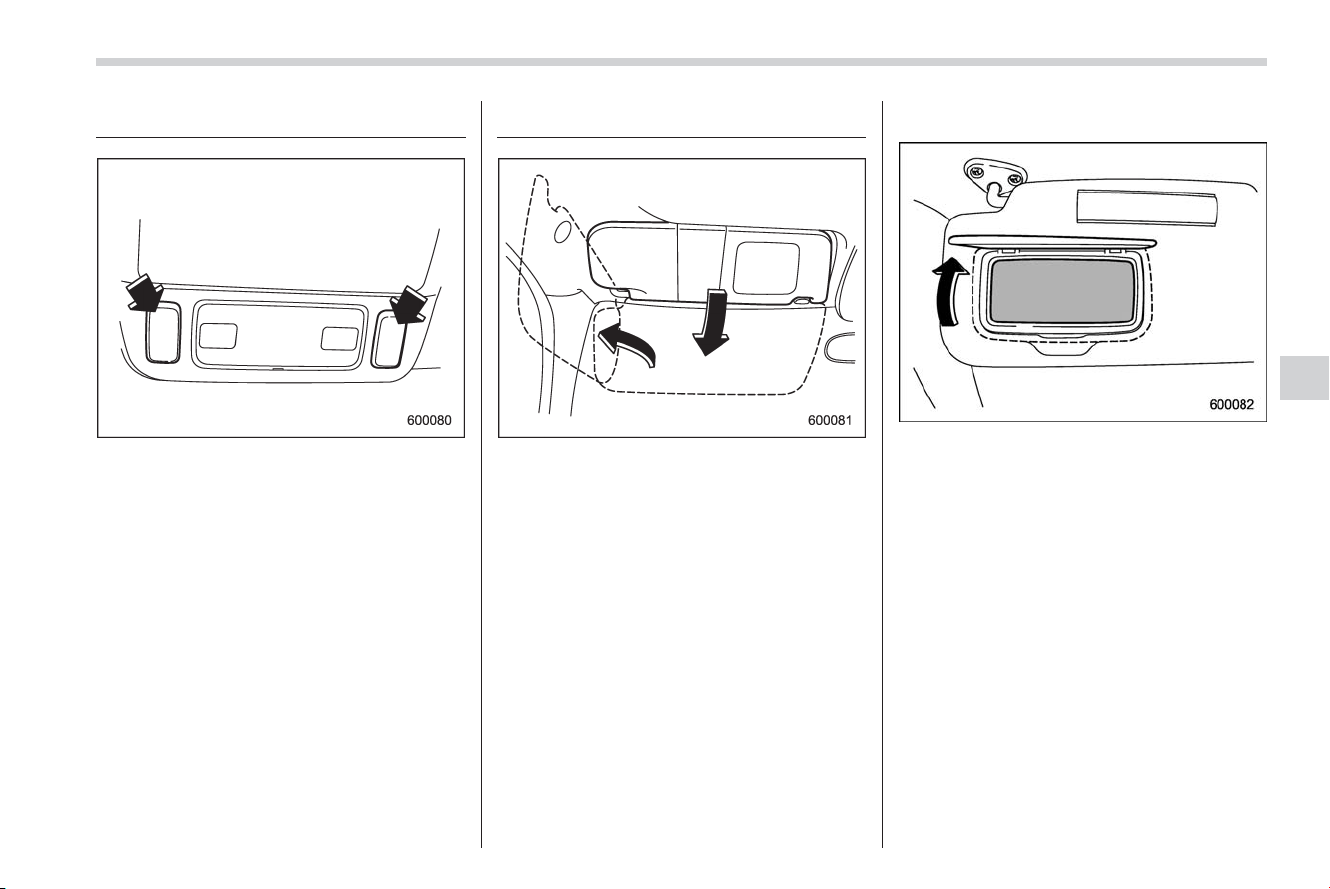
Black plate (193,1)
北米Model "A8130BE-B" EDITED: 2007/ 7/ 25
Map lights
To turn on the map light, push the switch.
To turn it off, push the switch again.
When leaving the vehicle, make sure the
light is turned off to avoid battery dis-
charge.
Sun visors
To block out glare, swing down the visors.
To use the sun visor at a side window,
swing it down and move it sideways.
& Vanity mirror
To use the vanity mirror, swing down the
sun visor and open the vanity mirror cover.
Interior equipment 6-3
6
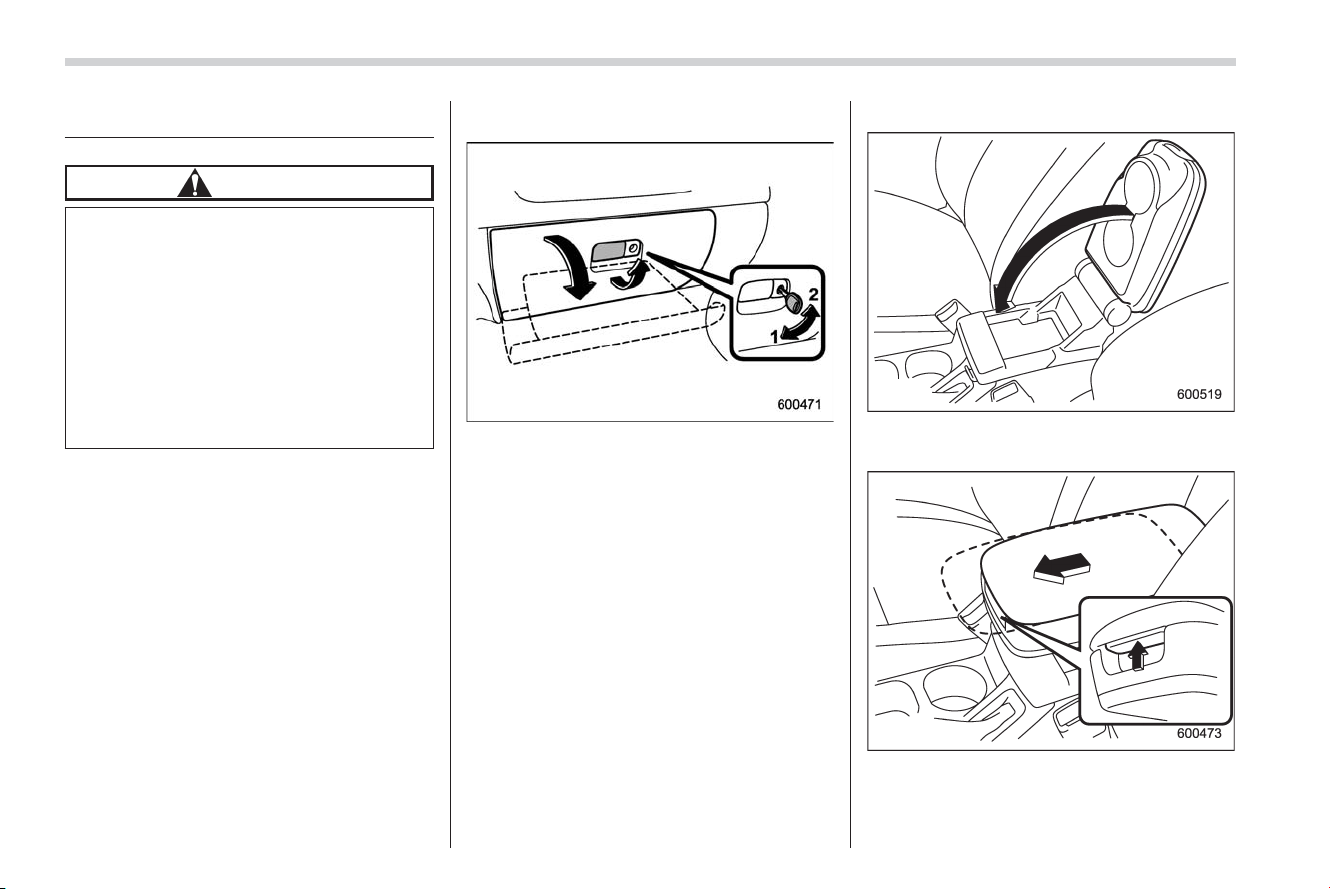
Black plate (194,1)
北米Model "A8130BE-B" EDITED: 2007/ 7/ 25
6-4 Interior equipment
Storage compartments
CAUTION
. Always keep the storage com-
partment closed while driving to
reduce the risk of injury in the
event of sudden stops or an
accident.
. Do not store spray cans, contain-
ers with flammable or corrosive
liquids or any other dangerous
ite ms in the storage compart-
ment.
& Glove box
1) Lock
2) Unlock
To open the glove box, pull the handle. To
close it, push the lid firmly upward.
To lock the glove box, insert the key and
turn it clockwise.
& Center console
The center console box provides a sto-
rage space. In addition, the top of the
console can be used as an armrest and as
a rear passenger’s cup holder.
To use as armrest:
1. Tip the console top forward from its
vertical position.
2. Push the armrest part of the console
top forward to the desired position while
pulling up the knob at the front end of the
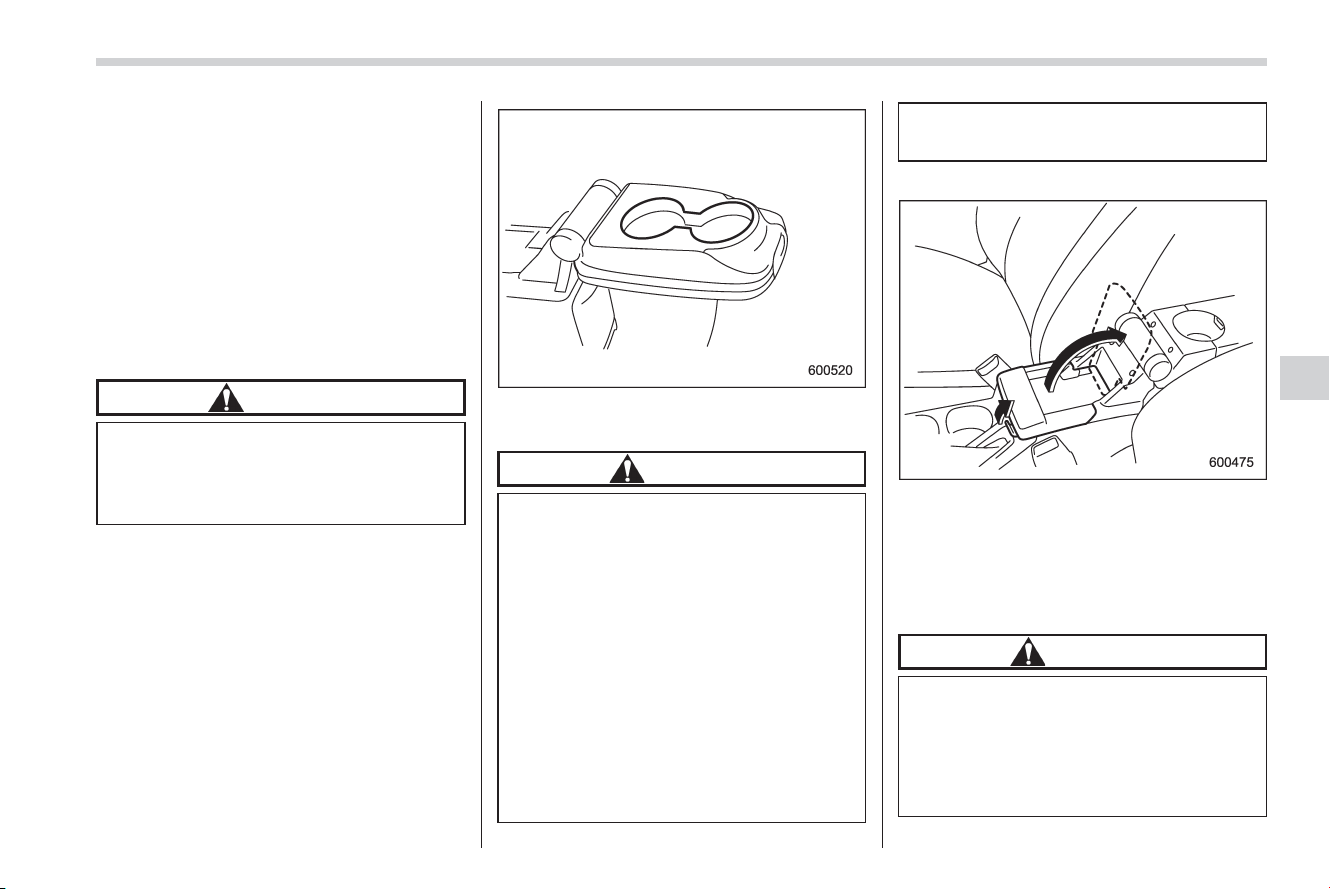
Black plate (195,1)
北米Model "A8130BE-B" EDITED: 2007/ 7/ 25
armrest and lock it in position by releasing
the knob. Adjust the position of the
armrest to suit your driving position. Make
sure the armrest is securely retained.
When you slide the armrest back to its
original position, pull the knob upward as
you do so.
To return the console top to the vertical
position, pull upward the knob at the front
end of the armrest while raising the
console top until it emits a click.
CAUTION
Do not step or sit on the armrest,
and do not place heavy objects on it.
The armrest could break, and you
could get hurt.
To use as rear passenger’s cup holder:
With the console top tipped toward the
rear seat, it can be used as a cup holder.
CAUTION
. To switch from using the console
top as an armrest to using it as a
rear passenger ’s cup holder,
raise the cons ole top to the
vertical position before tipping it
toward the rear seat. Otherwise
the console top may break.
. Do not place any object weighing
more than 4.4 lbs (2 kg) on the
table.
. Do not have hot drinks or other
objects on the table while driv-
ing. During hard braking or ne-
gotiation of a curve, they could
fall from the table and cause a
burn or other injury.
To use as storage space:
Raise the console top to the vertical
position or tip it toward the rear seat.
Then, pull up the lock button of the
console box and open the lid.
When closed, the lid can be used as a tray
for placing small items in it.
CAUTION
. Before opening the lid of the
console box, raise the console
top completely to the vertical
position or tip it toward the rear
seat. Otherwise, the lid may be
damaged and an injury may oc-
Interior equipment 6-5
– CONTINUED –
6
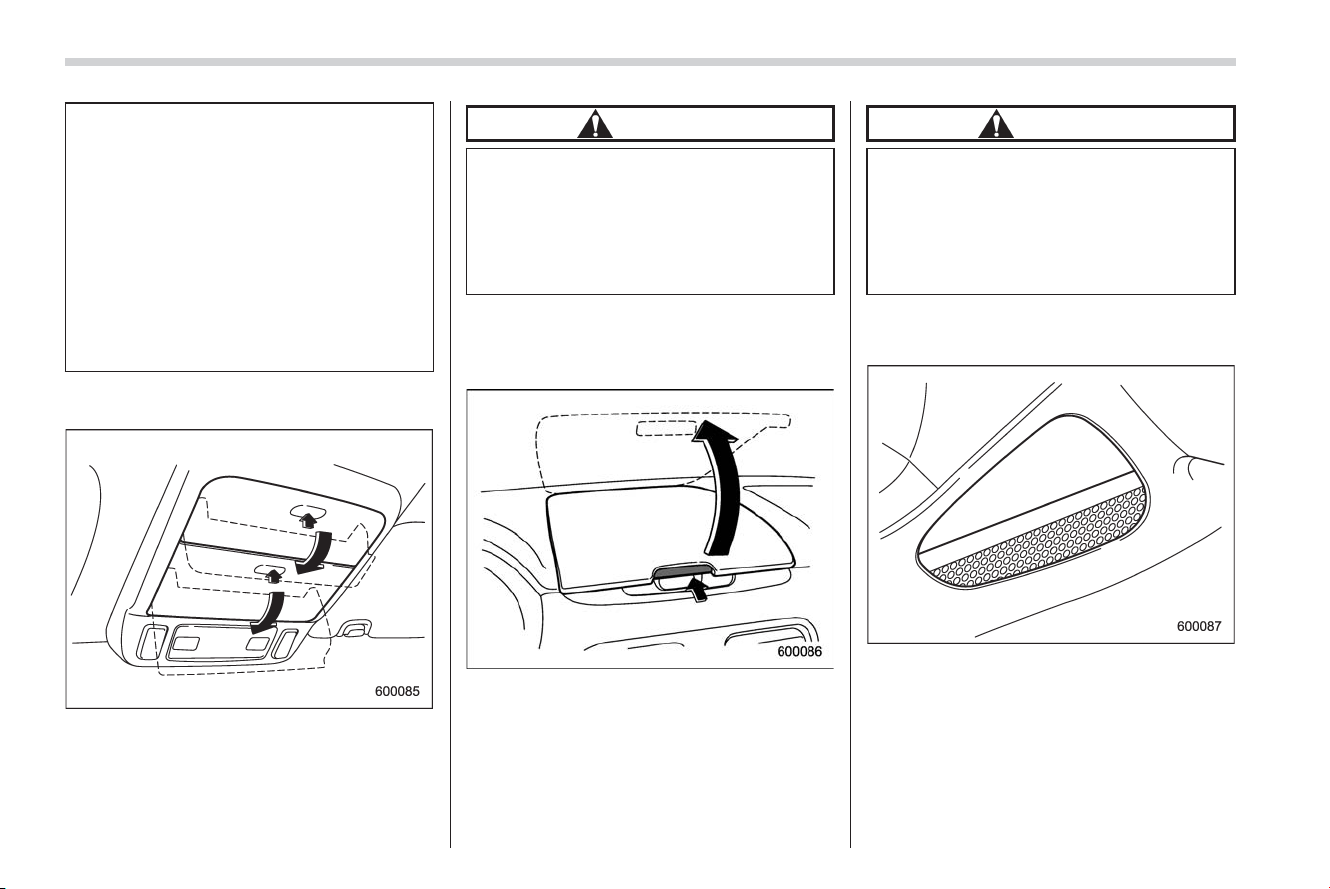
Black plate (196,1)
北米Model "A8130BE-B" EDITED: 2007/ 7/ 25
6-6 Interior equipment
cur.
. Be careful not to trap your hands
between the console top and
console box when raising and
tipping the console top.
. When there is an object on the
console box lid, do not tip the
console top forward. Otherwise,
the console top or lid could be
damaged, and an injury could
occur.
& Overhead console
To open the console, push on the console
lid lightly and the lid will automatically
open.
CAUTION
When your vehicle is in the sun or
on a warm day, the inside of the
overhead console heats up. Avoid
storing plastic or other heat-vulner-
able or flammable articles such as a
lighter in the overhead console.
& Dashboard storage compart-
ment
To open the dashboard compartment,
push the button on the lid and the lid will
automatically open. Be sure to close the
compartment fully before driving.
CAUTION
When your vehicle is in the sun or
on a warm day, the inside of the
overhead console heats up. Avoid
storing plastic or other heat-vulner-
able or flammable articles such as a
lighter in the overhead console.
& Convenience net
A net for storing small articles is provided
at the front passenger’s foot-well.
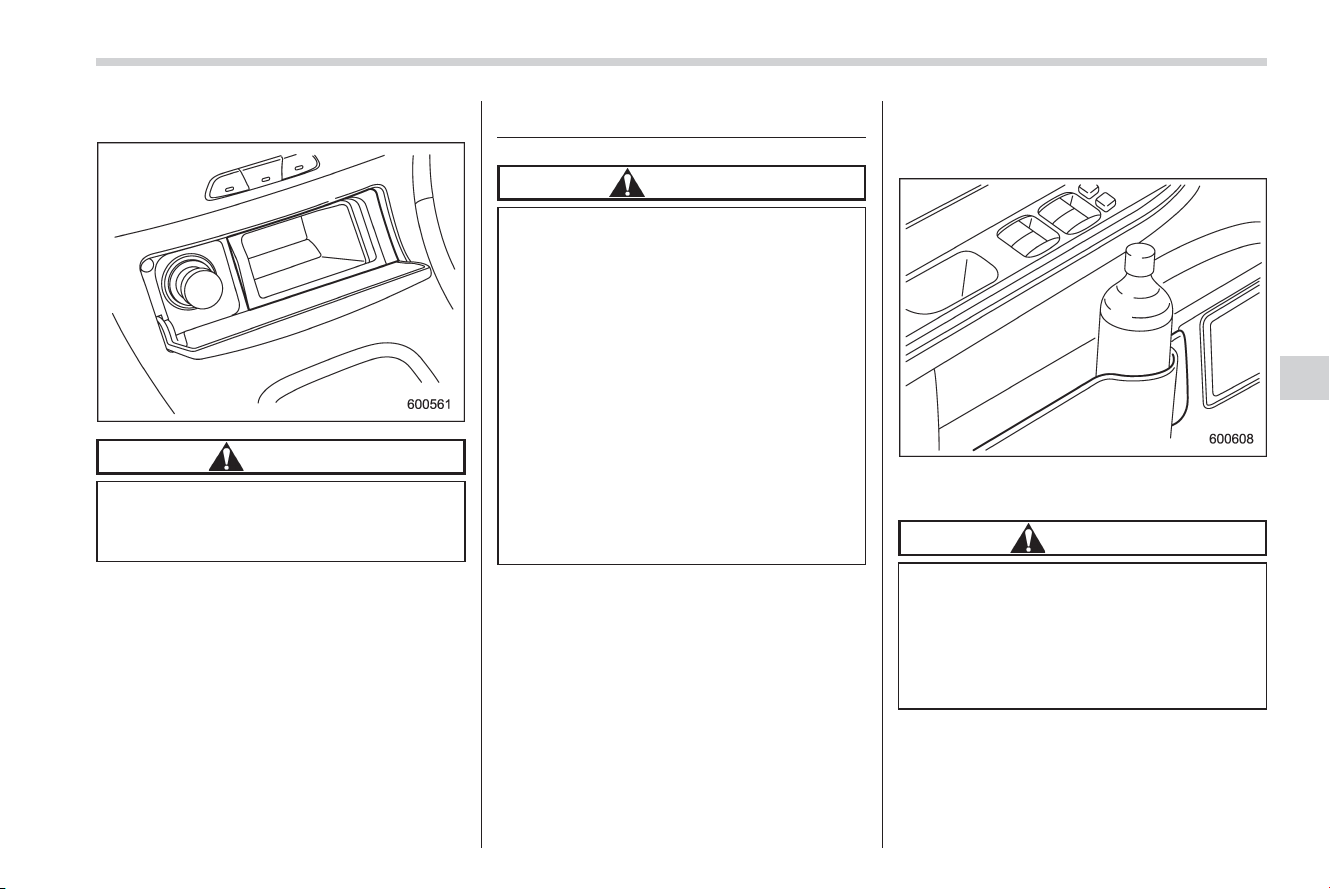
Black plate (197,1)
北米Model "A8130BE-B" EDITED: 2007/ 7/ 25
& Pocket (if equipped)
CAUTION
Do not use the pocket as an ashtray
or leave a lighted cigarette in the
pocket. This could cause a fire.
To use the pocket, push lightly on the lid
below the climate controls.
Cup holders
CAUTION
. When not in use, always keep the
cup holder stored while driving
to reduce the risk of injury in the
event of a sudden stop or an
accident.
. Do not pick up a cup from the cup
holder or put a cup in the holder
while you are driving, as this may
distract y ou and lead to an
accident.
. Take care to avoid spills. Bev-
erages, if hot, might burn you or
your passengers. Spi lled bev-
erages may also damage uphols-
tery or carpets.
& Front passenger’s cup holder
! In front door trim
The door pockets can be used to hold
beverage bottles and other items.
CAUTION
When placing a beverage in a door
pocket, make sure it is capped.
Otherwise, the beverage could spill
when opening/closing the door or
while driving and, if the beverage is
hot, it could scald you.
Interior equipment 6-7
– CONTINUED –
6
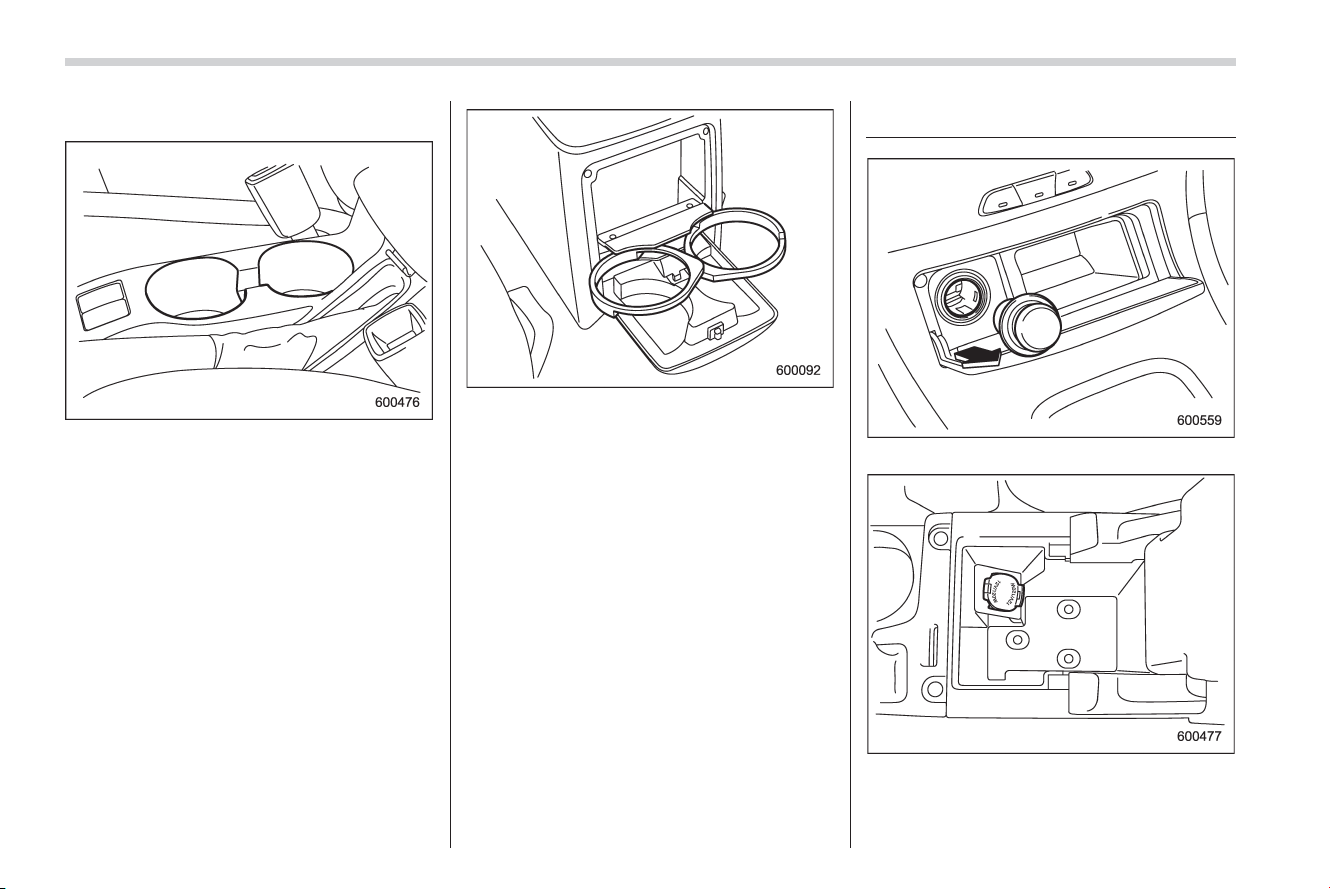
Black plate (198,1)
北米Model "A8130BE-B" EDITED: 2007/ 7/ 25
6-8 Interior equipment
! In center console
A dual cup holder is built in the center
console, beside the parking brake lever.
& Rear passenger’s cup holder
There are rear passenger’s cup holders at
the back of the center console as well as
on the reverse side of the console top.
To use the rear passenger’s cup holder
located at the back of the center console,
open the lid by pulling its upper edge.
To use the rear passenger’s cup holder
located on the reverse side of the console
top, refer to “Center console” in the
“Storage compartments” part of this chap-
ter for details.
Accessory power outlets
Power outlet beside front pocket
Power outlet in center console
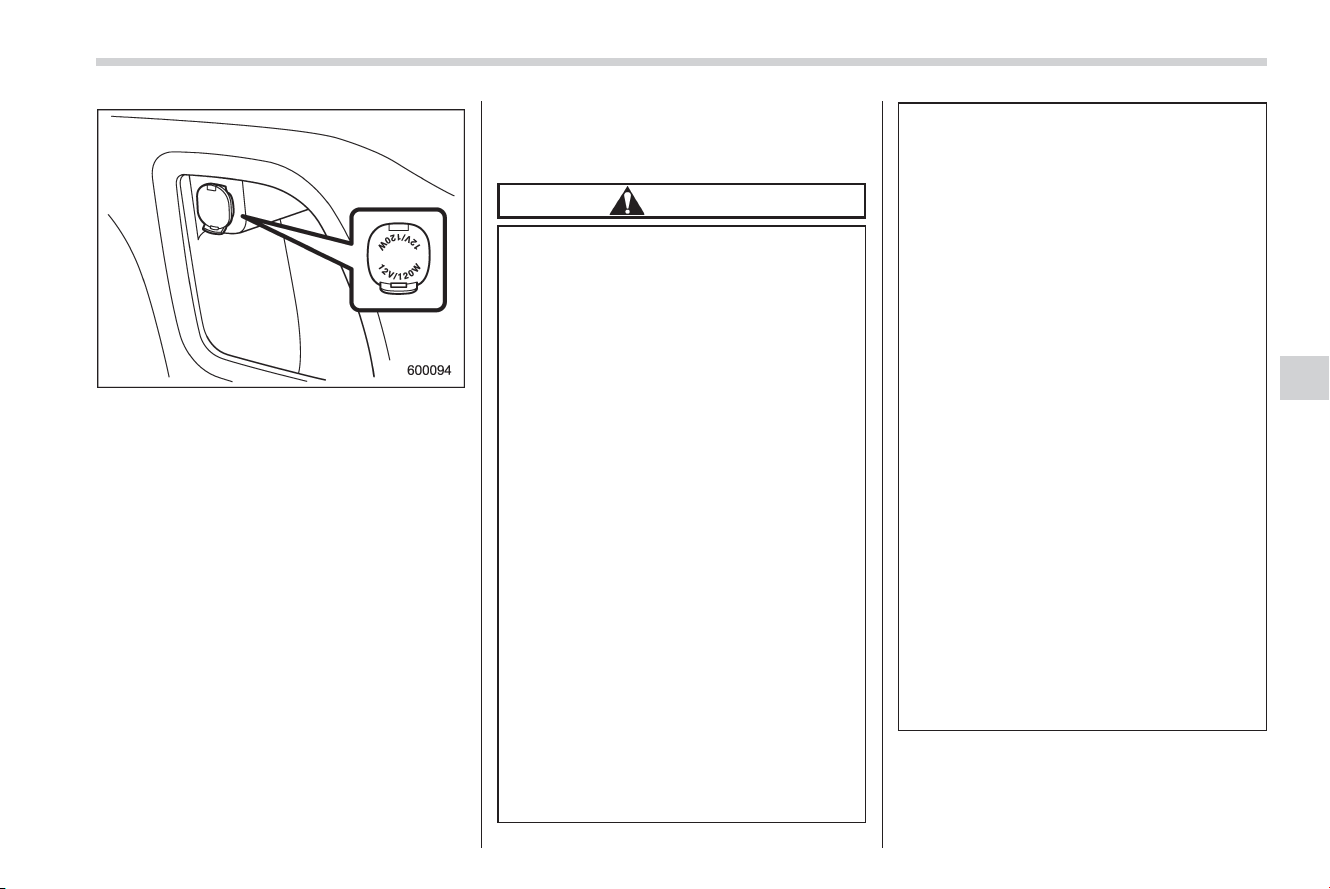
Black plate (199,1)
北米Model "A8130BE-B" EDITED: 2007/ 7/ 25
Power outlet in cargo area
Accessory power outlets are provided
beside the front pocket, in the center
console and in the cargo area. Electrical
power (12V DC) from the battery is
available at any of the outlets when the
ignition switch is in either the “Acc” or “ON”
position.
Youcanuseanin-vehicleelectrical
appliance by connecting it to an outlet.
The maximum power rating of an appli-
ance that can be connected varies among
outlets as shown in the following. Do not
use an appliance which exceeds the
indicated wattage for each outlet.
Outlet beside front pocket: 80W or less
Outlets in center console and cargo area:
120W or less
When using appliances connected to two
or more outlets simultaneously, the total
power consumed by them must not
exceed 120W.
CAUTION
. Do not attempt to use a cigarette
lighter in the center console and
cargo area power outlets.
. Do not place any foreign objects,
especially metal ones such as
coins or aluminum foil, into the
accessory power outlet. That
could cause a short circuit. Al-
ways put the cap on the acces-
sory power outlet when it is not
in use.
. Use only electrical appliances
which are designed for 12V DC.
The maximum power rating of an
appliance that can be connected
varies among outlets as shown in
the following. Do not use an
appliance which exceeds the in-
dicated wattage for each outlet.
Outlet beside front pocket: 80W
or less
Outlets in center console and
cargo area: 120W or less
When using appliances con-
nected to two or more outlets
simultaneously, the total power
consumed by them must not
exc eed 120W. Overloading the
accessory power outlet can
cause a short circuit. Do not use
double adapters or more than
one electrical appliance.
. If the plug on your electric appli-
ance is either too loose or too
tight for the accessory power
outlet, this can result in a poor
contact or cause the plug to get
stuck. Only use plugs that fit
properly.
. Use of an electric appliance in the
accessory power outlet for a long
period of time while the engine is
not running can cause battery
discharge.
. Before driving your vehicle, make
sure that the plug and the cord
on your electrical appliance will
not interfere with your shifting
gears and operating the accel-
erator and brake pedals. If they
do, do not use the electrical
appliance while driving.
Interior equipment 6-9
– CONTINUED –
6
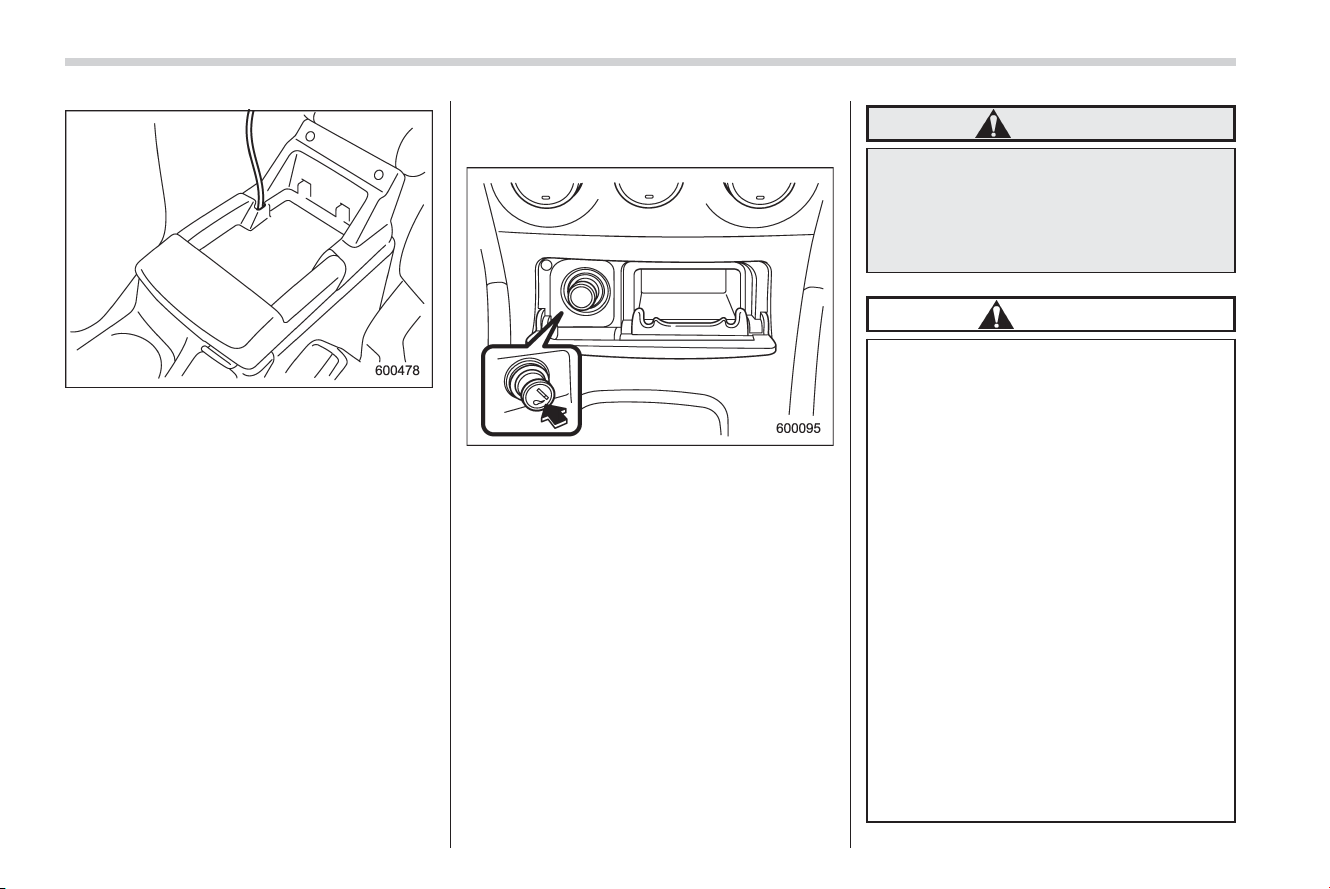
Black plate (200,1)
北米Model "A8130BE-B" EDITED: 2007/ 7/ 25
6-10 Interior equipment
NOTE
When the lid of the center console is
closed, an opening remains between
the center console and the lid to allow
the power outlet in the center console
to be used. Pass the electrical appli-
ance’s cord through this opening.
& Use with a cigarette lighter
(Canada only, if equipped)
To use the accessory power outlet beside
the front pocket as a cigarette lighter
socket, purchase the cigarette lighter plug,
which is an optional accessory.
A cigarette lighter plug is available from
your SUBARU dealer.
The cigarette lighter operates only when
the ignition switch is in the “ON” and “Acc”
positions.
To use the cigarette lighter, push in the
knob and wait a few moments. It will
automatically spring up when ready for
use.
WARNING
To avoid being burned, never grasp
the lighter by the end with the
heating element. Doing so could
result in injury and could also
damage the heating element.
CAUTION
. Do not hold the lighter pushed in,
because it will overheat.
. The electrical power socket lo-
cated on the lower part of the
instrument panel is originally de-
signed to use a genuine SUBARU
cigarette lighter plug. Do not use
non-genuine cigarette lighter
plugs in the socket. Doing so
may cause a shor t-circuit and
overheating, resulting in a fire.
. If the socket is ever used for a
plug-in accessory such as a cell
phone, that may damage the
portion of the socket’s internal
mechanism that causes a cigar-
ette lighter plug to “pop out”
after its lighter element is heated.
Therefore, do not place a cigar-
ette lighter plug in a socket that
has been used, even once, to
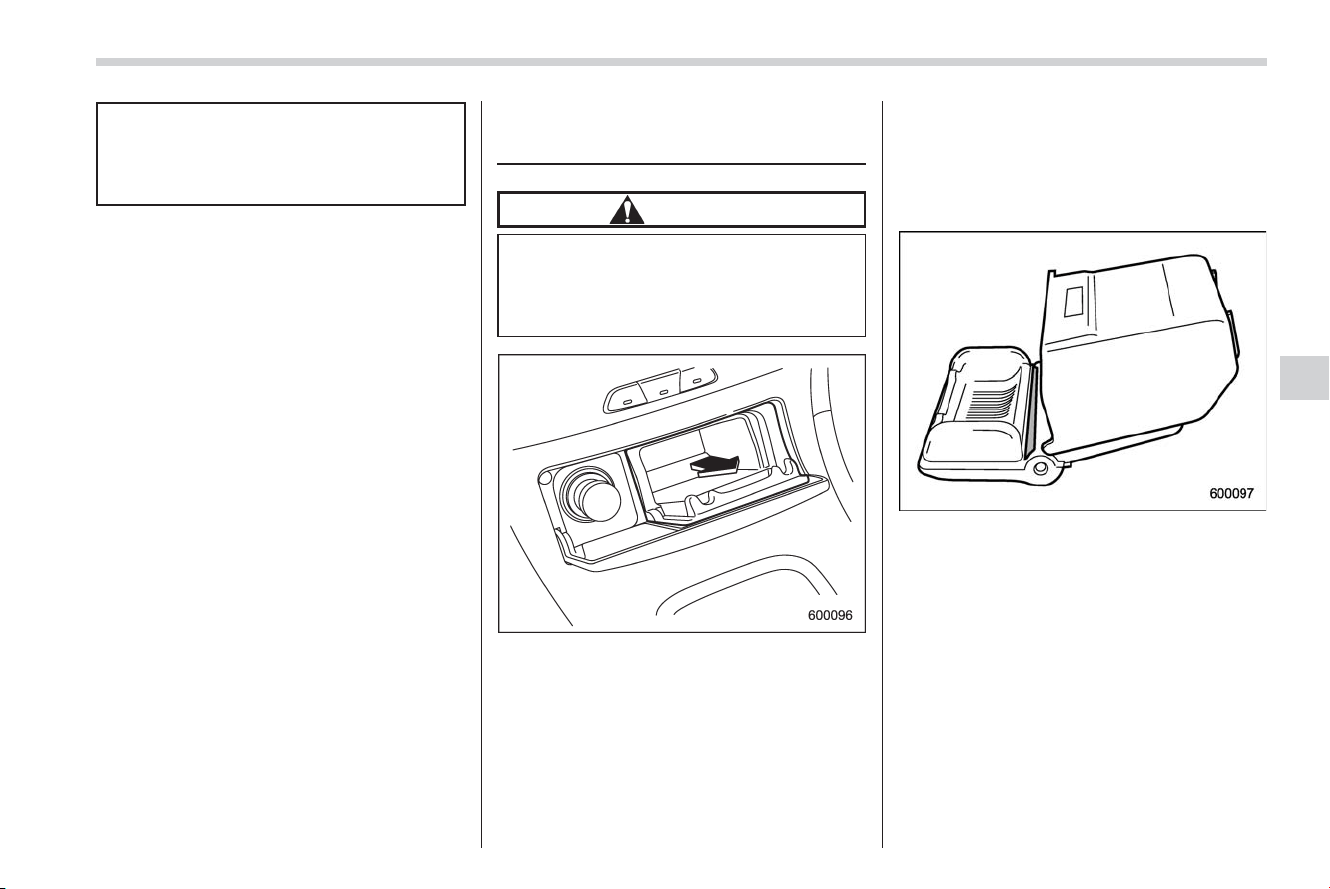
Black plate (201,1)
北米Model "A8130BE-B" EDITED: 2007/ 7/ 25
power a plug-in accessory. Doing
so may cause the plug to stick
and overheat, creating a potential
fire hazard.
Ashtray (Canada onl y, if
equipped)
CAUTION
Do not use ashtrays as waste re-
ceptacles or leave a lighted cigarette
in an ashtray. This could cause a
fire.
It is possible to install on ashtray, which is
an optional accessory, in the front pocket.
The ashtray is available from your
SUBARU dealer.
To open the ashtray, push lightly on the lid
below the climate controls.
Fully close the lid after using it to help
reduce residual smoke.
To remove the ashtray for cleaning, hold
the right and left sides of the ashtray and
pull it out.
NOTE
Particles of ash and tobacco will accu-
mulate around the hinges of the ash-
tray’s inner lid. Clean them off using a
toothbrush or other narrow-ended im-
plement.
Interior equipment 6-11
6
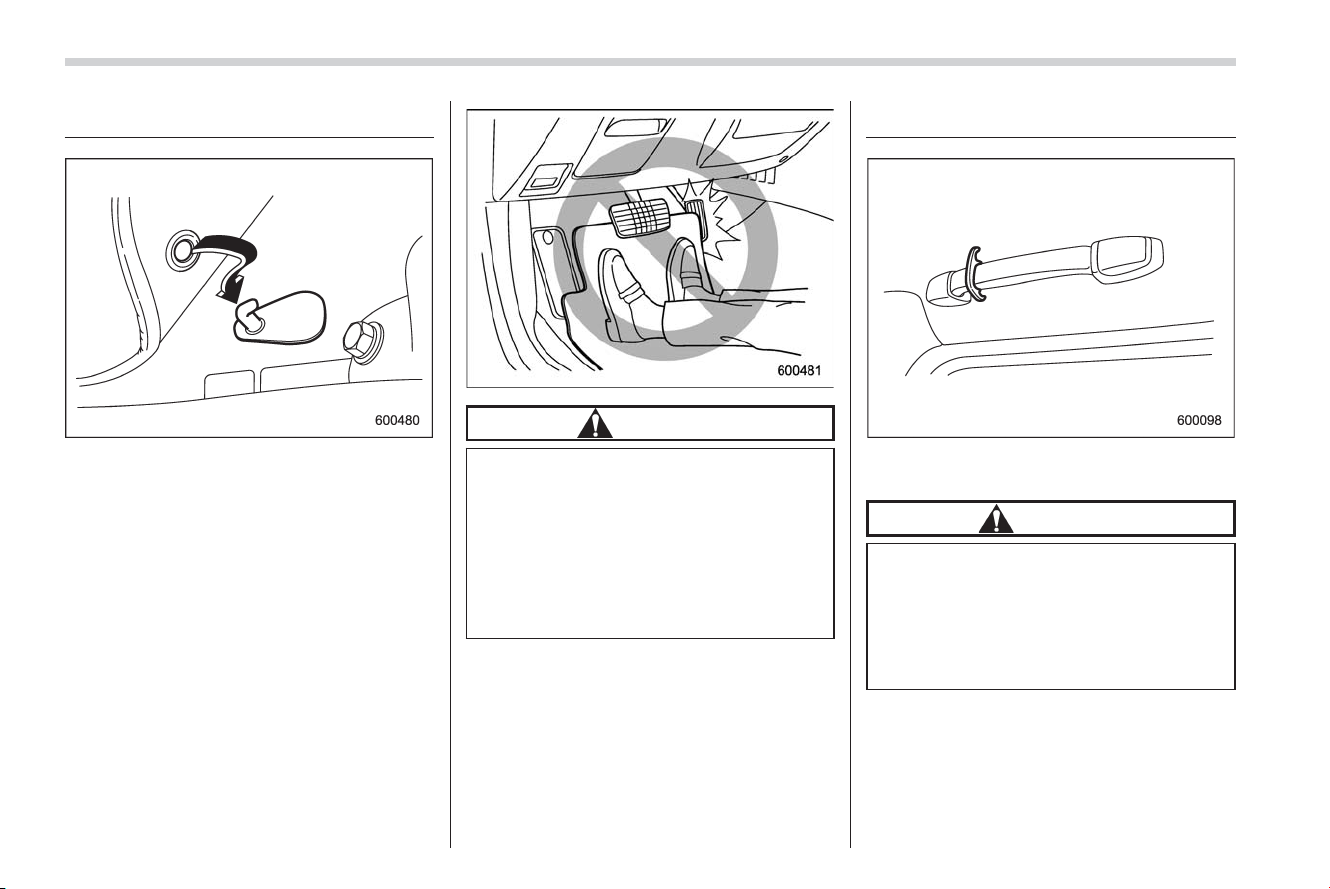
Black plate (202,1)
北米Model "A8130BE-B" EDITED: 2007/ 7/ 25
6-12 Interior equipment
Floor mat
A retaining pin is located on the driver’s
side of the vehicle next to the fuel filler
door release.
The floor mat is secured using the built-in
grommet, by placing the grommet over the
pin and pushing downward.
CAUTION
Make sure the driver’s floor mat is
placed back in its proper location
and correctly secured on its retain-
ing pin. Also, do not use more than
one floor mat. If the floor mat slips
forward and interferes with the
movement of the pedals during
driving, it could cause an accident.
Coat hook
The coat hook is attached to the rear left
passenger’s hand grip.
CAUTION
Never hang anything on the coat
hook that might obstruct the driver’s
view or that could cause injury in
sudden stops or in a collision. And
do not hang items on the coat hook
that weigh 2.2 lbs (1 kg) or more.
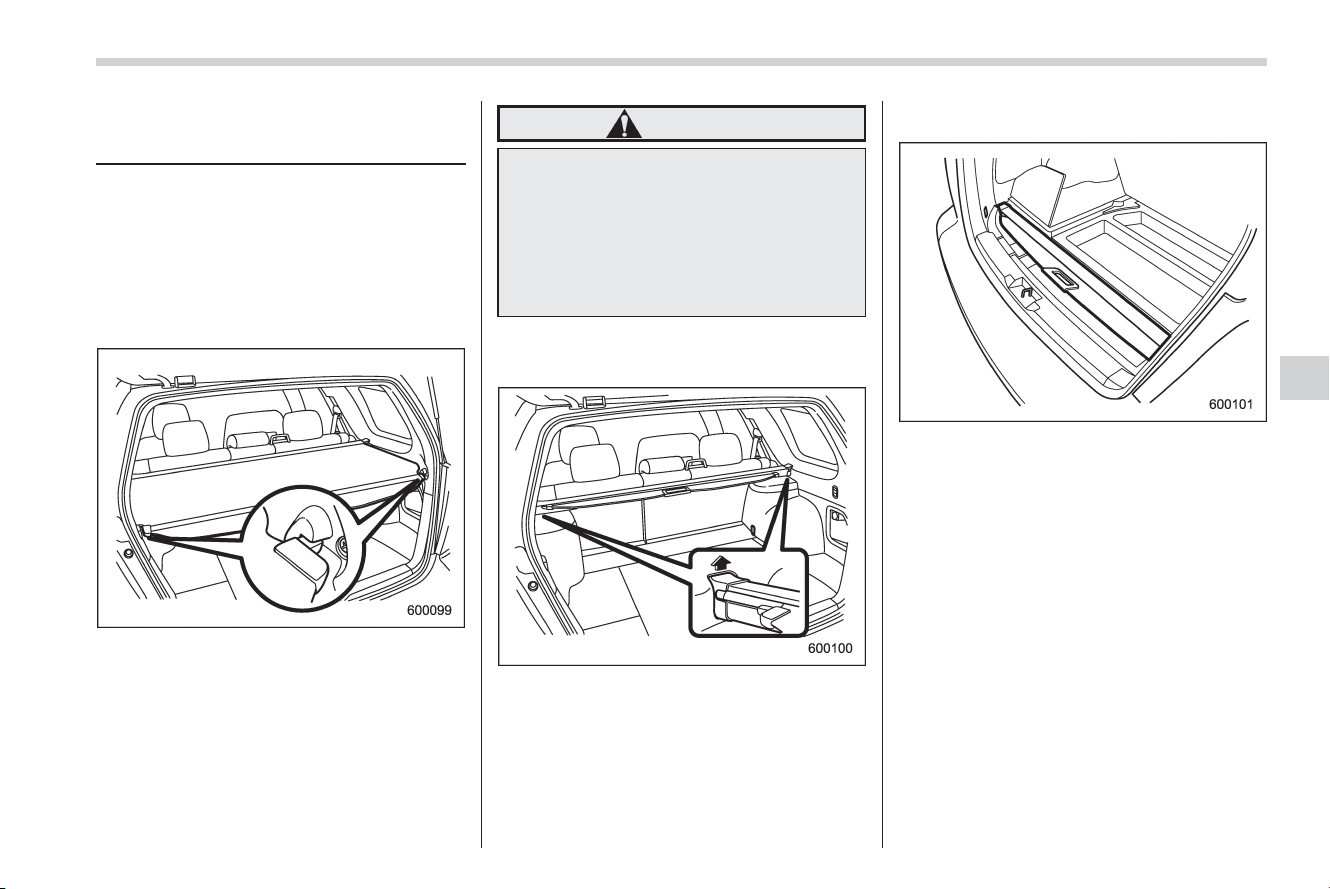
Black plate (203,1)
北米Model "A8130BE-B" EDITED: 2007/ 7/ 25
Cargo area cover (if
equipped)
The cargo area cover is provided for
covering the cargo area and to protect its
contents from direct sunlight. This cover is
detachable to make room for additional
cargo.
& Using the cover
To extend the cover, pull the end of the
cover out of the housing, then insert its
hooks into the catches as shown. To
rewind it, unhook it from the catches and
it will rewind automatically. You should
hold on to the cover and guide it back into
the cover housing while it is rewinding.
WARNING
Do not place anything on the ex-
tended cover. Putting excessive
weight on the extended cover can
break it and an object on the cover
could tumble forward in the event of
a s udden stop or collision. This
could cause serious injury.
& To remove the cover housing
1. Rewind the cover.
2. To take the cover housing off the
retainer, lift it out.
3. Store the cover housing in the cargo
area.
& Stowage of the cover
On models having a temporary spare tire,
the cargo area cover can be stowed under
the cargo floor.
& To install the cover housing
To install the cover, insert both ends of the
cover housing into the retainers.
Interior equipment 6-13
6
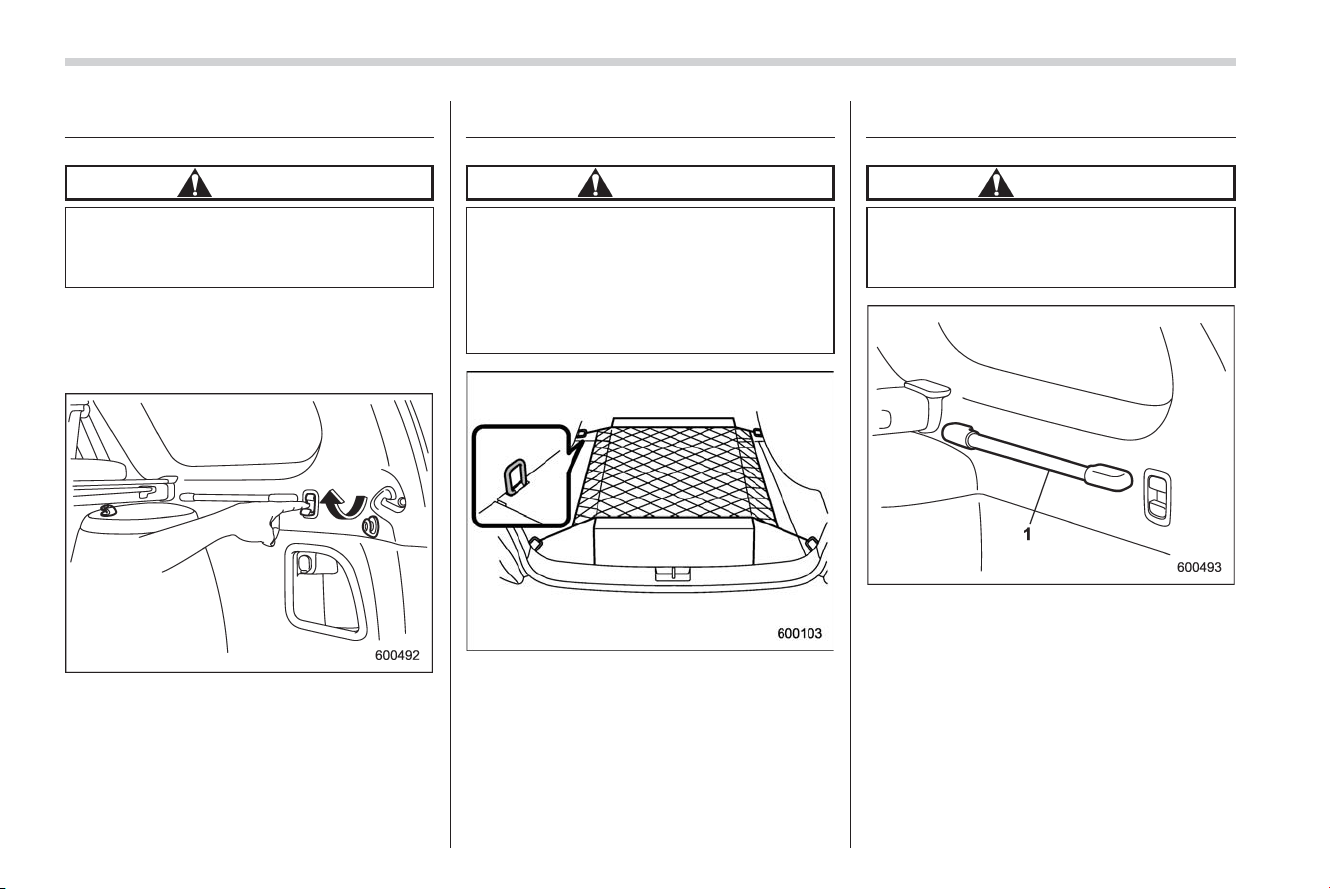
Black plate (204,1)
北米Model "A8130BE-B" EDITED: 2007/ 7/ 25
6-14 Interior equipment
Shopping bag hook
CAUTION
Do not hang items on the shopping
bag hook that weigh 6.6 lbs (3 kg) or
more.
In the cargo area, there are two retract-
able shopping bag hooks (one on each
side) and four non-retractable shopping
bag hooks (two on each side).
To use either of the retractable hooks, pull
the lower portion out.
Cargo tie-down hooks
CAUTION
The cargo tie-down hooks are de-
signed only for securing light cargo.
Never try to secure cargo that
exceeds the capacity of the hooks.
The maximum load capacity is 44
lbs (20 kg) per a hook.
The cargo area is equipped with four tie-
down hooks so that cargo can be secured
with a cargo net or ropes.
When using the hooks, raise them. When
not in use, lower the hooks.
Cargo area bars
CAUTION
Do not place objects with a total
weight exceeding 6.6 lbs (3 kg) on a
net attached to the cargo area bars.
1) Cargo area bar
In the cargo area, there are two bars (one
on each side) to which a net can be
attached.
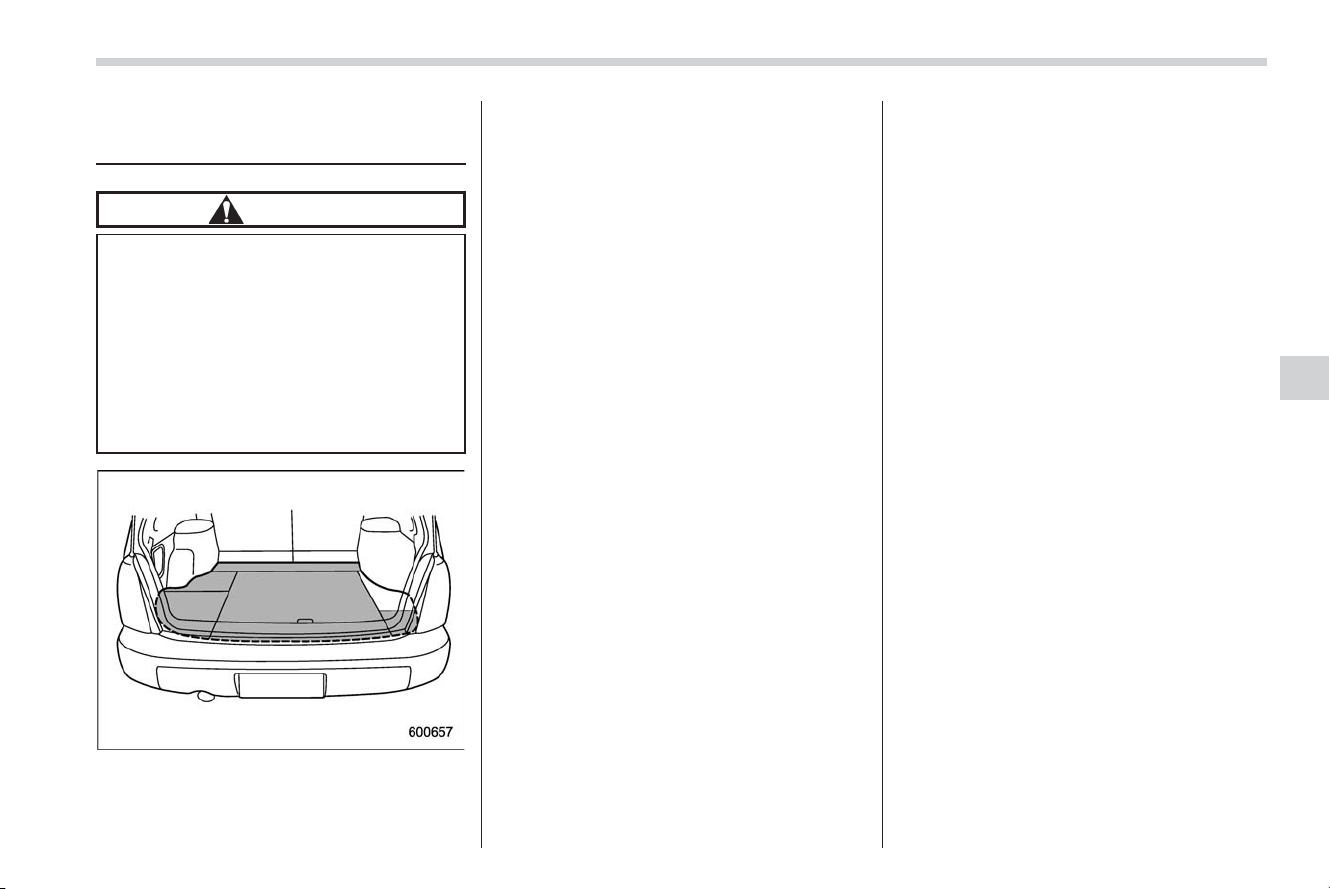
Black plate (205,1)
北米Model "A8130BE-B" EDITED: 2007/ 7/ 25
Under-floor storage compart-
ment
CAUTION
. Always keep the lids closed while
driving to reduce the risk of
injury in the event of sudden stop
or an accident.
. Do not store spray cans, contain-
ers with flammable or corrosive
liquids or any other dangerous
ite ms in the storage compart-
ment.
There are five trays in the storage
compartment underneath the floor of the
cargo area. They can be used to store
small items.
Interior equipment 6-15
– CONTINUED –
6
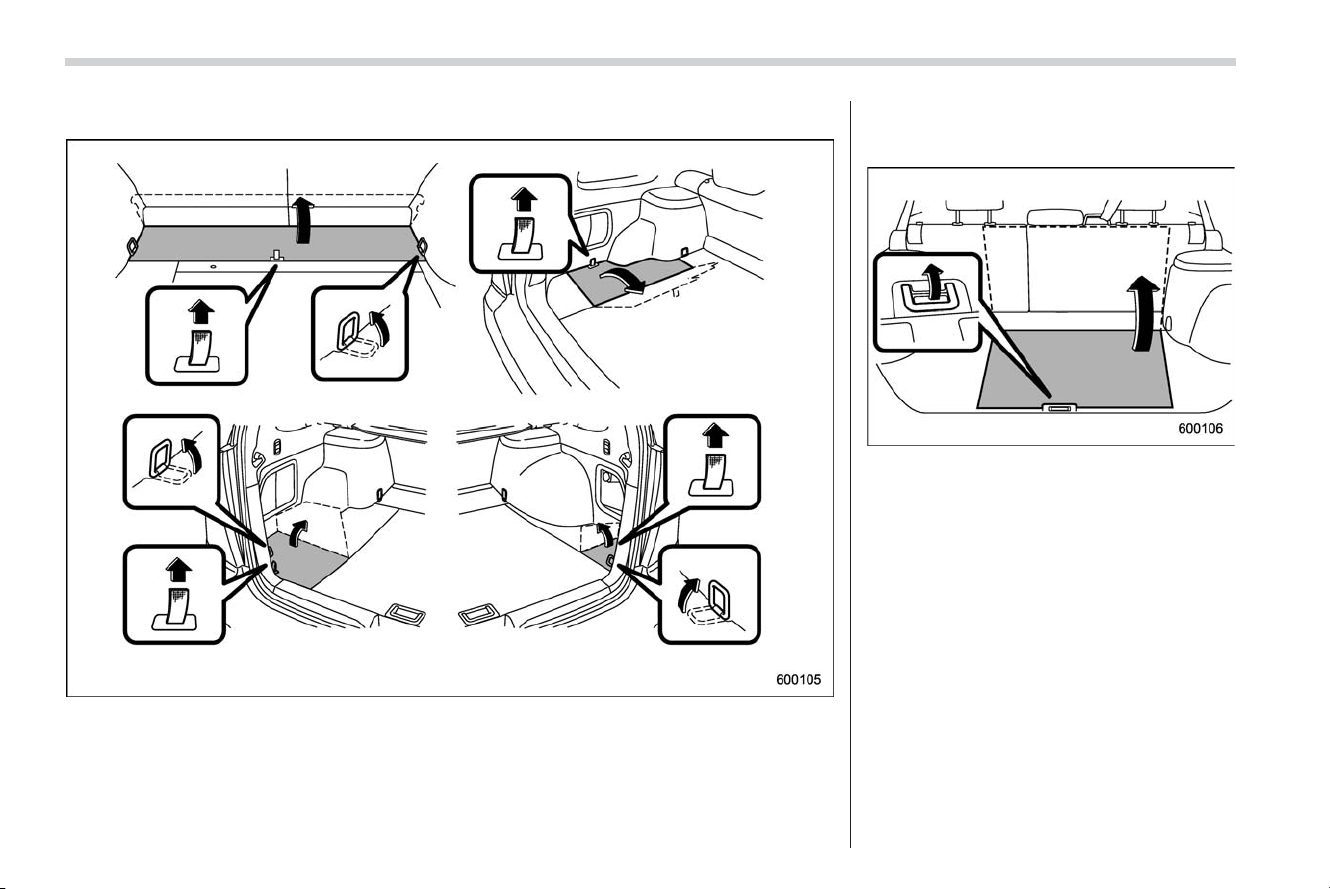
Black plate (206,1)
北米Model "A8130BE-B" EDITED: 2007/ 7/ 25
6-16 Interior equipment
& Front, left and right side storage compartment
To open the lid, raise the cargo tie-down hooks and pull the tab up. The jack and jack
handle are stored in the left side storage compartment.
& Center storage compartment
(Storage bucket)
To open the lid, pull the handle up.
Canada-spec. non-turbo models:
The storage bucket is put on the spare
tire.
Except Canada-spec. non-turbo mod-
els:
Storage tray is placed on the spare tire.
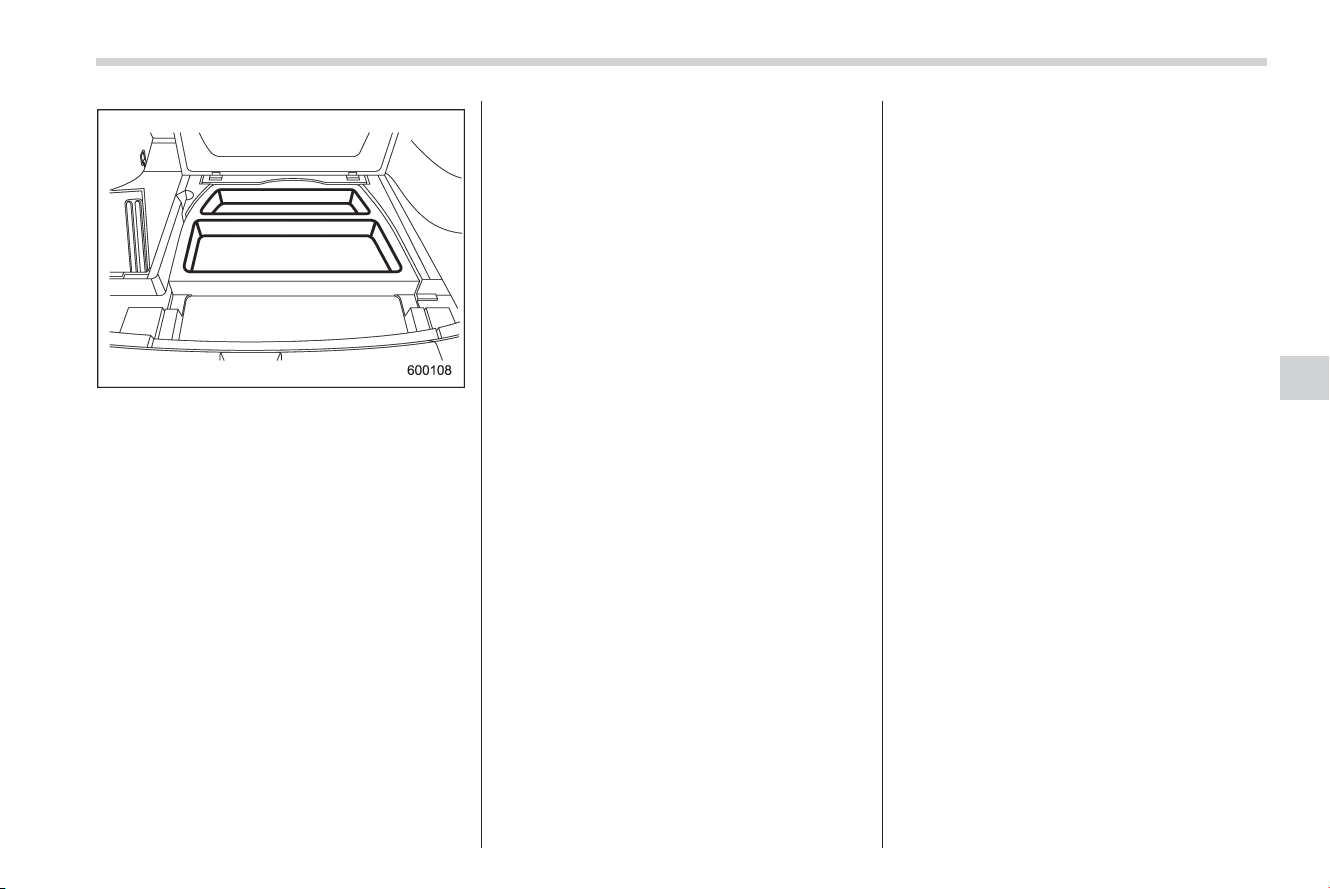
Black plate (207,1)
北米Model "A8130BE-B" EDITED: 2007/ 7/ 25
NOTE
When storing a flat tire, put the storage
tray in the luggage compartment (ex-
cept Canada-spec. non-turbo models).
Interior equipment 6-17
6

Black plate (2,1)
Model "ALL_MODEL_MEMO" EDITED: 2006/ 1/ 17
Left Page
————————————————————————————————————————
————————————————————————————————————————
————————————————————————————————————————
————————————————————————————————————————
————————————————————————————————————————
————————————————————————————————————————
————————————————————————————————————————
————————————————————————————————————————
————————————————————————————————————————
————————————————————————————————————————
————————————————————————————————————————
————————————————————————————————————————
————————————————————————————————————————

Black plate (13,1)
北米Model "A8130BE-B" EDITED: 2007/ 7/ 25
Fuel ...................................................................... 7-2
Fuel requirements ............................................... 7-2
Fuel filler lid and cap........................................... 7-3
State emission testing (U.S. only)...................... 7-6
Preparing to drive ............................................... 7-7
Starting the engine.............................................. 7-7
Manual transmission vehicle................................ 7-7
Automatic transmission vehicle ........................... 7-8
Stopping the engine............................................ 7-9
Manual transmission........................................... 7-9
Shifting speeds .................................................. 7-10
Driving tips ........................................................ 7-10
Automatic transmission..................................... 7-11
Selector lever for automatic transmission ........... 7-12
Shift lock release ............................................... 7-14
Rear viscous limited slip differential (LSD)
(if equipped) .................................................... 7-15
Power steering ................................................... 7-15
Braking................................................................ 7-16
Braking tips ....................................................... 7-16
Brake system ..................................................... 7-16
Disc brake pad wear warning indicators.............. 7-16
ABS (Anti-lock Brake System).......................... 7-17
ABS system self-check ...................................... 7-17
ABS warning light.............................................. 7-17
Electronic Brake Force Distribution (EBD)
system ............................................................. 7-18
Steps to take if EBD system fails ....................... 7-19
Vehicle Dynamics Control system
(if equipped) .................................................... 7-20
Vehicle Dynamics Control system monitor.......... 7-21
Vehicle Dynamics Control OFF switch ................ 7-23
Tire pressure monitoring system (TPMS)
(if equipped) .................................................... 7-24
Parking your vehicle ......................................... 7-25
Parking brake .................................................... 7-26
Parking tips ....................................................... 7-26
Hill holder
(Manual transmission – if equipped)............. 7-27
Cruise control .................................................... 7-28
To set cruise control .......................................... 7-28
To temporarily cancel the cruise control ............. 7-29
To turn off the cruise control.............................. 7-29
To change the cruising speed ............................ 7-29
Self-leveling rear suspension (if equipped) ..... 7-31
Starting and operating
7

Black plate (210,1)
北米Model "A8130BE-B" EDITED: 2007/ 7/ 25
7-2 Starting and operating
Fuel
CAUTION
Use of a fuel which is low in quality
or use of an inappropriate fuel
additive may cause engine damage.
& Fuel requirements
! Non-turbo models
The 2.5-liter non-turbo engine is designed
to operate using unleaded gasoline with
an octane rating of 87 AKI or higher.
! Turbo models
The 2.5-liter turbo engine is designed to
operate using premium unleaded gasoline
with an octane rating of 91 AKI or higher. If
premium unleaded gasoline is not avail-
able, regular unleaded gasoline with an
octane rating of 87 AKI or higher may be
temporarily used. For optimum engine
performance and driveability, it is required
that you use premium grade unleaded
gasoline.
NOTE
Be sure to use premium unleaded
gasoline of 91 AKI or higher for turbo
models. If other gasoline (lower than 91
AKI) is used, knocking, reduced output
and poor accelerator response will
result.
! Fuel octane rating
This octane rating is the average of the
Research Octane and Motor Octane
numbers and is commonly referred to as
the Anti Knock Index (AKI).
Using a gasoline with a lower octane
rating can cause persistent and heavy
knocking, which can damage the engine.
Do not be concerned if your vehicle
sometimes knocks lightly when you drive
up a hill or when you accelerate. See your
dealer or a qualified service technician if
you use a fuel with the specified octane
rating and your vehicle knocks heavily or
persistently.
! Unleaded gasoline
The neck of the fuel filler pipe is designed
to accept only an unleaded gasoline filler
nozzle. Under no circumstances should
leaded gasoline be used because it will
damage the emission control system and
may impair driveability and fuel economy.
! Gasoline for California-certified
LEV
Your vehicle was certified to California’s
low emission vehicle (LEV) standards as
indicated on the underhood tune-up label,
it is designed to opt imize engine and
emission performance with gasoline that
meets the clean burning low-sulfur Cali-
fornia gasoline specifications. If you live in
any other state than California, your
vehicle will operate on gasoline meeting
Federal specifications. Gasoline sold out-
side California is permitted to have higher
sulfur levels, which may affect the perfor-
mance of your vehicle’s catalytic converter
and may produce a sulfur exhaust odor or
smell. SUBARU recommends that you try
a different brand of unleaded gasoline
having lower sulfur to determine if the
problem is fuel related before returning
your vehicle to an authorized dealer for
service.
! MMT
Some gasoline contains an octane-en-
hancing additive called MMT (Methylcy-
clopentadienyl Manganese Tricarbonyl). If
you use such fuels, your emission control
system performance may deteriorate and
the CHECK ENGINE warning light/Mal-
function indicator lamp may turn on. If this
happens, return to your authorized
SUBARU Dealer for service. If it is
determined that the condition is caused
by the type of fuel used, repairs may not
be covered by your warranty.
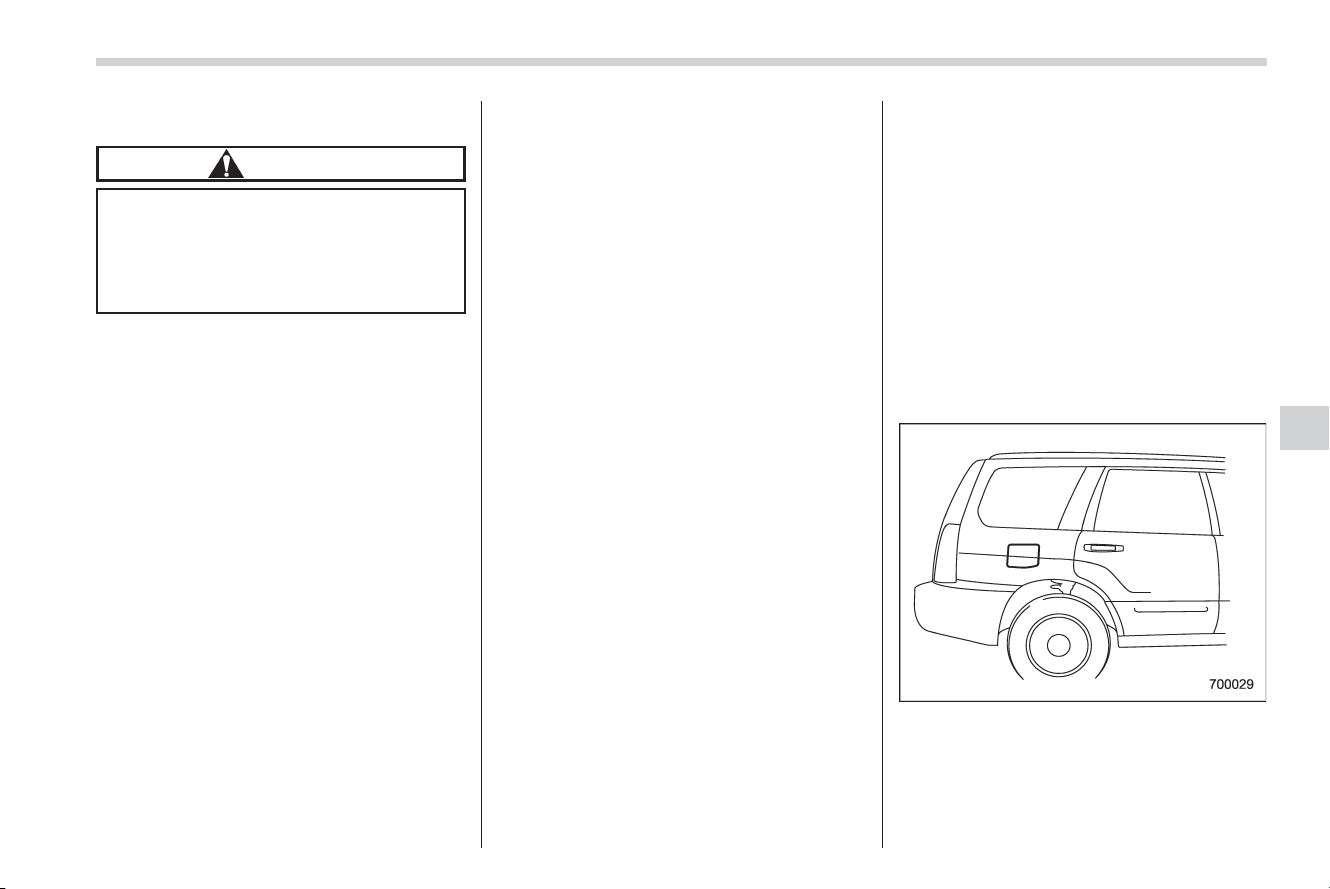
Black plate (211,1)
北米Model "A8130BE-B" EDITED: 2007/ 7/ 25
! Gasoline for cleaner air
CAUTION
Do not let fuel spill on the exterior
surfaces of the vehicle. Fuels con-
taining alcohol may cause paint
damage, which is not covered under
the SUBARU Limited Warranty.
Your u se of gasoline with detergent
additives will help prevent deposits from
forming in your engine and fuel system.
This helps keep your engine in tune and
your emission control system working
properly, and is a way of doing your part
for cleaner air. If you continuously use a
high quality fuel with the proper detergent
and other additives, you should never
need to add any fuel system cleaning
agents to your fuel tank.
Many gasolines are now blended with
materials called oxygenates. Use of these
fuels can also help keep the air cleaner.
Oxygenated blend fuels, such as MTBE
(Methyl Tertiary Butyl ether) or ethanol
(ethyl or grain alcohol) may be used in
your vehicle, but should contain no more
than 15% MTBE or 10% ethanol for the
proper operation of your SUBARU.
In addition, some gasoline suppliers are
now producing reformulated gasolines,
which are designed to reduce vehicle
emissions. SUBARU approves the use of
reformulated gasoline.
If you are not sure what the fuel contains,
you should ask your service station
operators if their gasolines contain deter-
gents and oxygenates and if they have
been reformulated to reduce vehicle emis-
sions.
As additional guidance, only use fuels
suited for your vehicle as explained in the
following.
. Fuel should be unleaded and have an
octane rating no lower than that specified
in this manual.
. Methanol (methyl or wood alcohol) is
sometimes mixed with unleaded gasoline.
Methanol can be used in your vehicle
ONLY if it does not exceed 5% of the fuel
mixture AND if it is accompanied by
sufficient quantities of the proper cosol-
vents and corrosion inhibitors required to
prevent damage to the fuel system. Do not
use fuel containing methanol EXCEPT
under these conditions.
. If undesirable driveability problems are
experienced and you suspect they may be
fuel related, try a different brand of gaso-
line before seeking servi ce at your
SUBARU dealer.
. Fuel system damage or driveability
problems which result from the use of
improper fuel are not covered under the
SUBARU Limited Warranty.
& Fuel filler lid and cap
! Refueling
Only one person should be involved in
refueling. Do not allow others to approach
the area of the vehicle near the fuel filler
pipe while refueling is in progress.
Be sure to observe any other precautions
that are posted at the service station.
Starting and operating 7-3
– CONTINUED –
7
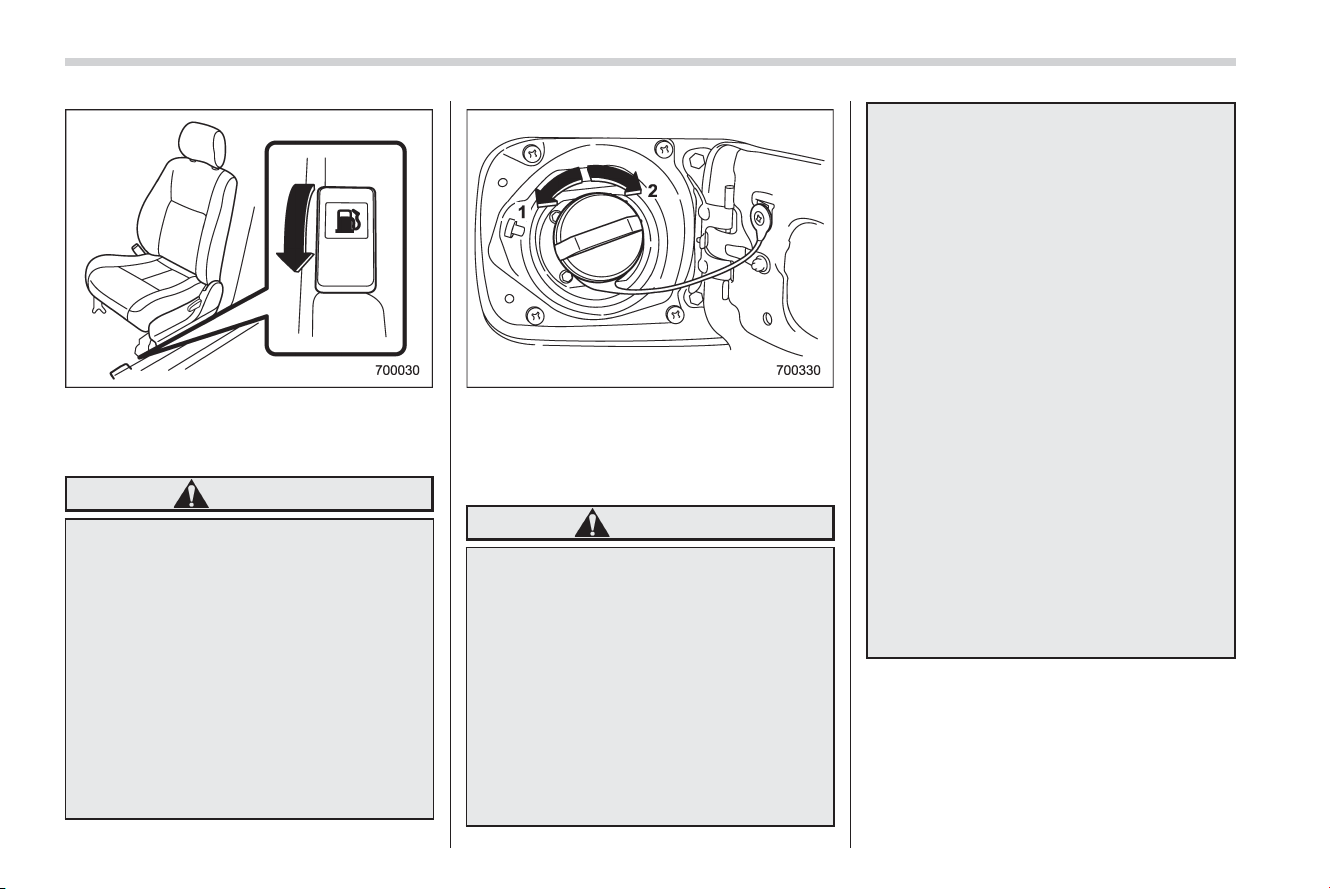
Black plate (212,1)
北米Model "A8130BE-B" EDITED: 2007/ 7/ 25
7-4 Starting and operating
1. To open the fuel filler lid, pull the lid
release lever. The lever is on the floor at
the left of the driver’s seat.
WARNING
Before opening the fuel filler cap,
first touch the vehicle body or a
metal portion of the fuel pump or
similar object to discharge any
static electricity that may be present
on your body. If your body is carry-
ing an electrostatic charge, there is
a possibility that an electric spark
could ignite the fuel, which could
burn you. To avoid acquiring a new
static electric charge, do not get
back into the vehicle while refueling
is in progress.
1) Open
2) Close
2. Remove the fuel filler cap by turning it
slowly counterclockwise.
WARNING
. Gasoline vapor is highly flam-
mable. Before refueling, always
first stop the engine and close all
vehicle doors and windows.
Make sure that there are no
lighted cigarettes, open flames
or electrical sparks in the adja-
cent area. Refueling must be
performed outside. Quickly wipe
up any spilled fuel.
. When opening the cap, grasp it
firmly and turn it slowly to the
left. Do not remove the cap
quickly. Fuel may be under pres-
sure and spray out of the fuel
filler neck, especially in hot
weather. If you hear a hissing
sound while you are removing
the cap, wait for the sound to
stop and then slowly open the
cap to prevent fuel from spraying
out and creating a fire hazard.
. When refueling, insert the fuel
nozzle securely into the fuel filler
pipe. If the nozzle is lifted or not
fully inserted, its automatic stop-
ping mechanism may not func-
tion, causing fuel to overflow the
tank and creating a fire hazard.
. Stop refueling when the auto-
mati c stop mechanism on the
fuel nozzle activates. If you con-
tinue to add fue l, temperature
changes or other conditions
may cause fuel to overflow from
the tank and create a fire hazard.
3. Stop filling the tank after the fuel filler
pump automatically stops. Do not add any
more fuel.
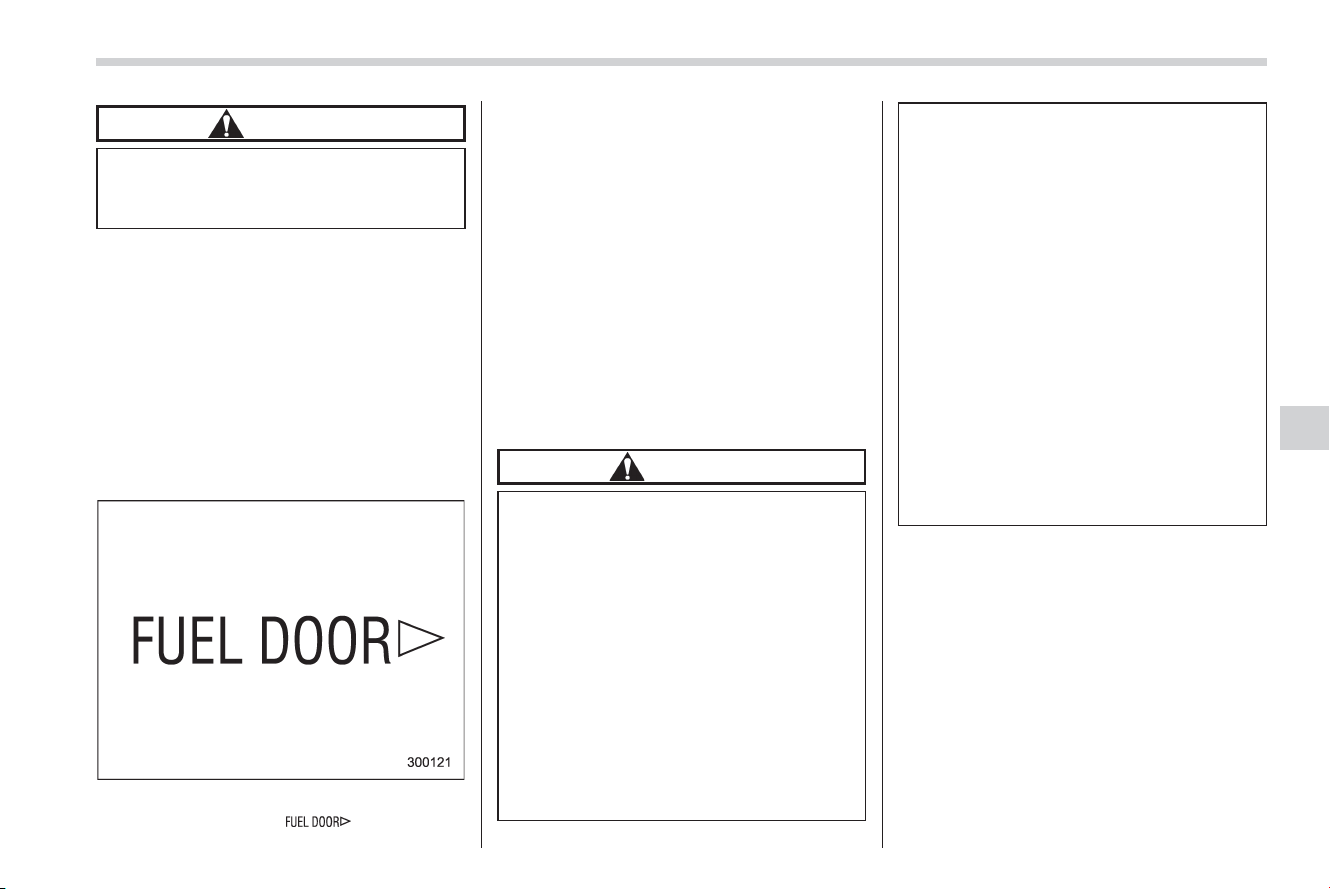
Black plate (213,1)
北米Model "A8130BE-B" EDITED: 2007/ 7/ 30
CAUTION
Make sure that the cap is tightened
until it clicks to prevent fuel spillage
in the event of an accident.
4. Put the cap back on, turn it clockwise
until you hear a clicking noise. Be certain
not to catch the tether under the cap while
tightening.
5. Close the fuel filler lid completely.
If you spill any fuel on the painted surface,
rinse it off immediately. Otherwise, the
painted surface could be damaged.
NOTE
. You will see the “ ” sign in the
fuel gauge. This indicates that the fuel
filler door (lid) is located on the right
side of the vehicle.
. If the fuel filler cap is not tightened
until it clicks or if the tether is caught
under the cap, the CHECK ENGINE
warning light may come on. Refer to
the “ Warning and indicator lights”
section located in chapter 3.
Immediately refuel in the tank when-
ever the low fuel warning light comes
on. Engine misfires as a result of an
empty tank could cause damage to the
engine.
CAUTION
. Never add any cleaning agents to
the fuel tank. The addition of a
cleaning agent may cause da-
mage to the fuel system.
. After refueling, turn the cap to the
right until it clicks to ensure that
it is fully tightened. If the cap is
not securely tightened, fuel may
leak out while the vehicle is being
driven or fuel spillage could
occur in the event of an accident,
creating a fire hazard.
. Do not let fuel spill on the exterior
surfaces of the vehicle. Because
fuel may damage the paint, be
sure to wipe off any spilled fuel
quickly. Paint damage caused by
spilled fuel is not covered under
the SUBARU Limited Warranty.
. Always use a genuine SUBARU
fuel filler cap. If you use the
wrong cap, it may not fit, and
your fuel tank and emission con-
trol system may be damaged. It
could also lead to fuel spillage
and a fire.
. Immediately put fuel in the tank
whenever the low fuel warning
light illuminates. Engine misfires
as a result of an empty tank
could cause damage to the en-
gine.
Starting and operating 7-5
7
Black plate (214,1)
北米Model "A8130BE-B" EDITED: 2007/ 7/ 25
7-6 Starting and operating
State emission testing (U.S.
only)
WARNING
Testing of an All-Wheel Drive vehicle
must NEVER be performed on a
single two-wheel dynamometer. At-
tempting to do so will result in
uncontrolled vehicle movement and
may cause an accident or injuries to
persons nearby.
CAUTION
Resultant ve hicle damage due to
improper testing is not covered
under the SUBARU Limited War-
ranty and is the responsibility of
the state inspection program or its
contractors or licensees.
At state inspection time, remember to
tell your inspection or service station in
advance not to place your SUBARU
AWD vehicle on a two-wheel dynam-
ometer. Otherwise, serious transmis-
sion damage will result.
Some states have started using dynam-
ometers in their state inspection programs
in order to meet their obligation under
federal law to implement stricter vehicle
emission standards to reduce air pollution
from cars. A dynamometer is a treadmill or
roller-like testing device that allows your
vehicle’s wheels to turn while the vehicle
remains in one place. Depending on the
severity of a state’s air pollution problems,
the states must adopt either a “basic” or
“enhanced” vehicle emission inspection
test. Normally, a portion of the basic
emission test consists of an emission
inspector inserting an analyzer probe into
the exhaust pipe of an idling vehicle for a
short period of time. States with more
severe air pollution problems are required
to adopt an enhanced vehicle emission
test. This test simulates actual driving
conditions on a dynamometer and permits
more accurate measurement of tailpipe
emitted pollution than the basic emission
test.
The U.S. Environmental Protection
Agency (EPA) and states using two-wheel
dynamometers in their emission testing
programs have EXEMPTED SUBARU
AWD vehicles from the portion of the
testing program that involves a two-wheel
dynamometer.
There are some states that use four-wheel
dynamometers in their testing programs.
When properly used, that equipment will
not damage an AWD SUBARU vehicle.
Under no circumstances should the rear
wheels be jacked off the ground, nor
should the driveshaft be disconnected for
state emission testing.
The EPA has issued regula tions for
inspecting the On-Board Diagnostic
(OBD) system as part of the state emis-
sions inspection. The OBD system is
designed to detect engine and transmis-
sion problems that might cause vehicle
emissions to exceed allowable limits.
These inspections apply to all 1996 model
year and newer passenger cars and light
trucks. Over 30 states plus the District of
Columbia have implemented the OBD
system inspection.
. The inspection of the OBD system
consists of a visual operational check of
the “CHECK ENGINE” warning light/
malfunction indicator lamp (MIL) and an
examination of the OBD system with an
electronic scan tool while the engine is
running
. Avehicle
passes the OBD system
inspection if proper the “CHECK EN-
GINE” warning light/MIL illumination is
observed, there is no stored diagnostic
trouble codes, and the OBD system
readiness monitors are complete.
Black plate (215,1)
北米Model "A8130BE-B" EDITED: 2007/ 7/ 25
. A vehicle fails the OBD inspection if the
“CHECK ENGINE” warning light/MIL is
not properly operating or there is one or
more diagnostic trouble codes stored in
vehicle’s computer with the “CHECK
ENGINE” warning light/MIL illuminated.
. A state emission inspection may reject
(not pass or fail) a vehicle if the number of
OBD system readiness monitors “Not
Ready” is greater than one. Under this
condition, the vehicle operator should be
instructed to drive his/her vehicle for a few
days to set the monitors and return for an
emission re-inspection.
. Owners of rejected or failing vehicles
should contact their SUBARU Dealer for
service.
Preparing to drive
You should perform the following checks
and adjustments every day before you
start driving.
1. Check that all windows, mirrors, and
lights are clean and unobstructed.
2. Check the appearance and condition
of the tires. Also check tires for proper
inflation.
3. Look under the vehicle for any sign of
leaks.
4. Check that the hood and rear gate are
fully closed.
5. Check the adjustment of the seat.
6. Check the adjustment of the inside
and outside mirrors.
7. Fasten your seatbelt. Check that your
passengers have fastened their seatbelts.
8. Check the operation of the warning
and indicator lights when the igni tion
switch is turned to the “ON” position.
9. Check the gauges, indicator and warn-
ing lights after starting the engine.
NOTE
Engine oil, engine coolant, brake fluid,
washer fluid and other fluid levels
should be checked daily, weekly or at
fuel stops.
Starting the engine
CAUTION
Do not operate the starter motor
continuously for more than 10 sec-
onds. If the engine fails to start after
operating the starter for 5 to 10
seconds, wait for 10 seconds or
more before trying again.
& Manual transmission vehicle
1. Apply the parking brake.
2. Turn off unnecessary lights and ac-
cessories.
3. Press the clutch pedal to the floor and
shift the shift lever into neutral. Hold the
clutch pedal to the floor while starting the
engine.
The starter motor will only operate when
the clutch pedal is pressed fully to the
floor.
4. Turn the ignition switch to the “ON”
position and check the operation of the
warning and indicator lights. Refer to the
“Warning and indicator lights” section
(chapter 3).
5. Turn the ignition switch to the “START”
position without depressing the accelera-
tor pedal. Release the key immediately
Starting and operating 7-7
– CONTINUED –
7

Black plate (216,1)
北米Model "A8130BE-B" EDITED: 2007/ 7/ 25
7-8 Starting and operating
after the engine has started.
If the engine does not start, try the
following.
(1) Turn the igniti on switch to the
“LOCK” position and wait for at least
10 seconds. After checking that the
parking brake is firmly set, turn the
ignition switch to the “START” position
while depressing the accelerator pedal
slightly (about a quarter of the full
stroke). Release the accelerator pedal
as soon as the engine starts.
(2) If this fails to start the engine, turn
the ignition switch back to the “LOCK”
position and wait for at least 10
seconds. Then fully depress the accel-
erator pedal and turn the ignition
switch to the “START” position. If the
engine starts, quickly relea se the
accelerator pedal.
(3) If this fails to start the engine, turn
the ignition switch again to the “LOCK”
position. After waiting for 10 seconds
or longer, turn the ignition switch to the
“START” position without depressing
the accelerator pedal.
(4) If the engine still refuses to start,
contact your nearest SUBARU dealer
for assistance.
6. Confirm that all warning and indicator
lights have gone off after the engine has
started. The fuel injection system auto-
matically lowers the idle speed as the
engine warms up.
NOTE
The engine may be difficult to start
when the battery has been discon-
nected and reconnected (for mainte-
nance or other purposes). This diffi-
culty is caused by the electronically
controlled throttle’s self-diagnosis
function. To overcome it, keep the
ignition switch in the “ON” position
for approximately 10 seconds before
starting the engine.
& Automatic transmission ve-
hicle
1. Apply the parking brake.
2. Turn off unnecessary lights and ac-
cessories.
3. Shift the selector lever to the “P” or “N”
position (preferably “P” position).
The starter motor will only operate when
the select lever is at the “P” or “N” position.
4. Turn the ignition switch to the “ON”
position and check the operation of the
warning and indicator lights. Refer to the
“Warning and indicator lights” section
(chapter 3).
5. Turn the ignition switch to the “START”
position without depressing the accelera-
tor pedal. Release the key immediately
after the engine has started.
If the engine does not start, try the
following.
(1) Turn the ignition switch to the
“LOCK” position and wait for at least
10 seconds. After checking that the
parking brake is firmly set, turn the
ignition switch to the “START” position
while depressing the accelerator pedal
slightly (about a quarter of the full
stroke). Release the accelerator pedal
as soon as the engine starts.
(2) If this fails to start the engine, turn
the ignition switch back to the “LOCK”
position and wait for at least 10
seconds. Then fully depress the accel-
erator pedal and turn the ignition
switch to the “START” position. If the
engine starts, quickly release the
accelerator pedal.
(3) If this fails to start the engine, turn
the ignition switch again to the “LOCK”
position. After waiting for 10 seconds
or longer, turn the ignition switch to the
“START” position without depressing
the accelerator pedal.
(4) If the engine still refuses to start,
contact your nearest SUBARU dealer
for assistance.
6. Confirm that all warning and indicator
Black plate (217,1)
北米Model "A8130BE-B" EDITED: 2007/ 7/ 25
lights have gone out after the engine has
started. The fuel injection system auto-
matically lowers the idle speed as the
engine warms up.
While the engine is warming up, make
sure that the selector lever is at the “P” or
“N” position and that the parking brake is
applied.
CAUTION
If you restart the engine while the
vehicle is moving, shift the selector
lever into the “N” position. Do not
attempt to place the selector lever of
a moving vehicle into the “P” posi-
tion.
NOTE
The engine may be difficult to start
when the battery has been discon-
nected and reconnected (for mainte-
nance or other purposes). This diffi-
culty is caused by the electronically
controlled throttle’s self-diagnosis
function. To overcome it, keep the
ignition switch in the “ON” position
for approximately 10 seconds before
starting the engine.
Stopping the engine
WARNING
Do not stop the engine when the
vehicle is moving. This will cause
loss of power to the power steering
and the brake booster, making steer-
ing and braking more difficult. It
could also result in accidental acti-
vation of the “LOCK” position on the
ignition switch, causing the steering
wheel to lock.
The ignition switch should be turned off
only when the vehicle is stopped and the
engine is idling.
Manual transmission
WARNING
Do not drive the vehicle with the
clutch disengaged (i.e., when the
clutch pedal is depressed) or with
the shift lever in the neutral position.
Engine braking has no effect in
either of these conditions and the
risk of an accident is consequently
increased.
CAUTION
Shift into reverse ONLY when the
vehicle has completely stopped. It
may cause damage to the transmis-
sion to try shifting into reverse when
the vehicle is moving.
The manual transmission is a fully syn-
chromeshed, 5-forward-speed and 1-re-
verse-speed transmission.
Starting and operating 7-9
– CONTINUED –
7
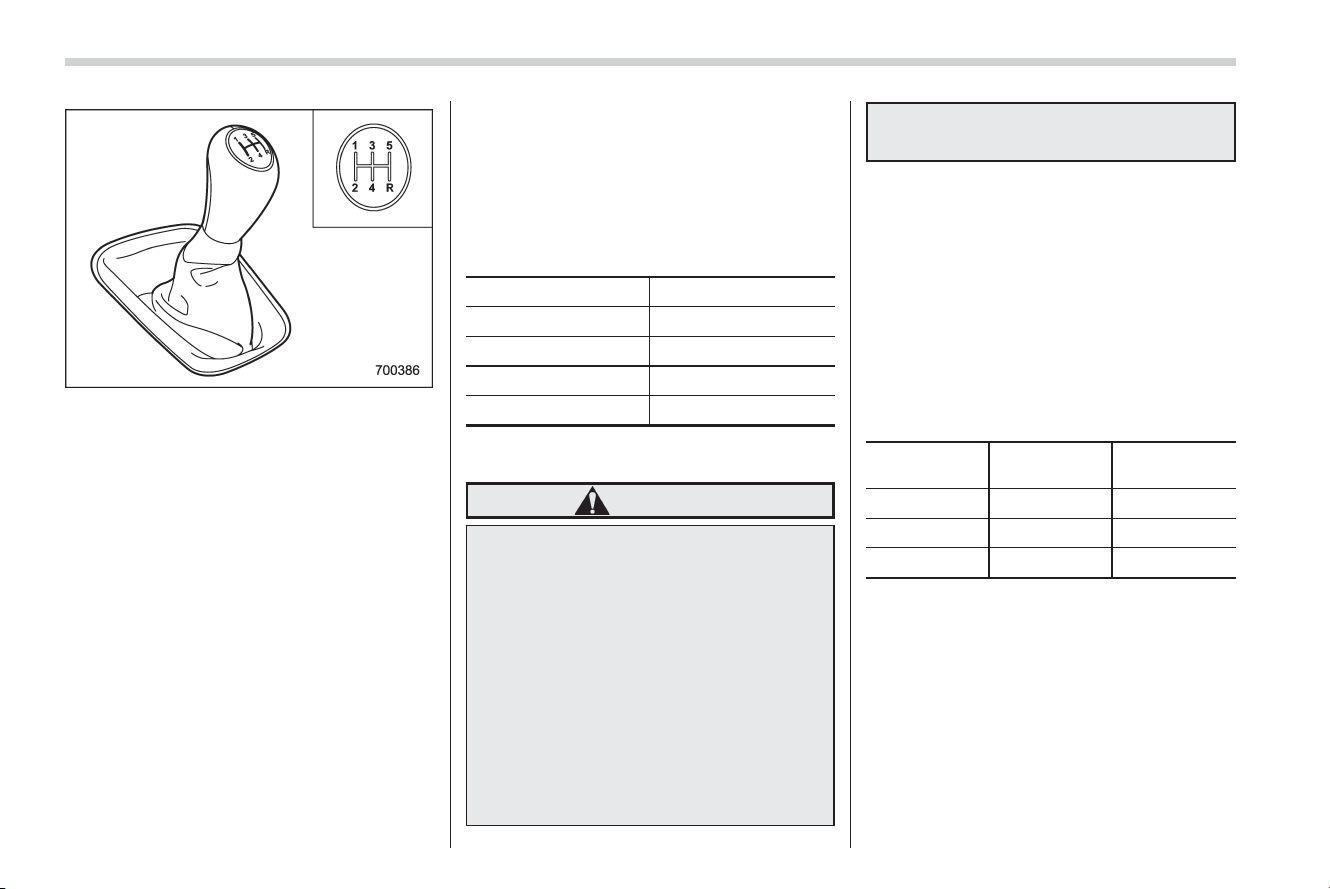
Black plate (218,1)
北米Model "A8130BE-B" EDITED: 2007/ 7/ 30
7-10 Starting and operating
The shift pattern is shown on the shift
lever knob. When shifting from 5th gear to
reverse gear, first return the shift lever to
the neutral position then shift into reverse
gear.
To change gears, fully depress the clutch
pedal, move the shift lever, and gradually
let up on the clutch pedal.
If it is difficult to shift into gear, put the
transmission in neutral, release the clutch
pedal momentarily, and then try again.
NOTE (non-turbo models only)
To protect the engine while the shift
lever is in neutral, the engine is con-
trolled so that the engine speed does
not become too high even if the accel-
erator pedal is fully depressed.
& Shifting speeds
! Recommended shifting speeds
The best compromise between fuel econ-
omy and vehicle performance during
normal driving is ensured by shifting up
at the speeds listed in the following table.
Shift up mph (km/h)
1st to 2nd 15 (24)
2nd to 3rd 25 (40)
3rd to 4th 35 (57)
4th to 5th
45 (73)
! Maximum allowable speeds
WARNING
When shifting down a gear, ensure
that the vehicle is not traveling at a
speed exceeding the Maximum Al-
lowable Speed for the gear which is
about to be selected. Failure to
observe this precaution can lead to
engine over-revving and this in turn
can result in engine damage.
In addition, sudden application of
engine brakes when the vehicle is
travelling on a slippery surface can
lead to wheel locking; as a conse-
quence, control of the vehicle may
be lost and the risk of an accident
increased.
The following table shows the maximum
speeds that are possible with each differ-
ent gear.
Never exceed the speed limit below for
each gear position except for brief accel-
eration in an emergency. The tach-
ometer’s needle will enter the red area if
these speeds are exceeded. Failure to
observe this precaution can lead to
excessive engine wear and poor fuel
economy.
mph (km/h)
Non-turbo
models
Turbo models
1st 30 (49) 28 (46)
2nd 51 (82) 52 (83)
3rd 73 (117)
73 (118)
& Driving tips
Do not drive with your foot resting on the
clutch pedal and do not use the clutch to
hold your vehicle at a standstill on an
upgrade. Either of those actions may
cause clutch damage.
Do not drive with your hand resting on the
shift lever. This may cause wear on the
transmission components.
Black plate (219,1)
北米Model "A8130BE-B" EDITED: 2007/ 7/ 25
When it is necessary to reduce vehicle
speed due to slow traffic, turning corners,
or driving up steep hills, downshift to a
lower gear before the engine starts to
labor.
On steep downgrades, downshift the
transmission to 4th, 3rd or 2nd gear as
necessary; this helps to maintain a safe
speed and to extend brake pad life.
In this way, the engine provides a braking
effect. Remember, if you “ride” (over use)
the brakes while descending a hill, they
may overheat and not work properly.
Automatic transmission
The automatic transmission is electroni-
cally controlled and provides 4 forward
speeds and 1 reverse speed.
WARNING
Do not shift from the “P” or “N”
position into the “D”, “3”, “2”, “1” or
“R” position while depressing the
accelerator pedal. This may cause
the vehicle to jump forward or back-
ward.
CAUTION
. Shift into the “P” or “R” position
only after the vehicle is comple-
tely stopped. Shifting while the
vehicle is moving may cause
damage to the transmission.
. Do not race the engine for more
than 5 seconds in any position
except the “N” or “P” position
when the brake is set or when
chocks are used in the wheels.
This may cause the automatic
transmission fluid to overheat.
. Avoid shifting from one of the
forward driving positions into the
“R” position or vice versa until
the vehicle has completely
stopped. Such shifting may
cause damage to the transmis-
sion.
. When parking the vehicle, first
securely apply the parking brake
and then place the selector lever
in the “P” position.
NOTE
. When the engine coolant tempera-
ture is still low, your vehicle’s auto-
matic transmission will up-shift at high-
er engine speeds than when the cool-
ant temperature is sufficiently high in
order to shorten the warm-up time and
improve driveability. The gearshift tim-
ing will automatically shift to the nor-
mal timing after the engine has warmed
up.
. Immediately after ATF (automatic
transmission fluid) is replaced, you
may feel that the automatic transmis-
sion operation is somewhat unusual.
This results from invalidation of data
the on-board computer has collected
and stored in memory to allow the
transmission to shift at the most appro-
priate times for the current condition of
your vehicle. Optimized shifting will be
Starting and operating 7-11
– CONTINUED –
7
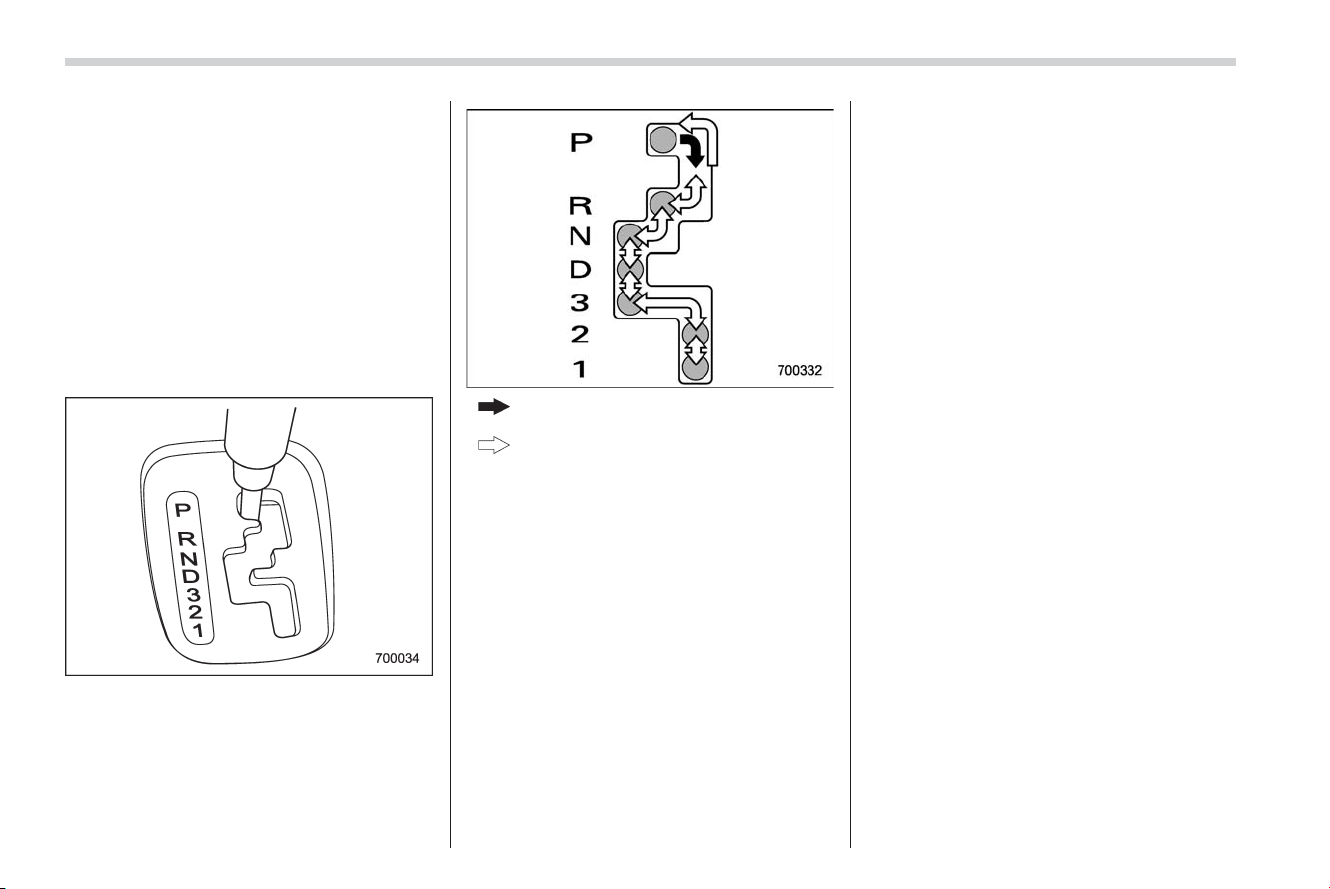
Black plate (220,1)
北米Model "A8130BE-B" EDITED: 2007/ 7/ 30
7-12 Starting and operating
restored as the vehicle continues to be
driven for a while.
NOTE (non-turbo models only)
To protect the engine while the “P” or
“N” position is selected, the engine is
controlled so that the engine speed
does not become too high even if the
accelerator pedal is fully depressed.
& Selector lever for automatic
transmission
: With the brake pedal depressed, move
the lever along the gate.
: Move the lever along the gate.
The selector lever has seven positions.
! P (Park)
This position is for parking the vehicle and
starting the engine.
In this position, the transmission is me-
chanically locked to prevent the vehicle
from rolling freely.
When you park the vehicle, first set the
parking brake fully, then shift into the “ P”
position. Do not hold the vehicle with only
the transmission.
A shift interlock function is employed in the
automatic transmission system to ensure
safe starting of the vehicle.
To shift the selector lever from the “P” to
the any other position, you have to
depress the brake pedal fully when the
ignition switch is in the “ON” position. This
prevents the vehicle from lurching when it
is started.
If the shift lever does not move from the
“P” position with the brake pedal de-
pressed, refer to the “Shift lock release”
section in this chapter.
! R (Reverse)
This position is for backing the vehicle.
To shift from the “N” to “R” position, first
stop the vehicle completely then move the
lever to the “R” position.
! N (Neutral)
This position is for restarting a stalled
engine.
In this position the wheels and transmis-
sion are not locked. In this position, the
transmission is neutral; the vehicle will roll
freely, even on the slightest incline unless
the parking brake or foot brake is on.
Avoidcoastingwiththetransmission
neutral.
During coasting, there is no engine brak-
ing effect.

Black plate (221,1)
北米Model "A8130BE-B" EDITED: 2007/ 7/ 25
NOTE
If you stop the engine with the selector
lever in the “N” position, move the
selector lever to the “P” position
immediately. Otherwise, you may find
that the selector lever soon cannot be
moved to the “P” position. If you find
that the selector lever cannot be moved
from the “N” position to the “P” posi-
tion, turn the ignition switch to the
“ON” position and try again.
WARNING
Do not drive the vehicle with the
selector lever in the “N” (neutral)
position. Engine braking has no
effect in this condition and the risk
of an accident is consequently in-
creased.
! D (Drive)
This position is for normal driving.
The transmission automatically shifts into
a suitable gear from 1st to 4th according to
the vehicle speed and the acceleration
you require.
When more acceleration is required in this
position, press the accelerator pedal fully
to the floor and hold that position. The
transmission will automatically downshift
to 3rd, 2nd or 1st gear. When you release
the pedal, the transmission will return to
the original gear position.
! While climbing a grade
When driving up hill, undesired upshift to
4th gear is prevented from taking place
when the accelerator pedal is released.
This minimizes the chances of subse-
quent downshifting to a lower gear when
accelerating again. This preven ts re-
peated upshifting and downshifting result-
ing in a smoother operation of the vehicle.
NOTE
The transmission may downshift to 2nd
or 1st gear, depending on the way the
accelerator pedal is pressed to accel-
erate the vehicle again.
! While going down a hill
When descending a steep hill, depressing
the brake pedal will cause the transmis-
sion to downshift to 3rd gear, thus apply-
ing engine braking. Reacceleration for a
short time will cause the transmission to
upshift normally.
NOTE
In some cases, depressing the brake
pedal on a downhill grade does not
result in an automatic downshift to 3rd
gear. This can happen when the auto-
matic transmission fluid temperature is
very low, for example, during driving
shortly after the vehicle has been
parked for an extended period of time.
When the ATF temperature has risen to
a certain level, a utomati c dow nshift
normally takes place. In the meantime,
downshift manually for engine braking
as required.
Also, downshifting when braking
downhill will not occur at speeds above
approximately 48 mph (78 km/h).
! 3 (Third)
This position is for using engine braking
when going down a hill or for climbing a
grade.
The transmission automatically shifts into
a suitable gear from 1st to 3rd according
to the vehicle speed and the acceleration
you require.
When more acceleration is required in this
position, press the accelerator pedal fully
to the floor and hold that position. The
transmission will automatically downshift
to 2nd or 1st gear. When you release the
pedal, the transmission will return to the
original gear position.
! 2 (Second)
This position is for using engine braking
when going down a hill or for climbing a
Starting and operating 7-13
– CONTINUED –
7
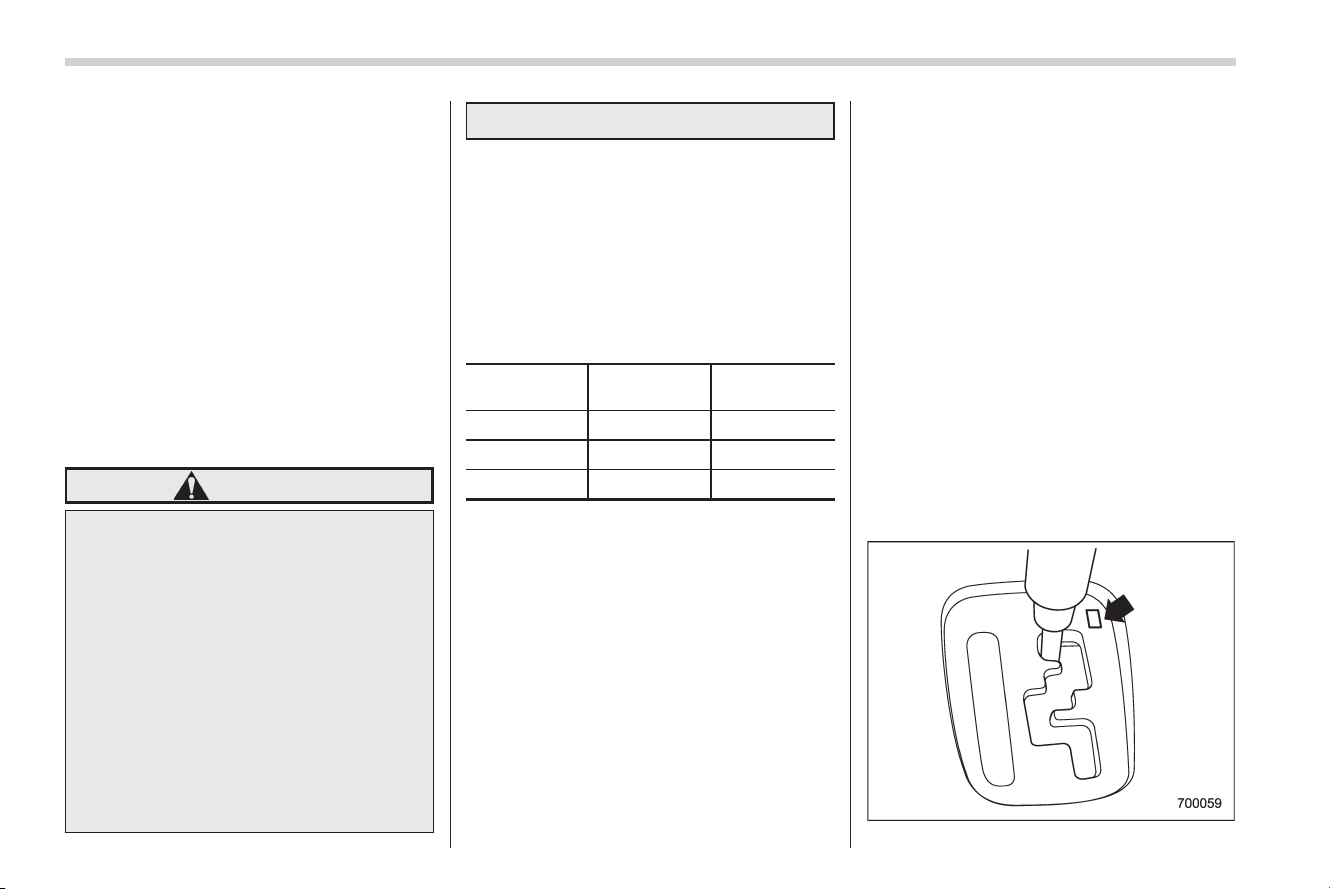
Black plate (222,1)
北米Model "A8130BE-B" EDITED: 2007/ 7/ 25
7-14 Starting and operating
steep grade.
In this position, the transmission holds in
the 2nd gear.
Use this position when starting off from a
standstill on slippery road surfaces such
as mud or snow. It will ensure greater
traction.
! 1 (First)
This position is for driving up or down very
steep grades, or driving through mud or
sand, or on slippery surfaces. In this
position, the transmission holds in the
1st gear.
! Maximum speeds
WARNING
When shifting down a gear, ensure
that the vehicle is not travelling at a
speed exceeding the Maximum Al-
lowable Speed for the gear which is
about to be sele cted. Failure to
observe this precaution can lead to
engine over-revving and this in turn
can result in engine damage.
In addition, sudden application of
engine brakes when the vehicle is
travelling on a slippery surface can
lead to wheel locking; as a conse-
quence, control of the vehicle may
be lost and the risk of an accident
increased.
The following tables show the maximum
speeds that are possible with each differ-
ent gear.
When shifting down a gear, it is important
to confirm that the current vehicle speed is
not in excess of the Maximum Allowable
Speed of the gear which is about to be
selected.
mph (km/h)
Non-turbo
models
Turbo models
1st 28 (45) 23 (37)
2nd 63 (100) 65 (104)
3rd 98 (156)
104 (167)
NOTE
In order to prevent over-revving during
deceleration of the vehicle, the trans-
mission will remain in the current gear
if the speed of the vehicle is in excess
of the Maximum Allowable Speed for
the gear to which the selector lever has
been moved.
! Driving tips
. Always apply the foot or parking brake
when the vehicle is stopped in the “D”, “3”,
“2”, “1” or “R” position.
. Always set the parking brake when
parking your vehicle. Do not hold the
vehicle with only the transmission.
. Do not keep the vehicle in a stationary
position on an uphill grade by using the
“D”, “3”, “2”,or“1” position. Use the brake
instead.
& Shift lock release
If the selector lever does not move from
the “P” position with the brake pedal
depressed and the ignition switch in the
“ON” position, perform the following steps:
To override the shift lock:
1. Set the parking brake and stop the
engine.
2. Take out the screwdriver.
3. Remove the cover by prying on the
edge with the screwdriver.
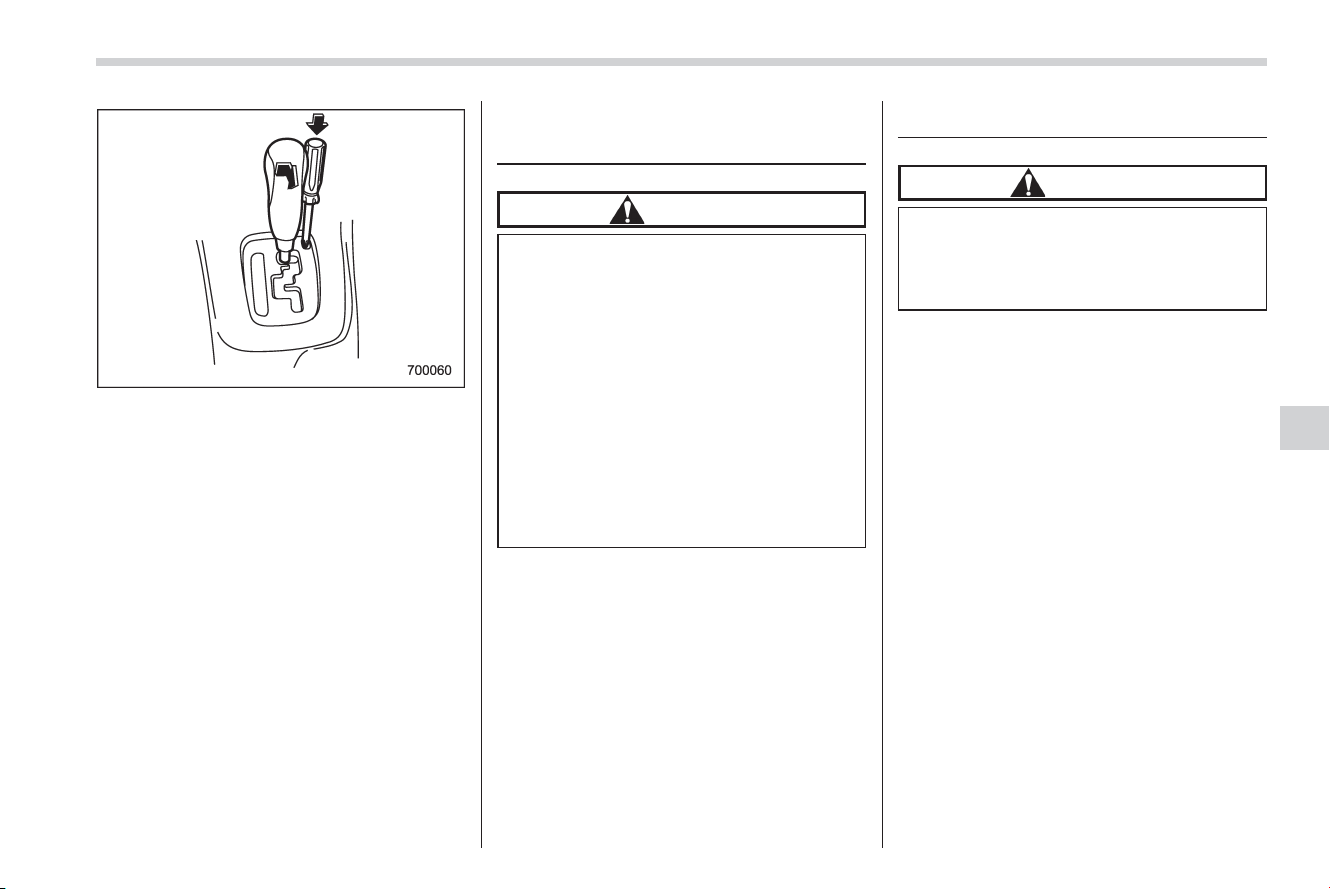
Black plate (223,1)
北米Model "A8130BE-B" EDITED: 2007/ 7/ 25
4. Insert the screwdriver into the hole.
5. Push down on the screwdriver and
move the selector lever from the “P” to the
“N” position.
6. Remove the screwdriver from the hole.
Depress the brake pedal and start the
engine.
Take your vehicle to the nearest SUBARU
dealer immediately to have the system
repaired.
Rear viscous limited slip dif-
ferential (LSD) (if equipped)
CAUTION
. Never start the engine while a tire
on one side is jacked up, as the
vehicle may move.
. If one rear tire is spinning in mud,
avoid continued spinning at high
speed as this could adversely
affect the LSD.
. If a different size rear tire is
temporarily used (as in an emer-
gency), it will adversely affect the
LSD. Always replace it wit h a
regularsizetireassoonas
possible.
The LSD provides optimum distribution of
power according to the difference in
revolutions between the right and left rear
wheels that may be caused by certain
driving conditions, thereby improving driv-
ing stability on snow-covered, muddy or
other slippery roads.
Power steering
CAUTION
Do not hold the steering wheel at the
fully locked position left or right for
more than 5 seconds. This may
damage the power steering pump.
The power steering system operates only
when the engine is running.
If you lose power steering assist because
the engine stops or the system fails to
function, you can steer but it will take
much more effort.
NOTE
Right after the engine has been started
and before it has warmed up, you may
hear a noise coming from areas adja-
cent to the power steering pump which
is located at the right-front area of the
engine compartment. This noise is
normal. It does not indicate power
steering system trouble.
Starting and operating 7-15
7
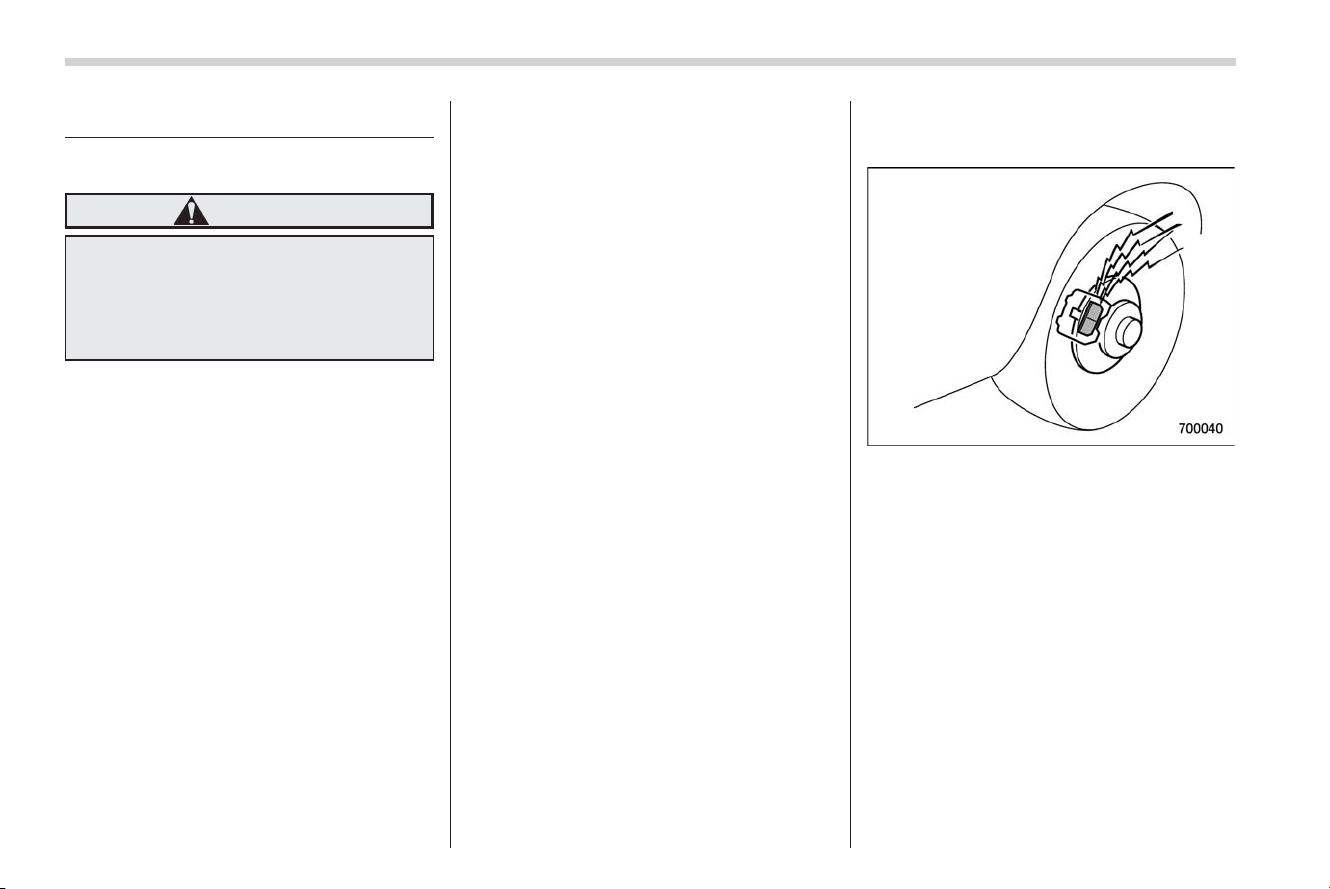
Black plate (224,1)
北米Model "A8130BE-B" EDITED: 2007/ 7/ 25
7-16 Starting and operating
Braking
& Braking tips
WARNING
Never rest your foot on the brake
pedal while driving. This can cause
dangerous overheating of the
brakes and needless wear on the
brake pads and linings.
! When the brakes get wet
When driving in rain or after washing the
vehicle, the brakes may get wet. As a
result, brake stopping distance will be
longer. To dry the brakes, drive the vehicle
at a safe speed while lightly depressing
the brake pedal to heat up the brakes.
! Use of engine braking
Remember to make use of engine braking
in addition to foot braking. When descend-
ing a grade, if only the foot brake is used,
the brakes may start working improperly
because of brake fluid overheating,
caused by overheated brake pads. To
help prevent this, shift into a lower gear to
get stronger engine braking.
! Braking when a tire is punctured
Do not depress the brake pedal suddenly
when a tire is punctured. This could cause
a loss of control of the vehicle. Keep
driving straight ahead while gradually
reducing speed. Then slowly pull off the
road to a safe place.
& Brake system
! Two separate circuits
Your vehicle has two separate circuit
brake systems. Each circuit works diag-
onally across the vehicle. If one circuit of
the brake system should fail, the other half
of the system still works. If one circuit fails,
the brake pedal will go down much closer
to the floor than usual and you will need to
press it down much harder. And a much
longer distance will be needed to stop the
vehicle.
! Brake booster
The brake booster uses engine manifold
vacuum to assist braking force. Do not
turn off the engine while driving because
that will turn off the brake booster, result-
ing in poor braking power.
The brakes will continue to work even
when the brake booster completely stops
functioning. If this happens, however, you
will have to push the pedal much harder
than normal and the braking distance will
increase.
& Disc brake pad wear warning
indicators
The disc brake pad wear warning indica-
tors on the disc brakes give a warning
noise when the brake pads are worn.
If a squeaking or scraping noise is heard
from the disc brakes while braking, im-
mediately have your vehicle checked by
your SUBARU dealer.
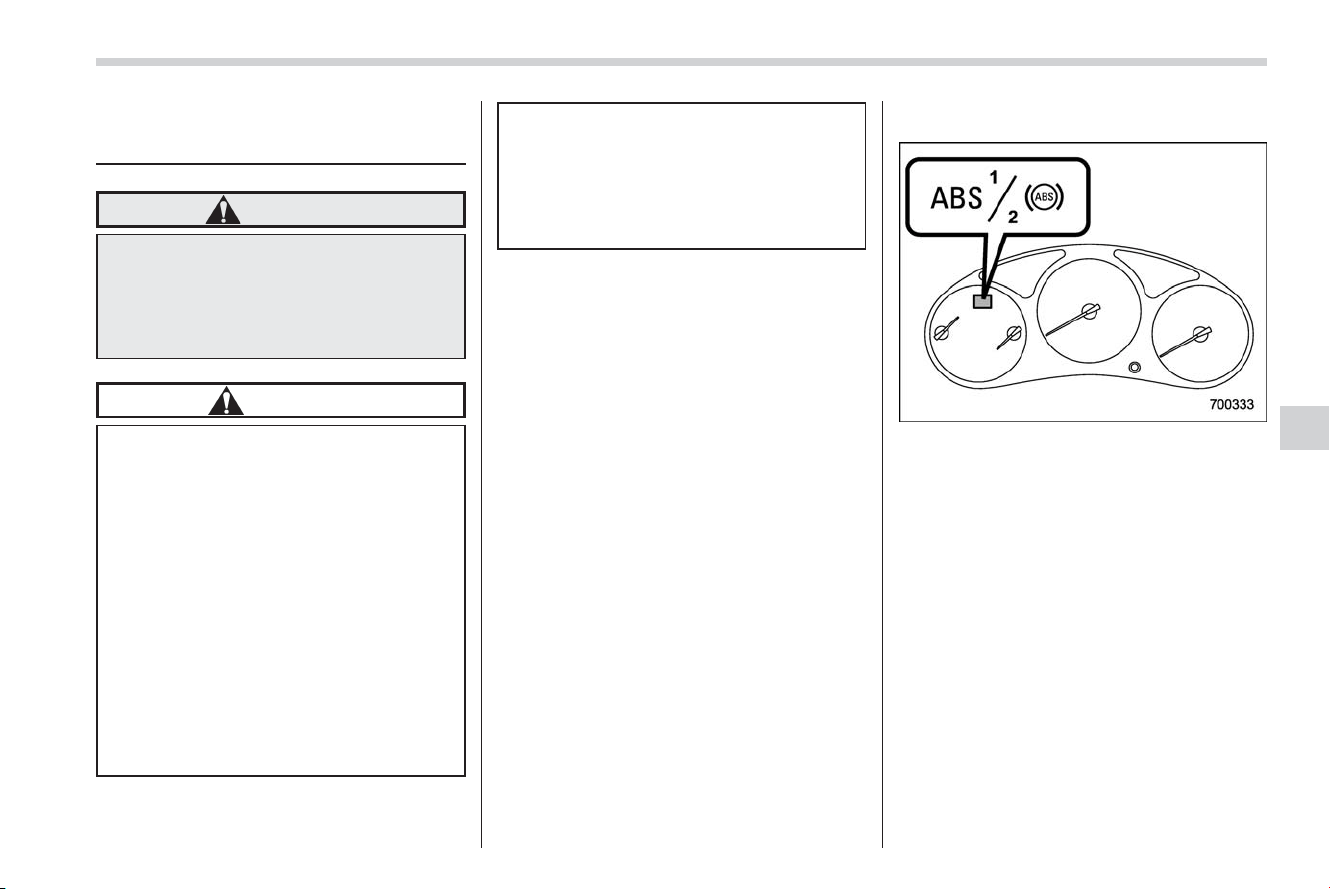
Black plate (225,1)
北米Model "A8130BE-B" EDITED: 2007/ 7/ 25
ABS (Anti-lock Brake Sys-
tem)
WARNING
Alwaysusetheutmostcarein
driving – overconfidence because
youaredrivingwithanABS
equipped vehicle could easily lead
to a serious accident.
CAUTION
. The ABS system does not always
decrease stopping distance. You
should always maintain a safe
following distance from other
vehicles.
. When driving on badly surfaced
roads, gravel roads, icy roads, or
over deep newly fallen snow,
stopping distances may be long-
er for a vehicle with the ABS
system than one without. When
driving under these conditions,
therefore, reduce your speed and
leave ample distance from other
vehicles.
. When you feel the ABS system
operating, you should maintain
constant brake pedal pressure.
Do not pump the brake pedal
since doing so may defeat the
operation of the ABS system.
The ABS system prevents the lock-up of
wheels which may occur during sudden
braking or braking on slippery road sur-
faces. This helps prevent the loss of
steering control and directional stability
caused by wheel lock-up.
When the ABS system is operating, you
may hear a chattering noise or feel a slight
vibration in the brake pedal. This is normal
when the ABS operates.
The ABS system will not operate when the
vehicle speed is below approximately 6
mph (10 km/h).
& ABS system self-check
You may feel a slight shock in the brake
pedal and hear the operating sound of
ABS from the engine compartment just
after the vehicle is started. This is caused
by an automatic functional test of the ABS
system being carried out and does not
indicate any abnormal condition.
& ABS warning light
1) U.S.-spec. models
2) Canada-spec. models
The ABS warning light comes on when the
ignition switch is turned to the “ON”
position and goes out after approximately
2 seconds.
This is an indication that the ABS system
is working properly.
When driving with an insufficient battery
voltage such as when the engine is jump
started, the ABS warning light may come
on. This is due to the low battery voltage
and does not i ndicate a malfunction.
When the battery becomes fully charged,
the light will go out.
Starting and operating 7-17
– CONTINUED –
7
Black plate (226,1)
北米Model "A8130BE-B" EDITED: 2007/ 7/ 25
7-18 Starting and operating
CAUTION
If the warning light behaves as
follows, the ABS system may not
be working properly.
When the warning light is on, the
ABS function shuts down; however,
the conventional brake system con-
tinues to operate normally.
. The warning light does not come
on when the ignition switch is
turned to the “ON” position.
. The warning light comes on when
the ignition switch is turned to
the “ON” position, but it does not
go out even when the vehicle
speed exceeds approximately 8
mph (12 km/h).
. The warning light comes on dur-
ing driving.
If these occur, have the ABS system
repaired at the first available oppor-
tunity by your SUBARU dealer.
NOTE
If the warning light behavior is as
described in the following, the ABS
system may be considered normal.
. The warning light comes on right
after the engine is started but goes out
immediately, remaining off.
. The warning light remains on after
the engine has been started, but it goes
out when the vehicle speed reaches
approximately 8 mph (12 km/h).
. The warning light comes on during
driving, but it goes out immediately and
remains off.
Electronic Brake Force Dis-
tribution (EBD ) system
The EBD system maximizes the effective-
ness of the brakes by allowing the rear
brakes to supply a greater proportion of
the braking force. It functions by adjusting
the distribution of braking force to the rear
wheels in accordance with the vehicle’s
loading condition and speed.
The EBD system is an integral part of the
ABS system and uses some of the ABS
system’s components to perform its func-
tion of optimizing the distribution of brak-
ing force. If any of the ABS components
used by the EBD function fails, the EBD
system also stops working.
When the EBD system is operating, you
may hear a chattering noise or feel a slight
vibration in the brake pedal. This is normal
and does not indicate a malfunction.
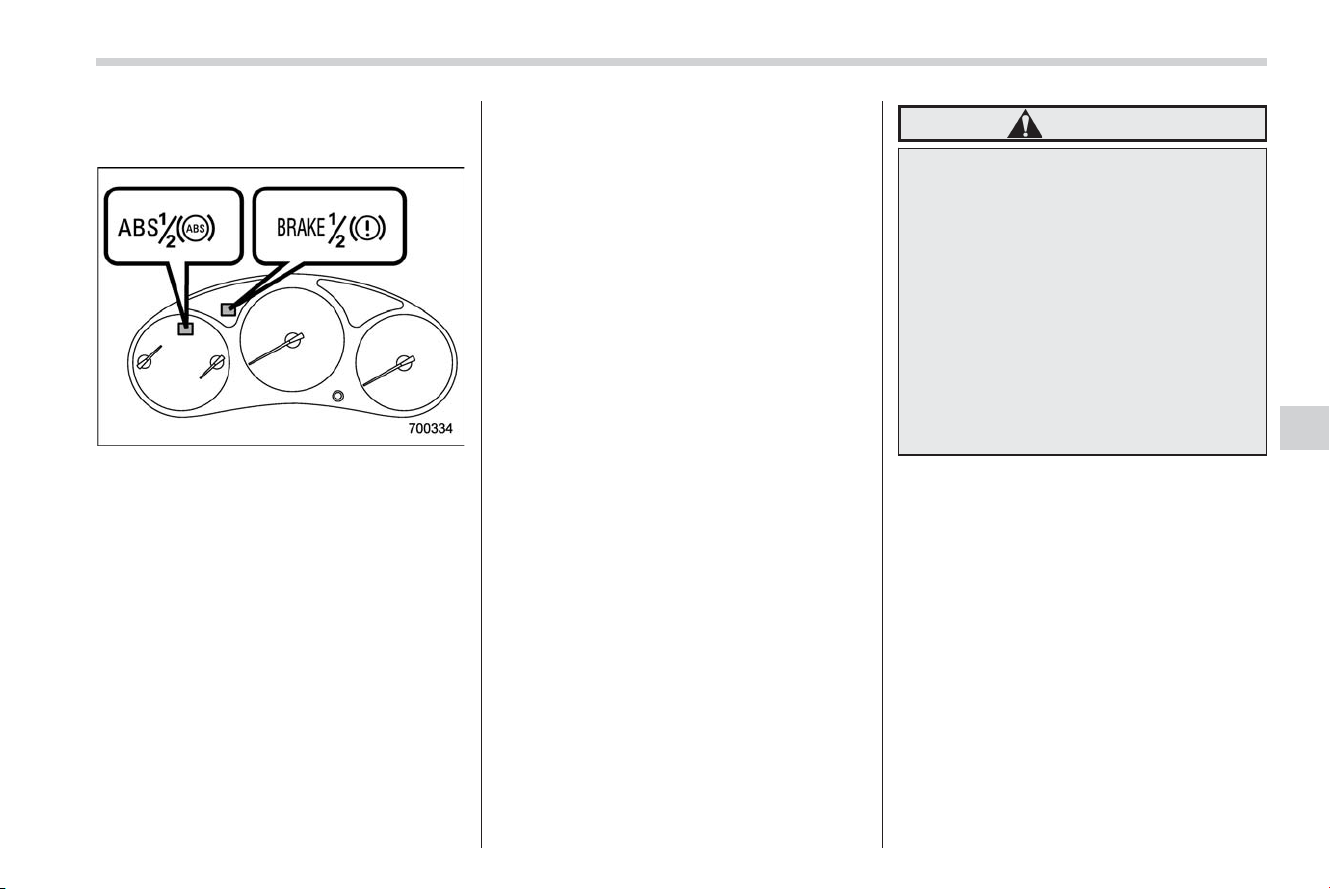
Black plate (227,1)
北米Model "A8130BE-B" EDITED: 2007/ 7/ 25
& Steps to take if EBD system
fails
1) U.S.-spec. models
2) Canada-spec. models
If a malfunction occurs in the EBD system,
the system stops working and the brake
system warning light and ABS warning
light come on simultaneously.
The EBD system may be faulty if the
brake system warning light and ABS
warning light illuminate simultaneously
during driving.
Even if the EBD system fails, the conven-
tional braking system will still function.
However, the rear wheels will be more
prone to locking when the brakes are
applied harder than usual and the vehi-
cle’s motion may therefore become some-
what harder to control.
If the brake system warning light and ABS
warning light illuminate simultaneously,
take the following steps:
1. Stop the vehicle in the nearest safe,
flat place.
2. Shut down the engine, then restart it.
3. Release the parking brake. If both
warning lights go out, the EBD system
may be faulty.
Drive carefully to the nearest SUBARU
dealer and have the system inspected.
4. If both warning lights come on again
and stay illuminated after the engine has
been restarted, sh ut down the engine
again, apply the parking brake, and check
the brake fluid level.
5. If the brake fluid level is not below the
“MIN” mark, the EBD system may be
faulty. Drive carefully to the nearest
SUBARU dealer and have the system
inspected.
6. If the brake fluid level is below the
“MIN” mark, DO NOT drive the vehicle.
Instead, have the vehicle towed to the
nearest SUBARU dealer for repair.
WARNING
. Driving with the brake system
warning light on is dangerous.
This indicates your brake system
may not be working properly. If
the light remains on, have the
brakes inspected by a SUBARU
dealer immediately.
. If at all in doubt about whether
the brakes are operating prop-
erly, do not drive the vehicle.
Have your vehicle towed to the
nearest SUBARU dealer for re-
pair.
Starting and operating 7-19
7
Black plate (228,1)
北米Model "A8130BE-B" EDITED: 2007/ 7/ 25
7-20 Starting and operating
Vehicle Dynamics Control
system (if equipped)
WARNING
Always use the utmost c are in
driving – overconfidence because
you are driving with a Vehicle Dy-
namics Control system e quipped
vehicle could easily lead to a ser-
ious accident.
CAUTION
. Even if your vehicle is equipped
with Vehicle Dynamics Control,
winter tires or snow chains
should be used when driving on
snow-covered or icy roads; in
addition, vehicle speed should
be reduced considerably. Simply
having a Vehicle Dynamics Con-
trol system does not guarantee
that the vehicle will be able to
avoid accidents in any situation.
. Activation of the Vehicle Dy-
namics Control system is an
indication that the road being
travelled on has a slippery sur-
face; since having Vehicle Dy-
namics Control is no guarantee
that full vehicle control will be
maintained at all times and under
all conditions, its activation
should be seen as a sign that
the speed of the vehicle should
be reduced considerably.
. Whenever suspension compo-
nents, steering components, or
an axle are removed from a
vehicle equipped with Vehicle
Dynamics Control, have an
authorized SUBARU dealer per-
form an inspection of that sys-
tem.
. The following precautions should
be observed in order to ensure
that the Vehicle Dynamics Con-
trol system is operating properly:
– All four wheels should be
fitted with tires of the same
size, type, and brand. Further-
more, the amount of wear
should be the same for all
four tires.
– Keep the tire pressure at the
proper level as shown on the
placard attached to the vehi-
cle’s door pillar.
– Use only the special tempor-
ary spare tire to replace a flat
tire. With a temporary spare
tire, the effectiveness of the
Vehicle Dynamics Control
system is reduced and this
should be taken into account
when driving the vehicle in
such a condition.
In the event of wheelspin and/or skidding
on a slippery road surface and/or during
cornering and/or an evasive maneuver,
the Vehicle Dynamics Control system
adjusts the engine’s output and the
wheels’ respective braking forces to help
maintain traction and directional control.
. Traction Control Function
The traction control function is designed to
prevent spinning of the driving wheels on
slippery road surfaces, thereby helping to
maintain traction and directional control.
Activation of this function is shown by
steady illumination of the Vehicle Dy-
namics Control operation indicator light.
. Skid Suppression Function
The skid suppression function is designed
to help maintain directional stability by
suppressing the wheels’ tendency to slide
sideways during steering operations. Acti-
vation of this function is shown by flashing
of the Vehicle Dynamics Control operation
indicator light.
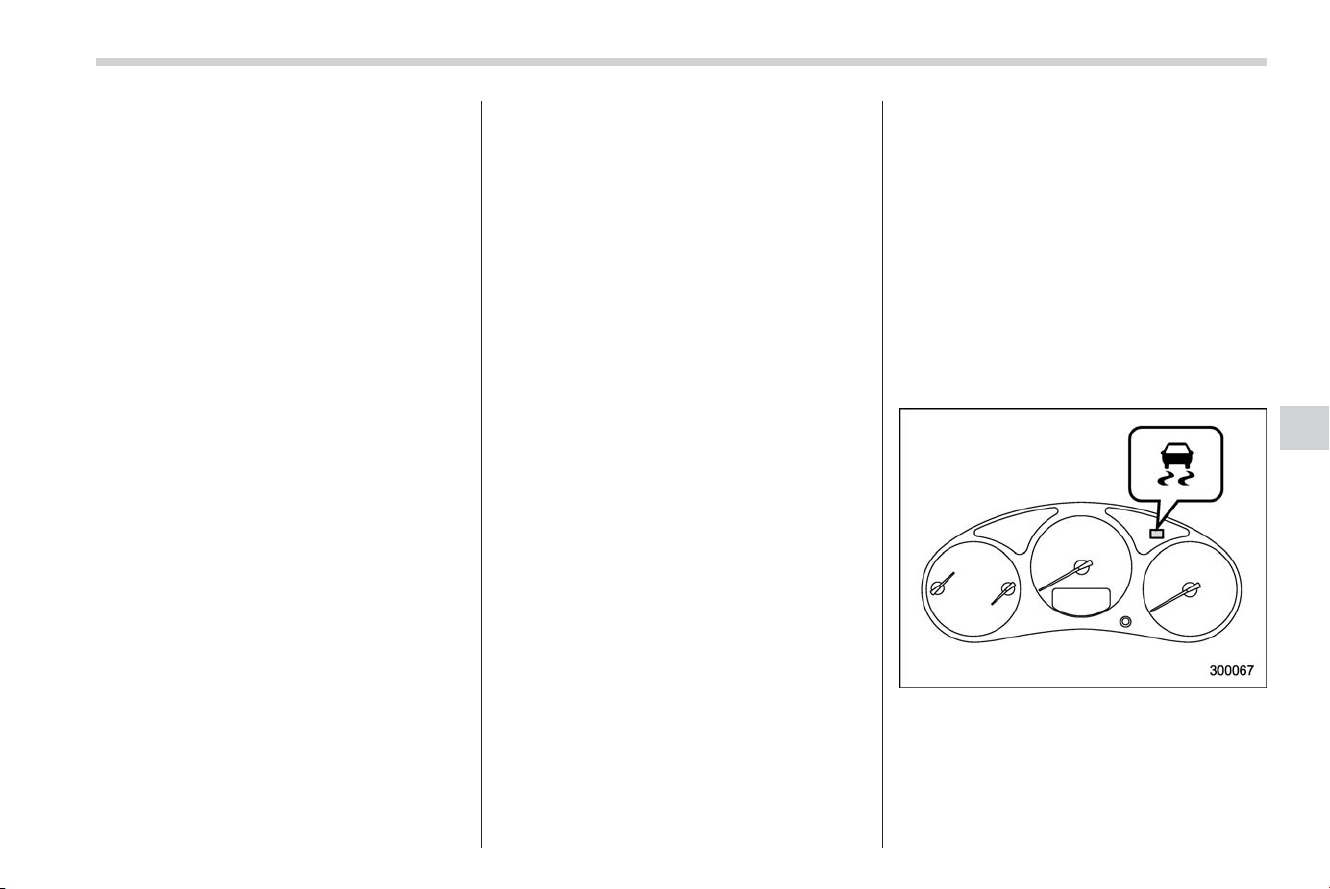
Black plate (229,1)
北米Model "A8130BE-B" EDITED: 2007/ 7/ 25
NOTE
. Slight twitching of the brake pedal
may be felt when the Vehicle Dynamics
Control system operates; a small de-
gree of vehicle or steering wheel shak-
ing may also be noticed in this situa-
tion. These are normal characteristics
of Vehicle Dynamics Control operation
and are no cause for alarm.
. When driving off immediately after
starting the engine, a short-lived opera-
tion noise may be noticed coming from
the engine compartment. This noise is
generated as a result of a check being
performed on the Vehicle Dynamics
Control system and is normal.
. Depending on the timing of activa-
tion of the brakes, certain situations
may occur just after driving off where
the brake pedal seems to exhibit a
jolting motion. This too is a conse-
quence of the Vehicle Dynamics Con-
trol operational check and is normal.
. In the circumstances listed in the
following, the vehicle may be more
unstable than it feels to the driver.
The Vehicle Dynamics Control System
may therefore operate. Such operation
does not indicate a system fault.
. on gravel-covered or rutted roads
. on unfinished roads
. when the vehicle is towing a
trailer
. when the vehicle is fitted with
snow tires or winter tires
. Activation of the Vehicle Dynamics
Control system will cause operation of
the steering wheel to feel slightly
different compared to that for normal
conditions.
. Even if the vehicle is equipped with
a Vehicle Dynamics Control system, it
is important that winter tires be used
when driving on snow-covered or icy
roads (all four wheels should be fitted
with tires of the same size and brand).
Furthermore, if snow chains are to be
used, they should be fitted on the front
wheels. When a vehicle is fitted with
snow chains, however, the effective-
ness of the Vehicle Dynamics Control
system is reduced and this should be
taken into account when driving the
vehicle in such a condition.
. It is always important to reduce
speed when approaching a corner,
even if the vehicle is equipped with
Vehicle Dynamics Control.
. All four wheels should be fitted with
tires of the same size, type, and brand;
furthermore, the amount of wear
should be the same for all four tires. If
these precautions are not observed
and non-matching tires are used, it is
quite possible that the Vehicle Dy-
namics Control system will be unable
to operate correctly as intended.
. Always turn off the engine before
replacing a tire as failure to do so may
render the Vehicle Dynamics Control
system unable to operate correctly.
& Vehicle Dynamics Control
system monitor
! Vehicle Dynamics Control opera-
tion indicator light
The indicator light turns on when the
ignition switch is turned to the “ON”
position; it turns off approximately 2
seconds later. This indicator light flashes
during activation of the skid suppression
function and is illuminated steadily during
Starting and operating 7-21
– CONTINUED –
7
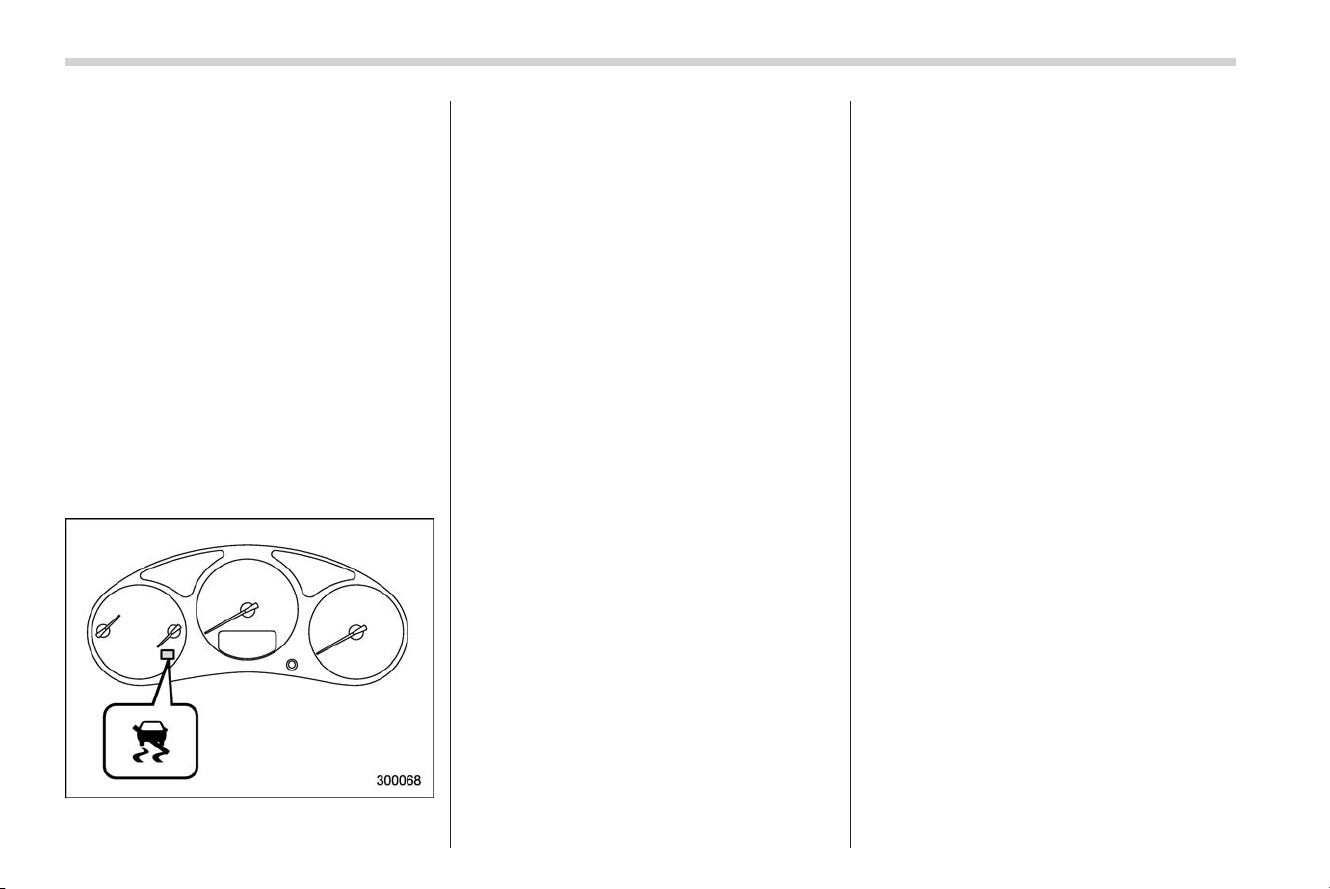
Black plate (230,1)
北米Model "A8130BE-B" EDITED: 2007/ 7/ 25
7-22 Starting and operating
activation of the traction control function.
The following two situations could indicate
a malfunction of the Vehicle Dynamics
Control system; if either should occur,
have an authorized SUBARU dealer carry
out an inspection of that system at the first
available opportunity.
. The indicator light does not turn on
when the ignition switch is turned to the
“ON” position.
. The indicator light does not turn off
approximately 2 seconds after the ignition
switch has been turned to the “ON”
position.
! Vehicle Dynamics Control warning
light/Vehicle Dynamics Control OFF
indicator light
This single li ght has the function of
indicating malfunctions in the Vehicle
Dynamics Control system and the function
of indicating that the Vehicle Dynamics
Control system is not operating. It comes
on in the event of a malfunction in the
system and is illuminated whenever the
system is not operating.
! Vehicle Dynamics Control warning
light
The warning light comes on when the
ignition switch is turned to the “ON”
position and goes off several seconds
after engine startup. This lighting pattern
indicates that the Vehicle Dynamics Con-
trol system is operating normally.
The following situations could indicate a
malfunction of the Vehicle Dynamics
Control system; if any should occur, have
an authorized SUBARU dealer carry out
an inspection of the system at the first
available opportunity.
. The warning light does not turn on
when the ignition switch is turned to the
“ON” position.
. The warning light turns on while the
vehicle is being driven.
. When a malfunction has occurred in
the Vehicle Dynamics Control electrical
system, only the warning light will turn on.
In such an event, the ABS will still be
operating normally.
. The warning light will also turn on when
a problem occurs with the ABS or Vehicle
Dynamics Control electronic control sys-
tems.
Because the Vehicle Dynamics Control
system controls each brake through the
ABS, whenever the ABS stops operating
due to a malfunction in that electrical
system, the Vehicle Dynamics Control will
also become unable to control all four
brakes. Thus Vehicle Dynamics Control
system operation halts and the warning
light turns on. Although both the Vehicle
Dynamics Control system and the ABS
will be inoperable in this situation, it will
still be possible to stop the vehicle using
normal braking. The Vehicle Dynamics
Control system and the ABS do not
adversely affect operation of the vehicle
in any way when they are inoperable;
however should such a situation occur,
drive with care and have an authorized
SUBARU dealer carry out an inspection of
those systems at the first available oppor-
tunity.
NOTE
When the warning light turns on and off
in the following way, it indicates that
the Vehicle Dynamics Control system
is operating normally.
. Although turning on after the engine
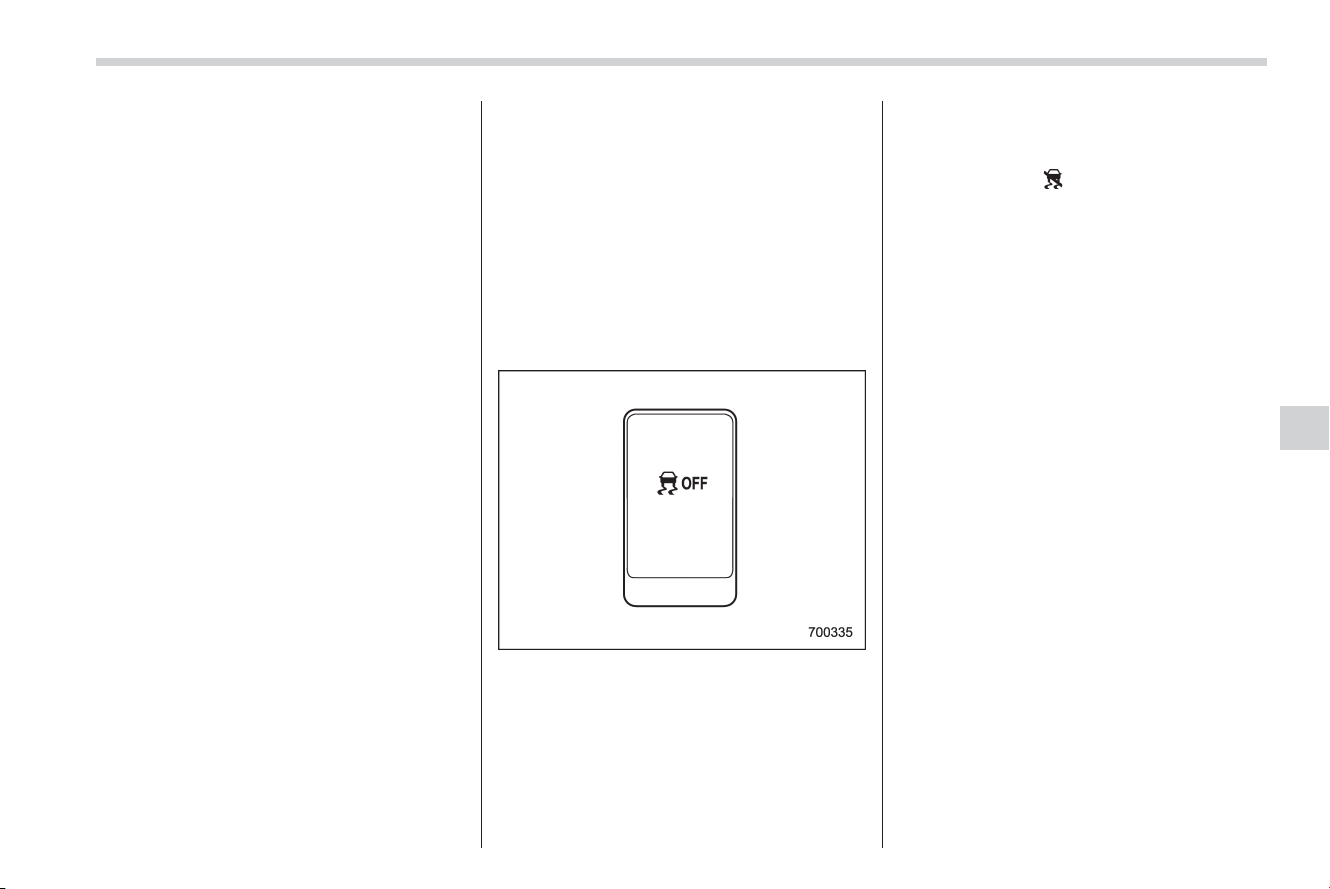
Black plate (231,1)
北米Model "A8130BE-B" EDITED: 2007/ 7/ 25
has been started, the warning light
quickly turns off and stays off.
. The warning light turns on when the
vehicle is being driven; it then turns off
and stays off.
! Vehicle Dynamics Control OFF in-
dicator light
This light comes on to indicate that the
Vehicle Dynamics Control system is in
non-operation mode. This does not con-
stitute failure of the Vehicle Dynamics
Control system.
NOTE
. The indicator light may stay on for a
while after the engine has been started,
especially in cold weather. This occurs
because the engine has not yet
warmed up and is completely normal.
The light will turn off when the engine
has reached a suitable operating tem-
perature.
. When an engine problem occurs
and the malfunction indicator lamp
turns on, the indicator light will also
come on.
The following two situations could indicate
malfunction of the Vehicle Dynamics
Control system; if either should occur,
have an authorized SUBARU dealer carry
out an inspection of that system at the first
available opportunity.
. The indicator light does not turn on
when the ignition switch is turned to the
“ON” position.
. The indicator light fails to turn off after
the engine is started, even when several
minutes have passed to allow the engine
to heat up sufficiently.
& Vehicle Dynamics Control
OFF switch
Pressing the switch to deactivate the
Vehicle Dynamics Control syst em can
facilitate the following operations:
. a standing start on a steeply sloping
road with a snowy, gravel-covered, or
otherwise slippery surface
. extrication of the vehicle when its
wheels are stuck in mud or deep snow
When the switch is pressed during engine
operation, the “
” indicator light illumi-
nates. The Vehicle Dynamics Control
system will be deactivated and the vehicle
will behave like a model not equipped with
the Vehicle Dynamics Control system.
When the switch is pressed again to
reactivate the Vehicle Dynamics Control
system, the indicator light goes off.
With the Vehicle Dynamics Control system
deactivated, traction and stability en-
hancement offered by Vehicle Dynamics
Control system is unavailable. Therefore
you should not deacti vate the Vehicle
Dynamics Control system except under
above-mentioned situations.
NOTE
. When the switch has been pressed
to deactivate the Vehicle Dynamics
Control system, the Vehicle Dynamics
Control system automatically reacti-
vates itself the next time the ignition
switch is turned to the OFF position
and the engine is restarted.
. If the switch is held down for 10
seconds or longer, the indicator light
goes off, the Vehicle Dynamics Control
system is activated, and the system
ignores any further pressing of the
switch. To make the switch usable
Starting and operating 7-23
– CONTINUED –
7
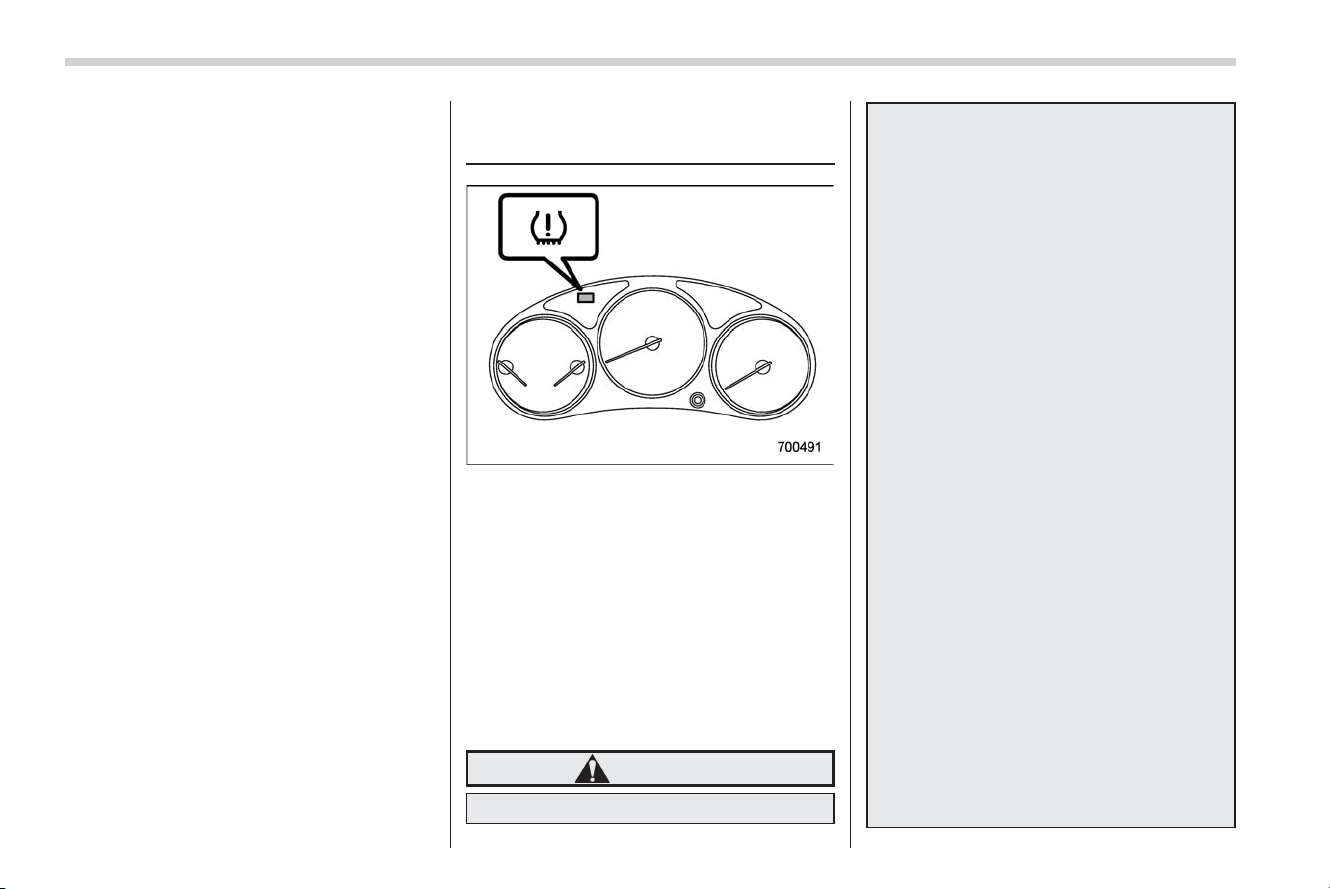
Black plate (232,1)
北米Model "A8130BE-B" EDITED: 2007/ 7/ 25
7-24 Starting and operating
again, turn the ignition switch to the
OFF position and restart the engine.
. Whentheswitchispressedto
deactivate the Vehicle Dynamics Con-
trol system, the vehicle’s running per-
formance is comparable with that of a
vehicle that does not have a Vehicle
Dynamics Control system. Do not de-
activate the Vehicle Dynamics Control
system except when absolutely neces-
sary.
Tire pressure monitoring
system (TPMS) (if equipped)
The tire pressure monitoring system pro-
vides the driver with a warning message
by sending a signal from a sensor that is
installed in each wheel when tire pressure
is severely low.
The tire pressure monitoring system will
activate only when the vehicle is driven at
speeds above 20 mph (32 km/h). Also,
this system may not react immediately to a
sudden drop in tire pressure (for example,
a blow-out caused by running over a
sharp object).
WARNING
If the low tire pressure warning light
comes on while driving, never brake
suddenly and keep driving straight
ahead while gradually reducing
speed. Then slowly pull off the road
to a safe place. Otherwise an acci-
dent involving serious vehicle da-
mage and serious personal injury
could occur.
Check the pressure for all four tires
and adjust the pressure to the COLD
tire pressure shown on the tire
placard on the door pillar on the
driver’s side.
Even when the vehicle is driven a
very short distance, the tires get
warm and their pressures increase
accordingly. Be sure to let the tires
cool thoroughly before adjusting
their pressures to the standard
values shown on the tire placard.
(Refer to the “Tires and wheels”
section in chapter 11.) The tire
pressure monitoring system does
not function when the vehicle is
stationary. After adjusting the tire
pressures, increase the vehicle
speed to at least 20 mph (32 km/h)
to start the TPMS re-checking of the
tire inflation pressures. If the tire
pressures are now above the severe
low pressure threshold, the low tire
pressure warning light should go off
Black plate (233,1)
北米Model "A8130BE-B" EDITED: 2007/ 7/ 25
a few minutes later.
If this light still comes on while
driving after adjusting the tire pres-
sure, a ti re may have significant
damage and a fast leak that causes
the tire to lose air rapidly. If you have
a flat tire, replace it with a spare tire
as soon as possible.
When a spare tire is mounted or a
wheel rim is replaced without the
original pressure sensor/transmitter
being transferred, the low tire pres-
sure warning light will illuminate
steadily after blinking for approxi-
mately one minute. This indicates
the TPMS is unable to monitor all
four road wheels. Contact your
SUBARU dealer as soon as possible
for tire and sensor replacement and/
or system resetting.
Do not inject any tire liquid or
aerosol tire sealant into the tires,
as this may cause a malfunction of
the tire pressure sensors. If the light
illuminates steadily after blinking for
approximately one minute, promptly
contact a SUBARU dealer to have
the system inspected.
CAUTION
Do not place metal film or any metal
parts under the driver’s seat. This
may cause poor reception of the
signals from the tire pressure sen-
sors, and the tire pressure monitor-
ing system will not function prop-
erly.
NOTE
This device complies with Part 15 of
the FCC Rules and with RSS-210 of
Industry Canada. Operation is subject
to the following two conditions: (1) This
device may not cause harmful inter-
ference, and (2) this device must
accept any interference received, in-
cluding interference that may cause
undesired operation.
Changes or modifications not ex-
pressly approved by the party respon-
sible for compliance could void the
user’s authority to operate the equip-
ment.
Parking your vehicle
WARNING
. Never leave unattended children
or pets in the vehicle. They could
accidentally injure themselves or
others through inadvertent op-
eration of the vehicle. Also, on
hot or sunny days, the tempera-
ture in a closed vehicle could
quickly become high enough to
cause severe or possibly fatal
injuries to people.
. Do not park the vehicle over
flammable materials such as dry
grass, waste paper or rags, as
they may burn easily if they come
near hot engine or exhaust sys-
tem parts.
. Be sure to stop the engine if you
take a nap in the vehicle. If
engine exhaust gas enters the
passenger compartment, occu-
pants in the vehicle could die
from carbon monoxide (CO) con-
tained in the exhaust gas.
Starting and operating 7-25
– CONTINUED –
7
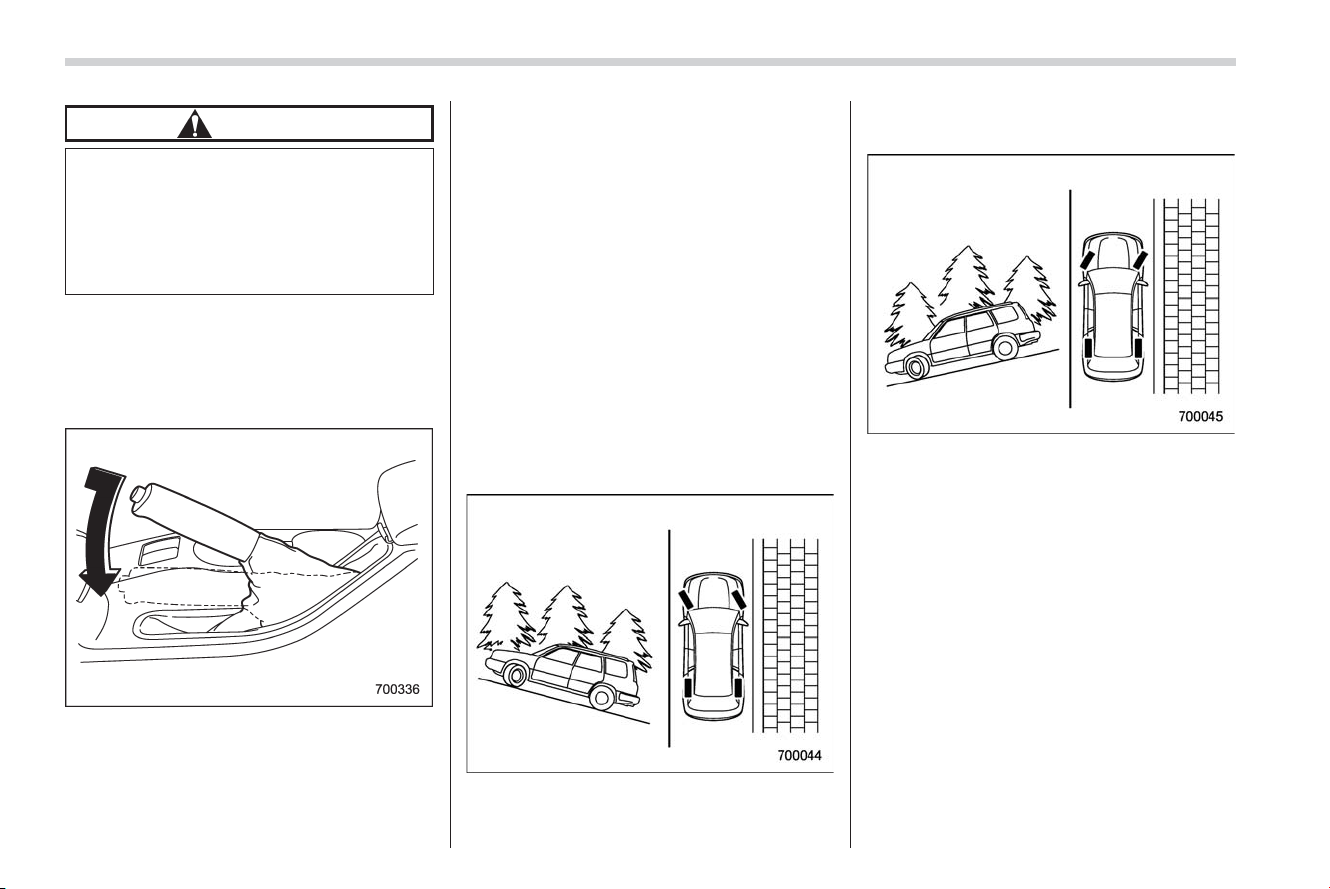
Black plate (234,1)
北米Model "A8130BE-B" EDITED: 2007/ 7/ 25
7-26 Starting and operating
CAUTION
Never drive while the parking brake
is set because this will cause un-
necessary wear on the brake lin-
ings. Before starting to drive, always
make sure that the parking brake
has been fully released.
& Parking brake
To set the parking brake, press the brake
pedal firmly and hold it down while fully
pulling up the parking brake lever.
To release the parking brake, pull the lever
up slightly, press the release button, then
lower the lever while keeping the button
pressed.
When the parking brake is set while the
engine is running, the parking brake
warning light comes on. After starting the
vehicle, be sure that the warning light has
gone out before the vehicle is driven.
Refer to the “Warning and indicator lights”
section (chapter 3).
& Parking tips
When parking your vehicle, always set the
parking brake firmly and put the shift lever
in the “1” (1st) for an upgrade or “R”
(Reverse) for a downgrade for manual
transmission vehicles, or in the “P” (Park)
position for automatic transmission vehi-
cles. Always set the parking brake firmly
when parking your vehicle. Never rely on
the transmission alone to hold the vehicle.
When parking on a hill, always turn the
steering wheel. When the vehicle is
headed up the hill, the front wheels should
be turned away from the curb.
When facing downhill, the front wheels
should be turned into the curb.
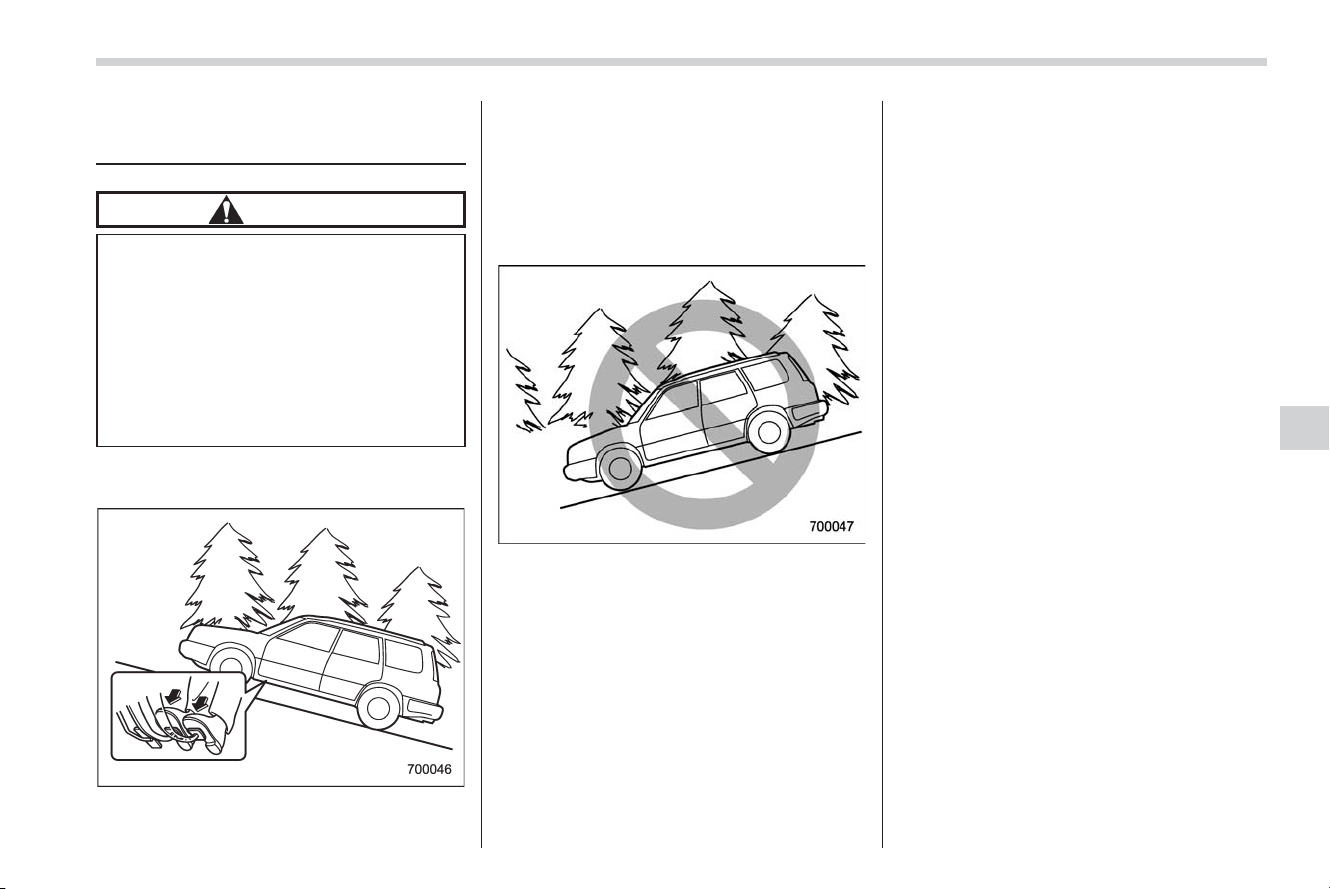
Black plate (235,1)
北米Model "A8130BE-B" EDITED: 2007/ 7/ 25
Hill holder (Manual transmis-
sion – if equipped)
CAUTION
The Hill Holder is a device only for
helping the driver to START the
vehicle on an uphill grade. To pre-
vent accidents when the vehicle is
parked on a slope, be sure to firmly
set the parking brake. When setting
the parking brake, make sure that
the vehicle remains stationary when
the clutch pedal is released.
The Hill holder is a device to make starting
on an uphill grade easier.
On an uphill grade, when the clutch pedal
is depressed while the brake pedal is also
depressed, braking power is maintained
temporarily by the Hill holder when the
brake pedal is released. The driver is
therefore able to start the vehicle the
same way as on a level grade, just using
the clutch and accelerator pedal.
The Hill holder does not operate when the
vehicle is facing downhill. And the Hill
holder may not operate on slight grades.
When starting in reverse and using the Hill
holder, a braking effect may be felt even
after the brake pedal has been released.
However, this braking effect should dis-
appear once the clutch pedal is released.
A slight jolt may be felt when the vehicle
begins to move forward after being re-
versed.
If the braking power of the Hill holder is
insufficient after the brake pedal is re-
leased, apply more braking power by
pressing the brake pedal again.
Starting and operating 7-27
7
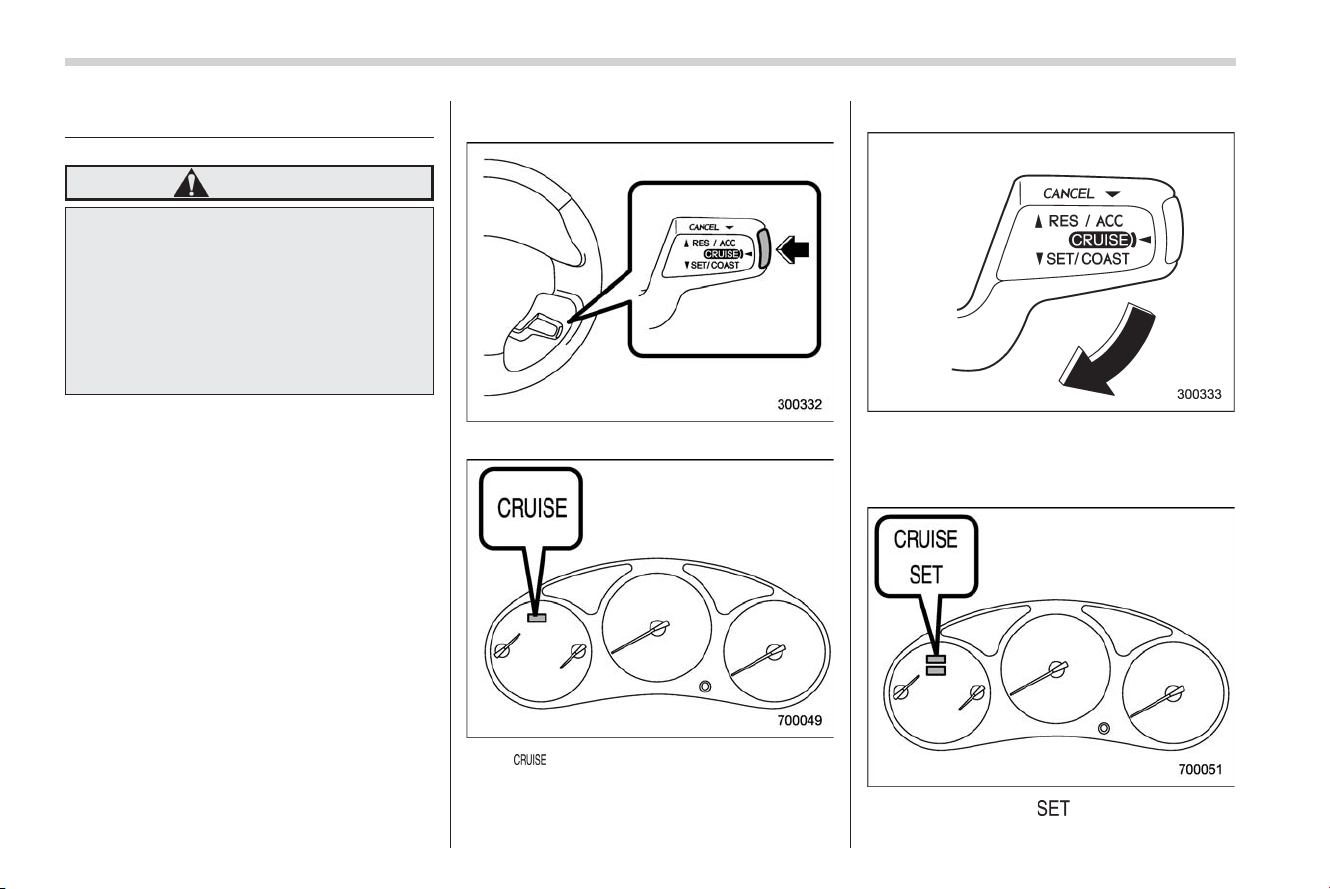
Black plate (236,1)
北米Model "A8130BE-B" EDITED: 2007/ 7/ 25
7-28 Starting and operating
Cruise control
WARNING
Do not use the cruise control under
any of the following conditions. This
may cause loss of vehicle control:
. driving up or down a steep grade
. driving on slippery or winding
roads
. driving in heavy traffic
Cruise control enables you to maintain a
constant vehicle speed without holding
your foot on the accelerator pedal and it is
operative when the vehicle speed is 25
mph (40 km/h) or more. Make sure the
main switch is turned “OFF” when the
cruise control is not in use to avoid
unintentionally setting the cruise control.
NOTE
If you move the cruise control lever or
press the main switch button while
turning the ignition switch “ON”, the
cruise control function is deactivated
and the “ CRUISE” indicator light
flashes. To reactivate the cruise control
function, turn the ignition switch back
to the “Acc” or “LOCK” position, and
then turn it again to the “ON” position.
& To set cruise control
1. Push the main switch button.
The “ ” indicator light on the combina-
tion meter will come on.
2. Depress the accelerator pedal until the
vehicle reaches the desired speed.
3. Push the control lever downward in the
“SET/COAST” direction and release it.
Then release the accelerator pedal.
At this time, the “ ” indicator light is
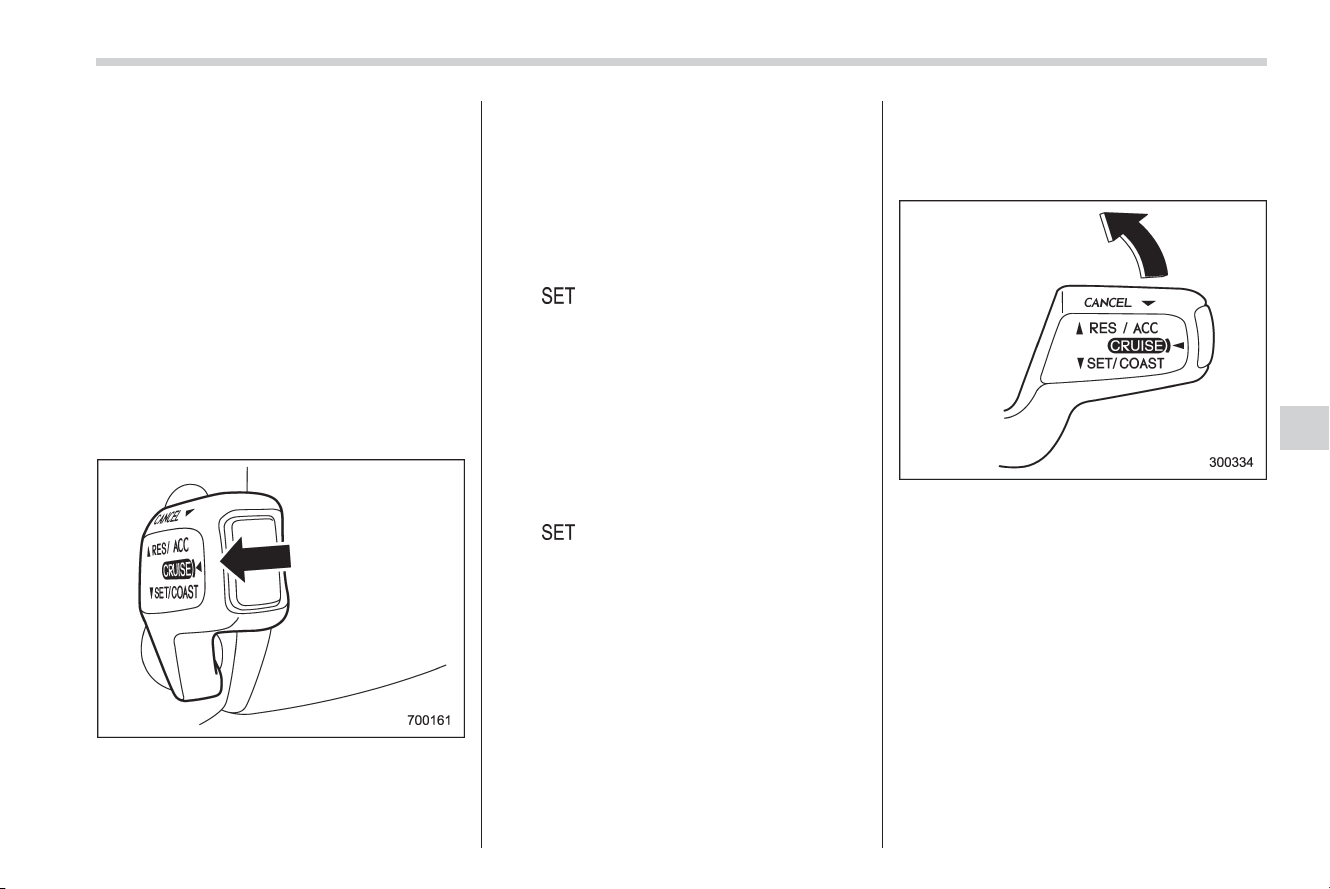
Black plate (237,1)
北米Model "A8130BE-B" EDITED: 2007/ 7/ 25
illuminated in the combination meter.
The vehicle will maintain the desired
speed.
Vehicle speed can be temporarily in-
creased while driving with the cruise
control activated. Simply depress the
accelerator pedal to accelerate the vehi-
cle. When the accelerator pedal is re-
leased, the vehicle will return to and
maintain the previous cruising speed.
& To temporarily cancel the
cruise control
There are five ways to cancel the cruise
control temporarily:
. Pull the control lever in the “CANCEL”
direction.
. Depress the brake pedal.
. Depress the clutch pedal (manual
transmission vehicles only).
. Shift the selector lever into the “N”
position (automatic transmission vehicles
only).
. Shift the shift lever into neutral (manual
transmission vehicles only).
The “
” indicator light in the combination
meter goes off when the cruise control is
cancelled.
To resume the cruise control after it has
been temporarily canceled and with vehi-
cle speed of approximately 20 mph (32
km/h) or more, push the control lever
upward in the “RES/ACC” direction to
return to the original cruising speed auto-
matically.
The “
” indicator light in the combination
meter will automatically come on at this
time.
& To turn off the cruise control
There are two ways to turn off the cruise
control:
. Push the main switch again.
. Turn the ignition switch to the “Acc” or
“LOCK” position (but only when the
vehicle is completely stopped).
& To change the cruising speed
! To increase the speed (by control
lever)
Push the control lever upward in the “RES/
ACC” direction and hold it until the vehicle
reaches the desired speed. Then, release
the control lever. The vehicle speed at that
moment will be memorized and treated as
the new set speed.
When the difference between the actual
vehicle speed and the set speed is less
than 4 mph (6.8 km/h), the set speed can
be increased 1 mph (1.6 km/h) each time
by pressing the control lever upward in the
“RES/ACC” direction quickly.
Starting and operating 7-29
– CONTINUED –
7
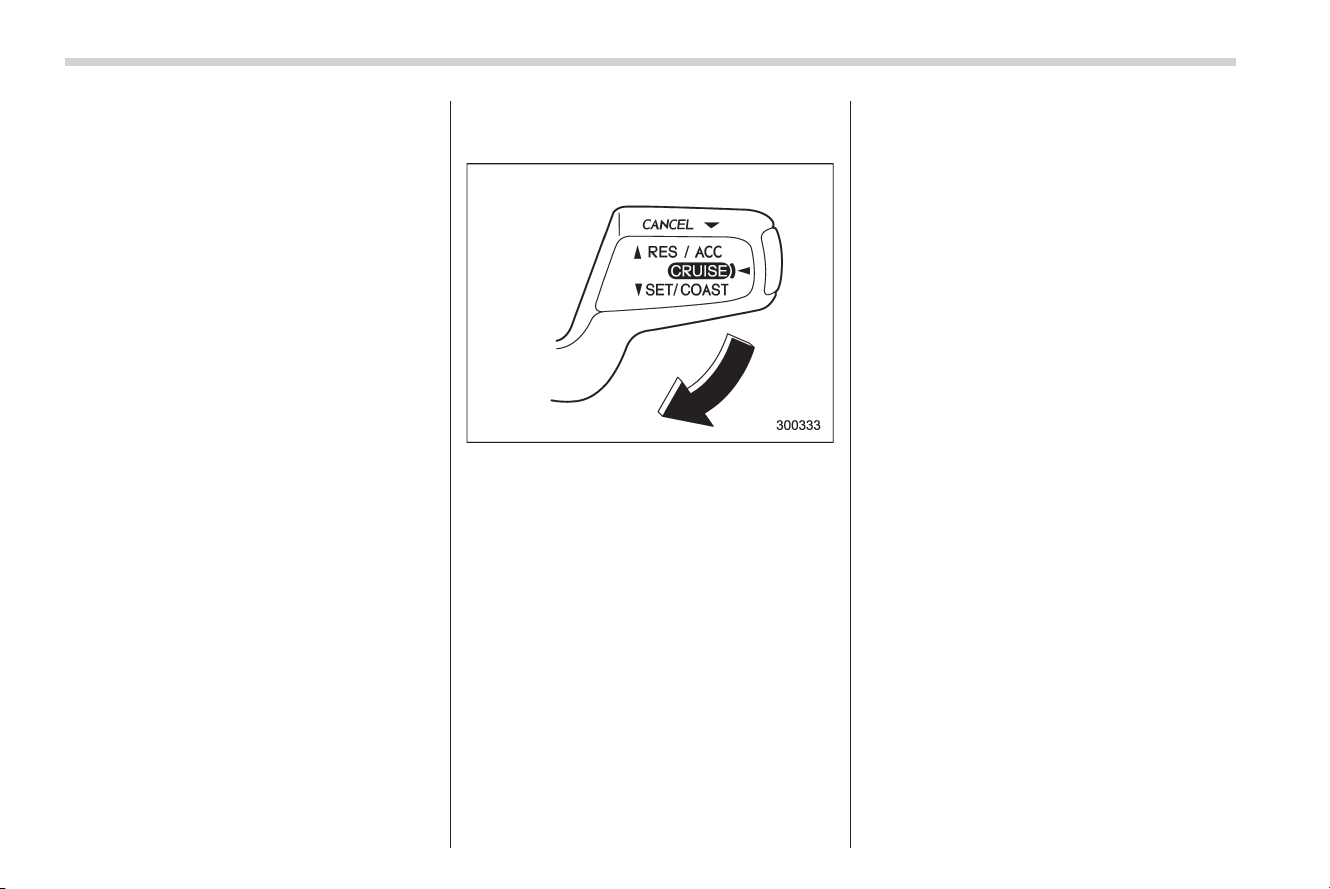
Black plate (238,1)
北米Model "A8130BE-B" EDITED: 2007/ 7/ 25
7-30 Starting and operating
! To increase the speed (by accel-
erator pedal)
1. Depress the acce lerator pedal to
accelerate the vehicle to the desired
speed.
2. Push the control lever downward in the
“SET/COAST” direction once. Now the
desired speed is set and the vehicle will
keep running at that speed without de-
pressing the accelerator pedal.
NOTE
If the difference between the actual
vehicle speed when the control lever
is pushed downward and the speed last
time you set is less than 4 mph (6.8
km/h), the vehicle speed will be low-
ered by 1 mph (1.6 km/h). This occurs
because the cruise control system unit
regards this lever operation as that
intended to decrease the vehicle
speed.
! To decrease the speed (by control
lever)
Push the control lever downward in the
“SET/COAST” direction and hold it until
the vehicle reaches the desired speed.
Then, release th e control lever. The
vehicle speed at that moment will be
memorized and treated as the new set
speed.
When the difference between the actual
vehicle speed and the set speed is less
than 4 mph (6.8 km/h), the set speed can
be lowered 1 mph (1.6 km/h) each time by
pressing the control lever downward in the
“SET/COAST” direction quickly.
! To decrease the speed (by brake
pedal)
1. Depress the brake pedal to release
cruise control temporarily.
2. When the speed decreases to the
desired speed, press the control lever
downward in the “SET/COAST” direction
once. Now the desired speed is set and
the vehicle will keep running at that speed
without depressing the accelerator pedal.
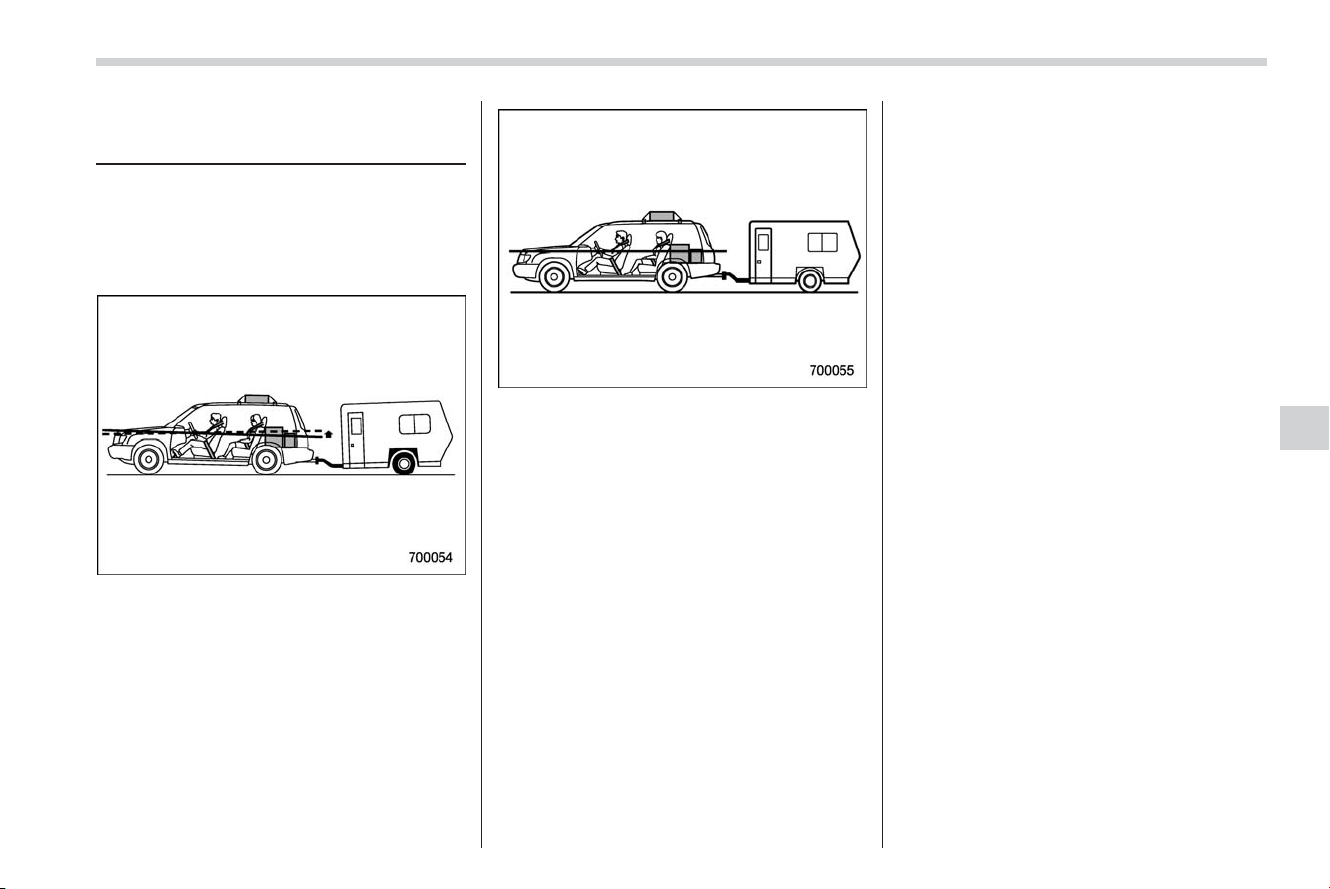
Black plate (239,1)
北米Model "A8130BE-B" EDITED: 2007/ 7/ 25
Self-leveling rear suspension
(if equipped)
The self-leveling suspension adjusts the
vehicle body p osition automatically to
keep it level at all times irrespective of
the number of occupants and the amount
of cargo.
The self-leveling system is incorporated in
the rear suspension shock absorber and
operates only w hen the vehicle is in
motion.
Owing to the self-leveling suspension, the
vehicle body is adjusted to the proper
position after several drive trips, even if
the rear of the vehicle is lowered by
loaded cargos or a coupled trailer.
If cargos are unloaded all at once, the
vehicle height may become higher than
the normal level. This is because that the
hydraulic pressure in the self-leveling
suspension was increased for leveling
the body when the cargos were loaded.
In such a case, the vehicle height will
return to the original level after several
driving trips.
NOTE
If the rear axle is loaded excessively,
the vehicle body may not be adjusted
to the proper position.
Starting and operating 7-31
7

Black plate (2,1)
Model "ALL_MODEL_MEMO" EDITED: 2006/ 1/ 17
Left Page
————————————————————————————————————————
————————————————————————————————————————
————————————————————————————————————————
————————————————————————————————————————
————————————————————————————————————————
————————————————————————————————————————
————————————————————————————————————————
————————————————————————————————————————
————————————————————————————————————————
————————————————————————————————————————
————————————————————————————————————————
————————————————————————————————————————
————————————————————————————————————————

Black plate (15,1)
北米Model "A8130BE-B" EDITED: 2007/ 7/ 25
New vehicle break-in driving – the first
1,000 miles (1,600 km) ..................................... 8-2
Fuel economy hints ............................................ 8-2
Engine exhaust gas (Carbon monoxide) ........... 8-2
Catalytic converter .............................................. 8-3
Periodic inspections ........................................... 8-4
Driving in foreign countries ............................... 8-4
Driving tips for AWD vehicles ............................ 8-5
Off road driving ................................................... 8-6
Winter driving ...................................................... 8-7
Operation during cold weather............................. 8-7
Driving on snowy and icy roads .......................... 8-9
Corrosion protection .......................................... 8-10
Snow tires ......................................................... 8-10
Tire chains......................................................... 8-10
Rocking the vehicle............................................ 8-11
Loading your vehicle......................................... 8-11
Vehicle capacity weight...................................... 8-12
GVWR and GAWR (Gross Vehicle Weight Rating
and Gross Axle Weight Rating) ........................ 8-12
Roof rail and crossbar (if equipped) ................... 8-13
Trailer hitch (if equipped) .................................. 8-16
Connecting a trailer ........................................... 8-16
When you do not tow a trailer ............................ 8-17
Trailer towing ..................................................... 8-18
Warranties and maintenance .............................. 8-18
Maximum load limits .......................................... 8-18
Trailer hitches.................................................... 8-21
Connecting a trailer ........................................... 8-22
Trailer towing tips .............................................. 8-23
Forester Sports 2.5XT front lip spoiler
(U.S. only)........................................................ 8-25
Driving tips
8
Black plate (242,1)
北米Model "A8130BE-B" EDITED: 2007/ 7/ 25
8-2 Driving tips
New vehicle break-in driving
– the first 1,000 miles (1,600
km)
The performance and long life of your
vehicle are dependent on how you handle
and care for your vehicle while it is new.
Follow these instructions during the first
1,000 miles (1,600 km):
. Do not race the engine. And do not
allow engine speed to exceed 4,000 rpm
except in an emergency.
. Do not drive at one constant engine or
vehicle speed for a long time, either fast or
slow.
. Avoid starting sudde nly and rapid
acceleration, except in an emergency.
. Avoid hard braking, except in an
emergency.
The same break-in procedures should be
applied to an overhauled engine, newly
mounted engine or when brake pads or
brake linings are replaced with new ones.
Fuel economy hints
The following suggestions will help to save
your fuel.
. Select the proper gear position for the
speed and road conditions.
. Avoid sudden acceleration or decelera-
tion. Always accelerate gently until you
reach the desired speed. Then try to
maintain that speed for as long as
possible.
. Do not pump the accelerator and avoid
racing the engine.
. Avoid unnecessary engine idling.
. Keep the engine properly tuned.
. Keep the tires inflated to the correct
pressure shown on the tire placard, which
is located under the door latch on the
driver’s side. Low pressure will increase
tire wear and fuel consumption.
. Use the air conditioner only when
necessary.
. Keep the front and rear wheels in
proper alignment.
. Avoid carrying unnecessary cargo.
Engine exhaust gas (Carbon
monoxide)
WARNING
. Never inhale engine exhaust gas.
Engine exhaust gas contains
carbon monoxide, a colorless
and odorless gas which is dan-
gerous, or even lethal, if inhaled.
. Always properly maintain the en-
gine exhaust system to prevent
engine exhaust gas from enter-
ing the vehicle.
. Never run the engine in a closed
space, such as a garage, except
for the brief time needed to drive
the vehicle in or out of it.
. Avoid remaining in a parked
vehicle for a lengthy time while
the engine is running. If that is
unavoidable, then use the venti-
lation fan to force fresh air into
the vehicle.
. Always keep the front ventilator
inlet grille free from snow, leaves
or other obstructions to ensure
that the ventilation system al-
ways works properly.
. If at any time you suspect that
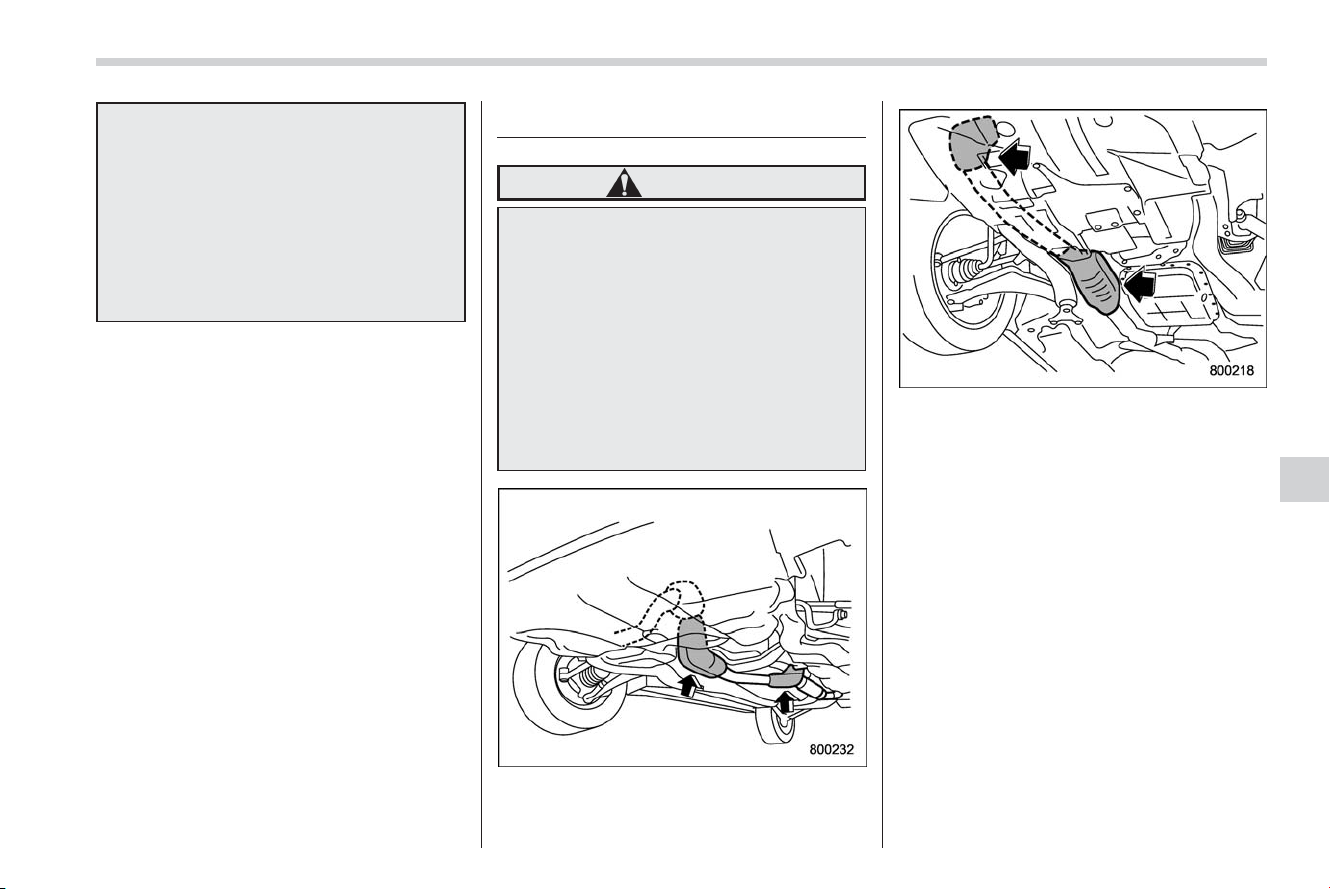
Black plate (243,1)
北米Model "A8130BE-B" EDITED: 2007/ 7/ 25
exhaust fumes are entering the
vehicle, have the problem
checked and corrected as soon
as possible. If you must drive
under these conditions, drive
only with all windows fully open.
. Keep the rear gate closed while
driving to prevent exhaust gas
from entering the vehicle.
NOTE
Due to the expansion and contraction
of the metals used in the manufacture
of the exhaust system, you may hear a
crackling sound coming from the ex-
haust system for a short time after the
engine has been shut off. This sound is
normal.
Catalytic converter
WARNING
. Avoid fire hazards. Do not drive
or park the vehicle anywhere
near flammabl e materials (e.g.
grass, paper, rags or leaves),
because the catalytic converter
operates at very high tempera-
tures.
. Keep everyone and flammable
materials away from the exhaust
pipe while the engine is running.
The exhaust gas is very hot.
Turbo model
Non-turbo model
The catalytic converter is installed in the
exhaust system. It serves as catalyst to
reduce HC, CO and NOx in exhaust
gases, thus providing cleaner exhaust.
To avoid damage to the catalytic conver-
ter:
. Use only unleaded fuel. Even a small
amount of leaded fuel will damage the
catalytic converter.
. Never start the engine by pushing or
pulling the vehicle.
. Avoid racing the engine.
. Never turn off the ignition switch while
the vehicle is moving.
. Keep your engine tuned-up. If you feel
the engine running rough (misfiring, back-
firing or incomplete combustio n), have
Driving tips 8-3
– CONTINUED –
8

Black plate (244,1)
北米Model "A8130BE-B" EDITED: 2007/ 7/ 25
8-4 Driving tips
your vehicle checked and repaired by an
authorized SUBARU dealer.
. Do not apply undercoating or rust
prevention treatment to the heat shield of
catalytic converter and the exhaust sys-
tem.
. Do not drive with an extremely low fuel
level.
Periodic inspections
To keep your vehicle in the best condition
at all times, always have the recom-
mended maintenance services listed in
the maintenance schedule in the “War-
ranty and Maintenance Booklet” per-
formed at the specified time or mileage
intervals.
Driving in foreign countries
When planning to use your vehicle in
another country:
. Confirm the availability of the correct
fuel. (Refer to the “Fuel requirements”
section in chapter 7.)
. Comply with all regulations and re-
quirements of each country.
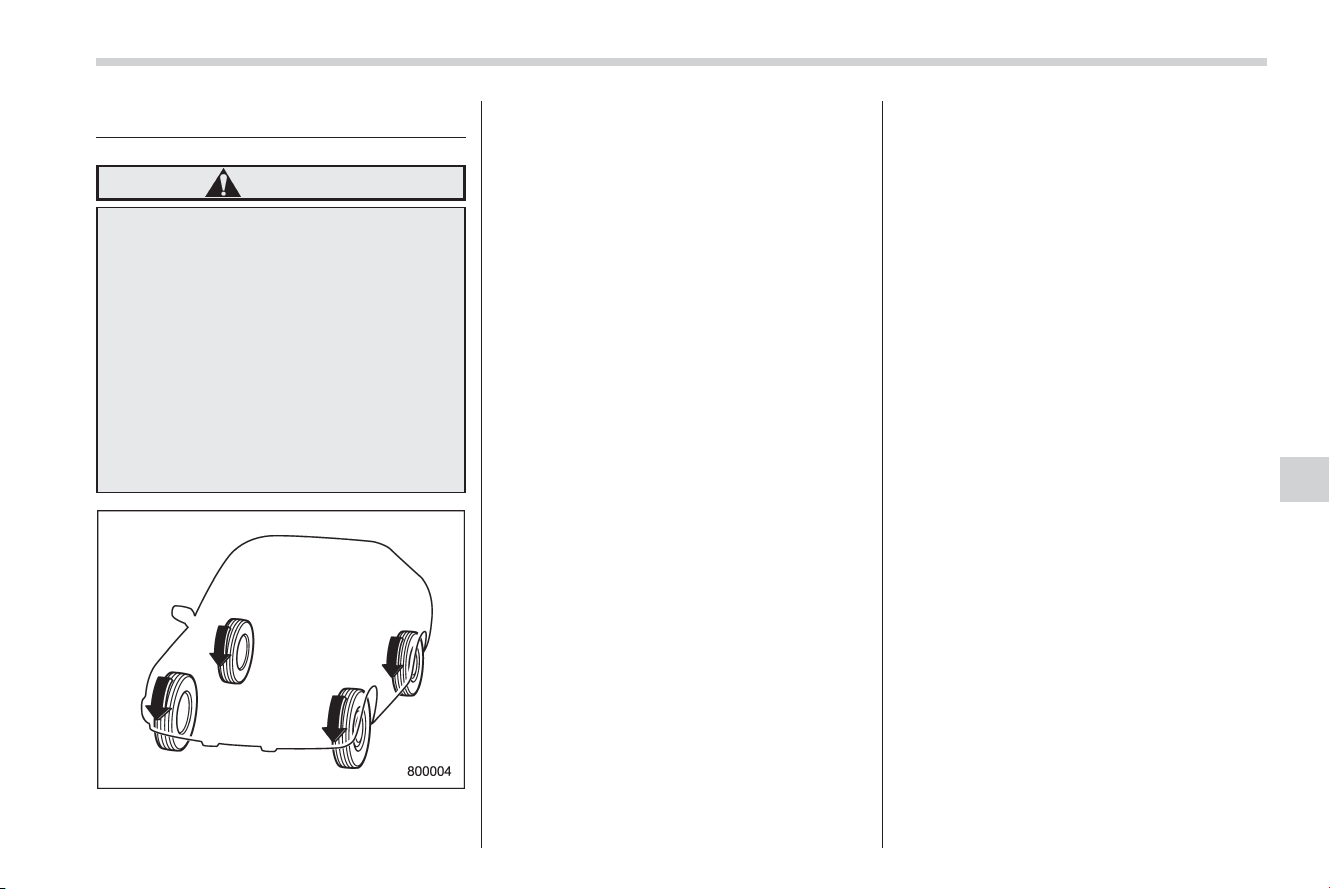
Black plate (245,1)
北米Model "A8130BE-B" EDITED: 2007/ 7/ 25
Driving tips for AWD vehicles
WARNING
. Always maintain a safe driving
speed according to the road and
weather conditions in order to
avoid having an accident on a
sharp turn, during sudden brak-
ing or under other similar condi-
tions.
. Always use the utmost care in
driving – overconfidence be-
cause you are driving an All-
Wheel Drive vehicle could easily
lead to a serious accident.
All-Wheel Drive distributes the engine
power to all four wheels. AWD vehicles
provide better traction when driving on
slippery, wet or snow-covered roads and
when moving out of mud, dirt and sand.
By shifting power between the front and
rear wheels, SUBARU AWD can also
provide added traction during acceleration
and added engine braking force during
deceleration.
Therefore, your SUBARU AWD vehicle
may handle differently than an ordinary
two wheel drive vehicle and it contains
some features unique to AWD. For safety
purposes as well as to avoid damaging
the AWD system, you should keep the
following tips in mind:
. An AWD vehicle is better able to climb
steeper roads under snowy or slippery
conditions than a two wheel drive vehicle.
There is little difference in handling,
however, during extremely sharp turns or
sudden braking. Therefore, when driving
down a slope or turning corners, be sure
to reduce your speed and maintain an
ample distance from other vehicles.
. When replacing a tire, make sure you
use only the same size , co nstruction,
brand, and load range as the original tires
listed on the tire placard. Using other sizes
or construction may result in severe
mechanical damage to the drive train of
your vehicle and may affect ride, handling,
braking, speedometer/odometer calibra-
tion, and clearance between the body
and tires. It also may be dangerous and
lead to loss of vehicle control.
. Always check the cold tire pressure
before starting to drive. The recom-
mended tire pressure is provided on the
tire placard, which is located under the
door latch on the driver’s side.
. Tire chains should always be placed on
the front wheels only.
. There are some precautions that you
must observe when towing your vehicle.
For detail information, see the “Towing”
section in chapter 9.
Driving tips 8-5
8
Black plate (246,1)
北米Model "A8130BE-B" EDITED: 2007/ 7/ 25
8-6 Driving tips
Off road driving
WARNING
. Always maintain a safe driving
speed according to the road and
weather conditions in order to
avoid having an accident on a
sharp turn, during sudden brak-
ing or under other similar condi-
tions.
. Always use the utmost care in
driving - overconfidence because
you are driving an All-Wheel
Drive vehicle could easily lead
to a serious accident.
Because of the AWD feature and higher
ground clearance, your SUBARU can be
driven on ordinary roads or off-road. But
please keep in mind that an AWD
SUBARU is a passenger car and is
neither a conventional off-road vehicle
nor an all-terrain vehicle. If you do take
your SUBARU off-road, certain common
sense precautions such as the following
should be taken:
. Make certain that you and all of your
passengers are wearing seatbelts.
. Carry some emergency equipment,
such as a towing rope or chain, a shovel,
wheel blocks, first aid kit and cell phone or
citizens band radio.
. Drive carefully. Do not take unneces-
sary risks by driving in dangerous areas or
over rough terrain.
. Slow down and employ extra caution at
all times. When driving off-road, you will
not have the benefit of marked traffic
lanes, banked curves, traffic signs and
the like.
. Do not drive across steep slopes.
Instead, drive either straight up or straight
down the slopes. A vehicle can much
more easily tip over sideways than it can
end over end. Avoid driving straight up or
down slopes that are too steep.
. Avoid sharp turning maneuvers, espe-
cially at higher speeds.
. Do not grip the inside or spokes of the
steering wheel. A bad bump could jerk the
wheel and injure your hands. Instead drive
with your fingers and thumbs on the
outside of the rim.
. If driving through water, such as when
crossing shallow streams, first check the
depth of the water and the bottom of the
stream bed for firmness and ensure that
the bed of the stream is flat. Drive slowly
and completely through the stream. The
water should be shallow enough that it
does not reach the vehicle’s undercar-
riage. Water entering the engine air intake
or the exhaust pipe or water splashing
onto electrical parts may damage your
vehicle and may cause it to stall. Never
attempt to drive through rushing water;
regardless of its depth, it can wash away
the ground from under your tires, resulting
in possible loss of traction and even
vehicle rollover.
. Always check your brakes for effec-
tiveness immediately after driving in sand,
mud or water. Do this by driving slowly
and stepping on the brake pedal. Repeat
that process several times to dry out the
brake discs and brake pads.
. Do not drive or park over or near
flammable materials such as dry grass or
fallen leaves, as they may burn easily. The
exhaust system is very hot while the
engine is running and right after the
engine stops. This could create a fire
hazard.
. After driving through tall grass, mud,
rocks, sand, rivers, etc., check that there
is no grass, bush, paper, rags, stones,
sand, etc. adhering to or trapped on the
underbody. Clear off any such matter from
the underbody. If the vehicle is used with
these materials trapped or adhering to the
underbody, a mechanical breakdown or
fire could occur.
. Secure all cargo carried inside the
vehicle and make certain that it is not
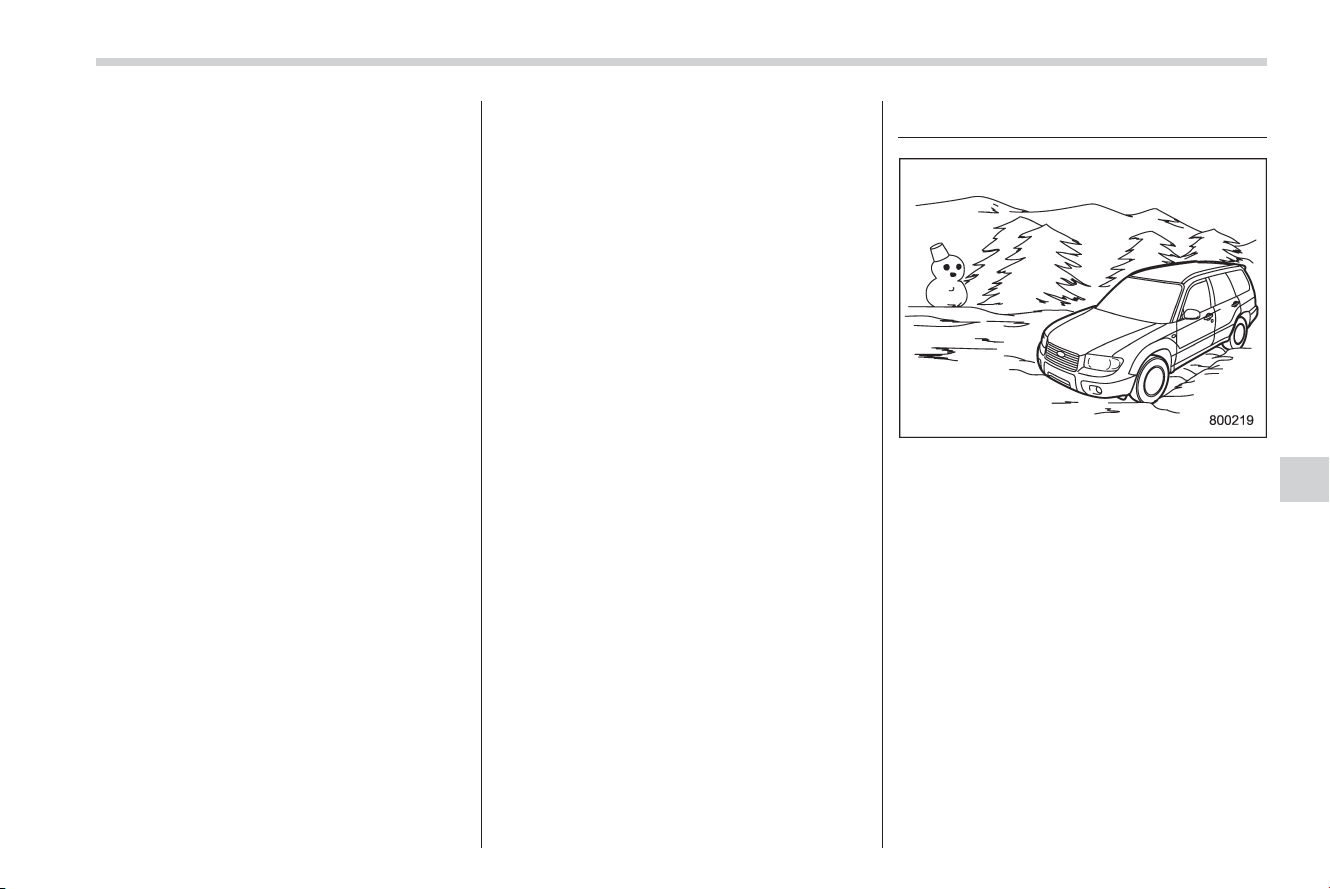
Black plate (247,1)
北米Model "A8130BE-B" EDITED: 2007/ 7/ 25
piled higher than the seatbacks. During
sudden stops or jolts, unsecured cargo
could be thrown around in the vehicle and
cause injury. Do not pile heavy loads on
the roof. Those loads raise the vehicle’s
center of gravity and make it more prone
to tip over.
. If you must rock the vehicle to free it
from sand or mud, depress the accelerator
pedal slightly and move the selector lever
back and forth between “D” and “R”
repeatedly. Do not race the engine. For
the best possible traction, avoid spinning
the wheels when trying to free the vehicle.
When the road surface is extremely
slippery, you can obtain better traction by
starting the vehicle with the transmission
in 2nd than 1st (both for MT and AT).
. Never equip your vehicle with tires
larger than those specified in this manual.
. Frequent driving of an AWD vehicle
under hard-driving conditions such a s
rough roads or off roads will necessitate
more frequent replacement of engine oil,
brake fluid and transmission oil than that
specified in the maintenance schedule
described in the “Warranty and Mainte-
nance Booklet”.
Remember that damage done to your
SUBARU while operating it off-road and
not using common sense pr ecautions
such as those listed above is not eligible
for warranty coverage.
. Wash the vehicle’s underbody after off-
road driving. Suspension components are
particularly prone to dirt buildup, so they
need to be washed thoroughly.
Winter driving
& Operation during cold
weather
Carry some emergency equipment, such
as tire chains, a window scraper, a bag of
sand, flares, a small shovel, and jumper
cables.
Check the battery and cables. Cold
temperatures reduce battery capacity.
The battery must be in good condition to
provide enough power for cold winter
starts.
Use an engine oil of proper grade and
viscosity for cold weather. Heavy summer
oil will cause harder starting.
Keep the door locks from freezing by
Driving tips 8-7
– CONTINUED –
8
Black plate (248,1)
北米Model "A8130BE-B" EDITED: 2007/ 7/ 25
8-8 Driving tips
squirting them with deicer or glycerin.
Forcing a frozen door open may damage
or sepa rate the rubber weather strips
around the door. If the door is frozen,
use hot water to melt the ice, and after-
wards thoroughly wipe the water away.
Use a windshield washer fluid that con-
tains an antifreeze solution. Do not use
engine antifreeze or other substitutes
because they may damage the paint of
the vehicle.
SUBARU Windshield Washer Fluid con-
tains 58.5% methyl alcohol and 41.5%
surfactant, by volume. Its freezing tem-
perature varies according to how much it
is diluted, as indicated in the following
table.
Washer Fluid Con-
centration
Freezing Temperature
30% 10.48F(−128C)
50% −48F(−208C)
100%
−498F(−458C)
In order to prevent freezing of washer
fluid, check the freezing temperatures in
the table above when adjusting the fluid
concentration to the outside temperature.
If you fill the reservoir tank with a fluid with
a different concentration from the one
used previously, purge the old fluid from
the piping between the reservoir tank and
washer nozzles by operating the washer
for a certain period of time. Otherwise, if
the concentration of the fluid remaining in
the piping is t oo low for the outside
temperature, it may freeze and block the
nozzles.
CAUTION
Adjust the washer fluid concentra-
tion appropriately for the outside
temperature. If the concentration is
inappropriate, sprayed washer fluid
may freeze on the windshield and
obstruct your view, and the fluid
may freeze in the reservoir tank.
! Before driving your vehicle
Before entering the vehicle, remove any
snow or ice from your shoes because that
could make the pedals slippery and
dangerous.
While warming up the vehicle before
driving, check that the accelerator pedal,
brake pedal, and all other controls operate
smoothly.
Clear away ice and snow that has
accumulated under the fenders to avoid
making steering difficult. During severe
winter driving, stop when and where it is
safe to do so and check under the fenders
periodically.
! Parking in cold weather
WARNING
Snow can trap dangerous exhaust
gases under your vehicle. Keep
snow clear of the exhaust pipe and
from around your vehicle if you park
the vehicle in snow with the engine
running.
Do not use the parking brake when
parking for long periods in cold weather
since it could freeze in that position.
Instead, observe the following.
1. Place the shift lever in “1” or “R” for
manual transmission vehicles, and in “P”
for automatic transmission vehicles.
2. Use tire stops under the tires to
prevent the vehicle from moving.
When the vehicle is parked in snow or
when it snows, raise the wiper blades off
the glass to prevent damage to them.
When the vehicle has been left parked
after use on roads heavily covered with
snow, or has been left parked during a
snowstorm, icing may develo p on the
brake system, which could cause poor
Black plate (249,1)
北米Model "A8130BE-B" EDITED: 2007/ 7/ 25
braking action. Check for snow or ice
buildup on the suspension, disc brakes
and brake hoses underneath the vehicle.
If there is caked snow or ice, remove it,
being careful not to damage the disc
brakes and brake hoses and ABS har-
ness.
! Refueling in cold weather
To help prevent moisture from forming in
the fuel system and the risk of its freezing,
use of an antifreeze additive in the fuel
tank is recommended during cold weather.
Use only additives that are specifically
designed for this purpose. When an
antifreeze additive is used, its effect lasts
longer if the tank is refilled whenever the
fuel level reaches half empty.
If your SUBARU is not going to be used
for an extended period, it is best to have
the fuel tank filled to capacity.
& Driving on snowy and icy
roads
WARNING
Do not use the cruise control on
slippery roads such as snowy or icy
roads. This may cause loss of
vehicle control.
CAUTION
Avoid prolonged continuous driving
in snowstorms. Snow will enter the
engine’sintakesystemandmay
hinder the air flow, which could
result in engine shutdown or even
breakdown.
To prevent skidding and slipping, avoid
sudden braking, abrupt acceleration, high-
speed driving, and sharp turning when
driving on snowy or icy roads.
Always maintain ample distance between
your vehicle and the vehicle ahead of you
to avoid the need for sudden braking.
To supplement the foot brake, use the
engine brake effectively to control the
vehicle speed. (Shift into a lower gear
when necessary.)
Avoid shifting down abruptly. Such beha-
vior can cause the wheels to lock, possibly
leading to loss of vehicle control.
An anti-lock brake system (ABS) en-
hances your vehicle’s b raking perfor-
mance on snowy and icy roads. Refer to
the “ABS (Anti-lock Brake System)” sec-
tion in chapter 7 for information on braking
on slippery surfaces.
! Wiper operation when snowing
Before driving in cold weather, make sure
the wiper blades are not frozen to the
windshield or rear window. If the wiper
blades are frozen to the windshield or rear
window, use the defroster with the airflow
control button/dial in the “ ” position and
the temperature control dial set for max-
imum warmth until the wiper blades are
completely thawed out. If your vehicle is
equipped with a wiper deicer, it is helpful
to thaw the windshield wiper blades. To
thaw out the rear wiper blade, use the rear
window defogger.
When driving in snow, if frozen snow starts
to stick on the surface of the windshield
despite wiper operation, use the defroster
with the airflow control button/dial in “
”
and the temperature control dial set for
maximum warmth. After the windshield
gets warmed enough to melt the frozen
snow on it, wash it away using the
windshield washer.
Snow stuck on the wiper arm prevents the
wiper from working effectively. If snow is
stuck on the wiper arm, pull off the road to
a safe place, then remove it. If you stop
the vehicle at road side, use the hazard
warning flasher to alert other drivers.
We recommend use of non-freezing type
Driving tips 8-9
– CONTINUED –
8
Black plate (250,1)
北米Model "A8130BE-B" EDITED: 2007/ 7/ 25
8-10 Driving tips
wiper blades (winter blades) during the
seasons you could have snow and sub-
zero temperatures. Blades of this type
give superior wiping performance in
snowy conditions. Be sure to use blades
that are suitable for your vehicle.
CAUTION
During high-speed driving, non-
freezing type wiper blades may not
perform as well as standard wiper
blades. If this happens, reduce the
vehicle speed.
NOTE
When the season requiring non-freez-
ing type wiper blades is over, replace
them with standard wiper blades.
& Corrosion protection
Refer to the “Corrosion protection” section
(chapter 10).
& Snow tires
WARNING
. When replacing original tires with
winter (snow) tires, make sure
you use only the same size,
construction and load range as
the original tires listed on the tire
placard. Using other sizes and
construction may affect speed-
ometer/odometer calibration and
clearance between the body and
tires. It also may be dangerous
and lead to loss of vehicle con-
trol.
. You must install four winter tires
that are of the same size, con-
struction, brand, and load range.
Mixing other sizes or construc-
tions may result in severe me-
chanical damage to the drive
train of your vehicle and may
affect ride, handling, braking and
speedometer/odometer calibra-
tion. It also may be dangerous
and lead to loss of vehicle con-
trol.
. Do not use a combinatio n of
radial, belted bias or bias tires
since it may cause dangerous
handling characteristics and lead
to an accident.
Your vehicle is equipped with “all season
tires” as original equipment, which are
designed to provide an adequate measure
of traction, handling and braking perfor-
mance in year-round driving. In winter, it
may be possible to enhance performance
through use of tires designed specifically
for winter driving conditions.
When you choose to install winter tires on
your vehicle, be sure to use the correct tire
size and type. You must install four winter
tires that are of the same size, construc-
tion, brand and load range and you should
never mix radial, belted bias or bias tires
since this may result in dangerous hand-
ling characteristics. When you choose a
tire, make sure that there is enough
clearance between the tire and vehicle
body.
Remember to drive with care at all times
regardless of the type of tires on your
vehicle.
& Tire chains
Driving on snowy grades or icy roads may
require the use of tire chains, in which
case put the chains on the front wheels
only. Use only SAE class S type chains
that are of the correct size for your tires so
as not to damage the vehicle body or
suspension.
When driving with tire chains, drive at
speeds below 19 mph (30 km/h).
Always use the utmost care when driving
with tire chains – overconfidence because
you are driving with tire chains could
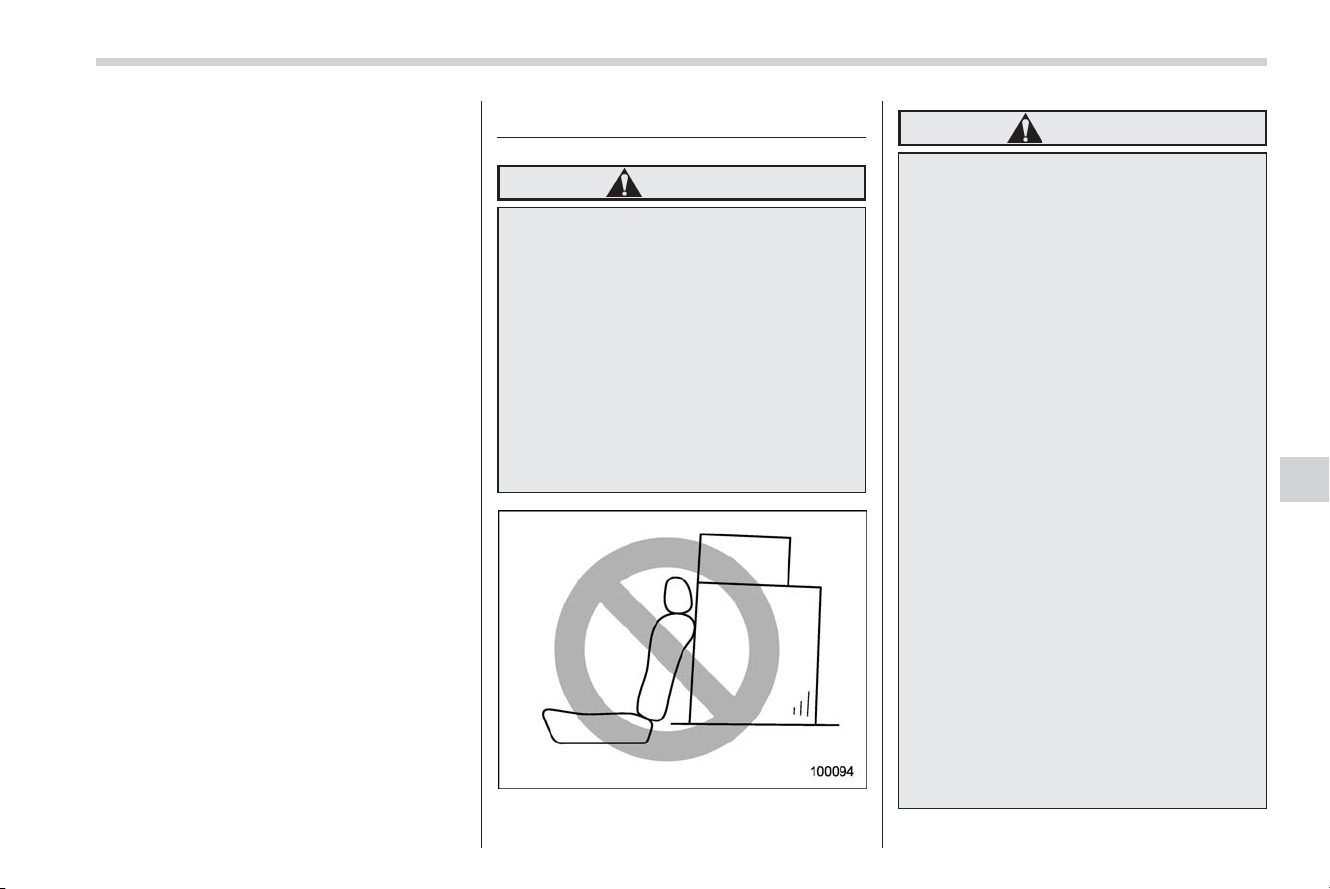
Black plate (251,1)
北米Model "A8130BE-B" EDITED: 2007/ 7/ 25
easily lead to a serious accident.
& Rocking the vehicle
If you must rock the vehicle to free it from
snow, sand, or mud, depress the accel-
erator pedal slightly and move the selector
lever back and forth between “D” and “R”
repeatedly. Do not race the engine. For
the best possible traction, avoid spinning
the wheels when trying to free the vehicle.
When the road surface is extremely
slippery, you can obtain better traction by
starting the vehicle with the transmission
in 2nd than 1st (both for MT and AT).
Refer to the “Automatic transmission”
section in chapter 7 for information on
holding the transmission in 2nd position.
Loading your vehicle
WARNING
. Never allow passengers to ride
on a folded rear seatback or in
the cargo area. Doing so may
result in serious injury.
. Never stack luggage or other
cargo higher than the top of the
seatback because it could tumble
forward and injure passengers in
the event of a sudden stop or
accident. Keep luggage or cargo
low, as close to the floor as
possible.
WARNING
. When you carry something inside
the vehicle, secure it whenever
you can to prevent it from being
thrown around inside the vehicle
during sudden stops, sharp turns
or in an accident.
. Do not pile heavy loads on the
roof. These loads raise the vehi-
cle’s center of gravity and make it
more prone to tip over.
. Secure lengthy items properly to
prevent them from shooting for-
ward and causing serious injury
during a sudden stop.
. Never exceed the maximum load
limit. If you do, some parts on
your vehicle can break, or it can
change the way your vehicle
handles. This could result in loss
of control and cause personal
injury. Also, overloading can
shorten the life of your vehicle.
. Do not place anything on the
extended cargo area cover. Such
items could tumble forward in the
event of a sudden stop or a
collision. This could cause ser-
ious injury.
Driving tips 8-11
– CONTINUED –
8
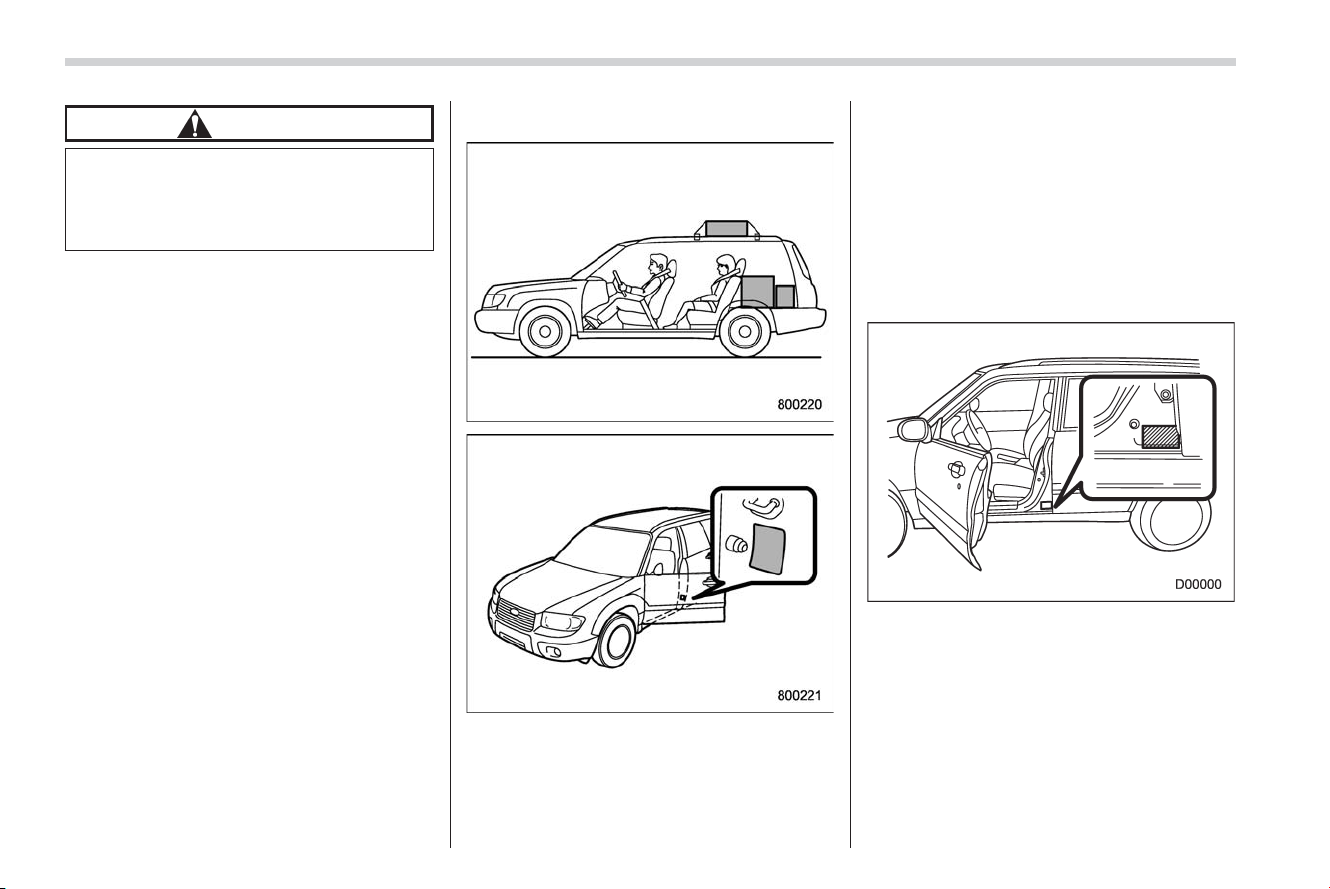
Black plate (252,1)
北米Model "A8130BE-B" EDITED: 2007/ 7/ 25
8-12 Driving tips
CAUTION
Do not carry spray cans, containers
with flammable or corrosive liquids
or any other dangerous items inside
the vehicle.
NOTE
For better fuel economy, do not carry
unneeded cargo.
& Vehicle capacity weight
The load capacity of your vehicle is
determined by weight, not by available
cargo space. The maximum load you can
carry in your vehicle is shown on the
vehicle placard attached to the driver’s
side door pillar. It includes the total weight
of the driver and all passengers and their
belongings, any optional equipment such
as a trailer hitch, roof rack or bike carrier,
etc., and the tongue load of a trailer.
& GVWR and GAWR (Gross
Vehicle Weight Rating and
Gross Axle Weight Rating)
The certification label attached to the
driver’s side door jamb shows GVWR
(Gross Vehicle Weight Rating) and GAWR
(Gross Axle Weight Rating).
The GVW (Gross Vehicle Weight) must
never exceed the GVWR. GVW is the
combined total of weight of the vehicle,
fuel, driver, all passengers, luggage, any
optional equipment and trailer tongue
load. Therefore, the GVW changes de-
Black plate (253,1)
北米Model "A8130BE-B" EDITED: 2007/ 7/ 25
pending on the situation. The GVWR
equals Curb Weight (actual weight of your
vehicle – including standard equipment,
fluids, emergency tools and spare tire
assembly) plus the vehicle capa city
weight.
In addition, the total weight applied to
each axle (GAW) must never exceed the
GAWR. The front and rear GAWs can be
adjusted by relocating luggage inside the
vehicle.
Even if the total weight of your luggage is
lower than the vehicle capacity weight,
either front or rear GAW may exceed the
GAWR, depending on the distribution of
the luggage.
When possible, the load should be evenly
distributed throughout the vehicle.
If you carry heavy loads in the vehicle, you
should confirm that GVW and front and
rear GAWs are within the GVWR and
GAWR by putting your vehicle on a
vehicle scale, found at a commercial
weighing station.
Do not use replacement tires with a lower
load range than the originals because they
may lower the GVWR and GAWR limita-
tions. Replacement tires with a higher load
range than the originals do not increase
the GVWR and GAWR limitations.
& Roof rail and crossbar (if
equipped)
CAUTION
. For cargo carrying purposes, the
roof rail must be used together
with a roof crossbar kit and the
appropriate carrying attachment.
The roof rail must never be used
alone to carry cargo. Otherwise,
damage to the roof or paint or a
dangerous road hazard due to
loss of cargo could result.
. When using the roof crossbar kit,
make sure that the total weight of
the crossbars, carrying attach-
ment and cargo does not exceed
the maximum load limit. Over-
loading may cause damage to
the vehicle and create a safety
hazard.
The roof rail is not designed to carry cargo
by itself. Cargo can be carried after
securing the roof crossbar kit to the roof
rail and installing the appropriate carrying
attachment. When installing the roof
crossbar kit, follow the manufacturer’s
instructions.
When you carry cargo on the roof using
the roof crossbar kit and a carrying
attachment, never exceed the maximum
load limit explained in the following. You
should also be careful that your vehicle
does not exceed the Gross Vehicle Weight
Rating (GVWR) and front and rear Gross
Axle Weight Rating (GAWR). See the
“Loading your vehicle” section in this
chapter for information on loading cargo
into or onto your vehicle. The maximum
load limit of the cargo, crossbars and
carrying attachment must not exceed 150
lbs (68 kg). Place the heaviest load at the
bottom, nearest the roof, and evenly
distribute the cargo. Always properly
secure all cargo.
! Installing carrying attachments on
the crossbars
When installing any carrying attachment
such as a bike carrier, ski carrier, kayak
carrier, cargo basket, etc. on the cross-
bars, follow the manufacturer’s instruc-
tions and make sure that the attachment is
securely fixed to the crossbars. Use only
attachments designed specifically for the
crossbars. A set of crossbars is designed
to carry loads (cargo and attachment) of
not more than 150 lbs (68 kg) . Before
operating the vehicle, make sure that the
cargo is properly secured on the attach-
ment.
Driving tips 8-13
– CONTINUED –
8
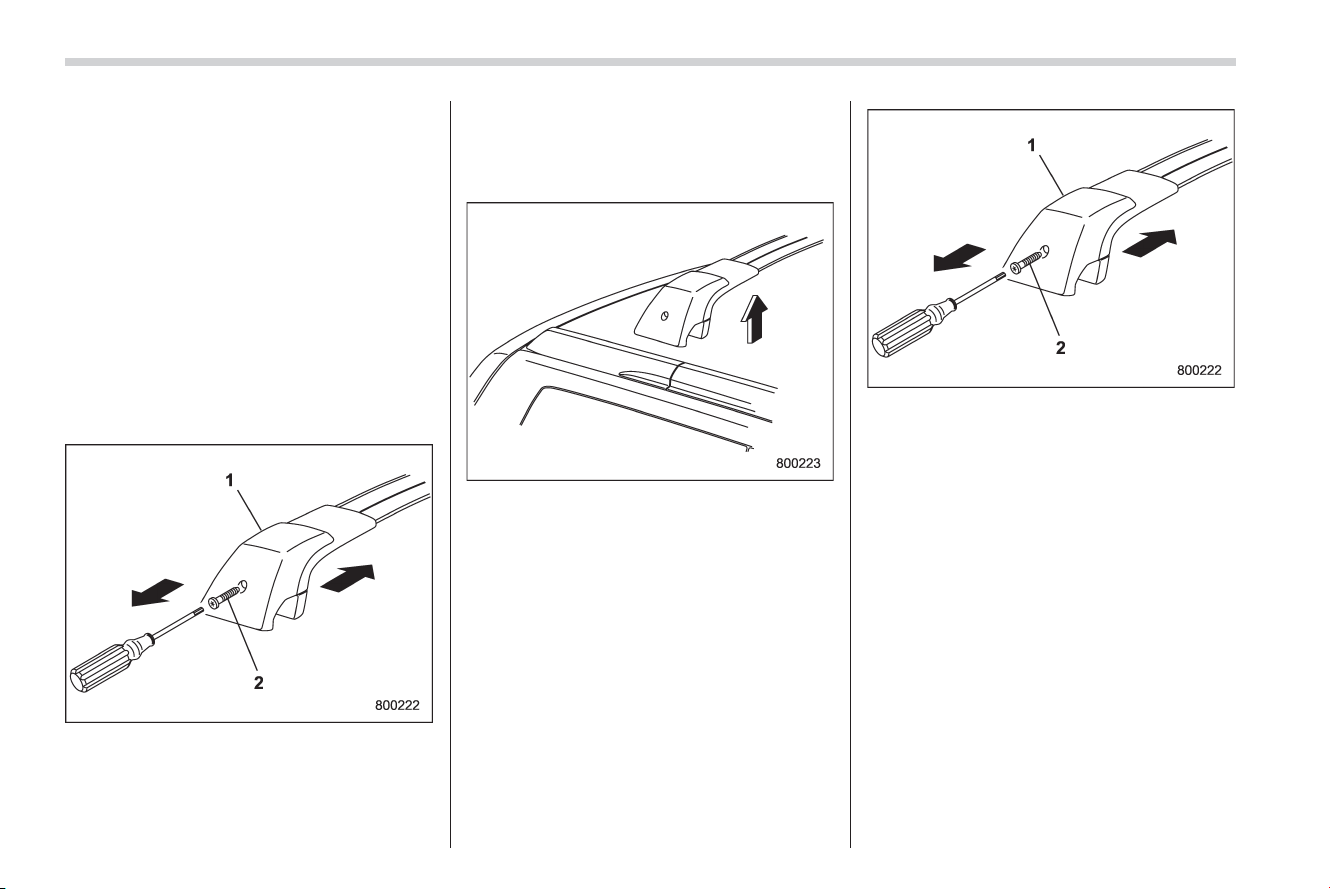
Black plate (254,1)
北米Model "A8130BE-B" EDITED: 2007/ 7/ 25
8-14 Driving tips
NOTE
Remember that the vehicle’s center of
gravity is altered with the weight of the
load on the roof, thus affecting the
driving characteristics.
Drive carefully. Avoid rapid starts, hard
cornering and abrupt stops. Crosswind
effects will be increased.
! Removal and installation of the
crossbars
The crossbars can be removed when you
do not use the roof to carry cargo.
! To remove the crossbar
1) Crossbar end support
2) T-30 torx® head screw
1. Loosen and remove the T-30 torx®
head screw from the top of each crossbar
end support.
2. Move the end support and inner clamp
to unhook each side of the crossbar from
the roof rail.
3. Carefully raise the crossbar from roof
rails.
NOTE
It may be necessary to move the Front
crossbar rearward, near the center of
the roof rail for easier removal. Use
care not to cross-thread the screw in
the insert if it has been removed.
! To install the crossbar
Front crossbar:
Front crossbar has 150 lbs. Load Label on
right-hand side.
1) Crossbar end support
2) T-30 torx® head screw
1. Before placing the crossbar on the roof
rails, make sure that the T-30 torx® head
screw is fully loosened from each end
support.
2. Spread the inner clamp and the end
support as far apart as possible.
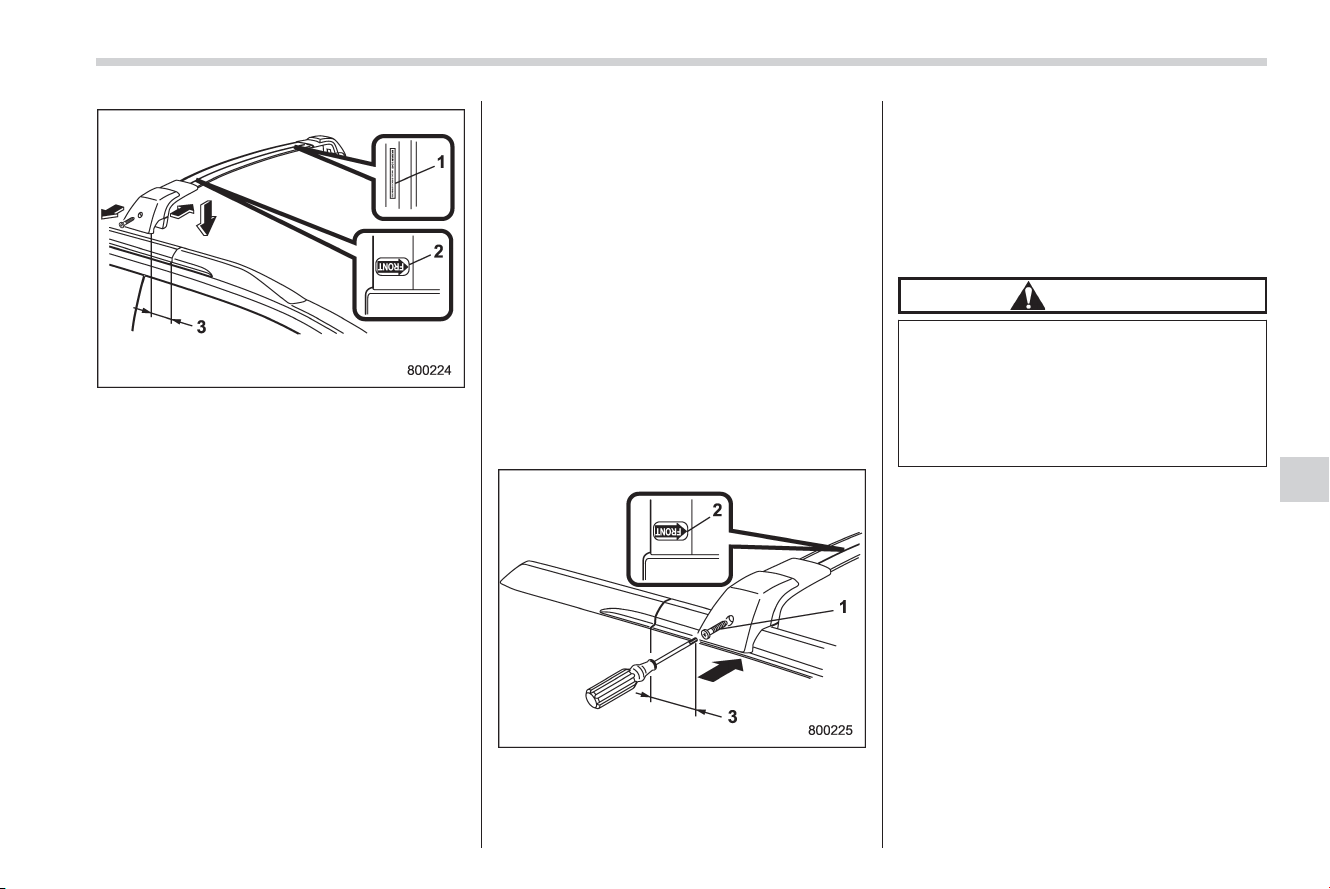
Black plate (255,1)
北米Model "A8130BE-B" EDITED: 2007/ 7/ 25
1) Load label
2) Direction arrow label
3) 6 in (150 mm)
3. With the front direction arrow label on
the top right side of the crossbar pointing
toward the front of the vehicle, carefully
place the crossbar across the top of the
vehicle so that the crossbar end supports
rest on the top of the roof rails approxi-
mately 6 inches (150 mm) rearward in the
front radius of the roof rail.
4. Move the end support and inner clamp
to hook under the end of the roof rail on
both sides and loosely assemble the T-30
torx® head screw with the tool provided
into the threaded insert in the inner clamp
on each end of the crossbar.
NOTE
It may be necessary to start the inner
clamp and end support at the center of
the roof rail for easier installation, then
move the crossbar forward. Use care
not to cross-thread the screw in the
insert if it has been removed.
5. Adjust the alignment of the crossbar
on the roof rails, and if available, use a T-
30 torx® bit and torque wrench and tighten
the T-30 torx® head screws to 30 to 35
lbf·in (3.4 to 4.0 N·m, 0.35 to 0.41 kgf·m) of
torque (or tighten securely with the torx®
wrench provided).
Rear crossbar:
1) T-30 torx® head screw
2) Front arrow label
3) 6 in (150 mm)
Install the rear crossbar in the same
manner as the front crossbar.
NOTE
The rear crossbar should be positioned
6 inches (150 mm) forward of the rear
radius in the roof rail.
CAUTION
Do not carry cargo on the roof when
the crossbars are removed. Lug-
gage on the roof w ill be thrown
forward or backward in sudden
stops or rapid accelerations, result-
ing in a dangerous road hazard.
NOTE
Before each use of the roof crossbar,
make sure the four T-30 crossbar
clamp screws have been checked,
and retightened if necessary to 30 to
35 lbf·in (3.4 to 4.0 N·m, 0.35 to 0.41
kgf·m), as outlined in Step #5 above.
Driving tips 8-15
8
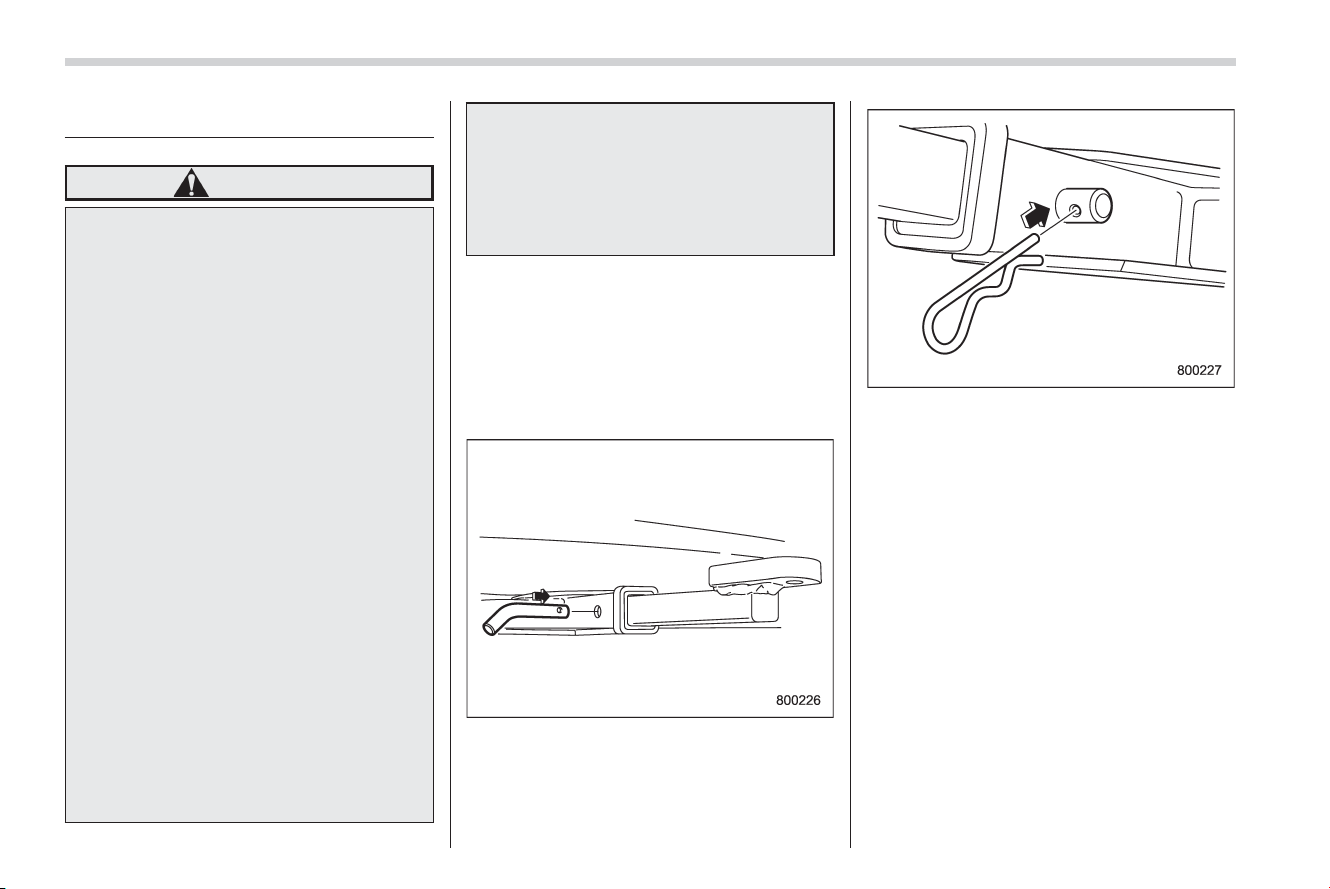
Black plate (256,1)
北米Model "A8130BE-B" EDITED: 2007/ 7/ 25
8-16 Driving tips
Trailer hitch (if equipped)
WARNING
. Never exceed the maximum
weight specified for the trailer
hitch. Exceeding the maximum
weight could cause an accident
resulting in serious personal in-
juries. Permissible trailer weight
changes depending on the situa-
tion. Refer to the next section
“Trailer towing” for possible re-
commendations and limitations.
. Trailer brakes are required when
the towing load exceeds 1,000
lbs (453 kg). Be sure your trailer
has safety chains and that each
chain will hold the trailer’s max-
imum gross weight. Towing trai-
lers without safety chains could
create a traffic safety hazard if
the trailer separates fr om the
hitch due to coupling damage or
hitch ball damage.
. Be sure to check the hitch pin
and safety pin for positive lock-
ing placement before towing a
trailer. If the ball mount comes off
the hitch receiver, the trailer
could get loose and create a
traffic safety hazard.
. Use only the ball mount supplied
with this hitch. Use the hitch only
as a weight carrying hitch. Do not
use with any type of weight
distributing hitch.
When you tow a trailer, follow the instruc-
tions in the next section “Trailer towing”.
& Connecting a trailer
1. Remove the receiver cover from the
hitch receiver tube. Then insert the ball
mount into the hitch receiver tube.
2. Insert the hitch pin into the hole on the
hitch receiver tube so that the pin passes
through the ball mount.
3. Insert the safety pin securely into the
hitch pin.
4. Pull the ball mount to make sure it
does not come off the hitch receiver.
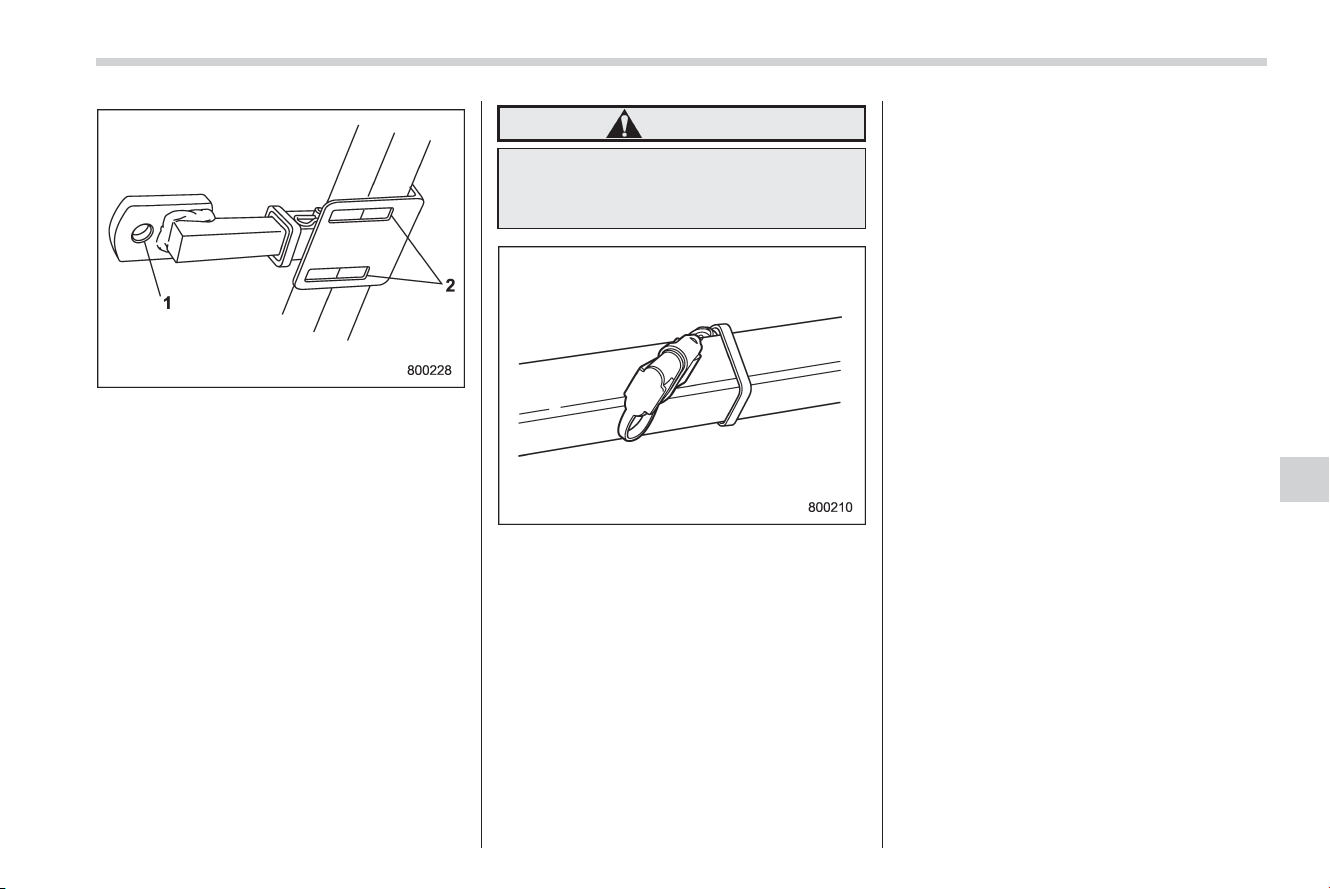
Black plate (257,1)
北米Model "A8130BE-B" EDITED: 2007/ 7/ 25
1) Hitch ball installation point
2) Hooks for safety chains
5. Use only a hitch ball that is appropriate
for the ball mount and your trailer. The
hitch ball must be securely installed on the
ball mount.
6. Connect your trailer to the hitch ball.
7. Connect the trailer and the hitch with
safety chains that will hold the trailer’s
maximum gross weight. The chains
should cross under the trailer tongue to
prevent the tongue from dropping onto the
ground in case it should disconnect from
the hitch ball. Allow sufficient slack in the
chains taking tight-turn situations into
account; however, be careful not to let
them drag on the ground.
WARNING
Do not connect safety chains to part
of the vehicle other than the safety
chain hooks.
Hitch harness connector
8. Connect the hitch wire harness’s black
four-pin wire connector to the towing
trailer’s wire harness
9. Confirm proper function of the hitch
wire harness by individually activating the
brake, right turn signal, left turn signal,
stop, and parking lights on the trailer.
NOTE
Always disconnect the trailer wire har-
ness before launching or retrieving a
watercraft.
& When you do not tow a trailer
. Remove the ball mount from the hitch
receiver tube and insert the receiver cover
onto the hitch receiver tube.
. Place the dust cap over the four-pin
connector of the hitch wire harness to
protect against possible damage.
. Occasionally lubricate terminals of the
four-pin connector using terminal grease.
Driving tips 8-17
8
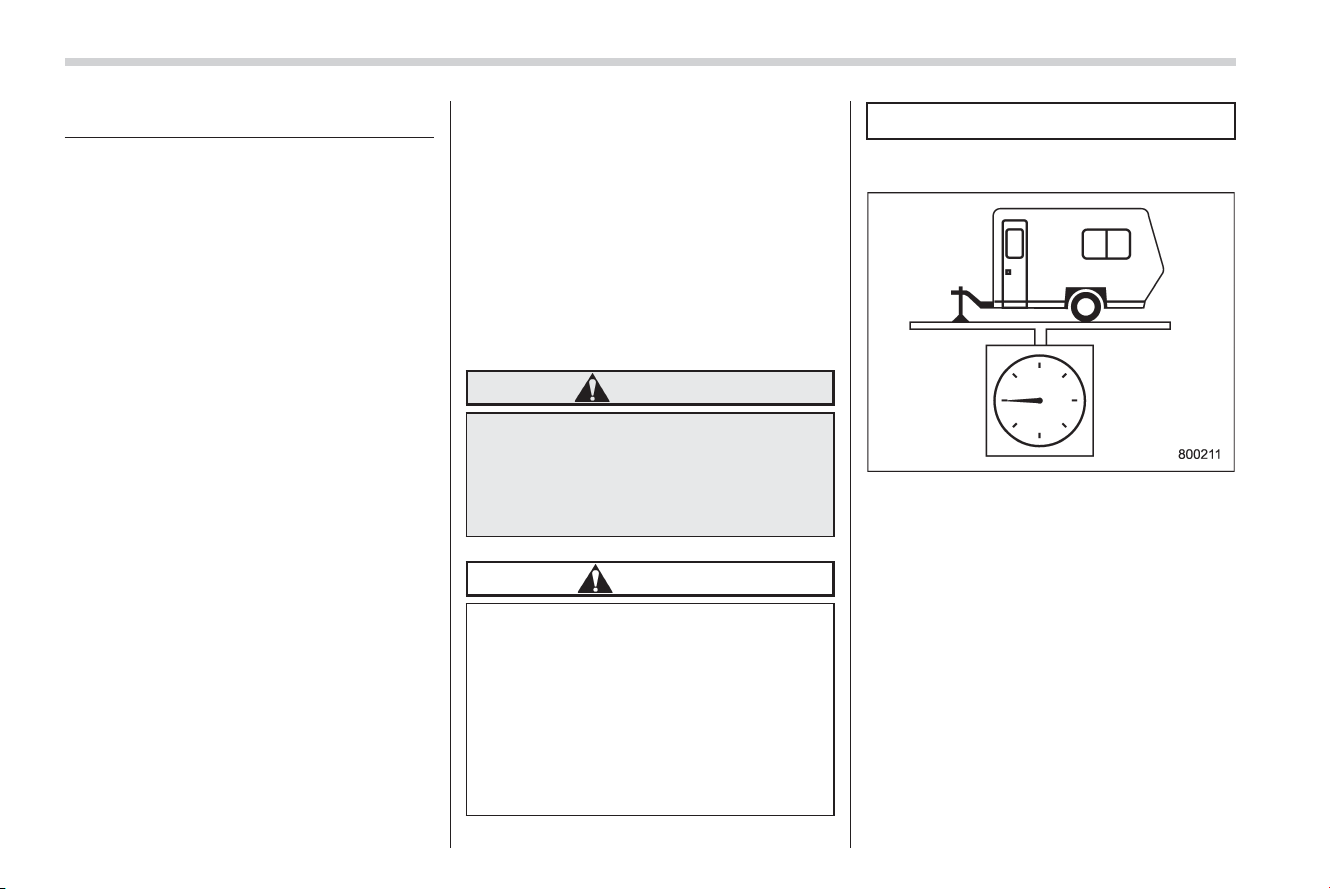
Black plate (258,1)
北米Model "A8130BE-B" EDITED: 2007/ 7/ 25
8-18 Driving tips
Trailer towing
Your vehicle is designed and intended to
be used primarily as a passenger-carrying
vehicle. Towing a trailer puts additional
loads on your vehicle’s engine, drivetrain,
brakes, tires and suspension and has an
adverse effect on fuel economy.
If you do decide to tow a trailer, your safety
and satisfaction depend upon proper use
of correct equipment and cautious opera-
tion of your vehicle. Seek the advice of
your SUBARU dealer to assist you in
purchasing a hitch and other necessary
towing equipment appropriate for your
vehicle. In addition, be sure to follow the
instructions on correct installation and use
provided by the trailer and other towing
equipment manufacturers.
SUBARU assumes no responsibility for
injuries or vehicle damage that result from
trailer towing equ ipment, or from any
errors or omissions in the instructions
accompanying such equipment or for your
failure to follow the proper instructions.
& Warranties and maintenance
SUBARU warranties do not apply to
vehicle damage or malfunction caused
by trailer towing. If you use your vehicle to
tow a trailer, more frequent maintenance
will be required due to the additional load.
(Refer to “Maintenance schedule under
severe driving conditions” in the “Warranty
and Maintenance Booklet”.)
Under no circumstances should a trailer
be towed with a new vehicle or a vehicle
with any new powertrain component (en-
gine, transmission, differential, wheel
bearings, etc.) for the first 1,000 miles
(1,600 km) of driving.
& Maximum load limits
WARNING
Never exceed the maximum load
limits explained in the following.
Exceeding the maximum load limits
could cause personal injury and/or
vehicle damage.
CAUTION
. Adequate size trailer brakes are
required when the trailer and its
cargo exceed 1,000 lbs (453 kg)
total weight.
. Before towing a trailer, check the
trailer total weight, GVW, GAWs
and tongue load. Make sure the
load and its distribution in your
vehicle and trailer are accepta-
ble.
! Total trailer weight
Total trailer weight
The total trailer weight (trailer weight plus
its cargo load) must never exceed the
maximum weight shown in the following
table.
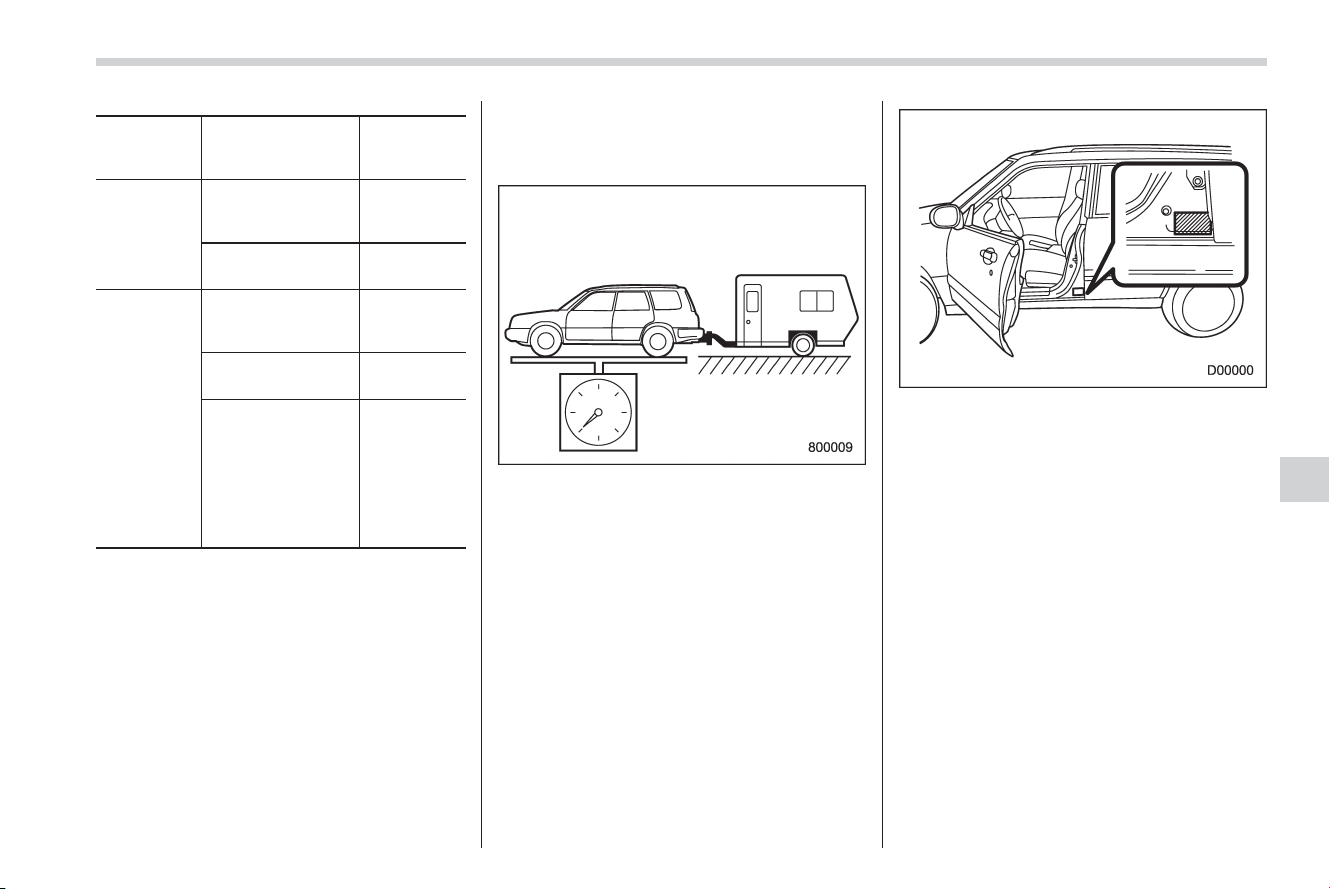
Black plate (259,1)
北米Model "A8130BE-B" EDITED: 2007/ 7/ 25
Model Conditions
Maximum
total trailer
weight
MT models
When towing a
trailer without
brakes.
1,000 lbs
(453 kg)
When towing a
trailer with brakes.
2,400 lbs
(1,087 kg)
AT models
When towing a
trailer without
brakes.
1,000 lbs
(453 kg)
When towing a
trailer with brakes.
2,400 lbs
(1,087 kg)
When towing a
trailer on a long
uphill grade con-
tinuously for over
5 miles (8 km) with
an outside tem-
perature of 1048F
(408C) or above.
1,000 lbs
(453 kg)
! Gross Vehicle Weight (GVW) and
Gross Vehicle Weight Rating
(GVWR)
Gross Vehicle Weight
The Gross Vehicle Weight (GVW) must
never exceed the Gross Vehicle Weight
Rating (GVWR).
Gross Vehicle Weight (GVW) is the
combined total of the weight of the vehicle,
driver, passengers, luggage, trailer hitch,
trailer tongue load and any other optional
equipment installed on your vehicle.
Therefore, the GVW changes depending
on the situation. Determine the GVW each
time before going on a trip by putting your
vehicle and trailer on a vehicle scale.
Certification label
GVWR is shown on the certification label
located on the driver’s side door jamb.
Driving tips 8-19
– CONTINUED –
8
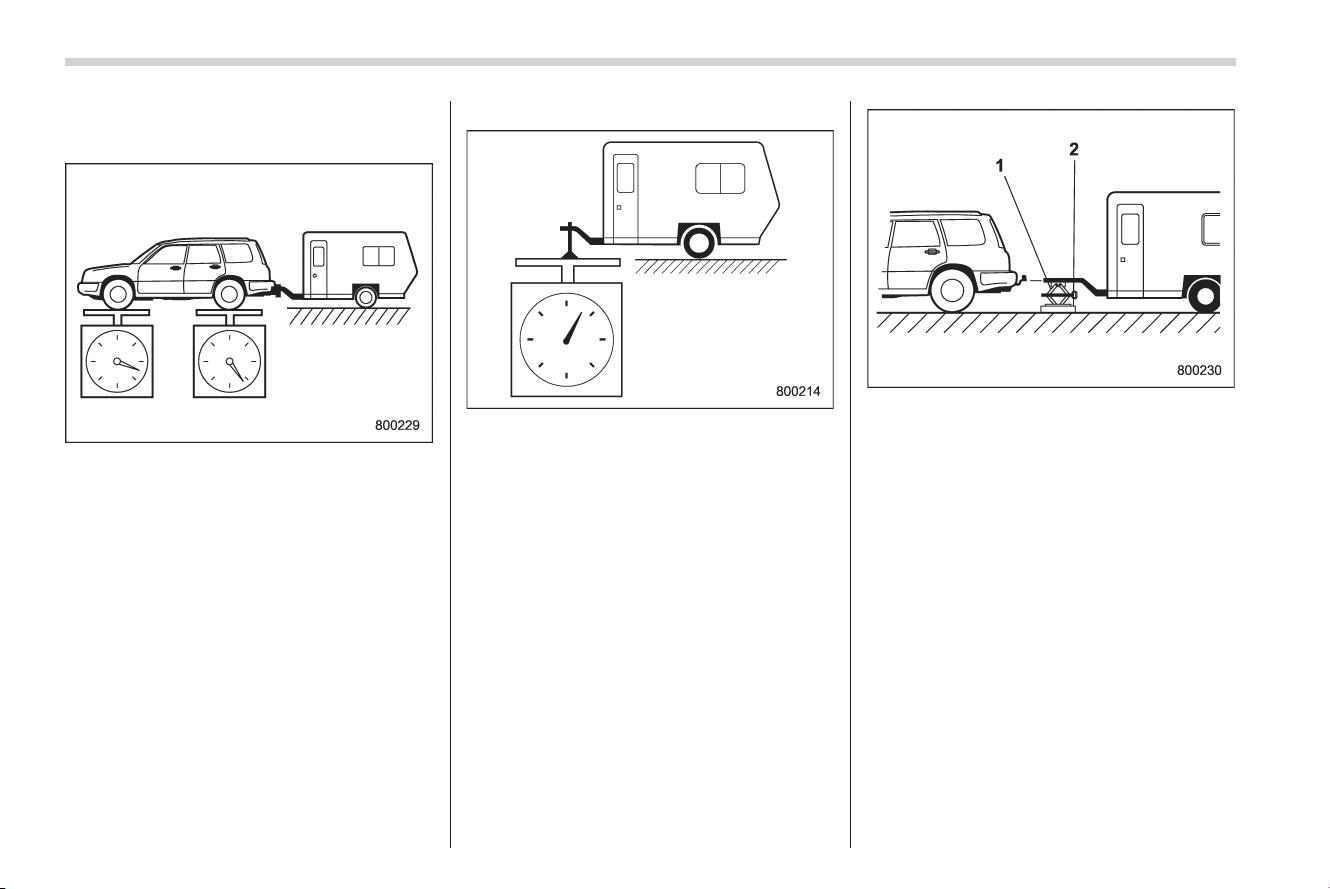
Black plate (260,1)
北米Model "A8130BE-B" EDITED: 2007/ 7/ 25
8-20 Driving tips
! Gross Axle Weight (GAW) and
Gross Axle Weight Rating (GAWR)
Gross Axle Weight
The total weight applied to each axle
(GAW) must never exceed the Gross Axle
Weight Rating (GAWR). The front and rear
GAWscanbeadjustedbyrelocating
passengers and luggage inside the vehi-
cle. The front and rear GAWR are also
shown on the certification label.
To check both GVWR and GAWR and to
confirm that the total weight and weight
distribution are within safe driving limits,
you should have your vehicle and trailer
weighed at a commercial weighing station.
Be sure that all cargo is firmly secured to
prevent a change in weight distribution
while driving.
! Tongue load
Tongue load
Ensure that the trailer tongue load is from
8 to 11 percent of the total trailer weight
and does not exceed the maximum value
of 200 lbs (90 kg).
1) Jack
2) Bathroom scale
The tongue load can be weighed with a
bathroom scale as shown in the illustration
above. When weighing the tongue load,
be sure to position the towing coupler at
the height at which it would be during
actual towing, using a jack as shown.
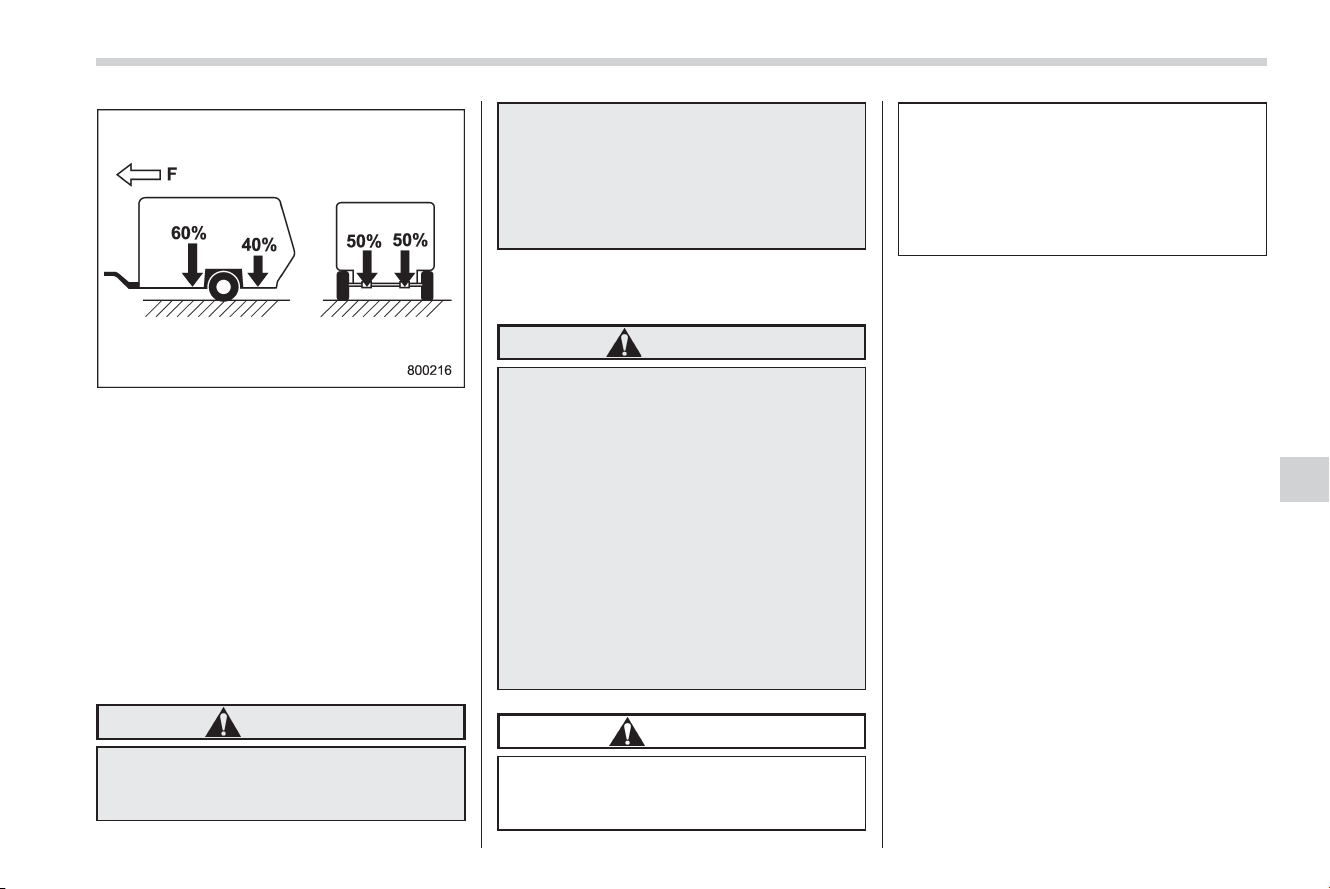
Black plate (261,1)
北米Model "A8130BE-B" EDITED: 2007/ 7/ 25
F: Front of vehicle
The tongue load can be adjusted by
proper distribution of the load in the trailer.
Never load the trailer with more weight in
the back than in the front; approximately
60 percent of the trailer load should be in
the front and approximately 40 percent in
the rear. Also, distribute the load as evenly
as possible on both the left and right
sides.
Be sure that all cargo is firmly secured to
prevent a change in weight distribution
while driving.
WARNING
If the trailer is loaded with more
weight in the back of trailer’s axle
than in the front, the load is taken off
the rear axle of the towing vehicle.
This may cause the rear wheels to
skid, especially during braking or
when vehicle speed is reduced dur-
ing cornering, resulting in over-
steer, spin out and/or jackknifing.
& Trailer hitches
WARNING
Never drill the frame or under-body
of your vehicle to install a commer-
cial trailer hitch. If you do, danger-
ous exhaust gas, water or mud may
enter the passenger compartment
through the drilled hole. Exhaust
gas contains carbon monoxide, a
colorless and odorless gas which is
dangerous, or even lethal, if inhaled.
Also, drilling the frame or under-
body of your vehicle could cause
deterioration of strength of your
vehicle and cause corrosion around
the drilled hole.
CAUTION
. Do not modify the vehicle ex-
haust system, brake system, or
other systems when installing a
hitch or other trailer towing
equipment.
. Do not use axle-mounted hitches
as they can cause damage to the
axle housing, wheel bearings,
wheels or tires.
Choose a proper hitch for your vehicle and
trailer.
The use of a genuine SUBARU trailer
hitch is recommended. A genuine
SUBARU hitch is available from your
SUBARU dealer.
If use of a non-genuine hitch is unavoid-
able, be sure the hitch is suited to your
vehicle and trailer. Consult with a profes-
sional hitch supplier to assist you in
choosing an appropriate hitch for your
vehicle. Be sure to follow all of the hitch
manufacturer’s instructions for installation
and use.
Never use a hitch that mounts only to the
rear bumper. The bumper is not designed
to handle that type of load.
For all types of hitches, regularly check
that the hitch mounting bolts and nuts are
tight.
Driving tips 8-21
– CONTINUED –
8
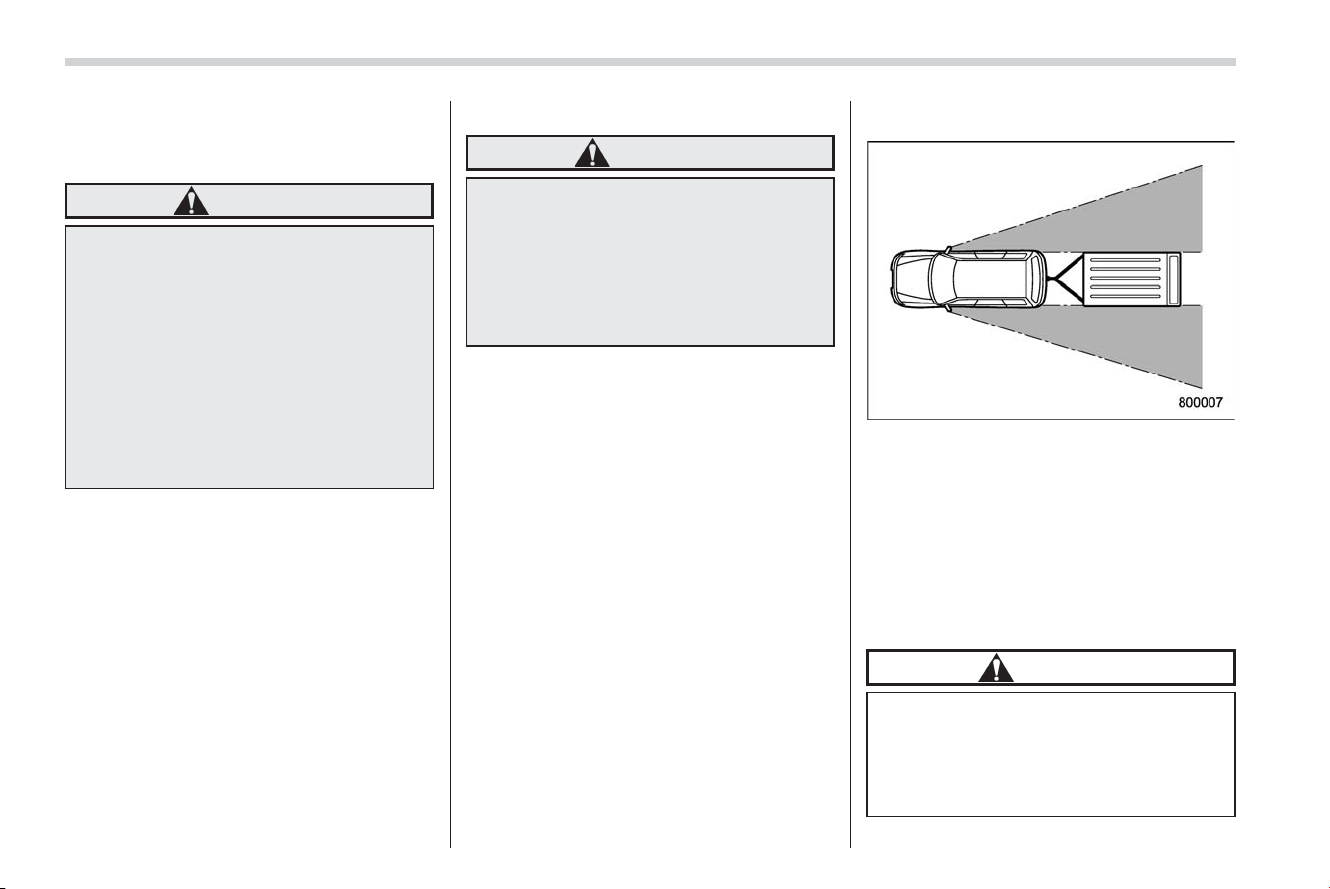
Black plate (262,1)
北米Model "A8130BE-B" EDITED: 2007/ 7/ 25
8-22 Driving tips
& Connecting a trailer
! Trailer brakes
WARNING
. Adequate size trailer brakes are
required when the trailer and its
cargo exceed 1,000 lbs (453 kg)
total weight.
. Do not directly connect your
trailer’s hydraulic brake system
to the hydraulic brake system in
your vehicle. Direct connection
would cause the vehicle’s brake
performance to deteriorate and
could lead to an accident.
If your trailer’s total weight (trailer weight
plus its cargo weight) exceeds 1,000 lbs
(453 kg), the trailer is required to be
equipped with its own brake system.
Electric brakes or surge brakes are
recommended, and must be installed
properly. Check that your trailer’s brakes
conform with Federal, state/province and/
or other applicable regulations. Your
SUBARU’s brake system is not designed
to be tapped into the trailer’s hydraulic
brake system. Please ask your SUBARU
dealer and professional trailer supplier for
more information about the trailer’s brake
system.
! Trailer safety chains
WARNING
Always use safety chains between
your vehicle and the trailer. Towing a
trailer without safety chains could
create a traffic safety hazard if the
trailer separates from the hitch due
to coupling damage or hitch ball
damage.
In case the trailer hitch connector or hitch
ball should break or become discon-
nected, the trailer could get loose and
create a traffic safety hazard.
For safety, always connect the towing
vehicle and trailer with trailer safety
chains. Pass the chains crossing each
other under the trailer tongue to prevent
the trailer from dropping onto the ground
in case the trailer tongue should discon-
nect from the hitch ball. Allow sufficient
slack in the chains taking tight-turn situa-
tions into account; however, be careful not
to let them drag on the ground.
For more information about the safety
chain connection, refer to the instructions
for your hitch and trailer.
! Side mirrors
After hitching a trailer to your vehicle,
check that the standard side mirrors
provide a good rearward field of view
without significant blind spots. If significant
blind spots occur with the vehicle’s stan-
dard side mirrors, use towing mirrors that
conform with Federal, state/province and/
or other applicable regulations.
! Trailer lights
CAUTION
Direct splicing or other improper
connection of trailer lights may
damage your vehicle’s electrical
system and cause a malfunction of
your vehicle’s lighting system.
Black plate (263,1)
北米Model "A8130BE-B" EDITED: 2007/ 7/ 25
Connection of trailer lights to your vehi-
cle’s electrical system requires modifica-
tions to the vehicle’s lighting circuit to
increase its capacity and accommodate
wiring changes. To ensure the trailer lights
are connected properly, please consult
your SUBARU dealer. Check for proper
operation of the turn signals, the brake
lights and parking lights each time you
hitch up.
! Tires
WARNING
Never tow a trailer when the tem-
porary spare tire is used. The tem-
porary spare tire is not designed to
sustain the towing load. Use of the
temporary spare tire when towing
can result in failure of the spare tire
and/or less stability of the vehicle.
Make sure that all the tires on your vehicle
are properly inflated.
The recommended cold tire pressure
under trailer towing conditions is shown
in chapter 12, “Spe cifications ” and in
“GAS STATION REFERE NCE” at the
end of this manual. Adjust the rear tire
pressure to the recommended pressure
when the tires are cold. Normal pressure
should be maintained in the front tires.
Trailer tire condition, size, load rating and
proper inflation pressure should be in
accordance with the trailer manufacturer’s
specifications.
In the event your vehicle gets a flat tire
when towing a trailer, ask a commercial
road service to repair the flat tire.
If you carry a regular size spare tire in your
vehicle or trailer as a precaution against
getting a flat tire, be sure that the spare
tire is firmly secured.
& Trailer towing tips
WARNING
. Never exceed 45 mph (72 km/h)
when towing a trailer in hilly
country on hot days.
. When towing a trailer, steering,
stability, stopping distance and
braking performance will be dif-
ferent from normal operation. For
safety’s sake, you should employ
extracautionwhentowinga
trailer and you should never
speed. You should also keep the
following tips in mind:
! Before starting out on a trip
. Check that the vehicle and vehicle-to-
hitch mounting are in good condition. If
any problems are apparent, do not tow the
trailer.
. Check that the vehicle sits horizontally
with the trailer attached. If the vehicle is
tipped sharply up at the front and down at
the rear, check the total trailer weight,
GVW, GAWs and tongue load again, then
confirm that the load and its distribution
are acceptable.
. Check that the tire pressures are
correct.
. Check that the vehicle and trailer are
connected properly. Confirm that
– the trailer tongue is connected
properly to the hitch ball.
– the trailer lights connector is con-
nected properly and trailer’sbrake
lights illuminate when the vehicle’s
brake pedal is pressed, and that the
trailer’s turn signal lights flash when
the vehicle’s turn signal lever is oper-
ated.
– the safety chains are connected
properly.
– all cargo in the trailer is secured
safety in position.
– the side mirrors provide a goo d
rearward field of view without a sig-
Driving tips 8-23
– CONTINUED –
8
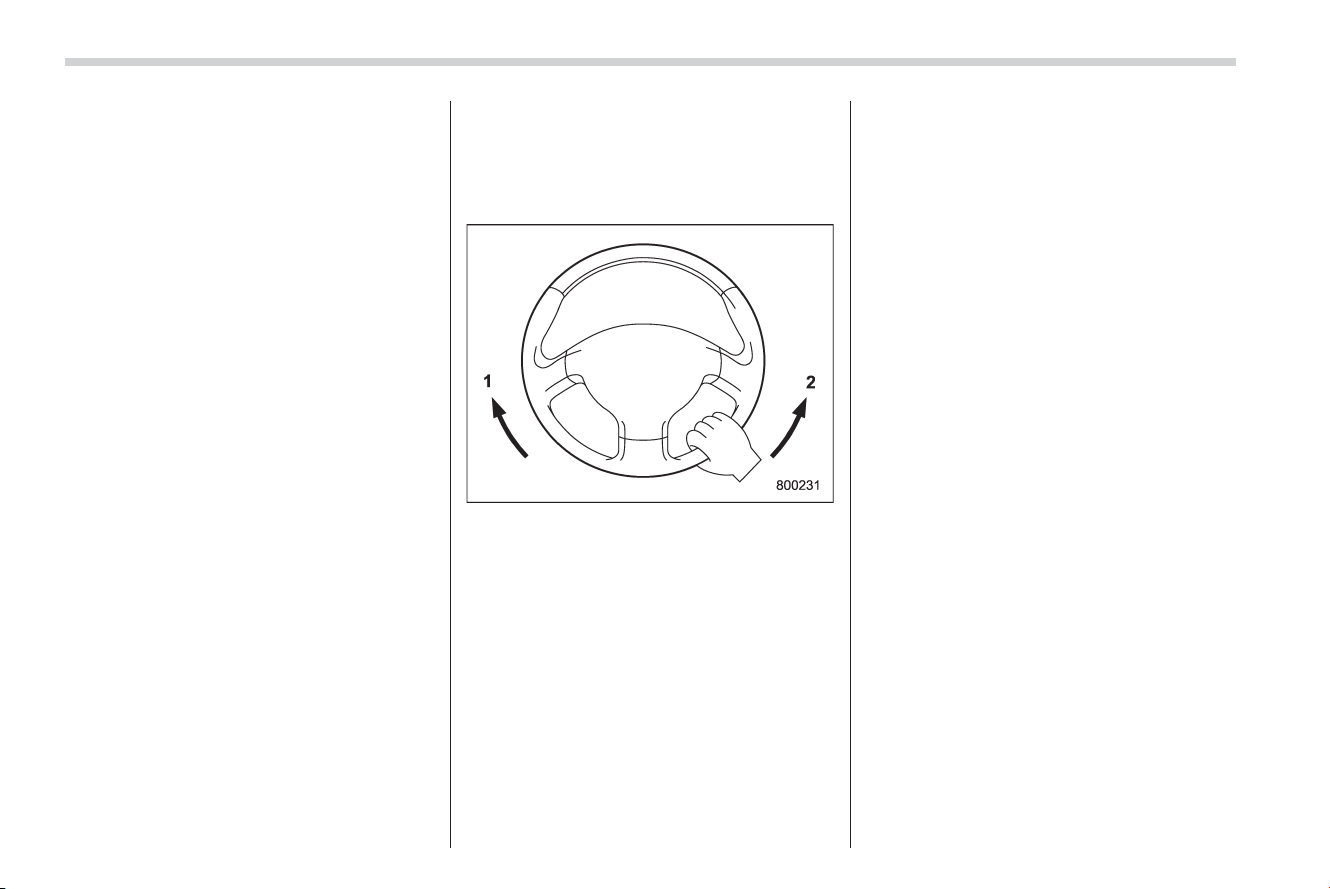
Black plate (264,1)
北米Model "A8130BE-B" EDITED: 2007/ 7/ 25
8-24 Driving tips
nificant blind spot.
. Sufficient time should be taken to learn
the “feel” of the vehicle/trailer combination
before starting out on a trip. In an area free
of traffic, practice turning, stopping and
backing up.
! Driving with a trailer
. You should allow for considerably more
stopping distance when towing a trailer.
Avoid sudden braking because it may
result in skidding or jackknifing and loss of
control.
. Avoid abrupt starts and sudden accel-
erations. If your vehicle has a manual
transmission, always start out in first gear
and release the clutch at moderate engine
revolution.
. Avoid uneven steering, sharp turns and
rapid lane changes.
. Slow down before turning. Make a
longer than normal turning radius because
the trailer wheels will be closer than the
vehicle wheels to the inside of the turn. In
a tight turn, the trailer could hit your
vehicle.
. Crosswinds will adversely affect the
handling of your vehicle and trailer, caus-
ing sway. Crosswinds can be due to
weather conditions or the passing of large
trucks or buses. If swaying occurs, firmly
grip the steering wheel and slow down
immediately but gradually.
. When passing other vehicles, consid-
erable distance is required because of the
added wei ght and len gth caused by
attaching the trailer to your vehicle.
1) Left turn
2) Right turn
. Backing up with a trailer is difficult and
takes practice. When backing up with a
trailer, never accelerate or steer rapidly.
When turning back, grip the bottom of the
steering wheel with one hand and turn it to
the left for a left turn, and turn it to the right
for a right turn.
. If the ABS warning light illuminates
while the vehicle is in motion, stop towing
the trailer and have repairs performed
immediately by the nearest SUBARU
dealer.
! Driving on grades
. Before going down a steep hill, slow
down and shift into lower gear (if neces-
sary, use 1st gear) in order to utilize the
engine braking effect and prevent over-
heating of your vehicle’s brakes. Do not
make sudden downshifts.
. When driving uphill in hot weather, the
air conditioner may turn off automatically
to protect the engine from overheating.
. When driving uphill in hot weather, pay
attention to the water temperature gauge
pointer (for all vehicles) and AT OIL TEMP
warning light (for AT vehicles) since the
engine and transmissio n are relative ly
prone to overheating under these condi-
tions. If the water temperature gauge
pointer approaches the OVERHEAT zone
or the AT OIL TEMP warning light illumi-
nates, immediately switch off the air
conditioner and stop the vehicle at the
nearest safe place. Refer to the “Engine
overheating” section in chapter 9, and
“Warning and indicator lights” section in
chapter 3.
. If your vehicle has an automatic trans-
mission, avoid using the accelerator pedal
to stay stationary on an uphill slope
instead of using the parking brake or foot
brake. That may cause the transmission
fluid to overheat.
. If your vehicle has an automatic trans-
Black plate (265,1)
北米Model "A8130BE-B" EDITED: 2007/ 7/ 25
mission, place the selector lever as
follows:
Uphill slopes: “D” position
Downhill slopes: A low-speed gear posi-
tion to use engine braking
! Parking on a grade
Always block the wheels under both
vehicle and trailer when parking. Apply
the parking brake firmly. You should not
park on a hill or slope. But if parking on a
hill or slope cannot be avoided, you
should take the following steps:
1. Apply the brakes and hold the pedal
down.
2. Have someone place wheel blocks
under both the vehicle and trailer wheels.
3. When the wheel blocks are in place,
release the regular brakes slowly until the
blocks absorb the load.
4. Apply the regular brakes and then
apply the parking brake; slowly release
the regular brakes.
5. Shift into 1st or reverse gear (manual
transmission) or “P” (automatic transmis-
sion) and shut off the engine.
Forester Sports 2.5XT front
lip spoiler (U.S. only)
CAUTION
. Your vehicle’s ground clearance
and approach angle are de-
creased due to the addition of
the front lip spoiler. Please ex-
ercise caution when parking the
vehicle, driving over speed
bumps, traveling up or down
steep inclines, or when under-
taking any other maneuver that
may involve the front end of the
vehicle.
. When towing a vehicle or loading
it onto a flatbed tow truck, extra
precautions must be taken to
ensure proper clearance between
the front lip spoiler and the
loading ramp or towing appara-
tus. Failure to allow for proper
clearance in these situations may
result in damage to the front lip
spoiler that is not covered under
warranty.
Extra care must be taken with vehicles
equipped with the front lip spoiler to avoid
damage to that accessory.
Driving tips 8-25
8

Black plate (2,1)
Model "ALL_MODEL_MEMO" EDITED: 2006/ 1/ 17
Left Page
————————————————————————————————————————
————————————————————————————————————————
————————————————————————————————————————
————————————————————————————————————————
————————————————————————————————————————
————————————————————————————————————————
————————————————————————————————————————
————————————————————————————————————————
————————————————————————————————————————
————————————————————————————————————————
————————————————————————————————————————
————————————————————————————————————————
————————————————————————————————————————

Black plate (17,1)
北米Model "A8130BE-B" EDITED: 2007/ 7/ 25
If you park your vehicle in an emergency......... 9-2
Temporary spare tire (if equipped) .................... 9-2
Flat tires............................................................... 9-4
Changing a flat tire.............................................. 9-4
Tire pressure monitoring system (TPMS)
(if equipped)...................................................... 9-7
Jump starting ...................................................... 9-8
How to jump start................................................ 9-9
Engine overheating ............................................ 9-11
If steam is coming from the engine
compartment.................................................... 9-11
If no steam is coming from the engine
compartment ................................................... 9-11
Towing ................................................................ 9-11
Towing and tie-down hooks................................ 9-12
Using a flat-bed truck......................................... 9-13
Towing with all wheels on the ground................. 9-13
Rear gate – if the rear gate cannot be
unlocked.......................................................... 9-14
Moonroof – if the moonroof cannot be
closed .............................................................. 9-14
Maintenance tools ............................................. 9-15
Jack and jack handle ......................................... 9-15
In case of emergency
9
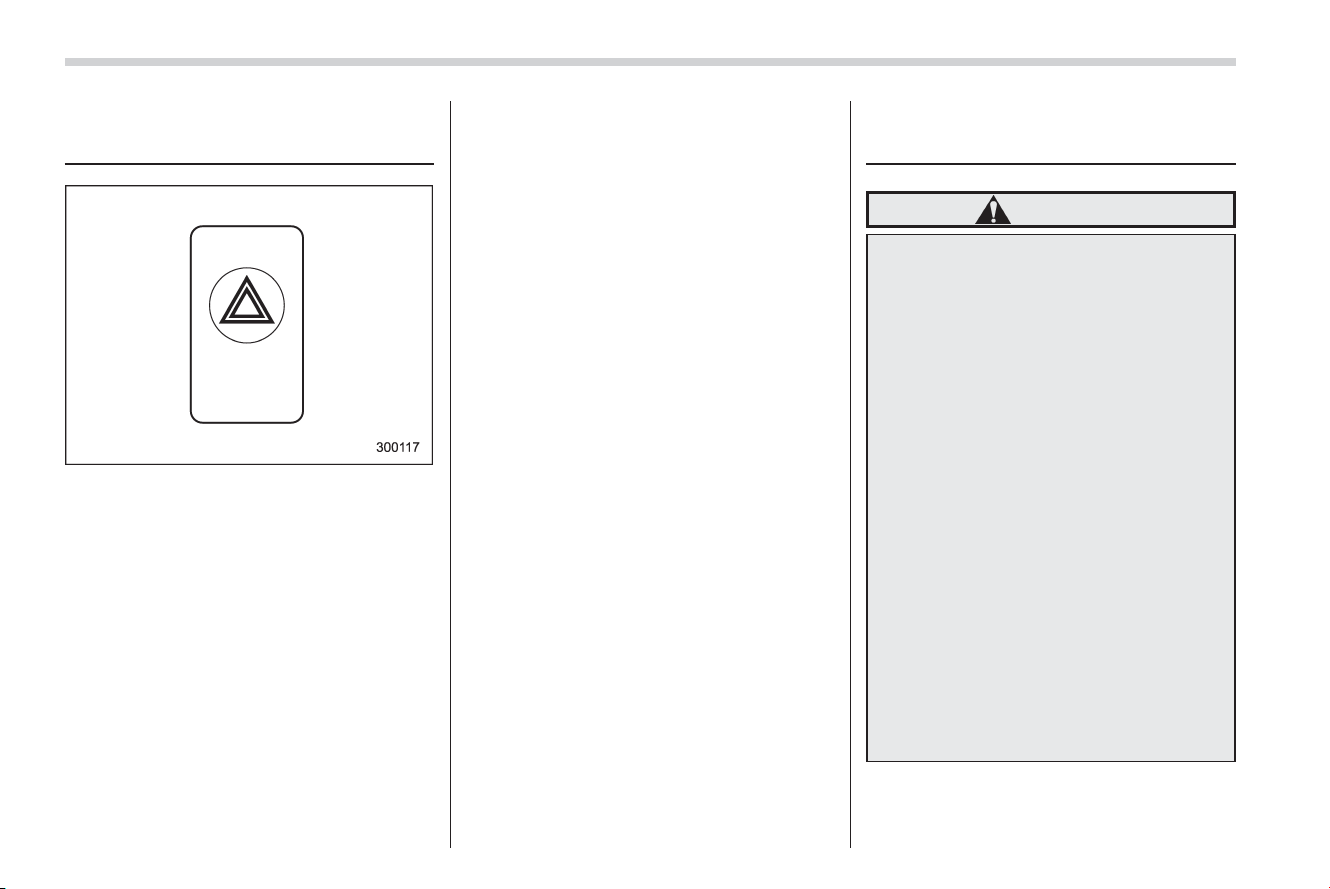
Black plate (268,1)
北米Model "A8130BE-B" EDITED: 2007/ 7/ 25
9-2 In case of emergency
If you park your vehicle in an
emergency
The hazard warning flasher should be
used in day or night to warn other drivers
when you have to park your vehicle under
emergency conditions.
Avoid stopping on the road. It is best to
safely pull off the road if a problem occurs.
The hazard warning flasher can be acti-
vated regardless of the ignition switch
position.
Turn on the hazard warning by pushing
the hazard warning flasher switch. Turn it
off by pushing the switch again.
NOTE
When the hazard warning flasher is on,
the turn signals do not work.
Temporary spare tire (if
equipped)
WARNING
. Never tow a trailer when the
temporary spare tire is used.
The temporary spare tire is not
designed to sustain the towing
load. Use of the temporary spare
tire when towing can result in
failure of the spare tire and/or
less stability of the vehicle and
may lead to an accident.
. When a spare tire is mounted or a
wheel rim is replaced without the
original pressure sensor/trans-
mitter being transferred, the low
tire pressure warning light will
illuminate steadily after blinking
for approximately one minute.
This indicates the tire pressure
monitoring system (TPMS) is un-
able to monitor all four road
wheels. Contact your SUBARU
dealer as soon as possible for
tire and sensor replacement and/
or system resetting.
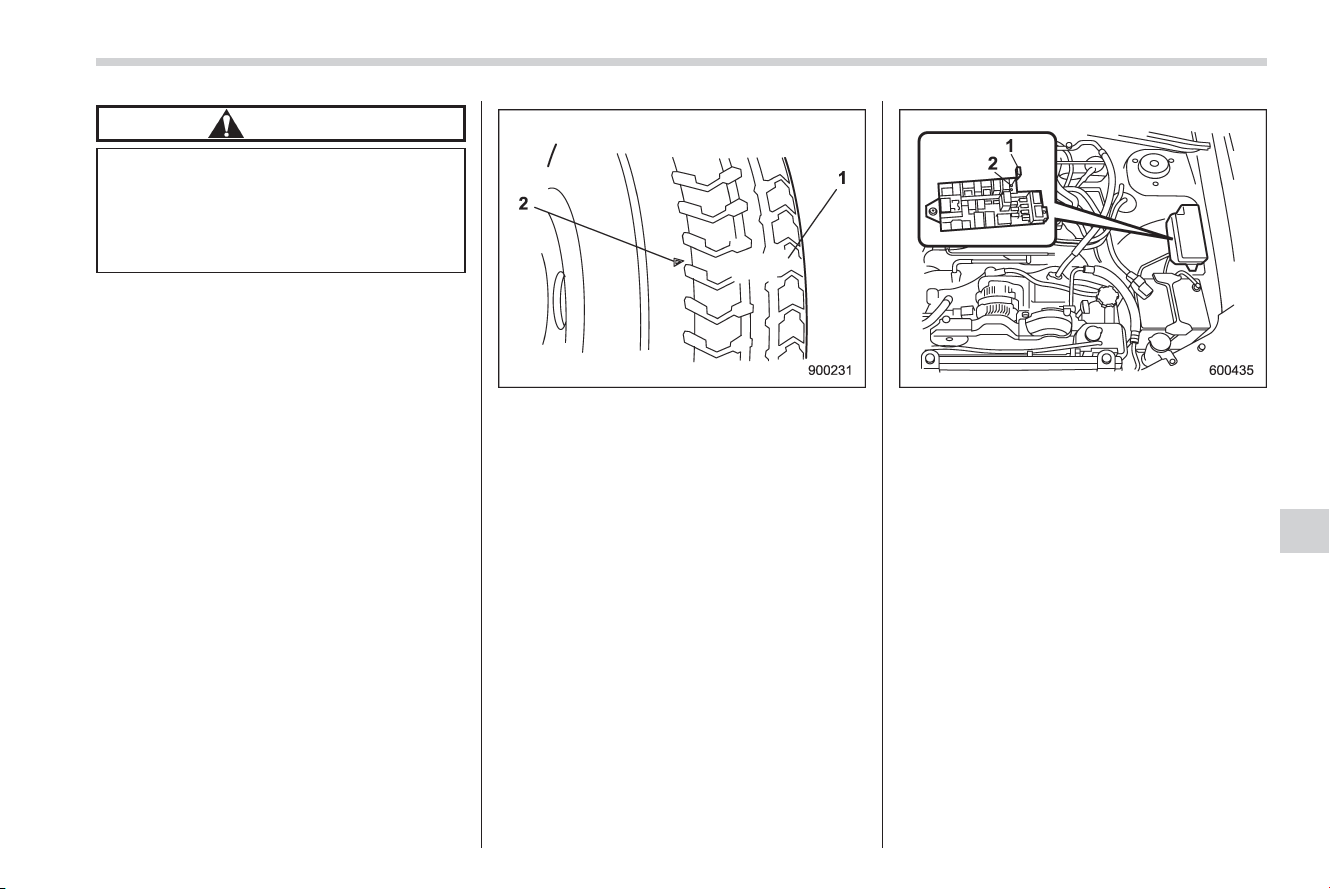
Black plate (269,1)
北米Model "A8130BE-B" EDITED: 2007/ 7/ 25
CAUTION
Never use any temporary spare tire
other than the original. Using other
sizes may result in severe mechan-
ical damage to the drive train of your
vehicle.
The temporary spare tire is smaller and
lighter than a conventional tire and is
designed for emergency use only. Re-
move the temporary spare tire and re-
install the conventional tire as soon as
possible because the spare tire is de-
signed only for temporary use.
Check the inflation pressure of the tem-
porary spare tire periodically to keep the
tire ready for use. The correct pressure is
60 psi (420 kPa, 4.2 kgf/cm
2
).
When using the temporary spare tire, note
the following.
. Do not exceed 50 mph (80 km/h).
. Do not put a tire chain on the temporary
spare tire. Because of the smaller tire size,
a tire chain will not fit properly.
. Do not use two or more temporary
spare tires at the same time.
. Do not drive over obstacles. This tire
has a smaller diameter, so road clearance
is reduced.
1) Tread wear indicator bar
2) Indicator location mark
. When the wear indicator appears on
the tread, replace the tire.
. The temporary spare tire must be used
only on a rear wheel. If a front wheel tire
gets punctured, replace the wheel with a
rear wheel and install the temporary spare
tire in place of the removed rear wheel.
1) Spare fuse
2) FWD connector
NOTE
(All AWD AT non-turbo models without
Vehicle Dynamics Control system) Be-
fore driving yo ur vehicle with the
temporary spare tire, put a spare fuse
inside the FWD connector in the main
fuse box located in the engine com-
partment and confirm that the Front-
wheel drive warning light “AWD” in the
combination meter comes on. The all
wheel drive capability of the vehicle
has now deactivated. After re-installing
the conventional tire, remove the spare
fuse from the FWD connector in order
to reactivate all wheel drive.
In case of emergency 9-3
9
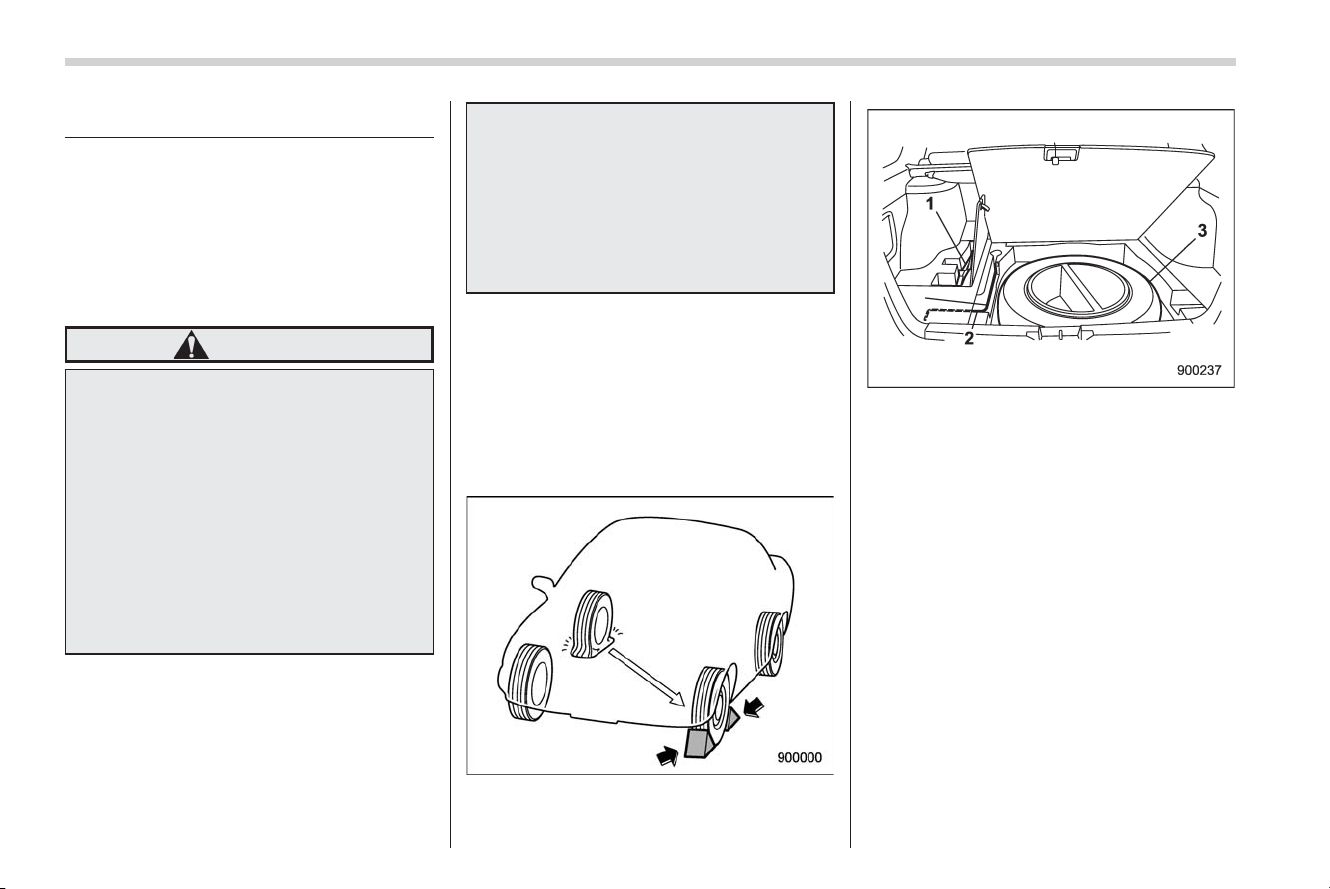
Black plate (270,1)
北米Model "A8130BE-B" EDITED: 2007/ 7/ 25
9-4 In case of emergency
Flat tires
If you have a flat tire while driving, never
brake suddenly; keep driving straight
ahead while gradually reducing speed.
Then slowly pull off the road to a safe
place.
& Changing a flat tire
WARNING
. Do not jack up the vehicle on an
incline or a loose road surface.
The jack can come out of the
jacking point or sink into the
ground and this can result in a
severe accident.
. Use only the jack provided with
your vehicle. The jack supplied
with the vehicle is designed only
for changing a tire. Never get
under the vehicle while support-
ing the vehicle with this jack.
. Always turn off the engine before
raising the flat tire off the ground
using the jack. Never swing or
push the vehicle supported with
the jack. The jack can come out
of the jacking point due to a jolt
and this can result in a severe
accident.
1. Park on a hard, level surface, when-
ever possible, then stop the engine.
2. Set the parking brake securely and
shift a manual transmission vehicle in
reverse or an automatic transmission
vehicle in the “P” (Park) position.
3. Turn on the hazard warning flasher
and have everyone get out of the vehicle.
4. Put wheel blocks at the front and rear
of the tire diagonally opposite the flat tire.
1) Jack
2) Jack handle
3) Spare tire
5. Take out the spare tire, jack, and
wheel nut wrench.
The spare tire is stored under the floor of
the cargo area.
To remove the spare tire:
1. Open the lid and remove it.
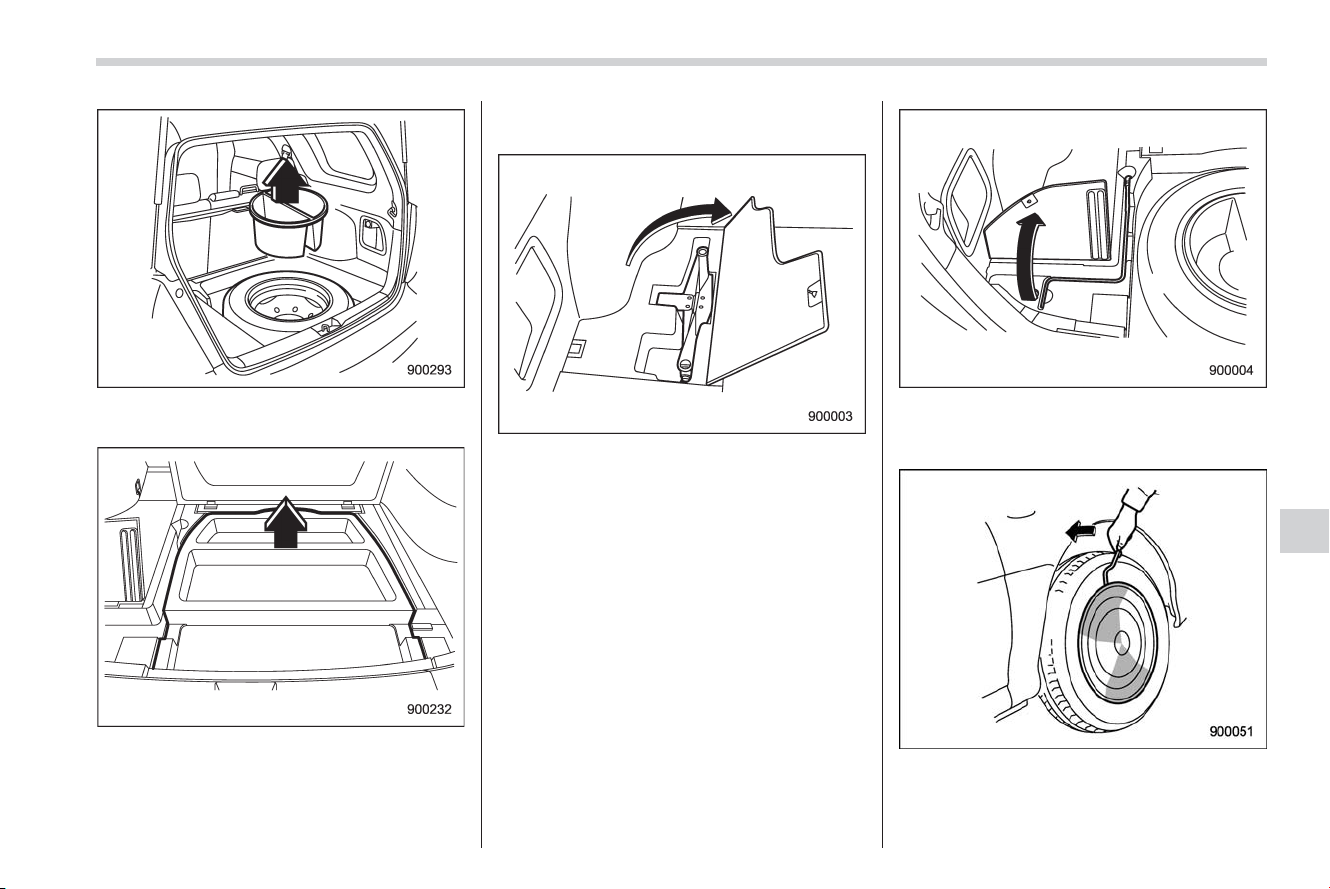
Black plate (271,1)
北米Model "A8130BE-B" EDITED: 2007/ 7/ 25
2. Remove the storage compartment
bucket (Canada spec. non-turbo models).
3. Remove the storage compartment tray
(except Canada spec. non-turbo models).
4. Turn the attaching bolt counterclock-
wise, then take spare tire out.
5. The jack is stored under the left side of
the cargo floor.
To take out the jack:
Pull the tab to open the lid, turn the jack
screw counterclockwise to loosen it, then
remove the jack.
To take out the jack handle:
Open the rear-left and center lids in the
cargo area by pulling their tabs.
6. If your vehicle has wheel covers, insert
the wheel cover remover into the notch
provided in the wheel cover, and pry it off.
In case of emergency 9-5
– CONTINUED –
9
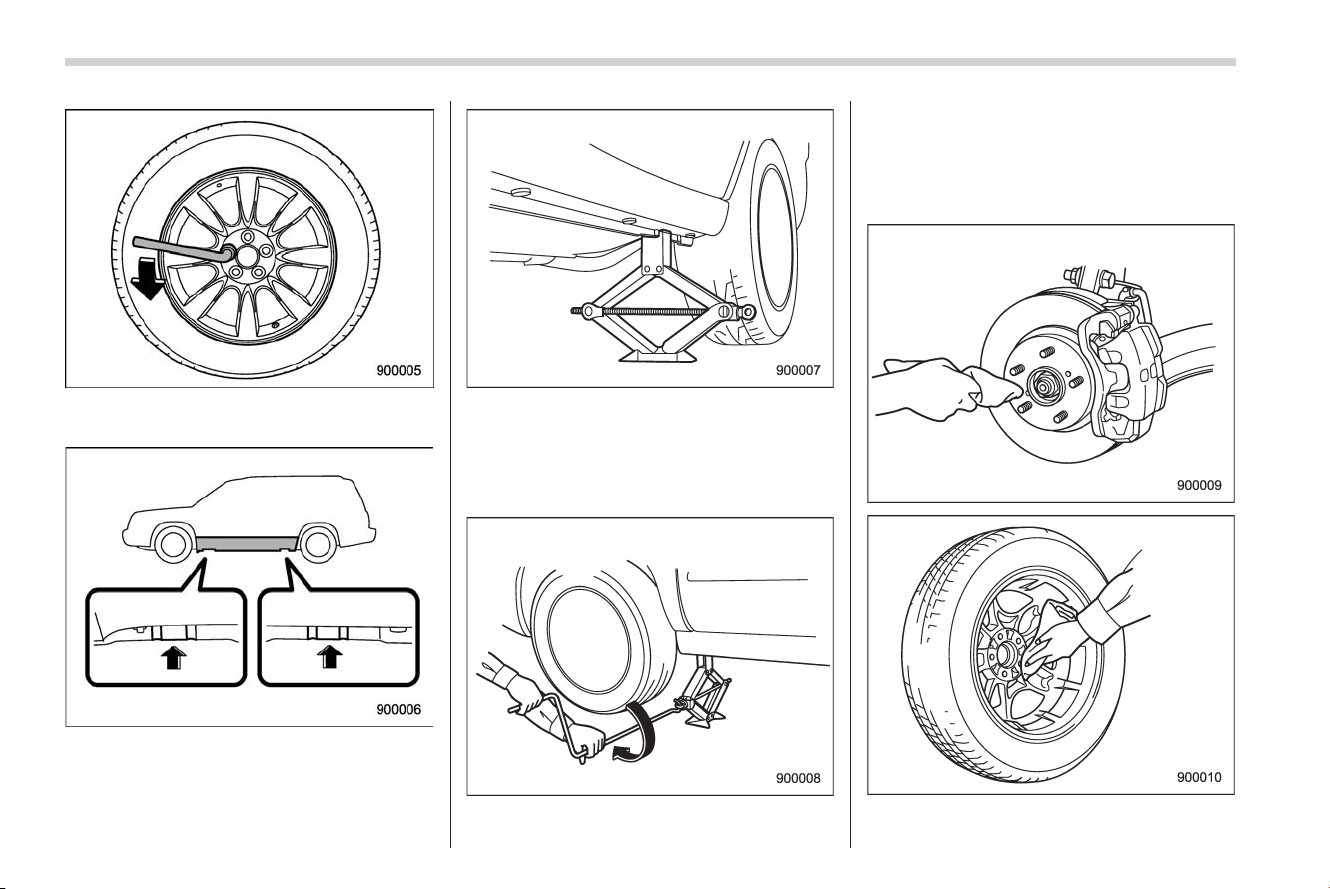
Black plate (272,1)
北米Model "A8130BE-B" EDITED: 2007/ 7/ 25
9-6 In case of emergency
7. Loosen the wheel nuts using the wheel
nut wrench but do not remove the nuts.
8. Place the jack under the side sill at the
front or rear jack-up point closest to the flat
tire.
Turn the jackscrew by hand until the jack
head engages firmly into the jack-up point.
9. Insert the jack handle into the jack-
screw, and turn the handle until the tire
clears the ground. Do not raise the vehicle
higher than necessary.
10. Remove the wheel nuts and the flat
tire.
11. Before putting the spare tire on, clean
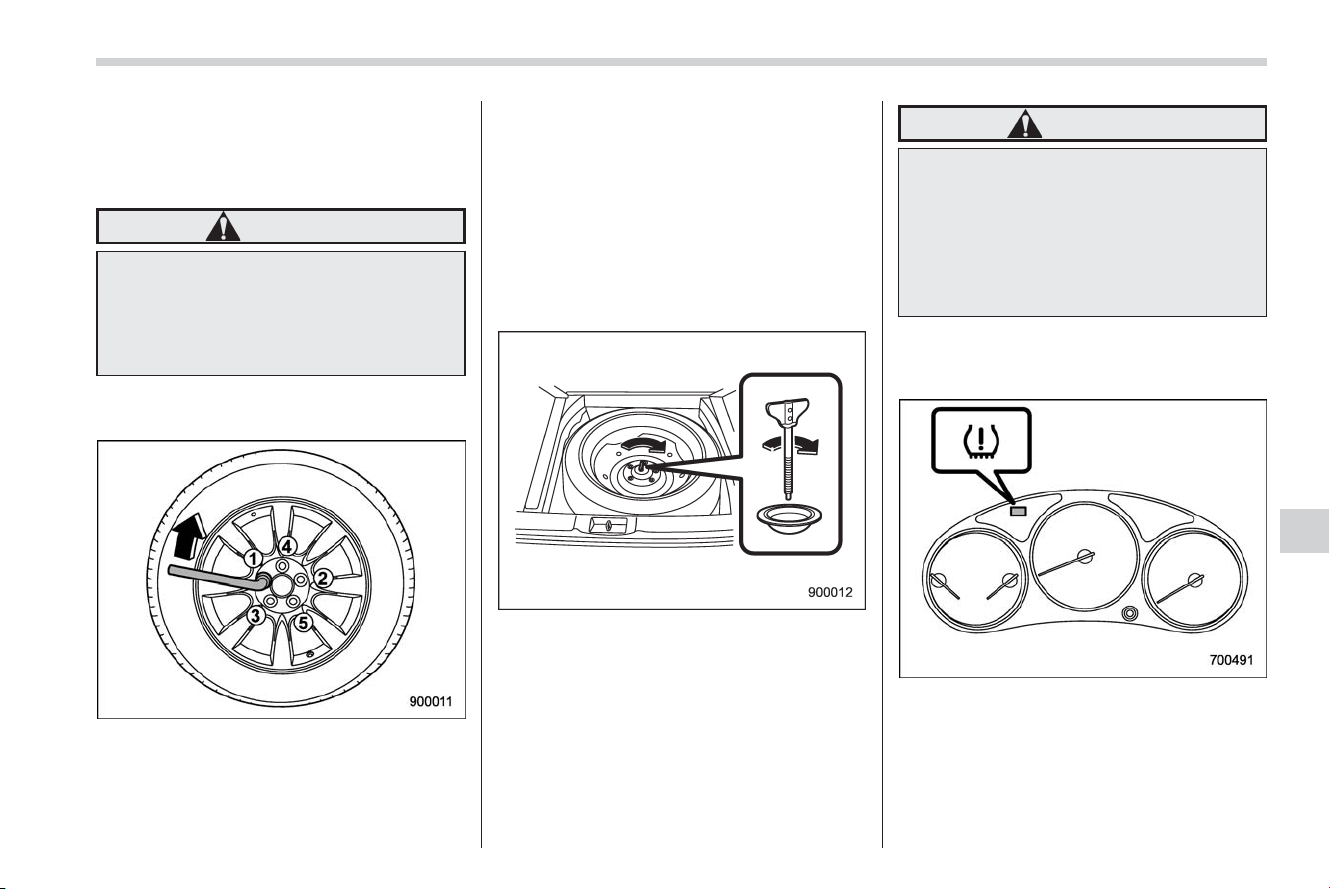
Black plate (273,1)
北米Model "A8130BE-B" EDITED: 2007/ 7/ 25
the mounting surface of the wheel and hub
with a cloth.
12. Put on the spare tire. Replace the
wheel nuts. Tighten them by hand.
WARNING
Do not use oil or grease on the
wheel studs or nuts when the spare
tire is installed. This could cause the
nuts to become loose and lead to an
accident.
13. Turn the jack handle counterclockwise
to lower the vehicle.
14. Use the wheel nut wrench to securely
tighten the wheel nuts to the specified
torque, following the tightening order in the
illustration.
The torque for tightening the nuts is 58 to
72 lbf·ft (80 to 100 N·m, 8 to 10 kgf·m).
This torque is equivalent to applying about
88 to 110 lbs (40 to 50 kg) at the top of the
wheel nut wrench. Never use your foot on
the wheel nut wrench or a pipe extension
on the wrench because you may exceed
the specified torque. Have the wheel nut
torque checked at the nearest automotive
service facility.
15. Store the flat tire in the spare tire
compartment.
Put the spacer and tighten the attaching
bolt firmly.
Also store the jack and wheel nut wrench
in their storage locations.
WARNING
Never place a tire or tire changing
tools in the passenger compartment
after changing wheels. In a sudden
stop or collisions, loose equipment
could strike occupants and cause
injury. Store the tire and all tools in
the proper place.
& Tire pressure monitoring
system (TPMS) (if equipped)
The tire pressure monitoring system pro-
vides the driver with the warning message
indicated by sending a signal from a
sensor that is installed in each wheel
when tire pressure is severely low.
The tire pressure monitoring system will
In case of emergency 9-7
– CONTINUED –
9
Black plate (274,1)
北米Model "A8130BE-B" EDITED: 2007/ 7/ 25
9-8 In case of emergency
activate only when the vehicle is driven.
Also, this system may not react immedi-
ately to a sudden drop in tire pressure (for
example, a blow-out caused running over
a sharp object).
WARNING
If the low tire pressure warning light
comes on while driving, never brake
suddenly and keep driving straight
ahead while gradually reducing
speed. Then slowly pull off the road
to a safe place. Otherwise an acci-
dent involving serious vehicle da-
mage and serious personal injury
could occur.
Check the pressure for all four tires
and adjust the pressure to the COLD
tire pressure shown on the vehicle
placard on the door pillar on the
driver’s side. If this light still comes
on while driving after adjusting the
tire pressure, a tire may have sig-
nificant damage and a fast leak that
causes the tire to lose air rapidly. If
you have a flat tire, replace it with a
spare tire as soon as possible.
When a spare tire is mounted or a
wheel rim is replaced without the
original pressure sensor/transmitter
being transferred, the low tire pres-
sure warning light will illuminate
steadily after blinking for approxi-
mately one minute. This indicates
the TPMS is unable to monitor all
four road wheels. Contact your
SUBARU dealer as soon as possible
for tire and sensor replacement and/
or system resetting.
Do not inject any tire liquid or
aerosol tire sealant into the tires,
as this may cause a malfunction of
the tire pressure sensors.
If the light illuminates steadily after
blinking for approximately one min-
ute, promptly contact a SUBARU
dealer to have the system inspected.
Jump starting
WARNING
. Battery fluid is SULFURIC ACID.
Do not let it come in contact with
the eyes, skin, clothing or the
vehicle.
If battery fluid gets on you,
thoroughly flush the exposed
area with water immediately. Get
medical help if the fluid has
entered your eyes.
If battery fluid is accidentally
swallowed, immediately drink a
large amount of milk or water,
and obtain immediate medical
help.
Keep everyone including chil-
dren away from the battery.
. The gas generated by a battery
explodes if a flame or spark is
brought near it. Do not smoke or
light a match while jump starting.
. Never attempt jump starting if the
discharged battery is frozen. It
could cause the battery to burst
or explode.
. Whenever working on or around
a battery, always wear suitable

Black plate (275,1)
北米Model "A8130BE-B" EDITED: 2007/ 7/ 25
eye protectors, and remove metal
objects such as rings, bands or
other metal jewelry.
. Be sure the jumper cables and
clamps on them do not have
loose or missing insulation.
Do not jump start unless cables
in suitable condition are avail-
able.
. A running engine can be danger-
ous. Keep your fingers, hands,
clothing, hair and tools away
from the cooling fan, belts and
any other moving engine parts.
Removing rings, watches and
ties is advisable.
. Jump starting is dangerous if it is
done incorrectly. If you are un-
sure about the proper procedure
for jump starting, consult a com-
petent mechanic.
When your vehicle does not start due to a
run down (discharged) battery, the vehicle
may be jump started by connecting your
battery to another battery (called the
booster battery) with jumper cables.
& How to jump start
1. Make sure the booster battery is 12
volts and the negative terminal is
grounded.
2. If the booster battery is in another
vehicle, do not let the two vehicles touch.
3. Turn off all unnecessary lights and
accessories.
4. Connect the jumper cables exactly in
the sequence illustrated.
In case of emergency 9-9
– CONTINUED –
9
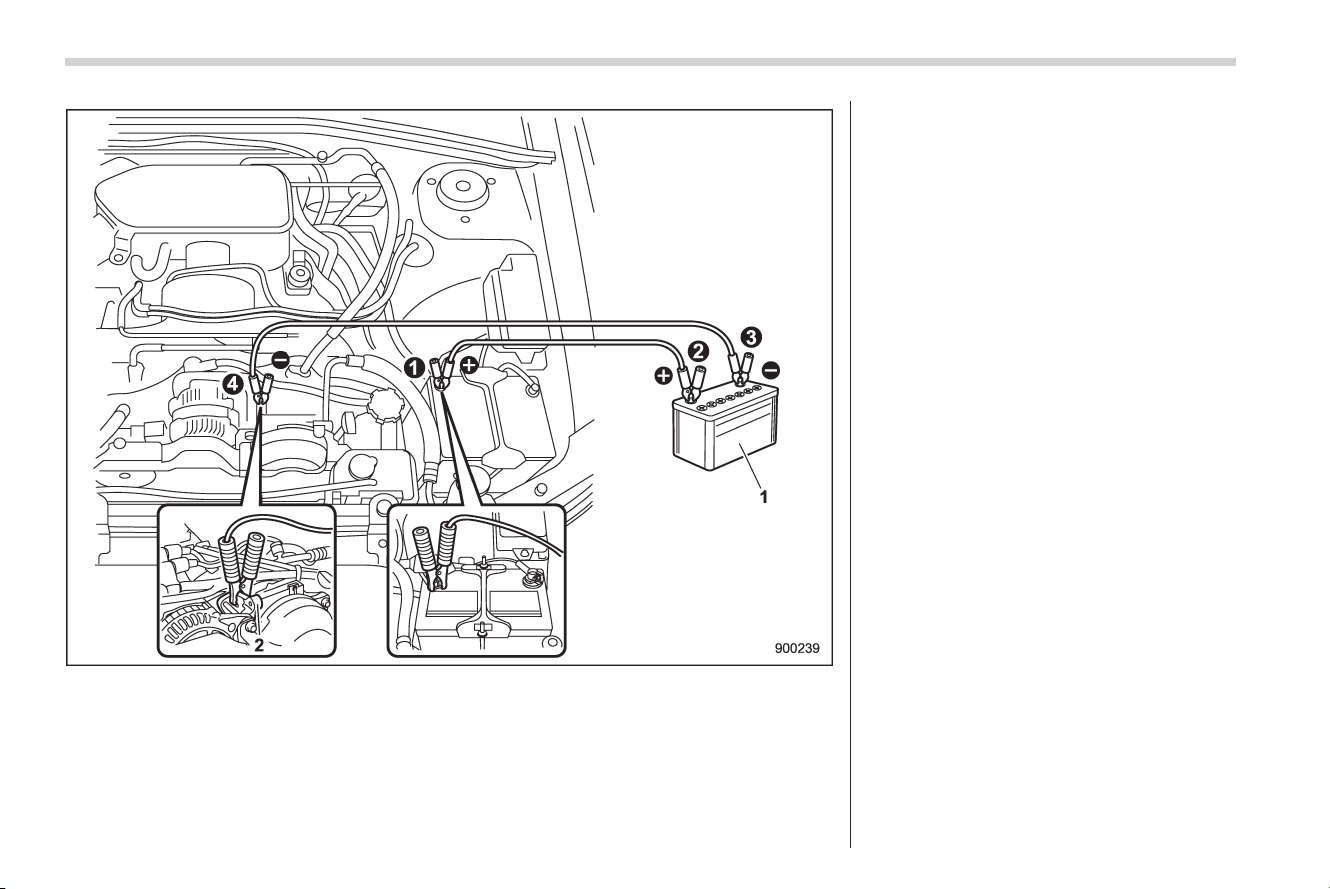
Black plate (276,1)
北米Model "A8130BE-B" EDITED: 2007/ 7/ 25
9-10 In case of emergency
1) Booster battery
2) Engine lifting bracket
(1) Connect one jumper cable to the
positive (+) terminal on the discharged
battery.
(2) Connect the other end of the
jumper cable to the positive (+) term-
inal of the booster battery.
(3) Connect one end of th e other
cable to the negative (− ) terminal of
the booster battery.
(4) Connect the other end of the cable
to the engine lifting bracket.
Make sure that the cables are not near
any moving parts and that the cable
clamps are not in contact with any other
metal.
5. Start the engine of the vehicle with the
booster battery and run it at moderate
speed. Then start the engine of the vehicle
that has the discharged battery.
6. When finis hed, carefully disconnect
the cables in exactly the reverse order.
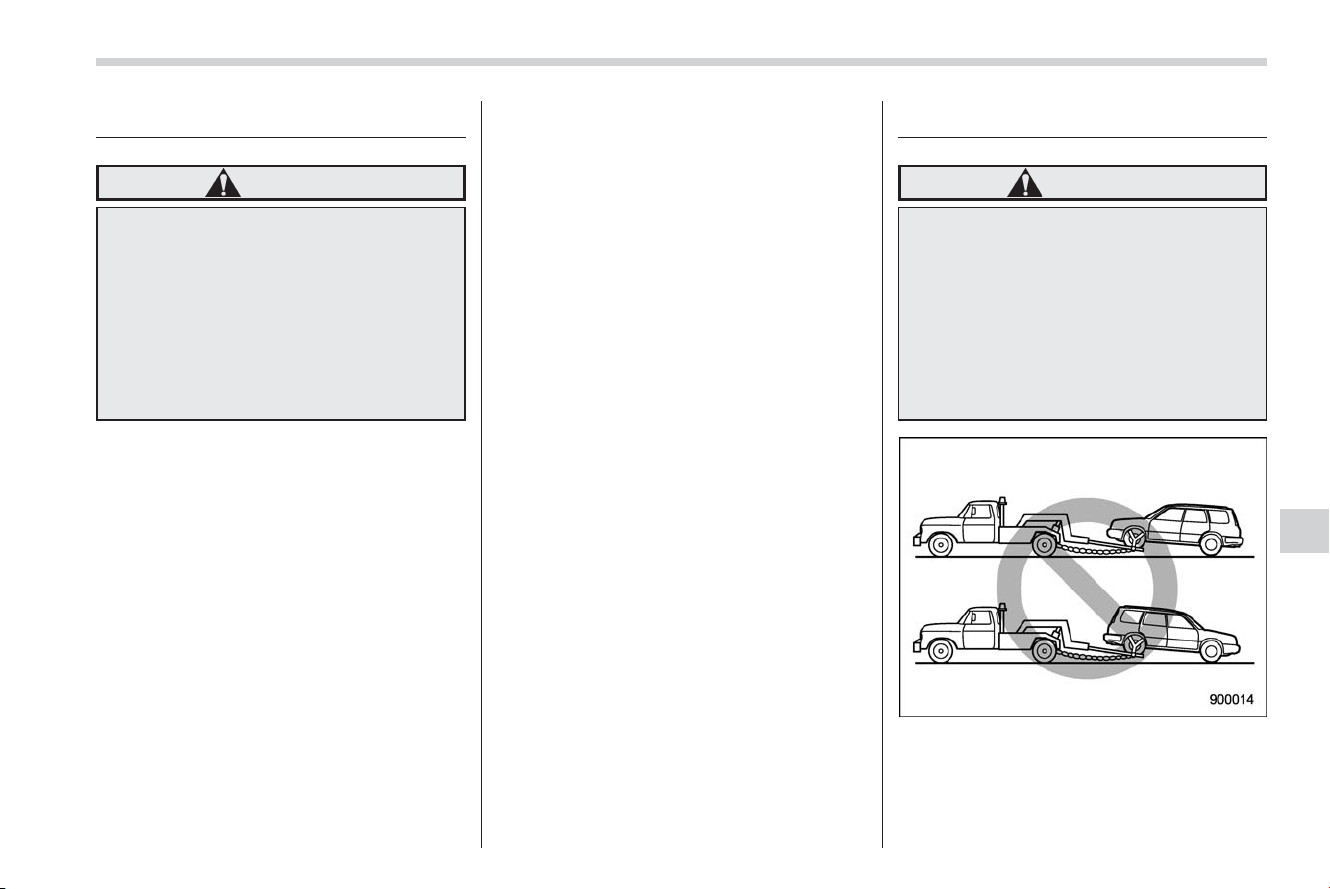
Black plate (277,1)
北米Model "A8130BE-B" EDITED: 2007/ 7/ 25
Engine overheating
WARNING
Never attempt to remove the radia-
tor cap until the engine has been
shut off and has fully cooled down.
When the engine is hot, the coolant
is under pressure. Removing the
cap while the engine is still hot
could release a spray of boiling hot
coolant, which could burn you very
seriously.
If the engine overheats, safely pull off the
road and stop the vehicle in a safe place.
& If steam is coming from the
engine compartment
Turn off the engine and get everyone
away from the vehicle until it cools down.
& If no steam is coming from
the engine compartment
1. Keep the engine running at idling
speed.
2. Open the hood to ventilate the engine
compartment.
Confirm that the cooling fan is turning. If
the fan is not turning, immediately turn off
the engine and contact your authorized
dealer for repair.
3. After the engine coolant temperature
has dropped, turn off the engine.
If the temperature gauge stays at the
overheated zone, turn off the engine.
4. After the engine has fully cooled down,
check the coolant level in the reserve
tank.
If the coolant level is below the “LOW”
mark, add coolant up to the “FULL” mark.
5. If there is no coolant in the reserve
tank, add coolant to the reserve tank.
Then remove the radiator cap and fill the
radiator with coolant.
If you remove the radiator cap from a hot
radiator, first wrap a thick cloth around the
radiator cap, then turn the cap counter-
clockwise slowly without pressing down
until it stops. Release the pressure from
the radiator. After the pressure has been
fully released, remove the cap by pressing
down and turning it.
Towing
WARNING
Never tow AWD vehicles (both AT
and MT) with the front wheels raised
off the ground while the rear wheels
are on the ground, or with the rear
wheels raised off the ground while
the front wheels are on the ground.
This will cause the vehicle to spin
away due to the operation or dete-
rioration of the center differential.
If towing is necessary, it is best done by
your SUBARU dealer or a commercial
towing service. Observe the following
procedures for safety.
In case of emergency 9-11
– CONTINUED –
9
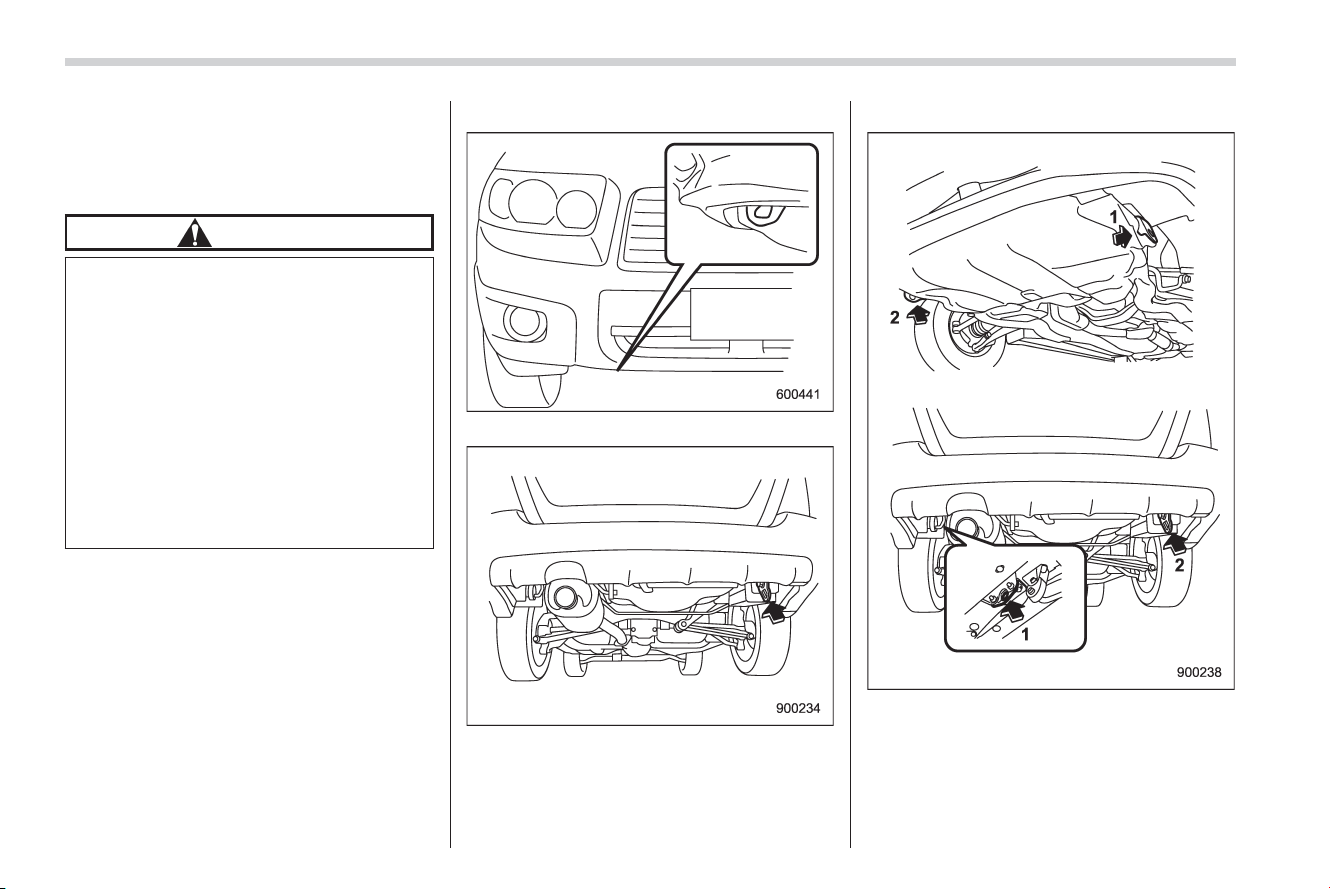
Black plate (278,1)
北米Model "A8130BE-B" EDITED: 2007/ 7/ 25
9-12 In case of emergency
& Towing and tie-down hooks
The towing hooks should be used only in
an emergency (e.g., to free a stuck vehicle
from mud, sand or snow).
CAUTION
. Use only the specified towing
hooks and tie-down hooks. Never
use suspension parts or other
parts of the body for towing or
tie-down purposes.
. Never use the tie-down hook
closest to the muffler under the
vehicle for towing purposes.
. To prevent deformation to the
bumper and the towing hook, do
not apply excessive lateral load
to the towing hooks.
Front towing hook:
Rear towing hook:
Tie-down hooks:
1) Tie-down hooks
2) Towing and tie-down hooks
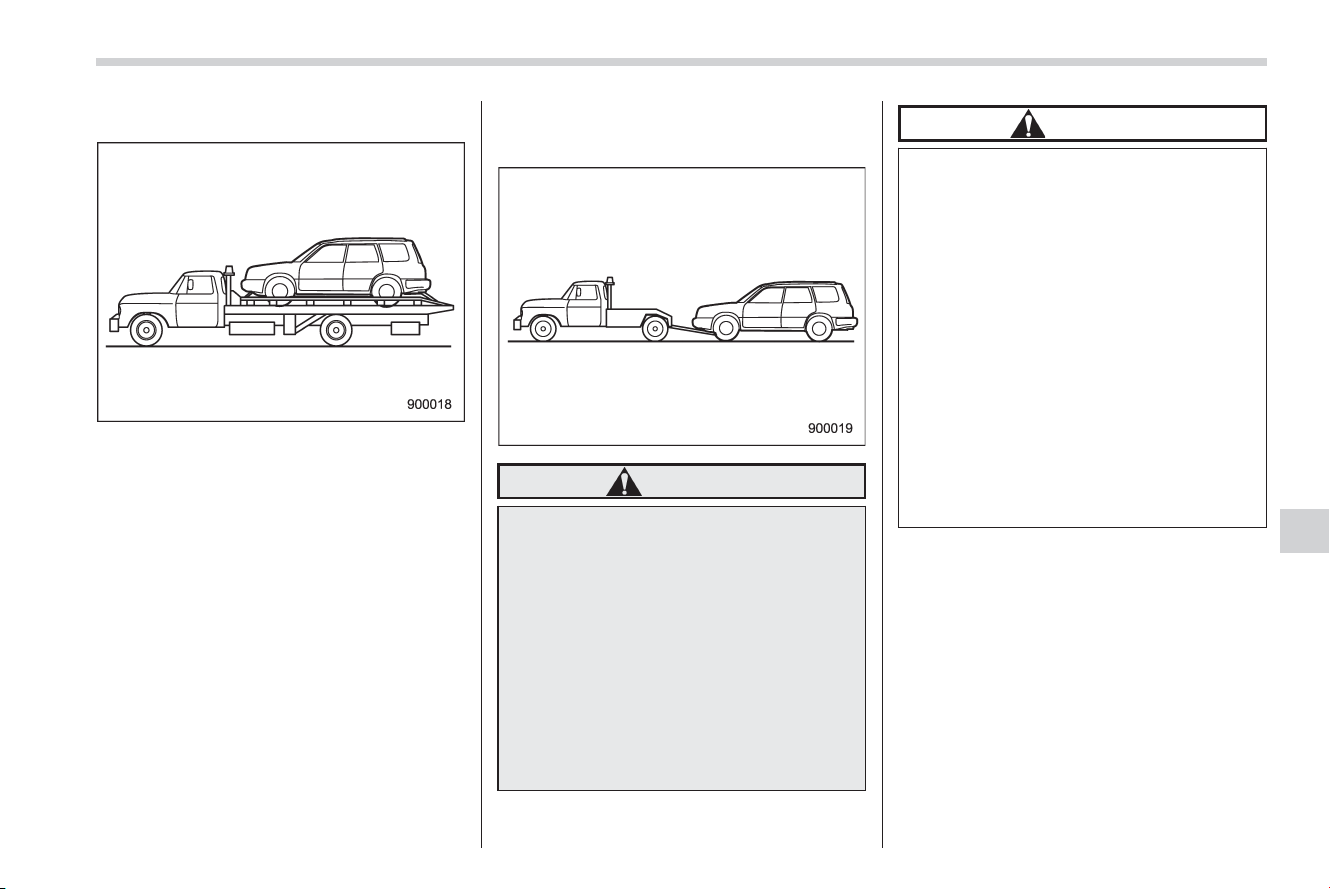
Black plate (279,1)
北米Model "A8130BE-B" EDITED: 2007/ 7/ 25
& Using a flat-bed truck
This is the best way to transport your
vehicle. Use the following procedures to
ensure safe transportation.
1. Shift the selector lever into the “P”
position for automatic transmission vehi-
cles or “1st” for manual transmission
vehicles.
2. Pull up the parking brake lever firmly.
3. Secure the vehicle onto the carrier
properly with safety chains. Each safety
chain should be equally tightened and
care must be taken not to pull the chains
so tightly that the suspension bottoms out.
& Towing with all wheels on the
ground
WARNING
. Never turn the ignition switch to
the “LOCK” position while the
vehicle is being towed because
the steering wheel and the direc-
tion of the wheels will be locked.
. Remember that the brake booster
and power steering do not func-
tion wh en the engine is not
running. Because the engine is
turned off, it will take greater
effort to operate the brake pedal
and steering wheel.
CAUTION
. If transmission failure occurs,
transport your vehicle on a flat-
bed truck.
. Do not run the engine while being
towed using this method. Trans-
mission damage could result if
the vehicle is towed with the
engine running.
. For vehicles with automatic
transmission, the traveling speed
must be limited to less than 20
mph (30 km/h) and the traveling
distance to less than 31 miles (50
km). For greater speeds and
distances, transport your vehicle
on a flat-bed truck.
1. Check the transmission and differen-
tial oil levels and add oil to bring it to the
upper level if necessary.
2. Release the parking brake and put the
transmission in neutral.
3. The ignition switch should be in the
“Acc” position while the vehicle is being
towed.
4. Take up slack in the towline slowly to
prevent damage to the vehicle.
In case of emergency 9-13
9
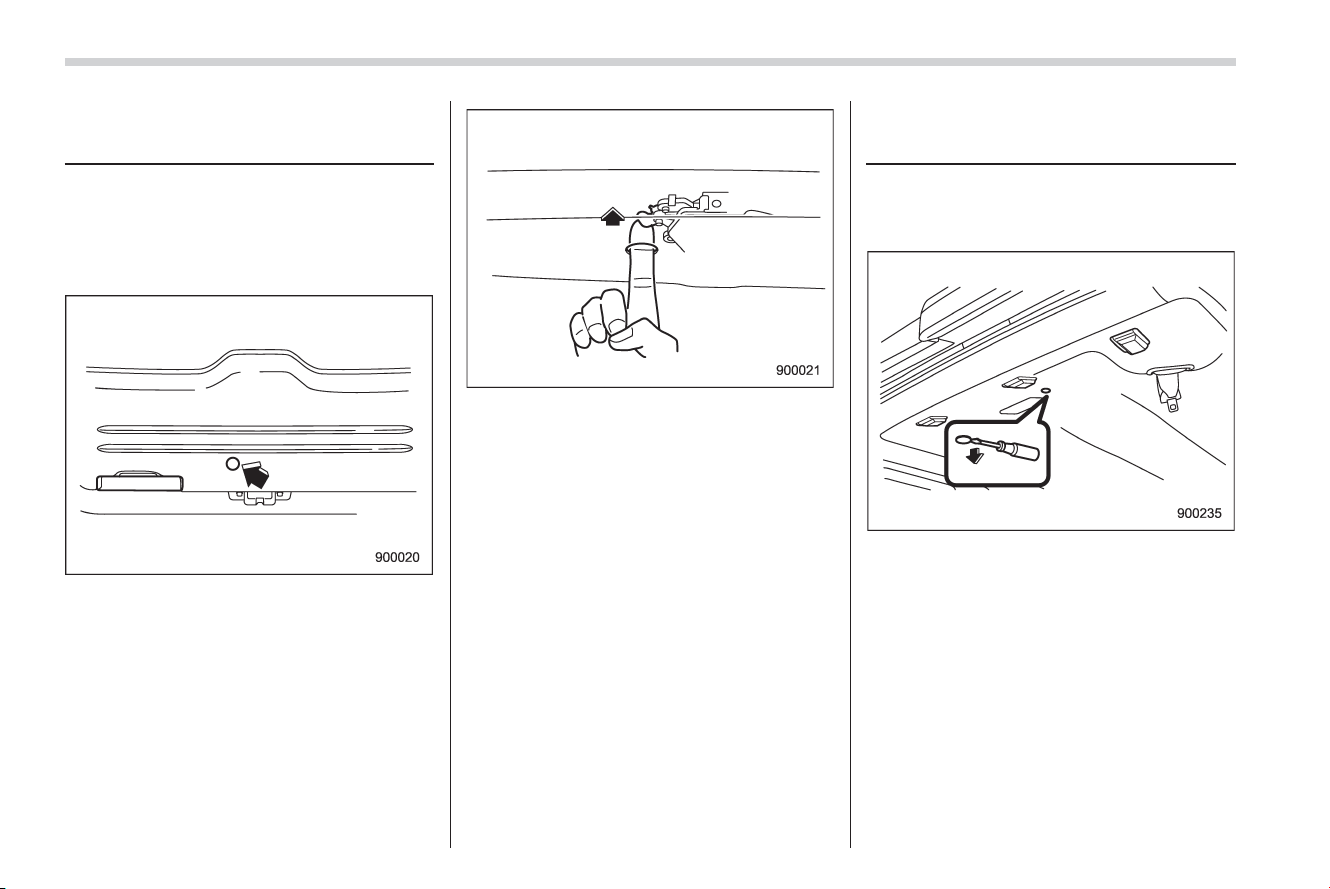
Black plate (280,1)
北米Model "A8130BE-B" EDITED: 2007/ 7/ 25
9-14 In case of emergency
Rear gate – if the rear gate
cannot be unlocked
In the event that you cannot unlock the
rear gate by operating the power door
locking switches or the remote keyless
entry system, you can unlock it from inside
the cargo area.
1. Remove the access cover at the
bottom-center of the rear gate trim.
2. Locate the rear gate lock release lever
behind the rear gate trim panel.
3. Unlock the rear gate by pressing the
lever inside the trim upward.
4. Open the rear gate from outside by
raising the rear gate handle.
Moonroof – if the moonroof
cannot be closed
If the moonroof cannot be closed with the
moonroof switch, you can close the moon-
roof manually.
1. Remove the plug on the roof trim
located to the rear of the moonroof by
inserting the end of the flat-head screw-
driver between the roof and plug and
prying it off.
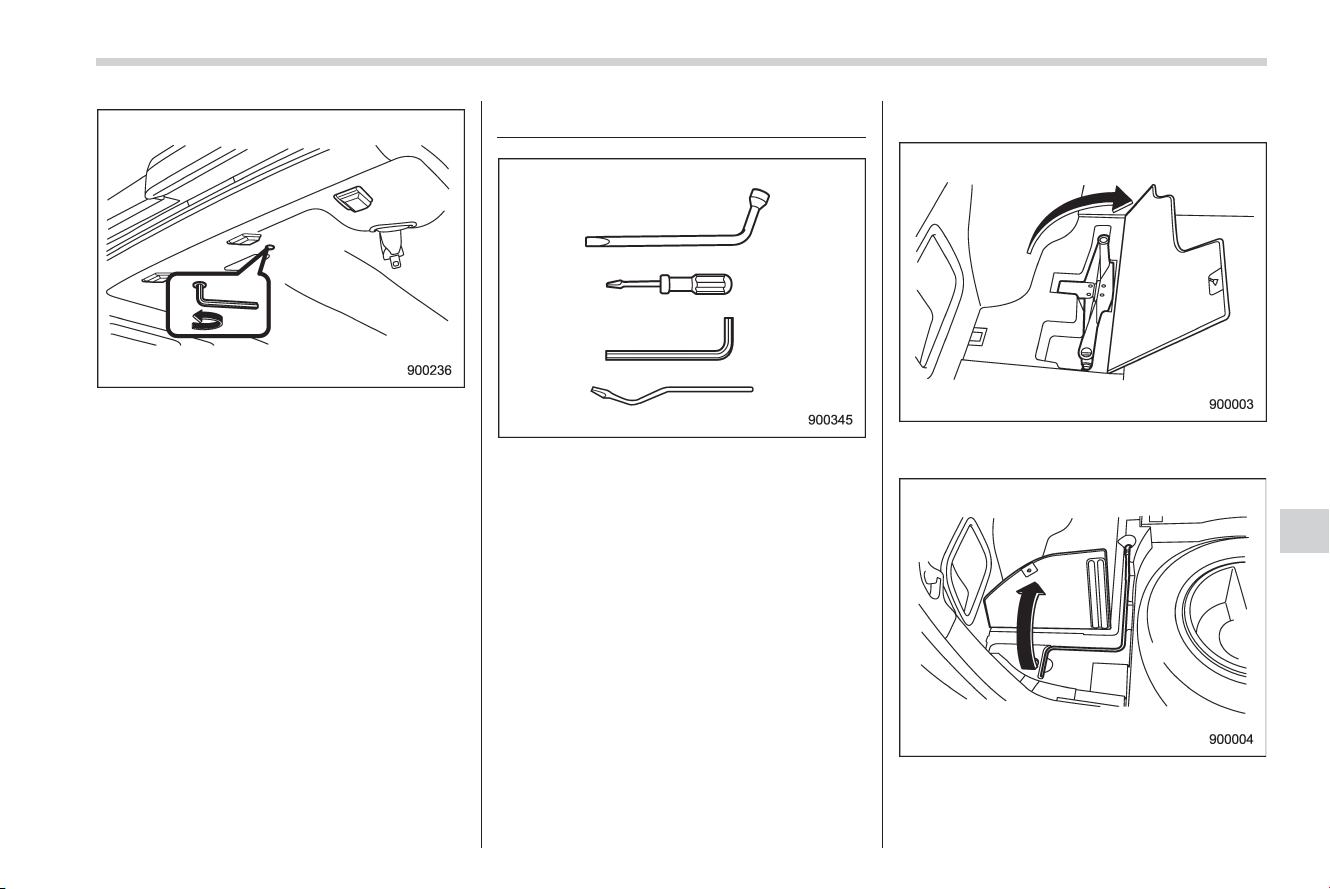
Black plate (281,1)
北米Model "A8130BE-B" EDITED: 2007/ 7/ 25
2. Insert a hex-head wrench in the end of
the motor shaft.
To close the moonroof, turn the wrench
counterclockwise.
Have your vehicle checked and repaired
by an authorized SUBARU dealer.
Maintenance tools
Your vehicle is equipped with the following
maintenance tools:
Wheel nut wrench
Screwdriver
Hex-head wrench (for vehicle with moon-
roof)
Wheel cover remover (only for vehicles
with wheel covers)
& Jack and jack handle
The jack is stored under the left side of the
cargo floor.
The jack handle is stowed under the rear-
left and center lids in the cargo area.
In case of emergency 9-15
– CONTINUED –
9

Black plate (282,1)
北米Model "A8130BE-B" EDITED: 2007/ 7/ 25
9-16 In case of emergency
For how to use the jack, refer to the “Flat
tires” section in this chapter.

Black plate (19,1)
北米Model "A8130BE-B" EDITED: 2007/ 7/ 25
Exterior care ....................................................... 10-2
Washing............................................................. 10-2
Waxing and polishing ......................................... 10-3
Cleaning aluminum wheels ................................. 10-3
Corrosion protection.......................................... 10-4
Most common causes of corrosion ..................... 10-4
To help prevent corrosion................................... 10-4
Cleaning the interior.......................................... 10-5
Seat fabric......................................................... 10-5
Leather seat materials........................................ 10-5
Synthetic leather upholstery............................... 10-5
Ashtray (Canada only, if equipped) ..................... 10-5
Climate control panel, audio panel, instrument
panel, console panel, switches, combination
meter, and other plastic surfaces ..................... 10-6
Appearance care
10

Black plate (286,1)
北米Model "A8130BE-B" EDITED: 2007/ 7/ 25
10-2 Appearance care
Exterior care
& Washing
CAUTION
. When washing the vehicle, the
brakes may get wet. As a result,
the brake stopping distance will
be longer. To dry the brakes,
drive the vehicle at a safe speed
while lightly pressing the brake
pedal to heat up the brakes.
. Do not wash the engine compart-
ment and area adjacent to it. If
water enters the engine air in-
take, electrical parts or the power
steering fluid reservoir, it will
cause engine trouble or faulty
power steering respectively.
. Since your vehicle is equipped
with a rear wiper, automatic car-
wash brushes could become
tangled around it, damaging the
wiper arm and other compo-
nents. Ask the automatic car-
wash operator not to let the
brushes touch the wiper arm or
to fix the wiper arm on the rear
window glass with adhesive tape
before operating the machine.
NOTE
When having your vehicle washed in
an automatic car wash, make sure
beforehand that the car wash is of
suitable type.
The best way to preserve your vehicle’s
beauty is frequent washing. Wash the
vehicle at least once a month to avoid
contamination by road grime.
Wash dirt off with a wet sponge and plenty
of lukewarm or cold water. Do not wash
the vehicle with hot water and in direct
sunlight.
Salt, chemicals, insects, tar, soot, tree sap
and bird droppings should be washed off
by using a light detergent, as required. If
you use a light detergent, make certain
that it is a neutral detergent. Do not use
strong soap or chemical detergents. All
cleaning agents should be promptly
flushed from the surface and not allowed
to dry there. Rinse the vehicle thoroughly
with plenty of lukewarm water. Wipe the
remaining water off with a chamois or soft
cloth.
! Washing the underbody
Chemicals, salts and gravel used for
deicing road surfaces are extremely cor-
rosive, accelerating the corrosion of un-
derbody components, such as the exhaust
system, fuel and brake lines, brake
cables, floor pan and fenders, and sus-
pension.
Thoroughly flush the underbody and in-
side of the fenders with lukewarm or cold
water at frequent intervals to reduce the
harmful effects of such agents.
Mud and sand adhering to the underbody
components may accelerate their corro-
sion.
After driving off-road or muddy or sandy
roads, wash the mud and sand off the
underbody.
Carefully flush the suspension and axle
parts, as they are particularly prone to
mud and sand buildup. Do not use a
sharp-edged tool to remove caked mud.

Black plate (287,1)
北米Model "A8130BE-B" EDITED: 2007/ 7/ 25
NOTE
Be careful not to damage brake hoses,
sensor harnesses, and other parts
when washing suspe nsion compo-
nents.
! Using a warm water washer
. Keep a good distance of 12 in (30 cm)
or more between the washer nozzle and
the vehicle.
. Do not wash the same area continu-
ously.
. If a stain will not come out easily, wash
by hand. Some warm water washers are
of the high temperature, high pressure
type, and they can damage or deform the
resin parts such as mouldings, or cause
water to leak into the vehicle.
& Waxing and polishing
Always wash and dry the vehicle before
waxing and polishing.
Use a good quality polish and wax and
apply them according to the manufac-
turer’s instructions. Wax or polish when
the painted surface is cool.
Be sure to polish and wax the chrome trim,
as well as the painted surfaces. Loss of
wax on a painted surface leads to loss of
the original luster and also quickens the
deterioration of the surface. It is recom-
mended that a coat of wax be applied at
least once a month, or whenever the
surface no longer repels water.
If the appearance of the paint has dimin-
ished to the point where the luster or tone
cannot be restored, lightly polish the
surface with a fine-grained compound.
Never polish just the affected area, but
include the surrounding area as well.
Always polish in only one direction. A
No. 2000 grain compound is recom-
mended. Never use a coarse-grained
compound. Coarser grained compounds
have a smaller grain-size number and
could damage the paint. After polishing
with a compound, coat with wax to restore
the original luster. Frequent polishing with
acompoundoranincorrectpolishing
technique will result in removing the paint
layer and exposing the undercoat. When
in doubt, it is always best to contact your
SUBARU dealer or an auto paint specia-
list.
NOTE
Be careful not to block the windshield
washer nozzles with wax when waxing
the vehicle.
& Cleaning aluminum wheels
. Promptly wipe the aluminum wheels
clean of any kind of grime or agent. If dirt
is left on too long, it may be difficult to
clean off.
. Do not use soap containing grit to
clean the wheels. Be sure to use a neutral
cleaning agent, and later rinse thoroughly
with water. Do not clean the wheels with a
stiff brush or expose them to a high-speed
washing device.
. Clean the vehicle (including the alumi-
num wheels) with water as soon as
possible when it has been splashed with
sea water, exposed to sea breezes, or
driven on roads treated with salt or other
agents.
Appearance care 10-3
10

Black plate (288,1)
北米Model "A8130BE-B" EDITED: 2007/ 7/ 25
10-4 Appearance care
Corrosion protection
Your SUBARU has been designed and
built to resist corrosion. Special materials
and protective finishes have been used on
most parts of the vehicle to help maintain
fine appearance, strength, and reliable
operation.
& Most common causes of
corrosion
The most common causes of corrosion
are:
1. The accumulation of moisture retain-
ing dirt and debris in body panel sections,
cavities, and other areas.
2. Damage to paint and other protective
coatings caused by gravel and stone
chips or minor accidents.
Corrosion is accelerated on the vehicle
when:
1. It is exposed to road salt or dust
control chemicals, or used in coastal
areas where there is more salt in the air,
or in areas where there is considerable
industrial pollution.
2. It is driven in areas of high humidity,
especially when temperatures range just
above freezing.
3. Dampness in certain parts of the
vehicle remains for a long time, even
though other parts of the vehicle may be
dry.
4. High temperatures will cause corro-
sion to parts of the vehicle which cannot
dry quickly due to lack of proper ventila-
tion.
& To help prevent corrosion
Wash the vehicle regularly to prevent
corrosion of the body and suspension
components. Also, wash the v ehicle
promptly after driving on any of the
following surfaces:
. roads that have been salted to prevent
them from freezing in winter
. mud, sand, or gravel
. coastal roads
After the winter has ended, it is recom-
mended that the underbody be given a
very thorough washing.
Before the beginning of winter, check the
condition of underbody components, such
as the exhaust system, fuel and brake
lines, brake cables, suspension, steering
system, floor pan, and fenders. If any of
them are found to be rusted, they should
be given an appropriate rust prevention
treatment or should be replaced. Contact
your SUBARU dealer to perform this kind
of maintenance and treatment if you need
assistance.
Repair chips and scratches in the paint as
soon as you find them.
Check the interior of the vehicle for water
and dirt accumulation under the floor mats
because that could cause corrosion.
Occasionally check under the mats to
make sure the area is dry.
Keep your garage dry. Do not park your
vehicle in a damp, poorly ventilated
garage. In such a garage, corrosion can
be caused by dampness. If you wash the
vehicle in the garage or put the vehicle
into the garage when wet or covered with
snow, that can cause dampness.
If your vehicle is operated in cold weather
and/or in areas where road salts and other
corrosive materials are used, the door
hinges and locks, trunk lid lock, and hood
latch should be inspected and lubricated
periodically.

Black plate (289,1)
北米Model "A8130BE-B" EDITED: 2007/ 7/ 25
Cleaning the interior
Use a soft, damp cloth to clean the climate
control panel, audio equipment, instru-
ment panel, center console, combination
meter panel, and switches. (Do not use
organic solvents.)
& Seat fabric
Remove loose dirt, dust or debris with a
vacuum cleaner. If the dirt is caked on the
fabric or hard to remove with a vacuum
cleaner, use a soft blush then vacuum it.
Wipe the fabric surface with a tightly
wrung cloth and dry the seat fabric
thoroughly. If the fabric is still dirty, wipe
using a solution of mild soap and luke-
warm water then dry thoroughly.
If the stain does not come out, try a
commercially-available fabric cleaner. Use
the cleaner on a hidden place and make
sure it does not affect the fabric adversely.
Use the cleaner according to its instruc-
tions.
NOTE
When cleaning the seat, do not use
benzine, paint thinner, or any similar
materials.
& Leather seat materials
The leather used by SUBARU is a high
quality natural product which will retain its
distinctive appearance and feel for many
years with proper care.
Allowing dust or road dirt to build up on the
surface can cause the material to become
brittle and to wear prematurely. Regular
cleaning with a soft, moist, natural fiber
cloth should be performed monthly, taking
care not to soak the leather or allow water
to penetrate the stitched seams.
A mild detergent suitable for cleaning
woolen fabrics may be used to remove
difficult dirt spots, rubbing with a soft, dry
cloth afterwards to restore the luster. If
your SUBARU is to be parked for a long
time in bright sunlight, it is recommended
that the seats and headrests be covered,
or the windows shaded, to prevent fading
or shrinkage.
Minor surface blemishes or bald patches
may be treated with a commercial leather
spray lacquer. You will discover that each
leather seat section will develop soft folds
or wrinkles, which is characteristic of
genuine leather.
& Synthetic leather upholstery
The synthetic leather material used on the
SUBARU may be cleaned using mild soap
or detergent and water, after first vacuum-
ing or brushing away loose dirt. Allow the
soap to soak in for a few minutes and wipe
off with a clean, damp cloth. Commercial
foam-type cleaners suitable for synthetic
leather materials may be used when
necessary.
NOTE
Strong cleaning agents such as sol-
vents, paint thinners, window cleaner
or gasoline must never be used on
leather or synthetic interior materials.
& Ashtray (Canada only, if
equipped)
Particles of ash and tobacco will accumu-
late around the hinges of the ashtray’s
inner lid. Clean them off using a tooth-
Appearance care 10-5
– CONTINUED –
10

Black plate (290,1)
北米Model "A8130BE-B" EDITED: 2007/ 7/ 25
10-6 Appearance care
brush or other narrow-ended implement.
& Climate control panel, audio
panel, instrument panel,
console panel, switches,
combination meter, and other
plastic surfaces
Use a soft, damp cloth to clean the climate
control panel, audio equipment, instru-
ment panel, center console, combination
meter panel, and switches. (Do not use
organic solvents.)
NOTE
Do not use organic solvents such as
paint thinners or gasoline, or strong
cleaning agents that cont ain those
solvents.

Black plate (21,1)
北米Model "A8130BE-B" EDITED: 2007/ 7/ 25
Maintenance schedule ....................................... 11-3
Maintenance precautions................................... 11-3
Before checking or servicing in the engine
compartment.................................................... 11-4
When you do checking or servicing in the engine
compartment while the engine is running.......... 11-4
Engine hood ....................................................... 11-4
Engine compartment overview.......................... 11-6
Non-turbo models .............................................. 11-6
Turbo models..................................................... 11-7
Engine oil............................................................ 11-8
Checking the oil level ......................................... 11-8
Changing the oil and oil filter .............................. 11-9
Recommended grade and viscosity .................. 11-10
Recommended grade and viscosity under severe
driving conditions .......................................... 11-11
Synthetic oil..................................................... 11-11
Cooling system ................................................ 11-12
Cooling fan, hose and connections................... 11-12
Engine coolant ................................................. 11-12
Air cleaner element .......................................... 11-15
Replacing the air cleaner element ..................... 11-15
Spark plugs ...................................................... 11-17
Recommended spark plugs .............................. 11-18
Drive belts ........................................................ 11-18
Manual transmission oil .................................. 11-19
Checking the oil level ....................................... 11-19
Recommended grade and viscosity .................. 11-20
Automatic transmission fluid.......................... 11-20
Checking the fluid level.................................... 11-20
Recommended fluid ......................................... 11-21
Front differential gear oil (AT vehicles).......... 11-21
Checking the oil level ...................................... 11-21
Recommended grade and viscosity.................. 11-22
Rear differential gear oil.................................. 11-22
Checking the gear oil level............................... 11-22
Recommended grade and viscosity.................. 11-23
Power steering fluid ........................................ 11-24
Checking the fluid level.................................... 11-24
Recommended fluid ......................................... 11-25
Brake fluid........................................................ 11-25
Checking the fluid level.................................... 11-25
Recommended brake fluid ............................... 11-26
Clutch fluid (MT vehicles) ............................... 11-26
Checking the fluid level.................................... 11-26
Recommended clutch fluid............................... 11-27
Brake booster .................................................. 11-27
Brake pedal ...................................................... 11-27
Checking the brake pedal free play .................. 11-27
Checking the brake pedal reserve distance....... 11-28
Clutch pedal (MT vehicles).............................. 11-28
Checking the clutch function ............................ 11-28
Checking the clutch pedal free play.................. 11-28
Hill holder (MT vehicles – if equipped) .......... 11-29
Maintenance and service
11

Black plate (22,1)
北米Model "A8130BE-B" EDITED: 2007/ 7/ 25
Maintenance and service
Replacement of brake pad and lining............. 11-29
Breaking-in of new brake pads and linings........ 11-29
Parking brake stroke........................................ 11-30
Tires and wheels .............................................. 11-30
Types of tires ................................................... 11-30
Tire pressure monitoring system (TPMS)
(if equipped)................................................... 11-31
Tire inspection ................................................. 11-32
Tire pressures and wear ................................... 11-33
Wheel balance.................................................. 11-34
Wear indicators................................................ 11-35
Tire rotation direction mark .............................. 11-35
Tire rotation ..................................................... 11-35
Tire replacement .............................................. 11-36
Wheel replacement........................................... 11-36
Aluminum wheels (if equipped) ...................... 11-37
Windshield washer fluid.................................. 11-37
Replacement of wiper blades ......................... 11-39
Windshield wiper blades .................................. 11-39
Rear window wiper blade ................................. 11-40
Battery .............................................................. 11-42
Fuses ................................................................ 11-43
Main fuse.......................................................... 11-44
Installation of accessories .............................. 11-45
Replacing bulbs ............................................... 11-46
Headlights (Vehicle with HID headlights)........... 11-48
Headlights (Vehicle without HID headlights)...... 11-48
Rear combination lights ................................... 11-50
License plate light ........................................... 11-50
Dome light and map light ................................. 11-51
High mount stop light ...................................... 11-51
Black plate (293,1)
北米Model "A8130BE-B" EDITED: 2007/ 7/ 25
Maintenance schedule
The scheduled maintenance items re-
quired to be serviced at regular intervals
are shown in the “Warranty and Main-
tenance Booklet”.
For details of your maintenance schedule,
read the separate “Warranty and Main-
tenance Booklet”.
Maintenance precautions
When maintenance and service are re-
quired, it is recommended that all work be
done by an authorized SUBARU dealer.
If you perform maintenance and service
by yourself, you should familiarize yourself
with the information provided in this
section on general maintenance and
service for your SUBARU.
Incorrect or incomplete service could
cause improper or unsafe vehicle opera-
tion. Any problems caused by improper
maintenance and service performed by
you are not eligible for warranty coverage.
WARNING
. Testing of an All-Wheel Drive
vehicle must NEVER be per-
formed on a single two-wheel
dynamometer or similar appara-
tus. Attempting to do so will
result in transmi ssion damage
and in uncontrolled vehicle
movement and may cause an
accident or injuries to persons
nearby.
. Always select a safe area when
performing maintenance on your
vehicle.
. Always be very careful to avoid
injury when working on the vehi-
cle. Remember that some of the
materials in the vehicle may be
hazardous if improperly used or
handled, for example, battery
acid.
. Your vehicle should only be ser-
viced by persons fully competent
to do so. Serious personal injury
may result to persons not experi-
enced in servicing vehicles.
. Always use the proper tools and
make certain that they are well
maintained.
. Never get under the vehicle sup-
ported only by a jack. Always use
a safety stands to support the
vehicle.
. Never keep the engine running in
a poorly ventilated area, such as
a garage or other closed areas.
. Do not smoke or all ow open
flames around the fuel or battery.
This will cause a fire.
. Because the fuel system is under
pressure, replacement of the fuel
filter should be performed only
by your SUBARU dealer.
. Wear adequate eye protection to
Maintenance and service 11-3
– CONTINUED –
11
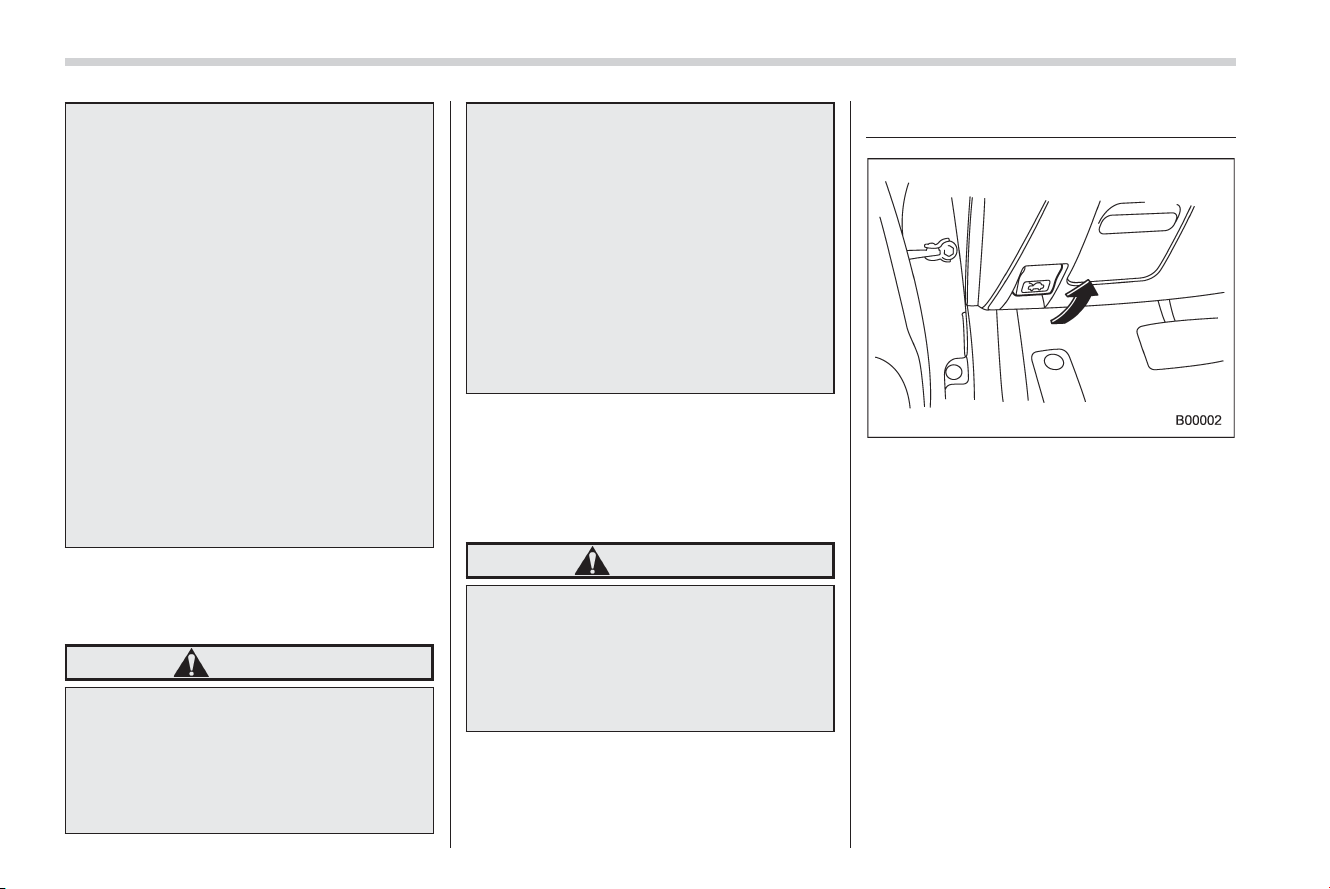
Black plate (294,1)
北米Model "A8130BE-B" EDITED: 2007/ 7/ 25
11-4 Maintenance and service
guard against getting oil or fluids
in your eyes. If something does
get in your eyes, thoroughly
wash them out with clean water.
. Do not tamper with the wiring of
the SRS airbag system or seat-
belt pretensioner system, or at-
tempt to take its connectors
apart, as that may activate the
system or it can render it inop-
erative. The wiring and connec-
tors of these systems are yellow
for easy identification. NEVER
use a circuit tester for these
wiring.
If your SRS airbag or seatbelt
pretensioner needs service, con-
sult your nearest SUBARU deal-
er.
& Before checking or servicing
in the engine compartment
WARNING
. Always stop the engine and set
the parking brake firmly to pre-
vent the vehicle from moving.
. Always let the engine cool down.
Engine parts become very hot
when the engine is running and
remain hot for some time after
the engine is stopped.
. Do not spill engine oil, engine
coolant, brake fluid or any other
fluid on hot engine components.
This may cause a fire.
. Always remove the key from the
ignition switch. When the ignition
switch is in the “ON” position,
thecoolingfanmayoperate
suddenly even when the engine
is stopped.
& When you do checking or
servicing in the engine com-
partment while the engine is
running
WARNING
A running engine can be dangerous.
Keep your fingers, hands, clothing,
hair and tools away from the cooling
fan, belts and any other moving
engine parts. Removing rings,
watches and ties is advisable.
Engine hood
To open the hood:
1. If the wiper blades are lifted off the
windshield, return them to their original
positions.
2. Pull the hood release knob under the
instrument panel.
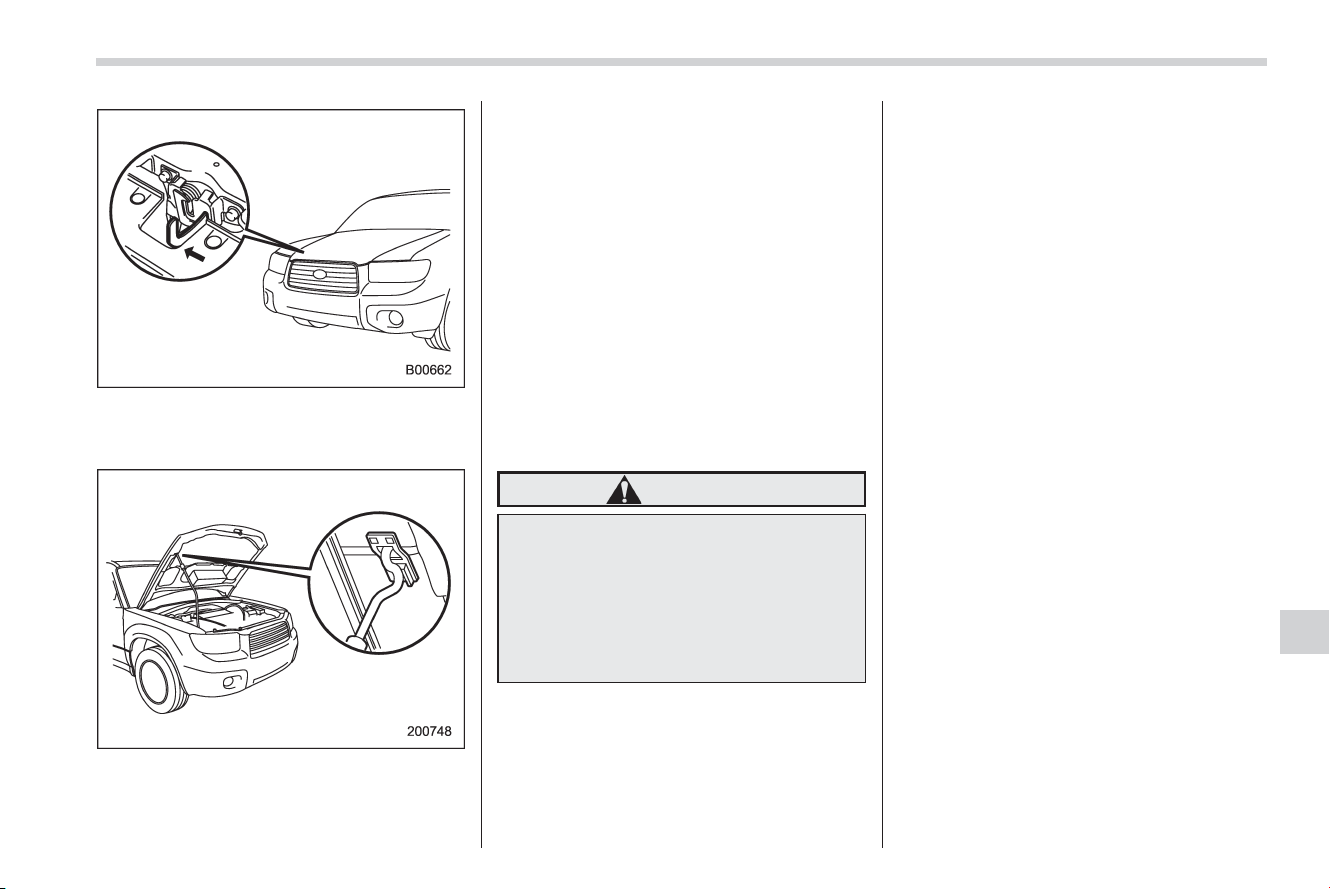
Black plate (295,1)
北米Model "A8130BE-B" EDITED: 2007/ 7/ 25
3. Release the secondary hood release
located under the front grille by moving the
lever toward the left.
Lift up the hood, release the hood prop
from its retainer and put the end of the
hood prop into the slot in the hood.
To close the hood:
1. Lift the hood slightly and remove the
hood prop from the slot in the hood and
return the prop to its retainer.
2. Lower the hood until it approaches
approximately 12 in (30 cm) from the
closed position and let it drop.
After closing the hood, be sure the hood is
securely locked.
If this does not close the hood, release it
from a slightly higher position. Do not push
the hood forcibly to close it. It could
deform the metal.
WARNING
Always check that the hood is
properly locked be fore you start
driving. If it is not, it might fly open
while the vehicle is moving and
block your view, which may cause
an accident and serious bodily in-
jury.
Maintenance and service 11-5
11
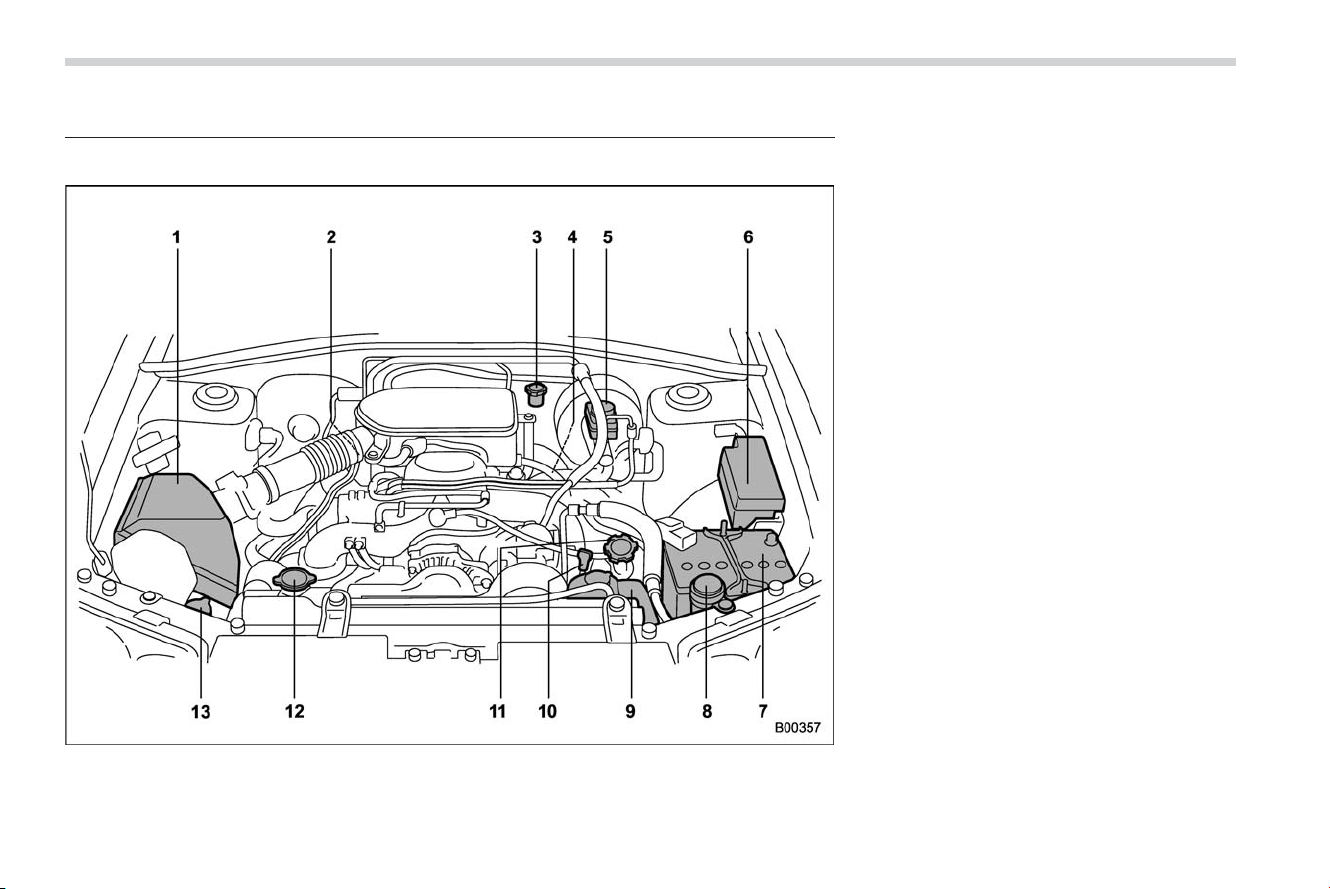
Black plate (296,1)
北米Model "A8130BE-B" EDITED: 2007/ 7/ 25
11-6 Maintenance and service
Engine compartment overview
& Non-turbo models
1) Air cleaner element (page 11-15)
2) Manual transmission oil level gauge (MT)
(page 11-19) or Differential gear oil level
gauge (AT) (page 11-21)
3) Clutch fluid reservoir (page 11-26)
4) Automatic transmission fluid level gauge
(page 11-20)
5) Brake fluid reservoir (page 11-25)
6) Fuse box (page 11-43)
7) Battery (page 11-42)
8) Windshield washer tank (page 11-37)
9) Engine coolant reservoir (page 11-12)
10) Engine oil level gauge (page 11-8)
11) Engine oil filler cap (page 11-8)
12) Radiator cap (page 11-12)
13) Power steering fluid reservoir
(page 11-24)
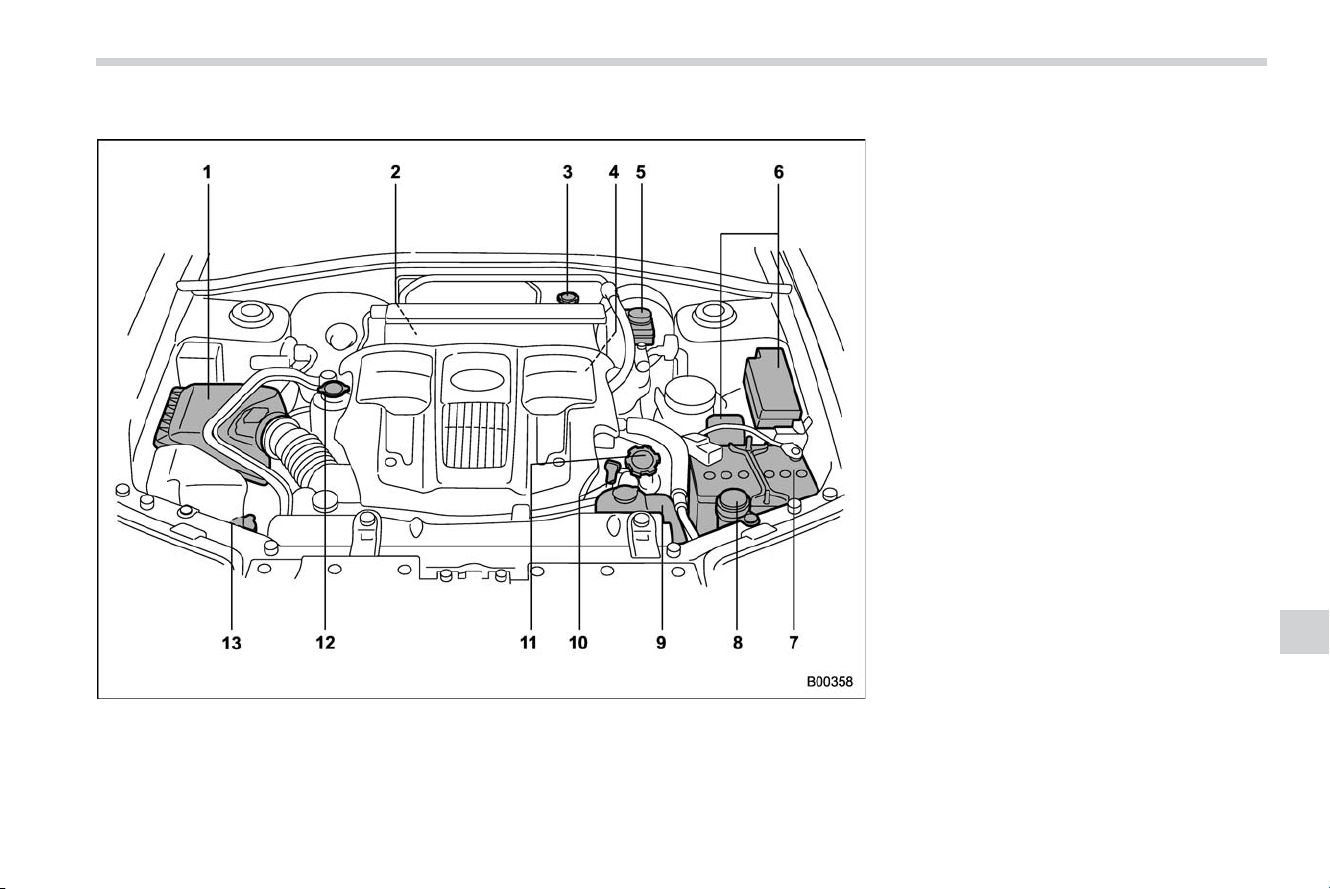
Black plate (297,1)
北米Model "A8130BE-B" EDITED: 2007/ 7/ 25
& Turbo models
1) Air cleaner element (page 11-15)
2) Manual transmission oil level gauge (MT)
(page 11-19) or Differential gear oil level
gauge (AT) (page 11-21)
3) Clutch fluid reservoir (page 11-26)
4) Automatic transmission fluid level gauge
(page 11-20)
5) Brake fluid reservoir (page 11-25)
6) Fuse box (page 11-43)
7) Battery (page 11-42)
8) Windshield washer tank (page 11-37)
9) Engine coolant reservoir (page 11-12)
10) Engine oil level gauge (page 11-8)
11) Engine oil filler cap (page 11-8)
12) Radiator cap (page 11-12)
13) Power steering fluid reservoir
(page 11-24)
Maintenance and service
11-7
11
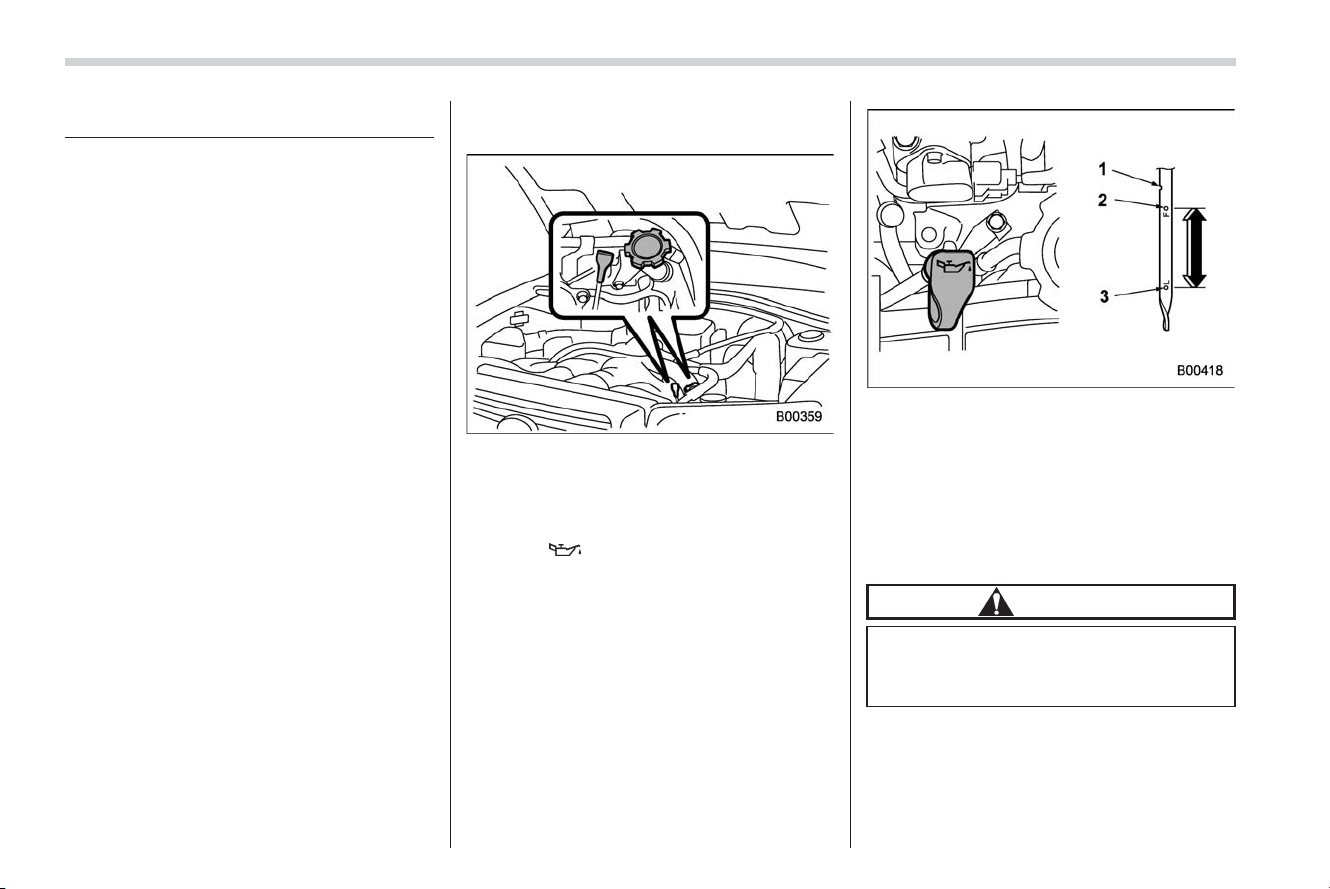
Black plate (298,1)
北米Model "A8130BE-B" EDITED: 2007/ 7/ 25
11-8 Maintenance and service
Engine oil
NOTE
. The engine oil consumption rate is
not stabilized, and therefore cannot be
determined until the vehicle has tra-
veled at least several thousand miles
(kilometers). Even after break-in, when
the vehicle is used under severe driv-
ing conditions such as those men-
tionedintheWarrantyandMainte-
nance Booklet, engine oil is consumed
or deteriorated more quickly than un-
der normal driving conditions. If you
drive your vehicle under these severe
conditions, you should check the oil
level at least at every second fuel fill-up
time, and change the oil more fre-
quently. Please refer to the Warranty
and Maintenance Booklet for more de-
tails.
. If the oil consumption rate seems
abnormally high after the break-in
period, for example more than 1 quart
per 1,200 miles or 1 liter per 2,000
kilometers, we recommend that you
contact your SUBARU dealer.
& Checking the oil level
Check the engine oil level at each fuel
stop.
1. Park the vehicle on a level surface and
stop the engine.
2. Pull out the dipstick, wipe it clean, and
insert it again.
3. Be sure the dipstick is correctly in-
serted until it stops with the graphic
symbol “
” on its top appearing as
shown in the illustration.
1) Notch
2) Upper level
3) Lower level
4. Pull out the dipstick again and check
the oil level on it. If it is below the lower
level, add oil to bring the level up to the
upper level.
CAUTION
. Use only engine oil with the
recommended grade and vis-
cosity.
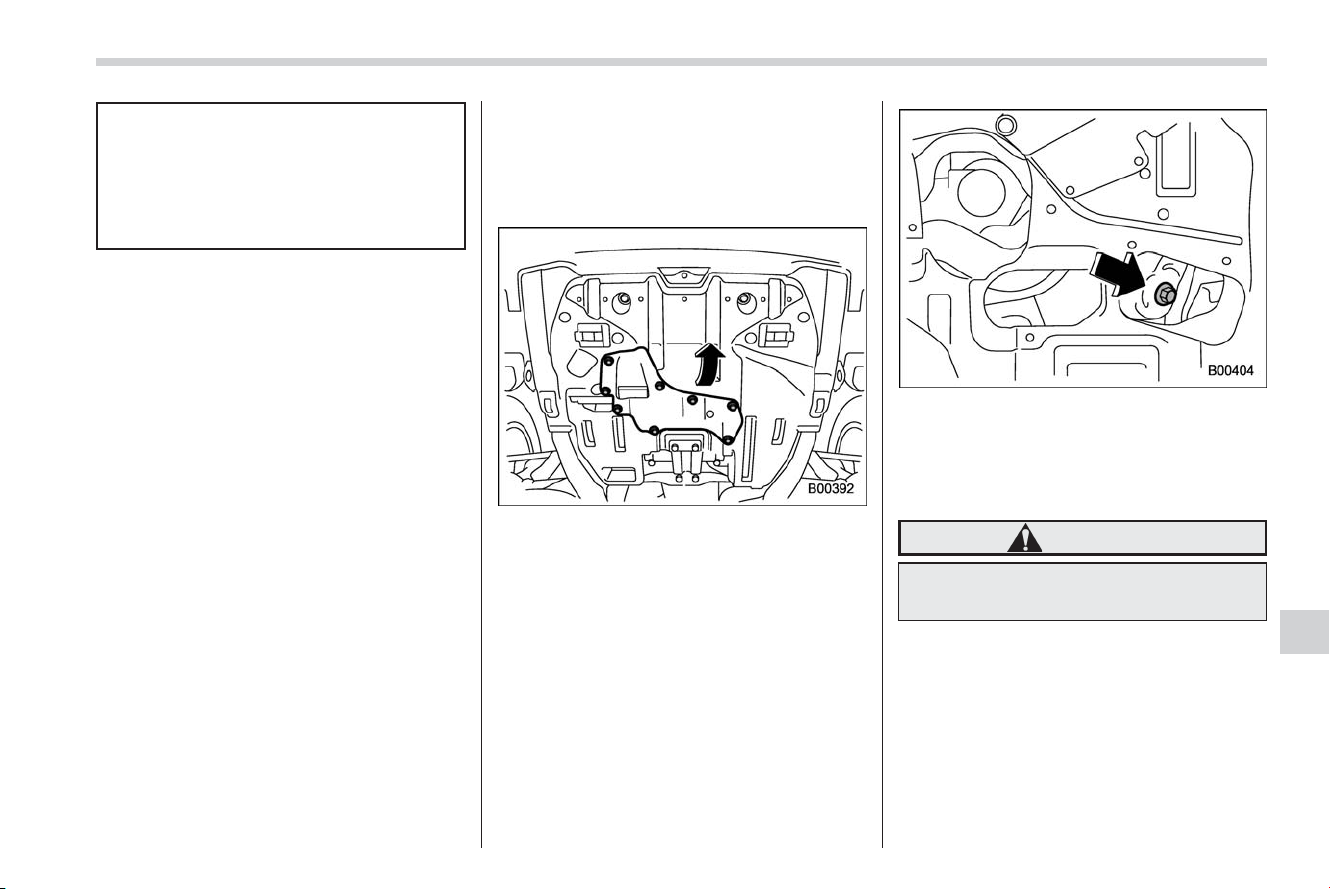
Black plate (299,1)
北米Model "A8130BE-B" EDITED: 2007/ 7/ 25
. Be careful not to spill engine oil
when adding it. If oil touches the
exhaust pipe, it may cause a bad
smell, smoke, and/or a fire. If
engine oil gets on the exhaust
pipe, be sure to wipe it off.
If you check the oil level just after stopping
the engine, wait a few minutes for the oil to
drain back into the oil pan before checking
the level.
Just after driving or while the engine is
warm, the engine oil level reading may be
in a range between the upper level and
the notch mark. This is caused by thermal
expansion of the engine oil.
To prevent overfilling the engine oil, do not
add any additional oil above the upper
level when the engine is cold.
& Changing the oil and oil filter
Change the oil and oil filter according to
the maintenance schedule in the “War-
ranty and Maintenance Booklet”.
The engine o il and oil filter must be
changed more frequently than listed in
the maintenance schedule when driving
on dusty roads, when short trips are
frequently made, when towing a trailer, or
when driving in extremely cold weather.
1. Warm up the engine by letting the
engine idle for approximately 10 minutes
to ease draining the engine oil.
2. Park the vehicle on a level surface and
stop the engine.
3. Remove the oil filler cap.
4. Open the access cover by removing
the eight clips and turning the access
cover counterclockwise. The drain plug
will be exposed.
5. Drain out the engine oil by removing
the drain plug while the engine is still
warm. The used oil should be drained into
an appropriate container and disposed of
properly.
WARNING
Be careful not to burn yourself with
hot engine oil.
6. Wipe the seating surface of the drain
plug with a clean cloth and tighten it
securely with a new sealing washer after
the oil has completely drained out.
Maintenance and service 11-9
– CONTINUED –
11
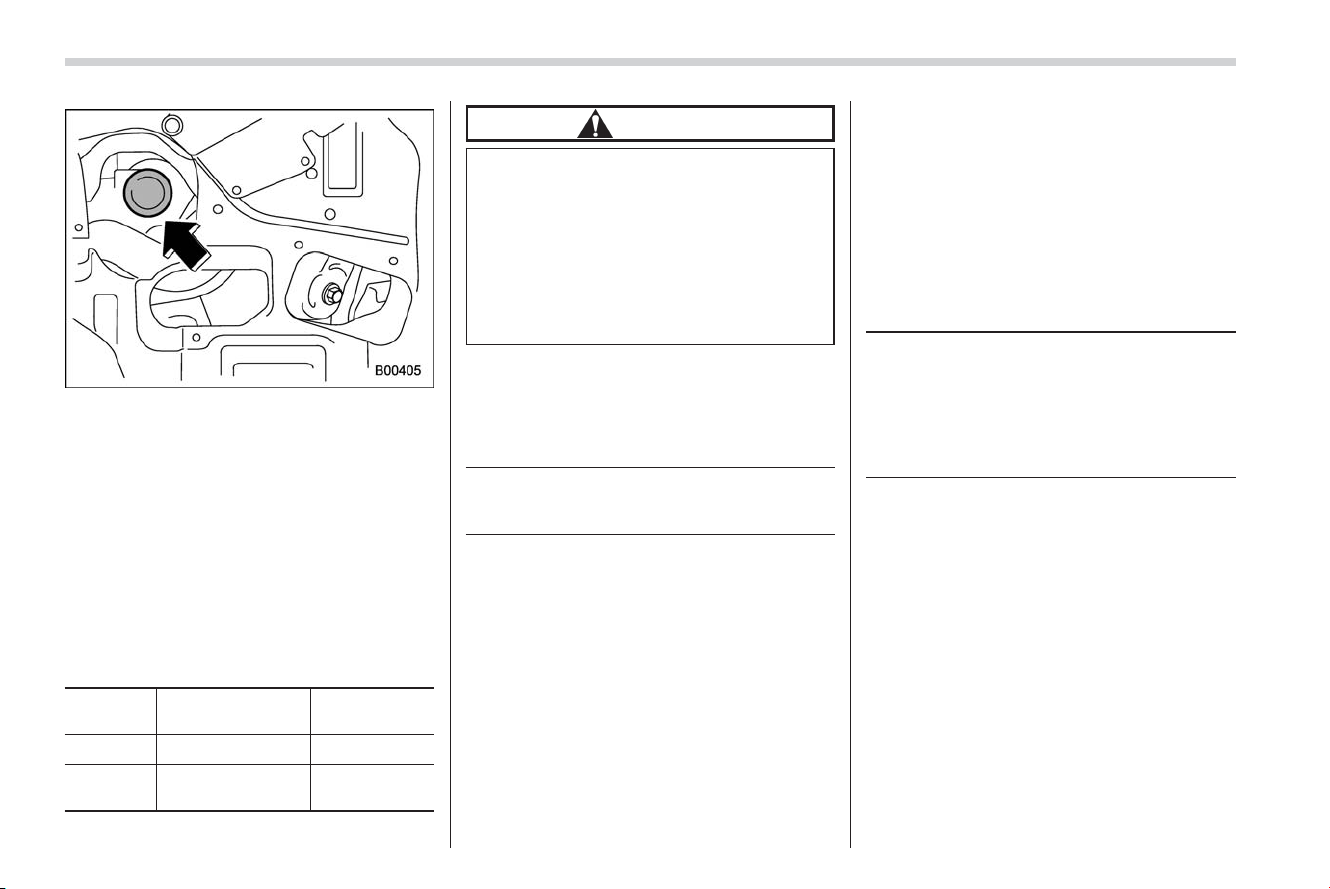
Black plate (300,1)
北米Model "A8130BE-B" EDITED: 2007/ 7/ 25
11-10 Maintenance and service
7. Remove the oil filter with an oil filter
wrench.
8. Before installing a new oil filter, apply a
thin coat of engine oil to the seal.
9. Clean the rubber seal seating area of
the bottom of engine and install the oil
filter by hand turning. Be careful not to
twist or damage the seal.
10. Tighten the oil filter by the amount
indicated in the following table after the
seal makes contact with the bottom of
engine.
Oil filter
color
Part
number
Amount of
rotation
Black
15208AA100 1 rotation
White 15208AA09A
2/3 – 3/4
rotation
CAUTION
. Never over tighten the oil filter
because that can result in an oil
leak.
. Thoroughly wipe off any engine
oil that has spilled over the
exhaust pipe and/or under-cover.
If left unremoved, the oil could
catch fire.
11. Close the access cover by turning it
clockwise and reinstall the eight clips in
their original positions.
12. Pour engine oil through the filler neck.
Oil capacity (Guideline):
4.2 US qt (4.0 liters, 3.5 Imp qt)
The oil quantity indicated above is only a
guideline. The necessary quantity of oil
depends on the quantity of oil that has
been drained. The quantity of drained oil
differs slightly depending on the tempera-
ture of the oil and the time the oil is left
flowing out. After pouring oil into the
engine, therefore, you must use the dip-
stick to confirm that the level is correct.
13. Start the engine and make sure that no
oil leaks appear around the filter’s rubber
seal.
14. Run the engine until it reaches the
normal operating temperature. Then stop
the engine and wait a few minutes to allow
the oil drain back. Check the oil level
again and if necessary, add more engine
oil.
& Recommended grade and
viscosity
Oil grade:
ILSAC GF-4, which can be identified with
the ILSAC certification mark (Starburst
mark)
or API classification SM with the words
“ENERGY CONSERVING”
These recommended oil grades can be
identified by looking for either or both of
the following marks displayed on the oil
container.
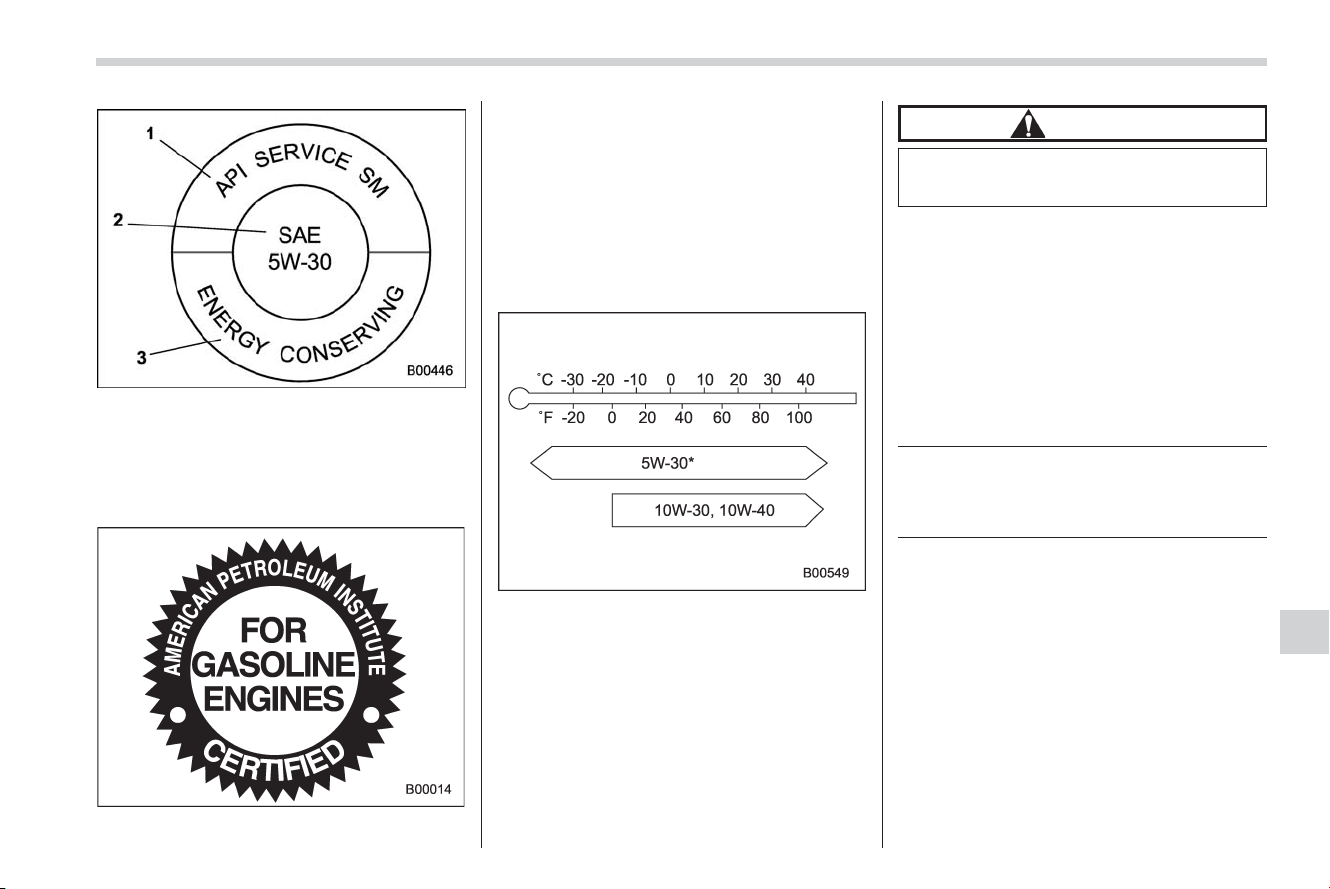
Black plate (301,1)
北米Model "A8130BE-B" EDITED: 2007/ 7/ 25
API Service label
1) Indicates the oil quality by API designa-
tions
2) Indicates the SAE oil viscosity grade
3) Indicates that the oil has fuel saving
capabilities
ILSAC Certification Mark (Starburst Mark)
In choosing an oil, you want the proper
quality and viscosity, as well as one that
will add to fuel economy. The following
table lists the recommended viscosities
and applicable temperatures.
When adding oil, different brands may be
used together as long as they are the
same API classification and SAE viscosity
as those recommended by SUBARU.
SAE viscosity number and applicable
temperature
*: 5W-30 is recommended.
Engine oil viscosity (thickness) affects fuel
economy. Oils of lower viscosity provide
better fuel economy. However, in hot
weather, oil of higher viscosity is required
to properly lubricate the engine.
CAUTION
Use only engine oil with the recom-
mended grade and viscosity.
& Recommended grade and
viscosity under severe driv-
ing conditions
If the vehicle is used in desert areas, in
areas with very high temperatures, or
used for heavy-duty applications such as
towing a trailer, use of oil with the following
grade and viscosities is recommended.
API classification SM (or SL):
SAE viscosity No.:
30, 40, 10W-50, 20W-40, 20W-50
& Synthetic oil
You can use synthetic engine oil that
meets the same requirements given for
conventional engine oil. When using
synthetic oil, you must use oil of the same
classification, viscosity and grade shown
in this Owner’s Manual, and must follow
the oil and filter changing intervals shown
in the maintenance schedule.
Maintenance and service 11-11
11
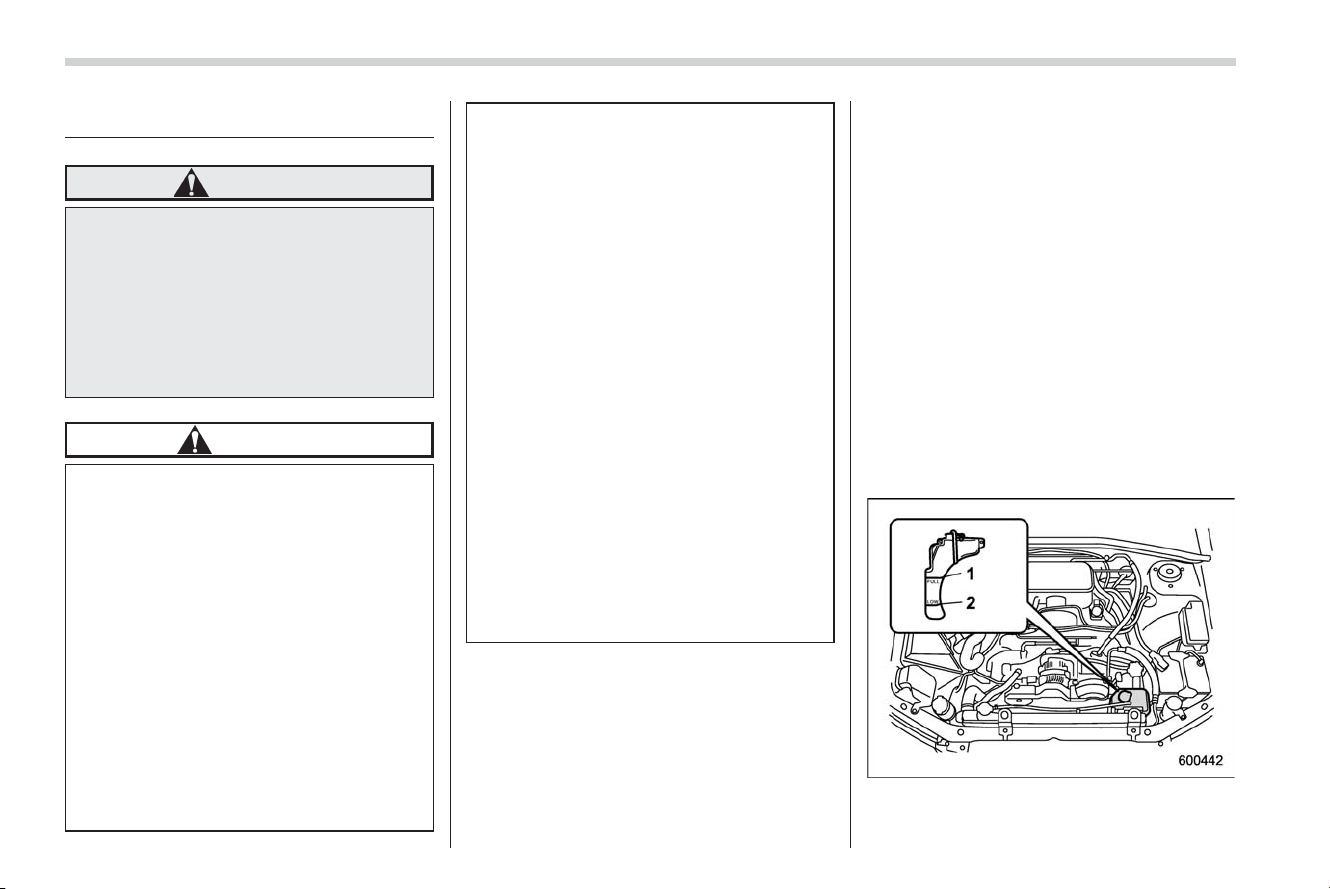
Black plate (302,1)
北米Model "A8130BE-B" EDITED: 2007/ 7/ 30
11-12 Maintenance and service
Cooling system
WARNING
Never attempt to remove the radia-
tor cap until the engine has been
shut off and has cooled down
completely. Since the coolant is
under pressure, you may suffer
serious burns from a spray of boil-
ing hot coolant when the cap is
removed.
CAUTION
. The cooling system has been
filled at the factory with a high
quality, corrosion-inhibiting,
year-around coolant which pro-
vides protection against freezing
down to −338F(−368C).
Subaru engines use aluminum
components that require the
anti-corrosive and anti-freeze
properties of Subaru Genuine
Coolant, which is specifically
formulated for the Subaru cool-
ing system. Failure to use Subaru
Genuine Coolant along with
Subaru Cooling System Condi-
tioner at the recommended main-
tenance intervals may result in
problems, including, but not lim-
ited to shortened life of engine
components and cooling system
clogging, coolant leaks and en-
gine damage from overheating.
Problems caused by the failure to
use Subaru Genuine Coolant and
Subaru Cooling System Condi-
tioner at recommended intervals
are not covered under the
Subaru Limited Warranty.
While there may be other generic
products that may provide the
required protection, they have
not been tested for compatibility
with Subaru engines and cooling
system components, and there-
fore they are not recommended.
. Do not splash the engine coolant
over painted parts. The alcohol
contained in the engine coolant
may damage the paint surface.
& Cooling fan, hose and con-
nections
Your vehicle employs an electric cooling
fan which is thermostatically controlled to
operate when the engine coolant reaches
a specific temperature.
If the radiator cooling fan does not operate
even when the engine coolant tempera-
ture gauge exceeds the normal operating
range, the cooling fan circuit may be
defective. Check the fuse and replace it
if necessary. If the fuse is not blown, have
the cooling system checked by your
SUBARU dealer.
If frequent addition of coolant is neces-
sary, there may be a leak in the engine
cooling system. It is recommended that
the cooling system and connections be
checked for leaks, damage, or looseness.
& Engine coolant
! Checking the coolant level
1) “FULL” level mark
2) “LOW” level mark
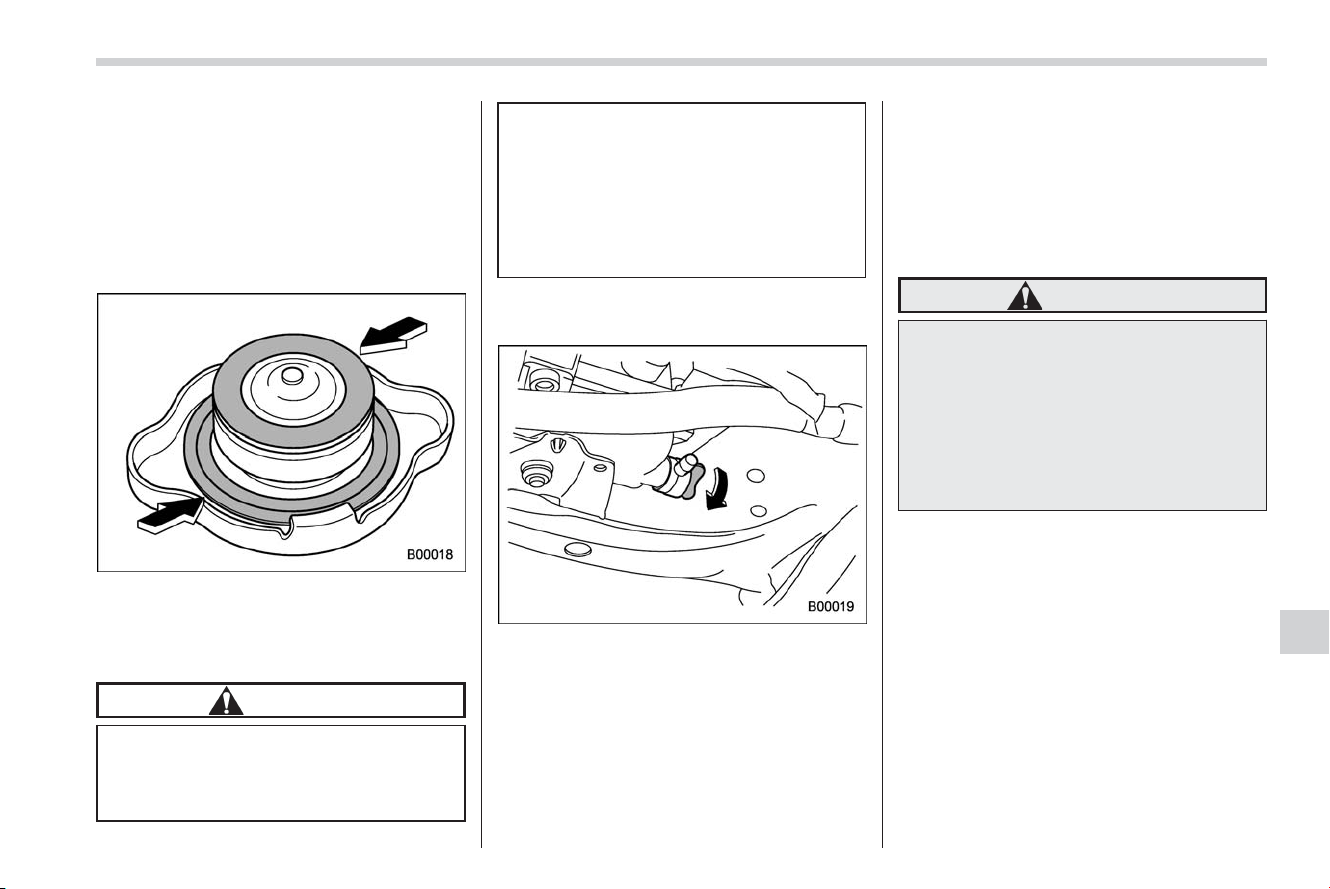
Black plate (303,1)
北米Model "A8130BE-B" EDITED: 2007/ 7/ 25
Check the coolant level at each fuel stop.
1. Check the coolant level on the outside
of the reservoir while the engine is cool.
2. If the level is close to or lower than the
“LOW” level mark, add coolant up to the
“FULL” level mark. If the reserve tank is
empty, remove the radiator cap and refill
as required.
3. After refilling the reserve tank and the
radiator, reinstall the caps and check that
the rubber gaskets inside the radiator cap
are in the proper position.
CAUTION
. Be careful not to spill engi ne
coolant when adding it. If coolant
touches the exhaust pipe, it may
cause a bad smell, smoke, and/or
a fire. If engine coolant gets on
the exhaust pipe, be sure to wipe
it off.
. Do not splash the engine coolant
over painted parts. The alcohol
contained in the engine coolant
may damage the paint surface.
! Changing the coolant
Always add genuine Subaru cooling sys-
tem conditioner whenever the coolant is
replaced.
Change the engine coolant and add
genuine Subaru cooling system condi-
tioner using the following procedures
according to the maintenance schedule.
1. Remove the under cover.
2. Place a proper container under the
drain plug and loosen the drain plug.
3. Loosen the radiator cap to drain the
coolant from the radiator. Then drain the
coolant from the reserve tank. Tighten the
drain plug securely.
WARNING
Never attempt to remove the radia-
tor cap until the engine has been
shut off and has cooled down
completely. Since the coolant is
under pressure, you may suffer
serious burns from a spray of boil-
ing hot coolant when the cap is
removed.
4. Install the under cover.
Maintenance and service 11-13
– CONTINUED –
11
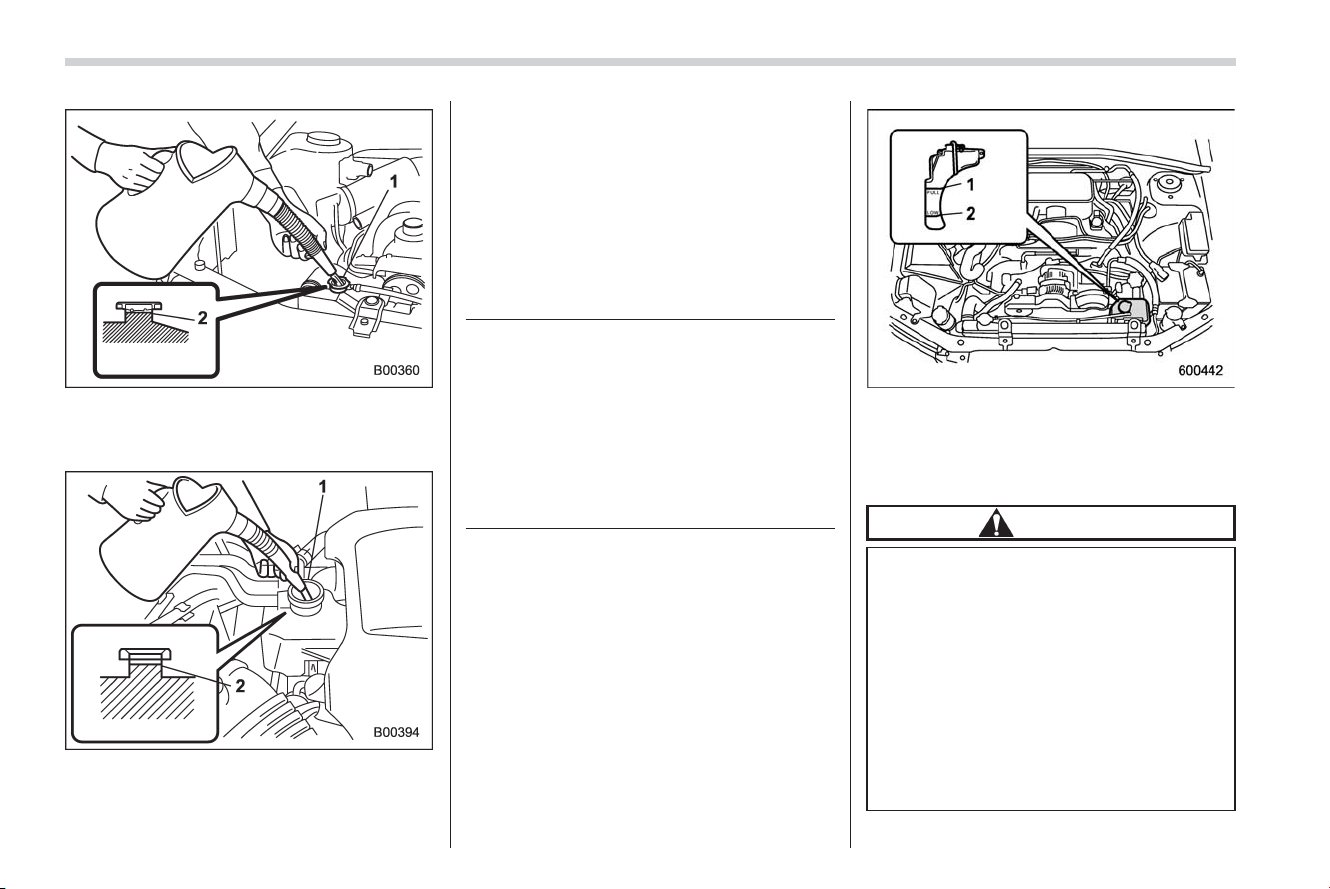
Black plate (304,1)
北米Model "A8130BE-B" EDITED: 2007/ 7/ 25
11-14 Maintenance and service
Non-turbo models
1) Filler neck
2) Fill up to this level
Turbo models
1) Filler neck
2) Fill up to this level
5. Slowly pour the coolant and fill up to
just below the filler neck, allowing enough
room to add genuine Subaru cooling
system conditioner in the radiator. Add
genuine Subaru cooling system condi-
tioner until the coolant level reaches the
filler neck. Do not pour the coolant too
quickly, as this may lead to insufficient air
bleeding and trapped air in the system.
Guideline of coolant quantity (including
coolant in reservoir tank):
Non-turbo models:
MT: 7.3 US qt (6.9 liters, 6.1 Imp qt)
AT: 7.2 US qt (6.8 liters, 6.0 Imp qt)
Turbo models:
MT: 7.8 US qt (7.4 liters, 6.5 Imp qt)
AT: 7.7 US qt (7.3 liters, 6.4 Imp qt)
1) “FULL” level mark
2) “LOW” level mark
6. Pour the coolant and fill to the reser-
voir tank’s “FULL” level mark.
CAUTION
. Be careful not to spill engine
coolant when adding it. If coolant
touches the exhaust pipe, it may
cause a bad smell, smoke, and/or
a fire. If engine coolant gets on
the exhaust pipe, be sure to wipe
it off.
. Do not splash the engine coolant
over painted parts. The alcohol
contained in the engine coolant
may damage the paint surface.
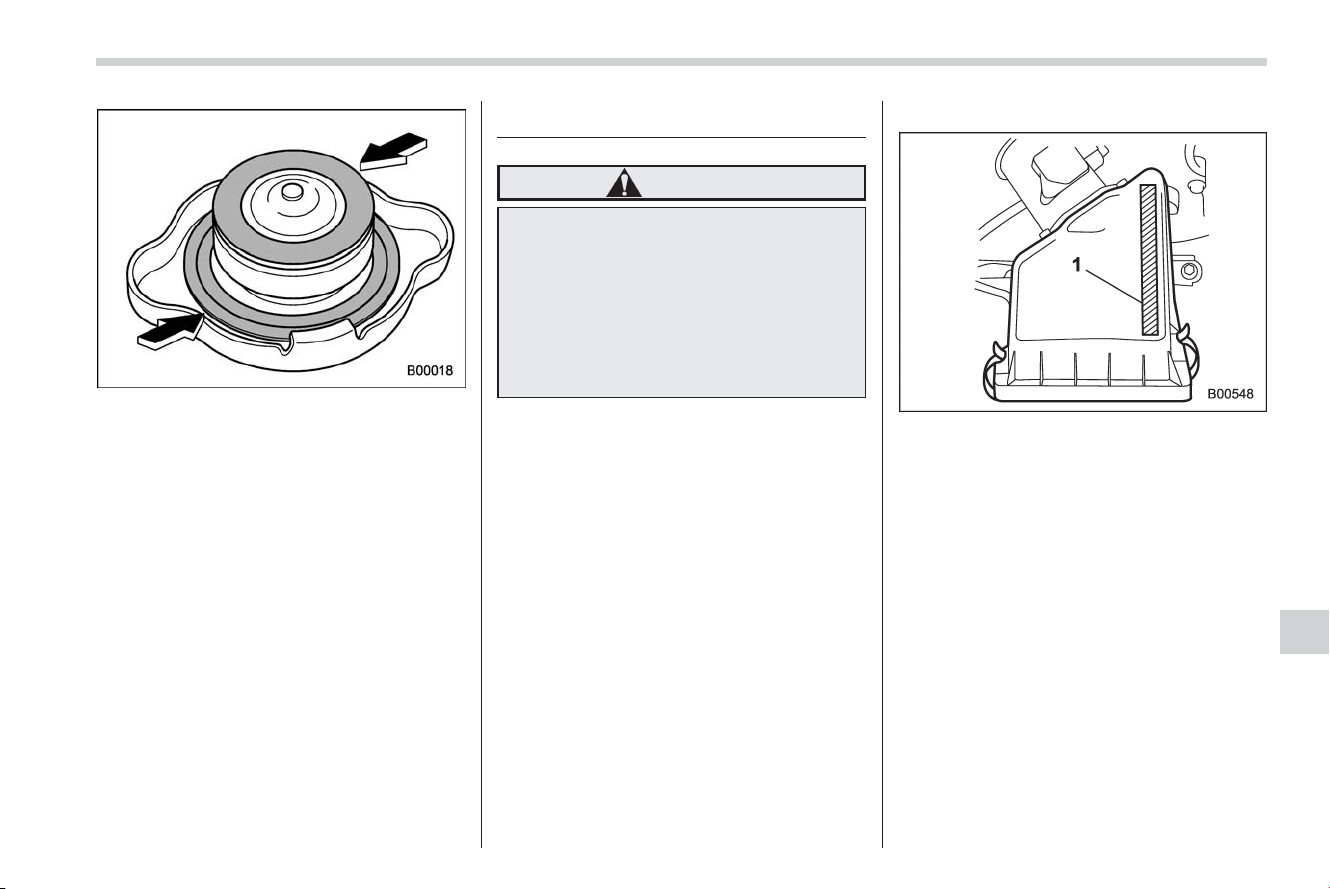
Black plate (305,1)
北米Model "A8130BE-B" EDITED: 2007/ 7/ 25
7. Put the radiator cap back on and
tighten firmly. At this time, make sure that
the rubber gasket in the radiator cap is
correctly in place.
8. Start and run the engine for more than
five minutes at 2,000 to 3,000 rpm.
9. Stop the engine and wait until the
coolant cools down (122 to 1408F [50 to
608C]). If there is any loss of coolant, add
coolant to the radiator’s filler neck and to
the reserve tank’s “FULL” level.
10. Put the radiator cap and reservoir cap
back on and tighten firmly.
Air cleaner element
WARNING
Do not operate the engine with the
air cleaner element removed. The air
cleaner element not only filters
intake air but also stops flames if
the engine backfires. If the air
cleaner element is not installed
when the engine backfires, you
could be burned.
The air cleaner element functions as a
filter screen. When the element is perfo-
rated or removed, engine wear will be
excessive and engine life shortened.
The air cleaner element has a viscous
type and a dry type.
Be sure to use the appropriate type of air
cleaner element, which depends on the
vehicle type.
If there is the embossed requirement “Use
of genuine dry air cleaner element is
required” on the air cleaner case cover,
which is shown in the following figure, use
the dry type air cleaner element.
For vehicles without the requirement on
the air cleaner case cover, use the viscous
type air cleaner element.
1) Embossed requirement
& Replacing the air cleaner
element
Replace the air cleaner element according
to the maintenance schedule in the
“Warranty and Maintenance Booklet”. Un-
der extremely dusty conditions, replace it
more frequently. It is recommended that
you always use genuine SUBARU parts.
Maintenance and service 11-15
– CONTINUED –
11
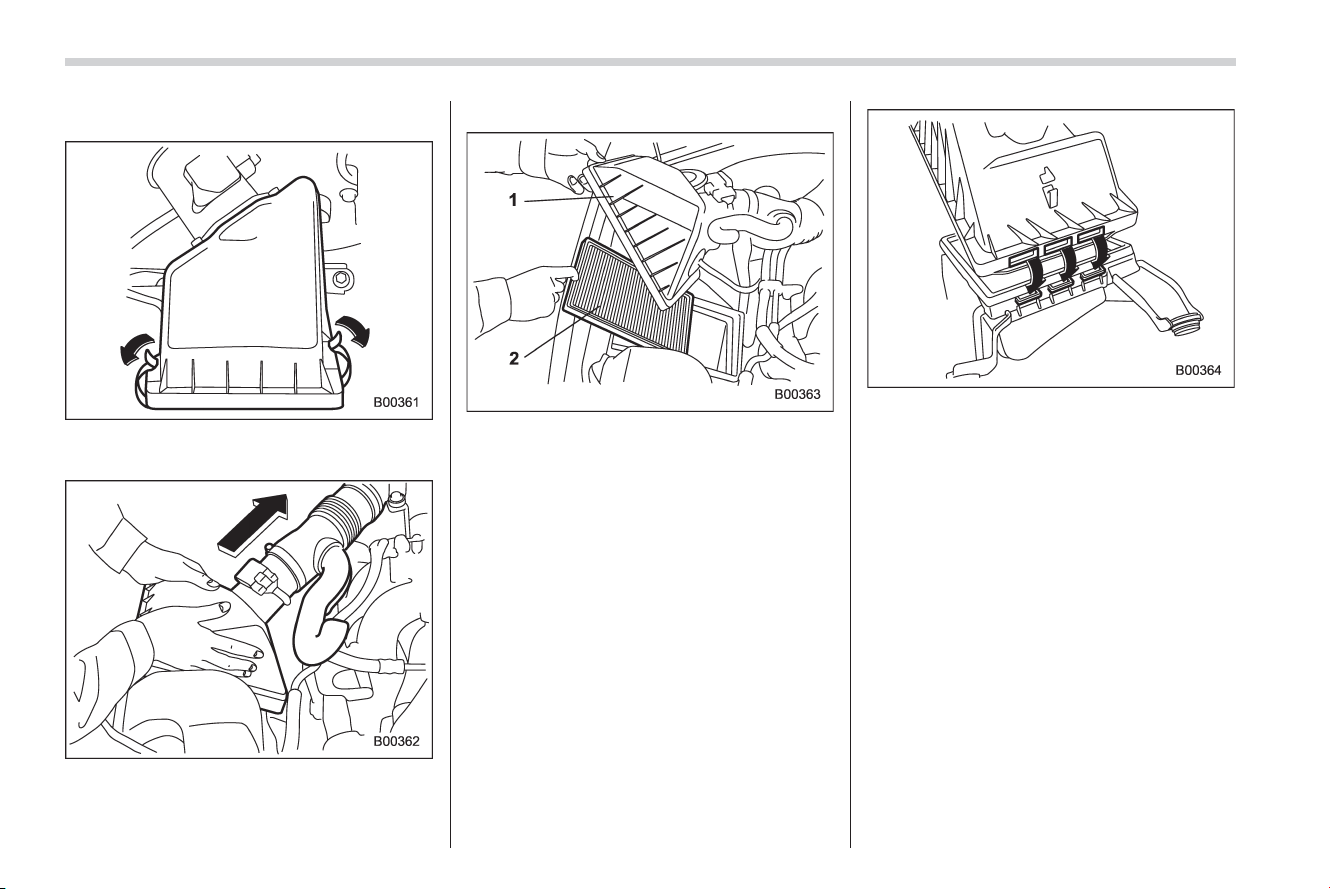
Black plate (306,1)
北米Model "A8130BE-B" EDITED: 2007/ 7/ 25
11-16 Maintenance and service
! Non-turbo models
1. Unsnap the two clamps holding the air
cleaner case cover.
2. Push the air cleaner case cover in the
direction of the arrow shown in the
drawing.
1) Air cleaner case cover
2) Viscous air cleaner element
Dry air cleaner element (if required)
3. Open the air cleaner case cover and
remove the air cleaner element.
4. Clean the inside of the air cleaner
cover and case with a damp cloth and
install a new air cleaner element.
5. To install the air cleaner case cover,
insert the three projections on the air
cleaner case i nto the slits on the air
cleaner case cover and then snap the
two clamps on the air cleaner case cover.
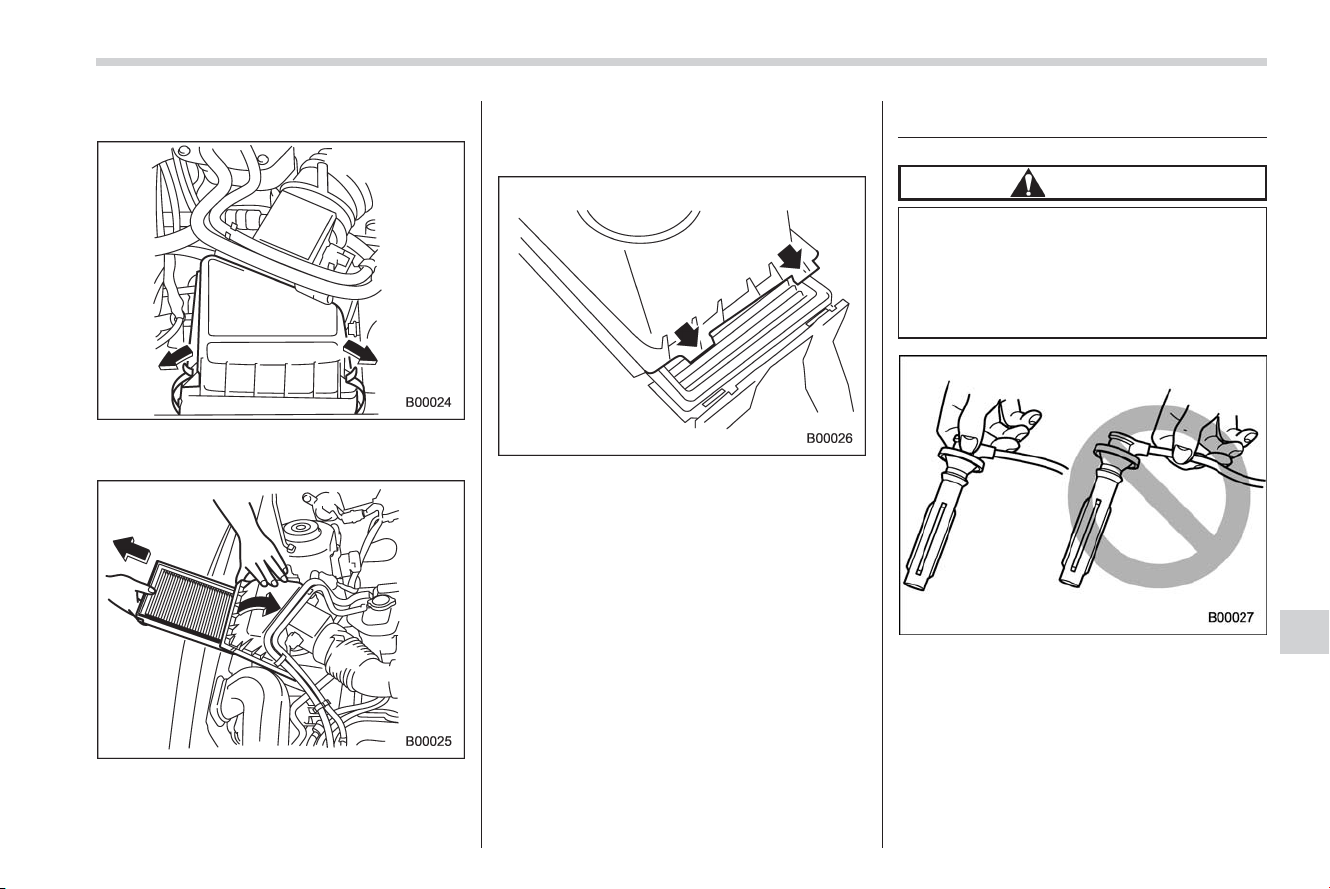
Black plate (307,1)
北米Model "A8130BE-B" EDITED: 2007/ 7/ 25
! Turbo models
1. Unsnap the two clamps holding the air
cleaner case cover.
2. Open the air cleaner case cover and
remove the air cleaner element.
3. Clean the inside of the air cleaner
cover and case with a damp cloth and
install a new air cleaner element.
4. To install the air cleaner case cover,
insert the two projections o n the air
cleaner case cover into the slits on the
air cleaner case and then snap the two
clamps on the air cleaner case cover.
Spark plugs
CAUTION
. When disconnecting the spark
plug cables, always grasp the
spark plug cap, not the cables.
. Make sure the cables are re-
placed in the correct order.
It may be difficult to replace the spark
plugs. It is recommended that you have
the spark plugs replaced by your
SUBARU dealer.
The spark plugs should be replaced
according to the maintenance schedule
in the “Warranty and Maintenance Book-
let”.
Maintenance and service 11-17
– CONTINUED –
11
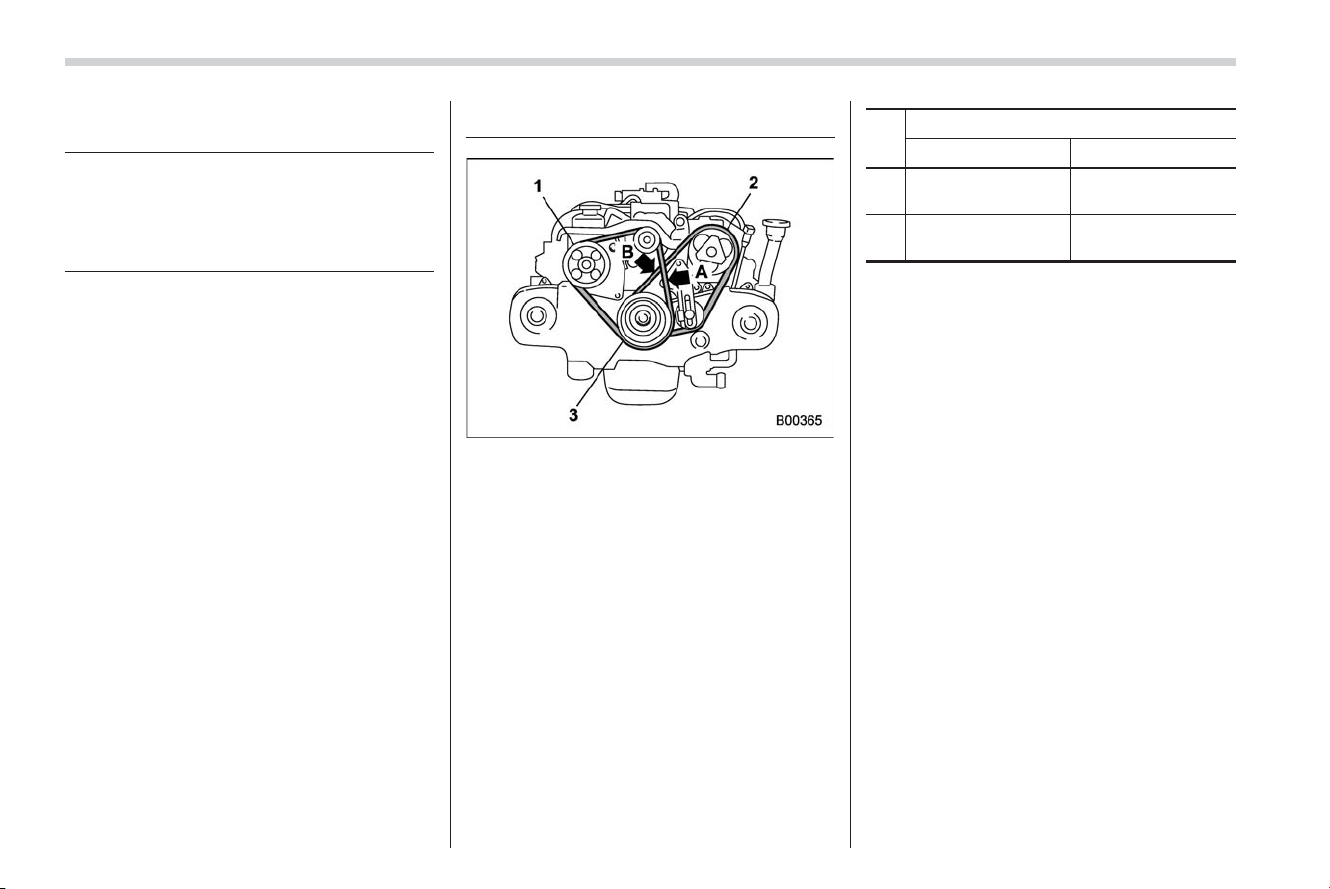
Black plate (308,1)
北米Model "A8130BE-B" EDITED: 2007/ 7/ 25
11-18 Maintenance and service
& Recommended spark plugs
Non-turbo models:
FR5AP-11 (NGK)
Turbo models:
ILFR6B (NGK)
Drive belts
1) Power steering pump pulley
2) Air conditioner compressor pulley
3) Crank pulley
The alternator, power steering pump, and
air conditioner compressor depend on
drive belts. Satisfactory performance re-
quires that belt tension be correct.
To check belt tension, place a straight-
edge (ruler) across two adjacent pulleys
and apply a force of 22 lbs (98 N, 10 kg)
midway between the pulleys by using a
spring scale. Belt deflection should be the
amount specified. If a belt is loose,
cracked, or worn, contact your SUBARU
dealer.
in (mm)
Deflection
New belt
Used belt
A
0.28 – 0.35
(7.0 – 9.0)
0.35 – 0.43
(9.0 – 11.0)
B
0.30 – 0.33
(7.5 – 8.5)
0.35 – 0.40
(9.0 – 10.0)
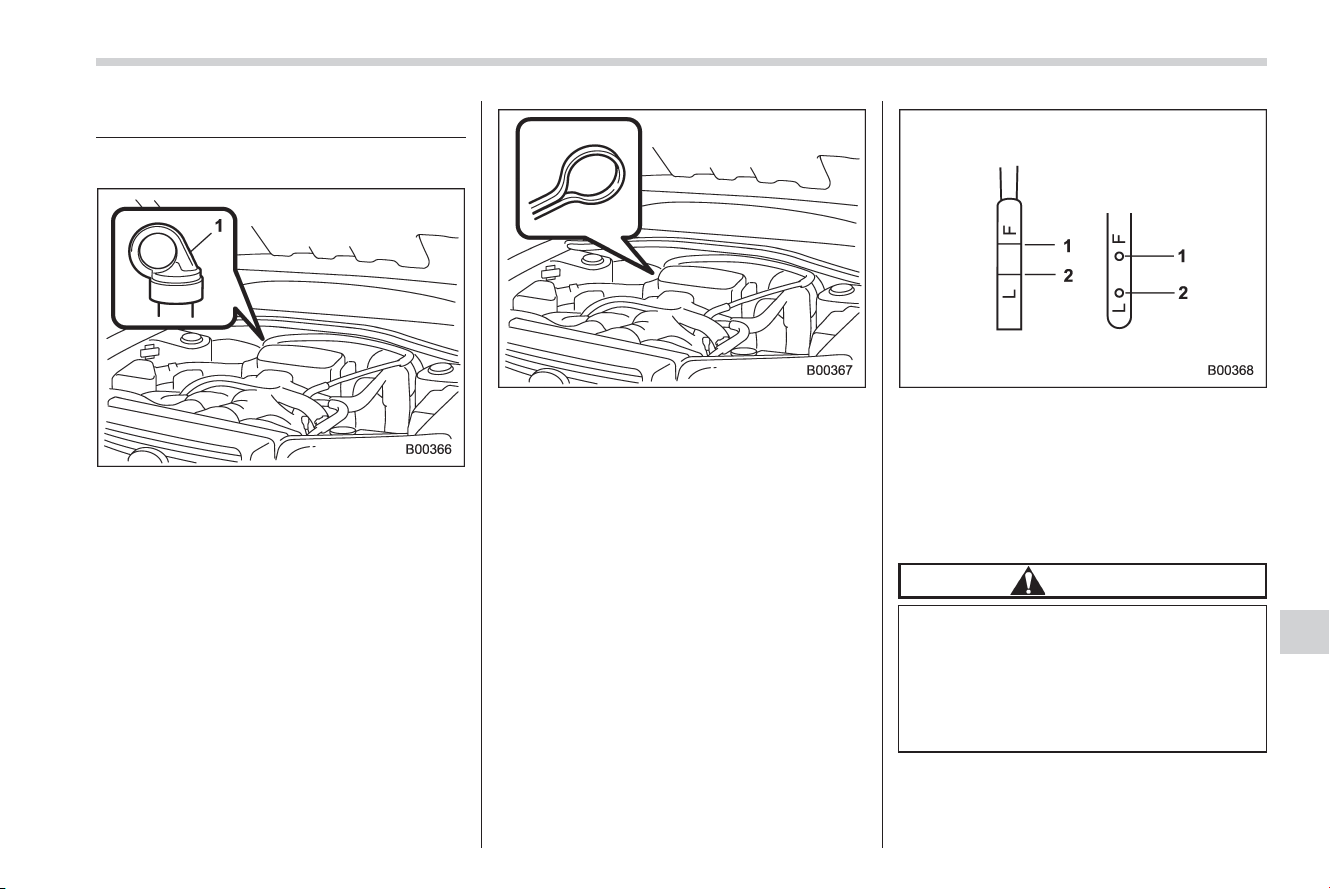
Black plate (309,1)
北米Model "A8130BE-B" EDITED: 2007/ 7/ 25
Manual transmission oil
& Checking the oil level
Non-turbo models:
1) Yellow handle
Turbo models
Check the oil level monthly.
1. Park the vehicle on a level surface and
stop the engine.
2. Pull out the dipstick, wipe it clean, and
insert it again.
1) Upper level
2) Lower level
3. Pull out the dipstick again and check
the oil level on it. If it is below the lower
level, add oil through the dipstick hole to
bring the level up to the upper level.
CAUTION
Be careful not to spill manual trans-
mission oil when adding it. If oil
touches the exhaust pipe, it may
cause a bad smell, smoke, and/or a
fire. If oil gets on the exhaust pipe,
be sure to wipe it off.
Maintenance and service 11-19
– CONTINUED –
11
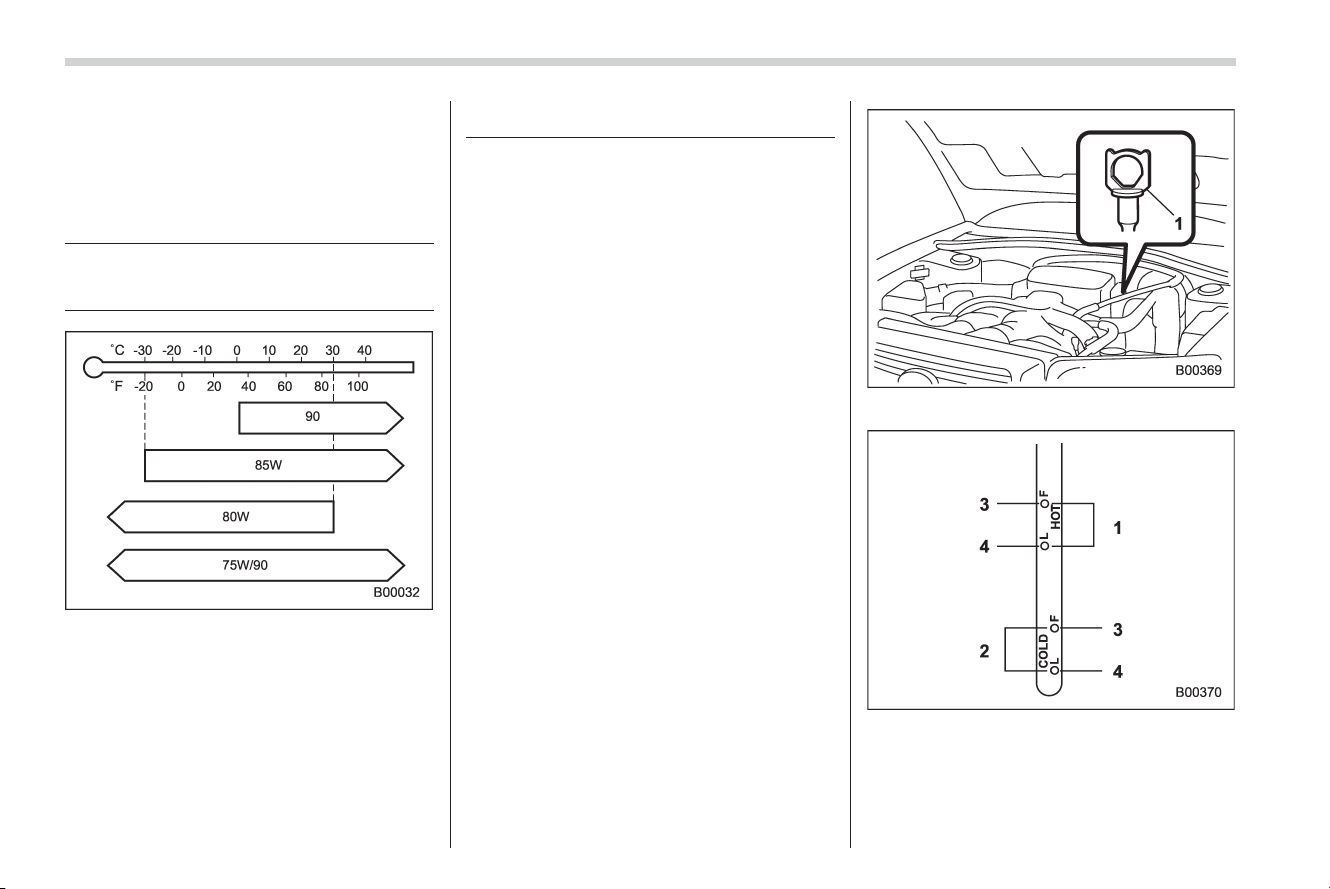
Black plate (310,1)
北米Model "A8130BE-B" EDITED: 2007/ 7/ 25
11-20 Maintenance and service
& Recommended grade and
viscosity
Each oil manufacturer has its own base
oils and additives. Never use different
brands together.
Oil grade:
API classification GL-5
SAE viscosity No. and applicable tempera-
ture
Automatic transmission fluid
& Checking the fluid level
The automatic transmission fluid expands
largely as its temperature rises; the fluid
level differs according to fluid temperature.
Therefore, there are two different scales
for checking the level of hot fluid and cold
fluid on the dipstick.
Though the fluid level can be checked
without warming up the fluid on the
“COLD” range, we recommend checking
the fluid level when the fluid is at operating
temperature.
! Checking the fluid level when the
fluid is hot
Check the fluid level monthly.
1. Drive the vehicle several miles to raise
the temperature of the transmission fluid
up to normal operating temperature; 154
to 1768F (70 to 808C) is normal.
2. Park the vehicle on a level surface and
set the parking brake.
3. First shift the selector lever in each
position. Then shift it in the “P” position,
and run the engine at idling speed.
1) Yellow handle
1) HOT range
2) COLD range
3) Upper level
4) Lower level
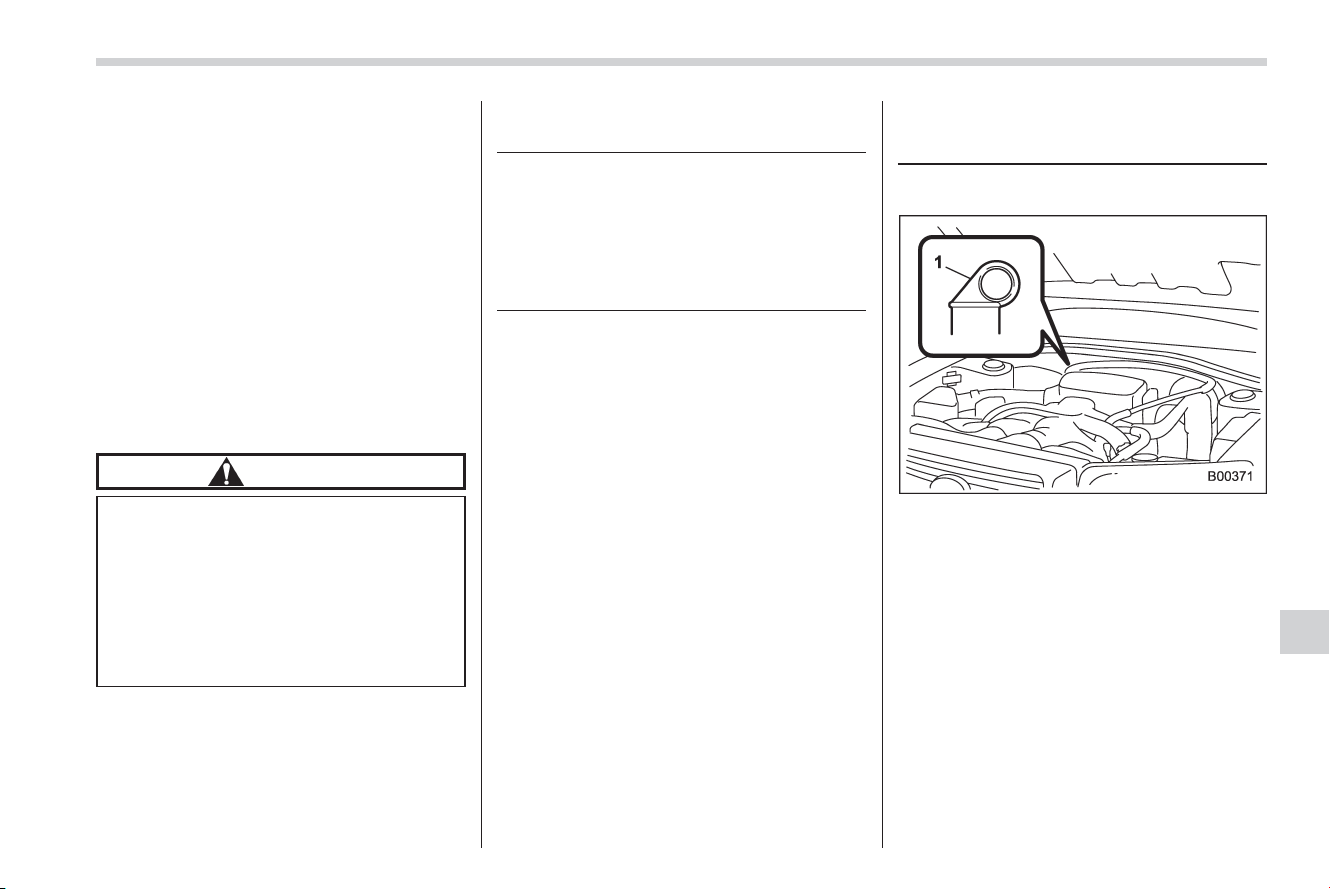
Black plate (311,1)
北米Model "A8130BE-B" EDITED: 2007/ 7/ 25
4. Pull out the dipstick and check the fluid
level on the gauge. If it is below the lower
level on the “HOT” range, add the recom-
mended automatic transmission fluid up to
the upper level.
! Checking the fluid level when the
fluid is cold
When the fluid level has to be checked
without time to warm up the automatic
transmission, check to see that the fluid
level is between the lower level and upper
level on the “COLD” range. If it is below
that range, add fluid up to the upper level.
Be careful not to overfill.
CAUTION
Be careful not to spill automatic
transmission fluid when adding it.
If automatic transmission fluid
touches the exhaust pipe, it may
cause a bad smell, smoke, and/or a
fire. If automatic transmission fluid
gets on the exhaust pipe, be sure to
wipe it off.
& Recommended fluid
Use one of the following types of auto-
matic transmission fluid.
Genuine Subaru Automatic Transmis-
sion Fluid Type-HP
IDEMITSU ATF HP
Castrol Transmax J
NOTE
For optimum transmission perfor-
mance, only use the automatic trans-
mission fluid that is recommended and
provided by Subaru.
If the recommended automatic trans-
mission fluid is unavailable, Dexron III
may be temporarily used. If the Dexron
III is used continuously there will be a
noticeable increase in the vibration and
noise from the automatic transmission.
Front differential gear oil (AT
vehicles)
& Checking the oil level
1) Yellow handle
Check the differential oil level monthly.
1. Park the vehicle on a level surface and
stop the engine.
2. Pull out the dipstick, wipe it clean, and
insert it again.
Maintenance and service 11-21
– CONTINUED –
11
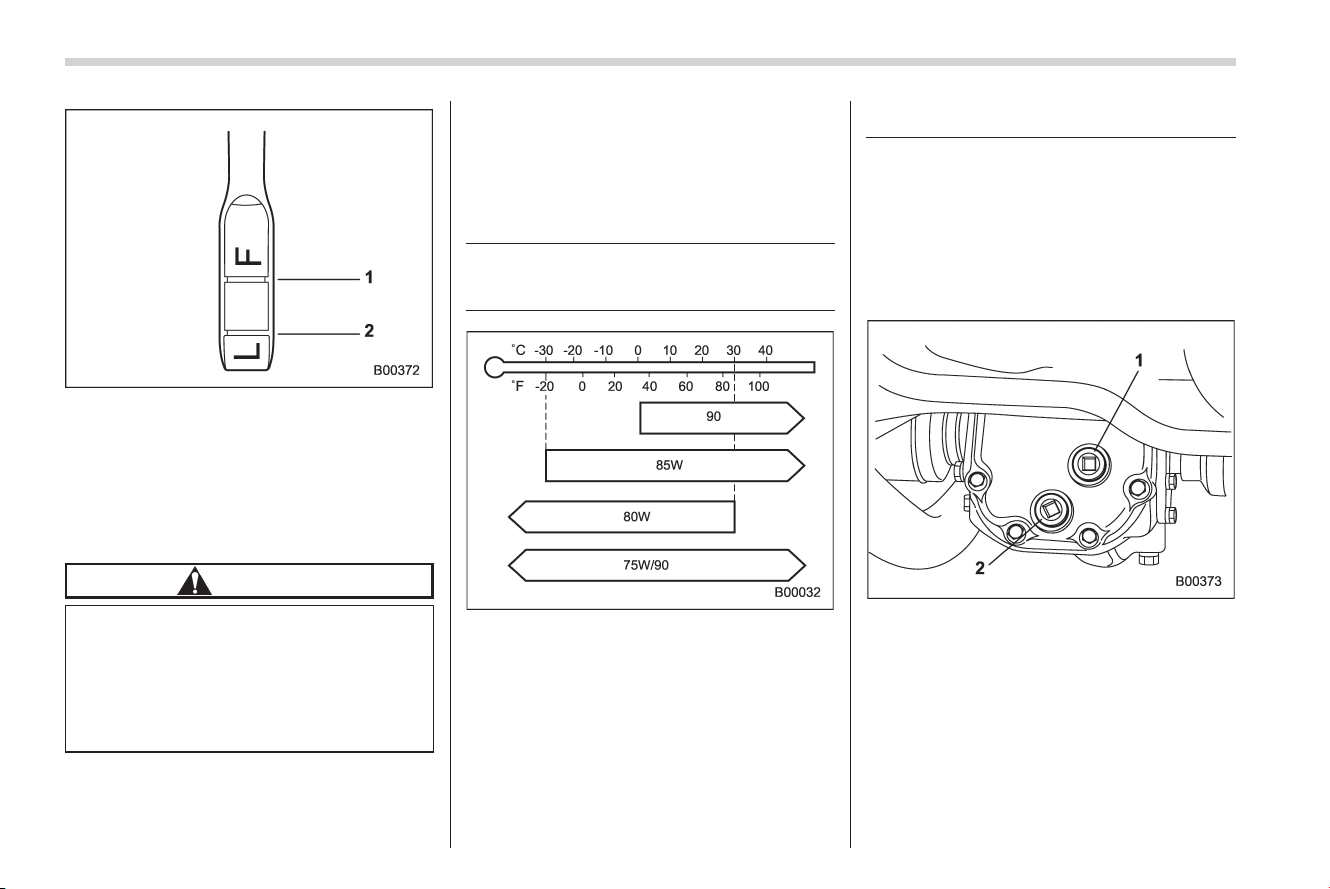
Black plate (312,1)
北米Model "A8130BE-B" EDITED: 2007/ 7/ 25
11-22 Maintenance and service
1) Upper level
2) Lower level
3. Pull out the dipstick again and check
the oil level on it. If it is below the lower
level, add oil to bring the level up to the
upper level.
CAUTION
Be careful not to spill front differ-
ential gear oil when adding it. If oil
touches the exhaust pipe, it may
cause a bad smell, smoke, and/or a
fire. If oil gets on the exhaust pipe,
be sure to wipe it off.
& Recommended grade and
viscosity
Each oil manufacturer has its own base
oils and additives. Never use different
brands together.
Oil grade:
API classification GL-5
SAE viscosity No. and applicable tempera-
ture
Rear differential gear oil
& Checking the gear oil level
Your vehicle may be equipped with a rear
differential protector. The differential pro-
tector provides protection to the rear
differential assembly during off-road use.
Removal of the rear differential protector is
not required when checking the oil level.
1) Filler plug
2) Drain plug
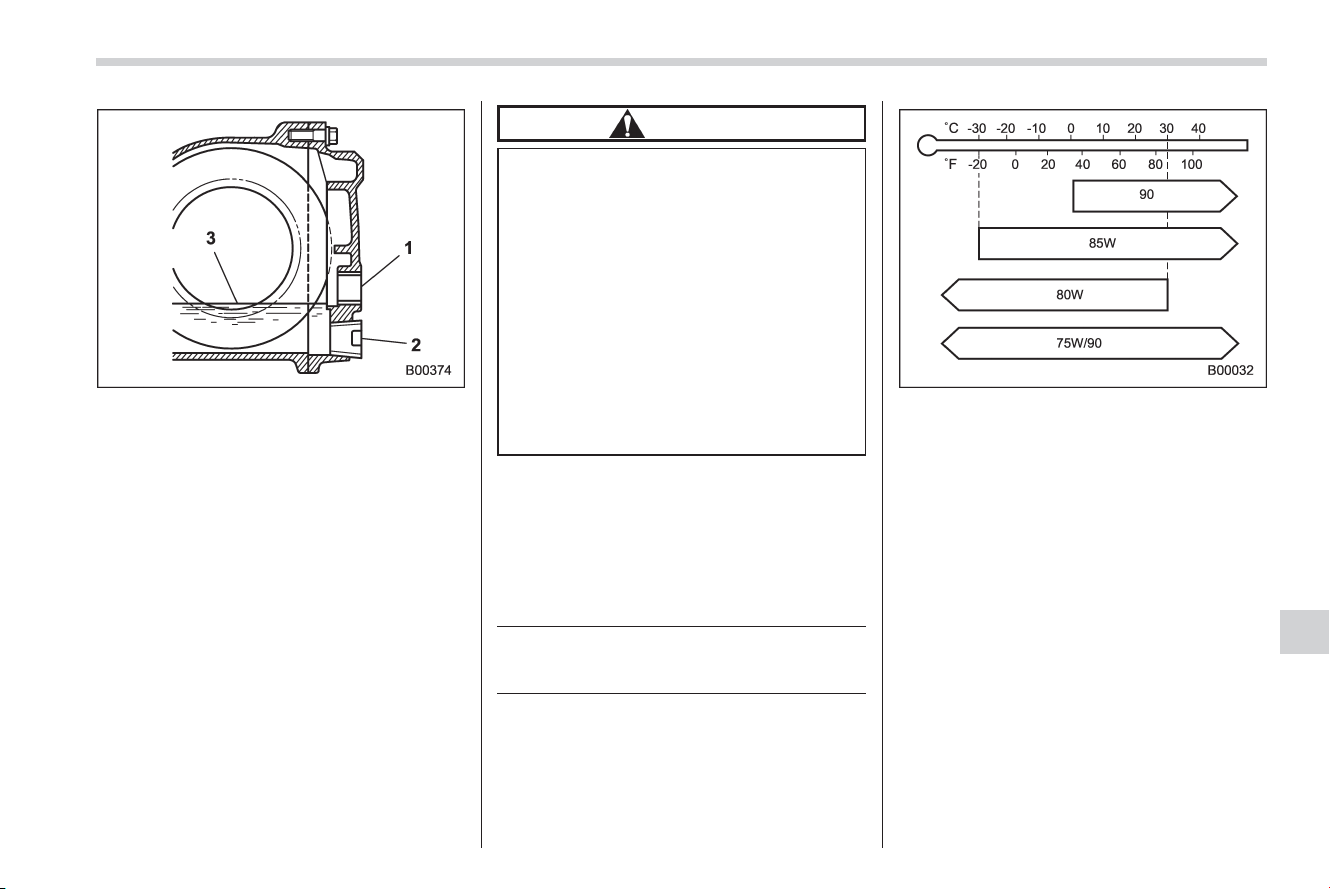
Black plate (313,1)
北米Model "A8130BE-B" EDITED: 2007/ 7/ 25
1) Filler hole
2) Drain hole
3) Oil level
Remove the plug from the filler hole and
check the oil level. The oil level should be
kept even with the bottom of the filler hole.
If the oil level is below the bottom edge of
the hole, add oil through the filler hole to
raise the level.
CAUTION
. Be careful not to spill rear differ-
ential gear oil when adding it. If
rear differential gear oil touches
the exhaust pipe, it may cause a
bad smell, smoke, and/or a fire. If
rear differential gear oil gets on
the exhaust pipe, be sure to wipe
it off.
. If the vehicle requires frequent
refilling, there may be an oil leak.
If you suspect a problem, have
the vehic le checked at your
SUBARU dealer.
& Recommended grade and
viscosity
Each oil manufacturer has its own base
oils and additives. Never use different
brands together.
Oil grade:
API classification GL-5
SAE viscosity No. and applicable tempera-
ture
Maintenance and service
11-23
11
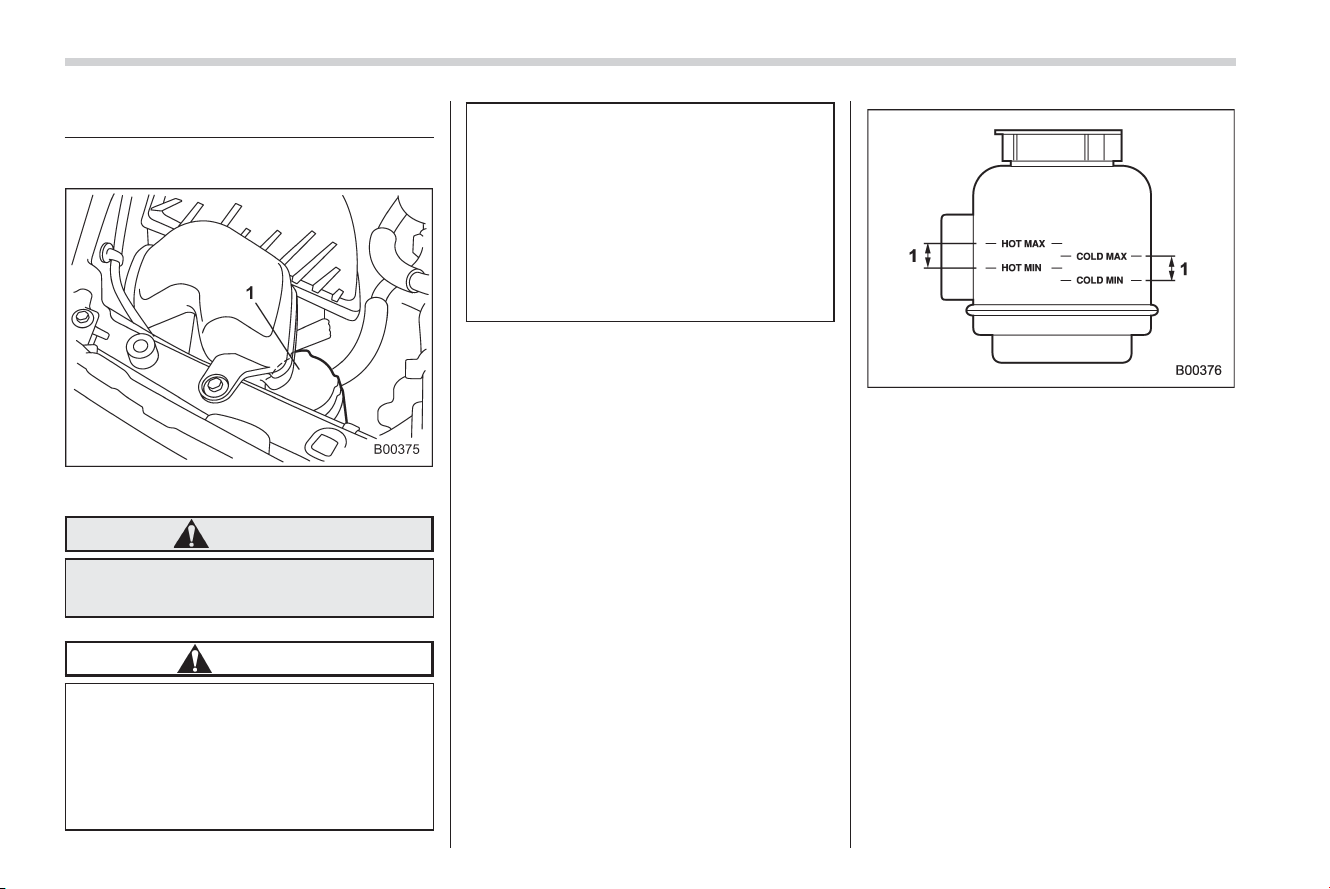
Black plate (314,1)
北米Model "A8130BE-B" EDITED: 2007/ 7/ 25
11-24 Maintenance and service
Power steering fluid
& Checking the fluid level
1) Reservoir tank
WARNING
Be careful not to burn yourself
because the fluid may be hot.
CAUTION
. When power stee ring fluid is
being added, use only clean fluid,
and be careful not to allow any
dirt into the tank. And never use
different brands together.
. Avoid spilling fluid when adding
it in the tank.
. Be careful not to spill power
steering fluid when adding it. If
power steering fluid touches the
exhaust pipe, it may cause a bad
smell, smoke, and/or a fire. If
power steering fluid gets on the
exhaust pipe, be sure to wipe it
off.
The power steering fluid expands greatly
as its temperature rises; the fluid level
differs according to fluid temperature.
Therefore, the reservoir tank has two
different checking ranges for hot and cold
fluids.
Check the power steering fluid level
monthly.
1. Park the vehicle on a level surface,
and stop the engine.
1) Specified range
2. Check the fluid level of the reservoir
tank.
When the fluid is hot after the vehicle has
been run: Check that the oil level is
between “HOT MIN” and “HOT MAX” on
the surface of the reservoir tank.
When the fluid is cool before the vehicle is
run: Check that the oil level is between
“COLD MIN” and “COLD MAX” on the
surface of the reservoir tank.
3. If the fluid level is lower than the
app licable “MIN” line, add the recom-
mended fluid as necessary to bring the
level between the “MIN” and “MAX” line.
If the fluid level is extreme low, it may
indicate possible leakage. Consult your
SUBARU dealer for an inspection.
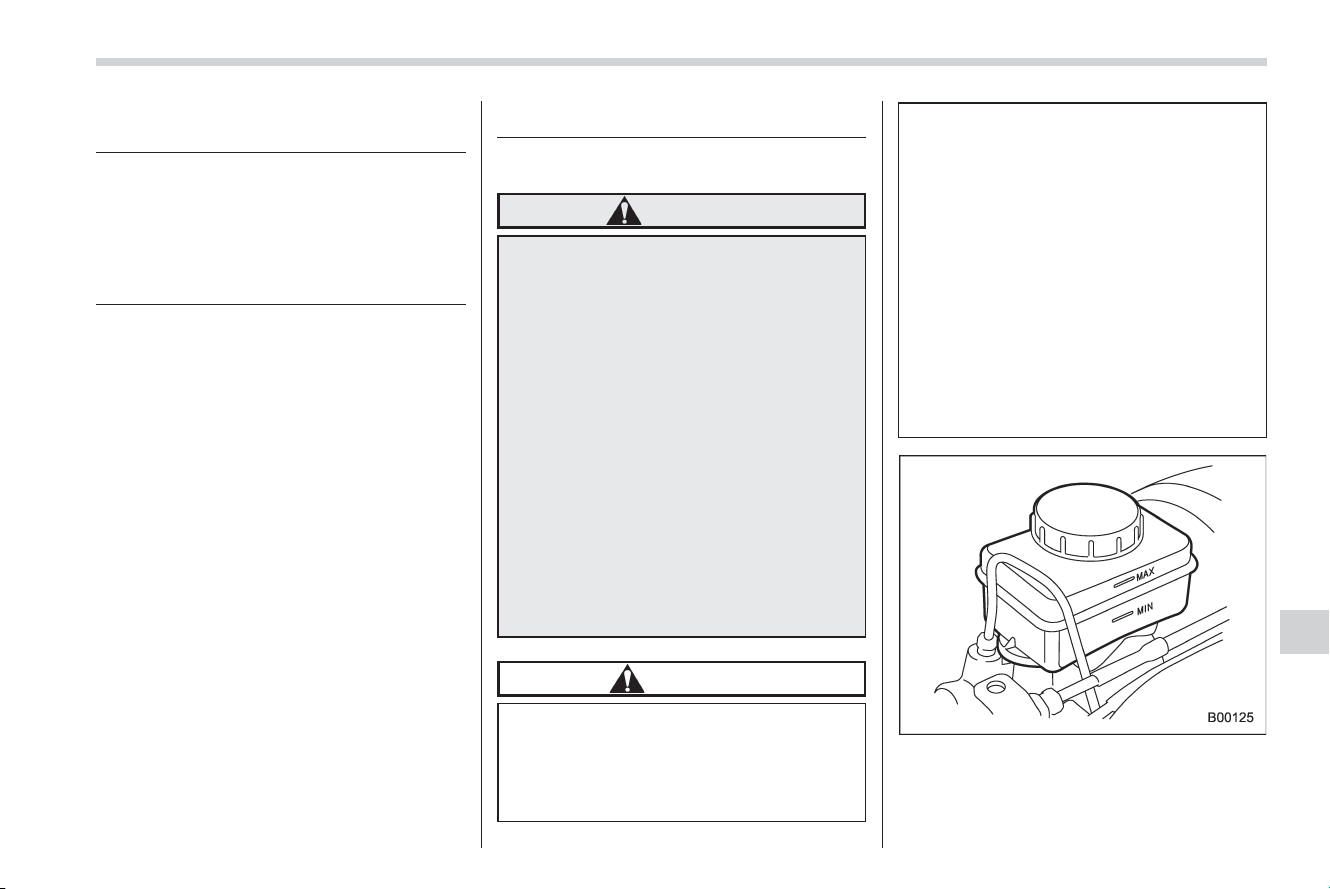
Black plate (315,1)
北米Model "A8130BE-B" EDITED: 2007/ 7/ 25
& Recommended fluid
Use one of the following types of auto-
matic transmission fluid.
Genuine Subaru Automatic Transmis-
sion Fluid Type-HP
“Dexron III” Type Automatic Transmis-
sion Fluid
Brake fluid
& Checking the fluid level
WARNING
. Never let brake fluid contact your
eyes because brake fluid can be
harmful to your eyes. If brake
fluid gets in your eyes, immedi-
ately flush them thoroughly with
clean water. For safety, when
performing this work, wearing
eye protection is advisable.
. Brake fluid absorbs moisture
from the air. Any absorbed moist-
ure can cause a dangerous loss
of braking performance.
. If the vehicle requires frequent
refilling, there may be a leak. If
you suspect a problem, have the
vehicle checked at your SUBARU
dealer.
CAUTION
. Never use different brands of
brake fluid together. Also, avoid
mixing DOT 3 and DOT 4 brake
fluids even if they are of the same
brand.
. When adding brake fluid, be care-
ful not to allow any dirt into the
reservoir.
. Never splash the brake fluid over
painted surfaces or rubber parts.
Alcohol contained in the brake
fluid may damage them.
. Be careful not to spill brake fluid
when adding it. If brake fluid
touches the exhaust pipe, it may
cause a bad smell, smoke, and/or
a fire. If brake fluid gets on the
exhaust pipe, be sure to wipe it
off.
Check the fluid level monthly.
Check the fluid level on the outside of the
reservoir. If the level is below “MIN”, add
the recommended brake fluid to “MAX”.
Maintenance and service 11-25
– CONTINUED –
11
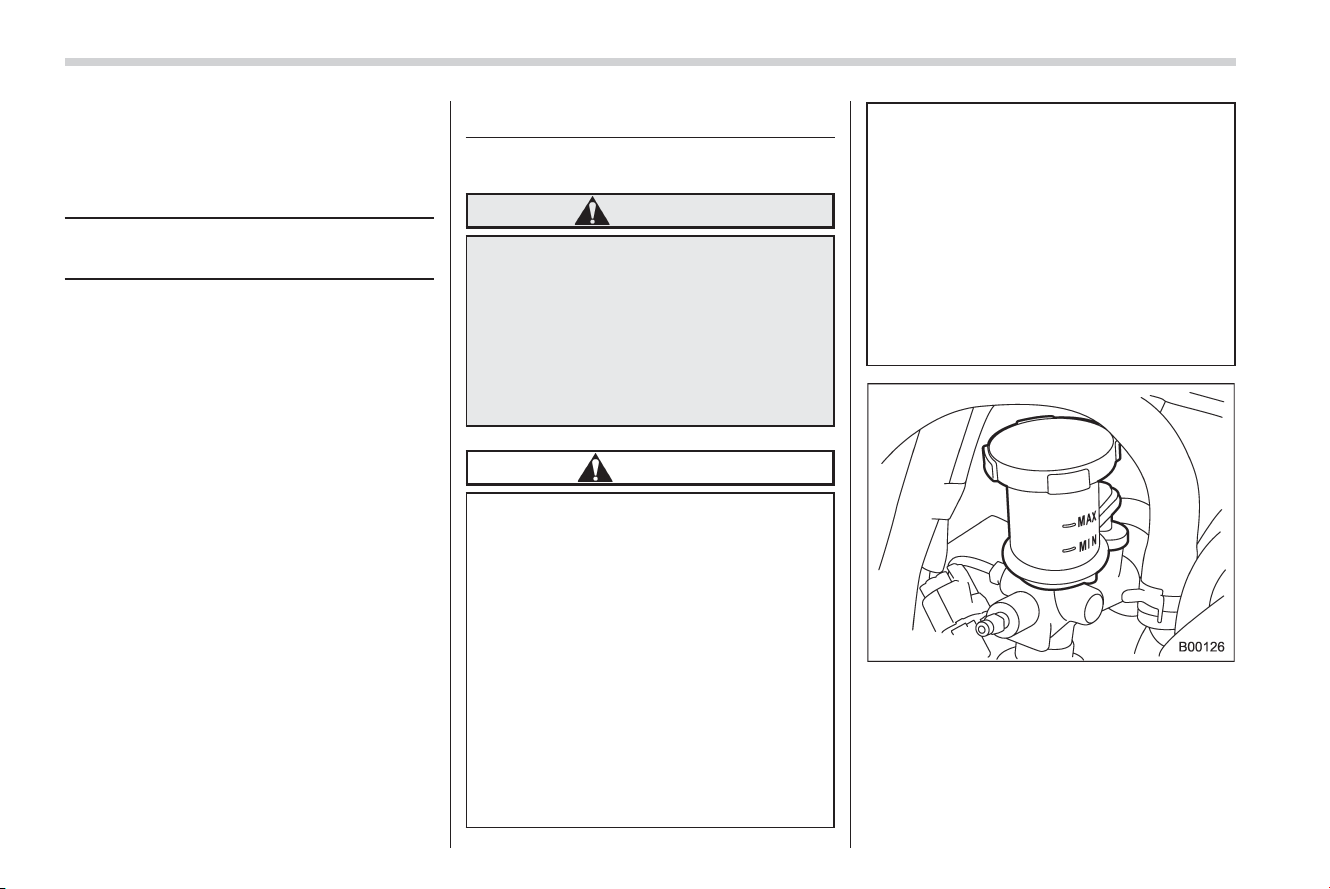
Black plate (316,1)
北米Model "A8130BE-B" EDITED: 2007/ 7/ 25
11-26 Maintenance and service
Use only brake fluid from a sealed
container.
& Recommended brake fluid
FMVSS No. 116, fresh DOT 3 or 4 brake
fluid
Clutch fluid (MT vehicles)
& Checking the fluid level
WARNING
Never let clutch fluid contact your
eyes because clutch fluid can be
harmful to your eyes. If clutch fluid
gets in your eyes, immediately flush
them thoroughly with clean water.
For safety, when performing this
work, wearing eye protection is
advisable.
CAUTION
. Clutch fluid a bsorbs moisture
from the air. Any absorbed moist-
ure can cause improper clutch
operation.
. If the vehicle requires frequent
refilling, there may be a leak. If
you suspect a problem, have the
vehicle checked at your SUBARU
dealer.
. Never use different brands of
clutch fluid together.
. When clutch fluid is added, be
careful not to allow any dirt into
the tank.
. Never splash the clutch fluid over
painted surfaces or rubber parts.
Alcohol contained in the clutch
fluid may damage them.
. Be careful not to spill clutch fluid
when adding it. If clutch fluid
touches the exhaust pipe, it may
cause a bad smell, smoke, and/or
a fire. If clutch fluid gets on the
exhaust pipe, be sure to wipe it
off.
Check the fluid level on the outside of the
reservoir. If the level is below “MIN” level
mark, add the recommended clutch fluid
to “MAX” level mark.
Use only clutch fluid from a sealed
container.
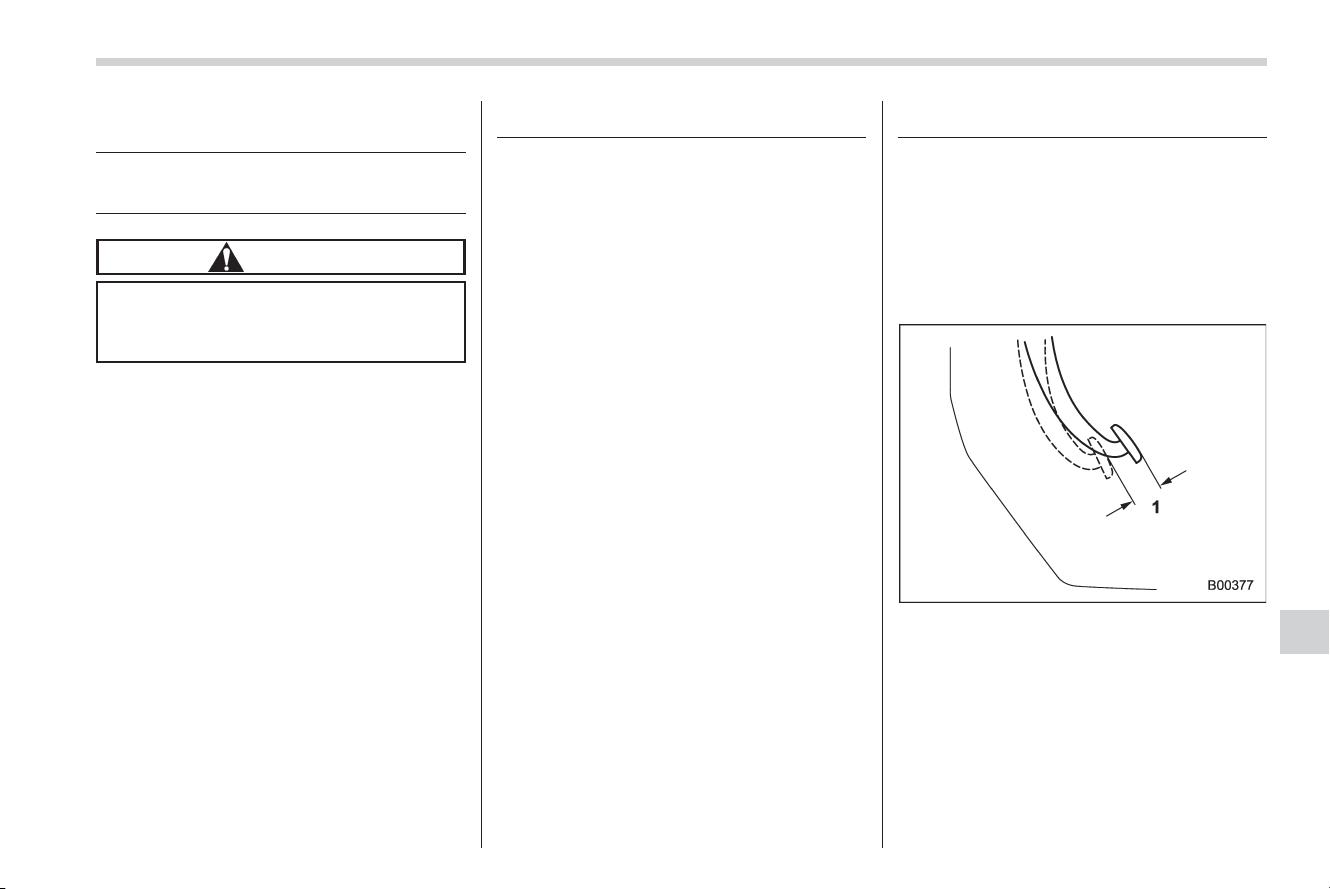
Black plate (317,1)
北米Model "A8130BE-B" EDITED: 2007/ 7/ 25
& Recommended clutch fluid
FMVSS No. 116, fresh DOT 3 or DOT 4
brake fluid
CAUTION
Avoid mixing DOT 3 and DOT 4
brake fluids even if they are of the
same brand.
Brake booster
If the brake booster does not operate as
described in the following, have it checked
by your SUBARU dealer.
1. With the engine off, depress the brake
pedal several times, applying the same
pedal force each time. The distance the
pedal travels should not vary.
2. With the brake pedal depressed, start
the engine. The pedal shou ld move
slightly down to the floor.
3. With the brake pedal depressed, stop
the engine and keep the pedal depressed
for 30 seconds. The pedal height should
not change.
4. Start the engine again and run for
approximately one minute then turn it off.
Depress the brake pedal several times to
check the brake booster. The brake
booster operates properly if the pedal
stroke decreases with each depression.
Brake pedal
Check the brake pedal free play and
reserve distance according to the main-
tenance schedule in the “Warranty and
Maintenance Booklet”.
& Checking the brake pedal
free play
1) 0.02 – 0.08 in (0.5 – 2.0 mm)
Stop the engine and firmly depress the
brake pedal several times. Lightly press
the brake pedal down with one finger to
check the free play with a force of less
than 2 lbs (10 N, 1 kg).
If the free play is not within proper
specification, contact your SUBARU deal-
er.
Maintenance and service 11-27
– CONTINUED –
11

Black plate (318,1)
北米Model "A8130BE-B" EDITED: 2007/ 7/ 25
11-28 Maintenance and service
& Checking the brake pedal
reserve distance
1) More than 2.56 in (65 mm)
Depress the pedal with a force of approxi-
mately 66 lbs (294 N, 30 kg) and measure
the distance between the upper surface of
the pedal pad and the floor.
When the measurement is smaller than
the specification, or when the pedal does
not operate smoothly, contact with your
SUBARU dealer.
Clutch pedal (MT vehicles)
Check the clutch pedal free play and
reserve distance according to the main-
tenance schedule in the “Warranty and
Maintenance Booklet”.
& Checking the clutch function
Check the clutch engagement and disen-
gagement.
1. With the engine idling, check that there
are no abnormal noises when the clutch
pedal is depressed, and that shifting into
1st or reverse feels smooth.
2. Start the vehicle by releasing the pedal
slowly to check that the engine and
transmission smoothly couple without
any sign of slippage.
& Checking the clutch pedal
free play
1) 0.15 – 0.44 in (4 – 11 mm)
Lightly press the clutch pedal down with
your finger until you feel resistance, and
check the free play.
If the free play is not within proper
specification, contact your SUBARU deal-
er.
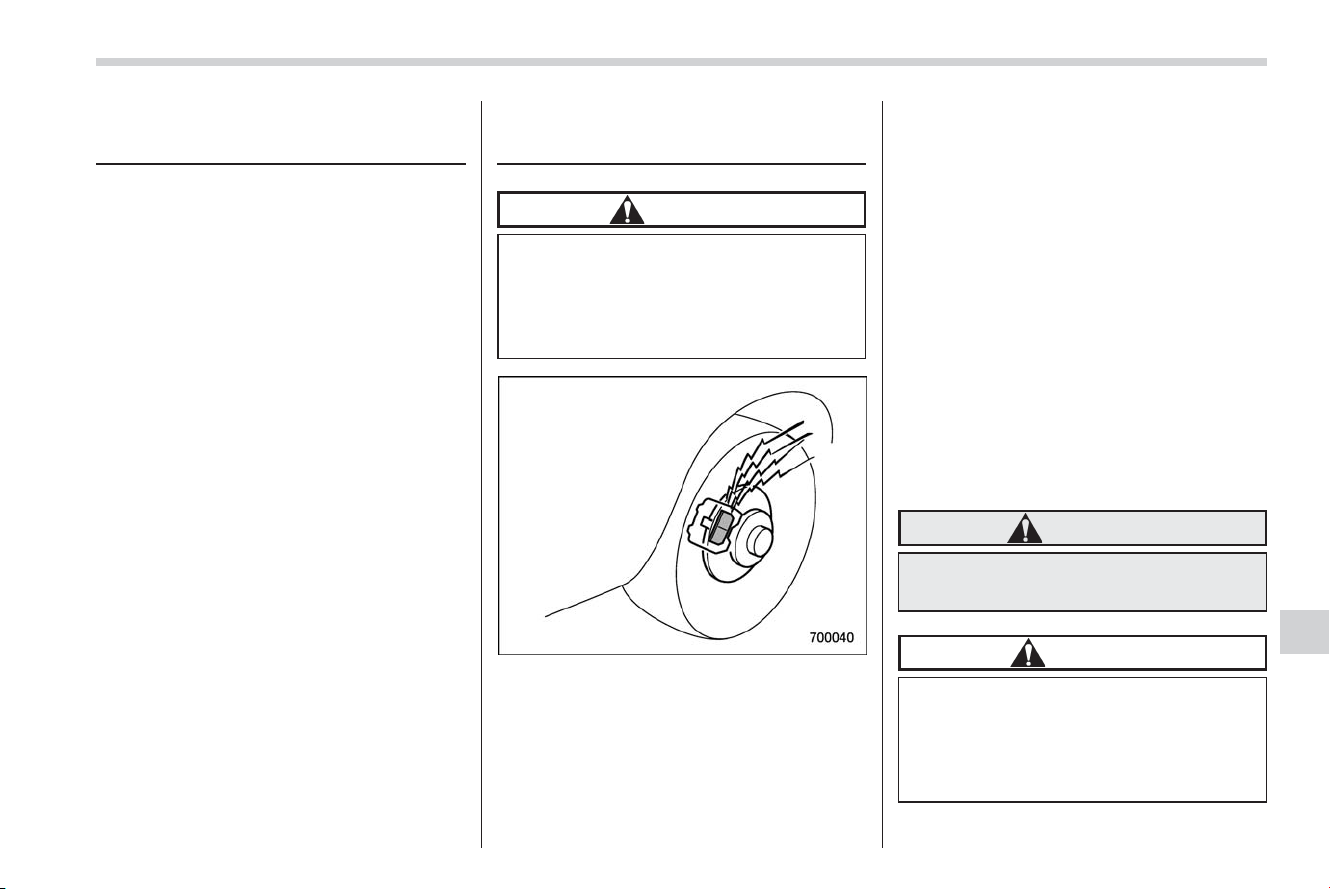
Black plate (319,1)
北米Model "A8130BE-B" EDITED: 2007/ 7/ 25
Hill holder (MT vehicles – if
equipped)
Ensure that the hill holder o perates
properly under the following circum-
stances:
1. Stop the vehicle on an uphill grade by
depressing the brake pedal and clutch
pedal, with the engine running.
2. Make sure that the vehicle does not
move backward even after the brake
pedal is released.
3. Then make sure the vehicle starts
climbing the grade by following the normal
starting procedures.
If the hill holder does not operate as
described above, contact with your
SUBARU dealer.
Replacement of brake pad
and lining
CAUTION
If you continue to drive despite the
scraping noise from the audible
brake pad wear indicator, it will
result in the need for costly brake
rotor repair or replacement.
The right front disc brake and the right rear
disc brake have audible wear indicators
on the brake pads. If the brake pads wear
close to their service limit, the wear
indicator makes a very audible scraping
noise when the brake pedal is applied.
If you hear this scraping noise each time
you apply the brake pedal, have the brake
pads serviced by your SUBARU dealer as
soon as possible.
& Breaking-in of new brake
pads and linings
When replacing the brake pad or lining,
use only genuine SUBARU parts. After
replacement, the new parts must be
broken in as follows:
! Brake pad and lining
While maintaining a speed of 30 to 40
mph (50 to 65 km/h), step on the brake
pedal lightly. Repeat this five or more
times.
! Parking brake lining
WARNING
A safe location and situation should
be selected for break-in driving.
CAUTION
Pulling the parking brake lever too
forcefully may cause the rear
wheels to lock. To avoid this, be
certain to pull the lever up slowly
and gently.
Maintenance and service 11-29
– CONTINUED –
11
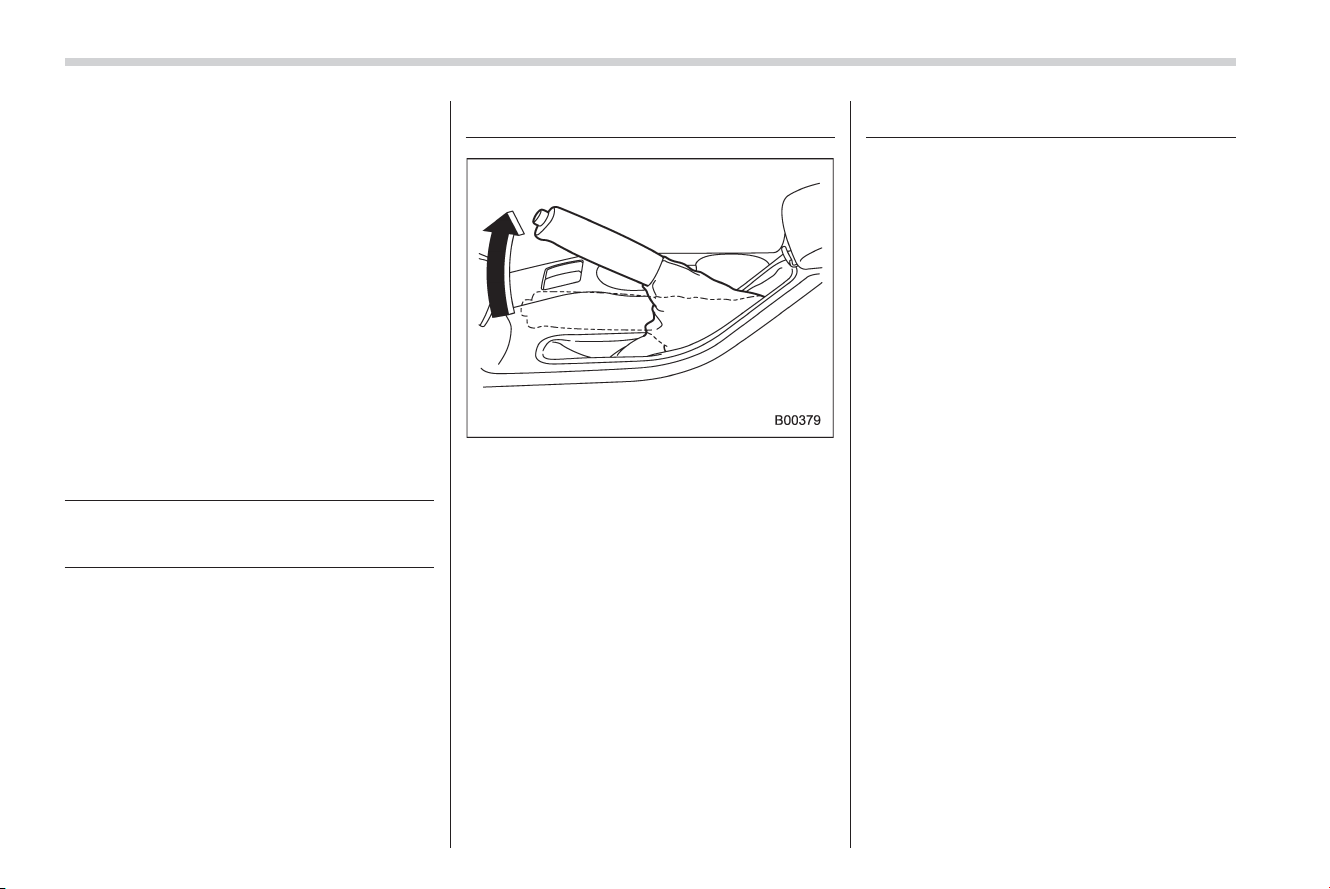
Black plate (320,1)
北米Model "A8130BE-B" EDITED: 2007/ 7/ 25
11-30 Maintenance and service
1.Drivethevehicleataspeedof
approximately 22 mph (35 km/h).
2. With the parking brake release button
pushed in, pull the parking brake lever
SLOWLY and GENTLY. (Pulling with a
force of approximately 33 lbs [147 N, 15
kg].)
3. Drive the vehicle for approximately
220 yards (200 meters) in this condition.
4. Wait 5 to 10 minutes for the parking
brake to cool down. Repeat this proce-
dure.
5. Check the parking brake stroke. If the
parking brake stroke is out of the specified
range, adjust it by turning the adjusting nut
located on the parking brake lever.
Parking brake stroke:
7 – 8 notches / 44 lbs (196 N, 20 kg)
Parking brake stroke
Check the parking brake stroke according
to the maintenance schedule in the
“ Warranty and Maintenan ce Booklet”.
When the parking brake is properly
adjusted, braking power is fully applied
by pulling the lever up seven to eight
notches gently but firmly (approximately
44 lbs, 196 N, 20 kg). If the parking brake
lever stroke is not within the specified
range, have the brake system checked
and adjusted at your SUBARU dealer.
Tires and wheels
& Types of tires
You should be familiar with type of tires
present on your vehicle.
! All season tires
The factory-installed tires on your new
vehicle are all season tires.
All season tires are designed to provide
an adequate measure of traction, handling
and braking performance in year-round
driving including snowy and icy road
conditions. However all season tires do
not offer as much traction performance as
winter (snow) tires in heavy or loose snow
or on icy roads.
All season tires are identified by “ALL
SEASON” and/or “M+S” (Mud & Snow) on
the tire sidewall.
! Summer tires
Summer tires are high-speed capability
tires best suited for highway driving under
dry conditions.
Summer tires are inadequate for driving
on slippery roads such as on snow-
covered or icy roads.
If you drive your vehicle on snow-covered
or icy roads, we strongly recommend the
use of winter (snow) tires.
When installing winter tires, be sure to
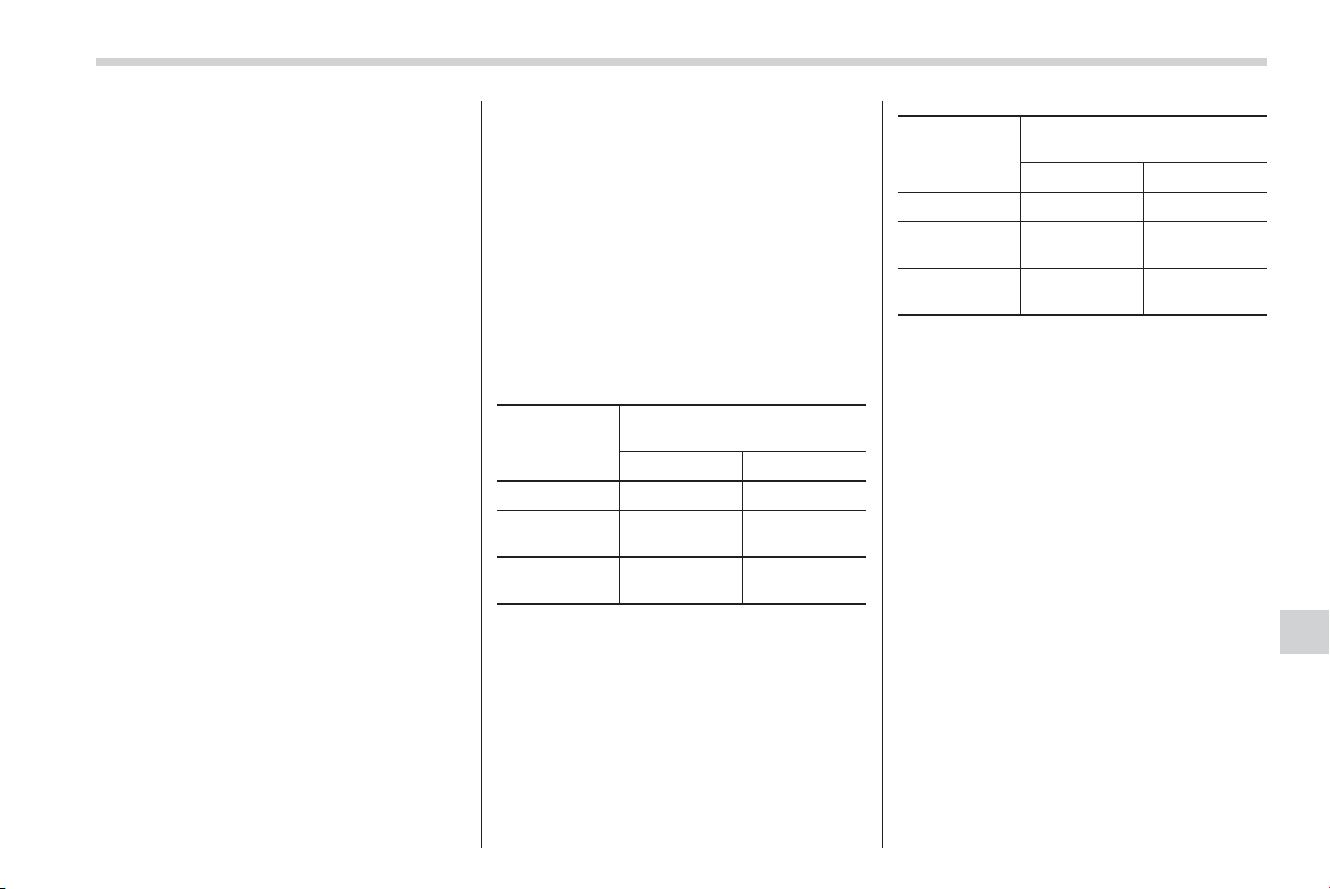
Black plate (321,1)
北米Model "A8130BE-B" EDITED: 2007/ 7/ 25
replace all four tires.
! Winter (snow) tires
Winter tires are best suited for driving on
snow-covered and icy roads. However
winter tires do not perform as well as
summer tires and all season tires on roads
other than snow-covered and icy roads.
& Tire pressure monitoring
system (TPMS) (if equipped)
The tire pressure monitoring system pro-
vides the driver with a warning message
by sending a signal from a sensor that is
installed in each wheel when tire pressure
is severely low. The tire pressure monitor-
ing system will activate only when the
vehicle is driven. Also, this system may
not react immediately to a sudden drop in
tire pressure (for example, a blow-out
caused by running over a sharp object).
If you adjust the tire pressures in a warm
garage and will then drive the vehicle in
cold outside air, the resulting drop in tire
pressures may cause the low tire pressure
warning light to come on. To avoid this
problem when adjusting the tire pressures
in a warm garage, inflate the tires to
pressures higher than those shown on the
tire placard. Specifically, inflate them by an
extra 1 psi (6.9 kPa, 0.07 kgf/cm
2
) for
every difference of 108F (5.68C) between
the temperature in the garage and the
temperature outside. By way of example,
the following table shows the required tire
pressures that correspond to various out-
side temperatures when the temperature
in the garage is 608F (15.68C).
Example:
Tire size: P215/60R16 94H
Standard tire pressures:
Front: 29 psi (200 kPa, 2.0 kgf/cm
2
)
Rear: 28 psi (190 kPa, 1.9 kgf/cm
2
)
Garage temperature: 608F (15.68C)
Outside
temperature
Adjusted pressure
[psi (kPa, kgf/cm
2
)]
front
rear
308F(−18C)
32 (220, 2.2) 31 (215, 2.15)
108F(−128C) 34
(235, 2.35)
33
(230, 2.3)
−108F
(−238C)
36 (250, 2.5) 35 (240, 2.4)
Example:
Tire size: P215/55R17 93H
Standard tire pressures:
Front: 32 psi (220 kPa, 2.2 kgf/cm
2
)
Rear: 30 psi (210 kPa, 2.1 kgf/cm
2
)
Garage temperature: 608F (15.68C)
Outside
temperature
Adjusted pressure
[psi (kPa, kgf/cm
2
)]
front
rear
308F(−18C)
35 (240, 2.4) 33 (230, 2.3)
108F(−128C) 37
(255, 2.55)
35
(240, 2.4)
−108F
(−238C)
39 (270, 2.7) 37 (255, 2.55)
If the low tire pressure warning light
comes on when you drive the vehicle in
cold outside air after adjusting the tire
pressures in a warm garage, re-adjust the
tire pressures using the method described
above. Then, increase the vehicle speed
to at least 20 mph (32 km/h) and check to
see that the low tire pressure warning light
goes off a few minutes later. If the low tire
pressure warning light does not go off, the
tire pressure monitoring system may not
be functioning normally. In this event, go
to a SUBARU dealer to have the system
inspected as soon as possible.
While the vehicle is driven, friction be-
tween tires and the road surface causes
the tires to warm up. After illumination of
the low tire pressure warning light, any
increase in the tire pressures caused by
an increase in the outside air temperature
or by an increase in the temperature in the
tires can cause the low tire pressure
Maintenance and service 11-31
– CONTINUED –
11
Black plate (322,1)
北米Model "A8130BE-B" EDITED: 2007/ 7/ 25
11-32 Maintenance and service
warning light to go off.
System resetting is necessary when the
wheels are changed (for example, a
switch to snow tires) and new TPMS
valves are installed on the newly fitted
wheels. Have this work performed by a
SUBARU dealer following wheel replace-
ment.
It may not be possible to install TPMS
valves on certain wheels that are on the
market. Therefore, if you change the
wheels (for example, a switch to snow
tires), use wheels that have the same part
number as the standard-equipment
wheels. Without four operational TPMS
valve/sensors on the wheels, the TPMS
will not fully function and the warning light
in the instrument panel will illuminate
steadily after blinking for approximately
one minute.
When a tire is replaced, adjustments are
necessary to ensure continued normal
operation of the tire pressure monitoring
system. As with wheel replacement, there-
fore, you should have the work performed
by a SUBARU dealer.
WARNING
If the low tire pressure warning light
does not come on briefly after the
ignition switch is turned ON or the
light illuminates steadily after blink-
ing for approximately one minute,
you should have your Tire Pressure
Monitoring System checked at a
SUBARU dealer as soon as possi-
ble.
If this light comes on while driving,
never brake suddenly and keep
driving straight ahead while gradu-
ally reducing speed. Then slowly
pull off the road to a safe place.
Otherwise an accident involving
serious vehicle damage and serious
personal injury could occur.
If this light still comes on while
driving after adjusting the tire pres-
sure, a tire may have significant
damage and a fast leak that causes
the tire to lose air rapidly. If you have
a flat tire, replace it with a spare tire
as soon as possible.
When a spare tire is mounted or a
wheel rim is replaced without the
original pressure sensor/transmitter
being transferred, the low tire pres-
sure warning light will illuminate
steadily after blinking for approxi-
mately one minute. This indicates
the TPMS is unable to monitor all
four road wheels. Contact your
SUBARU dealer as soon as possible
for tire and sensor replacement and/
or system resetting. If the light
illuminates steadily after blinking
for approximately one minute,
promptly contact a SUBARU dealer
to have the system inspected.
& Tire inspection
Check on a daily basis that the tires are
free from serious damage, nails, and
stones. At the same time, check the tires
for abnormal wear.
Contact your SUBARU dealer immedi-
ately if you find any problem.
NOTE
. When the wheels and tires strike
curbs or are subjected to harsh treat-
ment as when the vehicle is driven on a
rough surface, they can suffer damage
that cannot be seen with the naked eye.
This type of damage does not become
evident until time has passed. Try not
to drive over curbs, potholes or on
other rough surfaces. If doing so is
unavoidable, keep the vehicle’s speed
down to a walking pace or less, and
approach the curbs as squarely as
possible. Also, make sure the tires are
not pressed against the curb when you
park the vehicle.
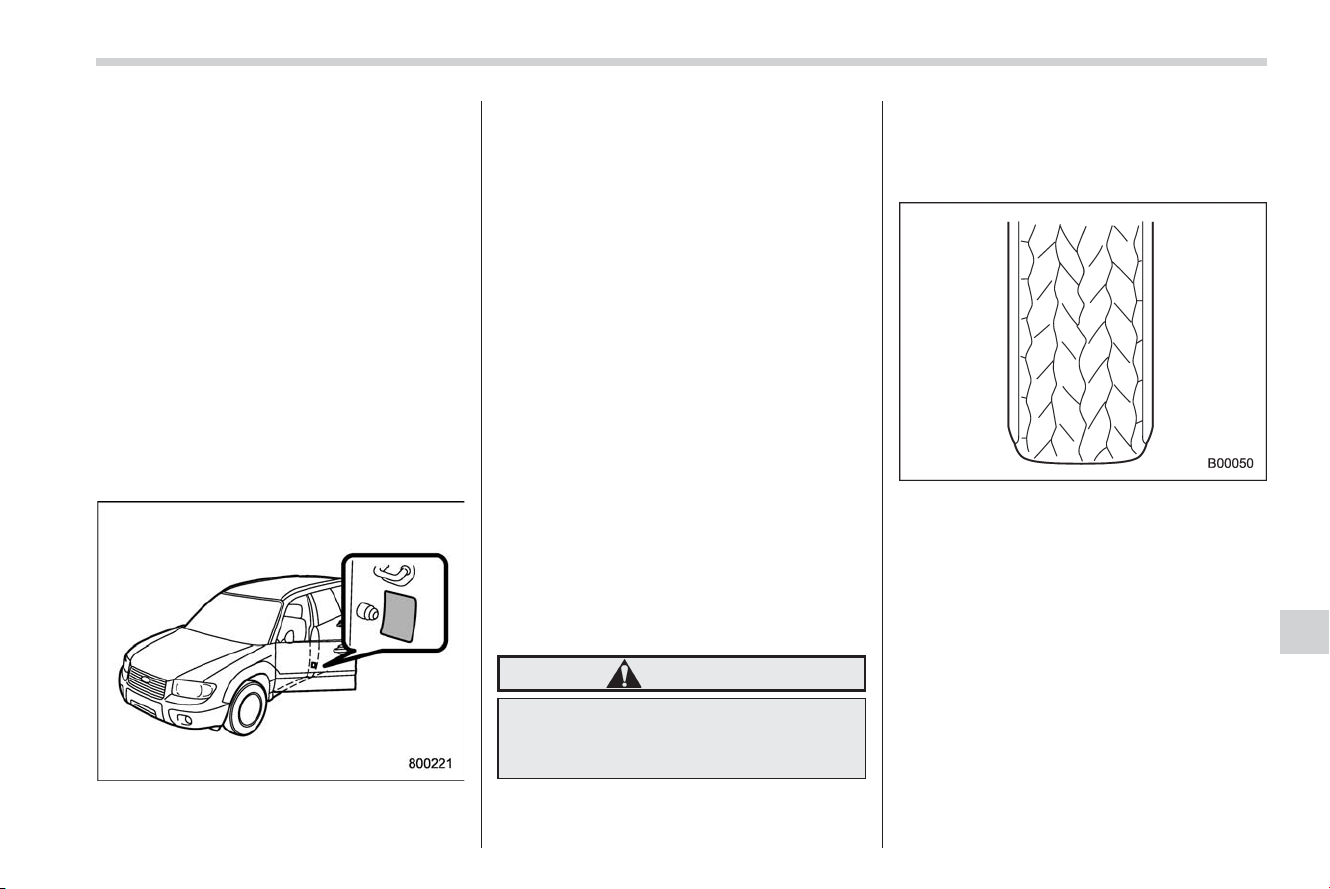
Black plate (323,1)
北米Model "A8130BE-B" EDITED: 2007/ 7/ 25
. If you feel unusual vibration while
driving or find it difficult to steer the
vehicle in a straight line, one of the
tires and/or wheels may be damaged.
Drive slowly to the nearest authorized
SUBARU dealer and have the vehicle
inspected.
& Tire pressures and wear
Maintaining the correct tire pressures
helps to maximize the tires’ service lives
and is essential for good running perfor-
mance. Check and, if necessary, adjust
the pressure of each tire (including the
spare) at least once a month (for example,
during a fuel stop) and before any long
journey.
Check the tire pressures when the tires
are cold. Use a pressure gauge to adjust
the tire pressures to the values shown on
the tire placard. The tire placard is located
on the door pillar on the driver ’s side.
Driving even a short distance warms up
the tires and increases the tire pressures.
Also, the tire pressures are affected by the
outside temperature. It is best to check tire
pressure outdoors before driving the
vehicle.
When a tire becomes warm, the air inside
it expands, causing the tire pressure to
increase. Be careful not to mistakenly
release air from a warm tire to reduce its
pressure.
NOTE
. The air pressure in a tire increases
by approximately 4.3 psi (30 kPa, 0.3
kgf/cm
2
) when the tire becomes warm.
. The tires are considered cold when
the vehicle has been parked for at least
three hours or has been driven less
than one mile (1.6 km).
WARNING
Do not let air out of warm tires to
adjust pressure. Doing so will result
in low tire pressure.
Incorrect tire pressures detract from con-
trollability and ride comfort, and they
cause the tires to wear abnormally.
. Correct tire pressure (tread worn
evenly)
Roadholding is good, and steering is
responsive. Rolling resistance is low, so
fuel consumption is also lower.
Maintenance and service 11-33
– CONTINUED –
11
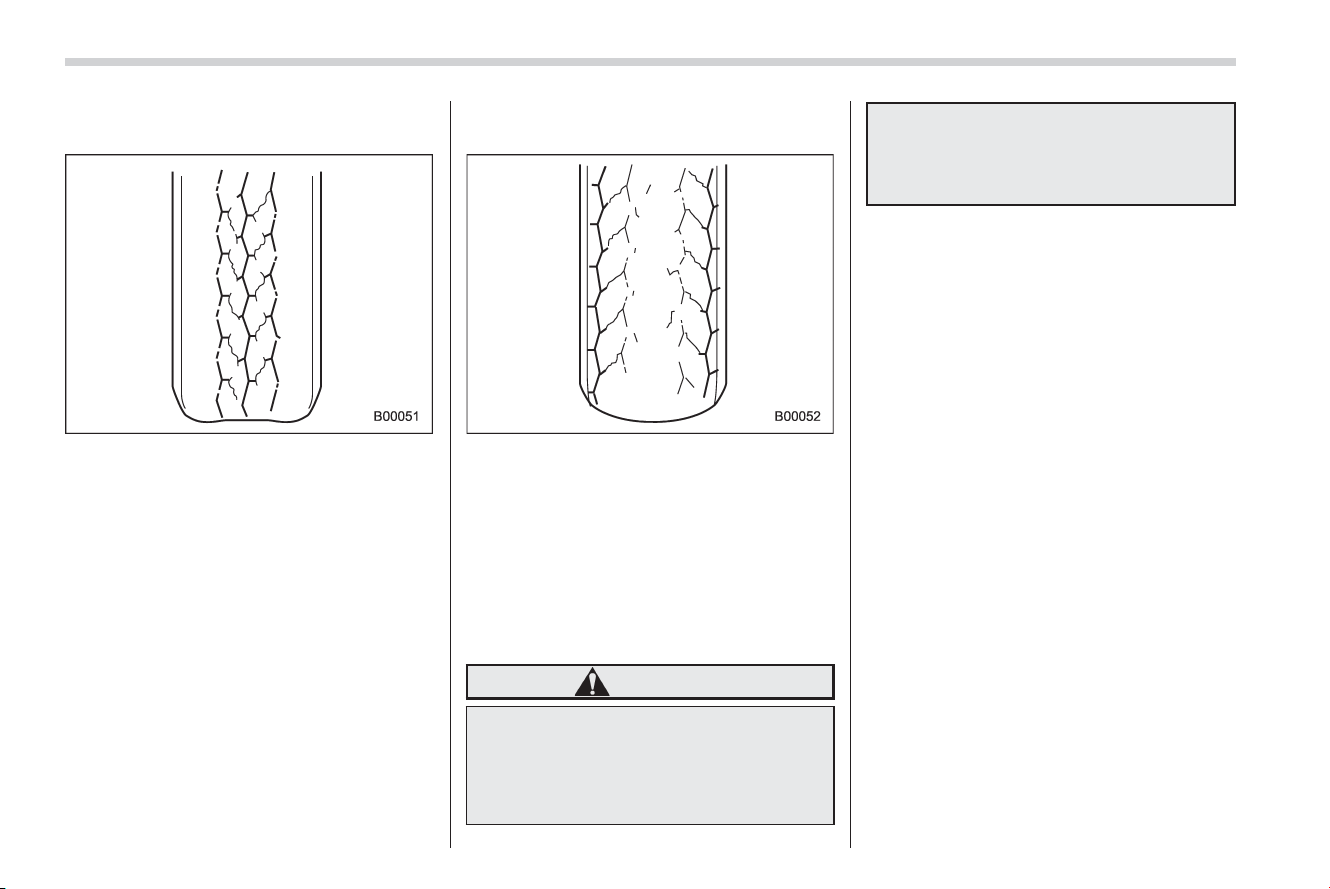
Black plate (324,1)
北米Model "A8130BE-B" EDITED: 2007/ 7/ 25
11-34 Maintenance and service
. Abnormally low tire pressure (tread
worn at shoulders)
Rolling resistance is high, so fuel con-
sumption is also higher.
. Abnormally high tire pressure (tread
worn in center)
Ride comfort is poor. Also, the tire
magnifies the effects of road-surface
bumps and dips, possibly resulting in
vehicle damage.
If the tire placard shows tire pressures for
the vehicle when fully loaded and for the
vehicle when towing a trailer, adjust the
tire pressures to the values that match
current loading conditions.
WARNING
Driving at high speeds with exces-
sively low tire pressures can cause
the tires to deform severely and to
rapidly become hot. A sharp in-
crease in temperature could cause
tread separation, and destruction of
the tires. The resulting loss of
vehicle control could lead to an
accident.
& Wheel balance
Each wheel was correctly balanced when
your vehicle was new, but the wheels will
become unbalanced as the tires become
worn during use. Wheel imbalance causes
the steering wheel to vibrate slightly at
certain vehicle speeds and detracts from
the vehicle’s straight-line stability. It can
also cause steering and suspension sys-
tem problems and abnormal tire wear. If
you suspect that the wheels are not
correctly balanced, have them checked
and adjusted by your SUBARU dealer.
Also have them adjusted after tire repairs
and after tire rotation.
NOTE
Loss of correct wheel alignment*
causes the tires to wear on one side
and reduces the vehicle’s running
stability. Contact your SUBARU dealer
if you notice abnormal tire wear.
*: The suspension system is designed to hold
each wheel at a certain alignment (relative to
the other wheels and to the road) for optimum
straight-line stability and cornering perfor-
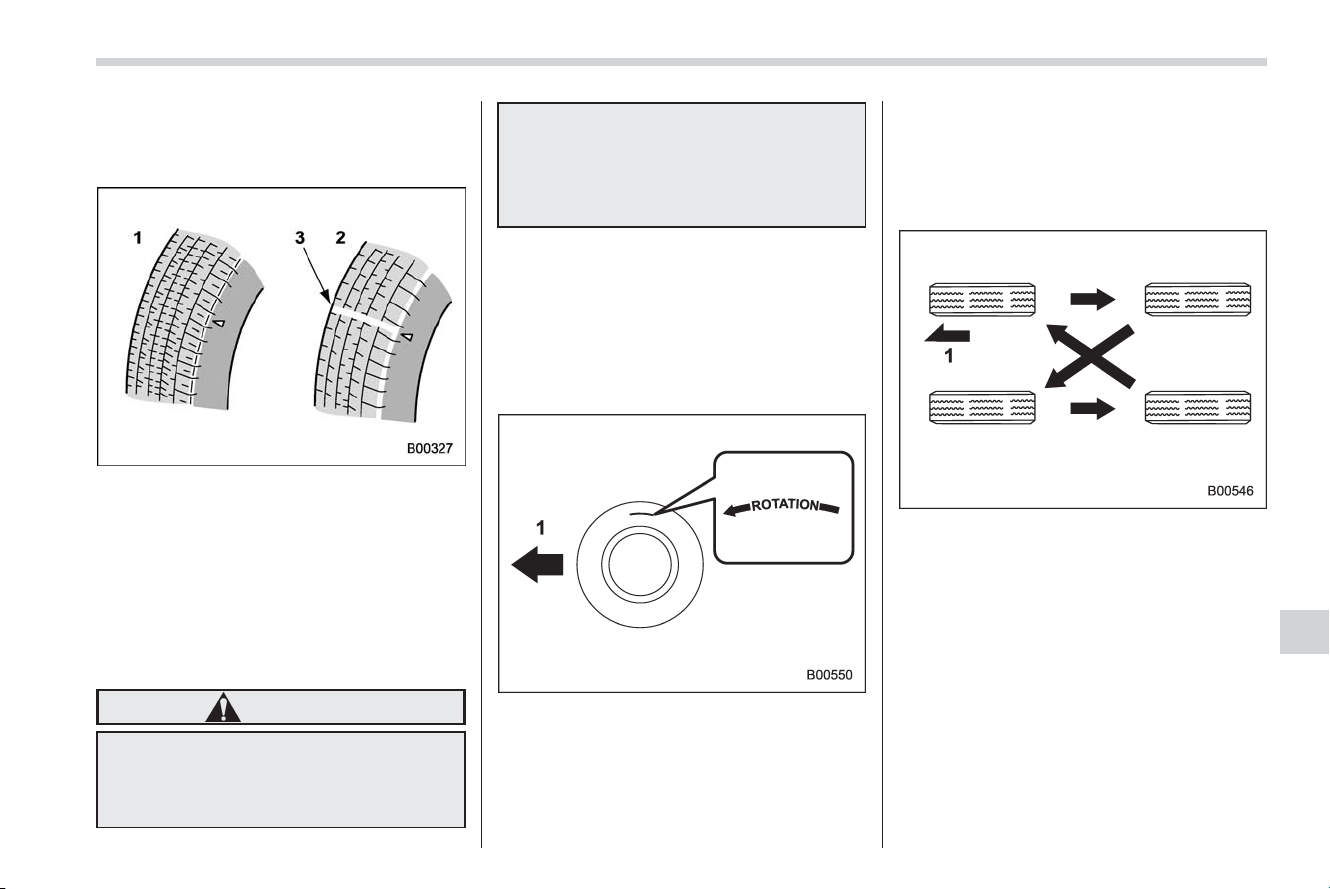
Black plate (325,1)
北米Model "A8130BE-B" EDITED: 2007/ 7/ 25
mance.
& Wear indicators
1) New tread
2) Worn tread
3) Tread wear indicator
Each tire incorporates a tread wear
indicato r, which becomes visible when
the depth of the tread grooves decreases
to 0.063 in (1.6 mm). A tire must be
replaced when the tread wear indicator
appears as a solid band across the tread.
WARNING
When a tire’s tread wear indicator
becomes visible, the tire is worn
beyond the acceptable limit and
must be replaced immediately. With
a tire in this condition, driving at
high speeds in wet weather can
cause th e vehicle to hydroplane.
The resulting loss of vehicle control
can lead to an accident.
NOTE
For safety, inspect tire tread regularly
and replace the tires before their tread
wear indicators become visible.
& Tire rotation direction mark
Example of tire rotation direction mark
1) Front
If the tire has the rotation direction
specification, the tire rotation direction
mark is placed on its sidewall.
When you install a tire that has the tire
rotation direction mark, install the tire with
the direction mark facing forward.
& Tire rotation
Vehicles equipped with 4 non-unidirec-
tional tires
1) Front
Maintenance and service
11-35
– CONTINUED –
11
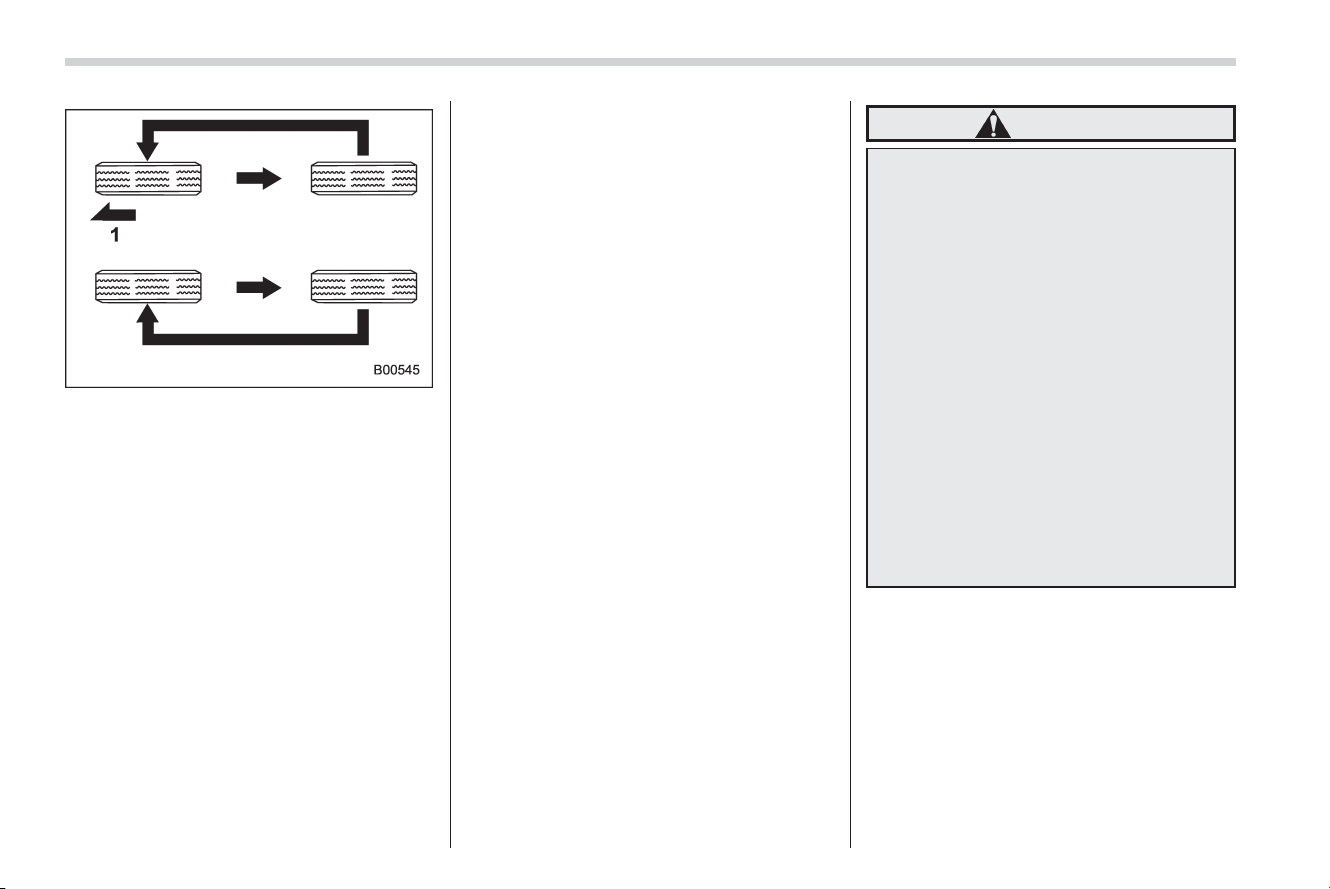
Black plate (326,1)
北米Model "A8130BE-B" EDITED: 2007/ 7/ 25
11-36 Maintenance and service
Vehicles equipped with unidirectional tires
1) Front
Tire wear varies from wheel to wheel. To
maximize the life of each tire and ensure
that the tires wear uniformly, it is best to
rotate the tires every 7,500 miles (12,000
km). Move the tires to the positions shown
in the illustration each time they are
rotated.
Replace any damaged or unevenly worn
tire at th e time of rotation. After tire
rotation, adjust the tire pressures and
make sure the wheel nuts are correctly
tightened.
After driving approximately 600 miles
(1,000 km), check the wheel nuts again
and retighten any nut that has become
loose.
& Tire replacement
The wheels and tires are important and
integral parts of your vehicle’s design;
they cannot be changed arbitrarily. The
tires fitted as standard equipment are
optimally matched to the characteristics
of the vehicle and were selected to give
the best possible combination of running
performance, ride comfort, and service
life. It is essential for every tire to have a
size and construction matching those
shown on the tire placard and to have a
speed symbol and load index matching
those shown on the tire placard.
Using tires of a non-specified size detracts
from controllability, ride comfort, braking
performance, speedometer accuracy and
odometer accuracy. It also creates incor-
rect body-to-tire clearances and inappro-
priately changes the vehicle’s ground
clearance.
All four tires must be the same in terms of
manufacturer, brand (tread pattern), con-
struction, and size. You are advised to
replace the tires with new ones that are
identical to those fitted as standard equip-
ment.
For safe vehicle operation, SUBARU
recommends replacing all four tires at
the same time.
WARNING
. All four tires must be the same in
terms of manufacturer, brand
(tread pattern), construction, de-
gree of wear, speed symbol, load
index and size. Mixing tires of
different types, sizes or degrees
of wear can result in damage to
vehicle’s power train. Use of
different types or sizes of tires
can also dangerously reduc e
controllability and braking per-
formance and can lead to an
accident.
. Use only radial tires. Do not use
radial tires together with belted
bias tires and/or bias-ply tires.
Doing so can dangerously re-
duce controllability, resulting in
an accident.
& Wheel replacement
When replacing wheels due, for example,
to damage, make sure the replacement
wheels match the specifications of the
wheels that are fitted as standard equip-
ment. Replacement wheels are available
from SUBARU dealers.
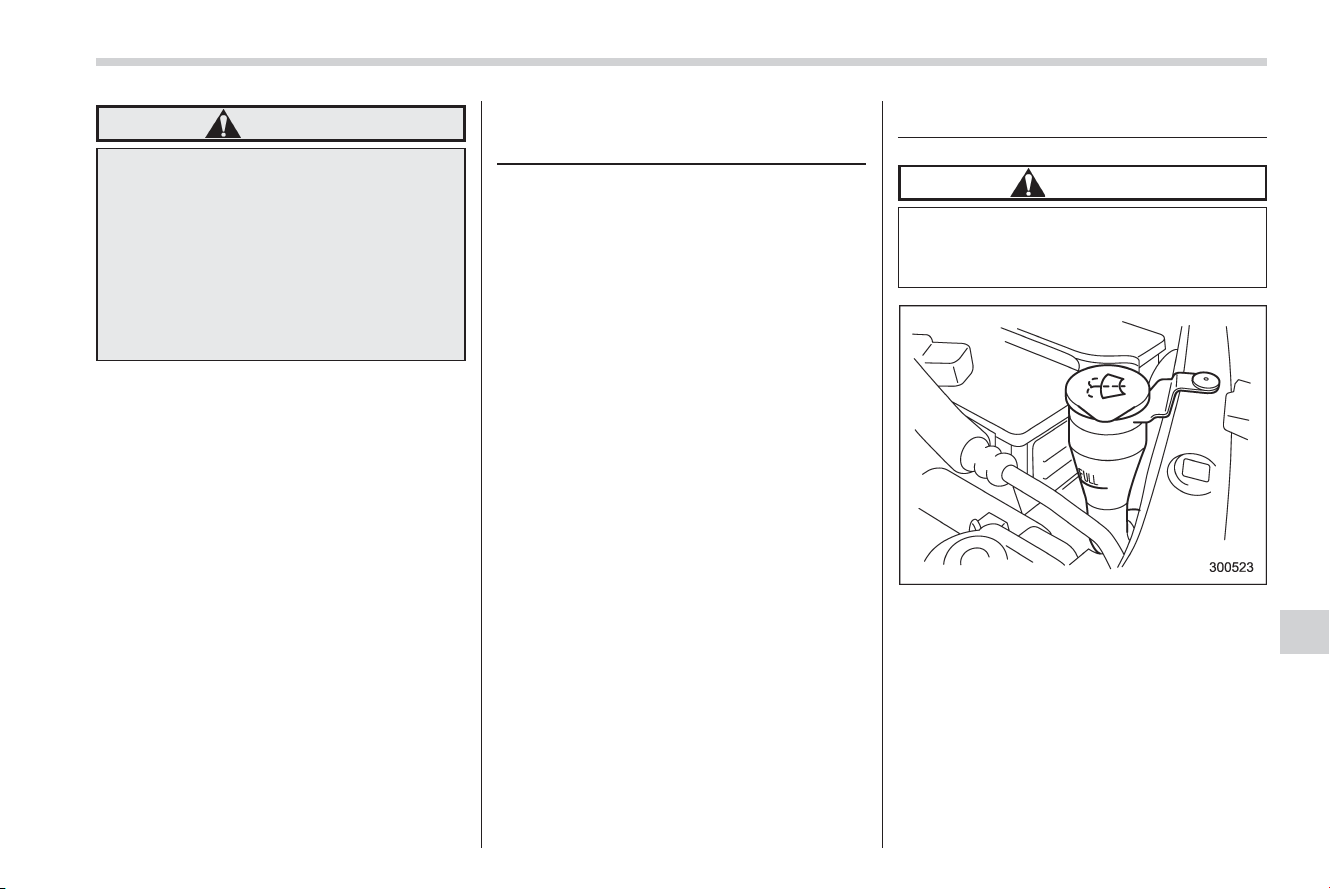
Black plate (327,1)
北米Model "A8130BE-B" EDITED: 2007/ 7/ 25
WARNING
Use only those wheels that are
specified for your vehicle. Wheels
not meeting specifications could
interfere with brake caliper opera-
tion and may cause the tires to rub
against the wheel well housing dur-
ing turns. The resulting loss of
vehicle control could lead to an
accident.
Aluminum wheels (if
equipped)
Aluminum wheels can be scratched and
damaged easily. Handle them carefully to
maintain their appearance, performance,
and safety.
. When any of the wheels is removed
and replaced for tire rotation or to change
a flat, always check the tightness of the
wheel nuts after driving approximately 600
miles (1,000 km). If any nut is loose,
tighten it to the specified torque.
. Never apply oil to the threaded parts,
wheel nuts, or tapered surface of the
wheel.
. Never let the wheel rub against sharp
protrusions or curbs.
. Be sure to fit tire chains on uniformly
and completely around the tire, otherwise
the chains may scratch the wheel.
. When wheel nuts, balance weights, or
the center cap is replaced, be sure to
replace them with genuine SUBARU parts
designed for aluminum wheels.
Windshield washer fluid
CAUTION
Never use engine coolant as washer
fluid because it could cause paint
damage.
If you spray washer fluid on the windshield
but the supply of washer fluid appears to
diminish, check the level of washer fluid in
the tank.
Maintenance and service 11-37
– CONTINUED –
11
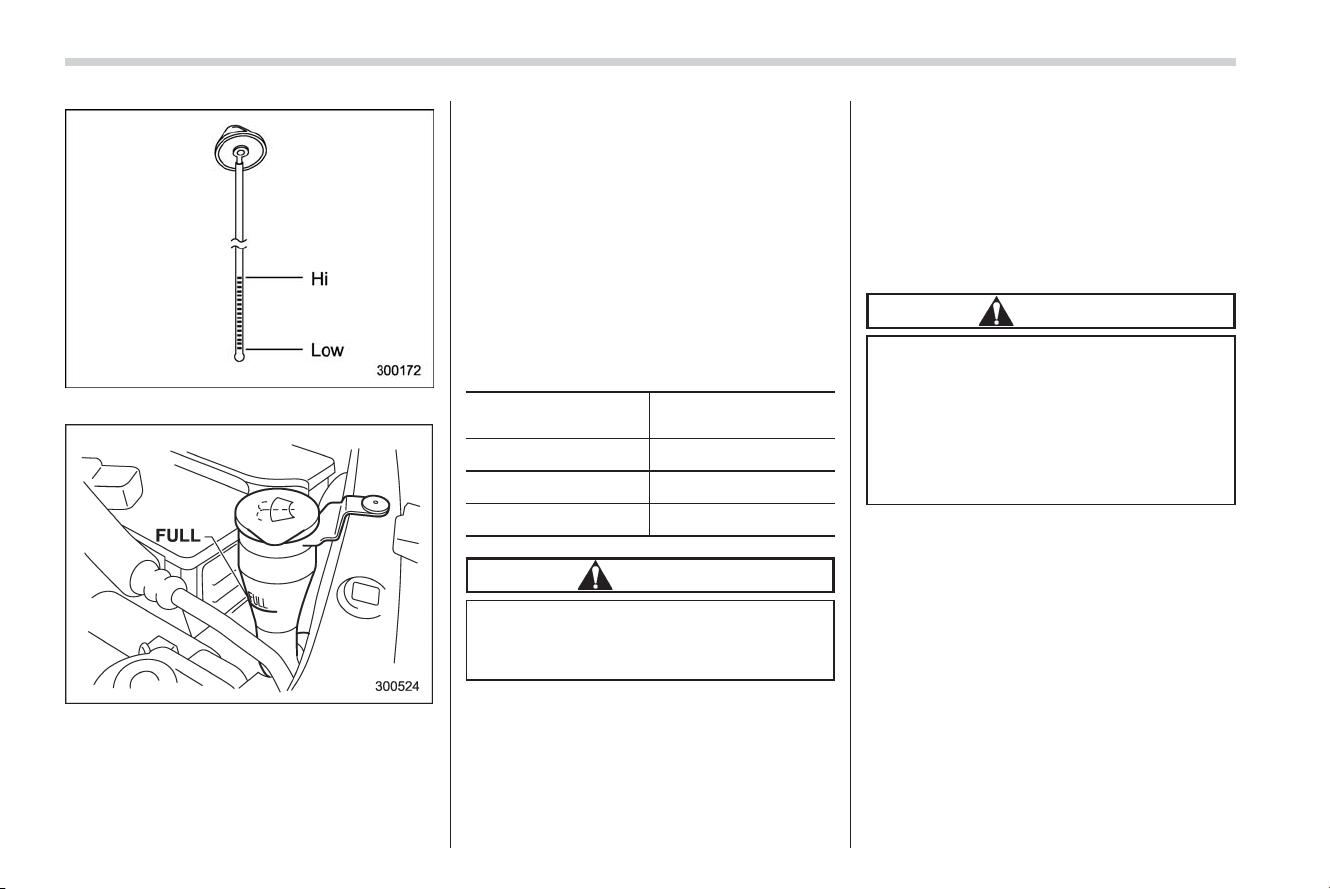
Black plate (328,1)
北米Model "A8130BE-B" EDITED: 2007/ 7/ 25
11-38 Maintenance and service
Washer fluid level gauge
Remove the washer tank filler cap, then
check the fluid level indicated by the level
gauge (attached to the inside of the cap).
If the level is near the “Low” mark, add
fluid until it reaches the “Hi” level on the
level gauge or the “Full” mark on the tank.
Use windshield washer fluid. If windshield
washer fluid is unavailable use clean
water.
In areas where water freezes in winter,
use an anti-freeze type windshield washer
fluid. SUBARU Windshield Washer Fluid
contains 58.5% methyl alcohol and 41.5%
surfactant, by volume. Its freezing tem-
perature varies according to how much it
is diluted, as indicated in the following
table.
Washer Fluid
Concentration
Freezing
Temperature
30%
10.48F(−128C)
50% −48F(−208C)
100% −498F(−458C)
CAUTION
Never use engine coolant as washer
fluid because it could cause paint
damage.
In order to prevent freezing of washer
fluid, check the freezing temperatures in
the table above when adjusting the fluid
concentration to the outside temperature.
If you fill the reservoir tank with a fluid with
a different concentration from the one
used previously, purge the old fluid from
the piping between the reservoir tank and
washer nozzles by operating the washer
for a certain period of time. Otherwise, if
the concentration of the fluid remaining in
the piping is too low for the outside
temperature, it may freeze and block the
nozzles.
CAUTION
Adjust the washer fluid concentra-
tion appropriately for the outside
temperature. If the concentration is
inappropriate, sprayed washer fluid
may freeze on the windshield and
obstruct your view, and the fluid
may freeze in the reservoir tank.
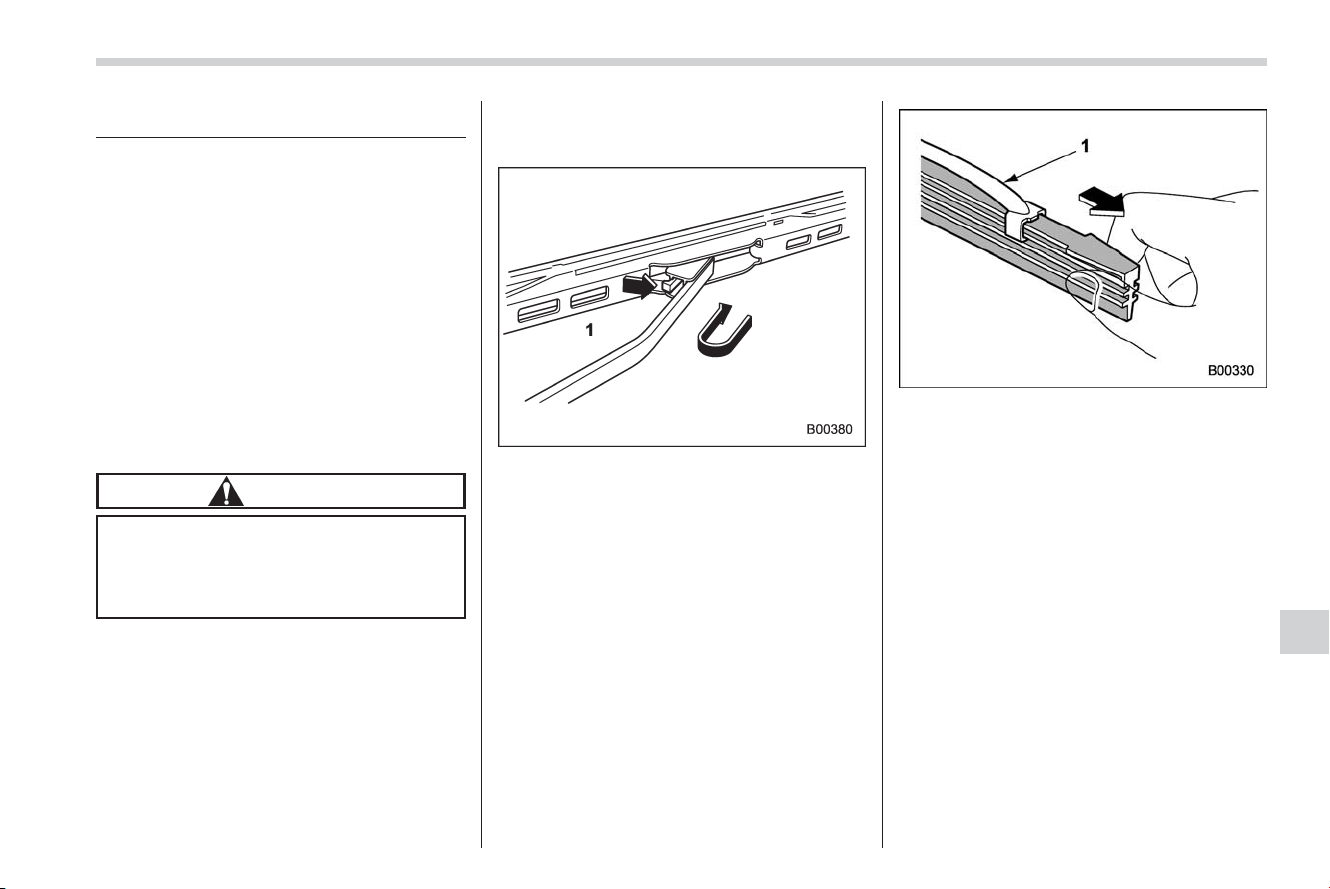
Black plate (329,1)
北米Model "A8130BE-B" EDITED: 2007/ 7/ 25
Replacement of wiper blades
Grease, wax, insects, or other material on
the windshield or the wiper blade results in
jerky wiper operation and streaking on the
glass. If you cannot remove the streaks
after operating the windshield washer or if
the wiper operation is jerky, clean the
outer surface of the windshield (or rear
window) and the wiper blades using a
sponge or soft cloth with a neutral
detergent or mild abrasive cleaner. After
cleaning, rinse the windshield and wiper
blades with clean water. The windshield is
clean if beads do not form when you rinse
the windshield with water.
CAUTION
Do not clean the wiper blades with
gasoline or a solvent, such as paint
thinner or benzene. This will cause
deterioration of the wiper blades.
If you cannot eliminate the streaking even
after following this method, replace the
wiper blades using the following proce-
dures:
& Windshield wiper blades
1. Raise the wiper arm off the windshield.
1) Stopper
2. Remove the wiper blade assembly by
holding its pivot area and pushing it in the
direction shown by the arrow while de-
pressing the wiper blade stopper.
1) Metal support
3. Grasp the locked end of the blade
rubber assembly and pull it firmly until the
stoppers on the rubber are free of the
metal support.
Maintenance and service 11-39
– CONTINUED –
11
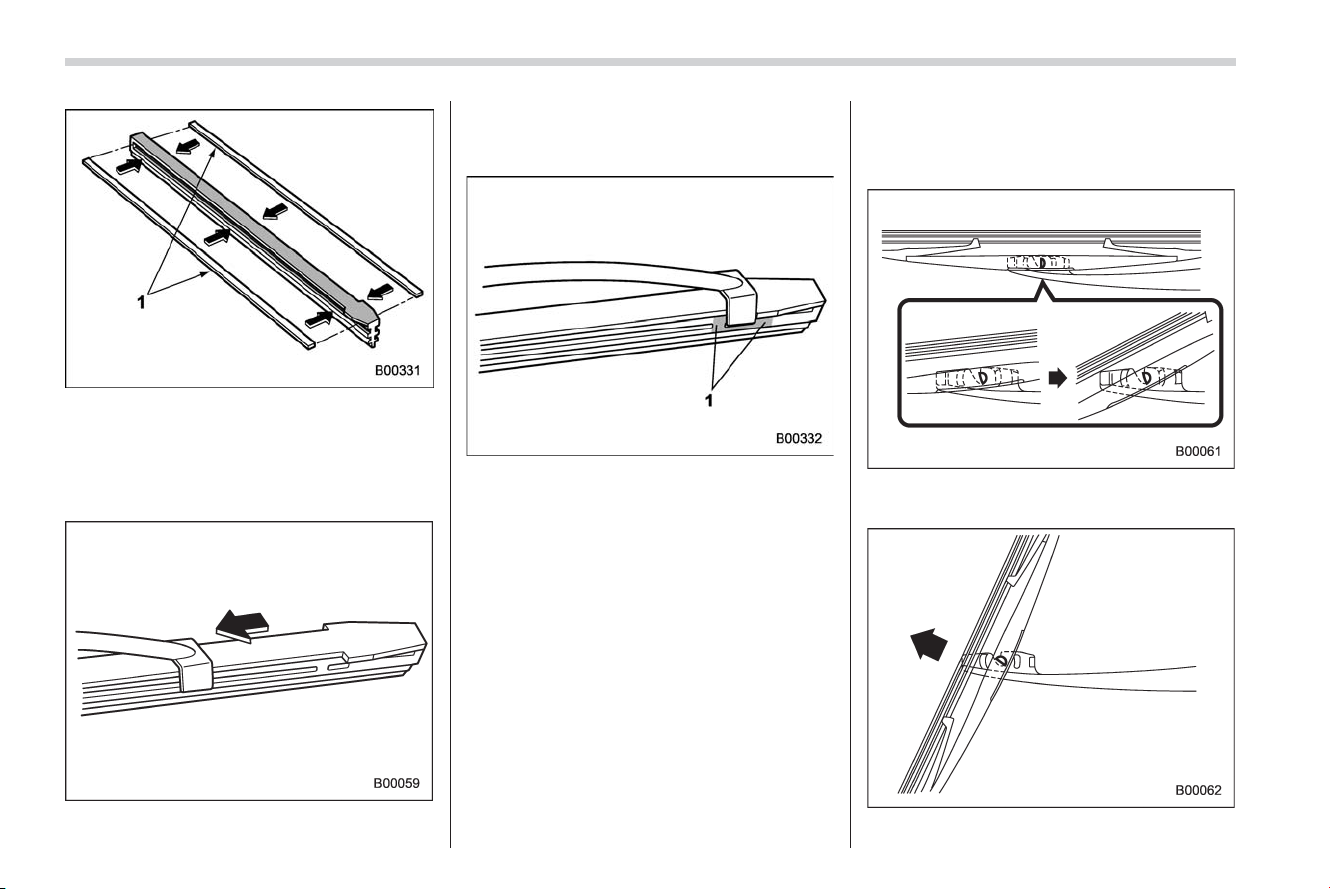
Black plate (330,1)
北米Model "A8130BE-B" EDITED: 2007/ 7/ 25
11-40 Maintenance and service
1) Metal spines
4. If the new blade rubber is not provided
with two metal spines, remove the metal
spines from the old blade rubber and
install them in the new blade rubber.
5. Align the claws of the metal support
with the grooves in the rubber and slide
the blade rubber assembly into the metal
support until it locks.
1) Stopper
Be sure to position the claws at the end of
the metal support between the stoppers
on the rubber as shown. If the rubber is
not retained properly, the wiper blade may
scratch the windshield.
6. Install the wiper blade assembly to the
wiper arm. Make sure that it locks in place.
7. Lower the wiper arm.
& Rear window wiper blade
1. Raise the wiper arm off the rear
window.
2. Turn the wiper blade assembly coun-
terclockwise.
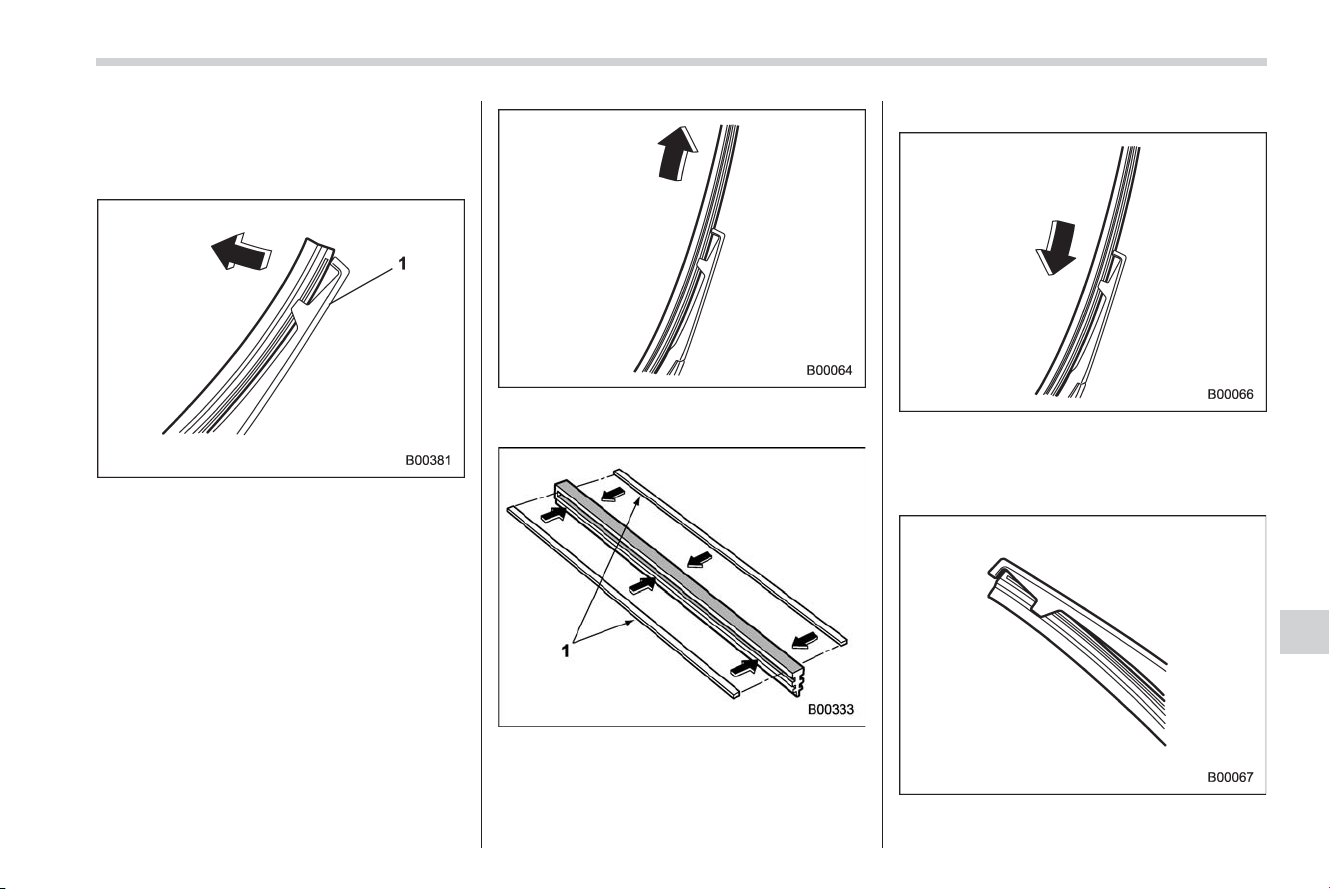
Black plate (331,1)
北米Model "A8130BE-B" EDITED: 2007/ 7/ 25
3. Having turned the wiper blade assem-
bly to the angle shown in the illustration,
pull it in the direction of the arrow to
remove it from the wiper arm.
1) Plastic support
4. Pull out the end of the blade rubber
assembly to unlock it from the plastic
support.
5. Pull the blade rubber assembly out of
the plastic support.
1) Metal spines
6. If the new blade rubber is not provided
with two metal spines, remove the metal
spines from the old blade rubber and
install them in the new blade rubber.
7. Align the claws of the plastic support
with the grooves in the blade rubber
assembly, then slide the blade rubber
assembly into place.
Securely lock the end of the plastic
Maintenance and service 11-41
– CONTINUED –
11
Black plate (332,1)
北米Model "A8130BE-B" EDITED: 2007/ 7/ 25
11-42 Maintenance and service
support as shown in the illustration. If the
rubber is not retained properly, the wiper
may scratch the rear window glass.
8. Install the wiper blade assembly to the
wiper arm. Make sure that it locks in place.
9. Lower the wiper arm.
Battery
WARNING
. Before beginning work on or near
any battery, be sure to extinguish
all cigarettes, matches, and light-
ers. Never expose a battery to an
open flame or electric sparks.
Batteries give off a gas which is
highly flammable and explosive.
. For safety, in case an explosion
does occur, wear eye protection
or shield your eyes when work-
ing near any battery. Never lean
over a battery.
. Do not let battery fluid contact
eyes, skin, fabrics, or paint be-
cause battery fluid is a corrosive
acid. If battery fluid gets on your
skin or in your eyes, immediately
flush the area with water thor-
oughly. Seek medical help imme-
diately if acid has entered the
eyes.
If battery fluid is accidentally
swallowed, immediately drink a
large amount of milk or water,
and seek medical attention im-
mediately.
. To lessen the risk of sparks,
remove rings, metal watchbands,
and other metal jewelry. Never
allow metal tools to contact the
positive battery terminal and any-
thing connected to it WHILE you
are at the same time in contact
with any other metallic portion of
the vehicle because a short cir-
cuit will result.
. Keep everyone including children
away from the battery.
. Charge the battery in a well-
ventilated area.
. Battery posts, terminals and re-
lated accessories contain lead
and lead compounds, chemicals
known to the State of California
to cause cancer and reproductive
harm. Batt eries also contain
other chemicals known to the
State of California to cause can-
cer. Wash hands after handling.
CAUTION
Never use more than 10 amperes
when charging the battery because
it will shorten battery life.
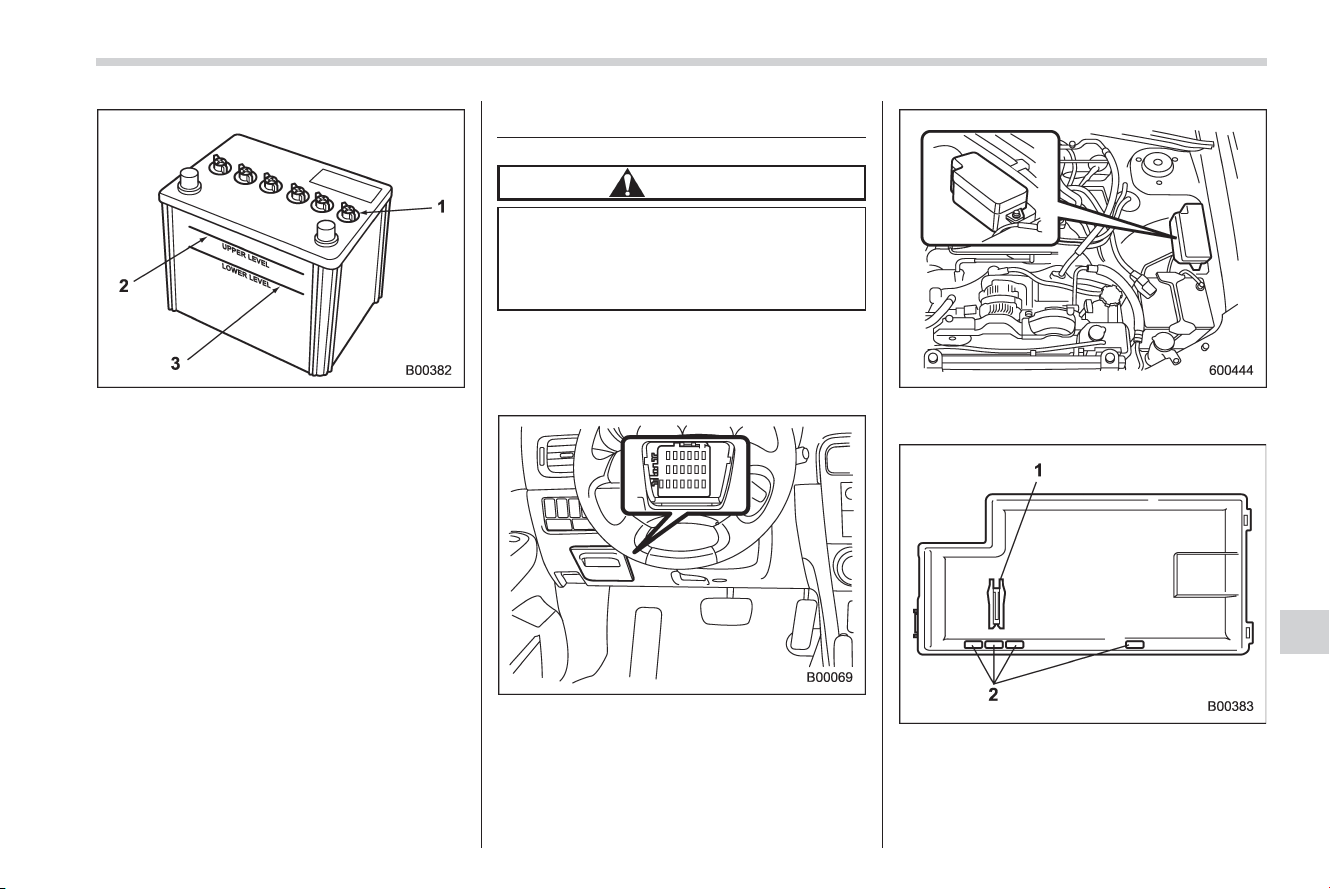
Black plate (333,1)
北米Model "A8130BE-B" EDITED: 2007/ 7/ 25
1) Cap
2) Upper level
3) Lower level
It is unnecessary to periodically check the
battery fluid level or periodically refill with
distilled water.
However, if the battery fluid level is below
the lower level, remove the cap. Fill to the
upper level with distilled water.
Fuses
CAUTION
Never replace a fuse with one hav-
ing a higher rating or with material
other than a fuse because serious
damage or a fire could result.
The fuses are designed to melt during an
overload to prevent damage to the wiring
harness and electrical equipment. The
fuses are located in two fuse boxes.
One is located under the instrument panel
behind the cover on the driver’s seat side.
To remove the cover, pull it out.
The other one is housed in the engine
compartment.
1) Fuse puller
2) Spare fuse
The fuse puller and spare fuses are stored
in the main fuse box cover in the engine
Maintenance and service 11-43
– CONTINUED –
11
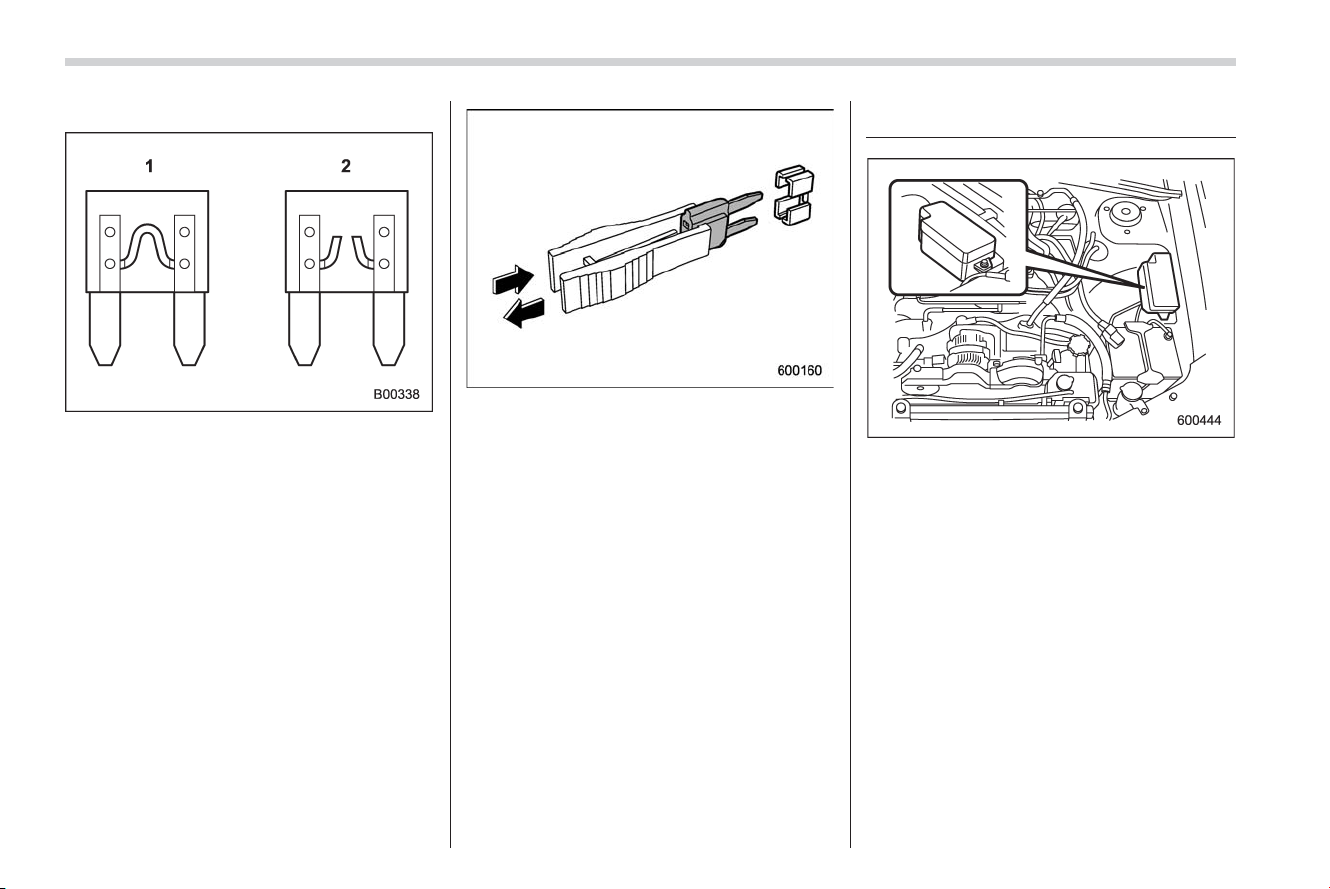
Black plate (334,1)
北米Model "A8130BE-B" EDITED: 2007/ 7/ 25
11-44 Maintenance and service
compartment.
1) Good
2) Blown
If any lights, accessories or other electrical
controls do not operate, inspect the
corresponding fuse. If a fuse has blown,
replace it.
1. Turn the ignition switch to the “LOCK”
position and turn off all electrical acces-
sories.
2. Remove the cover.
3. Determine which fuse may be blown.
The back side of each fuse box cover and
the “Fuses and circuits” section in chapter
12 in this manual show the circuit for each
fuse.
4. Pull out the fuse with the fuse puller.
5. Inspect the fuse. If it h as blown,
replace it with a spare fuse of the same
rating.
6. If the same fuse blows again, this
indicates that its system has a problem.
Contact your SUBARU dealer for repairs.
Main fuse
Main fuse box
The main fuses are designed to melt
during an overload to prevent damage to
the wiring harness and electrical equip-
ment. Check the main fuses if any
electrical component fails to operate (ex-
cept the starter motor) and other fuses are
good. A melted main fuse must be
replaced. Use only replacements with the
same specified rating as the melted main
fuse. If a main fuse blows after it is
replaced, have the electrical system
checked by your nearest SUBARU dealer.

Black plate (335,1)
北米Model "A8130BE-B" EDITED: 2007/ 7/ 25
Installation of accessories
Always consult your SUBARU dealer
before installing fog lights or any other
electrical equipment in your vehicle. Such
accessories may cause the electronic
system to malfunction if they are incor-
rectly installed or if they are not suited for
the vehicle.
Maintenance and service 11-45
11
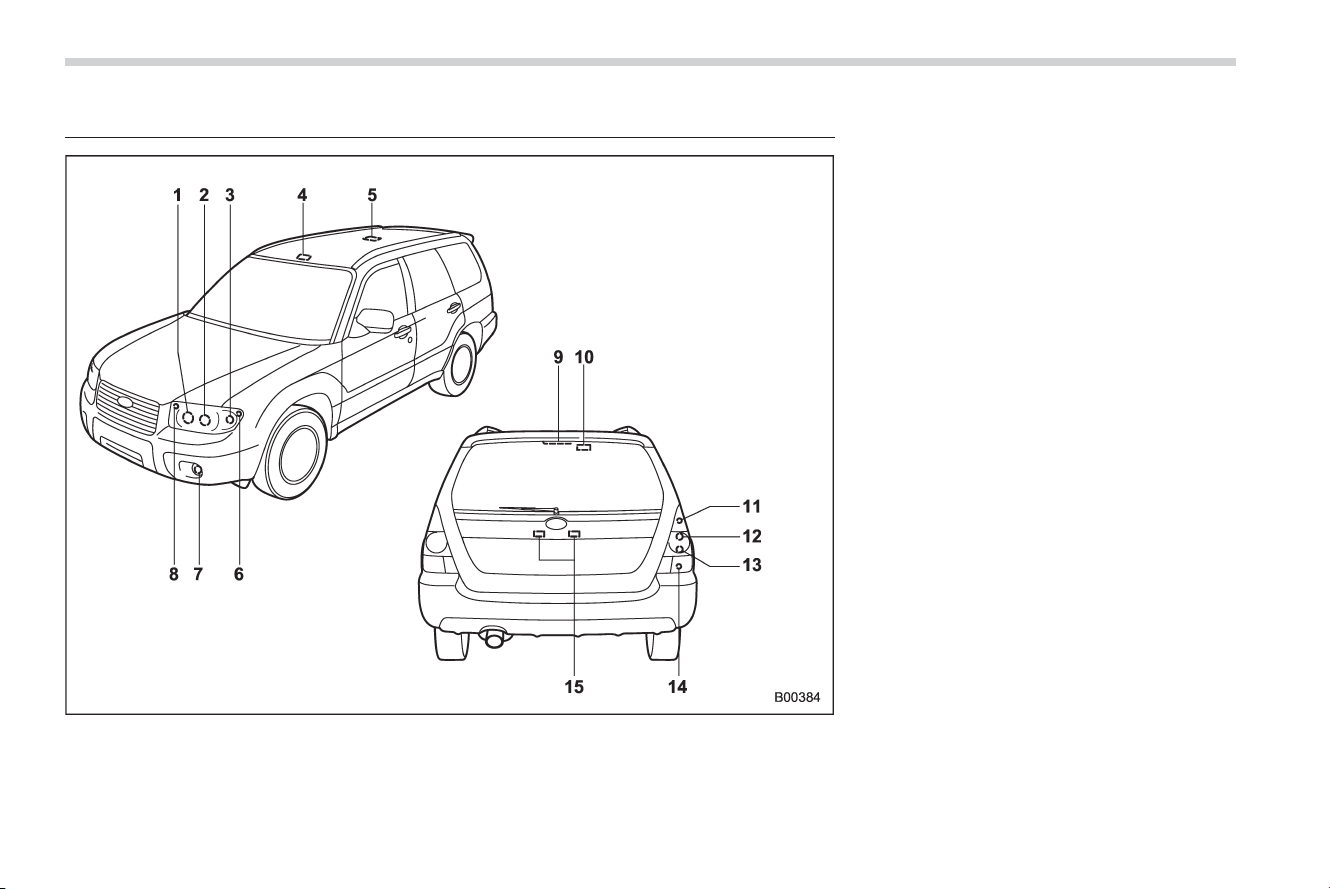
Black plate (336,1)
北米Model "A8130BE-B" EDITED: 2007/ 7/ 25
11-46 Maintenance and service
Replacing bulbs
Black plate (337,1)
北米Model "A8130BE-B" EDITED: 2007/ 7/ 25
Wattage Bulb No.
1) High beam headlight 12V-60W 9005 (HB3)
2)
Low beam headlight
Vehicle with HID headlights 12V-35W D2R
Vehicle without HID headlights 12V-55W H1
3)
Front turn signal light 12V-21W (Amber) 1474
4)
Map light 12V-8W –
5)
Dome light 12V-8W –
6)
Side marker light (Front) 12V-5W 168
7) Front fog light 12V-51W 9006 (HB4)
8)
Parking light 12V-5W 168
9)
High mount stop light 12V-13W 912
10)
Cargo area light 12V-5W –
11)
Tail/stop light 12V-21/5W 7443
12)
Backup light 12V-16W 921
13)
Rear turn signal light 12V-21W (Amber) 1474
14)
Tail/stop light 12V-21/5W 7443
15)
License plate light 12V-5W
168
CAUTION
Replace any bulb only with a new
bulb of the specified wattage. Using
a bulb of different wattage could
result in a fire.
Maintenance and service 11-47
– CONTINUED –
11
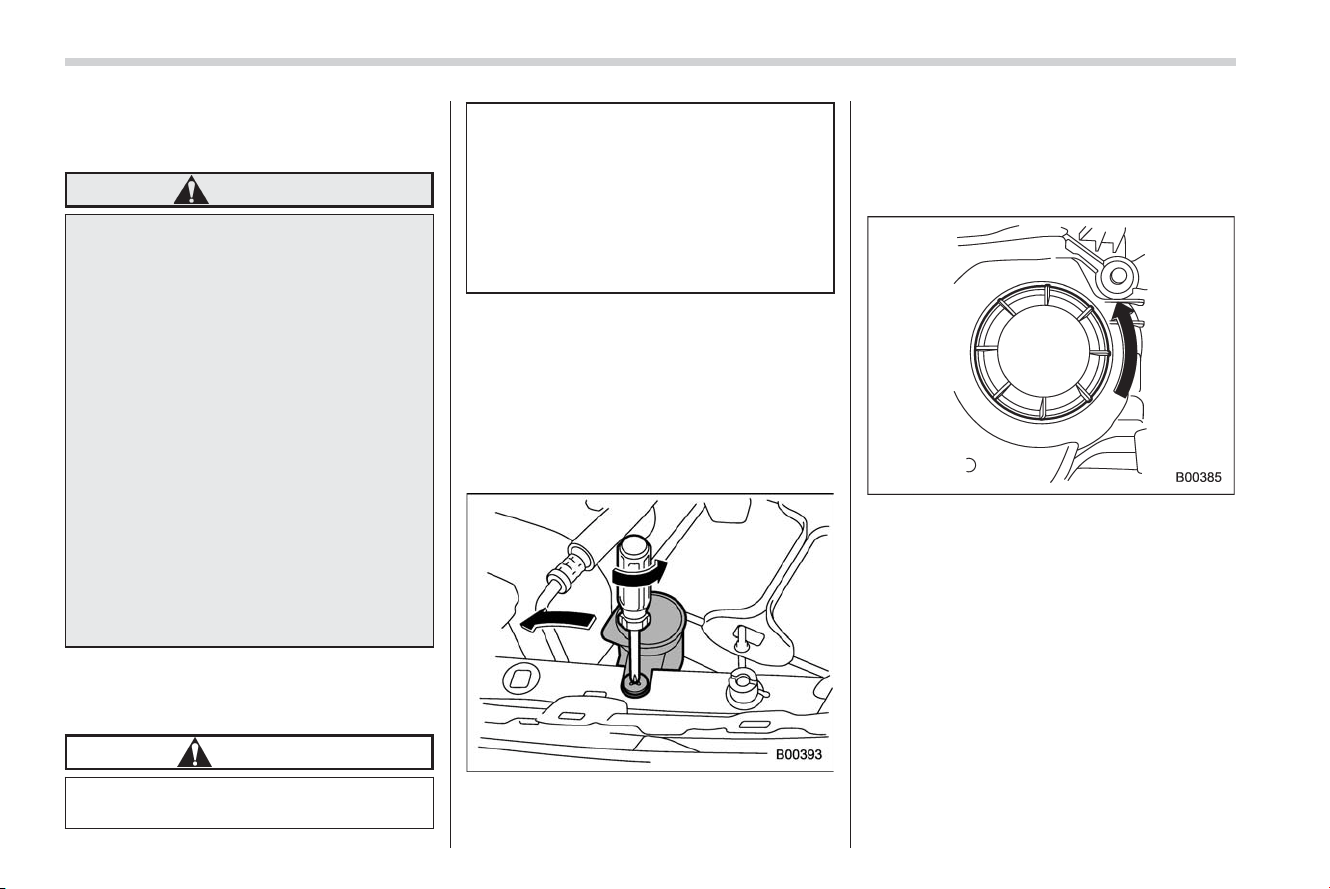
Black plate (338,1)
北米Model "A8130BE-B" EDITED: 2007/ 7/ 25
11-48 Maintenance and service
& Headlights (Vehicle with HID
headlights)
WARNING
High-intensity-discharge (HID) bulbs
are used for the low beams of the
headlights on the Canada-spec.
2.5XT. These HID bulbs use an
extremely high voltage. To avoid
the risk of an electric shock and
resulting serious injury, you should
not attempt to replace them. Neither
should you attempt to replace the
high-beam bulbs, remove/refit the
headlight assemblies, or remove
any hea dlight-assembly compo-
nents. For replacement of the head-
light bulbs (low-beam and high-
beam), removal and installation of
the headlight assemblies, and re-
moval of headlight-assembly com-
ponents, contact your SUBARU
dealer.
& Headlights (Vehicle without
HID headlights)
CAUTION
Halogen headlight bulbs become
very hot while in use. If you touch
the bulb surface with bare hands or
greasy gloves , finger prints or
grease on the bulb surface will
develop into hot spots and cause
the bulb to break. If there are finger
prints or grease on the bulb surface,
wipe them away with a soft cloth
moistened with alcohol.
NOTE
. If headlight aiming is required, con-
sult your SUBARU dealer for proper
adjustment of the headlight aim.
. It may be difficult to replace the
bulbs. Have your SUBARU dealer re-
place the bulbs if necessary.
Before replacing the left-hand (battery-
side) low- or high-beam light bulb, remove
the screw that retains the windshield
washer nozzle and tip the windshield
washer nozzle sideways.
! Low beam light bulbs
1. Remove the bulb cover, by turning it
counterclockwise.
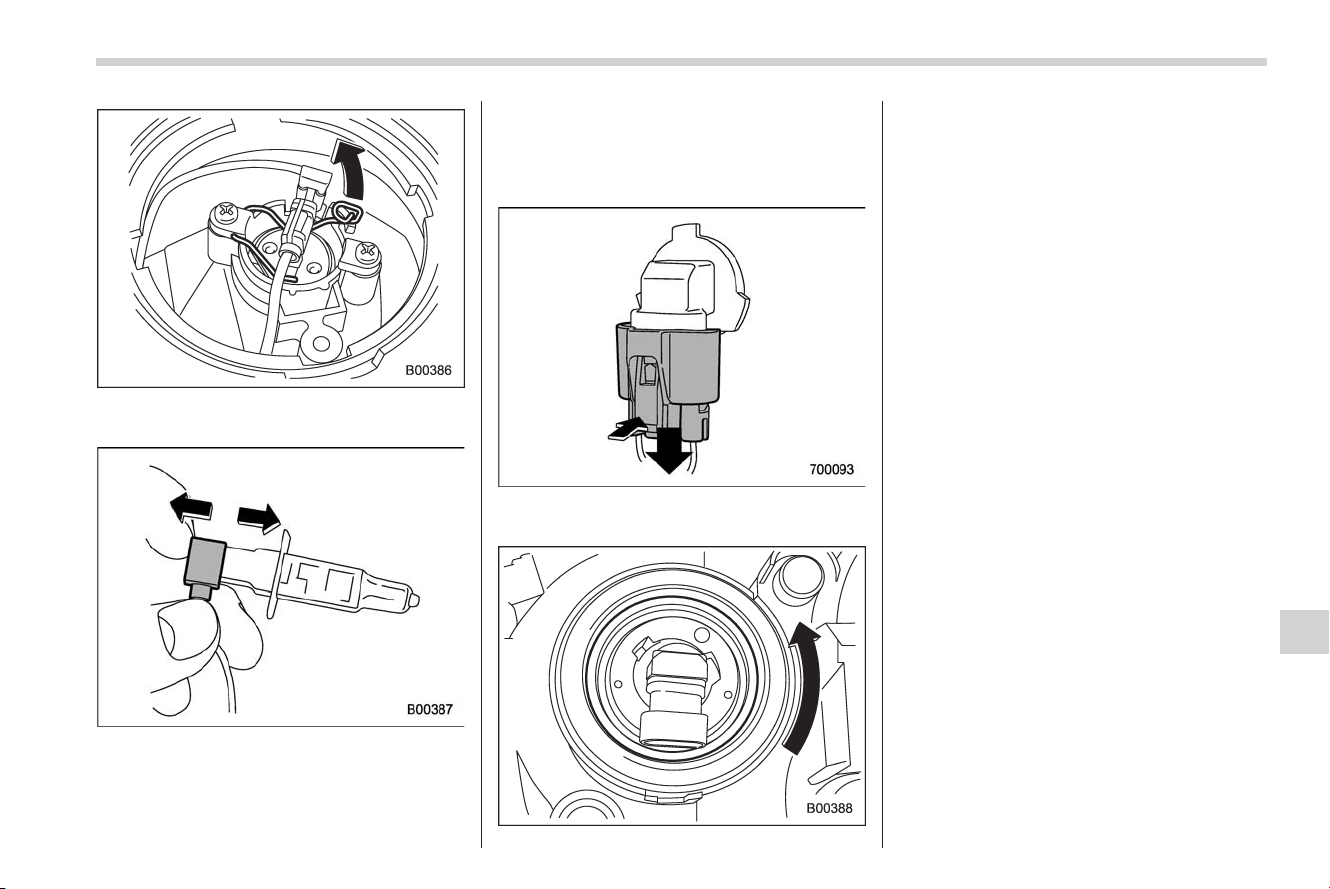
Black plate (339,1)
北米Model "A8130BE-B" EDITED: 2007/ 7/ 25
2. Remove the retainer spring, then pull
out the bulb and electrical connector unit.
3. Disconnect the electrical connector
from the bulb.
4. Install a new bulb into the electrical
connector, then set the retainer spring
securely.
5. Install the bulb cover.
! High beam light bulbs
1. Di sconnect the electrical conn ector
from the bulb.
2. Remove the bulb from the headlight
assembly by turning it counterclockwise.
3. Replace the bulb with new one.
4. Reconnect the electrical connector. At
this time, use care not to touch the bulb
surface.
5. To install the bulb to the headlight
assembly, turn it clockwise until it clicks.
Maintenance and service 11-49
– CONTINUED –
11
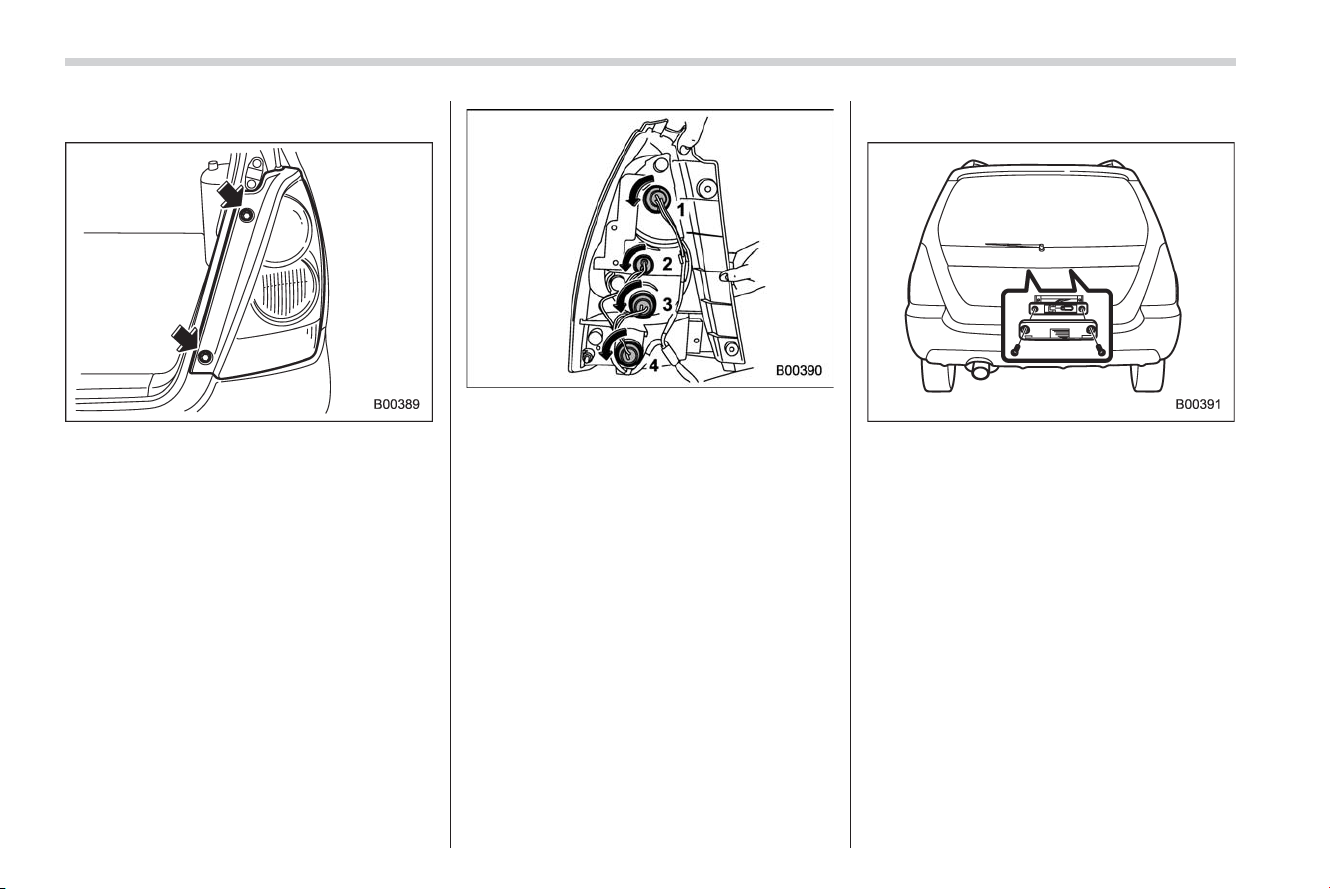
Black plate (340,1)
北米Model "A8130BE-B" EDITED: 2007/ 7/ 25
11-50 Maintenance and service
& Rear combination lights
1. Remove the upper and lower screws.
Then, slide the rear combination lamp
assembly to the rear and remove it from
the vehicle.
1) Tail/stop light
2) Backup light
3) Rear turn signal light
4) Tail/stop light
2. Remove the bulb holder from the rear
combination light assembly by turning it
counterclockwise.
3. Pull the bulb from the holder. Install a
new bulb.
4. Set the bulb holder into the rear
combination light assembly and turn it
clockwise until it locks.
5. Reinstall the rear combination light
assembly.
& License plate light
1. Remove the mounting screws using a
Phillips screwdriver.
2. Remove the cover and lens.
3. Pull the bulb out of the socket. Install a
new bulb.
4. Reinstall the lens and cover.
5. Tighten the mounting screws.
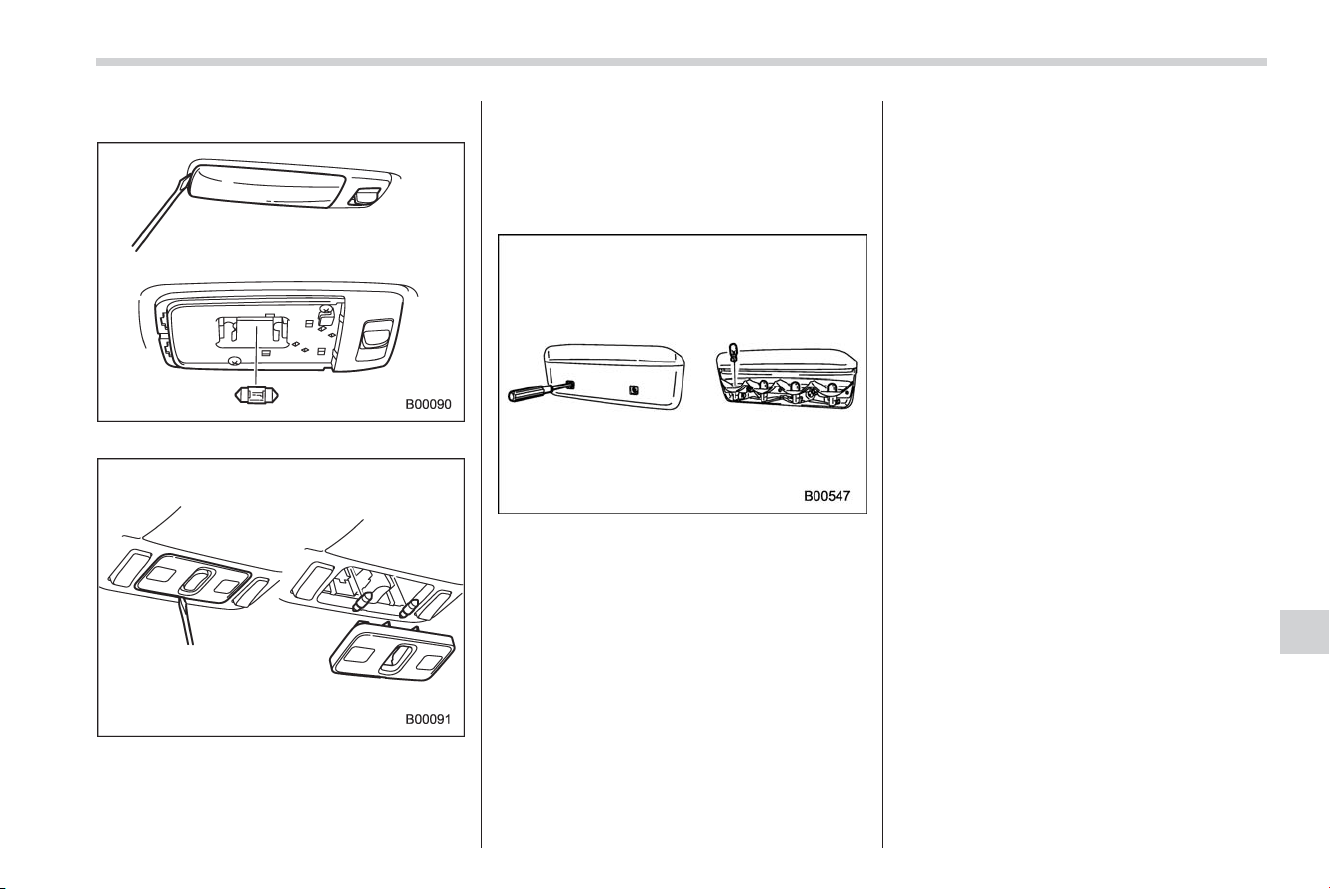
Black plate (341,1)
北米Model "A8130BE-B" EDITED: 2007/ 7/ 25
& Dome light and map light
Dome light
Map light
1. Remove the lens by prying the edge of
the lens with a flat-head screwdriver.
2. Pull the bulb out of the socket. Install a
new bulb.
3. Reinstall the lens.
& High mount stop light
1. Remove the mounting screws using a
Phillips screwdriver and then remove the
high mount stop light cover.
2. Pull the bulb from the socket. Install a
new bulb.
3. Reinstall the cover.
4. Tighten the mounting screws then
reinstall the covers.
NOTE
Other bulbs may be difficult to replace.
Have your SUBARU dealer replace
these bulbs if necessary.
Maintenance and service 11-51
11

Black plate (2,1)
Model "ALL_MODEL_MEMO" EDITED: 2006/ 1/ 17
Left Page
————————————————————————————————————————
————————————————————————————————————————
————————————————————————————————————————
————————————————————————————————————————
————————————————————————————————————————
————————————————————————————————————————
————————————————————————————————————————
————————————————————————————————————————
————————————————————————————————————————
————————————————————————————————————————
————————————————————————————————————————
————————————————————————————————————————
————————————————————————————————————————

Black plate (23,1)
北米Model "A8130BE-B" EDITED: 2007/ 7/ 25
Specifications ..................................................... 12-2
Dimensions........................................................ 12-2
Engine ............................................................... 12-3
Electrical system................................................ 12-3
Capacities.......................................................... 12-4
Tires .................................................................. 12-5
Wheel alignment ................................................ 12-5
Fuses and circuits ............................................. 12-6
Fuse panel located behind the instrument
panel............................................................... 12-6
Fuse panel located in the engine
compartment ................................................... 12-8
Bulb chart........................................................... 12-9
Vehicle identification ....................................... 12-10
Specifications
12
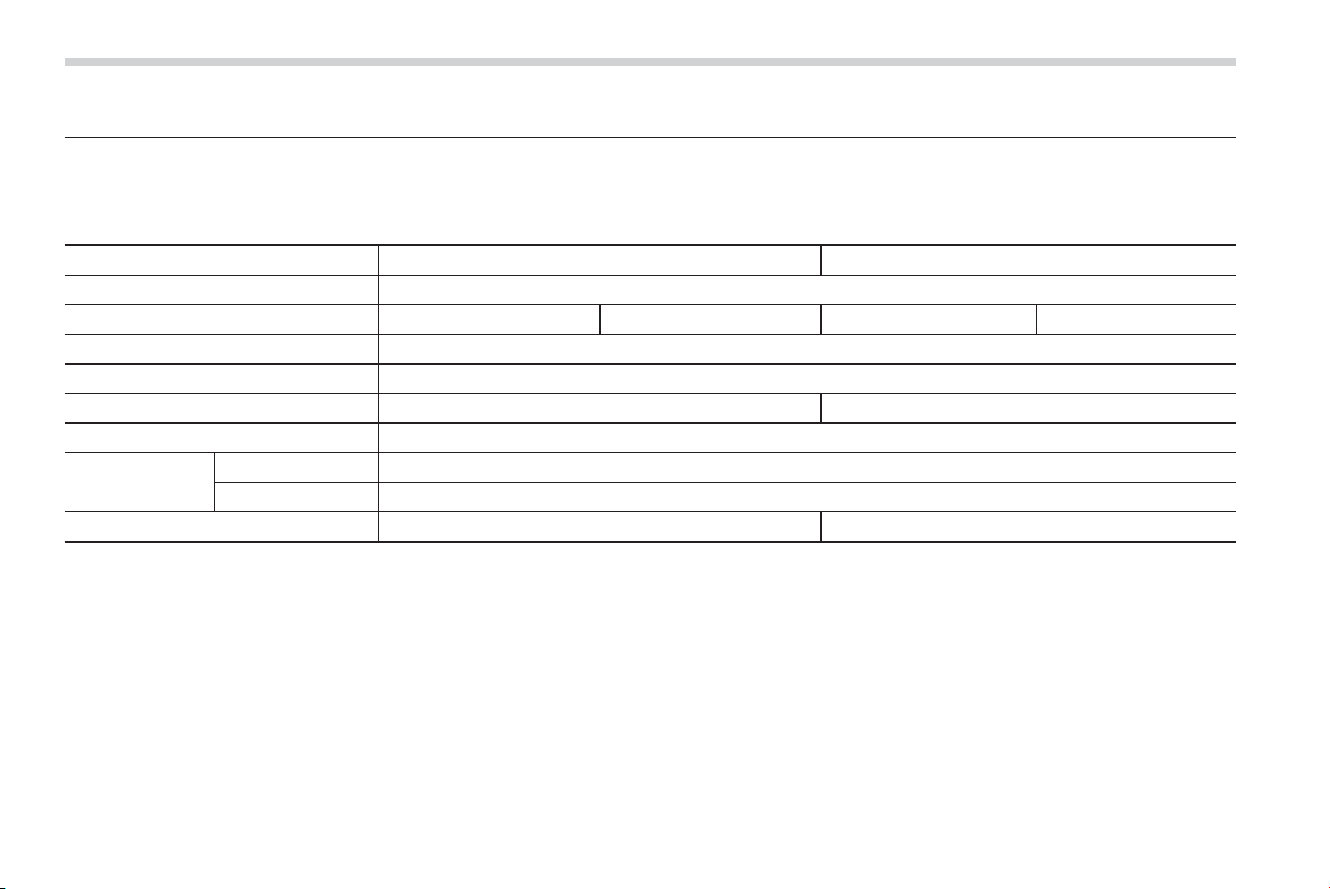
Black plate (344,1)
北米Model "A8130BE-B" EDITED: 2007/ 7/ 25
12-2 Specifications
Specifications
These specifications are subject to change without notice.
& Dimensions
in (mm)
Item
2.5-liter non-turbo models
2.5-liter turbo models
Drive system AWD
Transmission type
AT MT AT MT
Overall length 176.6 (4,485)
Overall width
68.3 (1,735)
Overall height
62.6 (1,590) 62.4 (1,585)
Wheel base
99.4 (2,525)
Tread Front
58.9 (1,495)
Rear
58.5 (1,485)
Ground clearance*
1
8.07 (205) 7.87 (200)
*1: Measured with vehicle empty
AT: Automatic transmission
MT: Manual transmission
Black plate (345,1)
北米Model "A8130BE-B" EDITED: 2007/ 7/ 25
& Engine
Engine model
EJ253 (2.5-liter, SOHC, non-turbo) EJ255 (2.5-liter, DOHC, turbo)
Engine type
Horizontally opposed, liquid cooled 4 cylinder, 4 stroke gasoline engine
Displacement cc (cu-in) 2,457 (150)
Bore 6 Stroke in (mm) 3.92 6 3.11 (99.5 6 79.0)
Compression ratio 10.0 : 1 8.4 : 1
Firing order
1 – 3 – 2 – 4
& Electrical system
Battery type and capacity (5HR)
MT models 12V-48AH (55D23L)
AT models 12V-52AH (75D23L)
Alternator
2.5-liter non-turbo models 12V-90A
2.5-liter turbo models
12V-110A
Spark plugs
2.5-liter non-turbo models FR5AP-11 (NGK)
2.5-liter turbo models
ILFR6A (NGK)
Specifications
12-3
– CONTINUED –
12
Black plate (346,1)
北米Model "A8130BE-B" EDITED: 2007/ 7/ 25
12-4 Specifications
& Capacities
Fuel tank 15.9 US gal (60 liters, 13.2 Imp gal)
Engine oil
4.2 US qt (4.0 liters, 3.5 Imp qt)
Transmission oil
MT 3.7 US qt (3.5 liters, 3.1 Imp qt)
AT 9.8 US qt (9.3 liters, 8.2 Imp qt)
Front differential gear oil (AT)
1.3 US qt (1.2 liter, 1.1 Imp qt)
Rear differential gear oil
0.8 US qt (0.8 liter, 0.7 Imp qt)
Power steering fluid 0.7 US qt (0.7 liter, 0.6 Imp qt)
Engine coolant 2.5-liter non-turbo models
MT 7.3 US qt (6.9 liters, 6.1 Imp qt)
AT 7.2 US qt (6.8 liters, 6.0 Imp qt)
2.5-liter turbo models
MT 7.8 US qt (7.4 liters, 6.5 Imp qt)
AT
7.7 US qt (7.3 liters, 6.4 Imp qt)
AT: Automatic transmission
MT: Manual transmission
Black plate (347,1)
北米Model "A8130BE-B" EDITED: 2007/ 7/ 25
& Tires
Tire size
P215/60R16 94H P215/55R17 93H
Wheel size 16 6 6
1
/
2
JJ or 16 6 6
1
/
2
J176 7JJ
Pressure Front Light load
29 psi (200 kPa, 2.0 kgf/cm
2
) 32 psi (220 kPa, 2.2 kgf/cm
2
)
Full load
29 psi (200 kPa, 2.0 kgf/cm
2
) 32 psi (220 kPa, 2.2 kgf/cm
2
)
Rear Light load
28 psi (190 kPa, 1.9 kgf/cm
2
) 30 psi (210 kPa, 2.1 kgf/cm
2
)
Full load
36 psi (250 kPa, 2.5 kgf/cm
2
) 32 psi (220 kPa, 2.2 kgf/cm
2
)
Trailer towing
41 psi (280 kPa, 2.8 kgf/cm
2
) 36 psi (250 kPa, 2.5 kgf/cm
2
)
Temporary
spare tire
Size T135/80D16 T135/90D16
Pressure
60 psi (420 kPa, 4.2 kgf/cm
2
)
NOTE
. For the Canada specification non-turbo models, there is a conventional tire installed under the floor of the cargo area.
. For the temporary spare tire, T135/80D16 or T135/90D16 is equipped to the vehicle.
& Wheel alignment
Item
2.5-liter non-turbo models 2.5-liter turbo models
Drive system
AWD
Toe Front
0 + 0.12 in (0 + 3 mm)
Rear 0.079 + 0.12 in (2 + 3 mm)
Camber
Front −0825’ + 45’
Rear
−0850’ + 45’ −0855’ + 45’
Specifications
12-5
12
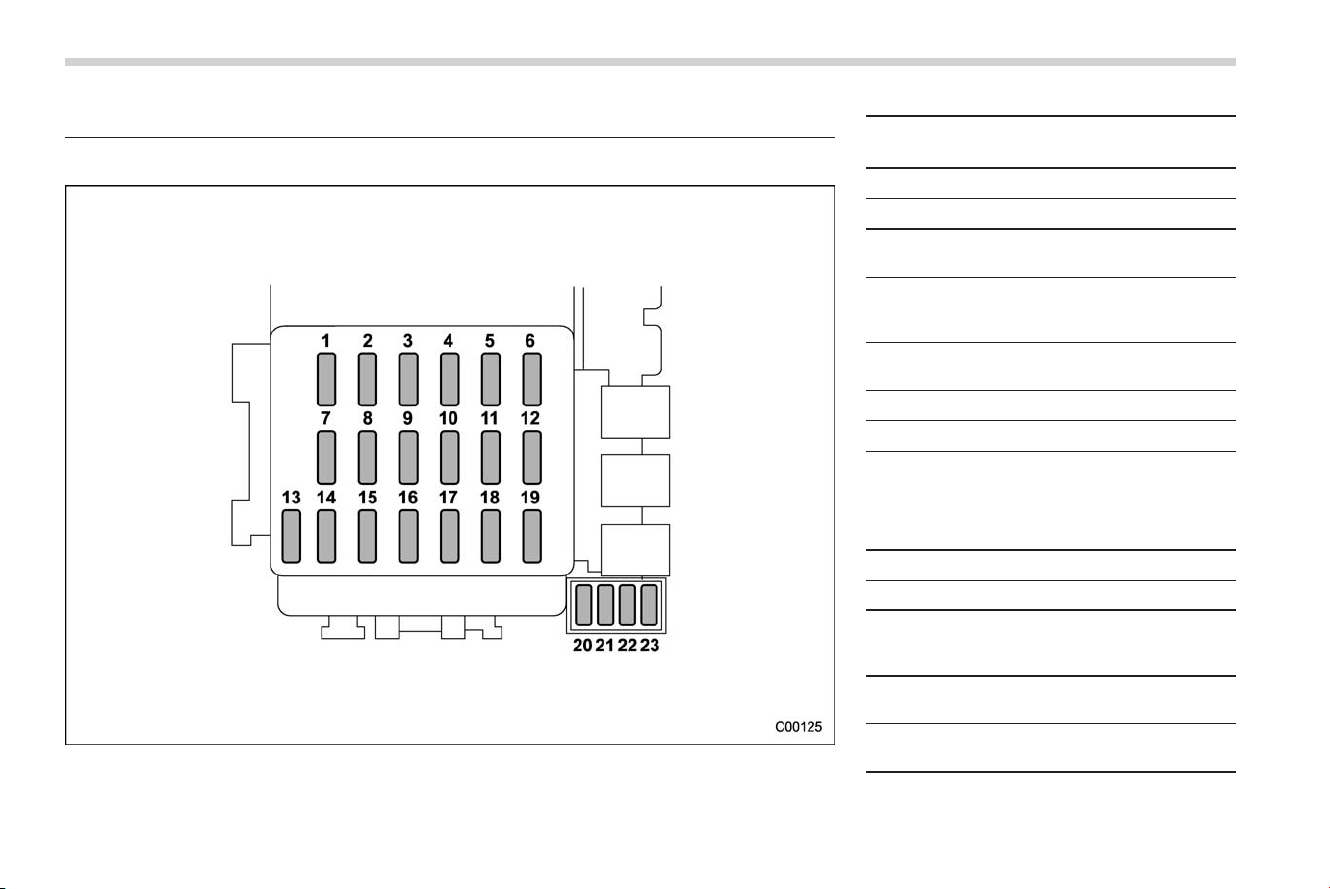
Black plate (348,1)
北米Model "A8130BE-B" EDITED: 2007/ 7/ 25
12-6 Specifications
Fuses and circuits
& Fuse panel located behind the instrument panel
Fuse
panel
Fuse
rating
Circuit
1 15A
. Heater fan
2 15A
. Heater fan
3 15A
. Power door lock
. Remote keyless entry
4 15A
. Power outlet (front)
. Remote controlled rear
view mirrors
5 10A
. Tail light
. Parking light
6 15A
. SRS airbag
7 15A
. Fog light
8 30A
. ABS
. Vehicle Dynamics Con-
trol system (models
with Vehicle Dynamics
Control system only)
9 15A
. Radio
10 10A
–
11 15A
. Engine ignition system
. SRS airbag
. AT control system
12 10A
. Illumination brightness
control
13 20A
. Wiper deicer
. Outside mirror defogger

Black plate (349,1)
北米Model "A8130BE-B" EDITED: 2007/ 7/ 25
Fuse
panel
Fuse
rating
Circuit
14 10A
. Meter
15 30A
. Windshield wiper and
washer
16 20A
. Brake light
17 15A
. Air conditioner
18 15A
. Backup light
. Cruise control
19 15A
. Power outlet (cargo)
20 15A
. Rear window wiper and
washer
21 15A
. Ignition coil (non-turbo
model only)
22 15A
. Seat heater
23 Empty
Specifications
12-7
– CONTINUED –
12
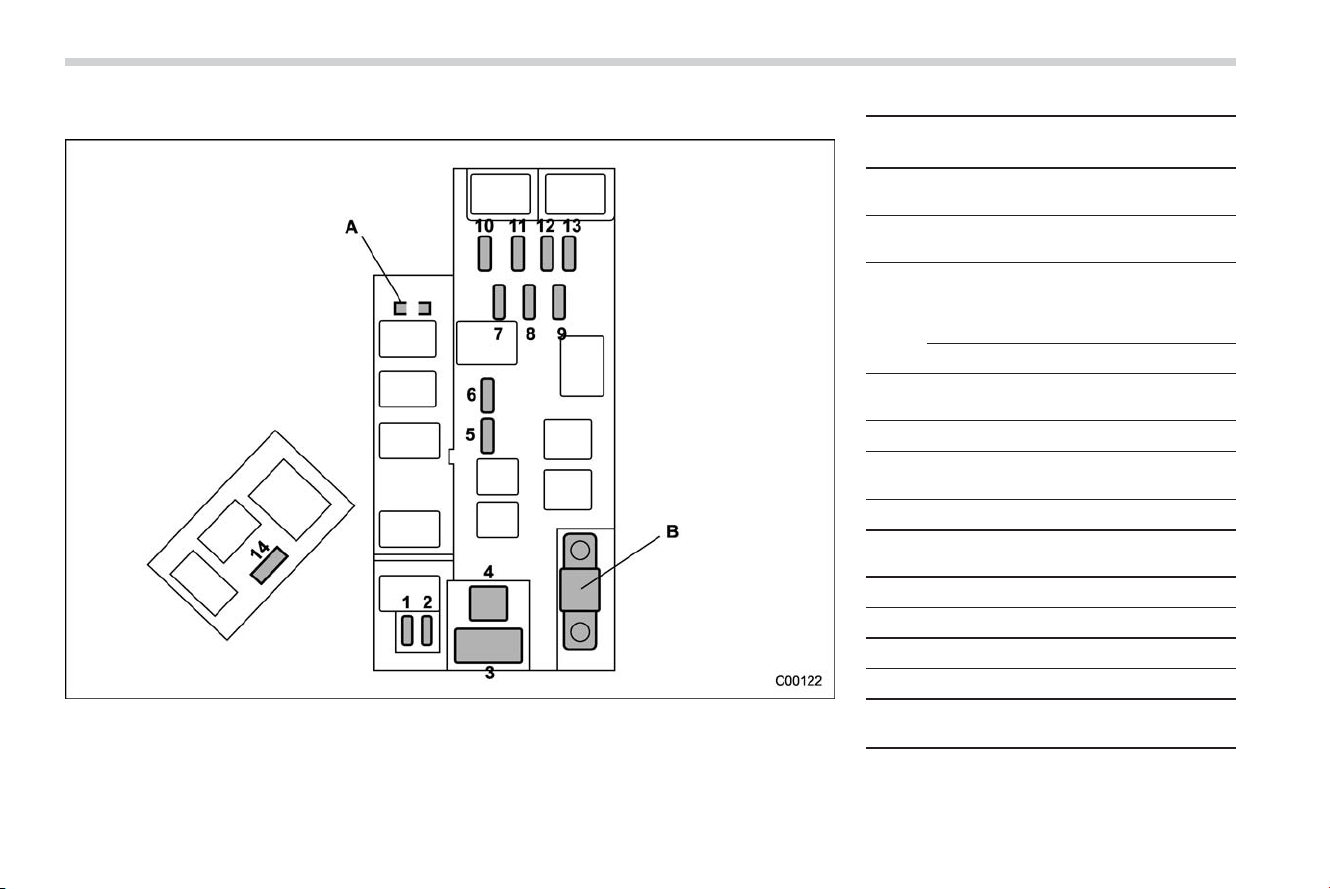
Black plate (350,1)
北米Model "A8130BE-B" EDITED: 2007/ 7/ 25
12-8 Specifications
& Fuse panel located in the engine compartment
A) FWD socket (AT models without Vehicle Dynamics Control system)
B) Main fuse
Fuse
panel
Fuse
rating
Circuit
1 30A
. Radiator cooling fan
(main)
2 30A
. Radiator cooling fan
(sub)
3 50A
. Vehicle Dynamics Con-
trol system (models with
Vehicle Dynamics Con-
trol system only)
30A
. ABS motor
4 30A
. Engine sensor (non-turbo
models only)
5 20A
. Rear window defogger
6 15A
. Hazard warning flasher
. Horn
7 15A
. Turn signal lights
8 10A
. Automatic transmission
control unit
9 10A
. Alternator
10 15A
. Headlight (right side)
11 15A
. Headlight (left side)
12 20A
. Lighting switch
13 15A
. Clock
. Interior light

Black plate (351,1)
北米Model "A8130BE-B" EDITED: 2007/ 7/ 25
Fuse
panel
Fuse
rating
Circuit
14 10A
. Secondary air combina-
tion valve (turbo models
only)
Bulb chart
Description Wattage Bulb No.
Headlight
High beam 12V-60W 9005 (HB3)
Low beam
Vehicle with HID headlights 12V-35W D2R
Vehicle without HID head-
lights
12V-55W H1
Front fog light 12V-51W 9006 (HB4)
Front turn signal light 12V-21W 1474
Parking light
12V-5W 168
Side marker light (Front)
12V-5W 168
Rear combination light
Tail/stop light 12V-21/5W 7443
Turn signal light 12V-21W (amber) 1474
Backup light 12V-16W 921
High mount stop light
12V-13W 912
License plate light
12V-5W 168
Cargo area light
12V-5W –
Dome light
12V-8W –
Map light
12V-8W –
Specifications
12-9
12
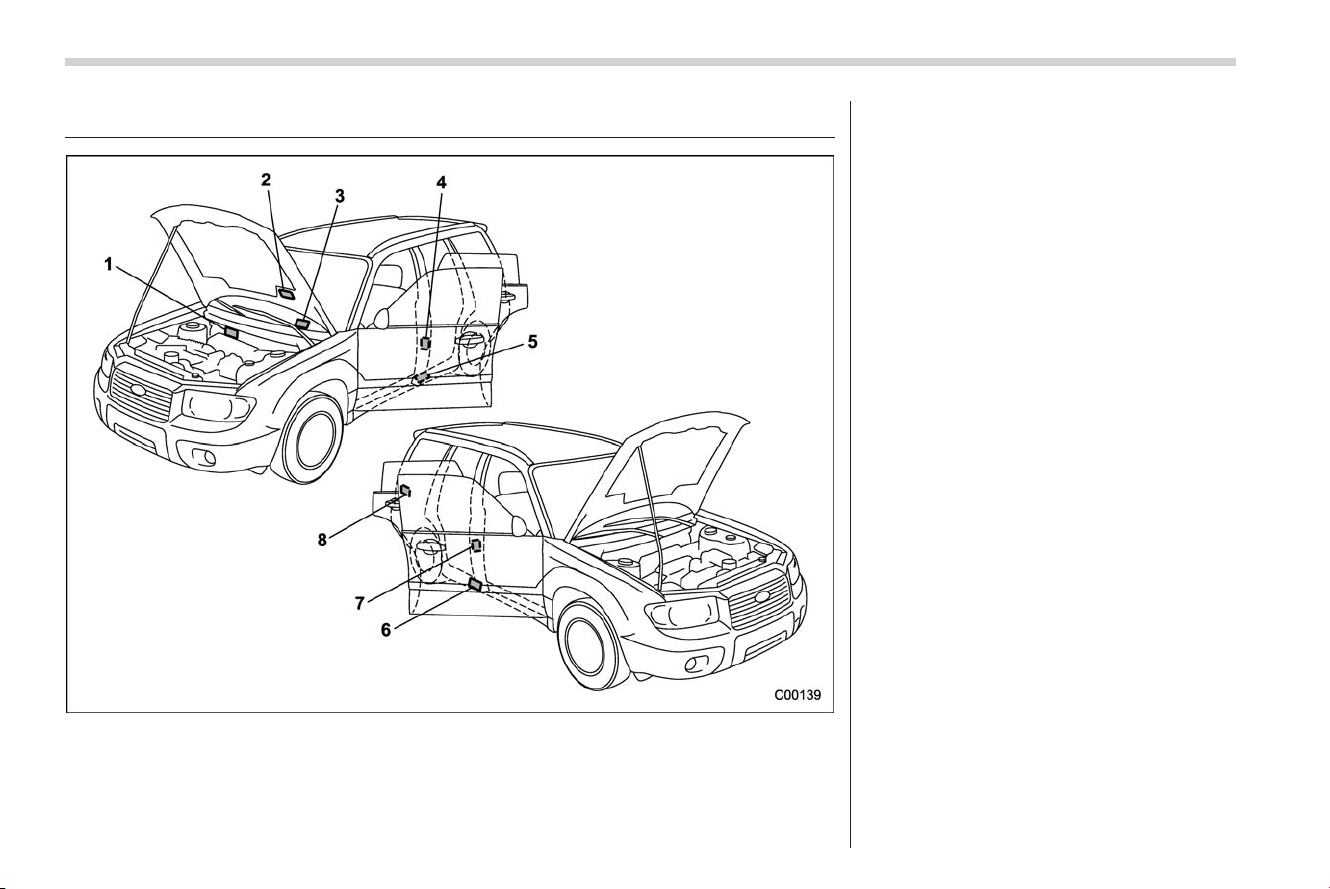
Black plate (352,1)
北米Model "A8130BE-B" EDITED: 2007/ 7/ 25
12-10 Specifications
Vehicle identification
1) Vehicle identification number
2) Emission control label
3) Vehicle identification number plate
4) Tire inflation pressure plate
5) Certification label
Bar code label (U.S. only)
6) Model number label
7) Radio noise label (Canada only)
8) Fuel label

Black plate (25,1)
北米Model "A8130BE-B" EDITED: 2007/ 7/ 25
For U.S.A. ........................................................... 13-2
Tire information.................................................. 13-2
Tire labeling ....................................................... 13-2
Recommended tire inflation pressure.................. 13-5
Glossary of tire terminology ............................... 13-6
Tire care – maintenance and safety practices ...... 13-7
Vehicle load limit – how to determine.................. 13-8
Determining compatibility of tire and vehicle load
capacities ...................................................... 13-11
Adverse safety consequences of overloading on
handling and stopping and on tires ................ 13-11
Steps for Determining Correct Load Limit......... 13-11
Uniform tire quality grading standards .......... 13-12
Treadwear ....................................................... 13-12
Traction AA, A, B, C......................................... 13-12
Temperature A, B, C......................................... 13-13
Reporting safety defects (USA) ...................... 13-14
Consumer information and Reporting safety defects
13
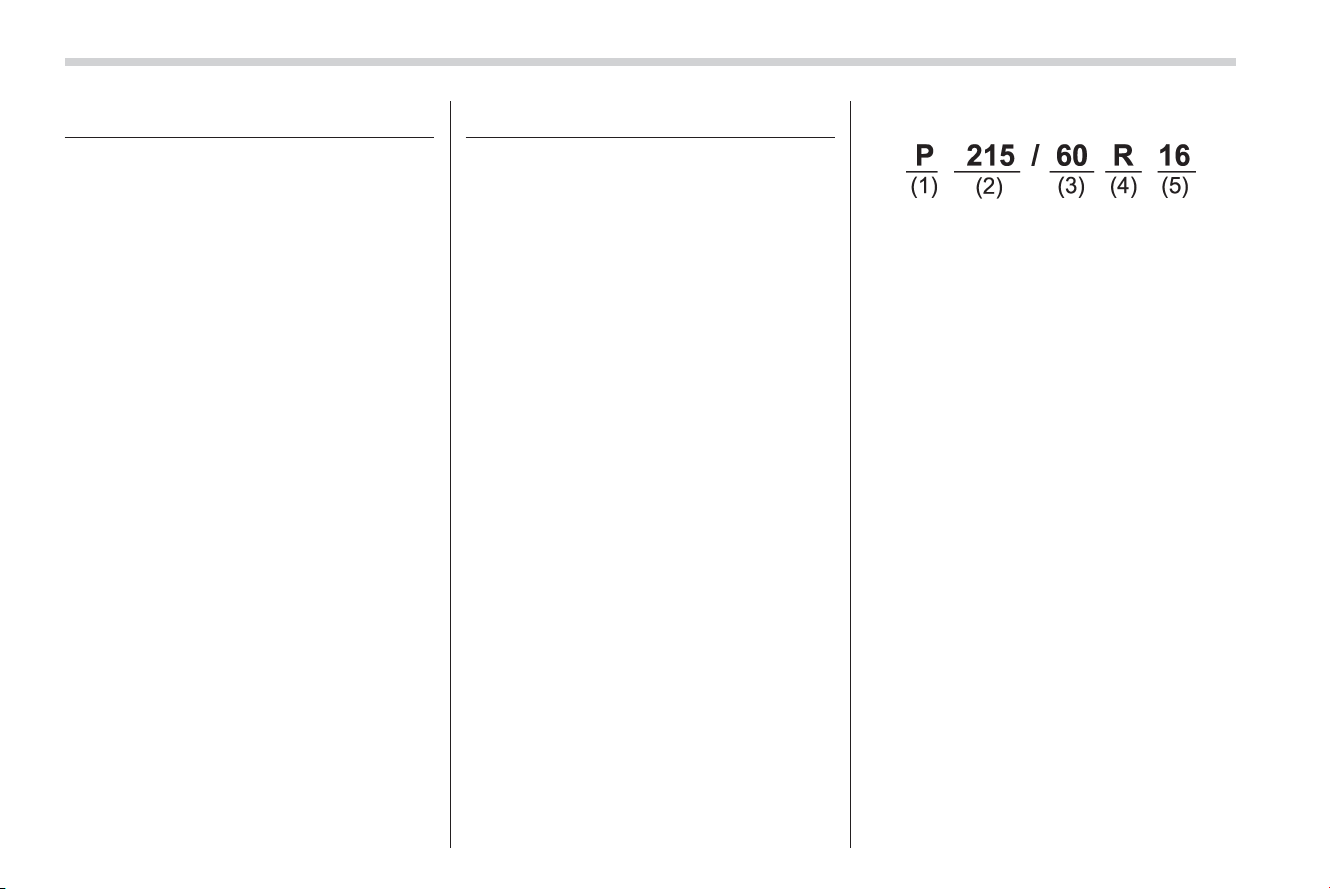
Black plate (356,1)
北米Model "A8130BE-B" EDITED: 2007/ 7/ 25
13-2 Consumer information and Reporting safety defects
For U.S.A.
The following information has been
compiled according to Code of
Federal Regulations “Title 49, Part
575”.
Tire information
& Tire labeling
Many markings (e.g. Tire size, Tire
Identification Number or TIN) are
placed on the sidewall of a tire by
tire manufacturers. These marking
can provide you with useful infor-
mation on the tire.
! Tire size
Your vehicle comes equipped with
P-Metric tire size. It is important to
understand the sizing system in
selecting the proper tire for your
vehicles. Here is a brief review of
the tire sizing system with a break-
down of its individual elements.
! P Metric
With the P-Metric system, Section
Width is measured in millimeters.
To convert millimeters into inches,
divide by 25.4. The Aspect Ratio
(Section Height divided by Section
Width) helps provide more dimen-
sional information about the tire
size.
Example:
(1) P = Certain tire type used on
light duty vehicles such as passen-
ger cars
(2) Section Width in millimeters
(3) Aspect Ratio (= section height
7 section width).
(4) R = Radial Construction
(5) Rim diameter in inches
! Load and Speed Rating Descrip-
tions
The load and speed rating descrip-
tions will appear following the size
designation.
They provide two important facts
about the tire. First, the number
designation is its load index. Sec-
ond, the letter designation indicates
the tire’s speed rating.
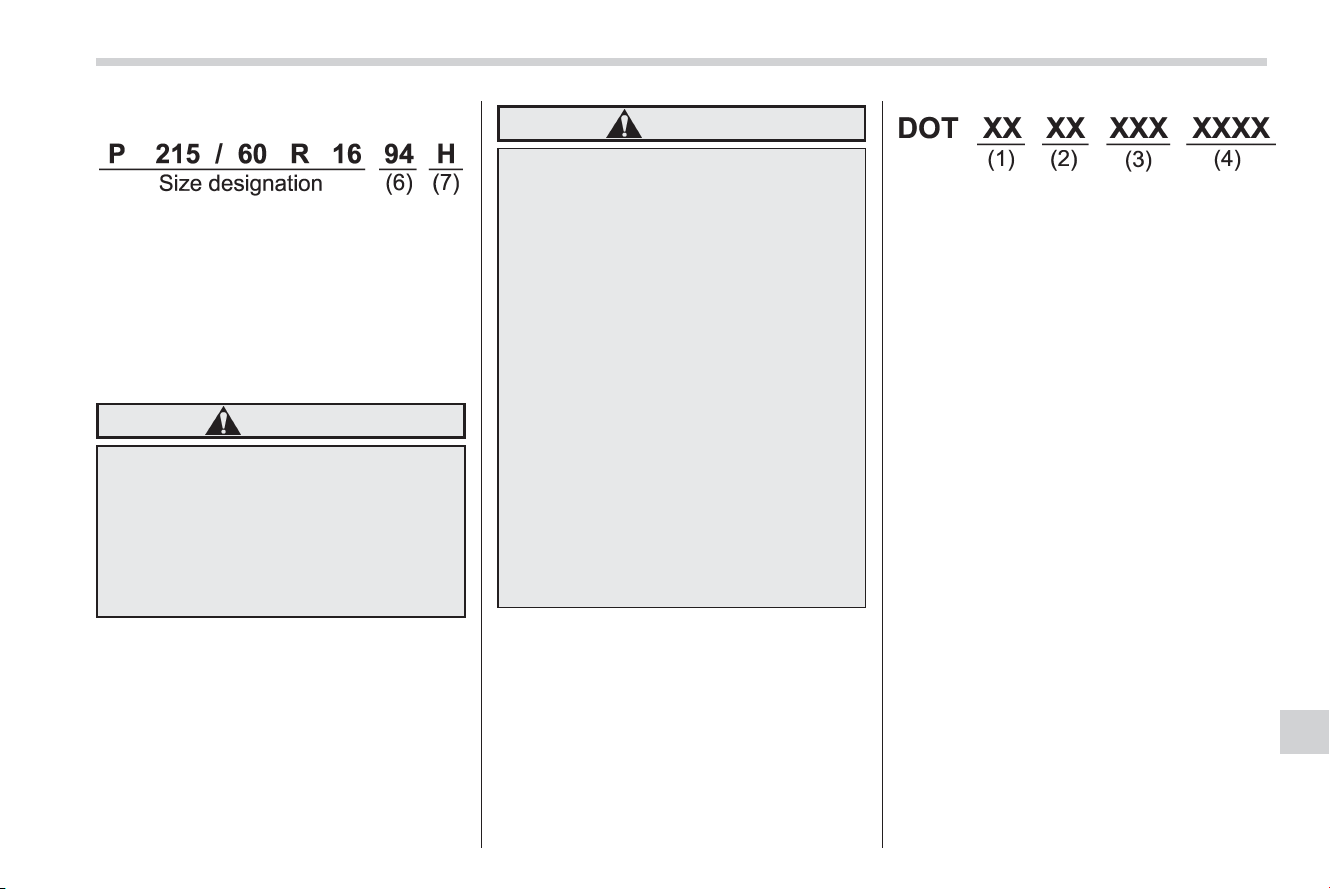
Black plate (357,1)
北米Model "A8130BE-B" EDITED: 2007/ 7/ 25
Example:
(6) Load Index: A numerical code
which specifies the maximum load
a tire can carry at the speed
indicated by its speed symbol, at
maximum inflation pressure.
For example, “94” means 1,477 lbs
(670 kg).
WARNING
Load indices apply only to the
tire, not to the vehicle. Putting
a load rated tire on any vehicle
does not mean the vehicle can
be loaded up to the tire’s rated
load.
(7) Speed Rating: An alphabetical
system describing a tire’s capability
to travel at established and prede-
termined speeds.
For example, “H” means 130 mph
(210 km/h)
WARNING
. Speed ratings apply only to
the tire, not to the vehicle.
Putting a speed rated tire on
any vehicle does not mean
the vehicle can be operated
at the tire’s rated speed.
. The speed rating is void if
the tires are worn out, da-
maged, repaired, retreaded,
or otherwise altered from
their original condition. If
tires are repaired, re-
treaded, or otherwise al-
tered, they may not be sui-
table for original equipment
tire designed loads and
speeds.
! Tire Identification Number (TIN)
Tire Identification Number (TIN) is
marked on the intended outboard
sidewall. The TIN is composed of
four groups. Here is a brief review
of the TIN with a breakdown of its
individual elements.
(1) Manufact urer ’s Identification
Mark
(2) Tire Size
(3) Tire Type Code
(4) Date of Manufacture
The first two figures identify the
week, starting with “01” to represent
the first full week of the calendar
year; the second two figures repre-
sent the year. For example, 0101
means the 1st week of 2001.
! Other markings
The following makings are also
placed on the sidewall.
! Maximum permissi ble inflation
pressure
The maximum cold inflation pres-
sure to which this tire may be
inflated. For example, “300 kpa
(44 PSI) MAX. PRESS”
Consumer information and Reporting safety defects 13-3
– CONTINUED –
13
Black plate (358,1)
北米Model "A8130BE-B" EDITED: 2007/ 7/ 25
13-4 Consumer information and Reporting safety defects
! Maximum load rating
The load rating at the maximum
permissible weight load for this tire.
For example, “MAX. LOAD 670 kg
(1477 LBS) @ 300 kpa (44 PSI)
MAX. PRESS.”
WARNING
Maximum load rating applies
only to the tire, not to the
vehicle. Putting a load rated
tire on any vehicle does not
mean the vehicle can be
loaded up to the tire’s rated
load.
! Construction type
Applicable construction of this tire.
For example, “TUBELESS STEEL
BELTED RADIAL”
! Construction
The generic name of each cord
material used in the plies (both
sidewall and tread area) of this tire.
For example, “PLIES: SIDEWALL
POLYESTER 1 TREAD POLYE-
STER 1 + STEEL 2 + NYLON 1”
! Uniform Tire Quality Grading
(UTQG)
For details, refer to “Uniform tire
quality grading standards” in this
chapter.
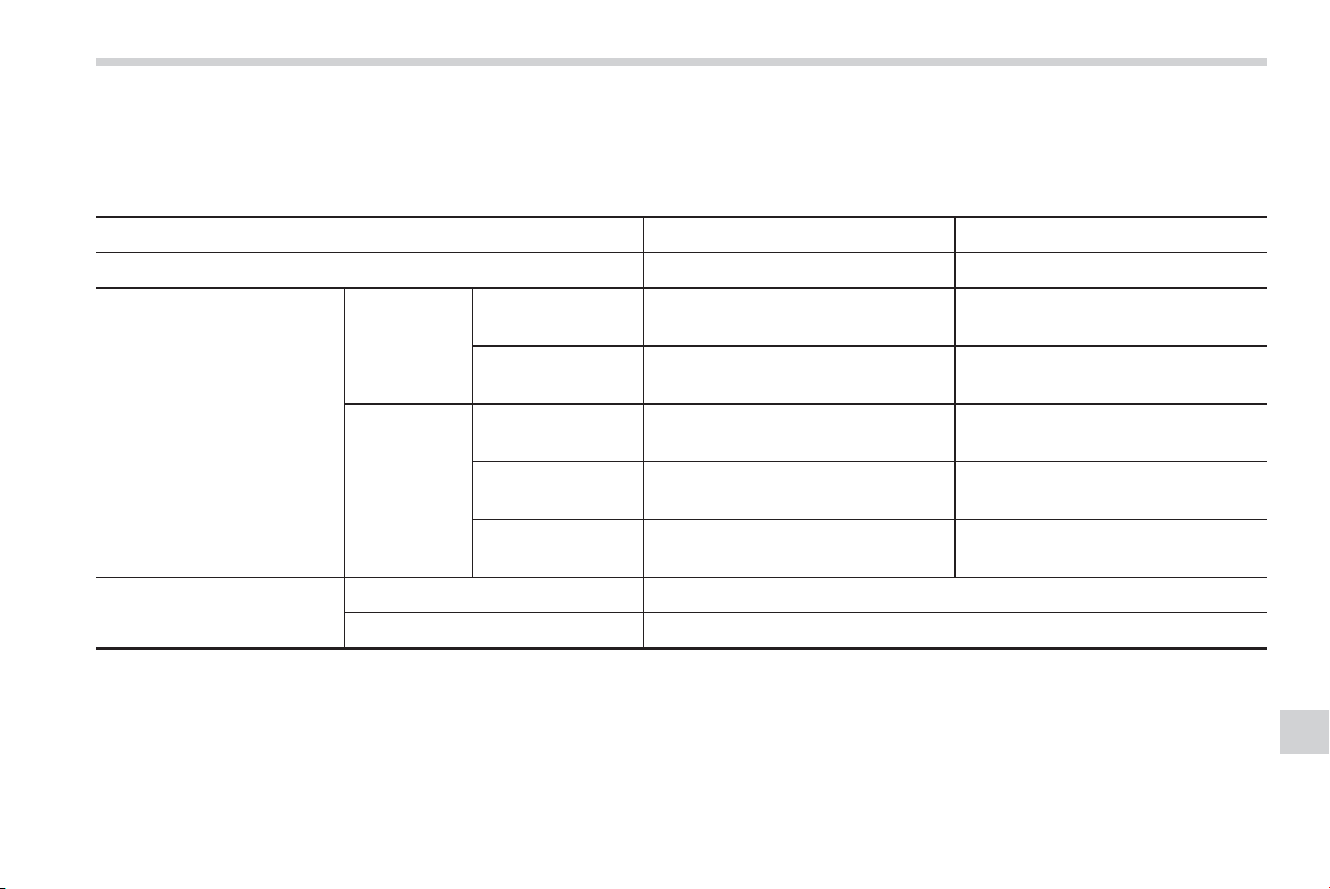
Black plate (359,1)
北米Model "A8130BE-B" EDITED: 2007/ 7/ 25
& Recommended tire inflation pressure
! Recommended cold tire inflation pressure
Recommended cold tire inflation pressure for your vehicle’s tires is as follows,
Tire size
P215/60R16 94H P215/55R17 93H
Wheel size 16 6 6
1
/
2
JJ or 16 6 6
1
/
2
JJ 17 6 7JJ
Pressure Front Light load
29 psi
(200 kPa, 2.0 kgf/cm
2
)
32 psi
(220 kPa, 2.2 kgf/cm
2
)
Full load
29 psi
(200kPa, 2.0 kgf/cm
2
)
32 psi
(220 kPa, 2.2 kgf/cm
2
)
Rear Light load
28 psi
(190 kPa, 1.9 kgf/cm
2
)
30 psi
(210 kPa, 2.1 kgf/cm
2
)
Full load
36 psi
(250 kPa, 2.5 kgf/cm
2
)
32 psi
(220 kPa, 2.2 kgf/cm
2
)
Trailer towing
41 psi
(280 kPa, 2.8 kgf/cm
2
)
36 psi
(250 kPa, 2.5 kgf/cm
2
)
Temporary spare tire
Size T135/80D16 T135/90D16
Pressure
60 psi (420 kPa, 4.2 kgf/cm
2
)
NOTE
For the temporary spare tire, T135/80D16 or T135/90D16 is equipped to the vehicle.
Consumer information and Reporting safety defects 13-5
– CONTINUED –
13
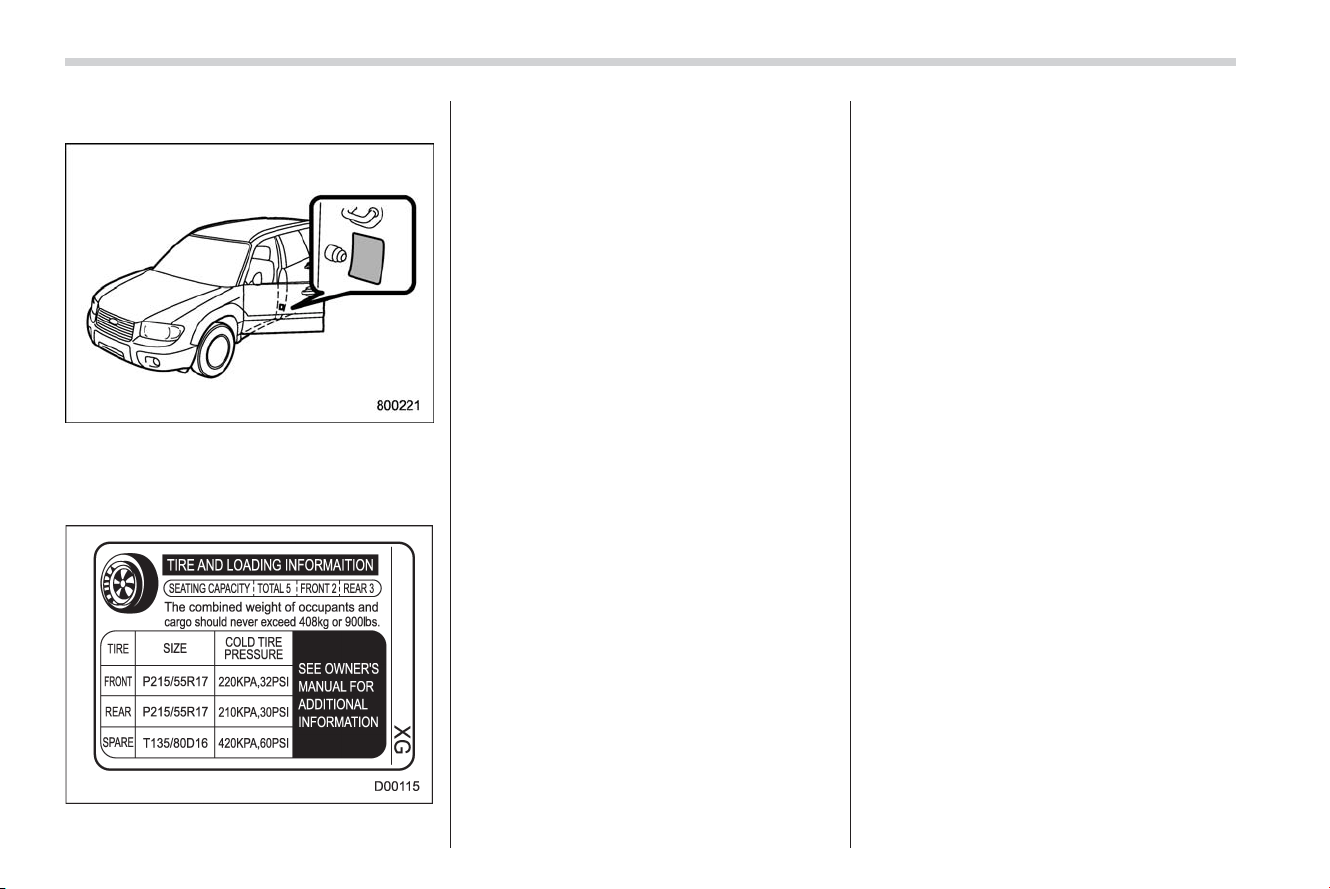
Black plate (360,1)
北米Model "A8130BE-B" EDITED: 2007/ 7/ 25
13-6 Consumer information and Reporting safety defects
! Vehicle placard
The vehicle placard is affixed to the
driver’s side door pillar.
Example:
The vehicle placard shows original
tire size, recommended cold tire
inflation pressure on each tire at
maximum loaded vehicle weight,
seating capacity and loading infor-
mation.
! Adverse safety consequences
of under-inflation
Driving at high speeds with exces-
sively low tire pressures can cause
the tires to flex severely and to
rapidly become hot. A sharp in-
crease in temperature could cause
tread separation, and failure of the
tire(s). Possible resulting loss of
vehicle control could lead to an
accident.
! Measuring and adjusting air
pressure to achieve proper in-
flation
Check and, if necessary, adjust the
pressure of each tire (including the
spare) at least once a month and
before any long journey. Check the
tire pressures when the tires are
cold. Use a pressure gauge to
adjust the tire pressures to the
specific values. Driving even a
short distance warms up the tires
and increases the tire pressures.
Also, the tire pressures are affected
by the outside temperature. It is
best to check tire pressure out-
doors before driving the vehicle.
When a tire becomes warm, the air
inside it expands, causing the tire
pressure to increase. Be careful not
to mistakenly release air from a
warm tire to reduce its pressure.
& Glossary of tire terminology
. Cold tire pressure
The pressure in a tire that has been
driven less than 1 mile or has been
standing for three hours or more.
. Maximum inflation pressure
The maximum cold inflation pres-
sure to which a tire may be inflated.
. Recommended inflation pres-
sure
The cold inflation pressure recom-
mended by a vehicle manufacturer.
. Intended outboard sidewall
(1) The sidewall that contains a

Black plate (361,1)
北米Model "A8130BE-B" EDITED: 2007/ 7/ 25
whitewall, bears white lettering
or bears manufacturer, brand,
and/or model name molding that
is higher or deeper than the
same molding on the other side-
wall of the tire, or
(2) The outward facing sidewall
of an asymmetrical tire that has
a particular side that must al-
ways face outward when mount-
ing on a vehicle.
. Accessory weight
The combined weight (in excess of
those standard items which may be
replaced) of floor mats, leather
seats and cross bars to the extent
that these items are available as
factory-installed equipment
(whether installed or not).
. Curb weight
The weight of a motor vehicle with
standard equipment including the
maximum capacity of fuel, oil, and
coolant and air conditioning.
. Maximum loaded vehicle weight
The sum of curb weight, accessory
weight, vehicle capacity weight and
production options weight.
. Normal occupant weight
150 lbs (68 kg) times the number of
occupants (3 occupants).
. Occupant distribution
Distribution of occupants in a vehi-
cle, 2 in front, 1 in rear seat.
. Production options weight
The combined weight of those
installed regular production options
weighing over 5.1 lbs (2.3 kg) in
excess of those standards items
which they replace, not previously
considered in curb weight or acces-
sory weight.
. Vehicle capacity weight
The total weight of cargo, luggage
and occupants that can be added to
the vehicle.
. Vehicle maximum load on a tire
Load on an individual tire that is
determined by distributing to each
axle its share of the maximum
loaded vehicle weight and dividing
by two.
. Vehicle normal load on a tire
Load on an individual tire that is
determined by distributing to each
axle its share of the curb weight,
accessory weight, and normal oc-
cupant weight and dividing by two.
& Tire care – maintenance and
safety practices
. Check on a daily basis that the
tires are free from serious damage,
nails, and stones. At the same time,
check the tires for abnormal wear.
. Inspect the tire tread regularly
and replace the tires before their
tread wear indicators become visi-
ble. When a tire’s tread wear
indicator becomes visible, the tire
is worn beyond the acceptable limit
and must be replaced immediately.
With a tire in this condition, driving
at even low speeds in wet weather
can cause the vehicle to hydro-
plane. Possible resulting loss of
vehicle control can lead to an
accident.
. To maximize the life of each tire
and ensure that the tires wear
uniformly, it is best to rotate the
Consumer information and Reporting safety defects 13-7
– CONTINUED –
13
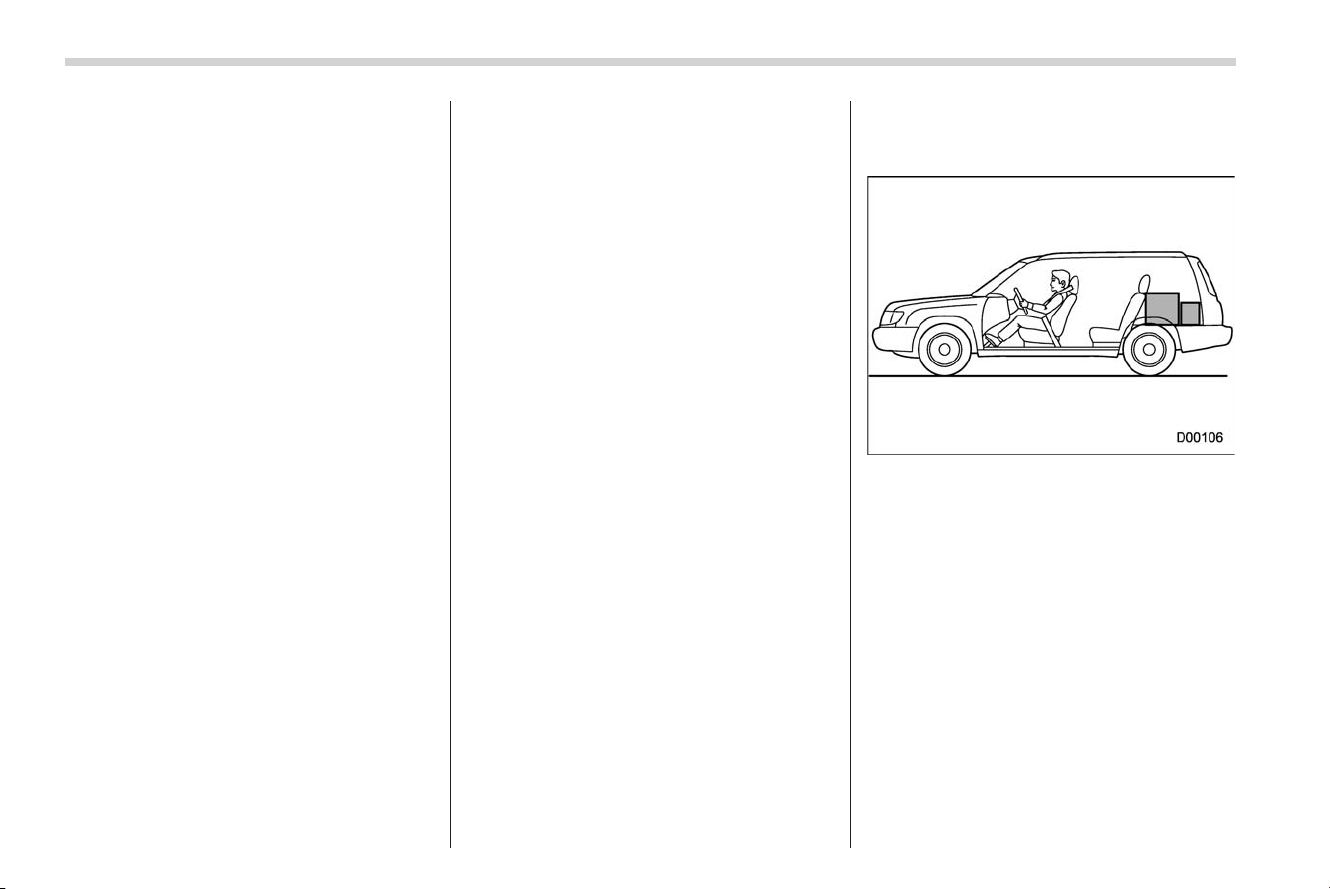
Black plate (362,1)
北米Model "A8130BE-B" EDITED: 2007/ 7/ 25
13-8 Consumer information and Reporting safety defects
tires every 7,500 miles (12,000 km).
Rotating the tires involves switch-
ing the front and rear tires on the
right-hand side of the vehicle and
similarly switching the front and
rear tires on the left-hand side of
the vehicle. (Each tire must be kept
on its original side of the vehicle.)
Replace any damaged or unevenly
worn tire at the time of rotation.
After tire rotation, adjust the tire
pressures and make sure the wheel
nuts are correctly tightened. A
tightening torque specification and
a tightening sequence specification
for the wheel nuts can be found
“
Flat tires” section in chapter 9.
& Vehicle load limit – how to
determine
The load capacity of your vehicle is
determined by weight, not by avail-
able cargo space. The load limit of
your vehicle is shown on the
vehicle placard attached to the
driver ’s side B-pillar. Locate the
statement “The combined weight
of occupants and cargo should
never exceed XXX kg or XXX lbs”
on your vehicle’s placard.
Thevehicleplacardalsoshows
seating capacity of your vehicle.
The total load capacity includes the
total weight of driver and all pas-
sengers and their belongings, any
cargo, any optional equipment such
as a trailer hitch, roof rack or bike
carrier, etc., and the tongue load of
a trailer. Therefore cargo capacity
can be calculated by the following
method.
Cargo capacity = Load limit − (total
weight of occupants + total weight
of optional equipment + tongue
load of a trailer (if applicable))
For towing capacity information and
weight limits, refer to “
Trailer towing”
section in chapter 8.
! Calculating total and load ca-
pacities varying seating con-
figurations
Calculate the available load capa-
city as shown in the following
examples:
Example 1A
Vehicle capacity weight of the
vehicle is 900 lbs (408 kg), which
is indicated on the vehicle placard
with the statement “The combined
weight of occupants and cargo
should never exceed 900 lbs or
408 kg”.
For example, if the vehicle has one
occupant weighing 154 lbs (70 kg)
plus cargo weighing 662 lbs (300
kg).
1. Calculate the total weight.
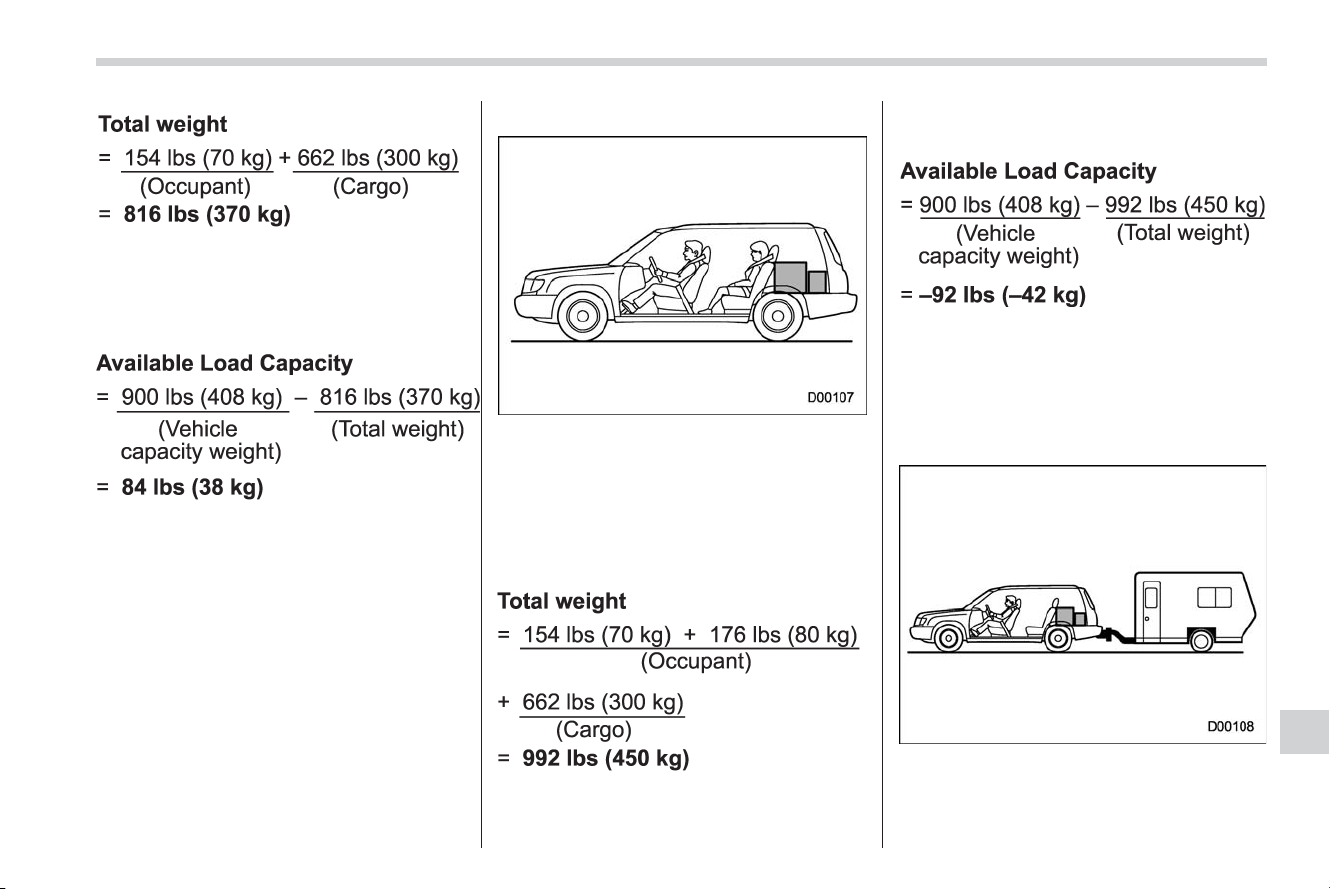
Black plate (363,1)
北米Model "A8130BE-B" EDITED: 2007/ 7/ 25
2. Calculate the available load ca-
pacity by subtracting the total
weight from the vehicle capacity
weight of 900 lbs (408 kg).
3. The result of step 2 shows that a
further 84 lbs (38 kg) of cargo can
be carried.
Example 1B
For example, if a person weighing
176 lbs (80 kg) now enters the
same vehicle (bringing the number
of occupants to two), the calcula-
tions are as follows:
1. Calculate the total weight.
2. Calculate the available load ca-
pacity.
3. The total weight now exceeds
the capacity weight by 92 lbs (42
kg), so the cargo weight must be
reduced by 92 lbs (42 kg) or more.
Example 2A
Vehicle capacity weight of the
vehicle is 900 lbs (408 kg), which
is indicated on the vehicle placard
Consumer information and Reporting safety defects 13-9
– CONTINUED –
13
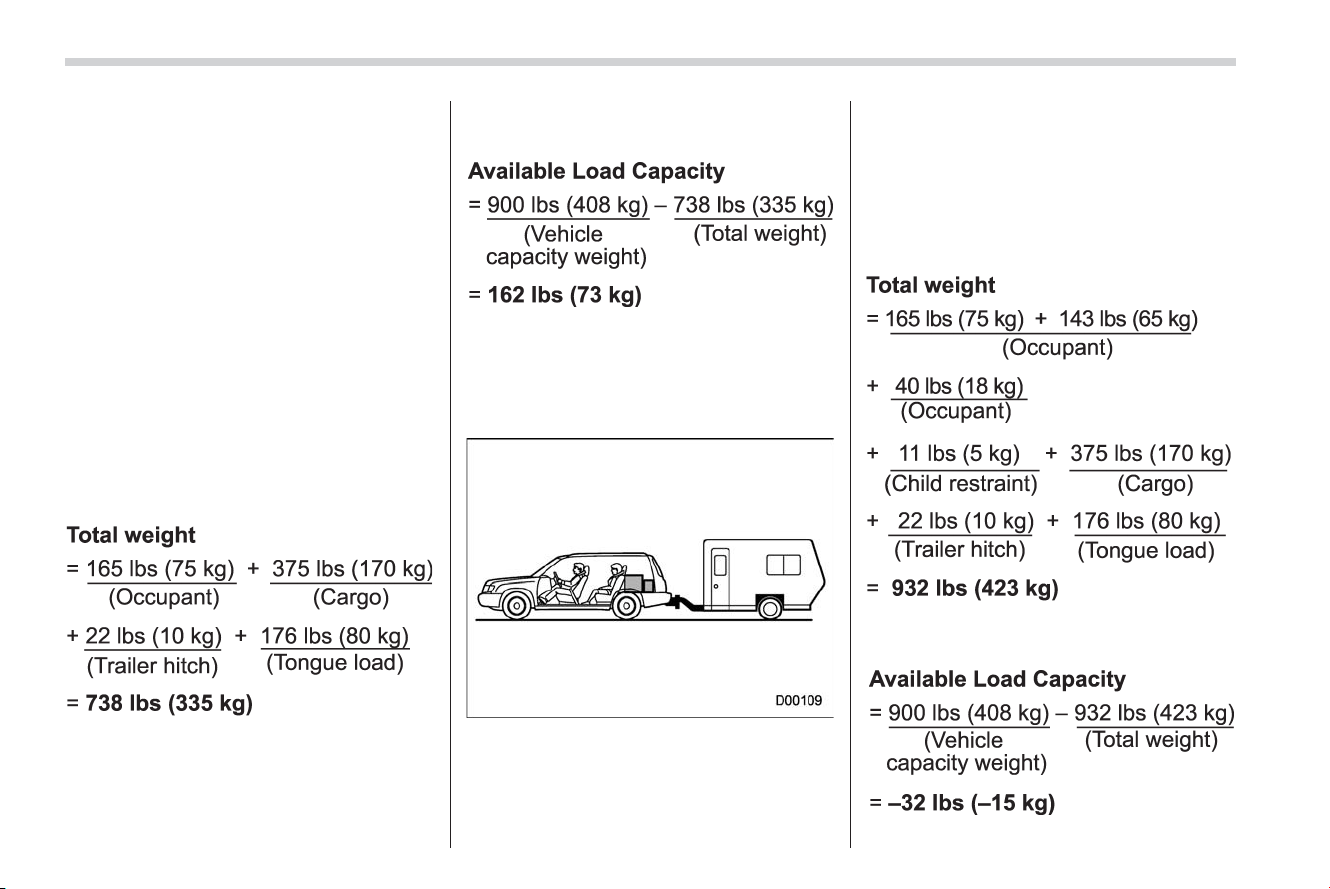
Black plate (364,1)
北米Model "A8130BE-B" EDITED: 2007/ 7/ 25
13-10 Consumer information and Reporting safety defects
with the statement “The combined
weight of occupants and cargo
should never exceed 408 kg or
900 lbs”.
For example, the vehicle has one
occupant weighing 165 lbs (75 kg)
plus cargo weighing 375 lbs (170
kg). In addition, the vehicle is fitted
with a trailer hitch weighing 22 lbs
(10 kg), to which is attached a
trailer weighing 1,764 lbs (800 kg).
10% of the trailer weight is applied
to the trailer tongue (i.e. Tongue
load = 176 lbs (80 kg)).
1. Calculate the total weight.
2. Calculate the available load ca-
pacity.
3. The result of step 2 shows that a
further 162 lbs (73 kg) of cargo can
be carried.
Example 2B
For example, if a person weighing
143 lbs (65 kg) and a child weighing
40 lbs (18 kg) now enter the same
vehicle (bringing the number of
occupants to three), and a child
restraint system weighing 11 lbs (5
kg) is installed in the vehicle for the
child to use, the calculations are as
follows:
1. Calculate the total weight.
2. Calculate the available load ca-
pacity.

Black plate (365,1)
北米Model "A8130BE-B" EDITED: 2007/ 7/ 25
3. The total weight now exceeds
the capacity weight by 32 lbs (15
kg), so the cargo weight must be
reduced by 32 lbs (15 kg) or more.
& Determining compatibility of
tire and vehicle load capaci-
ties
The sum of four tires’ maximum
load ratings must exceed the max-
imum loaded vehicle weight
(“GVWR”). In addition, sum of the
maximum load ratings of two front
tires and of two rear tires must
exceed each axle’s maximum
loaded capacity (“GAWR”). Original
equipment tires are designed to
fulfill those conditions.
The maximum loaded vehicle
weight is referred to Gross Vehicle
Weight Rating (GVWR). And each
axle’s maximum loaded capacity is
referred to Gross Axle Weight Rat-
ing (GAWR). The GVWR and each
axle’s GAWR are shown on the
vehicle certification label affixed to
the driver’s door.
The GVWR and front an d rear
GAWRs are determined by not only
the maximum load rating of tires but
also loaded capacities of the vehi-
cle’s suspension, axles and other
parts of the body.
Therefore, this means that the
vehicle cannot necessarily be
loaded up to the tire’s maximum
load rating on the tire sidewall.
& Adverse safety conse-
quences of overloading on
handling and stopping and
on tires
Overloading could affect vehicle
handling, stopping distance, vehicle
and tire as shown in the following.
This could lead to an accident and
possibly result in severe personal
injury.
. Vehicle stability will deteriorate.
. Heavy and/or high-mounted
loads could increase the risk of
rollover.
. Stopping distance will increase.
. Brakes could overheat and fail.
. Suspension, bearings, axles and
other parts of the body could break
or experience accelerated wear
that will shorten vehicle life.
. Tires could fail.
. Tread separation could occur.
. Tire could separate from its rim.
& Steps for Determining Cor-
rect Load Limit
1. Locate the statement “The com-
bined weight of occupants and
cargo should never exceed XXX
pounds” on your vehicle’s placard.
2. Determine the combined weight
of the driver and passengers that
will be riding in your vehicle.
3. Subtract the combined weight of
the driver and passengers from
XXX kilograms or XXX pounds.
4. The resulting figure equals the
available amount of cargo and
luggage load capacity. For exam-
ple, if the “XXX” amount equals
1,400 lbs (635kg). and there will be
five- 150 lbs (68 kg) passengers in
your vehicle, the amount of avail-
Consumer information and Reporting safety defects 13-11
– CONTINUED –
13

Black plate (366,1)
北米Model "A8130BE-B" EDITED: 2007/ 7/ 25
13-12 Consumer information and Reporting safety defects
able cargo and luggage load capa-
city is 650 lbs. (1,400 − 750 (5 6
150) = 650 lbs.)
5. Determine the combined weight
of luggage and cargo being loaded
on the vehicle. That weight may not
safely exceed the available cargo
and luggage load capacity calcu-
lated in Step 4.
6. If your vehicle will be towing a
trailer, load from your trailer will be
transferred to your vehicle. Consult
this manual to determine how this
reduces the available cargo and
luggage load capacity of your ve-
hicle.
Uniform tire quality grading
standards
This information indicates the rela-
tive performance of passenger car
tires in the area of treadwear,
traction, and temperature resis-
tance. This is to aid the consumer
in making an informed choice in the
purchase of tires.
Quality grades can be found where
applicable on the tire sidewall be-
tween tread shoulder and maxi-
mum section width. For example:
Tread wear 200 Traction AA Tem-
perature A
The quality grades apply to new
pneumatic tires for use on passen-
ger cars. However, they do not
apply to deep tread, winter type
snow tires, space-saver or tempor-
ary use spare tires, tires with
nominal rim diameters of 12 inches
or less, or to some limited produc-
tion tires.
All passenger car tires must con-
form to Federal Safety Require-
ments in addition to these grades.
& Treadwear
The treadwear grade is a compara-
tive rating based on the wear rate of
the tire when tested under con-
trolled conditions on a specified
government test course.
For example, a tire graded 150
would wear one and one-half (1-1/
2) times as well on the government
course as a tire graded 100. The
relative performance of tires de-
pends upon the actual conditions
of their use, however, and may
depart significantly from the norm
due to variations in driving habits,
service practices and differences in
road characteristics and climate.
& Traction AA, A, B, C
The traction grades, from highest to
lowest, are AA, A, B and C. Those
grades represent the tire’s ability to
stop on wet pavement as measured
under controlled conditions on spe-
Black plate (367,1)
北米Model "A8130BE-B" EDITED: 2007/ 7/ 25
cified government test surfaces of
asphalt and concrete. A tire marked
C may have poor traction perfor-
mance.
WARNING
The traction grade assigned to
this tire is based on straight-
ahead braking traction tests,
and does not include accel-
eration, cornering, hydroplan-
ing, or peak traction charac-
teristics.
& Temperature A, B, C
The temperature grades are A (the
highest), B, and C, representing the
tire’s resistance to the generation of
heat and its ability to dissipate heat
when tested under controlled con-
ditions on a specified indoor labora-
tory test wheel. Sustained high
temperature can cause the material
of the tire to degenerate and reduce
tire life, and excessive temperature
can lead to sudden tire failure. The
grade C corresponds to a level of
performance which all passenger
car tires must meet under the
Federal Motor Vehicle Safety Stan-
dards No. 109. Grades B and A
represent higher levels of perfor-
mance on the laboratory test wheel
than the minimum required by law.
WARNING
The temperature grade for this
tire is established for a tire
that is properly inflated and
not overloaded. Excessive
speed, underinflation, or ex-
cessive loading, either sepa-
rately or in combination, can
cause heat buildup and possi-
ble tire failure.
Consumer information and Reporting safety defects 13-13
13

Black plate (368,1)
北米Model "A8130BE-B" EDITED: 2007/ 7/ 25
13-14 Consumer information and Reporting safety defects
Reporting safety defects
(USA)
If you believe that your vehicle has
a d efect which could cause a
crash or could cause injury or
death, you should immediately in-
form the National Highway Traffic
Safety Administration (NHTSA) in
addition to notifying Subaru of
America, Inc.
If NHTSA receives similar com-
plaints, it may open an investiga-
tion, and if it finds that a safety
defect exists in a group of vehi-
cles, it may order a recall and
remedy campaign. However,
NHTSA cannot become involved
in individual problems between
you, your deal er, or Subaru of
America, Inc. To contact NHTSA,
you may call the Vehicle Safety
Hotline toll-free at 1-888-327-4236
(TTY: 1-800-424-9153); go to
http://www.safercar.gov; or write
to: Administrator, NHTSA, 400
Seventh Street, SW., Washington,
DC 20590. You can also obtain
other information about motor ve-
hicle safety from
http://www.safercar.gov.

Black plate (27,1)
北米Model "A8130BE-B" EDITED: 2007/ 7/ 25
Index
14

Black plate (2,1)
北米Model "A8130BE-B" EDITED: 2007/ 7/ 25
14-2 Index
A
ABS (Anti-lock Brake System) ..................................... 7-17
Warning light ................................................. 3-13, 7-17
Accessories....................................................... 5-2, 11-45
Accessory power outlet................................................. 6-8
Active head restraint ..................................................... 1-6
Air cleaner element ................................................... 11-15
Air conditioner ............................................................. 4-7
Air filtration system..................................................... 4-12
Air flow selection.......................................................... 4-2
Alarm system ............................................................ 2-13
All-Wheel Drive warning light ....................................... 3-16
Aluminum wheel cleaning............................................ 10-3
Aluminum wheels...................................................... 11-37
Antenna system........................................................... 5-2
Anti-lock Brake System (ABS) ..................................... 7-17
Arming the system ..................................................... 2-13
Armrest..................................................................... 1-10
Ashtray..................................................................... 6-11
AT OIL TEMPerature warning light ............................... 3-13
Audio set .................................................................... 5-3
Auto-dimming mirror/compass...................................... 3-29
Automatic climate control system ................................... 4-8
Automatic transmission ............................................... 7-11
Capacities............................................................. 12-4
Fluid.................................................................... 11-20
Selector lever ........................................................ 7-12
Shift lock release ................................................... 7-14
Temperature warning light (AT OIL TEMP)................. 3-13
Automatic/Emergency Locking Retractor (A/ELR) ........... 1-11
B
Battery .................................................................... 11-42
Jump starting .......................................................... 9-8
Replacement (Remote keyless entry system) .............. 2-7
Booster seat .............................................................. 1-29
Brake
Booster ....................................................... 7-16, 11-27
Fluid ................................................................... 11-25
Pad and lining...................................................... 11-29
Parking ....................................................... 7-26, 11-30
Pedal .................................................................. 11-27
System.................................................................. 7-16
Brake pedal
Free play............................................................. 11-27
Reserve distance.................................................. 11-28
Brake system............................................................. 7-16
Warning light.......................................................... 3-15
Braking ..................................................................... 7-16
Tips ...................................................................... 7-16
Breaking-in of new brake pads and linings................... 11-29
Bulb
Chart .................................................................... 12-9
Replacing ............................................................ 11-46
C
Capacities ................................................................. 12-4
Cargo area
Bars...................................................................... 6-14
Cover.................................................................... 6-13
Light ...................................................................... 6-2
Tie-down hooks...................................................... 6-14

Black plate (3,1)
北米Model "A8130BE-B" EDITED: 2007/ 7/ 25
Catalytic converter ....................................................... 8-3
Center
Console .................................................................. 6-4
Ventilators ............................................................... 4-3
Center and side ventilators............................................ 4-3
Changing
Flat tire ................................................................... 9-4
Oil and oil filter ...................................................... 11-9
Charge warning light .................................................. 3-12
CHECK ENGINE warning light/Malfunction
indicator lamp......................................................... 3-12
Checking
Brake pedal free play ............................................ 11-27
Brake pedal reserve distance ................................. 11-28
Clutch function...................................................... 11-28
Clutch pedal free play............................................ 11-28
Engine oil level ...................................................... 11-8
Fluid level ............................... 11-20, 11-24, 11-25, 11-26
Gear oil level........................................................ 11-22
Child restraint systems ............................................... 1-24
Installation with A/ELR seatbelt................................ 1-26
Lower and tether anchorages .................................. 1-31
Child safety .................................................................... 5
Locks ................................................................... 2-17
Chime
Key ........................................................................ 3-5
Seatbelt ........................................................ 1-12, 3-10
Cigarette lighter ......................................................... 6-10
Cleaning
Aluminum wheels................................................... 10-3
Interior.................................................................. 10-5
Ventilation grille...................................................... 4-11
Climate control system
Automatic ............................................................... 4-8
Manual................................................................... 4-3
Clock ........................................................................ 3-19
Clutch
Fluid ................................................................... 11-26
Pedal .................................................................. 11-28
Coat hook.................................................................. 6-12
Convenience net ......................................................... 6-6
Coolant ................................................................... 11-12
Cooling system ........................................................ 11-12
Corrosion protection............................................ 8-10, 10-4
Cruise control ............................................................ 7-28
Set indicator light.................................................... 3-19
Cruise control indicator light......................................... 3-19
Cup holder ................................................................. 6-7
Front passenger’s.................................................... 6-7
Rear passenger’s .................................................... 6-8
D
Dashboard storage compartment................................... 6-6
Daytime running light system ....................................... 3-21
Differential gear oil
Front................................................................... 11-21
Rear
................................................................... 11-22
Dimensions................................................................ 12-2
Disarming the system ................................................. 2-15
Disc brake pad wear warning indicators ........................ 7-16
Dome light.................................................................. 6-2
Door
Index 14-3

Black plate (4,1)
北米Model "A8130BE-B" EDITED: 2007/ 7/ 25
14-4 Index
Locks ..................................................................... 2-4
Open warning light ................................................. 3-16
Drive belts................................................................ 11-18
Driving
All-Wheel Drive vehicle ........................................... 3-16
Car phone/cell phone .................................................. 7
Drinking ..................................................................... 6
Drugs ........................................................................ 6
Foreign countries ..................................................... 8-4
Pets .......................................................................... 7
Snowy and icy roads ................................................ 8-9
Tips ................................................................ 7-10, 8-5
Tired or sleepy............................................................ 7
E
Electrical system........................................................ 12-3
Electronic Brake Force Distribution
(EBD) system ................................................. 3-15, 7-18
Emergency Locking Retractor (ELR)............................. 1-11
Engine
Compartment overview ........................................... 11-6
Coolant................................................................ 11-12
Exhaust gas (Carbon monoxide) ............................ 5, 8-2
Hood .................................................................... 11-4
Oil ........................................................................ 11-8
Overheating .......................................................... 9-11
Starting................................................................... 7-7
Stopping ................................................................. 7-9
Exterior care.............................................................. 10-2
F
Flat tires..................................................................... 9-4
Floor mat................................................................... 6-12
Fluid level
Automatic transmission ......................................... 11-20
Brake.................................................................. 11-25
Clutch ................................................................. 11-26
Power steering ..................................................... 11-24
Front
Differential gear oil................................................ 11-21
Fog light button ...................................................... 3-24
Seatbelt pretensioners ............................................ 1-20
Seats ..................................................................... 1-2
Front lip spoiler ...................................................... 8-25
Front seats
Fore and aft adjustment ..................................... 1-3, 1-4
Reclining .......................................................... 1-3, 1-5
Fuel ........................................................................... 7-2
Economy hints ........................................................ 8-2
Filler lid and cap...................................................... 7-3
Gauge .................................................................... 3-7
Requirements ......................................................... 7-2
Fuses ..................................................................... 11-43
Fuses and circuits ...................................................... 12-6
G
GAWR (Gross Axle Weight Rating)............................... 8-12
Glove box................................................................... 6-4
GVWR (Gross Vehicle Weight Rating)........................... 8-12

Black plate (5,1)
北米Model "A8130BE-B" EDITED: 2007/ 7/ 25
H
Hazard warning flasher ........................................... 3-6, 9-2
Head restraint adjustment ............................................. 1-6
Rear....................................................................... 1-8
Headlight
Beam leveler ......................................................... 3-23
Flasher ................................................................. 3-21
Headlights........................................................ 3-20, 11-48
Heater operation .......................................................... 4-5
High beam indicator light ............................................ 3-17
High mount stop light................................................. 11-51
High/low beam change (dimmer).................................. 3-21
Hill holder (MT vehicles) .................................... 7-27, 11-29
Horn......................................................................... 3-32
Hose and connections ............................................... 11-12
I
Ignition switch.............................................................. 3-3
Light....................................................................... 3-5
Illuminated entry .......................................................... 2-8
Illumination brightness control...................................... 3-23
Immobilizer.................................................................. 2-3
Indicator light........................................................... 2-4
Indicator light
Cruise control ........................................................ 3-19
Cruise control set................................................... 3-19
High beam ............................................................ 3-17
Shift position (AT vehicles) ...................................... 3-17
Traction Control system OFF................................... 3-14
Turn signal ............................................................ 3-17
Vehicle Dynamics Control OFF ................................ 3-14
Vehicle Dynamics Control operation.......................... 3-16
Indicator lights
Vehicle Dynamics Control ........................................ 7-22
Inside mirror .............................................................. 3-29
Interior light................................................................. 6-2
J
Jack and jack handle .................................................. 9-15
Jump starting .............................................................. 9-8
K
Key
Interlock release...................................................... 3-5
Keyless entry system ............................................... 2-7
Number .................................................................. 2-2
Reminder chime ...................................................... 3-5
Replacement........................................................... 2-4
Keys .......................................................................... 2-2
L
Leather seat materials................................................. 10-5
Light
Cargo area ............................................................. 6-2
Control switch ........................................................ 3-20
Dome..................................................................... 6-2
Map....................................................................... 6-3
Limited slip differential (LSD)........................................ 7-15
Loading your vehicle................................................... 8-11
Low fuel warning light .......................................... 3-8, 3-16
Low tire pressure warning light..................................... 3-17
Lower and tether anchorage ........................................ 1-31
Index 14-5

Black plate (6,1)
北米Model "A8130BE-B" EDITED: 2007/ 7/ 25
14-6 Index
LSD (Limited slip differential) ....................................... 7-15
Lumbar support ........................................................... 1-5
M
Main fuse................................................................. 11-44
Maintenance
Precautions ........................................................... 11-3
Schedule .............................................................. 11-3
Seatbelt ................................................................ 1-19
Tools .................................................................... 9-15
Malfunction indicator lamp........................................... 3-12
Manual
Climate control system ............................................. 4-3
Seat ....................................................................... 1-3
Transmission ........................................................... 7-9
Transmission oil.................................................... 11-19
Map light..................................................................... 6-3
Maximum load limits................................................... 8-18
Meters and gauges ...................................................... 3-6
Mirrors...................................................................... 3-29
Moonroof .................................................................. 2-21
N
New vehicle break-in driving.......................................... 8-2
O
Odometer/Tripmeter ..................................................... 3-6
Off road driving............................................................ 8-6
Oil filter..................................................................... 11-9
Oil level
Engine.................................................................. 11-8
Front differential gear ............................................ 11-21
Manual transmission ............................................. 11-19
Rear differential.................................................... 11-22
Oil pressure warning light ............................................ 3-12
Outside mirrors .......................................................... 3-30
Outside temperature indicator ....................................... 3-9
Overhead console ....................................................... 6-6
Overheating engine .................................................... 9-11
P
Parking
Brake.................................................................... 7-26
Brake stroke ........................................................ 11-30
Light switch ........................................................... 3-23
Tips ...................................................................... 7-26
Parking your vehicle ................................................... 7-25
Pcket ......................................................................... 6-7
Periodic inspections ..................................................... 8-4
Power
Door locking switch.................................................. 2-6
Seat....................................................................... 1-4
Steering ................................................................ 7-15
Steering fluid........................................................ 11-24
Windows ............................................................... 2-18
Precautions against vehicle modification................ 1-23, 1-58
Preparing to drive ........................................................ 7-7
R
Rear
Combination lights ................................................ 11-50
Gate
............................................................. 2-20, 9-14
Seats ..................................................................... 1-7

Black plate (7,1)
北米Model "A8130BE-B" EDITED: 2007/ 7/ 25
Viscous limited slip differential ................................. 7-15
Rear differential
Gear oil ............................................................... 11-22
Rear seat
Folding down........................................................... 1-9
Rear window
Defogger button ..................................................... 3-28
Wiper and washer switch ........................................ 3-26
Wiper blades ........................................................ 11-40
Recommended
Automatic transmission fluid ................................... 11-21
Brake fluid............................................................ 11-26
Clutch fluid........................................................... 11-27
OIL grade and
viscosity...................... 11-10, 11-11, 11-20, 11-22, 11-23
Power steering fluid............................................... 11-25
Spark plugs.......................................................... 11-18
Remote keyless entry system ........................................ 2-7
Replacement
Brake pad and lining ............................................. 11-29
Wiper blades ........................................................ 11-39
Replacing
Air cleaner element ............................................... 11-15
Battery (remote keyless entry system) ........................ 2-7
Lost transmitters (keyless entry system)...................... 2-9
Replacing bulbs ........................................................ 11-46
Dome light ........................................................... 11-51
Headlight ............................................................. 11-48
High mount stop light............................................. 11-51
License plate light ................................................. 11-50
Map light.............................................................. 11-51
Rear combination light .......................................... 11-50
Rocking the vehicle .................................................... 8-11
Roof rail and crossbar................................................. 8-13
S
Safety
Precautions when driving............................................. 4
Symbol...................................................................... 2
Warnings ................................................................... 2
Seat
Fabric ................................................................... 10-5
Heater.................................................................... 1-7
Seat height adjustment................................................. 1-4
Seatbelt......................................................................... 4
Extender ............................................................... 1-19
Maintenance .......................................................... 1-19
Pretensioners......................................................... 1-20
Safety tips ............................................................. 1-10
Warning light and chime .................................. 1-12, 3-10
Seatbelts ................................................................... 1-10
Security ID plate.......................................................... 2-3
Selector lever............................................................. 7-12
Self-leveling rear suspension ....................................... 7-31
Shift lock release........................................................ 7-14
Shift position indicator light .......................................... 3-17
Shock sensors
........................................................... 2-17
Shopping bag hook..................................................... 6-14
Snow tires ................................................................. 8-10
Snowy and icy roads ................................................... 8-9
Sounding a panic alarm ............................................... 2-8
Spark plugs ............................................................. 11-17
Index 14-7

Black plate (8,1)
北米Model "A8130BE-B" EDITED: 2007/ 7/ 25
14-8 Index
Specifications ............................................................ 12-2
Speedometer............................................................... 3-6
SRS
Frontal airbag ........................................................ 1-39
Side airbag ........................................................... 1-51
SRS airbag (Supplemental Restraint System airbag) ... 4, 1-35
SRS airbag system
Monitors................................................................ 1-56
Servicing............................................................... 1-57
Warning light ......................................................... 3-10
Starting the engine....................................................... 7-7
State emission testing (U.S. only) .................................. 7-6
Steering wheel
Power................................................................... 7-15
Tilt ....................................................................... 3-32
Stopping the engine ..................................................... 7-9
Storage compartment ................................................... 6-4
Sun shade ................................................................ 2-22
Sun visors................................................................... 6-3
Supplemental Restraint System airbag (SRS) ................ 1-35
Synthetic leather upholstery ........................................ 10-5
T
Tachometer ................................................................. 3-7
Temperature gauge ...................................................... 3-8
Temperature warning light (AT OIL TEMP)..................... 3-13
Temporary spare tire .................................................... 9-2
Tie-down hooks ......................................................... 9-12
Tilt steering wheel ...................................................... 3-32
Tire
Chains.................................................................. 8-10
Inspection............................................................ 11-32
Pressures and wear.............................................. 11-33
Replacement........................................................ 11-36
Rotation .............................................................. 11-35
Types.................................................................. 11-30
Tire pressure monitoring system (TPMS) ....... 7-24, 9-7, 11-31
Tires ......................................................................... 12-5
Tires and wheels ...................................................... 11-30
Top tether anchorages ................................................ 1-33
Towing ...................................................................... 9-11
All wheels on the ground ......................................... 9-13
Flat-bed truck......................................................... 9-13
Tie-down hooks...................................................... 9-12
Weight .................................................................. 8-18
Trailer
Connecting ............................................................ 8-16
Hitch..................................................................... 8-16
Hitches.................................................................. 8-21
Towing .................................................................. 8-18
Towing tips ............................................................ 8-23
Turn signal
Indicator lights........................................................ 3-17
Lever .................................................................... 3-22
U
Under-floor storage compartment.................................. 6-15
V
Valet mode ................................................................ 2-15
Vanity mirror ............................................................... 6-3
Vehicle

Black plate (9,1)
北米Model "A8130BE-B" EDITED: 2007/ 7/ 25
Capacity weight ..................................................... 8-12
Identification ........................................................ 12-10
Symbols .................................................................... 3
Vehicle Dynamics Control
OFF indicator light.................................................. 3-14
OFF switch ........................................................... 7-23
Operation indicator light .......................................... 3-16
System ................................................................. 7-20
Warning light ................................................. 3-14, 7-22
Ventilator .................................................................... 4-2
W
Warning and indicator lights .......................................... 3-9
Warning light
ABS ..................................................................... 3-13
All-Wheel Drive...................................................... 3-16
Anti-lock Brake System........................................... 3-13
AT OIL TEMPerature .............................................. 3-13
Brake system ........................................................ 3-15
Charge ................................................................. 3-12
CHECK ENGINE ................................................... 3-12
Door open............................................................. 3-16
Low fuel.......................................................... 3-8, 3-16
Low tire pressure ................................................... 3-17
Oil pressure .......................................................... 3-12
Seatbelt ................................................................ 3-10
SRS airbag system ................................................ 3-10
Vehicle Dynamics Control ....................................... 3-14
Warranties ..................................................................... 1
Warranties and maintenance ....................................... 8-18
Washing ................................................................... 10-2
Waxing and polishing .................................................. 10-3
Wear indicators ........................................................ 11-35
Wheel
Alignment .............................................................. 12-5
Aluminum ............................................................ 11-37
Balance............................................................... 11-34
Replacement........................................................ 11-36
Windows ................................................................... 2-18
Windshield
Washer fluid......................................................... 11-37
Wiper and washer switches ..................................... 3-25
Wiper blades........................................................ 11-39
Wiper deicer .......................................................... 3-27
Winter driving.............................................................. 8-7
Wiper and washer ...................................................... 3-24
Index 14-9

Black plate (2,1)
Model "ALL_MODEL_MEMO" EDITED: 2006/ 1/ 17
Left Page
————————————————————————————————————————
————————————————————————————————————————
————————————————————————————————————————
————————————————————————————————————————
————————————————————————————————————————
————————————————————————————————————————
————————————————————————————————————————
————————————————————————————————————————
————————————————————————————————————————
————————————————————————————————————————
————————————————————————————————————————
————————————————————————————————————————
————————————————————————————————————————

Black plate (1,1)
北米Model "A8130BE-B" EDITED: 2007/ 7/ 25
10
9
8
7
6
5
4
3
11
12
13
000134

Black plate (2,1)
Model "ALL_MODEL_MEMO" EDITED: 2006/ 1/ 17
Left Page
————————————————————————————————————————
————————————————————————————————————————
————————————————————————————————————————
————————————————————————————————————————
————————————————————————————————————————
————————————————————————————————————————
————————————————————————————————————————
————————————————————————————————————————
————————————————————————————————————————
————————————————————————————————————————
————————————————————————————————————————
————————————————————————————————————————
————————————————————————————————————————
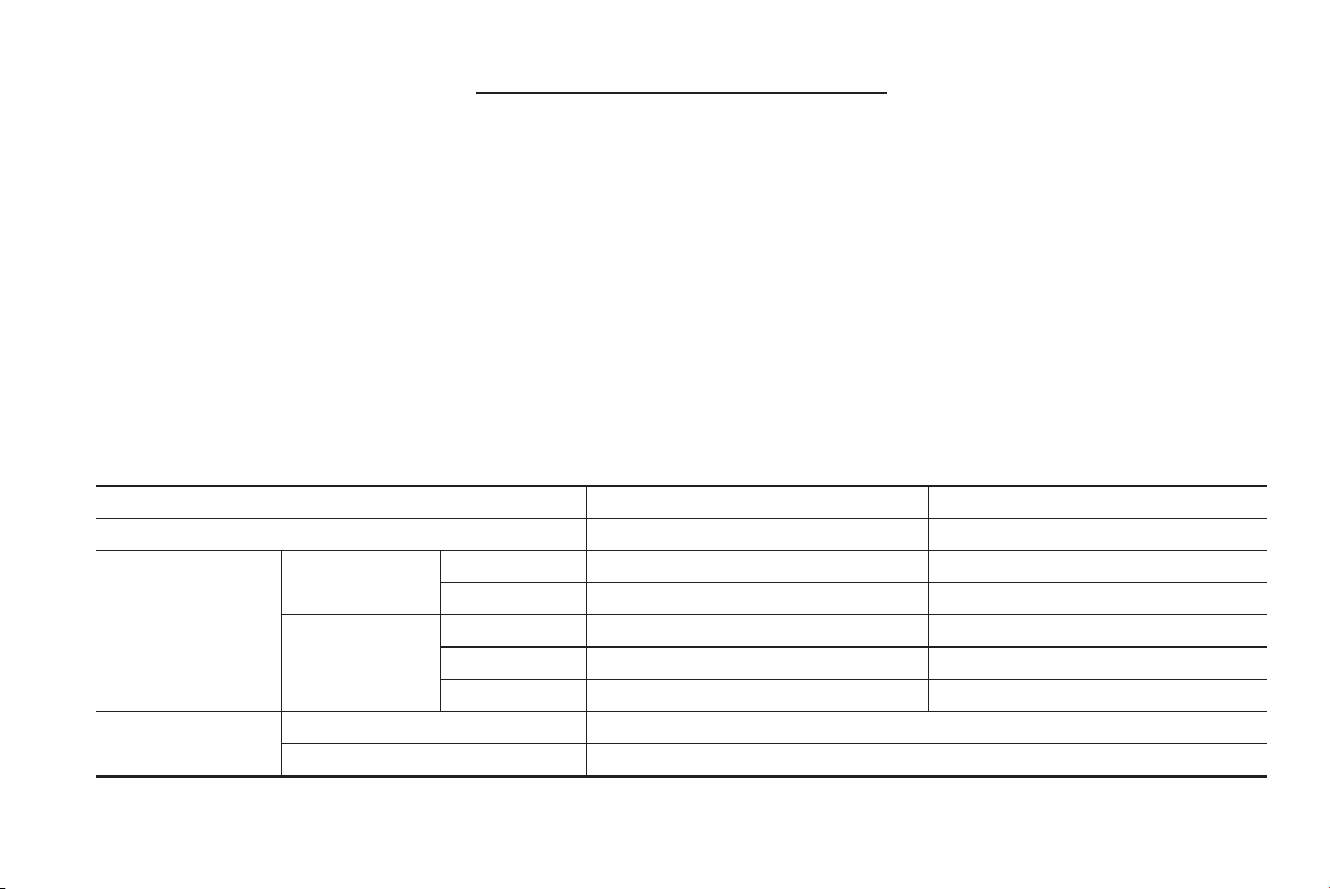
Black plate (2,1)
北米Model "A8130BE-B" EDITED: 2007/ 7/ 25
GAS STATION REFERENCE
&
Fuel
! Non-turbo models
Use only unleaded gasoline with an octane rating of 87 AKI or
higher.
! Turbo models
Use premium unleaded gasoline with an octane rating of 91 AKI
or higher. If premium unleaded gasoline is not available, regular
unleaded gasoline with octane rating of 87 AKI or higher may
be temporarily used. For optimum engine performance and
driveability, it is required that you use premium grade unleaded
gasoline.
& Fuel octane rating
This octane rating is the average of the Research Octane and
Motor numbers and is commonly referred to as the Anti Knock
Index (AKI). Refer to “Fuel” section in this manual.
& Fuel capacity
15.9 US gal (60 liters, 13.2 Imp gal)
& Engine oil
Use only API classification SM with the words “ENERGY
CONSERVING” and the ILSAC certification mark (starburst
mark) displayed on the container (ILSAC GF-4).
& Engine oil capacity
4.2 US qt (4.0 liters, 3.5 Imp qt)
& Cold tire pressure
Tire size P215/60R16 94H P215/55R17 93H
Wheel size 1666
1
/
2
JJ or 1666
1
/
2
J1767JJ
Pressure Front Light load
29 psi (200 kPa, 2.0 kgf/cm
2
) 32 psi (220 kPa, 2.2 kgf/cm
2
)
Full load
29 psi (200 kPa, 2.0 kgf/cm
2
) 32 psi (220 kPa, 2.2 kgf/cm
2
)
Rear Light load
28 psi (190 kPa, 1.9 kgf/cm
2
) 30 psi (210 kPa, 2.1 kgf/cm
2
)
Full load
36 psi (250 kPa, 2.5 kgf/cm
2
) 32 psi (220 kPa, 2.2 kgf/cm
2
)
Trailer towing
41 psi (280 kPa, 2.8 kgf/cm
2
) 36 psi (250 kPa, 2.5 kgf/cm
2
)
Temporary spare tire
Size T135/80D16 T135/90D16
Pressure
60 psi (420 kPa, 4.2 kgf/cm
2
)
NOTE
. For the Canada specification non-turbo models, there is a conventional tire installed under the floor of the cargo area.
. For the temporary spare tire, T135/80D16 or T135/90D16 is equipped to the vehicle.

Black plate (2,1)
Model "ALL_MODEL_MEMO" EDITED: 2006/ 1/ 17
Left Page
————————————————————————————————————————
————————————————————————————————————————
————————————————————————————————————————
————————————————————————————————————————
————————————————————————————————————————
————————————————————————————————————————
————————————————————————————————————————
————————————————————————————————————————
————————————————————————————————————————
————————————————————————————————————————
————————————————————————————————————————
————————————————————————————————————————
————————————————————————————————————————