Version 1.3
12V Pure Sine Wave Inverter Manual
BATTERY
POWER INVERTERS
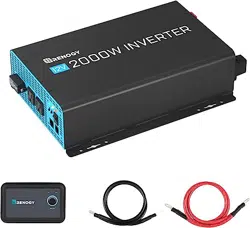
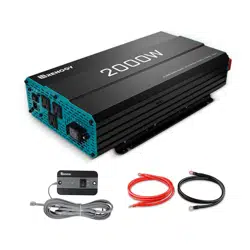
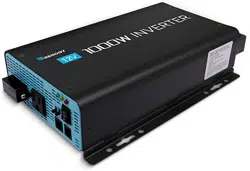
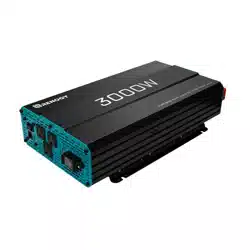
700w 1000w 2000w 3000w
01
Important Safety Instructions
Please save these instructions.
This manual contains important safety, installation, and operating instructions for the
inverter. The following symbols are used throughout the manual:
Inverter Safety
The inverters are suitable for 12V Battery Banks ONLY.
ALWAYS make sure inverter is in OFF position and disconnect all AC and DC
connecting when working on any circuit associated with the inverter.
NEVER connect the AC output of the unit directly to an Electrical Breaker Panel/ Load
Centre which is also fed from the utility power / generator.
When connecting battery terminals, ensure the polarity of the battery connections is
correct. Incorrect polarity may cause permanent damage to the unit.
Be careful when touching bare terminals of capacitors as they may retain high lethal
voltages even after power is removed.
Installation and wiring must comply with the Local and National Electric Codes (NEC)
and must be done by a certified technician.
Read all of the instructions and cautions in the manual before beginning the installation.
There are no serviceable parts for this inverter. Do NOT disassemble or attempt to repair
the inverter.
Make sure all connections going into and from the inverter are tight. There may be
sparks when making connections, therefore, make sure there are not flammable
materials or gases near installation.
Indicates a potentially dangerous condition. Use extreme caution
when performing this task.
Indicates a critical procedure for safe and proper operation of the
inverter.
Indicates a procedure or function that is important to the safe and
proper operation of the inverter.
NOTE
CAUTION
WARNING
General Safety Information

02
Do NOT let the positive (+) and negative (-) terminals of the battery touch each other.
Use only sealed lead-acid, flooded, or gel batteries which must be deep cycle.
Explosive battery gases may be present while charging. Be certain there is enough
ventilation to release the gases.
Be careful when working with large lead acid batteries. Wear eye protection and have
fresh water available in case there is contact with the battery acid.
Over-charging and excessive gas precipitation may damage the battery plates and
activate material shedding on them. Too high of an equalizing charge or too long of one
may cause damage. Please carefully review the specific requirements of the battery
used in the system.
Battery Safety
The unit should be installed in a well-ventilated, cool, and dry environment. Make
sure the fans of the unit and the ventilation holes are not blocked.
Do not expose the unit to rain, moisture, snow, or liquids of any type.
Installation Safety

03
General Information
Included Components
04
05
Table of Contents
Identification of Parts (AC Side)
Identification of Parts (DC Side)
Installation
Location Recommendations
Sizing a Battery Bank
Grounding
DC Side Connection
06
08
09
09
10
11
11
AC Side Operation
13
Inverter Troubleshooting
External Fusing
Specifications
Dimensions
1000W
700W
14
15
16
18
18
18
2000W 18
3000W 18
General Information
Pure Sine Wave
Key Features
04
The Renogy Pure Sine Wave Power Inverter delivers superior performance for remote
off-grid applications, capable of producing cleaner, smoother, and more reliable electricity
for a user’s electronic needs.
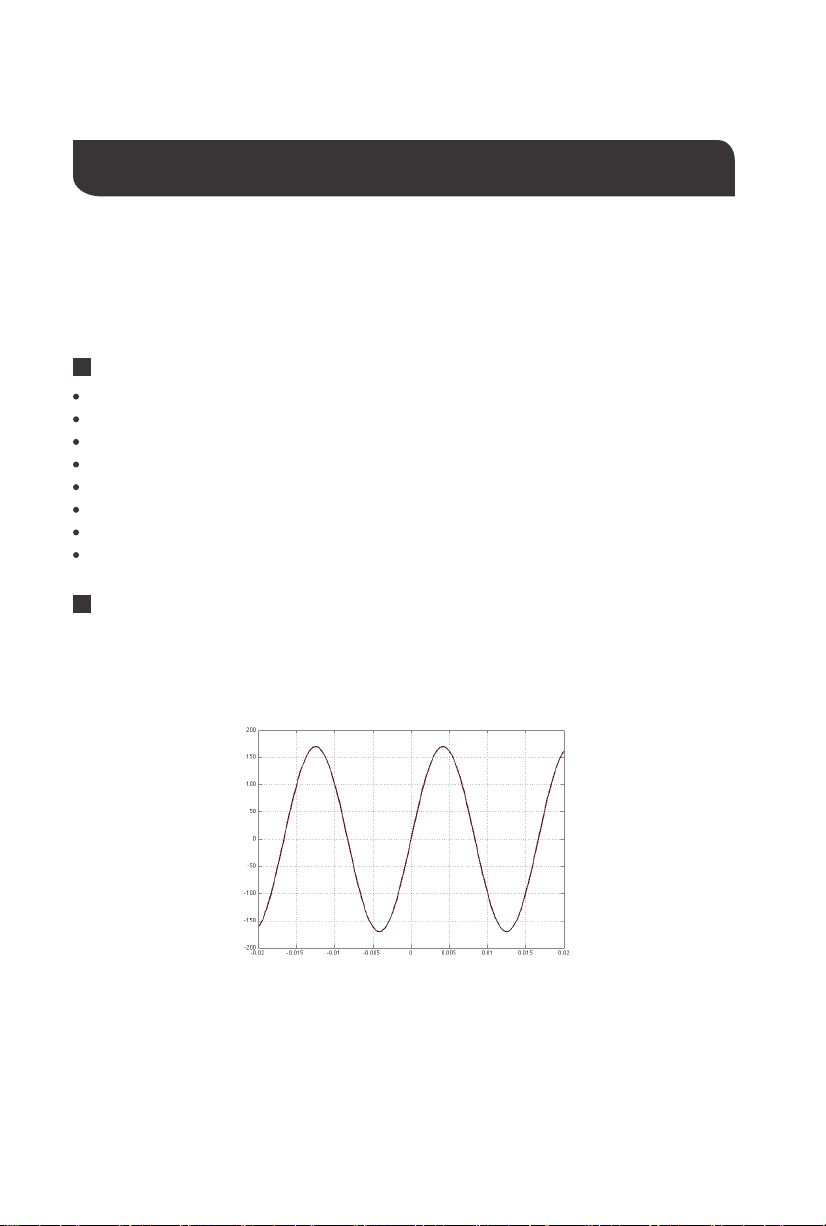
The Renogy Power Inverters output a pure sine wave similar to the waveform of the grid
power. In a pure sine wave, the voltage rises and falls in a smooth fashion with very low
harmonic distortion and cleaner utility-like power.
Robust and sleek design
Optimized for 12 VDC system voltage
Clean power for safe operation of sensitive electronics
Easy-to-read LED indicator display
Multiple protection features (LVD, HVD, AC Overload and Over Temperature)
Excellent Surge Rating : 2x the Power Rating
Ground-fault circuit interrupter(GFCI) protection
Build-in 5V/2.1A USB port
Time(Seconds)
Amplitude(Volts)
Pure(Sine Wavefom)
This gives users stable enough power to operate tools, fans, lights, computers, and other
electronics without any interference. Pure sine wave inverters are in many cases more
efficient, allowing users to use less energy and allow for more device capability. The main
advantage to pure sine wave inverters is that they are used to operate sensitive electronic
devices that require a high quality waveform with little harmonic distortion. Almost any
electronic device could be powered using a pure sine wave inverter.
05
Included Components
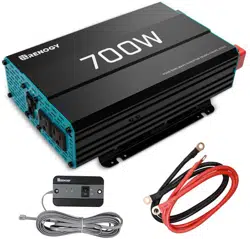
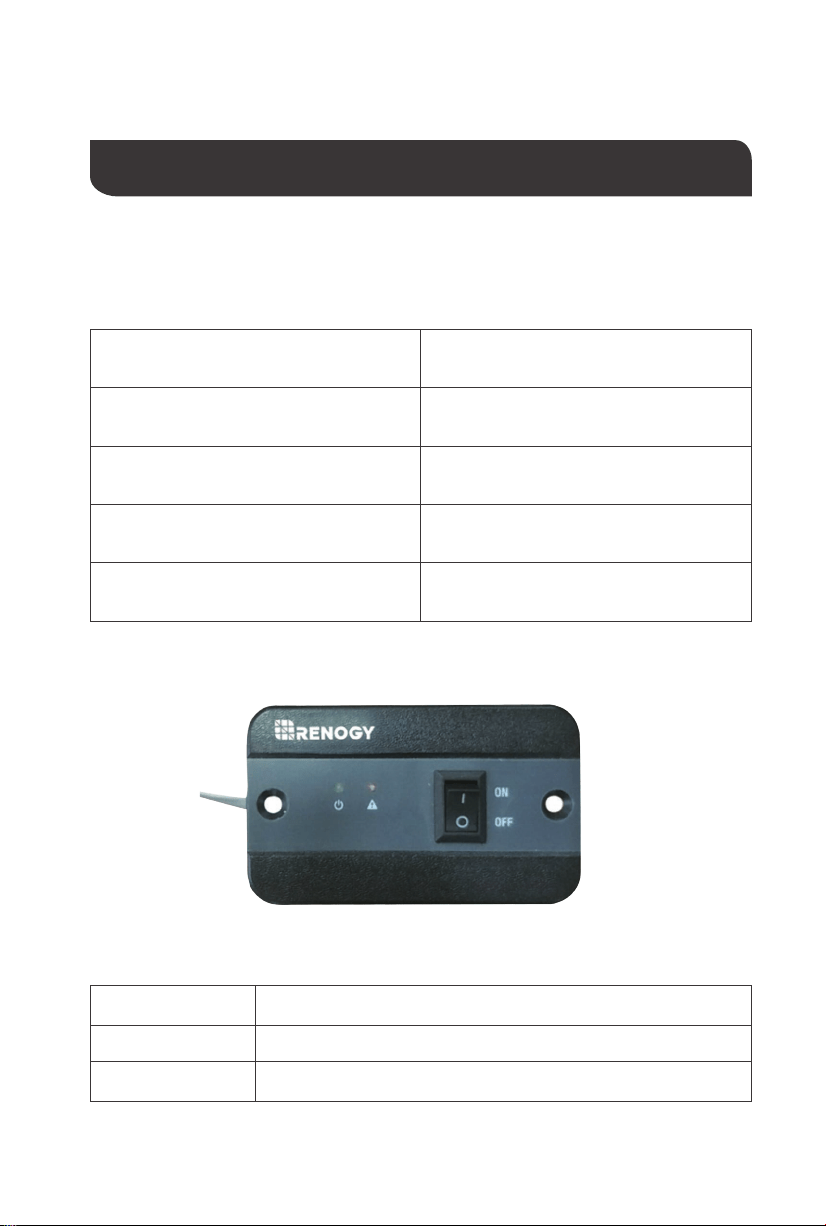
The Renogy Pure Sine Wave Battery Inverters will be shipped with inverter cables and a
remotecontrol for powering the inverter on or off.
Wired remote control
Inverter Model Gauge
700W
1000W
2000W
3000W
6 AWG 3ft
4 AWG 3ft
4 AWG*2 3ft
Does not include
List dimensions
Thickness
Wire length
2.875 x 2.3125 x 0.9375in, 73 x 58.7 x 23.8mm
0625in , 1.5mm
Approx 19.8ft
06
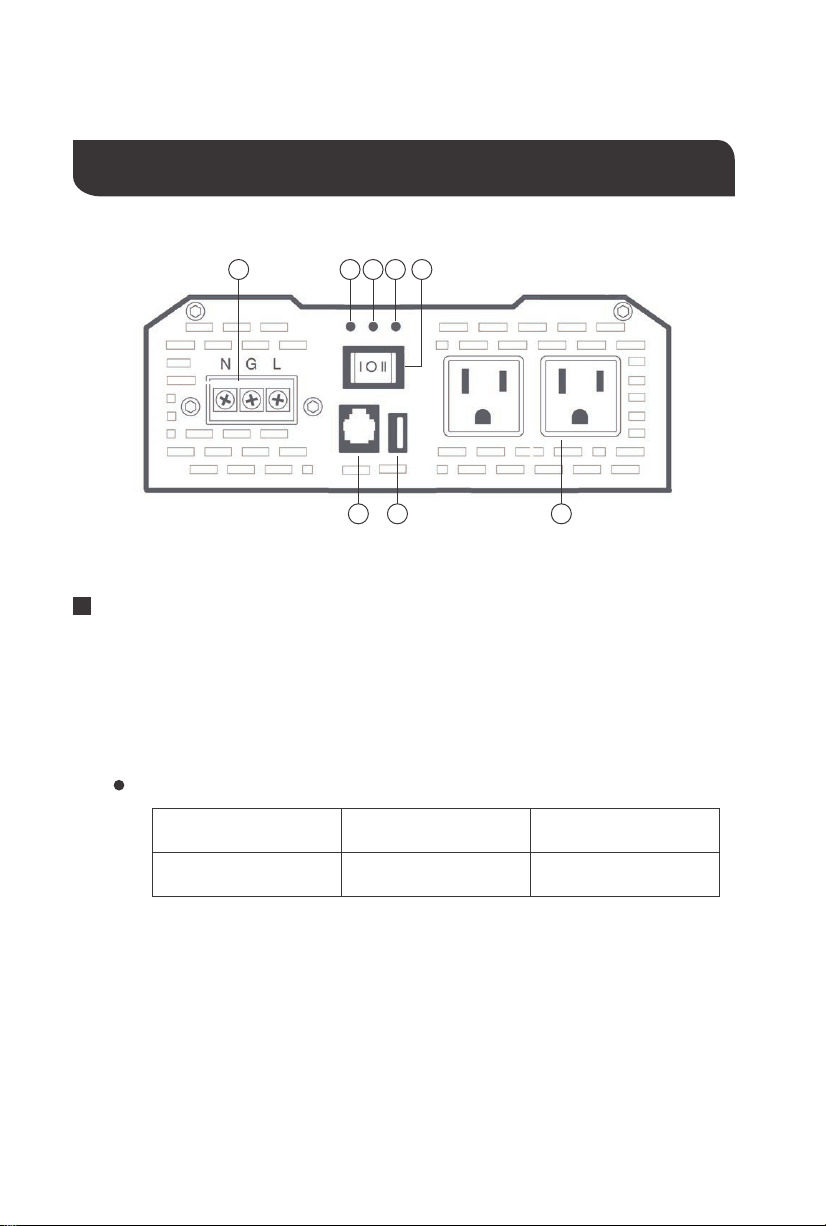
Identification of Parts (AC Side)
Key Parts
1.
High Output AC Terminals
— These terminals are for connecting 115V AC devices
that require more than 15 amps to operate or for connection to distributed wiring that
has multiple AC outlets. Remove the two screws on protective cover to access the
terminals. Any AC output wiring that is directly connected must comply with US National
Electric Code (NEC) wiring gauge recommendations.
NEUTRAL and GROUND are bonded inside the inverter to comply with theNational
Electric Code (NEC) requirement that any AC source must have a neutral to ground
connection.
Figure 2: 1000W Inverter
1 2 3 4 5
678
LEFT
Neutral (N) Ground(G)
Middle Right
Live(L)
2. Power LED (Green)
— When this green LED is lit, the inverter is operating.
3. GFCI LED (Yellow)
— When the yellow LED is lit, the ground fault circuit has been interrupted.
Shut down the inverter and restart.
Facing the front panel, the terminals are:

07
Alarm
—If there is a buzzing sound, the battery is low. The user should reduce the
AC load, charge the battery, and check the DC cable for excessive losses.
Fault LED (Red)
— The red indicator turns on as the inverter shuts down due to overheating,
overload, under voltage, or over voltage.
Immediately turn off all AC appliances if the Fault LED is lit. Allow the inverter to cool
before continuing. Make sure that the ventilation vents are not blocked.
If an inverter shutdown was preceded by a buzzing sound, there may be an excessive
load in combination with low voltage or a cable problem.
ON/OFF Switch
— Controls AC output.
AC Outlets
—
USB Power Port
— 5 volts / 2.1A for charging tablets, smartphones, and other small
Remote Switch Connection
— Insert wired remote switch to the connection port. Set
electronic devices.
NOTE
4.
5.
6.
7.
8.
115V AC 60Hz, up to 15amps for 2000W and 3000W models, up to 6.1
amps for 700W,up to 8.7 amps for 1000W.
ON/OFF switch to "remote" position.
08
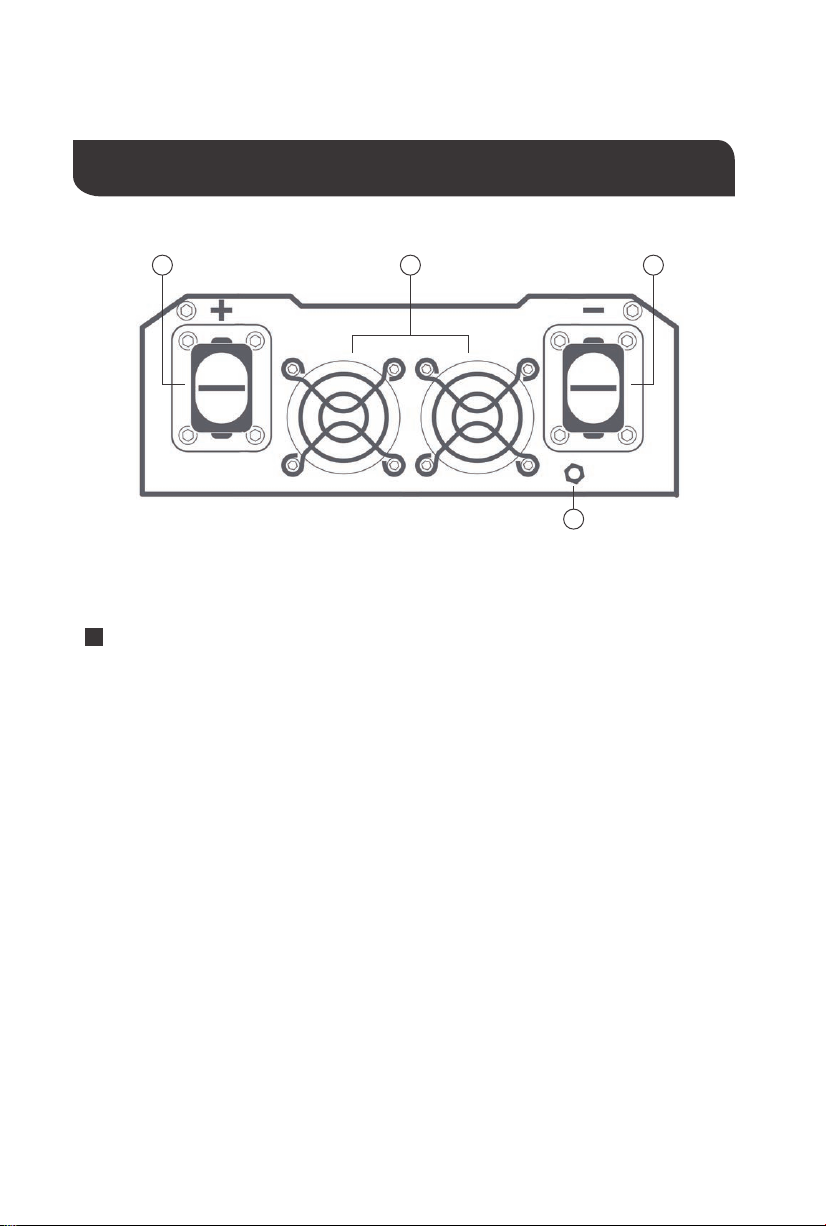
KEY PARTS
1.Positive Terminal
— Positive (+) DC Input (Red)
2.Cooling Fans
— Thermally controlled
3.Negative Terminal
— Negative (−) DC Input (Black)
4.Ground Terminal
— For insulated safety ground wire.
Figure 3: 1000W Inverter
Identification of Parts (DC Side)
2 3
4
1
09
Never install the inverter in a sealed enclosure with flooded batteries. Gas can
accumulate and there is a risk of explosion.
The inverter should never be mounted vertically on a vertical surface since
it would present a hazard for the fan opening which is crucial for cooling
the inverter.
Cool, dry, well-ventilated area —
Heat is the worst enemy for electronic equipment.
Inverters must be in an area where the fans are not blocked or where they are not hit
directly by the sun. They should be in an area free of any kind of moisture and allow for
clearance of at least 10” around the unit to provide for adequate ventilation.
Protection against fire hazard —
the unit should be away from any flammable
material, liquids, or any other combustible material. The unit can spark and the
consequences could be severe.
Close proximity to battery bank—
prevent excessive voltage drop by keeping the unit
close to the battery bank and having a properly sized wire going from the battery bank
to the inverter.
Limiting electromagnetic interference (EMI)
— ensure the inverter is firmly grounded
to a building, vehicle, or earth grounded. Keep the inverter away from EMI receptors
such as TVs, radios, and other audio/visual electronics to prevent damage/interference
to the equipment.
Secure inverter
—the inverter could be stand alone or mounted using the outlying
terminals on the inverter.
Installation
Location Recommendations
Ensure installation follows the following guidelines:
CAUTION
CAUTION
WARNING
WARNING
WARNING
WARNING
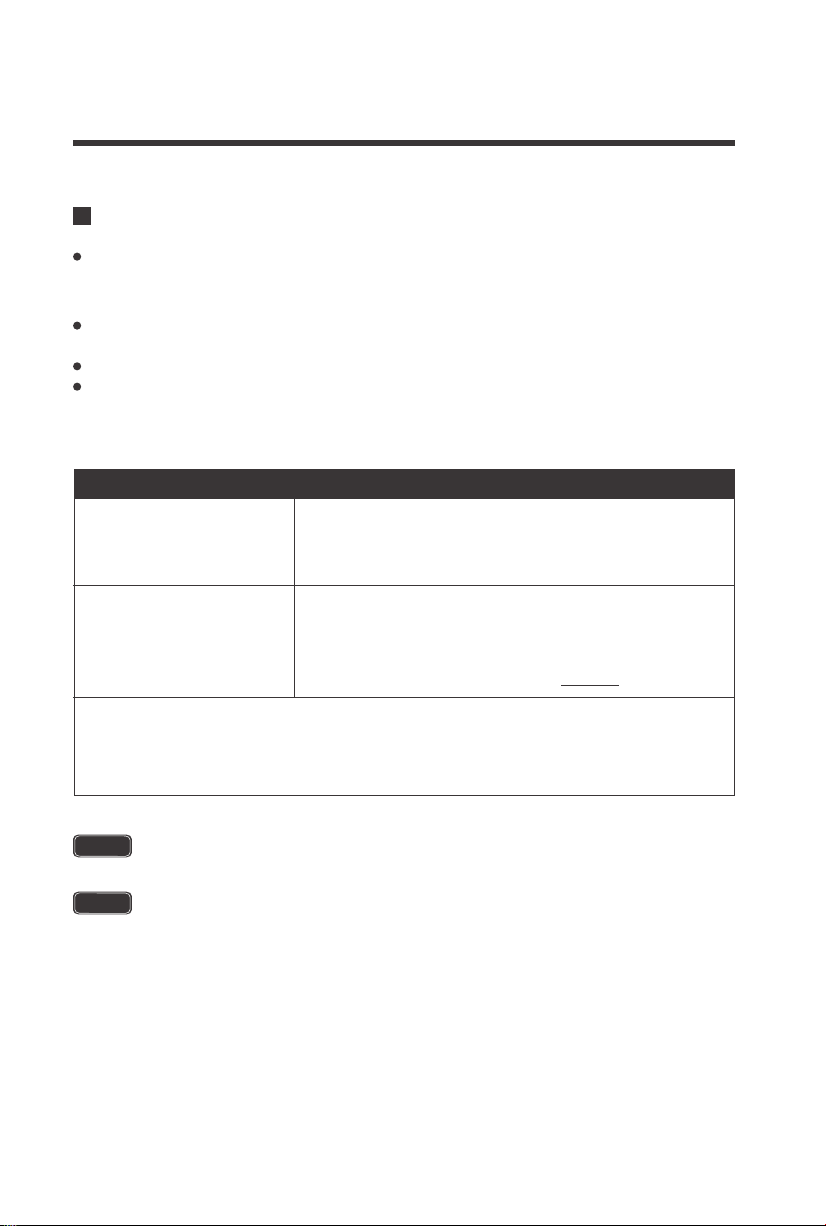
Make sure inverter is in the off position before connecting anything.
Do not over-torque or over tighten the terminals. This could
potentially damage the unit.
Refer to the technical specifications for max wire sizes on the
controller and for the maximum amperage going through wires.
1.
2.
3.
4.
5.
6.
Do not install the inverter in the same compartment as the battery bank
because it could serve as a potential fire hazard.
10
Example
A Microwave oven
= 700 Watts
12V battery bank
700 Watts to run microwave oven using the batteries as
if it was a 12VDC microwave requires 58 Amps
700 Watts / 12 Volts = 58 Amps
Now that amps have been determined, the amp-hours
need to be determined. The microwave will be used for
approximately 3 hours a day.
58 Amps * 3 hours =
174 Ah
At least a 174 Ah battery must be selected in order to use the 700-Watt microwave at 3
hours a day. However, determining a battery size is also dependent on the battery that
is able to handle repeated discharge/charge cycles.
Load Operation = 3 hours
Determine the amount of Watts (Amps * Volts) for the load, and how long the load
needs to operate—
each electrical appliance has technical specificationsindicating the
watts, or the volts and amps required for operation.
Estimate load run-time—
Battery size depends on load watts and run-time. Most loads
are not constant, so estimation is very important.
Utilize the formula Watts = Volts * Amps
Determine Amps used for how many hours – Amp-hour (Ah)
Sizing a Battery Bank
For this Renogy inverter, the battery bank will be 12 volts direct current (12 VDC)
This is just an example. Actual quantities vary by battery capacity and rates
of discharge.
NOTE
To power the microwave in the example, the user must use an inverter that is
at least 1000 watts, if not more.
NOTE

11
Grounding
DC Side Connection
The Renogy Pure Sine Wave inverters come equipped with a grounding lug to appropriately
ground to earth or to another designated ground (for example, a metal frame of an RV). The
connections to ground must be tight and against bare metal. Whether using the inverter in a
mobile application, such as an RV, or in a building, grounding is highly recommended. The
recommended wire size for grounding is 10 AWG insulated copper strand wire. For more
information regarding grounding, users and/or installers must consult with the Local and
National Electric Codes (NEC) for more specific grounding regulations and suggestions as
they can change per scenario.
The Renogy Pure Sine Wave Inverters are suitable for 12V battery bank
systems ONLY. Not following the minimum DC requirement will cause
irreversible damage to the unit.
WARNING
CAUTION
Be careful of the positive and negative poles. Reversing the poles might
cause permanent damage to the inverter. It will surely blow the internal fuse.
NOTE
Damage to the Renogy inverters due to reverse polarity is NOT covered by
warranty.
NOTE
The input terminals of the inverters have large capacitors connected to them.
Once a positive and negative wire are connected to the terminals, it will
complete the circuit, and commence drawing a heavy current momentarily. As
a result, there may be a sparking occurring even if the inverter is in the off
position. To minimize sparking, it is recommended that the user have the
appropriate size wire feeding into the inverters and/or install an external fuse
leading into the inverter.
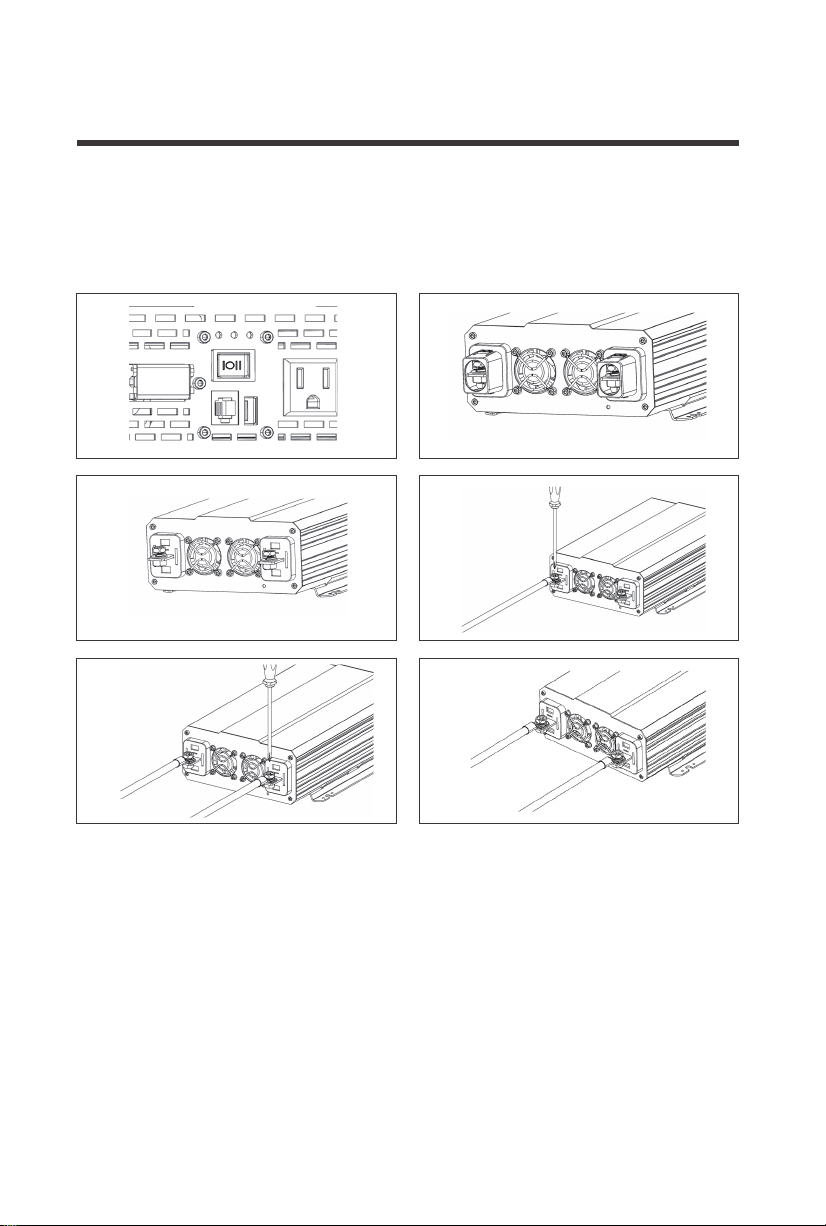
12
1.Flip inverter power to OFF position (on
AC side)
2.Remove Cap, then unscrew inverter
terminals and connect battery connections.
Then tighten.
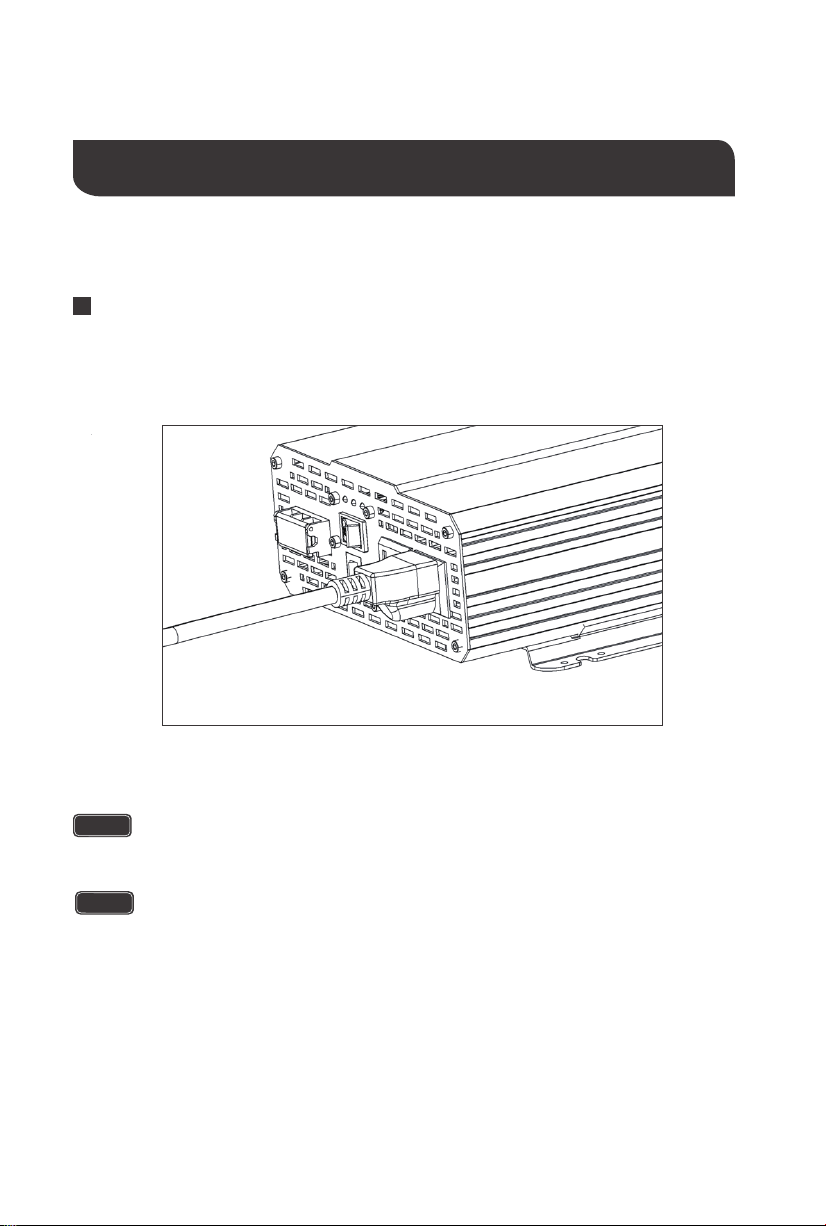
13
Operation
AC Side Operation
1.Connect electronic devices to electrical socket(s) on inverter. Flip inverter power to ON
position (on AC side)
2. When finished, switch AC devices off FIRST, then turn off inverter switch
Assuming proper battery connection, the inverter is now ready for use.
CAUTION
Avoid switching on the inverter with the load (electronic devices) already
switched on. This may trigger an overload since some electronic devices
have an initial high power surge to start.
CAUTION
When switching off the inverter, turn off the electronic devices first. Although
the inverter is off, the capacitors will still have a charge, so the DC and AC
terminals must be disconnected if altering the circuitry.
14
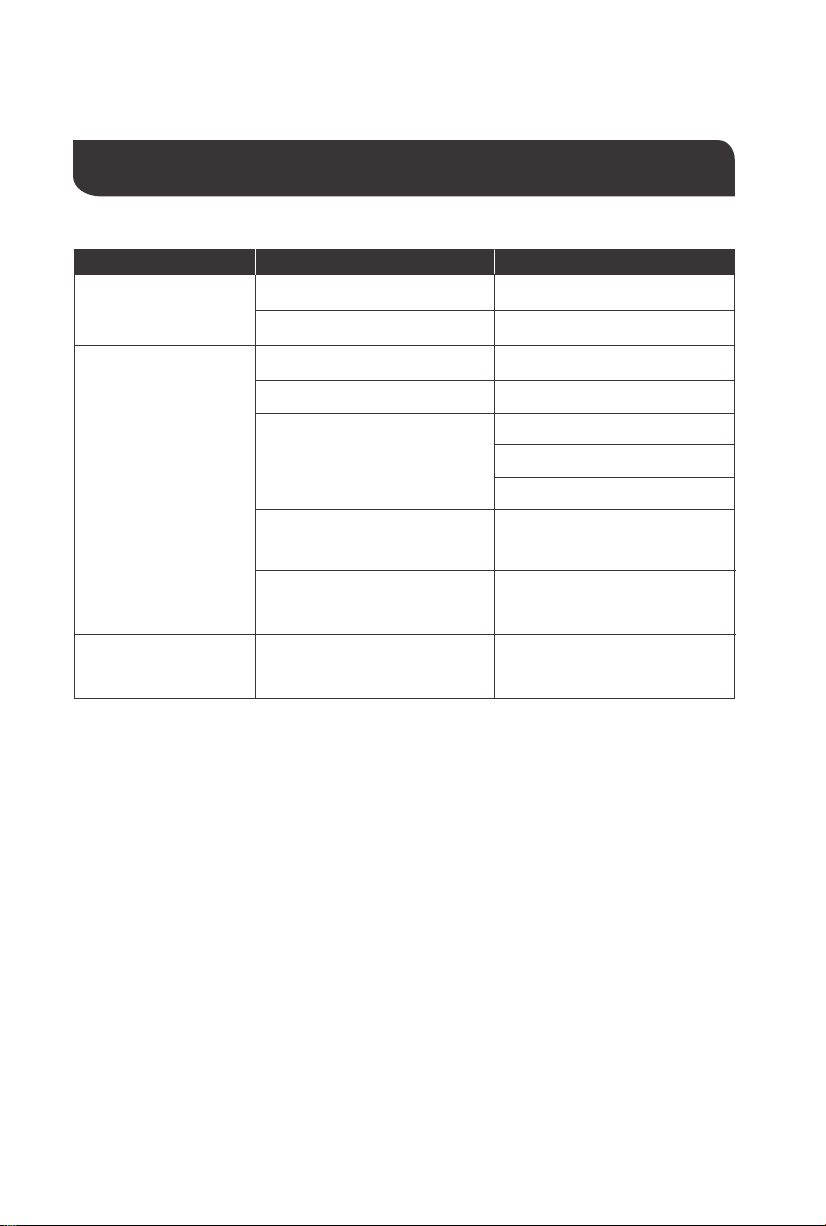
Input voltage is below 10.5V
Input voltage is above 16.0V
Input voltage is below 10V
Input voltage is above 16.5V
GFCI tripped
Use a higher wattage inverter or
use a lower powered device
Disconnect the inverter and turn
off the ON/OFF switch to reset
Disconnect appliances and turn
off the ON/OFF switch to reset
Inverter overheats
Operating equipment draws too
much power
Yellow LED Lit -
Inverter shut down
Fault LED Lit, inverter
shut down and alarm on
Alarm beeps
Inverter is short circuited
Keep input voltage below 16.0V
Keep input voltage above 10V
Keep input voltage below 16.5V
Allow inverter to cool down
Check for adequate ventilation
Reduce the load on inverter
Keep input voltage above 10.5V
Indicator TroubleshootPotential Issue
Inverter Troubleshooting
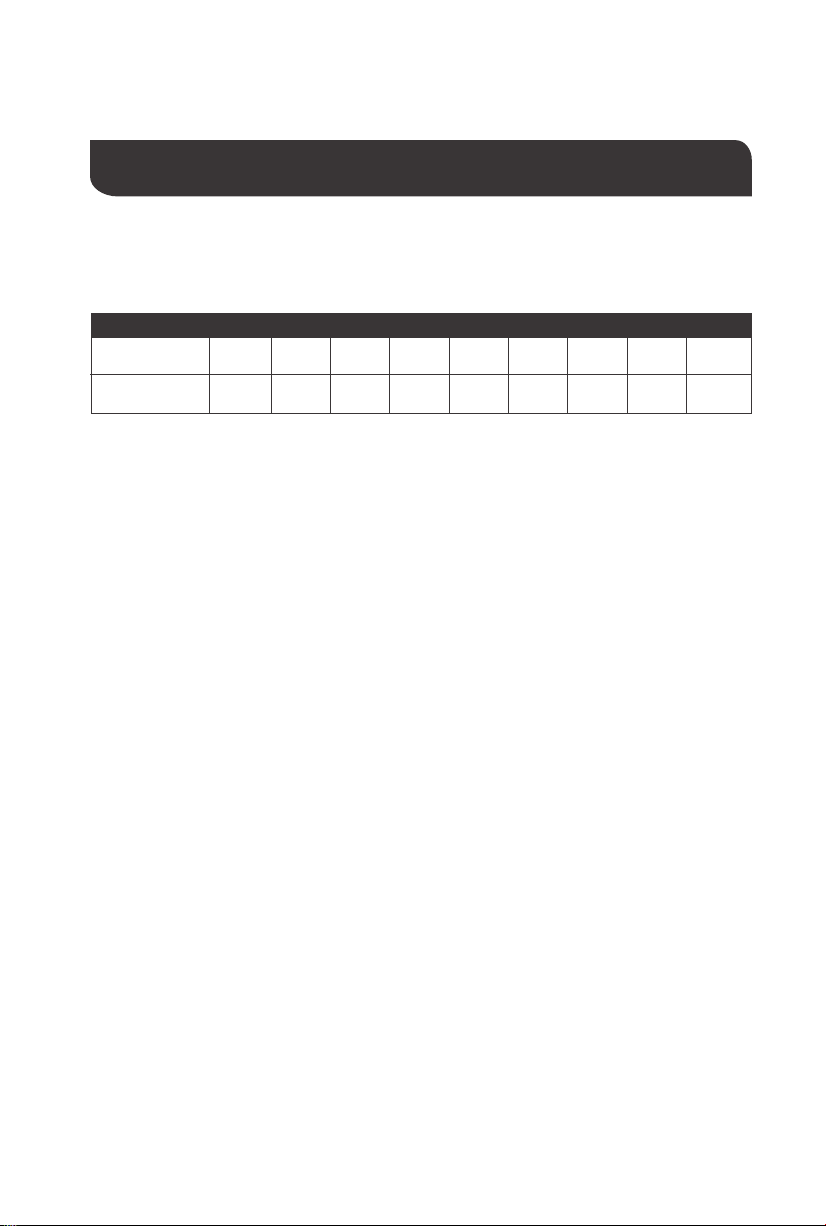
15
External Fusing
Fusing is a recommended in PV systems to provide a safety measure for connections going
from panel to controller and controller to battery. Remember to always use the
recommended wire gauge size based on the PV system and the controller.
16
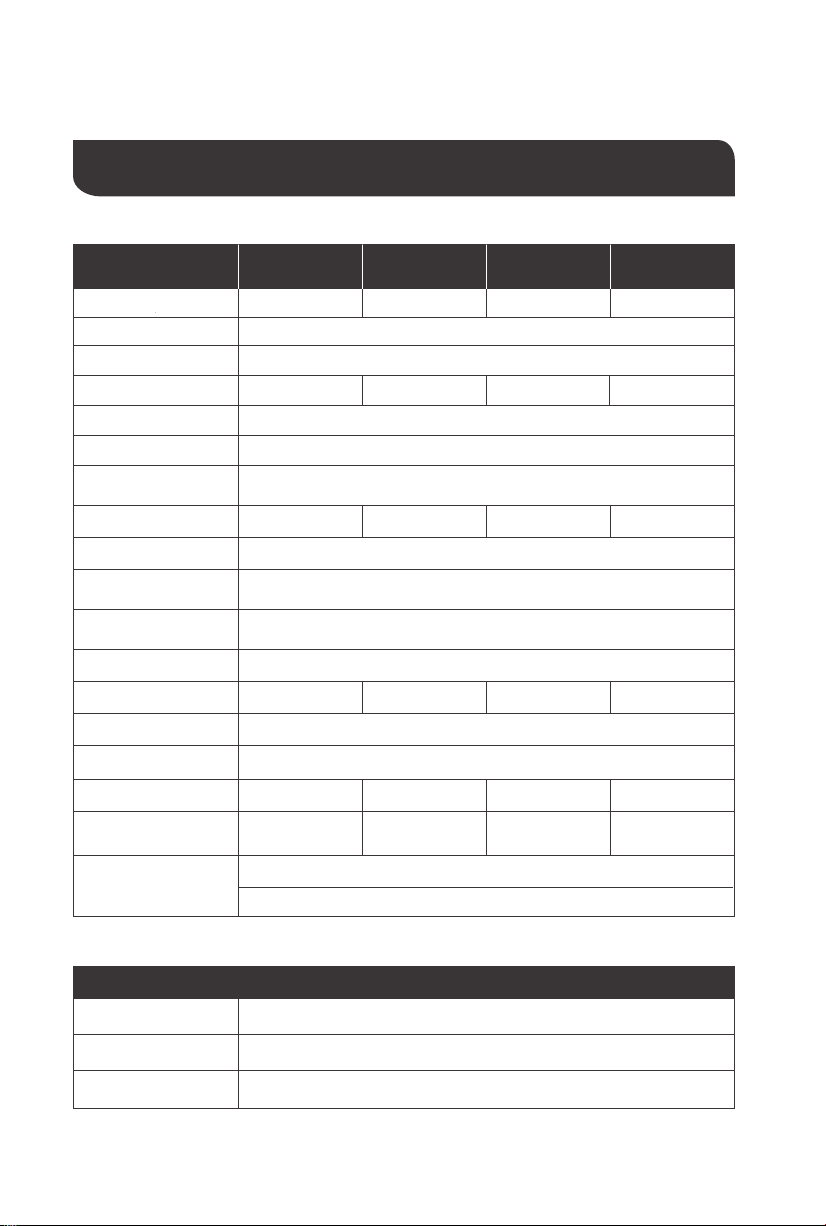
14 12 10 8 6 4 2 0
10A 15A 20A 30A 55A 75A 95A 130A 170A
NEC Maximum Current for different Copper Wire Sizes
Max. Current
#AWG
16
Specifications
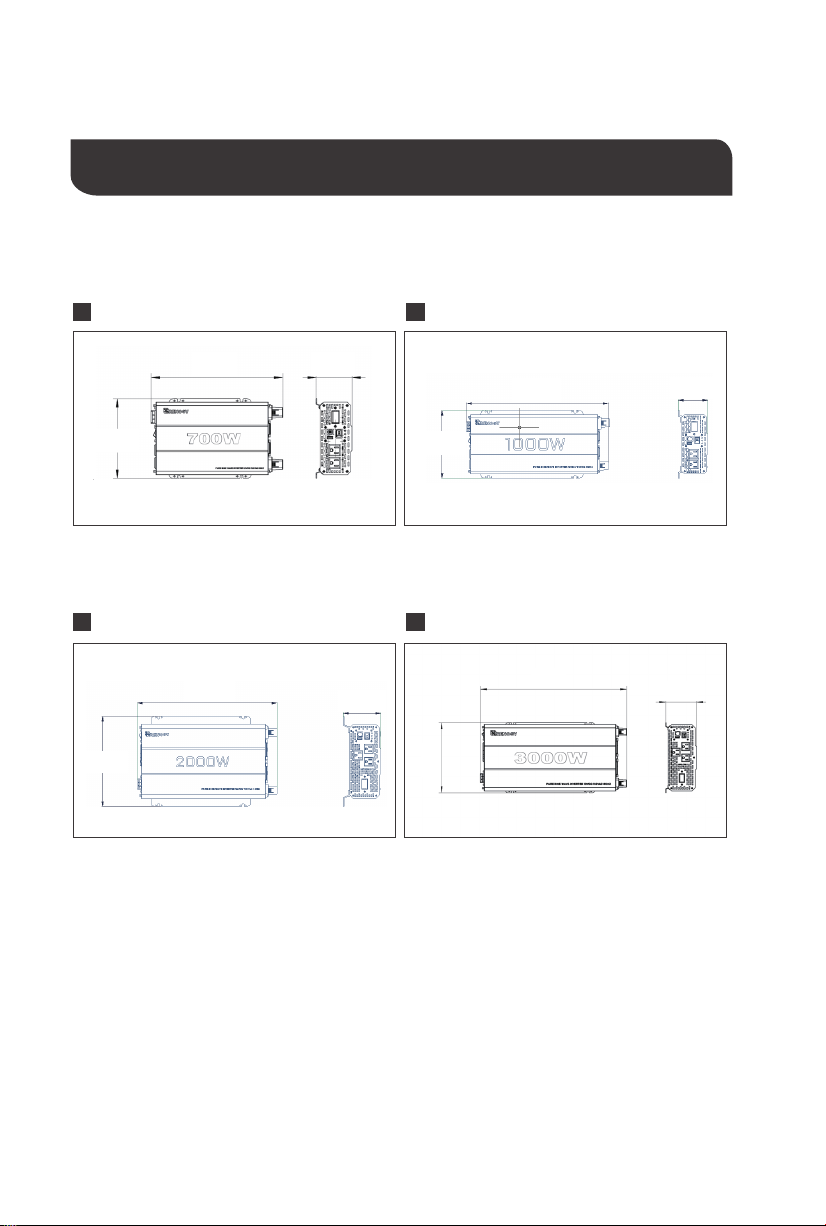
Model
RNG-INVT-700-
12V-P2
700 W 1000 W
12V DC
3000 W
60Hz
< 0.8A < 1.0A < 2.0A < 2.5A
10.5V ± 0.5V DC
10.0V ± 0.5V DC
2 2 33
5V/2.1A
AC On/Off Switch
5.6 lb
ETL Listed to UL 458 and CSA 22.2 NO 107.1-01
FCC Part 15 class B
6.0 lb 11.7 lb 12.5 lb
12.2×7.4×3.3 in 12.9×6.8×3.3 in 17.8×8.6×4 in 18.9×9×4 in
RNG-INVT-1000-
12V-P2
RNG-INVT-3000-
12V-P2
2000 W
RNG-INVT-2000-
12V-P2
Continuous Power
Input Voltage
Output Voltage
Efficiency
Frequency
Total harmonic
distortion (THD)
No load current draw
Peak surge
115V AC
1400 W 2000 W 4000 W 6000 W
> 90%
< 3%
Over voltage
shutdown
Cooling fan
AC output sockets
USB power port
Power output control
Dimensions
Net weight
(approximate)
Certification
Battery low
shutdown
Battery low alarm
16.5V ± 0.5V DC
Thermally controlled
List dimensions
Thickness
Wire length
2.875 x 2.3125 x 0.9375in, 73 x 58.7 x 23.8mm
0625in , 1.5mm
Approx 19.8ft
Wired remote control

This equipment has been tested and found to comply with the limits for a class B digital
device, pursuant to part 15 of the FCC Rules. These limits are designed to provide
reasonable protection against harmful interference in a residential installation. This
equipment generates, uses and can radiate radio frequency energy and if not installed and
used in accordance with the instructions, may cause harmful interference to radio
communications. However, there is no guarantee that interference will not occur in a
particular installation. If this equipment does cause harmful interference to radio or television
reception, which can be determined by turning the equipment off and on, the user is
encouraged to try to correct the interference by one or more of the following measures:
This device complies with Part 15 of the FCC Rules. Operation is subject to the following two
conditions: (1) this device may not cause harmful interference, and (2) this device must
accept any interference received, including interference that may cause undesired
operation.
Reorient or relocate the receiving antenna.
Increase the separation between the equipment and receiver.
Connect the equipment into an outlet on a circuit different from that to which the receiver
is connected.
Consult the dealer or an experienced radio/TV technician for help.
17
Dimensions
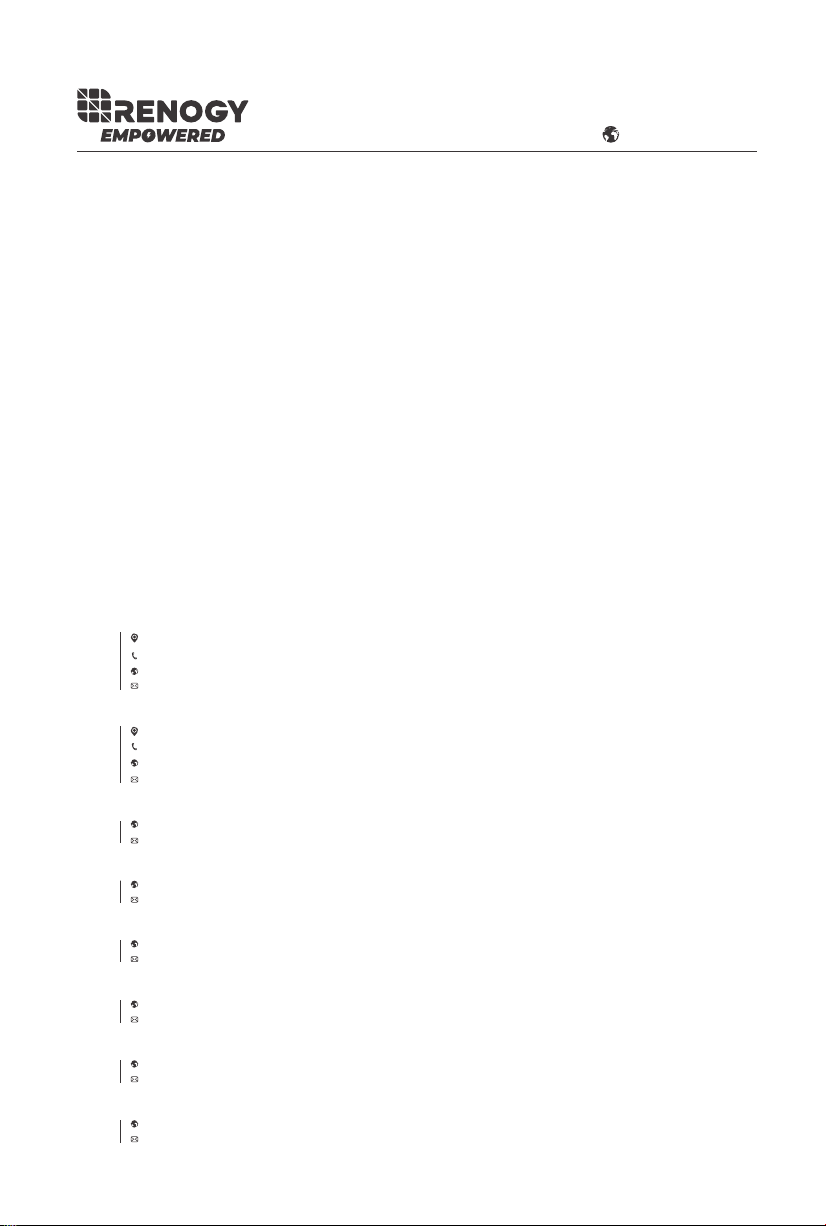
700W
2000W
1000W
3000W
18
[12.213in]
310.20mm
[3.327in]
84.50mm
[7.384in]
187.56mm
[3.996in]
101.50mm
[18.854in]
478.90mm
[9.056in]
230.02mm
[12.88in]
327.15mm
[6.75in]
171.45mm
[3.31in]
84.07mm
[4.00in]
101.60mm
[17.75in]
450.85mm
[8.56in]
217.42mm
Renogy reserves the right to change
the contents of this manual without notice.
RENOGY.COM
US
2775 E Philadelphia St, Ontario, CA 91761, USA
909-287-7111
www.renogy.com
customerservice@renogy.com
https://www.renogy.cn
sales@renogy.cn
CN
400-6636-695
苏州高新区科技城培源路1号5号楼-4
CA
https://ca.renogy.com
onlinestoreca@renogy.com
https://au.renogy.com
onlinestoreau@renogy.com
AU
JP
https://www.renogy.jp
onlinestorejp@renogy.com
https://uk.renogy.com
onlinestoreuk@renogy.com
UK
https://de.renogy.com
onlinestorede@renogy.com
DE
https://fr.renogy.com
onlinestorefr@renogy.com
FR