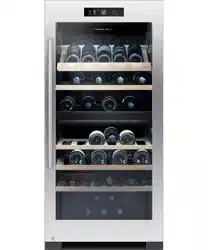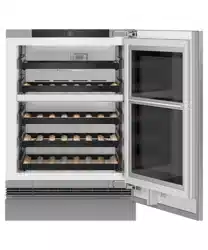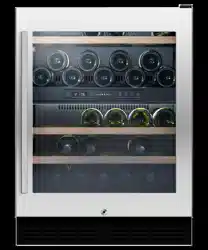

SLIDE-IN WINE CABINET
RS60RDWX1 model
INSTALLATION GUIDE/USER GUIDE
GB IE


1
CONTENTS
IMPORTANT!
SAVE THESE INSTRUCTIONS
The models shown in this user guide may
not be available in all markets and are
subject to change at any time. For current
details about model and specification
availability in your country, please go to
our website fisherpaykel.com or contact
your local Fisher & Paykel dealer.
Note: the word “cabinet”, throughout this
user guide, refers to the combination of
upper and bottom zone products.
Registration
Register your product with us so we can
provide you with the best service possible.
To register your product visit our website:
fisherpaykel.com
Introduction 3
Safety and warnings 4
Installation instructions 8
Moving or storing your appliance 12
Operating instructions – Internal control panel 13
Operating instructions – Special functions 14
Interior and exterior features 15
Storing your wine 16
Loading your wine bottles 17
Cleaning care – Exterior 18
Cleaning care – Interior 19
User warnings and sounds 20
Troubleshooting 21
Manufacturer’s Warranty 23
Customer Care 25
European Directive 2012/19/EU on Waste Electrical
and Electronic Equipment (WEEE) 26
Product fiche 27

3
INTRODUCTION
Thank you for purchasing a Fisher & Paykel Wine Cabinet to store your treasured
wine, you’ve made a great choice.
Having purchased our dual-zone cabinet you can rest assured that your red and
white wines are well cared for, over short term and long term periods.
Wine generally matures at a steady temperature between 11°Cto13°C, and for ready
to drink wines they are best served at their ideal drinking temperatures (see ‘Storing
your wine’ section). Temperature control is critical for the maturation of wines, as
significant daily or weekly temperature fluctuations can denature wines. If storage
temperatures are excessively high this can reduce the wine’s aromatic potential and
can speed up maturation. This can cause some wines to take on a ‘spoiled fruit’
flavouring. If storage temperatures are excessively low, this can have the opposite
effect and stunt a wine’s natural maturation process. This can prevent a wine’s flavour
from developing to full potential.
Optimum humidity levels are also important for the storage of cork-enclosed wines,
especially for long term storage. Dry surroundings can lead to dried out corks
encouraging wine evaporation, as well as oxygen permeation leading to oxidised
wine. As for extremely humid conditions, there is a potential of damaging wine labels
and the growth of mould on bottles.
Light is known to be damaging to wines, particularly UV light as it creates hydrogen
sulphide compounds in wine affecting the tannins and colour. Therefore our
Wine Cabinets are designed to eliminate this threat by incorporating a double
UV-tempered glass door, dark interiors and dimmed LED lighting.
Other golden rules of excellent wine storage that your Wine Cabinet offers are
frequent air circulation, condensation eliminator and minimal vibrations with the low
noise compressor.
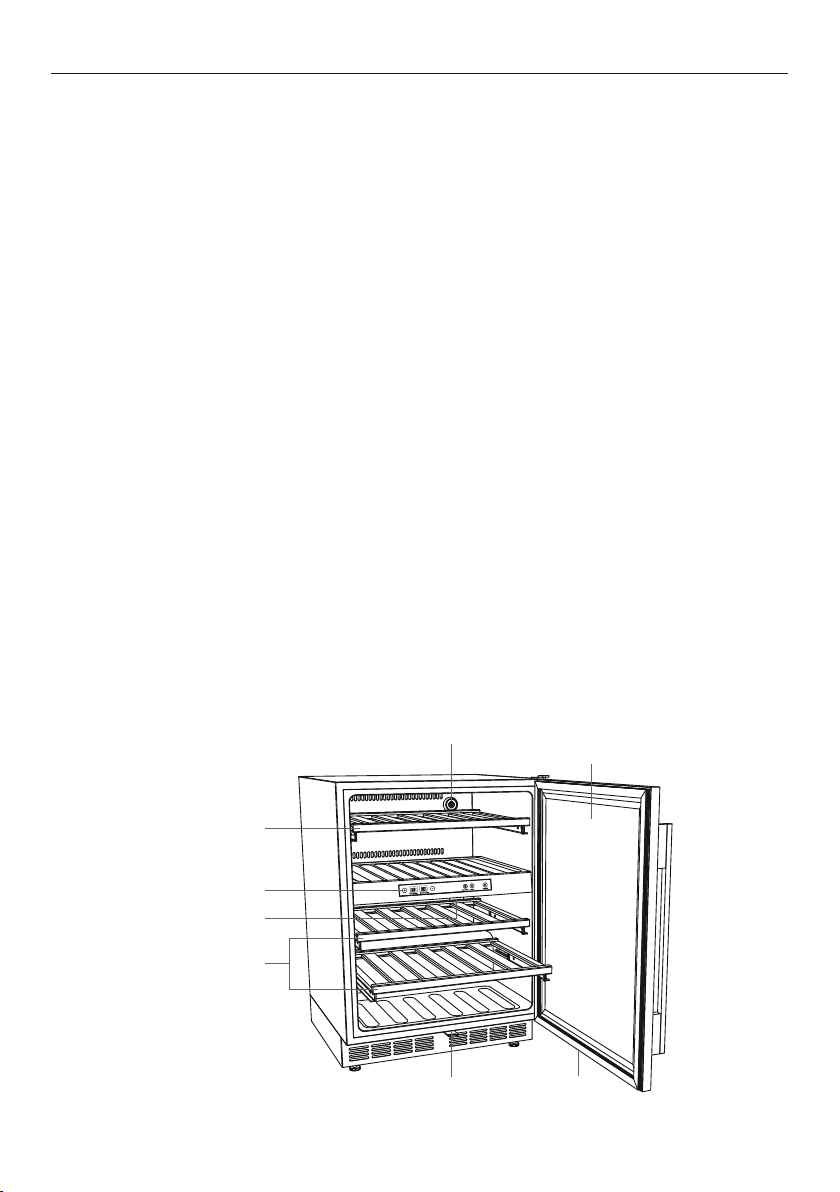
RS60RDWX1 model
Double UV-tempered glass door
Top zone carbon filter
Top zone roller shelf
Internal control panel
Bottom zone carbon filter
Safety lock
Safety latch
Bottom zone roller shelves
4
SAFETY AND WARNINGS
!
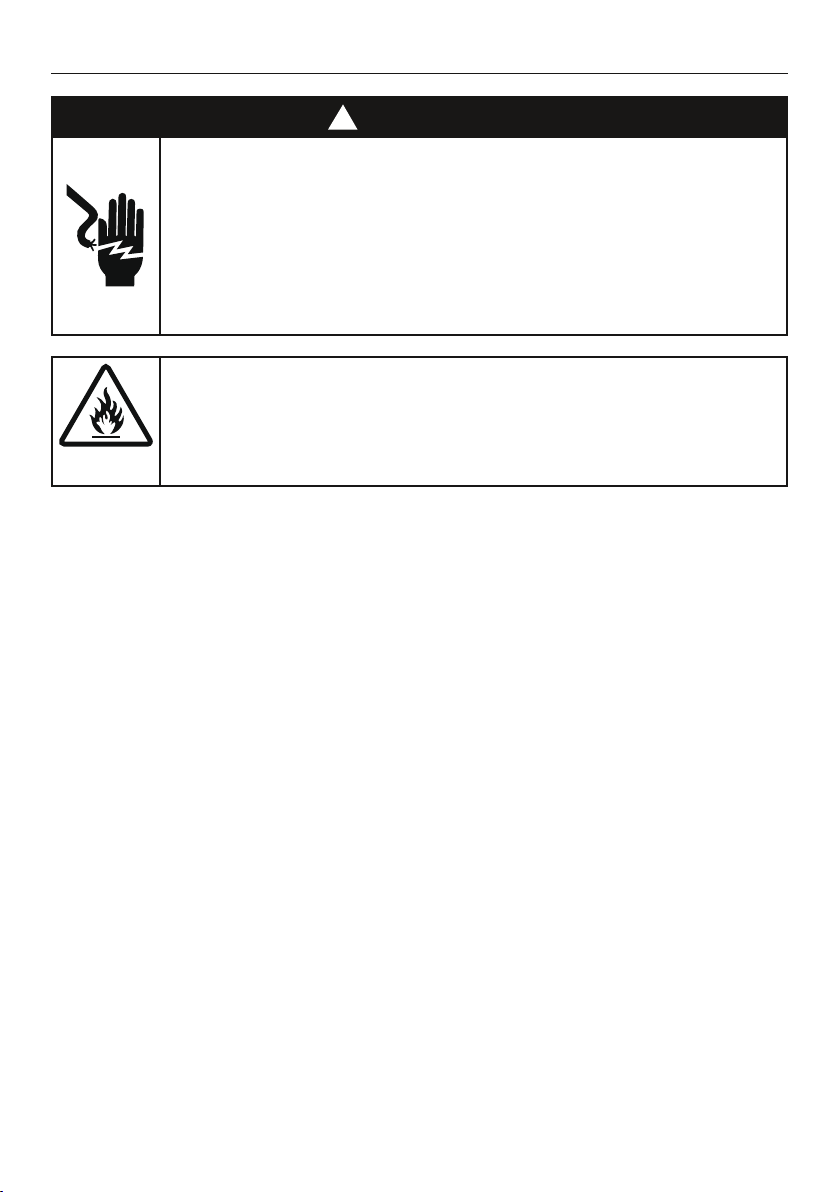
WARNING!
Electric Shock Hazard
Read and follow the safety and warnings
outlined in this user guide before operating
this appliance.
Failure to do so can result in death, electric
shock, fire or injury to persons.
R600a
This Wine Cabinet contains flammable
refrigerant isobutane (R600a).
Use this appliance only for the intended purpose as
described in the user guide.
IMPORTANT SAFETY INSTRUCTIONS:
WARNING!
When using this appliance always exercise basic
safety precautions including the following:
• Persons aged 8years and over, and persons with
reduced physical, sensory or mental capabilites; or
those with lack of experience and knowledge; can
use this appliance provided they are supervised or
have been given instruction for safe use.
• All users must understand the hazards involved.
• Children should not play with the appliance and
should not carry out user maintenance without
supervision.
• To ensure the appliance is stable under all conditions,
we recommend installing a stability bracket. Please
refer to the ‘Installation instructions’ leaflet supplied.

5
SAFETY AND WARNINGS
• Keep ventilation openings, in the appliance enclosure
or in the built-in structure, clear of obstruction.
• Do not damage the refrigerant circuit.
• In case of damage to the refrigerant circuit, ventilate
the area by opening all windows. Do not operate
electrical equipment or any other equipment that may
produce arcs, sparks or flames in the area. Contact
your Fisher & Paykel trained and supported service
technician immediately to arrange for the appliance
to be repaired.
Food safety
• This appliance is intended to be used exclusively for
the storage of wine.
• Do not store food and milk products in the Wine
Cabinet. The interior temperature may not be cool
enough to prevent spoilage in food, and the expiry
dates stated on the food packaging may be invalid.
Electrical safety
• This appliance must be installed in accordance with
the installation instructions before use.
• Always grip the plug firmly and pull straight out from
the outlet.
• Do not plug in any other appliance at the same power
point as your Wine Cabinet.
• Repair or replace immediately all electric service cords
that have become frayed or otherwise damaged. Do
not use a cord that shows cracks or abrasion along its
length, or at either the plug or appliance end.
• If the power supply cord is damaged, it must only
be replaced by your Fisher & Paykel trained and
supported service technician.

6
SAFETY AND WARNINGS
• When moving your appliance, be careful not to roll
over or damage the power cord.
• Do not use electrical appliances inside the Wine
Cabinet.
• Do not use mechanical devices or other means to
accelerate the defrosting process, other than those
recommended by the manufacturer.
IMPORTANT!
Your Wine Cabinet is designed to operate without
the need for regular service checks. However, if your
Wine Cabinet is malfunctioning, have it attended
to by your Fisher & Paykel trained and supported
service technician as soon as possible.
Cleaning
• Many commercially available cleaning products
contain solvents which may attack plastic
components of your Wine Cabinet and cause them
to crack. Please refer to the ‘Cleaning care’ section
of this user guide for further advice.
Disposal and recycling
• Extreme care must be taken when disposing your old
appliance to avoid hazards:
– The flammable refrigerant gas must be safely
removed.
– The thermal insulation foam contained in this
appliance is produced by flammable blowing
gases, any exposed foam may be highly flammable
and must be carefully treated during disposal.
– The doors should be removed, if possible and
the shelves left in place so that children may not
easily climb inside.

7
SAFETY AND WARNINGS
• Your Fisher & Paykel trained and supported
service technician will be able to give advice on
environmentally friendly methods of disposing your
old Wine Cabinet.
Storing wine
• DO NOT store explosive substances such as aerosol
cans with a flammable propellant in this appliance.
• Never store volatile or flammable materials in your
Wine Cabinet as they may explode.
Power failure
• In the event of a power interruption, the Wine
Cabinet will automatically save the current
temperature settings. When power is recovered, the
Wine Cabinet will revert to the current temperature
settings only.
• Most power failures are corrected within a short
period of time. 1–2hours loss of power will not
affect the Wine Cabinet’s temperatures.
• To avoid sudden change of temperature while the
power is off, you should avoid opening the door.
For longer periods of power failure, do take steps to
protect your wine.

8
INSTALLATION INSTRUCTIONS
Please follow the installation steps below to ensure your appliance operates correctly.
Power
The appliance must be installed so the plug is accessible.
To ensure that the appliance is not accidentally switched off, connect your Wine Cabinet
to its own power point. Do not plug in any other appliance at this power point.
For power requirements, please refer to the serial plate located on the rear of the
cabinet.
It is essential that the appliance is properly grounded (earthed).
Connect the appliance to the electrical supply (220V–240V50Hz) with the fitted
plug and lead.
Connections to the mains supply should be in accordance with local regulations.
Location
Your Wine Cabinet should not be located in direct sunlight or next to any heat
generating appliance such as a cooktop, oven or dishwasher.
The appliance should not be located in garages or on carpeted floors.
This appliance is intended to be used in indoor ambient temperatures between 16°C
and 25°C. Do not operate this appliance outside the specified ambient ranges as
performance may be compromised.
Ventilation and installation
To ensure adequate ventilation for your Wine Cabinet, see ‘Product and cabinetry
dimensions’.
9
INSTALLATION INSTRUCTIONS
Product installation
Your Wine Cabinet will arrive with the front feet raised to make moving the product into
its final location a simple task.
Avoid moving the product in a sideways direction as this may damage the floor
covering/surface.
Move the Wine Cabinet into its final position making sure there are correct clearances
between the product and surrounding cabinetry.
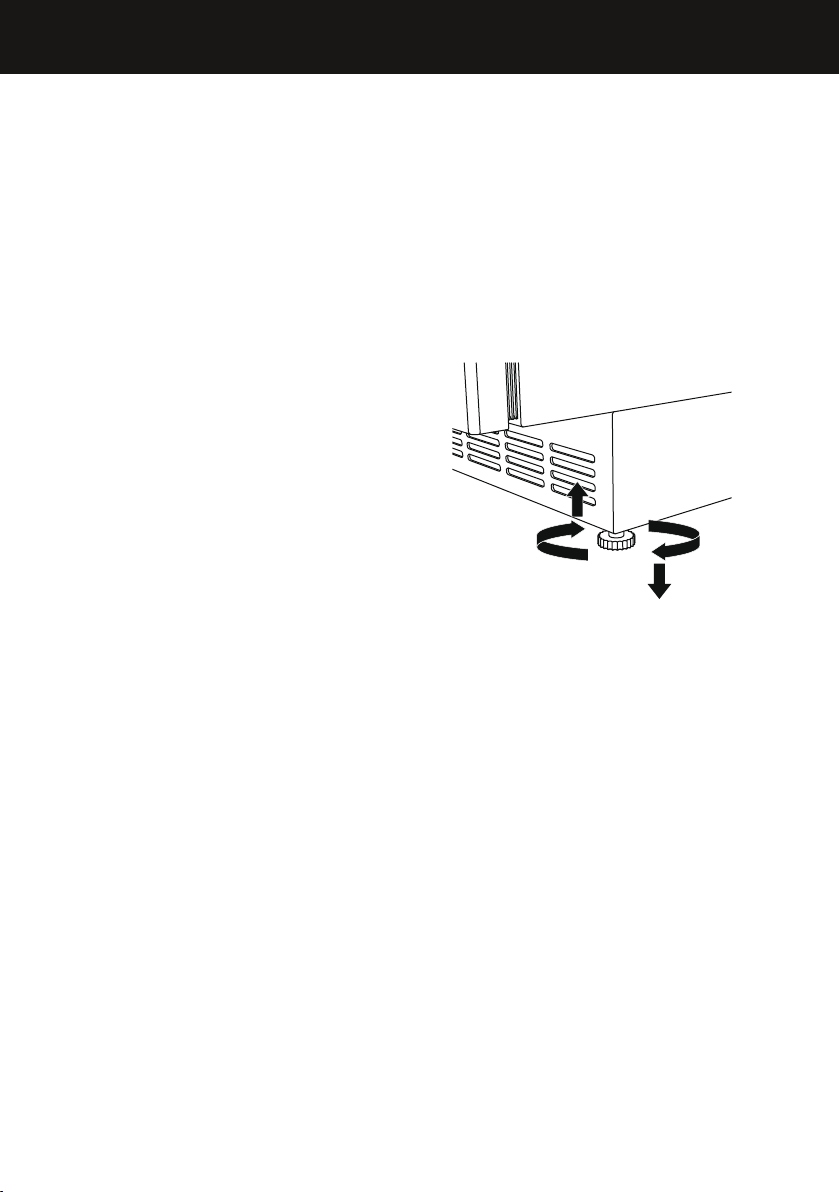
Levelling your Wine Cabinet
It is important that all four corners of
the WineCabinet base are supported
firmly on the floor to eliminate any
cabinet movement.
Installing the appliance on a soft or
uneven/unlevelled floor may result
in twisting of the cabinet and poor
sealing of the door.
This Wine Cabinet has four adjustable
feet, which can be used to level the
appliance.
The front levelling foot on the hinge
side should take majority of the
cabinet’s weight and be stable, ie the
cabinet should not rock or wobble.
Before placing wine in your Wine Cabinet
Remove all internal packaging.
Clean the inside of the appliance to remove manufacturing and transportation dust.
Please refer to the ‘Cleaning care’ section of this user guide for further advice.
Allow the Wine Cabinet to run empty for 1–2hours, this allows the appliance to
acclimatise and remove any residual odours before making temperature adjustments.
Energy efficiency
For the most energy efficient use of your appliance:
Ensure your Wine Cabinet has adequate ventilation as recommended in the installation
instructions.
Avoid overcrowding shelves, as this reduces airflow.
Keep door openings to a minimum.
Counter-clockwise
to raise feet
Clockwise to
lower feet
10
INSTALLATION INSTRUCTIONS
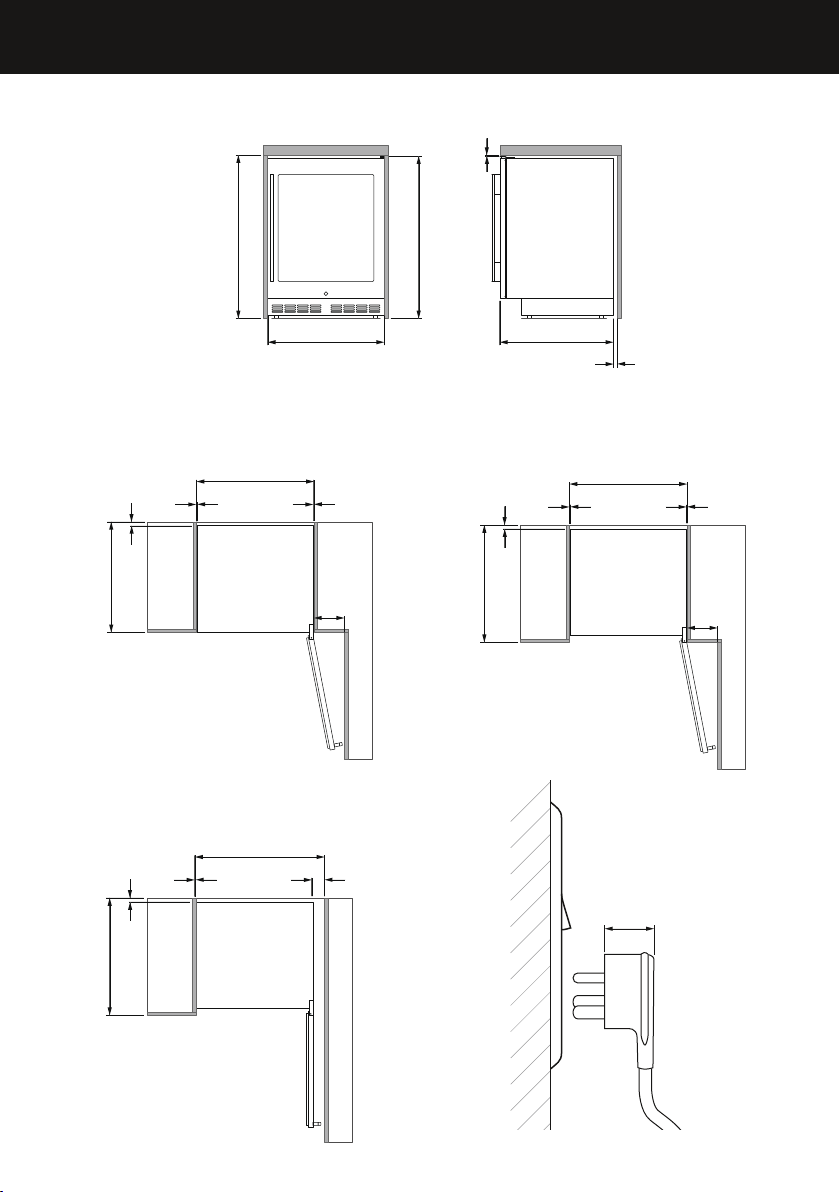
Product and cabinetry dimensions
AD
B C
O
E
K
O
F
Q
P
L
G
K
O
H
R
M
I
K
O
J
N
AD
B C
O
E
K
O
F
Q
P
L
G
K
O
H
R
M
I
K
O
J
N
Flush with Wine Cabinet chassis
– full door rotation
AD
B C
O
E
K
O
F
Q
P
L
G
K
O
H
R
M
I
K
O
J
N
Flush with Wine Cabinet door
– full door rotation
Flush with Wine Cabinet door
– 90° door rotation
AD
B C
O
E
K
O
F
Q
P
L
G
K
O
H
R
M
I
K
O
J
N
S
Power plug to
power wall socket
11
INSTALLATION INSTRUCTIONS
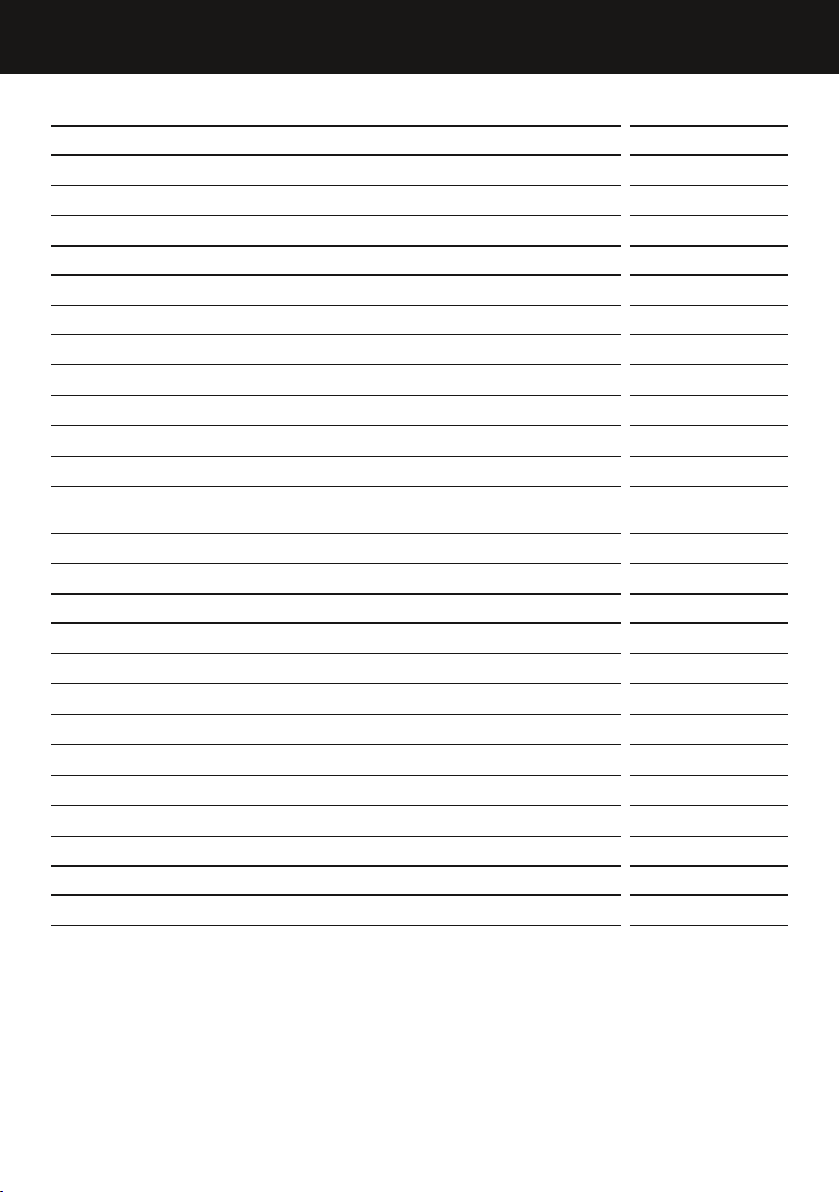
RS60RDWX1
PRODUCT DIMENSIONS mm
A
Overall height of product 830
B
Overall width of product 595
C
Overall depth of product (excludes handle, includes back cover) 580
CABINETRY DIMENSIONS (Including minimum air clearances)
mm
D
Inside height of cavity 835
Flush with Wine Cabinet chassis – full door rotation
E
Inside width 600
F
Inside depth 565
Flush with Wine Cabinet door – full door rotation
G
Inside width 600
H
Inside depth flush to flat door (when not plugged at rear of product) 600
Flush with Wine Cabinet door – 90° door rotation
(for full shelf access, the door needs to be open past 90°)
I
Inside width 688
J
Inside depth flush to flat door 600
MINIMUM CLEARANCES mm
K
Side clearance 2.5
L
Side clearance – hinge side flush with chassis – full rotation 2.5
M
Side clearance – hinge side flush with door – full rotation 2.5
N
Side clearance – hinge side flush with door – 90° rotation 90.5
O
Rear clearance (includes back cover) 20
P
Top clearance – above Wine Cabinet 5
Q
Door clearance – hinge side flush with chassis – full rotation 155
R
Door clearance – hinge side flush with door – full rotation 155
MINIMUM POWER PLUG DIMENSIONS mm
S
Power plug depth 30

12
MOVING OR STORING YOUR APPLIANCE
If your Wine Cabinet is turned off for any reason, wait 10minutes before turning it back
on. This will allow the refrigeration systems pressures to equalise before restarting.
Moving your appliance
Turn off the appliance and unplug from the power point. Remove all wine bottles.
Turn the adjustable feet counter-clockwise to lower the product, making sure the feet
are wound up into the product.
Ease the appliance out of its position. Tape the power cord to the back of the Wine
Cabinet, tape the shelves in place and tape the door closed.
Always move the appliance vertically. Do not transport the product lying down, this
potentially damages the sealed cooling system.
Relocate and install. If the appliance has been left on its side for any length of time,
leave it standing upright as long as possible (at least a few hours) before turning it on.
If the product has been transported upright then it can be switched on after 10minutes.
Storing your Wine Cabinet
When storing your cleaned appliance, leave the door open. This allows air to circulate
and prevents the build-up of bacteria and moulds.
Before using again, clean well using liquid dishwashing detergent dissolved in warm
water. Rinse with clean water and dry with a lint-free cloth.
Holiday time
We recommend you leave your Wine Cabinet operating while you are on holiday.
13
OPERATING INSTRUCTIONS – INTERNAL CONTROL PANEL
The control panel enables you to view and modify all the features and options on your
Wine Cabinet.
Temperature control
When the Wine Cabinet is turned on for the first time, the control panel will display the
actual temperature of the cabinet.
The system will automatically cool both zones to their default temperature setting of
12°C (ideal for long term storage). This will take between 1 – 2 hours.
The temperature zones are independently controlled and do not change with the
temperature or humidity of the surrounding; whether summer or winter.
The Wine Cabinet can be set to any temperature between 5°C and 20°C in each zone to
accommodate your wine storage requirements.
If you wish to alter the temperature of either zone, this can be easily done by using the
internal control panel.
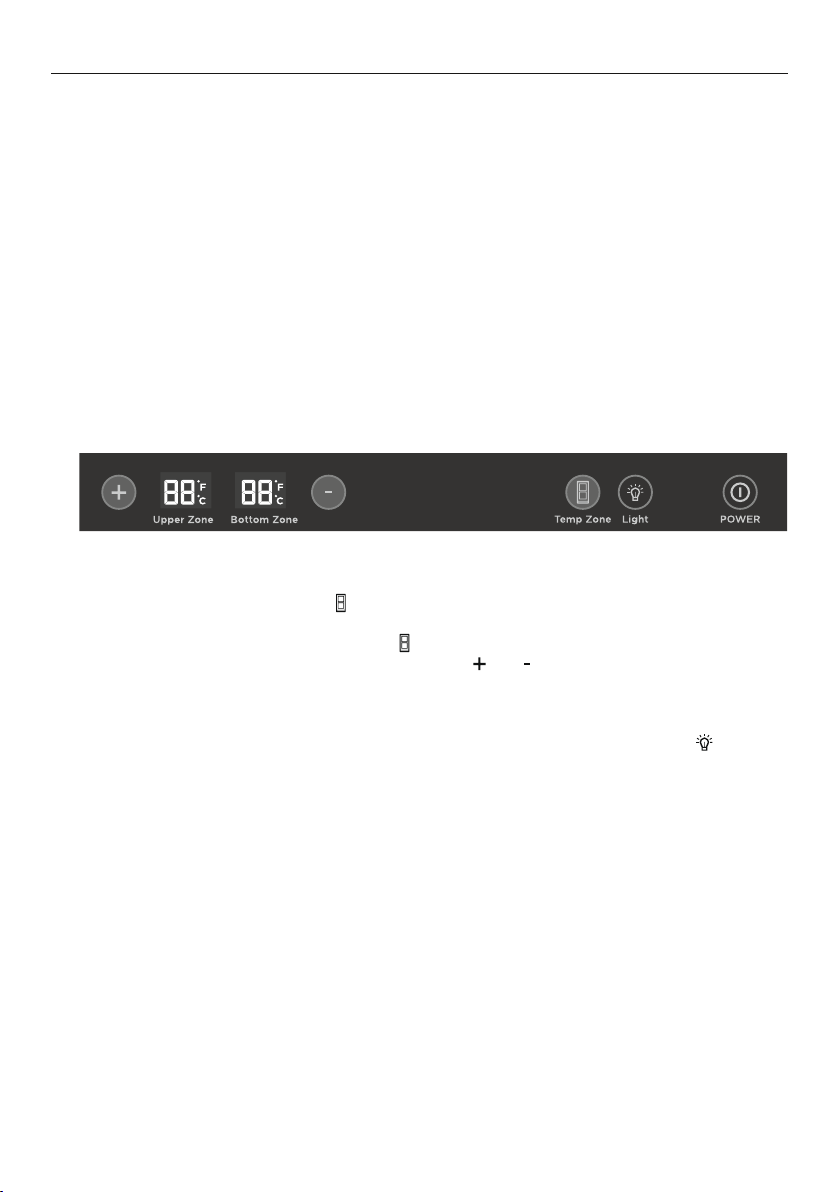
Internal control panel
Adjusting the temperature of each zone
1
Press and hold the ‘Temp Zone’ button for 3seconds. The zone temperature blinking
on the display will indicate whether the upper or bottom zone is selected.
2
To change zones press the ‘Temp Zone’ button once.
3
The temperature may be altered by pressing the or buttons. One press on either
of these buttons will increase or reduce the temperature by one °C or °F.
When the desired temperature is displayed, wait 5 seconds, the blinking will stop and
the temperature will be set.
4
To switch between temperature units of °C and °F, press and hold the ‘Light’ icon for
3seconds.

14
OPERATING INSTRUCTIONS – SPECIAL FUNCTIONS
Special functions
LED lighting
When the Wine Cabinet door is open the light automatically illuminates both zones.
When the door is closed the light will automatically turn off. For maximum energy
savings, it is recommended to leave the light off when not viewing your collection.
To keep the light illuminated at all times (on door opening and closing):
Press the ‘Light’ button once.
To deactivate the light from illuminating when not viewing your collection, press the
‘Light’ button once.
Power
This model is equipped with Standby mode and may be activated when the cabinet is
not in use. Before activating this mode ensure all wine bottles are removed.
To activate press the ‘Power’ button once. The internal control panel and LED lights
will no longer illuminate.
To deactivate Standby mode press the ‘Power’ button once. The internal control
panel and LED lights will illuminate, and revert to the current temperature settings only.
Door alarm
A continuous alarm will sound if the cabinet door has been left open for longer than
60seconds. The alarm will stop only when the door is closed.
For times when you require the door to be opened longer than normal eg rotating your
wine bottles or loading more wine, the door alarm can be temporarily muted.
To mute the door alarm, press the ‘Temp Zone’ button once. When the cabinet door is
closed, alarm mute will deactivate and the door alarm will revert to normal.
IMPORTANT!
When the cabinet door is left open for long periods of time wine quality may be
compromised.
15
INTERIOR AND EXTERIOR FEATURES
Interior features
Shelving
The oak shelves have been designed to allow for even air distribution around your wine
bottles. Easy access is possible with telescopic runners.
This model has three roller shelves and two fixed shelves.
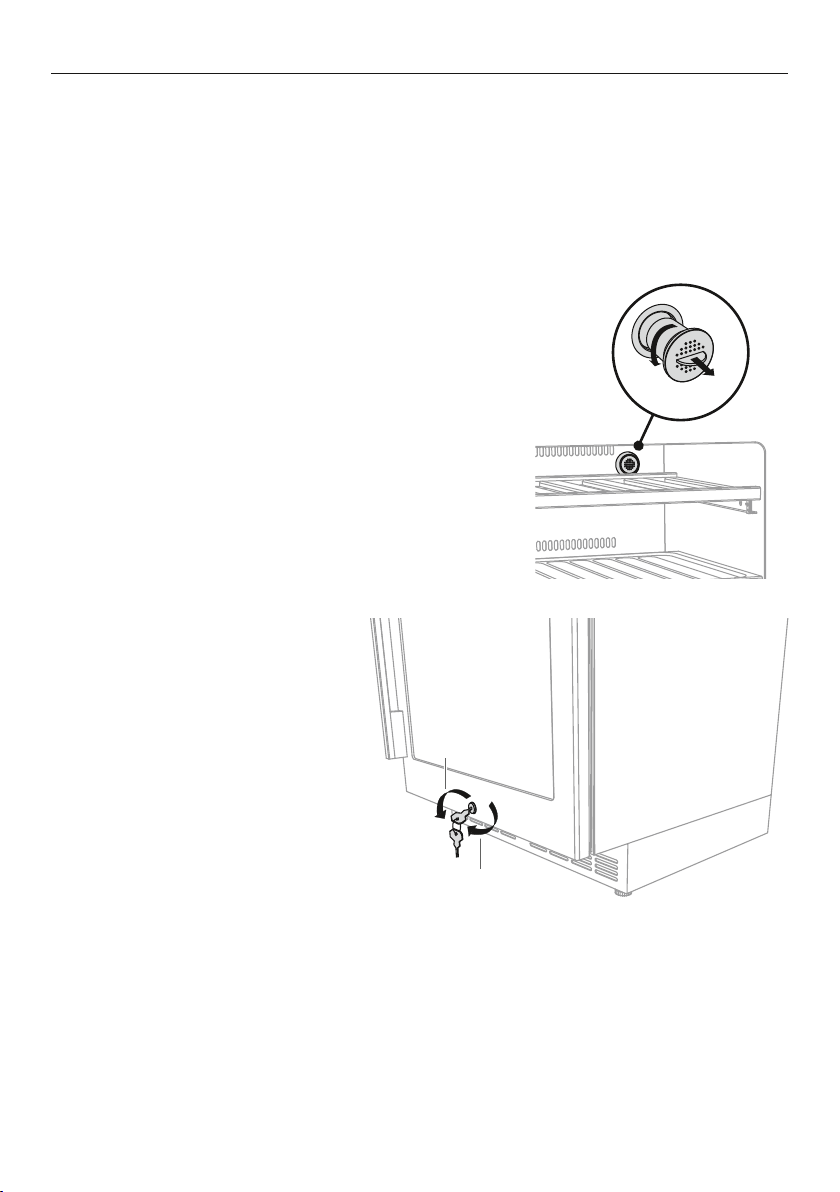
Activated carbon filters
Air quality is critical for preserving wine. The
activated carbon filters help to remove stale,
unwanted odours and replenish with fresh air.
The filters are fitted to the rear wall on the
right-hand side of the upper and bottom zone.
We recommend that you replace your activated
carbon filters once every five years. Replacement
filters are available from your Fisher & Paykel trained
and supported service technician.
To remove the filter hold by the handle, and turn
counter-clockwise (refer to A) until fully loosened.
Pull towards you to remove (refer to B).
To replace the filter hold by the handle, insert and
turn clockwise to fully secure.
Exterior features
Door lock
The Wine Cabinet is equipped
with a door lock located at the
bottom of the cabinet door.
To lock the cabinet, insert the key
and turn 90°counter-clockwise.
To unlock the cabinet, insert the
key and turn 90°clockwise
90° counter-clockwise
to lock
90° clockwise
to unlock
A
B
16
STORING YOUR WINE
Short-term storage/serving
This Wine Cabinet is perfect for short-term storage such as entertaining.
Red wines are best served at warmer temperatures and white wines are best served at
cooler temperatures.
The ideal serving temperature of your wine is crucial for your taste and enjoyment.
The following are recommended serving temperatures for different wines.
SPARKLING WINES AND SWEET WHITE WINES
Non-vintage Champagne and Sparkling Wine 6°C
Vintage Champagne and Sparkling Wine, Riesling and Gewürztraminer 8°C
DRY WHITE WINES
Sauvignon Blanc, Chenin Blanc, Bordeaux Blanc 9°C
Chardonnay and White Burgundy, Rosé 10 – 12°C
LIGHT TO MEDIUM-BODIED RED WINES
Young Boredaux, Young Cabernet, Pinot Noir, Merlot 14 – 16°C
FULL-BODIED RED WINES
Cabernet Sauvignon, Red Burgundy 17°C
Shiraz, Zinfandel, Vintage Port 18°C
Long-term storage
This Wine Cabinet is also perfect for long-term storage/cellaring of wines.
The ideal temperature for long-term storage of red and white wines is between
11°Cto13°C.
Storing red and white wine
When storing a combination of red and white wines, we recommend storing same
case wines together. For example red wine in the bottom zone and white wine in the
upper zone.
Depending on the number of wine bottles and functions selected, it may take
24hours for the Wine Cabinet temperatures to stabilise.
Not all wines stored will improve/mature over time. Some wines are best consumed at
an early stage, while others have remarkable ageing capabilities. Check with your wine
merchant for more information.
17
LOADING YOUR WINE BOTTLES
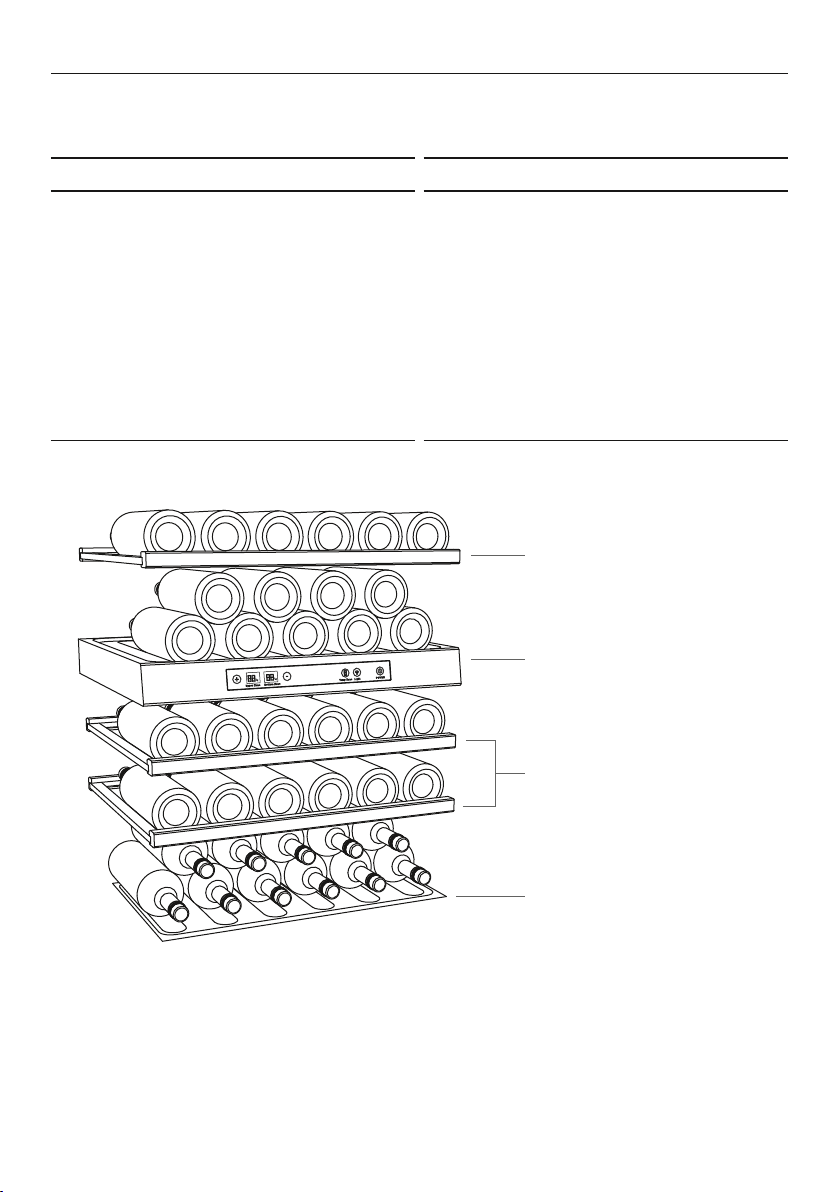
When loading your Wine Cabinet please keep in mind our loading capacities are based
on standard 750ml Bordeaux bottles.
DOs DON’Ts
Before loading wine into the cabinet
confirm that all shelves are secured
andstable.
Roller shelves are designed for holding
6wine bottles only.
Fixed shelves are designed for holding
only two tiers of wine bottles.
When storing a combination of red and
white wines, we recommend storing
same case wines together. For example
red wine in the bottom zone and white
wine in the upper zone.
Do not load more than the
recommended number of wine bottles
on roller shelves and fixed shelves.
Do not remove any roller shelves to
allow the shelf below to hold more
than the recommended number of
wine bottles.
Upper zone roller shelf
This shelf is designed to hold
6wine bottles only.
Upper zone fixed shelf
This shelf is designed to hold
9wine bottles only.
Bottom zone fixed shelf
This shelf is designed to hold
11wine bottles only.
Bottom zone roller shelf
This shelf is designed to hold
6wine bottles only.

18
CLEANING CARE – EXTERIOR
Stainless steel exterior door
Use only liquid dishwashing detergent dissolved in warm water and a soft lint-free cloth
to clean the exterior door surface.
Rinse with clean water and dry with a clean, lint-free cloth.
The use of any abrasive or stainless steel cleaners and solvents will damage the door
surface.
Other exterior surfaces
Clean all other exterior surfaces with liquid dishwashing detergent dissolved in warm
water and a soft lint-free cloth.
Rinse with clean water and dry with a clean, lint-free cloth
Door gasket
It is recommended to clean the magnetic door gasket every three months with an old
toothbrush, and liquid dishwashing detergent dissolved in warm water.
Gasket must be kept clean and pliable to assure a proper seal.
Petroleum jelly applied lightly on the hinge side of the gasket will keep the gasket
pliable and assure a good seal.
IMPORTANT!
Many commercially available cleaning products contain solvents which may attack
plastic components of your Wine Cabinet and cause them to crack.
Avoid using anti-bacterial cleaning products on the interior or exterior of the Wine
Cabinet, as they may cause rusting of metal components and cracking of plastic
components.
19
CLEANING CARE – INTERIOR
Interior
For ease of cleaning, empty the Wine Cabinet first and remove all shelves.
Wipe interior surfaces using only liquid dishwashing detergent dissolved in warm water
and a soft lint-free cloth. Rinse with clean water and dry with a clean, lint-free cloth.
Do not use harsh chemicals, abrasives, ammonia, chlorine, bleach, concentrated
detergents, solvents or abrasive scouring pads on any part of your Wine Cabinet.
SOME of these chemicals may dissolve, damage and/or discolour the interior of your
Wine Cabinet.
Roller shelves
When cleaning use a dry clean, lint-free cloth to wipe over surfaces. Do not use warm
water or any cleaners as this will damage the shelves’ oak characteristics and cause
them to warp and stain.
If the shelves are lightly stained by spilt wine or water allow the surface to dry, then
using 200grade sandpaper gently sand over the stain until removed.
If shelves are heavily stained, over time the colour of the shelf will darken and warp,
and may eventually require replacing. Replacement shelves are available from your
Fisher&Paykel trained and supported service technician.
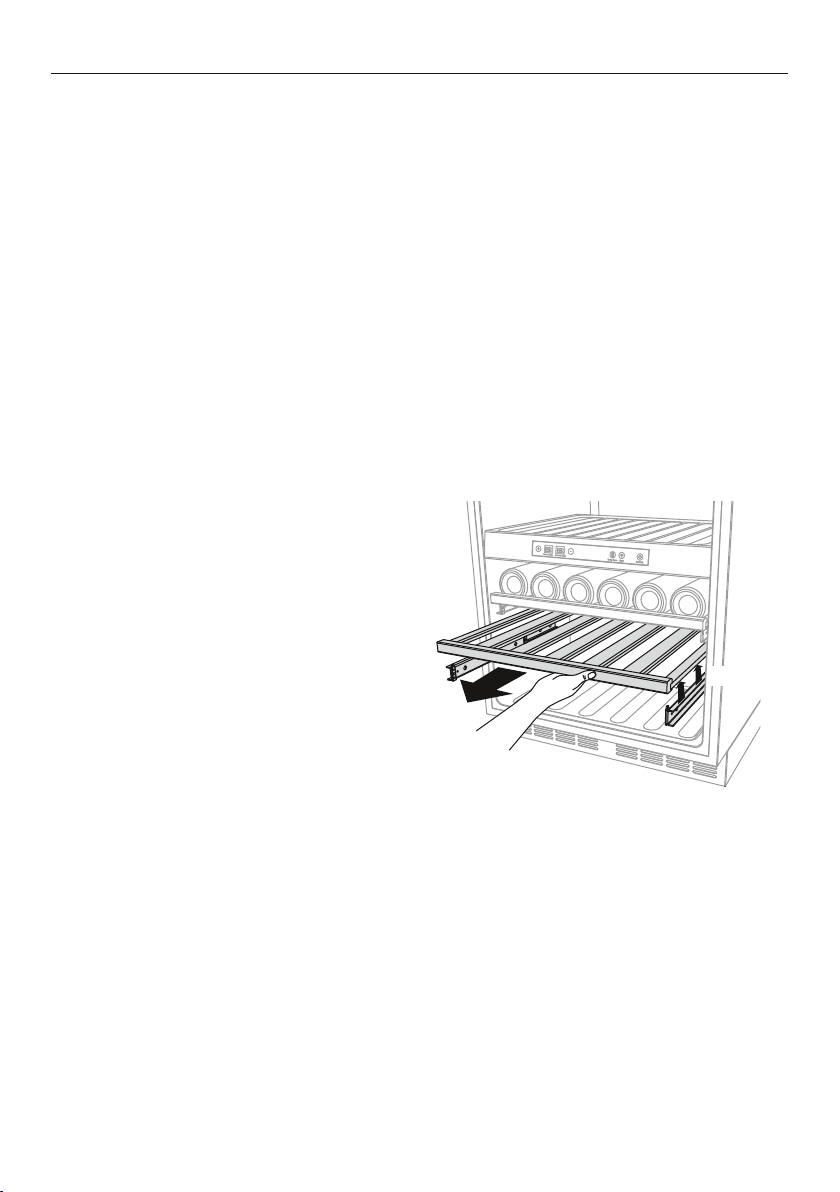
Remove roller shelves
1
Pull the shelf towards you extending
the telescopic runners, making sure
the shelf is empty (refer to A).
2
Hold the front and back edge of the
shelf firmly and lift vertically to unclip
from securing hooks (refer to B).
3
Pull the shelf towards you to remove.
4
Push both telescopic runners back
into the WineCabinet.
Repositioning roller shelves
1
Push both telescopic runners back into the WineCabinet.
2
Align the shelf on top of the securing hooks and push the shelf down until you feel itclip.
3
Ensure the shelf is securely clipped onto the telescopic runners before use.
IMPORTANT!
Telescopic runners are pre-lubricated, and will not need to be re-lubricated during
their life. Do not attempt to clean the grease from the runners, as this will affect their
ability to function. Do not immerse the runners in water.
A
B

20
USER WARNINGS AND SOUNDS
User warnings – faults
In the unlikely event of a fault occurring, a fault code will be displayed on the internal
control panel and an alarm will sound.
Please take note of the fault code and contact our Customer Care Centre. Contact
details are located towards the end of the user guide.
To silence the fault alarm press any button on the internal control panel. The fault code
will remain illuminated until the fault is corrected.
Normal Wine Cabinet sounds
Fisher & Paykel Wine Cabinets can produce sounds somewhat different to your old
Wine Cabinet.
Normal operational sounds include:
Fan air flow sounds. Fisher & Paykel Wine Cabinets have fans to circulate the air within
each zone. This is quite normal.
Running/boiling water, gurgling sounds or slight vibrations. This is the liquid refrigerant
circulating in the system.
Clicking sounds. This is the thermostat control and will click when it cycles on and off.
Gasket noises. This normally occurs due to a build-up of dirt and/or grime. It is
recommended to clean the magnetic door gasket every three months to minimise these
noises occurring.
Other sounds may be heard for the following reasons:
– Cabinet not level
– Floor uneven or weak
– Wine bottles not positioned on the shelf correctly.
21
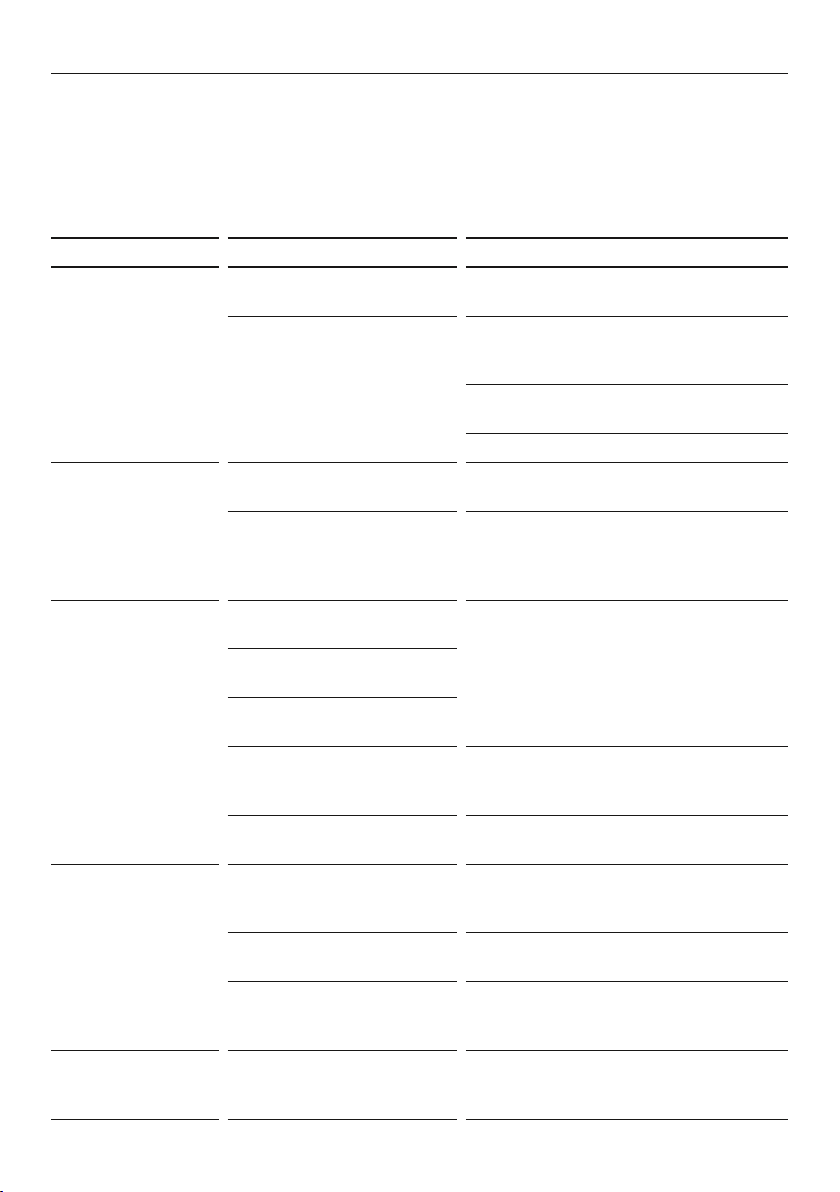
TROUBLESHOOTING
If there is a problem with your Wine Cabinet, please check the following points before
contacting your local Fisher & Paykel trained and supported service technician or
Customer Care Centre.
Product parts and accessories can be purchased through Fisher & Paykel Customer Care
or online at fisherpaykel.com (this service is available to selected markets only).
PROBLEM POSSIBLE CAUSES WHAT TO DO
Appliance does
not operate.
Cabinet is in Standby
mode.
Refer to ‘Operating instructions –
Special functions’ section.
No electricity at the
power outlet.
Check the cabinet is correctly
connected and the power is
switchedon.
Check another appliance at the same
outlet.
Check the house fuse.
Lights do not
illuminate
when the door
isopened.
Cabinet is not working. Check the cabinet is turned on at the
wall.
Lights not functioning. The LED lights cannot be serviced by
the user. Contact your Fisher&Paykel
Dealer or Fisher&Paykel trained and
supported service technician.
Motor operates for
long periods.
The room temperature is
hotter than normal.
Minimise door openings to allow
temperature to stabilise.
Prolonged or frequent
door openings.
Large amount of wine
bottles added.
Temperature setting is too
low.
Refer to ‘Operating instructions’
and ‘Storing your wine’ sections for
optimal temperature settings.
Door not sealed properly. Check the cabinet is level and gasket
seals are clean.
Wine bottles
appear too warm.
Temperature setting not
correct.
Adjust the temperature control to a
colder setting. Refer to the ‘Operating
instructions’ section.
Prolonged or frequent
door openings.
Minimise door openings to allow
temperature to stabilise.
Large amount of wine
bottles added.
Allow time for recently added
wine bottles to reach the desired
temperature.
Wine bottles
appear too cold.
Temperature setting not
correct.
Adjust the temperature control to a
warmer setting. Refer to ‘Operating
instructions’ section.
22
TROUBLESHOOTING
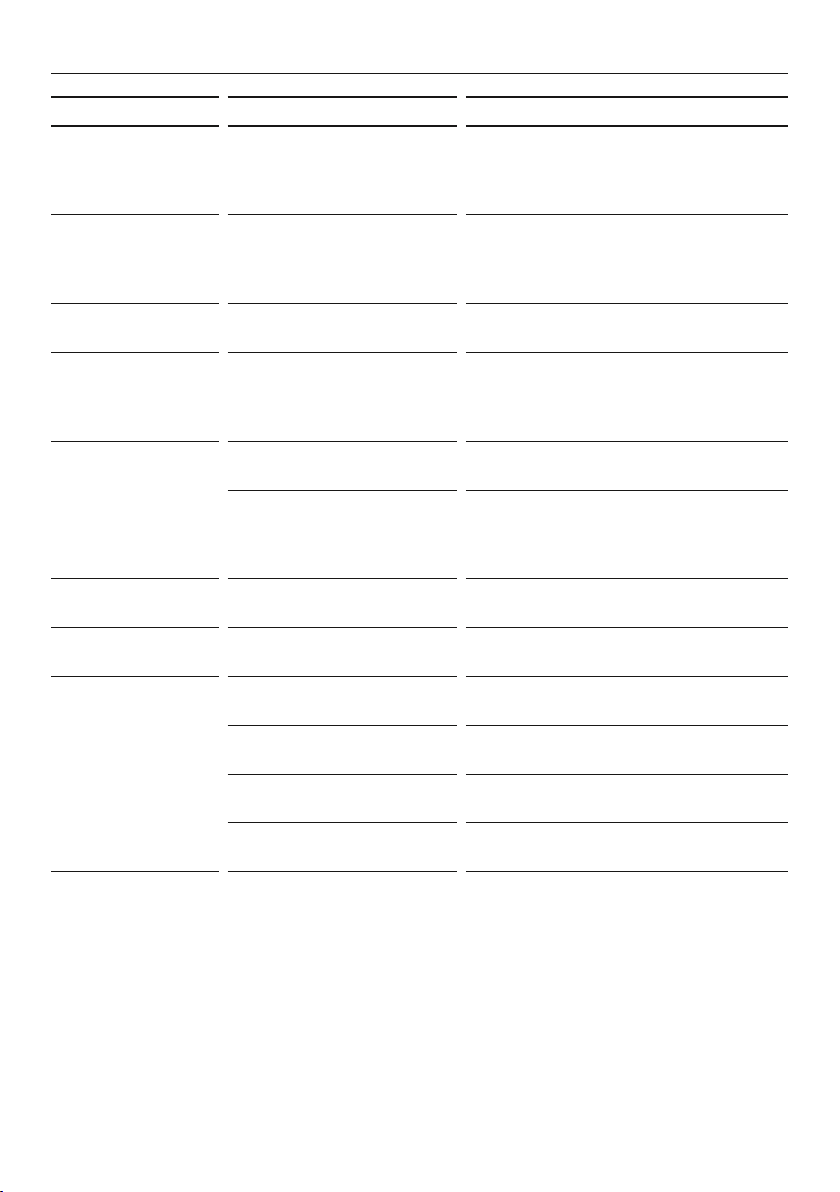
PROBLEM POSSIBLE CAUSES WHAT TO DO
Unfamiliar noises. The cabinet is not stable
or level.
Level the cabinet. Refer to the
‘Installation instructions’ section or
refer to ‘User warnings and sounds’
section.
Door alarm sounds
continuously
and a fault code
appears.
This is dependent on the
displayed fault code.
Please take note of the fault code and
contact the Customer Care Centre.
Exterior of cabinet
is warm.
This is normal.
Moisture build-up
on the exterior
appliance
surfaces.
Not unusual during
periods of high humidity.
Wipe dry with a clean, lint-free cloth.
Moisture build up
on the interior
glass door.
Not unusual during
periods of high humidity.
Wipe dry with a clean, lint-free cloth.
Prolonged or frequent
door openings.
Minimise door openings to allow the
temperature to stabilise. Also check
the gasket is sitting flat and sealing
tightly.
Door handle out
of alignment.
With time and usage,
movement may occur.
Refer to ‘Installation instructions’
sections.
Excessive gasket
noise.
May be due to a build-up
of dirt/or grime.
Gasket needs cleaning. Refer to
‘Cleaning care – Exterior’ section.
Door does not
shut properly.
Cabinet not stable or level. Level the cabinet. Refer to the
‘Installation instructions’ section.
The gasket is dirty. Gasket needs cleaning. Refer to the
‘Cleaning care – Exterior’ section.
The shelves are out of
position.
Realign shelves. Refer to the ‘Cleaning
care – Interior’ section.
Door obstruction. Check for obstructions eg protruding
wine bottles, shelves out of position.

23
MANUFACTURER’S WARRANTY
For the Republic of Ireland and Northern Ireland only. You automatically receive a 2 year
Manufacturer’s Warranty with the purchase of this refrigerator covering parts and labour
for servicing within the country of purchase.
Fisher & Paykel undertakes to:
Repair or, at its option, replace without cost to the owner either for material or labour
any part of the product, the serial number of which appears on the product, which is
found to be defective within TWO YEARS of the date of purchase.
Note: this Manufacturer’s Warranty is an extra benefit and does not affect your
legalrights.
This Manufacturer’s Warranty DOES NOT cover
A
Service calls which are not related to any defect in the product. The cost of a service call
will be charged if the problem is not found to be a product fault. For example:
1
Correcting the installation of the product.
2
Instructing you how to use the product.
3
Replacing house fuses or correcting house wiring or plumbing.
4
Correcting fault(s) caused by the user.
5
Noise or vibration that is considered normal, eg drain/fan sounds, refrigeration noises
or user warning beeps.
6
Correcting damage caused by pests, eg rats, cockroaches, etc.
7
Replacement light bulbs.
B
Defects caused by factors other than:
1
Normal domestic use; or
2
Use in accordance with the product’s user guide.
C
Defects to the product caused by accident, neglect, misuse or ‘act of God’.
D
The cost of repairs carried out other than by a Fisher & Paykel trained and supported
service technician or the cost of correcting such repairs.
E
Normal recommended maintenance as set out in the product’s user guide.
F
Repairs when the appliance has been dismantled, repaired or serviced by other than a
Fisher&Paykel trained and supported service technician or the selling dealer.
G
Pick-up and delivery.
H
Transportation or travelling costs involved in the repair when the product is installed
outside the Fisher&Paykel trained and supported service technician’s normal service area.
I
Filter replacement except in the case of faulty parts or materials within the filter
cartridge.
J
Damage (including water damage) caused by faulty installation or plumbing.
Nothing in this Manufacturer’s Warranty is intended to, or does, limit any rights you may
have under law to recover the costs of inspecting or returning the goods to us.
This product has been designed for use in a normal domestic (residential) environment.
This product is not designed for any commercial use (whatsoever). Any commercial use
by a customer will affect this product’s Manufacturer’s Warranty.

24
MANUFACTURER’S WARRANTY
Service under this Manufacturer’s Warranty must be provided by a Fisher&Paykel
trained and supported service technician (refer to the ‘Customer Care’ section at the
back of this book). Such service shall be provided during normal business hours. This
Manufacturer’s Warranty certificate should be shown when making any claim.
Please keep this user guide in a safe place.
Complete and keep for safe reference:
Model
Serial No.
Purchase Date
Purchaser
Dealer
Suburb
Town
Country

25
CUSTOMER CARE
Before you call for service or assistance...
Check the things you can do yourself. Refer to your user guide and check that:
1
Your product is correctly installed.
2
You are familiar with its normal operation.
3
You have read the ‘Troubleshooting’ section at the back of the book.
If after checking these points you still need assistance or parts, please refer to your
nearest Fisher & Paykel trained and supported service technician, Customer Care, or
contact us through our website fisherpaykel.com.
In the United Kingdom if you need assistance…*
Call the Fisher & Paykel Customer Care Centre and talk to one of our Customer Care
Consultants.
Phone: 08000 886 605
Fax: 08000 886 606
Website: fisherpaykel.com
Postal address: Fisher & Paykel Appliances Ltd, Maidstone Road, Kingston, Milton
Keynes, Buckinghamshire, MK10 0BD
In Ireland if you need assistance…*
Call the Fisher & Paykel Customer Care Centre and talk to one of our Customer Care
Consultants.
Phone: 1800 625 174 or 01-8077960
Fax: 1800 635 012
Website: fisherpaykel.com
Postal address: Fisher & Paykel Appliances, Unit D2, North Dublin Corporate Park,
Swords, Co. Dublin
*If you call, write or contact us via our website please provide: your name and address,
model number, serial number, date of purchase and a complete description of the
problem. This information is needed in order to better respond to your request for
assistance.
For product details please refer to the serial plate located on the rear of the cabinet.
Registration
Register your product with us so we can provide you with the best service possible.
To register your product visit our website: fisherpaykel.com

26
EUROPEAN DIRECTIVE 2012/19/EU ON
WASTE ELECTRICAL AND ELECTRONIC EQUIPMENT (WEEE)
GB This appliance is marked according to the European directive 2012/19/EU on Waste
Electrical and Electronic Equipment (WEEE). By ensuring this product is disposed of
correctly, you will help prevent potential negative consequences for the environment
and human health, which could otherwise be caused by inappropriate handling of this
product.
The symbol marked on the serial plate, or on the documents accompanying the
product, indicates that this appliance cannot be treated as household waste. It shall
be handed over to the applicable collection point for the recycling of electrical and
electronic equipment. Disposal of the appliance shall be carried out in accordance with
the local environment regulations for waste disposal and ensure the refrigerant circuit is
not damaged.
For more detailed information about treatment, recovery and recycling of this product,
please contact your local city office, your household waste disposal service or your
Fisher & Paykel retailer/dealer from whom you purchased this product.
27
FISHER & PAYKEL
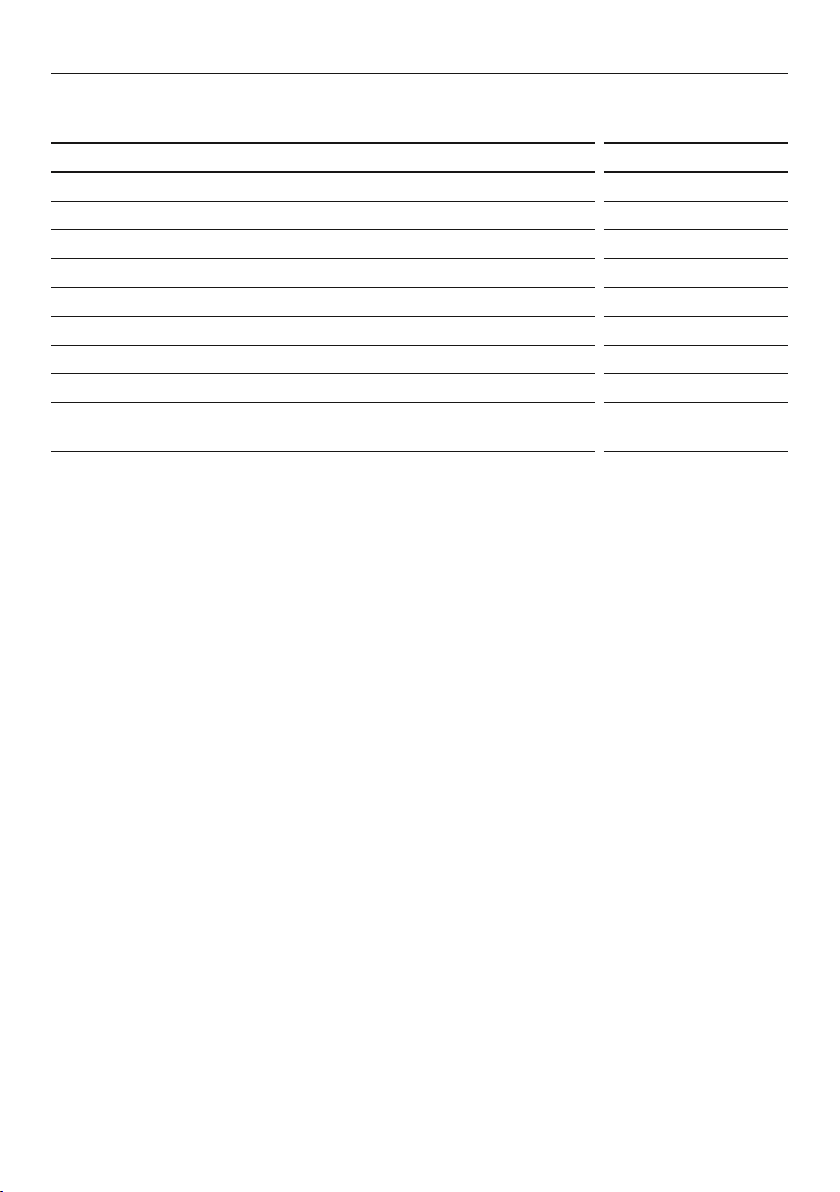
MODEL RS60RDWX1
Category of the household refrigeration appliance model
1
2
Energy efficiency class B
Energy Consumption * 183
Storage volume (L) 115
Frost free (Yes/No), Fridge N/A
Climate class SN-ST
Noise emissions (dB/A) Re 1 pW 42
Built in appliance Yes/No? Yes
This appliance is intended to be used exclusively for the storage
of wine Yes/No?
Yes
1
1 Refrigerator with one or more fresh-food storage compartments
2 Refrigerator-cellar, cellar and wine storage appliances
3 Refrigerator-chiller and refrigerator with 0-star compartment
4 Refrigerator with a 1-star compartment
5 Refrigerator with a 2-star compartment
6 Refrigerator with a 3-star compartment
7 Refrigerator-freezer
8 Upright freezer
9 Chest freezer
10 Multi-use and other refrigerating appliances
*
Energy consumption in kWh per year, based on standard test results for 24 hours. The actual energy
consumption will depend on how the appliance is used and where it is located.
PRODUCT FICHE



GB IE
84267D 11.17
FISHERPAYKEL.COM
© Fisher & Paykel Appliances 2017. All rights reserved.
The product specifications in this booklet apply to the specific products
and models described at the date of issue. Under our policy of continuous
product improvement, these specifications may change at any time. You
should therefore check with your Dealer to ensure this booklet correctly
describes the product currently available.