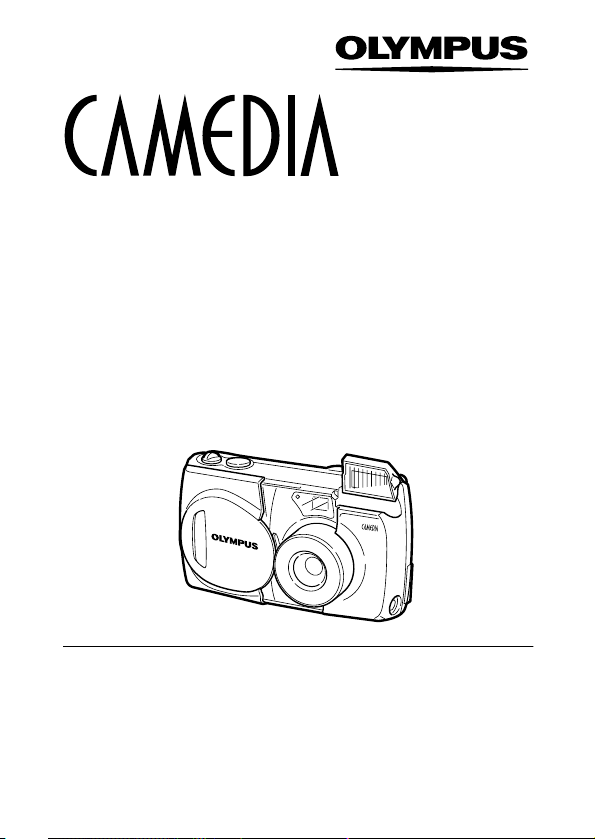
DIGITAL CAMERA
C-300 ZOOM
C-300 ZOOMC-300 ZOOM
C-300 ZOOM
D-550 ZOOM
D-550 ZOOMD-550 ZOOM
D-550 ZOOM
REFERENCE MANUAL
Thank you for purchasing an Olympus digital camera. Before you
start to use your new camera, please read these instructions
carefully to enjoy optimum performance and a longer service life.
Keep this manual in a safe place for future reference.
We recommend that you take test shots to get accustomed to your
camera before taking important photographs.
2
For customers in Europe
For customers in North and South America
For customers in USA
Declaration of Conformity
Model Number : C-300 ZOOM/D-550 ZOOM
Trade Name : OLYMPUS
Responsible Party : Olympus America Inc.
Address : 2 Corporate Center Drive, Melville, New York
11747-3157 U.S.A.
Telephone Number : 631-844-5000
Tested To Comply With FCC Standards
FOR HOME OR OFFICE USE
This device complies with Part 15 of the FCC rules. Operation is subject to
the following two conditions:
(1) This device may not cause harmful interference.
(2) This device must accept any interference received, including interference
that may cause undesired operation.
For customers in Canada
This Class B digital apparatus meets all requirements of the Canadian
Interference-Causing Equipment Regulations.
Trademarks
• IBM is a registered trademark of International Business Machines Corporation.
• Microsoft and Windows are registered trademarks of Microsoft Corporation.
• Macintosh is a trademark of Apple Computer Inc.
• All other company and product names are registered trademarks and/or
trademarks of their respective owners.
• The standards for camera file systems referred to in this manual are the “Design
Rule for Camera File System/DCF” standards stipulated by the Japan Electronics
and Information Technology Industries Association (JEITA).
“CE” mark indicates that this product complies with the European
requirements for safety, health, environment and customer protection.
“CE” mark cameras are intended for sales in Europe.
3
INDEX
Contents . . . . . . . . . . . . . . . . . . . . . . . . . . . . . . . . . . . . . . . . . . . . . .4
Chapter 1
Getting started . . . . . . . . . . . . . . . . . . . . . . . . . . . . 8
Chapter 2
Shooting basics . . . . . . . . . . . . . . . . . . . . . . . . . . 36
Chapter 3
Advanced shooting . . . . . . . . . . . . . . . . . . . . . . . 57
Chapter 4
Adjusting the image quality and exposure . . . . 68
Chapter 5
Playback . . . . . . . . . . . . . . . . . . . . . . . . . . . . . . . . 83
Chapter 6
Useful functions . . . . . . . . . . . . . . . . . . . . . . . . . 106
Chapter 7
Print settings . . . . . . . . . . . . . . . . . . . . . . . . . . . 117
Chapter 8
Troubleshooting . . . . . . . . . . . . . . . . . . . . . . . . . 127
Specifications . . . . . . . . . . . . . . . . . . . . . . . . . . . . . . . . . . . . . . . 140
Index . . . . . . . . . . . . . . . . . . . . . . . . . . . . . . . . . . . . . . . . . . . . . . .142

4
Contents
INDEX . . . . . . . . . . . . . . . . . . . . . . . . . . . . . . . . . . . . . . . . . . . . . . . . . .3
Contents 4
Chapter 1
Getting started 8
Names of parts. . . . . . . . . . . . . . . . . . . . . . . . . . . . . . . . . . . . . . . . . . . .8
Monitor indications . . . . . . . . . . . . . . . . . . . . . . . . . . . . . . . . . . . . . . . .10
Memory gauge . . . . . . . . . . . . . . . . . . . . . . . . . . . . . . . . . . . . . . .12
Battery check . . . . . . . . . . . . . . . . . . . . . . . . . . . . . . . . . . . . . . . .12
Attaching the strap . . . . . . . . . . . . . . . . . . . . . . . . . . . . . . . . . . . . . . . .13
Loading the batteries . . . . . . . . . . . . . . . . . . . . . . . . . . . . . . . . . . . . . .14
Selecting batteries or the optional AC adapter . . . . . . . . . . . . . . .16
Inserting the card (SmartMedia). . . . . . . . . . . . . . . . . . . . . . . . . . . . . .18
Turning the power on/off . . . . . . . . . . . . . . . . . . . . . . . . . . . . . . . . . . .21
What to do if the CARD SETUP screen is displayed . . . . . . . . . .23
Setting the date and time . . . . . . . . . . . . . . . . . . . . . . . . . . . . . . . . . . .24
Adjusting the viewfinder . . . . . . . . . . . . . . . . . . . . . . . . . . . . . . . . . . . .26
Using the menus and tabs . . . . . . . . . . . . . . . . . . . . . . . . . . . . . . . . . .27
How to use the menus . . . . . . . . . . . . . . . . . . . . . . . . . . . . . . . . .28
Shortcut menus. . . . . . . . . . . . . . . . . . . . . . . . . . . . . . . . . . . . . . .30
Mode menus . . . . . . . . . . . . . . . . . . . . . . . . . . . . . . . . . . . . . . . . .32
Chapter 2
Shooting basics 36
Holding the camera . . . . . . . . . . . . . . . . . . . . . . . . . . . . . . . . . . . . . . .36
Shooting modes . . . . . . . . . . . . . . . . . . . . . . . . . . . . . . . . . . . . . . . . . .37
Taking still pictures. . . . . . . . . . . . . . . . . . . . . . . . . . . . . . . . . . . . . . . .40
Taking still pictures using the viewfinder . . . . . . . . . . . . . . . . . . .40
Taking still pictures using the monitor. . . . . . . . . . . . . . . . . . . . . .41
Comparison of the viewfinder & monitor . . . . . . . . . . . . . . . . . . . .43
If correct focus cannot be obtained . . . . . . . . . . . . . . . . . . . . . . . . . . .44
Determine the position of the subject after focusing
(Focus Lock) . . . . . . . . . . .44
Focusing on distant subjects (
Quick Focus) . . . . . . . . . . . . .45
Subjects that are difficult to focus on . . . . . . . . . . . . . . . . . . . . . .46
Contents
5
Night scene mode . . . . . . . . . . . . . . . . . . . . . . . . . . . . . . . . . . . . . . . .47
Recording movies . . . . . . . . . . . . . . . . . . . . . . . . . . . . . . . . . . . . . . . .49
Zooming in on a subject (Optical zoom/Digital zoom) . . . . . . . . . . . . .51
Using the optical zoom . . . . . . . . . . . . . . . . . . . . . . . . . . . . . . . . .51
Using the digital zoom . . . . . . . . . . . . . . . . . . . . . . . . . . . . . . . . .52
Using the flash . . . . . . . . . . . . . . . . . . . . . . . . . . . . . . . . . . . . . . . . . . .54
Chapter 3 Advanced shooting 57
Taking close-up pictures (Macro mode). . . . . . . . . . . . . . . . . . . . . . . .57
Using the self-timer . . . . . . . . . . . . . . . . . . . . . . . . . . . . . . . . . . . . . . .59
Selecting the metering area (Spot metering) . . . . . . . . . . . . . . . . . . . .61
Shooting pictures sequentially (Sequential shooting/AF Sequential
shooting) . . . . . . . . . . . . . . . . . . . . . . . . . . . . . . . . . . . . . . . . . . . . . . .62
Panorama shooting . . . . . . . . . . . . . . . . . . . . . . . . . . . . . . . . . . . . . . .64
Taking two-in-one pictures . . . . . . . . . . . . . . . . . . . . . . . . . . . . . . . . . .66
Chapter 4
Adjusting the image quality and exposure 68
Selecting the image quality and size (Record mode). . . . . . . . . . . . . .68
Selecting the ISO sensitivity. . . . . . . . . . . . . . . . . . . . . . . . . . . . . . . . .73
Varying the image brightness (Exposure compensation). . . . . . . . . . .75
Adjusting the color tone (White balance) . . . . . . . . . . . . . . . . . . . . . . .77
Adjusting the sharpness. . . . . . . . . . . . . . . . . . . . . . . . . . . . . . . . . . . .79
Adjusting the contrast. . . . . . . . . . . . . . . . . . . . . . . . . . . . . . . . . . . . . .81
Chapter 5 Playback 83
Playing back still pictures . . . . . . . . . . . . . . . . . . . . . . . . . . . . . . . . . . .83
Quick View (Double-click playback) . . . . . . . . . . . . . . . . . . . . . . .84
Close-up playback . . . . . . . . . . . . . . . . . . . . . . . . . . . . . . . . . . . .84
Index display. . . . . . . . . . . . . . . . . . . . . . . . . . . . . . . . . . . . . . . . .85
Slideshow . . . . . . . . . . . . . . . . . . . . . . . . . . . . . . . . . . . . . . . . . . .87
Playing back pictures on a TV . . . . . . . . . . . . . . . . . . . . . . . . . . .88
Playing back movies . . . . . . . . . . . . . . . . . . . . . . . . . . . . . . . . . . . . . .90
Protecting pictures (Protect). . . . . . . . . . . . . . . . . . . . . . . . . . . . . . . . .92
Contents
6
Erasing pictures . . . . . . . . . . . . . . . . . . . . . . . . . . . . . . . . . . . . . . . . . .94
Single-frame erase . . . . . . . . . . . . . . . . . . . . . . . . . . . . . . . . . . . .94
All-frame erase . . . . . . . . . . . . . . . . . . . . . . . . . . . . . . . . . . . . . . .95
Editing still pictures . . . . . . . . . . . . . . . . . . . . . . . . . . . . . . . . . . . . . . .96
Creating black and white pictures . . . . . . . . . . . . . . . . . . . . . . . . .96
Creating sepia-toned pictures . . . . . . . . . . . . . . . . . . . . . . . . . . . .97
Resizing pictures . . . . . . . . . . . . . . . . . . . . . . . . . . . . . . . . . . . . .98
Trimming pictures . . . . . . . . . . . . . . . . . . . . . . . . . . . . . . . . . . . . .99
Editing movies . . . . . . . . . . . . . . . . . . . . . . . . . . . . . . . . . . . . . . . . . .102
Creating an index . . . . . . . . . . . . . . . . . . . . . . . . . . . . . . . . . . . .102
Editing movies . . . . . . . . . . . . . . . . . . . . . . . . . . . . . . . . . . . . . .104
Chapter 6 Useful functions 106
Turning the beep sound off (Beep sound) . . . . . . . . . . . . . . . . . . . . .106
Formatting (Card setup) . . . . . . . . . . . . . . . . . . . . . . . . . . . . . . . . . . .107
Viewing a picture immediately after shooting (Rec View) . . . . . . . . .109
Saving the settings (All Reset) . . . . . . . . . . . . . . . . . . . . . . . . . . . . . .110
Displaying shooting information . . . . . . . . . . . . . . . . . . . . . . . . . . . . .112
Adjusting the monitor brightness . . . . . . . . . . . . . . . . . . . . . . . . . . . .113
File name . . . . . . . . . . . . . . . . . . . . . . . . . . . . . . . . . . . . . . . . . . . . . .114
Pixel mapping. . . . . . . . . . . . . . . . . . . . . . . . . . . . . . . . . . . . . . . . . . .116
Chapter 7 Print settings 117
How to print pictures . . . . . . . . . . . . . . . . . . . . . . . . . . . . . . . . . . . . .117
All-frame reservation . . . . . . . . . . . . . . . . . . . . . . . . . . . . . . . . . . . . .119
Single-frame reservation . . . . . . . . . . . . . . . . . . . . . . . . . . . . . . . . . .121
Trimming . . . . . . . . . . . . . . . . . . . . . . . . . . . . . . . . . . . . . . . . . . . . . .124
Resetting the print reservation data . . . . . . . . . . . . . . . . . . . . . . . . . .126
Contents
7
Chapter 8 Troubleshooting 127
Error codes. . . . . . . . . . . . . . . . . . . . . . . . . . . . . . . . . . . . . . . . . . . . .127
Troubleshooting . . . . . . . . . . . . . . . . . . . . . . . . . . . . . . . . . . . . . . . . .129
If an operation does not work . . . . . . . . . . . . . . . . . . . . . . . . . . .129
If the image quality is poor . . . . . . . . . . . . . . . . . . . . . . . . . . . . .132
List of menus . . . . . . . . . . . . . . . . . . . . . . . . . . . . . . . . . . . . . . . . . . .134
List of factory default settings. . . . . . . . . . . . . . . . . . . . . . . . . . . . . . .138
List of items by shooting mode. . . . . . . . . . . . . . . . . . . . . . . . . . . . . .139
Specifications 140
Index 142
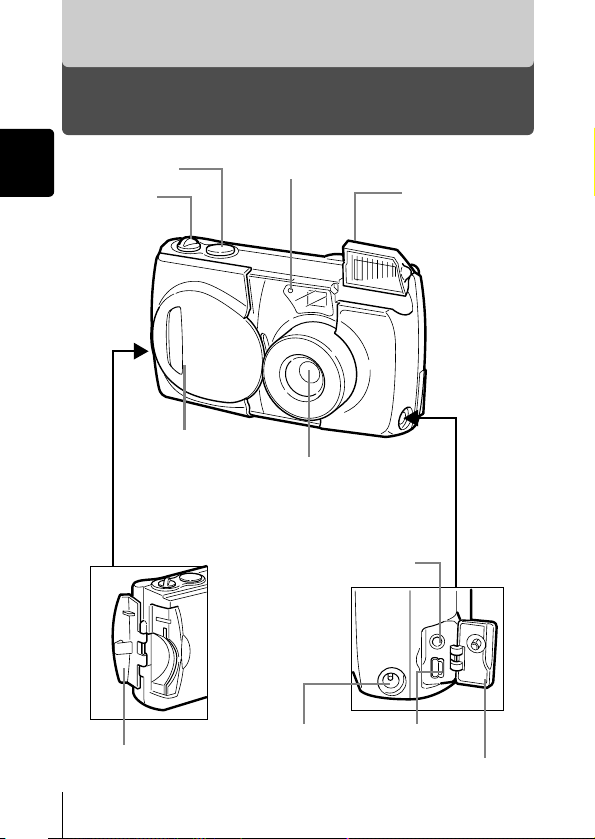
Indications used in this manual
l
Important information on factors which may lead to a
malfunction or operational problems. Also warns of
operations that should be absolutely avoided.
Useful information and hints that will help you get the most
out of your camera.
Reference pages describing details or associated
information.
Getting started
1
8
Chapter 1
Getting started
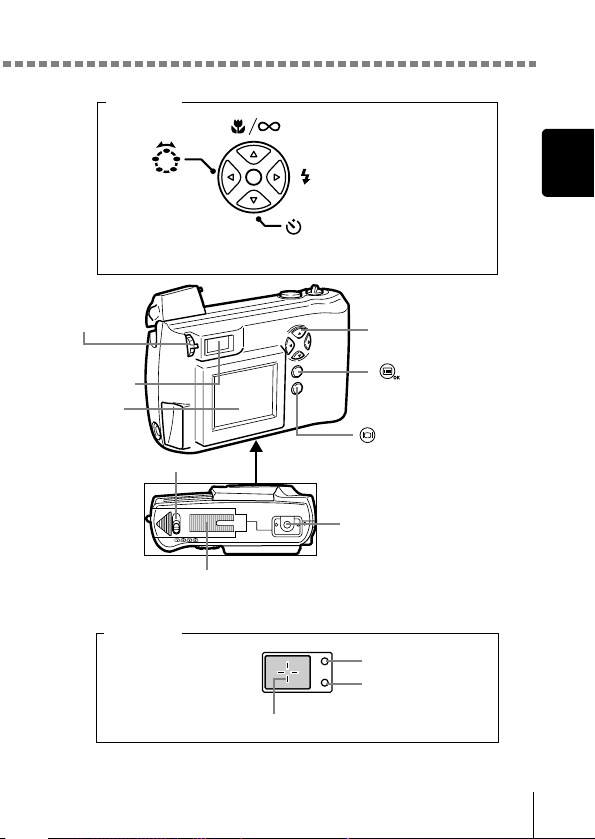
Names of parts
Lens barrier
Turns the camera on
and off in the shooting
mode.
Shutter button
Flash
Pops up when
you open the
lens barrier.
Self-timer lamp
Connector cover
USB connector
DC-IN jack
VIDEO OUT jack
Lens
Extends automatically
when you open the lens
barrier.
Zoom lever
Card cover
Names of parts
Getting started
1
9
(Monitor) button
Turns the camera on and
off in the playback mode.
Turns the monitor on and
off in the shooting mode.
Self-timer button
Monitor
AF button
Battery
compartment cover
Orange lamp
Viewfinder
(OK/Menu)
button
Green lamp
Tripod socket
Battery compartment
lock
Flash mode button
AF target mark
Shooting mode
button
Arrow pad
Viewfinder
Diopter
adjustment
dial
Arrow pad
Getting started
1
10
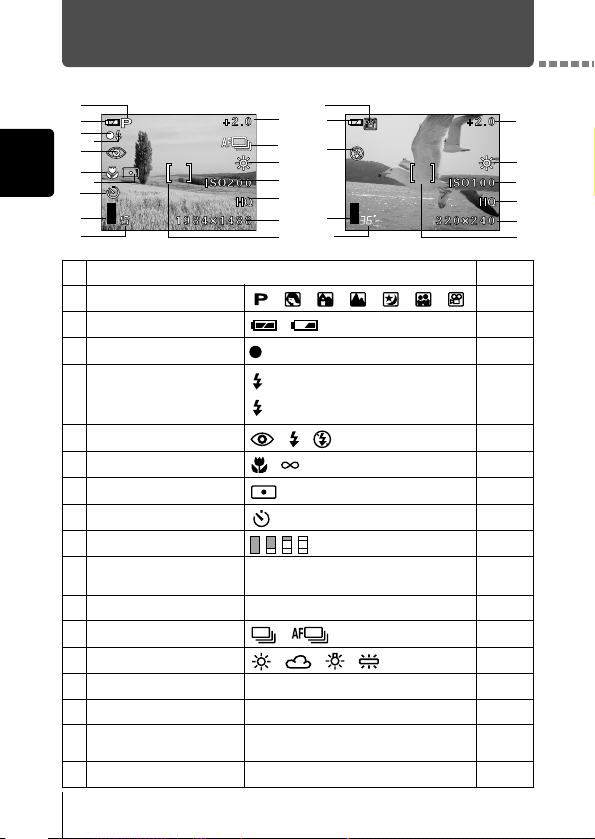
Monitor indications
Shooting mode
Indication Ref. Page
1
Shooting mode , , , , , , p.37
2
Battery check , p.12
3
Green lamp p.41
4
Flash stand-by
(Lights up)
p.41
Camera movement warning/
Flash charge
(Blinks)
5
Flash mode , , p.54
6
AF , p.45,57
7
Spot metering p.61
8
Self-timer p.59
9
Memory gauge p.12
10
Number of storable still
pictures/Seconds remaining
16/16" p.41,49
11
Exposure compensation -2.0, -1.5, -1.0, -0.5, +0.5, +1.0, +1.5, +2.0 p.75
12
Sequential shooting , p.62
13
White balance , , , p.77
14
ISO ISO100, ISO200, ISO400 p.73
15
Record mode 3:2, SHQ, HQ, SQ, TIFF p.68
16
Number of pixels
1984×1488, 1984×1312, 1600×1200,
1280×960, 1024×768, 640×480
p.68
17
AF target mark [ ] p.41
36"
36"
2
1
3
11
13
5
14
15
16
11
13
12
5
6
9
14
16
15
1
Still picture
Movie
2
8
4
7
10
10
9
17
17
Monitor indications
Getting started
1
11
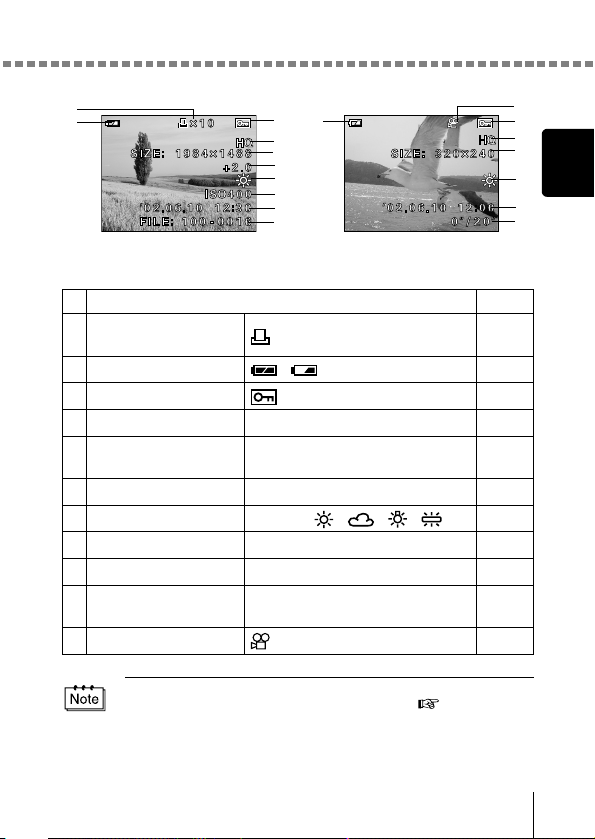
Playback mode
Indication Ref. Page
1
Print reservation,
Number of prints
× 2 p.117
2
Battery check , p.12
3
Protect p.92
4
Record mode 3:2, SHQ, HQ, SQ, TIFF p.68
5
Number of pixels
1984×1488, 1984×1312, 1600×1200,
1280×960, 1024×768, 640×480
p.68
6
Exposure compensation -2.0, -1.5, -1.0, -0.5, +0.5, +1.0, +1.5, +2.0 p.75
7
White balance WB AUTO, , , , p.77
8
ISO ISO100, ISO200, ISO400 p.73
9
Date and time '02.06.10 12:30 p.24
10
File number,
Frame number/Playing time
100-0016
,
0"/20" –
11
Movie mode p.90
You can view shooting information details of the recorded picture in the
playback mode. “Displaying shooting information” ( p.112)
2
1
2
7
9
10
3
5
11
Still picture Movie
3
4
4
5
6
7
8
9
10
Monitor indications
Getting started
1
12
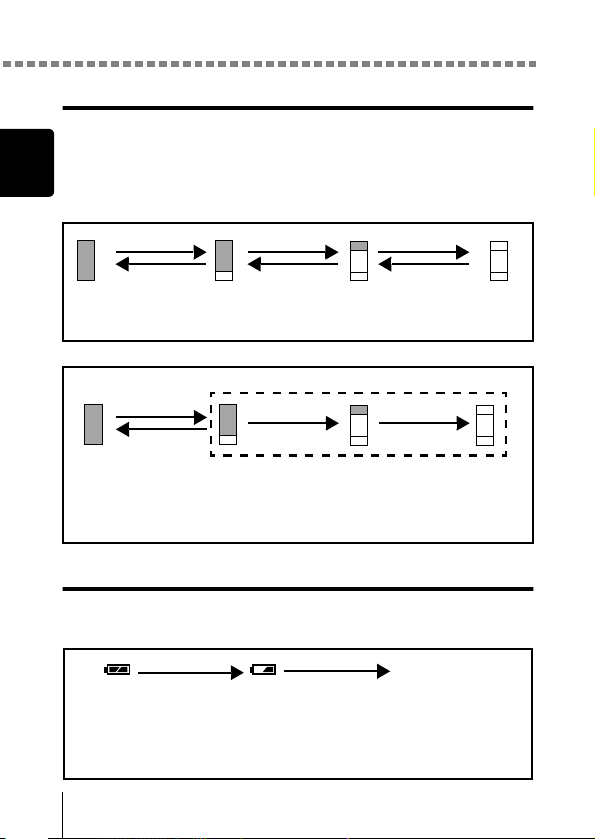
Memory gauge
The memory gauge lights up when you take a picture. While the gauge is lit,
the camera is storing the picture on the card. The memory gauge indication
changes as shown below depending on the shooting status. When the
memory gauge is full, wait a few moments before taking the next shot.
When taking still pictures
When recording movies
Battery check
If the remaining battery power is low, the battery check indication on the
monitor changes as follows while the camera is turned on.
Before
shooting
(Gauge is off)
No more
pictures can be
taken (Fully Lit)
One picture
taken
(Lit)
More than
two taken
(Lit)
Shoot Shoot Shoot
Wait
Before shooting
(Gauge is off)
Shoot
Wait
If you continue shooting
During shooting (Lit)
• Shooting is not possible until the lit area goes off
completely.
• Movie recording ends automatically when the memory
gauge is full.
Lights up (Green) Green lamp and orange
lamp on the right of the
viewfinder blink
Lights up (Red)
No indication
Remaining power level:
exhausted
Replace with a new battery.
Remaining power level: low
Replace with a new battery.
Remaining power
level: high
Getting started
1
13
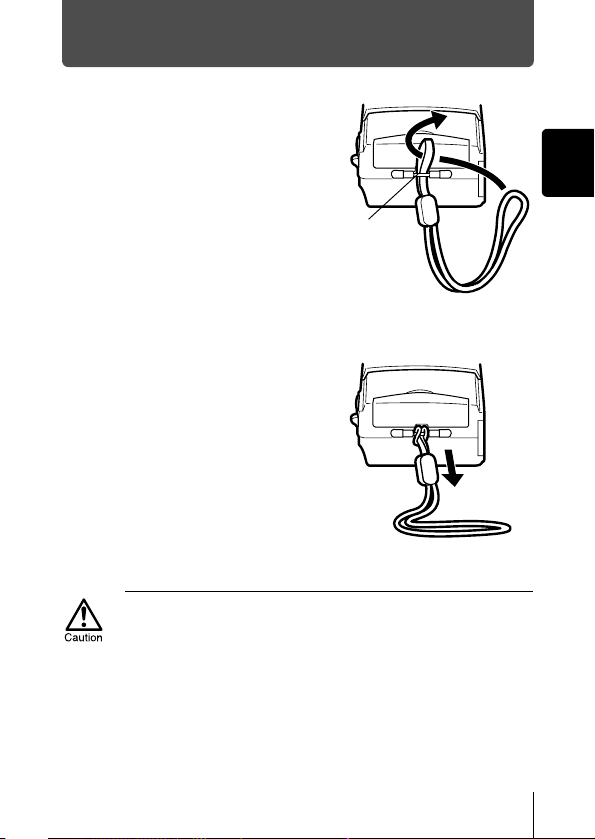
Attaching the strap
1
Thread the short end of the
strap through the strap
eyelet.
2
Thread the long end of the
strap through the loop that
has already gone through the
eyelet.
3
Pull the strap tight, making
sure that it is securely
fastened and does not come
loose.
• Be careful with the strap when you carry the camera, as it can easily
catch on stray objects, causing serious damage.
• Attach the strap correctly as shown above so that the camera does
not fall off. If the strap is attached incorrectly and the camera falls off,
Olympus is not responsible for any damages.
Strap
eyelet
Getting started
1
14
Loading the batteries
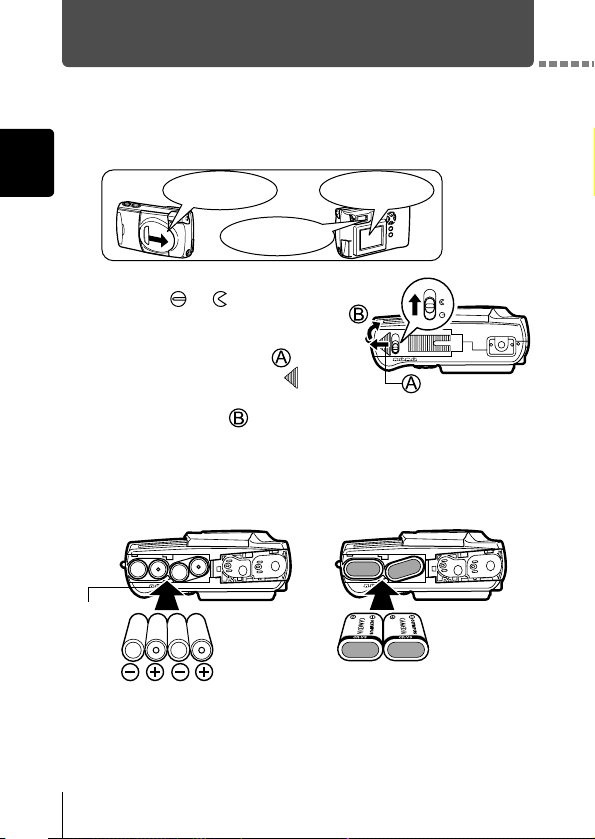
This camera uses two CR-V3 lithium battery packs or four AA (R6) NiMH
batteries, NiCd batteries, alkaline batteries or lithium batteries.
1
Make sure that:
2
Slide the battery compartment
lock from to .
3
Slide the battery compartment
cover in the direction of (the
direction indicated by the
mark on the cover), and lift it up
in the direction of .
4
Insert the batteries, making sure that they are correctly
oriented as shown in the illustration.
The lens barrier
is closed.
The lamp on the right
of the viewfinder is off.
The monitor is
off.
When using AA (R6) batteries When using CR-V3 lithium
battery packs
When using lithium battery
packs, insert them so that the
“CAMEDIA” label on each
battery is facing the lens side of
the camera.
There is a mark showing the
correct way to insert the AA
batteries on the bottom of the
camera.
Battery
insertion
direction
mark
Loading the batteries
Getting started
1
15
5
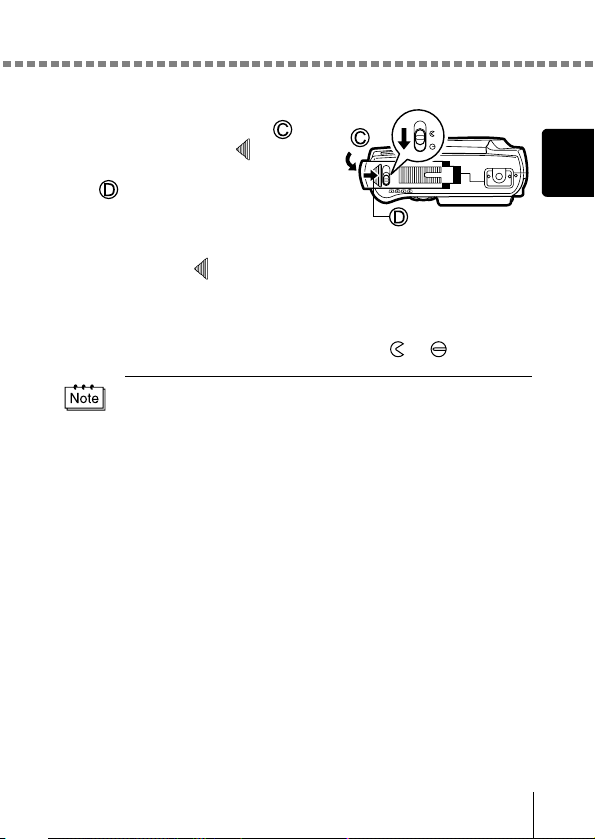
Close the battery compartment
cover in the direction of .
While pressing the mark,
slide the cover in the direction of
.
If the battery compartment cover
seems hard to close, do not force it.
With the battery compartment cover
shut, press the mark firmly and
push in the direction shown in the
illustration.
6
Slide the battery compartment lock from to .
If the camera is left for about 1 hour with the batteries removed, the
date and time settings will revert to the factory default settings.
Loading the batteries
Getting started
1
16
Selecting batteries or the optional AC adapter
In addition to the batteries provided, this camera can use the following types
of battery or AC adapter. You are recommended to choose the power source
best suited to the situation.
CR-V3 lithium battery packs (Not rechargeable)
Since the CR-V3 lithium battery pack has a long service life, it is convenient
when traveling.
Do not peel off the label on a CR-V3 lithium battery pack.
NiMH batteries (Rechargeable)
Olympus NiMH batteries are rechargeable and economical. Their low-
temperature resistance makes them a good choice for cold areas.
AA (R6) alkaline batteries
When you need batteries in a hurry, you can use AA (R6) alkaline batteries,
which are easy to get anywhere. However, the number of pictures that you
can store in the camera may vary considerably with AA batteries, depending
on the battery manufacturer, camera shooting conditions, etc. Turn off the
monitor whenever possible to save power.
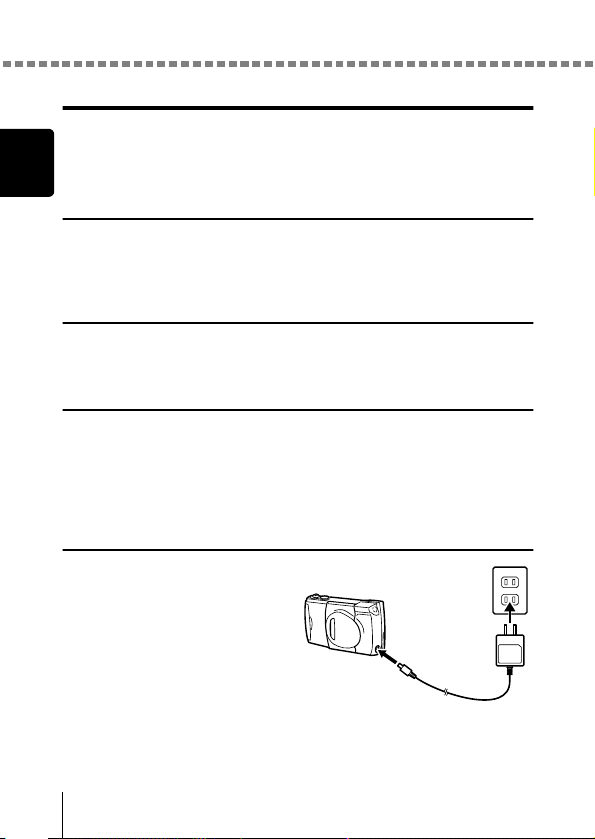
AC adapter
The optional Olympus AC adapter
allows you to power your camera
from a household electrical outlet.
Use an AC adapter designed to
operate on the AC voltage in the
area the camera is being used.
Consult your nearest Olympus
dealer or service center for details.
The power will be drawn from the AC
adapter even if there are batteries in the camera. The batteries in the camera
will not be recharged.
Electrical outlet
Camera
AC adapter
Loading the batteries
Getting started
1
17
• Manganese (zinc-carbon) batteries cannot be used.
• If the batteries become exhausted when the camera is connected to a
PC for a long time while powered by the batteries and you are
downloading images from the camera, the image data may be lost or
damaged. You are therefore recommended to use the optional AC
adapter. However, do not connect or disconnect the AC adapter while
the camera is connected to the PC.
• Do not remove or load the batteries or connect or disconnect the AC
adapter while the camera is turned on. This may affect the camera’s
internal settings or functions.
• The life of battery packs may vary according to the type of battery,
manufacturer, camera shooting conditions, etc.
• Power is consumed continuously during the conditions below. This
could reduce the number of pictures that can be taken.
• When the monitor is turned on.
• When the monitor is in the playback mode for an extended
period of time.
• Repeated zooming of lens.
• Repeated auto-focus by depressing the shutter button halfway.
• When the camera is connected to a PC.
Getting started
1
18
Inserting the card (SmartMedia)
This reference manual uses the term “card” when referring to SmartMedia.
The pictures you have taken are stored on the card.
Card basics
The card corresponds to normal camera film for recording the pictures you
have taken. Pictures recorded and stored on the card can easily be erased,
overwritten, and/or edited on a PC.
The following cards can be used:
• Provided standard card
• Optional Olympus CAMEDIA-brand cards (4 MB - 128 MB)
• Commercially available 3 V (3.3 V) cards (4 MB - 128 MB)
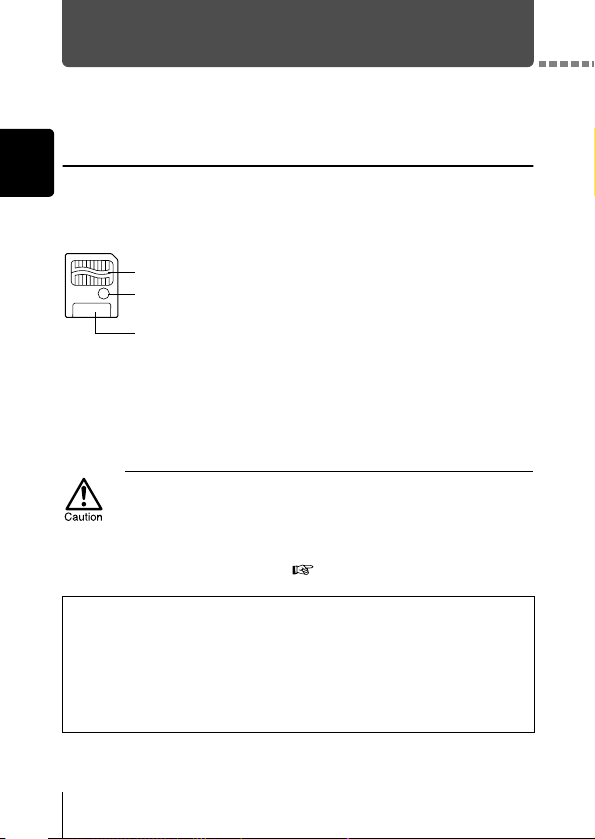
c
Contact area
Comes into contact with the camera’s signal read contacts.
d
Write-protect area
Attach the provided write-protect seal when you want to protect
your data from accidental erasure or overwriting.
e
Index area
Use the provided index label to indicate the card’s contents.
• 2 MB cards cannot be used.
• Commercially available 5 V cards cannot be used.
• This camera may not recognize a non-Olympus card (such as a 3 V
(3.3 V)), or a card that was formatted on another device (such as a
PC, etc.). Before use, be sure to format the card on this camera.
“Formatting (Card setup)” ( p.107)
Handling precautions
• Operating temperature: 0°C to 55°C (32°F to 131°F); Storing temperature:
-20°C to 65°C (-4°F to 149°F); Humidity: up to 95%
• Put the card into its anti-electrostatic case for storage or transportation.
• Do not bend, drop or apply any physical shock to the card.
• Do not touch the contact area of the card.
• Do not reuse the write-protect seal.
• Read the provided SmartMedia instruction manual carefully.
c
d
e
Inserting the card (SmartMedia)
Getting started
1
19
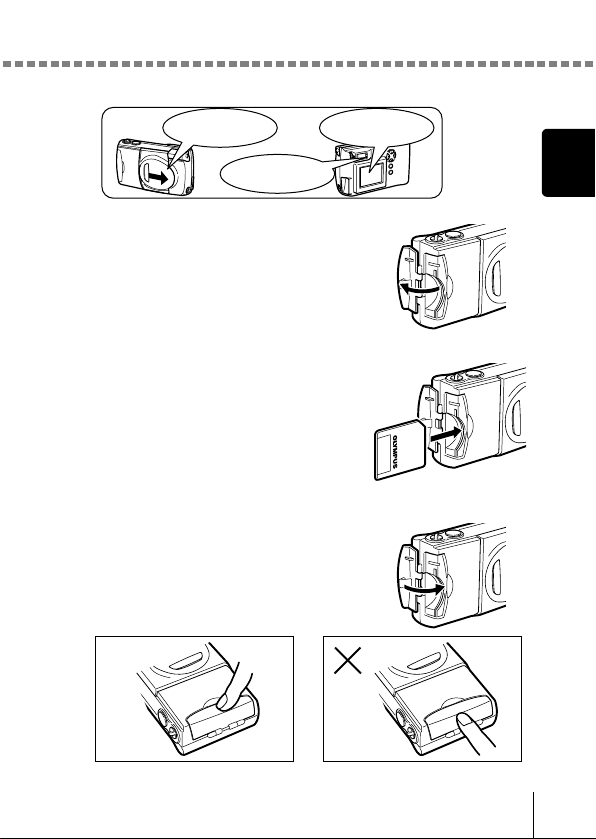
1
Make sure that:
2
Open the card cover.
3
Insert the card as far as it will go in
the direction shown in the
illustration.
There is an arrow inside the card cover,
indicating the direction in which the card
should be inserted.
4
Close the card cover securely until
it clicks.
Press the card cover from the front of the
camera to close. The card cover cannot
be closed by pressing from the side.
The lens barrier
is closed.
The lamp on the right
of the viewfinder is off.
The monitor is
off.
9
Correct Incorrect
Inserting the card (SmartMedia)
Getting started
1
20
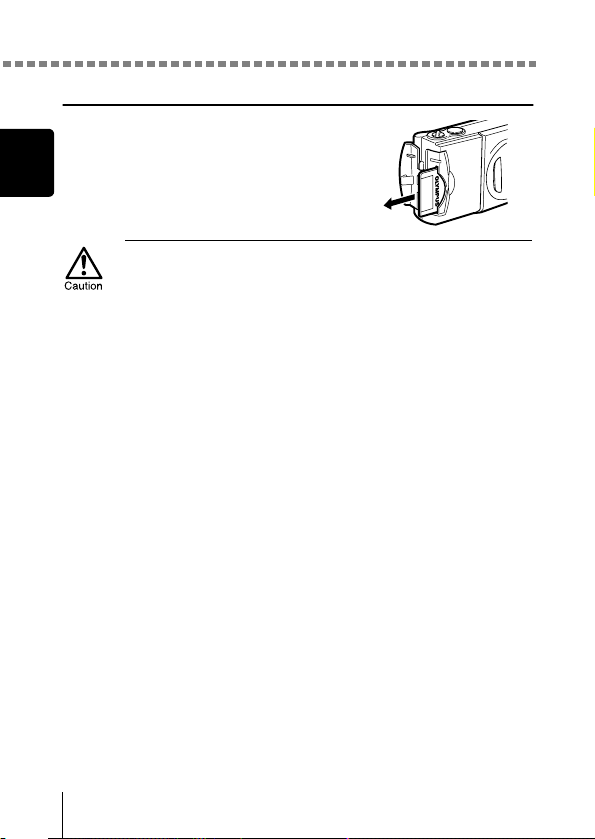
Removing the card
Hold the card with your fingertips and pull it out
in the direction of the arrow.
Never open the card cover, or remove the card or the batteries while
the camera is turned on. Doing so could destroy all data on the card.
Destroyed data cannot be restored.
Getting started
1
21
Turning the power on/off
When shooting pictures
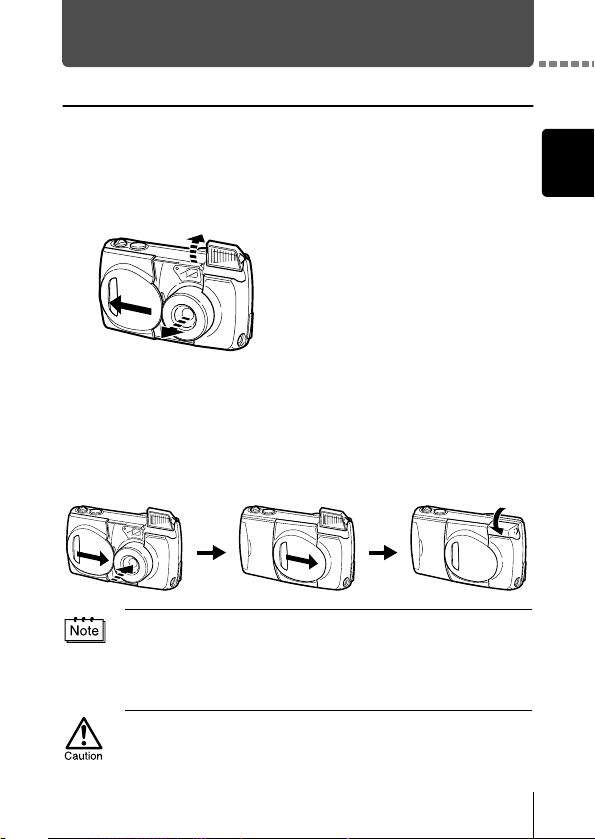
Power on: Open the lens barrier fully.
The camera turns on in the shooting mode. The lens extends
and the flash pops up.
If the lens does not extend when the lens barrier is opened, there
is a possibility that the cover is stuck in the first click position.
Open the lens barrier until it clicks.
Power off: Close the lens barrier slightly until it almost touches the
lens barrel.
The lens barrier stops just before it touches the lens and the lens
retracts. Wait until the lens is fully retracted before closing the
lens barrier completely.
The camera turns off. (The monitor also turns off.)
Press the flash down until it locks into place to close it.
To save battery power, the camera automatically enters the sleep mode
after about 3 minutes of non-operation. If the monitor is on, it will
automatically turn off. The camera activates again as soon as you
lightly press the shutter button or zoom lever. Whenever possible, turn
the camera off when you do not intend to take any pictures for a while.
Do not push the lens barrier forcefully against the lens as this may
damage the lens or cause it to malfunction.
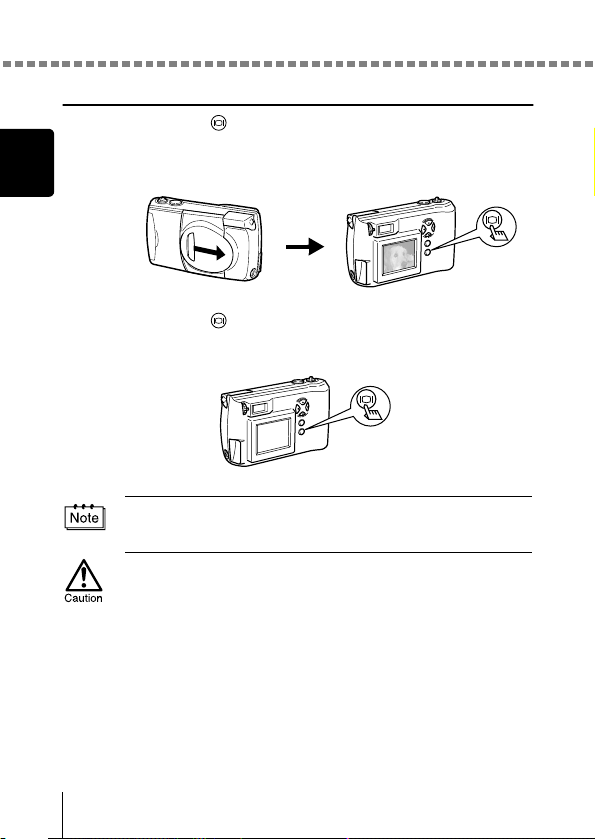
Turning the power on/off
Getting started
1
22
When playing back pictures
Power on: Press the (monitor) button with the lens barrier closed.
The camera turns on in the playback mode. The monitor turns
on and the last picture taken is displayed.
Power off: Press the (monitor) button.
The monitor and the camera turn off.
When the camera turns on, the monitor may light up for an instant and
a picture appear after a short time. This is not a malfunction.
Never open the card cover, remove the card or the batteries, or connect
or disconnect the AC adapter while the camera is turned on. Doing so
could destroy all data on the card. Destroyed data cannot be restored.
When changing the card, be sure to turn the camera off before opening
the card cover.
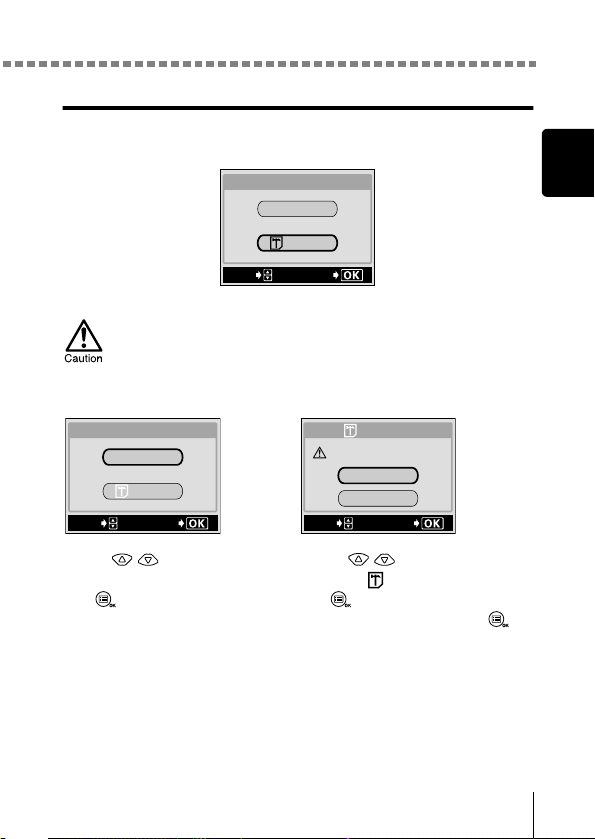
Turning the power on/off
Getting started
1
23
What to do if the CARD SETUP screen is displayed
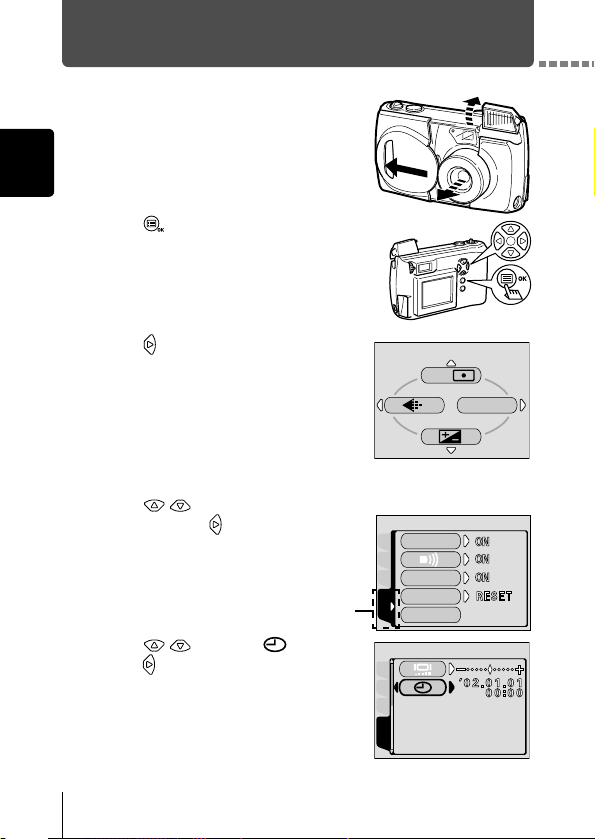
When the power is turned on, the camera checks the card automatically. If the
card in the camera has to be formatted, the following screen appears.
Note that all existing data stored on the card is erased when the
card is formatted.
To turn the camera off To format the card
Press on the arrow pad to
select POWER OFF, then press
the (OK/Menu) button.
The camera turns off.
Press on the arrow pad
to select FORMAT and press
the (OK/Menu) button.
Then select YES and press
again to start formatting.
Formatting starts. If the card was
successfully formatted, the camera
is ready to take pictures.
POWER%OFF
FORMAt
CARD%SEtUP
SELECt
GO
POWER%OFF
FORMAt
CARD%SEtUP
SELECt
GO
YES
NO
CAUtION ERASING%ALL
SELECt
GO
FORMAt
Getting started
1
24
Setting the date and time
1
Open the lens barrier fully.
2
Press .
The shooting mode top menu is displayed.
3
Press on the arrow pad to select
MODE MENU.
4
Press to select the SETUP
tab, then press .
5
Press to select , then
press .
The green frame moves to the selected
item.
MODE MENU
ESP/
Top menu
CARD
SEtUP
CAM
PIC
ALL RESEt
REC VIEW
FILE NAME
PIXEL MAPPING
SETUP tab
CARD
SEtUP
CAM
PIC
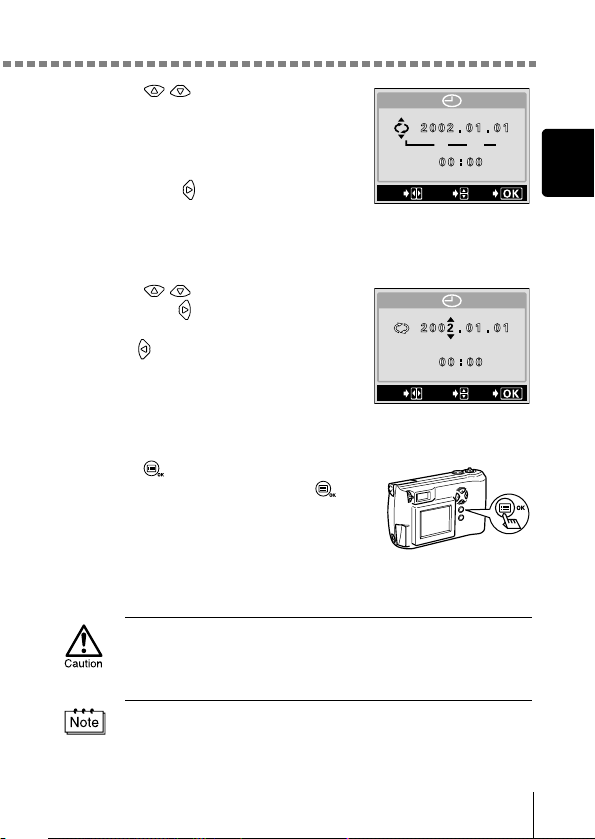
Setting the date and time
Getting started
1
25
6
Press to select one of the
following date formats:
Y-M-D (Year/Month/Day)
M-D-Y (Month/Day/Year)
D-M-Y (Day/Month/Year)
Then press .
The cursor moves to the next setting field.
The following steps show the procedure used when the date and time
settings are set to Y-M-D.
7
Press to set the first field,
then press to move to the next
field.
Press to move back to the previous
setting field.
The first two digits of the “Y” are fixed.
8
Repeat the above steps until the date
and time are completely set.
9
Press .
For a more accurate setting, press
when the clock hits 00 seconds. The clock
starts when you press the button.
10
Close the lens barrier.
The camera turns off.
If the camera is left for about 1 hour with the batteries removed, or if the
battery power is exhausted, the date and time settings may be
canceled or become incorrect. Before taking important pictures, check
that the date and time settings are correct.
The date and time can also be set by the same procedure in the
playback mode.
Y M D
SELECt
GO
SEt
SELECt
GO
SEt
Getting started
1
26
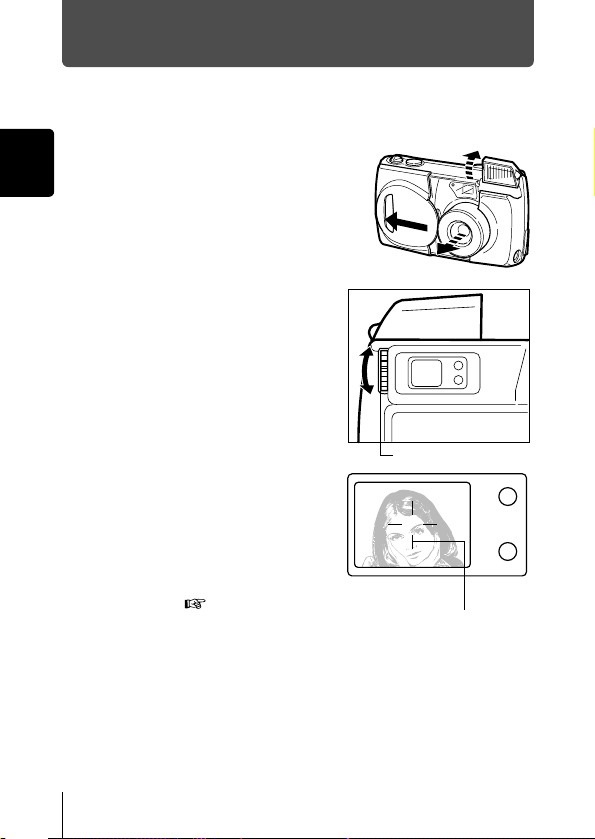
Adjusting the viewfinder
To make the camera easier to use, adjust the viewfinder to match the eyesight
(visual acuity) of the person who will be using the camera.
1
Open the lens barrier fully.
The flash pops up and the lens extends.
2
While looking through the
viewfinder, slowly turn the
diopter adjustment dial.
3
Stop turning the dial when the AF
target mark is clearly visible.
You are ready to take pictures. “Taking
still pictures” ( p.40)
Diopter adjustment dial
AF target mark
Viewfinder
Getting started
1
27
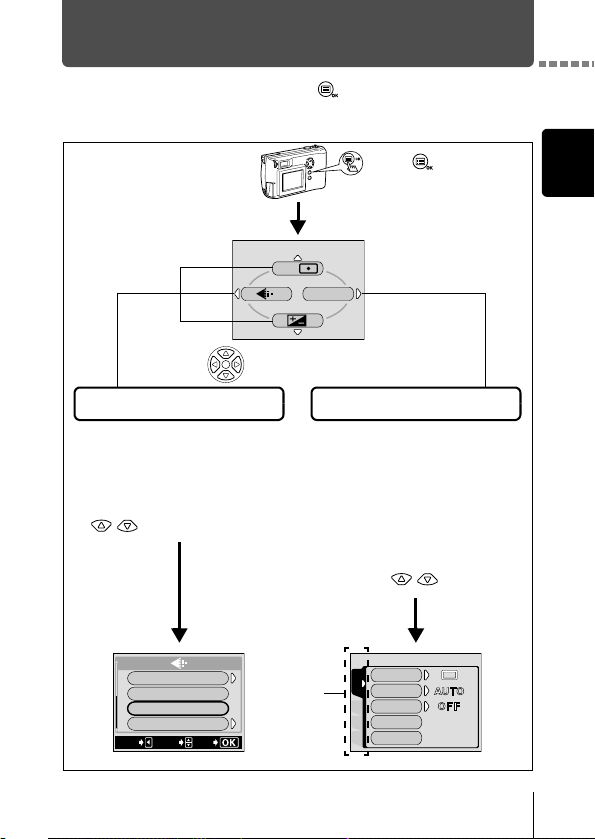
Using the menus and tabs
When you turn on the camera and press , the top menu is displayed on
the monitor. The functions of this camera are set from the menus. This
chapter explains how the menus work, using the shooting mode screens.
MODE MENU
ESP/
CARDSEt PIC
CAMERA
DRIVE
ISO
DIGItAL ZOOM
PANORAMA
2 IN 1
SHQ 1984*1488
3:2 1984*1312
HQ 1984*1488
SQ 1024*768
CANCEL
GO
SELECt
Shortcut Menus
• Let you quickly access the most
frequently used menu settings.
• Display operational buttons at
the bottom of the screen, and let
you select items by pressing
.
Mode Menu
• Lets you access the menu
selections to set the ISO
sensitivity, white balance, etc.
• Categorizes the settings into 4
tabs.
• Displays the CAMERA, PICTURE,
CARD and SETUP tabs. Select the
desired tab on the left of the screen
by pressing .
Select each menu using
the arrow pad.
Press .
The top menu is displayed.
Tabs
Using the menus and tabs
Getting started
1
28
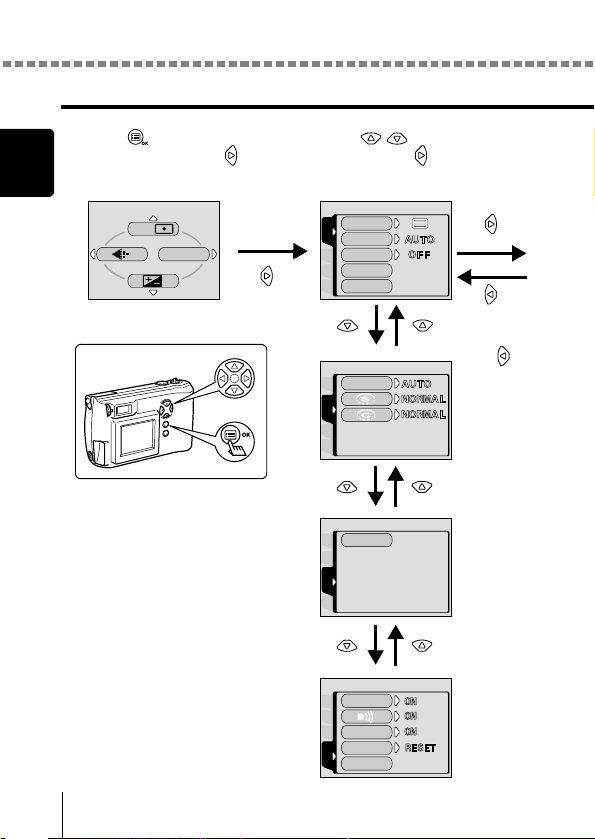
How to use the menus
SEt
CAM
PIC
CARD
CARD%SEtUP
MODE MENU
ESP/
CARD
SEtUP
CAM
PIC
ALL RESEt
REC VIEW
FILE NAME
PIXEL MAPPING
CARDSEt PIC
CAMERA
DRIVE
ISO
DIGItAL ZOOM
PANORAMA
2 IN 1
CARDSEt
CAM
PICtURE
WB
1
Press to display the
top menu, then press .
Top menu CAMERA tab
PICTURE tab
2
Press to select a
tab, then press to
display the menu.
To return to
select a tab,
press .
SETUP tab
CARD tab
Using the menus and tabs
Getting started
1
29
• Not all items can be selected depending on the status of the camera
and the settings performed. For example, when the movie mode is
selected, you cannot select SEPIA, BLACK&WHITE or in the
EDIT tab category.
• By pressing the shutter button to take a picture while the menu is
displayed, you can take pictures with the currently selected settings.
• If you want to save the settings after the camera is turned off, set ALL
RESET to OFF.
CARDSEt PIC
CAMERA
DRIVE
ISO
DIGItAL ZOOM
PANORAMA
2 IN 1
CARDSEt PIC
CAMERA
DRIVE
ISO
DIGItAL ZOOM
PANORAMA
2 IN 1
200
400
100
CARDSEt PIC
CAMERA
DRIVE
ISO
DIGItAL ZOOM
PANORAMA
2 IN 1
AUtO
200
400
100
CARDSEt PIC
CAMERA
DRIVE
ISO
DIGItAL ZOOM
PANORAMA
2 IN 1
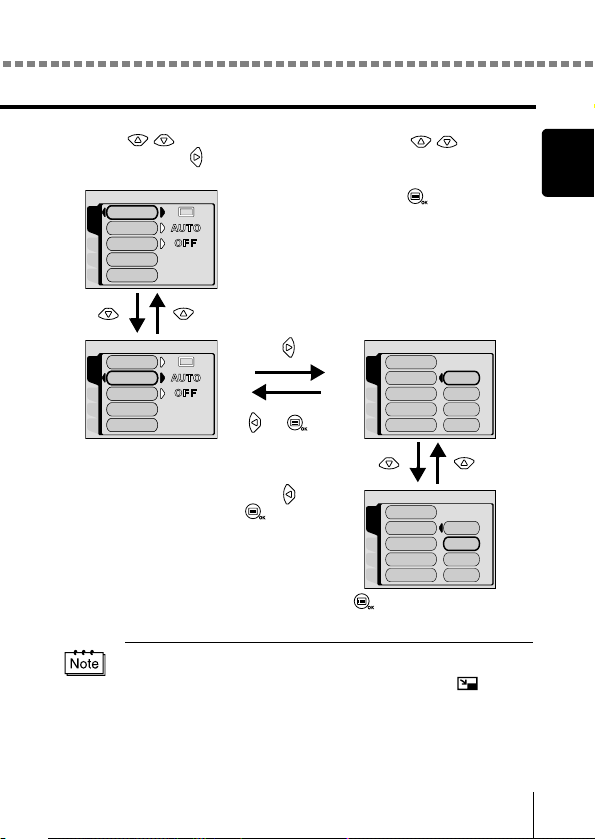
AUtO
4
Press to select
the setting.
To complete setting,
press .
The green frame
moves to the selected
item.
Press to complete setting, and
press again to close the menu.
or
3
Press to select the desired
item, then press to display the
available setting selections.
To return to
select an item,
press or
.
Using the menus and tabs
Getting started
1
30
Shortcut menus
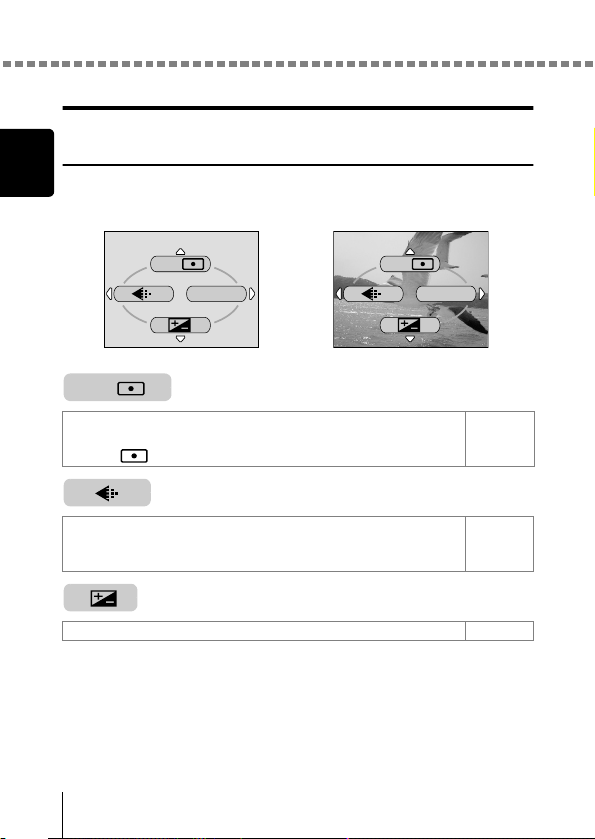
Shooting mode
Selects the area of the image that will be used to determine
exposure or image brightness from the two available settings:
ESP or (spot metering).
p.61
Selects the resolution and the quality of the image.
Still picture : 3:2, SHQ, HQ, SQ, TIFF
Movie : HQ, SQ
p.68
Adjusts the brightness of the image (Exposure compensation). p.75
MODE MENU
ESP/
MODE MENU
ESP/
When the still picture
shooting mode is selected
When the movie recording
mode is selected
ESP/
Using the menus and tabs
Getting started
1
31
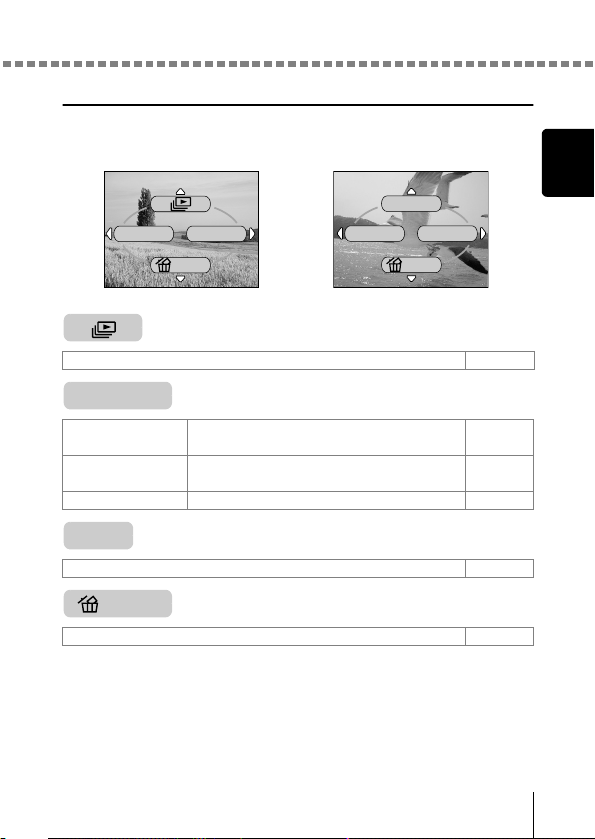
Playback mode
Displays all recorded pictures in slideshow fashion. p.87
MOVIE
PLAYBACK
Plays back a movie. p.90
INDEX
Creates an index picture of a movie in 9
frames.
p.102
EDIT Edits a movie. p.104
Displays all the shooting information on the monitor. p.112
Erases a selected picture. p.94
MODE%MENU
INFO
ERASE
MODE%MENU
MOVIE%PLAY
INFO
ERASE
When a still picture is
played back
When a movie is
played back
MOVIE PLAY
INFO
ERASE
Using the menus and tabs
Getting started
1
32
Mode menus
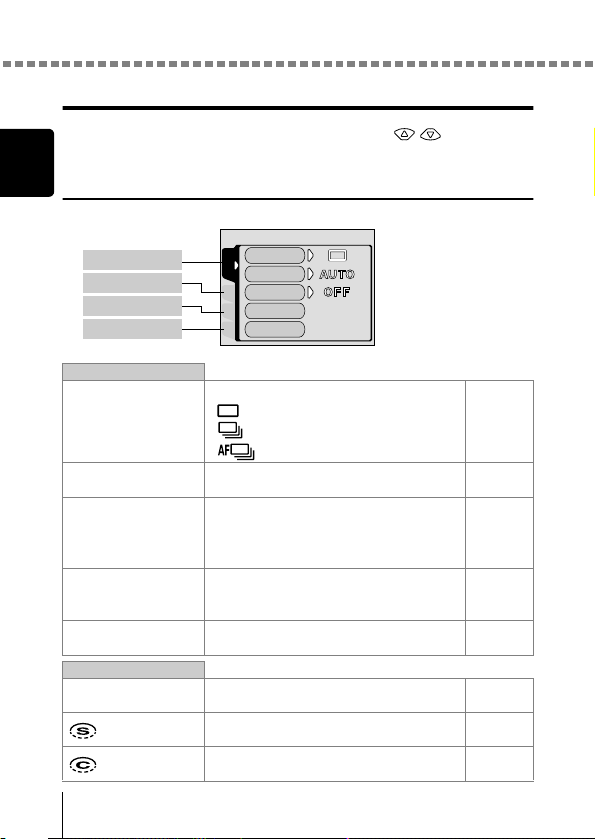
Mode menu functions are categorized into 4 tabs. Use to select a tab
and display the respective functions.
Shooting mode
CAMERA tab
DRIVE
Selects the shooting mode from
(Normal shooting),
(Sequential shooting),
(AF Sequential shooting).
p.62
ISO
Selects the ISO sensitivity from AUTO,
100, 200, 400.
p.73
DIGITAL ZOOM
Extends the maximum optical zoom,
making possible up to approximately 10x
zoom shooting with the digital zoom
function.
p.52
PANORAMA
Allows panorama pictures to be taken
with Olympus CAMEDIA-brand
SmartMedia cards.
p.64
2 IN 1
Lets you combine two still pictures taken
in succession into one picture.
p.66
PICTURE tab
WB
Sets the appropriate white balance
according to the light source.
p.77
Adjusts the sharpness of images. p.79
Adjusts the contrast of images. p.81
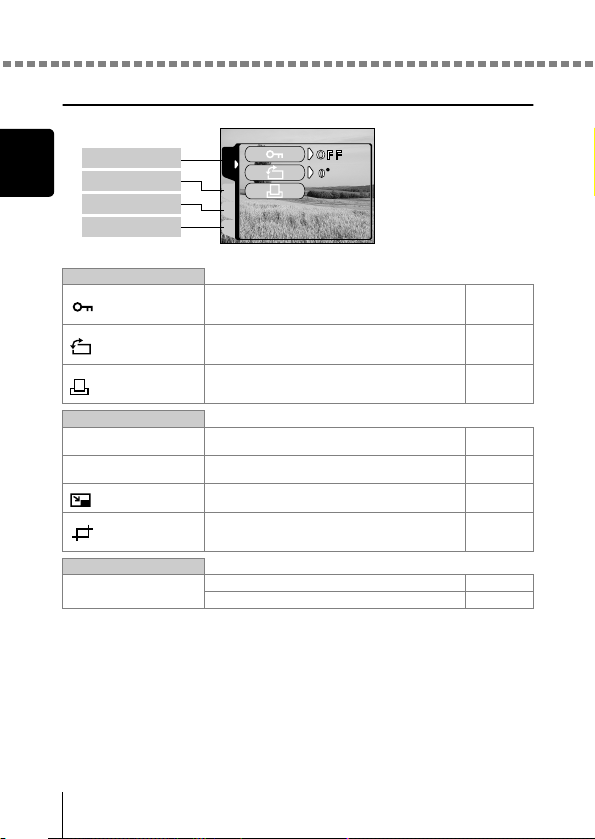
CARDSEt PIC
CAMERA
DRIVE
ISO
DIGItAL ZOOM
PANORAMA
2 IN 1
CAMERA tab
PICTURE tab
CARD tab
SETUP tab
Using the menus and tabs
Getting started
1
33
CARD tab
CARD SETUP Formats a card. p.107
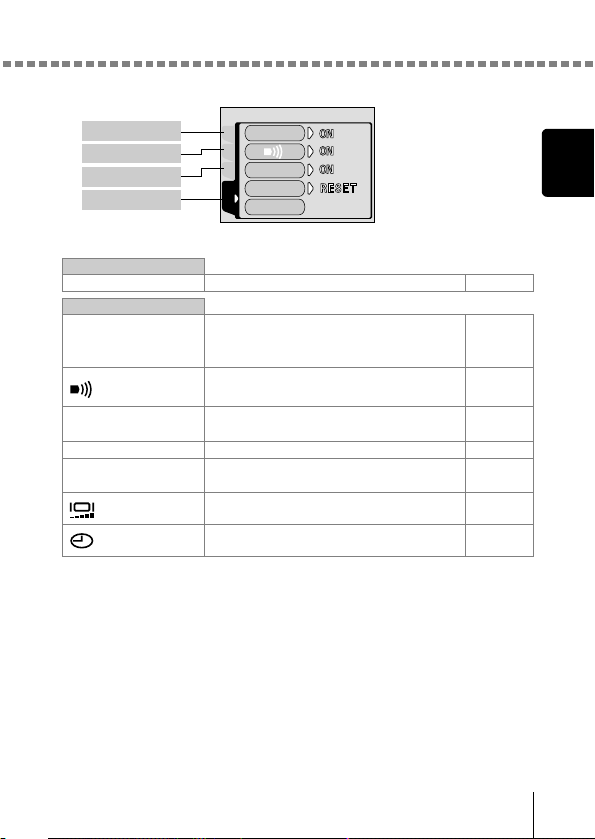
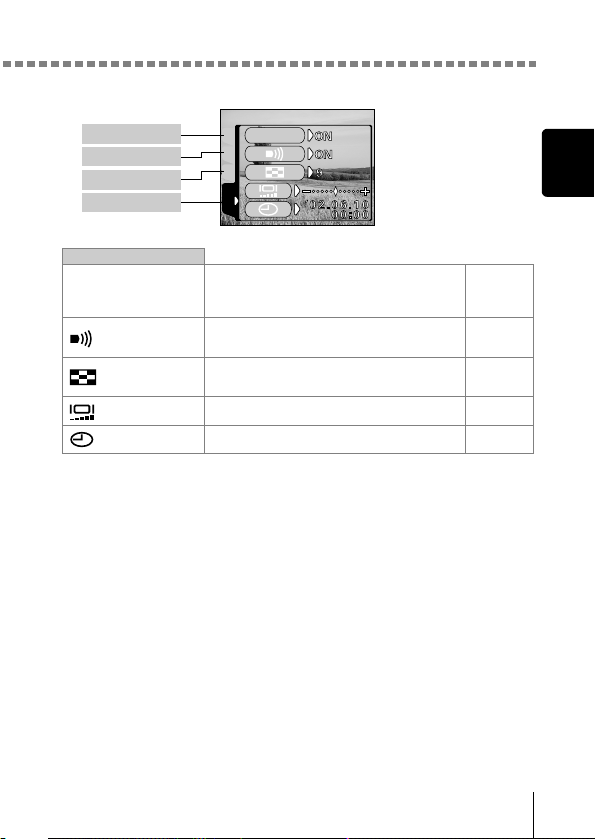
SETUP tab
ALL RESET
Selects whether to save the current
camera settings when you turn off the
power.
p.110
Turns the beep sound (used for
warnings, etc.) on and off.
p.106
REC VIEW
Selects whether to display pictures on
the monitor while saving them.
p.109
FILE NAME Changes how file names are assigned. p.114
PIXEL MAPPING
Checks the CCD and image processing
functions.
p.116
Adjusts the brightness of the monitor. p.113
Sets the date and time. p.24
CARD
SEtUP
CAM
PIC
ALL RESEt
REC VIEW
FILE NAME
PIXEL MAPPING
CAMERA tab
PICTURE tab
CARD tab
SETUP tab
Using the menus and tabs
Getting started
1
34
Playback mode
PLAY tab
Protects pictures from accidental
erasure.
p.92
Rotates pictures 90 degrees clockwise
or counterclockwise.
p.89
Stores printing information required for
DPOF printers on the card.
p.117
EDIT tab
BLACK & WHITE Creates black and white pictures. p.96
SEPIA Creates sepia-toned pictures. p.97
Makes the file size smaller. p.98
Creates a cropped picture from the
enlarged part of a picture.
p.99
CARD tab
CARD SETUP
Formats a card. p.107
Erases all image data stored on the card. p.95
CARDSEt EDIt
PLAY
PLAY tab
EDIT tab
CARD tab
SETUP tab
Using the menus and tabs
Getting started
1
35
SETUP tab
ALL RESET
Selects whether to save the current
camera settings when you turn off the
power.
p.110
Turns the beep sound (used for
warnings, etc.) on and off.
p.106
Selects the number of frames in the
index display.
p.86
Adjusts the brightness of the monitor. p.113
Sets the date and time. p.24
PLAYEDItCARD
ALL%RESEt
SEtUP
PLAY tab
EDIT tab
CARD tab
SETUP tab
Shooting basics
2
36
Chapter 2
Shooting basics
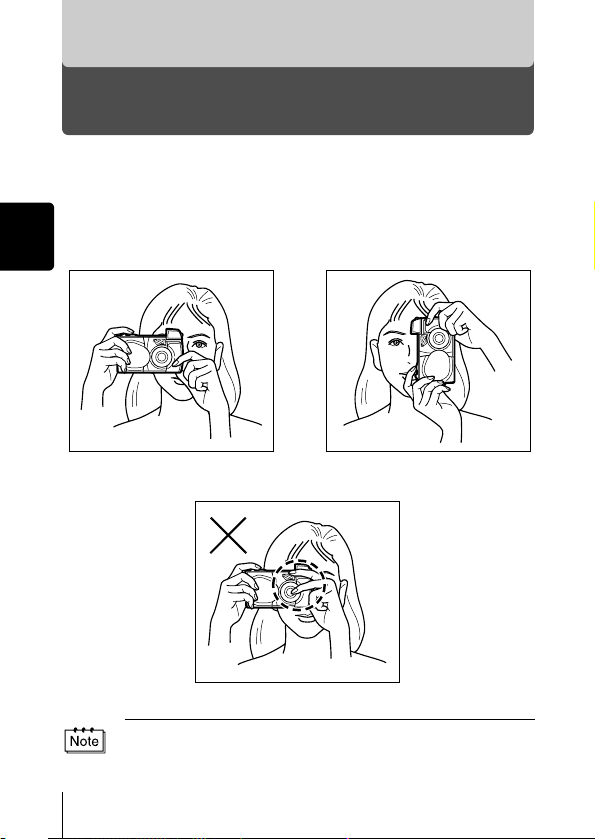
Holding the camera
Hold the camera firmly with both hands while keeping your elbows at your
sides to prevent the camera from moving.
When taking pictures in the vertical position, hold the camera so that the flash
is at the top.
Correct grip:
Incorrect grip:
Keep your fingers and the strap away from the lens and flash.
Clear images cannot be obtained if the camera moves as the shutter
button is pressed. Hold the camera correctly, and press the shutter
button gently.
9
9
Horizontal grip Vertical grip
Shooting basics
2
37
Shooting modes
There are seven modes from which you can choose depending on the
shooting conditions and the effect you want to achieve. The contrast,
sharpness, etc. are set in the optimal condition for each mode. The shooting
modes can be combined with the various setting selections in the Shortcut
Menus and Mode Menu.
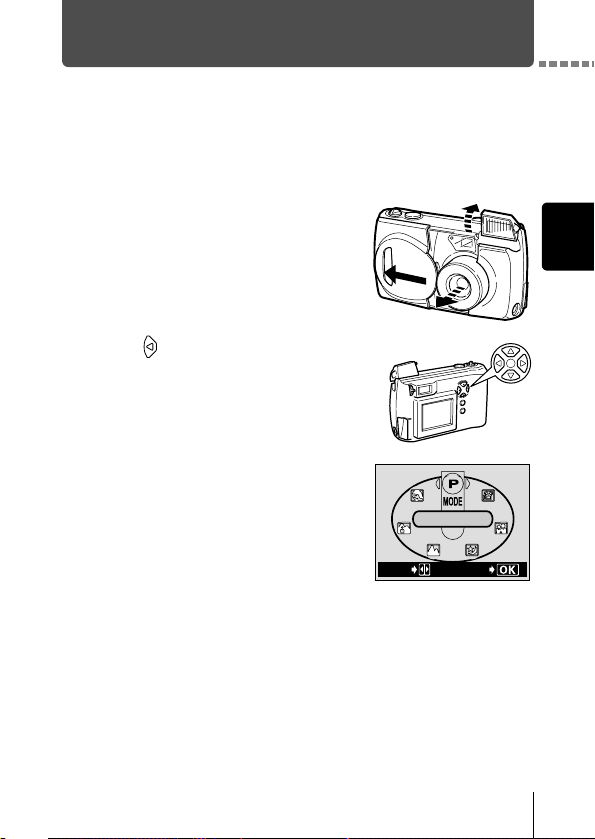
1
Open the lens barrier fully.
The camera turns on in the shooting
mode.
2
Press .
The monitor turns on and the screen for
selecting the shooting mode (virtual dial) is
displayed.
PROGRAM
AUtO
SELECt
GO
Virtual dial screen
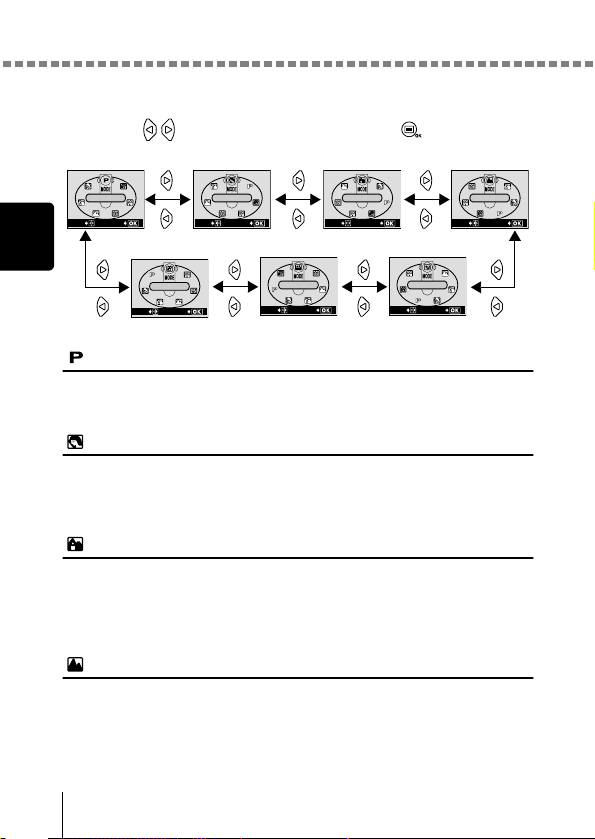
Shooting modes
Shooting basics
2
38
3
Select the mode best suited to your purpose from the
following.
Press to select the mode, then press to execute the
setting.
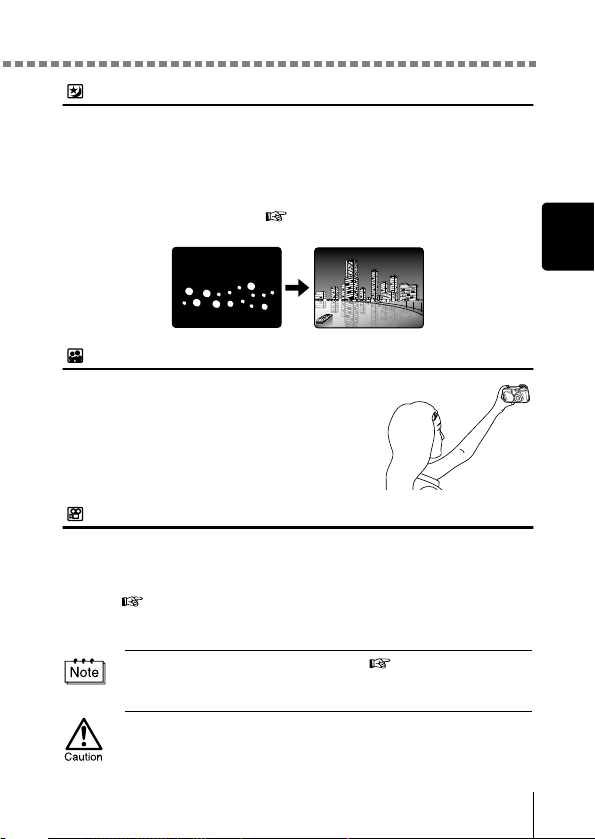
PROGRAM AUTO (Factory default setting)
When taking still pictures, the camera adjusts the flash, metering and other
functions to the chosen settings.
PORTRAIT
Suitable for taking a portrait-style shot of a person. This mode features an in-
focus subject against a blurred background. The camera automatically sets
the optimal shooting conditions.
LANDSCAPE - PORTRAIT
Suitable for taking photos of both your subject and the background. The
picture is taken with the background as well as the subject in the foreground
in focus. You can take photos of your subject against a beautiful sky or
landscape. The camera automatically sets the optimal shooting conditions.
LANDSCAPE
Suitable for taking photos of landscapes and other outdoor scenes. The
camera focuses on a distant tree or mountain to produce a clear picture.
Since blues and greens are vividly reproduced in this mode, the landscape
mode is excellent for shooting natural scenery. The camera automatically
sets the optimal shooting conditions.
PROGRAM
AUtO
SELECt
GO
PORtRAIt
SELECt
GO
SELECt
GO
LANDSCAPE
+
POR
t
RAI
t
LANDSCAPE
SELECt
GO
MOVIE
SELECt
GO
SELF
PORtRAIt
SELECt
GO
NIGHt
SCENE
SELECt
GO
Shooting modes
Shooting basics
2
39
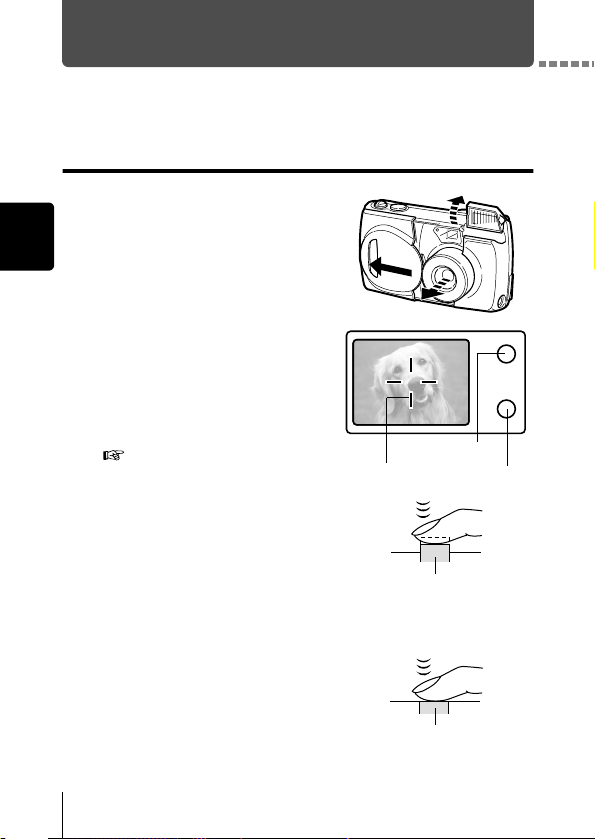
NIGHT SCENE
Suitable for shooting pictures in the evening or at night. The camera sets a
slower shutter speed than is used in normal shooting. If you take a picture of
a street at night in any other mode, the lack of brightness will result in a dark
picture with only dots of light showing. In this mode, the true appearance of
the street is captured. The camera automatically sets the optimal shooting
conditions. “Night scene mode” ( p.47)
SELF PORTRAIT
Enables you to take a picture of yourself while
holding the camera. Point the lens towards
yourself and the focus will be locked on you. The
camera automatically sets the optimal shooting
conditions. The zoom is fixed in the Wide position
and cannot be changed.
MOVIE
Lets you record movies. The camera maintains the correct focus and
exposure even if your subject moves or the distance between your subject
and the camera changes. You cannot record movies with sound. “Recording
movies” ( p.49)
Refer to “List of items by shooting mode” ( p.139) for details of the
settings for each mode.
• Sequential shooting and AF Sequential shooting are not available in
Night Scene mode.
• The digital zoom and panorama shooting are not available in Self-
Portrait mode.
Shooting basics
2
40
Taking still pictures
You can take still pictures using either the viewfinder or the monitor. Both
methods are easy as all you have to do is to press the shutter button.
Taking still pictures using the viewfinder
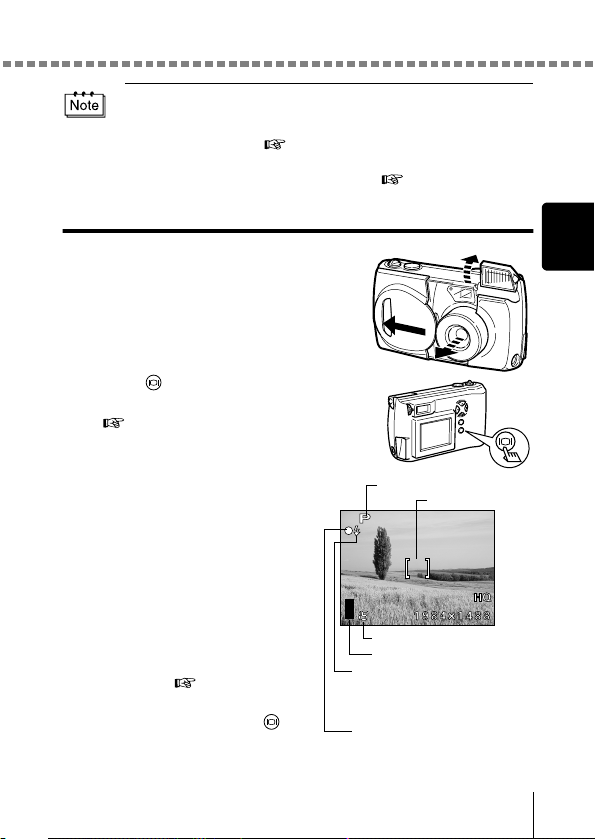
1
Open the lens barrier fully.
Slide the lens barrier fully open until it
clicks.
The flash pops up and the lens
extends.
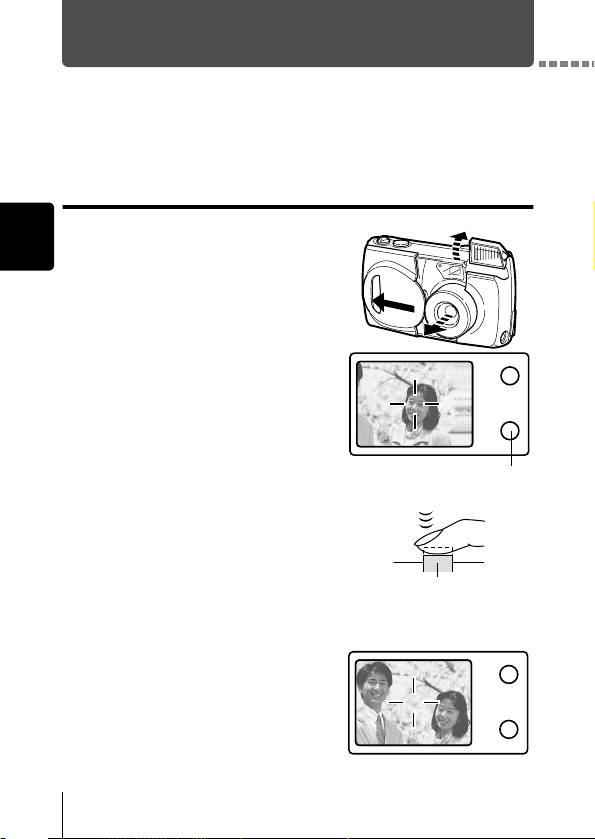
2
Position the AF target mark over
the subject in the viewfinder.
When the distance from the camera
to the subject is less than 0.8 m/2.6
ft, select the macro mode. “Taking
close-up pictures (Macro mode)”
( p.57)
3
Press the shutter button gently
(halfway).
The focus and exposure are locked
when the green lamp on the right of
the viewfinder lights up. At this time
the sound of the focusing mechanism
can be heard from inside the camera, but no picture is being taken.
4
Press the shutter button all the
way (fully).
The camera takes the picture.
AF target mark
Orange lamp
Green lamp
Shutter button
Shutter button
Taking still pictures
Shooting basics
2
41
Taking still pictures using the monitor
1
Open the lens barrier fully.
Slide the lens barrier fully open until it
clicks.
The flash pops up and the lens extends.
2
Press .
The monitor turns on. “Monitor indications”
( p.10)
3
Determine the image
composition while observing
your subject on the monitor.
4
Take the picture by following
the same procedure as for
shooting using the viewfinder.
Press the shutter button all the way
(fully) to take the picture.
“Taking still pictures using the
viewfinder” ( p.40)
When you want to take pictures
with the monitor off, press
again.
• While the green lamp is blinking, the subject cannot be brought into
focus. Remove your finger from the shutter button, re-position your
subject and half-press the shutter button again. “If correct focus
cannot be obtained” ( p.44)
• When the camera is too close to the subject, the green lamp blinks.
“Taking close-up pictures (Macro mode)” ( p.57)
Shooting mode (p.37)
AF target mark (p.10)
No. of storable still pictures (p.69)
Memory gauge (p.12)
Flash stand-by/Flash charge (p.10)
This indicates the same status as
the orange lamp on the right of the
viewfinder.
Green lamp (p.10)
This indicates the same status as
the green lamp on the right of the
viewfinder.
Taking still pictures
Shooting basics
2
42
• While the orange lamp is blinking slowly after the shutter button is
pressed halfway, the flash is charging. While the orange lamp is
blinking quickly after shooting, the picture you just took is being
stored. Wait until the lamps go off to take another picture.
• If the memory gauge is fully lit, you cannot take any pictures. Wait a
few seconds until the memory gauge goes off to take another picture.
“Memory gauge” ( p.12)
• The monitor is used for checking the image composition. Camera
movement, the correct focus and exposure condition of the recorded
picture should be checked by close-up playback. “Close-up playback”
( p.84)
• Press the shutter button gently using the ball of your finger. If it is
pressed hard, the camera may move and pictures may come out
blurred.
• Never open the card cover, remove the batteries or disconnect the
AC adapter while the orange lamp is blinking. Doing so could destroy
stored pictures and prevent storage of pictures you have just taken.
Taking still pictures
Shooting basics
2
43
Comparison of the viewfinder & monitor
Viewfinder Monitor
Advantages Camera movement does
not occur easily and
subjects can be seen clearly
even in bright places.
Little battery power is used.
You can check the picture
area that the camera
actually records more
accurately.
Disadvantages When close to a subject, the
image in the viewfinder is a
little different from the
picture that the camera
actually records.
Camera movement can
occur easily and subjects
may be difficult to see in
bright/dark places. The
monitor uses more battery
power than the viewfinder.
Tips Use the viewfinder for
general snapshots
(landscape pictures, casual
shots, etc.) or when taking
several pictures in a row
(approx. 0.8 m/2.6 ft – ).
Use the monitor when you
need to know the exact
area the camera records, or
when you want to shoot a
close subject such as a
close-up portrait or flower
(approx. 0.2 m - 0.8 m/0.7 ft
- 2.6 ft).
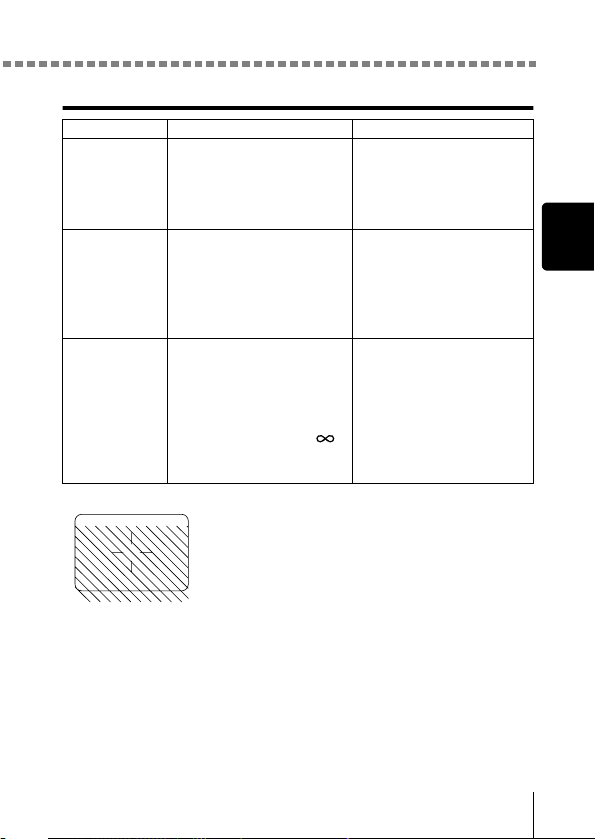
• The camera records a wider area than the image in the
viewfinder.
• As you get closer to the subject, the actual image
recorded becomes lower than the one in the viewfinder
(see left).
Shooting basics
2
44
If correct focus cannot be obtained
When the subject you want to focus on is not in the center of the frame and
you cannot position the AF target mark on it, you can focus the camera on
another point at roughly the same distance (focus lock) and take the picture
as explained below.
Determine the position of the subject after focusing (Focus Lock)
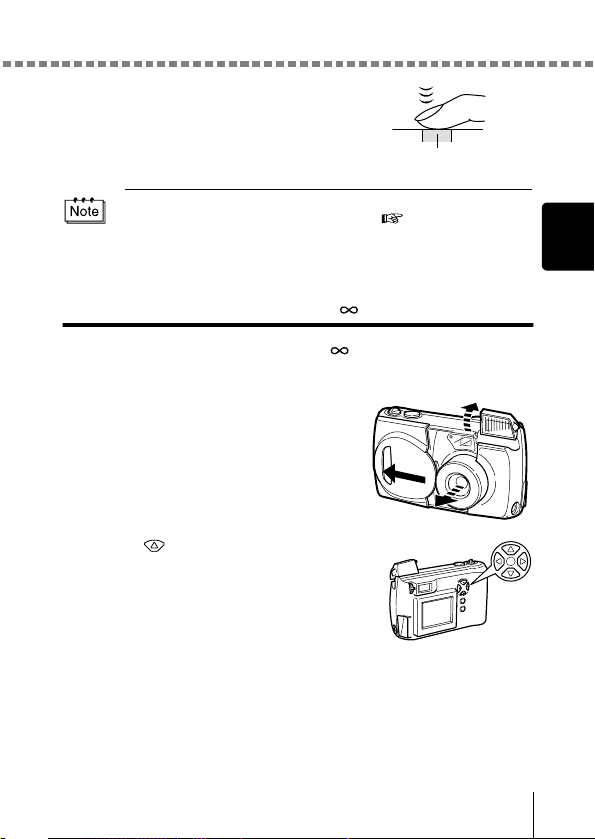
1
Open the lens barrier fully.
The camera turns on in the shooting
mode.
2
Look into the viewfinder and
position the AF target mark over
the subject.
When shooting a hard-to-focus subject
or a fast-moving subject, point the
camera at an object about the same
distance away as the subject.
3
Half-press the shutter button
until the green lamp on the right
of the viewfinder illuminates
steady.
The focus and exposure are locked
when the green lamp lights up.
4
Keeping the shutter button
pressed halfway, recompose
your shot in the viewfinder.
Green lamp
Viewfinder
Shutter button
If correct focus cannot be obtained
Shooting basics
2
45
5
Press the shutter button fully.
Focusing on distant subjects ( Quick Focus)
The lens can be set for far-distance focus ( ). Use this function when it is
difficult to focus on a subject in the distance.
1
Open the lens barrier fully.
The camera turns on in the shooting
mode.
2
Press .
The monitor turns on and the current AF
setting is displayed.
• When the camera is too close to the subject, the green lamp blinks.
“Taking close-up pictures (Macro mode)” ( p.57)
• While the green lamp is blinking, the subject cannot be brought into
focus. Remove your finger from the shutter button, re-position your
subject and half-press the shutter button again.
Shutter button
If correct focus cannot be obtained
Shooting basics
2
46
3
Press until is displayed.
The setting changes in the sequence AF-
- each time is pressed.
When Quick Focus is set, the mark is
displayed on the monitor.
4
Press the shutter button fully.
To cancel Quick Focus mode, press repeatedly until AF is
displayed. The mark disappears.
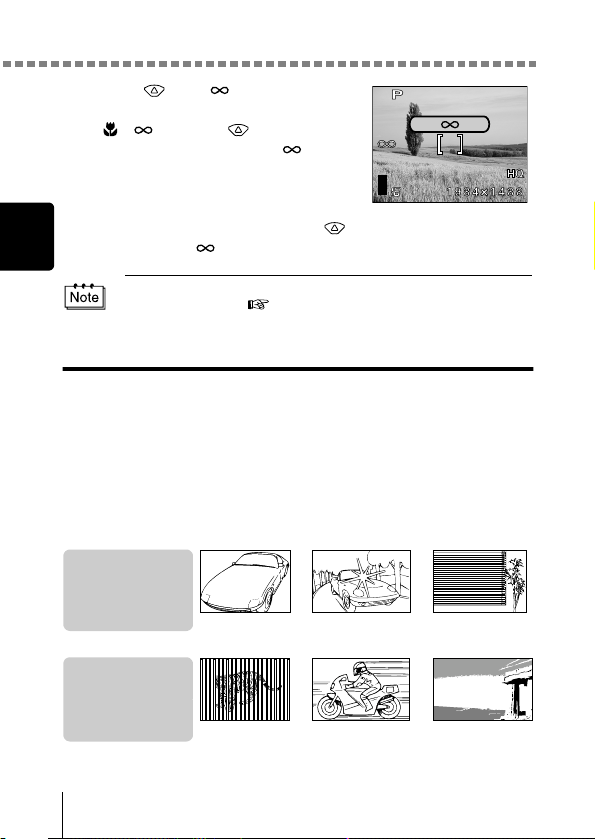
Subjects that are difficult to focus on
Under certain types of conditions, the auto focus may not work properly. If this
happens, focus on an object with high contrast at the same distance as the
intended subject (focus lock), recompose your shot and then take the picture.
If the subject has no vertical lines, hold the camera vertically and focus the
camera using the focus lock function by pressing the shutter button halfway,
then return the camera to the horizontal position while keeping the button
half-pressed and take the picture.
Quick Focus is canceled when the lens barrier is closed. “Saving the
settings (All Reset)” ( p.110)
The green lamp on
the right of the
viewfinder blinks.
The subject cannot be
brought into focus.
The green lamp on
the right of the
viewfinder lights up,
but the subject cannot
be brought into focus.
Subject with low
contrast
Subject with an
extremely bright area in
the center of the frame
Subject without
vertical lines
Subjects at different
distances
Fast-moving subject The subject to be
focused on is not in the
center of the frame
Shooting basics
2
47
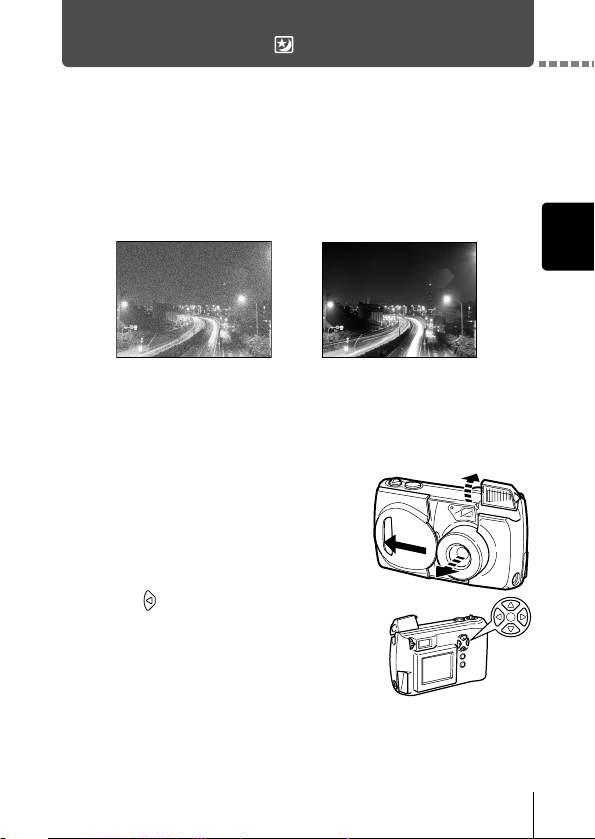
Night scene mode
Setting the mode to NIGHT SCENE allows you to take landscape shots at
night under optimum conditions. In this mode, the shutter speed is not fixed
to 1/30 second even when the flash is activated. Depending upon the subject
or shooting conditions, shutter speed may extend up to 2 seconds. The noise
reduction function activates automatically reducing ‘noise’ when the shutter
speed is over 1 second. This function reduces electrostatic ‘noise’ that occurs
with long exposure shots.
The pictures above illustrate the difference between the two modes and do
not represent actual shots.
1
Open the lens barrier fully.
The camera turns on in the shooting
mode.
2
Press .
The monitor turns on and the screen for
selecting the shooting mode is displayed.
Normal mode Night scene mode
Night scene mode
Shooting basics
2
48
3
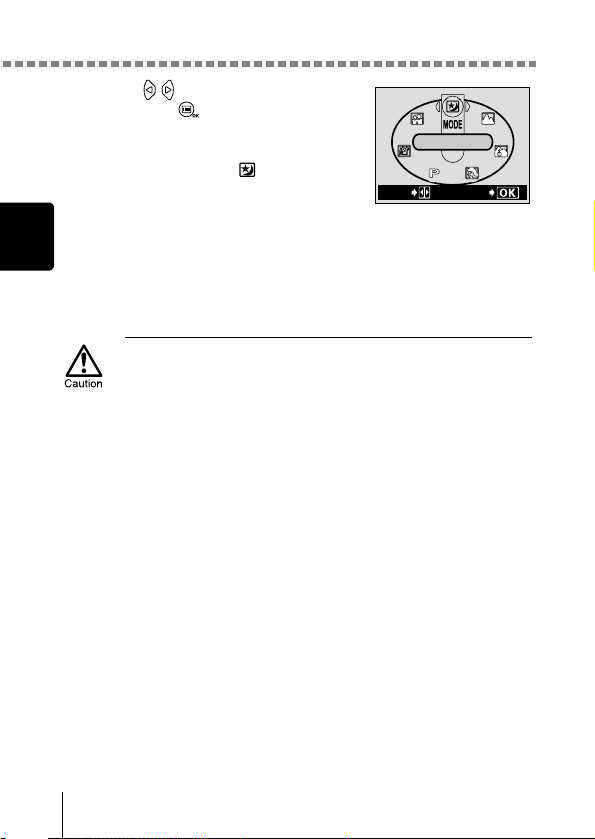
Press to select NIGHT SCENE,
then press .
The setting is set to Night scene mode and
the camera returns to shooting mode.
The night scene mark appears on the
monitor.
4
Take the picture.
If the shutter speed is more than 1 second, the noise reduction function
will automatically be activated. The green and orange lamps will blink
during processing. The processing will take the same amount of time
as the exposure time.
• The camera can be moved during noise reduction processing,
but shots cannot be taken.
•
The factory default setting in Night scene mode is the auto flash.
Selecting the red-eye reduction flash automatically changes the
setting to the fill-in flash.
•
Sequential shooting, AF Sequential shooting and panorama
shooting cannot be used in Night scene mode.
•
As the shutter speed is relatively slow, the use of a tripod is
recommended.
NIGHt
SCENE
SELECt
GO
Shooting basics
2
49
Recording movies
You can record movies with this camera. Recorded movies can be played
back or stored separately as still pictures using the index function. “Creating
an index” ( p.102)
1
Open the lens barrier fully.
The camera turns on in the shooting
mode.
2
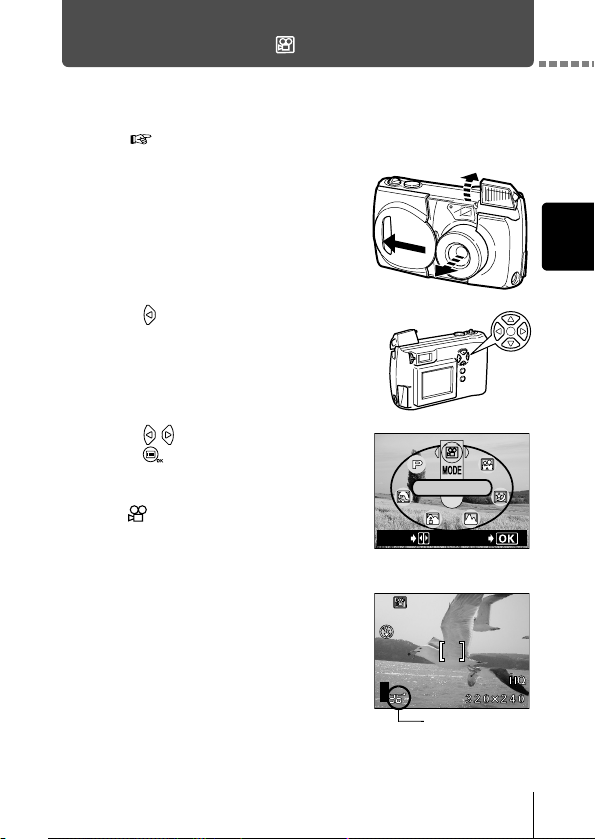
Press .
The monitor turns on and the screen for
selecting the shooting mode is displayed.
3
Press to select MOVIE, then
press .
Movie recording is set and the menu is
closed.
The mark and the total recordable
time depending on the card memory
capacity are displayed on the monitor.
4
Record the movie while observing
your subject on the monitor.
Press the shutter button fully to start
recording. When you press the shutter
button, the number of seconds remaining
for one recording is displayed.
Press the shutter button fully again to stop
recording.
MOVIE
SELECt
GO
Seconds
remaining
Recording movies
Shooting basics
2
50
To cancel movie mode
Press .
The monitor turns off and the movie mode is canceled.
• The movie mode is canceled when the lens barrier is closed. “Saving
the settings (All Reset)” ( p.110)
• During movie recording, the flash is disabled.
• It takes longer to store movies than still pictures.
• The seconds remaining varies depending on the record mode and
the amount of space available on the card.
• You cannot record movies with sound.
Shooting basics
2
51
Zooming in on a subject (Optical zoom/Digital zoom)
Telephoto and wide-angle shooting are possible at 2.8× (36 mm - 100 mm on
a 35 mm camera) magnification using the optical zoom. By combining the
optical zoom with the digital zoom, you can obtain a zoom magnification
equivalent to approximately 10× max.
Using the optical zoom
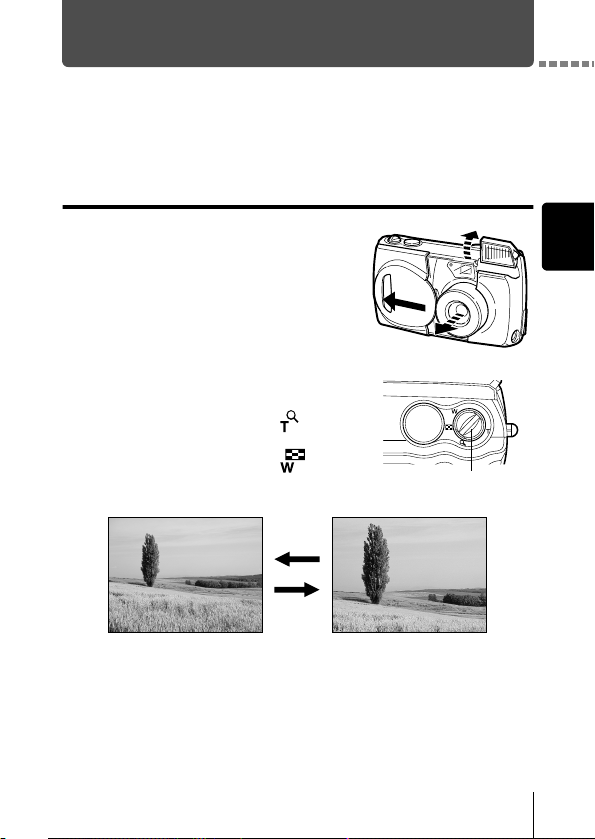
1
Open the lens barrier fully.
The camera turns on in the shooting
mode.
2
Press the zoom lever while looking in
the viewfinder.
Press the zoom lever toward to zoom
in.
Press the zoom lever toward to zoom
out.
3
Take the picture while looking in the viewfinder.
Zoom lever
Zooming in on a subject (Optical zoom/Digital zoom)
Shooting basics
2
52
Using the digital zoom
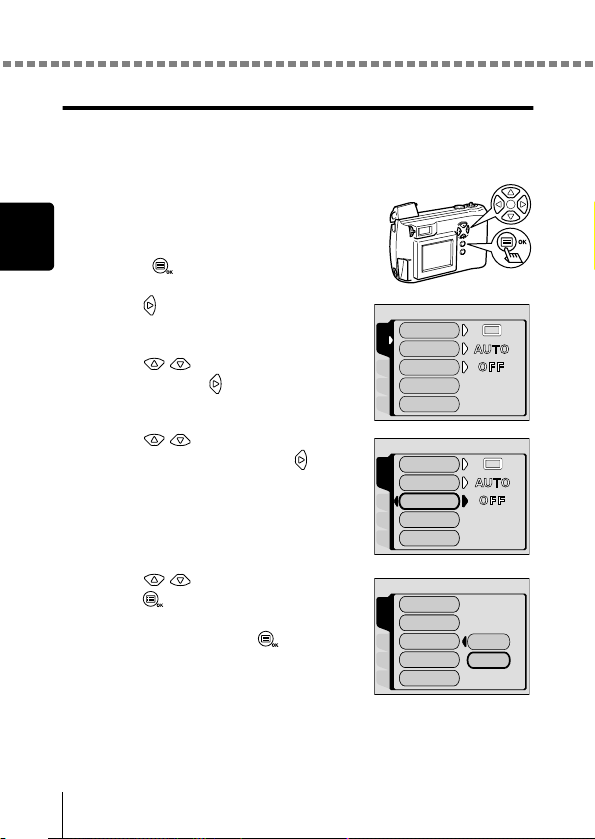
To use the digital zoom, set the digital zoom to ON in the CAMERA tab. The
digital zoom lets you take pictures at a magnification of approximately 3.6×
max.
1
Display the top menu in the shooting
mode.
• Open the lens barrier fully.
•Press .
2
Press to select MODE MENU.
3
Press to select the CAMERA
tab, then press .
4
Press to select
DIGITAL ZOOM, then press .
5
Press to select ON, then
press .
The digital zoom is set.
To close the menu, press again.
CARDSEt PIC
CAMERA
DRIVE
ISO
DIGItAL ZOOM
PANORAMA
2 IN 1
CARDSEt PIC
CAMERA
DRIVE
ISO
DIGItAL ZOOM
PANORAMA
2 IN 1
CARDSEt PIC
CAMERA
DRIVE
ISO
DIGItAL ZOOM
PANORAMA
2 IN 1
OFF
ON
Zooming in on a subject (Optical zoom/Digital zoom)
Shooting basics
2
53
6
Press the zoom lever toward .
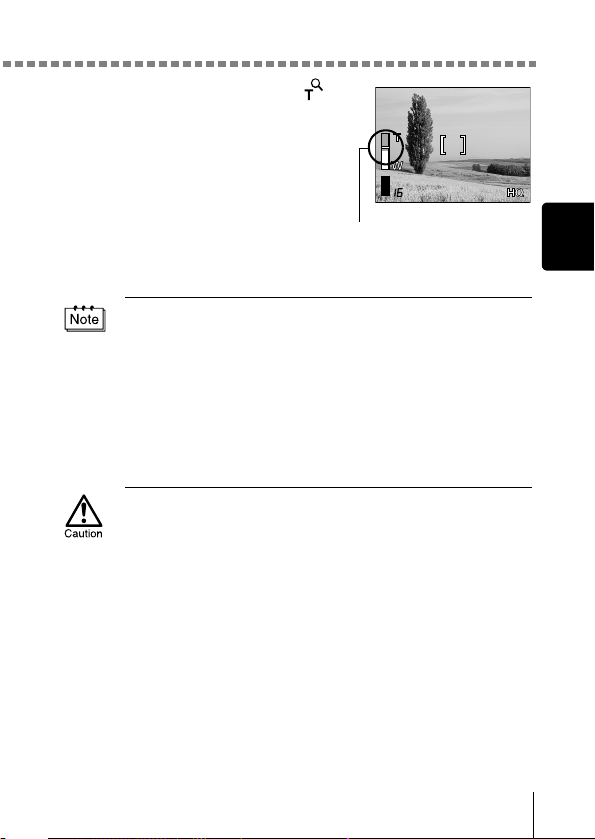
• The white section of the zoom indicator indicates the optical zoom. If
the digital zoom is set to ON, a red section appears on the zoom
indicator. When you reach the limit of the optical zoom, the digital
zoom is enabled.
• Pictures taken with the digital zoom may appear grainy.
• Camera movement is likely to occur at higher magnifications.
Stabilize the camera with a tripod, etc. to avoid camera movement.
• Turning the monitor off cancels the digital zoom. However, when the
digital zoom is set to ON, it will be automatically enabled the next
time you turn the monitor on.
You cannot use the digital zoom in Self-Portrait mode.
The bar moves on the zoom
indicator according to the
zoom magnification.
Shooting basics
2
54
Using the flash
In the auto-flash mode (factory default setting), the flash is designed to fire
automatically when shooting under low light or against strong backlight, but
you can change the flash mode to suit different shooting situations. Select the
flash mode best suited to the light conditions and the effect you want to
achieve.
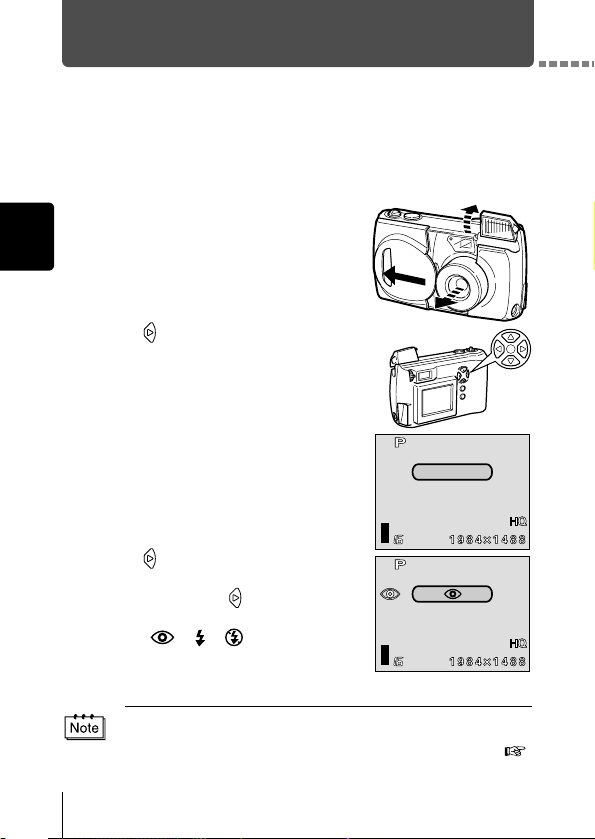
1
Open the lens barrier fully.
The camera turns on in the shooting
mode.
2
Press .
The current flash setting is displayed.
3
Press while the current flash
setting is displayed.
Each time you press , the flash mode
changes in the following sequence:
AUTO - - - .
4
Take the picture.
• The flash working range is approximately 3.4 m/11.2 ft.
• The camera returns to the auto-flash mode (factory default setting)
when the lens barrier is closed. “Saving the settings (All Reset)” (
p.110)
AUtO
Using the flash
Shooting basics
2
55
Auto-flash (No indication)
The flash fires automatically in low light or backlight conditions.
To shoot a subject with backlight, position the AF target mark over the subject
in the viewfinder.
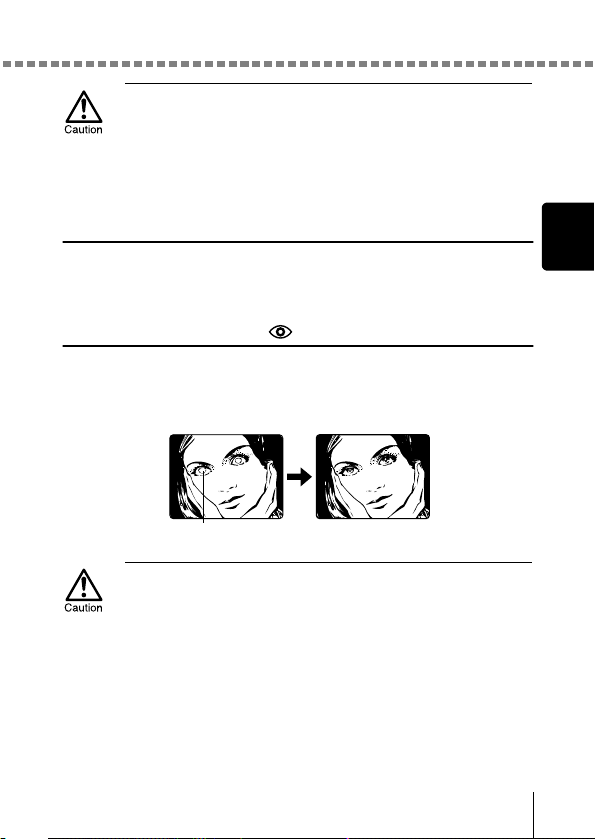
Red-eye reduction flash ( )
The light from the flash may make the subject’s eyes appear red in pictures.
The red-eye reduction flash mode reduces this phenomenon by emitting pre-
flashes before firing the regular flash. This helps accustom the subject’s eyes
to the bright light and minimizes the red-eye phenomenon.
• While the orange lamp is blinking, the flash is charging and the
shutter button will not release when the flash is set to fire. Wait until
the lamp goes off, then retry shooting.
• If you use the flash when shooting at a close distance, shadows may
be conspicuous and the correct exposure may not be achieved.
• In sequential shooting, AF Sequential shooting, panorama or movie
mode, the flash is disabled.
• After the first pre-flash, it takes about 1 second before the shutter is
released. Hold the camera firmly to avoid camera movement.
• Effectiveness may be limited if the subject is not looking directly at
the pre-flashes, or if the shooting range is too far. Individual physical
characteristics may also limit effectiveness.
The subject’s eyes appear red.
Using the flash
Shooting basics
2
56
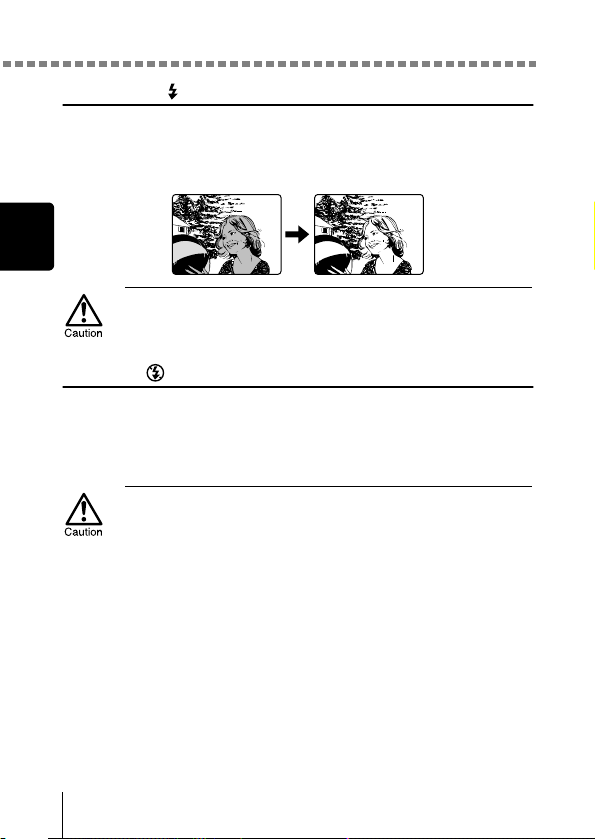
Fill-in flash ( )
The flash always fires every time the shutter button is released. This mode is
useful when you want to minimize shadows around the subject (such as the
shade of tree leaves on the subject’s face), in backlight condition, or under
artificial light such as a fluorescent lamp.
Flash off ( )
The flash does not fire even in low light conditions. Use this mode in situations
where flash photography is not desired or is prohibited, such as in an art
museum. You can also use this mode when you want to shoot a natural-
looking twilight or night scene.
The fill-in flash may not have the desired effect under excessively bright
light.
Since a slow shutter speed is automatically selected in low light
situations when in the flash off mode, the use of a tripod is
recommended to prevent your pictures from being blurred by camera
movement.
Advanced shooting
3
57
Chapter 3
Advanced shooting
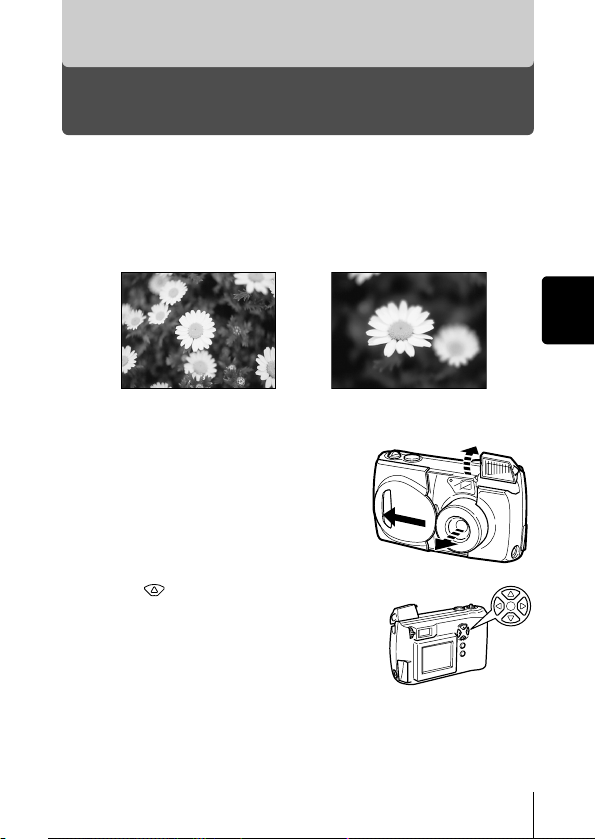
Taking close-up pictures (Macro mode)
The macro mode allows you to shoot a subject at a distance of 0.2 - 0.8 m/
0.7 - 2.6 ft.
If you take a close-up picture of a subject at this distance using the normal
shooting mode, it will take more time for the camera to focus on the subject.
Focusing is much faster in macro mode.
1
Open the lens barrier fully.
The camera turns on in the shooting
mode.
2
Press .
The monitor turns on and the current AF
setting is displayed.
Normal shooting
With the macro mode
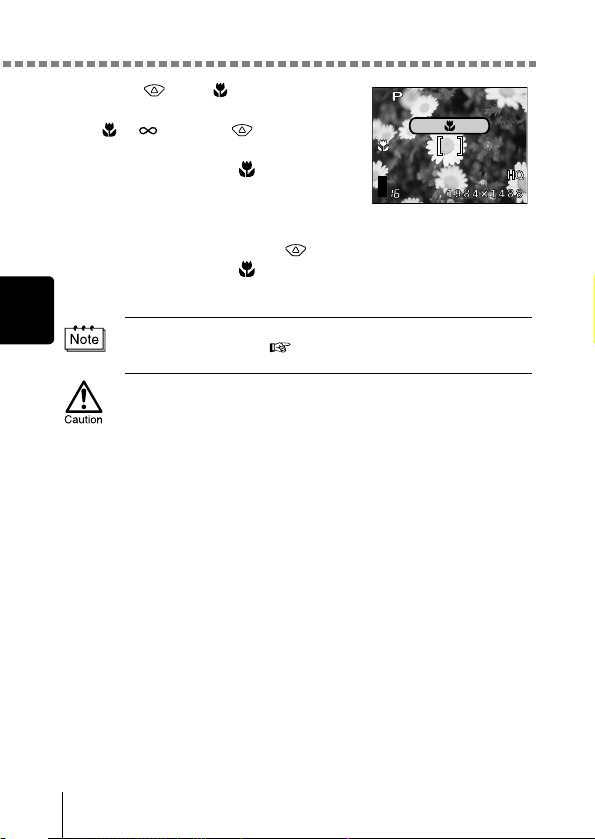
Taking close-up pictures (Macro mode)
Advanced shooting
3
58
3
Press until is displayed.
The setting changes in the sequence AF -
- each time is pressed.
When the macro mode is selected, the
macro mode indicator is displayed.
4
Take the picture while observing
your subject on the monitor.
To cancel macro mode, press repeatedly until AF appears. The
macro mode indicator disappears.
The macro mode is canceled when the lens barrier is closed. “Saving
the settings (All Reset)” ( p.110)
• In the macro mode, keep a minimum distance of 0.2 m - 0.8 m/0.7 ft
- 2.6 ft between the camera and the subject. When the camera is too
close to the subject, the green lamp blinks.
• If you use the flash in macro shooting, shadows may be conspicuous
and the correct exposure may not be achieved.
Advanced shooting
3
59
Using the self-timer
This function is useful for taking pictures with yourself included in the
photograph. Fix the camera securely on a tripod or stable surface for self-
timer shooting.
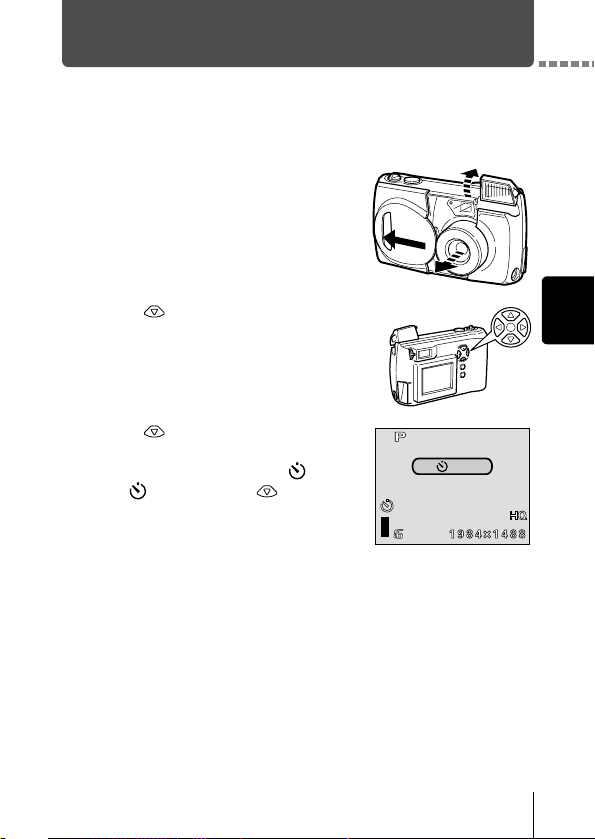
1
Open the lens barrier fully.
The camera turns on in the shooting
mode.
2
Press .
The monitor turns on and the current self-
timer setting is displayed.
3
Press while the current self-
timer setting is displayed.
The setting changes between
ON
and
OFF each time is pressed.
ON
Using the self-timer
Advanced shooting
3
60
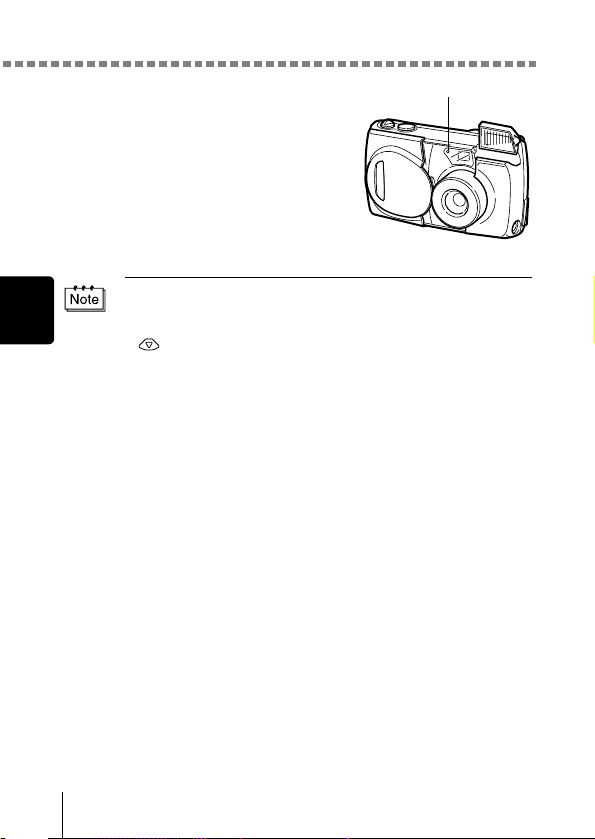
4
Press the shutter button fully.
The self-timer lamp lights up for
approximately 10 seconds, then starts
blinking. After blinking for 2 seconds with
a beep sound, the picture is taken.
• The self-timer mode is canceled automatically after taking one picture
or when the lens barrier is closed even if All Reset is set to OFF.
• To cancel shooting after the shutter button has been pressed, press
.
Self-timer lamp
Advanced shooting
3
61
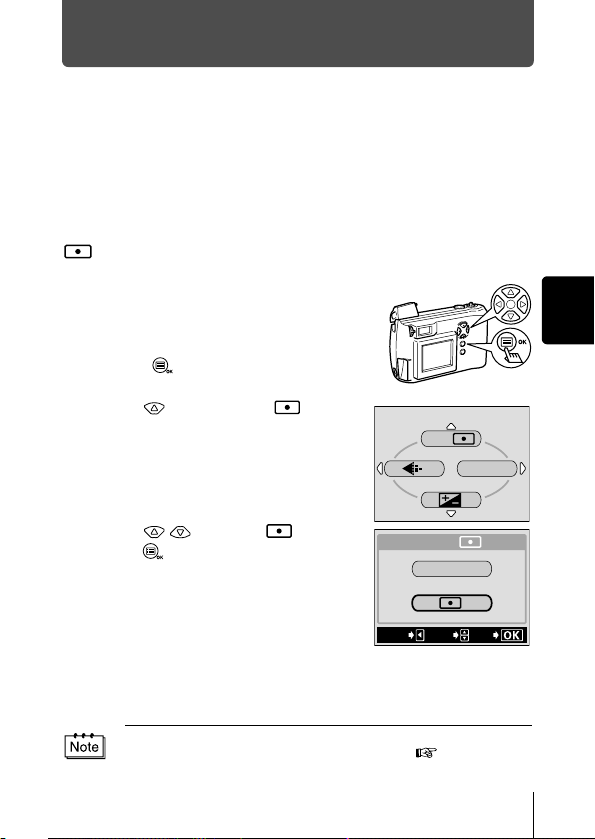
Selecting the metering area (Spot metering)
In a backlight situation, your subject may appear dark if the picture is taken
with the normal metering value (Digital ESP metering). In this case, by
changing the metering area to the center of the viewfinder (Spot metering), a
subject can be shot with optimal exposure regardless of the background light.
1
Display the top menu in the shooting
mode.
• Open the lens barrier fully.
•Press .
2
Press to select ESP/ .
3
Press to select , then
press .
Spot metering is set and the menu is
closed.
The selected setting is highlighted in the
green frame.
4
Take the picture while positioning the AF target mark on your
subject in the viewfinder.
Metering settings
ESP (Digital ESP) : Meters the center of the viewfinder and the area around it
separately to obtain the optimum exposure. (No indication
is displayed on the monitor.)
(Spot metering) : Meters only the center of the viewfinder to obtain the
appropriate exposure for the subject.
The camera returns to ESP (factory default setting) when the lens
barrier is closed. “Saving the settings (All Reset)” ( p.110)
MODE MENU
ESP/
ESP
CANCEL
GO
SELECt
ESP/
Advanced shooting
3
62
Shooting pictures sequentially (Sequential shooting/AF Sequential shooting)
This function allows you to take a rapid succession of still pictures by pressing
and holding the shutter button (up to 11 pictures at 1.2 frames per second by
Sequential shooting in HQ mode). You can choose between Sequential
shooting and AF Sequential shooting. As you can choose the best picture
from a series of sequential shots, you are recommended to use this mode
when taking a moving subject. You can also erase the unwanted shots
afterwards. “Single-frame erase” ( p.94)
1
Display the top menu in the shooting
mode.
• Open the lens barrier fully.
•Press .
2
Press to select MODE MENU.
3
Press to select the CAMERA
tab, then press .
4
Press to select DRIVE, then
press .
(Sequential shooting) : The focus, exposure and white balance are
locked at the first frame.
(AF Sequential shooting): The focus is individually locked for each shot.
The AF Sequential shooting speed is slower
than for normal sequential shooting.
CARDSEt PIC
CAMERA
DRIVE
ISO
DIGItAL ZOOM
PANORAMA
2 IN 1
CARDSEt PIC
CAMERA
DRIVE
ISO
DIGItAL ZOOM
PANORAMA
2 IN 1
Shooting pictures sequentially (Sequential shooting/AF Sequential shooting)
Advanced shooting
3
63
5
Press to select or
, then press .
Sequential shooting or AF Sequential
shooting is set.
To close the menu, press again.
6
Take the pictures.
Press the shutter button fully and keep it pressed. The camera will take
pictures in sequence until you release the button.
• The sequential shooting and AF sequential shooting mode is
canceled when the lens barrier is closed. “Saving the settings (All
Reset)” ( p.110)
• During sequential shooting, the flash is disabled.
• To minimize camera movement, the shutter speed is set to 1/30 sec.
max. As a result, dark subjects may appear darker than usual.
• The number of pictures that can be shot in succession and the
sequential shooting speed vary depending on the subject, the record
mode, and the amount of space available on the card.
It takes longer than usual to store pictures after sequential shooting.
AF
CARDSEt PIC
CAMERA
DRIVE
ISO
DIGItAL ZOOM
PANORAMA
2 IN 1
Advanced shooting
3
64
Panorama shooting
You can take advantage of panorama shooting with the Olympus CAMEDIA-
brand SmartMedia card. (Non-Olympus cards do not support this feature.)
Panorama shooting lets you connect pictures with overlapping edges into a
single panoramic picture, using the CAMEDIA Master software.
1
Display the top menu in the shooting
mode.
• Open the lens barrier fully.
•Press .
2
Press to select MODE MENU.
3
Press to select the CAMERA
tab, then press .
4
Press to select PANORAMA,
then press .
The panorama mode is set and the
monitor turns on automatically.
5
Press the arrow pad to select the
direction that you want to connect
pictures.
: Connects the pictures from left to
right.
: Connects the pictures from right to
left.
: Connects the pictures from bottom
to top.
: Connects the pictures from top to
bottom.
CARDSEt PIC
CAMERA
DRIVE
ISO
DIGItAL ZOOM
PANORAMA
2 IN 1
CARDSEt PIC
CAMERA
DRIVE
ISO
DIGItAL ZOOM
PANORAMA
2 IN 1
Connects a series of
pictures from left to right.
Panorama shooting
Advanced shooting
3
65
6
Make sure that the edges of the pictures overlap, then take
your pictures.
Panorama shooting is possible for up to 10 pictures.
When you try to take more than 10
pictures, a mark is displayed.
7
Press to finish panorama shooting.
The panorama mode is canceled when is pressed or the lens
barrier is closed.
• The panorama mode is only available with Olympus CAMEDIA-brand
SmartMedia cards.
• Exposure and white balance are set by the first picture. Do not select
an extremely bright subject (such as the sun) for the first picture.
• Your computer’s memory may be insufficient if you take too many
panorama pictures in HQ/SHQ mode. You are recommended to use
SQ mode for panorama shooting.
• During panorama shooting, the flash and sequential shooting
functions are disabled.
• If you take panorama pictures with the record mode set to TIFF, the
pictures will be stored with the same resolution in the JPEG format.
• The camera itself cannot edit panorama pictures. To connect each
picture, the CAMEDIA Master software is necessary.
The previous shot will not be displayed in the frame when taking the
next shot.
Compose your shots so that they overlap to form one picture.
Advanced shooting
3
66
Taking two-in-one pictures
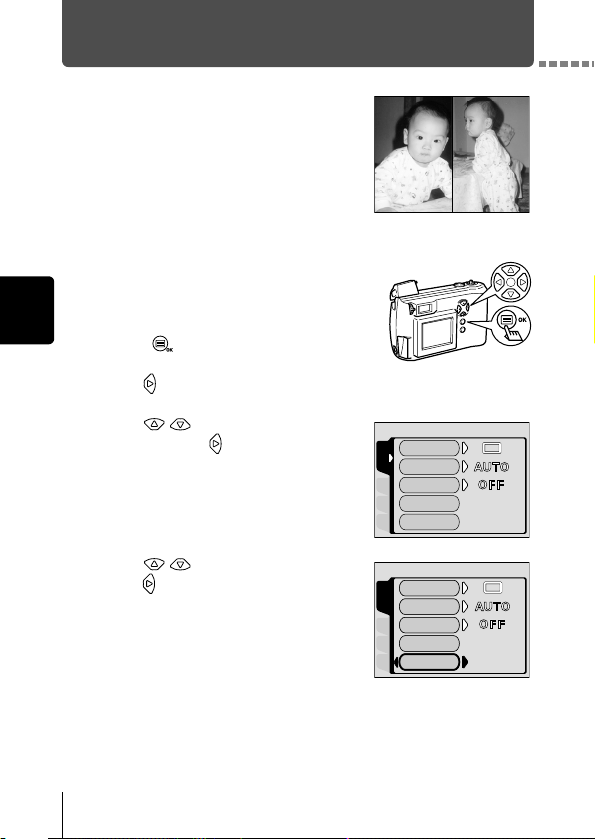
This function allows you to combine two pictures
taken in succession and store them as a single
picture. You can combine two different subjects
in one picture.
1
Display the top menu in the shooting
mode.
• Open the lens barrier fully.
•Press .
2
Press to select MODE MENU.
3
Press to select the CAMERA
tab, then press .
4
Press to select 2 IN 1, then
press .
The two-in-one picture mode is set and the
monitor turns on automatically.
Picture when played
back
CARDSEt PIC
CAMERA
DRIVE
ISO
DIGItAL ZOOM
PANORAMA
2 IN 1
CARDSEt PIC
CAMERA
DRIVE
ISO
DIGItAL ZOOM
PANORAMA
2 IN 1
Taking two-in-one pictures
Advanced shooting
3
67
5
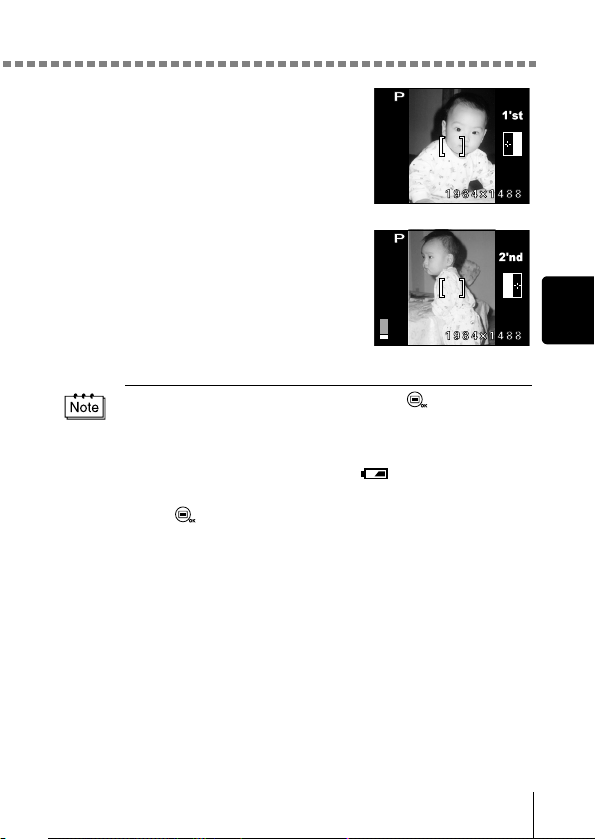
Take the first shot while observing
your subject on the monitor.
The subject is positioned on the left.
6
Take the second shot in succession.
The subject is positioned on the right.
• The two-in-one picture mode is canceled when is pressed or the
lens barrier is closed.
• During two-in-one picture shooting, the sequential shooting function
is disabled.
• When the battery power is exhausted ( indicator is displayed),
the flash will automatically turn off.
• Press to cancel the two-in-one picture mode after the first shot
has been taken. The first picture will not be stored.
16
HQ
16
HQ
Picture when shooting
Adjusting the image quality and exposure
4
68
Chapter 4
Adjusting the image quality and exposure
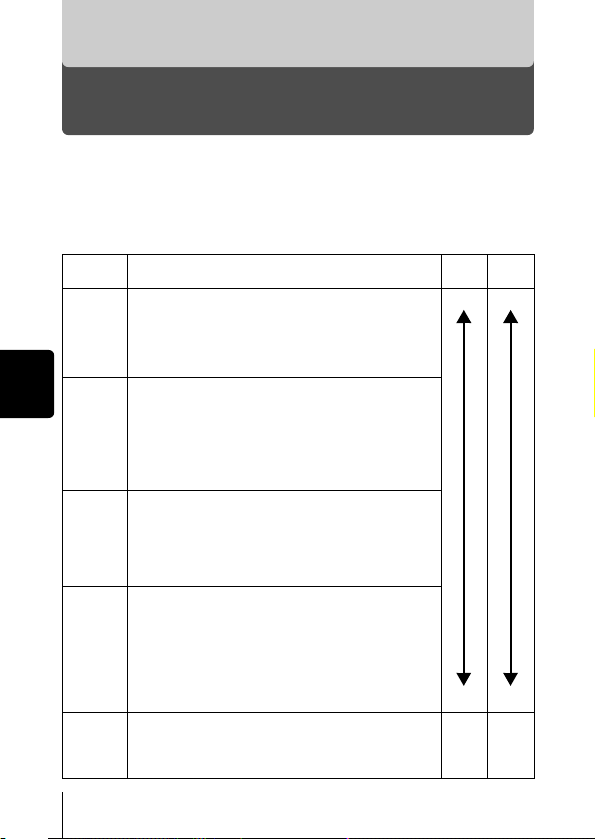
Selecting the image quality and size (Record mode)
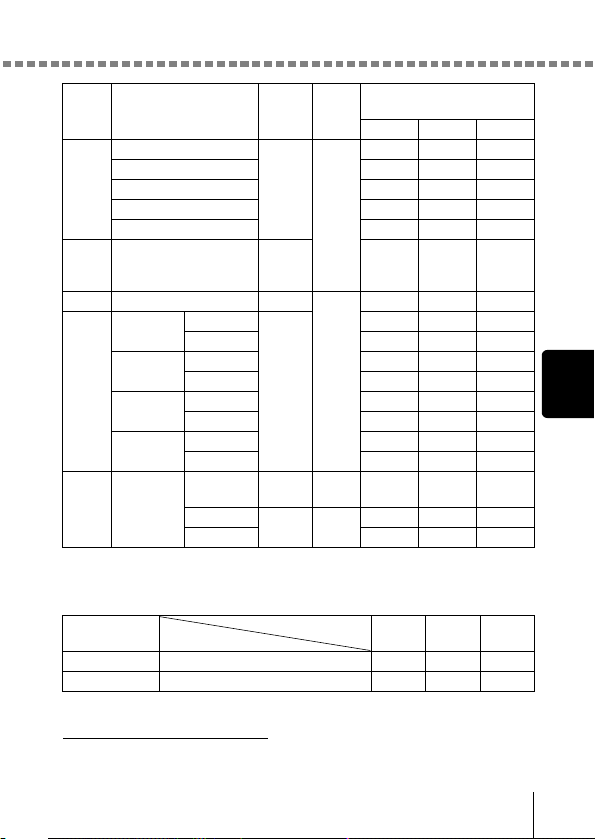
Choose the best record mode for your purposes (printing, editing on a PC,
website editing, etc.). For details of the record modes, resolutions and number
of images storable on the card, refer to the table on the next page. The numbers
in the table are approximate.
Still picture record modes
Record
mode
Description Quality
File
size
TIFF
•The highest quality mode. As the images are saved as
uncompressed data, this is the best mode for printing
or image-processing on a PC. This mode has different
resolutions to choose from, depending on your
purpose. It takes longer to save the images.
Clearer
Normal
Larger
Smaller
SHQ
(Super
High
Quality)
A high quality mode using the JPEG format. Because the
compression rate is very low, high quality can be maintained.
• Use this mode when you want to print out an image with
high quality or on large paper such as A4 (8.3" × 11.7"/21
cm × 29.7 cm), or you want to process images on a PC.
• As the image quality is high, the number of storable
images is reduced.
HQ
(High
Quality)
A high quality mode with medium compression. Because
the compression rate is higher than SHQ and the file size
is smaller, more images can be saved to a card.
• Use this mode when you want to edit images on a PC or
print them out on postcard size paper.
• This mode is the factory default setting.
SQ
(Standard
Quality)
The resolutions in this mode are smaller than in SHQ or
HQ. For each resolution, you can choose HIGH (to reduce
noise) or NORMAL (to save more images). Select the best
setting for your purpose (printing, Internet pages, etc.).
• Use this mode when you want to attach images to e-mail
or simply view them on a PC.
•This is the standard quality mode. The number of
storable images is increased.
3:2
As with pictures taken using 35mm film, the aspect
ratio is 3:2 (1984 × 1312). You can choose TIFF,
HIGH or NORMAL. The pictures can be printed at a
photo lab without cropping the photo.
––
Selecting the image quality and size (Record mode)
Adjusting the image quality and exposure
4
69
*HIGH uses low compression/NORMAL uses standard compression
Movie record modes
Total recording time that can be stored on one card (seconds)
The recording time for one record varies.
Products with PAL VIDEO OUT
If movie pictures are shot with the Video cable connected, their maximum
recording time may be different from this table.
Record
mode
Resolution
Com-
pression
File
format
Number of images storable
on the card
16 MB 32 MB 64 MB
TIFF
1984×1488
Uncom-
pressed
TIFF
137
1600×1200 2 5 11
1280×960 4 8 17
1024×768 6 13 27
640×480 16 33 67
SHQ 1984×1488
Low
com-
pression
71530
HQ 1984×1488 Normal
JPEG
21 43 86
SQ
1600×1200
HIGH
*
11 23 46
NORMAL 32 64 128
1280×960
HIGH 18 36 72
NORMAL 49 99 199
1024×768
HIGH 27 55 110
NORMAL 76 153 306
640×480
HIGH 66 132 265
NORMAL 165 331 664
3:2 1984×1312
TIFF
Uncom-
pressed
TIFF 2 4 8
HIGH
* JPEG
81734
NORMAL 24 48 97
Record mode
SmartMedia capacity
Resolution
16 MB 32 MB 64 MB
HQ 320×240 (15 frames/sec.) 48 96 193
SQ 160×120 (15 frames/sec.) 211 424 849
Selecting the image quality and size (Record mode)
Adjusting the image quality and exposure
4
70
1
Display the top menu in the shooting
mode.
• Open the lens barrier fully.
•Press .
2
Press to select .
3
Press to select one of the
record modes, then press .
The record modes for still pictures are 3:2,
SHQ, HQ, SQ and TIFF, and for movies
are HQ and SQ.
4
If you select 3:2, SQ or TIFF, press
to select further options.
If you select 3:2
Press to select TIFF, HIGH or
NORMAL, then press .
If you select SQ
Press to select the resolution,
then press to select HIGH or
NORMAL, then press .
SHQ 1984*1488
3:2 1984*1312
HQ 1984*1488
SQ 1024*768
CANCEL
GO
SELECt
Still picture record
modes
3:2
HIGH
NORMAL
tIFF
CANCEL
GO
SELECt
1600*1200
1280*960
1024*768
640*480
SQ
HIGH
NORMAL
CANCEL
GO
SELECt
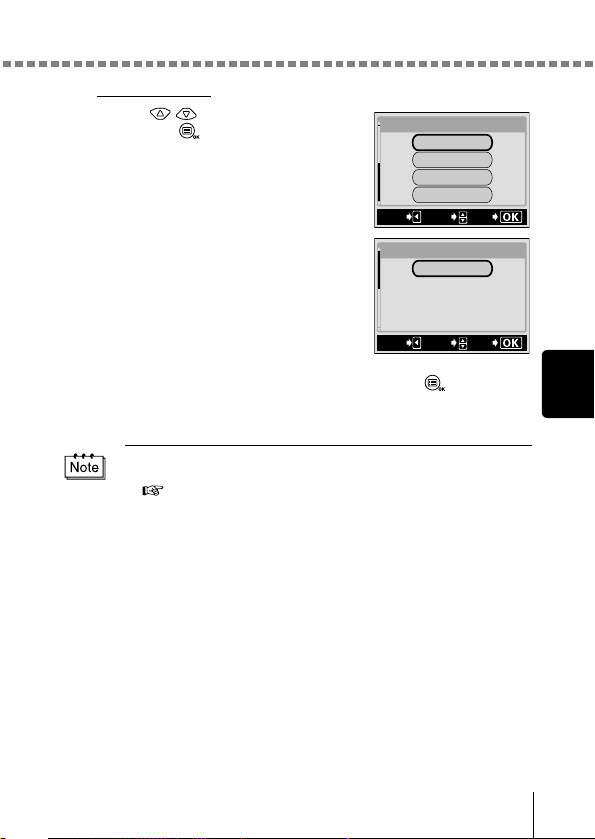
Selecting the image quality and size (Record mode)
Adjusting the image quality and exposure
4
71
If you select TIFF
Press to select the resolution,
then press .
To set the record mode and close the menu, press again.
5
Take the picture.
• The record mode setting returns to HQ (factory default setting) when
the lens barrier is closed. “Saving the settings (All Reset)”
( p.110)
• The still picture record mode and the movie record mode are set on
different menus. Even if you change the movie record mode, the still
picture record mode remains the same.
tIFF
1984*1488
1600*1200
1280*
960
1024*
768
CANCEL
GO
SELECt
tIFF
640
*
480
CANCEL
GO
SELECt
Selecting the image quality and size (Record mode)
Adjusting the image quality and exposure
4
72
Relation between the record mode and the resolution
Resolution
The number of pixels (horizontal × vertical) used when saving an image. If the
image will be printed, higher resolutions (larger numbers) are recommended
so that the image will be clearer. However, higher resolutions make the file
size (amount of data) larger, so the number of pictures that can be saved will
be fewer.
Resolution and picture size on a computer screen
When a picture is transferred to a computer, the size of the picture on the
computer screen varies depending on the computer’s monitor setting. For
instance, a picture taken in 1024 × 768 resolution is the same size as the
screen if you set the picture to 1× when the monitor setting is 1024 × 768.
However, if the monitor setting is over 1024 × 768 (such as 1280 × 1024), the
picture only takes up part of the screen.
Compression rate
In record modes other than TIFF, image data are compressed. The higher the
compression rate, the less clear the image.
File format
This camera saves images with either TIFF or JPEG formats. In record
modes other than TIFF, images are compressed in the JPEG format. The
compression rate also varies in each mode.
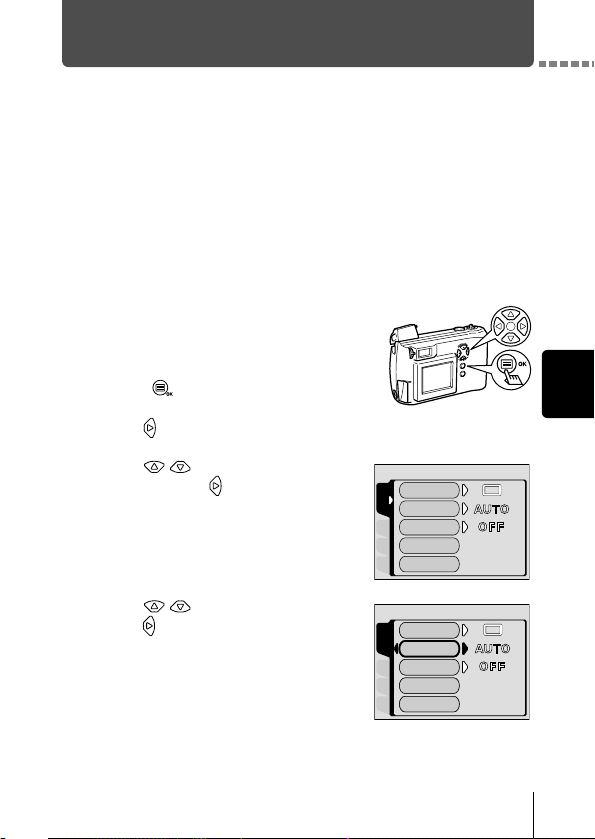
Adjusting the image quality and exposure
4
73
Selecting the ISO sensitivity
The higher the ISO value, the greater the camera’s light sensitivity and the
better its ability to shoot in low light conditions. However, higher values also
introduce electrical noise into the resulting image, which may make them a
grainy appearance.
1
Display the top menu in the shooting
mode.
• Open the lens barrier fully.
•Press .
2
Press to select MODE MENU.
3
Press to select the CAMERA
tab, then press .
4
Press to select ISO, then
press .
ISO settings
AUTO : Sensitivity is automatically adjusted according to the light
conditions and the subject brightness. (No indication is displayed
on the monitor.)
100/200/400 : 100 is best when you want to shoot clear, sharp images in
daylight. With a higher ISO setting, you can use faster shutter
speeds with the same amount of light.
CARDSEt PIC
CAMERA
DRIVE
ISO
DIGItAL ZOOM
PANORAMA
2 IN 1
CARDSEt PIC
CAMERA
DRIVE
ISO
DIGItAL ZOOM
PANORAMA
2 IN 1
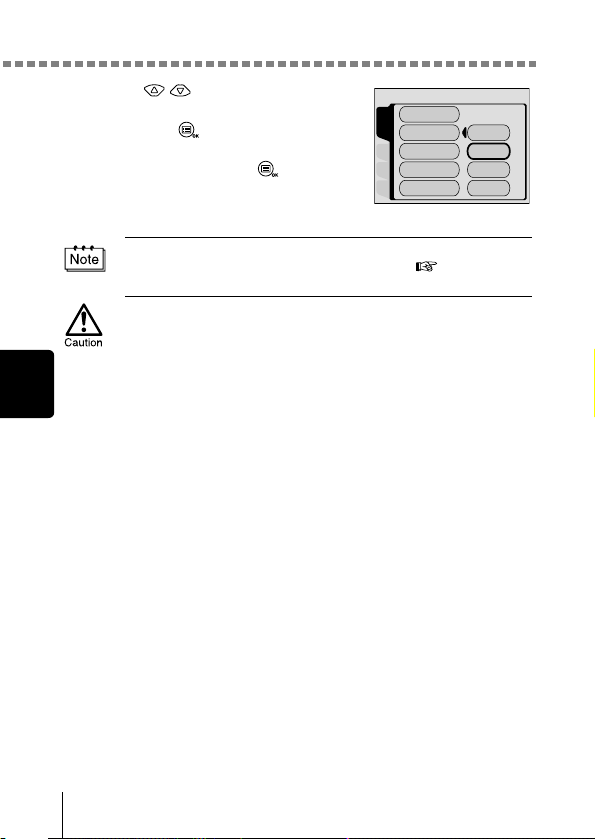
Selecting the ISO sensitivity
Adjusting the image quality and exposure
4
74
5
Press to select one of the
ISO settings: AUTO, 100, 200 or 400,
then press .
The ISO value is set.
To close the menu, press again.
6
Take the picture.
The ISO value returns to AUTO (factory default setting) when the lens
barrier is closed. “Saving the settings (All Reset)” ( p.110)
• Higher ISO settings produce more electrical noise.
• The ISO is standardized based on the sensitivity of normal camera
film. The scale is approximate.
• When the ISO is set to AUTO and you are shooting in dark conditions
without a flash, the ISO automatically increases, otherwise the
shutter speed will be reduced, possibly resulting in camera
movement and blurred images.
• If the subject is too far away for the flash illumination to reach when
the ISO is set to AUTO, the ISO is automatically increased.
200
400
100
CARDSEt PIC
CAMERA
DRIVE
ISO
DIGItAL ZOOM
PANORAMA
2 IN 1
AUtO
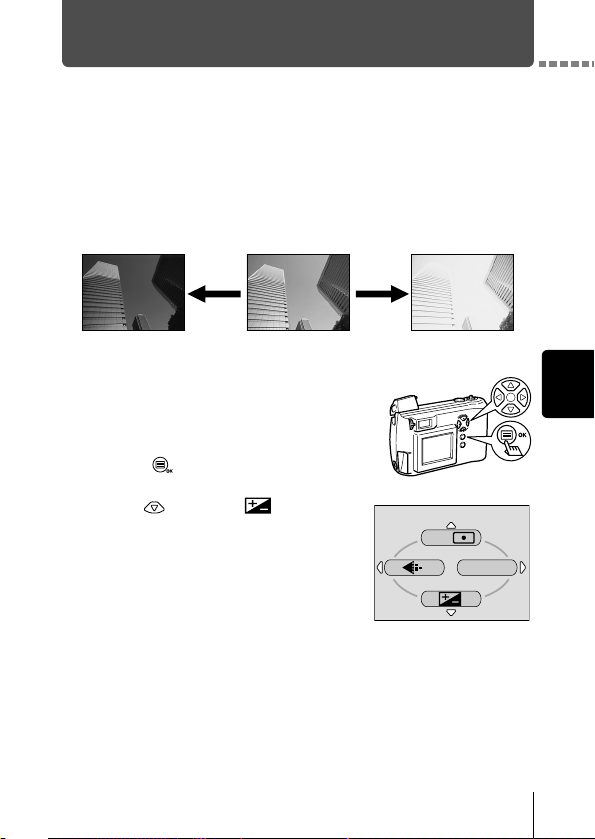
Adjusting the image quality and exposure
4
75
Varying the image brightness (Exposure compensation)
This function allows you to make fine changes to the automatic exposure
setting. In some situations, you may get better results when the exposure that
the camera sets is compensated (adjusted) manually. You can adjust the
brightness in the range of ±2.0 in 0.5 steps.
Often bright subjects (such as snow) will turn out darker than their natural
colors. Adjusting towards [ + ] makes these subjects closer to their real
shades. For the same reason, adjust towards [ - ] when shooting dark
subjects.
1
Display the top menu in the shooting
mode.
• Open the lens barrier fully.
•Press .
2
Press to select .
−2.0 ±0 +2.0
MODE MENU
ESP/
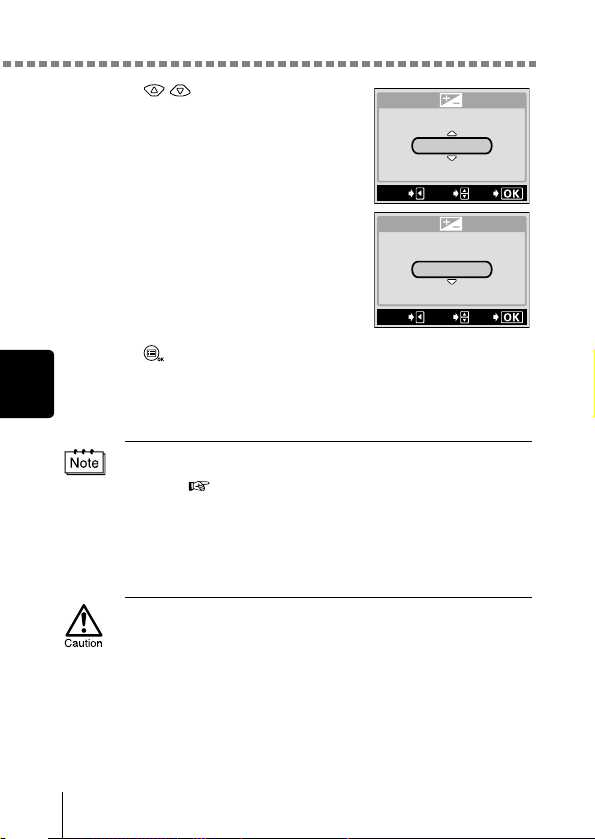
Varying the image brightness (Exposure compensation)
Adjusting the image quality and exposure
4
76
3
Press to select the exposure
compensation value.
Select a [ + ] value to brighten the image
or a [ - ] value to darken the image.
4
Press .
The exposure compensation value is set and the menu is closed.
5
Take the picture.
• The exposure compensation value returns to ±0 (factory default
setting) when the lens barrier is closed. “Saving the settings (All
Reset)” ( p.110)
• When you adjust the exposure while observing the subject on the
monitor, the brightness of the image displayed also changes.
However, the variation may be less noticeable when the subject is
dark. In this case, play back the recorded image to confirm that the
exposure is satisfactory.
• If the flash is used, the image brightness (exposure) may differ from
the intended brightness (exposure).
• Exposure compensation cannot correct the image if the surroundings
of the subject are extremely bright or dark.
-
CANCEL
GO
SELECt
+
±
%
0
+
%
2.0
-
CANCEL
GO
SELECt
When set to +2.0
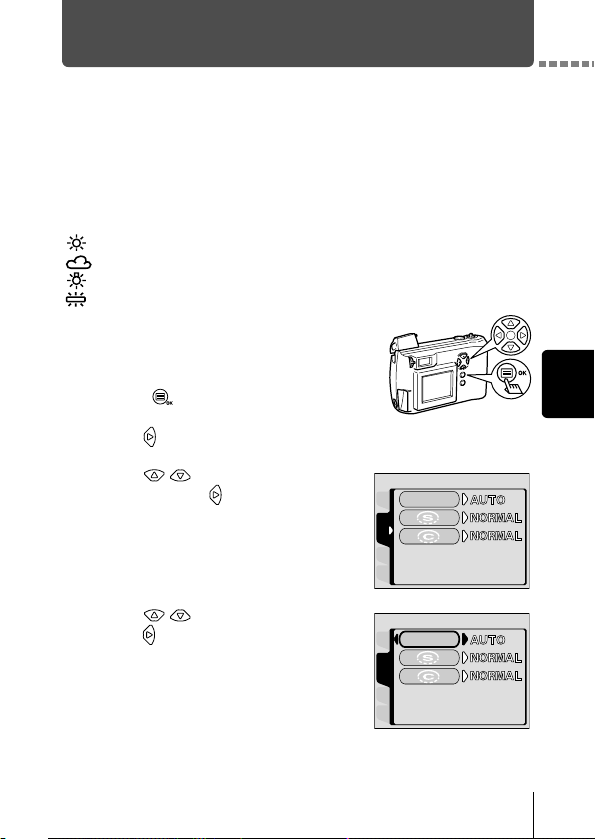
Adjusting the image quality and exposure
4
77
Adjusting the color tone (White balance)
Color reproduction differs depending on the light conditions. For instance,
when daylight, the setting sun or tungsten lighting are reflected on white
paper, the shade of white produced will be slightly different for each. By
setting the WB (white balance), you can achieve more natural-looking colors.
1
Display the top menu in the shooting
mode.
• Open the lens barrier fully.
•Press .
2
Press to select MODE MENU.
3
Press to select the PICTURE
tab, then press .
4
Press to select WB, then
press .
White balance settings
AUTO : The white balance is adjusted automatically so that colors
look natural. (No indication is displayed on the monitor.)
(Sunlight) : For natural colors under a clear sky.
(Overcast) : For natural colors under a cloudy sky.
(Tungsten) : For natural colors under tungsten lighting.
(Fluorescent) : For natural colors under fluorescent lighting.
CARDSEt
CAM
PICtURE
WB
CARDSEt
CAM
PICtURE
WB
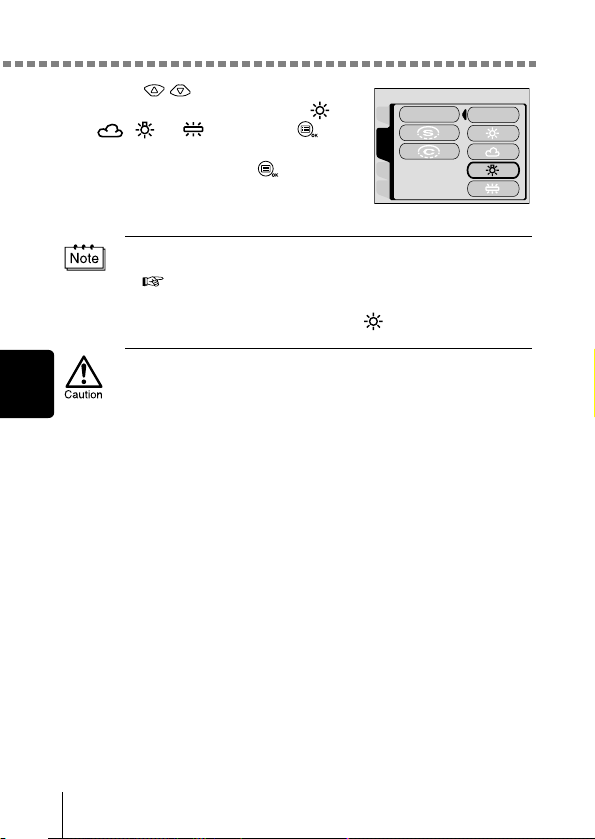
Adjusting the color tone (White balance)
Adjusting the image quality and exposure
4
78
5
Press to select one of the
white balance modes: AUTO, ,
, or , then press .
The white balance is set.
To close the menu, press again.
6
Take the picture.
• The white balance setting returns to AUTO (factory default setting)
when the lens barrier is closed. “Saving the settings (All Reset)”
( p.110)
• If you want a color tone that resembles what you see under tungsten
lighting, set the white balance mode to .
• White balance may not be effective under some special light sources.
• After setting a white balance mode other than AUTO, play back the
picture and check the colors on the monitor.
• When the flash is fired with a white balance setting other than AUTO,
colors may appear different in the resulting picture from the colors
you see on the monitor.
CARDSEt
CAM
PICtURE
AUtO
WB
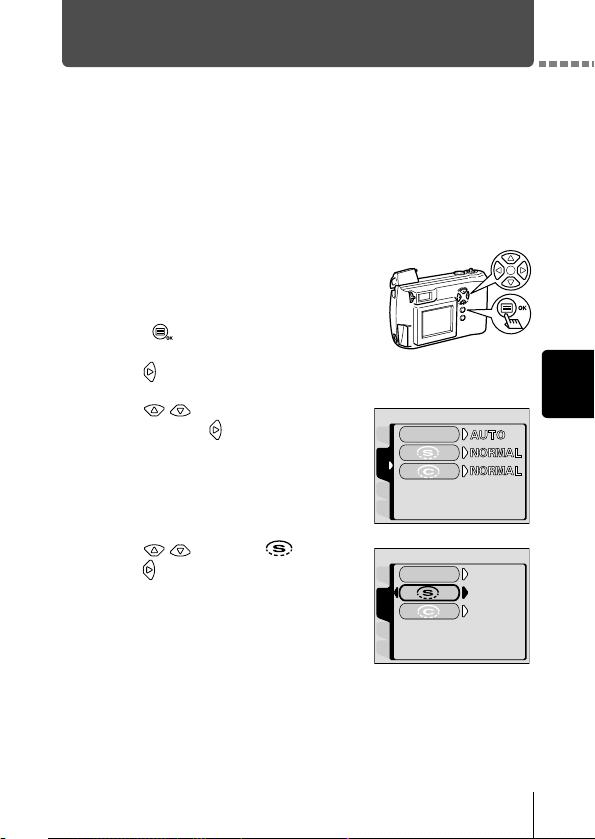
Adjusting the image quality and exposure
4
79
Adjusting the sharpness
Use this function when you want to blur the outlines of the subject to give a
softer impression, or emphasize them to give a sharper impression.
1
Display the top menu in the shooting
mode.
• Open the lens barrier fully.
•Press .
2
Press to select MODE MENU.
3
Press to select the PICTURE
tab, then press .
4
Press to select , then
press .
Sharpness settings
HARD : The outlines of the subject are strongly emphasized. Use this setting
for taking pictures of buildings or text.
NORMAL : This is the standard setting.
SOFT : The outlines of the subject are not strongly emphasized. Use this
setting when you want to edit images on a PC.
CARDSEt
CAM
PICtURE
WB
CARDSEt
CAM
PICtURE
WB
AUtO
AUtO
NORMAL
NORMAL
NORMAL
NORMAL
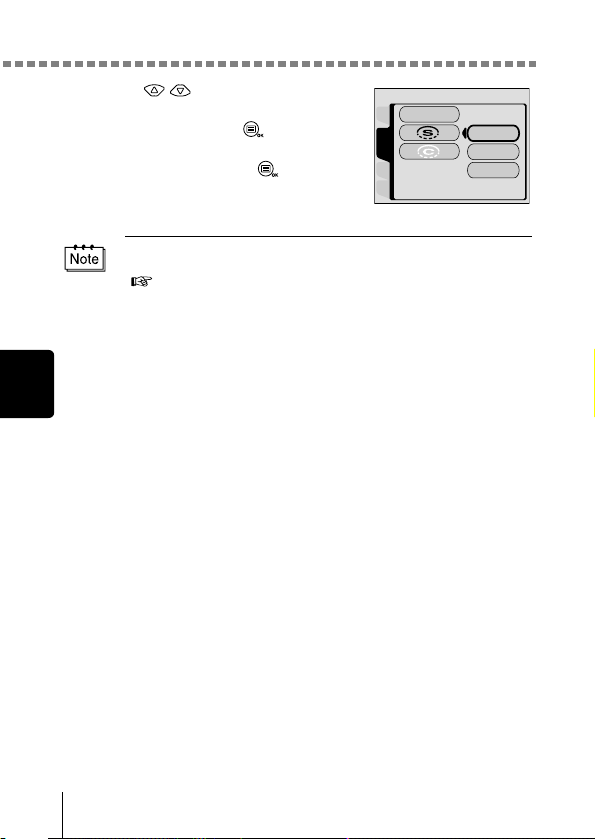
Adjusting the sharpness
Adjusting the image quality and exposure
4
80
5
Press to select one of the
sharpness settings: HARD, NORMAL
or SOFT, then press .
The sharpness is set.
To close the menu, press again.
6
Take the picture.
The sharpness setting returns to NORMAL (factory default setting)
when the lens barrier is closed. “Saving the settings (All Reset)”
( p.110)
CARDSEt
CAM
PICtURE
WB
HARD
NORMAL
SOFt
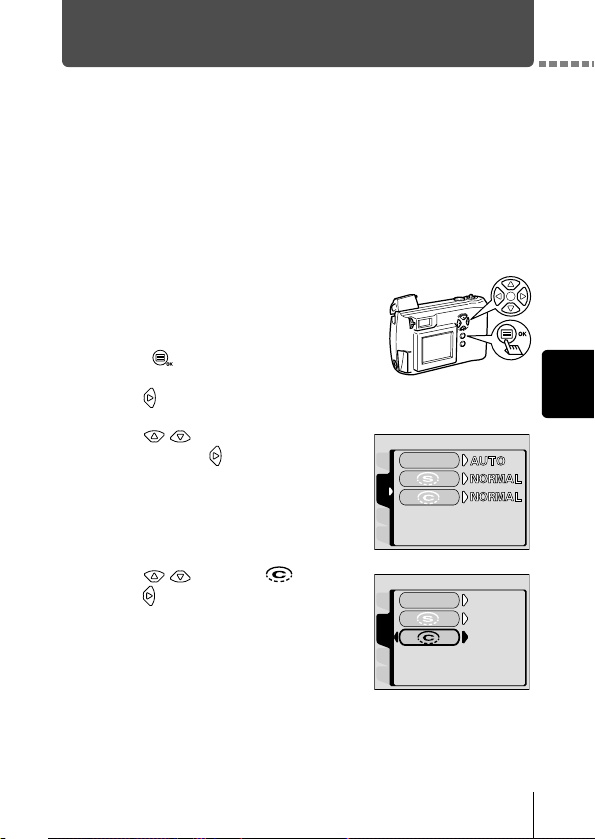
Adjusting the image quality and exposure
4
81
Adjusting the contrast
This function enables you to adjust the contrast of images. For example, you
can make images with marked differences in light and shadow softer, and
those with less differences more vivid.
1
Display the top menu in the shooting
mode.
• Open the lens barrier fully.
•Press .
2
Press to select MODE MENU.
3
Press to select the PICTURE
tab, then press .
4
Press to select , then
press .
Contrast
settings
HIGH : Light and shadow are defined more clearly and the image becomes
crisper.
NORMAL : This is the standard setting.
LOW : Light and shadow are less defined and the image becomes softer.
Use this setting when you want to edit images on a PC.
CARDSEt
CAM
PICtURE
WB
CARDSEt
CAM
PICtURE
WB
AUtO
AUtO
NORMAL
NORMAL
NORMAL
NORMAL
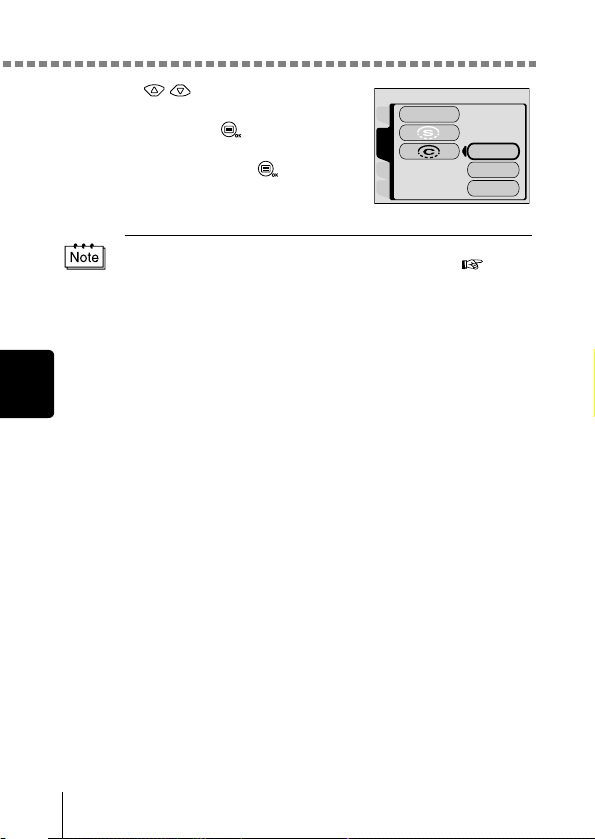
Adjusting the contrast
Adjusting the image quality and exposure
4
82
5
Press to select one of the
contrast settings: HIGH, NORMAL or
LOW, then press .
The contrast is set.
To close the menu, press again.
6
Take the picture.
The contrast setting returns to NORMAL (factory default setting) when
the lens barrier is closed. “Saving the settings (All Reset)” ( p.110)
CARDSEt
CAM
PICtURE
WB
HIGH
NORMAL
LOW
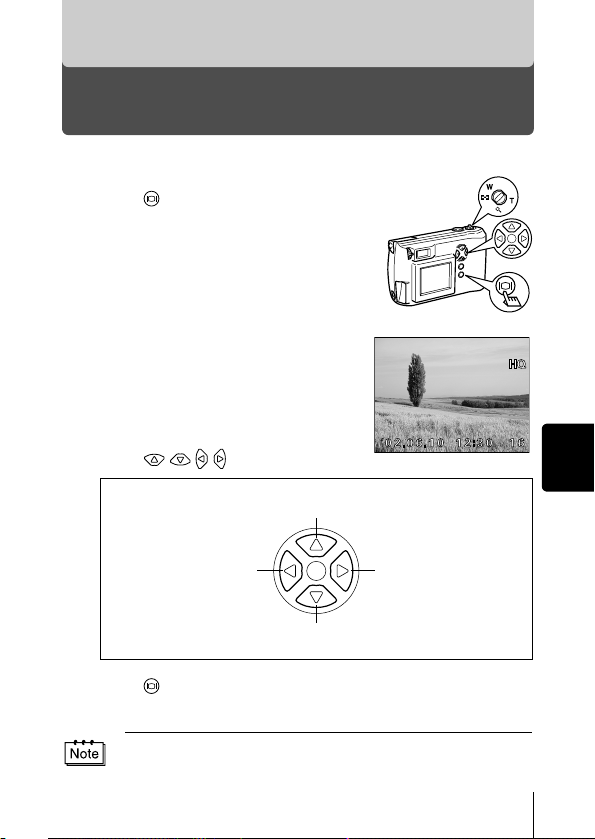
Playback
5
83
Chapter 5
Playback
Playing back still pictures
You can play back pictures one by one on the monitor.
1
Press with the lens barrier closed.
The monitor turns on and displays the last
picture taken. (Single-frame playback)
2
Press .
3
Press to cancel playback.
The monitor and camera turn off.
When the camera turns on, the monitor may light for an instant and
take a while to show the picture.
Displays the next picture.
Displays the previous
picture.
Jumps to the picture 10
frames behind.
Jumps to the picture 10
frames ahead.
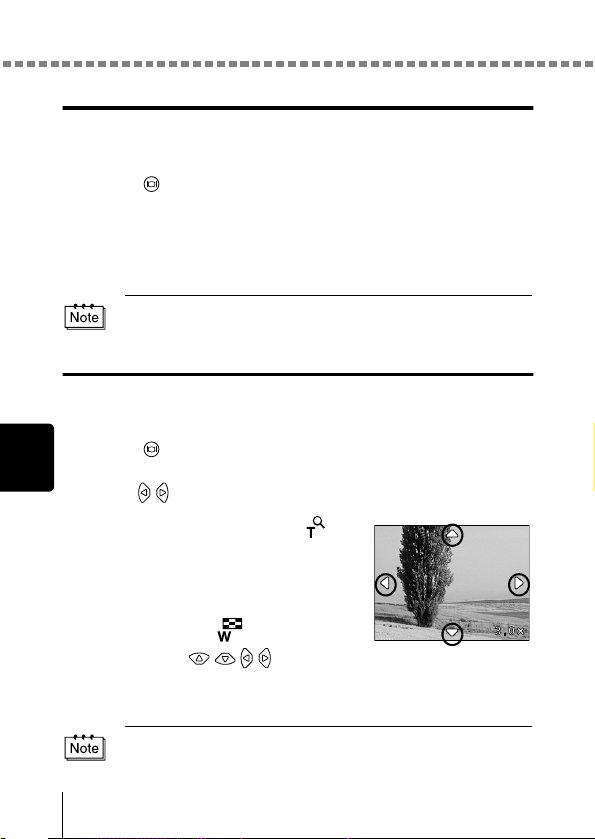
Playing back still pictures
Playback
5
84
Quick View (Double-click playback)
This function lets you play back pictures during shooting with the lens barrier open.
It is useful when you want to check shooting results and resume shooting quickly.
1
Press twice quickly (double-click) in the shooting mode.
The camera immediately enters the playback mode and displays the
last picture taken. (Single-frame playback)
2
Press the shutter button gently (halfway).
The camera returns to the shooting mode and you can resume shooting.
Close-up playback
Pictures displayed on the monitor can be enlarged 1.5, 2, 2.5, 3, 3.5 or 4
times. This function is useful when you want to check the details of a picture.
1
Press with the lens barrier closed.
The monitor turns on and displays the last picture taken.
Press to select the picture you want to enlarge.
2
Press the zoom lever toward .
The picture is magnified 1.5 times.
The magnification increases each time the
zoom lever is pressed. To return the
picture to the original size (1×), press the
zoom lever toward .
3
By pressing while the
enlarged picture is displayed, you can scroll the picture in the
desired direction, enabling you to view a different section.
Functions available in normal playback mode are also available in
Quick View.
• The close-up playback function is not available for movies.
• Pictures cannot be stored in an enlarged state.
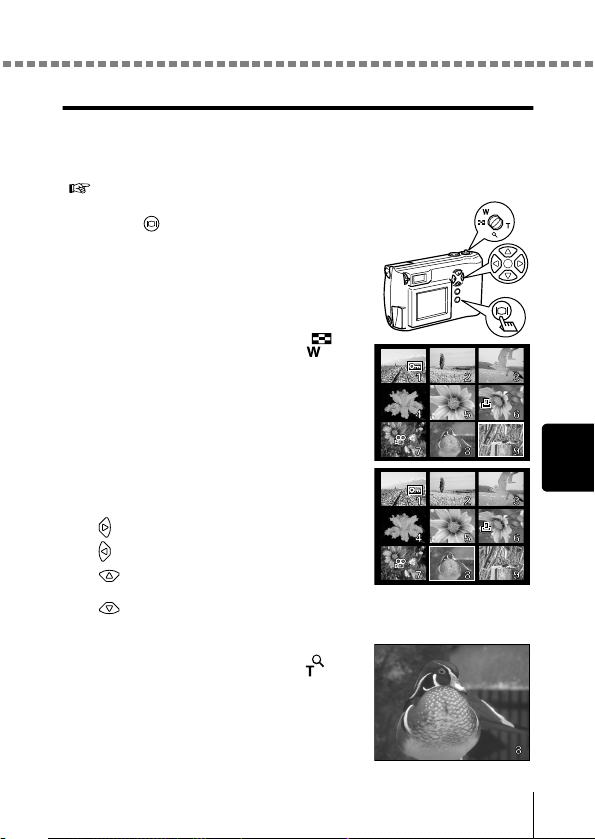
Playing back still pictures
Playback
5
85
Index display
This function lets you show several pictures at the same time on the monitor.
It is useful for quickly finding the picture you want to view. The number of
pictures shown can be 4, 9 or 16. “Selecting the number of pictures”
( p.86)
1
Press with the lens barrier closed.
The monitor turns on and displays the last
picture taken. (Single-frame playback)
2
Press the zoom lever toward to
enter the index display mode.
3
Use the arrow pad to select a frame.
The selected picture is highlighted in the
green frame.
: Moves to the next frame.
: Moves to the previous frame.
: Jumps to the previous index display
(the frames before the top left frame).
: Jumps to the next index display (the frames following the bottom
right frame).
4
To return to single-frame playback,
press the zoom lever toward .
The picture highlighted in the green frame
is displayed in the single-frame playback
mode.
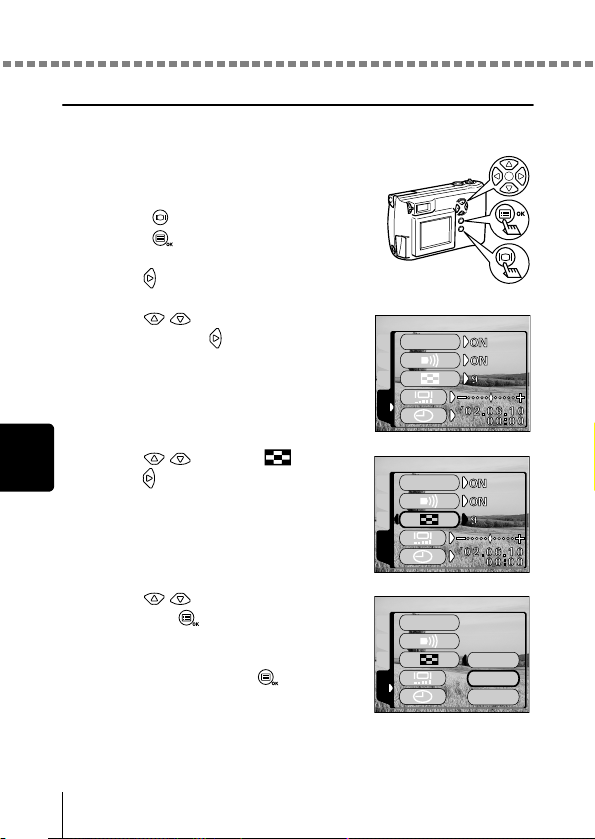
Playing back still pictures
Playback
5
86
Selecting the number of pictures
This function lets you change the number of pictures, 4, 9 or 16, in an index
display.
1
Display the top menu in the playback
mode.
• Press with the lens barrier closed.
•Press .
2
Press to select MODE MENU.
3
Press to select the SETUP
tab, then press .
4
Press to select , then
press .
5
Press to select 4, 9 or 16,
then press .
The number of pictures in the index
display is set.
To close the menu, press again.
PLAYEDItCARD
ALL%RESEt
SEtUP
PLAYEDItCARD
SEtUP
ALL%RESEt
PLAYEDItCARD
SEt
4
9
16
ALL%RESEt
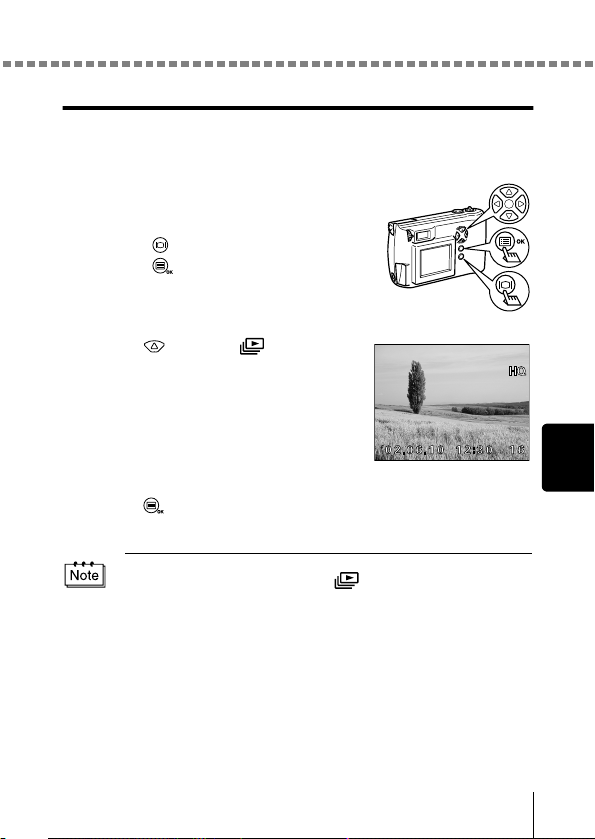
Playing back still pictures
Playback
5
87
Slideshow
This function automatically displays pictures one after another, as if you are
watching a slideshow. It is useful when you want to view the pictures you have
taken in order.
1
Display the top menu in the playback
mode.
• Press with the lens barrier closed.
•Press .
2
Press to select and the
slideshow starts.
Each picture is displayed for 3 seconds,
then the display automatically changes to
the next picture.
3
Press to cancel the slideshow and return to the playback
mode.
• When you display the top menu while showing a movie, MOVIE
PLAY will be displayed instead of . To run a slideshow, display
a still picture first.
• If batteries are used when running a slide-show and the camera is
not operated for about 30 minutes, the power will automatically turn
off.
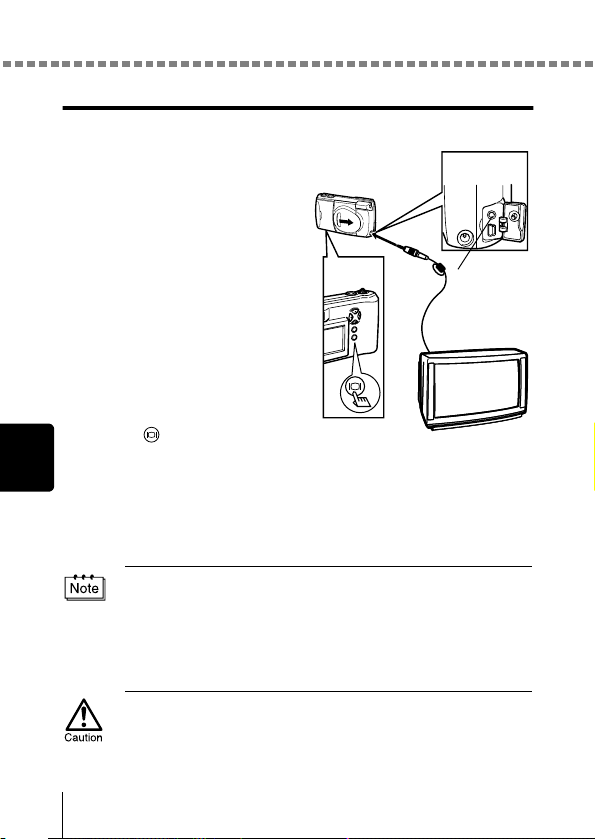
Playing back still pictures
Playback
5
88
Playing back pictures on a TV
You can play back pictures on a TV screen with the Video cable provided.
1
Make sure that the camera
and the TV are turned off,
then connect the Video
cable to the VIDEO OUT
jack on the camera and to
the video input terminal on
the TV.
2
Turn the TV on and switch
to the video input.
For details of switching to video
input, refer to your TV’s
instruction manual.
3
Press .
The camera turns on in the playback mode, and the last picture taken
is displayed on the TV screen.
You can select the pictures you want to see using the arrow pad.
The close-up playback, index display and slideshow functions can also
be used on a TV screen.
• The camera’s monitor turns off automatically when the Video cable is
connected to the camera.
• You are recommended to use the optional AC adapter when using
the camera with a TV.
• The picture may appear off-center on the TV screen. This is due to
the TV’s adjustment settings. This is not a camera malfunction.
• Be sure to use the Video cable provided to connect the camera to the
TV.
• Video signal is either NTSC or PAL compatible depending on the
standard in the intended area of distribution.
VIDEO OUT
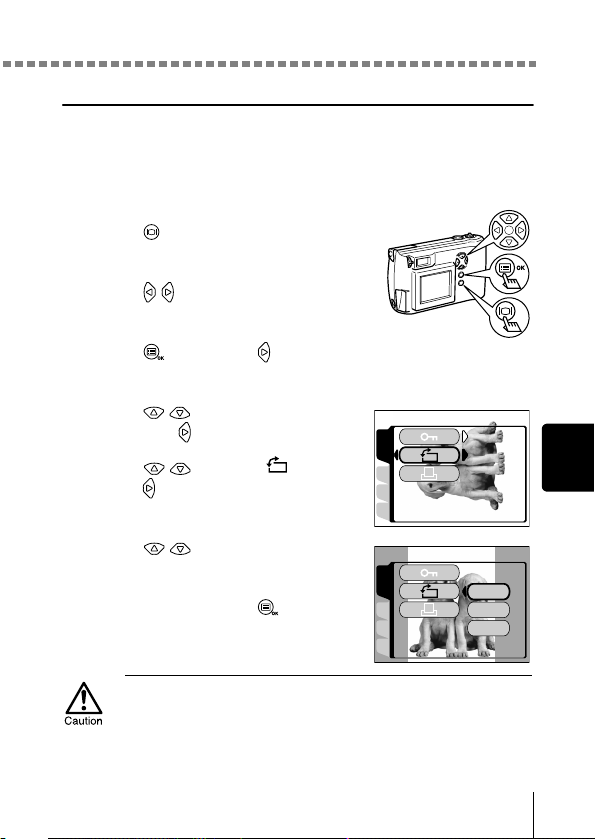
Playing back still pictures
Playback
5
89
Rotating pictures
Pictures taken with the camera held vertically are displayed horizontally. In
this case, you can use this function to display the picture vertically. You can
turn the selected picture 90 degrees clockwise or counterclockwise.
Once a picture has been rotated, it will be displayed that way every time it is
played back.
1
Press with the lens barrier closed.
The monitor turns on.
2
Press to select the picture you
want to rotate.
3
Press , then press .
The mode menu is displayed.
4
Press to select the PLAY tab,
then press .
5
Press to select , then
press .
6
Press to select +90° or -90°.
The picture is rotated, and displayed
vertically.
To close the menu, press twice.
+90° : clockwise
- 90° :counterclockwise
• You cannot rotate movies, protected pictures or pictures that have
been edited on a PC.
• You cannot rotate pictures stored on a card with a write-protect seal.
CARDSEt EDIt
PLAY
0@
0@
OFF
OFF
CARDSEt EDIt
PLAY
+90@
0@
-90@
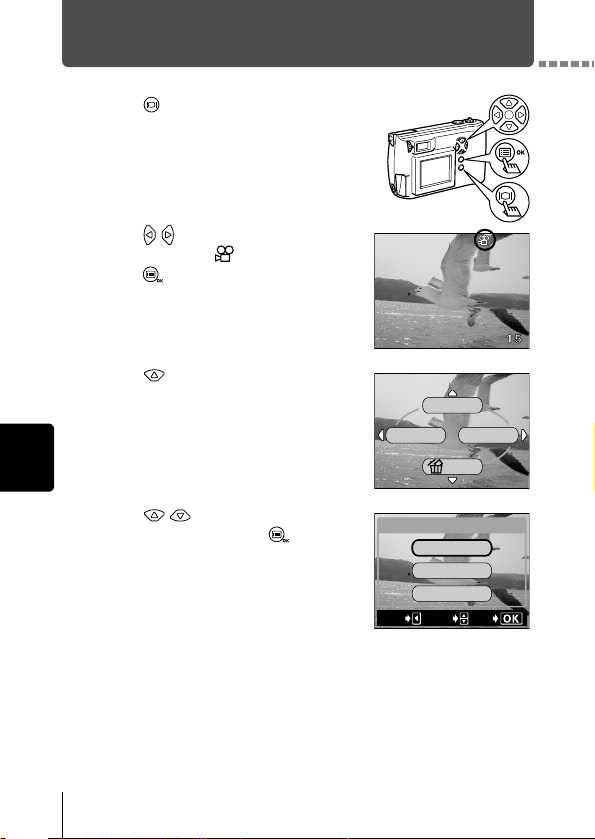
Playback
5
90
Playing back movies
1
Press with the lens barrier closed.
The monitor turns on.
2
Press to display the desired
picture with the indicator, then
press .
The top menu is displayed.
3
Press to select MOVIE PLAY.
4
Press to select MOVIE
PLAYBACK, then press .
The movie is played back after the orange
lamp on the right of the viewfinder blinks
and the camera accesses the movie data.
When the movie reaches the end, the
display automatically returns to the
beginning of the movie.
MODE%MENU
MOVIE%PLAY
INFO
ERASE
CANCEL
GO
SELECt
MOVIE PLAYBACK
MOVIE PLAY
INDEX
EDIt
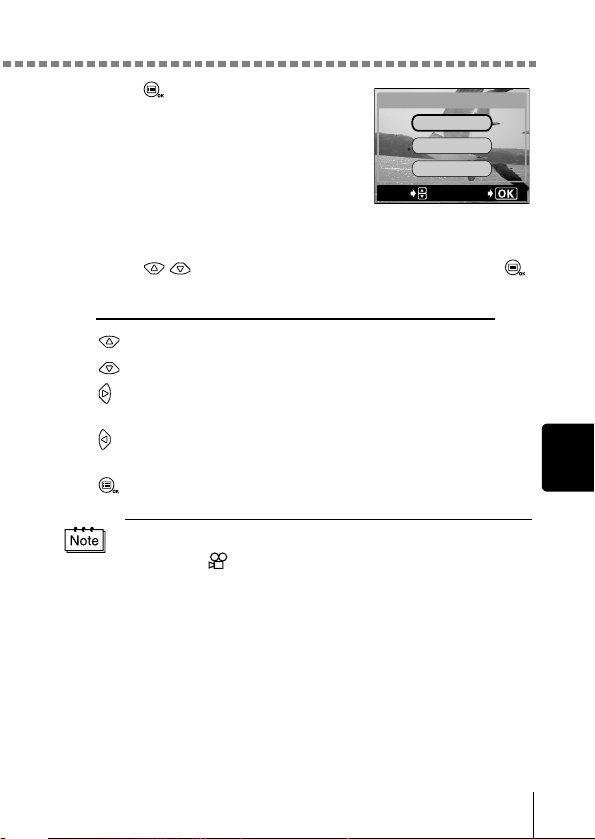
Playing back movies
Playback
5
91
5
Press .
The MOVIE PLAYBACK menu is displayed.
PLAYBACK : Plays back the
entire movie again.
FRAME BY FRAME :Plays back the
movie manually one
frame at a time.
EXIT : Leaves the movie playback mode.
6
Press to select the desired operation, then press .
Operations when FRAME BY FRAME is selected
: Displays the first frame of the movie.
: Displays the last frame of the movie.
: Displays the next frame. The movie can be displayed
continuously by holding the button down.
: Displays the previous frame. The movie can be displayed
continuously in reverse by holding the button down.
: Displays the MOVIE PLAYBACK menu.
To play back another movie, exit the movie playback mode by selecting
EXIT on the MOVIE PLAYBACK menu. Then display the desired
picture with a indicator and select MOVIE PLAY again on the top
menu.
FRAME%BY%FRAME
EXIt
MOVIE%PLAYBACK
PLAYBACK
SELECt
GO
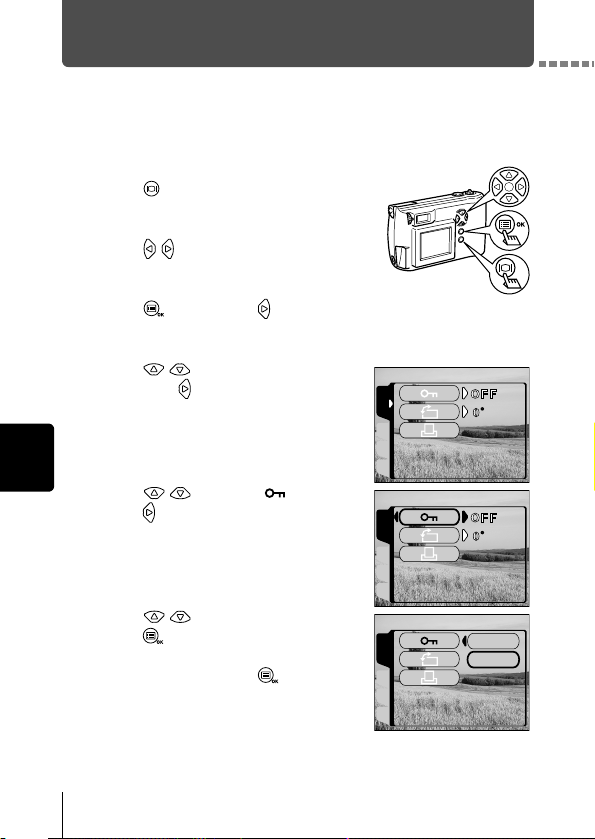
Playback
5
92
Protecting pictures (Protect)
You are recommended to protect important pictures to avoid accidentally
erasing them.
Protected pictures cannot be erased by the single-frame/all-frame erase
function.
1
Press with the lens barrier closed.
The monitor turns on.
2
Press to select the picture you
want to protect.
3
Press , then press .
The mode menu is displayed.
4
Press to select the PLAY tab,
then press .
5
Press to select , then
press .
6
Press to select ON, then
press .
The selected picture is protected.
To close the menu, press again.
CARDSEt EDIt
PLAY
CARDSEt EDIt
PLAY
CARDSEt EDIt
PLAY
OFF
ON
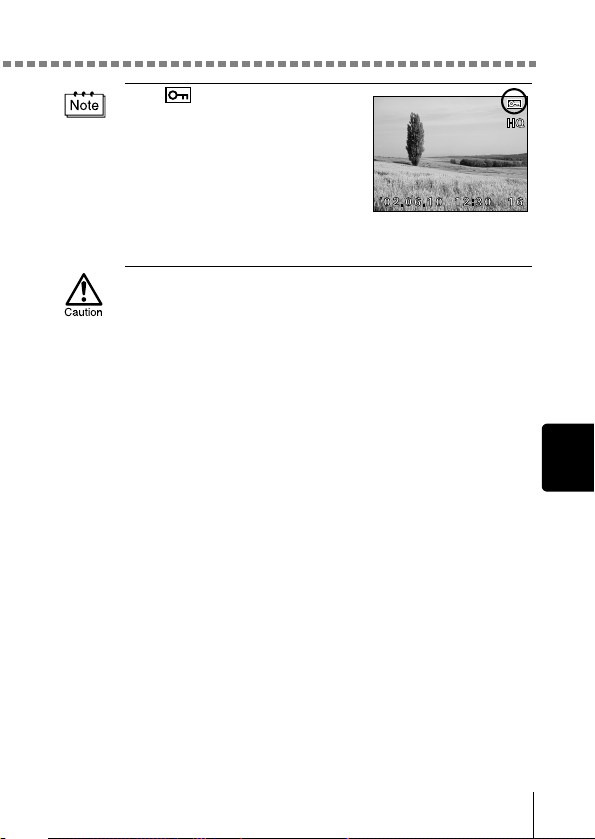
Protecting pictures (Protect)
Playback
5
93
• The indicator is displayed at the
top right of the protected picture.
• Protection on each picture remains even when the camera is turned
off.
• Protected pictures cannot be erased by the single-frame/all-frame
erase function, but they can be all erased with the format function.
• Protection cannot be applied to pictures stored on a card with a write-
protect seal.
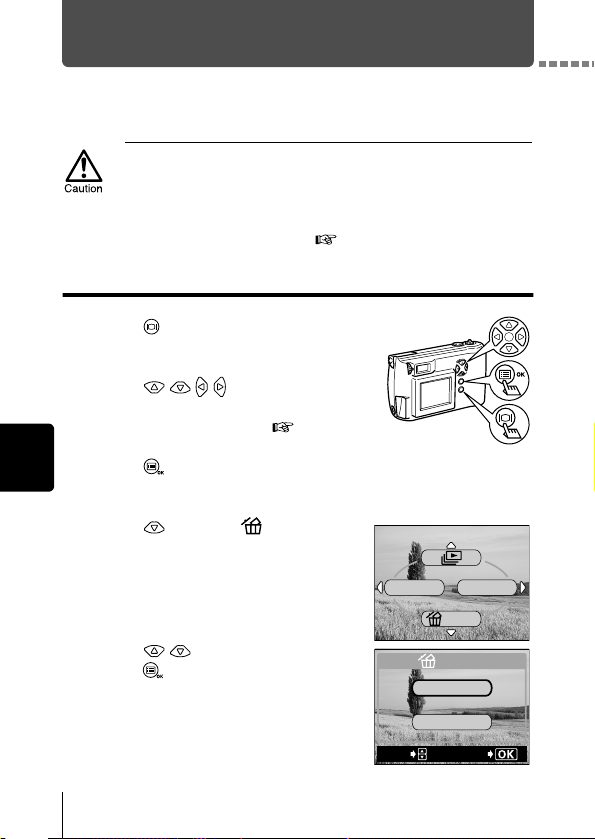
Playback
5
94
Erasing pictures
This function enables you to erase recorded pictures. This can be done either
one frame at a time or to all the pictures on the card at once.
Single-frame erase
1
Press with the lens barrier closed.
The monitor turns on.
2
Press to select the
picture you want to erase.
“Playing back still pictures” ( p.83)
3
Press .
The top menu is displayed.
4
Press to select ERASE.
5
Press to select YES, then
press .
The picture is erased and the menu is
closed.
• Erasure is not possible if the picture you want to erase is protected or
a write-protect seal is attached to the card. Before erasing, unprotect
the picture or remove the write-protect seal from the card.
• Once erased, pictures cannot be restored. Check each picture before
erasing to avoid accidentally erasing pictures you want to keep.
“Protecting pictures (Protect)” ( p.92)
MODE%MENU
INFO
ERASE
YES
NO
SELECt
GO
ERASE
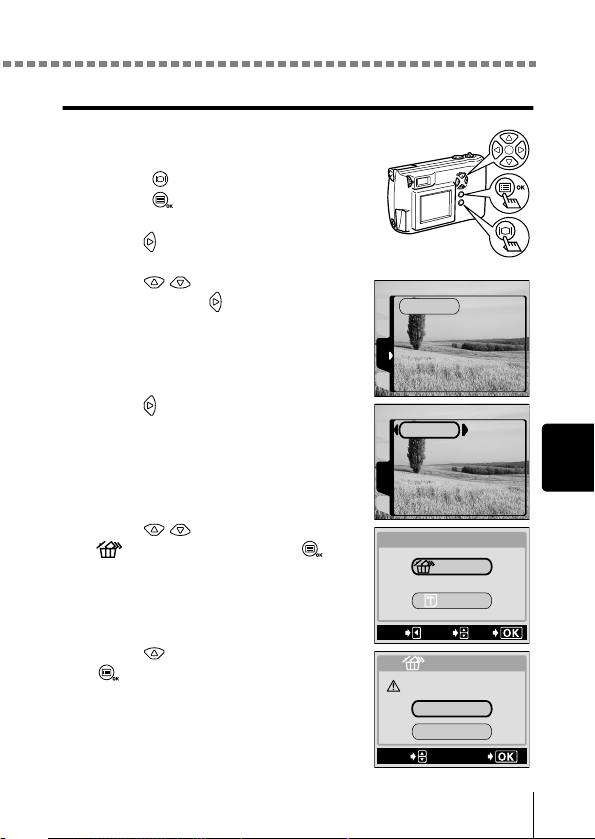
Erasing pictures
Playback
5
95
All-frame erase
1
Display the top menu in the playback
mode.
• Press with the lens barrier closed.
•Press .
2
Press to select MODE MENU.
3
Press to select the CARD
tab, then press .
4
Press .
5
Press to select
ALL ERASE, then press .
6
Press to select YES, then press
.
All the pictures are erased.
PLAYSEt EDIt
CARD
CARD%SEtUP
PLAYSEt EDIt
CARD
CARD%SEtUP
CARD%SEtUP
ALL%ERASE
CANCEL
GO
SELECt
FORMAt
YES
CAUtION ERASING%ALL
SELECt
GO
ALL%ERASE
NO
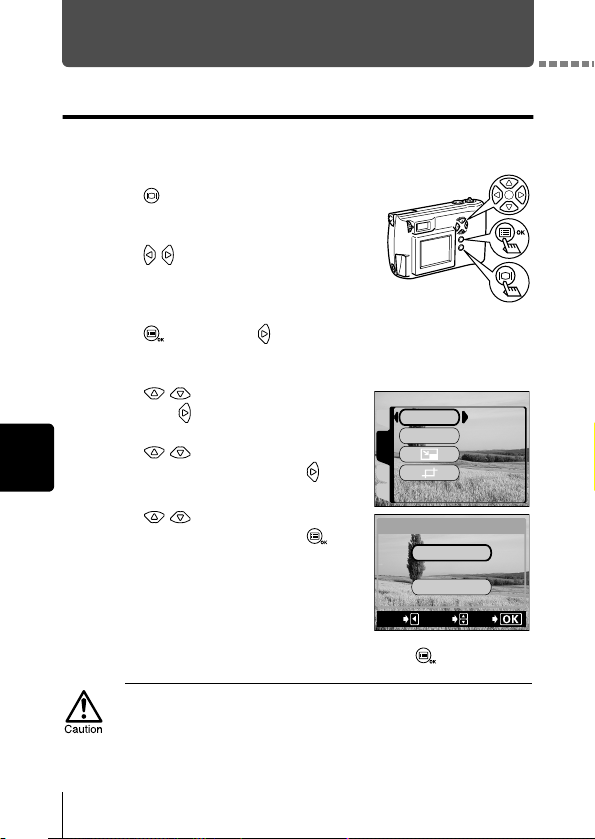
Playback
5
96
Editing still pictures
Creating black and white pictures
This function enables you to turn the selected picture into a black and white
picture.
1
Press with the lens barrier closed.
The monitor turns on.
2
Press to select the picture you
want to turn into a black and white
picture.
3
Press , then press .
The mode menu is displayed.
4
Press to select the EDIT tab,
then press .
5
Press to select
BLACK & WHITE, then press .
6
Press to select
BLACK & WHITE, then press .
A bar is displayed showing the progress of
creating the picture, then the camera
returns to the playback mode. The black
and white picture is stored as a separate
picture from the original.
To cancel editing mode, select CANCEL and press .
• You cannot create black and white movies.
• You cannot create black and white pictures from pictures stored on a
card with a write-protect seal.
• You cannot create a black and white picture if there is insufficient
memory space on the card.
PLAYCARDSEt
EDIt
BLACK%&%WHItE
SEPIA
BLACK%&%WHItE
CANCEL
BLACK%&%WHItE
EXIt
GO
SELECt
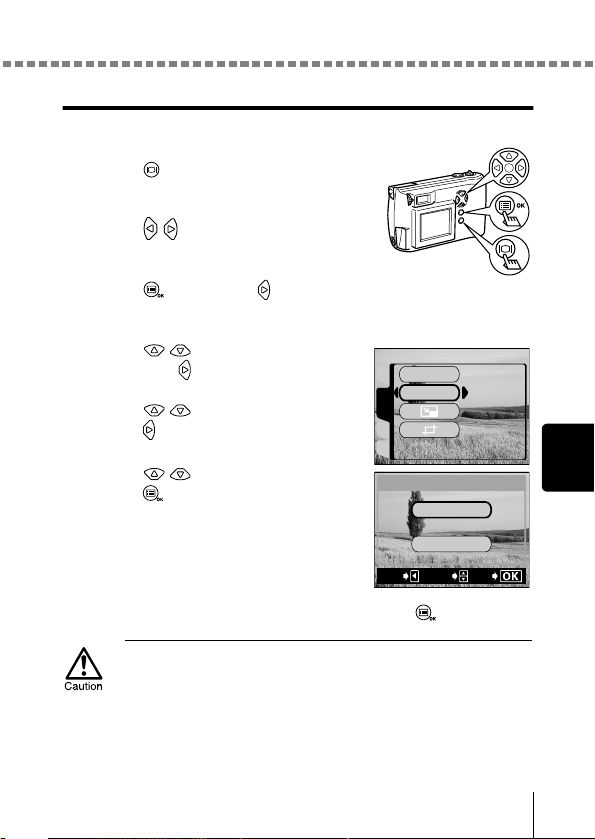
Editing still pictures
Playback
5
97
Creating sepia-toned pictures
This function enables you to turn the selected picture into sepia tones.
1
Press with the lens barrier closed.
The monitor turns on.
2
Press to select the picture you
want to turn into a sepia-toned picture.
3
Press , then press .
The mode menu is displayed.
4
Press to select the EDIT tab,
then press .
5
Press to select SEPIA, then
press .
6
Press to select SEPIA, then
press .
A bar is displayed showing the progress of
creating the picture, then the camera
returns to the playback mode. The sepia-
toned picture is stored as a separate
picture from the original.
To cancel editing mode, select CANCEL and press .
• You cannot create sepia-toned movies.
• You cannot create sepia-toned pictures from pictures stored on a
card with a write-protect seal.
• You cannot create a sepia-toned picture if there is insufficient
memory space on the card.
PLAYCARDSEt
EDIt
BLACK%&%WHItE
SEPIA
SEPIA
CANCEL
SEPIA
EXIt
GO
SELECt
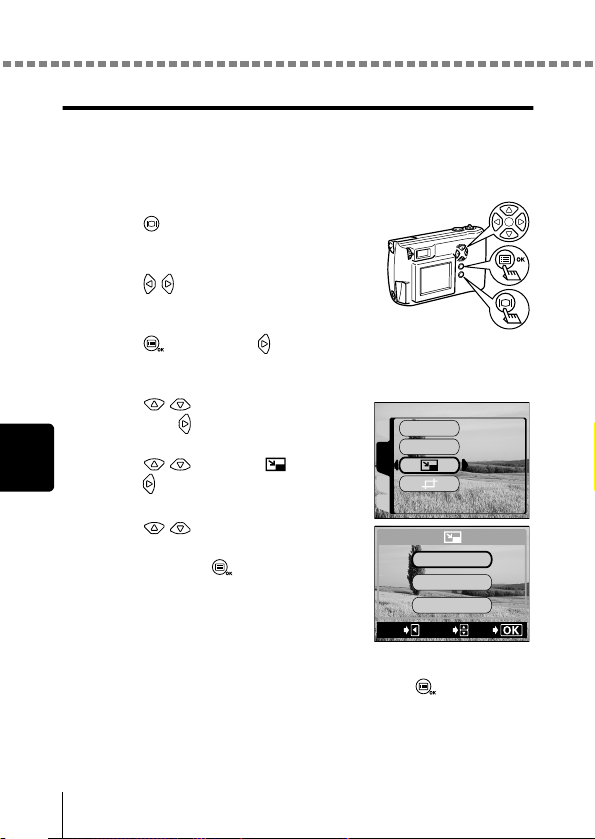
Editing still pictures
Playback
5
98
Resizing pictures
This function enables you to change the file size of the selected picture to 640
× 480 or 320 × 240 and store it separately as a new picture. Use this function
when you want to reduce the volume of image data, such as when attaching
a picture to e-mail.
1
Press with the lens barrier closed.
The monitor turns on.
2
Press to select the picture you
want to resize.
3
Press , then press .
The mode menu is displayed.
4
Press to select the EDIT tab,
then press .
5
Press to select , then
press .
6
Press to select one of the
following sizes, 640 × 480 or 320 ×
240, then press .
A bar is displayed showing the progress of
resizing, then the camera returns to the
playback mode.
The resized picture is stored as a separate
picture from the original.
To cancel editing mode, select CANCEL and press .
PLAYCARDSEt
EDIt
BLACK%&%WHItE
SEPIA
320*240
CANCEL
EXIt
GO
640*480
SELECt
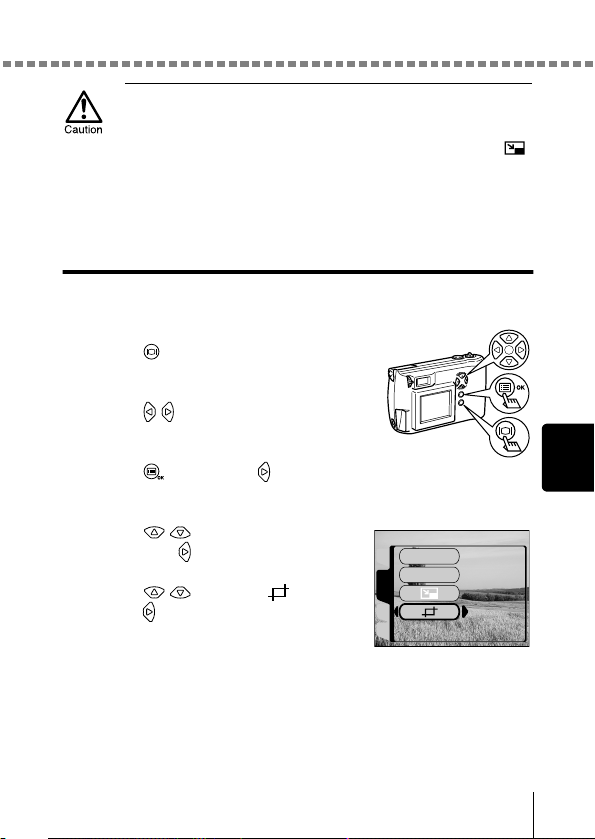
Editing still pictures
Playback
5
99
Trimming pictures
This function enables you to enlarge part of a recorded picture and store it in
a separate file.
1
Press with the lens barrier closed.
The monitor turns on.
2
Press to select the picture you
want to trim.
3
Press , then press .
The mode menu is displayed.
4
Press to select the EDIT tab,
then press .
5
Press to select , then
press .
• You cannot resize movies or images that have been edited on a PC.
• If the size of the selected picture is 640 × 480 or smaller, you cannot
select 640 × 480 on the menu.
• If the size of the selected picture is 320 × 240, you cannot select
on the menu.
• You cannot resize pictures stored on a card with a write-protect seal.
• You cannot resize pictures if there is insufficient memory space on
the card.
PLAYCARDSEt
EDIt
BLACK%&%WHItE
SEPIA
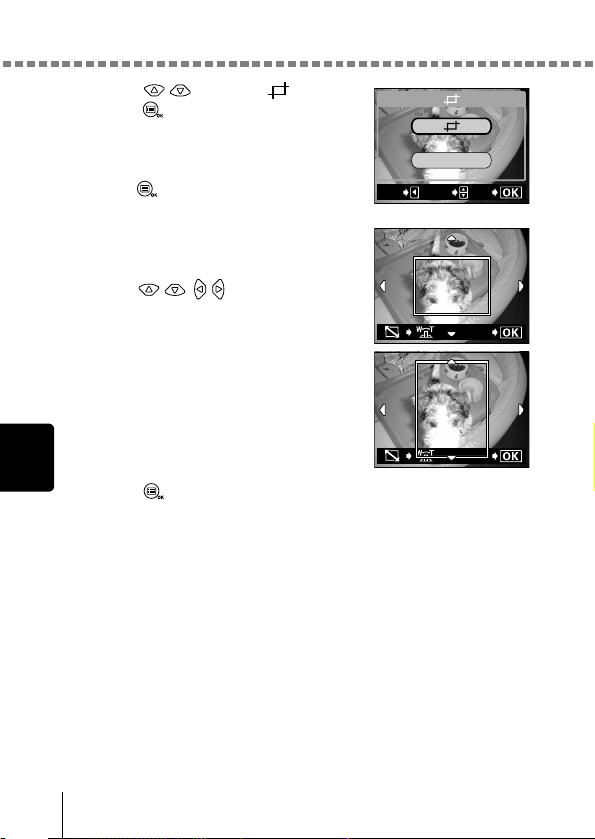
Editing still pictures
Playback
5
100
6
Press to select , then
press .
The screen for selecting the size of the
area you want to trim is displayed.
To cancel trimming, select CANCEL and
press
.
7
Use the arrow pad and the zoom
lever to decide the position and size
of the area you want to trim.
Press to decide the
position, and push the zoom lever toward
W or T to determine the size.
8
Press .
The trimmed area is displayed for 1 second.
CANCEL
EXIt
GO
SELECt
GO
GO
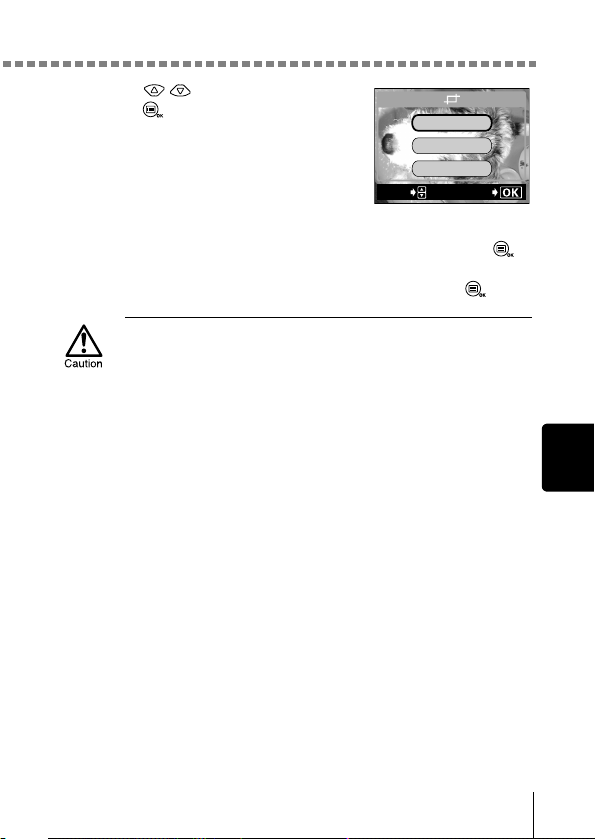
Editing still pictures
Playback
5
101
9
Press to select OK, then
press .
A bar is displayed showing the progress of
trimming, then the camera returns to the
playback mode.
The trimmed picture is stored as a
separate picture from the original.
If you want to perform trimming again, select RESET and press
and repeat the procedure from Step 7.
To cancel the trimming function, select CANCEL and press .
• You cannot trim movies.
• You cannot trim pictures stored on a card with a write-protect seal.
• You cannot trim a picture if there is insufficient memory space on the
card.
• You can trim a picture to half of its original size.
GO
SELECt
OK
RESEt
CANCEL
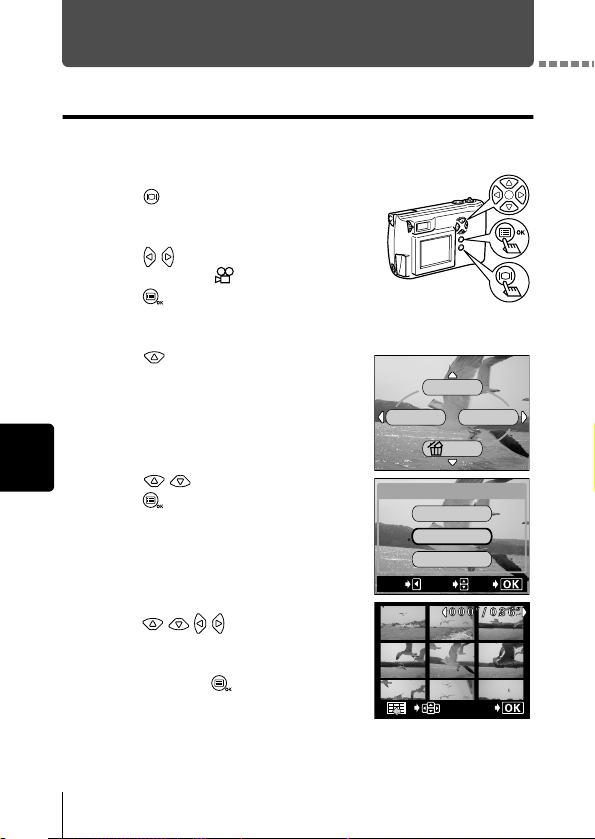
Playback
5
102
Editing movies
Creating an index
9 frames extracted from the movie are displayed as an index to show the
movie at a glance. Indexes can be stored on the card as still pictures.
1
Press with the lens barrier closed.
The monitor turns on.
2
Press to display the desired
picture with the indicator, then
press .
The top menu is displayed.
3
Press to select MOVIE PLAY.
4
Press to select INDEX, then
press .
5
Select the first frame of the index.
Press to play back the
movie until the picture that you want to be
the first frame is displayed in the green
frame, then press .
MODE%MENU
MOVIE%PLAY
INFO
ERASE
CANCEL
GO
SELECt
MOVIE PLAYBACK
MOVIE PLAY
INDEX
EDIt
OK
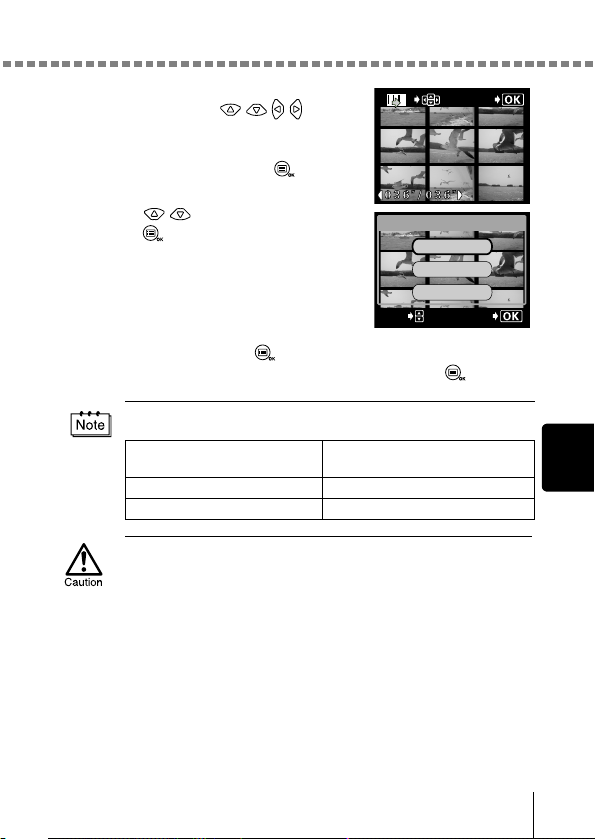
Editing movies
Playback
5
103
6
Select the last frame of the index.
As in Step 5, press to play
back the movie until the picture that you
want to be the last frame is displayed in
the green frame, then press .
7
Press to select OK, then
press .
The 9 frames extracted from the movie
appear as an index display, then the
camera returns to the playback mode. The
index is stored as a new picture.
If you want to select the frames again,
select RESET and press and repeat the procedure from Step 5.
To cancel the index function, select CANCEL and press .
The index is stored as a still picture in a different record mode from
the original movie.
Record mode when the movie is
shot
Record mode when stored as an
index
HQ SQ1 (1024
×
768 pixels)
SQ SQ2 (640
×
480 pixels)
• The interval between the frames that are automatically picked out
varies depending on the recording time of the movie.
• An index consists of 9 frames.
• You cannot create an index of a movie stored on a card with a write-
protect seal.
• You cannot create an index if there is insufficient memory space on
the card.
OK
GO
SELECt
OK
RESEt
INDEX
CANCEL
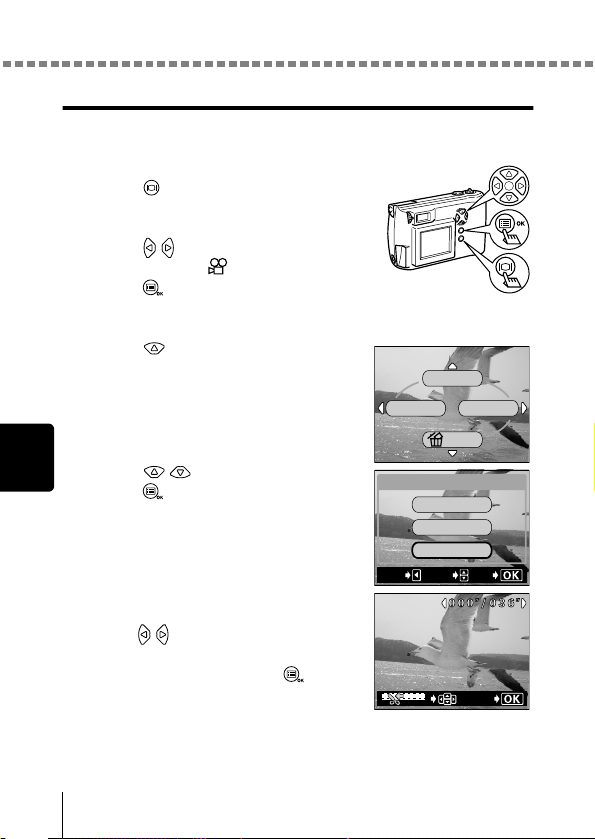
Editing movies
Playback
5
104
Editing movies
This function enables you to edit a movie by erasing frames from the
beginning and end of the movie that you do not want.
1
Press with the lens barrier closed.
The monitor turns on.
2
Press to display the desired
movie with the indicator, then
press .
The top menu is displayed.
3
Press to select MOVIE PLAY.
4
Press to select EDIT, then
press .
5
Select the first frame of the part you
want to keep.
Press to play back the movie, and
when the frame that you want to be the
first frame is displayed, press .
MODE%MENU
MOVIE%PLAY
INFO
ERASE
CANCEL
GO
SELECt
MOVIE
PLAYBACK
MOVIE PLAY
INDEX
EDIt
OK
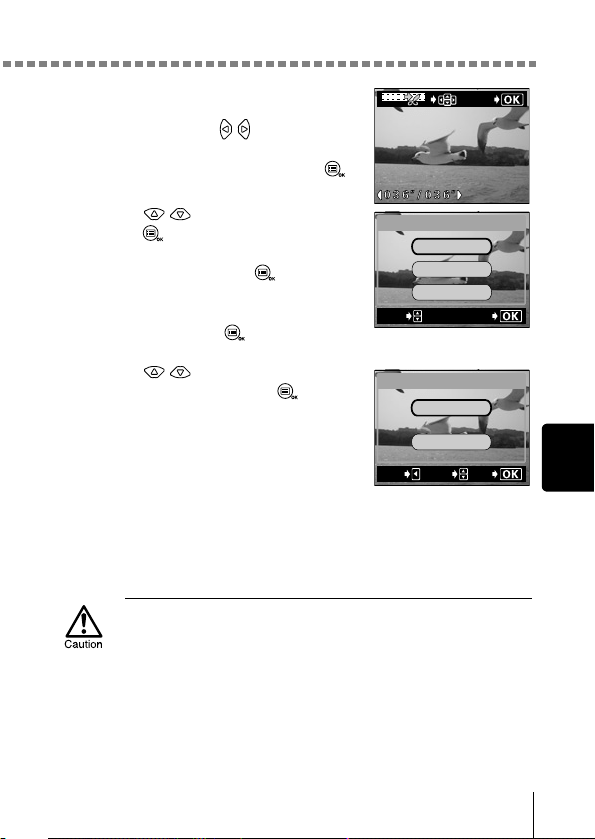
Editing movies
Playback
5
105
6
Select the last frame of the part you
want to keep.
As in Step 5, press to play back the
movie, and when the frame that you want
as the last frame is displayed, press .
7
Press to select OK, then
press .
If you want to select the frames again,
select RESET and press and repeat
the procedure from Step 5.
To cancel the EDIT function, select
CANCEL and press .
8
Press to select NEW FILE or
OVERWRITE, then press .
NEW FILE : Stores the edited movie
as a new movie with a
different name.
OVERWRITE :Stores the edited movie
with the same name as
the original. The original movie is not stored.
The edited movie is stored and the screen returns to the playback
mode.
• You cannot edit movies with sound which taken by other digital
cameras.
• You cannot edit movies stored on a card with a write-protect seal.
• You cannot select NEW FILE if there is insufficient memory space on
the card.
OK
GO
SELECt
OK
EDIt
RESEt
CANCEL
CANCEL
GO
SELECt
NEW FILE
OVERWRItE
EDIt
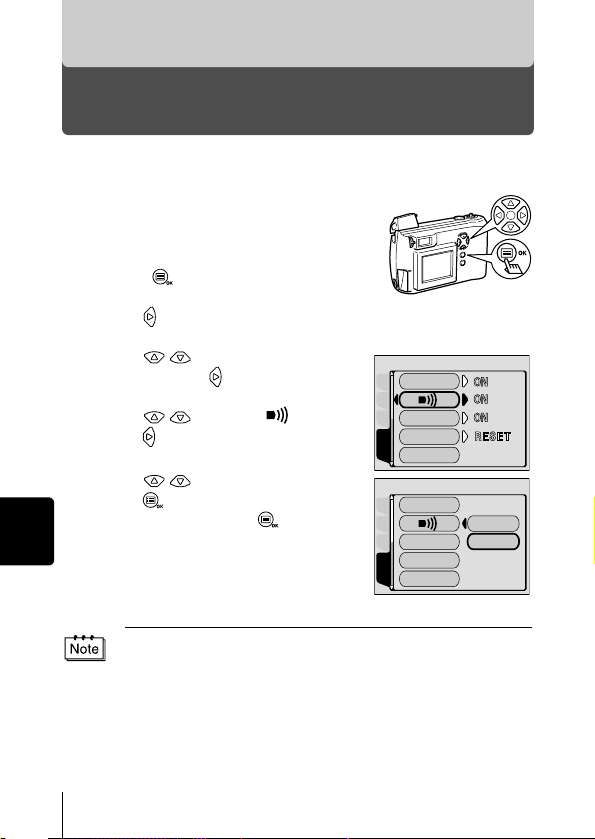
Useful functions
6
106
Chapter 6
Useful functions
Turning the beep sound off (Beep sound)
You can turn the volume of the beep sound which is generated during certain
camera operations or generated as a warning to OFF.
1
Display the top menu in the shooting
mode.
• Open the lens barrier fully.
•Press .
2
Press to select MODE MENU.
3
Press to select the SETUP
tab, then press .
4
Press to select , then
press .
5
Press to select OFF, then
press .
To close the menu, press again.
• The beep sound setting remains even when the lens barrier is closed
or All Reset is set to OFF.
• The beep sound can also be turned off from the playback mode.
CARD
SEtUP
CAM
PIC
ALL RESEt
REC VIEW
FILE NAME
PIXEL MAPPING
CARD
SEtUP
CAM
PIC
ALL RESEt
REC VIEW
FILE NAME
PIXEL MAPPING
ON
OFF
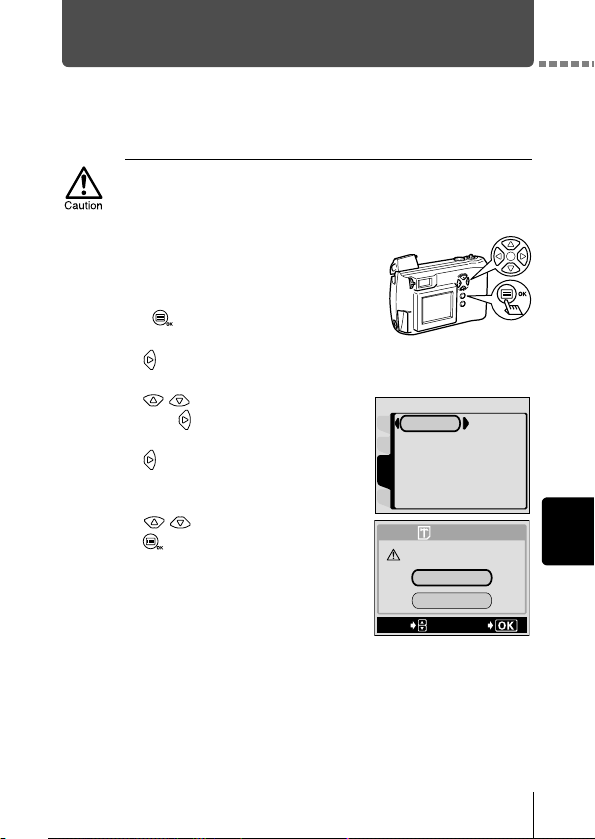
Useful functions
6
107
Formatting (Card setup)
This function lets you format a card. Formatting prepares cards to receive
data. Before using non-Olympus cards or cards which have been formatted
on a PC, you must format them with this camera.
1
Display the top menu in the shooting
mode.
• Open the lens barrier fully.
•Press .
2
Press to select MODE MENU.
3
Press to select the CARD tab,
then press .
4
Press .
5
Press to select YES, then
press .
Formatting is executed.
All existing data, including protected data, is erased when the card is
formatted. Once erased, pictures cannot be restored, so make sure
that you do not erase important image data. Download important image
data to a PC before formatting the card.
SEt
CAM
PIC
CARD
CARD%SEtUP
YES
NO
CAUtION ERASING%ALL
SELECt
GO
FORMAt
Formatting (Card setup)
Useful functions
6
108
Formatting can also be performed from the playback mode.
• Never open the card cover or remove the batteries during formatting
as this may cause malfunction of the card.
• Never connect or disconnect the AC adapter during formatting as this
may cause malfunction of the card.
• Cards with a write-protect seal cannot be formatted. Remove the seal
before formatting the card. Do not reuse the removed seal.
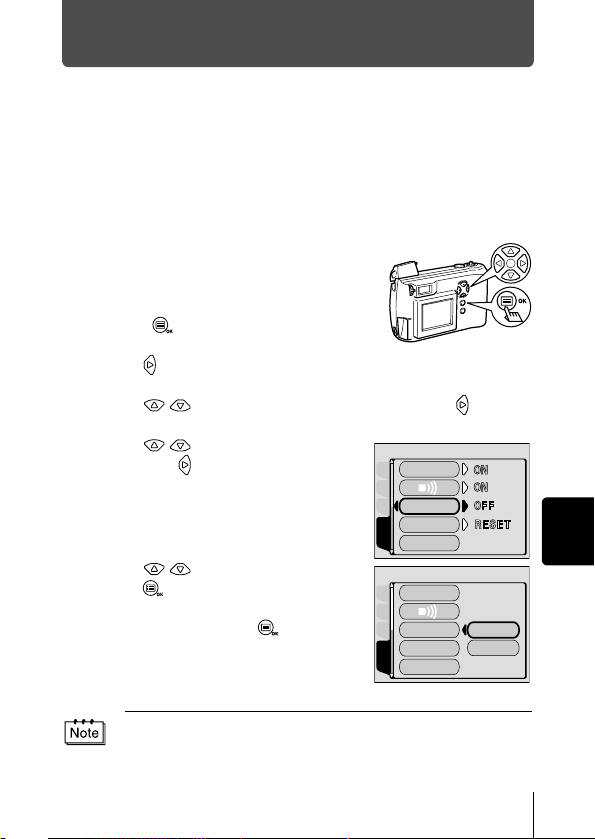
Useful functions
6
109
Viewing a picture immediately after shooting (Rec View)
You can view the picture you have just taken on the monitor for 3 seconds
while it is being recorded.
1
Display the top menu in the shooting
mode.
• Open the lens barrier fully.
•Press .
2
Press to select MODE MENU.
3
Press to select the SETUP tab, then press .
4
Press to select REC VIEW,
then press .
5
Press to select ON, then
press .
Rec View is set.
To close the menu, press again.
Rec View settings
ON : The picture being recorded is displayed on the monitor. This is useful for a
brief check of the picture you have just taken. Pressing the shutter button
halfway during Rec View lets you resume shooting immediately.
OFF : The picture just taken is not displayed. This is useful when you want to
prepare for your next shot while the previous picture is being recorded.
• The Rec View setting remains even when the lens barrier is closed.
• During sequential shooting, Rec View is disabled.
CARD
SEtUP
CAM
PIC
ALL RESEt
REC VIEW
FILE NAME
PIXEL MAPPING
CARD
SEtUP
CAM
PIC
ALL RESEt
REC VIEW
FILE NAME
PIXEL MAPPING
ON
OFF
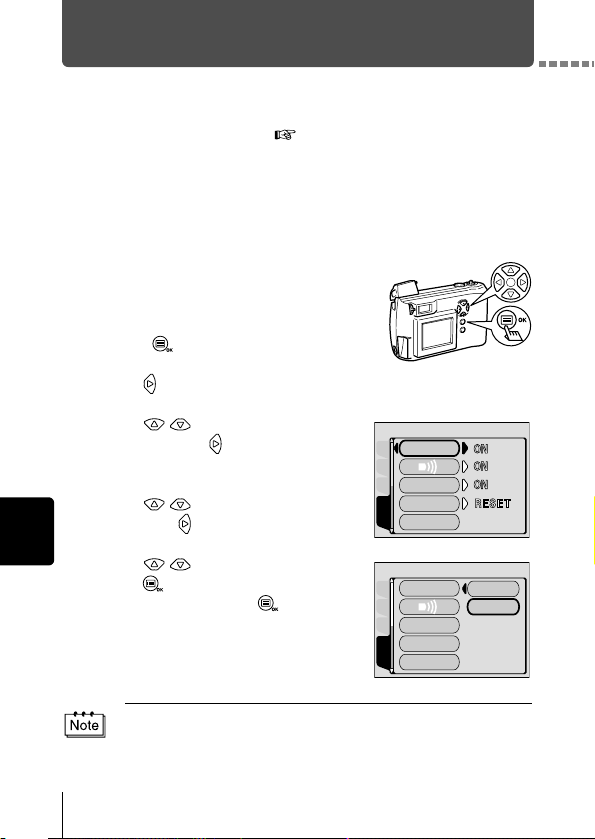
Useful functions
6
110
Saving the settings (All Reset)
This function lets you choose whether or not the camera saves its current
settings when the power is turned off. For the settings that can be saved, see
“Functions that All Reset affects” ( p.111).
1
Display the top menu in the shooting
mode.
• Open the lens barrier fully.
•Press .
2
Press to select MODE MENU.
3
Press to select the SETUP
tab, then press .
The SETUP menu is displayed.
4
Press to select ALL RESET,
then press .
5
Press to select OFF, then
press .
To close the menu, press again.
All Reset settings
ON :
All settings are returned to the factory default settings when the
power is turned off.
OFF :
The settings made before the power is turned off are saved.
• The settings in the SETUP menu remain even when the power is
turned off.
• All Reset can also be set from the playback mode.
CARD
SEtUP
CAM
PIC
ALL RESEt
REC VIEW
FILE NAME
PIXEL MAPPING
CARD
SEtUP
CAM
PIC
ALL RESEt
REC VIEW
FILE NAME
PIXEL MAPPING
ON
OFF
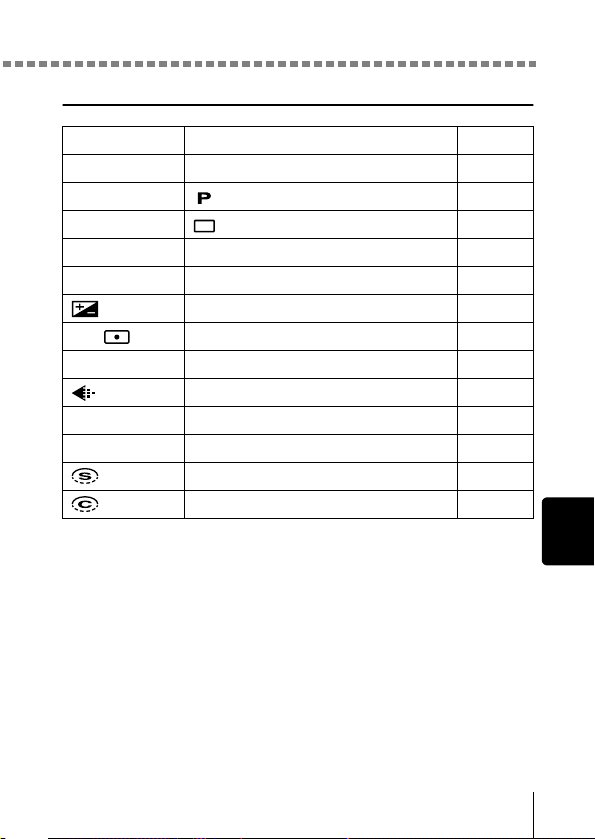
Saving the settings (All Reset)
Useful functions
6
111
Functions that All Reset affects
Function Factory default setting Ref. Page
Monitor OFF p.21
Shooting mode (PROGRAM AUTO) p.37
DRIVE (for still pictures) p.62
DIGITAL ZOOM OFF (1
×
)p.52
FLASH AUTO p.54
±0 p.75
ESP/ ESP p.61
WB AUTO p.77
HQ (1984
×
1488 pixels) p.68
AF AF p.45, 57
ISO AUTO p.73
NORMAL p.79
NORMAL p.81
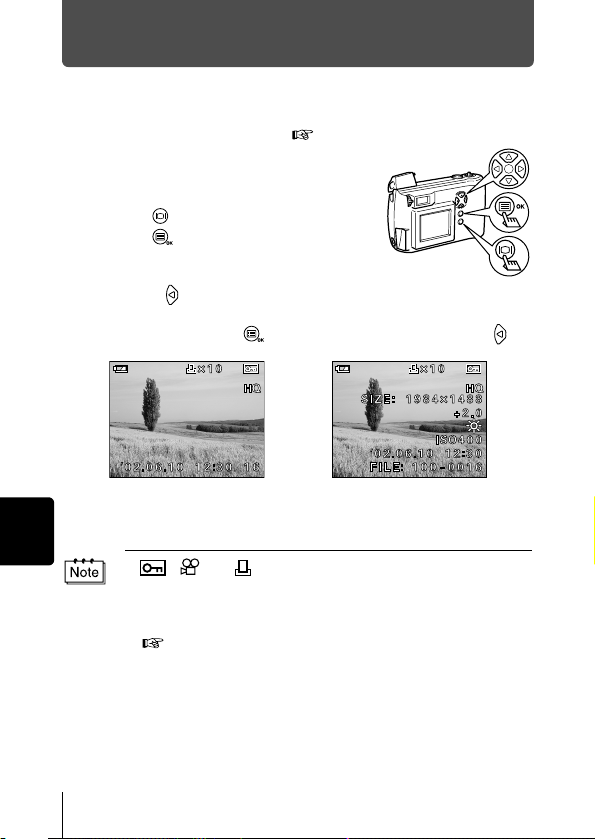
Useful functions
6
112
Displaying shooting information
This function lets you display detailed shooting information on the monitor for
3 seconds in the playback mode. For details of the information that can be
displayed, see “Monitor indications” ( p.10).
1
Display the top menu in the playback
mode.
• Press with the lens barrier closed.
•Press .
2
Pressing displays the full amount
of shooting information on the monitor (ON).
To turn INFO off, press to bring up the top menu and press .
•, and are displayed regardless of whether INFO is set
to ON or OFF.
• The file number when using a printing service other than DPOF is
displayed when INFO is set to ON. “How to print pictures”
(
p.117)
When INFO is OFF When INFO is ON
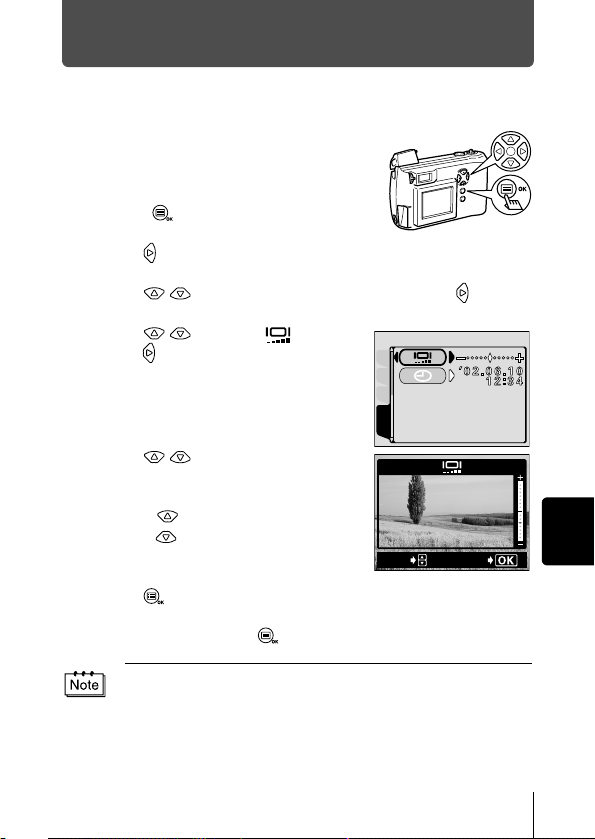
Useful functions
6
113
Adjusting the monitor brightness
You can adjust the brightness of the monitor according to the surrounding
conditions to make it easier to see.
1
Display the top menu in the shooting
mode.
• Open the lens barrier fully.
•Press .
2
Press to select MODE MENU.
3
Press to select the SETUP tab, then press .
4
Press to select , then
press .
5
Press to adjust the
brightness while observing the
monitor.
Pressing brightens the monitor, and
pressing darkens it.
6
Press .
The monitor brightness is set.
To close the menu, press again.
• The monitor brightness setting remains even when the lens barrier is
closed.
• The monitor brightness can also be adjusted from the playback
mode.
CARD
SEtUP
CAM
PIC
ADJUSt
GO
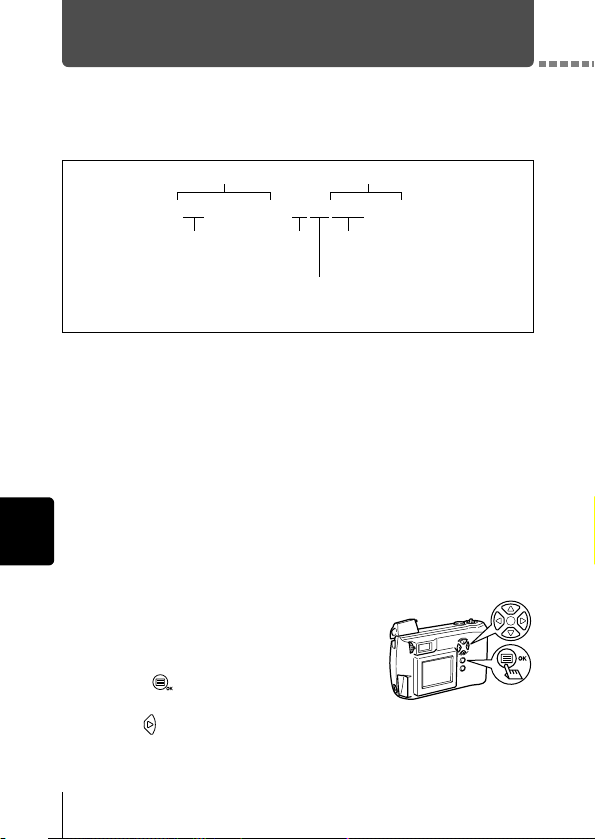
Useful functions
6
114
File name
The camera automatically creates file names and folder names for images to
be stored in. Files can be numbered from 0001 to 9999 and folders can be
numbered from 100 to 999. Examples are shown below.
There are two settings from which you can choose: RESET or AUTO. Choose
the one that is best for you when transferring images to a PC.
1
Display the top menu in the shooting
mode.
• Open the lens barrier fully.
•Press .
2
Press to select MODE MENU.
File name settings
RESET
: The file number and folder number are reset every time a new
card is inserted in the camera. The folder number returns to
No. 100 and the file number returns to No. 0001. This method is
useful when grouping files on separate cards.
AUTO
:
Even if a new card is inserted, the folder number and file number
are retained from the previous card, so the same file number is not
used on different cards. This helps you to manage multiple cards.
This method is useful when you want to manage all your files with
sequential numbers.
\DCIM\***OLYMP\Pmdd****.jpg
Folder No.
(100 - 999)
File nameFolder name
Month
(1 - C)
Day (01 - 31)
File No.
(0001 - 9999)
* Month: Jan. - Sep. = 1 - 9, Oct.= A, Nov.= B, Dec.= C
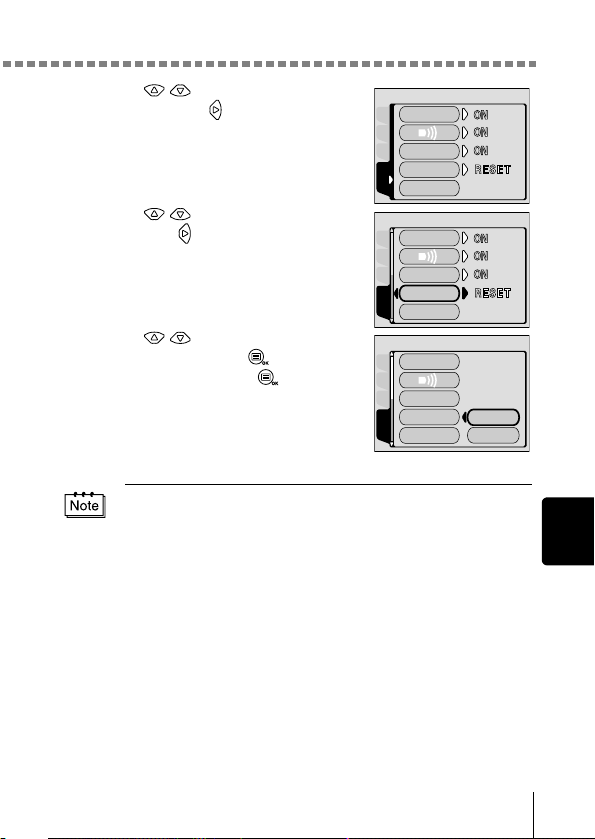
File name
Useful functions
6
115
3
Press to select the SETUP
tab, then press .
4
Press to select FILE NAME,
then press .
5
Press to select RESET
or AUTO, then press .
To close the menu, press again.
The file name setting remains even when the lens barrier is closed.
CARD
SEtUP
CAM
PIC
ALL RESEt
REC VIEW
FILE NAME
PIXEL MAPPING
CARD
SEtUP
CAM
PIC
ALL RESEt
REC VIEW
FILE NAME
PIXEL MAPPING
CARD
SEtUP
CAM
PIC
ALL RESEt
REC VIEW
FILE NAME
PIXEL MAPPING
RESEt
AUtO
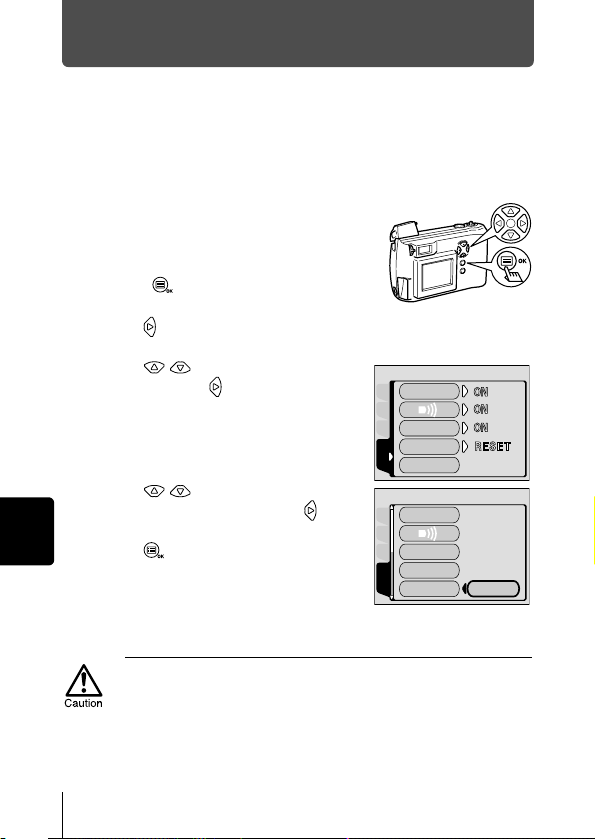
Useful functions
6
116
Pixel mapping
The Pixel Mapping feature allows the camera to check and adjust the CCD
and image processing circuit automatically.
It is not necessary to operate this function frequently. Approximately once a
year is recommended. Wait a few minutes after the monitor is used or
continuous shots are taken to allow for proper performance of the Pixel
Mapping function.
1
Display the top menu in the shooting
mode.
• Open the lens barrier fully.
•Press .
2
Press to select MODE MENU.
3
Press to select the SETUP
tab, then press .
4
Press to select
PIXEL MAPPING, then press .
5
Press .
A bar is displayed showing the progress of
pixel mapping. When pixel mapping is
finished, the camera returns to the mode
menu.
• If you accidentally turn the camera off during pixel mapping, start
again from Step 1.
• Do not remove the batteries or disconnect the AC adapter while pixel
mapping is in progress as this may cause a malfunction.
CARD
SEtUP
CAM
PIC
ALL RESEt
REC VIEW
FILE NAME
PIXEL MAPPING
CARD
SEtUP
CAM
PIC
ALL RESEt
REC VIEW
FILE NAME
PIXEL MAPPING
StARt
Print settings
7
117
Chapter 7
Print settings
How to print pictures
Several different printing options are available when you want to print out
pictures.
Printing at a photo lab that supports DPOF or printing on a
DPOF-compatible printer
Print reservation allows you to save printing data (number of prints, date, etc.)
with the pictures stored on the card.
What is DPOF?
DPOF is short for Digital Print Order Format. DPOF is the format used to
record automatic print information from cameras.
By storing the print reservation data on the card, the pictures can be printed
easily by a DPOF-compatible photo lab or on a personal DPOF-compatible
printer.
Printing on an Olympus CAMEDIA P-400, P-330N(E) or
P-200 digital printer
If you insert a card containing the print reservation data into the printer,
printing is possible without using a PC. For more details, refer to the printer's
instruction manual.
Transferring pictures to a PC and printing them from a
printer connected to the PC
If you have installed software for displaying JPEG pictures on your PC
(internet browser, Paint Shop Pro, Photoshop, etc.), you can print out pictures
on a printer connected to the PC. (Printing is also possible using CAMEDIA
Master software.) Check your software before printing. For details, refer to the
application software's instructions.
How to print pictures
Print settings
7
118
• DPOF reservations set by another device cannot be changed by this
camera. Make changes using the original device.
• If a card contains DPOF reservations set by another device, entering
reservations using this camera may overwrite the previous
reservations.
• This camera cannot be directly connected to printers such as the
Olympus P-300 digital printer.
• Not all functions may be available on all printers or at all photo labs.
• If you are printing using the P-330N (E), only the first 999 pictures
can be printed.
• Print reservation may take considerable time when saving printing
data to a card.
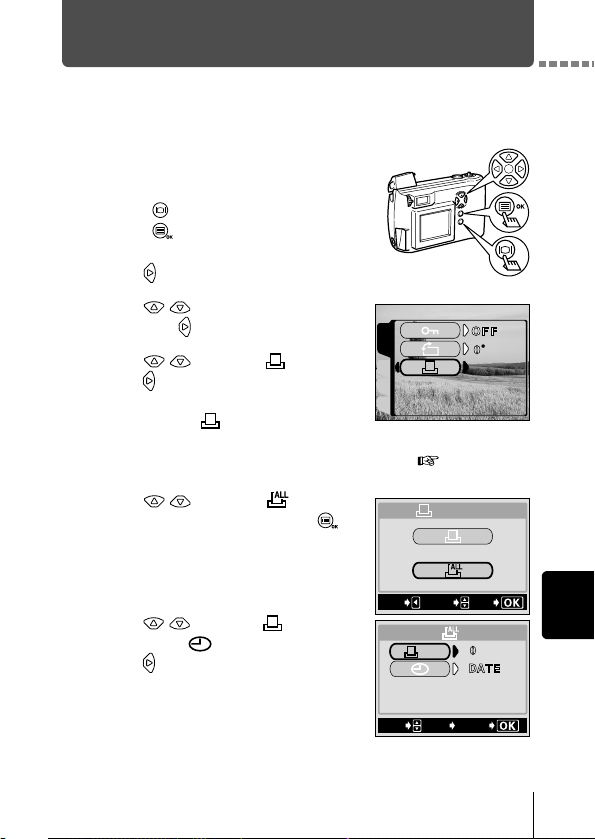
Print settings
7
119
All-frame reservation
Use this feature to print all the pictures stored on the card. You can specify
the desired number of prints and whether or not the date and time are to be
printed.
1
Display the top menu in the playback
mode.
• Press with the lens barrier closed.
•Press .
2
Press to select MODE MENU.
3
Press to select the PLAY tab,
then press .
4
Press to select , then
press .
If print reservation data is already stored
on the card, the PRINT ORDER
SETTING screen appears, giving you the choice of resetting the data
or keeping it. “Resetting the print reservation data” ( p.126)
5
Press to select (all-
frame reservation), then press .
6
Press to select ×
××
× (number
of prints) or (date/time), then
press .
CARDSEt EDIt
PLAY
EXIt
GO
SELECt
PRINt%ORDER
SEt
GO
SELECt
*
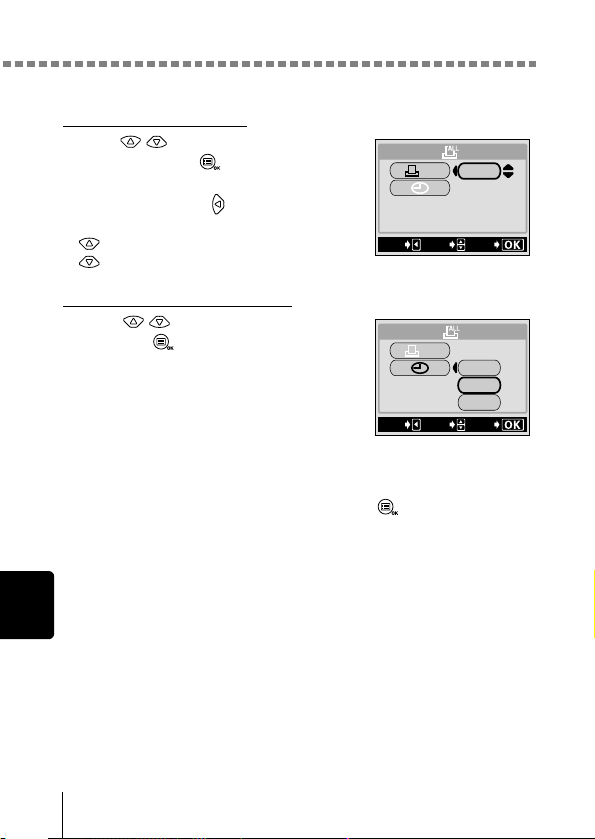
All-frame reservation
Print settings
7
120
7
Perform each setting.
Set the number of prints
Press to set the desired number of
prints, then press .
If you want to continue to set the date/time
printing data, press to return to Step 6.
: Increases the number.
: Decreases the number.
Set the date/time printing data
Press to select NO, DATE or TIME,
then press .
NO : The pictures are printed without the
date and time.
DATE : All the pictures are printed with the
shooting date.
TIME : All the pictures are printed with the
shooting time.
After completing all the print reservations, press to return to the
playback mode menu.
EXIt
GO
SELECt
*5
*
EXIt
GO
SELECt
NO
DAtE
tIME
*
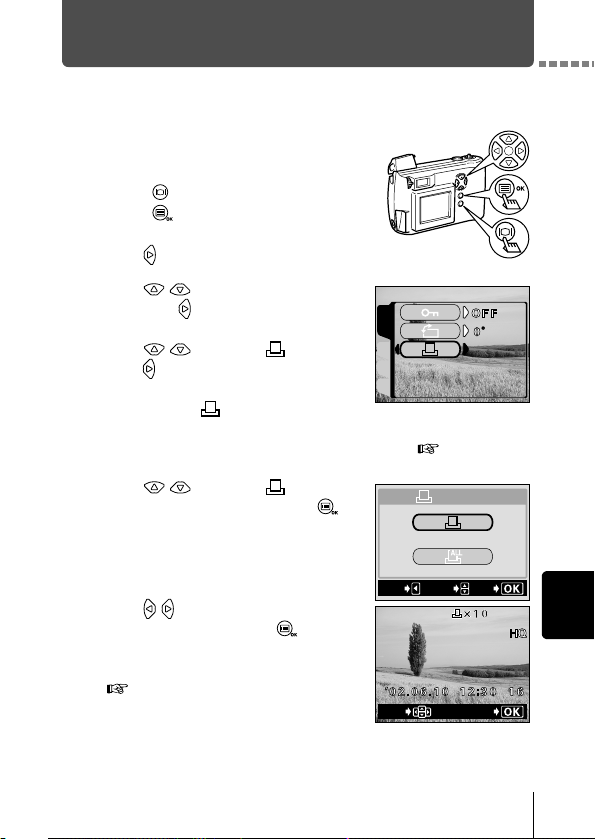
Print settings
7
121
Single-frame reservation
Use this feature to print only selected pictures. Display the frame to be printed
and select the desired number of prints.
1
Display the top menu in the playback
mode.
• Press with the lens barrier closed.
•Press .
2
Press to select MODE MENU.
3
Press to select the PLAY tab,
then press .
4
Press to select , then
press .
If print reservation data is already stored
on the card, the PRINT ORDER
SETTING screen appears, giving you the choice of resetting the data
or keeping it. “Resetting the print reservation data” ( p.126)
5
Press to select (single-
frame reservation), then press .
6
Press to display the frame you
want to print, then press .
You can use the index display feature to
select the frames. “Index display”
( p.85)
CARDSEt EDIt
PLAY
EXIt
GO
SELECt
PRINt%ORDER
GO
SELECt
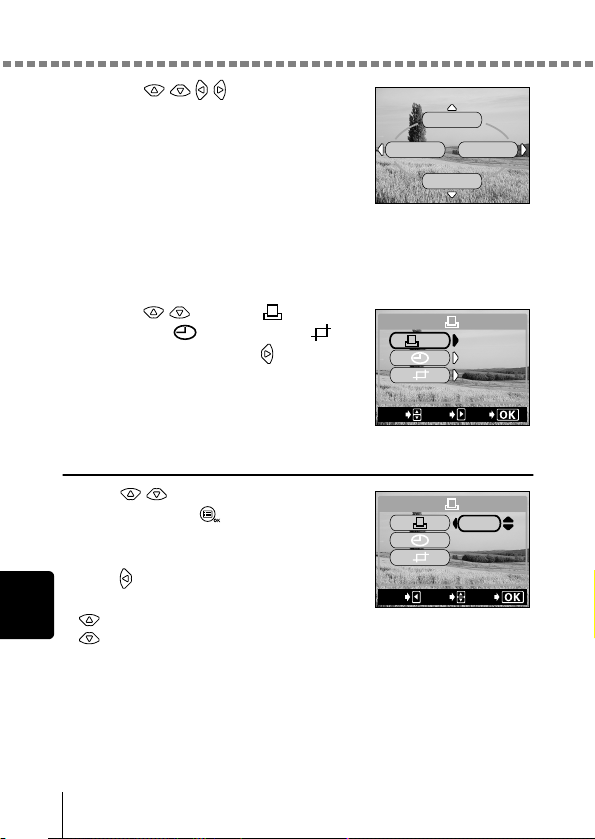
Single-frame reservation
Print settings
7
122
7
Press to select the
appropriate item.
MORE :Sets the number of prints,
date/time and trim size.
→ Go to Step 8.
SINGLE PRINT : Sets single-frame print.
The date/time and trim
settings are not available. → Go to Step 10.
CANCEL : Cancels the print reservation. → Go to Step 10.
END : Completes the print reservation. → Go to Step 11.
8
Press to select ×
××
× (number
of prints), (date/time) or
(trimming), then press .
9
Perform each setting.
Set the number of prints
Press to set the desired number of
prints, then press .
If you want to continue to set the date/time
printing data and/or to trim the pictures,
press to return to Step 8.
: Increases the number.
: Decreases the number.
MORE
END
CANCEL
SINGLE PRINt
GO
SELECt
0
DAtE
DAtE
NO
NO
SEt
*
EXIt
GO
SELECt
*5
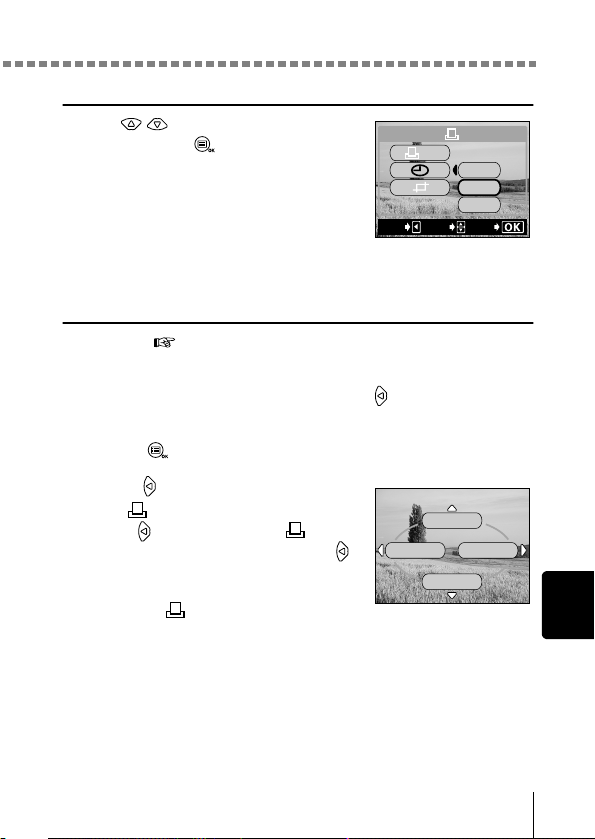
Single-frame reservation
Print settings
7
123
Set the date/time printing data
Press to select NO, DATE or
TIME, then press .
NO : The pictures are printed without the
date and time.
DATE : All the pictures are printed with the
shooting date.
TIME : All the pictures are printed with the
shooting time.
Trimming
“Trimming” ( p.124)
After completing all the print reservations, press to return to the screen
in Step 6.
10
Press to display the single-frame reservation menu.
11
Press to select END.
The PRINT ORDER screen appears.
Press again to display the PRINT
ORDER SETTING screen, then press
once more to return to the playback mode
menu. If no print reservations have been
made, the PRINT ORDER SETTING
screen will not be displayed.
EXIt
GO
SELECt
DAtE
NO
tIME
*
MORE
END
CANCEL
SINGLE PRINt
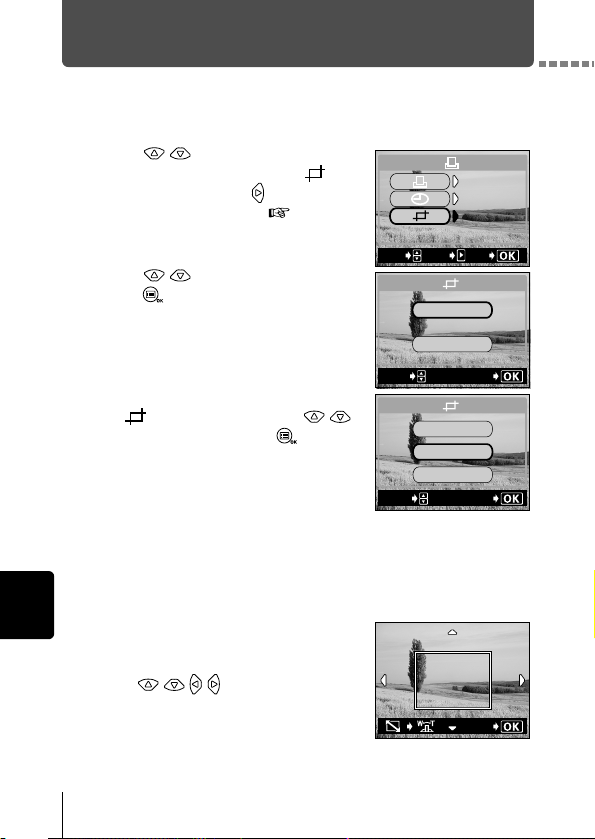
Print settings
7
124
Trimming
This function enables you to crop part of a recorded picture and print out the
enlarged section only.
1
Press on the single-frame
reservation screen to select
(trimming) and press .
“Single-frame reservation” ( p.121)
2
Press to select SETUP, then
press .
If trimming has already been performed,
the screen appears. Press
to select RESET, then press .
OK : Saves the current trimming
size and returns to the single-frame reservation screen.
RESET : Sets a new trimming size. → Go to Step 3.
CANCEL : Cancels the trimming setting and returns to the single-
frame reservation screen.
3
Use the arrow pad and zoom lever to
decide the trimming position and
size.
Press to select the trimming
position, and press the zoom lever toward
W or T to decide the trimming size.
SEt
GO
SELECt
0
DAtE
DAtE
NO
NO
GO
SELECt
SEtUP
CANCEL
GO
SELECt
RESEt
CANCEL
OK
OK
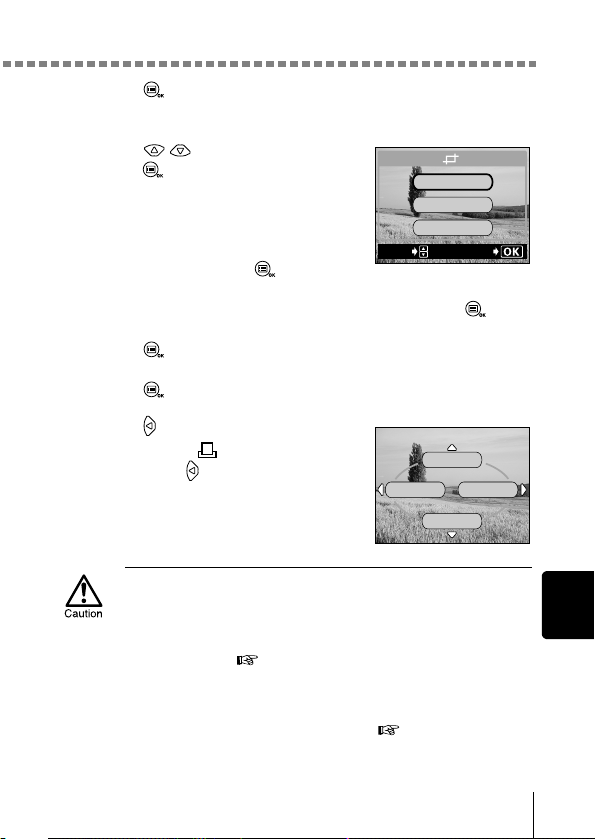
Trimming
Print settings
7
125
4
Press .
The trimmed area is displayed for one second.
5
Press to select OK, then
press .
A bar is displayed showing the progress of
trimming, then the camera returns to the
single-frame reservation screen.
If you want to perform trimming again,
select RESET and press and repeat
the procedure from Step 3.
To cancel the trimming function, select CANCEL and press .
6
Press to complete the print reservation and return to the
picture selection screen.
Press again.
7
Press to select END.
To return to the PRINT ORDER
screen, press again.
• The size of the printed picture varies depending on the printer setting.
If the trimmed picture size is small, printing magnification increases
accordingly, resulting in a printed picture with lower resolution.
• For best results with close-up prints, you are recommended to use
theTIFF, SHQ or HQ mode. “Selecting the image quality and size
(Record mode)” ( p.68)
• The original picture is not trimmed. If your printer does not have the
DPOF function, the picture will be printed untrimmed.
• Do not rotate pictures that have been trimmed, because the cropped
area will be changed. “Rotating pictures” ( p.89)
GO
SELECt
RESEt
CANCEL
OK
MORE
END
CANCEL
SINGLE PRINt
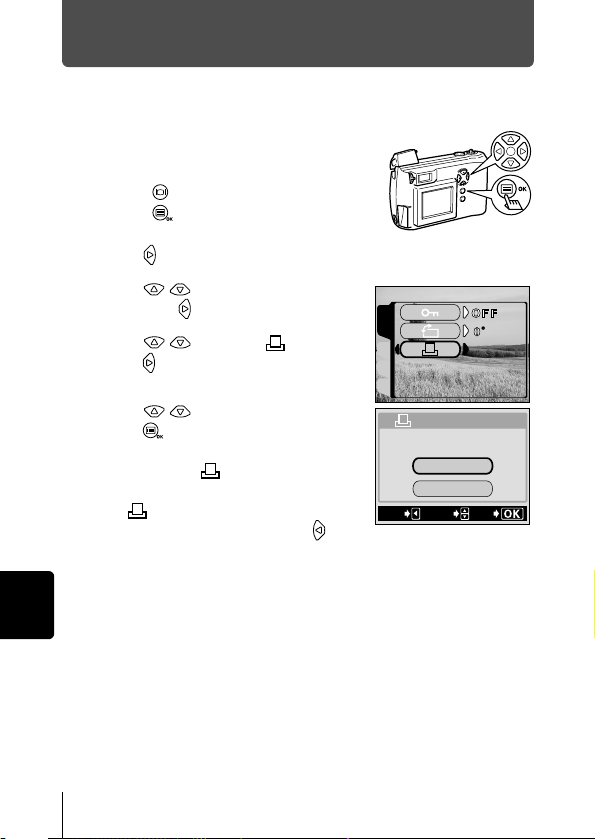
Print settings
7
126
Resetting the print reservation data
This function allows you to reset all the print reservation data for pictures
stored on the card.
1
Display the top menu in the playback
mode.
• Press with the lens barrier closed.
•Press .
2
Press to select MODE MENU.
3
Press to select the PLAY tab,
then press .
4
Press to select , then
press .
5
Press to select RESET, then
press .
If there is no print reservation data stored
on the card, the PRINT ORDER
SETTING screen does not appear.
The PRINT ORDER screen appears.
To quit the print reservation, press to
return to the playback mode menu.
CARDSEt EDIt
PLAY
RESEt
KEEP
PRINt%ORDER%SEttING
PRINt%ORDERED
SELECt
EXIt
GO
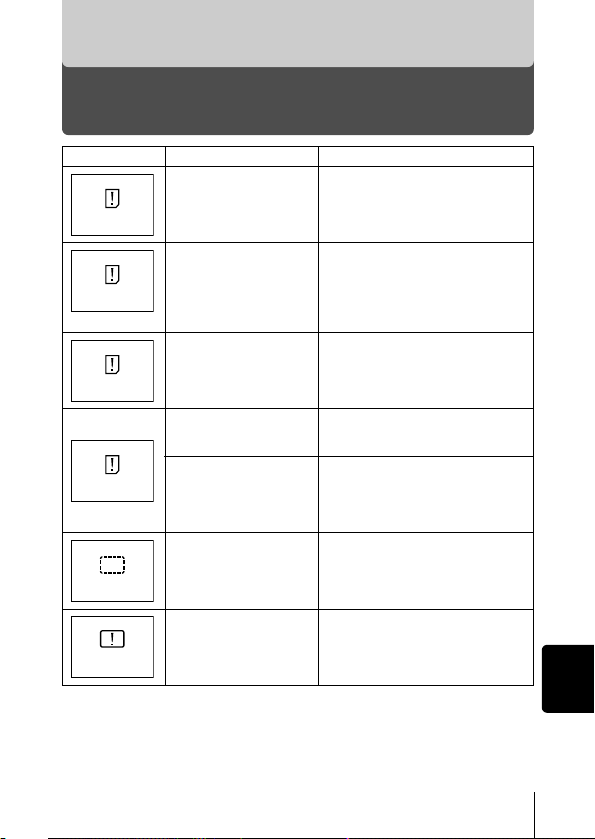
Troubleshooting
8
127
Chapter 8
Troubleshooting
Error codes
Monitor Possible cause Corrective action
The card is not inserted, or
it cannot be recognized.
Insert the card correctly or insert a
different card.
Cannot record, play back
or erase pictures on this
card.
Wipe the gold contacts with a piece of
cleaning paper (commercially
available) and insert the card again. If
the problem is still not corrected,
format the card. If the card cannot be
formatted, this card cannot be used.
Writing to the card is
prohibited.
Remove the write-protect seal
attached to the card. For more details,
refer to the provided instruction
manual for the card.
There is no empty space
on the card, so no more
pictures can be taken.
Replace the card or erase unwanted
pictures. Before erasing, download
important images to a PC.
There is no empty space
on the card, so it cannot
record new information
such as print reservation
data and other functions.
Replace the card or erase unwanted
pictures. Before erasing, download
important images to a PC.
There are no pictures on
the card.
The card contains no pictures. Record
pictures.
The selected picture
cannot be played back on
this camera.
Use image processing software on a
PC to view it. If that cannot be done,
the image file is damaged.
NO CARD
CARD ERROR
WRItE
-
PROtECt
CARD FULL
NO PICtURE
PICtURE ERROR
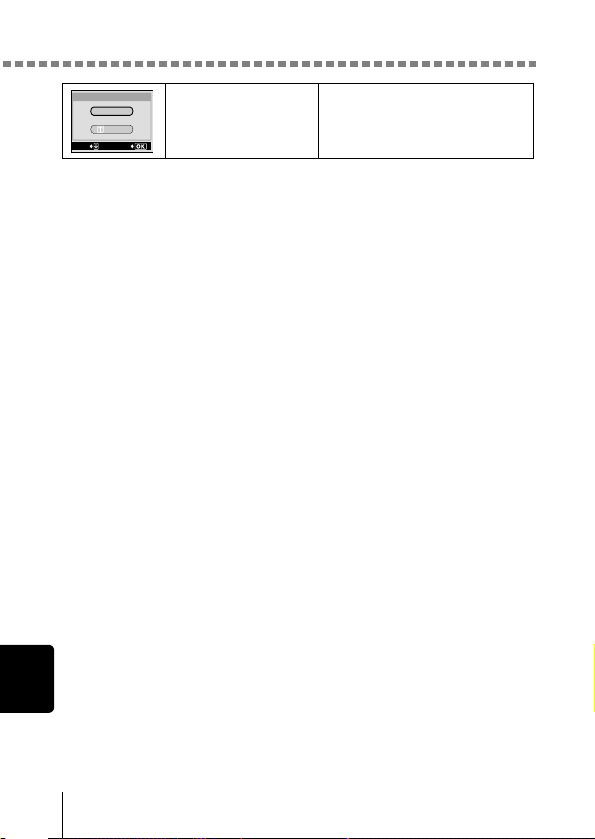
Error codes
Troubleshooting
8
128
The card is not formatted. Format the card.
POWER%OFF
FORMAt
CARD%SEtUP
SELECt
GO
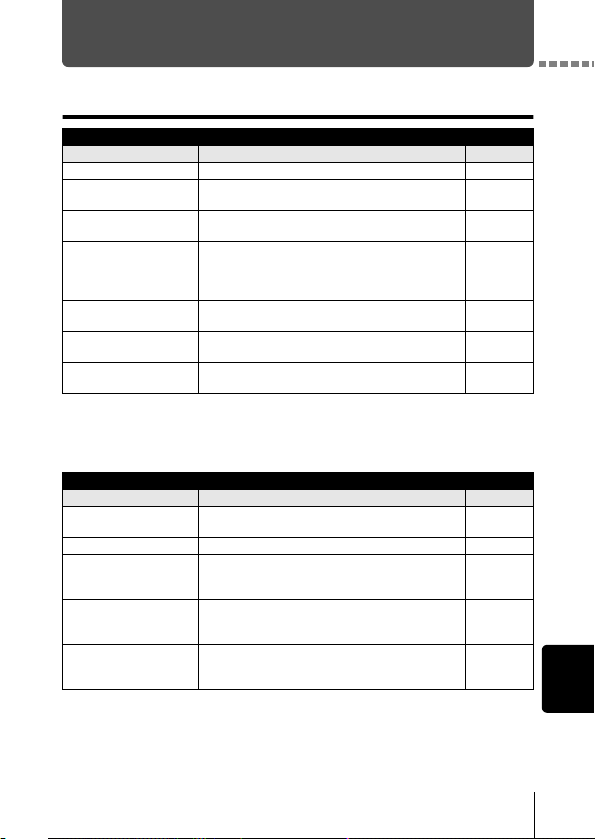
Troubleshooting
8
129
Troubleshooting
If an operation does not work
The camera does not turn on or function buttons do not respond.
Possible cause Corrective action Ref. Page
The power is off. Open the lens barrier fully to turn on the camera. p.21
The batteries are
loaded incorrectly.
Reload the batteries correctly. p.14
The batteries are
exhausted.
Replace the batteries with new ones. p.14
The batteries are
temporarily unable to
function because of the
cold.
The batteries may be too cold. Allow them to
return to room temperature, or if outdoors, warm
them by putting them in an inner jacket pocket.
–
The camera is in the
sleep mode.
Operate the camera (press the shutter button or
the zoom lever).
p.21
There is condensation*
inside the camera.
Wait until the camera dries before turning it on
again.
–
The camera is
connected to a PC.
The camera will not operate while it is connected
to a PC.
–
*Condensation: When it is cold outside, the water vapor in the air is rapidly cooled and
turns to droplets of water.
Condensation occurs when the camera is suddenly taken from a cold
place into a warm room.
No picture is taken when the shutter button is pressed.
Possible cause Corrective action Ref. Page
The lens barrier is
closed.
Open the lens barrier fully. p.40
The power is off. Open the lens barrier fully. p.21
The flash has not
finished charging.
Release your finger from the shutter button.
When the orange lamp stops blinking, resume
shooting.
p.54
The movie just taken is
being written to the
card.
Release your finger from the shutter button.
When the orange lamp stops blinking, resume
shooting.
p.12, 49
The card is full. Erase unwanted pictures or insert a new card.
Before erasing, download important images to a
PC.
p.94, 107
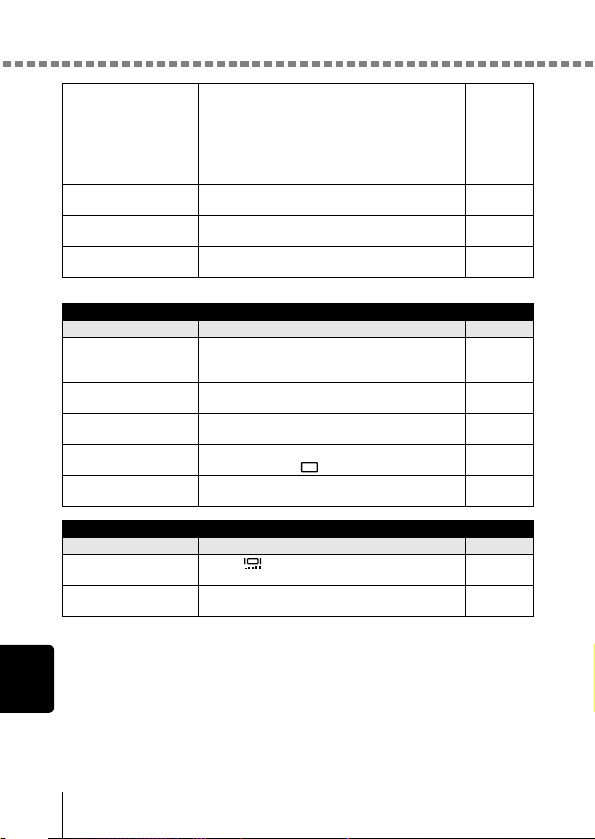
Troubleshooting
Troubleshooting
8
130
The batteries ran out of
power during shooting
or while the images
were being written to
the card. (Only the
battery check indicator
blinks.)
Replace the batteries with new ones. p.14
The memory gauge is
full.
Wait until there is room in the memory gauge. p.12
A write-protect seal is
attached to the card.
Insert a new card or remove the write-protect
seal.
p.18
There is a problem with
the card.
Refer to “Error codes”. p.127
The flash does not fire.
Possible cause Corrective action Ref. Page
The flash has not
popped up fully.
Be careful not to press the flash down with your
finger. Make sure it has popped up fully before
taking pictures.
p.54
The flash is set to the
flash off mode.
Select a flash mode other than flash off. p.54
The subject is
illuminated.
If you want the flash to fire on a brightly
illuminated subject, set the flash to fill-in mode.
p.54
Sequential shooting or
movie mode is set.
The flash does not fire in sequential shooting or
movie mode. Set in the DRIVE menu.
p.49, 62
Panorama mode is set. The flash does not fire in panorama mode.
Cancel the panorama mode.
p.64
The monitor is not clear.
Possible cause Corrective action Ref. Page
The brightness is not
adjusted properly.
Select in the mode menu and then adjust
the brightness.
p.113
The monitor is exposed
to direct sunlight.
Block the sunlight with your hand. –
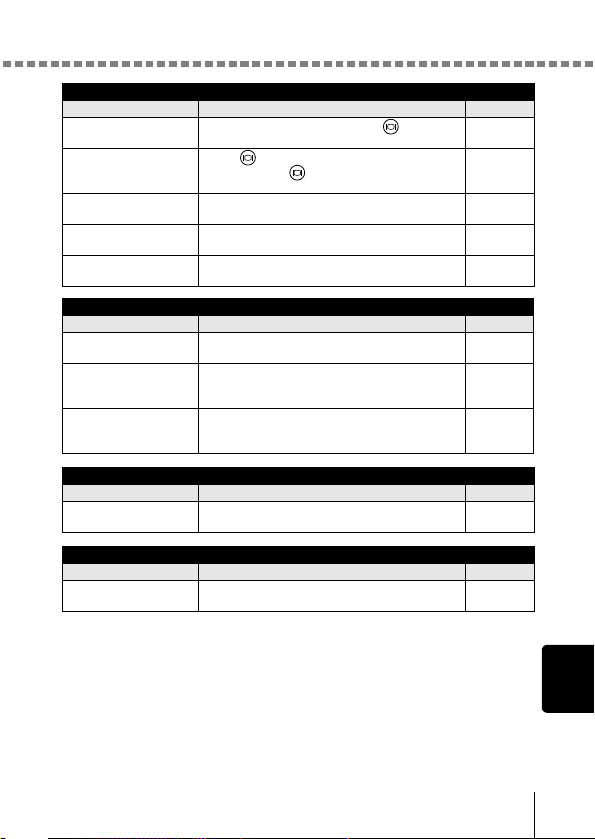
Troubleshooting
Troubleshooting
8
131
Pictures you have already taken do not appear on the monitor.
Possible cause Corrective action Ref. Page
The power is off. Close the lens barrier, then press to turn the
monitor on.
p.22, 83
The camera is in the
shooting mode.
Press quickly twice, or close the lens barrier
and then press to switch to the playback
mode.
p.83
There are no pictures
on the card.
NO PICTURE appears on the monitor.
Record pictures.
–
There is a problem with
the card.
Refer to the “Error codes”. p.127
The camera is
connected to a TV.
The monitor does not function when the Video
cable is connected to the camera.
p.88
The date/time recorded with the image data is wrong.
Possible cause Corrective action Ref. Page
The date/time is not
set.
Set the date/time. The clock adjustment is not
factory-preset.
p.24
The batteries are
exhausted.
When the batteries run out, the date/time setting
is canceled. Replace the batteries with new ones
and set the date/time again.
p.14, 24
The camera has been
left with the batteries
removed.
If the camera is left for several hours with the
batteries removed, the date/time setting is
canceled. Set the date/time again.
p.14, 24
Erasure, protection, print reservation and card formatting cannot be performed.
Possible cause Corrective action Ref. Page
A write-protect seal is
attached to the card.
Remove the seal before using the card. Do not
reuse the write-protect seal.
p.18
The settings performed are returned to the factory default settings.
Possible cause Corrective action Ref. Page
All Reset was set to
ON.
Set All Reset in the mode menu to OFF. p.110
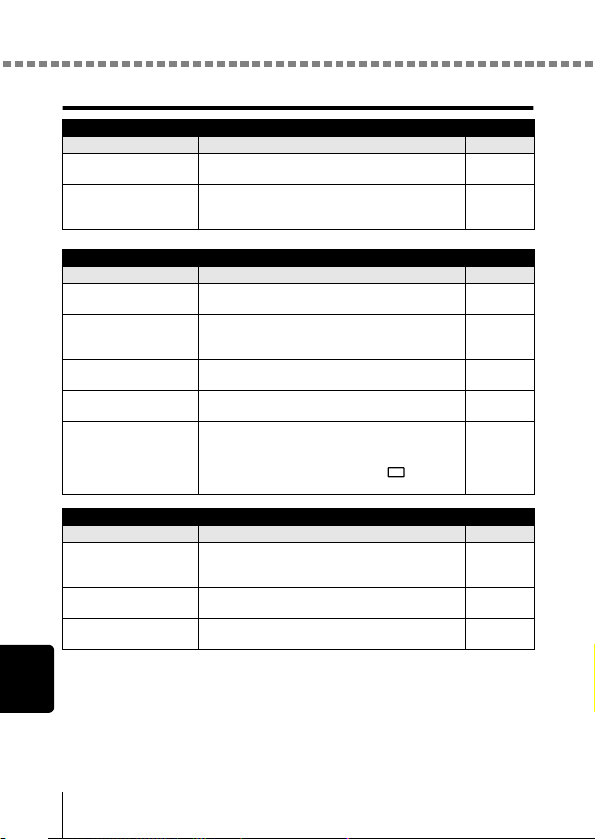
Troubleshooting
Troubleshooting
8
132
If the image quality is poor
The picture is too bright.
Possible cause Corrective action Ref. Page
The flash was set to the
fill-in flash mode.
Select a flash mode other than fill-in flash. p.54
The subject was
excessively
illuminated.
Adjust the exposure compensation toward
minus (-), or change the camera position toward
the subject.
p.75
The picture is too dark.
Possible cause Corrective action Ref. Page
The flash was blocked
by a finger.
Hold the camera correctly, keeping your fingers
away from the flash.
p.36
The subject was out of
the working range of
the flash.
Shoot within the flash working range. p.54
The flash was set to the
flash off mode.
Select a flash mode other than flash off. p.54
The subject was too
small and was backlit.
Set the flash to fill-in mode, or use the spot
metering mode.
p.54, 61
The sequential
shooting or AF
sequential shooting
mode was used.
Higher shutter speeds are used when the
sequential shooting or AF sequential shooting
mode is selected which may result in pictures
that are darker than usual. Select in the
DRIVE menu.
p.62
The colors of pictures taken indoors look unnatural.
Possible cause Corrective action Ref. Page
Indoor lighting can
affect the picture's
colors.
Set the white balance according to the lighting. p.77
There is no white in the
subject.
Try to include something white in the picture, or
shoot using the fill-in flash mode.
p.54
The white balance
setting is wrong.
Adjust the white balance to the light source. p.77
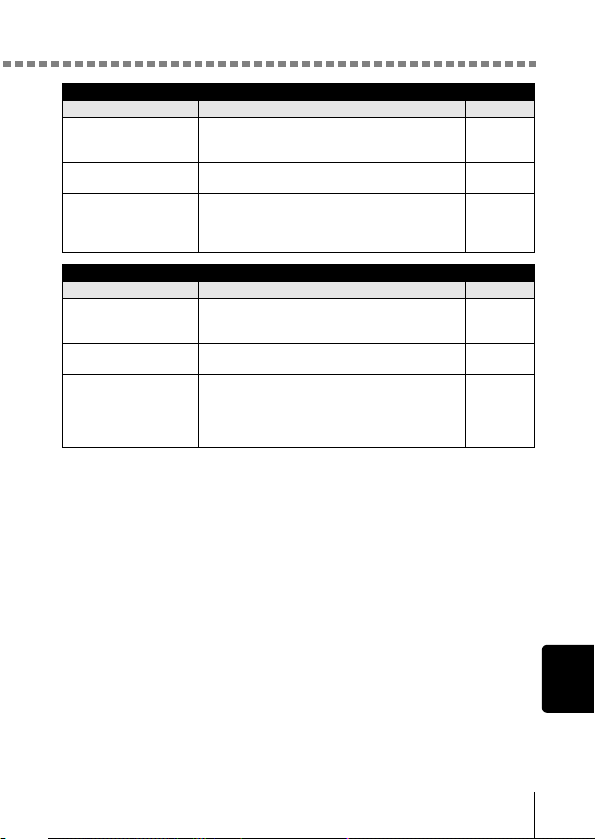
Troubleshooting
Troubleshooting
8
133
The picture has obscured edge(s).
Possible cause Corrective action Ref. Page
The lens was partly
blocked by a finger or
the strap.
Hold the camera correctly, keeping your fingers
and the strap away from the lens.
p.36
The subject was too
close.
Check the actual picture area by using the
monitor to take the picture.
p.41
The lens was dirty. Clean the lens. Remove dust with a
commercially available lens blower and wipe
gently with a commercially available lens
cleaner. If the lens is left dirty, mold may form.
–
The picture is out of focus.
Possible cause Corrective action Ref. Page
The camera moved
when the shutter button
was pressed.
Hold the camera correctly and press the shutter
button gently.
p.36
The subject was too
close.
Position the camera more than 0.2 m/0.7 ft from
the subject and take the picture.
p.57
The flash was set to the
flash off mode in a
lighting condition
requiring use of the
flash.
Camera movement occurs easily with slower
shutter speeds. Use a tripod, or hold the camera
firmly.
p.59
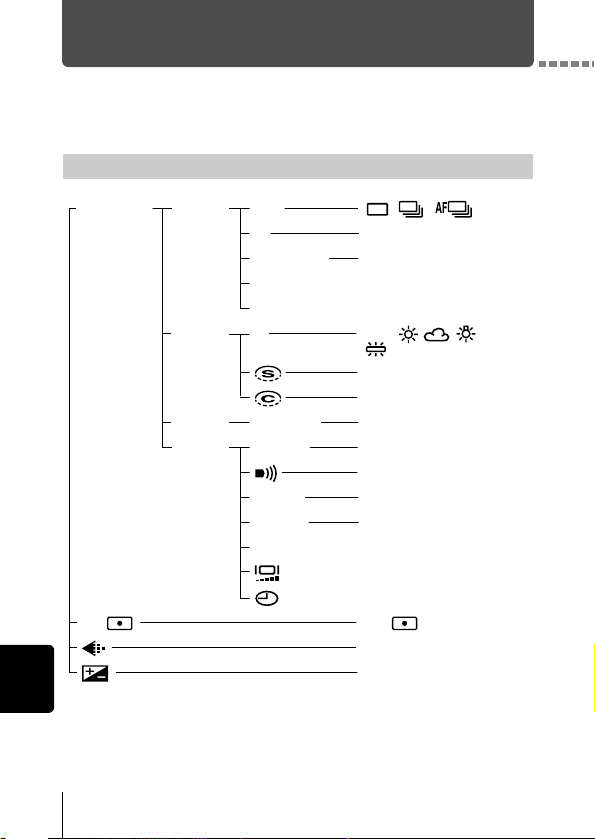
Troubleshooting
8
134
List of menus
Shooting mode menus (PROGRAM AUTO/PORTRAIT/LANDSCAPE -
PORTRAIT/LANDSCAPE/NIGHT SCENE/
SELF PORTRAIT)
*PANORAMA cannot be selected in Self-Portrait mode.
Top menu Tab Item Setting
Ref. Page
MODE MENU CAMERA DRIVE / /
p.62
ISO AUTO/100/200/400
p.73
DIGITAL ZOOM ON/OFF
p.52
PANORAMA*
p.64
2 IN 1
p.66
PICTURE WB AUTO/ / / /
p.77
HARD/NORMAL/SOFT
p.79
HIGH/NORMAL/LOW
p.81
CARD CARD SETUP YES/NO
p.107
SETUP ALL RESET ON/OFF
p.110
ON/OFF
p.106
REC VIEW ON/OFF
p.109
FILE NAME RESET/AUTO
p.114
PIXEL MAPPING
p.116
p.113
p.24
ESP/ ESP/
p.61
3:2/SHQ/HQ/SQ/TIFF
p.68
-2.0/-1.5/-1.0/-0.5/
±
0/+0.5/
+1.0/+1.5/+2.0
p.75
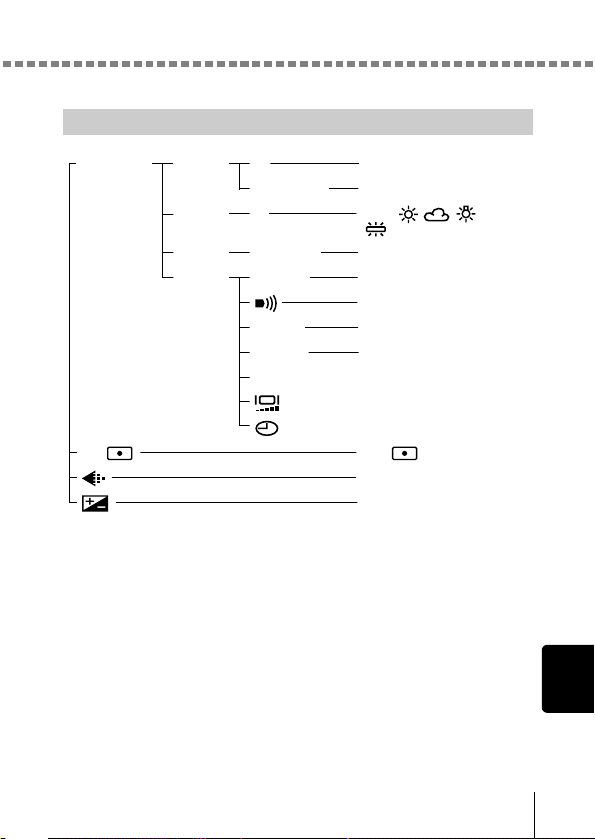
List of menus
Troubleshooting
8
135
Shooting mode menus (MOVIE)
Top menu Tab Item Setting
Ref. Page
MODE MENU CAMERA ISO AUTO/100/200/400
p.73
DIGITAL ZOOM ON/OFF
p.52
PICTURE WB AUTO/ / / /
p.77
CARD CARD SETUP YES/NO
p.107
SETUP ALL RESET ON/OFF
p.110
ON/OFF
p.106
REC VIEW ON/OFF
p.109
FILE NAME RESET/AUTO
p.114
PIXEL MAPPING
p.116
p.113
p.24
ESP/ ESP/
p.61
HQ/SQ
p.68
-2.0/-1.5/-1.0/-0.5/
±
0/+0.5/
+1.0/+1.5/+2.0
p.75
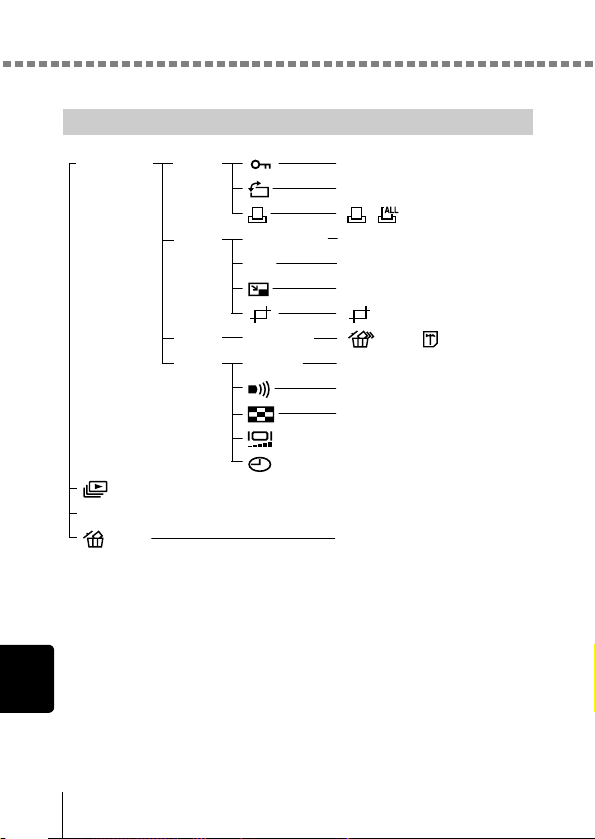
List of menus
Troubleshooting
8
136
Playback mode menus (Still picture)
Top menu Tab Item Setting
Ref. Page
MODE MENU PLAY ON/OFF
p.92
0
°
/+90
°
/-90
°
p.89
/
p.119
EDIT BLACK & WHITE BLACK & WHITE/CANCEL
p.96
SEPIA SEPIA/CANCEL
p.97
640
×
480/320
×
240/CANCEL
p.98
/CANCEL
p.99
CARD CARD SETUP ERASE/ FORMAT
p.95,107
SETUP ALL RESET ON/OFF
p.110
ON/OFF
p.106
4/9/16
p.86
p.113
p.24
p.87
INFO
p.112
ERASE YES/NO
p.94
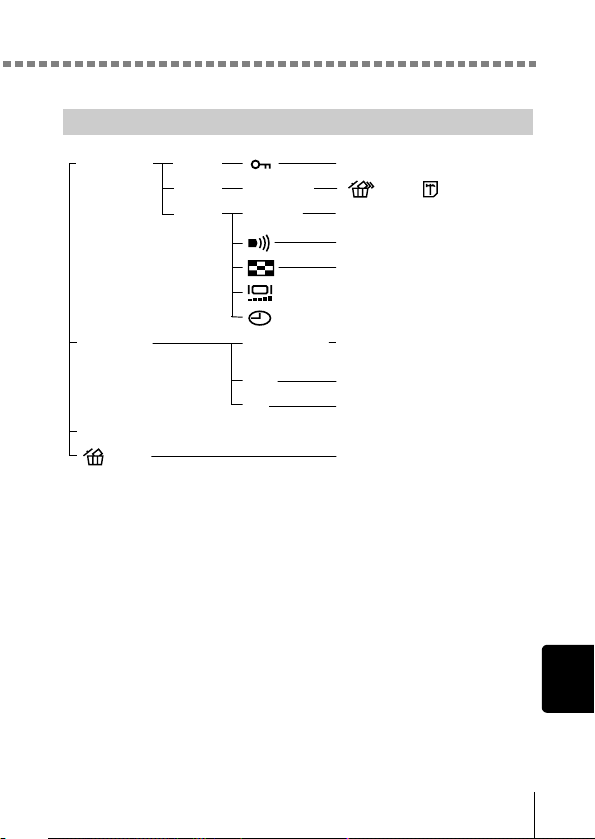
List of menus
Troubleshooting
8
137
Playback mode menus (Movie)
Top menu Tab Item Setting
Ref. Page
MODE MENU PLAY ON/OFF
p.92
CARD CARD SETUP ERASE/ FORMAT
p.95,107
SETUP ALL RESET ON/OFF
p.110
ON/OFF
p.106
4/9/16
p.86
p.113
p.24
MOVIE PLAY
MOVIE PLAYBACK
PLAYBACK/FRAME BY
FRAME/EXIT
p.90
INDEX OK/RESET/CANCEL
p.102
EDIT OK/RESET/CANCEL
p.104
INFO
p.112
ERASE YES/NO
p.94
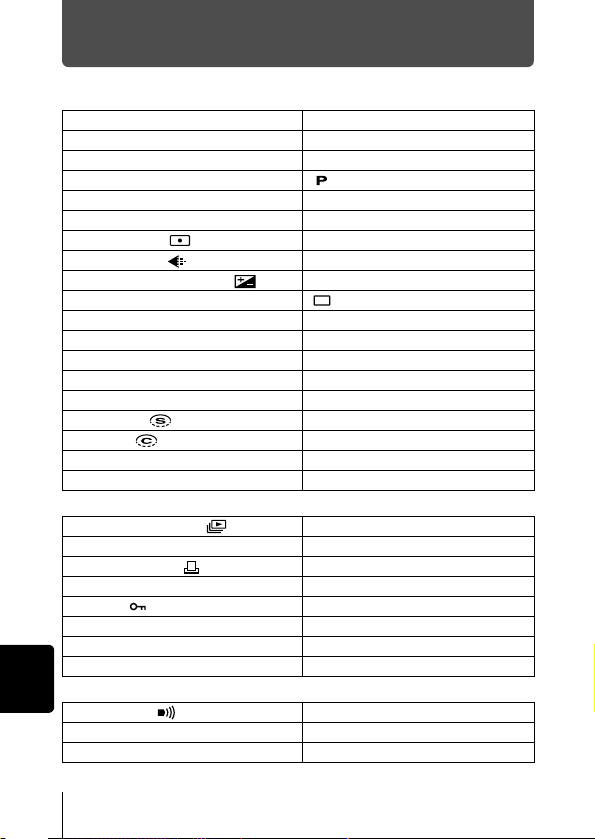
Troubleshooting
8
138
List of factory default settings
Shooting mode
Playback mode
Camera settings
Flash mode AUTO
AF AF
Self-timer OFF
Shooting mode PROGRAM AUTO
Zoom Wide
Monitor OFF
Metering (ESP/ ) ESP
Record Mode ( ) HQ
Exposure compensation ( ) ±0
Sequential shooting (DRIVE) (Single-frame shooting)
ISO sensitivity AUTO
Digital zoom OFF
Panorama shooting OFF
2 in 1 picture OFF
White balance (WB) AUTO
Sharpness ( ) NORMAL
Contrast ( ) NORMAL
TIFF mode 1984 × 1488
SQ mode 640 × 480 NORMAL
Slideshow playback ( ) OFF
Rec View ON
Print reservation ( ) OFF
Information display (INFO) OFF
Protect ( ) OFF
Close-up playback OFF
Rotation 0°
Index display 9
Beep sound ( ) ON
All Reset ON
File Name RESET
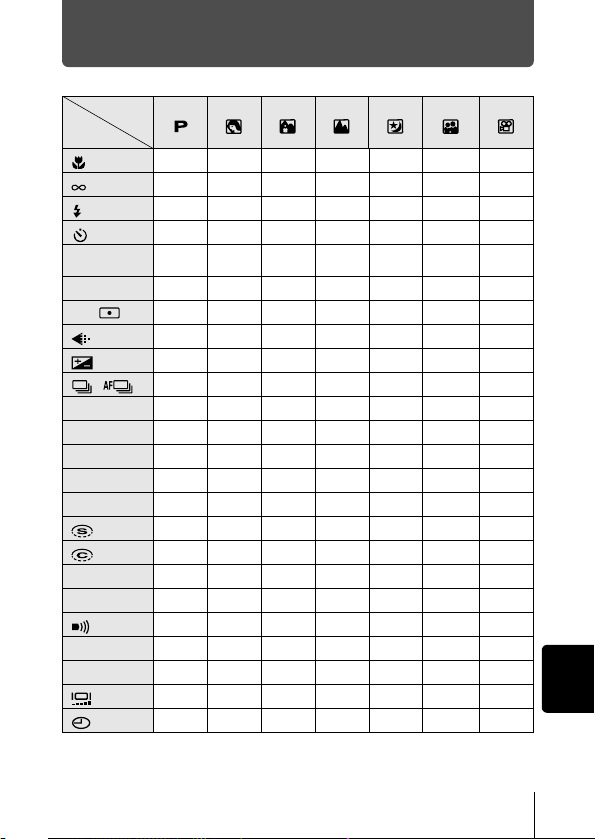
Troubleshooting
8
139
List of items by shooting mode
9
: available
–
: not available
*
1
TIFF, SHQ, 3:2, cannot be selected in Movie mode.
*
2
PANORAMA cannot be selected in Self-Portrait mode.
Shooting mode
Item
99999 9 9
99999 9 9
99999 9 9
99999 9 9
Optical zoom 99999
W (Wide)
fixed
9
Virtual dial 99999 99
ESP/ 99999 9 9
99999 99*
1
99999 9 9
/ 9999 – 9 –
ISO 99999 99
DIGITAL ZOOM
99999 – 9
PANORAMA 999999*
2
–
2 IN 1 99999 9 –
WB 99999 9 9
99999 9 –
99999 9 –
CARD SETUP 99999 9 9
ALL RESET 9999999
99999 9 9
REC VIEW 99999 9 9
FILE NAME 999999 9
99999 9 9
99999 9 9
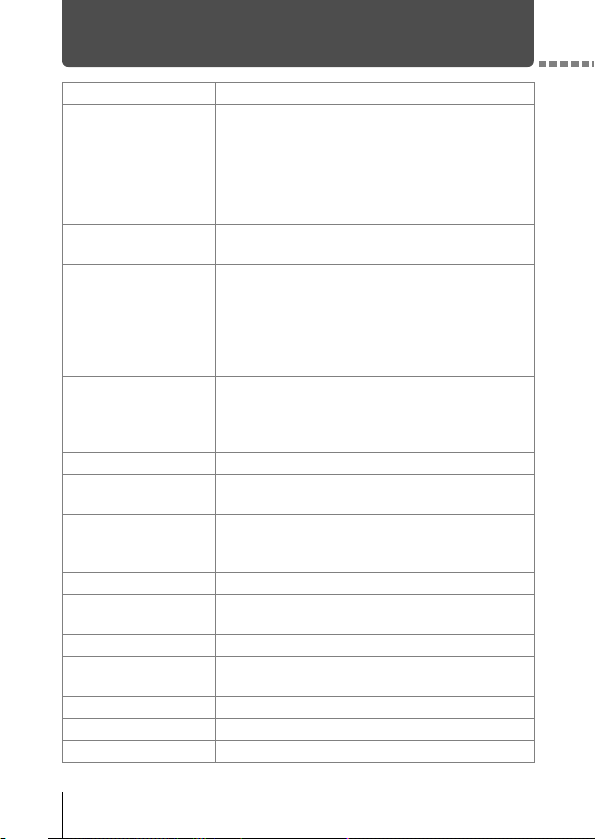
140
Specifications
Product type Digital camera (for shooting and displaying)
Recording system
Still Digital recording, TIFF (non-compression), JPEG
(in accordance with
Design rule for Camera File system (DCF)), Digital
Print Order Format (DPOF)
Movie QuickTime Motion JPEG support
Memory SmartMedia (4 MB - 128 MB)
*All cards except 2 MB and 5 V.
Recording image
resolution
1984 × 1488 pixels (TIFF/SHQ/HQ)
1984 × 1312 pixels (TIFF/HIGH/NORMAL)
1600 × 1200 pixels (TIFF/SQ)
1280 × 960 pixels (TIFF/SQ)
1024 × 768 pixels (TIFF/SQ)
640 × 480 pixels (TIFF/SQ)
No. of storable
pictures
(When a 16 MB card is
used)
Approx. 1 frame (TIFF : 1984 × 1488)
Approx. 7 frames (SHQ : 1984 × 1488)
Approx. 21 frames (HQ : 1984 × 1488)
Approx. 32 frames (SQ : 1600 × 1200 NORMAL)
No. of effective pixels 3,000,000 pixels
Image pickup device 1/2.5" CCD solid-state image pickup, 3,340,000
pixels (gross)
Lens Olympus lens 5.8 - 16.2 mm, f 2.9 - 4.4, 8 elements
in 6 groups (equivalent to 36 mm to 100 mm lens
on 35 mm camera)
Photometric system Digital ESP metering, Spot metering
Aperture W : f 2.9, 5.6
T : f 4.4, 8.6
Shutter speed 1/2 to 1/1000 sec. (Night scene mode: 2 sec.)
Shooting range 0.8 m to (2.6 ft to ) (normal)
0.2 m to 0.8 m (0.7 ft to 2.6 ft) (macro mode)
Viewfinder Optical real image viewfinder (with AF target mark)
Monitor 1.8" TFT color LCD display, 61,000 pixels
Flash charging time Approx. 9 sec.
∞∞
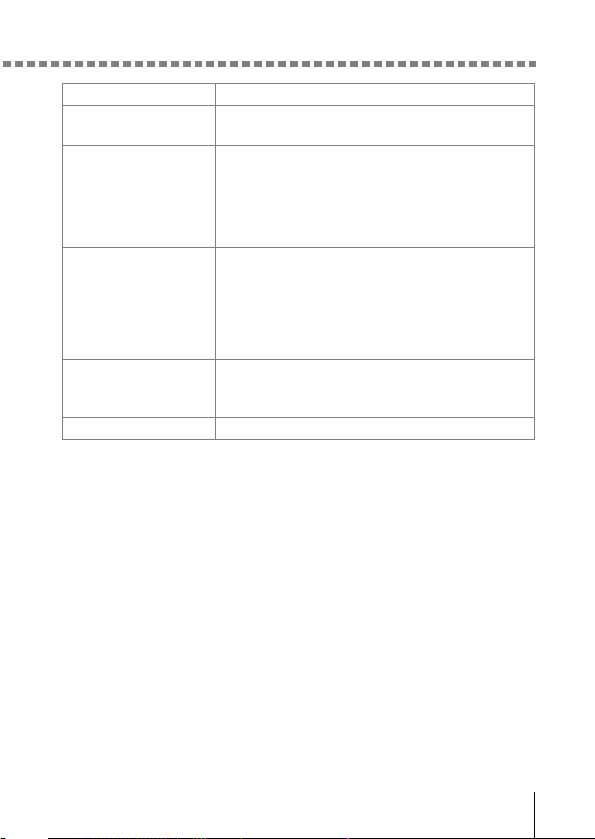
Specifications
141
Outer connector
DC-IN jack, USB connector (mini - B), VIDEO OUT jack
Automatic calendar
system
Up to 2099
Operating environment
Temperature 0°C to 40°C (32°F to 104°F) (operation)
-20°C to 60°C (-4°F to 140°F) (storage)
Humidity 30% to 90% (operation)
10% to 90% (storage)
Power supply Four AA (R6) alkaline batteries, lithium batteries,
NiMH batteries or NiCd batteries
Or two lithium CR-V3 battery packs
Or AC adapter (optional)
Manganese (zinc-carbon) batteries cannot be
used.
Dimensions 117.5 mm (W) × 66.0 mm (H) × 49.5 mm (D)
(4.6" × 2.6" × 2.0")
(excluding protrusions)
Weight 240 g (0.5 lb) (without batteries or card)
SPECIFICATIONS ARE SUBJECT TO CHANGE WITHOUT ANY NOTICE
OR OBLIGATION ON THE PART OF THE MANUFACTURER.

142
Index
. . . . . . . . . . . . . . . . . . . . . . . 45
3:2 . . . . . . . . . . . . . . . . . . . . . . . . 68
A
AC adapter . . . . . . . . . . . . . . . . . 16
AF sequential shooting . . . . . . . . 62
AF target mark. . . . . . . . . . 9, 10, 41
Alkaline batteries . . . . . . . . . . . . . 16
All-frame erase . . . . . . . . . . . . . . 95
All-frame reservation . . . . . . . . . 119
All Reset . . . . . . . . . . . . . . . . . . 110
Arrow pad . . . . . . . . . . . . . . . . . . . 9
Auto flash . . . . . . . . . . . . . . . . . . 55
Auto Focus . . . . . . . . . . . . . . . . . 40
B
Batteries . . . . . . . . . . . . . . . . . . . 14
Battery check. . . . . . . . . . . . . . . . 12
Battery compartment cover . . . . . . 9
Beep sound . . . . . . . . . . . . . . . . 106
Black and white pictures . . . . . . . 96
C
Camera movement warning . . . . 10
Card. . . . . . . . . . . . . . . . . . . . . . . 18
Card cover . . . . . . . . . . . . . . . . . . . 8
Card setup. . . . . . . . . . . . . . 23, 107
Close-up playback . . . . . . . . . . . . 84
Connector cover . . . . . . . . . . . . . . 8
Contrast . . . . . . . . . . . . . . . . . . . . 81
D
Date/time settings . . . . . . . . . . . . 24
DC-IN jack . . . . . . . . . . . . . . . . . . . 8
Digital ESP metering . . . . . . . . . . 61
Digital zoom. . . . . . . . . . . . . . . . . 52
Diopter adjustment dial . . . . . . . . . 9
Double-click playback . . . . . . . . . 84
DPOF . . . . . . . . . . . . . . . . .117, 118
Drive . . . . . . . . . . . . . . . . . . . . . . .32
E
Editing movies . . . . . . . . . . . . . .102
Erasing . . . . . . . . . . . . . . . . . . . . .94
Exposure compensation . . . . . . . .75
F
File name . . . . . . . . . . . . . . . . . .114
File number. . . . . . . . . . . . . . . . . .11
Fill-in flash. . . . . . . . . . . . . . . . . . .56
Flash . . . . . . . . . . . . . . . . . . . . .8, 54
Flash charge . . . . . . . . . . . . . .10, 41
Flash mode . . . . . . . . . . . . . . . . . .54
Flash off . . . . . . . . . . . . . . . . . . . .56
Flash stand-by . . . . . . . . . . . .10, 41
Fluorescent . . . . . . . . . . . . . . . . . .77
Focus . . . . . . . . . . . . . . . . . . . . . .44
Focus lock. . . . . . . . . . . . . . . . . . .44
Formatting . . . . . . . . . . . . . .23, 107
Frame number . . . . . . . . . . . . . . .11
Fully pressed . . . . . . . . . . . . . . . .40
G
Green lamp. . . . . . . . . . . . . . . .9, 41
H
Halfway pressed . . . . . . . . . . . . . .40
HIGH. . . . . . . . . . . . . . . . . . . . . . .68
HQ . . . . . . . . . . . . . . . . . . . . . . . .68
I
Index (Creating an index) . . . . . .102
Index display ( ). . . . . . . .85, 86
Information display . . . . . . . . . . .112
ISO sensitivity . . . . . . . . . . . . . . . .73

Index
143
L
LANDSCAPE. . . . . . . . . . . . . . . . 38
LANDSCAPE - PORTRAIT . . . . . 38
Lens. . . . . . . . . . . . . . . . . . . . . . . . 8
Lens barrier . . . . . . . . . . . . . . . . . . 8
Lithium battery pack . . . . . . . . . . 16
M
Macro mode . . . . . . . . . . . . . . . . 57
Memory gauge . . . . . . . . . . . . . . 12
Metering . . . . . . . . . . . . . . . . . . . 61
Mode . . . . . . . . . . . . . . . . . . . . . . 37
Mode menu . . . . . . . . . . . . . . 27, 32
Monitor . . . . . . . . . . . . . . . 9, 10, 41
Monitor brightness . . . . . . . . . . . 113
Monitor button . . . . . . . . . . . . . . . . 9
MOVIE . . . . . . . . . . . . . . . . . . . . . 39
MOVIE PLAY. . . . . . . . 90, 102, 104
N
NIGHT SCENE . . . . . . . . . . . 39, 47
No. of storable still pictures . . . . . 10
NORMAL . . . . . . . . . . . . . . . . . . . 68
O
OK/Menu button . . . . . . . . . . . . . . 9
Optical zoom . . . . . . . . . . . . . . . . 51
Orange lamp . . . . . . . . . . . . . . . . . 9
Overcast . . . . . . . . . . . . . . . . . . . 77
P
Panorama . . . . . . . . . . . . . . . . . . 64
Pixel mapping . . . . . . . . . . . . . . 116
Playback mode . . . . . . . . . . . . . . 22
Playing back movies . . . . . . . . . . 90
Playing back pictures on a TV. . . 88
PORTRAIT . . . . . . . . . . . . . . . . . 38
Print reservation . . . . . . . . . . . . 117
PROGRAM AUTO. . . . . . . . . . . . 38
Protecting . . . . . . . . . . . . . . . . . . .92
Q
Quick View . . . . . . . . . . . . . . . . . .84
R
Rechargeable batteries. . . . . . . . .16
Record mode ( ) . . . . . . . . . . .68
Recording movies. . . . . . . . . . . . .49
Rec View. . . . . . . . . . . . . . . . . . .109
Red-eye reduction flash . . . . . . . .55
Resizing . . . . . . . . . . . . . . . . . . . .98
Rotating . . . . . . . . . . . . . . . . . . . .89
S
Seconds remaining . . . . . . . . . . . .10
SELF PORTRAIT . . . . . . . . . . . . .39
Self-timer . . . . . . . . . . . . . . . . . . .59
Self-timer lamp . . . . . . . . . . . . .8, 59
Sepia pictures . . . . . . . . . . . . . . . .97
Sequential shooting . . . . . . . . . . .62
Sharpness. . . . . . . . . . . . . . . . . . .79
Shooting mode . . . . . . . . . . . . . . .21
Shooting mode menu . . . . . . . . . .37
Shortcut menu . . . . . . . . . . . .27, 30
SHQ . . . . . . . . . . . . . . . . . . . . . . .68
Shutter button . . . . . . . . . . . . . . . . .8
Single-frame erase . . . . . . . . . . . .94
Single-frame playback . . . . . . . . .83
Single-frame reservation. . . . . . .121
Single-frame shooting. . . . . . . . . .32
Slideshow . . . . . . . . . . . . . . . . . . .87
SmartMedia card . . . . . . . . . . . . .18
Spot metering . . . . . . . . . . . . . . . .61
SQ. . . . . . . . . . . . . . . . . . . . . . . . .68
Strap . . . . . . . . . . . . . . . . . . . . . . .13
Strap eyelet. . . . . . . . . . . . . . . . . .13
Sunlight. . . . . . . . . . . . . . . . . . . . .77

Index
144
T
TIFF . . . . . . . . . . . . . . . . . . . . . . . 68
Top menu . . . . . . . . . . . . . . . . . . 27
Trimming . . . . . . . . . . . . . . . 99, 124
Tripod socket. . . . . . . . . . . . . . . . . 9
Tungsten . . . . . . . . . . . . . . . . . . . 77
Two-in-one pictures . . . . . . . . . . . 66
U
USB connector . . . . . . . . . . . . . . . 8
V
VIDEO OUT jack . . . . . . . . . . . . . . 8
Viewfinder . . . . . . . . . . . . . . . . 9, 40
Virtual dial . . . . . . . . . . . . . . . . . . 41
W
White balance . . . . . . . . . . . . . . . 77
Write-protect seal . . . . . . . . . . . . 18
Z
Zoom lever . . . . . . . . . . . . . . . . . . 8

http://www.olympus.com/
2002 OLYMPUS OPTICAL CO., LTD.
VT365602
San-Ei Building, 22-2, Nishi Shinjuku 1-chome, Shinjuku-ku, Tokyo, Japan
Customer support (Japanese language only): Tel. 0426-42-7499 Tokyo
OLYMPUS OPTICAL CO., LTD.
Two Corporate Center Drive, Melville, NY 11747-3157, U.S.A. Tel. 631-844-5000
Technical Support (USA)
24/7 online automated help: http://support.olympusamerica.com/
Phone customer support: Tel. 1-888-553-4448 (Toll-free)
Our phone customer support is available from 8 am to 10 pm
(Monday to Friday) ET
E-Mail: distec@olympus.com
Olympus software updates can be obtained at: http://olympus.com/digital/
Adobe [Photoshop] Support
Adobe software updates and technical information can be obtained at:
http://www.adobe.com/support/
OLYMPUS AMERICA INC.
Premises/Goods delivery: Wendenstrasse 14-18, 20097 Hamburg, Germany
Tel. 040-237730
Letters: Postfach 10 49 08, 20034 Hamburg, Germany
Hotline Numbers for customers in Europe:
Tel. 01805-67 10 83 for Germany
Tel. 00800-67 10 83 00 for Austria, Belgium, Denmark, France,
Netherlands, Norway, Sweden, Switzerland,
United Kingdom
Tel. +49 180 5-67 10 83 for Finland, Italy, Luxembourg, Portugal,
Spain, Czech Republic
Tel. +49 40-237 73 899 for Greece, Croatia, Hungary, and the rest of Europe
Our Hotline is available from 9 am to 6 pm (Monday to Friday)
E-Mail: di.support@olympus-europa.com
OLYMPUS OPTICAL CO. (EUROPA) GMBH.
How to use your PC to get the
most from images taken with
your digital camera.
Thank you for purchasing an Olympus digital camera.
This manual provides instructions on how to install the USB
driver. To ensure correct installation, refer only to these
installation procedures.
DIGITAL
CAMERA
PERSONAL
COMPUTER
DIGITAL CAMERA — PC CONNECTION
OPERATION MANUAL

2
Introduction
This manual explains in detail how to connect your Olympus digital camera to
a computer. Read it carefully and keep it in a safe place for future reference.
About this manual
The information contained in this manual may be subject to change without
notice. For the latest information on the product, please consult your local
Olympus representative.
The information contained in this manual has been compiled by taking all
possible measures to ensure its accuracy. However, if you find any errors or
incomplete information, please contact your local Olympus representative.
It is prohibited by copyright laws to duplicate in part or in whole the information
contained in this manual, except for personal use. Reproduction without
permission of the copyright owner is prohibited.
The PC screens shown in this manual may differ slightly from the actual displays
on some PC models.
Trademarks
Microsoft and Windows are registered trademarks of Microsoft Corporation.
Macintosh is a trademark of Apple Computer Inc.
All other company and product names are registered trademarks and/or
trademarks of their respective owners.
3
MacintoshWindows
INDEX
Flowchart . . . . . . . . . . . . . . . . . . . . . . . . 4
Identifying the OS . . . . . . . . . . . . . . . . . 6
Windows (98/Me/2000/XP) . . . . . . . . . . . 8
Macintosh (OS 9/X). . . . . . . . . . . . . . . . 23
Downloading image files using other OS
(For other OS users). . . . . . . . . . . . . . . 31
4
Flowchart
By connecting the camera to a computer with the provided USB cable,
images on a card can be transferred to the computer. Some OS’s (operating
systems) may need a special setup before connecting to the camera for the
first time. Follow the chart below.
* Even if your computer has a USB connector, data transfer may not function
correctly if you are using one of the operating systems listed below or if you have
an add-on USB connector (extension card, etc.).
Windows 95/NT 4.0
Windows 98/98 SE upgrade from Windows 95
Mac OS 8.6 or lower (except Mac OS 8.6 equipped with USB MASS Storage
Support 1.3.5 installed at the factory)
Data transfer is not guaranteed on a home-built PC system or PCs with no
factory installed OS.
Identifying the OS (p.6)
Windows 98/
98 SE (Second Edition)
Windows Me/2000/XP
MacOS 9.0 - 9.1/OS X (10.0)
*
For OS 8.6, see below.
Installing the USB
driver for Windows
98 (p.9)
Connecting the camera to the computer using the provided USB cable
(Windows p.11, Mac p.24)
Confirming the computer recognizes
the camera (p.14)
Downloading image files
(Windows p.17, Mac p.26)
Disconnecting the USB cable
(Windows p.20, Mac p.30)
Flowchart
5
• When connecting the camera to the computer, make sure that there is
sufficient remaining battery power. When connected (transmitting) to the
computer, the camera does not enter the sleep mode nor will the camera’s
power turn off automatically. Depending on the camera model, when the
battery power runs out or the internal temperature rises, the camera may
stop operating automatically. This could cause the computer to
malfunction, and any image data (file) being transmitted may be lost. Be
careful when downloading files for a long period of time. Use the AC
adapter (optional) when downloading files.
• If you connect or disconnect the AC adapter when the camera is connected
to the computer and is running on battery power, it may result in the loss of
image data on the card or cause a malfunction in the computer. Before
connecting or disconnecting the AC adapter, disconnect the camera from
the computer and make sure that the camera is turned off.
• To avoid computer malfunctions, do not turn off the camera when the
camera is connected to a computer.
• If the camera is connected to the computer via a USB hub, operation may
not be stable if there are any compatibility problems between the computer
and the hub. In such cases, do not use the hub and connect the camera
directly to the computer.
• You can view images using: graphics applications that support the JPEG
file format (Paint Shop Pro, Photoshop, etc.); Internet browsers (Netscape
Communicator, Microsoft Internet Explorer, etc.); CAMEDIA Master
software; or other software. For details on using commercial graphics
applications, refer to their instruction manuals.
• QuickTime is needed for playing back movies. QuickTime is included on
the provided software CD.
• If you want to process images, make sure to download them to your
computer first. Depending on the software, image files may be destroyed if
the images are processed (rotated, etc.) while they are on the card.
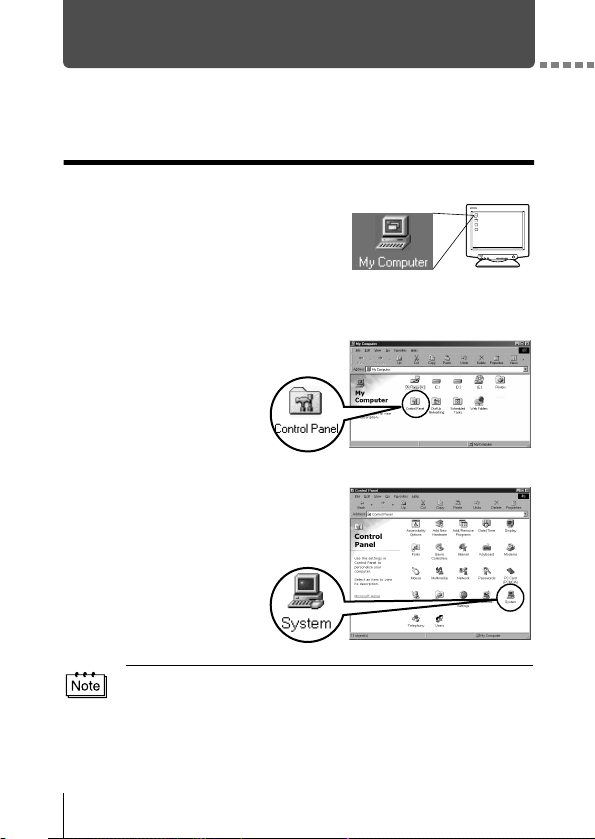
6
Identifying the OS
Identify the OS on your computer before connecting the camera. How to
identify the OS depends on the computer.
Windows
1
Double-click the “My Computer”
icon on your desktop.
When the “My computer” icon is not on
your desktop, click “Control Panel”
from the “Start” menu.
2
Double-click the
“Control Panel” icon.
3
Double-click the
“System” icon.
The way the file icons inside the folder appear may vary depending on your
version of Windows. If you don’t see the icon you are looking for, click on
“view all Control Panel options” on the left of the window.
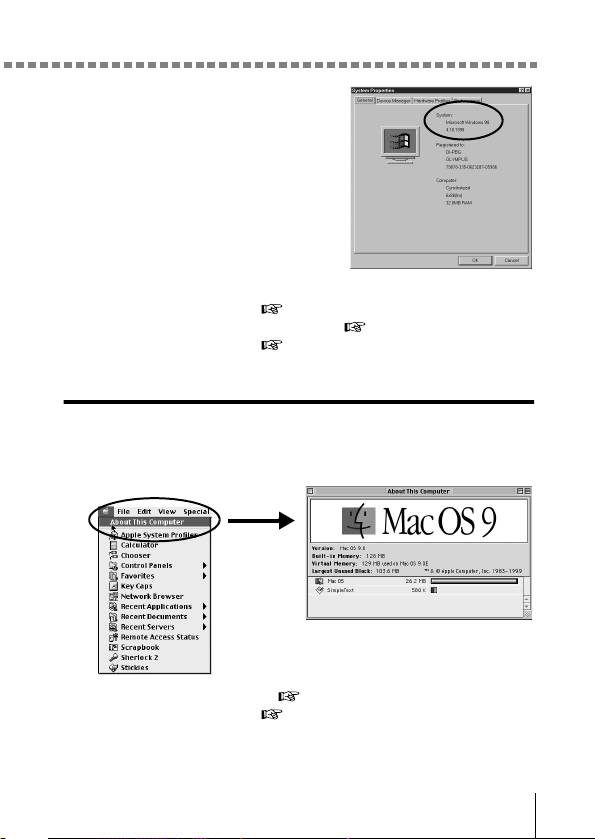
Identifying the OS
7
4
A System Properties window will
appear. Note and record the
“System:” information.
Confirm that your system is Windows
98, 98 SE, Me, 2000 Professional or
Windows XP, then press “OK” to close
the window.
If your OS is Windows 98/98 SE, proceed to “Installing the USB
driver for Windows 98” (
p.9).
Users running Windows Me/2000/XP
p.11
Users running other OS
p.31
Mac OS (Macintosh)
Select “About This Computer” from the Apple menu on the menu bar.
A window appears with the name of the computer’s OS.
Confirm that the OS is OS 9.0-9.1 or OS X.
Users running Mac OS 9/X
p.23
Users running other OS
p.31
8
Windows
Windows
WindowsWindows
Windows
Using Windows 98/Me/2000/XP
Using Windows 98/Me/2000/XPUsing Windows 98/Me/2000/XP
Using Windows 98/Me/2000/XP
Your computer is turned on and Windows is running.
If you are running any applications, quit them all.
You are recommended to power the camera using the optional AC adapter.
If the battery power runs out while the computer is accessing the card in the
camera, the camera will turn off in the middle of the operation and this could
destroy image files (data). If you are using batteries, make sure that there
is sufficient remaining battery power.
Installing the USB driver for Windows 98 (When using Windows
98/98 SE) ....................................................................................... 9
Connecting the camera to the computer ................................. 11
Confirming the computer recognizes the camera .................. 14
Confirming the USB driver is installed .................................... 15
Downloading images to your computer................................... 17
Disconnecting the camera from your computer ..................... 20
Make sure that:
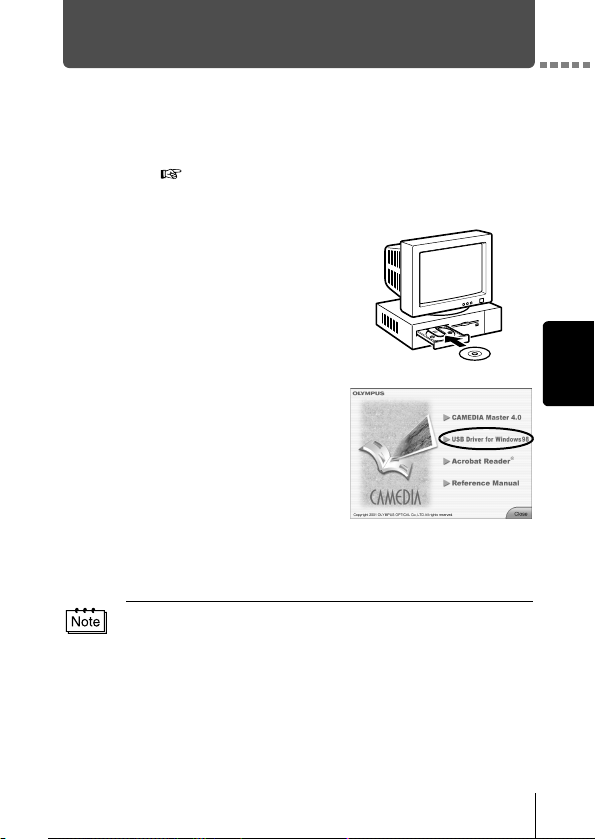
9
Windows
Installing the USB driver for Windows 98
(When using Windows 98/98 SE)
If your OS is Windows 98/98 SE, you must install the USB driver. Follow the
instructions below to install the USB driver in your computer. Once it is fully
installed, you do not need to repeat the procedure again.
If your OS is Windows Me/2000/XP, skip the procedure below as the USB
driver will be automatically installed. Proceed to “Connecting the camera to
the computer” (
p.11).
1
Insert the provided software CD
into your CD-ROM drive.
2
The Olympus Windows Installer
should automatically launch. Click
“USB driver for Windows 98”.
If the installer is not automatically launched, select “Run..” on the
“Start” menu and then execute “(drive letter):/ Information.exe”.
The drive letter of the CD-ROM varies depending on the computer.
To identify the drive letter, double-click “My Computer” on the desktop.
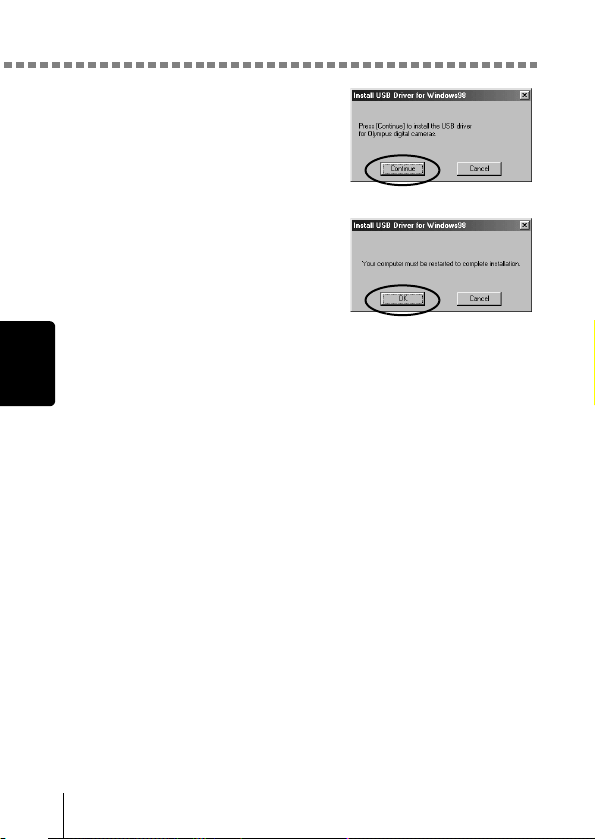
Installing the USB driver for Windows 98 (When using Windows 98/98 SE)
10
Windows
3
Click “Continue”. The installation
of the USB driver will start.
4
Click “OK” to restart your computer
and the installation is complete.
5
When the computer has restarted, installation is complete. If the
Olympus Windows Installer screen appears, click “Close” and
remove the CD-ROM from the CD-ROM drive.
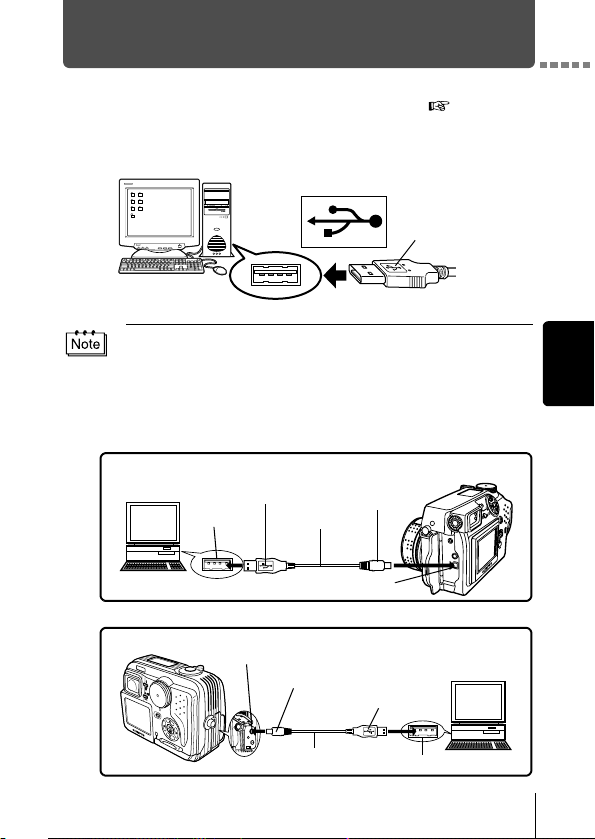
11
Windows
Connecting the camera to the computer
Users running Windows 98/98SE need to install the USB drive before
connecting the camera to your computer for the first time. ( p.9)
1
Insert the marked end of the provided USB cable into the USB
port on your computer as shown below.
2
After making sure that the camera is turned off, connect the end
of the USB cable to the USB connector on the camera.
The location of the USB connector or multi connector varies depending
on the camera model. Refer to the camera manual for details.
The location of the USB port varies depending on the computer. For details,
refer to your computer's manual.
Look for this mark.
USB port
Terminal
Camera with a USB connector
USB port
Computer
USB connector
USB cable
Smaller terminal
Rectangular terminal
Camera with a multi connector
USB cable
Smaller terminal
USB port
Computer
Rectangular terminal
Camera’s multi connector (USB, A/V OUT)
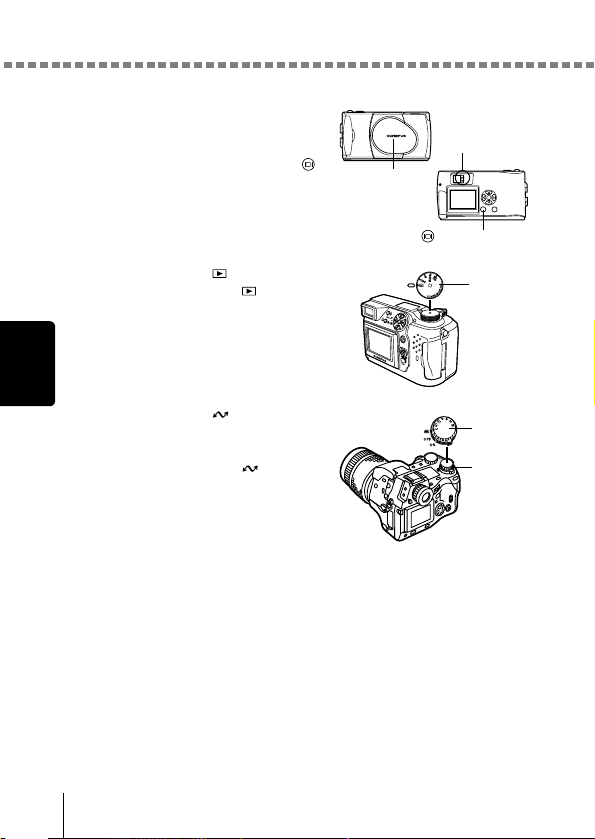
Connecting the camera to the computer
12
Windows
3
Turn the camera on.
Camera with a lens barrier
The power turns on automatically,
with the exception of some models
which require you to press the
(monitor) button.
When the camera is turned on, the
lamp on the right of the viewfinder
lights up.
Camera with a mode
Set the mode dial to . (If the
camera has a power switch as well
as a mode dial, turn the power
switch to ON.)
Camera with a mode
(Camera setup/connection
mode)
Set the mode dial to to turn
the camera on.
Lens barrier
Lamp
(monitor) button
Mode dial
Mode dial
Power
switch
Connecting the camera to the computer
13
Windows
4
The computer recognizes the camera as a new device.
When you connect the camera to the computer for the first time, the
computer automatically recognizes the camera. Click “OK” when the
message saying that the installation is completed appears. The
computer recognizes the camera as a “Removable Disk”.
Windows XP
You can download image files from the camera easily.
Select “Copy pictures to folder on my computer using Microsoft
Scanner and Camera Wizard”, then follow the on-screen instructions.
You may also select “take no action” to bypass the Microsoft Scanner
and Camera Wizard. You may then use a more advanced image
viewing/editing program such as Olympus CAMEDIA Master
software. For detailed instructions on downloading, refer to the
CAMEDIA Master software user’s guide.
When the camera is connected to the computer, none of the camera buttons
are functional.
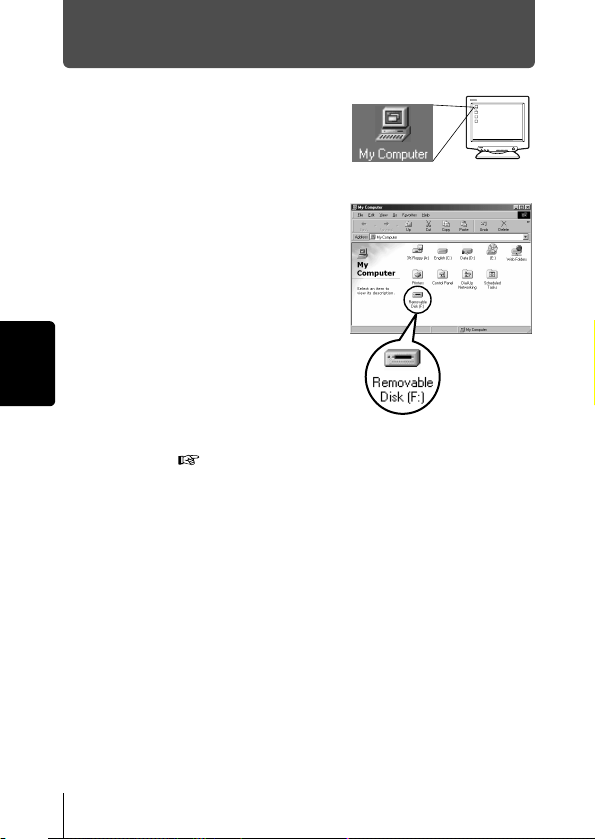
14
Windows
Confirming the computer recognizes the camera
1
Double-click the “My Computer”
icon on the desktop.
For users running Windows XP, click
“My Computer” from the “Start” menu.
2
Make sure the “Removable Disk”
icon appears in the window.
There may already be other
“Removable Disk” icons for other
devices, such as a removable media
drive or USB SmartMedia Reader/
Writer. In this case, the digital camera
is recognized as another “Removable
Disk”.
If you cannot find the icon, the camera
and computer are not connected
properly. Turn the camera off,
disconnect the camera from the
computer and connect again, or proceed to “Confirming the USB driver
is installed” ( p.15) to make sure that the USB driver is fully
installed.
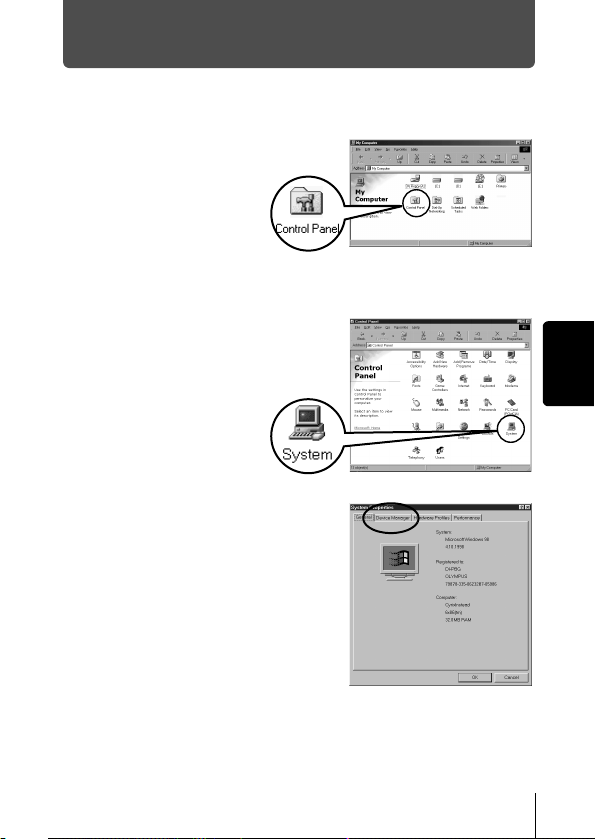
15
Windows
Confirming the USB driver is installed
If the computer does not recognize the camera as a Removable Disk, follow
the procedure below to check whether the USB driver has been fully installed.
1
Open “My Computer”
and double-click the
“Control Panel” icon.
For users running
Windows XP, open
“Control Panel” from the
“Start” menu.
2
Double-click the
“System” icon.
3
The System window will appear.
Click the “Device Manager” tab.
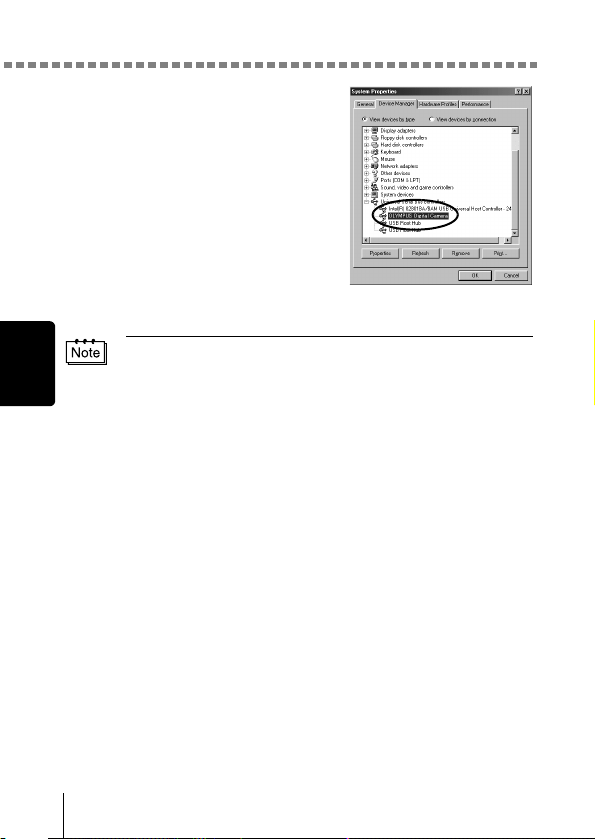
Confirming the USB driver is installed
16
Windows
4
Confirm that “OLYMPUS Digital
Camera” is in the “Universal Serial
Bus Controller” category.
If you cannot find the “OLYMPUS
Digital Camera”, turn the camera off,
disconnect the camera from the
computer and start again.
Users running Windows 98/98 SE
start again from “Confirming the USB
driver is installed”, and Users running
Window Me/2000/XP start from
“Connecting the camera to the
computer”.
If the USB driver was successfully installed, you can find the following in the
“Device Manager”.
– the name of the camera you have connected listed under “Disk drives”
– “OLYMPUS Digital Camera” listed as one of the items in the “Universal
Serial Bus Controller” category
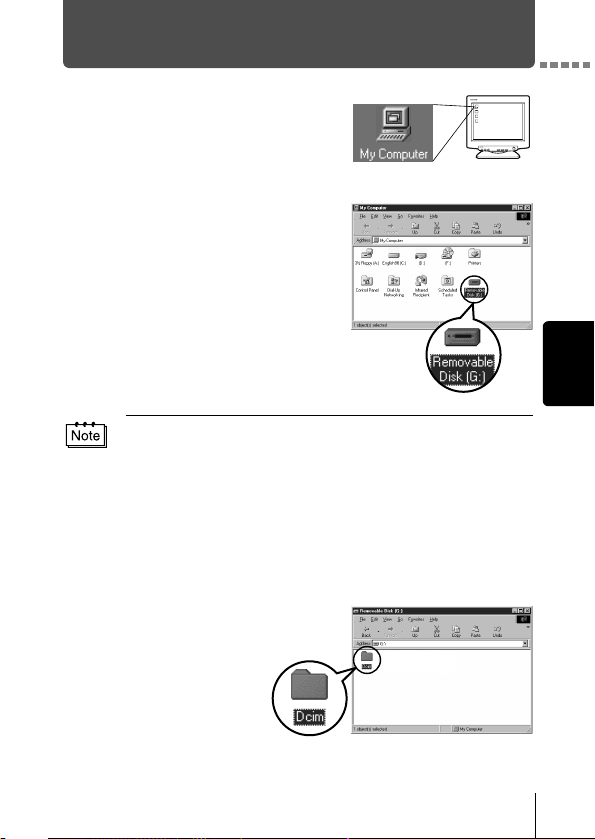
17
Windows
Downloading images to your computer
1
Double-click the “My Computer”
icon on the desktop.
For users running Windows XP, click
“Control Panel” from the “Start” menu.
2
Double-click the “Removable Disk”
icon.
A new “Removable Disk” icon appears
when the camera is connected to the
computer, as the digital camera is
recognized as a “Removable Disk”.
3
Double-click the
“Dcim” folder.
If an error message appears when you double-click the icon, there may be a
problem with one of the following:
the camera’s power source (the AC adapter is not properly connected or
the battery power is low)
Make sure that the AC adapter is correctly connected or that the batteries
are not running low.
the card (there is no card in the camera or there is a problem with the
card)
Check that you can play back pictures stored on the card on the monitor
of your digital camera.
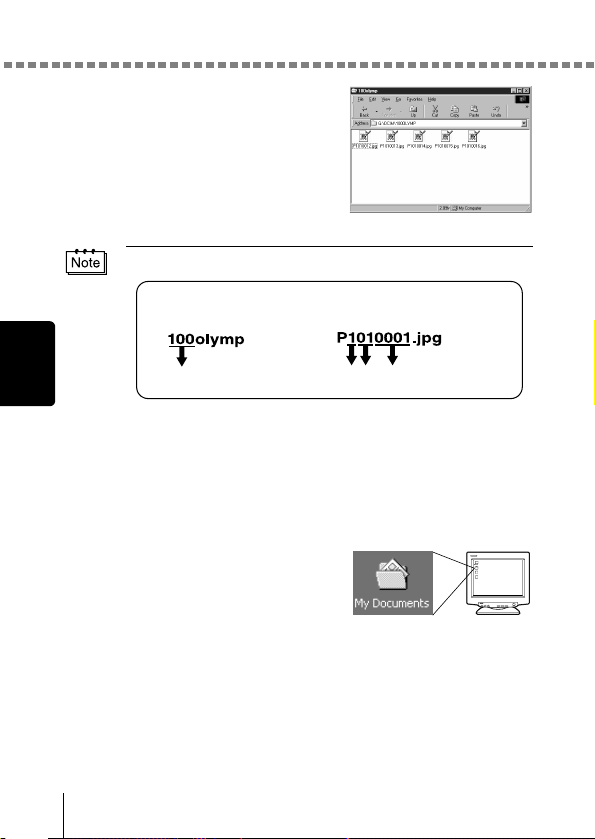
Downloading images to your computer
18
Windows
4
Double-click the “100olymp” folder.
Image files (JPEG files) with files
names such as “P1010001.jpg” are
displayed.
5
Double-click the “My Documents”
icon on the desktop.
If you cannot find the icon on the
desktop, select “Explorer” on the Start
menu and double-click the “My
Documents” icon.
• The camera automatically assigns folder names and file names according
to the following rules.
• Serial numbers of image files run from 0001 to 9999.
• Serial numbers of folders run from 100 to 999.
• When file number 9999 is reached, a new folder is created and assigned
the next number.
• Months January through September are expressed by the numbers 1
through 9, October by the letter A, November by B and December by C.
Folder name
(Example)
File name
(Example)
Serial number
Month / Day / Serial number
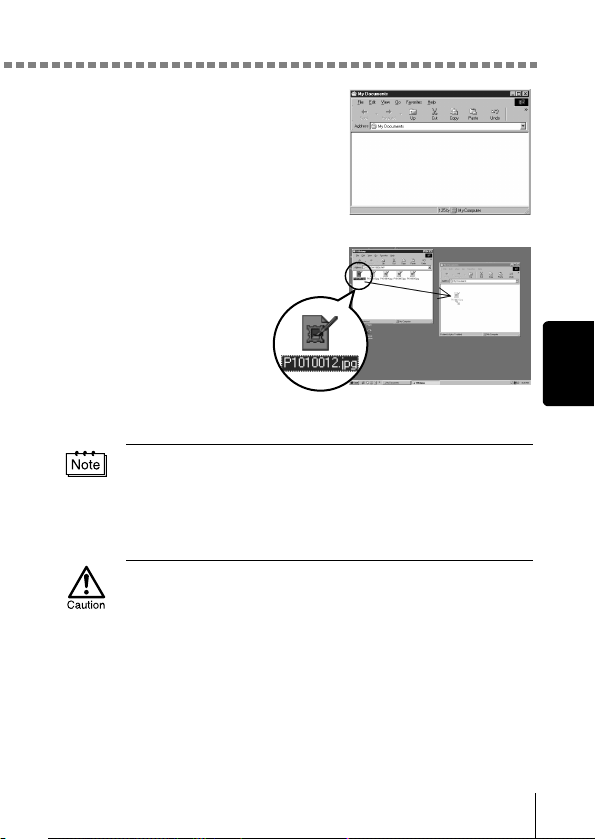
Downloading images to your computer
19
Windows
The “My Documents” window is
displayed.
6
Drag & drop the image
you want to save in the
computer (in this case,
P1010012.jpg) to the
“My Documents”
window.
The image is saved in the
computer (in My
Documents folder).
• To select all files, choose Edit > Select all.
When the image file has been downloaded to the computer, you can view
images by double-clicking the image files downloaded to your computer. The
files will be opened in the default image viewer of the operating system. If you
want to view the image a different size or process it, you will need to open the
image with software that supports JPEG or TIFF images files, such as Paint
Shop Pro, Photoshop or CAMEDIA Master software.
The lamp on the right of the viewfinder or the card access lamp blinks while
the image is being copied. Never open the card cover on the camera, load or
remove the batteries, or connect or disconnect the AC adapter while the lamp
is blinking as the image files may be destroyed.
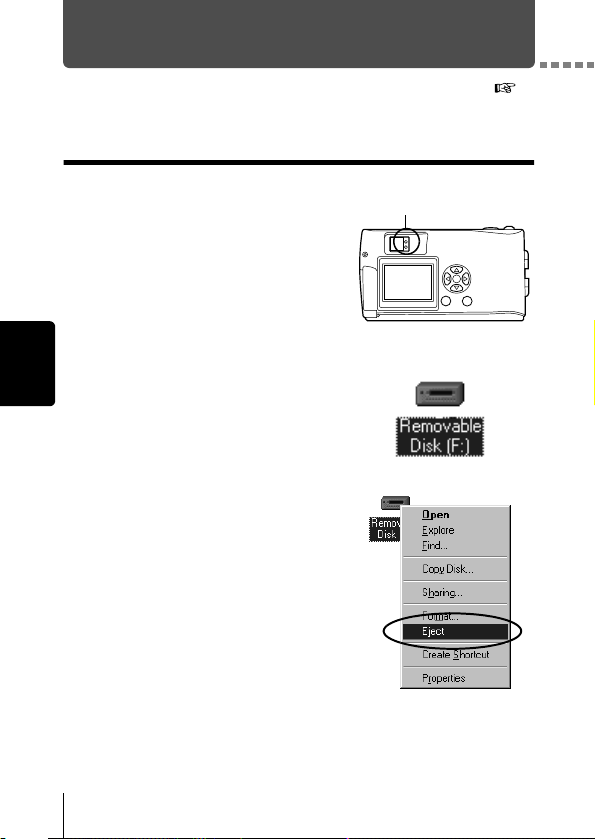
20
Windows
Disconnecting the camera from your computer
If your OS is Windows Me/2000, proceed to “Windows Me/2000/XP” (
p.21).
Windows 98
1
Make sure that the lamp on the right
of the viewfinder or the card access
lamp is not blinking.
Some camera models have either a
lamp on the right of the viewfinder or a
card access lamp, and the location
varies depending on the model. Refer
to your camera’s reference manual.
2
Double-click the “My Computer”
icon and right-click the “Removable
Disk” to display the menu.
3
Click “Eject” on the menu.
Lamp
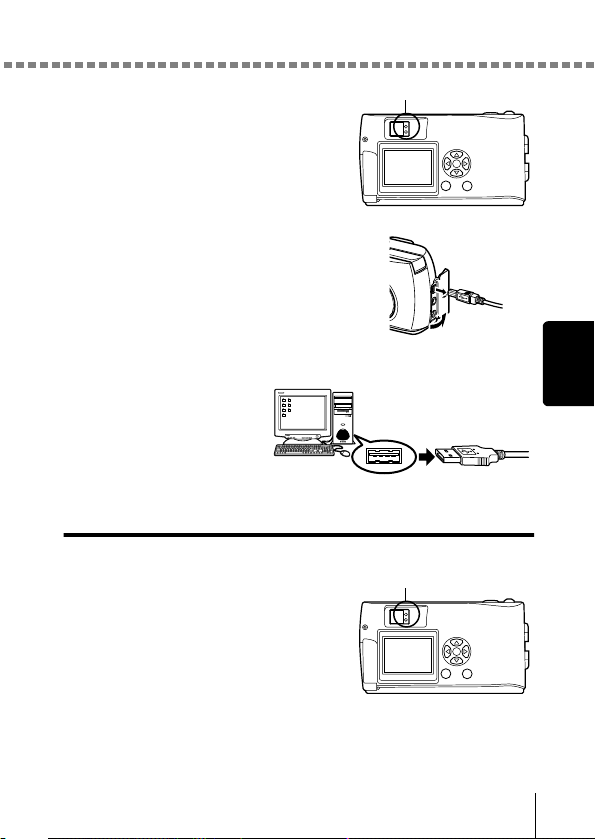
Disconnecting the camera from your computer
21
Windows
4
Make sure that the lamp on the right
of the viewfinder or the card access
lamp is not blinking.
5
Remove the USB cable from the
camera.
6
Remove the USB cable from your computer.
Windows Me/2000/XP
1
Make sure that the lamp on the right
of the viewfinder or the card access
lamp is not blinking.
Some camera models have either a
lamp on the right of the viewfinder or a
card access lamp, and the location
varies depending on the model. Refer
to your camera's reference manual.
Lamp
Lamp
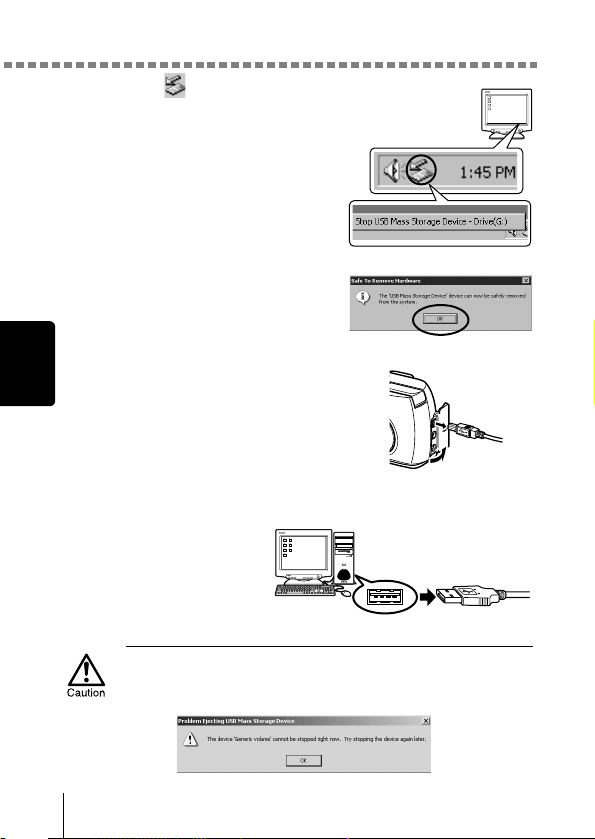
Disconnecting the camera from your computer
22
Windows
2
Click the “Unplug or Eject
Hardware” icon on the task bar.
The message saying that the drive
has been stopped appears.
3
Click on the message.
The “Unplug or Eject Hardware”
window appears.
4
When a message appears, click
“OK”.
5
Remove the USB cable from the
camera.
6
Remove the USB cable from your computer.
If the window returns the following message when you click “Unplug or Eject
Hardware”, first make sure that no image data is being downloaded from the
camera, and then remove the USB cable.
23
Macintosh
Macintosh
MacintoshMacintosh
Macintosh
Using Mac OS (9/X)
Using Mac OS (9/X)Using Mac OS (9/X)
Using Mac OS (9/X)
Your computer is turned on and Mac OS is running.
If you are running any applications, quit them all.
You are recommended to power the camera using the optional AC adapter.
If the battery power runs out while the computer is accessing the card in the
camera, the camera will turn off in the middle of the operation and this could
destroy image files (data). If you are using batteries, make sure that there
is sufficient remaining battery power.
If you are running Mac OS X, the connection to the computer and
downloading the image data are verified. Restrictions such as the
following may occur due to the OS.
The image file properties are not displayed correctly.
Images in the camera cannot be opened without first downloading
them. etc.
For more details, visit the Olympus web site.
Connecting the camera to the computer ................................. 24
Downloading images to your computer................................... 26
Disconnecting the camera from your computer ..................... 30
Make sure that:
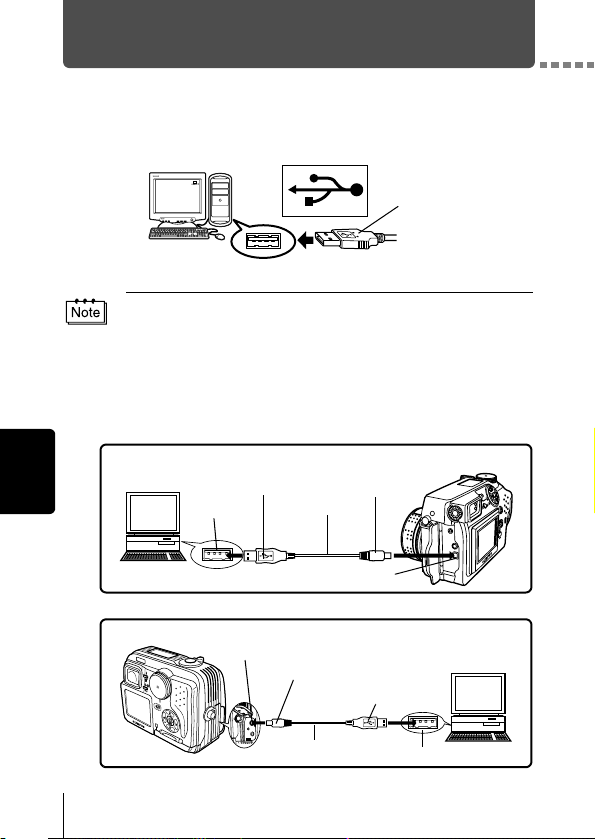
24
Macintosh
Connecting the camera to the computer
1
Insert the marked end of the USB cable into the USB port on your
computer as shown below.
2
After making sure that the camera is turned off, connect the end
of the USB cable to the USB connector on the camera.
The location of the USB connector or multi connector varies depending
on the camera model. Refer to the camera manual for details.
The location of the USB port varies depending on the computer. For details,
refer to your computer's manual.
Look for this mark.
Terminal
USB port
Camera with a USB connector
USB port
Computer
USB connector
USB cable
Smaller terminal
Rectangular terminal
Camera with a multi connector
USB cable
Smaller terminal
USB port
Computer
Rectangular terminal
Camera’s multi connector (USB, A/V OUT)
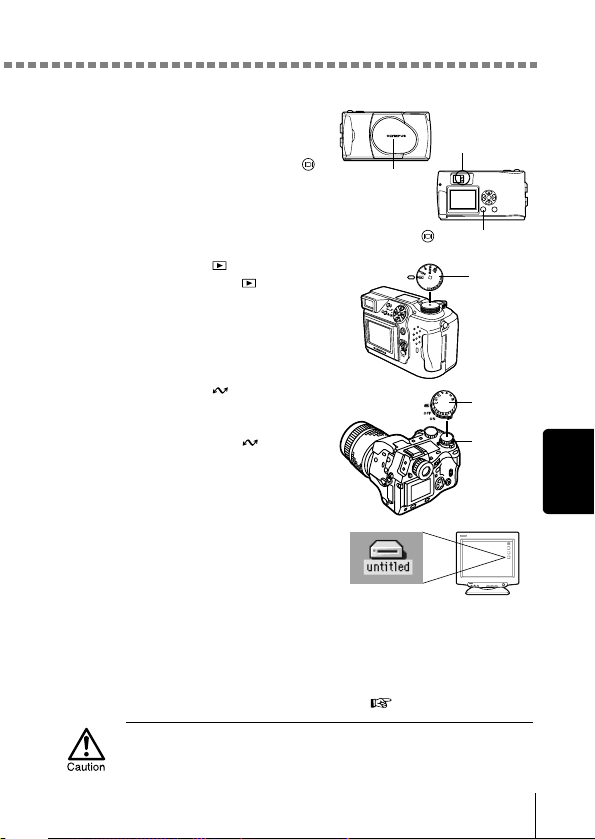
Connecting the camera to the computer
25
Macintosh
3
Turn the camera on.
Camera with a lens barrier
The power turns on automatically,
with the exception of some models
which require you to press the
(monitor) button.
When the camera is turned on, the
green lamp on the right of the
viewfinder lights up.
Camera with a mode
Set the mode dial to . (If the
camera has a power switch as well
as a mode dial, turn the power
switch to ON.)
Camera with a mode
(Camera setup/connection
mode)
Set the mode dial to to turn
the camera on.
4
The computer recognizes the
camera as a new device.
The computer recognizes the
camera automatically and an
“Untitled” icon appears on the
desktop.
If you cannot find this icon, turn off the camera and connect again.
Mac OS X
When the computer has recognized the camera, the Apple Image
Capture software automatically launches.
p.29
When the camera is connected to the computer, none of the camera buttons
are functional.
Lens barrier
Lamp
(monitor) button
Mode dial
Mode dial
Power
switch
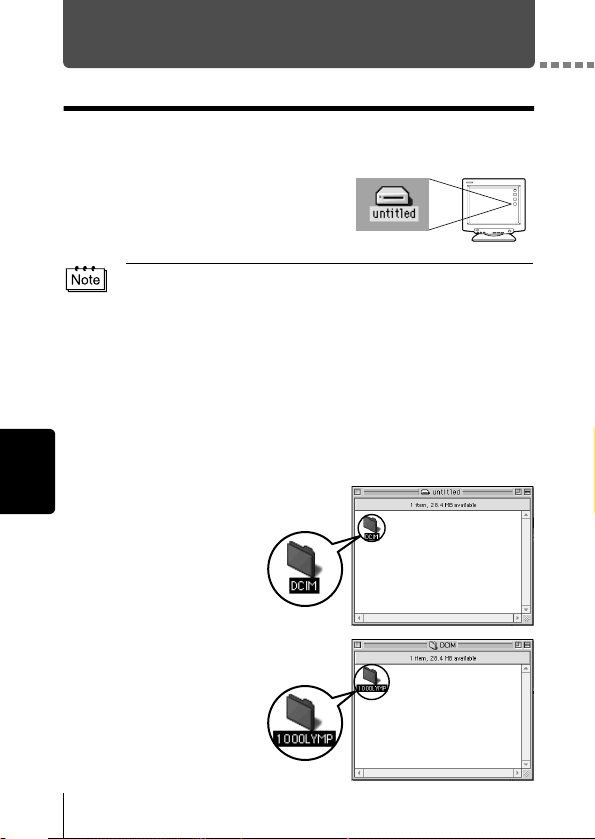
26
Macintosh
Downloading images to your computer
Mac OS 9
You can download images from the camera and save them in your computer
(in this case, in the Hard Disk).
1
Double-click the “Untitled” icon
displayed on the desktop when the
camera is connected to the
computer.
2
Double-click the
“Dcim” folder.
3
Double-click the
“100OLYMP” folder.
If you cannot find this icon, or if an error message appears when you double-
click the icon, there may be a problem with one of the following:
the camera’s power source (the AC adapter is not properly connected or
the battery power is low)
the card (there is no card in the camera or there is a problem with the
card)
Check that you can play back pictures on the monitor of your camera.
the USB cable (the camera is not properly connected to the computer by
the USB cable).
Apple “File Exchange” extension is not enabled.
• Please refer to your Apple operating system manual for instructions on
how to enable this extension.
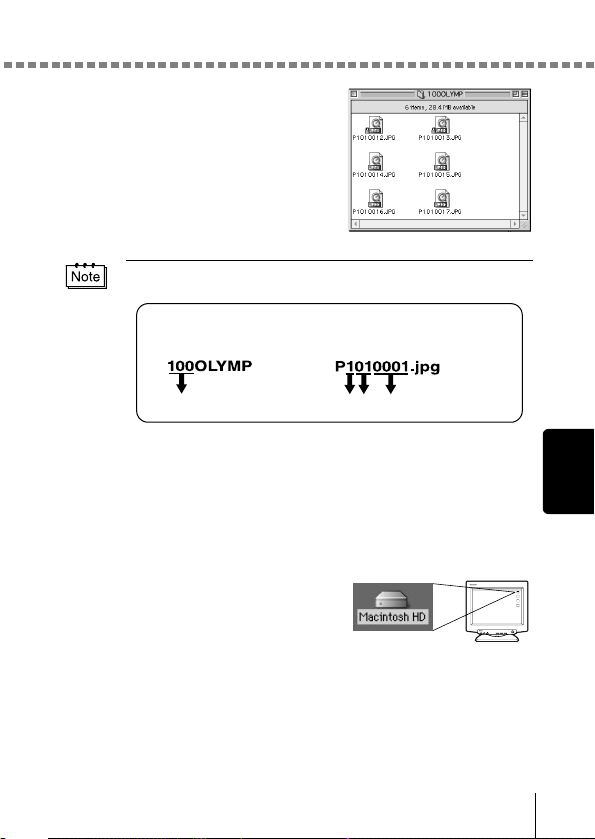
Downloading images to your computer
27
Macintosh
Image files (JPEG files) with files
names such as “P1010001.JPG” are
displayed.
4
Double-click the “Macintosh HD”
icon on the desktop.
• The camera automatically assigns folder names and file names according
to the following rules.
• Serial numbers of image files run from 0001 to 9999.
• Serial numbers of folders run from 100 to 999.
• When file number 9999 is reached, a new folder is created and assigned
the next number.
• Months January through September are expressed by the numbers 1
through 9, October by the letter A, November by B and December by C.
Folder name
(Example)
File name
(Example)
Serial number Month / Day / Serial number
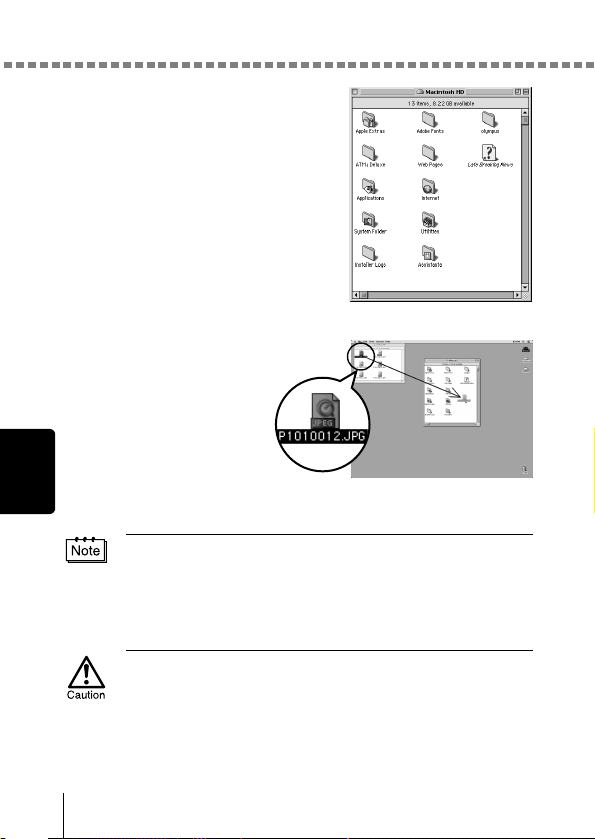
Downloading images to your computer
28
Macintosh
The “Hard Disk” window is displayed.
5
Drag & drop the image
you want to save in the
computer (in this case,
P1010012.JPG) to the
“Hard Disk” window.
The image is saved in
the computer (in the
Hard disk).
• To select all images,
click Edit > Select all.
When the image file has been copied to the computer, you can view images
by double-clicking the image files in the “Hard Disk” folder. The files will be
opened in the default image viewer of the operating system. If you want to
view the image a different size or process it, you will need to open the image
with software that supports JPEG or TIFF images files, such as Paint Shop
Pro, Photoshop or CAMEDIA Master software.
The lamp on the right of the viewfinder or the card access lamp blinks while
the image is being copied. Never open the card cover on the camera, load or
remove the batteries, or connect or disconnect the AC adapter while the lamp
is blinking as the image files may be destroyed.
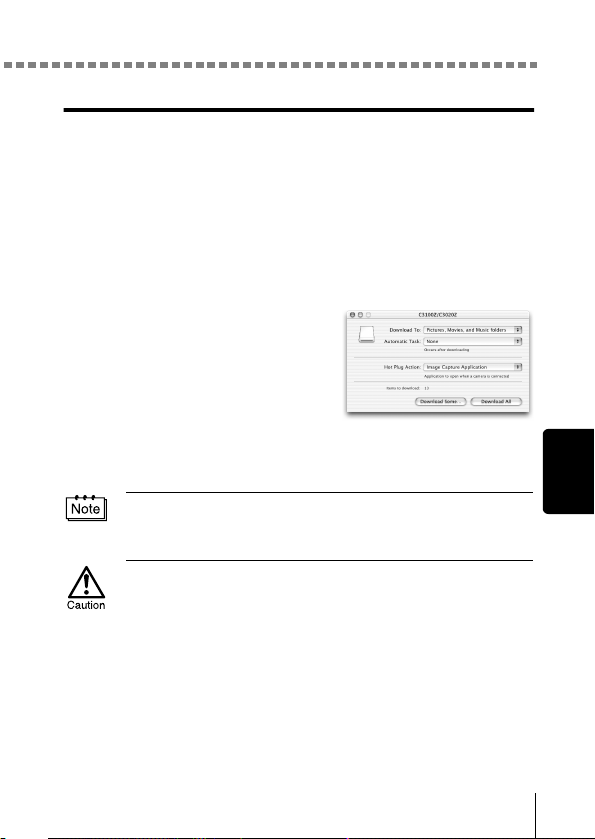
Downloading images to your computer
29
Macintosh
Mac OS X
Malfunctions such as the following may occur due to the OS.
• If the camera is not connected correctly, a malfunction occurs in the
computer.
• Date and time information of image files is not accurately displayed.
• If the card cover of the camera is opened while connecting to the computer,
the “untitled” icon does not disappear from the desktop. etc.
When the computer has recognized the camera, the Apple Image Capture
software dialog appears.
1
From the “Download To” menu,
select a destination folder.
2
To download all images, click
“Download All”.
To selectively download images,
click “Download Some” and
highlight the desired images.
The images are transferred from the camera to your computer.
If you are operating Mac OS X and you want to download images using the
same procedure as for Mac OS 9, select “File > Close” and exit the Apple
Image Capture software. At this time, the camera is indicated as “unlabeled”.
If you use the Apple Image Capture software, images downloaded to your
computer and transferred back to a card may not play back on the camera or
may have other problems.
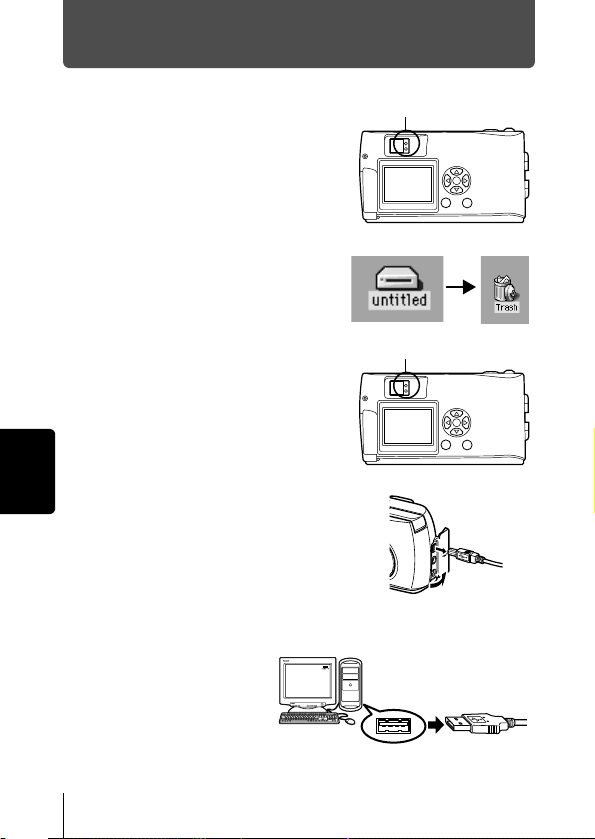
30
Macintosh
Disconnecting the camera from your computer
1
Make sure that the lamp on the right
of the viewfinder or the card access
lamp is not blinking.
2
Drag the “untitled” icon on the
desktop to “Trash”.
3
Make sure that the lamp on the right
of the viewfinder or the card access
lamp is not blinking.
4
Remove the USB cable from the
camera.
5
Remove the USB cable from your
computer.
Lamp
Lamp
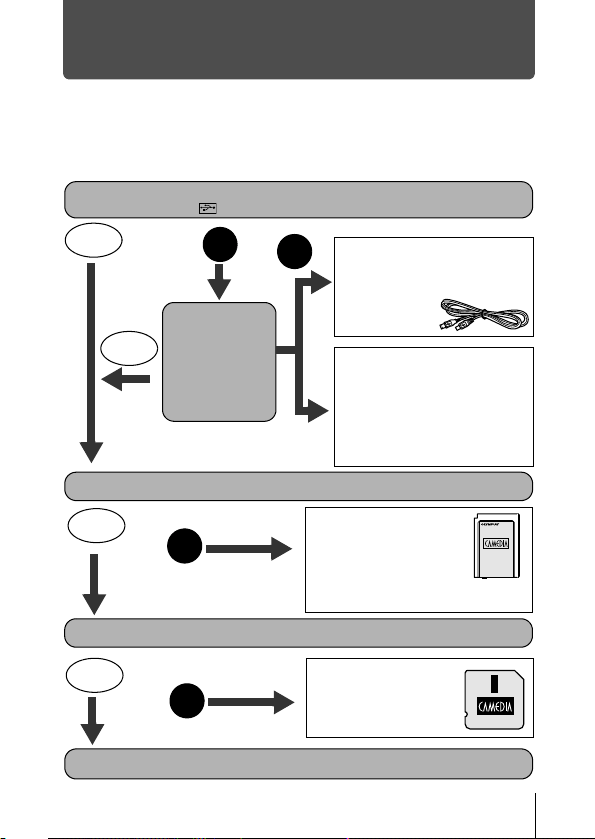
31
Downloading image files using other OS
(For other OS users)
Users running other OS cannot connect the camera directly to a computer.
Windows 95
Windows NT
Mac OS before OS 9
You can download images directly to your computer using an optional floppy
disk adapter or PC card adapter.
Does your computer have a USB interface?
Is there a port marked on your computer?
Does your computer have a built-in PC card slot?
Consult your nearest Olympus representative.
Is your OS one of
the following?
• Windows 98
• Windows 2000
• Windows Me
• Windows XP
• Mac OS 9/X
Yes
No
No
Yes
Connect the camera directly
to your computer using the
provided USB cable.
Use the optional USB
SmartMedia reader/writer.
*Certain card readers may not be
compatible with Mac OS X.
Check the Olympus website for
the most up-to-date compatibility
information.
Use the optional PC
card adapter.
*Not supported by Windows NT4.0 or
lower
Does your computer have a built-in floppy disk drive?
No
Yes
Use the optional
FlashPath floppy disk
adapter.
No
Yes

http://www.olympus.com/
2002 OLYMPUS OPTICAL CO., LTD.
VT365602
San-Ei Building, 22-2, Nishi Shinjuku 1-chome, Shinjuku-ku, Tokyo, Japan
Customer support (Japanese language only): Tel. 0426-42-7499 Tokyo
OLYMPUS OPTICAL CO., LTD.
Two Corporate Center Drive, Melville, NY 11747-3157, U.S.A. Tel. 631-844-5000
Technical Support (USA)
24/7 online automated help: http://support.olympusamerica.com/
Phone customer support: Tel. 1-888-553-4448 (Toll-free)
Our phone customer support is available from 8 am to 10 pm
(Monday to Friday) ET
E-Mail: distec@olympus.com
Olympus software updates can be obtained at: http://olympus.com/digital/
Adobe [Photoshop] Support
Adobe software updates and technical information can be obtained at:
http://www.adobe.com/support/
OLYMPUS AMERICA INC.
Premises/Goods delivery: Wendenstrasse 14-18, 20097 Hamburg, Germany
Tel. 040-237730
Letters: Postfach 10 49 08, 20034 Hamburg, Germany
Hotline Numbers for customers in Europe:
Tel. 01805-67 10 83 for Germany
Tel. 00800-67 10 83 00 for Austria, Belgium, Denmark, France,
Netherlands, Norway, Sweden, Switzerland,
United Kingdom
Tel. +49 180 5-67 10 83 for Finland, Italy, Luxembourg, Portugal,
Spain, Czech Republic
Tel. +49 40-237 73 899 for Greece, Croatia, Hungary, and the rest of Europe
Our Hotline is available from 9 am to 6 pm (Monday to Friday)
E-Mail: di.support@olympus-europa.com
OLYMPUS OPTICAL CO. (EUROPA) GMBH.