I
Ii!! Ill
=111
‘w
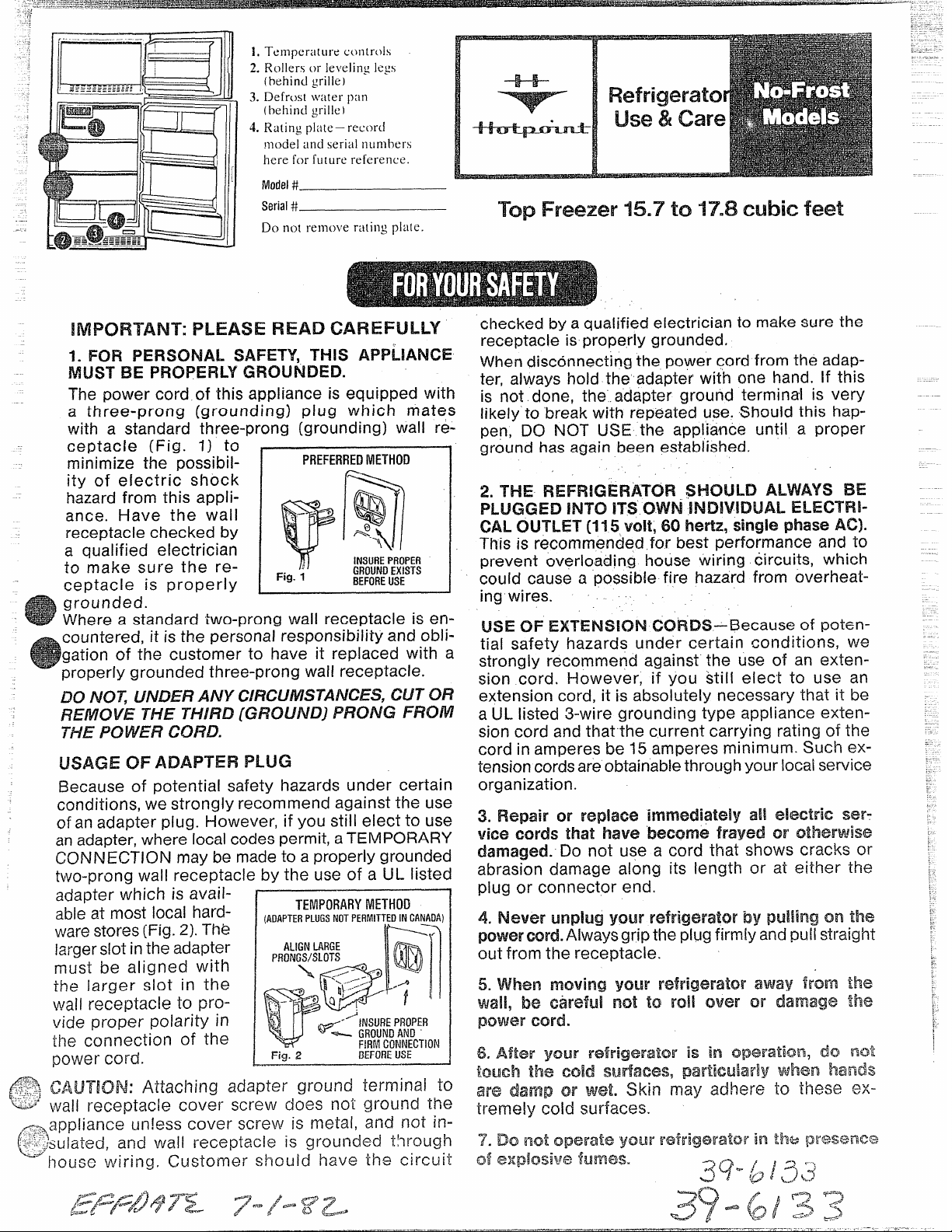
1.Temperature c{)ntr~)ls
2. Rollers or le~wlinglegs
(behind grille)
3. Defros[ water pan
(behind grille)
4. Rating plate-record
model and serial numbers
here for fu[ure reference.
Model#
Serial#
DOnot remove ra(ing pl:l[e.
21
Refrigerator
!
.ti_
use& care
I
adabter which is avail-
T’”p Freezer
IMPORTANT:PLEASERam CAREFULLY
3. FOR PERSONAL SAFETY, TH!S APFiJANCE
MUST BE PROPERLYGF!CWNDED.
The Dower cord of this appliance is equipped with
a three-prong (grounding) plug which mates
with a standard three-prong (grounding) wall re-
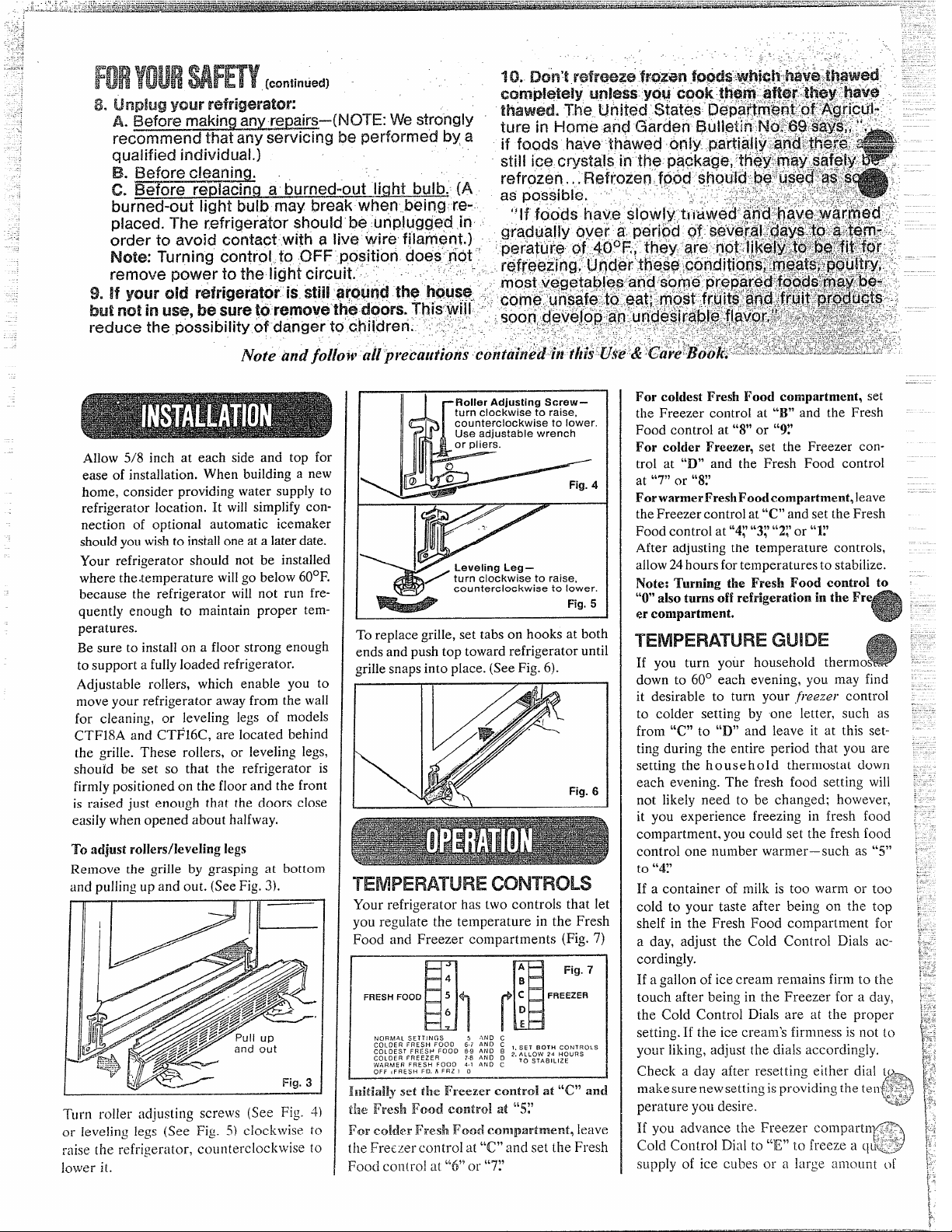
ceptacle (Fig. 1) to
minimize the possibil-
ity of electric shock
hazard from this appli-
ance. Have the wail
receptacle checked by
a qualified electrician
to make
sure the re-
ceptacle is properly
grounded.
Where a standard two-prong wall receptacle is en-
countered, it is the personai responsibility and obli-
gation of the customer to have it replaced with a
properly grounded three-prong wall receptacle.
Do ?do~ UNDER ANY CIRCUMSTANCES,CUT OR
REMOVE THE 7-HIRD(GROUND] PRONG FROM
THE POWER CORD.
USAGE OF ADAPTER PLUG
Because of potential safety hazards under certain
conditions, we strongly recommend against the use
of an adapter plug. However, if you still elect to use
anadapter,where localcodes permit, aTEMPORARY
CONNECTION may be madeto aproperly grounded
two-prong wall receptacle by the use of a UL listed
ableat most local hard-
warestores (Fig.2).ThQ
kvgersiot inthe adapter
must be aligned with
the larger slot in the
wall receptacle to pro-
vide proper polarity in
the connection of the
power cord.
TEMPORARYMETHOD
(ADAPTERPLUGSNOTPERMITTEDINCANADA)
Fig.2 BEFOREUSE
d
~’<~ywail receptacle cover screw does not ground the
.=:l.,app!iance uri!ess cover screw is metal, and not ir?-
L
.-..,-,
‘~”jkuizrted,and wall receptacle is grounded through
‘-’- hOiJSe wiring, Customer should have the circuit
“H7 IX3-n%3cubic ‘feet
checked by a qualified electrician to make sure the
receptacle is properly grounded.
Whendisconnecting the power cord from the adap-
ter, always hold the adapter with one hand, If this
is not done, the’ adapter ground terminal is very
iikely’to break with repeated use. Should this hap-
pen, DO NOT USE the appliance until a proper
ground has again been established.
2. THE REFRIGERATOR ~HCNHJ3 ALWAYS BE
PLUGGED INTO H-s OWN lND!VIDUAL Electri-
cal OUTLET (115 volt, 60 hertz, single phase AC).
This is recmnmendqd for best performance and to
prevent overloading house wiring dircuits, which
could cause a possible fire hazard from overheat-
ing wires.
USE OF EXTENS!QN CX2RDS-Because of poten-
tial safety hazards under certain conditions, we
strongly recommend against the use of an exten-
sion cord. However, if you still elect to use an
extension cord, it is absolutely necessary that it be
a UL listed 3-wire grounding type appliance exten-
sion cord and that the current carrying rating of the
cord in amperes be 15 amperes minimum. Such ex-
tensioncordsareobtainablethroughyour localservice
organization.
30F@pairor replace immediately all electric S’er:
vice cords that have “become frayed or otherwise
damaged. Do not use a cord that shows cracks or
abrasion damage along its length or at either the
plug or connector end.
4. Never unplug your refrigerator by pulling on the
Qowercord.Alwaysgrip the plugfirm6yandpull straight
out from the receptacle.
r
.
Allow 5/8 inch at each side and top foI
ease of installation. When building a nev
home, consider providing water supply tc
refrigerator location. It will simplify con.
nection of optional automatic icemakel
should you wishto install one at a later date.
Your refrigerator should not be installed
where the.temperature willgo below 60°F.
because the refrigerator will not run fre-
quently enough to maintain proper tem-
peratures.
Be sure to install on a floor strong enough
to support a fully loaded refrigerator.
Adjustable rollers, which enabJe you to
move your refrigerator away from the wall
for cleaning, or leveling legs of models
CTF18A and CTF16C, are located behind
the grille. These rollers, or leveling legs,
sflould be set so that the refrigerator is
firmly positioned on the floor and the front
is raised just enough that the doors close
easily when opened about halfway.
To adjust NIUers/h?velinglegs
Remove the grille by grasping at bottom
and pulling up and out. (See Fig. 3).
I
Turn roller adjusting screws (See Fig. 4)
or leveling legs (See Fig. 5) clockwise to
mise the refi-igerator, counterclockwise to
lower it.
~ Leveling Leg–
I@
*
Fig. 5
)/ ~n clockwise to raise
unterciockwise to lower.
To replace grille, set tabs on hooks at both
ends and push top toward refrigerator until
grille snaps into place. (See Fig. 6).
TEMPERATURECONTROLS
Your refrigerator has two controls that let
you regulate the temperature in the Fresh
Food and Freezer compartments (Fig. 7)
11ill
A
4
Fig. 7
B
FRESH FOOD 5 -
c
FREEZER
6
D
E
I
NORMAL SETTINGS 5 AND C
COLDER F17ESH FOOD
6’) ‘No c 1. SET BOTH CONTROLS
COLOEST FF?CSW FCIOD 69 AND E
COL9ER FREEZER
78 *ND o 2. ALLOW 24 HOURS
WARMER FRESH FOOD 4.1 AND C
TO STABILIZE
OFF (FRESH FD. A FRZ 1 0
1
L .~
Mtmj’ setthe Freezer control a$“c” and
the l?redl Food Control at“5{’
F’m eokkr F’wJRFood umprtment, leave
the F’rec-m-control at “C” ancl set the Fresh
Food control at “6” or “7;
For coklest Fresh Foorl compartme~lt,set
the Freezer control at “B” and the Fresh
Food control at “8” or “9?
For colder Freezer, set the Freezer con-
trol at “D” and the Fresh Food control
at “7” or “$1’
For wmmerFreshFoodcompartment,leave
the Freezer control at “C” and set the Fresh
Food control at “4; “3; “27or “K’
After adjusting the temperature controls,
allow 24hours for temperatures to stabilize.
Note: Turning the Fresh Food control to ‘-
“0”alsoturnsoff refrigeration h
the Fre
er compartment.
TEMPERATUREGUIDE
If you turn your household therm
down to 60° each evening, you may find
it desirable to turn your .fi.eezer control :-
to colder setting by one letter, such as ‘:’‘f-
rom “C” to “D” and leave it at this set-” -
ting during the entire period that you are
setting the household thermostat down
each evening. The fresh food setting will ‘- --
not likely need to be changed; however, ~
it you experience freezing in ilesh food ~ --
compartment, you could set the fresh food .
control one number warmer- such as “5” :--
to “4
L--
If a container of milk is too warm or too ‘:
cold to your taste after being on the top ~
shelf in the Fresh Food compartment for ~=
a day, adjust the Cold Control Dials ac- :.-
:..
cordingly.
~b,..=--
If a gallon of ice cream remains firm to lhe
,J.,-
~....
touch after being in the Freezer for a day, ,
h..,
~:----
the Cold Control Dials are at the proper ~~:~
seUing. If the ice cream’s firmness is not to
~-;
~w
your liking, adjust the dials accordingly.
!*.
Check a day after resetting either did tep
~$
&:,;y ~:”
make sure new setting is providing the tJ3W?&’i
perature you desire.
kJP \$
I
——
Remgeram’ doesnotrun
@ May be in defrost cycle when motor
does not run for 30 minutes.
@ Temperature control
in OFF position.
@ If interior light is not on, refrig-
erator may not be plugged in at wall
receptacle.
o If plug is secure and the refrigerator
still fails to operate, plug a lamp or
a small appliance into the same outlet
to determine if there is a tripped
circuit breaker or burned out fuse.
Motor runs for kmg periods
Motorswts & stops frequently
G Temperature control starts and stops
motor to maintain even temperatures,
operating sounds
Foods dry
out
e Food not wrapped or sealed properly.
Frost on frozen food
@
Freezer door may have been left ajar
or package holding door open.
e Too frequent and too long freezer
door openings,
The high speed motor compressor
required to maintain near zero
temperatures in the large freezer
section can produce higher sound
levels than your old refrigerator.
Normal fan air flow– one fan blows
cold air through the refrigerator and
freezer sections– another fan cools
the motor compressor.
These NORMAL sounds will also be
Slow ice cube freezing
e
Freezer door may have been left ajar.
s Turn temperature of freezer section
colder. Set the temperature control
on the left to “D” and the other
control to “8” for colder freezer
.
heard from time to time:
~ Defrost timer switch clicks at defrost.
~ Defrost water dripping into drain pan.
~ Temperature control clicks ON or OFF’.
~ Refrigerant boiling or gurgling.
~ Cracking or popping of
cooling coils
caused by expansion and contraction
during defrost and refrigeration
following defrost.
e With automatic icemaker, the sound
of cubes dropping into the bucket
and water running in pipes as
icemaker refills.
Vibration or rattling
@
If refrigerator vibrates, more than
likely all four rollers are not resting
solidly on the floor and front roller
screws need adjusting or floor is weak
or uneven. Refer to INSTALLATION
elsewhere in this book.
es If dishes vibrate on shelves, try moving
them. Slight vibration is normal.
temperatures.
Moisture forms on outside of refrigerator
@
Not unusual during periods of high
humidity.
Modern refrigerators with more stor-
age space and a larger freezer section
require more running time.
Normal when refrigerator is first
delivered to your home– usually
requires 24 hours to completely
cooi down.
Large amounts of food placed in
refrigerator to be cooled or frozen.
Hot weather– frequent door openings
to get ice or cold drinks.
Door left open.
Temperature controls set too cold.
Refer to instructions for use of
TEMPERATURE CONTROLS else-
where in this book.
Grille and condenser need cleaning.
Refer to CONDENSER elsewhere in
this book.
Check ENERGY-SAVING TIPS else-
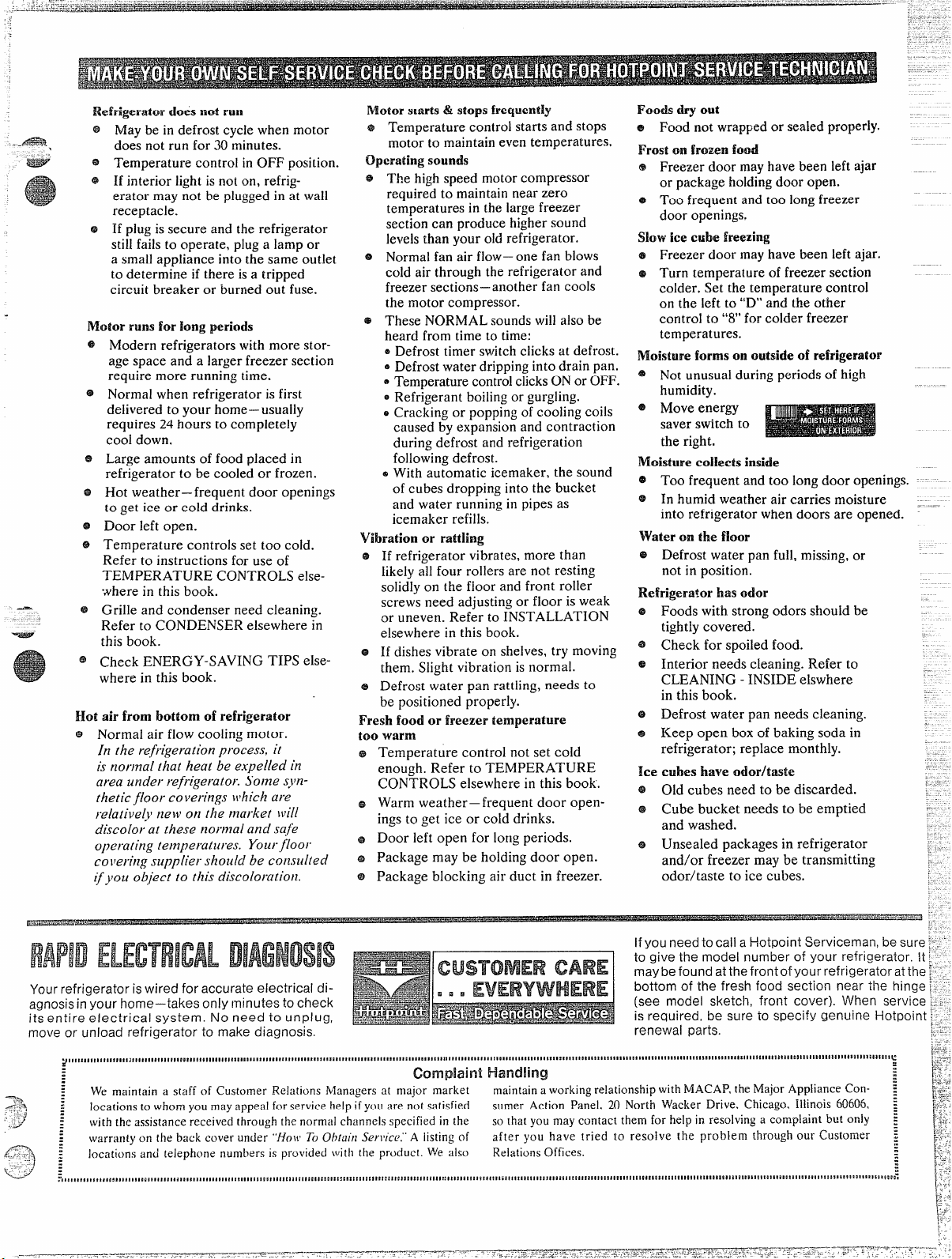
* Move energy
saver switch to
the right.
Moisture collects inside
@
Too frequent and too long door openings.
@ In humid weather air carries moisture ___
into refrigerator when doors are opened. -
Water on the floor
IS
Defrost water pan full, missing, or
not in position.
Rdrigerahx Emsodor
e
Foods with strong odors should be
tightly covered.
@ Check for spoiled food.
e Interior needs cleaning. Refer to
CLEANING - INSIDE elswhere
in this book.
where in this book.
.s Defrost water pan rattling, needs to
be positioned properly.
e Defrost water pan needs cleaning.
e Keep open box of baking soda in
refrigerator; replace monthly.
Hot
air from bottom of refrigerator
@ Normal air flow cooling motor.
In the refrigeration proces.~, it
is normal tizat heat be expelled in
area under refrigerator. Some syn-
thetic fioor co verings which are
t-elative[y new on the market will
di~co[or at ~hese normal and safe
oj3erating temperatures. Your floor
covering supp[iet- shoulcl be consulted
if you o~jec[ to this discoloration.
Fresh food or freezer temperature
too warm
e
Temperature control not set cold
enough. Refer to TEMPERATURE
CONTROLS elsewhere in this book.
Ice cubes have odor/taste
@
Old cubes need to be discarded.
e Cube bucket needs to be emptied
and washed.
e Warm weather— frequent door open-
ings to get ice or cold drinks.
e Door left open for long periods.
e Unsealed packages in refrigerator
and/or freezer may be transmitting
odor/taste to ice cubes.
a Package may be holding door open.
ta Package blocking air duct in freezer.
RAPIDELECTRICALDlA6HOSiS
If you need to call a Hotpoint Serviceman, be sure:.”
to give the model number of your refrigerator. H;
maybe found atthefront ofyourrefrigerator atthe ~
Your refrigerator iswired for accurate electrical di-
bottom of the fresh food section near the hinge; - ‘
agnosisin your home—takes only Iminutes to check
(see model sketch, front cover). When service :.
its entire electrical system. No need to unplug,
is required, be sure to specify genuine Hotpoint ~
..”
,.
move or unload refrigerator to make diagnosis
renewal parts.
,-
<
,---
..
ylllllllllltll111111211 I#!llt!!lIIllsBl:ltl#l 11111111:?18$111s11$11$illll!lltaIB31!111111lI@lllIitllll!!tll BIIc 1811111111111111111s11111-111:111111118111991s11111181111111::1111s1Bisl119tl111118111t11i5 80!100!lt11:11:aiallt11 atlll!ala$lllthltakao! tanlltliltl!!l~
.
:
COrnpkini Handing
:
:
:
s
We maintain a staff of Customer Relations Managers at major market
:
:
-==!-
:
maintaina working relationshipwith
MACAP,theMajorApplianceCon- ~
,’=?
.
- .-%
:
locationstowhomyoumayappeal
for service help ifyou are not satisfied
sumer Action Panel, 20 North Wacker Drive, Chicago, Illinois 60605, :
;LJ
:
:
-3] :
with [hc assistance received through the normal channels specified in the
.
so that you may contact them for help in resolving a complaint but only ~
:
warranty on the back cover under “HOW
TbOIJ[ain52mice.”A listingof
:
after you have tried to resolve the problem throughour Customer S
g~>=
:._-!j :
locationsand telephonenumbers
is provided l~jiththe prociuct. We also
:
Relations Offices.
:
.
x“
:
‘-&-’
;Ils:lllstlt!:lls!110i81!18091111101Iiatlsllll!l!lill?ll!llll?$ls611101!ail!lilltl$l!l:!!~8:1111!6111:!111111111s1181111!)111!Bill:l!lll!lltllll1111QIl!ll:}@?l#llOil!illll!lltlltt!1018111!!118!8?111Ill!il:llltliaBa81BEa41*aflJlB8B!Bt$Baa!!:1!83!n@e$a~Q~IIIIC$!QBBO-.
:
. .
.-
may add one LItany tmle. Contact your local
Hotpoint dealer: specify Hpt Kit 1,
If youhave an automatic icemaker, be sure
to shut off water supply to icemaker when
going away for an extended period of time
(i.e., vacation, long weekend, etc.). .Also
be sure to turn off the icemaker itself.
EAsY”RELEAsEmICETRAYS
[Ice storage binprovided cmmodels
CTF16E, CTF18E, CTF18H only)
Invert and twist trays at both ends to re-
lease cubes into storage bucket cm bov
(Fig. 9).
1
4
For only one or two cubes, leave tray right-
side up, twist ends slightly and remove the
number of cubes desired.
Wash trays and storage bin in lukewarm
water only. Don’t place in automatic dish-
washer.
‘TIPSONFREEZINGFOODS
There are three essential requirements for
efficient home freezing. First, of course, is
initial quality. Only top-quality foods
should be frozen. Freezing retains quality
and flavor; it cannot improve quality. Sec-
ond is speed. The quicker fruits and veg-
etables are frozen after picking, the better
the frozen product will be. You’ll save time,
two,because less culling and sorting will be
necessary. The third requirement is proper
packaging. Use food wraps designed espe-
cially for freezing; they’re readily available
in a wide selection at your favorite store.
-in FmEEz’EMEAT-,FISH,POULTRY
Wrap well in freezer-weight foil (or other
heavy-duty wrapping material), forming it
cat-efully to the shape of the contents. This
expels air. Fold and crimp ends of the pack-
~lgeto
provide a good, !asting seal. Don’t
refreeze meat that has completely thawed;
il)~~it,whether raw or cooked, can be frozen
successfully only once.
Limit
fkwifig d hesh (tanhw!en) ‘meats oil’
seafoods ito14 pounds at a time.
KX CREAM STORAGE
Fine-quality ice cream, with high cream
content, will normally require slightly low-
er temperatures than more “airy” already-
packed brands with low cream content. It
will be necessary to experiment to deter-
mine the exact temperature control setting
to keep your favorite ice cream at the right
serving temperature. Also, the rear of the
freezer is slightly colder than the front.
ADJUSTABLESHELVES
[Shelves not adjustable on models
CTF18A and CTF16C)
Most Hotpoint No-Frost Refrigerators fea-
ture adjustable shelves. This allows you to
vary the amount of space between shelves
and provides greater storage flexibility.
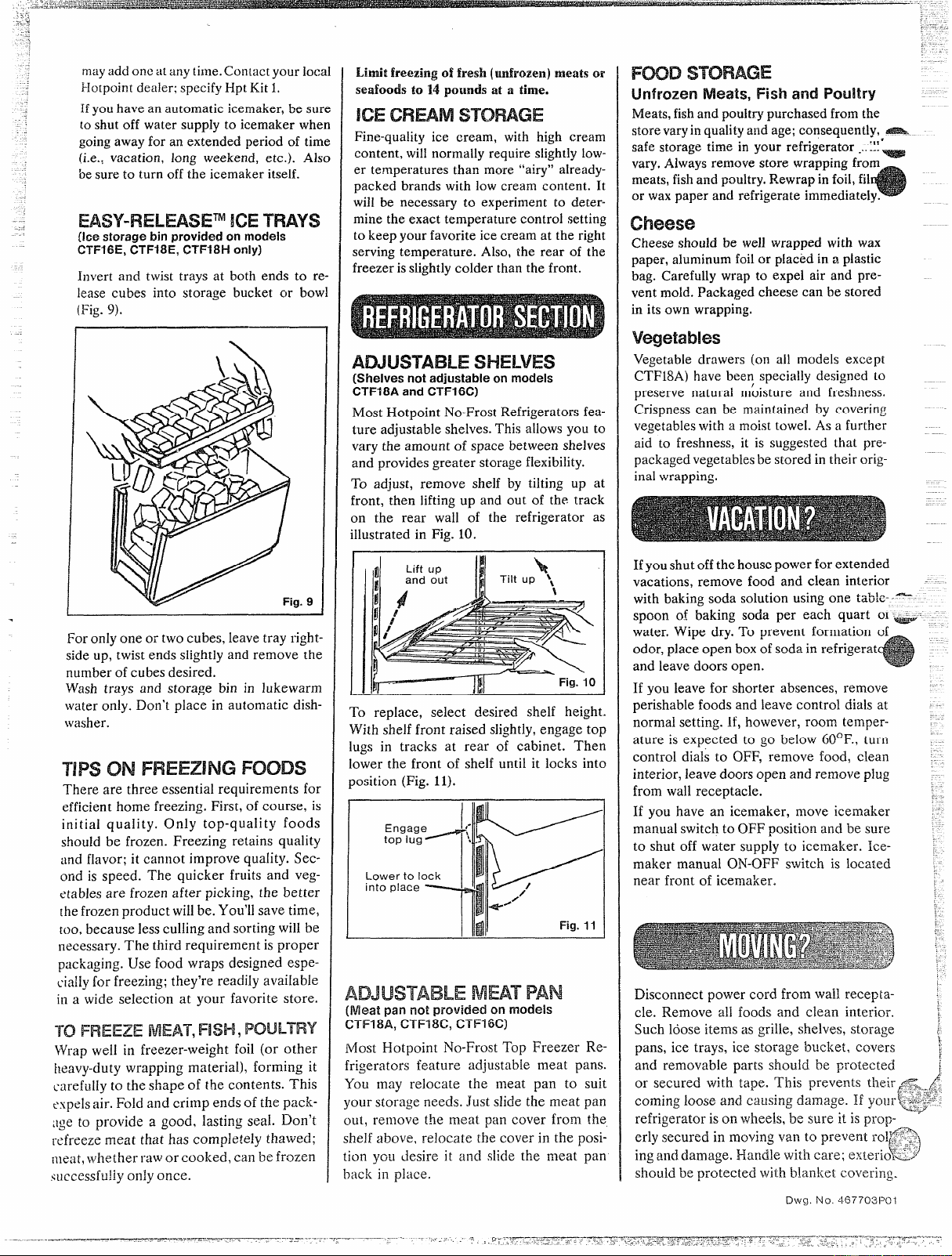
To adjust, remove shelf by tilting up at
front, then lifting up and out of the track
on the rear wall of the refrigerator a
illustrated in Fig. 10.
lHir-
Mr
–—
Fig. iO
.
To replace, select desired shelf height.
With shelf front raised slightly, engage top
lugs in tracks at rear of cabinet. Then
lower the front of shelf until it locks into
position (Fig. 11).
Lower to lock
into place
m
*’
I Ilgijl
Fig. 11
ADJUSTABLEMEATPAN
(Meat pan not provided on models
CTFI 8A, CTF18C, CTF16C)
Most Hotpoint No-Frost Top Freezer Ile-
frigerators feature adjustable meat pans.
You may relocate the meat pan to suit
your storage needs. Just siide the meat pan
out, remove the meat pan cover from the
shelf above, relocate the cover in the posi-
tion you desire it and slide the meat pan
back in place.
Fmn STORAGE
LJnfrcxzenMeats, Fisharid Poultry
Meats, fish and poultry purchased from the
store varyin quality and age; consequently, _
safe storage time in your refrigerator ...1!!‘q
vary, Always remove store wrapphig from
meats, fish and poultry. Rewrap in foil, fil
or wax paper and refrigerate immediately.
cheese
Cheese should be well wrapped with wax
paper, aluminum foil or placed in a plastic
bag. Carefully wrap to expel air and pre-
vent mold. Packaged cheese can be stored
in its own wrapping.
WxJemks
Vegetable drawers (on all models except
CTF18A) have bee? specially designed to
preserve natural moisture and freshness.
Crispness can be maintained by covering
vegetables with a moist towel. As a further
aid to freshness, it is suggested that pre-
packaged vegetables be stored in their orig-
inal wrapping.
If you shutoff the house power for extended
vacations, remove food and clean interior
with baking soda solution using one table- —
spoon of baking soda per each quart
01-- -
water, Wipe dry. To prevent formation of
odor, place open box of soda in refrigerant
and leave doors open.
If you leave for shorter absences, remove
perishable foods and leave control dials at
normal setting. If, however, room temper-
ature is expected to go below 60°F., turn
control dials to OFF, remove food, clean
interior, leave doors open and remove plug
from wall receptacle.
If you have an icemaker, move icernaker
manual switch to OFF position and be sure
to shut off water supply to icemaker. Ice-
maker manual ON-OFF switch is located
near front of icernaker.
Disconnect power cord from wall recepta-
cle. Remove all foods and clean interior.
Such loose items as grille, shelves. storage
pans, ice trays, ice storage bucket, covers
and removable parts should be protected
i
~
or secured with tape. This prevents their ~vgi.ki;
T.’-”
co~mingloose and causing damage. If ycmr~.~$~:+
refrigerator is on whee!s, be sure it is prop- ““
erly secured in moving van to prevent rolt~~>.
g)
._:,$.-.)
ing and damage. Handle wilh care; exkrioiz’}
should be protected with blank~t covering.
Dwg. NG.4677031%11
-.-
CLEAN!NG
Inside – Clean both refrigerator and freez-
er sections at least once a year. It is rec-
ommended that the refrigerator be un-
plugged before cleaning. If this is not prac-
tical, wring excess moisture out of sponge
or cloth when cleaning in the. vicinity of
switches, lights or controls.
Use warm water and baking soda solution
—about a tablespoon of baking soda to a
quart of water, Rinse thoroughlywith water
and wipe dry. Follow this same procedure
for cleaning door gaskets, vegetable and
meat pans and all plastic parts, Wash ice
trays and ice storage bucket in lukewarm
water only.
Do not wash any plastic parts from your
refrigerator in your automatic dishwasher.
Outside–The steel exterior is coated with
a high quality baked-on finish, However,
without proper care, degradation of this
finish can occur and permit rust spots to
form on the outside of the cabinet.
It is recommended that ~ coat of wax or
liquid polish be applied when the refrig-
erator is new and repeated several times
each year. The wax or polish, which should
be suitable for use on appliances, will close
the microscopic pores in the paint and
seal out contaminants which can cause
rust.
Between waxings, clean the exterior finish
with a clean, soft cloth dampened with a
mild household detergent. Rinse with a
clean, lightly dampened cloth and dry thor-
oughly.
Behind
Refrigerator– When moving re-
frigerator away from the wall always pull
cabinet straight out and return to position
by pushing straight in. Moving your refrig-
erator in a side direction may result in
damage to your floor covering or refriger-
ator.
Defrost Water Em- Pan located behind
grille should be cleaned at least once a year.
@Before leaving the house or retiring for
the night, check
to be sure doors haven’t
been left ajar inadvertently.
s Don’t locate your refrigerator adjacent
[oyour range, o heating vent or where swn-
shine will strike it if any other kitchen ar-
rangement is possible.
fooci, be sure to reset the dial to its prt
vious setting within a day,
b
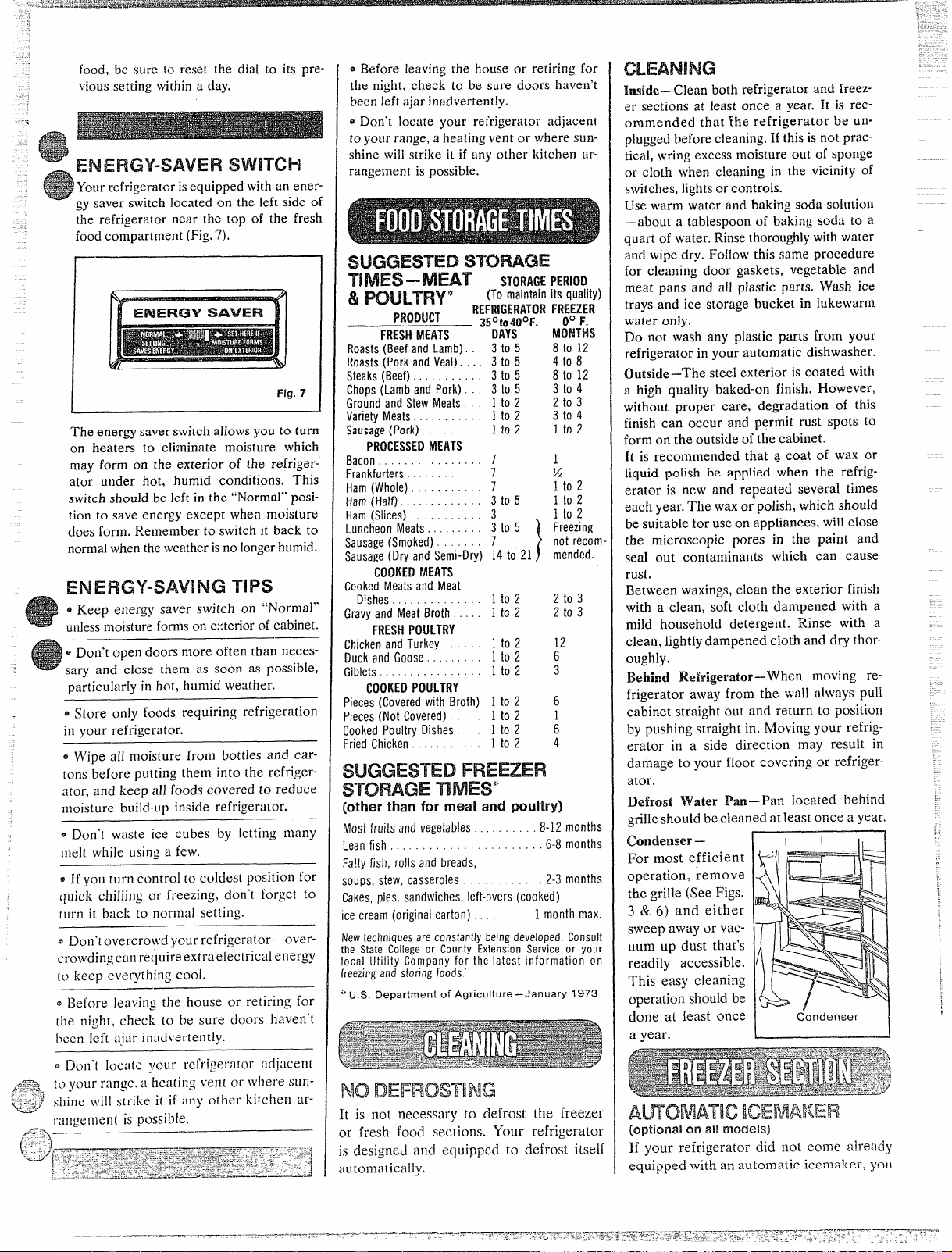
.ENERGY-SAVERSW!TCH
a
P
: Your refrigerator is equipped with an ene~
gy saver switch located on the left side o
the refrigerator near the top of the fresl
food compartment (Fig,7).
SUGGESTEDSTORAGE
~~~~~‘~~~~
STORAGEPERIOD
& POULTRY”
(To
maintain its quality)
PRODUCT
HRIGERIUORFR:&ZJER
35;;y#%
MONTkk
ER,!ERG%” SAW3F3
R
—
FRESHMEf413
ftoasts(Beef and Lamb). . 3 to 5
8 to 12
Roasts (Pork and Veal). . . . 3 to 5 4t08
Steaks (Beef) . .. . . . . . . . . 3t05
8 to 12
Chops (Lamb and Pork). . . 3 to 5
3t04
Ground and Stew Meats. 1 to 2
2t03
Variety Meats.. . . . . . . . . . lto2 3t04
Sausage (Pork) . . . . . . . . . lto2
lto2
PROCESSEDMEATS
Bacon . . . . . . . . . . . . . . . . 7
1
Frankfurters . . . . . . . . . . . 7
%
Ham (Whole) . . . . . . . . . . . 7
lto2
Ham (Half) . . . . . . . . . . . . . 3t05
lto2
Ham (Slices) . . . . . . . . . . . 3
lto2
Luncheon Meats . . . . . . . . . 3f05
)
Freezing
Sausage (Smoked). . . . . . . 7
not recom-
Sausage (Dry and Semi-Dry) 14 to’21
mended.
COOKEDMEATS
Cooked MeatsandMeat
Dishes. . . . . . . . . . . . . . lt02 2t03
GravyandMeatBroth. . . . . 1to 2
2t03
FRESHPOULTRY
Chicken and Turkey. . . . . . 1 to 2 12
Duck and Goose . . . . . . . . . lto2 6
Giblets . . . . . . . . . . . . . . . . lto2 3
COOKEDPOULTRY
Pieces (Covered with Broth) 1 to 2 6
Pieces (Not Covered). . . . . 1 to 2 1
Cooked Poultry Dishes. . . . 1 to 2 6
Fried Chicken . . . . . . . . . . . lto2 4
SUGGESTED FREEZER
STORAGE TIMES”
(other than for meat and poultry)
Most fruits and vegetables . . . . . . . ...8-12 months
Lean fish . . . . . . . . . . . . . . . . . . . . ...6-8 months
Fatty fish, rolls and breads,
souPs, stew, casseroles. . . . . . . .2-3 months
Cakes, pies, sandwiches, Ieft-overs (cooked)
ice cream (original carton). . . . . . ...1 month max.
New Iectirriquesare constantly being developed. Consult
he State College or County Extension
Service or your
ocal Utility Company
for the latest information on
reezing and storing foods.
‘ u.S. Department of Agriculture–January
1973
I
Fig. 7
The energy saver switch allows you to turn
on heaters to eliminate moisture which
may form on the exterior of the refriger-’
ator under hot, humid conditions, This
switch should be left in the “Normal” posi-
tion to save energy except when moisture
does form. Remember to switch it back to
normal when the weather is no longerhumid.
ENERGY-SAVINGTIPS
~ Keep energy saver switch on “Normal”
unless moisture forms on exterior of cabinet.
4
—
e Don’t open doors more often than neces-
sary and close them as soon as possible,
particukirly in hot, humid weather.
~ Store only foods requiring refrigeration
in your refrigerator.
o Wipe zdl moisture from bottles and car-
tons before putting them into the refriger-
ator, and keep all foods covered to reduce
moisture build-up inside refrigerator.
~ Don.t waste ice cubes by letting many
melt while using a few.
6 lf you [urn control to coldest position for
quick chilling or freezing, don.t forget to
turn it back to normal setting.
~ Don’t overcrowd your refrigerator-over-
Condenser –
For most efficient
operation, remove
the grille (See Figs.
3 & 6) and either
sweep away or vac-
uum up dust that’s
readily accessible.
This easy cleaning
operation should be
done at least once
a year.
crowding can require extra electric~li energy
[c)
keep every ttling COO[.
*
Before leaving the house or retiring for
[he night, check to be sure doors haven’t
been left :ljar ina(i~’ertently.
~ Don’t locate your refrigerator acljacent
~oyour range. a heating vent or where
sLln -
shine will strike it
if any other kitchen :~r-
1
Condenser
I
$!0DEFROSTING
: is not necessary to defrost the freezer
r fresh food sections. Your refrigerator
, designed and equipped to defrost itself
utomatically.
(optional on all models)
If your refrigerator did not come already
equipped with an automatic icemaker, you
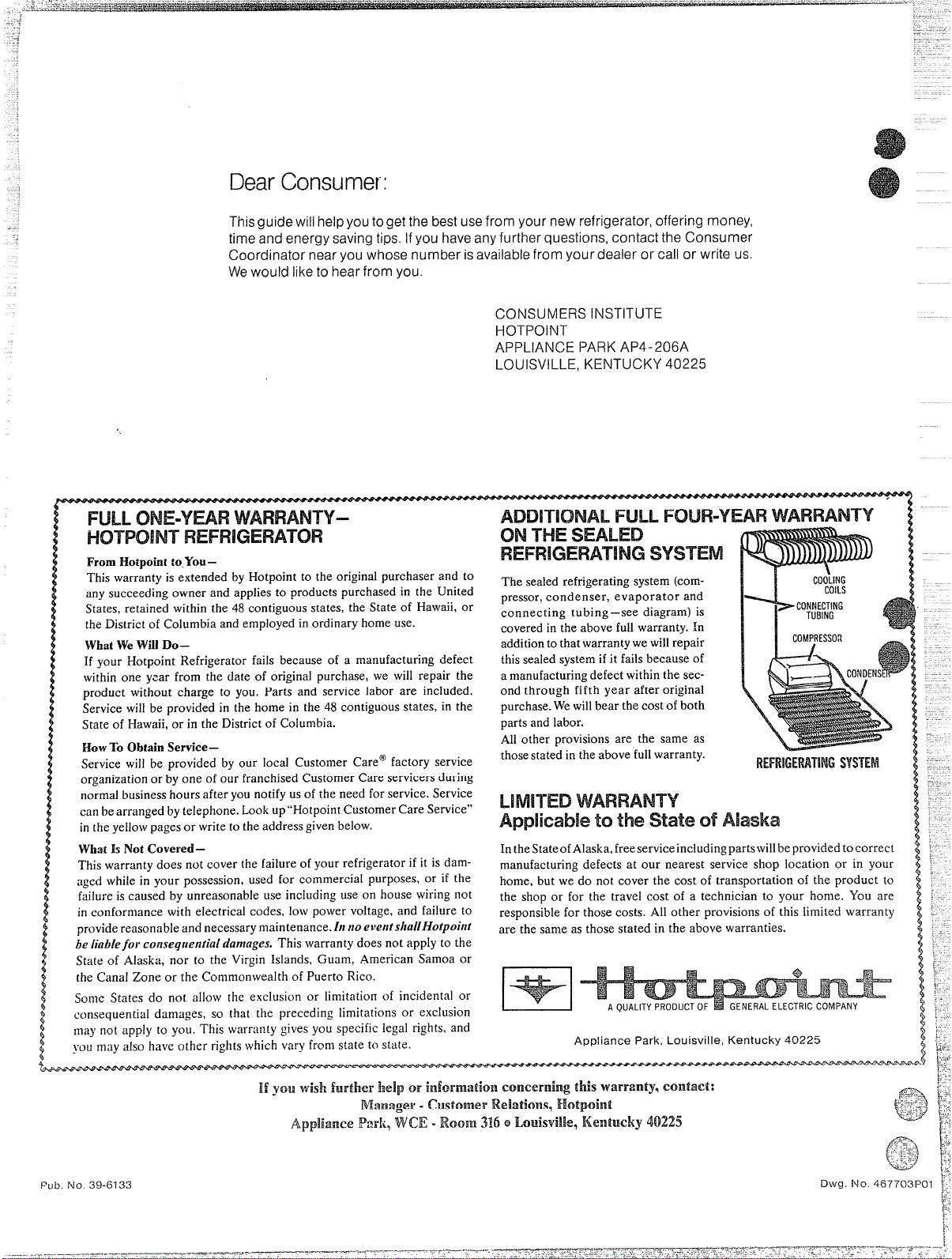
DearConsumer:
This guide will helpyoutoget the bestusefrom your new refrigerator, offering money,
time andenergy savingtips,Ifyou haveanyfurther questions, contact the Consumer
Coordinator nearyou whose number isavailablefrom your dealer or call or write us.
We would liketo hearfrom you.
CONSUtvlERS INSTITUTE
HOTPOINT
APPLIANCE PARK AP4-206A
LOUISVILLE, KENTUCKY 40225
FULLONE”YMRwARRANTY-
HOTPO!NTREFRIGERATOR
FromHotpointto.?iou–
Thiswarranty is extended byHotpointto the originalpurchaser and to
anysucceedingowner and appliesto productspurchasedin the United
States, retained withinthe 48contiguousstates, the State of Hawaii,or
the District of Columbiaandemployedinordinaryhomeuse.
WhatWeWMDo–
If your Hotpoint Refrigerator fails because of a manufacturingdefect
withinone year from the date of original purchase, we will repair the
product without charge to you. Parts and service labor are included,
Servicewillbe provided in the home in the 48contiguousstates, in the
State of Hawaii,or in the Districtof Columbia.
HOWTo ObtainService–
Service will be provided byour local Customer Care@factory service
organizationor byone ofour franchisedCustomerCare servicersduring
normalbusinesshoursafter younotifyusof the need forservice. Service
canbearrangedbytelephone.
Look up “Hotpoint Customer Care Service”
in the yellow pages or write to the address given below.
Whath NotCovered–
This warranty does not cover (he failure of your refrigerator if it is dam-
aged while in your possession, used for commercial purposes, Or if the
failure is caused by unreasonable use including use on house wiring not
in conformance with electrical codes, low power voltage, and failure to
provide reasonable and necessary maintenance.
Innoeve/~tsJlaIIHo?poilzt
be liablefor conseqnen$ialdamages.
This warranty does not apply to the
State of Alaska, nor to the Virgin Islands, Guam, American Samoa or
the Canal Zone or the Commonwealth of Puerto Rico.
Some States do not allow the exclusion or limitation of incidental or
consequential damages,
so that the preceding limitations or exclusion
may not apply to you. This warranty gives you specific legal rights, and
you may also have other rights which vary from state to state.
ADDITIONALFULLFOUR-YEARWARRANTY
cmTHESEALED
REFRIGERATINGSYSTEM
The sealed refrigerating system (com-
4
II
COti’LiNG
presser, condenser, evaporator and
COILS
connecting tubing—see diagram) is
CO$!&T:NG
covered in the above full warranty. In
addition to that warranty we will repair
COMPj7ESSOR
LIMITEDWARRANTY
Applicable
tothe state‘d’ Alaska
Inthe State of Alaska, free service including partswill be provided to correct
manufacturing defects at our nearest service shop location or in your
home, but we do not cover the cost of transportation of the product to
the shop or for the travel cost of a technician to your home. You are
responsible for those costs. All other provisions of this limited warranty
are the same as those stated in the above warranties.
B
Appliance Park, Louisville, Kentucky 40225
!3Wg. NO. 467703P01 }
‘
$:.-
z

