
2004 Sony Corporation
KDF-42WE655
KDF-50WE655
KDF-55WF655
KDF-60WF655
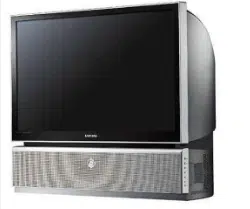
LCD Projection TV
HD-TV
Operating Instructions
2-059-370-14(2)
LCD Projection TV KDF-42WE655/KDF-50WE655/KDF-55WF65
5/KDF-60WF655
KDF-42&50WE655/KDF-55&60WF655
2-059-370-14(2)
Printed in U.S.A.
002059370131COVER.fm Page 1 Thursday, February 17, 2005 7:19 PM
KDF-WE/WF655
2-059-370-14 (2)
2
Owner’s Record
The model and serial numbers are located at the rear of
the LCD projection TV, below the Sony logo, on the
sticker, and also on the TV box (white label). Record
these numbers in the spaces provided below. Refer to
them whenever you call upon your Sony dealer regarding
this product.
Model No.
Serial No.
Contacting Sony
If, after reading the following instructions, you have
additional questions related to the use of your Sony TV,
Please call one of the following numbers.
Customers in the continental United States contact the
Direct Response Center at:
1-800-222-SONY (7669)
Customers in Canada contact the Customer Relations
Center at:
1-877-899-SONY (7669)
01COV.book Page 2 Thursday, February 17, 2005 8:01 PM
3
KDF-WE/WF655
2-059-370-14 (2)
WARNING
To reduce the risk of fire or electric
shock, do not expose this apparatus to
rain or moisture.
This symbol is intended to alert the user to the
presence of uninsulated “dangerous voltage”
within the product’s enclosure that may be of
sufficient magnitude to constitute a risk of
electric shock to persons.
This symbol is intended to alert the user to the
presence of important operating and
maintenance (servicing) instructions in the
literature accompanying the appliance.
CAUTION
To prevent electric shock, do not use this polarized AC
plug with an extension cord, receptacle or other outlet
unless the blades can be fully inserted to prevent blade
exposure.
CAUTION
When using TV games, computers, and similar products
with your projection TV, keep the brightness and contrast
functions at low settings. If a fixed (non-moving) pattern
is left on the screen for long periods of time at a high
brightness or contrast setting, the image can be
permanently imprinted onto the screen. Continuously
watching the same program can cause the imprint of
station logos onto the TV screen. These types of imprints
are not covered by your warranty because they are the
result of misuse.
Note on Caption Vision
This television receiver provides display of television
closed captioning in accordance with §15.119 of the FCC
rules.
Note to CATV system installer
This reminder is provided to call the CATV system
installer’s attention to Article 820-40 of the NEC that
provides guidelines for proper grounding and, in
particular, specifies that the cable ground shall be
connected to the grounding system of the building, as
close to the point of cable entry as practical.
Use of this television receiver for other than private
viewing of programs broadcast on UHF, VHF,
transmitted by cable companies or satellite for the
use of the general public may require authorization
from the broadcaster/cable company and/or
program owner.
NOTIFICATION
This equipment has been tested and found to comply with
the limits for a Class B digital device pursuant to Part 15
of the FCC Rules. These limits are designed to provide
reasonable protection against harmful interference in a
residential installation. This equipment generates, uses,
and can radiate radio frequency energy and, if not
installed and used in accordance with the instructions,
may cause harmful interference with radio
communications. However, there is no guarantee that
interference will not occur in a particular installation. If
this equipment does cause harmful interference to radio
or television reception, which can be determined by
turning the equipment off and on, the user is encouraged
to try to correct the interference by one or more of the
following measures:
❑ Reorient or relocate the receiving antennas.
❑ Increase the separation between the equipment and
receiver.
❑ Connect the equipment into an outlet on a circuit
different from that to which the receiver is
connected.
❑ Consult the dealer or an experienced radio/TV
technician for help.
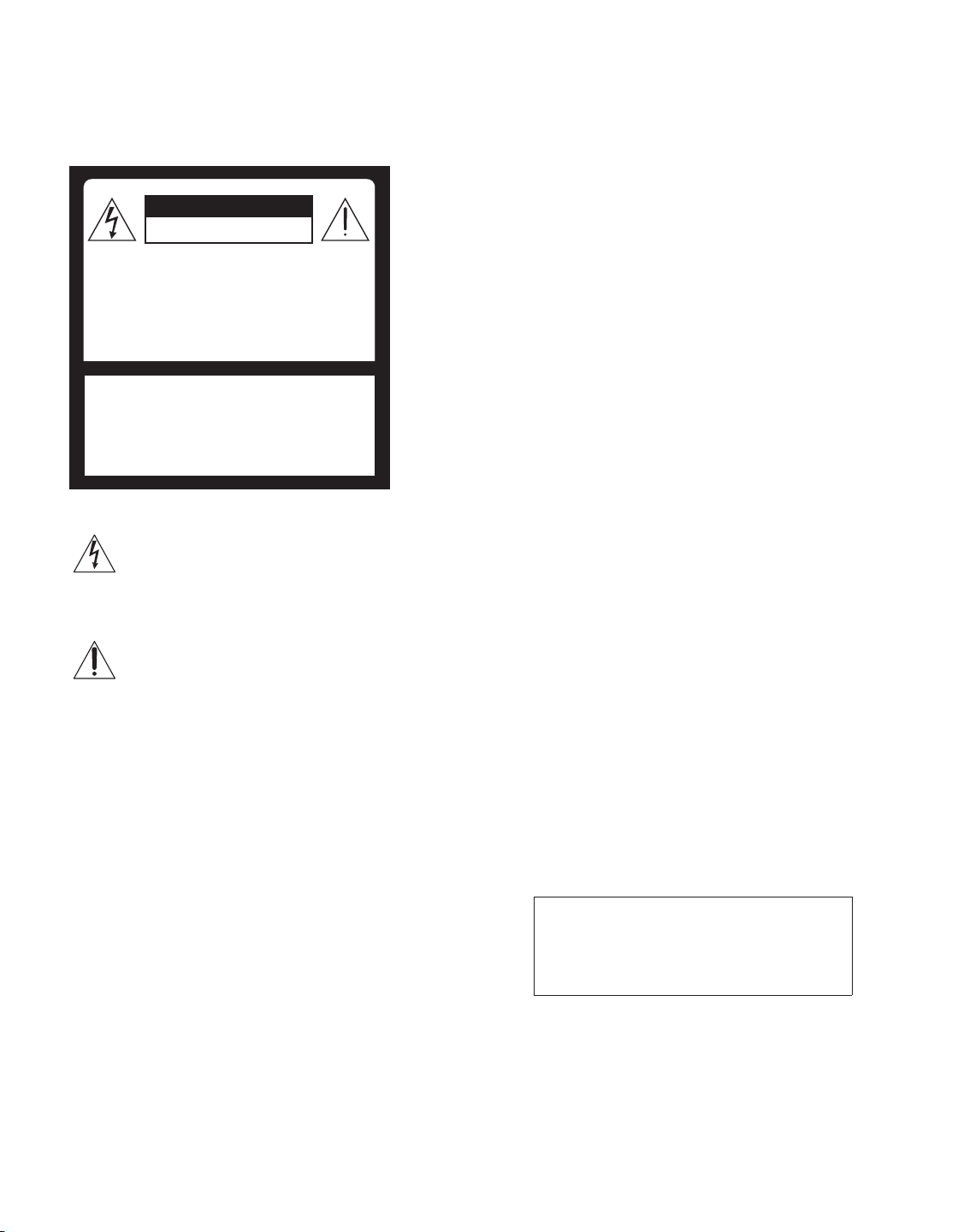
CAUTION
RISK OF ELECTRIC SHOCK
DO NOT OPEN
ATTENTION
RISQUE DE CHOC ELECTRIQUE,
NE PAS OUVRIR
PRECAUCION
RIESGO DE CHOQUE ELECTRICO
CAUTION : TO REDUCE THE RISK OF ELECTRIC SHOCK,
DO NOT REMOVE COVER
(
OR BACK
)
.
NO USER-SERVICEABLE PARTS INSIDE.
REFER SERVICING TO QUALIFIED SERVICE PERSONNEL.
NO ABRIR
You are cautioned that any changes or
modifications not expressly approved in
this manual could void your warranty and
your authority to operate this equipment.
020reg.fm Page 3 Thursday, February 24, 2005 2:59 PM
KDF-WE/WF655
2-059-370-14 (2)
4
Safety
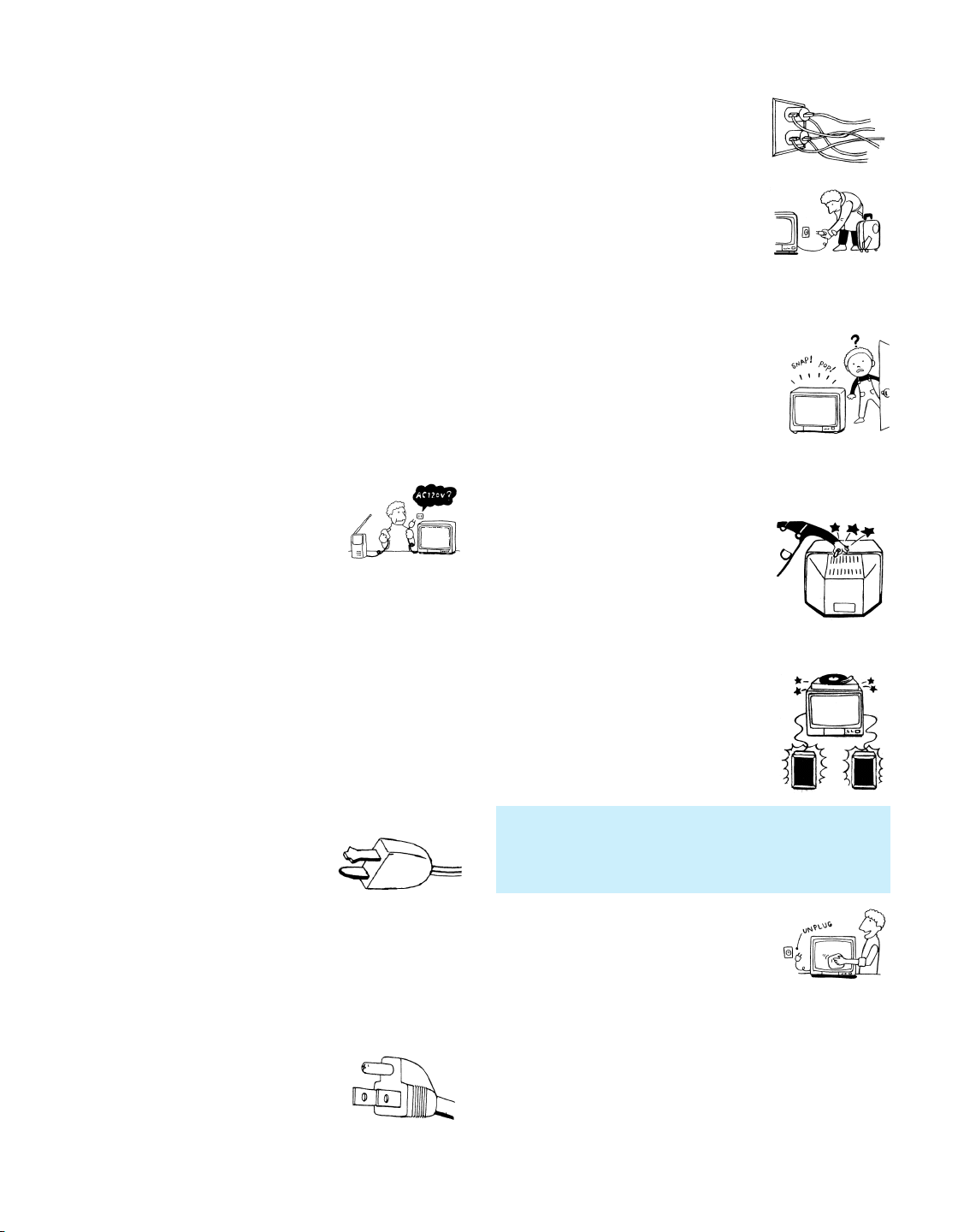
❑ Operate the LCD projection TV only on 120 V AC.
❑ The plug is designed, for safety purposes, to fit into
the wall outlet only one way. If you are unable to
insert the plug fully into the outlet, contact your
dealer.
❑ If any liquid or solid object should fall inside the
cabinet, unplug the LCD projection TV immediately
and have it checked by qualified service personnel
before operating it further.
❑ If you will not be using the LCD projection TV for
several days, disconnect the power by pulling the
plug itself. Never pull on the cord.
❑ For details concerning safety precautions, see
“Important Safeguards” on page 5.
Installing
❑ To prevent internal heat buildup, do not block the
ventilation openings.
❑ Do not install the LCD projection TV in a hot or
humid place, or in a place subject to excessive dust
or mechanical vibration.
❑ Avoid operating the LCD projection TV at
temperature below 41°F (5°C).
❑ If the LCD projection TV is transported directly
from a cold to a warm location, or if the room
temperature changes suddenly, the picture may be
blurred or show poor color. In this case, please wait
a few hours to let the moisture evaporate before
turning on the LCD projection TV.
❑ To obtain the best picture, do not expose the screen
to direct illumination or direct sunlight. It is
recommended to use spot lighting directed down
from the ceiling or to cover the windows that face
the screen with opaque drapery. It is desirable to
install the LCD projection TV in a room where the
floor and walls are not of a reflective material.
Note
This digital television is capable of receiving analog
basic, digital basic and digital premium cable television
programming by direct connection to a cable system
providing such programming. A security card provided
by your cable operator is required to view encrypted
digital programming. Certain advanced and interactive
digital cable services such as video-on-demand, a cable
operator’s enhanced program guide and data-enhanced
television services may require the use of a set-top box.
For more information call your local cable operator.
This television also includes a QAM demodulator which
should allow you to receive unscrambled digital cable
television programming via subscription service to a
cable service provider. Availability of digital cable
television programming in your area depends on the type
of programming and signal provided by your cable
service provider.
Trademark Information
CableCARD
™
is a trademark of Cable Television
Laboratories, Inc.
TruSurround, SRS and the ( )
®
symbol are trademarks
of SRS Labs, Inc. TruSurround technology is
incorporated under license from SRS Labs, Inc.
BBE and BBE Symbol are trademarks of BBE Sound,
Inc. and are licensed by BBE Sound, Inc. under U.S.
Patent No. 4,638,258 and 4,482,866.
Manufactured under license from
Dolby Laboratories. Dolby and the
double-D symbol are trademarks of
Dolby Laboratories.
This TV incorporates High-
Definition Multimedia Interface
(HDMI
™
) technology. HDMI, the HDMI logo and High-
Definition Multimedia Interface are trademarks or
registered trademarks of HDMI Licensing LLC.
WEGA, Steady Sound, Digital Reality Creation,
CineMotion, BN Smoother, Memory Stick, Memory
Stick Duo, Memory Stick PRO, Memory Stick PRO Duo,
MagicGate, MID and Twin View are trademarks of Sony
Corporation.
Caution
Use the following Sony appliance(s) only with the
following TV STAND. Use with other TV STAND may
cause instability and result in possible injury.
SONY APPLIANCE MODEL NO.:
KDF-42WE655
KDF-50WE655
KDF-55WF655
KDF-60WF655
SONY TV STAND MODEL NO.:
SU-GW11 (for KDF-42WE655/KDF-50WE655)
SU-GW12 (for KDF-55WF655/KDF-60WF655)
SU-GW1 (for KDF-50WE655)
01COV.book Page 4 Thursday, February 17, 2005 8:01 PM
5
KDF-WE/WF655
2-059-370-14 (2)
Important
Safeguards
Before using your LCD projection TV, please read these
instructions completely, and keep this manual for future
reference.
Carefully observe and comply with all warnings, cautions
and instructions placed on the set or described in the
operating instructions or service manual.
WARNING
To guard against injury, the following basic safety
precautions should be observed in the installation, use
and servicing of the set.
Use
Power Sources
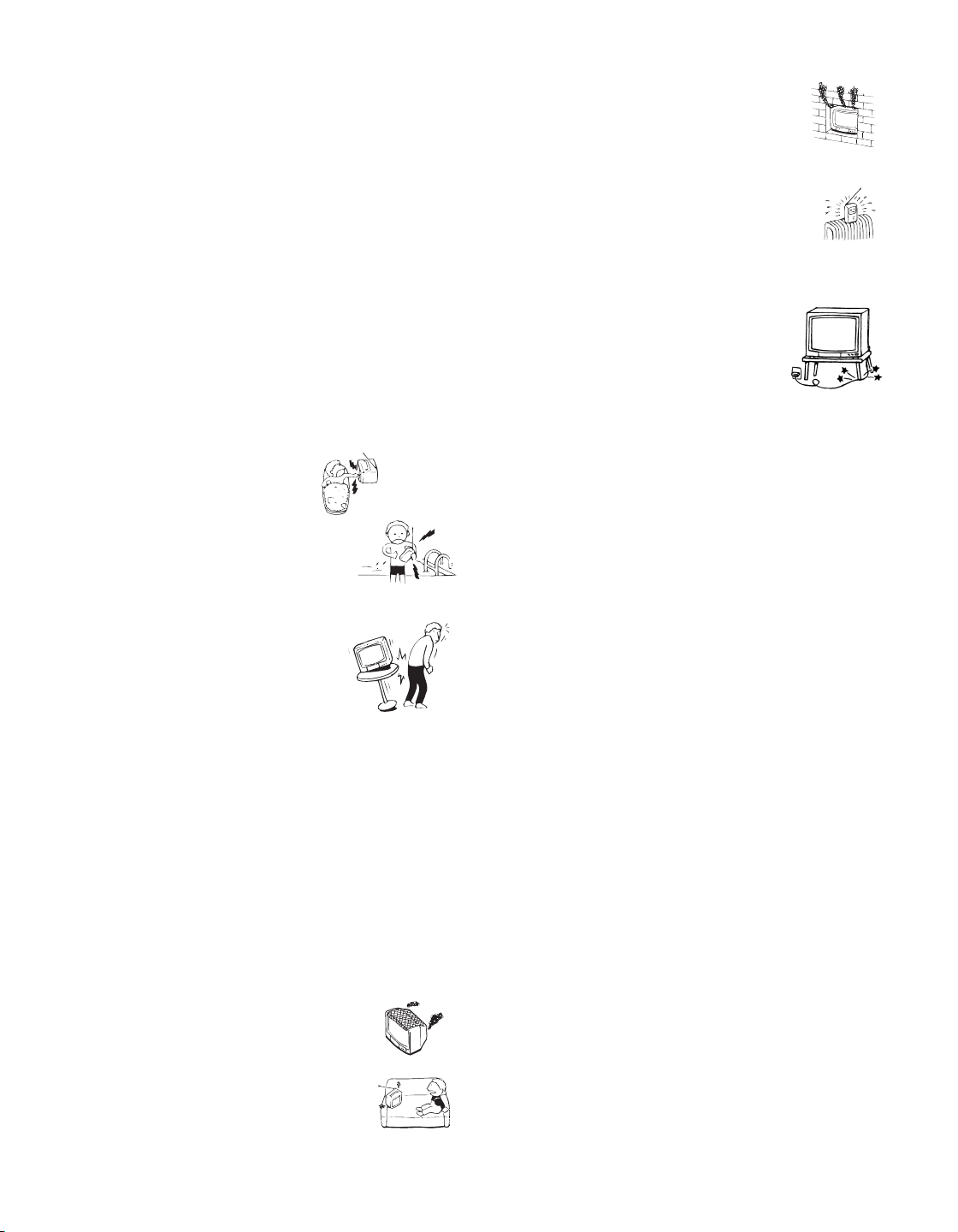
This set should be operated only from
the type of power source indicated on
the serial/model plate.
If you are not sure of the type of
electrical power supplied to your home,
consult your dealer or local power company. For those
sets designed to operate from battery power, refer to the
operating instructions.
Grounding or Polarization
This set is equipped with a polarized AC power cord plug
(a plug having one blade wider than the other), or with a
three-wire grounding type plug (a plug having a third pin
for grounding). Follow the instructions below:
For the set with a polarized AC power cord
plug
This plug will fit into the power outlet
only one way. This is a safety feature.
If you are unable to insert the plug
fully into the outlet, try reversing the
plug.
If the plug still fails to fit, contact your electrician to have
a suitable outlet installed. Do not defeat the safety
purpose of the polarized plug by forcing it in.
For the set with a three-wire grounding type
AC plug
This plug will only fit into a grounding-
type power outlet. This is a safety
feature. If you are unable to insert the
plug into the outlet, contact your
electrician to have a suitable outlet
installed. Do not defeat the safety purpose of the
grounding plug.
Overloading
Do not overload wall outlets, extension
cords or convenience receptacles
beyond their capacity, since this can
result in fire or electric shock.
Always turn the set off when it is not
being used. When the set is left
unattended and unused for long
periods of time, unplug it from the
wall outlet as a precaution against the
possibility of an internal malfunction that could create a
fire hazard.
If a snapping or popping sound from a TV
set is continuous or frequent while the TV
is operating, unplug the TV and consult
your dealer or service technician. It is
normal for some TV sets to make
occasional snapping or popping sounds,
particularly when being turned on or off.
Object and Liquid Entry
Never push objects of any kind into the
set through the cabinet slots as they may
touch dangerous voltage points or short
out parts that could result in a fire or
electric shock. Never spill liquid of any
kind on the set.
Attachments
Do not use attachments not
recommended by the manufacturer, as
they may cause hazards.
Cleaning
❑ Clean the cabinet of the LCD
projection TV with a dry soft cloth.
To remove dust from the screen,
wipe it gently with a soft cloth.
Stubborn stains may be removed
with a cloth slightly dampened with solution of mild
soap and warm water. Never use strong solvents
such as thinner or benzine for cleaning. If the picture
becomes dark after using the LCD projection TV for
a long period of time, it may be necessary to clean
the inside of the LCD projection TV. Consult
qualified service personnel.
❑ Unplug the AC power cord when cleaning this unit.
If not, it may result in electric shock.
❑ Clean the rear cover area of the LCD projection TV
regularly. Dust in the rear cover area may cause a
problem with the cooling system of the LCD
projection TV set.
01COV.book Page 5 Thursday, February 17, 2005 8:01 PM
KDF-WE/WF655
2-059-370-14 (2)
6
On contamination on the screen surface
The screen surface has a special coating to reduce
reflections. To prevent screen damage, clean the screen as
follows:
❑ Clean the screen with a soft cloth.
❑ To remove hard contamination, use the cloth
moistened with a solution of mild detergent and
water. Do not spray cleaning solution directly to the
TV. It should only be first sprayed to moisten the
cleaning cloth.
❑ Do not use any type of abrasive pad, alkaline
cleaner, acid cleaner, scouring powder, chemical
cloth, or solvent such as alcohol, benzene or thinner,
as these may scratch the screen's coating.
Installation
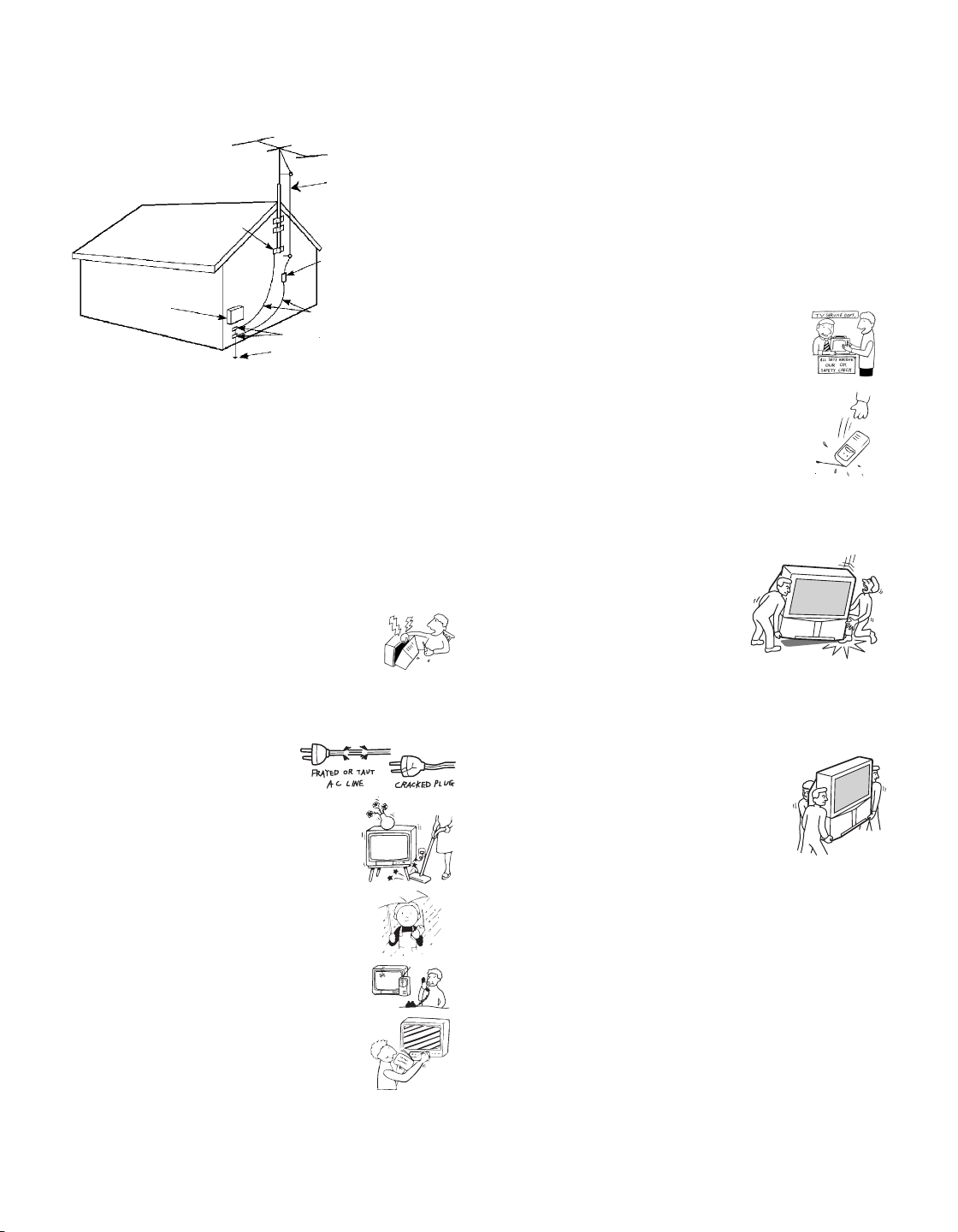
Water and Moisture
Do not use power-line operated sets
near water — for example, near a
bathtub, washbowl, kitchen sink, or
laundry tub, in a wet basement, or
near a swimming pool, etc.
Accessories
Do not place the set on an unstable
cart, stand, table or shelf. The set may
fall, causing serious injury to a child or
an adult and serious damage to the set.
Use only a cart or stand recommended
by the manufacturer for the specific
model of LCD projection TV. An appliance and cart
combination should be moved with care. Quick stops,
excessive force, and uneven surfaces may cause the
appliance and cart combination to overturn.
Ventilation
The slots and openings in the cabinet and in the back or
bottom are provided for necessary ventilation. To ensure
reliable operation of the set, and to protect it from
overheating, these slots and openings must never be
blocked or covered.
❑ Never cover the slots and openings
with a cloth or other materials.
❑ Never block the slots and openings
by placing the set on a bed, sofa, rug
or other similar surface.
❑ Never place the set in a confined
space, such as a bookcase or built-in
cabinet, unless proper ventilation is
provided.
❑ Do not place the set near or over a
radiator or heat register, or where it is
exposed to direct sunlight.
Power-Cord Protection
Do not allow anything to rest on or roll
over the power cord, and do not place the
set where the power cord is subject to
wear or abuse.
Antennas
Outdoor Antenna Grounding
If an outdoor antenna is installed, follow the precautions
below. An outdoor antenna system should not be located
in the vicinity of overhead power lines or other electric
light or power circuits, or where it can come in contact
with such power lines or circuits.
WHEN INSTALLING AN OUTDOOR ANTENNA
SYSTEM, EXTREME CARE SHOULD BE TAKEN TO
KEEP FROM CONTACTING SUCH POWER LINES
OR CIRCUITS AS CONTACT WITH THEM IS
ALMOST INVARIABLY FATAL.
Be sure the antenna system is grounded so as to provide
some protection against voltage surges and built-up static
charges.
Section 810 of the National Electrical Code (NEC) in
USA and Section 54 of the Canadian Electrical Code in
Canada provides information with respect to proper
grounding of the mast and supporting structure,
grounding of the lead-in wire to an antenna discharge
unit, size of grounding conductors, location of antenna
discharge unit, connection to grounding electrodes, and
requirements for the grounding electrode.
01COV.book Page 6 Thursday, February 17, 2005 8:01 PM
7
KDF-WE/WF655
2-059-370-14 (2)
Antenna Grounding According to the NEC
Refer to section 54-300 of Canadian Electrical Code for
Antenna Grounding.
Lightning
For added protection for this television receiver during a
lightning storm, or when it is left unattended and unused
for long periods of time, unplug it from the wall outlet
and disconnect the antenna. This will prevent damage to
the receiver due to lightning and power-line surges.
Service
Damage Requiring Service
Do not attempt to service the set by yourself
since opening the cabinet may expose you to
dangerous voltage or other hazards.
Unplug the set from the wall outlet and refer
servicing to qualified service personnel under the
following conditions:
❑ When the power cord or
plug is damaged or frayed.
❑ If liquid has been spilled into
the set.
❑ If the set has been exposed
to rain or water.
❑ If the set has been subject to
excessive shock by being
dropped, or the cabinet has
been damaged.
❑ If the set does not operate
normally when following the
operating instructions.
Adjust only those controls
that are specified in the
operating instructions.
Improper adjustment of
other controls may result in damage and will often
require extensive work by a qualified technician to
restore the set to normal operation.
❑ When the set exhibits a distinct change in
performance, it indicates a need for service.
Replacement Parts
When replacement parts are required, be sure the service
technician certifies in writing that he has used
replacement parts specified by the manufacturer that have
the same characteristics as the original parts.
Unauthorized substitutions may result in fire, electric
shock or other hazards.
Safety Check
Upon completion of any service or repairs
to the set, ask the service technician to
perform routine safety checks (as specified
by the manufacturer) to determine that the
set is in safe operating condition, and to so
certify. When the set reaches the end of its
useful life, ask a qualified service
technician to dispose of the set.
For Safety
Be careful when moving
the LCD projection TV
When you place the LCD projection
TV in position, be careful not to
drop it on your foot or fingers.
Watch your footing while installing the LCD projection
TV.
Carry the LCD projection TV in
the specified manner
If you carry the LCD projection TV in a
manner other than the specified manner
and without the specified number of
persons, it may drop and a serious injury
may be caused. Be sure to follow the instructions
mentioned below.
❑ Carry the LCD projection TV with the specified
number of persons (see page 28).
❑ Do not carry the LCD projection TV holding the
speaker grill.
❑ Hold the LCD projection TV tightly when carrying
it.
❑ Before carrying the LCD projection TV, disconnect
any accessories or cables.
Antenna lead-in wire
Ground clamps
Antenna lead-in wire
(NEC Section 810-20)
Grounding conductors
(NEC section 810-21)
Power service grounding
electrode system (NEC Art
250 Part H)
Ground clamp
Electrical
service
equipment
NEC: National
Electrical Code
01COV.book Page 7 Thursday, February 17, 2005 8:01 PM

KDF-WE/WF655
2-059-370-14 (2)
8
About the LCD projection TV
Although the LCD projection TV is made with high-
precision technology, black dots may appear or bright
points of light (red, blue, or green) may appear constantly
on the LCD screen. This is a structural property of the
LCD panel and is not a defect.
Installation
❑ If direct sunlight or other strong illumination shines
on the screen, part of the screen may appear white
due to reflections from behind the screen. This is a
structural property of the LCD projection TV.
Do not expose the screen to direct illumination or
direct sunlight.
❑ The picture quality may be affected by your viewing
position. Sit at least approx. 5.9 or 6.6 ft. (1.8 or 2.0
m) for KDF-42WE655 or KDF-50WE655, or
approx. 6.8 or 7 ft. (2.1 or 2.2 m) for KDF-55WF655
or KDF-60WF655 away from your LCD projection
TV, and within 60º of the vertical and 130º of the
horizontal viewing area for KDF-42WE655 or KDF-
50WE655, or within 55º of the vertical and 125º of
the horizontal viewing area for KDF-55WF655 or
KDF-60WF655. If you sit too close to the TV, you
may experience eye strain. For the best picture
quality, install your LCD projection TV according to
“Recommended Viewing Area” on page 30.
❑ When installing your LCD projection TV against a
wall, keep it at least 4 inches (10 cm) from the wall.
❑ Avoid installing the LCD projection TV near a
heater, etc.
Projection lamp
❑ Your LCD projection TV uses a projection lamp as
its light source. It is time to replace the lamp with a
new one (not supplied) when:
• the lamp replacement indicator on the front panel
blinks in red,
• screen images become dark,
• no image appears on the display after prolonged
use.
❑ In rare instances, the bulb may pop inside the lamp
unit, but the lamp unit is designed to contain all of
broken glass pieces inside the lamp unit. (See
“Replacing the Lamp” on page 16.)
Cooling fan
❑ This LCD projection TV uses a cooling fan. You
may hear the noise of fan running, depending on the
placement of your LCD projection TV. The noise
may be more noticeable during the night or when the
background noise level is low.
Important Safety Instructions
1) Read these instructions.
2) Keep these instructions.
3) Heed all warnings.
4) Follow all instructions.
5) Do not use this apparatus near water.
6) Clean only with dry cloth.
7) Do not block any ventilation openings. Install in
accordance with the manufacturer’s instructions.
8) Do not install near any heat sources such as radiators,
heat registers, stoves, or other apparatus (including
amplifiers) that produce heat.
9) Do not defeat the safety purpose of the polarized or
grounding-type plug. A polarized plug has two blades
with one wider than the other. A grounding type plug
has two blades and a third grounding prong. The wide
blade or the third prong are provided for your safety.
If the provided plug does not fit into your outlet,
consult an electrician for replacement of the obsolete
outlet.
10) Protect the power cord from being walked on or
pinched particularly at plugs, convenience
receptacles, and the point where they exit from the
apparatus.
11) Only use attachments/accessories specified by the
manufacturer.
12) Use only with the cart, stand, tripod,
bracket, or table specified by the
manufacturer, or sold with the apparatus.
When a cart is used, use caution when
moving the cart/apparatus combination
to avoid injury from tip-over.
13) Unplug this apparatus during lightning storms or
when unused for long periods of time.
14) Refer all servicing to qualified service personnel.
Servicing is required when the apparatus has been
damaged in any way, such as power-supply cord or
plug is damaged, liquid has been spilled or objects
have fallen into the apparatus, the apparatus has been
exposed to rain or moisture, does not operate
normally, or has been dropped.
15) Apparatus shall not be exposed to dripping or
splashing and no objects filled with liquids, such as
vases, shall be placed on the apparatus.
❑ When the lamp eventually burns out, you may hear
a noticeable pop sound. This is normal and is
inherent in this type of lamp.
01COV.book Page 8 Thursday, February 17, 2005 8:01 PM

9
KDF-WE/WF655
2-059-370-14 (2)
Contents
Introducing the Sony
LCD Projection TV
Presenting the Sony LCD Projection TV...............11
Package Contents ...........................................11
Using This Manual.........................................11
Features ..........................................................12
Enjoying Your LCD Projection TV.......................14
Notes on the LCD Projection TV ..................15
Cleaning the Screen Surface ..........................15
Replacing the Lamp .......................................16
Setting Up the
LCD Projection TV
Overview................................................................23
LCD Projection TV Front Panel and Connectors ..24
Front Panel.....................................................24
Front and Rear Panel Connectors ..................26
Installing the LCD Projection TV..........................28
Carrying Your LCD Projection TV ...............28
Take Precaution during the Installation .........29
To Prevent the LCD Projection TV from
Falling ............................................................29
When Installing Your LCD Projection TV
Against a Wall ...............................................29
Recommended Viewing Area........................30
Basic Connections: Connecting a Cable or
Antenna..........................................................31
Cable or Antenna ...........................................32
Cable and Antenna.........................................33
Cable Box and Antenna .................................34
Cable Box ......................................................35
Connecting Optional Equipment ...........................37
Making Video Connections ...........................38
About Using S VIDEO ..................................38
VCR and Cable ..............................................39
VCR and Cable Box ......................................40
Two VCRs for Tape Editing..........................42
Satellite Receiver ...........................................43
Satellite Receiver with a VCR and Cable......44
DVD Player with Component
Video Connectors ..........................................46
DVD Player with S VIDEO and Audio
Connectors .....................................................47
Camcorder......................................................48
Audio Receiver ..............................................49
Digital Cable Box ..........................................50
Digital Satellite Receiver...............................51
Digital Satellite Receiver with HDMI
Connector.......................................................52
Connecting a Device with an Optical IN
Connector.......................................................54
Using the CONTROL S Feature............................55
Using CableCARD ................................................56
About Using CableCARD .............................56
Activating CableCARD Service ....................56
Removing the CableCARD ...........................57
Setting Up the LCD Projection TV Channel List..58
Using Initial Setup .........................................58
Using the Remote Control
Overview................................................................59
Inserting Batteries into the Remote Control ..........59
Button Descriptions ...............................................60
Programming the Remote Control.........................62
Manufacturer’s Codes............................................63
Using Other Equipment with Your LCD Projection
TV Remote Control .......................................64
Operating a Cable Box...................................64
Operating a Satellite Receiver .......................64
Operating a VCR ...........................................65
Operating a DVD Player or DVD Changer ...65
Operating a 5.1ch DVD AV System
(SONY DAV) ................................................65
Operating a DVD/
VCR or HDD/DVD Combo Unit ..................66
Operating an AV Receiver.............................66
Using the Features
Overview................................................................67
Watching TV .........................................................67
Using the Program Guide ......................................68
Displaying the Program Guide ......................68
Using the Program Guide ..............................69
Using the Program Options Menu .................69
Using Wide Screen Mode ......................................70
Changing the Wide Screen Mode for 4:3 Source
(Standard definition source) ..........................70
Changing the Wide Screen Mode for 16:9
Source (High definition source).....................71
Using Twin View...................................................72
Displaying Twin Pictures ..............................72
Activating the Picture ....................................72
01COV.book Page 9 Thursday, February 17, 2005 8:01 PM

KDF-WE/WF655
2-059-370-
14 (2)
10
Changing the Picture Size..............................74
Using Favorite Channels........................................75
Using the Channel Menu ...............................75
Using the Favorite Channels Guide ...............76
Using the Freeze Function .....................................77
Using the Memory Stick Viewer
About Memory Stick .............................................79
Features ..........................................................79
Memory Stick Compatibility .........................80
Memory Stick Functionality ..........................80
File Compatibility ..........................................81
Trademark Information..................................81
Inserting and Removing a Memory Stick ..............82
Inserting a Memory Stick ..............................82
Inserting the Memory Stick Duo ...................83
Removing a Memory Stick ............................84
Using the Memory Stick Index..............................85
Using the Memory Stick Index......................86
Viewing Photos......................................................87
Photo Controls ...............................................87
Photo Menu Bar Options ...............................88
Using Zoom and Pan......................................89
Using Rotate ..................................................89
Playing Movies ......................................................90
Movie Controls ..............................................90
Movie Menu Bar Options ..............................91
Memory Stick Index Menu Bar Options................92
Slide Show Menu Options .............................92
Folder Menu Options .....................................93
Memory Stick Menu ......................................93
Notes on Using Memory Stick Media ...................94
About DCF File Names .................................94
Memory Stick Precautions.............................95
Using the Menus
Overview................................................................97
Using the Video Menu ...........................................98
Selecting Video Options ................................98
Using the Audio Menu.........................................102
Selecting Audio Options ..............................102
Using the Screen Menu........................................104
Selecting Screen Options .............................104
Using the Channel Menu .....................................106
Selecting Channel Options...........................106
Using the Parent Menu ........................................108
Selecting Parent Options..............................108
Viewing Blocked Programs .........................109
Selecting Custom Rating Options................110
Using the Setup Menu..........................................112
Selecting Setup Options...............................112
Programming Caption Vision ......................114
Using the Application Menu................................115
Selecting Application Options.....................115
Other Information
Overview..............................................................117
Glossary ...............................................................118
Contacting Sony...................................................119
Troubleshooting...................................................119
Twin View ...................................................119
Remote Control............................................120
CableCARD.................................................120
Memory Stick ..............................................121
Video............................................................123
Audio ...........................................................124
Channels ......................................................124
General.........................................................125
Flashing Indicators on the Front of the TV .........126
Specifications.......................................................127
Optional Accessories ...........................................129
Index
Index....................................................................130
01COV.book Page 10 Thursday, February 17, 2005 8:01 PM

11
Introducing the Sony LCD Projection TV
KDF-WE/WF655
2-059-370-14 (2)
Introducing the Sony
LCD Projection TV
Presenting the Sony LCD Projection TV
Thank you for purchasing the Sony LCD projection TV.
This manual is for models KDF-42WE655, KDF-50WE655, KDF-
55WF655 and KDF-60WF655.
Package Contents Along with your new LCD projection TV, the packing box contains a remote
control and two AA (R6) batteries. These items are all you need to set up and
use the TV.
Using This Manual We recommend that you carefully review the contents of the following five
sections in the order shown to ensure that you fully understand the operation
of your new LCD projection TV.
1 Setting Up the LCD Projection TV
This section guides you through your initial setup. It shows you how to
install your LCD projection TV, to connect your new components and to
connect the antenna and cable.
2 Using the Remote Control
This section shows you how to begin using your new LCD projection
TV. It also shows you how to use your remote control functions.
3 Using the Features
This section provides information on using the Program Guide, Wide
Screen Mode, Twin View, Favorite Channels and Freeze Function.
4 Using the Memory Stick Viewer
This section shows you how to use the Memory Stick Viewer to view
files that are stored on Memory Stick media, such as photographs and
movies.
5 Using the Menus
This section teaches you how to access on-screen menus and adjust your
LCD projection TV settings.
Instructions in this manual are written for the remote control. Similar
controls are also found on the LCD projection TV console.
01COV.book Page 11 Thursday, February 17, 2005 8:01 PM

Introducing the Sony LCD Projection TV
12
KDF-WE/WF655
2-059-370-14 (2)
Features Some of the features that you will enjoy with your new LCD projection TV
include:
❑ WEGA Engine
™
: Delivers superb picture quality from any video
source by minimizing the signal deterioration caused by digital-to-
analog conversion and stabilizing the signal processing. This engine
features unique Sony technology, including:
● The first step in the digital processing system, Composite
Component Processor (CCP-X), which enhances input signal-to-
noise ratio by chroma decoder digital processing.
● DRC
®
(Digital Reality Creation)-MF V1: Unlike conventional
line doublers, the DRC Multifunction feature replaces the signal’s
NTSC waveform with the near-HD equivalent by digital mapping
processing. The DRC Palette option lets you customize the level of
detail (Reality) and smoothness (Clarity) to create up to three
custom palettes.
● Multi-Image Driver (MID
™
-XU): Allows you to watch two
programs side by side (Twin View
®
). You can watch pictures from
two different sources (1080i, 720p, 480p and 480i) simultaneously.
Only the left Twin View window can display 1080i, 720p and 480p
sources.
❑ Integrated HDTV: You can watch digital television programs and
enjoy the improved audio/video quality offered by these programs.
❑ S-master Full Digital Amplifier: Delivers superb clear dialog and
reproduces the original sound quality while minimizing any sound
fragmentation or jitter noise.
❑ CineMotion
®
: Using the reverse 3-2 pull down technology, the
CineMotion feature provides smoother picture movement when playing
back movies or other video sources on film.
❑ Twin View
®
: Using Multi-Image Driver (MID
™
-XU), Twin View
allows you to watch two programs side by side with the ability to zoom
in on one picture and listen to the program in the selected window. You
can watch pictures from two different sources (1080i, 720p, 480p or
480i) simultaneously.
❑ Memory Stick Viewer: Allows you to view digital photos (JPEG) and
movies (MPEG1) from Memory Stick media on your LCD projection
TV screen.
❑ Parental Control: V-Chip technology allows parents to block
unsuitable programming from younger viewers.
01COV.book Page 12 Thursday, February 17, 2005 8:01 PM

Introducing the Sony LCD Projection TV
13
Introducing the Sony LCD Projection TV
KDF-WE/WF655
2-059-370-14 (2)
❑ CableCARD
™
slot: Provides cable subscribers with access to digitally
encrypted cable channels — without the need for a set-top box — that
will enable you to receive not only standard definition but also high
definition television. The CableCARD, which is provided by your cable
TV company, is inserted into the TV’s rear panel CableCARD slot.
After the service is activated with your cable TV company, the card
replaces the need for a separate set-top box. (Check with your cable TV
company about CableCARD service details, limitations, pricing, and
availability. For more information about CableCARD in this manual,
see page 56.)
❑ Component Video Inputs: Offers the best video quality for DVD
(480p, 480i) and digital set-top box (1080i, 720p, 480p, 480i)
connections.
❑ S VIDEO Inputs: Provides a high-quality image from connected
equipment.
❑ Favorite Channel Preview: Allows you to preview up to sixteen
favorite channels without leaving the current channel.
❑ Wide Screen Mode: Allows you to watch 4:3 normal broadcasts in
wide screen mode (16:9 aspect ratio).
❑ Steady Sound
®
: Equalizes volume levels so there is consistent output
between programs and commercials.
❑ HDMI (High-Definition Multimedia Interface): Provides an
uncompressed, all-digital audio/video interface between this TV and
any HDMI-equipped audio/video component, such as a set top box,
DVD player, and A/V receiver. HDMI supports enhanced, or high-
definition video, plus multi-channel digital audio.
01COV.book Page 13 Thursday, February 17, 2005 8:01 PM
Introducing the Sony LCD Projection TV
14
KDF-WE/WF655
2-059-370-14 (2)
Enjoying Your LCD Projection TV
Indicators
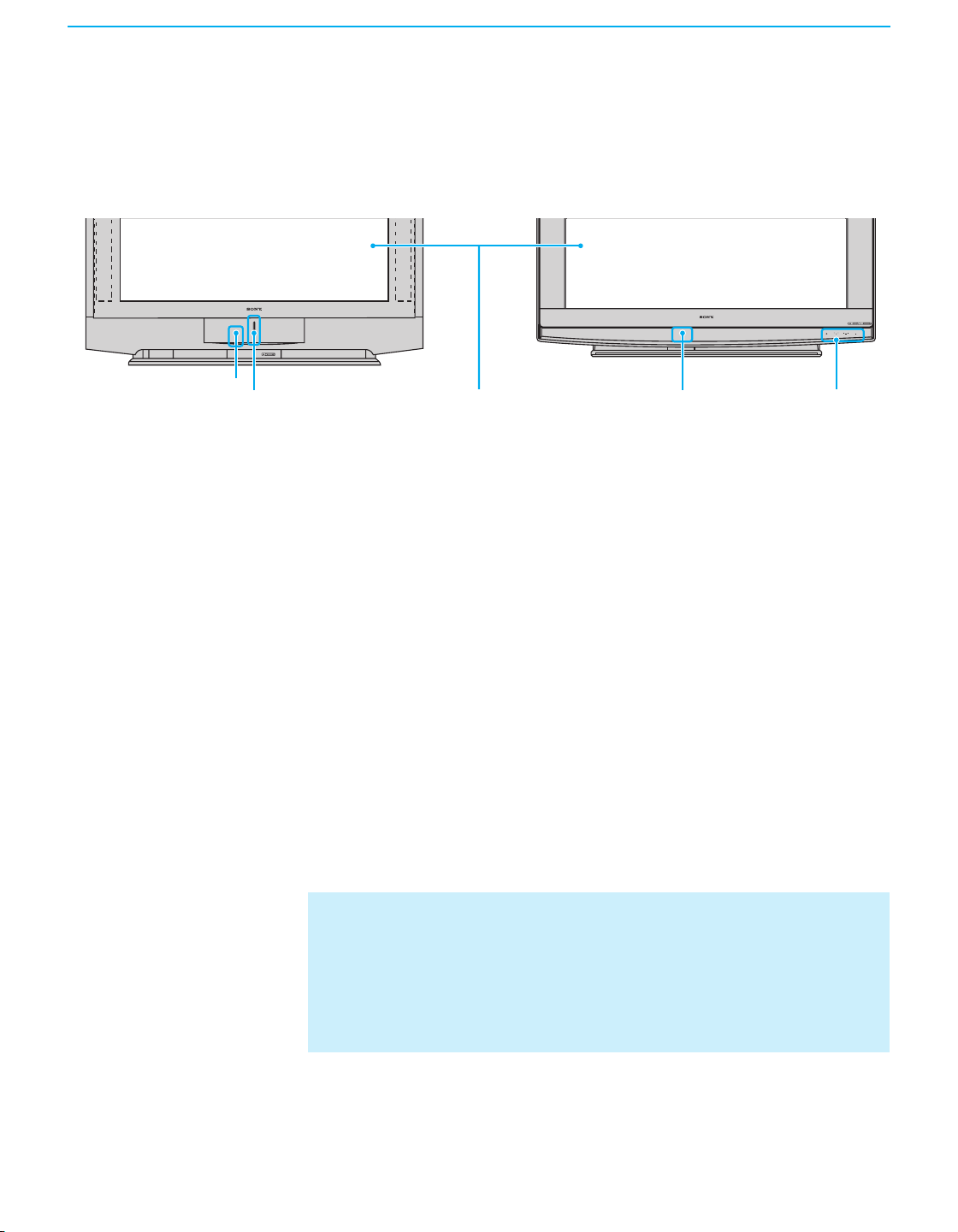
The indicators show the current status of your LCD projection TV.
Screen
To minimize reflection, the screen’s surface has a special coating. Read the
instructions “Cleaning the Screen Surface” on page 15 carefully before
cleaning.
Inappropriate cleaning methods could damage the screen’s finish.
Projection lamp
Your LCD projection TV uses a projection lamp as its light source. The
projection lamp is located under the Control Panel cover as noted in the
diagram above. Note the following:
❑ After turning on your LCD projection TV, it may take a while before the
picture appears (1 minute or less).
❑ When the projection lamp wears out, the screen goes dark. Replace the
lamp with a new Sony XL-2100U or XL-2100 (for WE655 series), or
XL-2200 (for WF655 series) replacement lamp (not supplied).
POWER
STANDBY
TIMER
LAMP
POWER
PRO
STD/DUO
LAMP TIMER POWER/STANDBY
Screen
Projection lamp
Indicators
Projection lamp
Indicators
For KDF-WE655 series
For KDF-WF655 series
✍ After replacing the lamp, be sure to attach the lamp cover securely;
otherwise, your LCD projection TV will not turn on. For details on lamp
replacement, see “Replacing the Lamp” on page 16.
✍ The light emitted from the lamp is quite bright when your LCD projection
TV is in use. To avoid eye discomfort or injury, do not look into the
housing when the power is on.
01COV.book Page 14 Thursday, February 17, 2005 8:01 PM

Introducing the Sony LCD Projection TV
15
Introducing the Sony LCD Projection TV
KDF-WE/WF655
2-059-370-14 (2)
Notes on the LCD
Projection TV
To enjoy clear pictures
❑
Prevent sunlight or other light sources from shining.
❑ The screen surface is easily scratched. Do not rub, touch, or tap it with a
sharp or abrasive object (see “Cleaning the Screen Surface” below).
On moisture condensation
❑
If your LCD projection TV is moved directly from a cold to a warm
location, is placed in a humid room, or if the room temperature changes
suddenly, the picture may blur or show poor color. This is caused by
moisture condensation on the lenses inside. If this happens, leave the
power on to help the moisture evaporate. When the condensation has
evaporated, the picture of your LCD projection TV will return to
normal.
When not using the LCD Projection TV for a long period of time
❑
Turn off the main power on the front of your LCD projection TV before
going to sleep or going out. Unplug the AC power cord from the outlet if
you anticipate not using the LCD projection TV for more than a week.
When turning off the power
❑
The fan will continue to operate for about two minutes. Allow several
minutes before unplugging from the outlet or switching the breaker off.
Before carrying the LCD Projection TV
❑
Before carrying, unplug the power cord and disconnect all cables.
See page 28 for instructions on how to carry your LCD projection TV.
Cleaning the Screen
Surface
To remove dust on the screen, wipe with soft cloth.
✍ Do not use any type of abrasive pad, alkaline cleaner, scouring powder,
window cleaners or solvent such as alcohol or benzene. Using these
types of products may damage the screen.
✍ To clean the screen, use the cloth lightly moistened with a mild detergent
and water solution. Use gentle pressure when cleaning.
01COV.book Page 15 Thursday, February 17, 2005 8:01 PM
Introducing the Sony LCD Projection TV
16
KDF-WE/WF655
2-059-370-14 (2)
Replacing the Lamp The projection lamp, which illuminates the picture, has a limited life.
If the screen becomes dark, the color looks unusual, or the LAMP indicator
on the front of the LCD projection TV flashes, it is time to replace the lamp
with a new one (not supplied).
❑ Use a Sony XL-2100U or XL-2100 (for WE655 series), or XL-2200
(for WF655 series) replacement lamp (not supplied) for replacement.
Use of any other lamp may damage the LCD projection TV.
❑ Do not remove the lamp for any purpose other than replacement. Doing
so may cause injury or fire.
❑ Before replacing the lamp, turn the power off on the main unit. Wait
several minutes, then unplug the power cord. (The cooling fan will
continue to blow for about two minutes after turning the power off.)
❑ Allow the lamp to cool down completely before removing it. The
surface of the lamp remains extremely hot for at least 30 minutes after
the power has been turned off.
❑ Do not put flammable materials and metal objects inside the lamp
receptacle of the LCD projection TV after removing the lamp. Doing so
may cause fire or electrical shock.
❑ To avoid being burned, do not touch the lamp receptacle once the lamp
has been removed.
❑ Mount the new lamp securely. Failure to do so may cause a fire or the
screen to go dark.
❑ Do not touch the glass of the new lamp with your fingers.
The used lamp
For customers in the United States:
This product contains mercury. Disposal of this product may be regulated if
sold in the United States. For disposal or recycling information, please
contact your local authorities or the Electronics Industries Alliance
(http://www.eiae.org).
❑ Do not leave the used lamp near flammable materials or within the reach
of children.
❑ Do not pour water onto the used lamp or put any object inside the lamp.
Doing so may cause the lamp to burst.
✍ Avoid touching the front glass of a new lamp as this may reduce picture
quality or lamp life.
WARNING
Electric appliances can cause fire or high temperature, resulting in injury
or death. Be sure to follow the instructions below.
01COV.book Page 16 Thursday, February 17, 2005 8:01 PM
Introducing the Sony LCD Projection TV
17
Introducing the Sony LCD Projection TV
KDF-WE/WF655
2-059-370-14 (2)
For KDF-WE655 series
1 Turn off the power on the main unit. Wait several minutes, then unplug
the power cord.
(The cooling fan will continue to operate for about two minutes after
turning the power off.)
2 Wait at least 30 minutes after unplugging the power cord to allow the
lamp to cool down before replacing it.
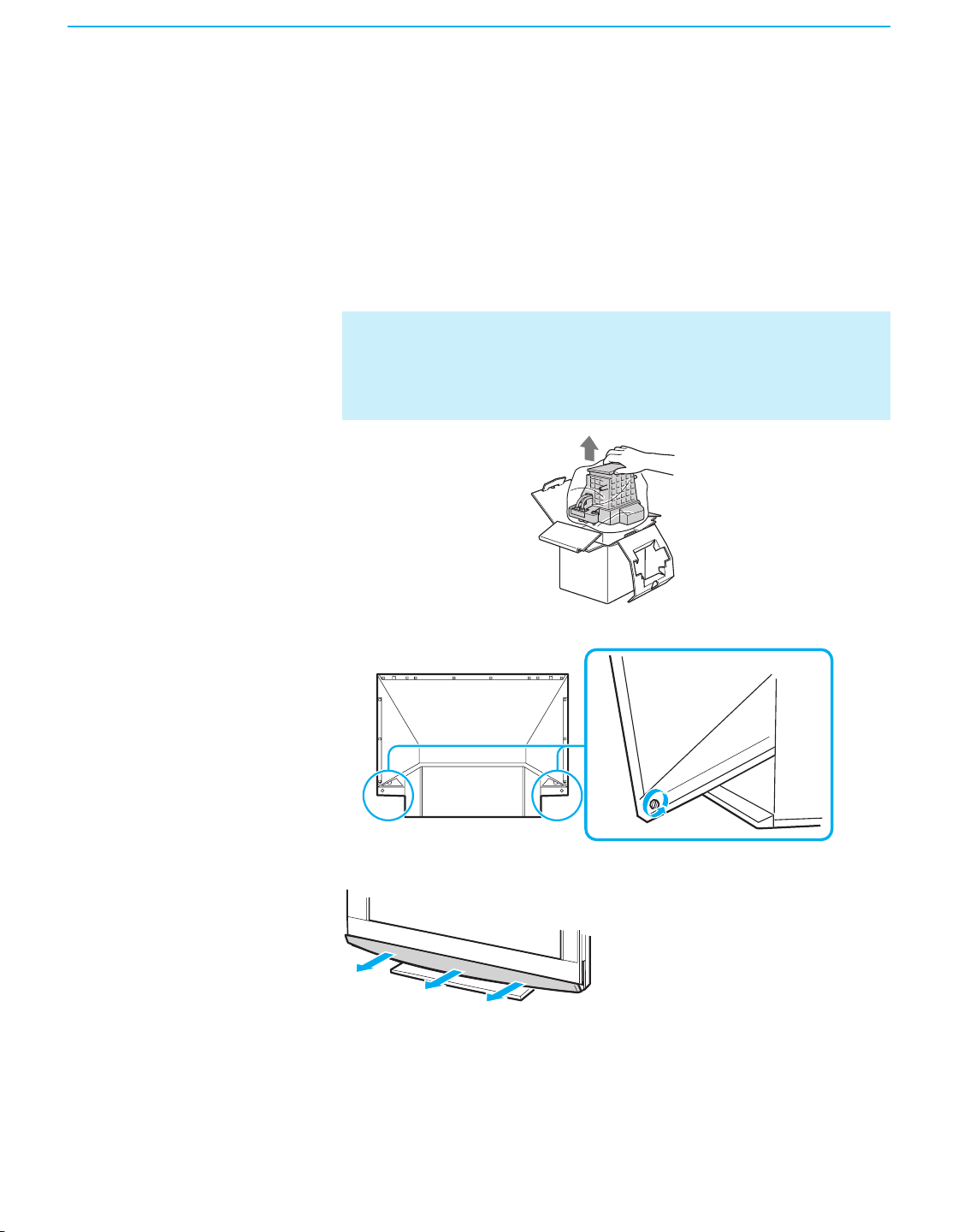
Take the new lamp out of the box.
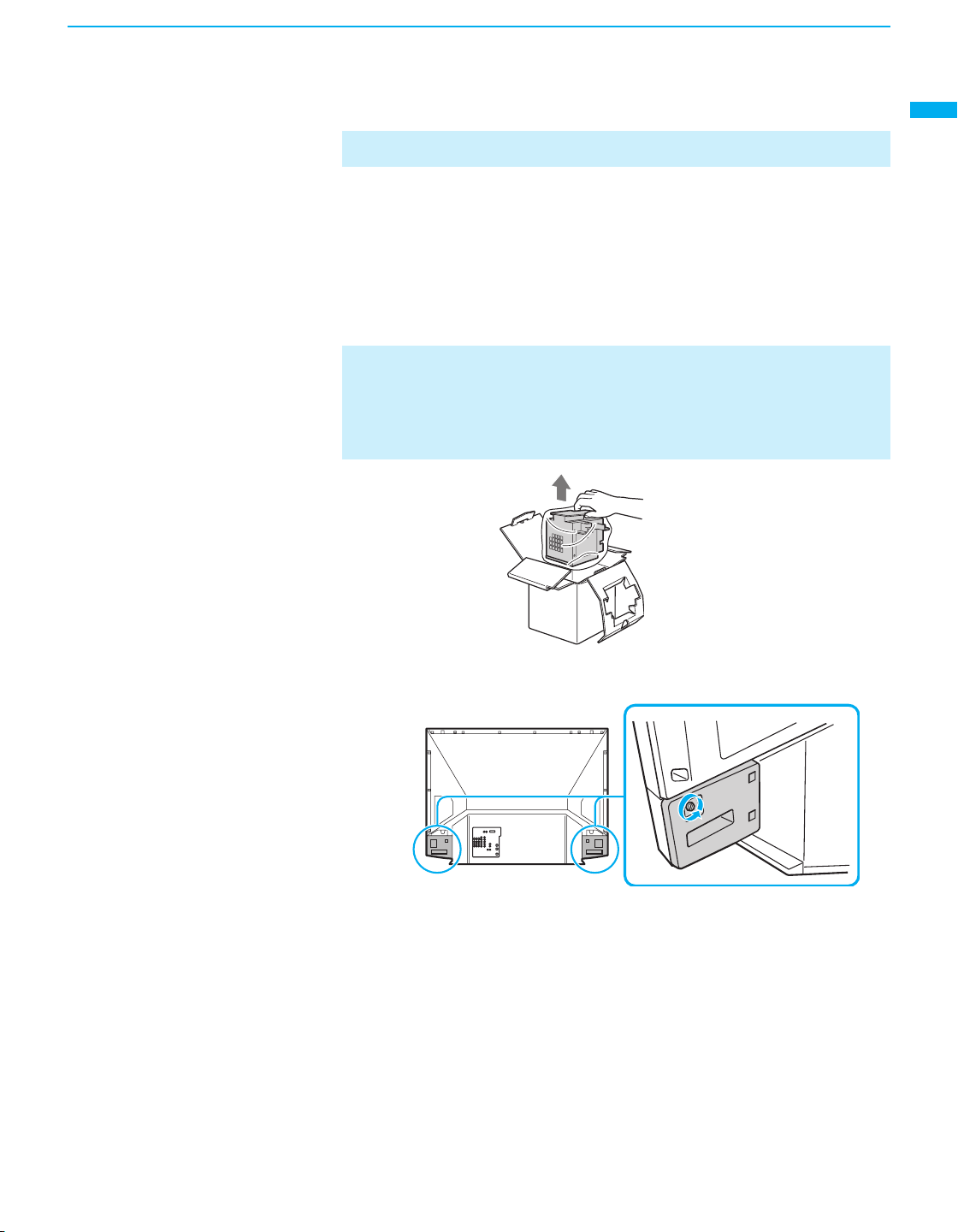
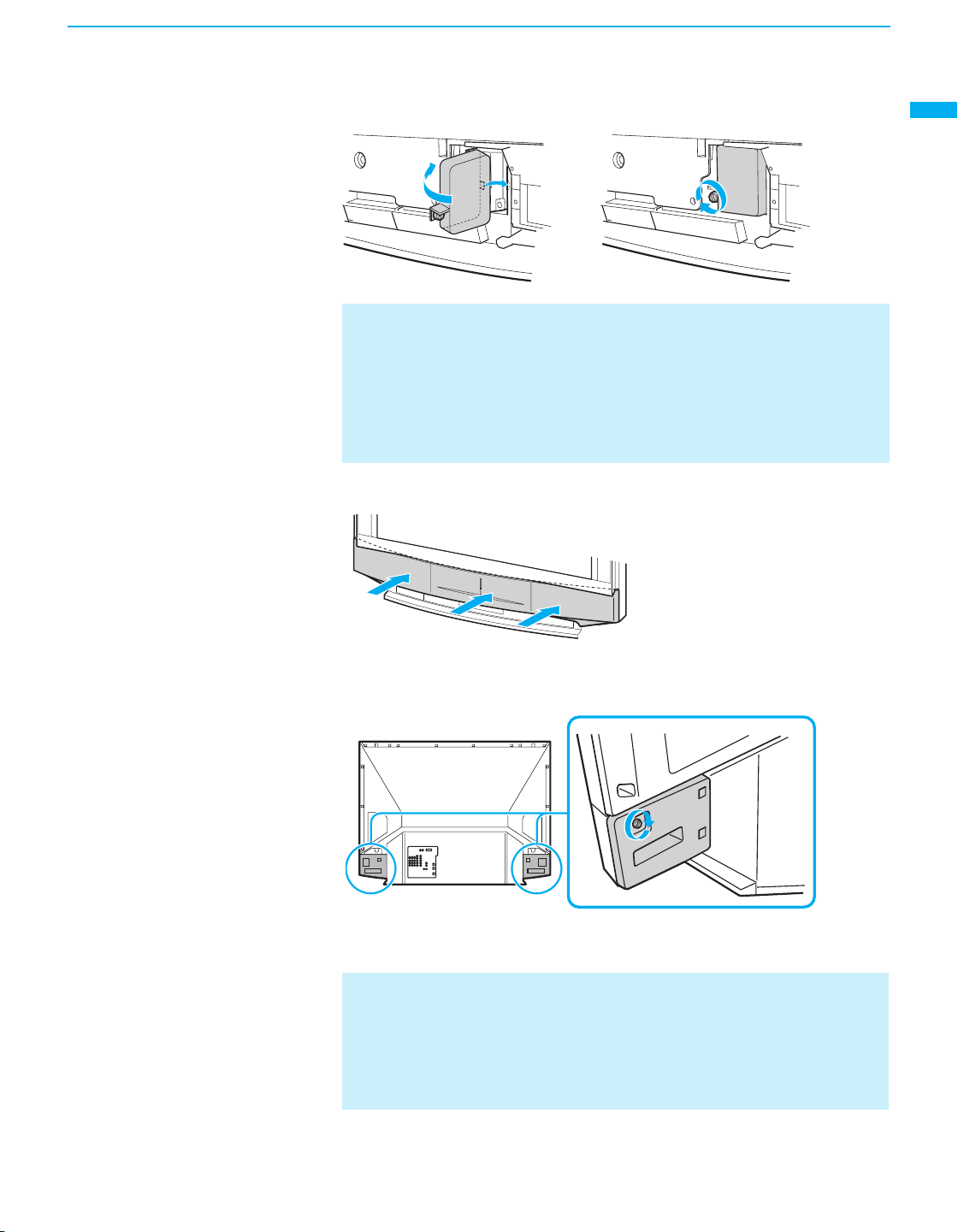
3 Loosen the screws on the rear side panel.
✍ For instruction for KDF-WF655 series, see page 20.
✍ Do not shake the lamp. Vibration can damage the lamp or shorten
its life.
✍ Avoid touching the front glass of a new lamp or the glass of the
lamp receptacle. This may reduce picture quality or lamp life.
This illustration is for KDF-50WE655.
The screw for KDF-42WE655 is more
to the inside.
(Continued)
01COV.book Page 17 Thursday, February 17, 2005 8:01 PM
Introducing the Sony LCD Projection TV
18
KDF-WE/WF655
2-059-370-14 (2)
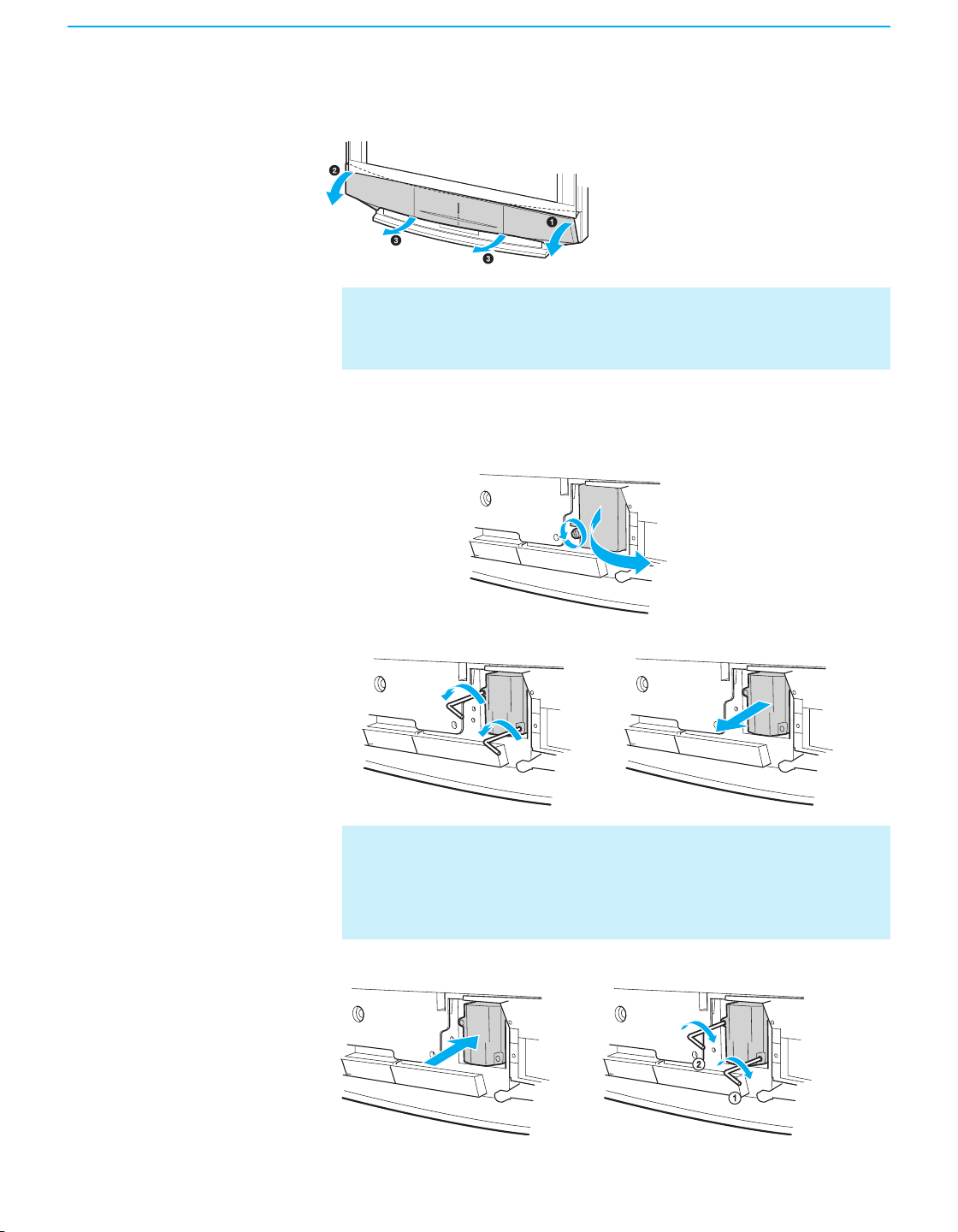
4 Remove the front panel.
5 Pull out the lamp.
Loosen the screw on the lamp cover with a coin or similar object.
Remove the cover.
Loosen the two screws that hold the lamp, then pull out the lamp.
6 Place the new lamp with two screws.
✍ The front panel cover is securely attached to the cabinet. Pull firmly
on the cover in the numbered order (see illustration) with both
hands to release it.
✍ The lamp is very hot immediately after use. Never touch the front
glass of the lamp or the surrounding parts.
✍ After it has cooled, place the used lamp into the empty box of the
replacement lamp. Never put the used lamp into a plastic bag.
01COV.book Page 18 Thursday, February 17, 2005 8:01 PM
Introducing the Sony LCD Projection TV
19
Introducing the Sony LCD Projection TV
KDF-WE/WF655
2-059-370-14 (2)
Place back the lamp cover, then tighten the screw.
7 Reattach the front panel securely.
8 Tightly screw the side panel in its place.
✍ If the lamp cover screw is inserted incorrectly, the lamp may not
operate properly. In such a case, remove the screw, insert it
correctly and then tighten the screw completely (see page 126).
✍ If the lamp cover is not reattached securely, the self-diagnostic
function may be triggered and the POWER/STANDBY indicator
flashes three times (see page 126).
✍ Consult your Sony dealer for a Sony XL-2100U or XL-2100 (for
WE655 series) replacement lamp.
✍ Take great care when replacing the lamp or plugging in/unplugging
the connecting cords. Rough handling may cause the LCD
projection TV to fall, damaging the TV, the TV stand and/or the floor.
This illustration is for KDF-50WE655.
The screw for KDF-42WE655 is more
to the inside.
(Continued)
01COV.book Page 19 Thursday, February 17, 2005 8:01 PM
Introducing the Sony LCD Projection TV
20
KDF-WE/WF655
2-059-370-14 (2)
For KDF-WF655 series
1 Turn off the power on the main unit. Wait several minutes, then unplug
the power cord.
(The cooling fan will continue to operate for about two minutes after
turning the power off.)
2 Wait at least 30 minutes after unplugging the power cord to allow the
lamp to cool down before replacing it.
Take the new lamp out of the box.
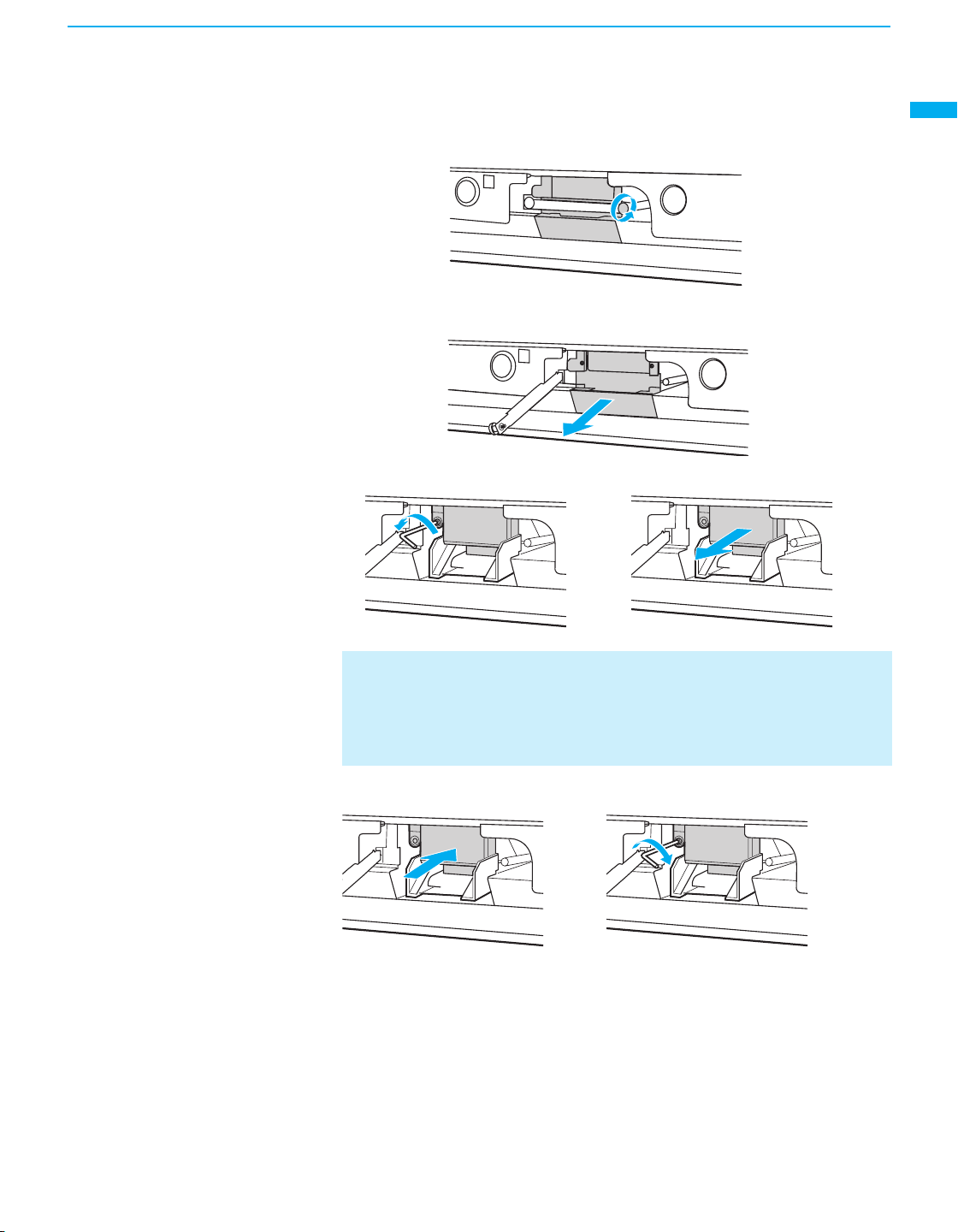
3 Loosen the screws on the rear side panel.
4 Remove the front panel.
✍ Do not shake the lamp. Vibration can damage the lamp or shorten
its life.
✍ Avoid touching the front glass of a new lamp or the glass of the
lamp receptacle. This may reduce picture quality or lamp life.
S
T
D
/
D
U
O
P
O
W
E
R
P
R
O
01COV.book Page 20 Thursday, February 17, 2005 8:01 PM
Introducing the Sony LCD Projection TV
21
Introducing the Sony LCD Projection TV
KDF-WE/WF655
2-059-370-14 (2)
5 Pull out the lamp.
Loosen the right screw on the cover with a coin or similar object.
Remove the screw from the lamp cover. Pull down the cover toward you.
Unscrew the lamp and pull out the lamp horizontally.
6 Place the new lamp into its place, then tighten the screw.
✍ The lamp is very hot immediately after use. Never touch the front
glass of the lamp or the surrounding parts.
✍ After it has cooled, place the used lamp into the empty box of the
replacement lamp. Never put the used lamp into a plastic bag.
(Continued)
01COV.book Page 21 Thursday, February 17, 2005 8:01 PM
Introducing the Sony LCD Projection TV
22
KDF-WE/WF655
2-059-370-14 (2)
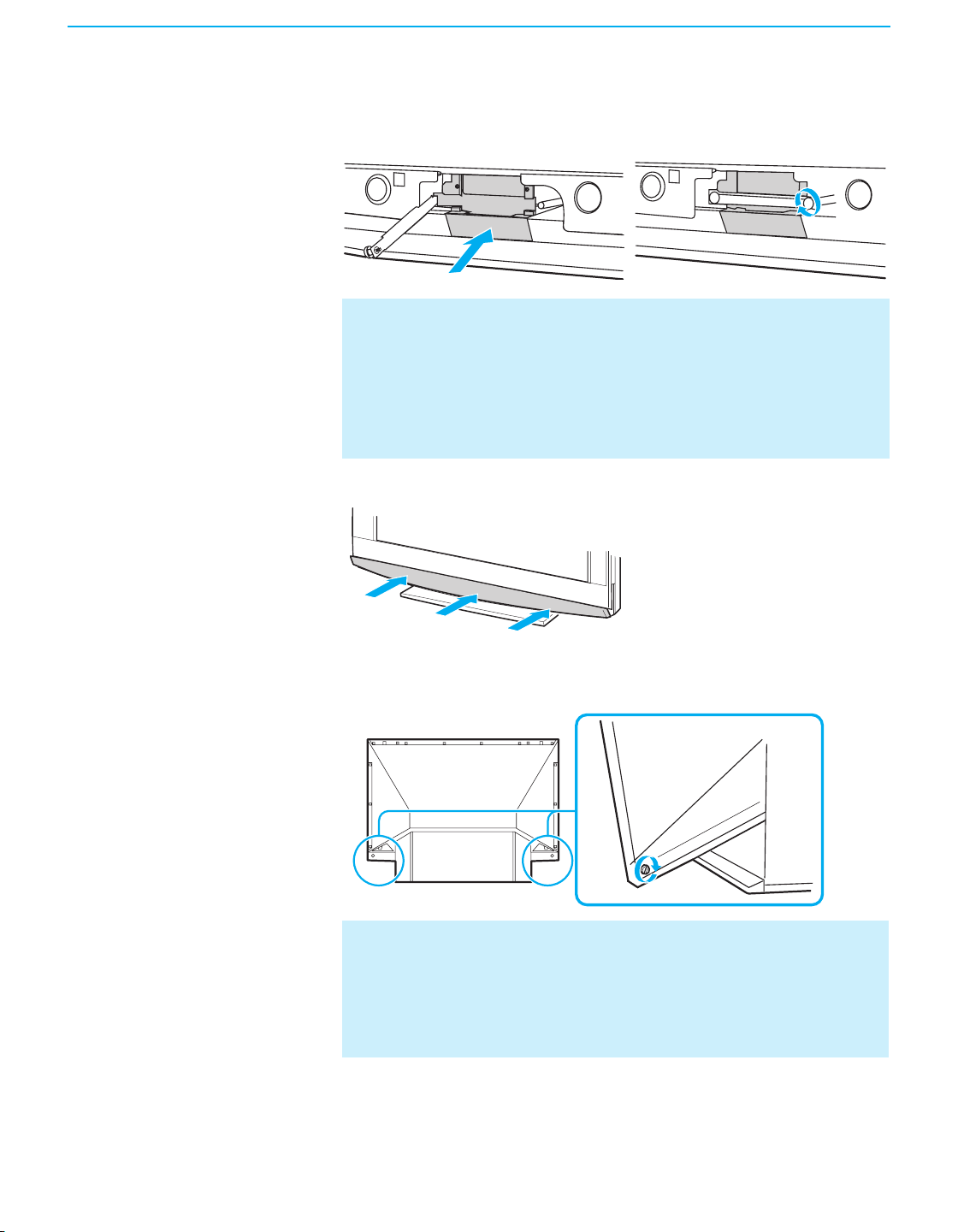
Push the cover back on. Make sure that the hole on the cover aligns with
the hole on the unit. Reattach the lamp cover by tightening the screw.
7 Reattach the front panel securely.
8 Tightly screw the side panel in its place.
✍ If the lamp cover screw is inserted incorrectly, the lamp may not
operate properly. In such a case, remove the screw, insert it
correctly and then tighten the screw completely (see page 126).
✍ If the lamp cover is not reattached securely, the self-diagnostic
function may be triggered and the POWER/STANDBY indicator
flashes three times (see page 126).
✍ Consult your Sony dealer for a Sony XL-2200 (for WF655 series)
replacement lamp.
✍ Take great care when replacing the lamp or plugging in/unplugging
the connecting cords. Rough handling may cause the LCD
projection TV to fall, damaging the TV, the TV stand and/or the floor.
S
T
D
/
D
U
O
P
O
W
E
R
P
R
O
01COV.book Page 22 Thursday, February 17, 2005 8:01 PM
23
Setting Up the LCD Projection TV
KDF-WE/WF655
2-059-370-14 (2)
Setting Up the
LCD Projection TV
Overview
This chapter includes illustrated instructions for setting up your LCD
projection TV.
Topic Page(s)
LCD Projection TV Front Panel and Connectors 24
Installing the LCD Projection TV 28
Basic Connections: Connecting a Cable or Antenna 31
Connecting Optional Equipment
VCR and Cable
VCR and Cable Box
Two VCRs for Tape Editing
Satellite Receiver
Satellite Receiver with a VCR and Cable
DVD Player with Component Video Connectors
DVD Player with S VIDEO and Audio Connectors
Camcorder
Audio Receiver
Digital Cable Box
Digital Satellite Receiver
Digital Satellite Receiver with HDMI Connector
37
39
40
42
43
44
46
47
48
49
50
51
52
Connecting a Device with an Optical IN Connector 54
Using the CONTROL S Feature 55
Using CableCARD 56
Setting Up the LCD Projection TV Channel List 58
01COV.book Page 23 Thursday, February 17, 2005 8:01 PM
Setting Up the LCD Projection TV
24
KDF-WE/WF655
2-059-370-14 (2)
LCD Projection TV Front Panel and Connectors
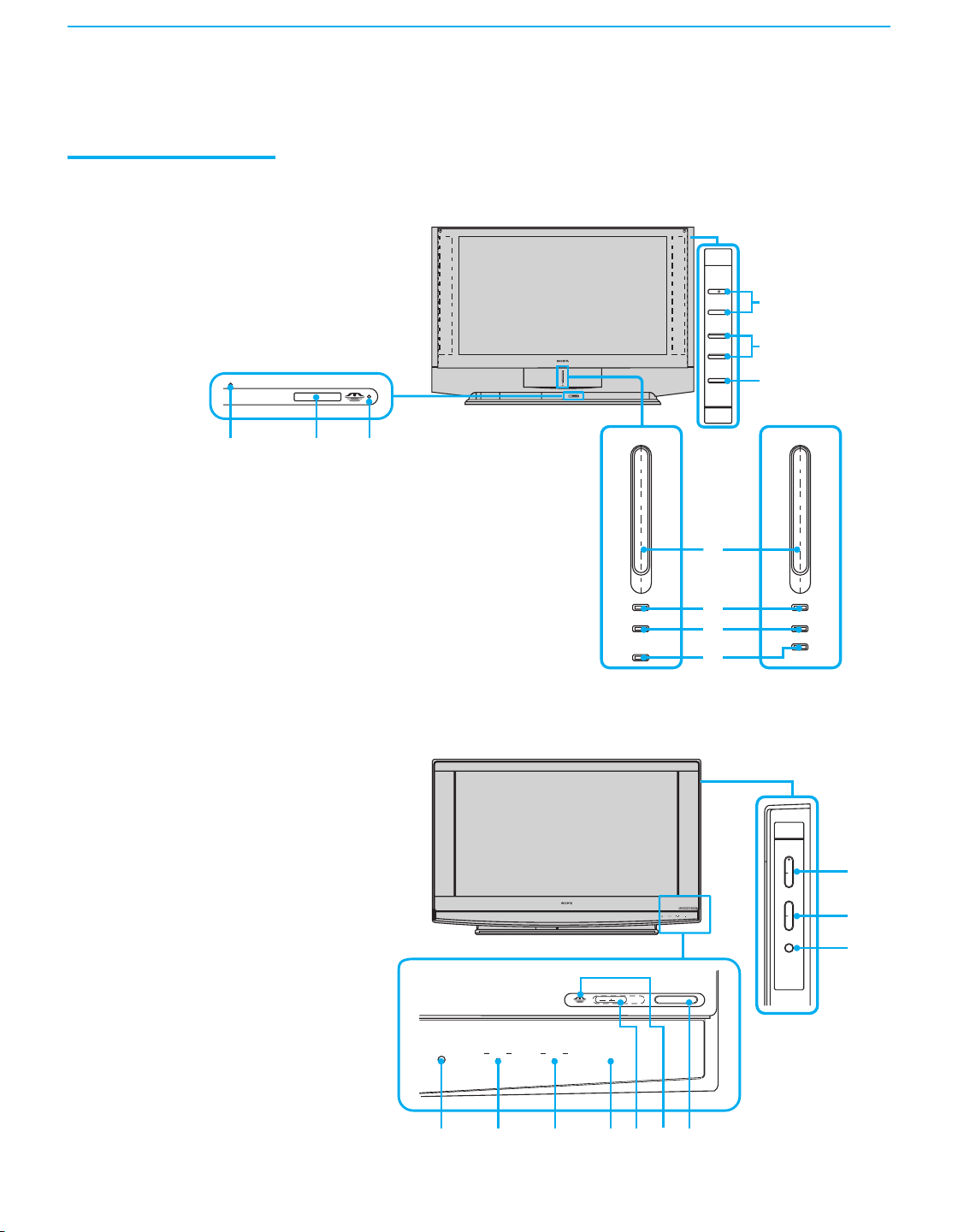
Front Panel
POWER
PRO
STD/DUO
LAMP TIMER POWER/STANDBY
POWER
STANDBY
TIMER
LAMP
PRO
STD/DUO
POWER
POWER/STANDBY
TIMER
LAMP
POWER
POWER/STANDBY
TIMER
LAMP
POWER
PRO
STD/DUO
LAMP TIMER POWER/STANDBY
3
3
#
#
TV/VIDEO
VOLUME
CHANNEL
+
+
CHANNEL
VOLUME
TV/VIDEO
1
8
9
q;
1
3
2
7 6 5 4
7 2
6
8
9
q;
3
5
4
KDF-WE655 series
KDF-WF655 series
KDF-42WE655
KDF-50WE655
01COV.book Page 24 Thursday, February 17, 2005 8:01 PM
Setting Up the LCD Projection TV
25
Setting Up the LCD Projection TV
KDF-WE/WF655
2-059-370-14 (2)
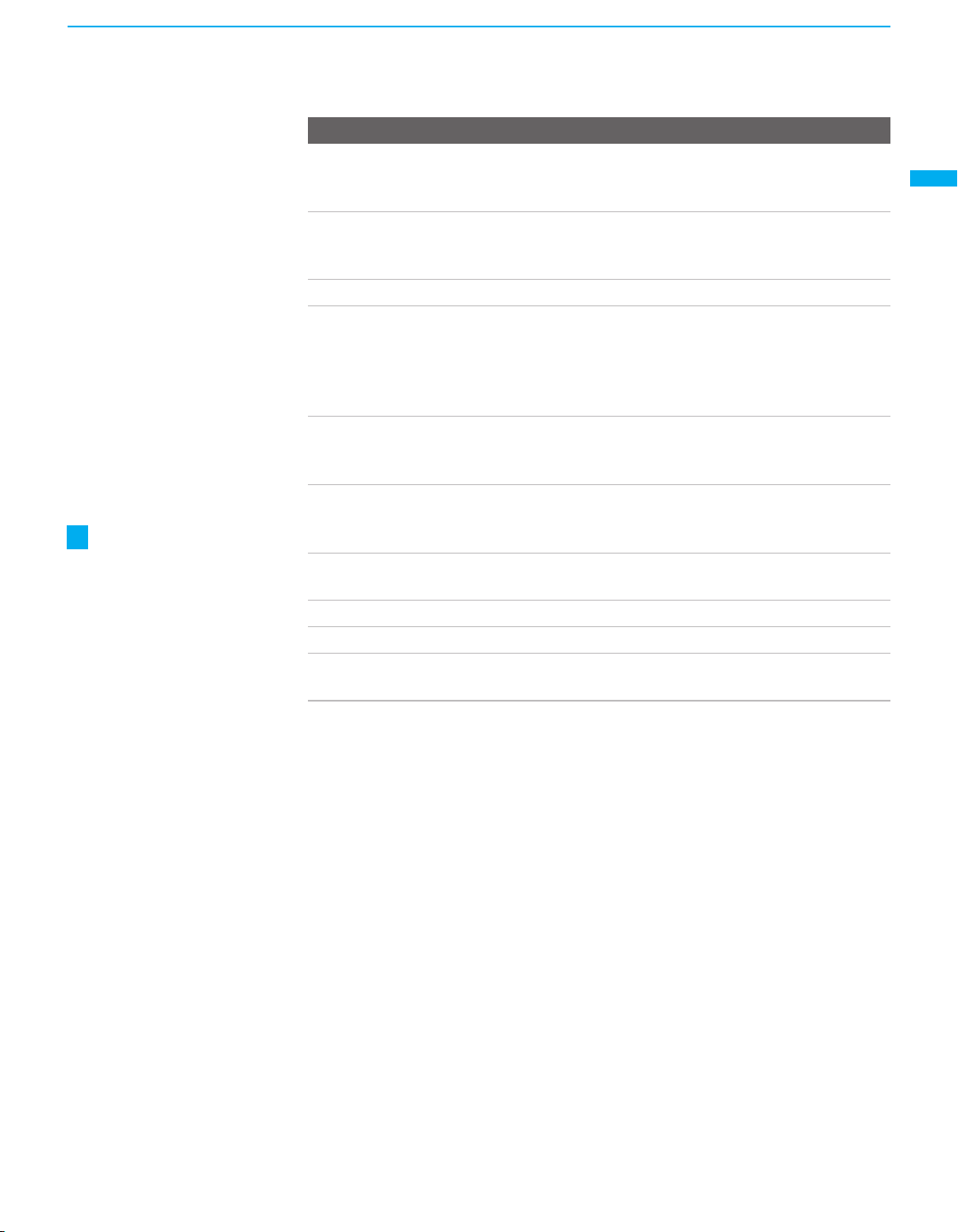
Item Description
1 Memory Stick slot For inserting Memory Stick media to view on your LCD
projection TV. For details, see “Inserting and Removing a
Memory Stick” on page 82
2 Memory Stick
indicator
When the Memory Stick indicator is lit, indicates that the
Memory Stick is being read. (Do not remove the Memory
Stick when the indicator is lit.)
3 POWER Press to turn on/off the LCD projection TV.
4 POWER/
STANDBY LED
Lights up in green when the TV set is turned on. When in
standby mode, the LED lights up in red. The LED does
not light up when the main power is turned off. If the LED
blinks continuously, this may indicate the display unit
needs servicing (see “Contacting Sony” on page 119).
5 TIMER LED When lit, indicates one of the timers is set. When the
timer is set, this LED will remain lit even if the TV set is
turned off. For details, see page 116.
6 LAMP LED Lights up in red when the lamp for the light source has
burned out. For details, see “Replacing the Lamp” on page
16.
7 (IR) Infrared
Receiver
Receives IR signals from the remote control.
8 CHANNEL +/– Press to scan through channels.
9 VOLUME +/– Press to adjust the volume.
q; TV/VIDEO Press to select between the TV’s tuner and other video
equipment inputs.
The CHANNEL +
button has a tactile dot.
Use the tactile as a
reference when
operating the TV.
z
01COV.book Page 25 Thursday, February 17, 2005 8:01 PM
Setting Up the LCD Projection TV
26
KDF-WE/WF655
2-059-370-14 (2)
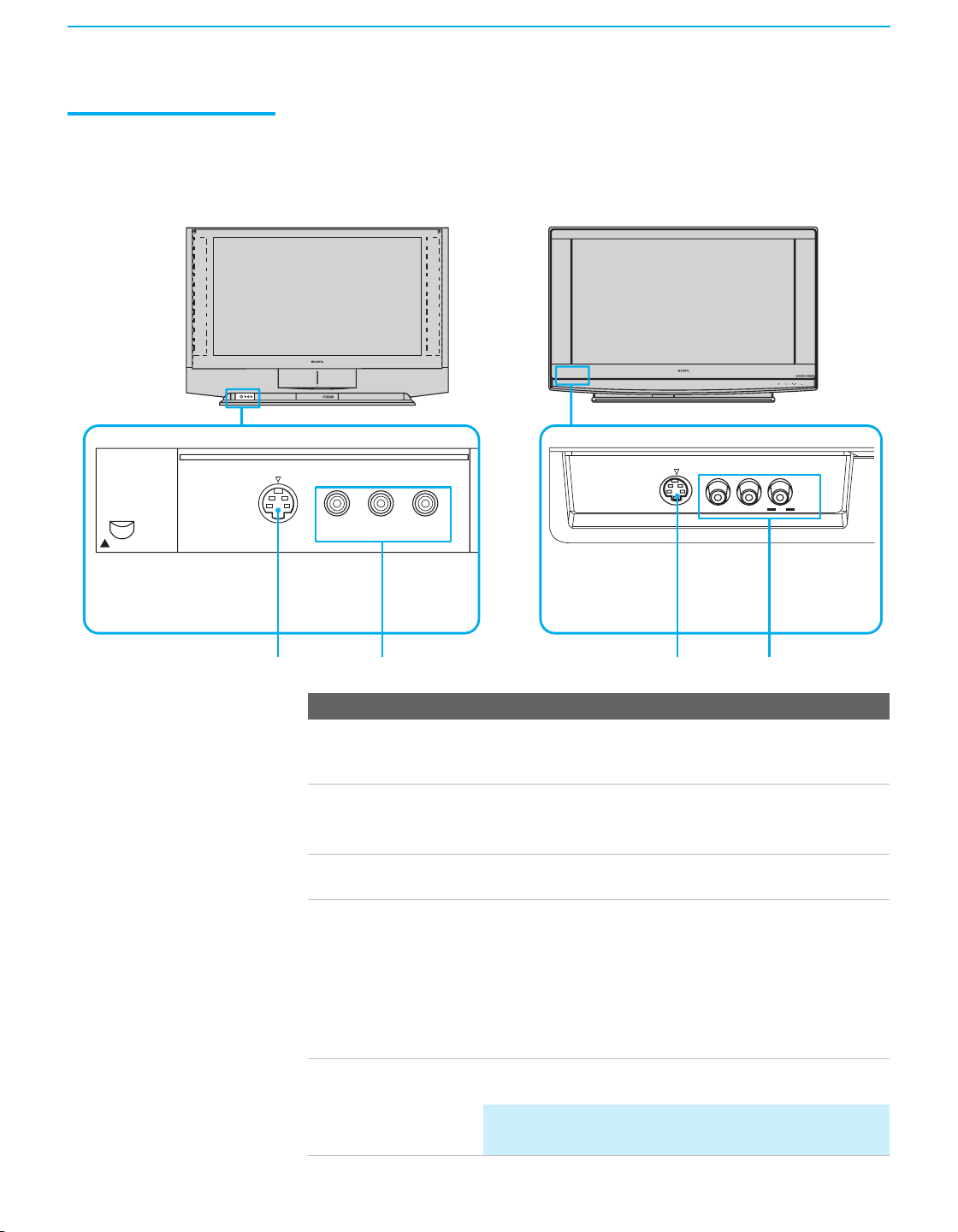
Front and Rear
Panel Connectors
POWER
STANDBY
TIMER
LAMP
VIDEO 2 INPUT
S-VIDEO VIDEO
L(MONO) -AUDIO-R
POWER
PRO
STD/DUO
LAMP TIMER POWER/STANDBY
VIDEO 2 INPUT
S-VIDEO
OPEN
VIDEO
L(MONO) -AUDIO-R
VIDEO 2 INPUT
S VIDEO VIDEO L (MONO) R AUDIO
1 12 2
Front Panel of LCD projection TV
KDF-WE655 series
KDF-WF655 series
Push up to open
the front panel
Press up lightly
to release the
console
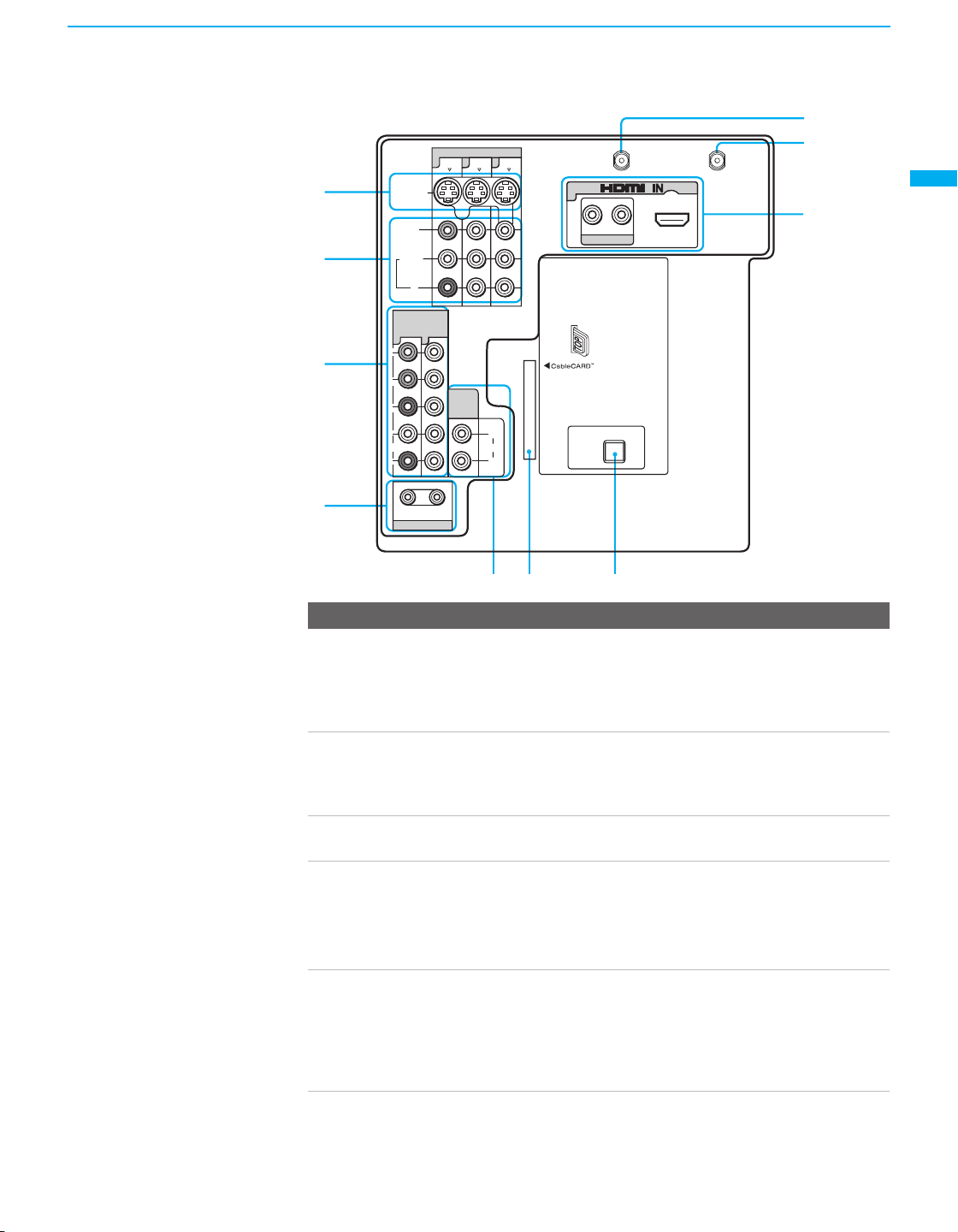
Connection Description
1 S VIDEO
(Front and rear)
Connects to the S VIDEO OUT jack of your VCR or other
S VIDEO-equipped video component. S VIDEO provides
better picture quality than the composite video (2).
2 VIDEO/ L(MONO)-
AUDIO-R
(Front and rear)
Connects to the audio and video OUT jacks on your VCR
or other video component. A fourth video input (VIDEO 2)
is located on the front panel of the LCD projection TV.
3 HD/DVD IN (1080i/
720p/480p/480i)
Connects to your DVD player’s or digital set-top box’s
component video (Y, PB, PR) and audio (L/R) jacks.
4 CONTROL S
IN/OUT
To control other Sony equipment with the LCD projection
TV's remote control, connect the CONTROL S IN jack of
the equipment to the CONTROL S OUT jack on the LCD
projection TV with the CONTROL S cable.
To control the LCD projection TV with the remote control
of another Sony product, connect the CONTROL S OUT
jack of the equipment to the CONTROL S IN jack on the
LCD projection TV with the CONTROL S cable.
5 AUDIO OUT
(VAR/FIX) L/R
Connects to the left and right audio inputs of your audio or
video component.
✍ AUDIO OUT jacks are operable only when the TV’s
Speaker is set to Off.
01COV.book Page 26 Thursday, February 17, 2005 8:01 PM
Setting Up the LCD Projection TV
27
Setting Up the LCD Projection TV
KDF-WE/WF655
2-059-370-14 (2)
*
Manufactured under license from Dolby Laboratories.
“Dolby” and the double-D symbol are trademarks of Dolby Laboratories.
Connection Description
6 CableCARD slot CableCARD provides cable subscribers with access to
secure, digitally encrypted cable channels - without the
need for a set-top box - that will enable you to receive not
only standard definition but also high definition television.
For more information, see page 56.
7 DIGITAL AUDIO
(OPTICAL) OUT
(PCM/DOLBY*
DIGITAL)
Connects to the optical audio input of a digital audio
component that is PCM/Dolby digital compatible.
8 VHF/UHF Connects to your VHF/UHF antenna or cable box output
jack.
9 CABLE Connects to your cable signal. This CABLE input jack, in
conjunction with the VHF/UHF input jack, lets you set up
your LCD projection TV to switch between scrambled
channels (coming through a cable box) and unscrambled
cable channels. For details, see page 34.
0 HDMI
(VIDEO 7 IN)
HDMI (High-Definition Multimedia Interface) provides an
uncompressed, all-digital audio/video interface between
this TV and any HDMI-equipped audio/video component,
such as a set-top box, DVD player, and A/V receiver.
HDMI supports enhanced, or high-definition video, plus
two-channel digital audio.
1
2
3
4
5 67
q;
9
8
VIDEO IN
VHF/UHF CABLE
S VIDEO
VIDEO
AUDIO
Y
P
B
P
L
IN OUT
CONTROL S
R
L
(MONO)
R
1
AUDIO
PCM/DOLBY DIGITAL
OUT
DIGITAL
AUDIO
(OPTICAL)
L
R
3 4
HD/DVD IN
(1080i/720p/
480p/480i)
56
AUDIO
OUT
(VAR/FIX)
R
7
L
AUDIO IN
R
AUDIO
Rear of LCD projection TV
01COV.book Page 27 Thursday, February 17, 2005 8:01 PM
Setting Up the LCD Projection TV
28
KDF-WE/WF655
2-059-370-14 (2)
Installing the LCD Projection TV
Carrying Your LCD
Projection TV
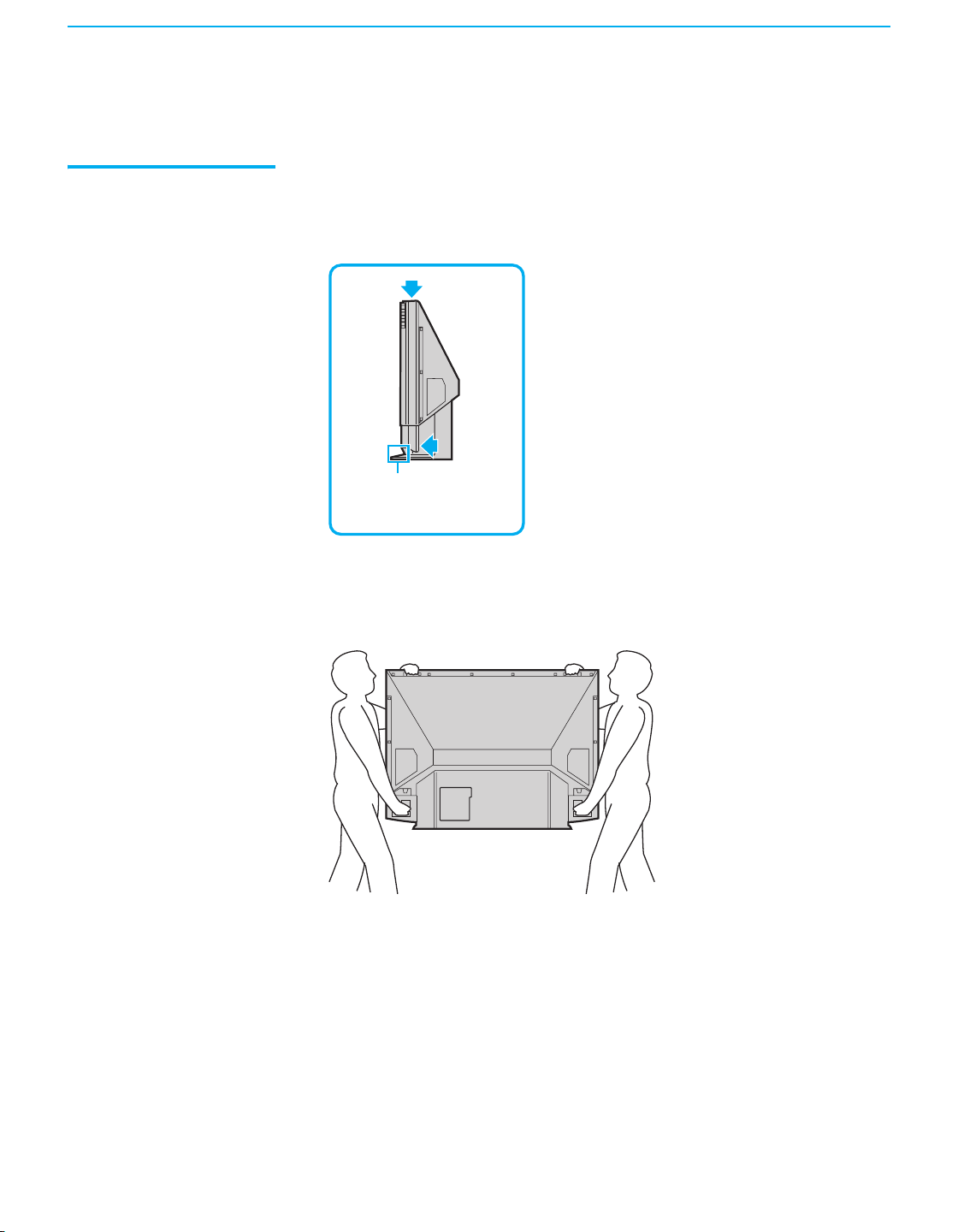
Carrying the LCD projection TV requires at least two people. Do not hold by
the pedestal or the front panel of the LCD projection TV. Doing so may
cause these parts to break off.
When moving the LCD projection TV, place one hand in the hole on the
lower portion of the TV while grasping the top with the other hand, as shown
in the illustration below.
Do not grasp the pedestal
or the front panel of the
LCD projection TV.
01COV.book Page 28 Thursday, February 17, 2005 8:01 PM
Setting Up the LCD Projection TV
29
Setting Up the LCD Projection TV
KDF-WE/WF655
2-059-370-14 (2)
Take Precaution
during the
Installation
To ensure the safety of children and the LCD projection TV, keep children
away from the TV during installation. Climbing on or pushing the LCD
projection TV or its stand may cause it to fall.
To Prevent the LCD
Projection TV from
Falling
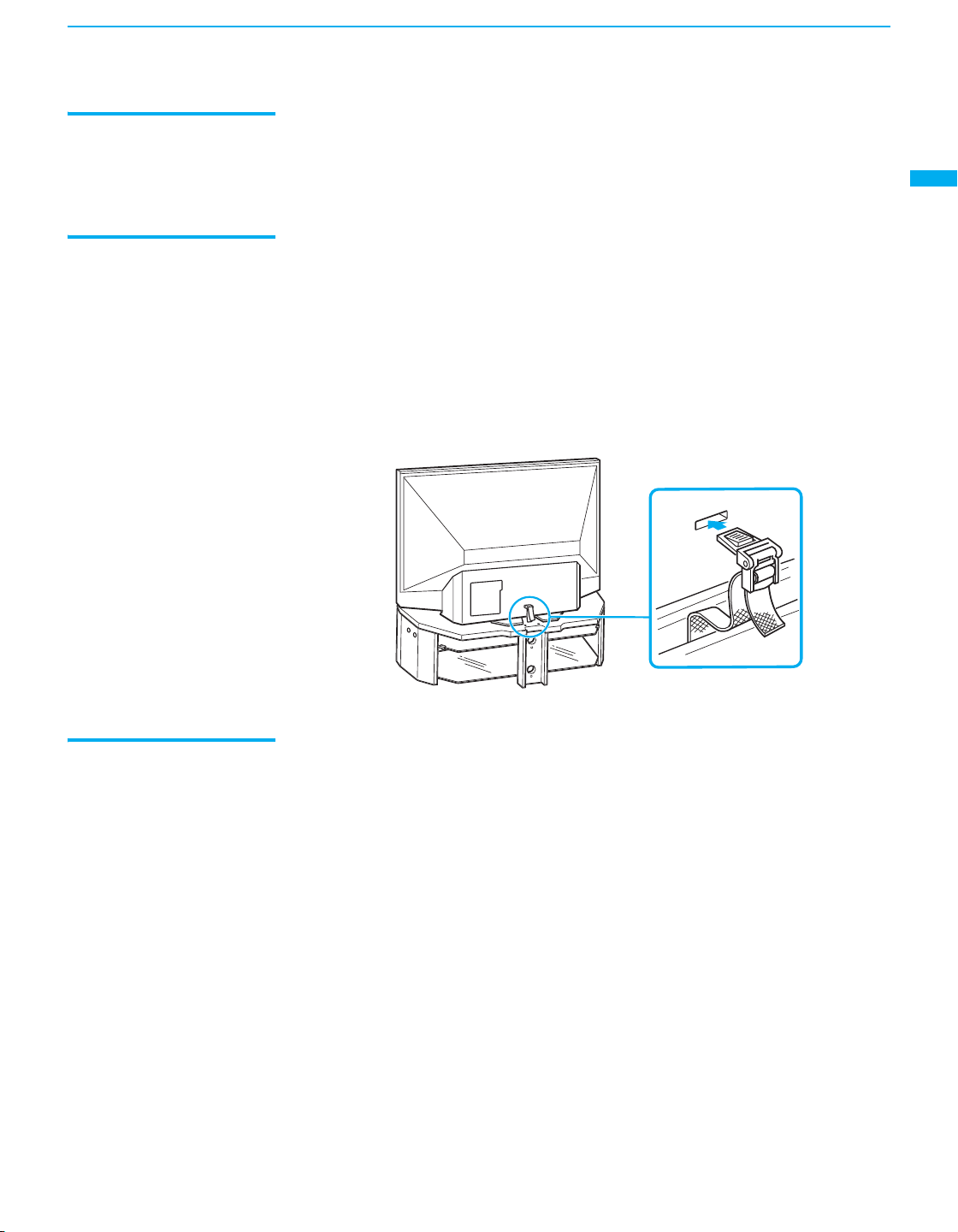
As a protective measure, secure the LCD projection TV as follows.
Using the LCD projection TV stand with support belts
❑
Sony strongly recommends using the TV stand designed for your LCD
projection TV.
For KDF-50WE655, use TV stand model SU-GW11 or SU-GW1, for
KDF-42WE655, use TV stand model SU-GW11 and for KDF-55/
60WF655, use TV stand model SU-GW12, with a support belt.
When Installing Your
LCD Projection TV
Against a Wall
Keep your LCD projection TV at least 4 inches (10 cm) away from the wall
to provide proper ventilation.
01COV.book Page 29 Thursday, February 17, 2005 8:01 PM
Setting Up the LCD Projection TV
30
KDF-WE/WF655
2-059-370-14 (2)
Recommended
Viewing Area
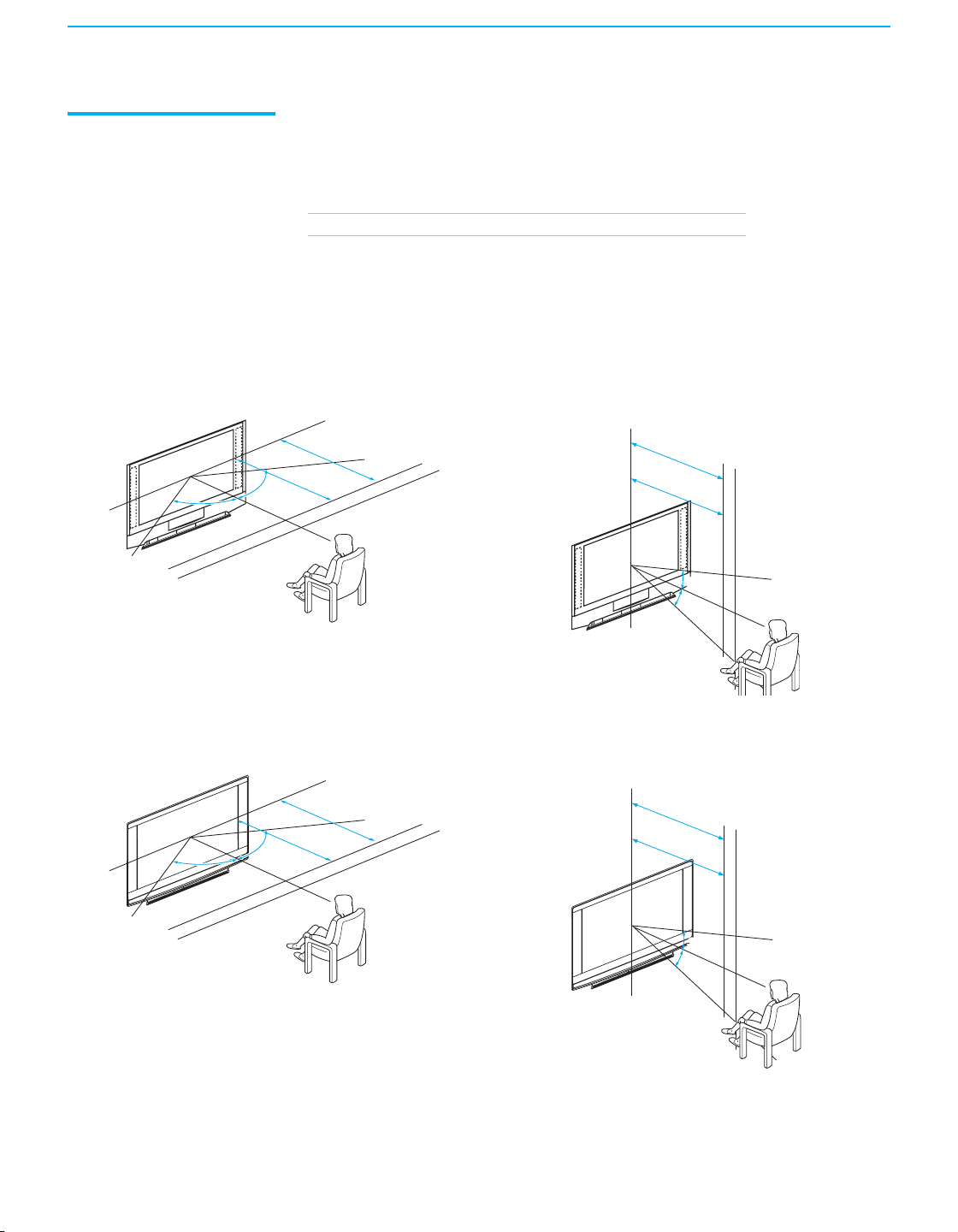
Your viewing position may affect the picture quality.
For the best picture quality, install your LCD projection TV within the areas
shown below.
Model Viewing distance
KDF-42WE655 min. 5.9 ft. (approx. 1.8 m)
KDF-50WE655 min. 6.6 ft. (approx. 2.0 m)
KDF-55WF655 min. 6.8 ft. (approx. 2.1 m)
KDF-60WF655 min. 7 ft. (approx. 2.2 m)
65
65
˚˚
65
65
˚˚
65˚
65˚
min. 6.6 ft. (approx. 2.0 m)
min. 6.6 ft. (approx. 2.0 m)
50"
5
0"
min. 6.6 ft. (approx. 2.0 m)
50"
min. 5.9 ft. (approx. 1.8 m)
m
i
n. 5.9 ft. (approx. 1.8 m)
42"
min. 5.9 ft. (approx. 1.8 m)
42"
For KDF-WE655 series
Horizontal Viewing Area
30˚
30˚
50"
42"
min.
6.6 ft.
(approx.
2.0 m
)
min.
min.
5.9 ft.
5.9 ft.
(approx.
(
approx.
1.8 m
1.8 m
))
min.
5.9 ft.
(approx.
1.8 m
)
Vertical Viewing Area
27.5˚
27.5˚
60"
55"
min. 7 ft. (approx. 2.2 m)
min.
6.8 ft.
6.8 ft.
(approx.
(approx.
2.1 m
2.1 m
)min.
6.8 ft.
(approx.
2.1 m
)
62.5
62.5
65
65
˚˚
62.5˚
62.5˚
min. 6.6 ft. (approx. 2.0 m)
min. 6.6 ft. (appro
x. 2.0 m)
50"
50"
min. 7 ft. (approx. 2.2 m)
60"
min. 5.9 ft. (approx. 1.8 m)
min. 5.9 ft. (approx. 1.8 m)
42"
min. 6.8 ft. (approx. 2.1 m)
55"
For KDF-WF655 series
Horizontal Viewing Area
Vertical Viewing Area
01COV.book Page 30 Thursday, February 17, 2005 8:01 PM
Setting Up the LCD Projection TV
31
Setting Up the LCD Projection TV
KDF-WE/WF655
2-059-370-14 (2)
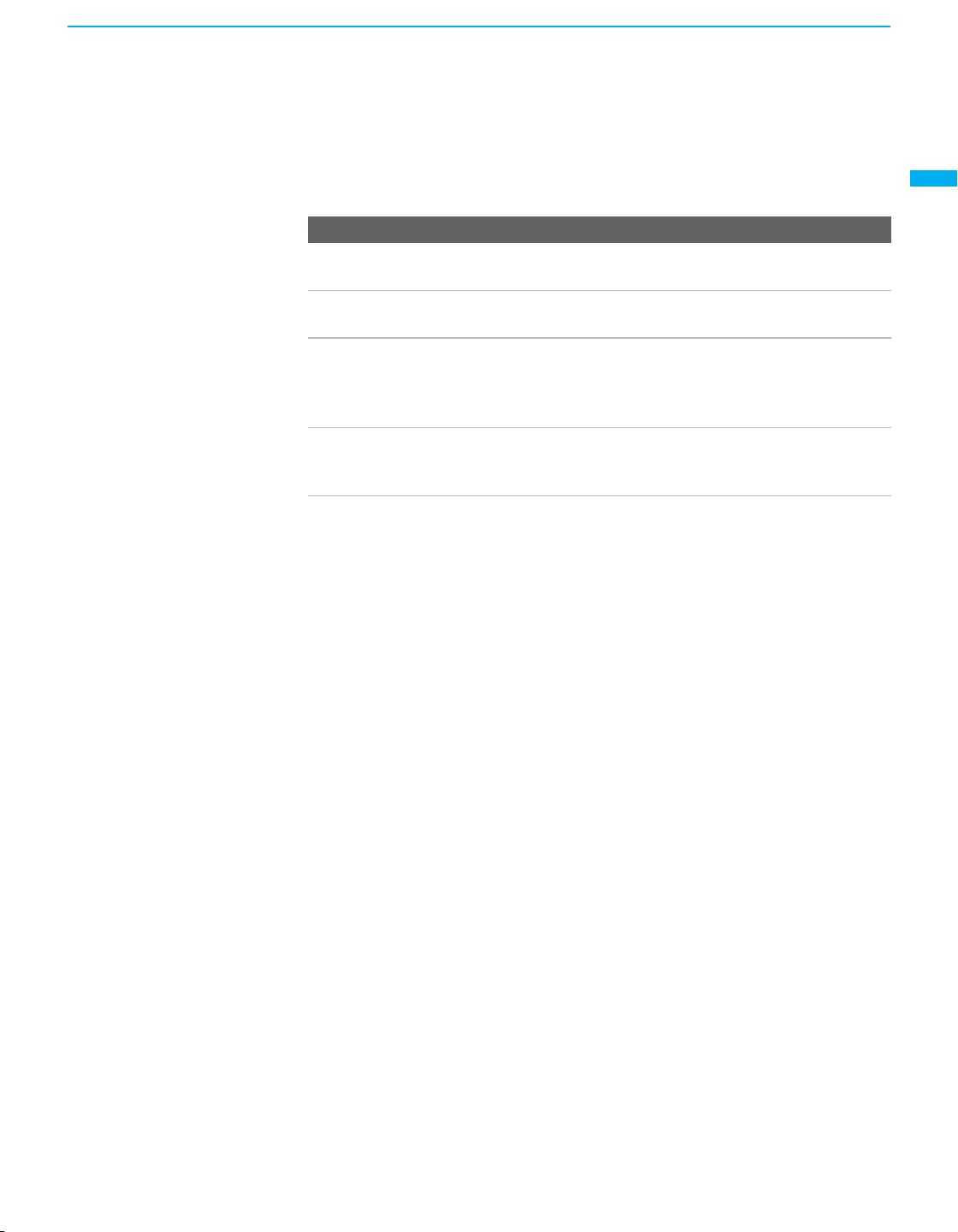
Basic Connections: Connecting a Cable or Antenna
The way in which you connect your LCD projection TV will vary,
depending on how your home receives a signal (cable, cable box, antenna)
and whether or not you plan to connect a VCR.
If you are connecting a VCR
❑
See the connections described on pages 39 and 40.
If You Are Connecting See Page
Cable or Antenna
❏ No cable box or VCR
32
Cable and Antenna
❏ No cable box or VCR
33
Cable Box and Antenna
❏ Cable box unscrambles only some channels
(usually premium channels)
❏ No VCR
34
Cable Box
❏ Cable box unscrambles all channels
❏ No VCR
35
01COV.book Page 31 Thursday, February 17, 2005 8:01 PM
Setting Up the LCD Projection TV
32
KDF-WE/WF655
2-059-370-14 (2)
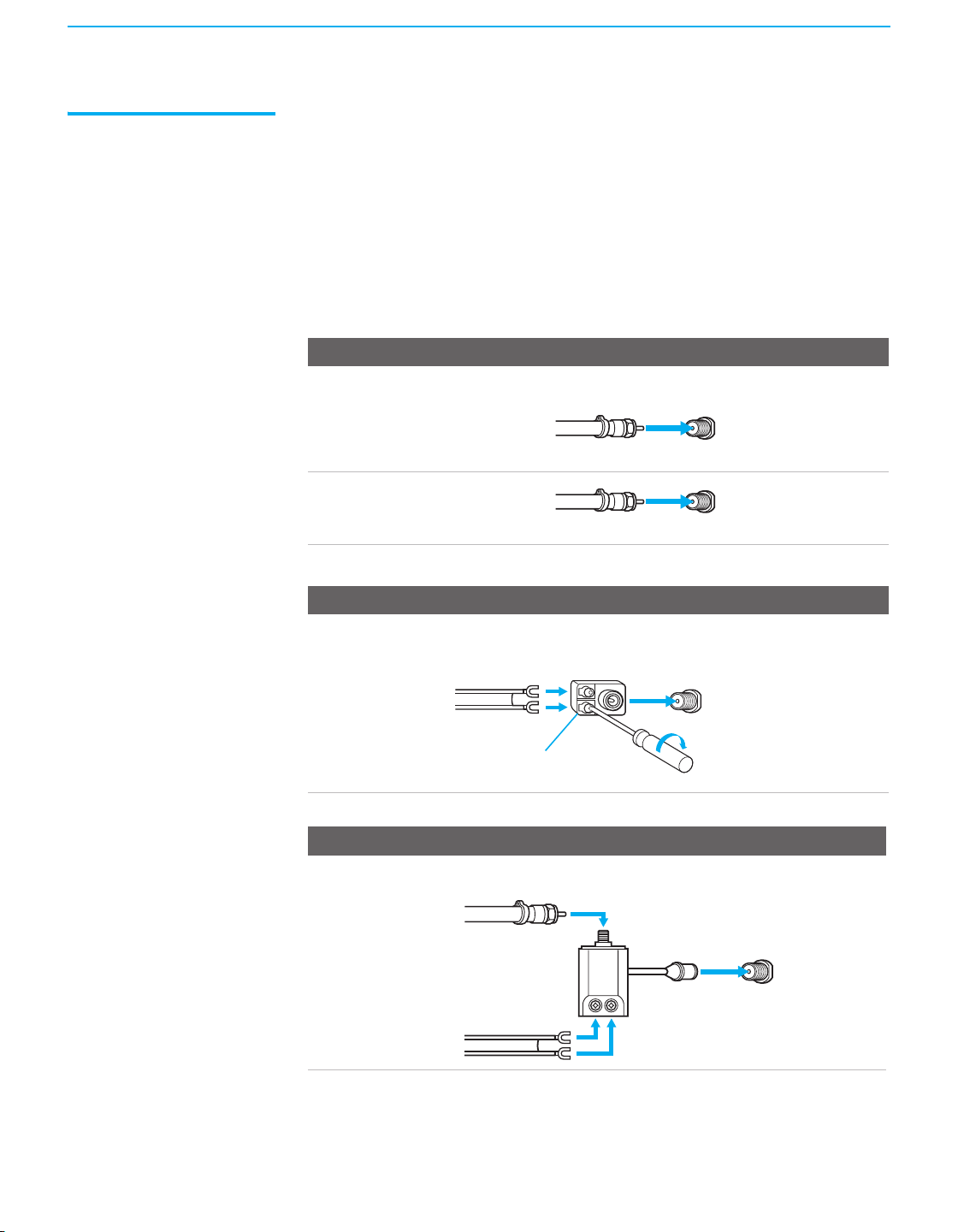
Cable or Antenna For best results, use one of the following connections if you are
connecting a cable or an antenna and you:
❑
Do not need a cable box to unscramble channels. (If you have a cable
box, see pages 34 to 35.)
❑ Do not intend to connect a VCR. (If you have a VCR, see pages 39 and
40.)
The connection you choose depends on the cable type you have in your
home, as described below.
75-ohm coaxial cable (usually found in newer homes)
Cable Type Connect As Shown
VHF Only or
combined
VHF/UHF
Cable
300-ohm twin lead cable (usually found in older homes)
Cable Type Connect As Shown
VHF Only or
UHF Only or
combined
VHF/UHF
75-ohm coaxial and 300-ohm twin lead cable (found in some homes)
Cable Type Connect As Shown
VHF and UHF
75-ohm coaxial
cable
Rear of LCD
Projection TV
VHF/UHF
75-ohm coaxial
cable
CABLE
Rear of LCD
Projection TV
Rear of LCD Projection TV
Antenna connector
(not supplied)
300-ohm twin lead cable
VHF/UHF
Rear of LCD
Projection TV
75-ohm coaxial cable
VHF/UHF
U/V mixer
(not supplied)
300-ohm twin lead cable
01COV.book Page 32 Thursday, February 17, 2005 8:01 PM
Setting Up the LCD Projection TV
33
Setting Up the LCD Projection TV
KDF-WE/WF655
2-059-370-14 (2)
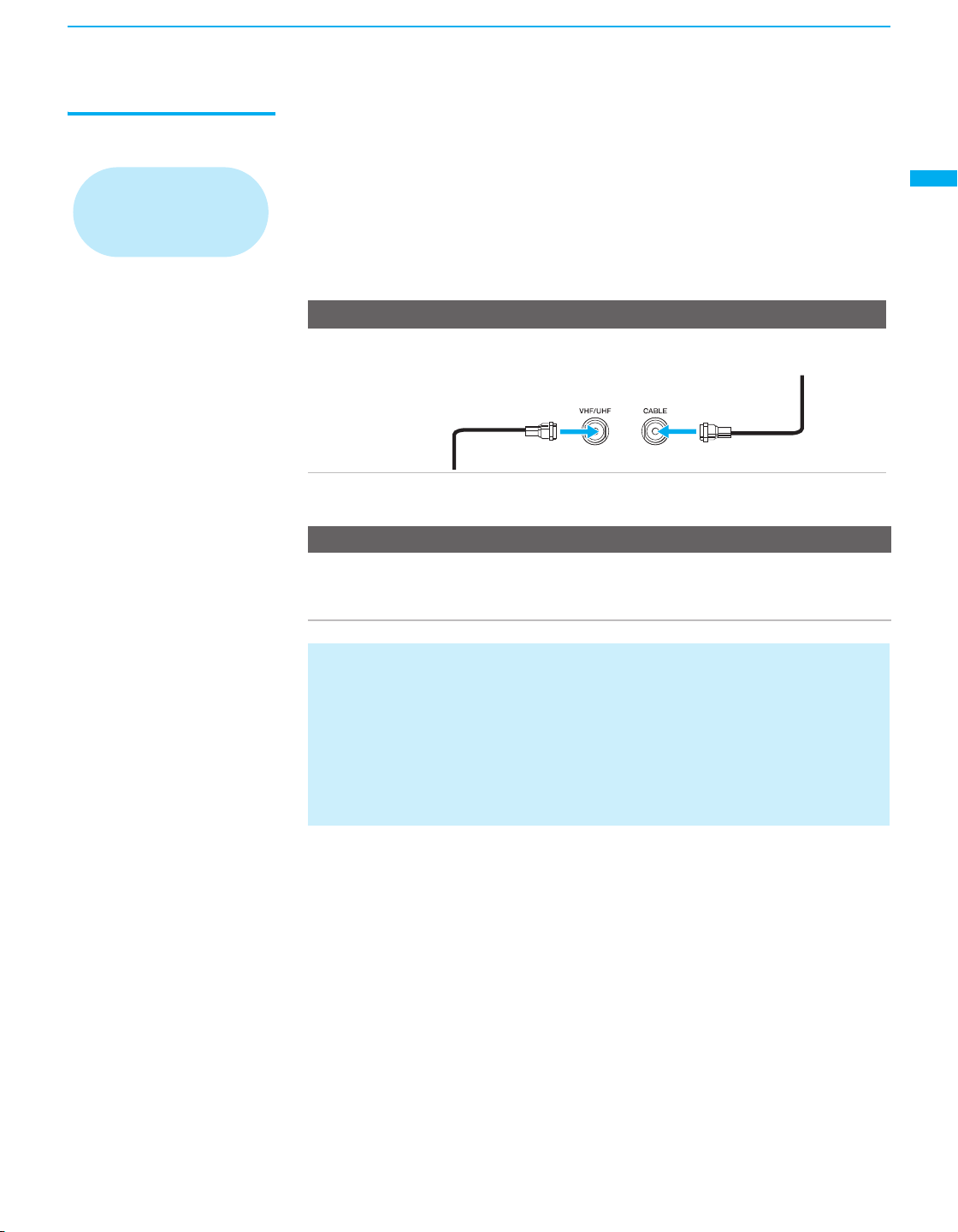
Cable and Antenna For best results, use this connection if you:
❑
Have a cable and an antenna.
(This is convenient if you are using a separate rooftop antenna to receive
additional channels that are not provided by your cable TV company.)
❑ Do not have a cable box or VCR. (If you have a cable box, see pages 34
to 35. If you have a VCR, see pages 39 and 40.)
Notes on Using This Connection
Before connecting a
cable box, see “Using
CableCARD” on page 56.
Antenna and CATV cable
Cable Type Connect As Shown
Cable TV
(CATV) and
Antenna
To Do This... Do This ...
Switch
the LCD projection
TV’s input between the cable
and antenna
Press
ANT to switch back and forth between the
LCD projection TV’s VHF/UHF and CABLE
inputs.
✍ For optimum picture quality, a 75-ohm coaxial cable antenna connection
is highly recommended. Radio waves and other interference can easily
affect a 300-ohm twin lead cable, resulting in signal deterioration. If you
use a 300-ohm twin lead cable, keep it as far away as possible from the
LCD projection TV.
✍ Do not use an indoor antenna, which is especially susceptible to radio
noise.
Antenna cable
CATV cable
01COV.book Page 33 Thursday, February 17, 2005 8:01 PM
Setting Up the LCD Projection TV
34
KDF-WE/WF655
2-059-370-14 (2)
Cable Box and
Antenna
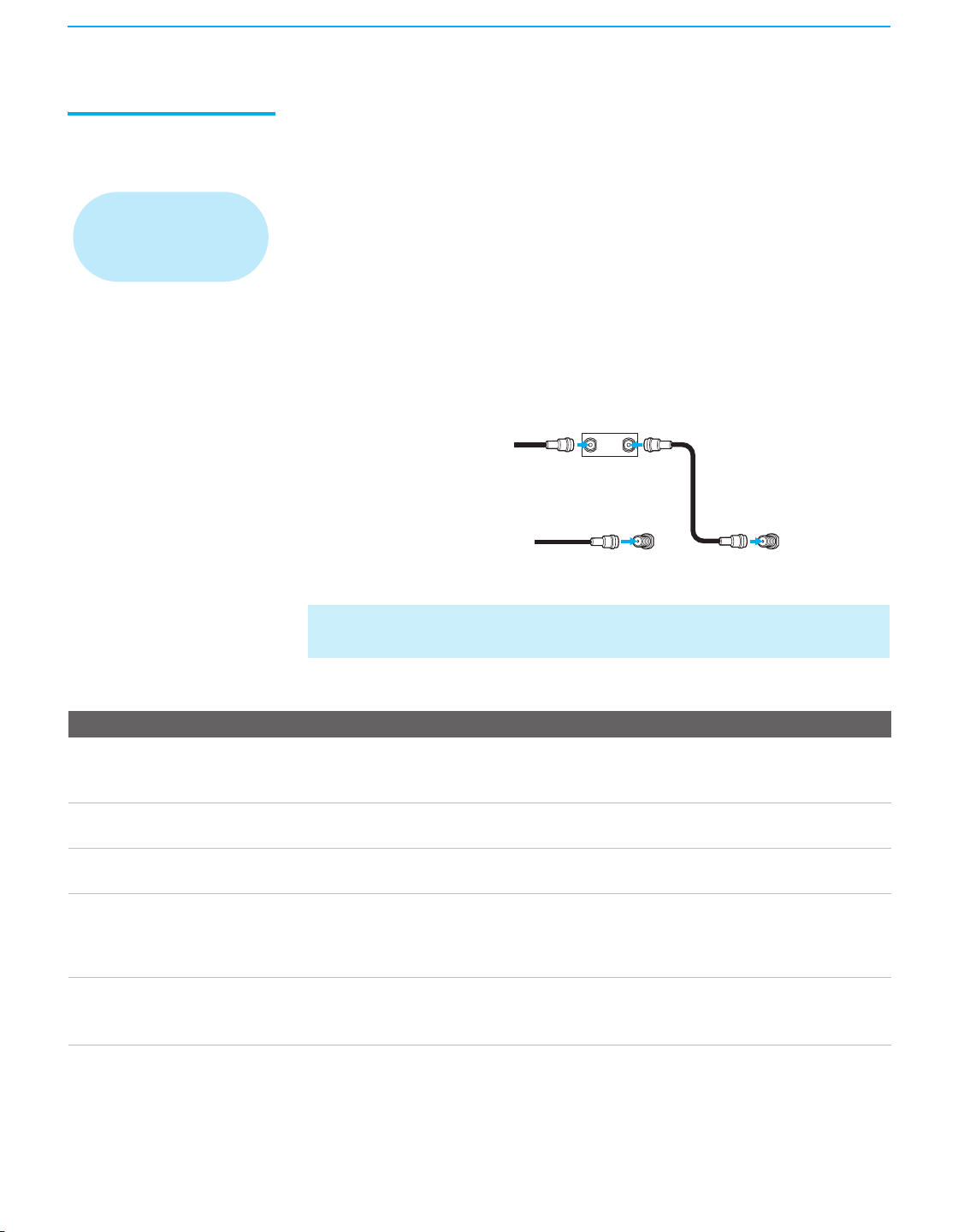
For best results, use this connection if:
❑
Your cable company scrambles some channels, such as premium
channels (which requires you to use a cable box), but does not scramble
all channels.
❑ You do not have a VCR. (If you have a VCR, see pages 39 and 40.)
With this connection you can:
❑
Use the LCD projection TV’s remote control to change channels
coming through the cable box to the LCD projection TV’s cable input.
(You must first program the remote control for your specific cable box;
see “Programming the Remote Control” on page 62.)
❑ Use the LCD projection TV’s remote control to change channels
coming directly into the LCD projection TV’s VHF/UHF input jack.
Notes on Using This Connection
Before connecting a
cable box, see “Using
CableCARD” on page 56.
✍ This connection will allow you to take advantage of viewing the pictures
in Dual Picture Features such as Twin View, Freeze, etc.
IN OUT
VHF/UHF Cable
CATV cable
Rear of LCD projection TV
Cable box
Coaxial
cable
Antenna
cable
To Do This ... Do This ...
Use the cable box Tune the LCD projection TV to the channel the cable box is set to
(usually channel 3 or 4) and then use the cable box to switch
channels.
Set up the LCD projection TV remote control to
operate the cable box
Program the remote control. See “Programming the Remote
Control” on page 62.
Activate the remote control to operate the cable
box
Press
SAT/CABLE FUNCTION once, and the SAT/CABLE
indicator lights up.
Prevent the accidental switching of TV channels When using the cable box, the LCD projection TV must stay on the
channel the cable box is set to (usually channel 3 or 4). You can use
the LCD projection TV’s Channel Fix feature to lock in a specific
channel. For details, see “Using the Channel Menu” on page 106.
Switch
the LCD projection TV’s input between
the cable box and cable
Press
ANT to switch back and forth between the LCD projection
TV’s VHF/UHF (scrambled channels) and CABLE (unscrambled)
inputs.
01COV.book Page 34 Thursday, February 17, 2005 8:01 PM
Setting Up the LCD Projection TV
35
Setting Up the LCD Projection TV
KDF-WE/WF655
2-059-370-14 (2)
Cable Box For best results, use this connection if:
❑
Your cable company scrambles all channels, which requires you to use a
cable box.
❑ You do not have a VCR. (If you have a VCR, see pages 39 and 40.)
With this connection you can:
❑
Use the LCD projection TV’s remote control to change channels
coming through the cable box to the LCD projection TV’s VHF/UHF
jack. (You must first program the remote control for your specific cable
box.)
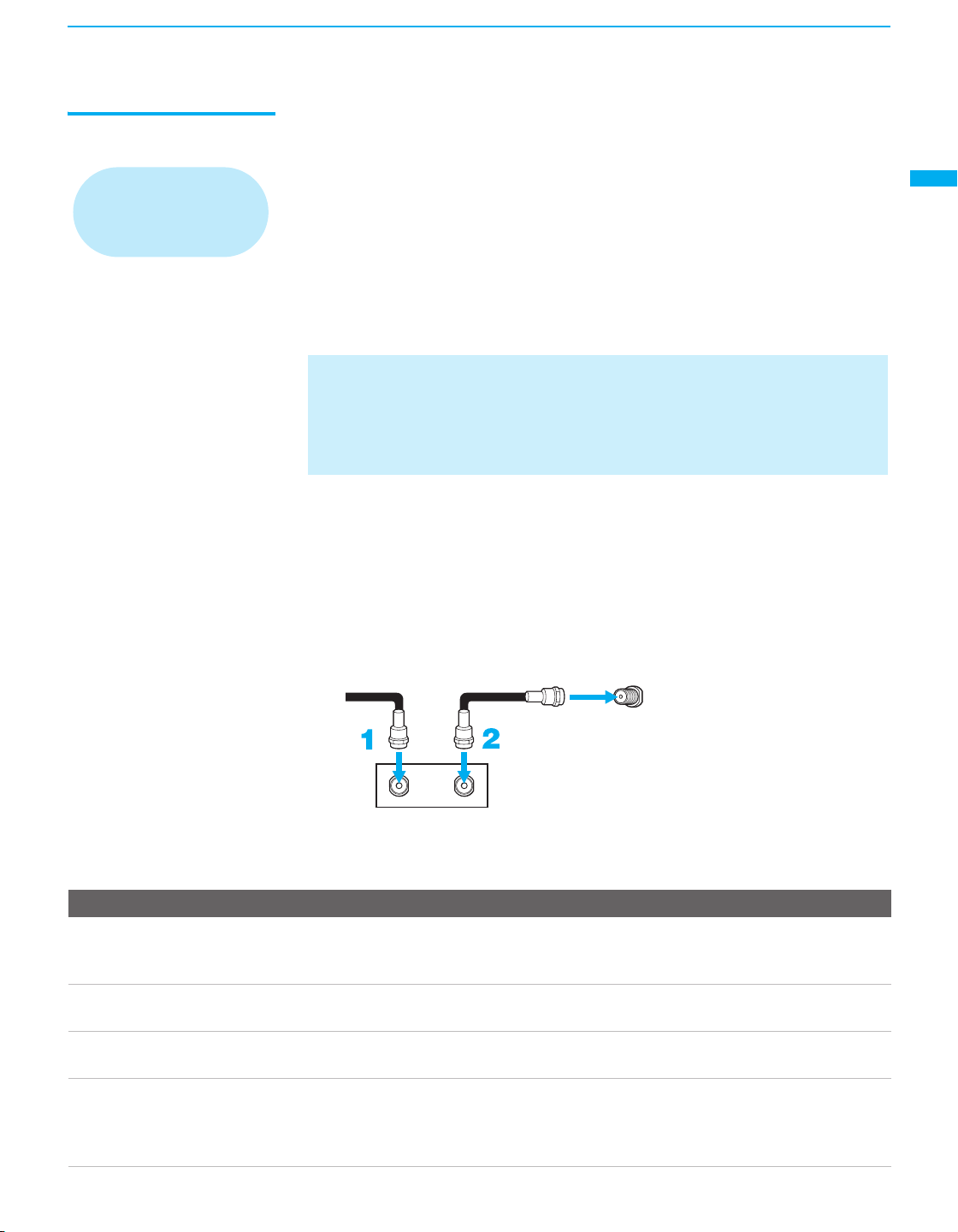
To connect the cable box
1 Connect the CATV cable to the cable box’s input jack.
2 Use a coaxial cable to connect the cable box’s output jack to the LCD
projection TV’s VHF/UHF jack.
3 Run Auto Program, as described in “Setting Up the LCD Projection TV
Channel List” on pages 58.
Notes on Using This Connection
Before connecting a
cable box, see “Using
CableCARD” on page 56.
✍ With this connection, all channels come into the LCD projection TV
through your cable box and only one unscrambled signal is sent to the
LCD projection TV, so you cannot use the dual picture features. If some
of your channels are scrambled, but others are not, consider using the
“Cable Box and Antenna” connection on page 34 instead.
VHF/UH
F
CATV cable
Coaxial cable
Rear of LCD projection TV
Cable box
OUT
IN
To do this... Do This ...
Use the cable box Tune the LCD projection TV to the channel the cable box is set to
(usually channel 3 or 4) and then use the cable box to switch
channels.
Set up the LCD projection TV remote control to
operate the cable box
Program the remote control. See “Programming the Remote
Control” on page 62.
Activate the remote control to operate the cable
box
Press
SAT/CABLE FUNCTION once, and the SAT/CABLE
indicator lights up.
Prevent the accidental switching of TV channels When using the cable box, the LCD projection TV must stay on the
channel the cable box is set to (usually channel 3 or 4). You can use
the LCD projection TV’s Channel Fix feature to lock in a specific
channel. For details, see “Using the Channel Menu” on page 106.
01COV.book Page 35 Thursday, February 17, 2005 8:01 PM

01COV.book Page 36 Thursday, February 17, 2005 8:01 PM
Setting Up the LCD Projection TV
37
Setting Up the LCD Projection TV
KDF-WE/WF655
2-059-370-14 (2)
Connecting Optional Equipment
Use the directions in this section to connect the following optional
equipment:
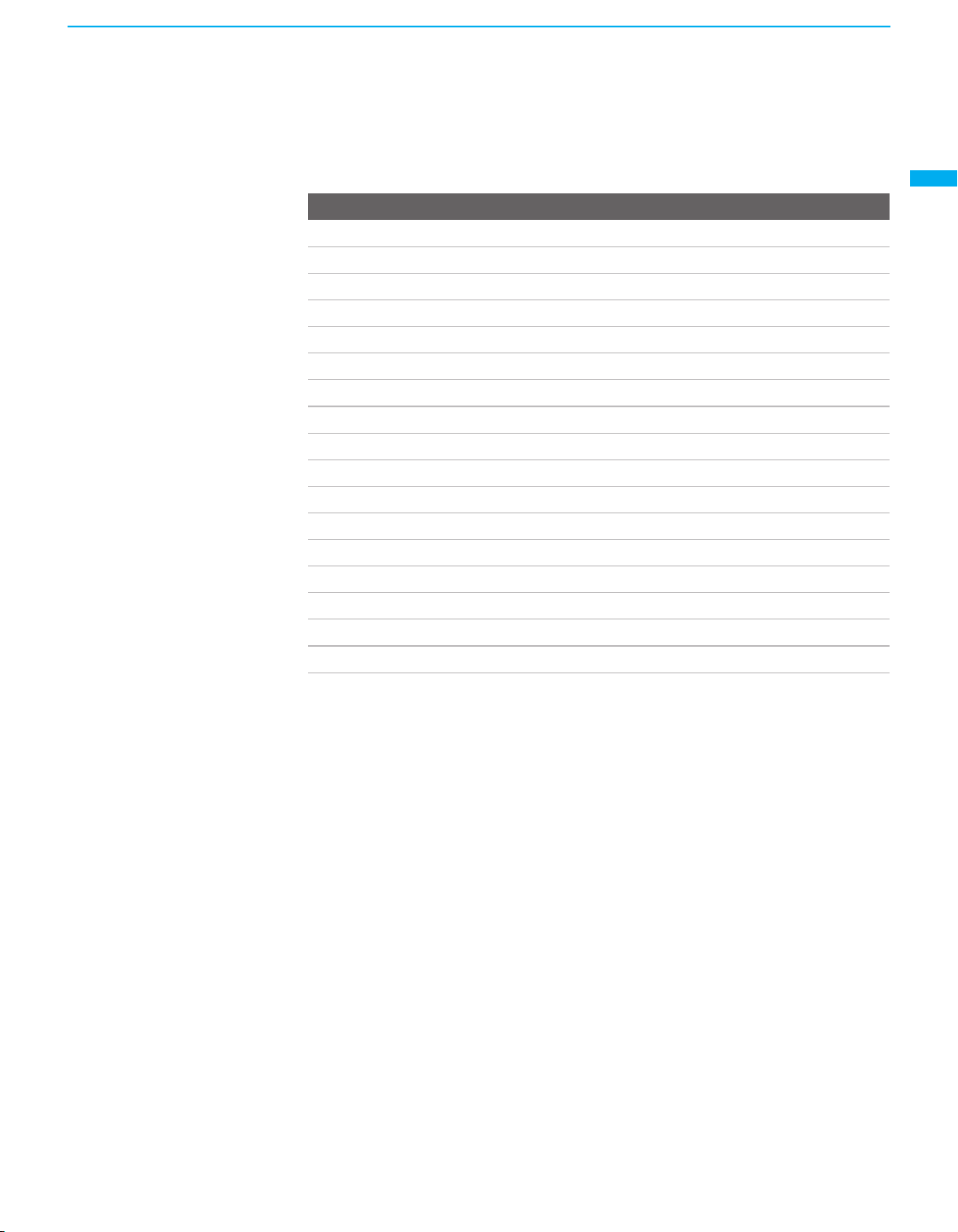
If You Are Connecting Page
Making Video Connections 38
About Using S VIDEO 38
VCR and Cable 39
VCR and Cable Box 40
Two VCRs for Tape Editing 42
Satellite Receiver 43
Satellite Receiver with a VCR and Cable 44
DVD Player with Component Video Connectors 46
DVD Player with S VIDEO and Audio Connectors 47
Camcorder 48
Audio Receiver 49
Digital Cable Box 50
Digital Satellite Receiver 51
Digital Satellite Receiver with HDMI Connector 52
Connecting a Device with an Optical IN Connector 54
Using the CONTROL S Feature 55
Using CableCARD 56
01COV.book Page 37 Thursday, February 17, 2005 8:01 PM
Setting Up the LCD Projection TV
38
KDF-WE/WF655
2-059-370-14 (2)
Making Video
Connections
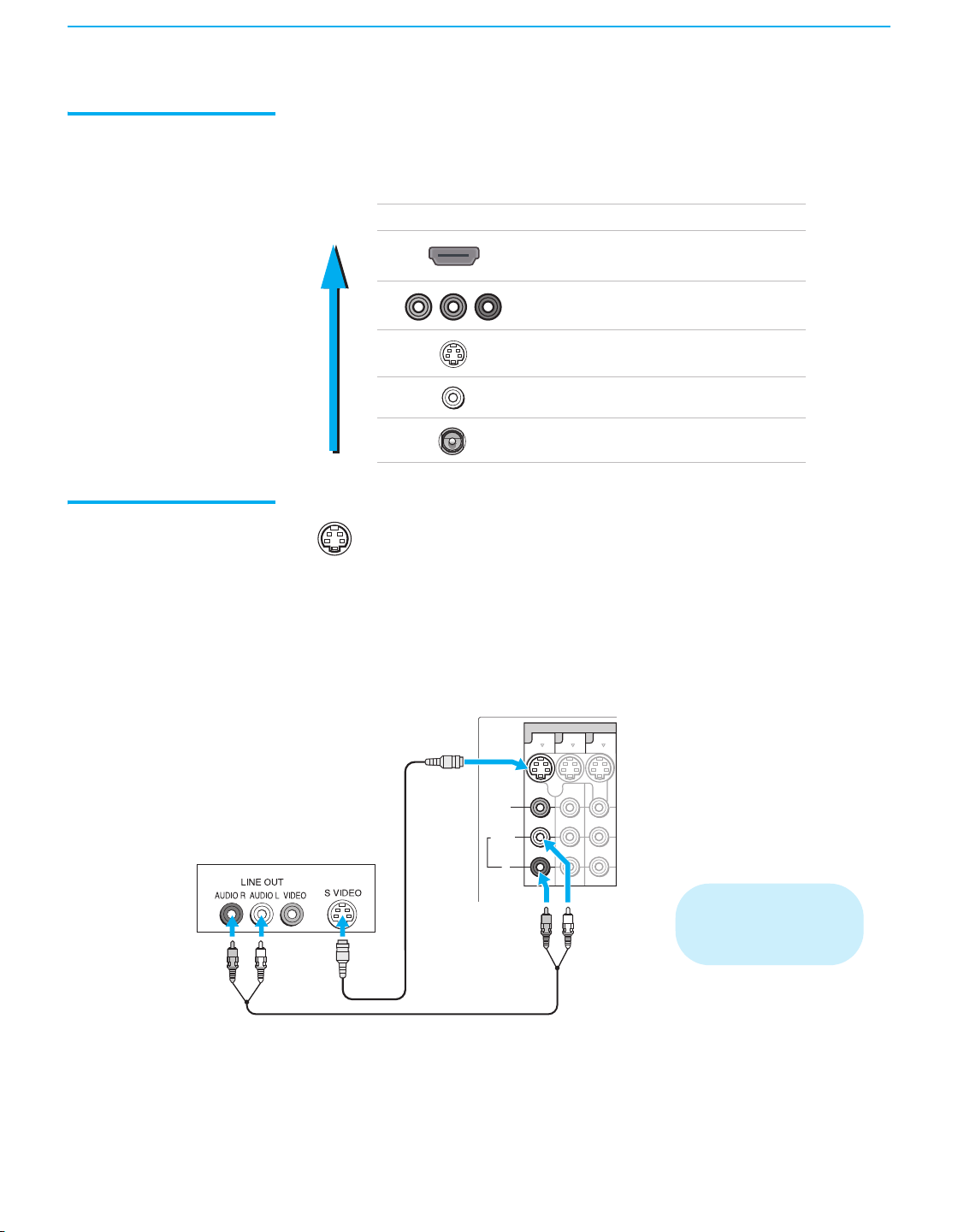
Your TV includes several types of video inputs. When connecting your TV,
use the inputs that are available on your components that provide the best
video performance, as described below.
About Using
SVIDEO
If the optional equipment you are connecting has an S VIDEO jack
(shown at left), you can use an S VIDEO cable for improved picture
quality (compared to an A/V cable). Because S VIDEO carries only
the video signal, you also need to connect audio cables for sound, as
shown below.
Example of an S VIDEO Connection
Best Video
Performance
Connector Type
HDMI (High-Definition
Multimedia Interface)
Component video
S VIDEO
Composite video
RF/Coaxial
VIDEO IN
S VIDEO
VIDEO
AUDIO
L
(MONO)
R
1 3 4
Cables are often
color-coded to connectors.
Connect red to red,
white to white, etc.
Rear of LCD projection TV
S VIDEO
cable
Equipment with S VIDEO
Audio cable
01COV.book Page 38 Thursday, February 17, 2005 8:01 PM
Setting Up the LCD Projection TV
39
Setting Up the LCD Projection TV
KDF-WE/WF655
2-059-370-14 (2)
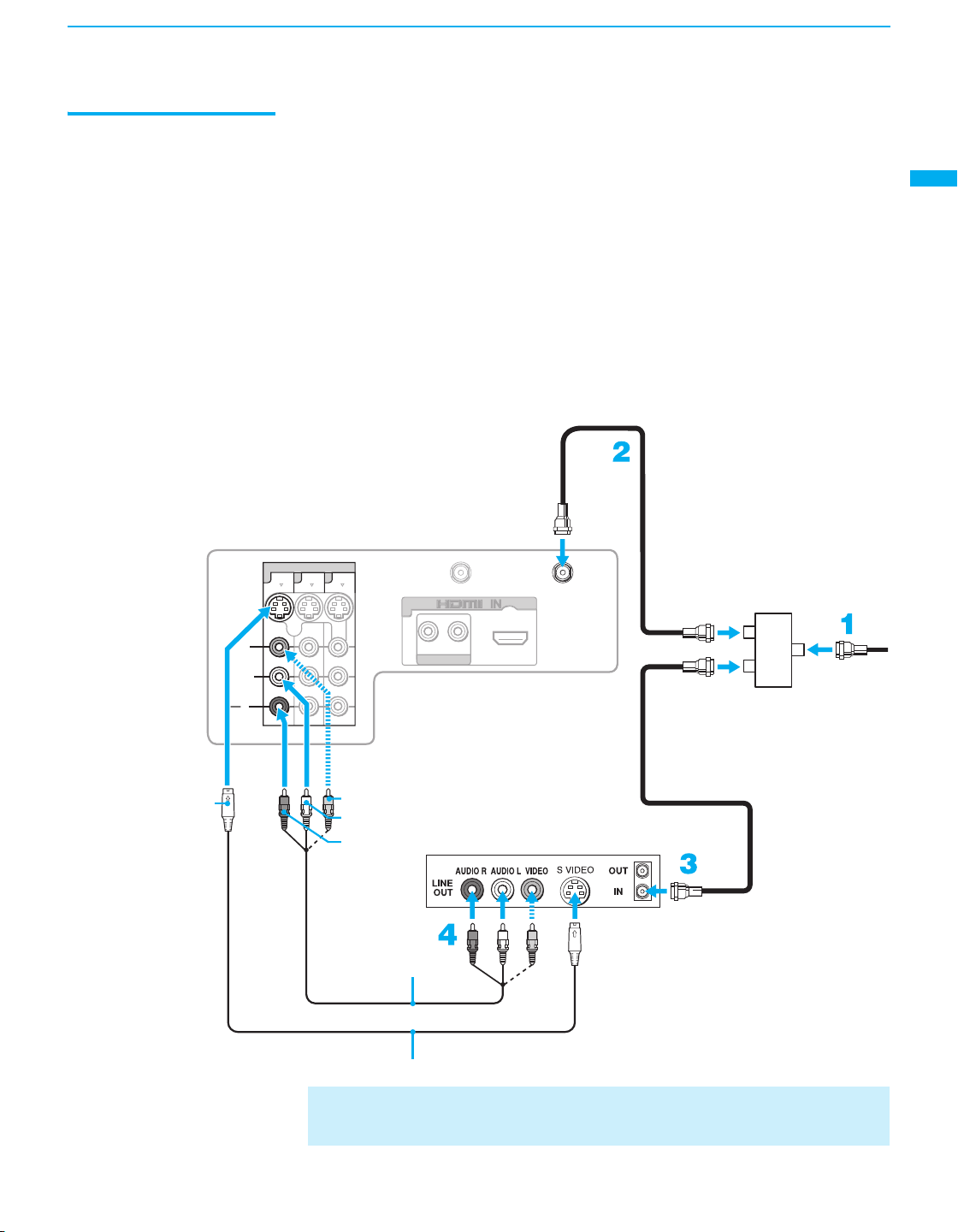
VCR and Cable Use this hookup if:
❑ You have cable TV that does not require a cable box.
Disconnect all power sources before making any connections.
1 Connect the CATV cable to the single (input) jack of the splitter.
2 Using a coaxial cable, connect one of the output jack of the splitter to
the LCD projection TV’s CABLE jack.
3 Using a coaxial cable, connect the splitter’s other output jack to the
VCR’s input jack.
4 Using A/V and S VIDEO cables, connect the VCR’s AUDIO and
S VIDEO OUT jacks to the LCD projection TV’s AUDIO and S VIDEO
IN jacks.
VHF
/U
H
F
C
ABL
E
RL
AUDIO IN
VIDEO IN
S VIDEO
VIDEO
AUDIO
L
(MONO)
R
1 3 4
7
Coaxial cable
Rear of LCD projection TV
VIDEO (yellow)
AUDIO-L (white)
AUDIO-R (red)
CATV cable
VCR
A/V cable
(not supplied)
S VIDEO
S VIDEO cable (not supplied)
Coaxial cable
✍ If your VCR is not equipped with S VIDEO, use a VIDEO cable (yellow)
instead of the S VIDEO cable.
01COV.book Page 39 Thursday, February 17, 2005 8:01 PM

Setting Up the LCD Projection TV
40
KDF-WE/WF655
2-059-370-14 (2)
VCR and Cable Box Use this hookup if:
❑ Your cable TV company scrambles some channels, but not all of them
(pay channels vs. regular cable channels) and you need to use a cable
box.
❑ You want to enjoy the Twin View feature.
With this setup you can:
❑ Use the LCD projection TV’s remote control to change channels on
your cable box when the signal is scrambled. To program your Sony
remote control to operate your cable box, see “Programming the
Remote Control” on page 62.
❑ Use the LCD projection TV’s remote control to change channels on
your LCD projection TV when the signal is not scrambled. Your LCD
projection TV’s tuner provides a better signal than the cable box.
❑ Use the Twin View feature. (When all channels are routed through your
cable box, only one signal is sent to the LCD projection TV, so you
cannot use the Twin View feature.)
Disconnect all power sources before making any connections.
1 Connect the CATV cable to the single (input) jack of the splitter.
2 Using a coaxial cable, connect one of the splitter’s two output jacks to
the LCD projection TV’s CABLE jack.
3 Using a coaxial cable, connect the splitter’s other output jack to the
cable box’s input jack.
4 Using a coaxial cable, connect the cable box’s output jack to the VCR’s
RF input jack.
5 Using an A/V cable, connect the cable box’s A/V output jacks to the
LCD projection TV’s A/V input jacks.
6
Using an A/V and S VIDEO cables, connect the VCR’s AUDIO and
S VIDEO OUT jacks to the LCD projection TV’s AUDIO and S
VIDEO IN input jacks.
7 Run Auto Program, as described in “Setting Up the LCD Projection TV
Channel List” on page 58.
Before connecting a
cable box, see “Using
CableCARD” on page 56.
✍ To view scrambled channels, tune the LCD projection TV to the channel
the cable box is set to (usually channel 3 or 4) and then use the cable
box to switch channels.
01COV.book Page 40 Thursday, February 17, 2005 8:01 PM
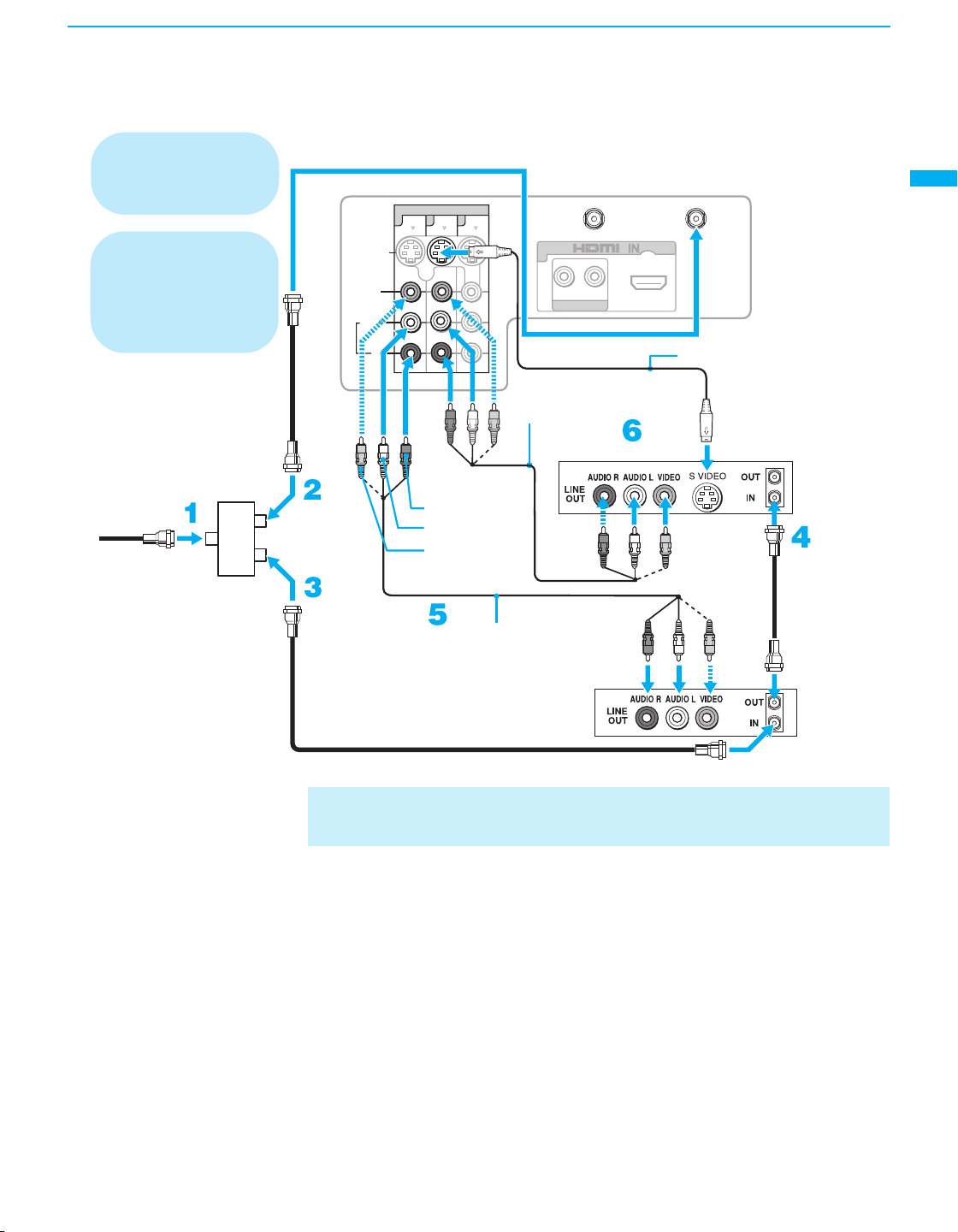
Setting Up the LCD Projection TV
41
Setting Up the LCD Projection TV
KDF-WE/WF655
2-059-370-14 (2)
VHF
/U
H
F
C
ABL
E
RL
AUDIO IN
VIDEO IN
S VIDEO
VIDEO
AUDIO
L
(MONO)
R
1 3 4
7
Cable box
VCR
Rear of LCD projection TV
A/V cable
(not supplied)
Coaxial
cable
AUDIO-R (red)
AUDIO-L (white)
VIDEO (yellow)
S VIDEO cable
(not supplied)
CATV
cable
Coaxial
cable
Splitter
Cables are often
color-coded to connectors.
Connect red to red,
white to white, etc.
If you are connecting a
digital cable box, you will
need a special bi-
directional splitter
designed to work with
your cable box.
Coaxial cable
A/V cable
(not supplied)
✍ If your VCR is not equipped with S VIDEO, use a VIDEO cable (yellow)
instead of the S VIDEO cable.
01COV.book Page 41 Thursday, February 17, 2005 8:01 PM
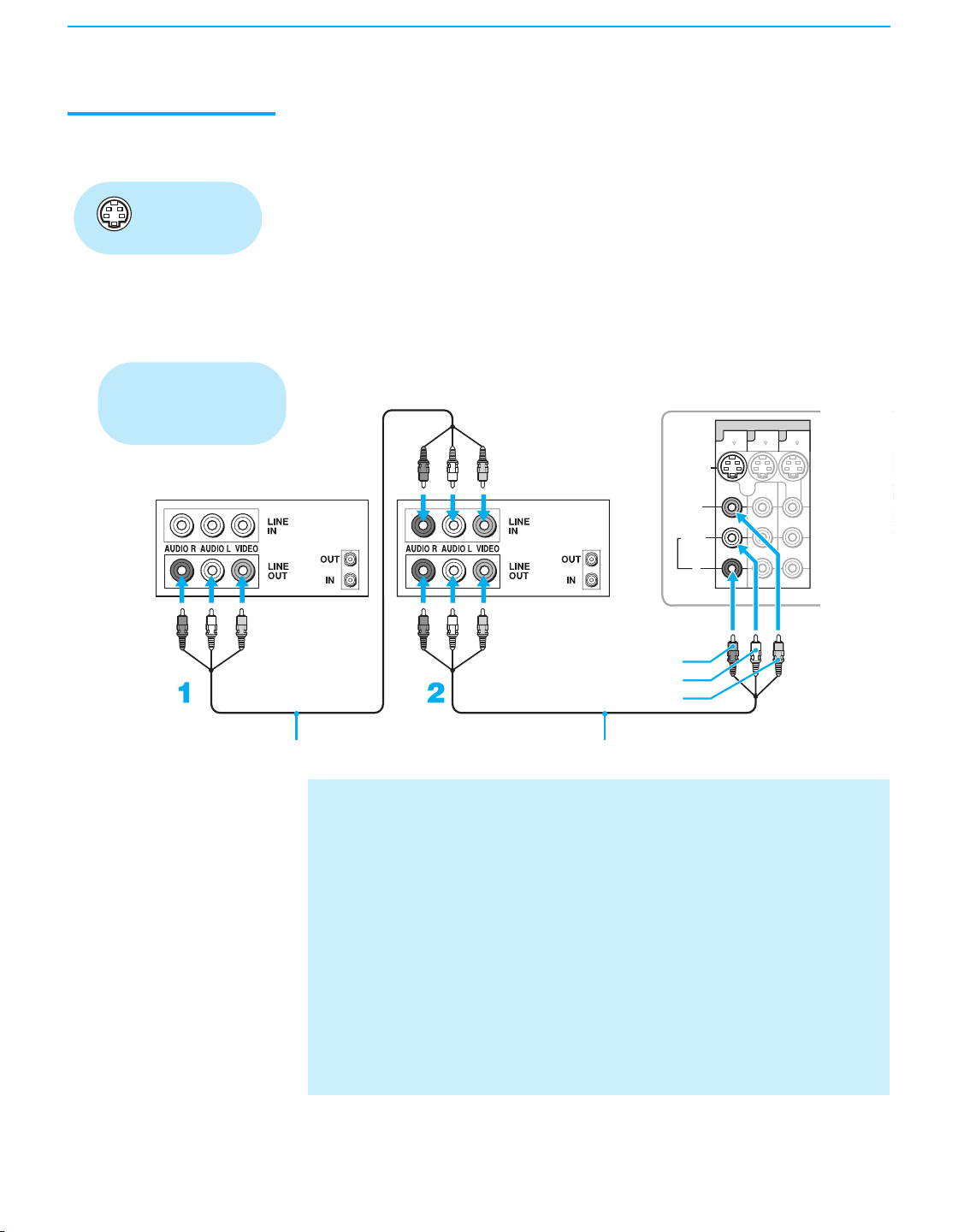
Setting Up the LCD Projection TV
42
KDF-WE/WF655
2-059-370-14 (2)
Two VCRs for Tape
Editing
If you connect two VCRs, you can record from one VCR to the other while
using your LCD projection TV to monitor what is being recorded.
Disconnect all power sources before making any connections.
1 Using A/V cables, connect the playback VCR’s AUDIO and VIDEO
OUT jacks to the recording VCR’s AUDIO and VIDEO IN jacks.
2 Using A/V cables, connect the recording VCR’s AUDIO and VIDEO
OUT jacks to the LCD projection TV’s AUDIO and VIDEO IN jacks.
Using
S VIDEO jacks?
See page 38.
7
VIDEO IN
S VIDEO
VIDEO
AUDIO
L
(MONO)
R
1 3 4
Rear of LCD projection TV
VCR (playback)
VCR (recording)
A/V cable (not supplied)
AUDIO-R (red)
AUDIO-L (white)
VIDEO (yellow)
A/V cable (not supplied)
Cables are often
color-coded to connectors.
Connect red to red,
white to white, etc.
✍ To perform tape editing, set the LCD projection TV to the video input
intended for playback by pressing TV/VIDEO on the remote control.
✍ You may need to change the video input on your VCR. Consult your
VCR’s operating manual for instructions.
✍ If your VCRs have S VIDEO jacks: For best picture quality, use an
S VIDEO connection instead of the yellow video cable on your combined
A/V cable.
Using an S VIDEO cable, connect the playback VCR’s S VIDEO OUT jack
to the recording VCR’s S VIDEO IN jack. S VIDEO does not provide
audio, so audio cables must be connected to provide sound.
✍ You cannot record signals from equipment connected to the Y, PB, PR
input.
01COV.book Page 42 Thursday, February 17, 2005 8:01 PM
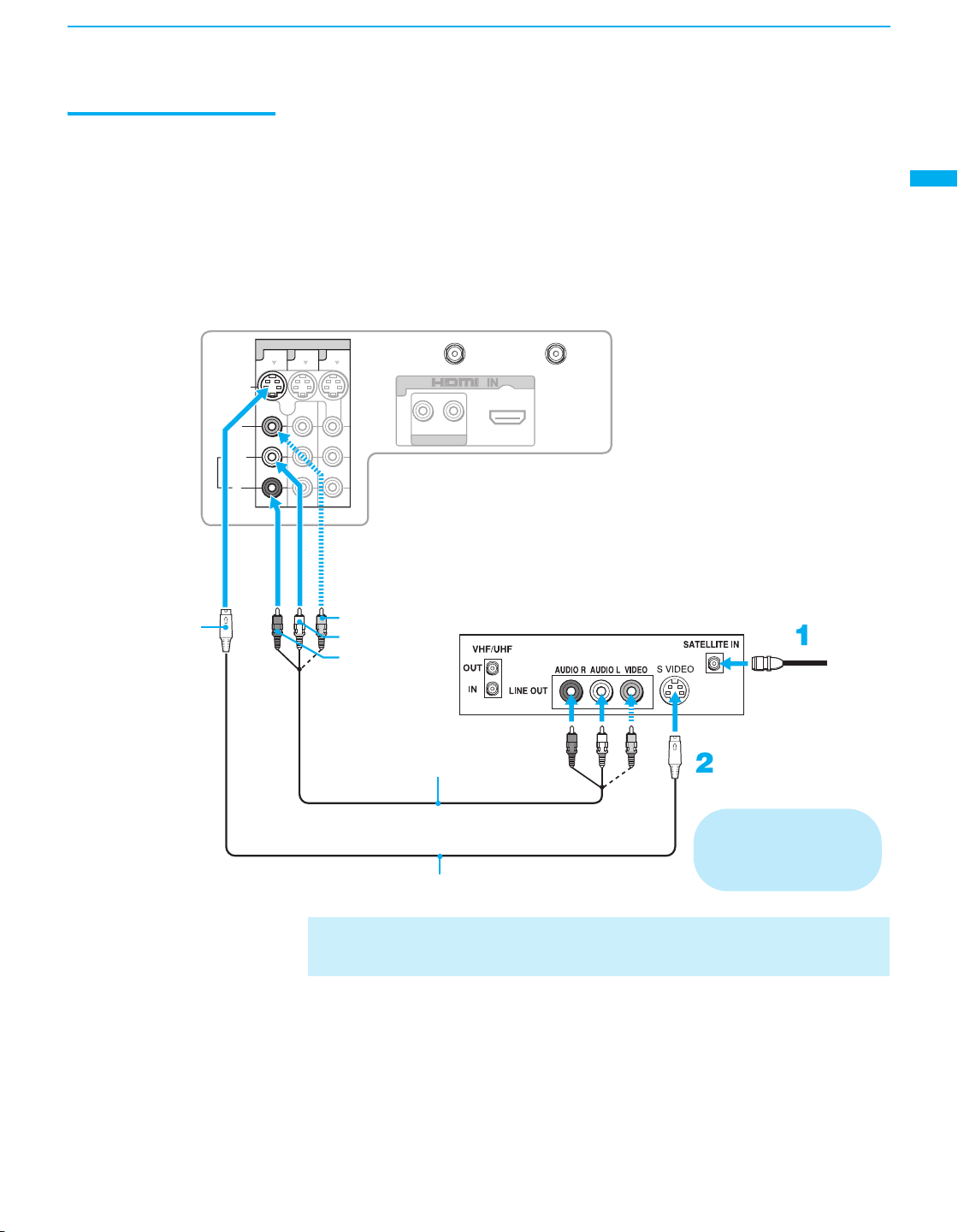
Setting Up the LCD Projection TV
43
Setting Up the LCD Projection TV
KDF-WE/WF655
2-059-370-14 (2)
Satellite Receiver Disconnect all power sources before making any connections.
1 Connect the satellite antenna cable to the satellite receiver’s
SATELLITE IN jack.
2 Using A/V and S VIDEO cables, connect the satellite receiver’s AUDIO
and S VIDEO OUT jacks to the LCD projection TV’s AUDIO and S
VIDEO IN jacks.
VHF
/U
H
F
C
ABL
E
RL
AUDIO IN
VIDEO IN
S VIDEO
VIDEO
AUDIO
L
(MONO)
R
1 3 4
7
Satellite receiver
A/V cable (not supplied)
Rear of LCD projection TV
VIDEO (yellow)
AUDIO-L (white)
AUDIO-R (red)
Satellite
antenna
cable
S VIDEO
S VIDEO cable (not supplied)
Cables are often
color-coded to connectors.
Connect red to red,
white to white, etc.
✍ If your satellite receiver is not equipped with S VIDEO, use a VIDEO cable
(yellow) instead of the S VIDEO cable.
01COV.book Page 43 Thursday, February 17, 2005 8:01 PM

Setting Up the LCD Projection TV
44
KDF-WE/WF655
2-059-370-14 (2)
Satellite Receiver
with a VCR and
Cable
Disconnect all power sources before making any connections.
1 Connect the CATV cable to the single (input) jack of the splitter.
2 Using a coaxial cable, connect one of the splitter’s two output jacks to
the LCD projection TV’s CABLE jack.
3 Using a coaxial cable, connect the splitter’s other output jack to the
VCR’s VHF/UHF IN jack.
4 Connect the satellite antenna cable to the satellite receiver’s
SATELLITE IN jack.
5 Using A/V and S VIDEO cables, connect the satellite receiver’s AUDIO
and S VIDEO OUT jacks to the VCR’s AUDIO and S VIDEO IN jacks.
6 Using A/V and S VIDEO cables, connect the VCR’s AUDIO and S
VIDEO OUT jacks to the LCD projection TV’s AUDIO and S VIDEO
IN jacks.
7 Run Auto Program, as described in “Setting Up the LCD Projection TV
Channel List” on page 58.
01COV.book Page 44 Thursday, February 17, 2005 8:01 PM
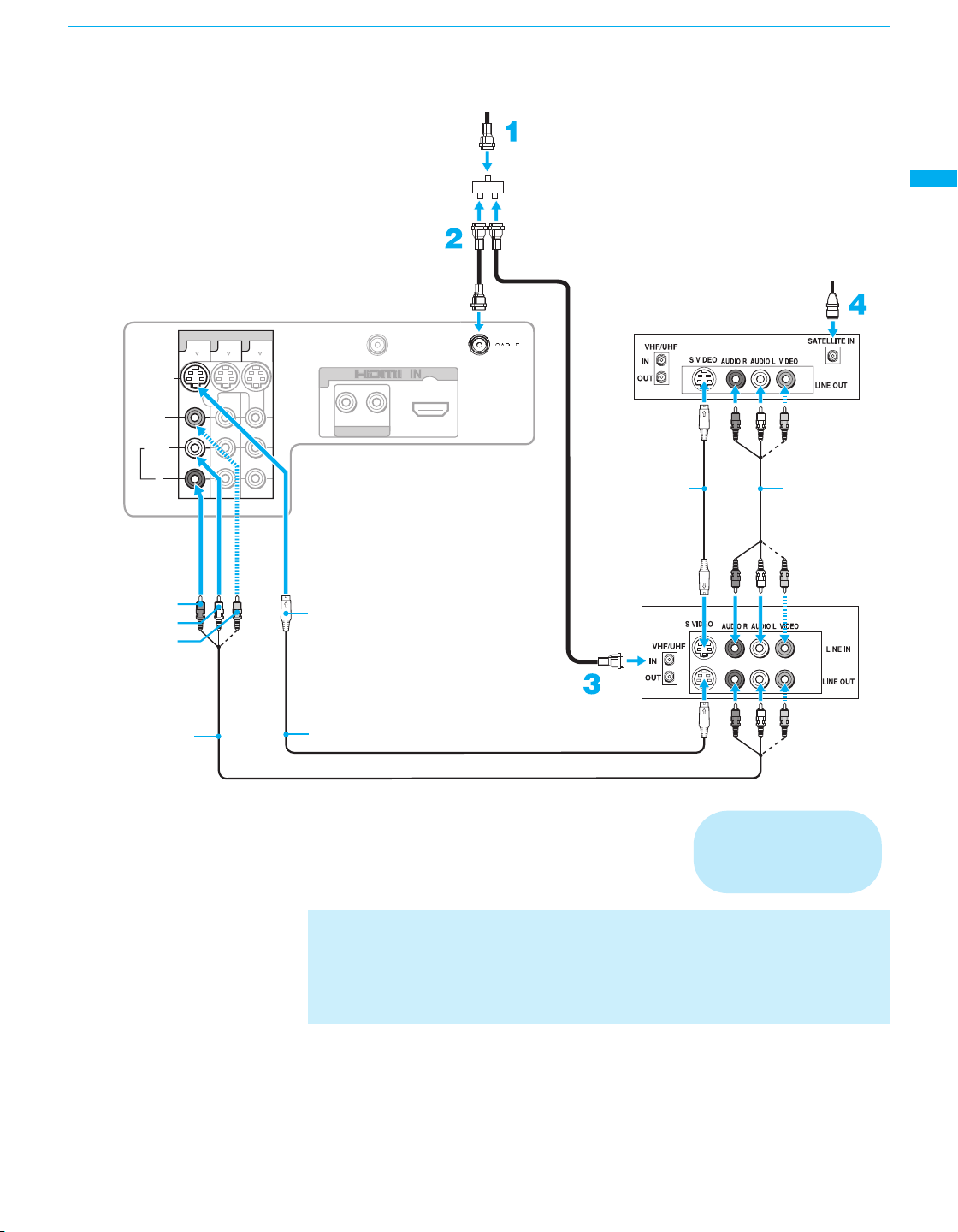
Setting Up the LCD Projection TV
45
Setting Up the LCD Projection TV
KDF-WE/WF655
2-059-370-14 (2)
VHF
/U
H
F
CABLE
RL
AUDIO IN
VIDEO IN
S VIDEO
VIDEO
AUDIO
L
(MONO)
R
1 3 4
7
5
6
Coaxial cable
Rear of LCD projection TV
S VIDEO
AUDIO-R (red)
AUDIO-L (white)
VIDEO (yellow)
Satellite receiver
VCR
S VIDEO cable
(not supplied)
A/V cable
(not supplied)
A/V cable
(not supplied)
Satellite
antenna
cable
S VIDEO cable (not supplied)
Cables are often
color-coded to connectors.
Connect red to red,
white to white, etc.
CATV cable
Splitter
Coaxial
cable
✍ Be sure your VCR’s video input is set correctly. Consult your VCR’s
operating manual for instructions.
✍ If your VCR or satellite receiver is not equipped with S VIDEO, use a
VIDEO cable (yellow) instead of the S VIDEO cable.
01COV.book Page 45 Thursday, February 17, 2005 8:01 PM
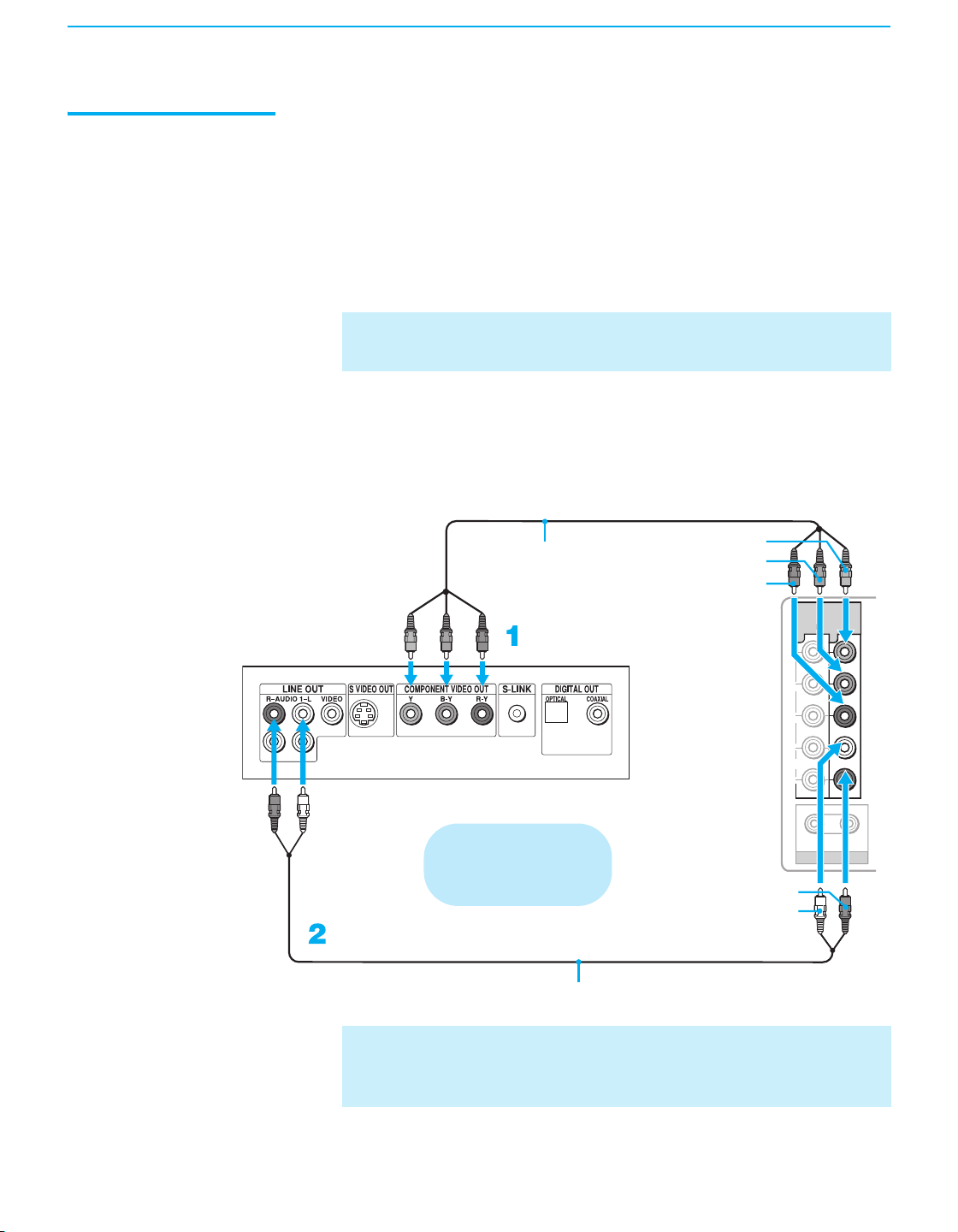
Setting Up the LCD Projection TV
46
KDF-WE/WF655
2-059-370-14 (2)
DVD Player with
Component
Video Connectors
Use this hookup if:
❑ Your DVD player has component (Y, B-Y, R-Y) jacks.
Disconnect all power sources before making any connections.
1 Using a component video cable, connect the DVD player’s Y, B-Y and
R-Y jacks to the LCD projection TV’s Y, P
B and PR jacks. Use the HD/
DVD IN 5 or 6 connections.
2 Using an audio cable, connect the DVD player’s AUDIO OUT jacks to
the LCD projection TV’s AUDIO IN jacks. Be sure to use the same row
of inputs that you used for the video connection (HD/DVD IN 5 or 6).
✍ The Y, B-Y and R-Y jacks on your DVD player are sometimes labeled
Y, C
B and CR, or Y, PB and PR. If so, connect the cables to like colors.
IN OUT
Y
P
B
P
L
R
AUDIO
R
HD/DVD IN
(1080i/720p/
480p/480i)
5 6
CONTROL S
Component video cable
(not supplied)
Rear of LCD projection TV
Audio cable (not supplied)
DVD player
AUDIO-R (red)
AUDIO-L (white)
Y
P
B
PR
Cables are often
color-coded to connectors.
Connect red to red,
white to white, etc.
✍ To take advantage of the Wide Mode, set the DVD player’s aspect
ratio to 16:9. For details, refer to the operating instructions supplied
with your DVD player.
01COV.book Page 46 Thursday, February 17, 2005 8:01 PM
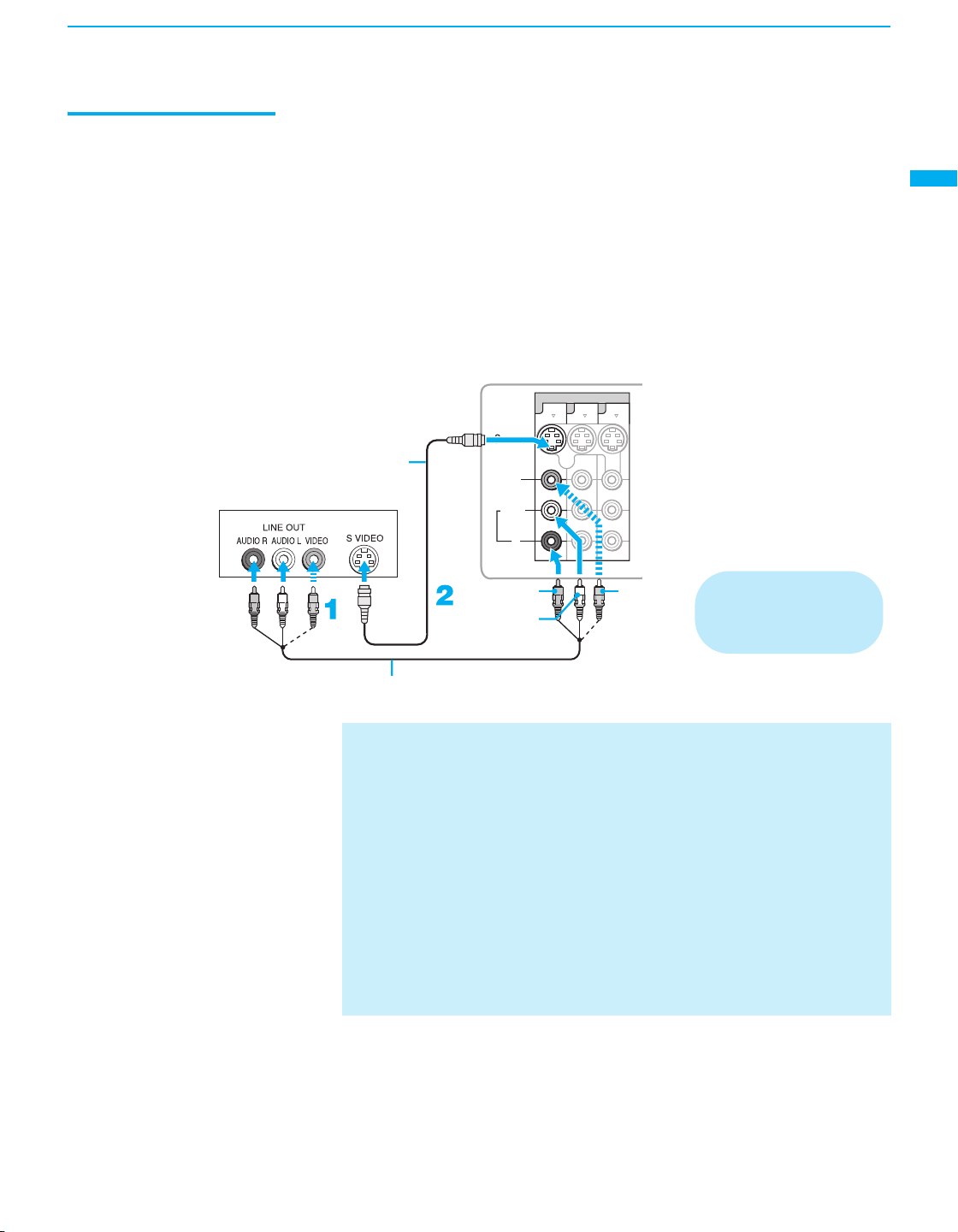
Setting Up the LCD Projection TV
47
Setting Up the LCD Projection TV
KDF-WE/WF655
2-059-370-14 (2)
DVD Player with
S VIDEO and Audio
Connectors
Use this hookup if:
❑ Your DVD player does not have component (Y, B-Y, R-Y) jacks.
Disconnect all power sources before making any connections.
1 Using an audio cable, connect the DVD player’s AUDIO OUT jacks to
the LCD projection TV’s AUDIO IN jacks.
2 Using a S VIDEO cable, connect the DVD player’s S VIDEO jack to the
LCD projection TV’s S VIDEO jack.
VHF/UHF
7
CABLE
VIDEO IN
S VIDEO
VIDEO
AUDIO
L
(MONO)
R
1 3 4
Cables are often
color-coded to connectors.
Connect red to red,
white to white, etc.
DVD player
Rear of LCD projection TV
Audio cable (not supplied)
S VIDEO
cable
S VIDEO
AUDIO-R
(red)
AUDIO-L
(white)
VIDEO
(yellow)
✍ If your DVD player is not equipped with S VIDEO, use a VIDEO cable
(yellow) instead of the S VIDEO cable.
✍ To watch the DVD player, press TV/VIDEO repeatedly to select the
DVD input (VIDEO 1 in the illustration). If you have a non-Sony DVD
player, and want to set up the TV remote control to operate the DVD
player you must program the remote control. See “Programming the
Remote Control” on page 62.
✍ To control DVD functions with the TV remote control, see “Operating
a DVD Player or DVD Changer” on page 65.
✍ Label video inputs to easily identify equipment connected to the TV.
See the instructions for setting up Video Labels on page 113.
01COV.book Page 47 Thursday, February 17, 2005 8:01 PM
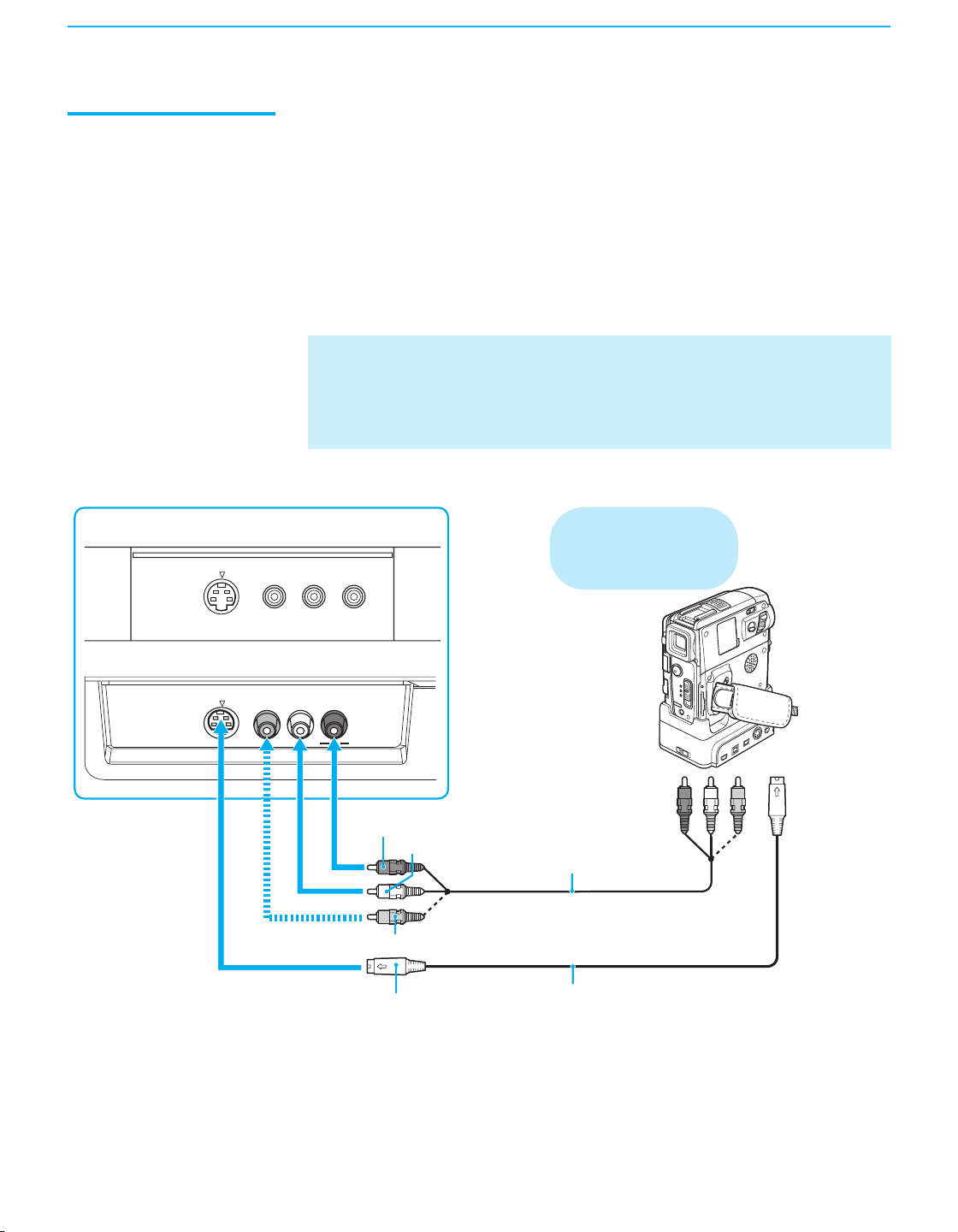
Setting Up the LCD Projection TV
48
KDF-WE/WF655
2-059-370-14 (2)
Camcorder Disconnect all power sources before making any connections.
For easy connection of the camcorder, the LCD projection TV has front
audio and video inputs (shown below). However, if you prefer, you can also
connect the camcorder to the LCD projection TV’s rear AUDIO and S
VIDEO IN jacks.
Using A/V and S VIDEO cables, connect the camcorder’s audio and
S VIDEO OUT jacks to the LCD projection TV’s AUDIO and S VIDEO IN
jacks.
✍ If you have a mono camcorder, connect its left audio output to the LCD
projection TV’s AUDIO L (MONO) jack.
✍ If your camcorder is not equipped with S VIDEO, use a VIDEO cable
(yellow) instead of the S VIDEO cable.
VIDEO 2 INPUT
S-VIDEO VIDEO
L(MONO) -AUDIO-R
VIDEO 2 INPUT
R AUDIOS VIDEO VIDEO L (MONO)
VIDEO (yellow)
To A/V output
AUDIO-L (white)
AUDIO-R (red)
S VIDEO
A/V cable
(not supplied)
S VIDEO cable
(not supplied)
Front of LCD projection TV
WE655 series
WF655 series
Cables are often
color-coded to connectors.
Connect red to red,
white to white, etc.
To S VIDEO
output
Camcorder
01COV.book Page 48 Thursday, February 17, 2005 8:01 PM
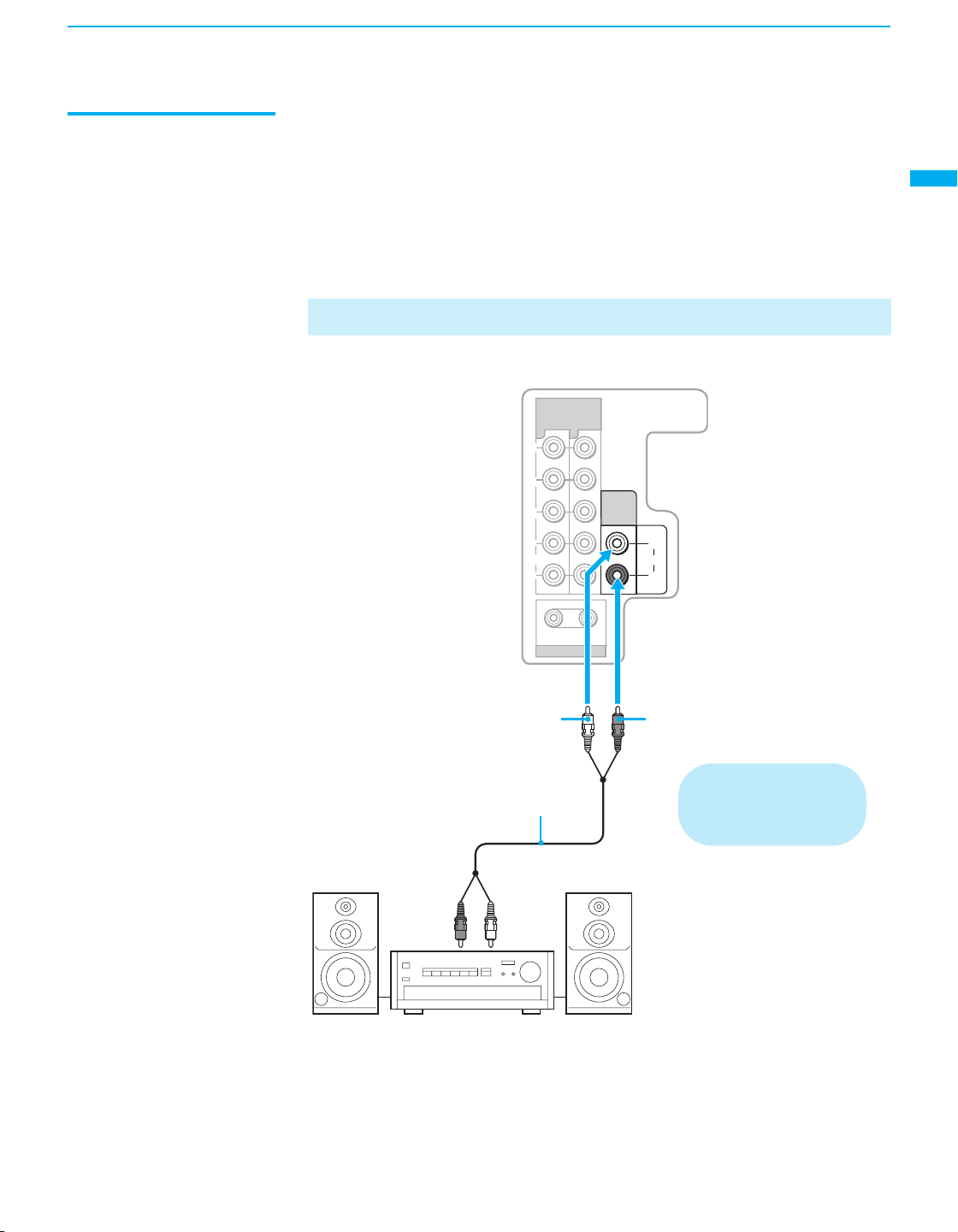
Setting Up the LCD Projection TV
49
Setting Up the LCD Projection TV
KDF-WE/WF655
2-059-370-14 (2)
Audio Receiver For improved sound quality, you may want to play the TV’s audio through
your stereo system ( see page 103).
Disconnect all power sources before making any connections.
Using A/V cables, connect the LCD projection TV’s AUDIO OUT (VAR/
FIX) jacks to the audio receiver’s audio LINE IN jacks.
✍ AUDIO OUT jacks are operable only when the TV’s Speaker is set to Off.
IN OUT
Y
P
B
P
L
R
AUDIO
R
AUDIO
L
R
HD/DVD IN
(1080i/720p/
480p/480i)
56
AUDIO
OUT
(VAR/FIX)
CONTROL S
Rear of LCD projection TV
AUDIO-L
(white)
AUDIO-R
(red)
A/V cable
(not supplied)
Line
input
Cables are often
color-coded to connectors.
Connect red to red,
white to white, etc.
Audio receiver
01COV.book Page 49 Thursday, February 17, 2005 8:01 PM
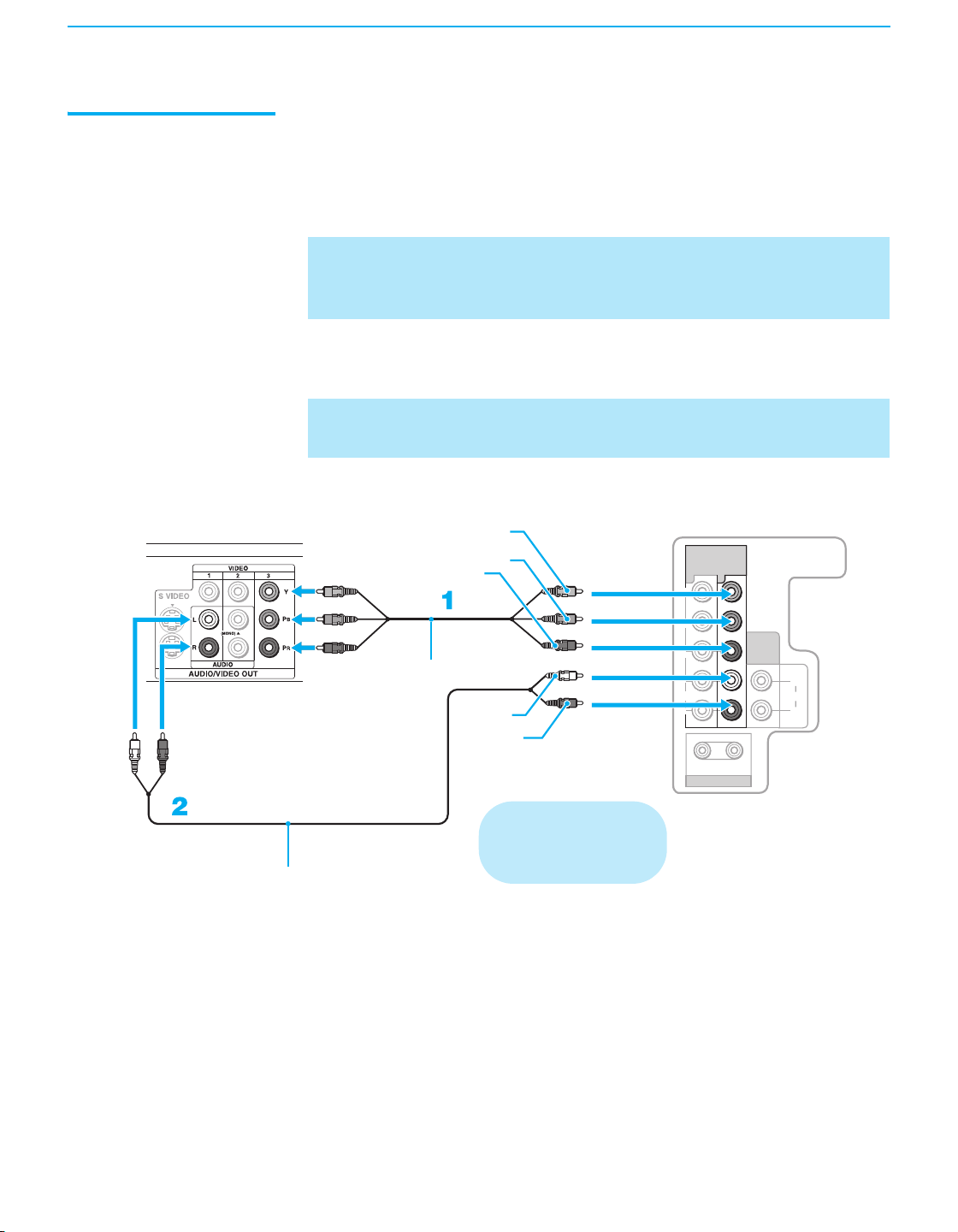
Setting Up the LCD Projection TV
50
KDF-WE/WF655
2-059-370-14 (2)
Digital Cable Box Disconnect all power sources before making any connections.
1 Using a component video cable, connect the Digital Cable Box’s Y, PB
and PR jacks to the LCD projection TV’s Y, PB and PR jacks. Use the
HD/DVD IN 5 or 6 connections.
2 Using an audio cable, connect the Digital Cable Box’s AUDIO OUT
jacks to the LCD projection TV’s AUDIO IN jacks.
✍ Component video (Y, PB, PR) connection is necessary to view 480p,
720p, and 1080i formats. Note that this TV displays all format types of
picture in a resolution of 1,368 dots x 768 lines.
✍ The Y, PB and PR jacks do not provide audio, so audio cables must be
connected to provide sound.
IN OUT
Y
P
B
P
L
R
AUDIO
R
AUDIO
L
R
HD/DVD IN
(1080i/720p/
480p/480i)
5 6
AUDIO
OUT
(VAR/FIX)
CONTROL S
Rear of LCD projection TV
Y
P
B
PR
AUDIO-L
(white)
AUDIO-R
(red)
Audio cable
(not supplied)
Digital cable box
Cables are often
color-coded to connectors.
Connect red to red,
white to white, etc.
Component video cable
(not supplied)
01COV.book Page 50 Thursday, February 17, 2005 8:01 PM
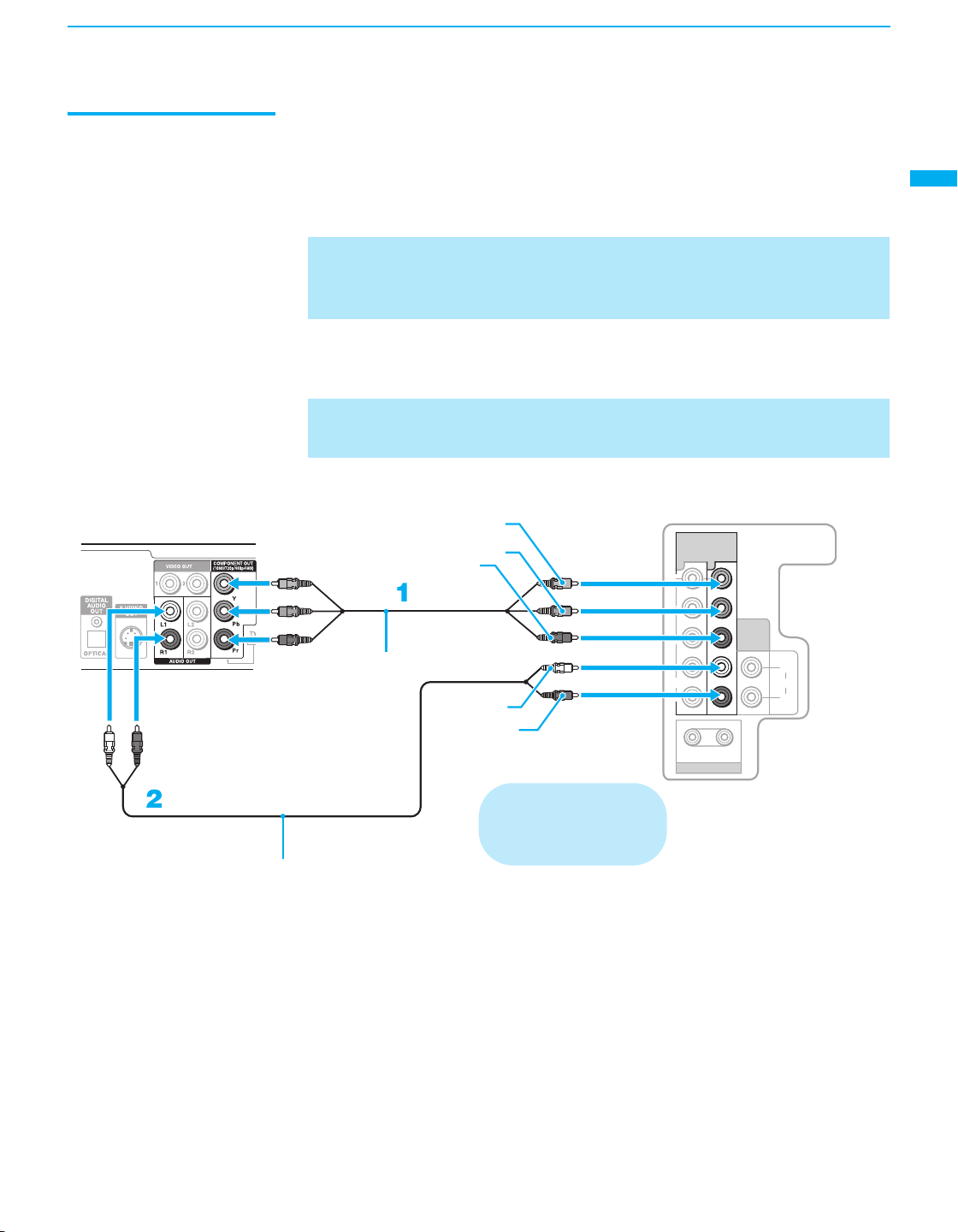
Setting Up the LCD Projection TV
51
Setting Up the LCD Projection TV
KDF-WE/WF655
2-059-370-14 (2)
Digital Satellite
Receiver
Disconnect all power sources before making any connections.
1 Using a component video cable, connect the Digital Satellite Receiver’s
Y, P
B and PR jacks to the LCD projection TV’s Y, PB and PR jacks. Use
the HD/DVD IN 5 or 6 connections.
2 Using an audio cable, connect the Digital Satellite Receiver’s AUDIO
OUT jacks to the LCD projection TV’s AUDIO IN jacks.
✍ Component video (Y, PB, PR) connection is necessary to view 480p,
720p, and 1080i formats. Note that this TV displays all format types of
picture in a resolution of 1,368 dots x 768 lines.
✍ The Y, PB and PR jacks do not provide audio, so audio cables must be
connected to provide sound.
IN OUT
Y
P
B
P
L
R
AUDIO
R
AUDIO
L
R
HD/DVD IN
(1080i/720p/
480p/480i)
5 6
AUDIO
OUT
(VAR/FIX)
CONTROL S
Rear of LCD projection TV
Y
P
B
PR
AUDIO-L
(white)
AUDIO-R
(red)
Audio cable
(not supplied)
Component video cable
(not supplied)
Digital satellite receiver
Cables are often
color-coded to connectors.
Connect red to red,
white to white, etc.
01COV.book Page 51 Thursday, February 17, 2005 8:01 PM
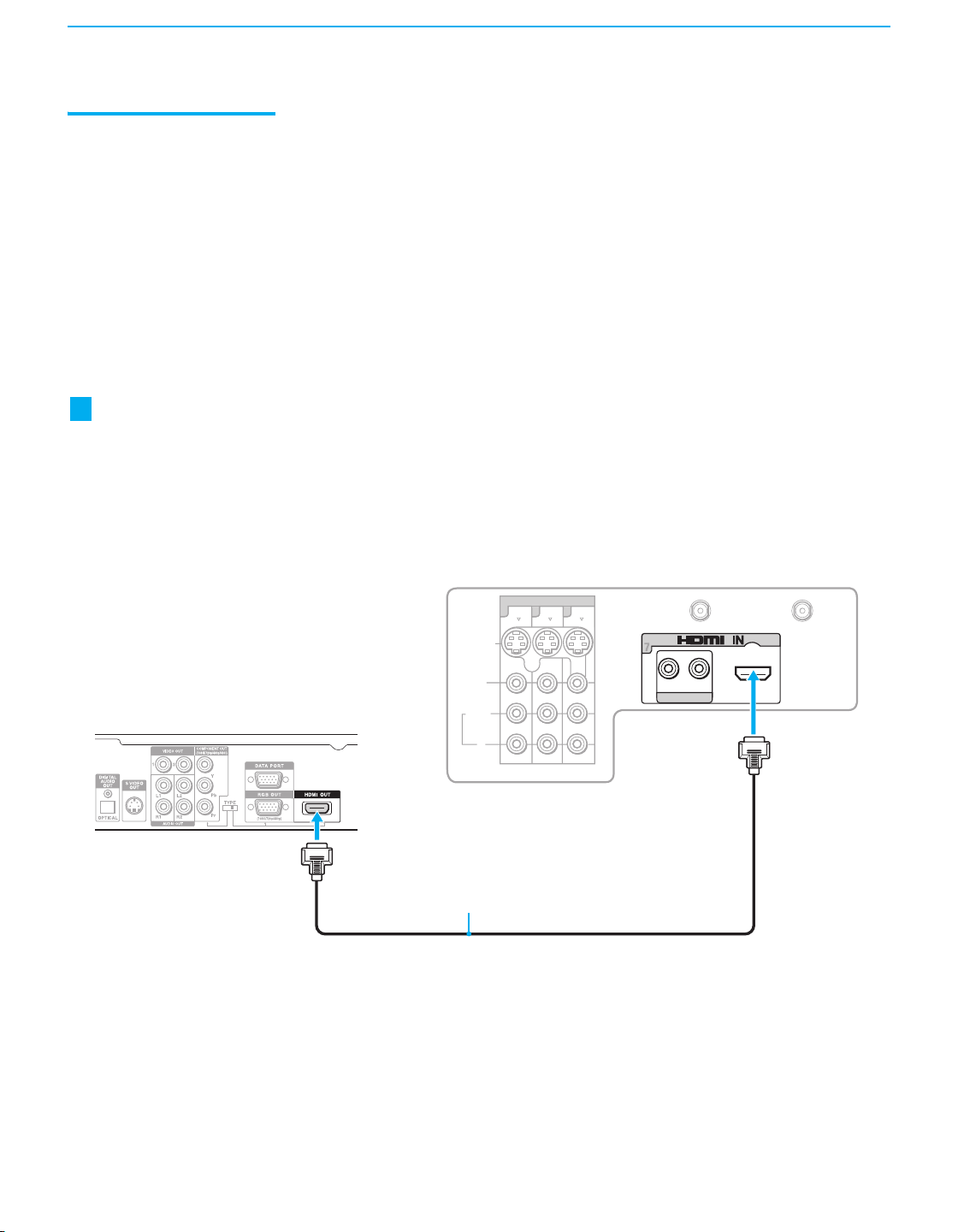
Setting Up the LCD Projection TV
52
KDF-WE/WF655
2-059-370-14 (2)
Digital Satellite
Receiver with HDMI
Connector
Use this hookup if:
❑ Your Digital Satellite Receiver has a High-Definition Multimedia
Interface (HDMI).
Disconnect all power sources before making any connections:
Using an HDMI cable (not supplied), connect the Digital Satellite Receiver’s
HDMI OUT jack to the LCD projection TV’s HDMI IN jack.
Use the HDMI IN 7 input connection.
The HDMI jack
provides both video
and audio signals, so it
is not necessary to
connect the audio
cable.
z
VHF/UHF CABLE
R L
AUDIO IN
S VIDEO
VIDEO
AUDIO
L
(MONO)
R
VIDEO IN
134
Rear of LCD projection TV
HDMI cable (not supplied)
Digital satellite receiver
01COV.book Page 52 Thursday, February 17, 2005 8:01 PM
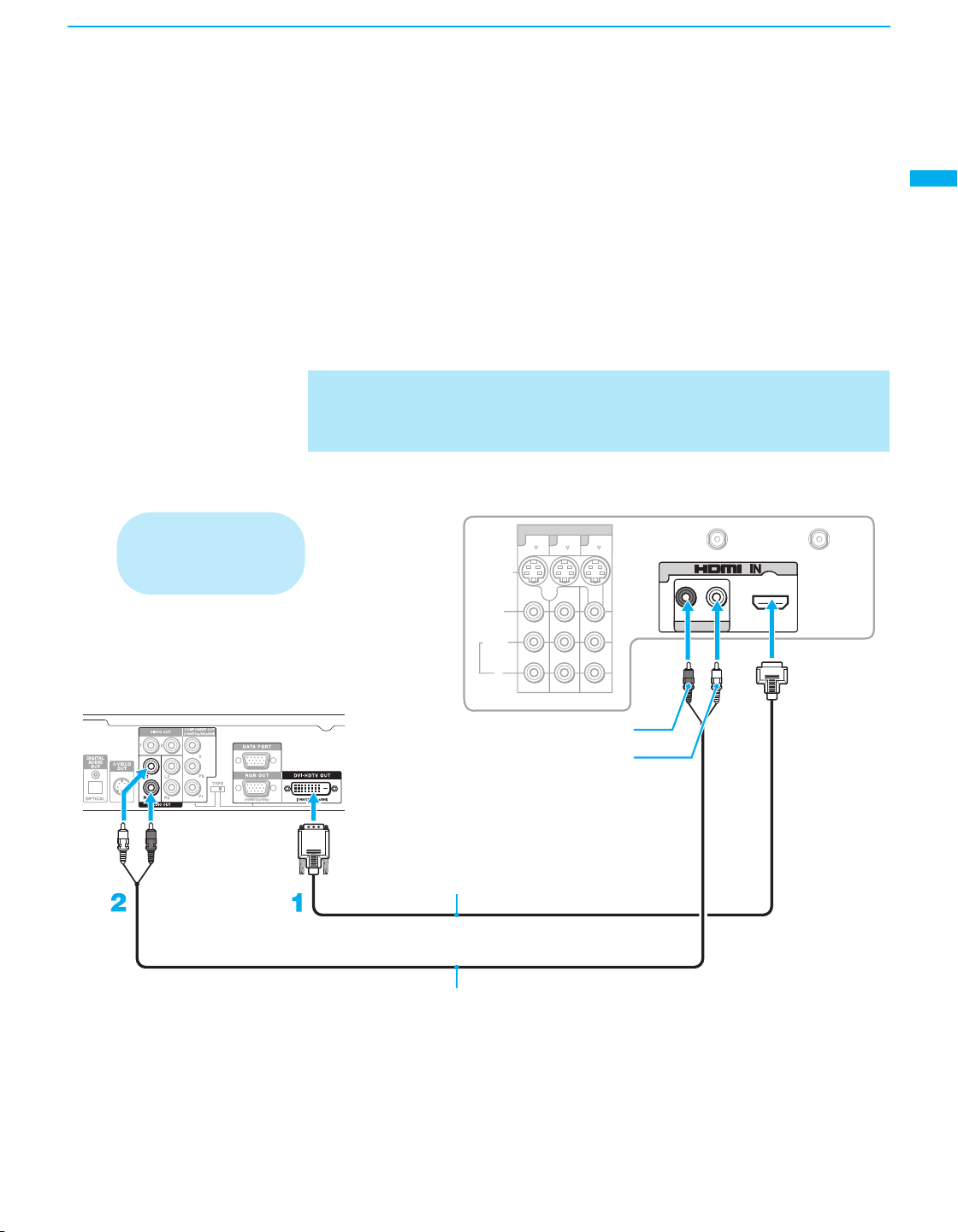
Setting Up the LCD Projection TV
53
Setting Up the LCD Projection TV
KDF-WE/WF655
2-059-370-14 (2)
When connecting to the Digital Satellite Receiver’s DVI-HDTV connector
If you are connecting to a digital satellite receiver with DVI-HDTV output,
you can connect to the LCD projection TV’s HDMI IN jack by using an
HDMI-to-DVI cable or an adaptor (both not supplied).
1 Using a HDMI cable (not supplied), connect the digital satellite
receiver’s DVI-HDTV OUT jack to the LCD projection TV’s HDMI IN
jack.
Use the HDMI IN 7 input connection.
2 Using an audio cable, connect the digital satellite receiver’s AUDIO
OUT jacks to the LCD projection TV’s AUDIO IN jacks.
✍ The DVI-HDTV VIDEO jack does not provide audio, so audio cables must
be connected to provide sound when an HDMI to DVI-HDTV adapter (not
supplied) is used.
VHF/UHF CABLE
R L
AUDIO IN
S VIDEO
VIDEO
AUDIO
L
(MONO)
R
VIDEO IN
134
7
Rear of LCD projection TV
HDMI-to-DVI adapter or
cable (not supplied)
Audio cable
(not supplied)
Digital satellite receiver
AUDIO-R (red)
AUDIO-L (white)
Cables are often
color-coded to connectors.
Connect red to red,
white to white, etc.
01COV.book Page 53 Thursday, February 17, 2005 8:01 PM
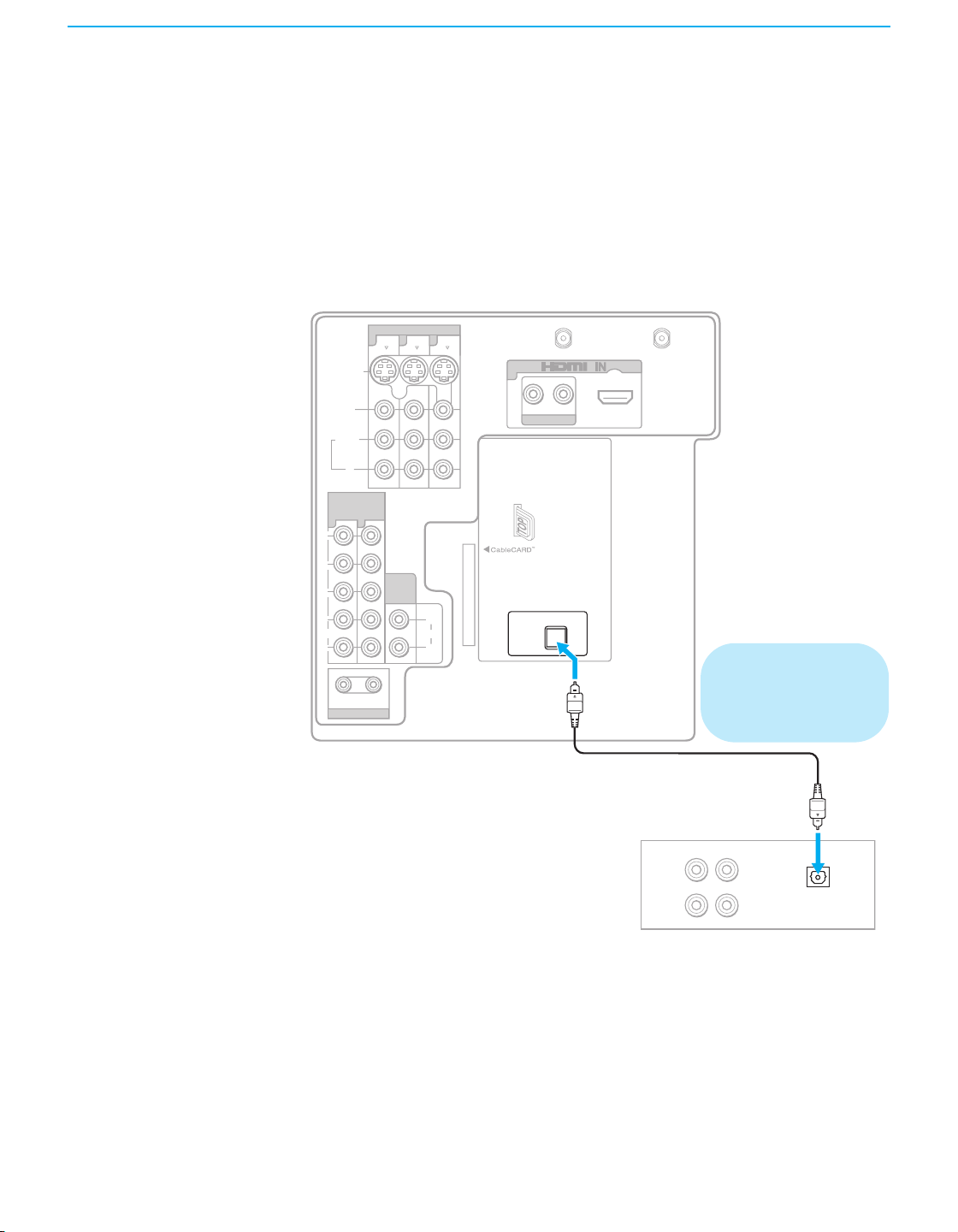
Setting Up the LCD Projection TV
54
KDF-WE/WF655
2-059-370-14 (2)
Connecting a Device with an Optical IN Connector
You can use the LCD Projection TV's DIGITAL AUDIO (OPTICAL) OUT
jack to connect a digital audio device that is PCM/Dolby digital compatible,
such as an audio amplifier.
Using an optical audio cable, connect the device's OPTICAL IN jack to the
LCD projection TV's DIGITAL AUDIO (OPTICAL) OUT jack.
VHF/UHF CABLE
S VIDEO
VIDEO
AUDIO
IN OUT
L
(MONO)
R
PCM/DOLBY DIGITAL
OUT
DIGITAL
AUDIO
(OPTICAL)
Y
P
B
P
L
R
AUDIO
R
AUDIO
L
R
HD/DVD IN
(1080i/720p/
480p/480i)
56
AUDIO
OUT
(VAR/FIX)
RL
AUDIO IN
VIDEO IN
134
7
CONTROL S
OPTICAL
IN
LINE
OUT
L AUDIO R
LINE
IN
Optical audio cable (not supplied)
Rear of LCD projection TV
Audio amplifier
The DIGITAL AUDIO
(OPTICAL) OUT jack is
available only when a
digital TV channel is
received.
01COV.book Page 54 Thursday, February 17, 2005 8:01 PM
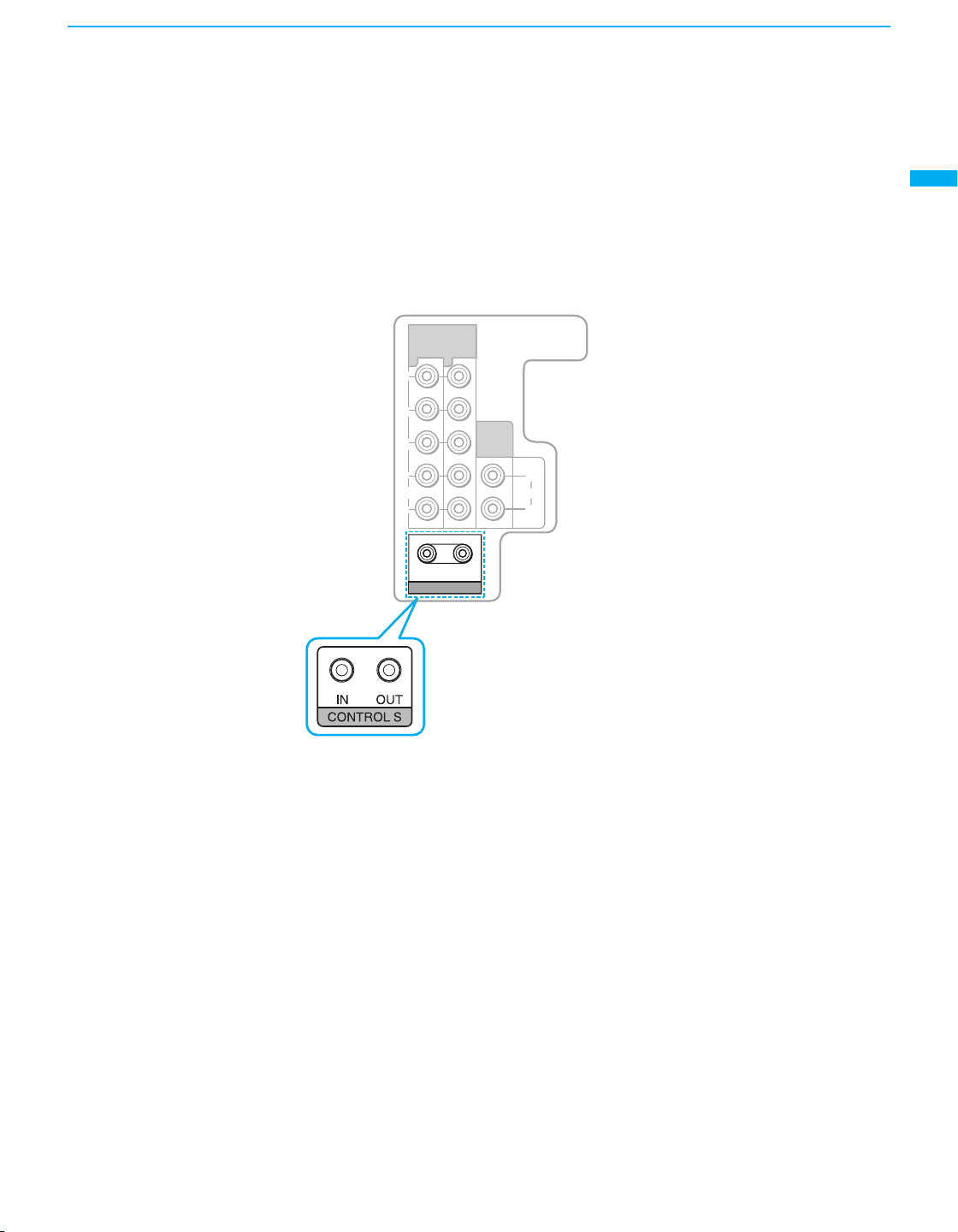
Setting Up the LCD Projection TV
55
Setting Up the LCD Projection TV
KDF-WE/WF655
2-059-370-14 (2)
Using the CONTROL S Feature
CONTROL S allows you to control your LCD projection TV system and
other Sony equipment with one remote control. In addition to allowing you
to control multiple devices with one remote control, the CONTROL S
feature allows you to always point your remote control at your LCD
projection TV, instead of having to point it at the other equipment, which
might be hidden or out of direct line of sight.
IN OUT
Y
P
B
P
L
R
AUDIO
R
AUDIO
L
R
HD/DVD IN
(1080i/720p/
480p/480i)
56
AUDIO
OUT
(VAR/FIX)
CONTROL S
Rear of LCD projection TV
01COV.book Page 55 Thursday, February 17, 2005 8:01 PM
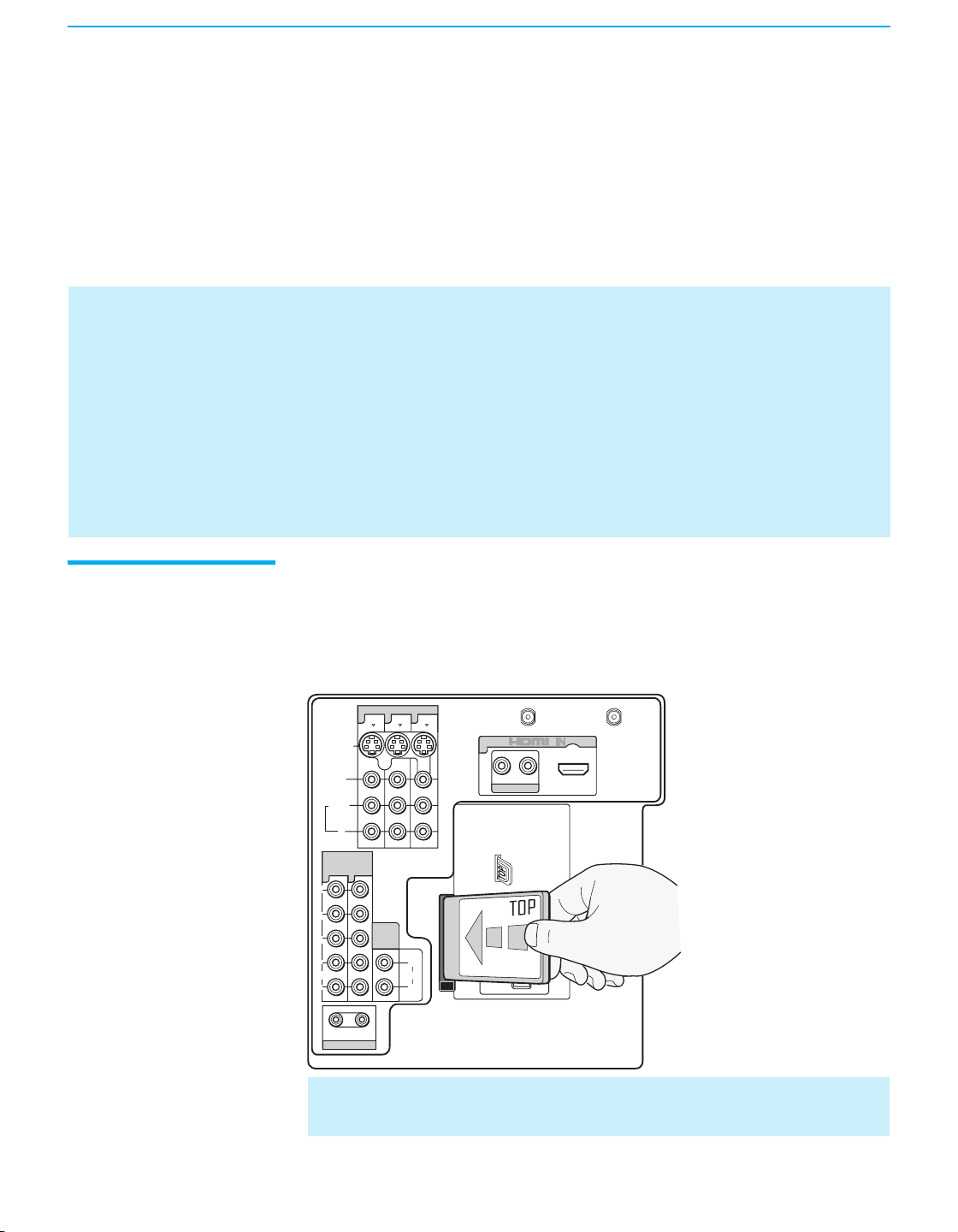
Setting Up the LCD Projection TV
56
KDF-WE/WF655
2-059-370-14 (2)
Using CableCARD
CableCARD provides cable subscribers with access to digitally encrypted
cable channels — without the need for a set-top box — that will enable you
to receive not only standard definition but also high definition television. The
CableCARD, which is provided by your cable TV company, is inserted into
the TV’s rear panel CableCARD slot. After the service is activated with your
cable TV company, the card replaces the need for a separate set-top box.
Activating
CableCARD Service
Before you can use CableCARD service, you need to insert the CableCARD
(supplied by your cable TV company) and activate the service, as described
below:
1 Insert the CableCARD into the TV’s CableCARD slot.
About Using CableCARD
If you are planning to use a separate cable box for digital cable TV services, you may be able to receive
programming using this TV with the CableCARD instead — except in the following circumstances:
❑ Your cable TV company does not provide CableCARD service in your viewing area.
❑ You want to access your cable TV company’s interactive or advanced features (such as video-on-
demand or, in some cases, pay-per-view). At this time, these services require a bidirectional link,
which are only available through the use of a separate set-top box. CableCARD is currently a
unidirectional device only, and cannot provide these advanced services.
Check with your cable TV company for CableCARD service details, limitations, pricing, and
availability, all of which are determined by your cable TV company — not Sony.
VHF/UHF CABLE
S VIDEO
VIDEO
AUDIO
Y
P
B
P
L
R
IN OUT
AUDIO
R
L
(MONO)
R
AUDIO
PCM/DOLBY DIGITAL
OUT
DIGITAL
AUDIO
(OPTICAL)
L
R
HD/DVD IN
(1080i/720p/
480p/480i)
56
AUDIO
OUT
(VAR/FIX)
RL
AUDIO IN
VIDEO IN
134
7
CONTROL S
✍ CAUTION: Inserting the CableCARD incorrectly may result in permanent
damage to the card and the TV.
01COV.book Page 56 Thursday, February 17, 2005 8:01 PM
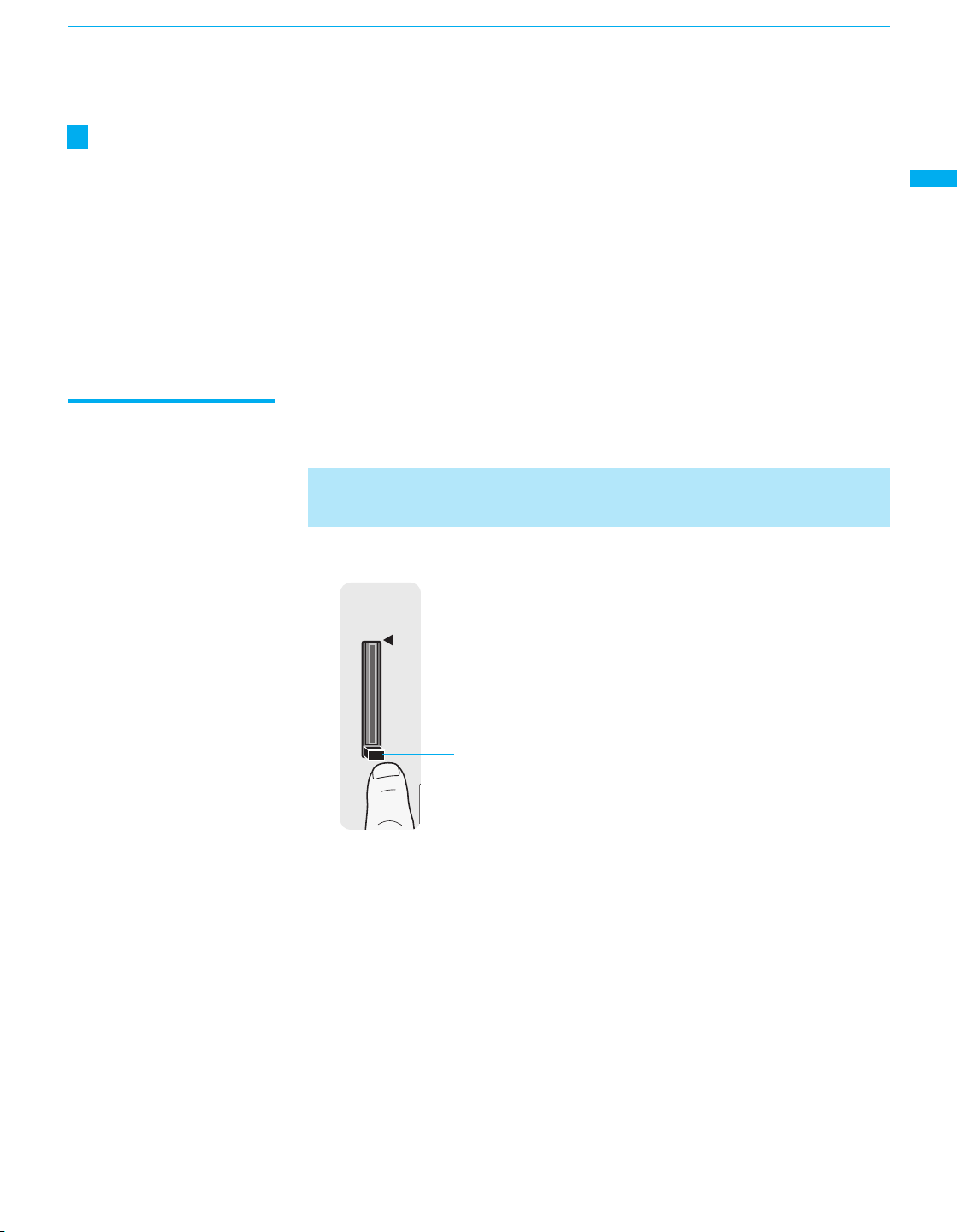
Setting Up the LCD Projection TV
57
Setting Up the LCD Projection TV
KDF-WE/WF655
2-059-370-14 (2)
2 Gently push the card into the slot until it locks into place.
3 After 1-2 minutes, the CableCARD setup screen is automatically
displayed. This screen includes information your cable TV company
will request before they can activate your service.
4 Follow the displayed instructions: Phone your cable TV company. A
representative will guide you through the activation process.
5 After your CableCARD is activated, your cable TV company will
download the service information, including the channel list, to the
CableCARD. After the CableCARD has acquired channels from your
cable TV company, the TV tunes to the lowest available channel.
Removing the
CableCARD
In the event you want to cancel your service, contact your cable TV
company.
1 Push the eject button on the TV’s CableCARD slot to release the card.
2 Pull the CableCARD straight out of the slot to remove it.
To install a different CableCARD, follow the instructions in “Activating
CableCARD Service” on page 56.
You can also access
information about your
CableCARD in the
Applications Menu (see
page 116).
z
✍ Once the CableCARD is removed, your TV will no longer decrypt digital
cable TV programming services that require CableCARD.
Eject button
01COV.book Page 57 Thursday, February 17, 2005 8:01 PM

Setting Up the LCD Projection TV
58
KDF-WE/WF655
2-059-370-14 (2)
Setting Up the LCD Projection TV Channel List
After you finish connecting the TV, you need to run the Initial Setup feature,
which automatically creates a list of available analog and digital channels.
The Initial Setup screen appears when you turn on your TV for the first time
after hooking it up. If you do not want to set up the channels at this time, you
can do it later by selecting the Auto Program option in the Channel menu
(see page 106).
Using Initial Setup
To run Initial Setup the first time you turn on your TV
1 Press POWER to turn on the TV.
The Initial Setup screen appears.
2 Press V or v to select the on-screen display language. Then press .
The message “Start auto program now?” appears.
3 Press V or v to select “Yes”, then press .
Initial Setup automatically creates a list of receivable channels. When
finished, the lowest numbered channel is displayed.
To run Auto Program again at a later time
❑
Use the Auto Program feature as described on page 106.
To add individual digital channels
❑
Use the Digital Channels feature as described on page 106.
✍ The Initial Setup feature does not apply for installations that use a
cable box for all channel selection.
✍ Auto Program may take up to 50 minutes to complete. A progress
bar is displayed while the channel list is being created.
If you are using a
CableCARD, Auto
Program is disabled for
the CABLE input.
z
01COV.book Page 58 Thursday, February 17, 2005 8:01 PM
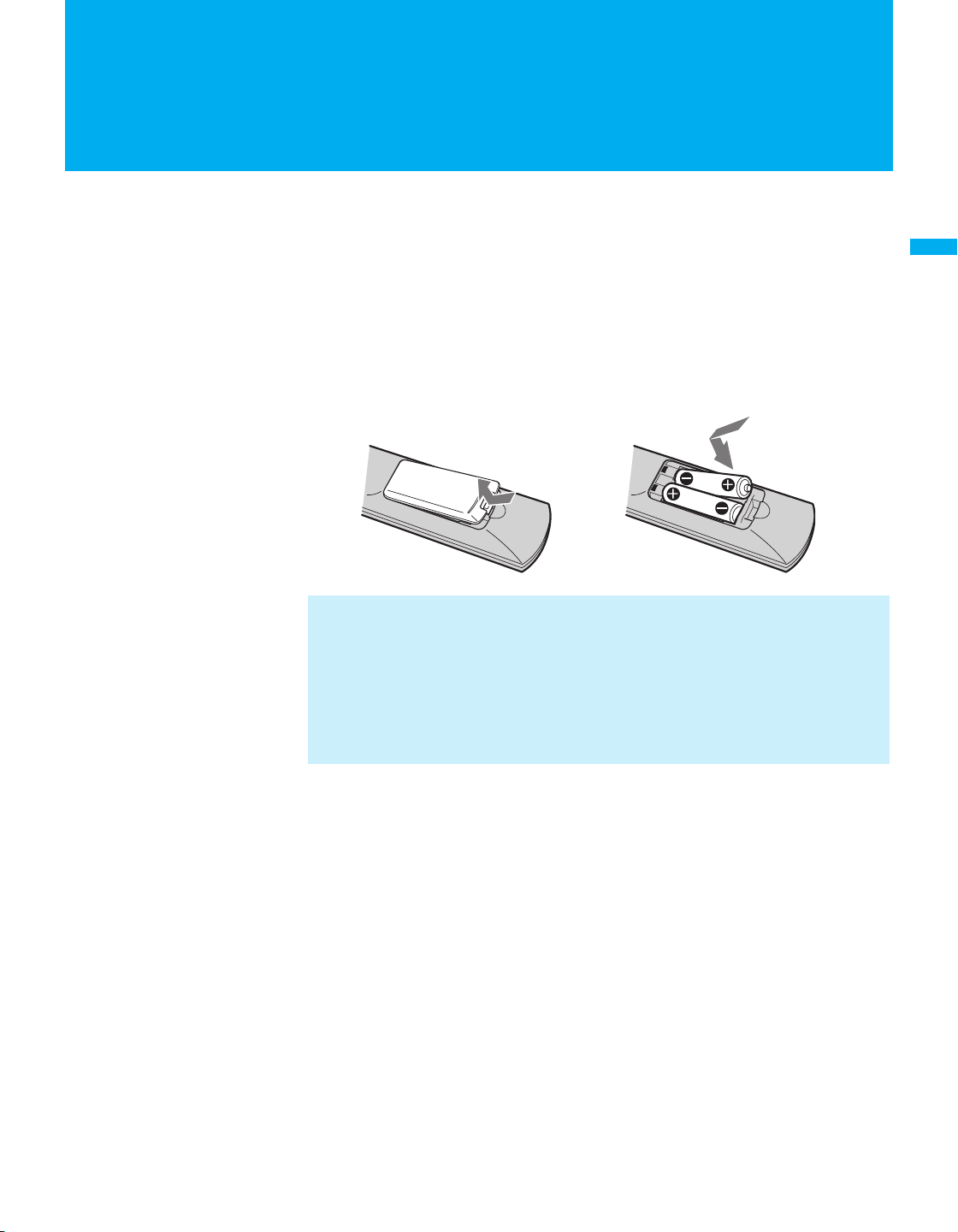
59
KDF-WE/WF655
2-059-370-14 (2)
Using the Remote Control
Using the Remote Control
Overview
The table on the next page describes the buttons on the remote control.
Inserting Batteries into the Remote Control
Insert two size AA (R6) batteries (supplied) by matching the e and E on
the batteries to the diagram inside the battery compartment.
✍ To avoid possible damage from battery leakage, remove the batteries if
you anticipate the remote control will not be used for an extended period.
✍ Handle the remote control with care. Avoid dropping it, getting it wet, or
placing it in direct sunlight, near a heater, or in high humidity.
✍ Your remote control can be programmed to operate most video
equipment. (See “Programming the Remote Control” on page 62.)
12
01COV.book Page 59 Thursday, February 17, 2005 8:01 PM
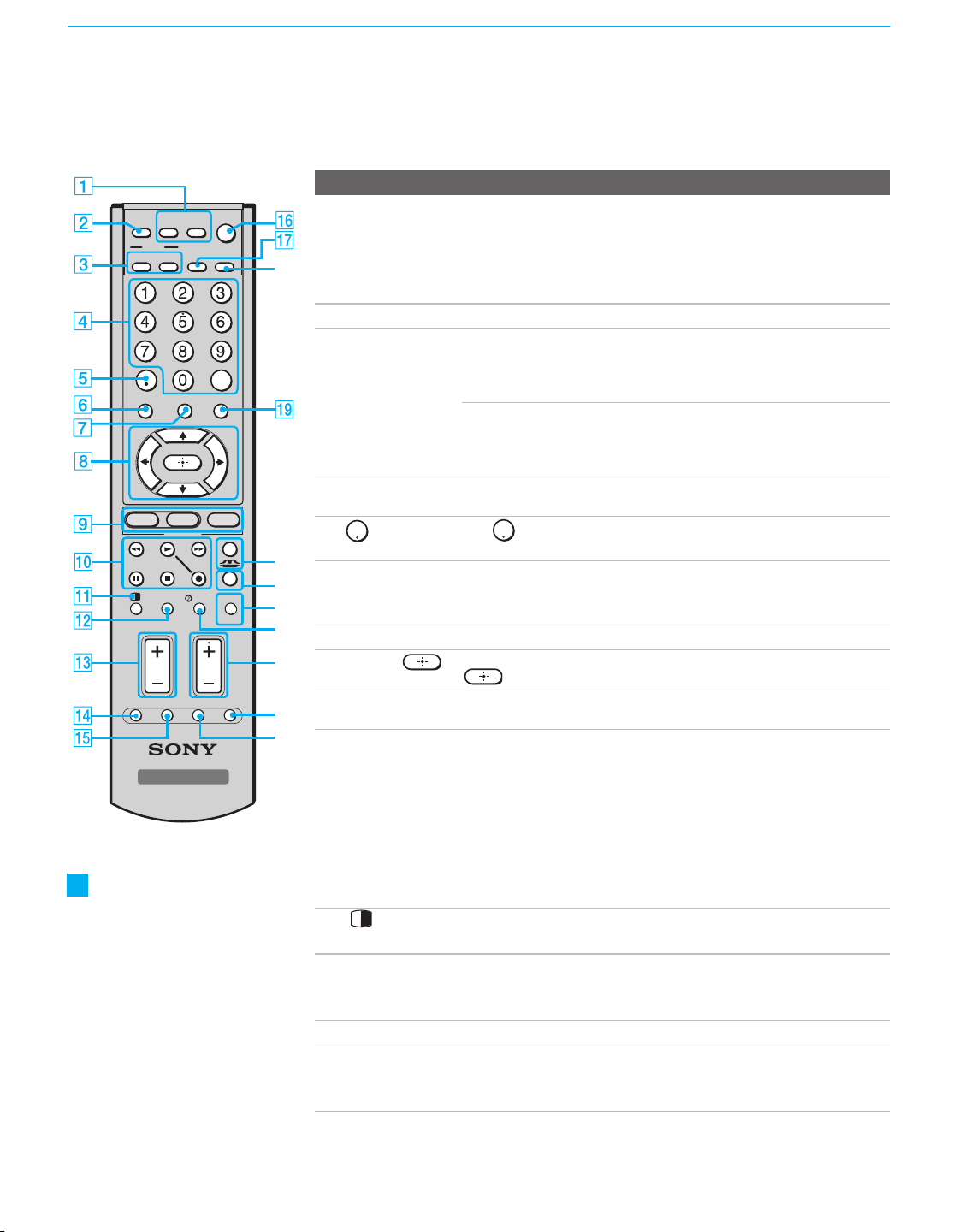
Using the Remote Control
60
KDF-WE/WF655
2-059-370-14 (2)
Button Descriptions
Button Description
1
DVD/VCR,
SAT/CABLE
Power Buttons
Press to turn on and off the equipment you have programmed into the
remote control. For details, see “Programming the Remote Control”
on page 62.
DVD/VCR: Press to turn on and off the video equipment.
SAT/CABLE: Press to turn on and off the satellite receiver or cable
box.
2
MUTING Press to mute the sound. Press again or press VOL + to unmute.
3
PICTURE
MODE
Press repeatedly to cycle through the available video picture modes:
Vivid, Standard, Pro. The video picture modes can be also accessed
in the Video menu. For details, see “Selecting Video Options” on page
98.
WIDE MODE Press repeatedly to step through the Wide Screen Mode setting: Wide
Zoom, Normal, Full
and Zoom. The Wide Screen Mode setting can
be also accessed in the Screen menu. For details, see “Using Wide
Screen Mode” on page 70.
4
0-9, ENT Press 0-9 to select a channel: the channel changes after 2 seconds.
Press ENT to change channels immediately.
5
Use with 0-9 and ENT buttons to select digital channels (for
example, 2.1). For details on selecting digital channels, see page 68.
6
GUIDE Press to display the TV’s program guide.
TOP MENU When FUNCTION is switched on SAT/CABLE, press to display the
program guide of your satellite program provider.
7
FAVORITES Press to display the Favorite Channels list. For details, see page 76.
8
V/v/B/b
Press V/v/B/b to move the on-screen cursor. To select an item, press
.
9
FUNCTION
Buttons
Press to have the remote control operate the equipment you want. For
details, see “Programming the Remote Control” on page 62.
0
DVD/VCR
Operating
Buttons
When FUNCTION is switched on DVD/VCR, these buttons operate
the video equipment you have programmed into the remote control.
For details, see “Using Other Equipment with Your LCD Projection
TV Remote Control” on page 64.
X: Pause
x: Stop
m: Fast-Reverse
N: Play
M: Fast-Forward
z: Record by pressing z and N
qa
(Twin View)
Press to turn on/off Twin View. For details, see “Using Twin
View” on page 72.
qs
FREEZE
Press to freeze the current picture in a separate window. Press
again to restore the picture. For details, see “Using the Freeze
Function” on page 77.
qd
VOL +/–
Press to adjust the volume.
qf
RESET
Press when in a menu, to reset the setting to the factory
defaults. Also used to clear Label Channels or Favorite
Channels.
POWER
TV/
VIDEODISPLAY
ENT
TV
F1
F2
MENUGUIDE
TOP MENU
FAVORITES
FREEZE
RESET SLEEP MTS/SAP JUMP
ANT
GUIDE
CHVOL
SAT/
CABLE
FUNCTION
DVD/VCR
MUTING
DVD/
VCR
MODE
SAT/
CABLE
PICTURE WIDE
TV
/TV/SAT
w;
wa
ws
wd
wf
wg
wh
qk
The 5 button, CH +
button and MTS/SAP
button have a tactile
dot. Use the tactile as a
reference when
operating the TV.
z
01COV.book Page 60 Thursday, February 17, 2005 8:01 PM
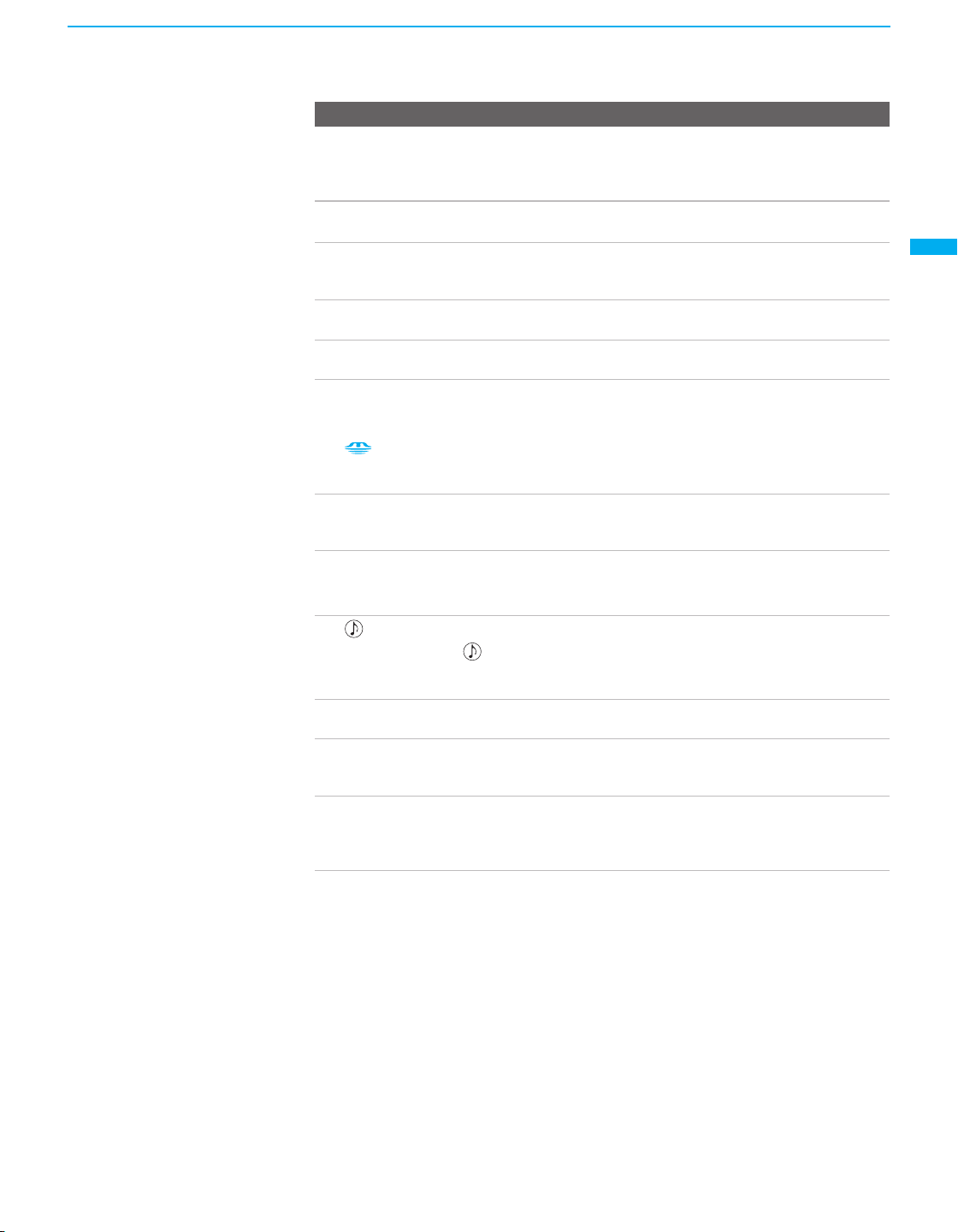
Using the Remote Control
61
KDF-WE/WF655
2-059-370-14 (2)
Using the Remote Control
qg
SLEEP Press repeatedly until the TV displays the time in minutes (15, 30, 45,
60 or 90) that you want the LCD projection TV to remain on before
shutting off. To cancel Sleep Timer, press SLEEP repeatedly until
Sleep Off appears.
qh
POWER
(GREEN)
Press to turn on/off the LCD projection TV.
qj
DISPLAY Press once to display channel number, label, current time and other
information. Press again to turn Display off. See page 116 for details
on setting the time.
qk
TV/VIDEO
Press to cycle through the video equipment connected to your
LCD
projection TV
’s video inputs.
ql
MENU Press to display the menu. Press again to exit from the menu. For
details, see “Using the Menus” on page 97.
w;
F1 Press to select the function of connected components. For details, see
“Using Other Equipment with Your LCD Projection TV Remote
Control” on page 64.
When FUNCTION is switched on TV, press to display the Memory
Stick menu. For details, see “Using the Memory Stick Viewer” on
page 79.
wa
F2 Press to select the function of connected components. For details, see
“Using Other Equipment with Your LCD Projection TV Remote
Control” on page 64.
ws
ANT Press to change between the VHF/UHF input and the CABLE input.
GUIDE When FUNCTION is switched on SAT/CABLE, press to display the
program guide of your satellite receiver.
wd
/TV/SAT TV/SAT: Press to select the TV or satellite receiver.
: Press repeatedly to step through the available audio effect modes:
TruSurround, Simulated, Off.
For details, see “Selecting Audio Options” on page 102.
wf
CH +/– Press to scan through channels. To scan quickly through channels,
press and hold down either CH button.
wg
JUMP Press to jump back and forth between two channels. The LCD
projection TV alternates between the current channel and the last
channel that was selected.
wh
MTS/SAP Press repeatedly to cycle through the Multi-channel TV Sound (MTS)
options: Stereo, Auto SAP (Second Audio Program), and Mono.
The MTS setting can be also accessed in the Audio menu. For more
details, see “Selecting Audio Options” on page 102.
Button Description
01COV.book Page 61 Thursday, February 17, 2005 8:01 PM

Using the Remote Control
62
KDF-WE/WF655
2-059-370-14 (2)
Programming the Remote Control
The remote control is preset to operate Sony brand video equipment.
If you have video equipment other than Sony brand that you want to control
with the LCD projection TV’s remote control, use the following procedure
to program the remote control.
From the “Manufacturer’s Codes” listed on page 63, select the three-digit
code number for the manufacture’s code of your equipment. If more than
one code number is listed, try entering them one by one until you come to
the correct code for your equipment. Use the code number to complete the
following procedure.
1 Press the DVD/VCR (FUNCTION) and RESET buttons
simultaneously, or press the SAT/CABLE (FUNCTION) and RESET
buttons simultaneously. DVD/VCR and SAT/CABLE buttons flash.
2 Press the function button you want to program.
To program a cable box or a satellite receiver
Press SAT/CABLE (FUNCTION).
To program video equipment
Press DVD/VCR (FUNCTION).
3 Enter the three-digit manufacturer’s code number using the 0 - 9
buttons.
4 Press ENT (enter) button.
5 To check if the code number works, aim the TV’s remote control at the
equipment and press DVD/VCR and/or SAT/CABLE (POWER) that
corresponds with that equipment. If it responds, the programming is
completed. If not, try using the other codes listed for that manufacturer.
Sony Equipment Programmable Code Number
DVD/VCR 601 (Sony Dream System)
SAT/CABLE 801 (Sony Satellite Receiver)
✍ The equipment must have infrared (IR) remote capability in order to be
used with the remote control.
✍ If no code number is input within 10 seconds, or an invalid or incorrect
code number is input, the remote control automatically goes back to the
previous setting.
✍ In some cases, you may not be able to operate your equipment with the
supplied remote control. In such cases, use the equipment’s own remote
control unit.
01COV.book Page 62 Thursday, February 17, 2005 8:01 PM

Using the Remote Control
63
KDF-WE/WF655
2-059-370-14 (2)
Using the Remote Control
Manufacturer’s Codes
DVD Players
DVD Changers
DVD/VCR Combo Units
HDD/DVD Combo Units
5.1ch DVD AV System
AV Receivers
VCRs
Cable Boxes
Satellite Receivers
* If an Aiwa VCR does not work even
though you enter the code for Aiwa,
enter the code for Sony instead.
Manufacturer Code
Sony 751
General Electric 755
Hitachi 758
JVC 756
Magnvox 757
Mitsubishi 761
Panasonic 753
Philips 757
Pioneer 752
RCA/PROSCAN 755
Samsung 758
Toshiba 754
Zenith 760
Manufacturer Code
Sony 765
Panasonic 766
Manufacturer Code
Sony 767
Broksonic 776
JVC 775
Panasonic 777
Samsung 774
Toshiba 773
Zenith 768
Manufacturer Code
Sony 770, 771, 772
Manufacturer Code
Sony (DAV) 601, 602, 603, 604
Manufacturer Code
Sony 764
Manufacturer Code
Sony 301, 302, 303
Admiral
(M. Ward)
327
Aiwa* 338, 344
Audio Dynamic 314, 337
Broksonic 319, 317
Canon 309, 308
Citizen 332
Craig 302, 332
Curtis Mathes 304, 338, 309
Daewoo 341, 312, 309
DBX 314, 336, 337
Dimensia 304
Emerson 319, 320, 316, 317,
318, 341
Fisher 330, 335
Funai 338
General Electric 329, 304, 309
Go Video 322, 339, 340
Goldstar 332
Hitachi 306, 304, 305, 338
Instant Replay 309, 308
JC Penney 309, 305, 304, 330,
314, 336, 337
JVC 314, 336, 337, 345,
346, 347
Kenwood 314, 336, 332, 337
LG 332
LXI (SEARS) 332, 305, 330, 335,
338
Magnavox 308, 309, 310
Marantz 314, 336, 337
Marta 332
Memorex 309, 335
Minolta 305, 304
Mitsubishi/MGA 323, 324, 325, 326
Multitech 325, 338, 321
NEC 314, 336, 337
Olympic 309, 308
Optimus 327
Orion 317
Panasonic 308, 309, 306, 307
Pentax 305, 304
Philco 308, 309
Philips 308, 309, 310
Pioneer 308
Quasar 308, 309, 306
RCA/PROSCAN 304, 305, 308, 309,
311, 312, 313, 310,
329
Realistic 309, 330, 328, 335,
324, 338
Sansui 314
Manufacturer Code
Samsung 322, 313, 321
Sanyo 330, 335
Scott 312, 313, 321, 335,
323, 324, 325, 326
Sharp 327, 328
Signature 2000
(M. Ward)
338, 327
SV2000 338
Sylvania 308, 309, 338, 310
Symphonic 338
Tashiro 332
Tatung 314, 336, 337
Teac 314, 336, 338, 337
Technics 309, 308
Toshiba 312, 311
Wards 327, 328, 335, 331,
332
Yamaha 314, 330, 336, 337
Zenith 331
Manufacturer Code
Sony 230
Hamlin/Regal 222, 223, 224,
225, 226
Jerrold/G. I./
Motorola
201, 202, 203,
204, 205, 206,
207, 208, 218, 222
Oak 227, 228, 229
Panasonic 219, 220, 221
Pioneer 214, 215
Scientific Atlanta 209, 210, 211
Tocom 216, 217
Zenith 212, 213
Manufacturer Code
Sony 801
Dish Network 810
Echostar 810
General Electric 802
Hitachi 805
Hughes 804
Mitsubishi 809
Panasonic 803
RCA/PROSCAN 802, 808
Toshiba 806, 807
Manufacturer Code
01COV.book Page 63 Thursday, February 17, 2005 8:01 PM
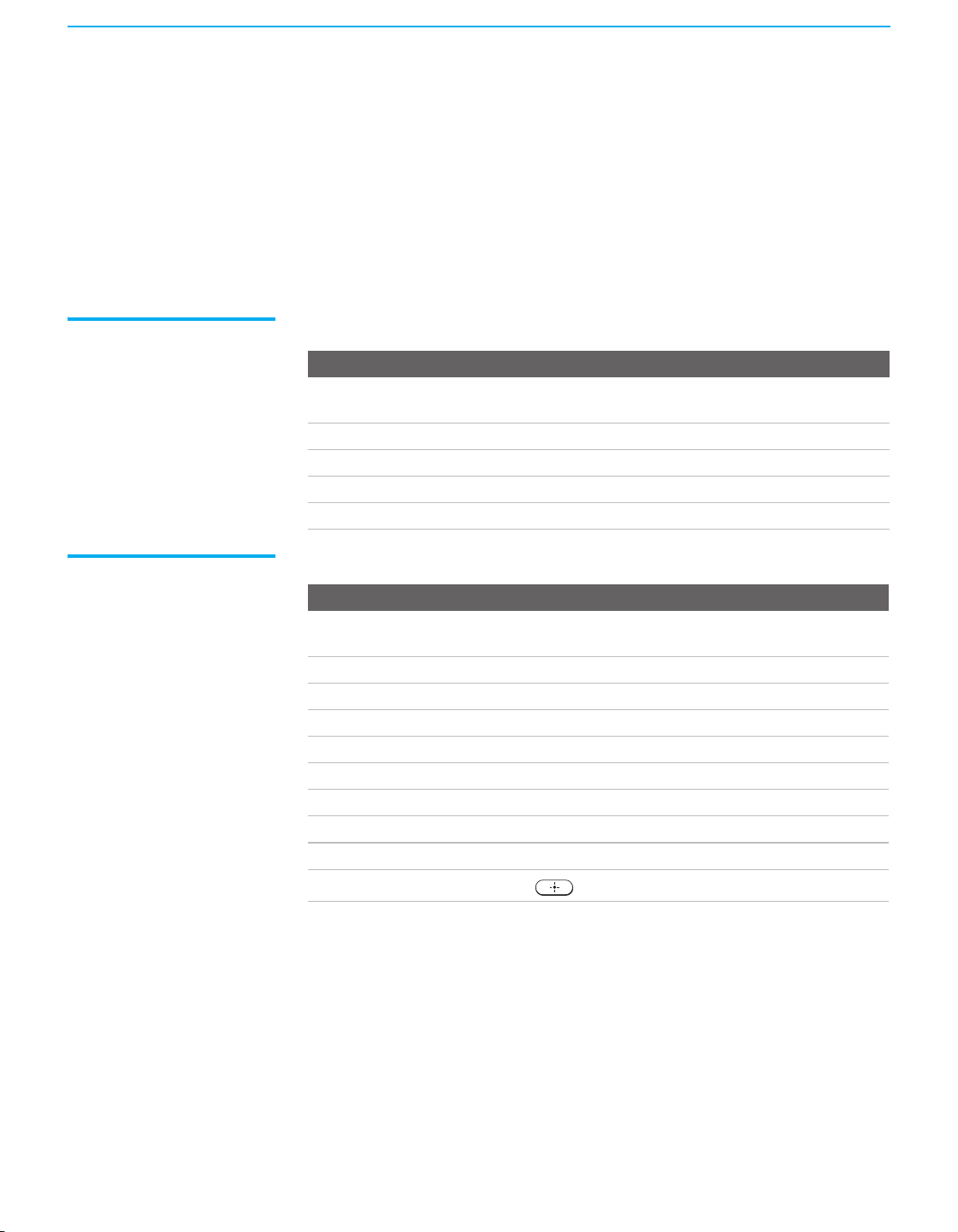
Using the Remote Control
64
KDF-WE/WF655
2-059-370-14 (2)
Using Other Equipment with Your LCD Projection TV Remote
Control
To operate other connected equipment with your LCD projection TV remote
control, first turn to page 63 and program the necessary code. For operating
video equipment, press
TV/VIDEO repeatedly till you see the video input on
the screen for your connected equipment. Remote control operation tips are
provided below.
Operating a Cable
Box
Operating a Satellite
Receiver
To Do This ... Press
Activate the remote control to
operate the cable box
SAT/CABLE (FUNCTION)
Turn on/off SAT/CABLE (POWER)
Select a channel 0-9, ENT
Change channels CH +/–
Back to previous channel JUMP
To Do This ... Press
Activate the remote control to
operate the satellite receiver
SAT/CABLE (FUNCTION)
Turn on/off SAT/CABLE (POWER)
Select a channel 0-9, ENT
Change channels CH +/–
Back to previous channel JUMP
Display channel number DISPLAY
Display SAT Guide GUIDE
Display SAT Menu MENU
Move highlight (cursor) V v B b
Select item
01COV.book Page 64 Thursday, February 17, 2005 8:01 PM
Using the Remote Control
65
KDF-WE/WF655
2-059-370-14 (2)
Using the Remote Control
Operating a VCR
Operating a DVD
Player or DVD
Changer
Operating a 5.1ch
DVD AV System
(SONY DAV)
To Do This ... Press
Activate the remote control to
operate the VCR
DVD/VCR (FUNCTION)
Turn on/off DVD/VCR (POWER)
Change channels CH +/–
Record z and N simultaneously
Play N
Stop x
Fast forward M
Rewind the tape m
Pause X
Search the picture forward
or backward
M or m during playback
(release to resume normal playback)
To Do This ... Press
Activate the remote control to
operate the DVD
DVD/VCR (FUNCTION)
Turn on/off DVD/VCR (POWER)
If you have a DVD changer,
to skip disk
F1
Play N
Stop x
Pause X (press again to resume normal playback)
Step through different
tracks of the disc
M to step forward or m to step backward
Step through different
chapters of the disc
CH + to step forward or CH – to step backward
Select a track directly
0-9, ENT
Display the menu (setup) MENU
Display the top menu TOP MENU
Operate the DVD menu V v B b
To Do This ... Press
Activate the remote control to
operate the DAV
DVD/VCR (FUNCTION)
Turn on/off DVD/VCR (POWER)
Select other equipment
connected to the DAV
F1
Skip a disk F2
(Continued)
01COV.book Page 65 Thursday, February 17, 2005 8:01 PM
Using the Remote Control
66
KDF-WE/WF655
2-059-370-14 (2)
Operating a DVD/
VCR or HDD/DVD
Combo Unit
Operating an AV
Receiver
Display the DVD menu TOP MENU
Display the menu (Setup) MENU
Move highlight (Cursor) V v B b
Select item
Change the volume VOL +/–, MUTING
To Do This ... Press
Activate the remote control to
operate the DVD/VCR or
HDD/DVD
DVD/VCR (FUNCTION)
Turn on/off DVD/VCR (POWER)
If you have a DVD/VCR combo component,
Select the DVD F1
Select the VCR F2
If you have a HDD/DVD combo component,
Select the DVD
F1
Select the HDD F2
Record z and N simultaneously (VCR)
Play N (VCR)
Stop
x (VCR)
Fast forward M (VCR)
Rewind the tape m (VCR)
Pause X (VCR)
Search the picture forward
or backward
M or m during playback
(release to resume normal playback)
(VCR)
Display the DVD menu TOP MENU (DVD)
Play N (DVD)
Stop x (DVD)
Pause X (DVD)
Step through different tracks of
the disc
M to step forward or m to step
backward
(DVD)
Step through different chapters
of a video disc
CH + to step forward or CH – to step
backward
(DVD)
To Do This ... Press
Turn on/off DVD/VCR (POWER)
Change the volume VOL +/–, MUTING
01COV.book Page 66 Thursday, February 17, 2005 8:01 PM
67
Using the Features
KDF-WE/WF655
2-059-370-14 (2)
Using the Features
Overview
This chapter describes how to use the features of your TV.
Watching TV
Topic Page
Watching TV 67
Using the Program Guide 68
Using Wide Screen Mode 70
Using Twin View 72
Using Favorite Channels 75
Using the Freeze Function 77
To Do This ... Do This ...
Activate the remote control to
operate the TV
Press TV FUNCTION.
Turn on/off the TV Press TV POWER.
Tune directly to a channel To tune to analog channels, press
0-9 and then
ENT.
For digital subchannels, press
0-9, , press
0-9 again, and then ENT.
For example, to select subchannel 21.13, press
2+1+ +1+3, and then press ENT.
You can also select channels using the
program guide. See page 69 for details.
Adjust the volume Press VOL +/–.
Mute the sound Press MUTING (press again or VOL + to
unmute).
Alternate back and forth between
two channels
Press JUMP.
The LCD projection TV alternates between
the current channel and the last channel that
was selected.
Display the current channel
number (and other information)
Press
DISPLAY once to display the channel
number, current time, and channel label (if
set). Press
DISPLAY again to turn Display off.
Switch the TV’s input to the VCR,
DVD player, or other connected
equipment
Press TV/VIDEO repeatedly to cycle through
the video equipment connected to the TV’s
video inputs.
Change video and audio options,
customize the TV’s setup, set
parental controls, and more
Press
MENU to display the Menu. For details,
see “Using the Menus” on page 97.
Switch
the TV’s input between
sources connected to the TV’s
VHF/UHF and CABLE inputs
Press ANT to alternate between sources
connected to the TV’s VHF/UHF and CABLE
inputs.
For a complete list of all
the functions of the
remote control, see
pages 59-66.
z
01COV.book Page 67 Thursday, February 17, 2005 8:01 PM
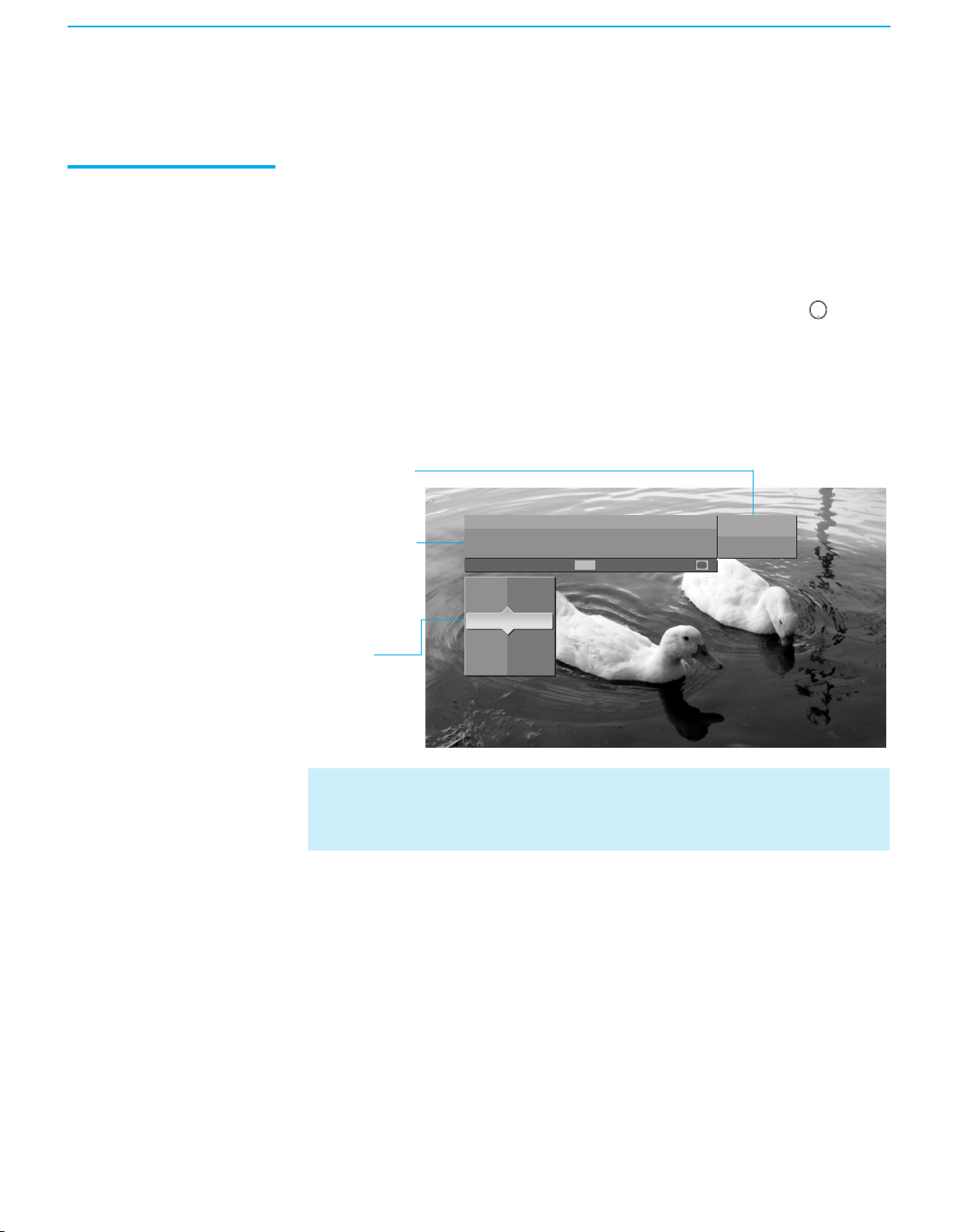
Using the Features
68
KDF-WE/WF655
2-059-370-14 (2)
Using the Program Guide
Displaying the
Program Guide
This LCD projection TV is equipped to show program information if it is
available from the station. The Program Guide lets you review program
information, and select both analog and digital channels.
To display the Program Guide:
1 Tune your LCD projection TV to a channel by using the 0-9, , and
ENT buttons.
2 Press GUIDE (TOP MENU) on the LCD projection TV’s remote control.
The Program Guide will appear with the currently selected program
showing in the background.
✍ Program information in the guide is provided by the broadcasters. As a
result, it may sometimes include only the channel number, without a
program title or description.
Make Way for Ducks!
Series follows the aquatic misadventures of Henry and Riley, two
wayward ducks on a unique mission.
Time remaining: 1:26
FAM
TV-G
CC
1 ABC
10 DISC
23.1
FAM
36 TLC
65 HIST
68 SHOW
C23.1
Channel number,
call letters, etc.
Program title and
description,
program
duration, time
remaining, rating
information,
closed-caption
availability, etc.
Selectable
channel list.
01COV.book Page 68 Thursday, February 17, 2005 8:01 PM
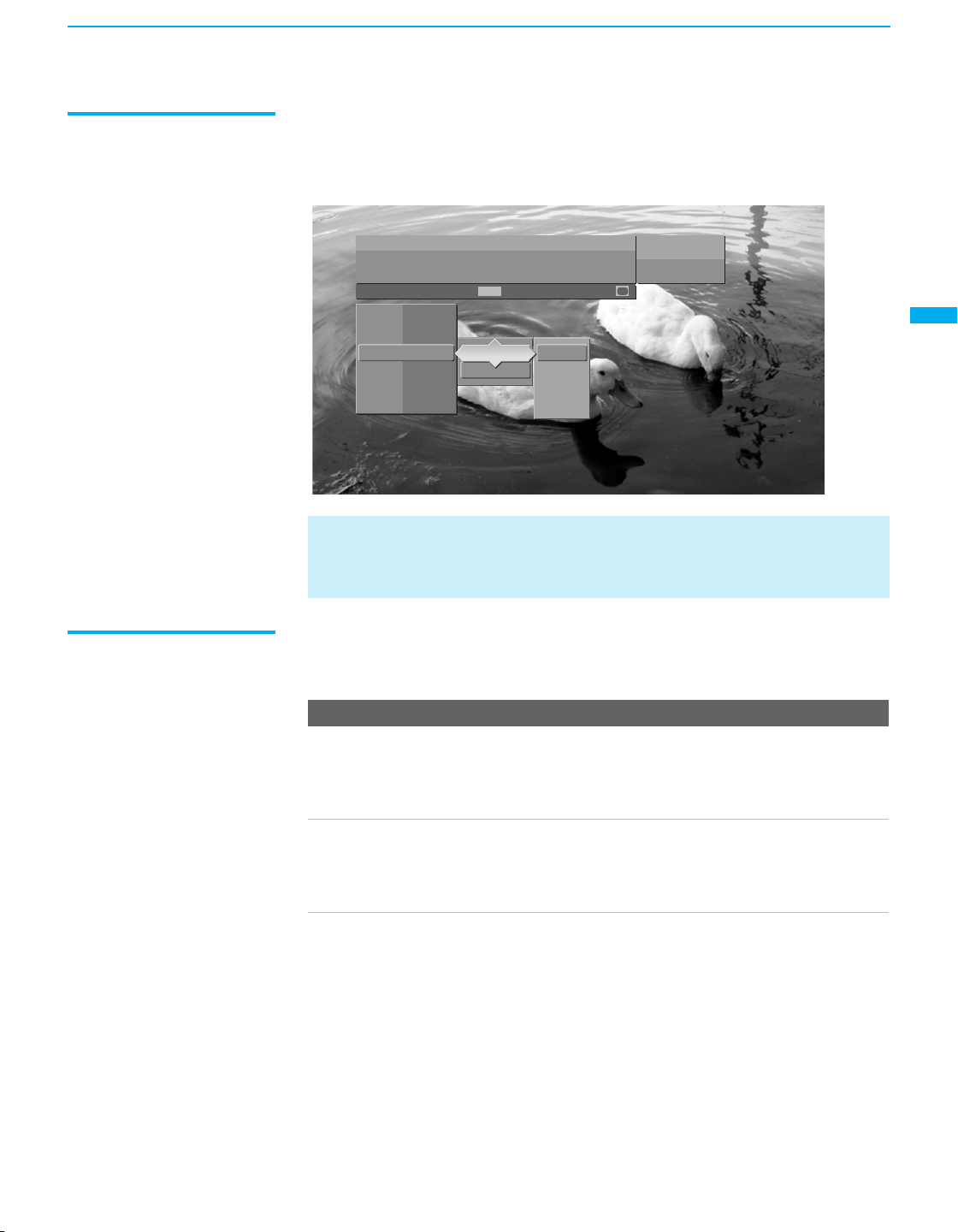
Using the Features
69
Using the Features
KDF-WE/WF655
2-059-370-14 (2)
Using the Program
Guide
The Program Guide allows you to select the channels from a drop down list.
The Guide also provides information about the current program being shown
on each channel.
Using the Program
Options Menu
The Program Options menu allows you to customize the program settings on
the currently tuned channel.
✍ Subchannels are additional channels of programming broadcast
simultaneously. For example, channel 4 might include three subchannels
(4.1, 4.2, 4.3) that are showing programs at the same time.
Main
Video 1
Video 2
Video 3
Make Way for Ducks!
Series follows the aquatic misadventures of Henry and Riley, two
wayward ducks on a unique mission.
Time remaining: 1:26
TV-G
CC
Alternate Video
Alternate Audio
FAM
C23.1
1 ABC
10 DISC
23.1
FAM
36 TLC
65 HIST
68 SHOW
Option Description
Alternate
Video
(When
available)
Each program has a main video stream (the video that you see when
the channel is first tuned), and may have alternate video streams. This
option allows you to switch among these alternate video streams.
Alternate
Audio
(When
available)
Each program has a main audio stream (the audio you hear when the
channel is first tuned). This option allows you to switch among these,
and may have alternate audio streams (e.g., for different languages).
01COV.book Page 69 Thursday, February 17, 2005 8:01 PM
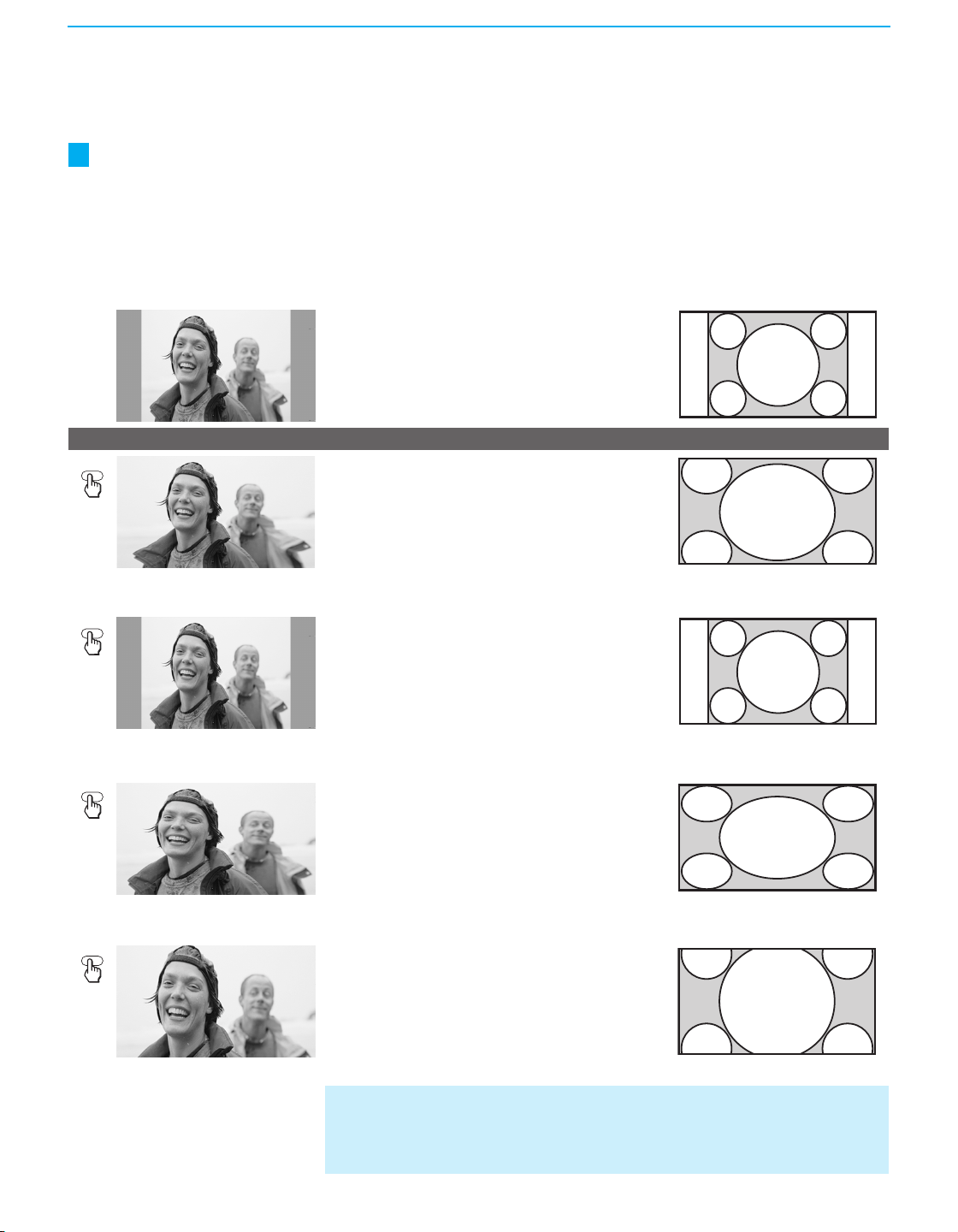
Using the Features
70
KDF-WE/WF655
2-059-370-14 (2)
Using Wide Screen Mode
Wide screen mode lets you watch 4:3 normal broadcasts in several wide
screen modes (16:9 aspect ratio).
❑ Press WIDE repeatedly to toggle through the following screen mode
settings.
Changing the Wide Screen Mode for 4:3 Source (Standard definition source)
You can also access the
screen mode settings in
the Screen menu. For
details, see page 104.
z
Example Description
Wide Zoom enlarges the center portion of
the picture. The left and right edges of the
picture are stretched to fill the 16:9 screen.
Normal displays the 4:3 picture in its
original size. Side bars are shown to fill the
16:9 screen.
Full stretches the 4:3 picture horizontally,
to fill the 16:9 screen.
Zoom enlarges the 4:3 picture
proportionately to fill the 16:9 screen.
Zoom is useful for watching Letterbox
movies.
✍ When you change channels or inputs, the Wide Mode settings revert
to the 4:3 Default setting in the Screen Menu. To retain the current
Wide Mode setting as channels and inputs are changed, set 4:3
Default to Off. For details, see page 105.
original source
Wide Zoom
m
WIDE
Normal
m
WIDE
Full
m
WIDE
Zoom
WIDE
01COV.book Page 70 Thursday, February 17, 2005 8:01 PM
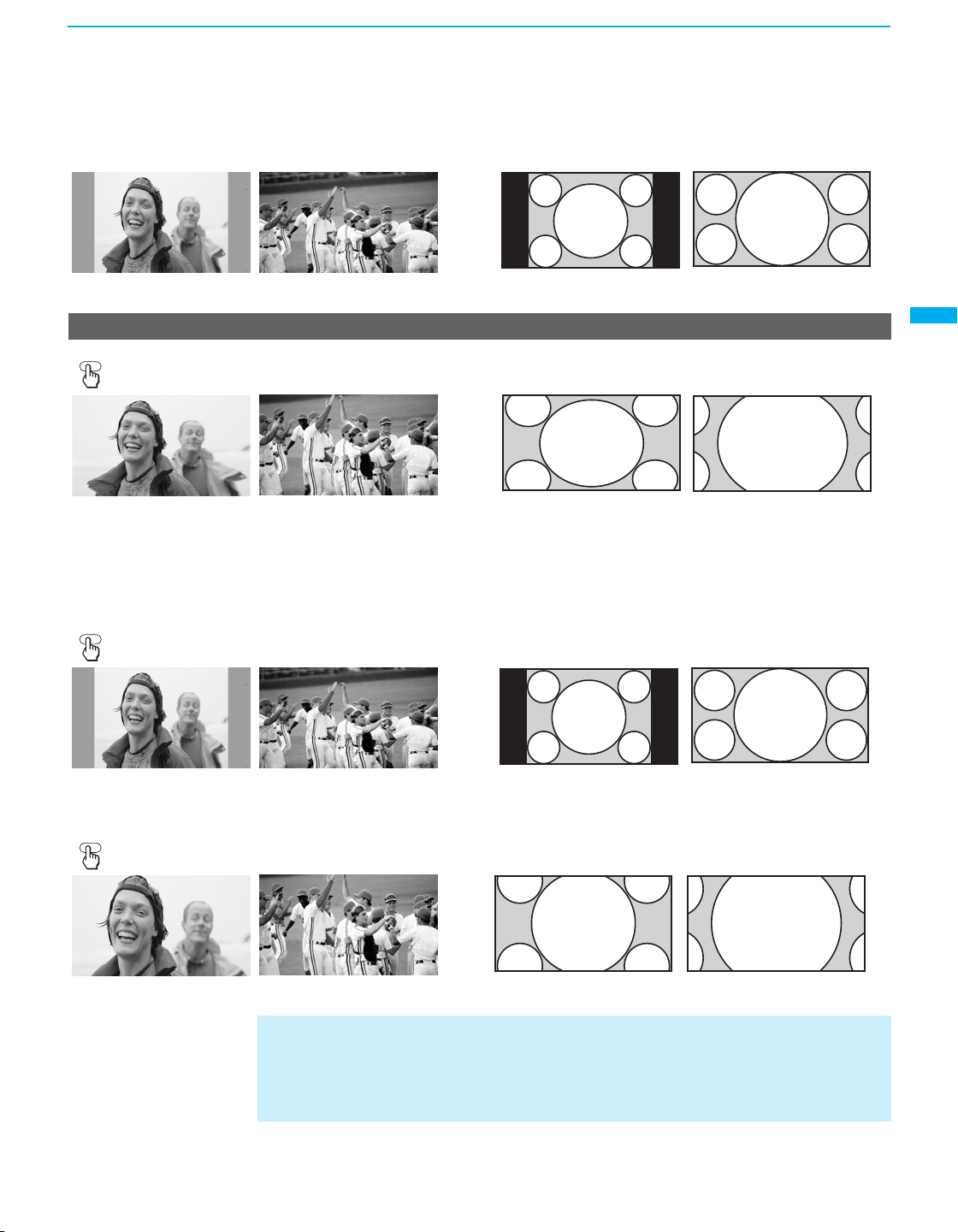
Using the Features
71
Using the Features
KDF-WE/WF655
2-059-370-14 (2)
Changing the Wide Screen Mode for 16:9 Source (High definition source)
Example Description
Wide Zoom enlarges the center portion of the picture. The left and right edges of
the picture are stretched to fill the 16:9 screen.
Full displays the picture at its original size.
Zoom enlarges the picture proportionately, both vertically and horizontally.
✍ When the TV receives a 720p or 1080i signal, Normal cannot be selected.
✍ When TV receives a 720p or 1080i signal that is 4:3 aspect ratio picture
(upconverted to 16:9) with a black bar at each side, Full returns the picture to
its original size.
original source
(Upconverted 4:3)(Upconverted 4:3) (Native 16:9)
Wide Zoom
m
Normal
(This mode is not available.)
m
WIDE
Full
m
WIDE
Zoom
WIDE
01COV.book Page 71 Thursday, February 17, 2005 8:01 PM
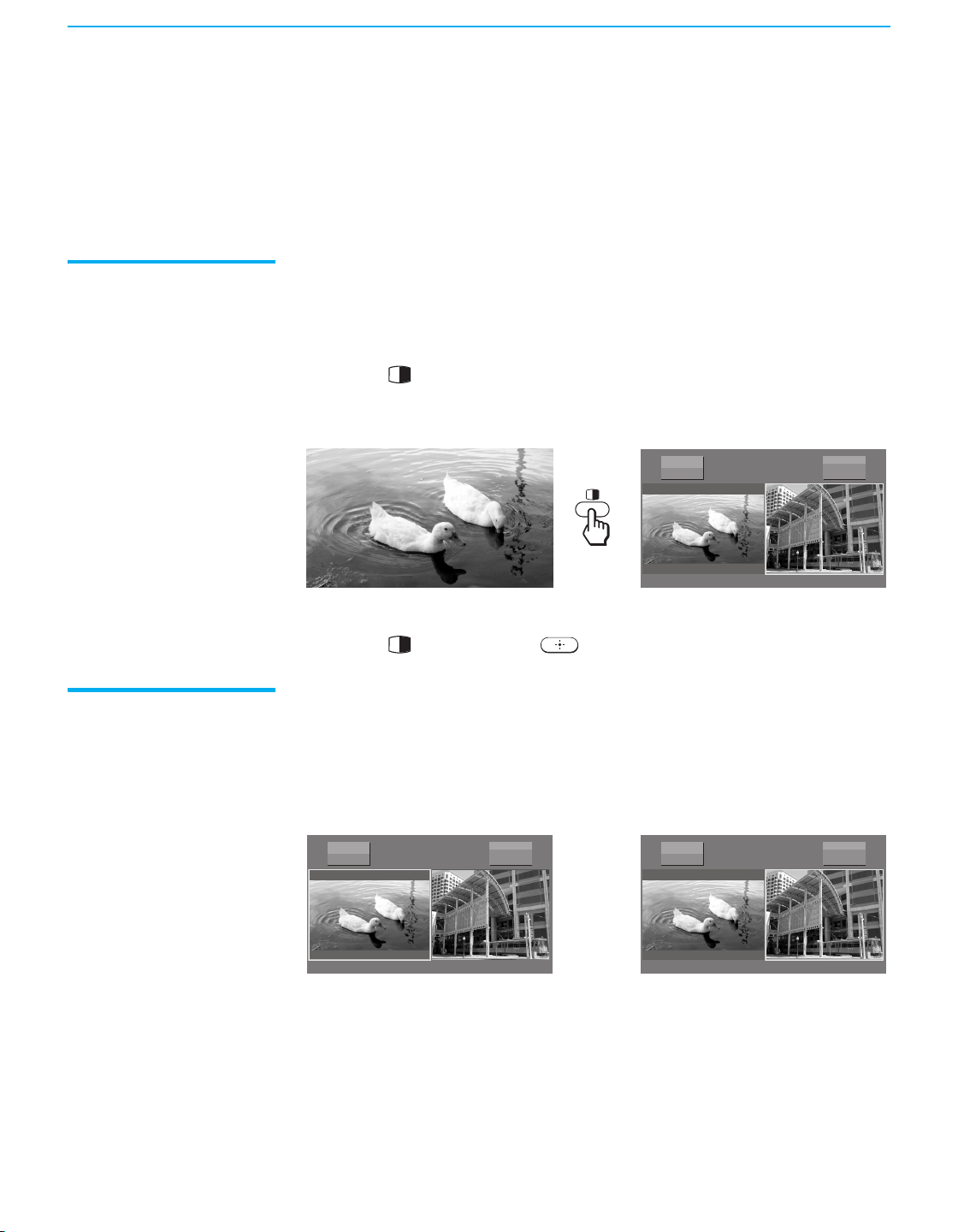
Using the Features
72
KDF-WE/WF655
2-059-370-14 (2)
Using Twin View
Twin View lets you see two pictures from two sources — from an antenna,
VCR, DVD, etc. — on the screen at the same time. You hear the sound from
only one of the sources at a time, but you can choose which source’s sound is
selected. You can also change the relative size of each of the pictures.
Displaying Twin
Pictures
To display Twin View
1 Make sure your LCD projection TV is tuned to
a working channel.
2 Press .
A second picture appears. The active picture is highlighted.
To cancel Twin View and watch the active picture
❑
Press again (or press ).
Activating the
Picture
You can use B or b buttons to activate the left and right pictures while using
Twin View.
To activate the right picture To activate the left picture
❑
Press b. Press B.
,
,
C8.1
FOX
Video 1
DVD
,
,
C8.1
FOX
Video 1
DVD
FOX
C8.1
Video 1
DVD
01COV.book Page 72 Thursday, February 17, 2005 8:01 PM
Using the Features
73
Using the Features
KDF-WE/WF655
2-059-370-14 (2)
Functions Available in the Active (Highlighted) Window
Factors Affecting Twin View
❑
If you use a cable box to view all channels, the same channel appears in
both windows because the cable box unscrambles and sends only one
channel at a time. (To view the picture in dual picture features such as
Twin View, Freeze, etc. see “Cable Box and Antenna” on page 34.)
❑ If you use a cable box and other video equipment, you can view the
cable box output in one window and view a different source (such as a
VCR or DVD player) in the second window by using the
TV/VIDEO
button.
❑ Digital TV channels, as well as any sources connected to the HD/DVD
IN 5-6, and HDMI IN 7 inputs display in the left window, but not the
right.
❑ If you are viewing a 4:3 source and a 16:9 enhanced source (such as a
DVD) side by side, the 4:3 source appears larger.
❑ Twin View does not display channels that are blocked by parental
settings (see page 108).
To Do This ... Do This ...
Tune to a channel To tune to analog channels, press 0-9 and then
ENT.
For digital subchannels, press 0-9, , press
0-9 again, and then ENT.
For example, to select subchannel 21.13, press
2+1++1+3, and then press ENT.
Adjust the volume Press VOL +/–
Mute the sound
Press
MUTING
(press again or press
VOL +
to
unmute.)
Switch the TV’s input between
sources connected to the TV’s
VHF/UHF and CABLE inputs
Press ANT
Switch the TV’s input between
sources connected to the TV’s A/V
inputs
Press TV/VIDEO
Change the picture size Press V or v. (For details, see “Changing the
Picture Size” on page 74.)
01COV.book Page 73 Thursday, February 17, 2005 8:01 PM
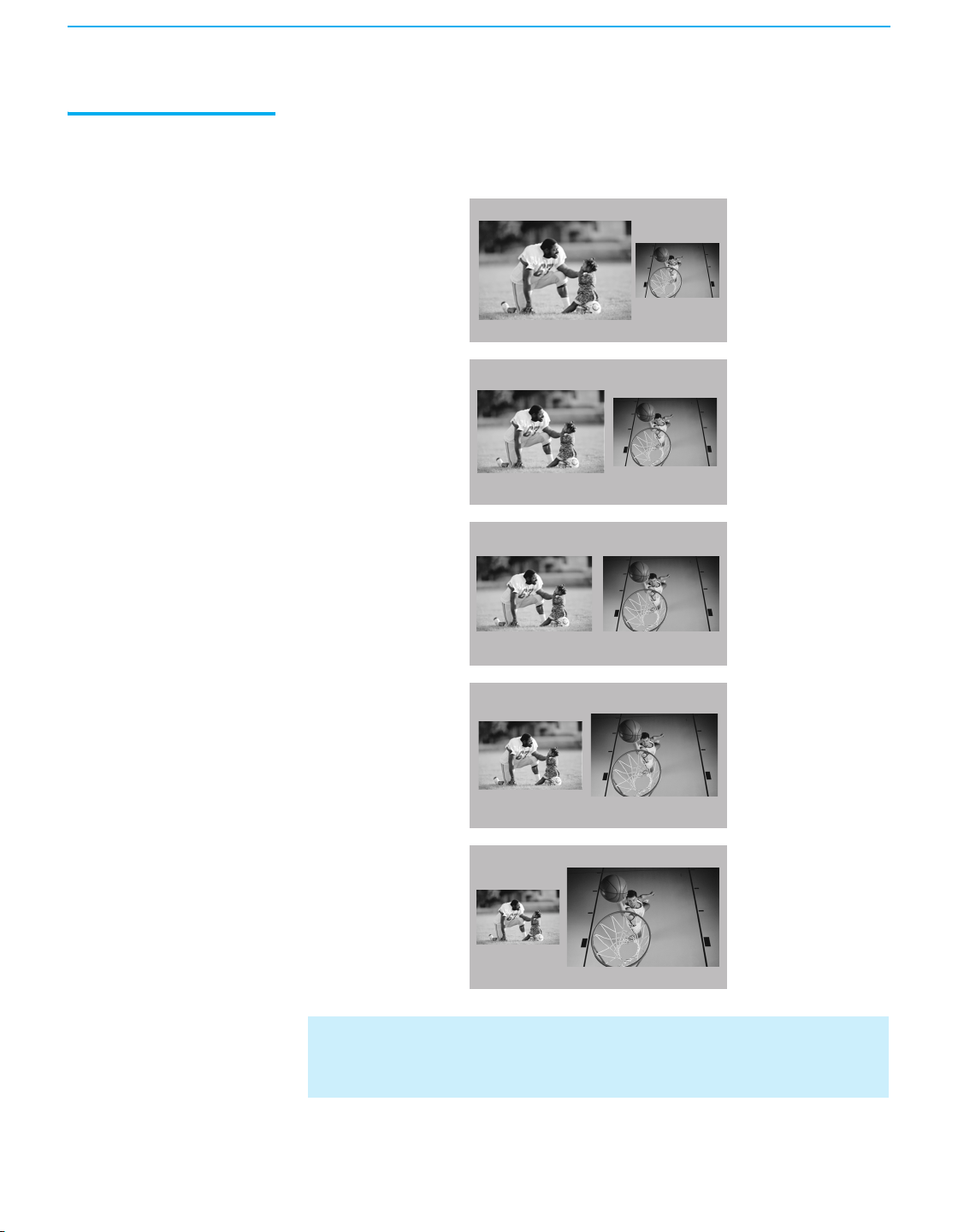
Using the Features
74
KDF-WE/WF655
2-059-370-14 (2)
Changing the
Picture Size
The zoom feature lets you change the size of the left and right pictures.
To enlarge the left
picture (reduce the
right)
1 Press B to
activate the left
picture (if not
already
activated).
2 Press V to
enlarge the
picture and v to
reduce the
picture.
To enlarge the right
picture (reduce the
left)
1 Press b to
activate the right
picture (if not
already
activated).
2 Press V to enlarge
the picture and v
to reduce the
picture.
✍ When you adjust the picture sizes in Twin View, the LCD projection TV
memorizes the change. The next time you use the Twin View function,
the memorized sizes appear.
01COV.book Page 74 Thursday, February 17, 2005 8:01 PM
Using the Features
75
Using the Features
KDF-WE/WF655
2-059-370-14 (2)
Using Favorite Channels
The Favorite Channels feature lets you select programs from a list of up to
16 favorite channels that you specify. You can create a list using the Favorite
Channels option in the Channel Menu, or by using the Add to Favorites
feature in the Favorite Channels guide.
Using the Channel
Menu
1 Press MENU to display the Menu.
2 Press V or v to highlight the Channel icon and press .
3 Press to select Favorite Channels.
4 Use the 0-9 and ENT buttons to enter the channel number that you want
to assign to the Favorite Channel number. A preview of the highlighted
channel appears in the upper right of the screen.
Press to select that channel as a
Favorite Channel.
5 To add more channels to your favorites list, repeat step 4.
To clear a Favorite Channel, press V or v to highlight the channel you
want to clear. Press RESET.
6 Press MENU to exit the Menu.
✍ Digital channels do not display in the preview window.
✍ To enter digital channel numbers in step 4, use the 0-9, , 0-9 and ENT
buttons.
For details on using the
Channel Menu, see
page 106.
z
01COV.book Page 75 Thursday, February 17, 2005 8:01 PM
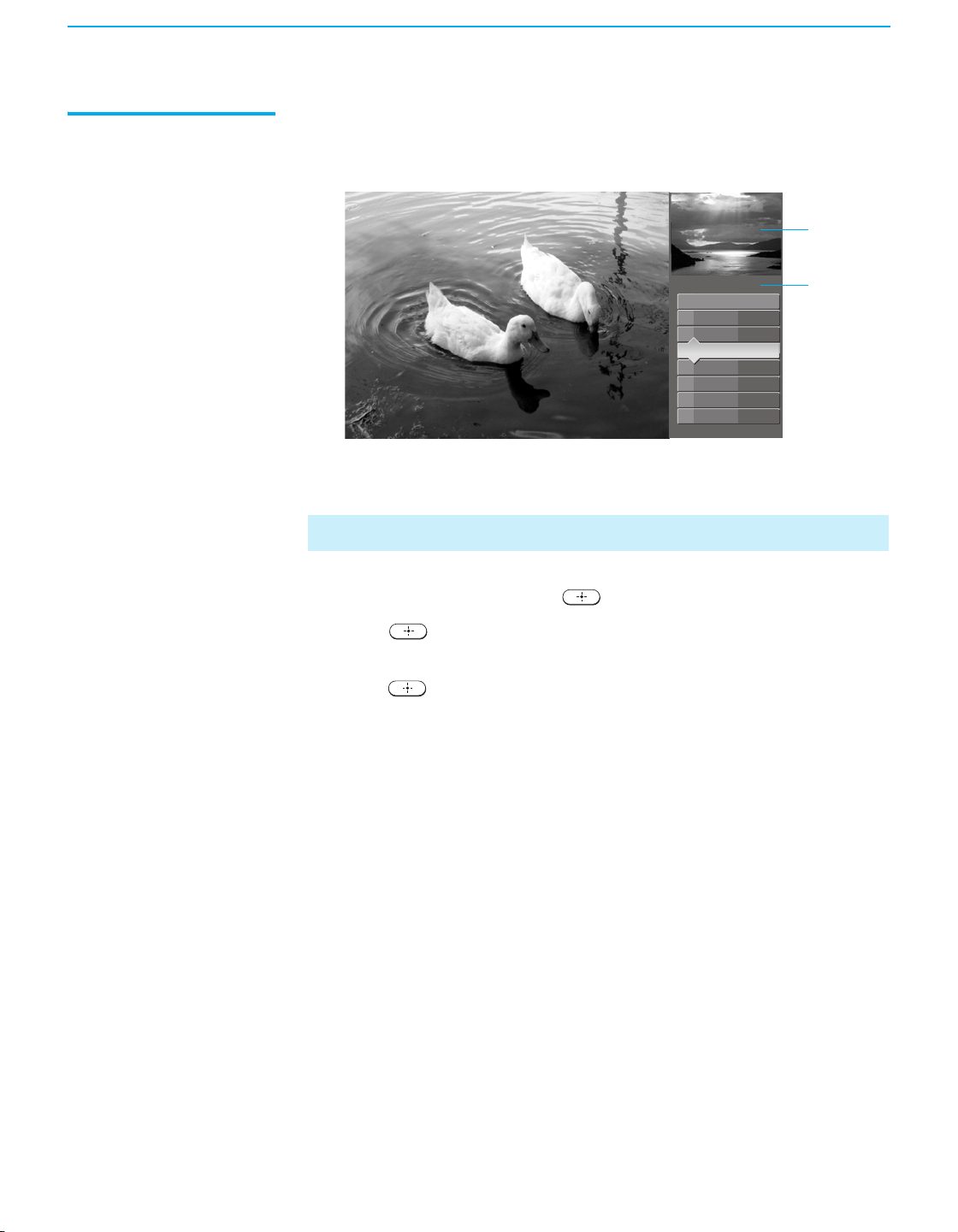
Using the Features
76
KDF-WE/WF655
2-059-370-14 (2)
Using the Favorite
Channels Guide
1 Press FAVORITES.
The Favorite Channels list appears.
2 Press V or v to highlight the channel you want to watch. A preview of
the highlighted Favorite Channel appears.
To add the current channel to the list of Favorite Channels, highlight
Add to Favorites and press .
3 Press to select the channel you want to watch.
To change your Favorite Channels list, highlight Edit Favorites and
press .
✍ Digital channels do not display in the preview window.
Add to Favorites
Favorite Channels
1 8.14 PBS
2 15.8 NBC
3 27 HGTV
4 45.12 TNT
5 98 CNN
6 112.3 ESPN
7 120 NICK
Preview of
highlighted
Favorite
Channel
Favorite
Channels
01COV.book Page 76 Thursday, February 17, 2005 8:01 PM
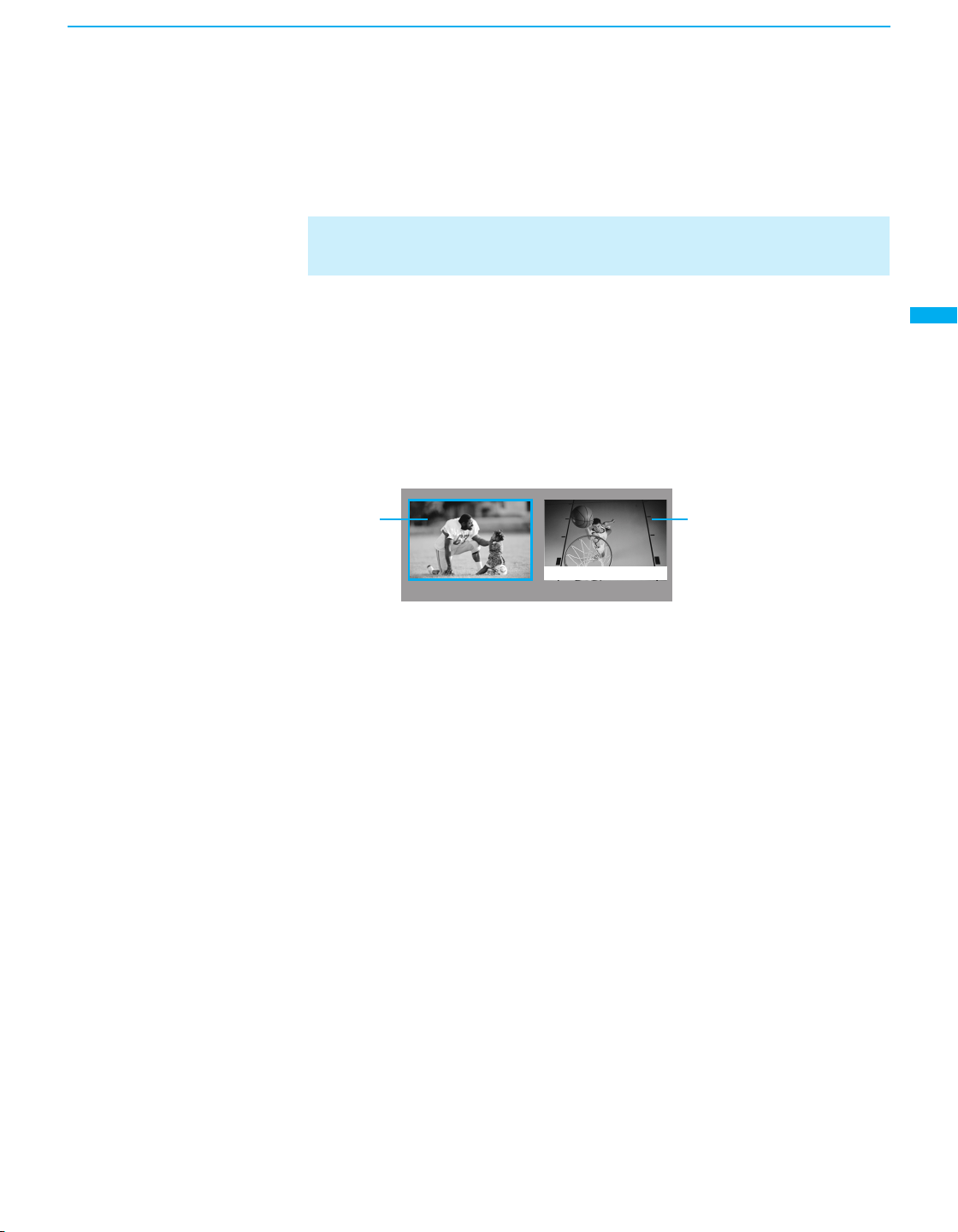
Using the Features
77
Using the Features
KDF-WE/WF655
2-059-370-14 (2)
Using the Freeze Function
The FREEZE button allows you to temporarily capture a program’s picture.
You can use this feature to write down information such as phone numbers,
recipes, etc.
To use the Freeze function
1 When the program information you want to capture is displayed on the
screen, press
FREEZE.
2 The LCD projection TV switches to Twin View mode and displays the
“frozen” picture on the right, while the current program continues on the
left.
3 To cancel and return to normal viewing, press FREEZE again (or just
turn to another channel).
✍ The Freeze feature is not available if you are in Favorite Channels (see
page 75) or Twin View (see page 72) mode.
Current
program
in progress
Frozen
picture
Call 555-1234
01COV.book Page 77 Thursday, February 17, 2005 8:01 PM

01COV.book Page 78 Thursday, February 17, 2005 8:01 PM
79
Using the Memory Stick Viewer
KDF-WE/WF655
2-059-370-14 (2)
Using the Memory Stick Viewer
About Memory Stick
Memory Stick (sold separately) is a new, compact, portable, and versatile
Integrated Circuit recording medium with a data capacity that exceeds that
of a floppy disk. Memory Stick is specially designed for sharing digital data
among Memory Stick compatible products such as digital cameras and
digital video cameras. Because it is removable, Memory Stick can also be
used for external data storage.
The Memory Stick Viewer on your LCD projection TV allows you to view
files that are stored on Memory Stick media. You can view:
❑ Digital photos (JPEG files)
❑ Movies (MPEG1 files)
You can also play slide show background music using MP3 files stored on
your Memory Stick.
For more information about handling Memory Stick media, see “Notes on
Using Memory Stick Media” on page 94.
Features With the Memory Stick Viewer, you can:
❑ View photo (JPEG) and movie (MPEG1) files in a thumbnail index or
Slide Show
❑ Set customized Slide Show options, including transitions and
background audio
❑ Pan, zoom, and rotate photos
❑ Mark photos and set quantities of prints to be output when the Memory
Stick is inserted into your photo printer (not supplied)
❑ Lock (protect) or delete files on the Memory Stick
01COV.book Page 79 Thursday, February 17, 2005 8:01 PM

Using the Memory Stick Viewer
80
KDF-WE/WF655
2-059-370-14 (2)
Memory Stick
Compatibility
This television is compatible with the following Sony brand Memory Stick
media types:
❑ Memory Stick Media
❑ Memory Stick Duo and PRO Duo Media (can be used without the
Memory Stick adaptor)
❑ Memory Stick Media with Memory Select Function
❑ Memory Stick PRO Media
About Memory Stick PRO Media
Memory Stick PRO media features vary by and are dependent upon the
design of host hardware devices. Memory Stick PRO in this LCD projection
TV has been tested to support up to 1 GB media capacity and does not
support high-speed transfer, MagicGate copyright protection technology, or
access control security features.
Memory Stick
Functionality
Sony cannot guarantee or assure the Memory Stick functionality on this
television in the following cases:
❑ You are using non-Sony brand Memory Stick media.
❑ You are using video or audio clips that have been processed on a
computer.
❑ You are using files that were obtained from the Internet or from a
printed film processing center.
❑ The Memory Stick has been formatted on a personal computer.
Sony recommends that you back up all data stored on Memory Stick media
to avoid potential data loss. In the above two cases, in order to avoid
potential data corruption that may occur, be sure to back up data prior to use
with the TV’s Memory Stick Viewer. Sony cannot accept responsibility in
the event that data recorded to Memory Stick media is lost or damaged. For
certain non-Sony brand Memory Stick media, you can view images, but you
cannot rotate, delete or protect/unprotect images on the television. An error
message will occur if you attempt any of these operations. This is a result of
the unique file directory structure on these particular flash memory media
and is not a malfunction of the television.
✍ The Memory Stick slot on your TV has been designed to accommodate
standard and compact versions of Memory Stick. It is not necessary to
use an adaptor for Memory Stick Duo and Memory Stick PRO Duo. If you
use an adaptor, it may damage the adaptor and Memory Stick slot.
01COV.book Page 80 Thursday, February 17, 2005 8:01 PM

Using the Memory Stick Viewer
81
Using the Memory Stick Viewer
KDF-WE/WF655
2-059-370-14 (2)
File Compatibility The Memory Stick Viewer is compatible with JPEG images taken with Sony
digital still cameras and MPEG1
*
movies taken with Sony digital cameras
and camcorders. To be viewable in the Memory Stick Viewer, files must
have the following file name extensions:
Trademark
Information
Memory Stick, Memory Stick Duo, Memory Stick PRO, Memory Stick PRO
Duo, and MagicGate are trademarks of Sony Corporation.
File Type Supported File Name Extensions
JPEG .jpg
.jpeg
MPEG1 .mpg
.mpeg
* Some variations of MPEG1 movies may not play back correctly.
01COV.book Page 81 Thursday, February 17, 2005 8:01 PM
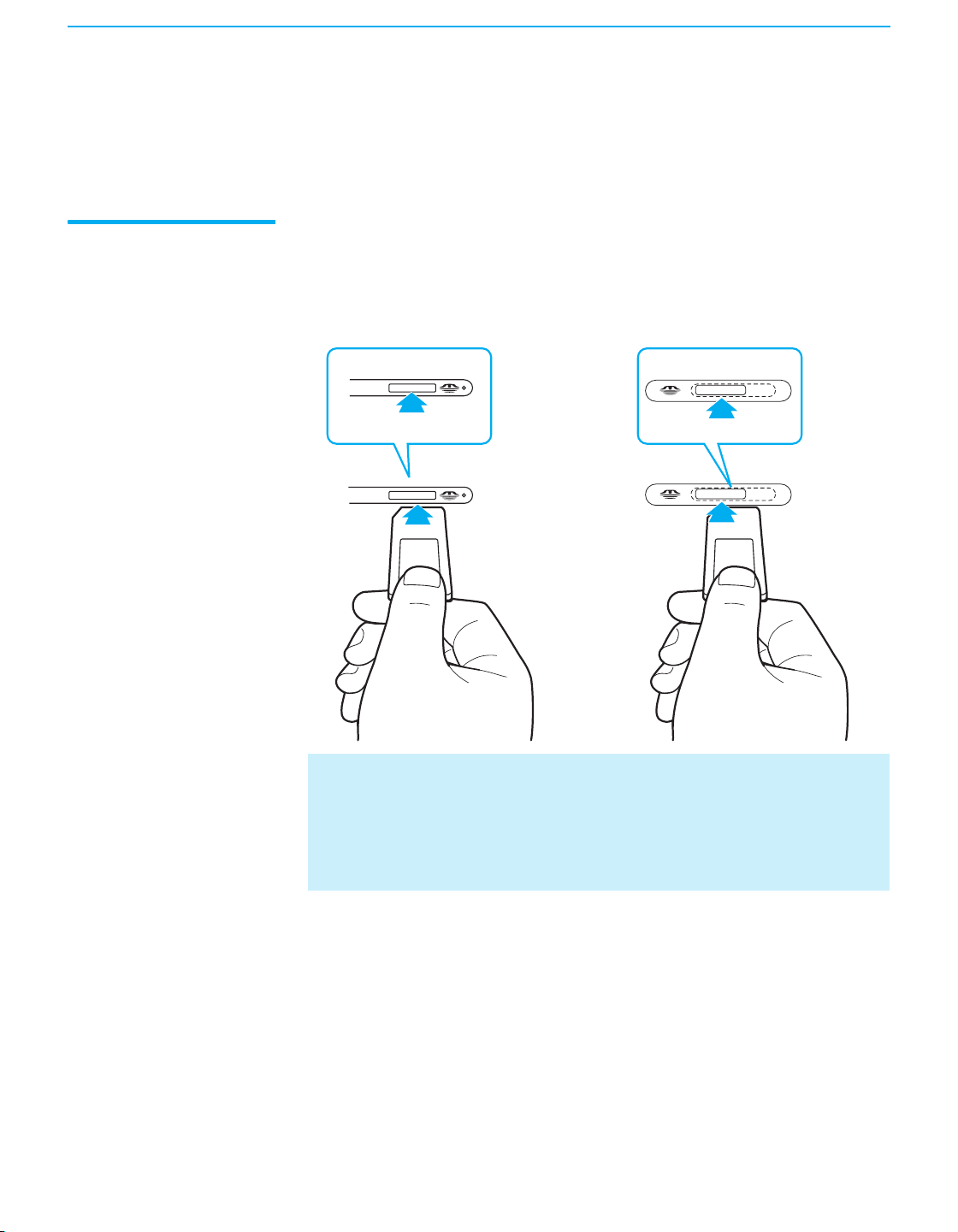
Using the Memory Stick Viewer
82
KDF-WE/WF655
2-059-370-14 (2)
Inserting and Removing a Memory Stick
If you are using a Memory Stick Duo and PRO Duo, see “Inserting the
Memory Stick Duo” on page 83.
Inserting a Memory
Stick
Locate the Memory Stick slot and insert the Memory Stick into the Memory
Stick slot as illustrated below. When inserted properly, it should slide in with
little resistance and click into place.
To remove the Memory Stick, see “Removing a Memory Stick” on page 84.
✍ Be sure to insert the Memory Stick in the correct direction. Forcing the
Memory Stick in the wrong way may damage it.
✍ Insert only Memory Stick media into the Memory Stick slot. Attempting
to insert other objects into the Memory Stick slot may damage the LCD
projection TV.
PRO
STD/DUO
PRO
STD/DUO
PRO
PRO
For WE655 series
For WF655 series
01COV.book Page 82 Thursday, February 17, 2005 8:01 PM
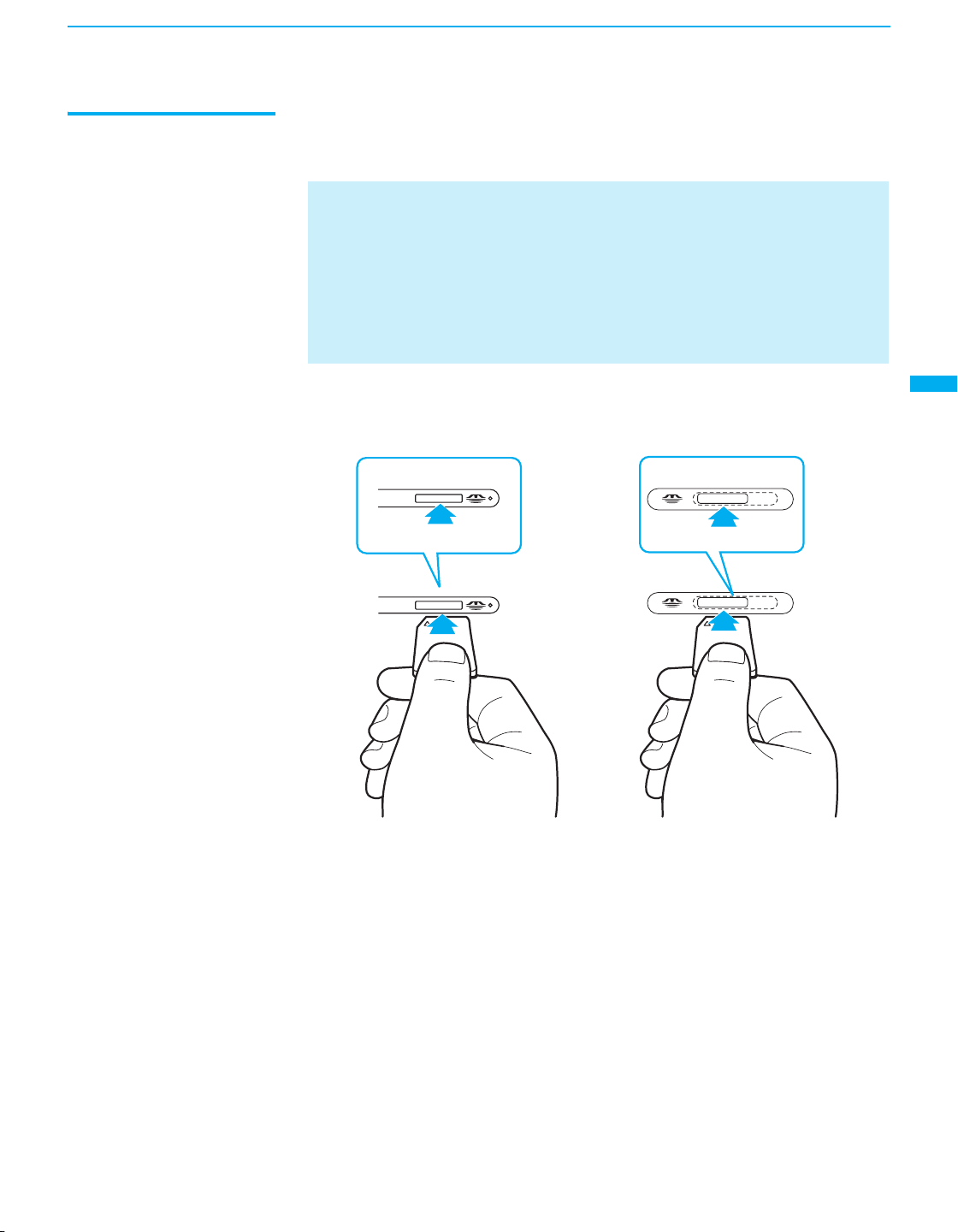
Using the Memory Stick Viewer
83
Using the Memory Stick Viewer
KDF-WE/WF655
2-059-370-14 (2)
Inserting the
Memory Stick Duo
Memory Stick Duo is a new, compact version of the standard-sized Memory
Stick recording medium.
Insert the Memory Stick Duo as shown below.
To remove the Memory Stick Duo, see “Removing a Memory Stick” on
page 84.
✍ CAUTION: The Memory Stick slot on your TV has been designed to
accommodate standard and compact versions of Memory Stick. It is not
necessary to use an adaptor for Memory Stick Duo and Memory Stick
PRO Duo. If you use an adaptor, it may damage the adaptor and Memory
Stick slot.
✍ CAUTION: Inserting the Memory Stick Duo incorrectly may result in
permanent damage to the Memory Stick Duo and the LCD projection TV.
PRO
STD/DUO
PRO
STD/DUO
PRO
PRO
For WE655 series
For WF655 series
01COV.book Page 83 Thursday, February 17, 2005 8:01 PM
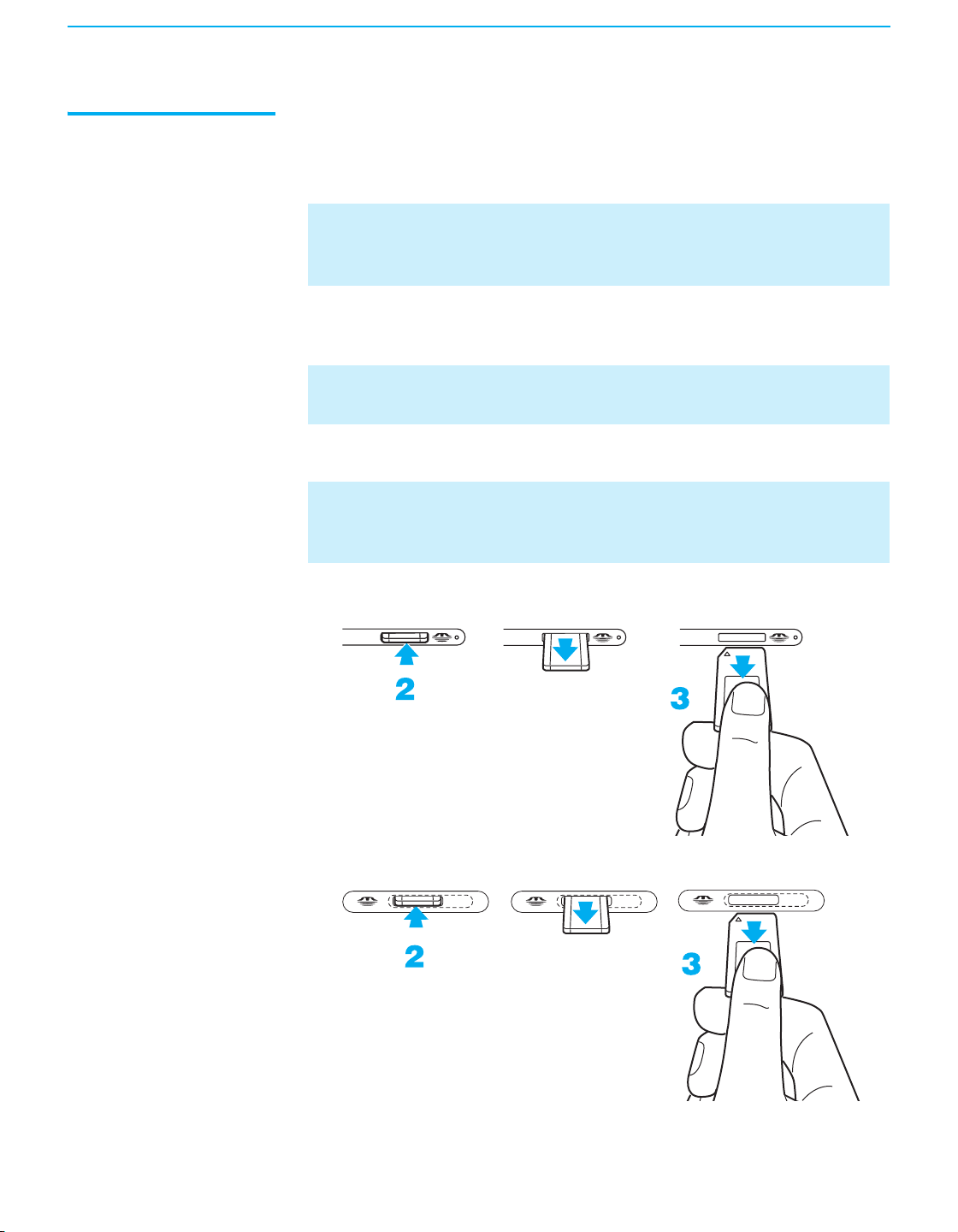
Using the Memory Stick Viewer
84
KDF-WE/WF655
2-059-370-14 (2)
Removing a Memory
Stick
1 Check that the Memory Stick indicator is off. (When the light is on, this
indicates that the LCD projection TV is reading data from the Memory
Stick.)
2 Push the Memory Stick gently into the Memory Stick slot, and then
release it. The Memory Stick media is ejected.
3 Pull the Memory Stick completely out of the slot.
✍ Removing the Memory Stick while a file is being accessed (when the
Memory Stick indicator on the LCD projection TV’s front panel is lit) may
damage the Memory Stick or its contents.
✍ When removing the Memory Stick, do not attempt to pull it from its slot
without first pushing it in to release it.
✍ To protect small children from injury by Memory Stick media, remove all
Memory Stick media from the LCD projection TV’s Memory Stick slot
and store in a safe location when not in use.
PRO
PRO PRO
For WE655 series
PRO
STD/DUO
PRO
STD/DUO
PRO
STD/DUO
For WF655 series
01COV.book Page 84 Thursday, February 17, 2005 8:01 PM
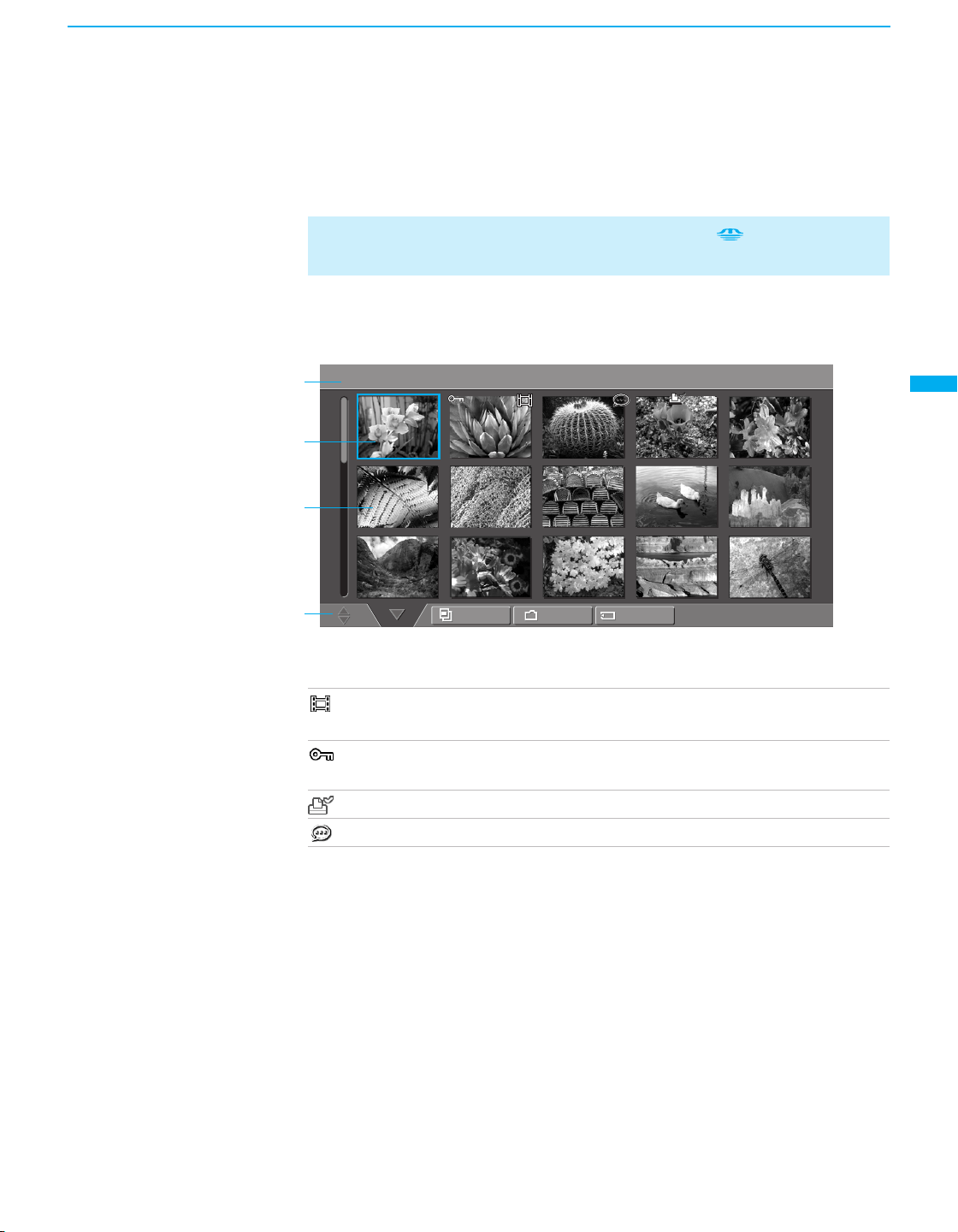
Using the Memory Stick Viewer
85
Using the Memory Stick Viewer
KDF-WE/WF655
2-059-370-14 (2)
Using the Memory Stick Index
Turn on the LCD projection TV and insert a Memory Stick that contains the
photo or movie files you want to view. To insert a Memory Stick, see
“Inserting a Memory Stick” on page 82.
The Memory Stick Index appears, which displays thumbnail images of the
files stored on the Memory Stick.
About the Lock and Movie Icons on the Thumbnail Images
✍ If the Memory Stick Index does not appear, press /F1 button on the
remote control.
Summer 2004 / DSC0001
Jul 30, 2004 12:59PM 640x480
Slide Show Contents Memory Stick
1 of 25
Thumbnails of photos and
movies
Memory Stick menu bar
Information about the highlighted
photo or movie
Highlighted thumbnail
Indicates the thumbnail is a movie (MPEG1) file instead of a photo (JPEG)
file.
Indicates the thumbnail is locked. Locked files cannot be changed or deleted.
For details, see “Protect“ on page 88 or 91.
Indicates that the photo is marked to be printed.
Indicates that the photo has an associated voice memo.
01COV.book Page 85 Thursday, February 17, 2005 8:01 PM
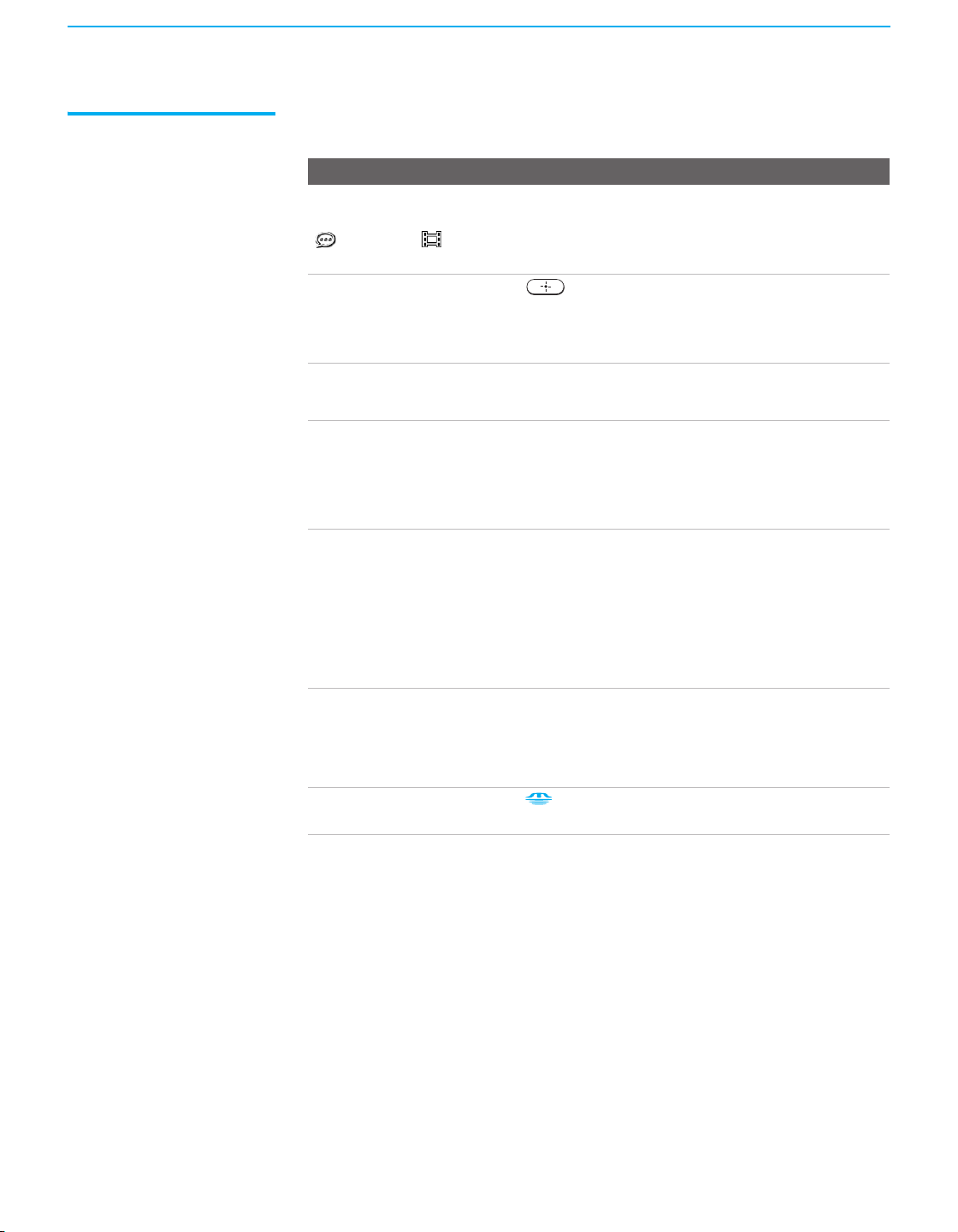
Using the Memory Stick Viewer
86
KDF-WE/WF655
2-059-370-14 (2)
Using the Memory
Stick Index
The following describes how to use the Memory Stick Index.
To Do This ... Do This ...
Move the highlight to
a photo, voice memo
( ), or movie ( )
thumbnail
Press
VvBb.
Display the
highlighted photo,
voice memo, or movie
file full screen
Press . For details, see “Viewing Photos” on page
87 and “Playing Movies” on page 90.
Display the next page
of thumbnails
1 Press v
to select V.
2 Press
v to display the next page of thumbnails.
Display the previous
or next page of
thumbnails
1 Press v
to select V.
2 Press
B to select .
3 To go to the previous page, press V.
To go to the next page, press v.
Use the Memory Stick
Menu bar to access
additional options
1 Press v
to select V.
2 Press B
or b to select Slide Show, Contents, or
Memory Stick.
3 Press V or v to select the option you want to change.
For details on these options, see “Memory Stick Index
Menu Bar Options” on page 92.
Move the highlight
from the Memory
Stick Menu bar back
to the thumbnails
1 Press B
or b to select V.
2 Press
V to return to the currently displayed
thumbnails, or v
to display the next page of
thumbnails.
Exit Memory Stick
Viewer
Press /F1 button on the remote control.
Y
01COV.book Page 86 Thursday, February 17, 2005 8:01 PM
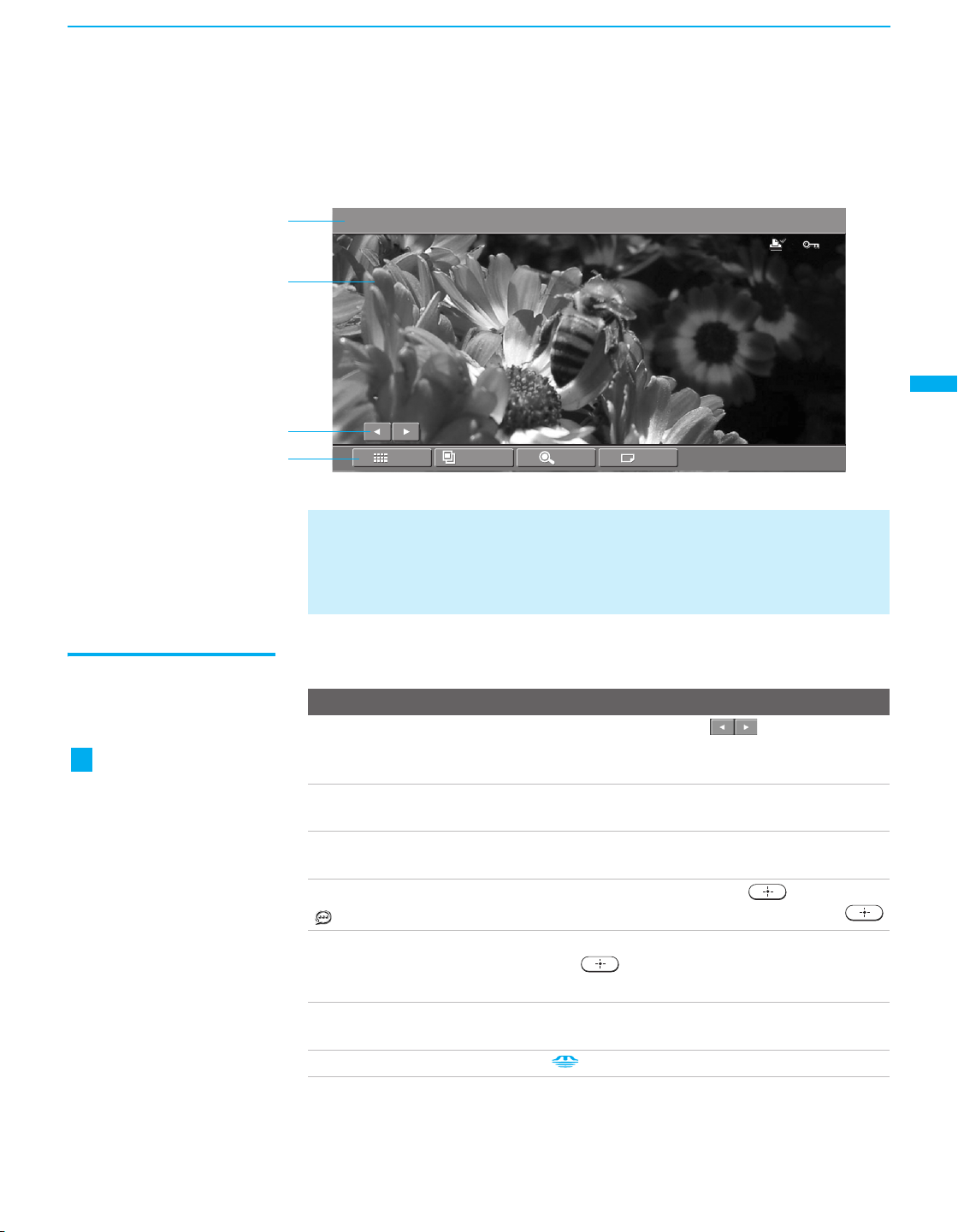
Using the Memory Stick Viewer
87
Using the Memory Stick Viewer
KDF-WE/WF655
2-059-370-14 (2)
Viewing Photos
When you select a photo from the Memory Stick Index (described on
page 85), it displays as shown below, with the following controls.
Photo Controls
Summer 2004 / DSC00012
Jul 30, 2004 12:59PM 640x480 12 of 25
Slide ShowIndex View File
x2
Photo menu bar
Information about
selected photo
Selected photo
Previous/next buttons
✍ JPEGs captured using a digital video camera may appear to display
motion in full screen. This is a result of the way digital video cameras
record still images, and is not a result of a malfunction with the LCD
projection TV.
To Do This ... Do This ...
Display the next or
previous file on the
Memory Stick
Press V or v to highlight the (Previous/Next)
button. Then press B
to go to the previous file, or b to
go to the next file.
Hide the Photo menu bar,
displaying only the photo
With the highlight in the Photo menu bar, press v.
Display the hidden Photo
menu bar
Press
V.
Play the JPEG voice memo
( files only)
Highlight B (Play) and then press . To pause the
voice memo, highlight X (Pause) and then press .
Display the Memory Stick
Index again
Press B or b to highlight Index in the Photo menu bar
and press .
For details on the Memory Stick Index, see page 86.
Access additional options
in the Photo menu bar
See “Photo Menu Bar Options” on page 88.
Exit Memory Stick Viewer Press /F1 button on the remote control.
When the menu is
hidden, press B or b to
go to the previous or
next photo.
z
01COV.book Page 87 Thursday, February 17, 2005 8:01 PM
Using the Memory Stick Viewer
88
KDF-WE/WF655
2-059-370-14 (2)
Photo Menu
Bar Options
The Photo menu bar lets you access additional photo viewing options.
To access the Photo menu bar
1 Press B or b to select Slide Show, View, or File.
2 Use Vv Bb to select the desired option.
Option Description
Index Displays the Memory Stick Index, with the highlight on the
currently displayed photo’s thumbnail. For details, see “Using the
Memory Stick Index” on page 85.
Slide Show Displays the Slide Show menu. For details, see “Slide Show Menu
Options” on page 92.
View Rotate Allows you to rotate the photo in 90 degree
increments clockwise or counterclockwise. For
details, see “Using Rotate” on page 89.
Zoom/Pan Allows you to magnify and pan across the photo.
For details, see “Using Zoom and Pan” on page 89.
File Protect Allows you to protect the JPEG file from any
changes. When a JPEG file is protected, it cannot
be rotated or deleted. Select On or Off.
Print
Quantity
Allows you to indicate the number of prints to make
of the specific photo when the Memory Stick is
inserted into a compatible photo printer (not
supplied).
Delete Deletes the JPEG file from the Memory Stick.You
cannot delete a JPEG file that has been protected
(or if the Memory Stick is locked).
JPEG files that are
protected are indicated
by the Lock icon.
z
The Print Quantity
feature is also known
as DPOF (Digital Print
Order Format).
z
01COV.book Page 88 Thursday, February 17, 2005 8:01 PM
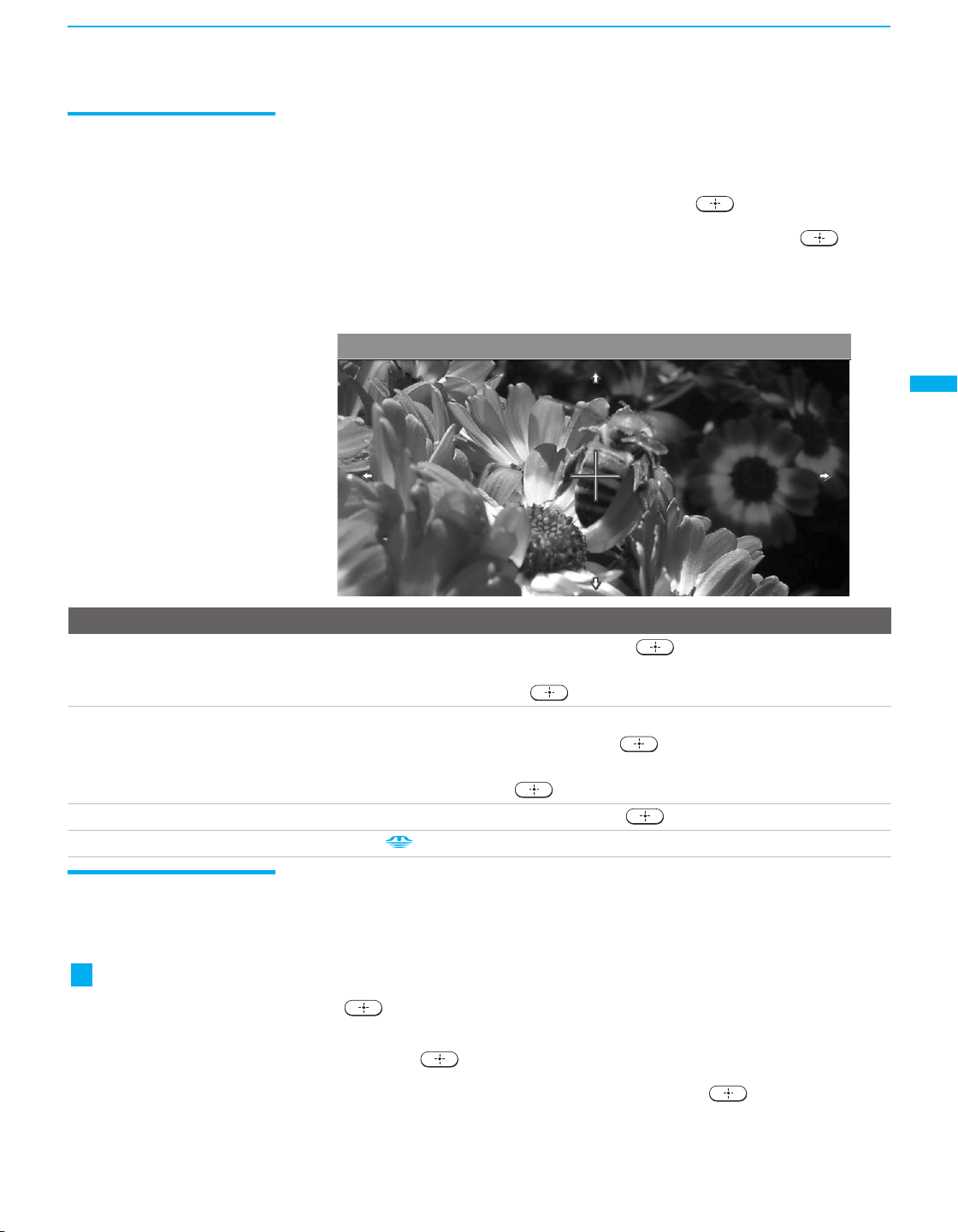
Using the Memory Stick Viewer
89
Using the Memory Stick Viewer
KDF-WE/WF655
2-059-370-14 (2)
Using Zoom
and Pan
To Zoom and Pan a photo
1 In the Photo menu bar, press B or b to highlight View.
2 Press V or v to highlight Zoom/Pan and press .
3 Specify the zoom center point by using VvBb; then press to set
the center.
The Zoom and Pan controls are displayed.
Using Rotate To Rotate a photo
1 In the Photo menu bar, press B or b to highlight View.
2 Press V or v to highlight Rotate.
3 To rotate clockwise, press V or v to highlight Clockwise and press
.
To rotate counterclockwise, press V or v to highlight
Counterclockwise
and press .
The photo is rotated 90 degrees each time you press .
To Do This ... Do This ...
Zoom in (increase magnification)
or out (decrease magnification)
Press
B or b to highlight Zoom and press . Then press V to zoom in or v
to zoom out.
To stop using Zoom, press .
Pan (left, right, up, down) (You can use Pan only when the photo is magnified using Zoom.)
Press
B or b to highlight Pan and press . Then press B b V v to pan
around the photo.
To stop using Pan, press .
Exit the Zoom/Pan controls Press
B or b to highlight Exit and press .
Exit Memory Stick Viewer Press /F1 button on the remote control.
Summer 2004 / DSC00012
Jul 30, 2004 12:59PM 640x480 12 of 25
You cannot rotate a
photo that has been
protected. See Protect
on page 88.
z
01COV.book Page 89 Thursday, February 17, 2005 8:01 PM
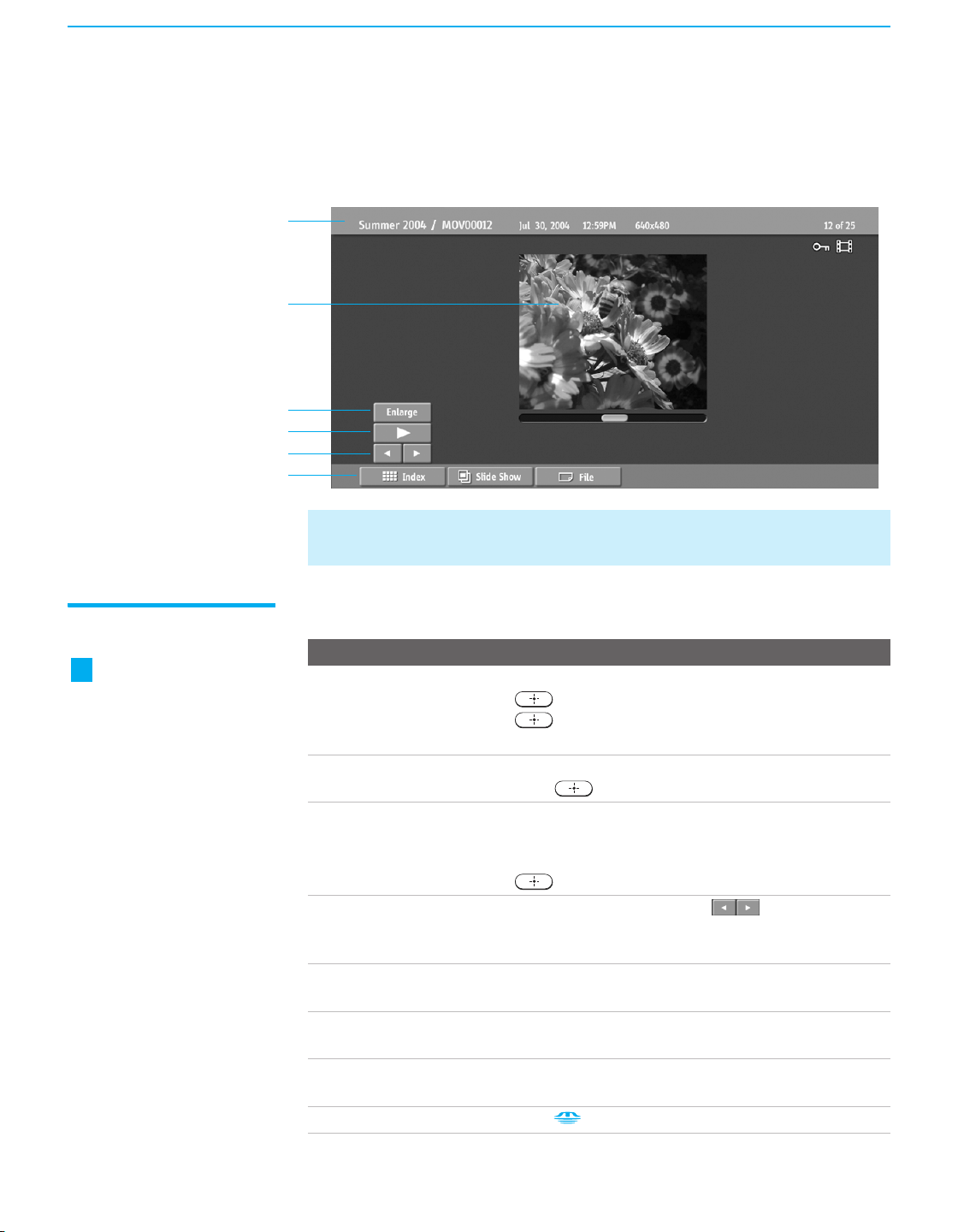
Using the Memory Stick Viewer
90
KDF-WE/WF655
2-059-370-14 (2)
Playing Movies
When you select a movie from the Memory Stick Index (described on
page 85), it displays as shown below, with the following controls.
Movie Controls
Information about
selected movie
Selected movie
Enlarge button
Movie menu bar
Previous/next buttons
Play/pause button
✍ MPEG movies recorded in VX Fine mode with Sony digital cameras cannot be
played back with the Memory Stick Viewer.
To Do This ... Do This ...
Enlarge the movie window Press V or v to highlight Enlarge, and then press
.
To display the movie controls again, press
. When the movie playback ends, the movie
controls are displayed again.
Play the movie with the
movie controls displayed
Press V or v to highlight
B (play) and then
press
.
Pause the movie While the movie is playing, the B button changes to
the X (pause) button.
Press V or v to highlight
X (Pause) and then press
.
Display the previous or next
file on the Memory Stick
Press V or v to highlight the (Previous/Next)
button. Then press B
to go to the previous file, or b to
go to the next file.
Hide the Movie menu bar,
displaying only the movie
With the highlight in the Movie menu bar, press v.
Display the hidden Movie
menu bar
Press
V.
Access additional options in
the Movie menu bar
See “Movie Menu Bar Options” on page 91.
Exit Memory Stick Viewer Press /F1 button on the remote control.
The quality of the movie
when enlarged
depends on the
resolution of the
MPEG1 file. See your
camera’s instruction
manual for details.
z
01COV.book Page 90 Thursday, February 17, 2005 8:01 PM
Using the Memory Stick Viewer
91
Using the Memory Stick Viewer
KDF-WE/WF655
2-059-370-14 (2)
Movie Menu
Bar Options
To access the Movie menu bar
1 Use V or v to highlight Index in the Movie menu bar.
2 Press B or b to select Index, Slide Show, or File.
3 Press V or v to select the desired option.
Option Description
Index Displays the Memory Stick Index, with the highlight on the thumbnail
of the currently displayed movie.
Slide
Show
Displays the Slide Show menu. For details, see “Slide Show Menu
Options” on page 92.
File Protect Allows you to protect the MPEG1 file from any
changes. When an MPEG1 file is protected, it
cannot be deleted. Select On or Off.
Delete Deletes the MPEG1 file from the Memory
Stick.You cannot delete an MPEG1 file that has
been protected (or if the Memory Stick is locked).
MPEG1 files that are
protected are indicated
by the Lock icon.
z
01COV.book Page 91 Thursday, February 17, 2005 8:01 PM
Using the Memory Stick Viewer
92
KDF-WE/WF655
2-059-370-14 (2)
Memory Stick Index Menu Bar Options
Slide Show Menu
Options
The Slide Show menu includes the following options:
Option Description
Start Starts the Slide Show.
Music Allows you to select background audio to play during the Slide
Show.
Off No additional background audio is played during
the Slide Show. Audio that is associated with the
JPEG or MPEG1 files will play.
Play Memory
Stick
Plays all MP3 files on the Memory Stick. The
Piano MP3 file is not played.
Piano
(Built-in
music)
Plays the MP3 file stored in the LCD projection
TV’s internal memory.
(List of MP3
Files)
Displays a list of all MP3 files found at the top level
(root) of the Memory Stick. To show additional
MP3 files stored in other folders on the Memory
Stick, select Complete List.
Complete
List
Displays a list of all available MP3 files. The list is
sorted in alphabetical order, grouped by folder.
Transition
Effect
Allows you to select an effect to be used when advancing to the next
file in the Slide Show.
Slide
Advance
Allows you to specify when to advance to the next slide.
Fast Slide advances after about 3 seconds.
Medium Slide advances after about 6 seconds.
Slow Slide advances after about 12 seconds.
Manual
Advance
Slide advances only after you press B or b.
File
Information
Determines whether file information is displayed. Select On or Off.
Repeat On Slide Show continuously loops.
Off Slide Show plays once through all files and ends.
The Slide Show menu
is the same whether
you select it from the
Memory Stick Index
(page 85), Photo
(page 87), or Movie
(page 90) menus.
z
When you select
Complete List, it may
take a moment to
display the list of all
MP3 files.
z
Some JPEG files may
take longer to display
than others, which may
make it seem longer
than the interval you
selected for Slide
Advance.
z
01COV.book Page 92 Thursday, February 17, 2005 8:01 PM
Using the Memory Stick Viewer
93
Using the Memory Stick Viewer
KDF-WE/WF655
2-059-370-14 (2)
Folder Menu
Options
The Folder menu includes the following options:
Memory Stick Menu The Memory Stick menu displays the current status of the Memory Stick,
including total capacity, used capacity, and free capacity.
Option Description
Select
Folder
Allows you to select different folders to view in the Memory Stick
Viewer.
Digital Camera
Folders
Selects all folders within the directories
defined by the DCF rules used by Sony digital
cameras (see page 94). JPEG and MPEG1
files in those directories are recognized even if
they do not conform to the DCF file naming
rules.
Select a Folder Allows you to access individual folders on the
Memory Stick.
File Order Allows you to change the order in which the Memory Stick files are
displayed.
Date Order Displays files in chronological order by
modification date.
Date Order
Reverse
Displays files in reverse chronological order
by modification date.
Alphabetical Displays files in alphabetical order by
filename.
Filter Allows you to selectively display specific file types within the
selected folder.
Show Photos and
Movies
Displays all readable files.
Show Photos
Only
Displays only photo (JPEG) files.
Show Movies
Only
Displays only movie (MPEG1) files.
Show All Print
Marks
Displays all files marked with the Print Mark
feature, regardless of the currently selected
folder. For details, see “Print Quantity” on
page 88.
The Rotate and Protect
functions do not
change the file’s
modification date.
z
01COV.book Page 93 Thursday, February 17, 2005 8:01 PM

Using the Memory Stick Viewer
94
KDF-WE/WF655
2-059-370-14 (2)
Notes on Using Memory Stick Media
About DCF File
Names
Most Sony brand digital still and video cameras automatically record still
photo and movie files using DCF compliant directory and file names.
If you selected the
Digital Camera Folders option, as described on page 93,
you might want to have your digital camera’s instruction manual handy in
order to check how files and directories are organized for your specific
model of digital camera.
DCF stands for “Design Rules for Camera File Systems,” which are
specifications established by the Japan Electronics and Information
Technology Industries Association (JEITA: formerly JEIDA).
01COV.book Page 94 Thursday, February 17, 2005 8:01 PM
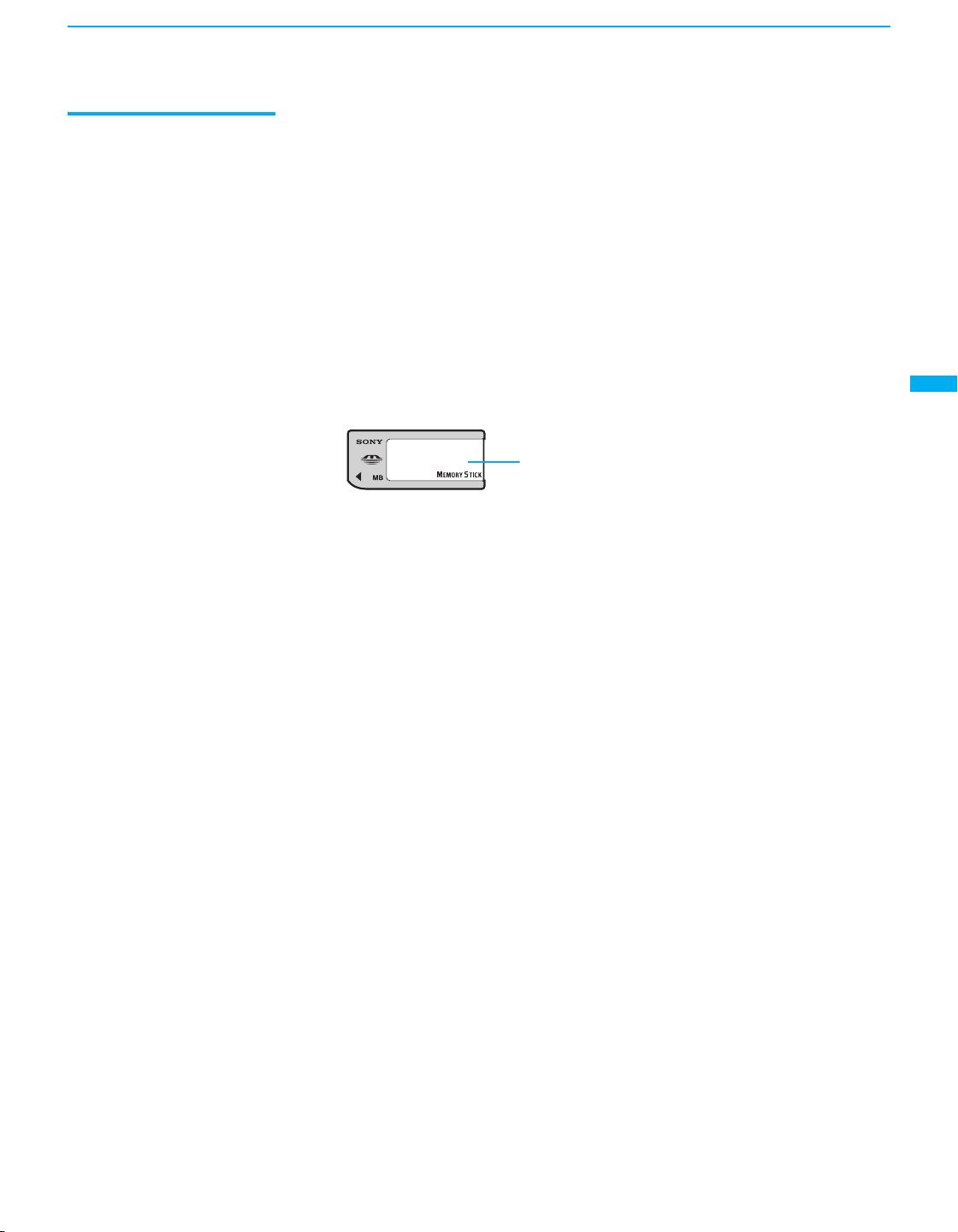
Using the Memory Stick Viewer
95
Using the Memory Stick Viewer
KDF-WE/WF655
2-059-370-14 (2)
Memory Stick
Precautions
When using Memory Stick media, follow these precautions:
❑ To avoid permanent damage to still image data, do not turn off the LCD
projection TV or remove Memory Stick media from the insertion slot
while data is being read (as indicated by the Memory Stick indicator
light being on).
❑ Avoid touching the terminal of Memory Stick media or bringing it into
contact with a metal object.
❑ Do not drop, bend, or submit Memory Stick media to external shock.
❑ Do not disassemble or modify Memory Stick media.
❑ Avoid getting liquid on Memory Stick media.
❑ Apply labels only within the designated label area.
❑ To avoid permanent damage to still image data, do not use or store
Memory Stick media in a location subject to:
● High temperature (such as near a heater or inside a hot car)
● High humidity
● Direct sunlight
● Corrosive substances
● Magnetic fields
● Excessive dust
● Static electricity or electric noise
● Electric surges
❑ Store and carry Memory Stick media in its original case to ensure
protection of stored data.
❑ Save a backup of stored data.
❑ When using the Memory Stick Duo, insert it without using the Memory
Stick Duo adaptor. For details, see page 83.
Label Area
01COV.book Page 95 Thursday, February 17, 2005 8:01 PM

01COV.book Page 96 Thursday, February 17, 2005 8:01 PM
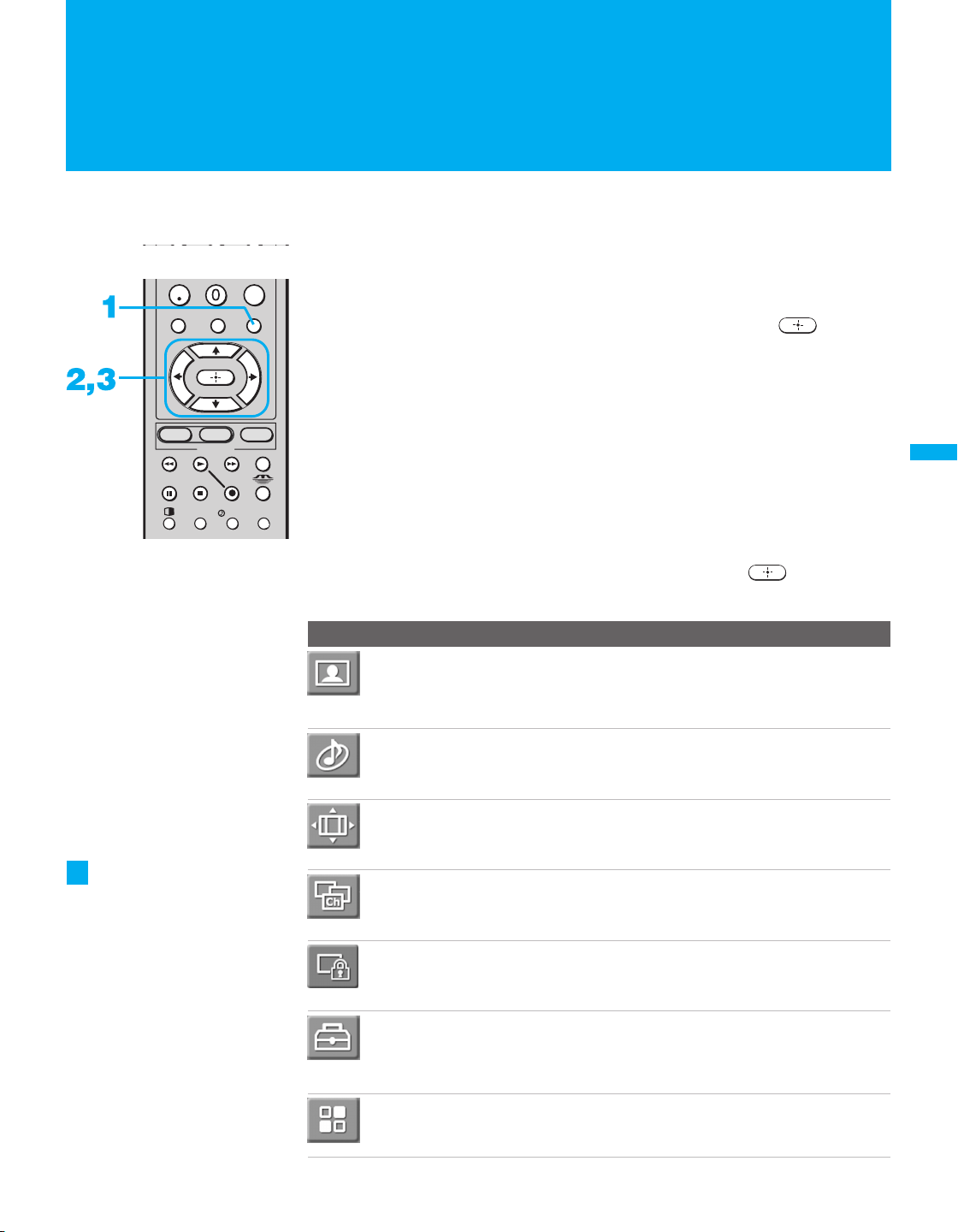
97
Using the Menus
KDF-WE/WF655
2-059-370-14 (2)
Using the Menus
Overview
Opening and choosing a menu
1 Press MENU to display the menu screen.
2 Press V or v to highlight the desired menu icon and press to select
it.
3 Use the arrow buttons to scroll through the features.
4 See the specific menu page for instructions on moving through the
menu.
To end a menu session
❑
Press MENU again.
To end one menu session and move to another
❑
Press B to return to the menu icons.
Press V or v to choose the next menu icon and press to select it.
The Menu gives you access to the following features:
ENT
TV
F1
F2
MENUGUIDE
TOP MENU
FAVORITES
FREEZE ANT
GUIDE
CHVOL
SAT/
CABLE
FUNCTION
DVD/VCR
/TV/SAT
Menu Icon Description Page
The Video Menu allows you to make adjustments to your
picture settings. It also allows you to customize the Picture
Mode based on the type of program you are viewing, select
Advanced Video options, and more.
98
The Audio Menu offers enhanced audio options such as
listening to second audio programming (SAP) or
customizing the Effect of the sound on your TV.
102
The Screen Menu allows you to make Wide Mode
adjustments and make changes to the screen’s vertical
center and size.
104
The Channel Menu allows you to set up a Favorite
Channels list, run the Auto Program function, label
channels, and more.
106
The Parent Menu lets you control the viewing of programs
based on their ratings.
108
The Setup Menu provides options for setting up your
system, including selecting closed caption modes, labeling
video inputs, selecting the language of the on-screen
menus, and more.
112
The Applications Menu lets you display the Memory Stick
Viewer, set on/off Timers, access CableCARD and
diagnostics information, and more.
115
Press MENU to enter
and exit Menus.
z
01COV.book Page 97 Thursday, February 17, 2005 8:01 PM
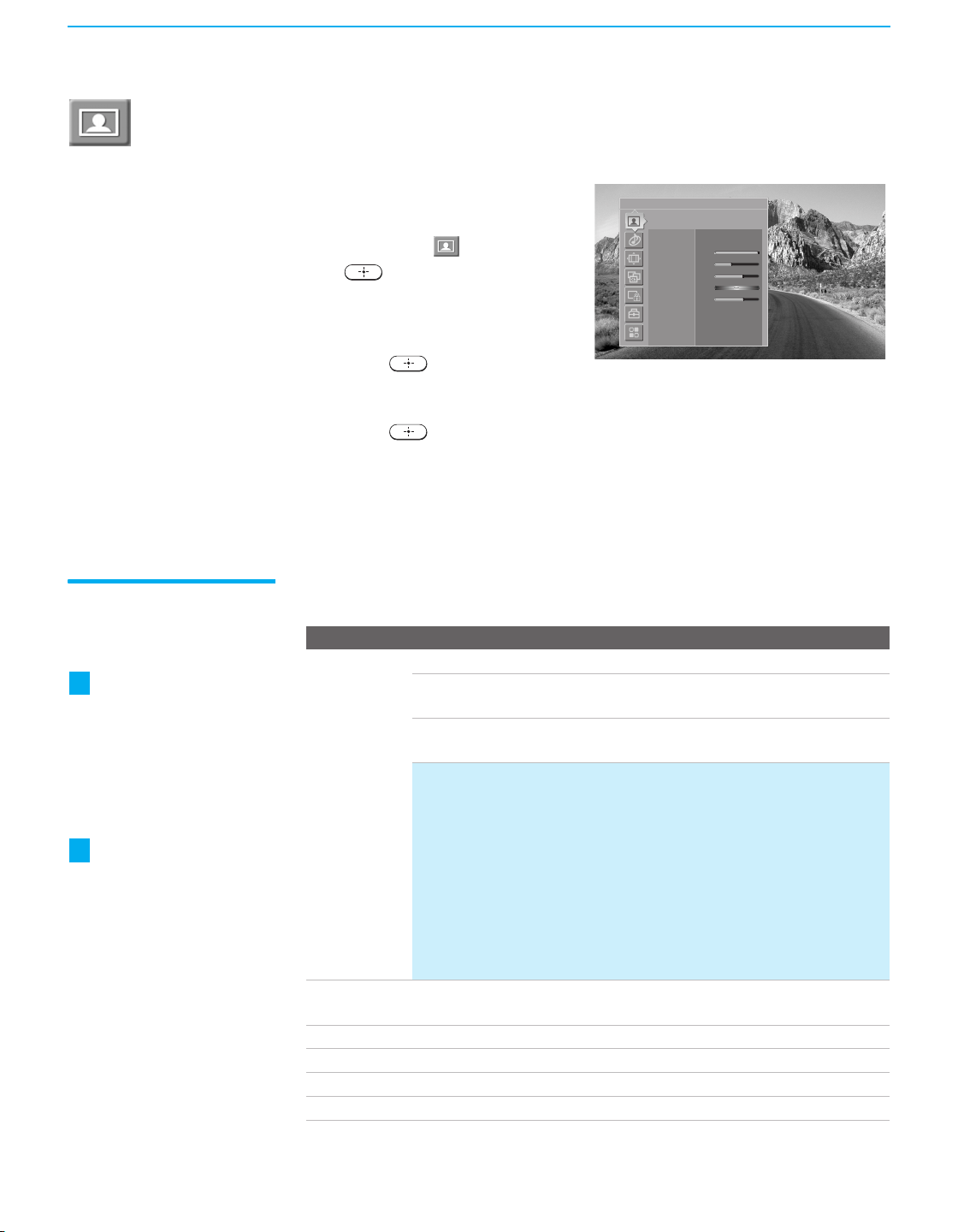
Using the Menus
98
KDF-WE/WF655
2-059-370-14 (2)
Using the Video Menu
To select the Video menu
1 Press MENU.
2 Press V or v to highlight the
Video icon and press
.
3 Use the arrow buttons to scroll
through the features.
4 Press to select a feature.
5 Use the arrow buttons to make the desired adjustments.
6 Press to select/set.
7 Press MENU to exit the menu screen.
To restore the factory default settings for the Video settings:
❑
Press RESET on the remote control when in the Video menu.
Selecting Video
Options
The Video menu includes the following options.
Antenna
Video
Mode Vivid
Picture Max
Brightness 25
Color 37
Hue 0
Sharpness 37
Color Temp. Cool
Noise Reduction
Off
Mild Mode Off
Option Description
Mode
Customized
picture
viewing
Vivid Select for enhanced picture contrast and sharpness.
Standard Select for standard picture settings. Recommended
for home entertainment.
Pro Select to display a picture with minimum
enhancements.
✍ You can alter the Video menu settings (Picture,
Brightness, Color, etc.) for each Mode and each video
input.
✍ You may set up a “Mode” (Vivid, Standard, Pro)
independently for each Video input (Video 1-Video 7,
including the Antenna input). Your “Mode” settings are
automatically saved after each selection. This allows you
to customize the Mode setting for each type of signal
source.
Picture Adjust to increase picture contrast and deepen the color or decrease
picture contrast and soften the color.
Brightness Adjust to brighten or darken the picture.
Color Adjust to increase or decrease color intensity.
Hue Adjust to increase or decrease the green tones.
Sharpness Adjust to sharpen or soften the picture.
To quickly and easily
change from one
Picture Mode to
another, use PICTURE
on the remote control.
Mild Mode is not
available when picture
mode is set to Vivid.
z
z
01COV.book Page 98 Thursday, February 17, 2005 8:01 PM
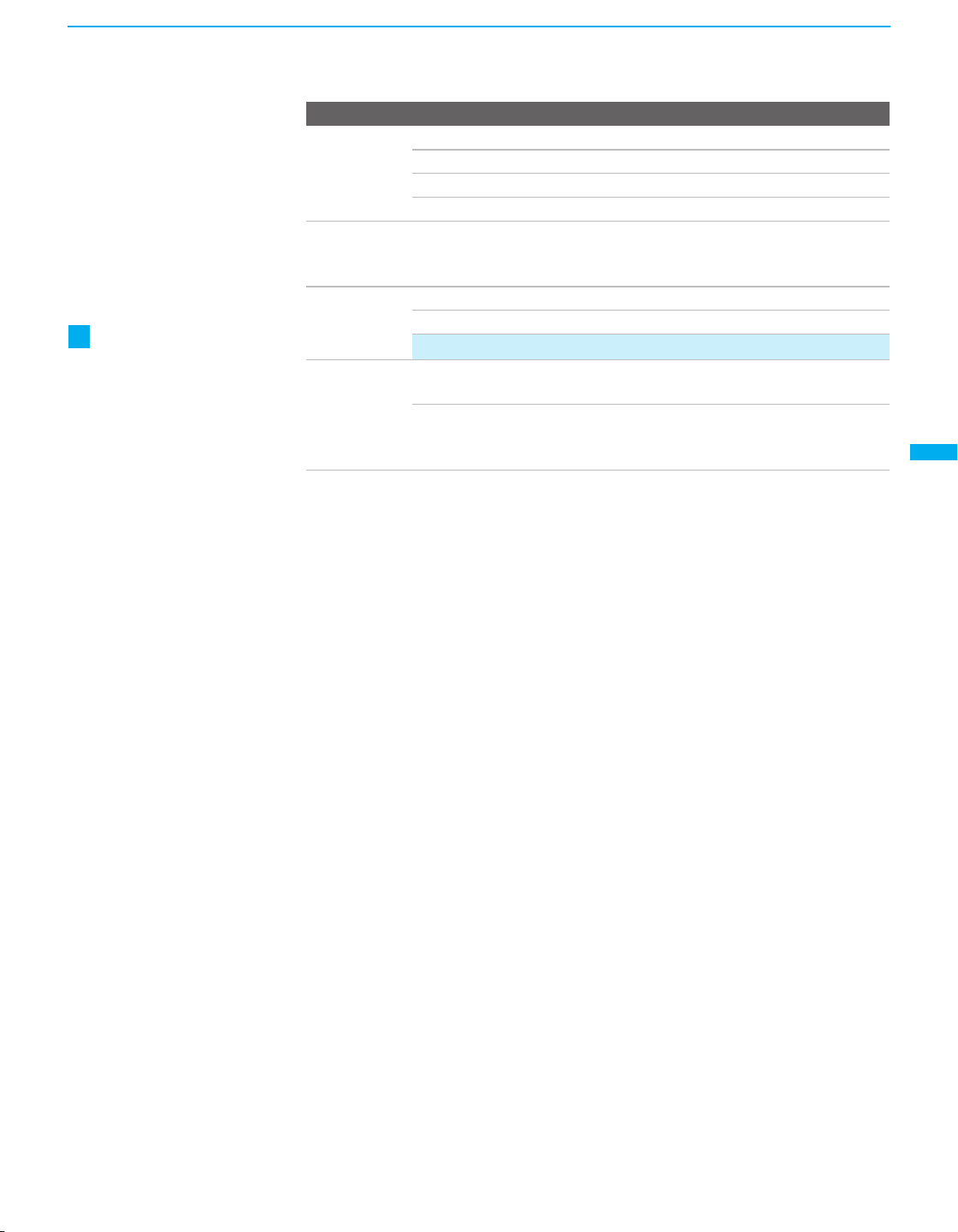
Using the Menus
99
Using the Menus
KDF-WE/WF655
2-059-370-14 (2)
Color Temp.
White
intensity
adjustment
Choose from three color temperatures:
Cool Select to give the white colors a blue tint.
Neutral Select to give the white colors a neutral tint.
Warm Select to give the white colors a red tint.
Noise
Reduction
Select to reduce the noise level of connected equipment. This also
reduces the noise level to the signal from the VHF/UHF jack. Select
from High, Medium, Low and Off.
Mild Mode On Select for a natural, soft picture.
Off Select to turn off Mild Mode.
✍ Mild Mode is unavailable when Mode is set to Vivid.
Power
Saving
Standard Select to view picture without the benefit of Power
Saving.
Reduced Select to view picture with reduced power
consumption. The picture becomes darker, but also
enhances the black level.
Option Description
Power Saving is
available for WF655
series only.
z
(Continued)
01COV.book Page 99 Thursday, February 17, 2005 8:01 PM
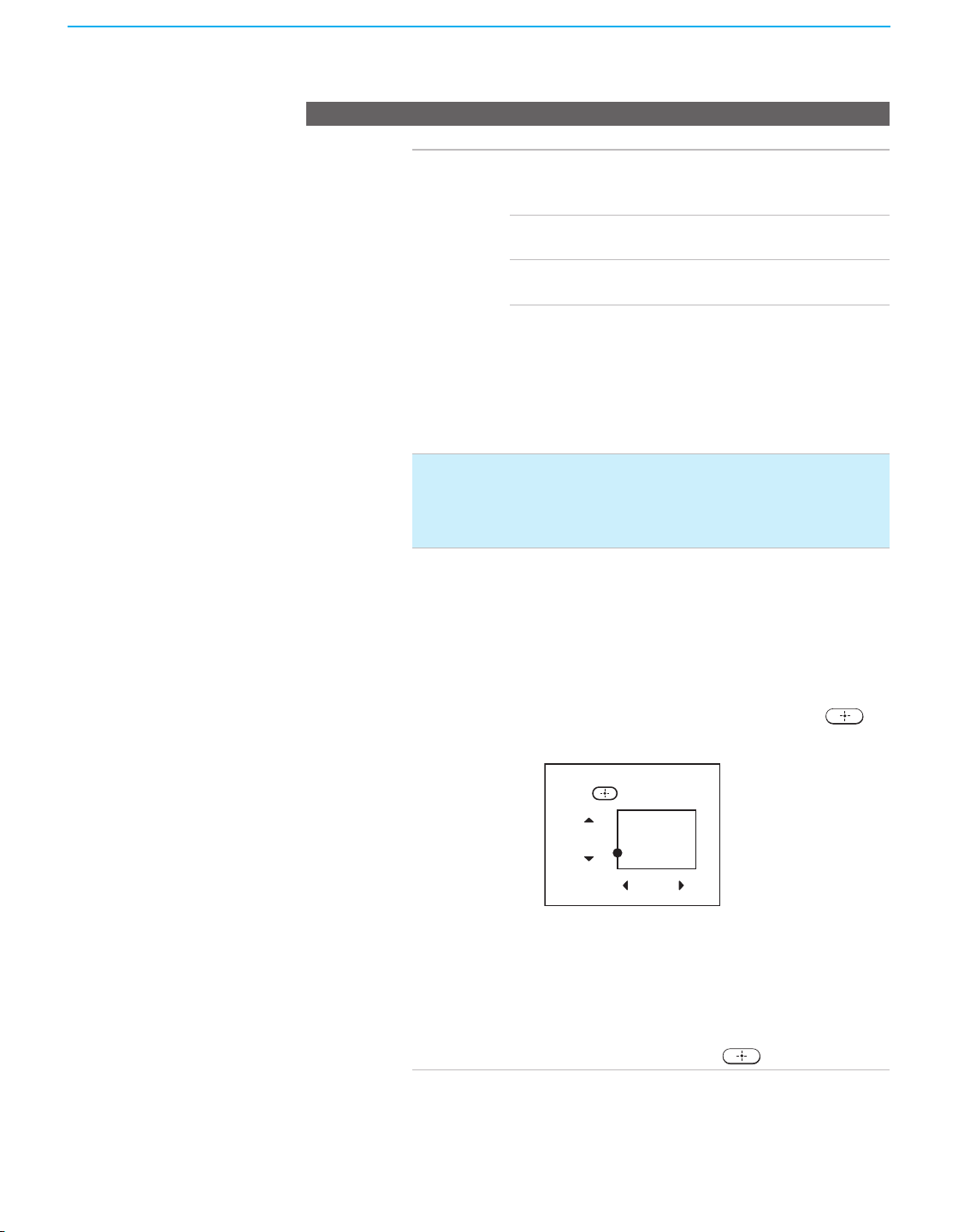
Using the Menus
100
KDF-WE/WF655
2-059-370-14 (2)
Advanced
Video
Select Program to choose among the options described below.
DRC Mode Creates a high-resolution picture with 4 x density, for
high quality sources (i.e., DVD player, satellite
receiver).
High Density Recommended for moving
pictures.
Progressive Recommended for still
images and text.
CineMotion Provides an optimized
display by automatically
detecting film content and
applying a reverse 3-2
pulldown process. Moving
pictures will appear clearer
and more natural-looking.
✍ DRC Mode is not available when watching 480p, 720p,
and 1080i sources. Also not available when Mild Mode is
On, or when using multi-picture functions (Twin View,
Freeze or Memory Stick).
DRC
Palette
Allows you to customize the level of detail (Reality)
and smoothness (Clarity) for up to three input
sources. For example, you can create one Custom
setting to optimize your cable input's picture, and
create another to optimize your DVD player's picture.
You can switch among the three Custom settings.
1 Press the arrow buttons to highlight Custom 1,
Custom 2, or Custom 3 and then press .
The DRC palette appears.
2 Press the arrow buttons to adjust the position of
the marker (z). As you move the z higher
along the Reality axis, the picture becomes more
detailed. As you move the z to the right along
the Clarity axis, the picture becomes smoother.
3 To save the setting, press .
Option Description
Custom 1
Press
Reality
(25)
Clarity
(1)
to exit
01COV.book Page 100 Thursday, February 17, 2005 8:01 PM

Using the Menus
101
Using the Menus
KDF-WE/WF655
2-059-370-14 (2)
To return the Custom options to the default factory
settings, press the RESET button.
✍ DRC Palette is not available when watching 480p, 720p,
and 1080i sources. Also not available when Mild Mode is
On, or when using multi-picture functions (Twin View,
Freeze or Memory Stick).
BN
Smoother
Select to reduce noise caused by digital video
encoding and decoding process. It is especially
effective for watching a DVD or digital TV picture.
Select from High, Medium, Low and Off.
✍ BN Smoother may not be able to correct image quality
from some connected equipment.
✍ BN Smoother is not available when watching 480p, 720p,
and 1080i sources, or when using multi-picture functions
(Twin View, Freeze or Memory Stick).
Color
Corrector
Select to emphasize the red and blue colors. Select
from High, Low and Off.
✍ Color Corrector is not available when Mode is set to Vivid
or Standard, or when using dual picture functions (Twin
View or Freeze).
Option Description
BN Smoother may not
be effective for some
connected equipment.
z
01COV.book Page 101 Thursday, February 17, 2005 8:01 PM
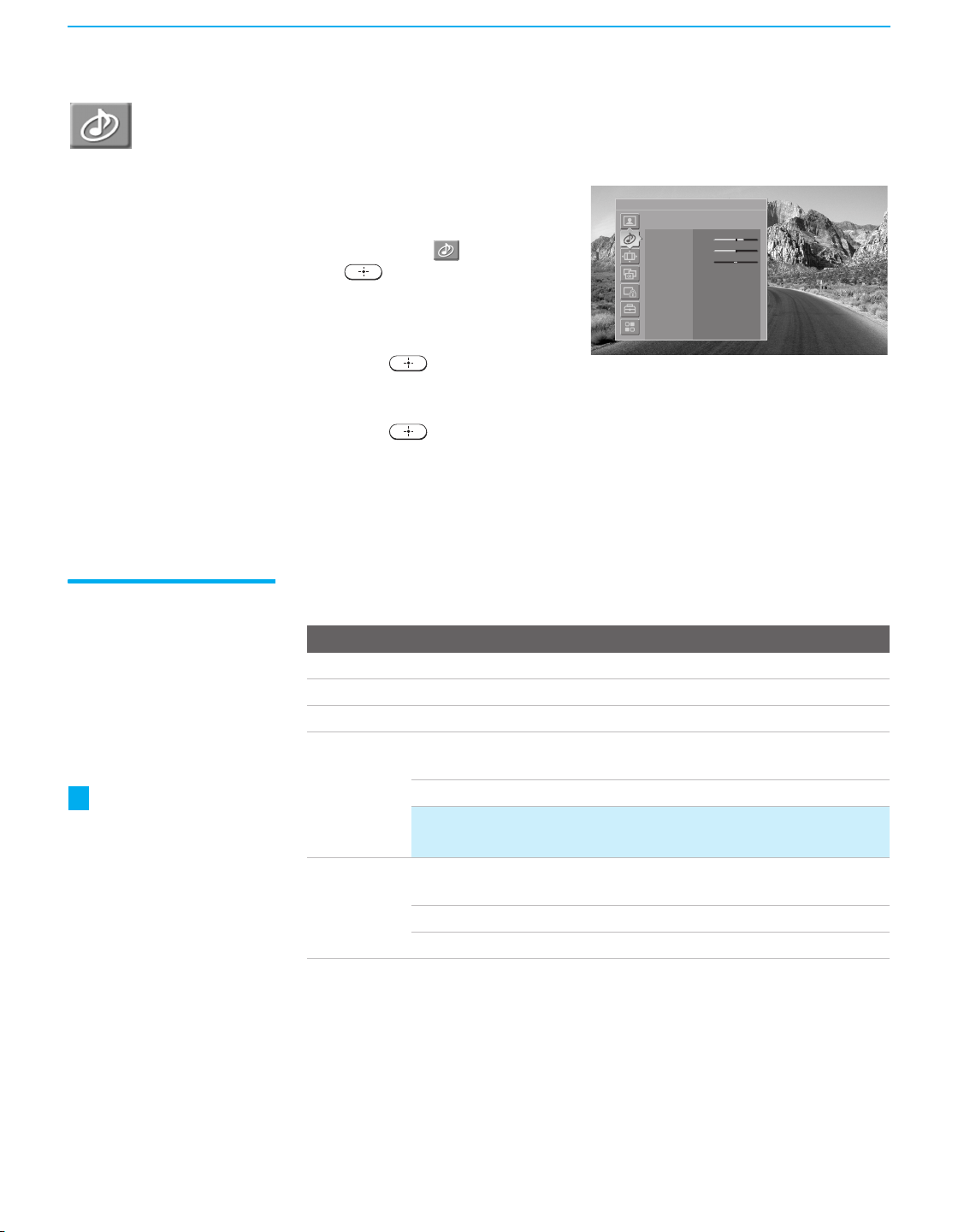
Using the Menus
102
KDF-WE/WF655
2-059-370-14 (2)
Using the Audio Menu
To select the Audio menu
1 Press MENU.
2 Press V or v to highlight the
Audio icon and press
.
3 Use the arrow buttons to scroll
through the options.
4 Press to select an option.
5 Use the arrow buttons to scroll through the settings.
6 Press to select the desired setting.
7 Press MENU to exit the menu screen.
To restore the factory default settings for Treble, Bass and Balance
❑
Press RESET on the remote control when in the Audio menu.
Selecting Audio
Options
The Audio menu includes the following options:
Antenna
Audio
Treble 44
Bass 30
Balance 31
Steady Sound Auto
Effect Off
MTS Stereo
Audio Out Variable
Speaker On
Option Description
Trebl e Adjust to increase or decrease higher-pitched sounds.
Bass Adjust to increase or decrease lower-pitched sounds.
Balance Adjust to emphasize left or right speaker balance.
Steady
Sound
Auto Select to stabilize the volume across all programs
and commercials.
Off Select to turn off Steady Sound.
✍ Steady Sound is not available when Effect is set to
TruSurround or Simulated.
Effect TruSurround Select for surround sound (for stereo programs
only).
Simulated Adds a surround-like effect to mono programs.
Off Normal stereo or mono reception.
TruSurround attempts
to create the same
surround effect
produced by a
multichannel system
using the left and right
speakers.
z
01COV.book Page 102 Thursday, February 17, 2005 8:01 PM
Using the Menus
103
Using the Menus
KDF-WE/WF655
2-059-370-14 (2)
MTS
Enjoy stereo,
bilingual and
mono
programs
Stereo Select for stereo reception when viewing a program
broadcast in stereo.
Auto SAP Select to automatically switch to second audio
programs when a signal is received. (If no SAP
signal is present, the LCD projection TV remains in
Stereo mode.)
Mono Select for mono reception. (Use to reduce noise
during weak stereo broadcasts.)
✍ MTS is available only for analog programs.
Audio Out
This option can be set only when the Speaker option is set to Off.
Easy control
of volume
adjustments
Variable The LCD projection TV’s speakers are turned off
and the audio output of the LCD projection TV is
fixed. Use your audio receiver’s volume control to
adjust the volume (and other settings) through your
audio system.
Fixed The LCD projection TV’s speakers are turned off
and the audio output of the LCD projection TV is
fixed. Use your audio receiver’s volume control to
adjust the volume (and other settings) through your
audio system.
Speaker On Select to turn on the LCD projection TV speakers.
Off Select to turn off the LCD projection TV speakers
and listen to the TV’s sound only through your
external audio system speakers.
Option Description
01COV.book Page 103 Thursday, February 17, 2005 8:01 PM
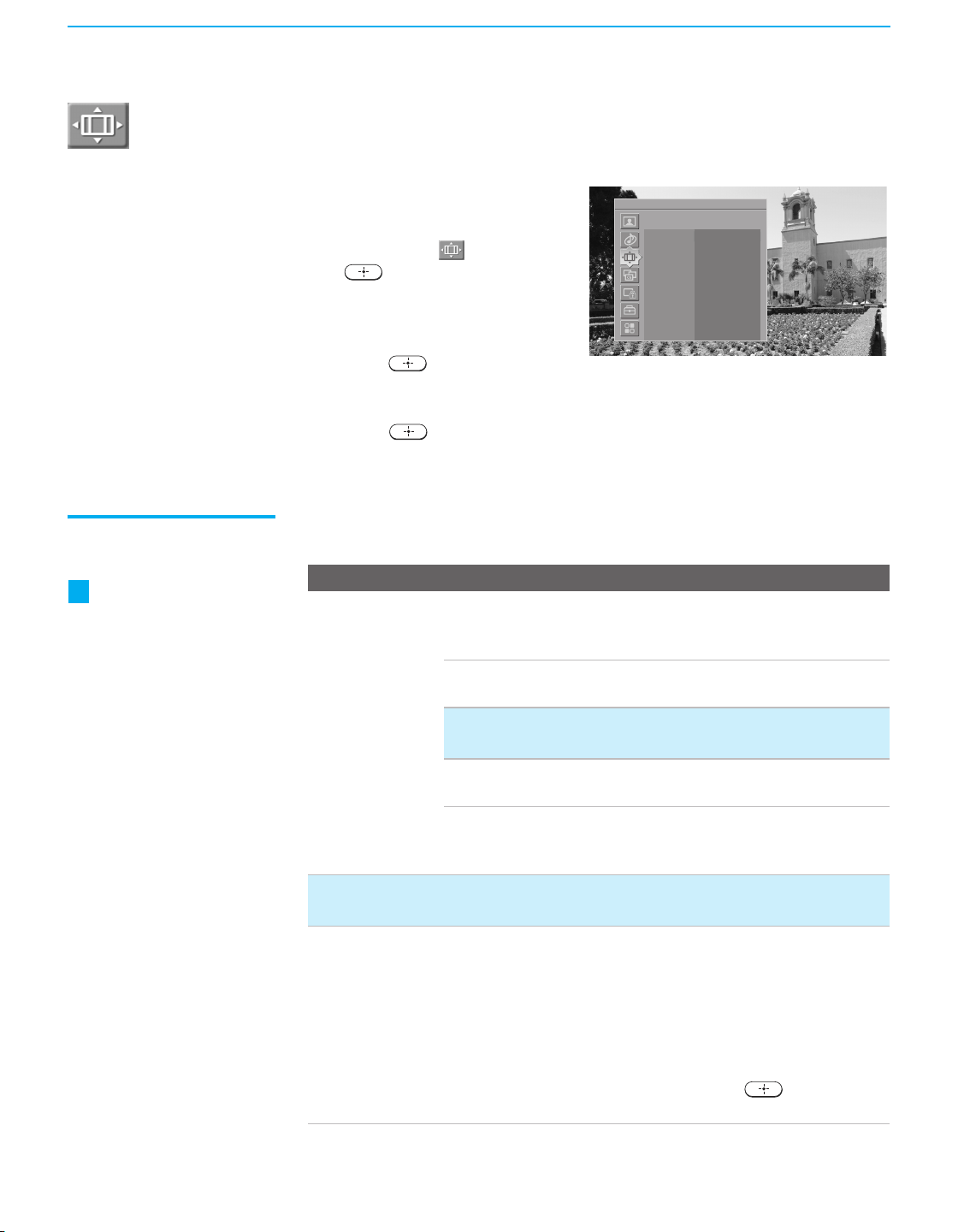
Using the Menus
104
KDF-WE/WF655
2-059-370-14 (2)
Using the Screen Menu
To select the Screen menu
1 Press MENU.
2 Press V or v to highlight the
Screen icon and press
.
3 Use the arrow buttons to scroll
through the features.
4 Press to select a feature.
5 Use the arrow buttons to scroll through the options.
6 Press to select the desired option.
7 Press MENU to exit the menu screen.
Selecting Screen
Options
The Screen menu includes the following options:
Antenna
Screen
Wide Mode Zoom
Game Picture
0
4:3 Default Off
Overscan -1
Vertical Center
0
Vertical Size
-7
Option Description
Wide Mode
Select a screen
mode to use for
4:3 sources.
Wide Zoom Select to enlarge the 4:3 picture, to fill the 16:9
screen, keeping the original image as much as
possible.
Normal Select to return the 4:3 picture to its original
size and aspect ratio.
✍ Normal is not available when watching 720p or 1080i
sources.
Full Select to enlarge the 4:3 picture horizontally
only, to fill the wide screen.
Zoom Select to enlarge the 4:3 picture horizontally
and vertically to an equal aspect ratio that fills
the wide screen.
✍ To change from one Wide Mode setting to another, use Wide Mode
on the remote control (see page 60).
Game Picture Allows you to move the position of the picture
left and right in the window. (This feature also
allows you to adjust the picture from any
connected equipment.) Select while watching
the picture to be adjusted. The LCD projection
TV stores the position in memory for each
input.
Press
B or b to and press to choose a
correction between
+10 and –10.
Wide Mode is
unavailable while in
Twin View (page 72) or
Freeze (page 77), or
Memory Stick mode
(page 79).
z
01COV.book Page 104 Thursday, February 17, 2005 8:01 PM
Using the Menus
105
Using the Menus
KDF-WE/WF655
2-059-370-14 (2)
4:3 Default
Select the default
screen mode to
use for 4:3
sources.
Wide Zoom Select to enlarge the 4:3 picture, to fill the 16:9
screen, keeping the original image as much as
possible.
Normal Select to return the 4:3 picture to normal
mode.
Full Select to enlarge the 4:3 picture horizontally
only, to fill the wide screen.
Zoom Select to enlarge the 4:3 picture horizontally
and vertically to an equal aspect ratio that fills
the wide screen.
Off Select to continue using the current screen
mode setting when the channel or input is
changed.
Overscan Normal Select to return the default Overscan.
-1 Select to show more information on screen.
+1 Select to keep the edge of the picture out of
screen.
Vertical Center Adjust Allows you to move the position of the picture
up and down in the window. (Available only in
Wide Zoom and Zoom modes.)
Press V or v and press
to choose a
correction between +25 and –25 (Zoom
mode), and +10 and –10 (Wide Zoom mode).
Vertical Size Adjust Allows you to adjust the vertical size of the
picture. (Available only in Wide Zoom and
Zoom modes.)
Press V or v and press to choose a
correction between +7 and –7.
Option Description
If 4:3 Default is set to
anything but Off, the
Wide Mode setting
changes only for the
current channel. When
you change channels
(or inputs), Wide Mode
is automatically
replaced with the
4:3
Default setting. To
retain the current Wide
Mode setting as
channels and inputs
are changed, set 4:3
Default to Off.
z
01COV.book Page 105 Thursday, February 17, 2005 8:01 PM
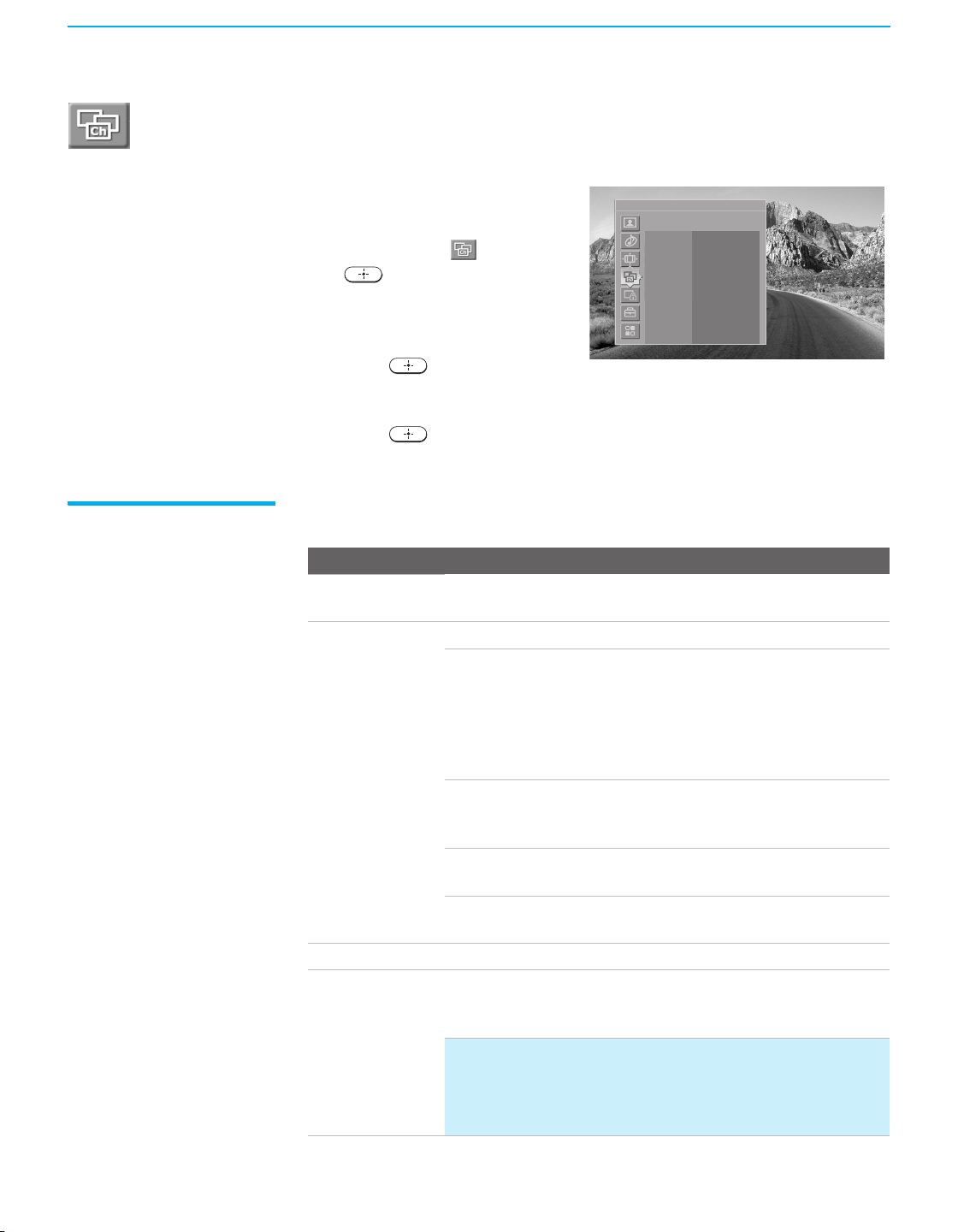
Using the Menus
106
KDF-WE/WF655
2-059-370-14 (2)
Using the Channel Menu
To select the Channel menu
1 Press MENU.
2 Press V or v to highlight the
Channel icon and press
.
3 Use the arrow buttons to scroll
through the features.
4 Press to select a feature.
5 Use the arrow buttons to scroll through the options.
6 Press to select the desired option.
7 Press MENU to exit the menu screen.
Selecting Channel
Options
The Channel menu includes the following options:
Antenna
Channel
Channel Fix Off
Digital Channels
Auto Program
Show/Hide Channels
Label Channels
Favorite Channels
Option Description
Favorite
Channels
Lets you set up a list of your favorite channels. For details, see
“Using Favorite Channels” on page 75.
Channel Fix
Useful when you
have a cable box
or satellite
receiver connected
Off Turns off Channel Fix.
2-6 “Fix” your LCD projection TV’s channel
setting to one channel (2-6) and use the cable
box, VCR or satellite receiver to change
channels. Select one of these settings if you
have connected the device to the VHF/UHF
jack.
C2–C6 “Fix” your TV’s channel setting to C2–C6
(CABLE input) and use the cable box or
satellite receiver to change channels.
Video 1 Use when connecting a cable box. TV output
should be connected through the cable box.
Video 5 Use when connecting a cable box. TV output
should be connected through the cable box.
Digital Channels Add Select to add digital channels.
Auto Program Automatically sets up the channel list on the TV for all
receivable channels for the current input (VHF/UHF or
CABLE).
✍ Auto Program may take up to 50 minutes to complete.
A progress bar will display the approximate progress
of the Auto Program and Digital Channels/Add
sequences.
01COV.book Page 106 Thursday, February 17, 2005 8:01 PM
Using the Menus
107
Using the Menus
KDF-WE/WF655
2-059-370-14 (2)
Show/Hide
Channels
Allows you to show or hide channels that appear in the Program
Guide (page 68) and when you use the CH+/- buttons to channel
surf. Channels that are set to Hidden do not appear in the
Program Guide or when you use the CH+/- buttons.
1 Press V or v to highlight the channel that you want to show
or hide.
To move between the Major and Digital subchannel lists,
press B or b.
2 To change a channel’s setting to Shown or Hidden, press
.
3 To show or hide more channels, repeat steps 1 and 2.
✍ If you select to hide or show a major digital channel, all the sub-channels
are automatically hidden or shown. To show or hide an individual sub-
channel within a digital channel, you must individually select that sub-
channel to show or hide.
✍ If you hide all sub-channels of a major digital channel, that digital
channel is automatically set to Hidden.
Label Channels Allows you to assign labels (such as station call letters) to
channel numbers.
1 Press V or v to scroll through the channel numbers. Then
press to select the channel number that you want to
assign a label.
2 Press V or v to scroll through the label characters (A-Z, 0-
9, etc.). Then press to select the highlighted
character.
Repeat to add characters to the label.
3 Press B to return to the Channel menu, or press MENU to
exit the menus.
Option Description
Channels that you set
to hide can only be
accessed with the 0-9
buttons.
z
01COV.book Page 107 Thursday, February 17, 2005 8:01 PM
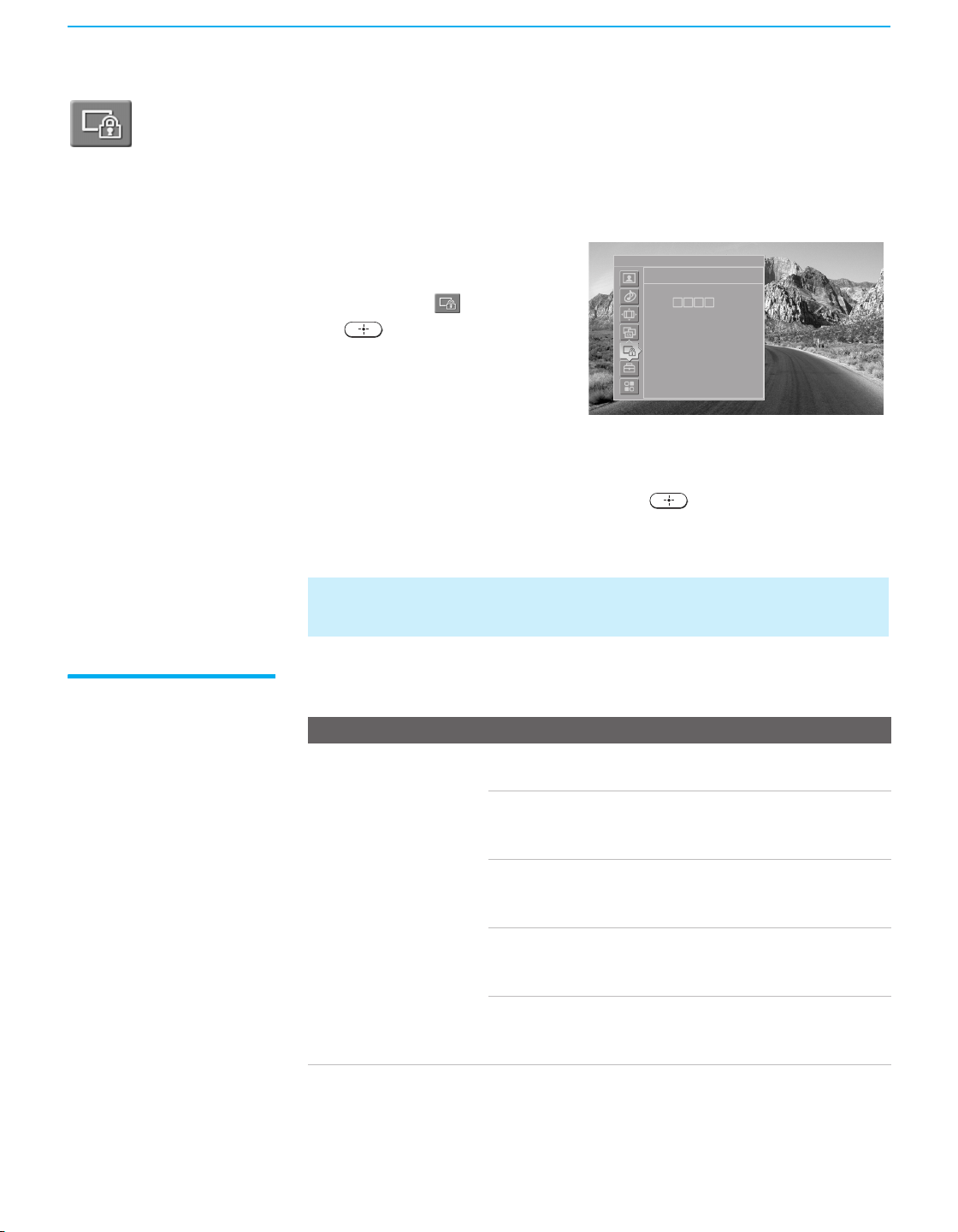
Using the Menus
108
KDF-WE/WF655
2-059-370-14 (2)
Using the Parent Menu
The Parent menu allows you to set up the LCD projection TV to block
programs according to their content and rating levels.
To select the Parent menu
1 Press MENU.
2 Press V or v to highlight the
Parent icon and press
.
3 Use the 0-9 buttons on the
remote control to enter a four-
digit password.
4 If this is the first time you are creating this password, confirm the
password by entering it again. (The Parent menu options appear.)
5 Press VvBb to change settings. Press to select the changed
setting.
6 Press MENU to exit the menu screen.
Selecting Parent
Options
The Parent menu includes the following options:
✍ You need your password for any future access into the Parent menu. If
you lose your password, see “Lost password” on page 125.
Antenna
Parental Lock
Password
Option Description
Parental Lock
Turn ratings on/off and
select a rating system
Off Turn Parental Lock off. No programs are
blocked from viewing.
Child Maximum ratings permitted are:
US: TV-Y, TV-G, G
Canada: C, G, TV-Y
Youth Maximum ratings permitted are:
US: TV-PG, PG
Canada: C8+, PG, 8 ans+, TV-PG
Y. Adult Maximum ratings permitted are:
US: TV-14, PG-13
Canada: 14+, 13 ans+, TV-14
Custom Select to set ratings manually.
US: See page 110 for details.
Canada: See page 111 for details.
01COV.book Page 108 Thursday, February 17, 2005 8:01 PM
Using the Menus
109
Using the Menus
KDF-WE/WF655
2-059-370-14 (2)
To deactivate the parental control feature
❑
Set Parental Lock to OFF when in the Parent menu.
To change the password
1 In the Parent menu, use the arrow buttons to highlight Change
Password
, and press to select it.
2 Enter a new four-digit password using the 0-9 buttons.
3 Confirm the new password by entering it again.
4 Press MENU to exit the menu screen.
Viewing Blocked
Programs
You can view a blocked program by entering the password.
1 Press ENT when tuned to a blocked program.
2 Enter your password using the 0-9 buttons.
Parental control will be canceled temporarily until you turn your LCD
projection TV off.
Change Password Select to change your password.
Select Country U.S.A. Select to use USA ratings (see page 110).
Canada Select to use Canadian ratings (see page 111).
Option Description
If you are not familiar
with the Parental
Guideline rating
system, you should
select Child, Yo u t h , or
Y.Adult to help simplify
the rating selection. To
set more restrictive
ratings, select Custom.
For descriptions of
Child, Youth, and
Y.Adult ratings, see
page 108.
z
z
01COV.book Page 109 Thursday, February 17, 2005 8:01 PM
Using the Menus
110
KDF-WE/WF655
2-059-370-14 (2)
Selecting Custom
Rating Options
US custom rating options
If you selected U.S.A. as the country of residence on page 109, the Custom
Rating menu includes the following options. (If you selected Canada, see
page 111.)
Option Description
Movie Rating G All children and general audiences.
PG Parental guidance suggested.
PG-13 Parental guidance for children under 13.
R Restricted viewing, parental guidance is suggested
for children under 17.
NC-17
and X
No one 17 and under.
TV Rating
Block programs
by their rating,
content or both
Age-Based Options
TV-Y All children.
TV-Y7 Directed to children age 7 and older.
TV-G General audience.
TV-PG Parental guidance suggested.
TV-14 Parents strongly cautioned.
TV-MA Mature audience only.
Content-Based Options
FV Fantasy violence.
D Suggestive dialog.
L Strong language.
S Sexual situations.
V Violence.
Unrated
Block programs
or movies that are
broadcast without
a rating
Allow Allows programs and movies that are broadcast
without a rating.
Block Blocks all programs and movies that are broadcast
without a rating.
✍ The content ratings will increase depending on the level of the age-based rating.
For example, a program with a TV-PG V (Violence) rating may contain
moderate violence, while a
TV-14 V (Violence) rating may contain more intense
violence.
To ensure maximum
blocking capability, the
age-based ratings
should be blocked.
z
If you select Block, be
aware that the following
programs may be
blocked: news, sports,
weather, emergency
broadcasts, political
programs, public
service
announcements, and
religious programs.
z
01COV.book Page 110 Thursday, February 17, 2005 8:01 PM
Using the Menus
111
Using the Menus
KDF-WE/WF655
2-059-370-14 (2)
Canadian custom rating options
If you selected Canada as the country of residence on page 109, the Custom
Rating menu includes the following options. (If you selected U.S.A., see
page 110.)
Option Description
English Rating C All children.
C8+ Children 8 years and older.
G General programming.
PG Parental guidance.
14+ Viewers 14 and older.
18+ Adult programming.
French Rating G General programming.
8 ans+ Not recommended for ages under 8.
13 ans+ Not recommended for ages under 13.
16 ans+ Not recommended for ages under 16.
18 ans+ Programming restricted to adults.
U.S.A. Rating See “TV Rating” on page 110 for details.
01COV.book Page 111 Thursday, February 17, 2005 8:01 PM
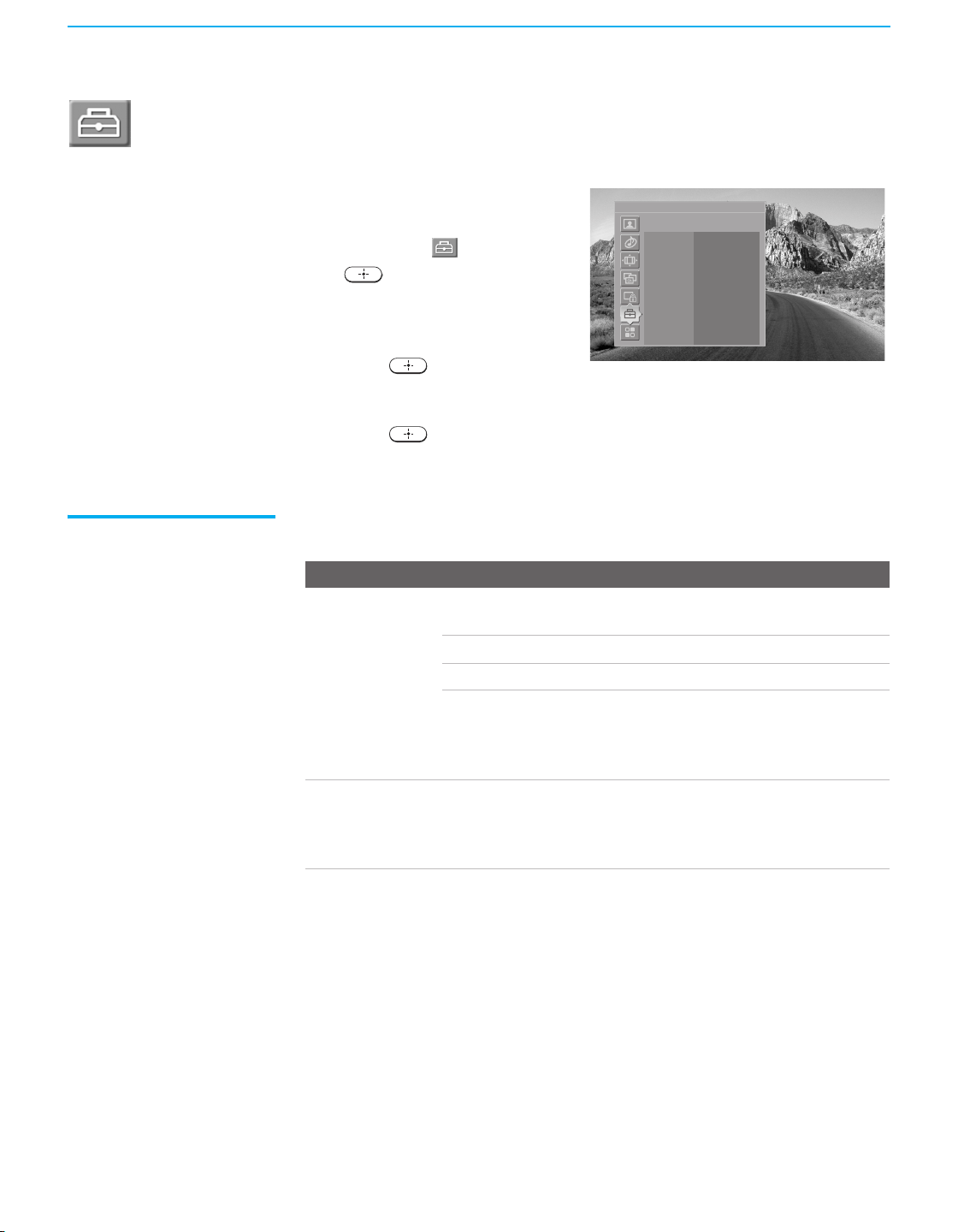
Using the Menus
112
KDF-WE/WF655
2-059-370-14 (2)
Using the Setup Menu
To select the Setup menu
1 Press MENU.
2 Press V or v to highlight the
Setup icon and press
.
3 Use the arrow buttons to scroll
through the features.
4 Press to select a feature.
5 Use the arrow buttons to scroll through the options.
6 Press to select the desired option.
7 Press MENU to exit the menu screen.
Selecting Setup
Options
The Setup menu includes the following options:
Antenna
Setup
Caption Vision Off
Info Banner Off
Label Video Inputs
Language English
Menu Color Gray
Image Shift Auto
High Altitude Off
Option Description
Caption Vision Allows you to select from four closed caption modes (for
programs that are broadcast with closed captioning).
On Caption Vision is turned on.
Off Caption Vision is turned off.
Program Allows you to set basic and advanced
Caption Vision options. See
“Programming Caption Vision” on
page 114.
Info Banner Set to On or Off. When on, displays the program name, time
remaining and other information (if the broadcaster offers this
service). Displays when the channel is changed or the
DISPLAY button is pressed.
01COV.book Page 112 Thursday, February 17, 2005 8:01 PM
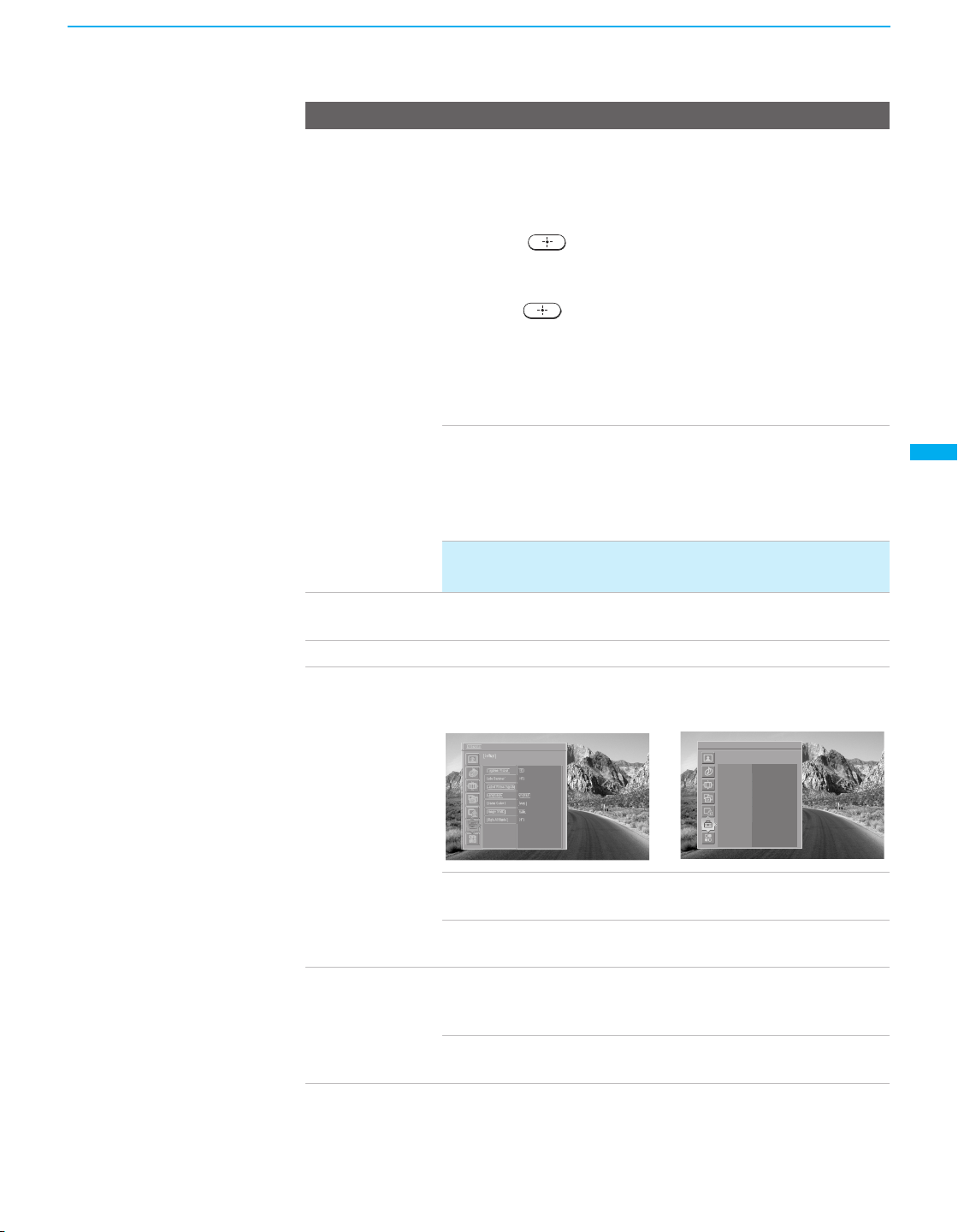
Using the Menus
113
Using the Menus
KDF-WE/WF655
2-059-370-14 (2)
Label Video
Inputs
Allows you to label the audio/video equipment you have
connected to the LCD projection TV so you can identify them
when using TV/VIDEO. When in this menu:
1
Press V or v to highlight an input to label, then
press to select it.
2 Use the arrow buttons to scroll through the labels.
3 Press to select the equipment you connected to
each of the input jacks on the back of your LCD
projection TV.
Select Skip if you do not have any equipment
connected to a particular input.
Video 1-4 VHS, DVD, Receiver, Satellite, Cable
Box, 8mm, DTV, Game, LD, Beta,
Skip
Video 5-7 DVD, Satellite, Cable Box, DTV, HD,
Game, PVR, Skip
✍ If you select Skip, your LCD projection TV skips the
selected connection when you press TV/VIDEO.
Language Select to display all on-screen menus in your language of
choice: English, Español, Français.
Menu Color Enables you to select a specific color for the on-screen menus.
Image Shift Corrects the image on your LCD projection TV.
Before adjusting After adjusting
Auto (Factory setting) Automatically
corrects double images.
Level 1-4 Select a level from 1-4 to align the
images and improve the picture.
High Altitude On Select to use the LCD projection TV
at an altitude of 5,000 feet (1,500 m)
or higher.
Off Select to use the LCD projection TV
at normal altitude.
Option Description
Setup
Antenna
Off
Off
English
Gray
Auto
Off
Caption Vision
Antenna
Antenna
Antenna
Setup
S
etu
p
Setup
Info Banner
Label Video Inputs
Language
Menu Color
Image Shift
High Altitude
Caption Vision
C
a
p
tion Visio
n
Caption Vision
Off
Of
Of
Info Banner
Info Banne
Info Banne
Off
Of
Of
Label Video Inputs
L
abel V
i
deo In
p
ut
s
Label Video Inputs
Language
L
an
g
ua
ge
Language
English
En
g
l
i
s
h
English
Menu Color
Menu Color
Menu Colo
Gray
G
ra
y
Gray
Image Shift
Ima
g
e
S
hi
f
Image Shif
Auto
Auto
Auto
High Altitude
Hig
h Alt
i
tud
e
High Altitude
Off
Of
Of
Antenna
Setup
Caption Vision Off
Info Banner Off
Label Video Inputs
Language English
Menu Color Gray
Image Shift Auto
High Altitude Off
01COV.book Page 113 Thursday, February 17, 2005 8:01 PM
Using the Menus
114
KDF-WE/WF655
2-059-370-14 (2)
Programming
Caption Vision
If you selected the Program option under Caption Vision (see page 112), you
can change the following settings:
Option Description
Basic Allows you to select basic analog (EIA-608) closed caption options.
CC1, CC2,
CC3, CC4
Displays a printed version of the dialog or sound
effects of a program. (Should be set to CC1 for most
programs.)
Tex t 1,
Tex t 2,
Text3, Text4
Displays network/station information presented using
either half or the whole screen (if available). For
closed captioning, set to CC1.
Advanced Allows you to select advanced digital (EIA-708) closed caption
options. Select from the available options.
Digital CC Allows you to set digital closed captioning to Basic (digital EIA-608)
or Advanced (digital EIA-708).
Advanced
Settings
Allows you to make additional settings for digital (EIA-708) closed
caption options.
As Broadcast
Small Text
Large Text
Custom... Allows you to customize the following settings:
Character Size Small, Standard,
Large
Character Style Style 1-7
Character Color None, Color 1-8
Edge Color Color 1-8
Edge Type None, Raised,
Outline, Left
shadow, Right
shadow
Background Color None, Color 1-8
Window Color None, Color 1-8
✍ Color options can also be set to Solid or
Translucent.
01COV.book Page 114 Thursday, February 17, 2005 8:01 PM
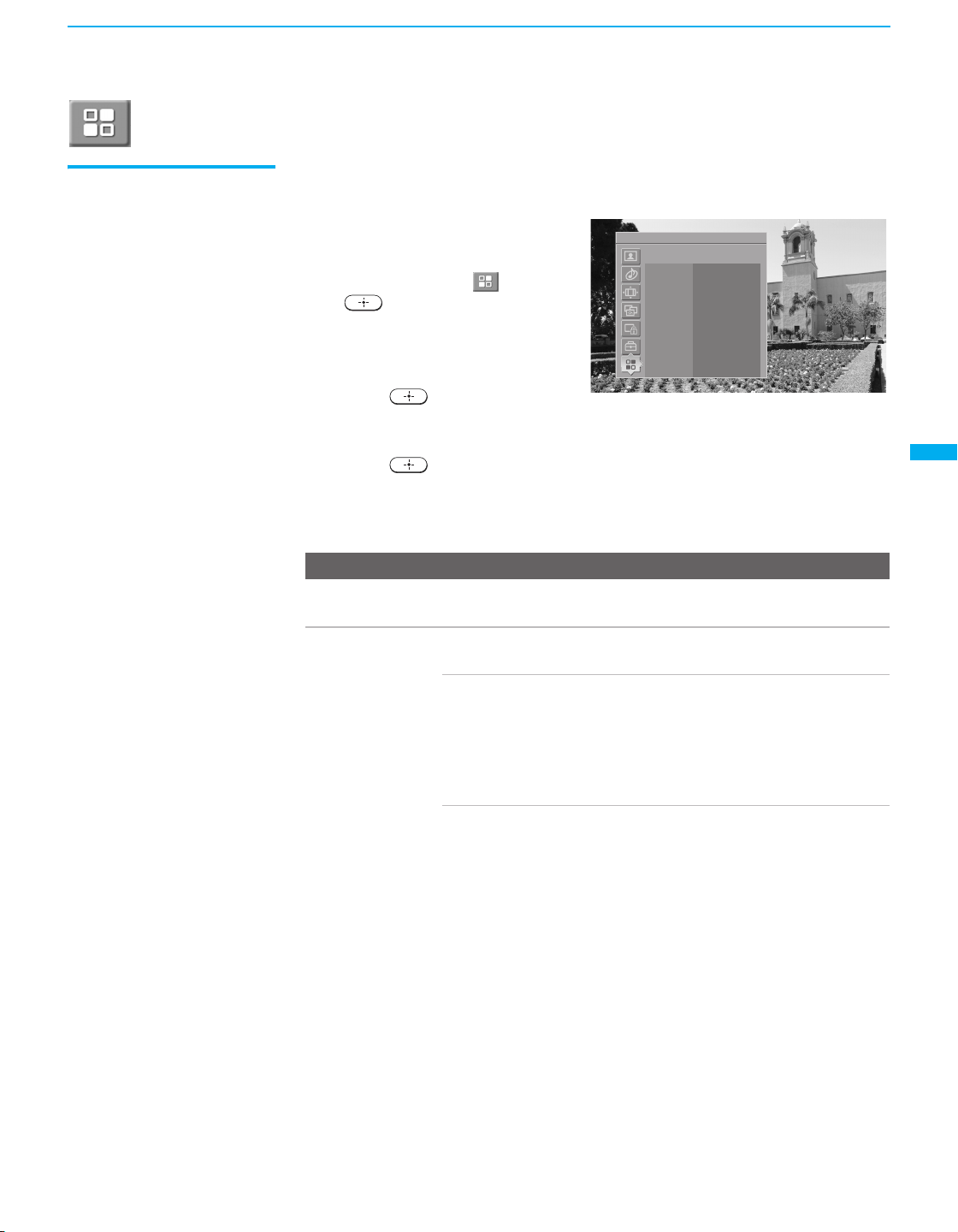
Using the Menus
115
Using the Menus
KDF-WE/WF655
2-059-370-14 (2)
Using the Application Menu
Selecting
Application Options
To select the Application menu
1 Press MENU.
2 Press V or v to highlight the
Application icon and press
.
3 Use the arrow buttons to scroll
through the features.
4 Press to select a feature.
5 Use the arrow buttons to scroll through the options.
6 Press to select the desired option.
7 Press MENU to exit the menu screen.
Option Description Displays...
Memory Stick Start Displays the Memory Stick Viewer.
For details, see page 85.
Clock/Timers Select to set the clock and to program your LCD projection TV
to turn on and off at two scheduled viewing times.
Sleep Allows you to select the amount of
time (15 minutes, 30 minutes, 45
minutes, 60 minutes, 90 minutes or
Off) that you want the LCD projection
TV to remain on before shutting off
automatically.
Antenna
Applications
Clock/Timers
Diagnostics
CableCARD
Memory Stick
01COV.book Page 115 Thursday, February 17, 2005 8:01 PM
Using the Menus
116
KDF-WE/WF655
2-059-370-14 (2)
Timer 1
Timer 2
You can use the Timers to program the
LCD projection TV to turn on and off
and tune to a specific channel at two
scheduled viewing times.
Timer 1 and Timer 2 cannot be set until you set the Current
Time.
1 Press V or v to highlight Timer 1 or Timer 2. To set the
timer, press b.
✍ To go directly to programming Timer 1 or 2, press
instead of pressing b.
2 Press V or v to highlight one of the following options, then
press .
Program Select to set the Timer by day, time,
duration, and channel.
Off Select to turn off the Timer. (Your
previous settings are saved.)
3 If you selected Program in step 2, press V and v to set the
day(s), hour, minute, duration, and channel number. Press
or press b to confirm each setting and move to the
next setting.
Press B to go back to the previous setting.
4 Press MENU to exit the menu screen. An LED on the front
panel will light, indicating the Timer has been set.
Current Time You can set the current time.
1 Press to select Current Time.
2 Press V and v to set the current time (day, hour, minute,
and AM/PM). Press (or press b) to confirm each
setting and move to the next setting. Press B to go back the
previous setting.
3 Press MENU to exit the menu screen.
Diagnostics Display diagnostics information about the TV. This can be
useful in providing information to an authorized technician or
repair person.
CableCARD This list of selectable CableCARD options will vary, depending
on your cable service provider.
Option Description Displays...
01COV.book Page 116 Thursday, February 17, 2005 8:01 PM

117
KDF-WE/WF655
2-059-370-14 (2)
Other Information
Other Information
Overview
This chapter includes the following topics:
Topic Page
Glossary 118
Contacting Sony 119
Troubleshooting 119
Flashing Indicators on the Front of the TV 126
Specifications 127
Optional Accessories 129
Index 130
01COV.book Page 117 Thursday, February 17, 2005 8:01 PM
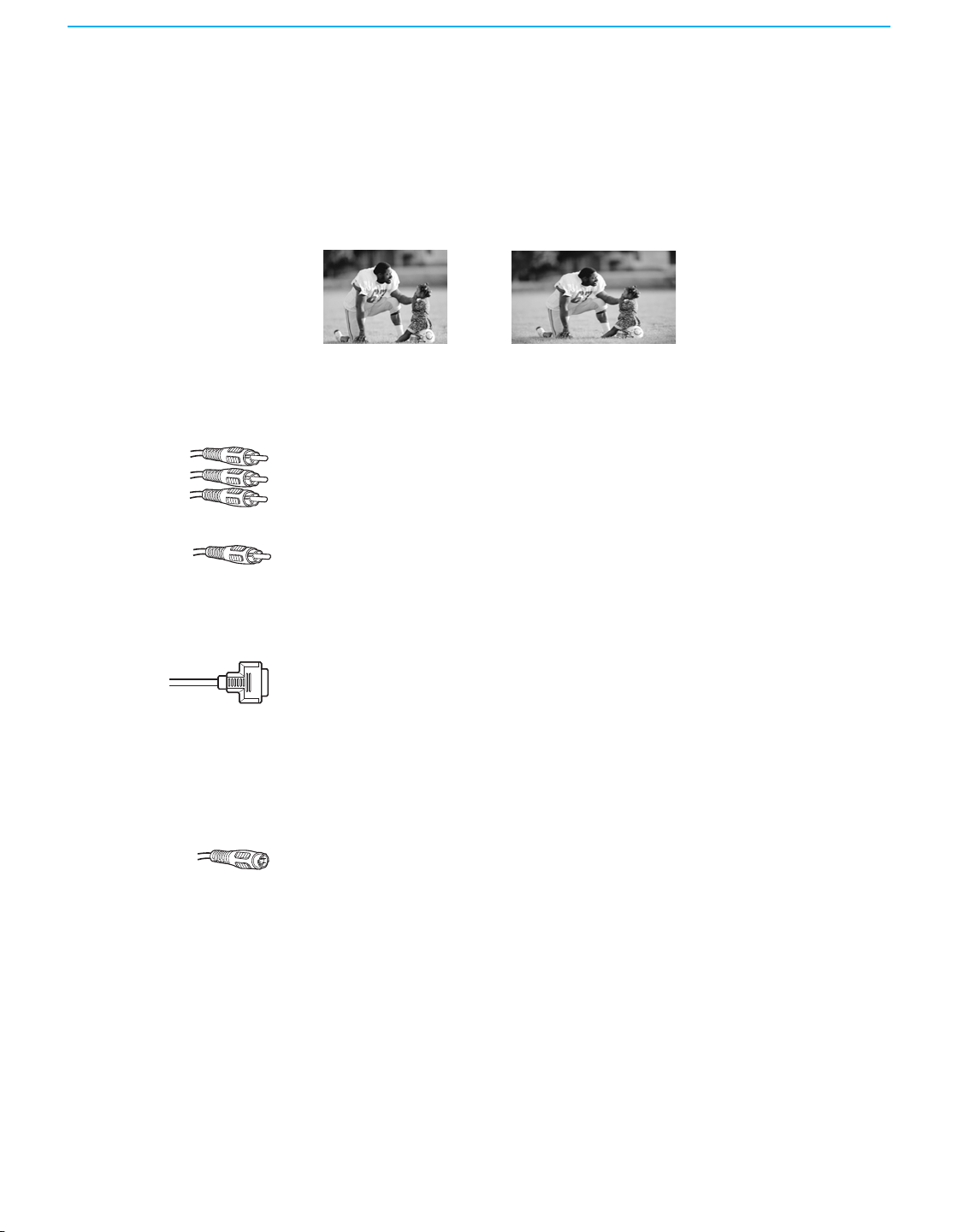
Other Information
118
KDF-WE/WF655
2-059-370-14 (2)
Glossary
analog signal A signaling method that uses continuous changes in the amplitude or frequency of an
electronic transmission to convey information.
aspect ratio Refers to the ratio between the width and height of the screen. This LCD projection
TV has a 16:9 (widescreen) aspect ratio, as opposed to a 4:3 aspect ratio.
CableCARD The PCMIA shaped card provided by your cable TV company which descrambles the
digitally encrypted cable channels. You should check with your local cable TV
company about CableCARD service.
component video Component video is sent through three cables: two color shade (chrominance) signals
and one brightness (luminance) signal. Component video achieves greater color
accuracy than composite video or S VIDEO by splitting chrominance into two
separate portions.
composite video Composite video is sent through a single cable. Composite video combines the color
shade (chrominance) and brightness (luminance) information into one video signal.
digital television (DTV) A new technology for transmitting and receiving broadcast television signals. DTV
provides higher resolution and improved sound quality over analog television.
HDMI (High-Definition
Multimedia Interface)
Provides an uncompressed, all-digital audio/video interface between this TV and any
HDMI-equipped audio/video component, such as a set-top box, DVD player, and
A/V receiver. HDMI supports enhanced, or high-definition video, plus multi-channel
digital audio.
National Television
System Committee
(NTSC)
A unit of the Federal Communications Commission, Washington, DC, that
establishes television standards in the United States, such as NTSC Color, the
standard used in this LCD projection TV.
RF Radio Frequency. That part of the frequency spectrum that is used to transmit TV and
radio signals.
S VIDEO S VIDEO requires a single cable, which carries the brightness (luminance) and color
(chrominance) signals of the picture separately. S VIDEO provides better resolution
than composite video, which carries the signals together.
VHF/UHF VHF (Very High Frequency) is the part of the frequency spectrum from 30 to 300
megahertz. UHF (Ultra High Frequency) is the part of the frequency spectrum from
300 to 3,000 megahertz.
480i Provides 480 lines of resolution. Displays images using interlaced scanning, which
first transmits all the odd lines on the LCD projection TV screen and then the even
lines.
480p Provides 480 lines of resolution. Displays images using progressive scanning, which
transmits each line from top to bottom.
720p Provides 720 lines of resolution. Displays images using progressive scanning, which
transmits each line from top to bottom.
1080i Provides 1080 lines of resolution. Displays images using interlaced scanning, which
first transmits all the odd lines on the LCD projection TV screen and then the even
lines. 1080i is one of the formats used by HDTV (High Definition TV).
4:3 aspect ratio
16:9 aspect ratio
01COV.book Page 118 Thursday, February 17, 2005 8:01 PM
Other Information
119
Other Information
KDF-WE/WF655
2-059-370-14 (2)
Contacting Sony
If, after reading these operating instructions, you have additional questions
related to the use of your Sony television, please call our Customer
Information Services Center at 1-800-222-SONY (7669) (US residents only)
or 1-877-899-SONY (7669) (Canadian residents only).
Before calling Sony customer support, please write down the model and
serial numbers of your TV. You’ll find this information on the front cover of
this manual.
Troubleshooting
Twin View
Problem Possible Remedies
I cannot get Twin View to work ❏ If you are using a cable box to unscramble all channels (as shown on page 35),
you cannot use the Twin View feature. This is because the cable box can
unscramble only one channel at a time.
❏ You can use Twin View to view a signal from a different source that is connected
to the LCD projection TV’s A/V jacks (such as a VCR or DVD player) in the
second window by pressing TV/VIDEO while in Twin View.
❏ Sources connected to the CABLE, VIDEO 5, VIDEO 6 and VIDEO 7 inputs, as
well as digital source display only in the left Twin View window.
There is no Twin View window,
or it is just static
❏ Be sure the Twin View window is set to a video input or channel that has a signal
airing.
❏ You might be tuned to a video input with nothing connected to it. Try cycling
through the video inputs by pressing TV/VIDEO.
Twin View cannot display
anything but TV channels
❏ Try cycling through the video inputs by pressing TV/VIDEO. Check that the
Label Video Inputs option is not set to Skip. (See the Setup menu on page 113.)
Twin View displays the same
program in both windows
❏ Both Twin View windows might be set to the same channel. Try changing
channels in either window.
01COV.book Page 119 Thursday, February 17, 2005 8:01 PM

Other Information
120
KDF-WE/WF655
2-059-370-14 (2)
Remote Control
CableCARD
Problem Possible Remedies
Remote control does not
operate
❏ The batteries could be weak. Replace the batteries.
❏ Check the orientation of the batteries.
❏ Press TV FUNCTION once, and the TV indicator lights up. You may have
inadvertently pressed SAT/CABLE FUNCTION, which changes the remote
control to SAT or CABLE mode.
❏ Make sure this unit’s power cord is connected securely to the wall outlet.
❏ Locate the unit at least 3-4 feet away from fluorescent lights.
Cannot change channels with
the remote control
❏ If you are using the LCD projection TV to change channels, first press TV
FUNCTION
once, and the TV indicator lights up.
❏ If you are using another device to change channels, be sure you have not
inadvertently switched your LCD projection TV from the channel 3 or 4 setting.
Use the Channel Fix option to “fix” the channel based on the hookup you used
(see page 106).
❏ If you are using another device to change channels, be sure to press FUNCTION
for that device. For example, if you are using your cable box to change channels,
be sure to press SAT/CABLE FUNCTION once, and the SAT/CABLE indicator
lights up.
Remote control does not
operate non-Sony video
equipment
❏ If you replaced the batteries to the remote recently, the code numbers for the video
equipment may need to be reset.
❏ There may be more than one code for the equipment that you are attempting to
operate.
❏ There is a possibility that some non-Sony equipment cannot be operated by your
Sony LCD projection TV remote. You may need to use the equipment’s original
remote control.
Problem Possible Remedies
Problems using CableCARD or
CableCARD services
❏ Check that the CableCARD is inserted properly (see pages 56-57).
❏ The CableCARD must be activated by your local cable TV provider before you can
receive digital cable TV services. See the activation instructions on pages 56-57.
❏ Check the Diagnostics and CableCARD menu options (see page 116). (This can
be useful in providing information to an authorized technician or repair person.)
❏ Contact your cable TV provider.
01COV.book Page 120 Thursday, February 17, 2005 8:01 PM
Other Information
121
Other Information
KDF-WE/WF655
2-059-370-14 (2)
Memory Stick
Problem Possible Remedies
Image does not display/Cannot
see all files
❏ Some variations of MPEG1 movies may not play back correctly.
❏ Make sure the image file is a JPEG (.jpg, .jpeg) file or an MPEG1 (.mpg, .mpeg)
file.
❏ Make sure the Memory Stick is inserted properly (see page 82).
❏ Check the Filter option setting (see page 93).
❏ Check the Select Folder setting (see page 93) and ensure that files are either in
DCF directories if Digital Camera Folders is selected (see page 93), or in the
currently selected folder if
Select a Folder is selected (see page 93).
❏ The maximum number of files the Memory Stick Viewer can display is 2,000 files
total, including all JPEG, MPEG1, and MP3 files.
JPEG image displays
undesirable motion or flicker in
full screen
❏ JPEGs captured using a digital video camera may appear to display motion in full
screen. This is a result of the way digital video cameras record still images, and is
not a result of a malfunction with the LCD projection TV.
Rotation not saved after
Memory Stick is ejected or
Memory Stick Viewer is closed
❏ The Memory Stick might be locked. Unlock the Memory Stick and try rotating the
image again.
❏ The file might not have information (EXIF data) that is usually generated when a
digital camera records a photo. In this case, it is not possible to save the rotation.
❏ There might be insufficient space on the Memory Stick to save the rotated file. Try
deleting one or more files and rotating the image again.
Cannot show (or hide) file
information in full screen or
Slide Show
❏ Set the File Information option to On or Off (see page 92).
Cannot see menu ❏ Press V to display the menu again.
Cannot hear audio while
using Memory Stick
❏ Check the LCD projection TV’s volume or Speaker (page 103) settings.
❏ To hear JPEG voice memo, select the Digital Camera Folders option and set the
Filter option to Show All Print Marks.
❏ Check that the Music option is not set to Off (see page 92).
Not all MP3 files on Memory
Stick are included when the
Music /Complete List option is
selected (page 92)
❏ The Memory Stick Viewer can display a maximum of 2,000 files total, including
all JPEG, MPEG1, and MP3 files.
❏ Make sure that the file is named with the file extension (.mp3).
MP3 files on the Memory Stick
are not listed
❏ Only MP3 files that are named with the file extension (.mp3) are displayed in the
list.
Music files are playing in wrong
order
❏ MP3 files are played in alphabetical order, according to the folder in which they
are stored. If you want to change the playlist order, rename your files
alphabetically in the order in which you want them to play or create a MP3 playlist
(.m3u file) on a PC.
Cannot see MP3 list to play
music
❏ MP3 files on your Memory Stick only can be played as background music during a
Slide Show (see page 92).
MPEG1 movie does not
play back correctly
❏ Some variations of MPEG1 movies may not be compatible with the Memory Stick
Viewer.
❏ MPEG movies recorded in VX Fine mode with Sony digital cameras cannot be
played back with the Memory Stick Viewer.
(Continued)
01COV.book Page 121 Thursday, February 17, 2005 8:01 PM
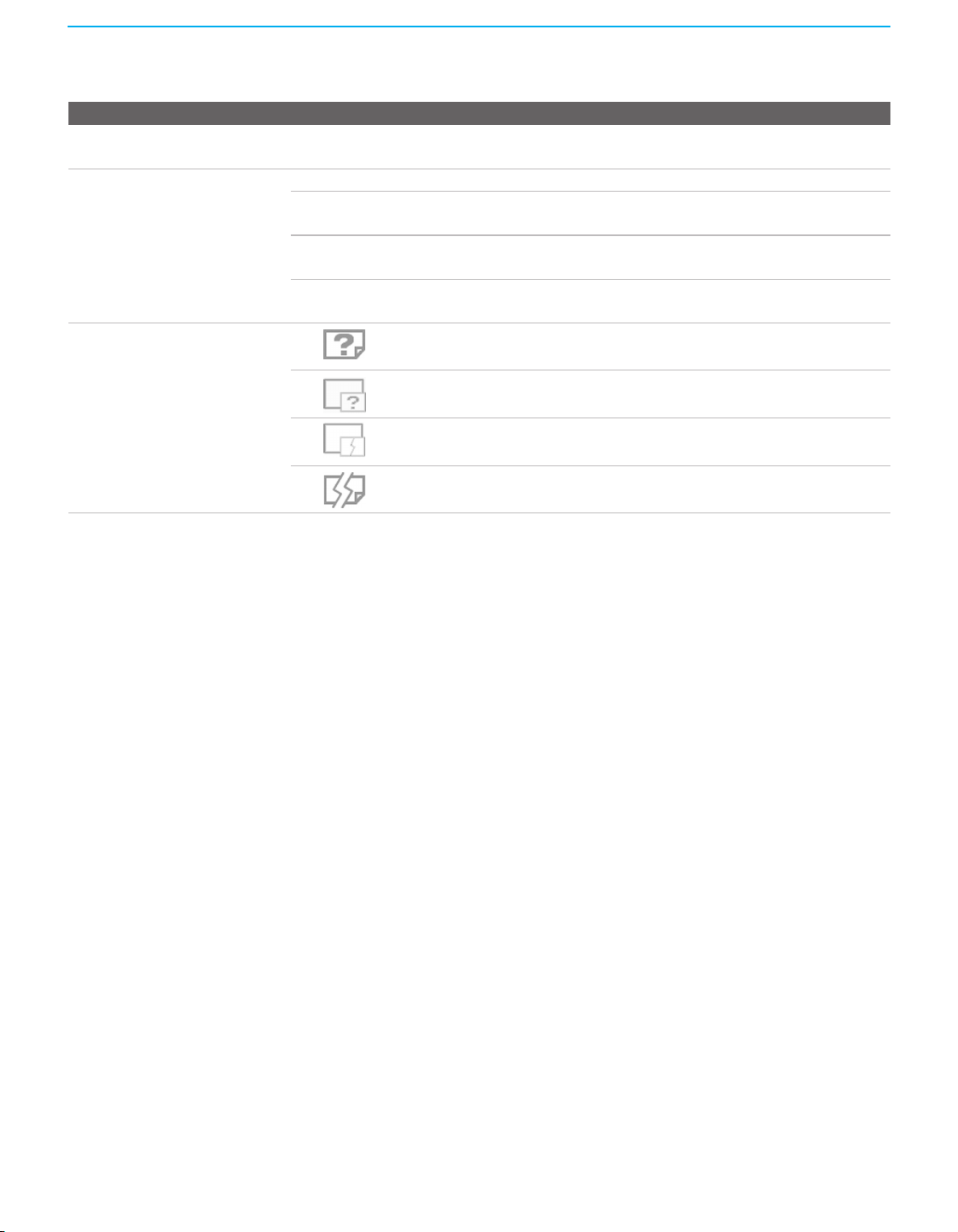
Other Information
122
KDF-WE/WF655
2-059-370-14 (2)
MPEG1 quality is poor when
enlarged (page 90)
❏ The quality of the movie when enlarged depends on the resolution of the MPEG1
file. See your camera’s instruction manual for details.
Error message
is displayed
❏ No Memory Stick There is no Memory Stick in the slot.
❏ Memory Stick is
Locked
The lock mechanism on the Memory Stick is engaged.
❏ Memory Stick Error The Memory Stick in the slot might be damaged; try a
different Memory Stick.
❏ Format Error The Memory Stick may have been formatted using a PC
or other device that is not compatible with cameras.
Error icon is displayed The file is not a valid MPEG1 or JPEG format, or it is a
progressive JPEG (which is not supported).
The thumbnail is not DCF-compatible.
The file is a JPEG or an MPEG1, but the thumbnail is
unreadable.
The file is unreadable.
Problem Possible Remedies
01COV.book Page 122 Thursday, February 17, 2005 8:01 PM
Other Information
123
Other Information
KDF-WE/WF655
2-059-370-14 (2)
Video
Problem Possible Remedies
No picture (screen not lit), no
sound
❏ If your LCD projection TV does not turn on, and a red light keeps flashing, your
LCD projection TV may need service. Call your local Sony Service Center.
❏ Make sure the power cord is plugged in.
❏ Press POWER on the front of the LCD projection TV.
❏ Press TV/VIDEO to cycle through the connected video sources.
❏ Try another channel; it could be station trouble.
Dark, poor or no picture
(screen lit), good sound
❏ Adjust the Picture option in the Video menu (see page 98).
❏ Adjust the Brightness option in the Video menu (see page 98).
❏ Check the antenna/cable connections.
No color/dark picture/color is
not correct
❏ Adjust the Color option in the Video menu (see page 98).
Only snow and noise appear on
the screen
❏ Check the antenna/cable connections.
❏ Try another channel; it could be station trouble.
❏ Press ANT to change the input mode (see page 61).
Dotted lines or stripes ❏ Adjust the antenna.
❏ Move the LCD projection TV away from noise sources such as cars, neon signs,
or hair-dryers.
Double images ❏ Using a highly directional outdoor antenna or a cable may solve the problem.
❏ Set the Image Shift to an appropriate value. The default setting is Auto. If
doubled images appear with Auto, select the best value from 1 to 4 (see page
113).
“Black box” on screen ❏ You have selected a text option in the Setup menu and no text is available. (See
page 112 to reset Setup selections.) To turn off this feature, set the
Caption
Vision
option to Off. If you were trying to select closed captioning, select CC1
instead of Text 1-4.
Black bands appear at the top
and bottom of the screen
❏ Some wide-screen programs are filmed in aspect ratios that are greater than 16:9
(this is especially common with theatrical releases). Your LCD projection TV will
show these programs with black bands at the top and bottom of the screen. For
more details, check the documentation that came with your DVD (or contact your
program provider).
Certain programs on DVD or
other digital sources display a
loss of detail, especially during
fast-motion or dark scenes
❏ The compression used by certain digital broadcasts and DVDs may cause your
LCD projection TV’s screen to display less detail than usual, or cause artifacts
(small blocks or dots, pixelations) to appear on your screen. This is due to your
LCD projection TV’s large screen and ability to show very fine detail, and is
normal for certain digitally recorded programs. Adjust the reality/clarity in the
DRC Palette menu (see page 100) to optimize the picture while viewing these
sources.
01COV.book Page 123 Thursday, February 17, 2005 8:01 PM
Other Information
124
KDF-WE/WF655
2-059-370-14 (2)
Audio
Channels
Problem Possible Remedies
Good picture, no sound ❏ Press MUTING so that Muting disappears from the screen (see page 60).
❏ Make sure the Speaker option is set to On in the Audio menu (see page 103).
❏ Make sure the MTS option is set to Stereo or Mono (see page 103).
Audio noise ❏ Communication problems may occur if infrared communication equipment (e.g.,
infrared cordless headphones) is used near the LCD projection TV. Please use
headphones other than infrared cordless headphones. Also, if you use infrared
communication equipment other than infrared cordless headphones, move the
infrared transceiver away from the LCD projection TV until the noise is
eliminated, or move the transmitter and receiver of the infrared communication
equipment closer together.
Cannot gain enough volume
when using a cable box
❏ Increase the volume of the cable box using the cable box’s remote control. Then
press FUNCTION once, and the LCD projection TV indicator lights up and
adjust the LCD projection TV’s volume.
Sound seems weak or
insufficient
❏ The LCD projection TV’s audio might be set to Auto SAP or Mono, when it
might be better set to Stereo. In the Audio menu (see page 103), set the MTS
setting to Stereo. If already set to Stereo, switch to Mono (which may reduce
background noise during weak stereo broadcasts).
Cannot raise the volume on
external speakers
❏ If the Speaker option is set to Off and the Audio Out option is set to Fixed (in
order to output the sound to your audio system) use your audio receiver to adjust
the sound (see page 103). Or, to use the LCD projection TV remote control, set
the
Audio Out option to Variable.
❏ To turn on the LCD projection TV speakers, set the Speaker option to On (see
page 103).
Problem Possible Remedies
Cannot receive upper channels
(UHF) when using an antenna
❏ Press ANT to select the VHF/UHF input (see page 61).
❏ Use Auto Program in the Channel menu to add receivable channels that are not
presently in the LCD projection TV’s memory (see page 106).
TV is fixed to one channel ❏ Use Auto Program in the Channel menu to add receivable channels that are not
presently in the LCD projection TV’s memory (see page 106).
❏ Check your Channel Fix settings (see page 106).
Cannot receive any channels
when using cable TV
❏ Use Auto Program in the Channel menu to add receivable channels that are not
presently in the LCD projection TV’s memory (see page 106).
❏ Press ANT to select the CABLE input (see page 61).
Cannot receive or select
channels
❏ Use Auto Program in the Channel menu to add receivable TV channels that are
not presently in LCD projection TV memory (see page 106).
Some digital cable channels are
not being displayed
❏ Certain cable companies have limitations on the broadcast of digital cable
channels. Check with your cable company for more information.
❏ The digital cable channel may be set to Hidden in the Digital Setup menu (see
page 107).
01COV.book Page 124 Thursday, February 17, 2005 8:01 PM
Other Information
125
Other Information
KDF-WE/WF655
2-059-370-14 (2)
General
Problem Possible Remedies
How to reset TV to factory
settings
❏ Turn on the TV. While holding down the RESET button on the remote control,
press the POWER button on the TV. (The TV will turn itself off, then back on
again.) Release the RESET button.
How to restore Video settings
to factory settings
❏ Press RESET on the remote control while in the Video menu (see page 98).
How to restore Audio settings
to factory settings
❏ Press RESET on the remote control while in the Audio menu (see page 102).
Cannot cycle through the other
video equipment connected to
the LCD projection TV
❏ Be sure the Label Video Inputs option is not set to Skip (see page 113).
Cannot operate Menu ❏ If a menu option appears in gray, this indicates that the menu option is not
available.
Lost password ❏ In the password screen (see page 108), enter the following master password:
4357. The master password clears your previous password; it cannot be used to
temporarily unblock channels.
TIMER/STANDBY LED on
front panel is lit
❏ The LED (see page 24 or 126) blinks when the TV is turned on, then shuts off
when the picture is displayed. If the LED blinks continuously, this may indicate
the TV needs service. When lit, indicates that the timer is set (see page 24 or 126).
When the timer is set, this LED will remain lit even when the TV is turned off.
Digital cable box does not work ❏ If you are connecting a VCR and digital cable box using a splitter, as described on
page 41, you must use a special bi-directional splitter that is designed to work
with your digital cable box. Contact your cable provider for details.
Cannot record digital channels
to VCR
❏ Only analog channels can be recorded to your VCR.
The replacement lamp does not
light up
❏ The screw of the lamp cover may be slanted. Take out the screw, insert it straight
into the screw hole, and then tighten it completely (see page 19 for KDF-WE655
series, see page 22 for KDF-WF655 series).
TV cabinet creaks ❏ When the TV is in use, there is a natural rise in temperature, causing the cabinet to
expand or contract and may be accompanied by a slight creaking noise. This is not
a malfunction.
01COV.book Page 125 Thursday, February 17, 2005 8:01 PM
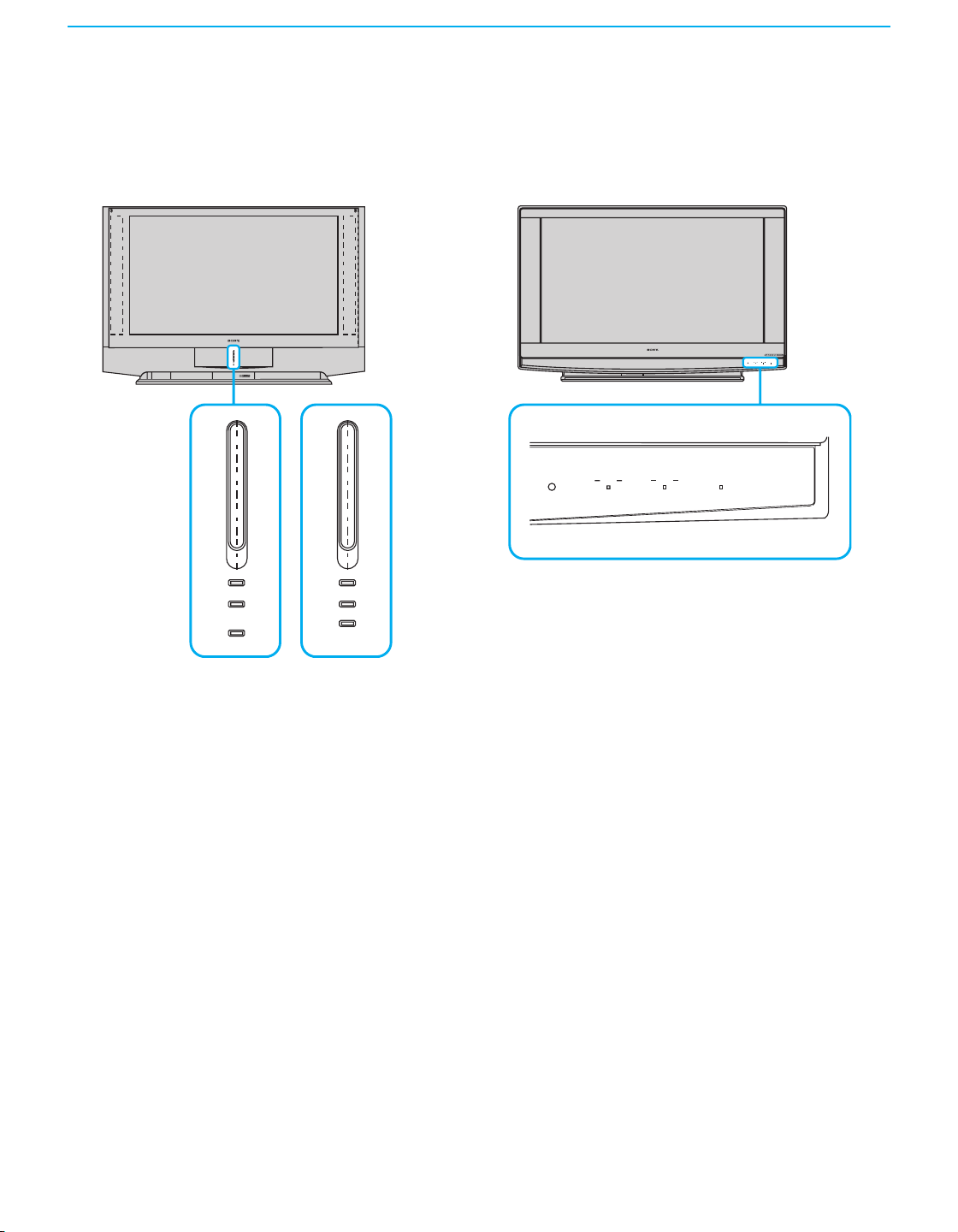
Other Information
126
KDF-WE/WF655
2-059-370-14 (2)
Flashing Indicators on the Front of the TV
The POWER/STANDBY (green or red) and/or LAMP (red) indicators light
or flash if there is a problem with or change in the condition of the LCD
projection TV.
The POWER/STANDBY (green) indicator flashes.
❑
The lamp for the light source is ready to turn on.
The POWER/STANDBY (red) indicator flashes three times.
❑
The lamp cover is not attached securely. When you secure the lamp
cover, the POWER/STANDBY indicator flashes in red and the LCD
projection TV enters the standby mode (see page 18).
The LAMP indicator flashes.
❑
The lamp for the light source has burned out.
Replace it with new one (see page 16).
If the LCD projection TV does not function properly after correcting the
problems, contact qualified Sony personnel.
POWER
STANDBY
TIMER
LAMP
LAMP TIMER POWER/STANDBY
POWER
PRO
STD/DUO
LAMP TIMER POWER/STANDBY
POWER
POWER/STANDBY
TIMER
LAMP
POWER
POWER/STANDBY
TIMER
LAMP
KDF-WE655 series
KDF-WF655 series
KDF-42WE655
KDF-50WE655
01COV.book Page 126 Thursday, February 17, 2005 8:01 PM
Other Information
127
Other Information
KDF-WE/WF655
2-059-370-14 (2)
Specifications
Projection System 3 LCD Panels, 1 lens projection system
LCD Panel 0.87 inch TFT LCD panel Approx. 3.28 million dots (1,042,168 pixels)
Projection Lens High Performance, large diameter hybrid lens F2.4
Antenna 75 ohm external terminal for VHF/UHF
Lamp KDF-42/50 WE655: UHP lamp, 100W, XL-2100U or XL-2100
KDF-55/60 WF655: UHP lamp, 132W, XL-2200
Television System NTSC American TV Standard
ATSC (8VSB terrestrial) ATSC compliant 8VSB
QAM on cable ANSI/SCTE 07 2000
Screen Size (measured diagonally) KDF-42WE655: 42 inches
KDF-50WE655: 50 inches
KDF-55WF655: 55 inches
KDF-60WF655: 60 inches
Channel Coverage Terrestrial (analog) 2-69
Cable TV (analog) 1-125
Terrestrial (digital) 2-69
Cable TV (digital) 1-135
Power Requirements 120V, 60 Hz
Number of Inputs/Outputs
HDMI IN Video 1080i, 720p, 480p, 480i
Audio Two channel linear PCM 32, 44.1 and 48 kHz,
16, 20 and 24 bit
Video (IN) 4 total (1 on front panel) 1 Vp-p, 75 ohms unbalanced, sync negative
S Video (IN) 4 total (1 on front panel) Y: 1 Vp-p, 75 ohms unbalanced, sync
negative
C: 0.286 Vp-p (Burst signal), 75 ohms
Audio (IN) 7 total (1 on front panel) 500 mVrms (100% modulation)
Impedance: 47 kilohms
Component Video Input 2 (Y, P
B, PR) Y: 1.0 Vp-p, 75 ohms unbalanced, sync
negative
P
B: 0.7 Vp-p, 75 ohms
P
R: 0.7 Vp-p, 75 ohms
CONTROL S (IN) 1 Mini jack
CONTROL S (OUT) 1 Mini jack
AUDIO (VAR/FIX) OUT 1 500 mVrms at the maximum volume setting
(Variable)
500 mVrms (Fixed)
Impedance (output): 2 kilohms
✍ AUDIO OUT jacks are operable only when the
TV’s Speaker is set to Off.
RF Inputs 2
(Continued)
01COV.book Page 127 Thursday, February 17, 2005 8:01 PM
Other Information
128
KDF-WE/WF655
2-059-370-14 (2)
Digital Audio Optical Output
(PCM/Dolby Digital)
1 Optical Rectangular (1)
CableCARD Slot PCMCIA Type I/II
Speaker Output 5 W (L), 5 W (R), 20 W (Woofer)
Dimensions (W × H × D) KDF-42WE655: (47
3
/8 × 32
1
/4 × 14
5
/8 inches) (1,201 × 819 × 371 mm)
KDF-50WE655: (54
1
/4 × 36
5
/8 × 17
7
/8 inches) (1,377 × 928 × 452 mm)
KDF-55WF655: (57
3
/8 × 37
1
/4 × 19
3
/8 inches) (1,456 × 943 × 491 mm)
KDF-60WF655: (62 × 39
5
/8 × 20
1
/2 inches) (1,574 × 1,005 × 518 mm)
Mass KDF-42WE655: 32.5 kg (71 lb 10 oz)
KDF-50WE655: 39 kg (85 lb 14 oz)
KDF-55WF655: 46 kg (101 lb 7 oz)
KDF-60WF655: 50.5 kg (111 lb 5 oz)
Power Consumption
In Use KDF-42/50WE655: 230 W KDF-55/60WF655: 265 W
In Standby Less than 20 W
Supplied Accessories
Remote Control RM-Y915
AA (R6) Batteries 2 supplied for remote control
Design and specifications are subject to change without notice.
01COV.book Page 128 Thursday, February 17, 2005 8:01 PM

Other Information
129
Other Information
KDF-WE/WF655
2-059-370-14 (2)
Optional Accessories
❑ HDMI cable
❑ Component video cable
❑ S VIDEO cable
❑ A/V cable
❑ Audio cable
❑ Optical cable
❑ Control S cable: RK-G69
❑ TV Stand: SU-GW11 for KDF-42WE655
SU-GW1 and SU-GW11 for KDF-50WE655
SU-GW12 for KDF-55WF655/KDF-60WF655
❑ Lamp: yk
ii
XL-2100U and XL-2100 for KDF-42WE655 and KDF-50WE655
XL-2200 for KDF-55WF655 and KDF-60WF655
01COV.book Page 129 Thursday, February 17, 2005 8:01 PM

130
KDF-WE/WF655
2-059-370-14 (2)
Index
Numerics
0-9 button 60
A
Activating a Twin View screen 72
Adding channels to the channel list
107
Adjusting audio, Steady Sound 102
Advanced Video 100
Alternate Audio 69
Alternate Video 69
ANT button 61
Antenna, connecting 31, 32
Audio Menu 97, 102
Audio receiver, connecting 49
Auto Program (channel setup) 58
B
Balance, adjusting 102
Bass, adjusting 102
Batteries, inserting in remote 59
Bilingual audio 103
Brightness, adjusting 98
C
Cable
connecting 32
with VCR, connecting 39
Cable box
connecting with VCR 40
using with TV remote control
64
CableCARD 56
Camcorder, connecting 48
Caption Vision 112
CATV. See cable
Channel Menu
97, 106
Channel Show Hide 107
Channels
Auto Program 106
creating labels 107
setting up 58
Clock/Timers 115
closed caption modes 97, 112
Color temperature, adjusting 99
Color, adjusting 98
Connecting
Audio receiver 49
Cable box 40
Cable or antenna 32
Camcorder 48
DVD player 46
Satellite receiver 43
–45
VCR 39
–42, 44
CONTROL S 55
D
Digital subchannels 69
DISPLAY button 61, 67
Display unit
controls 24
Display, turning off 61
DRC Mode 100
DVD player
using with TV remote control
65
with A/V connectors,
connecting 47
with component video
connectors,
connecting 46
E
Enlarging pictures, in Twin View
74
ENT button 60
error messages, Memory Stick 122
F
Favorite Channel
setting up 106
using 75
Features 12
FREEZE button 60
Freeze, using 77
FUNCTION button 60
G
GUIDE button 68
Guide menu 69
H
Hue, adjusting 98
I
Inputs, labeling 113
Installation of the projection TV
31–55
interlaced 118
J
JUMP button 61, 67
L
Label
Channels 58, 107
video inputs 113
Lamp, replacing 16–22
M
Memory Stick
Duo 83
features 79
Index 85
indicator (LED) 25
insertion slot 24
panning photos 89
photo options 88
playing movies 90
precautions 95
removing 84
rotating photos 89
slide show options 92
troubleshooting 121
viewing photos 87
zooming photos 89
MENU button 61, 67
Menus
Audio 97, 102
Channel 97
, 106
Parent 97, 108
01COV.book Page 130 Thursday, February 17, 2005 8:01 PM

131
KDF-WE/WF655
2-059-370-14 (2)
Screen 97, 104
Setup 97
, 112
Video 97
, 98
Mode
Pro 98
Standard 98
Vivid 98
MTS/SAP 103
MUTING button 60
N
Noise Reduction 99, 108
P
Parent Menu 97
Parental control, described 12
Password, changing 109
PICTURE button 60
Picture contrast, adjusting 98
Picture size, adjusting in Twin
View
74
POWER ON/STAND BY
indicator
25, 126
POWER/STANDBY 126
problems, troubleshooting 119–
125
Program Guide 69
Program Options menu 69
progressive 118
Protect 88
R
Ratings
setting 110
viewing blocked programs 109
Rear panel controls and
connections
27
Remote control
inserting batteries 59
programming 62
–63
Removing channels from the
channel list
107
RESET button 60
Resetting
Audio options 102
Video options 98
S
Satellite receiver
connecting 43
using with TV remote control
64
Screen Menu 97, 104
setting up channels 58
Setup menu 112
Sharpness, adjusting 98
Specifications 127–128
Steady Sound
adjusting 102
Surround sound 102
T
Timer
set current 116
TIMER indicator 25
Timer setting 115
Treble, adjusting 102
troubleshooting 119–125
TV FUNCTION button 61, 67
TV POWER button 61, 67
TV/VIDEO button 61, 67
Twin View
using 72–74
Twin View™
activating a picture 72
described 12
using 72
V
VCR
using with TV remote control
65
with cable box, connecting 40
with cable, connecting 39
with satellite receiver,
connecting 44
Video inputs, labeling 113
Video Menu 97, 98
Video Modes, selecting 98
Viewing area, recommended 30
VOL +/– button 60
VOL buttons 67
Z
Zoom feature, with Twin View 74
01COV.book Page 131 Thursday, February 17, 2005 8:01 PM

2004 Sony Corporation
KDF-42WE655
KDF-50WE655
KDF-55WF655
KDF-60WF655
LCD Projection TV
HD-TV
Operating Instructions
2-059-370-14(2)
LCD Projection TV KDF-42WE655/KDF-50WE655/KDF-55WF65
5/KDF-60WF655
KDF-42&50WE655/KDF-55&60WF655
2-059-370-14(2)
Printed in U.S.A.
002059370131COVER.fm Page 1 Thursday, February 17, 2005 7:19 PM