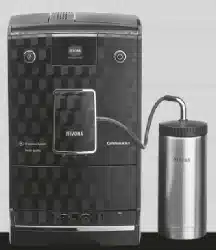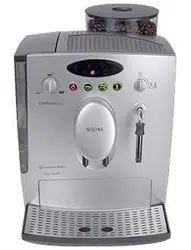
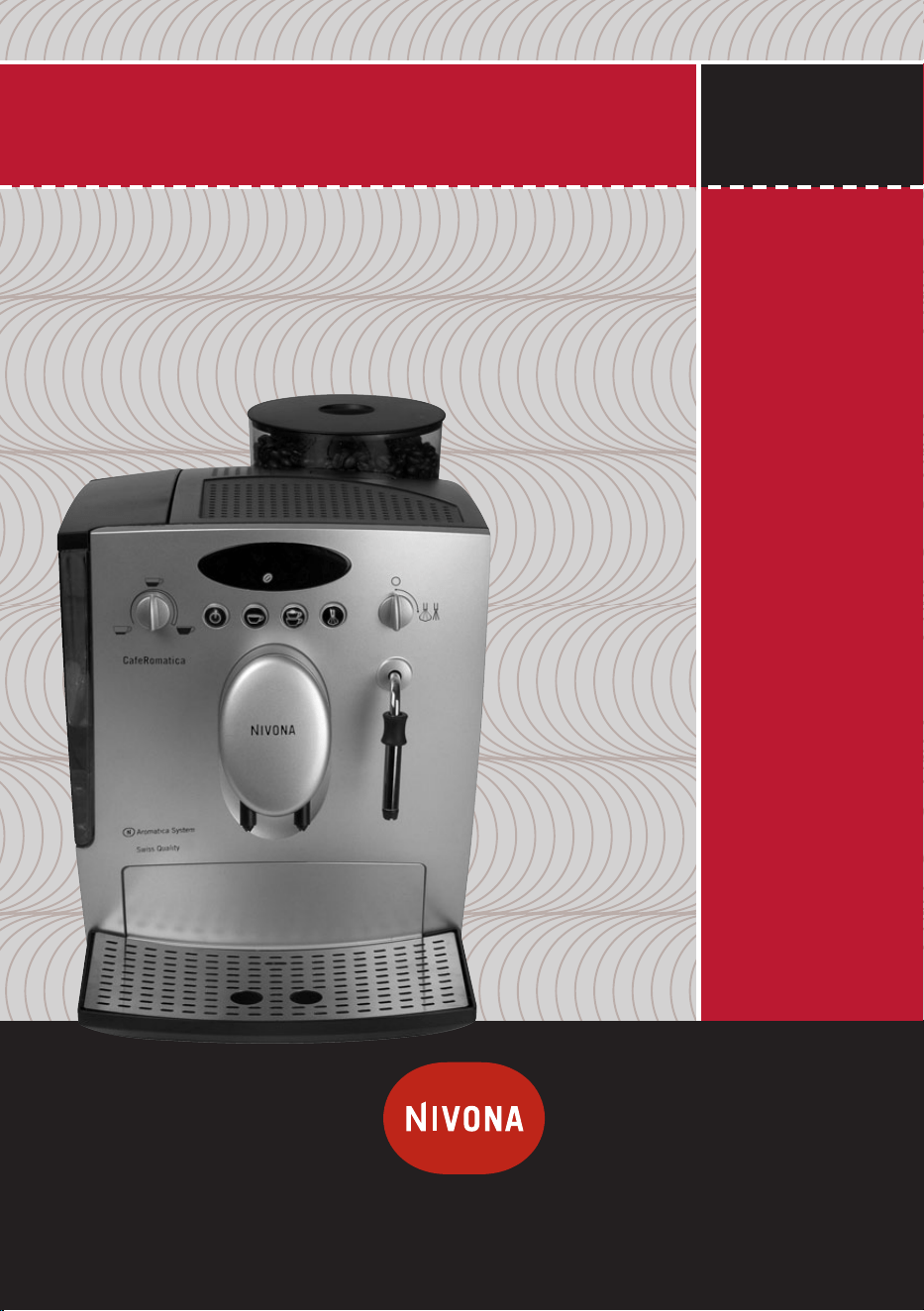
CafeRomatica
Fully automatic coffee centre
Operating Instructions and Useful Tips
610
620
A passion for coffee.

2
Operating Instructions and Useful Tips
Dear Customer,
Congratulations and many thanks for choosing a high-quality
NIVONA product. To get the most out of your NIVONA machine,
please read this manual carefully before use. Please start by
reading the safety notes.
Please keep this manual in a safe place. You may want to use
it as reference guide or hand it on to any further users of your
machine.
Purchase made at
Place, date
3
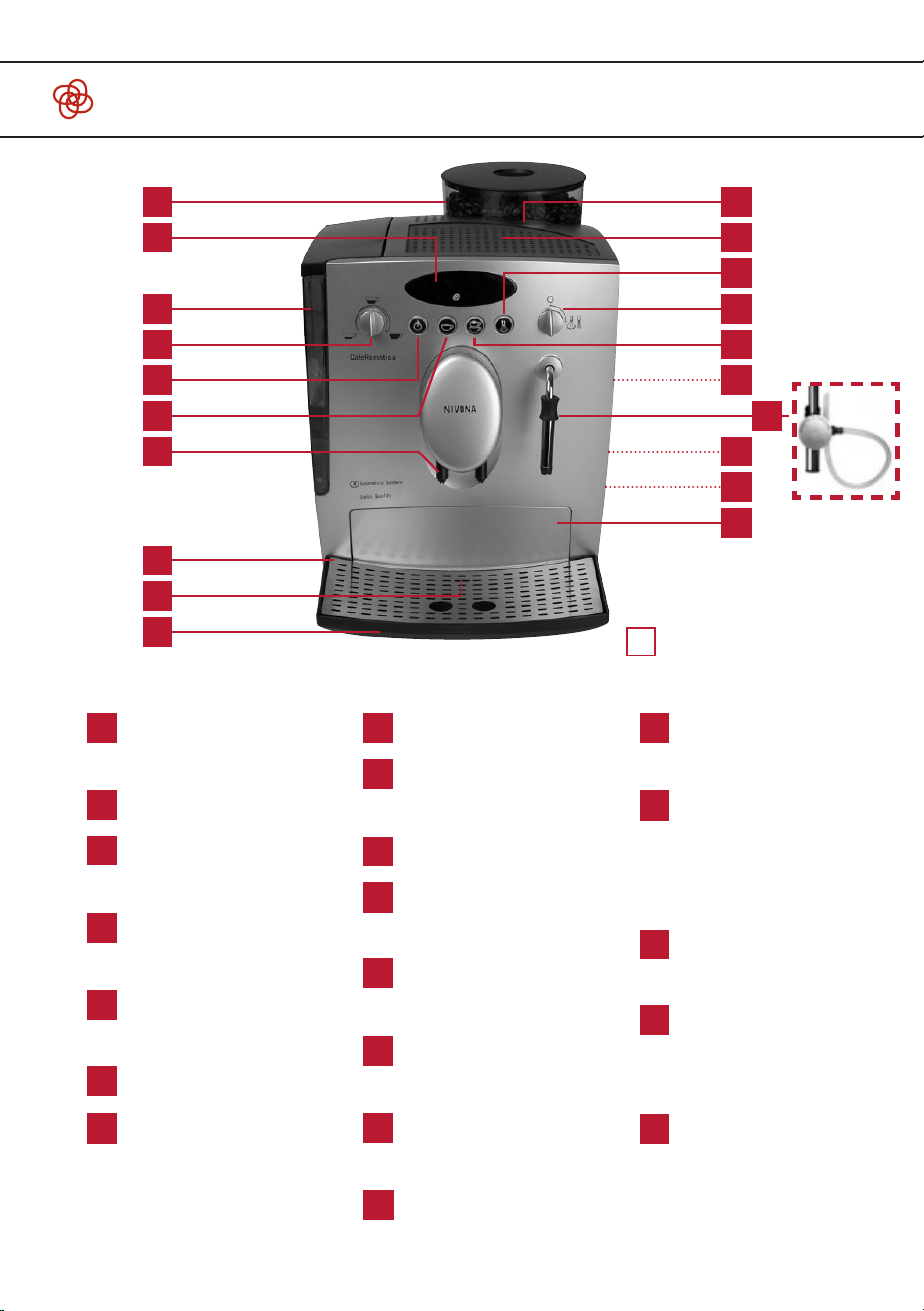
Equipment
Bean container
with lid
A
Drip grill
H
Fill level indicator
for drip tray
I
Drip tray
J
Pre-ground coffee
chamber
K
Cup warming /
holding plate
L
Steam warm-up /
rinse button
M
Steam / hot water
valve control knob
N
2-cup button
O
Grinder settings
(on rear)
P
Steam / hot water
jet or ‘spumatore’
(depending on
model)
Q
Mains switch
(on rear)
R
Power cord storage
compartment
(on rear)
S
Used coffee tray
(inside)
T
Symbol display screen
B
Removable water
tank
C
Water quantity
control knob
D
On / Off (Stand-by)
button
E
1-cup button
F
Height-adjustable
coffee spout
G
1
A
B
C
D
E
F
G
H
K
L
M
N
O
P
Q
R
S
T
I
J
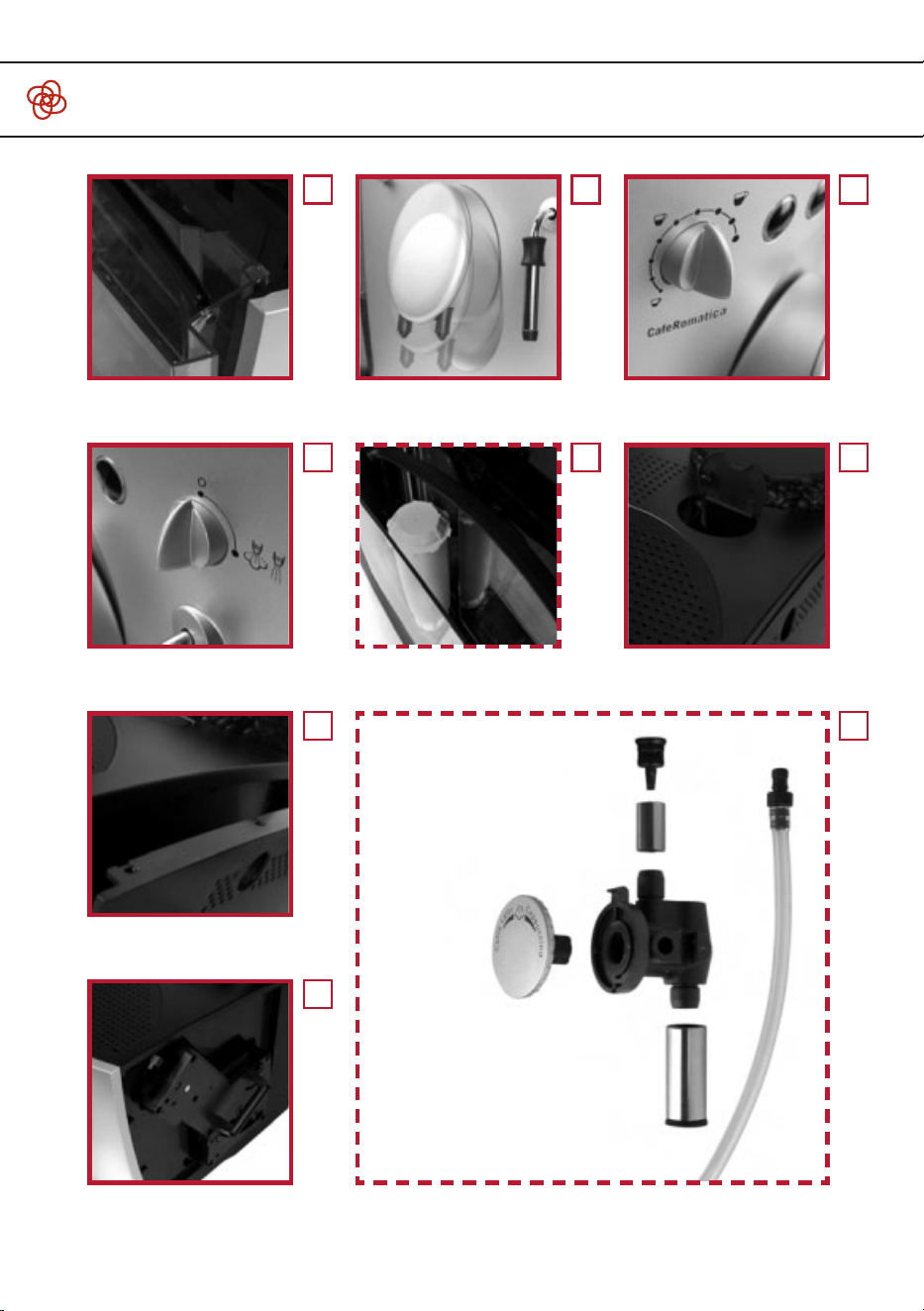
Equipment
2 3 4
5
8
9
10
6 7
a Control knob
b Air inlet valve
c Air inlet pipe
d Inlet valve
e Steam / hot water jet
f Liquid inlet hose
b
c
d
e
a
f
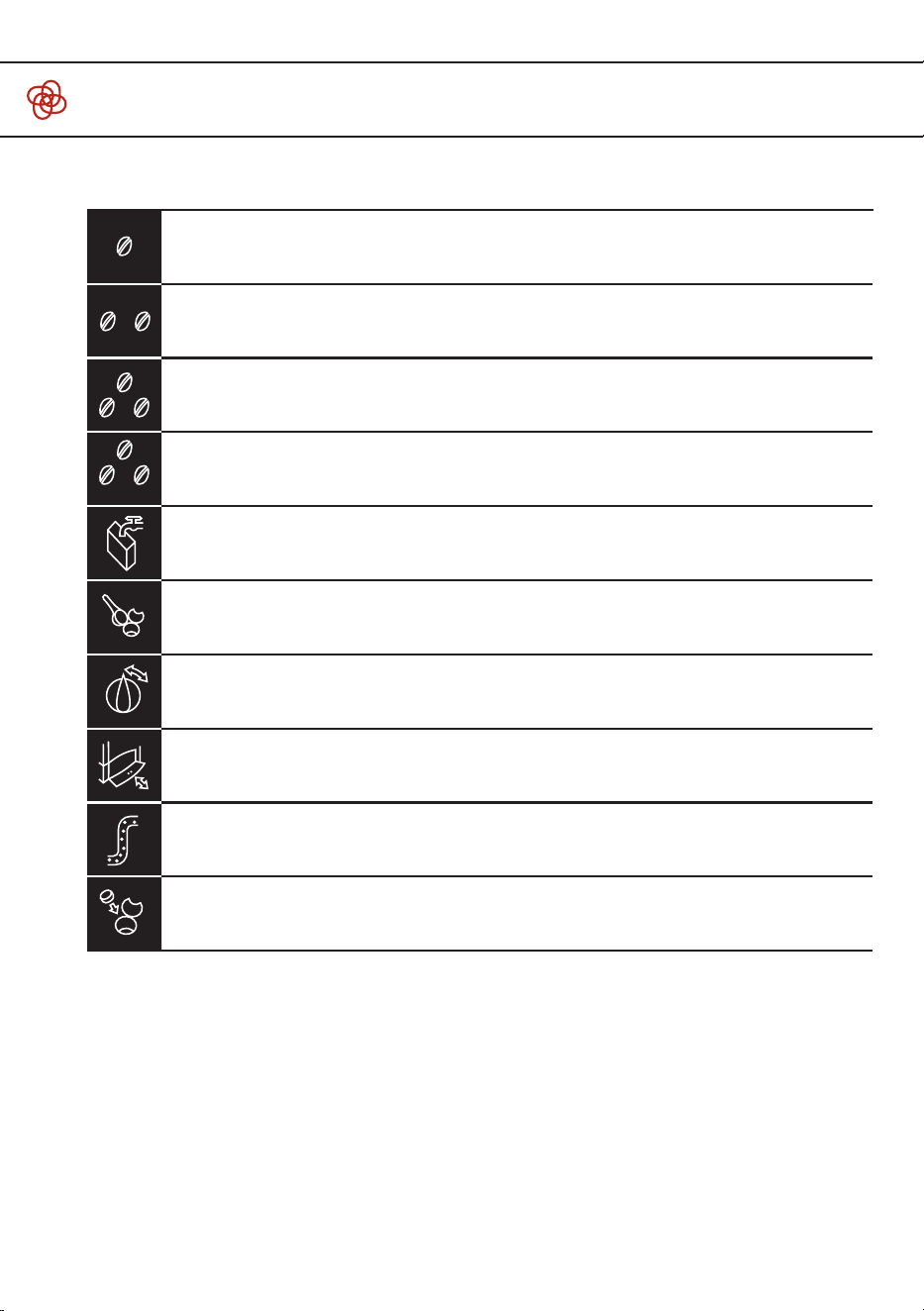
Symbols
Number
9
10
11
12
13
14
16
17
18
19
Symbol Brief description
Coffee strength MILD
Coffee strength NORMAL
Coffee strength STRONG
Not enough coffee beans – fill container
Fill water tank
Pre-ground coffee
Hot water / steam, open / closed
Empty used coffee tray / drip tray
Descale machine
Clean machine
Flashing

Contents
1. Safety instructions
2. Set up
2.1 Preparing the machine
2.2 Getting started
2.3 Grinder settings
3. Making coffee
3.1 Selecting water quantity
3.2 Selecting coffee strength
3.3 Making one cup
3.4 Making two cups
3.5 Using pre-ground coffee
3.7 Drawing steam / frothing milk (models up to 610)
3.8 Drawing steam / frothing milk (models 620 and above)
3.8.1 Drawing steam (model 620 and above)
3.8.2 Frothing milk, hot milk and cappuccino (model 620 and above)
4. Programming functions
4.1 Filter
Inserting filter
Operating without a filter
4.2 Water hardness
4.3 Temperature
4.4 Automatic Stand-by
5. Maintenance and care
5.1 Changing filter
5.2 Cleaning program
Manual cleaning
5.3 Descaling
Manual descaling
5.4 General cleaning
6. System messages
7. Troubleshooting
8. Further instructions

7
1. Safety instructions
• The machine is for domestic use
only and is not suitable for com-
mercial applications.
• Operating voltage must be the
same as mains voltage. Please
note the model nameplate /
sticker on the underside of the
machine.
• Do not operate the machine if
the power cord or machine case
is damaged.
• Keep the power cord away from
hot parts.
• Do not unplug the machine by
pulling on the power cord.
• Observe the descaling in -
structions given!
• Make sure to switch off and
unplug the machine before
maintenance or cleaning.
• Place the machine on a firm,
level surface and use it indoors
only.
• Do not place the machine on a
hot surface or near open flames.
• Keep the machine away from
children.
• Always unplug the machine
during extended periods of
absence.
• Do not leave the machine
switched on unnecessarily.
• Do not submerge the machine
in water.
• Do not put the machine or indi
vidual parts in the dishwasher.
• Unplug immediately if there is
a defect (do not pull the cord
or machine to unplug).
• Liability for damages cannot be
accepted if the machine is incor-
rectly operated, subject to im-
proper use or non-professional
servicing. In such cases, services
will not be provided under the
guarantee.
• Use the coffee grinder for grind-
ing roasted coffee beans only –
do not use with other foods.
Always make sure there is
nothing but coffee beans in the
beans container – otherwise the
guarantee will not apply.
• This machine is not suitable for
individuals (including children)
with physical, sensory or mental
impairments, including indi-
viduals who do not have suffi-
cient experience or knowledge,
unless they are shown how to

8
operate the machine or initially
supervised by someone res-
ponsible for their safety.
If repair services are required, in -
cluding replacement of the power
cord, please send the machine to
the dealer from whom it was pur-
chased – or to NIVONA Central
Customer Services.
Caution! Electrical appliances
must be repaired by qualified per-
sonnel! Non-professional repairs
can expose the user to significant
risks. Liability for damages cannot
be accepted if the machine is
used for any other than the in -
tended purpose, incorrectly main-
tained or serviced.
Caution! Using the mains switch
(fig. 1/R) while the machine is
brewing can cause damage!
Only switch off at the mains when
the On / Off switch (fig. 1/E) is
switched to Off (Stand-by).
Caution! Risk of scalding!
• Then you produce steam or hot
water, watch out for splashes
from the jet / ‘spumatore’
(fig. 1/Q): risk of scalding!
• Only touch the plastic parts of
the steam jet or ‘spumatore’
(fig. 1/Q) and never point it at
people!
• The steam jet or ‘spumatore’
(fig. 1/Q) becomes VERY HOT
during use. Leave to cool for a
few minutes before touching.
CE – This machine conforms to
the following EC guidelines:
• 73/23/EWG dated 19/02/1973
“Low Voltage Directive”, includ-
ing amendment 93/68/EWG.
• 89/336/EWG dated 03/05/1989
“EMV Directive”, including
amendment 92/31/EWG.
Specifications
Mains voltage: 230 V
Power input: 1400 W
Note: Your fully automatic coffee
centre has a cord storage compart-
ment – if the power cord is too
long, any surplus can be accom-
modated in the storage area on
the rear of the machine (fig. 1/S).
... 1. Safety instructions

9
2. Set up
2.1 Preparing the machine
➔ Carefully remove the machine
and all parts from the packaging.
Note: If you need to return your
machine for servicing, it can be
sent by post in the original packag-
ing. Please keep all packag ing and
protective material for this pur -
pose.
➔ Remove the water reservoir (fig.
1/C and 2) and wash it out with
clean, cold tap water.
➔ Then fill the reservoir up to the
“max.” mark and replace it in the
machine. Make sure that it clicks
into place.
Note: Only ever fill the reservoir
with fresh, cold water. Do not use
carbonated water or other liquids!
➔ Open the lid of the coffee con-
tainer (fig. 1/A) and fill it with
coffee beans.
Note: Do not use beans which
have been treated with supple-
ments, such as sugar, during or
after the roasting. Supplements
can damage the grinding mecha-
nism and any repair costs arising
as a result are not covered by the
guarantee.
Please make sure the steam / hot
water valve control knob (fig. 1/N
and 5) is turned to ‘0’!
2.2 Getting started
➔ Plug the machine in.
➔ Switch the mains supply on
(fig. 1/R). The On / Off button
(fig. 1/E) lights up.
➔ Press the On / Off button (fig.
1/E) for about 1 second. The
‘Beans’ symbol appears in the
display and the On / Off button
(fig. 1/E) light flashes.
➔ After a short time the On / Off
button (fig. 1/E) light remains on,
while the steam / rinse button ‘S’
(fig. 1/M) light flashes.
➔ Place a cup under the height-
adjustable coffee spout (fig. 1/G
and 3) and press the steam / rinse
button ‘S’ (fig. 1/M).
➔ The system is then filled with
water and completely rinsed out
via the coffee spout (fig. 1/G).
This operation must always be
carried out when the machine is
started from cold to preserve the
aroma of the coffee. It ensures
that no stale water or coffee left
over from previous brews is used.

10
➔ All four operating buttons
(fig. 1/E, F, M, O) then light up,
and the selected coffee strength
is shown in the display by the
cor responding number of beans
(fig. 4).
➔ The machine is now operational.
Note: As a protective measure, the
pipes are not filled with water when
the machine is first operat ed. The
machine indicates this as follows:
➔ When the machine has been
turned on with the On / Off button
(fig. 1/E), Symbol 16 ‘Open hot
water / steam valve’ flashes.
➔ Place a cup under the steam /
hot water jet (fig. 1/Q).
➔ Turn the steam / hot water valve
control knob (fig. 1/N and 5) to
the right to open the valve. The
system then fills up and some
water may come out of the jet (fig.
1/Q).
➔ As soon as the symbol ‘Water /
Steam Open / Close’ (Symbol 16)
lights up without flashing and the
filling operation has stopped auto-
matically, you can turn the valve
control knob (fig. 1/N and 5) back
again to close it.
➔ Then follow the steps in ‘2.2
Getting started’.
➔ The machine is now operational.
2.3 Grinder settings
Caution: Grinder settings can only
be adjusted when the grinder is in
operation. You can adjust the grin-
der settings to suit the roast of
your coffee beans. We recommend
that you leave the grinder on a
medium setting.
➔ Slide the regulator on the rear
side (fig. 1/P) into the desired
position while the grinder is runn -
ing. The smaller the dot, the finer
the coffee is ground. Remember:
· a light roast requires a finer
grind
· a dark roast requires a coarser
grind
Try out the different settings to
find the one that best meets your
personal preferences.
... 2. Set up

11
3. Making coffee
Note: The machine is preset for
immediate use. However, we
recommend that first you adjust
the most important settings to suit
your personal needs. Please follow
the instructions in chapter 4
(Programming functions) for filter,
temperature and water hardness
settings.
Note: When the machine is brand
new or has not been used for an
extended period, the first cup of
coffee does not have the full aroma
and should not be drunk.
3.1 Select water quantity
You can freely select the quantity
of water used by turning the water
quantity control knob (fig. 1/D
and 4). The little cup bottom left
represents less water, the large
cup bottom right represents more
water.
Tip: The water quantity can be ad -
justed while the machine is runn ing.
Try out various cup sizes and
quantities to find the setting that
best suits your personal preferen-
ces.
3.2 Selecting coffee strength
There are three levels of coffee
strength to which you can adjust
the brewing unit. They are shown
in the display as follows:
MILD, symbol 9, ‘1 bean’
uses about 7g of ground coffee
e.g. for cafe latte or cappuccino
NORMAL, Symbol 10, ‘2 beans’
uses about 9g of ground coffee
e.g. for American coffee
STRONG, Symbol 11, ‘3 beans’
uses about 11g of ground coffee
e.g. for espresso or very strong
coffee.
➔ As soon as the machine is
operational, the display shows the
default setting (Symbol 10,
‘2 beans’).
➔ You can change this by pressing
and holding the 1-cup or 2-cup
button (fig. 1/F, O) until the des-
ired coffee strength appears in the
display (fig. 1/B). Brewing begins
as soon as you release the button.
Caution: Pressing / releasing the
button automatically starts the
brewing operation!

12
3.3 Making one cup
➔ Place your (pre-heated) cup
under the coffee spout (fig. 1/G
and 3). The coffee spout is height-
adjustable and can be raised or
lowered to suit the cup size.
➔ Select the water quantity sett ing
as described in 3.1.
➔ Press and hold the 1-cup button
(fig. 1/F) until the desired coffee
strength appears. Then release the
button.
➔ The machine now starts the
grinding, pre-brewing and brewing
operation. It can be stopped at
any time by pushing any button.
Caution: The first time you brew
coffee, the grinding chamber is
still empty. The symbol for ‘not
enough beans’ (Symbol 12,
‘3 beans’) may therefore start to
flash after the first grinding and
no coffee is produced. If this
occurs, press the ‘start’ button
(1 or 2-cup, fig. 1/F or 1/O) a
second time and the operation is
repeated.
Tip: To determine the ideal quantity
of water for your taste or cup size,
make your first cup of coffee as
follows:
➔ Turn the water quantity control
knob (fig. 1/D and 4) to one of the
following positions:
· middle for an espresso cup,
· far right for a large cup.
➔ Press the 1-cup button (fig. 1/F).
➔ The machine starts brewing.
➔ Shortly before the desired
amount of coffee is reached, turn
the water quantity control knob
(fig. 1/D and 4) slowly to the left,
until the machine stops brewing.
➔ For future use, note where the
water quantity control knob is now
pointing.
3.4 Making two cups of coffee
In the 2-cup operation, two cups
of coffee are produced conse -
cutively.
➔ Place both (pre-heated) cups
under the coffee spout (fig. 1/G
and 3).
➔ Select the desired water quant ity
settings for one cup (fig. 1/D
and 4).
➔ Press and hold the 2-cup button
(fig. 1/O) until the desired coffee
strength appears in the display.
➔ Release the button.
... 3. Making coffee

13
➔ The machine now starts the
grinding, pre-brewing and brewing
operations and produces two con-
secutive cups of coffee.
Tip:
· Brewing can be stopped at any
point by pressing any button.
· If the water or beans supply runs
out or the trays need emptying
between brewing the first cup and
the second, the appropriate sym-
bol will appear in the display
(Symbol 12, 13 or 17) and the
second coffee will no longer be
made. Follow the display screen
and then press the 1-cup button
(fig. 1/F) for the second cup.
3.5 Using pre-ground coffee
➔ First turn the water quantity
control knob (fig. 1/D and 4) to
the desired level for 1-cup.
➔ Open the lid of the pre-ground
coffee chamber (fig. 1/K and 7).
Symbol 14 flashes.
➔ Add a level measuring spoon of
ground coffee and close the lid
again (Symbol 14 stops flashing
and is lit up).
➔ Place a cup under the coffee
spout (fig. 1/G and 3) and press
the 1-cup button (fig. 1/F). A cup
of coffee is now brewed without
grinding.
Note: If the pre-ground coffee
chamber is left open by accident
or no button is pressed after
coffee is added, the machine will
automatically ask to be rinsed out
a minute after the lid is closed.
Press the flashing rinse button
(fig. 1/M) to confirm, and the
machine will be rinsed out via the
coffee spout (fig. 1/G and 3). It is
then operational again.
Caution: The pre-ground coffee
chamber is not a storage container.
Never add more than one measure
at a time to the chamber, and use
only fresh grinded or vacuum-
packed coffee ground. Do not use
instant coffee powder.
3.6 Drawing hot water
➔ Hold a cup under the steam / hot
water jet or ‘spumatore’ (fig. 1/Q).
➔ Note: When drawing hot water
from the ‘spumatore’ (fig. 1/Q on
models numbered 620 and
... 3. Making coffee

14
above), make sure the control knob
is in the central position.
➔ Turn the steam / hot water valve
control knob (fig. 1/N and 5) to
the right. Fill the cup up to the
desired level and turn the valve
control knob (fig. 1/N and 5) back
to ‘0’.
Caution: Risk of scalding!
Watch out for splashes. The jet
be comes very hot during use.
Leave to cool for a few minutes
before touching, or only touch
the plastic parts.
3.7 Drawing steam / frothing milk
(models up to 610)
➔ Press the steam warm-up button
(fig. 1/M).
➔ The On / Off button (fig. 1/E)
lights up and the steam warm-up
button (fig. 1/M) flashes for a
short warm-up period.
➔ As soon as the steam warm-up
button stops flashing (after a few
seconds), steam can be drawn.
➔ Dip the jet (fig. 1/Q) into the
cup / container with the milk to
be frothed.
➔ Now turn the steam / hot water
valve control knob (fig. 1/N and 5)
to the right. Caution: a little water
comes out before the steam.
➔ The steam warm-up button (fig.
1/M) flashes as you draw steam.
➔ Turn the valve control knob (fig.
1/N and 5) back to the left to the
‘0’ position to stop drawing steam.
➔ Press the steam warm-up button
again (fig. 1/M and 5) to switch the
machine back to normal coffee
brewing mode.
Note:
· Steam can be drawn for about
3 minutes. Then the machine will
automatically switch the operation
off. You can prolong the operation
by turning the control knob back
and forth (fig. 1/N and 5).
· To froth milk, the metal pipe of
the steam jet must be in the
lowest position.
· It is difficult to remove dried
milk left on the jet after frothing.
Therefore clean the equipment
as soon as it has cooled down –
ideally repeat the steam drawing
operation with a cup filled with
fresh, cold water.
Caution: Risk of scalding!
The steam which comes out is very
hot. Do not touch the jet until it
has cooled down or only touch the
black plastic parts.
... 3. Making coffee

15
3.8 Drawing steam / frothing milk
(models 620 and above)
3.8.1 Drawing steam
(models 620 and above)
➔ Press the steam warm-up button
(fig. 1/M).
➔ The On / Off button (fig. 1/E)
lights up and the steam warm-up
button flashes for a brief warm-up
period.
➔ As soon as the steam warm-up
button stops flashing (after a few
seconds), steam can be drawn.
➔ Dip the jet (fig. 1/Q) into the
cup / container with the milk to be
frothed. Make sure the control
knob is in the central position.
➔ Now turn the steam / hot water
valve control knob (fig. 1/N and 5)
to the right. Caution: a little water
comes out before the steam.
➔ The steam warm-up button
(fig. 1/M) flashes while you draw
steam.
➔ Turn the valve control knob
(fig. 1/N and 5) back to the left,
to the ‘0’ position, to stop drawing
steam.
➔ Press the steam warm-up button
again (fig. 1/M and 5) to switch
the machine back to normal coffee
brewing mode.
3.8.2 Frothing milk, hot milk and
cappuccino (models 620 and
above)
With the special ‘spumatore’ froth -
ing device (fig. 1/Q and 10) you
can heat up milk straight from the
carton or bottle and then froth it
into the cup.
➔ Dip the inlet hose (fig. 10/F)
straight into the milk carton or
bottle.
➔ Now place a cup under the
‘spumatore’ jet (fig. 1/Q).
➔ Then press the steam warm-up
button (fig. 1/M).
➔ The On / Off button lights up
(fig. 1/E) and the steam warm-up
button (fig. 1/M) flashes for a
brief warm-up period.
➔ As soon as the steam warm-up
button stops flashing (after a few
seconds), steam can be drawn.
➔ For a cappuccino: turn the spu-
matore control knob (fig. 10a) to
the left so that it points to ‘cap-
puccino’.
➔ For hot milk, turn the spumatore
control knob (fig. 10a) to the right
so that it points to ‘caffè latte’.
➔ Now turn the steam / hot water
valve control knob (fig. 1/N and 5)
to the right. Caution: a little water
comes out before the steam.
... 3. Making coffee

16
➔ As soon as the desired amount
of milk foam or hot milk has been
drawn, turn the steam valve con-
trol knob (fig. 1/N and 5) back to
the left into the ‘0’ position.
➔ Press the steam warm-up button
again (fig. 1/M and 5) to switch
the machine back to normal coffee
brewing mode.
➔ Now place the cup with the
frothed up or hot milk under the
coffee spout (fig. 1/G and 3) and
fill up with coffee by pressing the
button as described above (point
3.3 / 3.4).
Caution: It is hard to remove dried
milk left on the jet after frothing.
Please therefore clean the equip-
ment as soon as it has cooled
down!
➔ To do this, fill a container with
fresh, cold water, and dip the inlet
hose into it.
➔ Place an empty container under
the spumatore / jet (fig. 1/Q).
➔ Now draw steam as described
above until only clean water /
steam flows out.
➔ Now the whole ‘spumatore’
mechanism is clean and operational
again.
Cleaning: For optimal cleaning the
‘spumatore’ must from time to
time be dismantled and its parts
rinsed under cold clear water. It is
easy to take apart and reassemble
(fig. 10).
Note: Steam can be drawn for
about 3 minutes. Then the machine
will automatically switch the
operation off. You can prolong the
operation by turning the control
knob back and forth (fig. 1/N
and 5).
... 3. Making coffee

17
The following buttons are used for
programming:
Stand-by button (fig. 1/E)
1-cup button (fig. 1/F)
2-cup button (fig. 1/O)
Steam warm-up button (fig. 1/M)
4.1 Filter
Inserting filter
You can purchase a special filter
for the water reservoir in specialist
shops (included accessory for
models 620 and above). If you
use this filter correctly, you will
not need to descale your coffee
machine as often. After the filter
was inserted, please adjust the
water hardness setting on level 1
(see chapter 4.2).
➔ Empty the water tank (fig. 1/C
and 2).
➔ Set the insertion and replace-
ment date on the date ring (months)
at the top end of the filter cartridge.
➔ Screw the filter into the bracket
provided in the water reservoir us ing
the assembly tool on the end of
the measuring spoon (fig. 6).
➔ Fill up the reservoir with fresh
water and put it back in the
machine.
➔ Hold a container under the
steam / hot water jet (fig. 1/Q) and
turn the valve control knob (fig.
1/N and 5) to the right to open.
The system will now be rinsed
through.
➔ Wait until no more water comes
out of the jet and turn the valve
control knob (fig. 1/N and 5) back
to the left to close.
➔ The system can briefly heat up
and is then operational again.
Once you have inserted the filter,
adjust the water hardness setting
to level 1 (see point 4.2).
Note: Make sure to remove the
filter when the expiry date set on
the date ring is reached. Also
make sure to take the filter out
the machine for descaling when
instructed to do so (see 5.3).
Operating without a filter
If you no longer wish to use the
filter, do not forget to adjust the
water hardness settings.
Important: Please note that the
following programs can only be set
if the On / Off button (fig. 1/E) is
switched to Off (Stand-by mode).
You can program the following
settings:
water hardness, temperature level,
automatic stand-by.
4. Programming functions

4.2 Water hardness
According to the water hardness in
your region, or if you have not
inserted a filter (see chapter 4.1),
sooner or later the machine needs
descaling. So that the system can
indicate accurately when desca-
ling is necessary, you must enter
the correct water hardness set-
tings before first use.
The default setting is level 3.
First, test your water with the test
strips provided:
➔ Dip the strip into the water and
then shake it lightly off.
➔ After about a minute you can
read the result by counting the red
dots on the test strip.
➔ The settings corresponding to
the different levels of hardness are
as follows:
Note: If none of the dots turn red
on the test strip, please set to
level 1.
➔ Switch your machine to Stand-
by mode.
➔ Press the steam warm-up button
(fig. 1/M) for about 4 seconds.
➔ The water hardness is indicated
by the number of buttons lit up as
detailed below.
➔ Press the steam warm-up button
repeatedly until the buttons which
indicate your level of water hard-
ness light up.
➔ Press the Stand-by button to
confirm.
➔ To confirm your settings, the
buttons which indicate the level
selected flash twice consecutively.
➔ The programming operation is
then complete and the system is
restored to coffee-brewing mode.
Note: If you interrupt your pro-
gramming operation for more than
1
1
/
2
minutes, your machine goes
automatically back into coffee-
brewing mode.
Test strip Hardness level Symbol for setting
1 red dot 1–7° Stand-by button is lit up Level 1
2 red dots 8–14° Stand-by button + 1-cup button are lit up Level 2
3 red dots 15–21° Stand-by button + 1-cup button
+ 2-cup button are lit up Level 3
4 red dots >21° Stand-by button + 1-cup button
+ 2-cup button
+ S/steam button are lit up Level 4
18
... 4. Programming functions

19
4.3 Temperature
You can change the coffee temp -
er ature as desired (the default
sett ing is ‘normal’):
Normal = Stand-by button is lit up
High = Stand-by button and
1-cup button are lit up
➔ Switch the machine to Stand-by
mode.
➔ Press and hold the 1-cup button
(fig. 1/F) for about 4 seconds.
➔ The buttons which indicate the
current temperature setting light
up as detailed above.
➔ You can change to the other
temperature setting by pressing
the 1-cup button.
Press the Stand-by button to con-
firm the desired temperature sett -
ing. The buttons which indicate
the setting flash briefly to confirm
the selection.
Note: If you interrupt your pro-
gramming operation for more than
1
1
/
2
minutes, your machine auto-
matically switches back into coffee-
brewing mode.
4.4 Automatic Stand-by
This function allows you to pro-
gram the machine to switch auto-
matically to Stand-by mode a
given number of hours after the
last brewing operation. The follow -
ing settings are possible. After:
➔ 1 hour = Stand-by button
is lit up.
➔ 3 hours = Stand-by button
+ 1-cup button are lit up.
➔ 5 hours = ‘Stand-by button
+ 1-cup button + 2-cup button
are lit up.
The default setting is level 2, ‘3
hours’. To change this setting,
follow the instructions below:
➔ Switch your machine to Stand-
by mode.
➔ Press and hold the 2-cup button
(fig. 1/O) for about 4 seconds.
➔ The buttons which indicate the
current automatic stand-by sett ings
light up.
➔ You can select a different auto-
matic Stand-by setting by pressing
the 2-cup button.
Press the Stand-by button to con-
firm the desired automatic Stand-
by setting. The buttons which
indicate the setting flash twice to
confirm the selection.
Note: If you interrupt the pro -
gramm ing operation longer than
1
1
/
2
minutes, the machine will
switch automatically back into the
coffee-brewing mode.
... 4. Programming functions

20
5. Maintenance and care
5.1 Changing filter
The filter loses its efficiency and
must be replaced after at most
two months.
➔ To change filter, empty the water
reservoir (fig. 1/C and 2) and
un screw the old filter from the
bracket in the water reservoir.
It can be discarded with the usual
household rubbish.
➔ Set the insertion and replace-
ment dates on the date ring
(months) at the upper end of the
new filter cartridge.
➔ Screw the new filter into the
bracket provided in the water re -
servoir using the assembly tool on
the end of the measuring spoon
(fig. 6).
➔ Refill the water reservoir with
fresh water and replace it in the
machine.
➔ Hold a container under the
steam / hot water jet (fig. 1/Q) and
turn the valve control knob (fig.
1/N and 5) to the right to open.
The system will now be rinsed out.
➔ Wait until no more water comes
out of the jet and then turn the
valve control knob (fig. 1/N and 5)
back to the left to close.
➔ The system can briefly heat up
and is then operational again.
5.2 Cleaning program
When the machine must be cleaned,
Symbol 19 ‘Clean machine’ ap pears
in the display.
Note: You can continue to brew
coffee and draw hot water or steam.
However, we recommend that you
carry out the cleaning program
as soon as possible, otherwise
operation may be ad versely affect -
ed and the guarantee may be
invalidated.
Caution: Once running, the clean -
ing program must not be inter -
rupted. Symbol 19 ‘Clean machine’
flashes during the whole cleaning
operation. Please follow the in -
structions in the exact order given
below:
➔ Switch the machine to Stand-by
mode.
➔ Press and hold the Stand-by
button and 1-cup button simul -
taneously for about 4 seconds.
➔ Symbol 17 ‘Empty trays’ lights
up and Symbol 19 ‘Clean machine’
continues to flash.
➔ Remove the drip and used coffee
trays (fig. 1/J) and clean thoroughly.
➔ Replace the drip and used coffee
trays. Symbol 14 ‘pre-ground coffee
chamber’ now also lights up.

21
➔ Open the lid of the pre-ground
coffee chamber. Symbol 14 ‘pre-
ground coffee chamber’ starts
flashing.
➔ Add the cleaning tablet to the
pre-ground coffee chamber and
shut the lid.
➔ Symbol 13 ‘Fill water reservoir’
flashes and the 1-cup button also
flashes.
➔ Remove the water reservoir
(fig.1/C and 2), fill it with fresh
water and replace it in the machi-
ne. The symbols given above con-
tinue to flash at first.
➔ Place a fairly large container
(about 0.5 l) under the coffee
spout.
➔ Press the flashing 1-cup but-
ton.
➔ The machine starts the cleaning
operation.
➔ The cleaning cycle is automatic
and lasts about 10 minutes. As
soon as it is completed, Symbol
17 ‘Empty drip tray’ lights up.
➔ Remove, empty and replace the
drip tray.
➔ The machine warms up briefly
(the Stand-by button flashes) and
the bean symbol lights up.
➔ When the Stand-by button, the
bean symbol in the display and all
operating buttons are lit up
without flashing, the machine is
operational again.
Manual cleaning
If required, the cleaning programme
can be started and run as des -
cribed above even if no indication
has been displayed by the machine
that this is necessary.
5.3 Descaling
If the machine needs to be des -
caled, Symbol 18 ‘Descale’ ap -
pears in the display.
You can continue to brew coffee
and draw hot water or steam.
However, we recommend that you
carry out the descaling program
as soon as possible, otherwise
operation may be adversely af -
fected and the guarantee may be
invalidated.
Caution!
· Once running, the descaling pro-
gram must not be interrupted.
· Never use vinegar or acetic acid
based agents for descaling. Use
standard liquid products available
in specialist retailers and recom-
mended for use on fully automatic
coffee centres.
... 5. Maintenance and care

22
Symbol 18, ‘Descale’, flashes
during the whole descaling
operation.
Please follow the instructions in
the exact order given below:
➔ Please switch the machine to
Stand-by mode.
➔ Press and hold the Stand-by
button and 2-cup button simul -
taneously for about 4 seconds.
➔ Symbol 17 ‘Empty trays’ lights
up and Symbol 18 ‘Descale’ con -
tinues to flash.
➔ Remove the drip tray and used
coffee tray (fig. 1/J) and clean
thoroughly.
➔ Replace the drip tray and used
coffee tray.
➔ Symbol 13 ‘Fill water reservoir’
and the 1-cup button flash.
➔ First remove and fill the water
reservoir with fresh water up to
the 0.5 l mark. Replace the water
reservoir in the machine.
➔ Then add the descaling agent
to the water (never the other way
round – please note the manu -
facturer’s instructions).
➔ Now press the flashing 1-cup
button.
➔ The machine starts the des -
caling program (water flows in).
➔ The first stage of the descaling
program lasts about 12 minutes.
➔ Symbol 16 ‘hot water / steam,
open / closed’ flashes.
➔ Now place a fairly large container
(about 0.5 l) under the steam / hot
water jet.
➔ Turn the steam / hot water valve
control knob right to open.
➔ The second stage of the des -
caling program starts and runs for
about 10 minutes.
➔ As soon as the cycle is com -
pleted, Symbol 17 ‘Empty used
coffee tray / drip tray’ lights up.
➔ Remove, empty and replace the
drip tray.
➔ Symbol 13 ‘fill water tank’ and
the 1-cup button both flash.
➔ Remove and clean the water
reservoir and fill it up with fresh
water.
➔ Replace the water reservoir.
➔ Now place a fairly large container
(about 0.5 l) under the steam / hot
water jet.
➔ Press the flashing 1-cup button.
➔ The rinsing operation via the hot
water jet begins.
➔ When the rinsing operation is
completed, Symbol 16 ‘hot water /
steam, open / closed’ flashes.
➔ Turn the hot water / steam knob
to the left to close.
... 5. Maintenance and care

23
➔ The internal rinsing operation
begins and lasts about 1 minute.
➔ Symbol 17 ‘Empty used coffee
tray / drip tray’ lights up.
➔ Remove and empty the drip and
used coffee trays.
➔ Clean them and replace them
in the machine.
➔ The machine warms up briefly
(Stand-by button flashes) and is
operational again when the Stand-
by button, the bean symbol in the
display and all operating buttons
light up without flashing.
Manual descaling
If required, the descaling program
can be started and run as described
above even if no indication has
been displayed by the machine that
this is necessary. See point 5.3.
5.4 General cleaning
Caution: Never submerge the
machine in water! Do not use
abrasive materials to clean the
machine. Do not put the re -
movable components of the
machine in the dishwasher.
➔ Wash the case inside and out
with a soft, damp cloth only.
➔ Empty the drip tray (fig. 1/J)
and the used coffee tray (fig. 1/T)
only when instructed to do so by
the display. Always empty the
used coffee compartment when it
is removed. Occasionally use
soapy water to clean.
➔ Empty the used coffee tray
thoroughly whenever the machine
has been switched off at the
mains power switch (fig. 1/R).
➔ When the red fill level indicator
for the drip tray (fig. 1/I) becomes
visible, please remove, empty,
clean and replace the drip tray.
➔ The water reservoir (fig. 1/C
and 2) should be rinsed out and
filled up with fresh cold water on
a daily basis.
➔ It is hard to remove dried milk
left on the jet (fig. 1/Q) after
frothing. Please therefore clean
the equipment as soon as it has
cooled down – ideally repeat the
steam drawing operation in a cup
with fresh, cold water and wipe
with a damp cloth.
➔ Note: From time to time, the
steam jet should be completely
unscrewed, dismantled into pieces
and given a thorough clean under
flowing water.
... 5. Maintenance and care

24
Cleaning the brewing unit
If required, the brewing unit can
be removed and cleaned under
running water. Please only use
water to do this, not cleaning
agents!
➔ The machine must be in Stand-
by mode for this operation.
➔ Remove the right cover by un -
fixing it at the opening (fig. 8).
➔ Unlock the brewing unit by
pressing the red switch and turn -
ing the handle to the left until it
blocks (fig. 9). Stand-by button
and steam warm-up button flash.
➔ Withdraw the brewing unit care-
fully by the handle (fig. 9).
➔ Wash the brewing unit under
running water and then let it dry.
➔ Carefully replace the brewing
unit and lock by pressing the red
lever switch and turning the handle
to the right until it clicks.
➔ Now only the Stand-by button
remains lit.
➔ Replace the cover.
➔ Press the Stand-by button to
restore the machine to normal
operating mode.
... 5. Maintenance and care
25
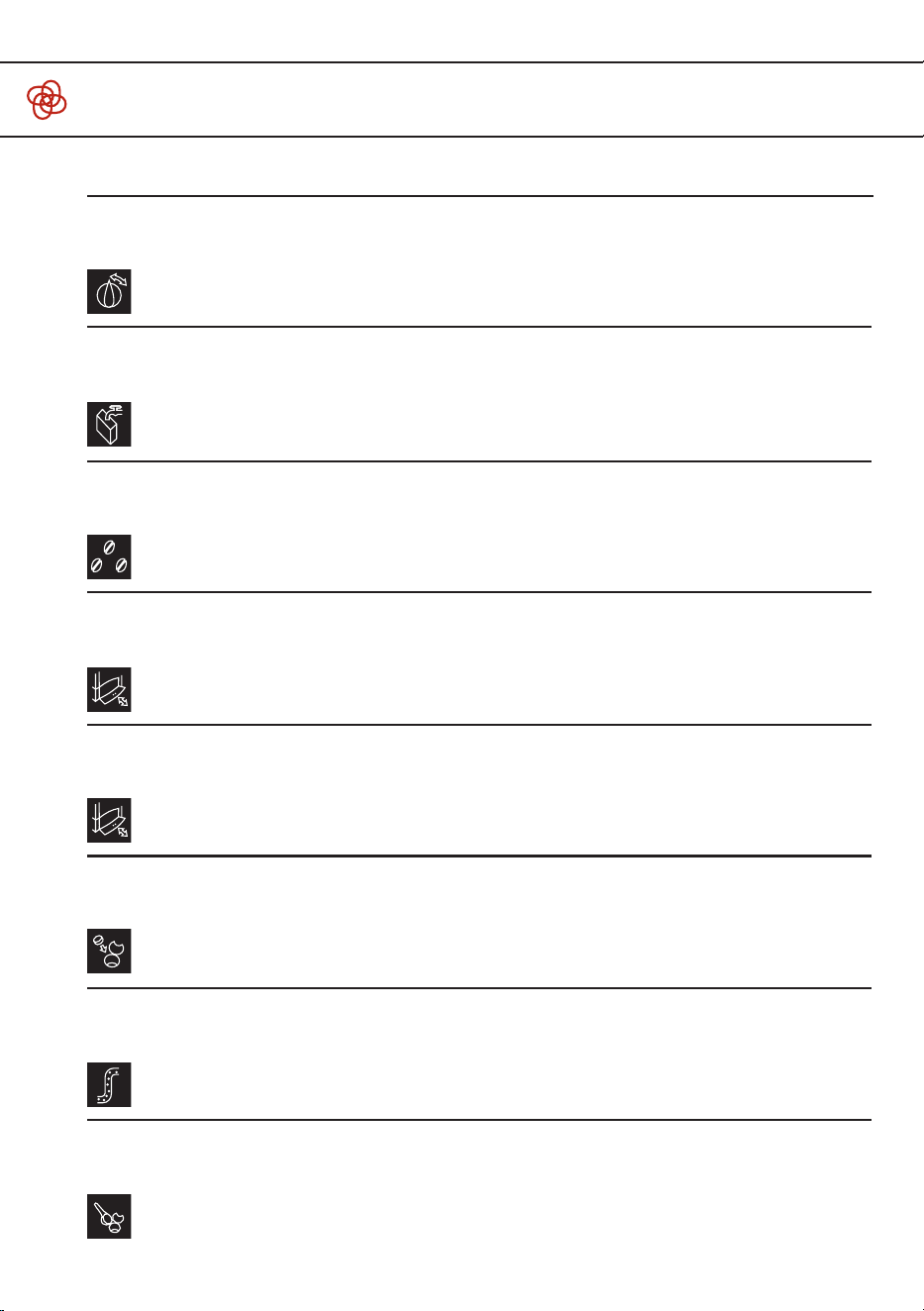
6. System messages
Message
Symbol 16
flashes
Symbol 13
flashes
Symbol 12
flashes
Symbol 17
flashes
Symbol 17
lights up
Symbol 19
lights up
Symbol 18
lights up
Symbol 14
flashes
➔ Meaning
➔ Fill or rinse out water
pipes
➔ Water reservoir (fig. 2)
empty
➔ Water reservoir absent or
incorrectly positioned
➔ Not enough coffee beans
or beans not yet in the
grinding chamber
➔ Used coffee tray
(fig. 1/T) full
➔ Drip tray (fig. 1/J) and
Used coffee tray
(fig. 1/T) absent or
incorrectly positioned
➔ Cleaning required
➔ Descaling required
➔ Ground coffee chamber
(fig. 1/K) open
➔ What to do
➔ Turn hot water control
knob (fig. 1/Q and 7)
to the right to open valve
➔ Fill reservoir with fresh
water
➔ Position water reservoir
correctly
➔ Add beans to the con-
tainer (fig. 1/A) or press
button to restart brewing
operation
➔ Empty trays
➔ Position drip tray and
used coffee tray
correctly
➔ Clean the machine
(see point 5.2)
➔ Descale the machine
(see point 5.3)
➔ Close lid
7. Trouble-shooting
26
Fault
No hot water
or steam
comes out
of the jet /
‘spumatore’
Too little
milk froth
or froth too
liquid
Coffee only
comes out
in drips
Coffee
without
‘crema’
Grinder
makes loud
noise
Stand-By-
steam warm-
up buttons
flash simul-
taneously
➔ Reason
➔ Jet (fig. 1/Q) blocked
➔ ‘Spumatore’ blocked /
stuck
➔ Unsuitable milk
➔ ‘Spumatore’ is blocked /
stuck
➔ Grinder setting too fine
➔ Pre-ground coffee too fine
➔ Unsuitable coffee type
➔ Beans not freshly roasted
➔ Grinder settings not
adjusted to coffee beans
used
➔ Other substances in
grinder, e.g. little stones
➔ Brewing unit incorrectly
positioned or locked
➔ What to do
➔ Clean the jet thoroughly
➔ Take ‘spumatore’ (fig. 1/Q)
apart and clean thoroughly
(fig. 10)
➔ Use cold milk
➔ Take ‘spumatore’ (fig. 1/Q)
apart and clean thoroughly
(fig. 10)
➔ Select a coarser grinder
setting
➔ Use coarser pre-ground
coffee
➔ Change coffee type
➔ Use fresh beans
➔ Optimise grinder settings
➔ Call service hotline,
meanwhile pre-ground
coffee can be used
➔ Check brewing unit
positioning and lock
If you are unable to correct a fault yourself, call the service hotline – please
consult the notes in the accompanying guarantee and customer service
information booklet.
27
8. Further instructions
Transport and storage
The steam must be evacuated from
the machine if it is to be transport -
ed or stored in cold rooms.
➔ Remove water reservoir.
➔ Press steam warm-up button
and wait until it lights up without
flash ing.
➔ Turn steam / hot water valve
control knob to the right (fig. 1/N
and 5).
➔ When no more steam comes
out, turn steam / hot water valve
control knob to the left (fig. 1/N
and 5).
➔ Turn off the machine.
Please keep the original packaging
and protective material for storage
and transport purposes.
Replacement parts / accessories
You can purchase new water filters,
cleaning tablets and descaling
agents from any well-stocked spe-
cialist retailer.
Customer service
NIVONA products are designed to
meet the highest quality standards.
However, if questions do arise while
you operate your machine, we
would like to hear from you. Your
support is essential to our mission
to further develop and improve our
products so that they fully meet
your needs.
Guarantee and customer service
conditions
Please consult the detailed guar -
antee and customer service condi-
tions in the appropriate informa-
tion booklet.
Protecting the environment
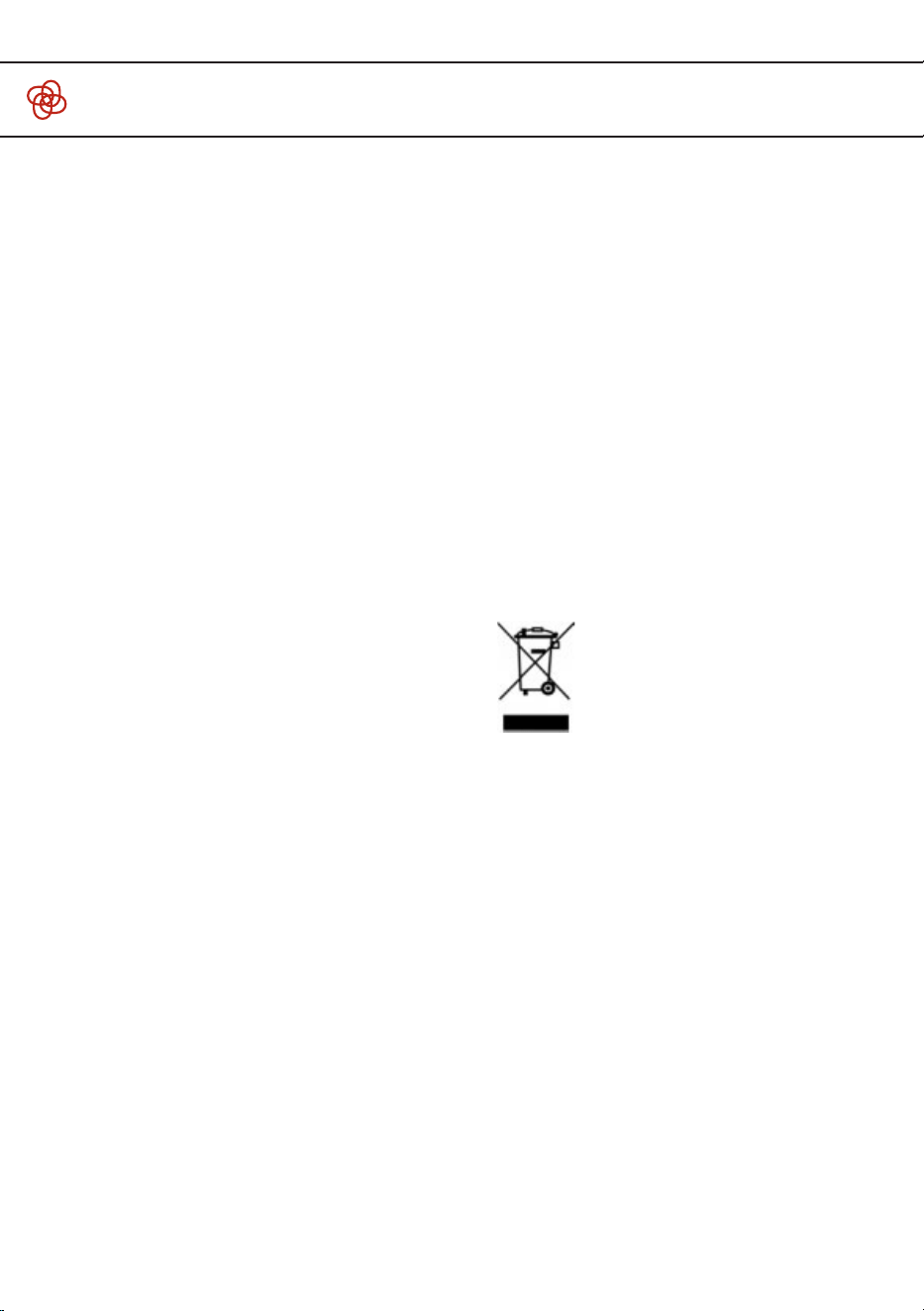
Electric and electronic ap -
pliances often contain valu-
able or harmful materials
which should not be pro-
cessed in the same way as normal
household waste. If incorrectly
processed, they can harm human
health and the environment. Please
therefore do not put your machine
in the dustbin with normal waste.
Instead submit it to the “collection
point for the disposal and recycl -
ing of electric and electronic ap -
pliances” provided by your local
council. You can obtain further in -
formation from your local council,
the waste collection services or the
specialist retailer who sold you the
product.
28
Original NIVONA accessories
Professional care and maintenance
Your love of coffee is here to stay.
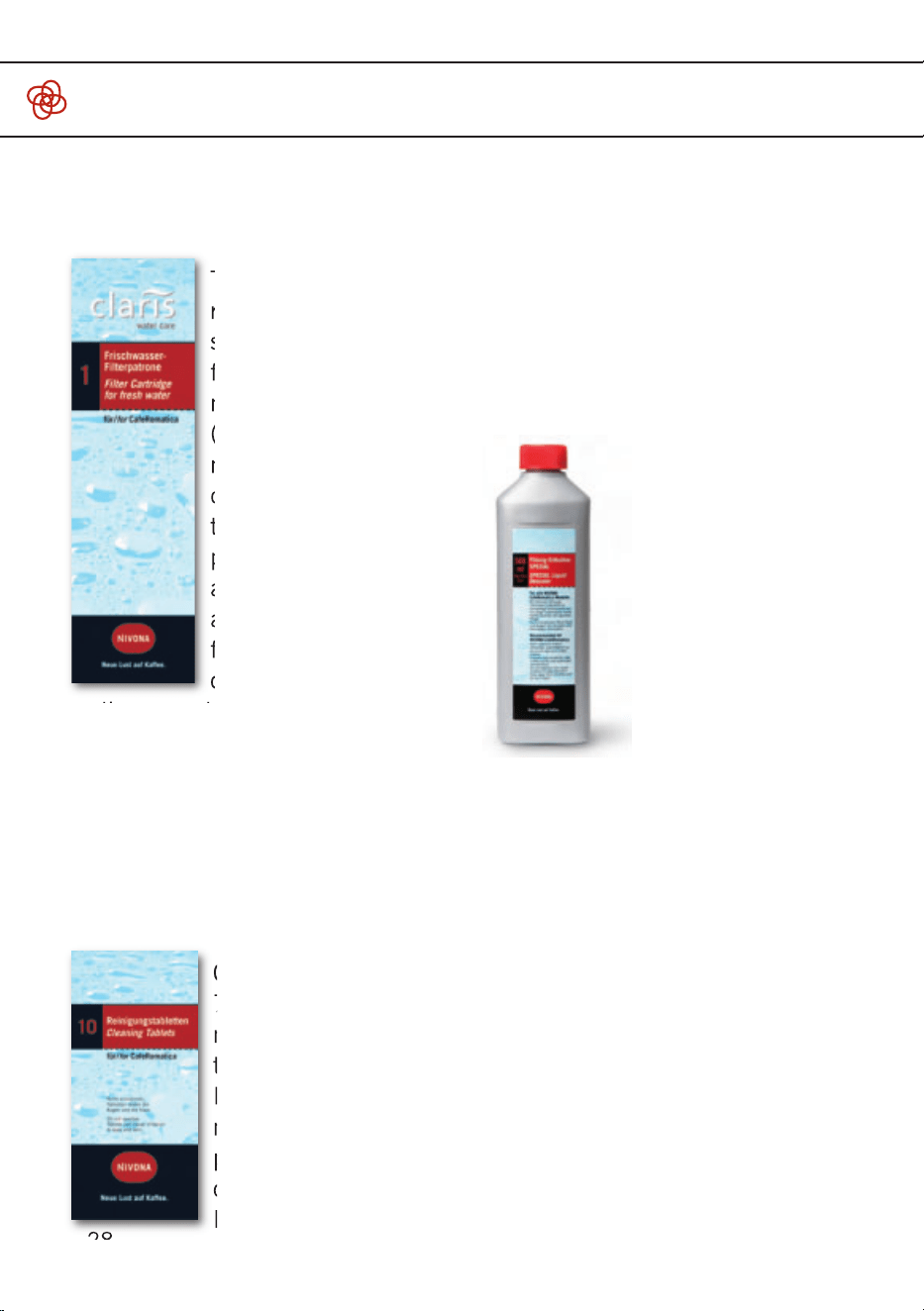
The CLARIS filter cart -
ridge NIRF 700 is
specifically designed
for NIVONA fully auto-
matic coffee centres
(CafeRomatica
models). It is screwed
directly into the water
tank. It is filled with
purely organic materi-
al, without chemical
ad ditives. With CLARIS
filter cart ridges you
can protect your ap -
pliance and improve its durability.
The CLARIS filter cartridge, if
changed regularly, ensures that
you will have to descale your
NIVONA machine less often.
Model: NIRF 700, ANR: 390 700 100,
EAN: 42 600 8346 701 5
Cleaning tablets NIRT
700 for CafeRomatica
models, includes 10
tablets per pack. Your
NIVONA fully auto -
matic coffee centre
provides an integrated
cleaning programme.
NIVONA cleaning
tablets are specifically designed
for this purpose and completely
loosen staining such as coffee
residues. Regular cleaning pro-
tects your machine and preserves
the coffee’s full flavour.
Model: NIRT 700, ANR: 390 700 200,
EAN: 42 600 8346 702 2
SPECIAL Fluid descaler
NIRK 703 for CafeRo-
matica models, includes
500 ml, enough for 5
treatments.
Your NIVONA fully auto-
matic coffee centre pro-
vides an integrated de -
scaling programme. The
NIVONA descaler is de -
signed especially for our machines
and will reliably remove limescale
without damaging the machine.
The special NIVONA descaler
leaves no residue! Regular descal -
ing protects your machine and
preserves the coffee’s full flavour.
Model: NIRK 703, ANR: 390 700 300,
EAN: 42 600 8346 703 9
Subject to replacement with similar
designs and technical alterations.

29
Notices

Nivona Apparate GmbH
Fritz-Haber-Straße 10
D-90449 Nürnberg
www.nivona.com
© 2008 by NIVONA