™
1
1. Overview
Inline Fan Instructions
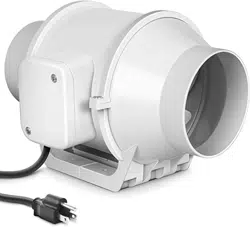
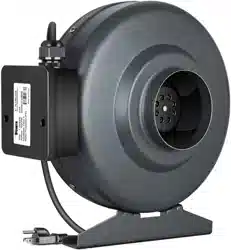
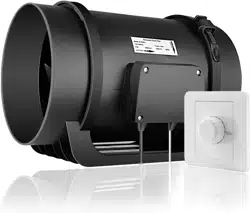
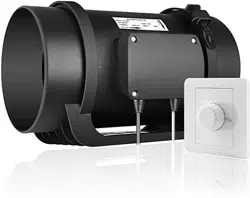
The iPower Inline Fan utilizes the newest and advanced technology to offer an affordable air
movement solution with its features of low noise, large air volume, high static pressure. The
motor and the impellers are easy to install and clean.
2. Product Structure
•
The iPower Inline Fan is composed of the chassis, impeller, external rotor motor.
•
Chassis: Is made of high-quality, cold-rolled steel. The surface is treated with a kind
of plastic sealant to provide a strong resistance to corrosion. CAD optimizations on
the flow channel design to allow the impeller perform at its greatest efficiency. Inlet
and outlet diameter flanges are easy to install, repair and clean.
•
Impeller: The curved-end blade impeller works with the fan casing in harmony; the
fan can produce maximum air flow and efficiency while minimizing noise.
•
External Rotor Motor: A single-phase asynchronous external rotor motor is located
on the chassis. The impeller is attached directly to the rotor motor by die-casting.
The impeller is driven directly by rotor to minimize noise while providing high airflow
and extending service life.
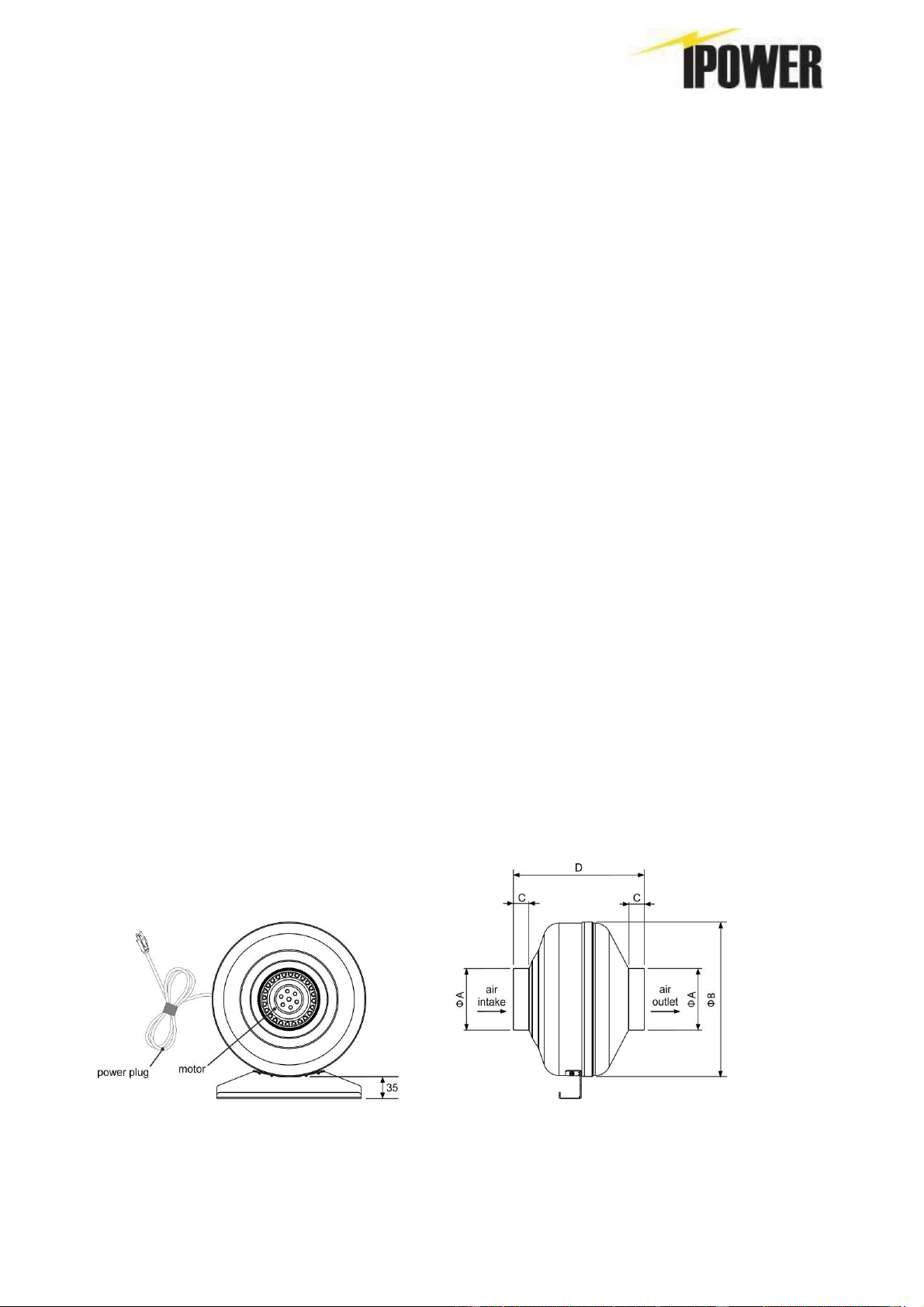
3. Dimensions:
A---Air outlet and intake diameter B---Cylindrical chasse diameter
C---Length of a draft / Length of air inlet D---Total length of chasse
™
Model
ΦA
ΦB
C
D
Specification
(
mm
)
F4
95
245
25
209
190
F6
145
335
25
239
225
F8
195
335
25
208
250
F10
250
335
25
195
250
F12
315
400
25
234
280
4. Operating Parameters
Model
Voltage
(V)
Frequency
(Hz)
Input
Power
(W)
Air
Velocity
(CFM)
Speed
(rpm)
Noise
(dB)
Insulation
Class
Weight
(Kg)
Static
(Pa)
F4
110
60
60
190
2600
65
F
3.5
415
F6
115
442
2600
65
5.5
450
F8
120
745
2600
69
6.5
500
F10
150
862
2400
70
6.5
550
F12
190
1060
2400
71
7.0
700
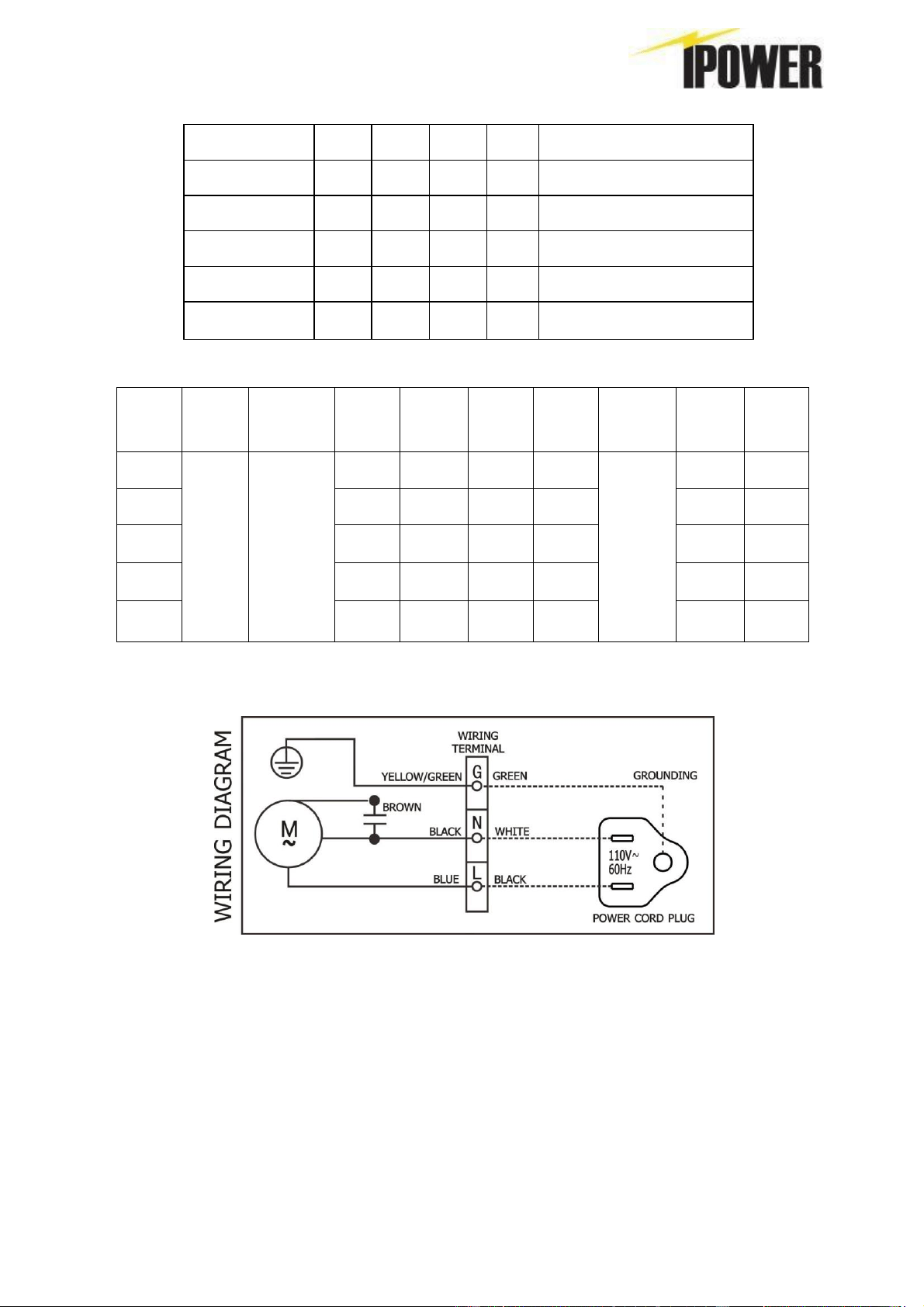
5. Schematic Wiring Diagram
Single-speed Centrifugal Circular Duct Fan Wiring Diagram
6. Installation & Troubleshooting
•
Mount the fan on a stable platform via mounting brackets
•
Slide the mounting clamps over air duct
•
Slide the air duct onto the flanges on the fan
•
Tighten the clamps down with a flat-head screwdriver or a hex socket
•
Plug the 110V plug into a wall outlet to turn on the fan
2

™
3
Repairs and Maintenance Notes:
(1) Keep fan in a dry environment
(2) Do not use water or any other liquid cleaning agent, use only a clean brush or a clean dry
cloth to wipe away any loose dirt or dust
(3) Under normal operating conditions, the fan should be cleaned every six months
(4) To extend fan life, it is recommended that air filters and one-way valves be installed on the
fan’s inlet and outlet
7. Warning
•
Can not be used in coal mine wells which have methane mixed gas and coal dust
explosion hazard
•
Avoid impact or physical damage of the unit as it will cause premature failure. Should
be stored at and used for those places where have no strong impact force and shock
•
Keep fan in a dry environment. Can not be used for those places where corrosive
gas or steam exist
•
No waveform and current input allowed which may cause damage on motor
enameled wire and shorten its service life
•
In the transmission of air, or any other non-corrosive medium, inlet temperature must
not exceed 80C. The amount of dust and other solid contaminant should not exceed
100g per cubic meter. Avoid viscosity and fiber material
•
If the product had been in storage for more than six months, insulation resistance
must be tested before use. Resistance to ground should be 20MΩ or more
•
Stay away from children