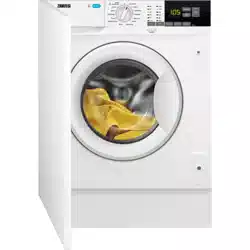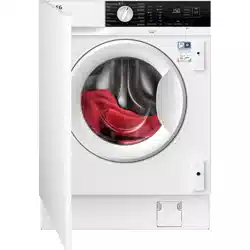

CI381
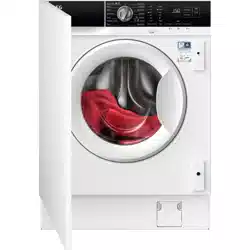
Integrated washing machine
Installation, use and maintenance

2
Contents:
3 Important information
5 - 6 Safety warnings
7 Recommendations
8 Before first use
10 Detergents and additives
11 Eco note and loading the washing machine
12 Control panel and programmes
13 Programme table
14 Programme details
16 Starting a wash programme & features
21 Choice of detergent
22 Care and maintenance
23 Cleaning the filter
25 Detergent drawer
26 - 28 Practical (cleaning) information
29 Display and failure codes
30 Troubleshooting
32 Installation (including transit bolt information)
33 Levelling
34 Connecting to the mains water supply
34 Drainage connection
35 Electrical information
37 Fitting the appliance
38 Fitting the furniture door
41 Final installation checks
42 Technical specifications
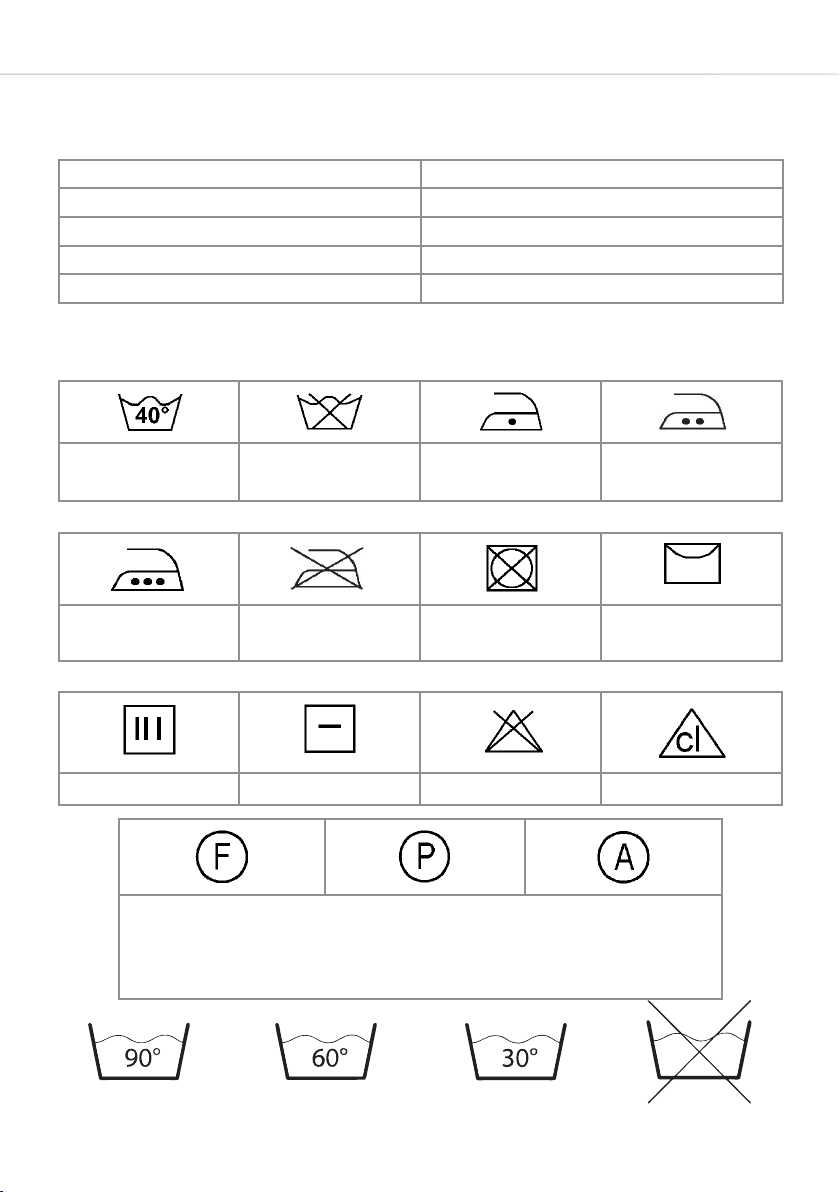
42 International washing symbols
43 Warranty and service
3
Important
This appliance must only be used for the purpose for which it is
intended, i.e. domestic use. Any other use could be dangerous and
may lead to premature failure of the appliance.
The CDA Group Ltd cannot be held responsible for injuries or losses
caused by incorrect use or installation of this product. Please note that
CDA reserve the right to invalidate the guarantee supplied with this
product following incorrect installation or misuse of the appliance.
Under no circumstances should any external covers be removed for
servicing or maintenance except by suitably qualified personnel. Do
not use the appliance if the plug, the mains cord or the appliance
itself is damaged. If the mains cord is damaged, you must have it
replaced by the manufacturer, or an authorised service centre or
similarly qualified person in order to avoid a hazard.
Appliance information:
Please enter the details on the appliance rating plate below for
reference, to assist CDA Customer Care in the event of a fault with
your appliance and to register your appliance for guarantee purposes.
Appliance Model
Serial Number
EU Declarations of Conformity:
This appliance meets the requirements of all applicable EU directives
with the corresponding harmonised standards which provide for CE
marking.

4
IMPORTANT INFORMATION FOR CORRECT DISPOSAL OF THE
PRODUCT IN ACCORDANCE WITH EC DIRECTIVE 2012/19/EU.
At the end of its working life, the product must not be disposed
of as urban waste. It must be taken to a special local authority
dierentiated waste collection centre or to a dealer providing this
service.
Disposing of a household appliance separately avoids possible
negative consequences for the environment and health deriving from
inappropriate disposal and enables the constituent materials to be
recovered to obtain significant savings in energy and resources. As a
reminder of the need to dispose of household appliances separately,
the product is marked with a crossed-out wheeled dustbin.

5
Safety warnings
• If the plug or cord is damaged, do not connect the appliance to the
mains power supply. If the cord is damaged it should be replaced
by the manufacturer or appointed service agent in order to avoid a
hazard. If the appliance is damaged, contact your retailer.
• To remove the plug from the socket, pull on the body of the plug,
not the cable.
• Do not plug the appliance in to the mains power supply with wet or
damp hands, or when the sockets are wet or damp.
• Never touch the appliance with wet hands or feet.
• Never open the detergent drawer when a programme is running.
• Never force the appliance door open when a programme is running.
• Since the appliance can reach high temperatures while running, do
not touch the drain hose or drained water during draining.
• In case of any failure, first unplug the appliance and close the
water tap.
• Repair on this appliance should only be undertaken by suitably
qualified personnel.
• Keep the packing materials away from children to prevent risk
of injury.
• Do not let children play with the washing machine.
• Keep pets away from the appliance.
• The appliance should not be installed on carpeted surfaces as this
can block the air ventilation on the base.

6
Warnings
To avoid the risk of fire, electric shocks, injury or damage when using
your washing machine, please take the following precautions:
• Please read all the instructions before using the washing machine.
• Do not wash items that have previously been cleaned, washed,
soaked or treated with petrol, solvents for dry cleaning, other
inflammable substances or explosives, as they produce fumes that
could catch fire or explode.
• Do not add petrol, solvents for dry cleaning or other inflammable or
explosive substances to the wash water as they produce fumes that
could catch fire or explode.
• Do not repair or replace any part of the washing machine or try
to carry out any type of servicing unless it is recommended in the
maintenance instructions in the manual.
• Do not climb onto the machine or stand on the open porthole door.
• Do not use an extension lead or adaptor to connect your washing
machine to the mains supply.
• Follow the washing instructions recommended by the manufacturer
of the garment to be washed.
• Do not turn your washing machine on until you are sure that:
It has been installed in accordance with the installation instructions.
All the water, drainage, mains electricity and earth connections
meet the local regulations and/or other applicable
regulations.
Important: Ensure that the transit bolts have been removed prior
to using the machine (see page 32).

7
Recommendations
• Residues of detergent or softener left in the detergent drawer for
long periods will dry and stick to the detergent drawer. To prevent
this put the detergent and softener into the detergent drawer just
before washing.
• It is recommended that the pre-wash programme should only be
used for very dirty clothes.
• Do not exceed the maximum loading capacity.
• When the machine is not in use, keep the water tap closed.
• The appliance is not intended for use by people (including
children) with reduced physical, sensory or mental capabilities, or
lack of experience and knowledge, unless they have been given
supervision or instruction concerning use of the appliance by a
person responsible for their safety. Children should be supervised
to ensure that they do not play with the appliance.
• If the appliance is not to be used for prolonged periods of time,
unplug the appliance, close the water tap and leave the door ajar
to keep the inside of the machine dry and to prevent unpleasant
odours from developing.
• As a result of the quality control procedures during production, a
certain amount of water may remain in the appliance. This is normal
and does not signify a fault.
• Do not remove the rating plate. The information on it is important.
• This appliance should not be installed in locations where
the ambient temperature may fall below 0°C. Use in ambient
temperatures below 0°C may damage the machine.
• The most energy and water ecient wash programmes are
generally those that run at a low temperature and for a long time.
• Loading the washing machine to the full capacity indicated by the
manufacturer for the respective wash programmes will save energy
and water

8
Before first use
When your washing machine has been correctly installed, we
recommend that you pre-clean the machine.
This is to check that the installation, the connections and the drainage
are all correct, and to thoroughly clean the inside of the washing
machine before any wash programmes are run.
Prior to pre-cleaning you should ensure the transit bolts have been
removed.
• Select the Cotton 90ºC programme (programme A) and add a
normal dose of detergent into the detergent dispenser.
• Press the “Start / Pause” button.
Preparing garments for washing
• Wash lightly soiled garments using a short programme.
• Use a programme without prewash for medium-soiled garments.
• Wash heavily soiled garments using a long programme with
prewash.
• Wash white and coloured loads separately.
• We recommend that small garments are placed in a wash bag.
• We recommend using the delicate programmes for sensitive fabrics.
• Separate clothes according to their types (cotton, synthetic,
sensitive, woollen, etc.), required washing temperatures and level of
dirtiness.
• Since new coloured clothes may shed dye on the first wash, wash
them separately.
• Remove any foreign objects found on the items to be washed, for
example curtain hooks and wires.

9
• Fasten all zips and buttons.
• Turn garments, such as knitted fabrics, inside out.
• Before placing the clothes in the drum, make sure all the pockets
are empty. Any small objects may block the drain pump.
• We recommend loading the washing machine to its full capacity for
best water and energy eciency.
• Whenever possible, we recommend that you wash garments of
dierent sizes within the same wash programme. This improves
the washing action and also aids the correct distribution of the
garments in the drum when spin-drying, and the washing machine
will therefore be quieter.
10
Detergents and
additives
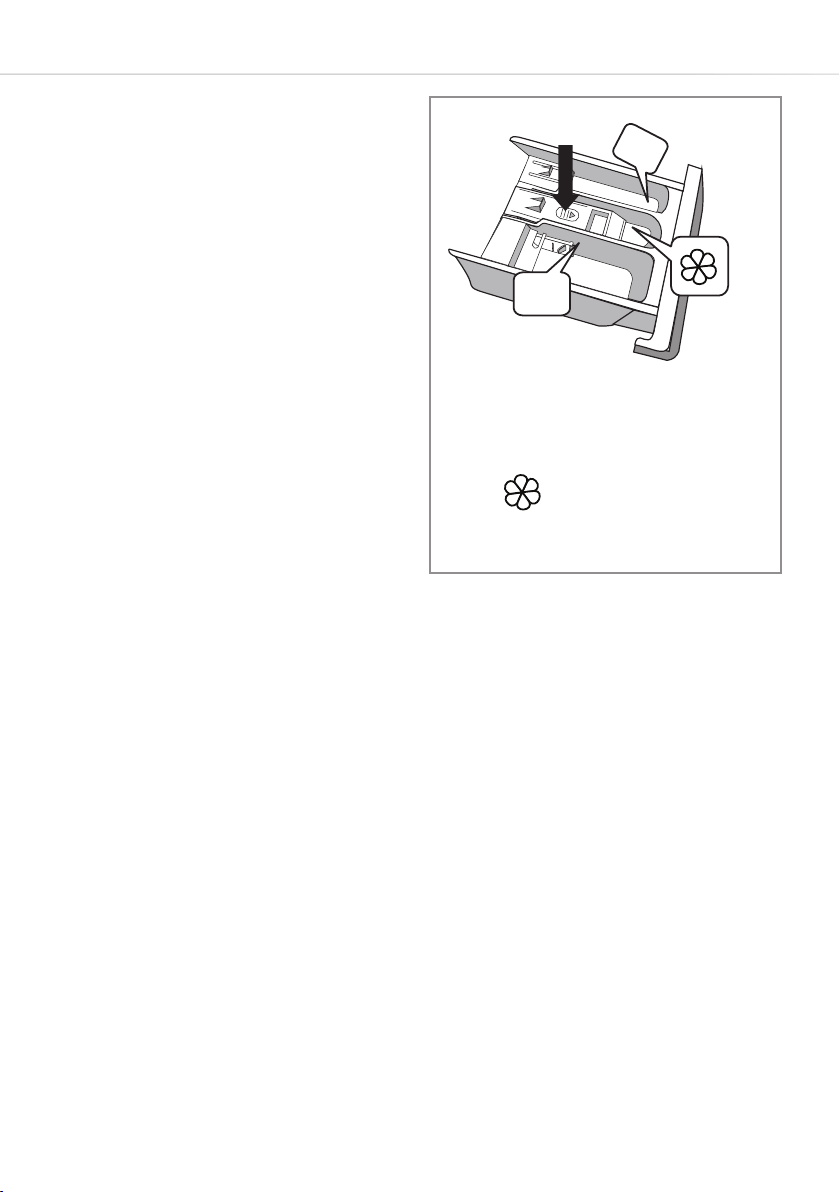
Your washing machine’s detergent
dispenser has three sections as
shown in figure 1.
Add the required amount of
detergent and fabric softener
into the specific sections of the
detergent dispenser before
starting the wash programme.
Note: Compartment 1 (Prewash)
is only used with the “Intensive +”
programme.
The detergent dispenser is designed to allow the use of liquid
detergents rather than adding them to the drum. You should only
insert liquid detergent into the main wash detergent compartment
and ensure that concentrated liquid detergent is diluted with an equal
quantity of water before use.
• Liquid detergent should not be used on programmes with a
prewash stage or when using the delay timer.
• For wash loads that require pre-washing, add ¼ of the required
powder detergent into the prewash section, and the remainder to
the main detergent section.
• Do not exceed the “MAX” level in the fabric softener section and
ensure that concentrated fabric softeners are diluted before use
for best washing results and to help prevent clogging.
• Remember that the amount of detergent to be used will always
1
2
1 - Pre wash
2 - Main wash
- Fabric softener
/conditioner
Fig. 1

11
depend on:
• The amount of clothes to be washed.
• How heavily the clothes are soiled.
• The hardness of the water (Information on water hardness in your
area can be obtained from your local water board).
We recommend the use of a decalcifying product if the water
hardness is high in your area.
Eco note
The use of more detergent than necessary will not improve your
washing results. Many brands of detergent (and fabric softener/
conditioner) contain phosphates which escape sewage treatment
and can cause excessive algae growth in waterways. This in turn
can pollute drinking water and cause marine life ‘dead zones’
which are underwater environments deprived of oxygen that
are subsequently unable to support life. Please consider the
environment and try to source an environmentally friendly brand.
Loading the washing machine
- Open the door.
- Remove any foreign objects from the appliance
- Add the items to be washed separately, ensuring they are loaded
evenly.
- When closing the door, ensure that no item is trapped between the
door and the door seal.
- Close the door securely, otherwise the programme will not start.
12
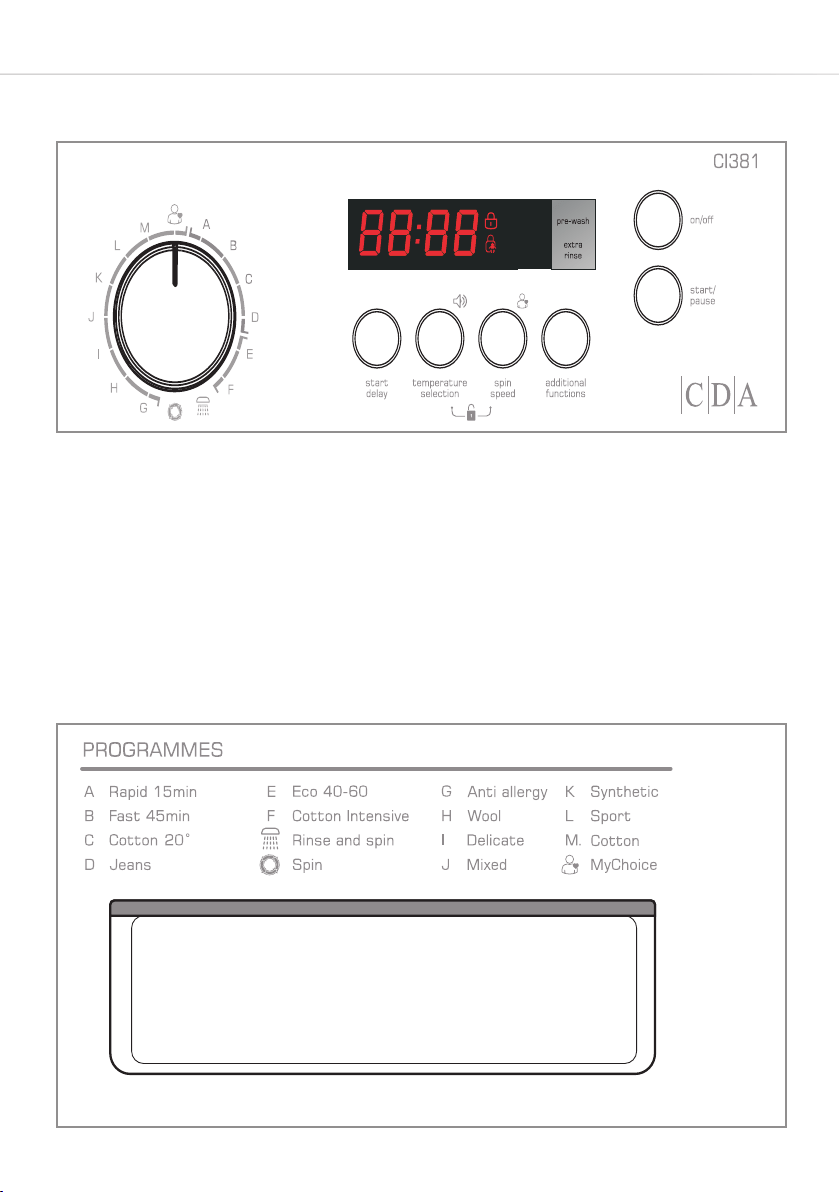
Control panel
A Programme selector dial B Display
C Delay timer button D Temperature selection button
E Spin speed button F Additional functions button
G On/o button H Start/pause button
Programmes
Fig. 2
A
B
C D E
F
G
H
Fig. 3
13
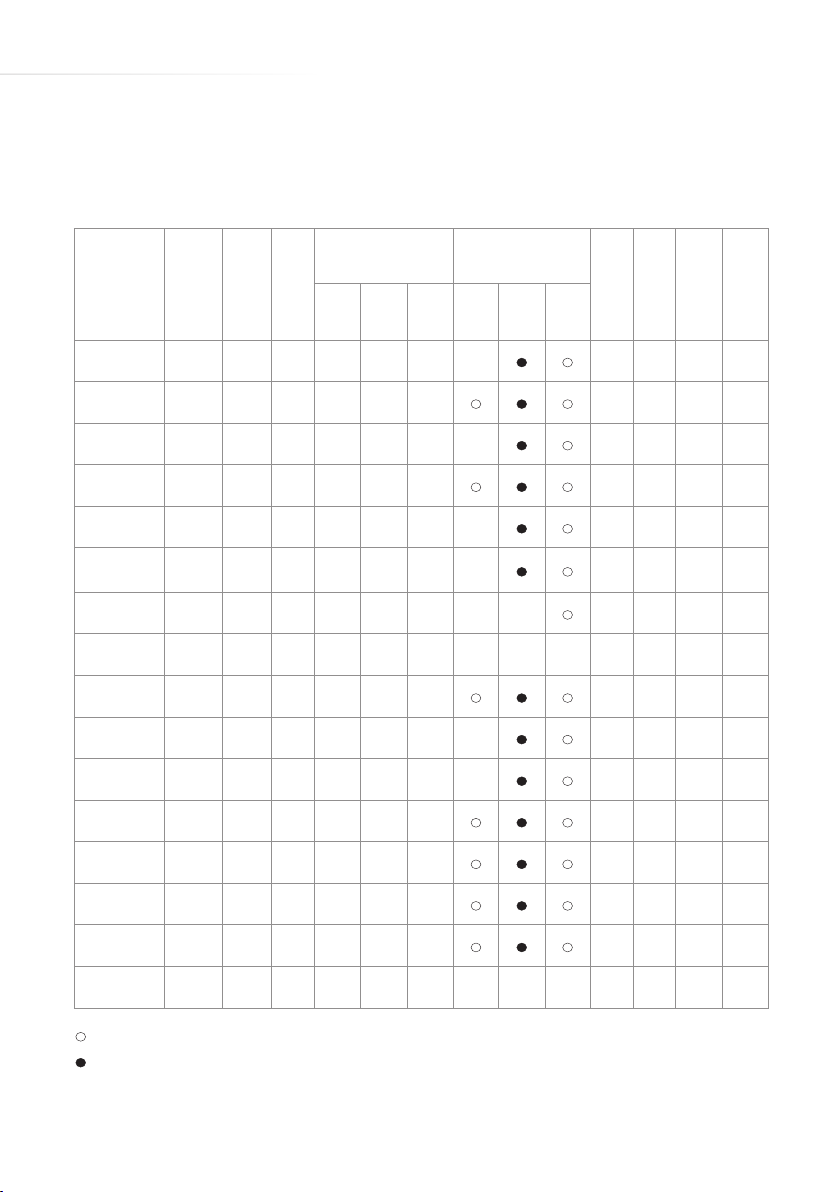
Programme listing
The table below shows the extra functions and temperatures available
for each wash programme.
Extra Rinse
Programme
Default
Tempera-
ture [°C]
Max spin
speed
[RPM]
Max
load
[KG]
Additional functions available Detergent drawer
Time
[h:min]
Energy
con-
sump-
tion
[WH]
Water
con-
sump-
tion [L]
Number
of
rinses
Delay
Extra
rinse
Pre-
wash
Pre-
wash
Main
wash
Fabric
sof-
tener
Rapid 15’
Cold water
800 2
00:15 30 34 2
Fast 45’
40° 800 2
00:45 720 34 2
Cotton 20°
20° 1000 4
01:01 95 46 2
Jeans
60° 1000 8
01:45 1300 70 2
Eco 40-60
- 1400 8
03:35 852 61 2
Cotton Intensive
40° 800 8
03:48 750 54 2
Rinse & Spin
- 1000 8
00:20 45 35 1
Spin
- 1000 8
00:12 40 0 -
Anti-Allergy
60° 800 8
01:43 1218 70 2
Wool
40° 600 2
01:07 634 34 3
Delicate
30° 600 2.5
00:50 230 37 2
Mixed
40° 800 8
01:20 808 70 2
Synthetic
40° 1200 4
03:18 800 46 2
Sport
40° 800 4
01:11 465 46 2
Cotton
40° 1400 8
03:49 1190 70 2
MyChoice
- - - - - -
- - - - - - -
Use detergent if necessary
Detergent required, without which washing will be ine ective
Do not use detergent or fabric softener
Note: The temperatures and times listed above are
an estimate and may di er from actual wash cyle
time depending on water pressure, load size etc.
The time is automaticlaly updated during the wash
cycle. Displaying the time for an extended time or
abrubt changes are normal.

14
Programme details
Rapid 15 min
This programme is best suited for light loads with light soiling on a 15
minute cycle. This programme includes all wash cycles of main wash,
rinse and spin
Fast 45 min
This programme is best suited for light loads with light soiling on a 5
minute cycle
Cotton 20
This programme can be used for daily washing where there is very
light soiling and only a low temperature is required. The default
temperature is 20°C
Jeans
This programme is best suited to washing jeans. The default
temperature is 60°C
Eco 40 - 60
This programme is used to wash normally soiled cotton fabrics which
can be washed at 40°C or 60°C on the same cycle
Cotton Intensive
This programme can be used for daily washing. The wash cycle is
long and intensive and is best suited for cotton articles such as bed
sheets, pillow cases etc
Rinse and Spin
This programme rinses the load and then spins it

15
Spin
Spin only programme. Soap water or rinse water is drained out before
spinning commences
Anti Allergy
This program is designed for washing clothes for people with
sensitive skin
Wool
This programme is suited for woolen items that are clearly labelled as
machine washable. Select the appropriate temperature according to
the garment’s label(s). Also, ensure you use the correct detergents/
additives
Delicate
This programme is suited for delicate garments. The intensity of the
wash and drum rotation speed is gentler than other main cycles
Mixed
This programme is suited for mixed fabric loads that require a more
intense cleaning cycle. Ensure label warnings on garments are
conformed to
Synthetic
This programme is suited for slightly delicate garments and mixed
loads. The default temperature is 40°C
Sport
This programme is suited for sportswear with a fair level of soiling

16
Cotton
This programme can be used for daily washing, the wash cycle is long
and intensive. The default temperature is 40°C
MyChoice
Press the ‘Spin speed button’ for approximately 3 seconds for the
machine to remember the cycle/setup of your choice (if you have
customised temperature, spin speed etc.). The default MyChoice
cycle is CottonQ. Once you have created and/or saved a cycle as per
the above steps, this will be the MyChoice cycle thenceforth.
Starting a wash programme & features
• Turn the ‘Programme selector dial’ to the required programme.
• Select the required spin speed using the ‘Spin speed button’.
• Select the wash temperature using the ‘Temperature selection
button’.
• Select any required extra options, as detailed on the following
pages.
• Press the ‘Start / pause’ button.
When a wash programme is in progress, the programme can be
paused by pressing the ‘Start / pause’ button at any time. To resume
the programme, press the ‘Start / pause’ button again.
Programme selection
To select a programme, turn the ‘Programme selector dial’ to the
required programme, as detailed in the programme listing on page

17
13 and also on the detergent dispenser. The display will show the
programme duration.
Spin speed selection
Each selected programme has its own preset spin speed, as shown in
the programme listing on page 13.
If you press the ‘Spin speed button’ the currently set spin speed will
show on the display. You can reduce this or switch it o completely
if required by pressing the ‘Spin speed button’ a number of times. If
you miss the speed you want you can come back round to it again by
pressing a few more times.
A programme without final spin is used to prevent creasing when
washing special fabrics.
Wash temperature selection
Each selected programme has its own preset wash temperature, as
shown in the programme listing on page 13.
If you press the ‘Temperature selection button’ the currently set
temperature will show on the display. You can change the wash
temperature if required by pressing the ‘Temperature selection button’
a number of times. If you miss the temperature you want you can
come back round to it again by pressing a few more times.
Extra functions
Extra functions can be selected once the programme has been set.
To select any extra function, press the additional functions button.
The programme table on page 13 shows the functions available for
each programme. The programme time shown on the display will
reduce or increase, according to the extra functions selected.

18
Delay timer
A delay of up to 24 hours can be added to the end time in half hour
increments to allow the wash programme to finish at a convenient
time. The delay time is to the end of the wash programme not the start
of the programme.
The ‘Delay Timer’ function is not available for the ‘Spin’ programme.
To set the delay timer:
• Press the ‘Delay timer button’ (written ‘start delay’).
• Pressing the ‘Delay timer button’ again increases the delay by 30
minutes for each press, up to the maximum of 24 hours.
• Once the required time delay is shown on the display, the washing
machine will set after approximately three seconds delay.
Extra rinse
This function adds an extra rinse cycle to the programme, which is
ideal for large loads and garments belonging to people with sensitive
skin. Please note: this function will increase the water consumption.
Press the ‘Additional functions button’ once to select the extra rinse,
the display will show an indicator next to the extra rinse writing.
Pre-wash
The prewash function prolongs the washing time by about 20
minutes. The main wash is then preceded by an additional wash cycle
at a temperature of 30°C. This function is recommended for heavily
soiled laundry. Before starting the prewash function, detergent must
be put in the detergent dispenser.
Start / Pause
Press the ‘Start / pause button’ to start the selected wash programme
running, the indicator light stays on. If this is pressed again while
the machine is running a programme the washer will pause and the
indicator light will flash.

19
Child lock
The lock function ensures that the programme will not be aected if
any buttons are pressed accidentally.
The lock function should be activated after the wash programme has
been selected together with any extra functions.
To activate the child lock, press and hold ‘Temperature selection’ and
‘Spin speed’ buttons together for approximately 3 seconds.
The display will show the symbol when the child lock is active.
To deactivate the child lock, press and hold ‘Temperature selection’
and ‘Spin speed’ buttons together again for approximately 3 seconds.
Power cuts
If there is a power cut, when the electricity comes back on the
washing programme will continue to run from where it stopped.
Switching the sound signal on/o
To activiate this function, press and hold ‘Temperature selection’ for
about 3 seconds. A sound will be heard to confirm the activation. To
deactivate it simply press and hold the button again for 3 seconds.
Energy saving mode
About 10 minutes after the end of a wash programme, the display
switches to energy saving mode. Instead of ‘End’ the display will
blink ‘
:
‘. The energy saving mode will also activate after about 10
minutes of the standby button being pressed if a programme has not
been selected.
20
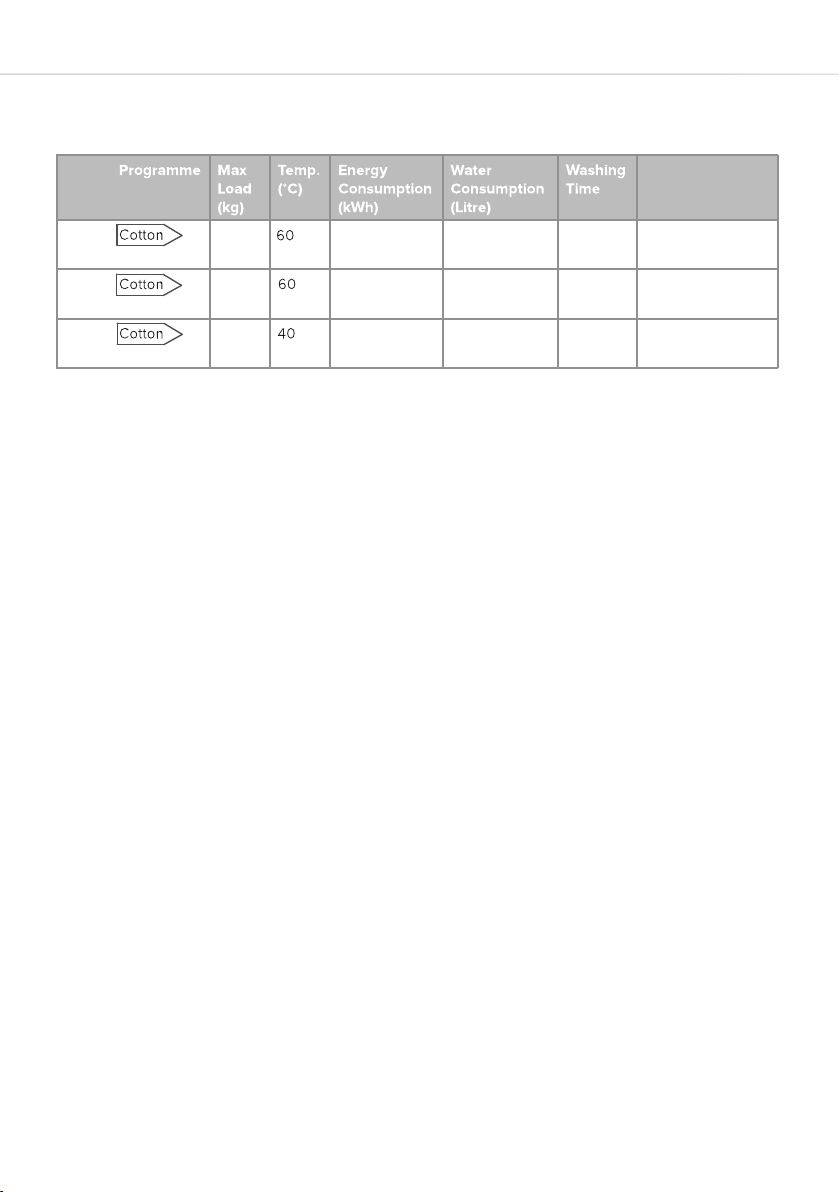
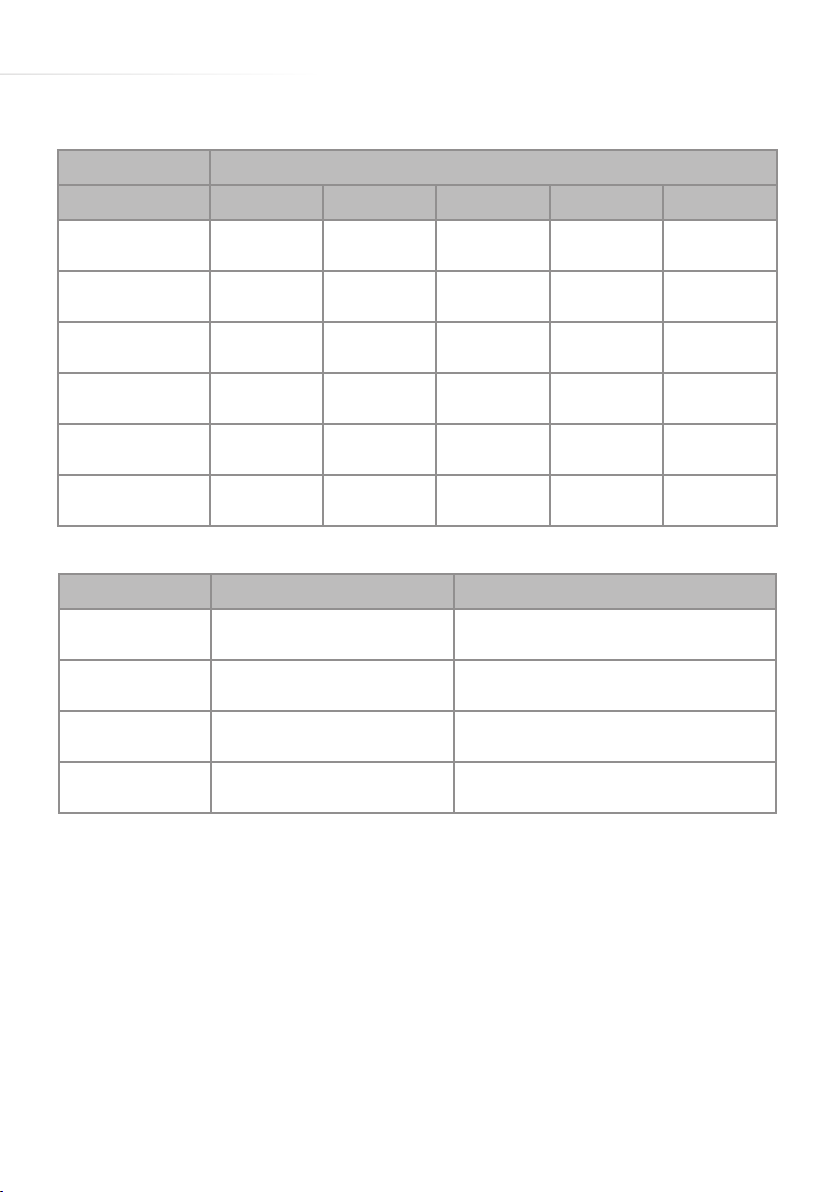
EN60456 testing details
Energy label program settings:
1. “Cotton+ 40°C+Intensive + Max speed”
2. “Cotton+ 60°C+Intensive + Max speed”
The standard 40° and 60° cotton programmes are suitable to clean
normally soiled cotton laundry and they are the most ecient
programmes in terms of combined energy and water consumption.
The actual water temperature may dier from the declared cycle
temperature.
Note: The wash cycle times that are quoted and shown by the LED
display, are intended as a guide only. Please note that factors external
to the machine, e.g. the temperature of your water supply, your
water pressure etc. can aect the time it takes for the wash cycle to
complete.
8
4
4
267 mins
267 mins
273 mins54
45
45
Remaining
moisture content
50%
55%
55%
0.75
0.66
0.62
21
Choice of detergent
Notes:
The delayed start option is not recommended when using liquid
detergent.
Refer to the detergent manufacturer’s instructions for the correct
amount to use.
Remember that modern detergents wash at lower temperatures than
the more traditional formulations do.
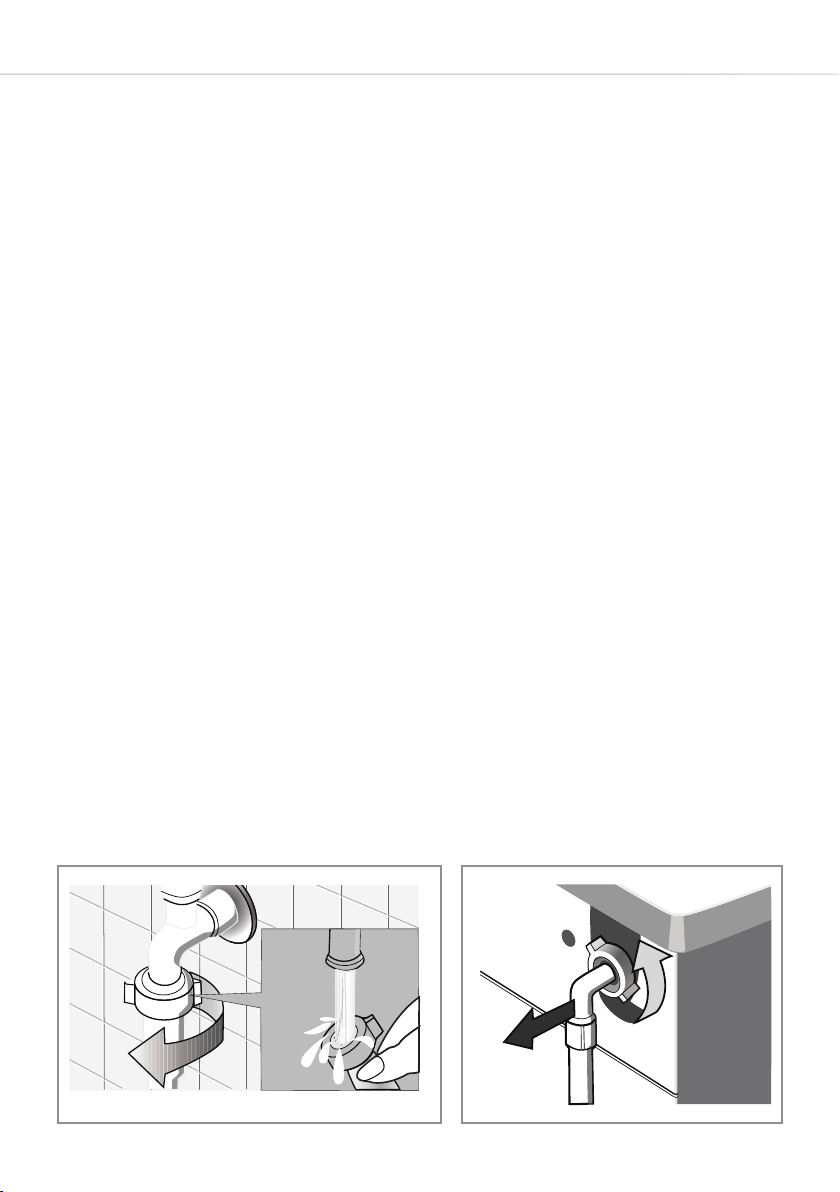
Detergent / Additive
Programme Universal Colour Delicate Special Softener
Wool - - - L O
Synthetic L/P L/P L - O
Hygiene L/P L/P L - O
Cotton L/P L/P - - O
Mix L/P L/P - - O
Delicate - - L - O
Symbol Detergent / Additive Temperature Range (°C)
L Liquid 0 - 60
P Powder 40 - 90
O Optional -
- Not applicable -
22
Care and maintenance
Before beginning any care or maintenance you should always
disconnect the appliance from the electricity supply, and also
turn o the water supply. If a programme has been run recently,
wait for the water in the appliance to cool down to prevent risk of
scalding.
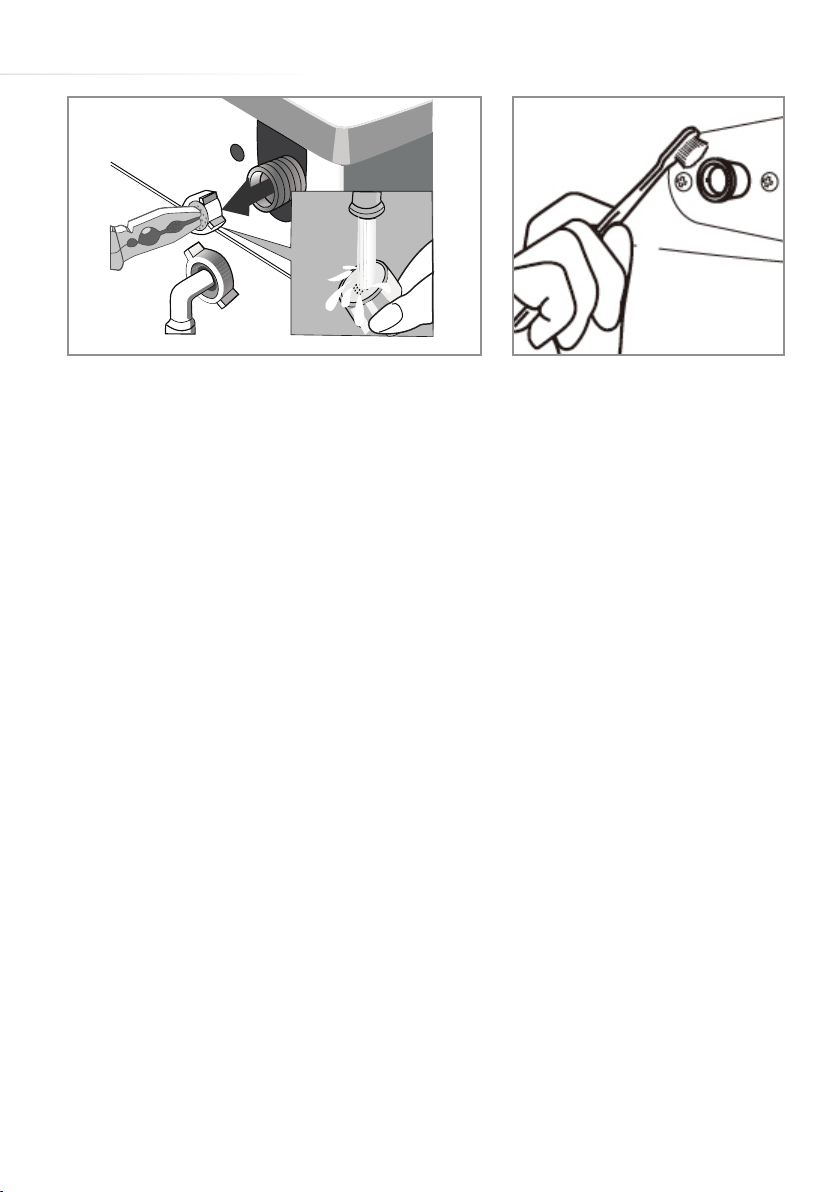
Water inlet filters
There are filters on the tap side of the water inlet hose and at the end
of the water inlet valve. These filters prevent ingress of dirt or foreign
objects into the machine through the water supply. These filters
should be cleaned approximately once a year to ensure there is no
interruption in the water supply to the machine.
• Remove the water inlet hose.
• Remove the filter on the water inlet valve using pliers.
• Remove the filter on the tap end of the water inlet hose manually, as
well as the seal. Clean these.
• Clean the filters thoroughly using a brush.
• Replace the filters and seals carefully, in the same way as they were
removed.
Fig. 4 Fig. 5
23
Pump filter
The pump filter system helps to prevent the ingress of lint or foreign
objects into the drain pump, reducing the risk of damage. The pump
filter should be cleaned regularly, every two to three months at least.
To avoid injury, do not carry out this operation when the wash
water is at a temperature over 30ºC. Disconnect the appliance
from the power supply first.
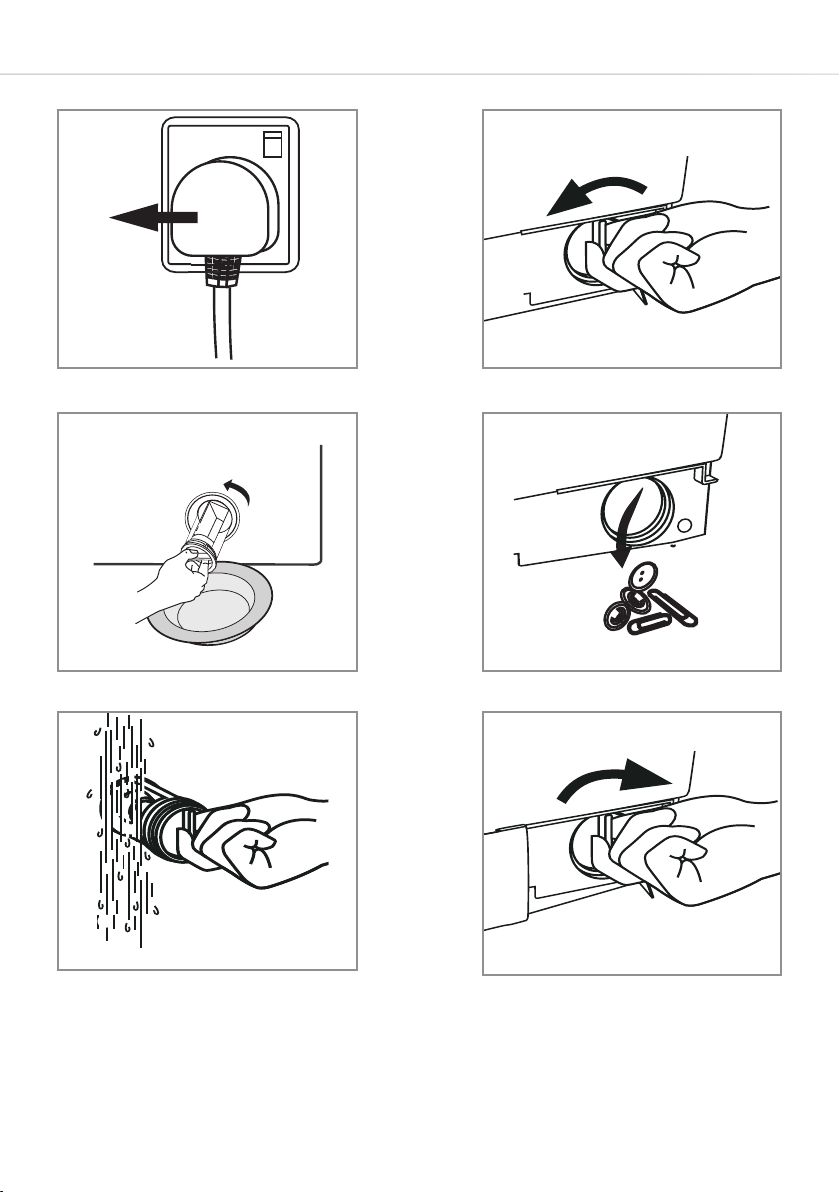
To clean the filter (images on page 24):
• Unplug the appliance.
• Place a container under the filter to collect the flow of remaining
water from the machine.
• Loosen the filter cover by turning it slowly anti-clockwise until the
remaining water has drained away.
• When all the water has drained out of the machine, turn the filter
cover several times until the filter can be completely removed.
• Remove any objects caught in the filter and the housing.
• Clean the filter under running water.
• Refit the filter by turning it clockwise. Ensure the filter is properly
fitted.
Fig. 6
Fig. 7
24
Fig. 8 Fig. 9
Fig. 10 Fig. 11
Fig. 12 Fig. 13
25
Detergent drawer
Detergents may cause residue build
up in the detergent drawer and the
drawer housing over time. The drawer
should be cleaned regularly to remove
these residues. We also recommend you
leave the appliance door and dispenser
drawer open for a while after each wash.
This will ventilate the areas and help to
dry them out, helping to prevent midlew
and mould forming. Only do this if practical to do so and take care
around open doors. Warn others in the property of the hazard.
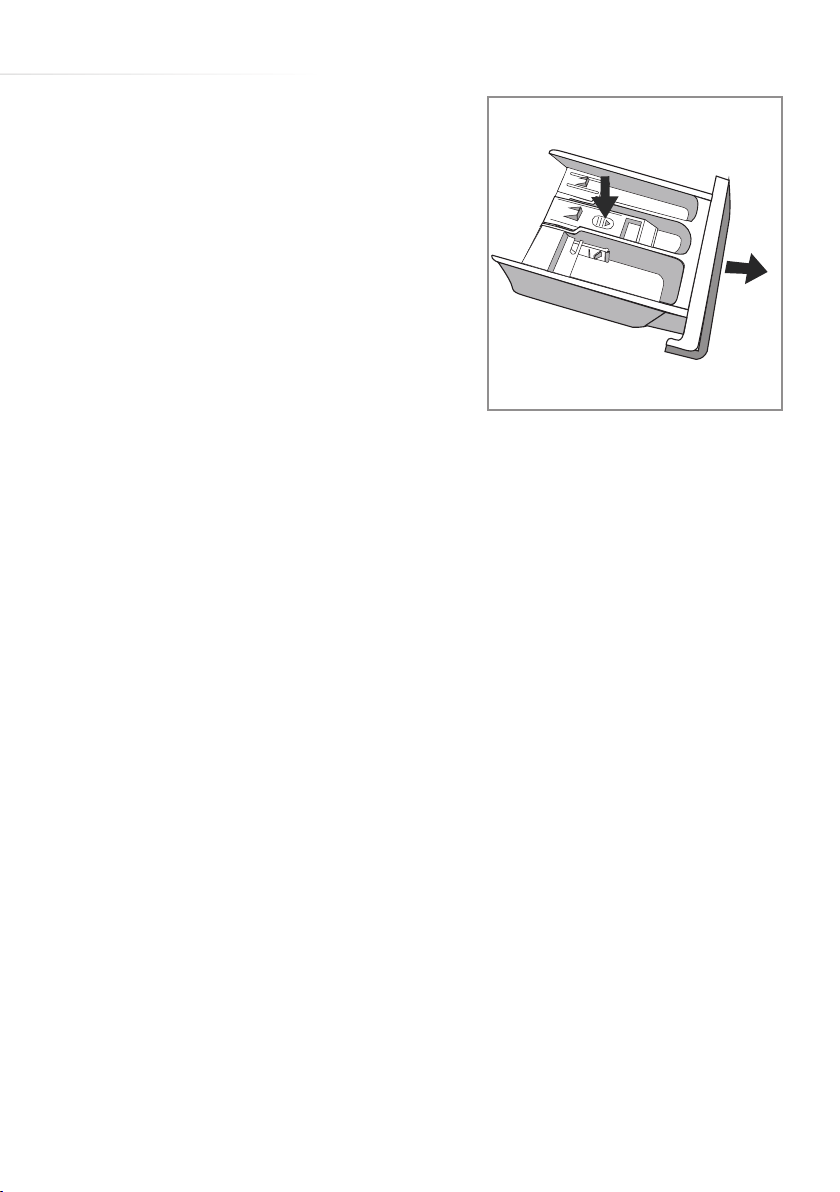
To remove the drawer:
• Pull the drawer out gently until it stops.
• To remove the drawer, press down on the blue syphon lid inside the
drawer and remove from the housing, as shown in figure 4.
• Wash the drawer and syphon lid using warm water and a brush,
ensuring all compartments are clean.
• Dry the drawer thoroughly and replace the syphon lid properly.
• Remove the residues from the drawer housing without letting them
fall into the machine.
• Replace the detergent drawer inside the housing, reversing the
steps above.
Please note - A dirty syphon will prevent the detergents from being
taken in and leave water inside the detergent drawer compartments
at the end of the wash.
Fig. 14

26
Cleaning the washing machine exterior
The exterior of the washing machine should be cleaned with warm
soapy water or a gentle cleaning agent. Do not use abrasive cleaning
products or solvents.
It should then be dried thoroughly with a soft cloth.
Please note - wipe any detergent spills immediately to minimise the
risk of damage to the washing machine exterior.
The drum
Do not leave metal objects such as coins inside the drum, as these
can cause the formation of rust stains.
To remove rust stains, use a chlorine free cleaner and follow the
manufacturer’s warnings for the cleaner.
Never use abrasive products, such as scourers, to remove rust stains.
Limescale removal
If proprietary limescale removers are required, follow the
manufacturer’s warnings for the limescale remover.
Please note - Limescale removers contain acids which may aect the
colour in clothes, as well as damaging the appliance.

27
Practical information
Alcoholic beverages: The stain should first be washed with cold
water, then wiped with glycerine and water and be rinsed with water
mixed with vinegar.
Shoe Polish: The stain should be slightly scratched without ruining the
cloth, rubbed with detergent and rinsed. In case it is not eliminated, it
should be rubbed with 1 part of pure alcohol (96 degrees) mixed in 2
parts of water and then washed with lukewarm water.
Tea and coee: Stretch the stained area of your cloth on the top of
a container and pour through water as hot as the type of cloth can
endure. If the type of cloth is suitable, wash it with lye.
Chocolate and cocoa: Soak the item in cold water and rub with soap
or detergent, wash it in the highest temperature that the type of cloth
can endure. If there is still a stain left, wipe with oxygenated water (in
proportion of 3%).
Tomato paste: After scraping the dried pieces without ruining the
cloth, leave in cold water for about 30 minutes and wash by rubbing
with detergent.
Meat/soup/egg: Eliminate the dried stain residues and wipe with a
sponge or soft cloth dampened with cold water. Rub with detergent
and wash with diluted lye.
Grease and oil stains: First wipe the residues. Rub the stain with
detergent and then wash with lukewarm soapy water.
Mustard: First apply glycerine to the stained area. Rub with detergent
and then wash. If the stain still does not disappear, wipe with alcohol
(On synthetic and coloured cloth, a mixture of 1 part alcohol, 2 parts
water should be used).

28
Blood stain: Soak the item in cold water for 30 minutes. If the stain
still does not disappear, soak in a mixture of water and ammonia (3
table-spoons of ammonia in 4 litres of water) for 30 minutes.
Cream, ice-cream and milk: Soak the item in cold water and rub the
stained area with detergent. If the stain has still not disappeared,
apply diluted lye on the fabric. (Do not use lye on coloured clothes.)
Mould: Mould stains should be cleaned as soon as possible. The
stain should be washed with detergent, and if it does not disappear, it
should be wiped with oxygenated water (in proportion of 3%).
Ink: Hold the stained area under cold water and wait until the inky
water completely runs o. Then rub with lemon juice and detergent
diluted in water, wash after waiting for 5 minutes.
Fruit: Stretch the stained area of the item on the top of a container
and pour cold water on it. Do not pour hot water on the stain. Wipe
with cold water and apply glycerine. Wait for 1-2 hours and rinse after
wiping with a few drops of white vinegar.
Grass stain: Rub the stained part with detergent. If the type of fabric
is suitable for use of lye, wash it with lye. Rub your woollen items with
alcohol. (For colour, use a mixture of 1 part pure alcohol and 2 parts of
water).
Oil Paint: The stain should be eliminated before it dries by applying
thinner on it. Then it should be rubbed with detergent and washed.
Burnt stain: If your cloth is suitable for use of lye, you can add lye
into your washing water. For woollens, a cloth damped in oxygenated
water should be covered on the stain and it should be ironed with a
dry cloth on it. It should be washed after rinsing well.

29
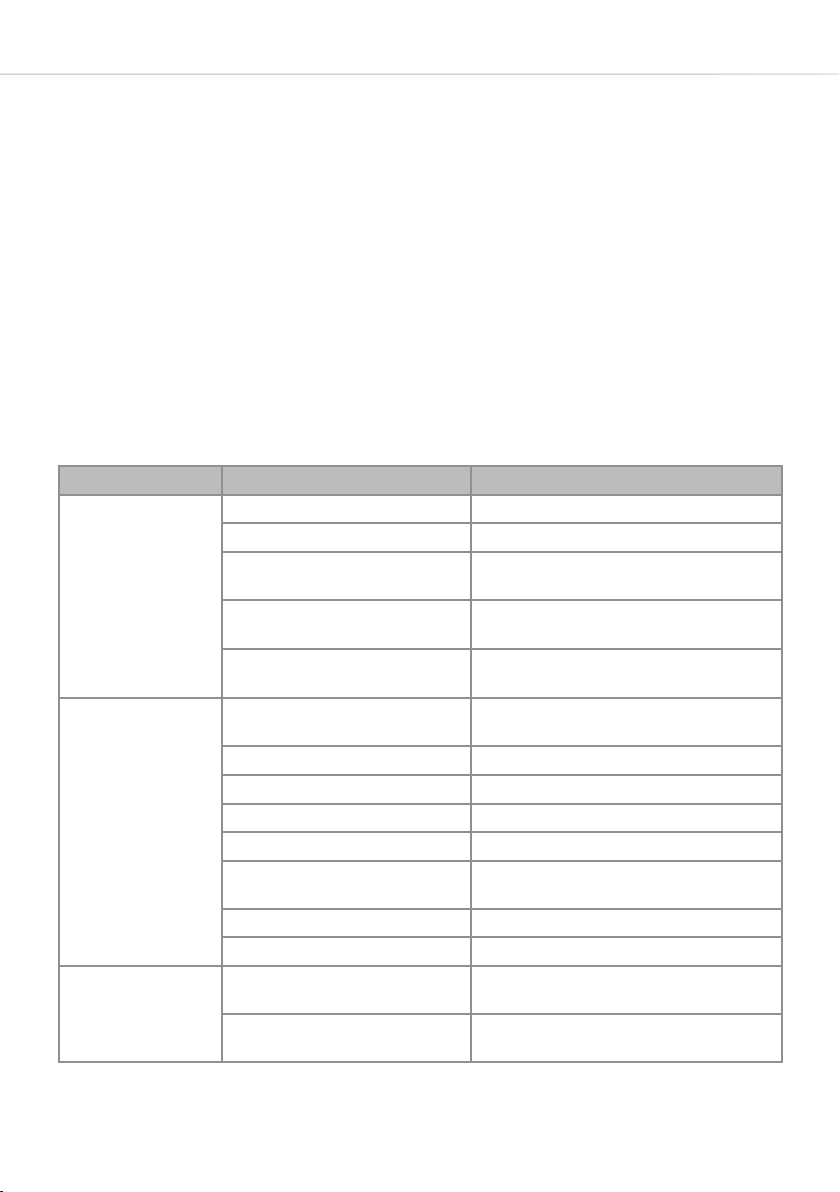
Display and failure codes
Your machine is equipped with diagnostic systems which monitor
wash progress and will intervene to protect the washing machine in
the event of a fault.
In the event of any other fault with your washing machine, please
follow the steps below:
• Unplug the machine.
• Close the water tap.
• Contact CDA Customer Care.
Display Reason Solution
E10
Low water pressure, no
water in the washing
machine
Open the water valve, check the
water inlet hose and filter, check water
pressure
E21
Water not draining
properly
Check water drain pump and filter
E30
The door is not closed
Remove any obstructions that may be
stopping the door from fully closing
30
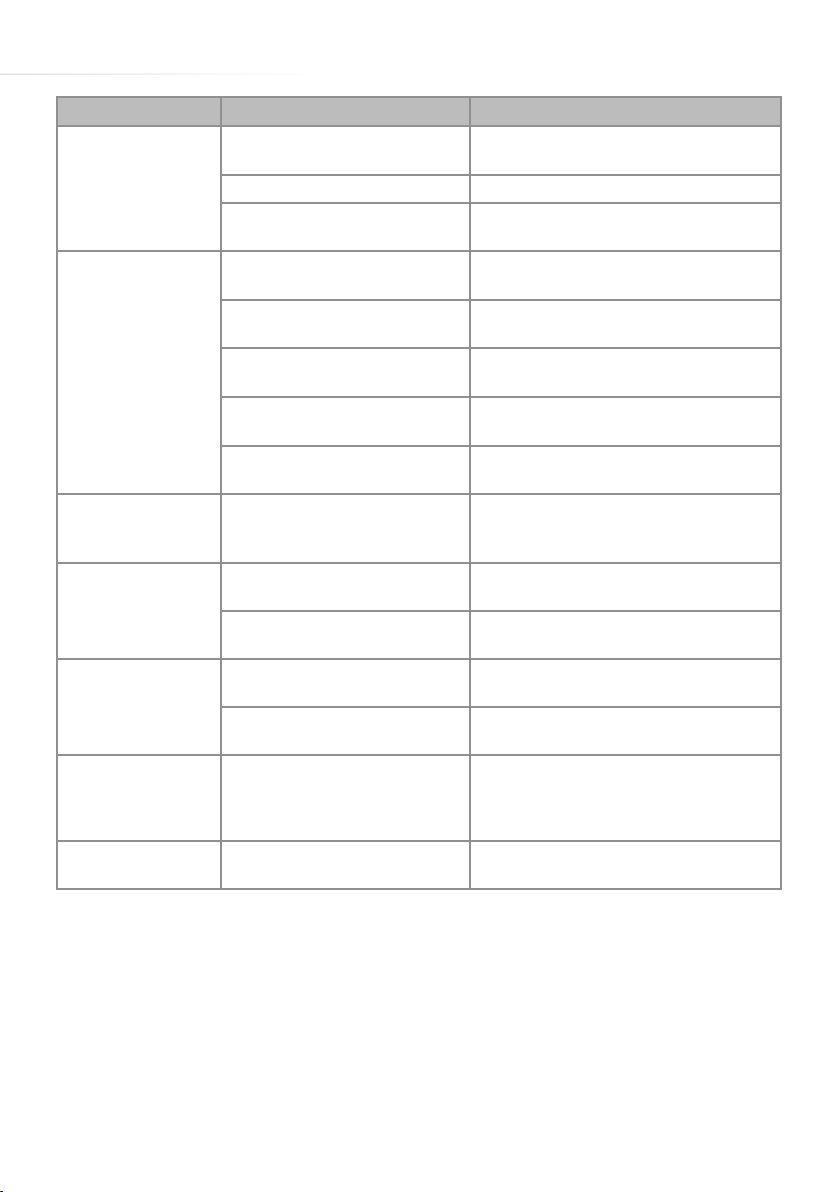
Troubleshooting
All repairs which must be done on the machine should only be
performed by authorised service agents. When a repair is required for
your machine or you are unable to eliminate the failure with the help
of the information given below:
• Unplug the machine.
• Close the water tap.
• Contact CDA Customer Care.
Fault Probable cause Methods of elimination
The machine will not
start.
It is unplugged. Insert the plug into the socket.
The fuse is damaged. Replace the fuse.
There is a fault with the power
supply.
Check the power supply.
The washer door is not properly
closed.
Close the washer door.
“Start / Pause” button has not
been pressed.
Press the “Start / Pause” button.
The machine does
not fill with water.
Start / Pause” button has not
been pressed.
Press the “Start / Pause” button.
Water tap is not turned on. Turn on the water tap.
Water pressure too low. Check water pressure.
The inlet hose is kinked. Check the inlet hose.
Water supply failure. Check the water supply.
Programme knob not set
correctly.
Set the programme knob correctly.
Washer door not properly closed Close the washer door properly.
Inlet hose filter is blocked. Unblock the inlet hose filter.
The machine is
draining while being
filled.
The height of drain hose is below
80cm.
Install drain hose at specified height of
80-100cm.
The drain hose is in water. Ensure the drain hose end is not
immersed in water.
31
Fault Probable cause Methods of elimination
The machine does
not drain water.
The drain hose is obstructed or
bent.
Check the drain hose.
The pump filter is obstructed. Clean the pump filter.
The drain hose is above 100cm. Install drain hose at specified height of
80-100cm.
The machine is
vibrating.
Not all transit bolts have been
removed.
Remove all the transit bolts.
The machine is located on an
uneven surface or is not levelled.
Ensure the machine is located on an even
surface and is correctly levelled.
There is only a small load in the
machine.
This is not indicative of a fault.
The washing machine is
overloaded, or badly loaded.
Do not exceed the load capacity, and
ensure the clothes are loaded evenly.
The washing machine is leaning
on a solid object.
Ensure the machine is installed away from
other objects.
The machine stops
before completing its
wash cycle.
Water or electricity failure. Check the power and water supplies.
Operation stops for a
period of time.
Washing machine gives an error
message.
Check display codes.
Washing machine is in a soaking
cycle.
Press the “Start / Pause” button again to
cancel it. Consider a drain cycle.
Excessive foam in
the drum.
The detergent is not a low
foaming type.
Check if the detergent is suitable.
Excessive amount of detergent
used.
Reduce amount of detergent used.
Washing time has
changed
automatically.
The washing programme duration
has been changed.
This is not a fault and is a feature of the
machine.
The machine fails to
spin.
Unbalanced load. Add more clothes or try running the spin
cycle again.
32
Installation
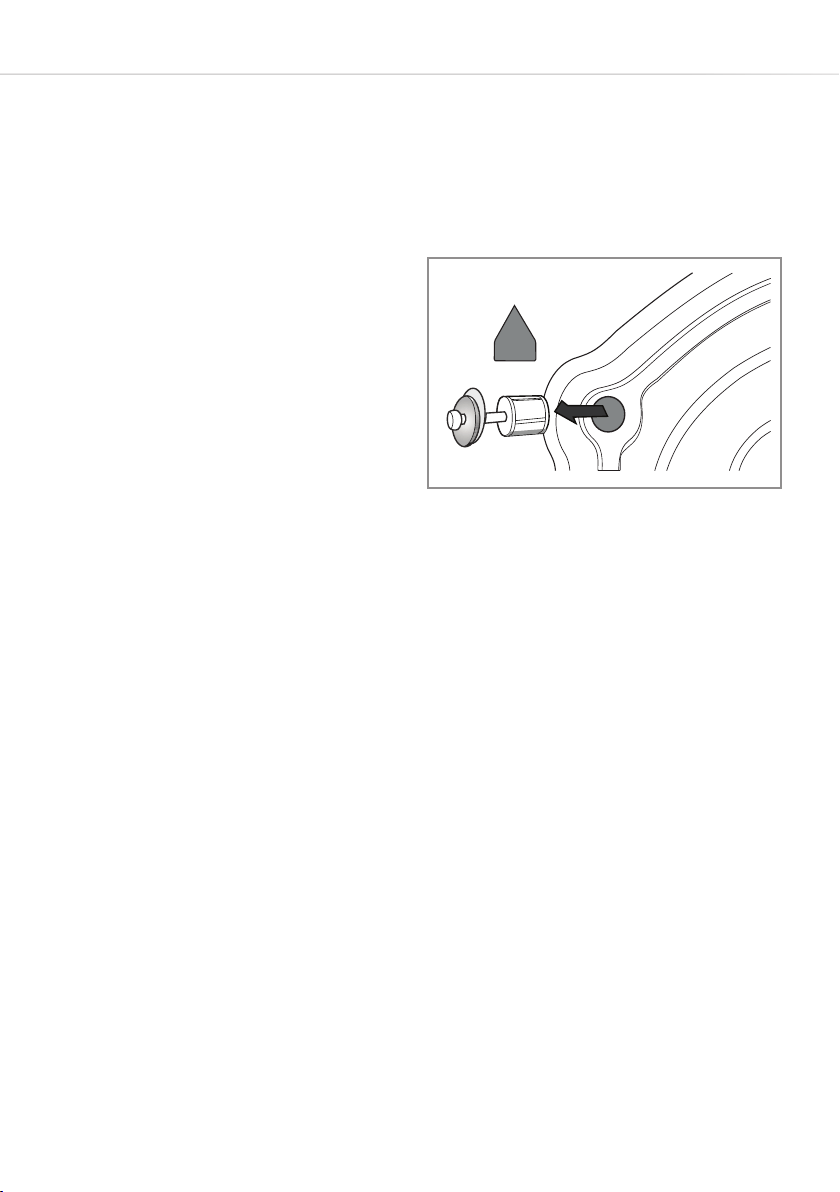
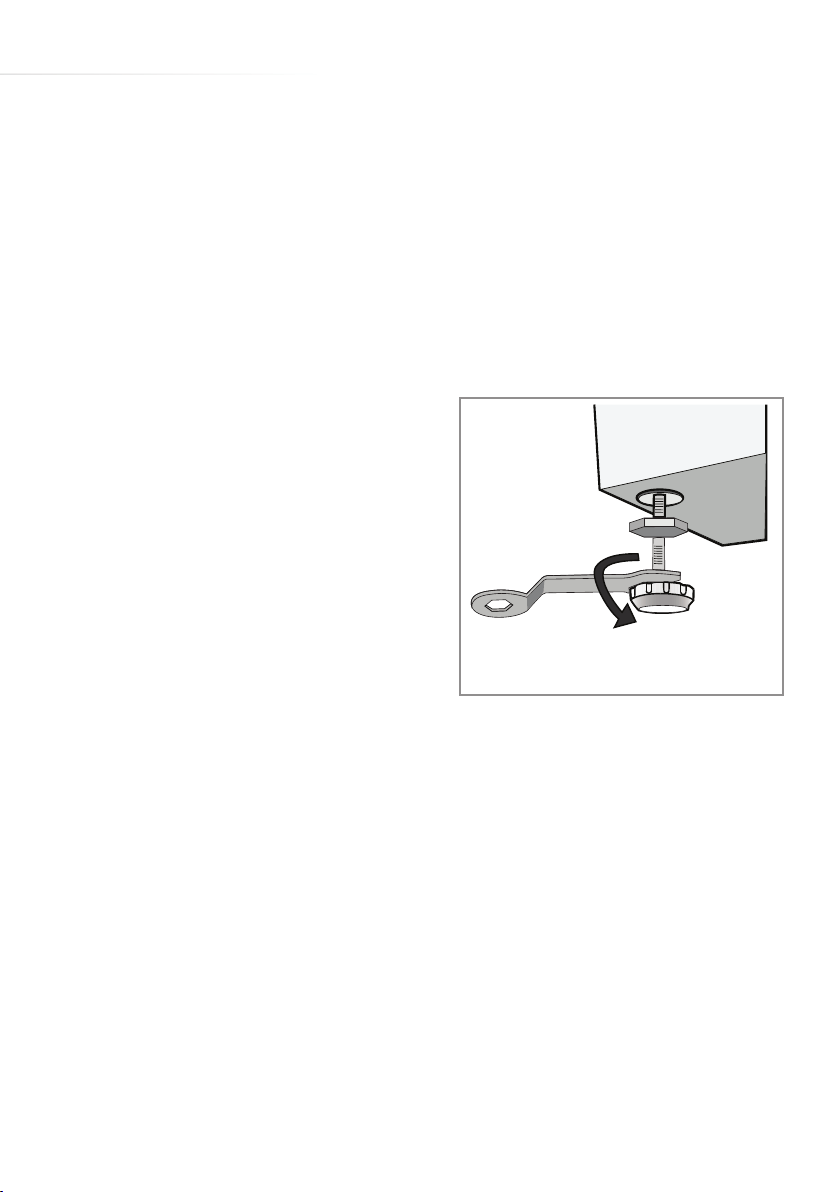
Transit bolts, located at the rear of the appliance, must be removed
prior to using the appliance to prevent damage. There are four in
total.
• Remove the back cover from the
machine.
• Loosen the transit bolts using a
suitable spanner by turning them
anti-clockwise and then remove
them.
• Remove the bolts and plastic spacers that were retained by the
transit bolts.
• Cover the bolt holes with the plastic plugs supplied.
Do not throw the transit bolts or plastic spacers away. If you need
to move the washing machine after installation you should first
replace the transit bolts and spacers.
Do not install your machine on rugs or similar surfaces.
For your machine to work quietly and without any vibration, it should
be installed on a flat, non-slippery and solid surface.
The machine must be positioned on a solid support, such as the bare
floor or a well-fitting riser, ensuring the machine is unable to fall when
subjected to the typical vibrations generated by a washing machine.
The machine must not be fitted near heat sources, nor near
Fig. 15
33
combustible materials such as coal or gas. Ensure that the power cord
is not trapped in any way.
Levelling
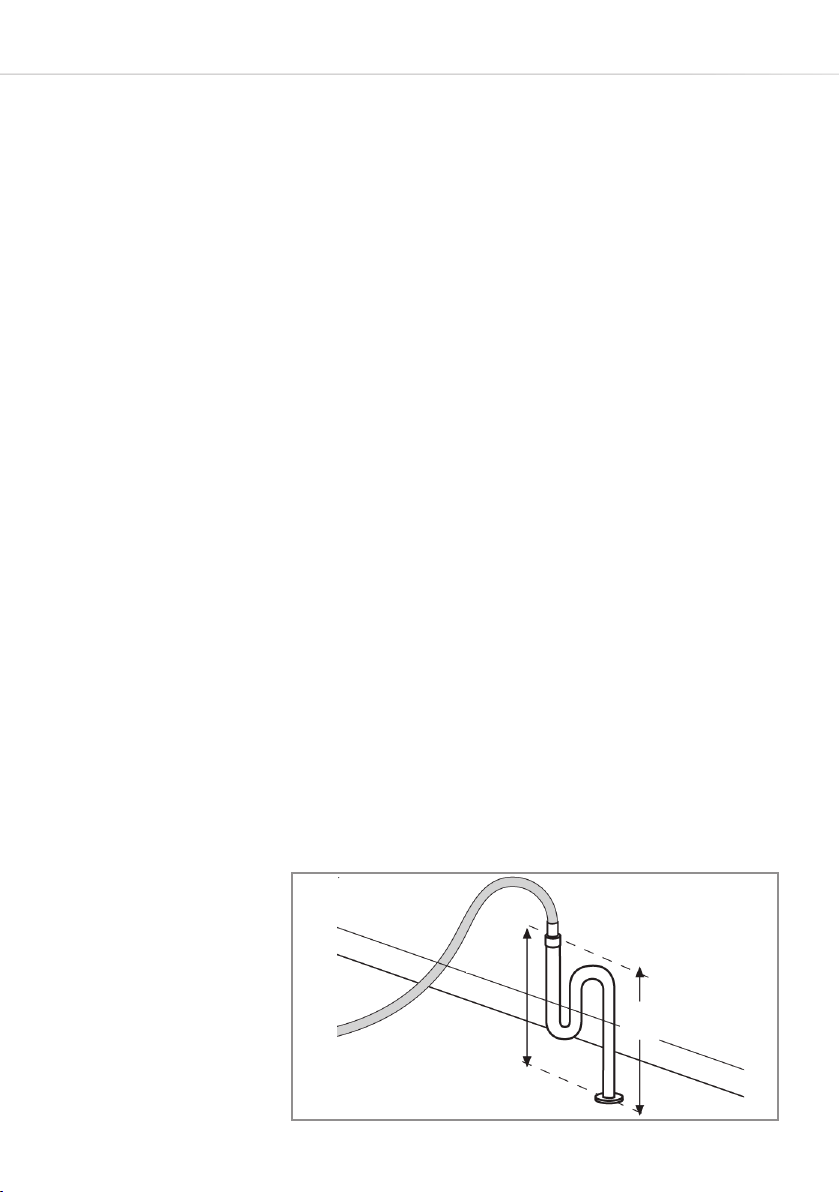
To reduce the noise from the washing machine and to prevent
unnecessary movement during use, ensure the washing machine is
level, using the adjustable feet.
First, fix and level the rear feet. When
they are properly fixed, secure the
metal locknut tightly against the
underside of the washing machine.
• Put the washing machine into its
required position.
• Then level the front feet in the same
way as the rear feet.
Please note: Raising the washing machine too high can aect the
stability of the appliance.
Do not use wooden blocks, packaging or any similar means to
stabilise the appliance. Use only a flat, solid surface and the
appliance’s feet.
Fig. 16
34
Connecting to the mains water supply
• Fit the seal included in the hose packing at the end of the water
inlet hose on the tap side.
• Connect the water inlet hose to a 3/4” BSP water tap. Then securely
tighten the connecting nut by hand.
• After connections are completed, check there are no leaks from the
connection joints by turning on your tap completely.
For your washing machine to work properly, the mains water
pressure must be between 0.05 and 1MPa (0.1 - 10 bar).
Drainage connection
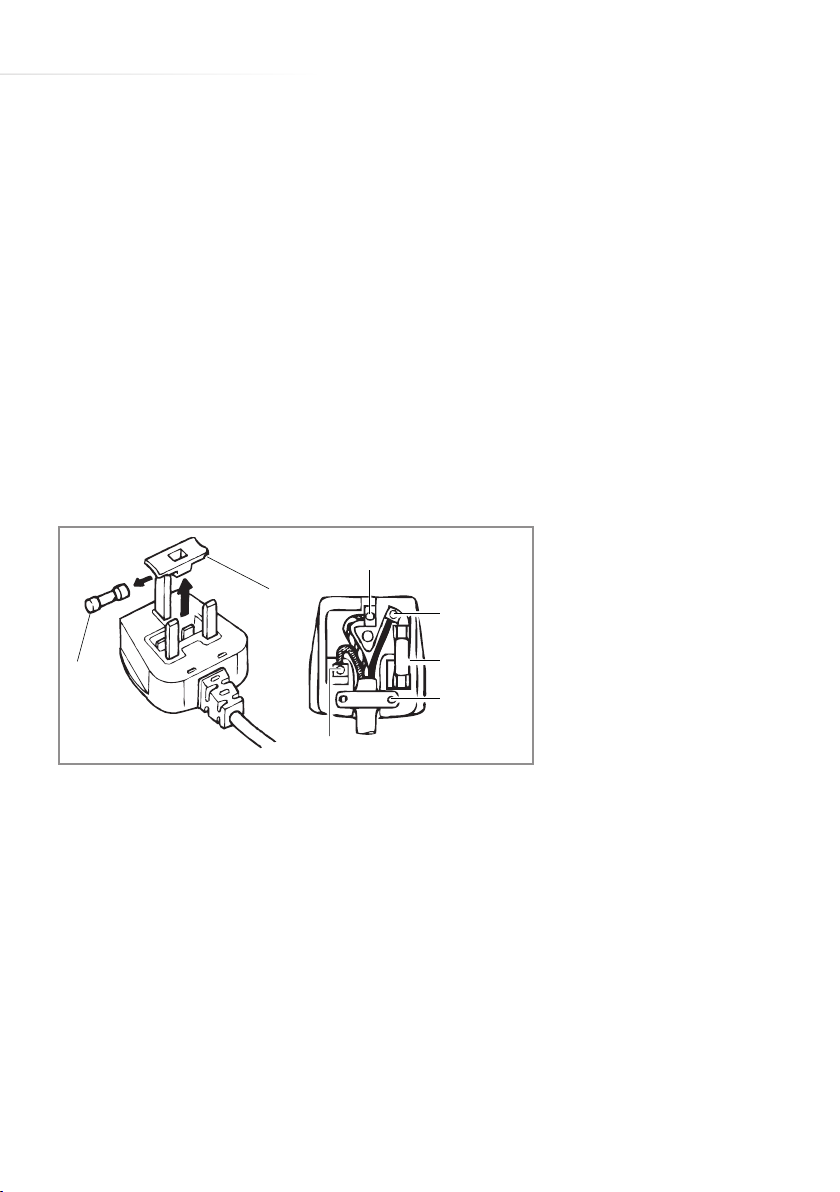
• It is recommended that you have a fixed drainage outlet 80 to 100
cm from the floor.
• Avoid the drain hose being too tight, kinked or restricted.
• The water outlet can either be connected to a water drain or to a
sink outlet spigot (ensure the spigot is cut/opened). This connection
should be a minimum of 80cm and a maximum of 100cm from the
floor. The drain hose should be no longer than 4m in length to
ensure good performance from the washing machine.
• After connecting the water supply, check to ensure there are no
leaks.
min
80 cm
max
100 cm
Fig. 17
35
The drain hose must be securely fastened to the outlet to prevent
any risk of the drain hose becoming detached and causing
flooding.
Once the appliance is connected to the water supply and the drain
connection, ensure that the water inlet and drain hoses are not
folded, twisted, crushed or elongated by stretching when moving the
appliance into position.
Electrical information
Warning! This appliance must be earthed.
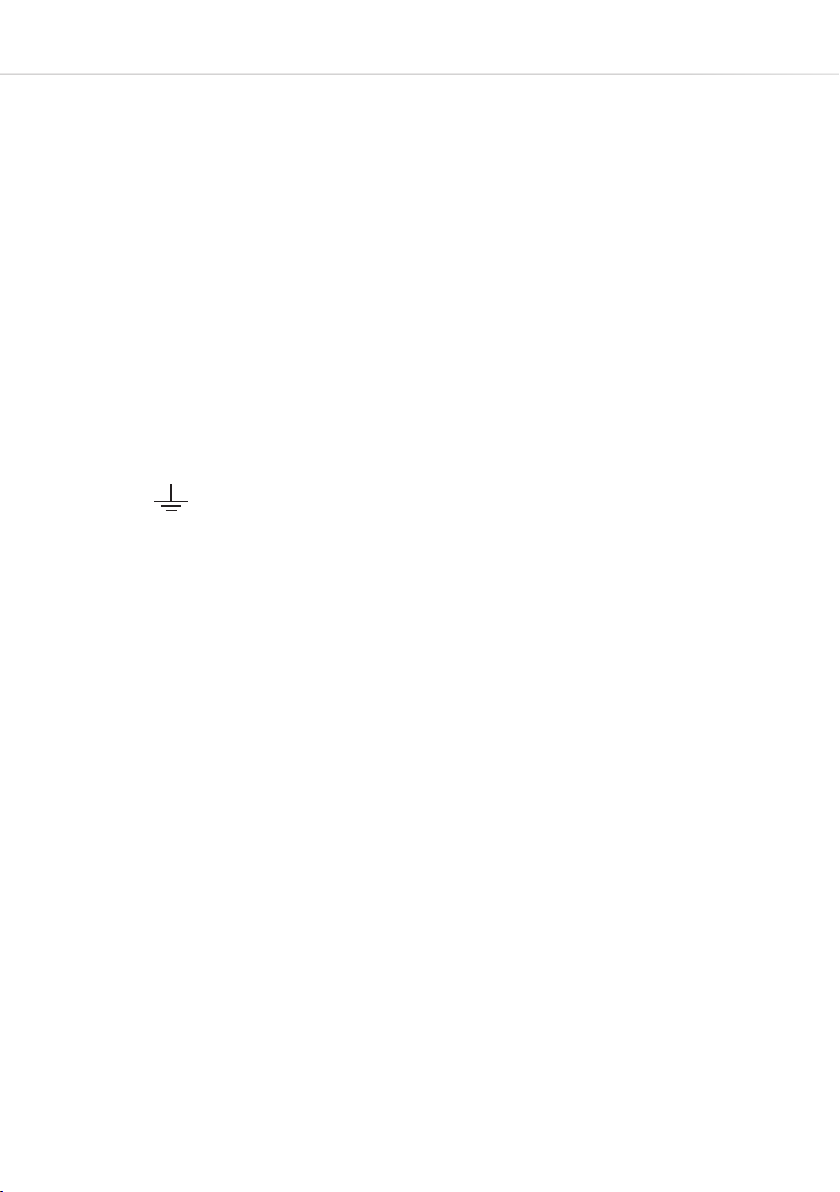
The mains lead of this appliance has been fitted with a BS 1363A 13 Amp
fused plug. To change a fuse in this type of plug, follow the steps below:
1. Remove the fuse cover and fuse.
2. Fit a replacement 13A fuse, ASTA approved to BS 1362 type, into the
fuse cover.
3. Replace fuse cover.
Important: Do not use the appliance without the fuse cover in position.
Blue to Neutral
Cord Clamp
13A Fuse
Brown to live
Green and yellow to earth
13 A
A
B
Fig. 18
36
How to connect an alternative plug
If the fitted plug is not suitable for your socket outlet, then it should be
cut o and disposed of safely to prevent the risk of electric shock. A
suitable alternative plug of at least 13 Amp rating to BS 1363 should
be used.
As the colours of the wires in the mains lead of this appliance may not
correspond with the coloured markings identifying the terminals in your
plug, proceed as follows:-
• The wire which is coloured GREEN and YELLOW must be connected
to the terminal which is marked with the letter (E) or by the Earth
symbol or coloured GREEN and YELLOW.
• The wire which is coloured BLUE must be connected to the terminal
which is marked with the letter (N), or coloured BLACK.
• The wire which is coloured BROWN must be connected to the
terminal which is marked with the letter (L) or coloured RED.
If in doubt regarding the electrical connection of this appliance, consult a
qualified electrician. Do not shorten the supply cable, the appliance may
require removing for servicing.
N.B. Ensure that the plug socket is situated in an easily accessible place.
The plug must be used with a specially earthed socket of 13 amperes.
If there is no such socket in your house, please have one installed by
an authorised electrician.
Appliance electrical rating: 1950W
37
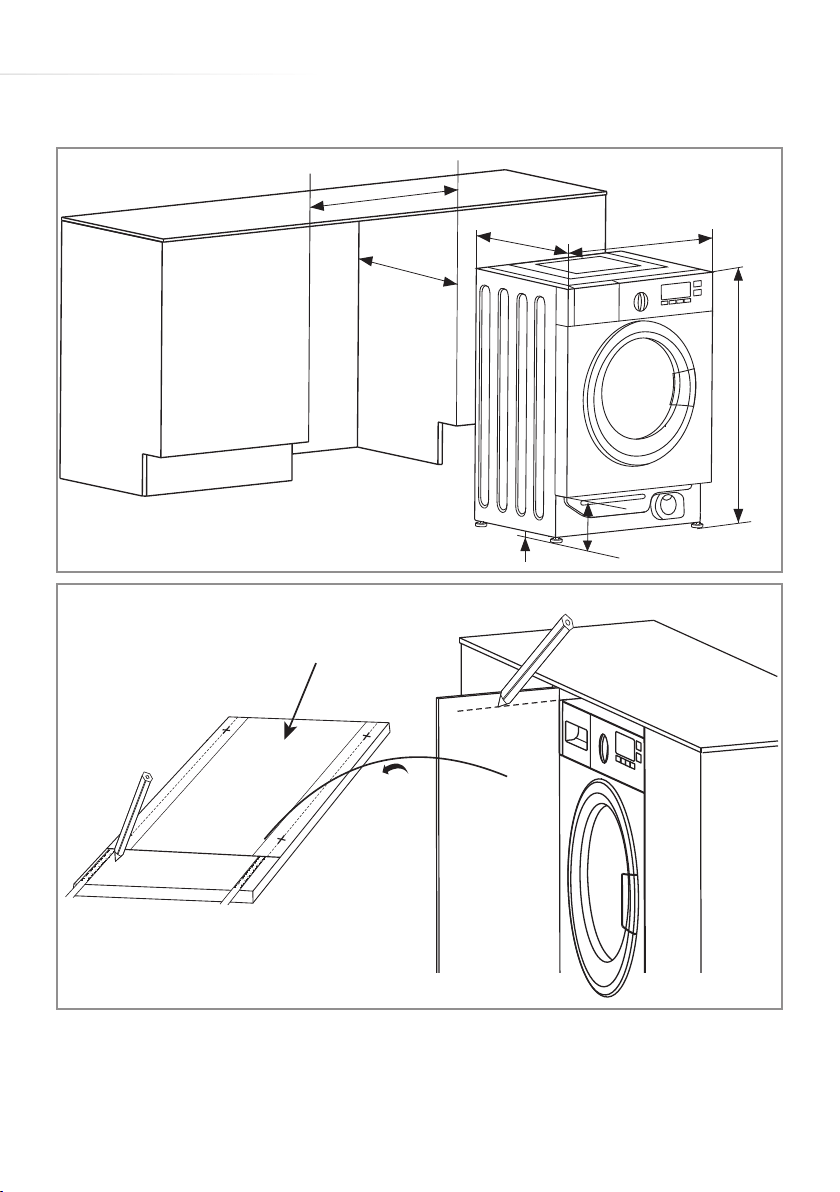
Fitting the appliance
Position the fitting template on the door accordingly so that you can
mark it based on the cupboard and washing machine height (see
page 38).
600mm
825mm
540mm
595mm
152.5mm
17.5mm
580mm
Fitting
template
Fig. 19
Fig. 20
38
Fitting the furniture (decor) door
The machine is supplied with a fitting template that aligns with the top
of the décor door and has arrows cut out of it that point toward the
door top. NOTE: If this template is aligned with the top of the décor
door, the resultant position will align the décor door top with the top of
the machine fascia.
The required height of the door top edge above the fascia panel,
and hence the gap between décor door and worktop, can only
be determined by the fitter after the final height adjustment of the
machine has been determined. The final positioning of the template
is therefore at the discretion of the fitter. The furniture door should
be fitted to the casing of the washing machine using the hinges
supplied. Any osets should be accounted for.
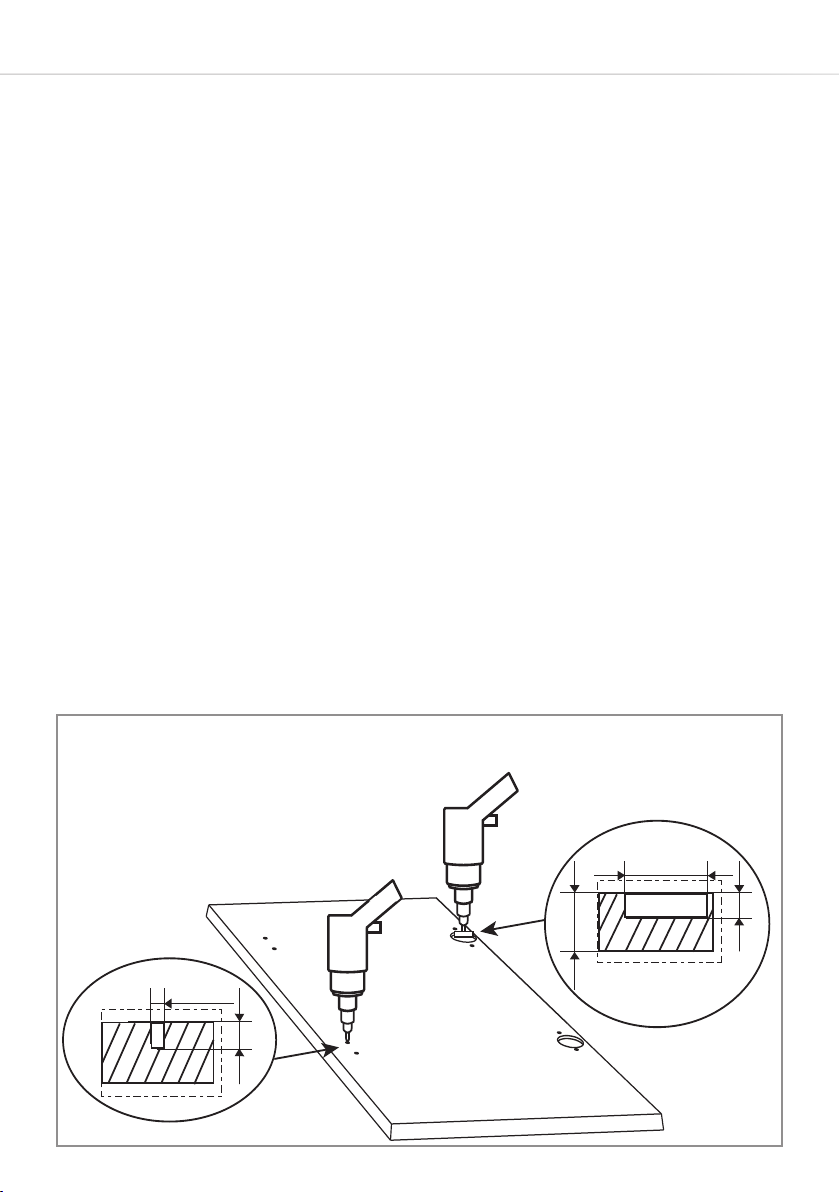
CHECK THAT THE DECOR DOOR ALIGNS PROPERLY BEFORE
DRILLING THE HINGE HOLES. RE-MARK IF NECESSARY.
16-22mm
12mm
35mm
12m m
2mm
Hinge holes - dependant
upon which side your door
will be hinged.
Fig. 21

39
Drill the hinge and catch holes as per the diagram on the bottom
of page 38. The sides that these holes shall need to be drilled will
depend upon the style of the decor door and the side that you wish
for it to be hinged upon. It is not uncommon for décor doors to have
these holes already drilled, particularly when they are reversible.
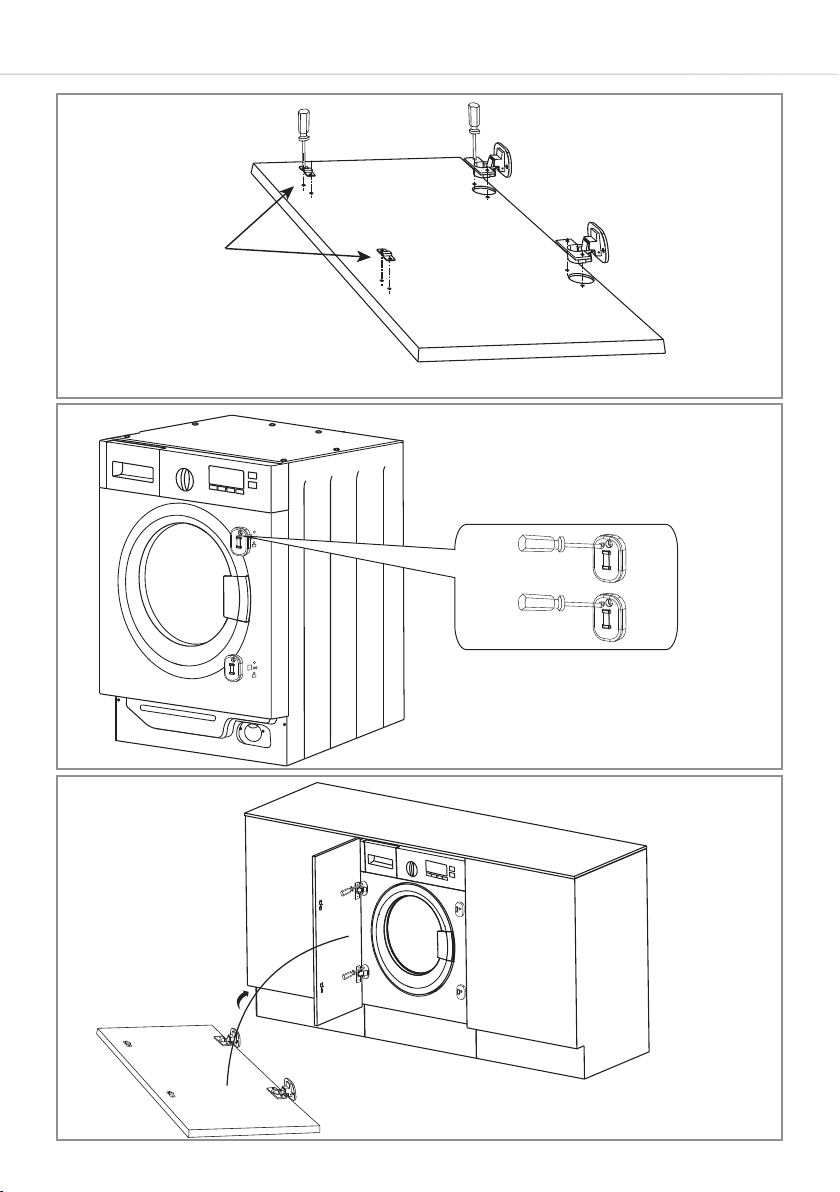
Fix the magnetic catch assembly receivers (Fig. 23, page 40) to the
front of the washing machine and the catch plates (CP in Fig. 22, page
40) to the furniture door.
Provided all is properly aligned, fit the decor door (Fig. 24, page 40).
40
CP
Fig. 22
Fig. 23
Fig. 24
41
Final installation checks
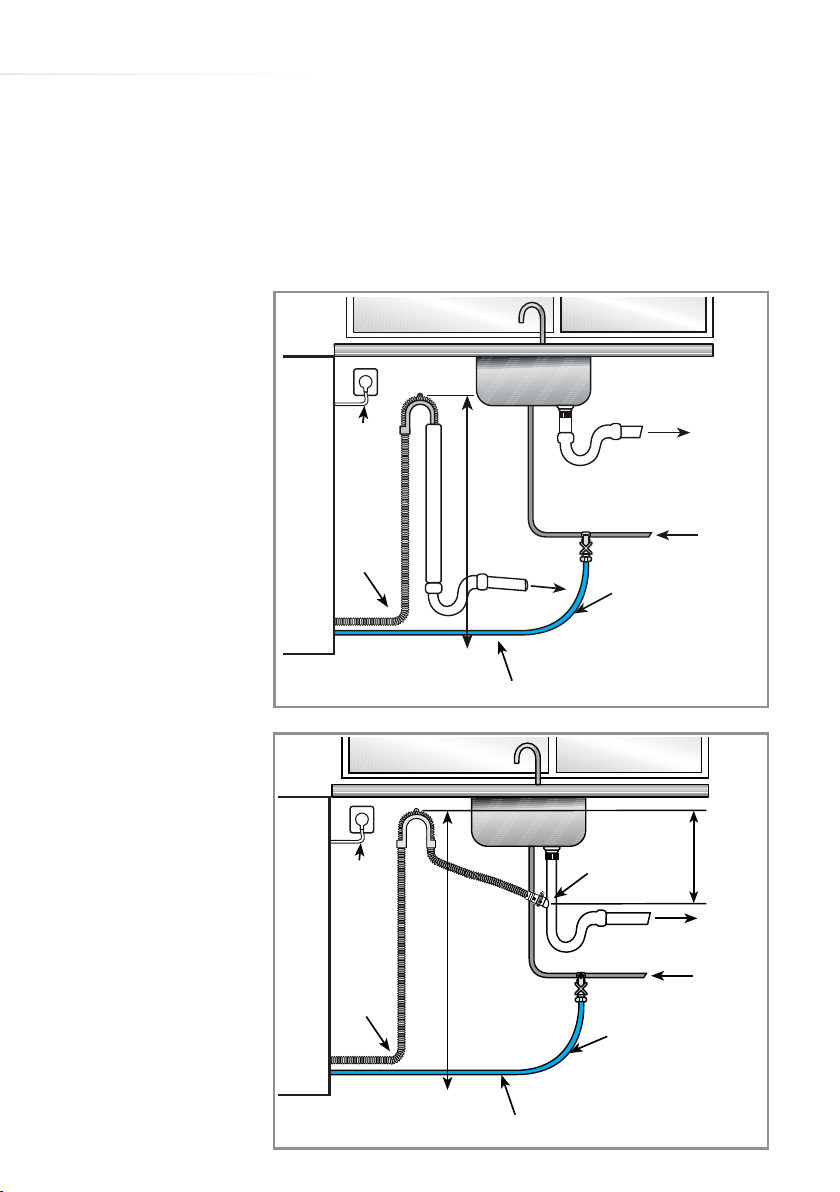
Run a quick test cycle to make sure the appliance fills, turns, drains
etc. with no issues. If you encounter any issues, ensure that the install
is as close to the below images as possible, depending on the install.
Ensure that no hoses are kinked, water is on and sink spigots are cut,
if applicable.
800mm - 1000mm
Power
outlet
Waste
Waste
200mm minimum
bend radius from
valve. Ensure the
inlet hose is free
from kinks.
Water
supply
Valve
Cut/open
spigot
Waste
Water
supply
Valve
200mm minimum
bend radius from
valve. Ensure the
inlet hose is free
from kinks.
150mm min.
800mm - 1000mm
Washing machine
Drain
Inlet hose
Inlet hose
hose
Drain
hose
Power
outlet
Washing machine
42
Maximum dry laundry capacity (kg) 8
Recommended loading (kg) See ‘Programme List’ (page 13)
Height (cm) 82.5
Width (cm) 59,5
Depth (cm) 54.0
Technical specifications
International Washing Symbols
Wash up to 90 °C Wash up to 60 °C Wash up to 30 °C Do not wash in a
washing machine
Washing
temperature
Do not wash in a
washing machine
Lukewarm iron Medium hot iron
Hot iron Do not iron Do not tumble
dry
Hang to dry
Drip dry Dry flat Do not bleach Handy to bleach
All of these are dry cleaning symbols. The letters are to instruct the
cleaner what type of solvent to be used.
Garments bearing these symbols should not be washed in your
machine unless the label says otherwise.

43
Warranty and service
The manufacturer shall not be held liable for any damage caused
by improper use of the product.
• Repairs carried out by unqualified persons may seriously
endanger the appliance user
• Pursuant to Commission Regulation (EU) 2019/2023, The mini-
mum availability period for spare parts necessary to repair the
appliance is 7 or 10 years depending on the type and purpose
of the spare part
• The list of spare parts and the ordering procedure are available
on the websites of the manufacturer, importer or an authorised
representative
• The minimum warranty period for the appliance oered by the
manufacturer, importer or authorised representative is given in
the warranty card
• The warranty shall be void if you make any independent ad-
aptations or alterations, tamper with seals or other appliance
safety devices or its parts or interfere with the appliance
contrary to operating instructions
For more information about the product, please refer to the EU
EPREL Product Database at https://eprel.ec.europea.eu.
Alternatively you can use your mobile device to scan the QR code
on the energy label or enter the product model listed on the
energy label in the EPREL search engine.

The CDA Group
Harby Road
Langar
Nottinghamshire
NG13 9HY
Sales Department
Phone: 01949 862010
Email: [email protected]
CDA Customer Care
Phone: 01949 862012
Email: customer[email protected]
©2020 CDA Group Ltd