
Standard and large Capacity Automatic Clothes Washers
❑
!
Safe~
instructions ....................3, 4
❑
,.
Operating Instructions, Tips
Controls
Sett;ng
Guide .............................6, 7
Energy-Saving
Tips.....................................,...
5
❑
~,~:~;~
Care and Cleaning .....................2
l,22
Agitator...........................................................22
Storage and Vacation
Tips.........................2l
User Maintenance instructions ................2l
❑
●
Problem Solver
.......................l
7-22
More
auestions
?...call
GE Answer Center” 800.626.2000
u
, Preparation
Detergents, Other Additives . . . . . . . . . . . . . 10–1 2
Hard Water . . . . . . . . . . . . . . . . . . . . . . . . . . . . . . . . . . . . . . . . . . . . . . . . . . .
.
13
Loading the
Washer...................................,...9
Pretreating
................................................8,
15
Sorting Clothes ...............................................8
Stains
. . . . . . . . . . . . . . . . . . . . . . . . . . . . . . . . . . . . . . . . . . . . . . . . . . . . . . . . . . . .
.
15
Stain Removal Guide . . . . . . . . . . . . . . . . . . . . . . . . . . . . . . . . . .
.
16
❑
✎
✠
warranty
...........................Back
Cover
Appliance
Registration..................................2
Model and Serial Numbers ..........................2
Repair Service
.................................................2
GE Appliances
HELP US HELP YOU...
Read this book carefully.
Save time and money. Write down the model
It is intended to help you Before you request service . . .
and serial numbers.
operate and maintain your check the Problem Solver
You’ll find them on a label on
new washer properly.
section. It lists causes of minor
the lower left side near the front.
Keep it handy for answers to
operating problems that you can
your questions.
correct yourself.
These numbers are also on the
Consumer Product
Ownership
If you don’t understand something
or need more help, write (include
If you received a
Registration ’Card that came
&ith
your phone number)
damaged washer...
your washer. Before sending in
this card, please write these
Consumer Affairs
Immediately contact the dealer (or
GE Appliances, Appliance Park
builder) that sold you the washer.
Louisville, KY 40225
numbers here:
Model Number
Serial Number
Use these numbers in any
correspondence or service
calls concerning your washer.
WAM~G: For your safety the information in this manual must
be
fotiowed
to
mitie
the risk of
fwe
or
eqlosion
or to prevent property damage,
Wrsond
i~ury
or loss of
Me.
—Do not store or use
gasoHne
or other
●
Immediately
CM
your gas supplier from a
flammable vapors and liquids in the
neighbor’s phone.
Fo~ow
the gas
supptier’s
vicinity of this or any other
apptiance.
instructions.
—~T
TO DO
W
YOU
S~LL
GAS
.
H
you
mnnot
reach your gas supplier,
●
Do not try to
tight
any appliance.
mu
the
fire department.
●
Do not touch any
eledricd
switch;
—Initiation and service must be performed
do not use any phone in your
butiding.
by a
quaMled
instiler,
service agency or
the gas
supptier.
●
Clear
the room,
buflding
or area of
W
Ncupants,
All washing instruction terms in this book conform to the Care
Labeling Rule established by the Federal Trade Commission, January 1984.
If You Need Service
To obtain service, see the
warranty on the back of this book.
We’re proud of our service and
want you to be pleased. If for some
reason you are not happy with the
service you receive, here are three
steps to follow for further help.
First, contact the people who
FINALLY, if your problem
serviced your appliance. Explain
is still not resolved, write:
why you are not pleased. In most
Major Appliance Consumer
cases, this will
solve
the problem.
Action Panel
NEXT, if you are still not pleased, 20 North
Wacker
Drive
write all the details—including Chicago, IL 60606
your phone number—to:
Manager, Consumer Relations
GE Appliances, Appliance Park
Louisville, KY 40225
2
A
WARNING-To reduce the risk
of fire, electric shock, or injury to
persons when using your appliance,
follow basic precautions, including the following:
●
Use this appliance only for its intended purpose
as described in this Use and Care Book.
o
i
●
This washer must be properly
‘Q.,.;:
~
?.+
‘“
installed and located in accordance
with the Installation Instructions
before it is used.
If you did not receive an
Installation Instructions sheet with your
washer, you can obtain one by calling, toll
free, the GE Answer
Center~
800.626.2000.
—Properly ground to conform with
all
governing codes and ordinances. Follow
details in Installation Instructions.
—Install or store where it
will
not be exposed
to temperatures below freezing or exposed
to the weather.
~Connect to a properly rated, protected and sized
power supply circuit to avoid electrical overload.
<onnect
to adequate plumbing and drain
facilities as described in the Installation
Instructions,
●
Turn off water faucets when the washer is not in
use to relieve pressure on hoses and valves, and
to minimize leakage if a hose or valve should
break or rupture.
%4
●
When disconnecting this appliance
/
-
‘.’
pull by the plug rather than the cord to
J
avoid damage to the cord or junction of
/
cord and plug. Make sure that the cord
is located so that it
will
not be stepped on, tripped
over or otherwise subjected to damage or stress.
@
●
Do not repair or replace any part
of the appliance or attempt any
servicing unless specifically
recommended in this Use and Care Book or in
published user-repair instructions that you
understand and have the skills to carry out.
To minimize the possibility of injury:
@
\
●
Do not
mix
chlorine bleach with
x
ammonia or acids such as vinegar
an~or
g$
mst
remover. Mixing can produce a
toxic gas which may cause death.
4’(
h
●
Do not wash or dry articles that
~)
have been cleaned in, washed in,
soaked in, or spotted with
combustible or explosive substances
(such
as wax, paint, gasoline,
degreasers,
dry-
cleaning solvents, kerosene, etc.) which may
ignite or explode, Do not add these substances
to the wash water. Do not use these substances
around your washer
andor
dryer during
operation.
A
WARNING—HYDROGEN GAS
is produced by the chemical action
within your water heater and the gas
can accumulate in the water heater
andor
water
pipes if hot water has not been used for a period
of two weeks or longer. HYDROGEN GAS CAN
BE EXPLOSIVE UNDER THESE
CIRCUMSTANCES. So to prevent the
possibility of damage or injury, if you have not
used hot water for two weeks or more, or move
into a residence in which the hot water system
may not have been used for some time, turn on
all
hot water faucets and allow them to run for
several minutes before using any electrical
appliance which is connected to the hot water
system. This will allow any hydrogen gas to
escape. Since the gas is flammable, do not
smoke or use an open flame or appliance
during this process.
●
Never reach into washer while it is
moving. Before loading,
u~oading
or adding clothes, push in the Cycle
Selector knob to OFF position, then
wait until the machine has completely stopped
before opening the lid.
●
Close supervision is necessary if
;
this appliance is used by or near
#*
children. Do not allow children
be
to play inside, on, or with this
appliance or any discarded
appliance. Dispose of discarded appliances and
shipping or packing materials properly. Before
discarding a washer, or removing from service,
remove the washer lid.
(continued next page)
3
—
WORTANT
SAFETY
~STRUCTIONS
(continued)
●
Keep all laundry aids (such as
detergents, bleaches, fabric softeners,
etc.) out of the reach of children,
preferably in a locked cabinet.
Observe all warnings on container
labels to
avoidpersonalinjury.
+
●
Keepthe area around
andundemeath
u
your appliances free
fromthe
accumulation of combustible materials,
.,.
.
.
such as lint, paper, rags, chemicals, etc.
●
Keep the floor around your appliances clean and
dry to reduce the possibility of slipping.
●
To minimize the possibility of electric
shock, unplug this appliance from
the power supply before attempting
any maintenance or cleaning.
*
NOTE: Turning the Cycle Selector knob
.
to an
OW
position does NOT disconnect
the appliance from the power supply.
●
Do
not
tmper
tith
controls.
. Do not operate this appliance if
it
is damaged,
malfunctioning, partially disassembled, or has
missing or broken parts, including a damaged
cord or plug.
●
Never climb on or stand on the washer top.
●
Do not wash fiberglass articles in your washer.
Skin irritation could result from the remaining
particles that may be picked up by clothing
during subsequent washer use.
d’t
A
●
The laundry process can reduce the
flame
retardancy
of fabrics. To avoid
~
\
such a result, the garment
manufacturer’s care instructions
should be followed very carefully.
For washer operation
●
Do not leave washer lid up during cycle,
This will stop the wash and spin action
and prevent completion of the cycle.
4
If
your clothes
and
household
items don’t look clean and fresh
after washing, you will probably
rewash them.. and that means
you’ll waste energy. Remember
to sort your clothes carefully,
and load them properly, select
correct cycles, use enough
detergent and
c’hoo.se
u )vutcr
temperature
~vurm
enough to
relea,ye
and
get
rid
of
.~oil.
● Use Hot Wash—up to
150°F.
(65°C.)— on a regular basis
c)nly
when
washing heavily soiled
articles—such as work and
play clothes.
● Under normal soil conditions,
wash in
water above
80°F.
(27°C.).
This generally
means using the Warm Wash
temperature setting on your
washer—temperatures
approximately
90°F.–
11
O°F.
(32°C.-380C.) or hand
comfortable.
If you notice
that soil has accumulated after
several consecutive washings,
use Hot Wash occasionally, if
safe for fabrics.
●
Always
rinse in cold water. The
temperature of the rinse does not
affect cleaning.
● Try to wash less often. Save
articles of the same type of
fabric until you have a full load.
● If
you
must wash smaller
loads, adjust the amount of
water. Small loads should have
lower water levels.
●
Wash in off-peak utility hours.
Your local utility can tell you
which are the off-peak hours.
● Use Normal (Fast) Spin Speed
to remove more water and help
lessen
drying time. The dryer
will remove any wrinkles caused
by the Normal (Fast) Spin.
● If your washer is equipped with
a
Mini-Basket’”
tub use it for
very small loads. It uses less
water than the low water level in
the big tub on the same machine.
You will also save on detergent
and energy.
5
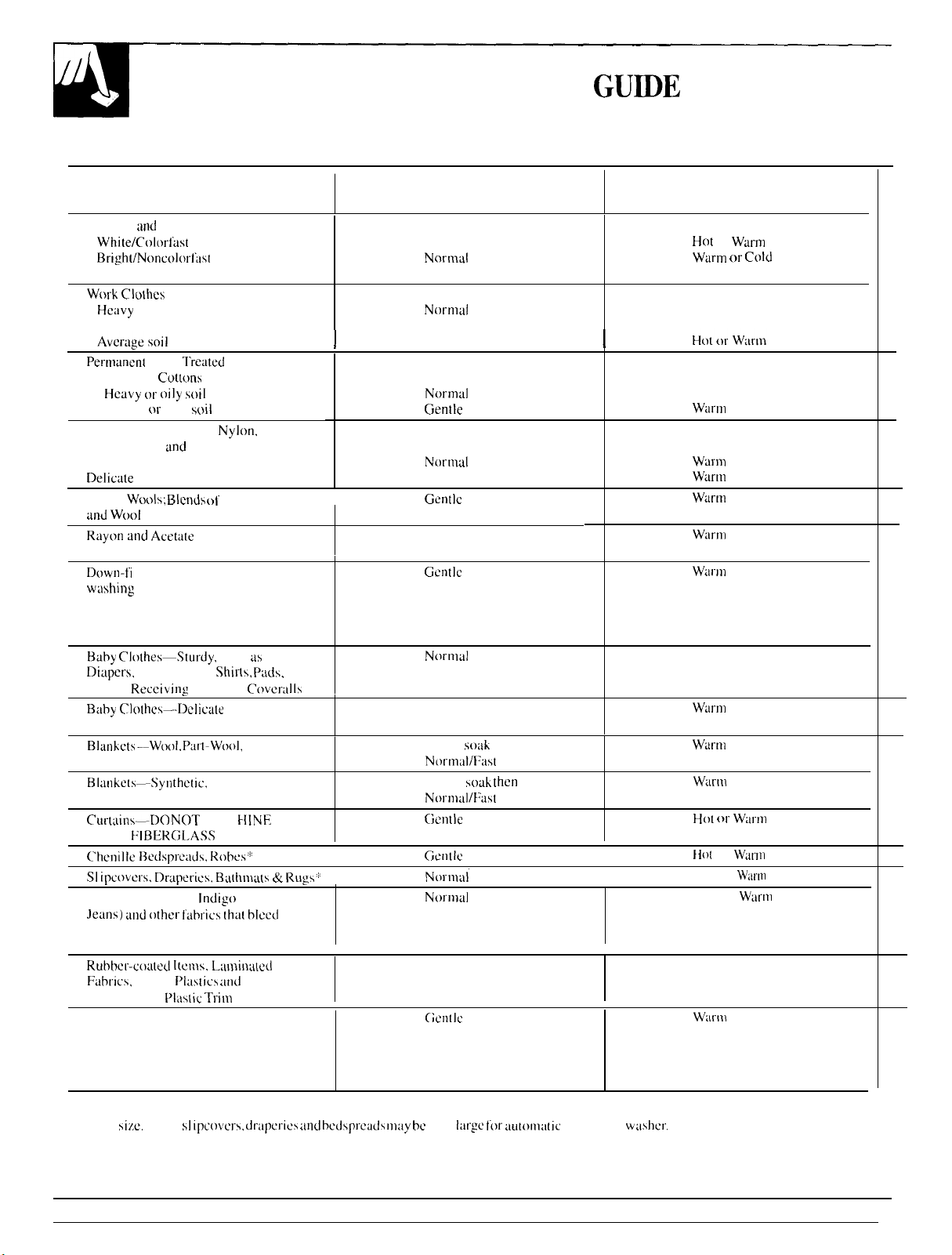
CONTROLS SETTING
GUDE
Controls Setting Guide for different fabrics and loads
Wash
Wash Water
Load Speed
Temperature
Cottons”
;Ind
Linens
White/Colorl’ast”
Bright/Noncolorit]st
Normal
Normal
Hot
or
Warm
Wtirm
or
Cold
Work
Cluthes
He;ivy
soil
Nornl~l
Hot
I
Normal
I
Permanenl Press,
T’reated
Cottons,”
Blends with
Cottons
Heavy
or
oily
soil
Average
or
light
soil
Synthetics—Polyester,
Nylon.
Acrylic Knits
and
Woven Fabrics
Sturdy
Delicute
Normal
[ientle
Normal
Gentle
Hot
Wturn
Warm
Warm
Silks.
Wot)ls;
Blends of Silk
I
Gentle
:md
W()()l
R:ly[)n
and
Aceta(e
Gentle
I
Wurl?l
Dowtl-ti
I led garments, if’ machine
Gentle
W:lrnl
w:ishing
is recommended
BdtTy
clothes-sturdy.
such
as
NornI:Il
HOI
Dit~pcrs,
Nightgowns,
Shi]-ts.
P:Lds.
Sheets.
Receiving
Blankets,
C’over:Ills
B:Ihy
Clo[hes-—t>clictite
Gentle
W:ll”nl
Bl~ulkets
---W()()I.
P:II-t-W()()l,
Cotton”
5 min.
so;ik
then
W:lrnl
N()[”[?l:]t/[::ist
B[;mkets-Synthetic, Electric
5 min.
soak
then
Wt~rm
Not”n)il]/~:ast
cLll”t:LlllS-D~
NOT
MAC
I-{INE
[i~lltle
Hot
or
W:urn
WASH t’IBER[iLASS
I
I
Cheni]lc
Beclsprciids,
Robcs:l:
Gentle
tio(
()[-
W:il”nl
I
S1
ipcotel-s.
Drape[-ics,
B:\(hn]tits
&
Rugs:::
Nol-lllili
I
Hot ()[”
wiII”[ll
Denims (especially
Indigo
Blue
NornIal
(“old or
W;irm
Je~ns)
:md
other
I“:ibrics
th:i[
blceci
Ruhbcl”-co:L[ed
l(cms,
Ltln]in:~[ecl
Gentle
WitI”Ill
Ftibrics,
Vinyl,
Pl~lslic3
:Incl
Articles with
Pl;istic
Trim
Pillows
Gclltlc
W:lrn)
‘
l:
Check
size.
Some
SI
ipcoi,er~,
dr;ipcrics
i[ncl
hcdsprc:Ids
In:iy
be
too”
I;irge
f“or
ilutonl:itic
home-size
w:ishcr.
6
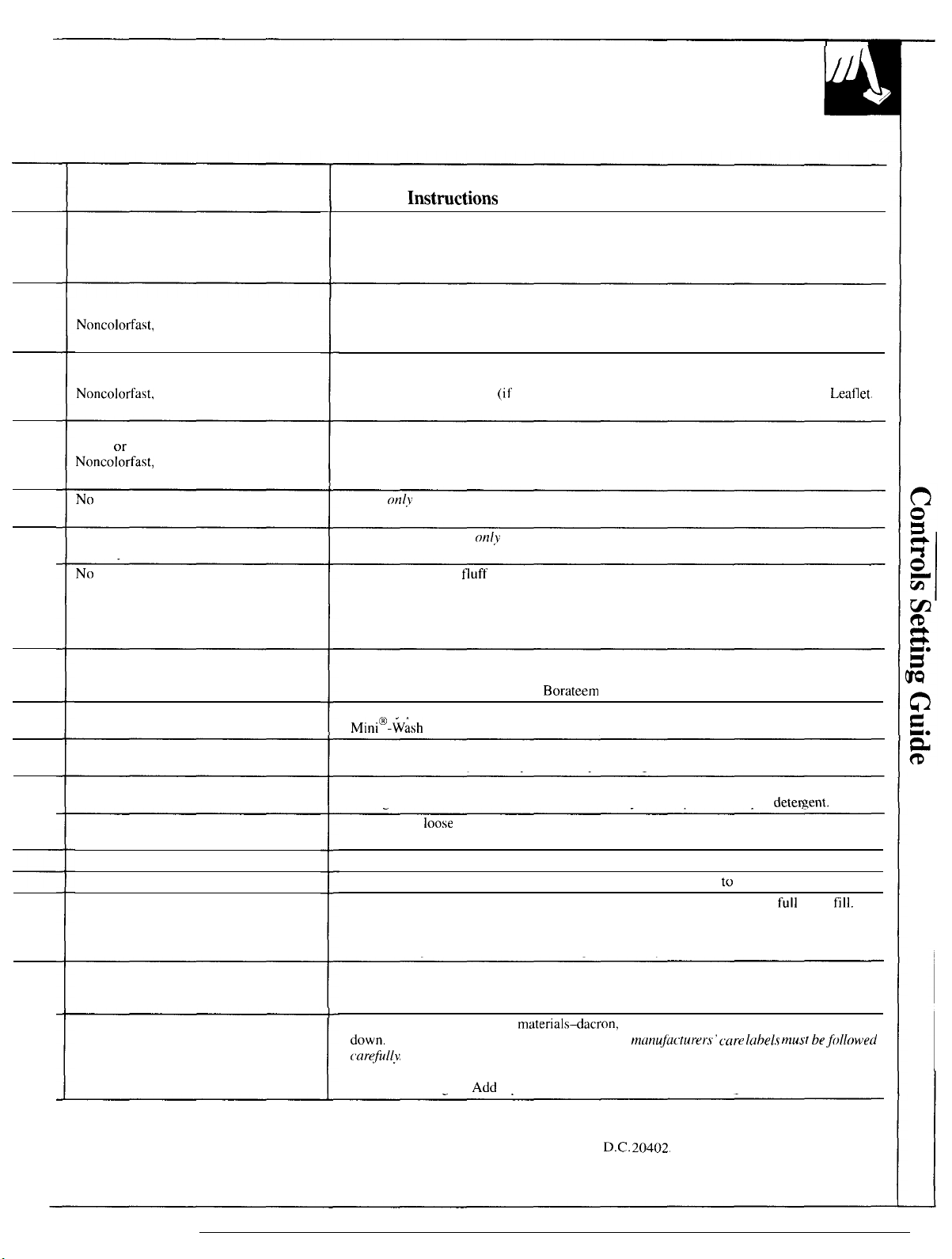
Refer to Garment Manufacturers’ Care Labels
Bleach
Liquid chlorine type.
Only non-chlorine bleach when needed
White or colorfast, liquid chlorine type.
Noncolorfast,
only non-chlorine bleach
when needed.
White or colorfast, liquid chlorine type.
Noncolorfast,
only non-chlorine bleach
when needed.
White
or
colorfast, liquid chlorine type.
Noncolorfast,
only non-chlorine bleach
when needed.
No
bleach
Seldom needed. If needed,
use only non-chlorine bleach.
No
bleach.
White or colorfast, liquid chlorine type.
Only non-chlorine bleach when needed.
No bleach.
No bleach.
White or colorfast, liquid chlorine type.
White or colorfast, liquid chlorine type.
White or colorfast, liquid chlorine type.
No bleach.
No bleach.
No bleach.
Special
Instmctions
If colorfast is unusually soiled, use hot water. Use maximum detergent recommended in
Detergent Guide. Use Extra Cleaning cycle (if your washer is so equipped). See Operating
Instructions Leaflet,
Use maximum detergent recommended in Detergent Guide,
Small loads reduce wrinkling. Use maximum detergent recommended in Detergent Guide,
Use Extra Cleaning cycle
(if
your washer is so equipped). See Operating Instructions Leatlet,
If unusually soiled, use hot water. Use maximum detergent recommended in Detergent
Guide. Small loads reduce wrinkling.
Wash
on[}!
if recommended by the garment manufacturer, Follow instructions carefully.
Wash in your washer
only
if recommended by the garment manufacturer.
Wash frequently to fluff up the down and retain the garment’s warmth. Wash separately. Wet
down gives off an odor which may be absorbed by other garments, Odor disappears when
garment is dry. Treat heavily soiled areas with liquid detergent or paste made of water and
granular detergent. Close zippers. Wash 2 or 3 at a time or add towels to balance.
GARMENT MUST BE TUMBLE DRIED.
You may prefer to use a mild type detergent. Do baby clothes separately. Pretreat spots,
Rinse diapers, nightgowns, pads and sheets after use. Keep diapers in a covered pail of cold
water and conditioning agent like
Borateem
brand.
You may prefer to use a mild type detergent. Do hand-knit garments by hand or use the
Mini@-Wash
system (if your washer is so equipped), See Operating Instructions Leaflet.
Fill washer, add detergent and allow to dissolve before adding blanket. Do one blanket at a
time. Pretreat heavily soiled spots with liquid detergent.
On electric blanket, sew a strong piece of cloth over plug to protect blanket and washer from
damage. Do one blanket at a time. Pretreat heavily soiled spots with liquid
dete~ent.
Vacuum out loose dirt before washing.
If
unusually soiled, use Normal/Fast Wash/Spin Speed.
Wash only 2 or 3 rugs or mats at one time. Shake before washing
to
remove excess dirt.
For new “indigo blue” jeans, wash at least 3 times in very small loads with
full
water
fill.
Jeans need ample room to move to avoid white lines at creases. May discolor plastic washer
parts. Subsequent washings will reduce discoloration, but will probably never eliminate it.
The stained parts will not discolor subsequent washing loads.
Tumble on FLUFF (No Heat).
Pillows are made of different materialsdacron, fiber, foam, polyester, natural feathers and
down.
Many pillows can be machine washed, but
mcmq~tic~urer.j
c(lre
label.!
must
be,fi~llowed
(czrefull?,,
If washing is recommended, check pillows for weak seams or holes and mend to
prevent escape of feathers or filling. Fill washer, add detergent and agitate for several minutes
to dissolve detergent.
Add
2 pillows at a time to balance load. Use high water level.
For more information on care labeling, send for “What’s New About CARE LABELS.”
For sale by the Superintendent of Documents, U.S. Government Printing Office, Washington,
D.C.
20402
7
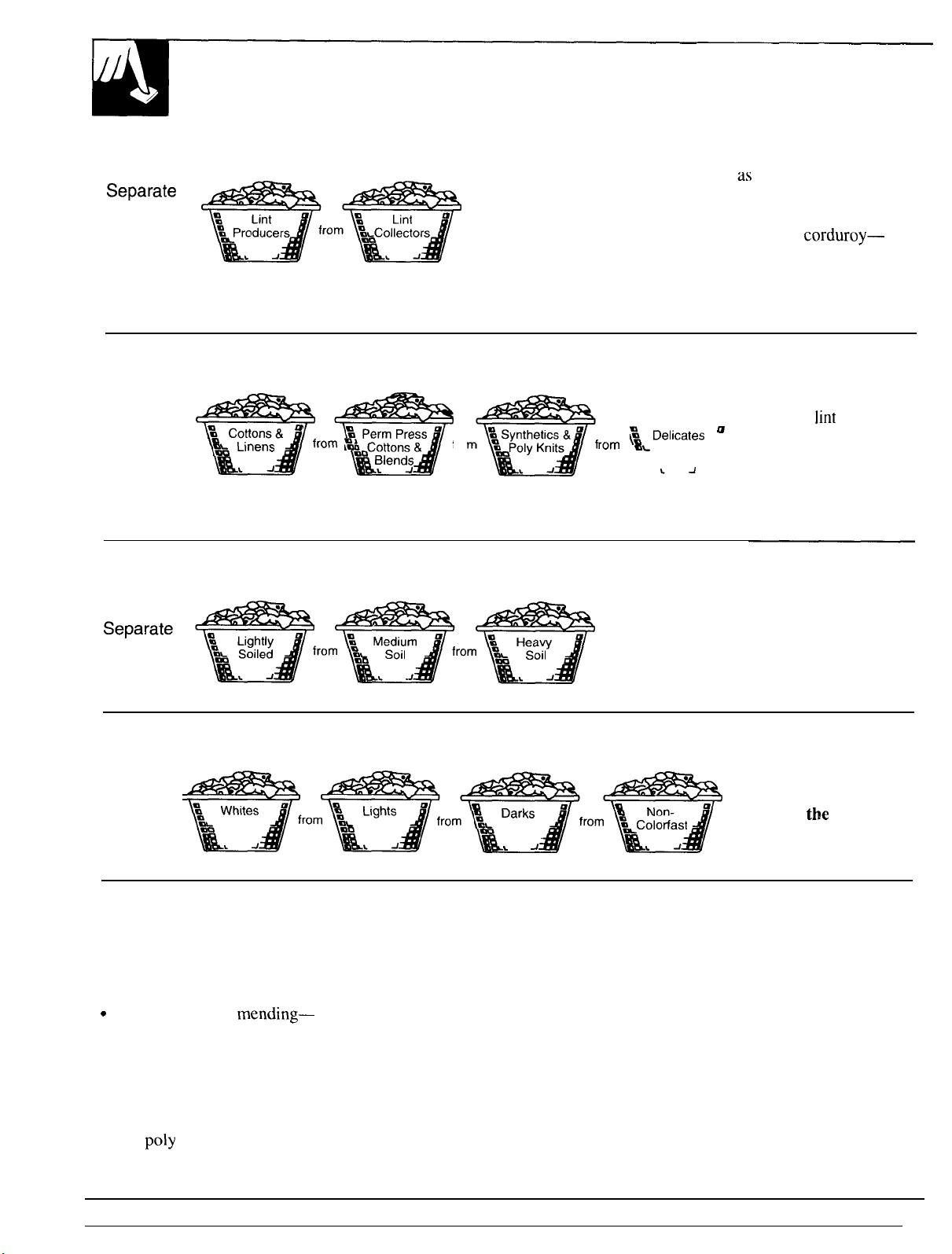
HOW TO SORT CLOTHES
Sort by Surface Texture
‘eparate
=fromw
LINT PRODUCERS—such
as
terry toweling and
chenille—give up lint.
LINT COLLECTORS—such as man-made fibers
and napped fabrics like velveteen and
corduroy—
attract lint. These must be washed separately.
For more information on lint control, see
The Problem Solver section.
Sort by Fabric
Separate
mm
.
~ Cottons &
a
%
Per. Press
~
Linens
‘rem
%
Cottons &
fro rom
~L
Blendj
LA
L
m
.
~
Dellcates
a
.~
Sort by Soil
In addition to sorting
to reduce
lint
collection,
it is recommended
that fabrics of similar
construction be
washed together
whenever possible.
Sort by Color
.
Separate
‘
~
~~ltes
~
~
\
L
J
mm”nm
.
.
.
For instructions
on different fabrics and
L\ghts
m
‘rem
‘%
from
‘u
Darks
m
m
from
Non-
loads, see
the
Controls
~= Coloflast
Setting Guide.
LJ
L
J
.J
It pays to check and prepare
clothes for washing.
● Empty pockets, brush out cuffs,
zip zippers, snap snaps, hooks
and buttons.
“
Do any necessary
mending—
rips, hems, tears.
● Check all items for areas of
heavy soil or stain.
● Remove stains. See Stain
Removal Guide.
● Turn
poly
knits inside-out to
minimize fabric surface damage.
8
Soaking and Pretreating—a
good way to loosen deep soils
and stains.
A thorough soaking with detergent
or special soaking agent is another
way to remove heavy soils,
embedded dirt and even some stains.
Soaking can be either a completely
separate washing step or a
preliminary step to a complete
wash cycle. For detailed
information on how to soak
in your washer, see How to
Use the Soak Cycle.
FOR INFORMATION ON
SOAKING AGENTS, see Other
Laundry Products Guide.
● Pretreat heavy soil by rubbing
in a small amount of liquid
detergent or a paste made of
water and powdered detergent
or soap. For best results, wait
1/2 hour before washing.
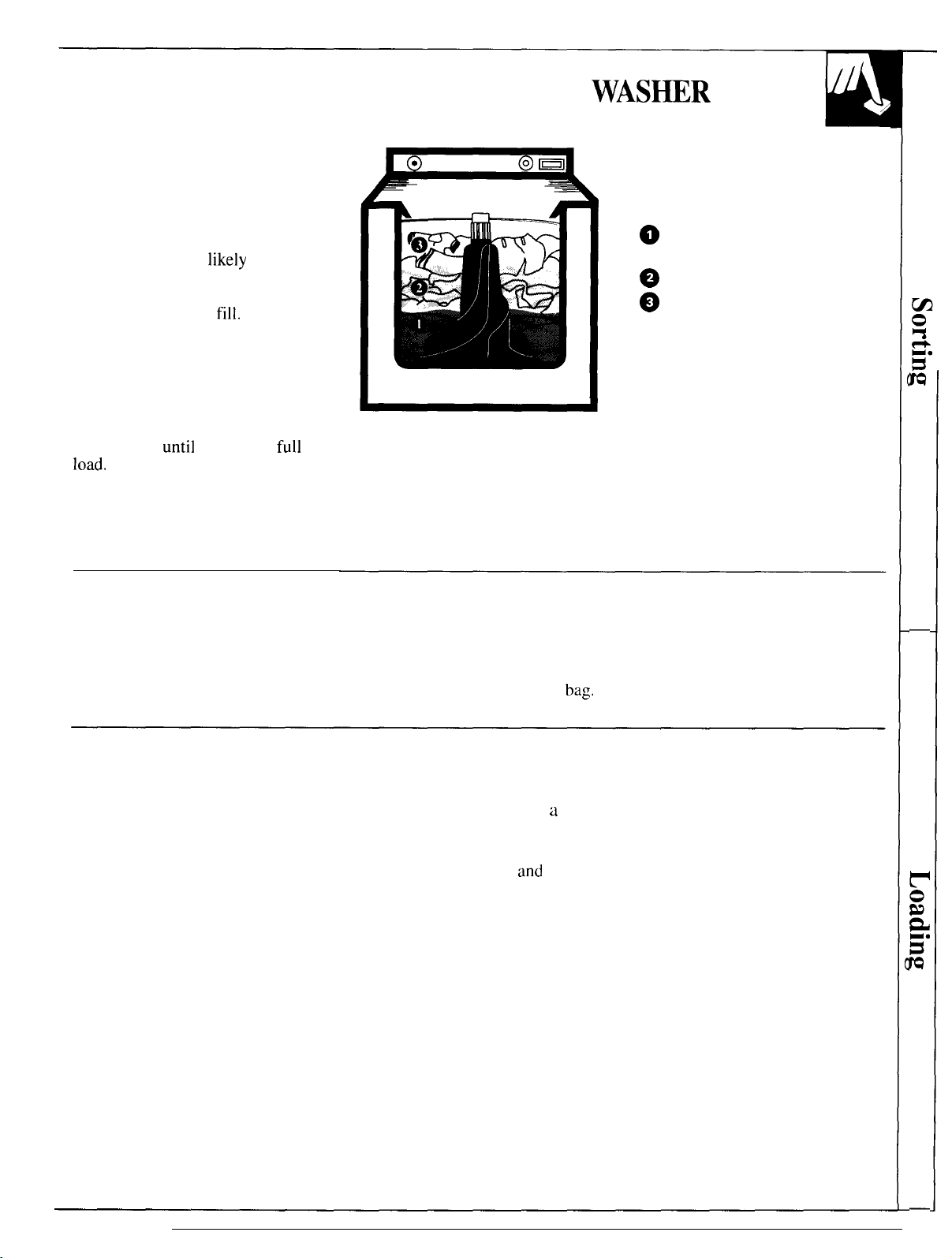
HOW TO LOAD YOUR
WASmR
This illustration, with clothes just
reaching the Filter Ring, shows a
proper load. Clothes have ample
room to move because they are not
packed down, nor wrapped around
the agitator. Clothes are loaded dry
since wet items are
likely
to pack
down which encourages
overloading. This size load
requires a full water
fill.
What is the best size load of
clothes—large, medium, or
small? Save time, energy and
detergent by avoiding extra use of
the washer. Try to wash a full load
of clothes. If you can it is better to
save clothes
until
you have a
full
load.
If you must wash smaller
loads, save water, energy and
detergent by adjusting the water
level for the size of the load. See
Operating Instructions.
●
Load clothes dry.
● Take a properly sorted group of
clothes and drop them loosely in
the wash basket in this order:
~
Large Items–like sheets. Do
not wrap around the agitator.
~
Small Items—like washcloths.
~
Medium Size Items–like
towels.
To Add Items After the Washer Has Started
● Turn off the washer.
NOTE: When washing stockings, panty hose and
● Add any additional articles by
other easily tangled items, always handle separately.
submerging them next to the agitator.
To minimize tangling, we recommend the use of a net
laundry
bag.
Special Recommendations for Washing Permanent Press If You Do Not Have a Dryer
If you are machine-washing Permanent Press clothes ● Use more water than you would for a regular load.
that you plan to line dry or drip-dry, use extra care to Use
a
Medium Water Level for a Small Load; a
minimize wrinkling in the wash process:
High Water Level for a Medium Load.
● Be careful not to overload washer. Permanent Press
● Remove clothes promptly as soon as washer stops
clothes must have ample room to move freely. A
and
hang immediately.
Medium size Permanent Press load is the largest that
should be washed.
9
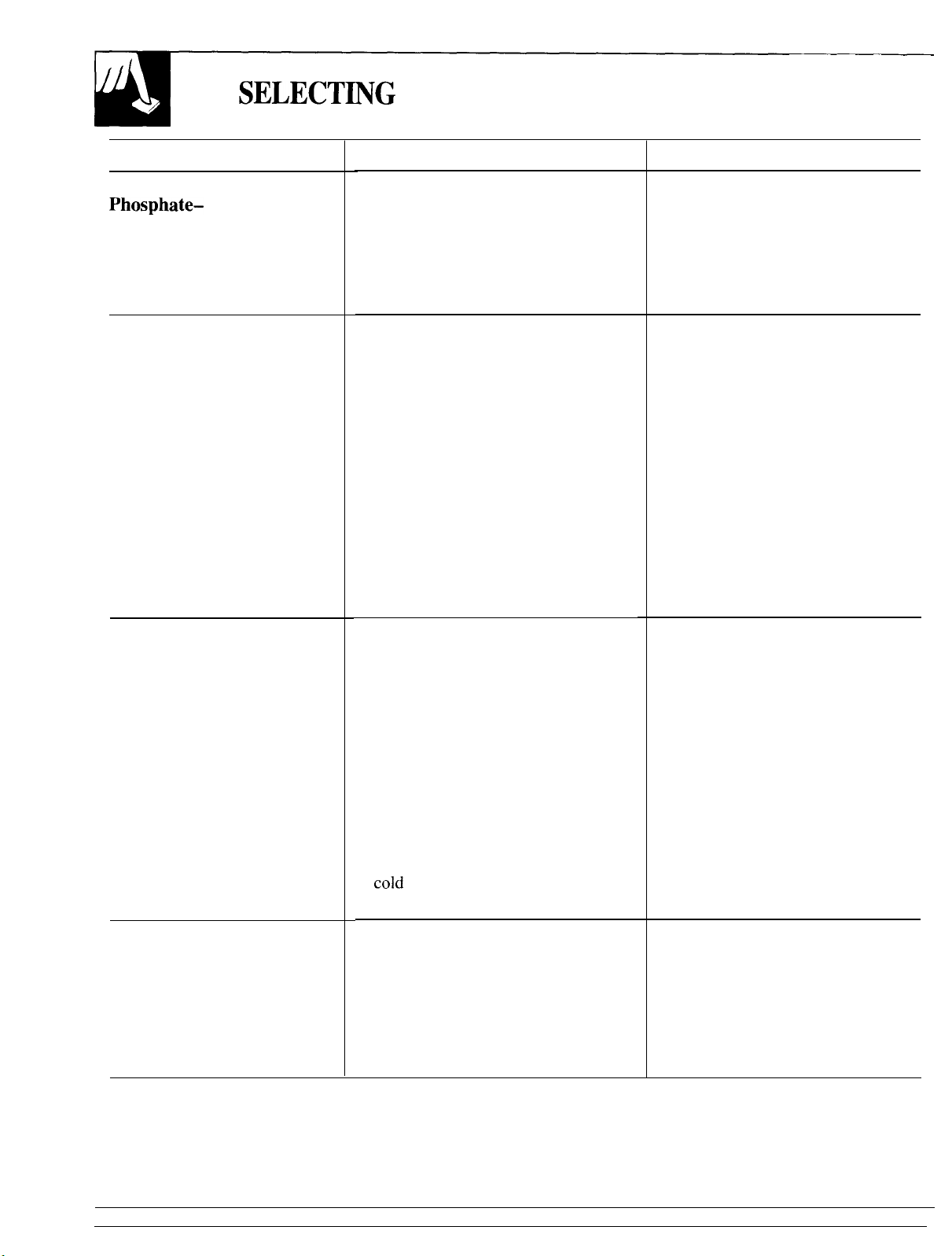
SELECTmG
DETERGENTS AND SOAP
Products
Phosphate–
Powdered Detergents
Non-Phosphate-
Powdered Detergents
Liquid Detergents
Soaps
Advantages
Perform well in hard or soft water.
Wash all types of fabrics well.
Can be used in hot, warm, or
cold water.
Perform satisfactorily in soft
or moderately hard water.
In some areas only non-phosphate
products are available.
Perform well in soft water.
Offer better performance in
hard water than powdered
non-phosphate types.
Clean synthetics and fabric
blends well.
Are excellent as concentrates
for removing spots.
Completely dissolve even in
cold
water.
Perform well in soft water.
Disadvantages
Are not available in some areas.
Generally do not clean well in
hard water.
May be difficult to dissolve,
especially in cold water.
Should not be used in cold water.
Those containing sodium
carbonate as an ingredient may
cause harmful limestone deposits
on clothes and washer when
combined with hard water.
(See Detergents section.)
May not perform as well as
powdered phosphate products
when diluted in wash water.
Generally do not clean well in
medium-hard or hard water.
May combine with water
hardness minerals to form
sticky soap curd.
10
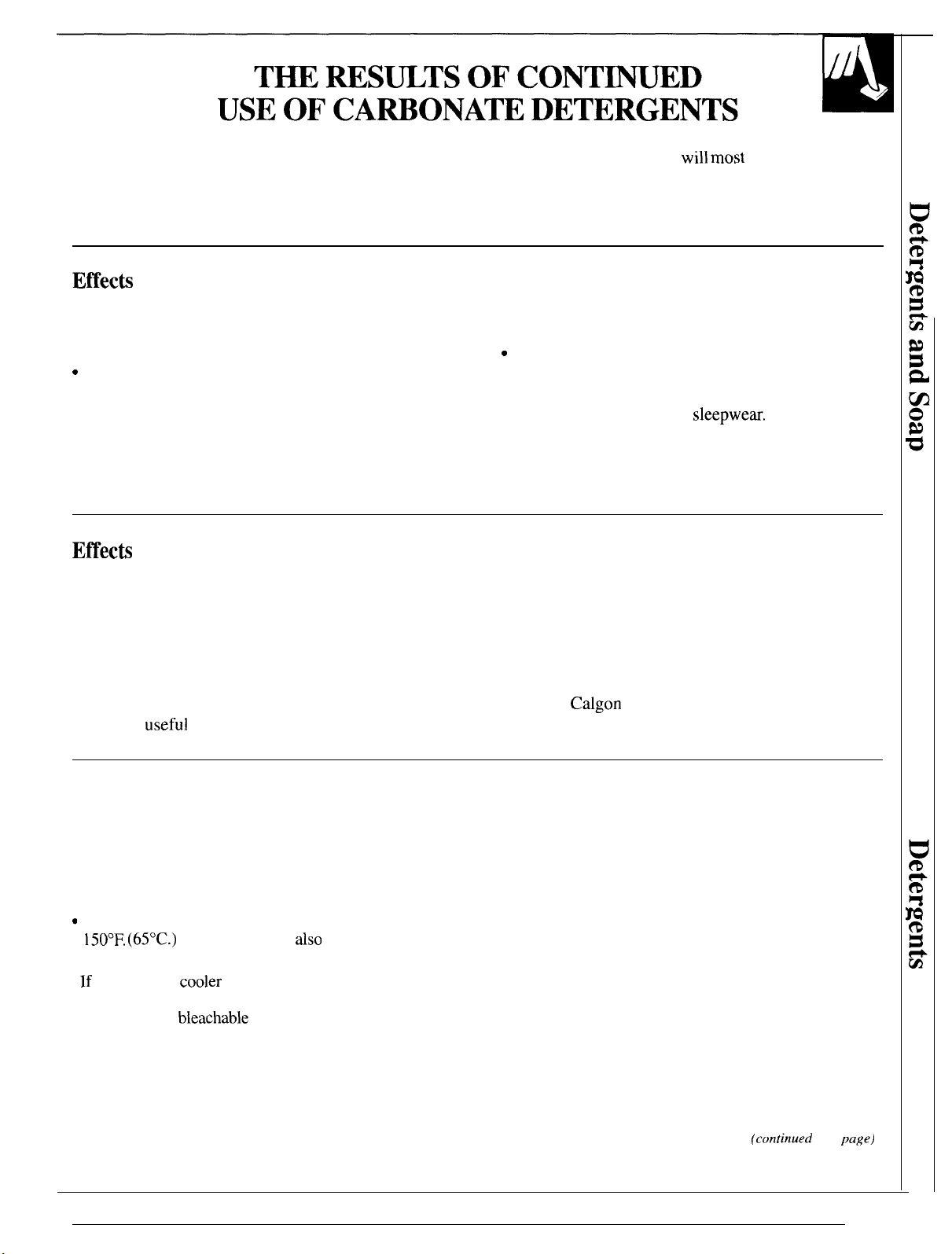
Is your water hard? If it is, and if you use a carbonate type non-phosphate detergent, you
will
most probably notice
limestone* deposits on your clothes and washer surfaces. The hardness of your water and your washing frequency
will determine how rapidly the limestone will build up. If your water is VERY HARD (11 or more grains) and if you
wash just a few loads a week, you may see limestone buildup in just a few months.
Effec@
on Clothes
Although limestone buildup occurs more rapidly on
cotton, it will eventually affect various fabrics in the
following ways:
“
Gives a stiff, harsh, rough feel to fabrics such
as toweling.
● Causes colors to fade and become dull and dingy.
● Causes graying of fabrics.
● Leaves a white, powdery residue on
dark-colored items.
● Causes spot-fading of bright colors as a result of
direct contact with detergent.
“
Reduces wrinkle-resistance of permanent
press fabrics.
● Destroys effectiveness of flame-retardant finishes on
cottons such as children’s
sleepwear.
● Increases fabric wear because of the scrubbing action
between limestone deposits on the fabrics during
washer agitation.
Effecfi
on Washer
● Unsightly buildup on all washer surfaces exposed to
the wash solution.
● Mat-like, crusty formations caused by lint adhering
to the sticky limestone deposits.
● Increased service calls because of limestone deposits
in the pump, recirculation water hoses, filters and
other washer parts.
● Reduced
useful
life of washer.
Recommended Methods to Reduce
Limestone Buildup
● Use a powdered phosphate detergent or a liquid
detergent if these are available in your area.
● Install a home water softener. This will significantly
reduce limestone buildup.
● Use a packaged non-precipitating water softener,
such as
Calgon
brand with phosphate.
Good Washing Practices May Delay Limestone Damage to Clothes
The following recommendations will temporarily delay
the effects of limestone on your clothes. These are
generally good washing practices and will give better
soil removal whether or not you have hard water or use
carbonate detergent.
Q
Use hotter wash water, for example up to
150°F.
(65°C.)
for cottons. This
dso
improves
oily-soil removal.
●
If you wash in
cooler
water to save energy, use more
detergent to promote better washing. Also be sure to
use bleach on
bleachable
fabrics. Use hot water
whenever possible.
●
Add detergent and allow washer to fill and
agitate for 3 or 4 minutes to dissolve detergent
before adding clothes.
●
Increase amount of detergent. See guide on opposite
page for recommended detergent amounts in relation
to water hardness.
●
Increase use of bleaches, presoaks, packaged water
conditioners, prewash soil and stain removers to help
in removing stubborn soils and stains.
●
Use greater care in sorting loads. Wash very dirty
loads separately and increase detergent to help keep
dirt from redepositing on less soiled items. Wash
delicate items separately to prevent damage from
heavy, sturdy clothes.
●
Wash smaller loads to increase cleaning action
of washer.
●
Use fabric softener to counteract stiffness or harshness
in clothes.
*LIMESTONE–technically called CALCIUM CARBONATE–is caused by the
reaction of the calcium in the hard water with the sodium carbonate in the detergent.
(c<]ntinued
next page)
11
THE RESULTS OF
CONTmUED
USE OF
CAmONATE
DETERGENTS
(continued)
How to Partially Restore Clothes
Once clothes have developed limestone deposits, they
may be partially restored by soaking in a solution
of
2
CAUTIONS:
cups (480 ml) of vinegar in I
gallon
(3.8
liters) of hot tap
water
for
15 minutes, USE A PLASTIC CONTAINER.
● Do not use vinegar soak solution in washer.
Then wash clothes in the washer using detergent.
The acidic action of the vinegar may damage
the porcelain.
● Vinegar soak solution may reduce the
wrinkle-resistance of permanent press fabrics.
c
Vinegar soak may damage the dyes in some fabrics.
HOW MUCH DETERGENT SHOULD YOU USE?
The use of a sufficient amount of detergent is 1 of the most
important things you can do to make
sure
your wash comes out clean.
Amount required varies
according to:
1. Water hardness
2. Amount of soil
3. Size of load
4. Type
of detergent
5. Wash temperature
Use more detergent if you have...
1. Hard water
2. Large loads
3. Greasy or oily soils
4. Lower wash temperature
5. Low phosphate detergent
If
the recommended amount of
detergent produces too many suds,
switch to a low
sudsing
detergent
brand, and follow instructions
on package.
Using too little
detergent is a
common cause
of laundry
problems. Always
+
measure detergent
w
—
in a standard measuring cup.
How to use detergent—
granular or powdered:
For best results, add detergent
to the wash basket before loading
clothes. If you load your clothes
first, add detergent next to
the agitator.
If your detergent doesn’t dissolve
well,
predissolve
the detergent in
hot water, then pour directly into
the wash basket.
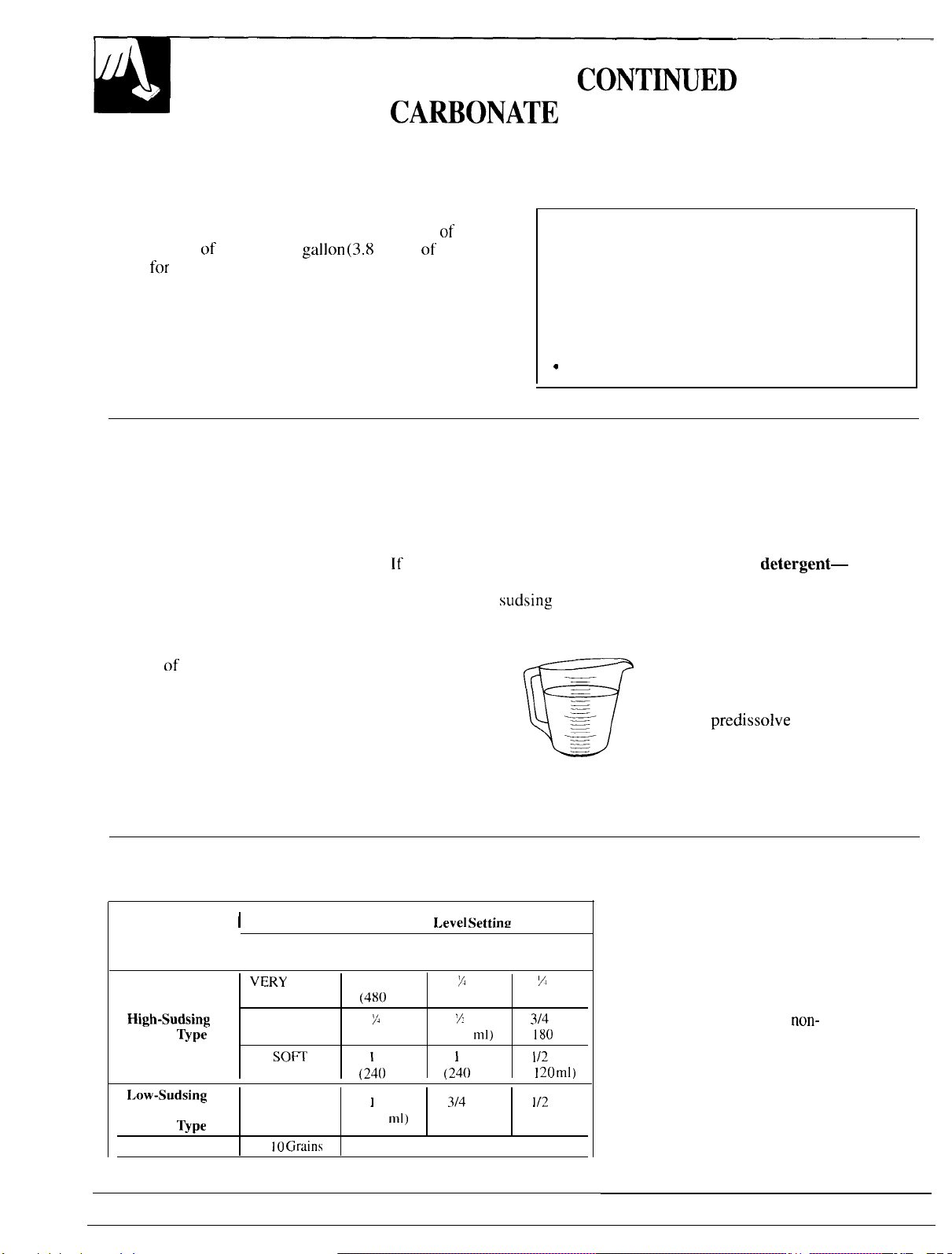
Recommended Amount of Detergent for Average Soil Load
I
I
Water
I.evel
Settinz
I
I
I
I
Water
Hardness
High
Medium
Low
VERY
HARD
2 cups
1
x
cups
I x cups
10-20 Grains
(480
ml)
(420 ml) (300 ml)
High-Sudsing
HARD
1
x
cups
I
X
cups
314
cup
Powder
~pe
4-10
Grains
(420 ml)
(360
1111)
(
180
ml)
Som
1
cup
i
cup
1/2
cup
0-4 Grains
(240
ml)
(240
ml)
(
1
~~
ml)
I.ow-Sudsing
Concentrated
()- 10
Grains
1
cup
314
cup
1/2
cup
Powder
~pe
(240
1111)
( IX() ml)
( 120 ml)
LIQUID
()-
10
Grains
FOLLOW PACKAGE DIRECTIONS
12
1. Use recommended amount
of detergent for your load
and water hardness as
shown in guide at left.
2. When using other detergent
types—low and normal suds,
powders, liquids,
non-
phosphate powders—follow
directions on package.
3. For hard water treatment,
see Hard Water Guide.
Before you can decide what to do about hard
water, you need to know if you have it and, if
so, how hard it is.
● If you live in a municipal area, contact your
water company.
● If you live in a rural area, or in some suburban areas,
contact your county agent.
The answer will be “you have ‘so many grains’ per
gallon (3.8 liters)” and means this:
O to 3 grains per gallon (3.8
liters)—SOFT
4 to 10 grains—HARD
11 to 19 grains—VERY HARD
20 grains and over—EXTREMELY HARD
[f
your water is SOFT, you have no problem. You
can use soap or detergent as you prefer and forget
all about hard water. If you have HARD water—less
than 10 grains—and you use phosphate detergent,
you also have no problem.
But, if you have more than 10 grains, you will need
to soften your water with either . . .
1. An installed water softener in your home, or
2.
The use
of
a packaged water softener.
For information on water softeners, see the
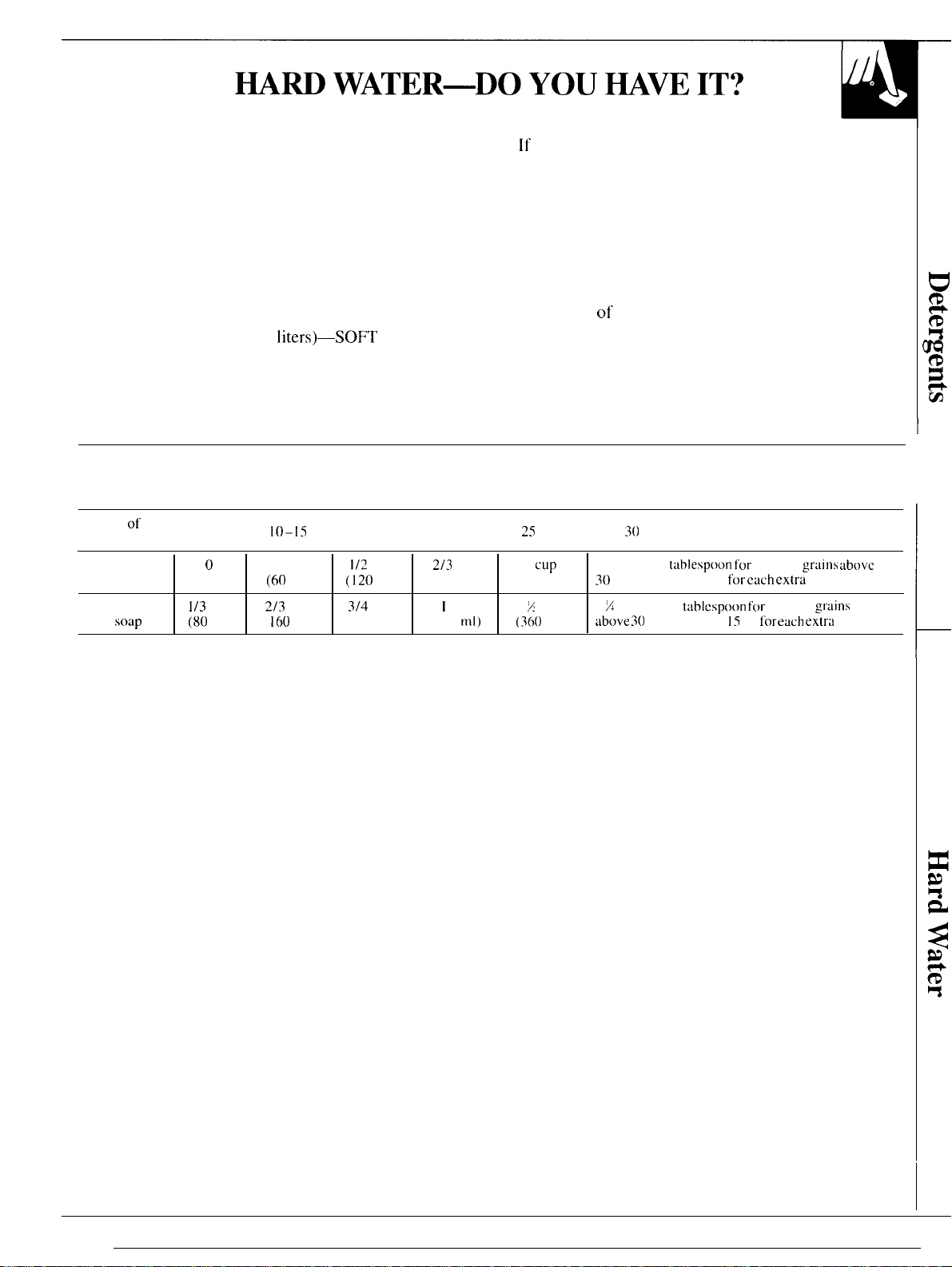
guide below.
I
Add This Much Water Softener with a Full Water Level
I
I
I
I I
I
Grains of
hardness
o-1o 10-15 15-20 20-25
25
–30 river
30
When using
o
1/4 cup
1/2
cup
213
cup I
cup
I cup plus I
ttiblespoon
f’ur
every 5
grains
~bovc
with detergent
(60
ml)
(120
ml)
(160 ml) (240 ml)
30
(240 ml plus 15 ml
for
each
extra 5 grains)
When using
1/3
cup
2/3
cup
3/4
cup
1
cup
I
x
cups
I
Z
cups plus I
tablcspo(m
for
every 5
grains
with
soap
(80
ml)
(
160
ml) (180 ml)
(240
1111)
(3(>()
[111)
abuve
30
(300” ml plus
15
ml
l(>r
each
extm 5 groins)
I
13
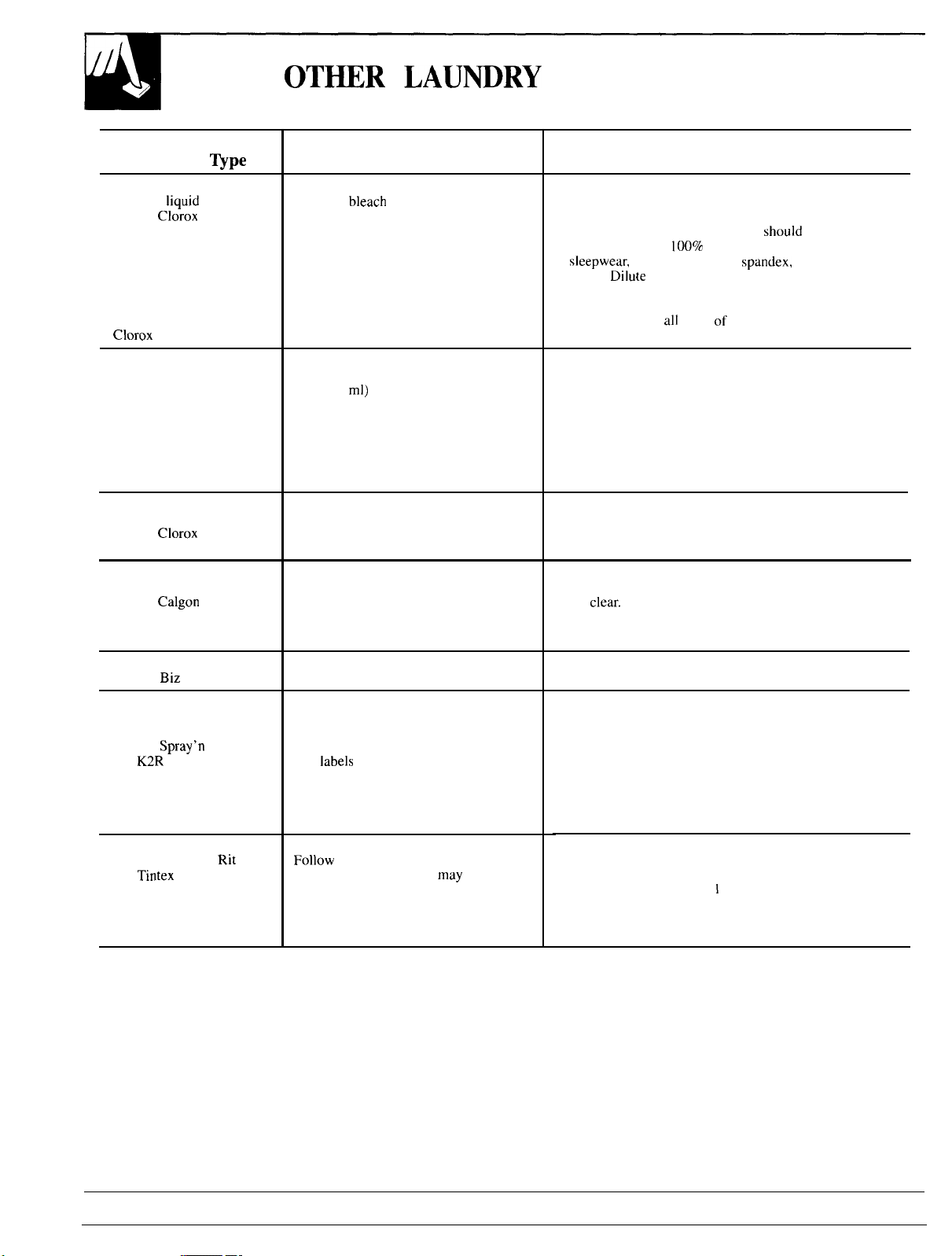
OT~R
LAU~RY
PRODUCTS
Laundry
Product and
~pe
BLEACH
Chlorine
liquid
such as
Clorox
brand
Non-chlorine such as
Clorox
2 brand
FABRIC SOFTENERS
Rinse additive such as
Downy Brand
Wash additive such as
Rain Barrel brand
SANITIZER
Chlorine bleach
such as
Clorox
brand
WATER SOFTENER
Non-precipitating
such as
Calgon
brand
Precipitating such as
Borax brand
SOAK AGENT
Such as
Biz
brand
PRETREATING,
STAIN AND
SPOT REMOVERS
Such as
Spray’n
Wash
and
K2R
brands
TINTS AND DYES
Powdered such as Rit
and
Tintex
brands
How to Use it
Use your
bleach
dispenser.
See How to Use Your Bleach
Dispenser section.
Follow package directions.
Put bleach into washer with detergent.
Mix recommended amount with one
cup (240
ml)
water and add at start of
rinse cycle.
Follow package directions.
Add during wash cycle.
Use in case of infection and
contagious disease.
See under Bleach above.
Follow package directions.
Add at start of wash cycle.
Follow package directions.
Use with detergent or soap in wash cycle.
Follow package directions
Follow package directions. Treat only
heavily soiled areas. Check garments’
care
labels
for instructions.
Follow
package directions.
NOTE: Tinted garments
may
not be
colorfast. Wash separately.
Special Instructions
1) Do not pour undiluted liquid chlorine bleach directly into
washer or on dry clothes.
2) Some of today’s washable fabrics
should
not be chlorine
bleached such as:
100%
cotton flame-retardant children’s
sleepwear,
silk, wool, mohair,
spandex,
leather, or non-fast
colors.
Dilute
bleach before using on any fabric.
3) Check Manufacturers’ Care Labels for special
instructions.
1) May be used on
all
kinds of fabrics.
2) Is most effective in hot water.
1) Helps make clothes fluffy and soft.
2) Reduces static electricity.
3) Use carefully. Too much may cause staining on
some clothes.
4) Do not pour directly on clothes.
5) For those recommended for adding to the wash cycle,
such as Rain Barrel brand, follow manufacturer’s
instructions exactly.
Guards against infection by killing most bacteria and
viruses.
Suspends hardness minerals in solution, keeping
water
clear.
Combines with water hardness minerals to form precipitate
which gives cloudy or milky appearance to water.
CAUTION: Washer control panels and finishes may be
damaged by some laundry pretreatment soil and stain
remover products if such products are sprayed on or have
direct contact with the washer. Apply these pretreatment
products away from washer. The fabric may then be washed
normally. Damage to your washer caused by pretreatment
products is not covered by your warranty.
Clean washer to avoid discoloration of next load. Go
through complete cycle (5-minute wash) using hot water,
1/2 cup (120 ml) detergent,
1
cup (240 ml) bleach. Wipe
exterior parts. Caution: Tinting may discolor plastic in
washer. Subsequent washings will reduce discoloration
but may never eliminate it.
14
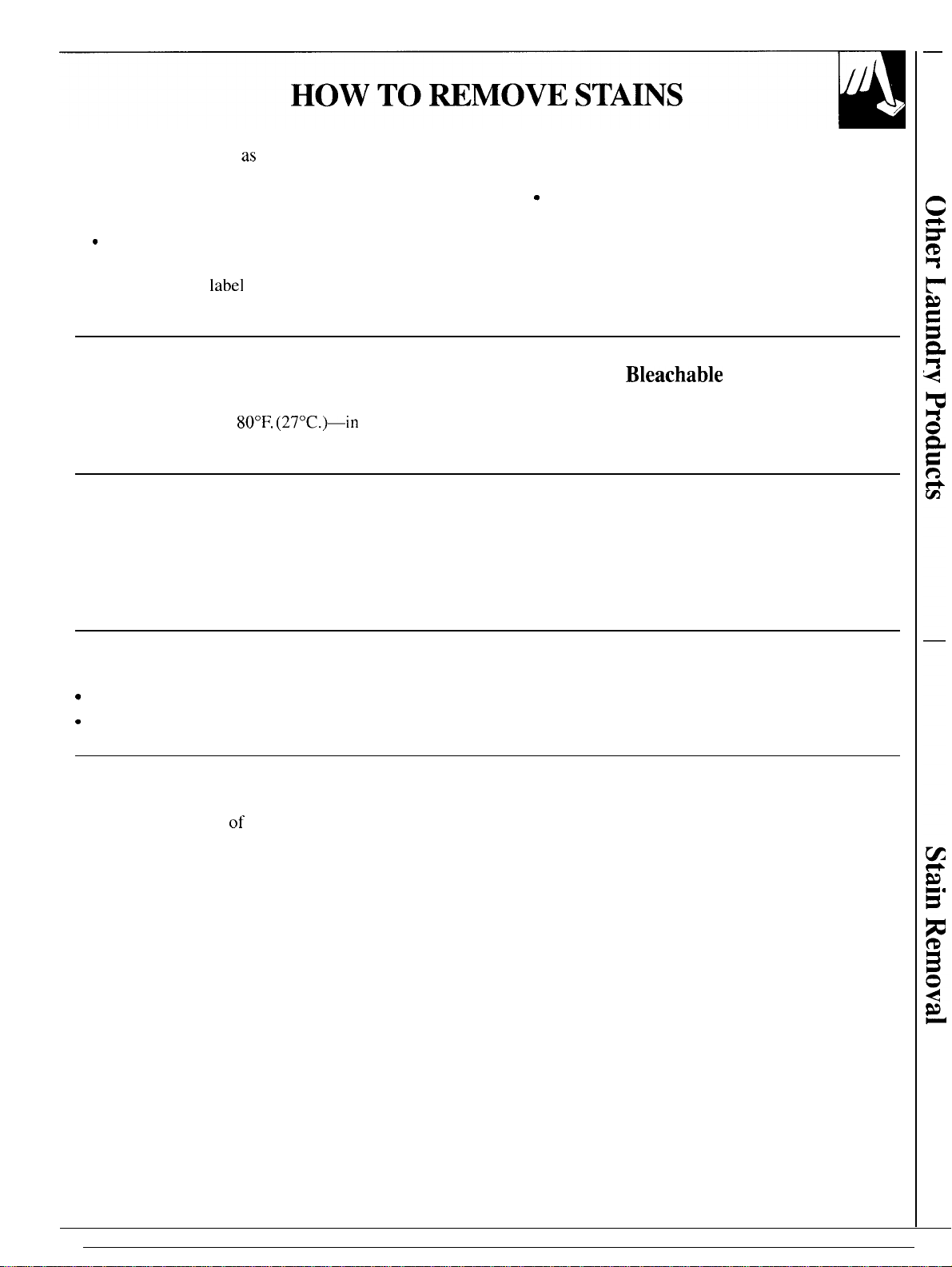
1. Try to remove stains
as
soon as possible. The
● Test stain removal product on a hidden inside
fresher the stain, the easier it is to remove.
seam or on a sample of the material.
2. Before attempting to remove any stain, take
“
Avoid use of hot water on unknown stains. It
these steps:
can set some stains.
s
Find the fabric and the finish in the chart on the 3. Follow stain removal with a thorough rinsing.
next page, and use only recommended methods.
4. Wash with recommended amount of soap or
● Check the care
label
instructions that came with
detergent.
the garment.
Stain Removal Hint—Using Chlorine Bleach for White and
Bleachable
Fabrics
Mix 1/4 cup (60 ml) chlorine bleach with one gallon (3.8 liters) of cool
water—approximately
80°F.
(27°C.)—in
a sink or pan. Soak stained area
for 5 minutes and launder in washer.
The Case of the “Invisible” Stain
Food or cooking oils on your synthetic garments
If these stains are not completely removed in the wash,
may cause stains which are virtually invisible and
the oily spots may pick up dirt from the wash water.
which you may not notice as you put your clothes
Then they will become very visible and you may think
into the washer.
they were caused by the wash cycle itself.
Once These Spots Become Visible, How Can You Remove Them?
Q
Rub in undiluted liquid detergent and let stand 30 minutes.
c
Rewash using hottest water the fabric can stand.
How Can You Prevent These “After-You-Wash” Stains?
● Increase the amount of detergent normally used.
● Increase water temperature where fabric will permit.
● Wash synthetic garments more often.
● See Stain Removal Guide next page.
15
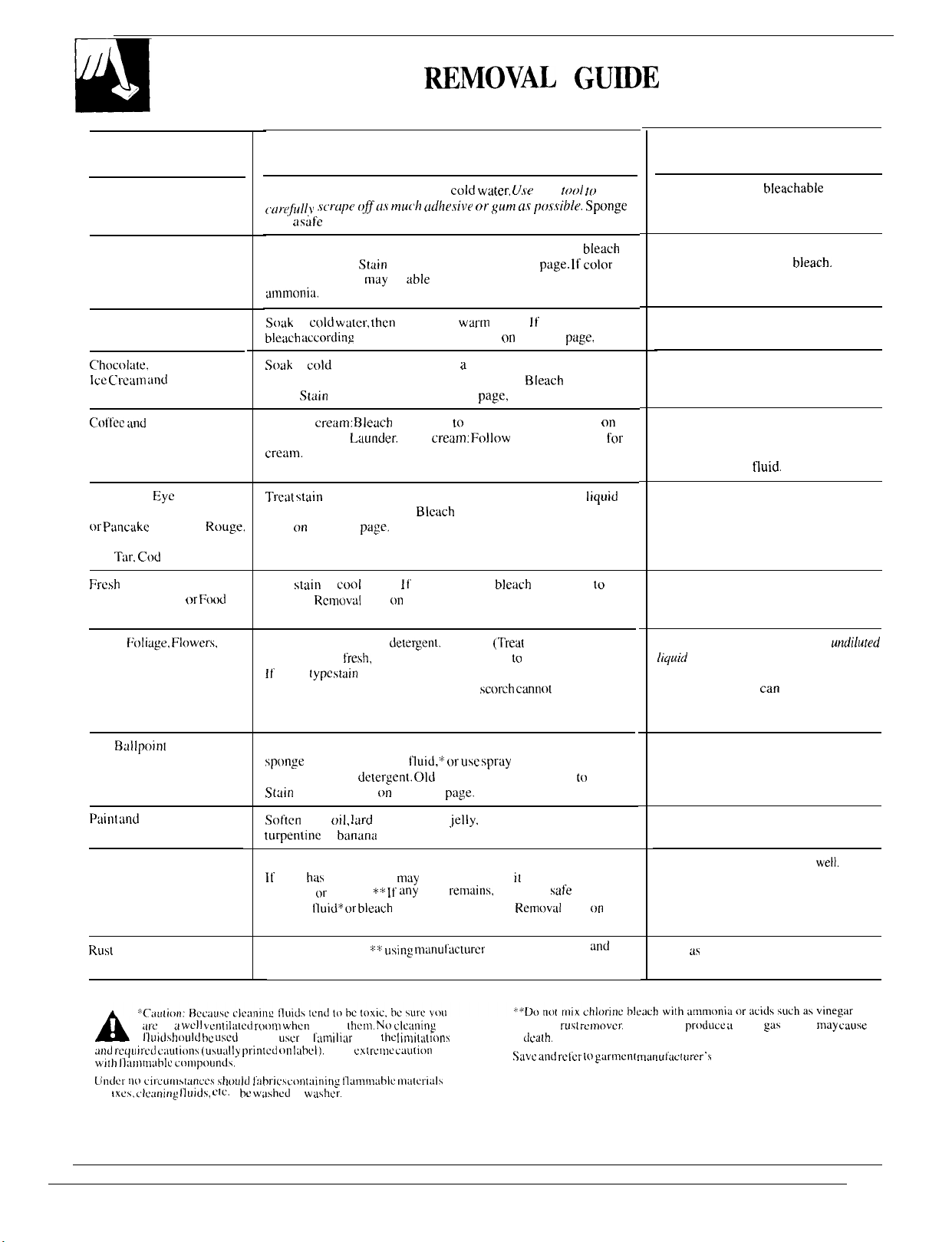
STAIN
~MOVAL
GU~E
Stain
Adhesives
(Chewing Gum. etc.)
Antiperspirants,
Deodorants
Blood”
Chocolate.
Cream.
Ice
Cream
and
Milk
Cultec
and
Tea
Cosmetics:
Eye
Shadow,
Lipstick, Mascara. Liquid
or
Pancake
Makeup. Rouge
Powder; Crayon; Grease,
Oil,
Ttir,
Cod
Liver Oil
Fresh
Fruit, Fruit Juices.
Wine. Vegetables
or
Food
Coloring
Grass,
Foliage.
Fk]wers.
Mildew. Scorch
Ink.
Btillpoint
Ptiin[
~nd
Varnish
Perspiration
Rust
White and Bleachable Fabrics
See Controls Setting Guide.
Rub with ice or immerse in very
cold
water.
U.\e
dull
t~)~~l
r(~
~lIre/ull?l
.scrul>e
ofl~i,v
much
c[dhesiv(’
or
gum
(1T
[]o.s.sible.
Sponge
with
a
safe dry cleaning fluid, * then launder.
Apply undiluted liquid detergent. Rinse. If stain remains,
bleach
according to the
Stain
Removal Hint on opposite
page.
If color
has changed, you
may
be able to restore it by sponging with
~mmonia.
**: Rinse thoroughly
Sotk in
cold
wtiter,
thcrr
launder in
wtirm
water.
If
stain remains,
bleach accordinx to the Stain Removal Hint
on
opposite
page,
launder
Soak
in cold water. Treat stain with
a
safe dry cleaning fluid*;
Apply undiluted liquid detergent, launder, dry.
Bleach
according
to the
Stain
Removal Hint on opposite
page,
launder and dry.
Without
cream:
Ble~ch
according
to
the Stain Removal Hint
on
opposite page.
L~under.
With
cream:
Follow
guide directions
for
cream.
Treat
stain
with safe dry cleaning fluid.* Apply undiluted
liquid
detergent; launder and dry.
Bleach
according to the Stain Removal
Hint
on
opposite
page.
Soak
stain
in
cool
water.
If”
stain remains,
bleach
according
to
the Stain
Rcmoval
Hint
un
opposite page. launder.
Apply undiluted liquid
detergenl.
Launder.
(Treat
mildew spots
while they arc
fresh,
before mold has a chance
to
weaken fabric.)
[f either
[ypc
stain
remains, bleach according to the Stain Removal
Hint on opposite page, launder. (Severe
scorch
cannot
be removed)
Fresh stains: Place stain face down on an absorbent towel and
sponge
with dry cleaning
fluid,:<
or
use
spray
cleaner, Apply
undiluted liquid
de[ergent.
Old
stains: Bleach according
tu
the
Stain
Removal Hint
on
opposite
page.
Soften
with
oil.
!ard
or petroleum jelly. then sponge with
turperrline
or
btintina
oil. Launder in warm water.
Apply undiluted liquid detergent and launder in warm water.
If color
has
changed you
m~y
be able to restore
i[
by treating with
ammonia
or
vinegar.
**
If
any
stain
remains,
treat with
safe
dry
cleaning
lluid*
or
bleach
according to the Stain
Removal
Hint
(m
opposite page. launder and dry.
Apply rust remove]-,
~+:
using
,nLinutacturcr,
s directions, Rinse
lnd
launder.
Other Washable Fabrics
Same as white and
b[eachable
fabrics.
Same as white and bleachable fabrics
except use non-chlorine
bleacb.
Sponge or soak in COOI water, then
launder.
Soak in cold water. Sponge with a safe
cleaning fluid. * Apply undiluted liquid
detergent. Launder in warm water.
Sponge with warm water. If stain remains,
apply warm glycerine, let stand 30
minutes and rinse well, or sponge with a
safe dry cleaning tluid. * Launder.
Sponge with a safe dry cleaning fluid.*
Then launder in warm detergent water.
Sponge with warm water. Bleach remaining
stain with non-chlorine bleach.
Sponge with warm water. Apply
undi[uted
liquid
detergent.
Bleach remaining stain
with non-chlorine bleach, then launder.
Old mildew stains
can
seldom be
removed. Scorch can seldom
be removed.
Same as white and bleachable fabrics
except launder using non-chlorine bleach.
Same as white and bleachable fabrics
Launder in warm water. Rinse
well.
Bleach
with non-chlorine bleach.
Same
is
white and bleachable fabrics.
A
;II.C
in
a
WC]!
\,en!ila[eci
rut)nl
when
using
(hcm.
No
clc:uling
and/or
rust
remover.
Mixing can
produce
J
toxic
gas
which
Inay
cause
IIuil]
shnu][!
hc
USCII
unless
user
is
I:lmiliar
with
ihc
limil~~ti(lns clc~[h.
Jnd
rcquit-c(]
c;iulions
(u~ually
prinlcd
on
lahcl).
Use
cxtrcmc
c~tu(ion
with
I“la]nnlahlc
ct>nlpounds.
Sti\e
and
rclir
to
g~mren[
rnarrutacfurer’s
care labels.
Ljn[lcr
no
Cilcunlsltinccs
sh~)ukt
f“:lbrics
LOJ)[:lini[lg
flanltn~iblc
llltllC[lalS
(W:
IXCS.
cleaning
Iluids,
CIC.
)
bc
washed
in
w:lshcr.
16
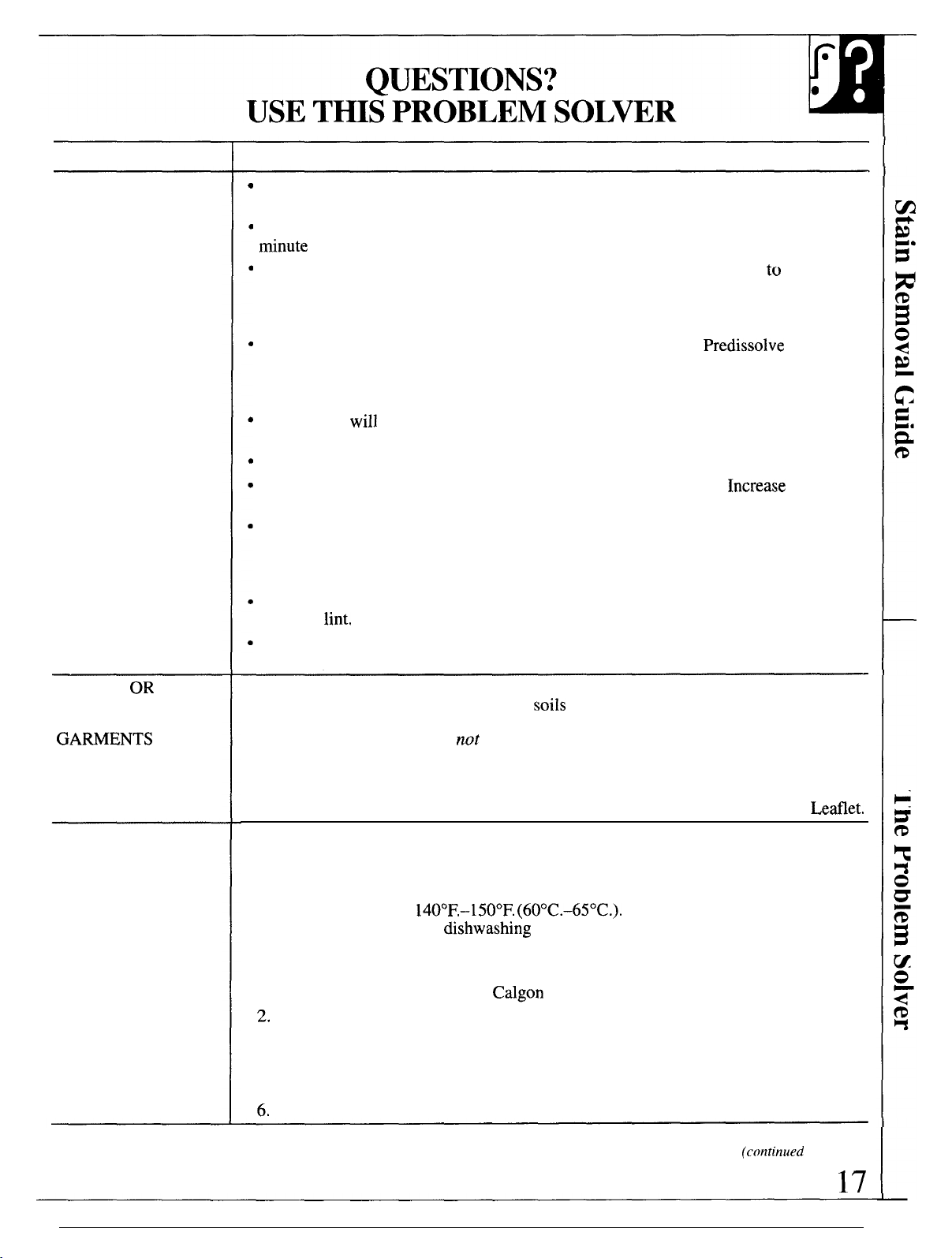
PROBLEM
LINT OR RESIDUE
ON CLOTHES
GREASY
OR
OILY
STAINS ON
LAUNDERED
GAWENTS
GRAYED CLOTHES
POSSIBLE CAUSE
“
Incorrect
sorting of clothes. Separate lint producers (such as terry towels and
chenille) from lint receivers
(such as man-made fabrics, velveteen, corduroy).
Washing too long, especially for smaller loads. For normal soil, wash 1
minute
per pound of dry clothes.
Use of non-phosphate detergents which combine with hardness minerals
to
form a precipitate which can be mistaken for lint. Use a phosphate or liquid
detergent; use warmer wash water or soften water with an installed mechanical
softener or a packaged water softener.
Powdery residue from granular detergent may appear to be lint.
Predissolve
granular detergent in hot water before adding to washer; make sure detergent is
completely dissolved before adding clothes; switch to liquid or cold water
detergent or use warmer wash water. See Detergent Guide.
Overloading
wilI
cause abrasion which creates excessive lint. Wash fewer items
with correct water level.
Too much bleach. Use correct amount of bleach according to package directions.
Not enough detergent to hold lint in suspension during wash cycle.
Increase
amount of detergent. See Detergent Guide.
Incorrect use of fabric softener. If used in wash cycle, softeners may react with
detergent to create a white deposit. Use softeners in rinse cycle only unless
package specifies adding to wash cycle. Use Fabric Softener Dispenser (if your
washer is so equipped). See Operating Instructions Leaflet.
Pilling usually on polyester-cotton blends is caused by normal wear and may
look like
lint,
Turning clothes inside-out may provide some help.
Static electricity caused by overdying will cause attraction. Use fabric softener
in rinse cycle.
These are sometimes called “Invisible Stains” because you may not notice them
before washing clothes. However, if oily
soiIs
are not completely removed in
wash cycle, the oily spots may pick up dirt from the wash water. The spots will
then be very visible. They are
not
caused by the washer. Wash synthetic garments
as soon as possible after wearing. Use more detergent than normal and hottest
water fabric can stand. If spots appear, rub in undiluted liquid detergent, let stand
30 minutes and rewash with extra detergent using hottest water fabric can stand. Use
Extra Cleaning cycle (if your washer is so equipped). See Operating Instructions
Letiet.
● Insufficient detergent. You may need to increase amount of detergent used if load
is larger than normal, if soils are oily or heavier than average, if water level is
large or if water is Hard to Extremely Hard.
● Water not hot enough for type of load. Be sure water heater is set to deliver hot
water to the washer at
140°F.–1500F.
(60°C.–650C.).
Do not wash when other
hot water needs—such as
dishwashing
or family baths-are heavy.
● Poor or inferior detergent. Change to phosphate detergent, if possible. Follow
these steps:
1. Use water conditioner (such as
Calgon
brand).
2,
Pretreat stains.
3. Use the hottest water possible.
4. Use bleach where possible.
5. Use presoak aids.
6.
Install water softener.
(cc)ntinued
next page)
17
THE PROBLEM SOLVER
(continued)
PROBLEM
GRAYED CLOTHES
(continued)
YELLOWED
CLOTHES
POSSIBLE CAUSE
● Washer overloaded. Clothes cannot move freely to loosen and remove soil,
causing gray appearance. Follow correct loading procedures for size of
load.
● Improper soaking with insufficient detergent. Usually a 30-minute soak is
sufficient. However, when using extended
soaks
for
heaviIy
soiIed
garments,
you may need to use twice the recommended amount of detergent.
● Use of soap in hard water. Switch to a phosphate detergent, or follow 6 steps
at bottom of previous page.
● Washing too long may result in increased soil deposition. Use shorter wash
times for smaller loads.
● Detergent dissolves too slowly. Detergent must be present in the wash solution
at the start of agitation. See Detergent, Other Additives section.
● To restore grayed clothes, follow one of these procedures:
1.
2.
3.
4.
Put clothes in washer. Fill with HOT water. Check Manufacturer’s Care
Labels to determine if hot water is suitable for garment.
● Add a non-precipitating type of water softener such as
Calgon
brand with
phosphate—use
2X
times as much as you need for normal water softening.
● Do not use detergent or soap.
● Allow clothes to go through complete cycle.
● Repeat, if necessary.
If you prefer to use the Soak Cycle (if your washer is so equipped; see Operating
Instructions
Letiet).
Use water softener in place of soak agent or prewash detergent
and allow clothes to soak for about 20 minutes.
Use Extra Cleaning cycle, (if your washer is so equipped; see Operating
Instructions Leaflet).
Use
Mini-Wash@
wash system (if your washer is so equipped; see Operating
Instructions Leaflet.) Increase detergent.
● Incomplete removal of body soil due to constant use of insufficient detergent.
Check hem of T-shirt or pillow case. If they are white and center is yellow, it
contains body oil. Restore whiteness following procedures in Grayed
Clothes, above.
● Chlorine bleach may yellow some fabrics with resin finishes. Use oxygen
bleach (such as
Clorox
2 brand). Refer to Garment Manufacturer’s Care
Instructions. Restore color using color remover (such as
Rit
or
Tintex
brands),
following package directions.
● fion or manganese in water may cause overall yellowing or yellow spots.
1. Use extra detergent plus a non-precipitating water softener dissolved in water
before adding clothes. Use non-chlorine bleach.
2. Have a special filter or chemical feeder installed in your home to remove iron
and manganese from water.
3. Run hot water for a few minutes to clean iron residue buildup in lines; drain
water heater occasionally.
4.
To remove
spo~:
Spread stained portion over pan of boiling water and
squeeze lemon juice through stain.
To
remove overall yellow,
use a
commercially available rust scale remover, following package instructions. If
porcelain damage can occur, do not use in the washer; use a plastic container.
18
PROBLEM
BLW
OR GRAY
COLOR STAINS
SHR~KAGE,
GENERAL
SHRINKAGE,
KNITS
WRIN~ING
IN
PERMANENT PRESS
AND “NO-IRON”
I~MS
POSSIBLE CAUSE
Improper use of fabric softener. Never pour fabric softener directly on clothes;
always dilute before adding to rinse water. Dilute softener before filling your
Fabric Softener Dispenser. Also, do not lift lid during spin. This may cause
improper dispensing, resulting in stains. See Other Laundry Products section.
To remove stains:
Dampen stained area and rub with undiluted liquid detergent.
Rewash, using chlorine
bleach if safe for fabric.
Some fabrics will shrink whether washed in a washer or by hind; others may be
safely washed but will shrink in a dryer. Follow Garment Manufacturer’s Care
Instructions exactly. If in doubt, do not machine wash or dry.
c
Relaxation shrinkage
can occur in knit fabrics that have been improperly
stretched and elongated by the manufacturer. When this occurs, garment may
be pressed back into shape after each wash and dry cycle.
●
Progressive or delayed shrinkage
is
caused when starch or sizing (in some
fabrics) is gradually removed by laundering. This may also be noticed in older
garments that have been washed many times without previous shrinkage. Treat
as for relaxation shrinkage above.
●
Shrinkage
cawed
by overheating
occurs in certain knit fabrics that have
been heat-shaped. When washing, drying or ironing temperatures exceed the
temperatures used to shape set, shrinkage may occur. This cannot be corrected,
but it can be prevented by washing in cool or warm water and drying on Low
or Delicate heat.
●
Leaving clothes in dryer after tumbling stops. Remove and hang clothes immediately.
● Too many clothes in dryer. Dry only 1 washer load at a time. Do not combine
loads.
● Improper loads. Avoid laundering heavy Permanent Press items, such as work
clothes, with lighter Permanent Press items such as shirts or blouses. Do not
wash Permanent Press items with regular laundry.
● Too many clothes in washer. Permanent Press loads should always be smaller
than regular loads..
.no
more than medium loads to give clothes room to move
freely.
● Incorrect wash and dry cycles. Use Permanent Press Wash cycle which provides
a
cooldown
rinse to minimize wrinkling. Also use Permanent Press Dry cycle.
● Incorrect water level. Use High Water Level for Medium Load, Medium Level
for Small Load.
● Repeated washing in too hot water. Wash in cold or warm water with plenty of
detergent.
● Accumulation of lime scale due to use of carbonate detergents. If you must use
a non-phosphate detergent, avoid the use of high-carbonate-built detergent.
● Failure to use fabric softener. Proper use will minimize wrinkling.
To
remove
wrin~es:
●
Retumble
on Permanent Press setting.
●
Rerinse
and dry on Permanent Press setting.
●
If unsuccessful, retumble on high heat for 10 to 12 minutes and hang immediately.
● Send to dry cleaners for pressing.
● Some wrinties may remain which cannot be removed.
(Continued
next page)
19
THE PROBLEM SOLVER
(continued)
PROBLEM
SNAGS, HOLES,
TEARS, RIPS OR
EXCESSIVE WEAR
HEAVILY SOILED
AREAS such as
colla
WASHER WON’T
OPERA~
WATER
TEMPERATURE
IS
~CORRECT
POSSIBLE CAUSE
● Pins on garments or sharp objects left in pockets. Check to make sure all such
objects are removed. Also check wash tub.
● Snaps, hooks, sharp buttons, belt buckles, zippers. Fasten hooks, zippers and
buttons. Remove sharp buttons and belt buckles. This is especially important
in washing knits which snag easily. Turn knits inside out.
● Holes with random square shapes with yellow discoloration may be caused by
improper use of chlorine bleach. Use only correct amount of bleach, using Bleach
Dispenser, (if washer is so equipped). Never add undiluted bleach to wash tub or
allow clothes to come into contact with undiluted bleach. Do not wipe up bleach
spills with clothes.
● Chemicals such as hair bleach, dye, permanent wave solutions, battery acids
and toilet bowl cleaners may cause fabric holes. Rinse all towels and other
articles that came in contact with these chemicals before putting them in wash.
Do not contaminate clothing articles with these chemicals.
● Small, unnoticed tears may enlarge during washing process. Check garments
before washing and mend
all
rips and tears.
● As Permanent Press garments age, they may show fraying at collars and cuffs.
This is normal due to weakening of fibers by the Permanent Press process. It is
not caused by washer. You can slow this process by washing small Permanent
Press loads with a Large Water
L,evel.
Do not wash heavy items such as
towels
with Permanent Press. Remove collar stays, when possible.
● Roughness or burrs on agitator may cause rips or tears. Check agitator and file
rough spots if necessary.
● May be caused by the use of Regular Cycles for delicate articles. Use Permanent
Press Cycle. Refer to Garment Manufacturer’s Care Labels.
●
Garments weakened by age, sun or atmosphere. This is inevitable and is not caused by
washer
● Too
large
loads, or too little water. Load washer only with number of items that
will move
freely.
Select correct water level.
Pretreat with liquid detergent. Use Extra Cleaning cycle (if your washer is so
euipped).
See Operating Instruction Leaflet.
@@@@
Q
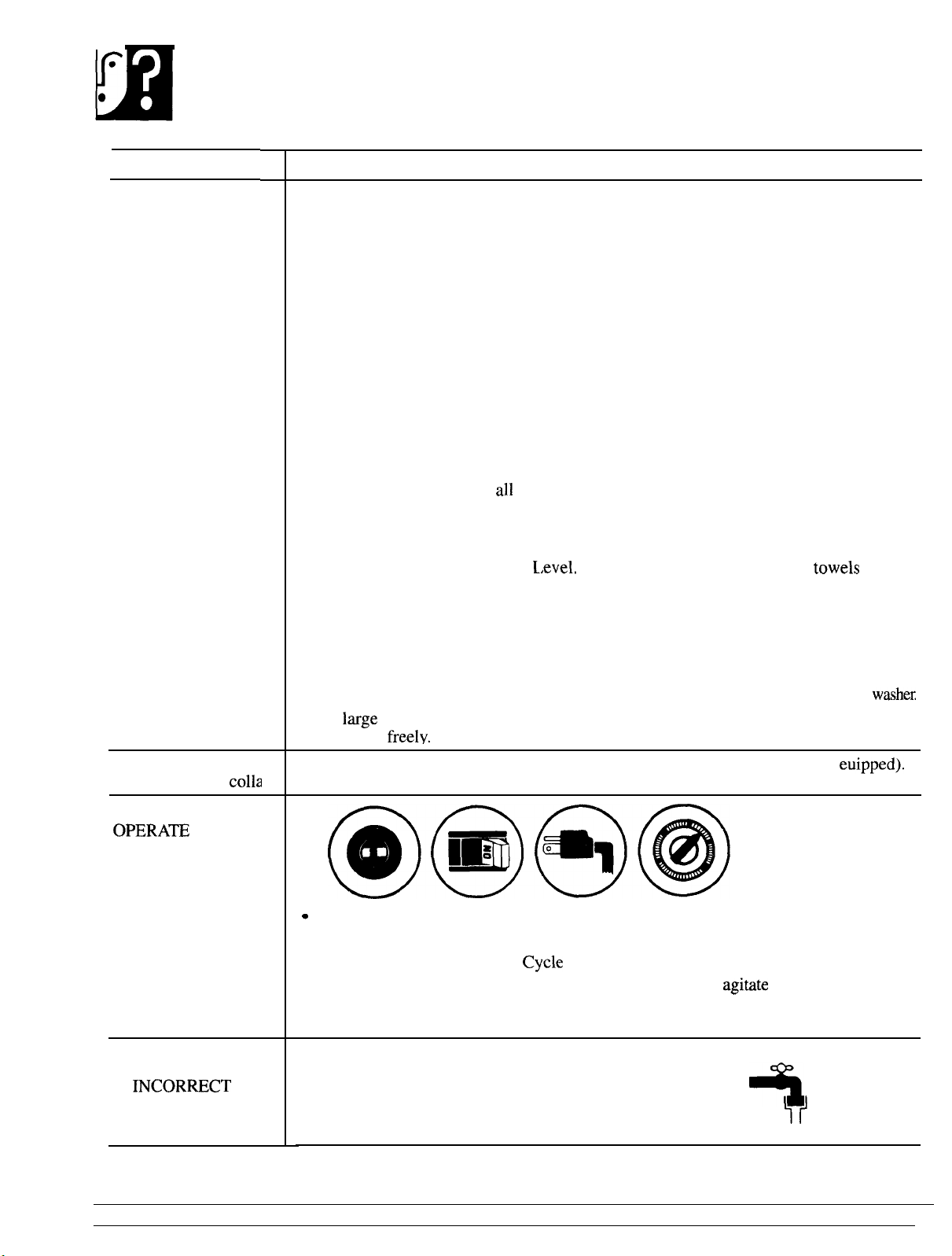
Make sure cord is plugged into outlet.
● Make sure both hot and cold faucets are turned on.
●
Make sure controls are set and Cycle Selector knob is pulled out to ON position,
●
Make sure lid is closed. Washer will fill but will not spin or
agimte
with lid open.
● Check house fuses or circuit breakers. If another appliance is sharing the
electrical outlet, remove it. Washer should have separate outlet.
● Make sure temperature selector controls are correctly set.
● Make sure hot and cold faucets are turned on and
regulated correctly.
●
Make sure hoses are connected to correct faucets . . .
hot to hot, cold to cold.
o
+
5{
20
PROBLEM
WATER
TEMPERATURE
IS INCORRECT
(continued)
W.4TER
WON’T
DRAIN
WATER LEAKS
WASHER IS NOISY
WASHER PAUSES
IN CYCLE
POSSIBLE CAUSE
● Water valve screens may be stopped up. Remove inlet
hoses from water valve.
Clean
the screens and reinstall hoses.
c
Check house water heater to make sure it is delivering water at
140°F.–l
50°F.
(60°C.+50C.).
● Make sure drain hose
is
not kinked.
● Top of drain outlet should be less than 8 ft. (2.4 m) above floor.
● Make sure hose connections are tight at faucets.
● Make sure end of drain hose is correctly inserted in and secured to drain facility.
● Make sure washer is level and firm to the floor with rubber foot pads in place
and front jam nuts tight. See
your
Installation Instructions.
● A sharp, distinctive sound will be heard at the end of each spin period as the
motor stops and the spin brake inside the transmission “locks in.” This sound
is normal.
● Heavily unbalanced loads can cause the washer to vibrate excessively during
spin, and may cause it to move from its original position. In extreme cases
(usually occurs when washing a single, heavy item or a small load when water
level is set higher than necessary), the spin basket may strike the outer tub,
creating a loud but harmless noise. To correct, open the lid and redistribute the
load evenly about the wash basket. Close the lid and restart.
● Washer normally pauses between
washing
steps... such as between wash and
spin or between spin and rinse.
If you need more
help...call,
toll free:
GE
Answer
Centerm
/ 800.626.2000 / consumer information service
USER MAINTENANCE INSTRUCTIONS
The Tub.
The porcelain is self-cleaning. Leave lid open after
washing to
allow
moisture to evaporate. Do not use
harsh or gritty cleansers.
The Exterior.
Wipe off any spills of washing compounds. Wipe
or dust with damp
cloth.
Try not to hit surface with
sharp objects.
To Store Washer.
Ask service technician to remove water
from drain pump and hoses to prevent freezing.
Do not store the washer where it
will
be exposed
to the weather.
For Long Vacations.
Be sure water supply is shut off at faucets
and
drain
all
water from hoses if weather will
be below freezing.
How to remove limestone deposits from clogged Filter
Flo@
Pan
“
Soak
filter
pan in a pre-heated 160° F. (71 ‘C)
CAUTIONS:
solution of half vinegar and half water for 15
minutes. Then brush each side of pan with a
. Do not soak in porcelain container.
Vinegar
can
still bristle brush while flushing with running water.
damage porcelain.
● Do not exceed
180°F.
(82°C.
) or
filter
pan may warp.
‘C’)ntir’uedn’xtpage’
21
CAm
AND CLEANING
(continued)
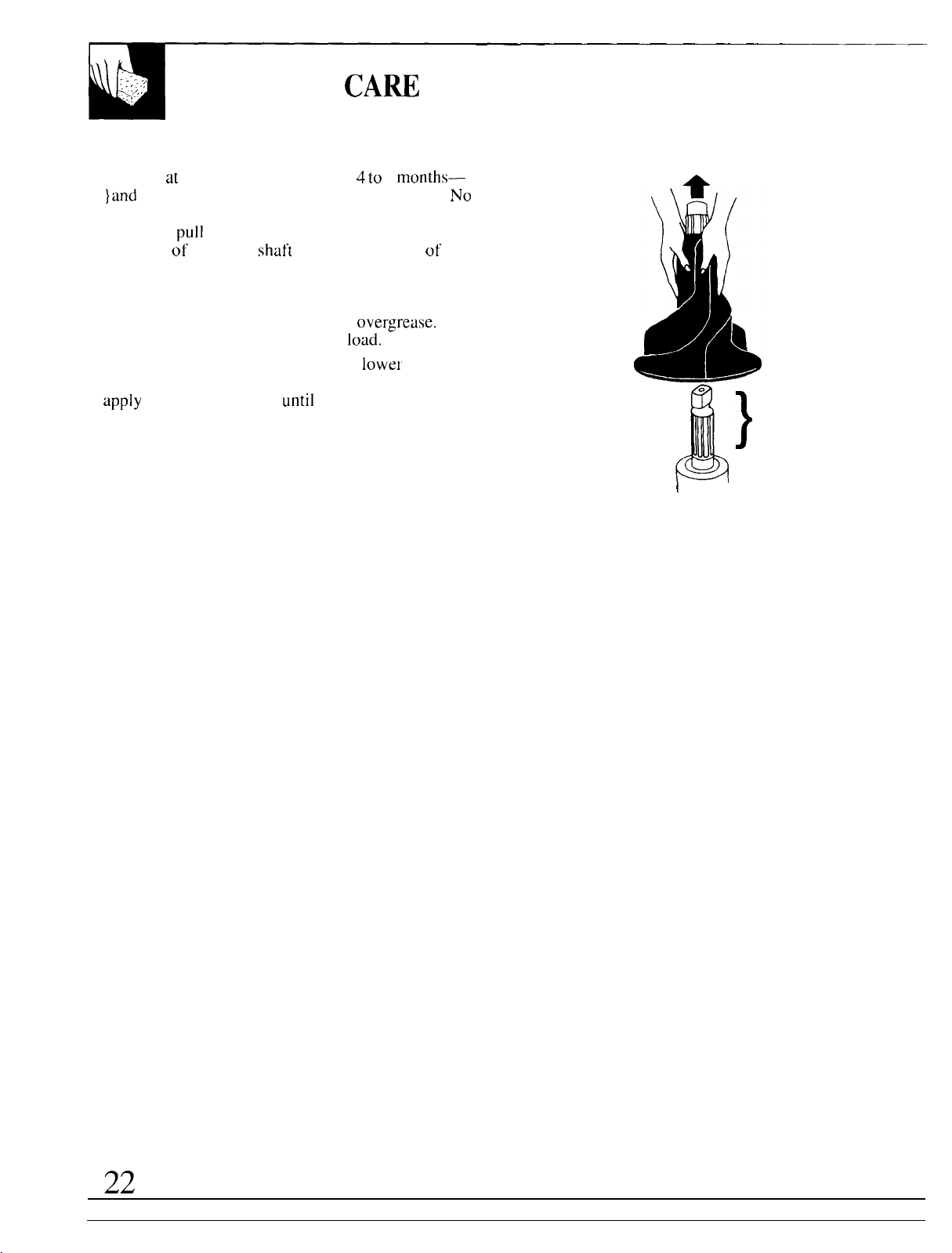
The Activator’
)
Agitator
Remove
at
regular intervals—about
4
to
6
months—
}and
remove any lint that may have accumulated.
No
tools are needed, simply grasp agitator with both
hands and
pull
straight up sharply. The slotted section
at the top
of the metal
shaft
has a light coating of
lubricant to prevent parts sticking together. If this area
appears to be dry, apply a light coat of grease or
Petroleum Jelly around the slotted section of the shaft
before replacing the agitator. Do not
overgrease.
Excess grease may get into clothes
load.
Then replacing the agitator, carefully lowel straight
down onto the shaft so that it fits into the slots. Then
apply
downward pressure
until
agitator snaps into its
normal position.
}
Lubricate
with
grease or
Petroleum
Jelly.
I
I
Staple sales slip or cancelled check
YOUR GE AUTOMATIC CLOTHES WASHER
here.
Proof of original purchase date
WARRANTY
is
needed to obtain service
under warranty.
I
I
WHAT IS COVERED
FULL ONE-YEAR WARRANTY
For
one year from
date
of original
purchase, we
will provide, free of
charge, parts and service labor
in your home to repair or replace
any part of
the
washer that fails
because of a manufacturing defect.
LIMITED ADDITIONAL
FOUR-YEAR WARRANTY
For the second through fifth year
from date of original purchase, we
will provide, free of charge,
replacement parts for
any part of
the
transmission
that fails because
of a manufacturing defect. You pay
for the service trip to your home
and service labor charges. Or, if
you desire, we will provide a
completely reconditioned
transmission. You pay for the
shop reconditioning labor, the
sewice trip to your home and
service labor charges.
This warranty is extended to
the original purchaser and any
succeeding owner for products
purchased for ordinary home use
in the 48 mainland states, Hawaii
and Washington,
D.C.
In Alaska the
warranty is the same except that it
is LIMITED because you must pay
to ship the product to the service
shop
or
for the
sew;ce
technician’s
travel costs to your home.
All warranty service will be
provided by our Factory Service
Centers or by our authorized
Customer
Care’”)
sewicers during
normal working hours.
Should your appliance need
service, during warranty period
or beyond, call 800-GE-CARES
(800-432-2737).
WHAT IS NOT COVERED
● Service trips to your home to teach
you how to use the product.
Read
your
Use and Care material.
If you then have any questions
about operating the product,
please contact your dealer or our
Consumer Affairs office at the
addres~
below, or call, toll free:
GE Answer Center
(
”’
800.626.2000
consumer information service
● Improper installation.
If you have an installation problem,
contact your dealer or installer.
You are responsible for providing
adequate electrical, plumbing and
other connecting facilities.
● Replacement of house fuses or
resetting of circuit breakers.
● Failure of the product if it is used
for other than its intended
purpose or used commercially.
● Damage to product caused by
accident, fire, floods or acts of
God.
WARRANTOR IS NOT
RESPONSIBLE FOR
CONSEQUENTIAL DAMAGES.
Some
states do not allow the exclusion or limitation of incidental or consequential damages, so the above limitation or exclusion
may not apply to you. This warranty gives you specific legal rights, and you may also have other rights which vary from state to state.
To know what your legal rights are in your state, consult your local or state consumer affairs office or your state’s Attorney General.
Warrantor: General Electric Company
if
further help is needed concerning this warranty, write:
Manager—Consumer Affairs, GE Appliances, Louisville, KY 40225
1
This book is printed on recycled paper.
Part No.
175D1807PO03
Rev.
1
Pub No. 49-9448-2
2-93 CG
Printed in Louisville,
K’

