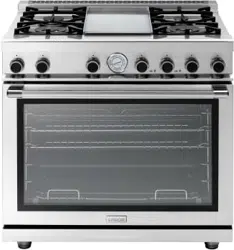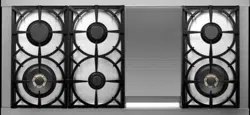

Use and care manual
for 24”, 30’’ and 36’’ gas ranges


|
3
Congratulations
Congratulations and welcome to the SUPERIORE’s world. We hope you will enjoy and appreciate the care and attention
we put into every detail of your new, state-of-the-art range.
Your SUPERIORE range is designed to offer years of reliable service. This Use and Care Manual will provide the
information you need to become familiar with your product’s care and operation.
Your complete satisfaction is our ultimate goal. If you have any questions or comments about this product, please
contact the dealer from whom you purchased it, contact our Customer Care Service or visit our SUPERIORE channel
on Youtube.
We appreciate your choice of a SUPERIORE range and hope that you will choose again our products.
For more information about the complete and growing selection of SUPERIORE products, contact your dealer or visit
us online at SUPERIORE.US
Antonio Di Tommaso
CEO

4
|

CONTENTS
Warnings
Before Using the Range
Range Features
Surface Operation
Burners Operation
Electric griddle
Oven Functions and Setting
Oven Features
Using the Oven
Baking
Convection Bake
Defrost
Broiling
Care and cleaning
Cleaning and Maintenance
Replacing Oven Light
Door Removal
Door Replacement and Adjustment
Thanksgiven dinner
Service Information
Troubleshooting
6
10
12
20
22
21
23
24
25
26
29
30
31
33
36
37
34
37
38
41
42
6
|
Warnings
Getting Started Warning and Important Safety
Instructions appearing in this manual are not meant
to cover all possible conditions and situations
that may occur. Common sense, caution, and care
must be exercised when installing, maintaining or
operating the appliance.
ALWAYS contact the manufacturer about problems or
conditions you do not
understand.
Recognize Safety Symbols, Words, Labels
DANGER
Hazards or unsafe practices which WILL result in
severe personal injury or death
WARNING
Hazards or unsafe practices which COULD result in
death or severe personal injury
CAUTION
Hazards or unsafe practices which COULD result in
minor personal injury.
All safety messages will identify the hazard, tell you how to
reduce the chance of injury, and tell you what can happen if the
instructions are not followed.
Read and follow all instructions before using this
appliance to prevent the potential risk of re, electric
shock, personal injury or damage to the appliance as a result
of improper usage of the appliance. Use appliance only for its
intended purpose as described in this manual.
To ensure proper and safe operation: Appliance must
be properly installed and grounded by a qualied technician.
DO NOT attempt to adjust, repair, service, or replace any
part of your appliance unless it is specically recommended in
this manual. All other servicing should be referred to a qualied
servicer. Have the installer show you the location of the gas
shutoff valve and how to shut it off in an emergency.
A certied technician is required for any adjustments or
conversions to Natural or LP gas.
KEEP THESE INSTRUCTIONS FOR FUTURE
REFERENCE
DANGER
If the information in this manual is not followed
exactly, a re or explosion may result causing
property damage, personal injury or death.
WHAT TO DO IF YOU SMELL GAS:
• DO NOT try to light any appliance.
• DO NOT touch any electrical switch.
• DO NOT use any phone in your building.
• Immediately call your gas supplier from a neighbor’s phone.
Follow the gas supplier’s instructions.
• If you cannot reach your gas supplier, call the re department.
Installation and service must be performed by a
qualied installer, service agency or the gas supplier.
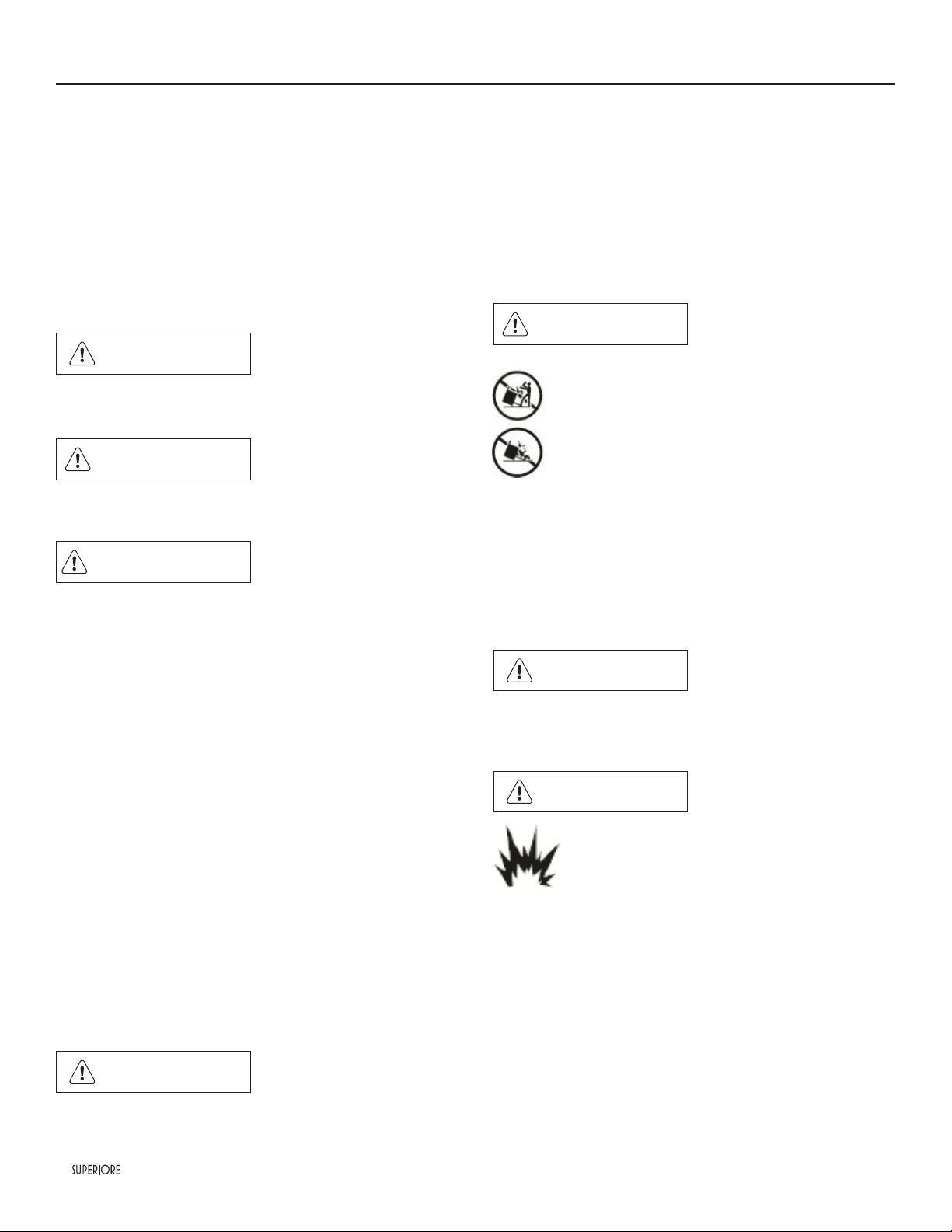
WARNING
TIPPING HAZARD
To reduce the risk of the appliance tipping, it must be
secured by a properly installed anti-tip bracket(s).To
make sure the bracket has been installed properly,
look behind the range with a ashlight to verify
proper installation engaged in the rear top left
corner of the range.
• THIS RANGE CAN TIP
• INJURIES TO PERSONS CAN RESULT
• INSTALL ANTI-TIP DEVICE PACKED
WITH RANGE
• SEE INSTALLATION INSTRUCTIONS
DANGER
DO NOT use commercial oven cleaners inside the oven. Use
of these cleaners can produce hazardous fumes or can damage
the porcelain nishes.
DANGER
To avoid risk of property damage, personal injury or
death; follow information in this manual exactly to
prevent a re or explosion. DO NOT store or use
gasoline or other ammable vapors and liquids in
the vicinity of this or any appliance.

|
7
Warnings
To Prevent Fire or Smoke Damage
• Be sure all packing materials are removed from the appliance
before operating it.
• Keep area around appliance clear and free from combustible
materials, gasoline, and other ammable vapors and materials.
• If the appliance is installed near a window, proper precautions
should be taken to prevent curtains from blowing over burners.
NEVER leave any items on the top. The hot air from the
vent may ignite ammable items and may increase pressure in
closed containers which may cause them to burst.
• Many aerosol-type spray cans are EXPLOSIVE when exposed
to heat and may be highly ammable. Avoid their use or storage
near an appliance.
• Many plastics are vulnerable to heat. Keep plastics away from
parts of the appliance that may become warm or hot. DO
NOT leave plastic items on the rangetop as they may melt or
soften if left too close to the vent or alighted surface burner.
• Combustible items (paper, plastic, etc.) may ignite and metallic
items may become hot and cause burns. DO NOT pour
spirits over hot foods.
DO NOT leave oven unsupervised when drying herbs, breads,
mushrooms, etc; re hazard.
In Case of Fire
Turn off appliance and ventilating hood to avoid spreading the
ame. Extinguish ame then turn on hood to remove smoke and
odor.
• Worktop: Smother re or ame in a pan with a lid or cookie
sheet.
• NEVER pick up or move a aming pan.
• Oven: Smother re or ame by closing the oven door. DO
NOT use water on grease res. Use baking soda, a dry
chemical or foam-type extinguisher to smother re or ame.
• Grease is ammable and should be handled carefully. DO NOT
use water on grease res. Flaming grease can be extinguished
with baking soda or, if available, a multipurpose dry chemical
or foam type extinguisher. Let fat cool before attempting to
handle it. DO NOT allow grease to collect around the oven
or in vents. Wipe up spillovers immediately.
Child Safety
• NEVER leave children alone or unsupervised near the
appliance when it is in use or is still hot.
• NEVER allow children to sit or stand on any part of the
appliance as they could be injured or burned.
• DO NOT store items of interest to children over the unit.
Children climbing to reach items could be seriously injured.
• Children must be taught that the appliance and utensils in it
can be hot. Let hot utensils cool in a safe place, out of reach of
small children. Children should be taught that an appliance is
not a toy. Children should not be allowed to play with controls
or other parts of the appliance.
Cooking Safety
• To eliminate the hazard of reaching over hot surface burners,
cabinet storage should not be provided directly above a unit. If
storage is provided,it should be limited to items which are used
in frequently and which are safely stored in an area subjected
to heat from an appliance. Temperatures may be unsafe for
some items, such as volatile liquids, cleaners or aerosol sprays.
• ALWAYS place a pan on a surface burner before turning
it on. Be sure you know which knob controls which surface
burner. Make sure the correct burner is turned on and that the
burner has ignited. When cooking is completed, turn burner
off before removing pan to prevent exposure to burner ame.
• ALWAYS adjust surface burner ame so that it does not
extend beyond the bottom edge of the pan. An excessive ame
is hazardous, wastes energy and may damage the appliance,
pan or cabinets above the appliance. This is based on safety
considerations.
• NEVER leave a surface cooking operation unattended
especially when using high heat setting or when deep fat frying.
Boilovers cause smoking and greasy spillovers may ignite. Clean
up greasy spills as soon as possible.
DO NOT use high heat for extended cooking operations.
• DO NOT heat unopened food containers, build up of pressure
may cause the container to explode and result in injury.
• Use dry, sturdy pot-holders. Damp pot-holders may cause
burns from steam.
Dishtowels or other substitutes should NEVER be used as
potholders because they can trail across hot surface burners
and ignite or get caught on appliance parts.
• ALWAYS let quantities of hot fat used for deep fat frying
cool before attempting to move or handle.
• DO NOT let cooking grease or other ammable materials
accumulate in or near the appliance, hood or vent fan. Clean
hood frequently to prevent grease from
accumulating on hood or lter.
When aming foods under the hood, turn the fan off.
• NEVER wear garments made of ammable material or loose
tting or long-sleeved apparel while cooking. Clothing may
ignite or catch utensil handles. DO NOT drape towels or
materials on oven door handles.These items could ignite and
cause burns.
• ALWAY Splace oven racks in the desired positions while
oven is cool. Slide oven rack out to add or remove food, using
dry, sturdy pot-holders. ALWAYS avoid reaching into the oven
to add or remove food. If a rack must be moved while hot, use
a dry pot-holder.
• ALWAYS turn the oven off at the end of cooking.
• Use care when opening the oven door. Let hot air or steam
escape before moving or replacing food.
• NEVER use aluminum foil to cover oven racks or oven
bottom. This could result in risk of electric shock, re, or
damage to the appliance. Use foil only as directed in this guide.
• PREPARED FOOD WARNING: Follow food
manufacturer’s instructions.
If a plastic frozen food container and/or its cover distorts,
warps, or is other wise damaged during cooking, immediately
discard the food and its container.

8
|
Warnings
The food could be contaminated.
• If you are “aming” liquor or other spirits under an exhaust,
TURN THE FAN OFF. The draft could cause the ames
to spread out of control.
• Once the unit has been installed as outlined in the Installation
Instructions, it is important that the fresh air supply is not
obstructed.The use of a gas cooking appliance results in
the production of heat and moisture in the room in which
it is installed. Ensure that the kitchen is well-ventilated. Keep
natural venting holes open or install a mechanical ventilation
device. Prolonged or intensive use of the appliance may call
for additional (such as opening a window) or more effective
ventilation (such as increasing the level of a mechanical
ventilation if present).
Utensil Safety
• Use pans with at bottoms and handles that are easily grasped
and stay cool. Avoid using unstable, warped, easily tipped or
loose-handled pans. Also avoid using pans, especially small pans,
with heavy handles as they could be unstable and easily tip.
Pans that are heavy to move when lled with food may also be
hazardous.
• Be sure utensil is large enough to properly contain food and
avoid boilovers. Pan size is particularly important in deep fat
frying. Be sure pan will accommodate the volume of food that
is to be added as well as the bubble action of fat.
• To minimize burns, ignition of ammable materials and spillage
due to unintentional contact with the utensil, DO NOT
extend handles over adjacent surface burners. ALWAY Sturn
pan handles toward the side or back of the appliance, not out
into the room where they are easily hit or reached by small
children.
• NEVER let a pan boil dry as this could damage the utensil and
the appliance.
• Follow the manufacturer’s directions when using oven cooking
bags.
• Only certain types of glass, glass/ceramic, ceramic or glazed
utensils are suitable for rangetop surface or oven usage
without breaking due to the sudden change in temperature.
Follow manufacturer’s instructions when using glass.
• This appliance has been tested for safe performance using
conventional cookware. DO NOT use any devices or
accessories that are not specically recommended in this
guide. DO NOT use eyelid covers for the surface units,
stovetop grills, or add-on oven convection systems. The use of
devices or accessories that are not expressly recommended
in this manual can create serious safety hazards, result in
performance problems, and reduce the life of the components
of the appliance.
• The ame of the burner should be adjusted to just cover the
bottom of the pan or pot. Excessive burner setting may cause
scorching of adjacent counter-top surfaces, as well as the
outside of the utensil. This is based on safety considerations.
Heating Elements
• NEVER touch oven bake and broil burner areas or interior
surfaces of oven.
• Bake and broil burners may be hot even though they are dark
in color. Areas near burners and interior surfaces of an oven
may become hot enough to cause burns.
• During and after use, DO NOT touch or let clothing or
other ammable materials contact heating elements, areas
near elements, or interior surfaces of oven until they have had
sufcient time to cool. Other surfaces of the oven may become
hot enough to cause burns, such as the oven vent opening, the
surface near the vent opening, and the oven door window.
Cleaning Safety
• Turn off all controls and wait for appliance parts to cool before
touching or cleaning them. DO NOT touch the burner grates
or surrounding areas until they have had sufcient time to cool.
• Clean appliance with caution. Use care to avoid steam burns if
a wet sponge or cloth is used to wipe spills on a hot surface.
Some cleaners can produce noxious fumes if applied to a hot
surface.
• No commercial oven cleaner or oven liner protective coating
such as aluminum foil should be used in or around any part of
the oven. Improper oven liners may result in a risk of electric
shock or re. Keep oven free from grease buildup.
WARNING
NEVER use appliance as a space heater to heat or warm a
room to prevent potential hazard to the user and damage to
the appliance. Also, DO NOT use the range top or oven as a
storage area for food or cooking utensils.
About Your Appliance
• For proper oven performance and operation, DO
NOT block or obstruct the oven vent duct located
in the backguard/island trim.
• Avoid touching oven vent area while oven is on and for several
minutes after oven is turned off. When the oven is in use, the
vent and surrounding area become hot enough to cause burns.
After oven is turned off, DO NOT touch the oven vent or
surrounding areas until they have had sufcient time to cool.
• Other potentially hot surfaces include rangetop, areas facing
the rangetop, oven vent, surfaces near the vent opening, oven
door, areas around the oven door and oven window.
• The misuse of oven doors (e.g. stepping, sitting, or leaning on
them) can result in potential hazards and/or injuries.
Power Failure
If power failure occurs, the electric igniters will not work. No
attempt should be made to operate the appliance during a power
failure. Make sure the ovencontrol is in the “OFF” position.
Momentary power failure can occur unnoticed. The range is
affected only when the power is interrupted. When it comes back
on, the range will function properly without any adjustments. A
|
9
Warnings
“brown-out” may or may not affect range operation, depending
on how severe the power loss is.
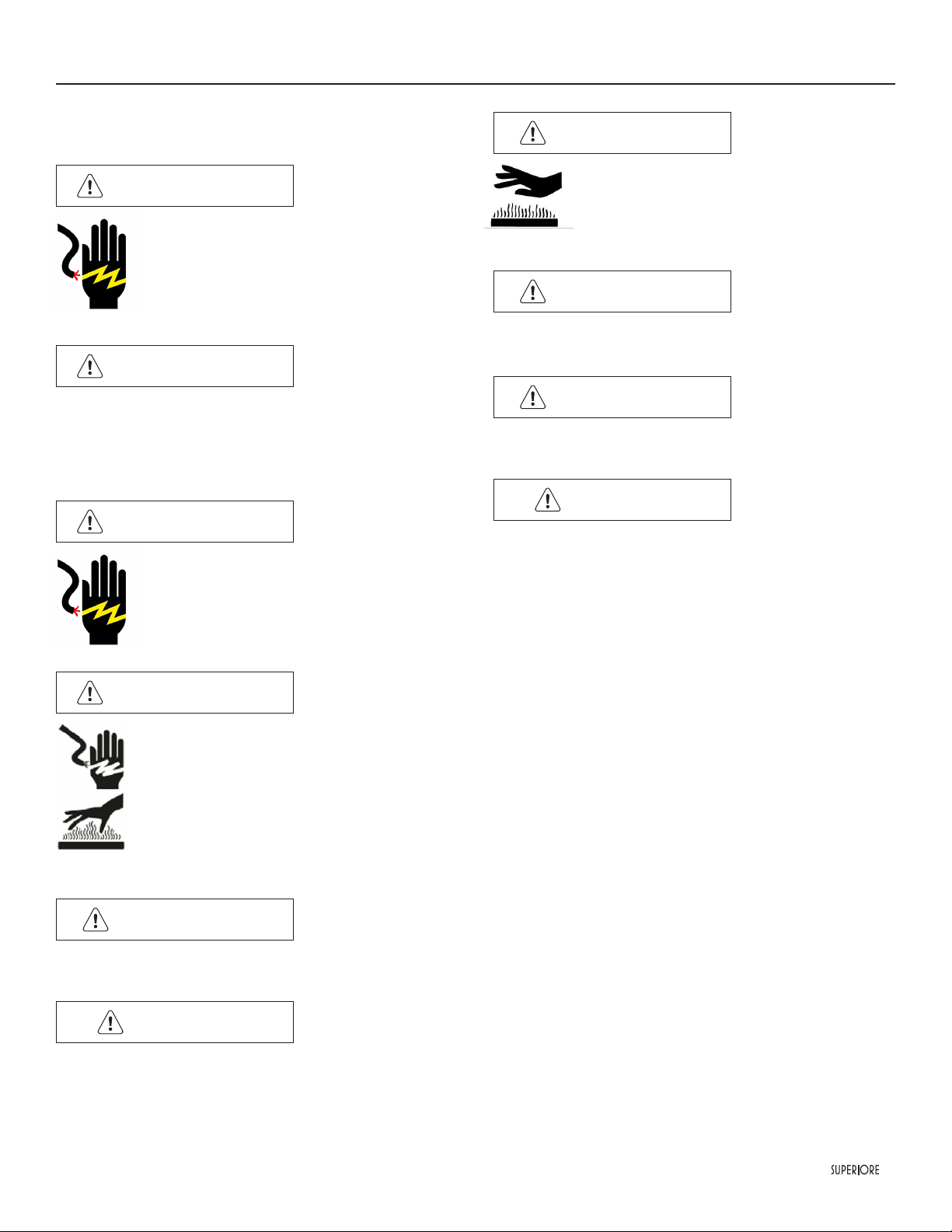
WARNING
ELECTRICAL SHOCK HAZARD
DO NOT touch a hot oven light bulb with a
damp cloth as the bulb could break. Should the
bulb break, disconnect power to the appliance
before removing bulb to avoid electrical shock.
WARNING
NEVER cover any slots, holes or passages in the oven bottom
or cover an entire rack with materials such as aluminum foil.
Doing so blocks air ow through the oven and may cause carbon
monoxide poisoning. Aluminum foil linings may also trap heat,
causing a re hazard.
WARNING
ELECTRICAL SHOCK HAZARD
Disconnect the electric power at the main fuse or
circuit breaker before replacing bulb.
WARNING
BURN OR ELECTRICAL SHOCK
HAZARD
Make sure all controls are OFF and oven is COOL
before cleaning. Failure to do so can result in
burns or electrical shock.
CAUTION
To avoid sickness and food waste, DO NOT allow defrosted
food to remain in the oven for more than two hours.
NOTICE
DO NOT turn the Temperature Control on during defrosting.
Turning the convection fan on will accelerate the natural
defrosting of the food without the heat.
CAUTION
BURN HAZARD
The oven door, especially the glass, can get hot.
Danger of burning: DO NOT touch the
glass!
CAUTION
You must carefully check the food during the dehydration
process to ensure that it does not catch re.
CAUTION
DO NOT store items of interest to children over the unit.
Children climbing to reach items could be seriously injured.
NOTICE
The range is provided with an automatic cooling system, designed
to start operating only when the range becomes hot during use,
whether using the worktop or the oven or both simultaneously.
The cooling system can also switch on and off more times during
a single cooking cycle and continue operating for few minutes
after the end of the same coocking cycle. In the event of air
blowing out of the backguard/island trim holes, this is a normal
operating function and does not require any action from the user.

10
|
Before Using the Range
All products are wiped clean with solvents at the factory to remove any visible signs of dirt, oil, and grease which may have remained
from the manufacturing process. Before starting to cook, clean the range thoroughly with hot, soapy water. There may be some burn off
and odors on rst use of the appliance this is normal.
Oven
Important! Before rst use, wipe interior with soapy water and dry
thoroughly. Then set the oven selector to bake, the thermostat to 450°F or 500 °F, and operate for an hour.
All models include:
• Five performance modes including convection baking providing air circulation for shorter cooking times with even results;
• Six rack positions and three wire shelves providing ample space for your baking needs;
• One telescopic glide shelf;
• Two lights illuminating the oven cavity;
• 30” cavity equipped with 2 convection fans and broiler;
• 36” cavity equipped with 4 convection fans and broiler;
• Continous grating grids;
• Wok ring adaptor;
• Espresso trivet.
This appliance is certied by Star-K to meet strict regulations in conjunction with specic instructions found on www.star-k.org

|
11
12
|
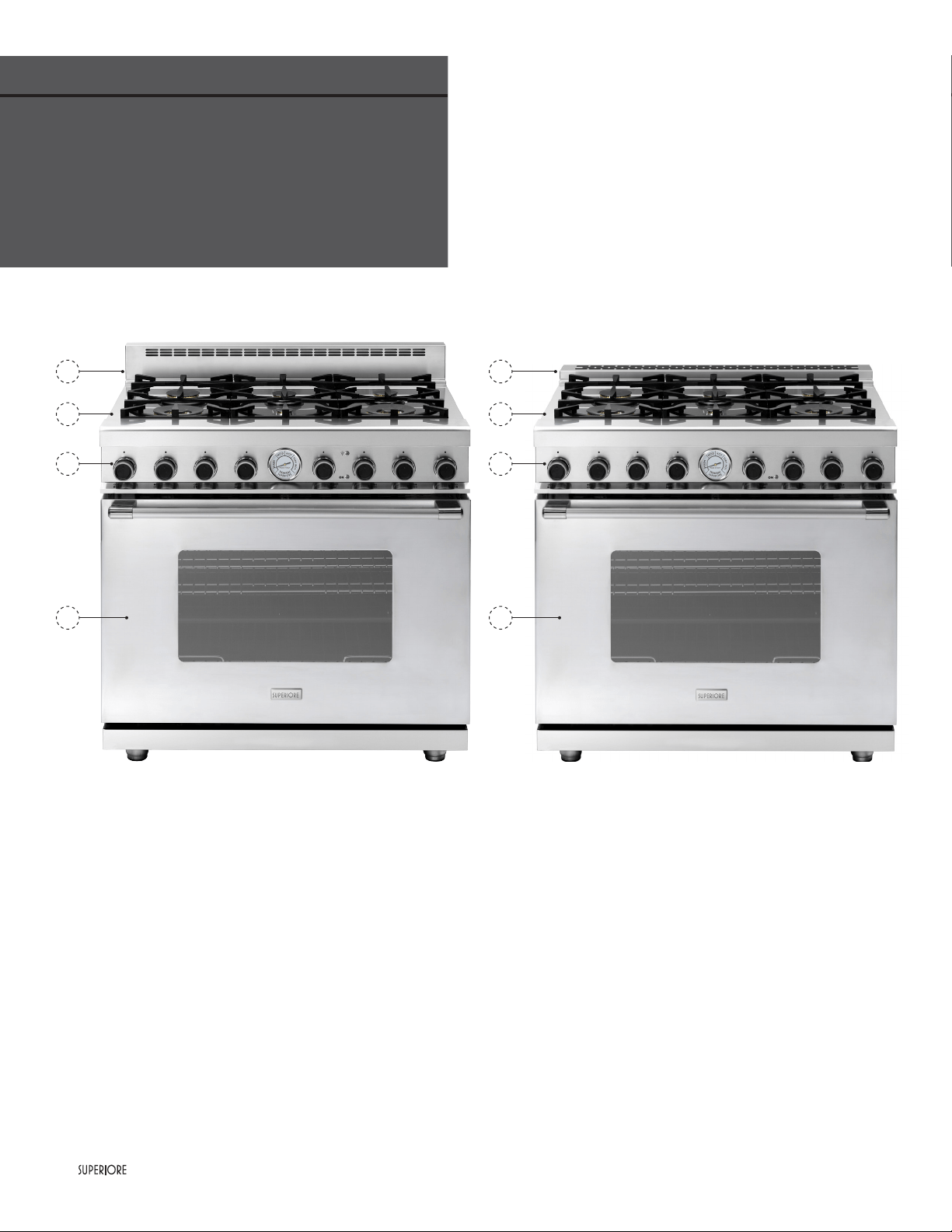
A. Worktop Prole
A1. If supplied with backguard
A2. If supplied with island trim
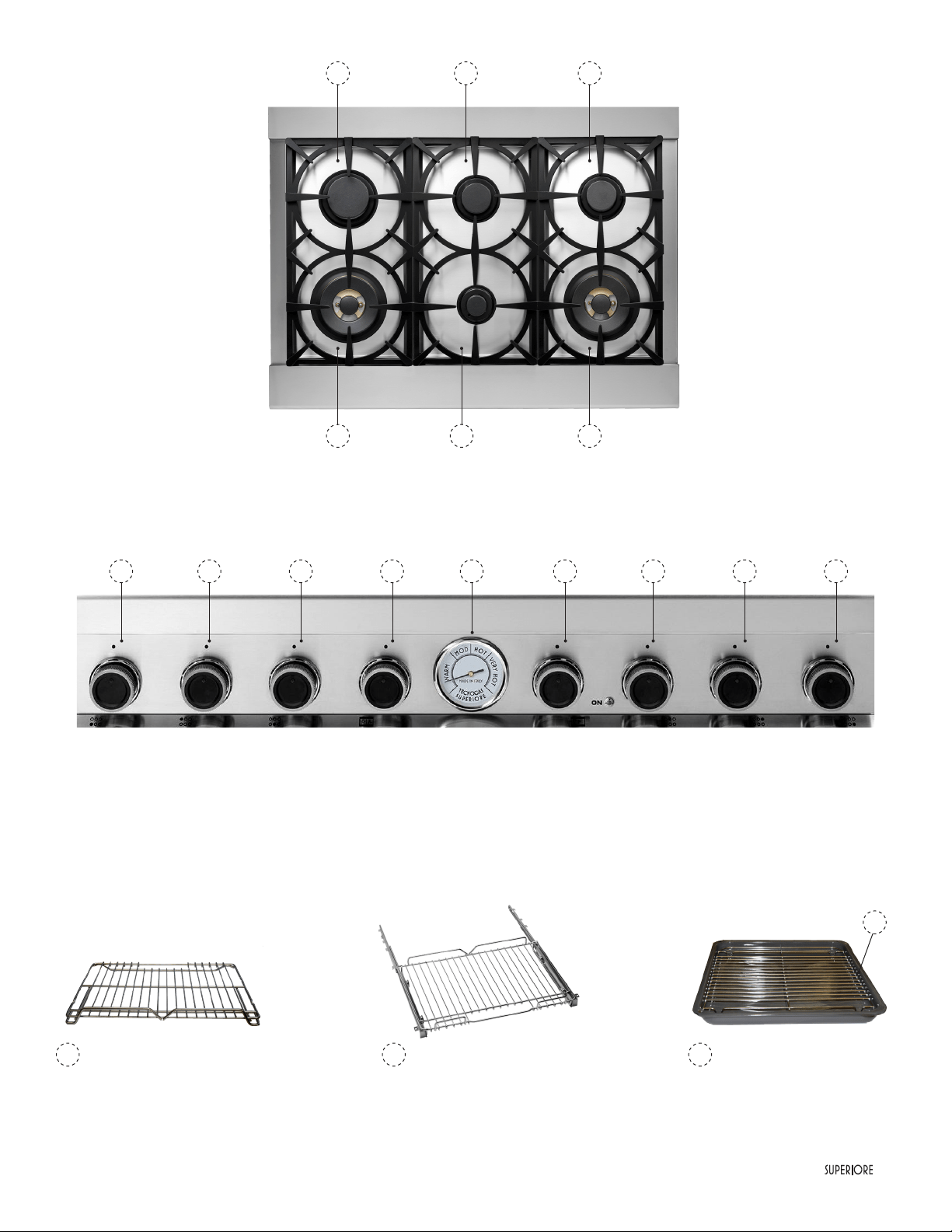
B. Worktop
1. Left front power burner 18000 Btu/h
2. Left rear large burner 11000 Btu/h
3. Center front small burner 3600 Btu/h
4. Center rear medium burner 6500 Btu/h
5. Right front power burner 18000 Btu/h
6. Right rear medium burner 6500 Btu/h
C. Control Panel
7. Left front power burner control knob
8. Left rear large burner control knob
9. Center front small burner zone control knob
10. Rotary switch (light, convection, convention + light)
11. Thermometer
12. Oven temperature control knob
13. Center rear medium burner control knob
14. Right front power burner control knob
15. Right rear medium burner control knob
D. Main Oven (with six racks position)
16. Wire shelves (x2)
17. Telescopic glide shelf
18. Enamelled baking tray
19. Trivet
Range Features:
RN361...; RD361...
D
C
B
A2
D
C
B
A1
|
13
1
6
3
4
5
2
7 128 139 1410 1511
16 17 18
19
14
|
Range Features:
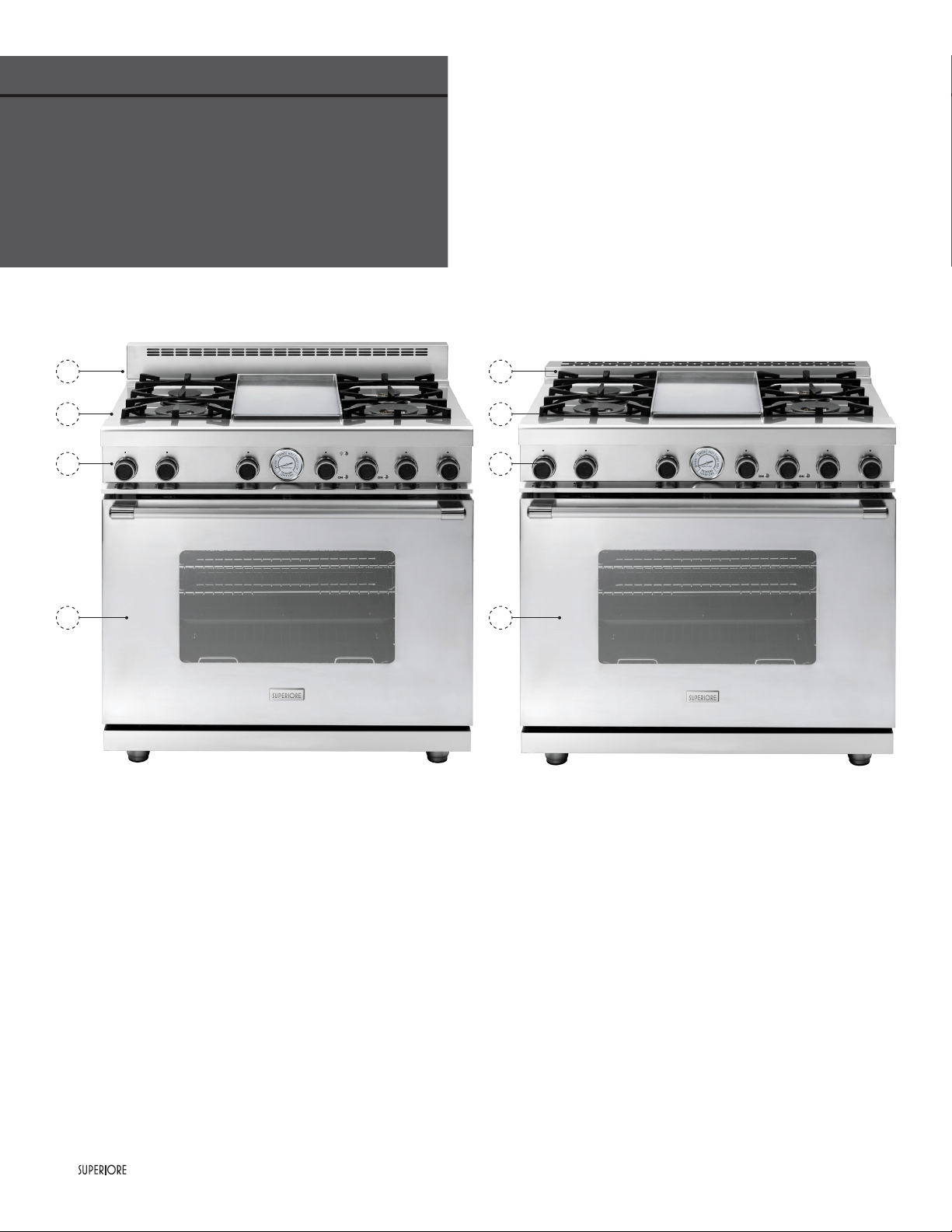
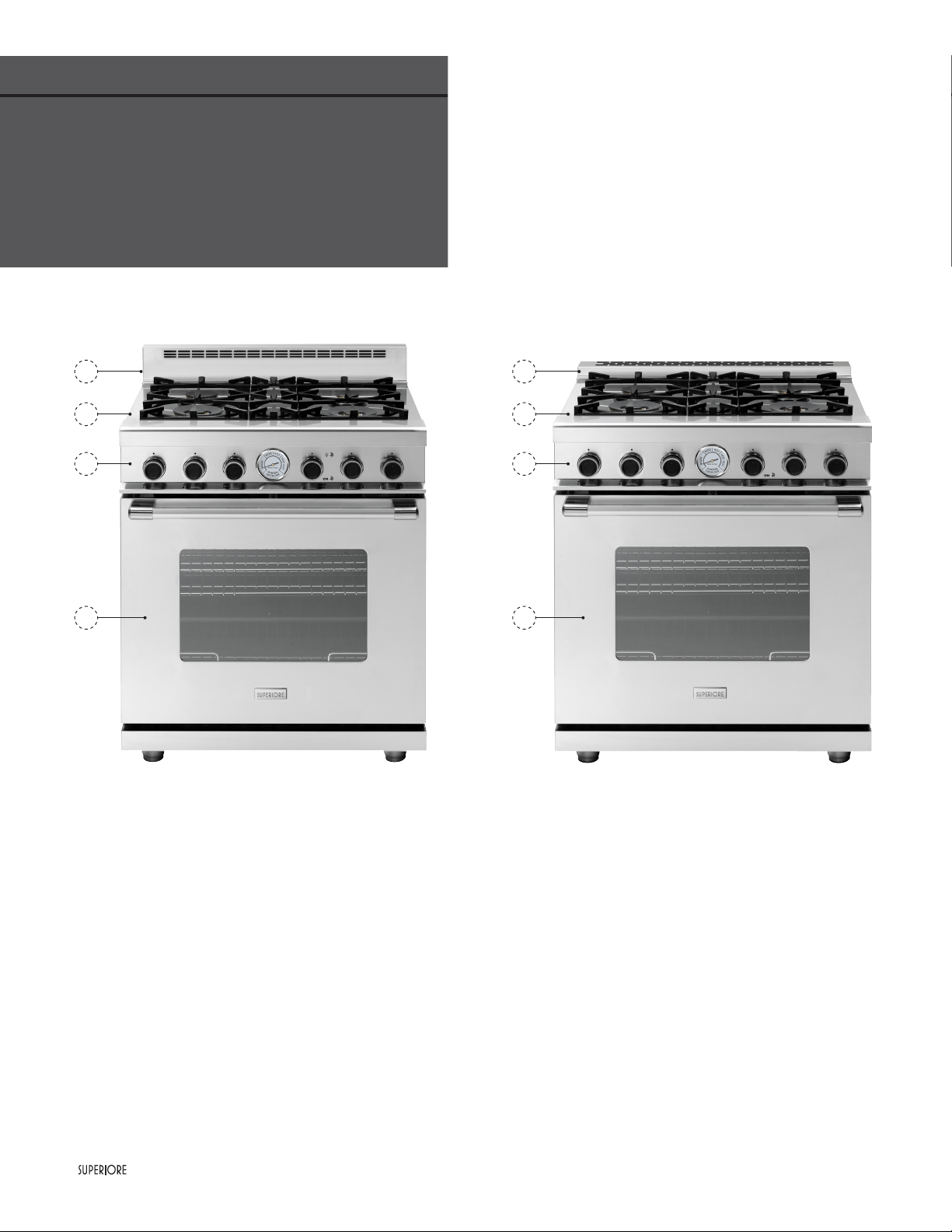
RN362...; RD362...
A. Worktop Prole
A1. If supplied with backguard
A2. If supplied with island trim
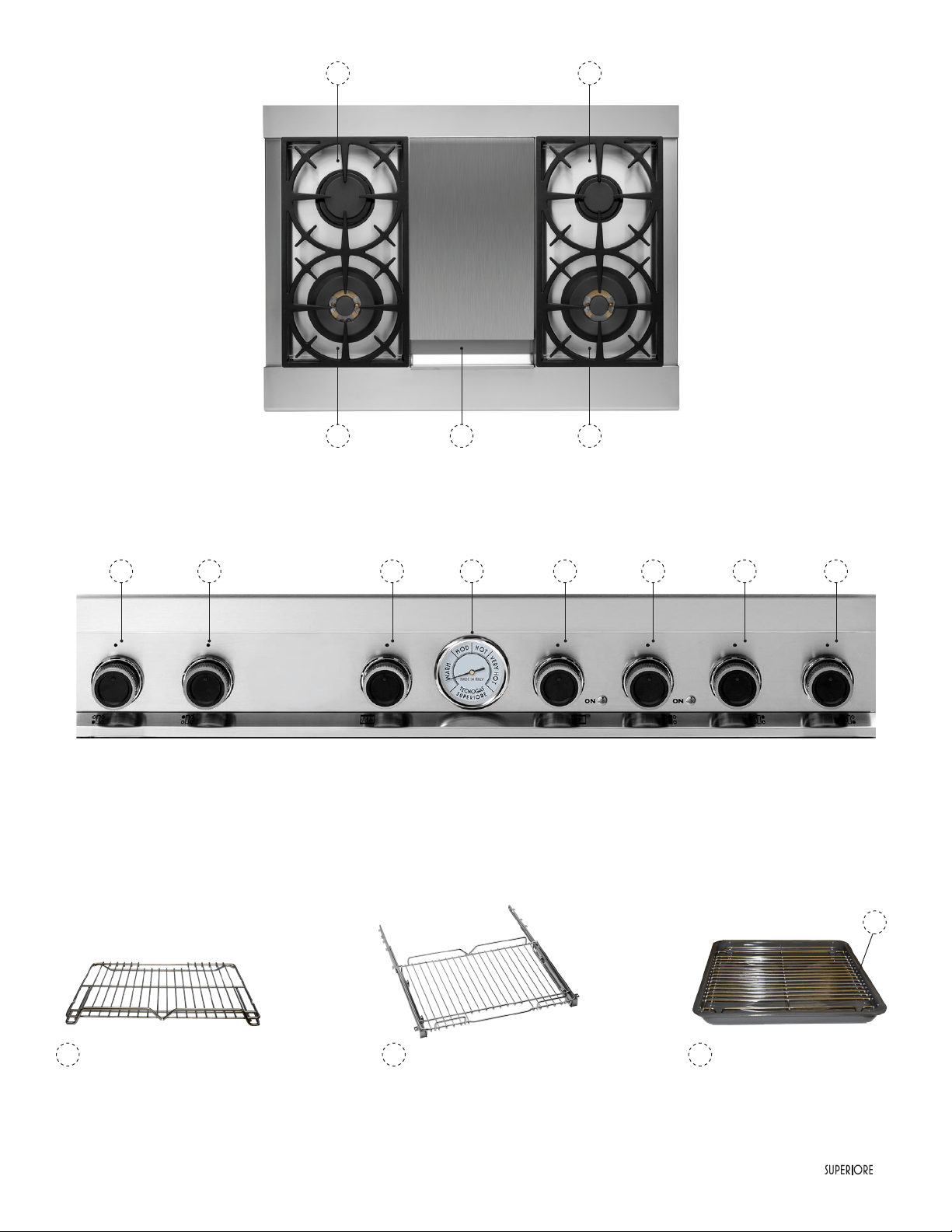
B. Worktop
1. Left front power burner 18000 Btu/h
2. Left rear large burner 11000 Btu/h
3. Electric griddle 1150W
4. Right front power burner 18000 Btu/h
5. Right rear medium burner 6500 Btu/h
C. Control Panel
6. Left front power burner control knob
7. Left rear large burner control knob
8. Rotary switch (light, convection, convention + light)
9. Thermometer
10. Oven temperature control knob
11. Electric griddle control knob
12. Right rear medium burner control knob
13. Right front power burner control knob
D. Main Oven (with six racks position)
14. Wire shelves (x2)
15. Telescopic glide shelf
16. Enamelled baking tray
17. Trivet
D
C
B
A2
D
C
B
A1
|
15
1
5
3 4
2
6 107 11 128 139
14 15 16
17
16
|
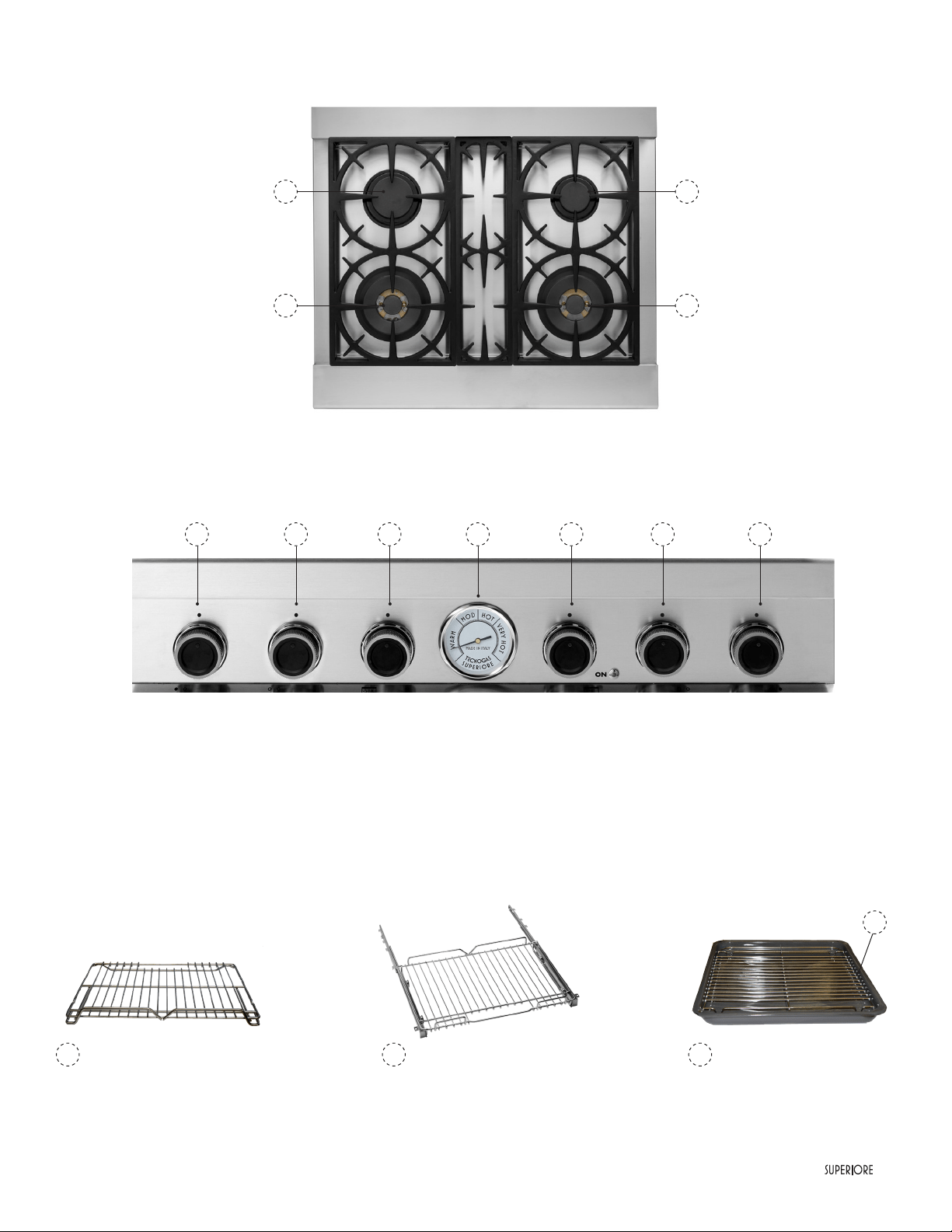
A. Worktop Prole
A1. If supplied with backguard
A2. If supplied with island trim
B. Worktop
1. Left front power burner 18000 Btu/h
2. Left rear large burner 11000 Btu/h
3. Right front power burner 18000 Btu/h
4. Right rear medium burner 6500 Btu/h
C. Control Panel
5. Left front power burner control knob
6. Left rear large burner control knob
7. Rotary switch (light, convection,
convention + light)
8. Thermometer
9. Oven temperature control knob
10. Right front power burner control
11. Right rear medium burner
D. Oven (with six racks position)
12. Wire shelves (x2)
13. Telescopic glide shelf
14. Enamelled baking tray
15. Trivet
Range Features:
RN301...
D
C
B
A2
D
C
B
A1
|
17
2 4
1
5 6 7 8 9 10 11
12 13 14
3
15
18
|
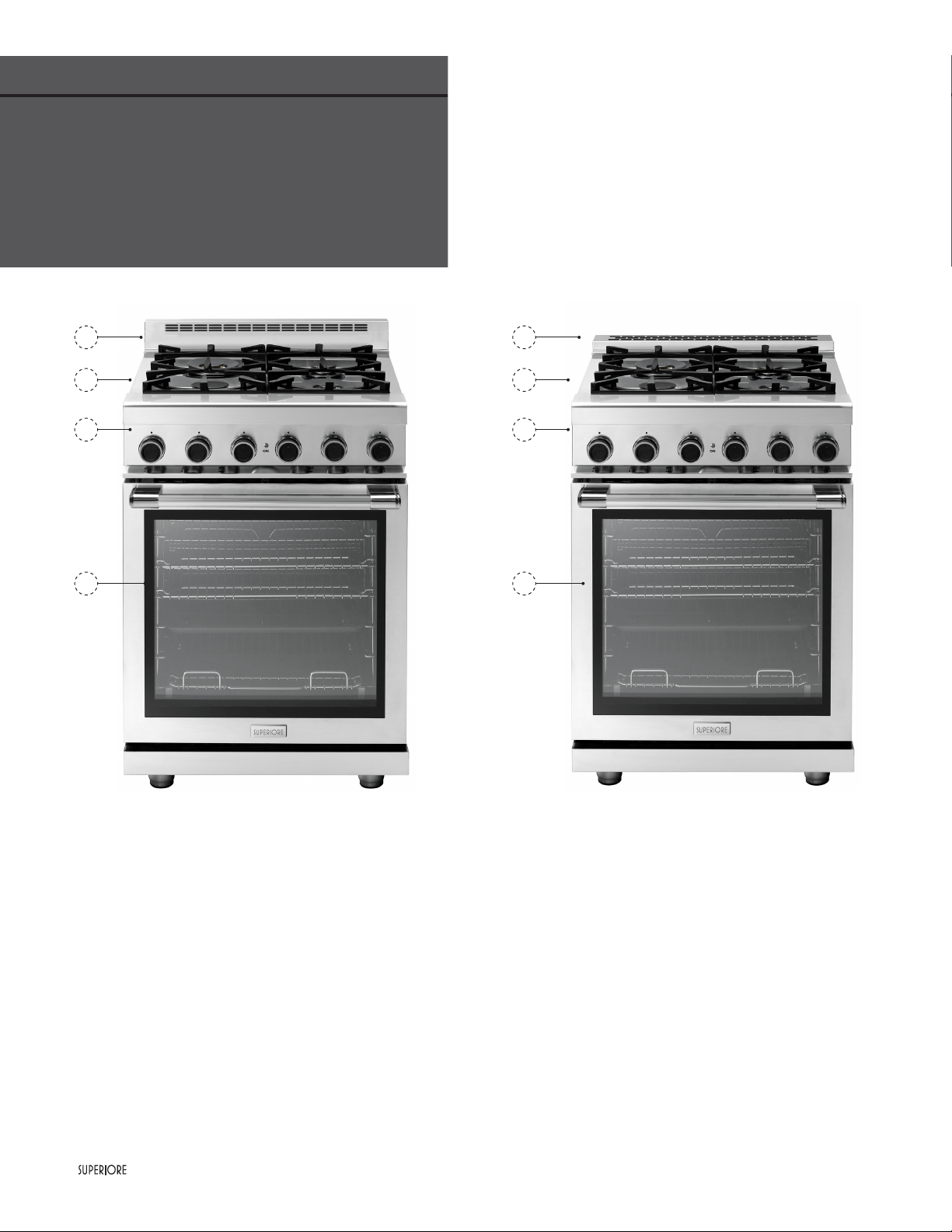
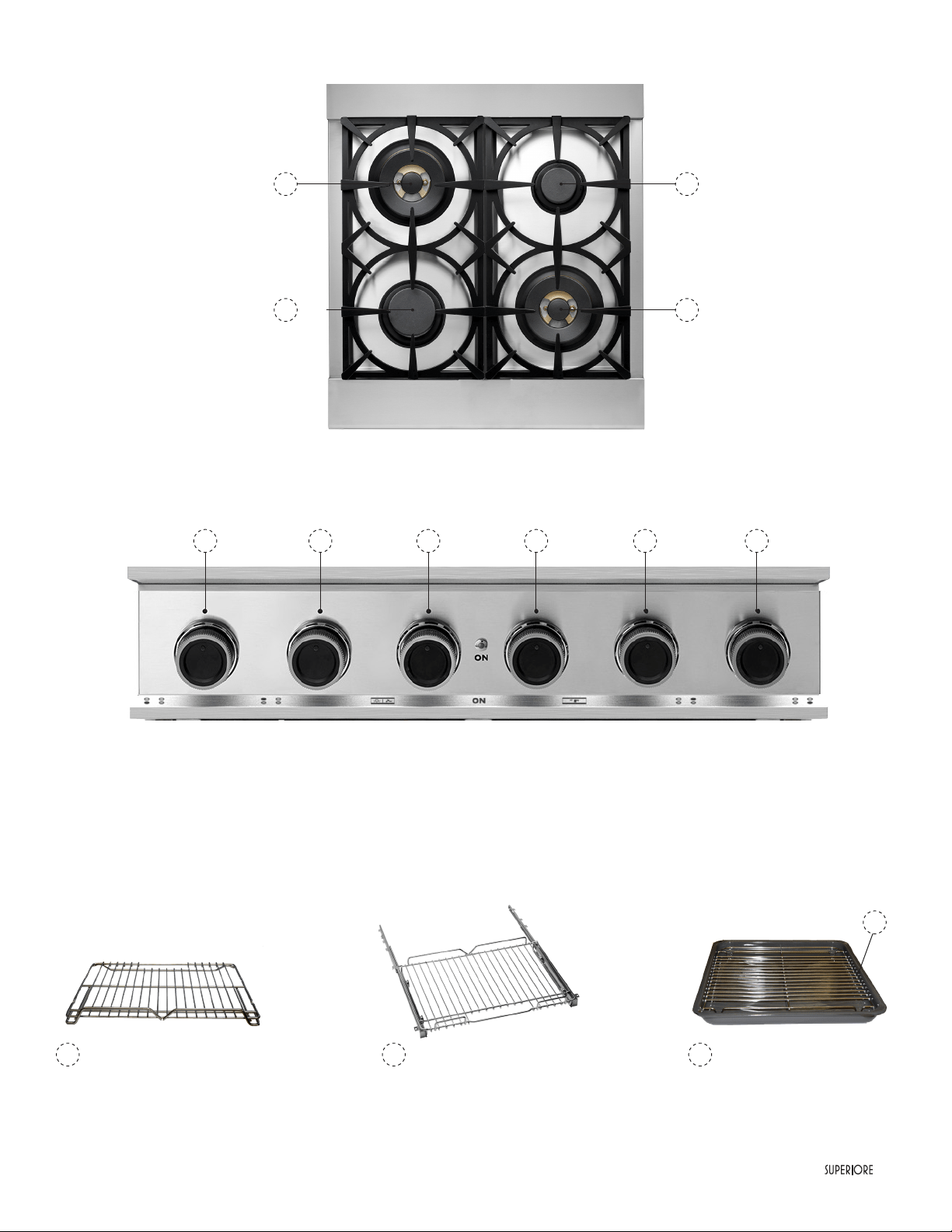
A. Worktop Prole
A1. If supplied with backguard
A2. If supplied with island trim
B. Worktop
1. Left rear power burner
2. Left front large burner 11000 Btu/h
3. Right front power burner with simmer 18000 Btu/h
4. Right rear medium burner 6500 Btu/h
C. Control Panel
5. Left front large burner control knob
6. Left rear power burner control knob
7. Rotary switch (light, convection,
convention + light)
8. Oven temperature control knob
9. Right rear medium burner control
10. Right front power burner
D. Oven (with six racks position)
11. Wire shelves (x2)
12. Telescopic glide shelf
13. Enamelled baking tray
14. Trivet
Range Features:
RN241...
D
C
B
A2
D
C
B
A1
|
19
2
4
1
11 12 13
3
14
5 6 7 8 9 10

20
|
Surface Cooking Tips
Your range is equipped with a variety of different sized surface burners. Below is a guide for which burners work best for certain
cooking applications:
Note: models with induction zones are provided only with the burners on the right.
Use low or medium ame heights when cooking in vessels that are poor conductors of heat, such as glass, ceramic, and cast-iron.
Reduce the ame height until it covers approximately 1/3 of the cooking vessel diameter. This will ensure more even heating within the
cooking vessel and reduce the likelihood of burning or scorching the food.
• Reduce the ame if it is extending beyond the bottom of the cooking vessel. A ame that extends along the sides of the vessel is
potentially dangerous, heats the utensil handle and kitchen instead of the food, and wastes energy.
• Reduce the ame height to the minimum level necessary to perform the desired cooking process. Remember that food cooks just as
quickly at a gentle boil as it does at a rolling boil. Maintaining a higher boil than is necessary wastes energy, cooks away moisture, and
causes a loss in food avor and nutrient level.
• The minimum pot or pan (vessel) diameter recommended is 6” (15 cm) on the larger burners. Pots or pans as small as 4” (10 cm)
should be used on the smaller burners.
Cooking Vessels
Each cook has his or her own preference for the particular cooking vessels that are most appropriate for the type of cooking being
done.Any and all cooking vessels are suitable for use in the range and it is not necessary to replace your present domestic vessels with
commercial cookware. This is a matter of personal choice. As with any cookware, yours should be in good condition and free from
excessive dents on the bottom to provide maximum performance and convenience.
Note: When using big pots and/or high ames, it is recommended to use the front burners. There is more room in the front and
potential cleanup at rear of appliance due to staining or discoloration will be minimized.
Surface Operation
Burner Use
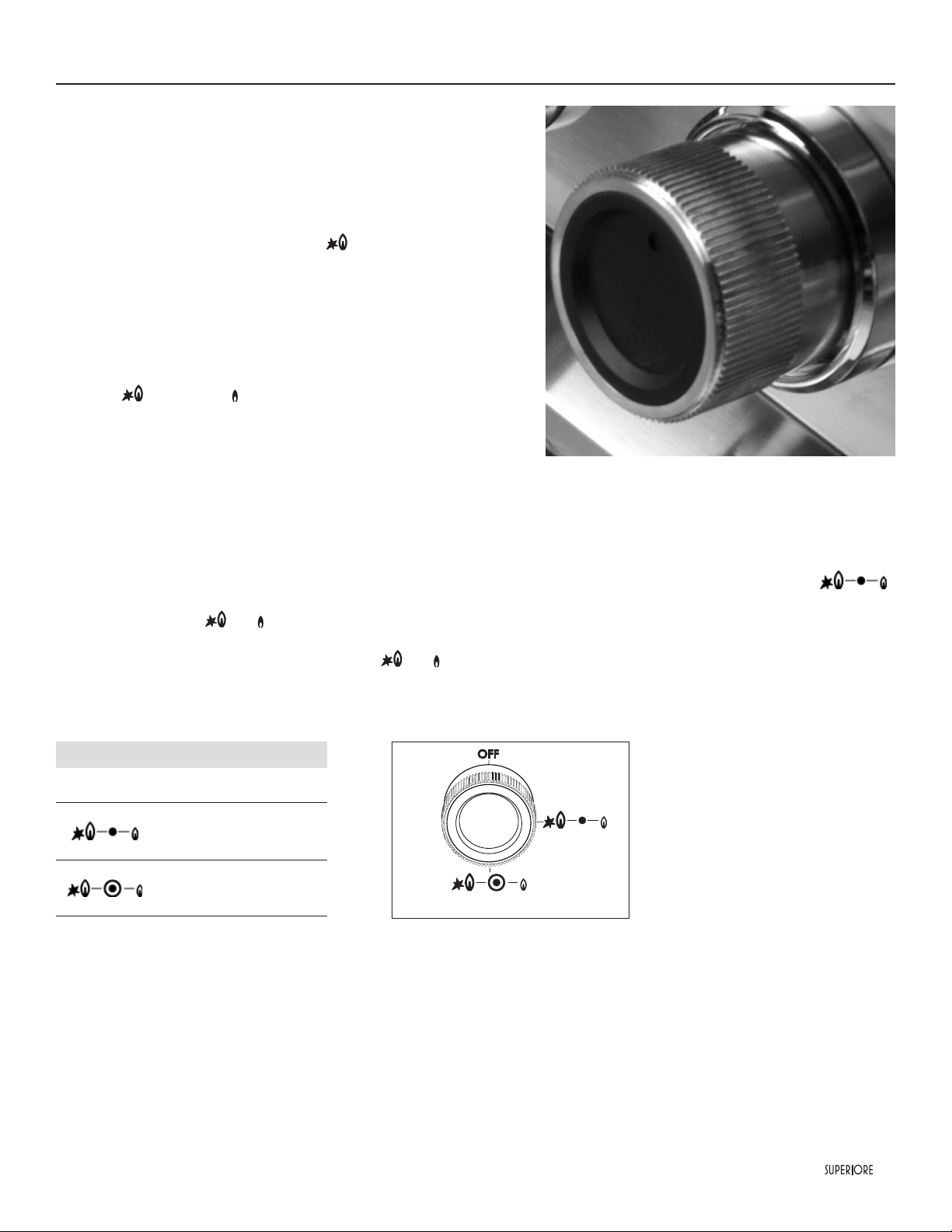
front left (left rear on 24’’) and front right 18.000 BTU Quick water boiling
Deep-fat frying in large utensil
right front simmer 750 BTU Melting small quantities
Steaming rice
Simmering sauces
front central 3.600 BTU Melting large quantities
Low-temperature frying (eggs, etc.)
Simmering large quantities
Heating milk, cream sauces, gravies,and puddings
rear central and rear right 6.500 BTU Sauteing and browning, braising, and pan frying
Maintaining slow boil on large quantities
rear left (front left on 24’’) 11.000 BTU High-temperature frying
Pan broiling
Maintaining fast boil on large quantities
|
21
Burners Operation
Lighting Burners
All burners are ignited by electric ignition.
There are no open-ame, “standing” pilots.
Work-top Burners
To light the surface burners, push and turn the appropriate control knob
anticlockwise to maximum ow position . This control is both a gas
valve and an electric switch. When gas is permitted to ow to the burners,
the electric igniters start sparking.
On all surface igniters you should hear a “clicking” sound. If you do not,
turn off the control and check that the unit is plugged in and that the fuse
or circuit breaker is not blown or tripped.
Within a few moments, enough gas will have traveled to the burner to
light. When the burner lights, turn the burner control to any position from
maximum to minimum ow position to adjust the ame size. Setting
the proper ame height for the desired cooking process and selecting the
correct cooking vessel will result in superior cooking performance, while
also saving time and energy.
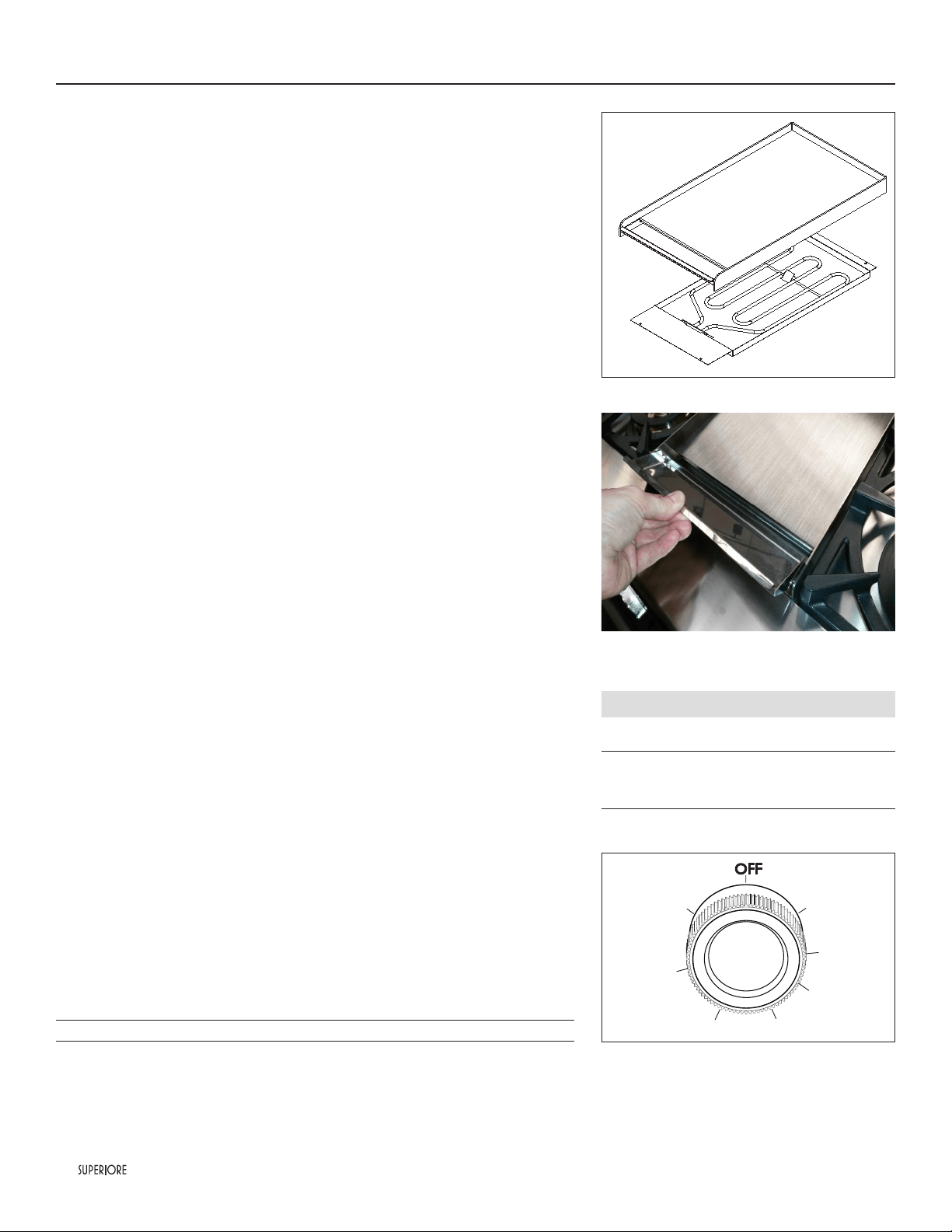
Power burner with simmer
The range is provided with a powr burner with simmer, a special burner featuring a very high exible range of cooking settings: from
750 Btu/h for simmering, melting or steaming rice, to 18000 Btu/h for the most powerful performance.
To light the surface burners, push and turn the appropriate control knob anticlockwise to maximum power of inner ring.
The inner ring lights at its maximum power. Then you can continue to use only the inner ring and adjust the ame power by turning
the control knob from to position. If you need to light on also the external ring, continue to turn anticlockwise the knob and
make a little pressure on it in order to cross the lock located after the minimum power position of internal ring. The external burner
lights on; ame is adjustable turning the knob from to position.
Worktop burner knob + simmer
OFF
= Closed position
= “Full on” position
internal ring
= “Full on” position
esternal ring
22
|
Griddle/Simmer Plate (on applicable models)
The optional 1150W griddle is constructed of machined steel with a blanchard
nish and is uniquely designed to offer excellent cooking performance as well as
easy clean up.
The griddle is equipped with an electronic thermostat to maintain an even
temperature across the griddle once the desired temperature has been set.
The griddle has a power “ON” indicator light which glows when the griddle
thermostat has been turned on.
This will cycle on and off as needed to indicate the thermostat is maintaining the
selected temperature. Before the griddle is used it is important to season the griddle.
This seasoning process will change the appearance of the griddle plate.
However, it will also prevent food from sticking and protect the surface from
moisture.
Seasoning the Griddle Before the First Use
• Scrub the griddle plate with a mixture of one quart warm water and 1/4 cup
white vinegar, using a blue Scotch-Brite™ pad. Dry thoroughly.
• Wash griddle with warm, soapy water. Rinse off and dry thoroughly.
• Season griddle by thinly coating the surface with approximately 1⁄2 to 1 teaspoon
unsalted vegetable oil. Apply to entire griddle using a paper towel or clean cloth.
Let oil sit on griddle for approximately 1 hour and then wipe with a clean cloth
or paper towel to absorb any residual oil. The griddle is now ready to be used.
The griddle is equipped with a removable drip tray. After using the griddle, extract
the drip tray, and dispose its content, paying attention to avoid spillages.
Griddle/Simmer Plate Operation
• Turn the griddle control knob clockwise to the desired temperature setting. The
power “ON” indicator light will glow indicating the griddle thermostat is on.
• Use liquid cooking oil or butter for eggs, pancakes, French toast, sh and
sandwiches to prevent sticking.
• Routinely scrape loose food particles with a metal spatula during cooking to make
the cleanup easier and to avoid the particles mixing with the food.
• To turn the griddle off, turn the thermostat knob clockwise to the “OFF” position.
• ALWAYS turn to the“OFF” position when not in use and lower the heat between
cooking loads.
Setting the desired temperature
The Griddle can be setted at the desired temperature from 180-200°F to 550-
580°F by rotating the control knob from 1 to 7 position.
The correspondence of temperatures is listed below.
Knob pos.
1 2 3 4 5 6 7
Temp.
180-200 280-300 330-350 380-400 430-450 480-500 550-580
Electric griddle
Electric griddle knob range 48’’
OFF
= Closed position
from 1 to 7 positions = Griddle temperatures

|
23
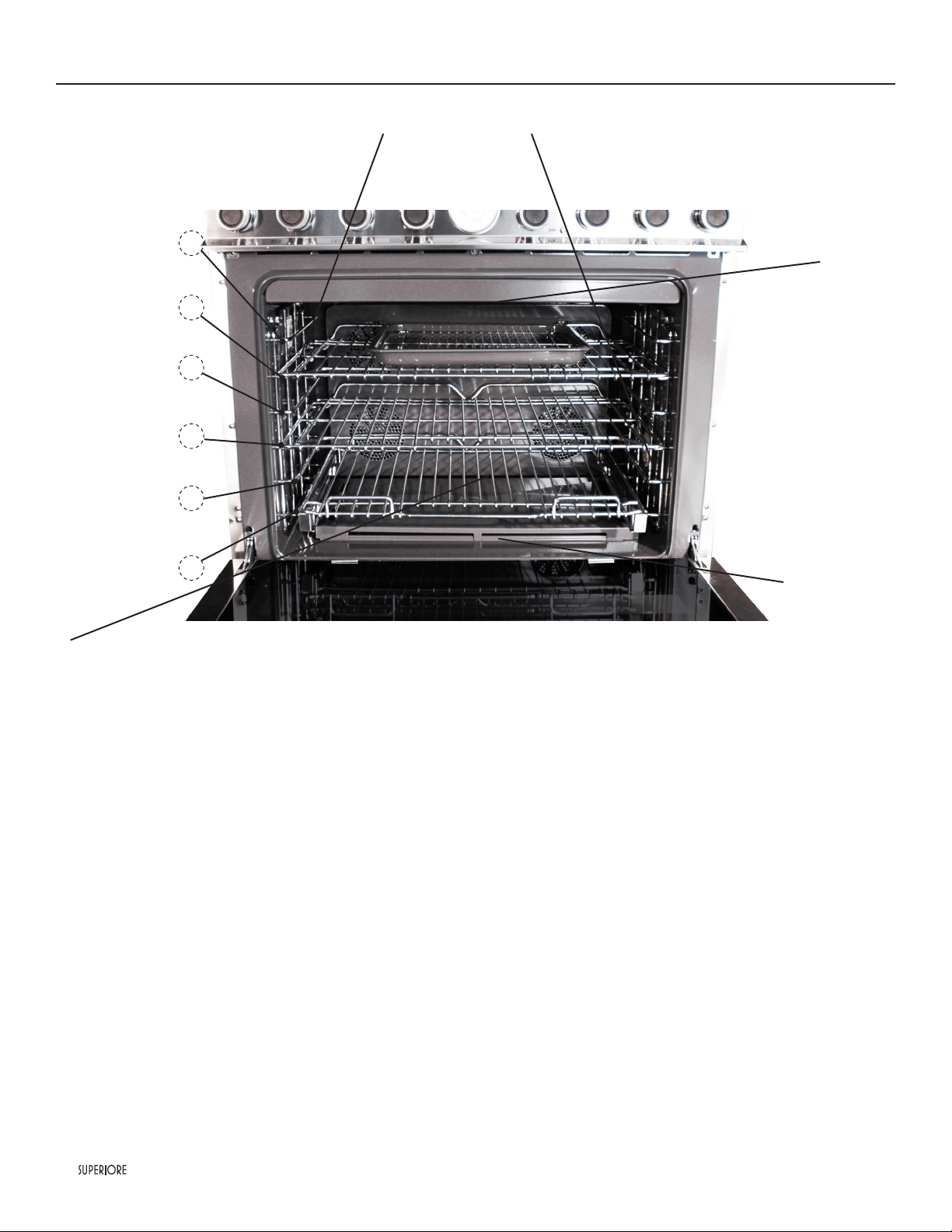
Oven Functions and Setting
BAKE (Natural Airow Bake)
Use this setting for baking, roasting, and casseroles.
CONVECTION BAKE
Use this setting to bake and roast foods at the same time with minimal taste transfer.
BROIL
Use this setting for broiling dark meats at 1” thickness or less where rare or medium doneness is desired.
DEFROST
Use this function to defrost foods.
LIGHT
Use this function to see the interior of the cavity.
24
|
Rack Positions 24”, 30’’ and 36” ranges
The oven has six rack positions and is equipped whith three racks and one enamelled tray whit trivet.
Position 1 is the farthest from the oven bottom. Position 6 is the closest to the oven bottom. The racks can be easily removed
and arranged at various levels. For better results with conventional baking, DO NOT use more than one rack at a time. It is also
recommended, when using two racks, to bake with the racks in positions 2 and 4 or positions 3 and 5.
Bake burner
Oven Lights (x2)
Broiler
Four fans
(Two fans on 30’’ and 24’’)
Oven Features
1
2
3
4
5
6
|
25
Oven Preheat
The oven temperature can reach a temperature of aprox 400°F in 14 minutes in static function. Please consider this during the pre-heat
process of the oven.
Conventional vs Convection Cooking
Because of variations in food density, surface texture and consistency, some foods may be prepared more successfully using the
conventional bake setting. For this reason, conventional baking is recommended when preparing baked goods such as custard. The user
may nd other foods that are also prepared more consistently in conventional bake. It is recommended to use this function for single-
rack baking.
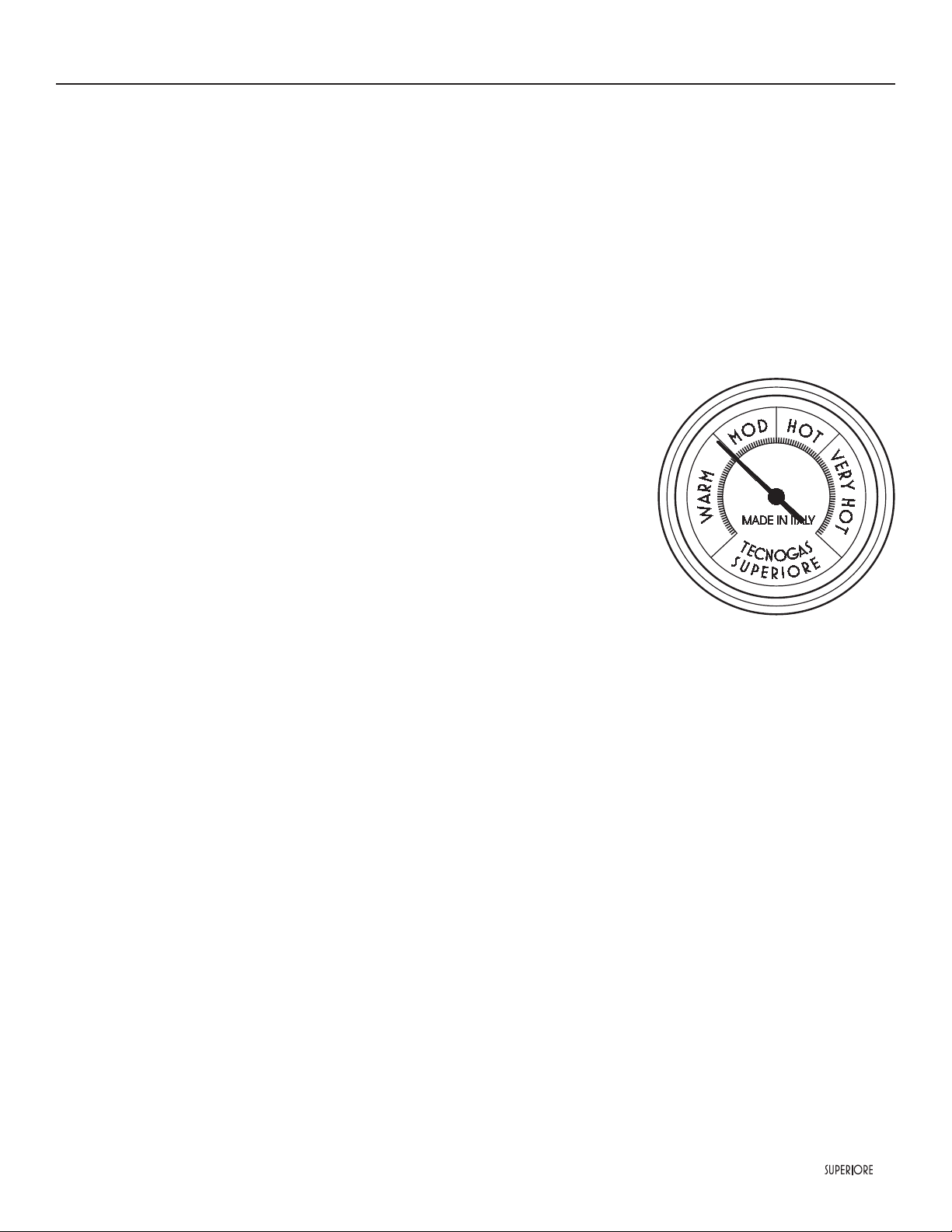
Analog Thermometer (available on 24” 30” and 36’’ ranges only)
This is not an electrical device, so it even works if the range is not connected to the power
outlet. This thermometer roughly shows the inner temperature of the main oven when
this one is operated and it can have a deviation according to the type of cooking and the
type of oven function. It isn’t a control of inner temperature.
The control of the temperature is always done by thermostat, that is activated by the knob
and that has on it the oven target temperatures.
Anyway, below, the approximate temperature of oven operation in relation of the
thermometer areas:
WARM: between 70 °F and 200 °F :
MOD: between 200°F and 300 °F:
HOT: between 300 °F and 400 °F
VERY HOT between 400°F and 500 °F
Using the Oven
26
|
BAKE
(Natural Airow Bake)
Full power heat is radiated from the bake burner in the bottom of the oven cavity and is circulated with natural airow. This function is
recommended for single rack baking. Many cook books contain recipes to be cooked in the conventional manner.
Conventional baking is suitable for dishes that require a high temperature. Use this setting for baking and casseroles.
To Use BAKE Function
1. Arrange the oven rack in the desired position before turning
the oven on and close the door.
2. Push and hold the oven control knob for at least one second.
Release and turn it anticlockwise, setting the desidered
temperature. This sequence must be performed within seven
seconds. If you hear a clicling sound while lighting up the
oven, this is appropriate.
Note:
If the oven does not light up after ve attempts, open the oven
door and let the gas out; for your safety, open the window of
the kitchen.
Baking Tips
• Make sure the oven racks are in the desired position before you turn on the oven.
• DO NOT open the door frequently during baking. Look through the door
window to check doneness whenever possible. If you must open the door, the best time is during the last quarter of the baking time.
• Bake to the shortest time suggested and check for doneness before adding more time. For baked food, a stainless steel knife placed
in the center of the product should come out clean when done.
• Use the pan size and type recommended by the recipe to ensure best results. Cakes, quick breads, mufns, and cookies should be
baked in shiny, reective pans for light, golden crusts. Avoid the use of old, darkened pans. Warped, dented, stainless steel and tin-
coated pans heat unevenly and will not give uniform baking results.
Food Pan size Single rack position Temperature Time (min)
ENTREES
Eggs rolls Cookie sheet 3 or 4 400F°(204°C) 25-30
Fish sticks Cookie sheet 3 or 4 425°F(218°C) 10-15
Lasagna, frz Cookie sheet 3 or 4 375F°(191°C) 55-60
Pot pie Cookie sheet 3 or 4 400F°(204°C) 35-40
Gr. peppers stuffed
13”x 9” 3 or 4 375F°(191°C) 60-70
Quiche 9” round 3 or 4 400F°(204°C) 25-30
Pizza, 12” Cookie sheet 3 or 4 400F°(204°C) 15-20
Mac. & cheese, frz
Cookie sheet 3 or 4 375F°(191°C) 35-40
VEGETABLES
Baked potatoes On rack 3 or 4 375F°(191°C) 60-65
Spinach soufe 1 qt. casserole 3 or 4 350F°(177°C) 45-50
Squash Cookie sheet 3 or 4 375F°(191°C) 50-55
French fries Cookie sheet 3 or 4 425°F(218°C) 20-25
*Note:
The above information is given as a guide only
Baking

|
27
Food Pan size Single rack position Temperature Time (min)
BREADS
Biscuits Cookie sheet 3 or 4 400F°(204°C) 10 -12
Yeast loaf Loaf pan 3 or 4 375F°(191°C) 30-35
Yeast rolls Cookie sheet 3 or 4 400F°(204°C) 12-15
Nut bread Loaf pan 3 or 4 375F°(191°C) 30-35
Combread 8”x 8” 3 or 4 400F°(204°C) 25-30
Gingerbread 8”x 8” 3 or 4 350F°(177°C) 35-40
Mufns Mufn tin 3 or 4 375F°(191°C) 15-20
Corn mufns Mufn tin 3 or 4 375F°(191°C) 15-20
CAKE
Angel food Tube pan 3 or 4 375F°(191°C) 35-45
Bundt Tube pan 3 or 4 350F°(177°C) 45-55
Cupcakes Mufn pan 3 or 4 350F°(177°C) 16-20
Layers, sheet 13”x 9” 3 or 4 350F°(177°C) 40-50
Layers, two 9” round 3 or 4 350F°(177°C) 30-35
Pound Loaf pan 3 or 4 350F°(177°C) 60-65
COOKIES
Brownies 13”x 9” 3 or 4 350F°(177°C) 25-30
Choc.chip Cookie sheet 3 or 4 375F°(191°C) 12-15
Sugar Cookie sheet 3 or 4 375F°(191°C) 10-12
PASTRY
Cream puffs Cookie sheet 3 or 4 400F°(204°C) 30-35
PIES
Crust, unlled 9” round 3 or 4 400F°(204°C) 10-12
Crust, lled 9” round 3 or 4 350F°(177°C) 55-60
Lemon meringue 9” round 3 or 4 350F°(177°C) 12-15
Pumpkin 9” round 3 or 4 350F°(177°C) 35-40
Custard 6-4 oz cups 3 or 4 350F°(177°C) 35-40
Baking

28
|
Solving Baking Problems
Baking problems can occur for many reasons. Check the chart below for the causes and remedies for the most common
problems. It is important to remember that the temperature setting and cooking times you are
accustomed to using with your previous oven may vary slightly from those required with this oven. If you nd this to be
true, it is necessary for you to adjust your recipes and cooking times accordingly.
Common Baking Problems/Remedies
Problems Cause Remedy
Cakes burned on the sides
or not done in center
1. Oven was too hot
2. Wrong pan size
3. Too many pans
1. Reduce temperature
2. Use recom. pan size
3. Reduce no. of pans
Cakes crack on top
1. Batter too thick
2. Oven too hot
3. Wrong pan size
1. Follow recipe
Add liquid
2. Reduce temperature
3. Use recom. pan size
Cakes are not level
1. Batter uneven
2. Oven or rack not level
3. Pan was warped
1. Distribute batter even
2. Level oven or rack
3. Use proper pan
Food too brown on botton
1. Oven door opened too often
2. Dark pans being used
3. Incorrect rack position
4. Wrong bake setting
5. Pan too large
1. Use door window to bottom check food
2. Use shiny pans
3. Use recom. rack position
4. Adjust to conventional or convection
setting as needed
5. Use proper pan
Food too brown on top
1. Rack position too high
2. Oven not preheated
3. Sides of pan too high
1. Use recom. rack position
2. Allow oven to preheat
3. Use proper pans
Cookies too at 1. Hot cookie sheet 1. Allow sheet to coolbetween batches
Pies burned around edges
1. Oven too hot
2. Too many pans used
3. Oven not preheated
1. Reduce temperature
2. Reduce no. of pans
3. Allow oven to preheat
Pies too light on top
1. Oven not hot enough
2. Too many pans used
3. Oven not preheated
1. Increase temperature
2. Reduce no. of pans
3. Allow oven to preheat
Baking
|
29
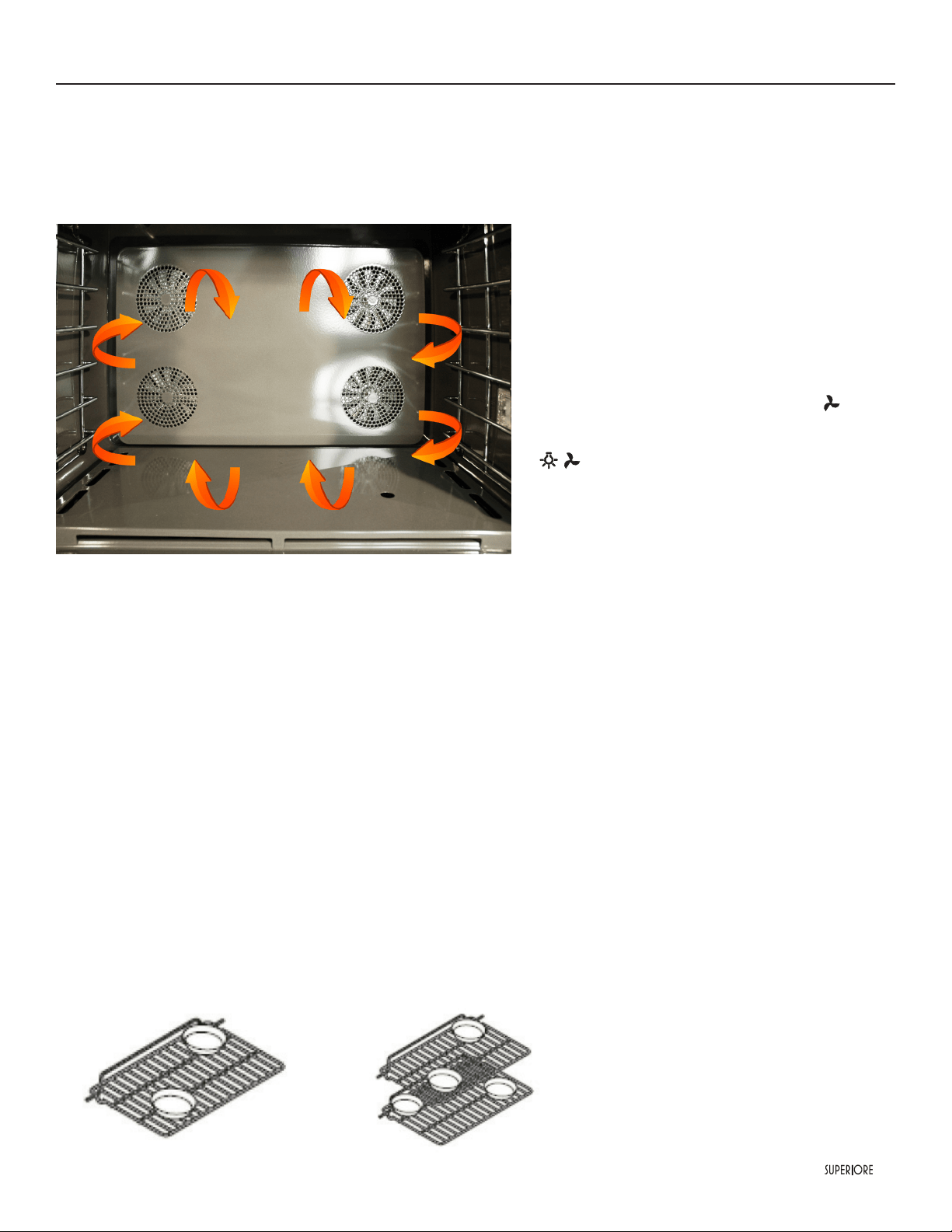
Single rack pan
placement
Multiple rack
pan placement
Convection Bake
CONVECTION BAKE
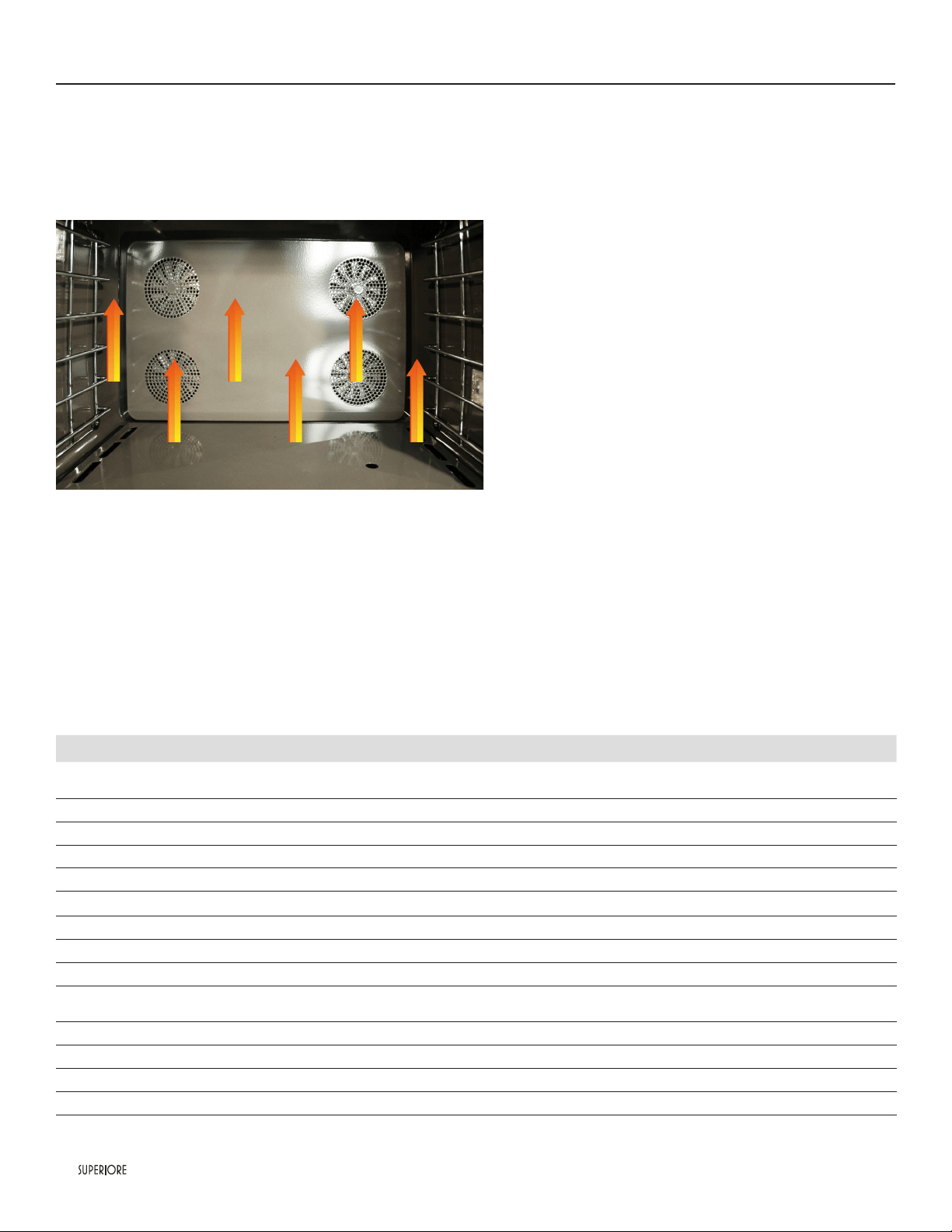
Heat is radiated from the bake burner in the bottom of the oven cavity. The heated air is circulated by the fans in the rear of the oven
providing a more even heat distribution. Multiple rack use is possible for the largest baking job. When roasting, cool air is quickly replaced
searing meats on the outside and retaining more juices and natural avor on the inside with less shrinkage. This even circulation of air
equalizes the temperature throughout the oven cavity and eliminates the hot and cold spots found in conventional ovens.
To Use CONVECTION BAKE Function
(only on main oven)
1. Arrange the oven rack in the desired position before
turning the oven on and close the door.
2. Push and hold the oven control knob for at least one
second. Release and turn it anticlockwise, setting
the desidered temperature. This sequence must be
performed within seven seconds. If you hear a clicling
sound while lighting up the oven, this is appropriate.
3. Set the rotary switch knob to “Convection”
4. In order to switch on the oven light during convection
bake , set the rotary switch knob to “Oven light on+fan”.
Note:
If the oven does not light up after ve attempts, open the
oven door and let the gas out; for your safety, open the
window of the kitchen.
Convection Cooking Tips
Convection cooking is a cooking technique which utilizes fan-forced air to circulate throughout the entire oven cavity creating the
optimum cooking environment. Cooking with convection is intended when performing multi-rack baking and for heavier foods. Below
are some tips which will allow you to get the best results out of your oven when cooking with convection.
• As a general rule, to convert conventional recipes to convection recipes, reduce the temperature by 25°F (10°C) when using a
convection cooking function.
• Cooking times for standard baking and convection baking will be the same. However, if using convection to cook a single item or
smaller load, then it is possible to have 10-15% reduction in cooking time. (Remember convection cooking is designed for multi-rack
baking or cooking large loads.)
• If cooking items which require longer than 45 minutes, then it is possible to see a 10-15% reduction in cooking time.
• A major benet of convection cooking is the ability to prepare foods in quantity. The uniform air circulation makes this possible.
Foods that can be prepared on two or three racks at the same time include: pizza, cakes, cookies, biscuits, mufns, rolls, and frozen
convenience foods.
• For three-rack baking, use any combination of rack positions 2, 3, 4,and 5. For two-rack baking, use rack positions 2 and 4 or positions
3 and 5. Remember that the racks are numbered from bottom to top.
Pan Placement Tips
• When using large (15”x 13”) at pans or trays that cover most of the rack, rack positions 2 or 3 produce the best results.
• When baking on more than one rack, it is recommended to use the 3rd and 5th position for more consistent even baking.
• Stagger pans in opposite directions when two racks and several pans are used in conventional bake. If possible, no pan should be
directly above another.
• Allow 1 to 2 inches of air space around all sides of each pan for even air circulation.

30
|
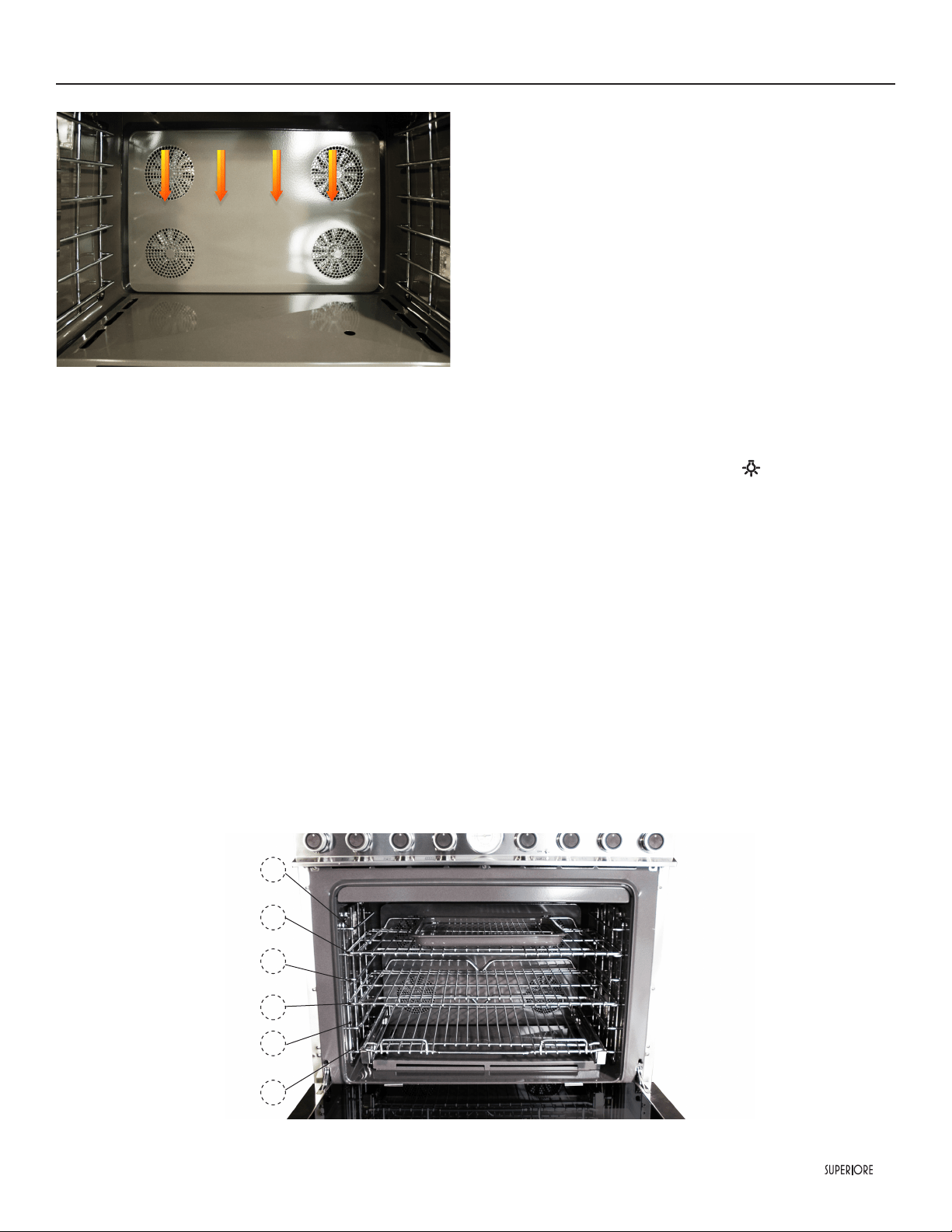
Air is circulated by motorized fan in the rear of the oven. The fan accelerates natural defrosting of the food without heat. To avoid
sickness and food waste, DO NOT allow defrosted food to remain in the oven for more than two hours.
1. Place the frozen food on a baking sheet.
2. Turn the selector to and set the temperature to “OFF”.
WARNING
To avoid sickness and food waste, DO NOT allow defrosted food to remain in the oven for more than two hours.
Defrost
|
31
BROIL
Heat radiates from the broiler located at the top of the oven cavity.
The distance between the foods and the broil elements determines
broiling speed. For “fast” broiling, foodmay be as close as 2 inches (5
cm) to the broil element.“Fast” broiling is best for meatswhere rare
to medium donenessis desired. Use this setting for broiling small
and average cuts of meat.
Broiling Instructions
Broiling is a dry-heat cooking method using direct or radiant heat.
It is used for small, individualized cuts such as steaks, chops, and
patties. Broiling speed is determined by the distance between the
food and the broil element.
Choose the rack position based on desired results.
To Use Broil
1. Arrange the oven rack in the desired position before turning the oven on and close the door.
2. Push and hold the oven control knob for at least one second. Release and turn it clockwise to the broil position. This sequence must
be performed within seven seconds. If you hear a clicling sound while lighting up the broil, this is appropriate.
3. In order to switch on the oven light during broiling function, set the rotary switch knob to “oven light on”.
NOTE:
IF YOU SELECT THE CONVECTION FUNCTION ACTIVATING THE ROTARY SWITCH KNOB, THE FANS WILL NOT
WORK! THIS MUST BE CONSIDERED APPROPRIATE.
Broiling Tips
• ALWAYS use the enamelled tray and trivet for broiling. They are designed to provide drainage of excess liquid and fat away from
the cooking surface to help prevent splatter, smoke, and re.
• To keep meat from curling, slit fatty edge.
• Brush chicken and sh with butter several times as they broil to prevent drying out. To prevent sticking, lightly grease broiler tray.
• Broil on rst side for slightly more than half the recommended time, season, and turn. Season second side just before removing.
• ALWAYS pull rack out to stop position before turning or removing food.
• Use tongs or a spatula to turn meats. NEVER pierce meat with a fork, as this allows the juices to escape.
• Remove the enamelled tray from the oven when you remove the food. Drippings will bake onto the pan if it is left in the heated
oven after broiling.
Rack Positions for Broiling
Note: Position 1 is the closest to the broiler and position 6 is the closest to the oven bottom.
Broiling
1=95%
2=80%
3=65%
4=50%
5=35%
6=25%
1
3
4
5
6
2

32
|
Broiling Chart
Type and Cut of Meat Weight Setting Rack Time (min)
BEEF
Siloin 1’’
Rare 12 oz Broil 3 4
Medium 12 oz Broil 3 5
Well done 12 oz Broil 3 6
T-Bone 3/4’’
Rare 10 oz Broil 3 4
Medium 10 oz Broil 3 6
Well done 10 oz Broil 3 8
Hamburger 1/2’’
Medium 1/4 lb. Broil 3 6
Well done 1/4 lb. Broil 3 8
CHICKEN
Bnls breast 1’’ 1/2 lb. Broil 3 15
Bone-in breast 2-3 lbs. total Broil 1 22
Chicken pieces 2-3 lbs. total Broil 3 22
HAM
Ham slice 1’’ 1 lb. Broil 3 10
PORK
Bacon Broil 2 3
FISH
Salmon steak 1 lb. Broil 2 8
Fillets 1 lb. Broil 2 8
Note: The above information is given as a guide only.
Broiling

|
33
Important!
Before you start cleaning your range, please:
• Read these cleaning instructions and the ‘Safety and warnings’ section at the start of this user guide.
• Turn the range off.
• Make sure the range is a safe temperature to touch.
• Do not use a steam cleaner.
• Do not keep ammable substances in the oven.
General advice
• Wipe down the worktop and wipe out the oven after every use.
• Wipe up spills. Avoid leaving alkaline or acidic substances (such as lemon juice or vinegar) on the surfaces.
• Do not use cleaning products with a chlorine or acidic base (ie citrus-based cleaners).
Cleaning the outside of the range
Important!
• Do not use abrasive cleaners, cloths or pads on the outside surfaces.
• Immediately wipe off any caustic cleaners if they are spilled onto the oven door handle.
Wipe the outside surfaces often, using warm water and a mild household detergent. The stainless steel may also be cleaned with a
suitable cleaner and polish.
Note: if you choose to use a commercial stainless steel cleaner, please read the label to make sure it does not contain chlorine
compounds as these are corrosive and may damage the appearance of your range.
Care and cleaning
34
|
Any piece of equipment works better and lasts longer when maintained properly and kept clean. Cooking equipment is no exception.
Your range must be kept clean and maintained properly. Before cleaning, make sure all controls are in the “OFF” position. Disconnect
power if you are going to clean thoroughly with water.
Surface Burner
Wipe up spill-overs as soon as possible after they occur and before they get a chance to burn in and cook solid. In the event of a spill-
over, follow these steps:
• Allow the burner and grate to cool to a safe temperature level.
• Lift off the burner grate. Wash in warm soapy water.
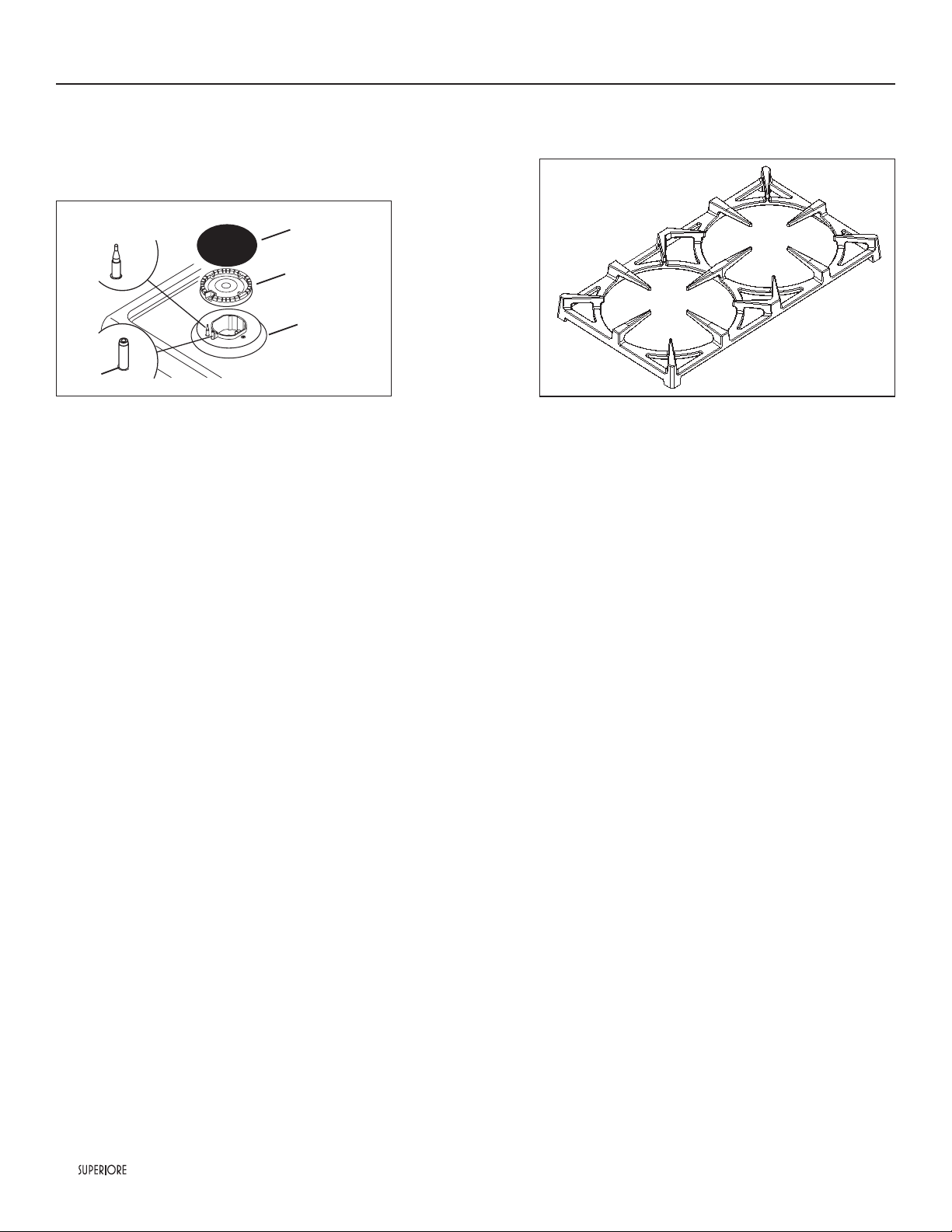
• Remove the burner cap and burner head and clean.
Burner Caps
The surface burner caps should be routinely removed and cleaned.
ALWAYS clean the burner caps after a spill-over. Keeping the burner caps clean will prevent improper ignition and uneven ames.
To clean, pull burner cap straight up from the burner base. Wipe off surface burner caps with warm, soapy water and a soft cloth after
each use. Use a non-abrasive cleanser and a soft brush or soft Scotch Brite™ pad for cooked-on foods. Dry thoroughly after cleaning.
For best cleaning and to avoid possible rusting, DO NOT clean in dishwasher.
Burner Head
If ports on burner head are clogged, clean with a straight pin. DO NOT enlarge or distort the ports. DO NOT use a toothpick to
clean the ports.
Burner Base
The base should be wiped regularly with hot soapy water at the end of each cooling period. DO NOT use steel wool, abrasive cloths,
cleanser, or powders. To remove encrusted materials, soak the area with a hot towel to loosen the material, then use a wooden nylon
spatula. DO NOT use a metal knife, spatula, or any other metal tool to scrape the aluminum base.
• Wipe up any spills which remain on the sealed top surface.
• Replace burner cap, burner head, and grates after drying thoroughly.
Control Panel
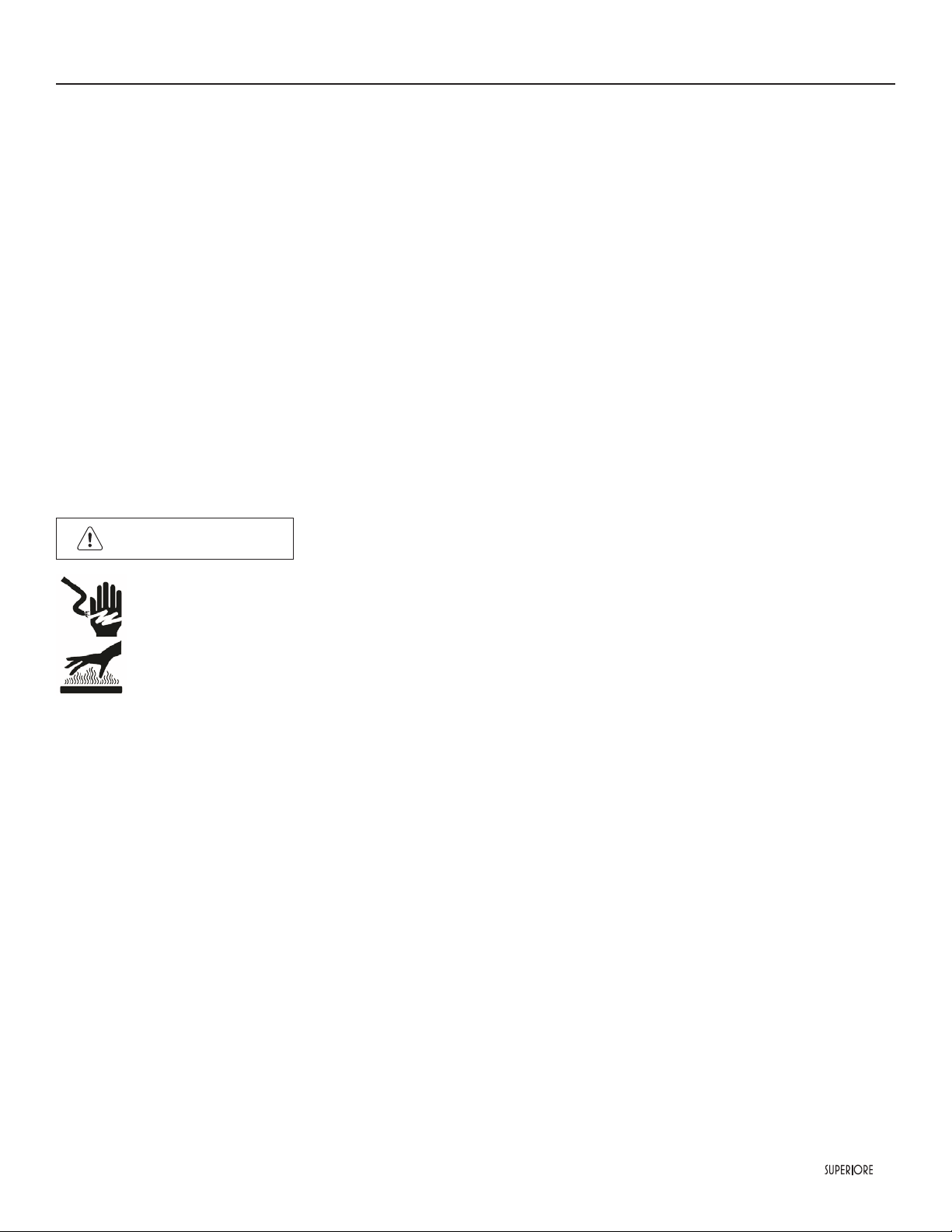
DO NOT use any cleaners containing ammonia or abrasives. They could remove the graphics from the control panel.
Use hot, soapy water and a soft clean cloth.
Oven Surfaces
Several different nishes have been used in your oven. NEVER USE AMMONIA, STEEL WOOL PADS OR ABRASIVE
CLOTHS,CLEANSERS, OVEN CLEANERS, OR ABRASIVE POWDERS. THEY CAN PERMANENTLY DAMAGE YOUR OVEN.
Cleaning and Maintenance
|
35
Cleaning and Maintenance
Control Knobs
MAKE SURE ALL THE CONTROL KNOBS POINT TO THE OFF POSITION BEFORE REMOVING. Pull the knobs straight off. Wash in
detergent and warm water. Dry completely and replace by pushing rmly onto stem. DO NOT use any cleaners containing ammonia
or abrasives. They could remove the graphics from the knob.
Stainless Steel Parts
All stainless steel body parts should be wiped regularly with hot soapy water at the end of each cooling period and with a liquid cleaner
designed for that material when soapy water will not do the job. DO NOT use steel wool, abrasive cloths, cleansers, or powders.
If necessary, scrape stainless steel to remove encrusted materials, soak the area with hot towels to loosen the material, then use a
wooden or nylon spatula or scraper. DO NOT use a metal knife, spatula, or any other metal tool to scrape stainless steel. DO NOT
permit citrus or tomato juice to remain on stainless steel surface, as citric acid will permanently discolor stainless steel. Wipe up any
spills immediately.
Glass Surfaces
Clean with detergent and warm water. Glass cleaner can be used to remove ngerprints. If using glass cleaner ammonia, make sure that
it does not run down on exterior door surface.
Oven Racks
Clean with detergent and hot water. Stubborn spots can be scoured with a soap-lled steel wool pad.
WARNING
BURN OR ELECTRICAL SHOCK HAZARD
Make sure all controls are OFF and oven is COOL before cleaning. Failure to do so can result in burns or electrical shock.
36
|
Replacing Oven Light
WARNING
ELECTRICAL SHOCK HAZARD
Disconnect the electric power at the main fuse or circuit
breaker before replacing bulb.
WARNING
DO NOT touch bulb with bare hands. Clean off any signs of oil from the bulb and handle with a soft cloth.
DO NOT touch bulb with bare hands. Clean off any signs of oil from the bulb and handle with a soft cloth.
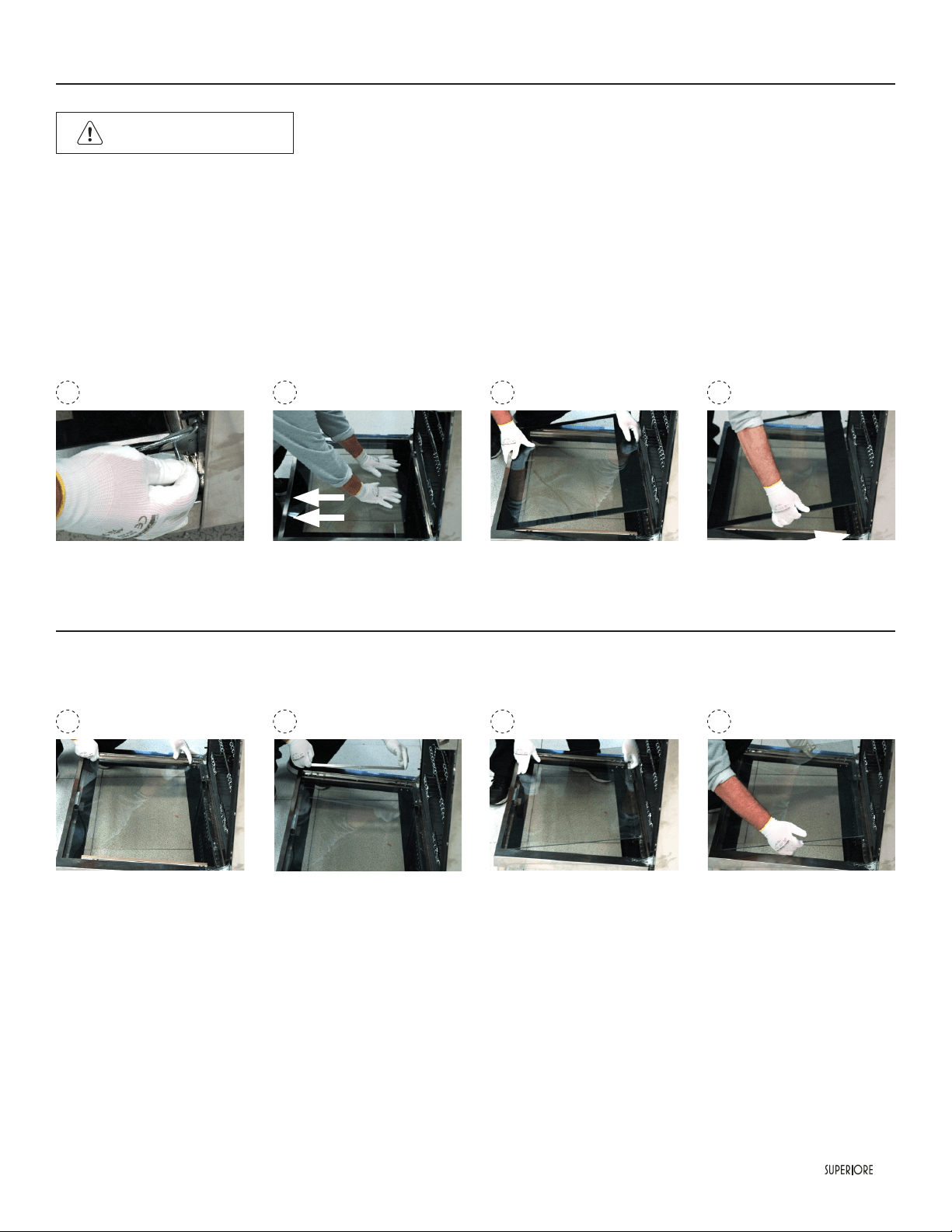
1. Unsnap glass light cover using a screwdriver in the access groove.
2. Firmly grasp light bulb and pull out.
3. Replace with halogen bulb using volt and wattage requirements listed on glass cover.
4. Replace the light cover by snapping glass cover onto metal box.
5. Reconnect power at the mainfuse or circuit breaker.
|
37
Door Removal
Door Replacement and Adjustment
WARNING
TO PREVENT PERSONAL INJURY
Before removing the doors, make sure the pins are properly installed in the hinges. Failure to do so can
result in personal injury to hands and/or ngers.
The door can be completely disassembled to guarantee the general cleaning, of the glasses and the other parts. To disassembe the door
you must observe the following procedure.
• Open the door and x the pin as indicated in picture 1.
• Put the hands on the internal glass surface, in the center, generate a small pressure and after slide back the glass, as indicated in picture 2.
• Grasp the glass, rotate and remove as indicated in pictures 3 and 4.
• Grasp the bars and remove as indicated in pictures 5 and 6.
• Grasp the intermediate glass, rotate and remove as indicated in pictures 7 and 8.
Assamble again the door repeat all the operations but exactly one after the other in the reverse sequence.
Before closing the door don’t forget to remove the pins.
1
5
3
7
2
6
4
8
38
|
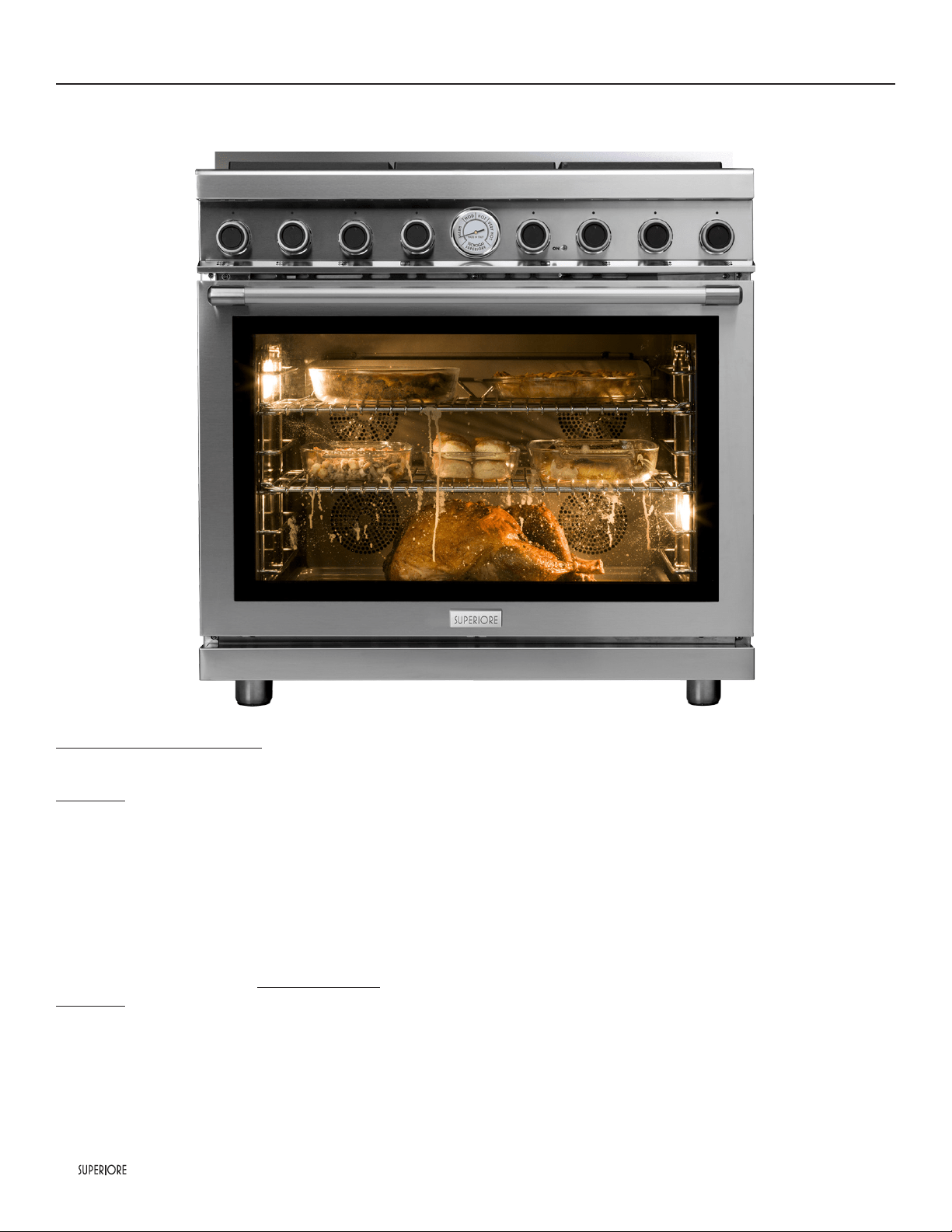
Thanksgiven dinner, SUPERIORE’s way
DAY BEFORE (if possible): PUMPKIN lling & STUFFING
PUMPKINPIE
Ingredients: 1 very large pumpkin or 2 small to medium-sized pumpkins (to make 2 pies) min. 5 - 7 lb.
Slice portion off top of pumpkin and save the “lid”. Remove the seeds and strings (all the pulp). Put entire pumpkin in a pan, with the lid
back on top, then pour a cup or two cups of water in pan.
Bake at 350° (180-190°) for about 1 to 1½ hours, depends on the size of the pumpkin. Using a fork to check, cook until tender and
falls apart. Remove from oven and either just pare -peel off skin- or cut pumpkin to scrape out the insides. This should give you enough
pumpkin for several pies. Then follow the recipe. You can decide whether to make the pies the day before or not. Depends on time
available and oven!
Follow instructions for Pumpkin Pie recipe.
BEGIN THE lst PART FOR THE GIBLET STUFFING for TURKEY
Ingredients: the innards from the turkey, 1 stalk celery, poultry seasoning or bouillon cube for poultry.
Simmer heart, liver, gizzard and neck in water
<
about 3 cups
>
with 1 stalk of celery and poultry seasoning or bouillon cube for poultry.
Simmer until tender, check with a fork. About 1 hour. Cool and chop (mince or cube) into small pieces. Throw away celery. Keep liquid
(broth) and meat in separate containers in refrigerator until ready to prepare and add to Turkey the next day. Turkey is prepared on the
morning or mid-morning of Thanksgiving Day.
Follow instructions for Turkey preparation.

|
39
Thanksgiven dinner, SUPERIORE’s way
THANKSGIVING DAY:
2
nd
PART GIBLET STUFFING:
Ingredients: 1 box seasoned bread crumbs (12 cups croutons)
1 onion diced
2-3 celery stalks cut up
1 teaspoon of pepper
1 tablespoon of sage
1 tablespoon thyme
1 tablespoon poultry seasoning or bouillon cube for avor
broth from day before
innards/meat from day before
1 cup of butter
additional chicken broth and/or water (where necessary)
Remove the broth and meat that you prepared the day before from the refrigerator. In a pan, put enough butter to lightly cook the onion
almost sautéed, slight yellow color, stirring occasionally.
Then lower ame and stir in a portion of the bread crumbs, and a bit of broth, (note: stir to prevent excess browning), then add more bread
crumbs and broth, add in cut up celery stalks, sage, pepper, thyme and meat.
Remove from heat and mix lightly in a deep bowl. Mixture should just be damp/slightly wet, pliable. Set aside unlil Turkey is ready to be
stuffed.
ROASTING TURKEY
Ingredients: 10 - 12lb. Turkey (order in advance from favorite butcher)
a small amount of butter
salt and pepper
Giblet stufng
Preheat oven to 325-350° (170-180°). Clean the turkey. Then place a small amount of butter inside by trying to coat the inside cavity.
Then sprinkle cavity with a bit of salt and pepper. Stuff turkey in both cavities
........ main body and lower body area with the giblet stufng, close with either oven hooks, pins or cord.
Place turkey in already preheated oven. Cook at 325-350° (170-180°) for 4 to 5 hours. When turkey starts to leave drippings, spoon or
baste the liquid onto the turkey again, do this every 15-20 minutes until thoroughly cooked.
MASHED POTATOES
Ingredients: 1-1½ potatoes per person (n. of guests X 1 or 1½)
milk
butter
salt (and pepper if desired)
Boil potatoes until tender. Drain and cool then peel. Smash potatoes, add in milk a pat of butter and salt.
Using blender, fork etc. until desired texture/consistency is obtained.
BROWN-SUGARED CARROTS
Ingredients: 1½ carrots per person
brown sugar
butter
Boil carrots until slightly tender. Drain, then remove and dice into circles. In a sauté pan melt butter and add in diced carrots, sauté until
more tender, add in brown sugar and if too dry add in a bit more butter and stir and sauté until brown sugar is melted and coats the
carrots.

40
|
PUMPKIN PIE (2 pies)
Ingredients: 1½ cups sugar
¼ tsp. salt
4 tsp. cinnamon
1 tsp. ginger
½ tsp. ground cloves
4 eggs (or 1 egg and 6 egg whites)
3½ cups pumpkin
3 cups evaporated milk
Combine sugar, salt, cinnamon, ginger and cloves in medium bowl. Beat eggs slightly in large bowl. Stir and add in pumpkin and sugar and
spice mixture from medium bowl. Mix well, then gradually add the evaporated milk. Pour in to pie crust shells and Bake at 425° (220°)
for 15 minutes, then lower oven temperature to 350° (180°). Bake for another 40 to 50 minutes or until point that when you insert a
knife or toothpick in the center of the pie, and pull it out it is clean. Cool on wire rack for 3 hours. Serve immediately or chill (do not
freeze). Serve with whipped cream.
APPLE PIE
Ingredients per pie: 7-8 apples (Granny Snith is best)
1 cup sugar
2 tbsp our
2 heaping tbsp. (3 cucc.) cinnamon
100 gr butter
Thinly slice apples. Mix sugar, our and cinnamon together in a large bowl. Add the apples to this and mix. Place mixture in pie shell
and then put small pieces of butter on top of mixture. Place top crust over this, and join pieces, and cover edge with aluminum foil.
Bake at 425° (220°) 25-30 minutes. Do not make slits in top crust! As an extra: you can baste the top of the pies with a small amount
of heated butter and then sprinkle with sugar and cinnamon and place back in oven for the remaining time to nish baking. Serve hot
with vanilla ice-cream!
COUNTRY PAN GRAVY
Ingredients: drippings from turkey
¼ cup our
½ cup milk
salt and pepper
1 bouillon cube for poultry
Remove Turkey from pan. Place pan on stove with low heat. Mix our and milk with wire whip in deep bowl. Slowly add this mixture
to the drippings in the pan. Mixture should become thicker. If too thick, then add more milk to pan gravy and crumble and add bouillon
cube, salt and pepper to this. Serve over mashed potatoes and stufng!
Thanksgiven dinner, SUPERIORE’s way

|
41
Service Information
If service is required, call your dealer or authorized service agency.
The name of the authorized service agency can be obtained from the dealer or distributor in your area, on calling 1-844-322-2111.
Have the following information readily available.
• Model number
• Serial number
• Date purchased
• Name of dealer from whom purchased.
• Clearly describe the problem that you are having.
Record the information indicated below. You will need it if service is ever required.
The model and serial number can be found by looking in the last page of this booklet. A duplicate label is located on the back side of
the range.
Model no. Serial no.
Date of purchase Date installed
Dealer’s name
Address
If service requires installation of parts, use only authorized parts to insure protection under warranty.
Keep this manual for future reference.

42
|
Problem Possible Cause and /or Remedy
Range will not work.
Range is not connected to electrical power:
Have electrician check power circuit breaker, wiring, and fuses.
Oven light will not work.
Light bulb is burned out.
Range is not connected to power.
Igniters will not work.
Circuit is tripped.
Fuse is blown.
Range is not connected to power.
Igniters sparking but no ame ignition. Gas supply is interrupted.
Igniters sparking continuously after ame ignition.
Power supply is not grounded.
Power supply polarity is reversed.
Igniters are wet or dirty.
Burner ignites but ame islarge, distorted, or yellow.
Burner ports are clogged.
Unit is being operated on wrong type of gas.
Air shutters not properly adjusted.
Strong odor and/or smoke is noticed rst few times oven is used.
This is normal burn off of insulation and protective oils in oven.
This will go away after using oven a few times.
Gas broiler goes off during initial operation
Cavity with too much carbon monoxide. Open oven door and let
fresh air go in the cavity, then re-ignite the oven.
Bake element goes off during initial operation
Cavity with too much carbon monoxide. Open oven door and let
fresh air go in the cavity, then re-ignite the oven.
Troubleshooting

TECNO, S.P. 63R n. 111, 42044 Gualtieri (RE), Italy
T. +39 0522 222 161
appliances are proudly designed and handcrafted in Gualtieri, Italy
Tecnogas Tecnogas Superiore and Superiore are registered trademarks of TECNO

superiore.us
461308622 - rev 03/2017