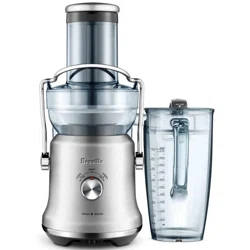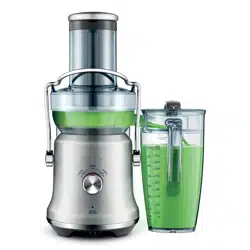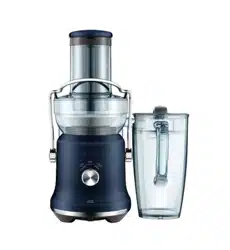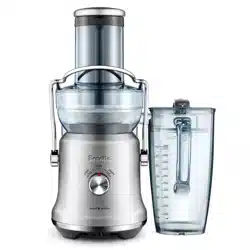
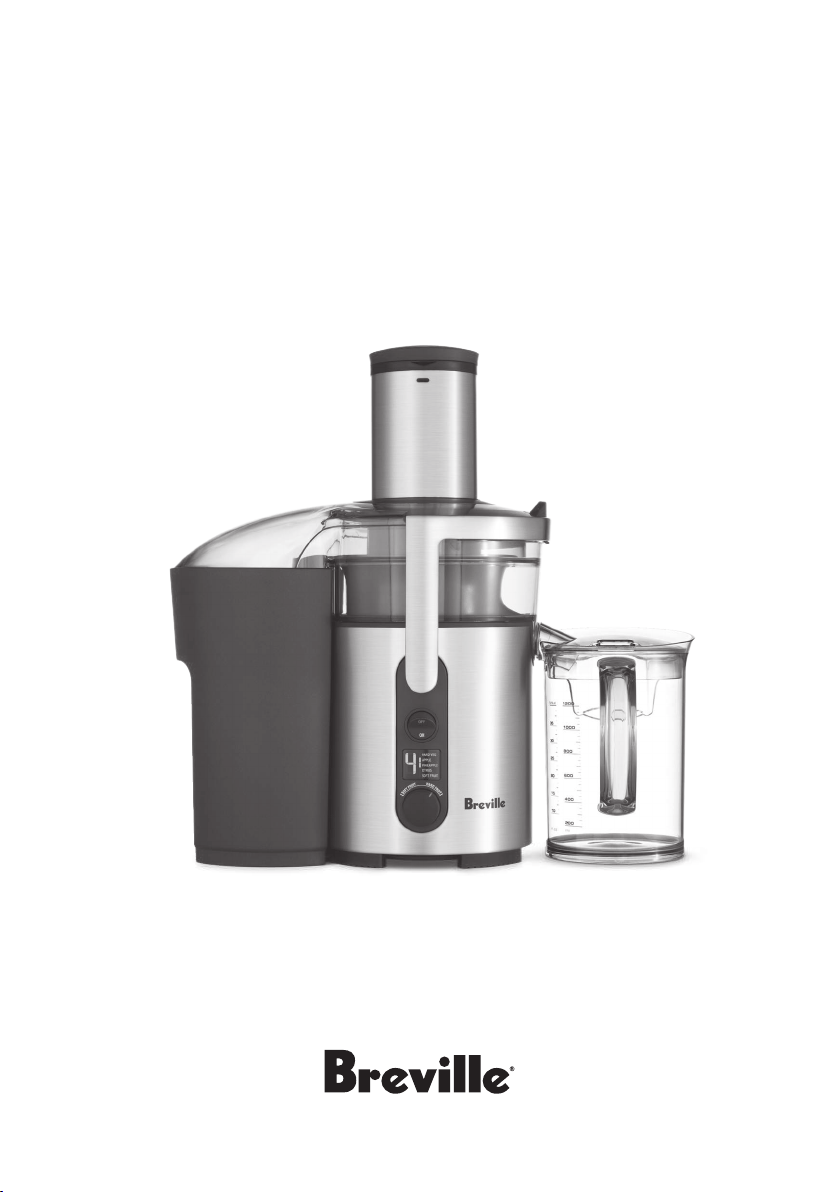
the Froojie
®
Juice Fountain
™
Instruction Book - BJE520

2
BREVILLE
RECOMMENDS
SAFETY FIRST
At Breville we are very safety
conscious. We design and
manufacture consumer
products with the safety of you,
our valued customer, foremost
in mind. In addition we ask
that you exercise a degree of
care when using any electrical
appliance and adhere to the
following precautions.
IMPORTANT
SAFEGUARDS
READ ALL
INSTRUCTIONS BEFORE
USE AND SAVE FOR
FUTURE REFERENCE
• Remove and safely
discard any packaging
material and promotional
labels before use.
• Do not place the juicer
near the edge of a bench
or table during operation.
Ensure that the surface
is level, clean and free of
water, flour, etc. Vibration
during operation may
cause the appliance
to move.
• Any significant spillage
onto the surface under or
around the appliance, or
onto the appliance itself,
should be cleaned and
dried before continuing to
use the appliance.
• Do not place the juicer
on or near a hot gas or
electric burner, or where
2 Breville Recommends Safety First
7 Components
9 Assembly
12 Functions
15 Disassembly
16 Tips
18 Juicing Guide
20 Care & Cleaning
22 Troubleshooting
24 Recipes
Contents

3
it could touch a heated
oven.
• Always ensure the juicer
is properly assembled
before use. The appliance
will not operate unless
properly assembled.
Refer to Assembly.
• Do not leave the juicer
unattended when in use.
• Always ensure the juicer
is turned OFF by pressing
the OFF/ON switch on
the control panel to OFF.
Then switch the appliance
OFF at the power outlet
and unplug the cord.
Make sure the stainless
steel filter basket has
stopped rotating and the
motor has completely
stopped before releasing
the safety locking arm
and/or attempting to
move the appliance, when
the juicer is not in use,
and before disassembling,
cleaning and storing.
• An example of the
heaviest loading
anticipated for use
with this juicer is 5kg
of beetroot, juiced
continuously over a
period of 2 minutes.
• Do not operate the juice
extractor continuously
with heavy loads for
more than 10 seconds.
Allow the motor to rest
for 1 minute between
each use. Recipes in this
instruction book are not
considered a heavy load.
However, hard fruits and
vegetables will put excess
strain onto the motor if
a low speed is selected.
Please refer to the juicing
guide on Page 18 to
determine the correct
speed for the fruits and
vegetables selected for
juicing.
• When using the Froojie
®
Disc and insert, always
use speed 1 and remove
seeds core and skin from
fruit before processing
(seeds of passionfruit,
berries and kiwi fruit are
acceptable).

4
• Keep hands, fingers,
hair, clothing, as well
as spatulas and other
utensils away from
the appliance during
operation.
• Do not push food into
the feed chute with your
fingers or other utensils.
Always use the food
pusher provided. Do not
place hand or fingers
into food chute when it is
attached to the appliance.
• Be careful when handling
the stainless steel filter
basket as the small cutting
blades at the base of
the filter basket are very
sharp. Mishandling may
cause injury.
• Do not use the juicer
for anything other than
food and/or beverage
preparation.
• Keep the appliance clean.
Refer to Care & Cleaning.
• Do not use appliance if
the rotating sieve (filter
basket) is damaged.
• Do not touch the small
sharp teeth and blades in
the centre of the juice disc.
• Do not touch the blade in
the feed chute.
• Do not run ice or hard
fruit/vegetables such
as raw beetroot and
carrots through the juicer
when using the Froojie
®
extractor.
• Remove rind from all
citrus fruit before juicing.
• CAUTION In order to
avoid a hazard due to
inadvertent resetting
of the thermal cut out,
this appliance must not
be supplied through
an external switching
device such as a timer or
connected to a circuit that
it regularly switched on
and off by the utility.
WARNING
Extra wide feed chute. Do
note place hands or foreign
objects down feed chute.
Always use the food pusher
provided.

5
IMPORTANT
SAFEGUARDS
FOR ALL
ELECTRICAL
APPLIANCES
• Fully unwind the power
cord before use.
• Do not let the power cord
hang over the edge of
a bench or table, touch
hot surfaces or become
knotted.
• To protect against electric
shock do not immerse the
power cord, power plug or
appliance in water or any
other liquid.
• The appliance can be
used by children aged
from 8 years and above
and persons with reduced
physical, sensory or
mental capabilities or
lack of experience and
knowledge if they have
been given supervision
or instruction concerning
use of the appliance in a
safe way and understand
the hazards involved.
Children shall not play
with the appliance.
Cleaning and user
maintenance shall not be
made by children unless
they are older than 8 and
supervised.
• Keep the appliance and
its cord out of reach of
children less than 8 years.
• It is recommended to
regularly inspect the
appliance. To avoid a
hazard do not use the
appliance if power cord,
power plug or appliance
becomes damaged in
any way. Return the
entire appliance to
the nearest authorised
Breville Service Centre
for examination and/or
repair.
• Any maintenance other
than cleaning should
be performed at an
authorised Breville
Service Centre.

6
• This appliance is for
household use only.
Do not use this appliance
for anything other than
its intended use. Do not
use in moving vehicles
or boats. Do not use
outdoors. Misuse may
cause injury.
• This appliance can be
used by persons with
reduced physical, sensory,
or mental capabilities or
lack of experience and
knowledge if they have
been given supervision
or instruction concerning
use of the appliance in
a safe way and if they
understand the hazards
involved.
• This appliance shall not
be used by children. Keep
the appliance and its cord
out of reach of children.
• The installation of
a residual current
device (safety switch
is recommended to
provide additional safety
protection when using
electrical appliances.
It is advisable that a
safety switch with a rated
residual operating current
not exceeding 30mA be
installed in the electrical
circuit supplying the
appliance. See your
electrician for professional
advice.
• Do not operate the
appliance for more than
1 minute. Allow the
appliance to cool before
next use.
WARNING
Always make sure juicer
cover is clamped securely
in place before motor is
turned on. Do not unfasten
interlock arm while juicer
is in operation.
FOR HOUSEHOLD USE ONLY
SAVE THESE INSTRUCTIONS
7
Components
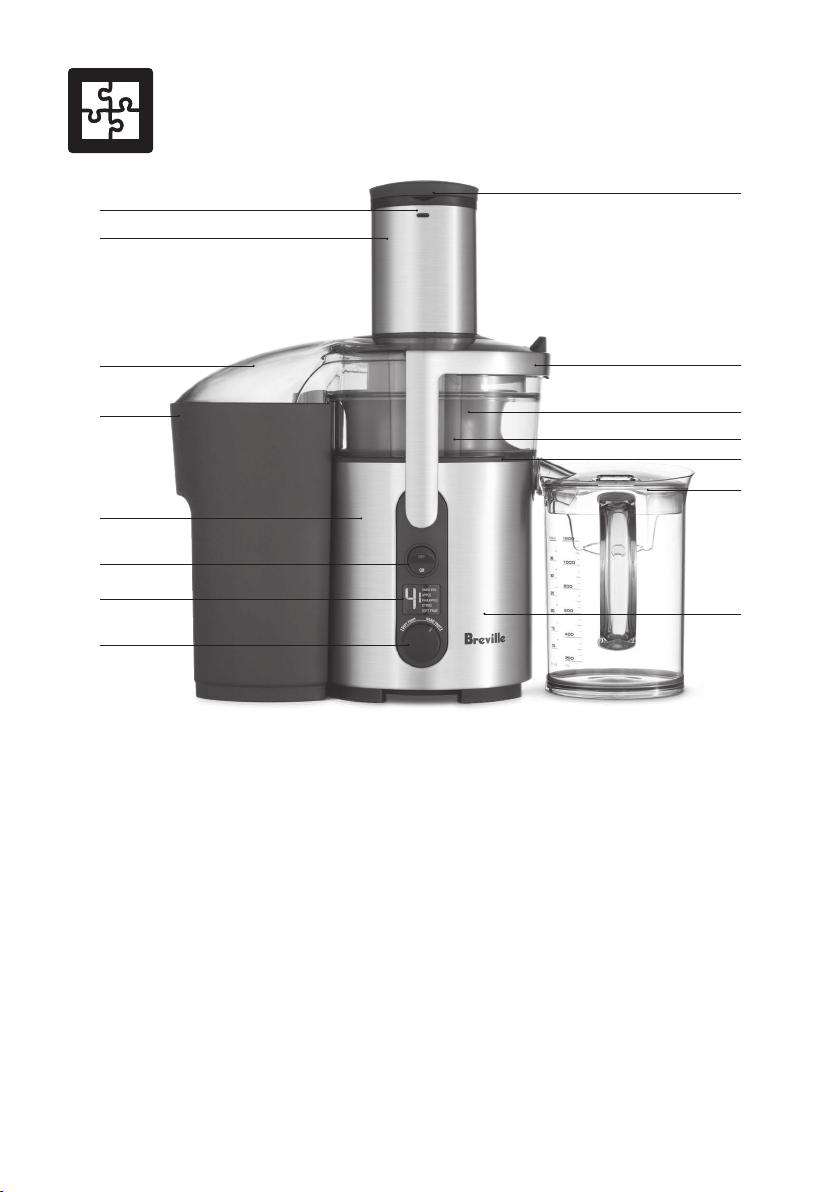
A. Unique Direct Central Feed System
Ensures maximum juice extraction.
B. 84mm extra wide feed chute
Fits larger fruit and vegetables whole.
C. Juicer cover
(Top shelf dishwasher safe).
D. 3 litre pulp container
(Top shelf dishwasher safe)
E. Stylish stainless steel design
F. ON/OFF switch
G. LCD speed indicator
With juicing speed guide.
H. Electronic variable speed control dial
I. Food pusher
For pushing whole fruit and vegetables
down the feed chute (top shelf
dishwasher safe).
J. Die-cast metal interlocking safety arm
Stops the juicer operating without the juicer
cover locked in place.
K. Filter basket
Stainless steel, titanium reinforced
micro mesh filter basket
(top shelf dishwasher safe).
L. Motor drive coupling
M. Filter bowl surround
(Top shelf dishwasher safe).
N. 1.2 litre juice jug and lid
With in-built froth separator
(top shelf dishwasher safe).
O. Heavy duty motor
With five year motor warranty.
A
B
C
D
E
F
G
H
I
J
K
L
M
N
O
8
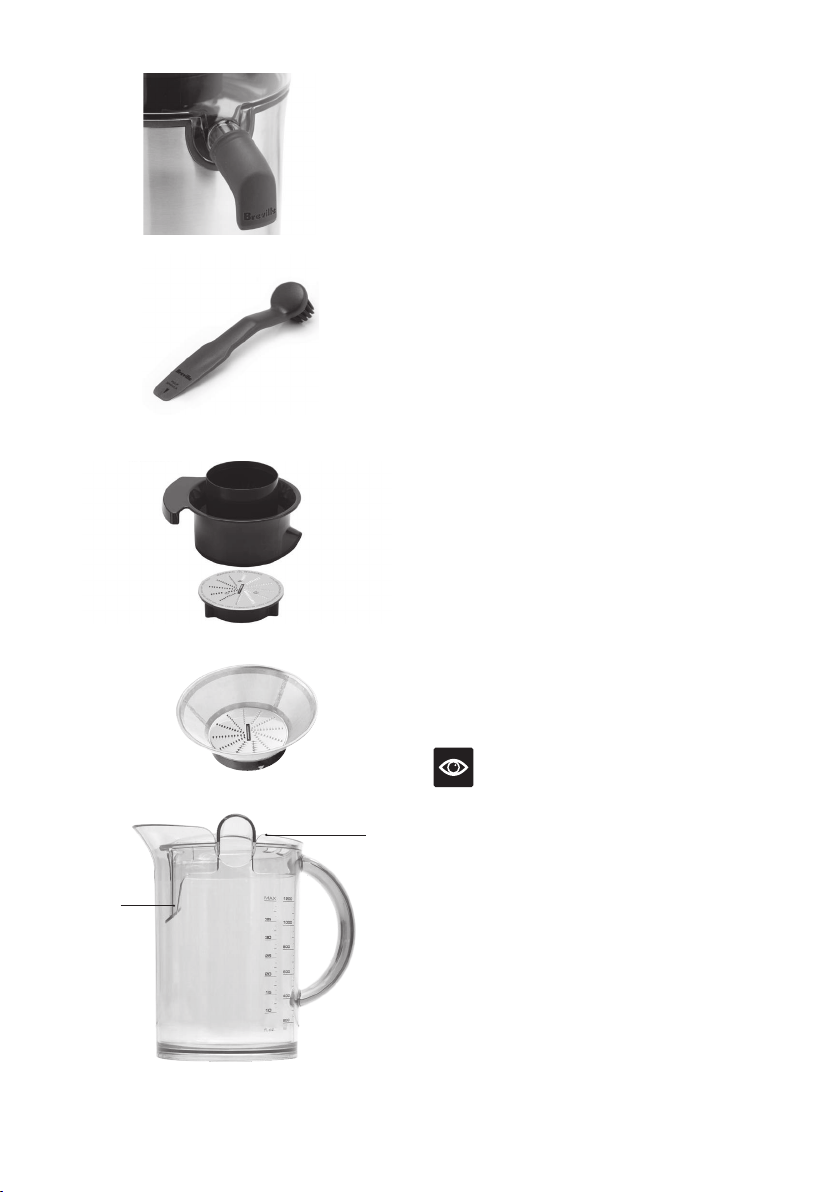
P. Custom designed juice nozzle
Perfect for mess free juicing straight into a
glass (top shelf dishwasher safe).
Q. Cleaning Brush
Flat end of brush assists in removal of pulp
from the pulp container when juicing large
quantities, nylon brush end makes for easy
cleaning of the stainless steel filter basket
(top shelf dishwasher safe).
R. Froojie
®
Insert
For processing softer fruits such as bananas,
mangoes and strawberries. Integrated
handle for left and right handed use.
S. Froojie
®
Disc
For processing softer fruits such as bananas,
mangoes and strawberries.
T. Nutri Disc™
Allows you to extract only the juice from
fruit and vegetables.
U. Built in froth separator
Ensures juice froth is separated from juice
when poured into a glass (if preferred).
V. Juice jug lid
Allows juicer to operate with the lid on,
therefore eliminating any splatter during
operation. Place lid onto juice jug to store
juice in refrigerator.
NOT SHOWN
Cord Exits at rear of juicer and wraps
around feet.
NOTE
To retain froth in the juice jug simply remove
the lid before pouring the juice.
Q
P
R
U
V
S
T
9
Assembly
BEFORE FIRST USE
Before using your juicer for the first time,
remove any packaging material and
promotional stickers and labels. Ensure the
appliance is switched off at the power outlet
and the power cord is unplugged.
Wash the filter bowl surround, Nutri Disc™,
juicer cover, Froojie
®
Disc, Froojie
®
Insert, food
pusher, pulp container and juice jug and lid in
warm, soapy water with a soft cloth. Rinse and
dry thoroughly. The motor base can be wiped
with a damp cloth. Dry thoroughly.
FOR USE WITH JUICE EXTRACTOR
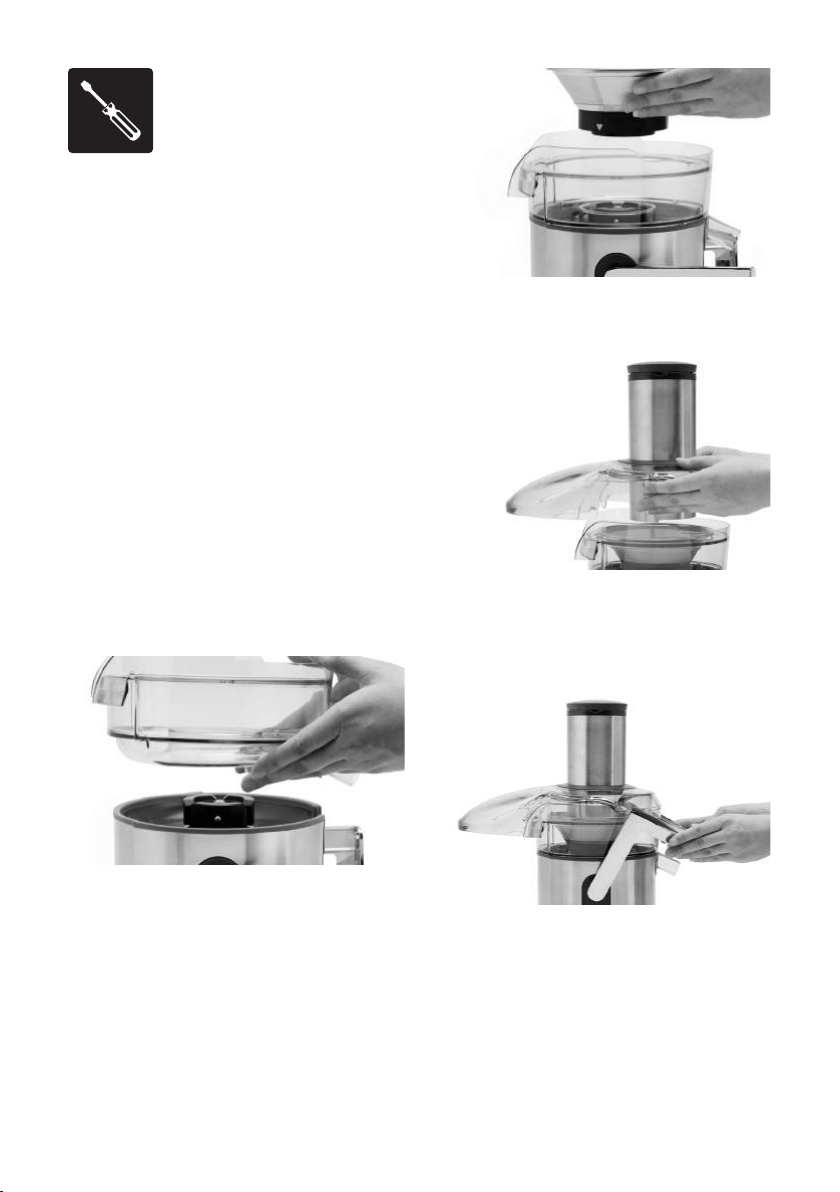
1. Place the motor base on a flat, dry surface
such as a bench top. Ensure that the motor
base is switched OFF at the control panel,
then switch the appliance off at the power
outlet and unplug the cord.
2. Place the filter bowl surround on top of the
motor base.
3. Align the arrows at the base of the Nutri
Disc™ with the arrows on the motor drive
coupling and push down until it clicks
into place. Ensure the Nutri Disc™ is fitted
securely inside the filter bowl surround and
onto the motor base.
4. Place the juicer cover over the filter bowl
surround, positioning the feed chute over
the juice disc and lower into position.
5. Raise the safety locking arm up and locate
it into the two grooves on either side of the
juicer cover. The safety locking arm should
now be in a vertical position and locked into
place on top of the juicer cover.
10
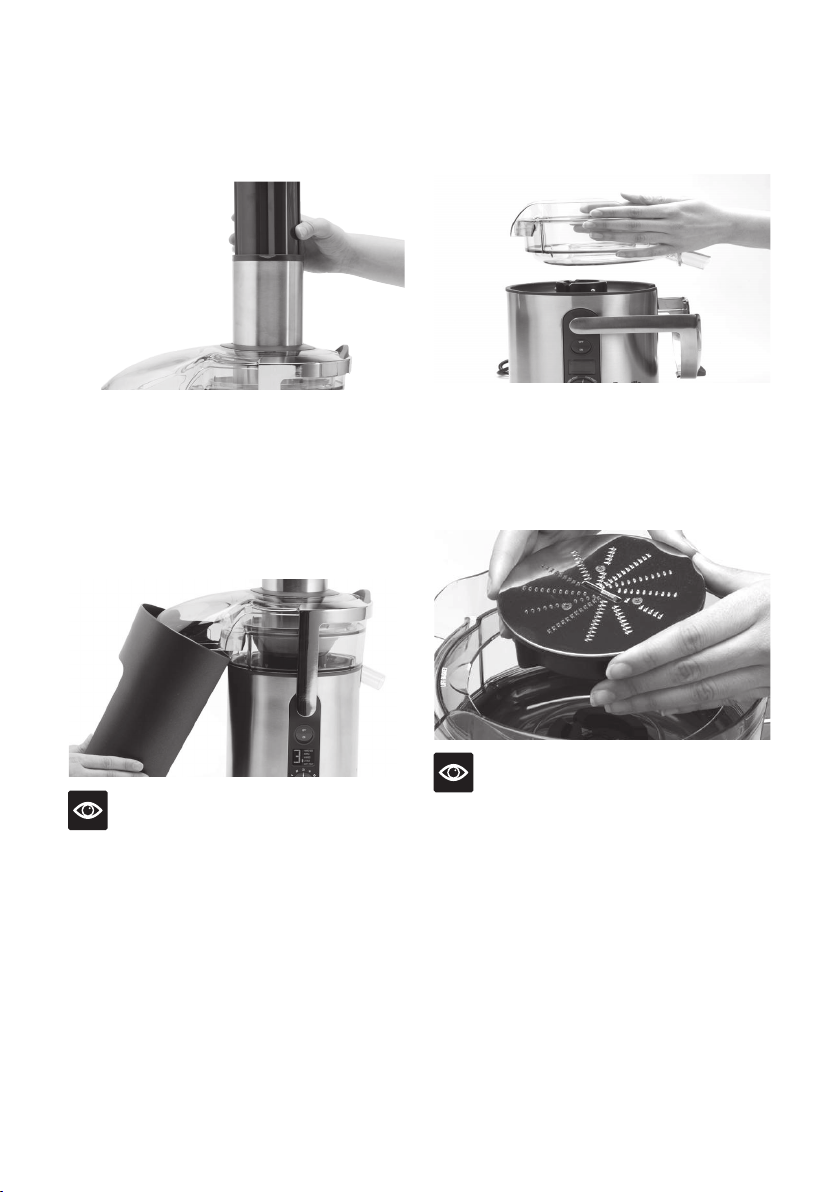
6. Slide the food pusher down the feed chute
by aligning the groove of the food pusher,
with the small protrusion on the inside top
of the feed chute. Continue to slide the food
pusher down into the feed chute.
7. Place the pulp container into position by
tilting the base of the pulp container away
from the motor base and slide the top of the
pulp container over the bottom of the juice
cover. Tilt the base of the pulp container
back into the motor base ensuring it
is supported by the container support
extending from under the motor base.
NOTE
To minimise cleaning, line the pulp container
with a plastic freezer bag to collect the pulp.
Pulp can then be used in other dishes, or as
compost for the garden or discarded.
8. Place the juice jug provided under the
spout on the right-hand side of the juicer.
The juice jug lid can be used to avoid
any splatter. Alternatively you can fit the
custom-designed juice nozzle over the juice
spout and place a glass underneath. The
juice nozzle will prevent splatter, ensuring
mess free juicing.
FOR USE WITH FROOJIE
®
EXTRACTOR
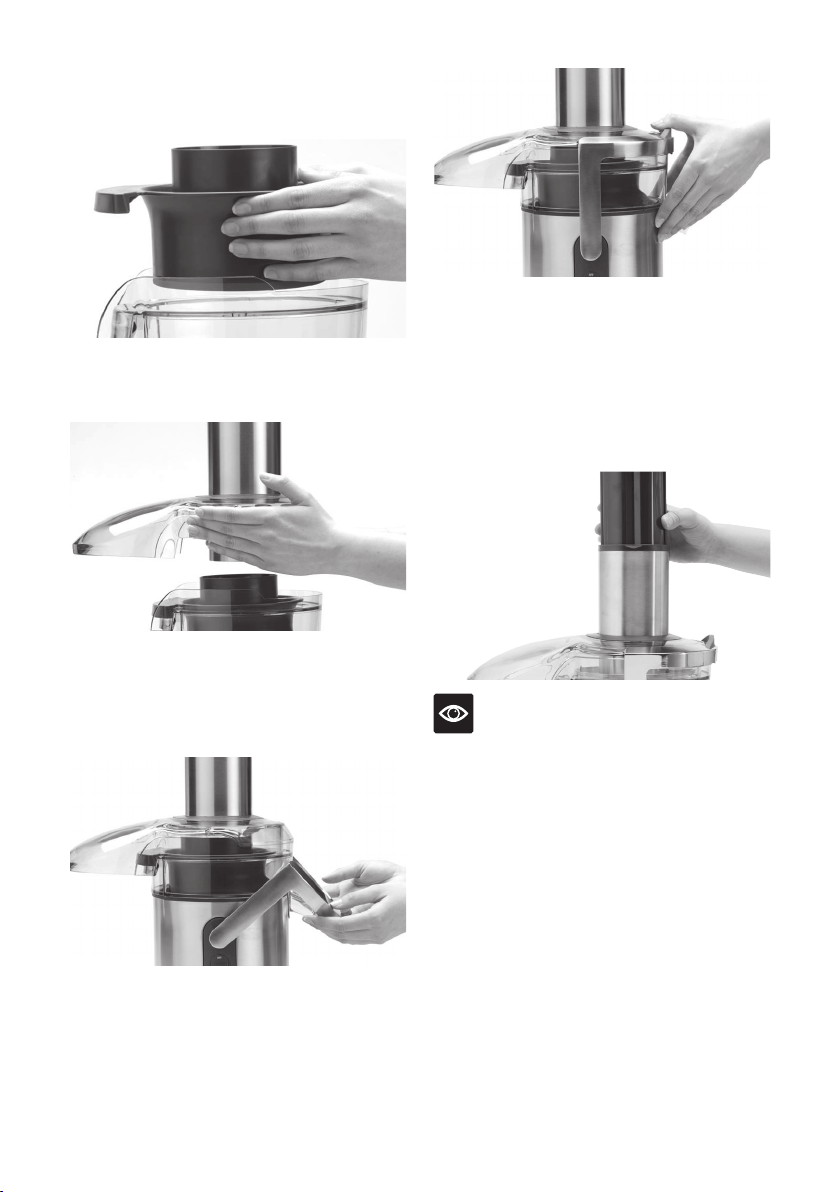
1. Place the filter bowl surround on the top of
the motor base.
2. Place the Froojie
®
Disc into the filter bowl
surround and onto the motor drive coupling.
Push down until it clicks into place.
Ensure the Froojie
®
Disc is fitted securely
inside the filter bowl surround and onto the
motor base.
NOTE
Never use Froojie
®
Disc without Froojie
®
Insert.
They must always be used together.
11
3. Place the Froojie
®
Insert into the filter bowl
surround, making sure the warning label on
the handle is facing upwards.
4. Place the juicer cover over the Froojie
®
Insert
and filter bowl surround and lower into
position.
5. Raise the safety locking arm up and lock
into the two grooves on either side of the
juicer cover. The safety locking arm should
now be in a vertical position and locked into
place on top of the juicer cover.
6. Slide the food pusher down the feed chute
by aligning the groove in the food pusher
with the small protrusion on the inside of
the top of the feed chute.
7. Place the juice jug provided under the
spout on the right-hand side of the juicer.
The juice jug lid can be used to avoid
any splatter.
NOTE
There is no need to use pulp container when
using Froojie
®
extractor.

12
PREPARATION OF FRUIT AND
VEGETABLES FOR FROOJIE
®
EXTRACTOR
Only soft fruits should be used with the
Froojie
®
extractor.
When using fruits with hard inedible skins,
such as mangoes, pineapple or kiwi fruit,
always peel before juicing.
When using fruits with a hard core such as
pineapple, always remove this before juicing.
All fruits with pits, hard seeds or stones such
as nectarines, peaches, mangoes and apricots
must be pitted or deseeded before juicing.
Passionfruit pulp, peeled kiwi fruit and berries
can be processed without removing seeds.
NOTE
When using the Froojie
®
extractor, use low
speeds (speed 1 or 2). Always ensure motor is
running before adding fruit and/or vegetables
to feed tube.
FROOJIE
®
EXTRACTOR SPEED
Apricots (stone removed) 1
Bananas (peeled) 1
Kiwi fruit (peeled) 1
Mangoes (peeled, stone removed) 1
Melons (peeled) 1
Pears soft (stalk and core removed) 1
Pineapple (peeled and cored) 1
Raspberries 1
Strawberries (stalks removed) 1
Watermelon (peeled, seeds removed) 1
Use speed 2 to push out any remaining
fruit pulp in juice collector
2
WITH JUICE EXTRACTOR OR
FROOJIE
®
EXTRACTOR
1. Wash selection of fruit and vegetables to
be juiced.
NOTE
Most fruit and vegetables such as apples,
carrots and cucumbers will not need to be
cut or trimmed to size as these will fit whole
into the feed chute. Ensure vegetables such
as beetroot, carrots, etc. have all soil removed,
are well washed and trimmed of leaves before
juicing.
2. Based on the type of fruit or vegetable you
are juicing/pureeing select either the juice
extractor or the Froojie
®
extractor.
WARNING
Do not put hard fruit and vegetables (i.e.
Carrots, apples, fresh beetroot, etc.) or ice
through juicer when using Froojie
®
extractor.
This could damage parts of the unit.
3. Ensure the juicer is correctly assembled.
Refer to "Assembly". Ensure the juice jug
(or a glass) is placed under the spout and
the pulp container is in position before
commencing juicing.
4. Plug the power cord into a 230/240V
power outlet. Turn the power on at the
power outlet. The LCD display
will illuminate.
Functions

13
NOTE
• The LCD display will illuminate continuously
for 3 minutes before going into a sleep mode,
where it will switch off automatically to
conserve power.
• The screen will come back on after activating
the ON/OFF switch, the speed control dial, or
the safety locking arm.
• When the safety locking arm is not locked
into place on top of the juicer cover, the LCD
display will illuminate and flash with an “L”,
indicating that the safety locking arm should
be locked into place.
• When the safety locking arm is locked into
place on top of the juicer cover, the LCD
display will illuminate and display the
selected speed setting. The speed can be
changed by adjusting the variable speed
control dial. For a quick juicing speed
reference, use the speed guide displayed
on the LCD screen, the speed selector table
located on the pulp container, or refer to the
speed selector table.
• Hard fruits and vegetables will put excess
strain onto the motor if a low speed is
selected. Please refer to the speed selector
table to determine the correct speed for the
fruits and vegetables being juiced.
PREPARATION OF FRUIT AND
VEGETABLES FOR JUICE EXTRACTOR
SPEED SELECTOR TABLE
FRUIT / VEGETABLES SUGGESTED
SPEED
Apples 5
Apricots (stone removed) 2
Beetroot (cleaned, trimmed) 5
Blueberries 1
Broccoli 4
Brussel Sprouts (trimmed) 5
Cabbage 4
Carrots (cleaned) 5
Cauliflower 4
Celery 5
Cucumber (peeled) 2
Cucumber - soft skinned 4
Fennel 5
Grapes (seedless) 1
Kiwi fruit (peeled) 2
Mangoes (peeled, stone removed) 2
Melons (peeled) 1
Nectarines (stone removed) 2
Oranges (peeled) 3
Peaches (stone removed 2
Pears - hard (stalks removed) 5
Pears - soft (stalks removed) 2
Pineapple (peeled) 5
Plums (stone removed) 2
Raspberries 1
Tomatoes 1
Watermelon 1
NOTE
Use the speed selector table located on the
pulp container for a quick and convenient
juicing reference.

14
5. Press the ON/OFF switch on the control
panel to ON. The juicer will start to operate
at the selected speed. The speed can be
changed at any time during the juicing
process by adjusting the variable speed
control dial.
NOTE
After 3 minutes, the LCD display will
automatically turn off if the ON/OFF switch is
not turned ON, or a speed is not selected.
6. With the motor running, place food into
the feed chute and use the food pusher
to gently guide food down. To extract the
maximum amount of juice, always push the
food pusher down slowly.
NOTE
• The juicer will automatically stop operating if
the motor is stalled for more than 10 seconds.
This is a safety feature. Either too much food
is being processed at one time or the pieces
are not small enough. Try trimming food,
cutting food into smaller pieces of even size
and/or processing a smaller amount per
batch. To continue juicing, reset the juicer by
pressing the ON/OFF switch on the control
panel to OFF, switch off at power outlet
and remove power cord from power outlet,
then clear the feed chute, finally plug power
cord back into power point and switch on at
power outlet. Turn the appliance back on by
pressing the ON/OFF switch to ON.
• The juicer is fitted with a safety device
which safeguards against overheating with
excessive loads. If overheating occurs, the
juicer will automatically activate the overload
protection device and the unit will switch
itself off. When the overload protection is
activated, unplug the juicer from the power
outlet for at least 15 minutes to allow the unit
to cool. Then plug juicer into the power outlet
and use as normal.
7. As fruit and vegetables are processed, juice
will flow into the juice jug and the separated
pulp will accumulate in the pulp container.
The pulp container can be emptied during
juicing by turning the juicer OFF at the
control panel and then carefully removing
the pulp container. Replace the empty pulp
container into position before continuing
to juice.
NOTE
• Do not allow the pulp container to overfill as
this may affect the operation of the appliance.
• To minimise cleaning, line the pulp container
with a plastic freezer bag to collect the pulp.
Pulp can then be used in other dishes, or as
compost for the garden or discarded.
• To include the froth in with your juice, simply
remove the lid of the juice jug when pouring
juice into the glass.
USING THE FROOJIE
®
EXTRACTOR
When using the Froojie
®
extractor, puree will
flow into the juice jug. There will be no pulp
extracted into pulp container.
NOTE
Some fruit Froojie
®
may be left in the juice
collector. This is normal. The amount left over
will vary depending on ripeness and hardness
of fruit.
WARNING
Never use fingers, hands or other utensils to
push food down the feed chute or to clear the
feed chute during operation. Always use the
food pusher provided.
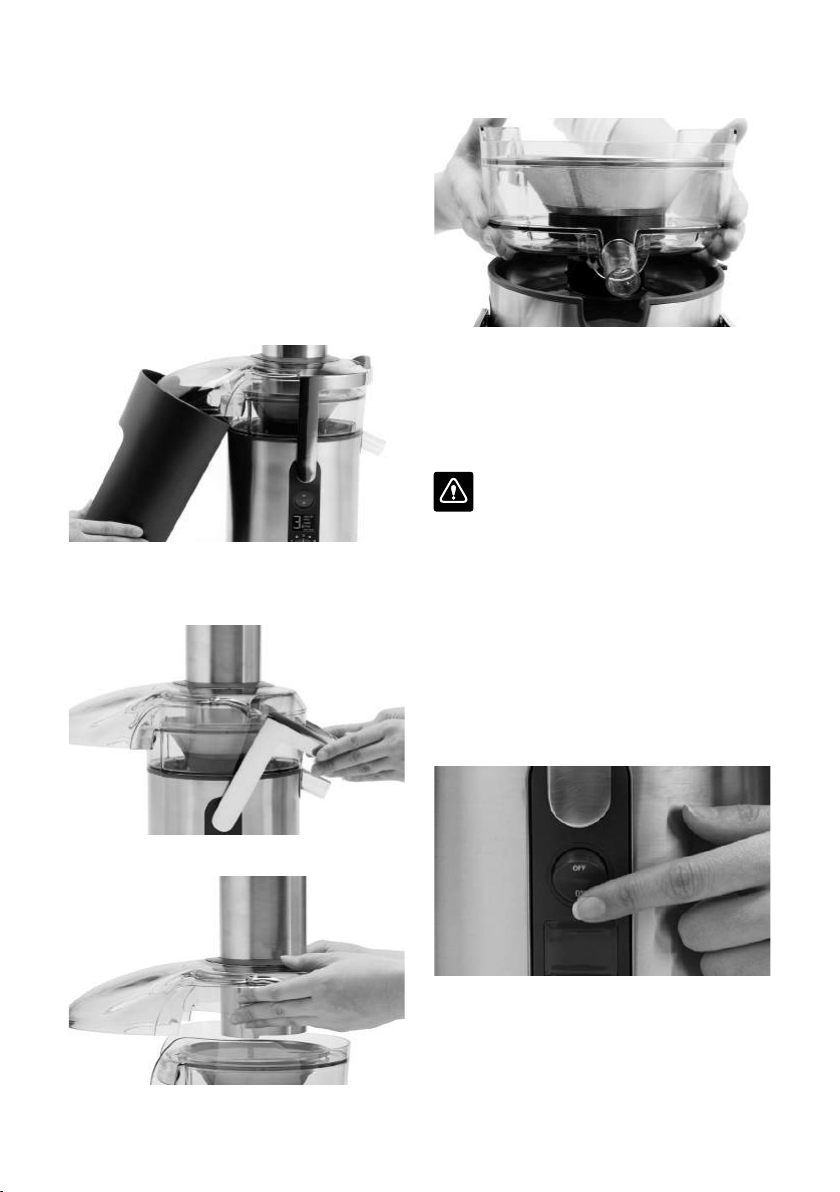
15
DISASSEMBLY
JUICE EXTRACTOR
1. Ensure the juicer is turned off by pressing
the ON/OFF switch on the control panel to
OFF. Then switch the appliance off at the
power outlet and unplug the cord.
2. Remove the pulp container by tilting
the base away from the motor base, then
unlatch it from under the juicer cover and
the container support extending from under
the motor base.
3. Use the grip handle located on the safety
locking arm to lift the locking arm from the
juicer cover and lower down out of position.
4. Lift the juicer cover off the juicer.
5. Remove the filter bowl surround with the
Nutri Disc™ still in place.
6. To remove the Nutri Disc™ from the filter
bowl surround, insert fingers under the
grooves marked ‘LIFT BASKET’ and lift
the juice disc up. For easy cleaning, it is
recommended to remove the Nutri Disc™
over the sink.
WARNING
The Nutri Disc™ contains small sharp blades
to cut and process fruits and vegetables.
Avoid touching blades when handling the
filter basket.
FROOJIE
®
EXTRACTOR
1. Switch the ON/OFF button on the control
panel of the juicer to turn off. Then switch
the appliance OFF at the power outlet and
unplug the cord.
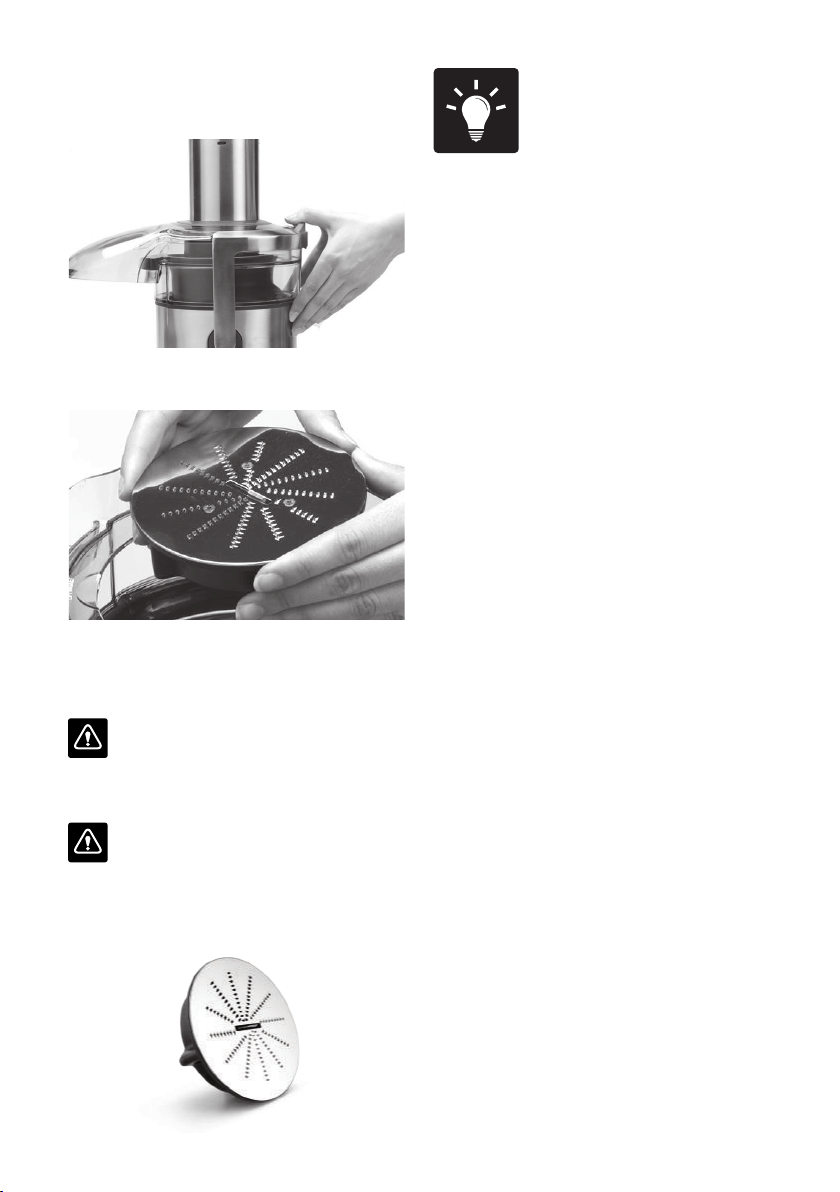
16
2. Place both hands on either side of the
locking arm and pull back and lift over the
grooves on either side of the juicer cover.
3. Lift the Froojie
®
Insert from the filter bowl
surround.
4. Lift the Froojie
®
Disc out of the filter bowl
surround. (Be careful not to touch the sharp
cutting teeth).
CAUTION
Ultra sharp stainless steel cutting disc and
teeth.
WARNING
The Froojie
®
cutting disc has super sharp
blades and teeth. Do not touch teeth and blade
when handling the Froojie
®
Disc.
Tips
THE INSIDE INFORMATION
ON JUICING
Although the juice drinks contained in
this booklet were developed with flavour,
texture and aroma at the forefront, the health
benefits certainly add to the pleasurable taste
experience.
70% of the nutrient content of fruit and
vegetables is found in the juice. Liquids
extracted from fresh fruits and vegetables form
an important part of a well-balanced healthy
diet. Fresh fruit and vegetable juices are an
easy source of vitamins and minerals. Juices
are rapidly absorbed into the blood stream
therefore being the quickest way in which the
body can digest nutrients.
When you make your own fruit and vegetable
juices, you have complete control over what is
included. Select the ingredients and decide if
you need to add sugar, salt or other flavouring
agents after juicing. Freshly extracted juices
should be consumed immediately after they
have been processed to avoid a loss of vitamin
content.
PURCHASING AND STORAGE OF
FRUIT AND VEGETABLES
• Always wash fruit and vegetables
before juicing.
• Always use fresh fruit and vegetables
for juicing.
• To save money and obtain fresher produce,
purchase fruit or vegetables that are in
season. Refer to the Juicing Guide.
• Keep your fruit and vegetables ready for
juicing by washing and drying them
before storing.
• Most fruits and hardier type vegetables can
be stored at room temperature.

17
The more delicate and perishable items such
as tomatoes, berries, leafy greens, celery,
cucumbers and herbs should be stored in the
refrigerator until required.
PREPARATION OF FRUIT AND
VEGETABLES FOR JUICER
ATTACHMENT
• If using fruits with hard or inedible skins
such as mangoes, citrus, melons or pineapple,
always peel before juicing.
• Some vegetables, such as cucumbers, can
be processed un-peeled depending on
the softness of the skin and the juicing
requirements.
• All fruits with large pits, hard seeds or stones
such as nectarines, peaches, mangoes,
apricots, plums and cherries must be pitted
before juicing.
• Ensure vegetables such as beetroot, carrots,
etc. have all soil removed, are well washed
and trimmed of leaves before juicing.
• Ensure fruits such as strawberries are hulled
before juicing and pears have their stalks
removed.
• Citrus fruit can be juiced in the juicer but
remove the skin and excess pith before
juicing.
• A small amount of lemon juice can be added
to apple juice to reduce discolouration.
NOTE
Your juicer makes invigorating, frothy orange
juice. Simply peel the oranges and remove
any excess pith before juicing. It is best to
refrigerate oranges before juicing.
PREPARATION OF FRUIT AND
VEGETABLES FOR FROOJIE
®
EXTRACTOR
• Only soft fruits should be used with the
Froojie
®
extractor.
• When using fruits with hard inedible skins,
such as mangoes, pineapple or kiwi fruit,
always peel before juicing.
• When using fruits with a hard core such as
pineapple, always remove this before juicing.
• All fruits with pits, hard seeds or stones such
as nectarines, peaches, mangoes and apricots
must be pitted or deseeded before juicing.
• Passionfruit pulp, peeled kiwi fruit and
berries can be processed without
removing seeds.
NOTE
When using the Froojie
®
extractor, use lower
speeds (speed 1 or 2). Always ensure motor is
running before adding fruit and/or vegetables
to feed tube.

18
Juicing Guide
Fruit and
Vegetables
Best season to
buy
Storage Nutritional value Kilojoule/
calorie count
Apples Autumn/ Winter Vented plastic bags in
refrigerator
High in Dietary Fibre
and Vitamin C
166g Apple =338kj
(80 cals)
Apricots Summer Unwrapped in crisper
of refrigerator
High in Dietary Fibre
Contains Potassium
55g Apricot =80kj
(19 cals)
Bananas Autumn/Spring Room temperature Vitamins B6 & C,
Potassium, Dietary
Fibre
100g Banana
=378kj (90 cals)
Beetroot Winter Cut off tops, then
refrigerate unwrapped
Good source Folate and
Dietary Fibre Vitamin
C and Potassium
160g Beetroot
=332kj (79cals)
Blueberries Summer Cover in the
refrigerator
Vitamin C 100g Blueberries
=220kj (52 cals)
Broccoli Autumn/ Winter Plastic bag in
refrigerator
Vitamin C, Folate, B2,
B5, E, B6 and Dietary
Fibre
100g Broccoli
=131kjs (31 cals)
Brussel Sprouts Autumn/ Winter Unwrapped in crisper
of refrigerator
Vitamin C, B2, B6, E,
Folate and Dietary
Fibre
100g Brussel
Sprouts =156kj
(37 cals)
Cabbage Winter Wrapped, trimmed in
the refrigerator
Vitamin C, Folate,
Potassium B6 and
Dietary Fibre
100g Cabbage
=93kj (22 cals)
Carrots Winter Uncovered in
refrigerator
Vitamin A, C, B6 and
Dietary Fibre
100g Carrots
=140kj (33 cals)
Cauliflower Autumn/ Winter Remover outer leaves,
store in plastic bag in
refrigerator
Vitamin C, B5, B6
Folate Vitamin 5 and
Potassium
100g Cauliflower
=103kj (24.5 cals)
Celery Autumn/ Winter Refrigerate in plastic
bag
Vitamin C and
Potassium
100g stick =64kjs
(15 cals)
Cucumber Summer Crisper in refrigerator Vitamin C 100g Cucumber
=50kj (12 cals)
Fennel Autumn to Spring Refrigerate Vitamin C, Dietary
Fibre, Folate
100g Fennel =80kj
(19 cals)
Grapefruit All year round Room temperature
Vitamin C =,
Bioflavonoids,
Lycopene, Dietary
Fibre
100g Grapefruit
=140kj (33 cals)
Grapes (Seedless) Summer Plastic bag in
refrigerator
Vitamin C, B6 and
Potassium
100g Grapes
=250-350kj
(60-83 cals)
Kiwi Fruit Winter/ Spring Crisper in refrigerator Vitamin C and
Potassium
100g Kiwi Fruit
=219kj (52 cals)

19
Fruit and
Vegetables
Best season to
buy
Storage Nutritional value Kilojoule/
calorie count
Mangoes Summer Covered in
refrigerator
Vitamin A, C, B1, B6
and Potassium
207g Mango
=476kj (113 cals)
Melons including
Watermelon
Summer/ Autumn Crisper in refrigerator Vitamin C, Folate,
Dietary Fibre and
Vitamin A
200g Melon =210kj
(50 cals)
Nectarines Summer Crisper in refrigerator Vitamin C, B3,
Potassium and Dietary
Fibre
151g Nectarines
=277kj (66 cals)
Oranges Winter/ Autumn/
Spring
Cool, dry place for
1 week, transfer to
refrigerator to keep
longer
Vitamin C 131g Orange =229kj
(54 cals)
Peaches Summer Ripen at room
temperature then
refrigerate
Vitamin C, Potassium,
Dietary Fibre, Beta
Carotene
100g Peaches
=175kj (42 cals)
Pears Autumn/Winter Ripen at room
temperature then
refrigerate
Vitamin C & E Dietary
Fibre
161g Pear =391kj
(93 cals)
Pineapple Spring/Summer Store in a cool place Vitamin C & E Dietary
Fibre
100g Pineapple
=180kj (43 cals)
Spinach All year round Refrigerate Vitamin B6, C,
E, Beta carotene,
Folate, Magnesium,
Potassium, Dietary
Fibre
100g Spinach =65kj
(15 cals)
Sweet Potato All year round Store in cool place Vitamins C, E, Beta
Carotene, Dietary Fibre
100g Sweet Potato
=275kj (65 cals)
Tomatoes Late Winter to early
Summer
Ripen at room
temperature then
refrigerate
Lycopene, Vitamin C,
E, Folate, Dietary Fibre
100g Tomatoes
=65–75kj
(15–17 cals)

20
Care & Cleaning
CLEANING THE FILTER BOWL
SURROUND, JUICER COVER,
FROOJIE
®
INSERT, FOOD PUSHER,
PULP CONTAINER
1. Wash all parts in warm soapy water with a
soft cloth. Rinse and dry thoroughly.
NOTE
The filter bowl surround, juicer cover and pulp
container are dishwasher safe (top shelf only).
The Froojie
®
Insert is not dishwasher safe.
Please wash in warm water.
CLEANING THE JUICE JUG
1. Rinse the juice jug and lid with froth
attachment under running water.
2. Wash both parts in warm soapy water with a
soft cloth. Rinse and dry thoroughly.
NOTE
• The juice jug and lid are dishwasher safe (top
shelf only).
• Removing stubborn or strong food stains
and odours
• Discolouration of the plastic may occur
with strongly coloured fruit and vegetables.
To help prevent this, wash parts immediately
after use. If discolouration does occur, the
plastic parts can be soaked in water with 10%
lemon juice or they can be cleaned with a non
abrasive cleaner.
WARNING
Do not immerse the motor base in water or any
other liquid.
The centre of the juice disc and feed chute
contains small sharp blades to process fruit
and vegetables during the juicing function.
Do not touch blades when handling the juice
disc or feed chute.
Ensure the juicer is turned off by pressing the
ON/OFF button on the control panel to OFF.
Then switch the appliance off at the power
outlet and unplug the cord.
Ensure the juicer is correctly disassembled.
Refer to Disassembling your juicer.
NOTE
• FOR EASIER CLEANING:
Clean as you go and avoid dried on juice or
pulp residue.
• Immediately after each use, rinse removable
parts in hot water to remove wet pulp. Allow
parts to air dry.
• To minimise cleaning, line the pulp container
with a plastic freezer bag to collect the pulp.
Pulp can then be used in other dishes or as
compost for the garden or discarded.
CLEANING THE MOTOR BASE
1. Wipe the motor base with a soft, damp cloth
then dry thoroughly.
2. Wipe any excess food particles from the
power cord.
NOTE
Do not use abrasive scouring pads or cleaners
when cleaning the parts or motor base as they
may scratch the surface.
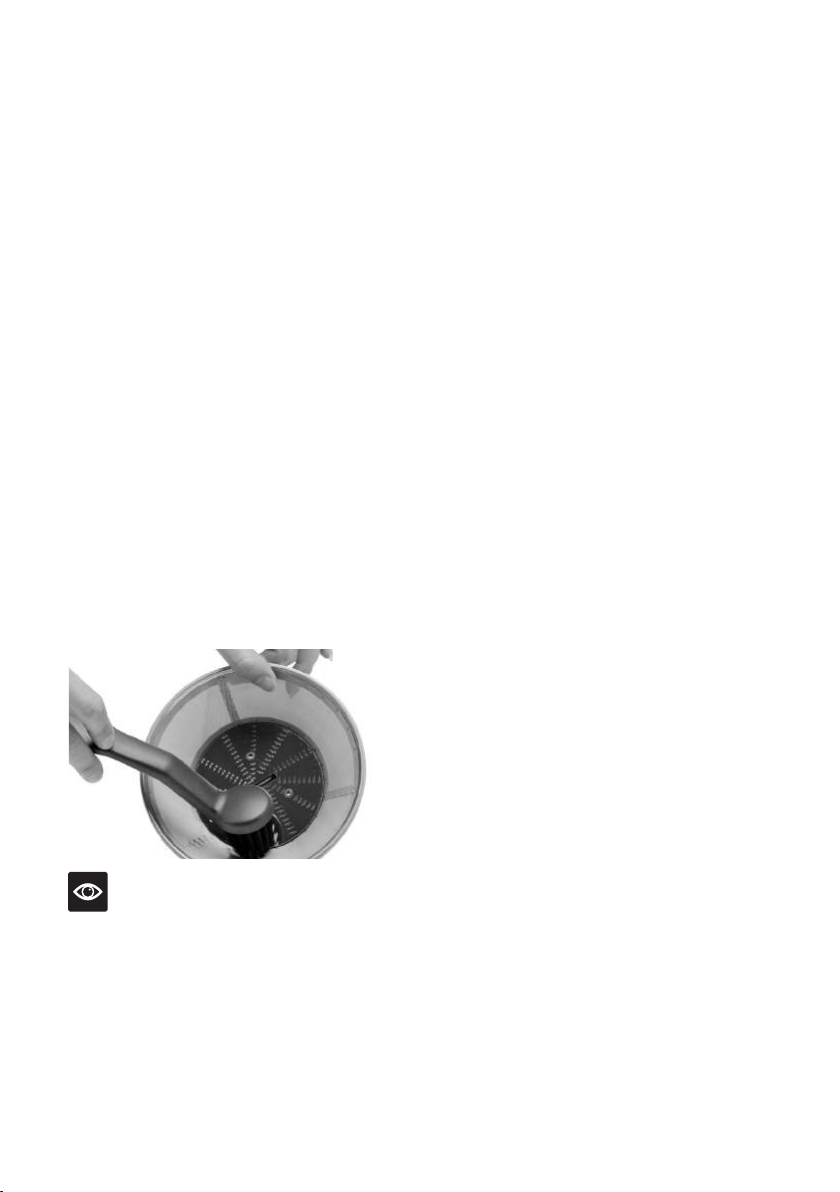
21
CLEANING THE JUICE DISC
For consistent juicing results always ensure
that the juice disc is thoroughly cleaned using
the supplied cleaning brush.
1. Soak the juice disc in hot soapy water for
approximately 10 minutes immediately
after juicing is completed. If pulp is left to
dry on the filter it may clog the fine pores
of the filter mesh thereby lessening the
effectiveness of the juicer.
2. Using the cleaning brush, hold the juice
disc under running water and brush from
the inside of the basket to the outer rim.
Avoid touching the small sharp blades in
the centre of the juice disc. After cleaning
the juice disc, hold it up towards a light to
ensure the fine mesh holes are not blocked.
If the holes are blocked, soak the juice disc
in hot water with 10% lemon juice to loosen
the blocked holes. Alternatively, wash the
juice disc in the dishwasher.
NOTE
• The juice disc is dishwasher safe (top shelf
only).
• Do not soak the juice disc in bleach or other
abrasive cleansers.
• Always treat the juice disc with care as it can
be easily damaged.
BREVILLE 5 YEAR MOTOR
GUARANTEE
The juicer is constructed with a heavy duty
motor. So heavy duty, we have given the motor
a 5 year guarantee against faulty materials or
manufacture. This warranty is an extension
of the 12 month replacement guarantee and
covers the motor only. The warranty does not
cover damage caused by accident, misuse,
or being used in a manner not stated in the
instruction book.
The 5 year guarantee is additional to the
conditions and warranties mandatory implied
by the laws and regulations of the individual
States and Territories of Australia and the
Trade Practices Act, 1974.
12 MONTH REPLACEMENT
GUARANTEE
The juicer is totally covered for the first
12 months against faulty material or
manufacture by the Breville 12 month
replacement guarantee (see Guarantee
Card enclosed).

22
Troubleshooting
POSSIBLE PROBLEM EASY SOLUTION
Machine will not work when
switched ON
•
The safety locking arm may not be correctly engaged in the
vertical operating position with the locking arm located into the
two grooves on either side of the juicer cover.
Motor appears to stall when
juicing
•
Wet pulp can build up under the juicer cover if the juicing action
is too vigorous. Try slower juicing action by pushing the food
pusher down more slowly. Follow Disassembling and Cleaning
instructions and clean the filter bowl surround, the juice disc and
the juicer cover.
•
The juicer will automatically stop operating if the motor is stalled
for more than 10 seconds. Either too much food is being processed
at one time or the pieces are not small enough. Try trimming the
food or cutting into smaller pieces of even size and processing a
smaller amount per batch. To continue juicing, reset the juicer by
pressing the ON/OFF switch on the control panel to OFF then
turn the appliance back on by pressing ON/OFF switch to ON.
•
Hard fruits and vegetables will put excess strain onto the motor if a
low speed is selected. Please refer to the juicing guide to determine
the correct speed for the fruits and vegetables selected for juicing.
Excess pulp building up the
Stainless Steel Filter Disc
•
Stop the juicing process and follow Disassembling Instructions.
Remove the juicer cover, scrape off pulp, reassemble and begin
juicing again. Try alternating (soft and hard) vegetable and fruit
varieties.
Pulp too wet and reduced
extracted juice
•
Try a slower juicing action.
•
Remove juice disc and thoroughly clean mesh walls with a cleaning
brush. Rinse the juice disc under hot water. If the fine mesh holes
are blocked, soak the basket in a solution of hot water with 10%
lemon juice to unblock the holes or wash in the dishwasher.
This will remove excess fibre build up (from fruit or vegetables)
which could be inhibiting the juice flow.
Juice leaks between the rim of the
juicer cover
•
Try a slower juicing speed and push the food pusher down the feed
chute more slowly.
Juice sprays out from spout
•
Use juice jug and lid provided, or if juicing into a glass use the
custom designed juice nozzle.
•
Try using fruits with more water content to help flush through the
contents. Additionally, try a slower juicing action by feeding one
piece in at a time and by pushing the food pusher down
more slowly.

23
POSSIBLE PROBLEM EASY SOLUTION
When using the Froojie
®
extractor,
the filter bowl surround becomes
full and clogs its spout
•
Try using fruits with more water content to help flush through
the contents. Additionally, try a slower juicing action by feeding
one piece in at a time and by pushing the food pusher down more
slowly.
Overheating with excessive loads.
•
The juicer is fitted with a safety device which safeguards against
overheating with excessive loads. If overheating occurs, the juicer
will automatically activate the overload protection device and the
unit will switch itself off. When the overload protection is activated,
unplug the juicer from the power outlet for at least 15 minutes to
allow the unit to cool. Then plug the juicer into the power outlet
and use as normal.
24
Recipes
.
Apple, peach and
grapefruit juice
Serves 2
1 small Delicious apple
2 large peaches, halved and seeds removed
2 grapefruits, peeled
1. Process apple, peaches and grapefruit through
the juicer using speeds 1, 3.
2. Serve immediately.
Sweet Potato, Celery,
Ginger and Orange Juice
Serves 2
4 sticks celery, trimmed
1 sweet potato, peeled and halved
2.5 cm piece fresh ginger
4 oranges, peeled
1. Process celery, sweet potato, ginger and oranges
through the juicer using speeds 3-5.
2. Serve immediately.
Carrot Juice
Makes approximately 4 cups
0.5 kg carrots
1. Feed carrots through the feed chute within 1
minute
Rockmelon, Mint and
Mango Juice
Serves 2
½ small rockmelon, peeled, seeded and halved
3 sprigs fresh mint leaves
1 mango, halved, seeded and peeled
1. Process rockmelon, mint and mango through the
juicer using speeds 1 and 2.
2. Serve immediately.
Coconut Juice
Makes approximately 4 cups
3kg coconuts
1. The maximum quantity of 3kg coconut per batch,
and maximum period is 1 minute.
2. Pusher is pressed with a force of 35N against the
food.
Carrot, beetroot
and orange juice
Serves 2
2 medium carrots, trimmed
3 medium beetroot, trimmed
4 oranges, peeled
1. Process carrots, beetroot and oranges through
the juicer using speed 5.
2. Serve immediately.

25
Raspberry and
Banana Froojie
®
Serves 2
1 large banana, peeled
½ cup fresh or frozen raspberries, thawed
1 tablespoon honey
½ cup cold water
1. Process bananas and raspberries through juicer
using Froojie
®
Extractor, pour into 2 glasses, stir
in honey and water and mix well.
2. Serve immediately.
Tropical blend
Serves 2
2 mangoes, halved, seeded and peeled
3 kiwi fruit, peeled
½ small pineapple, peeled and halved
½ cup fresh mint leaves
1 cup crushed ice
1. Process mangoes, kiwi fruit, pineapple and mint
through the juicer using speeds 1, 3 and 5.
2. Scoop ice into 4 glasses, pour over juice, mix well
to combine.
3. Serve immediately.
Beet and Chive Dip
Makes approx 3 cups
850g canned baby beets, well drained
L cup snipped chives
1 clove garlic, crushed
L cup mascarpone cheese
1 teaspoon lemon juice
Sea salt
Freshly ground black pepper
1. Process beets using Froojie
®
Extractor.
2. Pour beet mixture into a bowl.
3. Stir through chives, garlic, mascarpone cheese
and lemon juice.
4. Season well with salt and pepper.
5. Serves with crackers and fresh vegetable pieces.

26
Gazpacho
Serves 4
4 medium tomatoes
4 sprigs fresh parsley
1 large clove garlic, peeled
1 small onion, peeled and trimmed
2 carrots
2 stalks celery
1 red capsicum
1 Lebanese cucumber
2 tablespoons red wine vinegar
Freshly ground black pepper
1 cup crushed ice
¼ cup chopped fresh basil
1. Process tomatoes, parsley, garlic, onion, carrots,
celery, red capsicum and cucumber through the
juicer using speeds 1, 4 and 5.
2. Stir in vinegar and black pepper.
3. Arrange ice in four soup bowls.
4. Pour in extracted juice, sprinkle with basil and
serve immediately.
Carrot Cake
Serves 16
1¾ cups plain flour
2 teaspoons baking powder
½ teaspoon nutmeg
½ teaspoon cinnamon
½ teaspoon cardamom
½ cup chopped walnuts
½ cup sultanas
½ cup firmly packed brown sugar
1½ cups carrot pulp
½ cup oil
2 eggs, lightly beaten
¼ cup sour cream
1. Grease and line a 25cm x 15cm loaf pan. Sift flour
and baking powder into a large mixing bowl, add
nutmeg, cinnamon, cardamom, peanuts, sultanas,
brown sugar and carrot pulp, stir to combine.
Add eggs, oil and sour cream. Beat with electric
mixer, using medium speed until all ingredients
are well blended. Pour into loaf pan.
2. Bake at 180°C for 1 hour or until cake is cooked
when tested with a skewer. Remove from oven,
stand in cake pan for 5 minutes before inverting
out onto a wire cake rack.

27

Australian Customers
Phone: 1300 139 798
Web: www.breville.com
New Zealand Customers
Phone: 0800 273 845
Web: www.breville.com
Breville Customer Service Centre
Breville is a registered trademark of Breville Pty. Ltd. A.B.N. 98 000 092 928.
Copyright Breville Pty. Ltd. 2020.
Due to continued product improvement, the products illustrated/photographed
in this brochure may vary slightly from the actual product.
BJE520 ANZ – G20