Contents
19
EN
1 Instructions 20
1.1 General safety instructions 20
1.2 Manufacturer’s liability 21
1.3 Appliance purpose 21
1.4 Disposal 22
1.5 Identification plate 22
1.6 This instruction manual 22
1.7 How to read the instruction manual 22
2 Description 24
2.1 General description 24
2.2 Other parts 25
2.3 Available accessories 25
3 Use 26
3.1 Instructions 26
3.2 Preliminary operations 26
3.3 First use 26
3.4 Accessing the refrigerator compartment 26
3.5 Using the accessories 27
3.6 Using the refrigerator compartment 28
3.7 Storage advice 28
3.8 Noises during operation 29
3.9 What to do if... 29
4 Cleaning and maintenance 30
4.1 Instructions 30
4.2 Cleaning the appliance 30
4.3 Defrosting 30
5 Installation 31
5.1 Electrical connection 31
5.2 Positioning 31
We advise you to read this manual carefully, which contains all the instructions for
maintaining the appliance's aesthetic and functional qualities.
For further information about the product visit: www.smeg.com

Instructions
20
1 Instructions
1.1 General safety instructions
Risk of personal injury
• Never touch the heating elements
during use.
• Keep children under eight years
of age at a safe distance if they
are not constantly supervised.
• According to the current
regulations, children between 3
and 8 years of age can take or
load food from the appliance, but
it is strongly advised against
allowing children under 8 years of
age to perform these operations
and in general to use the
appliance.
• Children must never play with the
appliance.
• Do not allow children to play or
hide inside the appliance.
• The appliance must never be
cleaned and maintained by
unsupervised children.
• Do not store products which
contain inflammable or explosive
gases inside the appliance.
• Do not insert pointed metal
objects (cutlery or utensils) into the
slots in the appliance.
• Have qualified personnel carry
out installation and assistance
interventions according to the
standards in force.
• Do not modify this appliance.
• Do not try to repair the appliance
yourself or without the intervention
of a qualified technician.
• If the power supply cable is
damaged, contact technical
support immediately and they will
replace it.
• Avoid using adapters, gang
sockets or extensions as these
could cause overheating and a
risk of burns.
• CAUTION: risk of fire, flammable
materials.
Risk of damaging the appliance
• CAUTION: do not place
portable multiple sockets or
portable power supply units at the
back of the appliance.
• CAUTION: while positioning the
appliance, make sure that the
power supply cable is not caught
or damaged.
• Do not use adaptors for plugs.
• Never rest sharp metallic objects
such as knives, forks, spoons and
lids on the appliance during use.
Instructions
21
EN
• Do not use abrasive or corrosive
detergents on glass parts
(e.g. powder products, stain
removers and metallic sponges).
• Do not lean or sit on the
appliance.
• Do not use steam jets to clean
the appliance.
• Do not obstruct ventilation
openings and heat dispersal slots.
• Do not use the appliance to cool
rooms for any reason.
• Always disconnect the appliance
from the mains in the event of
a breakdown or maintenance,
or during cleaning.
• The appliance contains a small
quantity of isobutane (R600a),
make sure not to damage the
cooling circuit during transport,
installation and cleaning.
• In the event of damage to the
cooling circuit, avoid the use of
naked flames and ventilate the
area properly.
• Opening the door for long
periods can cause a significant
increase of the temperature in the
compartments of the appliance.
• Clean regularly surfaces that can
come in contact with food and
accessible drainage systems.
• Store raw meat and fish in suitable
containers in the refrigerator, so
that it is not in contact with or drip
onto other food.
• If the refrigerating appliance is left
empty for long periods, switch off,
defrost, clean, dry, and leave the
door open to prevent mould
developing within the appliance
.
1.2 Manufacturer’s liability
The manufacturer declines all liability
for damage to persons or property
caused by:
• all liability for personal injury or
property damage caused by;
• non-observance of the instruction
manual provisions;
• tampering with any part of the
appliance;
• use of non-genuine spare parts.
1.3 Appliance purpose
• Appliance with moderate
temperature for preserving special
drinks or food at a temperature
higher than the one in the
compartment for storing fresh food.
Every other use is considered
improper.
• This appliance may be used by
children aged at least 8 and by
people of reduced physical and
mental capacity, or lacking in
experience in the use of electrical
appliances, as long as they are
supervised or instructed by adults
who are responsible for their
Instructions
22
safety.
• The appliance is not designed to
operate with external timers or with
remote-control systems.
1.4 Disposal
This appliance must be disposed of
separately from other waste
(Directives 2002/95/EC, 2002/
96/EC, 2003/108/EC). The appliance
does not contain substances in quantities
sufficient to be considered hazardous to
health and the environment, in accordance
with current European directives.
To dispose of the appliance:
• Cut the power supply cable and remove
it along with the plug.
• Hand over the appliance to the
appropriate selective collection centres
for electrical and electronic equipment
waste, or deliver it back to the retailer
when purchasing an equivalent product,
on a one for one basis.
Our appliances are packed in non-
polluting and recyclable materials.
• Hand over the packing materials to the
appropriate selective collection centres.
Power voltage
Danger of electrocution
• Disconnect the main power supply.
• Disconnect the power supply cable from
the electrical system.
Plastic packaging
Danger of suffocation
• Do not leave the packaging or any part
of it unattended.
• Do not let children play with the
packaging plastic bags.
Instructions
23
EN
1.5 Identification plate
The identification plate bears the technical
data, serial number and brand name of the
appliance. Do not remove the identification
plate for any reason.
1.6 This instruction manual
This instruction manual is an integral part of
the appliance and must therefore be kept in
its entirety and in an accessible place for
the whole working life of the appliance.
Read this instruction manual carefully before
using the appliance.
1.7 How to read the instruction
manual
This instruction manual uses the following
reading conventions:
1. Use instruction sequence.
• Single use instruction.
Instructions
General information on this
instruction manual, information
about and final disposal.
Description
Description of the appliance and its
accessories.
Use
Information on the use of the
appliance and its accessories.
Cleaning and maintenance
Information for proper cleaning and
maintenance of the appliance.
Installation
Information for the qualified
technician: installation, operation
and inspection.
Safety instructions
Information
Advice
Description
24
2 Description
2.1 General description
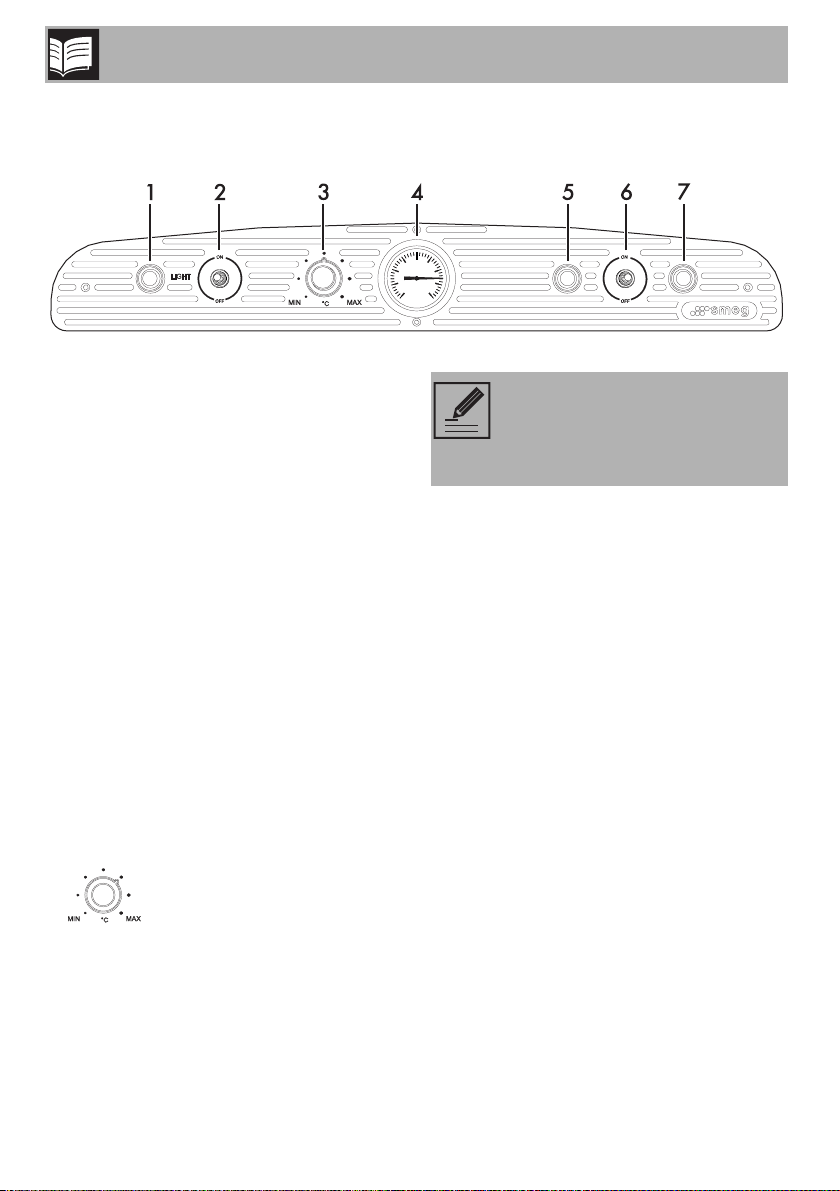
1 Yellow indicator light
When ON, this indicates that the light
switch is ON and all the perimeter lights
are on.
2 Light switch (ON/OFF)
Use this switch to switch on the appliance
perimeter lights. When the switch is ON, the
yellow indicator light comes on.
3 Thermostat knob
Adjust the thermostat knob from MIN to
MAX to lower the temperature inside the
refrigerator compartment. Use this knob to
set the temperature inside the refrigerator,
as follows:
• °C: In this position, the knob indicates the
appliance is turned OFF.
• MIN: In this position, the knob indicates
the appliance is on MINIMUM.
• In this position, the knob
indicates the general optimum
temperature at which to adjust the
appliance preferably.
• MAX: In this position, the knob indicates
the appliance is on MAXIMUM.
4 Thermometer
Indicates the temperature currently inside
the appliance.
5 Green indicator light
When ON, this indicates that the ON/OFF
switch is ON and that the appliance is
powered and ready to be switched on.
6 ON/OFF switch
Use this switch to power the appliance.
• When the switch is ON, the green
indicator light comes on.
• When the switch is OFF, the red
indicator light comes on.
7 Red indicator light
When ON, this indicates that the ON/OFF
switch is OFF and that the appliance is not
powered and cannot be switched on.
To avoid wasting electricity and
prevent food from freezing, do not
set the thermostat knob to MAX for
prolonged periods of time.
Description
25
EN
2.2 Other parts
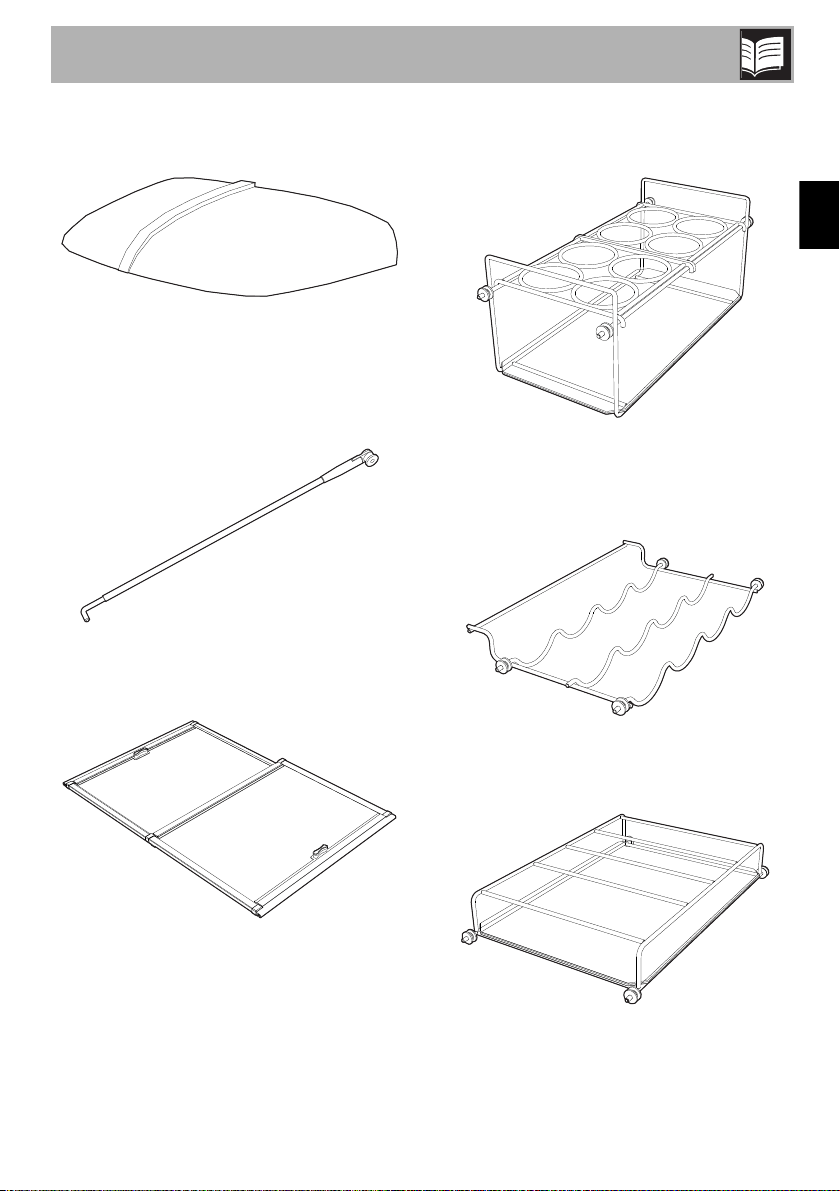
Lid
It is only fitted for styling purposes, but it can
be raised to move beverages inside the
refrigerator compartment.
Lid rod
Useful to keep the appliance lid open.
Sliding doors
Useful to keep beverages as cool
as possible.
2.3 Available accessories
Beer rack
Useful to position beer bottles and
small plastic bottles.
Bottle rack
Useful to store glass bottles.
Pack rack
Useful to store fruit juices, milk cartons
and cans.
Use
26
3 Use
3.1 Instructions
3.2 Preliminary operations
1. Remove any protective film from the
outside or inside of the appliance,
including accessories.
2. Remove any labels (apart from the
technical data plate) from the
accessories and shelves.
3. Remove and wash all the appliance
accessories.
3.3 First use
1. Plug the appliance into a wall socket.
2. Set the ON/OFF switch to ON.
3. Adjust the thermostat knob from MIN
to MAX to set the desired temperature.
3.4 Accessing the refrigerator
compartment
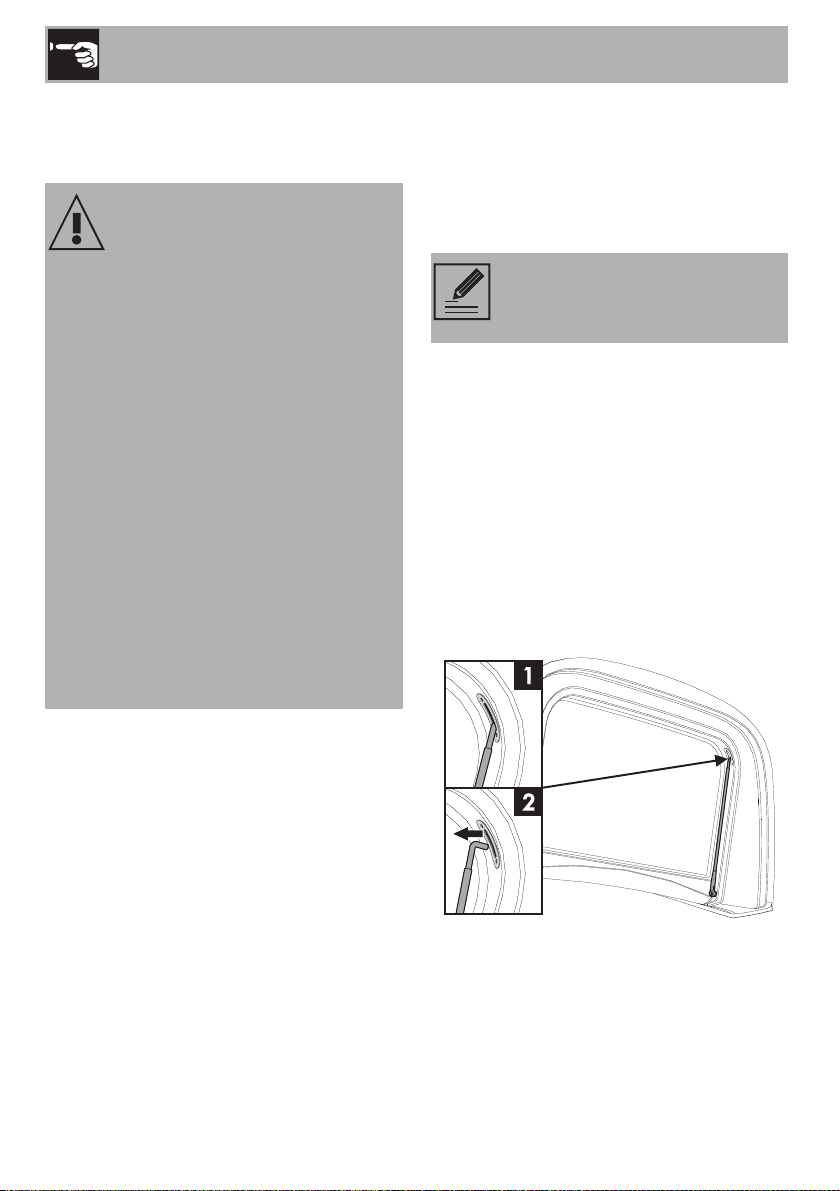
Raise the appliance lid to access the
refrigerator compartment. Inside, you will
find a rod on the right-hand side to keep it
raised while you move beverages around
inside the refrigerator compartment.
1. Raise the lid and grab the top of the rod
seated in the slot.
2. Move the rod a few centimetres to the
left to release the tip of the slot.
Improper use
Risk of damage
to the appliance
• Do not use sharp objects when
removing ice and frost to avoid
damaging the appliance's walls.
• Do not sit or lean on the door or any
open drawers.
• Do not touch the heating elements on
the outside of the appliance.
• Do not store inflammable, explosive or
volatile substances.
• Organic compounds, acids and
essential oils can corrode the seals and
plastic surfaces if left in contact with them
for extended periods.
• Bottles containing strong alcoholic drinks
must be tightly closed and stored
vertically.
The higher the number set, the
lower the refrigerator temperature
will be.
Use
27
EN
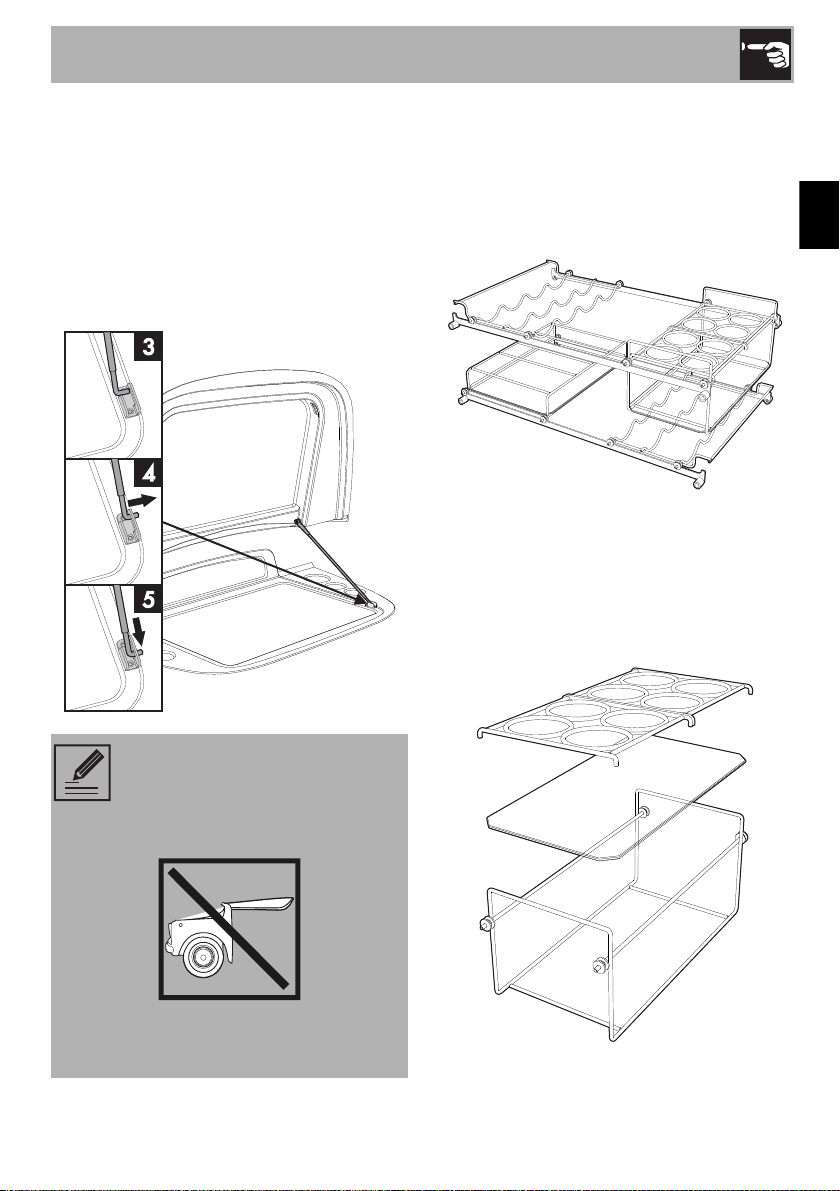
3. With the lid raised, turn the rod
downwards and place the tip onto the
metal plate situated to the right of the
sliding doors.
4. Move the tip of the rod towards the
right into the slot in the plate.
5. Slide the tip of the rod all the way to
the end of the slot in the plate.
3.5 Using the accessories
Layout of accessories
The accessories can be arranged along
the purpose-designed guides inside the
refrigerator compartment.
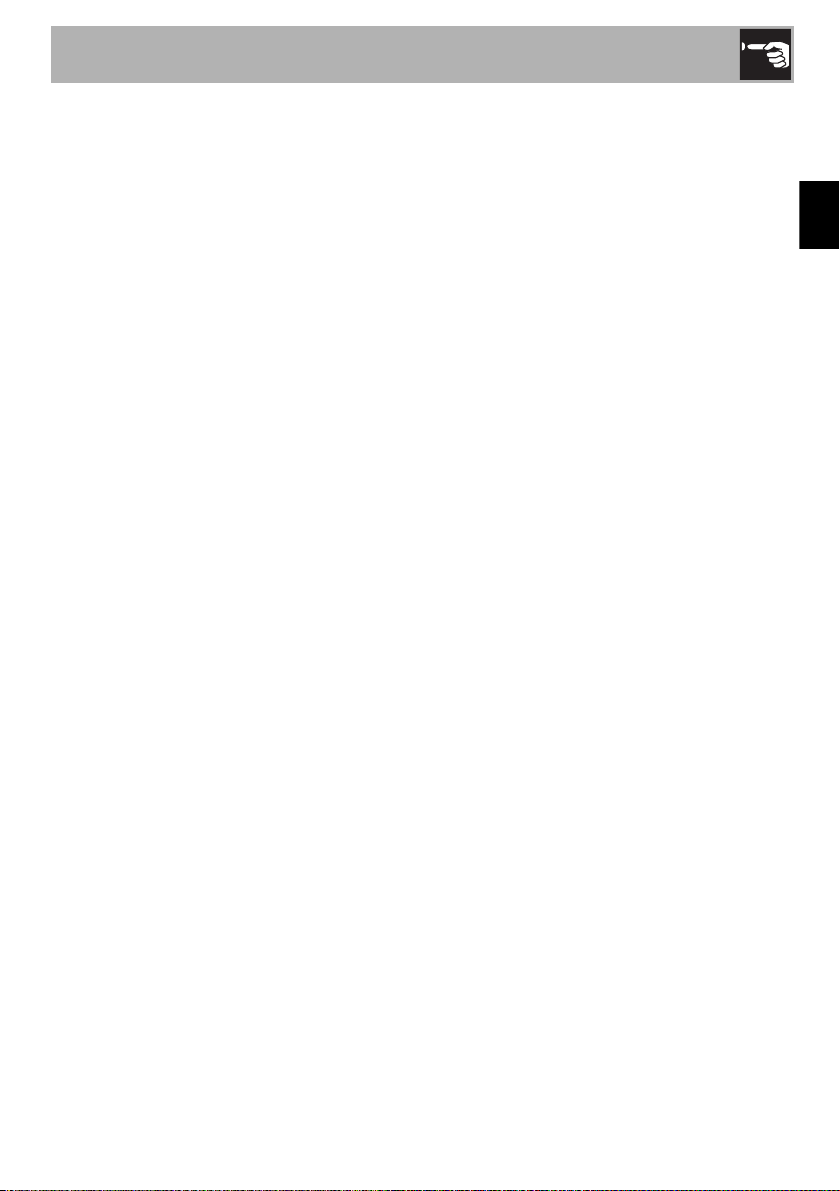
Beer rack assembly
1. Place the glass shelf on the base
of the beer rack.
2. Place the 2 partitions at the rear
of the beer rack.
NOTE: To avoid damage to the
surface of the appliance, do not
overturn the bonnet and do not
place other objects on it.
Improper use may cause damage
to the appliance.

Use
28
Sample uses
Beer rack
Bottle rack
Pack rack
3.6 Using the refrigerator
compartment
Arranging beverages
Arrange the beverages, making sure
they are sealed tight. This precaution
is necessary:
• to preserve the aroma and freshness of
the beverages;
• to avoid any contamination of
beverages with odours or tastes from
other beverages;
• to prevent the humidity level inside the
refrigerator from becoming too high,
which in some operating conditions (rise
in ambient temperature and humidity,
more frequent opening of the door)
might cause condensation to form on the
shelves.
3.7 Storage advice
• Always check the expiry date on the
food packaging.
• Remove perishable products from the
appliance if you are going away for a
long period.
• Changes in the environmental conditions
(temperature and humidity) and the
frequency with which the door is opened
can affect the operating temperature of
the refrigerator.
• Reduce the number of times that the
doors are opened and the length of time
they remain open to prevent the
compartments from heating up
excessively.
Always allow hot drinks to cool to
room temperature before putting
them in the refrigerator
compartment.
Use
29
EN
3.8 Noises during operation
The refrigerator compartment is cooled by
means of a compression system. In order to
maintain the preset temperature inside the
refrigerator compartment, the compressor
comes into operation in response to the
level of cooling required, and may operate
continuously if necessary. When the
compressor starts to function, it creates a
buzzing noise which generally diminishes in
intensity after a few minutes.
Another normal operating noise of the
appliance is a gurgling due to the coolant
flowing through the pipes in the circuit. This
noise is normal and does not indicate an
appliance malfunction. If it becomes too
loud, this may mean that there are other
causes. Checks must then be made to
ensure that:
• the refrigerator is properly levelled on the
floor and does not vibrate when the
compressor is in operation: if this is not
the case, adjust the feet supplied with the
appliance;
• Bottles and boxes are stable and not
touching each other: otherwise, the
vibration resulting from the compressor's
operation could cause a certain amount
of noise;
• Do not place the refrigerator in such a
way that it is in contact with furniture or
other household appliances.
3.9 What to do if...
The appliance does not work:
• Make sure that the appliance is plugged
in and that the main switch is turned on.
The compressor starts to function too often
or functions continuously:
• The room temperature is too high.
• The sliding doors are being opened too
often or for too long.
• The sliding doors do not seal shut when
closed.
• Check that the back of the refrigerator is
properly ventilated and that the
condenser is not too dirty.
Excessive ice or condensation has built up
inside the refrigerator compartment:
• The sliding doors are being opened too
often or for too long.
• Hot beverages have been placed inside
the refrigerator compartment.
• The thermostat is set at a too low
temperature.
The refrigerator compartment is not
sufficiently cold:
• The thermostat is set at a too high
temperature.
• The sliding doors are being opened too
often or for too long.
• The sliding doors do not seal shut when
closed.
• The room temperature is too high.
Cleaning and maintenance
30
4 Cleaning and maintenance
4.1 Instructions
4.2 Cleaning the appliance
A special antibacterial protection on the
appliance's interior walls prevents bacterial
growth and keeps them clean. They must
nevertheless be cleaned regularly in order
to keep them in good condition.
Cleaning the outside of the appliance
• The appliance may be cleaned
with water or alcohol-based liquid
detergents (e.g. window cleaning
products).
• Avoid aggressive detergents and
rough sponges to avoid damaging
the surfaces.
Cleaning the inside of the appliance
• Clean the interior with diluted liquid
detergent or with warm water with a little
vinegar added.
• Remove any ice thicker than 3-5 mm.
Do not use sharp objects or spray
products.
4.3 Defrosting
Defrosting the refrigerator compartment
The refrigerator compartment does not
require defrosting, as any ice which forms
on the refrigeration plate will melt when the
compressor is idle.
If ice thicker than 3-5 mm should form on
the inside walls of the refrigerator
compartment, turn off the appliance and
defrost it manually.
Improper use
Risk of damage to surfaces
• Do not use steam jets to clean the
appliance.
• Do not use cleaning products containing
chlorine, ammonia or bleach on steel
parts or parts with metallic finishes on the
surface (e.g. anodising, nickel- or
chromium-plating).
• Do not use abrasive or corrosive
detergents on glass parts (e.g. powder
products, stain removers and metallic
sponges).
• Do not use rough or abrasive materials
or sharp metal scrapers.
Power voltage
Danger of electrocution
• Turn off the appliance and unplug it from
the mains before cleaning.
• Do not pull the cable to to unplug the
appliance.
Installation
31
EN
5 Installation
5.1 Electrical connection
General information
• Check the mains characteristics against
the data indicated on the plate. The
identification plate bearing the technical
data, serial number and brand name is
visibly positioned inside the appliance. Do
not remove this plate for any reason.
• Make sure that the plug and socket are of
the same type.
• Avoid using adapters and shunts as these
could cause overheating and a risk of
burns.
• The plug must always be accessible when
the appliance is installed.
• If it is necessary to replace the power
supply cable, this must be performed by
an authorised technician from Technical
Support Service.
5.2 Positioning
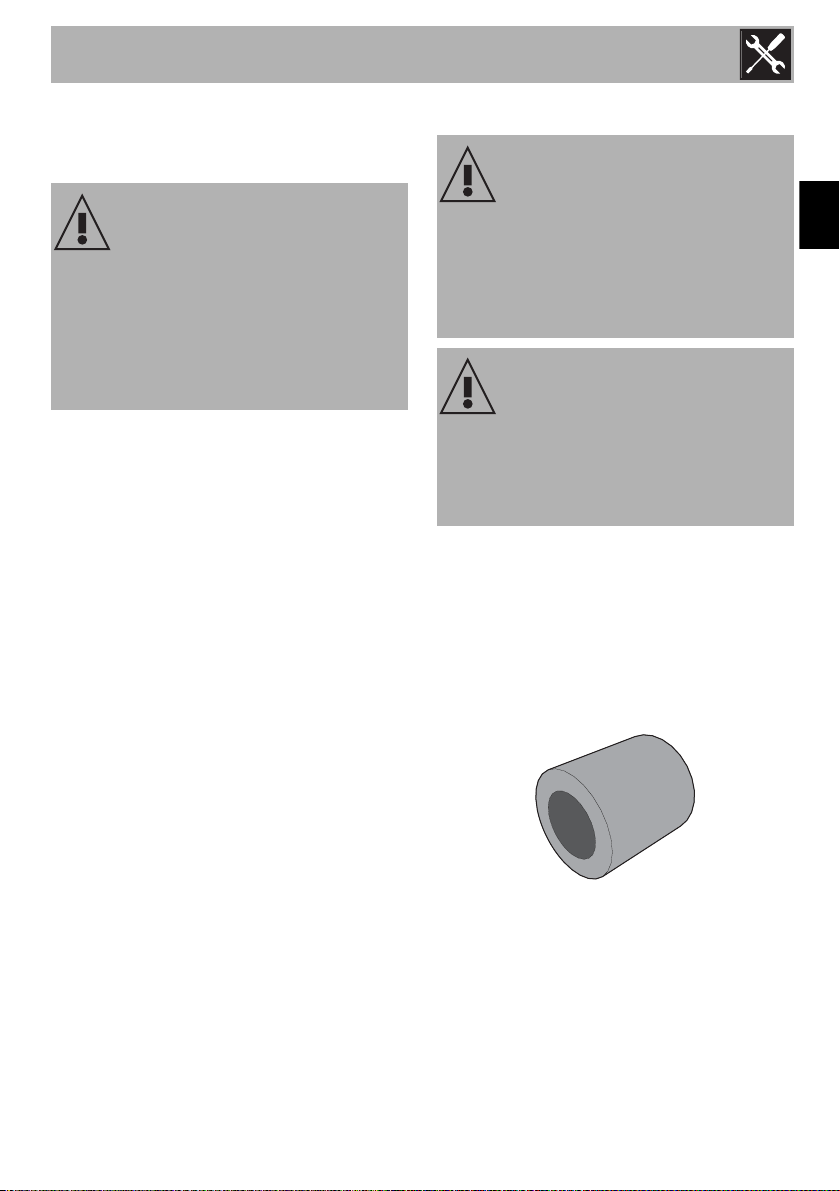
Spacers
To ensure that the condenser cools
properly, the appliance must not be located
too close to the wall. To prevent this, the
appliance comes complete with two plastic
spacers which are fitted on the metal casing
behind the appliance.
Power voltage
Danger of electrocution
• The appliance must be earthed in
compliance with electrical system
safety standards.
• Do not pull the cable unplug
the appliance.
Heavy appliance
Danger of crush injuries
• Position the appliance with the aid of a
second person.
• Always handle the appliance with the lid
down.
Improper use
Risk of damage to the appliance
• The appliance must not be exposed to
direct sunlight.
• Do not use the appliance outdoors.
Installation
32
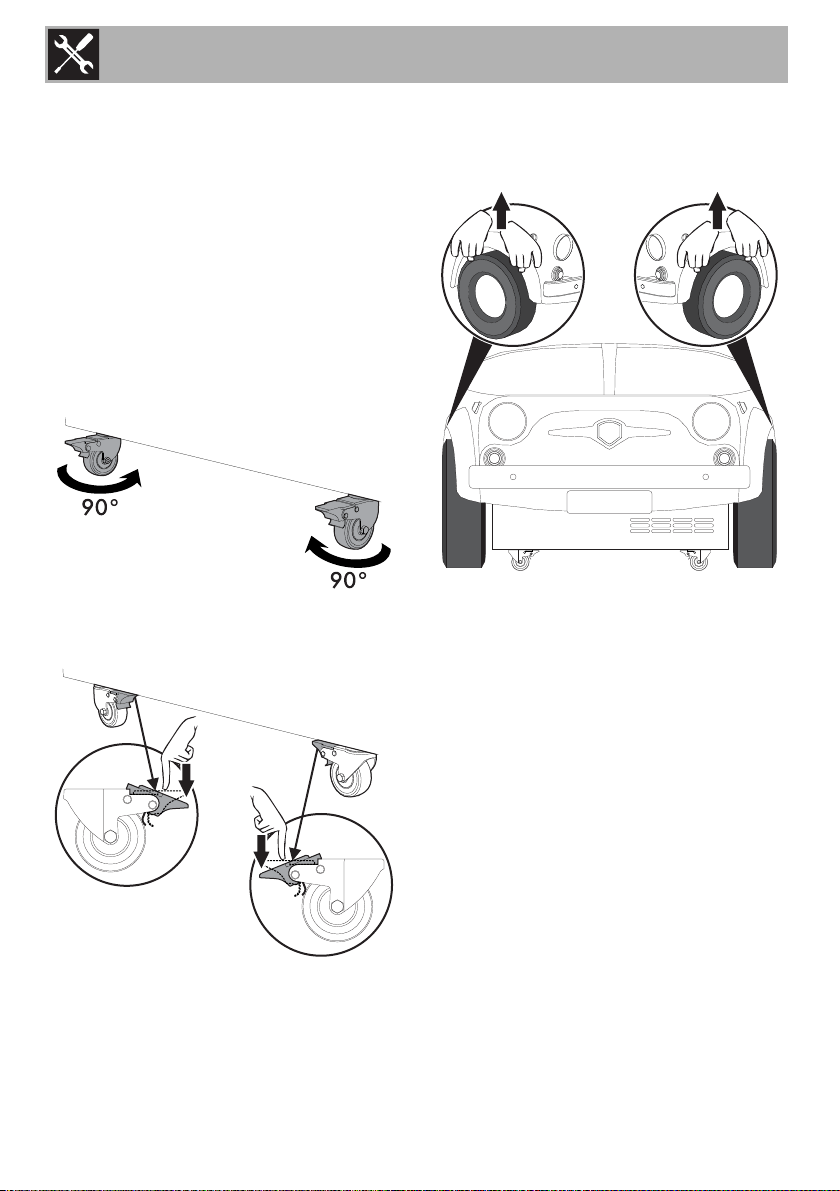
How to handle the appliance
The appliance is supplied with four castors
for easy handling and positioning. In any
case, we recommend moving the
appliance very carefully in order to avoid
damaging the floor (especially in the case
of wooden floors).
The front castors are fitted with a brake to
lock the appliance in place:
1. Turn the front castors by 90° with the
brake levers turned to face the centre of
the appliance.
2. Press the brakes on the front castors
down until they click in place.
3. Should you need to lift the appliance,
with the aid of a second person, grip
the wheel arches using both hands.
Installation
33
EN
Positioning
Place the appliance on a stable and level
floor. We recommend moving the
appliance very carefully in order to avoid
damaging the floor (especially in the case
of wooden floors).
Choice of location
Always install the refrigerator in a dry place
with satisfactory ventilation. Depending on its
climate class (stated on the nameplate inside
the refrigerator compartment), the appliance
can be used in different temperature
conditions.
• Install the appliance at least 3 cm away
from electrical or gas cookers and at
least 30 cm away from combustion
heaters or radiators.
• The appliance must not be installed near
heat sources. If this is not possible,
suitable insulation must be used.
Class Room temperature
SN (Subnormal) + 10°C to + 32°C
N (Normal) + 16°C to + 32°C
ST (Subtropical) + 18°C to + 38°C
T (Tropical) + 18°C to + 43°C