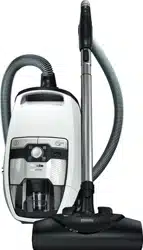
Owner's Guide Vacuum Cleaner
Appliance description
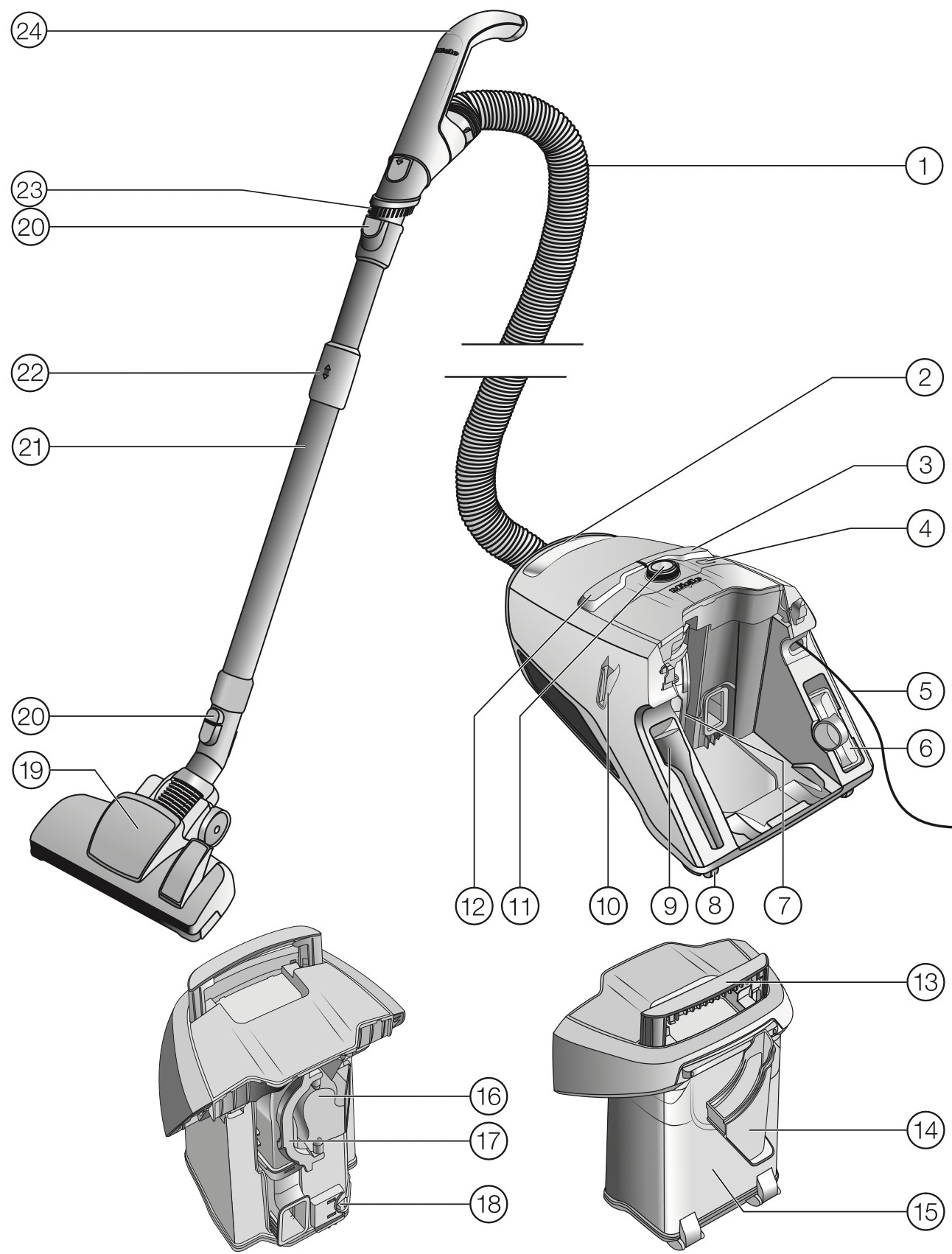
- Suction hose
- Vacuum cleaner carrying handle
- Foot switch for cable rewind
- Comfort Clean button
- Power cord
- Upholstery nozzle
- Fine dust container with fine dust filter
- Wheels *
- Crevice nozzle
- Park system for pauses during vacuuming
- Rotary selector
- On/Off foot switch

- Dust container carrying handle
- Filter frame
- Dust container
- Pre-filter
- Pre-filter handle
- Dust container release mechanism
- Floor head *
- Release buttons
- Comfort telescopic wand
- Comfort telescopic wand release mechanism
- Dusting brush
- Eco Comfort handle
Underneath - Park system for storage (not shown)
* These features are model-specific and may vary or may not be available on your vacuum cleaner.
Preparing for use
Attaching the suction hose (Fig. 01)

- Insert the hose connector into the suction socket on the vacuum cleaner until it clicks into position.
Disconnecting the suction hose (Fig. 02)

- Press the release buttons at the side of the hose connector, and lift the hose from the socket.
Connecting the suction hose to the handle (Fig. 03)

- Insert the suction hose into the handle until it clicks into position.
Connecting the handle to the wand (Fig. 04)

- Insert the handle into the wand until it clicks into position. To do this, line up the guides on the two pieces.
- To release the handle from the wand, press the release button and pull the handle out of the wand, twisting it slightly as you do so.
Adjusting the telescopic wand (Fig. 05)

One part of the telescopic wand is fitted inside the other so that the wand can be adjusted to suit your preferred height for comfortable vacuuming.
- Hold the release mechanism and adjust the telescopic wand to the required length.
Connecting the telescopic wand to the floorhead/floorbrush (Fig. 06)
(included as standard depending on model)

- Push the telescopic wand into the suction nozzle and turn it clockwise or counter-clockwise until it clicks into position.
- To detach these parts from each other, press the release button and pull the telescopic wand out of the suction nozzle, twisting it slightly as you do so.
Adjusting the floorhead (Fig. 07)
(only for models with a reversible floorhead included in the standard version)

This vacuum cleaner can be used for the everyday cleaning of carpets, rugs and hard flooring.
Miele offers a range of other floorheads, brushes and accessories for other types of flooring and special applications (see "Optional accessories").
Please always follow the flooring manufacturer's cleaning and care instructions.
Vacuum carpets and rugs with the brush retracted:
- Press the foot switch
 .
.
Clean hard flooring which is not susceptible to scratching, and flooring with gaps or deep crevices in it with the brush protruding:
- Press the foot switch
 .
.
If the suction power of the floorhead seems too high, reduce the suction until the head is easier to maneuver (see "Use - Regulating the suction power").
Using the accessories supplied (Fig. 08)

- Crevice nozzle
For cleaning folds, crevices or corners.
- Upholstery nozzle
For cleaning upholstery, mattresses, cushions, curtains, etc.
- Dusting brush with natural bristles, supplied loose (depending on model)
For cleaning base boards and as ornate, carved and particularly delicate objects. The head can be swiveled to the best angle.
The crevice nozzle and the upholstery nozzle are located in holders at the back of the vacuum cleaner.
The standard versions of certain models include a turbobrush that is not illustrated. The turbobrush is supplied with its own set of operating instructions.
Dusting brush integrated in the Eco Comfort handle (Fig. 09)

The dusting brush is suitable for vacuuming scratch-resistant surfaces such as keyboards and for vacuuming up crumbs.
- Press the release button and push the dusting brush out until it clicks into place.
- When you have finished dusting, press the release button and push the dusting brush back into its original position until it clicks into place.
Reversible floorhead (Fig. 10)
(included as standard depending on model)

For general use and also for vacuuming the stairs.
CAUTION: For safety reasons when vacuuming stairs, it is best to start at the bottom of the stairs and move upwards.
Use
Power cord
Caution: Unwind the cord completely to aid the vacuum in dissipating heat. Do not pull or carry by the cord, use the cord as a handle, close a door on the cord, or pull the cord around sharp edges or corners. Do not run the appliance over the cord. Keep the cord away from heated surfaces. Do not unplug by pulling the cord. To unplug grasp the plug, not the cord. This appliance is equipped with a power cord reel. Hold the plug when rewinding onto cord reel. Do not allow plug to whip when rewinding.
Unwind the power cord (Fig. 11)

- Pull the power cord out to the re-quired length (max. cord length approx. 21 ft / 6.5 m).
- Insert the plug into the electrical socket.
Caution: If vacuuming for longer than 30 minutes, the power cord must be pulled out all the way. Otherwise there is a danger of overheating and damage.
Rewinding the power cord (Fig. 12)

- Unplug the power cord from the socket.
- Step on the cord rewind foot switch.
The power cord will then retract itself into the vacuum cleaner.
If you do not want the cord to retract completely into the vacuum cleaner you can deactivate this function. To do this, take hold of the end of the cord while rewinding it and give it a short pull when you want the rewinding to end.
Turning the vacuum cleaner on and off (Fig. 13)

- Press the On/Off foot control
 .
.
Selecting the suction power
The suction power can be adjusted to suit the type of flooring being cleaned. Reducing the power lowers the amount of effort required to maneuver the floor brush.
The vacuum cleaner has symbols on the controls which indicate the type of use the settings are suitable for.
 Curtains, lightweight fabric
- Deep pile carpets, rugs and runners
 Low pile carpet and rugs
- Hard flooring and heavily soiled carpets and rugs (also for cleaning upholstery and mattresses with the upholstery nozzle)
Rotary dial (Fig. 14)

- Turn the rotary selector to the suction power setting you require.
During vacuuming
- When vacuuming, pull the vacuum cleaner behind you on its wheels. You can stand it upright for vacuuming stairs and curtains, etc.
Caution: When vacuuming especially fine dust, e.g. sawdust, sand, flour, talcum powder etc., electrostatic charges build up naturally. Under certain conditions these charges will be released. To avoid the unpleasant effects of these discharges, a metal inlay has been incorporated into the underside of the handle. Keep your hand in contact with the upper, curved part of the handle when vacuuming (Fig. 15).

If a large amount of dust is vacuumed at once, the ComfortClean self-cleaning function should be started manually either during a vacuuming pause or straight away. This enables the vacuum cleaner to achieve the very best cleaning performance again straight away (see "Maintenance - Starting the ComfortClean self-cleaning function manually").
Parking, transport and storage
Park system for pauses during vacuuming (Fig. 16)

The Park system allows you to conveniently park the wand and floorhead during short pauses in vacuuming.
- Slot the floorhead into the parking attachment on the vacuum cleaner.
If your vacuum cleaner is on a sloping surface such as a ramp, fully retract the telescopic wand fully.
Park system for storage (Fig. 17)

Caution: Always unplug the vacuum cleaner from the power supply when you have finished using it.
- Stand the vacuum cleaner upright.
It is a good idea to fully retract the telescopic wand so that the vacuum cleaner takes up less room for storage.
- Slot the floor head down into the parking attachment on the vacuum cleaner.
This makes the vacuum cleaner easier to carry and store.
Caution: For safety reasons, do not lift the vacuum cleaner using the dust container carrying handle.
Maintenance
Caution: Always switch off the vacuum cleaner for maintenance work and unplug the power cord from the wall socket.
Emptying the dust container (Figs. 18 - 23)


- Empty the dust container before the dust has reached the max marking on the dust container.
- Pull the dust container handle upward.
- Remove the dust container upward.
The contents of the dust container can be disposed of with the normal household trash, providing it contains general household dust only.
- Hold the dust container close to the bin so that as little dust billows out as possible.
- Press the yellow release button on the bottom of the dust container.
The flap will open and the dust will fall out.
- Close the flap so that it clicks audibly.
- Insert the dust container down into the vacuum cleaner so that it audibly clicks into place.
- Push the handle down.
Cleaning the dust container
Clean the dust container as required.
- Clean the dust container using water and liquid dish soap.
- Dry the dust container carefully.
Cleaning the filter frame (Figs. 24 + 25)


A removable filter frame is located in the dust container. This should be cleaned if it is obviously dirty.
- Place the emptied and open dust container on its front.
- Release the filter frame and remove it.
- Empty the filter frame and rinse it under cold running water.
Caution: Do not use detergent!
Do not use any sharp or pointed objects!
Dry the filter frame carefully!
Cleaning the fine dust filter
The fine dust filter is equipped with a self-cleaning function. When a specified degree of soiling is reached, the vacuum cleaner switches off automatically for approx. 20 seconds and carries out a cleaning process. You will hear this process running.
The Comfort Clean button on the vacuum cleaner lights up yellow.
Starting the ComfortClean self-cleaning function manually (Fig. 26)

If a large amount of dust has been vacuumed at once, the ComfortClean self-cleaning function should be started manually either during a vacuuming pause or immediately afterward. This enables the vacuum cleaner to achieve the very best cleaning performance again right away.
- With the vacuum cleaner switched on, press the ComfortClean button for at least two seconds.
The vacuum cleaner is switched off automatically for approx. 20 seconds and a cleaning process is carried out which results in operational noise.
The ComfortClean button on the vacuum cleaner lights up yellow.
The vacuum cleaner will then switch back on automatically and will operate with the previously selected setting.
We also recommend emptying and cleaning the fine dust container once or twice a year (see "Fault resolution Cleaning the fine dust filter manually").
When to change the thread catchers?
(only possible for models with a reversible floorhead included as standard)
The thread catchers on the suction inlet of the reversible floorhead can be replaced. Check them from time to time and replace them if the pile has worn down.
How to replace the thread lifters (Fig. 27)

- Use a suitable screwdriver to remove the thread lifters from the slots.
- Fit new thread lifters.
Cleaning the roller on the AllTeQ floorhead (Fig. 28)
(depending on model)

Clean the roller on the floorhead if required.
- Release the bearing (with bayonet fitting) using a coin.
- Press the bearing out, and remove.
- Remove the roller.
- Remove any threads and hair, replace the roller and refit the bearing, locking it back into position.
Replacement parts are available from your Miele dealer or through Miele Technical Service.
Cleaning and care
Caution: Always switch off the vacuum cleaner before cleaning it and unplug the power chord from the wall socket.
Vacuum cleaner and accessories
The vacuum cleaner and all plastic accessories can be cleaned with a proprietary cleaner suitable for use on plastic.
Follow the special cleaning instructions for the dust container and filter frame in "Maintenance" and for the fine dust filter, the pre-filter and the fine dust container in "Frequently asked questions".
Caution: Do not use abrasive cleaning agents, glass cleaning agents, all-purpose cleaners or oil-based conditioning agents!
Caution: Do not let the vacuum cleaner get wet. If moisture gets into the appliance, there is a risk of electric shock.
Frequently Asked Questions
With the help of the following guide minor faults in the performance of the machine, some of which may result from incorrect operation, can be remedied without contacting the Service Department. Time and money will be saved because a service call will not be needed.
This guide may help you to find the reason for the fault, and how to correct it.
|
Problem
|
Possible cause and solution |
|
The vacuum cleaner turns off automatically.
|
A temperature limiter switches the vacuum cleaner off automatically when it gets too hot. This can occur when the airways are blocked by bulky objects.
- Turn the vacuum cleaner off immediately using the On/Off foot switch
 , and unplug it. , and unplug it.
After removing the cause, wait for approximately 20 - 30 minutes to allow the vacuum cleaner to cool down. It can then be turned on again.
|
|
The Comfort Clean button lights up in yellow.
|
The vacuum cleaner carries out an automatic cleaning process which you can hear running.
- Wait for approx. 20 seconds until this cleaning process has finished.
|
|
The Comfort Clean button lights up in red. The vacuum cleaner switches itself to the lowest power setting.
|
The dust container is full.
- Empty the dust container.
|
|
The pre-filter is dirty.
- Clean the pre-filter (see "Frequently asked questions - Cleaning the pre-filter").
|
|
The fine dust filter is dirty.
- Clean the fine dust filter at the next available opportunity (see "Frequently asked questions -
Cleaning the fine dust filter manually").
|
|
Cleaning power is reduced.
|
The pre-filter is dirty.
- Clean the pre-filter (see "Frequently asked questions - Cleaning the pre-filter").
|
|
The fine dust container is full.
- Empty and clean the fine dust container at the next available opportunity (see "Frequently asked questions - Cleaning the fine dustfilter manually").
|
Frequently asked questions
Caution: Always switch off the vacuum cleaner before attempting to rectify a fault and unplug it.
Cleaning the pre-filter (Figs. 29 + 30)


The pre-filter is located at the rear of the vacuum cleaner.
This should be cleaned if it is obviously dirty.
- Remove the dust container.
- Release the handle of the pre-filter and remove the pre-filter.
- Rinse the pre-filter under cold running water.
Caution: Do not use detergent!
Do not use any sharp or pointed objects!
Dry the pre-filter carefully!
- Replace the dry filter in the dust container and lock the handle.
- Reinsert the dust container in the vacuum cleaner.
Cleaning the fine dust filter manually (Figs. 31 - 36)


Allow a drying time of 24 hours.
- Remove the dust container.
- Release the fine dust container in the direction of the arrow and remove it.
- Run a little water into the opening at the top of the fine dust container.
- Gently shake the fine dust container back and forth.
This will rinse out the dust.
- Shake the water out of the opening.
- Release the top so that the marking is pointing to the
 symbol.
- Carefully lift the fine dust filter up and out of the fine dust container.
- Clean the outside of the fine dust filter under cold running water.
Caution: Do not clean the inside of the fine dust filter!
Do not use detergent!
Do not use any sharp or pointed objects and do not brush the fine dust filter!|
After cleaning, allow the fine dust filter to dry for a minimum of 24 hours!
- Clean the fine dust container with water and mild detergent.
- Dry the fine dust container carefully.
- Insert the dry fine dust filter into the dry fine dust container so that the marking is pointing to the
 symbol.
- Lock the top into place so that the marking is pointing to the
 symbol.
- Reinsert the fine dust container in the vacuum cleaner and lock it into place.
- Reinsert the dust container in the vacuum cleaner.