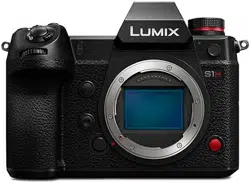

Owner’s Manual
<Basic>
Digital Camera
DC-S1H
DC-S1HP-DVQX1939_eng.book 1 ページ 2019年8月9日 金曜日 午後4時45分

DC-S1HP-DVQX1939_eng.book 2 ページ 2019年8月9日 金曜日 午後4時45分

DVQX1939 (ENG)
3
Please read these instructions carefully before using this product, and
save this manual for future use.
More detailed operating instructions are available in “Owner’s
Manual” (PDF format). To read it, download it from the website. (l 4)
Register online at http://shop.panasonic.com/support
(U.S. customers only)
Dear Customer,
Thank you for choosing Panasonic!
You have purchased one of the most sophisticated and reliable products on the market
today. Used properly, we’re sure it will bring you and your family years of enjoyment.
Please take time to fill in the information below. The serial number is on the tag located
on the underside of your camera. Be sure to retain this manual as your convenient
camera information source.
Please note that the actual controls and components, menu items, etc. of your Digital
Camera may look somewhat different from those shown in the illustrations in this
Owner’s Manual.
Carefully observe copyright laws.
Recording of pre-recorded tapes or discs or other published or broadcast material for
purposes other than your own private use may infringe copyright laws. Even for the
purpose of private use, recording of certain material may be restricted.
If you have any questions, visit:
USA : http://shop.panasonic.com/support
Date of Purchase
Dealer Purchased From
Dealer Address
Dealer Phone No.
Model No.
Serial No.
DC-S1HP-DVQX1939_eng.book 3 ページ 2019年8月9日 金曜日 午後4時45分
DVQX1939 (ENG)
4
This document mainly describes video recording. It also describes
preparations before using the camera and its basic operation, and
connection with a smartphone.
Refer to the “Owner’s Manual” (PDF format) for details about picture
recording and operations.
Reading the “Owner’s Manual” (PDF Format)
To download the “Owner’s Manual” (PDF Format) from a website, either
enter the URL below directly, or scan the QR code.
https://panasonic.jp/support/dsc/oi/index.html?model=DC-S1H&dest=P
0 Click the desired language.
The URL and QR code above can also be accessed from the [Setup]
menu, [Online Manual].
¨ [ ] ¨ [ ] ¨ Select [Online Manual]
Settings: [URL display]/[QR Code display]
0
You will need Adobe Reader to browse or print the “Owner’s Manual” (PDF format).
Download and install Adobe Reader from the following site (As of August 2019):
http://www.adobe.com/products/acrobat/readstep2.html
About Owner’s Manual
DC-S1HP-DVQX1939_eng.book 4 ページ 2019年8月9日 金曜日 午後4時45分
About Owner’s Manual
DVQX1939 (ENG)
5
Symbols Used in This Document
Symbols for recording modes, pictures, and videos that can be used
In this document, symbols are placed at the start of functional explanations (recording
modes, pictures, and videos) showing conditions in which these functions can be
used.
Black icons show conditions in which these can be used, and gray icons show
conditions in which these cannot be used.
Example: /
Operating symbols
In this document, camera operation is explained using the following symbols:
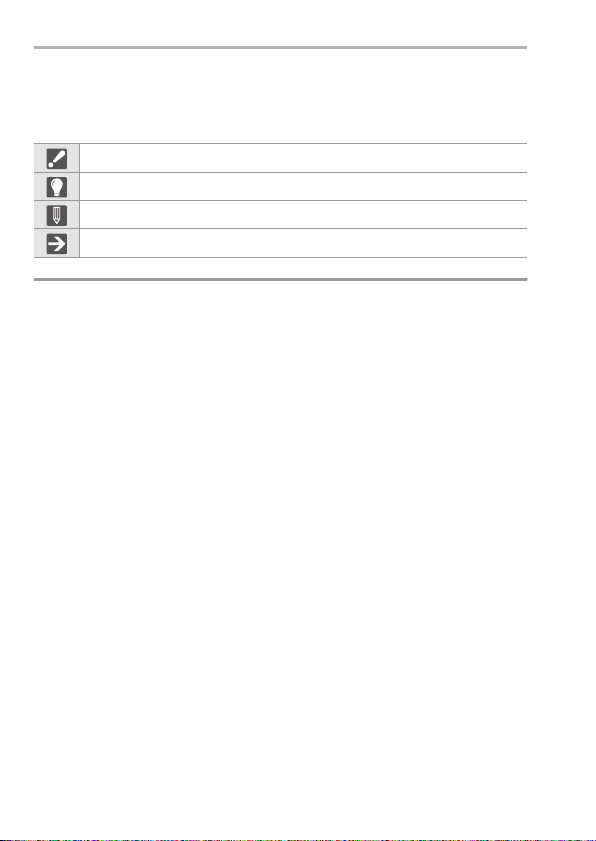
0 For information about operation methods of the operation part, refer to page 48.
0 Other symbols, such as icons shown on the camera screen, are also used in
explanations.
0 This document describes the procedure for selecting menu items as follows:
Example) Set [Picture Quality] of the [Photo] ([Image Quality]) menu to [STD.].
For information about menu operation methods, refer to page 57.
A Front dial
B Rear dial
C 3421
Cursor button up/down/left/right
or
Joystick up/down/left/right
D Press the center of the joystick
E [MENU/SET] button
F Control dial
¨ [ ] ¨ [ ] ¨ [Picture Quality] ¨ Select [STD.]
DC-S1HP-DVQX1939_eng.book 5 ページ 2019年8月9日 金曜日 午後4時45分
About Owner’s Manual
DVQX1939 (ENG)
6
Notification classification symbols
In this document, notifications are classified and described using the following
symbols:
0 This document provides an explanation with the assumption that menu settings are
in the default settings.
Furthermore, illustrations of screens used assume the following settings.
– [Style] ([Clock Set]): [Y.M.D]/[24hrs]
0 Description in this document is based on the interchangeable lens (S-R24105:
optional).
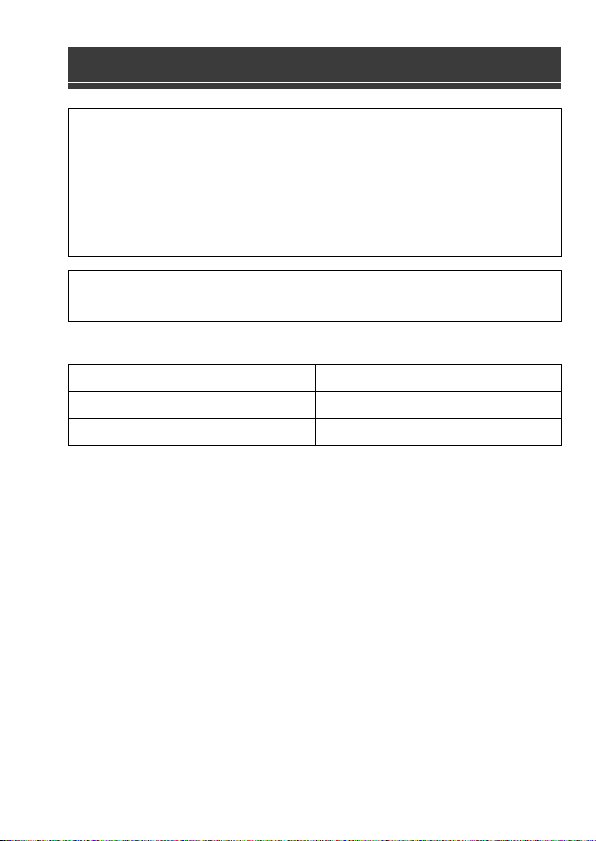
To confirm prior to using the function
Hints for better use of the camera and tips for recording
Notifications and supplementary items regarding specifications
Related information and page number
DC-S1HP-DVQX1939_eng.book 6 ページ 2019年8月9日 金曜日 午後4時45分
DVQX1939 (ENG)
7
∫ Product identification marking
Information for Your Safety
WARNING:
To reduce the risk of fire, electric shock or product damage,
0
Do not expose this unit to rain, moisture, dripping or splashing.
0 Use the recommended accessories.
0 Do not remove covers.
0 Do not repair this unit by yourself. Refer servicing to qualified service
personnel.
The socket outlet shall be installed near the equipment and shall be
easily accessible.
Product Location
Digital camera Bottom
Battery charger Bottom
DC-S1HP-DVQX1939_eng.book 7 ページ 2019年8月9日 金曜日 午後4時45分

Information for Your Safety
DVQX1939 (ENG)
8
THE FOLLOWING APPLIES ONLY IN THE U.S.A.
FCC Note:
This equipment has been tested and found to comply with the limits for a Class B
digital device, pursuant to Part 15 of the FCC Rules.
These limits are designed to provide reasonable protection against harmful
interference in a residential installation. This equipment generates, uses, and can
radiate radio frequency energy and, if not installed and used in accordance with the
instructions, may cause harmful interference to radio communications. However,
there is no guarantee that interference will not occur in a particular installation. If this
equipment does cause harmful interference to radio or television reception, which
can be determined by turning the equipment off and on, the user is encouraged to try
to correct the interference by one or more of the following measures:
0 Reorient or relocate the receiving antenna.
0 Increase the separation between the equipment and receiver.
0 Connect the equipment into an outlet on a circuit different from that to which the
receiver is connected.
0 Consult the dealer or an experienced radio/TV technician for help.
FCC Caution:
0 Any unauthorized changes or modifications to this equipment would void the
user’s authority to operate this device.
0 To assure continued compliance, follow the attached installation instructions and
use only shielded interface cables with ferrite core when connecting to computer
or peripheral devices.
This device complies with Part 15 of the FCC Rules. Operation is subject to the
following two conditions: (1) This device may not cause harmful interference, and (2)
this device must accept any interference received, including interference that may
cause undesired operation.
Supplier's Declaration of Conformity
Trade name: Panasonic
Model No.: DC-S1H
Responsible Party: Panasonic Corporation of North America
Two Riverfront Plaza, Newark, NJ 07102-5490
Support Contact: http://shop.panasonic.com/support
DC-S1HP-DVQX1939_eng.book 8 ページ 2019年8月9日 金曜日 午後4時45分
Information for Your Safety
DVQX1939 (ENG)
9
THE FOLLOWING APPLIES ONLY IN THE U.S.A.
∫ About the battery pack
How to Display Certification and Compliance Information
Certification and compliance information for this camera can be viewed on the
menu screen.
1 Select the [Others] tab of the [Setup] menu.
2 Select [Approved Regulations] and confirm your selection.
Contains FCC ID: VPYLB1JS955
This transmitter must not be co-located or operated in conjunction with any other
antenna or transmitter.
This equipment complies with FCC radiation exposure limits set forth for an
uncontrolled environment and meets the FCC radio frequency (RF) Exposure
Guidelines as this equipment has very low levels of RF energy.
Compliance with FCC requirement 15.407(c)
Data transmission is always initiated by software, which is the passed down
through the MAC, through the digital and analog baseband, and finally to the RF
chip. Several special packets are initiated by the MAC. These are the only ways
the digital baseband portion will turn on the RF transmitter, which it then turns off
at the end of the packet. Therefore, the transmitter will be on only while one of the
aforementioned packets is being transmitted. In other words, this device
automatically discontinue transmission in case of either absence of information to
transmit or operational failure.
Frequency Tolerance: n 20ppm
CAUTION
Battery pack (Lithium ion battery pack)
0 Use the specified unit to recharge the battery pack.
0 Do not use the battery pack with equipment other than the specified unit.
0 Do not get dirt, sand, liquids, or other foreign matter on the terminals.
0 Do not touch the plug terminals (i and j) with metal objects.
0 Do not disassemble, remodel, heat or throw into fire.
If any electrolyte should come into contact with your hands or clothes, wash it off
thoroughly with water.
If any electrolyte should come into contact with your eyes, never rub the eyes.
Rinse eyes thoroughly with water, and then consult a doctor.
DC-S1HP-DVQX1939_eng.book 9 ページ 2019年8月9日 金曜日 午後4時45分

Information for Your Safety
DVQX1939 (ENG)
10
0 Do not heat or expose to flame.
0 Do not leave the battery(ies) in a car exposed to direct sunlight for a long period of
time with doors and windows closed.
∫ About the AC adaptor (supplied)
CAUTION
0
Danger of explosion if battery is incorrectly replaced. Replace only with the type
recommended by the manufacturer.
0 When disposing of the batteries, please contact your local authorities or dealer
and ask for the correct method of disposal.
Warning
Risk of fire, explosion and burns. Do not disassemble, heat above
60 xC (140 oF) or incinerate.
CAUTION!
To reduce the risk of fire, electric shock or product damage,
0
Do not install or place this unit in a bookcase, built-in cabinet or in another
confined space. Ensure this unit is well ventilated.
AC adaptor
This AC adaptor operates on AC between 100 V and 240 V.
But
0 In the U.S.A. and Canada, the AC adaptor must be connected to a 120 V AC
power supply only.
0 When connecting to an AC supply outside of the U.S.A. or Canada, use a plug
adaptor to suit the AC outlet configuration.
0 When connecting to a supply of greater than AC 125 V, ensure the cord you use
is suited to the voltage of the AC supply and the rated current of the AC adaptor.
0 Contact an electrical parts distributor for assistance in selecting a suitable AC
plug adaptor or AC cord set.
DC-S1HP-DVQX1939_eng.book 10 ページ 2019年8月9日 金曜日 午後4時45分

Information for Your Safety
DVQX1939 (ENG)
11
Cautions for Use
0 Do not use any other USB connection cables except the supplied USB connection
cables (C–C and A–C).
0 Do not use any other AC cables except the supplied one.
0 Do not use any other BNC conversion cables (for TC IN/OUT) except the supplied
one.
0 Always use a genuine Panasonic Shutter Remote Control (DMW-RS2: optional).
0 Use a “High Speed HDMI cable” with the HDMI logo.
Cables that do not comply with the HDMI standards will not work.
“High Speed HDMI cable” (Type A–Type A plug, up to 1.5 m (4.9 feet) long)
0 Do not use the BNC cables with the length of 2.8 m (9.2 feet) or more.
0 Do not use the headphone cables with the length of 3 m (9.8 feet) or more.
0 Do not use the synchro cables with the length of 3 m (9.8 feet) or more.
0 Do not use the stereo microphone cables with the length of 3 m (9.8 feet) or more.
Keep this unit as far away as possible from electromagnetic
equipment (such as microwave ovens, TVs, video games etc.).
0
If you use this unit on top of or near a TV, the pictures and/or sound on this unit may
be disrupted by electromagnetic wave radiation.
0 Do not use this unit near cell phones because doing so may result in noise adversely
affecting the pictures and/or sound.
0 Recorded data may be damaged, or pictures may be distorted, by strong magnetic
fields created by speakers or large motors.
0 Electromagnetic wave radiation may adversely affect this unit, disturbing the pictures
and/or sound.
0 If this unit is adversely affected by electromagnetic equipment and stops functioning
properly, turn this unit off and remove the battery or disconnect AC adaptor. Then
reinsert the battery or reconnect AC adaptor and turn this unit on.
Do not use this unit near radio transmitters or high-voltage lines.
0
If you record near radio transmitters or high-voltage lines, the recorded pictures and/
or sound may be adversely affected.
0 Before cleaning the camera, remove the battery or the DC Coupler (DMW-
DCC16: optional), or disconnect the power plug from the electrical outlet.
0 Do not press the monitor with excessive force.
DC-S1HP-DVQX1939_eng.book 11 ページ 2019年8月9日 金曜日 午後4時45分

Information for Your Safety
DVQX1939 (ENG)
12
0 Do not press the lens with excessive force.
0 Do not spray the camera with insecticides or volatile chemicals.
0 Do not keep products made of rubber, PVC or similar materials in contact with
the camera for a long period of time.
0 Do not use solvents such as benzine, thinner, alcohol, kitchen detergents, etc.,
to clean the camera, since it may deteriorate the external case or the coating
may peel off.
0 Do not leave the camera with the lens facing the sun, as rays of light from the
sun may cause it to malfunction.
0 Always use the supplied cords and cables.
0 Do not extend the cords or the cables.
0 The data on the card may be damaged or lost due to electromagnetic waves, static
electricity or breakdown of the camera or the card. We recommend storing important
data on another device, such as a PC.
0 Do not format the card on your PC or other equipment. Format it on the camera only
to ensure proper operation.
0 The battery is a rechargeable lithium ion battery. If the temperature is too high
or too low, the operating time of the battery will become shorter.
0 Store the battery in a cool and dry place with a relatively stable temperature.
(Recommended temperature: 15 oC to 25 oC (59 oF to 77 oF); recommended
humidity: 40%RH to 60%RH)
0 Do not store the battery for a long time while fully charged. When storing the
battery for a long period of time, we recommend charging it once a year. Remove the
battery from the camera and store it again after it has completely discharged.
For the U.S.A. and Canada only
A lithium ion battery that is recyclable powers the product you
have purchased. Please call 1-800-8-BATTERY for
information on how to recycle this battery.
DC-S1HP-DVQX1939_eng.book 12 ページ 2019年8月9日 金曜日 午後4時45分

DVQX1939 (ENG)
13
About Owner’s Manual .......................... 4
Information for Your Safety.................... 7
1. Introduction
Before Use........................................... 15
Standard Accessories.......................... 17
Lenses That Can Be Used .................. 18
Memory Cards That Can Be Used ...... 19
Names of Parts.................................... 21
2. Getting Started
Attaching a Shoulder Strap.................. 27
Charging the Battery............................ 28
Inserting Cards (Optional) ................... 38
Attaching a Lens.................................. 40
Adjusting the Monitor Direction and
Angle ................................................... 41
Setting the Clock (When Turning On for
the First Time) ..................................... 42
3. Basic Operations
Basic Recording Operations................ 44
Camera Setting Operations ................. 48
Display Settings................................... 51
Quick Menu ......................................... 55
Control Panel....................................... 56
Menu Operation Methods .................... 57
Intelligent Auto Mode........................... 60
Recording Using Touch Functions ...... 61
4. Image Recording
[Aspect Ratio]/[Picture Size]/[Picture
Quality] ................................................ 63
[Double Card Slot Function] ................ 64
[Folder / File Settings].......................... 65
5. Focus/Zoom
Using AF .............................................. 66
Selecting the AF Mode ........................ 67
AF Area Movement Operation ............. 71
Record Using MF................................. 72
Recording with Zoom........................... 74
6. Image Stabilizer
Image Stabilizer ................................... 75
7. Metering/Exposure/ISO
Sensitivity
[Metering Mode]................................... 80
Exposure Compensation ..................... 80
ISO Sensitivity ..................................... 81
8. White Balance/Image
Quality
White Balance (WB) ............................ 84
[Photo Style] ........................................ 87
9. Flash
Using an External Flash (Optional)...... 90
10. Recording Videos
Recording Videos ................................ 92
Creative Video Mode ........................... 95
Recording Video ................................ 100
Time Code ......................................... 110
Synchronizing the Time Code with an
External Device.................................. 112
Using AF (Video) ............................... 115
Video Brightness and Coloring .......... 117
Audio Settings.................................... 119
Contents
DC-S1HP-DVQX1939_eng.book 13 ページ 2019年8月9日 金曜日 午後4時45分

Contents
DVQX1939 (ENG)
14
Main Assist Functions ........................ 121
11. Special Video Recording
Variable Frame Rate..........................125
High Frame Rate Video ..................... 127
[Focus Transition] .............................. 128
[Live Cropping]...................................130
Log Recording.................................... 132
HLG Videos........................................ 134
Anamorphic Recording ...................... 136
[Synchro Scan]................................... 137
[Loop Recording (video)].................... 138
[Segmented File Recording] .............. 139
12. Connections with External
Devices (Video)
HDMI Devices (HDMI Output)............ 140
HDMI Output Settings ........................ 144
External Microphones (Optional) ....... 146
XLR Microphone Adaptor
(Optional) ........................................... 149
Headphones....................................... 150
13. Playing Back and Editing of
Images
Playing Back Pictures ........................ 152
Playing Back Videos .......................... 153
Switching the Display Mode...............154
Deleting Images ................................. 155
14. Camera Customization
Fn Buttons.......................................... 156
[Dial Operation Switch] ...................... 158
Quick Menu Customization ................ 159
Custom Mode..................................... 161
My Menu ............................................ 163
[Save/Restore Camera Setting]..........164
15. List of Menu
List of Menu........................................165
16. Wi-Fi/Bluetooth
Connecting to a Smartphone..............171
Operating the Camera with a
Smartphone........................................176
17. Connecting to Other
Devices
Viewing on a TV .................................180
Importing Images to a PC...................181
Tethered Recording............................185
18. Materials
Digital Camera Accessory System.....187
Monitor/Viewfinder Displays...............188
Message Displays ..............................194
Troubleshooting..................................195
Specifications .....................................201
Index...................................................211
Trademarks and Licences..................217
Limited Warranty
(ONLY FOR U.S.A.) ...........................220
DC-S1HP-DVQX1939_eng.book 14 ページ 2019年8月9日 金曜日 午後4時45分

DVQX1939 (ENG)
15
1. Introduction
Firmware of Your Camera/Lens
Firmware updates may be provided in order to improve camera capabilities or to add
functionality. For smoother recording, we recommend updating the firmware of the
camera/lens to the latest version.
0 For the latest information on the firmware or to download/
update the firmware, visit the following support site:
https://panasonic.jp/support/global/cs/dsc/
(English only)
0 To check the firmware version of the camera/lens, attach the lens to
the camera and select [Firmware Version] in the [Setup] ([Others])
menu. You can also update the firmware in [Firmware Version].
0 This document provides explanations for camera firmware version 1.0. Changes
after firmware update are detailed in the “Owner’s Manual” (PDF format). Refer to
this by downloading from the website. (l 4)
Handling of the Camera
When using the camera, take care not to drop it, bump it, or apply undue force.
These may cause malfunction or damage to the camera and lens.
If sand, dust, or liquid gets on the monitor, wipe it off with a dry soft cloth.
– Touch operations may be incorrectly recognized.
When using in low temperatures (s10 oC to 0 oC (14 oF to 32 oF))
– Before use, attach a Panasonic lens with a minimum recommended operating
temperature of j10 oC (14 oF).
Do not place a hand inside the camera mount.
This may cause a failure or damage because the sensor is a precision device.
If you shake the camera while turning the camera off, a sensor may operate or a
rattling sound may be heard. This is caused by the image stabilizer mechanism
in the body. It is not a malfunction.
Before Use
DC-S1HP-DVQX1939_eng.book 15 ページ 2019年8月9日 金曜日 午後4時45分

1. Introduction
DVQX1939 (ENG)
16
Splash Resistant
Splash Resistant is a term used to describe an extra level of protection this
camera offers against exposure to a minimal amount of moisture, water or dust.
Splash Resistant does not guarantee that damage will not occur if this camera is
subjected to direct contact with water.
In order to minimize the possibility of damage please be sure the following
precautions are taken:
– Splash Resistant works in conjunction with the lenses that were specifically
designed to support this feature.
– Securely close the doors, socket caps, contact points cover, etc.
– When the lens or cap is removed or a door is open, do not allow sand, dust, and
moisture to enter inside.
– If liquid gets on the camera, wipe it off with a dry soft cloth.
Condensation (When the Lens, the Viewfinder or Monitor
is Fogged Up)
0 Condensation occurs when there are temperature or humidity differences.
Take care as this may lead to soiling, mold, and malfunctions in the lens, viewfinder,
and monitor.
0 If condensation occurs, turn off the camera and leave it for approx. 2 hours. The fog
will disappear naturally when the temperature of the camera becomes close to the
ambient temperature.
Be Sure to Perform Trial Recording in Advance
Perform trial recording in advance of an important event (wedding, etc.) to check that
recording can be performed normally.
No Compensation Regarding Recording
Please note that compensation cannot be provided in the event that recording could
not be performed due to a problem with the camera or a card.
Be Careful with Regard to Copyrights
Under copyright law, you may not use the images and audio you have recorded for
other than personal enjoyment without the permission of the copyright holder.
Be careful because there are cases where restrictions apply to recording even for the
purpose of personal enjoyment.
Also Refer to the Cautions for Use in the “Owner’s
Manual” (PDF Format)
DC-S1HP-DVQX1939_eng.book 16 ページ 2019年8月9日 金曜日 午後4時45分
1. Introduction
DVQX1939 (ENG)
17
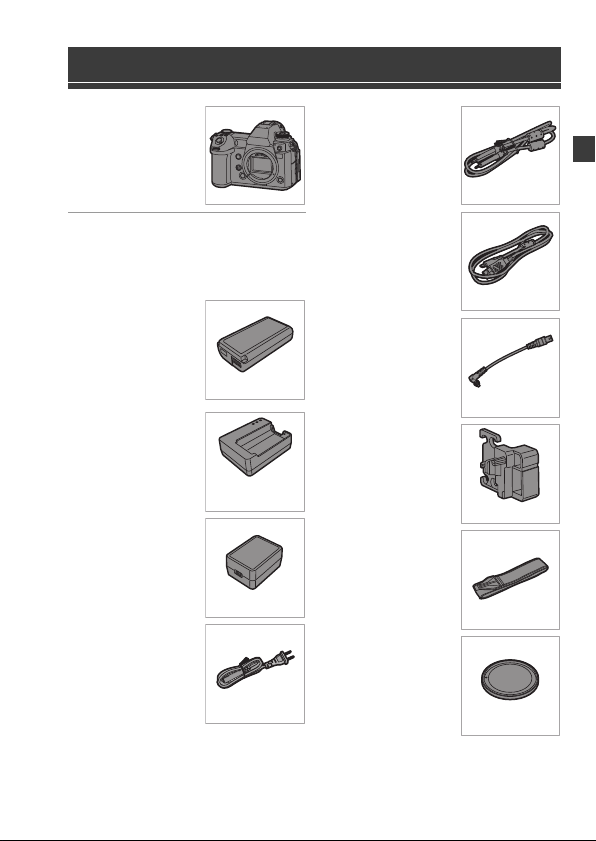
Digital camera body
(This is referred to as
camera in this
document.)
Check that all the accessories are
supplied before using the camera.
0 Product numbers correct as of August
2019. These may be subject to change.
Battery pack
(This is referred to as
battery pack
or
battery
in this document.)
0 Charge the battery
before use.
Battery charger
¢1
(This is referred to as
battery charger or
charger in this
document.)
AC adaptor
0 This is used for
charging and
power supply.
AC cable
USB connection
cable (C–C)
USB connection
cable (A–C)
BNC conversion
cable (for TC IN/
OUT)
Cable holder
Shoulder strap
Body cap
¢2
¢1 Order the part number A if you would like to purchase the battery charger alone.
Standard Accessories
DMW-BLJ31
DMW-BTC14
(
: DVLC1004Z)
DVLV1001Z
K2CA2CA00025
K1HY24YY0022
K1HY24YY0021
K1TYYYY00286
1QB1MC893Z
DVPW1020Z
1HE1MC891Z
DC-S1HP-DVQX1939_eng.book 17 ページ 2019年8月9日 金曜日 午後4時45分
1. Introduction
DVQX1939 (ENG)
18
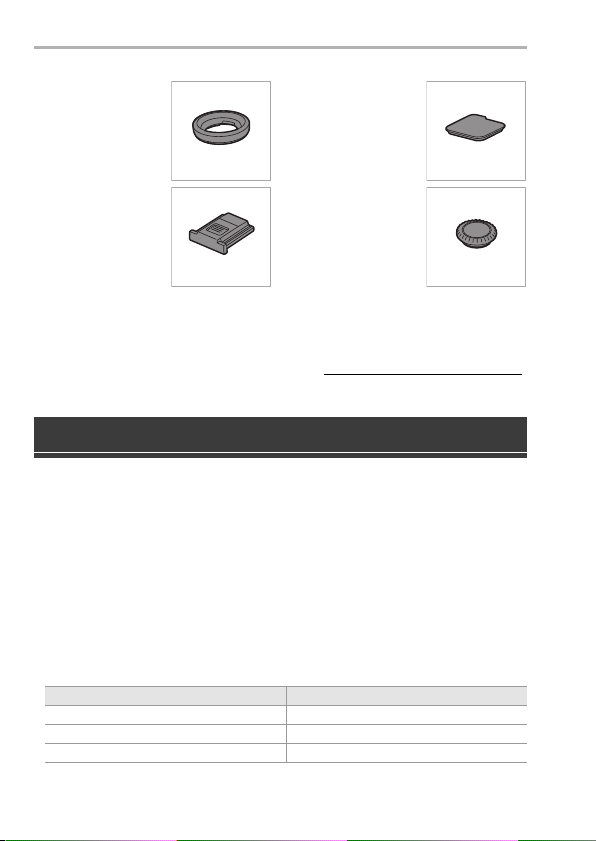
Eye cup
¢2
Hot shoe cover
¢2
Cover for the
battery grip
connector
¢2
Flash synchro
socket cap
¢2
¢2 This is attached to the camera at the time of purchase.
0 The memory card is optional.
0 The Interchangeable Lens is optional.
0 If accessories are lost, customers can visit us at http://shop.panasonic.com/support
for further information about obtaining replacement parts.
The lens mount of this camera is compliant with the L-Mount standard of
Leica Camera AG. It can be used with 35 mm full-frame compatible
interchangeable lenses and APS-C size interchangeable lenses of this
standard. This camera is capable of sensor read out suited to the image
circles of 35 mm full-frame interchangeable lenses and Super 35 mm
interchangeable lenses.
0
When using an APS-C size interchangeable lens, sensor read out is possible across
the same range as a Super 35 mm interchangeable lens.
0 The interchangeable lenses used in the explanations are designated as follows in
this document.
7YE1MC891Z
DVYE1121Z
DVKK1054Z
VKF5108
Lenses That Can Be Used
Types of interchangeable lens Designation in this document
35 mm full-frame interchangeable lens full-frame lens
Super 35 mm interchangeable lens Super 35 mm lens
APS-C-size interchangeable lens APS-C lens
DC-S1HP-DVQX1939_eng.book 18 ページ 2019年8月9日 金曜日 午後4時45分
1. Introduction
DVQX1939 (ENG)
19
0 When there is no distinguishing the type of lens, the explanation will use lens.
0 When using a lens that cannot communicate with this camera, you can register the
lens information using the following menu item. The settings on this camera enable
you to switch settings to suit full-frame or Super 35 mm/APS-C lenses. (l 78)
[] ¨ [ ] ¨ [Image Stabilizer] ¨ [Lens Information] ¨ [Lens1] to [Lens12] ¨
[Image Circle]
[] ¨ [ ] ¨ [Lens Information] ¨ [Lens1] to [Lens12] ¨ [Image Circle]
Notes on the Use of Super 35 mm/APS-C Lenses
As the image area is narrowed when using Super 35 mm/APS-C lenses,
the following functions may not be available or their behaviour may be
different.
0
Refer to catalogs/websites for most current information
regarding supported lenses.
https://panasonic.jp/support/global/cs/dsc/
(English only)
You can use the following memory cards with this camera.
– SD memory card (512 MB to 2 GB)
– SDHC memory card (4 GB to 32 GB)
– SDXC memory card (48 GB to 128 GB)
0 Operation has been confirmed with the above Panasonic cards.
0 SD memory card, SDHC memory card, and SDXC memory card are referred to by
the generic name of card in this document.
[Aspect Ratio]
[Picture Size]
[Ex. Tele Conv.]
[6K/4K PHOTO]
[Post-Focus]
[Shutter Type]
[Filter Settings]
[High Resolution Mode]
[HLG Photo]
[Image Quality] l 107
[Image Area of Video] l 108
[Multiple Exposure]
Memory Cards That Can Be Used
DC-S1HP-DVQX1939_eng.book 19 ページ 2019年8月9日 金曜日 午後4時45分
1. Introduction
DVQX1939 (ENG)
20
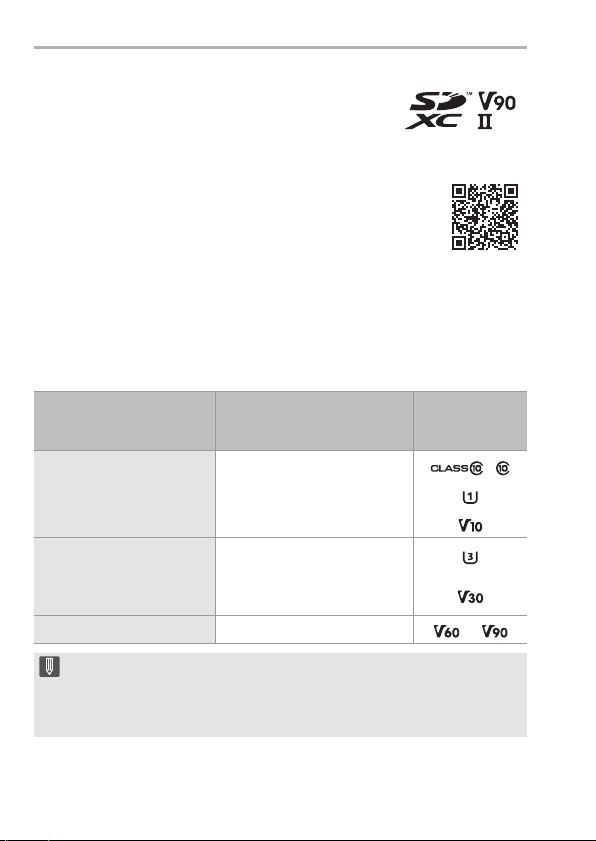
0 The camera supports SDHC/SDXC memory cards
compliant with UHS Speed Class 3 of the UHS-
I/UHS-II
standard.
0 The camera supports SDHC/SDXC memory cards
compliant with Video Speed Class 90 of the UHS-
II standard.
0 For the latest information, check the following support site:
https://panasonic.jp/support/global/cs/dsc/
(English only)
Cards That Can Be Used Stably with This Camera
When recording video using the following video image qualities (bit rates)
or recording using picture functions, use cards that have the correct Speed
Class
¢
.
¢ Standards guaranteeing the minimum speed necessary for continuous writing
Recording qualities (bit
rates)
Picture functions
Speed Classes
Indication
examples
72 Mbps video
Class 10
UHS Speed Class 1 or higher
Video Speed Class 10 or higher
Video between 100 Mbps
and 200 Mbps
[6K/4K PHOTO]
[Post-Focus]
UHS Speed Class 3
Video Speed Class 30 or higher
400 Mbps video Video Speed Class 60 or higher
0 The data stored on a card may be damaged due to electromagnetic waves,
static electricity or a failure of the camera or card. We recommend backing up
important data.
0 Keep the memory card out of reach of children to prevent swallowing.
DC-S1HP-DVQX1939_eng.book 20 ページ 2019年8月9日 金曜日 午後4時45分
1. Introduction
DVQX1939 (ENG)
21
Camera
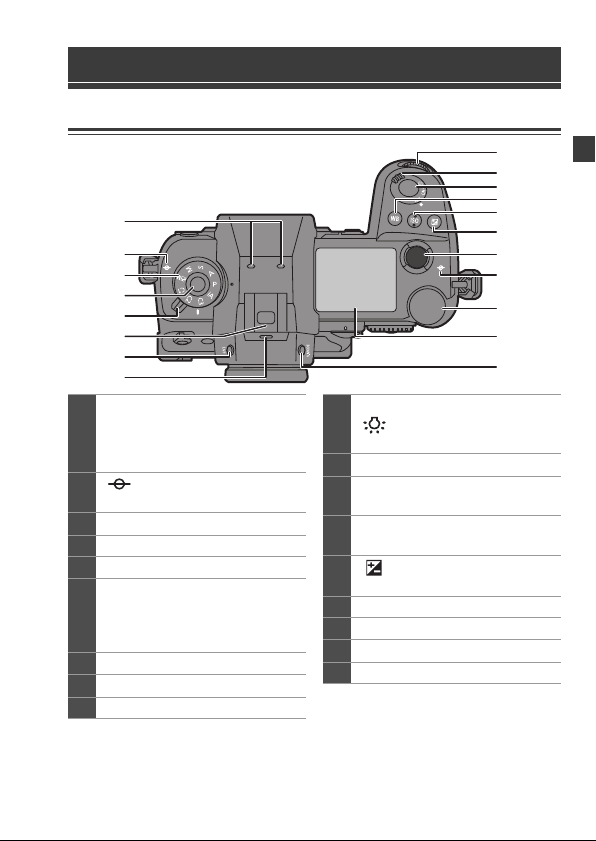
Names of Parts
1
2
3
4
5
6
7
8
10
11
12
13
14
9
15
2
16
17
18
1
Stereo microphone (l 120)
0 Do not block the microphone
with a finger. Audio will be
difficult to record.
2
[ ] (Recording distance
reference mark)
3
Mode dial (l 46)
4
Mode dial lock button (l 46)
5
Drive mode dial (l 47)
6
Hot shoe (hot shoe cover) (l 90)
• Keep the hot shoe cover out of
reach of children to prevent
swallowing.
7
[LVF] button (l 52)
8
Speaker
9
Front dial (l 49)
10
Camera on/off switch (l 42)/
[ ] (Status LCD backlight)
(l 54)
11
Shutter button (l 45)
12
[WB] (White balance) button
(l 84)
13
[ISO] (ISO sensitivity) button
(l 81)
14
[ ] (Exposure compensation)
button (l 80)
15
Video rec. button (l 46, 92)
16 Rear dial (l 49)
17
Status LCD (l 26, 96)
18
[V.MODE] button (l 52)
DC-S1HP-DVQX1939_eng.book 21 ページ 2019年8月9日 金曜日 午後4時45分
1. Introduction
DVQX1939 (ENG)
22
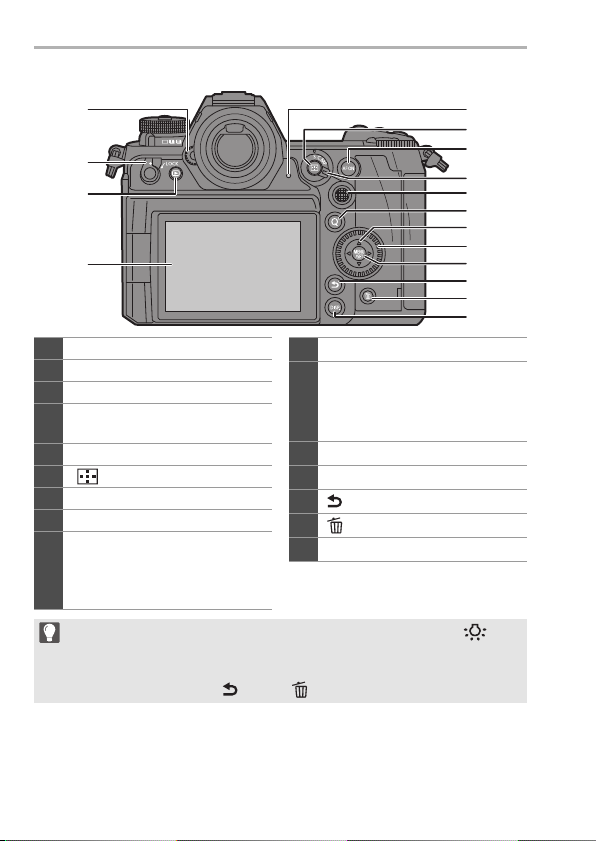
4
3
2
1
6
7
15
16
5
8
9
12
13
14
10
11
1
Diopter adjustment dial (l 51)
2 Operation lock lever (l 51)
3
[(] (Playback) button (l 152)
4
Monitor (l 25, 188)/
Touch screen (l 50)
5 Rear tally lamp (l 92)
6
[ ] (AF mode) button (l 66)
7
[AF ON] button (l 66)
8 Focus mode lever (l 47, 66, 72)
9
Joystick (l 50)/
Fn buttons (l 156)
Center: Fn8, 3: Fn9, 1: Fn10,
4: Fn11, 2: Fn12
10
[Q] (Quick menu) button (l 55)
11
Cursor buttons (l 49)/
Fn buttons (l 156)
3: Fn13, 1: Fn14, 4: Fn15,
2:Fn16
12
Control dial (l 49)
13
[MENU/SET] button (l 49, 57)
14
[ ] (Cancel) button (l 59)
15
[ ] (Delete) button (l 155)
16
[DISP.] button (l 53)
0 The following buttons light when the camera on/off switch is set to [ ].
The lighting timing can be changed in [Illuminated Button] in the [Custom]
([Operation]) menu.
–[(] button/[Q] button/[ ] button/[ ] button/[DISP.] button
DC-S1HP-DVQX1939_eng.book 22 ページ 2019年8月9日 金曜日 午後4時45分
1. Introduction
DVQX1939 (ENG)
23
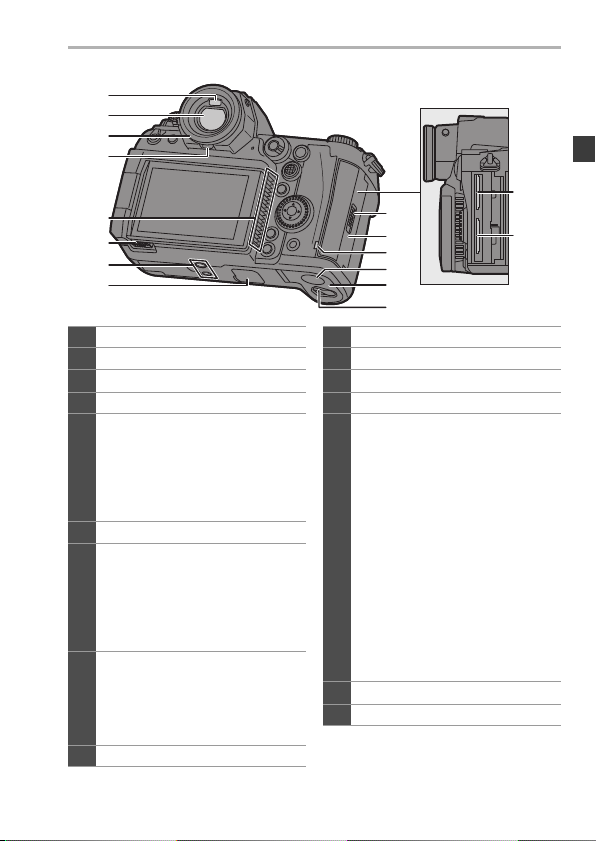
7
8
2
3
6
4
1
10
11
12
13
14
15
16
9
5
1
Eye sensor (l 52)
2
Viewfinder (l 25, 52, 188)
3
Eye cup
4
Eye cup lock lever
5
Fan inlet
0 The fan inlet for the cooling fan.
0 Do not obstruct this unit’s
ventilation openings with
newspapers, tablecloths,
curtains, and similar items.
6 Monitor lock lever (l 42)
7
Tripod mount
0 If you attempt to attach a tripod
with a screw length of 5.5 mm
(0.22 inch) or more, you may not
be able to securely fix it in place
or it may damage the camera.
8
Battery grip connector (cover for
the battery grip connector)
0 Keep the cover for the battery
grip connector out of reach of
children to prevent swallowing.
9 Card slot 1 (l 38)
10
Card slot 2 (l 38)
11
Card door lock lever (l 38)
12
Card door (l 38)
13
Card access light (l 39)
14
DC Coupler cover
0 When using an AC adaptor,
ensure that the Panasonic DC
Coupler (DMW-DCC16:
optional) and AC Adaptor
(DMW-AC10PP: optional) are
used.
0 Always use a genuine
Panasonic AC Adaptor (DMW-
AC10PP: optional).
0 When using an AC Adaptor
(optional), use the AC cable
supplied with the AC Adaptor
(optional).
15
Battery door (l 30)
16
Battery door release lever (l 30)
DC-S1HP-DVQX1939_eng.book 23 ページ 2019年8月9日 金曜日 午後4時45分
1. Introduction
DVQX1939 (ENG)
24
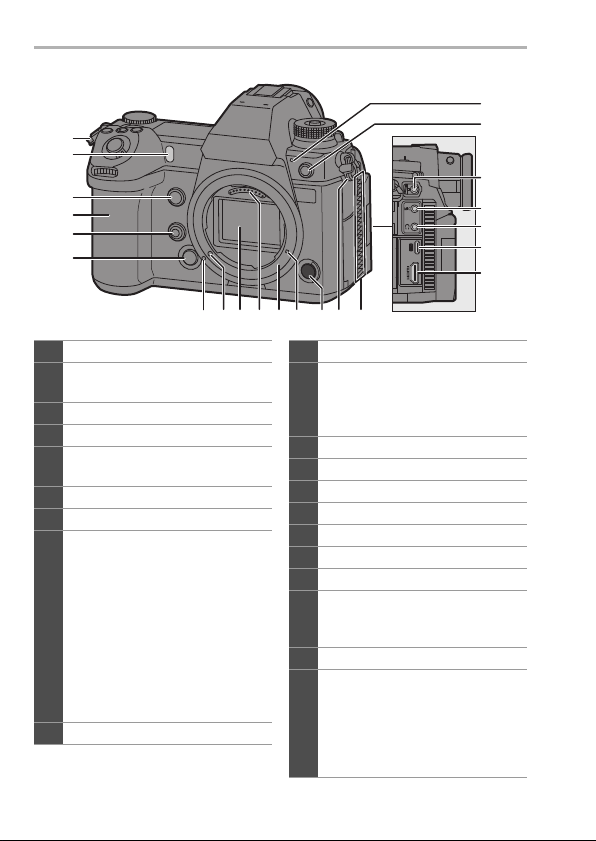
3
4
6
5
16 17 1918 2015 1 2114
2
1
13
12
11
10
8
7
9
1
Shoulder strap eyelet (l 27)
2
Self-timer light/
AF assist light
3
Fn button (Fn1) (l 156)
4
Grip
5
Preview button/
Fn button (Fn2) (l 156)
6
Lens release button (l 40)
7
Front tally lamp (l 92)
8
Flash synchro socket (flash
synchro socket cap) (l 90)
0 Connect the supplied BNC
conversion cable (for TC IN/
OUT) when synchronizing the
time code with an external
device. (l 110)
0 Keep the flash synchro socket
cap out of reach of children to
prevent swallowing.
9 [REMOTE] socket
10
[MIC] socket (l 146)
11
Headphone socket (l 150)
0 Excessive sound pressure from
earphones and headphones can
cause hearing loss.
12
USB port (l 32, 179)
13 [HDMI] socket (l 140, 179)
14
Lens fitting mark (l 40)
15
Lens lock pin
16 Sensor
17
Contact points
18
Mount
19
Screw hole for function expansion
0 This is a hole that will be used in
a future function expansion.
20
Sub video rec. button (l 46, 92)
21
Fan outlet
0
The fan outlet for the cooling fan.
0 Do not obstruct this unit’s
ventilation openings with
newspapers, tablecloths,
curtains, and similar items.
DC-S1HP-DVQX1939_eng.book 24 ページ 2019年8月9日 金曜日 午後4時45分
1. Introduction
DVQX1939 (ENG)
25
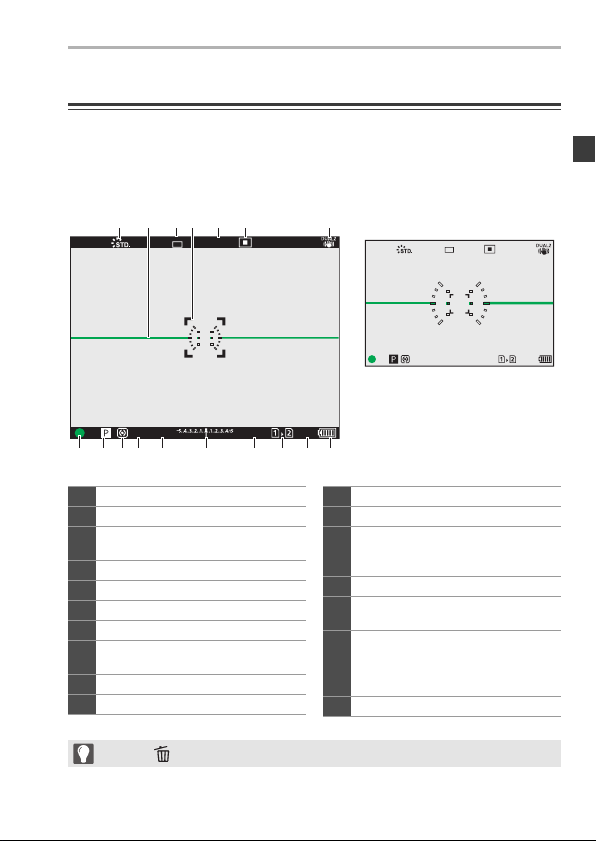
Viewfinder/Monitor Displays
At the time of purchase, the viewfinder/monitor displays the following
icons.
0
For information about the icons other than those described here, refer to page 188.
Viewfinder Monitor
999
ISO
100
F
4.060
L
FINE
AFSAFS
8 9 1011 12 13 14 15 16 17
1 2 43 5 6 7
999
ISO
100F4.060
±
0
AFSAFS
L
FINE
1
Photo Style (l 87)
2
Level gauge (l 168)
3
Picture quality (l 63)/
Picture size (l 63)
4
AF area (l 71)
5
Focus mode (l 47, 72)
6
AF mode (l 67)
7
Image stabilizer (l 75)
8
Focus (green) (l 45, 66)/
Recording state (red) (l 92)
9
Recording mode (l 46)
10
Metering mode (l 80)
11
Shutter speed (l 45)
12
Aperture value (l 45)
13
Exposure compensation value
(l 80)/
Manual Exposure Assist
14
ISO sensitivity (l 81)
15
Card slot (l 38)/
Double card slot function (l 64)
16
Number of still images that can be
taken/
Number of pictures that can be taken
continuously
17
Battery indication (l 35)
0 Press [ ] to switch between display/hide of the level gauge.
DC-S1HP-DVQX1939_eng.book 25 ページ 2019年8月9日 金曜日 午後4時45分
1. Introduction
DVQX1939 (ENG)
26
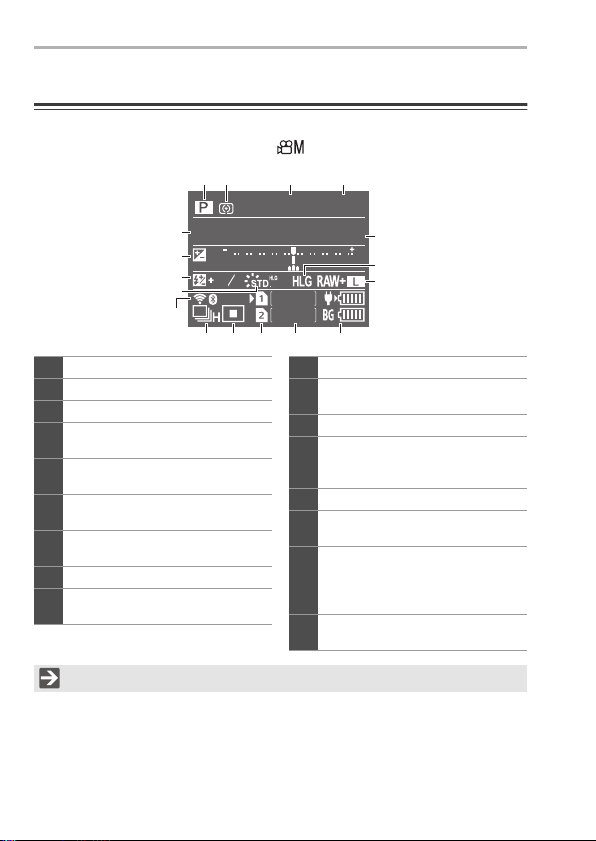
Status LCD Display
The following recording settings are displayed when recording pictures.
0
Refer to page 96 for information on the [ ] mode (Creative Video mode) display.
1/
60
100
999
AWB
ISOWB BKT
BKT
F
4
.
0
BKT
54321
0
12345
1
1
3
999
3421
6
10
11
5
7
8
9
12
14
13 15 16 17
1
Recording mode (l 46)
2
Metering mode (l 80)
3
Shutter speed (l 45)
4
Aperture value (l 45)/
Aperture Bracket (l 166)
5
White balance (l 84)/
White Balance Bracket (l 166)
6
ISO sensitivity (l 81)/
Dual Native ISO setting (l 83)
7
Exposure compensation (l 80)/
Exposure Bracket (l 166)
8
Flash output adjustment (l 165)
9
Photo Style (l 87)/
Filter setting (l 165)
10
HLG photo (l 165)
11
Picture quality (l 63)/
Picture size (l 63)
12
Wi-Fi/Bluetooth connection state
13
Drive mode (l 47)/
Post-Focus (l 166)/
High Resolution mode (l 165)
14
AF mode (l 67)
15
Card slot (l 38)/
Double card slot function (l 64)
16
Number of still images that can be
taken/
Number of pictures that can be taken
continuously
17
Battery indication (l 35)/
Power supply (l 34)
0 Turning on the status LCD backlight (l 54)
DC-S1HP-DVQX1939_eng.book 26 ページ 2019年8月9日 金曜日 午後4時45分
DVQX1939 (ENG)
27
2. Getting Started
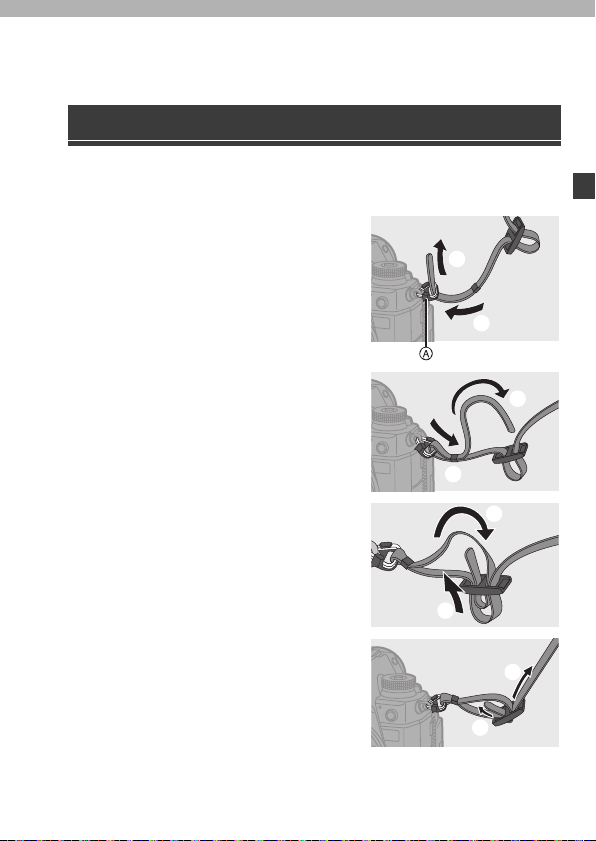
Attach a shoulder strap to the camera with the following procedure to
prevent it from dropping.
1
Pass the shoulder strap
through the shoulder strap
eyelet A.
2
Pass the end of the shoulder
strap through the ring and
then pass it through the
fastener.
3
Pass the end of the shoulder
strap through the other hole of
the fastener.
4
Pull the shoulder strap and
check that it will not come out.
0 Attach the opposite end of the shoulder
strap with the same procedure.
Attaching a Shoulder Strap
DC-S1HP-DVQX1939_eng.book 27 ページ 2019年8月9日 金曜日 午後4時45分
2. Getting Started
DVQX1939 (ENG)
28
You can charge the battery either using the supplied charger, or in the
camera body.
You can also charge by connecting to a USB PD (USB Power Delivery)
compatible device using the supplied USB connection cable (C–C).
Furthermore, you can turn the camera on while it is charging and record.
0 The battery that can be used with the camera is DMW-BLJ31. (As of
August 2019)
Charging with the Charger
0 Use the supplied charger and AC adaptor.
0 The indicated charging time is for when the battery has been discharged completely.
The charging time may vary depending on how the battery has been used.
The charging time for the battery in hot/cold environments or a battery that has not
been used for a long time may be longer than normal.
0 Use the shoulder strap around your shoulder.
– Do not wrap the strap around your neck.
It may result in injury or accident.
0 Do not leave the shoulder strap where an infant can reach it.
– It may result in an accident by mistakenly wrapping around the neck.
Charging the Battery
0 The battery is not charged at the time of purchase. Charge the battery before
use.
Charging time Approx. 130 min
0 Use the products supplied with the camera for charging.
0 Use the charger indoors.
DC-S1HP-DVQX1939_eng.book 28 ページ 2019年8月9日 金曜日 午後4時45分
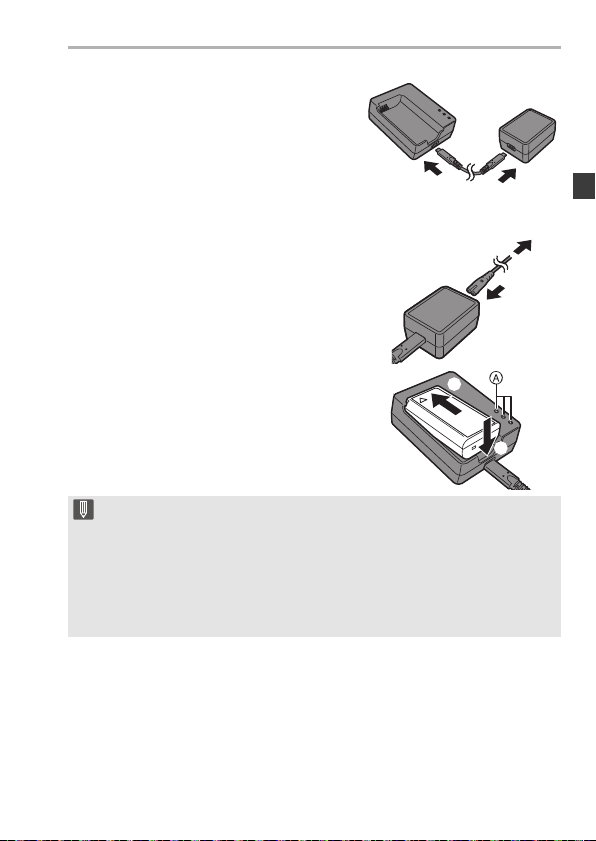
2. Getting Started
DVQX1939 (ENG)
29
1
Connect the charger and the
AC adaptor with the USB
connection cable (C–C).
0 Hold the plugs and insert them straight
in or pull them straight out.
(Inserting these at an angle may cause
deformation or malfunction)
2
Connect the AC cable to the
AC adaptor and then insert
into the electrical outlet.
3
Insert the battery.
≥Insert the terminal end of the
battery and push.
≥The [CHARGE] light A blinks and
charging begins.
0 Do not use any other USB connection cables except the supplied USB
connection cable (C–C).
This may cause malfunction.
0 Do not use any other AC adaptors except the supplied one.
This may cause malfunction.
0 Do not use any other AC cables except the supplied one.
This may cause malfunction.
DC-S1HP-DVQX1939_eng.book 29 ページ 2019年8月9日 金曜日 午後4時45分
2. Getting Started
DVQX1939 (ENG)
30
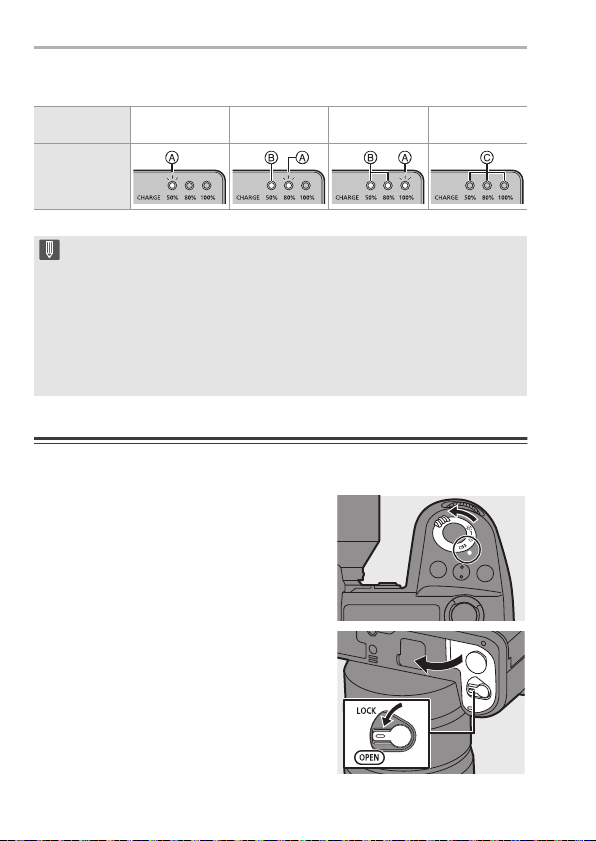
[CHARGE] Light Indications
Battery Insertion
0 Always use genuine Panasonic batteries (DMW-BLJ31).
0 If you use other batteries, we cannot guarantee the quality of this product.
1
Set the camera on/off switch
to [OFF].
2
Open the battery door.
≥Move the battery door release lever
to the [OPEN] position.
Charging
status
0% to 49% 50% to 79% 80% to 99% 100%
[CHARGE]
light
A Blinking B On C Off
0 After charging, disconnect the power source connection and remove the
battery.
0 If the [50%] light is blinking quickly, then charging is not occurring.
– The temperature of the battery or surroundings is either too high or too low.
Try charging at an ambient temperature between 10 °C and 30 °C (50 oF
and 86 oF).
– The terminals of the charger or the battery are dirty.
Remove the connection to the power source, and wipe with a dry cloth.
DC-S1HP-DVQX1939_eng.book 30 ページ 2019年8月9日 金曜日 午後4時45分
2. Getting Started
DVQX1939 (ENG)
31
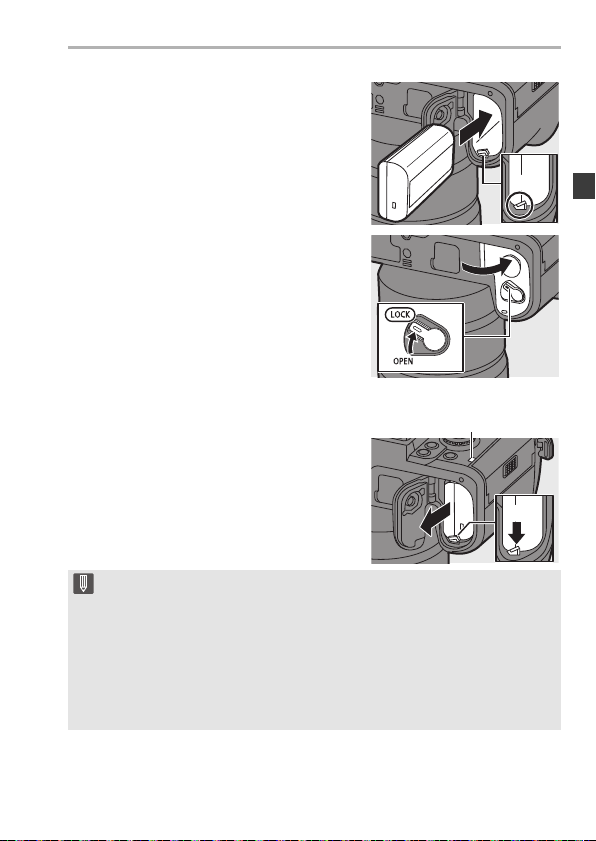
3
Insert the battery.
≥Insert the terminal end of the
battery and push until a locking
sound is heard.
0
Check that the lever A is holding the
battery in place.
4
Close the battery door.
≥Close the battery door, and move
the battery door release lever to the
[LOCK] position.
Removing the Battery
1
Set the camera on/off switch to [OFF].
2
Open the battery door.
0
Check that the card access light B is
turned off and then open the battery door.
3
Push the lever A in the direction of the
arrow and then remove the battery.
0 Ensure that no foreign objects are adhering to the inner side (rubber seal) of
the battery door.
0 Remove the battery after use.
(The battery will drain if left inserted in the camera for a long period of time.)
0 The battery becomes warm after use, during charging, and immediately after
charging.
The camera also becomes warm during use. This is not a malfunction.
0 Be careful when removing the battery as the battery will jump out.
DC-S1HP-DVQX1939_eng.book 31 ページ 2019年8月9日 金曜日 午後4時45分
2. Getting Started
DVQX1939 (ENG)
32
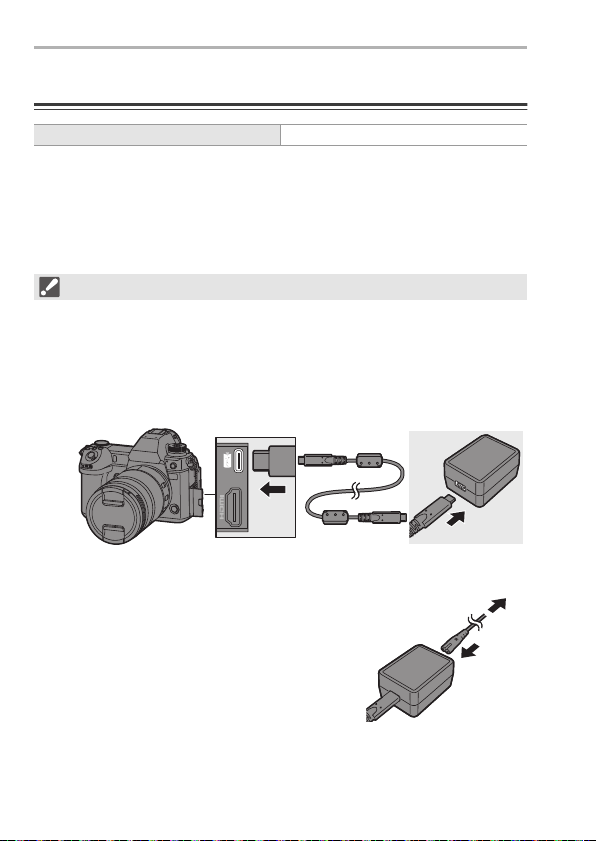
Inserting a Battery into the Camera for Charging
0 Using the camera body and the supplied AC adaptor.
The camera is turned off.
0 The indicated charging time is for when the battery has been discharged completely.
The charging time may vary depending on how the battery has been used.
The charging time for the battery in hot/cold environments or a battery that has not
been used for a long time may be longer than normal.
1
Set the camera on/off switch to [OFF].
2
Insert the battery into the camera.
3
Connect the camera USB port and the AC adaptor using
the USB connection cable (C–C).
0 Hold the plugs and insert them straight in or pull them straight out.
(Inserting these at an angle may cause deformation or malfunction)
4
Connect the AC cable to the AC
adaptor and then insert into the
electrical outlet.
≥[CHARGE] is displayed on the status
LCD and charging starts.
[FULL] is displayed when charging is
complete.
Charging time Approx. 140 min
0 Use the products supplied with the camera for charging.
DC-S1HP-DVQX1939_eng.book 32 ページ 2019年8月9日 金曜日 午後4時45分

2. Getting Started
DVQX1939 (ENG)
33
0 You can also charge the battery by connecting a USB device (PC, etc.) and
the camera with the USB connection cable (C–C or A–C).
In that case, charging may take a while.
0 When using the Battery Grip (DMW-BGS1: optional), the battery within the
Battery Grip will also be charged.
0 Do not use any other USB connection cables except the supplied USB
connection cables (C–C and A–C).
This may cause malfunction.
0 Do not use any other AC adaptors except the supplied one.
This may cause malfunction.
0 Do not use any other AC cables except the supplied one.
This may cause malfunction.
0 After charging, disconnect the connection to the power source.
0 When an [ERROR] is displayed on the status LCD, charging is not possible.
– The temperature of the battery or surroundings is either too high or too low.
Try charging at an ambient temperature between 10 °C and 30 °C (50 oF
and 86 oF).
– The terminals of the battery are dirty.
Remove the battery and wipe off the dirt with a dry cloth.
0 Even when the camera on/off switch is set to [OFF] thus turning the camera
off, it consumes power.
When the camera will not be used for a long time, remove the power plug from
the electrical outlet in order to save power.
DC-S1HP-DVQX1939_eng.book 33 ページ 2019年8月9日 金曜日 午後4時45分
2. Getting Started
DVQX1939 (ENG)
34
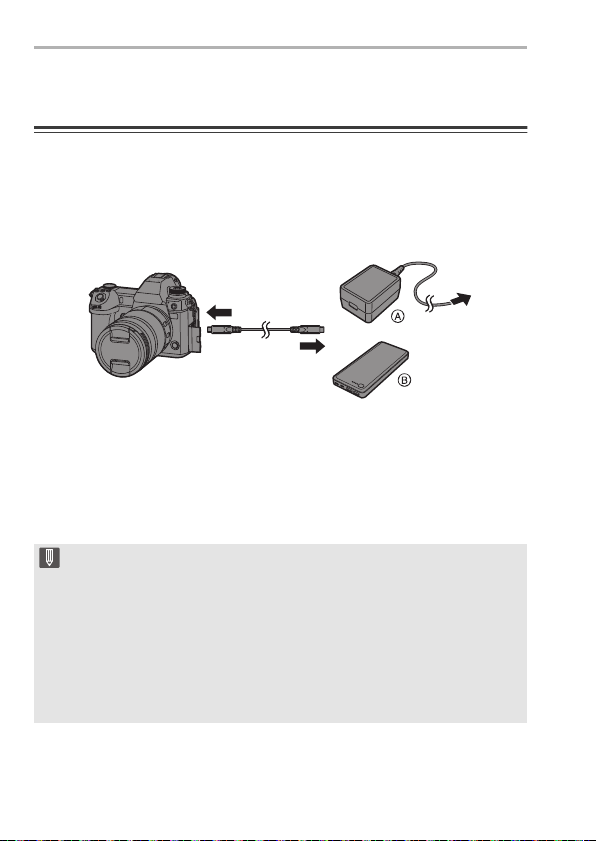
Using the Camera While Supplying It with Power
(Supplying Power/Charging)
When charging with both the camera body and the supplied AC adaptor
(l 32), you can charge while the camera is being supplied with power by
turning the camera on. You can record while charging.
This is also possible by connecting devices that support USB PD (USB
Power Delivery) to the camera.
0
Insert the battery into the camera.
0 Connect using the supplied USB connection cable (C–C).
0 Use a device (mobile battery, etc.) with an output of 9 V/3 A (27 W or more) that
supports USB PD.
0 When the camera is on, charging will take longer than when the camera is off.
A AC adaptor B Devices that support USB PD (mobile
battery, etc.)
0 Even when connecting with devices that support USB PD, you may not be
able to charge while using the camera.
0 If connecting with devices (PC, etc.) that do not support USB PD and turning
the camera on, then this will supply power only.
0 Turn off the camera before connecting or disconnecting the power plug.
0 Remaining charge in the battery may decrease depending on usage
conditions. When the battery level is depleted, the camera will turn off.
0 Depending on the power supply capabilities of the connected device, it may
not be possible to supply power.
DC-S1HP-DVQX1939_eng.book 34 ページ 2019年8月9日 金曜日 午後4時45分

2. Getting Started
DVQX1939 (ENG)
35
Notifications Regarding Charging/Power Supply
Power Indications
0 The battery level indicated on the screen is approximate.
The exact level varies depending on the environment and the operating conditions.
0 The highest battery level reading of C or D blinks during charging.
0 When a charging error occurs, the status LCD display icon A blinks.
Indication on status LCD
A USB connection cable supplying
power
B Power source
C The battery level of the battery in the
camera
D The battery level of the battery in the
Battery Grip
E Battery indication
F Using the battery in the Battery Grip
Indication on monitor
80% or higher
60% to 79%
40% to 59%
20% to 39%
19% or below
Blinking
Low battery
0 Charge or replace the battery.
DC-S1HP-DVQX1939_eng.book 35 ページ 2019年8月9日 金曜日 午後4時45分

2. Getting Started
DVQX1939 (ENG)
36
0 It has been found that counterfeit battery packs which look very similar
to the genuine product are made available for purchase in some
markets. Some of these battery packs are not adequately protected with
internal protection to meet the requirements of appropriate safety
standards. There is a possibility that these battery packs may lead to fire
or explosion. Please be advised that we are not liable for any accident or
failure occurring as a result of use of a counterfeit battery pack. To
ensure that safe products are used, we recommend that a genuine
Panasonic battery pack is used.
0 Do not leave any metal items (such as clips) near the contact areas of the
power plug.
Otherwise, a fire and/or electric shocks may be caused by short-circuiting or
the resulting heat generated.
0 Do not use the AC adaptor, AC cable, or USB connection cables (C–C and A–
C) on other devices.
This may cause a malfunction.
0 Do not use USB extension cables or USB conversion adaptors.
0 The battery can be charged even when it still has some charge left, but it is not
recommended that the battery charge be frequently topped up while the
battery is fully charged.
(Since characteristic swelling may occur.)
0 If there is a power outage or other problem with the electrical outlet, then
charging may not complete successfully.
Reconnect the power plug.
0 Do not connect to keyboard or printer USB ports, or to USB hubs.
0 If the connected PC enters sleep status, then charging/power supply may
stop.
DC-S1HP-DVQX1939_eng.book 36 ページ 2019年8月9日 金曜日 午後4時45分
2. Getting Started
DVQX1939 (ENG)
37
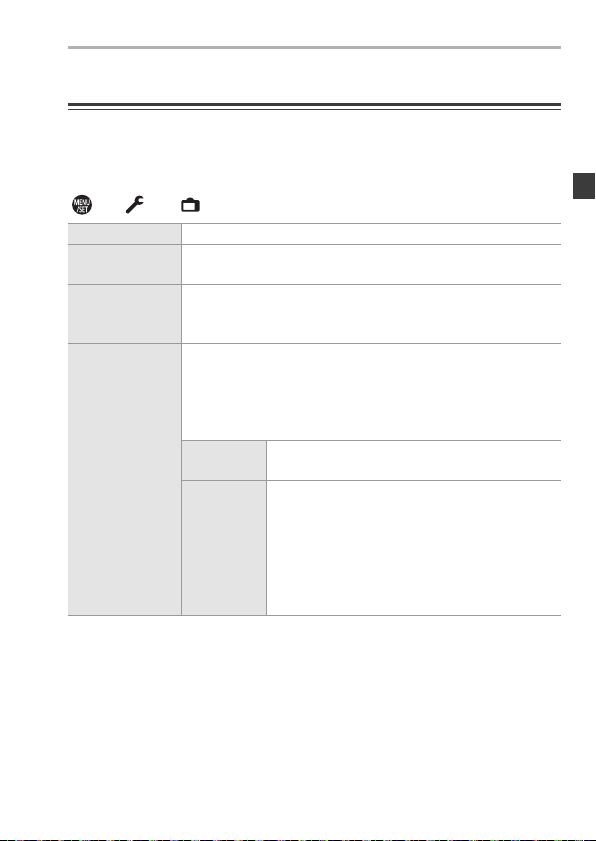
[Power Save Mode]
This is a function to automatically turn the camera to sleep (power save)
status or turn off the viewfinder/monitor if no operation is performed for a
set time. Reduces battery consumption.
¨ [ ] ¨ [ ] ¨ Select [Power Save Mode]
0
To recover from [Sleep Mode], [Sleep Mode(Wi-Fi)], or [Power Save LVF Shooting],
perform one of the following operations:
– Press the shutter button halfway.
– Set the camera on/off switch to [OFF] and then [ON] again.
0 To recover from [Auto LVF/Monitor Off], press any button.
[Sleep Mode] Sets the amount of time until the camera is put to sleep.
[Sleep Mode(Wi-
Fi)]
Sets the camera to sleep 15 minutes after being disconnected
from Wi-Fi.
[Auto LVF/
Monitor Off]
Sets the amount of time it takes for the viewfinder/monitor to turn
off.
(The camera is not turned off.)
[Power Save
LVF Shooting]
Puts the camera to sleep when the recording screen is being
displayed on the monitor when automatic viewfinder/monitor
switching is active.
0 [Power Save LVF Shooting] does not work when [Time to
Sleep] is set to [OFF].
[Time to
Sleep]
Sets the amount of time until the camera is put to
sleep.
[Method of
Activation]
Sets the screen where the camera is put to sleep.
[Only Control Panel]:
Puts the camera to sleep only when the control
panel (l 53) is displayed.
[While Recording Standby]:
Puts the camera to sleep from any screen during
recording standby.
DC-S1HP-DVQX1939_eng.book 37 ページ 2019年8月9日 金曜日 午後4時45分
2. Getting Started
DVQX1939 (ENG)
38
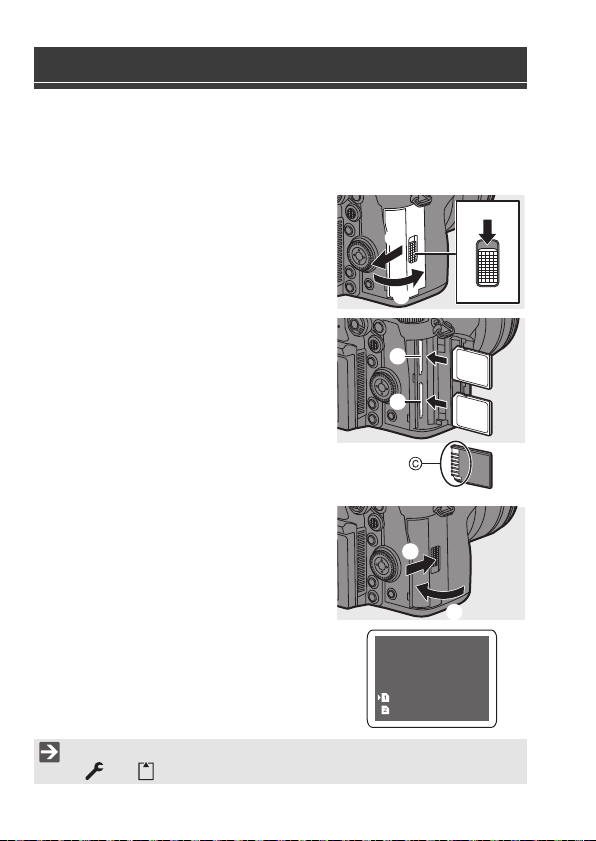
This camera supports the double card slot function. When two cards are
used, relay recording, backup recording, and allocation recording are
available.
For information about the cards that can be used, refer to page 19.
1
Open the card door.
≥Slide the card door in the direction
of the arrow while pushing down the
card door lock lever.
2
Insert the cards.
A Card slot 1
B Card slot 2
≥Match the orientation of the cards
as shown in the figure and then
insert them firmly until they click.
0
Do not touch the card connection
contacts C.
3
Close the card door.
≥Close the card door and slide it
firmly in the direction of the arrow
until it clicks.
0
The cards are displayed on the status
LCD.
Inserting Cards (Optional)
0 You can set the way to record to card slots 1 and 2.
[] ¨ [ ] ¨ [Double Card Slot Function] (l 64)
DC-S1HP-DVQX1939_eng.book 38 ページ 2019年8月9日 金曜日 午後4時45分
2. Getting Started
DVQX1939 (ENG)
39
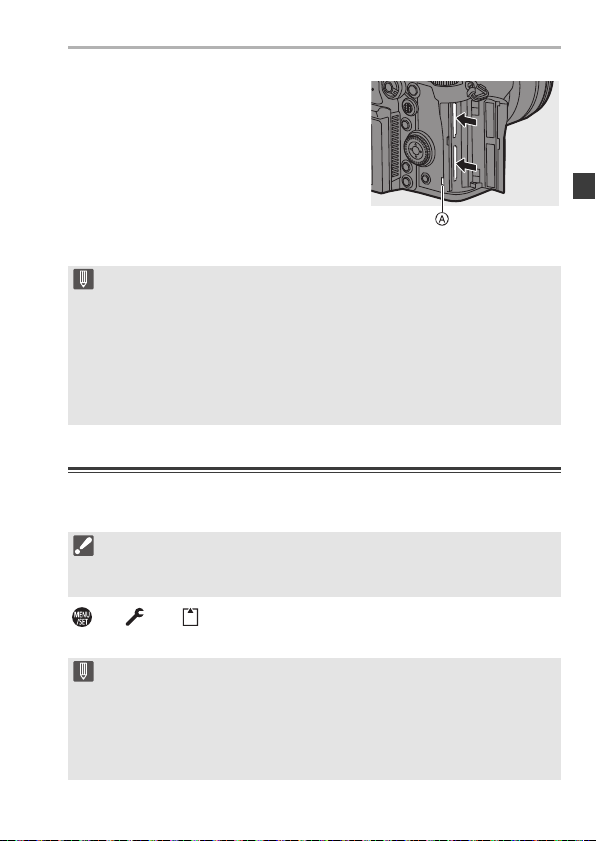
Card Access Indications
The card access light turns on while the
card is being accessed.
Removing a Card
1
Open the card door.
0
Check that the card access light A is
turned off and then open the card door.
2
Push the card until it clicks and then pull the card out straight.
Formatting Cards (Initialization)
Format the cards with the camera before use in order to ensure optimal
card performance.
¨ [ ] ¨ [ ] ¨ Select [Card Format]
Settings: [Card Slot 1]/[Card Slot 2]
0 The card may be warm just after the camera has been used. Be careful when
removing.
0 Do not perform the following operations during access.
The camera may operate incorrectly or the card and recorded images
may be damaged.
– Turn off the camera.
– Remove the battery or card or disconnect the power plug.
– Subject the camera to vibration, impacts, or static electricity.
0 When a card is formatted, all of the data stored in the card is erased and
cannot be restored.
Save a backup of necessary data before formatting the card.
0 Do not turn off the camera or perform another operation during formatting.
0 Take care not to turn off the camera while formatting is in progress.
0 Cards that have not been formatted after purchase should be formatted on the
camera.
0 If the card has been formatted with a PC or other device, format it again with
the camera.
DC-S1HP-DVQX1939_eng.book 39 ページ 2019年8月9日 金曜日 午後4時45分
2. Getting Started
DVQX1939 (ENG)
40
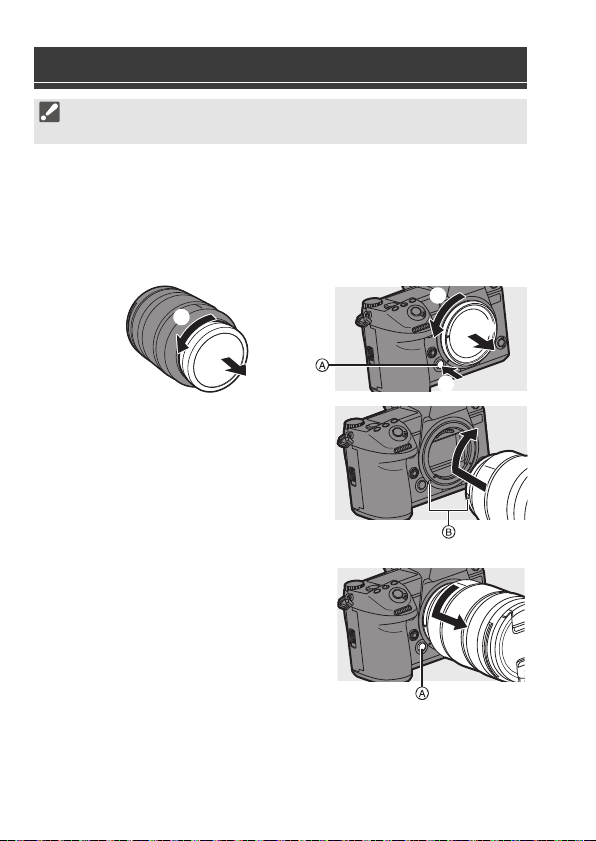
1
Set the camera on/off switch to [OFF].
2
Turn the lens rear cap and the body cap in the direction
of the arrow to remove them.
0 When removing the body cap, rotate it while pressing the lens release button
A.
3
Align the lens fitting marks B
on the lens and camera and
then rotate the lens in the
direction of the arrow.
≥Attach the lens by rotating it until it
clicks.
0
Insert the lens straight in.
Removing a Lens
1
Set the camera on/off switch to [OFF].
2
While pressing the lens release button
A, rotate the lens in the direction of the
arrow until it stops and then remove it.
0
After removing the lens, be sure to attach
the body cap and the lens rear cap.
Attaching a Lens
0 Change the lens in a location where there is not a lot of dirt and dust.
0 Change the lens while the lens cap is attached.
DC-S1HP-DVQX1939_eng.book 40 ページ 2019年8月9日 金曜日 午後4時45分
2. Getting Started
DVQX1939 (ENG)
41
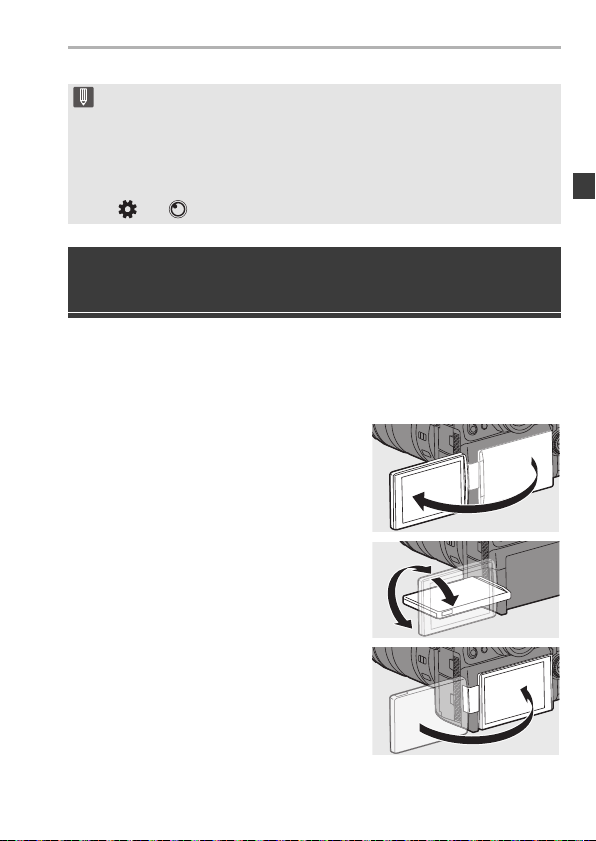
The monitor on this camera has angling and tilting that you can adjust in
combinations to freely change the orientation and angle.
At the time of purchase, the monitor is stowed in the camera body. Turn the
monitor surface out before use.
1
Open the monitor.
2
Rotate the monitor.
0 You can rotate 180° towards the lens and
90° down.
3
Return the monitor to the
original position.
0 When you have attached a lens that does not have a communication function
with this camera, after turning on the camera, a message asking for
confirmation of the lens information is displayed. You can register items such
as the image circle and focal length for the lens when you select [Yes]. (l 78)
0 You can change the settings so that the confirmation message is not
displayed:
[] ¨ [ ] ¨ [Lens Info. Confirmation]
Adjusting the Monitor Direction and
Angle
180°
90°
180°
DC-S1HP-DVQX1939_eng.book 41 ページ 2019年8月9日 金曜日 午後4時45分
2. Getting Started
DVQX1939 (ENG)
42
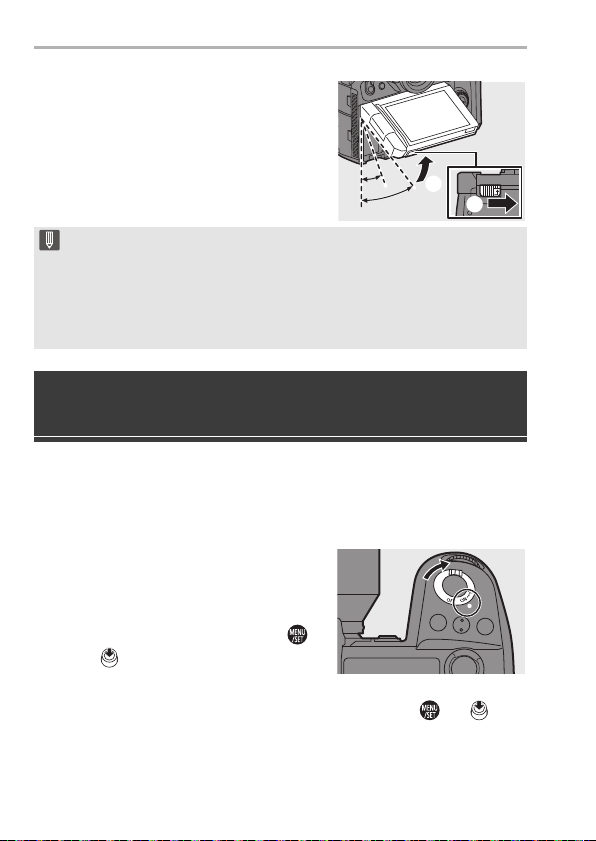
Tilt
While sliding the monitor lock lever in the
direction of the arrow, push the monitor up.
0
The monitor of this camera can be tilted in two
stages.
0 The monitor can still be opened when tilted to
30°.
When you turn the camera on for the first time, a screen to set the time
zone and clock appears.
Be sure to set these settings before use to ensure images are recorded
with the correct date and time information.
1
Set the camera on/off switch
to [ON].
2
When [Please set the
language] appears, press
or .
3
Set the language.
≥Press 34 to select the language and then press or .
0 The angles of adjustment are guides only.
0 Take care not to trap a finger in the monitor.
0 Do not apply an excessive force to the monitor. This may cause damage or
malfunction.
0 When not using the camera, close the monitor with the monitor surface facing
in.
Setting the Clock
(When Turning On for the First Time)
60°
30°30°
DC-S1HP-DVQX1939_eng.book 42 ページ 2019年8月9日 金曜日 午後4時45分
2. Getting Started
DVQX1939 (ENG)
43
4
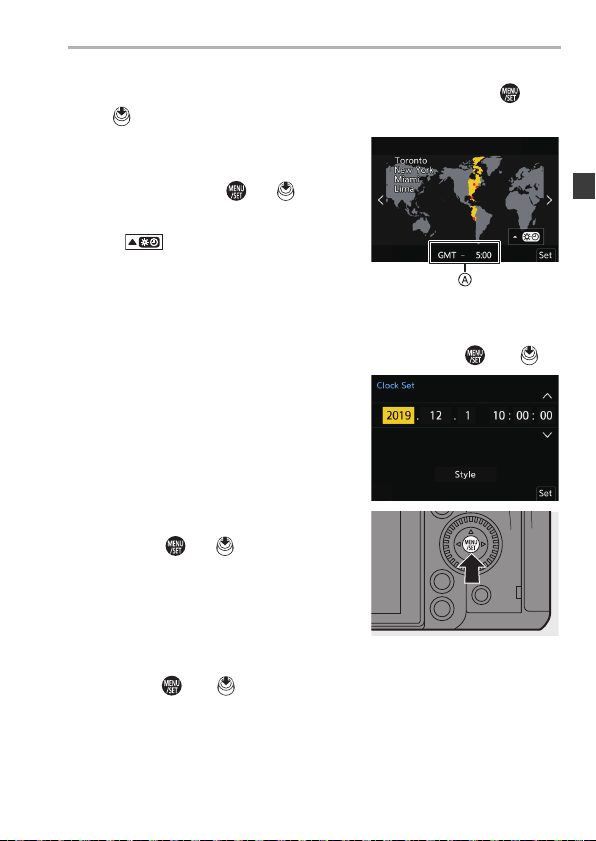
When [Please set the time zone] appears, press or
.
5
Set the time zone.
≥Press 21 to select the time zone
and then press or .
0 If you are using Daylight Savings
[ ], press 3. (The time will
move forward by 1 hour.)
To return to the normal time, press
3 again.
A Time difference from GMT (Greenwich Mean Time)
6
When [Please set the clock] appears, press or .
7
Set the clock.
8
Confirm your selection.
≥Press or .
9
When [The clock setting has been completed.] appears,
press or .
21: Select an item (year, month,
day, hour, minute, or second).
34: Select a value.
DC-S1HP-DVQX1939_eng.book 43 ページ 2019年8月9日 金曜日 午後4時45分
DVQX1939 (ENG)
44
3. Basic Operations
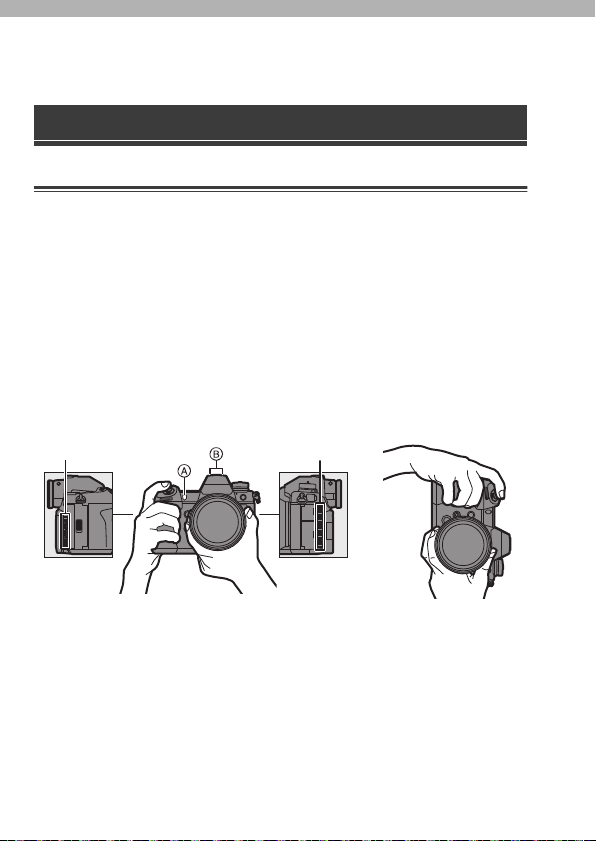
How to Hold the Camera
To minimize camera shake, hold the camera so that it will not move during
recording.
Hold the camera with both hands, keep your arms still at your
side, and stand with your feet shoulder width apart.
≥Hold the camera firmly by wrapping your right hand around the camera
grip.
≥Support the lens from below with your left hand.
0
Do not cover the AF assist light A or microphone B with your fingers or other
objects.
0 Do not cover the fan inlet C and fan outlet D of the cooling fan with your hand, etc.
Basic Recording Operations
DC-S1HP-DVQX1939_eng.book 44 ページ 2019年8月9日 金曜日 午後4時45分
3. Basic Operations
DVQX1939 (ENG)
45
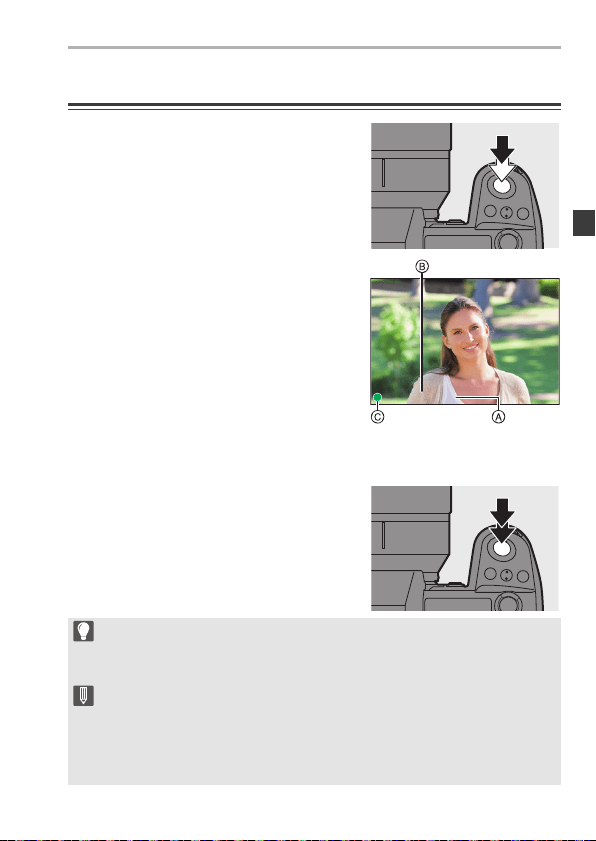
Taking Pictures
1
Adjust the focus.
≥Press the shutter button halfway
(press it gently).
≥The aperture value A and shutter
speed B are displayed.
(When the correct exposure cannot
be obtained, the indications blink in
red.)
≥Once the subject is in focus, the
focus indication C lights.
(When the subject is not in focus,
the indication blinks.)
0
You can also perform the same operation by pressing [AF ON].
2
Start recording.
≥Press the shutter button fully (press
it further).
0 Recorded pictures can be displayed automatically by setting [Auto Review] of
the [Custom] ([Monitor / Display (Photo)]) menu. You can also change the
picture display duration to your preferred setting.
0 With the default settings, you cannot take a picture until the subject is
brought into focus.
If you set [Focus/Shutter Priority] in the [Custom] ([Focus/Shutter])
menu to [BALANCE] or [RELEASE], you will be able to take a picture
even when the subject is not in focus.
F4.0F4.0F4.0606060
DC-S1HP-DVQX1939_eng.book 45 ページ 2019年8月9日 金曜日 午後4時45分

3. Basic Operations
DVQX1939 (ENG)
46
Recording Videos
1
Start recording.
≥Press the video rec. button A.
≥You can also perform the same
operation by pressing the sub video
rec. button B.
0
Release the video rec. button right after
you press it.
2
Stop recording.
≥Press the video rec. button A
again.
≥You can also perform the same
operation by pressing the sub video rec. button B.
Selecting the Recording Mode
While pressing the mode
dial lock button 1, rotate
the mode dial 2.
[iA] Intelligent Auto mode (l 60)
[P]
Program AE mode
0 The camera automatically sets the shutter speed and aperture
value for the brightness of the subject.
[A]
Aperture-Priority AE mode
0 You can set the aperture value before recording.
The shutter speed will be automatically set by the camera.
[S]
Shutter-Priority AE mode
0 You can set the shutter speed before recording.
The aperture value will be automatically set by the camera.
DC-S1HP-DVQX1939_eng.book 46 ページ 2019年8月9日 金曜日 午後4時45分
3. Basic Operations
DVQX1939 (ENG)
47
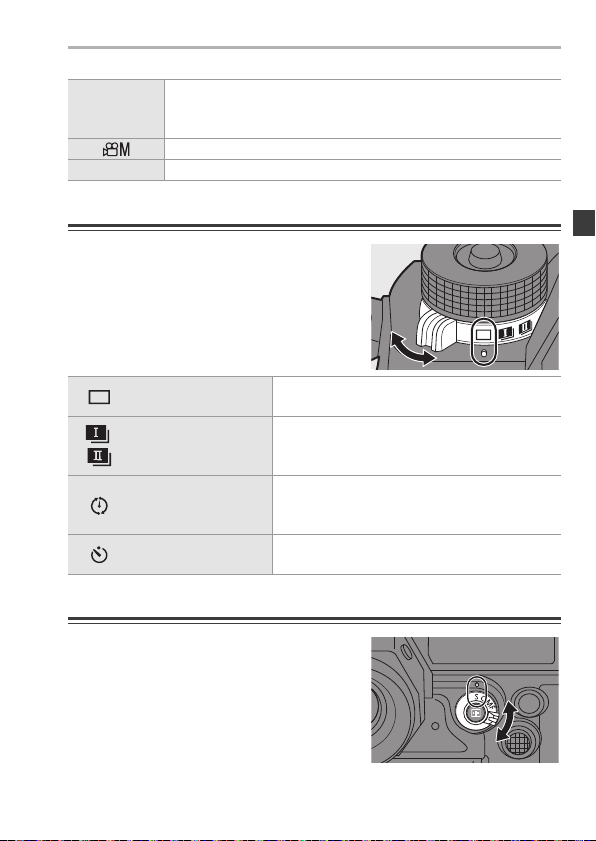
Selecting the Drive Mode
Rotating the drive mode dial.
Selecting the Focus Mode
Set the focus mode lever.
[M]
Manual Exposure mode
0 You can take pictures by manually setting the aperture value and
shutter speed.
[] Creative Video mode (l 95)
[C1]/[C2]/[C3] Custom mode (l 161)
[]Single
Takes one picture each time the shutter button is
pressed.
[]/
[]
Burst
Takes pictures continuously while the shutter
button is pressed and held.
6K/4K photo recording is also possible.
[]
Time Lapse Shot/
Stop Motion
Animation
Takes pictures with Time Lapse Shot or Stop
Motion Animation.
[]Self-timer
Takes pictures when the set time elapses after
the shutter button is pressed.
DC-S1HP-DVQX1939_eng.book 47 ページ 2019年8月9日 金曜日 午後4時45分
3. Basic Operations
DVQX1939 (ENG)
48
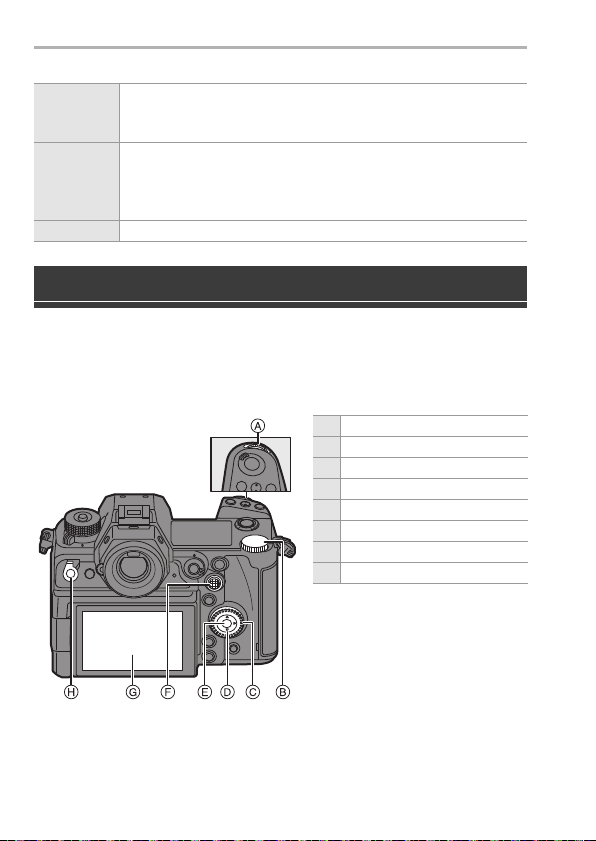
When changing the camera settings, operate the camera using the
following operation parts.
To prevent accidental operation, you can disable operation with the
operation lock lever.
[S]
([AFS])
When the shutter button is pressed halfway, the camera focuses
once.
The focus stays locked while the shutter button is pressed halfway.
[C]
([AFC])
While the shutter button is pressed halfway, the focus is constantly
adjusted according to the movement of the subject.
0 This predicts the movement of the subject, maintaining focusing.
(Movement prediction)
[MF] Manual focusing. (l 72)
Camera Setting Operations
A Front dial (l 49)
B Rear dial (l 49)
C Control dial (l 49)
D Cursor buttons (l 49)
E [MENU/SET] button (l 49)
F Joystick (l 50)
G Touch screen (l 50)
H Operation lock lever (l 51)
DC-S1HP-DVQX1939_eng.book 48 ページ 2019年8月9日 金曜日 午後4時45分
3. Basic Operations
DVQX1939 (ENG)
49
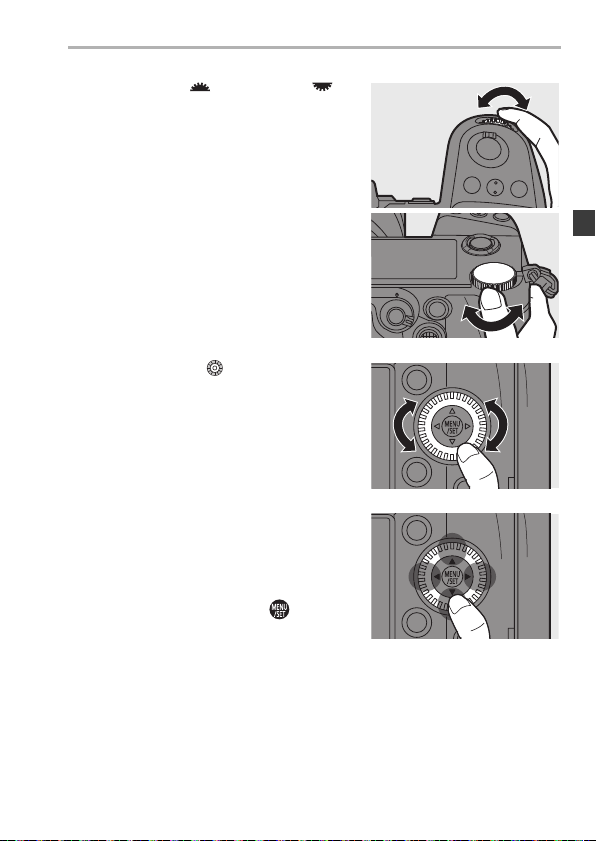
Front Dial ( )/Rear Dial ( )
Rotate:
Selects an item or numeric value.
0
Sets the aperture, shutter speed, and other
settings when you are recording in the [P]/[A]/
[S]/[M] modes.
The operation method can be changed in [Dial
Set.].
Control Dial ( )
Rotate:
Selects an item or numeric value.
0
Adjusts the headphone volume during recording.
The function can be changed in [Control Dial
Assignment] of [Dial Set.].
Cursor Buttons (3421)
Press:
Selects an item or numeric value.
[MENU/SET] Button ( )
Press:
Confirms a setting.
0
Displays the menu during recording and playback.
DC-S1HP-DVQX1939_eng.book 49 ページ 2019年8月9日 金曜日 午後4時45分
3. Basic Operations
DVQX1939 (ENG)
50
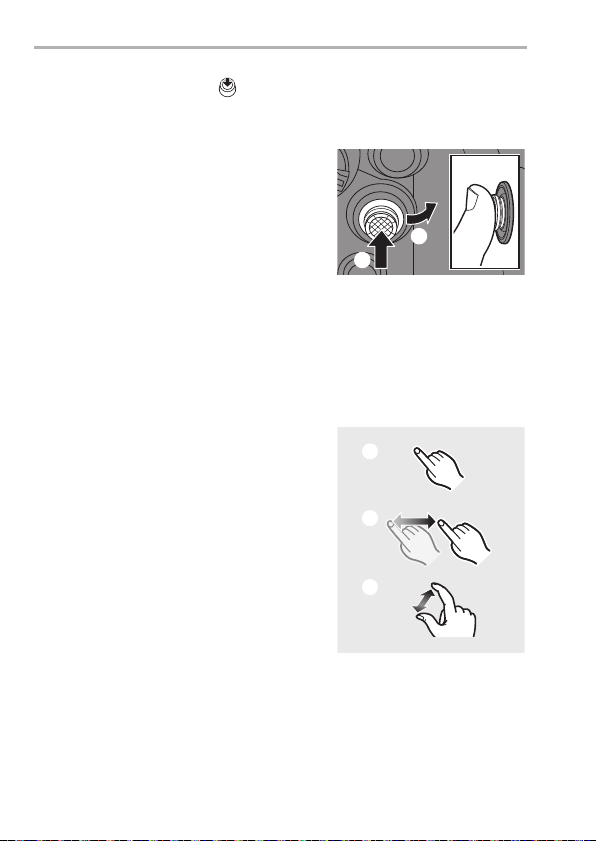
Joystick (3421/)
The joystick can be operated in 8 directions by tilting it up, down, left, right
and diagonally and by pressing the center part.
0
When recording, this moves the AF area and MF
Assist.
The joystick functions for recording can be changed in [Joystick Setting].
Touch Screen
Operations can be performed by touching the icons, slide bars, menus,
and other items displayed on the screen.
A Touch
Operation of touching and then lifting your
finger from the touch screen.
B Drag
Operation of moving a finger while it
touches the touch screen.
C Pinch (widen/narrow)
Operations of widening the distance
between two fingers (pinch out) and
narrowing the distance between two fingers
(pinch in) while they are touching the touch
screen.
A Tilt: Selects an item or numeric value, or
moves a position.
0
Place your finger on the center of the joystick
before tilting. The joystick may not work as
expected when the sides are pressed.
B Press: Confirms a setting.
DC-S1HP-DVQX1939_eng.book 50 ページ 2019年8月9日 金曜日 午後4時45分
3. Basic Operations
DVQX1939 (ENG)
51
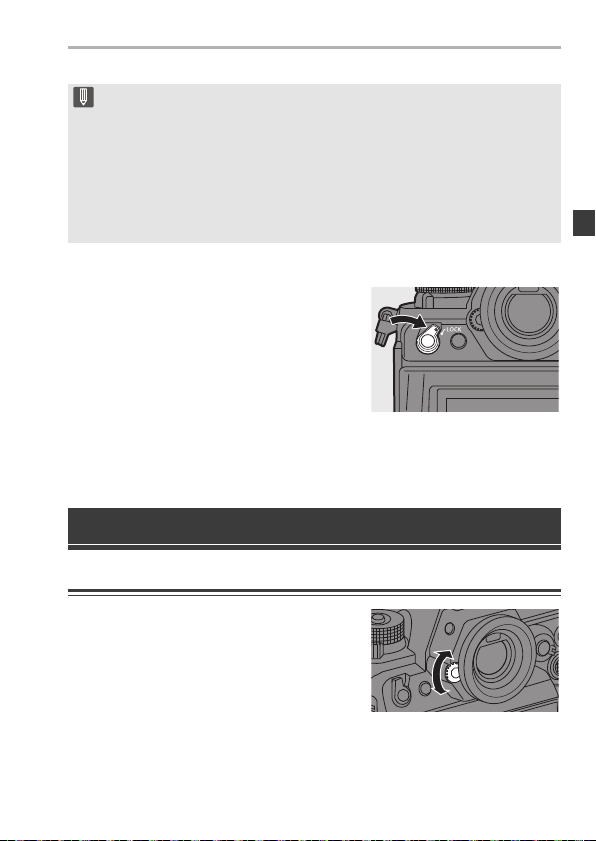
Operation Lock Lever
Aligning the operation lock lever with the
[LOCK] position disables the following
operation parts.
The operation parts to disable can be set in
[Lock Lever Setting] of the [Custom]
([Operation]) menu.
Setting the Viewfinder
Adjusting the Viewfinder
Diopter
Rotate the diopter adjustment dial
while looking through the
viewfinder.
0 Adjust until you can clearly see the text on the viewfinder.
0 Touch the screen with clean and dry fingers.
0 If you will use a commercially available monitor protection sheet, observe the
precautions for the sheet.
(Visibility and operability may be impaired depending on the type of monitor
protection sheet.)
0 The touch screen may not operate correctly in the following cases:
– When you are wearing gloves
– When the touch screen is wet
– Cursor buttons
– [MENU/SET] button
– Joystick
– Touch screen
– Front dial
– Rear dial
– Control dial
Display Settings
DC-S1HP-DVQX1939_eng.book 51 ページ 2019年8月9日 金曜日 午後4時45分
3. Basic Operations
DVQX1939 (ENG)
52
Switching the Viewfinder
Display Magnification
Press [V.MODE].
≥The display magnification of the
viewfinder can be switched between
3 levels.
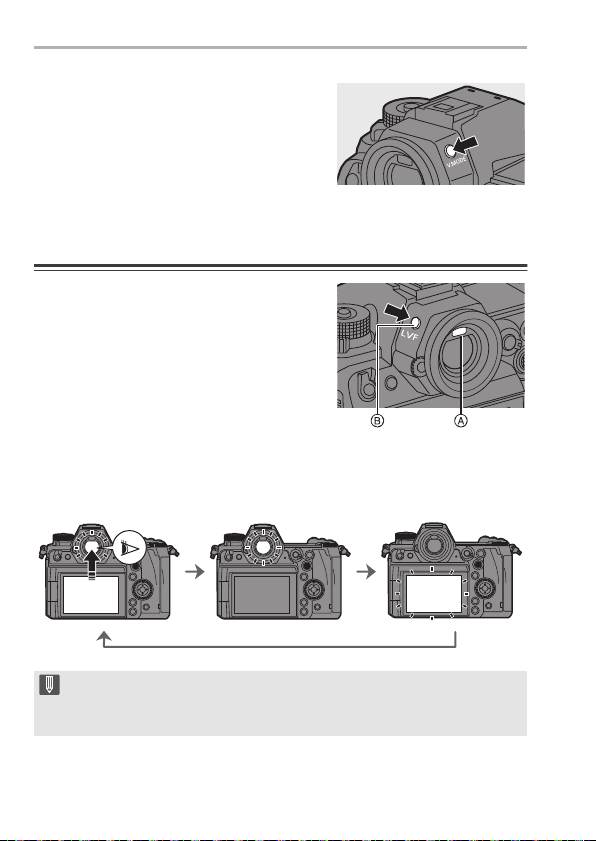
Switching Between the Monitor and Viewfinder
With the default settings, automatic
viewfinder/monitor switching is set. When
you look through the viewfinder, the eye
sensor A works and the camera switches
from monitor display to viewfinder display.
You can switch to viewfinder display or
monitor display with [LVF] button B.
Press [LVF].
Automatic viewfinder/
monitor switching
Viewfinder display Monitor display
0 The eye sensor does not work while the monitor is tilted.
0 During video playback or slide show, automatic viewfinder/monitor switching
does not work.
DC-S1HP-DVQX1939_eng.book 52 ページ 2019年8月9日 金曜日 午後4時45分
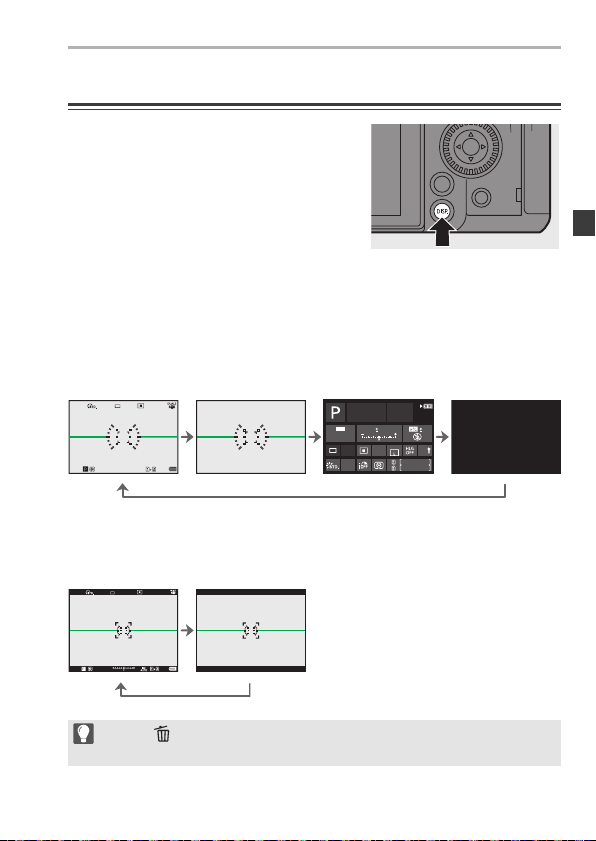
3. Basic Operations
DVQX1939 (ENG)
53
Switching the Display Information
The recording information (icons) on the
recording screen and playback screen can
be hidden.
The monitor on the back can display the
control panel, be turned off, etc.
Press [DISP.].
≥The display information is switched.
Recording Screen
Monitor
Viewfinder
With information
Without
information
Control panel Turned off
With information
Without
information
0 Press [ ] to switch between display/hide of the level gauge.
This can also be set by using [Level Gauge].
999
ISO
AUTO
±
0
AFSAFS
L
FINE
999
999
AWB
Fn
ISO
AUTO
0 0
0
AFS FINE
3:2
999
L
FINE
AFSAFS
DC-S1HP-DVQX1939_eng.book 53 ページ 2019年8月9日 金曜日 午後4時45分
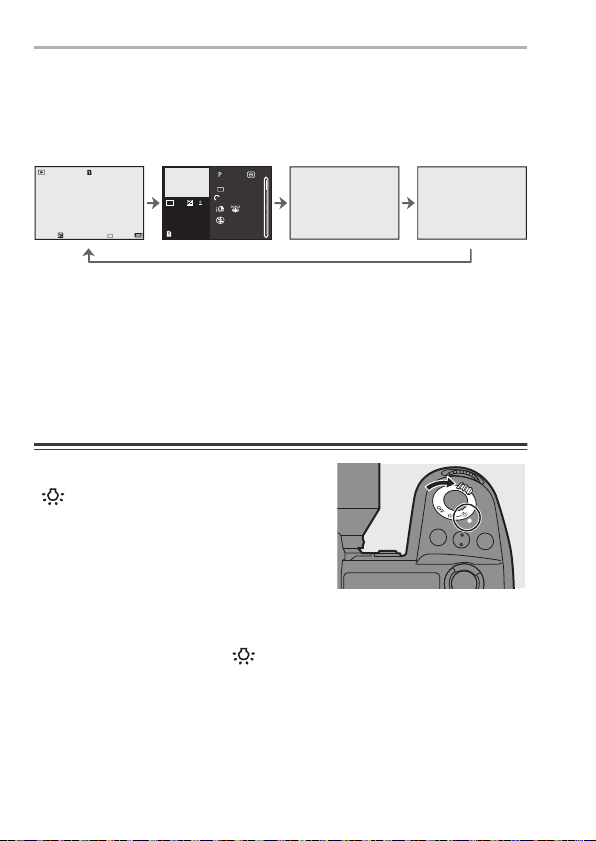
3. Basic Operations
DVQX1939 (ENG)
54
Playback Screen
¢2 This is a screen without blinking highlights display that is shown when [Blinking
Highlights] of the [Custom] ([Monitor / Display (Photo)]) is set to [ON].
In other than this screen, overexposed parts of the screen will blink.
Turning On the Status LCD Backlight
Set the camera on/off switch to
[].
≥The backlight will turn on.
≥When you release the camera on/off
switch, it returns to the [ON] position.
≥If the camera is left without any
operations for a certain period of time, the backlight turns off.
With information
Detailed
information
display
¢1
Without
information
Display without
blinking
highlights
¢2
¢1 Pressing 34 switches the display information.
– Detailed information display
– Histogram display
– Photo Style display
– White balance display
– Lens information display
0 With the default settings, the illuminated buttons turn on.
0 Set the camera on/off switch to [ ] again or press the shutter button fully to turn
off the backlight.
0 The status LCD backlight and illuminated buttons do not turn on while you are using
the following functions:
– Video recording/[6K/4K PHOTO]/
[Post-Focus]
– Burst recording
– Playback
– Menu
– Quick menu
2019.12.1 10:00 100-0001 1/999
ISO
100
F
4.060
±
0
L
FINE
100
100-0001
ISO
0
F4.0
60
2019.12. 1 10:00
s
RGB
1/5
FINE
AFS
STD.
L
3:2
AWB
DC-S1HP-DVQX1939_eng.book 54 ページ 2019年8月9日 金曜日 午後4時45分
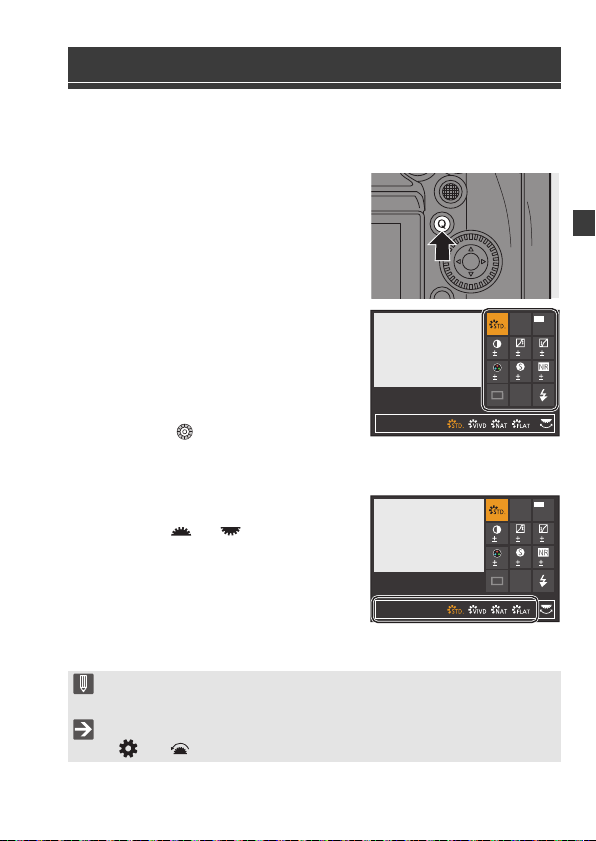
3. Basic Operations
DVQX1939 (ENG)
55
This menu enables you to quickly set functions that are frequently used
during recording without calling up the menu screen. You can also change
the Quick menu display method and the items to display.
1
Display the Quick menu.
≥Press [Q].
2
Select a menu item.
≥Press 3421.
≥Directions on the diagonal can also
be selected using the joystick.
≥Selection is also possible by
rotating .
≥Selection is also possible by
touching a menu item.
3
Select a setting item.
≥Rotate or .
≥Selection is also possible by
touching a setting item.
4
Close the Quick menu.
≥Press the shutter button halfway.
≥You can also close the menu by pressing [Q].
Quick Menu
0 Some items cannot be set depending on the recording mode or camera
settings.
0 The Quick menu can be customized:
[] ¨ [ ] ¨ [Q.MENU Settings] (l 159)
00 0
AWB
3:2
0 0
0
AUTO
ISO
00 0
AWB
3:2
0 0
0
AUTO
ISO
DC-S1HP-DVQX1939_eng.book 55 ページ 2019年8月9日 金曜日 午後4時45分
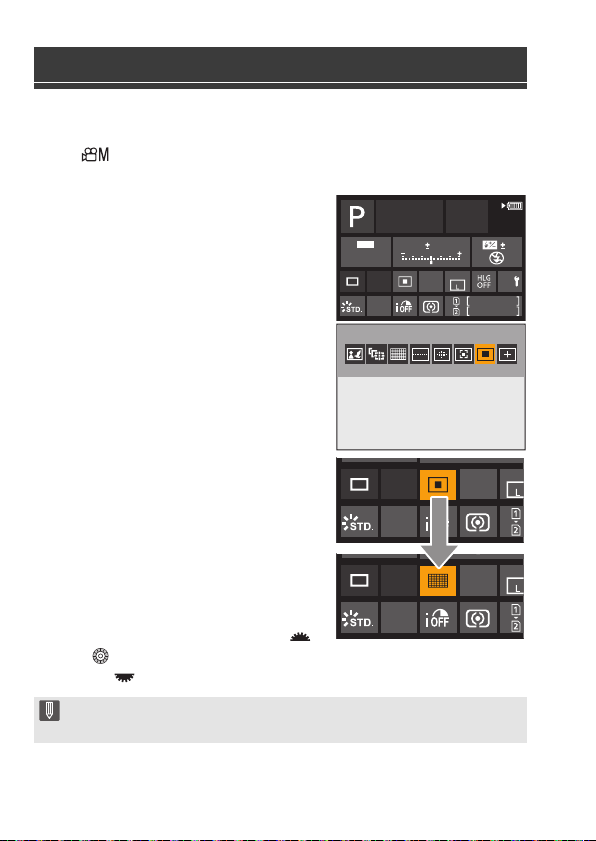
3. Basic Operations
DVQX1939 (ENG)
56
This screen allows you to view the current recording settings on the
monitor. You can also touch the screen to change the settings.
In the [ ] mode (Creative Video mode), the display changes to one
especially for video. (l 193)
1
Display the control panel.
≥Press [DISP.] several times.
2
Touch the items.
≥The setting screens for each of the
items are displayed.
3
Change the setting.
Example) Changing the AF mode
≥Touch the setting item.
4
Touch [Set].
Changing Directly Using the
Dial
Steps
2
to
4
can also be changed using the
following operations.
1
Press one of 3421 to enable
selection of items.
0
Selected items are displayed in yellow.
2
Press 3421 to select an item.
0
Selection is also possible by rotating
or .
3
Rotate to change the settings values.
Control Panel
0 Some items cannot be set depending on the recording mode or camera
settings.
999
999
AWB
Fn
ISO
AUTO
0 0
0
AFS
FINE
3:2
AWB
AFS
FINE
3:
2
AWB
AFS
FINE
3:
2
DC-S1HP-DVQX1939_eng.book 56 ページ 2019年8月9日 金曜日 午後4時45分
3. Basic Operations
DVQX1939 (ENG)
57
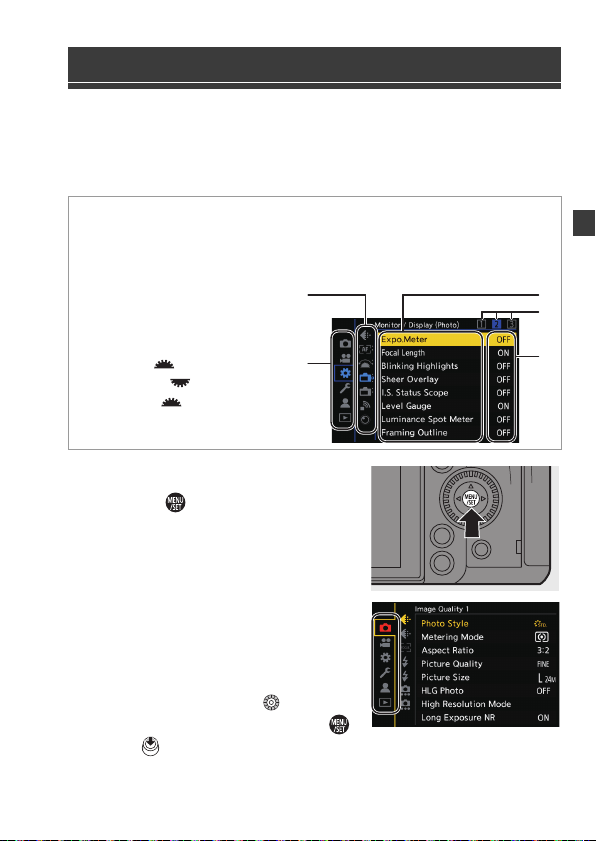
In this camera, the menu is used for setting a wide variety of functions and
performing camera customizations.
Menu operations can be performed using the cursors, joystick, dial, or by
touch.
1
Display the menu.
≥Press .
2
Select a main tab.
≥Press 34 to select a main tab and
then press 1.
≥You can also perform the same
operation by rotating to select
the main tab and then pressing
or .
Menu Operation Methods
Configuration and operation parts of the menu
The menu can be operated by pressing 21 to move between menu screens.
Use the operation parts indicated below to operate the main tab, the sub tab, the
page tab, and menu items without moving to the corresponding menu levels.
0 You can also operate by touching
the icons, menu items, and setting
items.
A Main tab ([Q] button)
B Sub tab ( )
C Menu item ( )
D Page tab ( )
E Setting item
DC-S1HP-DVQX1939_eng.book 57 ページ 2019年8月9日 金曜日 午後4時45分
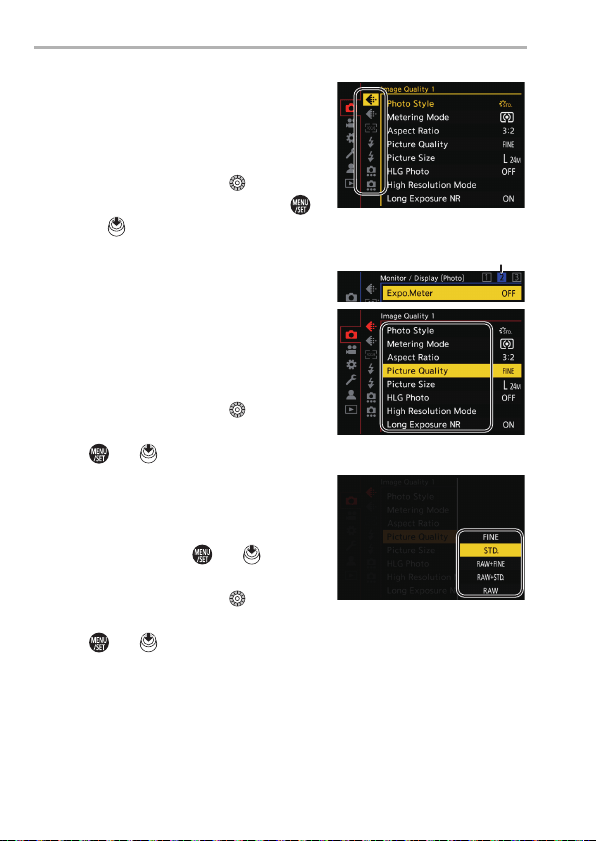
3. Basic Operations
DVQX1939 (ENG)
58
3
Select a sub tab.
≥Press 34 to select a sub tab and
then press 1.
≥You can also perform the same
operation by rotating to select
the sub tab and then pressing
or .
0
If there are page tabs A, then after the
page tabs have finished switching, the
next sub tab is switched to.
4
Select a menu item.
≥Press 34 to select a menu item
and then press 1.
≥You can also perform the same
operation by rotating to select
the menu item and then pressing
or .
5
Select a setting item and then
confirm your selection.
≥Press 34 to select a setting item
and then press or .
≥You can also perform the same
operation by rotating to select
the setting item and then pressing
or .
0
The display and selection methods of setting items differ depending on the
menu item.
DC-S1HP-DVQX1939_eng.book 58 ページ 2019年8月9日 金曜日 午後4時45分
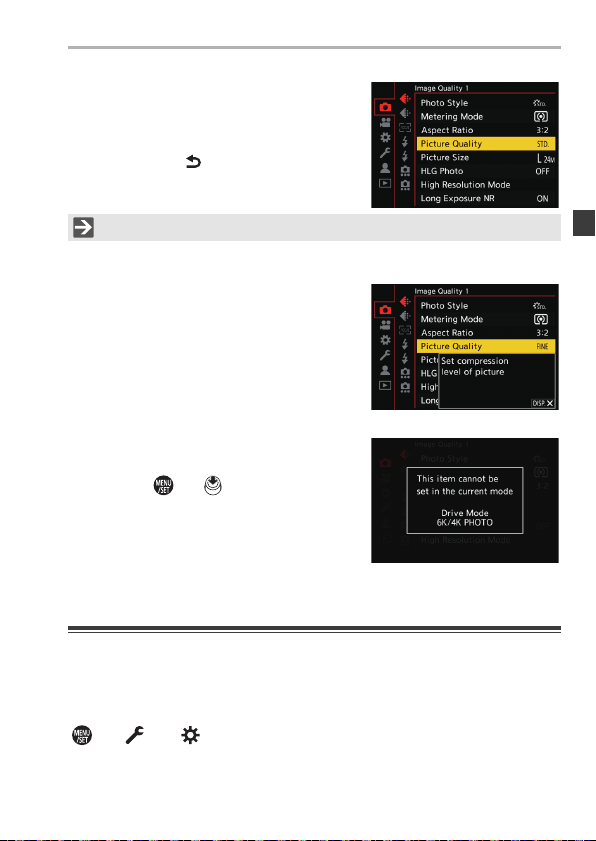
3. Basic Operations
DVQX1939 (ENG)
59
6
Close the menu.
≥Press the shutter button halfway.
≥You can also close the menu by
pressing [ ] several times.
Displaying Descriptions About Menu Items and Settings
If you press [DISP.] while a menu item or
setting item is selected, a description about
the item is displayed on the screen.
Grayed Out Menu Items
Menu items that cannot be set are
displayed grayed out.
If you press or while a grayed out
menu item is selected, the reason why it
cannot be set is displayed.
0
The reason why a menu item cannot be set may
not be displayed depending on the menu item.
[Reset]
Return each of the following settings to the default setting:
– Recording settings
– Network settings (settings of [Wi-Fi Setup] and [Bluetooth])
– Setup and custom settings (other than [Wi-Fi Setup] and [Bluetooth])
¨ [ ] ¨ [ ] ¨ Select [Reset]
0 Refer to the “Owner’s Manual” (PDF format) for details about menu items.
DC-S1HP-DVQX1939_eng.book 59 ページ 2019年8月9日 金曜日 午後4時45分
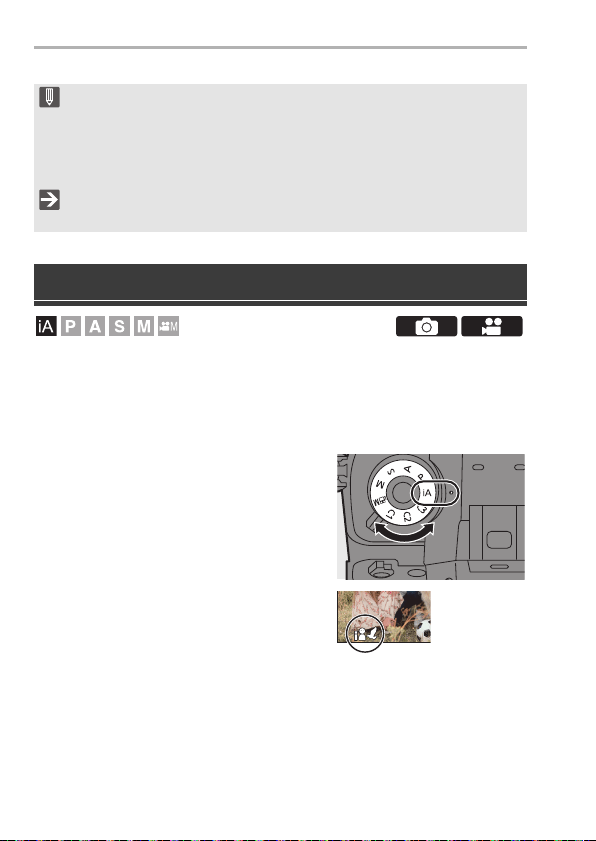
3. Basic Operations
DVQX1939 (ENG)
60
The [iA] mode (Intelligent Auto mode) can record images using settings
automatically selected by the camera.
The camera detects the scene to set the optimal recording settings
automatically to match the subject and recording conditions.
1
Set the mode dial to [iA].
2
Aim the camera at the subject.
≥When the camera detects the
scene, the recording mode icon
changes.
(Automatic Scene Detection)
0 If the setup and custom settings are reset, the [Playback] menu is also reset.
0 If the setup and custom settings are reset, [Lens Information] in [Image
Stabilizer] in the [Photo] ([Others (Photo)]) menu/[Video] ([Others (Video)])
menu is also returned to the default setting.
0 The folder numbers and clock settings are not reset.
0 Refer to the “Owner’s Manual” (PDF format) for a list of default settings and
reset targets.
Intelligent Auto Mode
DC-S1HP-DVQX1939_eng.book 60 ページ 2019年8月9日 金曜日 午後4時45分
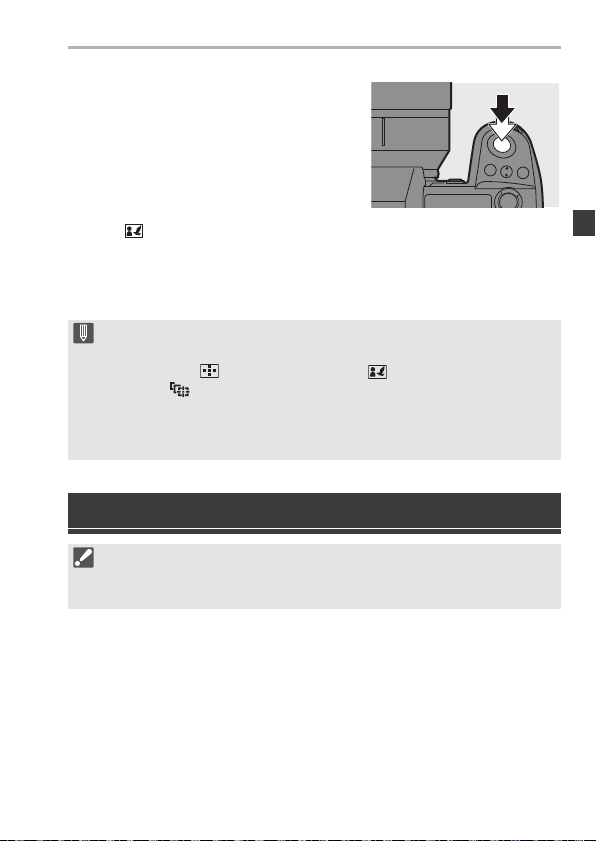
3. Basic Operations
DVQX1939 (ENG)
61
3
Adjust the focus.
≥Press the shutter button halfway.
≥Once the subject is in focus, the
focus indication lights.
(When the subject is not in focus,
the indication blinks.)
0
[ ] of the AF mode works and the AF area is displayed aligned to any
humans or animals.
4
Start recording.
≥Press the shutter button fully.
0 Backlight compensation operates automatically to prevent subjects from
appearing dark when there is a backlight.
0 Each press of [ ] changes the AF mode ([ ] ([Face/Eye/Body/Animal
Detect.])/[ ] ([Tracking])).
For information about AF modes, refer to page 68 and 69.
0 When recording using a flash, the camera switches to the appropriate flash
mode for the recording conditions.
Recording Using Touch Functions
0 With the default settings, the Touch Tab is not displayed.
Set [Touch Tab] to [ON] in [Touch Settings] in the [Custom] ([Operation])
menu. (l 168)
DC-S1HP-DVQX1939_eng.book 61 ページ 2019年8月9日 金曜日 午後4時45分
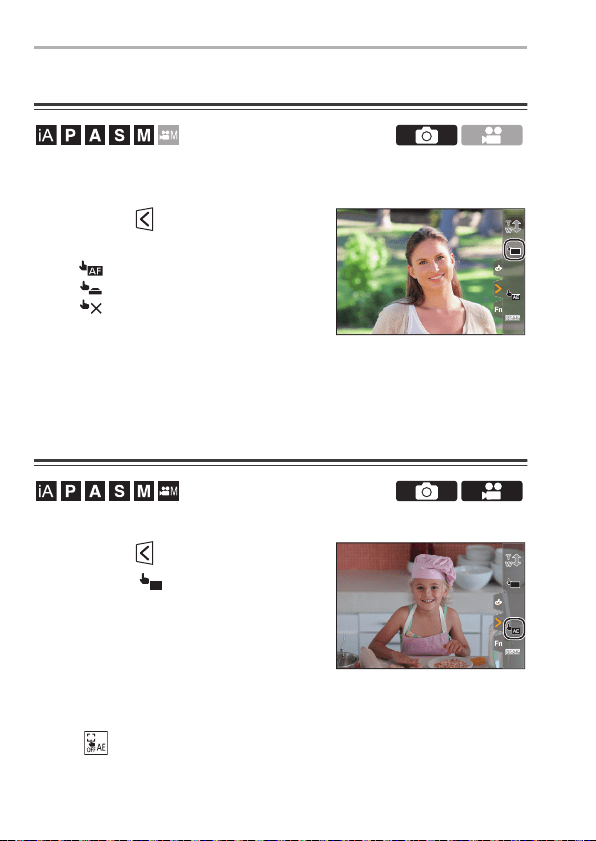
3. Basic Operations
DVQX1939 (ENG)
62
Touch AF/Touch Shutter
Touch functions allow you to focus on the point that you touch, release the
shutter, etc.
1
Touch [ ].
2
Touch the icon.
[ ]: Touch AF
[ ]: Touch Shutter
[ ]: OFF
≥The icon switches each time you
touch it.
3
(When set to anything other than OFF) Touch the
subject.
Touch AE
This function adjusts the brightness according to a touched position.
1
Touch [ ].
2
Touch [ ].
3
Touch the subject to which
you wish to adjust the
brightness.
4
Touch [Set].
How to Disable Touch AE
Touch [ ].
AF
AF
AE
DC-S1HP-DVQX1939_eng.book 62 ページ 2019年8月9日 金曜日 午後4時45分
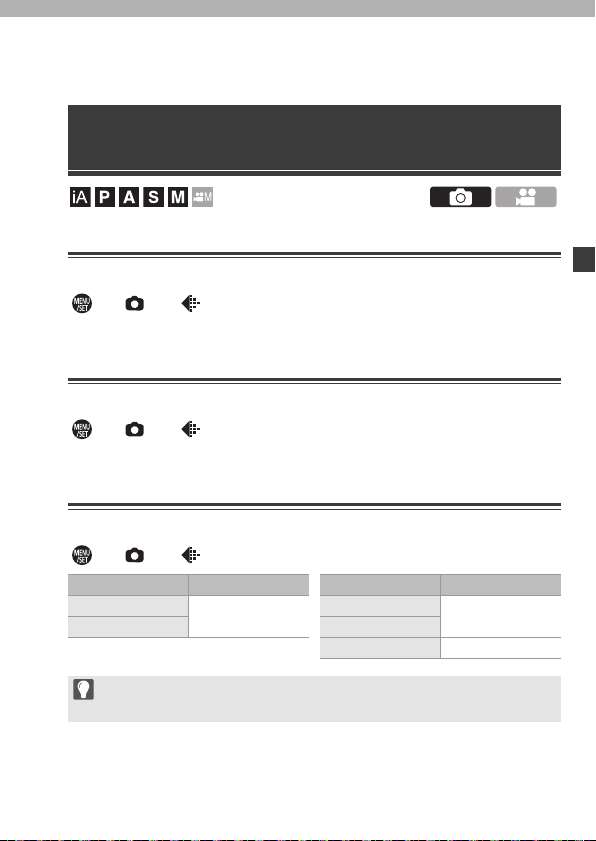
DVQX1939 (ENG)
63
4. Image Recording
[Aspect Ratio]
You can select the image aspect ratio.
¨ [ ] ¨ [ ] ¨ Select [Aspect Ratio]
Settings: [4:3]/[3:2]/[16:9]/[1:1]/[65:24]/[2:1]
[Picture Size]
Sets the picture’s image size.
¨ [ ] ¨ [ ] ¨ Select [Picture Size]
Settings: [L]/[M]/[S]
[Picture Quality]
Set the compression rate used for storing pictures.
¨ [ ] ¨ [ ] ¨ Select [Picture Quality]
[Aspect Ratio]/[Picture Size]/[Picture
Quality]
Setting File format Setting File format
[FINE]
JPEG
[RAWiFINE]
RAWiJPEG
[STD.] [RAWiSTD.]
[RAW] RAW
0 Refer to the “Owner’s Manual” (PDF format) for details about [Aspect Ratio],
[Picture Size], and [Picture Quality].
DC-S1HP-DVQX1939_eng.book 63 ページ 2019年8月9日 金曜日 午後4時45分
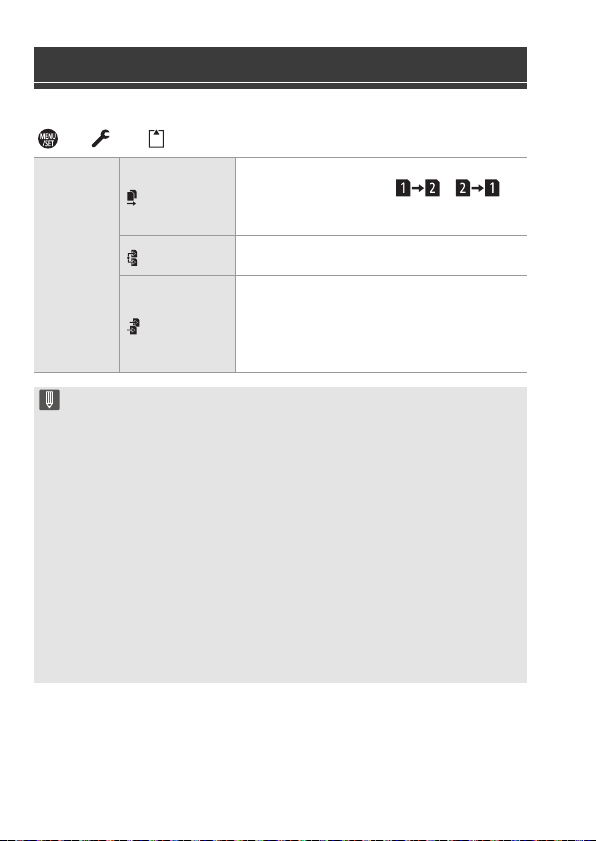
4. Image Recording
DVQX1939 (ENG)
64
This sets the way recording to the card slots 1 and 2 is performed.
¨ [ ] ¨ [ ] ¨ Select [Double Card Slot Function]
[Double Card Slot Function]
[Recording
Method]
[Relay Rec]
Selects the priority of card slots for recording.
[Destination Card Slot]: [ ]/[ ]
Relays recording to the card in the other card
slot after the first card runs out of free space.
[Backup
Rec]
Records the same images to both cards
simultaneously.
[Allocation
Rec]
Allows you to specify the card slot to be used for
recording for different image formats.
[JPEG/HLG Photo Destn.]/[RAW Destination]/
[6K/4K Photo Destination]/[Video
Destination]
Notes about relay recording
0 The following video cannot be continued to be recorded on another card:
– [AVCHD] videos
– [Loop Recording (video)]
Notes about Backup Recording
0 We recommend using cards with the same Speed Class rating and capacity.
If the card Speed Class or capacity is insufficient when video recording,
recording to both cards stops.
0 Backup recording is not available with the following video. They can only be
recorded on a single card:
– [AVCHD] videos
– [Loop Recording (video)]
0 When using the following combinations of cards, recording videos, 6K/4K
photos, and recording with [Post-Focus] are not available:
– SD memory card or SDHC memory card, and SDXC memory card
DC-S1HP-DVQX1939_eng.book 64 ページ 2019年8月9日 金曜日 午後4時45分
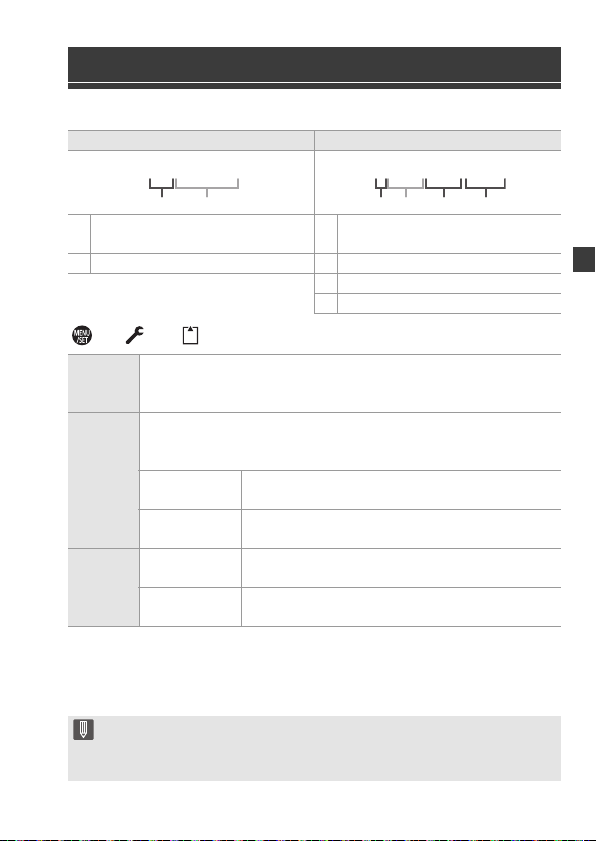
4. Image Recording
DVQX1939 (ENG)
65
Set the folder and file name where to save the images.
¨ [ ] ¨ [ ] ¨ Select [Folder / File Settings]
¢ When [Double Card Slot Function] is set to [Allocation Rec], [Select Folder (Slot
1)] and [Select Folder (Slot 2)] will be displayed.
0 Follow the steps on page 170 when the character entry screen is displayed.
Available characters: alphabetic characters (upper-case), numerals, [ _ ]
[Folder / File Settings]
Folder name File name
1 Folder number (3 digits, 100 to 999) 3
Color space
([P]: sRGB, [ _ ]: AdobeRGB)
2 5-character user-defined segment 4 3-character user-defined segment
5 File number (4 digits, 0001 to 9999)
6 Extension
[Select
Folder]
¢
Selects a folder for storing images.
0 The folder name and the number of files that can be stored will be
indicated.
[Create a
New
Folder]
Creates a new folder with an incremented folder number.
0 If there are no recordable folders in the card, a screen for resetting the
folder number is displayed.
[OK]
Increments the folder number without changing the 5-
character user-defined segment (2 above).
[Change]
Changes the 5-character user-defined segment (2
above). This will also increment the folder number.
[File
Name
Setting]
[Folder
Number Link]
Uses the 3-character user-defined segment (4
above) to set the folder number (1 above).
[User Setting]
Changes the 3-character user-defined segment (4
above).
0 Each folder can store up to 1000 files.
0 [Select Folder] is not available when [Backup Rec] in [Double Card Slot
Function] is being used.
100ABCDE
PABC0001.JPG
DC-S1HP-DVQX1939_eng.book 65 ページ 2019年8月9日 金曜日 午後4時45分
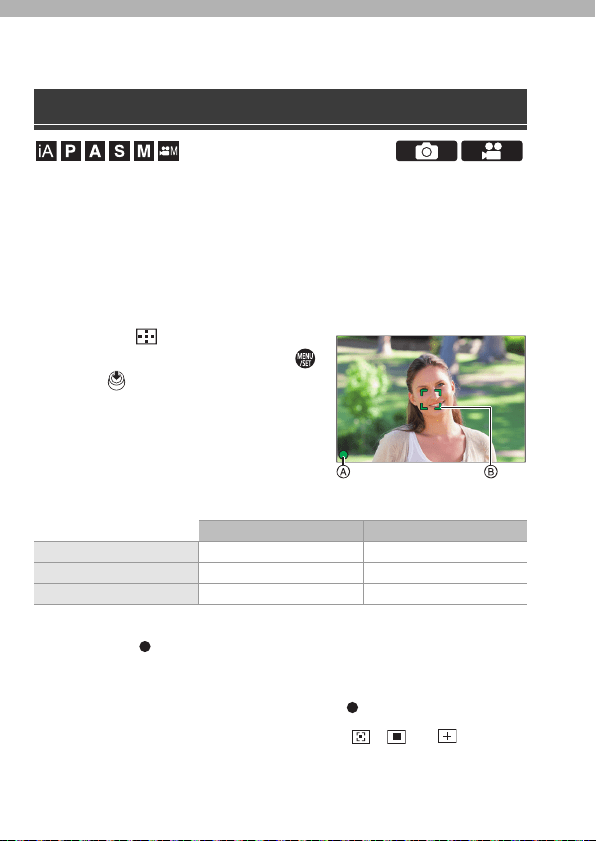
DVQX1939 (ENG)
66
5. Focus/Zoom
AF (Auto Focus) refers to automatic focusing.
Select the focus mode and the AF mode appropriate for the subject and
scene.
1
Set the focus mode to [S] or [C].
≥Set the focus mode lever. (l 47)
2
Select the AF mode.
≥Press [ ] to display the AF mode
selection screen, and set using
or . (l 67)
3
Press the shutter button
halfway.
≥The AF operates.
≥You can also activate AF by
pressing [AF ON].
0
In dark environments, low illumination AF automatically operates, and the focus icon
is indicated as [ ].
0 If the camera detects stars in the night sky after determining low illumination AF, then
Starlight AF will be activated.
When focus is achieved, the focus icon will display [ ].
0 [AF-Point Scope]
This magnifies the focus point when the AF mode is [ ], [ ], or [ ].
Use the Fn button registered with [AF-Point Scope] to operate.
For information about the Fn button, refer to page 156.
Using AF
Focus: In focus Focus: Not in focus
Focus icon A Lights Blinking
AF area B Green Red
AF beep Two beeps —
LOW
STAR
DC-S1HP-DVQX1939_eng.book 66 ページ 2019年8月9日 金曜日 午後4時45分
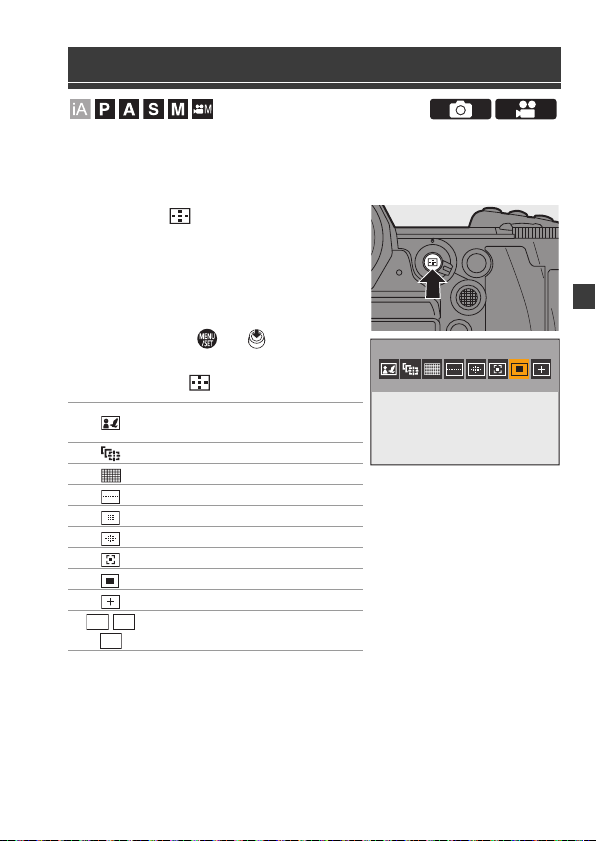
5. Focus/Zoom
DVQX1939 (ENG)
67
Select the focusing method to match the position and number of subjects.
This document gives an overview of AF mode. Refer to the “Owner’s
Manual” (PDF format) for details about AF mode.
1
Press [ ].
≥The AF mode selection screen
appears.
2
Select the AF mode.
≥Press 21 to select an item and
then press or .
≥Selection is also possible by
pressing [ ].
¢ This is not displayed with the default settings. From [Show/Hide AF Mode] in the
[Custom] ([Focus/Shutter]) menu, you can set the items to display on the selection
screen.
Selecting the AF Mode
[Face/Eye/Body/Animal
Detect.]
l 68
[Tracking] l 69
[225-Area] l 69
[Zone (Vert./ Horz.)] l 69
[Zone (Square)]
¢
l 69
[Zone (Oval)] l 70
[1-Area+] l 70
[1-Area] l 70
[Pinpoint] l 70
[Custom1]
¢
, [Custom2]
¢
,
[Custom3]
¢
l 70
ヤヒ
ヤビ
ヤピ
DC-S1HP-DVQX1939_eng.book 67 ページ 2019年8月9日 金曜日 午後4時45分
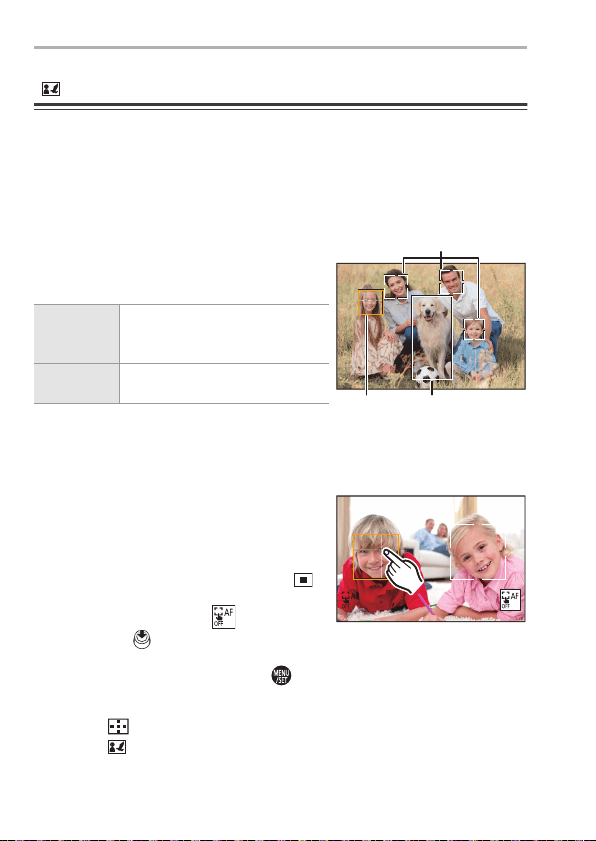
5. Focus/Zoom
DVQX1939 (ENG)
68
[Face/Eye/Body/Animal Detect.]
The camera detects a person’s face, eyes, and body (entire body or upper
half of the body) and adjusts the focus.
With the default settings, animal detection will also operate, enabling
detection of animals, such as birds, canines (including wolves), and felines
(including lions).
When the camera detects a person’s face
A/B or body or an animal’s body C, an AF
area is displayed.
0
Eye detection works only for the eyes inside the
yellow frame A.
Specify the Person, Animal, or Eye to Bring into Focus
Touch the person, animal or eye indicated
with the white AF area.
0
The AF area will change to yellow.
0 Touching outside the AF area displays the AF
area setting screen. Touch [Set] to set the [ ]
AF area at the position touched.
0 To cancel the setting, touch [ ].
0 Each press of switches the person, animal
or eye to be brought into focus.
To cancel the settings specified, press again.
Enable/Disable Animal Detection
1 Press [ ] to display the AF mode selection screen.
2 Select [ ] and then press 3.
Yellow
AF area to be brought into focus.
The camera selects this
automatically.
White
Displayed when multiple subjects
are detected.
DC-S1HP-DVQX1939_eng.book 68 ページ 2019年8月9日 金曜日 午後4時45分
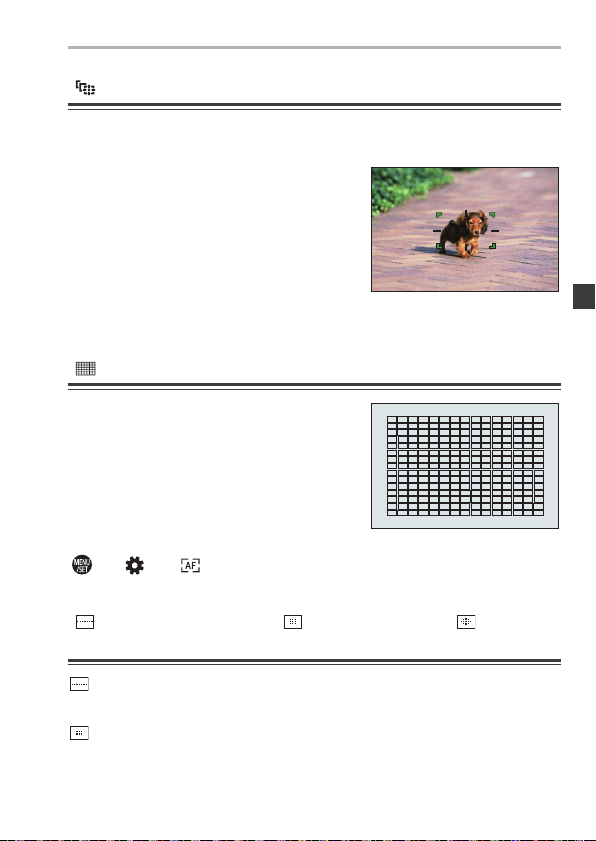
5. Focus/Zoom
DVQX1939 (ENG)
69
[Tracking]
When the focus mode is set to [AFC], the AF area follows the movement of
the subject, maintaining focusing.
Start tracking.
Aim the AF area over the subject, and
press the shutter button halfway.
The camera will track the subject while the
shutter button is pressed halfway or
pressed fully.
0
If tracking fails, the AF area blinks red.
0 When set to [AFS], the focus will be on the AF area position. Tracking will not work.
[225-Area]
The camera selects the most optimal AF
area to focus from 225 areas. When
multiple AF areas are selected, all selected
AF areas will be brought into focus.
Specify the [AFC] start point.
When the focus mode is set to [AFC], you can
specify at which area to start [AFC].
¨ [ ] ¨ [ ] ¨ [AFC Start Point (225-Area)] ¨ [ON]
0
Refer to page 71 for details about AF area movement.
[Zone (Vert./ Horz.)]/ [Zone (Square)]/ [Zone
(Oval)]
[Zone (Vert./ Horz.)]
Within the 225 AF areas, vertical and horizontal zones can be focused.
[Zone (Square)]
Within the 225 AF areas, a central square zone can be focused.
DC-S1HP-DVQX1939_eng.book 69 ページ 2019年8月9日 金曜日 午後4時45分
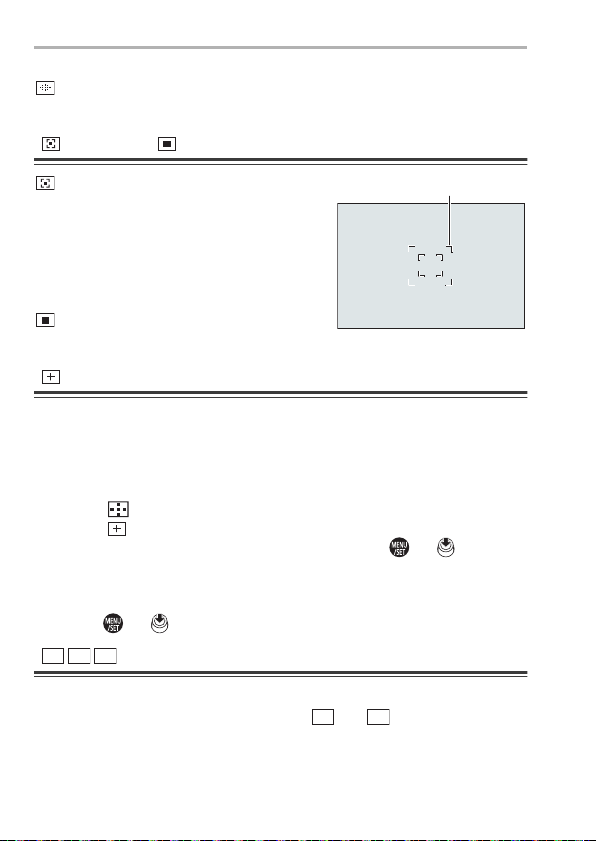
5. Focus/Zoom
DVQX1939 (ENG)
70
[Zone (Oval)]
Within the 225 AF areas, a central oval zone can be focused.
[1-Area+]/ [1-Area]
[1-Area+]
Emphasis within a single AF area can be
focused.
Even when the subject moves out of the
single AF area, the subject remains focused
in a supplementary AF area (A).
[1-Area]
Specify the point to be brought into focus.
[Pinpoint]
You can achieve a more precise focus on a small point.
If you press the shutter button halfway, the screen that lets you check the
focus will be enlarged.
Move the Position of the AF Area
1 Press [ ] to display the AF mode selection screen.
2 Select [ ] and then press 4.
3 Press 3421 to set the position of [i] and then press or .
0 Positions can be moved to the diagonal directions using the joystick.
0 The selected position on the screen will be enlarged.
4 Press 3421 to fine-adjust the position of [i].
5 Press or .
[Custom1] to [Custom3]
The shape of the AF area can be set freely in the 225 AF areas.
The set AF area can be registered using [ ] to [ ].
The AF area can also be moved while maintaining the set shape.
ヤヒ
ヤビ
ヤピ
ヤヒ
ヤピ
DC-S1HP-DVQX1939_eng.book 70 ページ 2019年8月9日 金曜日 午後4時45分
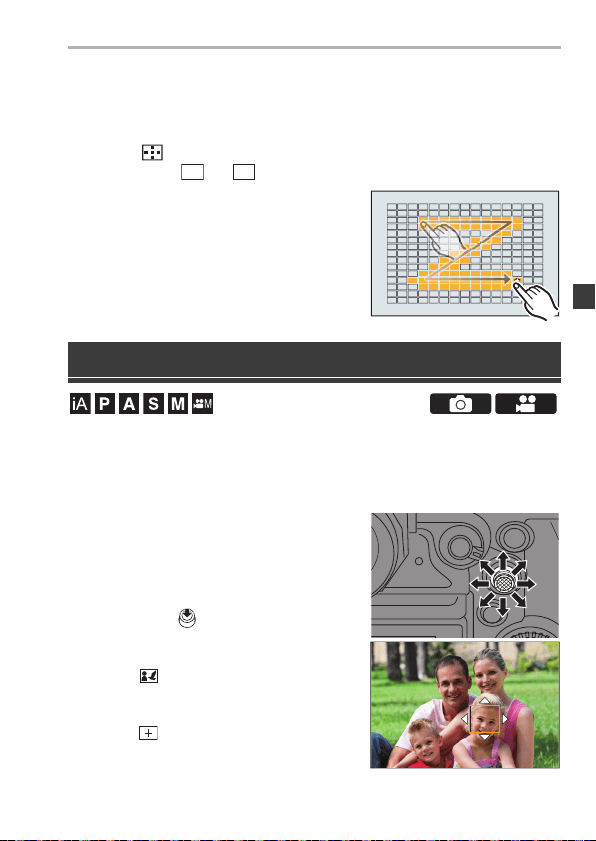
5. Focus/Zoom
DVQX1939 (ENG)
71
0 This is not displayed with default settings. In [Show/Hide AF Mode] in the [Custom]
([Focus/Shutter]) menu, set [Custom1] to [Custom3] to [ON]. (l 167)
Register the AF Area Shape
1 Press [ ] to display the AF mode selection screen.
2 Select one of [ ] to [ ] and then press 3.
3 Select the AF area.
0 Touch the area to make the AF area.
0 To select consecutive points, drag the
screen.
0 To cancel selection of the selected AF area,
touch it again.
4 Press [Q].
In default settings, you can use the joystick to directly move and change
the size of the AF area when recording.
0
Refer to the “Owner’s Manual” (PDF format) for details about AF area movement
operations using other than the joystick.
1
Move the position of the AF
area.
≥On the recording screen, tilt the
joystick.
0
Pressing enables switching
between the default and set AF area
positions.
In [ ], this operation switches the
person, animal or eye to be brought into
focus.
In [ ], this operation displays the
enlarged screen.
AF Area Movement Operation
ヤヒ
ヤピ
DC-S1HP-DVQX1939_eng.book 71 ページ 2019年8月9日 金曜日 午後4時45分
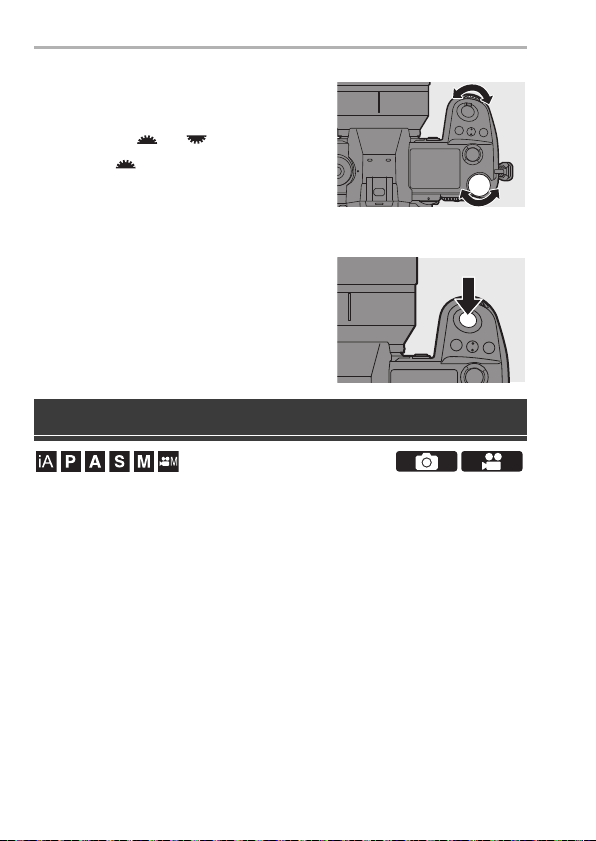
5. Focus/Zoom
DVQX1939 (ENG)
72
2
Change the size of the AF
area.
≥Rotate or .
0
Use for more detailed adjustments.
0 The first press of [DISP.] returns the AF
area position to the center. The second
press returns the size of the AF area to
the default.
3
Confirm your selection.
≥Press the shutter button halfway.
≥This will return you to the recording
screen.
MF (Manual Focus) refers to manual focusing.
Use this function when you want to fix the focus or when the distance
between the lens and the subject is determined and you do not want to
activate AF.
Record Using MF
DC-S1HP-DVQX1939_eng.book 72 ページ 2019年8月9日 金曜日 午後4時45分
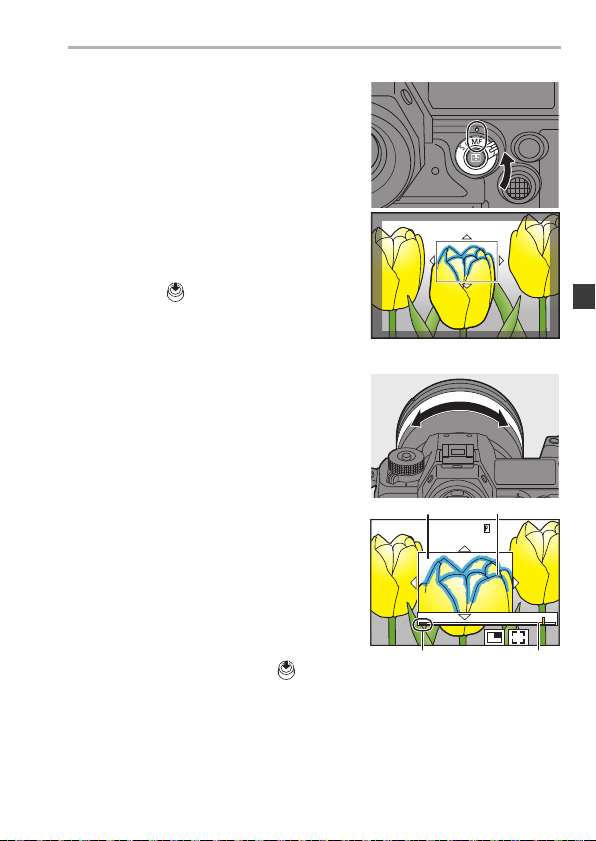
5. Focus/Zoom
DVQX1939 (ENG)
73
1
Set the focus mode lever to
[MF].
2
Select the focus point.
≥Tilt the joystick to select the focus
point.
0
To return the point to be brought into
focus to the center, press [DISP.].
3
Confirm your selection.
≥Press .
≥This switches to the MF Assist
screen, and shows an enlarged
display.
4
Adjust the focus.
≥Rotate the focus ring.
A MF Assist (enlarged screen)
0 This will display the in-focus portion
highlighted with color.
(Focus Peaking B)
0 A recording distance guideline is
displayed.
(MF Guide C)
D Indicator for ¶ (infinity)
5
Close the MF Assist screen.
≥Press the shutter button halfway.
≥This operation can also be
performed by pressing .
6
Start recording.
≥Press the shutter button fully.
AF
∞
30(ft) 15 10 7 5 3 2 4"
DC-S1HP-DVQX1939_eng.book 73 ページ 2019年8月9日 金曜日 午後4時45分
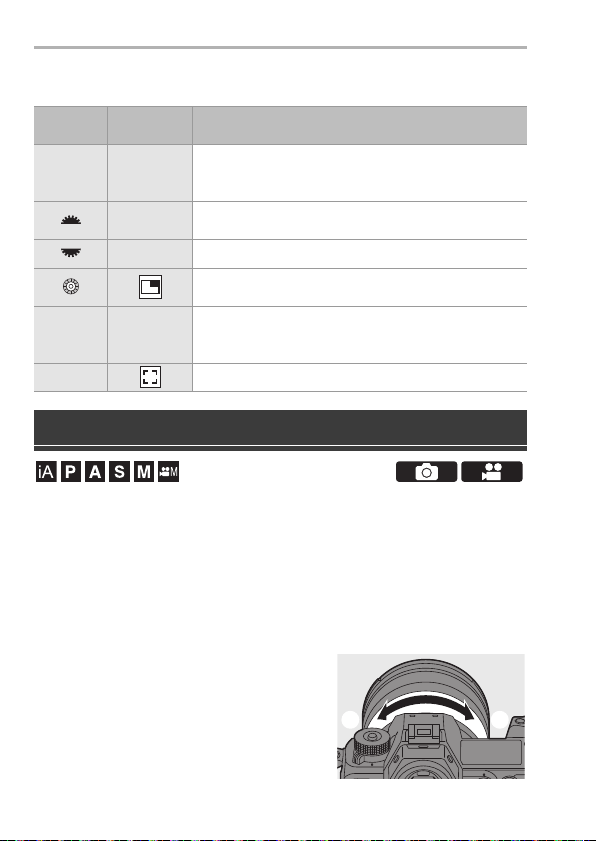
5. Focus/Zoom
DVQX1939 (ENG)
74
Operations on the MF Assist Screen
Use the optical zoom of the lens to zoom to telephoto or wide-angle.
When taking pictures, use [Ex. Tele Conv.] to increase a telescopic effect
without image deterioration.
When recording videos, use [Image Area of Video] to obtain the same
telescopic effect as [Ex. Tele Conv.].
0
Refer to the “Owner’s Manual” (PDF format) for details about [Ex. Tele Conv.].
0 For details about [Image Area of Video], refer to page 108.
Rotate the zoom ring.
≥Rotating the zoom ring displays the focal
length on the recording screen.
Button
operation
Touch
operation
Description of operation
3421 Drag
Moves the enlarged display position.
0 Positions can be moved to the diagonal directions
using the joystick.
Pinch out/
pinch in
Enlarges/reduces the screen in small steps.
s Enlarges/reduces the screen.
Switches magnification window (windowed mode/full
screen mode).
[DISP.] [Reset]
First time: Returns the MF Assist position to the center.
Second time: Returns the MF Assist magnification to the
default setting.
[AF ON] The AF operates.
Recording with Zoom
T: Telephoto
W: Wide-angle
AF
DC-S1HP-DVQX1939_eng.book 74 ページ 2019年8月9日 金曜日 午後4時45分
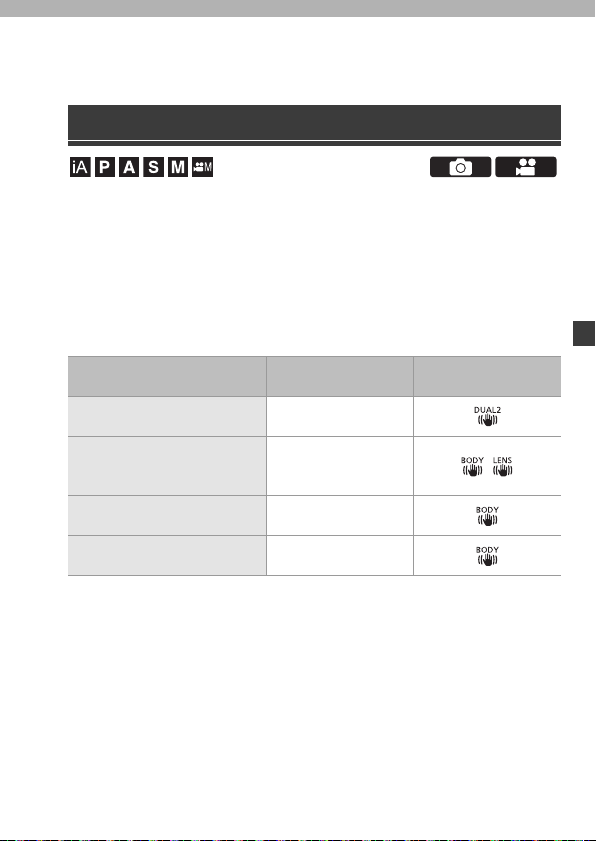
DVQX1939 (ENG)
75
6. Image Stabilizer
This camera can use both the in-body image stabilizer and the in-lens
image stabilizer.
Of the Dual I.S. modes that effectively combine two image stabilizers, this
supports Dual I.S.2 with high correction efficiency.
Furthermore, during video recording, you can use the 5-Axis Hybrid Image
Stabilizer that incorporates electronic stabilization.
Combinations of lenses and image stabilizers (As of August 2019)
0
The 5-Axis Hybrid Image Stabilizer (l 76) can be used with any lenses.
Using the Image Stabilizer
0 When using a lens with an O.I.S. switch, set the switch on the lens to [ON].
0 When using a lens that does not have a communication function with this camera,
after turning on the camera, a message asking for confirmation of the lens
information is displayed.
For the image stabilizer function to operate correctly, it is necessary to set the image
circle, focal length, and image stabilizer range to suit the lens. Follow the message
to make the settings.
This can also be set using the menu. (l 78)
Image Stabilizer
Attached lens
Available image
stabilizer
Example of icon
Panasonic lenses with image
stabilization function
BodyrLens
(Dual I.S.2)
Other manufacturer’s lenses
with image stabilization
function
Body or Lens /
Lenses without image
stabilizer
Body
Lenses without
communication function
Body
DC-S1HP-DVQX1939_eng.book 75 ページ 2019年8月9日 金曜日 午後4時45分

6. Image Stabilizer
DVQX1939 (ENG)
76
Image Stabilizer Settings
Set the image stabilizer operation to match the recording situation.
¨ [ ] ¨ [ ] ¨ Select [Image Stabilizer]
0 When the shutter button is pressed halfway, the camera shake alert icon
[ ] may be displayed on the recording screen.
If this is displayed, we recommend using a tripod, the self timer or the Shutter
Remote Control (DMW-RS2: optional).
0 We recommend turning off the image stabilizer function when using a tripod.
0 When the following function is being used, the image stabilizer function is not
available:
– [High Resolution Mode]
[Operation Mode]
Sets the stabilization movement (blur) to match the
recording method (normal, panning). (l 77)
[Body(B.I.S.) /
Lens(O.I.S.)]
[ ] ([Body]) Uses the in-body image stabilizer.
[ ] ([Lens]) Uses the in-lens image stabilizer.
0 This can be set when using other manufacturer’s lenses
with an image stabilization function.
[When to Activate]
[ALWAYS]
The image stabilizer is always
operating.
[HALF-
SHUTTER]
The image stabilizer operates when the
shutter button is pressed halfway.
[E-Stabilization
(Video)]
Camera shake during video recording is corrected along
the vertical, horizontal, roll, pitch, and yaw axes through the
combined use of the in-lens, in-body, and electronic image
stabilizers. (5-Axis Hybrid Image Stabilizer)
0 The [ ] on the recording screen changes to [ ]
while [E-Stabilization (Video)] is functioning.
0 The angle of view may become narrower if set to [ON].
DC-S1HP-DVQX1939_eng.book 76 ページ 2019年8月9日 金曜日 午後4時45分
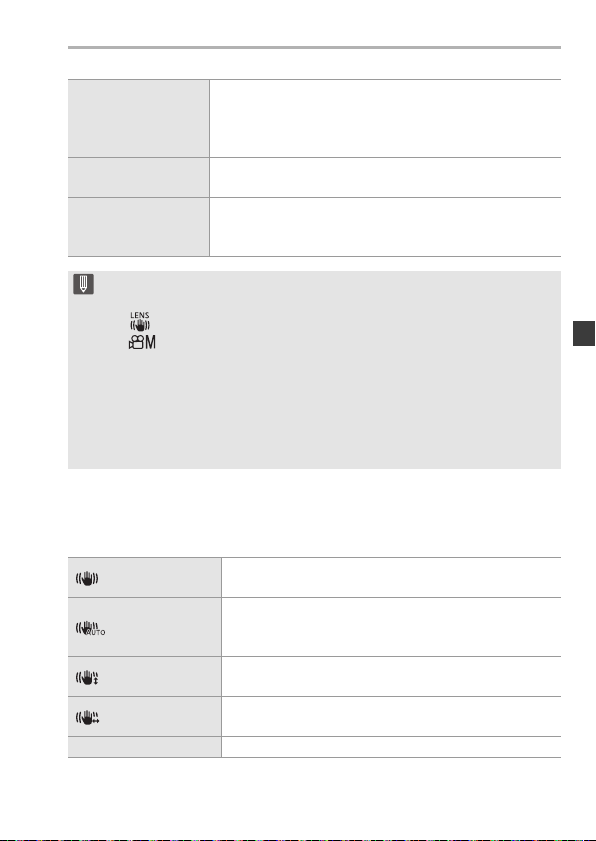
6. Image Stabilizer
DVQX1939 (ENG)
77
[Operation Mode]
Set the stabilization movement (blur) to match the recording method
(normal, panning).
[Boost I.S. (Video)]
Increases the effectiveness of the image stabilizer during
video recording.
This effect can help provide a stable composition when you
want to perform recording from a fixed perspective. (l 78)
[Anamorphic
(Video)]
You can switch to an image stabilizer that suits anamorphic
recording. (l 78)
[Lens Information]
When using a lens that does not have a communication
function with the camera, register the lens information in
the camera. (l 78)
0 When the following functions are being used, [When to Activate] is fixed to
[ALWAYS]:
– [ ] ([Body(B.I.S.) / Lens(O.I.S.)])
– [ ] mode
– Video recording/[6K/4K PHOTO]/[Post-Focus]
0 When the following functions are being used, [E-Stabilization (Video)] is not
available:
– 6K video/5.9K video/5.4K video
– [Variable Frame Rate]
– [Live Cropping]
[Normal]
Corrects vertical, horizontal, and rotational camera shake.
This function is suitable for normal recording.
[Panning (Auto)]
Automatically detects the panning direction, and corrects
vertical and horizontal camera shake.
This function is suitable for panning.
[Panning (Left/
Right)]
Corrects vertical camera shake.
This is suitable for horizontal panning.
[Panning (Up/
Down)]
Corrects horizontal camera shake.
This is suitable for vertical panning.
[OFF] Turns the image stabilization function OFF.
DC-S1HP-DVQX1939_eng.book 77 ページ 2019年8月9日 金曜日 午後4時45分

6. Image Stabilizer
DVQX1939 (ENG)
78
0 Operation modes that can be used will differ depending on the used lenses and on
[Body(B.I.S.) / Lens(O.I.S.)] settings.
0 When using lenses with an O.I.S. switch, the camera’s operation mode cannot be
set to [OFF]. Set the switch on the lens to [OFF].
0 When the following functions are being used, [Operation Mode] switches to [ ]
([Normal]):
– [ ] mode
– Video recording/[6K/4K PHOTO]/[Post-Focus]
[Boost I.S. (Video)]
Increase the effectiveness of the image stabilizer during video recording.
This effect can help provide a stable composition when you want to
perform recording from a fixed perspective.
Settings: [ON]/[OFF]
0
When [Boost I.S. (Video)] is operating, [ ] is displayed on the recording screen.
0 To change composition while recording, first set this to [OFF] before moving the
camera.
To set this to [OFF] during recording, use the Fn button. (l 156)
0 Longer focal lengths will result in weaker stabilization.
[Anamorphic (Video)]
You can switch to an image stabilizer that suits anamorphic recording.
0
Make settings to suit the magnification of the anamorphic lens you are using.
0 While [Anamorphic (Video)] is functioning, the set magnification appears on the
image stabilizer icons on the recording screen, as shown by [ ] and [ ].
[Lens Information]
Register the information for lenses that cannot communicate with the camera.
Match the in-body image stabilizer with the information of the lens you register.
The settings on this camera enable you to switch settings to suit full-frame
or Super 35 mm/APS-C lenses. (l 19)
Settings: [ ]([2.0k])/[ ]([1.8k])/[ ]([1.5k])/[ ]([1.33k])/
[]([1.30k])/[OFF]
0 When [Boost I.S. (Video)] is set, [Boost I.S. (Video)] is prioritized.
DC-S1HP-DVQX1939_eng.book 78 ページ 2019年8月9日 金曜日 午後4時45分
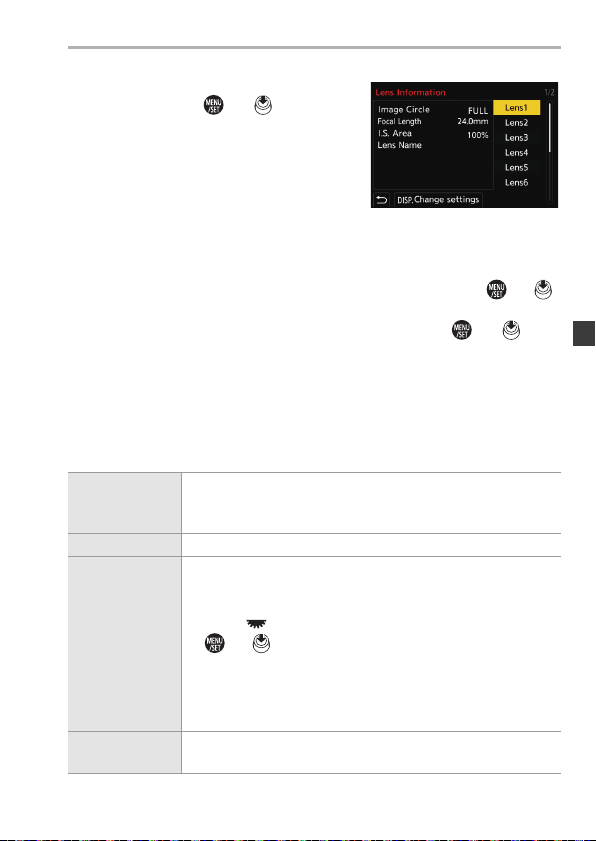
6. Image Stabilizer
DVQX1939 (ENG)
79
Press 34 to select the lens information to
use and then press or .
0
In the default setting, the lens information for
6 lenses with a focal length of between 24 mm
and 135 mm is registered.
The lens information for up to 12 lenses can be
registered.
Registering, modifying, and deleting lens information
1
Press 34 to select the lens information and then press [DISP.].
0
If lens information that has not been registered is selected, press or
to proceed to Step 3.
2
Press 34 to select [Edit] or [Delete] and then press or .
0
The lens information is deleted when you select [Delete].
3
Enter the lens information.
0
The lens information changes if the lens information has already been
registered.
4
(If lens information that has not been registered is selected) Press
[DISP.] to register the lens information.
[Image Circle]
Select the image circle for the lens.
[FULL]: Full-frame lens
[S35mm]: Lens for Super 35 mm/lens for APS-C
[Focal Length] Enter the focal length.
[I.S. Area]
You can set the range of stabilization for the image stabilizer so
that vignetting does not occur due to the image stabilizer.
[70%]/[80%]/[90%]/[100%]
0 Rotate to select the range of stabilization, then press
or to confirm.
0 When the four edges are selected by pressing 3421, the
in-body image stabilizer works and you can see if there is any
vignetting. If vignetting has occurred, set again to a smaller
range.
[Lens Name]
Register the lens.
0 For information on how to enter characters, refer to page 170.
DC-S1HP-DVQX1939_eng.book 79 ページ 2019年8月9日 金曜日 午後4時45分
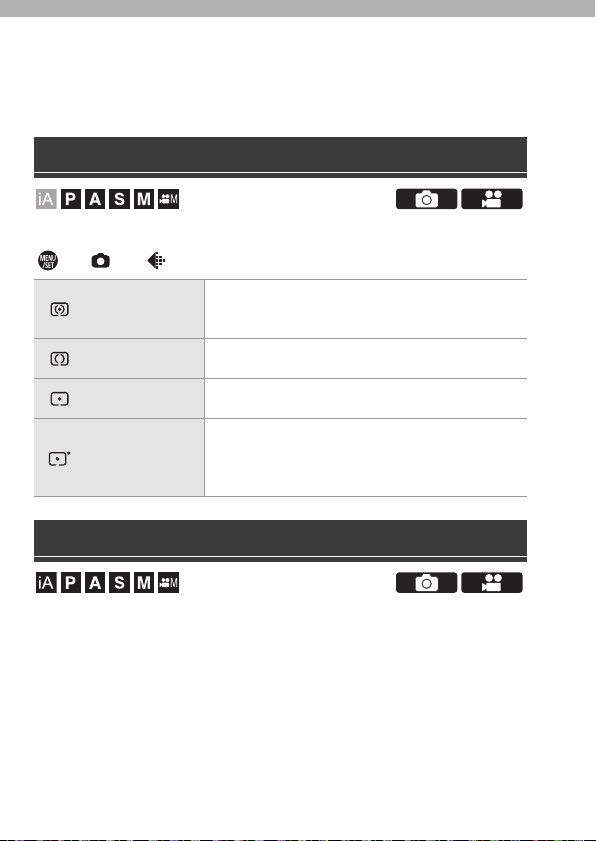
DVQX1939 (ENG)
80
7. Metering/Exposure/ISO
Sensitivity
Type of optical measurement to measure brightness can be changed.
¨ [ ] ¨ [ ] ¨ Select [Metering Mode]
You can compensate the exposure when the correct exposure determined
by the camera is too bright or too dark.
You can adjust the exposure in 1/3 EV steps in a range of n5EV.
When recording videos or recording with 6K/4K photo or Post-Focus, the
range changes to n3EV.
[Metering Mode]
[](Multi-metering)
Method in which the most suitable exposure is
measured by judging the allocation of brightness on
the whole screen.
[]
(Center-
weighted)
Method used to perform measuring which focuses on
the center of the screen.
[](Spot)
Method used to measure the extremely small part
around the spot-metering target.
[]
(Highlight-
weighted)
Method used to perform measuring which focuses on
the highlighted parts of the screen to prevent
overexposure.
This is suitable for theatre photography, etc.
Exposure Compensation
DC-S1HP-DVQX1939_eng.book 80 ページ 2019年8月9日 金曜日 午後4時45分
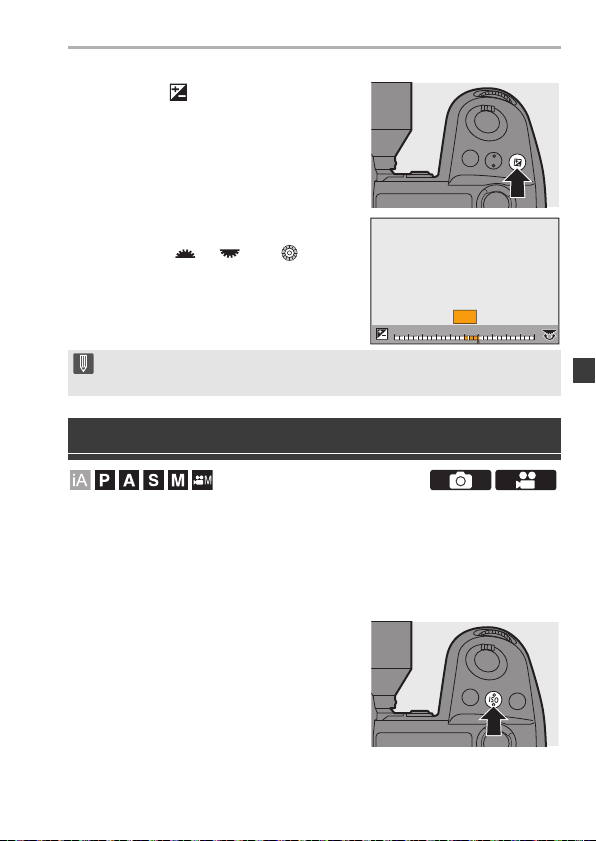
7. Metering/Exposure/ISO Sensitivity
DVQX1939 (ENG)
81
1
Press [ ].
2
Compensate the exposure.
≥Rotate [ ], [ ], or [ ].
3
Confirm your selection.
≥Press the shutter button halfway.
You can set light sensitivity (ISO sensitivity).
With the default settings, you can set 100 to 51200 in 1/3 EV increments.
This camera supports Dual Native ISO which enables recording at high
sensitivity with reduced noise by switching the base sensitivity. The base
sensitivity can also be fixed as necessary.
1
Press [ISO].
0 In [M] mode, you can compensate the exposure by setting the ISO sensitivity
to [AUTO].
ISO Sensitivity
+3+3+1+1 +2+2 +3+3
-
5
-
5
-
4
-
4
-
3
-
3
-
2
-
2
-
1
-
100
+5+5+4+4
+
+
1
DC-S1HP-DVQX1939_eng.book 81 ページ 2019年8月9日 金曜日 午後4時45分

7. Metering/Exposure/ISO Sensitivity
DVQX1939 (ENG)
82
2
Select ISO sensitivity.
≥Rotate , , or .
≥Selection is also possible by
pressing [ISO].
3
Confirm your selection.
≥Press the shutter button halfway.
Setting Items (ISO Sensitivity)
¢1 Default setting. The upper limit can be changed with [ISO Sensitivity (photo)].
¢2 Default setting. The upper limit can be changed with [ISO Sensitivity (video)].
0 When the following functions are being used, the ISO sensitivity that can be set is
restricted.
– [High Resolution Mode]: Up to an upper limit of [3200]
– [High Dynamic] ([Filter Settings]): Down to a lower limit of [400], up to an upper
limit of [6400]
– Other than [High Dynamic] ([Filter Settings]): Up to an upper limit of [6400]
– [Multiple Exposure]: Down to a lower limit of [100], up to an upper limit of [6400]
– [Cinelike D2]/[Cinelike V2] ([Photo Style]): Down to a lower limit of [200]
(The lower limit changes to [100] when [Extended ISO] is set.)
– [Like709] ([Photo Style]): Down to a lower limit of [100]
[AUTO]
The ISO sensitivity is automatically adjusted according to the
brightness.
0 Taking picture: Maximum [6400]
¢1
0 Video recording: Maximum [6400]
¢2
[100] to
[51200]
The ISO sensitivity is fixed at the selected value.
0 The available ISO sensitivity range changes according to the
setting of [Dual Native ISO Setting] in the [Photo] ([Image Quality])
menu. (l 83)
0 You can extend the ISO sensitivity range in between a lower limit of
[50] and an upper limit of [204800] by setting [Extended ISO] to
[ON] in the [Custom] ([Image Quality]) menu.
1
00
1
00
2
00
2
00
4
0
4
0
AUTO
AUTO
DC-S1HP-DVQX1939_eng.book 82 ページ 2019年8月9日 金曜日 午後4時45分
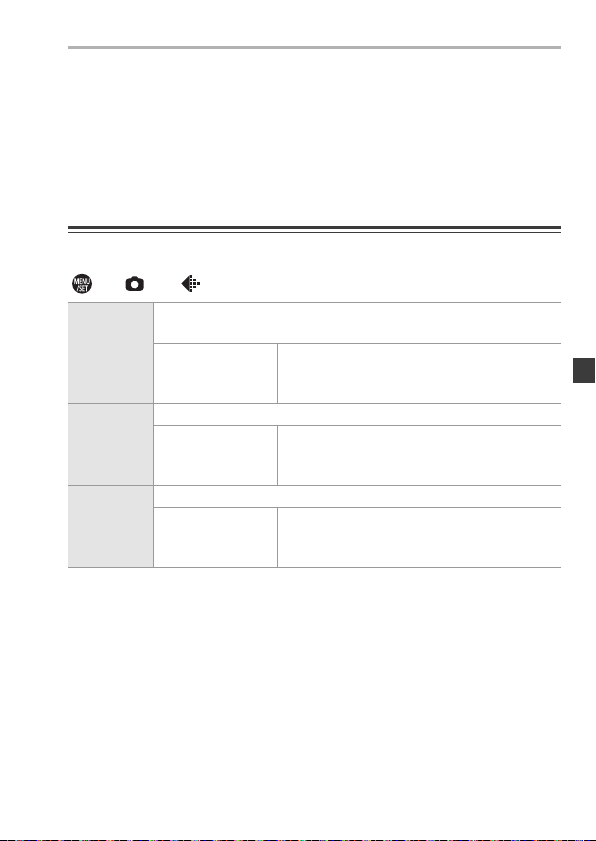
7. Metering/Exposure/ISO Sensitivity
DVQX1939 (ENG)
83
– [V-Log] ([Photo Style]): Down to a lower limit of [640], up to an upper limit of
[51200]
(The lower limit changes to [320] when [Extended ISO] is set.)
– [Standard(HLG)]/[Monochrome(HLG)]/[Like2100(HLG)] ([Photo Style]): Down to a
lower limit of [400]
[Dual Native ISO Setting]
You can set whether to switch the base sensitivity automatically or to fix it.
¨ [ ] ¨ [ ] ¨ Select [Dual Native ISO Setting]
[AUTO]
The base sensitivity is automatically switched according to the
brightness.
ISO sensitivity that
can be set
[AUTO]/[100] to [51200]
When [Extended ISO] is set: [AUTO]/[50] to
[204800]
[LOW]
Sets the base sensitivity for low sensitivity.
ISO sensitivity that
can be set
[AUTO]/[100] to [800]
When [Extended ISO] is set: [AUTO]/[50] to
[800]
[HIGH]
Sets the base sensitivity for high sensitivity.
ISO sensitivity that
can be set
[AUTO]/[640] to [51200]
When [Extended ISO] is set: [AUTO]/[320] to
[204800]
DC-S1HP-DVQX1939_eng.book 83 ページ 2019年8月9日 金曜日 午後4時45分
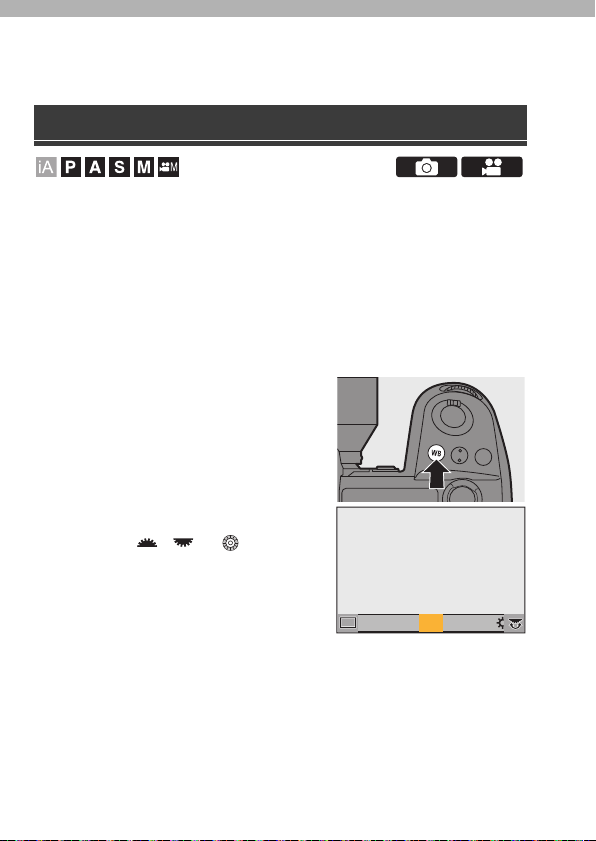
DVQX1939 (ENG)
84
8. White Balance/Image Quality
White balance (WB) is a function that corrects the color cast produced by
the light illuminating the subject.
It corrects the colors so that white objects appear in white to make the
overall color closer to what is seen by the eye.
Normally, you can use auto ([AWB], [AWBc] or [AWBw]) to obtain the
optimal white balance.
Set this function when the coloring of the image is different from what you
expected, or you want to change the coloring to capture the ambience.
1
Press [WB].
2
Select the white balance.
≥Rotate , or .
≥Selection is also possible by
pressing [WB].
3
Confirm your selection.
≥Press the shutter button halfway.
White Balance (WB)
AWBc
AWBc
AWBw
AWBw
WB
WBWBWB
WBWBWBWBWBWBWB
AWB
AWB
DC-S1HP-DVQX1939_eng.book 84 ページ 2019年8月9日 金曜日 午後4時45分
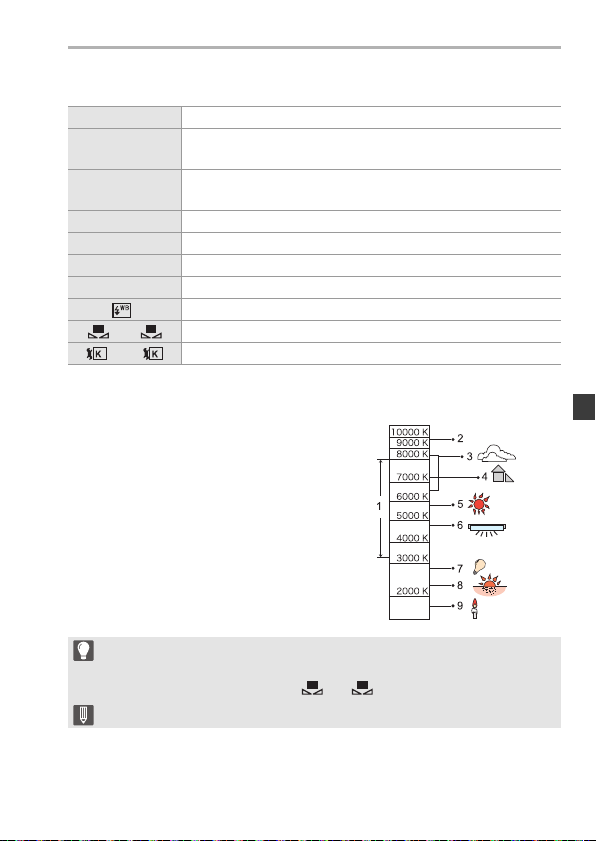
8. White Balance/Image Quality
DVQX1939 (ENG)
85
Setting Items (White Balance)
¢ It operates as [AWB] during video recording or when recording with [6K/4K
PHOTO] or [Post-Focus].
1 [AWB] will work within this range.
2 Blue sky
3 Cloudy sky (Rain)
4 Shade
5 Sunlight
6 White fluorescent light
7 Incandescent light bulb
8 Sunrise and sunset
9 Candlelight
KlKelvin Color Temperature
[AWB] Auto
[AWBc]
Auto (Reduces the reddish hue under an incandescent light
source)
[AWBw]
Auto (Leaves the reddish hue under an incandescent light
source)
[V] Clear sky
[Ð] Cloudy sky
[î] Shade under a clear sky
[Ñ] Incandescent light
[]
¢
Flash
[] to []Set mode 1 to 4 (l 86)
[] to []Color temperatures 1 to 4 (l 86)
0 Under lighting such as fluorescent or LED lighting, the appropriate white
balance will vary depending on the lighting type.
Use [AWB], [AWBc], [AWBw] or [ ] to [ ].
0 The white balance is fixed to [AWB] while [Filter Settings] is being used.
1 4
1 4
1
4
DC-S1HP-DVQX1939_eng.book 85 ページ 2019年8月9日 金曜日 午後4時45分
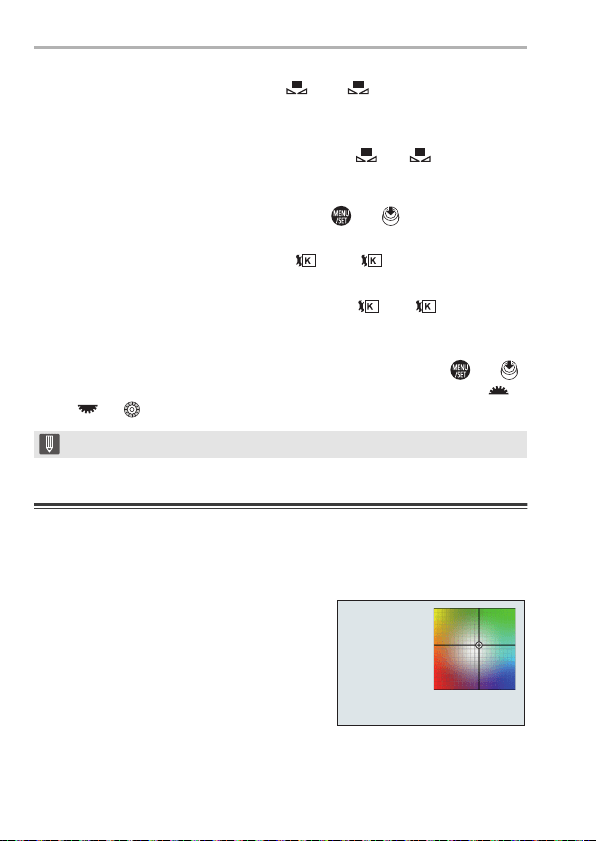
8. White Balance/Image Quality
DVQX1939 (ENG)
86
Registering the White Set ([ ] to [ ])
Take pictures of a white object under the light source of the recording
location to adjust the white balance until it appears white.
1
Press [WB] and then select any value from [ ] to [ ].
2
Press 3.
3
Aim the camera at a white object so that it appears inside the frame at
the center of the screen and then press or .
0
This will set the white balance and return you to the recording screen.
Color Temperature Setting ([ ] to [ ])
Set the numeric value for the white balance color temperature.
1
Press [WB] and then select any value from [ ] to [ ].
2
Press 3.
0
The color temperature setting screen is displayed.
3
Press 34 to select the color temperature and then press or .
0
You can set the White Balance Bracket (Color Temperature) by rotating ,
or .
Adjusting the White Balance
You can adjust the coloring even when the coloring you want to apply is not
produced by the selected white balance.
1
Press [WB].
2
Select the white balance and
then press 4.
≥The adjustment screen is displayed.
3
Adjust the coloring.
0 You can set a color temperature from [2500K] to [10000K].
1
4
1
4
1
4
1
4
GGGGGG
MMMMMM
AAAAAABBBBBBB
DC-S1HP-DVQX1939_eng.book 86 ページ 2019年8月9日 金曜日 午後4時45分
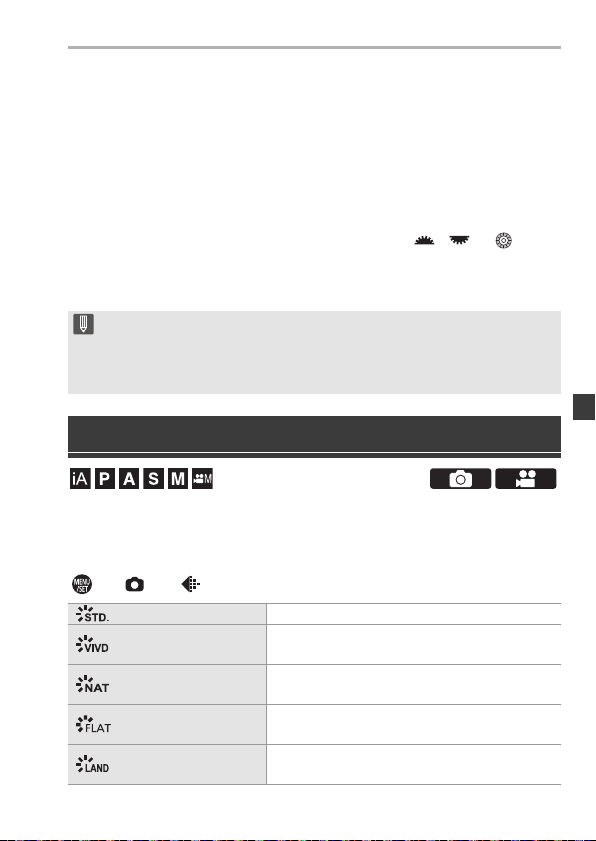
8. White Balance/Image Quality
DVQX1939 (ENG)
87
0 You can also make adjustments in diagonal directions by using the joystick.
0 You can also touch the graph to make adjustments.
0 Press [DISP.] to return to the unadjusted state.
0 You can set the White Balance Bracket by rotating , or .
4
Confirm your selection.
≥Press the shutter button halfway.
You can select the finishing settings of images to suit your subjects and
expression styles.
The image quality can be adjusted for each Photo Style.
¨ [ ] ¨ [ ] ¨ Select [Photo Style]
2: [A] (AMBER: ORANGE)
3: [G] (GREEN: GREENISH)
1: [B] (BLUE: BLUISH)
4: [M] (MAGENTA: REDDISH)
0 When the white balance is adjusted, the color of its recording screen icon
changes to the adjusted color.
Adjusting toward the [G] side will display [i], while adjusting toward the [M]
side will display [j].
[Photo Style]
[Standard] The standard setting.
[Vivid]
A setting that produces a more vivid quality with
higher saturation and contrast.
[Natural]
A setting that produces a softer quality with lower
contrast.
[Flat]
A setting that produces a flatter image quality
with lower saturation and contrast.
[Landscape]
A setting suited for sceneries with vivid blue skies
and greens.
DC-S1HP-DVQX1939_eng.book 87 ページ 2019年8月9日 金曜日 午後4時45分
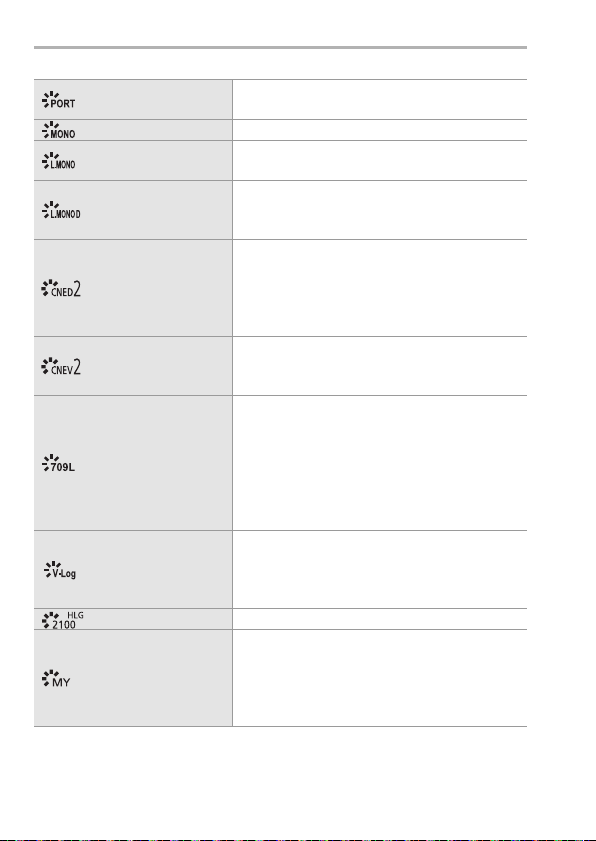
8. White Balance/Image Quality
DVQX1939 (ENG)
88
[Portrait]
A setting suited for portraits with a healthy and
beautiful skin tone.
[Monochrome] A monochrome setting with no color shades.
[L.Monochrome]
A black-and-white setting with rich gradation and
crisp black accents.
[L.Monochrome D]
A monochrome setting that creates a dynamic
impression with enhanced highlights and
shadows.
[Cinelike D2]
A setting that creates a film-like finishing touch
using a gamma curve and gives priority to the
dynamic range.
0 This function is suitable for video editing
processes.
[Cinelike V2]
A setting that creates a film-like finishing touch
using a gamma curve that gives priority to the
contrast.
[Like709]
A setting that minimizes overexposure by
applying a gamma curve correction equivalent to
Rec.709 to perform compression (knee
adjustment) of high-luminance areas.
0 Rec.709 is an abbreviation of “ITU-R
Recommendation BT.709”, a standard for high-
definition broadcasting.
[V-Log]
Gamma curve setting intended for post-
production processing.
0 It allows you to add rich gradation to images
during post production editing.
[Like2100(HLG)]
¢1
A setting used to record HLG format video.
[MY PHOTO STYLE 1]
¢
2
to [MY PHOTO STYLE
10]
¢
2
Adjusts the image quality of Photo Style items to
your preferred settings and registers these as My
Photo Style items.
0 Refer to the “Owner’s Manual” (PDF format) for
details.
DC-S1HP-DVQX1939_eng.book 88 ページ 2019年8月9日 金曜日 午後4時45分
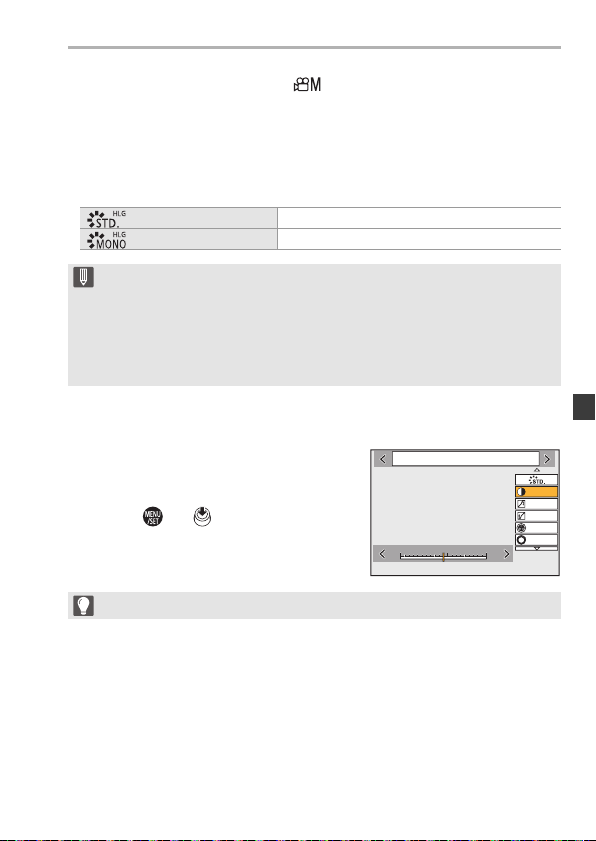
8. White Balance/Image Quality
DVQX1939 (ENG)
89
¢1 Can only be selected when in the [ ] mode and set to a 10-bit [Rec Quality].
(l 101)
¢2 Effects up to [MY PHOTO STYLE 4] are displayed with the default settings. You
can set the items to display in the menu with [Show/Hide Photo Style] in [Photo
Style Settings].
0 When [HLG Photo] is set, the items will be as follows.
Adjusting the Image Quality
1
Press 21 to select the type of Photo Style.
2
Press 34 to select an item and then
press 21 to adjust.
0
Adjusted items are indicated with [¢].
3
Press or .
0
When the image quality is adjusted, the
Photo Style icon on the recording screen is
indicated with [¢].
[Standard(HLG)] Standard [HLG Photo] setting.
[Monochrome(HLG)] Black and white setting for [HLG Photo].
0 In [iA] mode, operation differs from that in other recording modes.
– [Standard] or [Monochrome] can be set.
– The setting will be reset to [Standard] when the camera is switched to
another recording mode or it is turned off.
– Image quality cannot be adjusted.
0 When [Filter Settings] is being used, [Photo Style] is not available.
0 Refer to the “Owner’s Manual” (PDF format) for details about setting items.
6WDQGDUG
-
5
-
500
+5+5
±0
±0
±0
±0
±0
DC-S1HP-DVQX1939_eng.book 89 ページ 2019年8月9日 金曜日 午後4時45分
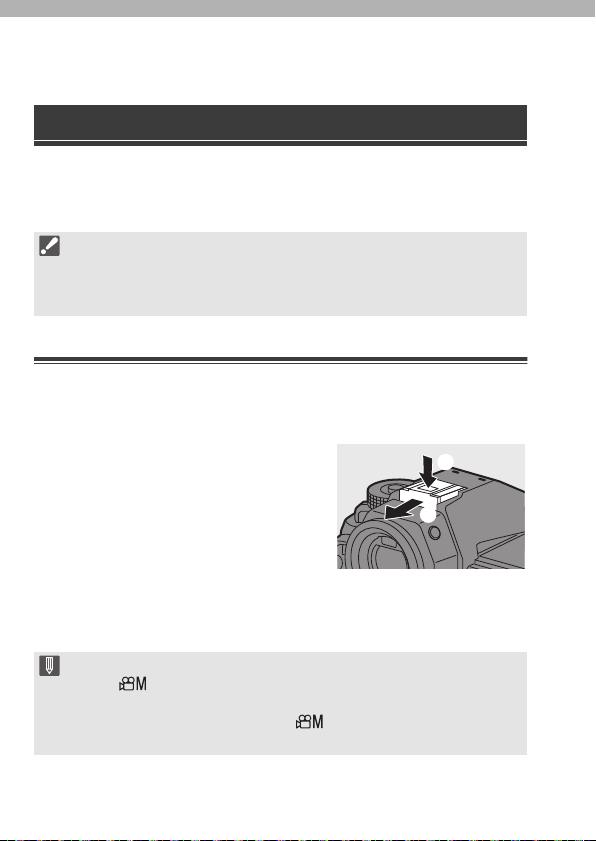
DVQX1939 (ENG)
90
9. Flash
This document gives an overview of recording with a flash. Refer to the
“Owner’s Manual” (PDF format) for details about recording using a flash
and recording with a wireless flash.
Removing the Hot Shoe Cover
Before attaching the Flash (optional), remove the hot shoe cover.
Refer to the operating instructions for the Flash for details about how to
attach it.
Remove the hot shoe cover by
pulling it in the direction indicated
by arrow 2 while pressing it in the
direction indicated by arrow 1.
Flash Synchro Socket
You can use a commercially available external flash by connecting a
synchro cable to the flash synchro socket.
Using an External Flash (Optional)
0 Flash recording is not possible when the following functions are being used:
– [6K/4K PHOTO]/[Post-Focus]
– [ELEC.]/[Silent Mode]/[High Resolution Mode]
– [Filter Settings]
0 Use an external flash with a synchronization voltage of 250 V or less.
0 In the [ ] mode, the flash synchro socket is used to synchronize time
codes with an external device. (l 111) Do not connect an external flash to the
flash synchro socket when set to the [ ] mode. Doing so may cause a
malfunction in the camera.
DC-S1HP-DVQX1939_eng.book 90 ページ 2019年8月9日 金曜日 午後4時45分
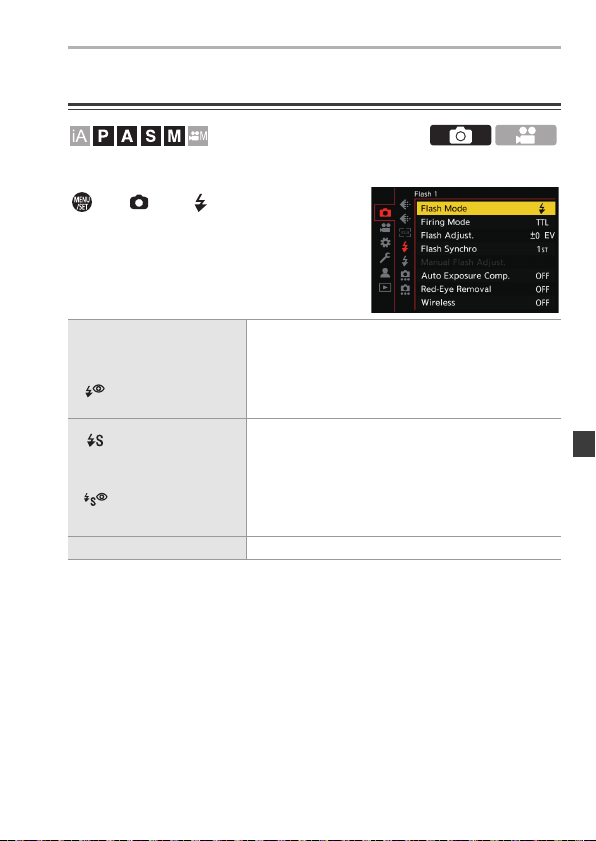
9. Flash
DVQX1939 (ENG)
91
[Flash Mode]
Sets the flash mode.
¨ [ ] ¨ [ ] ¨ Select [Flash
Mode]
[‰] (Forced Flash On)
The flash fires every time regardless of the recording
conditions.
This is suitable for recording when there is
backlighting or under lighting such as fluorescent
lighting.
[]
(Forced On/Red-
Eye)
[](Slow Sync.)
When recording images against a nightscape, this
will slow the shutter speed when the flash fires to
make not only the subject but also the nightscape
appear brighter.
0 Slower shutter speeds may result in blurry images.
To avoid this, we recommend using a tripod.
[]
(Slow Sync./Red-
Eye)
[Œ] (Forced Flash Off) The flash does not fire.
DC-S1HP-DVQX1939_eng.book 91 ページ 2019年8月9日 金曜日 午後4時45分
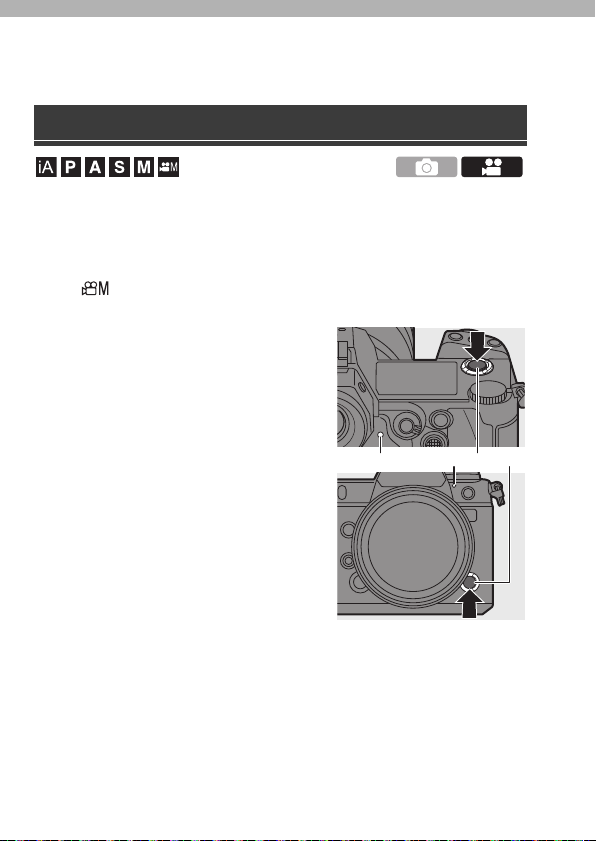
DVQX1939 (ENG)
92
10. Recording Videos
It is possible to record video with a maximum resolution of 6K (5952k3968)
on this camera.
It also supports switching of the system frequency and 3 types of recording
file format; AVCHD, MP4, and MOV.
In the [ ] mode (Creative Video mode), which is specifically for video
recording, you can use all of the video functions.
1
Start recording.
≥Press the video rec. button A.
≥You can also perform the same
operation by pressing the sub video
rec. button B.
0
Release the video rec. button right after
you press it.
0 During video recording, the front tally
lamp
C and rear tally lamp D light.
2
Stop recording.
≥Press the video rec. button A
again.
≥You can also perform the same
operation by pressing the sub video
rec. button B.
Recording Videos
DC-S1HP-DVQX1939_eng.book 92 ページ 2019年8月9日 金曜日 午後4時45分
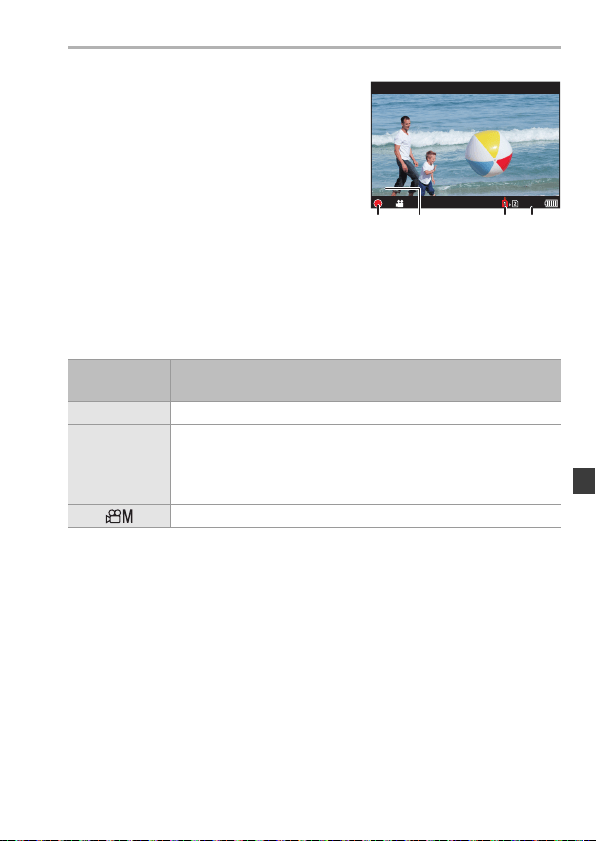
10. Recording Videos
DVQX1939 (ENG)
93
Screen Displays While Video
Recording
The live view angle of view changes to the
angle of view for video recording, and video
recording time E and elapsed recording
time F are displayed.
0
h: hour, m: minute, s: second
0 The recording state indication G and card
access indication
H turn red while videos are being recorded.
Exposure Control While Video Recording
Videos will be recorded using the aperture, shutter speed, ISO sensitivity,
and Dual Native ISO settings below.
Recording
mode
Aperture value/shutter speed/ISO sensitivity/Dual Native ISO
setting
[iA] The camera automatically makes the settings to suit the scene.
[P]/[A]/[S]/[M]
The settings vary depending on the [Auto Exposure in P/A/S/M] in
the [Custom] ([Image Quality]) menu. The default setting is [ON].
[ON]: Records with values set automatically by the camera.
[OFF]: Records with manually set values.
[] Records with manually set values.
24
m
59
s
24
m
59
s
24
m
59
s
3
s
3
s
3
s
DC-S1HP-DVQX1939_eng.book 93 ページ 2019年8月9日 金曜日 午後4時45分
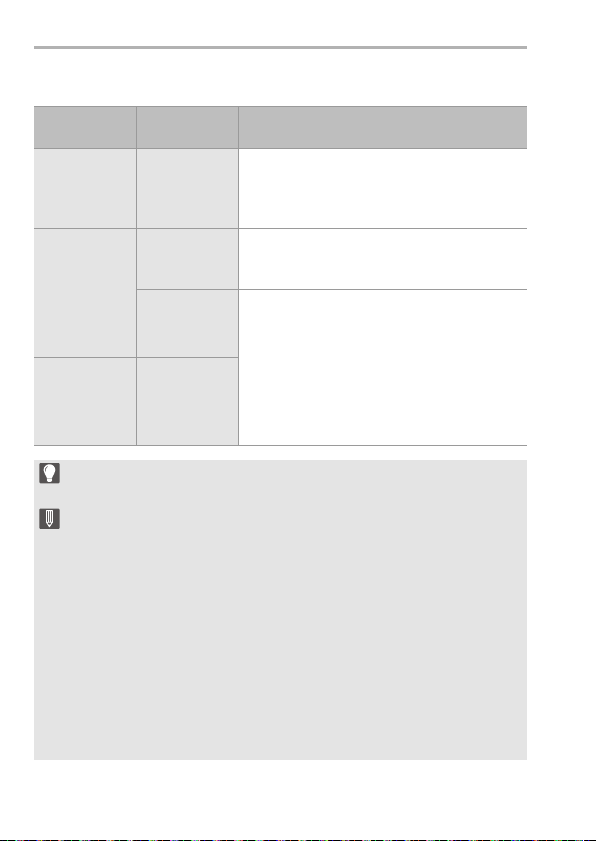
10. Recording Videos
DVQX1939 (ENG)
94
Size Interval for Dividing Files
[Rec. File
Format]
[Rec Quality] Size interval for dividing files
[AVCHD] All
A new file will be created to continue recording if
the file size exceeds 4 GB.
The files recorded can be played back
continuously.
[MP4]
[FHD]
A new file will be created to continue recording if
the continuous recording time exceeds
30 minutes or the file size exceeds 4 GB.
[4K]
When using an SDHC memory card:
A new file will be created to continue recording if
the continuous recording time exceeds
30 minutes or the file size exceeds 4 GB.
When using an SDXC memory card:
A new file will be created to continue recording if
the continuous recording time exceeds 3 hours
and 4 minutes or the file size exceeds 96 GB.
[MOV] All
0 If maintaining focus on the subject is difficult during video recording with AF,
press the shutter button halfway to re-adjust the focus.
0 When the remaining capacity of the battery or card gets low during video
recording, the tally lamps blink at long intervals. When there is no remaining
capacity in the battery or card, video recording is stopped and the tally lamps
blink at short intervals.
0 If an operation such as a zoom or button operation is performed during video
recording, that operation sound may be recorded.
0 If the operation sound of pressing the video rec. button or sub video rec.
button to end recording bothers you, try the following:
– Record the video about 3 seconds longer, and then divide the last part of the
video using [Video Divide] in the [Playback] ([Edit Image]) menu.
– Use the Shutter Remote Control (DMW-RS2: optional) for recording.
0 Depending on the type of card, the card access indication may appear for a
while after video recording. This is not a malfunction.
DC-S1HP-DVQX1939_eng.book 94 ページ 2019年8月9日 金曜日 午後4時45分
10. Recording Videos
DVQX1939 (ENG)
95
The [ ] mode (Creative Video mode) is a recording mode specifically
for video recording in which you can use all video functions.
In the [ ] mode, the recording screen and status LCD switch to displays
suited to video recording.
You can start and stop video recording with the shutter button.
Change the exposure and audio settings with touch operation to prevent
operation sounds from being recorded.
Settings such as exposure and white balance can be changed
independent of picture taking settings.
0 If the camera temperature rises under the any of following conditions, [ ]
may be displayed and recording may stop. Wait until the camera cools down.
– During continuous video recording
– When the ambient temperature is high
0 Video recording is not possible while you are using the following functions:
– [Time Lapse Shot] – [Stop Motion Animation]
– [Rough Monochrome]/[Silky Monochrome]/[Soft Focus]/[Star Filter]/
[Sunshine] ([Filter Settings])
– [HLG Photo] – [Post-Focus]
Creative Video Mode
DC-S1HP-DVQX1939_eng.book 95 ページ 2019年8月9日 金曜日 午後4時45分
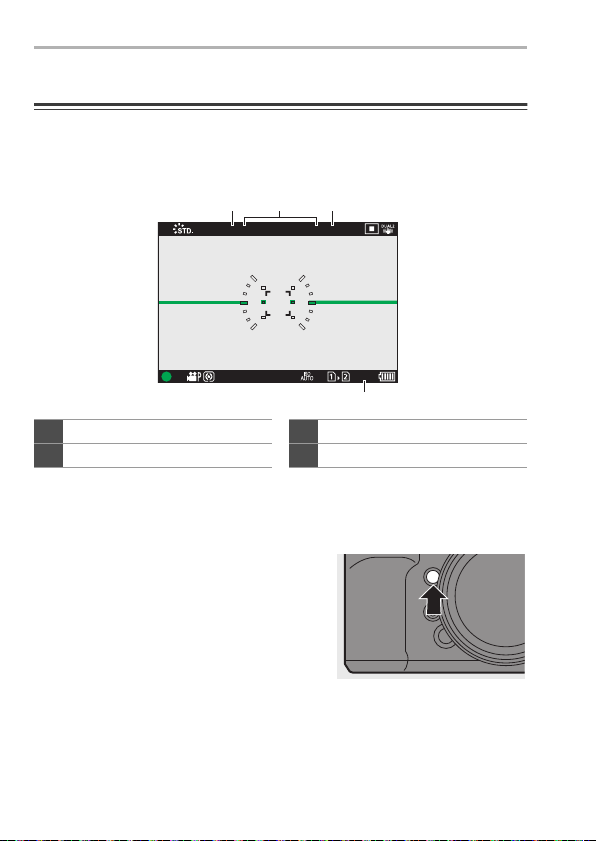
10. Recording Videos
DVQX1939 (ENG)
96
Displays Suited to Video Recording
Recording Screen
In the recording screen, the following parts switch to displays suited to
video recording.
0
Examples of displays at the time of purchase. For information about the icons other
than those described here, refer to page 188.
Status LCD
You can switch the status LCD between
2 types of information display.
0
Use the Fn button registered with [Status-LCD
Display(Video)] to operate. In default settings,
this is registered in the [Fn1] button.
For information about the Fn button, refer to
page 156.
24m59s
100
F
4.060
±
0
AFSAFS
FULLFULLMP4MP4 FHDFHD 420/8-L420/8-L
59.94
p
59.94
p
4
1 3
2
1
Recording file format (l 100)
2
Recording quality (l 101)
3
Image area of video (l 108)
4
Video recording time
DC-S1HP-DVQX1939_eng.book 96 ページ 2019年8月9日 金曜日 午後4時45分
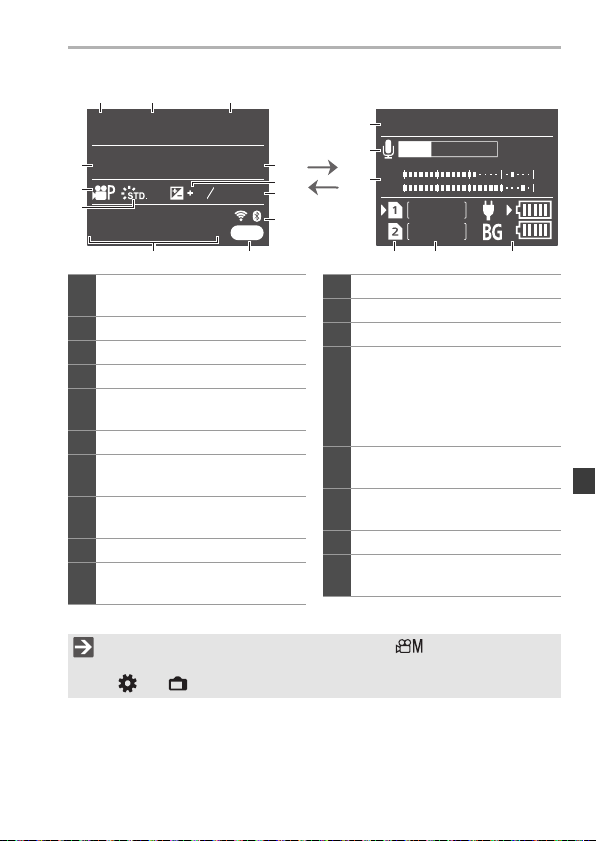
10. Recording Videos
DVQX1939 (ENG)
97
1/
60
100
WB
MP4
FHD 59.94
p
420/8-L
ISO
FPS
SHUTTER
TC
CH1
CH2
-4
-2
NDF
IRIS
F
3.5
60
1
FULL
1
3
REC
00
:
00
:
00
:
00
INT. LMT ON
-24-36 -6-12 0
24
m
59
s
24
m
59
s
AUTO
AWB
321
5
8
9
12
4
6
7
11
10
13
14
15
16
1817
1
Frame rate (l 101)/
Variable frame rate (l 125)
2
Shutter speed (l 45)
3
Aperture value (l 45)
4
White balance (l 84)
5
ISO sensitivity (l 81)/
Dual Native ISO setting (l 83)
6
Exposure mode (l 98)
7
Photo Style (l 87)/
Filter setting (l 165)
8
Exposure compensation value
(l 80)
9
Image area of video (l 108)
10
Recording file format (l 100)/
Recording quality (l 101)
11
Recording state (l 92)
12
Wi-Fi/Bluetooth connection state
13
Time code (l 110)
14
Built-in microphone/
External microphone (l 119, 146)/
XLR microphone adaptor setting
(l 149)/Sound recording level
limiter (l 120)
15
Sound recording level display
(l 119)
16
Card slot (l 38)/
Double card slot function (l 64)
17 Video recording time
18
Battery indication (l 35)/
Power supply (l 34)
0 Even in the [iA]/[P]/[A]/[S]/[M] modes, as with the [ ] mode, you can switch
to the display suited to video recording:
[] ¨ [ ] ¨ [Video-Priority Display]
DC-S1HP-DVQX1939_eng.book 97 ページ 2019年8月9日 金曜日 午後4時45分
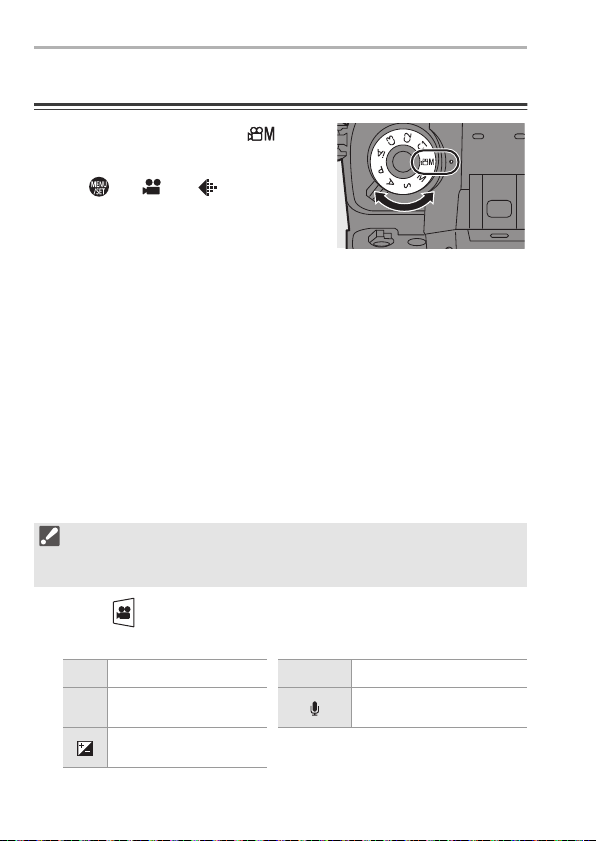
10. Recording Videos
DVQX1939 (ENG)
98
Recording with Creative Video
1
Set the mode dial to [ ].
2
Set the exposure mode.
≥ ¨ [ ] ¨ [ ] ¨ [Exposure
Mode] ¨ [P]/[A]/[S]/[M]
0
You can perform the same exposure
operations as the [P]/[A]/[S]/[M] modes.
3
Close the menu.
≥Press the shutter button halfway.
4
Start recording.
≥Press the shutter button, video rec. button or sub video rec. button.
5
Stop recording.
≥Press the shutter button, video rec. button or sub video rec. button
again.
Operations During Video Recording
Change the exposure and audio settings with touch operation to prevent
operation sounds from being recorded.
1
Touch [ ].
2
Touch an icon.
0 With the default settings, the Touch Tab is not displayed.
Set [Touch Tab] to [ON] in [Touch Settings] in the [Custom] ([Operation])
menu. (l 168)
Aperture value / ISO sensitivity/Gain (dB)
Shutter speed
Sound recording level
adjustment
Exposure
compensation
F
ISO
GAIN
SS
DC-S1HP-DVQX1939_eng.book 98 ページ 2019年8月9日 金曜日 午後4時45分

10. Recording Videos
DVQX1939 (ENG)
99
3
Drag the slide bar to set the item.
0
If you touch icon A, the screen of Step
2
is redisplayed.
[CreativeVideo Combined Set.]
In default settings, settings such as exposure and white balance changed
in [ ] mode are also reflected in picture recording in [P]/[A]/[S]/[M]
modes.
From the [CreativeVideo Combined Set.] menu, you can separate settings
for video recording and for picture recording.
¨ [ ] ¨ [ ] ¨ Select [CreativeVideo Combined Set.]
[ ]/[ ]: Changes the setting slowly.
[ ]/[ ]: Changes the setting quickly.
[F/SS/ISO/Exposure
Comp.]
[]:
Links recording settings in [ ] mode and [P]/[A]/
[S]/[M] mode.
0 Select to use the same settings in [ ] mode and
[P]/[A]/[S]/[M] mode.
[]:
Configures recording settings in [ ] mode and [P]/
[A]/[S]/[M] mode individually.
0 Select to separate [ ] mode and [P]/[A]/[S]/[M]
mode settings.
[White Balance]
[Photo Style]
[Metering Mode]
[AF Mode]
DC-S1HP-DVQX1939_eng.book 99 ページ 2019年8月9日 金曜日 午後4時45分
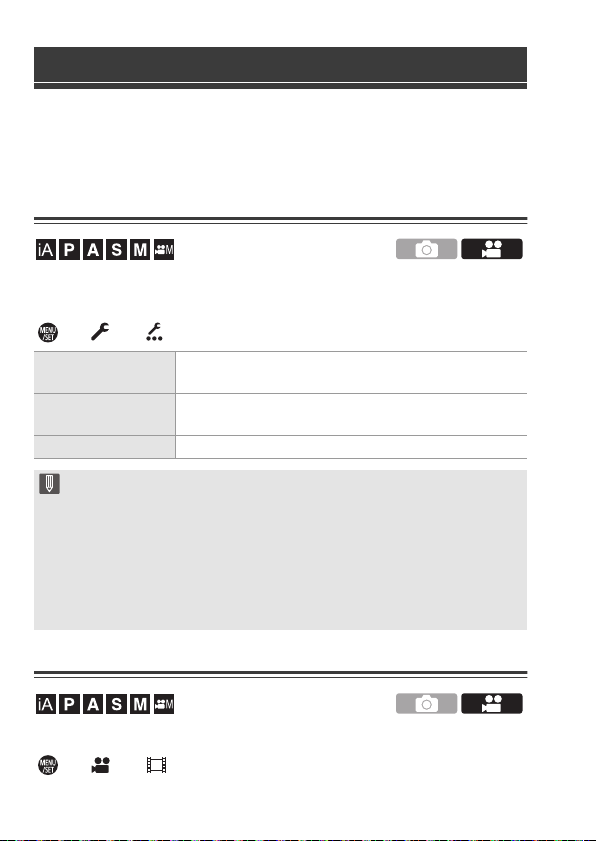
10. Recording Videos
DVQX1939 (ENG)
100
This section describes the settings used when video recording.
[System Frequency]
This changes the system frequency of videos that are recorded and played
back with the camera.
¨ [ ] ¨ [ ] ¨ Select [System Frequency]
[Rec. File Format]
Sets the recording file format of videos to be recorded.
¨ [ ] ¨ [ ] ¨ Select [Rec. File Format]
Recording Video
0 The functions described below work with both pictures and videos:
Please also refer to that section.
– [Double Card Slot Function]: l 64 – [Folder / File Settings]: l 65
[59.94Hz (NTSC)]
System frequency for regions using the NTSC
broadcasting system
[50.00Hz (PAL)]
System frequency for regions using the PAL broadcasting
system
[24.00Hz (CINEMA)] System frequency for producing cinema film
0 If you record using a system frequency that differs from the broadcasting
system of your region, it may not be possible for you to properly play back
videos on your TV.
We recommend using the setting as it was at the time of purchase if you are
unsure about broadcasting systems or if you will not be involved in producing
cinema film.
0 After changing the setting, it is recommended to insert another card and
format it with this camera.
DC-S1HP-DVQX1939_eng.book 100 ページ 2019年8月9日 金曜日 午後4時45分
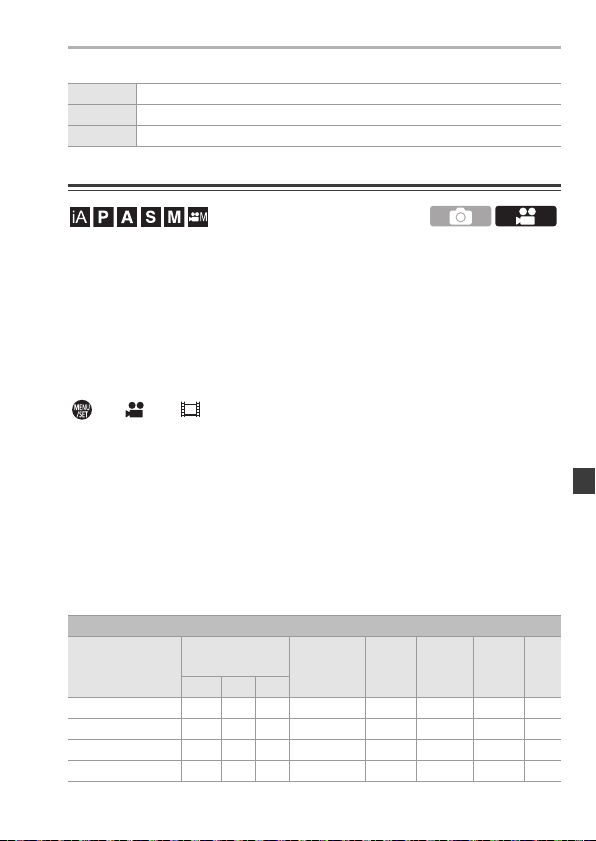
10. Recording Videos
DVQX1939 (ENG)
101
[Rec Quality]
Sets the image quality of videos to be recorded. The image qualities you
can select depend on the [System Frequency] and [Rec. File Format]
settings. The [Image Area of Video] you can select differs depending on
the [Rec Quality] settings.
[Rec Quality] settings can also be made using [Filtering] (l 107) to display
only items that meet your conditions and [add to list] (l 108) to register
recording qualities you use often.
¨ [ ] ¨ [ ] ¨ Select [Rec Quality]
0
To record video with a bit rate of 72 Mbps or more, you require a card with the
corresponding Speed Class.
For information about the cards that can be used, refer to page 20.
[Rec. File Format]: [AVCHD]
0 YUV, Bit value, Image compression: 4:2:0, 8-bit, Long GOP
0 Audio format: Dolby Audio
TM
(2ch)
A Recording frame rate
B Bit rate
C Video compression format (AVC: H.264/MPEG-4 AVC)
[AVCHD] This file format is suitable for playback on high-definition TVs.
[MP4] This file format is suitable for playback on PCs.
[MOV] This file format is suitable for image editing.
[System Frequency]: [59.94Hz (NTSC)]
[Rec Quality]
[Image Area of
Video]
Resolution
Aspect
ratio
A B
(Mbps)
C
FULL S35 P/P
[FHD/28M/60p]
¢1
3331920k1080 16:9 59.94p 28 AVC
[FHD/17M/60i] 3331920k1080 16:9 59.94i 17 AVC
[FHD/24M/30p] 3331920k1080 16:9 59.94i
¢2
24 AVC
[FHD/24M/24p] 3331920k1080 16:9 23.98p 24 AVC
DC-S1HP-DVQX1939_eng.book 101 ページ 2019年8月9日 金曜日 午後4時45分
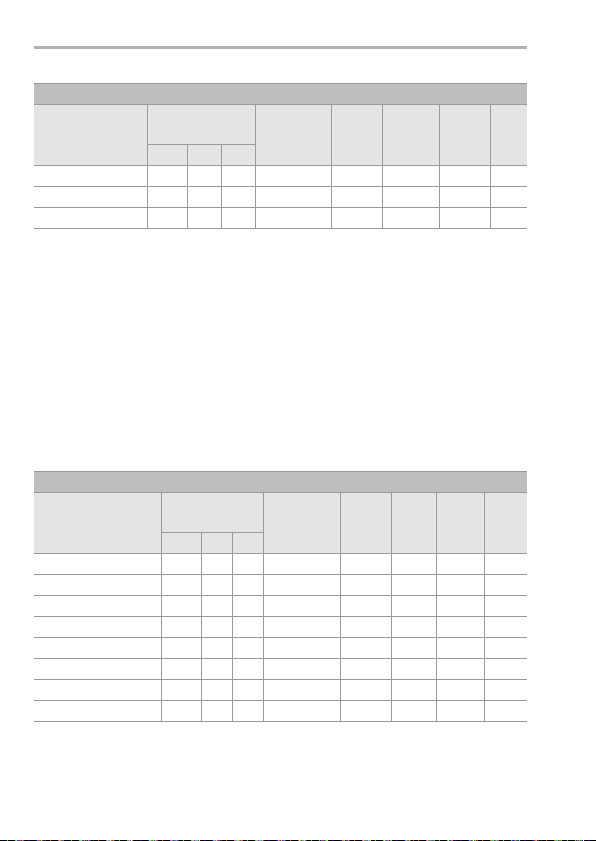
10. Recording Videos
DVQX1939 (ENG)
102
¢1 AVCHD Progressive
¢2 Sensor output: 29.97 fps
¢3 Sensor output: 25.00 fps
[Rec. File Format]: [MP4]
0 YUV, Bit value, Image compression
– [10bit] recording quality: 4:2:0, 10-bit, Long GOP
– [8bit] recording quality: 4:2:0, 8-bit, Long GOP
0 Audio format: AAC (2ch)
A Recording frame rate
B Bit rate
C Video compression format (HEVC: H.265/HEVC, AVC: H.264/MPEG-4 AVC)
[System Frequency]: [50.00Hz (PAL)]
[Rec Quality]
[Image Area of
Video]
Resolution
Aspect
ratio
A B
(Mbps)
C
FULL S35 P/P
[FHD/28M/50p]
¢1
3331920k1080 16:9 50.00p 28 AVC
[FHD/17M/50i] 3331920k1080 16:9 50.00i 17 AVC
[FHD/24M/25p] 3331920k1080 16:9 50.00i
¢3
24 AVC
[System Frequency]: [59.94Hz (NTSC)]
[Rec Quality]
[Image Area of
Video]
Resolution
Aspect
ratio
A B
(Mbps)
C
FULL S35 P/P
[4K/10bit/100M/60p] 333840k2160 16:9
59.94p
100 HEVC
[4K/8bit/100M/30p] 3333840k2160 16:9
29.97p
100 AVC
[4K/10bit/72M/30p] 3333840k2160 16:9
29.97p
72 HEVC
[4K/8bit/100M/24p] 3333840k2160 16:9
23.98p
100 AVC
[4K/10bit/72M/24p] 3333840k2160 16:9
23.98p
72 HEVC
[FHD/8bit/28M/60p] 3331920k1080 16:9
59.94p
28 AVC
[FHD/8bit/24M/24p] 3331920k1080 16:9
23.98p
24 AVC
[FHD/8bit/20M/30p] 3331920k1080 16:9
29.97p
20 AVC
DC-S1HP-DVQX1939_eng.book 102 ページ 2019年8月9日 金曜日 午後4時45分
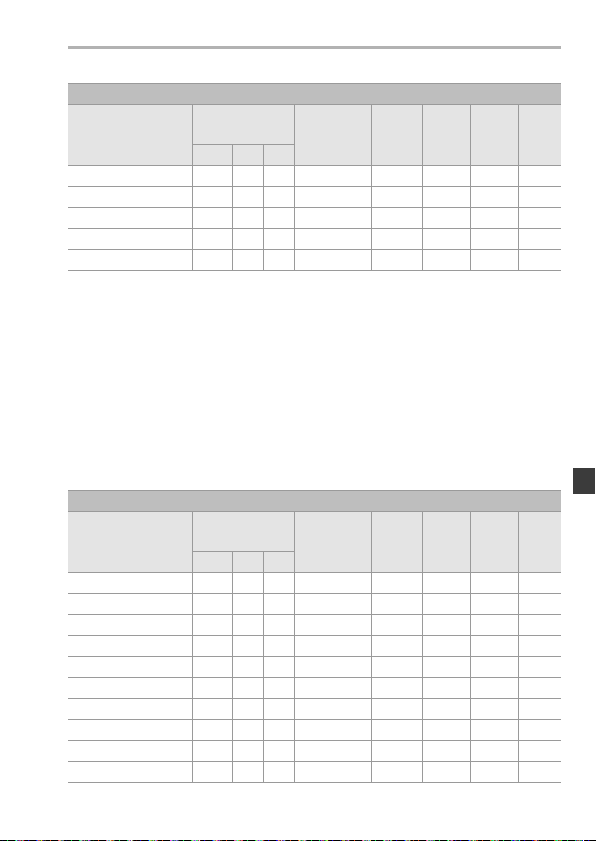
10. Recording Videos
DVQX1939 (ENG)
103
[Rec. File Format]: [MOV]
0 YUV, Bit value, Image compression
– [422/10-I] recording quality: 4:2:2, 10-bit, ALL-Intra
– [422/10-L] recording quality: 4:2:2, 10-bit, Long GOP
– [420/10-L] recording quality: 4:2:0, 10-bit, Long GOP
– [420/8-L] recording quality: 4:2:0, 8-bit, Long GOP
0 Audio format: LPCM (2ch)
A Recording frame rate
B Bit rate
C Video compression format (HEVC: H.265/HEVC, AVC: H.264/MPEG-4 AVC)
[System Frequency]: [50.00Hz (PAL)]
[Rec Quality]
[Image Area of
Video]
Resolution
Aspect
ratio
A B
(Mbps)
C
FULL S35 P/P
[4K/10bit/100M/50p]
333840k2160 16:9 50.00p 100 HEVC
[4K/8bit/100M/25p] 3333840k2160 16:9 25.00p 100 AVC
[4K/10bit/72M/25p] 3333840k2160 16:9 25.00p 72 HEVC
[FHD/8bit/28M/50p] 3331920k1080 16:9 50.00p 28 AVC
[FHD/8bit/20M/25p] 3331920k1080 16:9 25.00p 20 AVC
[System Frequency]: [59.94Hz (NTSC)]
[Rec Quality]
[Image Area of
Video]
Resolution
Aspect
ratio
A B
(Mbps)
C
FULL S35 P/P
[6K/24p/420/10-L] 3 5952k3968 3:2 23.98p 200 HEVC
[5.9K/30p/420/10-L] 3 5888k3312 16:9 29.97p 200 HEVC
[5.9K/24p/420/10-L] 3 5888k3312 16:9 23.98p 200 HEVC
[5.4K/30p/420/10-L] 3 5376k3584 3:2 29.97p 200 HEVC
[4K-A/48p/420/10-L]
333328k2496 4:3 47.95p 200 HEVC
[4K-A/30p/422/10-I] 333328k2496 4:3 29.97p 400 AVC
[4K-A/30p/422/10-L]
333328k2496 4:3 29.97p 150 AVC
[4K-A/30p/420/8-L] 333328k2496 4:3 29.97p 100 AVC
[4K-A/24p/422/10-I] 333328k2496 4:3 23.98p 400 AVC
[4K-A/24p/422/10-L]
333328k2496 4:3 23.98p 150 AVC
DC-S1HP-DVQX1939_eng.book 103 ページ 2019年8月9日 金曜日 午後4時45分

10. Recording Videos
DVQX1939 (ENG)
104
[System Frequency]: [59.94Hz (NTSC)]
[Rec Quality]
[Image Area of
Video]
Resolution
Aspect
ratio
A B
(Mbps)
C
FULL S35 P/P
[4K-A/24p/420/8-L] 33
3328
k
2496
4:3 23.98p 100 AVC
[C4K/60p/420/10-L] 33
4096
k
2160
17:9 59.94p 200 HEVC
[C4K/60p/420/8-L] 33
4096
k
2160
17:9 59.94p 150 AVC
[C4K/48p/420/10-L] 33
4096
k
2160
17:9 47.95p 200 HEVC
[C4K/30p/422/10-I] 333
4096
k
2160
17:9 29.97p 400 AVC
[C4K/30p/422/10-L] 333
4096
k
2160
17:9 29.97p 150 AVC
[C4K/30p/420/8-L] 333
4096
k
2160
17:9 29.97p 100 AVC
[C4K/24p/422/10-I] 333
4096
k
2160
17:9 23.98p 400 AVC
[C4K/24p/422/10-L] 333
4096
k
2160
17:9 23.98p 150 AVC
[C4K/24p/420/8-L] 333
4096
k
2160
17:9 23.98p 100 AVC
[4K/60p/420/10-L] 33
3840
k
2160
16:9 59.94p 200 HEVC
[4K/60p/420/8-L] 33
3840
k
2160
16:9 59.94p 150 AVC
[4K/48p/420/10-L] 33
3840
k
2160
16:9 47.95p 200 HEVC
[4K/30p/422/10-I] 333
3840
k
2160
16:9 29.97p 400 AVC
[4K/30p/422/10-L] 333
3840
k
2160
16:9 29.97p 150 AVC
[4K/30p/420/8-L] 333
3840
k
2160
16:9 29.97p 100 AVC
[4K/24p/422/10-I] 333
3840
k
2160
16:9 23.98p 400 AVC
[4K/24p/422/10-L] 333
3840
k
2160
16:9 23.98p 150 AVC
[4K/24p/420/8-L] 333
3840
k
2160
16:9 23.98p 100 AVC
[FHD/120p/420/10-L]
33
1920
k
1080
16:9
119.88p
150 HEVC
[FHD/60p/422/10-I] 333
1920
k
1080
16:9 59.94p 200 AVC
[FHD/60p/422/10-L] 333
1920
k
1080
16:9 59.94p 100 AVC
[FHD/60p/420/8-L] 333
1920
k
1080
16:9 59.94p 100 AVC
[FHD/60i/422/10-I] 333
1920
k
1080
16:9 59.94i 100 AVC
[FHD/60i/422/10-L] 333
1920
k
1080
16:9 59.94i 50 AVC
[FHD/48p/420/10-L] 333
1920
k
1080
16:9 47.95p 100 HEVC
[FHD/30p/422/10-I] 333
1920
k
1080
16:9 29.97p 200 AVC
DC-S1HP-DVQX1939_eng.book 104 ページ 2019年8月9日 金曜日 午後4時45分
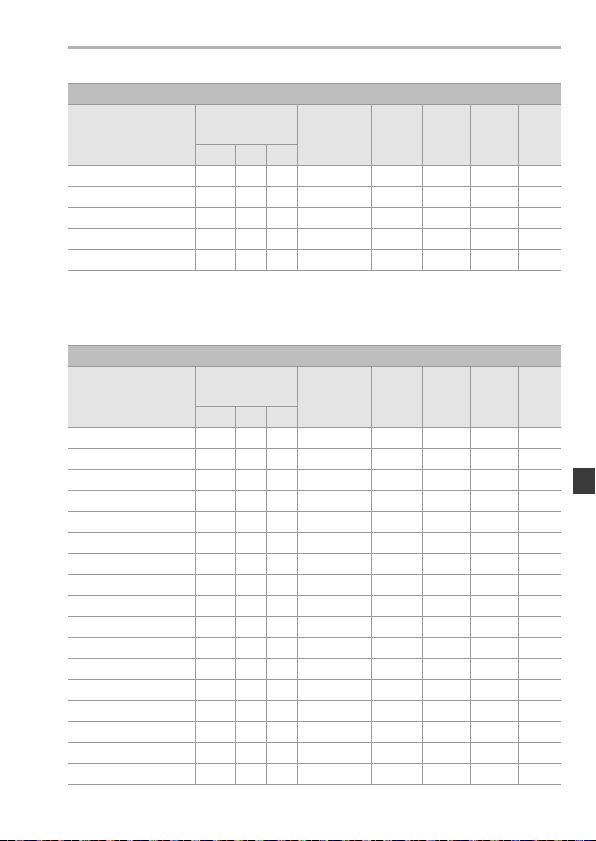
10. Recording Videos
DVQX1939 (ENG)
105
A Recording frame rate
B Bit rate
C Video compression format (HEVC: H.265/HEVC, AVC: H.264/MPEG-4 AVC)
[System Frequency]: [59.94Hz (NTSC)]
[Rec Quality]
[Image Area of
Video]
Resolution
Aspect
ratio
A B
(Mbps)
C
FULL S35 P/P
[FHD/30p/422/10-L] 333
1920
k
1080
16:9 29.97p 100 AVC
[FHD/30p/420/8-L] 333
1920
k
1080
16:9 29.97p 100 AVC
[FHD/24p/422/10-I] 333
1920
k
1080
16:9 23.98p 200 AVC
[FHD/24p/422/10-L] 333
1920
k
1080
16:9 23.98p 100 AVC
[FHD/24p/420/8-L] 333
1920
k
1080
16:9 23.98p 100 AVC
[System Frequency]: [50.00Hz (PAL)]
[Rec Quality]
[Image Area of
Video]
Resolution
Aspect
ratio
A B
(Mbps)
C
FULL S35 P/P
[5.9K/25p/420/10-L] 3
5888
k
3312
16:9 25.00p 200 HEVC
[5.4K/25p/420/10-L] 3
5376
k
3584
3:2 25.00p 200 HEVC
[4K-A/50p/420/10-L] 33
3328
k
2496
4:3 50.00p 200 HEVC
[4K-A/50p/420/8-L] 33
3328
k
2496
4:3 50.00p 150 AVC
[4K-A/25p/422/10-I] 33
3328
k
2496
4:3 25.00p 400 AVC
[4K-A/25p/422/10-L] 33
3328
k
2496
4:3 25.00p 150 AVC
[4K-A/25p/420/8-L] 33
3328
k
2496
4:3 25.00p 100 AVC
[C4K/50p/420/10-L] 33
4096
k
2160
17:9 50.00p 200 HEVC
[C4K/50p/420/8-L] 33
4096
k
2160
17:9 50.00p 150 AVC
[C4K/25p/422/10-I] 333
4096
k
2160
17:9 25.00p 400 AVC
[C4K/25p/422/10-L] 333
4096
k
2160
17:9 25.00p 150 AVC
[C4K/25p/420/8-L] 333
4096
k
2160
17:9 25.00p 100 AVC
[4K/50p/420/10-L] 33
3840
k
2160
16:9 50.00p 200 HEVC
[4K/50p/420/8-L] 33
3840
k
2160
16:9 50.00p 150 AVC
[4K/25p/422/10-I] 333
3840
k
2160
16:9 25.00p 400 AVC
[4K/25p/422/10-L] 333
3840
k
2160
16:9 25.00p 150 AVC
[4K/25p/420/8-L] 333
3840
k
2160
16:9 25.00p 100 AVC
DC-S1HP-DVQX1939_eng.book 105 ページ 2019年8月9日 金曜日 午後4時45分
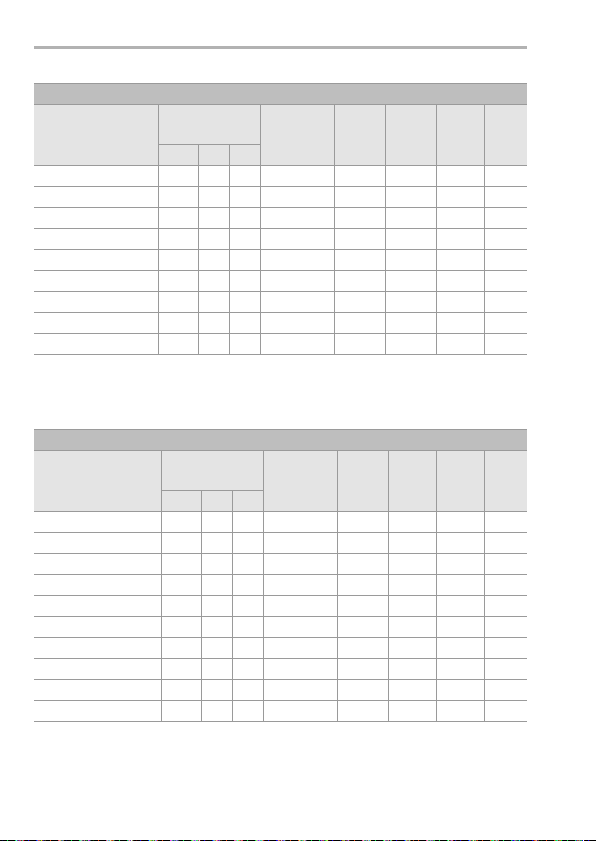
10. Recording Videos
DVQX1939 (ENG)
106
A Recording frame rate
B Bit rate
C Video compression format (HEVC: H.265/HEVC, AVC: H.264/MPEG-4 AVC)
[System Frequency]: [50.00Hz (PAL)]
[Rec Quality]
[Image Area of
Video]
Resolution
Aspect
ratio
A B
(Mbps)
C
FULL S35 P/P
[FHD/100p/420/10-L]
33
1920
k
1080
16:9
100.00p
150 HEVC
[FHD/50p/422/10-I] 333
1920
k
1080
16:9 50.00p 200 AVC
[FHD/50p/422/10-L] 333
1920
k
1080
16:9 50.00p 100 AVC
[FHD/50p/420/8-L] 333
1920
k
1080
16:9 50.00p 100 AVC
[FHD/50i/422/10-I] 333
1920
k
1080
16:9 50.00i 100 AVC
[FHD/50i/422/10-L] 333
1920
k
1080
16:9 50.00i 50 AVC
[FHD/25p/422/10-I] 333
1920
k
1080
16:9 25.00p 200 AVC
[FHD/25p/422/10-L] 333
1920
k
1080
16:9 25.00p 100 AVC
[FHD/25p/420/8-L] 333
1920
k
1080
16:9 25.00p 100 AVC
[System Frequency]: [24.00Hz (CINEMA)]
[Rec Quality]
[Image Area of
Video]
Resolution
Aspect
ratio
A B
(Mbps)
C
FULL S35 P/P
[6K/24p/420/10-L] 3
5952
k
3968
3:2 24.00p 200 HEVC
[5.9K/24p/420/10-L] 3
5888
k
3312
16:9 24.00p 200 HEVC
[4K-A/48p/420/10-L] 33
3328
k
2496
4:3 48.00p 200 HEVC
[4K-A/24p/422/10-I] 33
3328
k
2496
4:3 24.00p 400 AVC
[4K-A/24p/422/10-L] 33
3328
k
2496
4:3 24.00p 150 AVC
[4K-A/24p/420/8-L] 33
3328
k
2496
4:3 24.00p 100 AVC
[C4K/48p/420/10-L] 33
4096
k
2160
17:9 48.00p 200 HEVC
[C4K/24p/422/10-I] 333
4096
k
2160
17:9 24.00p 400 AVC
[C4K/24p/422/10-L] 333
4096
k
2160
17:9 24.00p 150 AVC
[C4K/24p/420/8-L] 333
4096
k
2160
17:9 24.00p 100 AVC
DC-S1HP-DVQX1939_eng.book 106 ページ 2019年8月9日 金曜日 午後4時45分
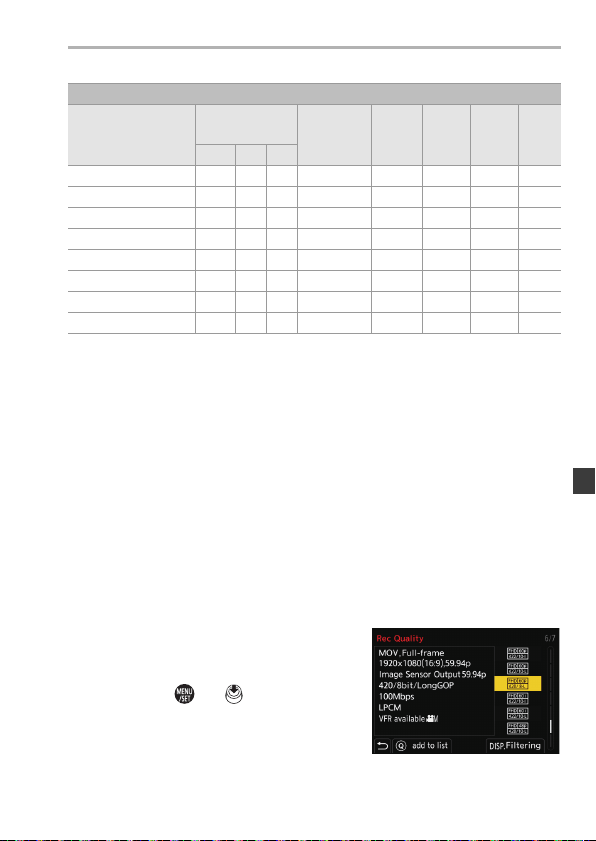
10. Recording Videos
DVQX1939 (ENG)
107
0 In this document, videos are indicated as follows according to their resolution:
– 6K (5952k3968) video: 6K video
– 5.9K (5888k3312) video: 5.9K video
– 5.4K (5376k3584) video: 5.4K video
– 4K-A (3328k2496) video: Anamorphic (4:3) video
– C4K (4096k2160) video: C4K video
– 4K (3840k2160) video: 4K video
– Full High Definition (1920k1080) video: FHD video
0 When using Super 35 mm/APS-C lenses, 6K, 5.9K, and 5.4K [Rec Quality] cannot
be set.
[Filtering]
When the [Rec. File Format] is set to [MOV], you can specify items such as
frame rate, resolution, and codec (YUV, Bit value, Image compression),
and just display recording quality that meets those conditions.
1
In the [Rec Quality] setting screen,
press [DISP.].
2
Press 34 to select a setting item and
then press or .
0
Settings: [Frame Rate]/[Resolution]/
[Codec]/[Variable Frame Rate]/[Hybrid Log
Gamma]
[System Frequency]: [24.00Hz (CINEMA)]
[Rec Quality]
[Image Area of
Video]
Resolution
Aspect
ratio
A B
(Mbps)
C
FULL S35 P/P
[4K/48p/420/10-L] 33
3840
k
2160
16:9 48.00p 200 HEVC
[4K/24p/422/10-I] 333
3840
k
2160
16:9 24.00p 400 AVC
[4K/24p/422/10-L] 333
3840
k
2160
16:9 24.00p 150 AVC
[4K/24p/420/8-L] 333
3840
k
2160
16:9 24.00p 100 AVC
[FHD/48p/420/10-L] 333
1920
k
1080
16:9 48.00p 100 HEVC
[FHD/24p/422/10-I] 333
1920
k
1080
16:9 24.00p 200 AVC
[FHD/24p/422/10-L] 333
1920
k
1080
16:9 24.00p 100 AVC
[FHD/24p/420/8-L] 333
1920
k
1080
16:9 24.00p 100 AVC
DC-S1HP-DVQX1939_eng.book 107 ページ 2019年8月9日 金曜日 午後4時45分
10. Recording Videos
DVQX1939 (ENG)
108
3
Press 34 to select the filtering conditions and then press or .
4
Press [DISP.] to set.
0
You are returned to the [Rec Quality] setting screen.
Clearing the filtering conditions
Select [ANY] in Step 3.
0
The filtering conditions are also cleared when you do the following:
– Changing the [System Frequency]
– Select a recording quality from [Rec Quality (My List)]
[add to list]
Select a recording quality and register it in My List. The recording quality
you register can be set in [Rec Quality (My List)].
In the [Rec Quality] setting screen, press [Q].
0
The following settings are also registered at the same time:
– [System Frequency]
– [Rec. File Format]
– [Image Area of Video]
Setting or deleting in My List
1
Select [Rec Quality (My List)].
0
¨ [ ] ¨ [ ] ¨ [Rec Quality (My List)]
2
Press 34 to select a setting item and then press or .
0
You cannot select setting items that have different system frequencies.
0 To delete from My List, select the item and press [Q].
[Image Area of Video]
Set the image area during video recording. The angle of view differs
depending on the image area. Narrowing the image area allows you to
achieve a telescopic effect without image deterioration.
0 When you change recording quality using a filter, the current filtering
conditions are stored.
DC-S1HP-DVQX1939_eng.book 108 ページ 2019年8月9日 金曜日 午後4時45分
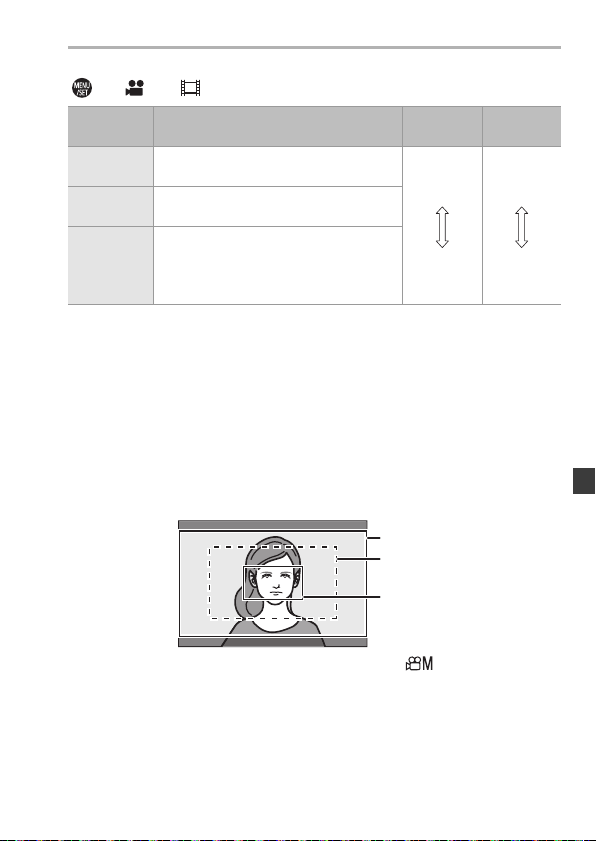
10. Recording Videos
DVQX1939 (ENG)
109
¨ [ ] ¨ [ ] ¨ Select [Image Area of Video]
0
The [Image Area of Video] settings you can select differ depending on the [Rec
Quality] setting.
For details, refer to page 101.
0 It is not possible to set to [FULL] in the following cases.
– When using Super 35 mm/APS-C lenses
– When [Image Circle] in [Lens Information] is set to [S35mm]
0 When set to [Live Cropping], the setting is fixed to [FULL]. However, the setting is
fixed to [S35mm] in the following cases:
– When a 59.94p or 50.00p [Rec Quality] is set
Image area (Ex.: FHD video)
0
To check the image area in recording modes other than [ ] mode, set [Video-
Priority Display] in the [Custom] ([Monitor / Display (Video)]) menu to [ON].
Item Settings details
Angle of
view
Telescopic
effect
[FULL]
Recording is within the area suited to the
image circle of a full-frame lens.
Wide
Narrow
None
High
[S35mm]
Recording is within the area suited to the
image circle of a Super 35 mm lens.
[PIXEL/
PIXEL]
Records with one pixel on the sensor,
which is equal to one pixel of the video.
Records a range corresponding to the
resolution range in [Rec Quality]. (l 101)
FULL
PIXEL/PIXEL
S35mm
DC-S1HP-DVQX1939_eng.book 109 ページ 2019年8月9日 金曜日 午後4時45分
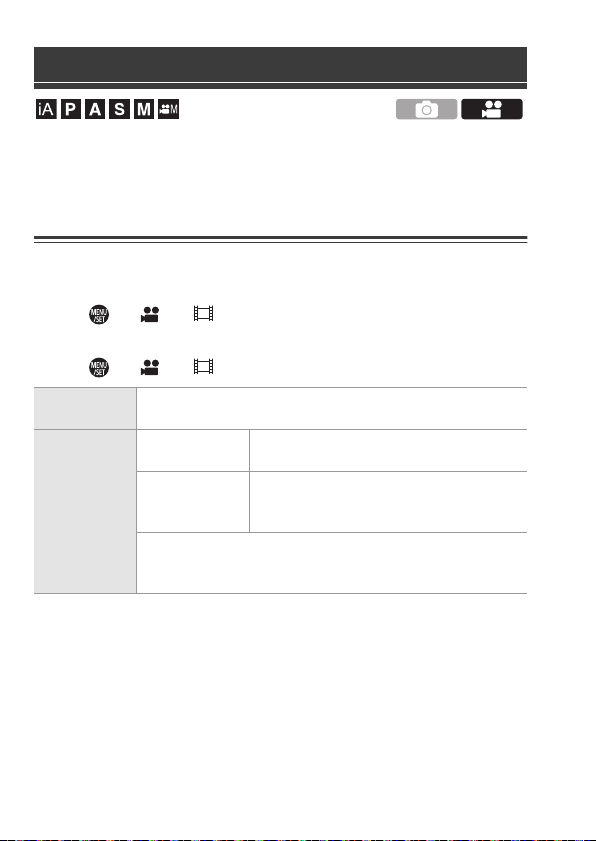
10. Recording Videos
DVQX1939 (ENG)
110
When [Rec. File Format] is set to [AVCHD] or [MOV], the time code is
automatically recorded during video recording. If [MP4], the time code is
not recorded.
Setting the Time Code
Sets the recording, display, and output of the time code.
1
Set [Rec. File Format] to [AVCHD] or [MOV].
≥ ¨ [ ] ¨ [ ] ¨ [Rec. File Format] ¨ [AVCHD]/[MOV]
2
Select [Time Code].
≥ ¨ [ ] ¨ [ ] ¨ [Time Code]
Time Code
[Time Code
Display]
Displays the time code on the recording screen/playback screen.
[Count Up]
[REC RUN]
Counts the time code only when recording
videos.
[FREE RUN]
Counts the time code also when video
recording is stopped and when the camera is
turned off.
0 When the following function is being used, [Count Up] is fixed to
[REC RUN]:
– [Variable Frame Rate]
DC-S1HP-DVQX1939_eng.book 110 ページ 2019年8月9日 金曜日 午後4時45分
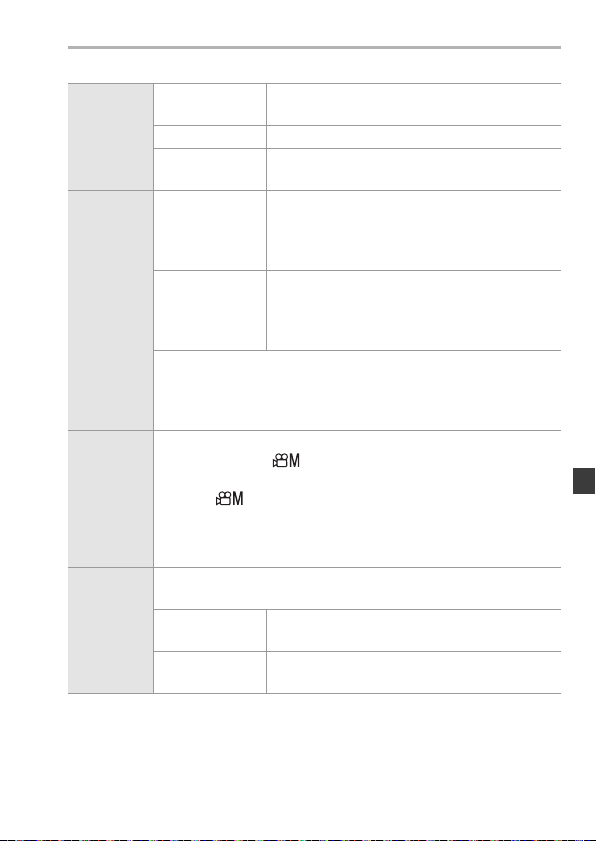
10. Recording Videos
DVQX1939 (ENG)
111
[Time
Code
Value]
[Reset]
Sets to 00:00:00:00 (hour: minute: second:
frame)
[Manual Input] Manually input hour, minute, second and frame.
[Current Time]
Sets hour, minute and second to current time
and sets frame to 00.
[Time
Code
Mode]
[DF]
Drop Frame. The camera modifies the difference
between recorded time and time code.
0 Seconds and frames are separated by “.”.
(Example: 00:00:00.00)
[NDF]
Non-Drop Frame. Records the time code without
drop frame.
0 Seconds and frames are separated by “:”.
(Example: 00:00:00:00)
0 When the following functions are being used, [Time Code Mode] is
fixed to [NDF]:
– [50.00Hz (PAL)]/[24.00Hz (CINEMA)] ([System Frequency])
– 47.95p or 23.98p [Rec Quality]
[HDMI
Time Code
Output]
Time code information is added to images output via HDMI when
recording with the [ ] mode.
0 The time code can also be output via HDMI by setting the mode
dial to [ ] during playback. In the [Setup] ([IN/OUT]) menu, set
[HDMI Mode (Playback)] in [TV Connection] to [AUTO].
0 The device screen may go dark depending on the connected
device.
[External
TC Setting]
Synchronize the time code default value with an external device that
supports time code input and output. (l 112)
[TC
Synchronization]
Selects the input (l 114) and output (l 113) for
time code signals.
[TC Output
Reference]
Sets the timing for time code signal output.
(l 113)
DC-S1HP-DVQX1939_eng.book 111 ページ 2019年8月9日 金曜日 午後4時45分
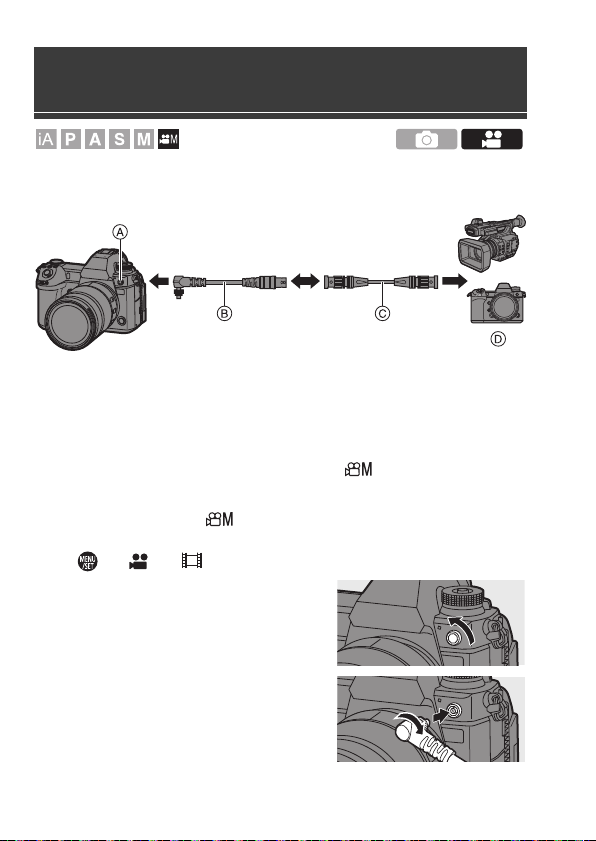
10. Recording Videos
DVQX1939 (ENG)
112
Synchronize the time code default value with an external device that
supports time code signal input and output.
A Flash synchro socket
B BNC conversion cable (for TC IN/OUT) (supplied)
C BNC cable (commercially available)
D External devices
Preparations for Time Code Synchronization
When [Count Up] is set to [FREE RUN] in the [ ] mode, you can
synchronize the initial value of the time code with an external device.
1
Set the mode dial to [ ].
2
Set [Count Up] to [FREE RUN].
0
¨ [ ] ¨ [ ] ¨ [Time Code] ¨ [Count Up] ¨ [FREE RUN]
3
Rotate the flash synchro socket cap in
the direction of the arrow to remove.
0
Be careful not to lose the flash synchro
socket cap.
4
Insert the BNC conversion cable (for
TC IN/OUT), and then rotate the
locking screw in the direction of the
arrow to attach the cable.
Synchronizing the Time Code with an
External Device
DC-S1HP-DVQX1939_eng.book 112 ページ 2019年8月9日 金曜日 午後4時45分
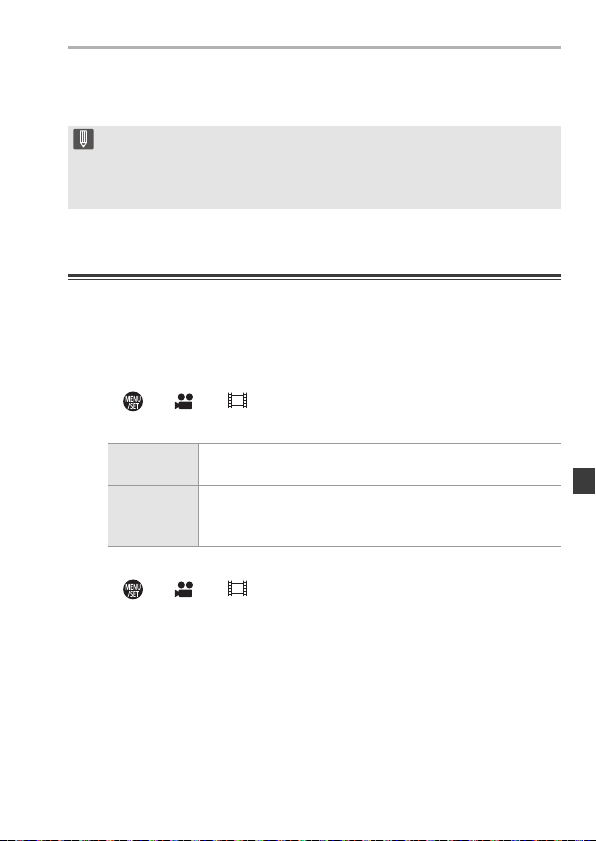
10. Recording Videos
DVQX1939 (ENG)
113
5
Connect the BNC conversion cable (for TC IN/OUT) and the external
device with the BNC cable.
Synchronize the Time Code of the External Device
with That of the Camera (TC OUT)
The initial time code value of the external device is synchronized according
to the time code signal (LTC signal) of the camera.
1
Prepare for time code synchronizing. (l 112)
2
Select [TC Output Reference].
≥ ¨ [ ] ¨ [ ] ¨ [Time Code] ¨ [External TC Setting] ¨ [TC
Output Reference]
3
Set [TC Synchronization] to [TC OUT].
≥ ¨ [ ] ¨ [ ] ¨ [Time Code] ¨ [External TC Setting] ¨ [TC
Synchronization]
¨ [TC OUT]
≥The time code signal is output according to the recording frame
rate of the [Rec Quality] and the [Time Code Mode] ([DF]/[NDF])
setting.
4
Operate the external device to synchronize the time
code.
0 Do not use any other BNC conversion cables (for TC IN/OUT) except the
supplied one.
0 Do not use the BNC cables with the length of 2.8 m (9.2 feet) or more.
0 We recommend using a 5C-FB equivalent double-shielded BNC cables.
[Recording
Reference]
Outputs the time code signal for the images that you record.
[HDMI
Reference]
When connected with an external device (external recorder,
etc.) via HDMI, the time code signal output is delayed slightly
to match the HDMI images.
DC-S1HP-DVQX1939_eng.book 113 ページ 2019年8月9日 金曜日 午後4時45分
10. Recording Videos
DVQX1939 (ENG)
114
Outputting the Time Code Signal Again
By setting as follows, the time code signal (LTC signal) can be output just
by connecting with the external device with the BNC cable:
– [ ] mode
– [Count Up] ([Time Code]): [FREE RUN]
– [TC Synchronization] ([External TC Setting] in [Time Code]): [TC OUT]
Synchronize the Time Code of the Camera with That
of the External Device (TC IN)
The initial time code value of the camera is synchronized according to the
time code signal (LTC signal) of the external device.
1
Prepare for time code synchronizing. (l 112)
2
Set [TC Synchronization] to [TC IN].
≥ ¨ [ ] ¨ [ ] ¨ [Time Code] ¨ [External TC Setting] ¨ [TC
Synchronization]
¨ [TC IN]
3
Operate the external device to output the time code
signal.
≥Set the time code count method of the external device to free run,
and output the signal.
≥When synchronized with the time code of an external device, this
camera is in a slave state, and the [ ] of the time code shown
on the screen switches to [ ].
Maintaining, Releasing, and Restoring the Slave State
Even if you disconnect the BNC cable, the camera will remain in slave
state.
0
Perform one of the following operations to release the camera from the slave state.
– Operate the camera on/off switch
– Switch the recording mode
0 In advance, change the [System Frequency] (l 100), [Rec Quality] (l 101),
and [Time Code Mode] (l 111) to match the external device.
DC-S1HP-DVQX1939_eng.book 114 ページ 2019年8月9日 金曜日 午後4時45分
10. Recording Videos
DVQX1939 (ENG)
115
– Change the [System Frequency]
– Set the [Variable Frame Rate]
– Switch the [Rec Quality] between 47.95p/23.98p and a different recording frame
rate
– Change the following [Time Code] setting items
[Count Up], [Time Code Value], [Time Code Mode], [TC Synchronization]
0 To restore the slave state, reconnect the BNC cable to the external device while set
as follows.
The time code signal (LTC signal) can be input just by connecting.
– [ ] mode
– [Count Up] ([Time Code]): [FREE RUN]
– [TC Synchronization] ([External TC Setting] in [Time Code]): [TC IN]
This section describes the use of AF when video recording.
[Continuous AF]
You can select how to set the focus in AF when recording videos.
¨ [ ] ¨ [ ] ¨ Select [Continuous AF]
0 Even when the system frequency differs between the camera and the external
device, their initial time code values may be synchronized. Bear in mind,
however, that the time codes lose sync as they count up.
Using AF (Video)
0 The functions described below work with both pictures and videos:
Please also refer to that section.
– Focus Mode: l 47
– AF Mode: l 67
– AF Area Movement Operation: l 71
– MF: l 72
– Zoom: l 74
DC-S1HP-DVQX1939_eng.book 115 ページ 2019年8月9日 金曜日 午後4時45分
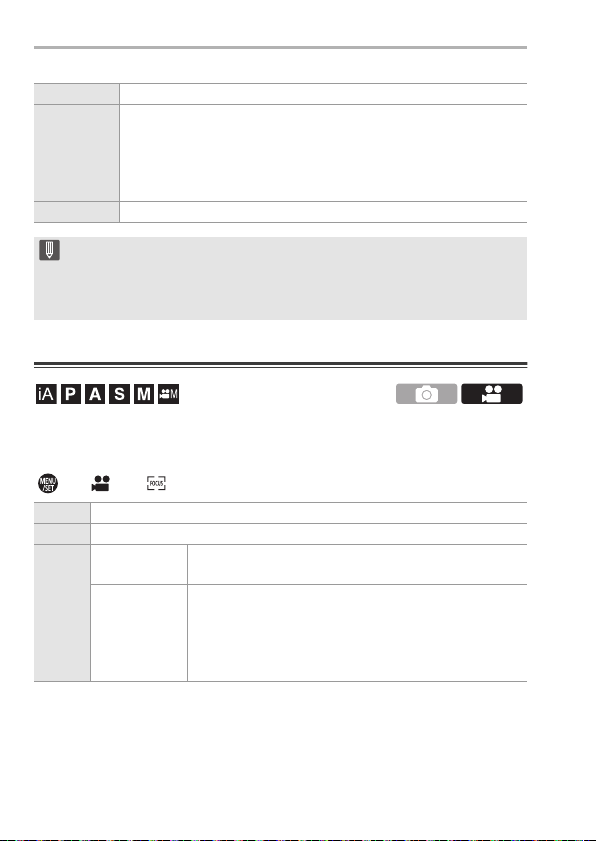
10. Recording Videos
DVQX1939 (ENG)
116
[AF Custom Setting(Video)]
You can fine-adjust the focusing method for video recording using
[Continuous AF].
¨ [ ] ¨ [ ] ¨ Select [AF Custom Setting(Video)]
[MODE1] The camera continues to automatically focus only during recording.
[MODE2]
The camera automatically keeps focusing on subjects during
recording standby and during recording.
0 To keep focusing on subjects during recording standby while in the
[P]/[A]/[S]/[M] modes, set [Video-Priority Display] to [ON] in the
[Custom] ([Monitor / Display (Video)]) menu.
[OFF] The camera maintains the focus point at the start of recording.
0 In the [iA] mode, the camera automatically keeps focusing during recording
standby, irrespective of the [Continuous AF] setting.
0 When the following function is being used, [MODE1] switches to [MODE2]:
– HDMI output
[ON] Enables the following settings.
[OFF] Disables the following settings.
[SET]
[AF Speed]
[r] side: Focus moves at a faster speed.
[s] side: Focus moves at a slower speed.
[AF
Sensitivity]
[r] side: When the distance to the subject changes
significantly, the camera immediately readjusts the focus.
[s] side: When the distance to the subject changes
significantly, the camera waits for a little before
readjusting the focus.
DC-S1HP-DVQX1939_eng.book 116 ページ 2019年8月9日 金曜日 午後4時45分

10. Recording Videos
DVQX1939 (ENG)
117
This section describes the brightness and coloring settings used during
video recording.
[Luminance Level]
You can set the luminance range to suit the purpose of video recording.
¨ [ ] ¨ [ ] ¨ Select [Luminance Level]
Settings: [0-255]/[16-235]/[16-255]
[Master Pedestal Level]
You can adjust the black level, which serves as the reference for images.
1
Set the mode dial to [ ].
2
Select [Master Pedestal Level].
≥ ¨ [ ] ¨ [ ] ¨ [Master Pedestal Level]
3
Adjust master pedestal.
≥Rotate , or .
Video Brightness and Coloring
0 The functions described below work with both pictures and videos:
Please also refer to that section.
– [Metering Mode]: l 80
– Exposure Compensation: l 80
– ISO Sensitivity: l 81
– White Balance: l 84
– [Photo Style]: l 87
0 When [Rec. File Format] is set to [AVCHD], [0-255] cannot be set.
0 When [Photo Style] is set to [V-Log], this is fixed to [0-255] ([0-1023]).
0 When [Photo Style] is set to [Like2100(HLG)], this is fixed to [64-940].
0 [Master Pedestal Level] is not available when using the following function:
– [V-Log] ([Photo Style])
DC-S1HP-DVQX1939_eng.book 117 ページ 2019年8月9日 金曜日 午後4時45分
10. Recording Videos
DVQX1939 (ENG)
118
Recording While Controlling Overexposure (Knee)
When [Photo Style] is set to [Like709], you can adjust the knee so that
recording can be performed with minimal overexposure.
1
Set [Photo Style] to [Like709].
≥ ¨ [ ] ¨ [ ] ¨ [Photo Style] ¨ [Like709]
2
Press [Q].
3
Select a knee setting.
≥Press 21 to select a setting item.
4
Confirm your selection.
≥Press or .
[ISO Sensitivity (video)]
Sets the lower and upper limits for ISO sensitivity when ISO sensitivity is
set to [AUTO].
1
Set the mode dial to [ ].
2
Set [ISO Sensitivity (video)].
≥ ¨ [ ] ¨ [ ] ¨ [ISO Sensitivity (video)]
[AUTO]
Adjusts the compression levels of high-luminance areas
automatically.
[MANUAL]
Press 34 to select an item and then press 21 to adjust.
[POINT]: Master knee point
[SLOPE]: Master knee slope
[Off] —
DC-S1HP-DVQX1939_eng.book 118 ページ 2019年8月9日 金曜日 午後4時45分

10. Recording Videos
DVQX1939 (ENG)
119
[Sound Rec Level Disp.]
The sound recording level is displayed on the recording screen.
¨ [ ] ¨ [ ] ¨ Select [Sound Rec Level Disp.]
Settings: [ON]/[OFF]
[Mute Sound Input]
This mutes audio input.
¨ [ ] ¨ [ ] ¨ Select [Mute Sound Input]
Settings: [ON]/[OFF]
[Sound Rec Gain Level]
This switches the gain of audio input.
¨ [ ] ¨ [ ] ¨ Select [Sound Rec Gain Level]
[ISO Auto Lower Limit
Setting]
Sets the lower limit for ISO sensitivity when ISO
sensitivity is [AUTO].
[ISO Auto Upper Limit
Setting]
Sets the upper limit for ISO sensitivity when ISO
sensitivity is [AUTO].
Audio Settings
[STANDARD] This is the standard input gain setting. (0 dB)
[LOW]
Audio input is reduced for recording in environments with loud
noises. (j12 dB)
DC-S1HP-DVQX1939_eng.book 119 ページ 2019年8月9日 金曜日 午後4時45分
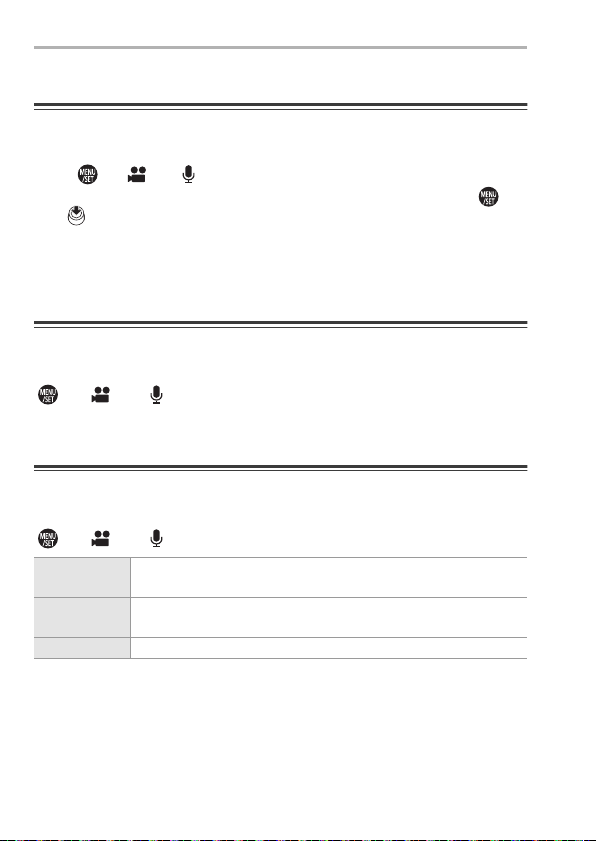
10. Recording Videos
DVQX1939 (ENG)
120
[Sound Rec Level Adj.]
Manually adjust the sound recording level.
1
Select [Sound Rec Level Adj.].
0
¨ [ ] ¨ [ ] ¨ [Sound Rec Level Adj.]
2
Press 21 to adjust the sound recording level and then press or
.
0
You can adjust the sound recording level within the range from [MUTE],
[j18dB] to [i12dB] in steps of 1 dB.
0 Displayed dB values are approximate.
[Sound Rec Level Limiter]
The sound recording level is adjusted automatically to minimize sound
distortion (crackling noise).
¨ [ ] ¨ [ ] ¨ Select [Sound Rec Level Limiter]
Settings: [ON]/[OFF]
[Wind Noise Canceller]
This reduces the wind noise coming into the built-in microphone while
maintaining sound quality.
¨ [ ] ¨ [ ] ¨ Select [Wind Noise Canceller]
0
This function works only with the built-in microphone.
When an external microphone is connected, [Wind Cut] is displayed. (l 148)
[HIGH]
This effectively reduces the wind noise by reducing the low-pitched
sound when a strong wind is detected.
[STANDARD]
This reduces wind noise without loss of sound quality by filtering
out only wind noise.
[OFF] —
DC-S1HP-DVQX1939_eng.book 120 ページ 2019年8月9日 金曜日 午後4時45分
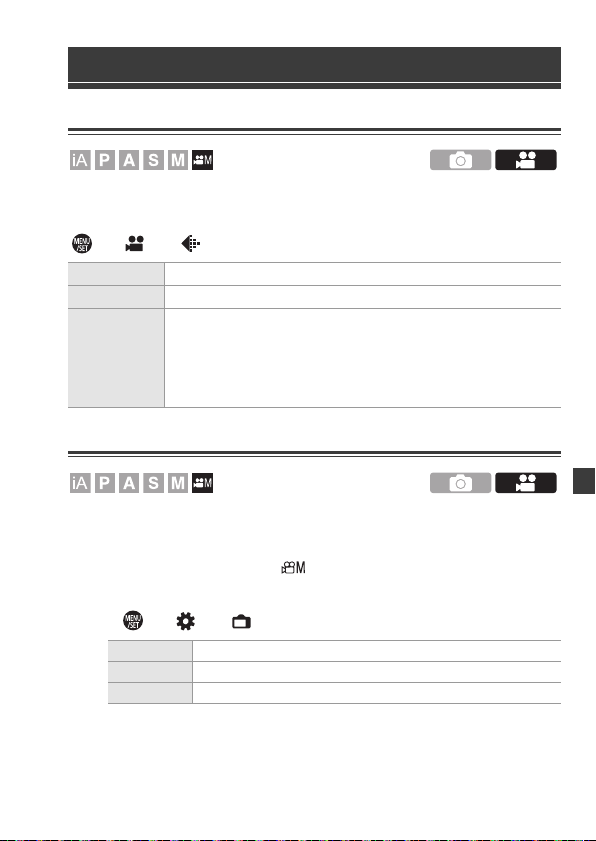
10. Recording Videos
DVQX1939 (ENG)
121
[SS/Gain Operation]
You can switch the units of shutter speed values and gain (sensitivity)
values.
¨ [ ] ¨ [ ] ¨ Select [SS/Gain Operation]
[WFM/Vector Scope]
This displays the waveform monitor or the vector scope on the recording
screen. You can change the size of the waveform display.
1
Set the mode dial to [ ].
2
Set [WFM/Vector Scope].
≥ ¨ [ ] ¨ [ ] ¨ [WFM/Vector Scope]
Main Assist Functions
[SEC/ISO] Displays the shutter speed in seconds and the gain in ISO.
[ANGLE/ISO] Displays the shutter speed in degrees and the gain in ISO.
[SEC/dB]
Displays the shutter speed in seconds and the gain in dB.
0 0 dB corresponds to either of the following ISO sensitivity values.
– When [Dual Native Gain Setting] is set to [AUTO] or [LOW]:
[100]
– When [Dual Native Gain Setting] is set to [HIGH]: [640]
[WAVE] Displays a waveform.
[VECTOR] Displays the vector scope.
[OFF] —
DC-S1HP-DVQX1939_eng.book 121 ページ 2019年8月9日 金曜日 午後4時45分
10. Recording Videos
DVQX1939 (ENG)
122
3
Select the position to display.
≥Press 3421 to select and then press or .
0
Positions can be moved to the diagonal directions using the joystick.
0 You can also move using touch operations.
0 You can also rotate to change the size of the waveform.
[Luminance Spot Meter]
Specify any spot on the subject to measure the luminance over a small
area.
1
Set [Luminance Spot Meter].
≥ ¨ [ ] ¨ [ ] ¨ [Luminance Spot Meter] ¨ [ON]
2
Select the position where you want to measure the
luminance.
≥Press 3421 to select and then press or .
0
Positions can be moved to the diagonal directions using the joystick.
0 You can also change the position by dragging the frame on the recording
screen.
Measurement Range
Measuring is possible in the range j7% to 109% (IRE).
0
When [Photo Style] is set to [V-Log], this can be measured with Stop units.
(Calculated as 0 Stop=42% (IRE))
0 You can also change the position by dragging on the recording screen.
0 The waveform and vector scope are not output through HDMI.
DC-S1HP-DVQX1939_eng.book 122 ページ 2019年8月9日 金曜日 午後4時45分
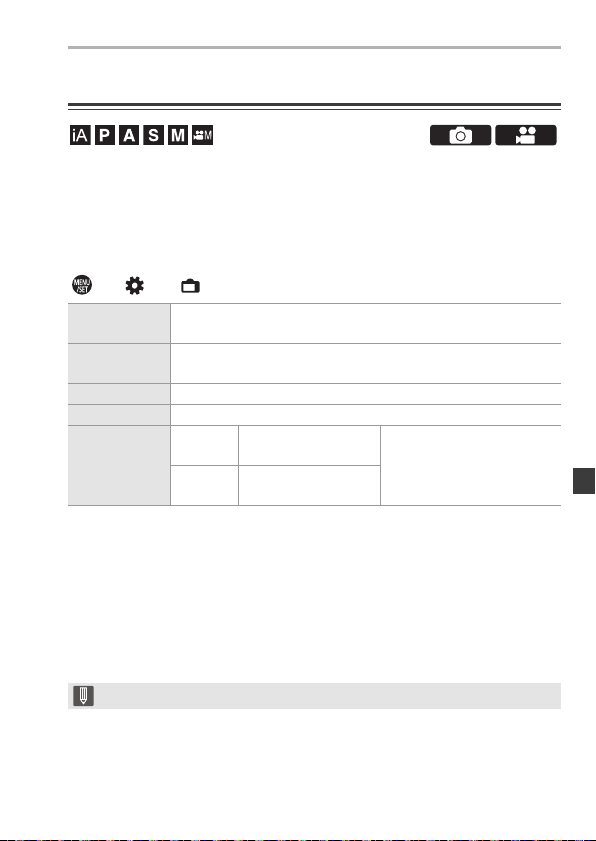
10. Recording Videos
DVQX1939 (ENG)
123
[Zebra Pattern]
Parts that are brighter than the benchmark value are displayed with
stripes.
You can also set the benchmark value and the breadth of the range so that
the stripes are displayed on parts that are within the range of brightness
you specify.
¨ [ ] ¨ [ ] ¨ Select [Zebra Pattern]
When [BASE/RANGE] Was Selected with [SET]
Centered on the brightness set with [Base Level], parts with the brightness
in the range set in [Range] are displayed with the stripes.
≥[Base Level] can be set in the range between 0% and 109% (IRE).
≥[Range] can be set in the range between n1% and n10% (IRE).
0
When [Photo Style] is set to [V-Log], this can be set at Stop units. (Calculated as
0 Stop=42% (IRE))
[ZEBRA1]
Parts that are brighter than the benchmark value are displayed
with [ZEBRA1] stripes.
[ZEBRA2]
Parts that are brighter than the benchmark value are displayed
with [ZEBRA2] stripes.
[ZEBRA1+2] Both [ZEBRA1] and [ZEBRA2] are displayed.
[OFF] —
[SET]
[Zebra 1]
50% to 105%/
[BASE/RANGE]
Sets the benchmark
brightness.
[Zebra 2]
50% to 105%/
[BASE/RANGE]
0 [ZEBRA1+2] cannot be selected while you are setting [BASE/RANGE].
DC-S1HP-DVQX1939_eng.book 123 ページ 2019年8月9日 金曜日 午後4時45分
10. Recording Videos
DVQX1939 (ENG)
124
[Video Frame Marker]
A frame with the set aspect ratio is displayed on the recording screen. This
allows you to see during recording the angle of view that will be achieved
with trimming (cropping) in post-processing.
¨ [ ] ¨ [ ] ¨ Select [Video Frame Marker]
Color bars/Test Tone
The color bars are displayed on the recording screen.
A test tone is output while the color bars are being displayed.
¨ [ ] ¨ [ ] ¨ Select [Color Bars]
Settings: [SMPTE]/[EBU]/[ARIB]
0
To end the display, press .
Adjusting the Test Tone
Rotate , or to select the test tone level.
0
There are 4 levels ([j12dB], [j18dB], [j20dB], and [MUTE]) of test tone to select.
[ON] Displays video grid lines on the recording screen.
[OFF] —
[SET]
[Frame
Aspect]
Sets the aspect ratio of video grid lines.
[2.39:1]/[2.35:1]/[2.00:1]/[1.85:1]/[16:9]/[4:3]/[1:1]/[4:5]
[Frame Color] Sets the color of video grid lines.
[Frame Mask]
Sets the opacity of the outside of video grid lines.
[100%]/[75%]/[50%]/[25%]/[OFF]
0 The color bars and test tone will be recorded on the video if video recording is
started while the color bars are being displayed.
DC-S1HP-DVQX1939_eng.book 124 ページ 2019年8月9日 金曜日 午後4時45分
DVQX1939 (ENG)
125
11. Special Video Recording
By recording using a frame rate that is different to the playback frame rate,
you can record smooth slow motion video and fast motion video.
1
Set the mode dial to [ ].
2
Set [Rec. File Format] to [AVCHD] or [MOV].
≥ ¨ [ ] ¨ [ ] ¨ [Rec. File Format] ¨ [AVCHD]/[MOV]
3
Select a recording quality with which you can use
[Variable Frame Rate] recording.
≥ ¨ [ ] ¨ [ ] ¨ [Rec Quality]
0
Items with which you can use [Variable Frame Rate] are indicated as [VFR
available].
4
Select an [Image Area of Video] with which you can use
[Variable Frame Rate].
≥ ¨ [ ] ¨ [ ] ¨ [Image Area of Video]
0
[Variable Frame Rate] is not available with the following combinations of [Rec
Quality] and [Image Area of Video]. Change the [Image Area of Video] as
necessary.
5
Set [Variable Frame Rate].
≥ ¨ [ ] ¨ [ ] ¨ [Variable Frame Rate] ¨ [ON]
≥Press 21 to switch between [ON] and [OFF].
Variable Frame Rate
[Rec Quality] [Image Area of Video]
4K video, C4K video [FULL]
[FHD/60p/420/8-L]/[FHD/50p/420/8-L] [PIXEL/PIXEL]
DC-S1HP-DVQX1939_eng.book 125 ページ 2019年8月9日 金曜日 午後4時45分

11. Special Video Recording
DVQX1939 (ENG)
126
6
Set the frame rate.
≥Rotate , or to select a numeric value, then press
or .
0
The angle of view is reduced when you set to a frame rate exceeding 150 fps.
Available Frame Rate Setting Ranges
The frame rate you can set differs depending on the [Rec. File Format] and
[Rec Quality] settings.
¢1 When set to a 23.98p or 24.00p [Rec Quality], a frame rate exceeding 48 fps
cannot be set.
¢2 When [Image Area of Video] is set to [PIXEL/PIXEL], it is not possible to set to a
frame rate exceeding 60 fps.
[Rec. File Format] [Rec Quality] Frame rate
[AVCHD] FHD video 2 fps to 60 fps
[MOV]
Anamorphic (4:3) video 2 fps to 50 fps
¢1
C4K video/4K video 2 fps to 60 fps
FHD video 2 fps to 180 fps
¢2
0 When the [Rec. File Format] has been set to [MOV], you can filter to show just
the recording qualities where [Variable Frame Rate] can be used. (l 107)
0 We recommend using a tripod when recording images with [Variable Frame
Rate].
0 Focus mode switches to MF.
0 Audio will not be recorded during variable frame rate recording.
0 When the following functions are being used, [Variable Frame Rate] is not
available:
– [Filter Settings]
– [Live Cropping]
DC-S1HP-DVQX1939_eng.book 126 ページ 2019年8月9日 金曜日 午後4時45分
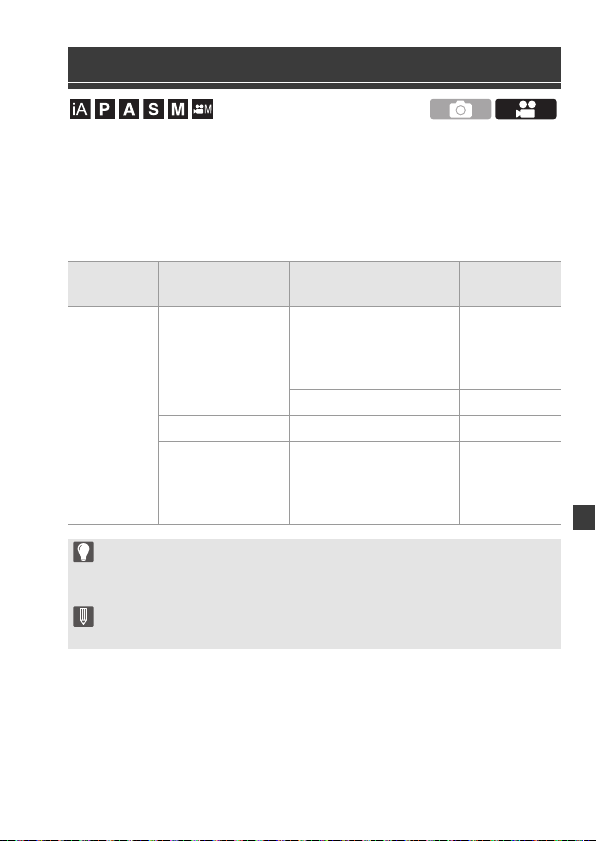
11. Special Video Recording
DVQX1939 (ENG)
127
[MOV] video with high frame rates can be recorded to cards. By converting
it with the compatible software, it is possible to produce slow motion video.
AF recording and audio recording, not possible with [Variable Frame Rate],
also become possible.
Recording Qualities for High Frame Rate Video
High Frame Rate Video
[Rec. File
Format]
[System
Frequency]
[Rec Quality]
Recording
frame rate
[MOV]
[59.94Hz (NTSC)]
[4K-A/48p/420/10-L]
[C4K/48p/420/10-L]
[4K/48p/420/10-L]
[FHD/48p/420/10-L]
47.95p
[FHD/120p/420/10-L] 119.88p
[50.00Hz (PAL)] [FHD/100p/420/10-L] 100.00p
[24.00Hz (CINEMA)]
[4K-A/48p/420/10-L]
[C4K/48p/420/10-L]
[4K/48p/420/10-L]
[FHD/48p/420/10-L]
48.00p
0 By filtering the [Rec Quality] by the frame rate, you can display just those
recording qualities that match the frame rate conditions.
For details, refer to page 107.
0 When outputting via HDMI, the frame rate is down-converted to 59.94p,
23.98p, 50.00p, or 24.00p for output.
DC-S1HP-DVQX1939_eng.book 127 ページ 2019年8月9日 金曜日 午後4時45分
11. Special Video Recording
DVQX1939 (ENG)
128
Smoothly transitions the focus position from the current position to a
position registered in advance.
1
Set the mode dial to [ ].
2
Select [Focus Transition].
≥ ¨ [ ] ¨ [ ] ¨ [Focus Transition]
3
Set the recording settings.
4
Close the menu.
≥Selects [Start], and press or .
≥The recording screen is displayed.
0
To return to the setting screen, press [DISP.].
5
Start recording.
≥Press the video rec. button.
0
If you have enabled [Focus Transition Rec], Focus Transition will start when
you start recording a video.
[Focus Transition]
[Start] Start recording.
[Focus Pull
Setting]
Registers the focus position.
0 The setting screen for the focus position is displayed
when you select either [1], [2], or [3]. Use the same
procedure as MF (l 72) to check the focus, then
press or to register the focus position.
[Focus Transition
Speed]
Sets the moving speed of focus.
0 Moving speed: [SH] (fast) to [SL] (slow)
[Focus Transition
Rec]
Starts Focus Transition when recording starts.
0 Select the position registered with [Focus Pull
Setting].
[Focus Transition
Wait]
Sets the wait time before the start of Focus Transition.
DC-S1HP-DVQX1939_eng.book 128 ページ 2019年8月9日 金曜日 午後4時45分
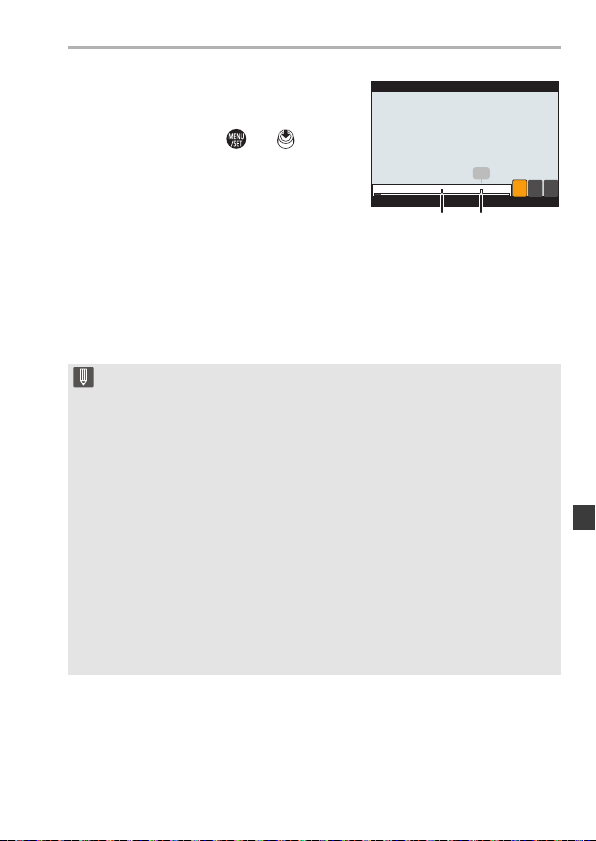
11. Special Video Recording
DVQX1939 (ENG)
129
6
Start Focus Transition.
≥Press 21 to select [1], [2], or [3],
and then press or .
A Current focus position
B Registered focus position
0 When [Focus Transition Wait] is set,
Focus Transition starts after the set time
has elapsed.
7
End Focus Transition.
≥Press [Q].
8
Stop recording.
≥Press the video rec. button once again.
0 Maintain the same distance to the subject after setting the focus position.
0 The moving speed of focus varies depending on the lens being used.
0 While using [Focus Transition], it is not possible to focus on anything other
than the registered focus position.
0 Any of the operations below will clear the focus position settings.
– Operating the camera on/off switch
– Zoom operation
– Switching the focus mode
– Switching the recording mode
– Replacing the lens
0 When the following functions are being used, [Focus Transition] is not
available:
– [Variable Frame Rate]
– [Live Cropping]
0 [Focus Transition] cannot be used when using an interchangeable lens that
does not support the focus mode [AFC].
1 23
1
∞
30(ft) 15 10 7 5 3 2 4"
DC-S1HP-DVQX1939_eng.book 129 ページ 2019年8月9日 金曜日 午後4時45分

11. Special Video Recording
DVQX1939 (ENG)
130
By cropping a part of the image from the image displayed in the live view, it
is possible to record FHD video that incorporates panning and zooming
with the camera staying in a fixed position.
1
Set the mode dial to [ ].
2
Set [Rec. File Format] to [MP4] or [MOV].
≥ ¨ [ ] ¨ [ ] ¨ [Rec. File Format] ¨ [MP4]/[MOV]
3
Select a recording quality with which you can record
[Live Cropping] video.
≥ ¨ [ ] ¨ [ ] ¨ [Rec Quality]
4
Set the time for panning or zooming.
≥ ¨ [ ] ¨ [ ] ¨ [Live Cropping] ¨ [40SEC]/[20SEC]
0
If you have selected a recording format or recording quality where Live
Cropping recording is not available, the camera switches to a recording
format or FHD video recording quality where recording is possible.
5
Set the cropping start frame.
A Cropping start frame
≥Select the range to be cropped and
press or .
6
Set the cropping end frame.
B Cropping end frame
≥Select the range to be cropped and
press or .
0
To redo the settings for the position and size of the start frame and the end
frame, press 2.
[Live Cropping]
0 Use a tripod to minimize camera shake.
ュリヴヱハ
5HVHW
6HW
DC-S1HP-DVQX1939_eng.book 130 ページ 2019年8月9日 金曜日 午後4時45分
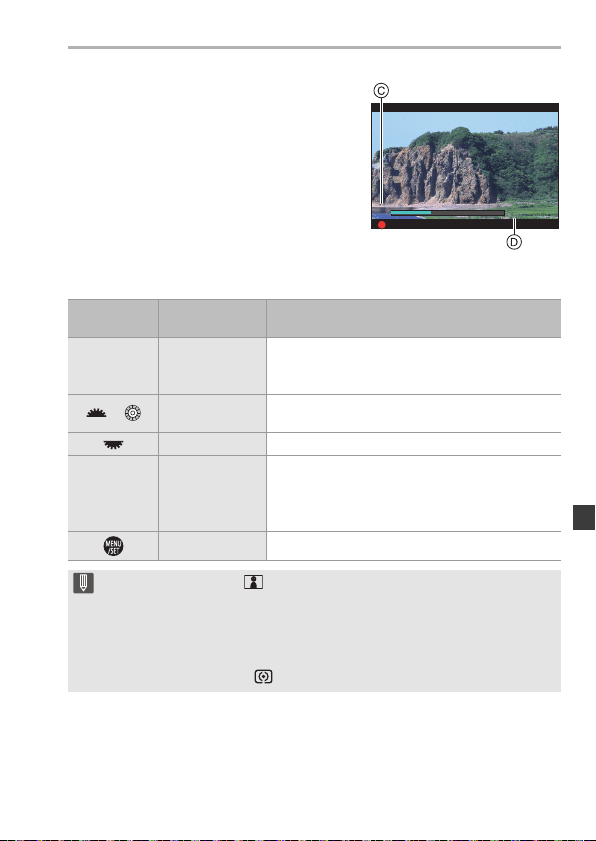
11. Special Video Recording
DVQX1939 (ENG)
131
7
Start Live Cropping recording.
≥Press the video rec. button.
C Elapsed recording time
D Set operating time
0 When the set operating time has elapsed,
recording automatically ends.
To end recording midway, press the video
rec. button again.
Operations for Setting the Cropping Frame
Button
operation
Touch
operation
Description of operation
3421 Touch
Moves the frame.
0 Positions can be moved to the diagonal
directions using the joystick.
/
Pinch out/
pinch in
Enlarges/reduces the frame in small steps.
s Enlarges/reduces the frame.
[DISP.] [Reset]
Start frame: Returns the frame position and size to
the default settings.
End frame: Cancels the settings for the position
and size of the frame.
[Set] Confirms the frame position and size.
0 AF mode switches to [ ] (face detection). (Human bodies cannot be
detected. It is not possible to specify the person to bring into focus.)
0 Brightness measurements and focusing are performed within the cropping
frame. To lock the focus point, set [Continuous AF] to [OFF], or set the focus
mode to [MF].
0 [Metering Mode] will be [ ] (multi-metering).
7
s
7
s
7
s
20
s
20
s
20
s
DC-S1HP-DVQX1939_eng.book 131 ページ 2019年8月9日 金曜日 午後4時45分

11. Special Video Recording
DVQX1939 (ENG)
132
Setting [Photo Style] to [V-Log] enables Log recording.
Images finished with rich gradation can be created through post production
processing.
¨ [ ] ¨ [ ] ¨ [Photo Style] ¨ Select [V-Log]
Exposure When [V-Log] Is Set
The [V-Log] curve characteristics comply with “V-Log/V-Gamut
REFERENCE MANUAL Rev.1.0”. When set to [V-Log], the standard
exposure when gray with a reflectance ratio of 18% is imaged is IRE 42%.
0
Refer to the “Owner’s Manual” (PDF format) for details.
[V-Log View Assist]
When [Photo Style] is set to [V-Log], the recording screen and images
output via HDMI will darken. Using [V-Log View Assist] means you can
show images with LUT data applied on the monitor/viewfinder and output
them via HDMI.
¨ [ ] ¨ [ ] ¨ Select [V-Log View Assist]
Log Recording
0 Post-production processing is enabled by utilizing LUT (Look-Up Table).
You can download LUT data from the following support site:
https://panasonic.jp/support/global/cs/dsc/download/index3.html
(English only)
[Read LUT File] Reads LUT data from the card.
[LUT Select]
Selects the LUT data to be applied from among the
preset ([Vlog_709]) and registered LUT data.
[LUT View Assist
(Monitor)]
Displays the images with LUT data applied on the
monitor/viewfinder of the camera.
[LUT View Assist (HDMI)] Applies LUT data to images output over HDMI.
DC-S1HP-DVQX1939_eng.book 132 ページ 2019年8月9日 金曜日 午後4時45分
11. Special Video Recording
DVQX1939 (ENG)
133
Reading LUT Files
1
Insert a card on which LUT data is saved into the camera.
2
Select [Read LUT File].
0
¨ [ ] ¨ [ ] ¨ [V-Log View Assist] ¨ [Read LUT File] ¨ [Card Slot
1]/[Card Slot 2]
3
Press 34 to select the LUT data to read and then press or .
4
Press 34 to select the location to register the data, and then press
or .
0
When registered items are selected, they will be overwritten.
0 When applying the LUT data, [LUT] is displayed on the recording screen.
0 Up to 4 LUT data files can be registered.
0 The following LUT data can be used:
– The “.vlt” format, which meets the requirements specified in the “VARICAM
3DLUT REFERENCE MANUAL Rev.1.0”
– File names consisting of up to 8 alphanumeric characters (excluding
extension)
0 Save the LUT data with a file extension of “.vlt” in the root directory of the card
(the folder opened when the card is opened on a PC).
DC-S1HP-DVQX1939_eng.book 133 ページ 2019年8月9日 金曜日 午後4時45分
11. Special Video Recording
DVQX1939 (ENG)
134
Record videos with the wide dynamic range of the HLG format. You can
record in very bright light where overexposure can occur or in dark areas
where underexposure can occur, maintaining the rich yet subtle colors you
can see with your naked eye.
You can view the video that you record by outputting via HDMI to devices
(TVs, etc.) that support the HLG format, or playing back directly on
supporting devices.
0
“HLG (Hybrid Log Gamma)” is an international standard (ITU-R BT.2100) HDR
format.
1
Set the mode dial to [ ].
2
Set [Rec. File Format] to [MP4] or [MOV].
≥ ¨ [ ] ¨ [ ] ¨ [Rec. File Format] ¨ [MP4]/[MOV]
3
Select a recording quality with which you can record
HLG video.
≥ ¨ [ ] ¨ [ ] ¨ [Rec Quality]
0
Items available for recording with HLG video are indicated as [HLG available].
4
Set [Photo Style] to [Like2100(HLG)].
≥ ¨ [ ] ¨ [ ] ¨ [Photo Style] ¨ [Like2100(HLG)]
HLG Videos
0 When the [Rec. File Format] has been set to [MOV], you can display just the
recording qualities where HLG video recording can be used. (l 107)
0 The monitor and viewfinder on this camera do not support display of HLG
format images.
With [Monitor] in [HLG View Assist] in the [Custom] ([Monitor / Display
(Video)]) menu, you can display the images converted for monitoring on the
monitor/viewfinder of this camera. (l 135)
DC-S1HP-DVQX1939_eng.book 134 ページ 2019年8月9日 金曜日 午後4時45分
11. Special Video Recording
DVQX1939 (ENG)
135
[HLG View Assist]
At recording or playback of [HLG Photo] and HLG video, this displays images with
converted color gamut and brightness on the camera monitor/viewfinder, or outputs
these over HDMI.
¨ [ ] ¨ [ ] ¨ [HLG View Assist] ¨ [Monitor]/[HDMI]
¢ Can only be set while [HDMI] is selected.
0 HLG images are shown dark on devices that do not support the HLG format.
With [HDMI] in [HLG View Assist] in the [Custom] ([Monitor / Display (Video)])
menu, you can set the conversion method for images displayed for
monitoring. (l 135)
[AUTO]
¢
Converts images before outputting them via HDMI while applying the
effect of [MODE2]. This conversion setting works only when the
camera is connected to a device that does not support HDR (HLG
format).
[MODE1]
Converts with an emphasis on bright areas such as sky.
0 [MODE1] is displayed on the recording screen.
[MODE2]
Converts with an emphasis on the brightness of a main subject.
0 [MODE2] is displayed on the recording screen.
[OFF] Displays without converting color gamut and brightness.
DC-S1HP-DVQX1939_eng.book 135 ページ 2019年8月9日 金曜日 午後4時45分

11. Special Video Recording
DVQX1939 (ENG)
136
This camera can record video with a resolution of 4K-A (anamorphic (4:3)
video) that is compatible with anamorphic recording with an aspect ratio of
4:3. It can also record video with an aspect ratio of 3:2 that has 6K
resolution or 5.4K resolution. You can select a recording quality that suits
anamorphic recording from a variety of different video formats (recording
qualities).
0
Refer to page 78 for information about image stabilizers suited to anamorphic
recording.
[Anamorphic Desqueeze Display]
Display the desqueezed images suited to the magnification of the
anamorphic lens on this camera.
Using the [Video Frame Marker], it is also possible to impose on display
the frame of the angle of view when cropping after de-squeeze editing.
Anamorphic Recording
0 When [Rec. File Format] is set to [MOV], by filtering [Rec Quality] by the
number of pixels, you can display just those recording qualities with
resolutions and aspect ratios that meet the conditions.
For details, refer to page 107.
0 [ANAMOR] is displayed in anamorphic (4:3) video items in the [Rec Quality]
setting screen.
0 This camera is not compatible with de-squeeze editing of video recorded with
anamorphic recording. Use compatible software.
DC-S1HP-DVQX1939_eng.book 136 ページ 2019年8月9日 金曜日 午後4時45分
11. Special Video Recording
DVQX1939 (ENG)
137
1
Set the mode dial to [ ].
2
Set [Anamorphic Desqueeze Display].
≥ ¨ [ ] ¨ [ ] ¨ [Anamorphic Desqueeze Display]
0
Make settings to suit the magnification of the anamorphic lens you are using.
3
Set [Video Frame Marker].
≥ ¨ [ ] ¨ [ ] ¨ [Video Frame Marker]
0
For details, refer to page 124.
Fine-adjust the shutter speed to reduce flickering and horizontal stripes.
The shutter speed set in Synchro Scan is saved separately from the
shutter speed used for normal recording.
In the Synchro Scan setting screen you can call up the current shutter
speed for normal recording and adjust it.
1
Set the mode dial to [ ].
2
Set the exposure mode to [S] or [M].
≥ ¨ [ ] ¨ [ ] ¨ [Exposure Mode] ¨ [S]/[M]
Settings: [ ]([2.0k])/[ ]([1.8k])/[ ]([1.5k])/
[ ]([1.33k])/[ ]([1.30k])/[OFF]
0 Images output via HDMI are not de-squeezed.
[Synchro Scan]
DC-S1HP-DVQX1939_eng.book 137 ページ 2019年8月9日 金曜日 午後4時45分
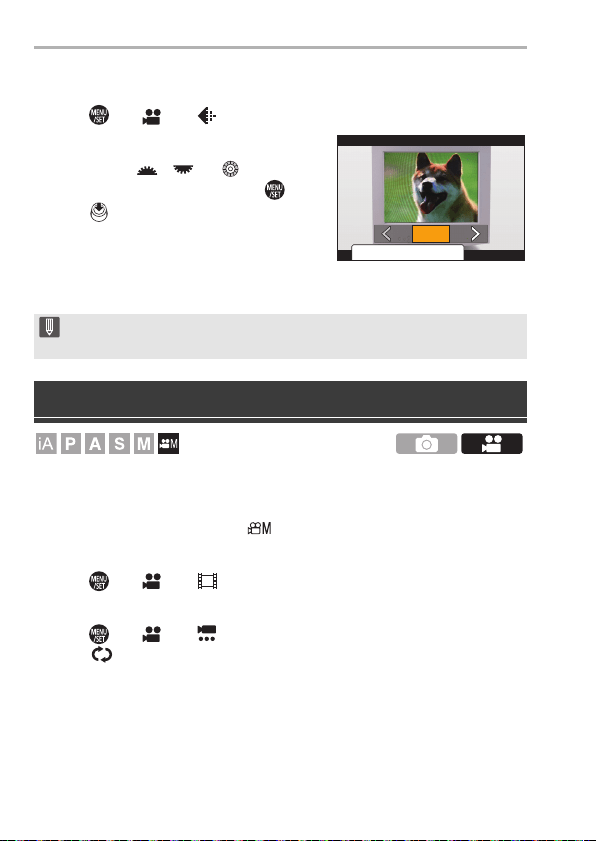
11. Special Video Recording
DVQX1939 (ENG)
138
3
Set [Synchro Scan].
≥ ¨ [ ] ¨ [ ] ¨ [Synchro Scan] ¨ [ON]
4
Set the shutter speed.
≥Rotate , or to select a
numeric value, then press or
.
0
You can call up the current shutter speed
for normal recording by pressing [DISP.].
0 Adjust the shutter speed while looking at
the screen so that flickering and horizontal stripes will be minimized.
Even when recording uses up the card’s free space, the camera continues
the recording by deleting the oldest segment of the recorded data.
1
Set the mode dial to [ ].
2
Set [Rec. File Format] to [MOV].
≥ ¨ [ ] ¨ [ ] ¨ [Rec. File Format] ¨ [MOV]
3
Set [Loop Recording (video)].
≥ ¨ [ ] ¨ [ ] ¨ [Loop Recording (video)] ¨ [ON]
0
[ ] is displayed on the recording screen.
0 When you set [Synchro Scan] to [ON], the available shutter speed range
becomes narrower.
[Loop Recording (video)]
&XUUHQWVKXWWHUVSHHG
ュリヴヱハ
60.160.1
DC-S1HP-DVQX1939_eng.book 138 ページ 2019年8月9日 金曜日 午後4時45分
11. Special Video Recording
DVQX1939 (ENG)
139
To avoid video loss due to unforeseen interruptions to the power supply,
recorded video is divided every minute while MOV video is being recorded.
0
The divided videos are saved as one group image.
1
Set [Rec. File Format] to [MOV].
≥ ¨ [ ] ¨ [ ] ¨ [Rec. File Format] ¨ [MOV]
2
Set [Segmented File Recording].
≥ ¨ [ ] ¨ [ ] ¨ [Segmented File Recording] ¨ [ON]
0 When the following functions are being used, [Loop Recording (video)] is not
available:
– [Rec Quality] with a bit rate of 400 Mbps
– [Variable Frame Rate]
– [Live Cropping]
[Segmented File Recording]
0 When the following function is being used, [Segmented File Recording] is not
available:
– [Loop Recording (video)]
DC-S1HP-DVQX1939_eng.book 139 ページ 2019年8月9日 金曜日 午後4時45分
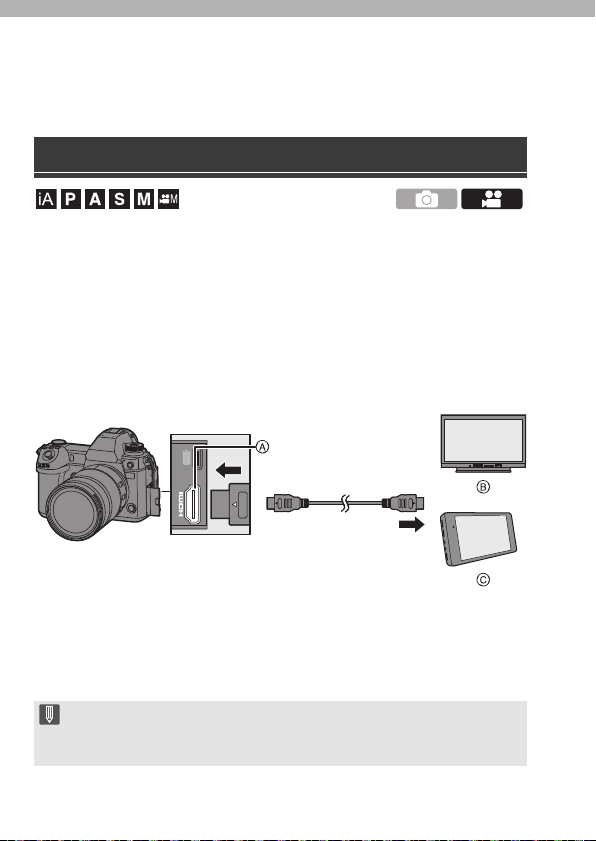
DVQX1939 (ENG)
140
12. Connections with External
Devices (Video)
You can record while outputting the camera images to an external monitor
or external recorder connected with an HDMI cable.
0
HDMI output control differs between during recording and during playback.
HDMI output for playback is set in [TV Connection] in the [Setup] ([IN/OUT]) menu.
Getting started:
0 Turn off the camera and the external monitor/external recorder.
Connect the camera and an external monitor or external
recorder with a commercially available HDMI cable.
0 Check the direction of the terminals and plug in/out straight holding onto the plug.
(Inserting at an angle can deform the terminal and cause malfunction.)
0 Do not connect the cable to the wrong terminals. This may cause a malfunction.
HDMI Devices (HDMI Output)
A [HDMI] socket (Type A)
B External monitor
C External recorder
0 Use a “High Speed HDMI cable” with the HDMI logo.
Cables that do not comply with the HDMI standards will not work.
“High Speed HDMI cable” (Type A–Type A plug, up to 1.5 m (4.9 feet) long)
DC-S1HP-DVQX1939_eng.book 140 ページ 2019年8月9日 金曜日 午後4時45分
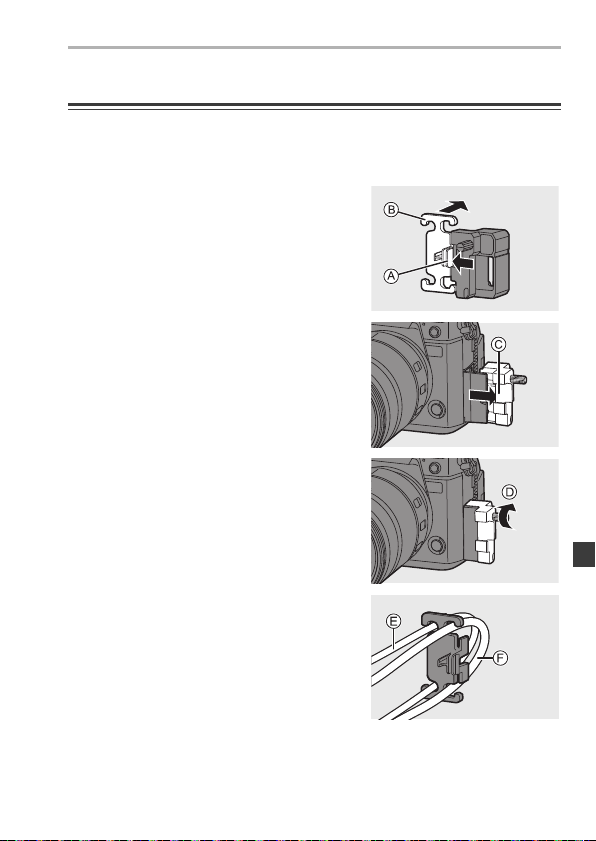
12. Connections with External Devices (Video)
DVQX1939 (ENG)
141
Attaching the Cable Holder
Use of the supplied cable holder prevents detachment of the cable and
damage to the terminals.
0
Put the camera on a stable surface to perform this task.
1
While pushing A, slide the clamp
portion B of the cable holder to
remove it.
2
Open the door of the terminal section
and slide the door into the part marked
C.
3
Loosely mount the cable holder to the
mount on the camera, and then rotate
the screws in the direction of the
arrows to secure the cable holder. D
4
Fit the USB connection cable (C–C or
A–C) E and HDMI cable F to the
clamp.
DC-S1HP-DVQX1939_eng.book 141 ページ 2019年8月9日 金曜日 午後4時45分
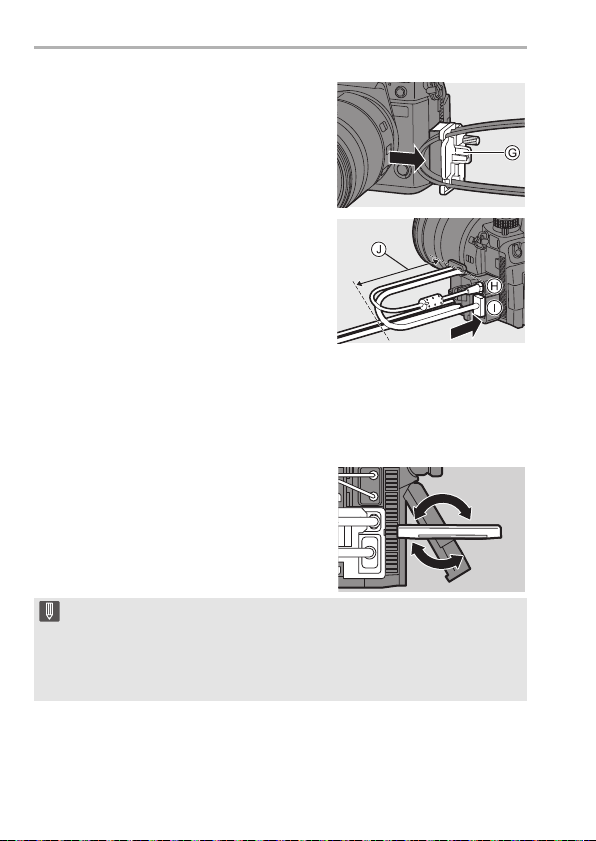
12. Connections with External Devices (Video)
DVQX1939 (ENG)
142
5
Slide the clamp portion G to attach it to
the cable holder.
6
Connect the USB connection cable (C–
C or A–C) to the USB port H.
7
Connect the HDMI cable to the [HDMI]
socket I.
J Leave some slack so that this section
has a length of at least 10 cm (0.33 feet).
Removing the cable holder
To remove the cable holder, follow the steps for attaching it in the reverse
order.
Adjusting the Monitor Angle
You can adjust the angle of the monitor
while it is tilted
(l 42) by rotating it, without
interfering with the connection cables.
0 Do not use any other USB connection cables except the supplied USB
connection cables (C–C and A–C).
0 We recommend using an HDMI cable with a thickness diameter of 6.5 mm
(0.26 inch) or less.
0 It may not be possible to attach HDMI cables of certain shapes.
DC-S1HP-DVQX1939_eng.book 142 ページ 2019年8月9日 金曜日 午後4時45分
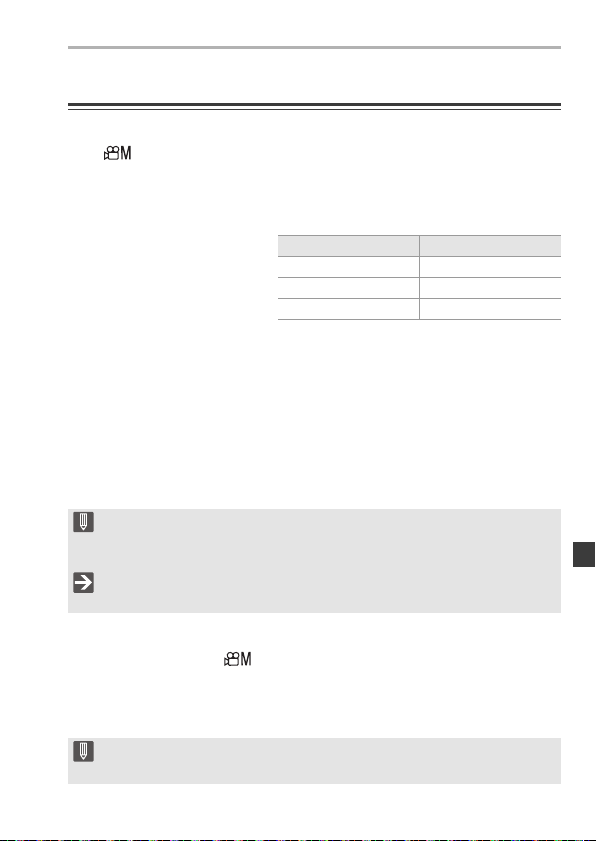
12. Connections with External Devices (Video)
DVQX1939 (ENG)
143
Images Output via HDMI
The images output via HDMI differ depending on the recording mode.
[] Mode
Resolution, frame rate
Resolution and frame rate output is according to the following menu combinations:
– [Rec Quality] in the [Video] ([Image Format]) menu.
– [Down Convert] in [HDMI Rec Output] in the [Custom] ([IN/OUT]) menu
0 6K, 5.9K, and 5.4K videos are output with a 4K or FHD resolution. Output is not
possible during recording.
0 Anamorphic (4:3) video is output with a 4K or FHD resolution.
0 When set to a recording quality for high frame rate video, the frame rate is down-
converted for output.
[iA]/[P]/[S]/[M] Mode
Output is the same as [ ] mode during video recording or when [Video-
Priority Display] is set to [ON].
Output is with a 16:9 aspect ratio during recording standby. Resolution,
frame rate, YUV, and bit value output matches the connected device.
Aspect ratio, resolution, and frame rate output is according to the [Rec
Quality] settings in the [Video] ([Image Format]) menu. Resolution and
frame rate can be down-converted for output according to the application.
YUV 4:2:2 is used for YUV
and bit value output, as
shown on the right.
Recording to card HDMI output
4:2:2 10-bit 4:2:2 10-bit
4:2:0 10-bit 4:2:2 10-bit
4:2:0 8-bit 4:2:2 8-bit
0 When set to a 4:3 or 3:2 [Rec Quality], bands are added to the images and
they are output with a 16:9 aspect ratio.
0 Output may be in 8-bit if you output to devices that do not support 10-bit.
0 Refer to the “Owner’s Manual” (PDF format) for details about the content
output for each combination of [Rec Quality] and [Down Convert].
0 When set to any [Aspect Ratio] other than 16:9, bands are added to the
images and they are output with a 16:9 aspect ratio.
DC-S1HP-DVQX1939_eng.book 143 ページ 2019年8月9日 金曜日 午後4時45分
12. Connections with External Devices (Video)
DVQX1939 (ENG)
144
Notice Regarding HDMI Output
0 It may take some time for the output method to change.
0 When you use the HDMI output during recording, the image may be displayed with a
time lag.
0 Beep sounds, AF beep, and electronic shutter sounds are muted during HDMI
output.
0 When you check the image and audio from the TV connected to the camera, the
microphone of the camera may pick up the sound from the speakers of the TV,
producing an abnormal sound (audio feedback).
If this occurs, move the camera away from the TV or lower the volume on the TV.
0 Certain setting screens are not output via HDMI.
0 There is no output via HDMI while you are using the following functions:
– [6K/4K PHOTO]/[Post-Focus]
Outputting the Camera Information Display via HDMI
Output the camera information display to an external device connected by
HDMI.
¨ [ ] ¨ [ ] ¨ [HDMI Rec Output] ¨ Select [Info Display]
Settings: [ON]/[OFF]
Down-Converting Resolution and Frame Rate for
Output
Make settings for the down-conversion of resolution and frame rate for
HDMI output in the [ ] mode.
HDMI Output Settings
DC-S1HP-DVQX1939_eng.book 144 ページ 2019年8月9日 金曜日 午後4時45分
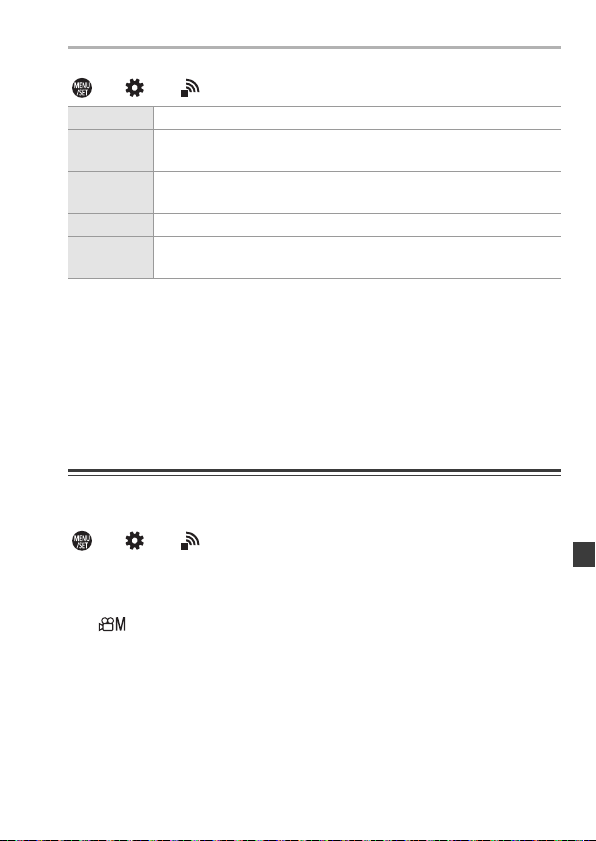
12. Connections with External Devices (Video)
DVQX1939 (ENG)
145
¨ [ ] ¨ [ ] ¨ [HDMI Rec Output] ¨ Select [Down Convert]
0
The items you can select depend on the [System Frequency] setting.
0 6K, 5.9K, and 5.4K videos are output with a 4K or FHD resolution. Output is not
possible during recording.
0 Anamorphic (4:3) video is output with a 4K or FHD resolution.
0 When set to a recording quality for high frame rate video, the frame rate is down-
converted for output.
Outputting Control Information to an External
Recorder
Recording start and stop control information is output to an external
recorder connected by HDMI.
¨ [ ] ¨ [ ] ¨ [HDMI Rec Output] ¨ Select [HDMI Recording
Control]
Settings: [ON]/[OFF]
0
[HDMI Recording Control] can be set when [HDMI Time Code Output] is set to [ON]
in [ ] Mode.
0 Control information is output when pressing the video rec. button or shutter button,
even if the video cannot be recorded (such as when there is no card inserted into the
camera).
0 Only compatible external devices can be controlled.
[AUTO] Outputs by down-converting to match the connected device.
[4K/30p]
([4K/25p])
Outputs by down-converting resolution to 4K and frame rate to either
29.97p or 25.00p.
[1080p]
Down-converts resolution to FHD (1080), and outputs as
progressive.
[1080i] Down-converts resolution to FHD (1080), and outputs as interlaced.
[OFF]
Outputs at the resolution and recording frame rate of the [Rec
Quality].
DC-S1HP-DVQX1939_eng.book 145 ページ 2019年8月9日 金曜日 午後4時45分
12. Connections with External Devices (Video)
DVQX1939 (ENG)
146
Outputting Down-converted Audio to an HDMI Device
When an XLR Microphone Adaptor (DMW-XLR1: optional) is attached,
audio is down-converted to a format suitable for the connected HDMI
external device before being output.
¨ [ ] ¨ [ ] ¨ [HDMI Rec Output] ¨ Select [Sound Down
Convert]
Outputting Audio via HDMI
Output audio to an external device connected by HDMI.
¨ [ ] ¨ [ ] ¨ [HDMI Rec Output] ¨ Select [Sound Output (HDMI)]
Settings: [ON]/[OFF]
With a Stereo Shotgun Microphone (DMW-MS2: optional) or Stereo
Microphone (VW-VMS10: optional), you can record higher-quality audio
compared to the built-in microphone.
[AUTO] Output is down-converted to match the connected device.
[OFF] Output is according to the settings in [XLR Mic Adaptor Setting].
External Microphones (Optional)
DC-S1HP-DVQX1939_eng.book 146 ページ 2019年8月9日 金曜日 午後4時45分
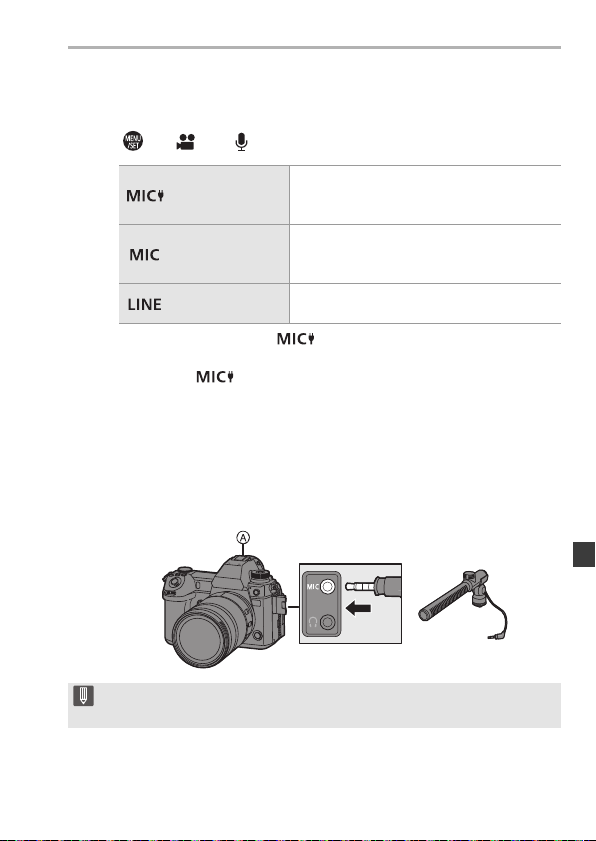
12. Connections with External Devices (Video)
DVQX1939 (ENG)
147
1
Set the [Mic Socket] that suits the device to be
connected.
≥ ¨ [ ] ¨ [ ] ¨ [Mic Socket]
0
The setting will be fixed to [ ] when a Stereo Shotgun Microphone
(DMW-MS2: optional) is connected.
0 When using [ ], if you connect an external microphone that does not
require power supply, the connected external microphone may malfunction.
Check the device before connecting.
2
Set the camera on/off switch to [OFF].
3
Connect the camera and external microphone.
0 If mounting the external microphone on the camera hot shoe A, remove the
hot shoe cover. (l 90)
[Mic Input (Plug-
in Power)]
When connecting an external microphone
that requires a power supply from the camera
[MIC] socket.
[Mic Input]
When connecting an external microphone
that does not require a power supply from the
camera [MIC] socket.
[Line Input]
When connecting an external audio device
for line output.
0 Do not use the stereo microphone cables with the length of 3 m (9.8 feet) or
more.
DC-S1HP-DVQX1939_eng.book 147 ページ 2019年8月9日 金曜日 午後4時45分
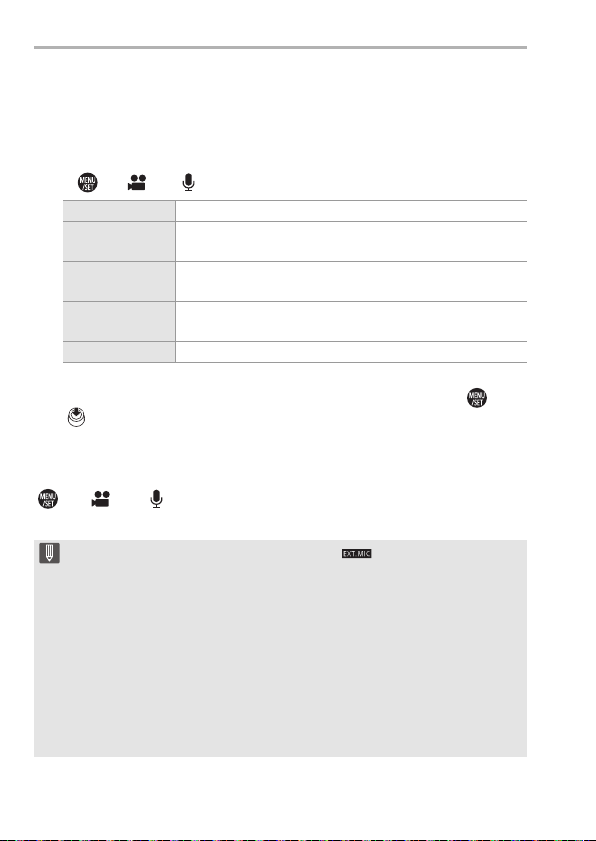
12. Connections with External Devices (Video)
DVQX1939 (ENG)
148
Setting the Sound Pickup Range (DMW-MS2: Optional)
When using the Stereo Shotgun Microphone (DMW-MS2: optional), you
can set the microphone sound pickup range.
1
Select [Special Mic.].
0
¨ [ ] ¨ [ ] ¨ [Special Mic.]
2
(When [MANUAL] is selected)
Press 21 to adjust the sound pickup range and then press or
.
Reduction of Wind Noise
This reduces wind noise when an external microphone is connected.
¨ [ ] ¨ [ ] ¨ Select [Wind Cut]
Settings: [HIGH]/[STANDARD]/[LOW]/[OFF]
[STEREO] Picks up sound over a wide area.
[LENS AUTO]
Picks up sound from a range automatically set by the lens
angle of view.
[SHOTGUN]
Helps prevent picking up background noise, and records
sound from a specific direction.
[S.SHOTGUN]
Narrows the sound pickup range more than with
[SHOTGUN].
[MANUAL] Sets the range manually for sound pickup.
0 While the external microphone is connected, [ ] is displayed on the
screen.
0 When an external microphone is connected, [Sound Rec Level Disp.]
automatically turns [ON], and the recording level is displayed on the screen.
0 When [Mute Sound Input] is set to [ON], the audio input from the external
microphone is muted.
0 If noises are recorded when using the AC adaptor, use the battery.
0 When a Stereo Microphone (VW-VMS10: optional) is used, [Special Mic.] is
fixed to [STEREO].
0 Setting [Wind Cut] may alter the usual sound quality.
0 For details, refer to the operating instructions for the external microphone.
DC-S1HP-DVQX1939_eng.book 148 ページ 2019年8月9日 金曜日 午後4時45分
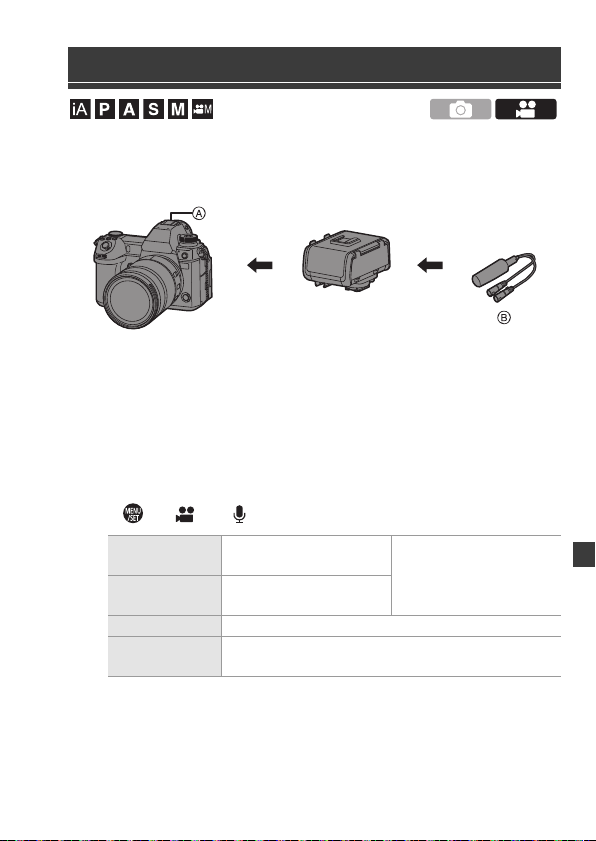
12. Connections with External Devices (Video)
DVQX1939 (ENG)
149
By attaching an XLR Microphone Adaptor (DMW-XLR1: optional) to the
camera, you can use a commercially available XLR microphone to enable
the recording of superior-quality high-res/stereo audio.
A Hot shoe
B Commercially available XLR microphone
Getting started:
0 Turn off the camera, and remove the hot shoe cover. (l 90)
1
Attach the XLR Microphone Adaptor to the hot shoe.
2
Set the camera on/off switch to [ON].
3
Select [XLR Mic Adaptor Setting].
≥ ¨ [ ] ¨ [ ] ¨ [XLR Mic Adaptor Setting]
XLR Microphone Adaptor (Optional)
[96kHz/24bit]
Records high resolution
audio at 96 kHz/24-bit.
Only available when [Rec.
File Format] is set to
[MOV].
[48kHz/24bit]
Records high-quality audio
at 48 kHz/24-bit.
[48kHz/16bit] Records standard-quality audio at 48 kHz/16-bit.
[OFF]
Records audio using the built-in microphone of the
camera.
DC-S1HP-DVQX1939_eng.book 149 ページ 2019年8月9日 金曜日 午後4時45分
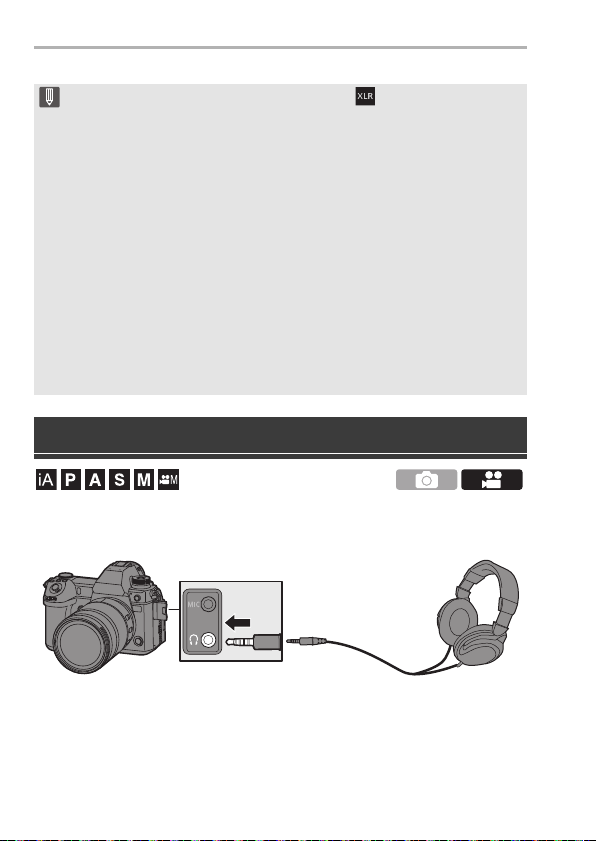
12. Connections with External Devices (Video)
DVQX1939 (ENG)
150
You can record videos while monitoring their sound by connecting
commercially available headphones to the camera.
0
Do not use the headphone cables with the length of 3 m (9.8 feet) or more.
0 When headphones are connected, beep sounds, AF beep, and electronic shutter
sounds are muted.
0 While an XLR Microphone Adaptor is attached, [ ] is displayed on the
screen.
0 When [XLR Mic Adaptor Setting] is set to other than [OFF], the following
settings are fixed:
– [Sound Rec Level Limiter]: [OFF]
– [Wind Noise Canceller]: [OFF]
– [Sound Output]: [REC SOUND]
0 [Sound Rec Gain Level] and [Sound Rec Level Adj.] cannot be used when
[XLR Mic Adaptor Setting] is set to other than [OFF].
0 When the XLR Microphone Adaptor is attached, [Sound Rec Level Disp.]
automatically turns [ON], and the recording level is displayed on the screen.
0 When [Mute Sound Input] is set to [ON], the audio input from the XLR
Microphone Adaptor is muted.
0 If noises are recorded when using the AC adaptor, use the battery.
0 For details, refer to the operating instructions for the XLR Microphone
Adaptor.
Headphones
DC-S1HP-DVQX1939_eng.book 150 ページ 2019年8月9日 金曜日 午後4時45分
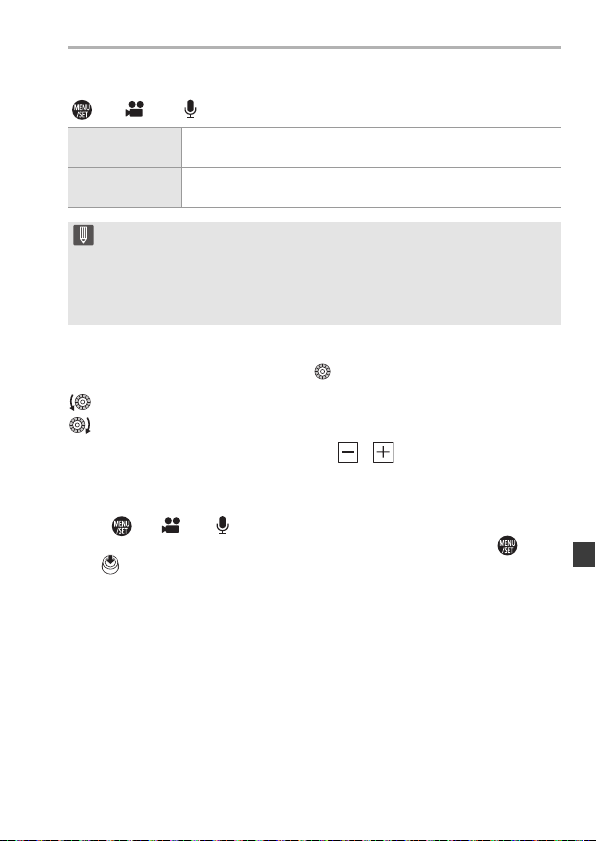
12. Connections with External Devices (Video)
DVQX1939 (ENG)
151
Switching the Sound Output Method
¨ [ ] ¨ [ ] ¨ Select [Sound Output]
Adjusting the Headphone Volume
Connect the headphones and rotate .
0
You can also adjust the volume by touching [ ]/[ ] on the playback screen.
To adjust the volume using the menu:
1
Select [Headphone Volume].
0
¨ [ ] ¨ [ ] ¨ [Headphone Volume]
2
Press 34 to adjust the headphone volume and then press or
.
[REALTIME]
Audio without time lag.
It may differ from the sound recorded in videos.
[REC SOUND]
Audio to be recorded in videos.
Output sound may be delayed from actual sound.
0 The setting is fixed to [REC SOUND] in the following cases:
– During output of audio via HDMI
– When [Special Mic.] is set to [LENS AUTO], [SHOTGUN], [S.SHOTGUN], or
[MANUAL]
– When using an XLR Microphone Adaptor (DMW-XLR1: optional)
: Reduces the volume.
: Increases the volume.
DC-S1HP-DVQX1939_eng.book 151 ページ 2019年8月9日 金曜日 午後4時45分
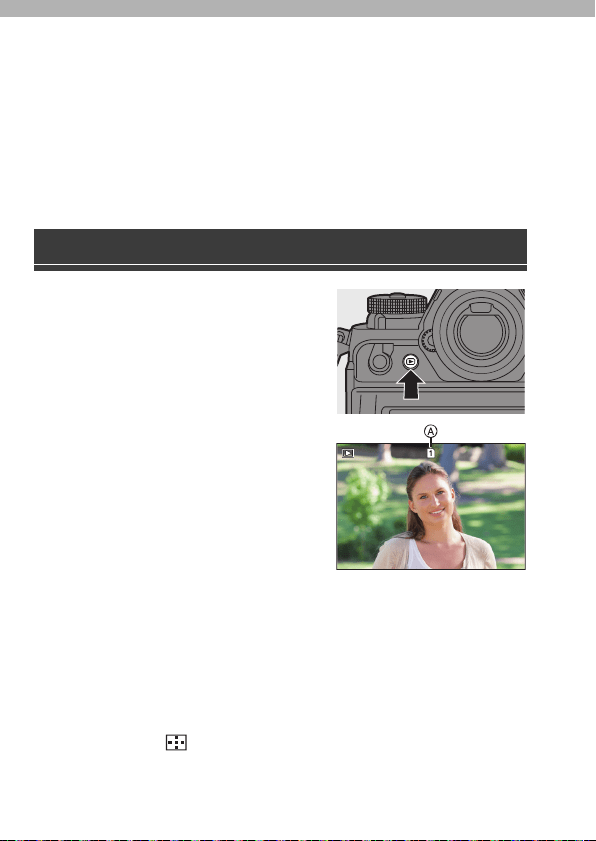
DVQX1939 (ENG)
152
13. Playing Back and Editing of
Images
This document gives an overview of recorded image playback and
deletion.
Refer to the “Owner’s Manual” (PDF format) for details about recorded
image playback and editing.
1
Display the playback screen.
≥Press [(].
2
Select a picture.
A Card slot
≥Select the pictures by pressing
21.
2: Move to the previous image
1: Move to the next image
≥You can move continuously through
images by pressing and holding
21.
3
Stop playback.
≥Press the shutter button halfway.
≥You can also stop playback by pressing [(].
Switching the Card to Display
Images are displayed separately by card slot.
You can switch the card displayed just by pressing the Fn button during
playback.
0
Use the Fn button registered with [Card Slot Change] to operate. In default settings,
this is registered in [ ] button.
For information about the Fn button, refer to page 156.
Playing Back Pictures
1/999
1/999
1/999
DC-S1HP-DVQX1939_eng.book 152 ページ 2019年8月9日 金曜日 午後4時45分
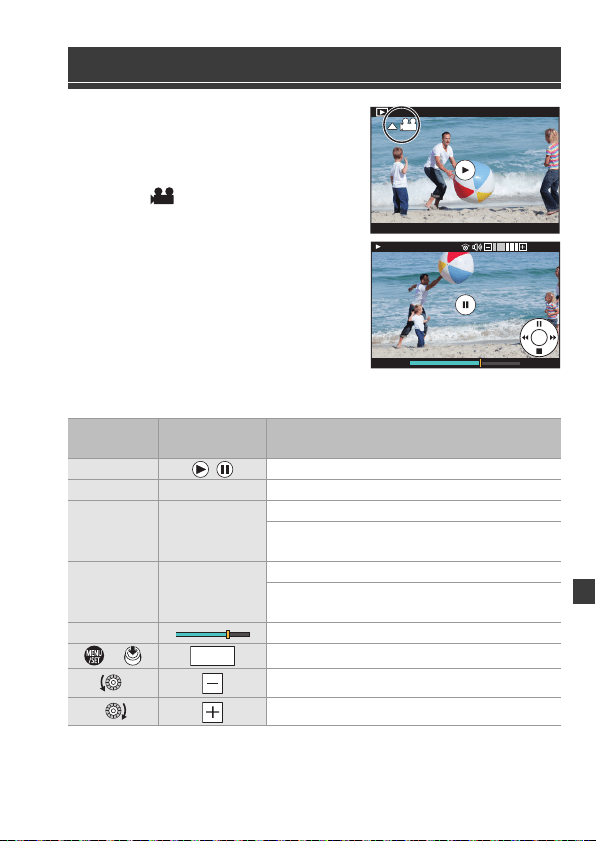
13. Playing Back and Editing of Images
DVQX1939 (ENG)
153
1
Display the playback screen.
≥Press [(].
2
Select a video.
0 The [ ] video icon is displayed for a
video.
3
Play back the video.
≥Press 3.
4
Stop playback.
≥Press 4.
Operations During Video Playback
Playing Back Videos
Button
operation
Touch
operation
Description of operation
3 / Plays/pauses.
4 — Stops.
2 —
Performs fast-rewind playback.
Performs frame-by-frame rewinding (while
paused).
1 —
Performs fast-forward playback.
Performs frame-by-frame forwarding (while
paused).
— Selects the frame to display.
/ Extracts a picture (while paused).
Reduces the volume.
Increases the volume.
8m30s8m30s8m30s
00:05:50
00:05:50
00:05:50
00:08:30
00:08:30
00:08:30
6DYH
DC-S1HP-DVQX1939_eng.book 153 ページ 2019年8月9日 金曜日 午後4時45分
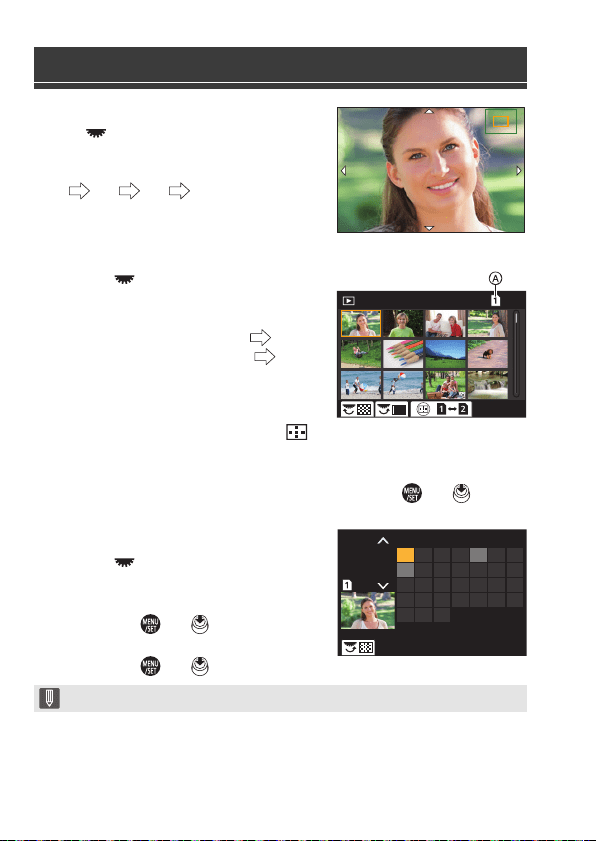
13. Playing Back and Editing of Images
DVQX1939 (ENG)
154
Enlarged Display
Rotate to the right to enlarge the
playback screen.
0
The playback screen is enlarged in the order of
2k 4k 8k 16k.
Thumbnail Screen
1
Rotate to the left to use thumbnail
display.
0
The display is switched in the order of
thumbnail screen (12 images)
Thumbnail screen (30 images)
Calendar playback.
0 Images are displayed separately by card
slot.
To switch the card to display, press [ ]
during thumbnail display.
A Card
2
Press 3421 to select an image and then press or .
Calendar Playback
1
Rotate to the left to use calendar
display.
2
Press 3421 to select a date and
then press or .
3
Press 3421 to select an image and
then press or .
Switching the Display Mode
0 The card to display cannot be switched during calendar display.
2.0X2.0X
2.0X
2.0X
1/999
7654321
141312111098
21201918171615
2827262524
31
2322
SUN SATFRITHUWEDTUEMON
3029
2019
12
DC-S1HP-DVQX1939_eng.book 154 ページ 2019年8月9日 金曜日 午後4時45分
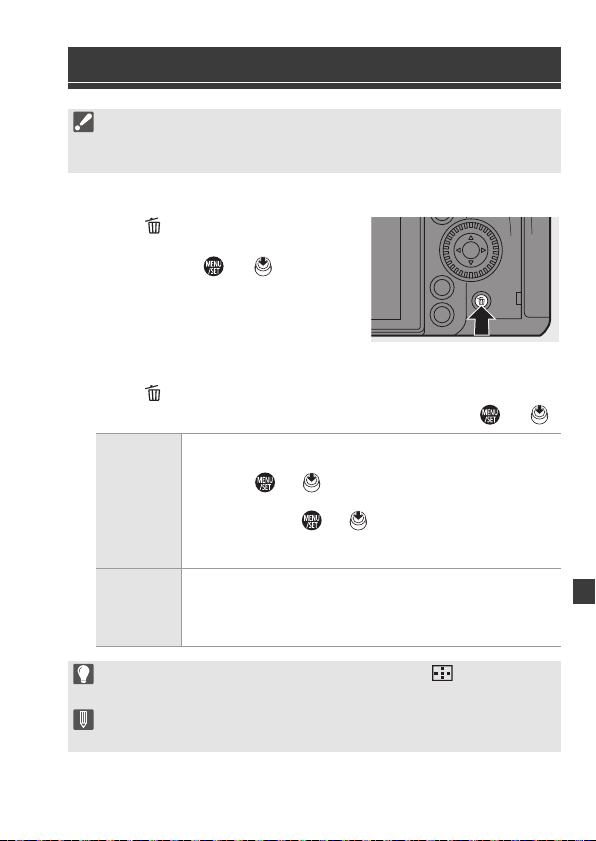
13. Playing Back and Editing of Images
DVQX1939 (ENG)
155
[Delete Single]
1
Press [ ] in playback state.
2
Press 34 to select [Delete Single]
and then press or .
[Delete Multi]/[Delete All]
1
Press [ ] in playback state.
2
Press 34 to select the deletion method and then press or .
Deleting Images
0 Images cannot be restored once they have been deleted. Carefully confirm
the images before deletion.
0 You can only delete the images in the card of the selected card slot.
[Delete
Multi]
Selecting and deleting multiple images.
1 Press 3421 to select the image to delete and then
press or .
0 [‚] is displayed for the selected image.
0 If you press or again, the selection is
canceled.
2 Press [DISP.] to delete the selected image.
[Delete All]
Deleting all images in a card.
0 If you select [Delete All], all images in the card are deleted.
0 If you select [Delete All Non-rating], all images except those
with a rating set are deleted.
0 To switch the card selected for deleting images, press [ ] and then select
the card slot.
0 Depending on the number of images to be deleted, it may take some time to
delete them.
DC-S1HP-DVQX1939_eng.book 155 ページ 2019年8月9日 金曜日 午後4時45分
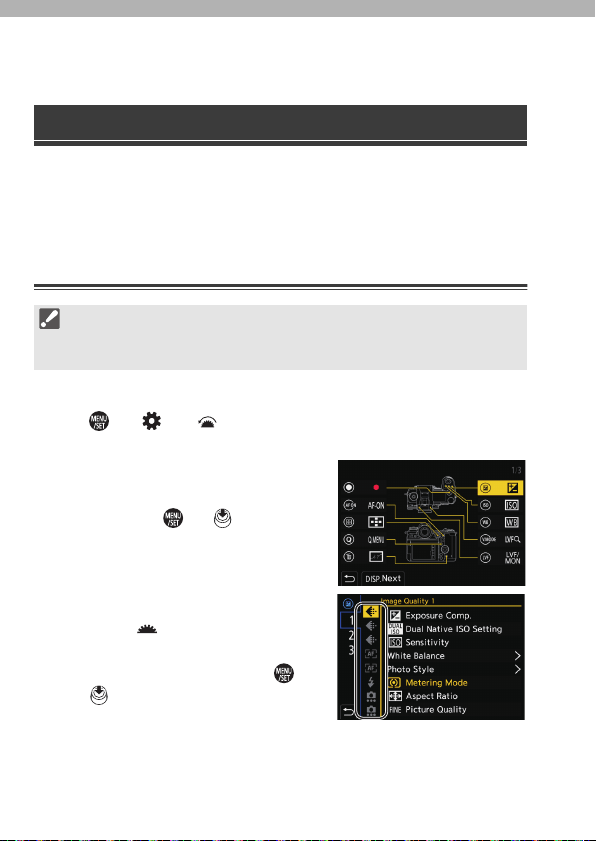
DVQX1939 (ENG)
156
14. Camera Customization
You can register functions to the Fn (Function) buttons. Additionally, you
can register other functions to specialized buttons such as [WB] button, in
the same way as with the Fn buttons.
Different functions can be set for both during recording and playback.
Register Functions to the Fn Buttons
1
Select [Fn Button Set].
≥ ¨ [ ] ¨ [ ] ¨ [Fn Button Set] ¨ [Setting in REC mode]/
[Setting in PLAY mode]
2
Select the button.
≥Press 34 to select the button and
then press or .
0
Press [DISP.] to change the page.
3
Find the function to register.
≥Rotate to select the sub tab
where the function to register is
categorized and then press or
.
≥Switch the [1] to [3] tabs by
pressing [Q].
Fn Buttons
0 With default settings, [Fn8] to [Fn12] on the joystick cannot be used.
When using functions, set the [Joystick Setting] in the [Custom] ([Operation])
menu to [Fn]. (l 168)
DC-S1HP-DVQX1939_eng.book 156 ページ 2019年8月9日 金曜日 午後4時45分
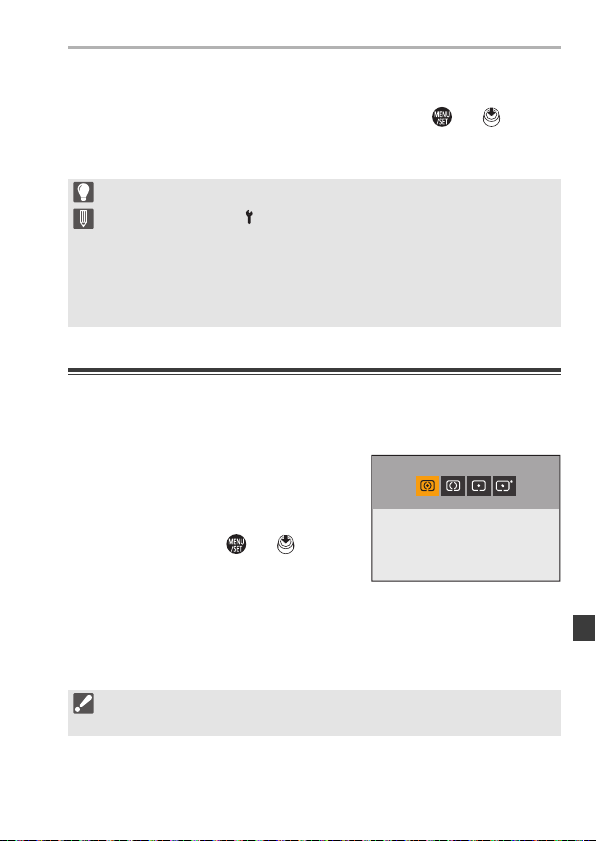
14. Camera Customization
DVQX1939 (ENG)
157
4
Register the function.
≥Press 34 to select a function and then press or .
0
Select items with [N] by selecting the item again.
0 Depending on the button, some functions cannot be registered.
Use the Fn Buttons
During recording, pressing the Fn buttons enables usage of the functions
registered in [Setting in REC mode], and during playback, usage of the
functions registered in [Setting in PLAY mode].
1
Press the Fn button.
2
Select a setting item.
≥Press 21 to select a setting item
and then press or .
0
Display and selection methods of a
setting item differ depending on the menu
item.
Use [Fn3] to [Fn7] (Touch Icons)
During recording, you can use the Fn buttons within the Touch Tab.
0 Refer to the “Owner’s Manual” (PDF format) for functions you can register.
0 You can also touch [ ] on the control panel (l 53) to display the screen in
Step
2
.
0 You can also press and hold the Fn button (2 sec.) to display the screen in
Step
4
.
(This may not be displayed depending on the registered function and on the
button type.)
0 With the default settings, the Touch Tab is not displayed. Set [Touch Tab] to
[ON] in [Touch Settings] in the [Custom] ([Operation]) menu. (l 168)
Fn
DC-S1HP-DVQX1939_eng.book 157 ページ 2019年8月9日 金曜日 午後4時45分
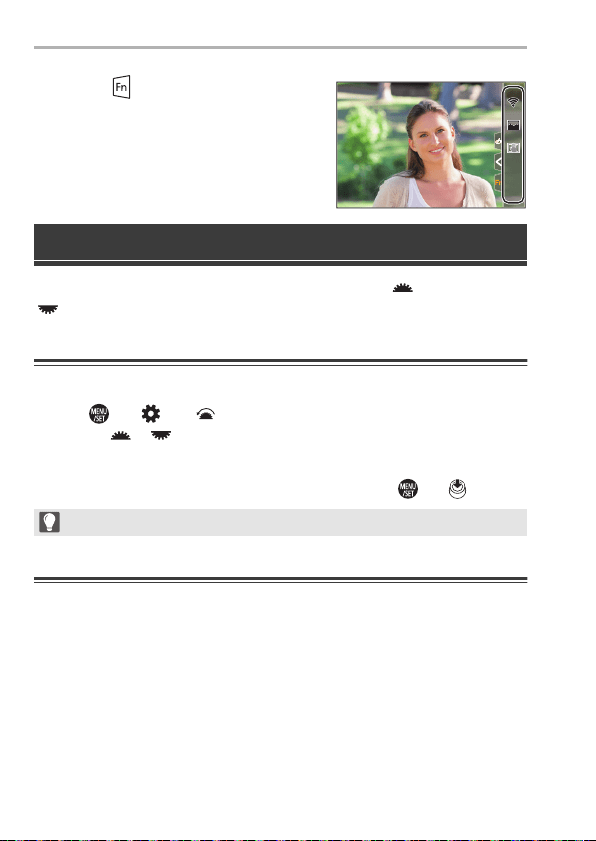
14. Camera Customization
DVQX1939 (ENG)
158
1
Touch [ ] .
2
Touch one of [Fn3] to [Fn7].
This temporarily changes the functions operated with (front dial) and
(rear dial).
Register Functions to the Dials
1
Select [Dial Operation Switch Setup].
≥ ¨ [ ] ¨ [ ] ¨ [Dial Set.] ¨ [Dial Operation Switch Setup]
¨ [ ]/[ ]
2
Register the function.
≥Press 34 to select a function and then press or .
Temporarily Change Dial Operation
Use the Fn button to temporarily change dial operation.
1
Set [Dial Operation Switch] to the Fn button. (l 156)
[Dial Operation Switch]
0 Refer to the “Owner’s Manual” (PDF format) for functions you can register.
Fn4
Fn4
Fn4
Fn3
Fn3
Fn3
Fn7
Fn7
Fn7
OFF
OFF
OFF
Fn6
Fn6
Fn6
OFF
OFF
OFF
Fn5
Fn5
Fn5
DC-S1HP-DVQX1939_eng.book 158 ページ 2019年8月9日 金曜日 午後4時45分
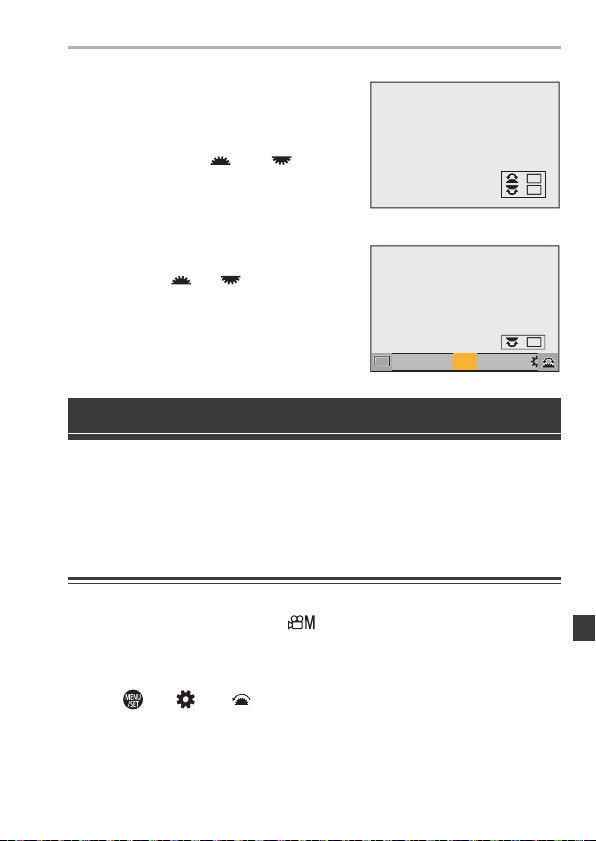
14. Camera Customization
DVQX1939 (ENG)
159
2
Switch dial operation.
≥Press the Fn button set in Step
1
.
≥A guide will display the functions
registered to and .
0
If no operations are performed, then
several seconds later, the guide
disappears.
3
Set the registered function.
≥Rotate or while the guide
is displayed.
4
Confirm your selection.
≥Press the shutter button halfway.
You can change Quick menu items depending on the recording mode.
Additionally, you can change the items to display on the Quick menu and
their order to suit your preferences.
For information about Quick menu operation methods, refer to page 55.
Register to the Quick Menu
Change the menus to be displayed in the Quick menu.
These can be set separately for [ ] mode (Video) and for other
recording modes (Photo).
1
Select [Q.MENU Settings].
≥ ¨ [ ] ¨ [ ] ¨ [Q.MENU Settings] ¨ [Item Customize
(Photo)]/[Item Customize (Video)]
Quick Menu Customization
ISOISOISOISO
WBWBWBWB
AWBc
AWBc
AWBw
AWBw
WB
WBWBWB
WBWBWBWBWBWBWB
AWB
AWB
ISOISOISOISO
DC-S1HP-DVQX1939_eng.book 159 ページ 2019年8月9日 金曜日 午後4時45分
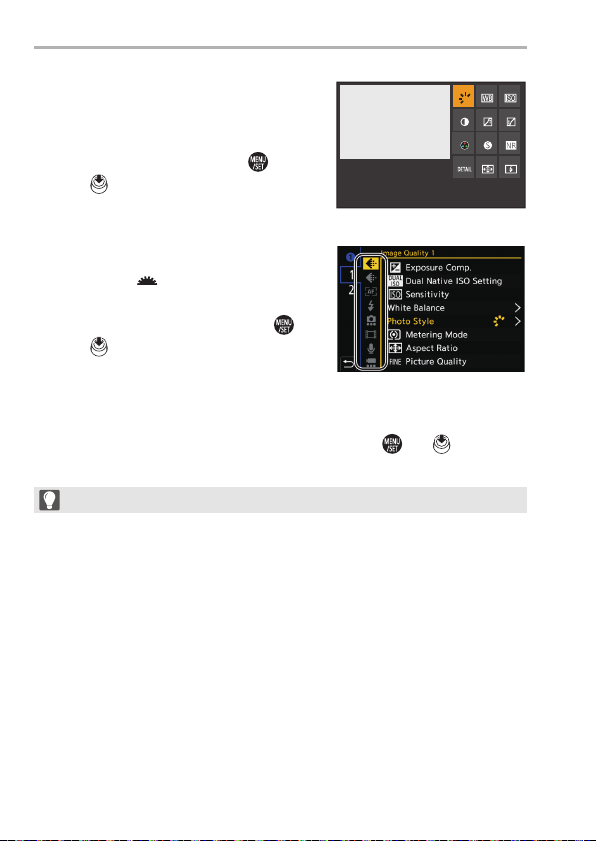
14. Camera Customization
DVQX1939 (ENG)
160
2
Select the item position (1 to
<).
≥Press 3421 to select the
position and then press or
.
≥Directions on the diagonal can also
be selected using the joystick.
3
Find the function to register.
≥Rotate to select the sub tab
where the function to register is
categorized and then press or
.
≥Each press of [Q] switches between
tabs [1] and [2].
4
Register menu items.
≥Press 34 to select an item and then press or .
0
Select items with [N] by selecting the item again.
0 Refer to the “Owner’s Manual” (PDF format) for functions you can register.
DC-S1HP-DVQX1939_eng.book 160 ページ 2019年8月9日 金曜日 午後4時45分
14. Camera Customization
DVQX1939 (ENG)
161
Recording modes and menu settings that match your preferences can be
registered in Custom mode. You can use registered settings by switching
the mode dial to [C1] to [C3] modes.
Register in Custom Mode
You can register the currently set information of the camera.
At the time of purchase, the default settings of the [P] mode menus are
registered with all Custom modes.
1
Set to recording mode and menu settings of the state
you wish to save.
2
Select [Save to Custom Mode].
≥ ¨ [ ] ¨ [ ] ¨ [Save to Custom Mode]
3
Register.
≥Select the save-to number and then press or .
0
A confirmation screen will be displayed. Press [DISP.] to change the Custom
mode name.
For information on how to enter characters, refer to page 170.
Custom Mode
0 You cannot register [iA] mode in Custom mode.
0 Refer to the “Owner’s Manual” (PDF format) for the list of settings that can be
registered in Custom mode.
DC-S1HP-DVQX1939_eng.book 161 ページ 2019年8月9日 金曜日 午後4時45分
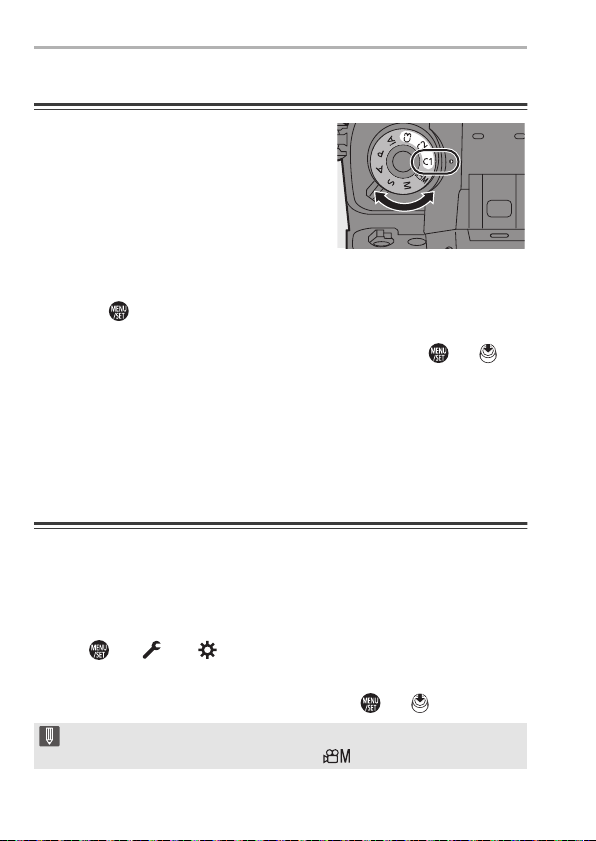
14. Camera Customization
DVQX1939 (ENG)
162
Using Custom Mode
Set the mode dial to one of [C1] to
[C3].
≥If [C3], the last-used Custom mode will be
called up.
[C3] Custom Mode Selection
1
Set the mode dial to [C3].
2
Press .
0
The Custom mode selection menu appears.
3
Press 34 to select the Custom mode and then press or .
Changing Registered Details
Registered settings do not change even if you change the camera settings
temporarily with the mode dial set to [C1] to [C3].
To change the registered details, overwrite them by using [Save to Custom
Mode] in the [Setup] ([Setting]) menu.
Calling Up Settings
Call up registered Custom mode settings to the selected recording mode
and overwrite the current settings with these.
1
Set to the mode dial to use.
2
Select [Load Custom Mode].
≥ ¨ [ ] ¨ [ ] ¨ [Load Custom Mode]
3
Select the Custom mode to call up.
≥Select the Custom mode and then press or .
0 Calling up of Custom modes is not possible between those created from [P]/
[A]/[S]/[M] modes and those created from [ ] mode.
DC-S1HP-DVQX1939_eng.book 162 ページ 2019年8月9日 金曜日 午後4時45分
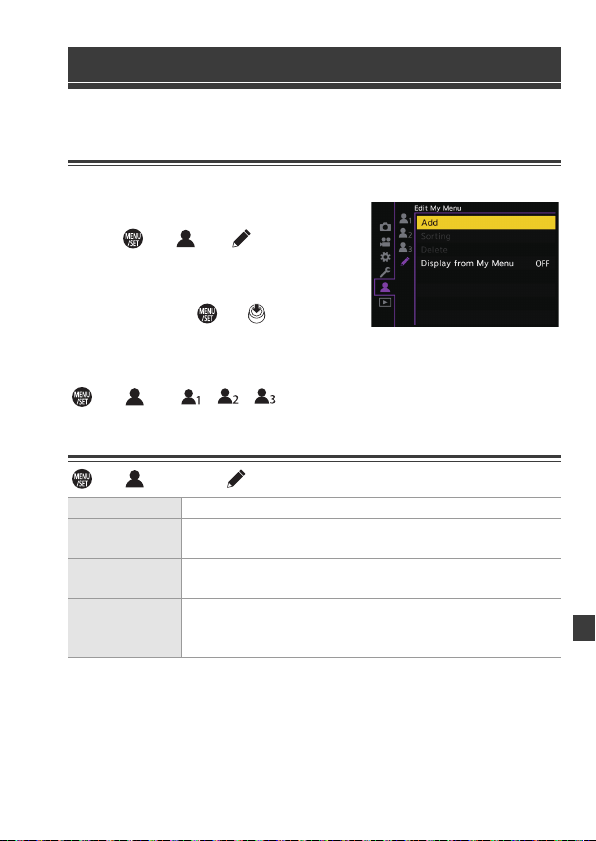
14. Camera Customization
DVQX1939 (ENG)
163
Register frequently-used menus in My Menu.
Registration in My Menu
Select a menu, and register this in My Menu.
1
Select [Add].
≥ ¨ [ ] ¨ [ ] ¨ [Add]
2
Register.
≥Select the menu to register and
then press or .
Calling up My Menu
Call up the menus registered in My Menu.
¨ [ ] ¨ [ ]/[ ]/[ ] ¨ Registered menus
Edit My Menu
¨ [ ] ¨ Select [ ]
My Menu
[Add] Selects and registers the menus to be displayed in My Menu.
[Sorting]
Changes the order of My Menu.
Select the menu to change, then set the destination.
[Delete]
[Delete Item]: Selects the menu, then deletes.
[Delete All]: Deletes all menus registered in My Menu.
[Display from
My Menu]
Displays My Menu first when displaying a menu.
[ON]: Displays My Menu.
[OFF]: Displays the last-used menu.
DC-S1HP-DVQX1939_eng.book 163 ページ 2019年8月9日 金曜日 午後4時45分

14. Camera Customization
DVQX1939 (ENG)
164
Saves the camera’s settings information to the card.
Saved settings information can be loaded to the camera, letting you set the
same settings on multiple cameras.
¨ [ ] ¨ [ ] ¨ Select [Save/Restore Camera Setting]
[Save/Restore Camera Setting]
[Save]
Saves the camera’s settings information to the card.
0 If saving new data, then select [New File], and if overwriting an
existing file, select that existing file.
0 When [New File] is selected, a screen to select the file name
to save as is displayed.
[OK] Saves using the file name on the screen.
[Change
the file
name]
Changes the file name and saves the file.
0 Available characters: alphabetic characters
(upper-case), numerals, up to 8 characters
0 For information on how to enter characters,
refer to page 170.
[Load]
Loads the settings information on the card and copies it to the
camera.
[Delete] Deletes settings information on the card.
[Keep Settings
While Format]
When formatting the card, formats the card while keeping
camera settings information stored on the card.
0 Only settings information from the same model can be loaded.
0 Up to 10 instances of settings information can be saved on one card.
0 Refer to the “Owner’s Manual” (PDF format) for the list of functions for which
saving of settings information is possible.
DC-S1HP-DVQX1939_eng.book 164 ページ 2019年8月9日 金曜日 午後4時45分
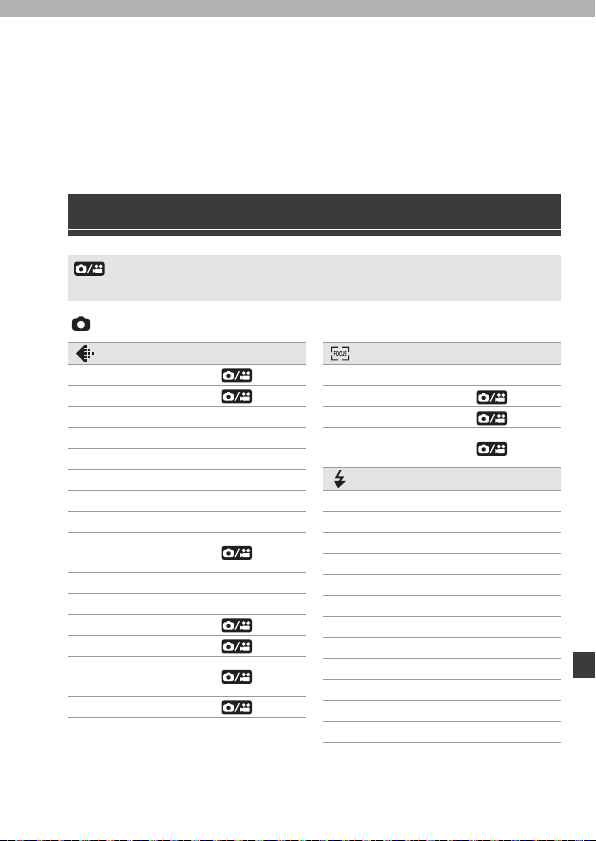
DVQX1939 (ENG)
165
15. List of Menu
This chapter introduces the menu list.
0
For information about menu operation methods, refer to page 57.
0 For information on how to enter characters, refer to page 170.
0 Refer to the “Owner’s Manual” (PDF format) for detailed information about menus.
[Photo] menu
List of Menu
: Menu items common to the [Photo] menu and [Video] menu.
Their settings are synchronized.
[Image Quality]
[Photo Style] l 87
[Metering Mode] l 80
[Aspect Ratio] l 63
[Picture Quality] l 63
[Picture Size] l 63
[HLG Photo]
[High Resolution Mode]
[Long Exposure NR]
[Dual Native ISO
Setting]
l 83
[ISO Sensitivity (photo)]
[Min. Shutter Speed]
[i.Dynamic Range]
[Vignetting Comp.]
[Diffraction
Compensation]
[Filter Settings]
[Focus]
[AF Custom Setting(Photo)]
[AF Assist Light]
[Focus Peaking]
[1-Area AF Moving
Speed]
[Flash]
[Flash Mode] l 91
[Firing Mode]
[Flash Adjust.]
[Flash Synchro]
[Manual Flash Adjust.]
[Auto Exposure Comp.]
[Red-Eye Removal]
[Wireless]
[Wireless Channel]
[Wireless FP]
[Communication Light]
[Wireless Setup]
DC-S1HP-DVQX1939_eng.book 165 ページ 2019年8月9日 金曜日 午後4時45分

15. List of Menu
DVQX1939 (ENG)
166
[Photo] menu (Continued)
[Video] menu
[Others (Photo)]
[Bracketing]
[Silent Mode]
[Image Stabilizer] l 75
[Burst Shot 1 Setting]
[Burst Shot 2 Setting]
[Shutter Type]
[Shutter Delay]
[Ex. Tele Conv.]
[Time Lapse/Animation]
[Self Timer]
[Flicker Decrease (Photo)]
[6K/4K PHOTO]
[Post-Focus]
[Multiple Exposure]
[Time Stamp Rec.]
[Image Quality]
[Exposure Mode] l 98
[Photo Style] l 87
[Metering Mode] l 80
[Dual Native ISO
Setting]
l 83
[ISO Sensitivity (video)] l 118
[Synchro Scan] l 137
[Flicker Decrease (Video)]
[Master Pedestal Level] l 117
[SS/Gain Operation] l 121
[i.Dynamic Range]
[Vignetting Comp.]
[Diffraction
Compensation]
[Filter Settings]
[Image Format]
[Rec. File Format] l 100
[Image Area of Video] l 108
[Rec Quality] l 101
[Rec Quality (My List)] l 108
[Variable Frame Rate] l 125
[Time Code] l 110
[Luminance Level] l 117
[Focus]
[AF Custom Setting(Video)] l 116
[Continuous AF] l 115
[AF Assist Light]
[Focus Peaking]
[1-Area AF Moving
Speed]
DC-S1HP-DVQX1939_eng.book 166 ページ 2019年8月9日 金曜日 午後4時45分
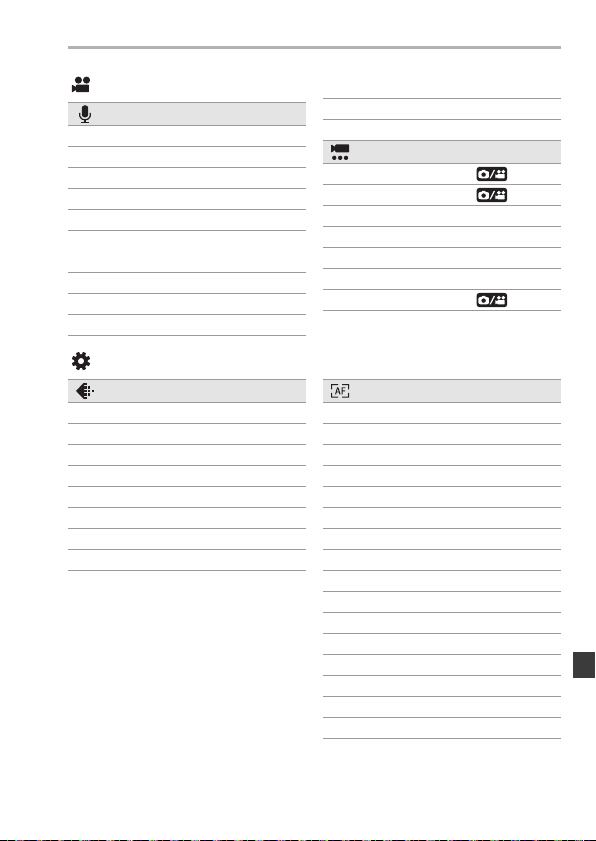
15. List of Menu
DVQX1939 (ENG)
167
[Video] menu (Continued)
[Custom] menu
[Audio]
[Sound Rec Level Disp.] l 119
[Mute Sound Input] l 119
[Sound Rec Gain Level] l 119
[Sound Rec Level Adj.] l 120
[Sound Rec Level Limiter] l 120
[Wind Noise Canceller]/ l 120
[Wind Cut] l 148
[Mic Socket] l 146
[Special Mic.] l 148
[XLR Mic Adaptor Setting] l 149
[Sound Output] l 151
[Headphone Volume] l 151
[Others (Video)]
[Silent Mode]
[Image Stabilizer] l 75
[Focus Transition] l 128
[Loop Recording (video)] l 138
[Segmented File Recording] l 139
[Live Cropping] l 130
[Time Stamp Rec.]
[Image Quality]
[Photo Style Settings]
[ISO Increments]
[Extended ISO]
[Exposure Offset Adjust.]
[Color Space]
[Exposure Comp. Reset]
[Auto Exposure in P/A/S/M] l 93
[CreativeVideo Combined Set.]
[Focus/Shutter]
[Focus/Shutter Priority]
[Focus Switching for Vert / Hor]
[AF/AE Lock Hold]
[AF+MF]
[MF Assist]
[MF Guide]
[Focus Ring Lock]
[Show/Hide AF Mode]
[Pinpoint AF Setting]
[AF-Point Scope Setting]
[Shutter AF]
[Half-Press Shutter]
[Quick AF]
[Eye Sensor AF]
[Looped Focus Frame]
[AFC Start Point (225-Area)] l 69
DC-S1HP-DVQX1939_eng.book 167 ページ 2019年8月9日 金曜日 午後4時45分
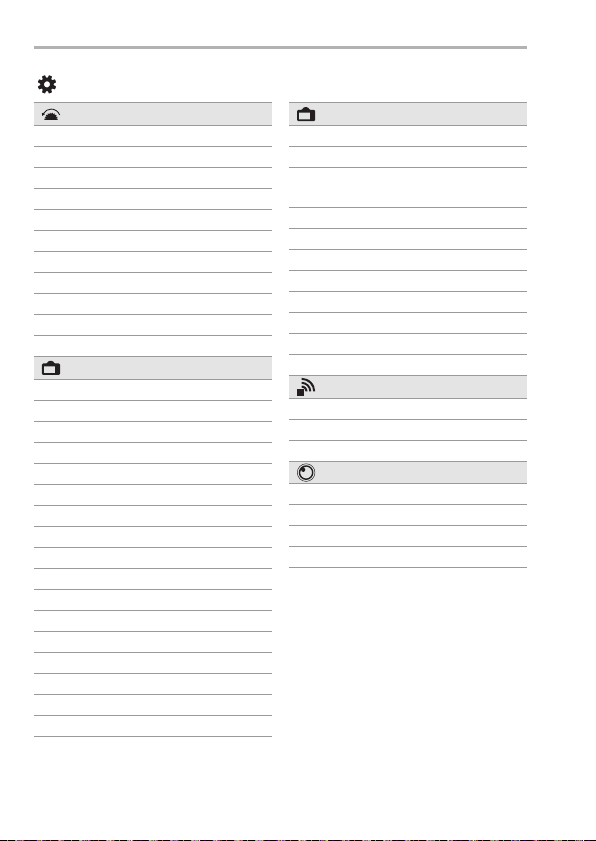
15. List of Menu
DVQX1939 (ENG)
168
[Custom] menu (Continued)
[Operation]
[Q.MENU Settings] l 159
[Touch Settings]
[Lock Lever Setting]
[Fn Button Set] l 156
[WB/ISO/Expo. Button]
[ISO Displayed Setting]
[Exposure Comp. Disp. Setting]
[Dial Set.]
[Joystick Setting]
[Illuminated Button]
[Video Rec. Button (Remote)]
[Monitor / Display (Photo)]
[Auto Review]
[Constant Preview]
[Histogram]
[Photo Grid Line]
[AF Area Display]
[Live View Boost]
[Night Mode]
[LVF/Monitor Disp. Set]
[Expo.Meter]
[Focal Length]
[Blinking Highlights]
[Sheer Overlay]
[I.S. Status Scope]
[Level Gauge]
[Luminance Spot Meter] l 122
[Framing Outline]
[Show/Hide Monitor Layout] l 53
[Monitor / Display (Video)]
[V-Log View Assist] l 132
[HLG View Assist] l 135
[Anamorphic Desqueeze
Display]
l 136
[Monochrome Live View]
[Center Marker]
[Video Frame Marker] l 124
[Zebra Pattern] l 123
[WFM/Vector Scope] l 121
[Color Bars] l 124
[Video-Priority Display]
[Red REC Frame Indicator]
[IN/OUT]
[HDMI Rec Output] l 144
[Fan Mode]
[Tally Lamp]
[Lens / Others]
[Lens Focus Resume]
[Focus Ring Control]
[Lens Information] l 78
[Lens Info. Confirmation]
DC-S1HP-DVQX1939_eng.book 168 ページ 2019年8月9日 金曜日 午後4時45分
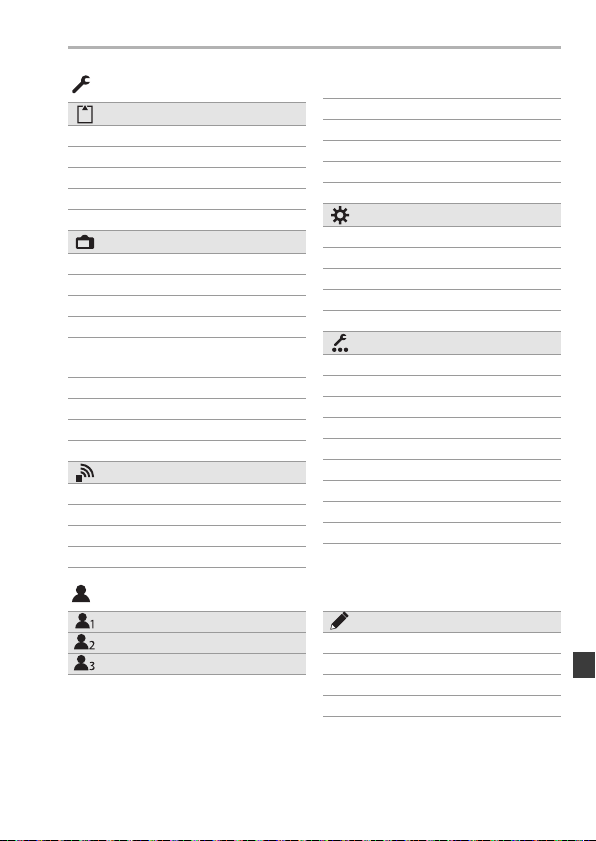
15. List of Menu
DVQX1939 (ENG)
169
[Setup] menu
[My Menu]
[Card/File]
[Card Format]
[Double Card Slot Function]
[Folder / File Settings]
[File Number Reset]
[Copyright Information]
[Monitor / Display]
[Power Save Mode] l 37
[Monitor Frame Rate]
[LVF Frame Rate]
[Monitor Settings]/[Viewfinder]
[Monitor Backlight]/
[LVF Luminance]
[Remaining Battery Level]
[Status-LCD]
[Eye Sensor]
[Level Gauge Adjust.]
[IN/OUT]
[Beep]
[Headphone Volume]
[Wi-Fi]
[Bluetooth] l 173
[USB]
[Battery Information]
[Battery Use Priority]
[TV Connection]
[Card Access Light]
[Setting]
[Save to Custom Mode] l 161
[Load Custom Mode] l 162
[Custom Mode Settings]
[Save/Restore Camera Setting] l 164
[Reset] l 59
[Others]
[Clock Set]
[Time Zone]
[System Frequency] l 100
[Pixel Refresh]
[Sensor Cleaning]
[Language]
[Firmware Version]
[Online Manual]
[Approved Regulations]
[Page 1] l 163
[Page 2] l 163
[Page 3] l 163
[Edit My Menu] l 163
[Add] l 163
[Sorting] l 163
[Delete] l 163
[Display from My Menu] l 163
DC-S1HP-DVQX1939_eng.book 169 ページ 2019年8月9日 金曜日 午後4時45分
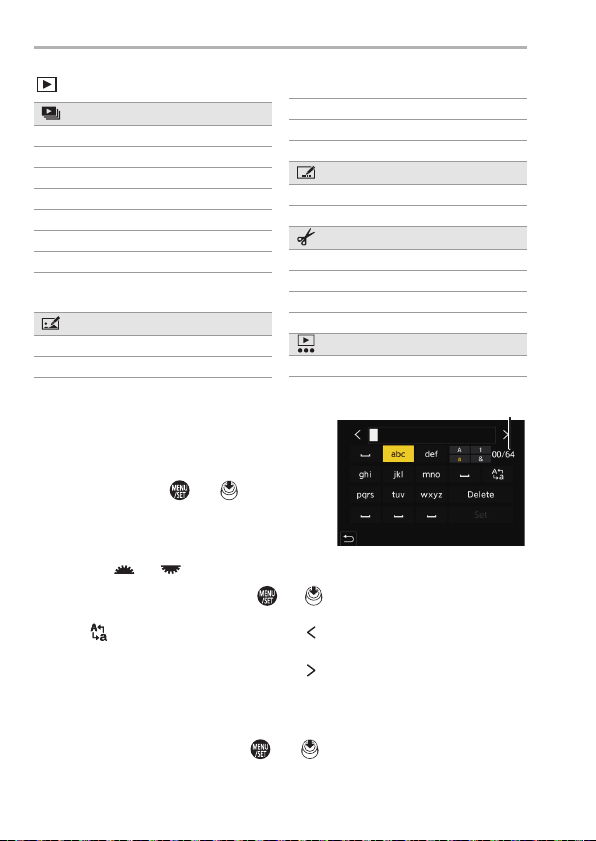
15. List of Menu
DVQX1939 (ENG)
170
[Playback] menu
Entering Characters
Follow the steps below when the character
entry screen is displayed.
1
Press 3421 to select characters
and then press or until the
character to enter is displayed. (Repeat
this)
0
To repeatedly enter the same character,
rotate or to the right to move the entry position cursor.
0 When entering a password, A shows the number of characters you have
entered and the number of characters you can enter.
2
Select [Set] and then press or .
[Playback Mode]
[Playback Mode]
[Slide Show]
[Rotate Disp.]
[Picture Sort]
[Magnify from AF Point]
[LUT View Assist (Monitor)] l 132
[HLG View Assist (Monitor)] l 135
[Anamorphic Desqueeze
Display]
l 136
[Process Image]
[RAW Processing]
[6K/4K PHOTO Bulk Saving]
[6K/4K PHOTO Noise Reduction]
[Time Lapse Video]
[Stop Motion Video]
[Add/Delete Info.]
[Protect]
[Rating]
[Edit Image]
[Resize]
[Rotate]
[Video Divide]
[Copy]
[Others]
[Delete Confirmation]
0 If you select an item and press or , you can perform the following
operations:
– [ ]: Change the character type
–[] ]: Enter a blank
– [Delete]: Delete a character
– [ ]: Move the entry position cursor to
the left
– [ ]: Move the entry position cursor to
the right
DC-S1HP-DVQX1939_eng.book 170 ページ 2019年8月9日 金曜日 午後4時45分
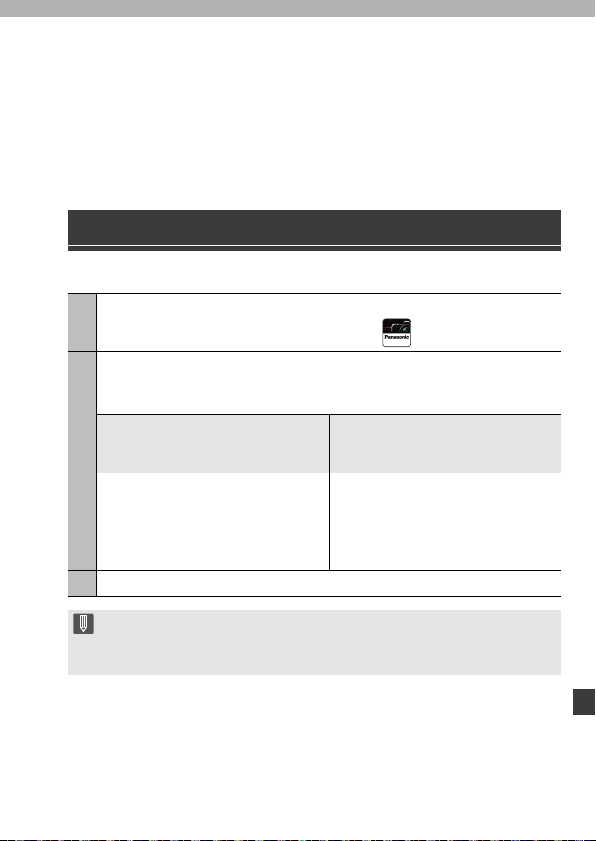
DVQX1939 (ENG)
171
16. Wi-Fi/Bluetooth
This document gives an overview of remote operations from a smartphone.
Refer to the “Owner’s Manual” (PDF format) for details about camera Wi-
Fi
®
/Bluetooth
®
functions.
0
This document refers to smartphones and tablets collectively as smartphones.
Flow of connecting a smartphone
Connecting to a Smartphone
1
Install “LUMIX Sync” on your smartphone. (l 172)
Connect to a network, and install “LUMIX Sync” .
2
Connect to a smartphone.
Connect the camera and the smartphone using a method depending on the
smartphone.
Using a smartphone that supports
Bluetooth Low Energy
0 Bluetooth connection (l 173)
Using a smartphone that does not
support Bluetooth Low Energy
0 Wi-Fi connection
Connect using simple connection
setup procedure (pairing).
Connect with Wi-Fi.
You can also use a QR code to
connect easily.
Refer to the “Owner’s Manual” (PDF
format) for details.
3
Operate the camera using the smartphone. (l 176)
0 The camera cannot be used to connect to a public wireless LAN connection.
0 We strongly recommend that you set an encryption to maintain information
security.
DC-S1HP-DVQX1939_eng.book 171 ページ 2019年8月9日 金曜日 午後4時45分
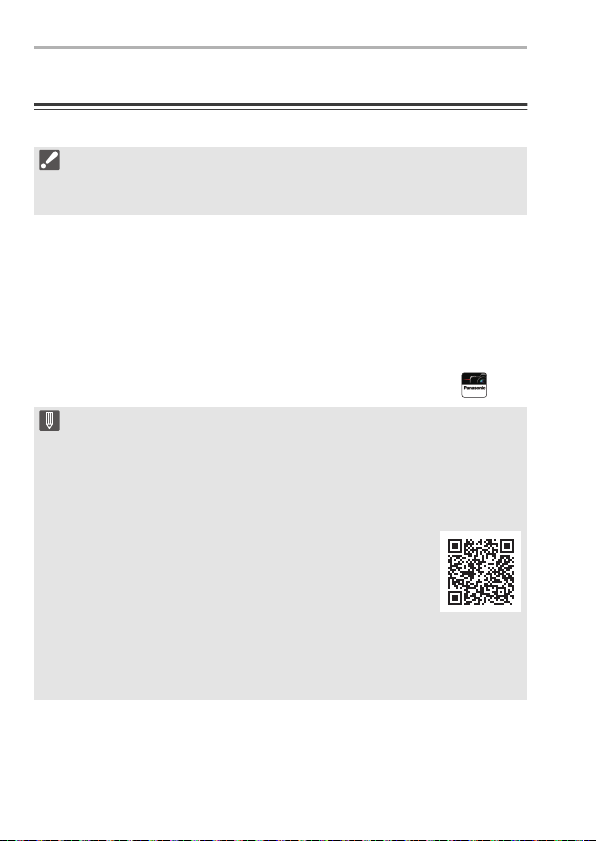
16. Wi-Fi/Bluetooth
DVQX1939 (ENG)
172
Installing “LUMIX Sync”
“LUMIX Sync” is an application for smartphones provided by Panasonic.
1
Connect the smartphone to a network.
2
(Android) Select “Google Play™ Store”.
(iOS) Select “App Store”.
3
Enter “Panasonic LUMIX Sync” or “LUMIX” into the
search box.
4
Select and install the “Panasonic LUMIX Sync ” .
Supported OS
Android™: Android 5 or higher
iOS: iOS 11 or higher
0 Use the latest version.
0 Supported OSs are current as of August 2019 and are subject to change.
0 Some of the screens and information provided in this document may differ
from your device depending on the supported OS and “LUMIX Sync” version.
0 Read the [Help] in the “LUMIX Sync” menu for further details on how to
operate.
0 The app may not operate correctly depending on your
smartphone.
For information on the “LUMIX Sync”, refer to the following
support site:
https://panasonic.jp/support/global/cs/dsc/
(English only)
0 Depending on your data plan, downloading the app or transferring pictures
and videos via a mobile network, such as 4G (LTE) or 3G, may incur high data
usage charges.
DC-S1HP-DVQX1939_eng.book 172 ページ 2019年8月9日 金曜日 午後4時45分
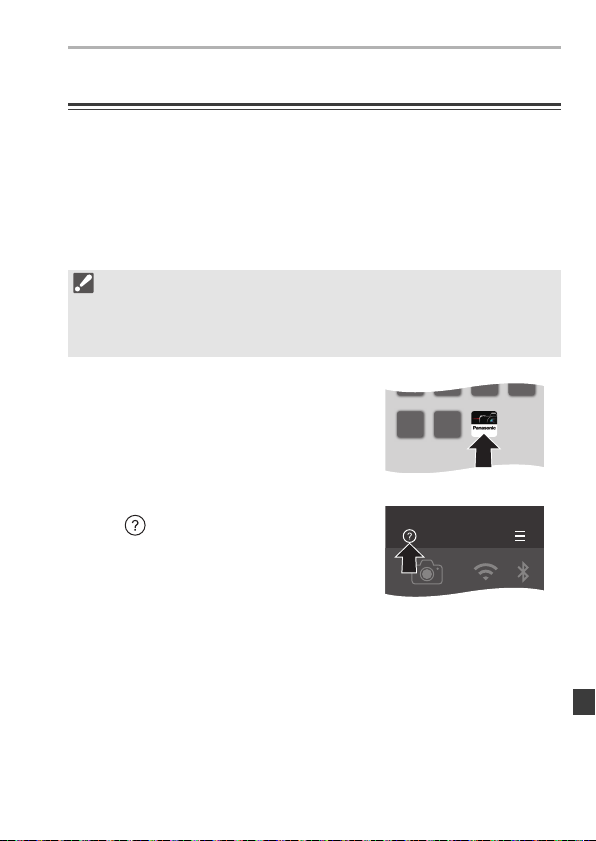
16. Wi-Fi/Bluetooth
DVQX1939 (ENG)
173
Connecting to a Smartphone (Bluetooth Connection)
Follow a simple connection setup procedure (pairing) to connect to a
smartphone that supports Bluetooth Low Energy.
When pairing is set up, the camera also automatically connects to the
smartphone via Wi-Fi.
0
For the first-time connection, pairing settings are required.
For information about connecting for the second and subsequent times, refer to
page 175.
1
On the smartphone, start up
“LUMIX Sync”.
≥A message regarding device
(camera) registration is displayed.
Select [Next].
0
If you have closed the message, select
[ ], then register the camera using
[Camera registration (pairing)].
0 A message is displayed if the Bluetooth
function of the smartphone is turned off.
(For Android devices) Allow turning on
the Bluetooth function.
(For iOS devices) Follow the message to turn on the Bluetooth function in the
settings screen of the smartphone and then display “LUMIX Sync”.
2
Check the content in the displayed guide and select
[Next] until the screen to register the camera is
displayed.
Supported smartphones
Android™: Android 5 or higher with Bluetooth 4.0 or higher
(excluding those that do not support Bluetooth Low Energy)
iOS: iOS 11 or higher
LUMIX Sync
DC-S1HP-DVQX1939_eng.book 173 ページ 2019年8月9日 金曜日 午後4時45分
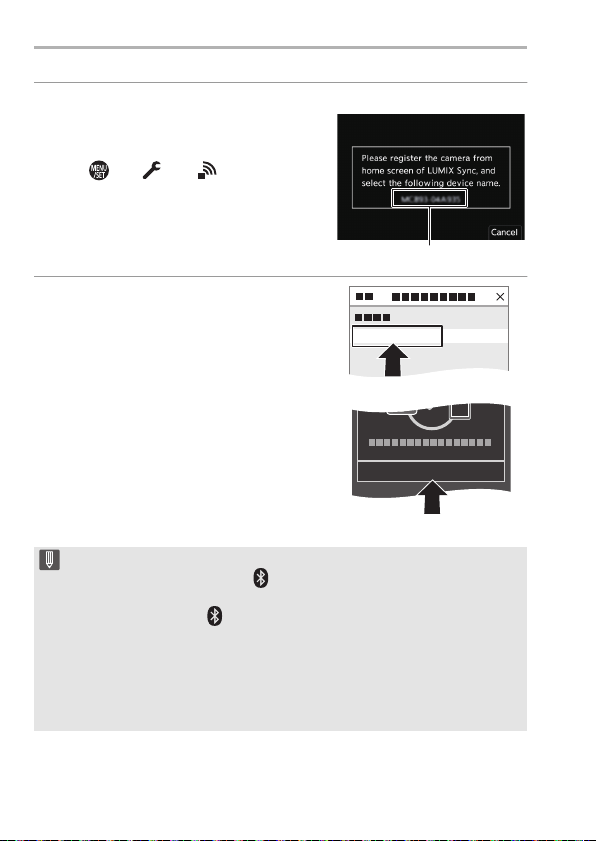
16. Wi-Fi/Bluetooth
DVQX1939 (ENG)
174
Operating the camera in accordance with the smartphone guide.
3
Set the camera to Bluetooth
pairing standby state.
≥ ¨ [ ] ¨ [ ] ¨ [Bluetooth]
¨ [Bluetooth] ¨ [SET] ¨ [Pairing]
≥The camera enters pairing standby
state and the device name A is
displayed.
4
On the smartphone, select the
camera’s device name.
0 (iOS devices) When a message to
confirm the change of destination is
displayed, select [Join].
5
When a message indicating
that device registration is
complete, select [OK].
≥A Bluetooth connection between
the camera and the smartphone will
be made.
0 The paired smartphone is registered as a paired device.
0 During Bluetooth connection, [ ] is displayed in the recording screen.
When the Bluetooth function is enabled, but a connection is not established
with the smartphone, [ ] appears translucent.
0 (iOS devices) If the Wi-Fi connection attempt fails during Bluetooth
connection, follow the message displayed to allow connection to the camera.
If you still cannot connect, select the SSID of the camera on the Wi-Fi setup
screen of the smartphone to connect. If the SSID is not displayed, turn off and
on the camera, then perform the Bluetooth connection settings again.
XXXXXXXXXXXX
OK
DC-S1HP-DVQX1939_eng.book 174 ページ 2019年8月9日 金曜日 午後4時45分

16. Wi-Fi/Bluetooth
DVQX1939 (ENG)
175
End Bluetooth Connection
¨ [ ] ¨ [ ] ¨ [Bluetooth] ¨ [Bluetooth] ¨ Select [OFF]
Connecting to a Paired Smartphone
Connect paired smartphones using the following procedure.
1
Enable the Bluetooth function of the camera.
0
¨ [ ] ¨ [ ] ¨ [Bluetooth] ¨ [Bluetooth] ¨ [ON]
2
On the smartphone, start up “LUMIX
Sync”.
0
If a message is displayed indicating that the
smartphone is searching for cameras,
close the message.
3
Select [ ].
4
Select [Bluetooth Setup].
5
Turn Bluetooth ON.
6
From [Camera registered] items, select
the camera’s device name.
Terminating the Wi-Fi Connection
1
Press the shutter button halfway to set the camera to recording mode.
2
Terminate the Wi-Fi connection.
0
¨ [ ] ¨ [ ] ¨ [Wi-Fi] ¨ [Wi-Fi Function] ¨ [Yes]
3
On the smartphone, close the “LUMIX Sync”.
0 Even if you terminate the connection, the pairing information for it will not be
deleted.
0 Even if you set up pairing with more than one smartphone, you can only
connect to one smartphone at a time.
0 When pairing takes some time, canceling the pairing settings on both the
smartphone and camera and re-establishing the connection may result in the
camera being detected correctly.
LUMIX Sync
Bluetooth
XXXXXXXX
DC-S1HP-DVQX1939_eng.book 175 ページ 2019年8月9日 金曜日 午後4時45分
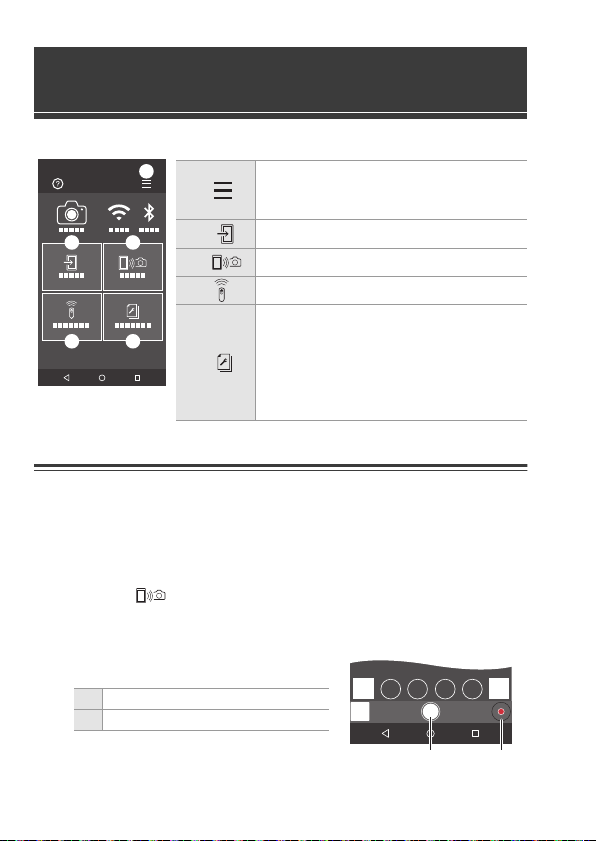
16. Wi-Fi/Bluetooth
DVQX1939 (ENG)
176
When you start up “LUMIX Sync”, the home screen is displayed.
[Remote shooting]
You can use the smartphone to record from a remote location while
viewing the live view images from the camera.
Getting started:
0 Connect the camera to a smartphone. (l 173)
0 On the smartphone, start up “LUMIX Sync”.
1
Select [ ] ([Remote shooting]) in the home screen.
0 (iOS devices) When a message to confirm the change of destination is
displayed, select [Join].
2
Start recording.
0 The recorded image is saved on the
camera.
Operating the Camera with a
Smartphone
A
App settings (l 175)
This allows connection settings, camera
power operations, and displays Help.
B
[Import images] (l 177)
C
[Remote shooting] (l 176)
D
[Shutter Remote Control] (l 177)
E
[Camera settings copy]
This saves the camera’s settings information
to the smartphone.
Saved settings information can be loaded to
the camera, letting you set the same settings
on multiple cameras.
A Takes a picture
B Starts/ends the video recording
LUMIX Sync
DC-S1HP-DVQX1939_eng.book 176 ページ 2019年8月9日 金曜日 午後4時45分
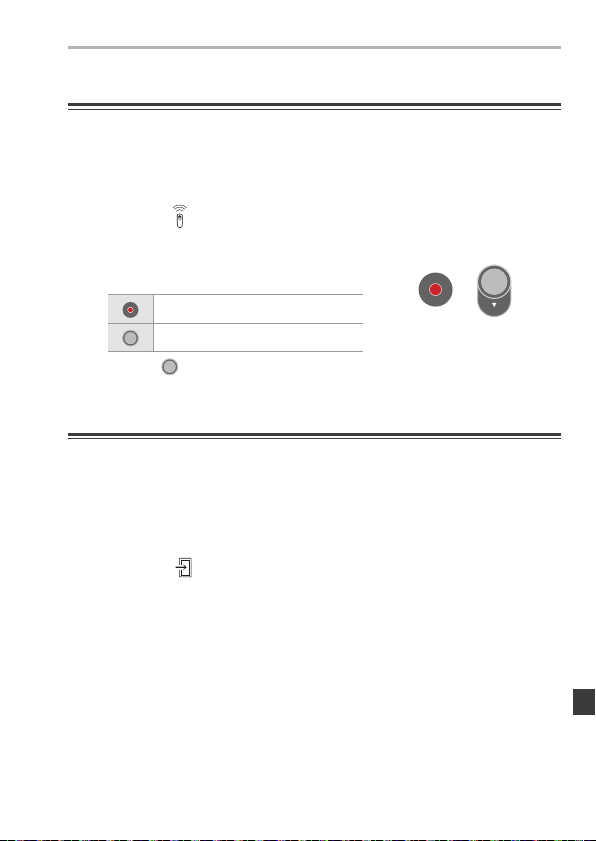
16. Wi-Fi/Bluetooth
DVQX1939 (ENG)
177
[Shutter Remote Control]
You can use the smartphone as a remote control for the shutter.
Getting started:
0 Connect the camera to a smartphone by Bluetooth. (l 173)
0 On the smartphone, start up “LUMIX Sync”.
1
Select [ ] ([Shutter Remote Control]) in the home
screen.
2
Start recording.
0 Slide [ ] in the direction of [LOCK] to record with the shutter button locked
in a fully-pressed state.
[Import images]
Transfer an image stored on the card to the smartphone connected via Wi-
Fi.
Getting started:
0 Connect the camera to a smartphone. (l 173)
0 On the smartphone, start up “LUMIX Sync”.
1
Select [ ] ([Import images]) in the home screen.
0 (iOS devices) When a message to confirm the change of destination is
displayed, select [Join].
Starts/ends the video recording
Takes a picture
LOCK
DC-S1HP-DVQX1939_eng.book 177 ページ 2019年8月9日 金曜日 午後4時45分
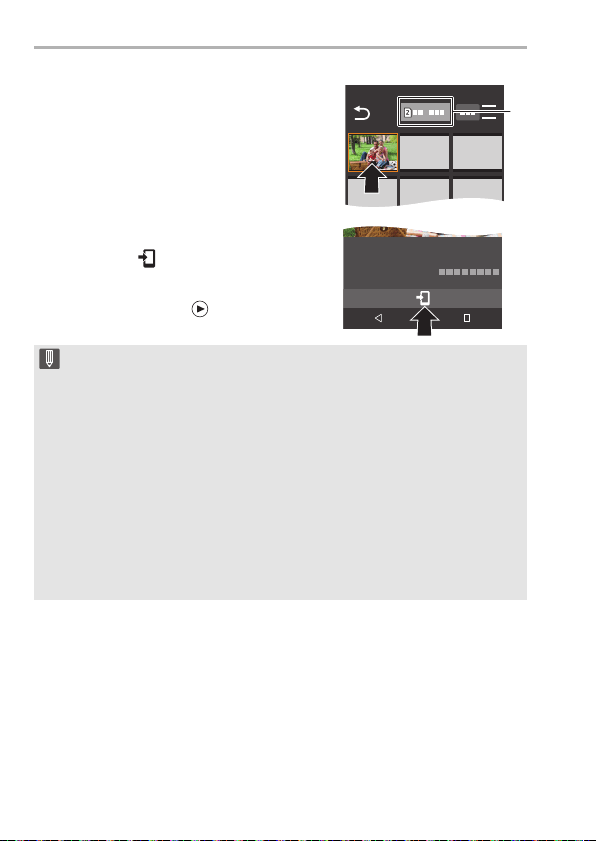
16. Wi-Fi/Bluetooth
DVQX1939 (ENG)
178
2
Select the image to transfer.
0 You can switch the card displayed by
touching A.
3
Transfer the image.
≥Select [ ].
0
If the image is a video, you can play it
back by touching [ ] at the center of
the screen.
0 You will need Android 7.0 or higher to save RAW pictures on an Android
device.
Depending on the smartphone or the OS, these may not be displayed
correctly.
0 When a video is played back, this has a small data size and is transmitted
using “LUMIX Sync”, therefore its image quality will differ from that of the
actual video recording.
Depending on the smartphone and on the usage conditions, the image quality
may deteriorate or the sound may skip during video or picture playback.
0 Images recorded using the following functions cannot be transferred:
– [AVCHD] videos, [MP4] 4K videos, [MOV] videos
– [6K/4K PHOTO]/[Post-Focus]
– [HLG Photo] (HLG format pictures)
DC-S1HP-DVQX1939_eng.book 178 ページ 2019年8月9日 金曜日 午後4時45分
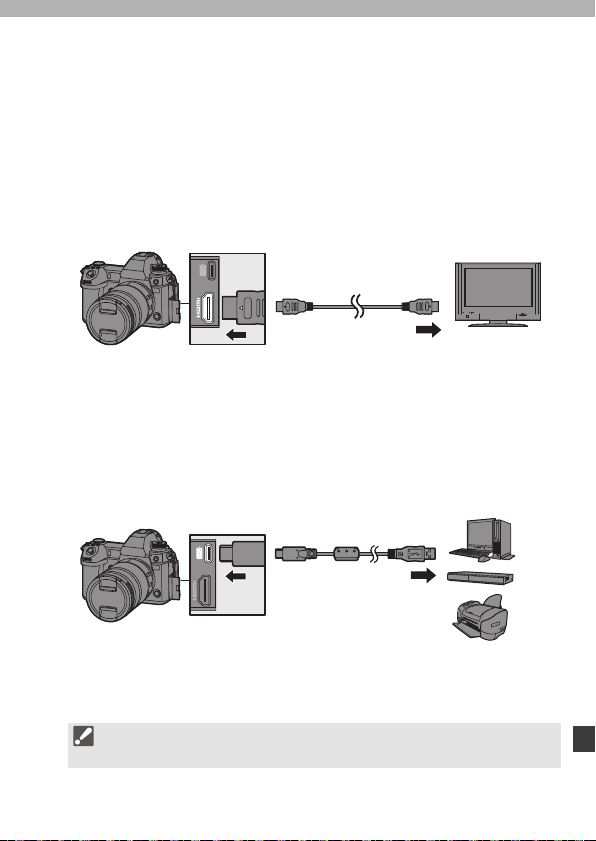
DVQX1939 (ENG)
179
17. Connecting to Other Devices
Connect using either the [HDMI] socket or the USB port on the camera.
0
Refer to the “Owner’s Manual” (PDF format) for details about the following:
– Using VIERA Link (HDMI)
– Saving still pictures and motion pictures on a Recorder
–Printing
[HDMI] socket
Connect the camera and TV with a commercially available HDMI cable.
0
Check the direction of the terminals and plug in/out straight holding onto the plug.
(Inserting these at an angle may cause deformation or malfunction)
0 Use a “High Speed HDMI cable” with the HDMI logo.
Cables that do not comply with the HDMI standards will not work.
“High Speed HDMI cable” (Type A–Type A plug, up to 1.5 m (4.9 feet) long)
USB port
Use a USB connection cable (C–C or A–C) to connect the camera to a PC,
recorder, or printer.
0
Plug in/out straight holding onto the plug.
(Inserting these at an angle may cause deformation or malfunction)
0 Do not use any other USB connection cables except the supplied USB connection
cables (C–C and A–C).
0 Do not connect the cable to the wrong terminals. This may cause a
malfunction.
DC-S1HP-DVQX1939_eng.book 179 ページ 2019年8月9日 金曜日 午後4時45分

17. Connecting to Other Devices
DVQX1939 (ENG)
180
You can connect the camera to a TV to view recorded pictures and videos
on the TV.
Getting started:
0 Turn off the camera and TV.
1
Connect the camera and TV with a commercially
available HDMI cable. (l 179)
2
Turn on the TV.
3
Switch the input of the TV.
≥Switch the input of the TV to match the terminal to which you
connected the HDMI cable.
4
Turn on the camera.
5
Display the playback screen.
≥Press [(].
≥The recorded images are displayed on the TV. (The monitor and
viewfinder of the camera will turn off.)
Viewing on a TV
0 HDMI output is not possible if you connect a USB connection cable at the
same time while [USB Mode] is set to [PC(Storage)] or [PictBridge(PTP)].
0 Please also refer to the operating instructions for the TV.
DC-S1HP-DVQX1939_eng.book 180 ページ 2019年8月9日 金曜日 午後4時45分

17. Connecting to Other Devices
DVQX1939 (ENG)
181
If you connect the camera to a PC, you can copy the recorded images to
the PC.
When using Windows, you can also copy using the “PHOTOfunSTUDIO”
software for LUMIX.
You can also use software to perform operations such as organizing and
correcting recorded images, processing RAW images, and editing videos.
(l 183)
Copying Images to a PC
After connecting to the PC, you can copy the recorded images by dragging
files and folders on this camera to the PC.
Importing Images to a PC
– Windows: We recommend importing AVCHD videos using
“PHOTOfunSTUDIO”.
When importing using “PHOTOfunSTUDIO”, refer to page 183.
0 You cannot play back or edit AVCHD videos using
“PHOTOfunSTUDIO” if you imported them by dragging them.
–Mac: Supported by “Final Cut Pro X”.
For details on “Final Cut Pro X”, please contact Apple Inc.
0 The camera can be connected to a PC running any of the following OSs which
can detect mass storage devices.
Supported OS
Windows: Windows 10/Windows 8.1/Windows 8/Windows 7
Mac: OS X v10.5 to v10.11, macOS 10.12 to macOS 10.14
DC-S1HP-DVQX1939_eng.book 181 ページ 2019年8月9日 金曜日 午後4時45分
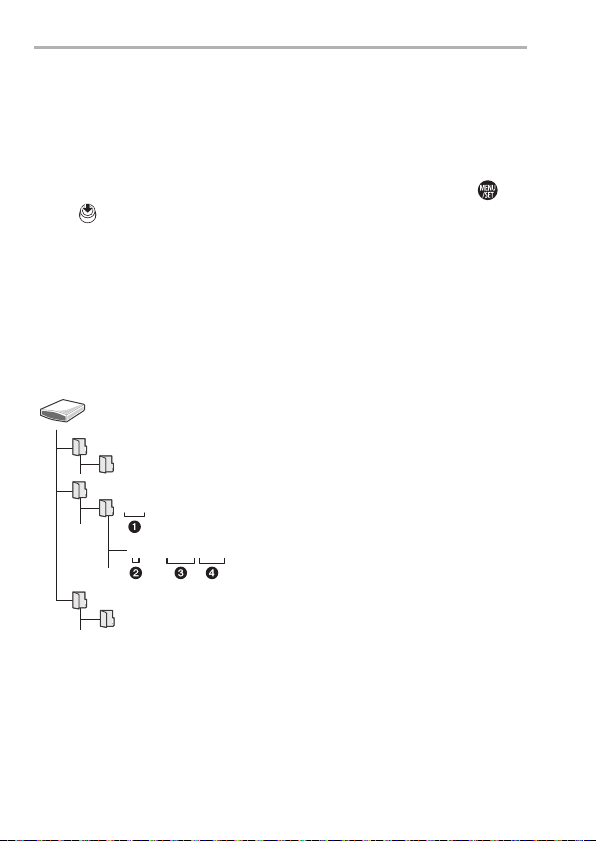
17. Connecting to Other Devices
DVQX1939 (ENG)
182
Getting started:
0
Turn on the camera and PC.
1
Connect the camera and PC with the USB connection
cable (C–C or A–C). (l 179)
2
Press 34 to select [PC(Storage)] and then press or
.
0 A message about charging may be displayed. Wait for a while until the
message disappears.
3
Drag the files and folders from the camera to the PC.
Folder Structure Inside Card
≥Windows: A drive (“LUMIX”) is displayed in [This PC].
≥Mac: A drive (“LUMIX”) is displayed on the desktop.
LUMIX
CAMSET: The camera’s setup
information
DCIM: Images
1 Folder number
2 Color space P: sRGB
_: AdobeRGB
3 File number
4 JPG: JPEG format pictures
RW2: RAW format pictures
HSP: HLG format pictures
MP4: MP4 videos,
6K/4K burst files
MOV: MOV videos
AVCHD: AVCHD videos
CAMSET
AD_LUMIX
AVCHD
DCIM
100XXXXX
PXXX0001.JPG
PRIVATE
DC-S1HP-DVQX1939_eng.book 182 ページ 2019年8月9日 金曜日 午後4時45分
17. Connecting to Other Devices
DVQX1939 (ENG)
183
Copying Images to PCs Using “PHOTOfunSTUDIO”
Getting started:
0 Turn on the camera and PC.
0 Install “PHOTOfunSTUDIO” on PC. (l 183)
1
Connect the camera and PC with the USB connection cable (C–C or
A–C). (l 179)
2
Press 34 to select [PC(Storage)] and then press or .
0
A message about charging may be displayed. Wait for a while until the
message disappears.
3
Copy images to the PC using “PHOTOfunSTUDIO”.
0
Do not delete or move the copied files and folders in, for example, Windows
Explorer.
Playback and editing using “PHOTOfunSTUDIO” will become no longer
possible.
Installing Software
Install the software to perform operations such as organizing and
correcting recorded images, processing RAW images, and editing videos.
0 Take care not to turn off the camera while images are being imported.
0 After importing of the images is completed, perform the operation to safely
remove the USB connection cable on the PC.
0 Turn off the camera and disconnect the USB connection cable before
removing the card from the camera. Otherwise, the recorded data may be
damaged.
0 To download the software, your PC needs to be able to connect to the internet.
0 Downloading may take a while depending on the communication environment.
0 Supported OSs are current as of August 2019 and are subject to change.
DC-S1HP-DVQX1939_eng.book 183 ページ 2019年8月9日 金曜日 午後4時45分

17. Connecting to Other Devices
DVQX1939 (ENG)
184
PHOTOfunSTUDIO 10.1 PE
This software allows you to manage your images. For example, it allows
you to import pictures and videos to your PC and then sort them by
recording date, model name.
You can also perform operations such as writing images to a DVD,
correcting images, and editing videos.
Check the following site and then download and install the software:
https://panasonic.jp/support/global/cs/soft/download/d_pfs101pe.html
(English only)
Download expiration: September 2024
Operating environment
0
A high-performance PC environment is required to use the playback and editing
functions for 4K videos and videos in 10-bit format or the picture cropping function
for 6K/4K photos.
For details, refer to the operating instructions for “PHOTOfunSTUDIO”.
0 “PHOTOfunSTUDIO” is not available for Mac.
Supported OS
Windows 10 (32-bit/64-bit)
Windows 8.1 (32-bit/64-bit)
Windows 7 (32-bit/64-bit) SP1
0 For 4K videos, videos in 10-bit format, and 6K/4K photos, a
64-bit version of the Windows 10/Windows 8.1/Windows 7 OS
is required.
CPU Pentium
®
4 (2.8 GHz or higher)
Display 1024k768 or higher (1920k1080 or higher is recommended)
Installed memory 1 GB or more for 32-bit, 2 GB or more for 64-bit
Free hard disk
space
450 MB or more for installing the software
DC-S1HP-DVQX1939_eng.book 184 ページ 2019年8月9日 金曜日 午後4時45分
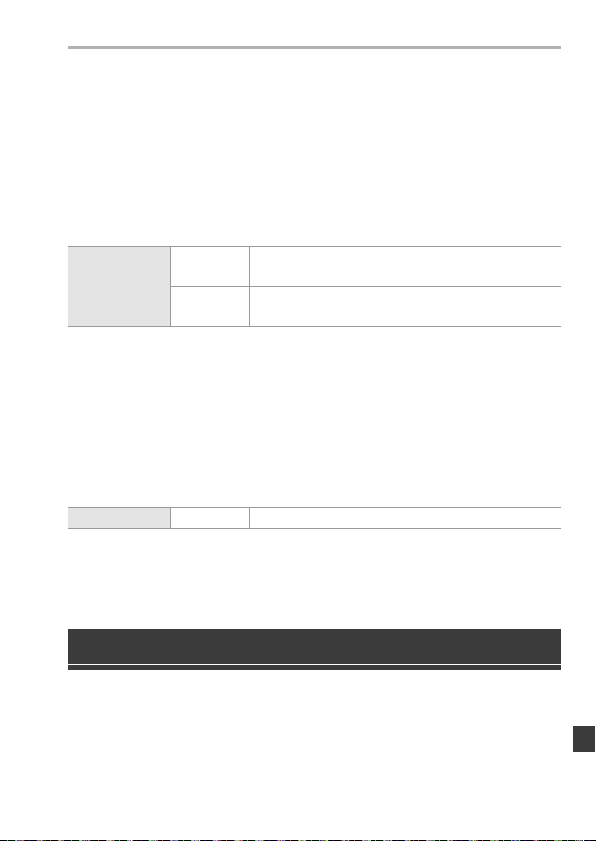
17. Connecting to Other Devices
DVQX1939 (ENG)
185
SILKYPIX Developer Studio SE
This software processes and edits RAW images.
Edited images can be saved in a format (JPEG, TIFF, etc.) that can be
displayed on a PC.
Check the following site and then download and install the software:
http://www.isl.co.jp/SILKYPIX/english/p/
Operating environment
0
For more information such as how to use “SILKYPIX Developer Studio”, refer to the
Help or the Ichikawa Soft Laboratory’s support site.
30-Day Full Trial Version of “LoiLoScope”
This software allows you to easily edit videos.
Check the following site and then download and install the software:
http://loilo.tv/product/20
Operating environment
0
You can download a trial version that can be used for free for 30 days.
0 For more information on how to use “LoiLoScope”, refer to the “LoiLoScope”
manual available for download at the site.
0 “LoiLoScope” is not available for Mac.
If you install the “LUMIX Tether” camera control software on your PC, you
can connect the camera to the PC via USB and then control the camera
from the PC and record while checking the live view on the PC screen
(tethered recording).
Supported OS
Windows
Windows 10, Windows 8.1, Windows 7
(64-bit recommended)
Mac
OS X v10.10 to v10.11
macOS 10.12 to macOS 10.14
Supported OS Windows Windows 10, Windows 8.1, Windows 8, Windows 7
Tethered Recording
DC-S1HP-DVQX1939_eng.book 185 ページ 2019年8月9日 金曜日 午後4時45分
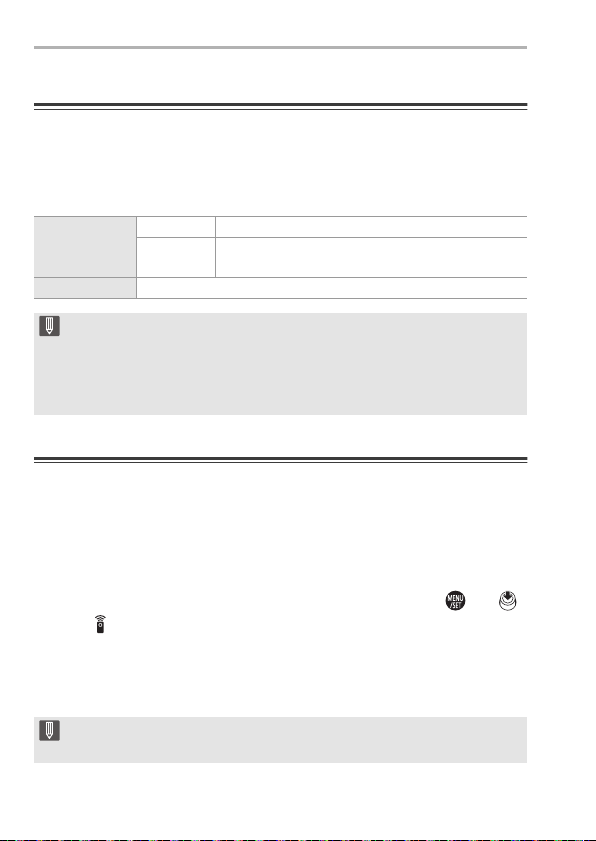
17. Connecting to Other Devices
DVQX1939 (ENG)
186
Installing the “LUMIX Tether” Software
Check the following site and then download and install the software:
https://panasonic.jp/support/global/cs/soft/download/d_lumixtether.html
(English only)
Operating environment
Operating the Camera from a PC
Getting started:
0 Turn on the camera and PC.
0 Install “LUMIX Tether” on PC.
1
Connect the camera and PC with the USB connection
cable (C–C or A–C). (l 179)
2
Press
34
to select [PC(Tether)] and then press or .
≥[ ] is displayed on the camera’s screen.
0
A message about charging may be displayed. Wait for a while until the
message disappears.
3
Use “LUMIX Tether” to operate the camera from the PC.
Supported OS
Windows Windows 10, Windows 8.1, Windows 7
Mac
OS X v10.10 to v10.11, macOS 10.12 to macOS
10.14
Interface USB port (SuperSpeed USB (USB 3.0))
0 Supported OSs are current as of August 2019 and are subject to change.
0 To download the software, your PC needs to be able to connect to the internet.
0 Downloading may take a while depending on the communication environment.
0 For how to operate the software, refer to the operation guide for “LUMIX
Tether”.
0 The Wi-Fi/Bluetooth functions are not available while there is a PC connection
with [PC(Tether)].
DC-S1HP-DVQX1939_eng.book 186 ページ 2019年8月9日 金曜日 午後4時45分
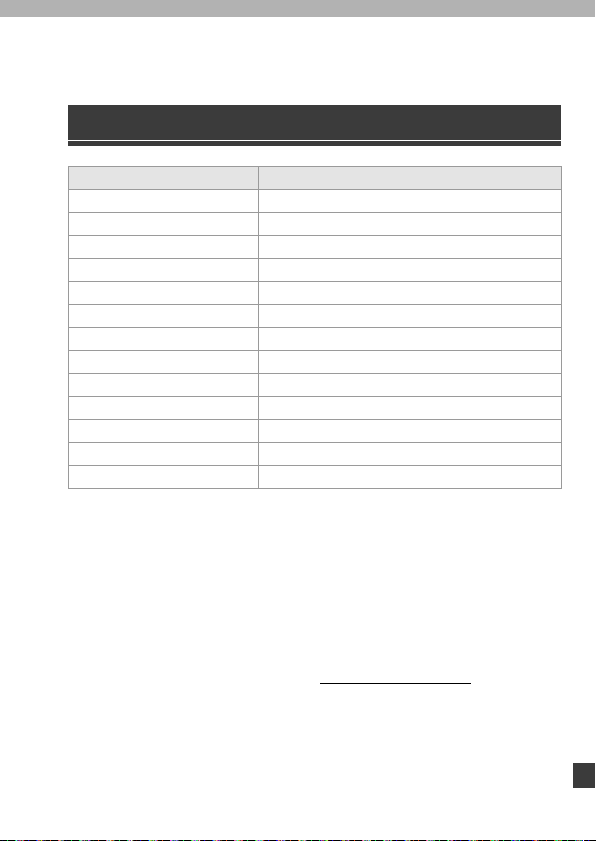
DVQX1939 (ENG)
187
18. Materials
¢1 Supplied with an AC adaptor, an AC cable and a USB connection cable (C–C).
¢2 The AC Adaptor (optional) can only be used with the designated Panasonic DC
Coupler (optional). The AC Adaptor (optional) cannot be used by itself.
Product numbers correct as of August 2019. These may be subject to change.
0 Some optional accessories may not be available in some countries.
0 For lens-related optional accessories such as compatible lenses and filters, refer to
our catalogs/web pages, etc.
0 Refer to the “Owner’s Manual” (PDF format) for details about using this camera
when using optional accessories.
0 To order optional accessories please visit http://shop.panasonic.com or your local
Photo Specialty Dealer.
Digital Camera Accessory System
Product name Model number
Battery Pack DMW-BLJ31
Battery Charger
¢1
DMW-BTC14
AC Adaptor
¢2
DMW-AC10
DC Coupler
¢2
DMW-DCC16
Flash DMW-FL580L, DMW-FL360L, DMW-FL200L
LED Video Light VW-LED1
Stereo Shotgun Microphone DMW-MS2
Stereo Microphone VW-VMS10
XLR Microphone Adaptor DMW-XLR1
Shutter Remote Control DMW-RS2
Battery Grip DMW-BGS1
Eye Cup DMW-EC6
Shoulder Strap DMW-SSTG9
DC-S1HP-DVQX1939_eng.book 187 ページ 2019年8月9日 金曜日 午後4時45分
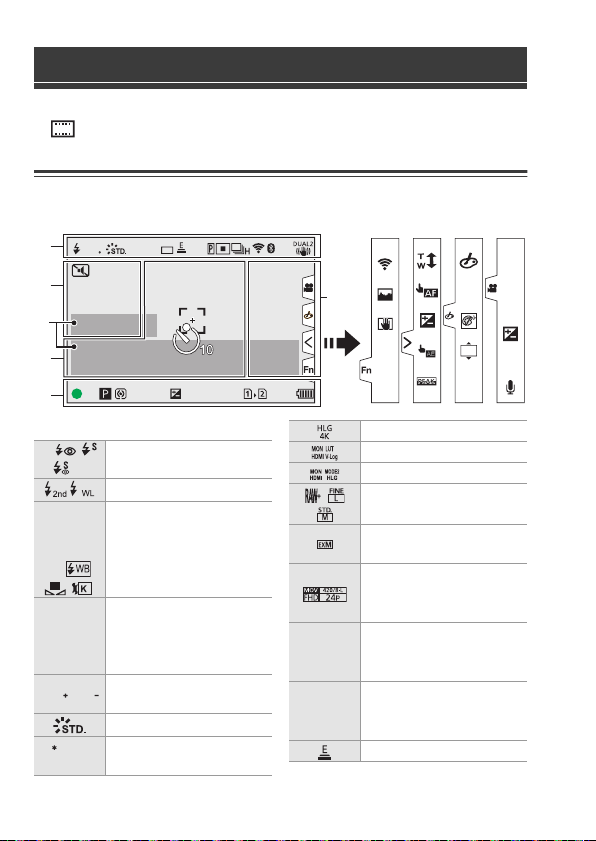
18. Materials
DVQX1939 (ENG)
188
0 The screen is an monitor display example of when [LVF/Monitor Disp. Set] is set to
[].
Recording Screen
0 Refer to the “Owner’s Manual” (PDF format) for details on indications during
playback.
1
Monitor/Viewfinder Displays
Fn7Fn7
Fn4Fn4
Fn3Fn3
Fn5Fn5
Fn6Fn6
OFFOFF
OFFOFF
ISO
SS
FF
MINIMINI
AWB
BKT
AEL BKT
AFSAFS
999
ISO
100F4.060
24m59s24m59s
GPS
S35mm
L
FINE
RAW
+
HLG
4K
+
1
/
3
‰
Œ
Flash mode (l 91)
Flash setting (l 165)
AWBc
AWBw
VÐî
Ñ
White balance (l 84)
White Balance Bracket,
White Balance Bracket
(Color Temperature)
(l 166)
Adjusting the white balance
(l 86)
Photo Style (l 87)
Filter setting (l 165)/
Filter effect adjustment
WL
1
1
BKT
AWB
AWB
AWB
EXPS
HLG photo (l 165)
LUT View Assist (l 132)
HLG View Assist (l 135)
Picture quality (l 63)/
Picture size (l 63)
Extended Tele Conversion
(l 166)
Recording file format
(l 100)/Recording quality
(l 101)
Recording file format
(l 100)/
Recording quality (l 101)
59.94p
60/59.94p
Recording frame rate
(l 101)/Variable frame rate
(l 125)
Electronic shutter
MOV
FHD
420/8-L
DC-S1HP-DVQX1939_eng.book 188 ページ 2019年8月9日 金曜日 午後4時45分
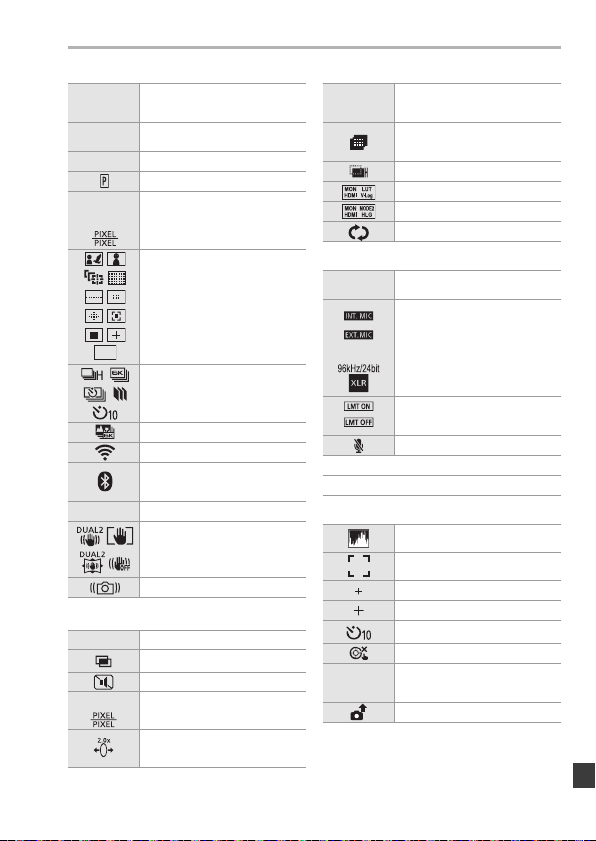
18. Materials
DVQX1939 (ENG)
189
2
3
4
Focus mode (l 47, 72)
Focus Bracket (l 166)
AFL AF Lock
Focus Peaking (l 165)
FULL
S35mm
Image area of video
(l 108)
AF mode (l 67)
Drive mode (l 47)
Post-Focus (l 166)
Connected to Wi-Fi
Connected to Bluetooth
(l 174)
GPS Location logging
Image stabilizer (l 75)
Camera shake alert (l 76)
PRE Pre-Burst recording
Multiple exposures (l 166)
Silent mode (l 166)
S35mm Image area of video
(l 108)
Anamorphic desqueeze
display (l 136)
AFS
AFC
MF
AFS
BKT
ヤヒ
FLICKER
Flicker Decrease (Photo)
(l 166)
High Resolution mode
(l 165)
Overlay indication (l 168)
LUT View Assist (l 132)
HLG View Assist (l 135)
Loop recording (l 138)
Time code (l 110)
Built-in microphone,
External microphone
(l 119, 146)
XLR microphone adaptor
setting (l 149)
Sound recording level
limiter (l 120)
Mute (l 119)
Sound recording level (l 119)
Exposure meter (l 168)
Histogram (l 168)
AF area (l 71)
Spot metering target (l 80)
Center marker (l 168)
Self-timer (l 47)
Lock lever (l 51)
24m59s
Elapsed recording time
(l 92)
Image being sent
TC
00:00:00:00
DC-S1HP-DVQX1939_eng.book 189 ページ 2019年8月9日 金曜日 午後4時45分

18. Materials
DVQX1939 (ENG)
190
5
6
2019.12. 1
10:00:00
Time stamp recording
(l 167)
¥
Focus (turns green) (l 45)/
Recording state (turns red)
(l 92)
Focus (Low illumination AF)
(l 66)
Focus (Starlight AF) (l 66)
Flash adjustment (l 165)
Recording mode (l 46)
Program Shift
Metering mode (l 80)
AE Lock
60
Shutter speed (l 45)
F4.0
Aperture value (l 45)
Aperture Bracket (l 166)
Exposure compensation
value (l 80)
Exposure Bracket (l 166)
Manual Exposure Assist
ISO sensitivity (l 81)/
Dual Native ISO setting
(l 83)
Card access indication
(turns red) (l 92)
Card slot (l 38)/Double
card slot function (l 64)
No card
Card full
LOW
STAR
AE
A
E
L
F4.0
BKT
BKT
+
1
/
3
ISO
100
999
Number of still images that
can be taken
r20
Number of pictures that can
be taken continuously
24m59s
Video recording time
Battery indication (l 35)
Power supply (l 34)
Battery Grip
Temperature rise warning
icon (l 196)
Fan error warning icon
(l 200)
Touch Tab
Fn button (l 157)
Touch Zoom
Touch AF, Touch Shutter
(l 62)
Exposure compensation
(l 80)
Touch AE (l 62)
Focus Peaking (l 165)
/ (l 98)
Type of defocus ([Miniature
Effect])
One Point Color
Light source position
([Sunshine])
Fn3
AE
DC-S1HP-DVQX1939_eng.book 190 ページ 2019年8月9日 金曜日 午後4時45分
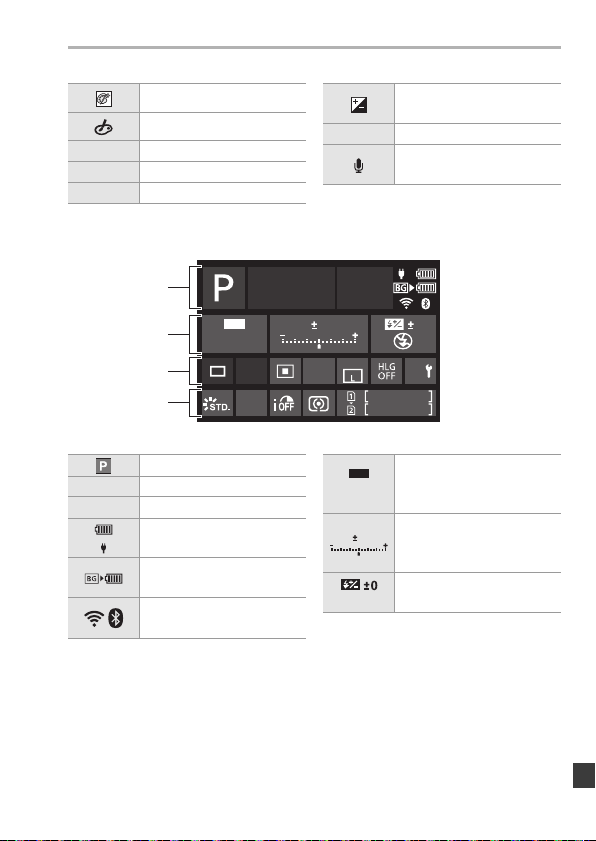
18. Materials
DVQX1939 (ENG)
191
Control Panel
12
Filter effect adjustment
Filter on/off
MINI
Filter setting (l 165)
F
Aperture value (l 98)
SS
Shutter speed (l 98)
Exposure compensation
(l 98)
ISO ISO sensitivity (l 98)
Sound recording level
adjustment (l 98)
F4.0
1/60
999
999
AWB
Fn
0 0
0
ISO
100
AFS FINE
3:2
Recording mode (l 46)
1/60 Shutter speed (l 45)
F4.0 Aperture value (l 45)
Battery indication (l 35)
Power supply (l 34)
Battery indication (battery
grip) (l 35)
Wi-Fi/Bluetooth connection
state
ISO sensitivity (l 81)/
Dual Native ISO setting
(l 83)
Exposure compensation
value (l 80)/
Manual Exposure Assist
Œ
Flash setting (l 165)/
Flash mode (l 91)
ISO
100
0
0
DC-S1HP-DVQX1939_eng.book 191 ページ 2019年8月9日 金曜日 午後4時45分
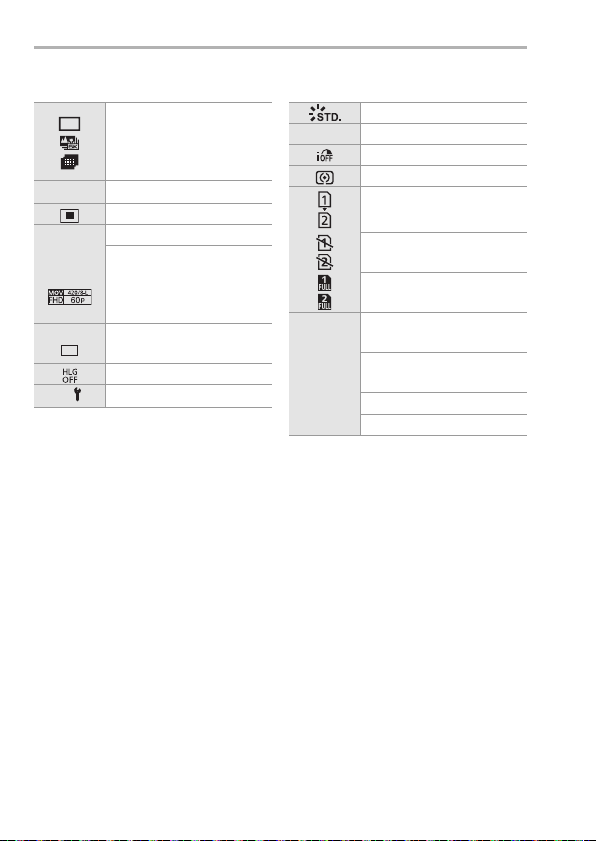
18. Materials
DVQX1939 (ENG)
192
34
Drive mode (l 47)/
Post-Focus (l 166)/
High Resolution mode
(l 165)
Focus mode (l 47, 72)
AF mode
(
l 67)
FINE Picture quality (l 63)
S35mm
Image area of video
(l 108)/Recording file
format (l 100)/Recording
quality (l 101)
Picture size/Aspect ratio
(l 63)
HLG photo (l 165)
Fn button settings (l 156)
AFS
L
3:2
Fn
Photo Style (l 87)
AWB
White balance (l 84)
i.Dynamic Range (l 165)
Metering mode (l 80)
Card slot (l 38)/Double
card slot function (l 64)
No card
Card full
999
Number of still images that
can be taken
r20
Number of pictures that can
be taken continuously
R24m59s Video recording time
---- No card
DC-S1HP-DVQX1939_eng.book 192 ページ 2019年8月9日 金曜日 午後4時45分
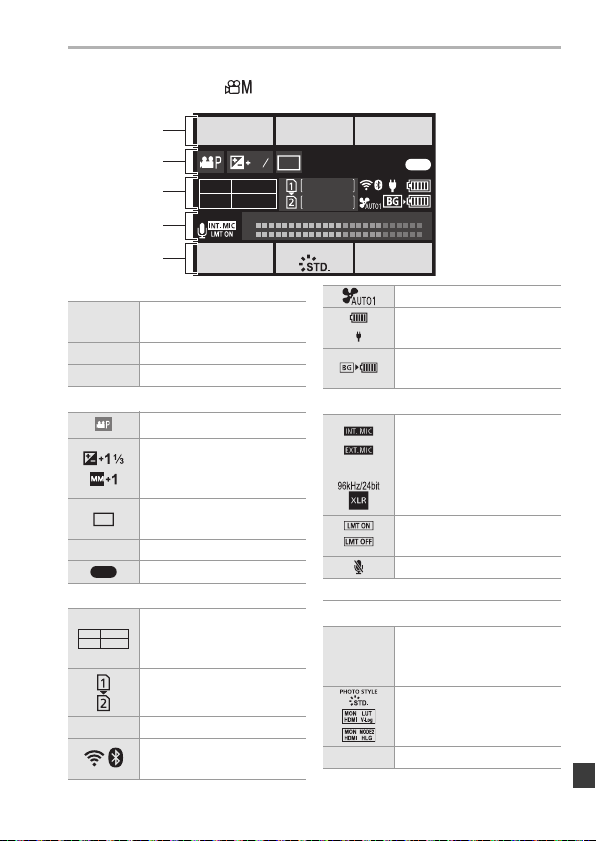
18. Materials
DVQX1939 (ENG)
193
Control Panel ([ ] Mode)
1
2
3
4
5
FULL
FPS
60
F4.0
1/60
100
AWB
IRISSHUTTER
ISO WBPHOTO STYLE
TC
NDF
00:00:00:00
REC
1
1
3
FHD 59.94
p
420/8-L
MOV
24m59s
24m59s
AUTO
CH1
-2
-36 -12 -6-24 0
CH2
-6
Frame rate (l 101)/
Variable frame rate (l 125)
Shutter speed (l 45)
Aperture value (l 45)
Exposure mode (l 98)
Exposure compensation
value (l 80)/Manual
Exposure Assist
Image area of video
(l 108)
Time code (l 110)
Recording state (l 92)
Recording file format
(l 100)/Recording quality
(l 101)
Card slot (l 38)/Double
card slot function (l 64)
Video recording time
Wi-Fi/Bluetooth connection
state
FPS
60
SHUTTER
1/60
IRIS
F4.0
FULL
00:00:00:00
TC
NDF
REC
FHD 59.94
p
420/8-L
MOV
24
m
59
s
Fan operating mode (l 168)
Battery indication (l 35)
Power supply (l 34)
Battery indication (battery
grip) (l 35)
Built-in microphone,
External microphone
(l 119, 146)
XLR microphone adaptor
setting (l 149)
Sound recording level
limiter (l 120)
Mute (l 119)
Sound recording level (l 119)
ISO sensitivity (l 81)/
Dual Native ISO setting
(l 83)
Photo Style (l 87)/
LUT View Assist (l 132)/
HLG View Assist (l 135)
White balance (l 84)
100
ISO
AUTO
WB
AWB
DC-S1HP-DVQX1939_eng.book 193 ページ 2019年8月9日 金曜日 午後4時45分

18. Materials
DVQX1939 (ENG)
194
Meanings of main messages displayed on the camera screen, and
response methods.
0
Please also refer to the “Owner’s Manual” (PDF format), which describes more
detailed information.
0 It is a format that cannot be used with the camera.
Either insert another card, or back up any necessary data before formatting. (l 39)
0 Use a card compatible with the camera. (l 19)
0 Failure to read or write data.
Turn off the camera, reinsert the card, and then turn it on again.
0 The card may be broken.
0 Insert a different card.
0 The card door or battery door is opened while writing to a card. Wait until writing is
finished, then turn the camera off and remove.
0 Remove the lens once, and then attach it again without pressing the lens release
button. (l 40)
Turn on the camera again, and if it is still displaying, contact the dealer.
0 Use a genuine Panasonic battery.
If this message is displayed even when a genuine Panasonic battery is used, contact
the dealer.
0 If the terminal of the battery is dirty, remove the dirt and dust from the terminal.
Message Displays
[Memory Card Error]/[Format this card?]
[Memory Card Error]/[This memory card cannot be used]
[Read Error]/[Write Error]/[Please check the card]
[Now writing]
[The lens is not attached properly. Do not push lens release button
while lens is attached.]
[This battery cannot be used]
DC-S1HP-DVQX1939_eng.book 194 ページ 2019年8月9日 金曜日 午後4時45分

18. Materials
DVQX1939 (ENG)
195
0 The wireless access point information set on the camera is wrong.
Check the authentication type and encryption key.
0 Radio waves from other devices may block the connection to a wireless access
point.
Check the status of other devices that are connected to the wireless access point as
well as the status of other wireless devices.
0 Images that do not comply with the DCF standard cannot be deleted.
Back up any necessary data before formatting the card. (l 39)
0 Turn off and on the camera.
If the message is displayed even when doing this several times, contact the dealer.
0 The fan has stopped. Turn off and on the camera. If the fan does not work after
turning the camera off and then on again, consult the dealer.
0 The temperature of the camera will rise if you continue to use the camera with the
fan stopped. Do not use over long periods of time.
First, try out the following procedures (l 195 to 200).
0
Please also refer to the “Owner’s Manual” (PDF format), which describes more
detailed information.
0 When [6K/4K Pre-Burst] or [Pre-Burst Recording] is set, the battery drains faster.
Set these settings only when recording.
[Failed to connect wireless access point]/[Connection failed]/[No
destination found]
[Some pictures cannot be deleted]/[This picture cannot be deleted]
[Please turn camera off and then on again]/[System Error]
[The fan is not functioning correctly.]
Troubleshooting
If the problem is not resolved, it may be improved by selecting
[Reset] (l 59) on the [Setup] ([Setting]) menu.
The battery becomes flat too quickly.
DC-S1HP-DVQX1939_eng.book 195 ページ 2019年8月9日 金曜日 午後4時45分

18. Materials
DVQX1939 (ENG)
196
0 When connected to Wi-Fi, the battery drains quickly.
Turn the camera off frequently such as by using [Power Save Mode] (l 37).
0 Confirm the following details:
– Is the subject outside of the focus range?
– Is [Shutter AF] set to [OFF]?
– Is [Focus/Shutter Priority] set to [RELEASE]?
– Is AF Lock set where it is not appropriate?
0 The shutter speed will become slower and the image stabilizer function may not
work properly when recording in dark places.
In these cases, use a tripod and the self-timer when recording.
This is a characteristic of the CMOS sensor that is the image sensor of the camera,
and is not a malfunction.
Recording stops before finishing.
Cannot record.
Cannot use some functions.
0 In high ambient temperatures or if the camera is used for continuous recording, the
temperature of the camera will rise.
To protect the camera against a rise in temperature, after [ ] is displayed,
recording will be stopped, and the following functions will not be available for a time.
Wait until the camera cools down.
– [6K/4K PHOTO]
– [Post-Focus]
– Video recording
– [AF-Point Scope]
The subject is not focused properly.
The recorded image is blurred.
The image stabilizer is not effective.
The subject appears distorted on the image.
0 When a moving subject is recorded while using the following functions, the subject
may appear distorted in the picture:
– [ELEC.]
– Video recording
– [6K/4K PHOTO]
DC-S1HP-DVQX1939_eng.book 196 ページ 2019年8月9日 金曜日 午後4時45分

18. Materials
DVQX1939 (ENG)
197
0 This is characteristic of CMOS sensors which serve as
the camera’s pickup sensors.
This is not a malfunction.
0 When using the electronic shutter, lowering the shutter
speed may reduce the effect of the horizontal stripes.
0 If flicker is noticeable when recording pictures, set
[Flicker Decrease (Photo)].
0 If flicker or horizontal stripes are noticeable when recording video, this can be
mitigated by fixing the shutter speed.
Either set [Flicker Decrease (Video)], or record in [ ] mode (l 95).
0 When recording under lighting such as fluorescent or LED lighting, increasing the
shutter speed may introduce slight changes to brightness or coloring.
These are a result of the characteristics of the light source and do not indicate a
malfunction.
0 When recording subjects in extremely bright locations or recording under lighting
such as fluorescent, LED, mercury, or sodium lighting, the coloring or screen
brightness may change or horizontal striping may appear on the screen.
0 If you change the [System Frequency], you may no longer be able to record video to
the same card.
Try again after either returning the [System Frequency] to the original setting or
inserting another card.
0 When using a large capacity card, you may not be able to record for a while after
turning on the camera.
0 Folders and images processed on a PC cannot be played on the camera.
We recommend using the software “PHOTOfunSTUDIO” to write images from the
PC to the card.
Striping or flicker may appear under lighting such as fluorescent or
LED lighting.
The brightness or coloring of the recorded image is different from the
actual scene.
Cannot record videos.
Cannot play back.
There are no recorded pictures.
DC-S1HP-DVQX1939_eng.book 197 ページ 2019年8月9日 金曜日 午後4時45分

18. Materials
DVQX1939 (ENG)
198
0 Some images are not displayed when the [Playback Mode] is set. Set to [Normal
Play].
0 Videos recorded with a different [System Frequency] setting cannot be played back.
Return the [System Frequency] setting to the one you used during the recording.
(l 100)
0 The flash does not fire when using the following functions:
– Video recording (l 92)/[6K/4K PHOTO]/[Post-Focus]
– [ELEC.]/[Silent Mode]/[High Resolution Mode]
– [Filter Settings]
General tips for using a Wi-Fi connection
0
Use within the communication range of the device to be connected.
0 Usage near devices that utilize the 2.4 GHz frequency such as microwave ovens
and cordless telephones may result in the radio wave being lost.
Use the camera at a sufficient distance from these devices.
0 When the remaining battery level is low, it may not be possible to connect to or
maintain communication with other devices.
(A message such as [Communication error] is displayed.)
0 If you place the camera on a metal table or shelf, the radio waves may be adversely
affected. In such cases, you may not be able to establish a connection.
Move the camera away from the metal surface.
Wireless access point
0
Confirm that the connected wireless access point can be used.
0 Confirm the radio wave conditions of the wireless access point.
– Move the camera closer to the wireless access point.
– Change the location and angle of the wireless access point.
The flash does not fire.
A Wi-Fi connection cannot be established.
Radio waves get disconnected.
Wireless access point is not displayed.
DC-S1HP-DVQX1939_eng.book 198 ページ 2019年8月9日 金曜日 午後4時45分

18. Materials
DVQX1939 (ENG)
199
0 Depending on the wireless access point, the radio wave may not be displayed even
though it is present.
– Turn off and then on the wireless access point.
– If the wireless channel of the wireless access point cannot be set automatically,
manually set the channel supported by the camera.
– If the wireless access point SSID is set not to broadcast, it may not be detected.
Enter the SSID, and then connect.
0 At the time of purchase, this camera is set to use a workgroup name of
“WORKGROUP”.
If you have changed the workgroup name of the PC, this will not be recognized.
In the [Wi-Fi Setup] menu, [PC Connection], change the workgroup name of the PC
to which to connect.
0 Check that the login name and password are correctly typed.
0 When the clock settings of the PC connected to the camera differs considerably from
those of the camera, the camera cannot be connected to the PC depending on the
OS.
0 Is the size of the image too large?
– Reduce the image size at [Size], and then send.
– Transmit after dividing the video with [Video Divide].
0 It may take longer time to transmit when distance to the wireless access point is far.
Transmit closer to the wireless access point.
0 File format of the video that can be sent differs depending on the destination.
0 Depending on the [Aspect Ratio], gray bands may be displayed on the top and
bottom or the left and right of the images. You can change the band color in
[Background Color(Playback)] in [TV Connection] of the [Setup] ([IN/OUT]) menu.
The PC is not recognized when I use a Wi-Fi connection.
The camera cannot be connected to the PC using the Wi-Fi function.
It takes time to transmit an image to the web service.
Transmission of the image fails midway.
Some images cannot be transmitted.
The TV images are displayed with gray bands.
DC-S1HP-DVQX1939_eng.book 199 ページ 2019年8月9日 金曜日 午後4時45分
18. Materials
DVQX1939 (ENG)
200
0 The fan has stopped. Turn off and on the camera. If the fan does not work after
turning the camera off and then on again, consult the dealer.
0 The temperature of the camera will rise if you continue to use the camera with the
fan stopped. Do not use over long periods of time.
0 An alarm may sound when a door is opened while writing to a card. Wait until writing
finishes, then turn the camera off and remove the card or battery.
0 The sound is caused by the in-body stabilizer. This is not a malfunction.
0 This is the sound of the lens moving and aperture operation. It is not a malfunction.
0 Reselect the language from the menu using the following procedure:
¨ [ ] ¨ [ ] ¨ [ ] ¨ Select desired language (l 169)
0 The camera surface and back of the monitor may become warm during use, but this
does not indicate a problem with performance or quality.
0 When the camera is left for a long time, the clock may reset.
Reset the clock. (l 42)
[ ] is displayed on the screen.
An alarm sounds when the card door or battery door is opened.
When the camera is shaken, a rattling sound is heard from the
camera.
There is rattling noise from the lens when the camera is turned on or
off, or when the camera is swung.
There is a sound from the lens when recording.
An unreadable language was selected by mistake.
The camera becomes warm.
The clock is wrong.
DC-S1HP-DVQX1939_eng.book 200 ページ 2019年8月9日 金曜日 午後4時45分
18. Materials
DVQX1939 (ENG)
201
The specifications are subject to change for performance enhancement.
Digital camera body (DC-S1H):
Information for your safety
Specifications
Power source:
Power consumption:
9.0 V
6.3 W (when recording with the monitor), 4.8 W (when
playing back with the monitor)
[When using the interchangeable lens (S-R24105)]
Type
Type Digital Single Lens Mirrorless camera
Recording media SD memory card / SDHC memory card
¢
/ SDXC memory
card
¢
¢ Compliant with UHS-I/UHS-II UHS Speed Class 3,
UHS-
II Video Speed Class 90
Double slot recording function is available.
Lens mount Leica Camera AG L-Mount
Image sensor
Image sensor 35 mm full-frame (35.6 mmk23.8 mm) CMOS sensor, a
total of 25,280,000 pixels, primary color filter
Effective number of
pixels of the camera
24,200,000 pixels
Latitude
14i stops ([V-Log])
Recording format for still images
File format for still
images
JPEG (DCF compliant, Exif 2.31 compliant) / RAW / HLG
photo (CTA-2072 compliant)
File format for 6K/4K
photos
6K photo: MP4 (H.265/HEVC, AAC (2ch))
4K photo: MP4 (H.264/MPEG-4 AVC, AAC (2ch))
DC-S1HP-DVQX1939_eng.book 201 ページ 2019年8月9日 金曜日 午後4時45分

18. Materials
DVQX1939 (ENG)
202
Picture size
(pixels)
When the aspect ratio setting is [4:3]
[L]: 5328k4000 (3536k2656)
¢
[M]: 3792k2848 (2560k1920)
¢
[S]: 2688k2016 (1840k1376)
¢
[High Resolution Mode]: 10656k8000
6K photo: 4992k3744
4K photo: 3328k2496 (3328k2496)
¢
[HLG Photo] ([Full-Res.]): 5312k3984
[HLG Photo] ([4K-Res.]): 2880k2160 (2880k2160)
¢
When the aspect ratio setting is [3:2]
[L]: 6000k4000 (3888k2592)
¢
[M]: 4272k2848 (2784k1856)
¢
[S]: 3024k2016 (1968k1312)
¢
[High Resolution Mode]: 12000k8000
6K photo: 5184k3456
4K photo: 3504k2336 (3504k2336)
¢
[HLG Photo] ([Full-Res.]): 5984k4000
[HLG Photo] ([4K-Res.]): 3232k2160 (3232k2160)
¢
When the aspect ratio setting is [16:9]
[L]: 6000k3368 (4064k2288)
¢
[M]: 4272k2400 (2816k1584)
¢
[S]: 3024k1704 (1920k1080)
¢
[High Resolution Mode]: 12000k6736
4K photo: 3840k2160 (3840k2160)
¢
[HLG Photo] ([Full-Res.]): 5888k3312
[HLG Photo] ([4K-Res.]): 3840k2160 (3840k2160)
¢
When the aspect ratio setting is [1:1]
[L]: 4000k4000 (2656k2656)
¢
[M]: 2848k2848 (1920k1920)
¢
[S]: 2016k2016 (1376k1376)
¢
[High Resolution Mode]: 8000k8000
4K photo: 2880k2880 (2880k2880)
¢
[HLG Photo] ([Full-Res.]): 4000k4000
[HLG Photo] ([4K-Res.]): 2144k2144 (2144k2144)
¢
¢ Figures in parentheses are for Super 35 mm/APS-C
lenses
DC-S1HP-DVQX1939_eng.book 202 ページ 2019年8月9日 金曜日 午後4時45分

18. Materials
DVQX1939 (ENG)
203
Picture size
(pixels)
When the aspect ratio setting is [65:24]
[L]: 6000k2208
When the aspect ratio setting is [2:1]
[L]: 6000k3000
Image quality for
pictures
Fine / Standard / RAWiFine / RAWiStandard / RAW
Recording format for video
Video format AVCHD Progressive / AVCHD /
MP4 (H.264/MPEG-4 AVC, H.265/HEVC) /
MOV (H.264/MPEG-4 AVC, H.265/HEVC)
Audio format AVCHD Dolby Audio (2ch)
MP4 AAC (2ch)
MOV
LPCM (2ch, 48 kHz/16-bit)
¢
¢ When an XLR Microphone Adaptor (DMW-
XLR1: optional) is attached, LPCM (2ch,
48 kHz/24-bit, 96 kHz/24-bit) can be
selected
System frequency 59.94 Hz / 50.00 Hz / 24.00 Hz
Image quality for
video
Refer to page 101 in this document for information about
resolution, recording frame rate, and other elements of
recording quality.
Viewfinder
System Aspect ratio 4:3, 0.5 inches, approx. 5,760,000 dots,
organic EL (OLED) live view viewfinder
Field of view ratio Approx. 100%
Magnification Approx. 0.78k (j1.0 m
j1
50 mm at infinity, with aspect
ratio set to [3:2])
Eye point Approx. 21 mm (at j1.0 m
j1
)
Diopter adjustment
range
j4.0 to i2.0 diopter
Eye sensor Yes
DC-S1HP-DVQX1939_eng.book 203 ページ 2019年8月9日 金曜日 午後4時45分

18. Materials
DVQX1939 (ENG)
204
Monitor
System Aspect ratio 3:2, 3.2 inches,
approx. 2,330,000 dots monitor, capacitive touch screen
Field of view ratio Approx. 100%
Status LCD
1.8 inches, 303k230 dots, black and white LCD monitor
Focus
AF type TTL type based on image detection (Contrast AF)
Focus mode AFS / AFC / MF
AF mode Automatic detection (Face/Eye/Body/Animal) / Tracking /
225-Area / Zone (Vertical/Horizontal) / Zone (Square) /
Zone (Oval) / 1-AreaiSupplementary / 1-Area / Pinpoint /
Custom1, 2, 3,
Focus area selection is possible by touching or with the
joystick
Exposure control
Light metering
system,
Light metering mode
1728-zone metering, multi-metering / center-weighted
metering / spot metering / highlight-weighted metering
Metering range EV 0 to EV 18
(F2.0 lens, ISO100 conversion)
Exposure Program AE (P) / Aperture-Priority AE (A) / Shutter-
Priority AE (S) / Manual Exposure (M)
Exposure
compensation
1/3 EV steps, n5EV
ISO sensitivity
(standard output
sensitivity)
AUTO / 100 to 51200,
When [Extended ISO] is set: AUTO / 50 to 204800,
1/3 EV steps
DC-S1HP-DVQX1939_eng.book 204 ページ 2019年8月9日 金曜日 午後4時45分

18. Materials
DVQX1939 (ENG)
205
Dual Native ISO
setting
Auto
Base sensitivity: 100/640 (dB display values are
based on 100)
AUTO / 100 to 51200
When [Extended ISO] is set: AUTO / 50 to
204800
Low
sens.
Base sensitivity: 100
AUTO / 100 to 800
When [Extended ISO] is set: AUTO / 50 to 800
High
sens.
Base sensitivity: 640
AUTO / 640 to 51200
When [Extended ISO] is set: AUTO / 320 to
204800
Dual Native ISO
setting (V-Log)
Auto
Base sensitivity: 640/4000 (dB display values
are based on 640)
AUTO / 640 to 51200
When [Extended ISO] is set: AUTO / 320 to
51200
Low
sens.
Base sensitivity: 640
AUTO / 640 to 5000
When [Extended ISO] is set: AUTO / 320 to
5000
High
sens.
Base sensitivity: 4000
AUTO / 4000 to 51200
When [Extended ISO] is set: AUTO / 2000 to
51200
Dual Native ISO
setting (Cinelike D2/
Cinelike V2)
Auto
Base sensitivity: 200/1250 (dB display values
are based on 200)
AUTO / 200 to 51200
When [Extended ISO] is set: AUTO / 100 to
204800
Low
sens.
Base sensitivity: 200
AUTO / 200 to 1600
When [Extended ISO] is set: AUTO / 100 to
1600
High
sens.
Base sensitivity: 1250
AUTO / 1250 to 51200
When [Extended ISO] is set: AUTO / 640 to
204800
DC-S1HP-DVQX1939_eng.book 205 ページ 2019年8月9日 金曜日 午後4時45分

18. Materials
DVQX1939 (ENG)
206
Dual Native ISO
setting (HLG video/
HLG photo)
Auto
Base sensitivity: 400/2500 (dB display values
are based on 400)
AUTO / 400 to 51200
When [Extended ISO] is set: AUTO / 400 to
204800
Low
sens.
Base sensitivity: 400
AUTO / 400 to 3200
High
sens.
Base sensitivity: 2500
AUTO / 2500 to 51200
When [Extended ISO] is set: AUTO / 2500 to
204800
Image stabilizer
Image stabilizer type Compliant with Image sensor shift type, 5-axis stabilizer,
Dual I.S.2
Image stabilizer
effect
In-body image stabilizer: 6.0 stops
[Focal length f=50 mm, using an interchangeable lens
(S-X50)]
Dual I.S.2: 6.5 stops
[Focal length f=105 mm, using an interchangeable lens
(S-R24105)]
¢
(Based on the CIPA standard, Yaw/Pitch direction)
¢ Firmware version 1.1 or higher
White balance
White balance mode AWB / AWBc / AWBw / Daylight / Cloudy / Shade /
Incandescent lights / Flash / Set mode 1, 2, 3, 4 /
Color temperature 1, 2, 3, 4
DC-S1HP-DVQX1939_eng.book 206 ページ 2019年8月9日 金曜日 午後4時45分
18. Materials
DVQX1939 (ENG)
207
Shutter
Format Focal-plane shutter
Shutter speed Pictures:
Mechanical shutter: Bulb (max. approx. 30 minutes),
60 seconds to 1/8000 of a second
Electronic front curtain: Bulb (max. approx. 30 minutes),
60 seconds to 1/2000 of a second
Electronic shutter: Bulb (max. approx. 60 seconds),
60 seconds to 1/8000 of a second
Videos:
1/25
¢
of a second to 1/16000 of a second
¢ When [Exposure Mode] is set to [M] in [ ] and
focus mode is set to [MF], this can be set up to 1/2
Burst recording
Mechanical shutter/
Electronic front
curtain
High speed
9 frames/second ([AFS], [MF]) /
6 frames/second ([AFC])
Medium speed 5 frames/second
Low speed 2 frames/second
Electronic shutter
High speed
9 frames/second ([AFS], [MF]) /
5 frames/second ([AFC])
Medium speed 5 frames/second
Low speed 2 frames/second
Maximum number of
frames recordable
[FINE] / [STD.]: 999 frames or more
[RAWiFINE] / [RAWiSTD.] / [RAW]: 60 frames or more
(When recording is performed under the test conditions
specified by Panasonic)
Minimum illumination
Approx. 6 lx (system frequency 59.94 Hz, shutter speed 1/30 of a second)
Approx. 6 lx (system frequency 50.00 Hz, shutter speed 1/25 of a second)
[When using the interchangeable lens (S-R24105)]
DC-S1HP-DVQX1939_eng.book 207 ページ 2019年8月9日 金曜日 午後4時45分

18. Materials
DVQX1939 (ENG)
208
Flash (when using an external flash)
Flash mode Auto / Auto/Red-Eye / Forced Flash On / Forced On/Red-
Eye / Slow Sync. / Slow Sync./Red-Eye / Forced Flash Off
Flash
synchronization
speed
Equal to or smaller than 1/320 of a second
¢
¢ The guide number decreases at 1/320 of a second,
only during [S]/[M] modes
Zoom
Extended Tele
Conversion
(Picture)
Max. 2k
¢
(when a picture size of [S] is selected.)
¢ Max. 1.9k when using Super 35 mm/APS-C lenses
Display language
[ENGLISH]/[DEUTSCH]/[FRANÇAIS]/[ITALIANO]/[ESPAÑOL]/[繁體中文]/
[PORTUGUÊS]/[¢]
Microphone / Speaker
Microphone Stereo
Speaker Monaural
Interface
USB USB Type-C™, SuperSpeed USB3.1 GEN1,
Supports USB Power Delivery (9.0 V/3.0 A)
[HDMI] HDMI Type A
[REMOTE] ‰ 2.5 mm jack
[MIC] ‰ 3.5 mm stereo mini jack,
Mic Input (Plug-in Power) / Mic Input / Line Input
(Operate the menu to switch between these inputs),
Standard input level: j55 dBV (Mic Input) / j10 dBV
(Line Input)
Headphones ‰ 3.5 mm stereo mini jack
Flash Synchro Yes
TC IN/OUT Yes (connect the BNC conversion cable (supplied) to the
flash synchro socket)
Input: 1.0 V to 4.0 V [p-p], 10 kΩ
Output: 2.0 V n0.5 V [p-p], low impedance
DC-S1HP-DVQX1939_eng.book 208 ページ 2019年8月9日 金曜日 午後4時45分

18. Materials
DVQX1939 (ENG)
209
Splash Resistant
Yes
External dimensions / Mass
External dimensions Approx. 151.0 mm (W)k114.2 mm (H)k110.4 mm (D)
(5.94q (W)k4.50q (H)k4.35q (D))
(excluding the projecting parts)
Mass (Weight) Approx. 1164 g/2.57 lb (with one card and the battery)
Approx. 1052 g/2.32 lb (only camera body)
Operating environment
Recommended
operating
temperature
j10 oC to 40 oC (14 oF to 104 oF)
0 Battery performance temporarily worsens at low
temperatures (j10 oC to 0 oC (14 oF to 32 oF)), reducing
the number of pictures that can be taken and the
available recording time.
Permissible relative
humidity
10%RH to 80%RH
Wi-Fi
Compliance
standard
IEEE 802.11a/b/g/n/ac (standard wireless LAN protocol)
Frequency range
used (central
frequency)
2412 MHz to 2462 MHz (1 to 11ch)
5180 MHz to 5320 MHz (36/40/44/48/52/56/60/64ch)
5500 MHz to 5720 MHz (100/104/108/112/116/120/124/
128/132/136/140/144ch)
5745 MHz to 5825 MHz (149/153/157/161/165ch)
Encryption method Wi-Fi compliant WPA
TM
/ WPA2
TM
Access method Infrastructure mode
Bluetooth
Compliance
standard
Bluetooth v4.2, Bluetooth Low Energy (BLE)
Frequency range
used (central
frequency)
2402 MHz to 2480 MHz
DC-S1HP-DVQX1939_eng.book 209 ページ 2019年8月9日 金曜日 午後4時45分
18. Materials
DVQX1939 (ENG)
210
Battery charger (Panasonic DMW-BTC14):
Information for your safety
AC adaptor (Panasonic DVLV1001Z):
Information for your safety
Battery pack (lithium-ion) (Panasonic DMW-BLJ31):
Information for your safety
The symbols on this product (including the accessories) represent the following:
Refer to the “Owner’s Manual” (PDF format) for details about the following
specifications:
– Number of pictures that can be taken and available recording time with the battery
– Number of still images that can be taken and video recording time with cards
– List of default settings/custom saving/settings available for copying
– List of functions that can be set in each recording mode
Input:
Output:
Operating temperature:
9.0 V 3.0 A
8.4 V 3.1 A
0 oC to 40 oC (32 oF to 104 oF)
Input:
Output:
Operating temperature:
100–240 V 50/60 Hz 0.7 A
5V 3.0A, 9V 3.0A
0 oC to 40 oC (32 oF to 104 oF)
Voltage/capacity: 7.4 V / 3050 mAh
AC
DC
Class II equipment (The construction of the product is double-insulated.)
DC-S1HP-DVQX1939_eng.book 210 ページ 2019年8月9日 金曜日 午後4時45分

DVQX1939 (ENG)
211
Numerics
1-Area (AF).......................................... 70
1-Area AF Moving Speed .................. 165
1-Area+ (AF)........................................ 70
225-Area (AF)...................................... 69
6K/4K PHOTO ................................... 166
6K/4K PHOTO Bulk Saving ............... 170
6K/4K PHOTO Noise Reduction........ 170
A
AF ........................................................ 66
AF Area Display................................. 168
AF Assist Light................................... 165
AF Custom Setting (Photo)................ 165
AF Custom Setting (Video)........ 116, 166
AF mode .............................................. 67
AF ON............................................ 66, 74
AF/AE Lock Hold ............................... 167
AF+MF............................................... 167
AFC ..................................................... 48
AFC Start Point (225-Area) ......... 69, 167
AF-Point Scope ................................... 66
AF-Point Scope Setting ..................... 167
AFS...................................................... 48
Anamorphic (Video)............................. 78
Anamorphic Desqueeze Display
...........................................136, 168, 170
Anamorphic recording ....................... 136
Android .............................................. 172
Aperture-Priority AE mode................... 46
Approved Regulations ....................... 169
Aspect Ratio ................................ 63, 165
Auto Exposure Comp. ....................... 165
Auto Exposure in P/A/S/M ........... 93, 167
Auto focus............................................ 66
Auto LVF/Monitor Off........................... 37
Auto Review....................................... 168
Auto White Balance ............................. 85
AVCHD .............................................. 101
AVCHD Progressive .......................... 102
B
Backlight compensation....................... 61
Battery ...........................................28, 30
Battery Information ............................ 169
Battery Use Priority............................ 169
Beep .................................................. 169
Blinking Highlights ............................. 168
Bluetooth....................................169, 173
Boost I.S. (Video)................................. 78
Bracketing.......................................... 166
Burst Shot ............................................ 47
Burst Shot 1 Setting........................... 166
Burst Shot 2 Setting........................... 166
C
Cable holder ...................................... 141
Calendar screen ................................ 154
Card ........................................ 19, 38, 64
Card Access Light........................39, 169
Card Format.................................39, 169
Card Slot Change .............................. 152
Center Marker.................................... 168
Center-weighted metering ................... 80
Charge ................................................. 28
Clock Set .....................................42, 169
Color Bars..................................124, 168
Color Space ...............................167, 182
Communication Light ......................... 165
Compression rate ................................ 63
Condensation....................................... 16
Constant Preview............................... 168
Index
DC-S1HP-DVQX1939_eng.book 211 ページ 2019年8月9日 金曜日 午後4時45分

Index
DVQX1939 (ENG)
212
Continuous AF .......................... 115, 166
Control dial........................................... 49
Control panel......................... 53, 56, 191
Copy................................................... 170
Copyright Information......................... 169
Creative Video Combined Set..... 99, 167
Creative Video mode ........................... 95
Custom (AF)......................................... 70
Custom menu..................................... 167
Custom mode..................................... 161
Custom Mode Settings....................... 169
D
Delete................................................. 155
Delete Confirmation ........................... 170
Delete Single...................................... 155
Destination Card Slot ........................... 64
Dial Operation Switch Setup .............. 158
Dial Setting......................................... 168
Diffraction Compensation................... 165
Diopter adjustment...............................51
Double Card Slot Function.......... 64, 169
Down Convert
(During HDMI Output) ........................ 144
Drive mode........................................... 47
Dual Native ISO Setting .............. 83, 165
E
Enlarged display ................................ 154
Entering characters............................170
E-Stabilization (Video) ......................... 76
Exposure compensation ...................... 80
Exposure Compensation Display
Setting................................................168
Exposure Compensation Reset ......... 167
Exposure Meter.................................. 168
Exposure Mode........................... 98, 166
Exposure Offset Adjustment .............. 167
Extended ISO.................................... 167
Extended Tele Conversion................ 166
External microphone ......................... 146
External monitor/external recorder.... 140
External TC Setting ........................... 111
Eye Sensor........................................ 169
Eye Sensor AF .................................. 167
F
Face/Eye/Body/Animal Detect............. 68
Fan inlet............................................... 44
Fan Mode .......................................... 168
Fan outlet ............................................ 44
File number ................................. 65, 182
File Number Reset ............................ 169
Filter Settings .................................... 165
Firing Mode ....................................... 165
Firmware update ................................. 15
Firmware Version .............................. 169
Flash.................................................... 90
Flash Adjust....................................... 165
Flash Mode.................................. 91, 165
Flash Synchro ................................... 165
Flash synchro socket........................... 90
Flicker Decrease (Photo)................... 166
Flicker Decrease (Video)................... 166
Fn button ........................................... 156
Fn Button Set .................................... 156
Focal Length...................................... 168
Focus........................................... 66, 115
Focus mode......................................... 47
Focus Peaking................................... 165
Focus Ring Control............................ 168
Focus Ring Lock................................ 167
Focus Switching for Vert/Hor............. 167
Focus Transition........................ 128, 167
Focus/Shutter Priority........................ 167
DC-S1HP-DVQX1939_eng.book 212 ページ 2019年8月9日 金曜日 午後4時45分

Index
DVQX1939 (ENG)
213
Folder number ............................. 65, 182
Folder/File Settings...................... 65, 169
Forced Flash Off.................................. 91
Framing Outline ................................. 168
Front dial.............................................. 49
G
Gain ................................................... 121
Gamma setting (Photo Style) .............. 88
H
Half-Press Shutter ............................. 167
HDMI cable........................140, 179, 180
HDMI output ...................................... 140
HDMI Rec Output ...................... 144, 168
HDMI Recording Control ................... 145
HDMI socket .............................. 140, 179
Headphone socket............................. 150
Headphone Volume...........151, 167, 169
High frame rate video ........................ 127
High Resolution Mode ....................... 165
Highlight-weighted metering ................ 80
Histogram .......................................... 168
HLG Photo......................................... 165
HLG video.......................................... 134
HLG View Assist........................ 135, 168
HLG View Assist (Monitor) ................ 170
Hot shoe cover .................................... 90
I
i.Dynamic Range ............................... 165
I.S. Status Scope............................... 168
Illuminated Button.............................. 168
Image Area of Video.................. 108, 166
Image Quality ...................................... 89
Image Stabilizer........................... 75, 166
Info Display (During HDMI Output).... 144
Intelligent Auto mode........................... 60
iOS..................................................... 172
ISO Displayed Setting........................ 168
ISO Increments.................................. 167
ISO sensitivity ...................................... 81
ISO Sensitivity (photo) ....................... 165
ISO Sensitivity (video) ...............118, 166
J
Joystick ................................................ 50
Joystick Setting.................................. 168
K
Knee .................................................. 118
L
Lens ...............................................18, 40
Lens Focus Resume.......................... 168
Lens Info. Confirmation...................... 168
Lens Information ..........................78, 168
Level Gauge ...................................... 168
Level Gauge Adjustment ................... 169
Live Cropping.............................130, 167
Live View Boost ................................. 168
Load Custom Mode ...................162, 169
Lock Lever Setting ............................. 168
Log recording..................................... 132
Long Exposure NR ............................ 165
Loop Recording (video) .............138, 167
Looped Focus Frame......................... 167
Low illumination AF.............................. 66
Luminance Level........................117, 166
Luminance Spot Meter...............122, 168
LUMIX Sync....................................... 172
LUT View Assist (Monitor) ................. 170
LVF Frame Rate ................................ 169
LVF Luminance.................................. 169
LVF/Monitor Display Set .................... 168
DC-S1HP-DVQX1939_eng.book 213 ページ 2019年8月9日 金曜日 午後4時45分

Index
DVQX1939 (ENG)
214
M
Magnify from AF Point ....................... 170
Manual Exposure mode ....................... 47
Manual Flash Adjust. ......................... 165
Manual focus........................................ 72
Master Pedestal Level .............. 117, 166
Metering Mode ............................ 80, 165
MF........................................................72
MF Assist ........................................... 167
MF Guide ........................................... 167
Mic Socket ................................ 147, 167
Minimum Shutter Speed .................... 165
Monitor ........................................ 41, 188
Monitor Backlight ............................... 169
Monitor Frame Rate ........................... 169
Monitor Settings ................................. 169
Monochrome Live View...................... 168
MOV................................................... 101
MP4.................................................... 101
Multi-metering ...................................... 80
Multiple Exposure .............................. 166
Mute Sound Input...................... 119, 167
My Menu ............................................ 163
N
Night Mode......................................... 168
O
Online Manual....................................169
Operation lock lever ............................. 51
Optical zoom ........................................ 74
P
PC connection........................... 181, 185
Photo Grid Line .................................. 168
Photo menu........................................ 165
Photo Style.................................. 87, 165
Photo Style Settings.......................... 167
PHOTOfunSTUDIO........................... 184
Picture Quality............................. 63, 165
Picture Size ................................. 63, 165
Picture Sort........................................ 170
Pinpoint (AF) ....................................... 70
Pinpoint AF Setting............................ 167
Pixel Refresh..................................... 169
Play back........................................... 152
Play back picture............................... 152
Play back video ................................. 153
Playback menu.................................. 170
Playback Mode.................................. 170
Post-Focus ........................................ 166
Power Save LVF Shooting .................. 37
Power Save Mode....................... 37, 169
Program AE mode............................... 46
Protect............................................... 170
Q
Q.Menu Settings........................ 159, 168
Quick AF............................................ 167
Quick menu ................................. 55, 159
R
Rating................................................ 170
RAW.................................................... 63
RAW Processing ............................... 170
Rear dial.............................................. 49
Rec Quality................................ 101, 166
Rec Quality (My List)................. 108, 166
Rec. File Format........................ 100, 166
Recording mode.................................. 46
Recording videos................................. 92
Red REC Frame Indicator................. 168
Red-Eye Removal ............................. 165
Registering to My List........................ 108
DC-S1HP-DVQX1939_eng.book 214 ページ 2019年8月9日 金曜日 午後4時45分

Index
DVQX1939 (ENG)
215
Remaining Battery Level ................... 169
Remote shooting ............................... 176
Reset ........................................... 59, 169
Resize................................................ 170
Rotate ................................................ 170
Rotate Display ................................... 170
S
Save to Custom Mode ............... 161, 169
Save/Restore Camera Setting
................................................... 164, 169
SD Speed Class .................................. 20
Segmented File Recording ........ 139, 167
Self-timer ..................................... 47, 166
Sensor Cleaning ................................ 169
Setup menu ....................................... 169
Sheer Overlay.................................... 168
Shoulder strap ..................................... 27
Show/Hide AF Mode.......................... 167
Show/Hide Monitor Layout ................ 168
Shutter AF ......................................... 167
Shutter Delay..................................... 166
Shutter Remote Control..................... 177
Shutter type ....................................... 166
Shutter-Priority AE mode..................... 46
Silent Mode........................................ 166
Sleep Mode ......................................... 37
Sleep Mode (Wi-Fi).............................. 37
Slide Show......................................... 170
Sound Down Convert ........................ 146
Sound Output ............................ 151, 167
Sound Output (HDMI)........................ 146
Sound Rec Gain Level............... 119, 167
Sound Rec Level Adj. ................ 120, 167
Sound Rec Level Disp. .............. 119, 167
Sound Rec Level Limiter ........... 120, 167
Special Mic. ............................... 148, 167
Spot metering ...................................... 80
SS/Gain Operation.....................121, 166
Starlight AF .......................................... 66
Status LCD ........................... 26, 96, 169
Status LCD backlight ...................54, 169
Stereo Shotgun Microphone .............. 146
Stop Motion Animation.................47, 166
Stop Motion Video ............................. 170
Sub vide
o rec. button.....................46, 92
Supplying power .................................. 34
Synchro Scan ............................137, 166
System Frequency.....................100, 169
T
Tally Lamp ...................................92, 168
Tethered recording ............................ 185
Thumbnail screen .............................. 154
Time Code .................................110, 166
Time Lapse Shot..........................47, 166
Time Lapse Video.............................. 170
Time Stamp Rec. ............................... 166
Time Zone.......................................... 169
Touch AE ............................................. 62
Touch AF ............................................. 62
Touch screen ....................................... 50
Touch Settings................................... 168
Touch Shutter ...................................... 62
Tracking (AF) ....................................... 69
TV Connection ................................... 169
TV playback ....................................... 180
U
UHS Speed Class................................ 20
USB ................................................... 169
USB connection cable
............... 29, 32, 34, 179, 182, 183, 186
USB PD (USB Power Delivery)............ 34
DC-S1HP-DVQX1939_eng.book 215 ページ 2019年8月9日 金曜日 午後4時45分

Index
DVQX1939 (ENG)
216
USB port ..................................... 32, 179
V
V.MODE button....................................52
Variable Frame Rate................. 125, 166
Video Divide.......................................170
Video Frame Marker ................. 124, 168
Video menu........................................ 166
Video rec. button........................... 46, 92
Video Rec. Button (Remote) .............. 168
Video Speed Class .............................. 20
Video-Priority Display......................... 168
Viewfinder ........................... 51, 169, 188
Vignetting Compensation...................165
V-Log ................................................. 132
V-Log View Assist ..................... 132, 168
W
WB/ISO/Exposure Button .................. 168
WFM/Vector Scope................... 121, 168
White balance ...................................... 84
White balance adjustment.................... 86
Wi-Fi.......................................... 169, 171
Wind Cut ................................... 148, 167
Wind Noise Canceller ............... 120, 167
Wireless ............................................. 165
Wireless Channel...............................165
Wireless FP........................................ 165
Wireless Setup...................................165
X
XLR Mic Adaptor Setting........... 149, 167
XLR Microphone Adaptor................... 149
Z
Zebra Pattern ............................ 123, 168
Zone (AF)............................................. 69
Zoom....................................................74
DC-S1HP-DVQX1939_eng.book 216 ページ 2019年8月9日 金曜日 午後4時45分

DVQX1939 (ENG)
217
0 L-Mount is a trademark or registered trademark of Leica Camera AG.
0 SDXC Logo is a trademark of SD-3C, LLC.
0 The terms HDMI and HDMI High-Definition Multimedia Interface, and the HDMI Logo
are trademarks or registered trademarks of HDMI Licensing Administrator, Inc. in the
United States and other countries.
0 USB Type-C™ and USB-C™ are trademarks of USB Implementers Forum.
0 The USB Type-C
TM
Charging Trident Logos are trademarks of USB Implementers
Forum, Inc.
0 The SuperSpeed USB Trident Logo is a registered trademark of USB Implementers
Forum, Inc.
0 “AVCHD”, “AVCHD Progressive” and the “AVCHD Progressive” logo are trademarks
of Panasonic Corporation and Sony Corporation.
0 QuickTime and the QuickTime logo are trademarks or registered trademarks of
Apple Inc., used under license therefrom.
0 Manufactured under license from Dolby Laboratories. Dolby, Dolby Audio, and the
double-D symbol are trademarks of Dolby Laboratories.
0 HDAVI Control™ is a trademark of Panasonic Corporation.
0 Adobe is a trademark or registered trademark of Adobe Systems Incorporated in the
United States and/or other countries.
0 Pentium is a trademark of Intel Corporation in the U.S. and/or other countries.
0 Windows is a registered trademark or trademark of Microsoft Corporation in the
United States and/or other countries.
Trademarks and Licences
DC-S1HP-DVQX1939_eng.book 217 ページ 2019年8月9日 金曜日 午後4時45分

Trademarks and Licences
DVQX1939 (ENG)
218
0 Final Cut Pro, Mac, OS X and macOS are trademarks of Apple Inc., registered in the
U.S. and other countries.
0 App Store is a service mark of Apple Inc.
0 Google, Android and Google Play are trademarks of Google LLC.
0 The Bluetooth
®
word mark and logos are registered trademarks owned by Bluetooth
SIG, Inc. and any use of such marks by Panasonic Corporation is under license.
Other trademarks and trade names are those of their respective owners.
0 The Wi-Fi CERTIFIED™ Logo is a certification mark of Wi-Fi Alliance
®
.
0 The Wi-Fi Protected Setup™ Logo is a certification mark of Wi-Fi Alliance
®
.
0 “Wi-Fi
®
” is a registered trademarks of Wi-Fi Alliance
®
.
0 “Wi-Fi Protected Setup™”, “WPA™”, and “WPA2™” are trademarks of Wi-Fi
Alliance
®
.
0 This product uses “DynaFont” from DynaComware Corporation. DynaFont is a
registered trademark of DynaComware Taiwan Inc.
0 QR Code is a registered trademark of DENSO WAVE INCORPORATED.
0 Other names of systems and products mentioned in these instructions are usually
the registered trademarks or trademarks of the manufacturers who developed the
system or product concerned.
DC-S1HP-DVQX1939_eng.book 218 ページ 2019年8月9日 金曜日 午後4時45分

Trademarks and Licences
DVQX1939 (ENG)
219
This product incorporates the following software:
(1) the software developed independently by or for Panasonic Corporation,
(2) the software owned by third party and licensed to Panasonic Corporation,
(3) the software licensed under the GNU General Public License, Version 2.0 (GPL
V2.0),
(4) the software licensed under the GNU LESSER General Public License, Version
2.1 (LGPL V2.1), and/or
(5) open source software other than the software licensed under the GPL V2.0 and/
or LGPL V2.1.
The software categorized as (3) - (5) are distributed in the hope that it will be useful,
but WITHOUT ANY WARRANTY, without even the implied warranty of
MERCHANTABILITY or FITNESS FOR A PARTICULAR PURPOSE. Please refer to
the detailed terms and conditions thereof displayed by selecting [MENU/SET] >
[Setup] > [Others] > [Firmware Version] > [Software info].
At least three (3) years from delivery of this product, Panasonic will give to any third
party who contacts us at the contact information provided below, for a charge no more
than our cost of physically performing source code distribution, a complete machine-
readable copy of the corresponding source code covered under GPL V2.0 or LGPL
V2.1, as well as the respective copyright notice thereof.
Contact Information: [email protected]
The source code and the copyright notice are also available for free in our website
below.
https://panasonic.net/cns/oss/index.html
This product is licensed under the AVC Patent Portfolio License for the personal use of
a consumer or other uses in which it does not receive remuneration to (i) encode video
in compliance with the AVC Standard (“AVC Video”) and/or (ii) decode AVC Video that
was encoded by a consumer engaged in a personal activity and/or was obtained from
a video provider licensed to provide AVC Video. No license is granted or shall be
implied for any other use. Additional information may be obtained from MPEG LA,
L.L.C.
See http://www.mpegla.com
DC-S1HP-DVQX1939_eng.book 219 ページ 2019年8月9日 金曜日 午後4時45分