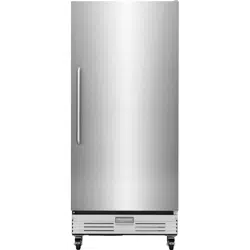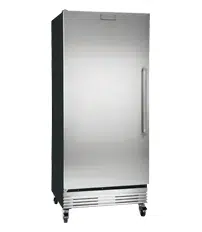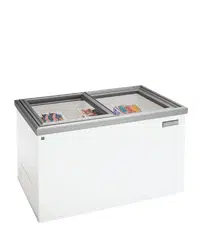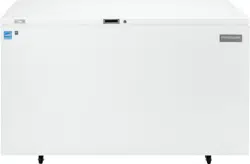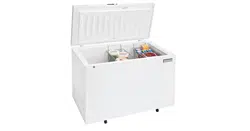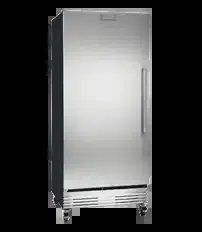
COMMERCIAL FREEZER/REFRIGERATOR
GLASS DOOR REFRIGERATOR
TABLE OF CONTENTS
Product Registration………………………………….…..... 2
Important Safety Instructions……………………….…..... 2
Electrical Information…………………………………........ 3
Caster Installation and Setup ........................................ 3-4
Appliance Start-up…………………………………..............4
Features……………………………………………………..... 5
Routine Maintenance……………………………………..… 5-6
Energy Conservation Measures………………………...... 6
Troubleshooting Guide…………………………………...... 7-8
Wiring Diagram……………………………………………....9
READ AND SAVE THESE INSTRUCTIONS
297290801 (March 2009)
FRIGIDAIRE
COMMERCIAL
2
Product Registration
These instructions include information which is intended
to assure the operator of correct installation, operation
and service. Before attempting installation, adjustment or
maintenance, be certain of the following:
· That you have read and fully understand the instructions.
· That you have all the tools required and are trained to
use them.
· That you have met all installation and usage restrictions
and are familiar with the functions and operations of the
unit.
· That you follow all instructions exactly as given.
All the fittings, measurements, recommendations and
procedures are significant. Substitutions and approximations
must be avoided. Improper handling, maintenance, installation
and adjustment, or service attempted by anyone other than a
qualified technician, may void the future warranty claims and
cause damage to the unit and/or result in injury to the operator
and/or bystanders.Record Your Model and Serial Numbers
Record your Model and Serial Numbers
Record the model number and serial number of this appliance
in the space provided below (the serial plate is located inside
the cabinet compartment).
Model No.
Serial No.
Installetion Date
Invoice Date
Start-up Date
Telephone for Service
Register Your Product
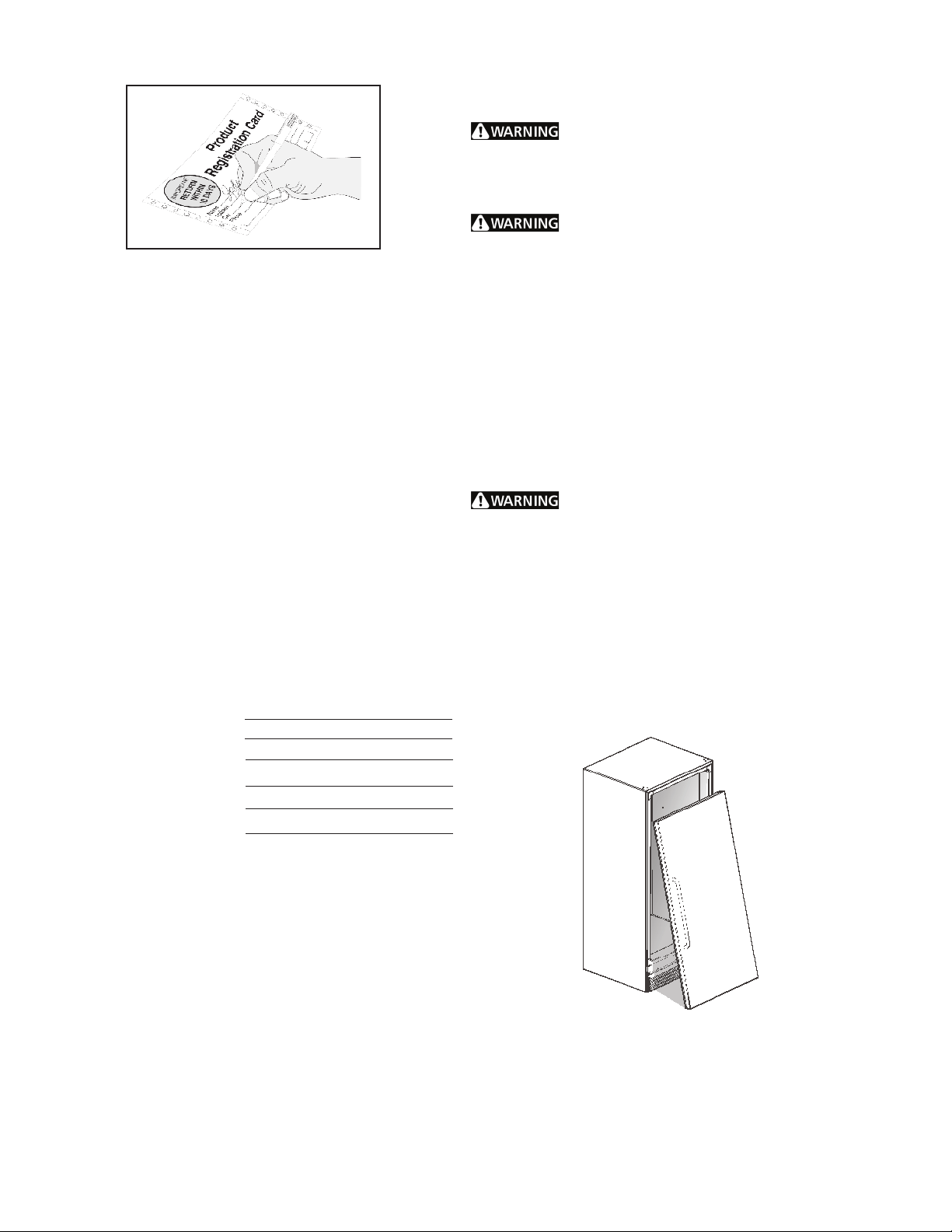
The self-addressed PRODUCT REGISTRATION CARD (shown
above) should be filled in completely, signed and returned to the
address provided.
Important Safety Instructions
Read all instructions before using this appliance
For Your Safety
Do not store or use gasoline or other flammable vapors and
liquids in the vicinity of this unit or any other appliance. Read
product labels for flammability and other warnings.
Child Safety
· Destroy carton, plastic bags, and any exterior wrapping
material immediately after the appliance is unpacked.
Children should never use these items for play. Cartons
covered with rugs, bedspreads, plastic sheets or stretch
wrap may become airtight chambers and can quickly
cause suffocation.
· A child might suffocate if he crawls into the appliance to
hide or play. Remove the door/lid of the appliance when
not in use, even if you plan to discard the appliance.
Many communities have laws requiring you to take this
safety precaution.
Proper Disposal of Appliance
Risk of Child Entrapment
Child entrapment and suffocation are not problems of the
past. Junked or abandoned refrigerators or freezers are still
dangerous – even if they will sit for “just a few days”. If you are
getting rid of your old refrigerator or freezer, please follow the
instructions below to help prevent accidents:
· Remove the door.
· Leave shelves in place so children may not easily climb
inside.
· Have the refrigerant removed by a qualified technician.
3
Electrical Information
These guidelines must be followed to ensure that safety
mechanisms in the design of this appliance will operate
properly.
• Refertotheserialplateforcorrectelectricalrating.
The power cord of the appliance is equipped with a
three-prong grounding plug for protection against shock
hazards. It must be plugged directly into its own properly
grounded three-prong receptacle, protected with a 15
amp time delay fuse or circuit breaker. The receptacle
must be installed in accordance with the local codes and
ordinances. Consult a qualified electrician. Receptacles
with Ground Fault Circuit Interrupters (GFCI) are NOT
RECOMMENDED. DO NOT USE AN EXTENSION
CORD OR AN ADAPTER PLUG.
• Ifthevoltagevariesby10percentormore,appliance
performance may be affected. Operating the appliance
with insufficient power can damage the motor. Such
damage is not covered under the warranty. If you suspect
your voltage is high or low, consult your power company
for testing.
• Topreventtheappliancefrombeingturnedoff
accidentally, do not plug the unit into an outlet controlled
by a wall switch or pull cord.
• DONOTpinch,knot,orbendthepowercordinany
manner.
Other Precautions
• NEVERunplugtheappliancebypullingonthepower
cord. Always grip the plug firmly and pull straight out from
the receptacle.
• Toavoidelectricalshock,unplugtheappliancebefore
cleaning.
NOTE: Turning the control to “OFF” turns off the compressor but
does not disconnect power to other electrical components.
Avoid fire hazard or electric
shock. Do not use an extension cord or an
adapter plug. Do not remove any prong
from the power cord.
Caster Installation and Set-up
Inspection for Damage
Inspect the underside of the cabinet and packaging for damage,
similar to what can be caused with a forklift. If hidden damage
is found after uncrating, immediately call the delivery carrier
and request an inspection. Retain all packaging and crating
materials until the inspection is complete.
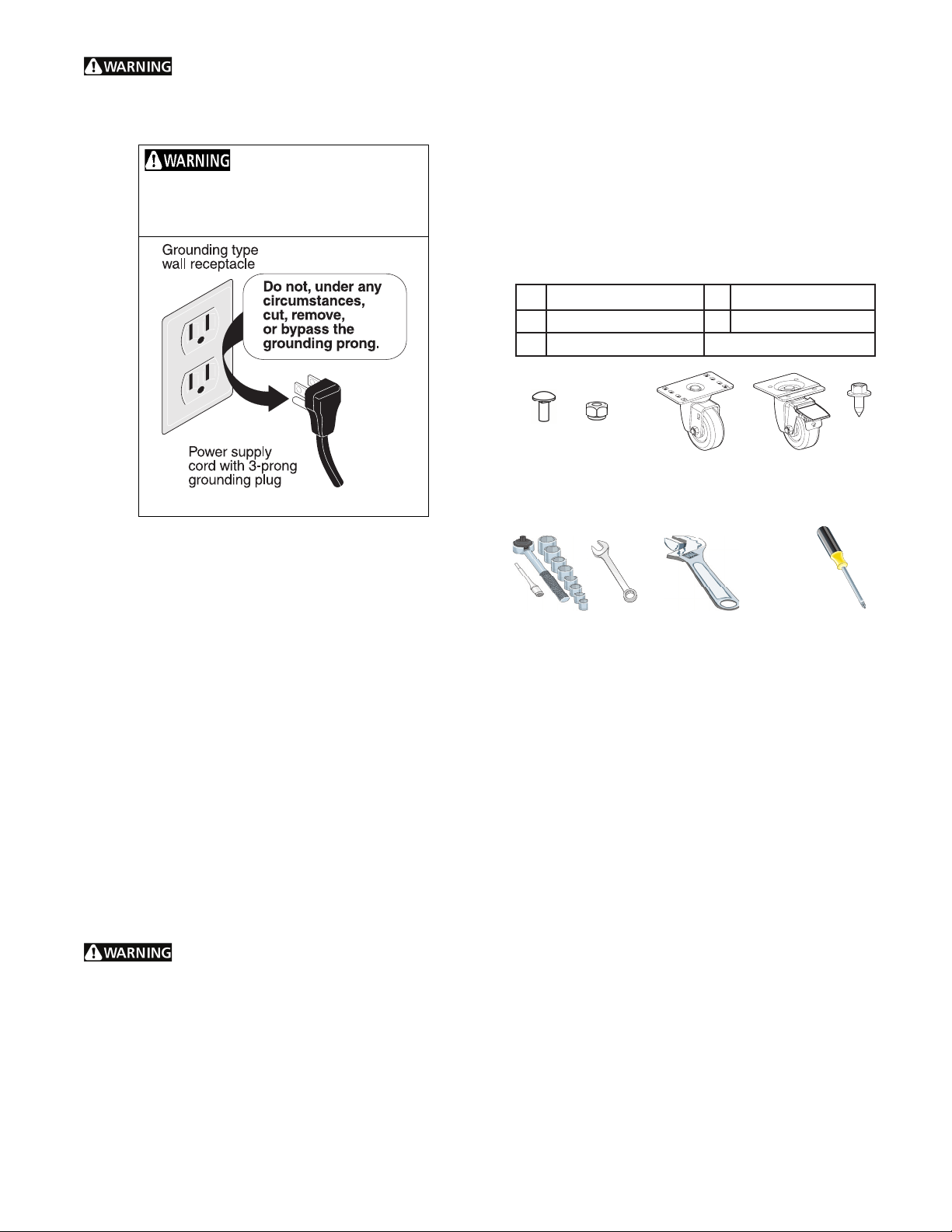
Parts and Accessories
Check to make sure that you have received the box containing
all of the components listed below.
Tools Needed
The following tools are required to assemble and install the
casters to the unit:
A Carriage Bolt (4) D Fixed Caster (2)
B Lock Nut (4) E HexScrew(10)
C Swivel Caster (2)
3/8” AND 1/2” INCH
SOCKET WRENCH
ADJUSTABLE WRENCH
OR PLIERS
1/2” INCH FIXED
WRENCH
5/16”, 3/8” and 9/16”
Socket or Open End
Wrench
Adjustable Wrench
or Pliers
A
B
C
D
E
Phillips
®
Screwdriver
Uncrating and Set-up
1. Remove carton and all loose parts from inside the unit.
2. Remove the rear access guard and place it and the
screws in a safe place for reassembly later.
3. Using an assistant, carefully tip the unit onto its back and
rest on blocks to avoid damaging the condensate drain
hose and the plastic raceway that covers the evaporator
tubing on the back of the cabinet.
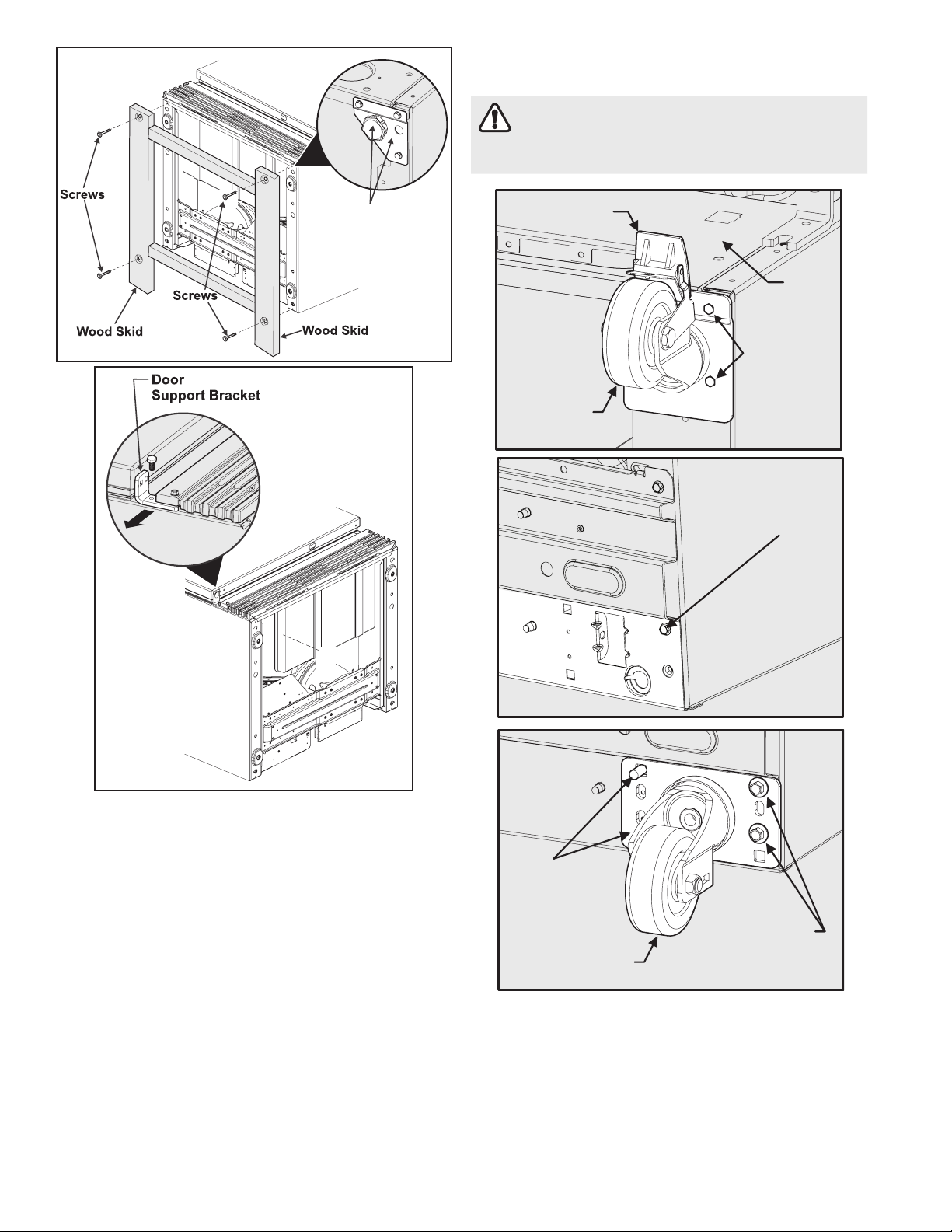
4. Remove the four scews holding the wood skid to the
bottom of the unit using a 3/8” socket wrench. See Figure
1. Discard the wood skid and screws.
5. Remove and discard the two front brackets with leg
leveler using a 5/16” socket wrench. See Figure 1.
6. FOR GLASS DOOR MODELS ONLY - Remove bottom
door support bracket and screw opposite the door hinge
using a 3/8” socket wrench. See Figure 2.
4
Appliance Placement
Leave a one (1) inch space on all sides and the back of the
cabinet for ease of installation, proper air circulation and
electrical connections. DO NOT block the front grill on the lower
front of your appliance. Sufficient air circulation is essential
for the proper operation of your appliance. Choose a place
that is near a grounded electrical outlet. For the most efficient
operation, the appliance should be located where surrounding
temperatureswillnotdropbelow40ºF(5ºC)orexceed110ºF
(43ºC).Additionalcompressorheatersarenotrecommended.
Front Bracket
& Leg Leveler
Figure 1
Figure 2
Front Fixed Caster Installation
1. Locate and align fixed caster (with brake lever facing
front of unit - see Figure 3) over the same mounting
holes from bracket in Figure 1 using six hex screws (3 for
each caster). Secure the screws snug using a 3/8” open
end wrench. Repeat this procedure for opposite corner.
DO NOT OVERTIGHTEN.
Rear Swivel Caster Installation
1. Remove and discard the screws shown in Figure 4 from
each bottom corner using a 5/16” socket wrench.
2. Locate and align swivel caster over the holes and install
with two hex screws. Secure the screws snug using a
3/8” socket wrench. DO NOT OVERTIGHTEN.
3. On the opposite side of the swivel caster plate, insert
two carriage bolts through the compressor support rail
and swivel caster plate. Use a lock nut on each bolt and
tighten securely using a 9/16” socket wrench. See Figure
5.
4. Repeat the same procedure for the opposite rear corner.
5. With the help of an assistant, carefully upright the unit.
Reassemble the rear access guard with screws.
CAUTION
Unit will roll forward as it is tipped up.
Brake Lever
Fixed Caster
Hex Screws(3)
Front
of Unit
Figure 3
Remove Screw Before
Installing Caster
Repeat For
Opposite Corner
Figure 4
(2) Carriage bolts
with
lock nut
Swivel Caster
Install caster using
(2) hex screws
Figure 5
5
Insulation
The insulated space of this cabinet is sealed to maintain peak
efficiency. Holes drilled in the cabinet may destroy that seal and
damage electrical wiring located in the insulated space.
DAMANGED ELECTRICAL WIRING OR WET INSULATION
CAUSED BY DRILLING WILL VOID THE WARRANTY.
Appliance Start-up
Once the appliance has been located in its permanent location
and the proper power and grounding has been provided, the
following items must be checked or completed:
Cool Down Period
For safe food storage, allow 24 hours for the appliance to cool
down completely before loading with food. The appliance will
run continuously for the first several hours. Do not place any
food in the appliance until after the first 24 hours of operation.
Thermostat Setting
The appliance is shipped from the factory with the thermostat
set at about the mid-point of the operating range. Adjustments
colder or warmer can be made after the appliance has
been running for at least 8 hours. Allow at least 8 hours for
temperature stabilization before re-adjusting the thermostat.
Defrost Setting
The appliance is designed to defrost automatically every 12
hours. To set the time of defrost, wait until the desired time to
defrost. With the notch on the timer knob aligned with the line
on the bracket (Fig. A), turn the defrost timer knob clockwise
slowly. The timer will click several times, then once loudly,
at which point the defrost cycle begins. The timer knob will
advance through the defrost cycle, then click loudly at the end
of the cycle. The appliance will defrost automatically every 12
hours after the first defrost cycle.
Forexample,tosettheappliancetodefrostat10:00AM,turn
thetimerknobclockwiseat10:00AMuntilthetimerclicks
loudly.Theappliancewilldefrostdailyat10:00AMandagain
12hourslaterat10:00PM.NOTE:Theapplianceinterior
temperature will rise slightly during the first defrost cycle.
Features
• Heavydutyepoxypowdercoatedadjustableshelves
• NSFcertiedtopmountedevaporator
• 2-½”urethanefoamcabinetinsulation
• Torsionspringdoorcloser
• Heavydutyxedandswivelcasters
• 17wattuorescentlamp
• Stainlesssteelevaporatorhousing
• Removablestainlesssteeldraincover
• Adjustabletemperaturecontrol
• NSFcertiedinterior
• Heavydutyfrontgrill
• Heavydutycommerciallyratedelecrtricalharness
• Heavydutyremovablestainlesssteelshelfsupport
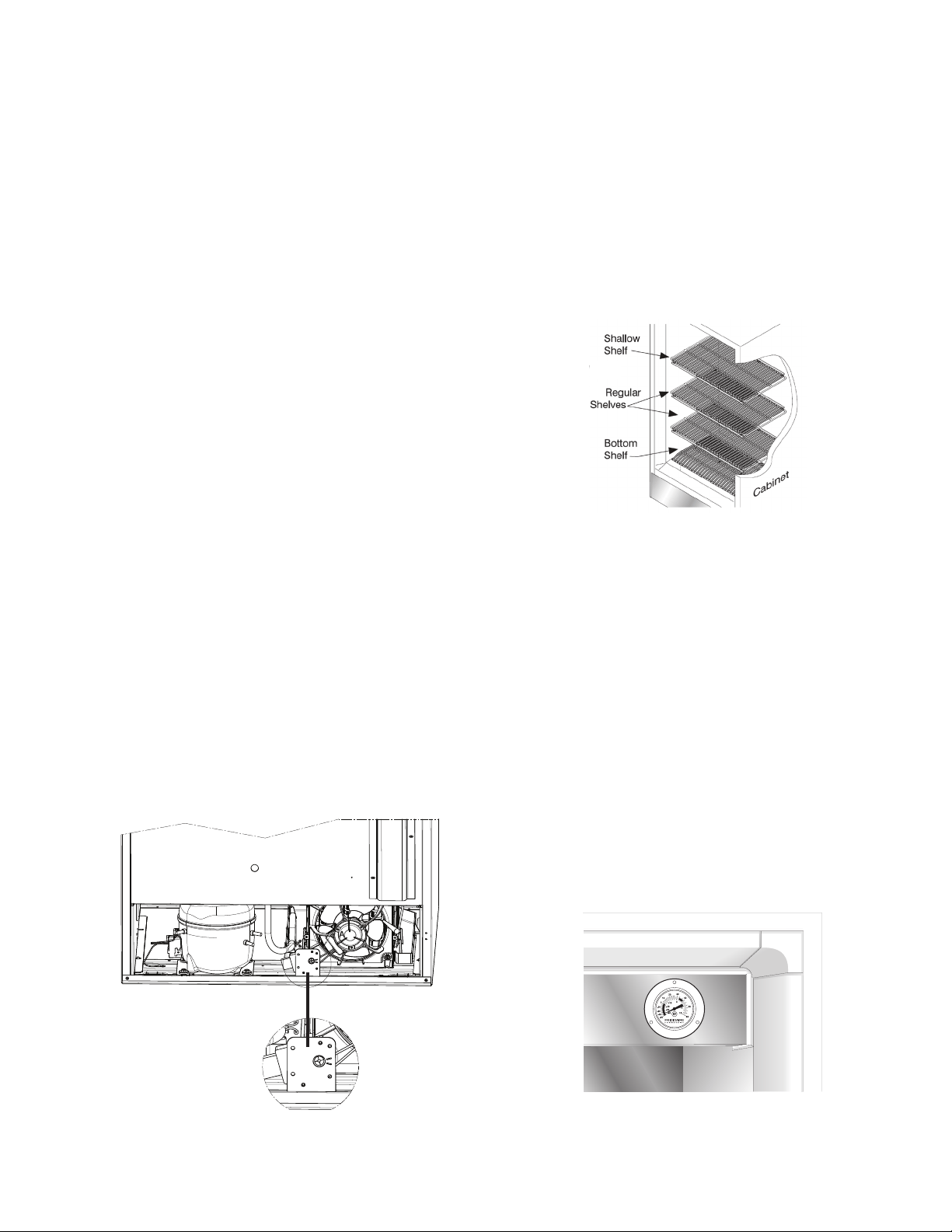
This appliance is provided with four shelves; one goes on the
floor of the cabinet and the other three are placed in the metal
side supports, wherever they are needed. The shallow shelf
goes in the upper position
Casters
The appliance comes with four casters; two with locks for the
front of the unit and two without locks for the back of the unit.
The casters allow you to move the unit to it’s final destination
with ease. The casters can then be locked into place. (Refer to
pages 3-4 for instructions.)
6
Adjustable Temperature Control
The adjustable cold control is located on the top left side of the
evaporator housing inside the unit. “5” is the medium
(recommended) setting and “9” is the coldest setting.
Appliance Start-up
Once the appliance has been located in its permanent location
and the proper power and grounding has been provided, the
following items must be checked or completed:
Cool Down Period
For safe food storage, allow 24 hours for the appliance to cool
down completely before loading with food. The appliance will
run continuously for the first several hours. Do not place any
food in the appliance until after the first 24 hours of operation.
Defrost Setting
The appliance is designed to defrost automatically every 12
hours. To set the time of defrost, wait until the desired time to
defrost. With the notch on the timer knob aligned with the line
on the bracket (Fig. A), turn the defrost timer knob clockwise
slowly. The timer will click several times, then once loudly, at
which point the defrost cycle begins. The timer knob will advance
through the defrost cycle, then click loudly at the end of the cycle
(Fig. B). The appliance will defrost automatically every 12 hours
after the first defrost cycle.
Features
NSF and FDA Approved Adjustable Shelving
This appliance is provided with NSF and FDA approved heavy
duty epoxy powder coated adjustable shelves. The one with the
wires that are angled on the front and back goes on the floor of
the cabinet. The others are placed in the adjustable stainless
steel shelf supports that clip into the shelf support strips on each
side of the interior. Make sure to place the shallow shelf in the
upper-most position.
Front Fixed and Rear Swivel Casters
Glass door unit come with two (2) front fixed casters with
brakes and two (2) rear swivel casters. Non-glass door unit
comes with two (2) front swivel casters with brakes and two (2)
rear swivel casters. The casters allow the appliance to be
moved with ease and then locked in position at its desired
location.
Fig. A
Position of knob before
turning clockwise to start
defrost cycle (First click)
Fig. B
Position of knob at end
of defrost cycle (Second
click)
Appliance Placement
Leave a one (1) inch space on all sides and the back of the
cabinet for ease of installation, proper air circulation and electrical
connections. DO NOT block the front grill on the lower front
of your appliance. Sufficient air circulation is essential for the
proper operation of your appliance. Choose a place that is near
a grounded electrical outlet. For the most efficient operation,
the appliance should be located where surrounding temperatures
will not drop below 40ºF (5ºC) or exceed 110ºF (43ºC). Additional
compressor heaters are not recommended.
Insulation
The insulated space of this cabinet is sealed to maintain peak
efficiency. Holes drilled in the cabinet may destroy that seal and
damage electrical wiring located in the insulated space.
DAMANGED ELECTRICAL WIRING OR WET INSULATION
CAUSED BY DRILLING WILL VOID THE WARRANTY.
Thermostat Setting
The appliance is shipped from the factory
with the thermostat set at about the mid-
point of the operating range. Adjustments
colder or warmer can be made after the
appliance has been running for at least
8 hours. Allow at least 8 hours for
temperature stabilization before re-
adjusting the thermostat.
Figure A
Adjustable Temperature Control
The adjustable cold control is located on the top left side
of the evaporator housing inside the unit. “5” is the medium
(recommended) setting and “9” is the coldest setting.
NSF Certified Temperature Gauge
This appliance is equipped with an NSF certified temperature
gauge to display cabinet internal temperature. The temperature
gauge is located on the top right side of the evaporator housing
inside the unit.

6
Routine Maintenance
Cleaning the Interior
Be sure to turn the temperature control to “OFF” and unplug the
electrical cord. Wash the inside surface of the storage area with
warm water and baking soda solution (about one tablespoon
of baking soda per quart of warm water). Rinse thoroughly with
clean, warm water and wipe dry.
Cleaning the Exterior
Wipe the cabinet exterior occasionally with a cloth dampened in
mild detergent and water. Rinse and wipe dry with a soft cloth.
Do not use razor blades or other sharp instruments that can
scratch the appliance surface when removing adhesive labels.
Any glue left from the tape can be removed with a mixture of
warm water and mild detergent or touch the residue with the
stickysideoftapealreadyremoved.DONOTREMOVETHE
SERIAL PLATE.
Energy Conservation Measures
This appliance is designed for efficiency with heavy foam
insulation. However, there are things that the user can do to
maintain the appliance in operating condition.
• Donotoperatetheapplianceanycolderthannecessary
to maintain safe, product storage temperatures.
• Makesuretheapplianceislocatedtopreventdirect
exposure to sunlight, air ducts, etc.
• Keepthedoorclosedexceptfornormaluse.Inspectthe
door often to see that it self-closes and the gaskets are in
good condition.
• Donotoverstocktheproductinthecabinetbecauseit
will block the normal air flow.
• Haveatleastannualinspectionsbyaqualiedservice
company to see that the refrigerant charge is correct.
• Thisapplianceoperatesmoreefcientlyinacooler
ambient than in a hot ambient. Try to maintain an ambient
below80ºF(27ºC)and65%RH(RelativeHumidity)for
maximum efficiency.
Condensate Pan
Some models have a condensate pan in a fixed position located
behind the toe grill. This must not be removed from under the
cabinet. If the pan is removed, condensate will drop onto the
floor.
Power Failure
DO NOT open the appliance lid unnecessarily if the appliance is
off for several hours.
If a power failure occurs, pack seven or eight pounds of dry ice
into the appliance every 24 hours. Look in the Yellow Pages
under “Dry Ice”, “Dairies”, or “Ice Cream Manufacturers” for local
dry ice suppliers. Always wear gloves and use caution when
handling dry ice.
Interior Light (Stainless Steel Door Models)
TheStainlessSteelDoormodelsareequippedwitha40watt
bulb that lights up when the door is opened. If the bulb goes
bad, replace with bulb of the same type and wattage. This is
a special bulb with a shatterproof coating. Use only an NSF
certified bulb of the same type and wattage which can be
ordered from your Frigidaire Commercial Service Center by
calling1-866-738-1640.
Periods of Non-use and Moving Tips
Leave the appliance operating during periods of non-use of less
than three (3) weeks.
Long Periods of Non-use
If the appliance will not be used for several months:
• Removeallfoodandunplugthepowercord.
• Cleananddrytheinteriorthoroughly.
• Leavetheappliancedooropenslightly,blockingitopenif
necessary, to prevent odor and mold growth.
Moving
When moving the appliance , follow these guidelines to prevent
damage:
• Disconnectthepowercordplugfromthewalloutlet.
• Removefoods,thendefrost,andcleantheappliance.
• Securealllooseitemssuchasbasepanel,baskets,
and shelves by taping them securely in place to prevent
damage.
• Inthemovingvehicle,secureapplianceinanupright
position to prevent movement. Also, protect outside of
appliance with a blanket or similar item.
Fluorescent Lamp (Glass Door Models)
• TheGlassDoorRefrigeratorisequippedwitha17watt
fluorescent lamp. A ballast – lamp mismatch may result
in poor or no lighting.
• If the lamp fails, replace with a lamp of the same
type and wattage. Also, replace a lamp that flickers
continuously. This could damage the ballast.
• Turning the light off, when not in use, will save energy.
However, frequent ON-OFF cycling will reduce the lamp
life.
• Use only NSF certified lamp which can be ordered from
your Frigidaire Commercial Service Center by calling
1-866-738-1640.

7
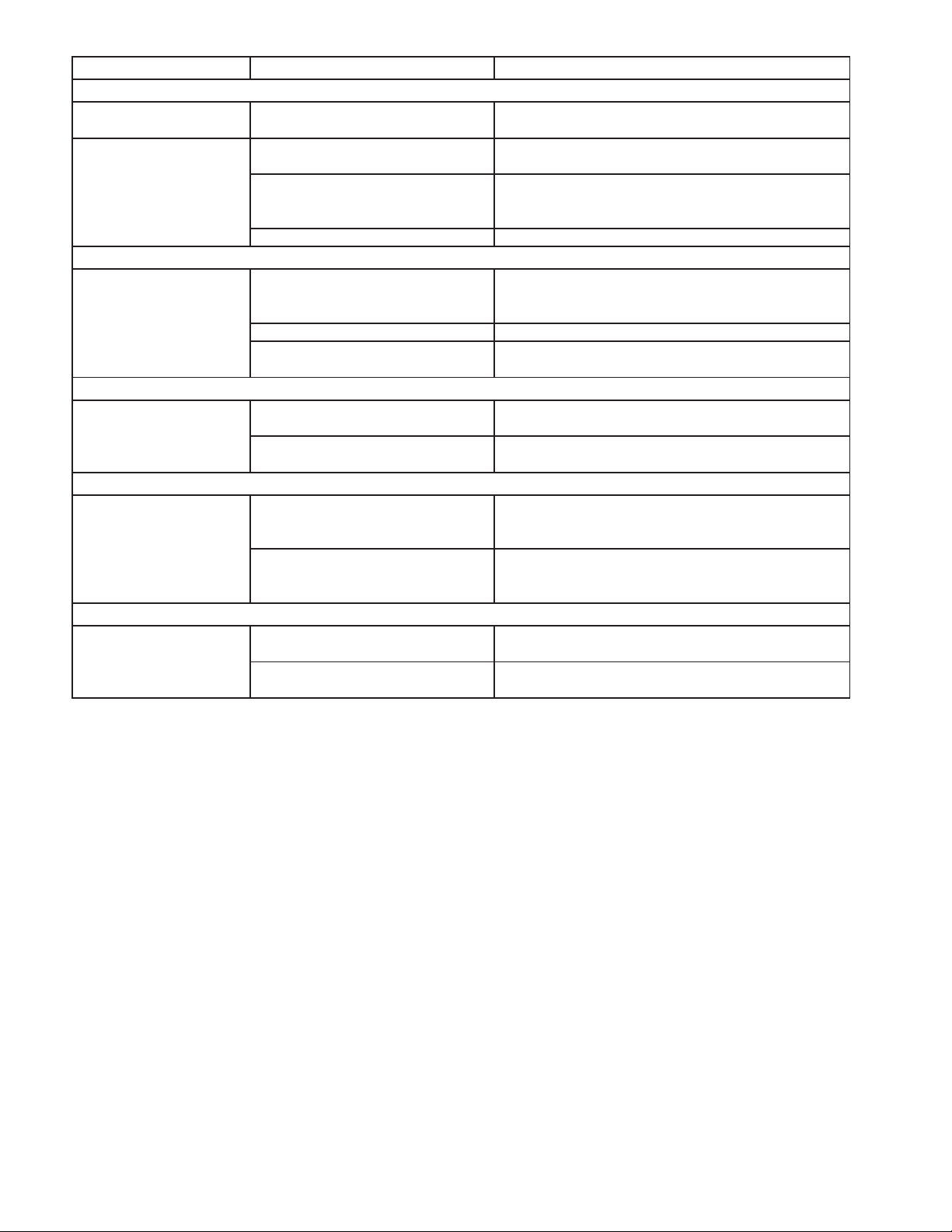
TROUBLESHOOTING
GUIDE
Before calling for service, review this list. It may save you time and expense. This list includes
common occurrences that are not the result of defective workmanship or materials in this
appliance.
PROBLEM
CAUSE CORRECTION
APPLIANCE OPERATION
Appliance does not run. *
Appliance is plugged into a circuit
that has a
g
round fault interru
p
t.
* Use another circuit. If you are unsure about the outlet,
have it checked b
y
a certified technician.
* Temperature control is in the "OFF"
p
osition.
* See Thermostat Setting.
* Appliance may not be plugged in, or
p
lu
g
ma
y
be loose.
* Ensure plug is tightly pushed into outlet.
* House fuse blown or tripped circuit
breaker.
* Check/replace fuse with a 15 amp time delay fuse.
Reset circuit breaker.
* Power outa
g
e * Check house li
g
hts. Call local Electric Com
p
an
y
.
Appliance runs too much or
too lon
g
.
* Room or outside weather is hot. * It's normal for the appliance to work harder under
these conditions.
*
Appliance has recently been
disconnected for a
p
eriod of time.
* It takes 24 hours for the appliance to cool down
com
p
letel
y
.
* Large amount of warm or hot food
have been stored recentl
y
.
* Warm food will cause appliance to run more until the
desired tem
p
erature is reached.
* Door is opened too frequently or
ke
p
t o
p
en too lon
g
.
* Warm air entering the appliance causes it to run
more. O
p
en the door less often.
* A
pp
liance door ma
y
be sli
g
htl
y
* See "Door Problems".
* Temperature control is set too low. * Turn control knob to a warmer setting. Allow several
hours for the tem
p
erature to stabilize.
* Appliance gaskets are dirty, worn,
cracked or poorly fitted.
* Clean or change gasket. Leaks in the lid seal will
cause appliance to run longer in order to maintain
desired tem
p
erature.
Interior appliance
temperature is too cold.
* Temperature control is set too low. * Turn control knob to a warmer setting. Allow several
hours for the tem
p
erature to stabilize.
Interior appliance
tem
p
erature is too warm.
* Temperature control is set too
warm.
* Turn control knob to a colder setting. Allow several
hours for the tem
p
erature to stabilize.
* Door is opened too frequently or
ke
p
t o
p
en too lon
g
.
* Warm air entering the appliance causes it to run
more. O
p
en the door less often.
* A
pp
liance door ma
y
be sli
g
htl
y
* See "Door Problems".
* Large amount of warm or hot food
have been stored recentl
y
.
* Wait until the appliance has had a chance to reach its
selected tem
p
erature.
* Appliance has recently been
disconnected for a
p
eriod of time.
* appliance requires 24 hours to cool down completely.
Appliance external surface
temperature is warm.
* The external appliance walls can be
as much as 30ºF warmer than room
tem
p
erature.
* This is normal while the compressor works to transfer
heat from inside the appliance cabinet.
SOUND AND NOISE
Louder sound levels
whenever appliance is on.
* Modern appliances have increased
storage capacity and more stable
temperatures. They require heavy
dut
y
com
p
ressors.
* This is normal. When the surrounding noise level is
low, you might hear the compressor running while it
cools the interior.
Louder sound levels when
compressor comes on.
*
Appliance operates at higher
pressures during the start of the ON
c
y
cle.
* This is normal. Sound will level off or disappear as
appliance continues to run.
Popping or cracking sound
when compressor comes
on.
* Metal parts undergo expansion and
contraction, as in hot water pipes.
* This is normal. Sound will level off or disappear as
appliance continues to run.
8
PROBLEM
CAUSE CORRECTION
SOUND AND NOISE (Cont.)
Bubbling or gurgling sound, * Refrigerant (used to cool appliance)
is circulatin
g
throu
g
hout the s
y
stem.
* This is normal.
Vibrating or rattling noise. * Appliance is not level. It rocks on
the floor when it is moved sli
g
htl
y
.
* Level the appliance by putting wood or metal shims
under
p
art of the a
pp
liance.
* Floor is uneven or weak. * Ensure floor can adequately support appliance. Level
the appliance by putting wood or metal shims under
p
art of the a
pp
liance.
* a
pp
liance is touchin
g
the wall. * Re-level a
pp
liance or move a
pp
liance sli
g
htl
y
.
WATER / MOISTURE / FROST INSIDE APPLIANCE
Moisture forms on inside
appliance walls.
* Weather is hot and humid, which
increases internal rate of frost build-
u
p
.
* This is normal.
* Door is sli
g
htl
y
o
p
en. * See "Door Problems".
* Door is kept open too long or is
o
p
ened too fre
q
uentl
y
.
* Open the door less often.
ODOR IN APPLIANCE
Odors in appliance. * Interior needs to be cleaned. * Clean interior with sponge, warm water, and baking
soda.
*
Foods with strong odors are in the
a
pp
liance.
* Cover the food tightly.
DOOR PROBLEMS
Door will not close. * Appliance is not level. It rocks on
the floor when it is moved slightly.
* Level the appliance by putting wood or metal shims
under part of the appliance.
* Floor is uneven or weak. *
Ensure floor can adequately support appliance. Level
the appliance by putting wood or metal shims under
p
art of the a
pp
liance.
LIGHTING PROBLEMS
Light bulb is not on. * The fluorescent lamp or light bulb is
burned out.
* See "Fluorescent Lamp" or "Interior Light" on
Features Section.
*
No electric current is reaching the
a
pp
liance.
* See "appliance Does Not Run".
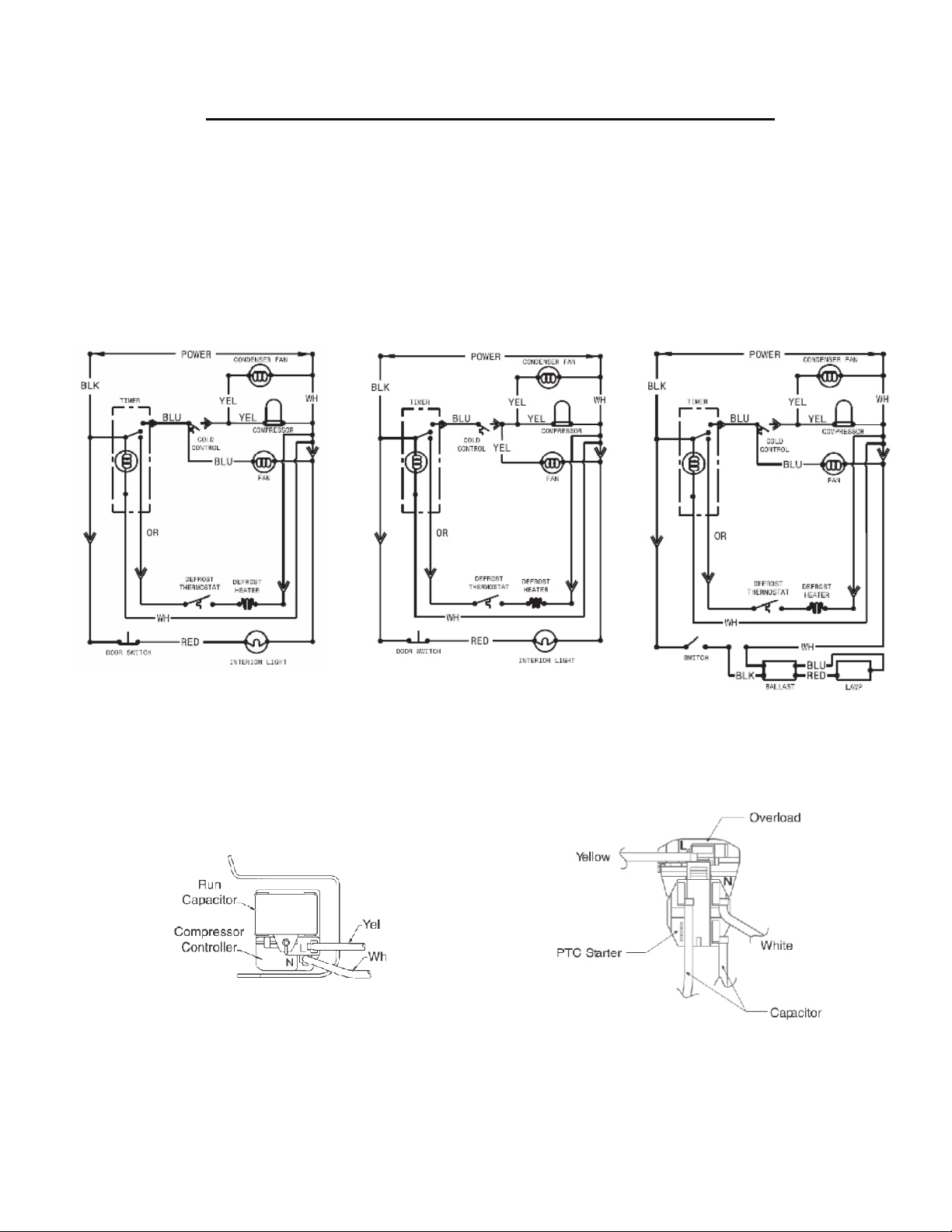
9
IMPORTANT SAFETY NOTICE
The information provided herein is designed to assist qualified repair personnel only.
Untrained persons should not attempt to make repairs due to the possibility of electrical
shock. Disconnect the power cord before servicing.
IMPORTANT
IF ANY GREEN GROUNDING WIRES ARE REMOVED DURING SERVICING, THEY MUST BE RETURNED
TO THEIR ORIGINAL POSITION AND PROPERLY SECURED.
ELECTRICAL CIRCUIT
STAINLESS STEEL DOOR
REFRIGERATOR
STAINLESS STEEL DOOR
FREEZER
GLASS DOOR
REFRIGERATOR