LG
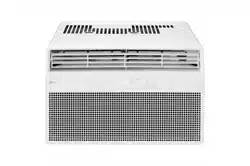
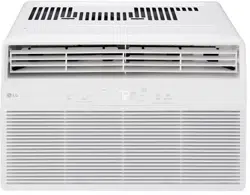
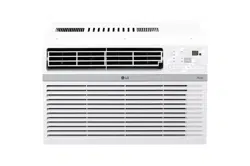
Window-Type Air Conditioner
OWNER'S MANUAL
LG
www.lgappliances.com
ENGLISH ESPAÑOL
IMPORTANT
Please read through this manual. It contains valuable
information about your air conditioner.This manual may
help save time and money by explaining proper air
conditioner maintenance and preventing improper use.
PRECAUTIONS
Pay close attention to precautions in order to prevent
potential hazards and damage from misuse or improper
installation. LG is not responsible for any damages
caused by misuse of the air conditioner.
MODELS, MODELOS: LWHD2500ER
2 Room Air Conditioner
Window-Type Air Conditioner Owner’s Manual
TABLE OF CONTENTS
FOR YOUR RECORDS
Write the model and serial numbers here:
Model #
Serial #
You can find them on a label on the side of each unit.
Dealer's Name
Date Purchased
■ Staple your receipt to this page in the event you need it
to prove date of purchase or for warranty issues.
READ THIS MANUAL
Inside you will find many helpful hints on how to use and
maintain your air conditioner properly. Just a little preventive
care on your part can save you a great deal of time and
money over the life of your air conditioner.
You'll find many answers to common problems in the chart
of troubleshooting tips. If you review our chart of
Troubleshooting Tips first, you may not need to call for
service at all.
PRECAUTION
• Contact the authorized service technician for repair
or maintenance of this unit.
• Contact the installer for installation of this unit.
• The air conditioner is not intended for use by young
children or invalids without supervision.
• Young children should be supervised to ensure that
they do not play with the air conditioner.
• When the power cord is to be replaced, replacement
work shall be performed by authorized personnel only
using only genuine replacement parts.
• Installation work must be performed in accordance
with the National Electric Code by qualified and
authorized personnel only.
Safety Precautions..........................3
Introduction ....................................8
Electrical Safety ..............................9
Installation ....................................11
Operating Instructions .................16
Maintenance and Service ............20
Owner’s Manual 3
ENGLISH
Safety Precautions
Safety Precautions
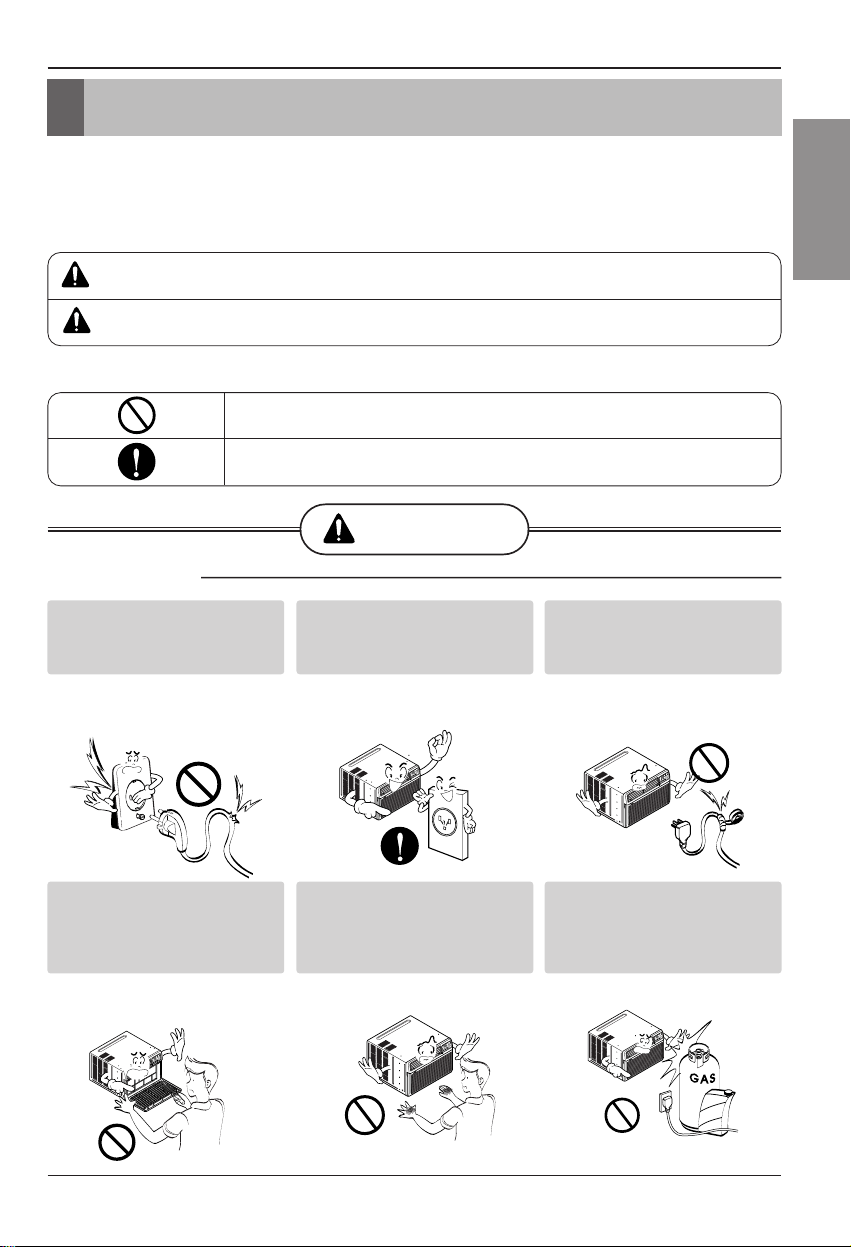
To prevent injury to the user or other people and property damage, the following instructions
must be followed.
■ Incorrect operation due to ignoring instruction will cause harm or damage. The seriousness
is classified by the following indications.
■ Meanings of symbols used in this manual are as shown below.
WARNING
CAUTION
This symbol indicates the possibility of death or serious injury.
This symbol indicates the possibility of injury or damage to properties only.
WARNING
■ Installation
Be sure not to do.
Be sure to follow the instruction.
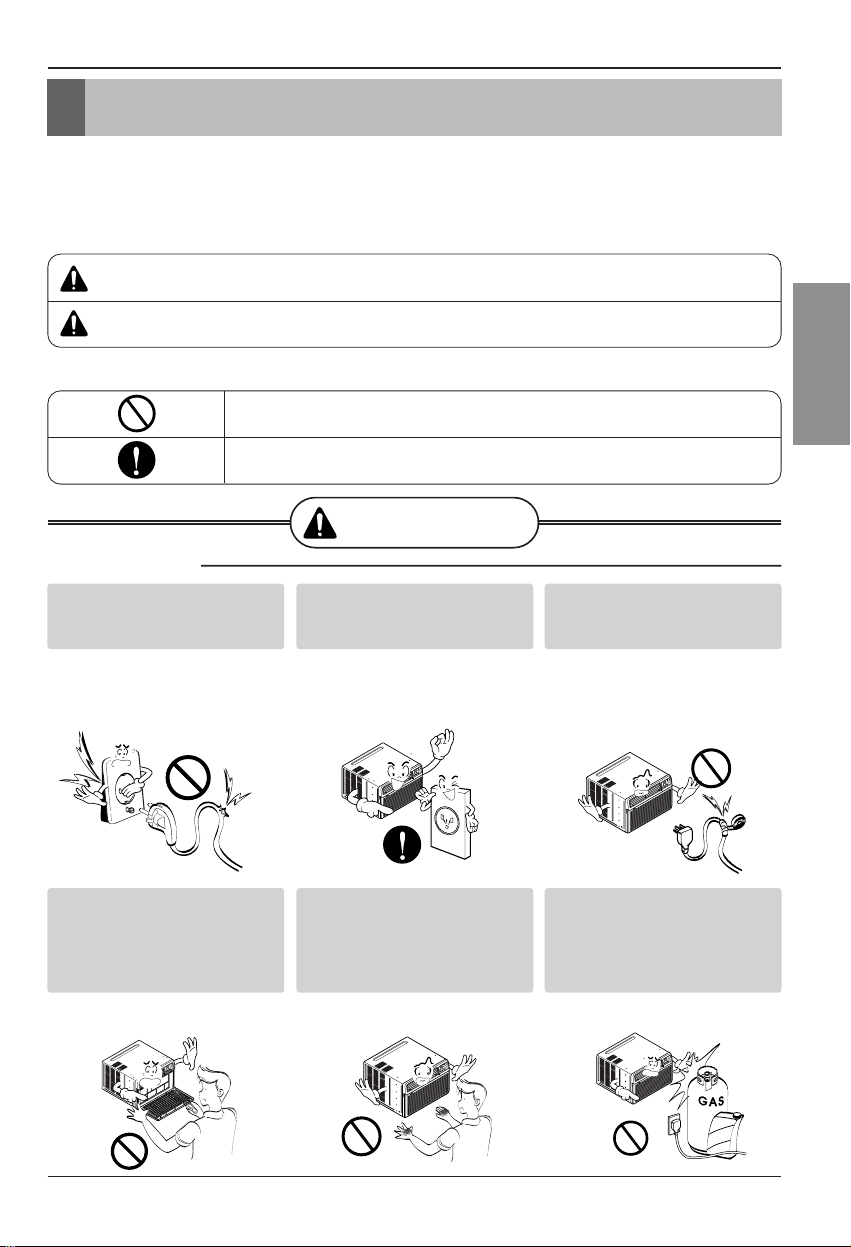
Don’t use a power cord, a
plug or a loose socket which
is damaged.
• Otherwise, it may cause a fire
or electrical shock.
Always plug into a grounded
outlet.
• Otherwise, it may cause a fire
or electrical shock.
Do not modify or extend the
power cord length.
• It will cause electric shock or fire
due to heat generation.
Do not disassemble or
modify products.
• It may cause failure and
electric shock.
Be caution when unpacking
and installing.
• Sharp edges may cause
injury.
Do not use the power cord near
flammable gas or combustibles
such as gasoline, benzene,
thinner, etc.
• It may cause explosion or fire.
Gasolin
4 Room Air Conditioner
Safety Precautions
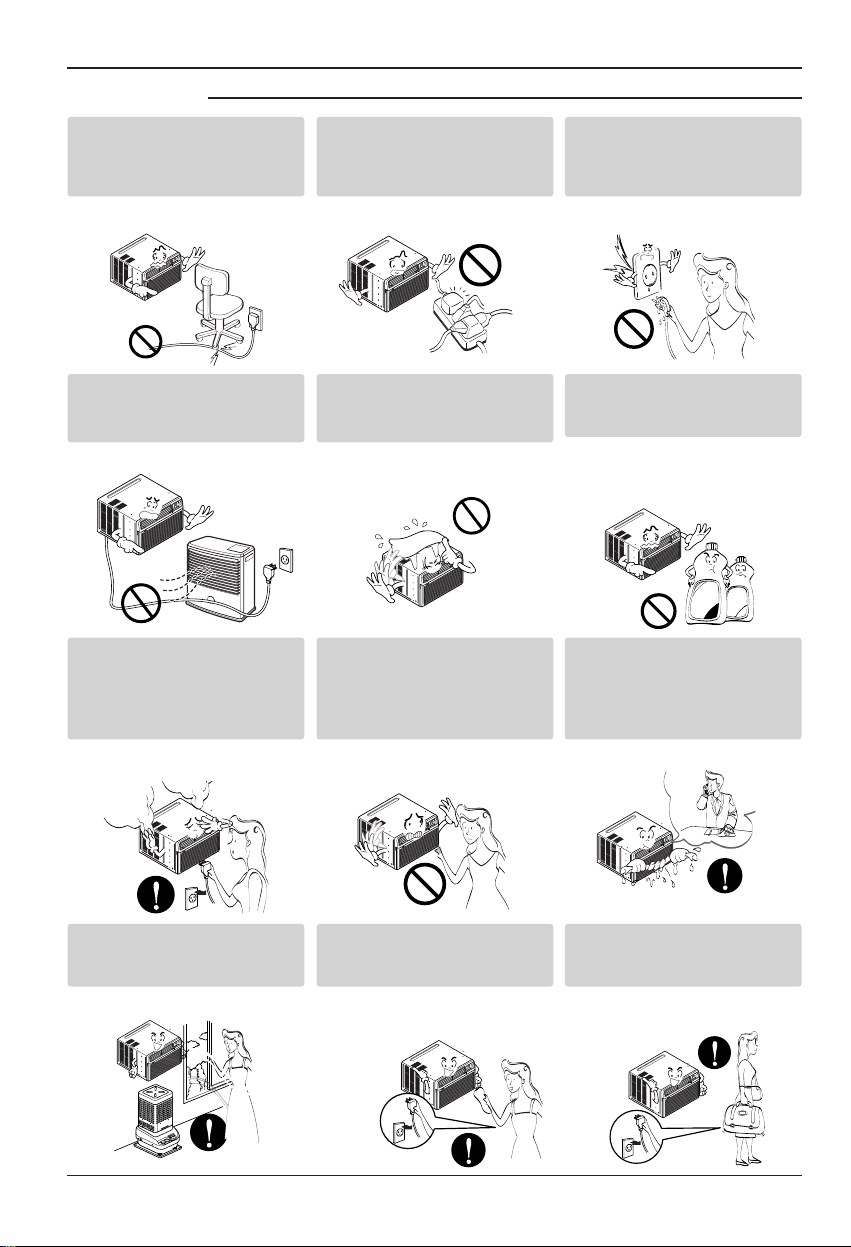
■ Operation
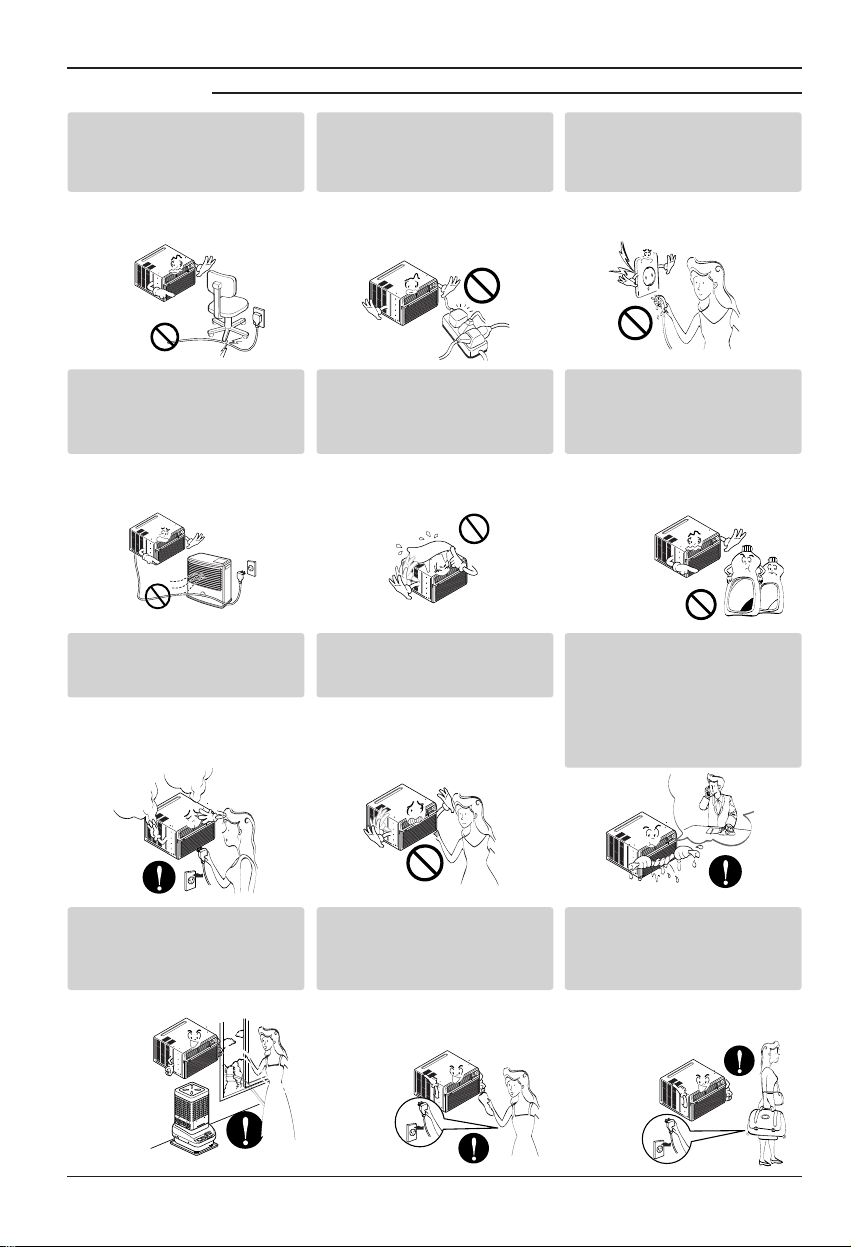
Do not place the power cord
near a heater.
• It may cause fire and electric
shock.
Do not allow water to run
into electric parts.
• It will cause failure of machine or
electric shock.
Use a soft cloth to clean. Do
not use wax, thinner, or a
strong detergent.
• The appearance of the air
conditioner may deteriorate,
change color, or develop surface
flaws.
Wax
Thinner
Ventilate the room well when
using this appliance
together with a stove, etc.
• An oxygen shortage may occur.
Turn off the power and
breaker firstly when
cleansing the unit.
• Since the fan rotates at high
speed during operation, it may
cause injury.
Turn off the main power
switch when not using it for
a long time.
• Prevent accidental startup and
the possibility of injury.
Unplug the unit if strange
sounds, odors, or smoke
come from it.
• Otherwise it may cause fire and
electric shock accident.
Do not open the suction
inlet grill of the product
during operation.
• Otherwise, it may electrical
shock and failure.
If water enters the product, turn
off the the power switch of the
main body of appliance. Contact
service center after taking the
power-plug out from the socket.
Do not place heavy object
on the power cord and take
care so that the cord should
not be pressed.
• There is danger of fire or electric
shock.
Do not share the outlet with
other appliances.
• It will cause electric shock or fire
due to heat generation.
Take the power plug out if
necessary, holding the head
of the plug and do not touch
it with wet hands.
• Otherwise, it may cause a fire
or electrical shock.
Owner’s Manual 5
ENGLISH
Safety Precautions
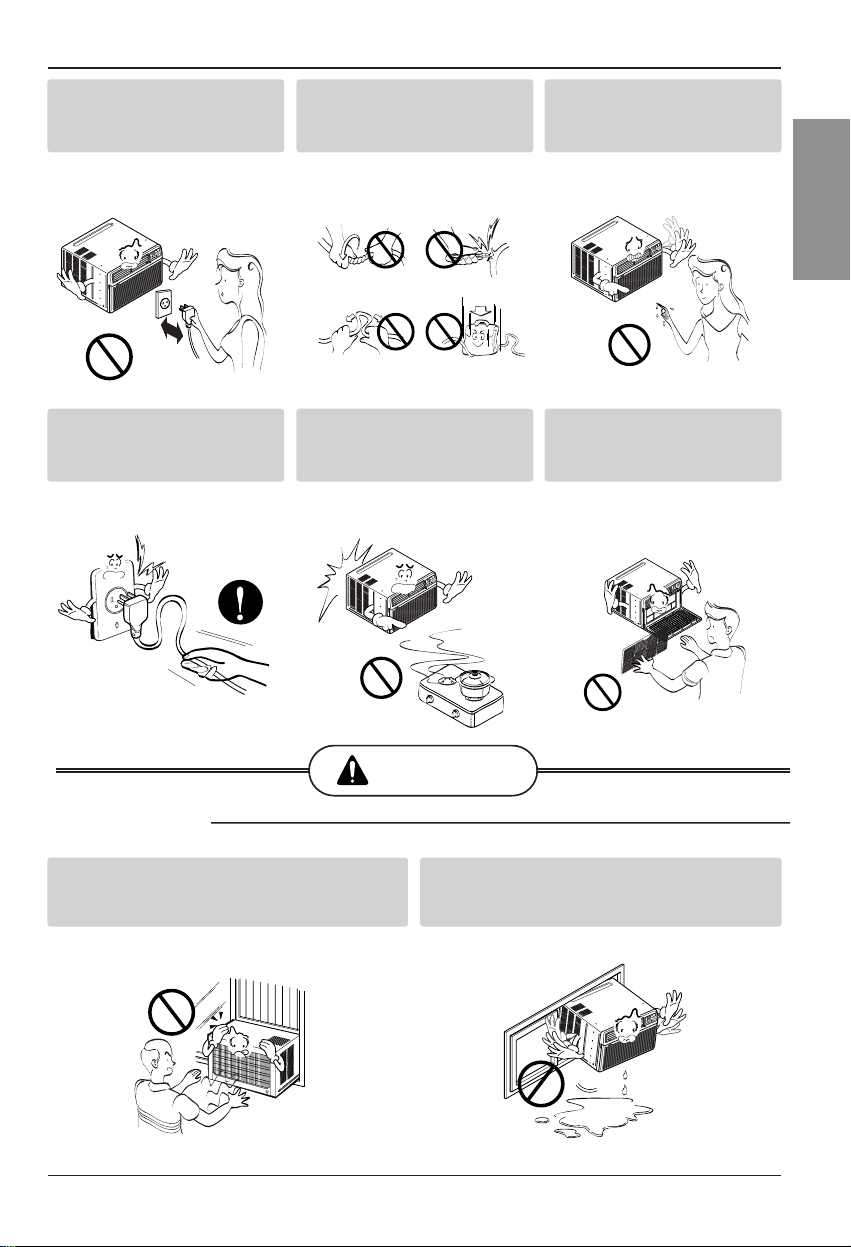
CAUTION
■ Installation
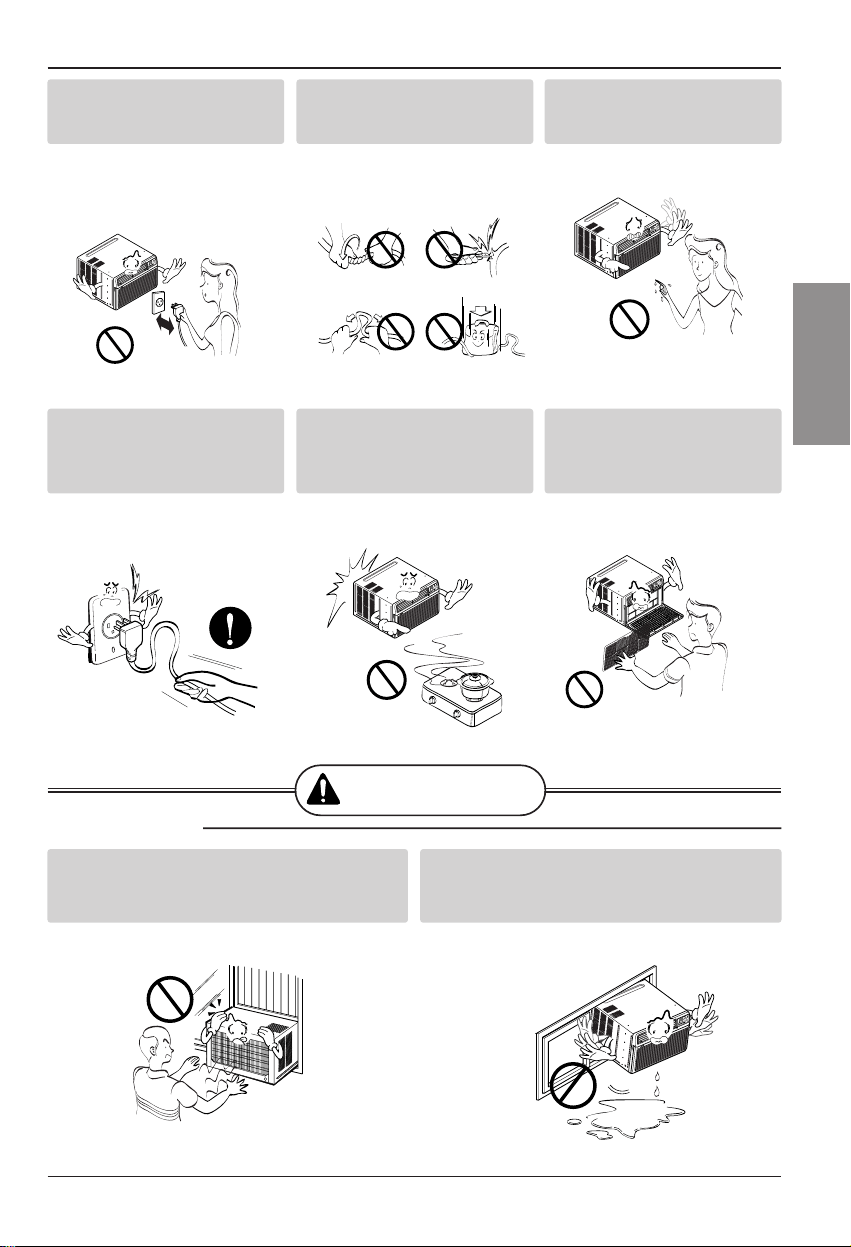
Do not operate or stop the
unit by inserting or pulling
out the power plug.
• It will cause electric shock or fire
due to heat generation.
Do not damage or use an
unspecified power cord.
• It will cause electric shock or fire.
Do not operate with wet
hands or in damp
environment.
• It will cause electric shock.
Hold the plug by the head
when taking it out.
• It may cause electric shock and
damage.
When gas leaks, open the
window for ventilation
before operating the unit.
• Otherwise, it may cause
explosion, and a fire.
Never touch the metal parts
of the unit when removing
the filter.
• They are sharp and may cause
injury.
Install the product so that the noise or hot
wind from the outdoor unit may not cause
any damage to the neighbors.
• Otherwise, it may cause dispute with the
neighbors.
Keep level parallel in installing the product.
• Otherwise, it may cause vibration or water
leakage.
6 Room Air Conditioner
Safety Precautions
■ Operation
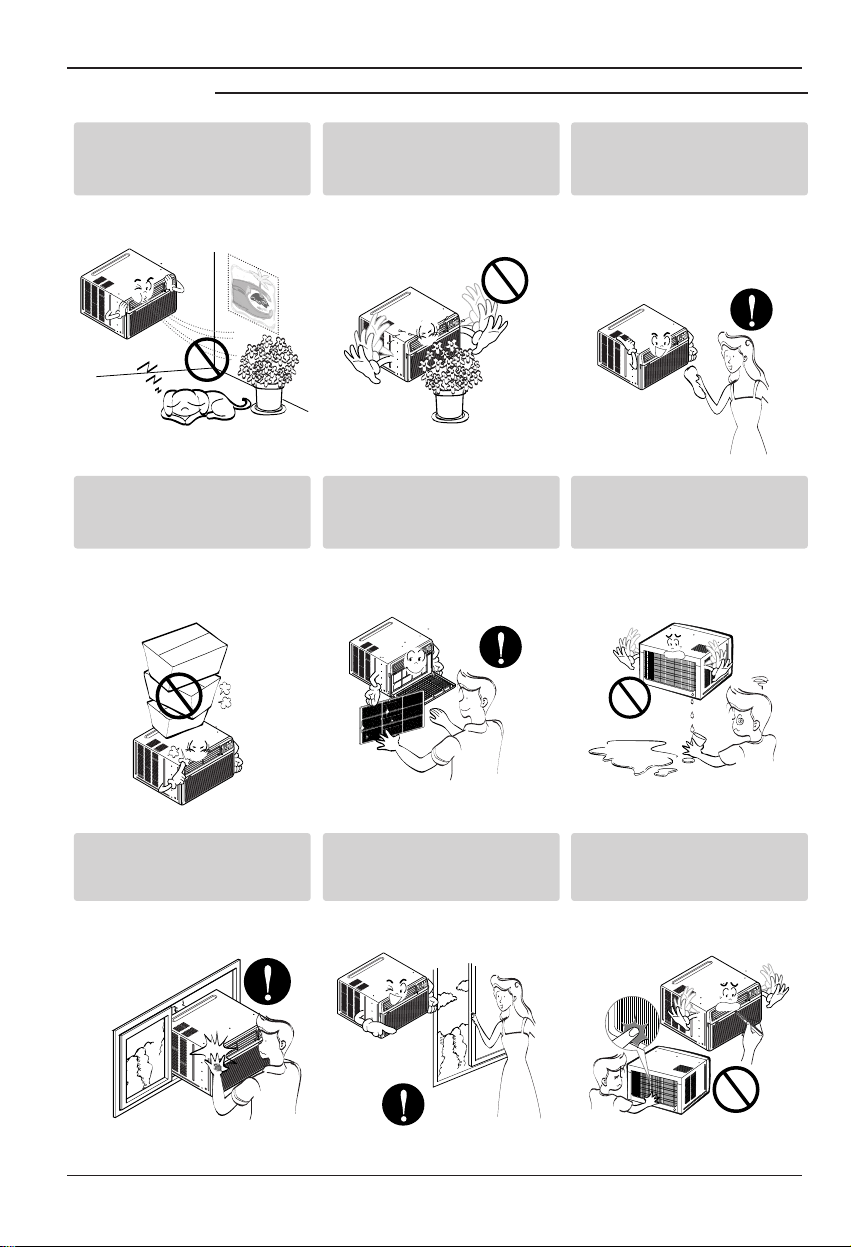
Be cautious not to touch the
sharp edges when
installing.
• It may cause injury.
Avoid excessive cooling and
perform ventilation
sometimes.
• Otherwise, it may do harm to
your health.
Do not insert the hands or
bars through the air inlet or
outlet during operation.
• Otherwise, it may cause
personal injury.
Do not put a pet or house
plant where it will be
exposed to direct air flow.
• It may cause injury.
Do not block the inlet or
outlet of air flow.
• It may cause product failure.
Use a soft cloth to clean. Do
not use wax, thinner, or a
strong detergent.
• The appearance of the air
conditioner may deteriorate,
change color, or develop surface
flaws.
Do not step on the
indoor/outdoor unit and do
not put anything on it.
• It may cause an injury through
dropping of the unit or falling
down.
Always insert the filter
securely.
Clean it every two weeks.
• Operation without filters will
cause failure.
Do not drink water drained
from air conditioner.
• It contains containments and will
make you sick.

Before Operation
Owner’s Manual 7
ENGLISH
Before Operation
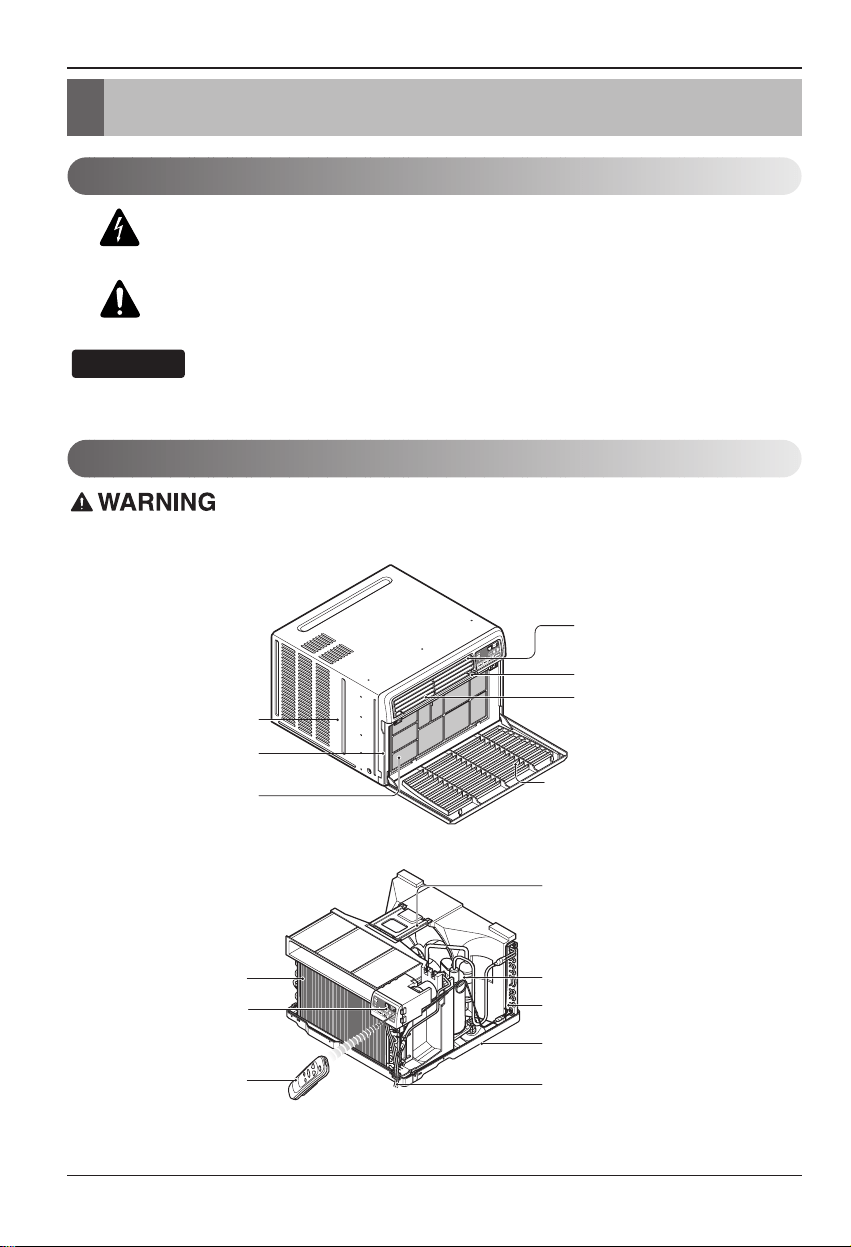
1. Contact an installation specialist for installation.
2. Plug in the power plug properly.
3. Use a dedicated circuit.
4. Do not use an extension cord.
5. Do not start/stop operation by plugging/unplugging the power cord.
6. If the cord/plug is damaged, replace it with only an authorized replacement
part.
1. Being exposed to direct airflow for an extended period of time could be
hazardous to your health. Do not expose occupants, pets, or plants to direct
airflow for extended periods of time.
2. Due to the possibility of oxygen deficiency, ventilate the room when used
together with stoves or other heating devices.
3. Do not use this air conditioner for non-specified special purposes (e.g.
preserving precision devices, food, pets, plants, and art objects). Such usage
could damage the items.
1. Do not touch the metal parts of the unit when removing the filter. Injuries can
occur when handling sharp metal edges.
2. Do not use water to clean inside the air conditioner. Exposure to water can
destroy the insulation, leading to possible electric shock.
3. When cleaning the unit, first make sure that the power and breaker are turned
off. The fan rotates at a very high speed during operation. There is a
possibility of injury if the unit’s power is accidentally triggered on while
cleaning inner parts of the unit.
For repair and maintenance, contact your authorized service dealer.
Preparing for Operation
Usage
Cleaning and Maintenance
Service
8 Room Air Conditioner
Introduction
This symbol alerts you to the risk of electric shock.
This symbol alerts you to hazards that could cause harm to
the air conditioner.
This symbol indicates special notes.
NOTICE
This appliance should be installed in accordance with the National Electric Code.
Introduction
Symbols Used in this Manual
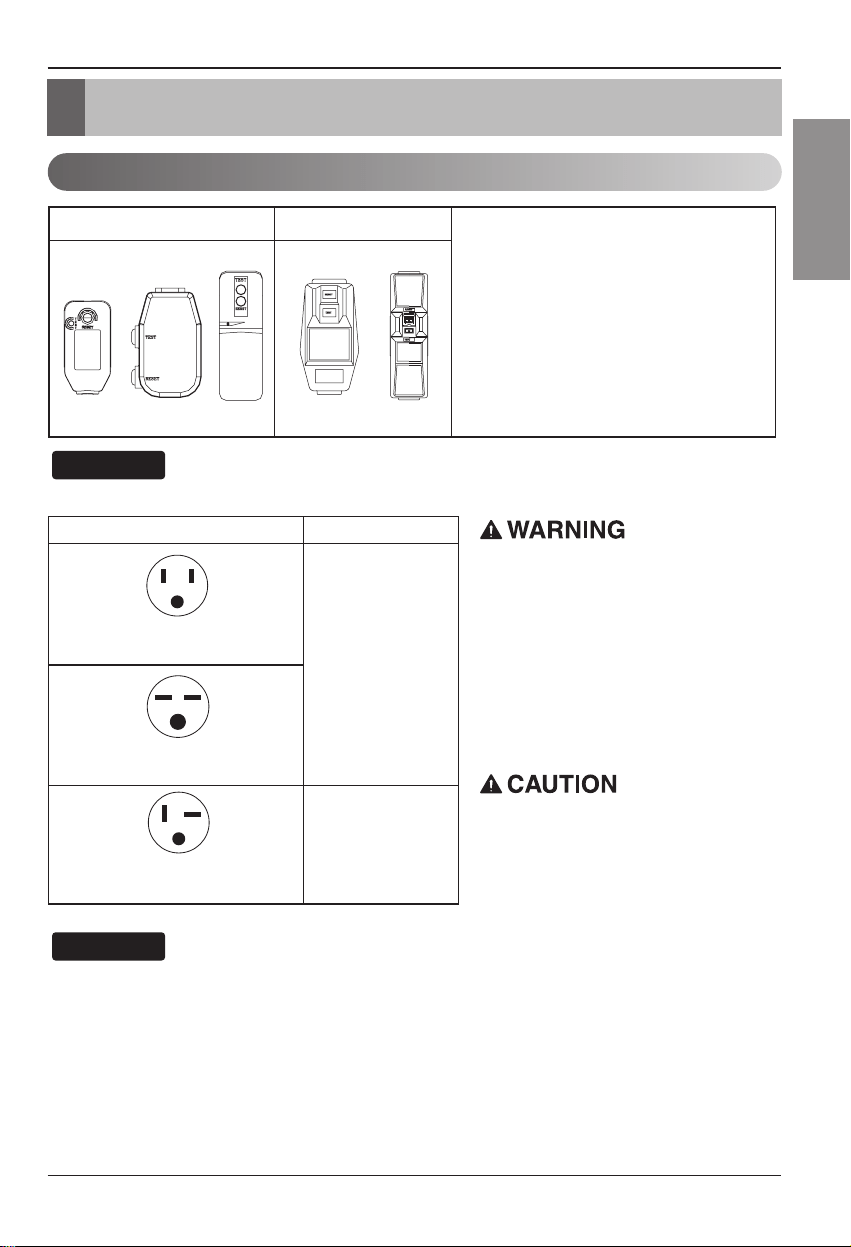
Features
AIR INTAKE (INLET GRILLE)
CABINET
FRONT GRILLE
AIR FILTER
VERTICAL AIR DEFLECTOR
(HORIZONTAL LOUVER)
AIR DISCHARGE
HORIZONTAL AIR DEFLECTOR
(VERTICAL LOUVER)
BRACE
COMPRESSOR
CONDENSER
BASE PAN
EVAPORATOR
CONTROL PANEL
REMOTE CONTROLLER
POWER CORD
Electrical Safety
Owner’s Manual 9
ENGLISH
Electrical Safety
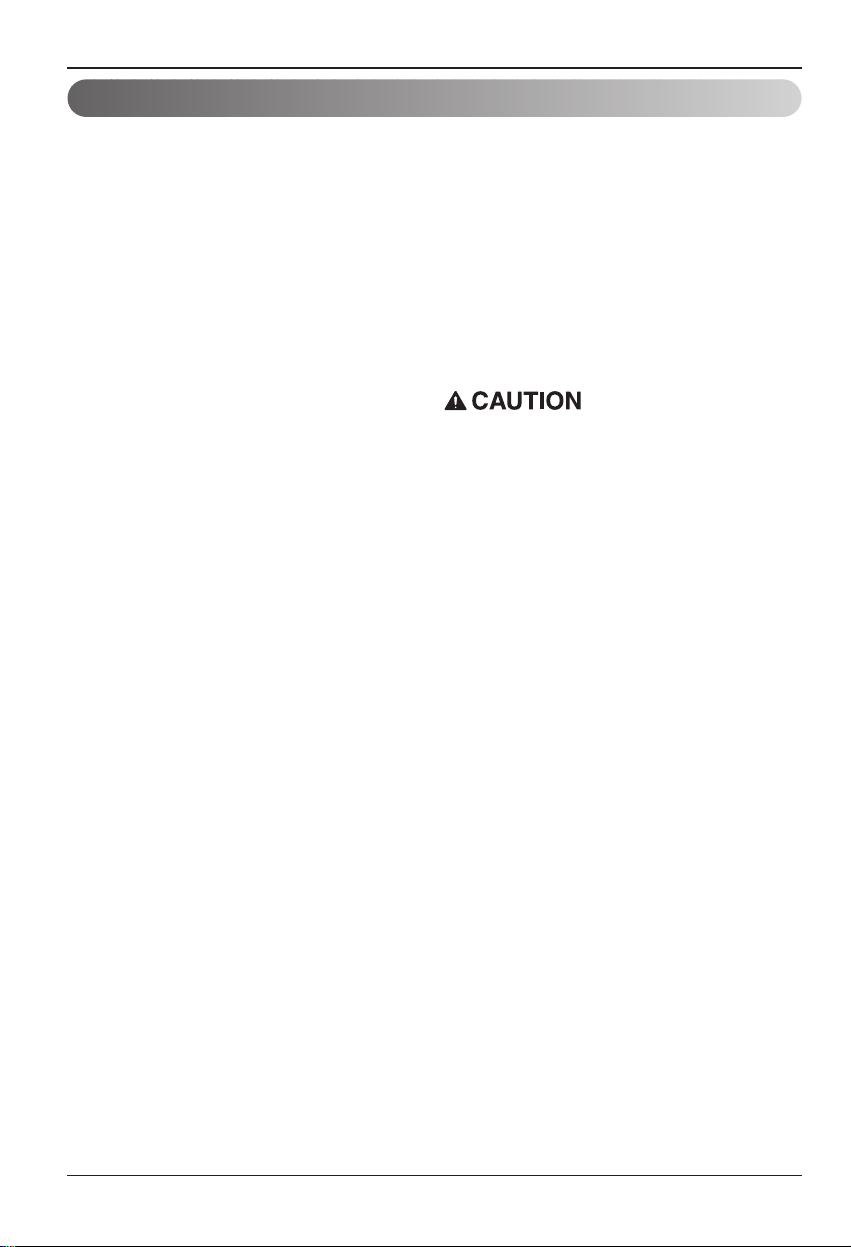
Electrical Data
115V~ 230V~
Power cord may include a current
interrupter device. A test and reset button is
provided on the plug case. The device
should be tested on a periodic basis by first
pressing the TEST button and then the
RESET button. If the TEST button does not
trip or if the RESET button will not stay
engaged, discontinue use of the air
conditioner and contact a qualified service
technician.
Use Wall Receptacle Power Supply
Standard 125V, 3-wire grounding
receptacle rated 15A, 125V AC
Standard 250V, 3-wire grounding
receptacle rated 15A, 250V AC
Use 15 AMP. time
delay fuse or 15 AMP.
circuit breaker.
Use 20 AMP. time
delay fuse or 20 AMP.
circuit breaker.
Standard 250V, 3-wire grounding
receptacle rated 20A, 250V AC
Never push the test button during
operation
Otherwise this plug can damaged.
This device contains chemical, including
lead, known to the State of California to
cause cancer, and birth defects or other
reproductive harm.
Wash hands after handling.
Do not remove, modify or immerse this plug.
If this device trips, the cause it to be
corrected before further use.
The conductors inside this cord are
surrounded by shields, which monitor
leakage current.
These shields are not grounded.
<Made in Tower>
Periodically examine the cord for any
damage. Do not use this product in the
event the shields become exposed.
Avoid shock hazard, this unit can not
be user serviced opening the tamper
resistant. Sealed portion of the unit
voids all warranties and performance
claims. This unit not intended for use
as an on-off switch.
The shape may be different according to its model.
NOTICE
DO NOT USE AN EXTENSION CORD on 230,
208, and 230/208 Volt units.
All wiring should be made in accordance with local
electrical codes and regulations.
Aluminum house wiring may pose special
problems. Consult a qualified electrician.
NOTICE
10 Room Air Conditioner
Electrical Safety
Electrical Safety
IMPORTANT
(PLEASE READ CAREFULLY)
FOR THE USER'S PERSONAL SAFETY, THIS
APPLIANCE MUST BE PROPERLY GROUNDED
The power cord of this appliance is equipped with a
three-prong (grounding) plug. Use this with a standard
three-slot (grounding) wall power outlet to minimize the
hazard of electric shock. The customer should have the
wall receptacle and circuit checked by a qualified
electrician to make sure the receptacle is properly
grounded.
DO NOT CUT OR REMOVE THE THIRD (GROUND)
PRONG FROM THE POWER PLUG.
A. SITUATIONS WHEN THE APPLIANCE WILL BE
DISCONNECTED OCCASIONALLY:
Because of potential safety hazards, we strongly
discourage the use of an adapter plug. However, if you
wish to use an adapter, a TEMPORARY CONNECTION
may be made. Use UL-listed adapter, available from
most local hardware stores.
The large slot in the adapter must be aligned with the
large slot in the receptacle to assure a proper polarity
connection.
:
Attaching the adapter ground terminal to the wall
receptacle cover screw does not ground the appliance
unless the cover screw is metal, and not insulated, and
the wall receptacle is grounded through the house
wiring. The customer should have the circuit checked
by a qualified electrician to make sure the receptacle
is properly grounded.
Disconnect the power cord from the adapter, using one
hand on each. Otherwise, the adapter ground terminal
might break. DO NOT USE the appliance with a broken
adapter plug.
B. SITUATIONS WHEN THE APPLIANCE WILL BE
DISCONNECTED OFTEN.
Do not use an adapter plug in these situations.
Unplugging the power cord frequently can lead to an
eventual breakage of the ground terminal. The wall
power outlet should be replaced by a three-slot
(grounding) outlet instead.
USE OF EXTENSION CORDS
Because of potential safety hazards, we strongly
discourage the use of an extension cord. However, if
you wish to use an extension cord, use a CSA
certified/UL-listed 3-wire (grounding) extension cord,
rated at 15A, 125V.
Owner’s Manual 11
ENGLISH
Installation
Installation
How to Install the Unit
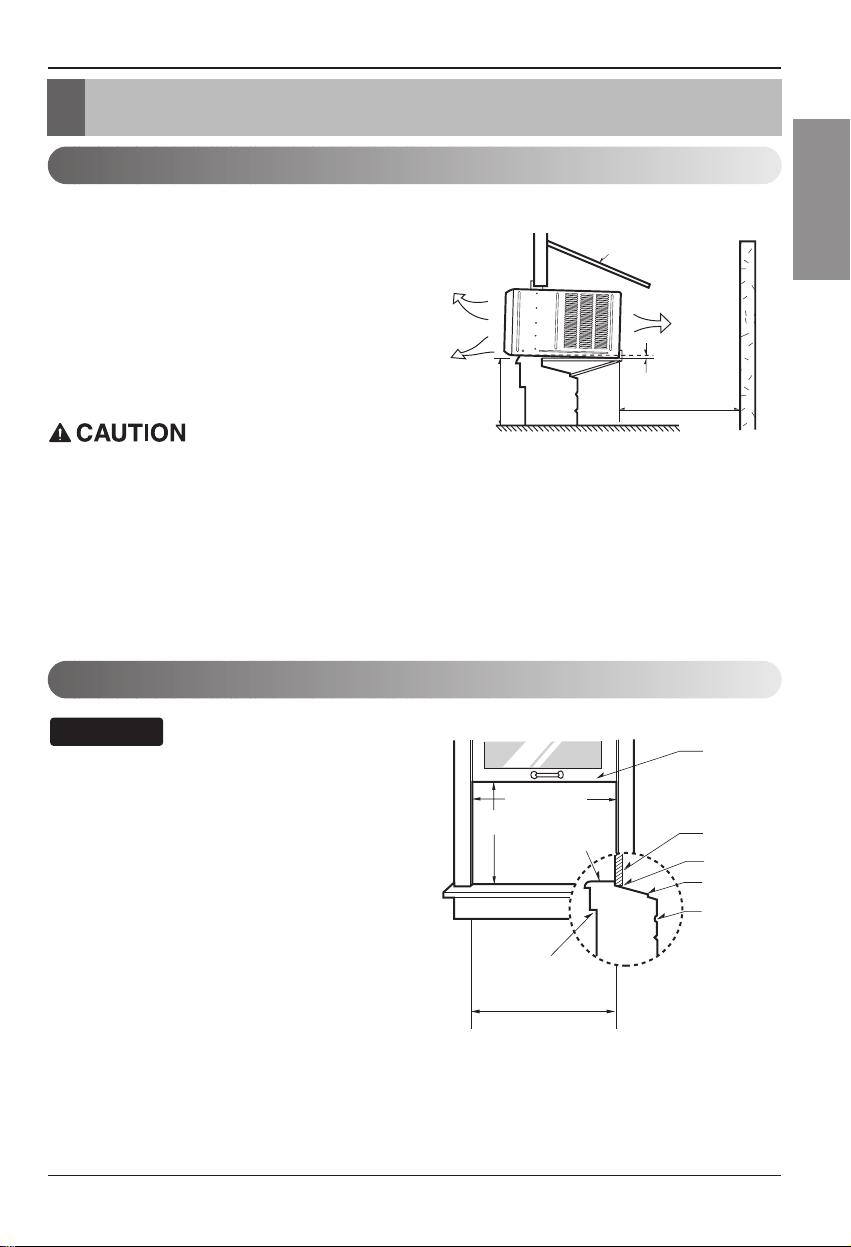
1. To prevent vibration and noise, make sure the unit
is installed securely and firmly.
2. Install the unit where the sunlight does not shine
directly on the unit.
3. There should be no obstacles, such as a fence
and wall, within 20" from the back of the cabinet
because it will prevent heat radiation of the
condenser.
Restriction of outside air will greatly reduce the
cooling efficiency of the air conditioner.
All side louvers of the cabinet must remain
exposed to the outside of the structure.
4. Install the unit a little slanted so the back is slightly
lower than the front (about 1/2").
This will force condensed water to flow to the
outside.
5. Install the unit with the bottom about 30"~60"
above the floor level.
About
1
/2"
30"~60"
Awning
Cooled air
Fence
Over 20"
Heat
radiation
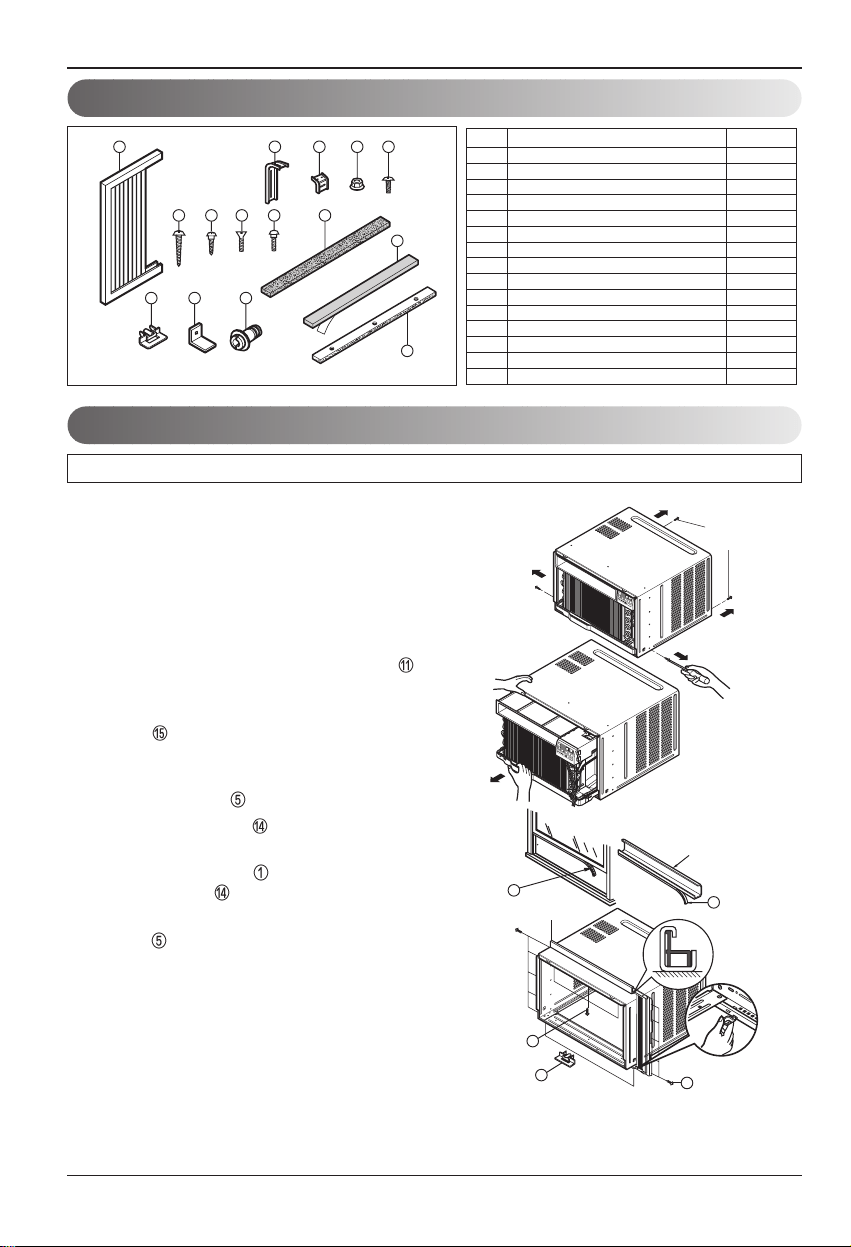
Window Requirements
All supporting parts should be secured to firm
wood, masonry, or metal.
• This unit is designed for installation in standard
double hung windows with actual opening widths
from 29"
to 41".
• The top and bottom window sash must open
sufficiently to allow a clear vertical opening of 19"
from the bottom of the upper sash to the window
stool.
NOTICE
29" to 41"
19" min.
Inner sill
Offset
Window
Sash
Sill
Exterior
Interior wall
26" min.
(Without frame curtain)
12 Room Air Conditioner
Installation Kits Contents
Suggested Tool Requirements
Installation
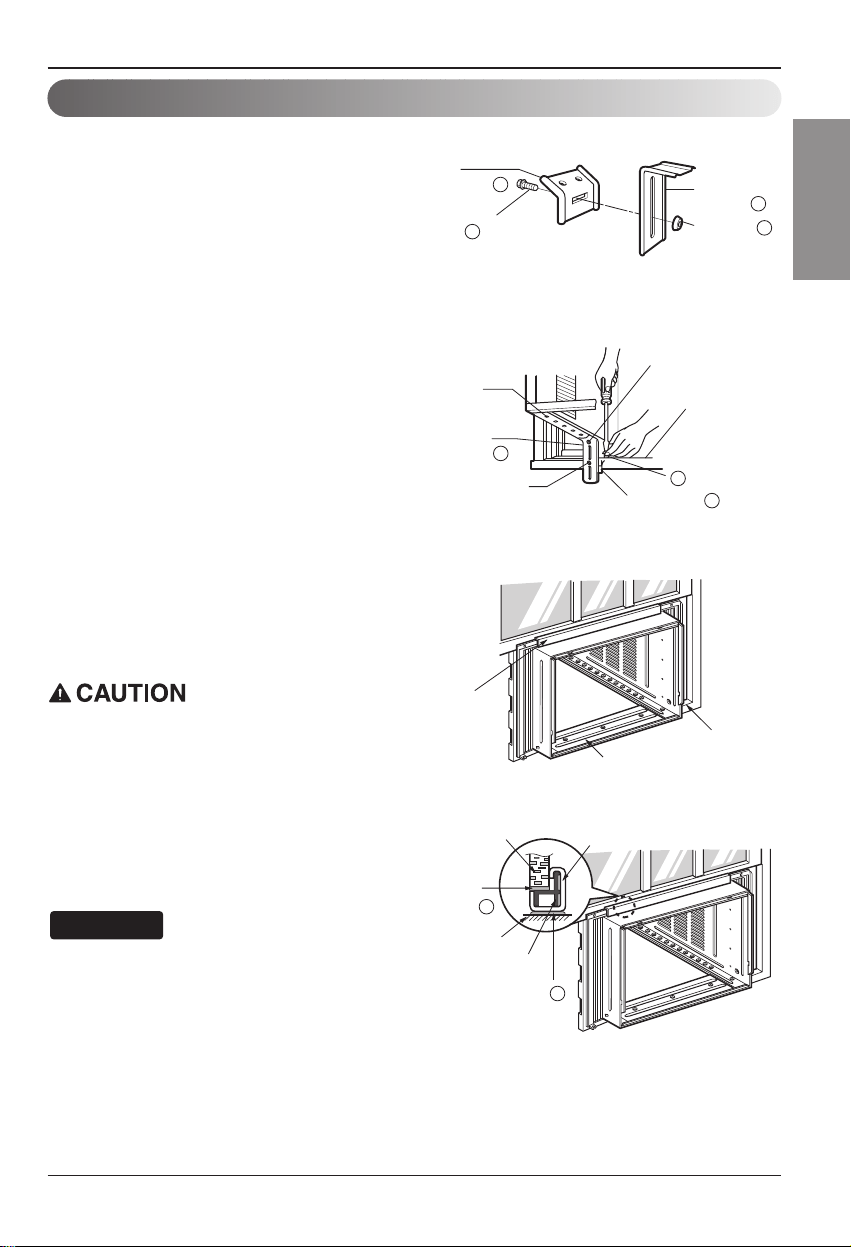
NO. NAME OF PARTS Q'TY
1 FRAME CURTAIN 2
2 SUPPORT BRACKET 2
3 SILL BRACKET 2
4 LOCK NUT 4
5 SCREW (TYPE A) 14
6 SCREW (TYPE B) 7
7 SCREW (TYPE C) 5
8 SCREW (TYPE D) 2
9 CARRIAGE BOLT 2
10 FOAM STRIP 1
11 FOAM SEAL 1
12 WINDOW LOCKING BRACKET 1
13 DRAIN PIPE 1
14 FRAME GUIDE 2
15 FOAM-PE 1
1 2 3 4 5
6 7 8 9 10
11
14 12 13
15
SCREWDRIVER(Philips and Flatead), RULER, KNIFE, HAMMER, PENCIL, LEVEL
PREPARATION OF CHASSIS
1. Remove the screws which fasten the cabinet at
both sides and at the back.
2. Slide the unit from the cabinet by gripping the
base pan handle and pulling forward while bracing
the cabinet.
3. Cut the window sash seal to the proper length.
Peel off the backing and attach the Foam-Seal
to the underside of the window sash.
4. Remove the backing from the top upper guide
Foam-PE and attach it to the bottom of the
Upper Guide.
5. Attach the upper guide onto the top of the cabinet
with 3 Type A screws .
6. Insert the Frame Guides into the bottom of the
cabinet.
7. Insert the Frame Curtain into the Upper Guide
and Frame Guides .
8. Fasten the curtains to the unit with 10 Type
A screws .
11
15
(Type A)
5
(Type A)
Upper Guide
Upper Guide
5
14
Shipping
Screws
Owner’s Manual 13
ENGLISH
Installation
Cabinet Installation
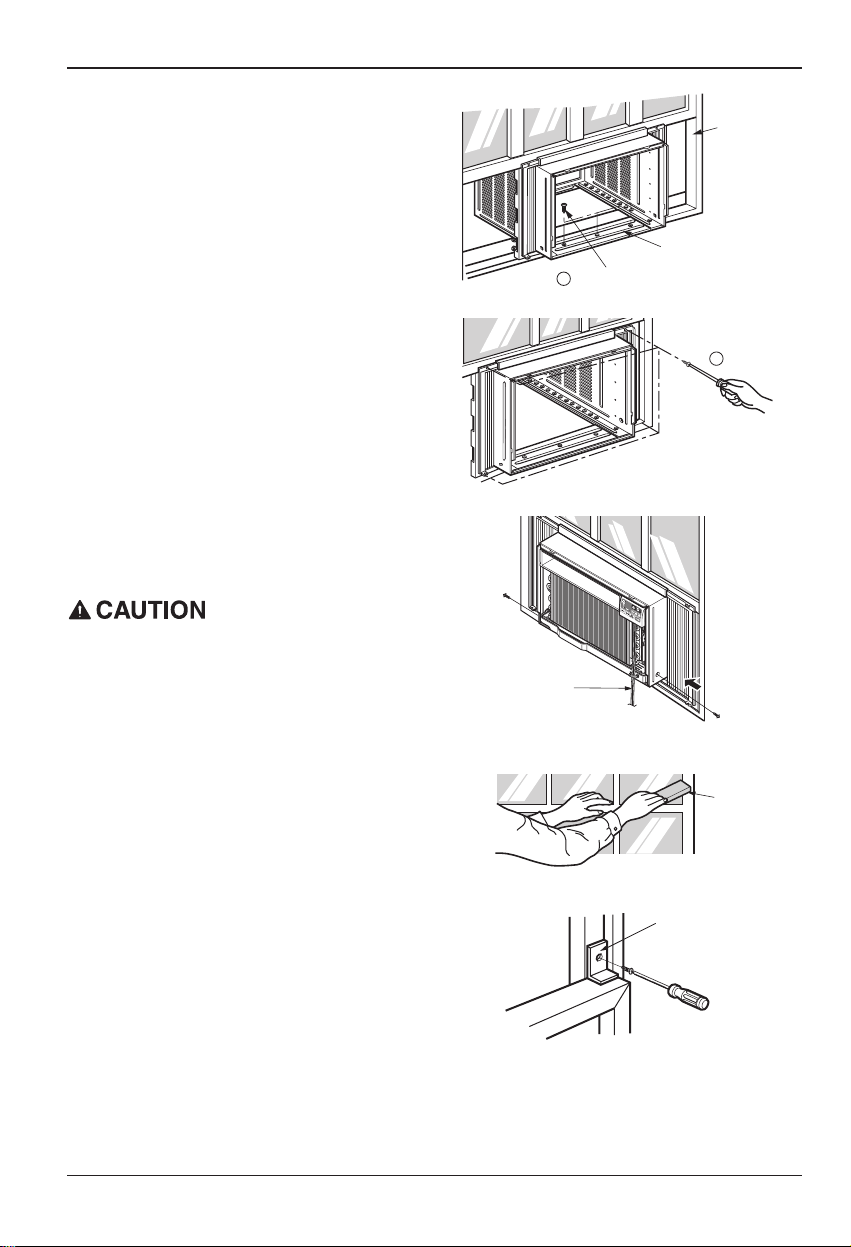
1. Open the window. Mark a line on the center of the
window stool between the side window stop
moldings.
Loosely attach the sill bracket to the support
bracket using the carriage bolt and the lock nut.
2. Attach the sill bracket to the window sill using the
screws (Type B).
Carefully place the cabinet on the window stool
and align the center mark on the bottom front with
the center line marked window stool.
3. Using the M-screw and the lock nut, attach the
support bracket to the cabinet track hole. Use the
first track hole after the sill bracket on the outer
edge of the window sill. Tighten the carriage bolt
and the lock nut. Be sure the cabinet slants
outward.
Do not drill a hole in the bottom pan. The unit is
designed to operate with approximately 1/2" of
water in bottom pan.
4. Pull the bottom window sash down behind the Top
retainer bar until they meet.
1. Do not pull the window sash down so tightly
that the movement of Frame curtain is restricted.
Attach the cabinet to the window stool by driving
the screws (Type B) through the cabinet into
window stool.
2. The cabinet should be installed with a very slight
tilt downward toward the outside.
NOTICE
3
9
2
6
3
15
11
2
4
Fig. 1
Fig. 2
Fig. 3
Fig. 4
Support
Bracket
Lock nut
Sill
Bracket
Carriage
Bolt
Front angle
Window stool
Window sash
Upper Guide
Cabinet
Foam
-Seal
Frame curtain
Foam-PE
(Type B)
Cabinet
Track hole
Support
Bracket
Carriage bolt
and lock nut
Machine screw(Type D)
and lock nut
Outer edge
of window
sill
Sill bracket
Upper
Guide
14 Room Air Conditioner
Installation
5. Pull each Frame curtain fully to each window sash
track, and pull the bottom window sash down
behind the Top retainer bar until it meets.
6. Attach each Frame curtain the window sash by
using screws (Type C.) (See Fig. 6)
7. Slide the unit into the cabinet.(See Fig. 7)
For security purpose, reinstall screws(Type A)
at cabinet's sides.
8. Cut the Foam-strip to the proper length and insert
between the upper window sash and the lower
window sash.(See Fig. 8)
9. Attach the Window locking bracket with a screw
(Type C.) (See Fig. 9)
(Type C)
6
7
Fig. 5
Fig. 6
Fig. 7
Fig. 8
Fig. 9
Screw(Type B)
Front Angle
Sash track
Window locking
bracket
Foam-Strip
Screw
Screw
Power Cord
Owner’s Manual 15
ENGLISH
Installation
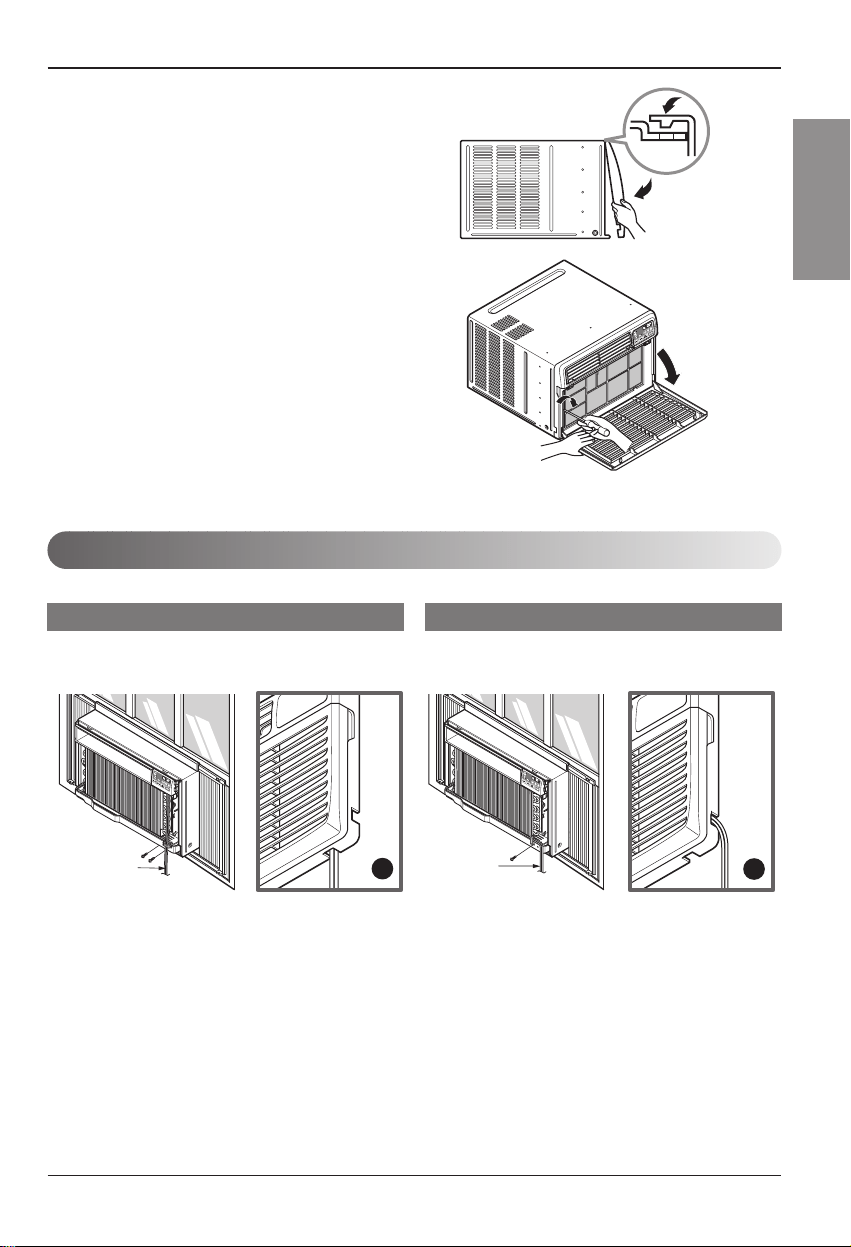
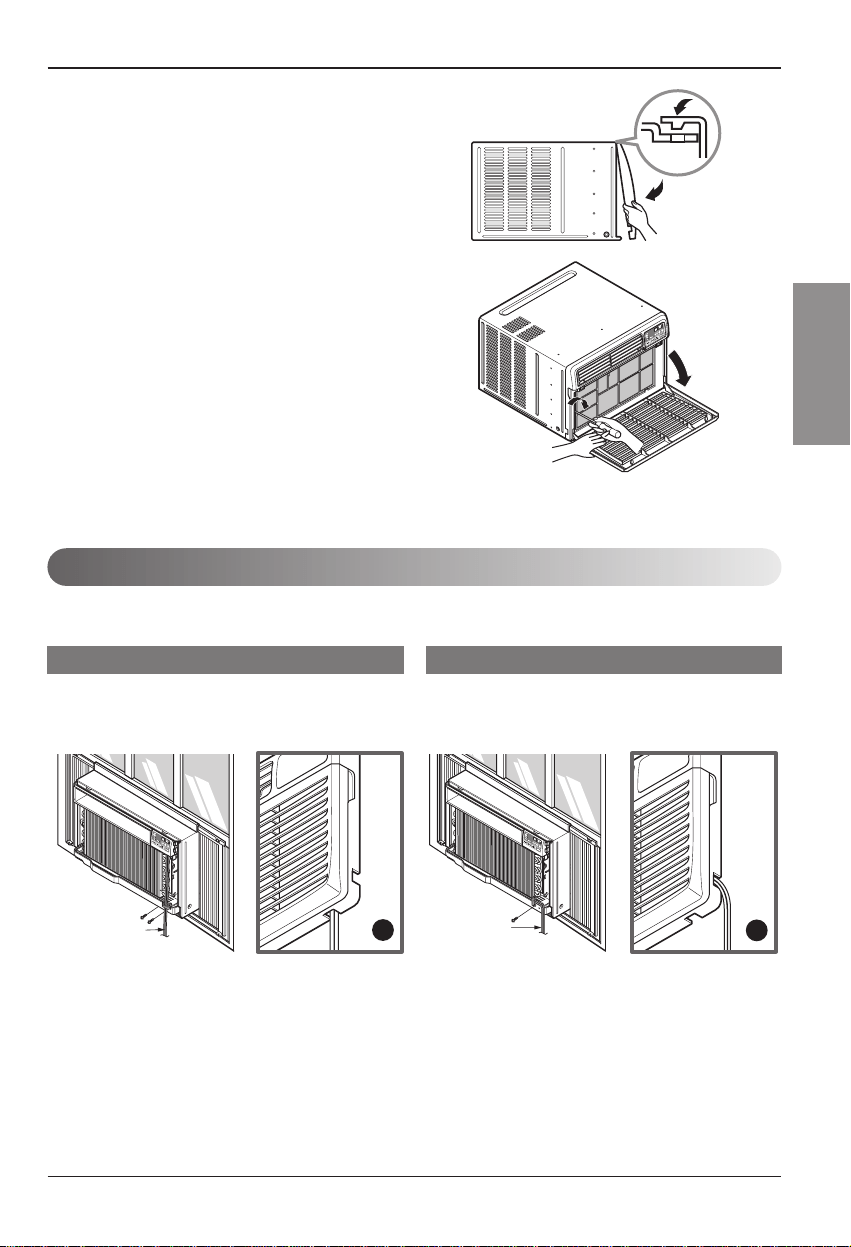
10. Attach the front grille to the cabinet by inserting
the tabs on the grille into the tabs on the front of
the cabinet. Push the grille in until it snaps into
place. (See Fig.10)
11. Lift the inlet grille and secure it with a screw
(Type A) through the front grille.(See Fig. 10)
12. Window installation of room air conditioner is now
completed. See ELECTRICAL DATA for attaching
power cord to electrical outlet.
Fig. 10
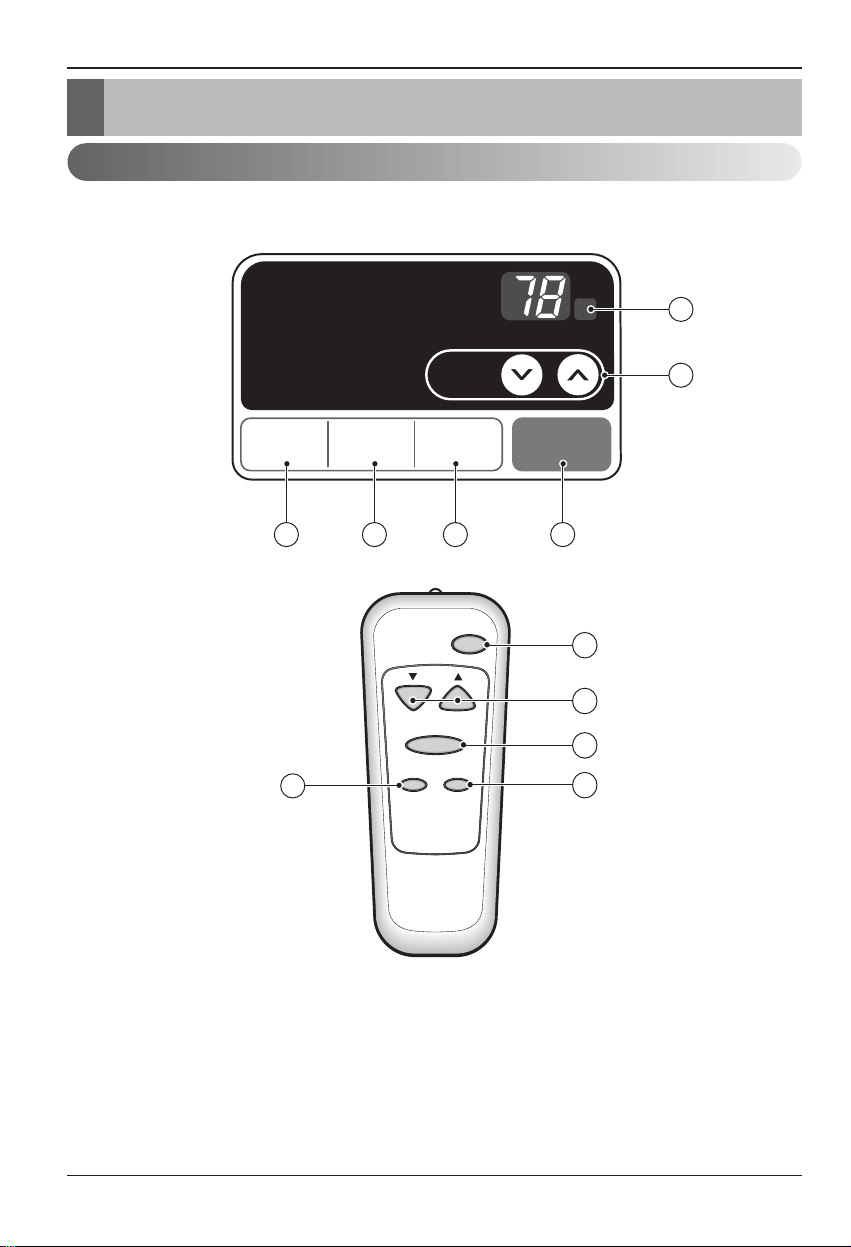
Installing the Power cord
You can choose between two methods below according to your window stool shape and preference.
• Fasten the stopper using 2 screw holes, and lead
out the power cord through slit "A".
• Fasten the stopper using left screw hole, and rotate
properly to lead the power cord out through slit "B".
Using slit "A" Using slit "B"
B
A
Power Cord
Power Cord
16 Room Air Conditioner
Operating Instructions
Operating Instructions
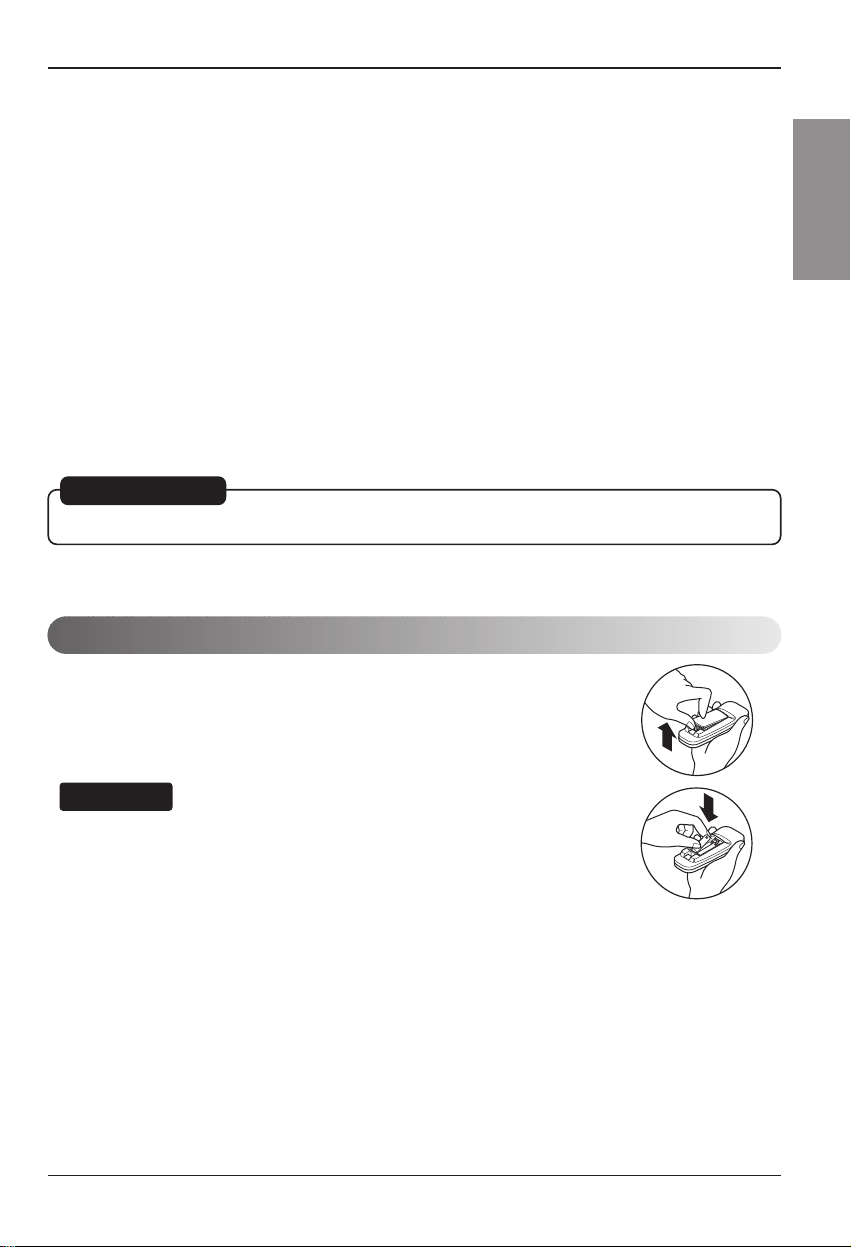
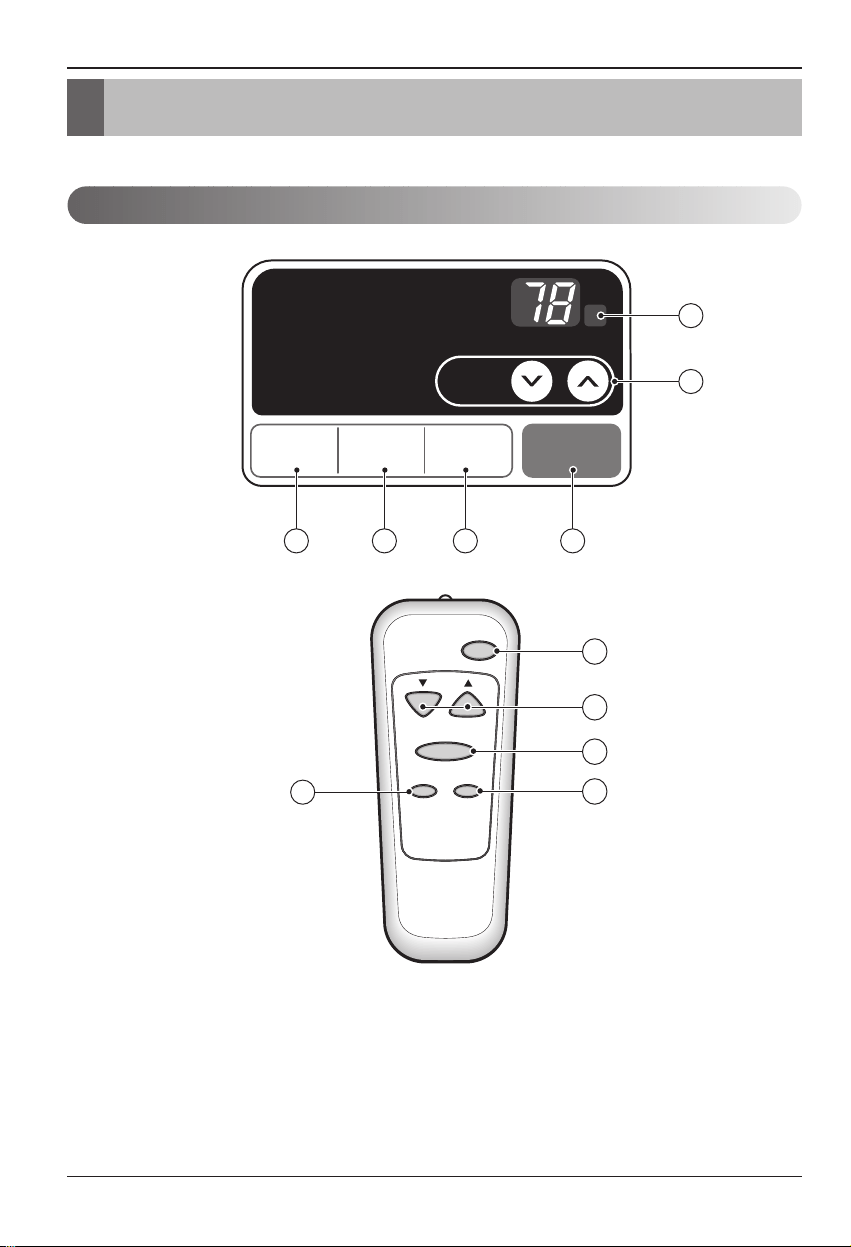
Remote Control Operations
Power
Te mp
Fan Speed
Timer Mode
1
2
3
4
5
'
F
TIMER POWERMODE
TEMP
FAN
SPEED
F1 LOW
F2 MED
F3 HIGH
Dry Timer
Fan
Energy
Saver
Cool
1
2
6
3 45
The remote control and control panel will look like those represented in the following pictures.
Owner’s Manual 17
ENGLISH
Operating Instructions
1. POWER
Operation starts when this button is pressed and stops when you press the button again.
2. TEMPERATURE CONTROL
The thermostat monitors room temperature to maintain the desired temperature.
The thermostat can be set between 60°F~86°F (16°C~30°C).
The unit takes an average of 30 minutes to adjust the room temperature by 1°F.
3. OPERATION MODE SELECTOR
Select cooling mode to cool the room.
Select energy saver mode for energy saving operation.
Select fan mode for basic ventilating fan operation.
Select dry mode for dry operation.
4. FAN SPEED SELECTOR
For increased power while cooling, select a higher fan speed.
3 steps: High ➔ Low ➔ Med
5. ON/OFF TIMER
The timer can be set to start and stop the unit in hourly increments (up to 12 hours).
6. REMOTE CONTROL SENSOR
AUTO RESTART
In failure of electric power, the unit runs as previous setting operation.
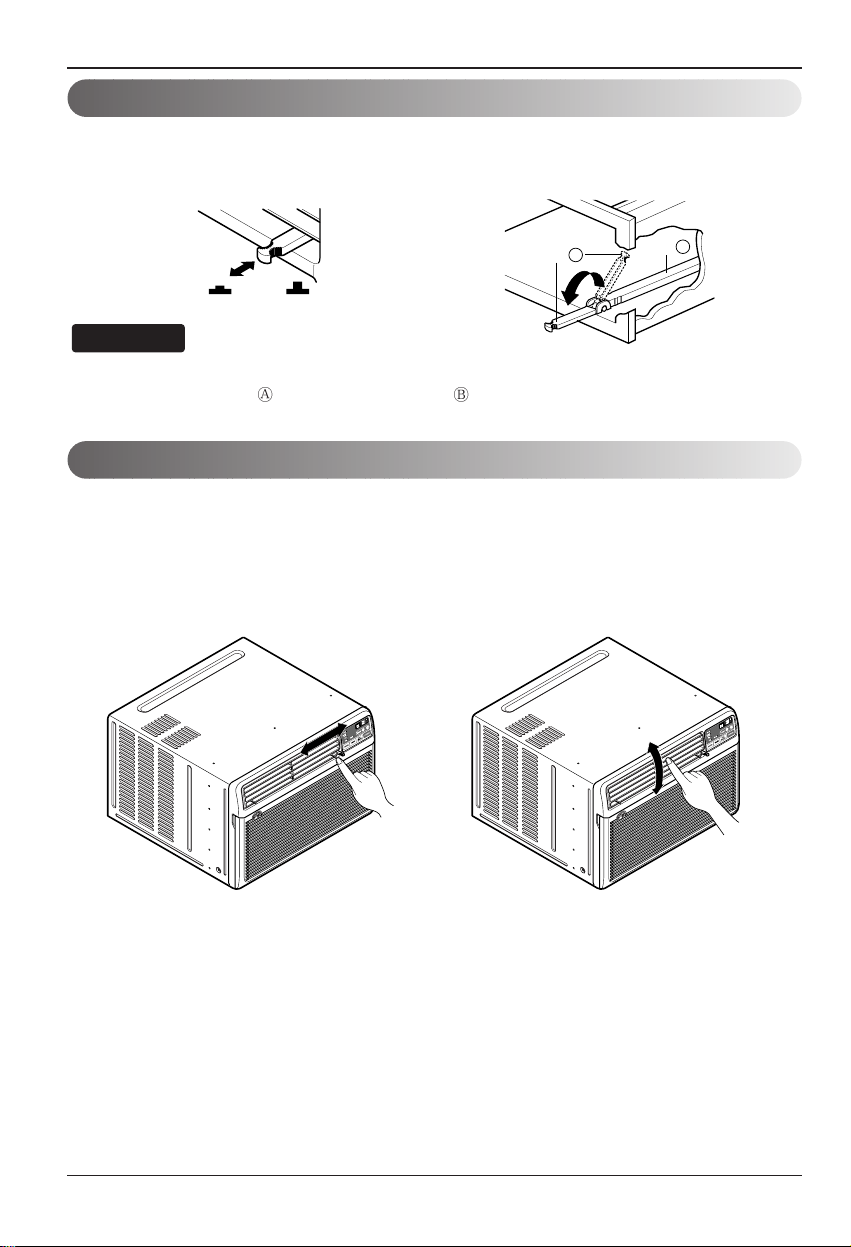
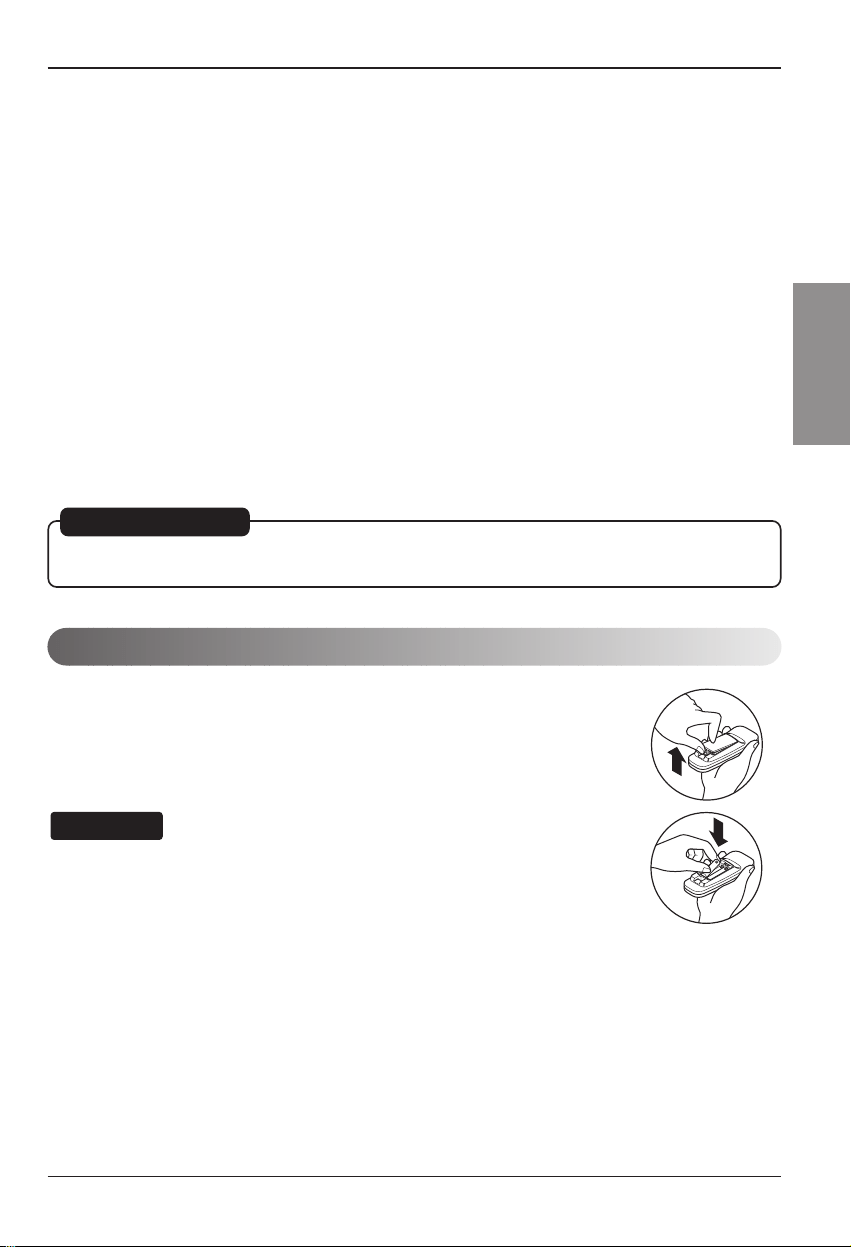
1. Push out the cover on the back of the remote control with your thumb
2. Pay attention to polarity and insert two new AAA 1.5V batteries.
3. Reattach the cover.
Do not use rechargeable batteries. Make sure that both batteries are new.
Do not mix alkaline, standard(Carbon-zinc) or rechargeable(Nickel-cadmium)
batteries.
• In order to prevent discharge, remove the batteries from the remote control if the
air conditioner is not going to be used for an extended period of time
Keep the remote control away from extremely hot or humid places.
To maintain optimal operation of the remote control, the remote sensor should
not be exposed to direct sunlight.
• The remote control can be mounted on a wall using the mountable holder.
NOTICE
Inserting the Remote Control Batteries
18 Room Air Conditioner
Operating Instructions
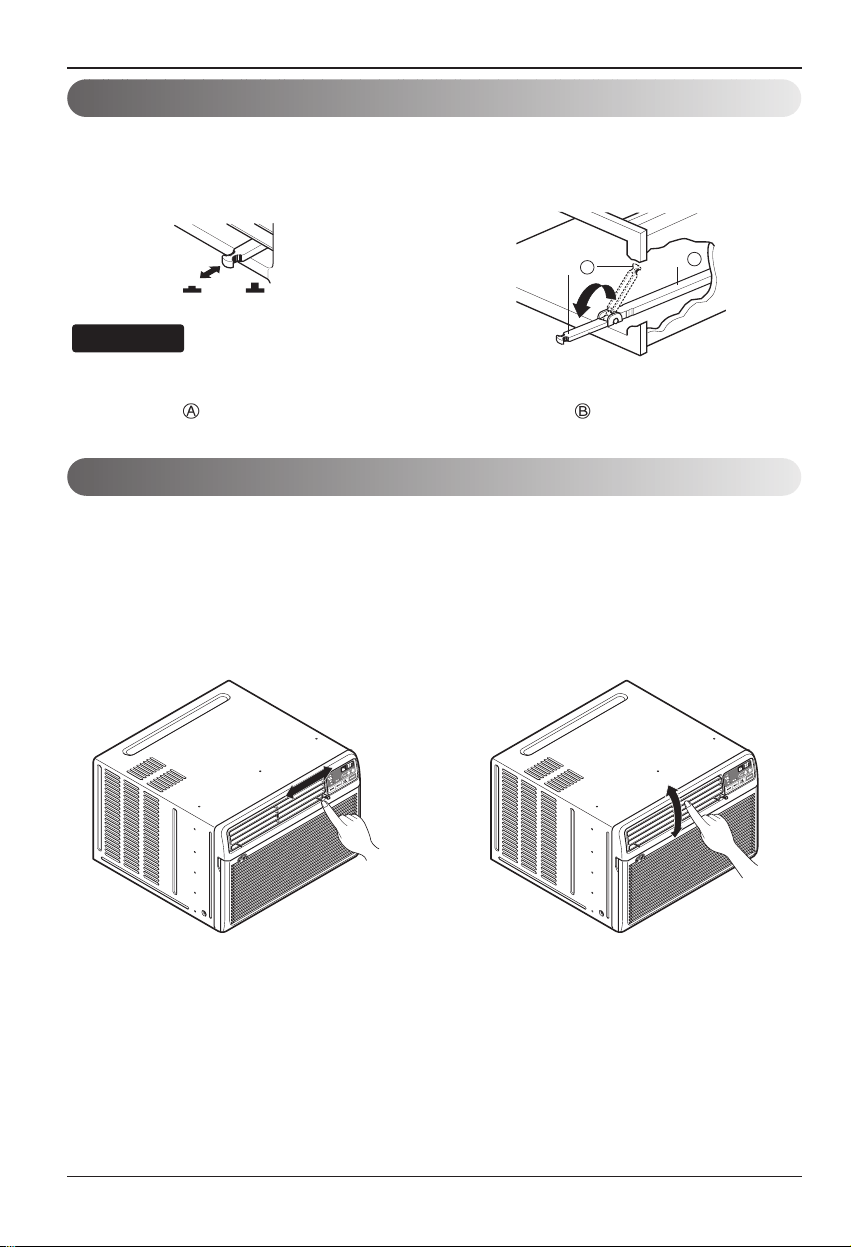
Ventilation
The ventilation lever must be in the CLOSE position in order to maintain the best cooling conditions.
When fresh air is necessary in the room, set the ventilation lever to the OPEN position.
The damper is opened and room air is drawn out.
VENTCLOSE OPEN
Part A
Part B
Before using the ventilation feature, position the lever, as
shown. First, pull down part to horizontal line with part .
NOTICE
Air Direction
Recommended orientation of louvers
Adjust louvers to face upwards when cooling to maximize cooling efficiency.
Airflow can be adjusted by changing the direction of the air conditioner's louvers. This can also increase the
cooling efficiency of the air conditioner.
Adjusting horizontal air flow Adjusting vertical air flow
Adjusting Horizontal Air Flow
Direction
Adjusting the vertical louvers left and right will
change horizontal airflow.
Adjusting Vertical Air Flow Direction
Adjusting the horizontal vane up and down will
change vertical airflow. The vane can be adjusted by
nudging the vane backward or forward.
Owner’s Manual 19
ENGLISH
Operating Instructions
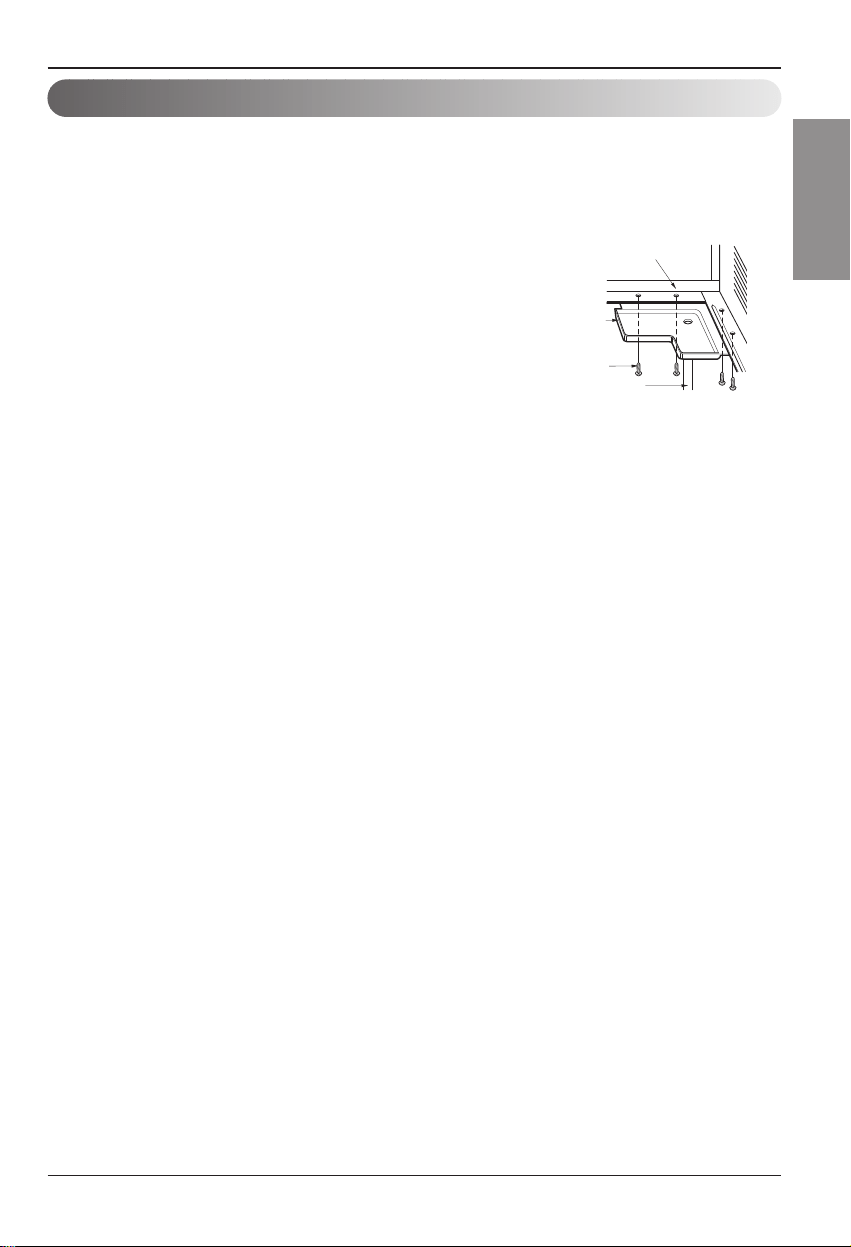
How to Attach Drain Pan(Optional)
The air conditioner employs a proper drain method whereby the condensed water (moisture removed from the
air) is drained to the outside.
In very humid weather, (and for reverse cycle models in the reverse mode) excessive condensate water
removed from the air may cause some water to collect. To remove this excess water you can install the drain
pan as detailed below.
1. Take the drain pan which is located in the air discharge.
2. Remove the hole rubber from the base-pan (for some models).
3. Install the drain pan to the right corner of the cabinet with 4 (or 2)
screws.
4. Connect the drain hose of 3/5" inside diameter to the outlet located
at the bottom of the drain pan.You can purchase the drain hose or
tubing locally to satisfy your particular needs. (Drain hose is not
supplied).
CABINET
DRAIN
PAN
DRAIN HOSE
SCREW
20 Room Air Conditioner
Maintenance and Service
Maintenance and Service
Turn the power off and unplug the power plug before cleaning the air conditioner.
Air Filter
Drainage
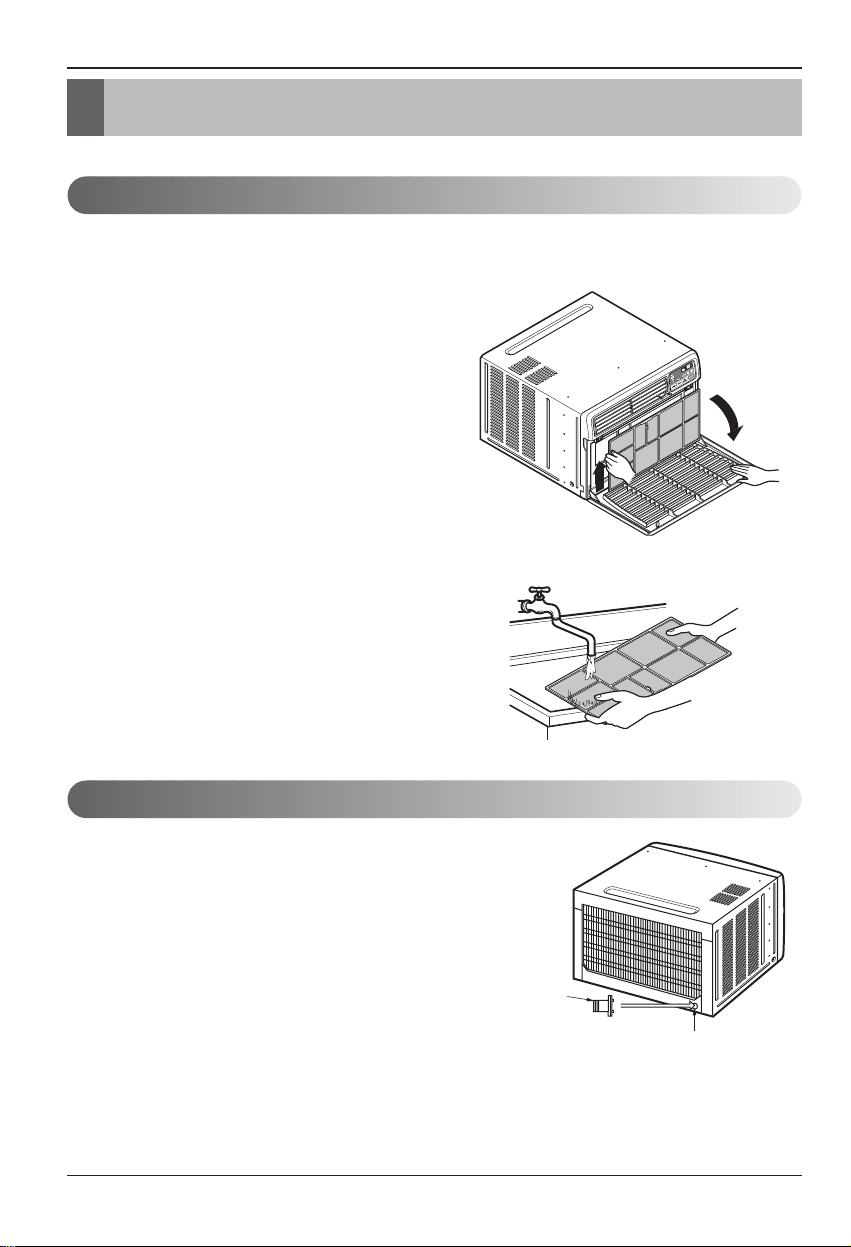
The air filter behind the inlet grille should be checked and cleaned at least once every 2 weeks (or as
necessary) to maintain optimal performance of the air conditioner.
How to remove the air filter
1. The grille may be opened from the top for easy
maintenance after installation.
2. Open the inlet grille by pulling off the exposed door
on the top of the unit (based on installation).
3. Pull the tab slightly to release the filter. Pull the
filter in the same direction as the opening.
4. Clean the filter with warm, soapy water. The water
should be below 40°C (104°F).
5. Rinse off and gently shake off excess water from
the filter. Let it dry before replaceing it.
Drain pipe
Drain cap
The base pan may overflow due to high humidity. To drain the
excess water, remove the drain cap from the back of the unit
and secure the drainpipe.
When pressing the drainpipe into place, apply force in the
direction away from the fins to avoid injuring yourself.
Owner’s Manual 21
ENGLISH
Maintenance and Service
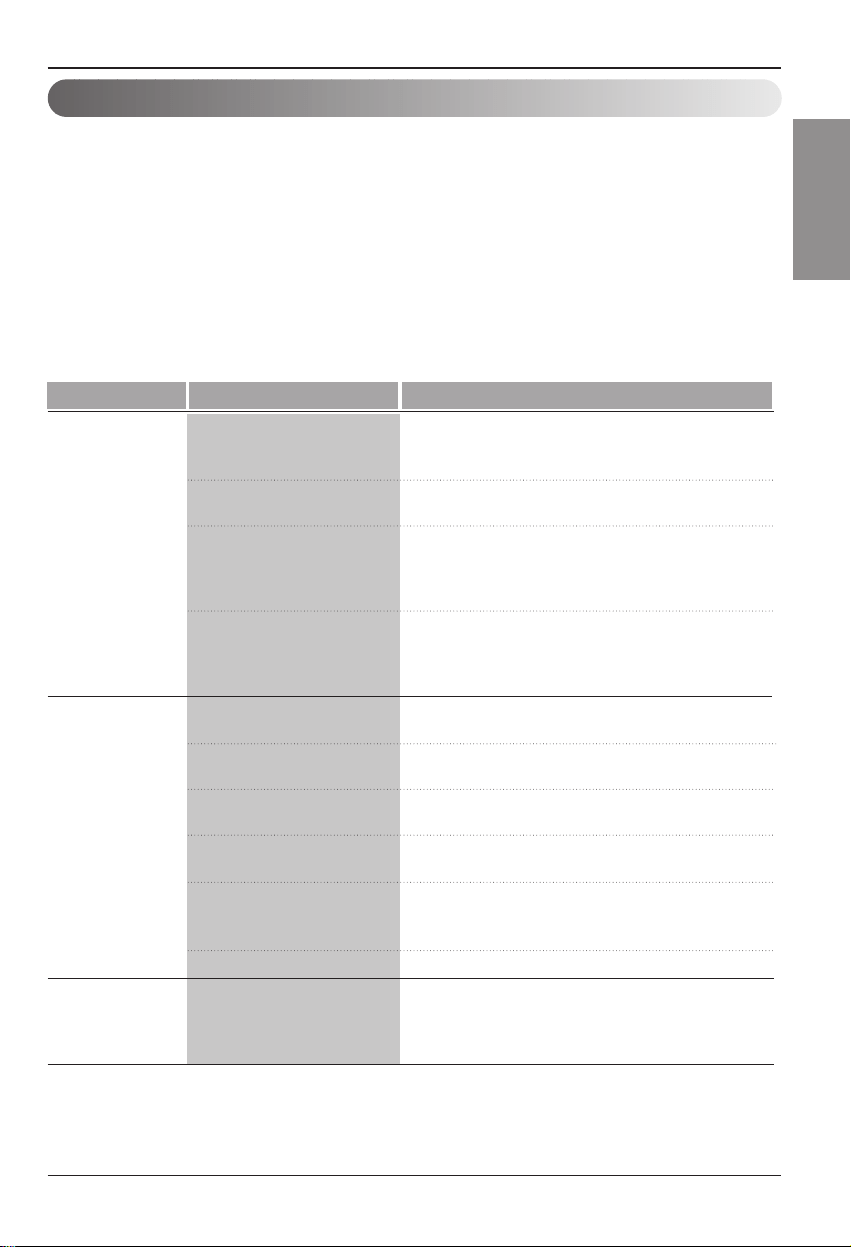
Common Problems and Solutions
Before calling for service, please review the following list of common problems and solutions.
The air conditioner is operating normally when:
• You hear a pinging noise. This is caused by water being picked up by the condenser on rainy days or in
highly humid conditions. This feature is designed to help remove moisture in the air and improve cooling
efficiency.
• You hear the thermostat click. This is caused by the compressor cycle starting and stopping.
• You see water dripping from the rear of the unit. Water may be collected in the base pan in highly humid
conditions or on rainy days. This water overflows and drips from the rear of the unit.
• You hear the fan running while the compressor is silent. This is a normal operational feature.
The air conditioner may be operating abnormally when:
Problem Possible Causes What To Do
■ The air conditioner is
unplugged or not plugged
in completely
■ The fuse is blown/circuit
breaker is triggered
■ Power failure.
■ The current interrupter
device is tripped.
■ Air flow is restricted
■ The THERMOSTAT may
not be set cool enough
■ The air filter is dirty.
■ The air conditioner was
just turned on.
■ Cold air is escaping.
■ Cooling coils are iced up
■ The cooling coils are iced
over.
• Make sure the plug is completely plugged into the
outlet
• Check the fuse/circuit breaker box and replace the
fuse or reset the breaker
• In the event of a power failure, set the power control
to OFF. When the power is restored, wait 3 minutes
to restart the air conditioner to prevent the
compressor from overloading
• Press the RESET button located on the power cord
plug. If the RESET button will not stay engaged,
discontinue use of the air conditioner and contact a
qualified service technician.
• Make sure there are no curtains, blinds, furniture or
other obstacles in front of the air conditioner
• Turn the knob to a higher setting. The highest setting
provides maximum cooling
• Clean the filter at least every 2 weeks. Refer to the
“Maintenance and Service” section of the manual.
• After the air conditioner is turned on, you need to
give the air conditioner some time to cool the room.
• Check for open furnace floor resisters and cold air
returns.
• CLOSE the air conditioner vent
• See Ice appears on the air conditioner below
• Ice may block the air flow and obstruct the air
conditioner from properly cooling the room. Set the
fan at MED or HIGH while setting the thermostat at 1
or 2 until the ice melts.
The air conditioner
does not operate
at all
Air conditioner
does not cool
Ice appears on the
air conditioner.
22 Room Air Conditioner
Memo

LG
Acondicionador de aire tipo ventana
MANUAL DEL USUARIO
IMPORTANTE
Tenga a bien leer cuidadosamente este manual. Contiene
información valiosa acerca del acondicionador de aire.
Este manual puede ayudarlo a ahorrar tiempo y dinero;
describe el mantenimiento adecuado del acondicionador
y cómo evitar su uso incorrecto.
PRECAUCIONES
Preste atención a las precauciones a fin de prevenir
riesgos potenciales y daño causado por mal uso o
instalación inadecuada. LG no se responsabiliza por
ningún daño causado por el mal uso del acondicionador.
ESPAÑOL
2 Aire Acondicionador
Manual del usuario del acondicionador de aire tipo Ventana
TABLA DE CONTENIDOS
PARA SUS ARCHIVOS
Escriba aquí el modelo y número de serie:
Modelo n°:
Serie n°:
Puede encontrar estos datos en la etiqueta situada en el
lateral de cada unidad.
Nombre del distribuidor:
Fecha de compra:
■ Adjunte su recibo a esta página con la grapadora para
el momento que lo necesite para probar la fecha de su
adquisición o para la validación de la garantía.
LEA ESTE MANUAL
En su interior encontrará muchos consejos útiles sobre la
utilización y mantenimiento de su acondicionador de aire.
Unos pocos cuidados por su parte le pueden ahorrar
mucho tiempo y dinero durante la vida de su
acondicionador de aire.
En la tabla de consejos para la solución rápida de
problemas encontrará muchas respuestas a los problemas
más habituales. Si revisa primero nuestra Tabla de
Consejos para la solución rápida de problemas, tal vez no
necesite llamar nunca al servicio técnico.
PRECAUCIÓN
• Póngase en contacto con un técnico del servicio
autorizado para realizar la reparación y
mantenimiento de esta unidad.
• Póngase en contacto con un instalador para realizar
la instalación de esta unidad.
• Cuando se va a cambiar el cable eléctrico, el trabajo
de reemplazamiento debe ser realizado únicamente
por personal autorizado, utilizando las piezas de
cambio genuinas únicamente.
• El trabajo de reemplazamiento debe ser realizado de
acuerdo con el Código Eléctrico Nacional
únicamente por personal autorizado.
Precauciones de Seguridad...........3
Antes de poner el equipo en
funcionamiento................................7
Introducción.....................................8
Seguraida Electrica.........................9
Instalacion......................................11
Instruccionnes de
Funcionamiento.............................16
Cuidado y Mantenimiento ............20
Manual del Propietario 3
ESPAÑOL
Precauciones de Seguridad
Precauciones de Seguridad
Para evitar lesiones al usuario o a otras personas y daños a la propiedad, estas instrucciones
estén seguirse.
■
Una operación incorrecta por ignorar las instrucciones provocará lesiones o daños. La seriedad se clasifica
por las siguientes indicaciones.
■ Significados de los símbolos utilizados en este manual.
ADVERTENCIA
PRECAUCION
Este símbolo indica la posibilidad de muerte o de seria lesión.
Este símbolo indica sólo la posibilidad de lesiones o daños a la propiedad
ADVERTENCIA
■ Instalación
No hacer.
Siga estas instrucciones.
No utilice un cable de
alimentación, enchufe o una
toma suelta que esté dañada.
• De lo contrario, podría provocar
un incendio o descarga
eléctrica.
Enchufe siempre a un
tomacorriente que tenga
toma a tierra.
• De lo contrario, podría provocar
un incendio o descarga
eléctrica.
No modifique ni alargue el
cable de alimentación.
• De lo contrario, puede provocar
una descarga eléctrica o
incendio debido a la
generación de calor.
No desmonte ni modifique
los productos.
• Puede ocasionar fallos y una
descarga eléctrica.
Tenga cuidado al
desembalar e instalar el
aparato.
• Los bordes afilados pueden
provocar lesiones.
No use el cable de alimentación
cerca gas inflamable o
materiales combustibles tales
como la gasolina, benceno,
disolvente, etc.
• Podría ocurrir una explosión o
incendio.
Gasolin
4 Aire Acondicionador
Precauciones de Seguridad
■ Operación
No ponga el cable de
alimentación cerca de un
calentador.
• Puede ocasionar un incendio y
una descarga eléctrica.
No permita que entre agua
en las piezas eléctricas.
• Puede provocar fallos en el
producto o descargas
eléctricas.
Utilice un paño suave para
limpiar. No utilice cera,
disolventes o detergentes
fuertes.
•
La apariencia del aparato de aire
acondicionado puede deteriorar,
cambiar el color o desarrollar flujos
en las
superficies.
Wax
Thinner
Ventile bien la sala al usar
este aparato con una estufa,
etc.
• Puede ocurrir un falta de
oxígeno.
Apague el aparato y el
interruptor diferencial
primero antes de limpiar la
unidad.
•
Debido a que el ventilador gira a
alta velocidad durante el
funcionamiento, podría ocasionar
lesiones.
Apague el interruptor de
alimentación principal cuando
no vaya a utilizar el aparato
durante mucho tiempo.
• Evitará el arranque accidental y
la posibilidad de lesiones.
Desenchufe la unidad si oye
un sonido extraño, olores, o
si observa salir humo.
• De lo contrario, puede ocurrir
un incendio y un accidente por
descarga eléctrica.
No abra la parrilla de
entrada al aparato mientras
está en funcionamiento.
• De lo contrario, pueden ocurrir
descargas eléctricas y fallos.
Si entra agua en el producto,
apague el interruptor de la
carcasa principal del aparato.
Póngase en contacto con el
centro de servicio después de
haber sacado el enchufe del
tomacorriente.
No use el cable de alimentación
cerca gas inflamable o materiales
combustibles tales como la
gasolina, benceno, disolvente, etc.
• Puede ocasionar una explosión
o descarga eléctrica.
No comparta el
tomacorriente con otros
electrodomésticos.
•
De lo contrario, puede provocar una
descarga eléctrica o incendio debido
a la generación de calor.
Saque el enchufe en caso de
necesidad, sosteniendo la
cabeza del enchufe y no lo
toque con las manos mojadas.
•
De lo contrario, podría provocar un
incendio o descarga eléctrica.
Manual del Propietario 5
ESPAÑOL
Precauciones de Seguridad
ADVERTENCIA
■ Instalación
No opere ni detenga la
unidad insertando o
estirando de enchufe.
• De lo contrario, puede provocar
una descarga eléctrica o
incendio debido a la
generación de calor.
No dañe ni use un enchufe
de alimentación no
especificado.
• Provocará descargas eléctricas
o incendios.
No toque el producto con
las manos mojadas o en un
ambiente húmedo.
• Provocará descargas
eléctricas.
Sostenga el enchufe por su
cabeza al sacarlo.
• Podría ocasionar una descarga
eléctrica y daños.
Cuando haya un escape de
gas, abra la ventana para
ventilar antes de poner en
marcha la unidad.
• De lo contrario, podría ocurrir
una explosión o incendio.
No toque las partes
metálicas del aparato al
sacar el filtro del aire.
• Son puntiagudas y pueden
provocar lesiones.
Instale el producto de modo que el ruido o
el aire caliente producido por la unidad
externa no moleste a los vecinos.
• De lo contrario puede dar lugar a disputas
vecinales.
Mantenga nivelado el producto al instalarlo.
• De lo contrario se podría causar vibraciones o
escapes de agua.
6 Aire Acondicionador
Precauciones de Seguridad
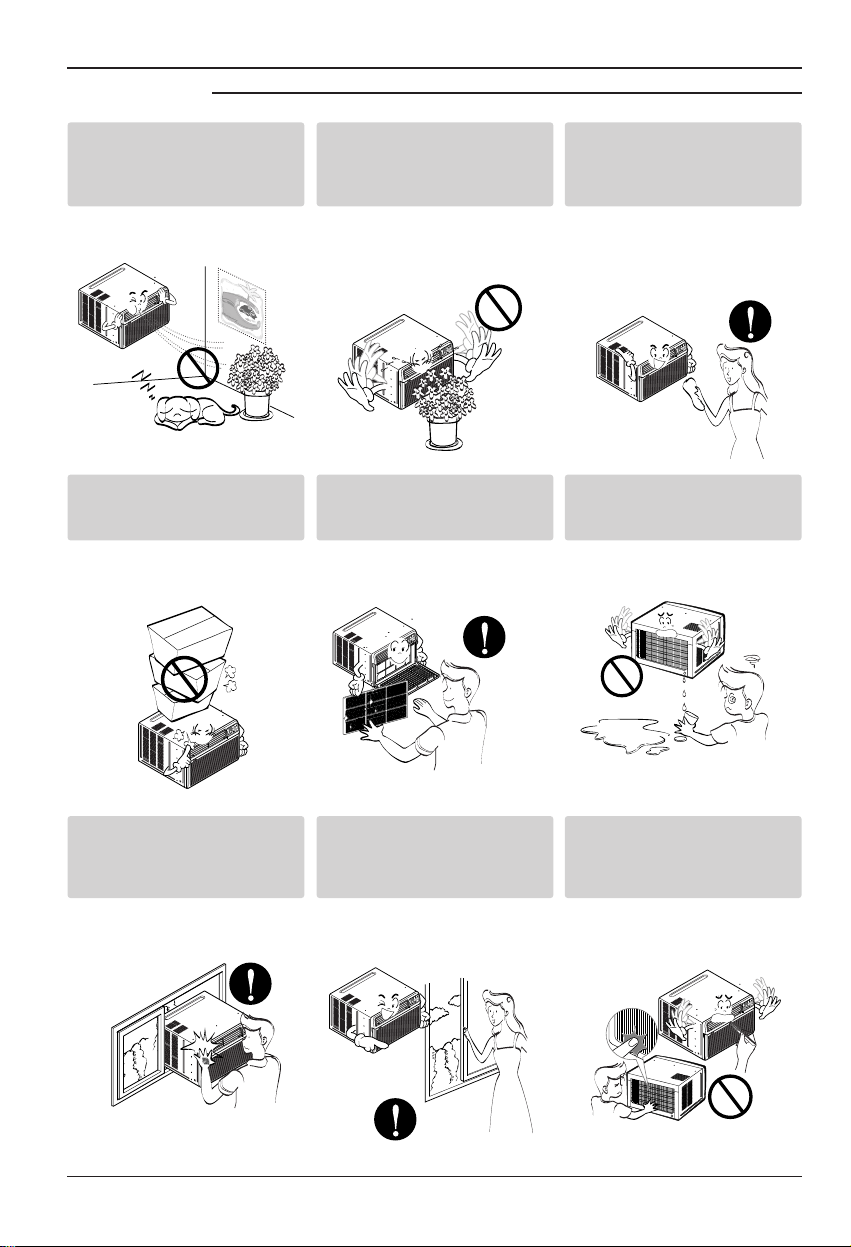
No se suba a la unidad
interior/exterior ni coloque
objetos sobre la misma.
• Puede lesionarse al caerse del
aparato o al caerse los objetos
que haya colocado.
Inserte siempre el filtro
correctamente.
Límpielo cada dos semanas.
• El funcionamiento sin filtros
puede provocar fallos.
No beba el agua que drena
el aparato de aire
acondicionado.
No ponga plantas ni
animales en la trayectoria
que recorrerá el aire
caliente.
• Podría ocasionar lesiones.
No bloquee la entrada ni la
salida del flujo de aire.
• Puede causar una avería en el
aparato.
Utilice un paño suave para
limpiar. No utilice cera,
disolventes o detergentes
fuertes.
•
La apariencia del aparato de aire
acondicionado puede deteriorar,
cambiar el color o desarrollar flujos
en las superficies.
Tenga cuidado para no
tocar los bordes
puntiagudos al instalar.
• Podría ocasionar lesiones.
Evite un enfriamiento
excesivo y ventile en
ocasiones.
• De lo contrario, podría dañar su
salud.
No introduzca la mano ni
barras en la entrada o salida
del aire durante el
funcionamiento del aparato.
• De lo contrario, podrían ocurrir
lesiones personales.
■ Operación

Antes de poner el equipo en funcionamiento
Manual del Propietario 7
ESPAÑOL
Antes de poner el equipo en funcionamiento
1. Póngase en contacto con un especialista para realizar la instalación.
2. Enchufe correctamente la toma de alimentación.
3. Utilice un circuito dedicado.
4. No utilice un cable alargador.
5. No inicie/cese el funcionamiento enchufando/desenchufando el cable
eléctrico.
6. Si el cable/enchufe está dañado, sustitúyalo solo por una pieza autorizada.
1. Estando expuesto a la circulación directa de aire durante un extenso período
de tiempo podría resultar peligroso para su salud. No exponga a las personas,
animales domésticos, o a las plantas a la circulación de aire durante largos
períodos de tiempo.
2. Debido a la probabilidad de falta de oxígeno, ventile el cuarto cuando esté
utilizado el aparato junto con estufas u otros aparatos de calefacción.
3. No utilice este aire acondicionado con propósitos especiales no especificados
(Ej.: conservación de dispositivos de precisión, comida, animales domésticos,
plantas y objetos de arte). Tal uso podría dañar los artículos.
1. No toque las piezas metálicas de la unidad al retirar el filtro. Manejar aristas
afiladas de metal puede causar lesiones.
2. No utilice el agua para limpiar el interior del aire acondicionado. La exposición
al agua puede destruir el aislamiento, conduciendo a posibles descargas
eléctricas.
3. Al limpiar la unidad, asegúrese antes de que la electricidad y el interruptor
están apagados. El ventilador rota a muy alta velocidad durante el
funcionamiento del equipo. Existe la posibilidad de lesiones si acciona
accidentalmente la electricidad de la unidad mientras limpia el interior de la
unidad.
Para cuestiones de reparación y mantenimiento, póngase en contacto con su
distribuidor de servicio autorizado.
Preparación para el funcionamiento
Uso
Limpieza y mantenimiento
Servicio
8 Aire Acondicionador
Introducción
Este símbolo lo advierte de un peligro de accidente por
corriente eléctrica.
Este símbolo lo adiverte de un peligro que pueda causar un
daño del ventliador.
Este símbolo significa condicciones especiales.
CONSEJO
Introducción
Símbolos Utilizados en Este Manual
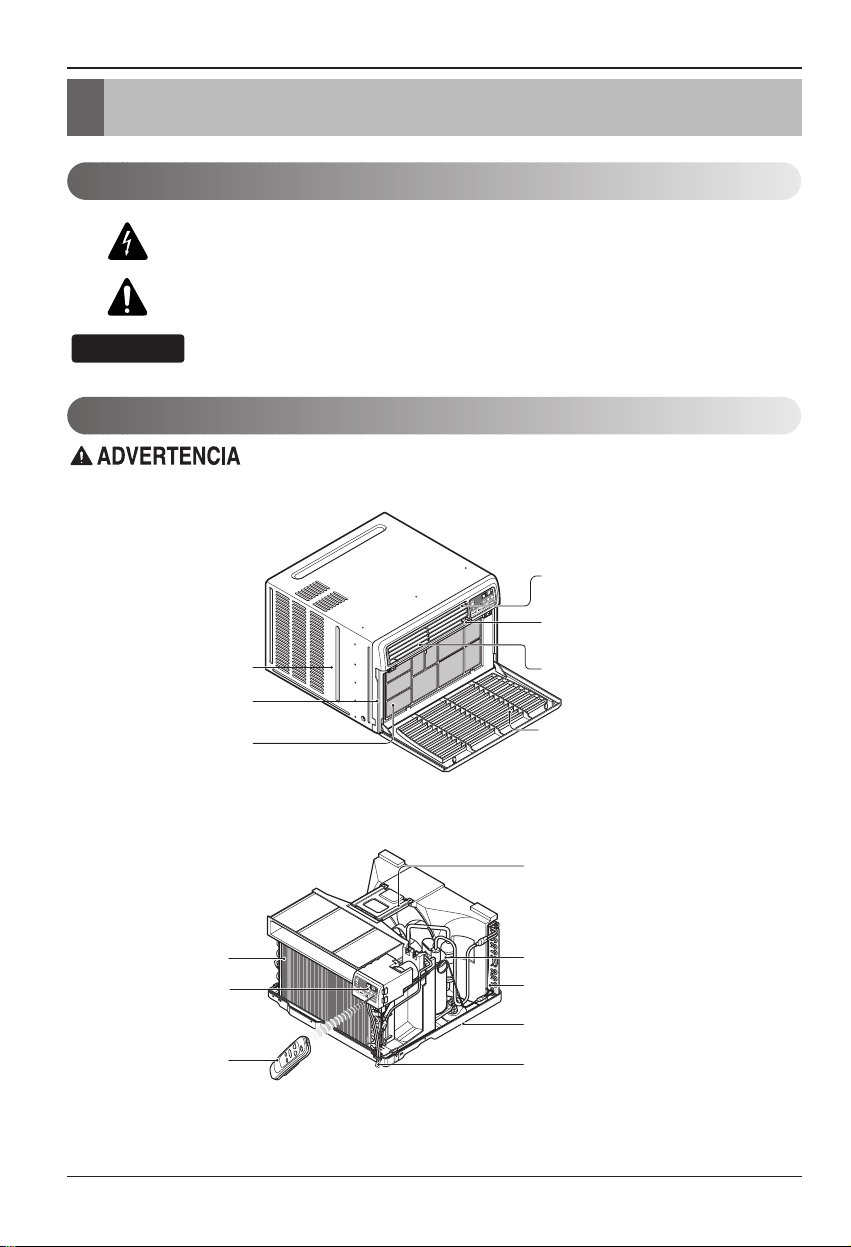
Características
Este aparato debería instalarse de acuerdo con las normas del Código Eléctrico Nacional.
TOMA DE AIRE
(PARRILLA DE ENTRADA)
GABINETE
PARRILLA FRONTAL
FILTRO DE AIRE
DEFLECTOR VERTICAL DE AIRE
(ÁLABE HORIZONTAL )
DESCARGA DE AIRE
DEFLECTOR HORIZONTAL DE AIRE
(ALABE VERTICAL)
ABRAZADERA
COMPRESOR
CONDENSADOR
BANDEJA DE BASE
EVAPORADOR
PANEL DE CONTROL
CABLE ELÉCTRICA
CONTROL REMOTO
Seguraida Electrica
Manual del Propietario 9
ESPAÑOL
Seguraida Electrica
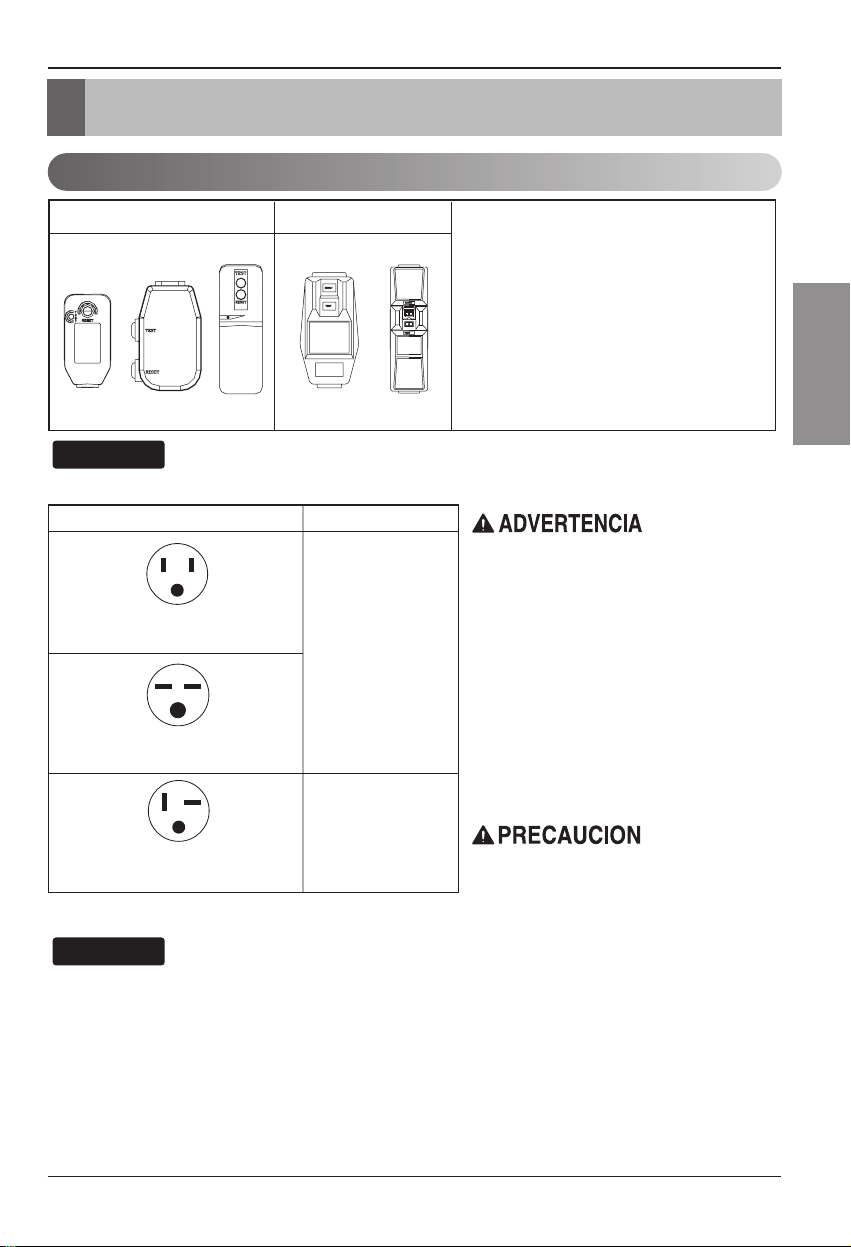
Datos Electricos
115V~ 230V~
El cable de alimentación puede incluir un
dispositivo interruptor de corriente. La
carcasa del enchufe cuenta con un botón de
prueba y otro de reinicio. El dispositivo debe
comprobarse periódicamente presionando
primero el botón TEST y después RESET.
Si el botón TEST no se desconecta o si el
botón RESET no permanece activo,
suspenda el uso del aire acondicionado y
póngase en contacto con un técnico de
servicio cualificado.
Utilice el enchufe de la pared Consumo de Energía
Standard 125V, enchufe de 3
Líneas de 15A, 125V AC
Standard 250V, enchufe de 3
Líneas de 15A, 250V AC
Standard 250V, enchufe de 3
Líneas de 20A, 250V AC
Utilice un fusible de
15AMP. o un
Interruptor de 15AMP.
Utilice un fusible de
20AMP. o un
Interruptor de 20AMP.
No presione nunca el botón de prueba durante el
funcionamiento, de lo contrario el enchufe podría
resultar dañado.
Este dispositivo contiene productos químicos,
incluyendo plomo, conocido en el estado de
California como producto cancerígeno y causante de
defectos de nacimiento y otros daños al sistema
reproductor.
Lávese bien las manos tras manipular el dispositivo.
No desmonte, modifique ni sumerja en agua este
enchufe.
Si el dispositivo se activara, deberá corregir la causa
antes de volver a utilizarlo.
Los hilos conductores dentro del cable están rodeados
por blindajes, que supervisan la corriente de fuga.
Estos blindajes no están puestos a tierra.
<Fabricado en Tower>
Examine periódicamente el cable en busca de
cualquier daño. No utilice este producto si los blindajes
resultaran expuestos.
Evite el riesgo de descargas eléctricas; esta unidad no
puede ser reparada por el usuario por ser resistente y
a prueba de alteraciones. Manipular la porción sellada
de la unidad anulará todas las garantías y quejas de
rendimiento. Esta unidad no está diseñada para su uso
como un interruptor de encendido-apagado.
La forma puede ser diferente según su modelo.
CONSEJO
NO USE CABLE DE EXTENSIÓN EN UNIDADES
DE 208, 230, AND 208/230 VOLTIOS.
Todo el cableado deberá realizarse de acuerdo
con los códigos y reglamentos eléctricos
locales.
El cableado doméstico de aluminio podría
ocasionar problemas especiales. Consulte a un
electricista calificado.
CONSEJO
10 Aire Acondicionador
Seguraida Electrica
IMPORTANTE
(FAVORLEA CON ATENCIÓN)
POR LA SEGURIDAD PERSONAL DEL USUARIO, ESTE
APARATO DEBE SER DEBÍDAMENTE NEUTRALIZADO.
El cordón de energía de éste aparato esta equipado
con tres patas(cable a tierra). Utilice éste con un
enchufe de pared de tres salidas(a tierra) para
minimizar el peligro de choque eléctrico. El cliente
debe revisar el receptor de pared y el circuito por un
electricista calificado para asegurarse que la
recepción esta debidamente neutralizada.
NO CORTE O REMUEVA LA TERCERA PATA(GROUND)
DEL ENCHUFE.
A. SITUACIONES EN LAS CUALES EL APARATO
ES DESCONECTADO OCASIONALMENTE:
Debido al peligro potencial, nosotros no
recomendamos el uso de adaptadores. Sin embargo,
si usted desea utilizar un adaptador, una CONEXIÓN
TEMPORAL, puede ser
efectuada. Utilice adaptadores UL, disponibles en la
mayoría de los estable cimientos de
herramientas. La pata mas grande del adaptador
debe ser alineada con la pata mas grande del
interruptor para asegurarse una polarización
adecuada.
Adaptar la terminal del ground del adaptador a
la cubierta de la pared con un
tornillo no neutraliza el aparato a menos que la
cubierta del tornillo sea de metal, u no sea
insolada, y el receptor de pared este
neutralizado a través del alambrado del la casa.
El cliente debe hacer verificar el circuito por un
electricista calificado para asegurarse que el
receptor esta debidamente neutralizado.
Desconecte el cordón de energía del adaptador,
utilizado una mano en cada uno. De lo contrario, la
terminal del adaptador puede romperse. NO UTILICE el
aparato con un enchufe roto.
B. SITUACIONES EN LAS CUALES EL APARATO
ES DESCONECTADO CON
FRECUENCIA.
No utilice un adaptador en estas circunstancias.
Desconectar el cordón de energía con frecuencia lo
llevará al eventual rompimiento de la terminal de
neutralización. La saluda de energía de la pared
debe ser reemplazada por una salida de tres
patas(neutralizada).
USO DE EXTENSIONES
Debido al peligro potencial, no recomendamos la
utilización de extensiones. Sin embargo, si usted
desea utilizar una extensión, utilice una
certificada por CSA/UL de tres alambres,
catalogada 15A, 125V.
Seguraida Electrica
Manual del Propietario 11
ESPAÑOL
Instalacion
Instalacion
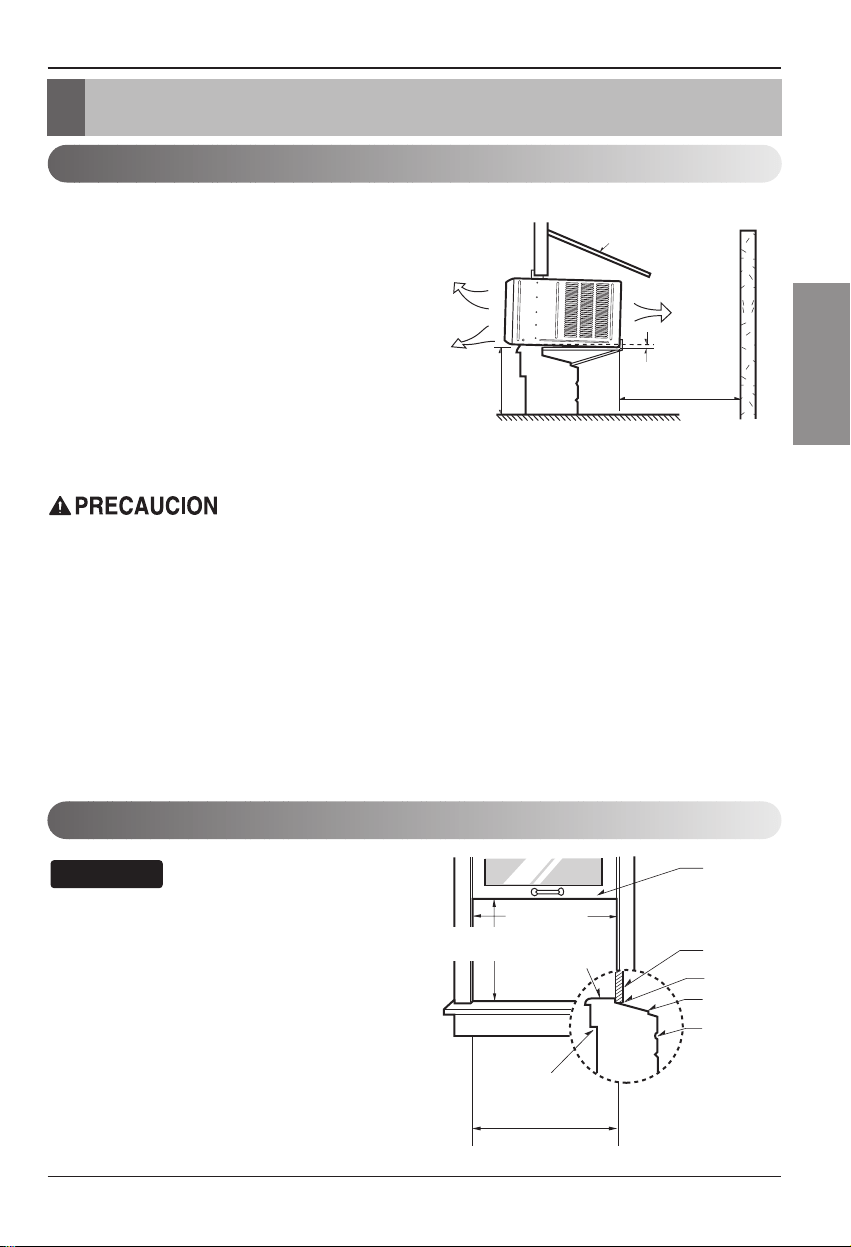
Cómo instalar la unidad
1. Para prevenir la vibración y el ruido, asegúrese
que la unidad esté instalada con seguridad y
firmeza.
2. Instale la unidad donde la luz del sol no caiga
directamente en la misma.
3. La parte exterior del gabinete debe extenderse
hacia afuera por lo menos a 12" sin obstáculos,
como por ejemplo un cerco o una pared, dentro
de los 20" desde la parte posterior del gabinete
porque evitará la radiación de calor del
condensador.
La restricción del aire exterior reduce en gran
parte la eficiencia de enfriar del
acondicionador de aire.
Todos los álabes laterales del gabinete deben
permanecer expuestos a la parte exterior de la
estructura.
4. Instale la unidad un poco inclinada para que la
parte posterior quede ligeramente más baja
que el frente (alrededor de 1/2"). Esto forzará al
agua condensada a fluir hacia el exterior.
5. Instale la unidad con el fondo aproximadamente
30"~60" por encima del nivel del piso.
Requisitos de la ventana
Todas las piezas de soporte deben estar
aseguradas con madera fuerte, mampostería, o
metal.
• Esta unidad está diseñada para ser instalada
en ventanas dobles basculantes estándar con
amplitud de apertura real desde 29" a 41".
• Las hojas inferiores y superiores de la ventana
deben abrirse lo suficiente para permitir una
luz vertical de 19" desde la parte inferior de la
hoja superior hasta el asiento de la ventana.
CONSEJO
Alrededor de
1
/
2
"
30"~60"
Protección
Aire fresco
Cerco
Sobre 20"
Radiación
de calor
29" a 41"
La desviación
saliente
La banda
Dintel
Exterior
Pared Interior
26" min.
(sin el marco de la cortina)
19" min
(Con el marco de la cortina)
asiento
12 Aire Acondicionador
Instalacion
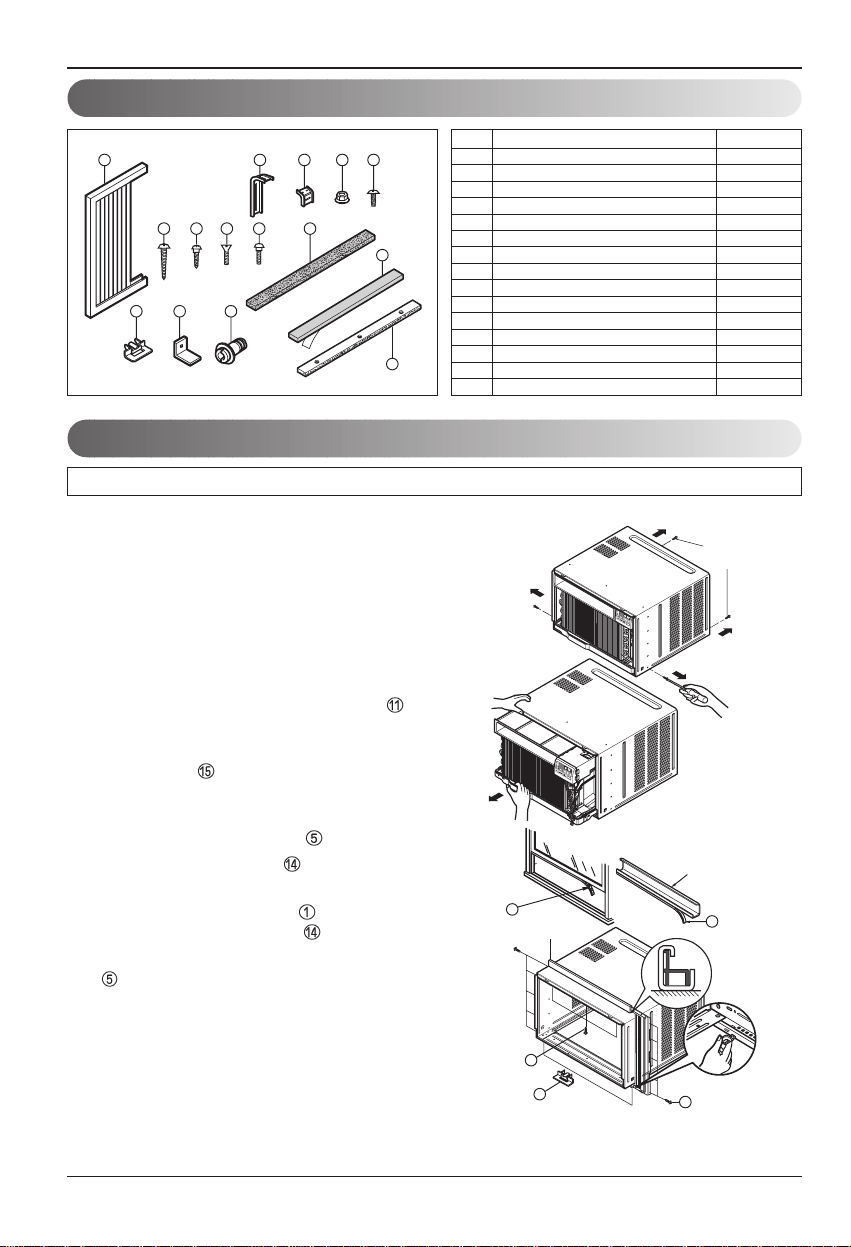
Contenidos de los conjuntos de instalación
Requisitos sugeridos de las ventanas
Nº NOMBRE DE LA PARTE Cantidad
1 MARCO DE LA CORTINA 2
2 MENSULA DE SOPORTE 2
3 MENSULA DEL ALFEIZAR 2
4 TUERCA 4
5 TORNILLO (TIPO A) 14
6 TORNILLO (TIPO B) 7
7 TORNILLO (TIPO C) 5
8 TORNILLO (TIPO D) 2
9 PERNO 2
10 BURLETE DE ESPUMA 1
11 BURLETE de ESPUMA-PE 1
12
ABRAZADERA DE FIJACIÓN A LA VENTANA
1
13 TUBO DE PURGA 1
14 GUÍA DEL MARCO 2
15 BURLETE de ESPUMA-PE 1
1 2 3 4 5
6 7 8 9 10
11
14 12 13
15
DESTORNILLADOR (Philips y Flatead), REGLA, CUCHILLO, MARTILLO, LÁPIZ, NIVEL.
PREPARACIÓN DEL CHASIS
1. Quite los tornillos que unen el gabinete a
ambos lados y a la parte posterior.
2. Deslice la unidad desde el gabinete asiendo la
manija de la base de la bandeja base mientras
con la otra mano sostiene el gabinete.
3. Corte el sello de la hoja de la ventana en la
medida adecuada. Quite el recubrimiento del
soporte y pegue el burlete de Espuma-PE a
la cara inferior de la hoja de la ventana.
4. Quite el soporte de la guía superior del burlete
de Espuma PE y péguela a la parte inferior
de la guía superior.
5. Fije la guía superior a la parte superior del
gabinete con 3 tornillos tipo A .
6. Inserte las guías del marco
en la parte
inferior del gabinete.
7. Inserte el marco de la cortina en la guía
superior y las guías del marco .
8. Fije las cortinas a la unidad con 4 tornillos tipo
A
.
11
15
(TIPO A)
5
(TIPO A)
Guía auperior
Guía auperior
5
14
Tornillos
de fijación
Manual del Propietario 13
ESPAÑOL
Instalacion
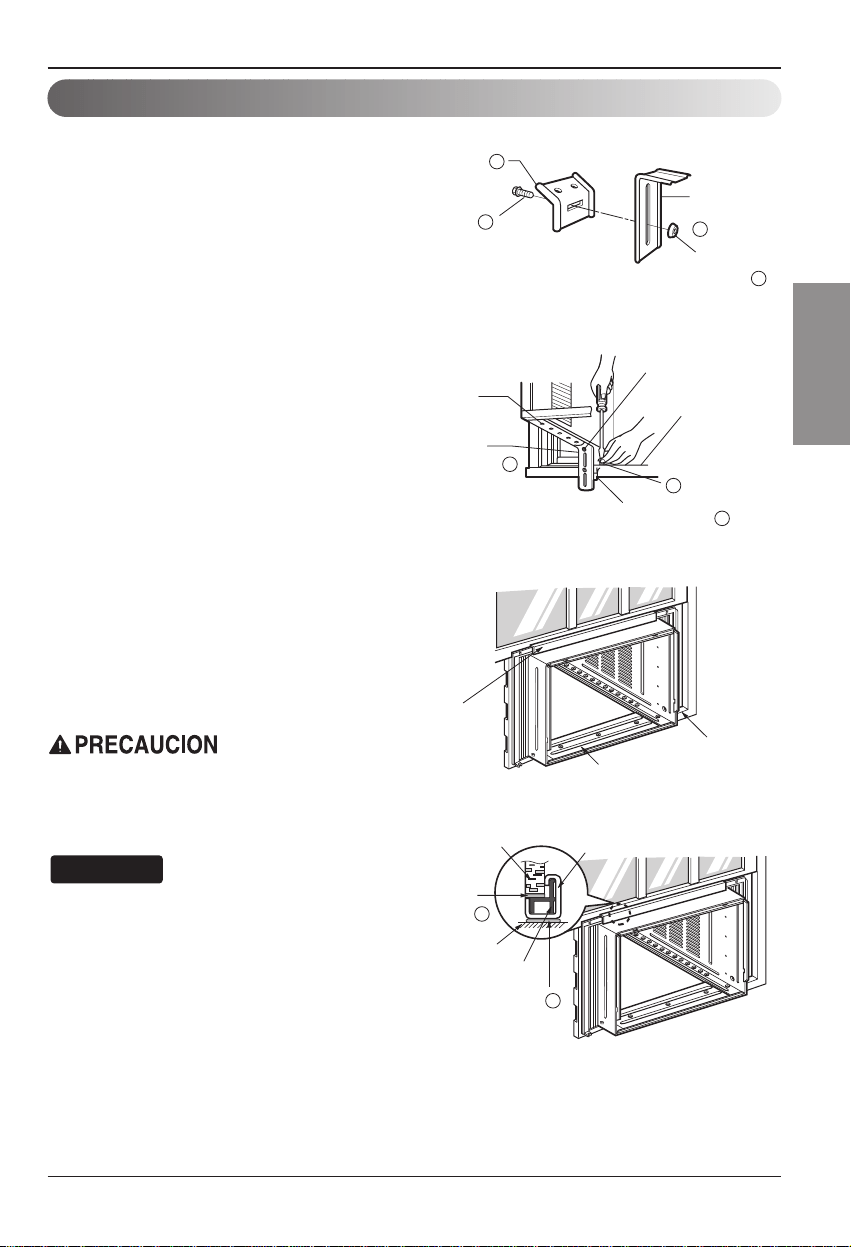
Instalación del gabinete
1. Abra la ventana. Marque una línea en el centro
de la repisa de la ventana entre las molduras
de tope de la ventana lateral.
Coloque sin apretar la ménsula del alféizar en
la ménsula de soporte utilizando el pemo y la
tuerca de segutidad.
2. Coloque la ménsula del alféizar en el alféizar
de la ventana utilizando los tornillos (Tipo B).
Apriete el perno y la tuerca de seguridad.
Repisa de la ventana y alinee la marca central
en el frente del fondo con la línea central
marcada en la repisa de la ventana.
3. Utilizando el tornillo M y la tuerca de seguridad,
coloque la ménsula de soporte en el orificio de
la guía del gabinete. Use el primer orificio de la
guía después de la ménsula del alfézar en el
borde exterior del alféizar de la ventana.
Apriete el perno y la tuerca de seguridad.
Asegúrese de que el gabinete esté inclinado
hacia afuera.
No perfore la charola del fondo. La unidad está
diseñada para operar con aproximadamente
1/2" de agua en la charola del fondo.
1. No hale el marco de la ventana hacia abajo
tan apretado que se restrinja el movimiento
de los deslizadores. Sujete el gabinete a la
repisa de la ventana insstalando los tornillos
(tipo A o B) a través del gabinete en la repisa
de la ventana.
2. El gabinete deberá ser instalado ligeramente
inclinado hacia abajo hacia el exterior.
CONSEJO
3
9
2
6
3
15
11
2
4
Fig. 1
Fig. 2
Fig. 3
Fig. 4
MENSULA
DE SOPORTE
TUERCA DE
SEGURIDA
MENSULA DEL
ALFEIZAR
BULÓN
PARTE FRONTAL INTERIOR
REPISA DE VENTANA
MARCO DE LA
V
ENTANA
BARRA DE
RETENCION SUPERIOR
GABINETE
CINTA DE
ESPUMA
PANEL GUIA
CINTA DE ESP
UMA
TORNILLO(TIPO B)
ORIFICIO
DE CARRIL DE
GABINETE
MENSULA
DE SOPORTE
TORNILLO PARA
METALES(TIPO D) Y
TUERCA DE SEGURIDA
BORDE EXTERIOR
DEL ANTEPECHO
DE LA VENTANA
MENSULA
DEL ALFEIZAR
BARRA
DE RETENCION
SUPERIOR
14 Aire Acondicionador
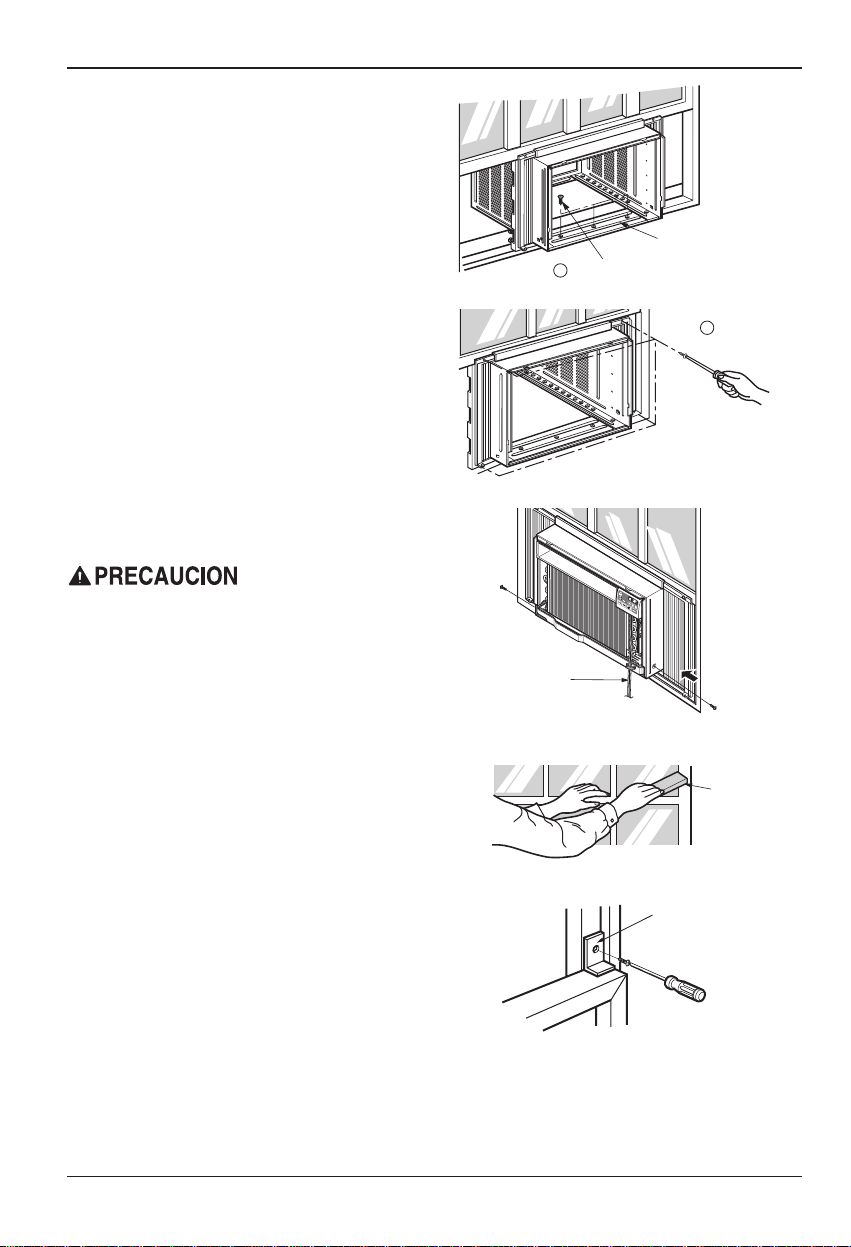
Instalacion
5. Hale cada panel guía completamente a cada
lado de la ventana y repita del paso 2.
6. Adjunte cada panel guía a cada lado de la
ventana usando tornillos (Tipo C).
(Ver Fig.6)
7. Deslice el chasís dentro del gabinete.
(Ver Fig.7)
Para propósitos de seguridad, reinstale los
tornillos (Tipo A) a los lados del gabinete.
8. Corte la tira de goma a la medida apropiada e
introdúzcala entre la parte superior e inferior de
la ventana. (Ver Fig. 8)
9. Se debe instalar el asa antes de fijar el frente
decorativo. (Ver Fig. 9)
TORNILLO
(TIPO C)
6
7
Fig. 5
Fig. 6
Fig. 7
Fig. 8
Fig. 9
TORNILLO(TIPO B)
Parte Frontal Interior
SOPORTE DE
CERRADURA
TIRA DE
GOMA
TORNILLO
O
RNILLO
CORDÓN DE
ALIMENTACIÓN
ELÉTRICA
Manual del Propietario 15
ESPAÑOL
Instalacion
10. Instale la rejilla frontal en el cabinete
insertando la lengüeta en la rejilla a la
lengüeta en el frente del cabinete. Empuje la
rejilla hasta que se cierre con sonido de golpe.
(Ver Fig. 10))
11. Levante la rejilla de entrada y asegúrela con
un tornillo (tipo A) a través de la rejilla frontal.
(Ver Fig.10)
12. Ahora la instalación del aire acondicionado en
la ventana es completada. Vea los DATOS
ELECTRICOS para instalar el cable de
alimentación en la toma de corriente.
Fig. 10
Instalación del cable eléctrica
Puede escoger entre los dos métodos abajo descritos de acuerdo a la forma del taburete de su ventana
y su preferencia.
• Aprete el obturador usando 2 hoyos de tornillo, y
saque el cable eléctrico a través de la ranura
"A".
• Aprete el obturador usando el hoyo izquierdo de
tornillo, y gire apropiadamente para sacar el
cable eléctrico a través de la ranura "B".
Utilizando la ranura "A" Utilizando la ranura "B"
B
A
Cable eléctrica
Cable eléctrica
16 Aire Acondicionador
Instruccionnes de Funcionamiento
Instruccionnes de Funcionamiento
Funcionamiento del control remoto
El control remoto y el panel de control tendrán un aspecto parecido al de los que aparecen en la
fotografía más abajo.
Power
Temp
Fan Speed
Timer Mode
1
2
3
4
5
'
F
TIMER POWERMODE
TEMP
FAN
SPEED
F1 LOW
F2 MED
F3 HIGH
Dry Timer
Fan
Energy
Saver
Cool
1
2
6
3 45
Manual del Propietario 17
ESPAÑOL
Instruccionnes de Funcionamiento
1. POWER (ENCENDIDO)
El funcionamiento se inicia cuando se pulsa esta tecla y se detiene cuando se la presiona
nuevamente.
2. CONTROL DE TEMPERATURA
El termostato monitorea la temperatura de la habitación para mantener la temperatura deseada.
El termostato puede ser colocado entre 60°F~86°F (16°C~30°C).
La unidad toma un promedio de 30 minutos para ajustar la temperatura de la habitación en 1°F.
3. FUNCIONAMIENTO DEL MODO SELECTOR
Seleccione el modo fresco (cool) para enfriar la habitación.
Seleccione el modo de ahorro de energía para el funcionamiento del ahorro de energía.
Seleccione el modo ventilador (fan) para el funcionamiento del ventilador.
Seleccione el modo seco (dry) para el funcionamiento seco.
4. SELECTOR DE VELOCIDAD DEL VENTILADOR (FAN SPEED)
Para aumentar la capacidad mientras se refresca, seleccione una mayor velocidad del ventilador.
3 Pasos: High (alta) → Low (baja) → Med (media)
5. CRONÓMETRO ON/OFF (ENCENDIDO/APAGADO)
El cronómetro puede ser colocado para iniciar y detener la unidad en incrementos por hora
(hasta 12 horas).
6. SENSOR DEL CONTROL REMOTO
AUTO-ARRANQUE
En caso de fallo de la corriente eléctrica, la unidad funcionará como antes cuando vuelve la
corriente.
Insertar las baterías del control remoto
1. Empuje hacia afuera con su pulgar la cubierta en la parte posterior del control
remoto.
2. Preste atención a la polaridad e inserte dos nuevas baterías AAA 1.5V .
3. Vuelva a colocar la cubierta
No use baterías recargables. Asegúrese que ambas baterías sean nuevas.
No mezcle las pilas alcalinas, estándares(Carbon-zinc) o recargables(Niquel-
cadmium).
• Para evitar que se descarguen, quite las baterías del control remoto si el
acondicionador de aire no va a ser usado por un período largo de tiempo.
Mantenga el control remoto lejos de los lugares húmedos o extremadamente
calientes. Para mantener el funcionamiento óptimo del control remoto, el sensor
remoto no debe exponerse a la luz solar directa.
• El soporte montable del control remoto puede ser montado sobre una pared.
CONSEJO
18 Aire Acondicionador
Instruccionnes de Funcionamiento
La palanca de ventilación deberá estar en la posición CLOSE (Cerrado) para poder mantener las mejores
condiciones de enfriamiento.
Cuando se necesite aire fresco en la habitación, coloque la palanca de ventilación en la posición OPEN (Abierto).
El amortiguador se abre y se descarga el aire de la habitación.
Antes de usar la característica de ventilación,
coloque la palanca como se muestra. Primero jale hacia
abajo la parte para que quede en una línea horizontal con la parte .
CONSEJO
Ventilacion
VENTCLOSE OPEN
VENTILACION
CERRAR ABRIR
Part A
Part
B
Como controlar la direccion del aire
Recommended orientation of louvers
Adjust louvers to face upwards when cooling to maximize cooling efficiency.
El flujo de aire puede ser ajustado cambiando la dirección de las rejillas de ventilación del
acondicionador de aire. Esto puede también incrementar la eficacia del acondicionador de aire.
Adjusting horizontal air flow Adjusting vertical air flow
Ajustar la dirección del flujo de aire
horizontal.
Ajustar las rejillas verticales hacia la izquierda y
derecha cambiará el flujo horizontal.
Ajustar la dirección del flujo de aire
vertical
Ajustar el álabe horizontal hacia arriba y abajo
cambiará el flujo de aire vertical. La aleta puede
ajustarse presionando hacia delante o hacia atrás.
Manual del Propietario 19
ESPAÑOL
Instruccionnes de Funcionamiento
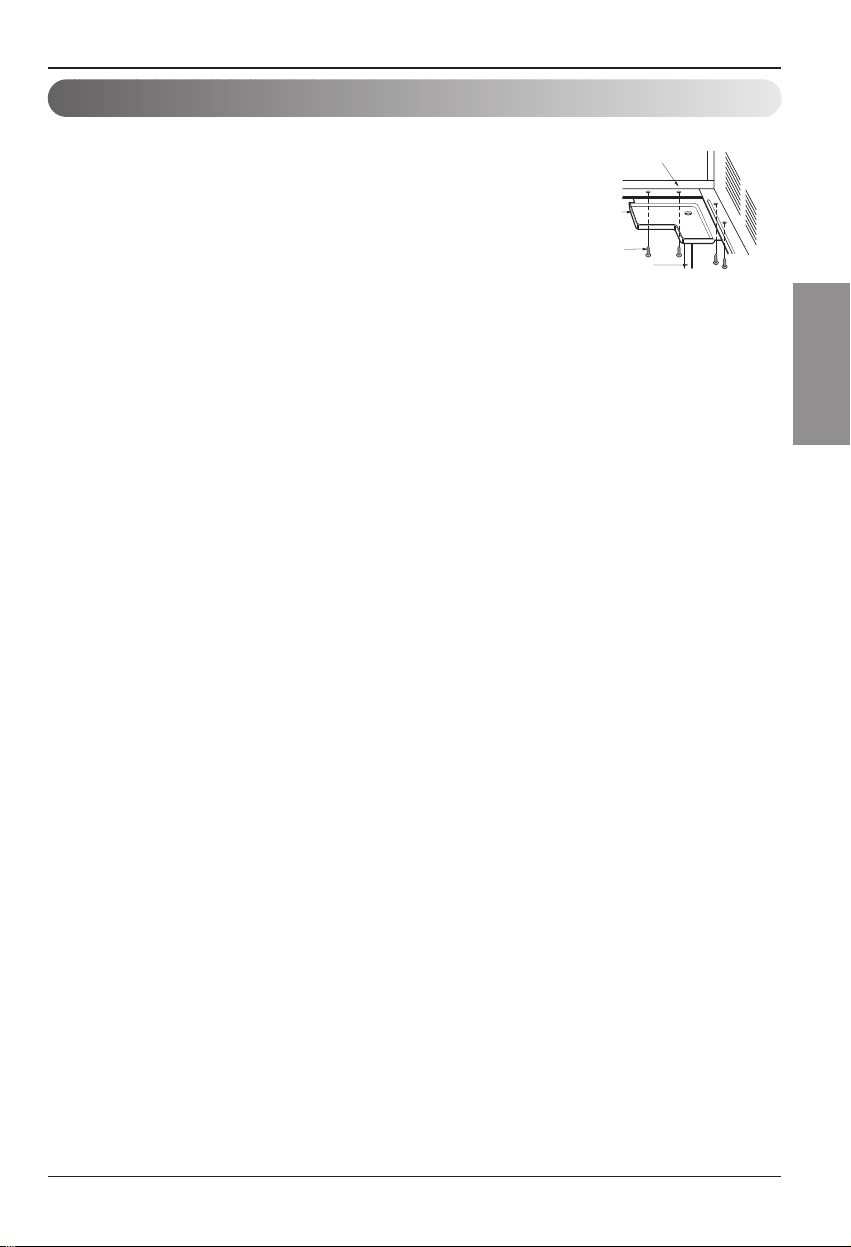
Como colocar la charola de purga(Opcional)
El aire acondicionado utiliza un método de purga adecuado en donde
el agua condensada (humedad retirada del aire) se purga al exterior.
En climas demasiado húmedos (y para modelos de ciclo invertido en la
modalidad de inversión) el agua condensada excesiva que se retira del
aire puede ocasionar que se recolecte algo de agua. Para eliminar este
exceso de agua, puede instalar una charola de purga como se detalla
a continuación.
1. Tome la charola de purga que se localiza en la descarga de aire o
en la barrera.
2. Retire el orificio de hule de la charola de la base. (para algunos modelos).
3. Instale la charola de purga en el extermo izquierdo del gabinete con 4 (o 2) tornillos.
4. Conecte la manguera de purga en la descarga localizada en el fondo de la charola de purga. Puede
adquirir la manguera o tubería de purgga localmente para satisfacer sus necesidades particulares
(No se incluye la manguera de purga).
CABINETE
CHAROLA
DE PURGA
MANGUERA
DE PURGA
TORNILLO
20 Aire Acondicionador
Cuidado y Mantenimiento
Cuidado y Mantenimiento
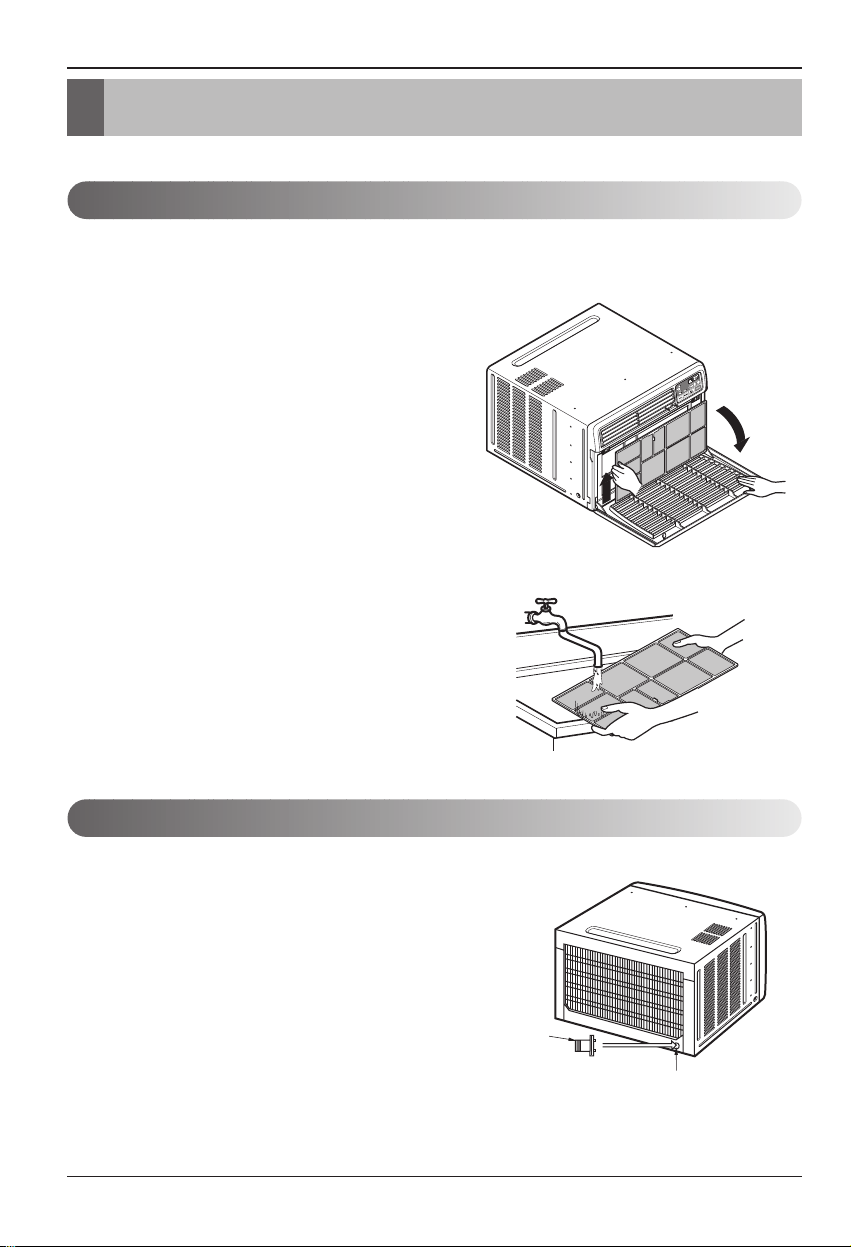
Desconecte la energía y desenchufe la unidad antes de limpiar el acondicionador de aire.
Filtro de Aire
Drenaje
El filtro de aire detrás de la parrilla de entrada debe ser controlado y limpiado por lo menos una vez
cada dos semanas (o cuando sea necesario) para mantener el rendimiento óptimo del acondicionador
de aire.
Como quitar el filtro de aire
1. La rejilla puede ser abierta desde la parte
superior para mantenimiento fácil después de
la instalación.
2. Abra la rejilla de entrada tirando de la puerta
externa en la parte superior de la unidad
(basada en instalación).
3. Tire de la cuba ligeramente para liberar el filtro.
Tire del filtro en la misma dirección de la
abertura.
4. Limpie el filtro con agua tibia y jabonosa.
El agua debe estar por debajo de los 40°C
(104°F).
5. Enjuague y sacuda suavemente el exceso de
agua del filtro. Déjelo secar antes de colocarlo
nuevamente.
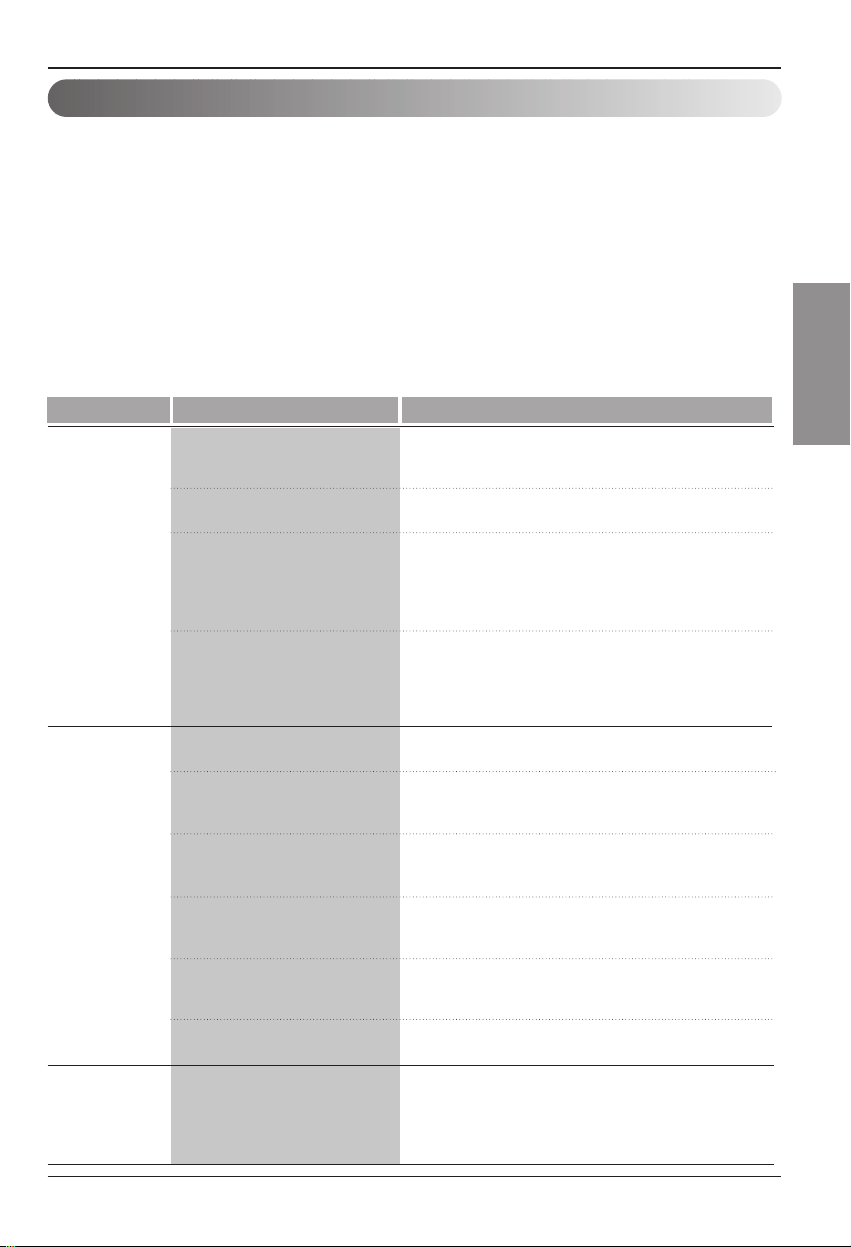
La bandeja de base puede inundarse debido a un
exceso de humedad. Para drenar el exceso de
agua, quite la tapa de drenaje desde la parte
posterior de la unidad y asegure el caño de
drenaje.
Cuando presione el caño de drenaje en su lugar,
aplique fuerza en la dirección opuesta a las
aletas, para evitar lesionarse.
Caño de drenaje
Tapa de drenaje
Manual del Propietario 21
ESPAÑOL
Cuidado y Mantenimiento
Problemas y soluciones habituales
Antes de llamar al servicio, tenga a bien revisar la siguiente lista de problemas y sus soluciones.
El acondicionador de aire está funcionando normalmente cuando:
• Escucha un sonido metálico. Lo causa el agua que recoge el condensador en días lluviosos o en
condiciones de mucha humedad. Esta característica está diseñada para ayudar a quitar la humedad
en el aire y mejorar la capacidad de enfriamiento.
• Oye un clic en el termostato. Lo causa el ciclo del compresor que comienza y se detiene.
• Ve gotear agua de la parte posterior de la unidad. El agua puede ser recogida en la bandeja de
base en condiciones de mucha humedad o días de lluvia. Esta agua desborda y gotea desde la
parte posterior de la unidad.
• Oye funcionar el ventilador mientras el compresor está silencioso. Esto es una característica
operativa normal.
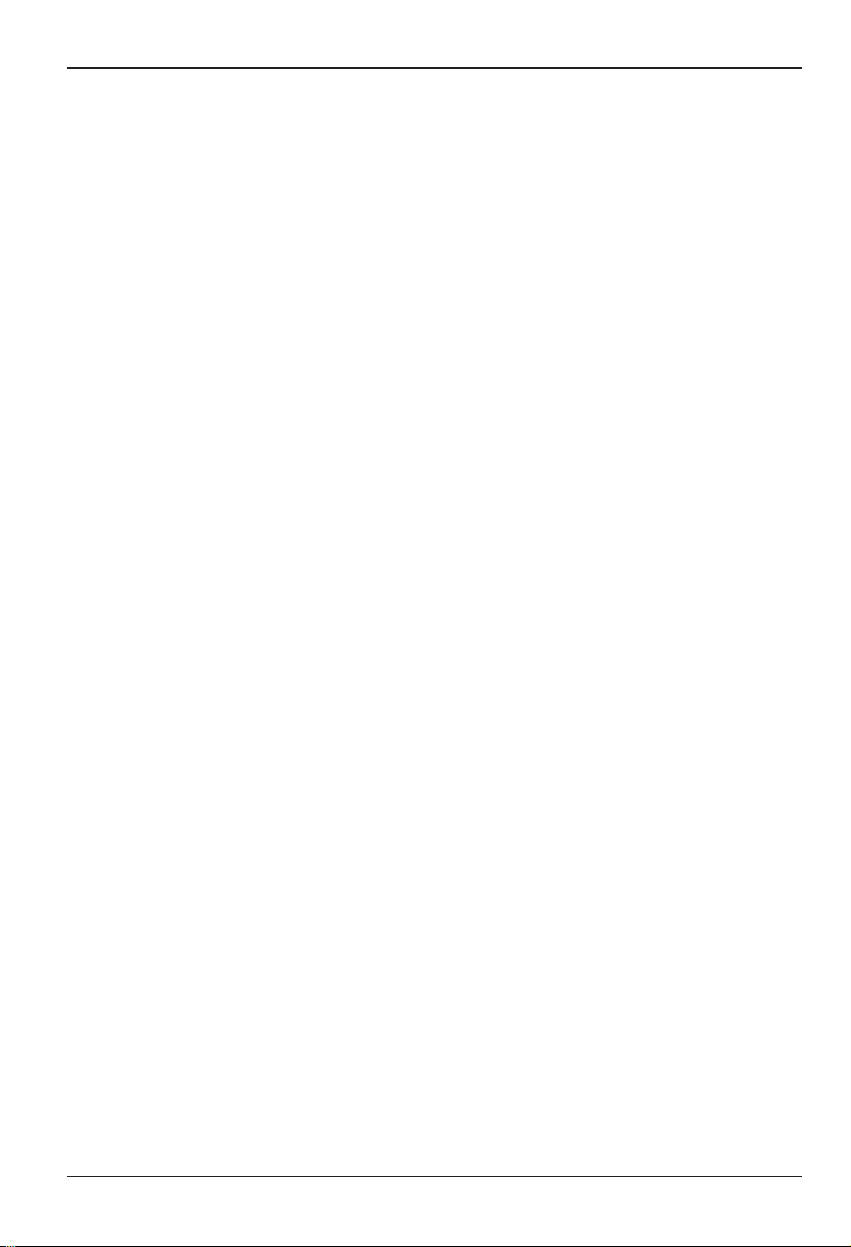
Problema Causas posibles Qué hacer
■ El acondicionador de aire está
desenchufado o no bien
enchufado
■ El fusible está fundido / el
disyuntor está interrumpido
■ Corte de corriente
■ El dispositivo interruptor de
corriente está desconectado.
■ El flujo de aire está disminuido
■ El TERMOSTATO puede no
estar colocado en el fresco
suficiente
■ El filtro de aire está sucio.
■ El acondicionador de aire se
acaba de encender.
■ El aire frío se escapa.
■ Los serpentines de
enfriamiento están congelados
■ Los serpentines de
enfriamiento están cubiertos de
hielo.
• Asegúrese que el enchufe está completamente
enchufado dentro del tomacorriente
• Compruebe el fusible /la caja del disyuntor y reemplace
el fusible o vuelva el disyuntor a su lugar.
• En el caso de un corte de corriente, coloque el control
de encendido en OFF. Cuando se haya restaurado la
corriente, espere durante 3 minutos para volver a hacer
funcionar el acondicionador de aire para prevenir la
sobrecarga del compresor.
• Presione el botón RESET situado en el enchufe del
cable de alimentación. Si el botón RESET no
permanece activo, suspenda el uso del aire
acondicionado y póngase en contacto con un técnico de
servicio cualificado.
• Asegúrese que no haya cortinas, persianas, muebles u
otros obstáculos frente al acondicionador de aire
• Gire la perilla a una posición más alta. Mientras más
alto esté mayor será el frío proporcionado.
• Limpie el filtro al menos una vez cada dos semanas.
Refierase a la sección “Cuidado y Mantenimiento” del
manual.
• Después que se enciende el acondicionador de aire,
debe darle un tiempo al acondicionador de aire para
enfriar la habitación.
• Busque alguna hornalla de resistencia encendida y el
aire frío vuelve.
• CIERRE la ventilación del acondicionador de aire
• Vea Aparece hielo sobre el acondicionador de aire abajo
• El hielo puede bloquear la corriente de aire e impedir
que el acondicionador de aire enfríe correctamente la
habitación. Coloque la velocidad del ventilador en MED
o ALTA (HIGH) mientras coloca el termostato en 1 o 2
hasta que el hielo se funda.
El acondicionador
de aire no
funciona para
nada
El acondicionador
de aire no enfría
Aparece hielo
sobre el
acondicionador
de airea
22 Aire Acondicionador
Nota
Nota
Manual del Propietario 23
ESPAÑOL
24 Aire Acondicionador
Nota
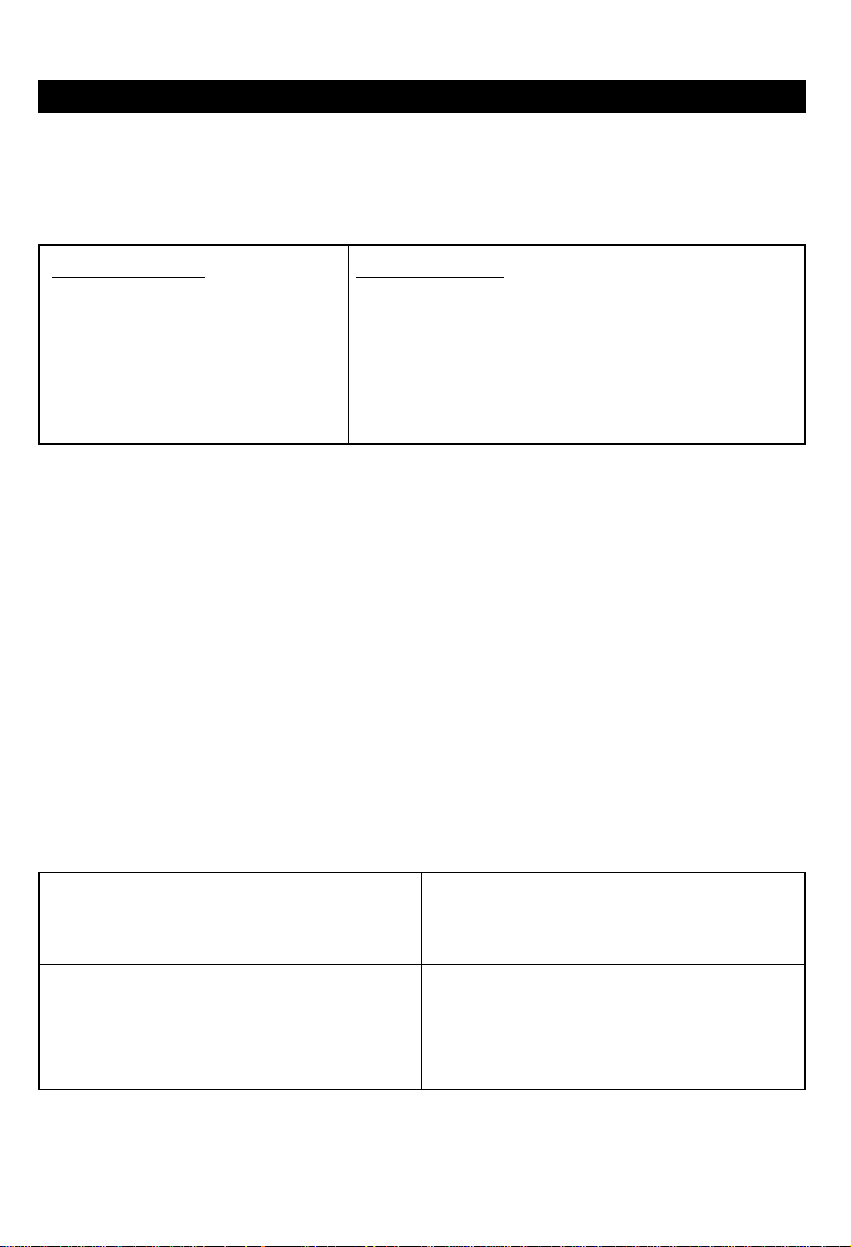
PERÍODO DE GARANTÍA:
PROCESO DE SERVICIO:
La mano de obra bajo garantía cubre el coste de la Asistencia
en domicilio de todas las piezas, incluyendo el compresor.
ESTA GARANTÍA LIMITADA NO SE APLICA A:
NÚMEROS DEL CENTRO INTERACTIVOS PARA CLIENTES:
Probar su cobertura por garantía
Obtener asistencia del centro de asistencia
autorizado más cercano, obtener asistencia de
producto, cliente, o servicio
GARANTÍA LIMITADA DEL AIRE ACONDICIONADOR LG - EE.UU.
Mano de obra: 5 años desde la fecha
de compra.
Piezas: 5 años desde la fecha de compra.
Compresor: 5 años desde la fecha de
compra.
LG Electronics Inc. reparará o sustituirá, gratuitamente, su producto si resulta defectuoso en materiales o mano de
obra bajo condiciones normales de uso durante el período de garantía mencionado más abajo, efectivo a partir de
la fecha de compra del producto original por parte del consumidor. Esta garantía limitada sólo es válida para el
comprador original del producto, y efectiva sólo cuando este se utilice dentro de los Estados Unidos, incluyendo
Alaska, Hawai, y los territorios estadounidenses.
1. Las visitas de Asistencia a domicilio para entregar, recoger y/o instalar el producto, instruir o sustituir
fusibles en su casa o corregir el cableado, o la corrección de reparaciones no autorizadas; y
2. Daños o problemas de funcionamiento provocados por un uso inadecuado, abuso, funcionamiento
fuera de especificaciones ambientales o contrario a requisitos o precauciones en la Guía de
funcionamiento, accidente, fuego, inundaciones, instalación inadecuada, fuerza mayor,
modificaciones o alteraciones no autorizadas, corriente eléctrica o tensión incorrecta, o uso comercial,
o usos distintos a aquellos para los que fue diseñado.
3. Por lo tanto, los costes de reparación o sustitución de un producto defectuoso deberá correr por cuenta
del consumidor.
Conserve su ticket y recibo de compra para probar la
fecha de adquisición del producto.
Deberá entregar una copia de su recibo de compra
en el momento en que reciba servicio bajo garantía.
Llame al 1-800-243-0000, 24 horas al día, 7 días a la
semana.
Seleccione la opción adecuada del menú, y tenga
disponible su tipo de producto (aire acondicionado),
número de modelo, número de serie, y código postal; o
visite nuestro sitio Web en http://www.lgappliances.com
ESTA GARANTÍA SE OTORGA EN SUSTITUCIÓN O EXCLUSIÓN DE TODA OTRA GARANTÍA, EXPRESA O IMPLÍCITA,
INCLUYENDO SIN LIMITAR CUALQUIER GARANTÍA DE CALIDAD O IDONEIDAD CON UN PROPÓSITO CONCRETO. EN LA
MEDIDA EN QUE CUALQUIER GARANTÍA IMPLÍCITA ES OBLIGADA POR LA LEY, ESTÁ LIMITADA EN DURACIÓN AL
PERÍODO DE GARANTÍA YA MENCIONADO. LG NO SERÁ RESPONSABLE DE NINGÚN DAÑO RESULTANTE, INDIRECTO, O
ACCIDENTAL DE NINGÚN TIPO, INCLUYENDO INGRESOS O GANANCIAS PERDIDAS, EN CONEXIÓN CON EL PRODUCTO.
CIERTOS ESTADOS NO ACEPTAN LA LIMITACIÓN DE DURACIÓN DE UNA GARANTÍA IMPLÍCITA O LA EXCLUSIÓN DE
DAÑOS RESULTANTES O ACCIDENTALES, POR LO QUE LAS LIMITACIONES O EXCLUSIONES MENCIONADAS PUEDEN NO
SER APLICABLES EN SU CASO.
Llame al teléfono 1-800-243-0000 y seleccione la opción
adecuada. Por favor, tenga disponible el tipo de producto (Aire
acondicionado), número de modelo, número de serie, y código
postal.
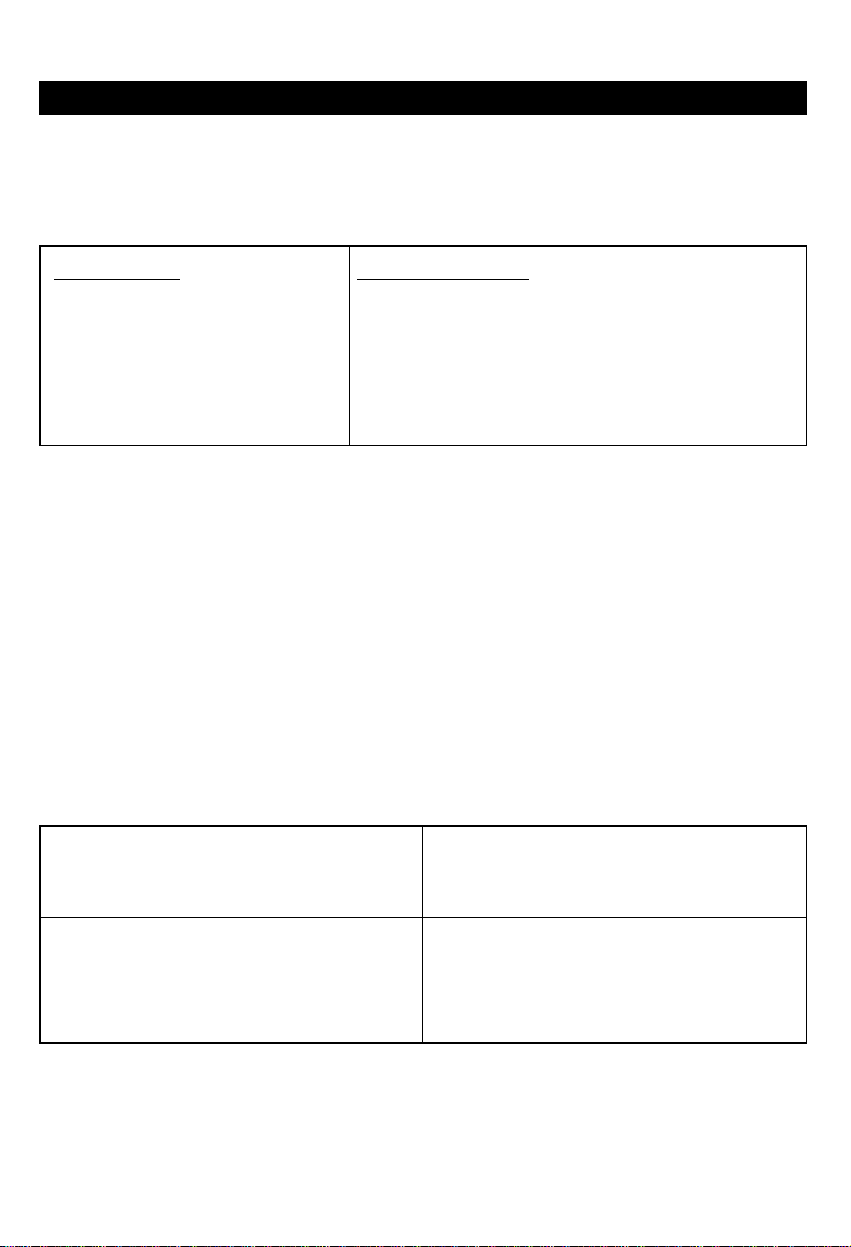
WARRANTY PERIOD:
HOW SERVICE IS HANDLED:
The warranted labor covers the cost of In-Home Service on all
parts including the compressor.
THIS LIMITED WARRANTY DOES NOT APPLY TO:
CUSTOMER INTER-ACTIVE CENTER NUMBERS:
To Prove Warranty Coverage
To Obtain Nearest Authorized Service Center or Sales
Dealer, or to Obtain Product, Customer, or Service
Assistance
LG ROOM AIR CONDITIONER LIMITED WARRANTY
-
USA
Labor: 5 Year from the Date of Purchase.
Parts: 5 Year from the Date of Purchase.
Compressor: 5 Years from the Date of
Purchase.
LG Electronics Inc. will repair or at its option replace, without charge, your product if it proves to be defective in
material or workmanship under normal use during the warranty period set forth below, effective from the date of
original consumer purchase of the product. This limited warranty is good only to the original purchaser of the product
and effective only when used in the United States including Alaska, Hawaii, and U.S. Territories.
1. Service trips to your home to deliver, pick up, and/or install the product, instruct, or replace house fuses or
correct wiring, or correction of unauthorized repairs; and
2. Damages or operating problems that result from misuse, abuse, operation outside environmental
specifications or contrary to the requirements or precautions in the Operating Guide, accident, vermin,
fire, flood, improper installation, acts of God, unauthorized modification or alteration, incorrect electrical
current or voltage, or commercial use, or use for other than intended purpose.
3. Therefore, the cost of repair or replacement of such a defective product shall be borne by the consumer.
Retain your Sales Receipt to prove date of purchase.
A copy of your Sales Receipt must be submitted at
the time warranty service is provided.
Call 1-800-243-0000, 24 hrs a day, 7 days per week.
Choose the appropriate prompt from the menu, and
have your product type (Room Air Conditioner), model
number, serial number, and ZIP Code; or visit our
website at http://www.lgappliances.com.
P/No.: 3828A21004K
Patent No. : Us 6, 412, 298
Printed in China
THIS WARRANTY IS IN LIEU OF ANY OTHER WARRANTIES, EXPRESS OR IMPLIED, INCLUDING WITHOUT LIMITATION, ANY
WARRANTY OF MERCHANTABILITY OR FITNESS FOR A PARTICULAR PURPOSE. TO THE EXTENT ANY IMPLIED WARRANTY IS
REQUIRED BY LAW, IT IS LIMITED IN DURATION TO THE EXPRESS WARRANTY PERIOD ABOVE. LG WILL NOT BE LIABLE FOR
ANY CONSEQUENTIAL, INDIRECT, OR INCIDENTAL DAMAGES OF ANY KIND, INCLUDING LOST REVENUES OR PROFITS, IN
CONNECTION WITH THE PRODUCT. SOME STATES DO NOT ALLOW LIMITATION ON HOW LONG AN IMPLIED WARRANTY
LASTS OR THE EXCLUSION OF INCIDENTAL OR CONSEQUENTIAL DAMAGES, SO THE ABOVE LIMITATIONS OR EXCLUSIONS
MAY NOT APPLY TO YOU.
Call 1-800-243-0000 and choose the appropriate prompt. Please
have product type (Room Air Conditioner), model number, serial
number, and ZIP code ready.