1
O
Operating Instructions for the
TZERO
MKIII
Sub-Bass
System

2
3
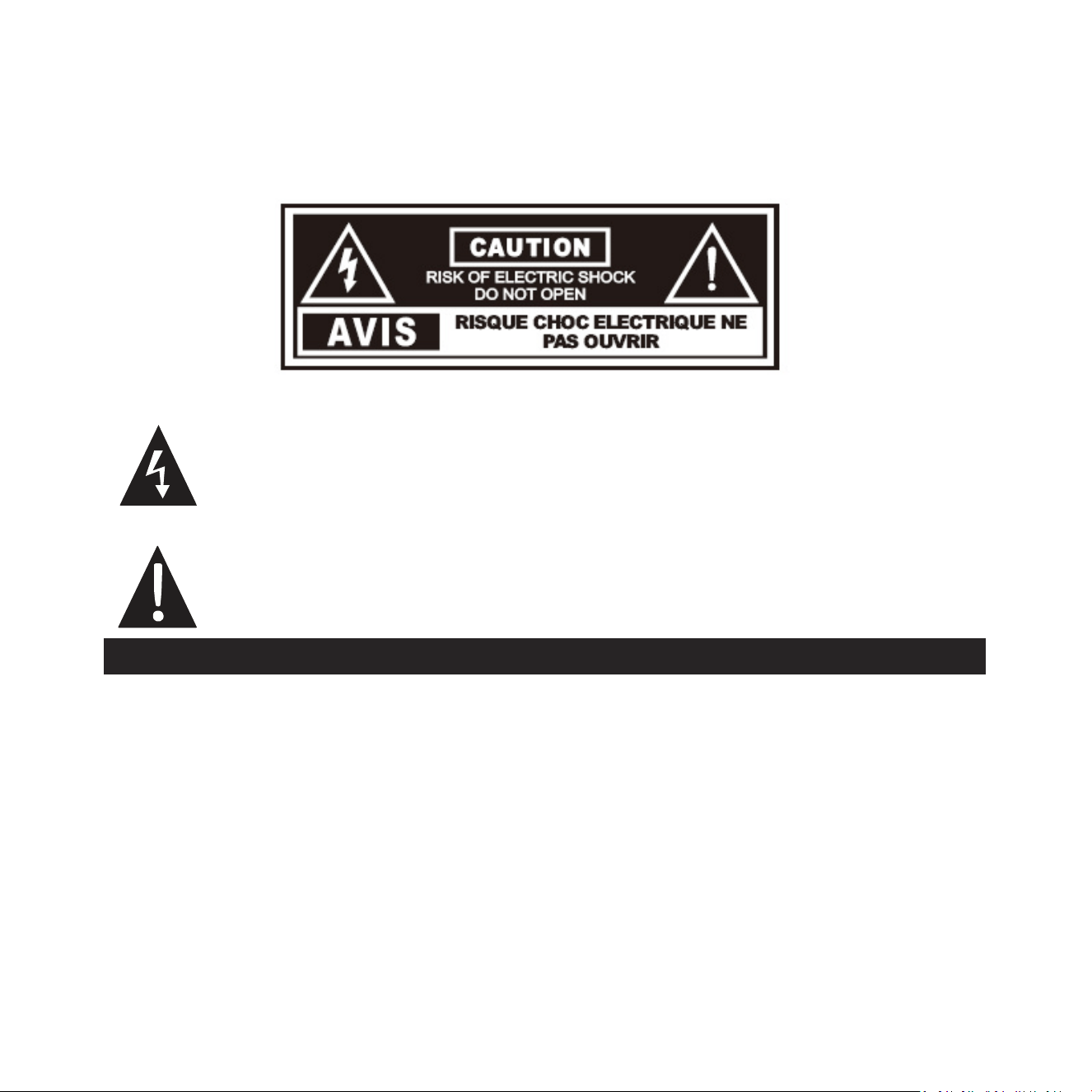
Caution Marking Explanation
The lightning flash with arrowhead symbol within an equilateral triangle is intended to alert
the user to the presence of un-insulated dangerous voltage within the product’s enclosure
that may be of sufficient magnitude to constitute a risk of electric shock to persons.
The exclamation point within an equilateral triangle is intended to alert the user to the
presence of important operating and maintenance (servicing) instructions in the literature
accompanying the appliance.
Important Safeguards
1 Read all of these instruc
ti
ons.
2 Save these instructions for future use.
3 Heed all warnings.
4 Follow all instructions.
5 Do not use this apparatus near water.
6 Clean only with automotive polish and micro fiber cloth.

4
7 Install in accordance with the manufacturer’s instructions.
8 Do not install near any heat sources such as radiators, heat registers, stoves or other apparatus
(including amplifiers) that produce heat.
9 Do not defeat the safety purpose of the grounding-type plug. A grounding type plug has two blades and a
third grounding prong. The third prong is provided for your safety. If the provided plug does not fit into your
outlet, consult and electrician for replacement of the obsolete outlet.
10 Protect the power cord from being walked on or pinched particularly at plugs, convenience
receptacles, and the point where they exit from the apparatus.
11 Only use attachments/accessories specified by the manufacturer.
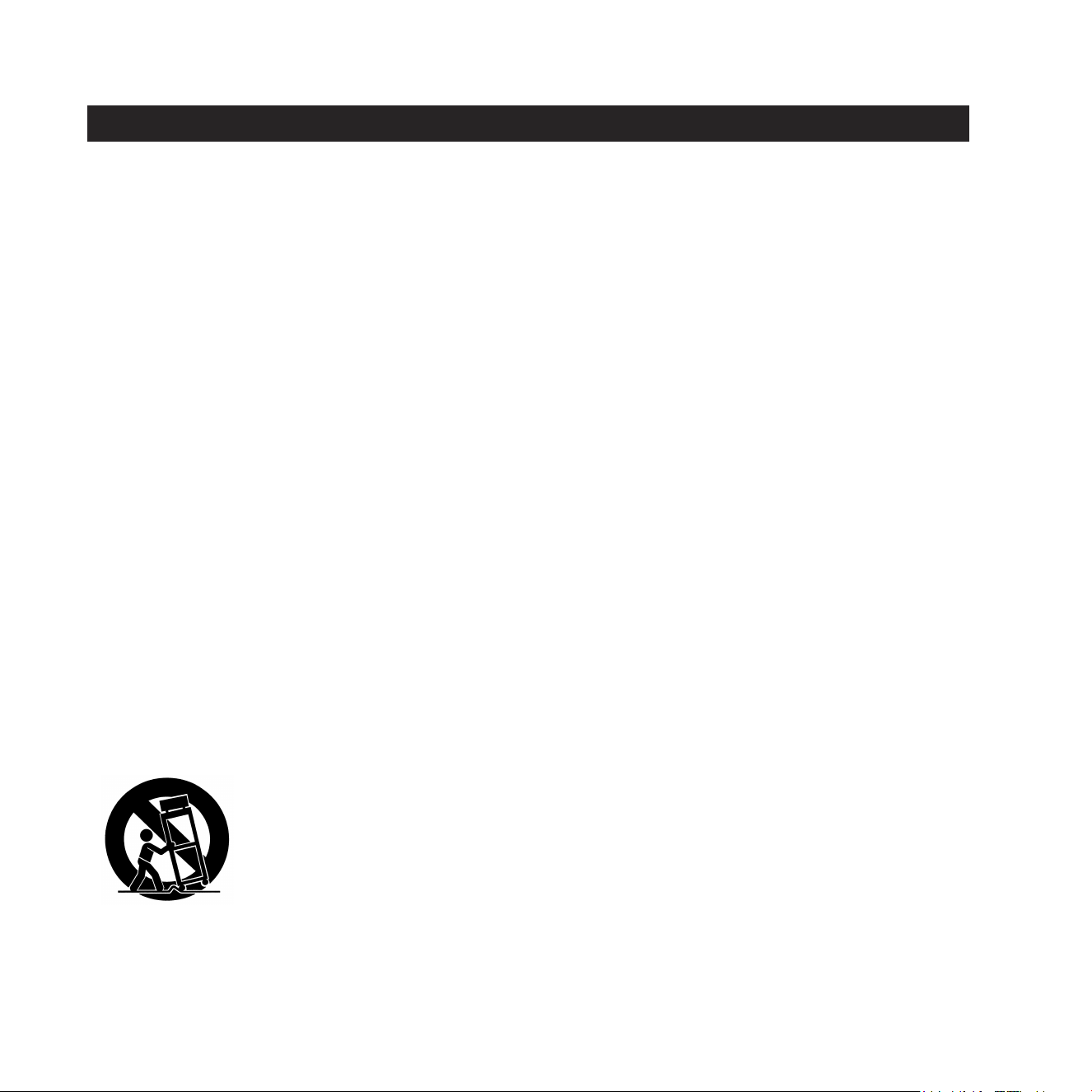
12 Use only with a cart, stand, tripod, bracket, or table specified by the manufacturer, or sold with the
apparatus. When a cart is used, use caution when moving the cart/apparatus combination to avoid injury
from tip-over.
13 Unplug this apparatus during lightning storms or when unused for long periods of time.
14 Refer all servicing to qualified service personnel. Servicing is required when the apparatus has been
damaged in any way, such as power-supply cord or plug is damaged, liquid has been spilled or objects
have fallen into the apparatus, the apparatus has been exposed to rail or moisture, does not operate
normally, or has been dropped.
15 minimum distances 10cm around the apparatus for sufficient ventilation;
16 the ventilation should not be impeded by covering the ventilation openings with items,
such as newspapers, table-cloths, curtains, etc.;

5
17 no naked flame sources, such as lighted candles, should be placed on the apparatus;
18 attention should be drawn to the environmental aspects of battery disposal;
19 the use of apparatus in moderate climates.
20 Batteries shall not be exposed to excessive heat such as sunshine, fire or the like.
Caution: Any changes or modifications not expressly approved by the party responsible for compliance
could void the user's authority to operate this equipment.
Warning
Avertissement
To reduce the risk of fire or electric shock, do not expose this apparatus to rain or moisture.
Cet article est lourd . Pour éviter tout risque de blessure , prendre soin lors de la manipulation.
The apparatus shall not be exposed to dripping or splashing and no objects filled with liquids, such as vases,
shall be placed on apparatus.
L' appareil ne doit pas être exposé à des éclaboussures et aucun objet rempli de liquide, comme des vases, ne doit être
placé sur l'appareil.
The mains plus is used as disconnect device. The mains plug of the apparatus should not be obstructed OR
should be easily accessed during intended use. To be completely disconnected from the power input, the
mains plug of the apparatus shall me disconnected from the mains.
An appliance with a protective earth terminal should be connected to a mains outlet with a protective earth
connection.
Les conduites Plus est utilisé comme dispositif de déconnexion. La fiche de l'appareil ne doit pas être obstruée OU doit
être facilement accessible pendant l'utilisation. Pour être complètement déconnecté de l'alimentation électrique , le cordon
d'alimentation de l'appareil doit me débranché .
Un appareil avec une borne de terre doit être branché sur une prise de courant en étant relié à la terre.
Design Safety
This apparatus is supplied with a detachable mains cord. A 2A fuse is fitted in the socket. Should the fuse
need to be replaced use a similar rated fuse approved to ASTA or BSI 362 standards. Do not use without the
fuse cover in place. Replacement fuse covers are available from your distributor.
6
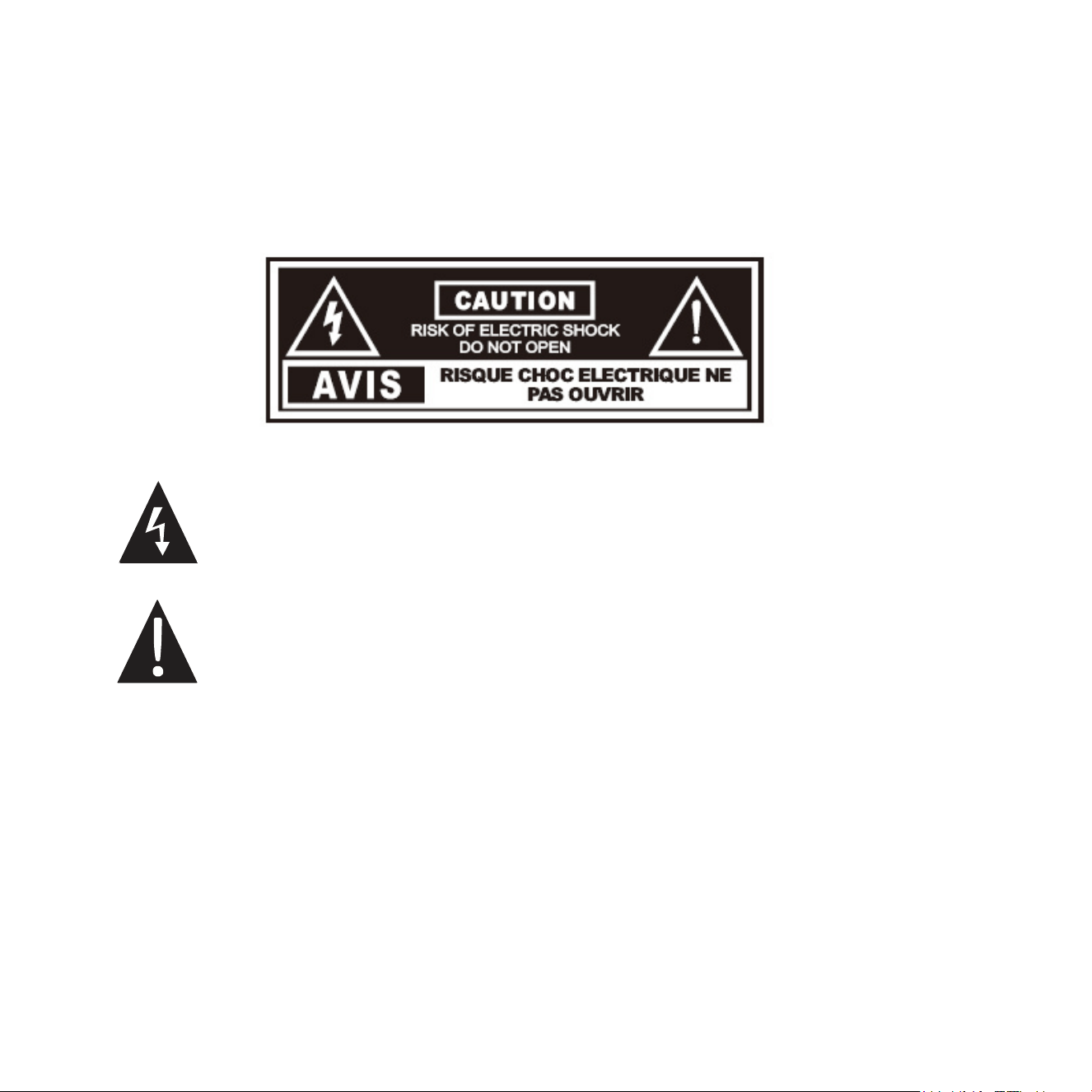
Attention Explication Marquage
L'éclair avec le symbole de pointe de flèche dans un triangle équilatéral est destiné à alerter l' utilisateur
de la présence de non isolée tension dangereuse à l'intérieur de l'enceinte du produit qui peut être d'une
ampleur suffisante pour constituer un risque d'électrocution pour les personnes.
Le point d'exclamation dans un triangle équilatéral est destiné à alerter l'utilisateur de la présence
d'instructions dans la documentation accompagnant l'appareil exploitation et de maintenance (entretien).
7
Informations importantes relatives a la securite
1 Lisez attentivement ces instructions.
2 Conservez ces instructions.
3 Respectez tous les avertissements.
4 Suivez toutes les instructions.
5 Ne pas utiliser cet appareil près de l'eau.
6 Nettoyez seulement avec du vernis automobile et tissu microfibre.
7 Installer conformément aux instructions du fabricant.
8 Ne pas installer près de sources de chaleur telles que des radiateurs, registres de chaleur, poêles ou
autres appareils (y compris les amplificateurs) qui produisent de la chaleur.
9 Ne pas contourner le dispositif de sécurité de la prise de terre. Une fiche de terre a deux lames et une
troisième broche de mise à la terre. La troisième broche est fournie pour votre sécurité. Si la fiche fournie
ne rentre pas dans votre prise, consultez un électricien pour le remplacement de la prise obsolète.
10 Protégez le cordon d'alimentation ne soit piétiné ou pincé, en particulier au niveau des fiches, des prises
de courant , et le point de sortie de l'appareil.
11 Utilisez uniquement des fixations / accessoires spécifiés par le fabricant.
12 Utilisez seulement avec un chariot, stand, trépied, support ou table spécifié par le fabricant, ou vendu
avec l'appareil. Lorsque vous utilisez un chariot, soyez prudent lorsque vous déplacez l'ensemble chariot /
appareil pour éviter les blessures en cas de chute.
13 Débranchez cet appareil pendant un orage ou lorsqu'il est inutilisé storsm pour de longues périodes de
temp.

8
14 Confiez toute réparation à un personnel qualifié. Une réparation est nécessaire lorsque l'appareil a été
endommagé de quelque façon que ce cordon d'alimentation ou la fiche est endommagé, du liquide a été
renversé ou des objets sont tombés dans l'appareil, l'appareil a été exposé à rail ou à l'humidité, ne
fonctionne pas normalement, ou a été échappé.
15 10cm distance minimale autour de l'appareil pour une aération suffisante
16 il convient que l'aération ne soit pas gênée par l'obstruction des ouvertures d'aération par des objets tels
que journaux, nappes, rideaux, etc. ;
17 il convient de ne pas placer sur l'appareil de sources de flammes nues, telles que des bougies allumées;
18 il convient d'attirer l'attention sur les problèmes d'environnement dus à la mise au déchet des piles;
19 si l'appareil est destiné à être utilisé sous un climat tempéré.
20 les batteries ne doivent pas être exposées à une chaleur excessive telle que celle du soleil, d'un feu ou
d'origine
Attention: Tout changement ou modification non expressément approuvés par la partie responsable de la
conformité pourraient annuler l'autorité de l'utilisateur à utiliser cet équipement.
Sécurité Design
Cet appareil est fourni avec un cordon d'alimentation amovible. Un fusible 2A est monté dans la prise. Si le
fusible doit être remplacé, utilisez un fusible similaire approuvé selon les normes ASTA ou BSI 362. Ne pas
utiliser sans le couvercle du fusible en place. Des cache-fusibles de rechange sont disponibles auprès de votre
distributeur.

9
Welcome to the REL Family
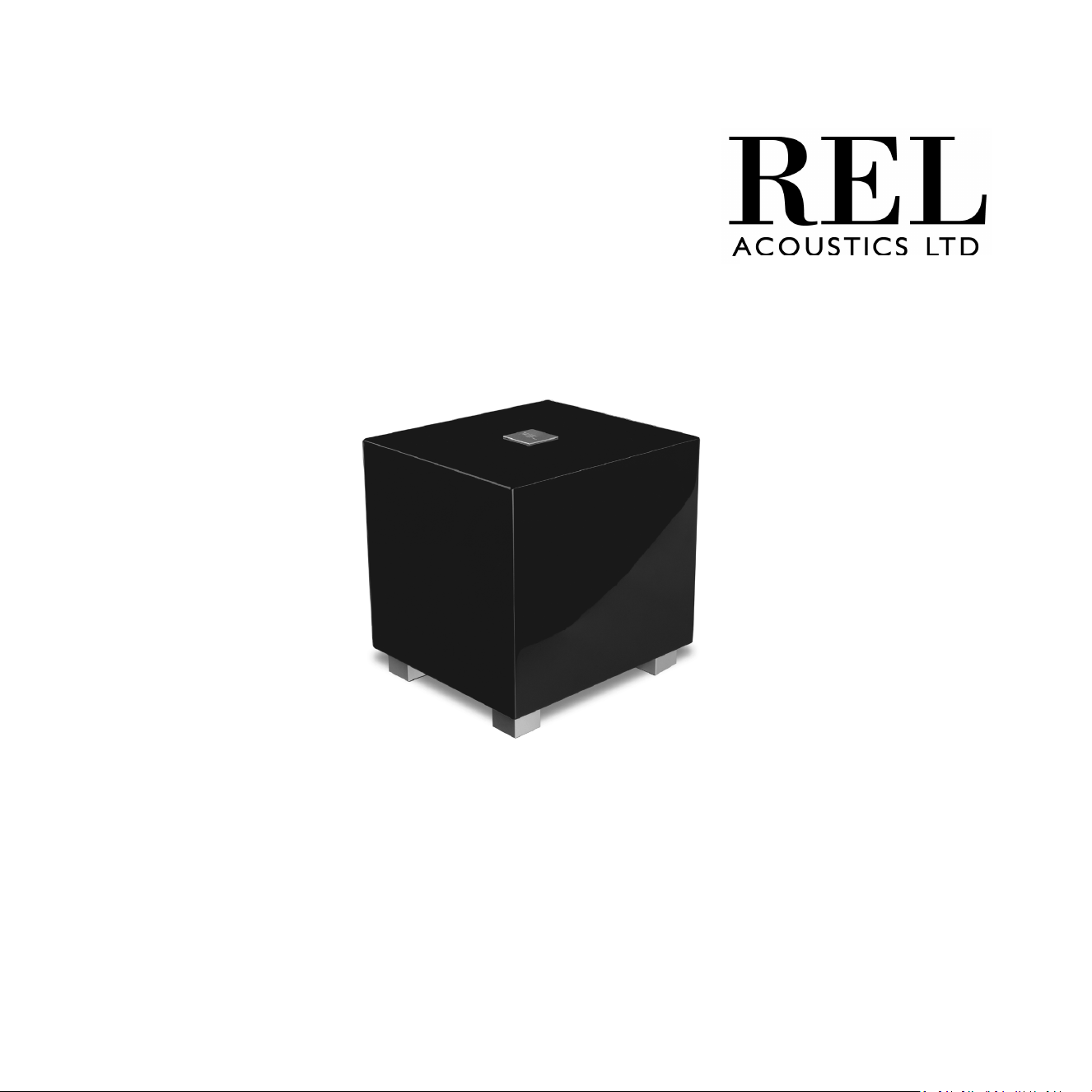
Congratulations on your purchase of a new REL Tzero MkIII. While the Tzero MkIII is one of our most
affordable models, it possesses a great deal of the character, unique features and sound quality of our
larger and costlier models. While its size suggests something not unlike a multimedia subwoofer designed
to, at best, suffer connection to a shoddy computer-based Bluetooth or similar system, the reality is that
this is a full, proper REL.
Significantly, it is the least expensive model that includes our High Level circuit which is key to obtaining a
perfect blend with one’s speakers as it attaches to your amplifier’s or receiver’s speaker outputs, thus
allowing the entire sonic signature of your system to be built forward ensuring that REL and system speak
as one.
The primary upgrade on the MKIII lies in the upgrades brought to the downfiring active driver. MKIII uses a
damped aluminium driver to achieve exceptional rigidity which goes a very long way toward producing a
sound that is far more impactful than its diminutive stature would suggest. The damping on the rear of the
cone ensures that the driver does not ring and result in a lightweight presentation. Compared with earlier
models of the Tzero MkIII, the MKIII is far more powerful and impactful.
Thank you for your support and should you have any questions, please reach out to our world class support
team via our website. Our team is always eager to help and full of suggestions and solutions.

10
Overview
TZERO MKIII Sub-Bass System
Many or most loudspeakers emphasize the mid-bass. This is the range from 50 to 90 Hz. We at REL believe
this is an incomplete approach and that loudspeakers need to be extended in the lower frequencies for true
full range reproduction. All of our designs are true Sub-Bass Systems, meaning they are designed to reproduce
very low frequencies (below 30 Hz) that are felt rather than heard. This is because we understand that music
is full-range, as are sound effects on movies, and we intend for our products to reproduce all of these
sounds, not just a narrow band.
TZERO MKIII is equipped to allow you to take full advantage of Dolby Digital AC3, DTS, MPEG 2 and any
other digital sound format that includes a dedicated Low Frequency Effects (LFE) channel.
The dedicated LFE input meets the tough specification laid down for digital 5/2.1 channels, usually known
as 7.1. The output is nominally flat from 35 Hz – 90 Hz. It has a dedicated input level control which enables
users to set the LFE level independently of the processor. This is important because not all processors offer
control over this significant parameter. The LFE channel is frequently output at 10 dB higher levels than the
other channels.
The TZERO MKIII also has a HIGH LEVEL (speaker level) input with dedicated input level control. Uniquely,
both the speaker level and the LFE input can be used simultaneously. This means you may set it up for the
best possible 2-channel performance sound with your CDs or other stereo signals and instantly revert to
using the Sub-Bass System as the dedicated LFE component when watching movies. This is a feature of
real benefit if you wish to play music in stereo mode in the purist audiophile way and also in REL Theater
Reference mode with no switching necessary. By connecting BOTH High Level and .1 concurrently and
setting your processor to “Large” or “Full Range”, the best possible performance will be obtained. Consult
the owner’s manual of your loudspeakers or consult with your dealer before setting to large as a few
speakers
cannot handle the bass that is then directed through to the main speakers.
11
REL
TZERO MKIII
Rear Panel Connection Legend

12
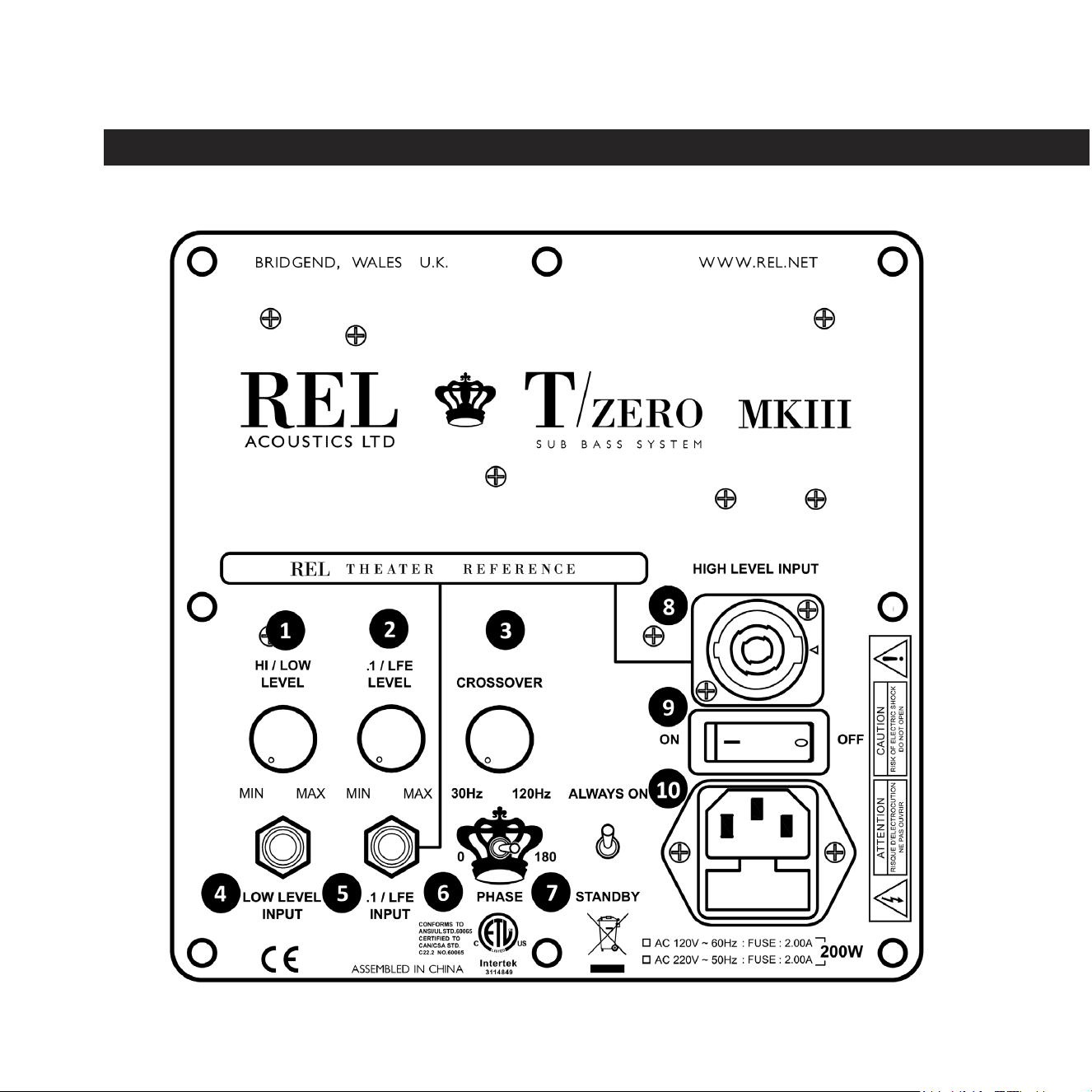
1 Volume Control for HI/LOW LEVEL INPUT: Use to adjust output when using either HIGH LEVEL or LOW
LEVEL input. Do not use both simultaneously.
2 Volume Control for .1/LFE INPUT: Use to adjust output level when using .1/LFE input from a 5.1/ 7.1
amplifier or processor.
3 Crossover Control: Used to select crossover frequency. Variable between 30Hz and 120Hz.
4 LOW LEVEL INPUT: Used to connect LOW LEVEL to the output of a preamplifier, integrated amplifier
or receiver ONLY when HIGH LEVEL INPUT cannot be properly connected. (For home cinema,
use.1/LFE INPUT).
5 .1/LFE INPUT: Used to connect to the .1/LFE output from a theatre processor. Should be used in
conjunction with REL HIGH LEVEL connection for the ultimate theater experience.
6 Phase Switch: Used to set phase 0-180 degrees.
7 Power Mode Switch: Used to set power mode. Set to “STANDBY” to enable automatic standby function
or to “ALWAYS ON” to disable standby function.
8 HIGH LEVEL INPUT (Neutrik® Speakon® Socket): Use to connect HIGH LEVEL to the amplifier
speaker terminals.
9 Power ON/OFF Switch: Use to turn unit on or off.
10 IEC Mains Socket: Fused mains (AC) input socket that accepts a detachable power cord.

13
Connecting Up
Always switch your system off before disconnecting any wires.
ALWAYS connect using the REL HIGH LEVEL input, unless your system simply cannot accommodate this.
While rare, a few esoteric systems, such as those that deliver a pure digital signal to active speakers, preclude
this possibility. To increase the versatility of connecting up, the TZERO MKIII has three separate inputs: A
Neutrik Speakon socket and two phono sockets. This is to facilitate use with both two-channel stereo systems
and AV surround sound systems.
The HIGH LEVEL, unbalanced, dual-channel (stereo) input is via a Neutrik Speakon connector which is connected
to the power amplifier’s left and right channel speaker terminals. This has the advantage of ensuring that the
REL receives exactly the same signal as the main speakers. This means that the character of the bass from the
main system is carried forward into the sub-bass. This is a very important point and together with the REL’s
Active Bass Controller (ABC) ensures far superior system integration of the sub-bass with the main system.
The LOW LEVEL input is via a phono jack that connects to either the .1/LFE output of a home cinema
amplifier/processor or to the output of a stereo preamplifier.
HIGH LEVEL and .1/LFE inputs can be used simultaneously. The benefits are two-fold when used with a
home cinema system. The .1 Input reproduces the .1/LFE channel and the HIGH LEVEL connection underpins
the main front speakers. The main front speakers should be set to the “large” option on the processor. See
“Home Cinema Applications” for more information.
Connecting to the Power Amplifier Using the Speakon HIGH LEVEL INPUT
To engage the Neutrik Speakon plug, insert fully into socket and rotate clockwise until locked.
To remove the Neutrik Speakon plug, grip body of plug, place thumb on chrome lever, move lever backwards,
rotate plug anticlockwise quarter turn and withdraw.
The HIGH LEVEL input is designed to accept the stereo (two-channel) signals from the speaker terminals of
your receiver, integrated amplifier or basic amplifier. This has the advantage of ensuring that your
subwoofer receives exactly the same signal as the main speakers, which means that the character of the

14
bass from the main system is carried forward into the Sub-Bass System. This is a very important point and
together with REL’s Natural RollOff™ circuitry, ensures far superior system integration of the Sub-Bass
System with the main system.
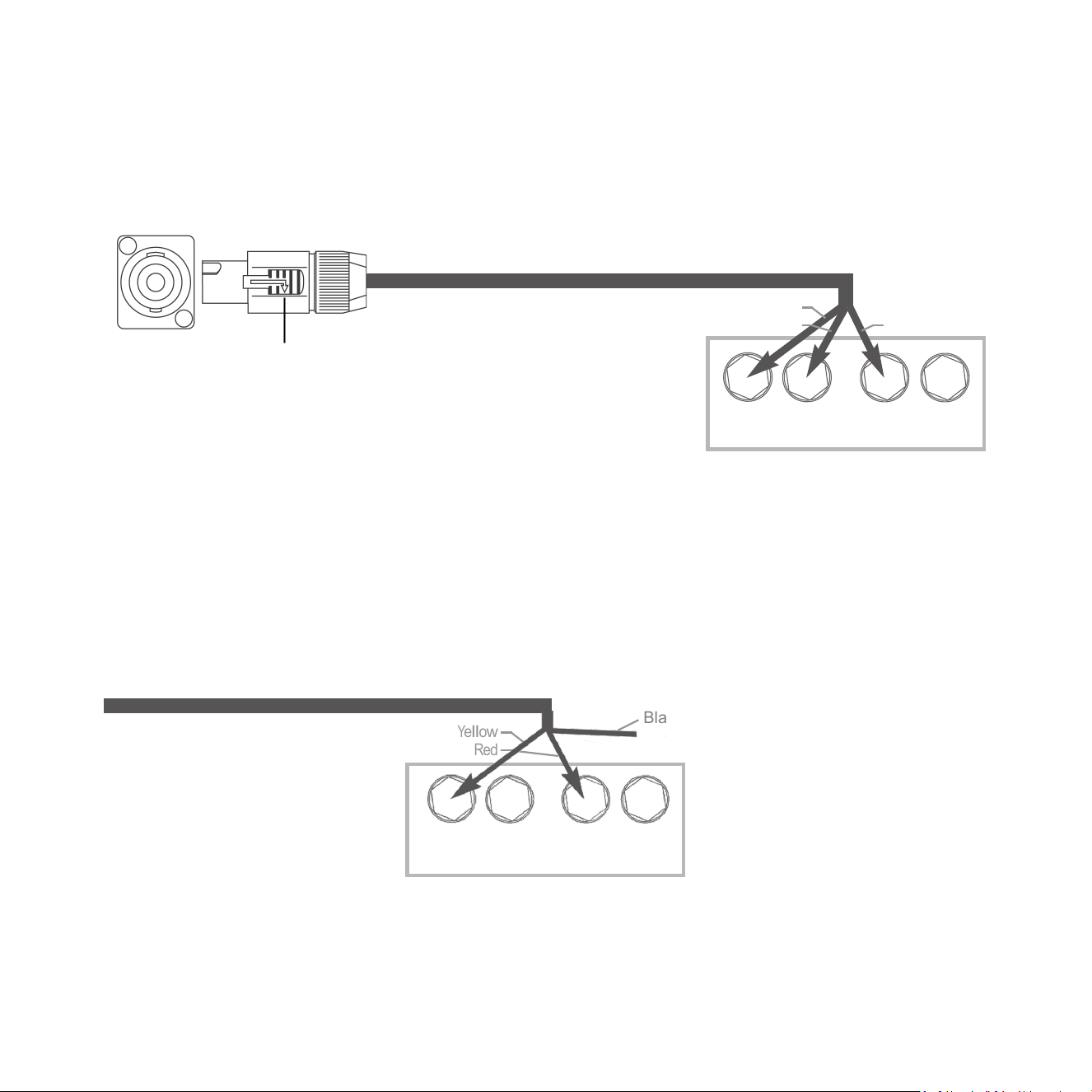
HIGH LEVEL INPUT: Connections should be made to the same binding post on main amplifier as the main
speakers. Red to amplifier main right speaker red terminal, yellow to amplifier main left speaker red
terminal. Depending on the design of the amplifier, the black to amplifier main speaker black terminal,
right or left but not both. Please see a complete description of connecting to ClassD and
differential/balanced amplifier output designs in the following pages. Plug the Neutrik Speakon plug into
the HIGH LEVEL Speakon socket. Note: This connection does not draw power from the power amplifier and,
yes, your REL is a powered sub bass system. However, by deriving its signal from the main power amplifier,
better sound quality is achieved.
.1/LFE INPUT: This requires a phono-to-phono cable and is a dedicated true .1 channel. This circuit
therefore eliminates the normal Natural RollOff™ Crossover and passes the .1 LOW LEVEL signal through
with only the required 120Hz fourth-order filter.
LOW LEVEL INPUT: This single channel phono input allows for conventional connection to a preamplifier
and should be used in the rare event that a HIGH LEVEL connection proves incompatible. Plug one end of
a single phono-phono cable into the LOW LEVEL input jack of the REL and the other end into either the
left or right channel output of your preamplifier. Because much sub-50Hz bass information is mono, there
is little need to connect both left and right channels. Should your system require this style of connection
– HIGH LEVEL is preferred – additional performance is available by purchasing a second, matching REL and
running each as separate stereo subs.
PHASE SWITCH – Used to set phase
Position 0 / HIGH LEVEL, LOW LEVEL or LFE: 0 degrees phase
Position 180 / HIGH LEVEL, LOW LEVEL or LFE: 180 degrees phase
PHASE SELECTION AFFECTS BOTH HIGH- AND LOW LEVEL INPUTS
Crossover is always engaged for HIGH LEVEL INPUT. The .1/LFE signal does not pass through the
crossover circuit.

15
REL Set-Up Made Simple
REL products are not traditional subwoofers, but are true Sub-Bass Systems. A REL is designed to augment
the performance of “full range” speaker systems in order to provide, in certain cases, linear response below
12 Hz. Therefore, for the moment, set aside everything you’ve been taught about subwoofers and how they
are integrated into a stereo or home cinema system. The set-up and positioning of REL Sub-Bass Systems
differs from that of conventional subwoofers. A REL will take advantage of physics and room acoustics to
provide deep pressurization as no traditional subwoofer can. It is important that you bring to the set-up
process a willingness to do things a little differently in order to obtain these superior results. The end result
of your labors will be an utterly seamless integration of true deep bass to a sound system, regardless of the
main speakers’ low bass capability.
Basic set-up should take no more than ten to fifteen minutes to accomplish once connected.
Before You Begin
1 It is helpful to know that you will almost always connect the REL to the input on the rear panel labeled
“HIGH LEVEL INPUT.” This connection is made using the supplied 34’, 10” (10 meters) cable, the bare
leads of which connect to the speaker output terminals of the power amplifier. The easy and foolproof
connection at the REL is done with a Neutrik Speakon connector. The purpose of connecting to the
speaker output terminals is one of the unique secrets of REL’s success. By connecting to the HIGH LEVEL
input on the REL from the amplifier, you build forward the sonic signature of your main system, including
the tonal balance and timing cues of the entire electronics chain. In this way, the REL is fed the exact
signal that is fed to the main speakers.
2 When possible, the REL should be placed in one of the corners behind the speakers. Remember, we are
dealing with true LOW bass pressurization with RELs. Low bass pressurization below 40Hz is best derived
from corner placement, where the most linear and efficient low bass can be produced.
Connecting and Setting Up
HIGH LEVEL connection, using the enclosed cable with the Neutrik Speakon connector, is always the first
choice. This connection can be made without affecting the performance of the amplifier because the REL’s
amplifier input impedance is 150,000 ohms, in effect not producing any additional demand whatsoever on
the rest of your system.
16
• The standard HIGH LEVEL hook up procedure is: attach the red wire to the amplifier’s right positive
speaker output terminal; attach the yellow wire to the amplifier’s left positive speaker output terminal;
attach the black wire to whichever of the amplifier’s ground output terminals is convenient; plug the
Speakon connector into the Sub-Bass System’s HIGH LEVEL input.
Supplied Neutrik Speakon
HIGH LEVEL
I
n
t
e
r
c
o
nnec
t
HIGH LEVEL
Input
R
e
l
e
a
s
e
L
e
v
e
r
Y
e
ll
o
w
B
l
a
ck
Re
d
+
L
–
+ R
–
Amplifier Main Speaker
O
u
t
pu
t
s
• For differential (i.e. fully balanced) amplifiers using one REL, simply use the standard connecting scheme
with the exception of NOT connecting the black wire to a negative speaker terminal. Instead, it should first be
allowed to “float” or hang down without connection to ANY terminal. Should hum occur using this method,
please try connecting to an unused RCA connector on the rear of a preamp or amplifier. Please contact your
dealer should there be any questions concerning this or any other hookup procedure.
Supplied Neutrik Speakon
HIGH LEVEL
I
n
t
e
r
c
o
nnec
t
Y
e
ll
o
w
Re
d
+ L – + R
–
Amplifier Main
S
pe
a
k
e
r
O
u
t
pu
t
s
NOTE: The TZERO MKIII is equipped with internal circuitry to allow seamless connection to Class-D
(digital) main amplifiers. If connecting to a Class-D amplifier, follow the above connection procedure for
differential amplifiers.
Black
17
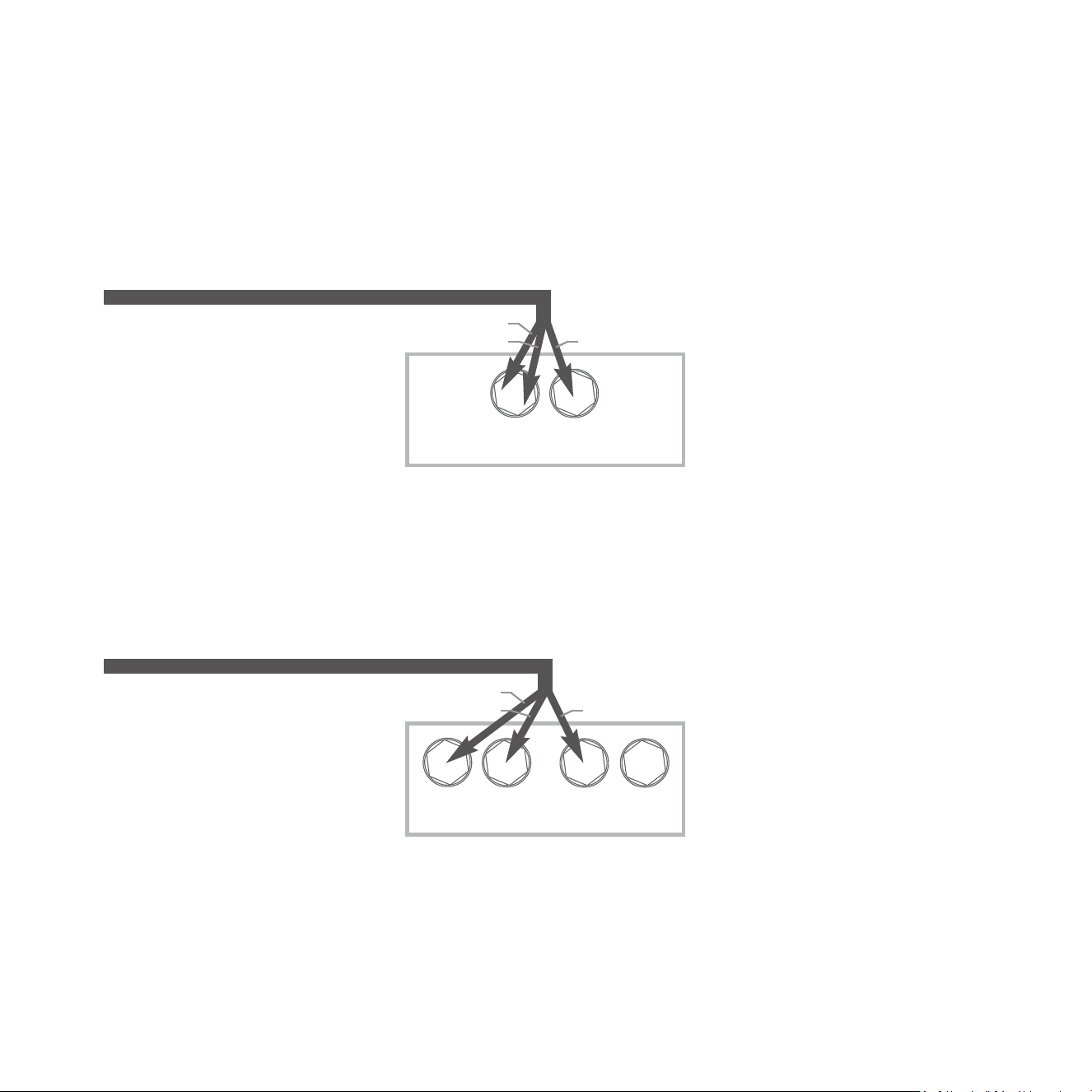
• If connecting a single REL as a dedicated centre channel sub, an insider tip is to consider connecting to
the rear of the speaker, rather than routing the REL High Level enable all the way back to the amplifier
(unless the amplifier is of Class-D or Differential output design). Connect the black wire of the REL to
the negative centre channel speaker terminal; twist together the red and yellow wires and connect this
paired cable (red/yellow paired together) to the positive centre channel speaker terminal.
Supplied Neutrik Speakon
HIGH LEVEL
I
n
t
e
r
c
o
nnec
t
Y
e
ll
o
w
Red
B
l
a
ck
+ C
–
Amplifier Main
S
pe
a
k
e
r
O
u
t
pu
t
s
• If connecting a REL as a dedicated rear channel sub, connect the black wire of the REL to either the left rear
or right rear negative speaker terminal; connect the yellow wire to the left rear positive speaker terminal;
connect the red wire to the right rear positive speaker terminal. If the amplifier is of balanced differential
design, please follow the instructions in the section above labeled Differential Connection.
Supplied Neutrik Speakon
HIGH LEVEL
I
n
t
e
r
c
o
nnec
t
Y
e
ll
o
w
B
l
a
ck
Re
d
+ RL – + RR
–
Amplifier Main
S
pe
a
k
e
r
O
u
t
pu
t
s
LOW LEVEL connection (via phono connector) is always an option if HIGH LEVEL connection is not possible.
When connecting to the LOW LEVEL inputs in a system in which HIGH LEVEL connection is not possible, such
as if using internally-amplified speakers, connect a single phono cable between the LOW LEVEL input jack of

18
the REL and either the left or right channel output of your preamplifier. Because virtually all sub-50Hz bass
information is mono, there is no need to connect both left and right channels.
When connecting to a home cinema system where a .1/LFE channel output is present, connect a single
phono cable between the sub output of the processor/receiver and the .1/LFE input jack on the REL.
Positioning: The optimal position for a REL is in one of the corners behind the main speakers. This position
provides 9 dB of acoustic amplification and allows for the most linear true low bass wave launch, owing to
the ability to tune the REL to the longest distance in the room in order to produce the longest, therefore
lowest, bass waves.
The Process: To begin the set-up process, choose a piece of music that has a repetitive bass line that is very
low in frequency. We suggest track four from the soundtrack to Sneakers (Columbia CK 53146). This has a
repetitive bass drum throughout that gives you plenty of time to move the woofer around, but more
importantly, the venue was quite large for this recording, and therefore it has a very deep and large-scale
bass signature. This type of track is perfect for the set-up process and should be played at the highest
reasonable level expected for system playback.
Working with a partner, one in the listening position and one at the REL manipulating the controls, is the
most effective and efficient way to set up the REL. If working alone, the initial steps in the set-up can be
very effectively carried out from the location of the REL. Trying to ignore all other music in the track, listen
for the bass drum and its effect on the listening room.
Phase Orientation: Once in the corner phase can be adjusted. This may be the single most critical step, and
because it really is quite simple, it is often over-thought. Keep in mind; the right phase is whichever position
is the loudest or fullest. While playing music with true low bass, adjust the crossover to a point where the
REL and the speaker are sure to share frequencies (about halfway up, or at 12 o’clock on the crossover
control, or slightly higher for smaller speakers). At this point turn the HI/LOW LEVEL control up so that both
the REL and speaker are roughly equal in volume and then switch, using the phase switch, from “0” to “180”
phase positions. Again, whichever position is loudest or fullest is the correct position. That is, when the
position is working in harmony with your main speakers, reinforcing bass, not cancelling it.

19
Placement: The next step is to determine precisely how far from the corner the sub should be placed to
achieve the most efficient output, as well as the lowest frequency extension. With the REL fully into the
corner, and continuing to play the music, slowly pull the REL from the corner on the diagonal, equidistant
from both side and rear wall. At a certain point (sometimes a matter of only a few inches, in rare cases a
foot or more) the REL will audibly go lower, play louder, and, if it truly locks on to the room and is fully
pressurizing it, the air around the REL will seem to be energized, stop right there! This is the correct position
from the corner for the REL.
Crossover and Level Settings: To determine the crossover point, take the volume of the REL (using the
HI/LOW LEVEL control) all the way down, and put the crossover to 30 Hz. At this point, bring the REL’s volume
back up slowly to the point where you have achieved a subtle balance, i.e. the point at which you can hear
the REL even with the main speakers playing. Now, bring the crossover point up until it is obviously too
high; at this point bring it down to the appropriate lower setting. For all intents and purposes, this is the
correct crossover point. Once this stage has been reached, subtle changes to volume and crossover can be
made to provide the last bit of complete and seamless integration. With that, set-up is complete.
Hint: There may be a tendency to set the crossover point too high and the volume of the Sub-Bass System
too low when first learning how to integrate a REL with the system, the fear being one of overwhelming the
main speakers with bass. But in doing so, the resulting set-up will be lacking in bass depth and dynamics.
The proper crossover point and volume setting will increase overall dynamics, allow for extended bass
frequencies, and improve soundstage properties. Note, volume must be adjusted in conjunction with
crossover changes. In general, when selecting a lower crossover point, more volume may need to be
applied.

20
REL Theater Reference™ Home Cinema Applications
For Dolby Digital AC3 or other 5.1 theater systems, once the standard set-up for two-channel outlined
above is complete, the LFE output from the processor or receiver should be connected to the .1/LFE input
and appropriate volume adjustments made using the .1/LFE LEVEL control. For this configuration, you must
set the processor to the “large” or “full range” setting for the left and right speakers in order for the REL to
receive the bass signal via the HIGH LEVEL cable. In this configuration, the REL provides support for both
the left and right speakers for two-channel listening, and support for the LFE when movies are playing.
Most processors will allow you to defeat the subwoofer output when listening in the two-channel mode.
The effect of this set-up is one of greatly increased dynamics in the mid-bass range, no bass bloat, and a
greater degree of space and timing from the special audio effects.
REL Theater Reference 3D Bass™
While slightly more complicated than the basic REL Theater Reference scheme, use of three RELs produces
a number of noteworthy benefits and proves the most cost effective method of achieving professional Dolby
5.1 standard bass performance. REL Theater Reference 3D Bass™ produces true full range performance
from the three primary zones of reproduction in theater sound resulting in a far more natural and
immersive experience than ANY single sub can produce.
1 The main L/R speakers should be connected to the primary REL using REL Theater Reference
connection. This unit forms the foundation of your theater system’s performance and so should be
perfectly matched to one’s main speakers.
2 In the rear corner (ideally that which is opposite the primary sub), connect a second REL to the rear
speakers using REL Theater Reference connectivity. The purpose of the rear channel REL is to ensure
proper front-to-rear balance and weight; too often virtually ALL the power and weight in a theater
comes from the front and it produces unnatural weighting as well as hot spots. By placing a rear REL
diagonally opposite, bass transects the room on a tangent and has the effect of greatly smoothing
overall in-room response of your RELs. This unit need not be a duplicate of your primary REL; instead
it should match well with your surround speakers.

21
3 Connect to the center channel a third REL using ONLY the HIGH LEVEL connection. This may be easily
accomplished by connecting directly to the connection terminals on the rear of the center channel
speaker. To do so, first twist the red and yellow leads together and connect to the positive terminal,
then connect the remaining black lead to the negative (black) terminal on the rear of the speaker. The
purpose of the third “center” REL is to ensure the center channel can keep up with the scale, weight
and dynamics the main system now has. Location should be anywhere from the opposite corner of
the front wall to somewhere in the middle of the front wall, listen for best integration with the center
channel speaker. Some people prefer to use the REL as an actual pediment or stand for their center
channel, the choice is yours. Again, this unit need NOT be an exact duplicate of the primary REL but
should be chosen for its acoustic ability to mate seamlessly with your center channel.
First, carefully set-up and dial in the primary REL, then move to the rear REL and balance this against the main
REL. Care must be taken to ensure phase is identical on both RELs as accidentally reversing phase of one
relative to the other will result in a dramatic reduction in bass output. Finally, carefully dial in the
performance of the center channel sub. Hint: To make this easier, once the primary REL has been dialed in,
unplug it using the Speakon connection from the system and dial in the rear, followed by the center
channel REL.
Genuine sticklers for perfection find it easiest to tune in sections. For example, connect ONLY the L/R
mains and the primary REL. Next, tune ONLY the rear surrounds and the rear REL. Finally, listen to and tune
ONLY the center channel with the center REL.
When you have accomplished this task, plug all three units in and re-check your gain settings as the
cumulative effect of hooking all three up will usually result in, temporarily, excessive output. Work
carefully and methodically to reduce the settings on primary, then rear, and finally center channel RELs and
in a few minutes balance should be restored. However, the net result of all your tuning will be a sound that
utterly immerses the theater owner in a rich natural wash of bass that suffuses the room effortlessly,
rather than what is often experienced as too loud a bass balance pushing uncomfortably at the listener.
Running In
Care taken over running in will be rewarded by many years of pleasurable use. Both the electronics and the

22
drive unit will benefit from an initial period of carefully controlled use. Possible damage may be sustained
by running in the unit at too high a volume setting over an extended period. On the other hand, by taking a
little care over this initial period, about 24 hours of actual use, a longer life with an eventual higher
potential performance is assured.
Care and Polishing
The cabinets are best maintained by using a light automotive spray-on wax and a micro fiber cloth. (Our
favorites are those made by Meguiars and Mother’s. While these may not be available in all markets, you
can use a similar product.) Take care not to spray the aluminium badge. Do not place objects, such as
drinks on top of your REL TZERO MKIII. Never use a dry cloth on this finish.
Technical
TZERO MKIII uses a very fast, gentle and transparent filter intended to allow excellent impulse response
and a natural sound. We refer to this circuit as Natural RollOff™. Most subs use slow, very steep filters that
lend an unnatural, machine-like quality to the sound. The TZERO MKIII employs a highly refined Class-D
amplifier which combines high performance and high efficiency. The TZERO MKIII includes an automatic
power-saving mode which ensures that, when not in use, the unit consumes as little power as possible. The
driver is simple, rugged and relatively light, and yet offers excellent self-damping so we are better able to
reproduce the nuance of music and preserve the explosiveness of transients. Finally, the cabinets, apart
from being physically beautiful, are like finely tuned instruments that are largely responsible
for the sonic
virtue with which the
TZERO MKIII
is imbued.
Power Saving Efficiency
All REL Sub-Bass Systems are designed for maximum power efficiency, both when passing a signal through
to its resultant output sound into the room and also when silent.
In addition to the low power draw exhibited by all REL models, the TZERO MKIII also features an automatic
standby mode that is enabled when the power mode switch on the rear of the unit is set to the “STANDBY”
position. In this mode, the input signal is constantly monitored for activity (audio information). If no audio
information is detected over a period of fifteen minutes, the unit will enter a low power standby mode in
which less than 0.5 watt of power is consumed. When input signal activity is detected, the unit resumes

23
normal operation. By using the standby mode, you can ensure that there is no unnecessary power draw
when the unit is not in use.
Alternatively, the user has the option to leave the unit in the normal operating mode at all times by selecting
the “ALWAYS ON” position of the power mode switch. In this mode, the unit will not enter standby
regardless of whether or not there is activity on the input signal. Using this setting ensures that the TZERO
MKIII is ready to react instantaneously to bass transients, whether in music or movies, and is therefore the
recommended setting to achieve the highest performance.

24
Specifications
TZERO MKIII
Type: Sealed, down-firing active woofer
Drive Unit: 6.5in., 165mm long-throw aluminium cone, steel chassis
Lower Frequency Response: 37 Hz at -6 dB in room
Input Connectors: HIGH LEVEL Neutrik Speakon, LOW LEVEL single phono, LFE phono
Input Impedance: HIGH LEVEL: 150k, Low Level: 10k, .1/LFE: 10k ohms
Gain Control Range: 80 dB
Power Output: 100 Watts (RMS)
Phase Switch: Yes, 0 or 180 degrees
Amplifier Type: Class D
Protection System
Fully Electronic SET-SAFE: Yes
D.C. Fault: Yes
Output Short: Yes
Mains Input Voltage: 100-240 volts
Fuse: 2.00 Amp semi delay
Dimensions (WHD): 8.5 x 9.5 x 10.25 in., (216 x 241 x 260 mm)
Including Feet and Rear Panel Controls
Net Weight: 15 lbs. (6.8 kg)
Finish: Gloss Piano Black or White Lacquer
Supplied Accessories
Mains Lead: Yes
Neutrik Speakon Interconnect: Yes (10 Meters Nominal)
User Manual: Yes
In the interest of product improvement, REL Acoustics Limited reserves the right to alter these specifications without notice.

25
Notes