Danby Products Limited, Guelph, Ontario, Canada N1H 6Z9
Danby Products Inc. Findlay, Ohio, U.S.A. 45840
www.danby.com
2024.11.21
OWNER’S MANUAL
MANUAL DEL PROPIETARIO
MODEL * MODELO
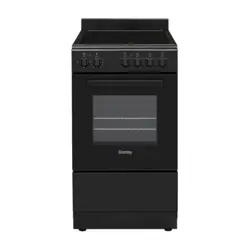
DER24V1B
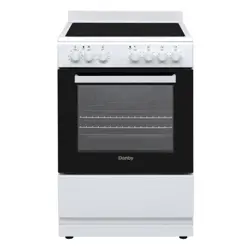
DER24V1BSS
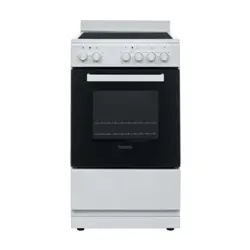
DER24V1W
24” ELECTRIC RANGE
Owner’s Manual.............................1 - 22
24” COCINA ELÉCTRICA
Manual del propietario.................23 - 44
Printed in Turkey | Impreso en Turquía

1
Welcome to the Danby family.
We are proud of our quality products and we believe in dependable service. We suggest
that you read this owner’s manual before plugging in your new appliance as it contains
important operation information, safety information, troubleshooting, and maintenance tips
to ensure the reliability and longevity of your appliance.
You are entitled to the warranty coverage as described in the owner’s manual provided with
your new appliance.
1. Please write down your appliance information below. You must keep the original proof
of purchase receipt to validate and receive warranty services.
2. Register your product online and receive a FREE 2 MONTH WARRANTY EXTENSION
after filling out a product survey, at www.danby.com/support/product-registration/
Need Help?
1. Read your Owner’s Manual for installation help, troubleshooting, and maintenance
assistance.
2. Visit www.Danby.com to access self-service tools, FAQs and much more by searching
your model number in the search bar.
3. For the Quickest Customer Service, please fill out the web form at www.danby.com/
support. Your submission will go directly to an expert on your particular appliance.
Our average response times are between 20 minutes and 2 hours, during EST business
hours.
4. Call 1-800-263-2629 - please note that during peak hours, hold times can exceed one
hour.
Model Number: ____________________________________________________
Serial Number: ____________________________________________________
Date of Purchase: __________________________________________________
1
ANTI-TIP DEVICES
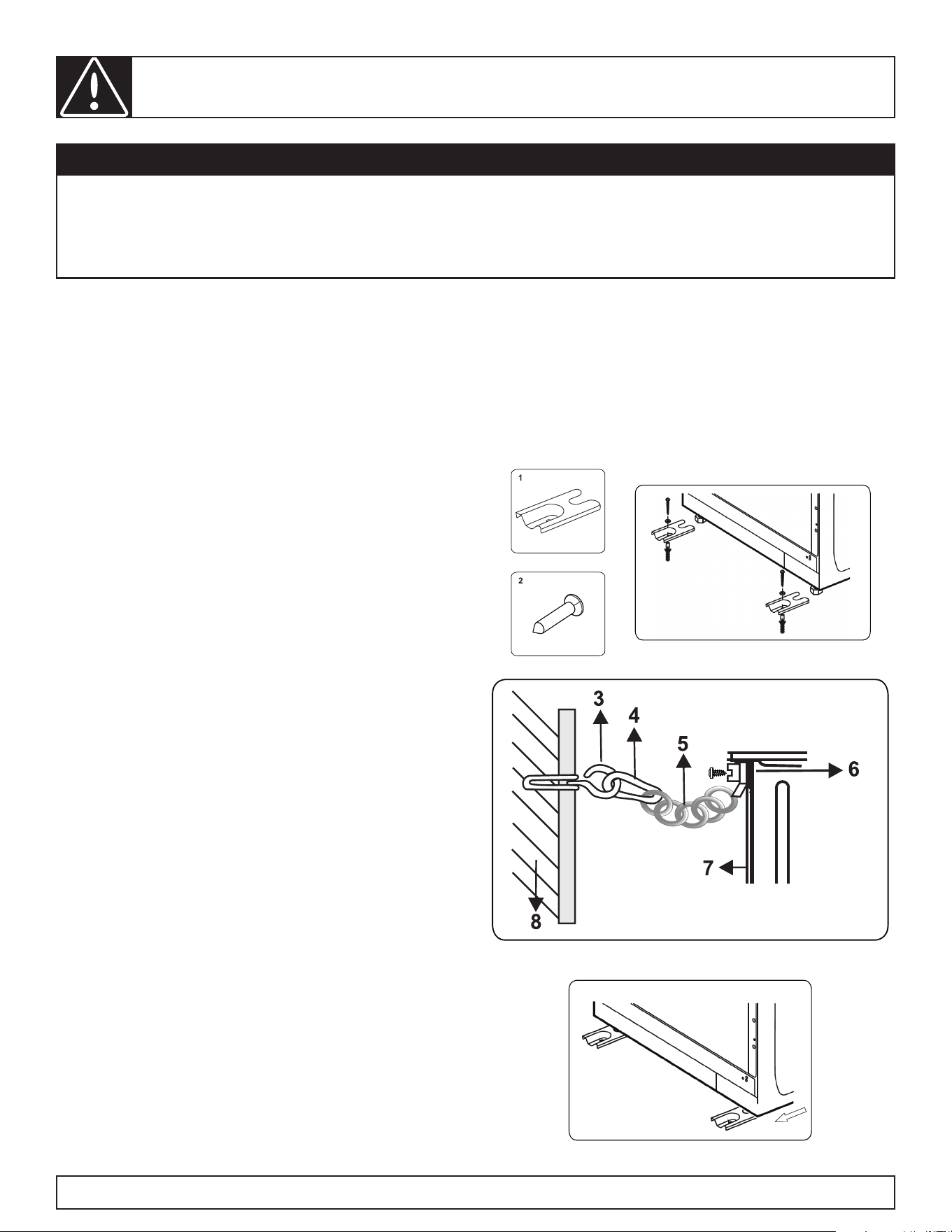
To reduce the risk of the appliance tipping by abnormal usage or improper door loading, the appliance
must be secured by installing anti-tip devices. There are two anti-tip devices that must be installed to ensure
the appliance is safe.
Note: If the range is ever relocated both anti-tip devices must be removed and installed at the new location.
Important Safety Information
READ AND FOLLOW ALL SAFETY INSTRUCTIONS
SAVE THESE INSTRUCTIONS!
WARNING - TIP OVER HAZARD
• A child or adult can tip the appliance and be killed
• Verify the anti-tip bracket has been properly installed to the floor
• Ensure the anti-tip bracket is re-engaged when the range is moved
• Do not operate the range without the anti-tip bracket in place and engaged
• Failure to follow these instructions can result in death or serious burns to children or adults
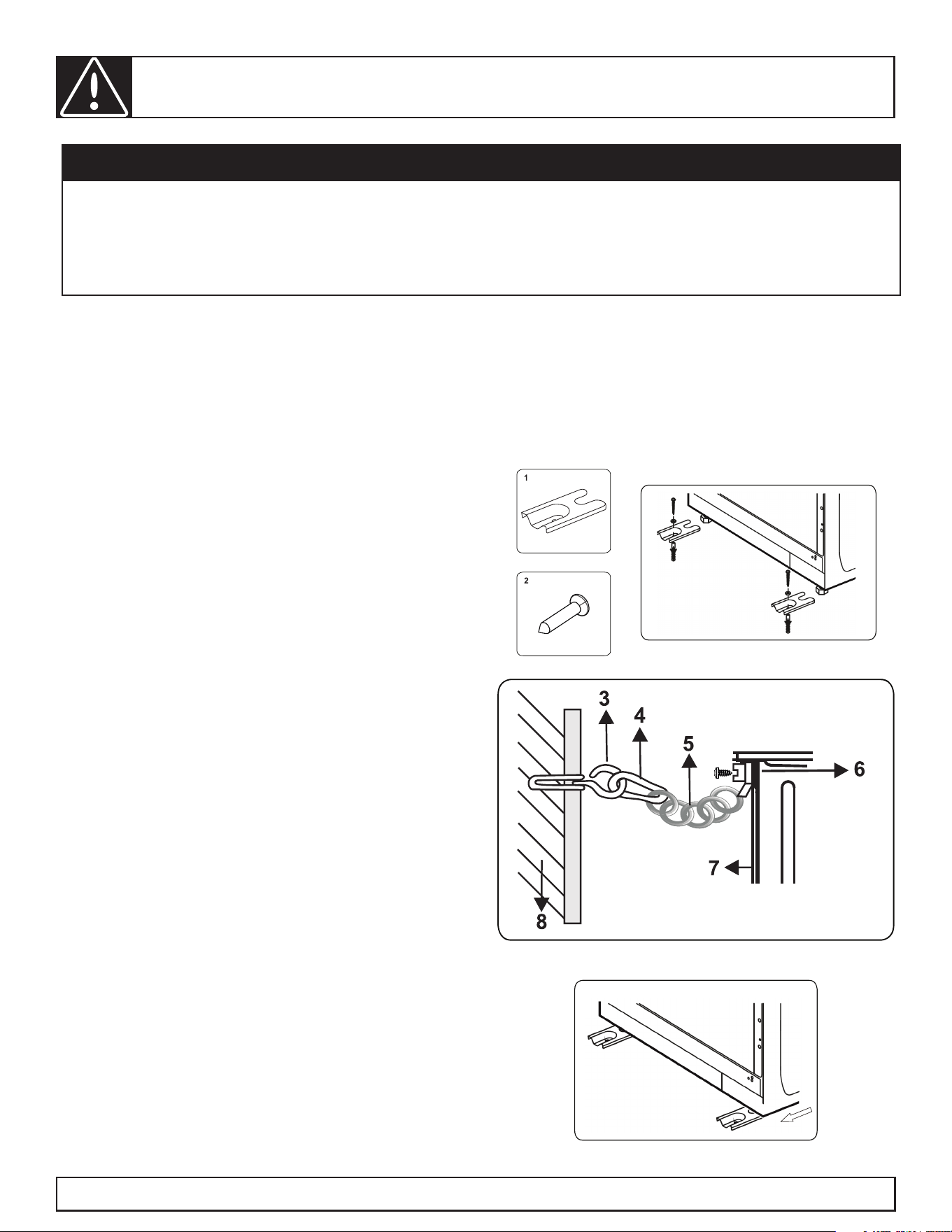
ANTI-TIP BRACKET
Installed on either the left or the right rear leg. To
install the anti-tip bracket:
01. Place the anti-tip bracket (1) on the floor where
the range will be installed.
02. Mark the location of the hole in the anti-tip
bracket.
03. Use a 5/16” (8mm) drill bit to drill a hole in the
floor and insert the provided screw (2) to secure
the anti-tip brackets to the floor
04. Then install the anti-tip chain
ANTI-TIP CHAIN
05. Use a wall plug to fasten the hook (3) to the
kitchen wall
06. With the help of the locking mechanism (4),
connect the safety chain (5) to the hook
INSTALL BOTH ANTI-TIP DEVICES
07. Slide the range back and into position,
ensuring that the anti-tip bracket is positioned
over the rear foot of the appliance
08. Using the screw attachment (6), tightly fix the
chain to the back of the range (7)
09. Remember the safety chain should be as short
as practically possible to avoid the appliance
from tilting forward, so the range should be
very close to the back wall (8)
Important Safety Information
READ AND FOLLOW ALL SAFETY INSTRUCTIONS
SAVE THESE INSTRUCTIONS!
NOTICE - BEFORE FIRST TIME USE
The heating elements have a protective coating on them which must be burned off before use. To do this:
• Open the oven door and set the temperature control knob to 450°F.
• Turn the function selector to the bake element and the broil element separately for approximately 15
minutes.
• It is important to ensure adequate ventilation during this period.
WARNING - HEATING ELEMENTS
• Heating elements on the surface or in the interior of the appliance may be hot even though they appear
cool
• Areas near the heating elements may become hot enough to cause burns
• Do not touch or let clothing or other flammable materials touch/contact heating elements or areas near
them during or after use (they must have sufficient time to cool)
• Surfaces of the appliance may become hot enough to cause burns: these areas include oven vent
openings, surfaces near these openings, oven doors and oven windows
DANGER - GREASE FIRES
• When heating fat or grease, do not leave it unattended as it could catch fire
• Never pick up a flaming pot or pan
• Do not use water or flour on grease fires
• In the event of a grease fire, turn off burner - if it is safe to do so - and extinguish the fire with a dry
chemical or foam-type extinguisher
• You may also smother the fire with a tight fitting pot lid, cookie sheet, flat tray, or baking soda
• If there is a fire in the oven during baking, smother the fire by closing the oven door and turn the oven
off
DANGER - FIRE RISK
• It is recommended that this appliance be connected to a separate circuit that is not shared with any
other appliance
• Never clean the appliance or appliance parts with flammable fluids, as these fumes can create a fire
hazard and/or explosion
• Before cleaning or servicing this appliance, unplug the appliance completely from the electrical outlet
or disconnect the range power supply at the household distribution panel by removing the fuse or
switching off the circuit breaker. Failure to do so can result in electrical shock or death
• Always disconnect the electrical supply to the appliance before servicing
• Do not attempt to repair or replace any part of your appliance unless it is specifically recommended in
this manual. All other servicing should be referred to a qualified service technician
• This appliance should never be used as a source of heat to warm or heat a room - using this
appliance as a space heater can lead to overheating of the appliance and/or carbon monoxide
poisoning
• The stove top elements should not be operated without proper cookware
• All openings in the wall behind the appliance and the floor under the appliance shall be sealed
• Do not obstruct the flow of air around the appliance
• Keep the area around the appliance clear and free of combustible materials, gasoline and other
flammable vapors
• Always keep combustible wall coverings, curtains or drapes a safe distance from the range
• Never use or store gasoline or other flammable vapors or liquids inside or in the proximity of this
appliance, failing to do so may result in a fire hazard or explosion
Important Safety Information
READ AND FOLLOW ALL SAFETY INSTRUCTIONS
SAVE THESE INSTRUCTIONS!
IMPORTANT
COLDER TEMPERATURES CAN DAMAGE THE ELECTRONIC CONTROL OF THE APPLIANCE
If the appliance has not been used for an extended period of time
• Be sure the appliance has been in temperatures above 32°F (0°C) for at least three (3) hours before
turning on the power to the appliance
MODIFICATIONS
• Never modify or alter the construction of the appliance by removing the leveling legs, panels, wire
covers, anti-tip brackets/screws, or any other part of the appliance
WARNINGS
STORAGE IN OR ON THE APPLIANCE
• Flammable materials should not be stored in an oven or microwave, near surface burners or elements,
or in the storage or warmer drawer (this includes paper, plastic, and cloth items like cookbooks, plastic
ware, and towels)
• Do not store explosives, such as aerosol cans, on or near the appliance
MOVING THE APPLIANCE
If you need to move the appliance:
• Do not move the appliance when it is in use, or still hot (to reduce the risk of burns)
• To reduce the risk of injury due to tipping of the appliance, verify the re-installation of this appliance
into the anti-tipping device provided after returning the appliance to the original installed position
DISPOSING OF THE APPLIANCE
To avoid the possibility of child entrapment please take the following precautions before throwing out the
appliance:
• Remove the oven door completely
• Never allow children to operate, play with or crawl inside the electric range
CAUTION - POWER FAILURES
Do not attempt to operate the appliance during a power failure. If the power fails:
• Turn the appliance off right away
• If power is restored and the surface element has not been turned off, the element will turn back on as
soon as the power is restored
• This may result in ignition of items on or near the cook-top, leading to serious injury or death
WARNING
The manufacturer declines all liability for injury to persons or damage to property cause by incorrect or
improper use of the range
Important Safety Information
READ AND FOLLOW ALL SAFETY INSTRUCTIONS
SAVE THESE INSTRUCTIONS!
GENERAL SAFETY REQUIREMENTS
• Ensure the appliance is properly installed and grounded by a qualified technician
• To eliminate the risk of burns or fire by reaching over heated surface units, cabinet storage space
located above the surface units should be avoided. If cabinet storage is to be provided, the risk can be
reduced by installing a range hood that projects horizontally a minimum of 5 inches (12.7 cm) beyond
the bottom of the cabinets
• Loose fitting or hanging garments should never be worn while using the appliance
• Only use dry pot holders (do not use a towel or other bulky cloths) - moist or damp pot holders on hot
surfaces may result in burns from steam
• Do not let the pot holder touch hot heating elements
• Do not heat unopened food containers - build-up of pressure may cause container to burst and result in
injury
• Children should not be left alone or unattended in the area where the appliance is in use
• Children should never be allowed to sit or stand on any part of the appliance (this includes the storage
drawer, lower broiler drawer, warner drawer, or lower double oven)
• Do not store items of interest to children in the cabinets above the appliance or on the back-guards of
ranges (Children climbing on or near the appliance to reach items could be seriously injured)
• Do not allow children to climb or play around the appliance, as the weight of a child on an open oven
door may cause the appliance to tip, resulting in serious burns or other injury
• An open drawer, when hot, may cause burns
• Stepping, leaning, or sitting on the door or drawers of this appliance can result in serious injuries and
also cause damage to the appliance
• Never cover any slots, holes or passages in the oven bottom or cover an entire rack with materials
such as aluminum foil (doing so blocks air flow through the oven and may cause carbon monoxide
poisoning. Aluminum foil linings may also trap heat, causing a fire hazard)
• To avoid the possibility of a burn or an electric shock, always be certain that the controls for all surface
elements are at the OFF position, and that all coils are cool before attempting to lift or remove a coil
cooking element.
• This range is designed and manufactured solely for the cooking of domestic (household) food and
is not suitable for any non domestic application and therefore should not be used in a commercial
environment. The range warranty will be void if the range is used within a non domestic environment.
Important Safety Information
READ AND FOLLOW ALL SAFETY INSTRUCTIONS
SAVE THESE INSTRUCTIONS!
GROUNDING INSTRUCTIONS
This appliance must be properly grounded. Grounding reduces the risk of electrical shock by providing an
escape wire for the electrical current.
INSTALLATION
• Be sure your appliance is properly installed and grounded by a qualified technician
Do not connect this appliance to the same wall outlet as another appliance. Do not connect it to an
extension cord or an adapter plug. Failure to follow this warning may cause serious injury, fire, or
death.
Note: Turning the appliance off does not disconnect the appliance from the power supply.
It is recommended that the power cord and the plug be placed parallel with the floor so that the cord runs
parallel with the floor.
CAUTION - RISK OF ELECTRICAL SHOCK
If the cord or plug becomes damaged, disconnect the appliance from the power
supply and replace with a cord or plug of the same type.
RADIANT COOK-TOP SAFETY
Know which knob or key controls each surface
heating area
• Place cookware with food on the cooking area
before turning it on
• Turn the cooking area off before removing the
cookware
Cookware handles should be turned inward and
not extend over adjacent surface elements
• This will reduce the risk of burns, ignition
of flammable materials, and spillage due to
unintentional contact with the utensil
Use the proper pan size: The appliance is equipped
with four burners of different sizes
• Select cookware with flat bottoms that match the
surface unit size
• The use of undersized cookware can expose a
portion of the heating element to direct contact
and may result in ignition of clothing
• Proper sizing of the cookware to cook-top will
improve cooking efficiency
• If using a griddle or long pan, do not use it on
more than one burner at once
Ensure reflector pans or drip bowls are in place:
Absence of these pans or bowls during cooking
may subject wiring components to damage
Use the appropriate type of cooking utensils:
• Only certain types of glass, ceramic,
earthenware or other glazed utensils are
suitable for range top service without breaking
due to sudden change in temperature
• Check the manufacturers recommendations for
cook-top use
Never leave appliance unattended while in use:
• Boil over can cause smoking and greasy spills
can ignite
• A pan that has boiled dry could also be
damaged and may end up damaging the cook-
top
Important Safety Information
READ AND FOLLOW ALL SAFETY INSTRUCTIONS
SAVE THESE INSTRUCTIONS!
Never leave oil unattended while frying:
• If oil is heated beyond its smoking point it
may ignite, resulting in fire that may spread to
surrounding cabinets
• Use a deep fat thermometer whenever possible
to monitor oil temperature
To avoid oil spillover and fire:
• Use a minimum amount of oil when shallow
pan-frying
• Avoid cooking frozen foods with excessive
amounts of ice
The searing grill is not designed for use on the
cook-top:
• Doing so may result in a fire
Remember to turn on the fan when you are
flaming foods under a ventilating hood
GLASS AND CERAMIC COOK-TOP SAFETY
Do not clean or operate a broken cook-top: If the
cook-top should break, cleaning solutions and spill
overs may penetrate the broken cook-top and create
a risk of electric shock
• Contact a qualified technician immediately
Clean a glass cook-top with caution:
• If a wet sponge or cloth is used to wipe spills
on a hot cooking area, be careful to avoid a
potential steam burn
• Some cleaners may produce harmful fumes if
applied to a hot surface
• Avoid scratching the cook-top glass with sharp
objects
Important Safety Information
READ AND FOLLOW ALL SAFETY INSTRUCTIONS
SAVE THESE INSTRUCTIONS!
OVEN SAFETY
Protective liners: Do not use aluminum foil, after-
market liners, or ant other materials or devices to
line oven bottom, oven racks, or any other part of
the appliance
• Only use aluminum as recommended for
baking, such as lining cookware or as a cover
placed on food
• Any other use of protective liners or aluminum
foil may result in a risk of electric shock, fire, or
a short circuit
Use care when opening the door:
• Stand to the side of the appliance when opening
the door of a hot oven
• This will allow hot air or steam to escape before
removing or replacing food
Never cover or place anything on or near the
top of the oven vent, especially plastic or heat-
sensitive items: These items can melt or ignite
Always place oven racks in desired location while
the oven is cool: If the rack must be moved while
the oven is hot:
• Remove all cookware and utensils before
moving the rack
• Use potholders and grasp the rack with both
hands to reposition
• Do not let potholder come into contact with a hot
burner or element in the oven
Do not use a broiler pan without an insert:
• Broiler pans and inserts allow dripping fat to
drain away from the high heat of the broiler
• Do not cover the broiler insert with aluminum
foil - exposed fat and grease could ignite
Do not place shelves, pans, baking trays, broil
trays, or other cooking utensils in the bottom of
the oven chamber
• Always place on an oven shelf
Do not cook food on the bottom of the oven:
• Always cook in the proper cookware and
always use an oven rack
Do not use the oven if a heating element develops
a glowing spot during use or shows other signs
of damage: A glowing spot indicates the heating
element may fail and present a potential burn, fire,
or shock hazard
• Turn the oven off immediately
• Contact a qualified service technician to have
the heating element replaced
Never clean the oven with any high pressure
steam cleaning devices
Keep oven vents unobstructed

9
INSTALLATION INSTRUCTIONS
WARNING FOR INSTALLATION AND PREPARATION FOR USE
The appliance must be installed by an authorized service person or qualified technician
• Incorrect installation may cause harm and damage for which the manufacturer accepts no
responsibility and the warranty will not be valid
• Prior to installation, ensure that the local distribution conditions (electricity voltage and frequency
and/or nature of the gas and gas pressure) and the adjustments of the appliance are compatible. The
adjustment conditions for this appliance are stated on the label
• Ensure the laws, ordinances, directives and standards in force in the country of use are to be followed
(safety regulations, proper recycling in accordance with the regulations, etc.).
BEFORE INSTALLATION
• Make sure there are no flammable or combustible materials in the vicinity (curtains, oil, cloth, etc)
which may catch fire
• The worktop and furniture surrounding the appliance must be made of materials resistant to
temperatures above 215°F (100 °C)
• The appliance should not be installed directly above a dishwasher, fridge, freezer, washing machine or
clothes dryer
• The appliance can be placed close to other furniture on the condition that, in the area where the
appliance is set up, the furniture’s height does not exceed the height of the cooktop
• To eliminate the risk of burns or fire when reaching over a hot surface element, cabinet storage space
above the cooktop should be avoided. If cabinet storage space is to be provided above the cooktop,
the risk can be reduced by installing a range hood that protrudes at least 5” (127 mm) beyond the
front of the cabinets. Cabinets installed above a cooktop may be no deeper than 13” (330 mm)
9 10
INSTALLATION INSTRUCTIONS
INSTALLATION OF THE COOKER
• The worktop and furniture surrounding the appliance must be made of materials resistant to
temperatures above 215°F (100 °C)
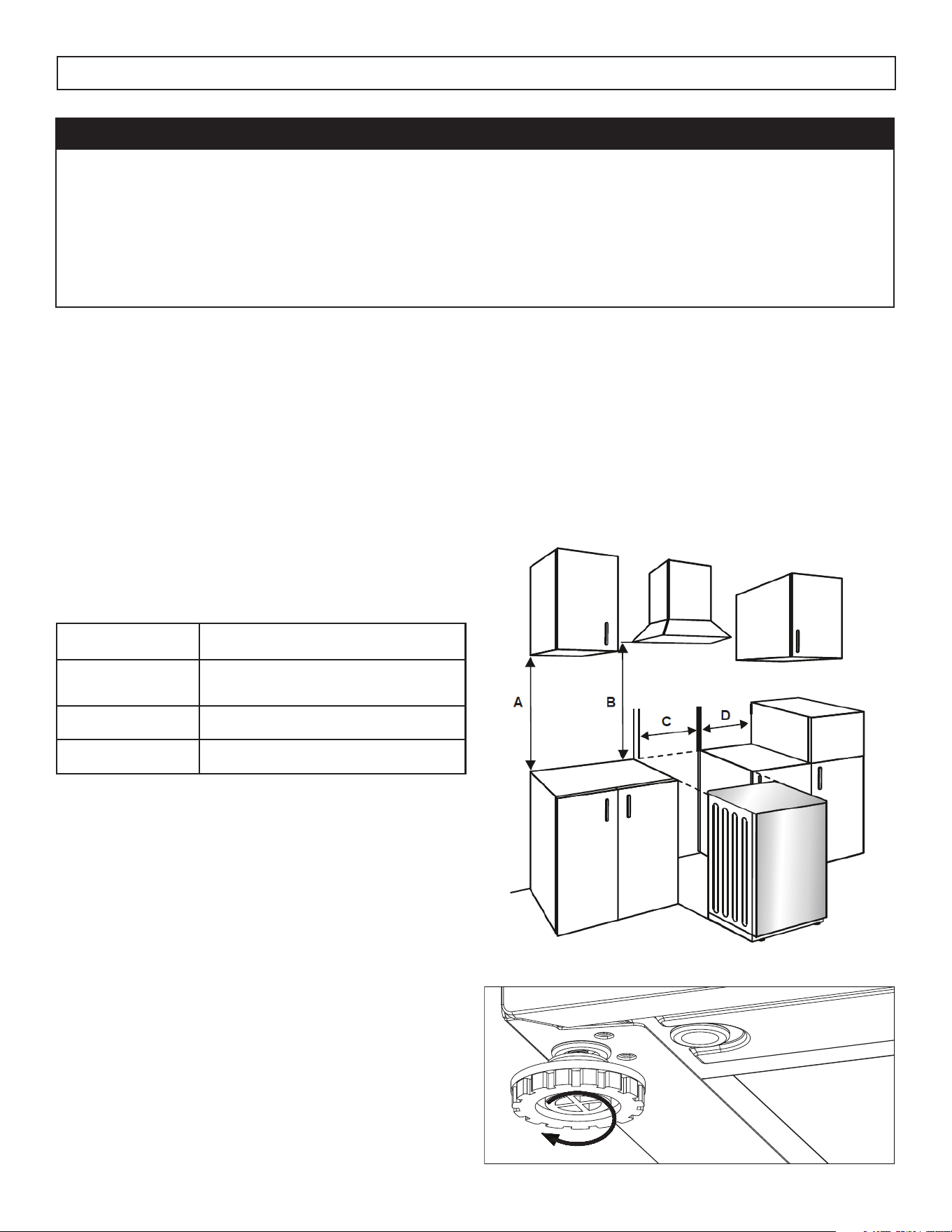
• If the kitchen furniture is higher than the cooktop, the kitchen furniture must be at least 13/32” (10 cm)
away from the sides of the appliance for air circulation
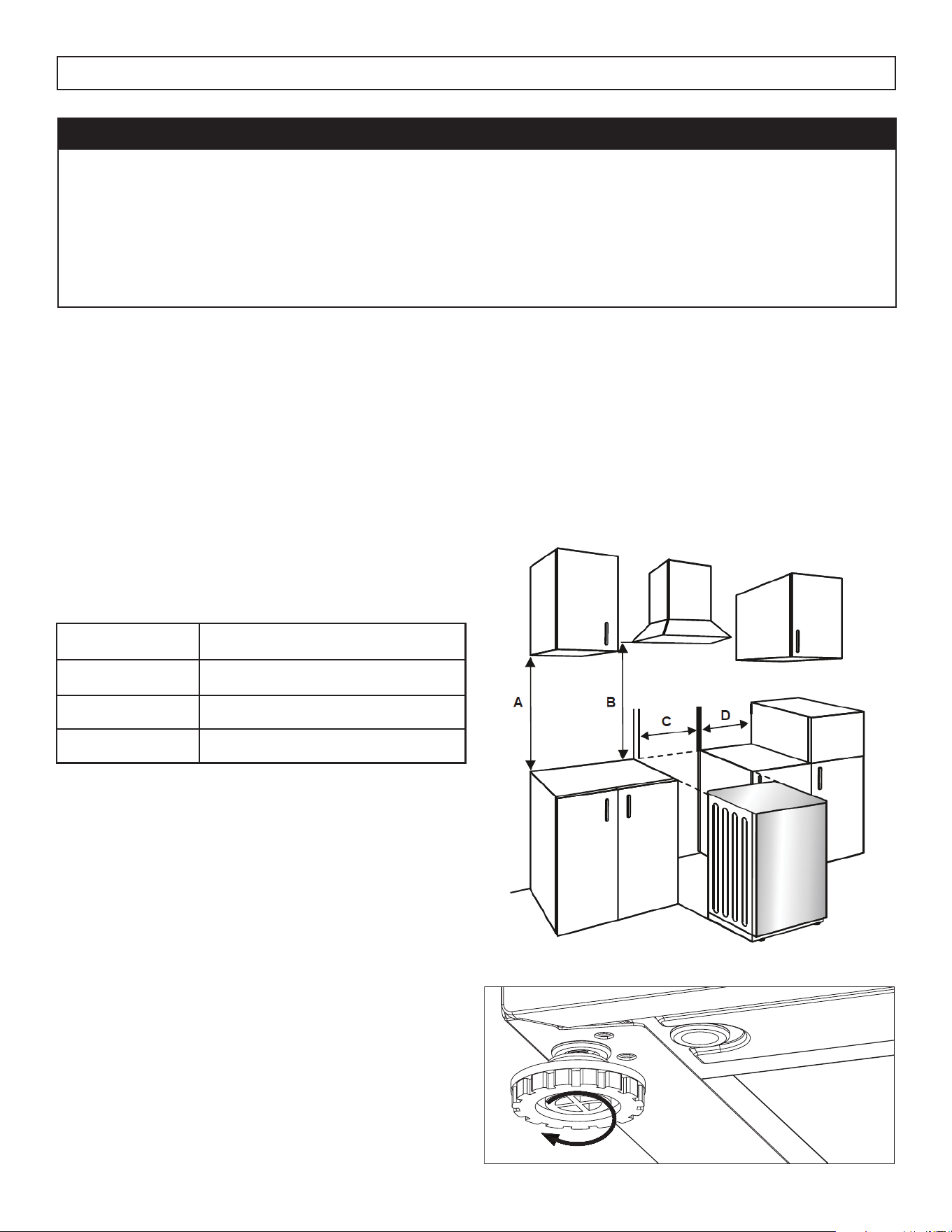
• If a cooker hood or cupboard is to be installed above the appliance, the safe distance between the
cooktop and any cupboard/cooker hood should be as shown:
IMPORTANT - UNPACKING YOUR APPLIANCE
Please read and follow the following instructions and precautions for unpacking, installing and servicing
your appliance:
• Remove all tape and packaging before using the appliance
• Dispose of the carton and plastic bags after unpacking the appliance
• Never allow children to play with packaging material
• Do not remove the wiring label and other literature attached to the appliance
• Do not remove model/serial number plate
A (Cupboard) 16.5” (420 mm)
B (Cooker hood) 25.5”/27.5” (650mm/700mm)
C Product width
D 2” (50 mm)
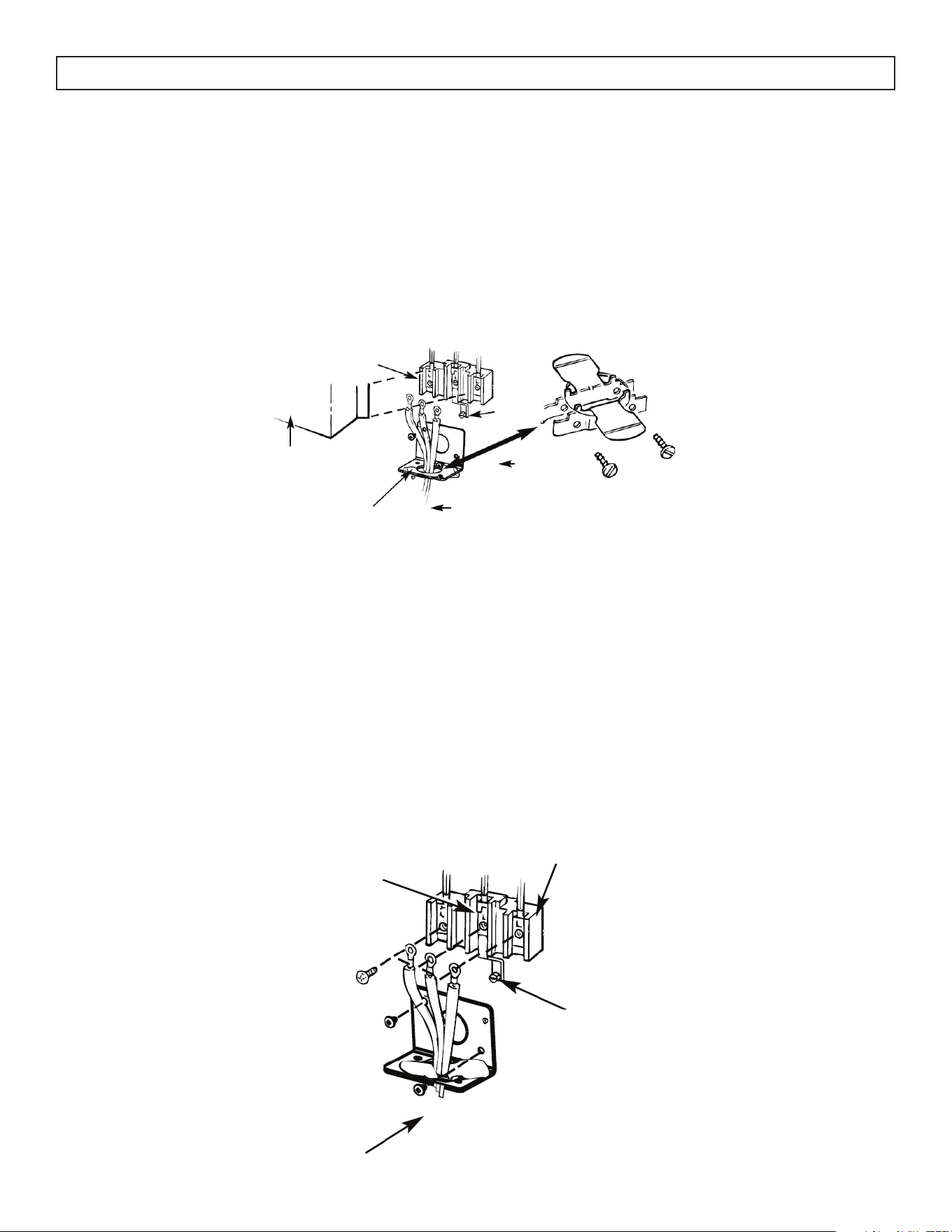
LEVELING INSTRUCTIONS
The appliance must be level to operate safely and
properly. There are four leveling legs located at
the corners of the bottom of the appliance. Adjust
the leveling legs until the appliance is level. Use a
carpenter’s level to confirm.
11
INSTALLATION INSTRUCTIONS
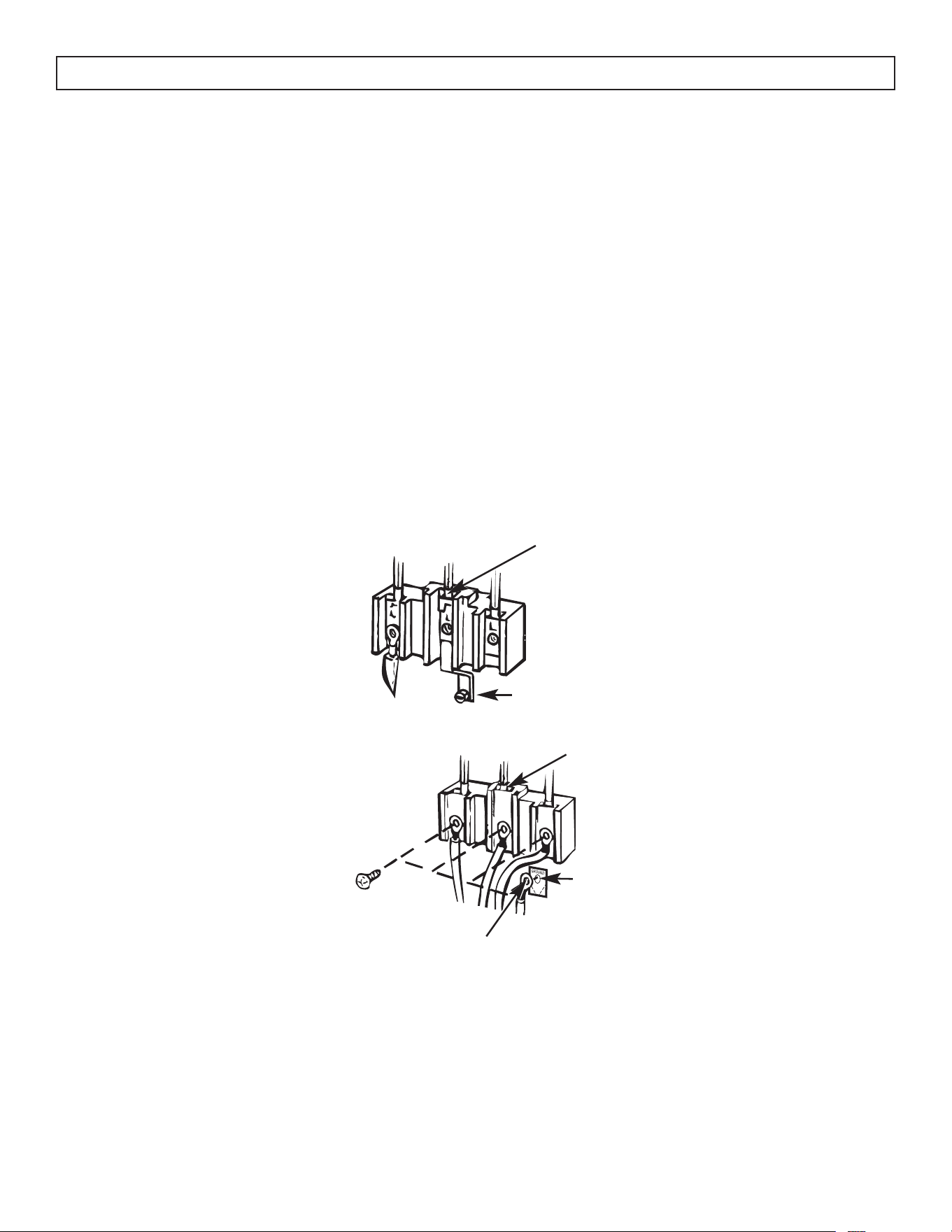
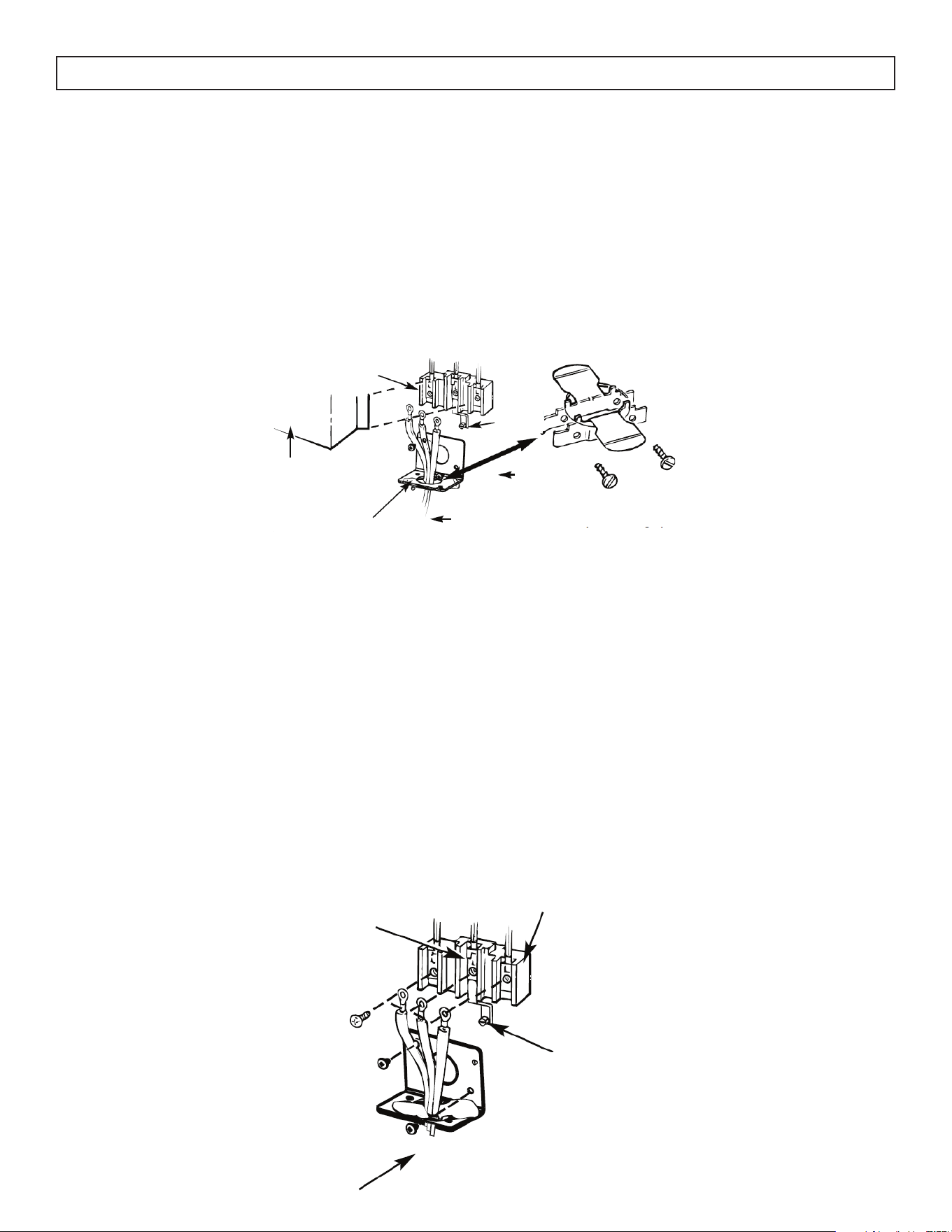
Neutral terminal
Connector block
Ground strap
Power cord
3-WIRE POWER CORD INSTALLATION
WARNING
The neutral or ground wire of the power cord must be connected to the neutral terminal located in the
center of the connector block. The power leads must be connected to the outside (brass colored) terminals.
Remove the 3 wire terminal screws from the connector block.
Insert screws through each power cord terminal ring and into the connector block until the screws engage
the nuts. Be certain that the center wire is connected to the center screw of the connector block.
Tighten screws securely.
Do NOT remove ground strap connection.
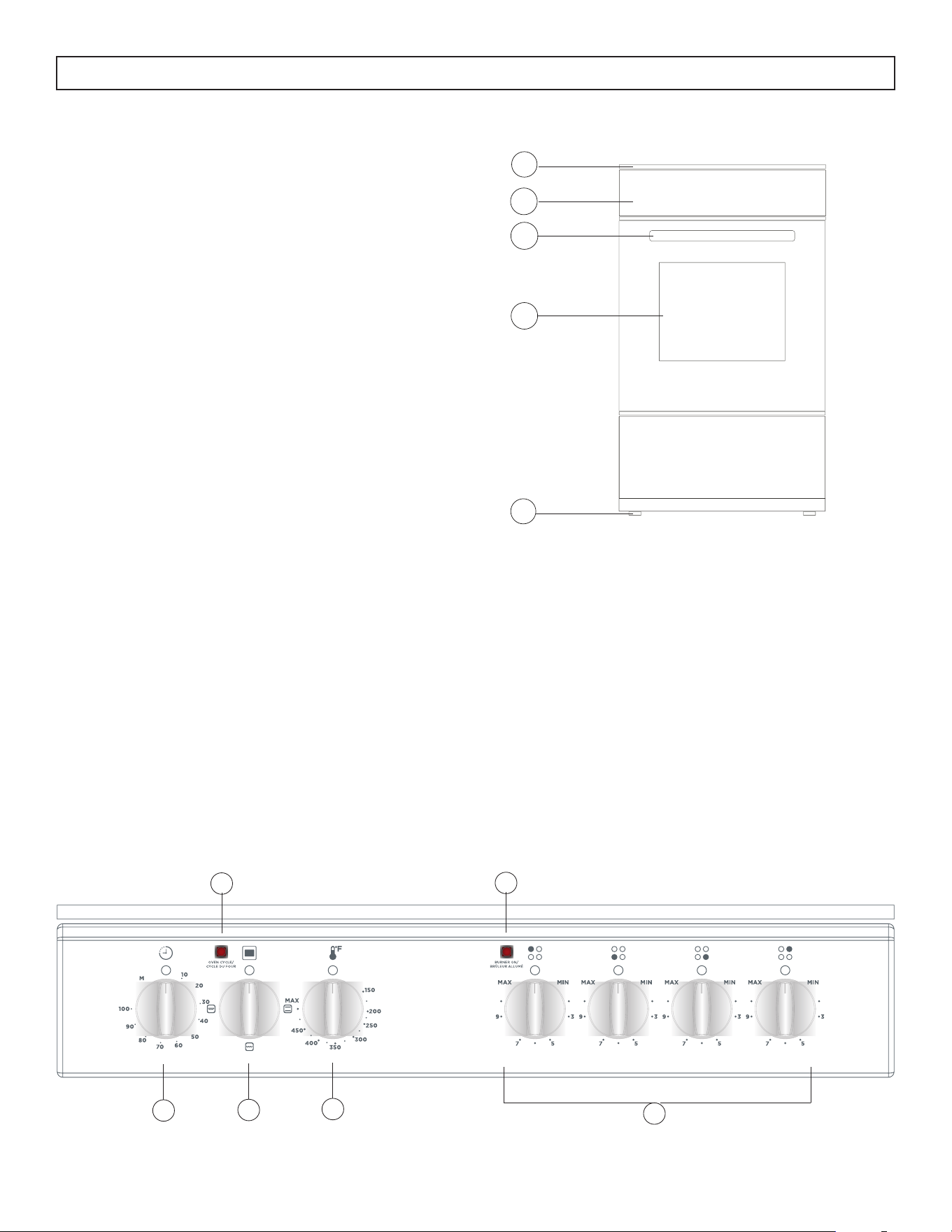
Connector box
Ground
strap
Strain relief bracket
(Provided with range cord.
Not part of range)
Power cord
Strain relief
Wiring cover
(shown removed)
Bracket
POWER CORD STRAIN RELIEF INSTALL
Only a 4-conductor power-supply cord kit rated 240 volts, 40 amperes and marked for use with ranges
must be used. Assemble the strain relief in the hole. Insert the power cord through the strain relief and
tighten. Allow enough slack to easily attach the cord terminals to the connector block. If tabs are present at
the end of the winged strain relief, they can be removed for better fit.
Note: Do not install the power cord without a strain relief. The strain relief bracket should be installed
before reinstalling the rear range wiring cover.
11 12
INSTALLATION INSTRUCTIONS
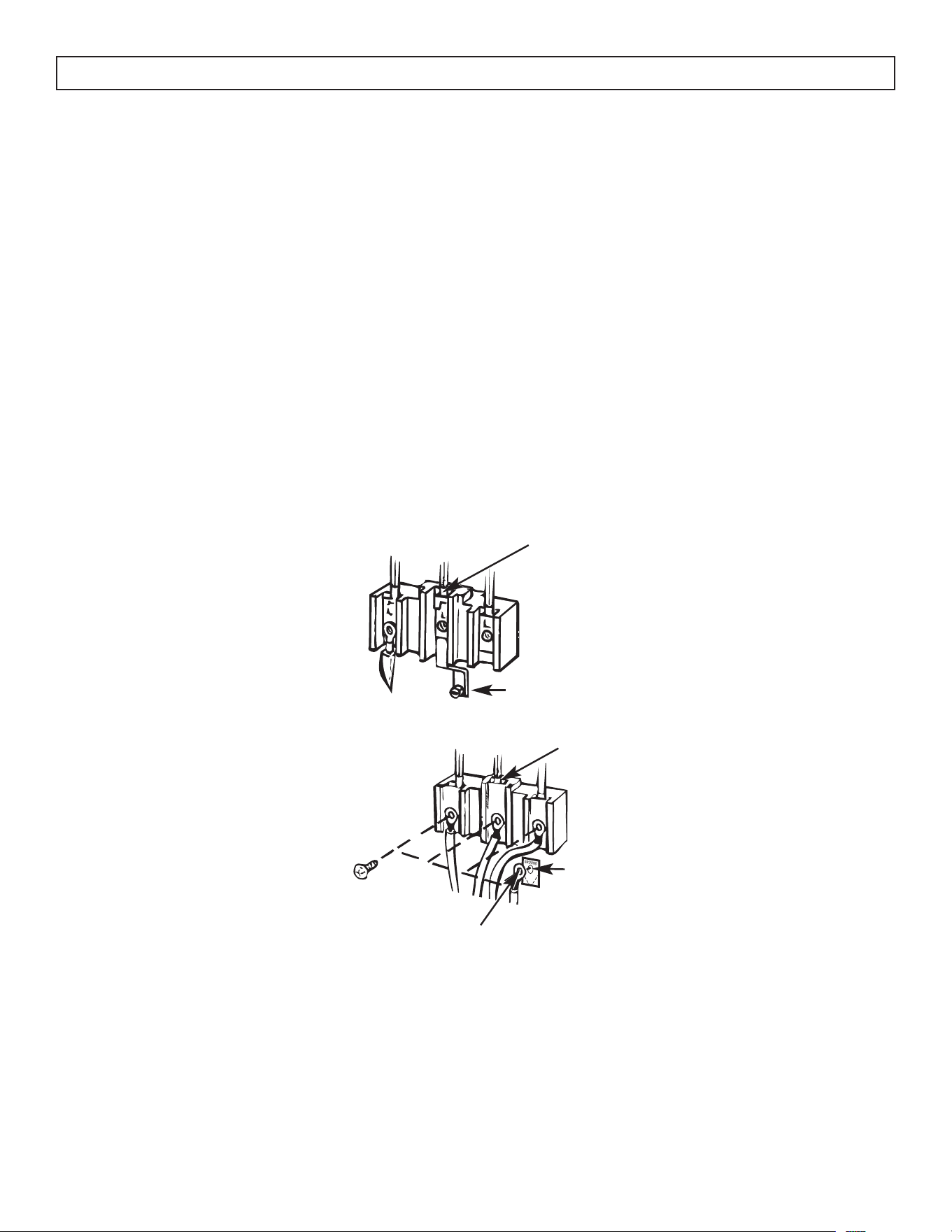
4-WIRE POWER CORD INSTALLATION
WARNING
The neutral wire of the supply circuit is connected to the neutral terminal located in the center of the
connector block. The power leads must be connected to the outside (brass coloured) terminals. The 4th
grounding lead must be connected to the frame of the range with the grounding plate and grounding
screw.
1. Remove the 3 screws from the connector block.
2. Remove the grounding screw and strap from the connector block middle location and the screw
connection to the frame of the range.
3. Insert screws through each power cord terminal ring and into the connector block until the screw
engages the nut. Be certain that the center wire is connected to the center screw of the connector block.
Tighten the screws securely.
4. Attach the ground wire to the frame of the range.
5. Replace the terminal block access plate.
13
INSTALLATION INSTRUCTIONS
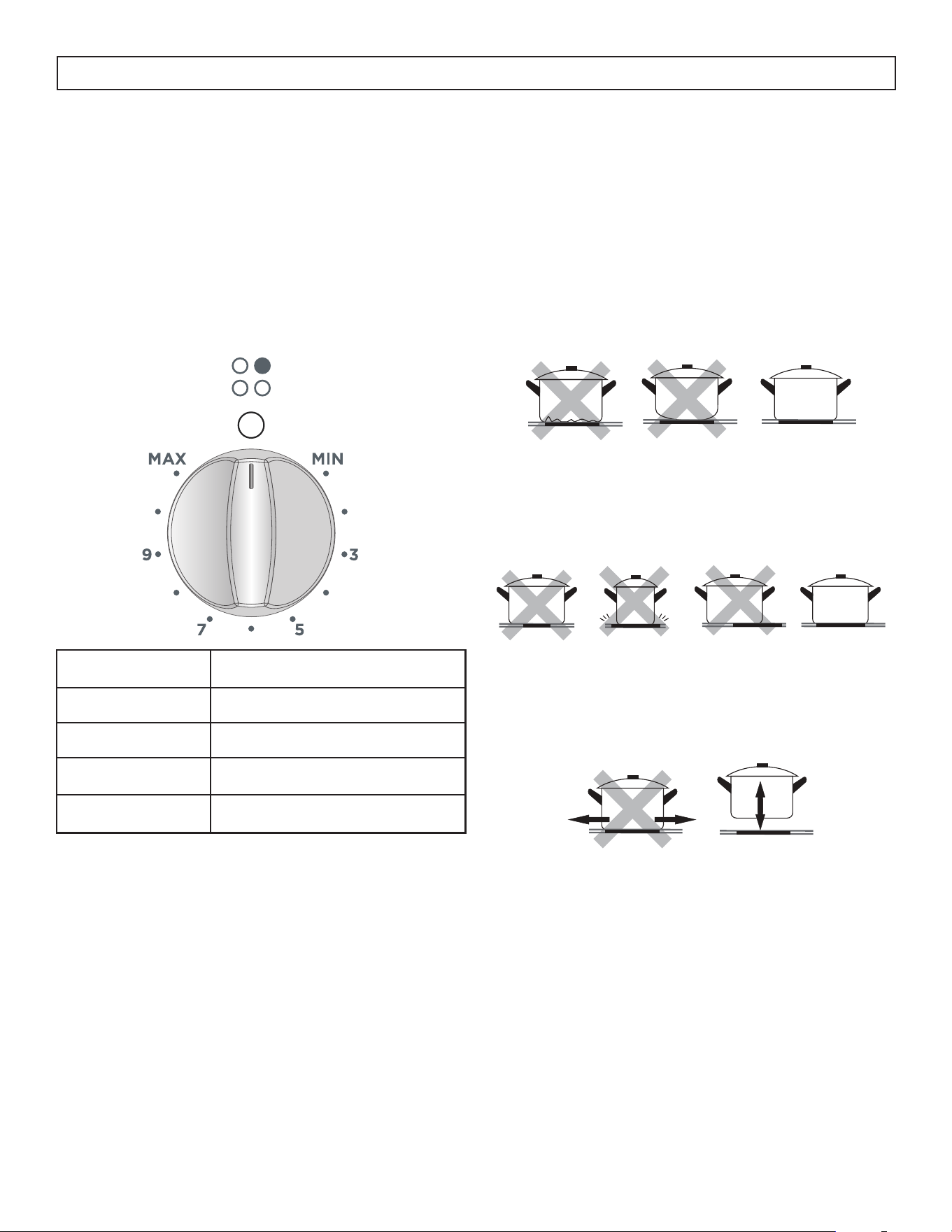
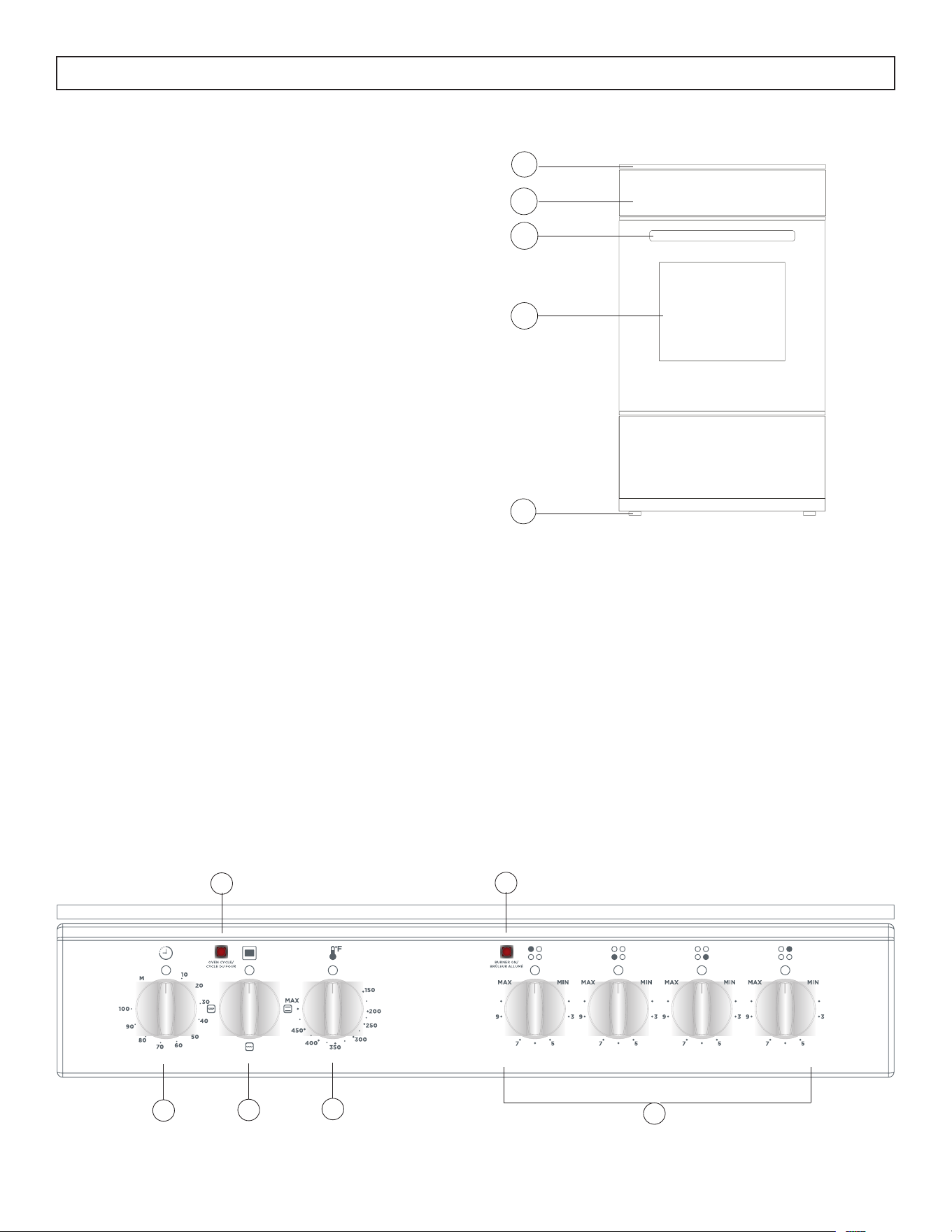
PRODUCT FEATURES
1. Cooktop
2. Control panel
3. Oven door handle
4. Oven door
5. Adjustable feet
1
2
3
4
5
CONTROL PANEL
1. Oven Timer Control Knob
2. Oven Function Control Knob
3. Oven Thermostat Knob
4. Oven Indicator Light
5. Surface Cooking Knob
6. Surface Cooking Light
1
4
2
5
6
3
13 14
OPERATING INSTRUCTIONS
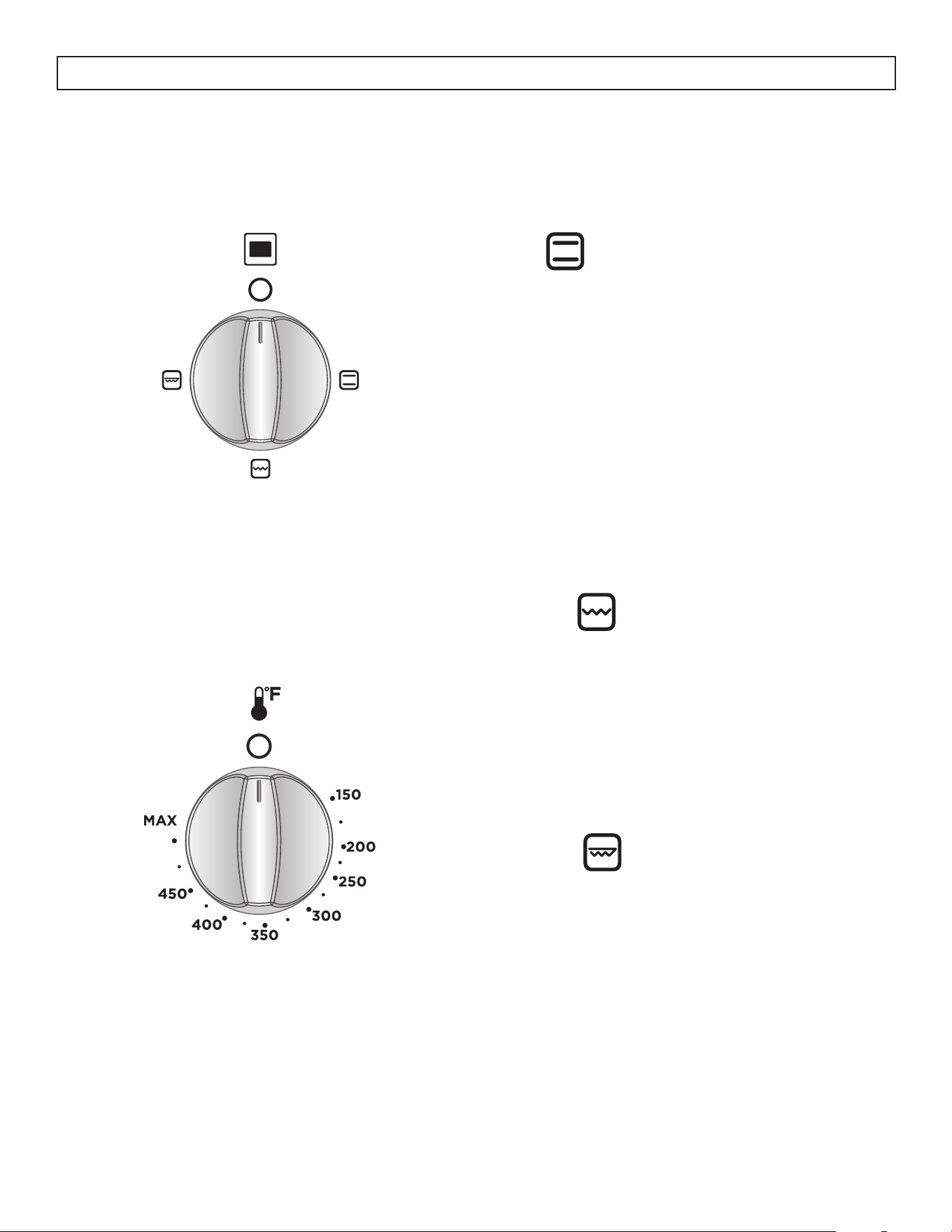
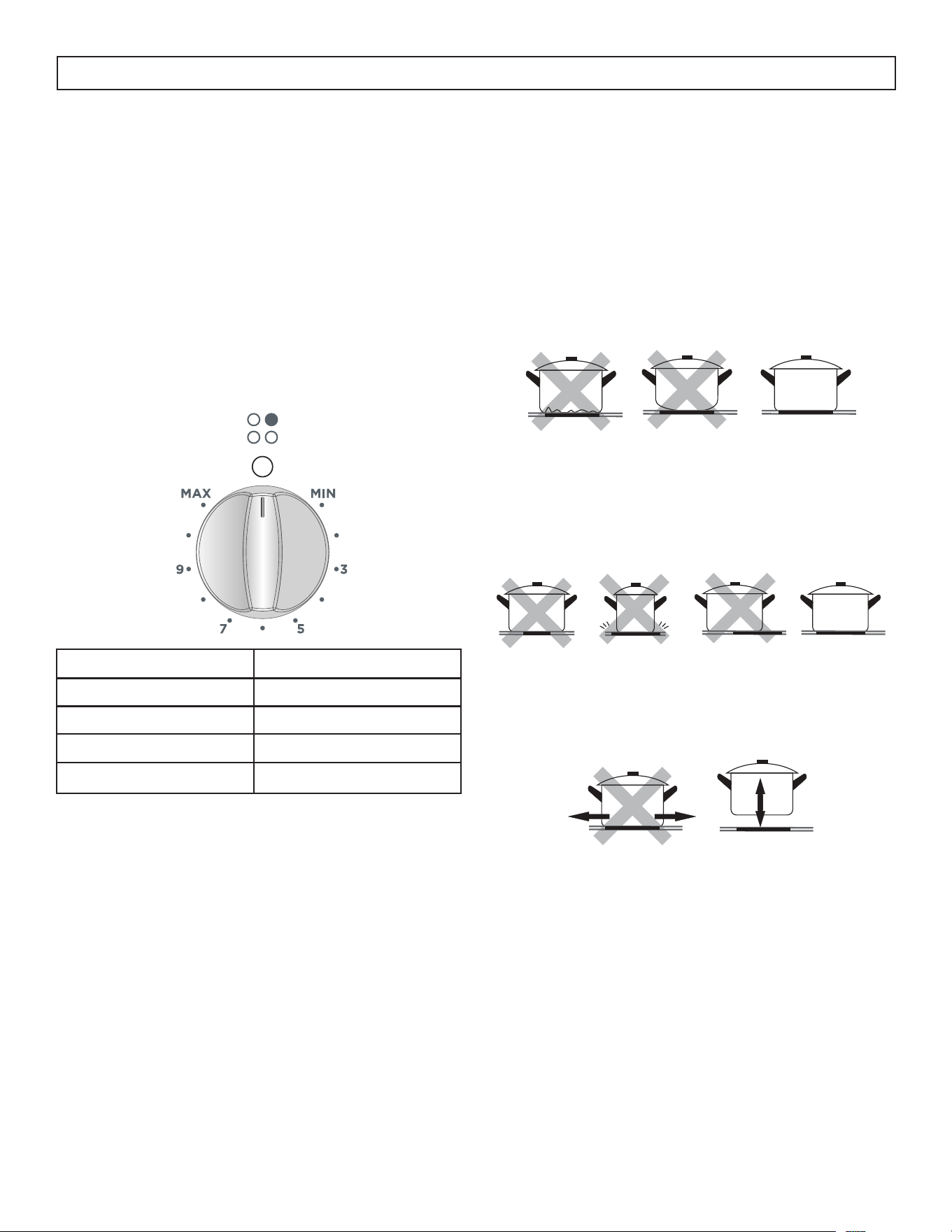
CERAMIC HEATER CONTROLS
• Ceramic heat is controlled by a 6 position knob
• To turn on, turn the control knob to the required
setting
• By the control knobs will be a symbol that
indicates the heater that is controlled by that
knob
• The ON/OFF light on the control panel will
show if any of the ceramic heaters are in use
RESIDUAL HEAT INDICATOR (if available)
• After using the ceramic heater there will be heat
stored in the vitro ceramic glass, called residual
heat
• If the residual heat level is greater than +140
ºF (60 ºC),, the residual heat indicator will be
active for the cooking zone that is above this
temperature
• If the power supply to the hob is disconnected
while the residual heat indicator is on, the
warning light will flash when the power is
reconnected
• The display will flash until the residual heat has
decreased or until one of the cooking zones is
activated
Knob Position Function
0 Off
MIN Keep warm
3-5 Heating at low heat
7-9 MAX Cooking, roasting and boiling
COOKWARE
WARNING: Never operate the hob without pans on
the cooking zone
• If possible, always place lids on the pans
• Do not use cookware with jagged edges or a
curves base
• Ensure the base of your cookware is smooth, sits
flat against the glass, and is the same size as the
cooking zone - always center your cookware on
the element.
• When removing cookware from the ceramic
surface, always lift it - do not slide it, as it may
scratch the glass
IMPORTANT
• The temperature of accessible parts may become
high while the appliance is operating. Keep
children and animals away from the ceramic
heater during operation until it has fully cooled
after operation
• If you notice a crack on the cooktop, switch it off
immediately and contact an authorized service
provider to get it replaced
15
OPERATING INSTRUCTIONS
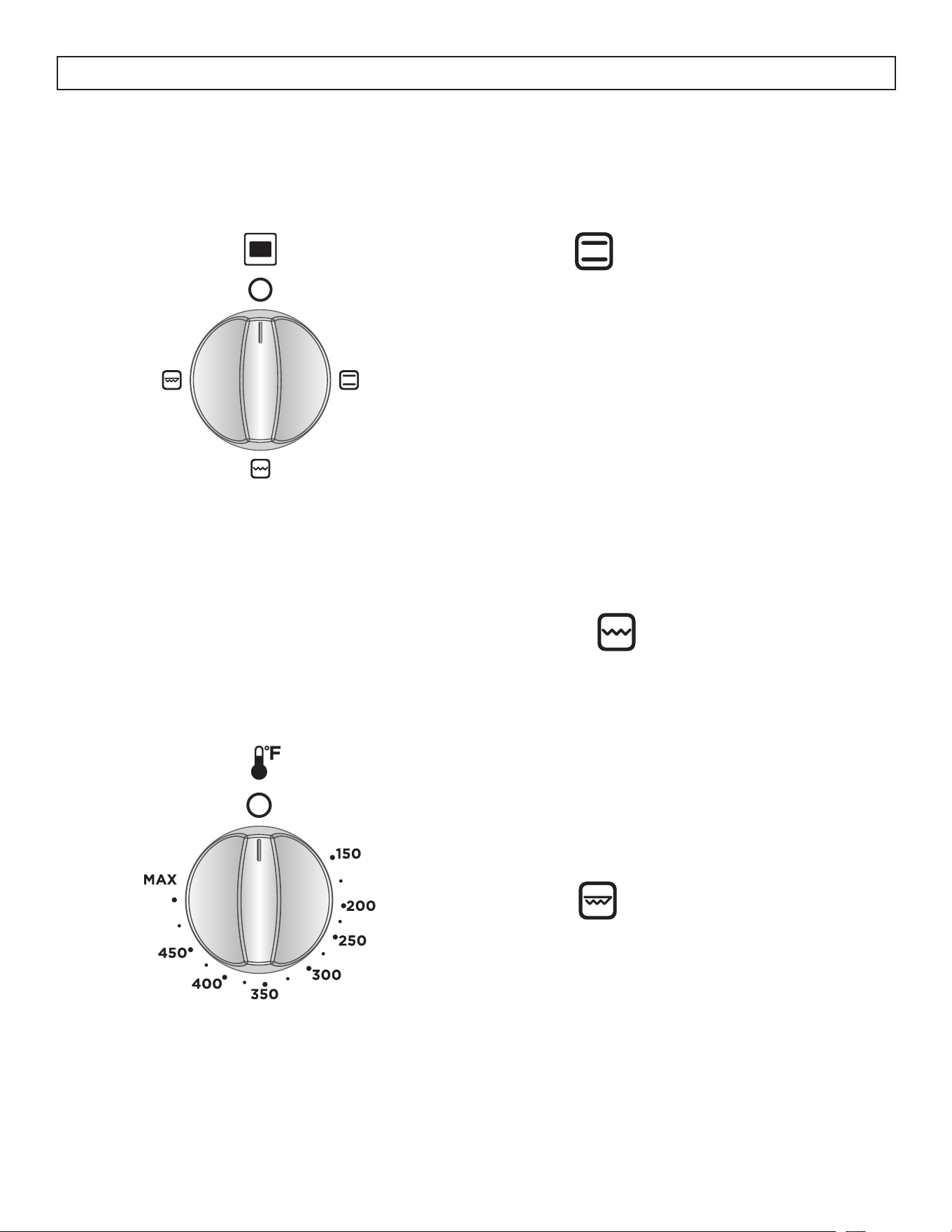
OVEN FUNCTIONS
NOTE: It is recommended to preheat oven for 10
minutes for best use
Bake
The oven’s thermostat and warning lights will switch
on, and the lower and upper heating elements will
begin operating. The Bake function emits heat,
ensuring even cooking of food.
Ideal for making:
• Pastries
• Cakes
• Baked pasta
• Lasagna
• Pizza
Broil Low
The oven’s thermostat and warning lights will
switch on, and the broil heating element will begin
operating. This function is used for broiling or
toasting foods on the upper shelves of the oven.
• Always place a tray beneath the food to catch
any drips of oil or fat
Broil High
The oven’s thermostat and warning lights will switch
on, and the broil and upper heating elements will
begin operating. This function is used for faster
broiling and for broiling food with a larger surface
area, like meat.
• Always place a tray beneath the food to catch
any drips of oil or fat
OVEN FUNCTION CONTROL KNOB
Turn the knob to the corresponding symbol of the
desired cooking function.
OVEN THERMOSTAT KNOB
After a cooking function has been selected, turn
this knob to set the desired temperature. The oven
thermostat light will illuminate whenever the oven is
heating up or still hot.
15
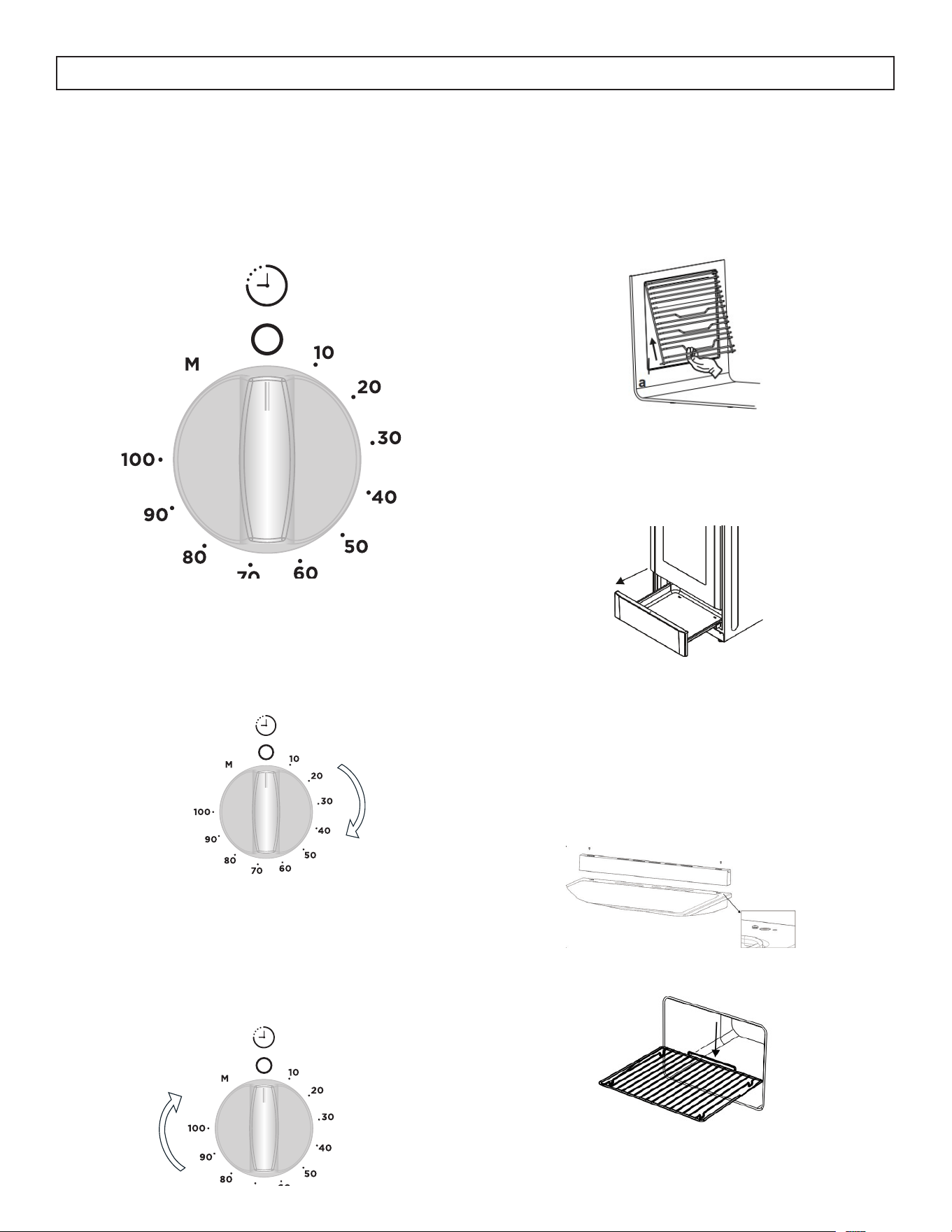
ACCESSORIES
The EasyFix Wire Rack
• To remove the wire rack, pull the wire rack as
shown below to release it from the clips (a).
After releasing it from the clips, lift it up.
The Four Wheel Guided Drawer
• Your appliance includes a drawer for storage of
accessories - trays, shelves, grids, and small pots
and pans
WARNING: The inner surface of the drawer may
become hot during use. Do not store any food,
plastic or flammable materials in the drawer.
The Splashback
• The splashback is attached to the cooktop with
two screws
The Wire Grid
OPERATING INSTRUCTIONS
WARNING: When placing the grid, ensure the rear
is correctly positioned before pushing it into the
oven.
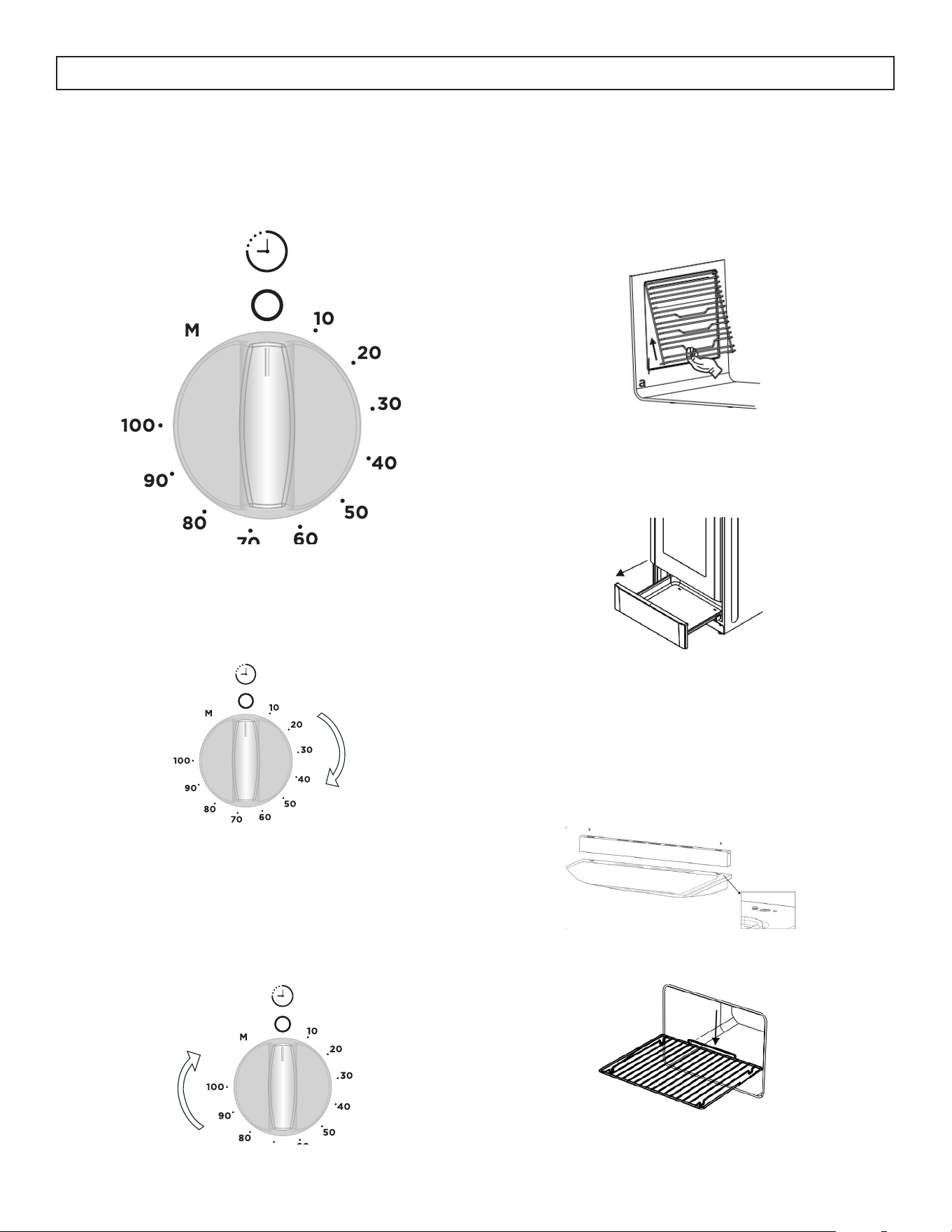
OVEN TIMER CONTROL KNOB
For your enhanced safety, our oven has
been designed to operate with a timer.
If you prefer to use the oven without the tim-
er, simply turn the timer knob counterclock-
wise to the M (manual), and the oven will
stay on continuously.
To set the timer, turn the knob clockwise to
your desired amount of time. Once the timer
reaches 0, the oven will turn off.
17
GENERAL CLEANING INSTRUCTIONS
WARNING: Switch off the appliance and allow it to
cool before cleaning
• Ensure cleaning materials are appropriate and
recommended by the manufacturer before using
on the appliance
• Use smooth cream or liquid cleaners - make sure
it does not have any particles in them
• Do not use corrosive creams, abrasive cleaning
powder’s, rough wire wool or hard tools as they
may damage the cooker surfaces
For everyday cleaning of marks, fingerprints and
non-sugary spillovers, apply a ceramic cooktop
cleaning product. Rinse and wipe dry with a clean
cloth or paper towel.
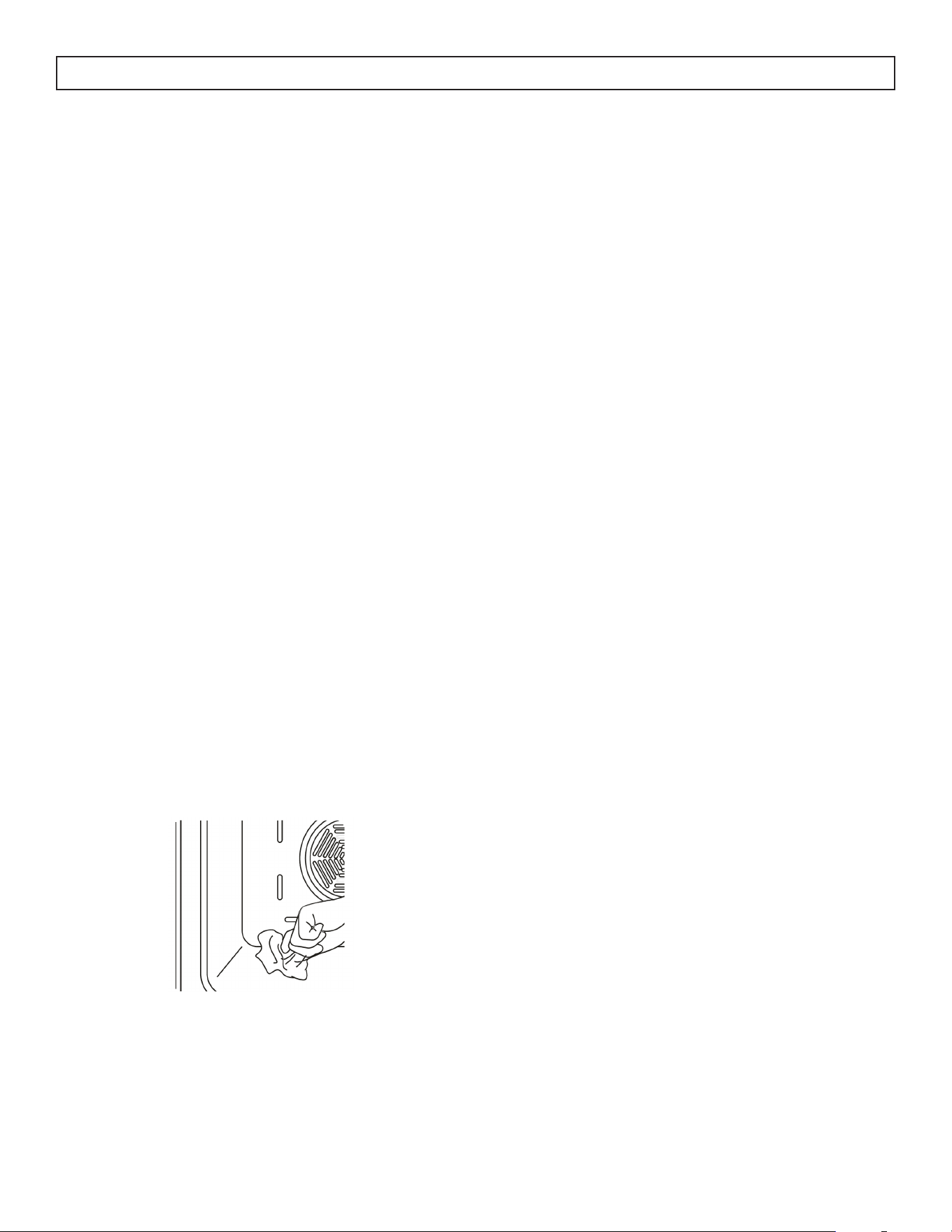
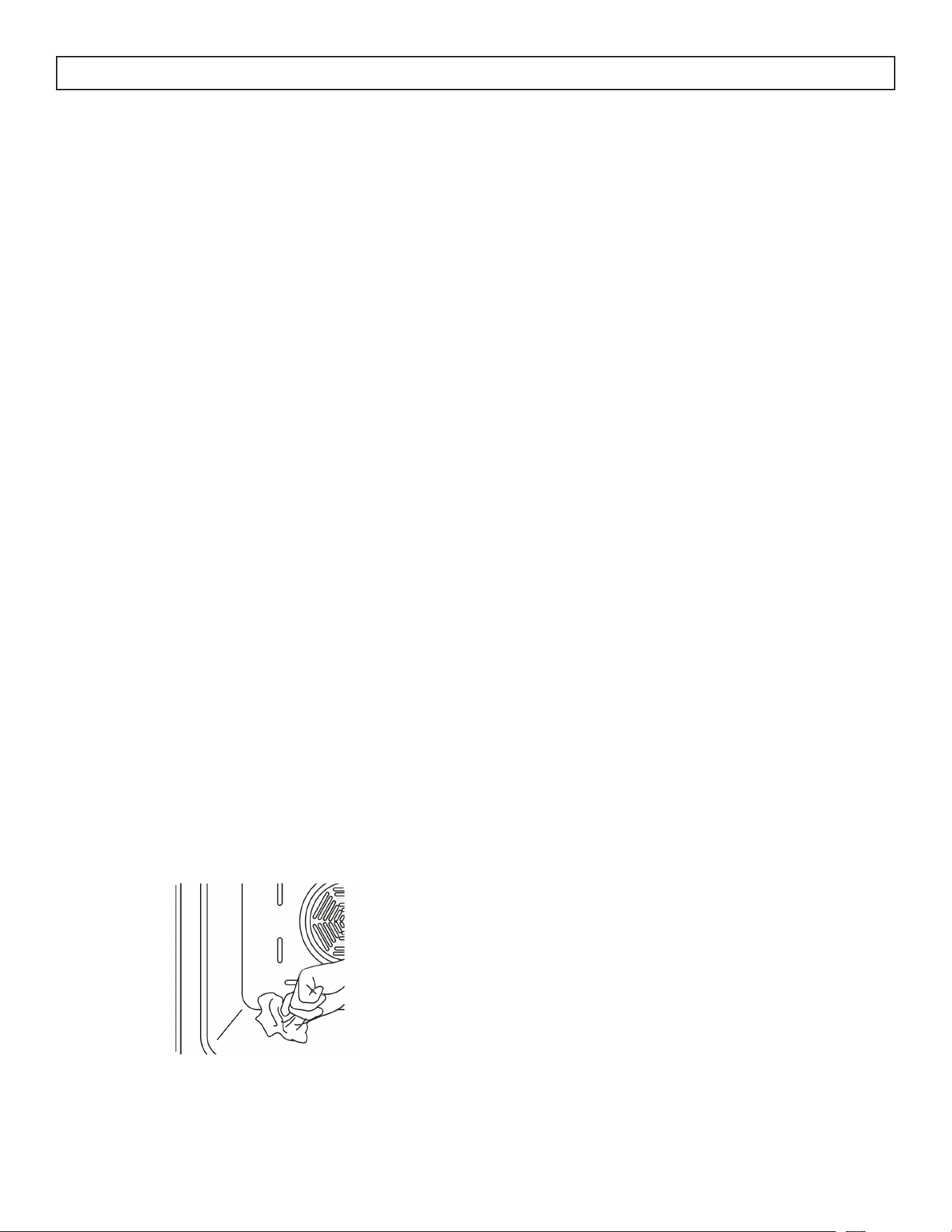
Cleaning the Inside of the Oven
• Best cleaned while oven is warm
• Recommended to do after each use of the oven
• Wipe the oven with a soft cloth soaked in soapy
water
• Then wipe oven again with a wet cloth and dry
it
CARE & MAINTENANCE
Cleaning the Ceramic Glass
WARNING: If the surface is cracked, switch off
appliance immediately to avoid the possibility of an
electric shock. Call right away to have it replaced.
• Use a cream or liquid cleaner to clean the
vitroceramic glass
• Rinse and dry glass thoroughly with a dry cloth
• Remember: do not use cleaning materials meant
for steel, as they may damage the glass
If substances with a low melting point are used in
the cookware’s base or coatings, they can damage
the glass-ceramic cooktop.
For boil overs, melts and hot sugary spills on the
cooktop, remove the spill or food item immediately
with a ceramic cooktop razor but beware hot
cooking surfaces. Hold the razor at a 45-degree
angle and scrape the spilled food to a cool area
of the cooktop, then clean it up with a dish cloth
or paper towel. Large spills should be removed
immediately to ensure they do not bake onto the
surface of the cooktop.
Any changes in colour to the ceramic glass will not
affect the structure or durability of the ceramic and
is not due to a change in the material. The colour
may change for a number of reasons:
1. Spilt food has not been cleaned off the surface
2. Incorrect dishes are being used, which can erode
the surface
3. The wrong cleaning materials are being used

17 18
CARE & MAINTENANCE
Cleaning Glass Parts
• Clean glass parts of your appliance on a regular
basis
• Use a glass cleaner to clean the inside and
outside of the glass parts
• Rinse and dry them thoroughly with a dry cloth
Cleaning the Enameled Parts
• Clean enameled parts of your appliance on a
regular basis
• Wipe the enameled parts with a soft cloth
soaked in soapy water
• Then wipe them over again with a wet cloth and
dry them
IMPORTANT
Do not clean the enameled parts while they are still
hot from cooking
Do not leave vinegar, coffee, milk, salt, water,
lemon, or tomato juice on the enamel for long
periods of time
Cleaning Stainless Steel Parts (if available)
• Clean stainless steel parts of your appliance on
a regular basis
• Wipe the stainless steel parts with a soft cloth
soaked in water only
• Then dry them thoroughly with a dry cloth
IMPORTANT
Do not clean the stainless steel parts while they are
still hot from cooking
Do not leave vinegar, coffee, milk, salt, water,
lemon, or tomato juice on the enamel for long
periods of time
Cleaning Painted Surfaces (if available)
• Spots of tomato, tomato paste, ketchup, lemon,
oil derivatives, milk, sugary foods, sugary
drinks and coffee should be cleaned with a cloth
dipped in warm water immediately
• If these are not cleaned and end up drying on
the surfaces, they should not be rubbed with
hard objects (pointed objects, steel and plastic
scouring wires, surface-damaging dish sponge)
or cleaning agents containing high levels of
alcohol, stain removers, degreasers, surface
abrasive chemicals. Otherwise, corrosion may
occur on the powder painted surfaces, and
stains can occur.
NOTE: The manufacture will not be held responsible
for any damage caused by the use of inappropriate
cleaning products or methods
19
CARE & MAINTENANCE
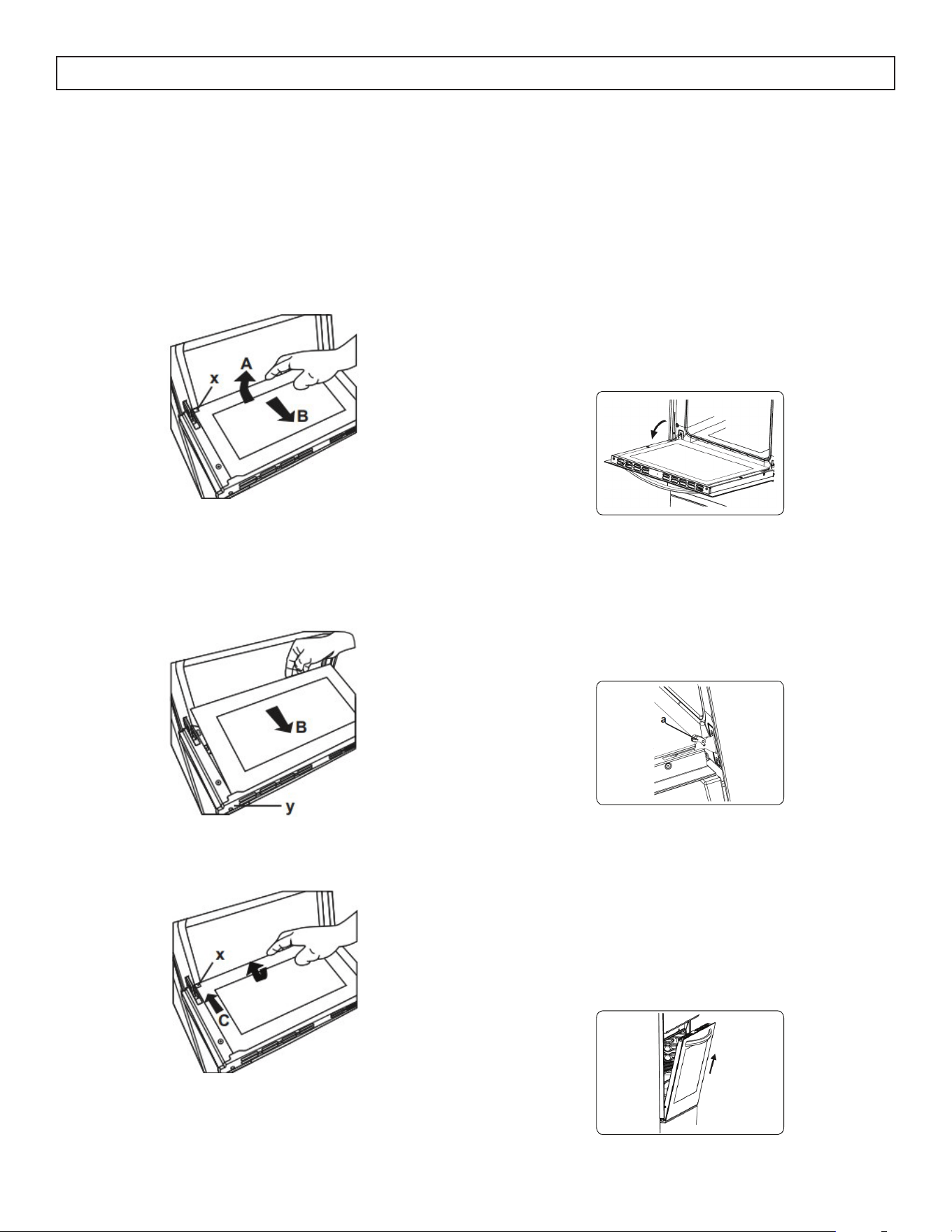
To replace the inner glass:
2. Push the glass towards and under the location
bracket (y) in the direction of B.
3. Place the glass under the location bracket (x) in
the direction of C.
Removal of the Oven Door
NOTE: The oven door is removable but it is heavy.
It is recommended that at least two people work
together to remove it.
Remove the oven door before cleaning the oven
door glass, as shown below:
1. Open the oven door
NOTE: If the oven door is a triple glass oven door,
the third glass layer can be removed the same way
as the second glass layer.
Removal of the Inner Glass
You must remove the oven door glass before
cleaning, as shown below:
1. Push the glass in the direction of B and release
from the location bracket (x). Pull the glass out in
the direction of A.
2. Open the locking catch (a) (with the aid of a
screwdriver) up to the end position.
3. Close the door until it almost reaches the fully
closed position and remove the door by pulling
it towards you.
19 20
CARE & MAINTENANCE
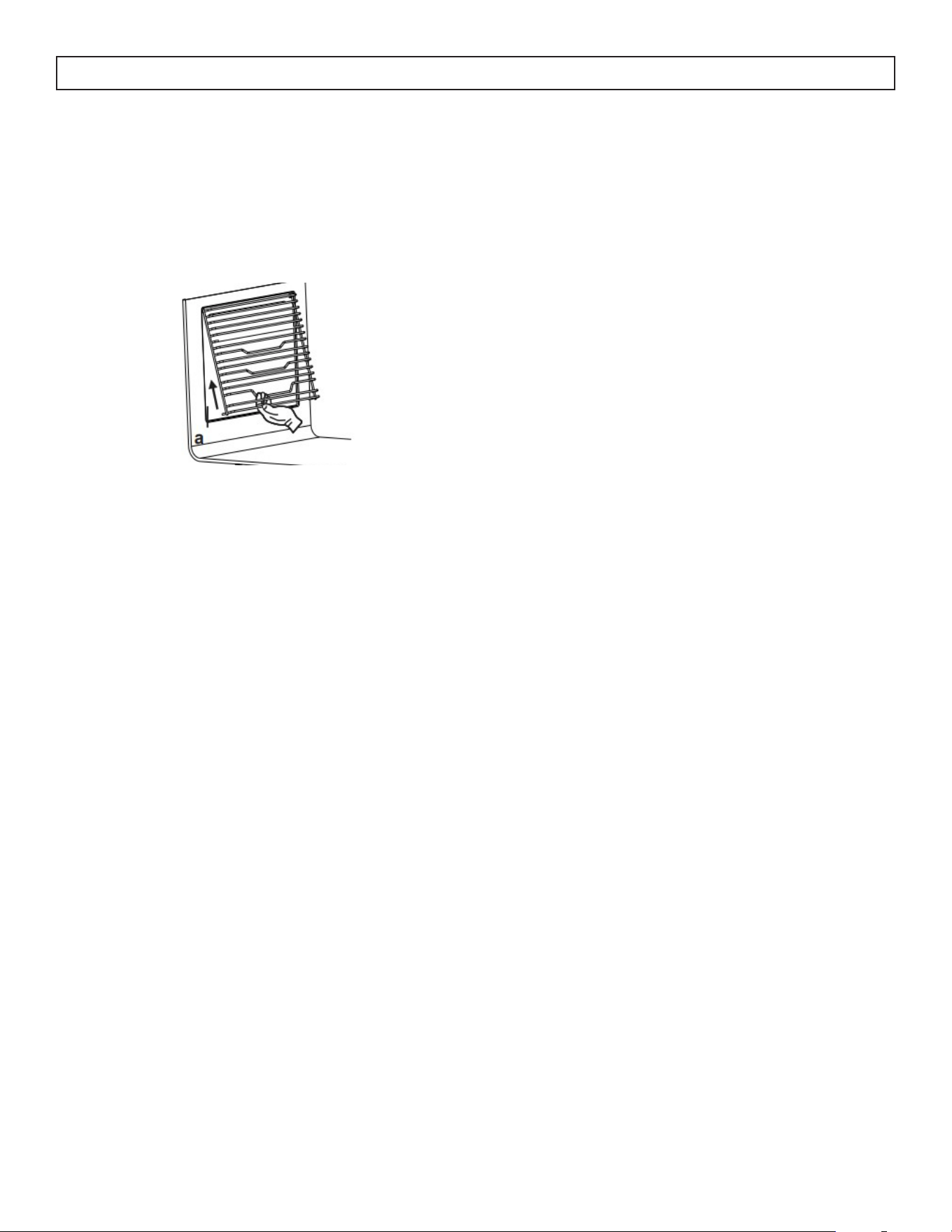
Removal of the Wire Shelf
To remove the wire rack, pull the wire rack as
shown in the figure. After releasing it from the clips
(a), lift it up.
Oven Light Replacement
Warning: The maintenance of this appliance should
be carried out by an authorized service person or
qualified technician only
Important
• Before replacing the oven light bulb, make sure
the electrical power is disconnected from the
appliance. Failure to do so may result in electric
shock or burn
• Be sure to let the light cover and bulb cool
completely before replacing
• Removing the oven door can make this process
easier.
To replace the light bulb:
• Remove the glass lens, then remove the bulb
• Insert the new bulb (resistant to 600°F or 315
°C) to replace the bulb that you removed (240 V,
15-25 Watt, Type E14)
• Replace the glass lens, then your oven is ready
to be used
Notes:
The product contains a light source of energy
efficiency class G
The included light source is not intended for use in
other applications - it is designed specifically for use
in household cooking appliances. It is not suitable
for household room illumination
21
TROUBLESHOOTING
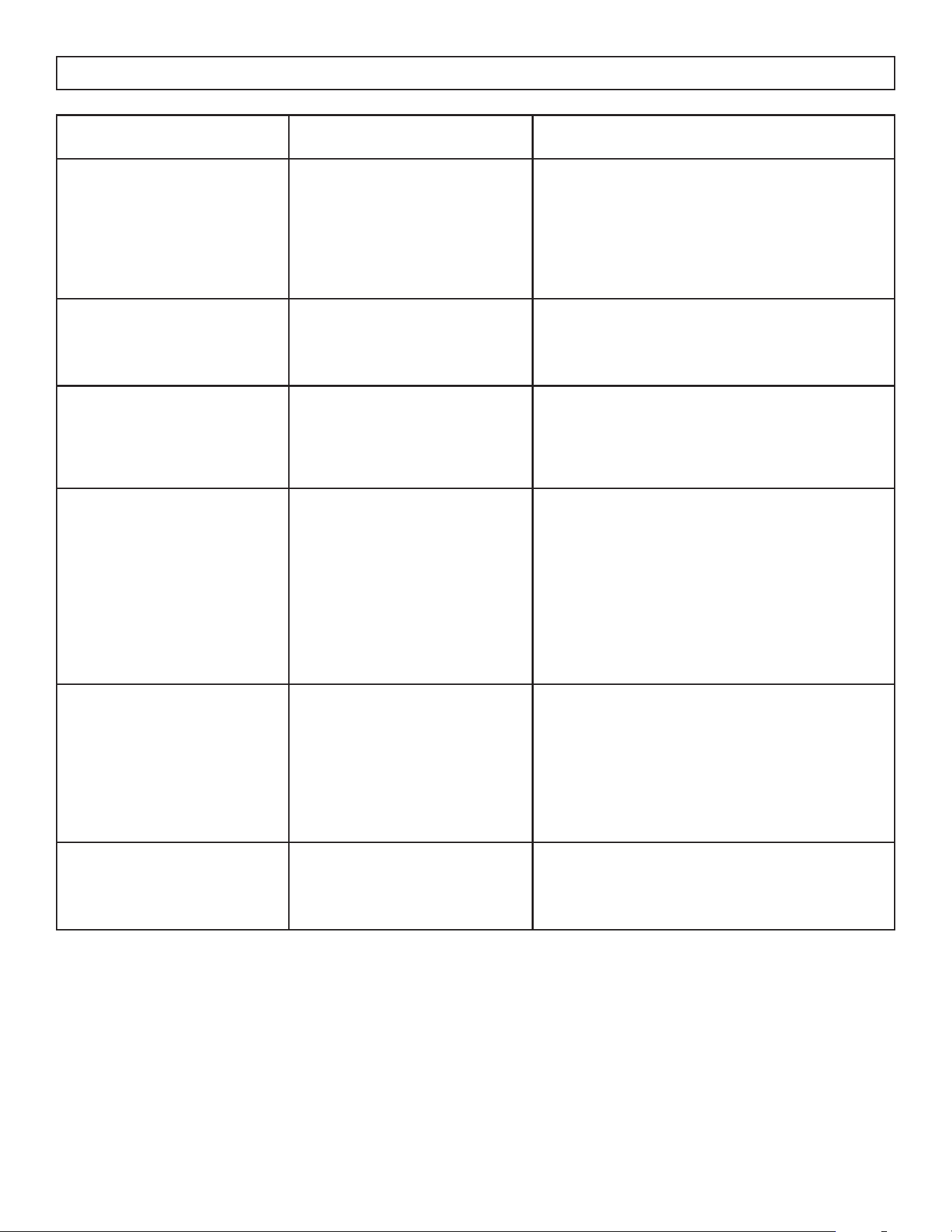
Areas of Concern Possible Cause Solutions
The cooking zones cannot
be switched on
• There is no power supply • Check household fuse for the appliance
• Double check the circuit breaker to see if
it was tripped
• Ensure the plug is fully inserted into the
wall outlet
• Check if there is a power failure by test-
ing other electronic appliances
Oven does not turn on • Power is switched off • Check whether there is power being
supplied to the appliance
• Check if other kitchen appliances are
functioning
There is no heat, or the
oven is not warming up
• Oven temperature control
is set incorrectly
• Oven door has been left
open
• There is no power
• Check the oven temperature to ensure it
has been set correctly
• Ensure there is sufficient power to the
appliance
Cooking is uneven within
the oven
• Oven shelves are not
positioned correctly
• Temperature is not set
properly
• Shelf position is incorrect
• Oven was not preheated
• Cookware is not suitable
for baking or roasting
• Check that the recommended tempera-
tures and shelf positions are being used
- adjust accordingly
• Confirm the cookware is suitable for
baking or roasting
• Do not frequently open the door unless
you are cooking items that need to be
turned. If you open the door often, the
interior temperature will be lower, which
could affect the results of your cooking
Oven light (if available) is
not on
• The bulb is loose
• The oven light has burnt
out
• The electrical supply is
switched off or has dis-
connected
• The light switch is mal-
functioning
• Double check the bulb is not loose
• Replace the lamp as per the instructions
• Ensure the electrical supply is switched
on at the wall socket outlet
Oven fan (if available) is
noisy
• Oven shelves are vibrat-
ing
• Check that the oven is level
• Check to see if the shelves and any bake
ware are vibrating or in contact with the
oven back panel

21 22
Limit
ed “In-Home” Warranty
Te
rms of Warranty
Ex
clusions
Gener
al Provisions
Th
is quality product is warranted to be free from manufacturer’s defects in material and workmanship, provided that the unit is used
under the normal oper
ating conditions intended by the manufacturer. This warranty is available only to the person to whom the unit was
originally sold
by Danby Products Limited (Canada) or Danby Products Inc. (U.S.A.) (hereafter “Danby”) or by an authorized distributor
of Danb
y, and is non-transferable.
Sa
ve as herein provided, by Danby, there are no other warranties, conditions, representations or guarantees, express or implied, made or
int
ended by Danby or its authorized distributors and all other warranties, conditions, representations or guarantees, including any
w
arranties, conditions, representations or guarantees under any Sale of Goods Act or like legislation or statute is hereby expressly
ex
cluded. Save as herein provided, Danby shall not be responsible for any damages to persons or property, including the unit itself,
ho
wsoever caused or any consequential damages arising from the malfunction of the unit and by the purchase of the unit, the purchaser
does her
eby agree to indemnify and hold harmless Danby from any claim for damages to persons or property caused by the unit.
1.
Power failure.
2.
Damage in transit or when moving the appliance.
3.
Improper power supply such as low voltage, defective house wiring or inadequate fuses.
4.
Accident, alteration, abuse or misuse of the appliance such as inadequate air circulation in the room or abnormal operating
conditions (ie. extremely high or low room temperature).
5.
Use for commercial or industrial purposes (ie. If the appliance is not installed in a domestic residence).
6.
Fire, water damage, theft, war, riot, hostility, acts of God such as hurricanes, floods etc.
7.
Service calls resulting in customer education.
8.
Improper Installation (ie. Building-in of a free standing appliance or using an appliance outdoors that is not approved for outdoor
application, including but not limited to: garages, patios, porches or anywhere that is not properly insulated or climate controlled).
During the first twenty four (24) months, any functional parts of this product found to be defective, will
be repaired or replaced, at warrantor’s option, at no charge to the original purchaser.
Contact the dealer where the unit was purchased, or contact the nearest authorized Danby service depot, where
service must be performed by a qualified service technician. If service is performed on the unit by anyone other
than an authorized service depot, all obligations of Danby under this warranty shall be void.
Danby reserves the right to limit the boundaries of “In Home Service” to the proximity of an authorized service
depot. Any appliance requiring service outside the limited boundaries of “In Home Service”, will be the
consumer’s responsibility to transport at their own expense to the original point of purchase or a service depot
for repair. If the appliance is installed in a location that is 100 kilometers (62 miles) or more from the nearest
service center, it must be delivered to the nearest authorized Danby Service Depot by the purchaser.
Transportation charges to and from the service location are not protected by this warranty and are the
responsibility of the purchaser.
Plastic parts ar
e warranted for thirty (30) days from the date of purchase, with no extensions provided.
No
warranty or insurance herein contained or set out shall apply when damage or repair is caused by any of the following:
First
24 months
To
obtain service
Boundaries of
in-home servi
ce
Pr
oof of purchase date will be required for warranty claims; retain bills of sale. In the event that warranty service is
r
equired, present the proof of purchase to our authorized service depot.
Danb
y Products Limited | Guelph, Ontario, Canada N1H 6Z9
Danb
y Products Inc. | Findlay, Ohio, U.S.A. 45840
1-800-263-2629
08/24

Bienvenido a la familia Danby.
Estamos orgullosos de nuestros productos de calidad y creemos en un servicio
confiable. Le sugerimos que lea este manual del propietario antes de enchufar su nuevo
electrodoméstico, ya que contiene información importante de funcionamiento, información
de seguridad, solución de problemas y consejos de mantenimiento para garantizar la
confiabilidad y longevidad de su electrodoméstico.
Tiene derecho a la cobertura de la garantía como se describe en el manual del propietario
que se proporciona con su nuevo electrodoméstico.
1. Escriba la información de su aparato a continuación. Debe conservar el comprobante
de compra original para validar y recibir los servicios de garantía.
2. Registre su producto en línea y reciba una EXTENSIÓN DE GARANTÍA GRATUITA DE 2
MESES después de completar una encuesta sobre el producto, en
www.danby.com/support/product-registration/
Necesitas ayuda?
1. Lea el manual del propietario para obtener ayuda con la instalación, resolución de
problemas y asistencia de mantenimiento.
2. Visite www.Danby.com para acceder a herramientas de autoservicio, preguntas
frecuentes y mucho más buscando su número de modelo en la barra de búsqueda.
3. Para obtener el servicio al cliente más rápido, complete el formulario web en www.
danby.com/support. Su envío irá directamente a un experto en su dispositivo en
particular. Nuestros tiempos de respuesta promedio son entre 20 minutos y 2 horas,
durante el horario comercial EST.
4. Llame al 1-800-263-2629; tenga en cuenta que durante las horas pico, los tiempos de
espera pueden exceder una hora.
Número de modelo: _______________________________________________
Número de serie: _________________________________________________
Fecha de compra: _________________________________________________
Importantes Instrucciones de Seguridad
LEA Y SIGA TODAS LAS INSTRUCCIONES DE SEGURIDAD
¡GUARDE ESTAS INSTRUCCIONES!
DISPOSITIVOS ANTICAÍDA
Para reducir el riesgo de que el aparato se vuelque debido a un uso anormal o una carga incorrecta de la
puerta, el aparato debe asegurarse instalando dispositivos anticaída. Hay dos dispositivos anticaída que
deben instalarse para garantizar que el aparato sea seguro.
Nota: Si la estufa se traslada, ambos dispositivos anticaída deben ser retirados e instalados en la nueva
ubicación.
ADVERTENCIA - RIESGO DE VOLCADURA
• Un niño o adulto puede volcar el aparato y ser fatal.
• Verifique que el soporte anticaída haya sido instalado correctamente al suelo.
• Asegúrese de que el soporte anticaída esté reactivado cuando se mueva la estufa.
• No opere la estufa sin que el soporte anticaída esté colocado y activado.
• No seguir estas instrucciones puede resultar en la muerte o quemaduras graves a niños o adultos.
SOPORTE ANTICAÍDA
Se instala en la pierna trasera izquierda o derecha.
Para instalar el soporte anticaída:
01. Coloque el soporte anticaída (1) en el suelo donde
se instalará la estufa.
02. Marque la ubicación del orificio en el soporte
anticaída.
03. Use una broca de 5/16” (8 mm) para perforar
un agujero en el suelo e inserte el tornillo
proporcionado para asegurar los soportes
anticaída al suelo.
04. Luego, instale la cadena anticaída.
CADENA ANTICAÍDA
05. Use un tapón de pared para fijar el gancho (3) a
la pared de la cocina.
06. Con la ayuda del mecanismo de bloqueo (4),
conecte la cadena de seguridad (5) al gancho.
INSTALAR AMBOS DISPOSITIVOS ANTICAÍDA
07. Deslice la estufa hacia atrás y colóquela en
posición, asegurándose de que el soporte
anticaída esté sobre la pierna trasera del aparato.
08. Usando el accesorio con tornillo (6), fije
firmemente la cadena a la parte trasera de la
estufa (7).
09. Recuerde que la cadena de seguridad debe ser lo
más corta posible para evitar que el aparato se
incline hacia adelante, por lo que la estufa debe
estar muy cerca de la pared trasera (8).
Importantes Instrucciones de Seguridad
LEA Y SIGA TODAS LAS INSTRUCCIONES DE SEGURIDAD
AVISO - ANTES DEL PRIMER USO
Los elementos calefactores llevan una capa protectora que debe quemarse antes de utilizarlos. Para ello:
• Abra la puerta del horno y ajuste la perilla de control de temperatura a 450°F
• Gire el selector de función hacia el elemento hornear y el elemento asar por separado durante
aproximadamente 15 minutos
• Es importante asegurar una ventilación adecuada durante este período
¡GUARDE ESTAS INSTRUCCIONES!
ADVERTENCIA - ELEMENTOS CALEFACTORES
• Los elementos calefactores de la superficie o del interior del aparato pueden estar calientes aunque
parezcan fríos
• Las zonas cercanas a los elementos calefactores pueden calentarse lo suficiente como para causar
quemaduras
• No toque ni deje que la ropa u otros materiales inflamables toquen/estén en contacto con los
elementos calefactores o las zonas cercanas a ellos durante o después del uso (deben tener tiempo
suficiente para enfriarse)
• Las superficies del aparato pueden calentarse lo suficiente como para causar quemaduras: estas áreas
incluyen las aberturas de ventilación del horno, las superficies cercanas a estas aberturas, las puertas y
las ventanas del horno
PELIGRO - INCENDIOS PROVOCADOS POR LA GRASA
• Cuando caliente grasa, no la deje desatendida, ya que podría incendiarse.
• No recoja nunca una olla o sartén en llamas
• No utilice agua ni harina para apagar un incendio provocado por grasa.
• En caso de incendio por grasa, apague el quemador -si puede hacerlo sin peligro- y apague el fuego
con un extintor de polvo químico o de espuma.
• También puede sofocar el fuego con una tapa de olla bien ajustada, una bandeja de horno, una
bandeja plana o bicarbonato sódico
• Si se produce un incendio en el horno durante la cocción, sofoque el fuego cerrando la puerta y
apagando el horno
PELIGRO - RIESGO DE INCENDIO
• Se recomienda conectar este aparato a un circuito independiente que no esté compartido con ningún
otro aparato
• No limpie nunca el aparato o sus piezas con líquidos inflamables, ya que los vapores pueden crear
peligro de incendio y/o explosión
• Antes de limpiar o reparar este aparato, desenchúfelo completamente de la toma de corriente o
desconecte el suministro eléctrico de la cocina en el panel de distribución doméstico quitando el
fusible o desconectando el disyuntor. De lo contrario, puede sufrir una descarga eléctrica o la muerte
• Desconecte siempre la alimentación eléctrica del aparato antes de repararlo
• No intente reparar o sustituir ninguna pieza del aparato a menos que se recomiende específicamente
en este manual. Cualquier otra reparación debe ser realizada por un técnico cualificado
• Este aparato no debe utilizarse nunca como fuente de calor para calentar o caldear una habitación
- el uso de este aparato como calefactor puede provocar el sobrecalentamiento del aparato y/o la
intoxicación por monóxido de carbono
• Los elementos de la encimera de la estufa no deben funcionar sin los utensilios de cocina adecuados
• Todas las aberturas en la pared detrás del aparato y el suelo debajo del aparato deben estar selladas
• No obstruya el flujo de aire alrededor del aparato
• Mantenga la zona alrededor del aparato despejada y libre de materiales combustibles, gasolina y
otros vapores inflamables
• Mantenga siempre los revestimientos de paredes, cortinas o cortinajes combustibles a una distancia
segura de la cocina
• Nunca utilice o almacene gasolina u otros vapores o líquidos inflamables dentro o cerca de este
aparato; de lo contrario, podría producirse un incendio o una explosión
Importantes Instrucciones de Seguridad
LEA Y SIGA TODAS LAS INSTRUCCIONES DE SEGURIDAD
¡GUARDE ESTAS INSTRUCCIONES!
IMPORTANTE
LAS BAJAS TEMPERATURAS PUEDEN DAÑAR EL CONTROL ELECTRÓNICO DEL APARATO
Si el aparato no se ha utilizado durante un largo período de tiempo:
• Asegúrese de que el aparato haya estado a temperaturas superiores a 32°F (0°C) durante al menos
tres (3) horas antes de encenderlo
MODIFICACIONES
• Nunca modifique ni altere la construcción del aparato quitando las patas niveladoras, los paneles, las
cubiertas de los cables, los soportes/tornillos antivuelco ni ninguna otra pieza del aparato
ADVERTENCIAS
ALMACENAMIENTO EN O SOBRE EL APARATO
• No almacene materiales inflamables en el horno o microondas, cerca de quemadores o elementos de
superficie, o en el cajón de almacenamiento o calentador (esto incluye artículos de papel, plástico y
tela como libros de cocina, vajilla de plástico y toallas)
• No guarde explosivos, como latas de aerosol, en el aparato o cerca de él
TRASLADO DEL APARATO
Si necesita mover el aparato:
• No mueva el aparato cuando esté en uso, o todavía caliente (para reducir el riesgo de quemaduras)
• Para reducir el riesgo de lesiones debidas al vuelco del aparato, verifique la reinstalación de este
aparato en el dispositivo antivuelco suministrado después de volver a colocar el aparato en la posición
de instalación original
ELIMINACIÓN DEL APARATO
Para evitar la posibilidad de que los niños queden atrapados, tome las siguientes precauciones antes de
desechar el aparato:
• Retire completamente la puerta del horno
• Nunca permita que los niños operen, jueguen o gateen dentro de la cocina eléctrica
PRECAUCIÓN - CORTES DE CORRIENTE
No intente utilizar el aparato durante un corte de corriente. Si se produce un corte de corriente:
• Apague el aparato inmediatamente
• Si se restablece la corriente y no se ha apagado el elemento de superficie, éste volverá a encenderse
en cuanto se restablezca la corriente
• Esto puede provocar la ignición de objetos situados sobre o cerca de la placa de cocción, causando
lesiones graves o la muerte
ADVERTENCIA
El fabricante declina toda responsabilidad por daños personales o materiales causados por un uso
incorrecto o inadecuado de la cocina
¡GUARDE ESTAS INSTRUCCIONES!
Importantes Instrucciones de Seguridad
LEA Y SIGA TODAS LAS INSTRUCCIONES DE SEGURIDAD
REQUISITOS GENERALES DE SEGURIDAD
• Asegúrese de que el aparato esté correctamente instalado y conectado a tierra por un técnico
cualificado.
• Para eliminar el riesgo de quemaduras o incendios por alcanzar las unidades de superficie calientes,
debe evitarse el espacio de almacenamiento en armarios situado por encima de las unidades de
superficie. Si es necesario colocar armarios, el riesgo puede reducirse instalando una campana
extractora que sobresalga horizontalmente un mínimo de 5 pulgadas (12,7 cm) por encima de la parte
inferior de los armarios
• Nunca se deben llevar prendas sueltas o colgantes mientras se utiliza el aparato
• Utilice sólo agarraderas secas (no utilice toallas u otros paños voluminosos); las agarraderas húmedas
o mojadas sobre superficies calientes pueden provocar quemaduras por el vapor
• No deje que el agarrador toque los elementos calefactores calientes
• No caliente recipientes de alimentos que no estén abiertos: la presión acumulada puede hacer que
revienten y provocar lesiones
• No deje a los niños solos o desatendidos en la zona donde se utiliza el aparato
• No se debe permitir que los niños se sienten o se pongan de pie sobre ninguna parte del aparato (esto
incluye el cajón de almacenamiento, el cajón inferior de la parrilla, el cajón del calentador o el horno
doble inferior)
• No guarde objetos de interés para los niños en los armarios situados encima del aparato o en la parte
trasera de las cocinas (los niños que se suban o se acerquen al aparato para alcanzar objetos podrían
sufrir lesiones graves)
• No permita que los niños trepen o jueguen alrededor del aparato, ya que el peso de un niño sobre la
puerta abierta del horno puede hacer que el aparato vuelque, provocando quemaduras graves u otras
lesiones
• Un cajón abierto, cuando está caliente, puede causar quemaduras
• Pisar, apoyarse o sentarse en la puerta o en los cajones de este aparato puede provocar lesiones
graves y dañar el aparato
• Nunca cubra ninguna ranura, orificio o paso del fondo del horno ni cubra una rejilla entera con
materiales como papel de aluminio (al hacerlo se bloquea el flujo de aire a través del horno y puede
provocar intoxicación por monóxido de carbono. Los revestimientos de papel de aluminio también
pueden atrapar el calor, provocando un riesgo de incendio)
• Para evitar la posibilidad de una quemadura o una descarga eléctrica, asegúrese siempre de que los
controles de todos los elementos de superficie estén en la posición OFF, y de que todos los serpentines
estén fríos antes de intentar levantar o retirar un elemento de cocción de serpentín
• Esta cocina ha sido diseñada y fabricada exclusivamente para cocinar alimentos domésticos y no es
adecuada para aplicaciones no domésticas, por lo que no debe utilizarse en un entorno comercial. La
garantía de la cocina quedará anulada si se utiliza en un entorno no doméstico
¡GUARDE ESTAS INSTRUCCIONES!
Importantes Instrucciones de Seguridad
LEA Y SIGA TODAS LAS INSTRUCCIONES DE SEGURIDAD
INSTRUCCIONES DE CONEXIÓN A TIERRA
Este aparato debe estar correctamente conectado a tierra. La conexión a tierra reduce el riesgo de
descarga eléctrica al proporcionar un cable de escape para la corriente eléctrica.
INSTALACIÓN
• Asegúrese de que su aparato está correctamente instalado y conectado a tierra por un técnico
cualificado
No conecte este aparato a la misma toma de corriente que otro aparato. No lo conecte a un alargador
o a un enchufe adaptador. El incumplimiento de esta advertencia puede causar lesiones graves,
incendios o la muerte.
Nota: Apagar el aparato no lo desconecta de la red eléctrica
Se recomienda colocar el cable de alimentación y el enchufe paralelos al suelo, de forma que el cable
discurra paralelo al suelo
PRECAUCIÓN - RIESGO DE DESCARGA ELÉCTRICA
Si se daña el cable o el enchufe, desconecte el aparato de la red eléctrica y
sustitúyalo por un cable o enchufe del mismo tipo
¡GUARDE ESTAS INSTRUCCIONES!
Importantes Instrucciones de Seguridad
LEA Y SIGA TODAS LAS INSTRUCCIONES DE SEGURIDAD
SEGURIDAD DE LA PLACA DE COCCIÓN
RADIANTE
Sepa qué mando o tecla controla cada zona de
calentamiento de la superficie
• Coloque los utensilios de cocina con los
alimentos en la zona de cocción antes de
encenderla
• Apague la zona de cocción antes de retirar los
utensilios de cocina
Los mangos de los utensilios de cocina deben
girarse hacia dentro y no extenderse sobre los
elementos de la superficie adyacente
• Esto reducirá el riesgo de quemaduras, ignición
de materiales inflamables y derrames debidos al
contacto involuntario con el utensilio
Utilice el tamaño de cacerola adecuado: El
aparato está equipado con cuatro quemadores de
diferentes tamaños
• Seleccione utensilios de cocina con fondos
planos que coincidan con el tamaño de la
unidad de superficie
• El uso de ollas de tamaño inferior puede
exponer una parte del elemento calefactor al
contacto directo y puede provocar la ignición de
la ropa
• El tamaño adecuado de la batería de cocina
mejorará la eficiencia de la cocción
• Si utiliza una plancha o una sartén larga, no la
utilice en más de un quemador a la vez
Asegúrese de que las bandejas reflectoras o los
recipientes de goteo están colocados: La ausencia
de estos recipientes durante la cocción puede dañar
los componentes del cableado
Utilice el tipo adecuado de utensilios de cocina:
• Sólo ciertos tipos de utensilios de vidrio,
cerámica, loza u otros vidriados son adecuados
para el servicio de la encimera sin romperse
debido al cambio repentino de temperatura
• Compruebe las recomendaciones del fabricante
para el uso de la placa de cocción
Nunca deje el aparato desatendido mientras esté
en uso:
• Los hervores pueden provocar humo y los
derrames de grasa pueden incendiarse
• Una sartén que haya hervido en seco también
podría dañarse y acabar estropeando la placa
de cocción
Nunca deje el aceite desatendido mientras fríe:
• Si el aceite se calienta más allá de su punto
de humeo, puede inflamarse y provocar un
incendio que puede propagarse a los armarios
circundantes
• Siempre que sea posible, utilice un termómetro
para controlar la temperatura del aceite.
Para evitar derrames de aceite e incendios:
• Utilice una cantidad mínima de aceite al freír a
poca profundidad
• Evite cocinar alimentos congelados con
cantidades excesivas de hielo
El grill no está diseñado para ser utilizado sobre
la encimera de cocción:
• Puede provocar un incendio
Recuerde encender el ventilador cuando flamee
alimentos bajo una campana de ventilación
SEGURIDAD DE LAS PLACAS DE
VITROCERÁMICA
No limpie ni utilice una encimera de cocción rota:
Si la encimera de cocción se rompe, las soluciones
de limpieza y los derrames pueden penetrar en
la encimera de cocción rota y crear un riesgo de
descarga eléctrica
• Contacte inmediatamente con un técnico
cualificado
Limpie la encimera de cristal con precaución:
• Si se utiliza una esponja o paño húmedo para
limpiar derrames en una zona de cocción
caliente, tenga cuidado para evitar una posible
quemadura por vapor
• Algunos limpiadores pueden producir vapores
nocivos si se aplican sobre una superficie
caliente
• Evite arañar el cristal de la encimera con objetos
afilados
¡GUARDE ESTAS INSTRUCCIONES!
Importantes Instrucciones de Seguridad
LEA Y SIGA TODAS LAS INSTRUCCIONES DE SEGURIDAD
SEGURIDAD EN EL HORNO
Revestimientos protectores: No utilice papel de
aluminio, revestimientos posventa ni ningún otro
material o dispositivo para forrar el fondo del
horno, las rejillas del horno o cualquier otra parte
del aparato
• Utilice el aluminio sólo como se recomienda
para hornear, por ejemplo, para forrar
utensilios de cocina o para cubrir alimentos
• Cualquier otro uso de revestimientos protectores
o papel de aluminio puede provocar riesgo de
descarga eléctrica, incendio o cortocircuito
Tenga cuidado al abrir la puerta:
• Colóquese a un lado del aparato cuando abra
la puerta de un horno caliente
• Esto permitirá que salga el aire caliente o el
vapor antes de retirar o volver a colocar los
alimentos
Nunca cubra ni coloque nada encima o cerca
de la parte superior de la rejilla de ventilación
del horno, especialmente objetos de plástico o
sensibles al calor: Estos objetos pueden derretirse o
incendiarse
Coloque siempre las rejillas del horno en el lugar
deseado mientras el horno esté frío:
Si es necesario mover la rejilla mientras el horno
está caliente
• Retire todos los utensilios de cocina antes de
mover la rejilla
• Utilice agarraderas y sujete la rejilla con ambas
manos para cambiarla de posición
• No deje que la agarradera entre en contacto
con un quemador o elemento caliente del horno
No utilice una sartén de asar sin un inserto:
• Las sartenes de asar y los insertos permiten que
la grasa que gotea se escurra del alto calor de
la parrilla
• No cubra la bandeja con papel de aluminio, ya
que la grasa podría prenderse fuego
No coloque estantes, sartenes, bandejas de
hornear, bandejas de asar u otros
utensilios de cocina en el fondo de la cámara del
horno
• Colóquelos siempre en un estante del horno
No cocine alimentos en la parte inferior del horno:
• Cocine siempre en la batería de cocina
adecuada y utilice siempre una rejilla para
horno
No utilice el horno si un elemento calefactor
presenta un punto brillante durante el uso o
muestra otros signos de daños: Un punto brillante
indica que el elemento calefactor puede fallar
y presentar un riesgo potencial de quemadura,
incendio o descarga eléctrica
• Apague el horno inmediatamente
• Póngase en contacto con un técnico cualificado
para que sustituya la resistencia
No limpie nunca el horno con aparatos de
limpieza de vapor a alta presión
No obstruya los orificios de ventilación del horno

31
INSTRUCCIONES DE INSTALACIÓN
ADVERTENCIA PARA LA INSTALACIÓN Y PREPARACIÓN PARA EL USO
El aparato debe ser instalado por un servicio técnico autorizado o un técnico cualificado
• Una instalación incorrecta puede causar daños de los que el fabricante no se hace responsable y la
garantía no será válida
• Antes de la instalación, asegúrese de que las condiciones locales de distribución (tensión eléctrica y
frecuencia y/o naturaleza del gas y presión del gas) y los ajustes del aparato son compatibles. Las
condiciones de ajuste de este aparato se indican en la etiqueta
• Asegúrese de que se respetan las leyes, ordenanzas, directivas y normas vigentes en el país de
utilización (normas de seguridad, reciclaje correcto de acuerdo con la normativa, etc.)
ANTES DE LA INSTALACIÓN
• Asegúrese de que no haya materiales inflamables o combustibles en las proximidades (cortinas, aceite,
telas, etc.) que puedan incendiarse
• La encimera y los muebles que rodean el aparato deben ser de materiales resistentes a temperaturas
superiores a 215°F (100 °C)
• El aparato no debe instalarse directamente encima de un lavavajillas, frigorífico, congelador, lavadora
o secadora de ropa
• El aparato puede colocarse cerca de otros muebles a condición de que, en la zona donde se instale el
aparato, la altura de los muebles no supere la altura de la placa de cocción
• Para eliminar el riesgo de quemaduras o incendio al pasar la mano por encima de un elemento de
superficie caliente, debe evitarse colocar armarios encima de la placa de cocción. Si es necesario
colocar armarios encima de la placa de cocción, el riesgo puede reducirse instalando una campana
extractora que sobresalga al menos 127 mm (5”) de la parte frontal de los armarios. Los armarios
instalados encima de una placa de cocción no deben tener más de 330 mm (13”) de profundidad
31 32
INSTRUCCIONES DE INSTALACIÓN
INSTALACIÓN DE LA COCINA
• La encimera y los muebles que rodean el aparato deben ser de materiales resistentes a temperaturas
superiores a 215 °F (100 °C)
• Si los muebles de la cocina son más altos que la encimera, los muebles de la cocina deben estar a una
distancia mínima de 10 cm (13/32”) de los lados del aparato para que circule el aire
• Si se va a instalar una campana extractora o un armario encima del aparato, la distancia de
seguridad entre la placa de cocción y cualquier armario/campana extractora debe ser la indicada:
A (Armario) 16.5” (420 mm)
B (Campana
extractora)
25.5”/27.5” (650mm/700mm)
C Anchura del producto
D 2” (50 mm)
INSTRUCCIONES DE NIVELACIÓN
El aparato debe estar nivelado para funcionar
correctamente y con seguridad. Hay cuatro patas
de nivelación situadas en las esquinas de la parte
inferior del aparato. Ajuste las patas de nivelación
hasta que el aparato esté nivelado. Utilice un nivel
de carpintero para confirmarlo.
IMPORTANTE - DESEMBALAJE DEL APARATO
Lea y siga las siguientes instrucciones y precauciones para desembalar, instalar y realizar el
mantenimiento de su aparato:
• Retire toda la cinta adhesiva y el embalaje antes de utilizar el aparato
• Deseche la caja y las bolsas de plástico después de desembalar el aparato
• No permita que los niños jueguen con el material de embalaje
• No retire la etiqueta de cableado ni otros folletos adheridos al aparato
• No retire la placa con el número de modelo/serie
33
INSTRUCCIONES DE INSTALACIÓN
Terminal neutro
Bloque de conexión
Cinta de tierra
Cable de alimentación
INSTALACIÓN DEL CABLE DE ALIMENTACIÓN DE 3 HILOS
ADVERTENCIA
El conductor neutro o de tierra del cable de alimentación debe conectarse al terminal neutro situado en el
centro del bloque de conectores. Los cables de alimentación deben conectarse a los terminales exteriores
(de color latón)
Retire los 3 tornillos de los terminales del bloque de conectores.
Inserte los tornillos a través de cada anillo terminal del cable de alimentación y en el bloque conector
hasta que los tornillos encajen en las tuercas. Asegúrese de que el cable central está conectado al tornillo
central del bloque conector.
Apriete bien los tornillos.
NO retire la conexión del cable de tierra
Caja de conexiones
Correa
de tierra
Soporte de alivio de tensión
(suministrado con el cable
de la gama. No forma parte
de la gama)
Cable de
alimentación
Alivio de tensión
Cubierta del cableado
(se muestra desmontada)
Soporte
INSTALACIÓN DEL ALIVIO DE TENSIÓN DEL CABLE DE ALIMENTACIÓN
Sólo debe utilizarse un cable de alimentación de 4 conductores de 240 voltios, 40 amperios y marcado
para su uso con cocinas. Coloque el protector contra tirones en el orificio. Inserte el cable de alimentación
a través del aliviador de tensión y apriételo. Deje suficiente holgura para fijar fácilmente los terminales
del cable al bloque conector. Si hay lengüetas en el extremo del aliviador de tensión con alas, pueden
retirarse para un mejor ajuste
Nota: No instale el cable de alimentación sin un aliviador de tensión. El soporte de alivio de tensión debe
instalarse antes de volver a instalar la cubierta del cableado de la gama trasera.
33 34
INSTRUCCIONES DE INSTALACIÓN
INSTALACIÓN DEL CABLE DE ALIMENTACIÓN DE 4 HILOS
ADVERTENCIA
El hilo neutro del circuito de alimentación se conecta al terminal neutro situado en el centro del bloque
de conectores. Los cables de alimentación deben conectarse a los terminales exteriores (de color latón).
El cuarto cable de conexión a tierra debe conectarse al bastidor de la cocina con la placa de conexión a
tierra y el tornillo de conexión a tierra
1. Retire los 3 tornillos del bloque de conexión.
2. Retire el tornillo y la correa de puesta a tierra de la ubicación central del bloque de conectores y la
conexión atornillada al bastidor de la cocina.
3. Inserte los tornillos a través de cada anillo terminal del cable de alimentación y en el bloque conector
hasta que el tornillo encaje en la tuerca. Asegúrese de que el cable central esté conectado al tornillo
central del bloque conector. Apriete bien los tornillos.
4. Conecte el cable de tierra al bastidor de la cocina.
5. Vuelva a colocar la placa de acceso al bloque de terminales.
35
INSTRUCCIONES DE INSTALACIÓN
CARACTERÍSTICAS DEL PRODUCTO
1. Placa de cocción
2. Panel de mandos
3. Asa de la puerta del horno
4. Puerta del horno
5. Pies regulables
1
2
3
4
5
PANEL DE CONTROL
1. Perilla de control del temporizador del horno
2. Botón de control de las funciones del horno
3. Mando del termostato del horno
4. Indicador luminoso del horno
5. Botón de cocción en superficie
6. Luz de cocción en superficie
1
4
2
5
6
3
35 36
INSTRUCCIONES DE USO
CONTROLES DEL CALENTADOR CERÁMICO
• El calor cerámico se controla mediante
un mando de 6 posiciones
• Para encenderlo, gire el mando de
control hasta la posición deseada
• Junto a los mandos de control habrá un
símbolo que indica el calefactor que está
controlado por ese mando
• La luz ON/OFF del panel de control
indicará si se está utilizando alguna de
las resistencias cerámicas.
INDICADOR DE CALOR RESIDUAL (si está
disponible)
• Después de usar el calentador cerámico habrá
calor almacenado en el vidrio vitrocerámico,
llamado calor residual
• Si el nivel de calor residual es superior a +140
ºF (60 ºC), el indicador de calor residual estará
activo para la zona de cocción que esté por
encima de esta temperatura
• Si se desconecta la alimentación de la placa
de cocción mientras el indicador de calor
residual está encendido, la luz de advertencia
parpadeará cuando se vuelva a conectar la
alimentación
• El indicador parpadeará hasta que el calor
residual haya disminuido o hasta que se active
una de las zonas de cocción
UTENSILIOS DE COCINA
ADVERTENCIA: No utilice nunca la placa de
cocción sin ollas en la zona de cocción
• Si es posible, coloque siempre tapas en las ollas
• No utilice utensilios de cocina con bordes
dentados o una base curvada
• Asegúrese de que la base de su batería de
cocina es lisa, se asienta plana contra el cristal
y tiene el mismo tamaño que la zona de cocción
- centre siempre su batería de cocina en el
elemento
• Cuando retire la batería de cocina de la
superficie cerámica, levántela siempre, no la
deslice, ya que podría rayar el cristal
IMPORTANTE
• La temperatura de las partes accesibles
puede elevarse durante el funcionamiento del
aparato. Mantenga a los niños y a los animales
alejados de la placa vitrocerámica durante el
funcionamiento hasta que se haya enfriado
completamente después del mismo
• Si observa una grieta en la placa de cocción,
apáguela inmediatamente y póngase en
contacto con un servicio técnico autorizado
para que se la cambien
Posición del mando Función
0 Apagado
MIN Mantener caliente
3-5 Calentar a fuego lento
7-9 MAX Cocinar, asar y hervir
37
INSTRUCCIONES DE USO
FUNCIONES DEL HORNO
NOTA: Se recomienda precalentar el horno durante
10 minutos para un mejor uso.
Hornear
El termostato y las luces de aviso del horno se
encenderán, y las resistencias inferior y superior
comenzarán a funcionar. La función Hornear emite
calor, asegurando una cocción uniforme de los
alimentos.
Ideal para hacer:
• Bollería
• Pasteles
• Pasta al horno
• Lasaña
• Pizza
Asado Bajo
El termostato del horno y las luces de advertencia se
encenderán, y la resistencia de asar comenzará a
funcionar. Esta función se utiliza para asar o tostar
alimentos en los estantes superiores del horno
• Coloque siempre una bandeja debajo de los
alimentos para recoger cualquier goteo de
aceite o grasa
Asar Alto
El termostato del horno y las luces de aviso se
encenderán, y las resistencias superior y de asado
comenzarán a funcionar. Esta función se utiliza
para asar más rápidamente y para asar alimentos
con una superficie mayor, como la carne
• Coloque siempre una bandeja debajo de los
alimentos para recoger cualquier goteo de
aceite o grasa
MANDO DE CONTROL DE LAS FUNCIONES
DEL HORNO
Gire el mando hasta el símbolo correspondiente a
la función de cocción deseada.
MANDO DEL TERMOSTATO DEL HORNO
Después de seleccionar una función de cocción,
gire este mando para ajustar la temperatura
deseada. La luz del termostato del horno se
iluminará siempre que el horno se esté calentando o
todavía esté caliente.
37
ACCESORIOS
La rejilla EasyFix
• Para retirar la rejilla, tire de ella como se
muestra a continuación para soltarla de los clips
(a). Después de soltarla de los clips, levántela
El cajón guiado por cuatro ruedas
• Su aparato incluye un cajón para guardar
accesorios - bandejas, estantes, rejillas y ollas y
sartenes pequeñas
ADVERTENCIA: La superficie interior del cajón
puede calentarse durante su uso. No guarde
alimentos, plásticos o materiales inflamables en el
cajón
El protector contra salpicaduras
• El protector contra salpicaduras se fija a la
placa de cocción con dos tornillos
La rejilla de alambre
INSTRUCCIONES DE USO
ADVERTENCIA: Cuando coloque la rejilla,
asegúrese de que la parte trasera está
correctamente colocada antes de introducirla en el
horno
MANDO DE CONTROL DEL TEMPORIZA-
DOR DEL HORNO
Para su mayor seguridad, nuestro horno ha
sido diseñado para funcionar con un tempo-
rizador.
Si prefiere utilizar el horno sin el temporiza-
dor, simplemente gire el mando del tempori-
zador en sentido contrario a las agujas del
reloj hasta la M (manual), y el horno per-
manecerá encendido continuamente.
Para ajustar el temporizador, gire el mando
en el sentido de las agujas del reloj hasta
la cantidad de tiempo que desee. Una vez
que el temporizador llegue a 0, el horno se
apagará.
39
INSTRUCCIONES GENERALES DE LIMPIEZA
ADVERTENCIA: Apague el aparato y deje que se
enfríe antes de limpiarlo
• Asegúrese de que los materiales de limpieza
son los adecuados y recomendados por el
fabricante antes de utilizarlos en el aparato
• Utilice cremas o limpiadores líquidos suaves;
asegúrese de que no contengan partículas.
• No utilice cremas corrosivas, polvos de
limpieza abrasivos, lana de alambre áspera o
herramientas duras, ya que pueden dañar las
superficies de la cocina.
Para la limpieza diaria de marcas, huellas
dactilares y salpicaduras no grasas, aplique un
producto de limpieza para vitrocerámica. Aclare y
seque con un paño limpio o una toalla de papel
Limpieza del interior del horno
• Se limpia mejor mientras el horno está caliente
• Se recomienda hacerlo después de cada uso del
horno
• Limpie el horno con un paño suave empapado
en agua jabonosa
• A continuación, vuelva a limpiar el horno con
un paño húmedo y séquelo
CUIDADO Y MANTENIMIENTO
Limpieza del cristal cerámico
ADVERTENCIA: Si la superficie está agrietada,
apague inmediatamente el aparato para evitar
la posibilidad de una descarga eléctrica. Llame
inmediatamente para que se la cambien
• Utilice un limpiador en crema o líquido para
limpiar el cristal vitrocerámico
• Aclare y seque bien el cristal con un paño seco
• Recuerde: no utilice materiales de limpieza
destinados al acero, ya que pueden dañar el
cristal
Si se utilizan sustancias con bajo punto de fusión
en la base o en los revestimientos de la batería de
cocina, pueden dañar la vitrocerámica.
En caso de derrames, derretimientos y salpicaduras
de azúcar caliente sobre la encimera de cocción,
retire inmediatamente el derrame o el alimento
con una cuchilla para vitrocerámica, pero tenga
cuidado con las superficies de cocción calientes.
Sujete la cuchilla en un ángulo de 45 grados y
raspe el alimento derramado hacia una zona fría
de la encimera, luego límpielo con un paño de
cocina o papel de cocina. Los derrames grandes
deben retirarse inmediatamente para evitar que se
cocinen en la superficie de la placa de cocción.
Cualquier cambio en el color de la vitrocerámica
no afectará a la estructura o durabilidad de
la vitrocerámica y no se debe a un cambio en
el material. El color puede cambiar por varias
razones:
1. Los alimentos derramados no se han limpiado de
la superficie
2. Se está utilizando una vajilla incorrecta, que
puede erosionar la superficie
3. Se utilizan materiales de limpieza inadecuados

39 40
CUIDADO Y MANTENIMIENTO
Limpieza de las piezas de cristal
• Limpie regularmente las partes de cristal de su
electrodoméstico
• Utilice un limpiacristales para limpiar el interior
y el exterior de las piezas de cristal
• Aclárelas y séquelas bien con un paño seco
Limpieza de las piezas esmaltadas
• Limpie regularmente las partes esmaltadas de su
aparato
• Limpie las partes esmaltadas con un paño suave
empapado en agua jabonosa
• A continuación, vuelva a limpiarlas con un paño
húmedo y séquelas
IMPORTANTE
No limpie las piezas esmaltadas cuando aún estén
calientes después de cocinar
No deje vinagre, café, leche, sal, agua, limón o
zumo de tomate sobre el esmalte durante mucho
tiempo
Limpieza de las piezas de acero inoxidable
(si existen)
• Limpie regularmente las piezas de acero
inoxidable de su aparato
• Limpie las piezas de acero inoxidable sólo con
un paño suave empapado en agua
• A continuación, séquelas bien con un paño seco
IMPORTANTE
No limpie las piezas de acero inoxidable cuando
aún estén calientes después de cocinar
No deje vinagre, café, leche, sal, agua, limón o
zumo de tomate sobre el esmalte durante mucho
tiempo
Limpieza de superficies pintadas (si existen)
• Las manchas de tomate, pasta de tomate,
ketchup, limón, derivados del petróleo, leche,
alimentos azucarados, bebidas azucaradas y
café deben limpiarse con un paño humedecido
en agua tibia inmediatamente
• Si no se limpian y acaban secándose en las
superficies, no deben frotarse con objetos duros
(objetos puntiagudos, estropajos de acero
y plástico, esponjas para vajilla que dañen
la superficie) ni con productos de limpieza
que contengan altos niveles de alcohol,
quitamanchas, desengrasantes, productos
químicos abrasivos para superficies. De lo
contrario, puede producirse corrosión en las
superficies pintadas con pintura en polvo y
pueden aparecer manchas.
NOTA: El fabricante no se hace responsable de los
daños causados por el uso de productos o métodos
de limpieza inadecuados
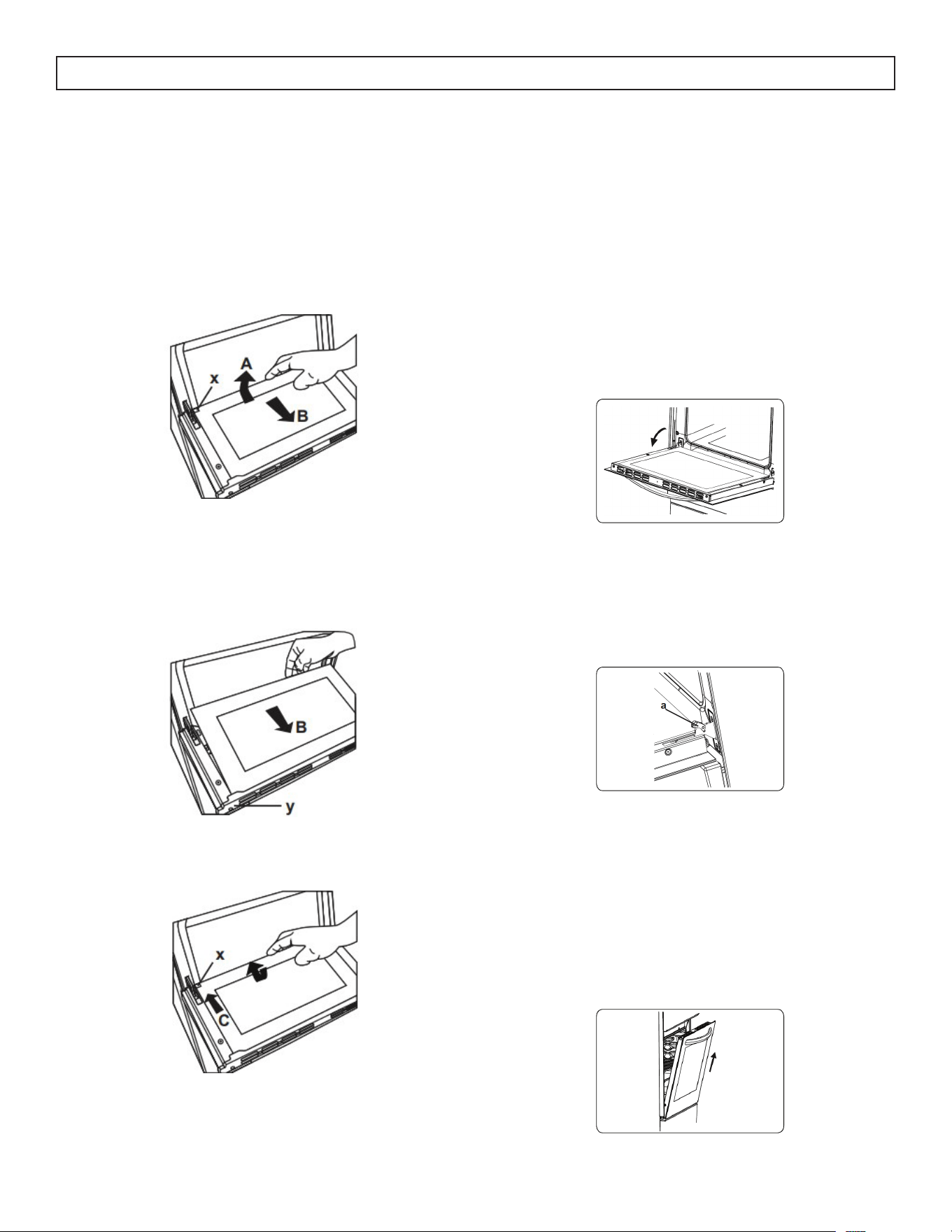
41
CUIDADO Y MANTENIMIENTO
Para sustituir el vidrio interior:
2. Empuje el cristal hacia y por debajo del soporte
de colocación (y) en la dirección de B
3. Coloque el cristal debajo del soporte de
ubicación (x) en la dirección de C
Extracción de la puerta del horno
NOTA: La puerta del horno es desmontable pero
pesada. Se recomienda que al menos dos personas
trabajen juntas para retirarla
Retire la puerta del horno antes de limpiar el
cristal de la puerta del horno, como se muestra a
continuación:
1. Abra la puerta del horno
NOTA: Si la puerta del horno es de vidrio triple, la
tercera capa de vidrio puede retirarse de la misma
manera que la segunda capa de vidrio
Retirada del cristal interior
Debe retirar el cristal de la puerta del horno antes
de limpiarlo, como se muestra a continuación:
1. Empuje el vidrio en la dirección de B y libérelo
del soporte de fijación (x). Tire del vidrio en el
sentido de A.
2. Abra el pestillo de bloqueo (a) (con la ayuda de
un destornillador) hasta la posición final.
3. Cierre la puerta hasta casi alcanzar la posición
de cierre total y retire la puerta tirando de ella
hacia usted.
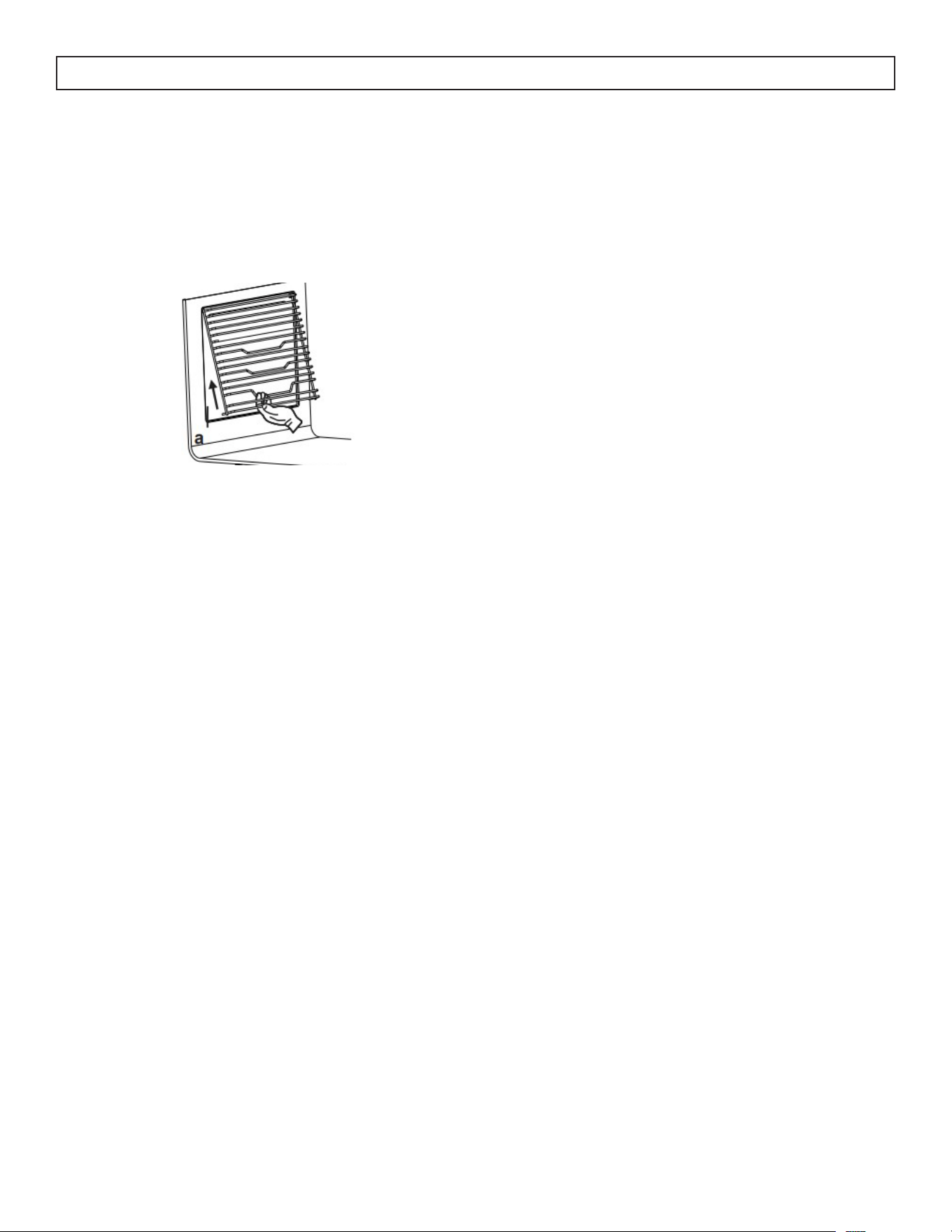
41 42
CUIDADO Y MANTENIMIENTO
Extracción de la rejilla de alambre
Para retirar la rejilla de alambre, tire de ella como
se muestra en la figura. Después de soltarla de los
clips (a), levántela.
Sustitución de la luz del horno
Advertencia: El mantenimiento de este aparato
debe ser realizado únicamente por un servicio
técnico autorizado o un técnico cualificado
Importante
• Antes de sustituir la bombilla del horno,
asegúrese de que la alimentación eléctrica esté
desconectada del aparato. De lo contrario,
podría sufrir una descarga eléctrica o
quemaduras
• Asegúrese de dejar que la cubierta de la luz y
la bombilla se enfríen completamente antes de
sustituirlas
• Quitar la puerta del horno puede facilitar este
proceso
Para sustituir la bombilla:
• Retire la lente de cristal y, a continuación, la
bombilla
• Inserte la nueva bombilla (resistente a 600 °F o
315 °C) para reemplazar la bombilla que retiró
(240 V, 15-25 vatios, tipo E14)
• Vuelva a colocar la lente de vidrio y su horno
estará listo para ser utilizado
Notas:
El producto contiene una fuente de luz de clase de
eficiencia energética G
La fuente de luz incluida no está diseñada para
su uso en otras aplicaciones - está diseñada
específicamente para su uso en aparatos de cocina
domésticos. No es adecuada para la iluminación de
habitaciones domésticas
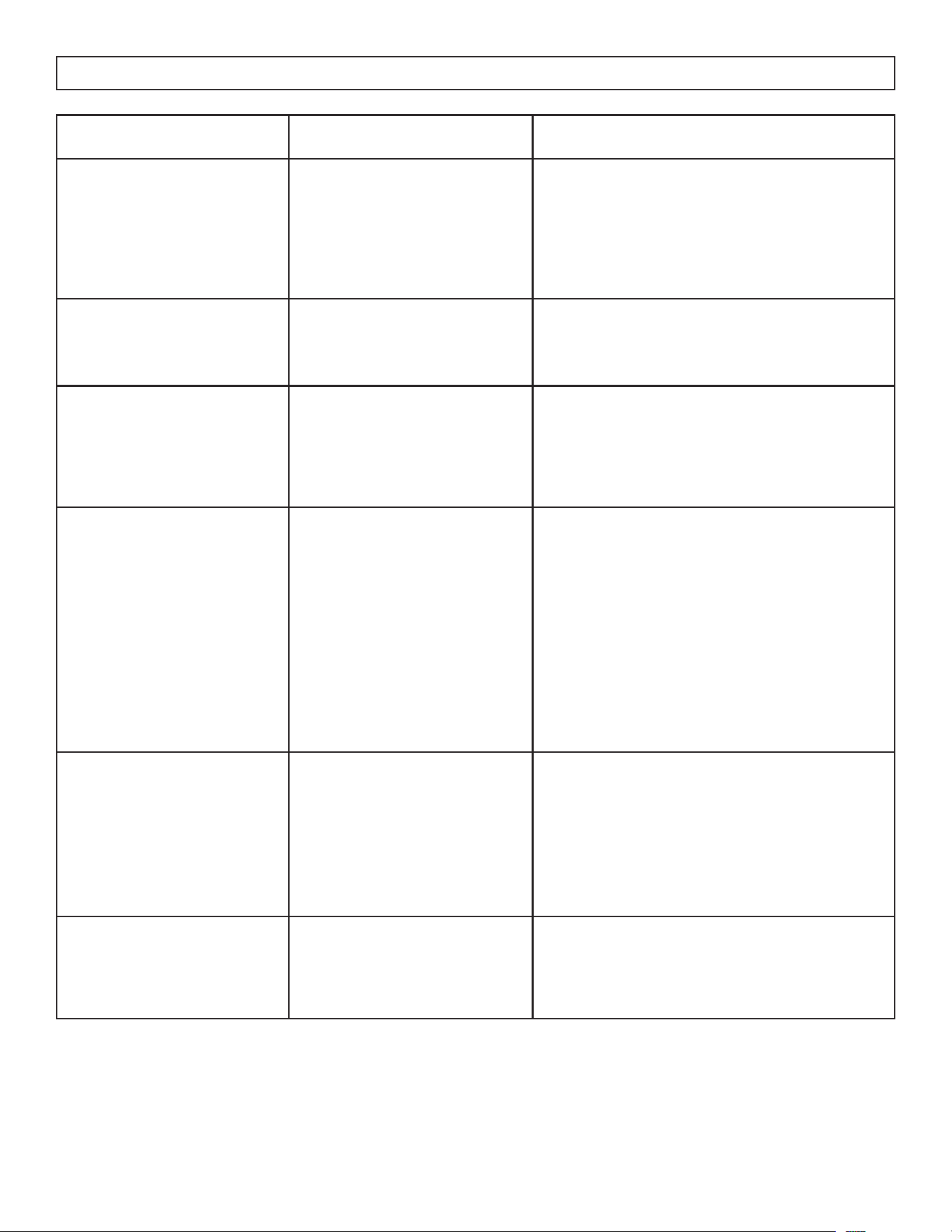
43
SOLUCIÓN DE PROBLEMAS
Áreas de preocupación Posible Causa Soluciones
No se pueden encender las
zonas de cocción
• No hay suministro eléc-
trico
• Compruebe el fusible del aparato
• Compruebe el disyuntor para ver si se
ha disparado.
• Asegúrese de que el enchufe está bien
insertado en la toma de corriente
• Compruebe si hay un corte de corriente
probando otros aparatos electrónicos
El horno no se enciende • La alimentación está de-
sconectada
• Compruebe si el aparato recibe ali-
mentación eléctrica
• Compruebe si los demás aparatos de
cocina funcionan
No hay calor o el horno no
se calienta
• El control de tempera-
tura del horno está mal
ajustado
• La puerta del horno se ha
quedado abierta
• No hay corriente
• Compruebe que la temperatura del hor-
no es la correcta
• Asegúrese de que el aparato tiene sufici-
ente potencia
La cocción es desigual den-
tro del horno
• Los estantes del horno no
están colocados correcta-
mente
• La temperatura no está
ajustada correctamente
• La posición de los estan-
tes es incorrecta
• El horno no se ha pre-
calentado
• Los utensilios de cocina
no son adecuados para
hornear o asar
• Compruebe que se están utilizando las
temperaturas y posiciones de estante
recomendadas - ajústelas según corre-
sponda
• Compruebe que los utensilios de cocina
son adecuados para hornear o asar
• No abra la puerta con frecuencia a
menos que esté cocinando alimentos que
deban girarse. Si abre la puerta con
frecuencia, la temperatura interior será
más baja, lo que podría afectar a los
resultados de la cocción
La luz del horno (si está dis-
ponible) no está encendida
• La bombilla está suelta
• La luz del horno se ha
fundido
• El suministro eléctrico
está apagado o de-
sconectado
• El interruptor de la luz
funciona mal
• Compruebe que la bombilla no esté
suelta
• Sustituya la lámpara siguiendo las in-
strucciones
• Asegúrese de que la alimentación
eléctrica está conectada en la toma de
corriente
El ventilador del horno (si
está disponible) es ruidoso
• Los estantes del horno
vibran
• Compruebe que el horno está nivelado
• Compruebe si los estantes y cualquier
utensilio para hornear vibran o están
en contacto con el panel posterior del
horno.

43
Gar
antía limitada “a domicilio”
Condiciones
Ex
clusiones
Disposiciones gener
ales
Es
te producto de calidad está garantizado contra defectos de fabricación, incluyendo partes y mano de obra, siempre y
cuando la unidad se utilic
e bajo las condiciones normales de funcionamiento para las que fue diseñado. Esta garantía está solamente
disponible pa
ra la persona que haya comprado originalmente esta unidad directamente de Danby Products Limited (Canada) o Danby
Pr
oducts Inc. (U.S.A.) (en adelante “Danby”) o uno de sus distribuidores autorizados, y no es transferible.
Salv
o lo aquí indicado por Danby, no existen otras garantías, condiciones o representaciones, explícitas o implícitas, concretas o
int
encionales por parte de Danby o sus distribuidores autorizados y todas las demás garantías, condiciones o representaciones,
incluy
endo cualquier garantía, condiciones o representaciones bajo cualquier Acta de Venta de Productos o legislación o estatuto
simila
r, quedan de esta forma expresamente excluidas. Salvo lo aquí indicado, Danby no serán responsables por ningún daño a personas
o bienes, incluy
endo la propia unidad, sin importar su causa, o de ningún daño indirecto causado por el desperfecto de la unidad, y al
c
omprar esta unidad, el comprador acepta por la presente, indemnizar y proteger a Danby contra cualquier reclamo por daños a
personas o bienes causados por la unidad.
1.
Falla del suministro eléctrico.
2.
Daños en tránsito o durante el transporte de la unidad.
3.
Alimentación incorrecta, como bajo voltaje, instalación eléctrica defectuosa o fusibles inadecuados.
4.
Accidente, modificación, abuso o uso incorrecto del artefacto, tal como insuficiente ventilación del ambiente o condiciones de
operación anormales (temperatura ambiente extremadamente alta o baja).
5.
Utilización comercial o industrial (v.g., si el electrodoméstico no está instalado en una vivienda particular).
6.
Incendio, daños por agua, robo, guerra, disturbios, hostilidades, actos de fuerza mayor como huracanes, inundaciones, etc.
7.
Pedidos de servicio debido a desinformación del usuario.
8.
Instalación inadecuada (v.g., instalación empotrada de un electrodoméstico diseñado como unidad independiente o uso de un
electrodoméstico al aire libre que no esté aprobado para dicho fin, incluyendo pero no limitado a: garajes, patios, porches o en
cualquier lugar que no esté bien aislado o controlado por el clima).
Durante los primeros veinticuatro (24) meses, cualquier parte en buen estado de este producto que resulte
defectuosa, incluyendo cualquier sistema sellado, será reparado o reemplazado, a opción del fabricante, sin
cargo para el comprador original.
Comuníquese con el distribuidor donde haya comprado la unidad, o llame al Ta ller de Servicio Autorizado más
cercano, donde debe ser reparada por un técnico calificado. Si esta unidad es reparada en otro lugar que no
sea un Ta ller de Servicio Autorizado, o si la unidad se utiliza para aplicaciones comerciales, Danby no se hará
responsable de ninguna forma y la garantía será anulada.
Danby se reserva el derecho de limitar la cobertura de "Servicio en Domicilio" sujeto a la proximidad de un Ta ller
de Servicio Autorizado. Para todo artefacto que requiera servicio fuera del área limitada de "Servicio en
Domicilio", el cliente será responsable por transportar dicho artefacto hasta el Taller de Servicio Autorizado mas
cercano. Si el electrodoméstico está instalado en un lugar que se encuentra a 100 kilómetros (62 millas) o más del
centro de servicios más cercano, se debe llevar la unidad al Centro de servicios Danby autorizado más cercano, ya
que dicho servicio sólo puede realizarlo un técnico calificado y certificado por Danby para prestar servicios de
garantía. Los cargos por transporte desde y hacia el lugar en que se efectúe el servicio técnico no están cubiertos
por esta garantía y son de responsabilidad del comprador.
Las pie
zas plásticas, se autorizan por treinta (30) días solamente a partir de la fecha de la compra, sin las extensiones
pr
oporcionadas.
No se c
onsiderará ninguna de estas garantías o seguros cuando el daño o la necesidad de reparación sea el producto de los
siguient
es casos:
Primer
os 24 meses
Pa
ra obtener
servicio
Límit
es del
servicio
técnico
a domicilio
Danb
y Products Limited | Guelph, Ontario, Canada N1H 6Z9
Danb
y Products Inc. | Findlay, Ohio, U.S.A. 45840
1-800-263-2629
08/24
Se r
equerirá una prueba de la fecha de compra para las reclamaciones de garantía; conserve las facturas de venta. En
caso de que se r
equiera servicio de garantía, presente la prueba de compra en nuestro centro de servicio autorizado.

NOTES / NOTAS :
__________________________________________________________________________________________
__________________________________________________________________________________________
__________________________________________________________________________________________
__________________________________________________________________________________________
__________________________________________________________________________________________
__________________________________________________________________________________________
__________________________________________________________________________________________
__________________________________________________________________________________________
__________________________________________________________________________________________
__________________________________________________________________________________________
__________________________________________________________________________________________
__________________________________________________________________________________________
__________________________________________________________________________________________
__________________________________________________________________________________________
__________________________________________________________________________________________
__________________________________________________________________________________________
__________________________________________________________________________________________
__________________________________________________________________________________________
__________________________________________________________________________________________
__________________________________________________________________________________________
__________________________________________________________________________________________
__________________________________________________________________________________________

NOTES / NOTAS :
__________________________________________________________________________________________
__________________________________________________________________________________________
__________________________________________________________________________________________
__________________________________________________________________________________________
__________________________________________________________________________________________
__________________________________________________________________________________________
__________________________________________________________________________________________
__________________________________________________________________________________________
__________________________________________________________________________________________
__________________________________________________________________________________________
__________________________________________________________________________________________
__________________________________________________________________________________________
__________________________________________________________________________________________
__________________________________________________________________________________________
__________________________________________________________________________________________
__________________________________________________________________________________________
__________________________________________________________________________________________
__________________________________________________________________________________________
__________________________________________________________________________________________
__________________________________________________________________________________________
__________________________________________________________________________________________
__________________________________________________________________________________________

Danby Products Limited, Guelph, Ontario, Canada N1H 6Z9
Danby Products Inc. Findlay, Ohio, U.S.A. 45840
www.danby.com