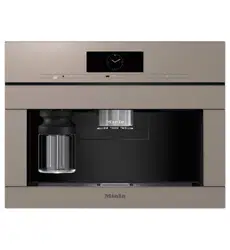
Operating and installation
instructions
Built-in coffee machine
To avoid the risk of accidents or damage to the appliance, it is
essential to read these instructions before it is installed and used for
the first time.
en – AU, NZ M.-Nr. 12 859 690
Caring for the environment
2
Disposal of the packing material
The transport and protective packaging
has been selected from materials which
are environmentally friendly for disposal,
and can normally be recycled.
Recycling the packaging reduces the
use of raw materials in the
manufacturing process and also reduces
the amount of waste in landfill sites.
Ensure that any plastic wrappings, bags
etc. are disposed of safely and kept out
of the reach of babies and young
children. Danger of suffocation.
Only for Australia: Note for installer:
Expanded polystyrene (EPS) packaging
included. Please retain and dispose of
EPS packaging responsibly. For further
information, please contact Miele.
Saving energy
The following tips can help you save
energy and money as well as care for
the environment:
- Operate the coffee machine in Eco
mode (default setting).
- Switch off the time of day display.
- Select dimmer lighting or refrain from
using any lighting.
- Switch off the lighting when the
appliance is switched off.
- Select the dark colour scheme for the
display.
- Reduce the brightness of the display.
- If you change the factory default
settings for the “Timer”, this can
increase the energy consumption of
the coffee machine.
- Pay particular attention to the
following message in the display: This
setting uses more energy.
- Switch the coffee machine off with
the On/Off switch if it is not going
to be used for a while.
Disposing of your old appliance
Electrical and electronic appliances
often contain valuable materials. They
also contain specific materials,
compounds and components, which
were essential for their correct function
and safety. These could be hazardous to
human health and to the environment if
disposed of with your domestic waste
or if handled incorrectly. Please do not,
therefore, dispose of your old appliance
with your household waste.
Please dispose of it at your local
community waste collection / recycling
centre for electrical and electronic
appliances. You are also responsible for
deleting any personal data that may be
stored on the appliance prior to
disposal. Please ensure that your old
appliance poses no risk to children while
being stored prior to disposal.

Contents
3
Caring for the environment......................................................................................... 2
Saving energy..................................................................................................................
2
Warning and Safety instructions ............................................................................... 7
Guide to the appliance ................................................................................................ 15
Milk flask..........................................................................................................................
17
Central spout with cup rim sensor ..............................................................................
17
Controls and display..................................................................................................... 18
Symbols in the display...................................................................................................
19
Drink sensor symbols ....................................................................................................
20
Operating principles..................................................................................................... 21
Selecting a menu and navigating within a menu .......................................................
21
Miele@home ................................................................................................................. 23
Before using for the first time..................................................................................... 24
Before using for the first time.......................................................................................
24
Switching on for the first time ......................................................................................
24
Filling the coffee bean container ............................................................................... 26
Filling the water container........................................................................................... 27
Switching on and off..................................................................................................... 28
Switching the coffee machine on.................................................................................
28
Switching the coffee machine off ................................................................................
28
Preparing for extended disuse......................................................................................
28
Making drinks ................................................................................................................ 29
Coffee...............................................................................................................................
29
Coffee drinks in detail .............................................................................................. 29
Milk and milk alternatives........................................................................................ 29
Filling and fitting the milk flask................................................................................ 30
Making a coffee drink............................................................................................... 31
Cancelling a drink...................................................................................................... 31
Making a DoubleShot of coffee ....................................................................... 31
Making 2portions............................................................................................... 32
Preparing a pot of coffee ......................................................................................... 32
Tea ....................................................................................................................................
32
Making tea ................................................................................................................. 33
Starting the TeaTimer manually.............................................................................. 34
Preparing a pot of tea............................................................................................... 34
Preparing warm and hot water .....................................................................................
34
Changing the portion size .............................................................................................
34

Contents
4
Expert mode................................................................................................................... 36
Switching Expert mode on and off...............................................................................
36
Expert mode: changing the portion size .....................................................................
36
Grinder setting............................................................................................................... 37
Recognising the correct grinder setting......................................................................
37
Adjusting the grinder setting ........................................................................................
37
Parameters ..................................................................................................................... 38
Displaying and changing parameters ..........................................................................
38
Amount of coffee............................................................................................................
38
Pre-brewing ground coffee ...........................................................................................
38
Brewing temperature for coffee drinks........................................................................
38
Dispensing temperature for tea drinks, warm water and hot water .......................
38
Portion size......................................................................................................................
39
User profiles................................................................................................................... 40
User profiles....................................................................................................................
40
Creating a profile ............................................................................................................
40
Editing a profile ...............................................................................................................
40
Setting change of profile.......................................................................................... 40
Changing the profile name ...................................................................................... 40
Deleting a profile....................................................................................................... 41
Preparing User profile drinks ........................................................................................
41
Changing drinks in a profile...........................................................................................
41
MobileStart .................................................................................................................... 42
Preparing MobileStart ...................................................................................................
42
Switching MobileStart on and off................................................................................
42
Settings ........................................................................................................................... 43
Displaying and changing Settings................................................................................
43
Language..........................................................................................................................
43
Time of day......................................................................................................................
43
Date..................................................................................................................................
43
Timer ................................................................................................................................
43
Switch on at............................................................................................................... 43
Switch off at .............................................................................................................. 44
Switch off after.......................................................................................................... 44
TeaTimer ..........................................................................................................................
44
Volume .............................................................................................................................
44
Display brightness..........................................................................................................
44
Lighting.............................................................................................................................
44
Info (display information) ..............................................................................................
45
Altitude.............................................................................................................................
45

Contents
5
Performance mode.........................................................................................................
45
Eco mode................................................................................................................... 45
Barista mode ............................................................................................................. 45
Latte mode................................................................................................................. 45
Party mode ................................................................................................................ 45
Water hardness...............................................................................................................
46
System lock ................................................................................................................
47
Miele@home ..................................................................................................................
47
Performing Scan & Connect.........................................................................................
47
Remote control ...............................................................................................................
48
RemoteUpdate ...............................................................................................................
48
Software version.............................................................................................................
49
Showroom programme (Demo mode) ........................................................................
49
Factory default settings.................................................................................................
49
Cleaning and care ......................................................................................................... 50
Cleaning intervals – Quick guide..................................................................................
50
Cleaning by hand or in the dishwasher .......................................................................
51
Unsuitable cleaning agents...........................................................................................
52
Opening the appliance door .........................................................................................
52
Cleaning the drip tray and waste container................................................................
53
Cleaning the drip tray cover..........................................................................................
55
Cleaning the water container........................................................................................
55
Cleaning the central spout............................................................................................
55
Cleaning the cup rim sensor.........................................................................................
57
Cleaning the milk flask with lid.....................................................................................
57
Cleaning the milk valve (daily) ......................................................................................
58
Removing and cleaning the milk valve (once a month).............................................
58
Cleaning the bean containers.......................................................................................
61
Cleaning the brew unit and interior by hand ..............................................................
62
Cleaning the interior, the inside of the appliance door and the drip catcher.........
64
Cleaning the appliance front.........................................................................................
65
Maintenance programmes............................................................................................
65
Opening the Maintenance menu .................................................................................
65
Rinsing the appliance.....................................................................................................
65
Rinsing the milk pipework .............................................................................................
66
Degreasing the brew unit ..............................................................................................
66
Descaling the appliance ................................................................................................
69
Problem solving guide.................................................................................................. 71
Messages in the display................................................................................................
71
Unusual performance of the coffee machine.............................................................
73
Unsatisfactory results....................................................................................................
75

Contents
6
After sales service and warranty ............................................................................... 78
Contact in case of fault..................................................................................................
78
Warranty ..........................................................................................................................
78
Accessories.................................................................................................................... 79
Installation...................................................................................................................... 80
Electrical connection .....................................................................................................
80
Installation dimensions .................................................................................................
81
Installation in a tall unit............................................................................................ 81
Installation and connections................................................................................... 82
Building in the coffee machine.....................................................................................
83
Door opening limiters ....................................................................................................
84
Technical data................................................................................................................ 86

Warning and Safety instructions
7
This coffee machine complies with all current local and national
safety requirements. However, inappropriate use can lead to
personal injury and damage to property.
Read the Operating instructions carefully before using the coffee
machine. They contain important information on the safety,
installation, use and maintenance of the appliance. Familiarity with
these instructions will help to prevent personal injury and damage
to property.
In accordance with standard IEC60335-1, Miele expressly and
strongly advises that you read and follow the instructions in
“Installation”, as well as in the “Warning and Safety instructions”.
Miele cannot be held liable for damage caused by non-compliance
with these instructions.
Keep these instructions in a safe place and pass them on to any
future owner.

Warning and Safety instructions
8
Correct application
The coffee machine is intended for use in private households.
The coffee machine is not suitable for outdoor use.
This coffee machine must not be used at altitudes above 2,000m.
The machine is intended only for the preparation of drinks such as
espresso, cappuccino, latte macchiato, tea etc. Any other usage is at
the owner's risk.
This appliance is not intended for use by persons (including
children) with reduced physical, sensory or mental capabilities, or
lack of experience and knowledge, unless they have been given
supervision or instruction concerning its use by a person responsible
for their safety, and are able to recognise the dangers of misuse.

Warning and Safety instructions
9
Safety with children
Danger of burning and scalding on the dispensing spouts.
Children's skin is far more sensitive to high temperatures than that
of adults.
Ensure children do not touch hot surfaces of the coffee machine or
place parts of their body under the dispensing spouts.
Install the coffee machine out of reach of children.
Young children must not be allowed to use this appliance.
Older children may only use the coffee machine if its operation has
been clearly explained to them and they are able to use it safely.
They must be aware of the potential dangers caused by incorrect
operation.
Children should be supervised when they are near the coffee
machine. Do not allow them to play with it or to use the controls.
Young children must not be allowed to clean the coffee machine.
Cleaning may only be carried out by older children under the
supervision of an adult.
Remember that coffee and espresso are not suitable drinks for
children.
Danger of suffocation! Whilst playing, children may become
entangled in packaging material (such as plastic wrapping) or pull the
packaging material over their head, presenting the risk of suffocation.
Keep packaging material away from children.

Warning and Safety instructions
10
Technical safety
Installation must be performed by a suitably qualified and
competent person. Maintenance and repairs must only be carried out
by a Miele authorised technician. Unauthorised or incorrect
installation work or repairs can pose considerable danger to users.
A damaged appliance is dangerous. Check it for any visible
damage. Never install or attempt to use a damaged appliance.
Before connecting the appliance to the mains supply, make sure
that the rating on the data plate corresponds to the voltage and
frequency of the household supply. This data must correspond in
order to avoid the risk of damage to the appliance. Consult a qualified
electrician if in any doubt.
The electrical safety of this appliance can only be guaranteed when
continuity is complete between it and an effective earthing system. It
is most important that this basic safety requirement is present and
tested regularly and, where there is any doubt, the household wiring
system should be inspected by a qualified electrician.
Temporary or permanent operation with a self-sufficient or non-
mains synchronous energy supply system (e.g. isolated networks,
back-up systems) is possible. A requirement for the operation is that
the energy supply system complies with all current local and national
requirements that apply to stand-alone, solar and/or battery systems.
The protective measures provided in the installation and in this Miele
product must also be assured in their function and operation in
isolated operation or in non-mains synchronous operation, or
replaced with equivalent measures in the installation.
Do not connect the machine to the mains electricity supply by a
multi-socket adapter or an extension lead. These do not guarantee
the safety of the appliance (e.g. danger of overheating).
This appliance must not be installed and operated in mobile
installations (e.g. on a ship).
For safety reasons, this appliance may only be used when it has
been built in.
If the coffee machine is to be built in above another appliance,
there must be a full-width, closed shelf between them (except when
it is combined with a Gourmet warming drawer or a built-in vacuum
sealing drawer).
Only use the coffee machine in rooms where the ambient
temperature is between +16°C and +38°C.

Warning and Safety instructions
11
A minimum installation height of 850mm must be maintained.
This coffee machine must not be installed behind a closed
furniture door. Heat and moisture can build up behind the closed
furniture door. This can result in damage to the appliance and/or
furniture unit.
Before any repair work is carried out, the appliance must be
completely disconnected from the electricity supply.
The appliance is only completely isolated from the electricity supply
when:
- it is switched off at the circuit breaker, or
- the mains connection cable is disconnected from the power
supply.
Pull the plug, not the cord, to disconnect the appliance from the
power supply.
The manufacturer's warranty may be invalidated if the appliance is
not repaired by a Miele approved service technician.
Never open the outer casing of the machine. Tampering with
electrical connections or components and mechanical parts is highly
dangerous to the user and can cause operational faults or electric
shock.
Warning and Safety instructions
12
Correct use
Danger of burning and scalding on the dispensing spouts.
The liquids and steam dispensed are very hot.
Keep well away from the area underneath the spouts when hot
liquids and steam are being dispensed.
Do not touch hot components.
Hot liquid or steam could spatter from the spouts. Ensure that the
central spout is clean and fitted correctly.
If there is a cup or container underneath the central spout, make
sure that you remove this before opening the appliance door.
Water in the drip tray can also be very hot. Take care when
emptying it.
Risk of injury to the eyes!
Never look directly at the lighting or use optical instruments
(magnifying glass or similar) to look at it.
Please note the following regarding water:
- The water quality must conform to the requirements for drinking
water in the country in which the coffee machine is being used.
- Only use cold, fresh tap water to fill the water container. Hot or
warm water or other liquids can damage the coffee machine.
- Change the water every day to prevent a build-up of bacteria.
- Do not use carbonated water.
Only put roasted coffee beans in the bean container. Do not put
coffee beans containing additives or ground coffee in the bean
containers.
Do not fill the bean container with any type of liquid.
Do not use green (unroasted) coffee beans or mixtures of coffee
beans which contain green coffee beans. Green coffee beans are very
hard and still contain residual moisture. These can damage the coffee
machine grinder as soon as grinding begins.
Do not use coffee beans which have been treated with caramel,
sugar or other substances. Sugar will damage the coffee machine.
Only use milk without additives. Additives in milk usually contain
sugar and this will stick to the milk pipework.

Warning and Safety instructions
13
If you are using regular coffee beans, caffeine residue may remain
in the grinder or brew unit. If you make decaffeinated coffee after this,
do not drink the first cup of coffee that is made using the
decaffeinated beans.
If using cow's milk, only use pasteurised milk to prevent a build-up
of bacteria in the appliance.
When making tea, please follow the instructions on the packaging.
Do not place flaming alcohol mixtures underneath the central
spout. The flames could ignite plastic components and cause them to
melt.
Do not swing from or hang anything on the appliance door when it
is open as this could damage the hinges on the coffee machine.
The machine must not be used for cleaning objects.
Make sure that the coffee machine does not come into contact
with hand sanitiser gel or sunscreen, as this will damage the
surfaces.
Accessories and spare parts
Miele can only guarantee the safety of the appliance when original
Miele spare parts are used. Faulty components must only be
replaced by original Miele spare parts.
Only use original Miele spare parts and accessories. If other spare
parts and accessories are used, warranty, performance and/or
product liability claims will be invalidated and Miele cannot accept
liability.
Miele will guarantee to supply functional spare parts for a
minimum of 10years and up to 15years following the discontinuation
of your coffee machine.

Warning and Safety instructions
14
Cleaning and care
Clean the coffee machine and the milk flask daily, particularly
before using for the first time.
All parts of the milk system need to be cleaned thoroughly and
regularly. Milk contains bacteria which proliferate rapidly with
inadequate cleaning.
Descale the coffee machine regularly depending on the water
hardness level in your area. Descale the machine more frequently in
areas with very hard water. Miele cannot be held liable for damage
arising from insufficient descaling, the use of incorrect descaling
agents or the use of a descaling agent which is not of the appropriate
concentration.
Degrease the brew unit regularly with Miele cleaning tablets.
Depending on the natural oil content of the coffee used, the brew
unit can become blocked quite quickly.
Do not clean the machine with a steam cleaner or immerse it in
water as this will damage the machine. Steam or water could reach
the electrical components and cause a short circuit.
Used coffee grounds should be disposed of with the organic
rubbish or on the compost heap. Do not empty them down the sink,
as they could block it.
The following applies to appliances with stainless steel
surfaces:
Do not adhere stickers, adhesive tape or any other adhesive
materials to stainless steel surfaces. The coating on the stainless
steel surfaces will become damaged and lose its protective
properties against soiling.
Stainless steel scratches very easily and even magnets can cause
damage to the surface.
Guide to the appliance
15
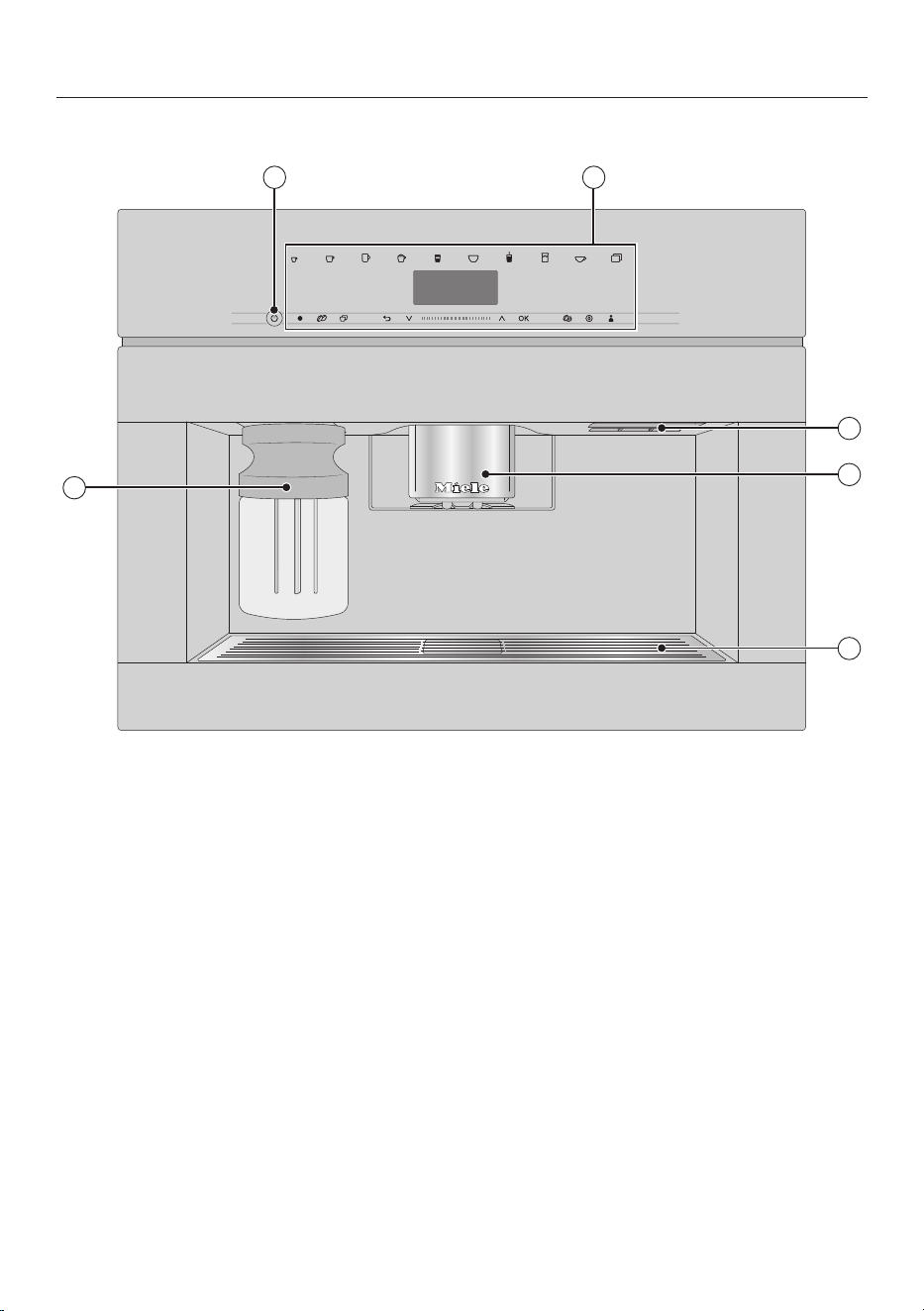
Exterior view
1 2
3
4
5
6
a
On/Off sensor
b
Control panel
c
Door handle
d
Automatic height-adjustable central spout with lighting
e
Drip tray cover
f
Milk flask
Guide to the appliance
16
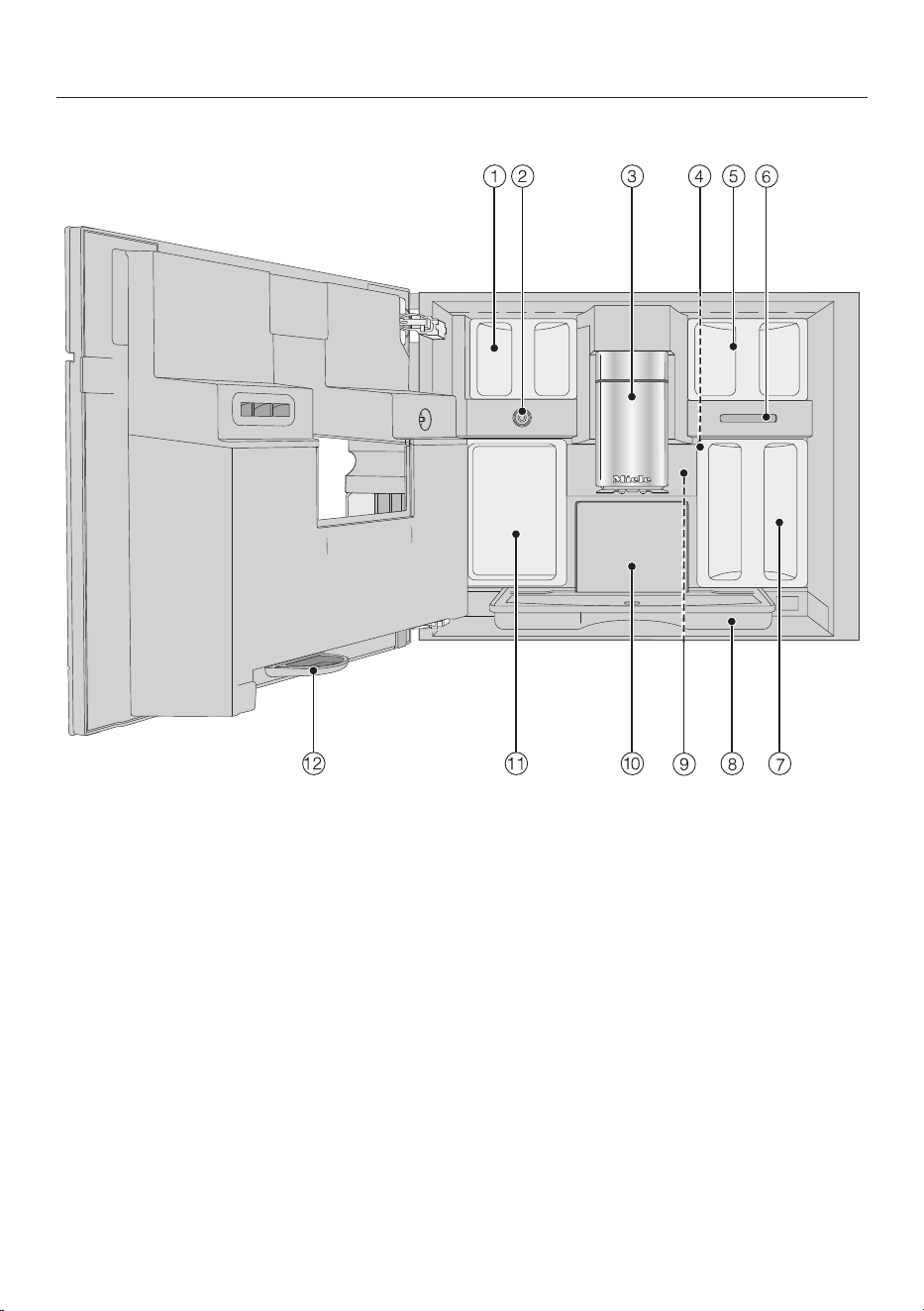
Interior view
a
Bean container
b
Milk valve
c
Automatic height-adjustable central spout with lighting
d
Grinder setting
e
Bean container
f
Fan outlet
g
Water container
h
Drip tray with lid
i
Brew unit
j
Waste container
k
Maintenance container
l
Drip catcher
Guide to the appliance
17
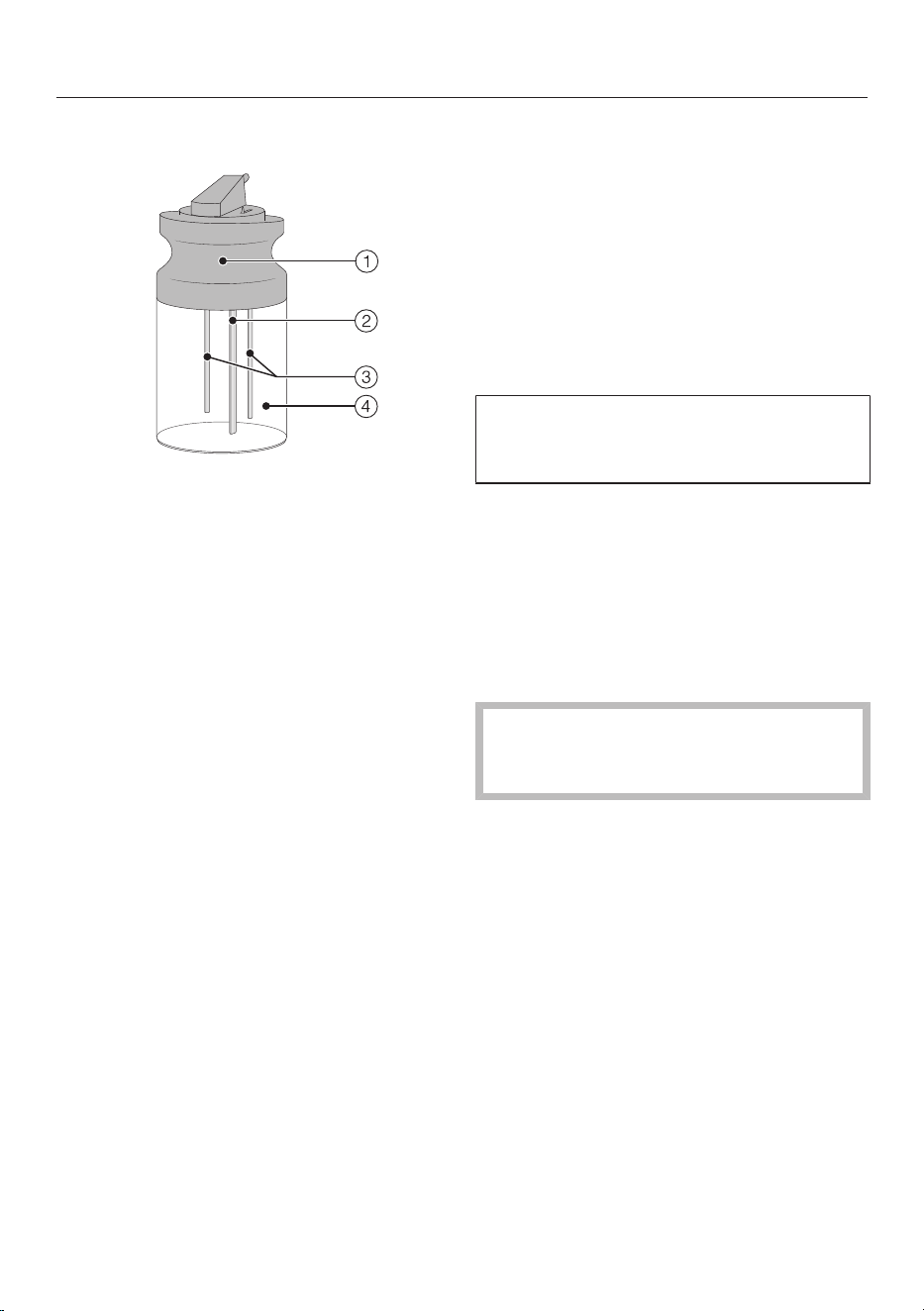
Milk flask
a
Lid
b
Milk suction tube
c
Milk level sensor rod
d
Glass milk flask
Central spout with cup rim
sensor
The central spout with cup rim sensor
features automatic adjustment. By
means of this spout adjustment, at the
beginning of drink preparation the
central spout moves down
automatically and the cup rim sensor
stops it at the optimum height for the
cups or glasses being used.
The height of the central spout with
cup rim sensor cannot be manually
adjusted.
When the coffee machine is switched
off, the central spout moves to a
medium height.
When a maintenance programme is
being carried out, the central spout will
move to the height of the cleaning
container or into a lower maintenance
position.
Ensure the central spout is in either
the upper or middle position before
opening the door.
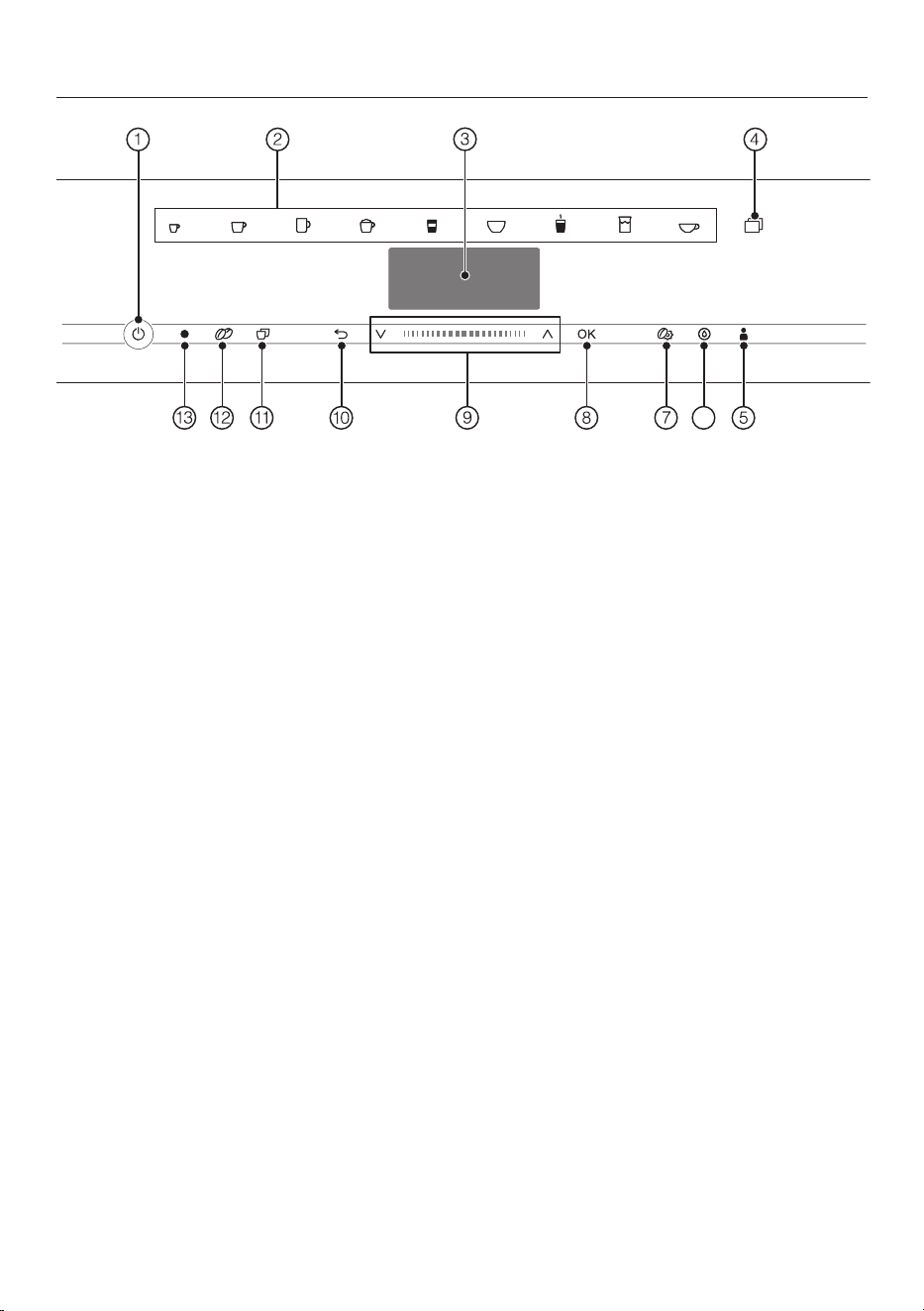
Controls and display
18
6
a
On/Off sensor
For switching the coffee machine on
and off
b
Drink sensors
For making drinks
c
Display
For showing information about the
current action or status
d
sensor
– For selecting more drinks, e.g.
Ristretto, Cappuccino Italiano
– For selecting Coffee pot or Teapot
– Settings menu
e
User profilessensor
For creating and managing profiles
f
Maintenancesensor
Maintenance programmes, e.g.
Descale
g
Parameterssensor
For displaying and changing drink
settings
h
OKsensor
For confirming display messages and
saving settings
i
Navigation area with arrow
sensors
For scrolling through lists of options,
highlighting a selection or changing
values
j
“Back” sensor
For going back a menu level and
cancelling unwanted actions
k
"2portions“ sensor
For dispensing two portions of a drink
at the same time
l
“DoubleShot” sensor
For a making a particularly strong and
aromatic coffee with twice the
amount of ground coffee, but the
same amount of water
m
Optical interface
(for service technicians only)
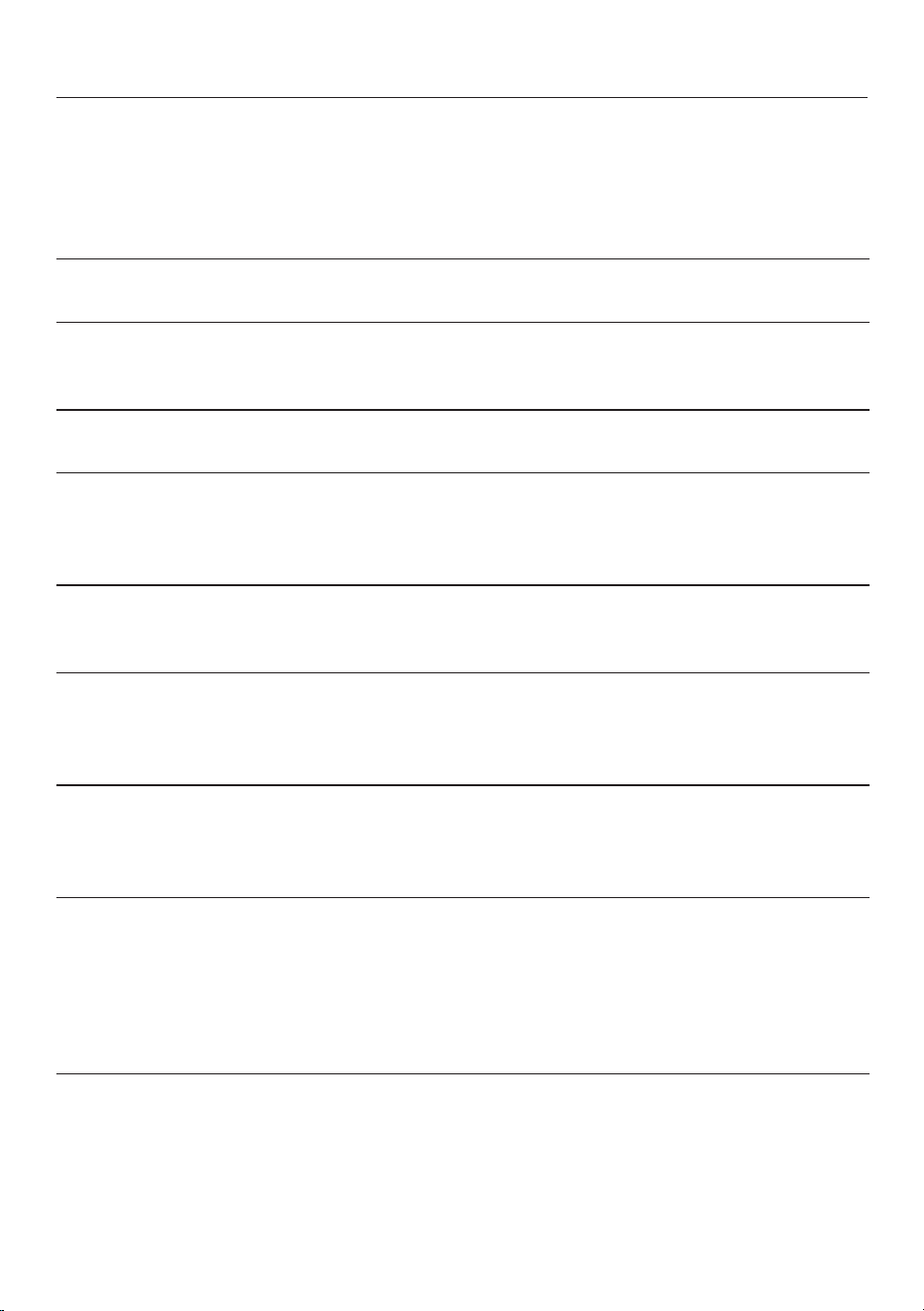
Controls and display
19
Symbols in the display
The following symbols may also appear in the display in addition to the text and
drinks symbols:
Symbol Explanation
This symbol indicates the “Settings” menu and the
“Language” menu option.
This symbol indicates that there is additional information and
advice about using the coffee machine. SelectOK to confirm
the messages.
The symbol is displayed when the system lock is switched
on. The controls are locked.
This symbol and the desired switching on time appear in the
display up to 23:59hours before the coffee machine is due
to switch on if the Switch on at timer and the time of day
display are activated.
The TeaTimer minute minder has been started (see
“TeaTimer”). The remaining brewing time is shown next to
the symbol.
This symbol is displayed while the appliance is being
descaled.
This symbol can also be found on the water container: fill up
to this mark.
The symbol is displayed during the Clean milk pipework
maintenance programme.
(This symbol can also be found on the water container: fill up
to this mark with water.)
If Miele@home is activated for the coffee machine, the Wi-
Fi connection is indicated with these symbols. The symbols
indicate the strength of the Wi-Fi connection in gradations
from strong to not connected.
“MobileStart” is displayed if Miele@home is set up for the
coffee machine and MobileStart is switched on.

Controls and display
20
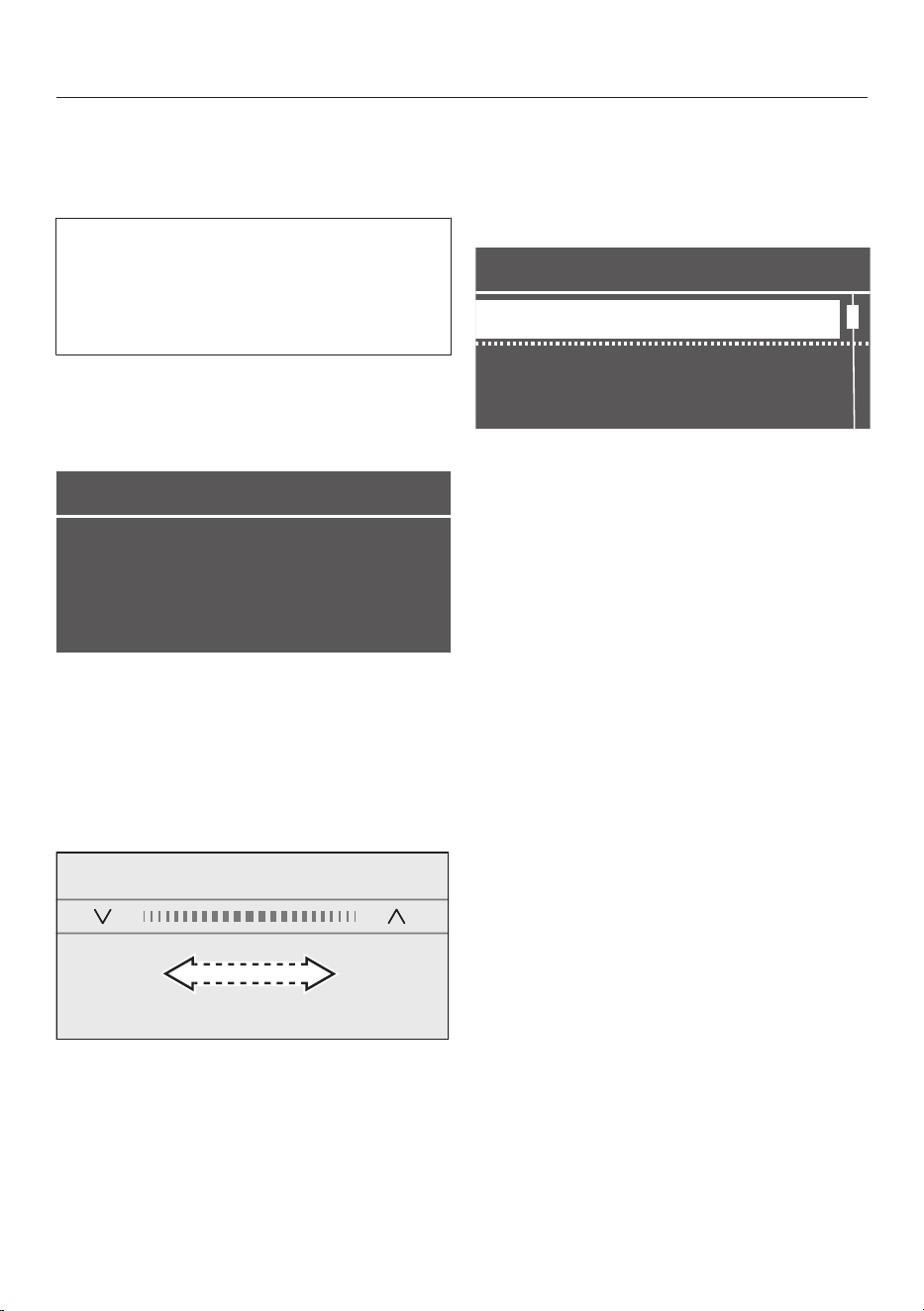
Drink sensor symbols
Espresso
Coffee
Long coffee
Cappuccino
Latte macchiato
Cafè latte
Hot milk
Milk froth
Tea water
Operating principles
21
Sensors
To operate the coffee machine, touch
the sensors with your finger.
An audible signal is generated each
time a sensor is touched. You can
adjust the volume of the keypad tones
or switch the tones off (see “Adjusting
settings – Volume”).
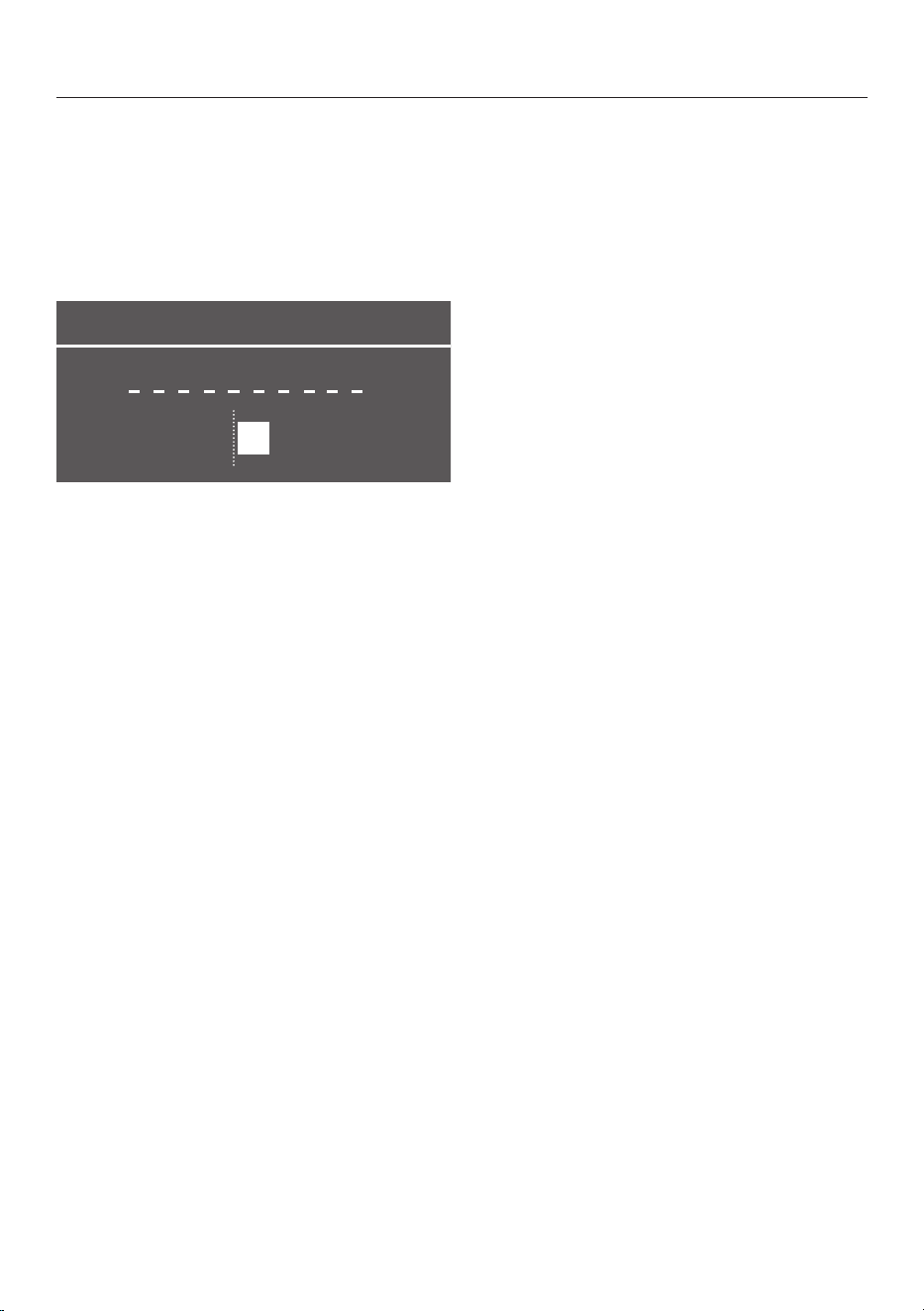
Drinks menu
When Select drink appears in the display,
you are in the drinks menu:
Select drink
Miele
12:00
You can find more drinks in the Other
( sensor) menu.
Navigation area
To select an option, touch the or
arrow sensor until the option you want
is highlighted.
To scroll faster, swipe left or right in the
area between the arrows.
The OK sensor lights up orange as soon
as a value, prompt or setting can be
confirmed.
Touch OK to confirm your selection.
Selecting a menu and
navigating within a menu
To select a menu, touch the relevant
sensor, e.g. the sensor.
Ristretto
Cappuccino Italiano
Settings
Miele
12:00
You will then be able to start an action
or change settings in the menu. A bar on
the right-hand side indicates that
further options or text are available.
The setting in a list which is currently
selected will have a tick beside it.
Exiting a menu or cancelling an
action
Touch the sensor to exit the current
menu.
Alternatively, touch the sensor
highlighted in orange to return to the
drinks menu.
Operating principles
22
Entering a name
Letters and numbers are entered via the
navigation area. You can select both
upper and lower case letters.
Useful tip: It is best to select short,
memorable names.
Name
A B C D E F
Z
- To enter a character, highlight a
character and confirm the selection
with OK.
- To delete a character, touch the
sensor.
- A name is saved by selecting the
tick and confirming with OK.
Miele@home
23
Your coffee machine is equipped with
an integrated Wi-Fi module.
Before installing the coffee machine in
its final location, ensure the signal
strength of your Wi-Fi network is
sufficient.
To use this feature, you will need:
- a Wi-Fi network
- the Miele App
- a Miele user account, which can be
created via the Miele App
The Miele App will guide you through
the process of connecting your coffee
machine to your home Wi-Fi network.
Once your coffee machine is connected
to your Wi-Fi network, you can use the
Miele App, for example, to carry out the
following activities:
- Install software updates
- Call up information on the operating
status of your coffee machine
- Change the settings of your coffee
machine
- Operate your coffee machine remotely
Connecting your coffee machine to
your Wi-Fi network will increase
energy consumption, even when the
coffee machine is switched off.
Availability of the Wi-Fi
connection
The Wi-Fi connection shares a
frequency range with other appliances
(including microwave ovens and remote
control toys). This may result in sporadic
or even complete connection failures.
Therefore, a constant availability of
featured functions cannot be
guaranteed.
Miele@home availability
The ability to use the Miele App
depends on the availability of the
Miele@home service in your country.
The Miele@home service is not
available in every country.
For information about availability, please
visit www.miele.com.
Miele App
You can download the Miele App from
the Apple App Store
®
or the Google Play
Store™ free of charge (only functional in
selected countries).
Before using for the first time
24
Before using for the first time
Connect the coffee machine to the
mains electricity supply.
Install the coffee machine.
Remove any protective foil and
stickers from the machine. Exception:
Please do not remove any labels (e.g.
the data plate) which are visible when
you pull out the lower panel.
Remove the protective foil from the
drip tray cover.
Clean the water container, the bean
containers and the central spout.
Remove the water container and fill it
with fresh, cold tap water. Only fill the
water container up to the “max.”
marker and then refit it in the machine
(see "Filling the water container").
Remove the bean container and fill it
with roasted coffee beans.
Switching on for the first time
Touch the On/Off sensor.
Selecting the display language
Select the required display language.
You might also be asked for your
location.
The choice of location determines how
the time of day is displayed, e.g. in the
12 or 24-hour format, as well as how
units are displayed.
Setting up the network (Miele@home)
To receive software updates and
operate the coffee machine via the
Miele App on your mobile device, you
can connect your coffee machine to
your home Wi-Fi network.
The following appears in the display
during commissioning: Set up
“Miele@home”
Useful tip: You can also set up
Miele@home at a later time by
scanning the QR code on the inside of
the appliance door (see “Setting up
Scan & Connect”). In this case, select
Skip.
Make sure that the signal of your Wi-
Fi network is sufficiently strong in the
place where you want to set up your
coffee machine.
Touch Continue.
Select the connection method you
wish to use.
Follow the instructions provided in
the coffee machine display and in the
Miele App.
Connection successfully established
appears in the display.
Any new software that is available for
your coffee machine will be downloaded
via RemoteUpdate the next time the
appliance is switched on. In this case,
you will be notified that you can install
the new software (see
“RemoteUpdate”).
Networking increases the energy
consumption of the coffee machine.
TouchOK to continue commissioning.
Setting the date
Set current the date.
Confirm with OK.
Before using for the first time
25
Setting the time of day
Set the current time of day.
Confirm with OK.
If the coffee machine has been
connected to a Wi-Fi network and is
signed into the Miele App, the time
will be synchronised based on the
location setting in the Miele App.
Setting the water hardness level
Contact your local water supplier to
find out your local water hardness
range if necessary.
See “Settings - Water hardness” for
more information.
Enter the local water hardness level
(in°dH) and confirm with OK.
Selecting the
Performance mode
You can select the appropriate
Performance mode to suit your personal
preferences (see “Adjusting settings –
Performance mode”):
- Eco mode: this mode consumes the
least amount of energy (default
setting).
- Barista mode: this mode is optimised
for perfect coffee enjoyment.
- Latte mode: in this mode, milk-based
drinks can be prepared within a much
shorter space of time.
Select the Performance mode you
want.
Confirm withOK.
Selecting a Performance mode other
than Eco mode increases the energy
consumption of the coffee machine.
Your machine has been successfully set
up and is ready for use.
To ensure that any coffee residues
from the factory testing process are
removed from the brewing system,
please pour away the first two cups
of coffee when using the coffee
machine for the first time.
Filling the coffee bean container
26
Coffee or Espresso can be made from
whole roasted coffee beans which are
freshly ground for each portion. This
requires the coffee bean container to be
filled with coffee beans.
Risk of damage to the grinder
due to incorrect operation.
The coffee machine will be damaged
if the bean container is filled with
unsuitable substances such as
liquids, ground coffee or coffee beans
treated with sugar, caramel or similar.
In addition, green (unroasted) coffee
beans or mixtures of coffee beans
which contain green coffee beans
can damage the grinder. Green coffee
beans are very hard and still contain
residual moisture. These can damage
the coffee machine grinder as soon
as grinding begins.
Only put roasted coffee beans in the
bean container.
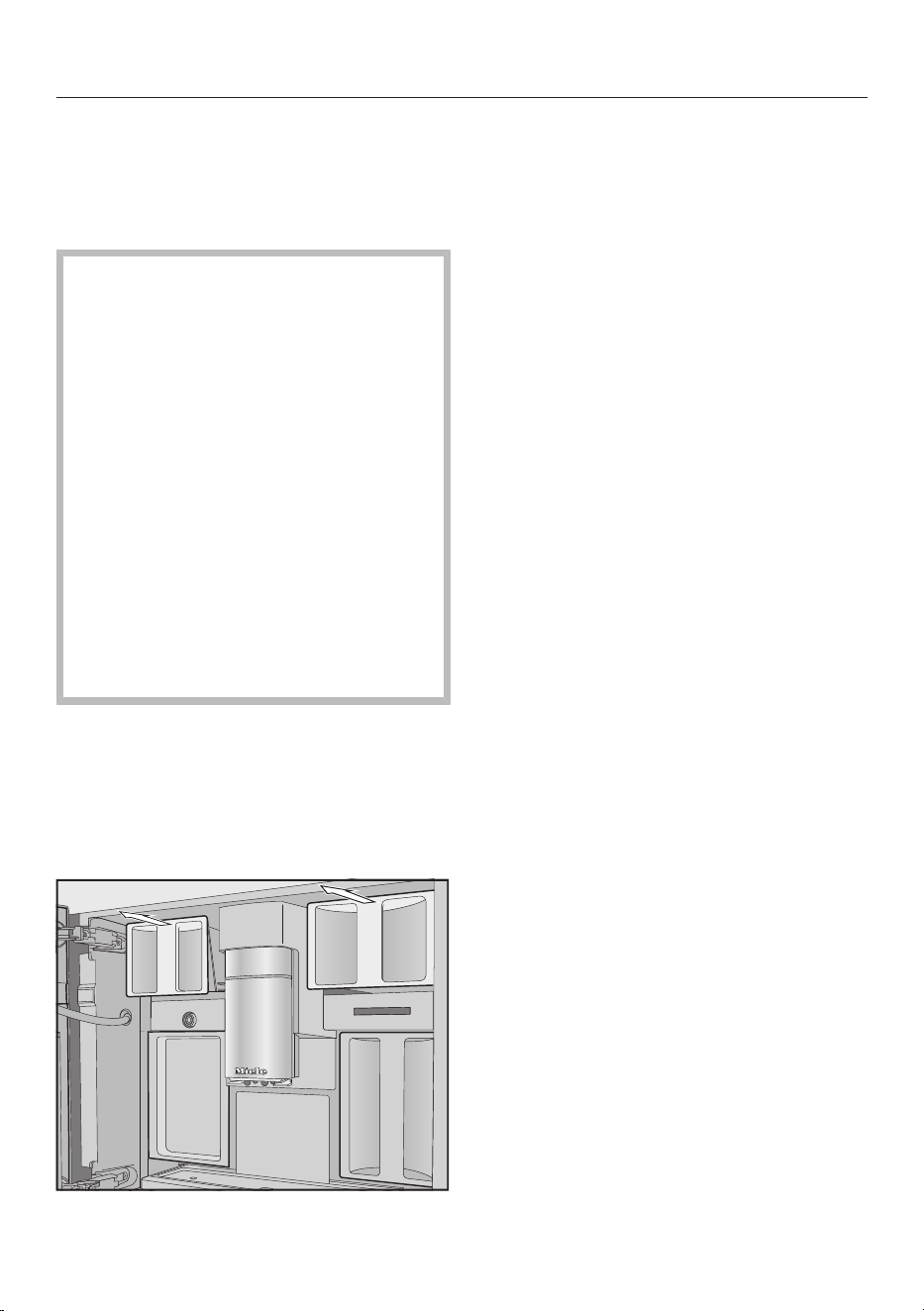
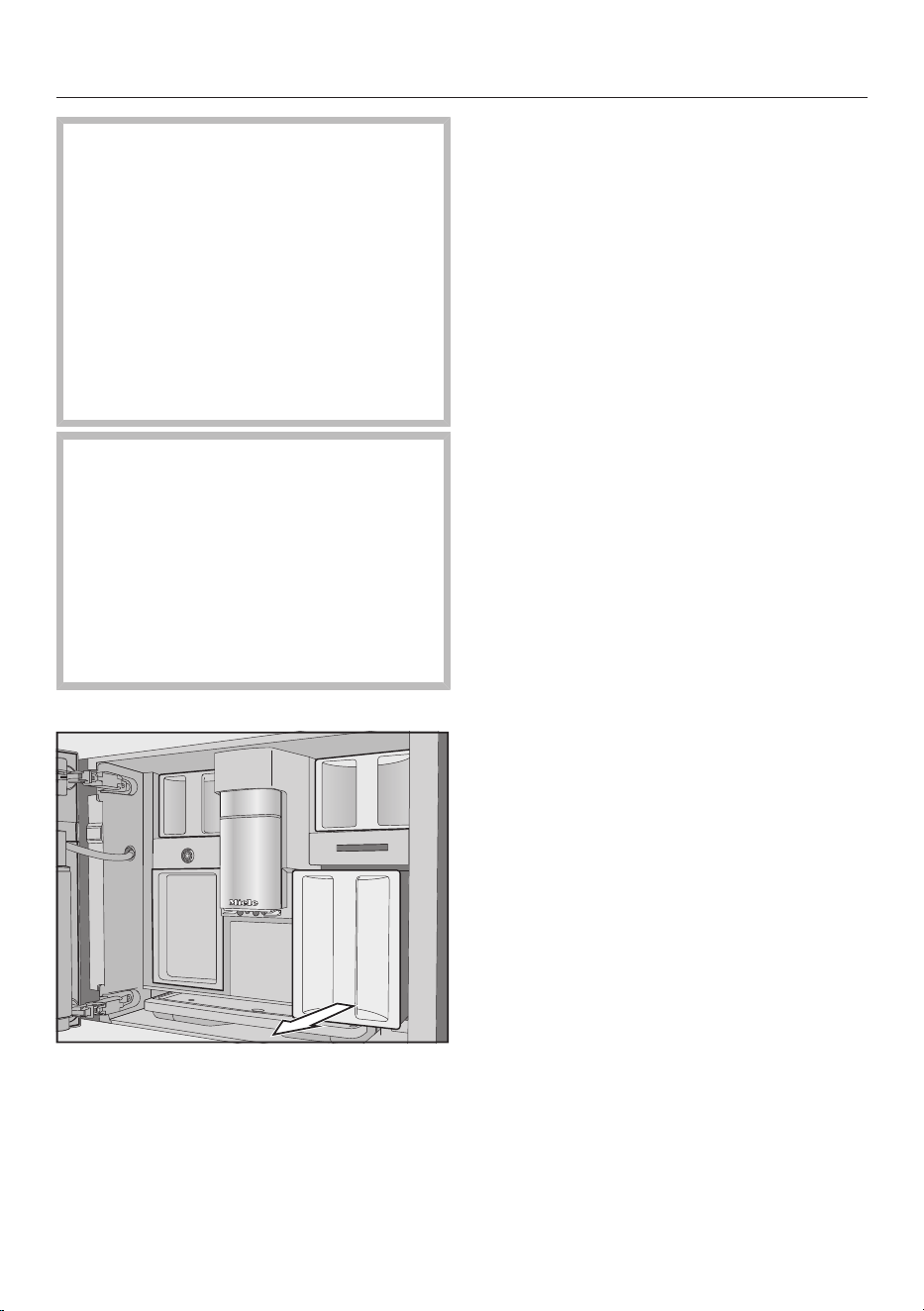
There are 2bean container drawers at
the top right and left of the coffee
machine. The coffee beans from all
3bean containers are mixed together
when ground.
Open the appliance door.
Pull out the coffee bean containers.
Remove each lid and fill the bean
containers with roasted coffee beans.
Close the bean containers with their
respective lids.
Insert the coffee bean container
drawers fully in the coffee machine.
Close the appliance door.
Filling the water container
27
Risk to health due to
contaminated water.
Bacteria can develop in water which
has been sitting in the water
container for too long and is a risk to
your health.
Change the water in the water
container every day.
Pour out the water from the water
container if a drink has not been
prepared for a long time.
Risk of damage due to incorrect
operation.
Unsuitable liquids such as hot or
warm water or other liquids can
damage the coffee machine.
Carbonated water leaves too much
limescale in the coffee machine.
Only use cold, fresh tap water to fill
the water container.
Open the appliance door.
Pull the water container out to
remove it.
Fill the water container with fresh,
cold drinking water up to the max.
marker.
Push the water container into the
appliance.
Close the appliance door.
Switching on and off
28
Switching the coffee machine
on
Touch the On/Off sensor.
The coffee machine heats up and rinses
the pipework. Hot water will run out of
the central spout.
You can now make drinks.
If the coffee machine is already at
operating temperature, rinsing will not
take place.
Switching the coffee machine
off
Touch the On/Off sensor.
If coffee has been dispensed, the coffee
machine will rinse the coffee pipework
automatically before switching off.
While dispensing a drink or during
maintenance processes, moisture
builds up in the coffee machine. Once
a drink has been dispensed or the
machine has been switched off, the
internal fan will continue to run until
the interior is sufficiently dehumidified.
You will hear an accompanying noise.
Preparing for extended disuse
If the coffee machine is not going to be
used for more than 3days, such as
during a holiday, proceed as follows:
Empty the drip tray, the waste
container and the water container.
Clean all parts thoroughly, including
the brew unit and appliance interior.
Switch the coffee machine off.
Making drinks
29
Danger of burning and scalding
on the dispensing spouts.
The liquids and steam dispensed are
very hot and can cause scalding.
Keep well away from the area
underneath the spouts when hot
liquids and steam are being
dispensed.
Do not touch hot components.
Coffee
Coffee drinks in detail
You can use your coffee machine to
prepare the following coffee specialities:
- Ristretto is a strong, concentrated
espresso. It is prepared with the same
amount of coffee as for an espresso
but with much less water.
- Espresso is a strong aromatic coffee
with a thick hazelnut brown coloured
froth – known as the crema – on top.
We recommend using espresso
roasted coffee beans to make an
espresso.
- Coffee differs from espresso by the
increased amount of water and the
roast of the beans.
We recommend using coffee beans
with the appropriate roast to make the
coffee.
- Long coffee is a coffee with
considerably more water.
- Long black is made with hot water
and two shots of espresso.
- Caffè Americano consists of equal
proportions of espresso and hot
water. The espresso is made first,
then the hot water is dispensed.
- Cappuccino consists of approx. 2/3
milk froth and 1/3 espresso.
- Latte macchiato consists of 1/3 each
of hot milk, milk froth and espresso.
- Caffè latte consists of hot milk and
espresso.
- Cappuccino Italiano has the same
proportions of milk froth and espresso
as a cappuccino. The difference is that
the espresso is added first and then
the milk froth.
- Espresso macchiato is an espresso
with a small amount of milk froth on
top.
- Flat white is a special variation of the
cappuccino: a much greater amount
of espresso compared to milk froth
creates an intensive coffee aroma.
- Café au lait is a French coffee
speciality made from coffee and milk
froth. Café au lait is normally served in
a bowl.
Hot milk or milk froth can also be made
separately.
Milk and milk alternatives
Milk containing added sugar or plant-
based milk alternatives, e.g. soy
drinks, can clog up the milk tube and
the rest of the milk pipework.
Residues from unsuitable liquids may
adversely affect correct preparation.
Do not use milk with additives.
Animal milk naturally contains
bacteria.
If using animal milk, make sure that it
has been pasteurised, e.g.
pasteurised cow’s milk.
You can prepare hot milk and milk froth
with cow’s milk or with plant-based milk
alternatives. Depending on the milk
Making drinks
30
used, the consistency of the milk froth
can vary greatly. Not every type of milk
is well suited to frothing.
After the heating-up phase, the milk will
be drawn up into the central spout
where it is heated by steam and also
frothed for drinks requiring milk froth.
Useful tip: Using cold cow's milk
(<10°C) with a protein content of at
least 3% will produce the perfect milk
froth.
You can select milk with a fat content
according to preference. With full cream
milk (at least3.5% fat), the milk froth
will be slightly creamier than with low-
fat milk.
Plant-based milk alternatives -
abbreviated as "milk alternatives" in
the following - contain other
substances than cow's milk, for
example. Due to natural settling,
thickening can occur in milk
alternatives. During the preparation of
hot milk or milk froth, such thickening
can impede the intake of milk
alternatives.
Stir milk alternatives thoroughly
directly before drink preparation.
Do not shake milk alternatives.
Shaking causes an unwanted
formation of froth in the packaging and
impairs preparation.
Useful tip: Manually rinse the milk
pipework immediately after preparation.
Filling and fitting the milk flask
Milk is not cooled in the milk flask.
The milk can spoil if left unchilled in
the milk flask for a long period of time
(depending on type of milk).
Do not leave cow's milk in particular
in the milk flask out of the fridge for a
long period of time.
Please follow the manufacturer's
instructions concerning the storage
life of the milk being used.
If you have not made any milk drinks
for a while, rinse the milk system
thoroughly before making the first
drink.
Useful tip: Use cold milk (<10°C) to
produce a good quality milk froth.
If you are using milk alternatives, be
sure to stir them thoroughly first. To
ensure the best preparation, milk
alternatives must be stirred and not
shaken.
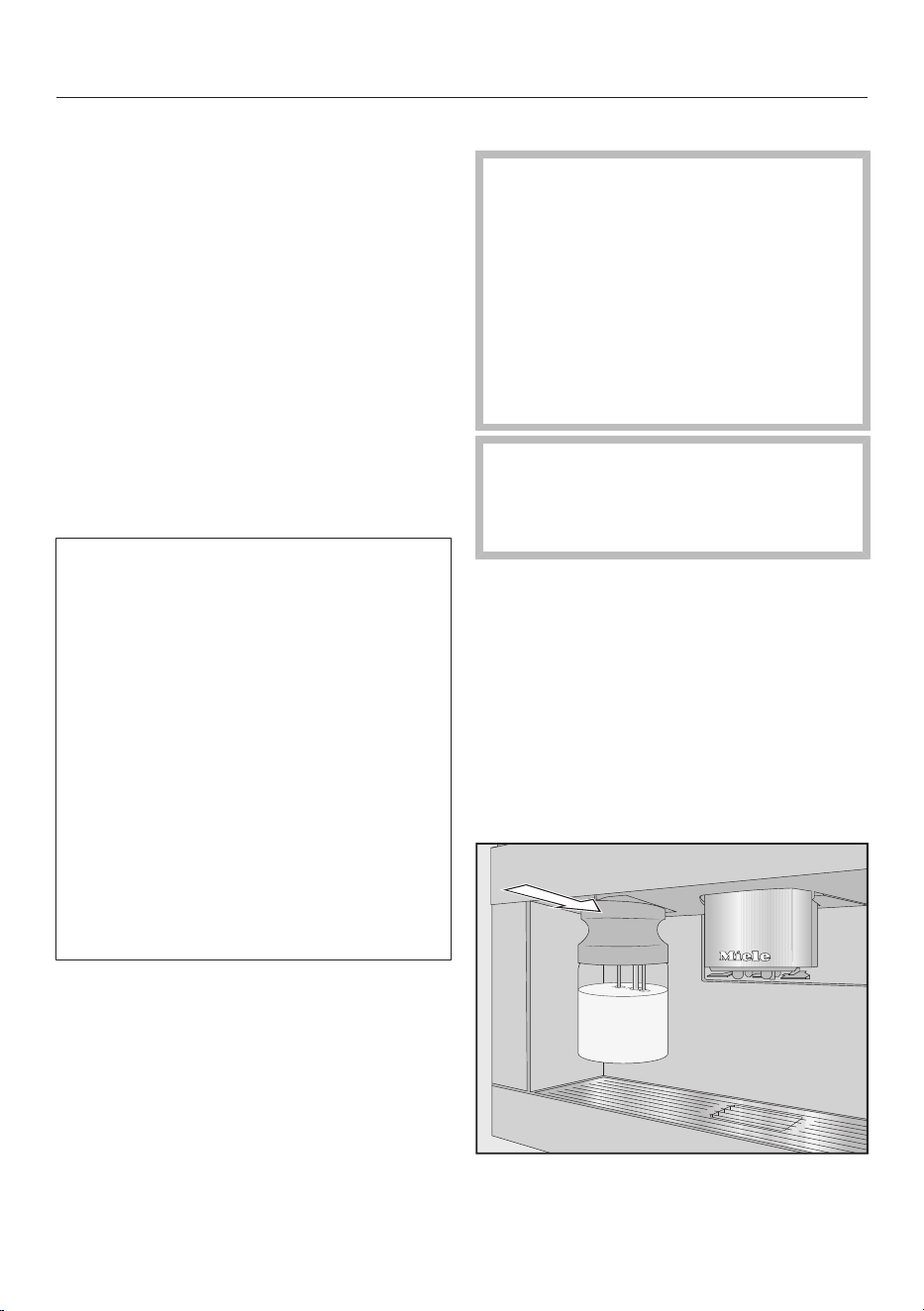
Fill the milk flask with milk up to a
maximum of 2cm below the rim.
Seal the milk flask with the lid.
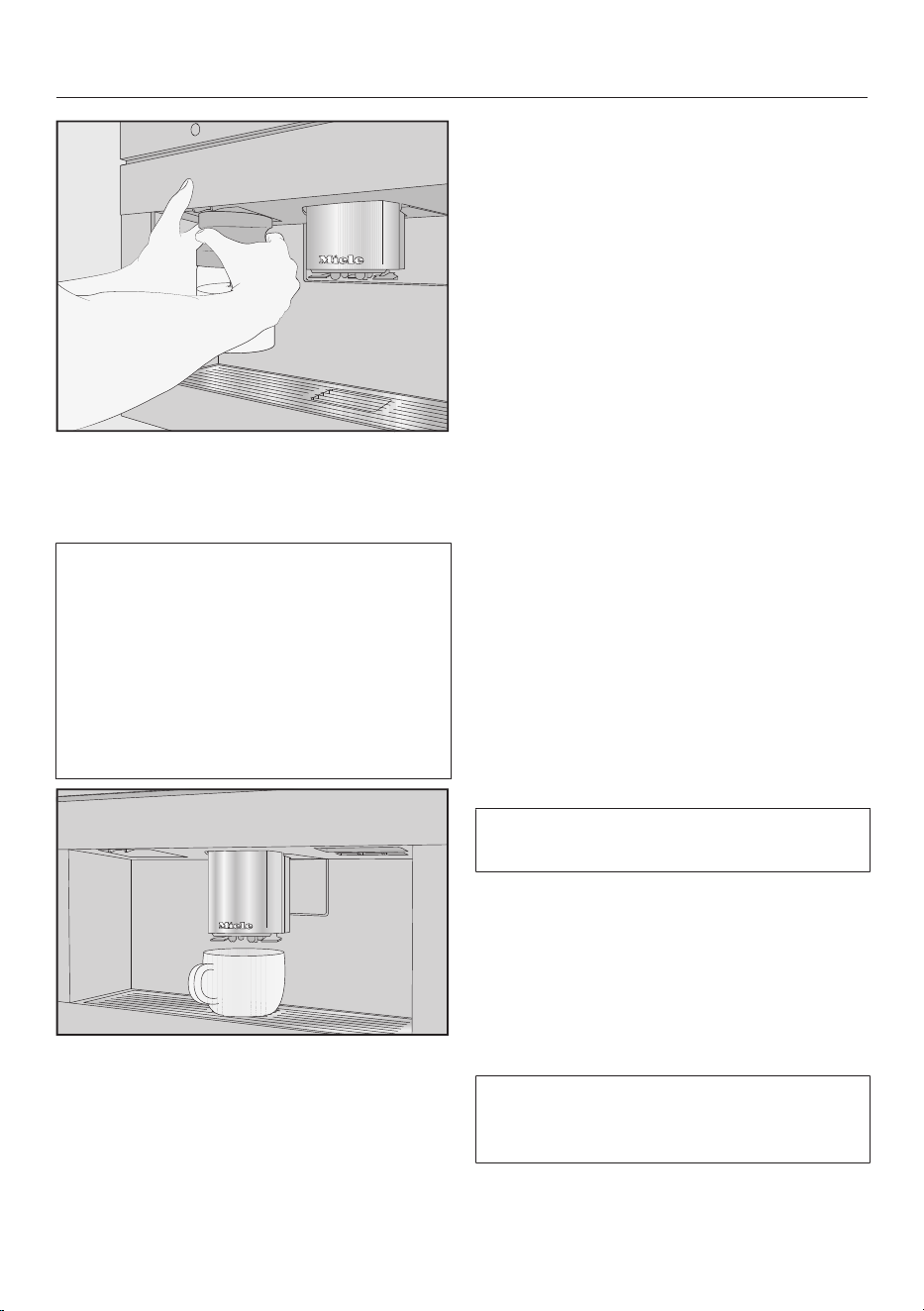
Push the milk flask into the coffee
machine until it clicks into place.
Making drinks
31
Useful tip: The milk flask is easier to
remove again with two hands.
Making a coffee drink
If decaffeinated coffee beans are used
after dispensing a drink with
caffeinated beans, there may still be
residues from the caffeinated beans in
the grinder or brew chamber. Please
be aware that minimal residues of
caffeinated beans from the previous
drink may be present in the next drink
that you make.
Place a cup or glass under the central
spout.
If you want to make a coffee with hot
milk or milk froth, prepare the milk
flask and insert it in the machine.
Touch the sensor for the drink you
want.
The coffee or espresso will be
dispensed from the central spout into
the cup.
Useful tip: If you have dispensed a
coffee with milk, manually rinse the milk
pipework after preparation.
Cancelling a drink
Touch the symbol illuminated in
orange on the control panel again.
When preparing drinks with several
ingredients (e.g. latte macchiato), you
can cancel each of the individual
ingredients prematurely.
When Stop appears in the display,
confirm with OK.
Making a DoubleShot of coffee
Select the DoubleShot function to
make a particularly strong and aromatic
coffee. In this case, more coffee beans
will be ground and brewed a second
time halfway through brewing. Due to
the reduced extraction time, fewer
unwanted aromas and bitter substances
are released.
The sensor control is displayed
during preparation of coffee drinks.
Touch the sensor immediately
before or after you have started
making a coffee.
Preparation starts and the sensor
lights up. 2portions of coffee beans will
be ground and brewed one after the
other.
DoubleShot can be activated for all
coffee drinks except "Ristretto" and
"Long black".
Making drinks
32
Making 2portions
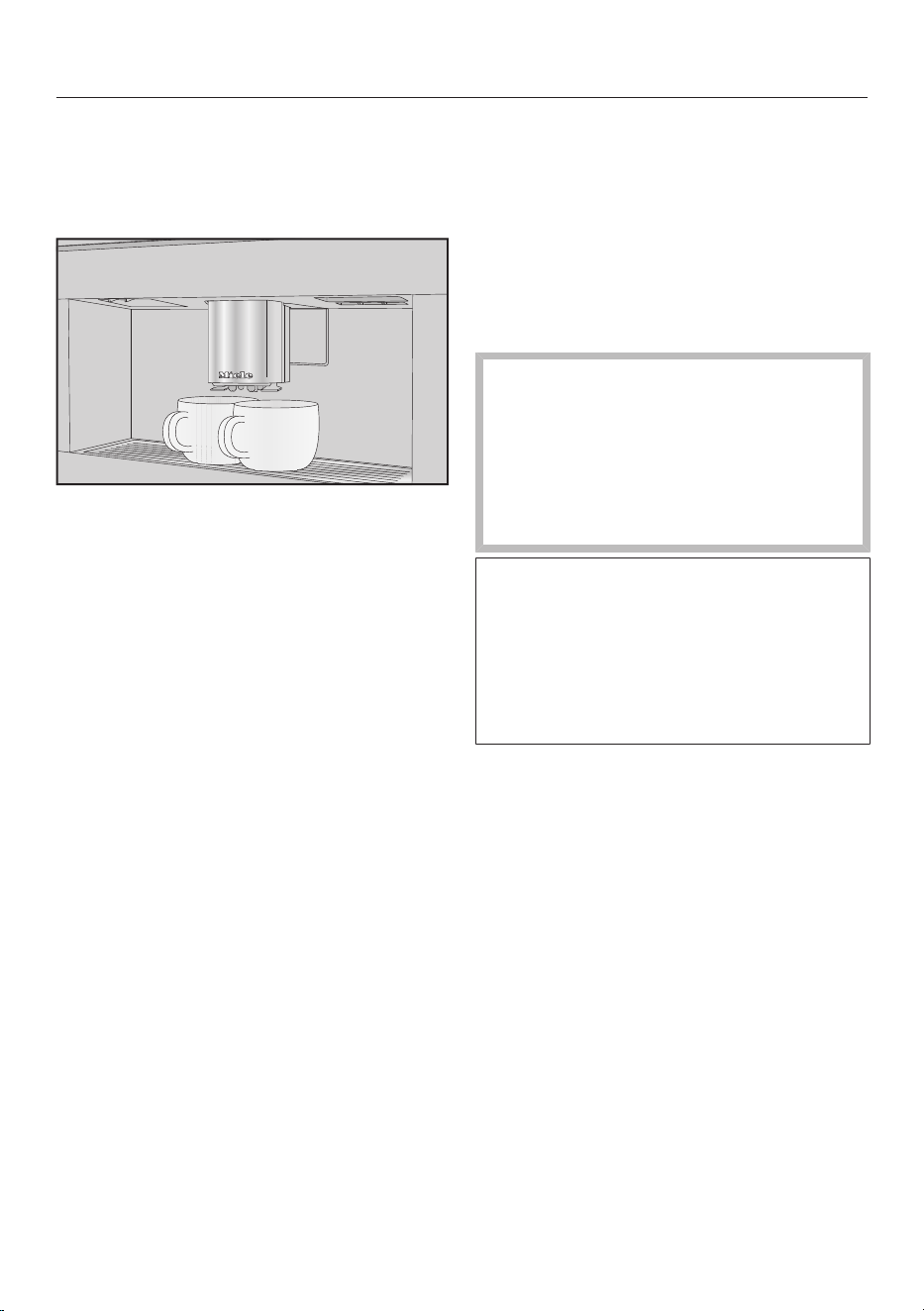
You can also dispense 2portions of a
drink into 1large cup or dispense
2portions into 2cups at the same time.
Place a cup under each of the
dispensing spouts in the central
spout.
Touch the sensor immediately
before or after you have started
making a drink.
The sensor lights up.
The dispensing starts and 2portions of
the desired drink will be dispensed.
Preparing a pot of coffee
You can make several cups of coffee one
after the other automatically with the
Coffee pot function (max.1litre).
The drinks menu is displayed.
Useful tip: Before starting Coffee pot,
ensure the bean containers and the
water container are sufficiently filled.
Place a sufficiently large container
under the central spout.
Touch the sensor.
Select Coffee pot.
Confirm withOK.
Select the number of portions you
want to dispense (3 to 8).
Each portion of coffee will be ground,
brewed and dispensed individually. The
display will inform you about the
progress.
Cancelling a drink
Touch the sensor.
Tea
If the dispensing temperature is too
high or too low or if the brewing time
is too short or too long, this can
affect the flavour of your tea.
Follow the instructions provided by
the manufacturer of the tea you are
making.
This coffee machine is not intended for
commercial or scientific purposes.
Dispensing temperatures given are
approximate and can vary according to
ambient conditions. A change in
temperature of approx. 2°C makes a
difference.
To make tea, you can select from the
following options:
- Japanese tea is a high quality green
tea and has a delicate, fresh, “green”
flavour.
Dispensing temperature:
approx.65°C; brewing time:
approx.1.5minutes
- White tea is a green tea where only
the young buds of the tea plant, which
are still white, are used and processed
very gently. White tea has a
particularly mild flavour.
Dispensing temperature:
approx.70°C; brewing time:
approx.2minutes
- Green tea gets its green colour from
the leaves of the tea plant. The tea
leaves are processed gently in

Making drinks
33
different ways – either roasted or
steamed – depending on the region.
Green tea can be infused multiple
times.
Dispensing temperature:
approx.80°C; brewing time:
approx.2.5minutes
- Black tea gets its dark colour and
typical flavour from the fermentation
of the tea leaves. Black tea can be
drunk with a little lemon or with milk.
Dispensing temperature:
approx.97°C; brewing time:
approx.3minutes
- Chai latte has its origins in the
traditional Ayurveda medicine as a
black tea with typically Indian spices
and milk. The milk mellows the spices
and tops off the flavour experience.
Dispensing temperature:
approx.97°C; brewing time:
approx.3minutes
- Herbal tea is an aromatic infusion
drink made up of dried leaves or fresh
parts of plants.
Dispensing temperature:
approx.97°C; brewing time:
approx.8minutes
- Fruit tea consists of dried pieces of
fruit and/or parts of plants, e.g. rose
hip. The flavour varies depending on
the plants used and their blend. Many
fruit teas are also flavoured.
Dispensing temperature:
approx.97°C; brewing time:
approx.8minutes
The preset dispensing temperature
varies depending on the type of tea.
The respective dispensing temperatures
are recommended by Miele for making
these types of tea.
Whether you use loose tea leaves,
blended tea or tea bags depends on
your own personal preferences.
The amount of tea to use varies from
one type of tea to the next. Always
follow the recommendations of the
manufacturer on the packaging or of the
supplier. You can adjust the amount of
water according to the type of tea and
the size of the cup (see “Changing the
portion size”).
Making tea
If you touch the sensor, a menu with
various types of tea will appear.
The drinks menu is displayed.
Pour loose tea into a tea filter or
similar or take a tea bag from the
packet.
Place the tea filter or the tea bag in
the tea cup.
Place the tea cup under the central
spout.
Touch.
Select the type of tea you want.
Confirm withOK.
Hot water will be dispensed into the
cup.
If you have selected the TeaTimer|
Automatic setting, the minute minder for
the brewing time will start
automatically.
Alternatively, you can also start the
TeaTimer manually.
A buzzer will sound and the symbol is
no longer displayed after the brewing
time has elapsed. The TeaTimer has
elapsed.
Now remove the tea leaves or the tea
bag.

Making drinks
34
Starting the TeaTimer manually
Make a tea.
TeaTimer appears in the display as soon
as the water for the tea has been
dispensed.
TouchOK.
The editor opens with a suggested
brewing time.
Change the brewing time, if
necessary.
Confirm withOK.
A buzzer will sound and the symbol is
no longer displayed after the brewing
time has elapsed. The TeaTimer has
elapsed.
Now remove the tea leaves or the tea
bag.
Preparing a pot of tea
You can use the Tea pot function to
dispense a larger quantity of water for
making tea (max.1litre). The selected
type of tea determines the preset
temperature.
The drinks menu is displayed.
Useful tip: Before starting Tea pot,
ensure the water container is
sufficiently filled.
Place a sufficiently large container
under the central spout.
Touch the drink sensor control.
Select Tea pot.
Select the desired type of tea and the
desired number of cups (3–8).
Cancelling a drink
Touch the sensor.
Preparing warm and hot water
You can select from the following
options:
- Hot water (approx. 90°C)
- Warm water (approx. 65°C)
The drinks menu is displayed.
Place a suitable cup or glass
underneath the central spout.
Touch the sensor.
Select warm or hot water.
Confirm withOK.
Dispensing will start.
Changing the portion size
You can change the portion size in
Expert mode for the current drink or on
a permanent basis. If you want to
change the portion size of the drink
permanently, change the Portion
sizeparameter.
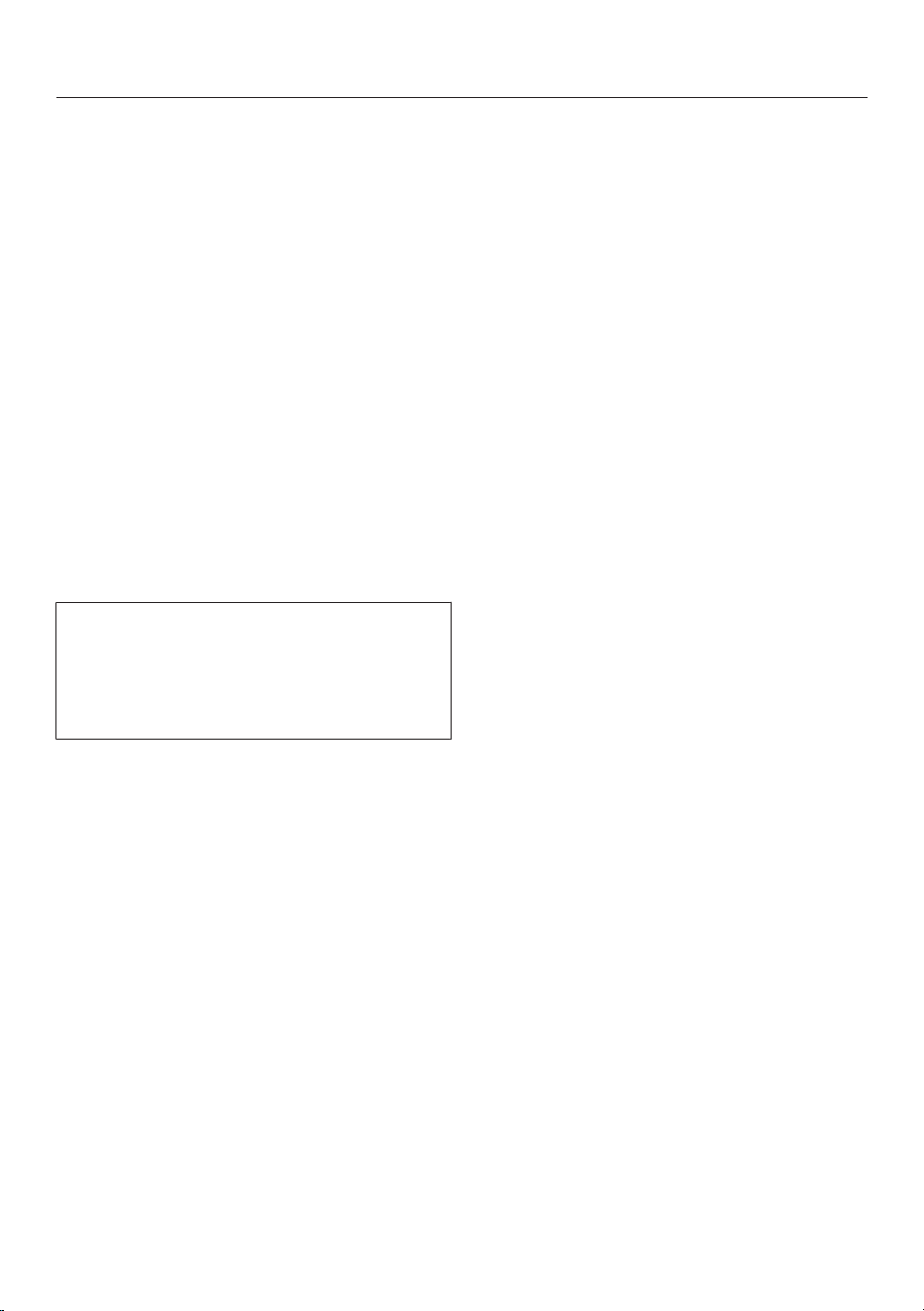
Place a cup or glass under the central
spout.
Touch .
Select Parameters.
Select a drink.
Confirm with OK.
The parameters that you can change for
this drink will be displayed.
Select Portion size.
Confirm with OK.
The required drink will now be made. As
soon as the minimum amount has been
made, Save will be shown in the display.
When the cup is filled up to the level
you want, touch OK.
Making drinks
35
If you want to change the portion size
for coffee specialities made with milk,
the ingredients which make up the drink
will be saved one after the other while
the drink is being made.
When the quantity for each ingredient
reaches the level you want, touch OK.
The programmed combination of
ingredients and portion sizes will now
be dispensed every time that particular
drink is selected.
Useful tip: For the drinks pictured on
the control panel, you can change the
portion size by pressing and holding the
relevant sensor. Touch the desired drink
sensor until preparation starts. As soon
as the minimum amount has been
made, Save will be shown in the display.
If the water container becomes empty
while making a drink, the coffee
machine will stop programming the
portion size. The new portion size will
not be saved.
Expert mode
36
With the Expert mode function you can
change the portion size while the drink
is being made. The setting will not be
saved and will only apply for the current
drink.
Switching Expert mode on and
off
The drinks menu is displayed.
Touch the sensor.
Select Settings | Expert mode.
Select the desired option.
Confirm with OK.
The setting is now saved.
Expert mode: changing the
portion size
The drinks menu is displayed.
The portion size can only be changed
when the respective ingredient is
being processed while the drink is
being made.
If you select DoubleShot or 2
portions, Expert mode cannot be
used to change the portion size.
Select a drink.
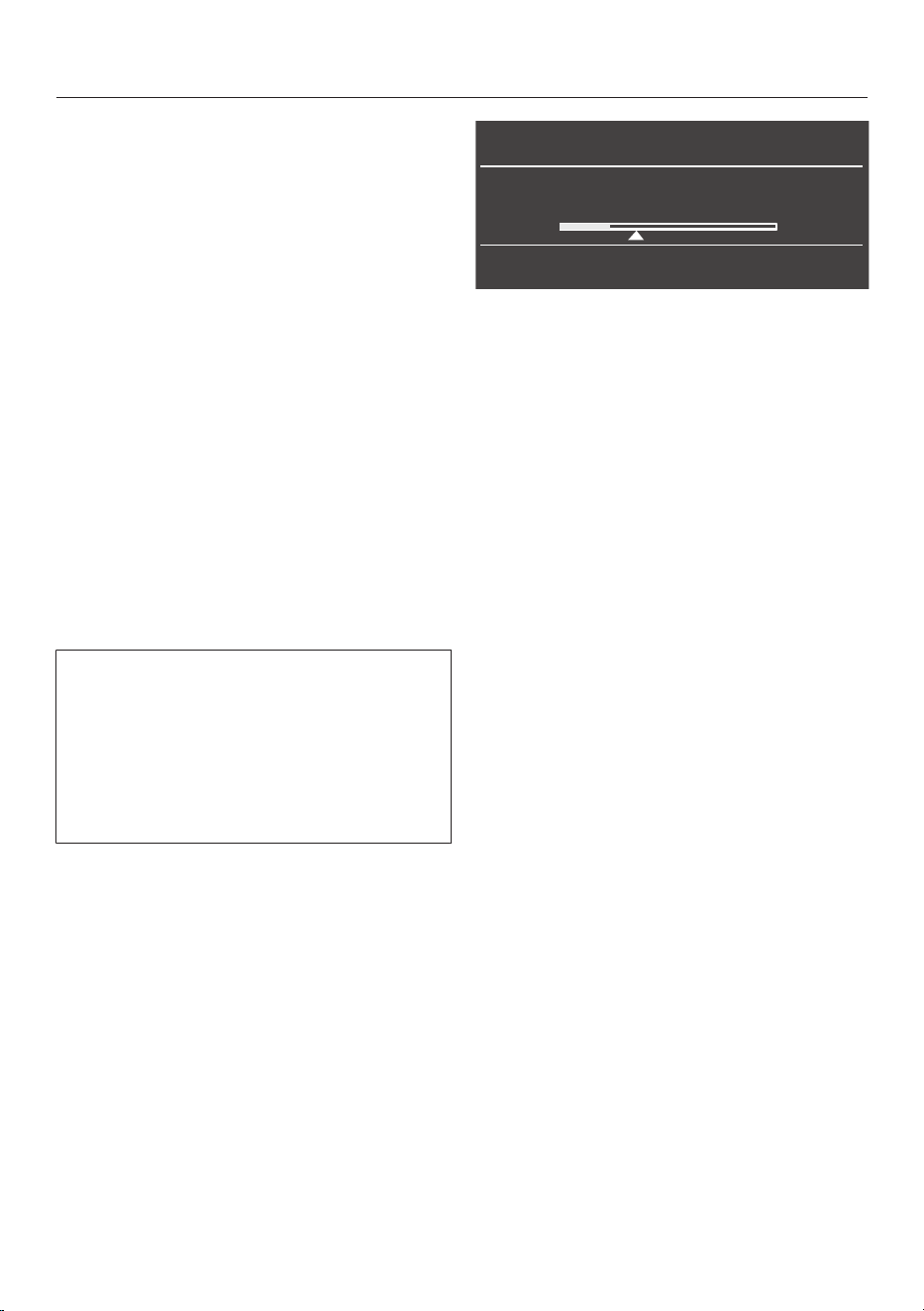
Dispensing will start. You can adjust the
portion size while it is being dispensed,
e.g. individually change the amount of
hot milk, milk froth and espresso for
Latte macchiato.
Dispensing
Move the control (small triangle) in
the navigation area to the desired
position.
Grinder setting
37
The grinder setting determines the
contact time between the ground coffee
and the water, known as the extraction
time. Only when the ideal grinder
setting is selected, can the machine
dispense a perfect cup of coffee with a
fine, hazelnut-brown crema.
Recognising the correct grinder
setting
There are various ways to tell whether
the coffee grinder is set correctly.
The grinder setting is too coarse if the
coffee or espresso is watery and tastes
acidic. The crema is very pale.
The grinder setting is too fine if the
coffee or espresso tastes too bitter and
the crema is dark brown.
Adjusting the grinder setting
If the grinder setting is adjusted by
more than one setting at a time, the
grinder can be damaged.
Only adjust the grinder one setting at
a time.
Dispense a drink after each
adjustment in order to grind a portion
of coffee beans. Adjust the grinder
setting one setting at a time again.
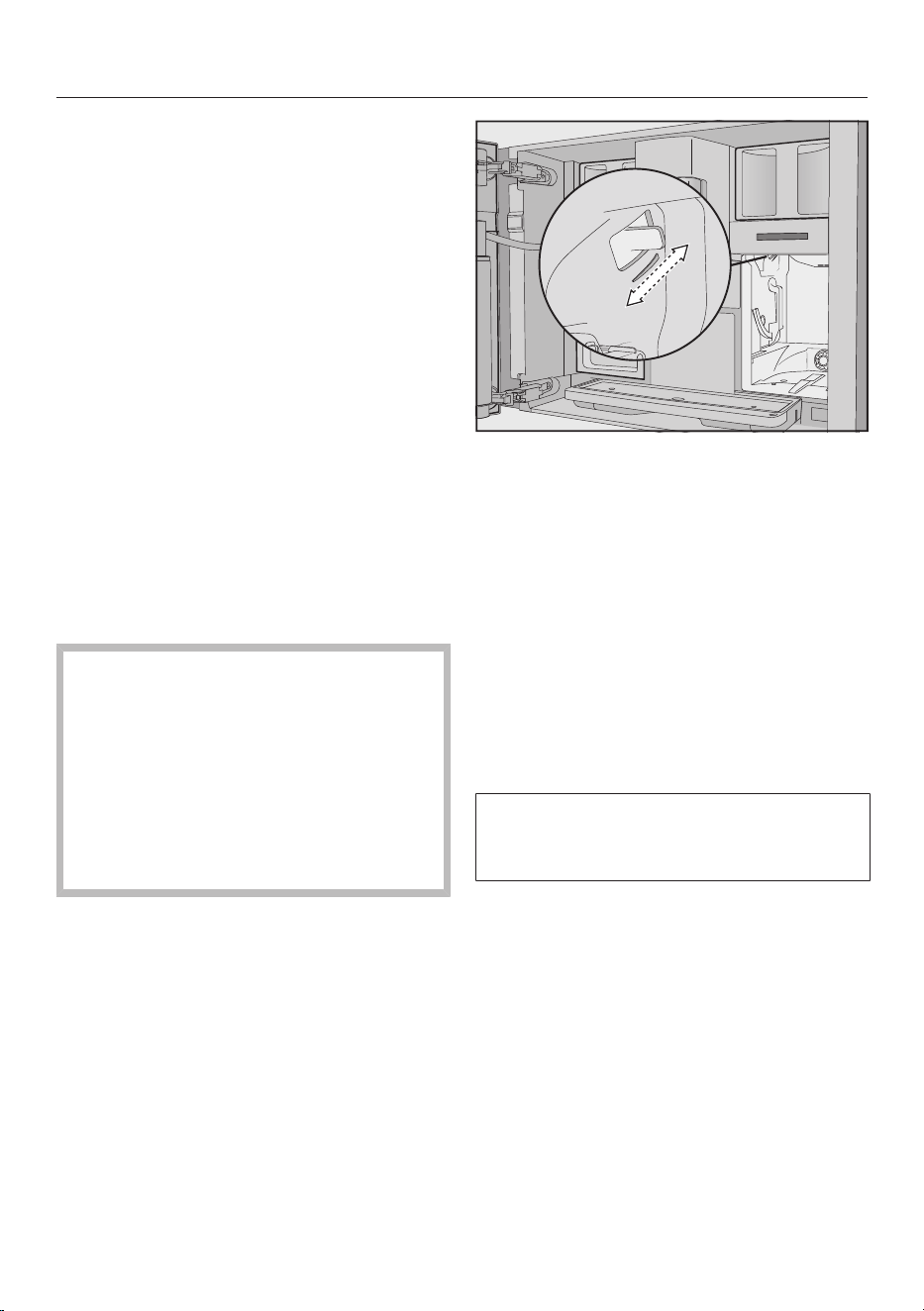
The slide control for the grinder setting
is located at the top left behind the
water container.
Open the appliance door.
Remove the water container.
Push the slide control one setting to
the front (for finer grinding) or to the
back (for coarser grinding).
The grinder setting you select will be
used for all types of bean and all coffee
drinks.
Push the water container back into
the machine.
Close the appliance door.
Make one cup of coffee.
Then you can adjust the grinder setting
again.
The grinder wears out a little naturally
over time with use. Set the grinder to a
finer setting if necessary.
Parameters
38
Displaying and changing
parameters
You can change the portion size for all
drinks.
For coffee drinks, you can also set the
amount of coffee, the brewing
temperature and pre-brewing for each
drink individually.
Touch the sensor.
Select a drink.
Confirm with OK.
The parameters that you can change for
this drink will be displayed.
If you have selected a coffee drink, the
current settings for Amount of coffee,
Brew temperature and Pre-brewing will be
displayed.
The Portion size option is displayed in
the first line. If you select Portion size
and confirm with OK, drink
preparation will begin immediately.
Select the required parameters.
Change the setting as required.
Confirm with OK.
The setting is now saved.
Amount of coffee
The coffee machine can grind and brew
7.5–12.5g of coffee beans per cup. The
greater the quantity, the stronger the
coffee.
The quantity of coffee is too low if the
espresso or coffee lacks body.
To brew more ground coffee, increase
the amount of coffee.
The quantity of coffee is too high if the
espresso or coffee tastes bitter.
To brew less ground coffee, decrease
the amount of coffee.
Pre-brewing ground coffee
When the pre-brewing function is
switched on, the ground coffee is first
moistened with a little hot water. The
ground coffee swells a little. The
remaining amount of water is then
pressed through the moistened coffee
grounds shortly after. If your coffee
tastes too bland and you want to add
some spice and richness, try the “Pre-
brewing” function. Depending on the
type of coffee used, pre-brewing can
intensify the taste.
You can set a short or long duration for
pre-brewing or turn the “Pre-brewing”
function off completely.
Useful tip: We particularly recommend
using the “Pre-brewing” function to
make coffee.
Brewing temperature for coffee
drinks
The brewing temperature must be
adapted to the beans you are using and
how they are roasted. It also varies
depending on whether you are making
espresso or coffee.
Some bean types are sensitive to high
brewing temperatures, resulting in an
impaired taste. If your coffee tastes
bitter, the brewing temperature you
have selected might be too high.
Espresso is usually brewed at higher
temperatures.
Dispensing temperature for tea
drinks, warm water and hot
water
You can adjust the dispensing
temperatures used for the individual tea
drinks and for warm and hot water by
customising the brewing temperature.

Parameters
39
Even a change in temperature of approx.
2°C makes a difference.
Portion size
The flavour of the coffee produced
depends not only on the type of coffee,
but also on the amount of water used.
You can programme the amount of
water for all drinks (except Coffee pot) to
suit the size of your cups and/or the
type of coffee you are using, for
example.
For coffee drinks that use milk, you can
not only set the amount of espresso or
coffee, but also the amount of milk or
milk froth to be dispensed with these
drinks.
A maximum portion size can be
programmed for each type of drink. The
coffee machine halts preparation of the
coffee once this portion size has been
reached. The maximum possible portion
size is then saved by the appliance for
this type of drink.
User profiles
40
User profiles
In addition to the Miele drinks menu
(Miele profile), you can create individual
profiles to cater for different tastes and
preferences.
Within the profile, you can adjust the
portion sizes and parameters
individually for all drinks.
Creating a profile
Touch the sensor.
The User profiles menu opens.
Select Create profile.
Confirm with OK.
The editor will open in the display.
Enter the profile name:
- To enter a character, highlight a
character and confirm the selection
with OK.
- To delete a character, touch the
sensor.
- A name is saved by selecting the
tick and confirming with OK.
The profile is created.
Editing a profile
When you have created user profiles,
you can edit these profiles in the User
profiles menu.
Touch the sensor.
TheUser profiles menu opens.
Select Edit.
Confirm withOK.
You can now edit the following settings
in the selected profile:
- Setting change of profile
- Changing the profile name
- Deleting the profile
Setting change of profile
Touch the sensor.
The User profiles menu opens.
Select Edit.
Confirm with OK.
Select Change profile.
Confirm with OK.
You have the following options:
- Manual: The selected profile remains
active until you select another profile.
- After each use: The Miele profile is
displayed after every drink.
- When switched on: Every time the
coffee machine is switched on, the
Miele profile is displayed, regardless
of which profile had been selected
before switching off.
Select the desired option.
Confirm with OK.
Changing the profile name
This selection is only possible if a
profile has been allocated in addition
to the Miele standard profile.
Touch the sensor.
The User profiles menu opens.
Select Edit.
Confirm with OK.
Select Change name.
Confirm with OK.
Change the name as required:
- To delete a character, touch the
sensor.
- To enter new characters, highlight a
character and confirm the selection
with OK.

User profiles
41
- To save the new name, select the
tick
Confirm with OK.
Deleting a profile
This selection is only possible if a
profile has been allocated in addition
to the Miele standard profile.
Touch the sensor.
The User profiles menu opens.
Select Edit.
Confirm with OK.
Select Delete profile.
Confirm with OK.
Select the profile you wish to delete.
Select Yes.
Confirm with OK.
The profile is deleted.
Preparing User profile drinks
Touch the sensor.
Select the profile you want.
Select the drink you want.
Drink preparation starts.
Changing drinks in a profile
When you change the parameters of a
drink within a profile, these settings only
apply to the active profile. The settings
for drinks in other profiles are not
affected.
Touch the sensor.
The User profiles menu opens.
Select the profile you want.
The name of the profile selected will be
shown in the top left-hand corner of the
display.
You can now change the drinks
individually.
MobileStart
42
Preparing MobileStart
Danger of burning and scalding
on the dispensing spouts.
If liquids or steam are dispensed
while the machine is unsupervised,
persons may burn themselves if they
place body parts under the central
spout or touch hot components.
Ensure that no one, especially
children and pets, can be harmed if
the machine is operated without
supervision.
Milk is not cooled in the milk flask or
in a milk carton.
Milk may spoil if it is left in the milk
flask or carton for an extended period
without being cooled (depending on
the type of milk).
In particular, do not leave cow’s milk
in the milk flask or carton for an
extended period without cooling it.
Please follow the manufacturer’s
instructions concerning the storage
life of the milk being used.
With MobileStart, you can start making a
drink, for example, via the MieleApp.
Make sure that the coffee machine is
ready to use – for example, check that
the water container and bean
container are sufficiently filled.
Place a sufficiently large, empty cup
or glass under the central spout.
You will only be able to use MobileStart
if:
- Miele@home has been set up for your
coffee machine and
- the Remote control and MobileStart
functions have been switched on.
You can then make drinks via the App.
Switching MobileStart on and
off
To use MobileStart, the Remote control
function must be switched on.
The drinks menu is displayed.
Touch the sensor.
Select MobileStart.
Select the desired option.
Confirm withOK.
As soon as you have switched on
MobileStart, you can start making a drink
via the App.
If you are making a drink via the App,
you will be notified when the drink is
being dispensed via audible and visual
signals. These signals cannot be
changed or switched off.
While MobileStart is switched on, the
display shows the symbol and,
when the coffee machine is switched
off, the time of day. Activation rinsing
is not carried out, meaning that the
cup under the central spout is not
filled with rinse water.
If the coffee machine is being operated
manually, it cannot be operated via the
App. Operation on the appliance takes
precedence.
After 24hours, if you have made a
drink or opened the appliance door,
MobileStart is automatically switched
off.
Settings
43
You can use the Settings menu to
customise the coffee machine to suit
your individual requirements.
Displaying and changing
Settings
The drinks menu is displayed.
Touch the sensor.
Select Settings .
Confirm with OK.
Select the option you want to display
or change.
Confirm with OK.
Change the setting as required.
Confirm with OK.
Some settings which can be found in
the Settings menu are described in
their separate sections in the
operating instructions.
Language
You can select a language and location
variant for all display texts.
Useful tip: If you select the wrong
language by mistake, you can find the
"Language" option again via the
symbol.
Time of day
Display (time of day display)
Select how you want the time of day to
appear in the display when the coffee
machine is switched off:
- On: The time is always visible in the
display.
- Off: The time is not displayed.
- Night dimming: To save energy, the
time is displayed from 5:00am to
11:00pm only.
When the time of day display is
switched on, the energy consumption
of the coffee machine increases.
Clock format
- 24-hour display (24 h)
- 12-hour display (12 h)
Setting
Set the hours and then the minutes.
If the coffee machine has been
connected to a Wi-Fi network and is
signed into the Miele App, the time
will be synchronised based on the
location setting in the Miele App.
Date
Set the date.
Timer
The coffee machine has three timers.
- Switch on at
- Switch off at
- Switch off after
You can allocate individual timer
functions to different days of the week.
Switch on at
The coffee machine switches on at a
particular time, e.g. in the morning for
breakfast.
The coffee machine will not switch on
at the required time if you have
activated the system lock.
The timer settings are deactivated.
If the coffee machine has switched itself
on automatically three times at the
specified time and no drinks have been
dispensed, the machine will not switch
itself on again automatically. This
Settings
44
prevents the coffee machine from
switching itself on unnecessarily, for
example, whilst you are away on holiday.
The programmed times will, however,
remain in memory and will be
reactivated after manually switching the
machine on again.
If you have switched on the time display
for the switched off appliance (Show |
On or Night dimming) the symbol and
the desired switch-on time will appear
in the display up to 23:59 hours ahead
of time.
Switch off at
The coffee machine switches off at a
particular time.
In the event of a longer absence, the
programmed times will remain in
memory and will be reactivated after
manually switching the machine on
again.
Switch off after
The coffee machine switches off after a
particular length of time if no sensors
have been touched.
You can change this preset to a time of
between 20minutes and 9hours.
Under the default settings the coffee
machine switches off after
20minutes. Extending this time
increases the energy consumption of
the coffee machine.
TeaTimer
You can use the TeaTimerfunction to
start a minute minder when making tea.
There is a preset brewing time for the
type of tea selected. You can change the
preset brewing time (max.
14:59minutes).
You can set the TeaTimer as follows:
- Automatic: the TeaTimer starts
automatically once the water has
been dispensed.
- Manual: you have the option of
starting the TeaTimer once the water
has been dispensed.
While the brewing time is counting
down, you can continue to use the
coffee machine as normal. An audible
tone will sound and the symbol will
flash after the brewing time has
elapsed.
Volume
You can set the volume of buzzer and
keypad tones using the segment bar.
The welcome melody that sounds when
the On/Off sensor is touched can be
switched on or off.
Display brightness
You can set the display brightness using
the segment bar.
Lighting
You can adjust the brightness of the
lighting when the coffee machine is
switched on or off.
You can also set for the switched off
appliance the length of time after which
the lighting should switch off (between
15minutes and 9hours).
The brighter the lighting is set and the
longer it is switched on, the higher the
energy consumption of the coffee
machine.
Settings
45
Info (display information)
You can display the number of drink
portions or the number of possible
portions before maintenance
programmes are necessary.
Altitude
If the coffee machine is installed at high
altitudes, the lower air pressure will
cause the water to boil at a
comparatively lower temperature. You
can set the local altitude of the machine
to ensure that the correct temperatures
are achieved.
Performance mode
You can select the most suitable
Performance mode for your type of use:
- Eco mode
- Barista mode
- Latte mode
There is also a mode for occasional,
intensive use of the coffee machine:
Party mode.
Eco mode
In Eco mode, the coffee machine
consumes the least amount of energy.
The system only heats up once drink
preparation has started.
Eco mode is set as standard. Selecting
a Performance mode other than Eco
mode increases the energy
consumption of the coffee machine.
Barista mode
This Performance mode is optimised for
perfect coffee enjoyment. Coffee drinks
can be prepared without any delay as
the coffee machine remains heated to
the brewing temperature.
Barista mode consumes more energy
than Eco mode.
Latte mode
This Performance mode is optimised for
preparing drinks containing milk. In Latte
mode, milk-based drinks can be
prepared much faster.
Latte mode consumes more energy
than Eco mode and Barista mode.
Party mode
This Performance mode is designed for
infrequent, intensive use of the coffee
machine, e.g. for family parties.
After intensive use, clean the coffee
machine, and particularly the milk
pipework, thoroughly.
If necessary, descale the coffee
machine and degrease the brew unit.
Please note the following information
about Party mode:
- The pipework is rinsed much less
frequently or not at all. The milk
pipework is not rinsed until around
1hour after the last drink with milk
was dispensed.
- Any messages on the maintenance
status, or maintenance prompts, are
suppressed and delayed until the next
time the machine is switched on.
- Cup lighting on the central spout is
switched on permanently at the
maximum brightness level for as long
as the coffee machine is switched on.
- The Switch off at and Switch off after
timer are deactivated.
- The coffee machine switches off
6hours after the last sensor has been
touched. The next time the appliance
Settings
46
is switched back on, Party mode is
switched off and the most recently set
Performance mode is switched back
on.
Party mode consumes more energy
than other Performance modes.
Water hardness
Programme the coffee machine to the
water hardness level of your area so that
it functions correctly and does not get
damaged.
Contact your local water supplier to find
out your local water hardness range if
necessary.
If you are using bottled drinking water,
e.g. mineral water, select settings
according to the calcium content. The
calcium content is given on the label of
the bottle in mg/l Ca
2+
or ppm (mg Ca
2+
/
l).
Do not use carbonated water.
The water hardness is preset at the
factory to 21°dH (3.8 mmol/l).
Water hardness Calcium
content
mg/lCa
2+
or
ppm (mgCa
2+
/l)
Setting
°dH mmol/l
1 0.2 7 1
2 0.4 14 2
3 0.5 21 3
4 0.7 29 4
5 0.9 36 5
6 1.1 43 6
7 1.3 50 7
8 1.4 57 8
9 1.6 64 9
10 1.8 71 10
Water hardness Calcium
content
mg/lCa
2+
or
ppm (mgCa
2+
/l)
Setting
°dH mmol/l
11 2.0 79 11
12 2.1 86 12
13 2.3 93 13
14 2.5 100 14
15 2.7 107 15
16 2.9 114 16
17 3.0 121 17
18 3.2 129 18
19 3.4 136 19
20 3.6 143 20
21 3.8 150 21
22 3.9 157 22
23 4.1 164 23
24 4.3 171 24
25 4.5 179 25
26 4.6 186 26
27 4.8 193 27
28 5.0 200 28
29 5.2 207 29
30 5.4 214 30
31 5.5 221 31
32 5.7 229 32
33 5.9 236 33
34 6.1 243 34
35 6.3 250 35
36 6.4 257 36
37-45 6.6-8.0 258–321 37-45
46-60 8.2-10.7 322–429 46-60
61-70 10.9-12.5 430-500 61-70
Settings
47
Useful tip: If your water hardness is
>21°dH (3.8mmol/l), we recommend
instead to use bottled drinking water
(<150mg/lCa
2+
). This will mean your
coffee machine will need to be descaled
less often and there will be less impact
on the environment because less
descaling agent will be used.
System lock
You can lock the coffee machine to
prevent it being used without your
knowledge, for example by children.
When the system lock is activated, the
settings for the Switch on at timer are
deactivated. The coffee system will
not switch on at the time set.
Overriding the system lock
TouchOK for 6seconds.
The system lock is activated the next
time the machine is switched off.
Miele@home
The coffee machine is equipped with a
Wi-Fi module and enabled for
Miele@home.
Depending on whether you have
connected the coffee machine to your
network or not, the following options are
displayed under Miele@home:
- Set up: This option only appears if the
coffee machine has not previously
been connected to a Wi-Fi network or
if the network configuration has been
reset.
- Deactivate*/Activate*: The settings
for the Wi-Fi network are retained, but
the network is switched on or off.
- Connection status*: Information
about the Wi-Fi connection is
displayed. The symbols indicate the
strength of the connection.
- Set up again*: The settings for the
current Wi-Fi network will be reset.
The Wi-Fi connection will be set up
again.
- Reset*: Networking is switched off
and the settings for the current Wi-Fi
network will be reset.
* This option appears if Miele@home
has been set up and the coffee machine
has been connected to your Wi-Fi
network.
Useful tip: You can start networking at
any time when the coffee machine is
ready for operation by touching and
holding theOK sensor or scanning the
QR code in these operating instructions
(see “Performing Scan & Connect”).
Networking increases the energy
consumption of the coffee machine,
even if it is switched off.
The network configuration should be
reset whenever the coffee machine is
being disposed of or sold, or if a used
coffee machine is being put into
operation. This is the only way to
ensure that all personal data has been
removed and, in the case of the latter,
the previous owner will no longer be
able to access the coffee machine.
Performing Scan & Connect
Initial commissioning has been carried
out without Miele@home having been
set up.
Scan the QR code.
Settings
48
If you have installed the Miele App and
have a user account, you will be taken
directly to the networking steps.
If you have not yet installed the Miele
App, you will be taken to the Apple App
Store
®
or the Google Play Store™.
Install the Miele App and set up a
user account.
Scan the QR code again.
The Miele App will guide you through
the set-up process.
Remote control
The menu option appears if
Miele@home has been set up and the
coffee machine has been connected to
a Wi-Fi network.
You can change the coffee machine
settings, for example, in the MieleApp
when remote control is switched on. To
start making a drink via the App,
MobileStart must be additionally
activated.
Remote control is switched on as
standard.
RemoteUpdate
The RemoteUpdate function is used for
updating the software in your coffee
machine. If an update is available for
your coffee machine, this will be
downloaded by the machine
automatically. Updates will not be
installed automatically. They must be
initiated manually.
If you do not install an update, you can
continue to use your coffee machine in
the usual way. However, Miele
recommends installing updates.
The RemoteUpdate menu option is
only displayed and can only be
selected if the requirements for using
Miele@home have been met.
RemoteUpdate is switched on as
standard. Available updates will be
downloaded automatically but will only
be installed if you initiate the installation
manually.
Deactivate RemoteUpdate if you do not
want any updates to be downloaded
automatically.
Running a RemoteUpdate
Information about the content and
scope of an update is provided in the
MieleApp.
A message will appear in your coffee
machine display if an update is ready for
installation.
You can install the update immediately
or postpone this until later. You will be
reminded about the update the next
time you switch the coffee machine on.
Deactivate RemoteUpdate if you do not
want to install the update.
The update may take several minutes.
Keep in mind the following with respect
to RemoteUpdates:
- You will only receive a message when
a RemoteUpdate is available.
- Once a RemoteUpdate has been
installed, it cannot be undone.
- Do not switch off the coffee machine
while an update is being downloaded
or installed. Otherwise, the update
will be aborted and will not be
installed.
Settings
49
- Some software updates can only be
carried out by Miele Customer
Service.
Software version
The “Software version” menu option is
intended for Miele service technicians.
You do not require this information for
your own use.
Showroom programme (Demo
mode)
Do not activate this setting for
domestic use.
The Showroom programme | Demo mode
function enables the coffee machine to
be demonstrated in stores or
showrooms. In this mode, the machine
lights up but drinks cannot be prepared
and no maintenance programmes can
be carried out.
You can activate Demo mode without
commissioning the appliance. Switch
the coffee machine on and off again.
Then immediately touch and hold the
sensor for 5seconds. Demo mode
is active.
Factory default settings
You can reset the settings back to the
ones which were set when the coffee
machine was delivered - the factory
default settings.
The following will not be reset:
- The number of drinks and the
appliance status (No. of uses until
appliance needs descaling, ... brew
unit needs degreasing)
- Language
- Time and date
- Profiles and respective drinks
- Miele@home
Cleaning and care
50
Risk to health due to inadequate cleaning.
Heat and moisture inside the coffee machine can cause coffee residues to
become mouldy and/or milk residues to go off and pose a risk to health.
Carefully clean the coffee machine regularly.
Cleaning intervals – Quick guide
Recommended frequency What do I have to clean/maintain?
Every day
(at the end of the day)
Milk flask and lid
Milk valve
Water container
Drip tray
Drip tray and waste container
Once a week
(more often if heavily soiled)
Central spout:
Cup rim sensor
Interior
Brew unit
Drip catcher
Appliance front
Once a month Milk valve
Bean containers
As required/When prompted by
display
Milk pipework (using the Miele cleaning agent for milk
pipework)
Degrease the brew unit (using the cleaning tablets)
Descale the appliance
Cleaning and care
51
Cleaning by hand or in the
dishwasher
The brew unit is not dishwasher-safe.
Clean the brew unit by hand only
under warm running water. Do not
use washing-up liquid or any other
cleaning agent.
The following must be cleaned by hand
only:
- Central spout stainless steel cover
- Brew unit
- Coffee bean container and lid
Risk of damage as a result of
excessively high dishwasher
temperatures.
Components may be rendered
unusuable (e.g. deformed) if washed
in a dishwasher at a temperature of
more than 55°C.
For dishwasher-safe parts, the
maximum temperature of the
dishwashing programme selected
must not exceed 55°C.
Contact with natural dyes such as
those found in carrots, tomatoes and
ketchup may discolour the plastic
parts in the dishwasher. This
discolouration does not affect the
stability of the parts.
The following components are
dishwasher safe:
- Drip tray with lid and waste container
- Drip tray cover
- Central spout (without stainless steel
cover)
- Milk flask with lid
- Cup sensor
- Drip catcher
- Maintenance container
- Water container
Danger of burning and scalding
on hot components or by hot liquids.
Components can become very hot
during operation. Touching hot
components can cause burning. The
liquids and steam dispensed are very
hot and can cause scalding.
Keep well away from the area
underneath the spouts when hot
liquids and steam are being
dispensed.
Always allow the coffee machine to
cool down before cleaning it.
Please be aware that water in the
drip tray can also be very hot.
Risk of damage due to moisture
ingress.
The steam from a steam cleaner
could reach electrical components
and cause a short circuit.
Do not use a steam cleaner to clean
the coffee machine.
It is important to clean the machine
regularly, as the used coffee grounds will
soon go mouldy. Milk residues can go
off and can block the milk pipework.
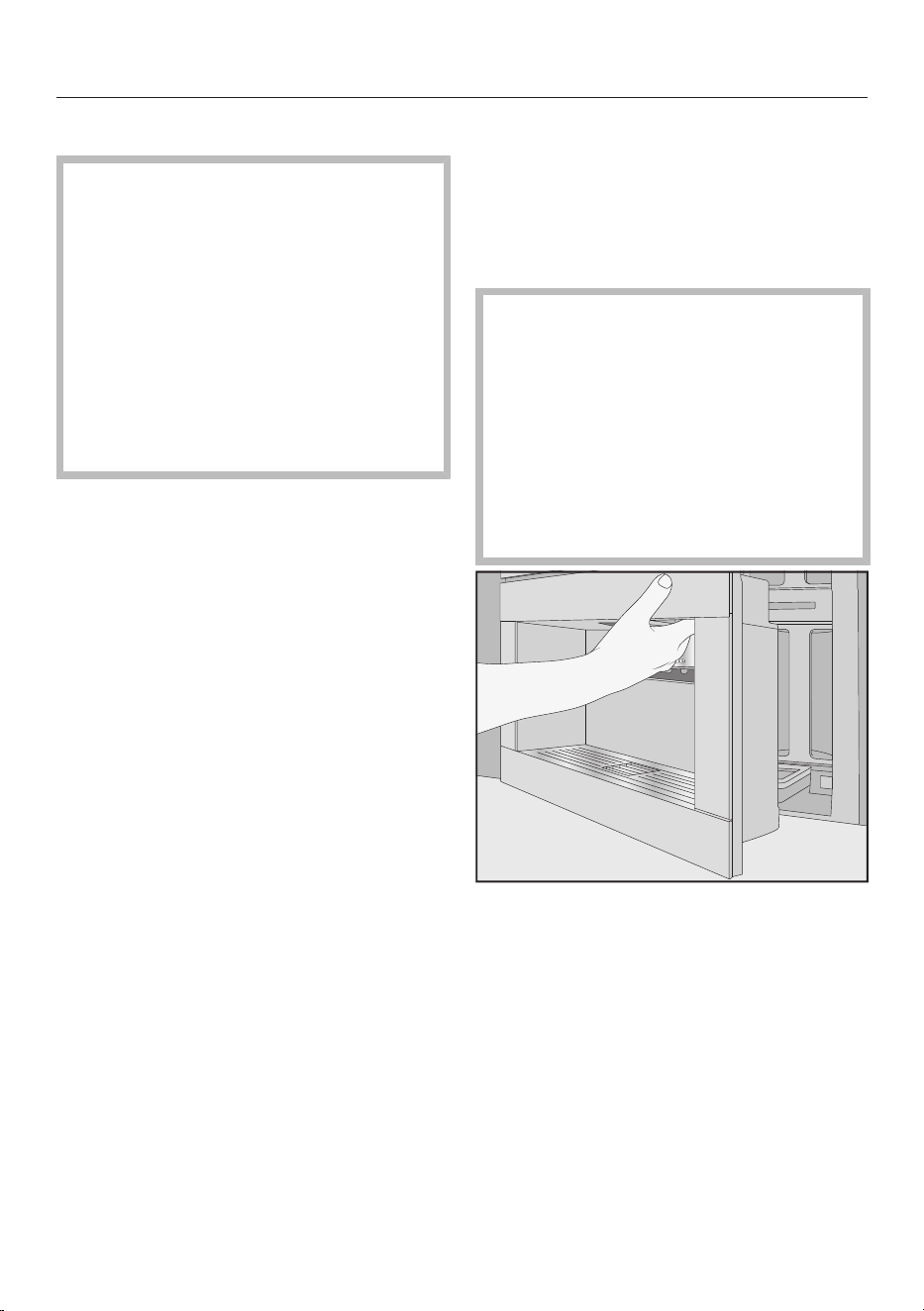
Cleaning and care
52
Unsuitable cleaning agents
Contact with unsuitable cleaning
agents can alter or discolour all
surfaces. All surfaces are susceptible
to scratching. Scratches on glass
surfaces could cause a breakage in
certain circumstances.
Remove any residual cleaning agent
immediately. To protect the coffee
machine and surrounding surfaces
from damage, make sure you remove
any spillages or splashes of descaling
agent immediately.
To avoid damaging the surfaces of your
appliance, do not use:
- cleaning agents containing soda,
ammonia, acids or chlorides
- solvent-based cleaning agents
- disinfectant cleaning agents and hand
sanitiser gel
- cleaning agents containing descaling
agents (unsuitable for cleaning the
appliance front)
- stainless steel cleaners
- dishwasher cleaners (unsuitable for
cleaning the appliance front)
- glass cleaning agents
- cleaning agents for ceramic glass
cooktops
- oven cleaners
- steam oven cleaning agents
(DGClean)
- abrasive cleaning agents, e.g. powder
cleaners and cream cleaners
- hard, abrasive brushes or sponges,
e.g. pot scourers, brushes or sponges
which have been previously used with
abrasive cleaning agents
- dirt eraser sponges
- sharp metal scrapers
- steel wool or stainless steel wire
scourers
- sunscreen
Opening the appliance door
Risk of damage when opening the
door if the central spout is too high or
too low.
If the central spout is too high or too
low, the door cannot be opened. If
you try to open the door, the central
spout can be damaged.
Ensure the central spout is in either
the upper or middle position before
opening the door.
Open the appliance door.
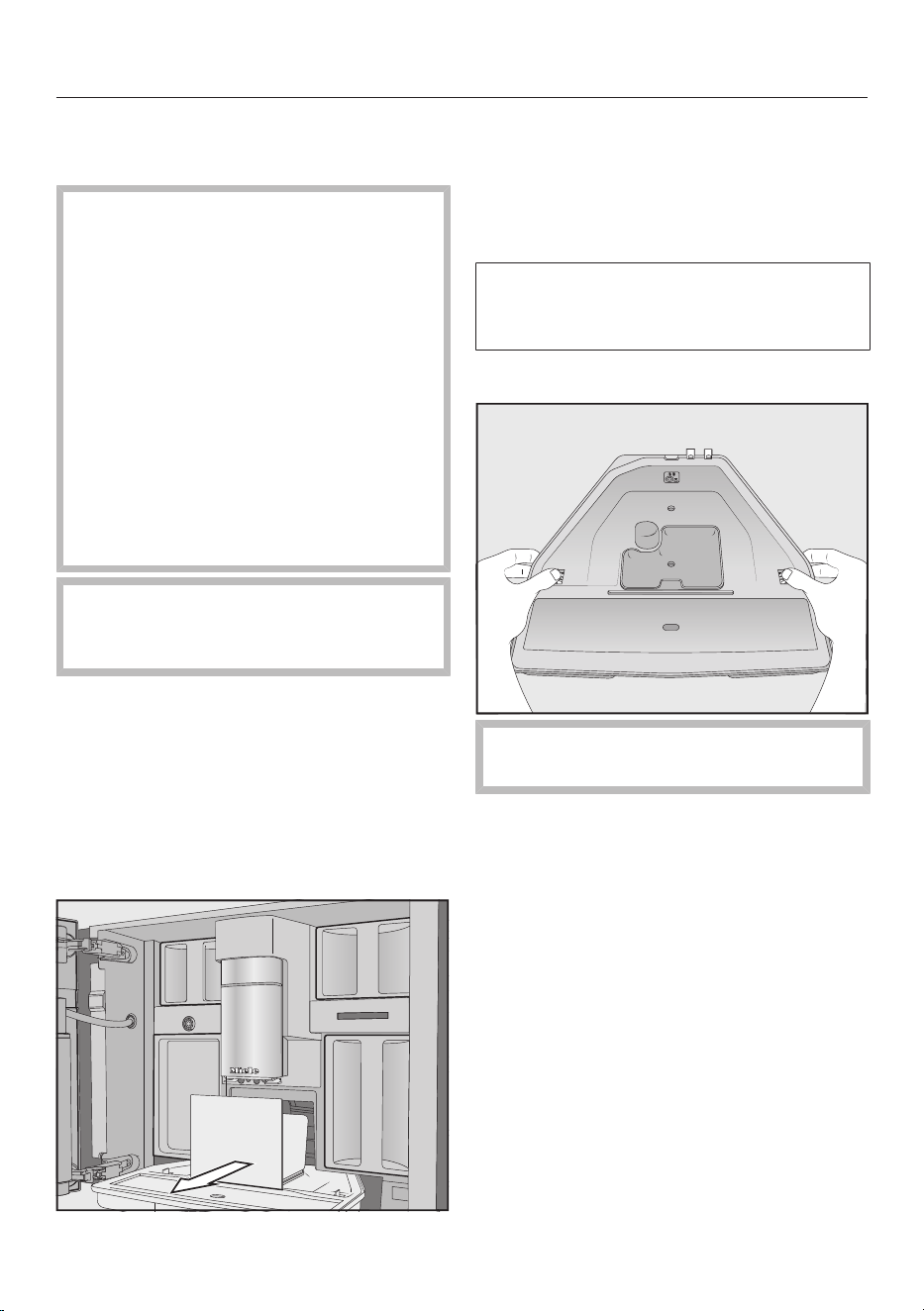
Cleaning and care
53
Cleaning the drip tray and
waste container
Danger of burning and scalding
on hot components or by hot liquids.
Components can become very hot
during operation. Touching hot
components can cause burning. The
liquids and steam dispensed are very
hot and can cause scalding.
If the pipework has just been rinsed,
wait a while before removing the drip
tray as the water used for rinsing will
still run out of the coffee spouts.
Please be aware that water in the
drip tray can also be very hot.
Do not touch hot components.
To avoid unpleasant smells and
mildew, clean the drip tray and waste
container every day.
A prompt will appear in the coffee
machine display when the drip tray and/
or the waste container is full and needs
to be emptied. Empty the drip tray and
the waste container. The lid of the drip
tray does not need to be removed for
emptying.
Open the appliance door.
Remove the drip tray with the waste
container from the appliance.
Remove the waste container from the
drip tray and empty the waste
container.
Apart from coffee grounds, there may
also be some water in the waste
container.
Dismantling the drip tray
The orange latches are not
removable.
Remove the lid from the drip tray:
push the orange latches on either side
outwards and undo the lid.
Take the lid off.
Clean the drip tray, the lid and the
waste container by hand using warm
water and a mild solution of washing-
up liquid.
Dry all parts afterwards.
Useful tip: To clean the drip tray, the lid
and the waste container particularly
thoroughly, clean them occasionally in
the dishwasher. If the drip tray is very
dirty, clean it with a brush prior to
placing it in the dishwasher.
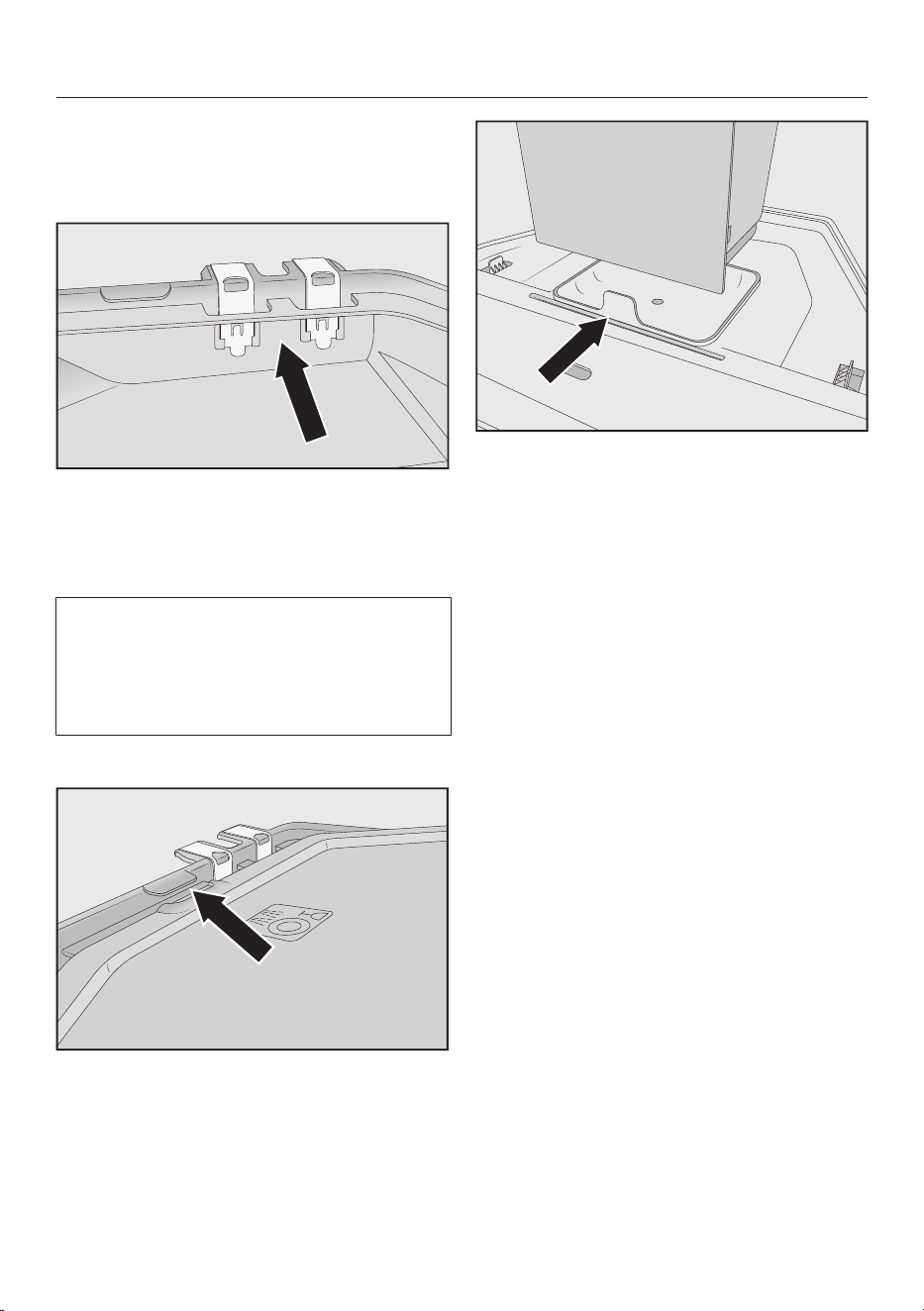
Cleaning and care
54
Clean the interior of the coffee
machine underneath the drip tray.
Cleaning the drip tray contacts
Clean the contacts (metal discs) and
the space between them carefully,
e.g. with a soft brush.
Dry all parts thoroughly.
The contacts will not be able to detect
that the drip tray is full if they are
damp or dirty.
Check the contacts and the area
around them once a week.
Assembling the drip tray
Refit the lid of the drip tray: push the
lid in under the lip next to the
contacts and press down on the lid
until the latches click into place.
Place the waste container on top of
the lid.
Push the drip tray, together with the
waste container, back into the coffee
machine.
Close the appliance door.
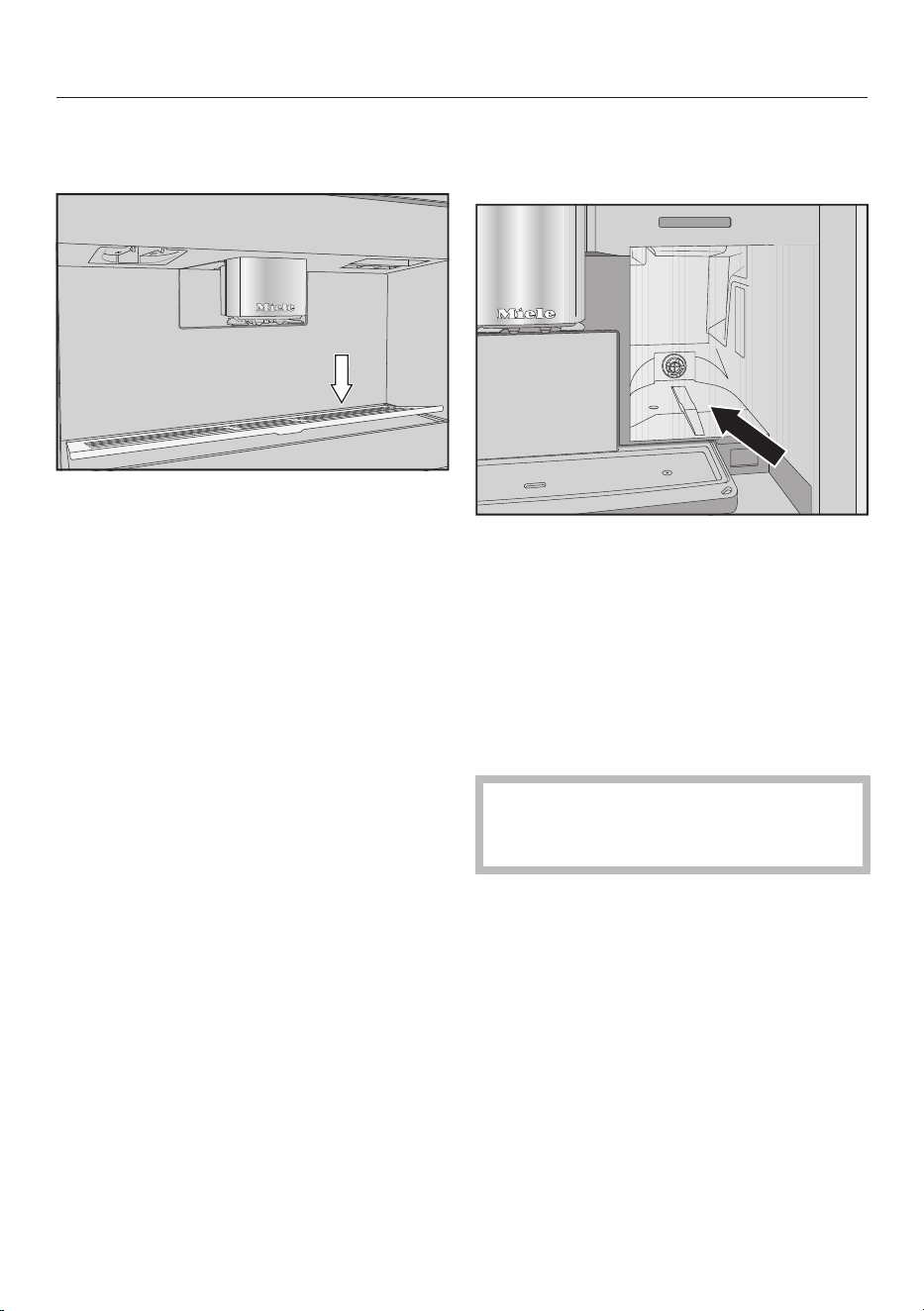
Cleaning and care
55
Cleaning the drip tray cover
Clean the drip tray cover every day.
Remove the drip tray cover: to do this,
push down on the rear edge of the
cover so that the front lifts up and can
be easily removed.
Clean the drip tray cover by hand
using warm water, a little washing up
liquid, and a soft cloth.
Dry the drip tray cover.
Refit the drip tray cover.
Useful tip: To clean the drip tray cover
particularly thoroughly, clean it
occasionally in the dishwasher.
Cleaning the water container
Clean the water container by hand every
day.
Open the appliance door.
Remove the water container.
Clean the water container by hand
using warm water and a little
washing-up liquid.
To remove any washing-up liquid
residues, clean the water container
and rinse it with clean water.
Dry the outside of the water
container.
Useful tip: To clean the water container
particularly thoroughly, clean it
occasionally in the dishwasher.
Clean and dry the surface that the
water container sits on.
Fill the water container with cold,
fresh drinking water.
Push the water container all the way
into the coffee machine.
Close the appliance door.
Cleaning the central spout
Clean the central spout stainless
steel cover by hand only using warm
water and a little washing-up liquid.
Clean all parts of the central spout at
least once a week.
Removing the central spout
Open the appliance door.
Carefully pull the stainless steel cover
off the central spout.
Clean the central spout's stainless
steel cover.
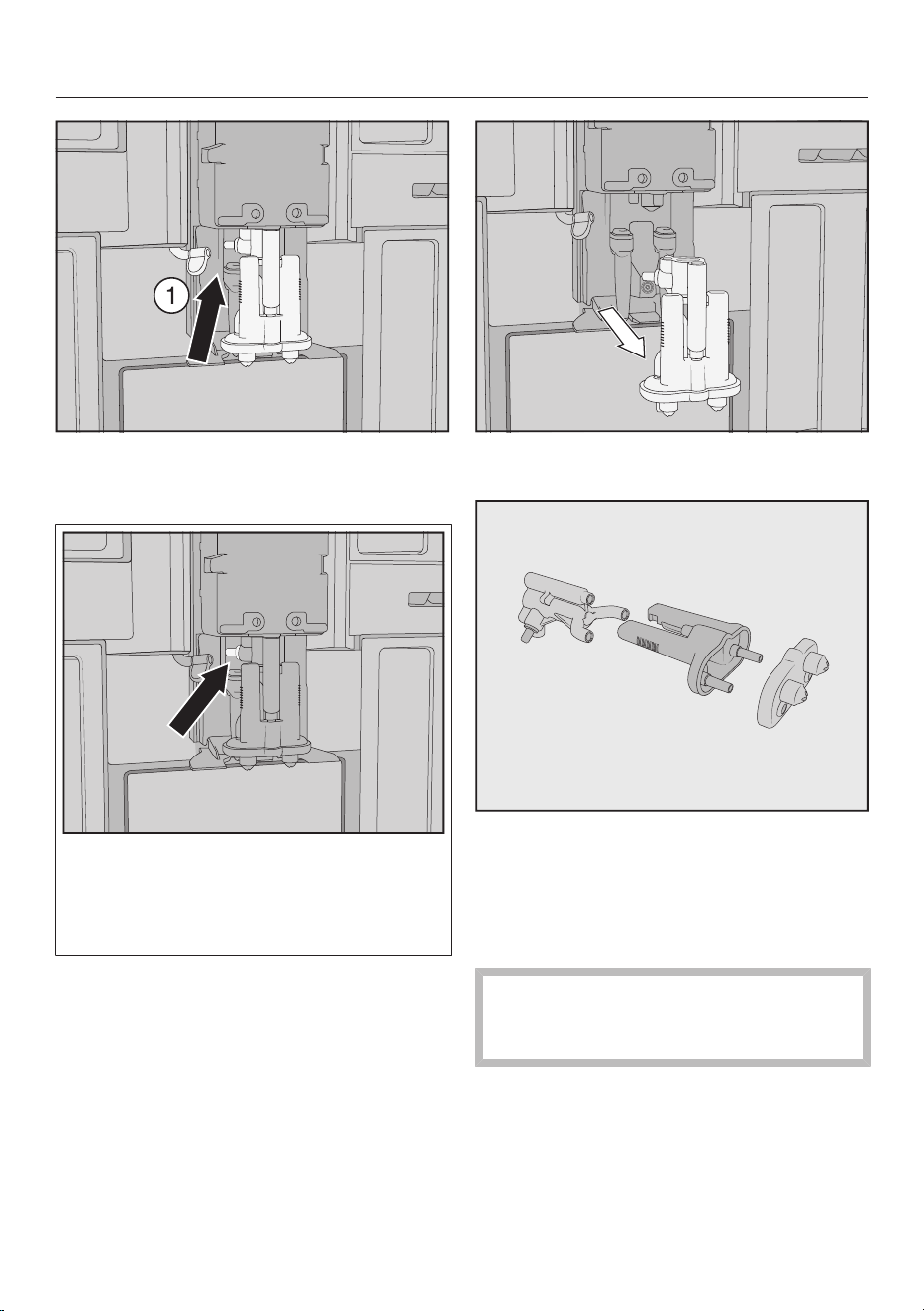
Cleaning and care
56
Release the milk pipework from the
dispensing unit: to do this, pull the
lug to the left.
Do not remove the milk pipework
connecting piece.
Clean the connecting piece, if
necessary, with the cleaning brush.
Hold the dispensing unit on either
side and pull down to remove it.
Dismantle the dispensing unit into
3pieces: disconnect the Y-shaped
piece, the dispensing spouts and the
holder from one another.
Cleaning the central spout
Clean the central spout stainless
steel cover by hand only using warm
water and a little washing-up liquid.
Clean all parts thoroughly by hand.
Useful tip: To clean the components of
the central spout particularly thoroughly,
clean them occasionally in the
dishwasher (Exception: stainless steel
cover). This will remove coffee deposits
and milk residues effectively.
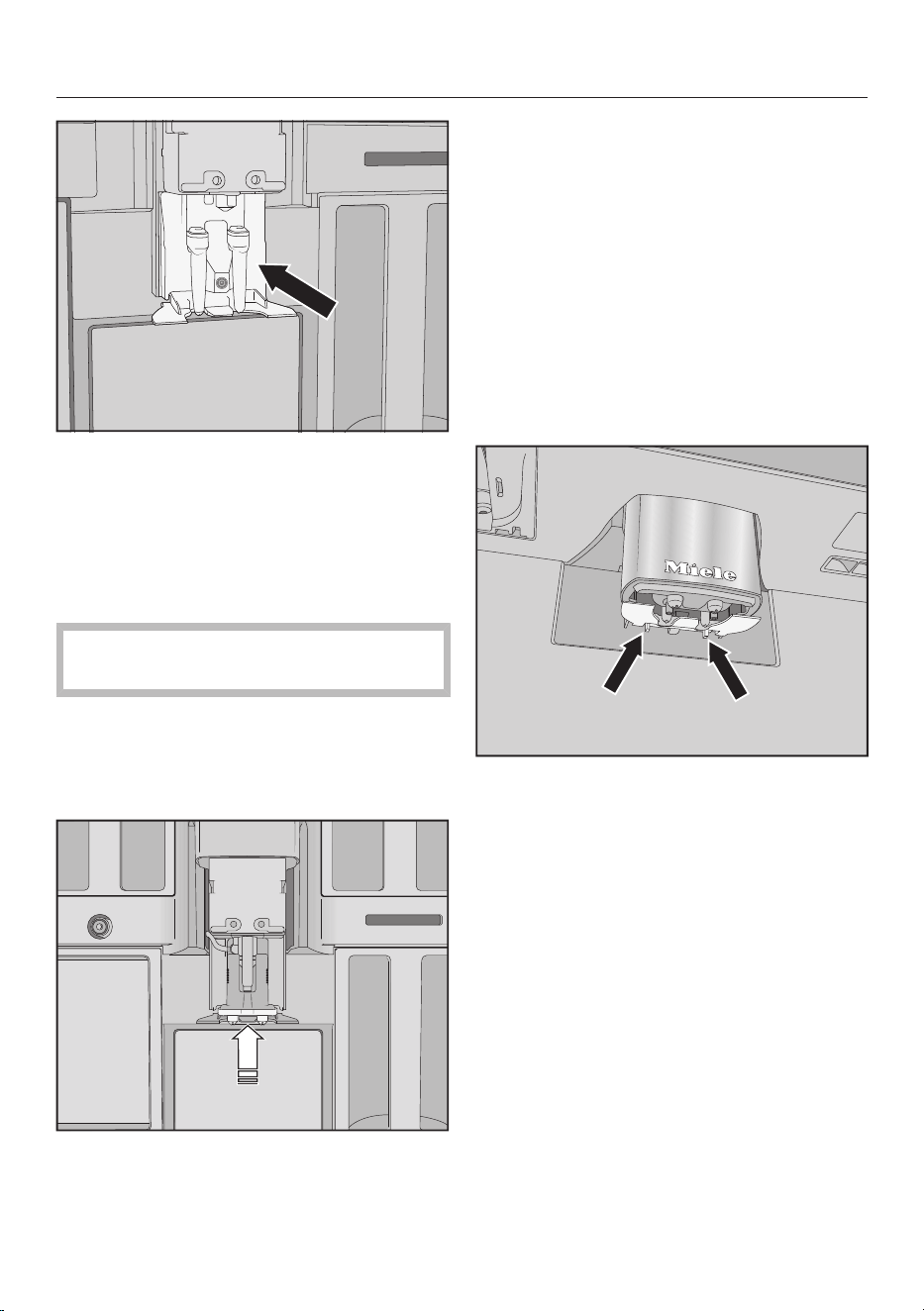
Cleaning and care
57
Clean the area surrounding the central
spout with a damp cloth.
Fitting the central spout
The dispensing unit is easier to
reassemble if the individual parts are
dampened with water beforehand.
Make sure that all parts are tightly
connected to one another.
Reassemble the dispensing unit.
Press firmly to connect the
dispensing spouts correctly to the
holder.
Insert the dispensing unit in the
coffee machine.
Connect the milk pipework.
Refit the stainless steel cover.
Close the appliance door.
Fit cover to central spout appears in the
display.
Confirm with OK.
Cleaning the cup rim sensor
Clean the cup rim sensor at least once a
week and more often if heavily soiled.
The cup rim sensor is located
underneath the central spout.
Push the two locking catches
together (see arrows).
The cup rim sensor will be released.
Clean the cup rim sensor by hand
with warm water and a little washing-
up liquid.
Useful tip: To clean the cup rim sensor
particularly thoroughly, clean it
occasionally in the dishwasher.
Push the cup rim sensor from
underneath into the holder on the
central spout to refit it.
Cleaning the milk flask with lid
The milk flask should be taken apart and
cleaned every day after use.
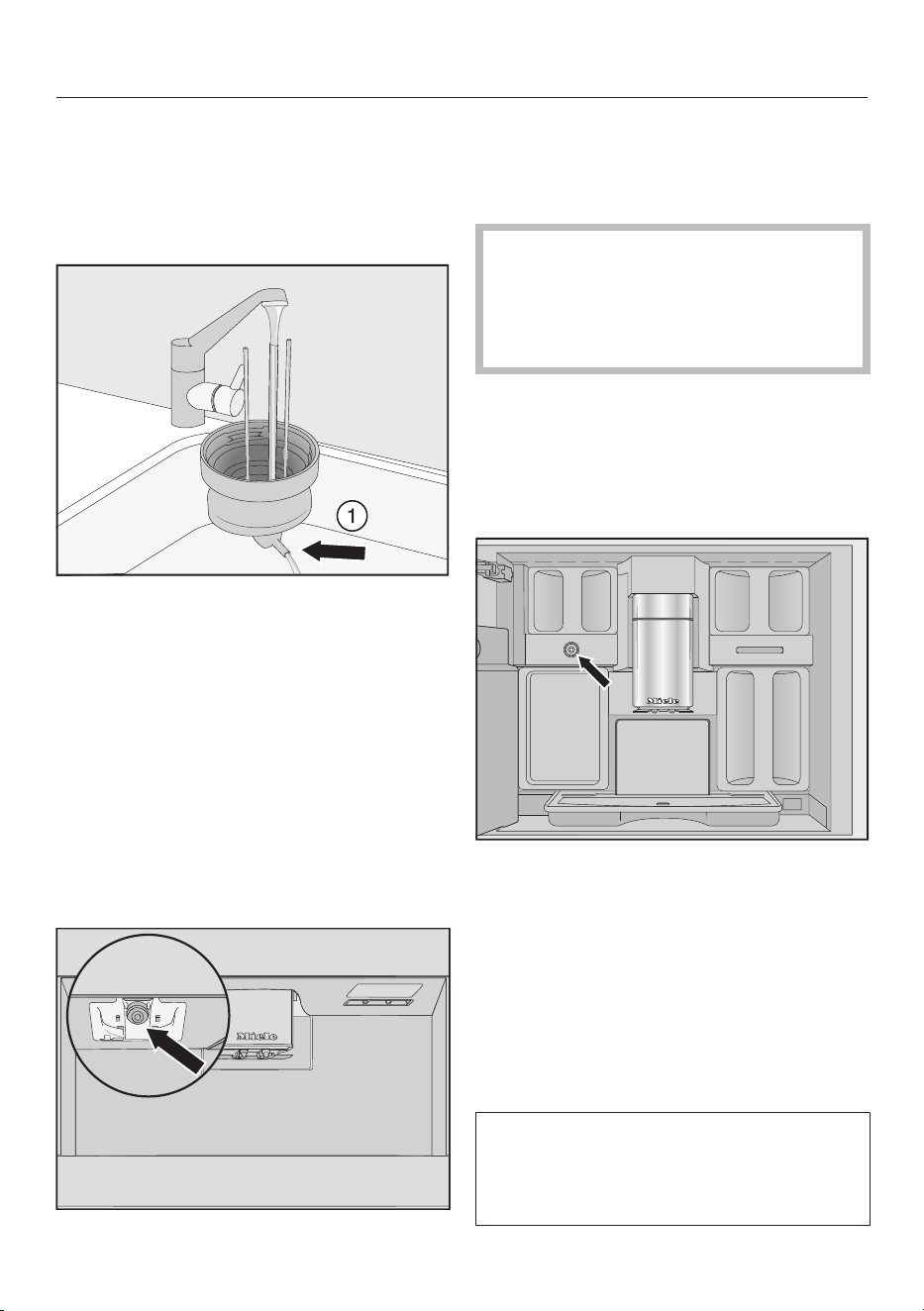
Cleaning and care
58
Both the lid and the glass flask can be
cleaned in the dishwasher, or by hand
using warm water and a little washing-
up liquid.
Remove and empty the milk flask.
Rinse the milk pipework in the lid
under running water before placing
the lid of the milk flask in the
dishwasher.
If water does not run out of the
connecting piece, clean it with the
cleaning brush.
Clean the glass flask.
Dry all parts and especially the
threads on the lid and on the glass
with a clean cloth.
Reassemble the milk flask.
Clean the milk flask holder on the
coffee machine with a damp cloth.
Cleaning the milk valve (daily)
The seal of the milk valve can be
damaged by sharp-edged objects or
similar.
Do not use sharp-edged objects, e.g.
a knife, to clean the milk valve.
Clean the milk valve every day. Milk
residues can accumulate on the
stainless steel stem and dry on. These
crusty deposits are difficult remove.
Therefore, it is important to carry out
regular cleaning after preparing milk.
The milk valve is located under the bean
container on the left-hand side.
Open the appliance door.
Clean the milk valve with a damp
sponge or microfibre cloth.
Close the appliance door.
Removing and cleaning the milk
valve (once a month)
Remove the milk valve only when the
coffee machine is switched off. Do not
switch on the coffee machine while
the milk valve is removed.
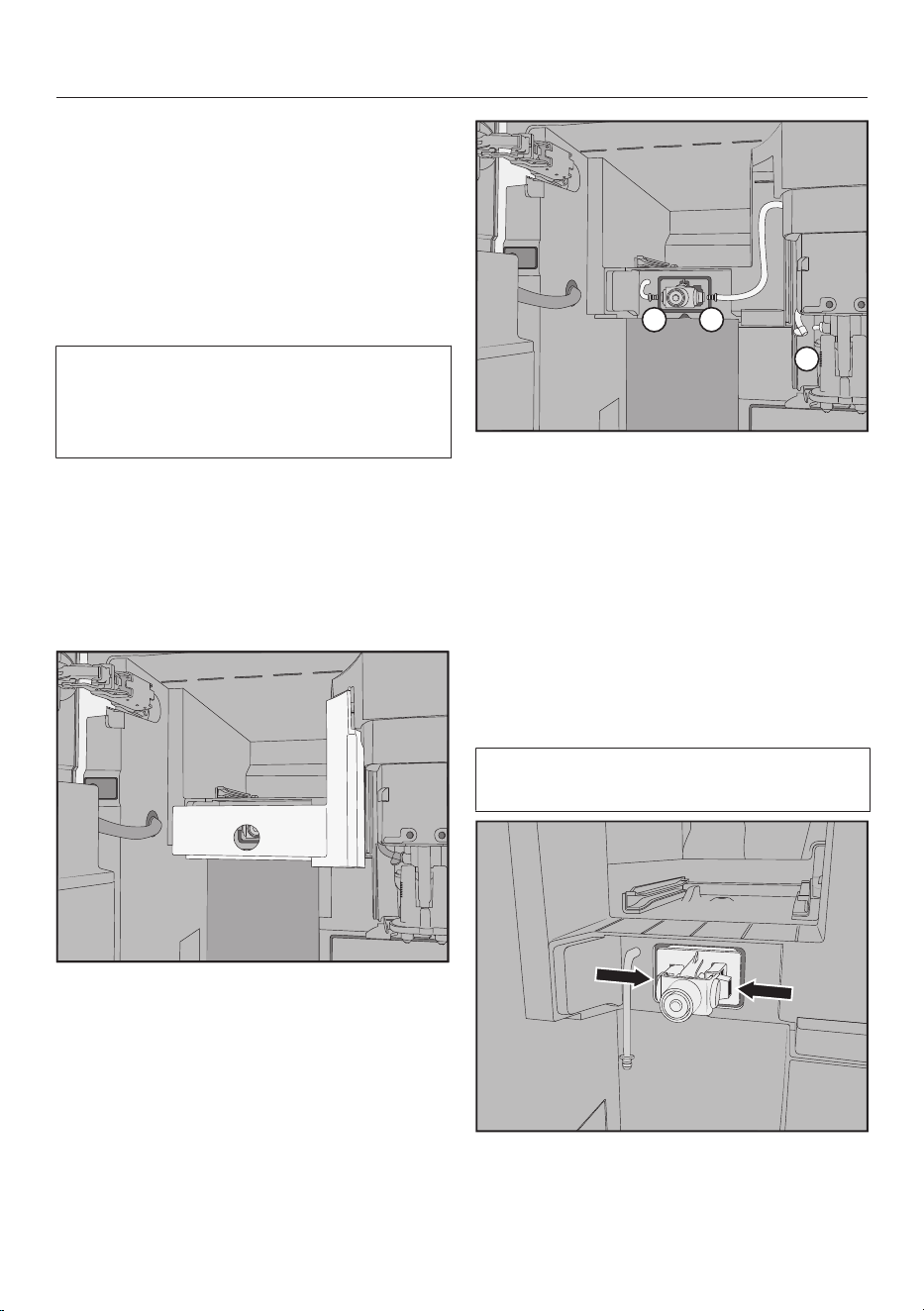
Cleaning and care
59
Remove and clean the milk valve at least
once a month. When preparing milk, if
hot milk is dispensed instead of milk
froth, or the milk sputters when
dispensed, the milk valve may be
blocked. Clean the milk valve more often
if necessary.
Removing the milk valve
Remove the milk valve only when the
coffee machine is switched off. Do not
switch on the coffee machine while
the milk valve is removed.
Switch the coffee machine off.
Open the appliance door.
Remove the bean container on the
left and the maintenance container.
Remove the central spout’s stainless
steel cover.
Remove the milk valve cover: press on
the recessed grip to unlock the cover.
On the top right-hand side of the
cover there is a pin which enables you
to swing open the cover.
1
2
3
Detach the milk pipework from the
dispensing unit on the central
spout and from the milk valve
silicone seal( and).
Remove the milk pipework that
connects the milk valve to the central
spout.
Disconnect the angular moulded hose
from the round hose.
Rinse the hoses thoroughly under
running water.
Do not remove the connecting pieces
from the hoses.
Press the catches on the left and right
of the milk valve holder and pull the
holder forwards to remove it.
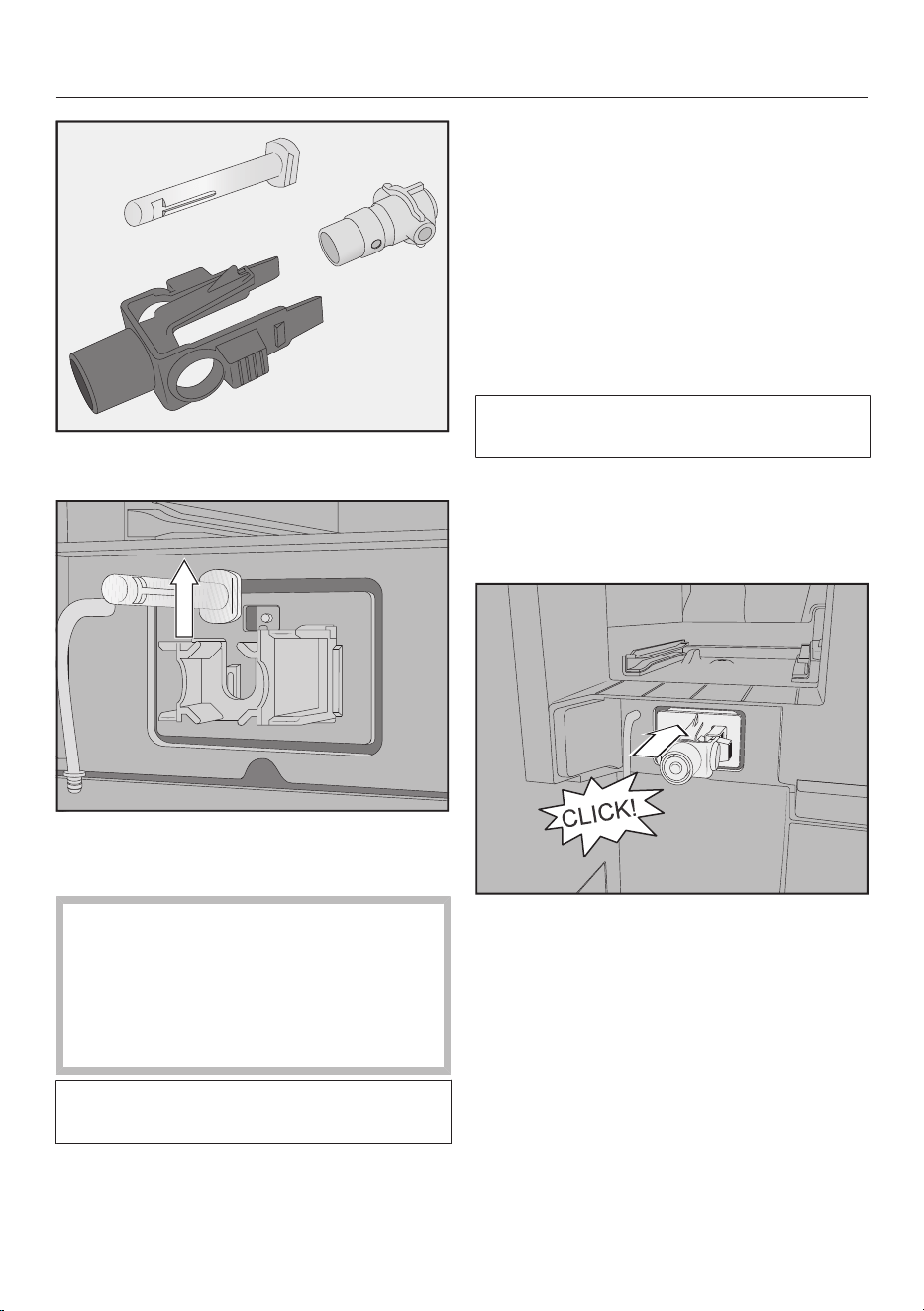
Cleaning and care
60
Dismantle the holder and the silicone
seal.
Lift out the stainless steel stem.
Cleaning the milk valve
The milk valve cover is not
dishwasher-safe.
Cleaning in the dishwasher can
damage the milk valve cover.
Clean the milk valve cover by hand
only.
Do not switch on the coffee machine
while the milk valve is removed.
Clean all parts of the milk valve by
hand.
Useful tip: To clean the components of
the milk valve particularly thoroughly,
clean them occasionally in the
dishwasher (Exception: milk valve
cover).
If there are any dry milk residues on the
front, soak the stainless steel stem in
warm water and a little washing-up
liquid.
Fitting the milk valve
Do not switch on the coffee machine
while the milk valve is removed.
Slide in the stainless steel stem from
above.
Fit the silicone seal in the milk valve
holder.
Fit the holder with the silicone seal
until it clicks into position.
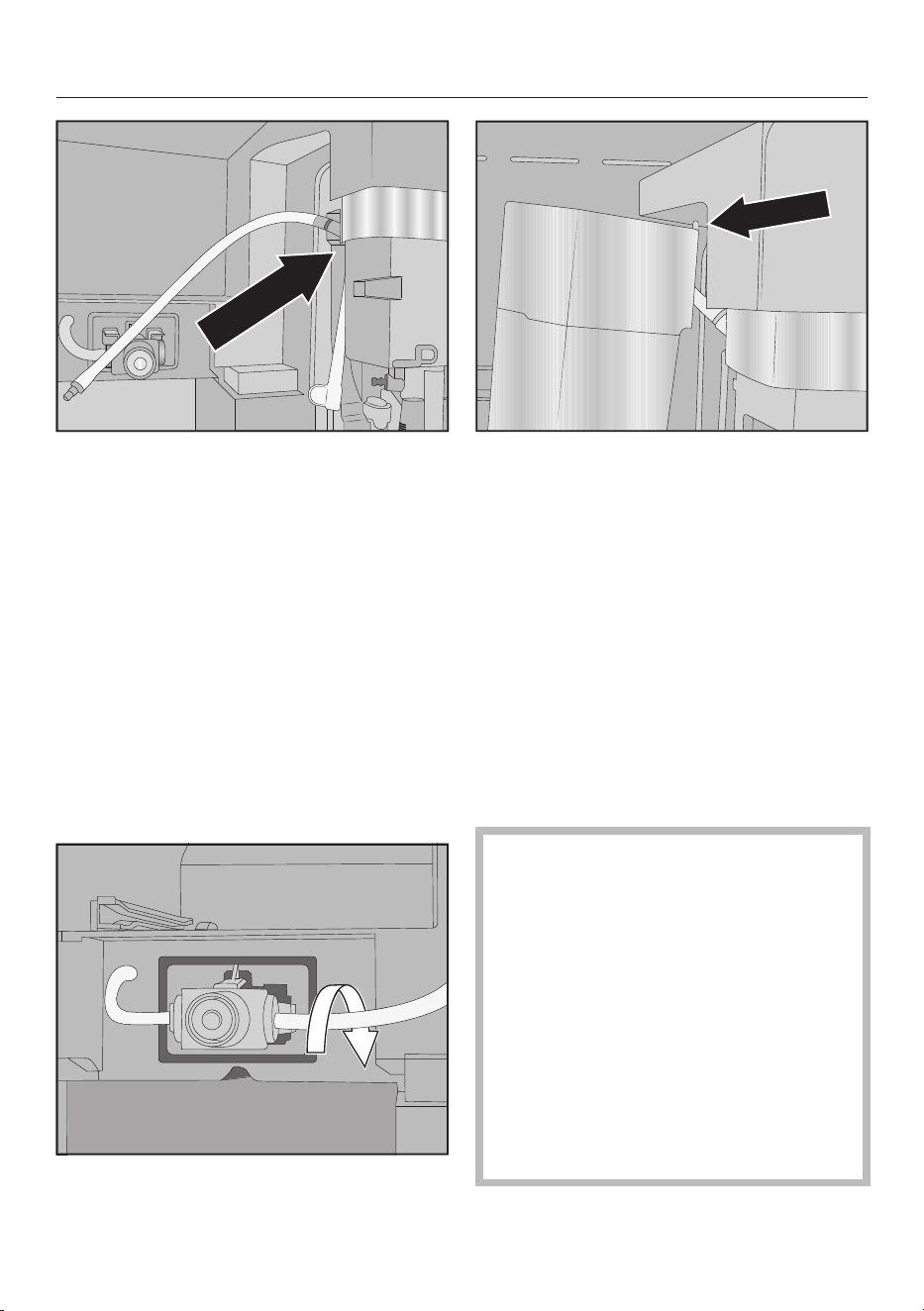
Cleaning and care
61
Connect the angular moulded hose to
the longer milk pipework. Start by
fitting the moulded hose to the top of
the central spout. The black
connecting piece should point
towards the rear.
Then, connect the bottom end of the
moulded hose to the dispensing unit.
Insert the milk pipework into the milk
valve on the left and right-hand sides.
Push the connecting pieces into the
silicone seal as far as they will go.
Check whether the milk pipework sits
comfortably against the housing and
the cover is easy to refit.
Useful tip: If necessary, turn the milk
pipework on the right connecting piece
towards the back.
Fit the milk valve cover: to do this,
place the pin in the top right corner
and swing the cover towards the rear
until it closes flush.
Refit the bean container on the left
and the maintenance container in the
coffee machine.
Refit the central spout stainless steel
cover.
Close the appliance door.
You can now switch the coffee machine
on again.
Cleaning the bean containers
Damage due to incorrect use and
cleaning.
If the bean containers are immersed
in water, it may result in
malfunctions. Parts may break off
during dismantling or mechanical
components may not function
correctly after reassembly.
Do not dismantle the bean
containers.
Do not immerse the bean containers
in liquids, e.g. washing-up liquid
solution.
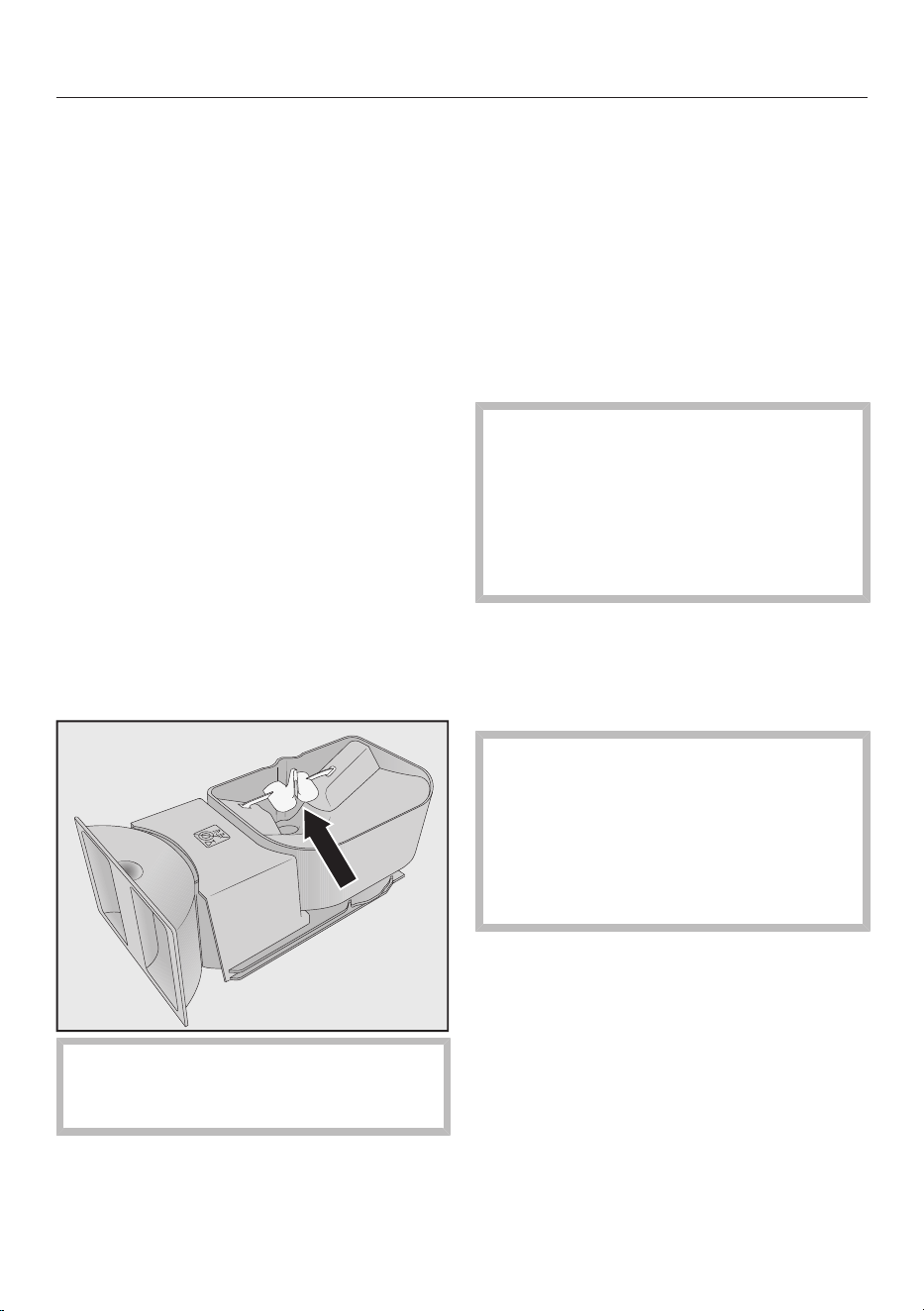
Cleaning and care
62
Coffee beans contain oils which can
deposit on the walls of the bean
containers and hinder the flow of the
beans. Therefore, clean the bean
containers at least once a month with a
soft cloth.
If required, you can clean the lids of the
bean containers by hand with warm
water and a little washing-up liquid. Dry
the lids thoroughly before refitting them
on the bean containers.
Open the appliance door.
Remove the bean containers on the
left and right from the coffee
machine.
Clean the bean container chutes in
the machine.
Useful tip: Use a vacuum cleaner to
remove any coffee grounds from the
interior of the machine.
Remove the lids and empty the bean
containers.
Do not remove the components
which assist the flow of beans (see
arrow).
Clean the bean containers and their
lids by hand with a slightly damp
cloth.
Dry all parts thoroughly before filling
the bean containers with coffee
beans again.
Refit the lids.
Push the bean containers back into
the coffee machine.
Close the appliance door.
Cleaning the brew unit and
interior by hand
The moving parts of the brew unit are
lubricated. Cleaning agents will
damage the brew unit.
Clean the brew unit by hand only
under warm running water. Do not
use washing-up liquid or any other
cleaning agent.
Remove and rinse out the brew unit
once a week. Also clean the area
underneath the brew unit once a week.
Removing the brew unit
It might not be possible to re-insert
the brew unit if you have removed it
and changed the position of the
handle.
When you have removed the brew
unit, do not change the position of
the handle.
Open the appliance door.
Remove the water container.
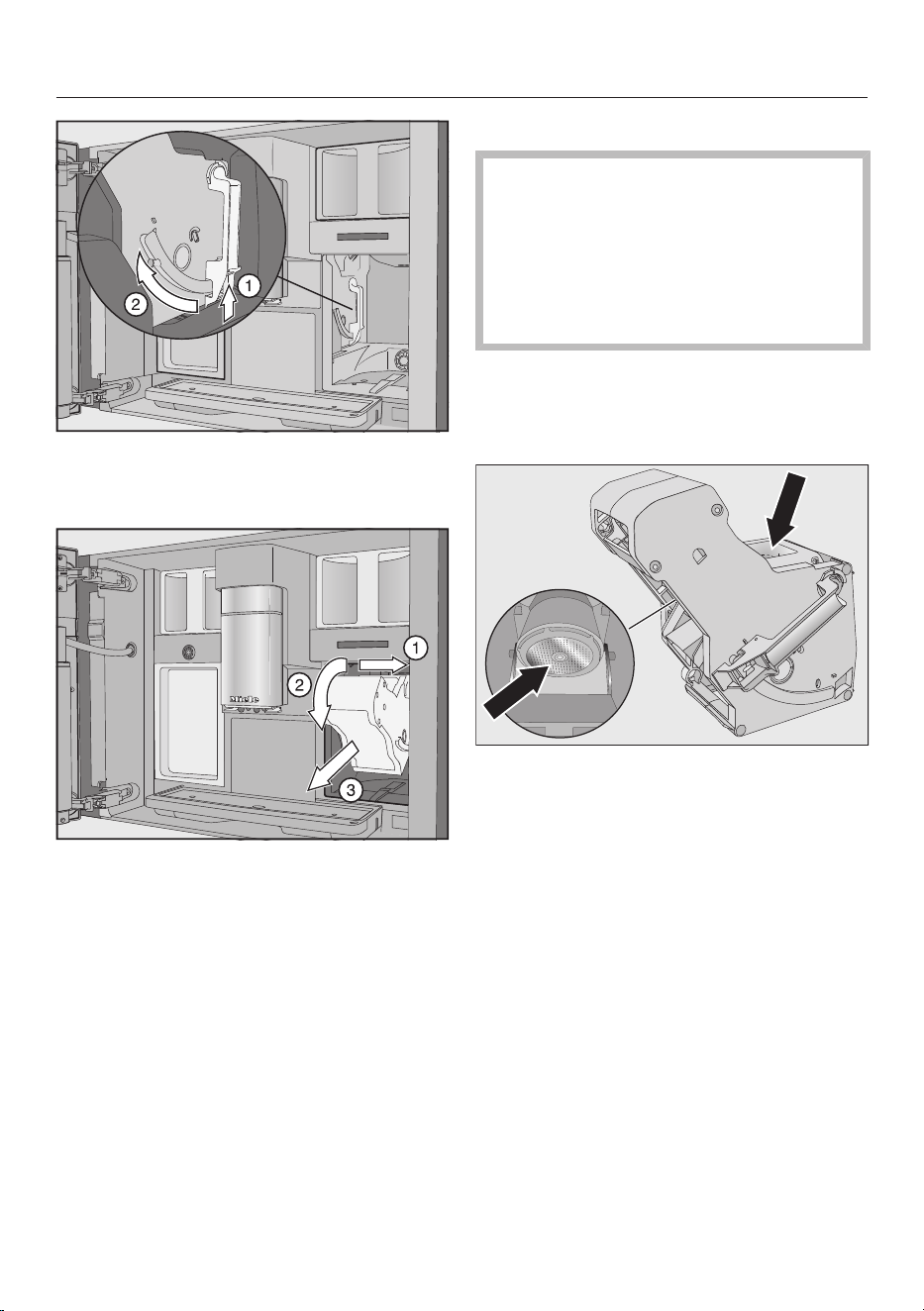
Cleaning and care
63
Press the button under the handle of
the brew unit and, whilst doing so,
turn the handle to the front.
Pull the brew unit to the side first
and then pull out to the front. Tilt
the brew unit forwards.
If you cannot remove the brew unit or
can only do so with difficulty, the brew
unit drive is not in the correct position.
Cleaning the brew unit
The moving parts of the brew unit are
lubricated. Cleaning agents will
damage the brew unit.
Clean the brew unit by hand only
under warm running water. Do not
use washing-up liquid or any other
cleaning agent.
Clean the brew unit by hand under
warm running water without using
washing-up liquid or any other
cleaning agent.
Wipe any remaining coffee residues
from the filters. One filter is located in
the funnel. The other filter is located
to the left of the funnel.
Dry the funnel to prevent ground
coffee sticking to it the next time a
coffee is prepared.
Cleaning the interior of the machine
Use your vacuum cleaner to remove
dry coffee grounds.
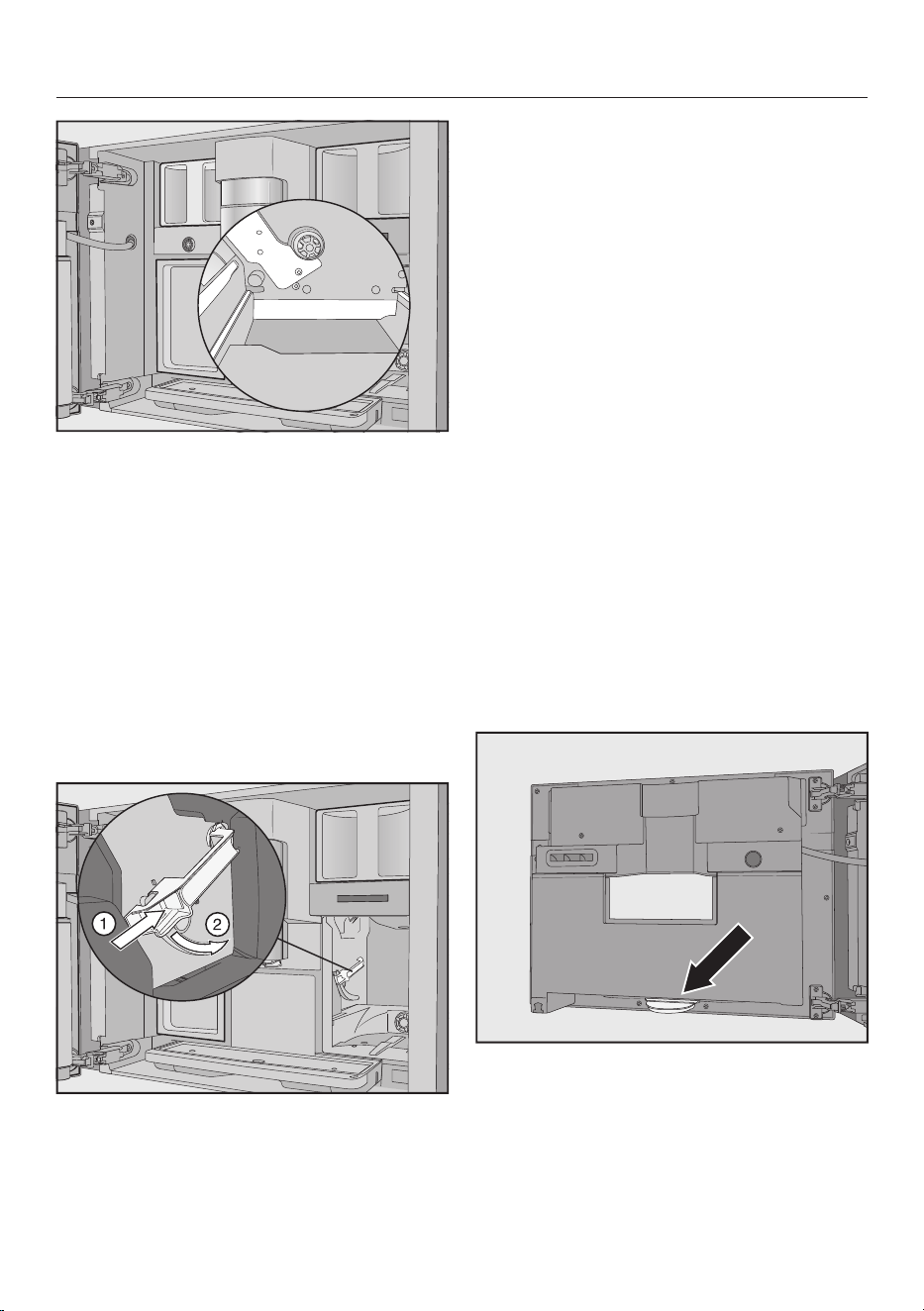
Cleaning and care
64
Clean the niche of the brew unit with
a damp, clean cloth. Clean the areas
marked in white in the illustration, e.g.
around the drive shaft, especially well.
Refitting the brew unit
Proceed in the reverse order to insert:
push the brew unit back into the
coffee machine. Tilt the brew unit
forwards a little when doing this.
If you cannot re-insert the brew unit, the
brew unit drive is not in the correct
position.
Press the button under the handle of
the brew unit and, whilst doing so,
turn the handle to the rear.
Useful tip: If the handle of the brew unit
cannot be turned, press firmly on the
side of the brew unit.
Push the water container into the
coffee machine.
Coffee powder falls onto the drip tray
when the brew unit is removed and
refitted.
Remove the drip tray and clean the
lid.
Push the drip tray back into the coffee
machine.
Close the appliance door.
Cleaning the interior, the inside
of the appliance door and the
drip catcher
Clean the interior and the appliance
front as part of the normal cleaning
process. For example, clean the area
underneath the water container when
the water container has been removed.
At the bottom of the inside of the
appliance door there is a drip catcher.
Remove and empty the drip catcher
regularly. The drip catcher is
dishwasher-safe.
Open the appliance door.
Remove and clean the drip catcher.

Cleaning and care
65
Remove the following parts from the
interior of the machine:
- Water container
- Drip tray
- Maintenance container
- Brew unit
- Bean containers
Useful tip: Use your vacuum cleaner to
remove dry ground coffee residues.
Clean the interior and the inside of
the appliance door by hand with a
slightly moist, clean sponge or
microfibre cloth.
Then dry the interior and the
appliance door with a soft cloth.
Refit all parts, including the drip
catcher.
Close the appliance door.
Cleaning the appliance front
If soiling is not removed promptly, it
could cause the surface to alter or
discolour.
Remove any soiling from the front of
the appliance straight away.
Make sure that water cannot get
behind the display.
Clean the appliance front after
descaling. Wipe up any spillages of
descaling agent as soon as possible.
Useful tip: Open the appliance door
before cleaning the control panel. This
will avoid operating errors.
Clean the appliance front with a
slightly damp, clean sponge or a
microfibre cloth.
Dry all surfaces with a soft cloth.
Useful tip: You can also clean the
appliance front with the Miele all
purpose microfibre cloth.
Maintenance programmes
The coffee machine has the following
maintenance programmes:
- Rinse the appliance
- Rinse the milk pipework
- Clean the milk pipework
- Degrease the brew unit
- Descale the appliance
Carry out the relevant maintenance
programme when the prompt to do so
appears in the display. You can also
start maintenance programmes at any
time so that the coffee machine does
not prompt mandatory cleaning at an
inconvenient time.
Useful tip: To reduce the frequency of
the drip tray needing to be emptied, you
can place the maintenance container
under the central spout.
Opening the Maintenance menu
Touch the sensor.
You can now select a maintenance
programme.
Rinsing the appliance
If coffee has been dispensed, the coffee
machine will rinse the coffee pipework
automatically before switching off.
You can also rinse the machine
manually.
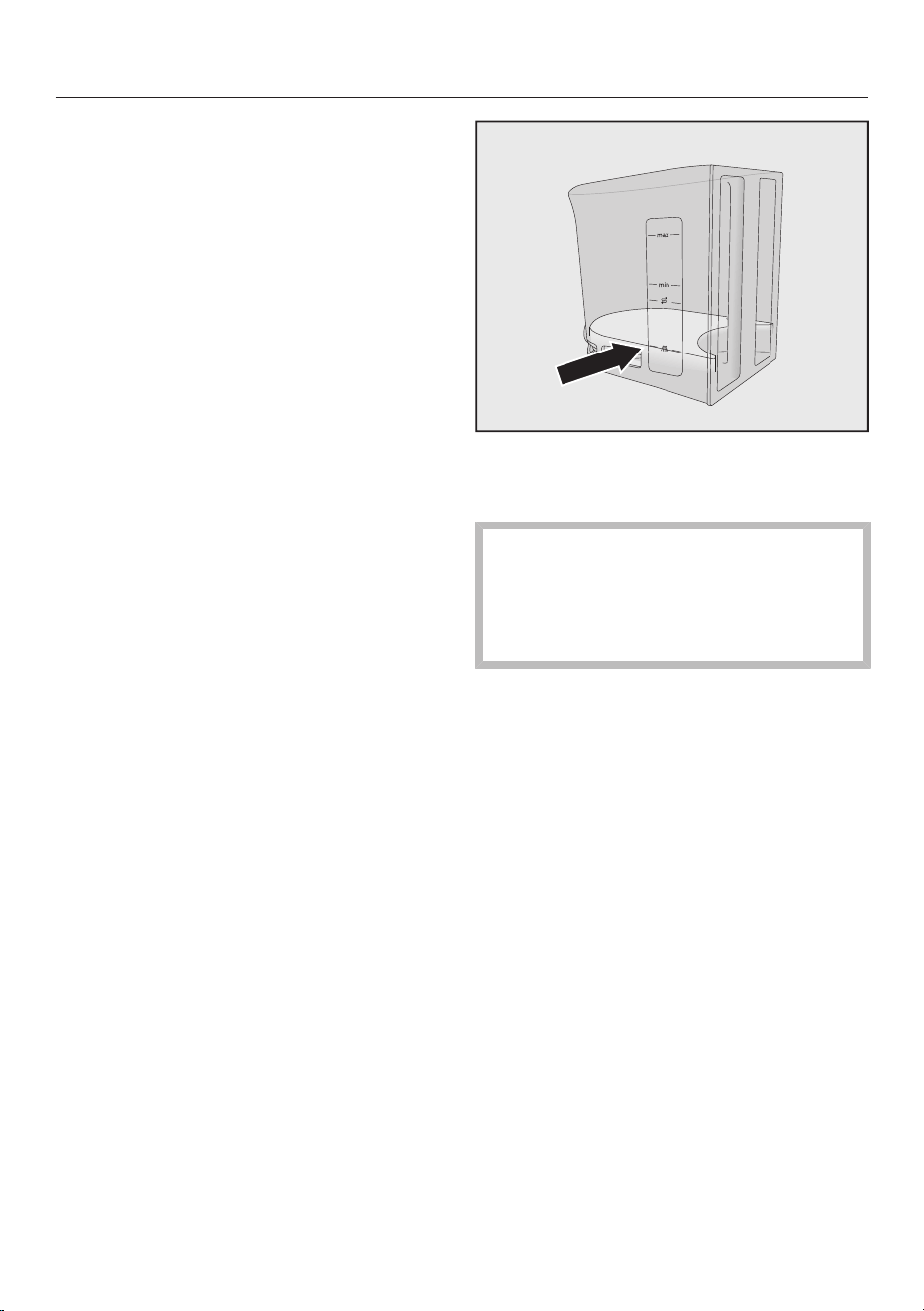
Cleaning and care
66
Rinsing the milk pipework
If you have prepared a drink using milk,
the coffee machine will automatically
rinse the milk pipework after a few
minutes. You can also start Rinse milk
pipework manually.
Cleaning the milk pipework
The milk pipework must be cleaned at
least once a week.
The Clean milk pipework maintenance
programme lasts for approx. 15minutes.
Touch the sensor.
Select Clean milk pipework and touch
OK.
The process begins and various
messages appear in the display.
Follow the instructions in the display.
When Fill water container with lukewarm
water and cleaning agent up to the
symbol and insert. Close the door. appears
in the display, proceed as follows.
Making a cleaning solution
For optimal cleaning results, we
recommend the Miele Cleaning agent
for milk pipework.
The Cleaning agent for milk pipework
has been specially developed for use
with Miele coffee machines and
prevents subsequent damage.
It is available to order from the Miele
online shop or directly from Miele (see
the end of this booklet for contact
details).
Add 2 sachets of the Cleaning agent
for milk pipework to the water
container.
Fill the water container to the
marker with lukewarm water and
stir the solution.
Follow the instructions for the mixing
ratio of the cleaning agent. Fill the
water container with the correct
amount of water. Cleaning will
otherwise not be completed.
Insert the water container and close
the appliance door.
Follow the instructions in the display.
If prompted in the display, carefully
rinse out the water container with
clean water. Ensure that no cleaning
agent is left in the water container. Fill
the water container with tap water.
The cleaning process is finished when
the drinks menu appears in the display.
Degreasing the brew unit
Depending on the natural oil content of
the coffee used, the brew unit can
become blocked quite quickly. The brew
unit must be degreased regularly in
order to ensure aromatic coffee and
trouble-free operation of the coffee
machine.
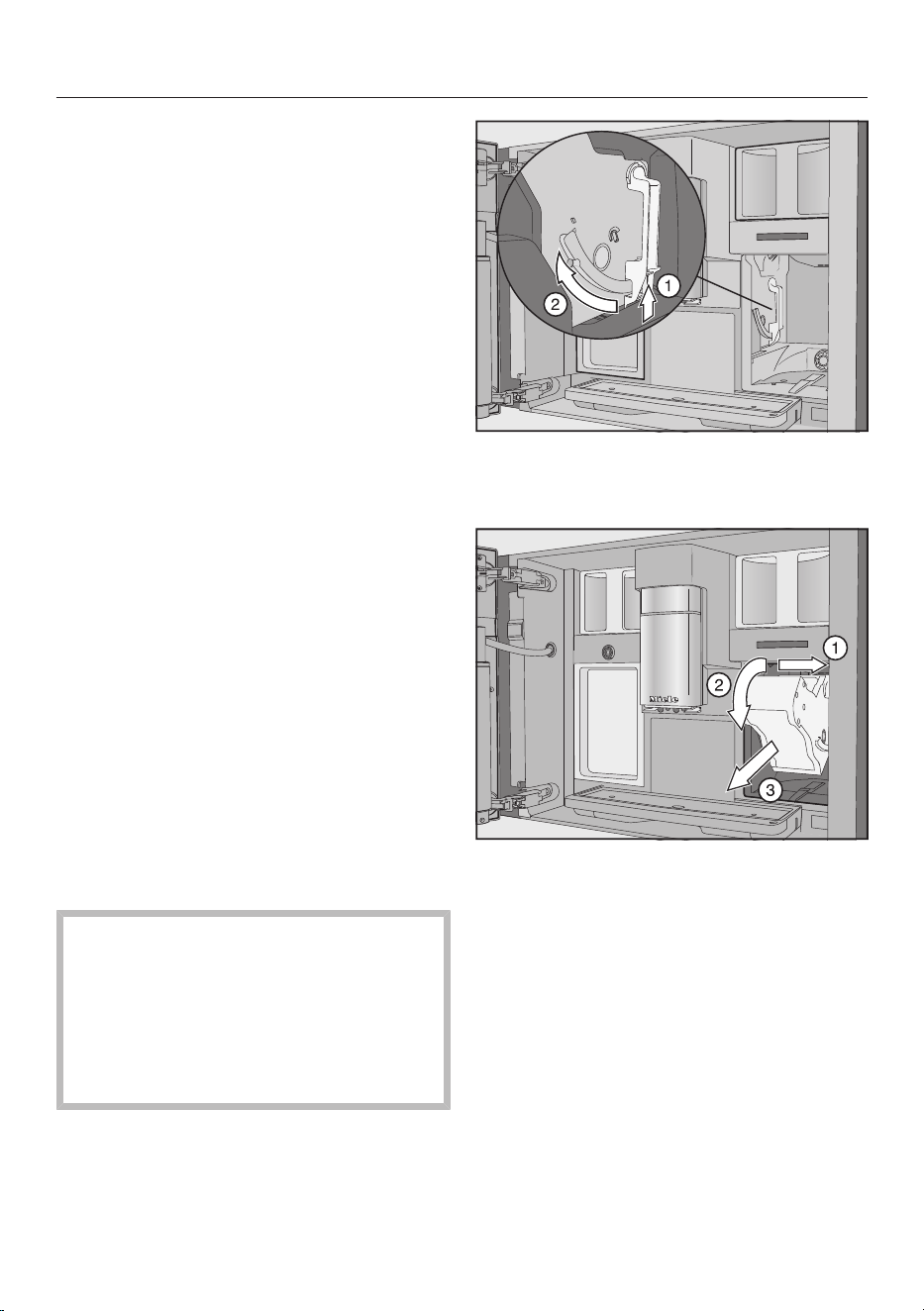
Cleaning and care
67
We recommend using Miele cleaning
tablets to clean the brew unit. These
have been specially developed for use
with Miele coffee machines and prevent
subsequent damage.
Miele cleaning tablets are available to
order from the Miele online shop or
directly from Miele (see the end of this
booklet for contact details).
After 200portions have been
dispensed, a message prompting you to
degrease the brew unit will appear in
the display.
Confirm the message with OK.
This message will appear repeatedly
until the brew unit is degreased.
Starting Degrease brew unit
Touch the sensor.
Select Degrease the brew unit and
touch OK.
The maintenance programme will start.
Follow the instructions in the display.
Remove the water container and the brew
unit. Clean the interior of the machine. Rinse
the brew unit by hand and refit it with a
cleaning tablet in it. appears in the display.
Removing the brew unit
It might not be possible to re-insert
the brew unit if you have removed it
and changed the position of the
handle.
When you have removed the brew
unit, do not change the position of
the handle.
Open the appliance door.
Remove the water container.
Press the button under the handle of
the brew unit and, whilst doing so,
turn the handle to the front.
Pull the brew unit to the side first
and then pull out to the front. Tilt
the brew unit forwards.
If you cannot remove the brew unit or
can only do so with difficulty, the brew
unit drive is not in the correct position.
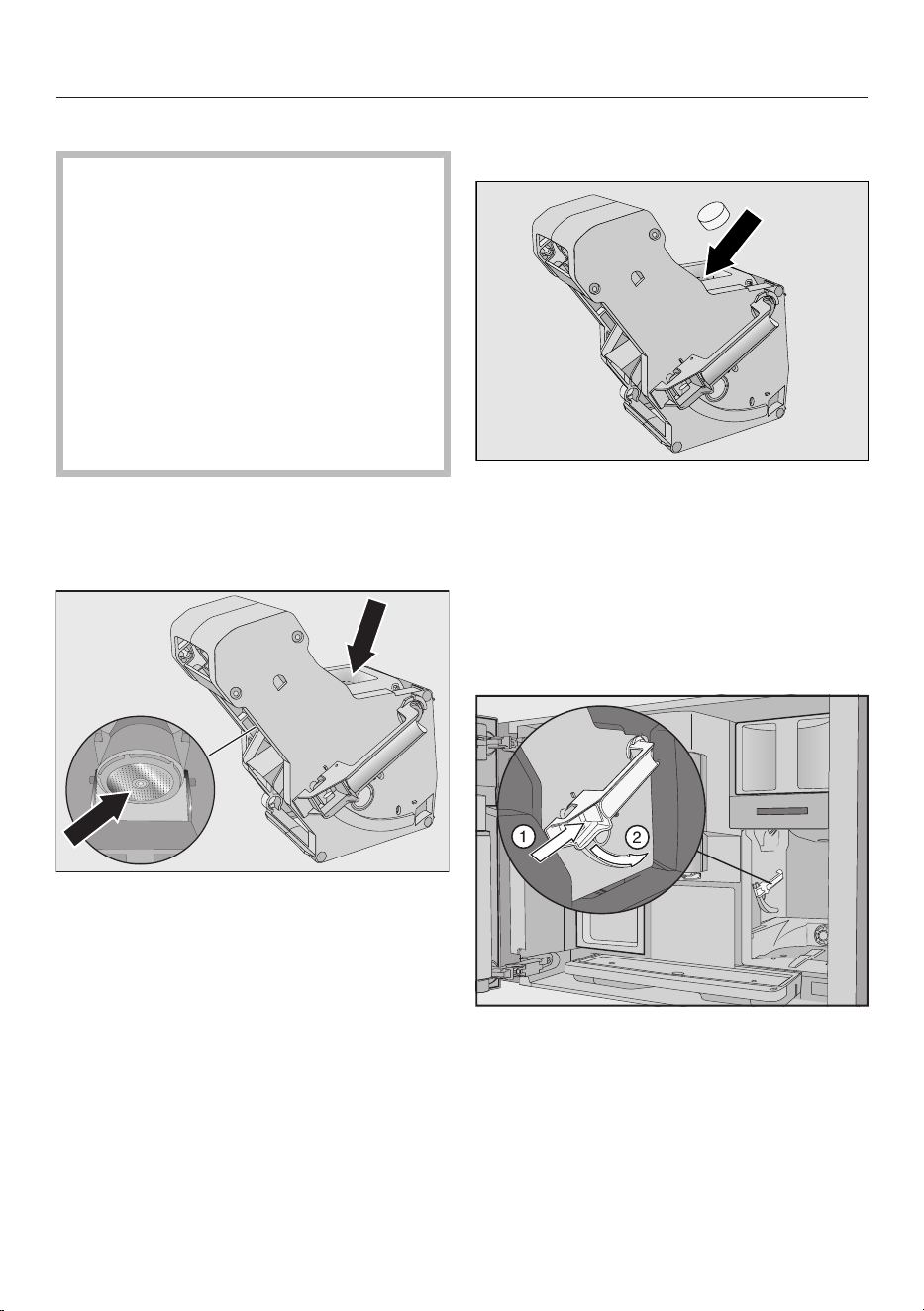
Cleaning and care
68
Cleaning the brew unit and the interior
The moving parts of the brew unit are
lubricated. Cleaning agents will
damage the brew unit.
Clean the brew unit by hand only
under warm running water. Do not
use washing-up liquid or any other
cleaning agent.
To ensure good tasting coffee and to
prevent the formation of microbes in
the machine, remove and clean the
brew unit under running water once a
week.
Clean the brew unit by hand under
warm running water without using
washing-up liquid or any other
cleaning agent.
Wipe any remaining coffee residues
from the filters. One filter is located in
the funnel and the other to the left of
the funnel.
Coffee powder falls onto the drip tray
when the brew unit is removed.
Remove the drip tray and clean the
lid.
Clean the interior of the coffee
machine (see also “Cleaning and care
– Removing the brew unit and
cleaning it by hand”). Use a vacuum
cleaner to remove dry ground coffee
residues.
Adding a cleaning tablet to the brew
unit
Drop a cleaning tablet into the top of
the brew unit (arrow).
Push the brew unit with cleaning
tablet back into the coffee machine,
making sure it goes in straight.
If you cannot re-insert the brew unit, the
brew unit drive is not in the correct
position.
Press the button under the handle of
the brew unit and, whilst doing so,
turn the handle to the rear.
Push the water container and the drip
tray, together with the waste
container, back into the coffee
machine.
Close the appliance door.
Cleaning and care
69
Follow the further instructions given
in the display.
The cleaning process is finished when
the drinks menu appears in the display.
Descaling the appliance
Risk of damage from spilt descaling
solution.
Sensitive surfaces and/or natural
floors can suffer damage.
Wipe up any spillages of descaling
agent immediately.
Limescale builds up in the coffee
machine through use. How often the
appliance needs to be descaled will
depend on the water hardness level in
your area. Limescale must be removed
regularly.
The appliance will guide you through the
descaling process. Various messages
will appear in the display, e.g. you will be
prompted to empty the drip tray or fill
the water container.
The descaling process is essential and
takes approx.35minutes.
The coffee machine prompts you when
it needs to be descaled. The remaining
number of drinks that can be made
before descaling will appear in the
display after each drink.
Confirm the message with OK.
When the number of remaining portions
reaches0, the appliance will lock out.
You can switch the coffee machine off if
you do not want to carry out the
descaling programme at this point.
However, you cannot make any drinks
until the machine has been descaled.
Descaling after prompt appears in the
display
Descale appliance appears in the display.
Confirm the message with OK.
The process will start.
Follow the instructions in the display.
When Place 2 descaling tablets in the water
container and fill it with lukewarm water up to
the symbol and insert it. Close the door.
appears in the display, proceed as
follows.
For optimum descaling results, we
recommend using the Miele descaling
tablets.
The descaling tablets have been
specially developed for Miele coffee
machines.
Other descaling agents, which
contain other acids besides citric
acid and/or other undesirable
substances, such as chlorides, may
cause damage to the product.
Moreover, the descaling result
required cannot be guaranteed if the
descaling solution was not of the
appropriate concentration.
Miele descaling tablets are available to
order from the Miele online shop or
directly from Miele (see the end of this
booklet for contact details).
You will need 2 descaling tablets for the
descaling process.
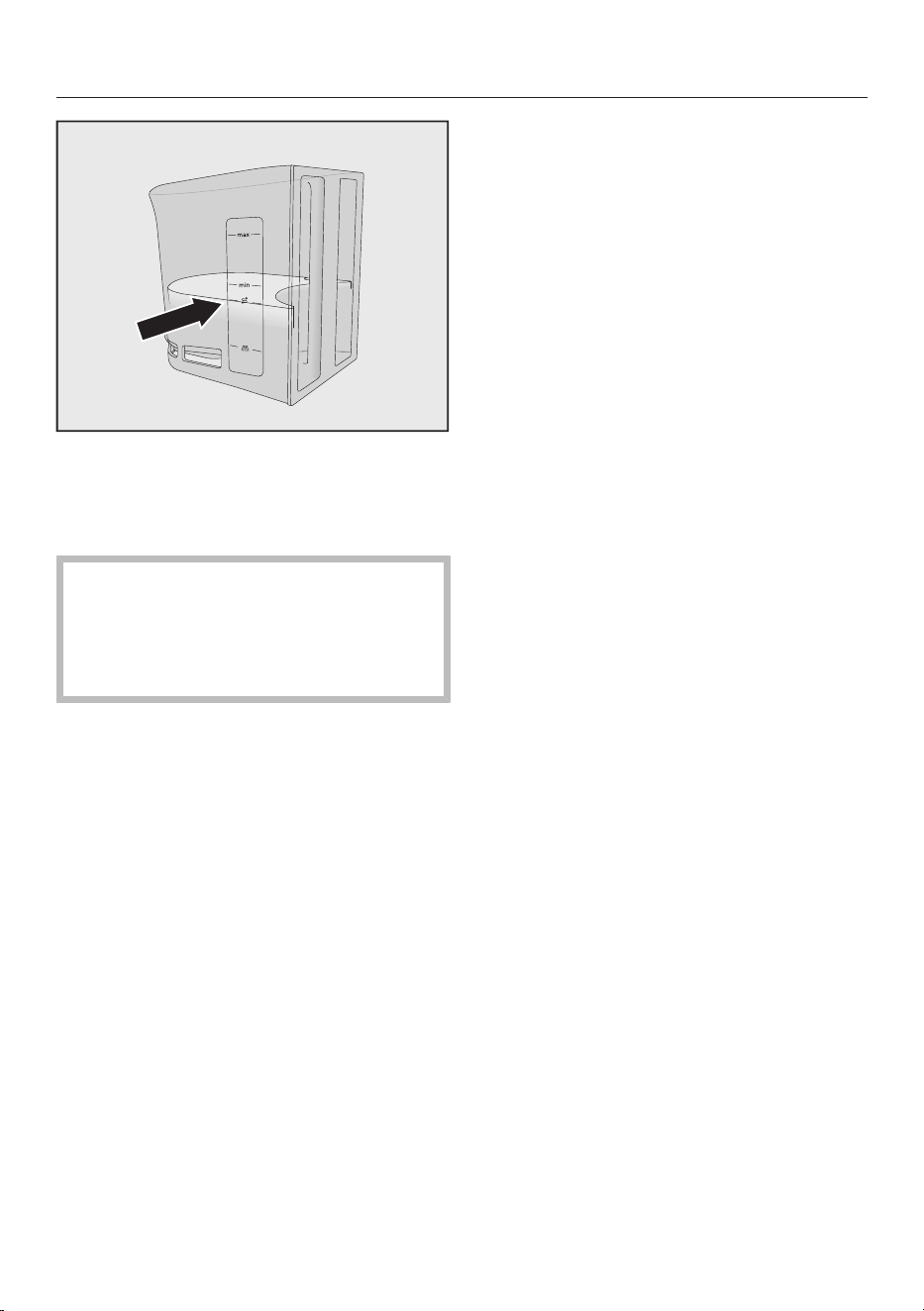
Cleaning and care
70
Fill the water container to the
marker with lukewarm water.
Add 2Miele descaling tablets to the
water container.
Follow the instructions for the mixing
ratio carefully. Fill the water container
with the correct amount of water.
Descaling will otherwise not be
completed.
Carrying out descaling
Push the water container back into
the machine.
Follow the further instructions given
in the display.
When Rinse and insert the water container.
Close the door appears in the display:
Remove the water container and rinse
it thoroughly with clean water. Ensure
that no descaling solution residue
remains in the water container. Fill the
water container with tap water.
The descaling process has finished
when the drinks menu appears in the
display.
Problem solving guide
71
Many malfunctions and minor faults that can occur in daily operation can be
corrected without contacting Miele. This will save you time and money because
you will not need a service call.
You can find information on how to remedy faults yourself at
www.miele.com.au/service or www.miele.co.nz/service and on the Miele website.
Please note, however, that a call-out charge will be applied to unnecessary service
visits where the problem could have been rectified as described in these operating
instructions.
Messages in the display
Error messages must be confirmed withOK. Otherwise the message may
reappear in the display even though the problem has been remedied.
Follow the instructions which appear in the display to remedy the problem.
If the fault message appears again in the display, contact Miele.
Problem Possible cause and remedy
F1, F2,
F80, F82,
F353, F354
There is an internal fault.
Switch the coffee machine off. Wait for
approximately one hour before switching the
machine back on again.
F74, F77
F225, F226
F235, F353, F354
There is an internal fault.
Switch the coffee machine off. Wait for
approximately2minutes before switching the
machine back on again.
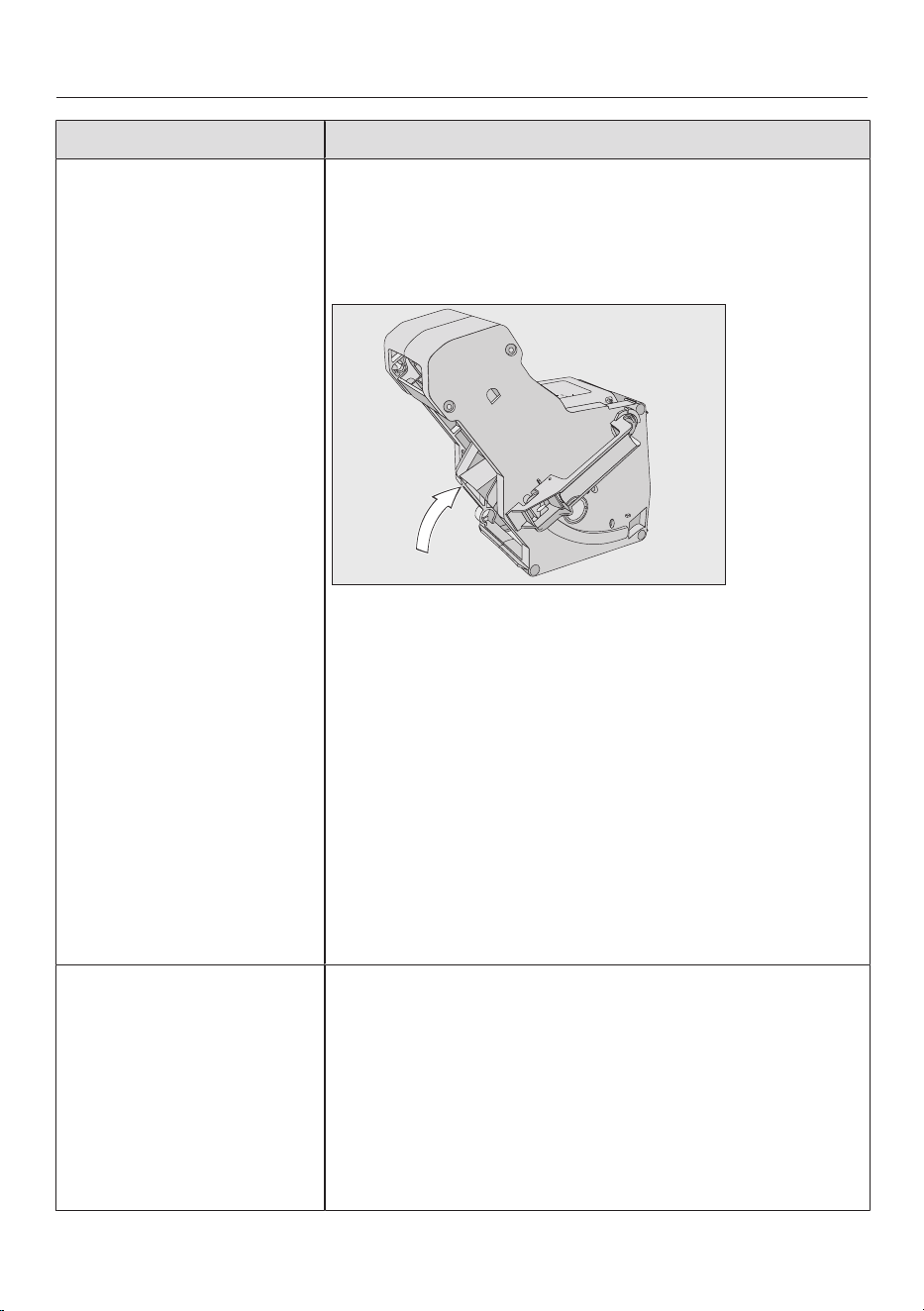
Problem solving guide
72
Problem Possible cause and remedy
F73 or
Check the brew unit
The brew unit cannot be positioned correctly or it is
dirty. Coffee powder cannot be pressed.
Check whether you can remove the brew unit.
When you are able to remove the brew unit, rinse it
under running water.
Push the coffee ejector of the brew unit into the
correct position (see diagram).
Do not insert the brew unit. Insert the water
container and close the appliance door. Switch the
coffee machine on.
This will initialise the brew unit motor and put it back
into the start position.
When Insert the brew unit appears in the display, open
the appliance door and put the brew unit back in the
machine. Close the appliance door.
If you are unable to remove the brew unit, switch off
the coffee machine. Wait for
approximately2minutes before switching the
machine back on again.
A maintenance
programme is cancelled
early and Push the water
container in until it engages
appears in the display.
The water container was not correctly filled and
refitted.
Check that you have filled to the correct marker.
The symbols on the water container indicate the
required water level for the
Descale appliance: and Clean milk pipework:
maintenance programmes.
Fill the water container to the marker and start the
process again.
Problem solving guide
73
Problem Possible cause and remedy
F233 The cup rim sensor is not inserted or is incorrectly
inserted.
If the central spout is moving upwards and the cup rim
sensor is bumped, e.g. with a cup, the cup rim sensor
loses its reference position.
Confirm the message with OK.
Refit the cup rim sensor.
Cup detection is deactivated until the next time the
coffee machine is switched on and the central spout
remains in the highest position. Cup detection is
initialised again the next time the machine is switched
on.
F307or Remove the milk
valve and clean it
The milk valve is faulty.
Remove and clean the milk valve (see “Cleaning and
care – Removing and cleaning the milk valve”).
Unusual performance of the coffee machine
Problem Possible cause and remedy
The display remains dark
when the coffee system
is switched on with the
On/Offsensor.
The On/Offsensor was not touched for long
enough.
Touch and hold the On/Off sensor for at least
3seconds.
The plug is not properly inserted into the socket.
Insert the plug into the socket correctly.
The mains fuse has tripped because the coffee
machine, mains voltage or another appliance is
defective.
Switch off at the wall socket and remove the plug.
Contact a qualified electrician or Miele.
The lighting remains off
after the coffee machine
is switched on.
The lighting has been switched off.
Switch the lighting on (see “Settings - Lighting”).
The lighting is faulty.
Call Miele.
The coffee machine
does not react to
operating the display.
There is a fault.
Touch and hold the On/Off sensor until the
display switches off and the appliance restarts.
Problem solving guide
74
Problem Possible cause and remedy
The coffee machine
switches off suddenly.
The factory set switch-off time (20minutes) or the
switch-off time you have programmed has been
reached.
If required, you can select a new switch-off time
(see "Settings - Timer").
The plug is not properly inserted into the socket or the
socket is not switched on.
Insert the plug into the socket correctly and switch
on.
The sensors do not
respond to touch.
The appliance cannot be
operated.
There is an internal fault.
Disconnect the electricity supply by switching off at
the wall socket and withdrawing the plug, or
switching off the mains circuit breaker.
A fan can be heard even
though no drinks are
being prepared and the
coffee machine is
switched off.
This is not a fault.
Once a drink has been dispensed or the machine has
been switched off, the internal fan will continue to run
until the interior is sufficiently dehumidified.
The brew unit cannot be
removed from the coffee
machine.
The brew unit drive is not in the correct position.
If necessary, move the handle on the brew unit back
to the start position.
Close the appliance door.
Switch the coffee machine off.
Wait approx.1minute before switching on the coffee
machine.
This will initialise the brew unit drive and put it back
into the start position.
If necessary, repeat these steps.
The brew unit cannot be
re-inserted into the
coffee machine.
The brew unit drive is not in the correct position.
Close the appliance door.
This will initialise the brew unit drive and put it back
into the start position.
If necessary, repeat this step.
Drink preparation is
cancelled prematurely
even though a cup or
glass is located under
the central spout.
This is not a fault.
If the opening of the cup or glass is so wide, e.g. as
with a large mug, that the cup rim sensor cannot
detect the rim, the drink is cancelled. Use a different
cup or glass, or position it in such a way that its rim
can be detected.
Problem solving guide
75
Problem Possible cause and remedy
The coffee machine
does not switch itself
on, although the Switch
on at setting has been
activated for the timer.
The system lock has been activated.
Deactivate the system lock.
The current day of the week has not been selected.
Check the timer settings and change these if
necessary.
The machine was not used after being switched on
automatically three times in succession (holiday
mode).
Switch the machine on and dispense a drink.
You are preparing hot
water or tea and instead
of water, steam is
dispensed.
The altitude is possibly set incorrectly.
Change the altitude setting (Settings Altitude).
You can also change the temperature settings if
necessary (Parameters).
The display is hard to
see or not able to be
read.
The display brightness is set too low.
Change this setting.
The display lights up but
the coffee machine does
not heat up and no
drinks are made.
The Demo mode of the coffee machine for Miele
Experience Centres and Chartered Agents has been
activated.
Deactivate Demo mode (see “Settings”).
Unsatisfactory results
Problem Possible cause and remedy
The coffee is not hot
enough.
The cup has not been pre-heated.
The smaller the cup and the thicker its walls, the
more important it is to pre-heat it.
Pre-heat the cup, for example with hot water.
The brewing temperature has been set too low.
Set a higher brewing temperature.
The filters in the brew unit are blocked.
Remove the brew unit and clean it by hand.
Degrease the brew unit.
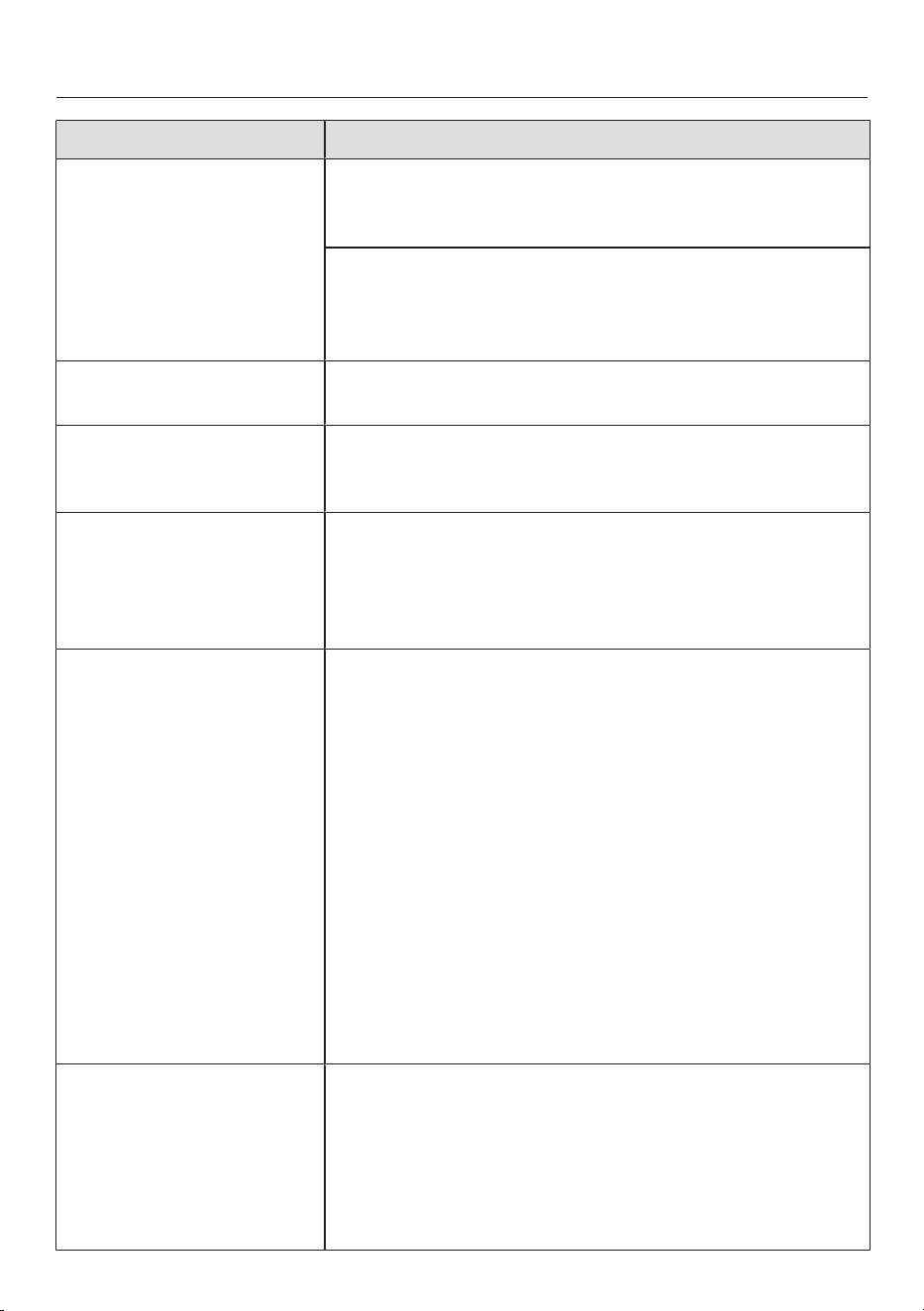
Problem solving guide
76
Problem Possible cause and remedy
The coffee grinder
makes a louder noise
than usual.
The coffee bean container has become empty during
the grinding process.
Fill the coffee bean container with fresh beans.
There may be foreign objects such as plastic or stones
in amongst the coffee beans.
Switch the coffee machine off immediately. Call
Miele.
The coffee flows too
quickly into the cup.
The coffee is too coarsely ground.
Set the grinder to a finer setting.
The coffee drink is
dispensed too slowly
into the cup.
The brew unit is blocked.
Degrease the brew unit (see "Cleaning and care -
Degreasing the brew unit and cleaning the interior").
There is no crema on the
coffee or espresso.
The coffee beans are no longer fresh. If roasted coffee
beans are stored open for too long, the carbon dioxide
gradually escapes from the coffee beans. The crema is
therefore no longer formed during dispensing.
Of course, you can still use the coffee beans.
The coffee tastes weak.
The coffee grounds in
the waste container are
sludgy and grainy.
Insufficient coffee beans are getting into the grinder
and less coffee is being brewed.
Have you used a dark roast?
This type of coffee bean is often oily. These oils can
cling to the inside of the coffee bean containers and
hinder the flow of beans.
Are you using a type of coffee with very large beans or
different sized beans?
The beans are possibly getting wedged or jammed and
forming “bean bridges”.
Clean the coffee bean containers more often if you
are using darker, more oily coffee beans.
Pull the bean containers out a little and shake them
if you are using coffee with very large beans or
different sized beans.
Trying using a different type of coffee.
Coffee is not being
dispensed from both
spouts evenly. Milk may
be sputtering when
being heated up.
Coffee deposits in the central spout are obstructing
dispensing.
Dismantle the central spout and clean the parts -
except for the stainless steel cover - in the
dishwasher.
This cleaning process should be carried out once a
week.
Problem solving guide
77
Problem Possible cause and remedy
The consistency of the
milk froth is
unsatisfactory.
The milk temperature is too high. Good milk froth can
only be achieved with cold milk (below 10°C).
Check the temperature of the milk in the milk flask.
The milk pipework is blocked and/or the milk valve is
dirty.
Remove and clean the milk valve.
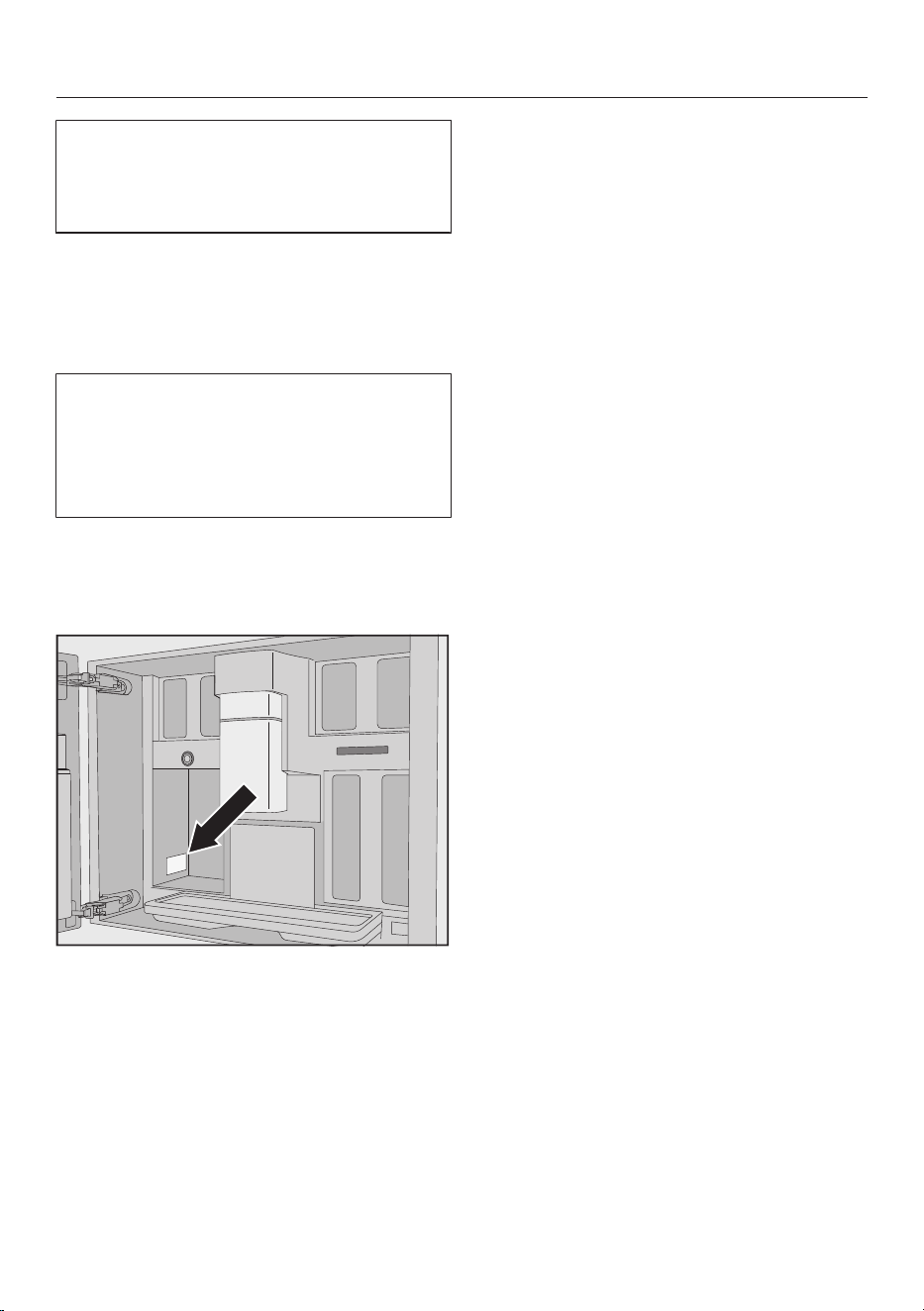
After sales service and warranty
78
You can find information on how to
remedy faults yourself and about Miele
spare parts at www.miele.com.au/
service or www.miele.co.nz/service.
Contact in case of fault
In the event of any faults which you
cannot remedy yourself, please contact
Miele.
You can book a Miele customer service
call-out online at www.miele.com.au/
service or www.miele.co.nz/service.
Contact information for Miele can be
found at the end of this booklet.
Please quote the model and serial
number of your appliance when
contacting Miele. This information can
be found on the data plate.
Warranty
The manufacturer's warranty for this
appliance is 2years.
For further information, please refer to
your warranty booklet.

Accessories
79
These products and other useful
accessories can be ordered via the
Miele webshop or directly from Miele
(see back cover for contact details).
- Original Miele all purpose microfibre
cloth
For removing finger marks and light
soiling
- Cleaning agent for milk pipework
For cleaning the milk system
- Cleaning tablets
For degreasing the brew unit
- Descaling tablets
For descaling the water pipework

Installation
*INSTALLATION*
80
Electrical connection
Before connecting the appliance, make
sure that the connection data on the
data plate (voltage and frequency)
matches the mains electricity supply.
This data must correspond in order to
avoid the risk of damage to the
appliance. If in any doubt, consult a
qualified electrician.
The necessary connection information is
given on the data plate inside your
appliance.
The fuse rating must be at least 10A.
The socket should be easily accessible.
If the socket is no longer accessible
after installation, an additional means of
disconnection must be provided for all
poles. Suitable means of disconnection
include switches with an all-pole
contact gap of at least 3mm. These
include isolator switches, fuses and
relays.
Temporary or permanent operation with
a self-sufficient or non-mains
synchronous energy supply system (e.g.
isolated networks, back-up systems) is
possible. A requirement for the
operation is that the energy supply
system complies with all current local
and national requirements that apply to
stand-alone, solar and/or battery
systems.
The protective measures provided in the
domestic installation and in this Miele
product must also be assured in their
function and operation in isolated
operation or in non-mains synchronous
operation, or replaced with equivalent
measures in the installation.
The machine must not be used with so-
called energy-saving plugs. These
reduce the amount of energy supplied
to the machine, causing it to overheat.
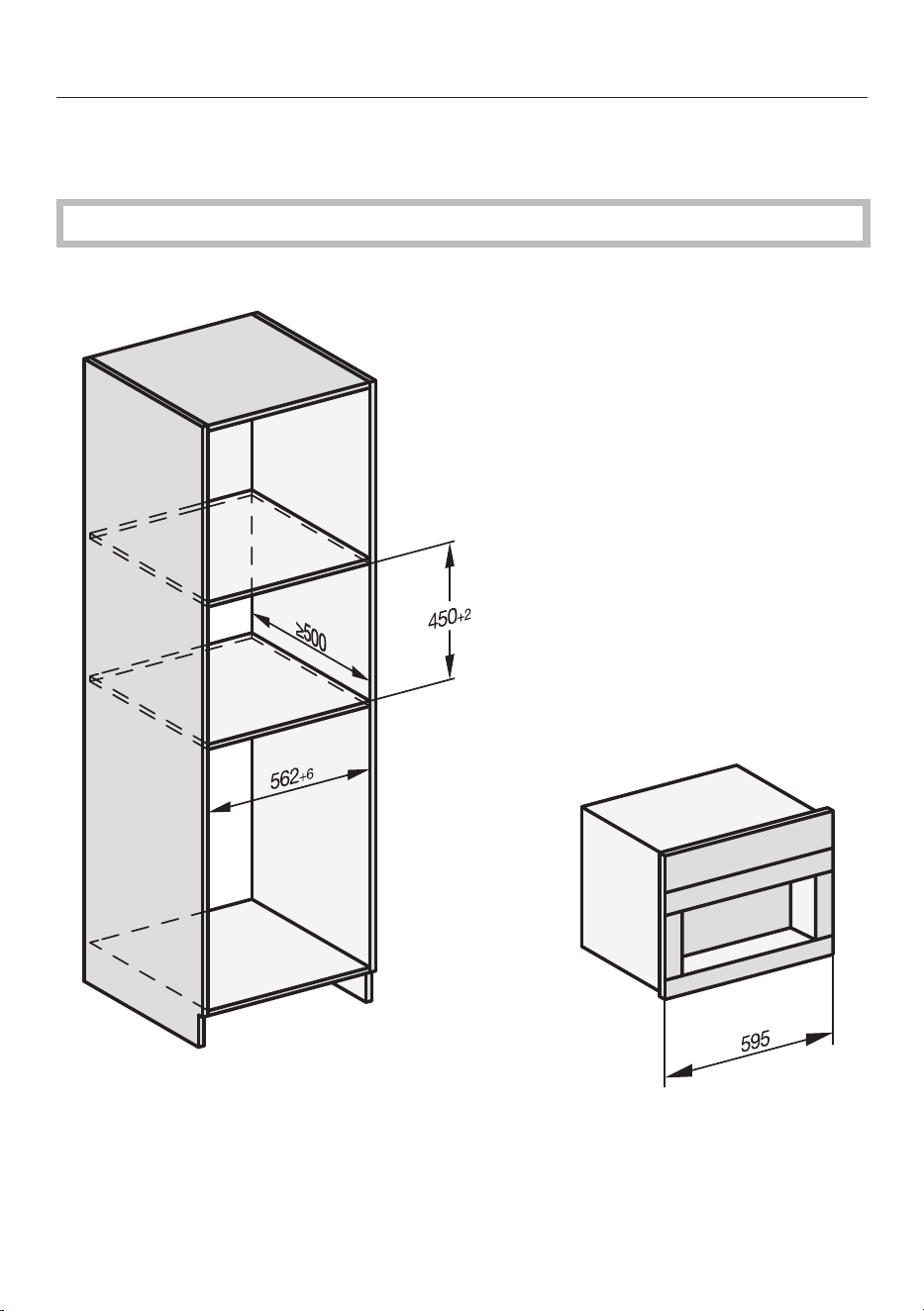
Installation
*INSTALLATION*
81
Installation dimensions
Installation in a tall unit
Maintain the required minimum installation height of 850mm.
All dimensions are given in mm.
Combination with other Miele built-in appliances is possible. If the coffee machine
is to be built in above another appliance, there must be a full-width, closed shelf
between them. If the appliance is to be combined with a Gourmet warming drawer/
built-in vacuum sealing drawer, no intermediate shelf is required in between.
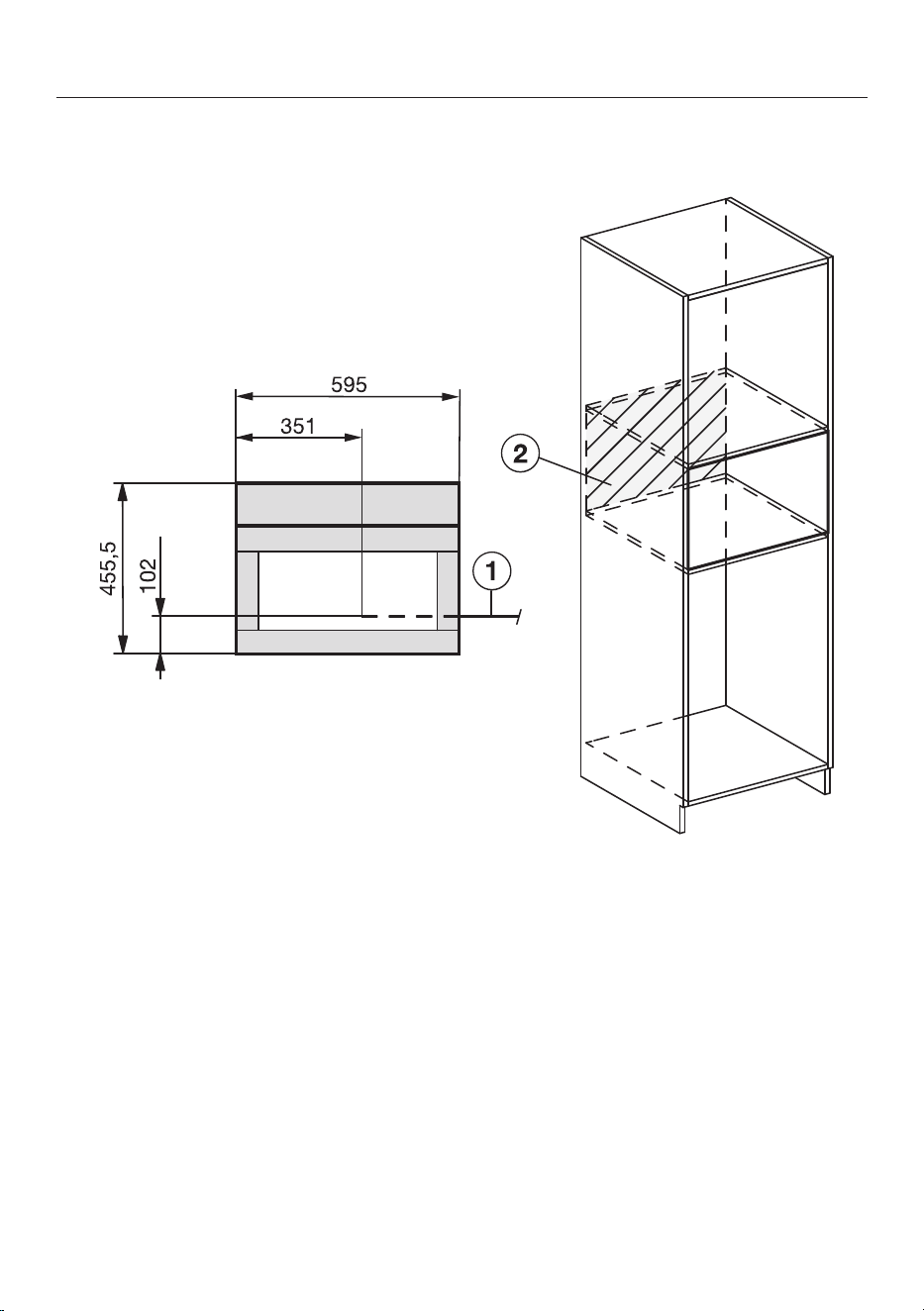
Installation
*INSTALLATION*
82
Installation and connections
All dimensions are given in mm.
a
Mains connection cable
b
Do not place electrical connection in this area
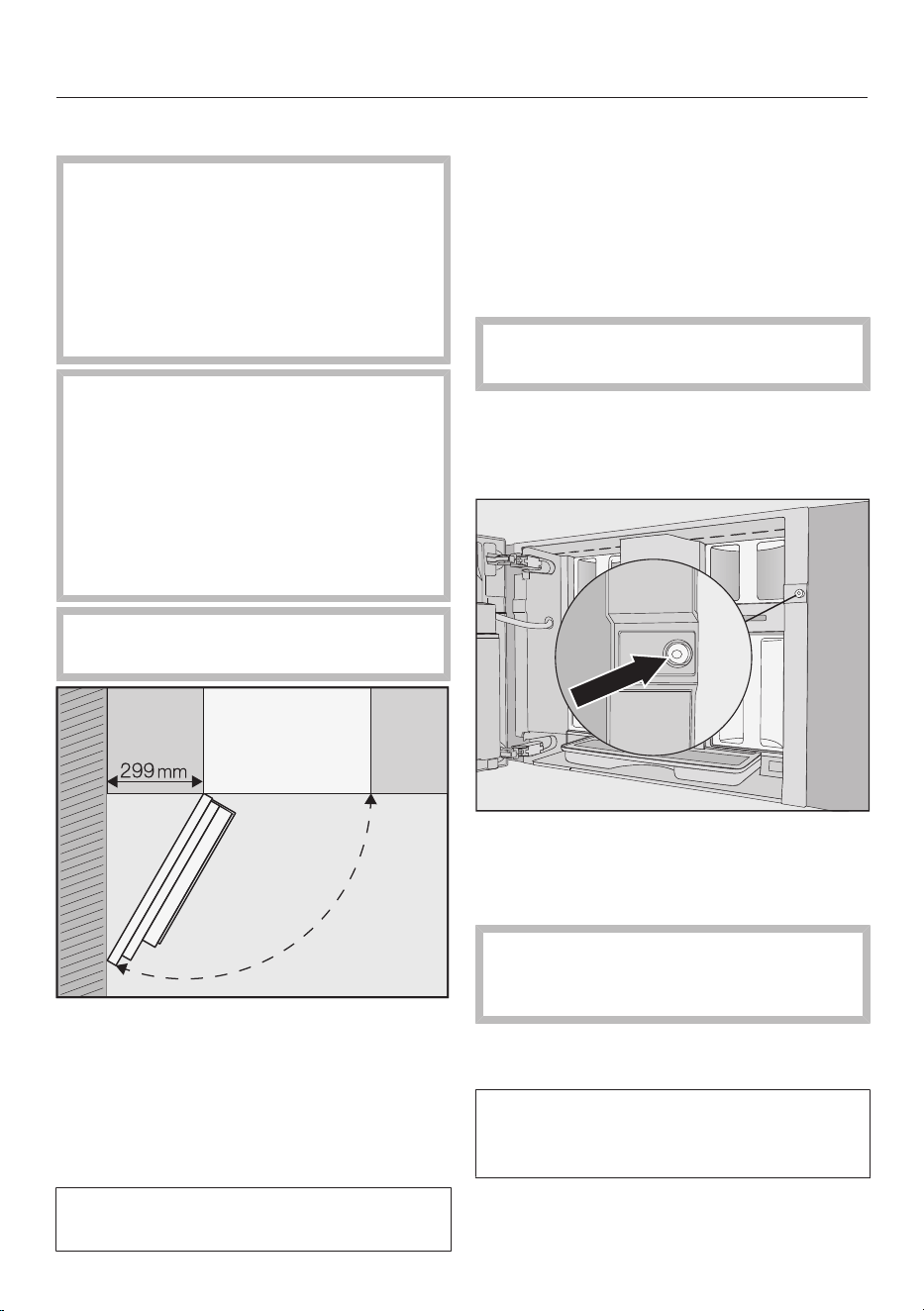
Installation
*INSTALLATION*
83
Building in the coffee machine
Danger of injury due to incorrect
operation.
Personal injury can result from an
incorrectly installed, and therefore
unsecured, appliance.
Operate the coffee machine only in a
built-in installation.
Risk of damage to property due
to incorrect operation.
If the ambient temperature range is
not complied with, the coffee
machine may not function correctly.
Operate the coffee machine only
within a temperature range of +16°C
to +38°C.
Maintain the required minimum
installation height of 850mm.
Useful tip: If the distance between an
adjacent wall and the coffee machine is
at least 299mm, the appliance door
can be opened wider, thus making the
machine easier to use. This allows the
left bean container to be removed more
easily, for example.
A TX20 screwdriver is required for
installation.
Useful tip: We recommend providing a
place to sit the coffee machine which is
the same height as the building-in niche.
This will make it easier to connect the
machine to the electricity supply.
Connecting to the mains electricity
supply
Observe the instructions in
“Electrical connection”.
Connect the coffee machine to the
mains electricity supply.
Removing the transport safety device
There is a red silicone plug inside the
screw hole which secures the appliance
door during transport to prevent
transport damage.
Remove the silicone plug before
screwing the coffee machine to the
cabinet.
Pull firmly on the red silicone plug to
remove it from the screw hole.
The silicone plug is not required again.
Dispose of it with your household
waste.
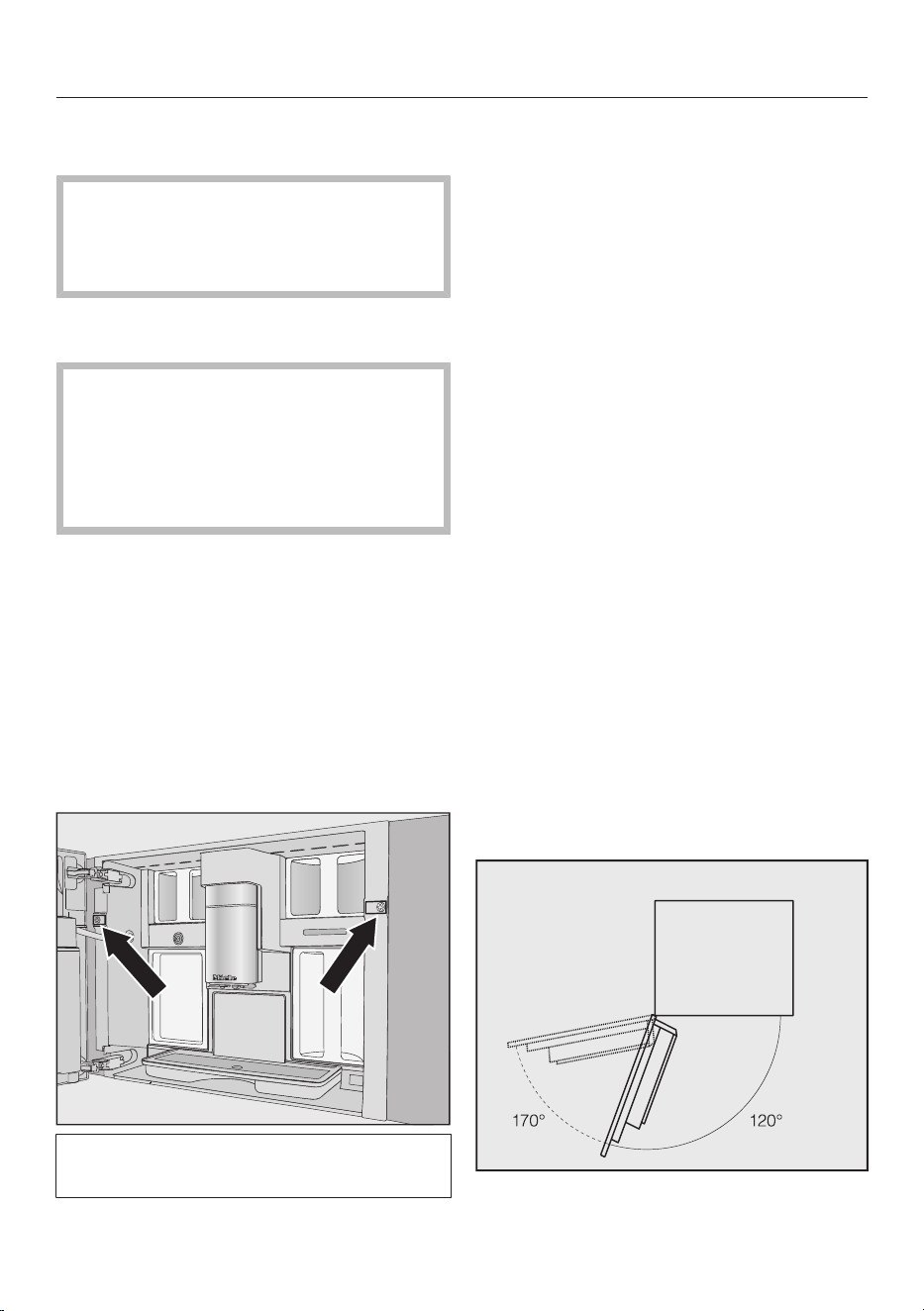
Installation
*INSTALLATION*
84
Pushing in and levelling the coffee
machine
Ensure the mains connection cable
does not get jammed or damaged
when pushing the appliance into the
niche.
Push the coffee machine all the way
into the building-in niche.
Do not adjust the door hinges to align
the coffee machine. This could
otherwise result in the milk flask not
being able to be fitted correctly and
milk preparation may not function
properly.
Check the height of the coffee
machine to make sure that it is sitting
centrally in the niche and that it is
level. Align the appliance if necessary.
You can now screw the coffee machine
to the cabinet.
Screwing the coffee machine to the
cabinet
Open the appliance door.
2TX20 (25mm) screws are supplied
with the appliance.
Secure the coffee machine to the side
walls of the housing unit using the
screws supplied.
Tighten both screws by hand.
Useful tip: You can remove the door
opening limiters and increase the door
opening angle to 170° so that the screw
on the left can be screwed in more
easily (see "Door opening limiters").
Check whether there is enough room
and that the appliance door does not hit
an adjacent wall.
Check the operation of the coffee
machine.
Door opening limiters
The door hinges of the coffee machine
are equipped with door opening limiters
that limit the opening angle of the
appliance door to approx. 120°. These
prevent the appliance door from hitting
an adjacent wall when opened and
being damaged.
You can remove the door opening
limiters to increase the opening angle to
approx. 170°. This allows the bean
containers to be removed more easily,
for example.
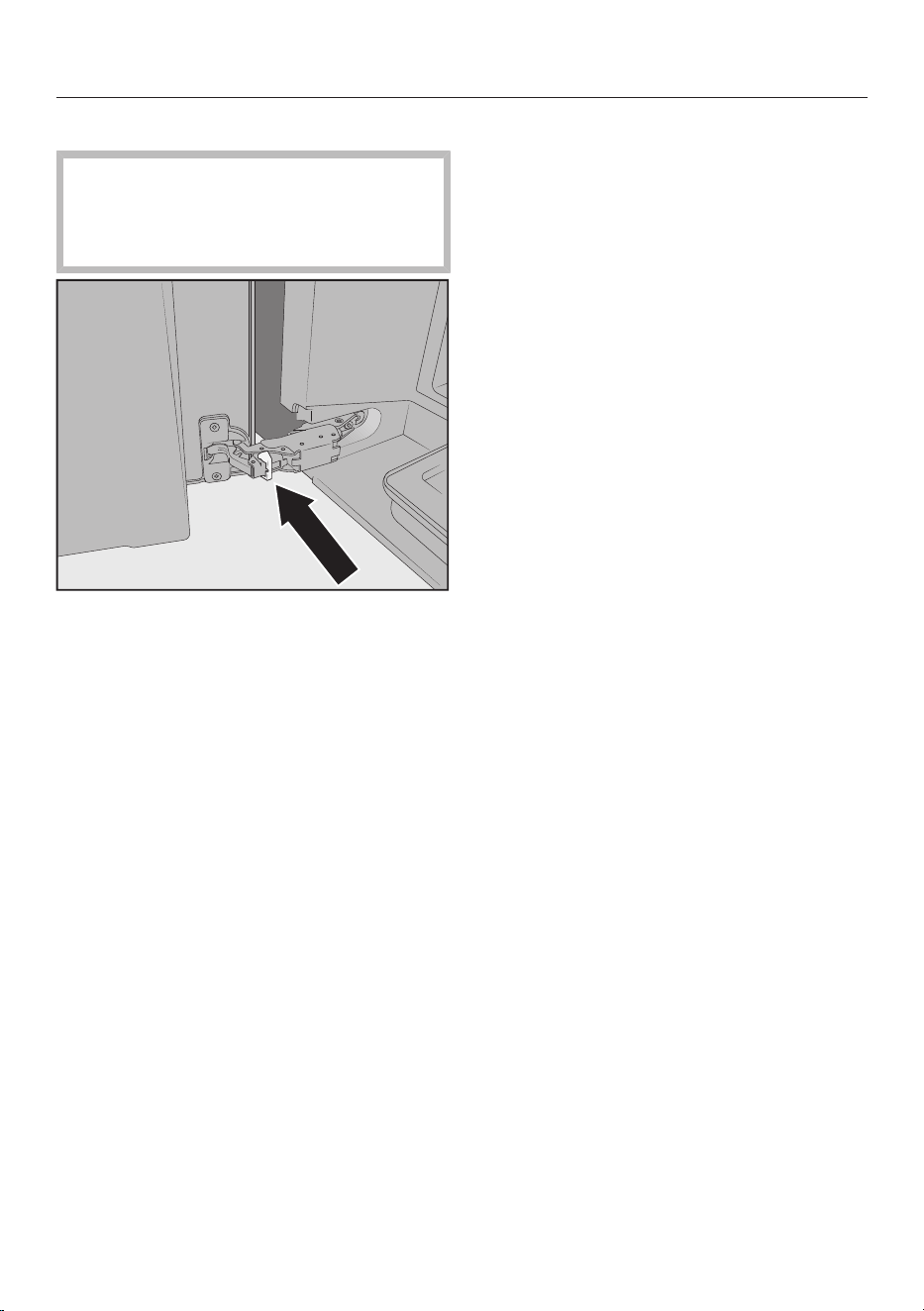
Installation
*INSTALLATION*
85
Removing the door opening limiters
Check whether there is enough room
and that the appliance door does not
hit an adjacent wall when the door
opening angle is increased.
Remove the door opening limiters
from the hinges by levering them out
with a screwdriver, for example.
The door opening angle is now
increased to approx. 170°.

Technical data
86
Electricity consumption in standby: <0.6Watt
Electricity consumption in networked
standby:
<0.9Watt
Frequency band of the Wi-Fi module 2.4000GHz–2.4835GHz
Maximum transmission power of the
Wi-Fi module
<100mW

Miele Australia Pty. Ltd.
Miele New Zealand Limited
Miele Global Headquarters
Germany
Miele & Cie. KG
Carl-Miele-Straße 29
33332 Gütersloh
Federal Republic of Germany
IRD 98 463 631
8 College Hill
Freemans Bay, Auckland 1011
ACN 005 635 398
ABN 96 005 635 398
Level 4, 141 Camberwell Road
Hawthorn East, VIC 3123
0800 464 353 (0800 4 MIELE)
www.miele.co.nz
1300 464 353 (1300 4 MIELE)
www.miele.com.au

M.-Nr. 12 859 690 / 00en – AU, NZ
CVA 7440