VDP2 SERIES
Support.NightOwlSP.com
24/7
SUPPORT
English
Español / Français
USER’S MANUAL
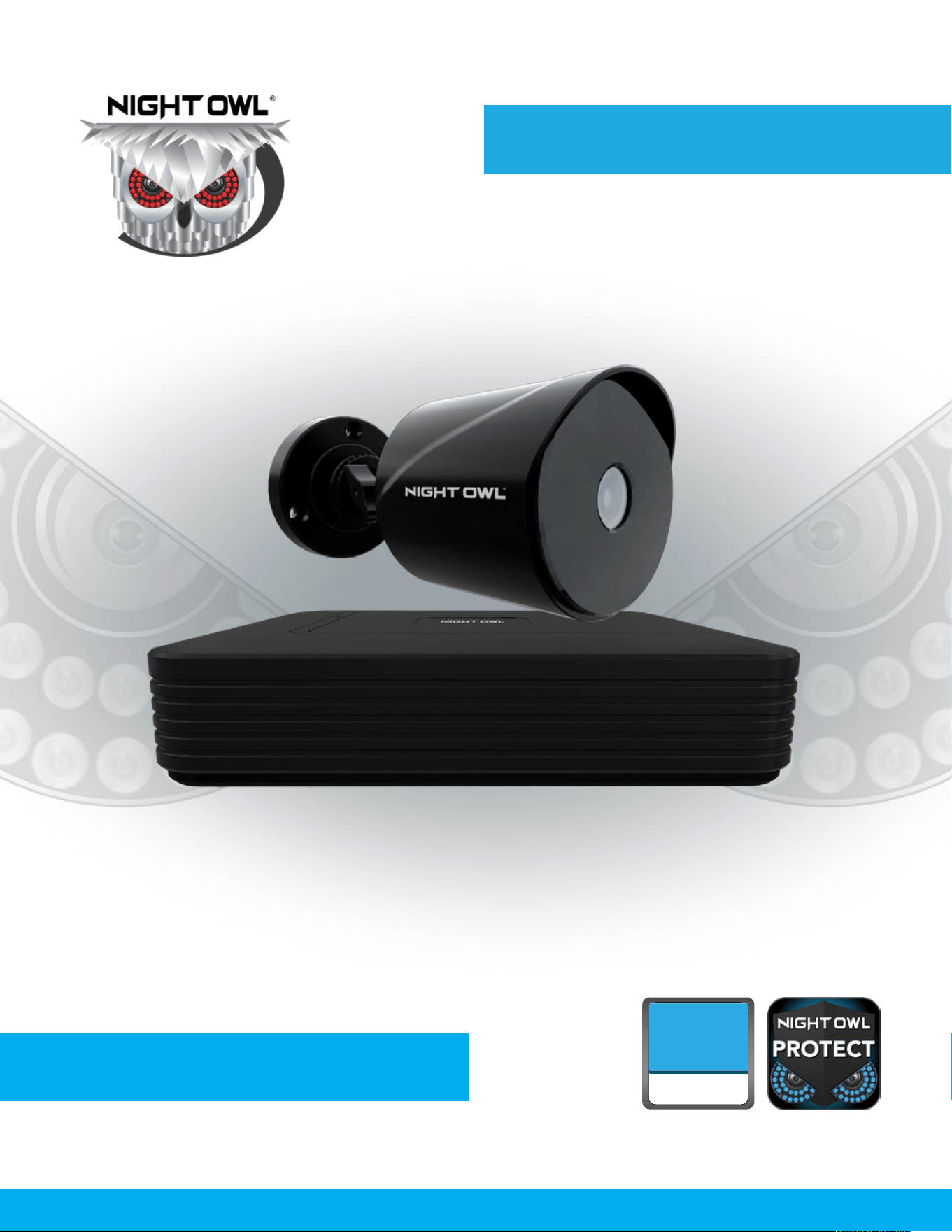
VDP2 Series
DVR Component Model #: DVR-VDP2-81
Firmware Version: 20210201
Camera Component Model #: CM-DP2BK-B
ii
Thank you for choosing Night Owl Security
By purchasing a Night Owl product, you receive a one (1) year warranty covering manufacturing
have access to our vast library of free instructional How to Videos. For all Support Videos, go to www.
youtube.com/nightowlsp to access Night Owl’s YouTube page.
Camera Compatibility
Night Owl’s VDP2 Series DVRs are compatible with the following cameras:
VDP2
CM-DP2L-BU
CM-TA2L-BU
CM-C2OXL-BU
CM-DP2BK-B
NOTE: Not all features will work with all compatible cameras. You must use preferred cam-
eras to access all features.
This system is designed to work with CL2 UL Rated cabling or better. If the camera’s video quality,
either day or night, is degraded, you may need to change the cable run from the camera to the DVR.
Please see the warranty section of this manual for exclusions and additional details. Not all features
and capabilities are shared across all models. You may see features which are not applicable. Addition-
ally, this manual contains screen images that may not exactly match those on your TV/Monitor/Smart
Device.
THIS MANUAL WAS ACCURATE AT THE TIME IT WAS COMPLETED. DUE TO OUR ONGOING EFFORT
TO CONSTANTLY IMPROVE OUR PRODUCTS, FUNCTIONS MAY HAVE BEEN ADDED OR CHANGED.
System Requirements
Please be sure that your PC/MAC
®
• PC Operating System: Windows
®
10 and above
• MAC Operating System: MAC OS X
®
10.9 and above
•
• Android™: 8.0 and above
• iOS
®
: 12.4 and above

Table of Contents
iii
Table of Contents
FCC Warnings. . . . . . . . . . . . . iv
Safety Instructions . . . . . . . . . . 1
Initial Setup . . . . . . . . . . . . . 2
Step 1. Verify Your Package Contents . . . . . 2
Step 2. Download the Night Owl Protect App and Create
Your Account . . . . . . . . . . 5
Step 3. Connect Your System . . . . . . . 6
Step 4. Set Up Your DVR . . . . . . . . 7
Connected to the Internet . . . . . . 7
Disconnected from the Internet . . . . 10
Step 5. Install the Cameras . . . . . . . . 14
Live View . . . . . . . . . . . . . . 16
View Live (All Channels) . . . . . . . . . 16
Right-Click Menu From Live View . . . . . . 17
Light Menu. . . . . . . . . . . . . 18
Facial Capture Menu . . . . . . . . . . 19
Event Playback . . . . . . . . . . . 20
Backing Up / Exporting Videos . . . . 23
Formatting a USB Flash Drive or External Hard Drive . 23
Video Backup . . . . . . . . . . . . 25
Main Menu . . . . . . . . . . . . . 28
Menu Screen . . . . . . . . . . . . 28
General Menu . . . . . . . . . . . . 29
Display . . . . . . . . . . . 29
Network . . . . . . . . . . . 30
Cameras Menu . . . . . . . . . . . 31
Advanced . . . . . . . . . . . 31
Adjustments . . . . . . . . . . 32
Record Menu . . . . . . . . . . . . 34
Event Settings . . . . . . . . . 34
Scheduling . . . . . . . . . . 38
Device Menu . . . . . . . . . . . . 39
HDD . . . . . . . . . . . . 39
System Menu . . . . . . . . . . . . 40
General . . . . . . . . . . . 40
Info . . . . . . . . . . . . 42
Log . . . . . . . . . . . . 43
Advanced Menu . . . . . . . . . . . 44
Maintain . . . . . . . . . . . 44
Events . . . . . . . . . . . 45
Auto Upgrade . . . . . . . . . 46
Glossary . . . . . . . . . . . . . . 47
Warranty . . . . . . . . . . . . . . 48
Troubleshooting . . . . . . . . . . . 50
User Information . . . . . . . . . . 52

FCC Warnings
FCC
This device complies with Part 15 of the FCC Rules. Operation is subject to the following two condi-
tions: (1) this device may not cause harmful interference and (2) this device must accept any interfer-
ence received, including interference that may cause undesired operation.
FCC Compliance Statement
These limits are designed to provide reasonable protection against frequency interference in residen-
tial installation. This equipment generates, uses and can radiate radio frequency energy and if not
installed or used in accordance with the instructions, may cause harmful interference to radio commu-
nication. However, there is no guarantee that interference will not occur in television reception, which
can be determined by turning the equipment off and on. The user is encouraged to try and correct the
interference by one or more of the following measures:
• Reorient or relocate the receiving antenna.
• Increase the separation between the equipment and the receiver.
• Connect the equipment into an outlet on a circuit different from that to which the
receiver is connected.
• Consult the dealer or an experienced radio/TV technician for help.
CAUTION
to the unit not expressly approved by the party responsible for compliance could void the
user’s authority to operate the equipment.
iv

Safety Instructions
Use the provided power adapter.
Never insert metal into the DVR case or its openings.
Inserting metal into the DVR case may cause electric shock.
Do not operate in wet or dusty areas.
Avoid placing the DVR in areas such as a damp basement or dusty attic.
Do not expose the DVR to rain or use near water.
If the DVR accidentally gets wet, unplug it and contact technical support immediately.
Keep product surfaces clean and dry.
To clean the outside case of the DVR, use a lightly dampened cloth. Do not use cleaning solutions or
solvents.
Do not install near any heat sources.
Do not install the DVR near any heat sources such as stoves, heat registers, radiators, or electronics
Unplug the DVR when moving it.
Make sure that the DVR is unplugged before you move it. When moving this device, be sure to handle
it with care.
Make sure there is good air circulation around the DVR.
This DVR uses an internal hard drive, that generates heat during operation for video storage. Do not
block the vents on the DVR as these vents reduce the generated heat while the system is running.
Place this product in a well-ventilated area.
Do not attempt to remove the top cover.
If you observe any abnormal operation, unplug the DVR immediately and contact technical support. Do
not attempt to open the DVR to diagnose the cause of the problem. Removing the cover will void your
warranty.
Handle the DVR carefully.
If you drop the DVR on any hard surface, it may damage the device. If the DVR doesn’t work properly
due to physical damage, contact an authorized dealer for repair.
It is recommended to use your DVR with an uninterruptible power supply (UPS).
Connecting your DVR and cameras to a UPS allows continuous operation even during power outages.
The run-time duration will depend on the rating of the UPS used.
CAUTION
You may be subjected to severe electrical shock if you remove the cover of the DVR.
1
2
Initial Setup
Night Owl strongly recommends that you complete the following sections in the order
that they are listed to quickly and easily set up your system:
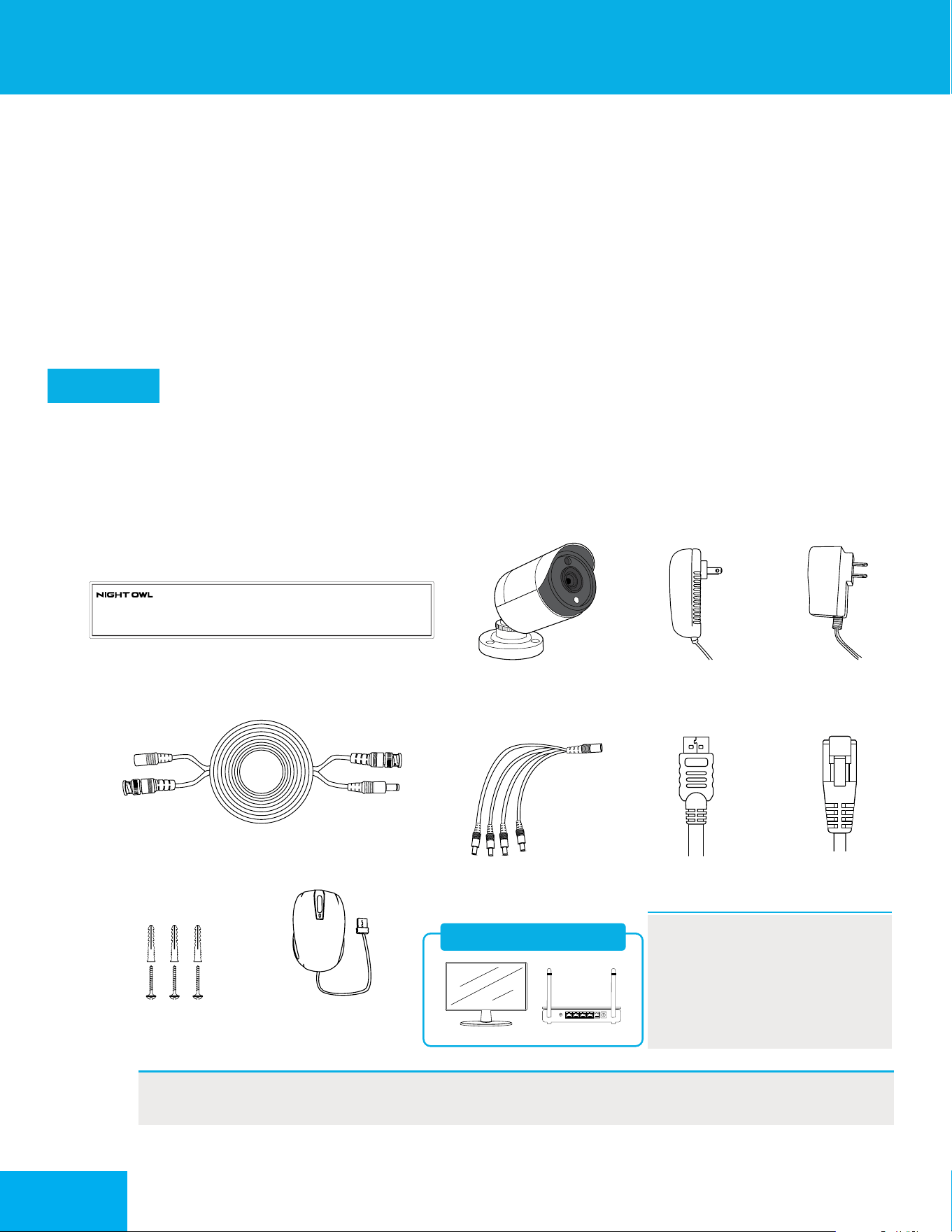
• Step 1. Verify Your Package Contents
• Step 2. Download the Night Owl Protect App and Create Your Account
• Step 3. Connect Your System
• Step 4. Set Up Your DVR
• Step 5. Install the Cameras
Step 1. Verify Your Package Contents
Before you begin to install your system, ensure you can identify all of the parts listed in
this section. Images may vary slightly based on your model number.
USB
Mouse (x1)
6 ft. HDMI (x1) 6 ft. Ethernet (x1)
Power Splitter(s)
(1 per 4 cameras)
Monitor Router
Mounting
Hardware
60 ft. Video/Power Cables
(1 cable per camera)
DVR Power
Adapter (x1)
Camera Power
Adapter(s)
(1 per 4 cameras)
Camera(s)DVR
RESET
LAN1 LAN2 LAN3 LAN4 WAN
Items Not Included
NOTE: For best results use Night Owl accessories. Third party accessories or products under
a different brand may not work as well.
NOTE: Internet access is
STRONGLY recommended
for this initial setup. A TV
or monitor with a minimum
1080p HD resolution and
an HDMI input is required
for the initial setup.
FRONT VIEW
REAR VIEW
1 2 3
4
5
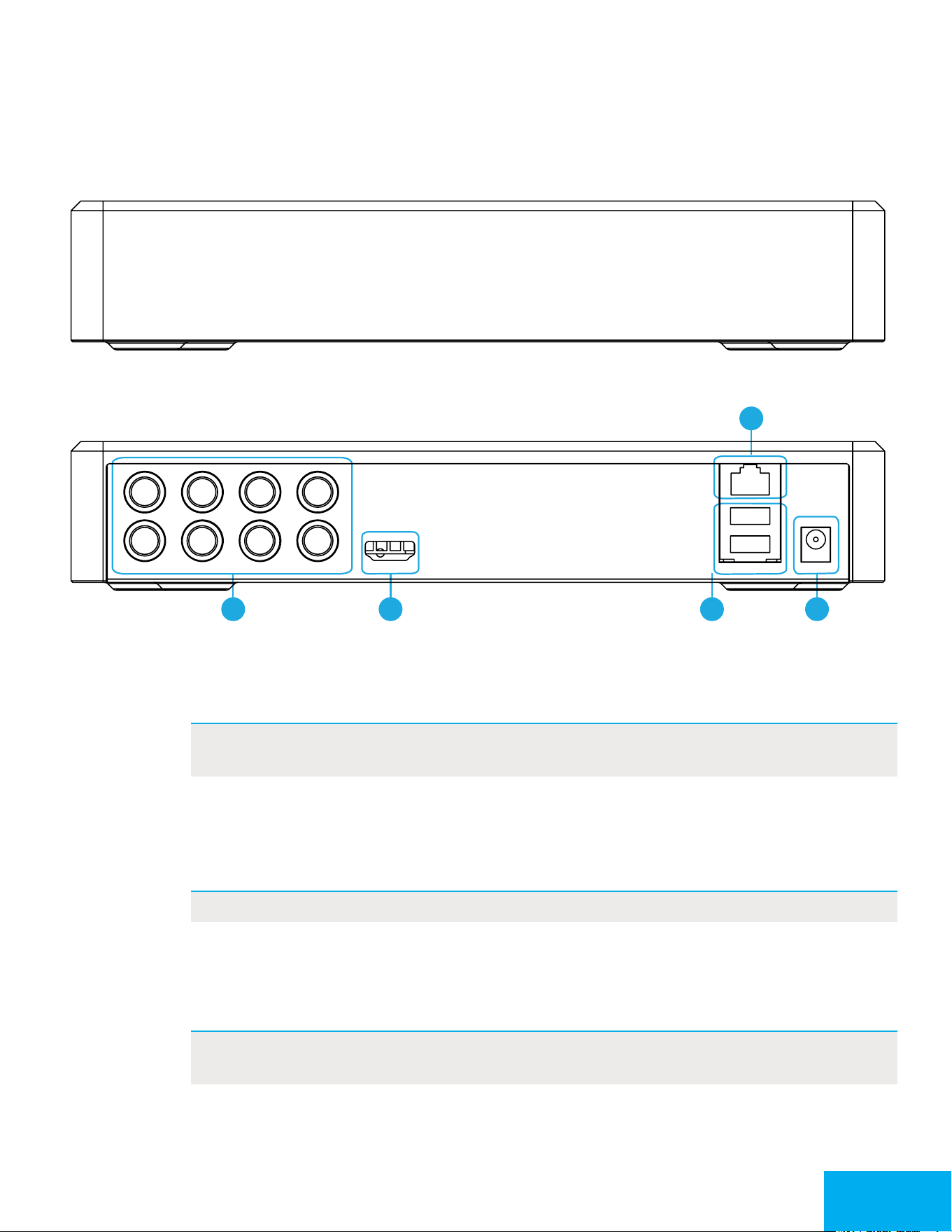
DVR Component Description
1. Video In: Connect your BNC wired cameras to one of these ports.
NOTE: The DVR automatically detects the camera. Before turning the DVR on, make
sure the cameras are connected to the DVR and a power source.
2. HDMI (Recommended): Connect your TV or monitor to this HDMI port using an HDMI
cable.
3. USB Ports
NOTE:
4. LAN (Strongly Recommended): Connect your DVR to the Internet using an Ethernet cable.
5. Power Input: Connect the DVR power adapter to this port to power the DVR.
NOTE:
ensure that all components function properly.
3
4
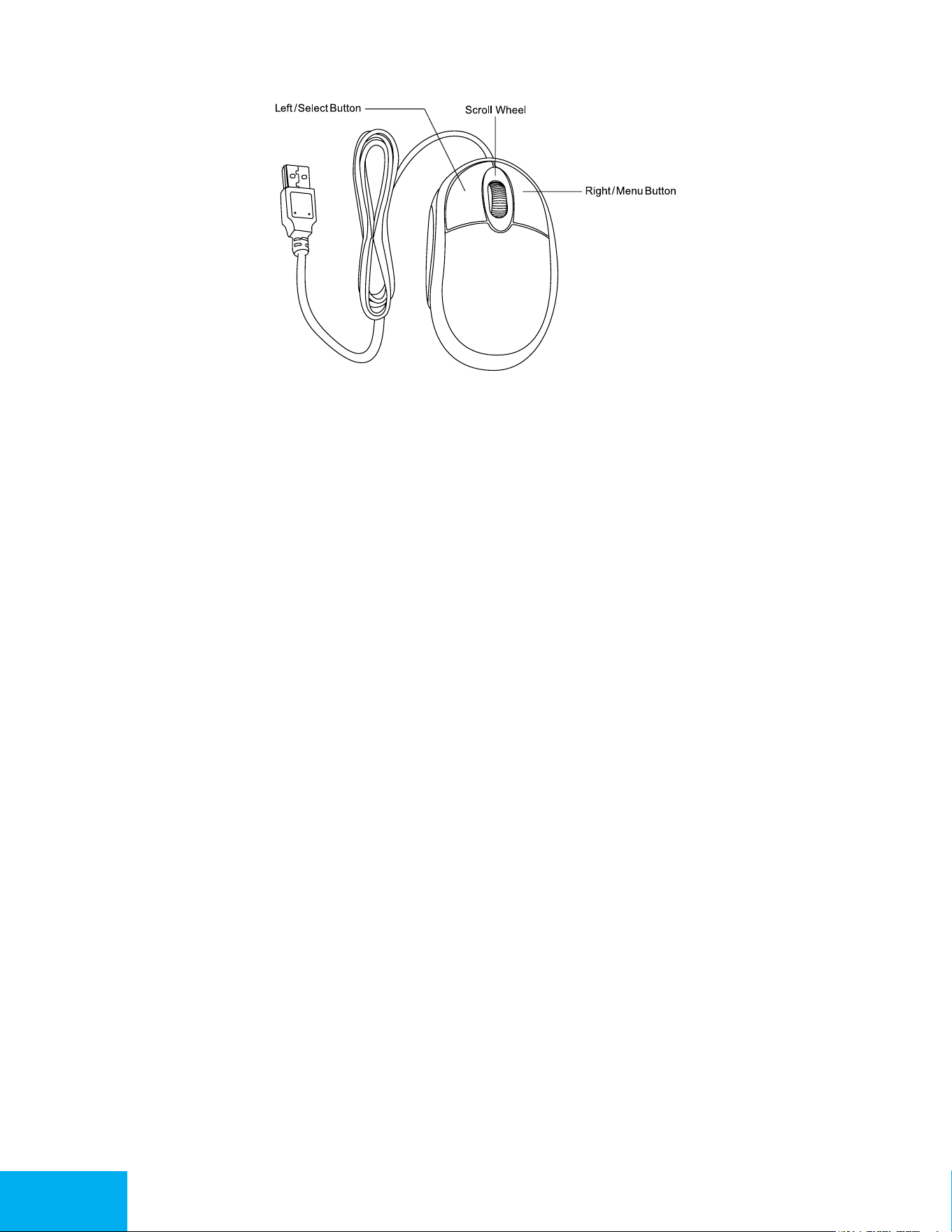
Mouse Description
Live Viewing:
Double-click the left button on any camera view in split-screen mode to bring it to full
screen display. Double-click again to return to split-screen mode. Right-click to show the
Tool Bar at the bottom of the screen. Left click on the Tool Bar or Menu to access the
device’s features.
In Setup:
Left-click to make a selection. Right-click to cancel setup or return to the previous
screen.
To Enter Values:
which supports numbers, letters, and symbols. The Shift function will access symbols in
addition to upper case letters.
5
Step 2. Download the Night Owl Protect App and Create Your
Account
IMPORTANT: Night Owl STRONGLY recommends that you create an account via the
Night Owl Protect App. This app is the preferred method for password
resets since you cannot reset your password from the DVR. You can choose
not to use the app later if you wish.
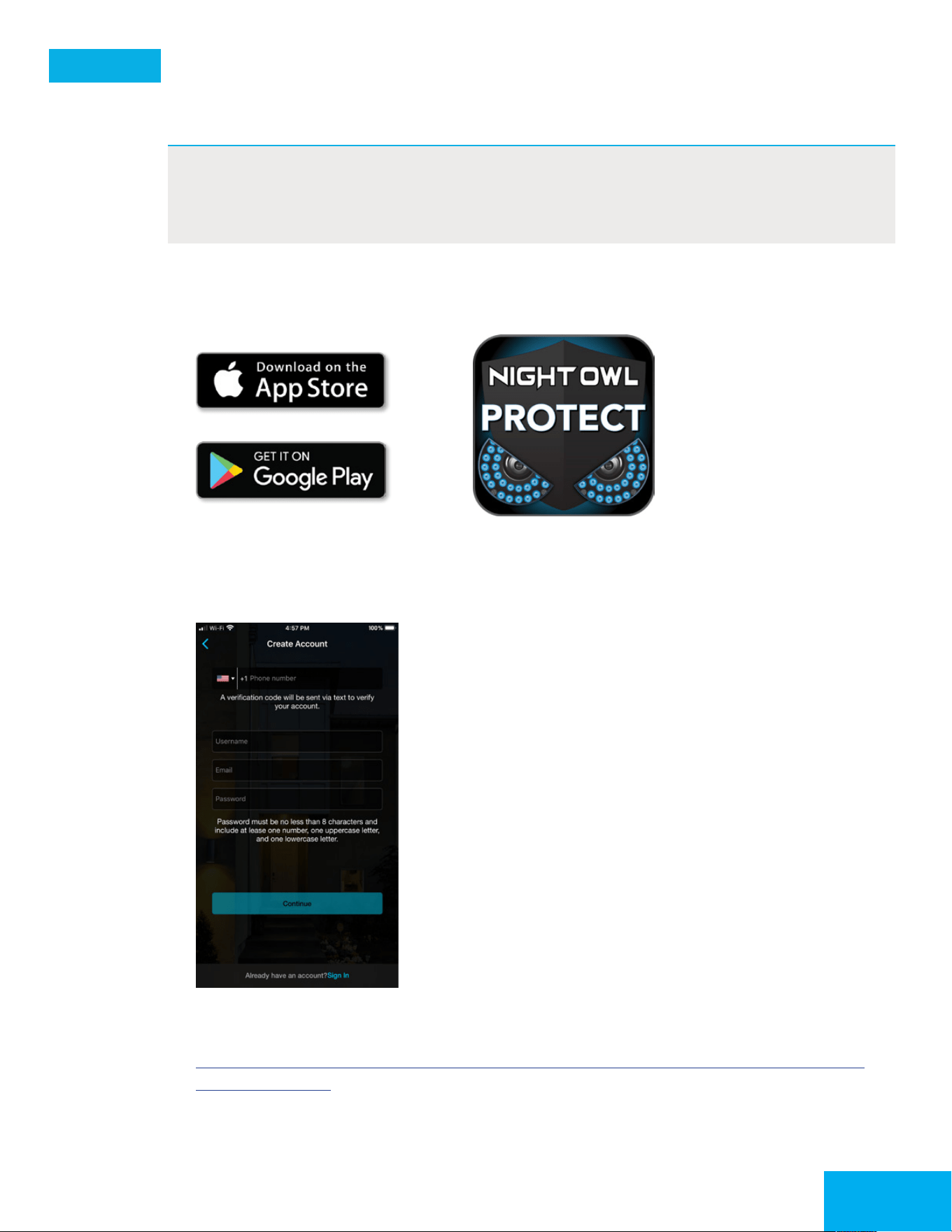
1. Download the Night Owl Protect App from the Apple App or Google Play Store. If you
Step 3 –
Connect Your System.
2. Follow the prompts on the Night Owl Protect App to create your account. For security
created.
3. Finish creating your account and create a personal PIN number that you will enter upon
https://support.nightowlsp.com/hc/en-us/articles/360044127354-Night-Owl-Protect-
Mobile-App-CMS
4. Step 3 – Connect Your System to begin connecting the
components of your system.
6
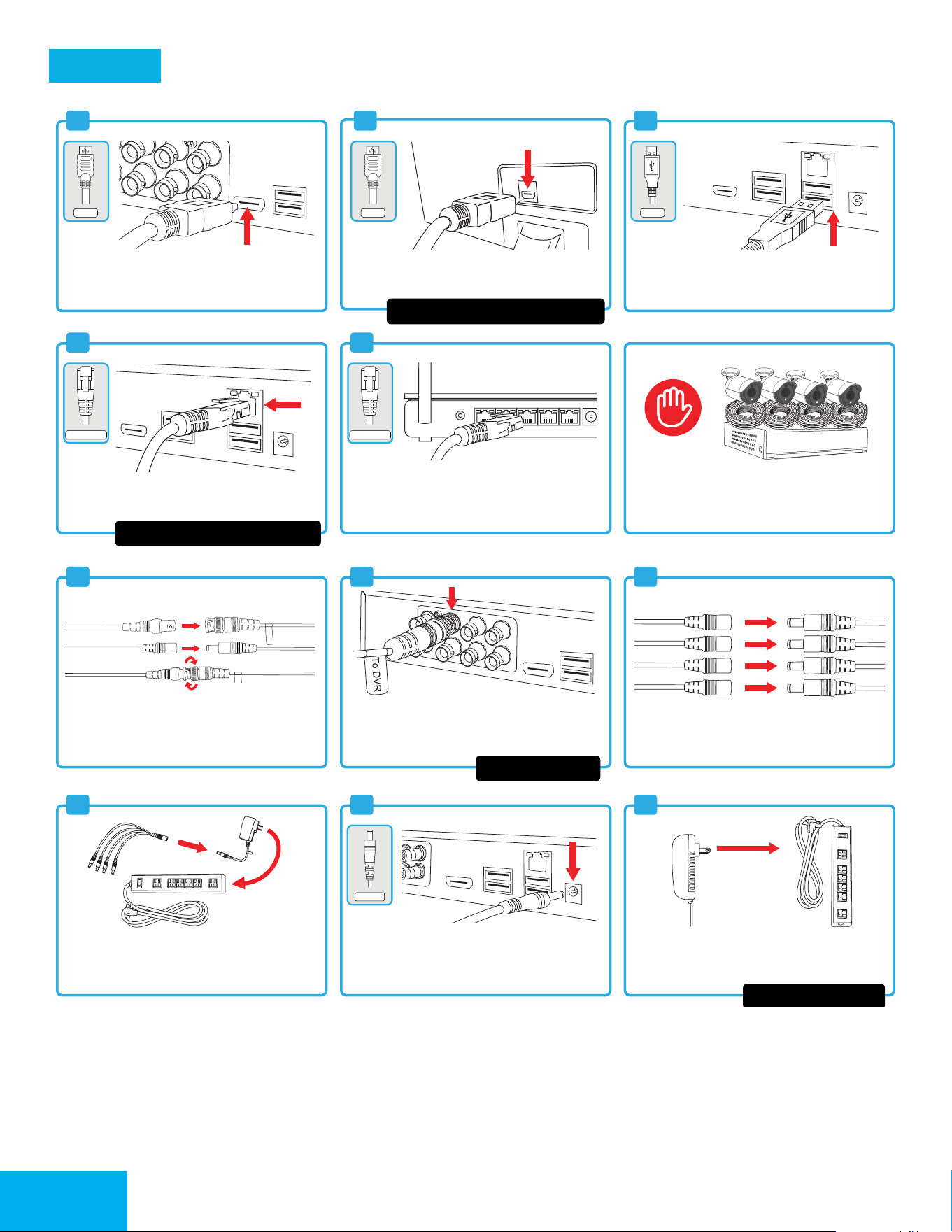
Step 3. Connect Your System
8
Connect the red female power leads of the video / power
cables to the male power splitter ends.
POWER SPLITTER
CONNECTORS
POWER CABLE
CONNECTORS
1
Plug one end of the included HDMI cable into the
HDMI port on the back of the DVR.
HDMI
9
Connect the power splitter to the camera power
adapter and plug the adapter into a surge
protector or Uninterruptible Power Supply (UPS).
CAMERA POWER
ADAPTER
POWER
SPLITTER
SURGE PROTECTOR
(NOT INCLUDED)
Plug the other end of the Ethernet cable into a port
on the back of your router or modem.
ETHERNET
ROUTER
(NOT INCLUDED)
5
RESET
LAN1 LAN2 LAN3 LAN4WAN
2
Plug the other end of the HDMI cable into the back
of your TV or Monitor.
HDMI
NOTE: To view cameras, TV or Monitor must be
tuned to the same input the HDMI is plugged into.
STOP: BEFORE installing, connect and test each
camera locally to confirm they function properly.
P
WR
HD
D
6
Connect the end of the camera’s cable to the end
of a video / power cable labeled TO CAMERA ONLY.
VIDEO / POWER CABLEFROM CAMERA
To
CA
M
ER
A
To
C
A
6
Plug the USB mouse into the USB port on the back
of the DVR.
3
USB
Plug one end of the included Ethernet cable into
the LAN port on the back of the DVR.
4
ETHERNET
NOTE: Night Owl recommends connecting to the
Internet for the best user experience.
SURGE PROTECTOR
(NOT INCLUDED)
Plug the DVR power adapter into a surge
protector or Uninterruptible Power Supply (UPS).
Some systems beep upon booting up.
NOTE: Make sure the UPS or
surge protector is switched ON.
11
7
Connect the video / power cable labeled TO
DVR ONLY to an open video input on the DVR.
NOTE: Make sure you twist
and lock BNC connectors.
10
Connect the DVR power adapter to the Power Input
on the rear of the DVR.
POWER
7
Step 4. Set Up Your DVR
IMPORTANT: Night Owl STRONGLY recommends that you have the DVR connected to the
Internet for initial setup. This connection allows the DVR to easily download
-
connect your DVR from the Internet after your system is setup and running, if
you wish. Note that if you do disconnect from the Internet, you will not receive
-
running.
If you still do not wish to connect to the Internet, follow the steps in Disconnected from the Internet.
Connected to the Internet (Strongly Recommended Method)
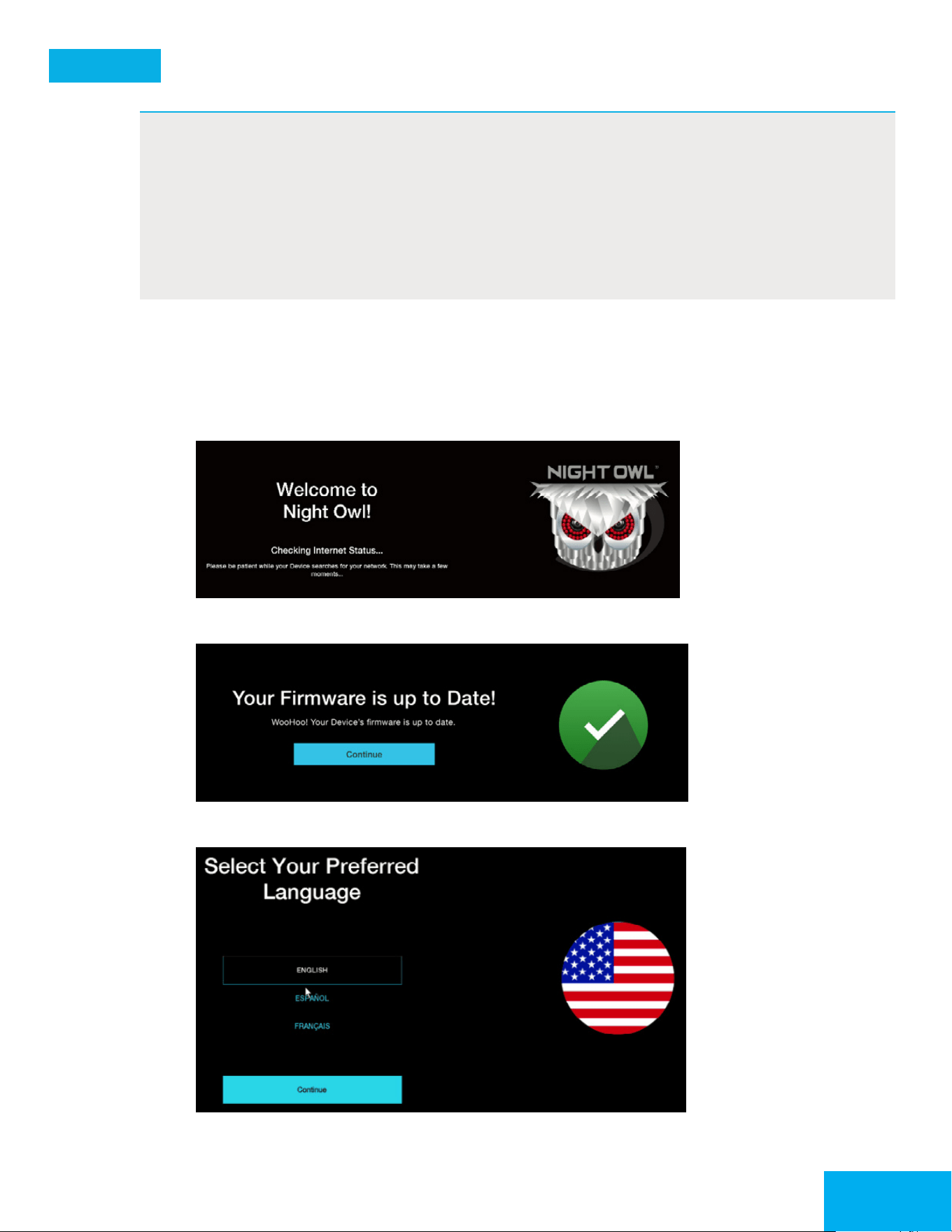
1.
2. Continue on the Your Firmware is up to Date screen.
3. Continue.
8
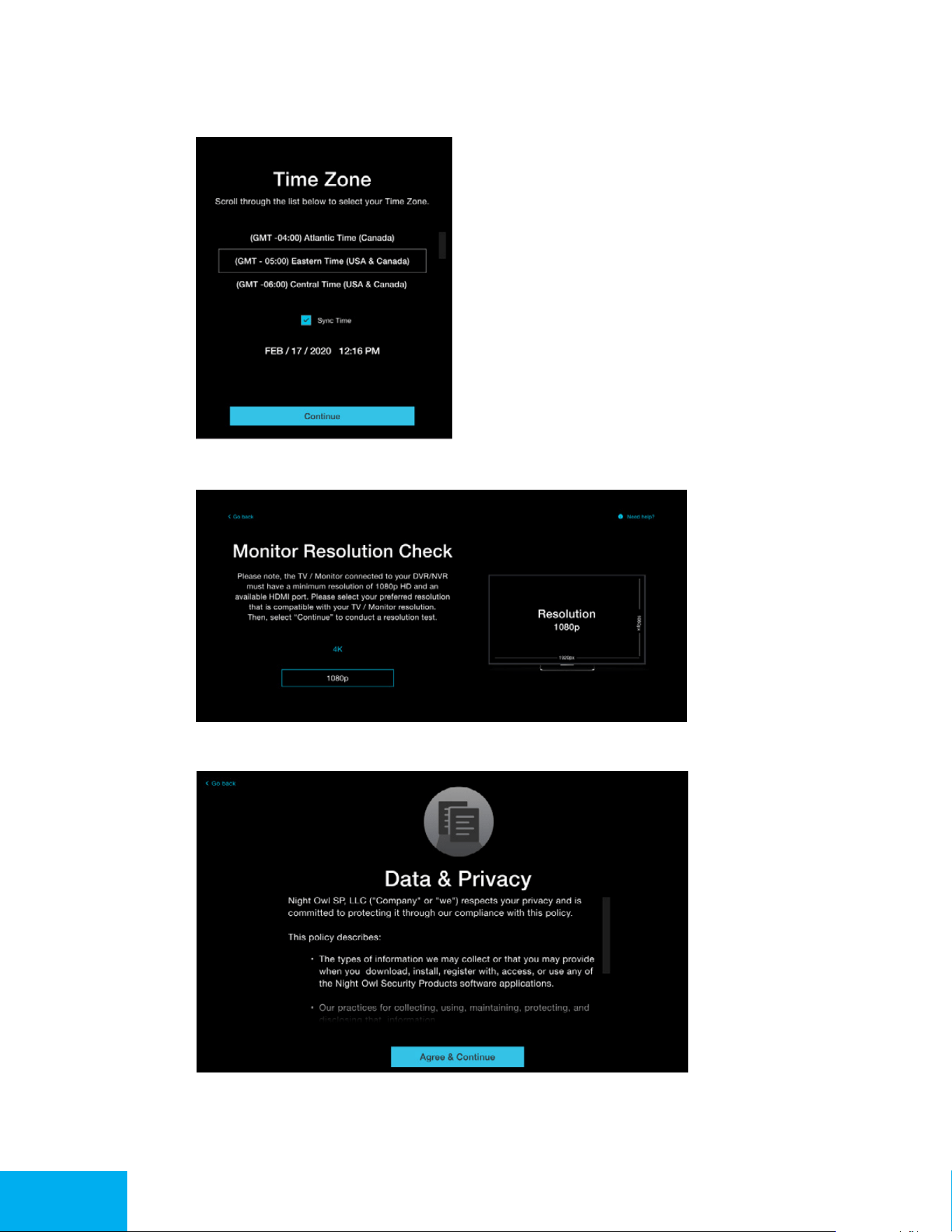
4. Continue.
If your recorder is connected to the Internet, Sync Time should be automatically
selected and will work to keep your system’s date and time up to date automatically.
5. Continue.
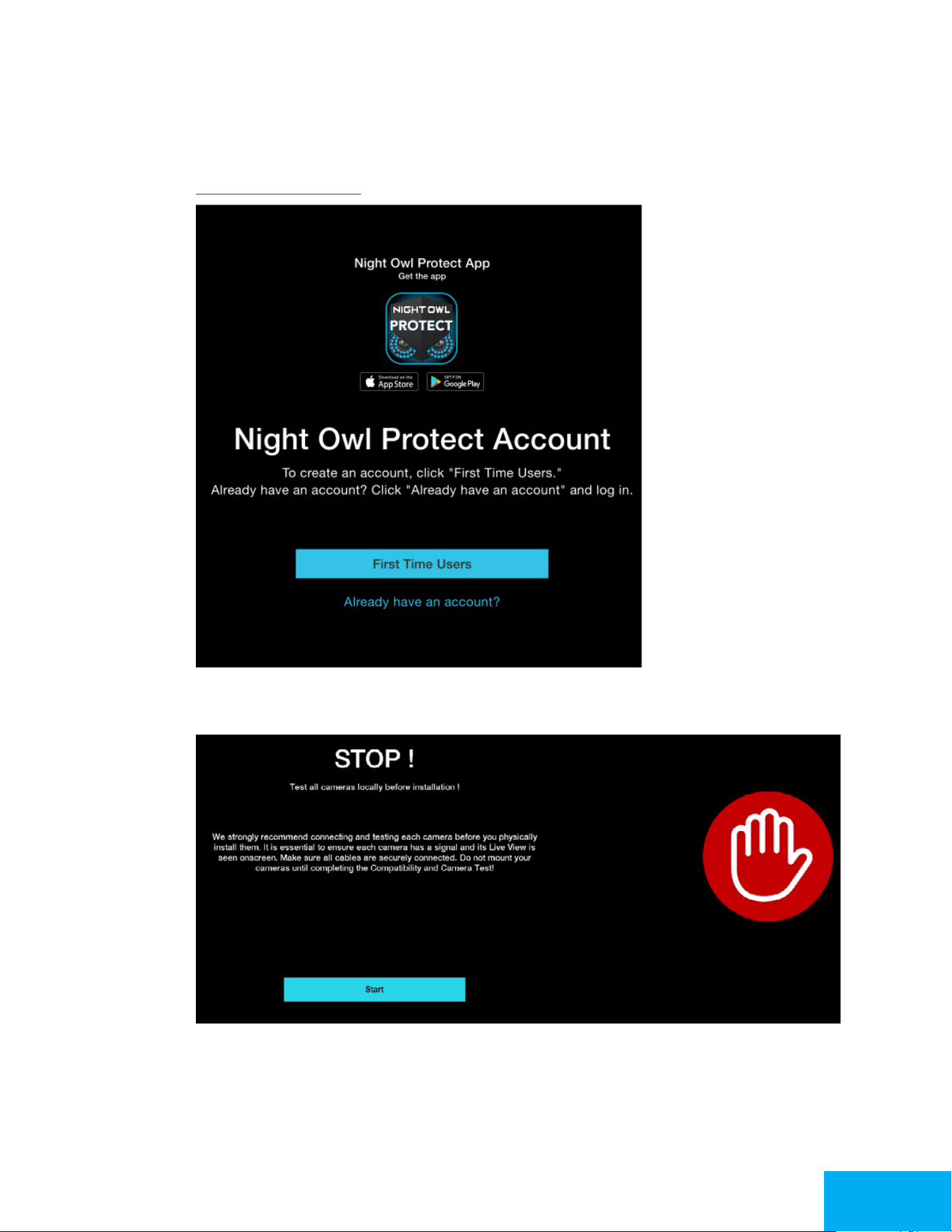
6. Agree & Continue
9
7. Already
have an account and login using your Username and Password.
If you have not set up an account, it is STRONGLY encouraged that you do that now
following Step 2 – Download the Night Owl Protect App and Create Your Account
above. Alternatively, you can set up your account on the Night Owl website at
www.no-protect.com.
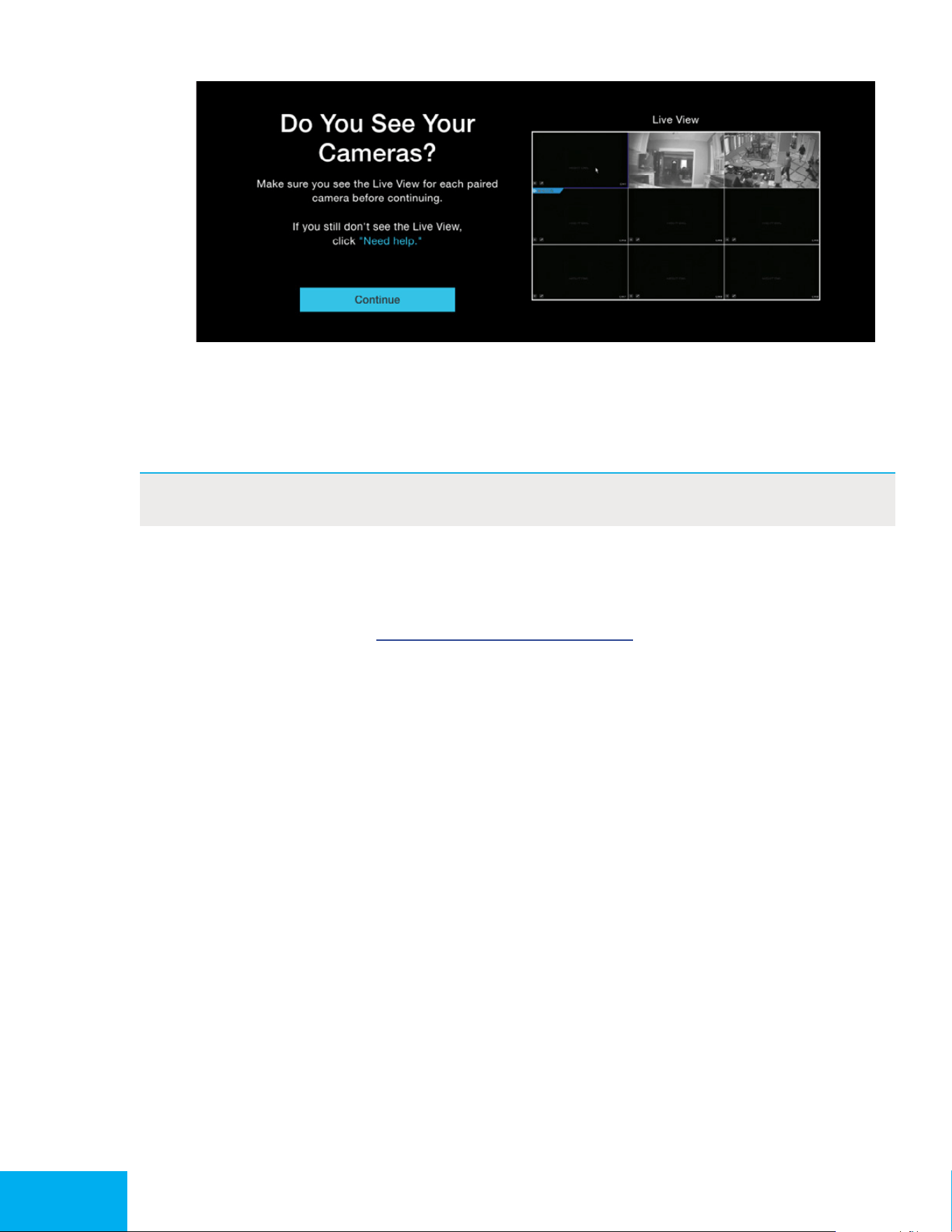
8.
Start.
10
9. Continue.
10. Complete Setup Step 5 - Install
the Cameras.
Disconnected from the Internet
IMPORTANT: Night Owl STRONGLY RECOMMENDS connecting the DVR to the Internet for
this initial setup.
Please note the following limitations if you choose to NOT connect the DVR to the
Internet:
•
Phone Support. Go to https://support.nightowlsp.com/ and type “VDP2” (see
• You cannot view your system remotely on a Smart Device.
• Resetting your password is a much longer process to ensure security.
BEFORE YOU BEGIN THIS PROCEDURE:
to the Format a USB Flash Drive or External Hard Drive section of the Back Up/Export
Videos chapter for further instructions.
1. Plug your DVR into a power source.
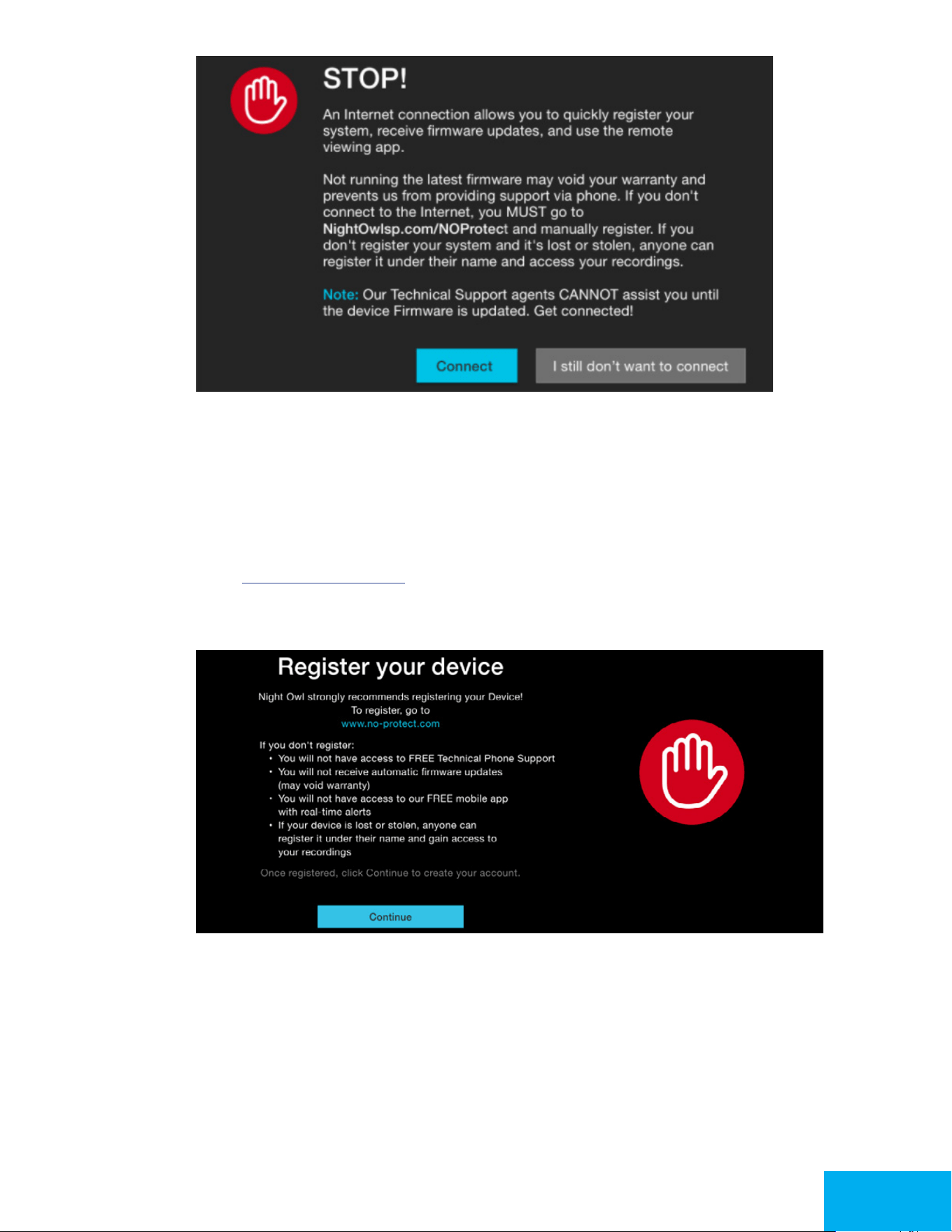
2. I do not
want to connect to the Internet.
3. I still don’t want to
connect it.
11
4. Continue.
5. Select your Time Zone and then use the scroll to select the current date and time. Then
Continue.
6. Continue.
7. Agree & Continue
8. Go to www.no-protect.com to register the DVR. Use the information found on the DVR’s
9. Continue.
12
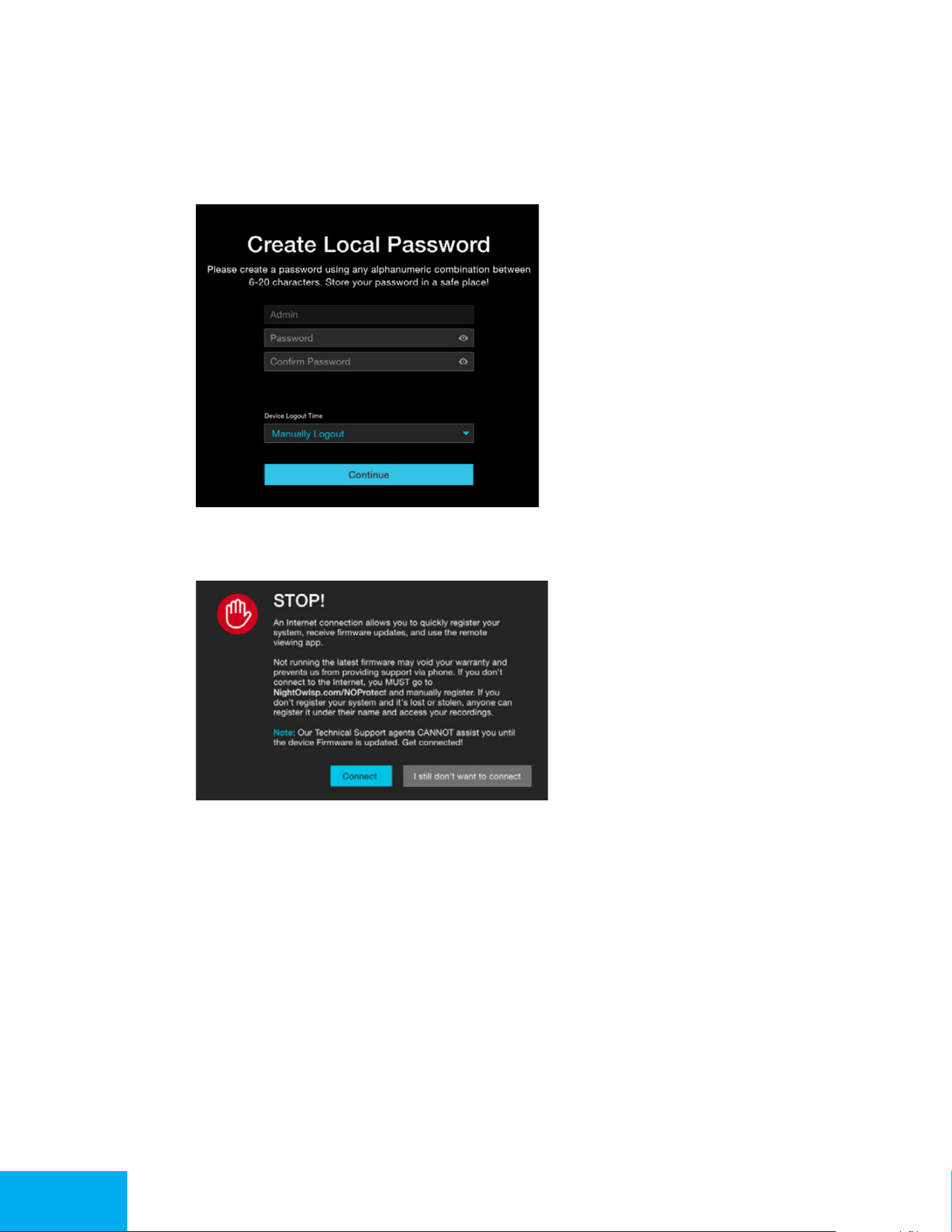
10. Create a local password:
– The default username is “admin”.
– Create a password (any alphanumeric combo with a minimum of 6 - 20
characters; MUST include a number, a lowercase letter, and an uppercase letter).
– Click Continue.
11. I still do not want to connectConnect to connect to the
Internet and follow the steps in the Connected to the Internet section
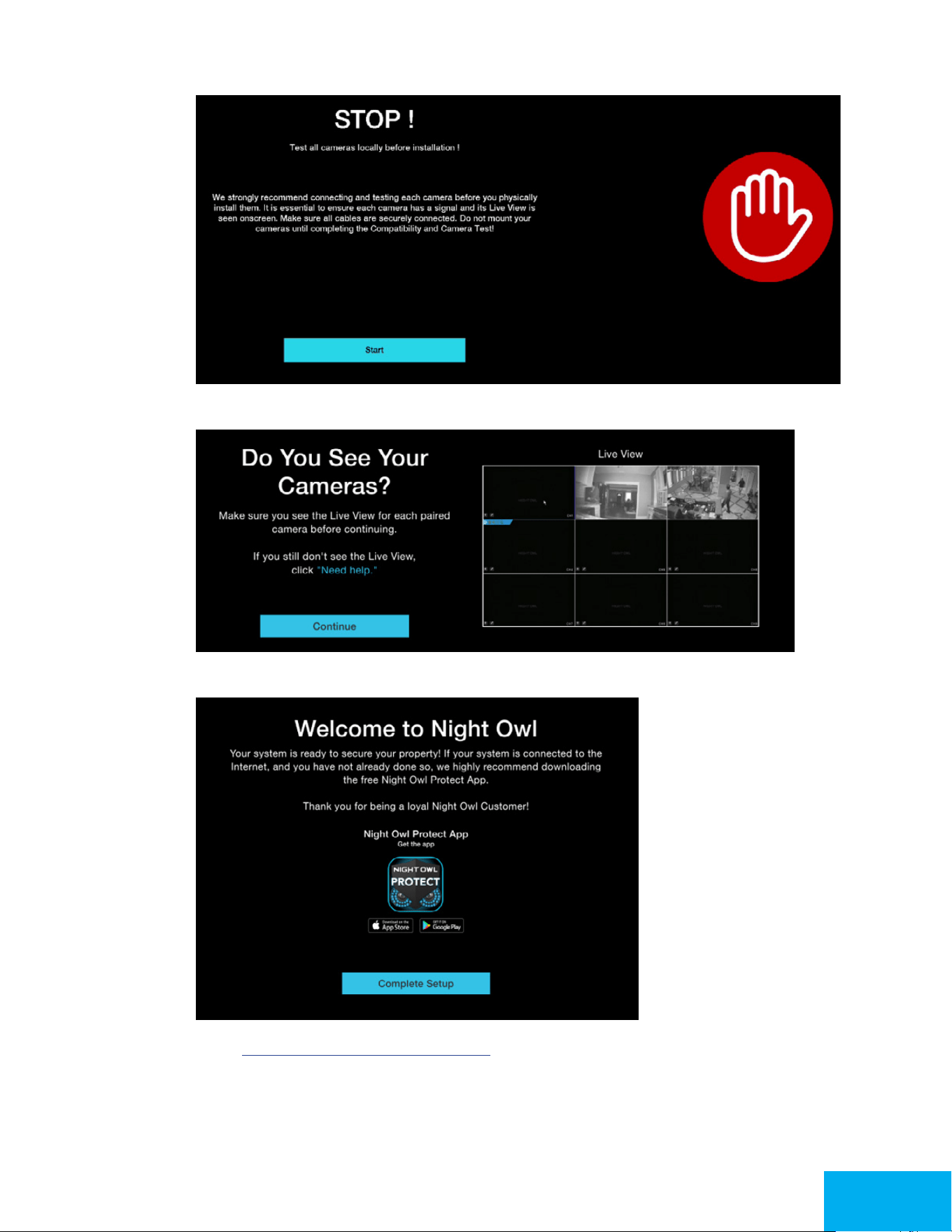
13
12. Start to complete the camera compatibility test.
13. Continue.
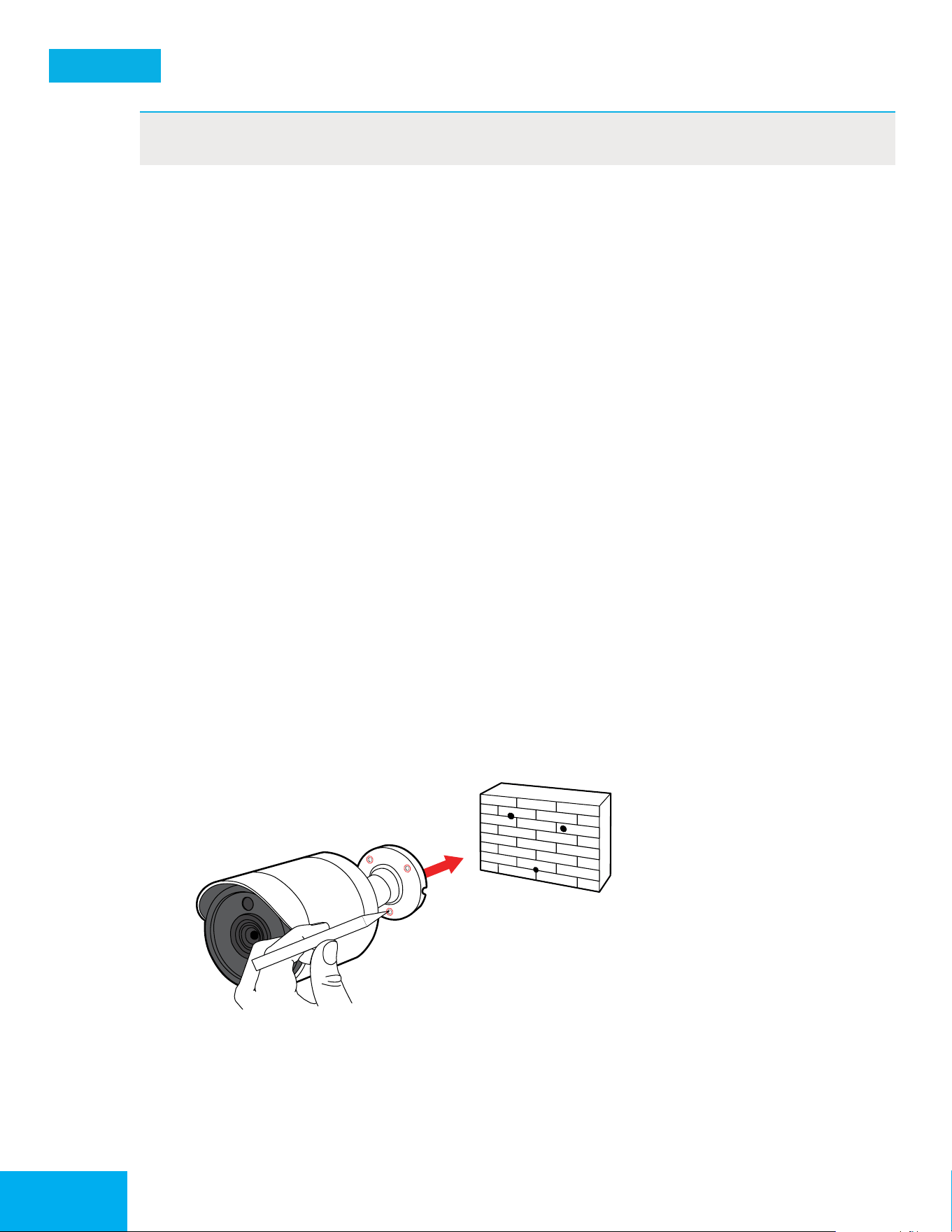
14. Complete Setup.
15. Go to https://support.nightowlsp.com/ and type “VDP2” (see the support label on your
16. Proceed to Step 5 – Install the Cameras.
14
Step 5. Install the Cameras
IMPORTANT: Before you begin this step, if you have not already done so, ensure all cameras
Plan Your Installation
When planning your installation, keep the following pointers in mind:
Distance: The further the camera is from the DVR or monitor, the higher the chances of
signal degradation. Locate the camera’s power supply as close to the camera as possible
when the distance exceeds 200 ft. as the power level will drop over extended distances,
resulting in video degradation.
Electrical Interference: Do NOT place the cameras near high voltage wires or other
sources of electrical interference. Electrical interference degrades the quality of the
signal.
Outside Elements: Avoid direct exposure to weather. Do not place the camera where
rain or snow will hit the lens directly. Do not place the camera so that the sun or bright
light shines directly into the lens. Your camera is weatherproof, but it will not work when
submerged in water. Ensure that all power and video connections are not directly exposed
to water and are protected from the elements.
Mounting Surface: Ensure your mounting surface holds at least four times the camera’s
total weight.
Camera Angles: Use the Live View on your DVR to verify that your camera will be at an
ideal angle before permanently installing.
Install the Cameras
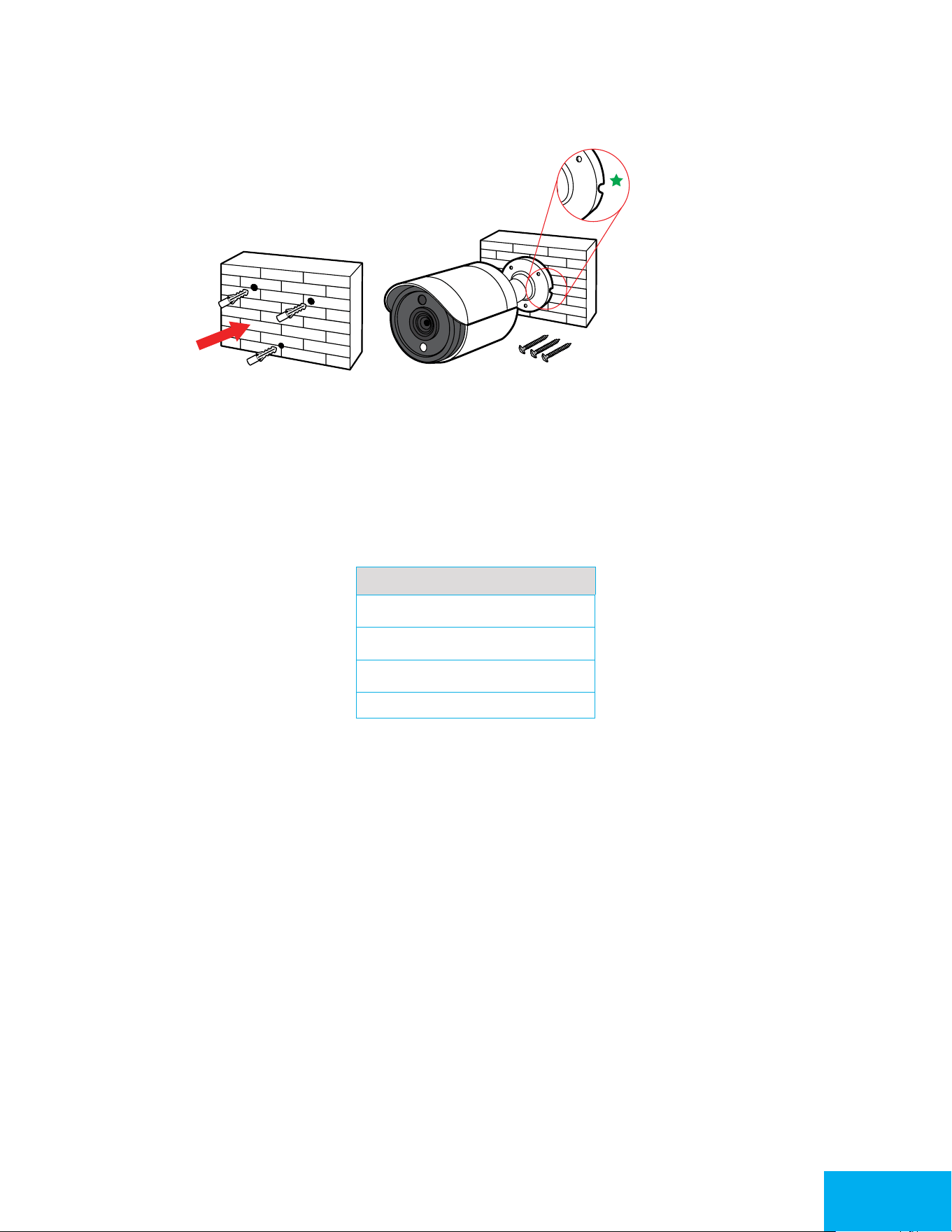
1.
the surface where you plan to mount the camera.
2.
15
3.
feed the camera wire through the indent in the base as indicated by the green star in the
following illustration.
Add Additional Cameras
You can add additional cameras to your system at any time by following steps 6 - 9 in
Step 3 – Connect Your System and repeating the steps in this section.
Night Owl’s VDP2 Series DVRs are compatible with the following cameras:
VDP2
CM-DP2L-BU
CM-TA2L-BU
CM-C2OXL-BU
CM-DP2BK-B
Congratulations
You are ready to start using your system! Refer to the Live View chapter of this manual
for more information on how Night Owl works and how to utilize all of its monitoring
features.
Live View (All Channels)
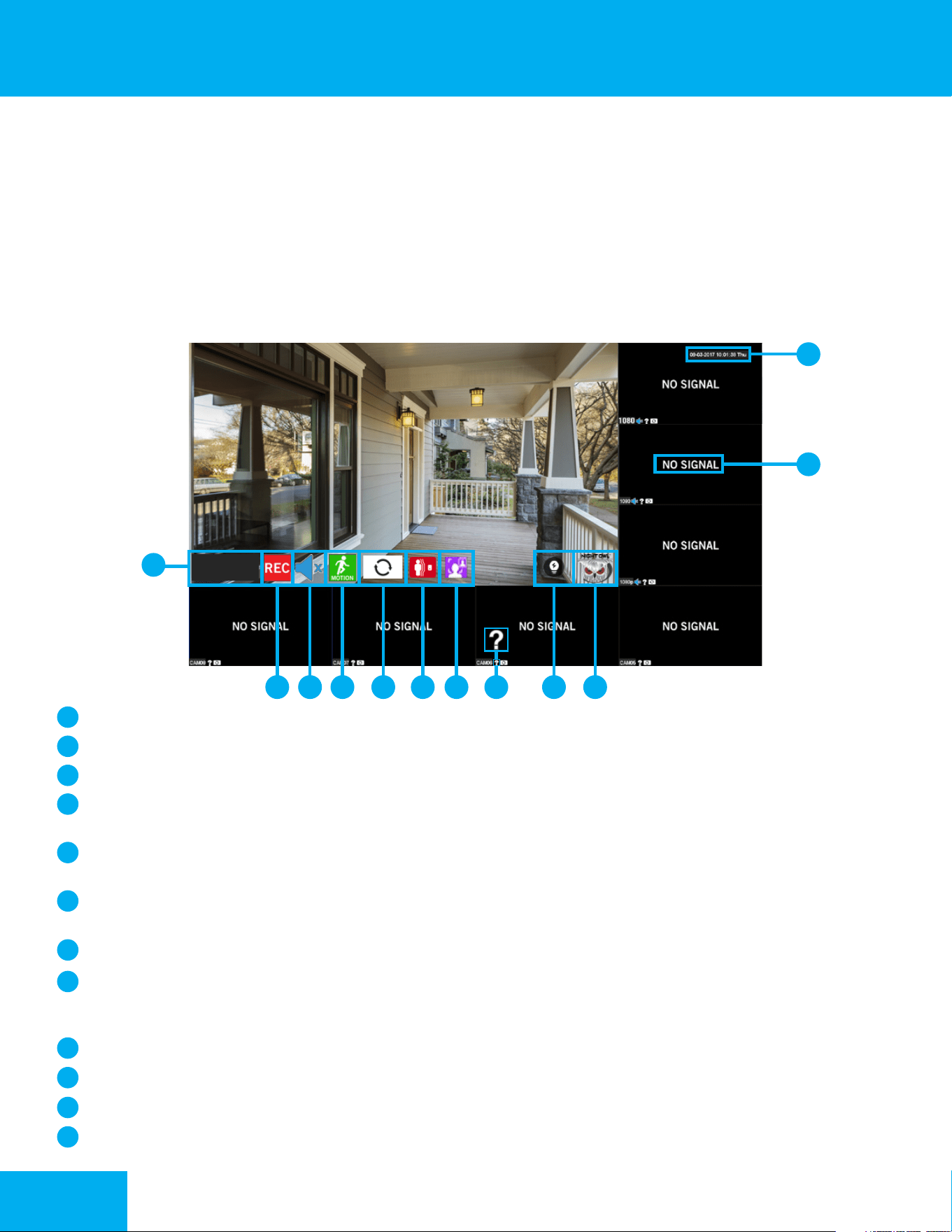
Live View is the default screen you see when viewing all channels on your DVR. You can customize the
Live View by selecting a Quad, Eight, or Nine channel configuration.
In Quad and Nine view mode, double clicking on a channel displays the camera image in full screen;
double click the full screen channel to revert to multiple channel view.
In Eight view mode, double click on a channel to display in the larger screen within the Eight view
screen; double clicking the larger screen turns that channel into full screen view. Double click again to
revert to Eight view mode.
A
B
C
D
E
F
G
J
K
L
I
H
Date and Time: Current date and time of the system.
Channel Name: On screen display of channel name.
DVR Status Recording Icon: Indicates that your DVR is currently recording video from this camera.
Speaker Icon: Allows you to enable or disable audio from an audio enabled camera. *Audio is not available on
all models.
Motion Detection Icon: Indicates that an alarm event such as motion detection, video loss or tampering has
occurred.
Refresh Icon: Auto detects the camera. By double clicking on this icon, you can change the format from CVI to
AHD to TVI. This would allow the DVR to have different types of cameras connected at once.
Question Mark: Shown when there is no signal to that particular channel.
Night Owl Logo: Indicates that the video transmission protocols are working properly.
Facial Detection Icon: Indicates the camera has captured a face using Facial Capture Technology.
Light Control Icon: Status of the camera's spotlight (not all camera models have a spotlight).
Human Detection Icon: Indicates the camera is currently detecting human motion.
Video Loss Icon:
be caused by a disconnected/damaged cable, the camera may have lost power, or the camera may have been de-
registered from the channel. This also appears if you do not have a camera connected to the channel.
A
H
B
CAM01
C D E F GI K JL
Live View
16
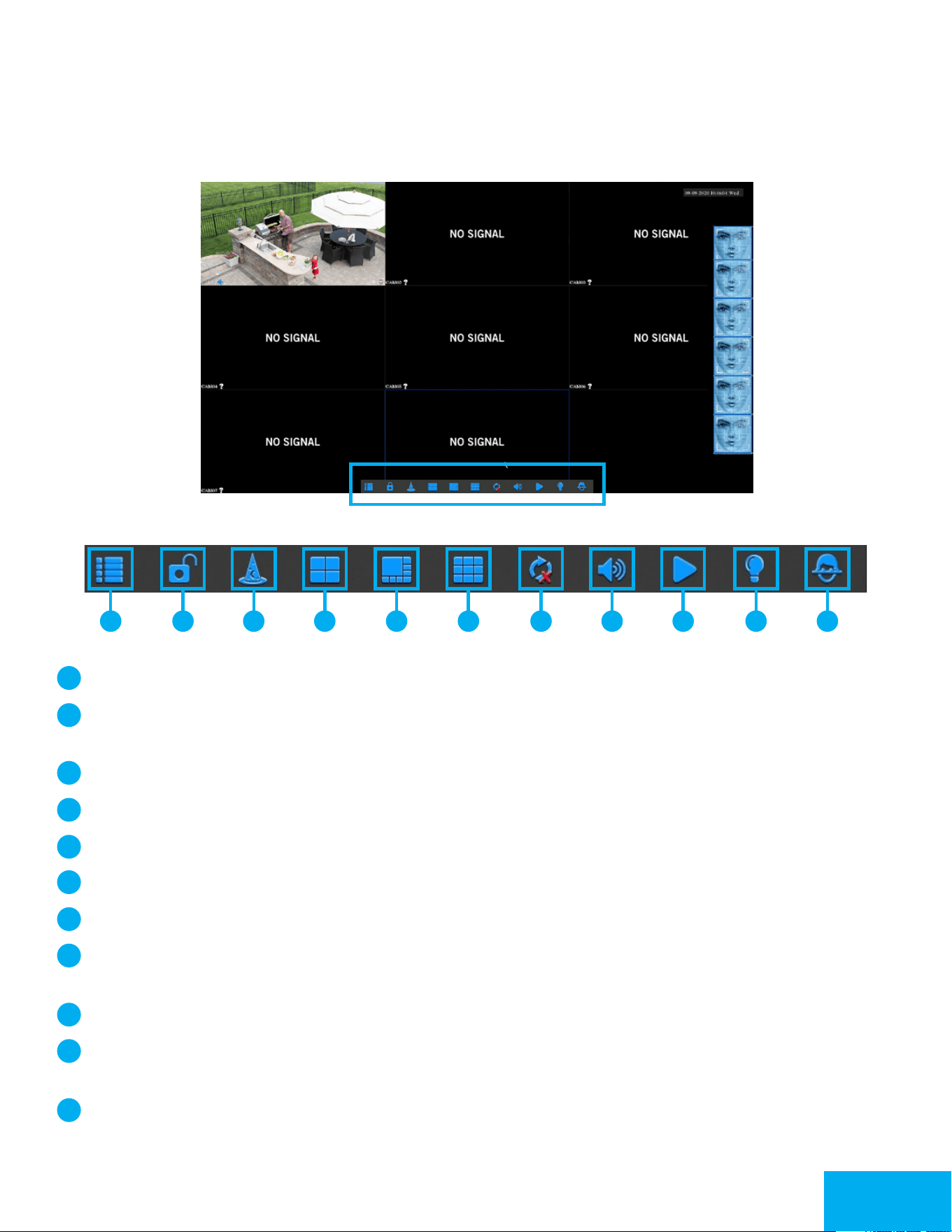
Right-Click Menu From Live View
A B C D E F G J KIH
A
B
C
D
E
F
G
H
J
K
I
Main Menu:
Lock Screen: Manually locks or unlocks the screen. Once the screen is locked, you need to enter
your username and password to gain access.
Startup Wizard: Launches the Startup Wizard.
Quad View: 4 channel view.
Channel View: 8 channel view.
Channel View: 9 channel view.
Auto Sequence: Start/Stop the slide show sequence of each channel.
Audio: Adjust the volume of audio streaming from an audio enabled camera or audio input.
*Audio is not available on all models.
Playback: Access the recording/playback menu and functions.
Light: Manage the light control settings for each camera.
*Spotlights are not available on all models.
Face: Add/Remove the facial detection menu from the right side of the screen.
17
Right-click on the mouse from the Live View screen to bring up a tool bar. The tool bar will enable you
to easily change your view layout, lock the system, adjust audio and image settings and playback video
events.
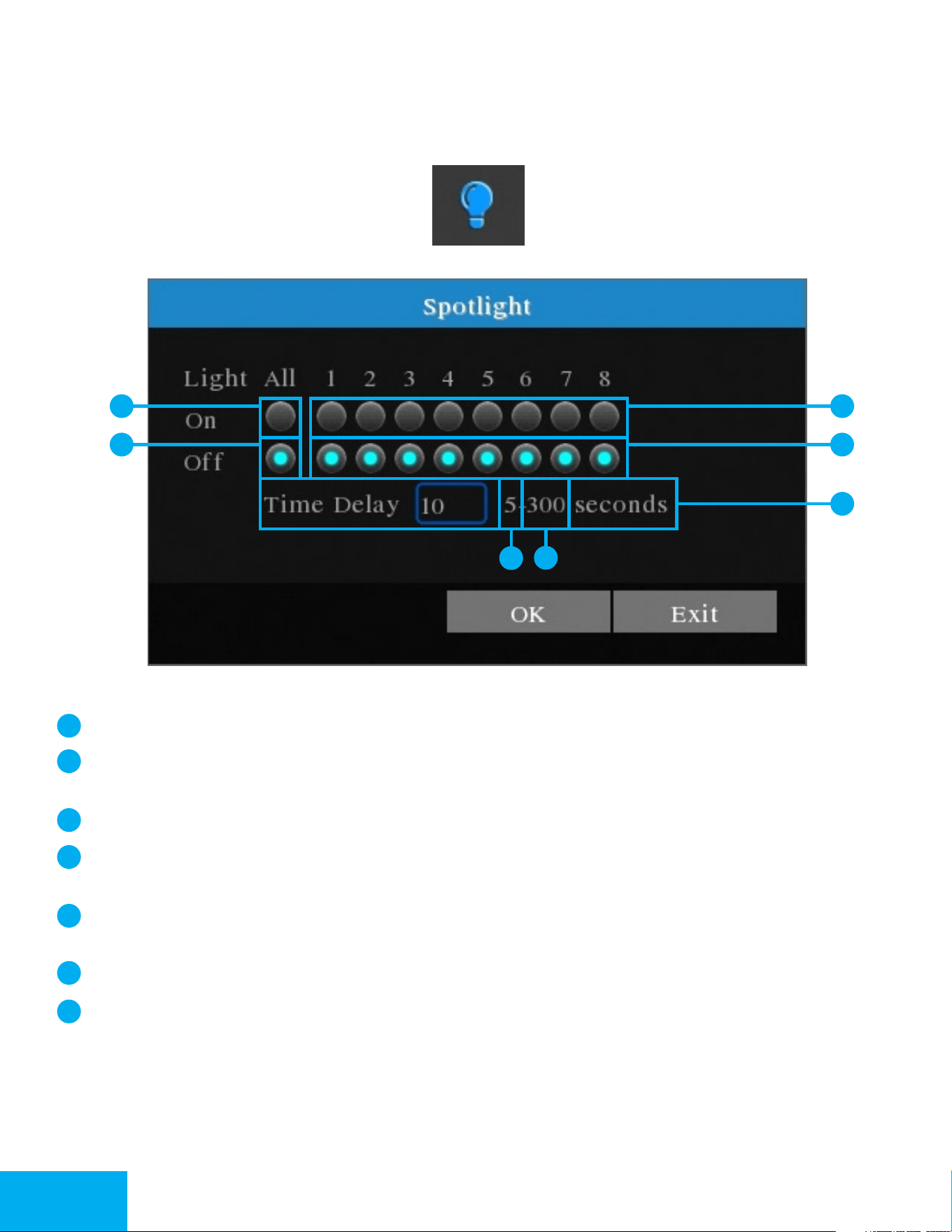
While your system may not include spotlight enabled cameras, your VDP2 DVR is compatible with our
spotlight cameras. Use this menu to enable or disable the spotlight or adjust the timing for any con-
nected cameras that are spotlight enabled.
A
B
C
D
E
F
G
On - All Bubble: Turns on the spotlight for all spotlight cameras connected to the DVR.
On - Ch.1 - Ch.8 Bubble(s): Activates the spotlight for the spotlight camera connected to the
selected channel.
Off - All Bubble: Turns off the spotlight for all spotlight cameras connected to the DVR.
Off - Ch.1 - Ch.8 Bubble(s): Turns off the spotlight for the spotlight camera connected to the
selected channel.
Delay Time: Determines the amount of time the spotlight remains on when manually turned on from
the Light Menu.
Maximum Delay Time: The maximum Delay Time is 5 minutes (300 seconds).
Minimum Delay Time: The minimum Delay Time is 5 seconds.
A
C
E
F
G
B
D
18
Light Menu
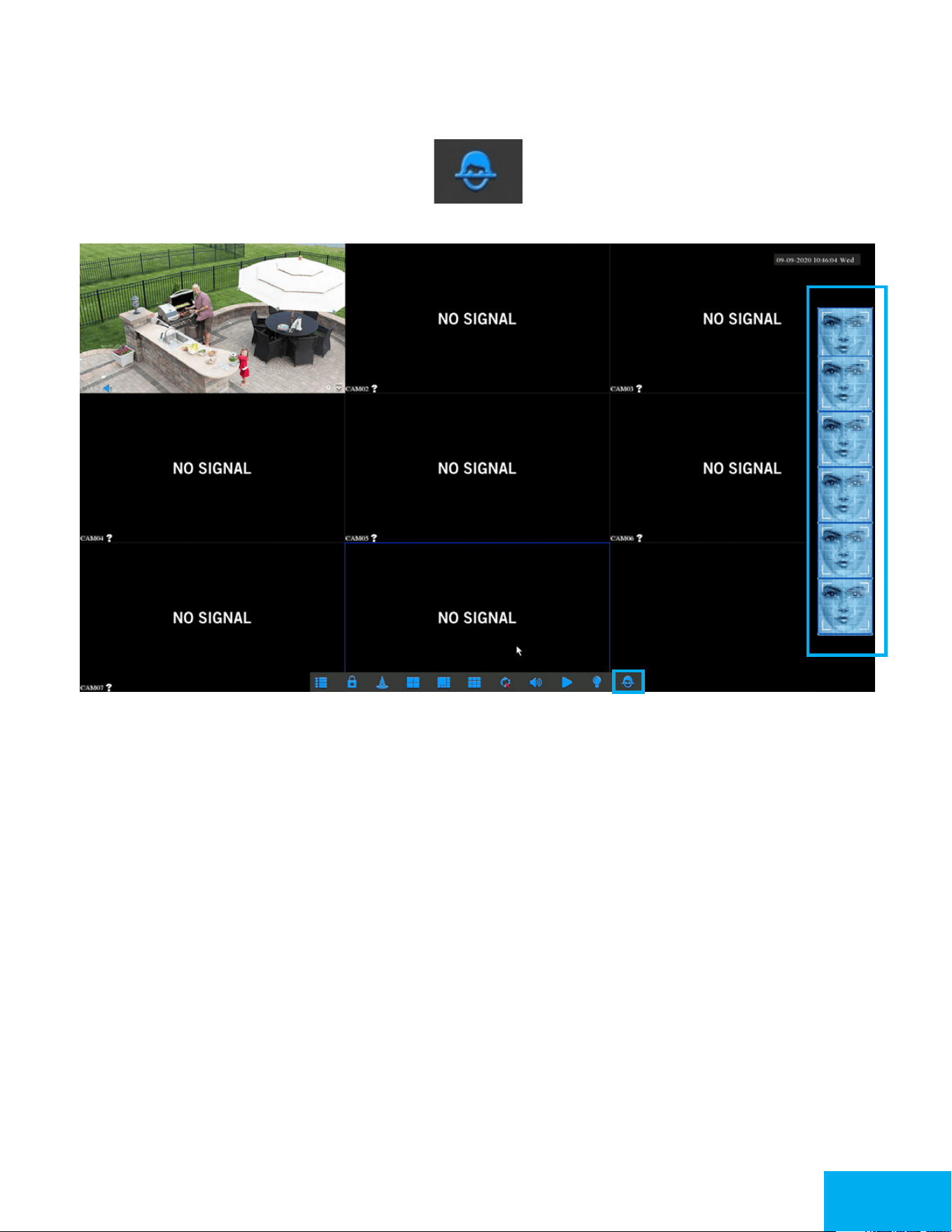
With Facial Capture enabled, detected faces appear on the right side of the Live View screen.
19
Facial Capture Menu
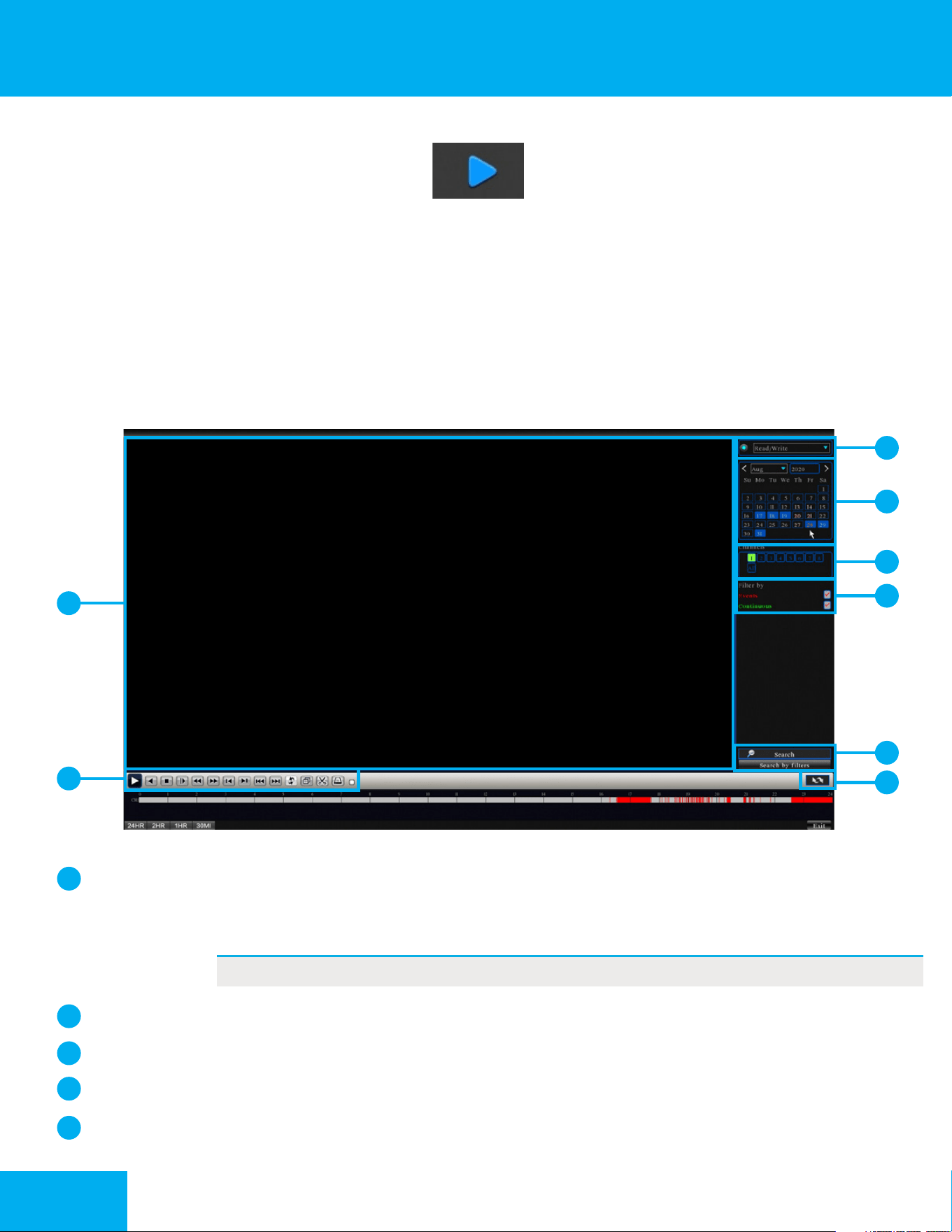
Access the playback menu by selecting the Play Icon on the Right-click menu.
Step 1: From the CHANNEL list, select the channel(s) you want to search for recorded events.
Step 2: Use the calendar under DATE to select the date(s) that have events from the selected
channel(s). Dates marked in blue have recordings.
Step 3: (Optional) Use the FILTER BY feature to search by event type(s) to narrow down the search
results.
Step 4: Slide the timeline to search the time segments that have events. Time segments are marked
Red for Motion Recordings and Green for Continuous Recordings.
Step 5: Slide the Timeline to the time segment you want to watch, and Playback starts automatically.
A
B
C
D
Playback Origin: Select the origin of the playback (choose up to two options):
• Read/Write: Reading the recording on the HDD.
• Backup Devices: Reading the recording on an external flash drive.
Calendar: Highlighted dates indicate events are available for viewing from the selected camera(s).
Camera Selection: Search for recordings from up to two cameras at a time.
Export File Mode: Switch to export file mode.
Recording Filter: Allows filtering based on the type of recording: Motion or Continuous.
A
B
G
H
C
E
D
F
E
Event Playback
NOTE: The recording MUST be exported.
20
G
F
H
Video Screen: Video recordings are played here when you click Play from the Playback toolbar. If you
have selected more than one camera, the Video screen appears in a Multiview format. You can view a
particular camera in full screen by double-clicking on the camera’s screen. To return to the Multiview
display, double-click on the screen again.
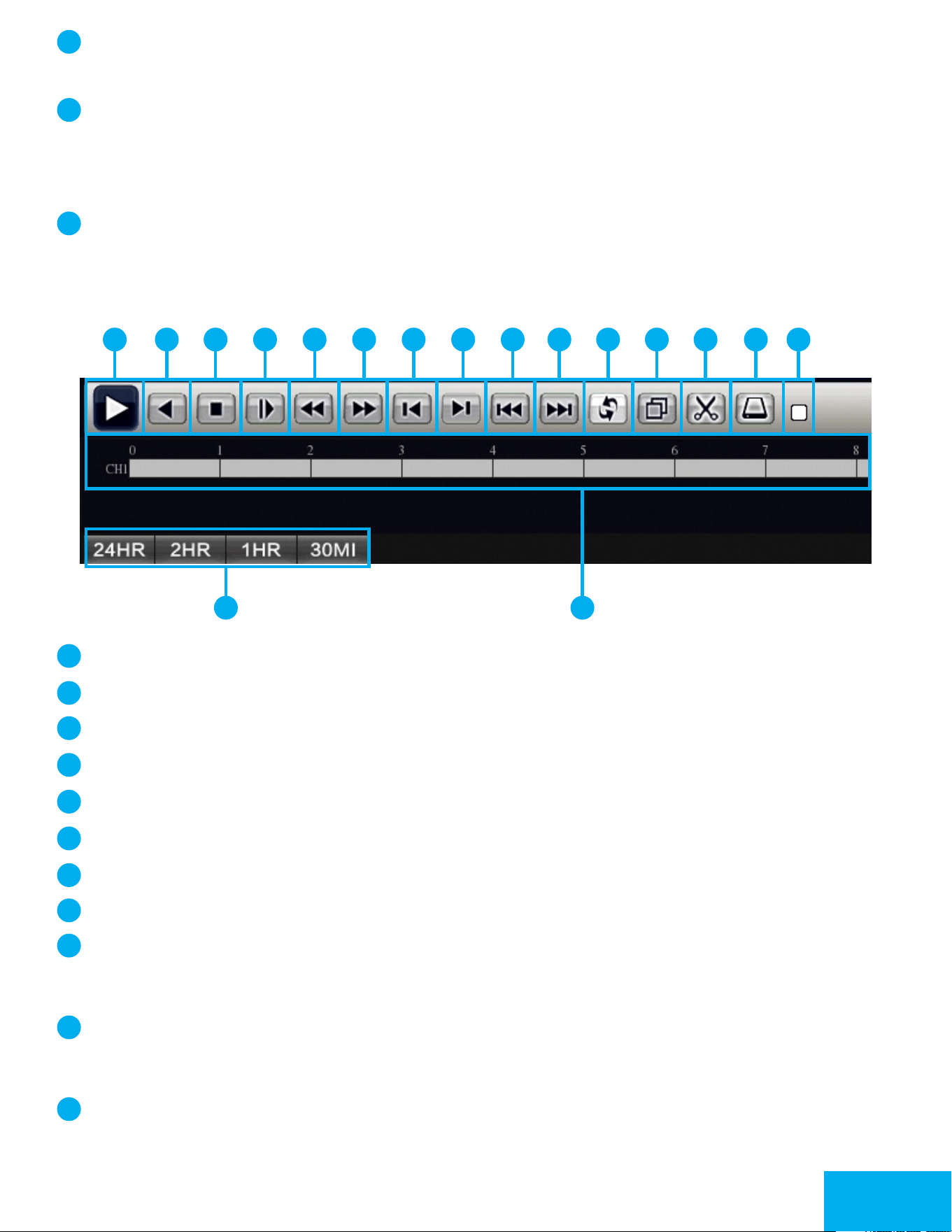
Video Playback Control Pane: You can perform various playback operations such as pause, slow, and
reverse/forward. You can also clip parts of the video recording and save to an external HDD or USB
flash drive. When multiple cameras are being played, the control pane works for the selected camera
on the video screen.
Search by Filter or Snapshot: Search by Filter allows you to filter by Event or Continuous, and Search
by Snapshot lists facial capture events.
1
16 17
2 3 4 5 6 7 8 9 10 11 12 13 14 15
1
2
3
4
5
6
7
8
9
10
11
Start/Play/Pause: Start/Play/Pause playback.
Play Backward/Pause: Play/Pause backward playback.
Stop: Stop playback.
Slow Down: Slow down video playback (x1/2, x1/4, x1/8).
Rewind: Rewind video playback (x1/2, x1/4, x1/6, x1/8).
Fast Forward: Fast Forward video playback (x1/2, x1/4, x1/6, x1/8).
Previous Frame: Move the video to the previous video frame.
Next Frame: Move the video to the next video frame.
Previous Recording: Switch the playback video to the previous recording. If the playback video is
Motion Recording, it switches to the previous motion detection file. If it is Continuous Recording, it
rewinds the video feed by one hour.
Next Recording: Switches the playback video to the next recording. If the playback video is Motion
Recording, it will play the next motion detection file, if it is Continuous Recording, it will fast forward
one hour.
Repeat Playback: Once the playback has finished, the video restarts at the first recording of the
selected day.
21

12
13
14
15
16
17
Full Screen: View the playback in full screen.
Start/Stop Clipping: Clip interesting parts of the recorded event by clicking Start Clipping at the start
and Stop Clipping at the end.
Backup: Backup video clippings to an external USB drive.
Status: Indicates the current status of the playback.
Timeline Scale: Modify the video timeline.
Timeline: Show all recorded events during the selected time.
22
IMPORTANT: Before you can back up or export recorded videos stored on the DVR Hard Disk
to FAT32/ExFat as detailed in the Formatting a USB or External Hard Drive
section below.
As your DVR accumulates recordings, it eventually becomes full. When this happens, the oldest re-
cordings stored are overwritten by the latest recordings. If there are recordings that you want to save
Formatting a USB Flash Drive or External Hard Drive
WARNING
IMPORTANT: DO NOT connect the DVR’s hard disk drive to your PC or Mac.
This section provides formatting instructions for:
• Windows OS
• Mac
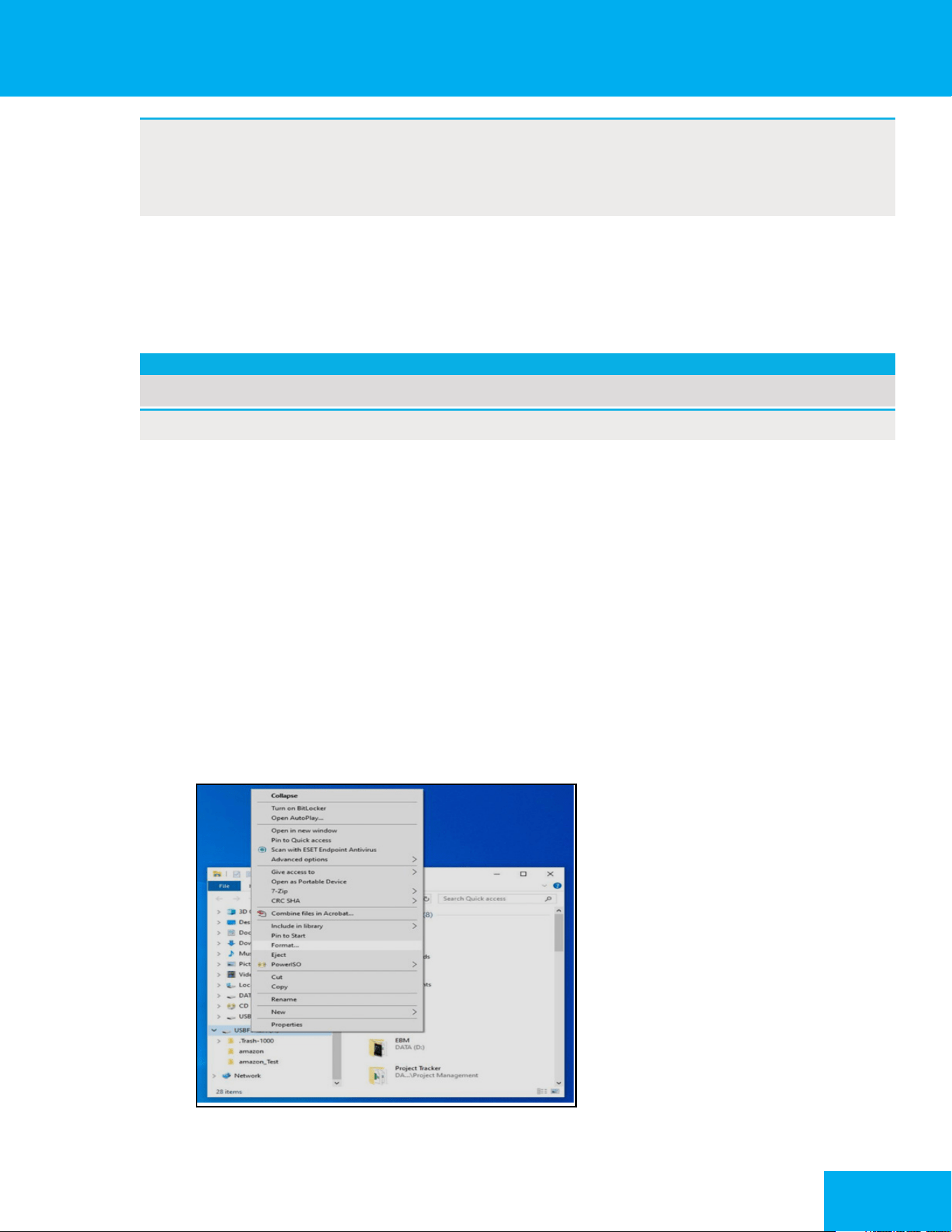
Format for Windows OS
1.
2. Press and hold the Window key + E
3.
and select Format.
4. FAT32Start.
5.
Backing Up / Exporting Videos
23
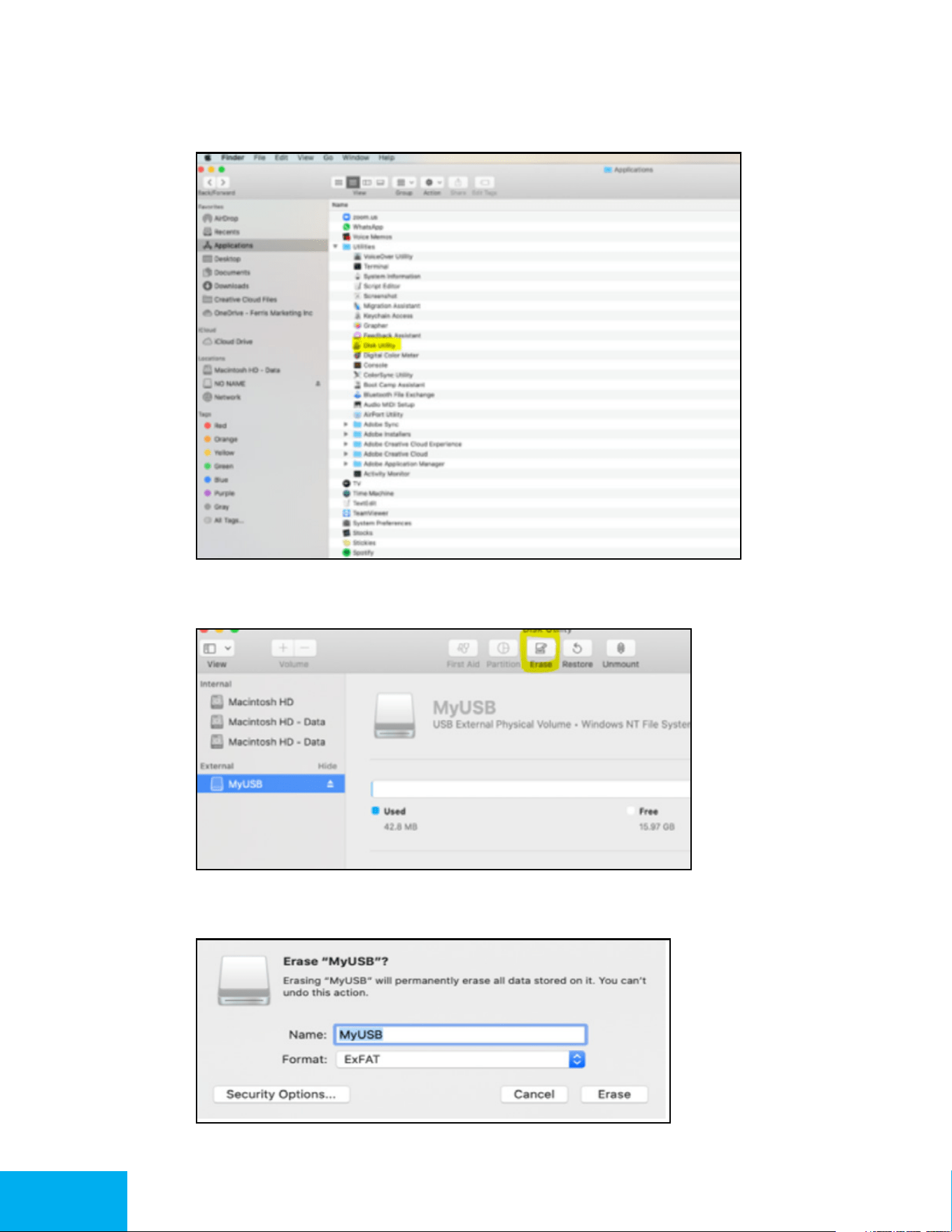
Format for Mac
1.
2. Select Applications > Utilities and launch Disk Utility.
3. Erase in
4. Format
Erase.
24
1
2
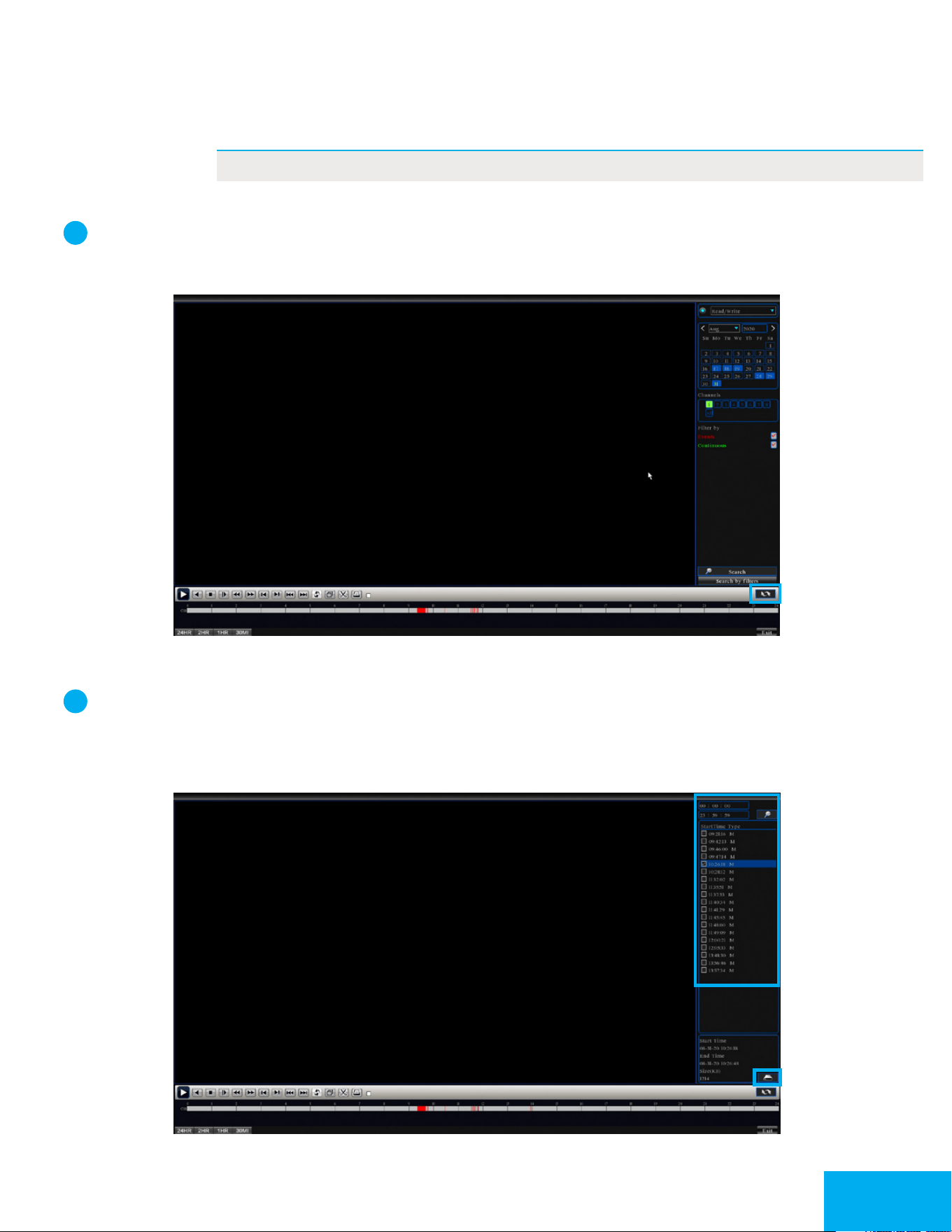
To export a Recording, once you have selected a specific date, switch to Export Recording Mode
by clicking the Export File icon.
A list of all recordings shows in the navigation panel. You can play the video before exporting. To
play the video before exporting, double click the video segment you want to watch. After selecting
the videos that you would like to export, click the Backup icon.
Video Backup
From Live View, access the Right-click menu and click on the Play Icon. From here, you can export
videos to save them for long term storage or share with someone.
NOTE: You can play the videos in the default media players for macOS and Windows.
25
3
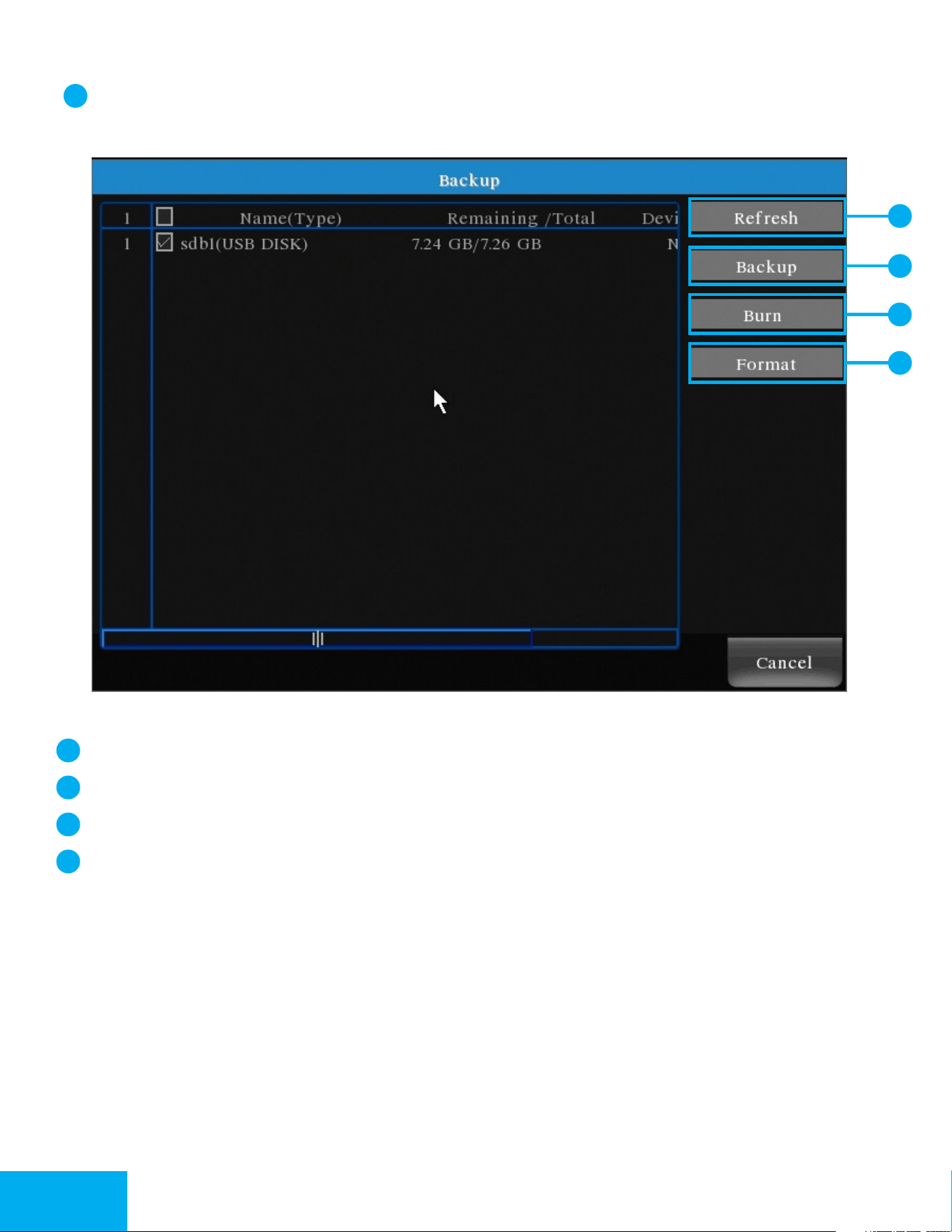
The backup Dialog screen opens. Select the USB Device and click "Backup"
A
A
B
B
C
C
D
D
Refresh: Searches for USB storage devices plugged into the DVR.
Backup: Export recorded videos.
Burn: Start recording the Live View video on the selected flash drive.
Format: Format the selected flash drive.
26
A
B
C
D
E
F
G
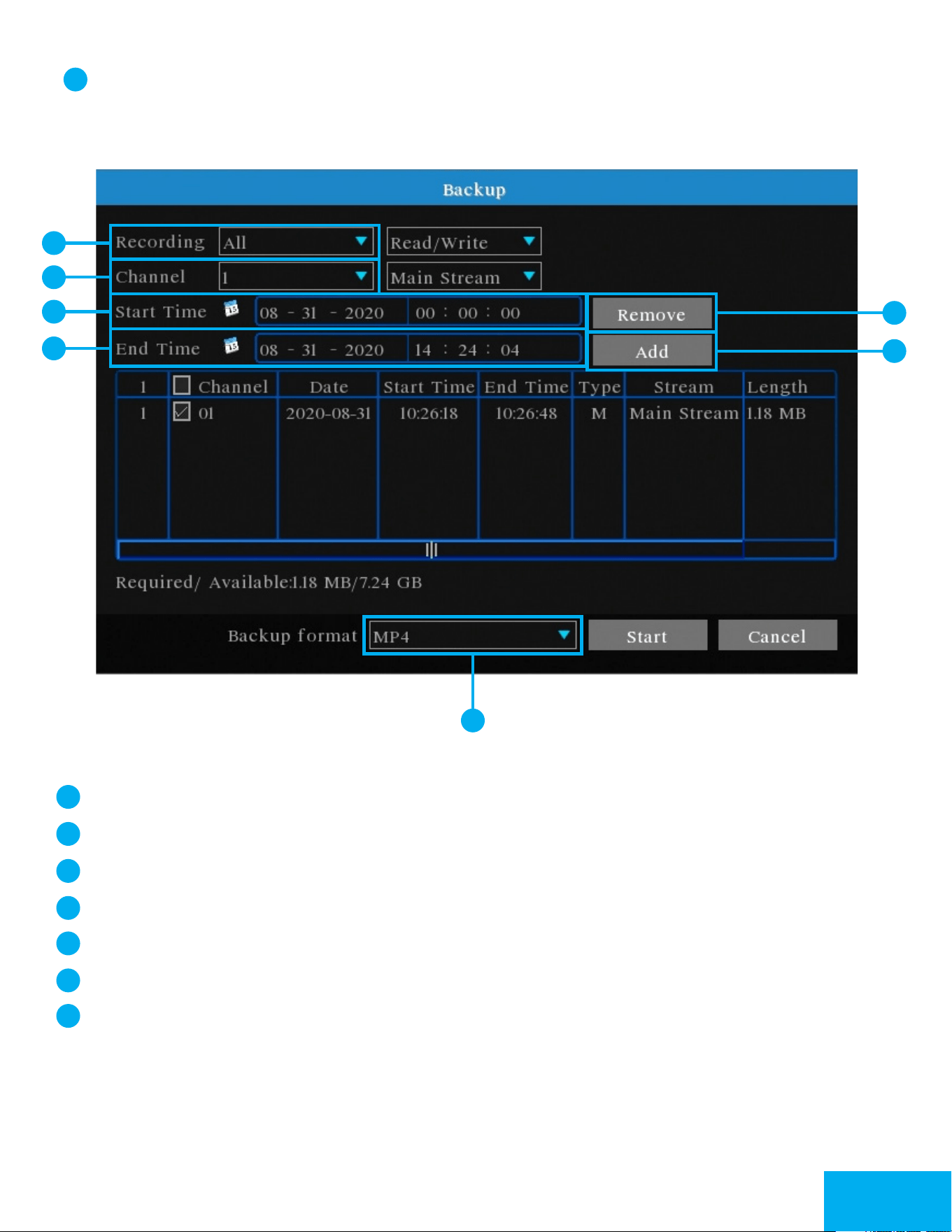
Recording: Recording Options: Motion Detection (MD), Manual, General, Alarm/MD, and All.
Channel: The channel with recordings to export.
Start Time: Date/Time to search for recordings.
End Time: Date/Time to end the search for recordings.
Remove: Delete the recording from the search.
Add: Add the recordings found using the search parameters.
Backup Format: The type of format used to back up your recordings. Standard format is MP4 and
should be set to default. H26X should ONLY be selected if the firmware supports it. Please refer to
system specifications.
A
E
F
B
C
D
G
4
When the “Backup” option is selected, the following window opens. Click “Start” to begin the
backup process.
27
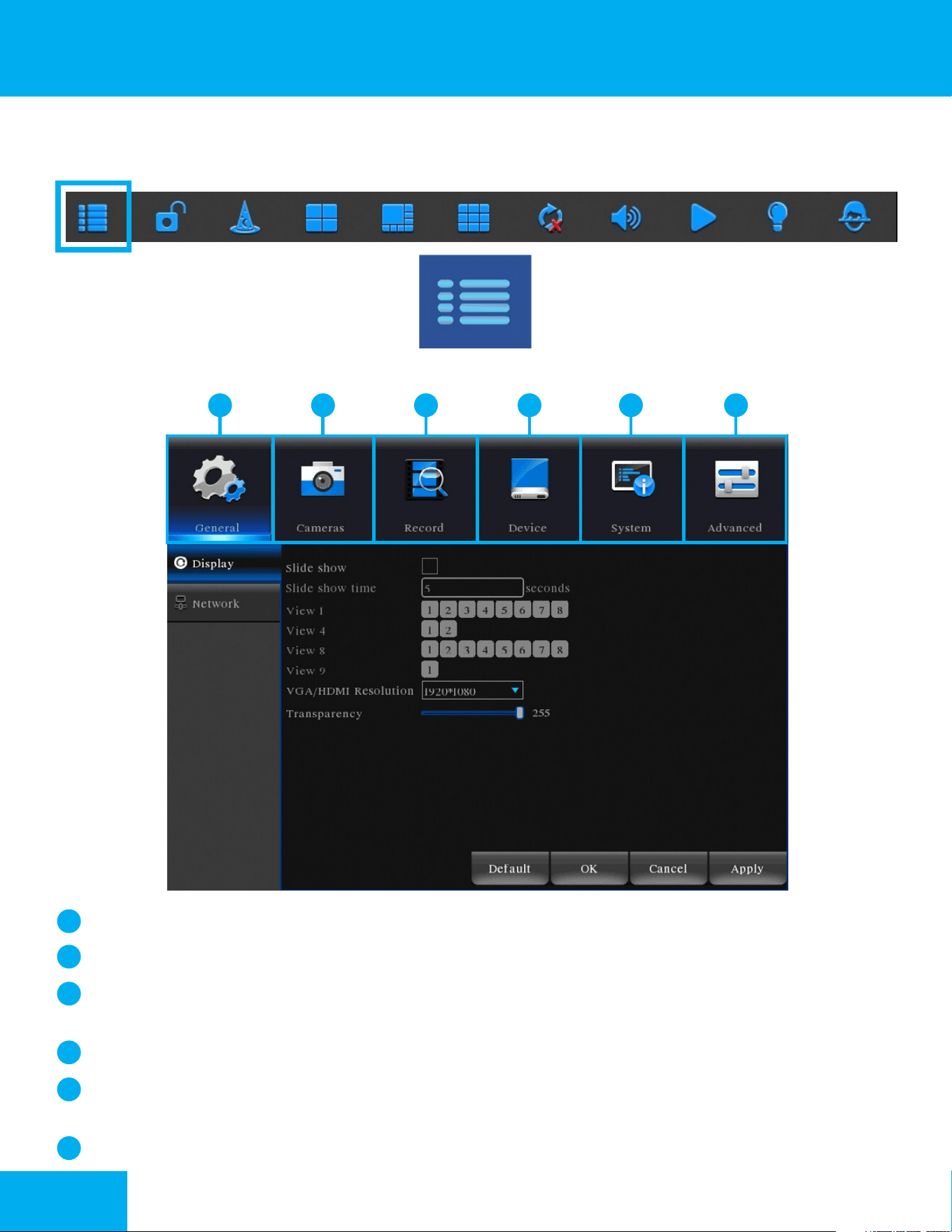
Access the main menu by selecting the Menu Icon on the Right-click menu.
Within the menu tabs, you can access settings for all aspects of your security system.
Menu Screen
A
A
B
C
D
E
F
General Menu: Access Display and Network submenus and manage the settings for those categories.
Cameras Menu: Adjust the camera settings for each connected camera.
Record Menu: Setup or modify general recording settings and triggered events. Access the Playback
screen.
Device Menu: Monitor available HDD space.
System Menu: Access general settings such as timestamp displays, user access, system info, and
access logs.
Advanced Menu: View and change maintenance settings, upgrades, and HDD alerts.
B C D E F
Main Menu
28
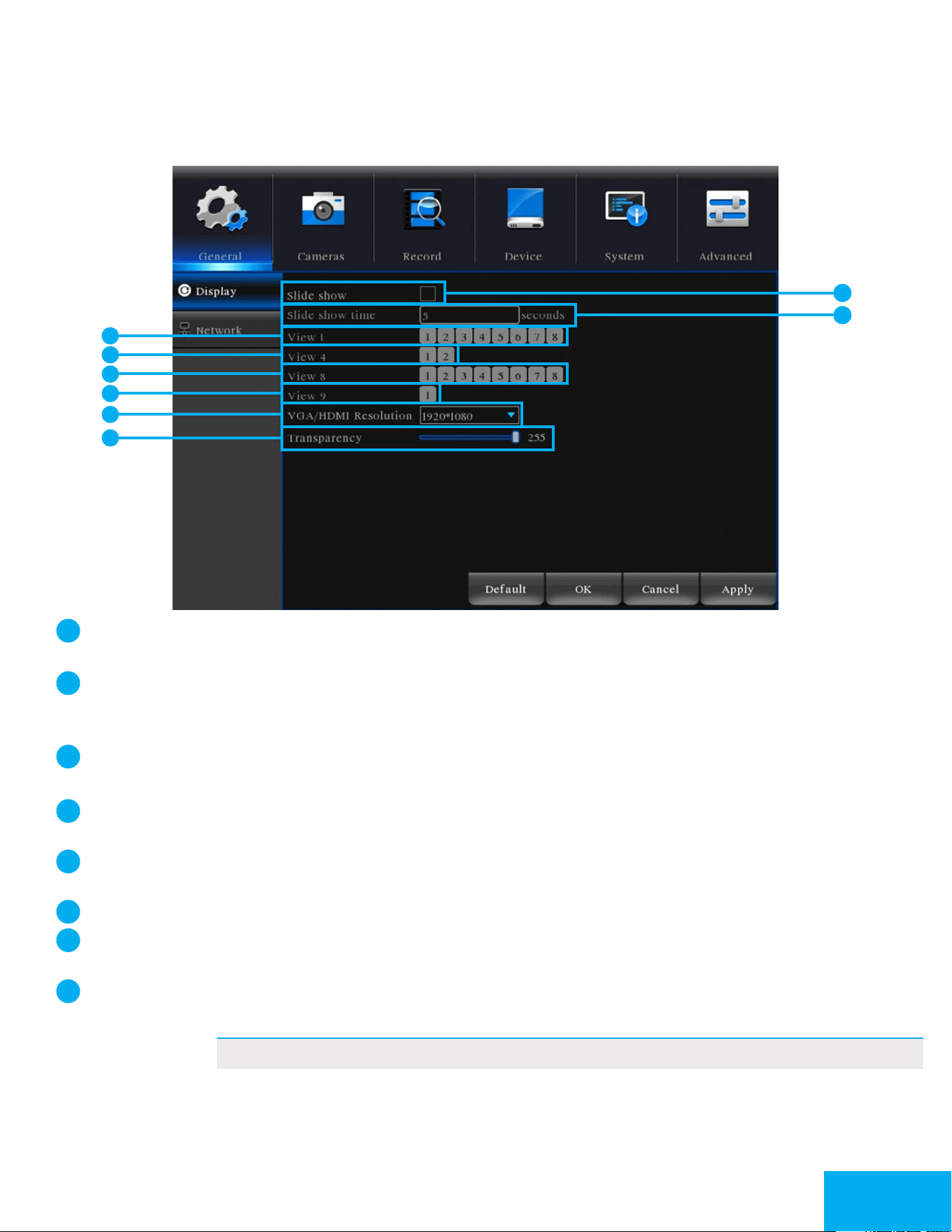
The general menu will allow you to access display and network settings for your DVR system.
Display
A
B
C
D
E
F
G
H
Slide Show: By default, checking the box for Slide Show activates all views. To remove a view,
deselect the box and/or boxes next to the view you want removed.
Slide Show Time: Adjust the length of time that each channel is displayed during the sequential
view. You can select between 1 and 300 seconds per channel. To begin the auto sequence feature,
click on the Auto Sequence icon which is located on the quick access bar.
View 1: This is the full screen slide show setting. Select the number of channels to include in the
slide show sequence.
View 4: This is the Quad View slide show setting. Select the number of slides based on the number
of channels you are using. Each slide displays 4 channels.
View 8: This is the 8-View slide show setting. Select the slide based on which channel you would like
to feature on the maximized view.
View 9: This is the 9-View slide show setting.
VGA/HDMI Resolution: Optimize the display resolution to best fit your TV/Monitor. By default, the
DVR selects a resolution of 1920 x 1080.
Transparency: Modify the menu transparency when displayed on the screen.
A
B
C
D
E
F
G
H
General Menu
NOTE: Do NOT select a resolution size larger than your TV / Monitor can accomodate
29
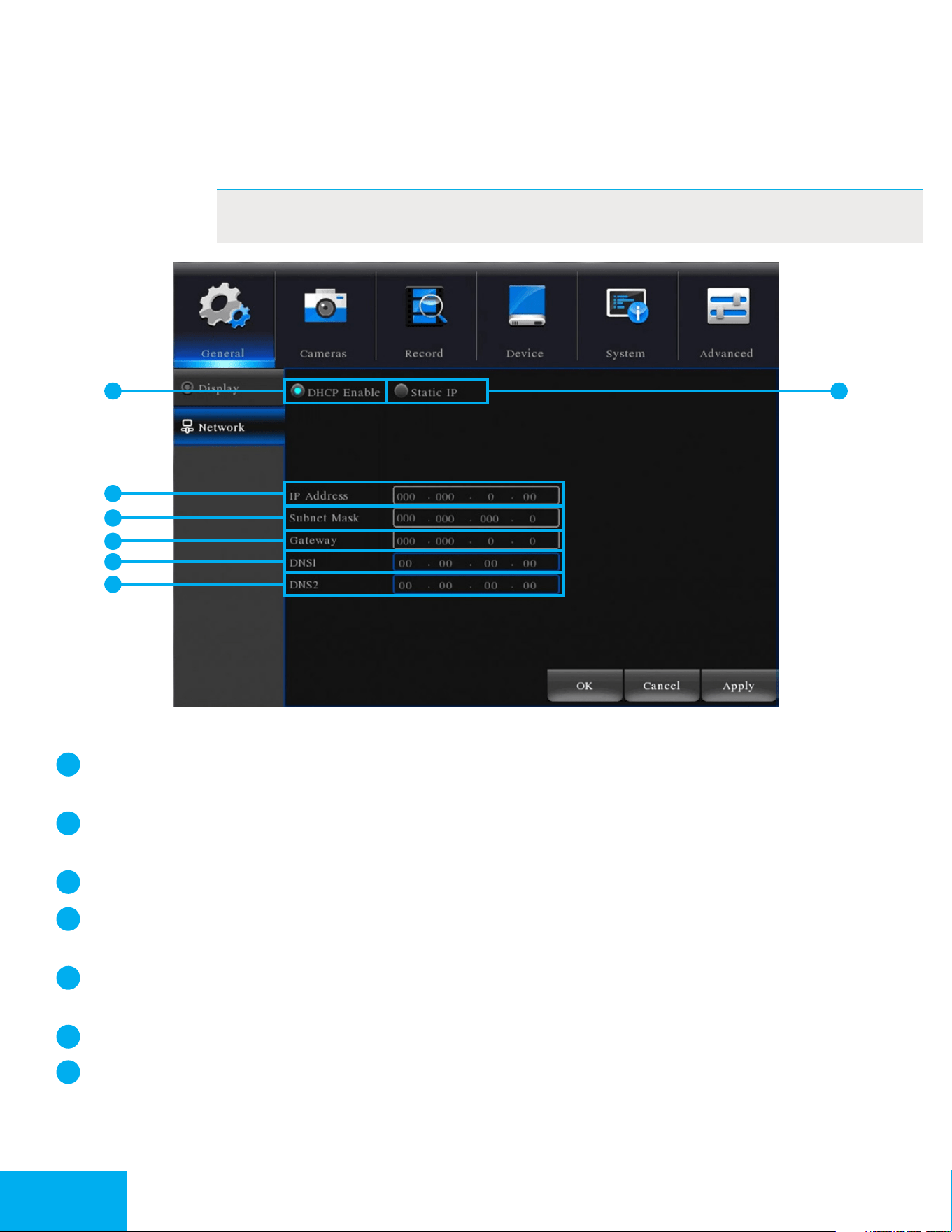
Find network values and optimize connectivity based on your Internet connection. In most
cases the values should populate automatically once your DVR is connected to the Internet.
The values in this section should only be adjusted if you are an advanced user and
have extensive experience in device networking.
A
B
C
D
E
F
G
DHCP Enable: The most common network connection type. These values are collected automatically
from your ISP when connected.
Static IP: Modify these values if you are using a static IP address. Information can be obtained from
your router and ISP.
IP Address: Network address of the connected DVR.
Subnet Mask: The range of IP addresses that can be found in the network. This should always be set
to the default address 255.255.255.000.
Gateway: The connection between two networks. This should always be the IP address of the
connected router.
DNS1: Primary Domain Name System server address.
DNS2: Secondary Domain Name System server address.
A
C
D
E
F
G
B
Network
NOTE: Do not adjust these advanced settings unless you are knowledgeable and
understand the changes being made to the DVR.
30
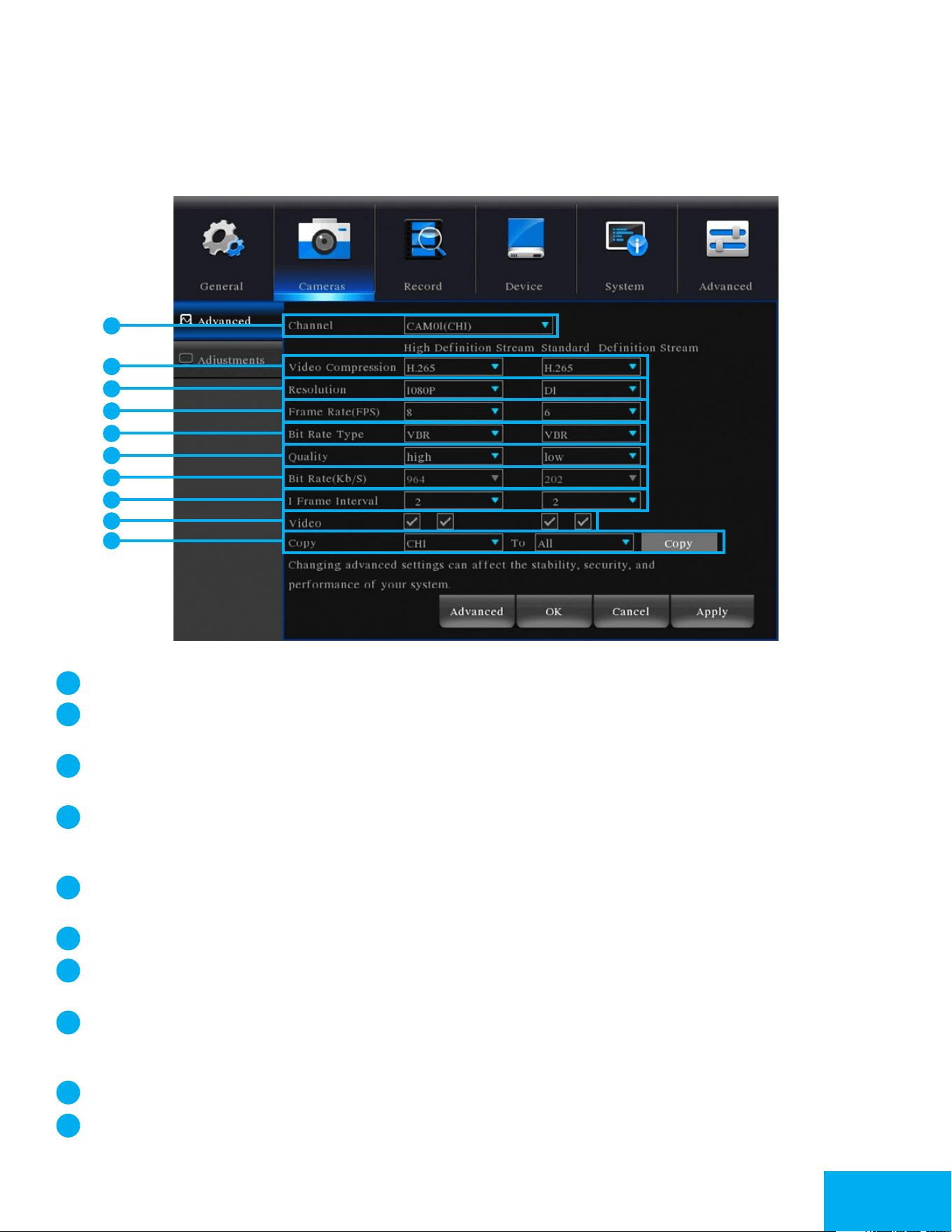
From this menu, you can quickly adjust your camera settings such as the resolution, FPS (Frames per
Second), channel name and image settings.
B
A
C
D
E
F
G
H
I
J
A
B
C
D
E
F
G
H
I
J
Channel: Select a channel to edit.
Video Compression: Set the video compression format to optimize transmission bandwidth and
storage space on your DVR.
Resolution: Choose between 960H (960 x 480), 720p (1280 x 720), 1080p (1920 x 1080), 3MP,
4MP, 5MP, or 8MP resolutions based on your TV or monitor capabilities.
Frame Rate (FPS): Increase or decrease the frames per second of the streaming video depending on
your connection speed. Higher FPS equals better video quality. If experiencing lag or stutter, lower
the FPS.
Bitrate Type: Select CBR (constant bit rate or a fixed encoding speed) or VB (variable bit rate or an
average encoding speed); if using VBR, you must select the desired quality of video.
Quality: Select the quality of video recording.
Bitrate: Adjust the amount of data transferred while streaming. The default setting is sufficient for
most networks.
I-Frame Interval: Choose the interval between I-Frames. When the interval is shorter, the video
quality is higher, however the video needs more network capacity. When intervals between I-Frames
are longer, the video transmission uses less bandwidth, but the video quality is lower.
Video: Enables the main and the sub video streams. *Not available on all systems.
Copy: Allows you to copy settings from the current camera to other cameras.
Cameras Menu
Advanced
31
A
B
C
D
E
F
G
H
I
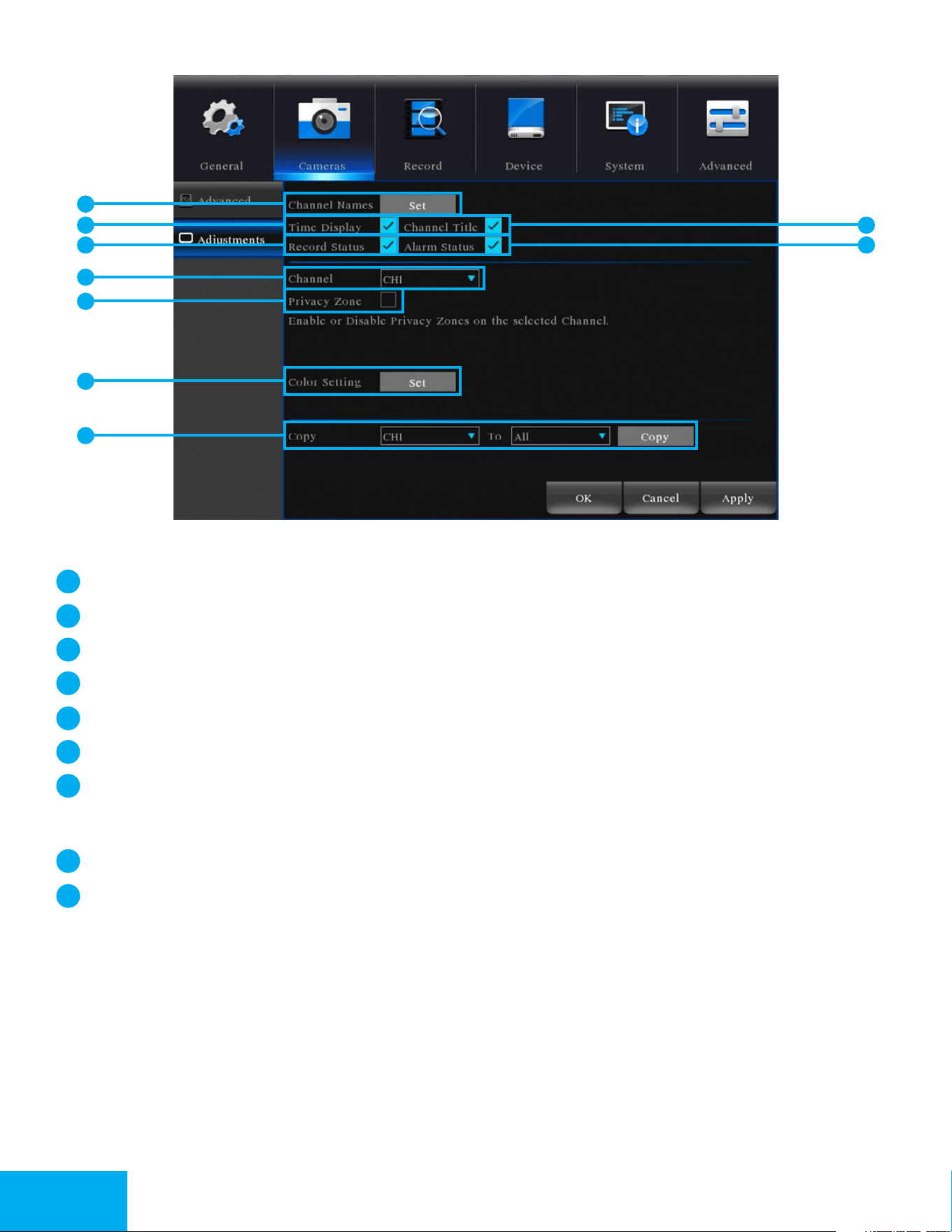
Channel Names: Set display options for each channel.
Time Display: Time displayed on the channel view.
Channel Title: Display channel name on the channel view.
Record Status: Display record status on the channel view.
Alarm Status: Display alarm status on the channel view.
Channel: Select a channel to edit.
Color Setting: Click “Set” to access a sub-menu to adjust the colors of the selected channel. In
this sub-menu, you can adjust the Hue, Brightness, Contrast, Grain, Horizontal Sharpness, Vertical
Sharpness and Saturation of the image.
Copy: Click “Copy” to set the current channel’s settings to another channel.
Privacy Zone: Enabling and setting the Privacy area allows the user to block specific areas from
displaying live and recorded video. You can Enable/Disable up to four Privacy Zones on a selected
channel.
A
B C
D
F
I
G
H
E
Adjustments
32
5
1
6
7
2
3
4
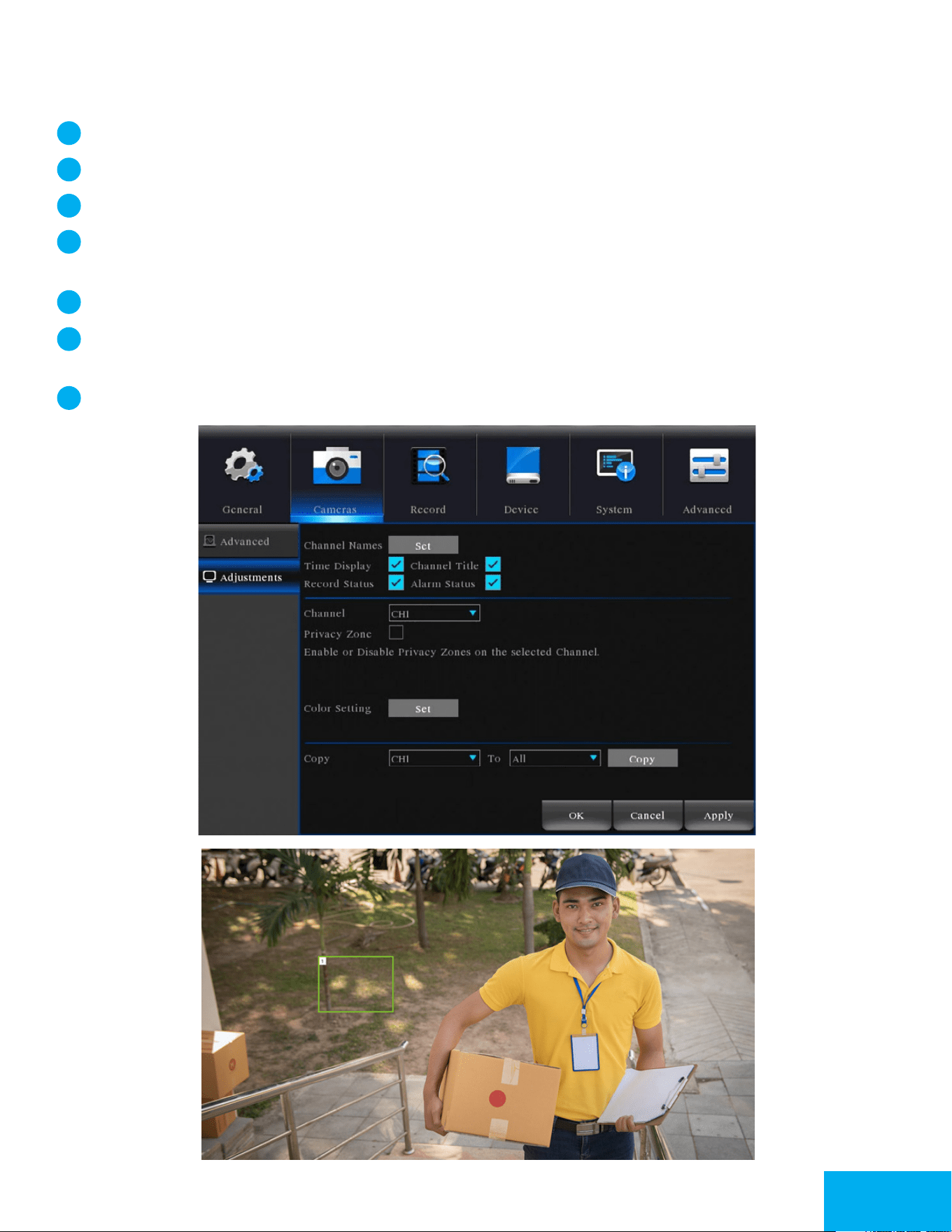
You can adjust the covered area by clicking and dragging across the area with the mouse.
To adjust the size of the area, hover the mouse pointer over the inner side of the edges of the
rectangle. When the mouse’s onscreen pointer changes shapes, click and drag to adjust the size.
Right-click to return to the menu and click "Apply" to save the settings.
Select a channel.
Click the “Privacy Zone” check box.
Select the amount of area to be covered (up to 4). We strongly advise you set one area at a time.
Click on the “Set” button. A full screen view of the camera selected pops up and a white rectangle
(Privacy Zone) is populated.
Setting Privacy Zones
follow the steps below:
33
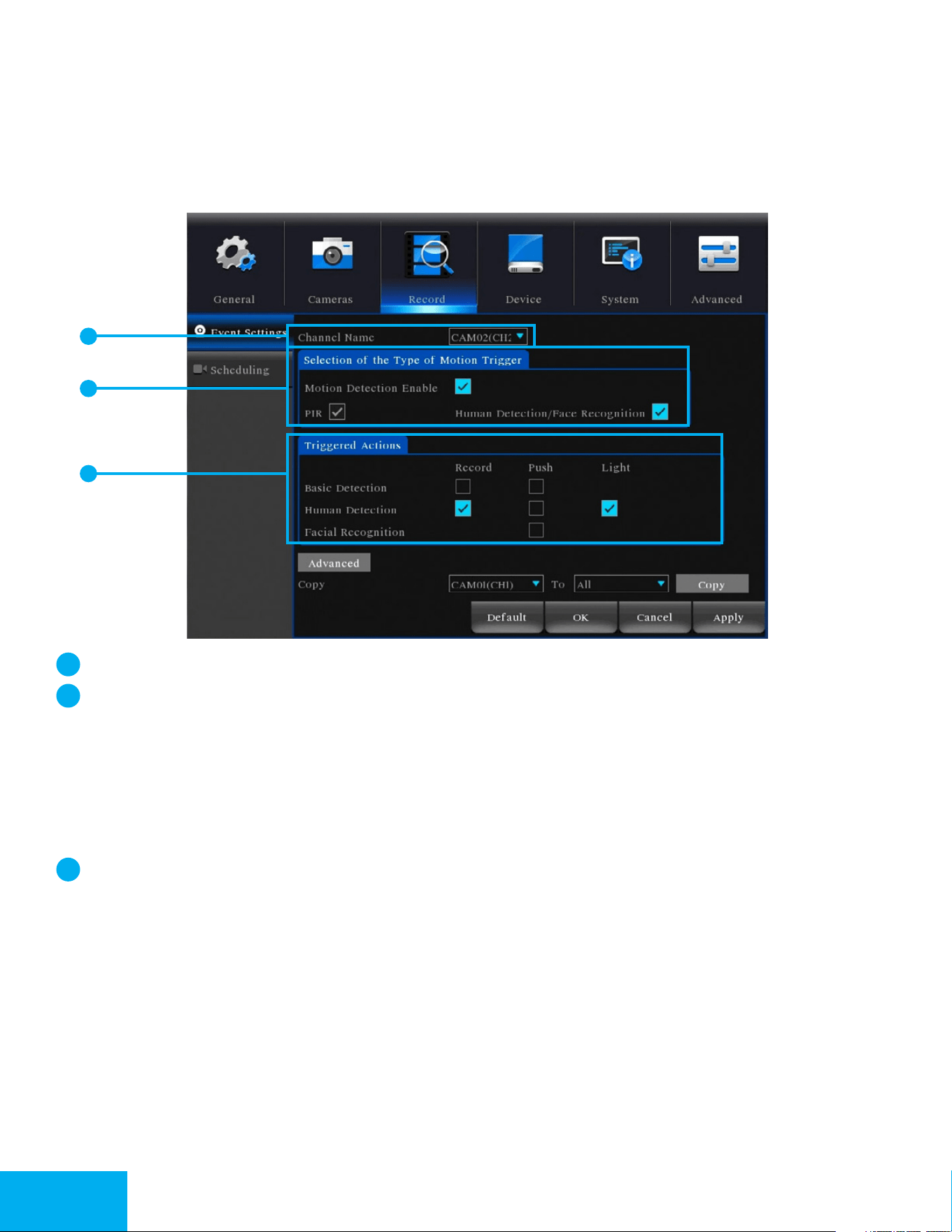
A
B
C
Channel Name: Select a channel to configure.
Selection of the Type of Motion Trigger:
• Motion Detection Enable: When checked, the motion detection feature is enabled on the
selected channel. By default, all channels have motion detection enabled.
• PIR: Toggle between ON and OFF for passive infrared sensor (PIR) based motion
detection. *Not available on all models.
• Human Detection/Face Recognition: Enabled by default. Monitors the channels for human
motion, and upon detection, scans for facial features.
Triggered Actions:
• Record: Enables the corresponding action to take place when either detection or recognition
takes place.
• Push: Enables the corresponding action to take place when either detection or recognition
takes place.
• Light: Toggle between ON and OFF to enable the camera’s spotlight during motion detection.
Only available for Spotlight enabled cameras.
• Basic Detection: Enables the corresponding action to take place when basic motion detection
takes place.
• Human Detection: Toggle between ON and OFF to enable human motion detection on the
camera.
• Facial Recognition: When enabled, a push notification is sent to the App when this event
takes place.
A
B
C
From this menu you can enable recording, set video settings, and adjust streaming options.
Record Menu
Event Settings
This menu displays the record settings for your cameras. It will show what type of events your camera
cameras equipped with one).
34
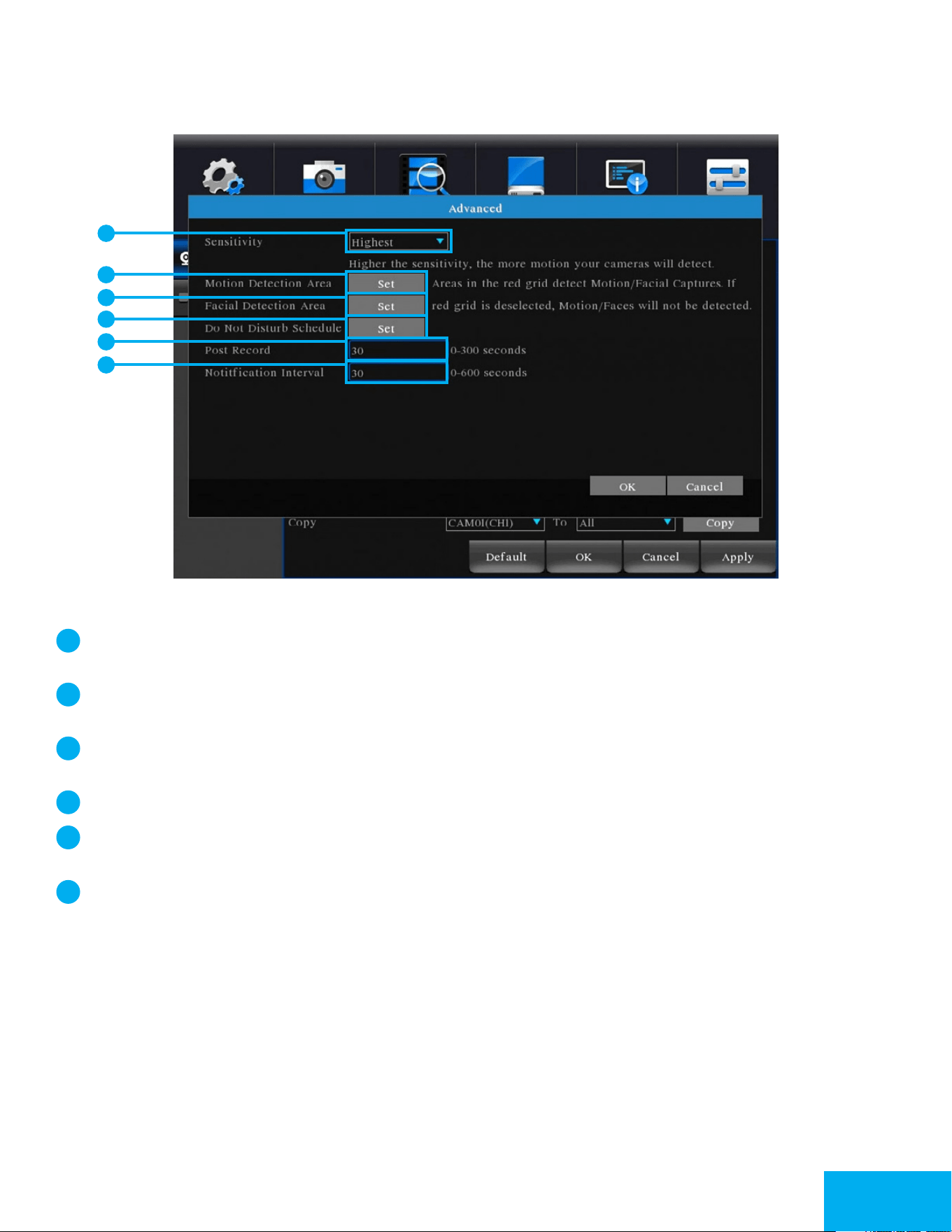
A
B
C
D
E
F
Sensitivity: Adjusts the level of motion detection. A lower setting requires more movement in the
camera range to begin recording.
Motion Detection Area: Clicking “Set” allows you to configure areas that detect motion. The “Red
Boxes” denote the areas that detect motion. When finished, right-click to return to the menu.
Facial Detection Area: Clicking “Set” allows you to configure areas that detect faces. The “Red
Boxes” denote the areas that detect faces. When finished, right-click to return to the menu.
Do Not Disturb: Set the time frame for which the system does not notify the user of activity.
Post Record: Set the amount of time to record after motion is detected (between 30 and 300
seconds).
Notification Interval: Set the timing between each motion detection event and push notifications.
Default parameters are configured for optimal use. Adjusting the intervals may result in missed
notifications.
A
B
C
D
E
F
Event Settings Advanced
The Advanced tab lets you adjust your camera's motion sensitivity, motion detection and facial
35
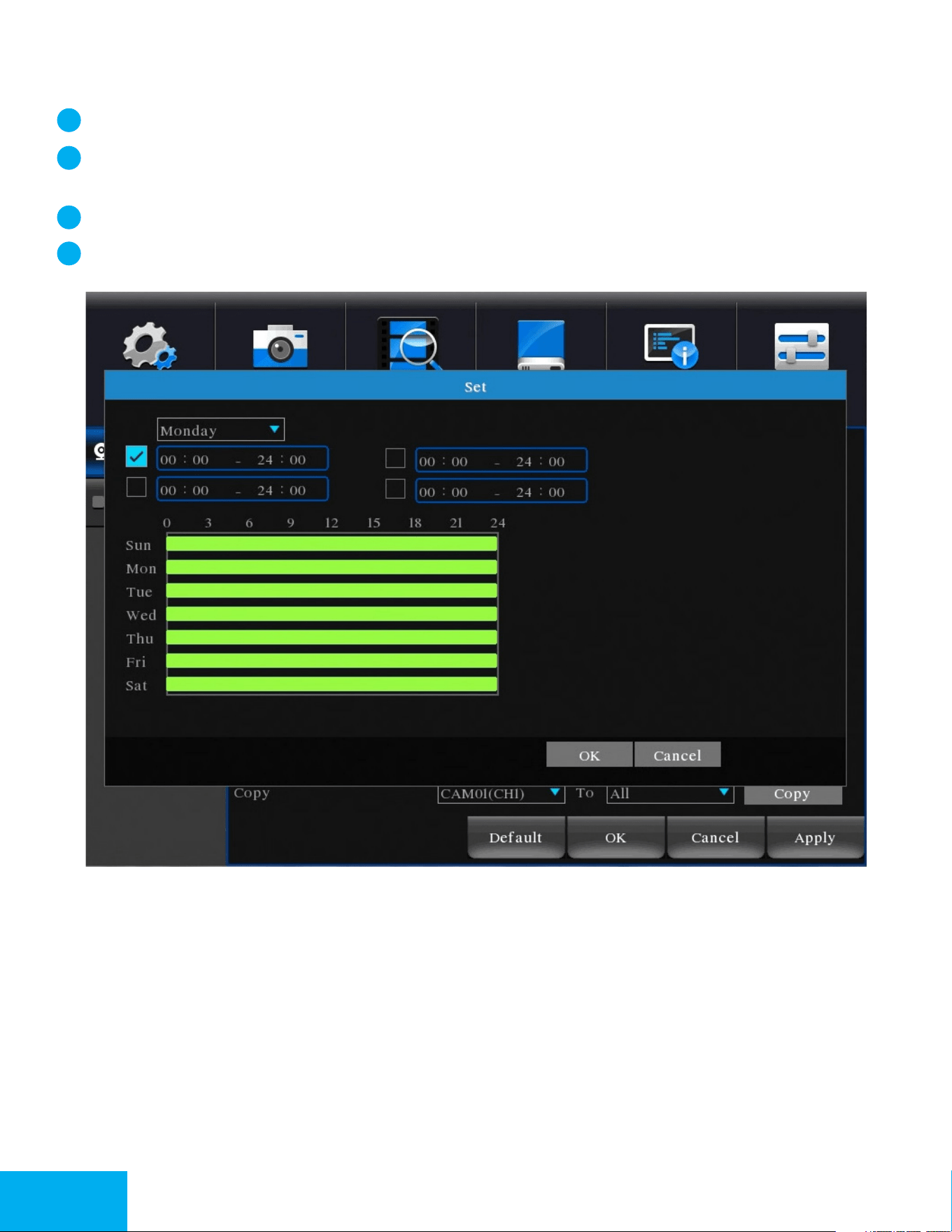
1
2
3
4
Select the day you want to configure.
Configure up to four-time spans for which you would like to receive push notifications. Checking the
box next to the set time frame activates the push notification schedule.
Continue editing by selecting different days from the drop-down menu.
Click “OK,” then select “Apply” on the menu screen to save the settings.
Do Not Disturb Schedule
36
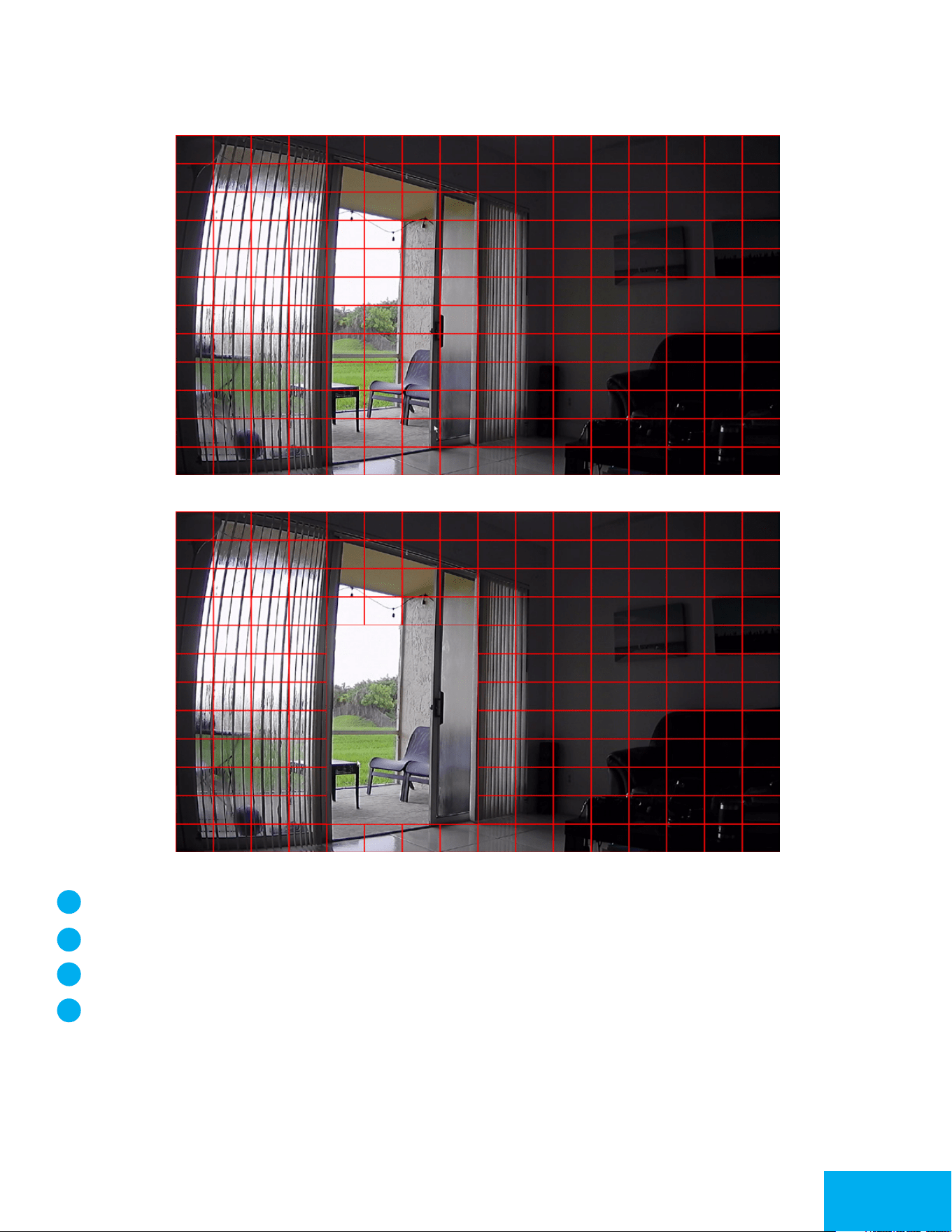
1
2
3
4
Click on a square in one corner of the area you don’t want to be detected.
Click and drag the mouse over the area you want to block.
Release the mouse and verify you have selected your desired area.
Right click the mouse and select “Save” to apply the settings and exit the menu.
follow the steps below:
Setting the Motion Detection Area
37
A
B
C
D
E
F
G
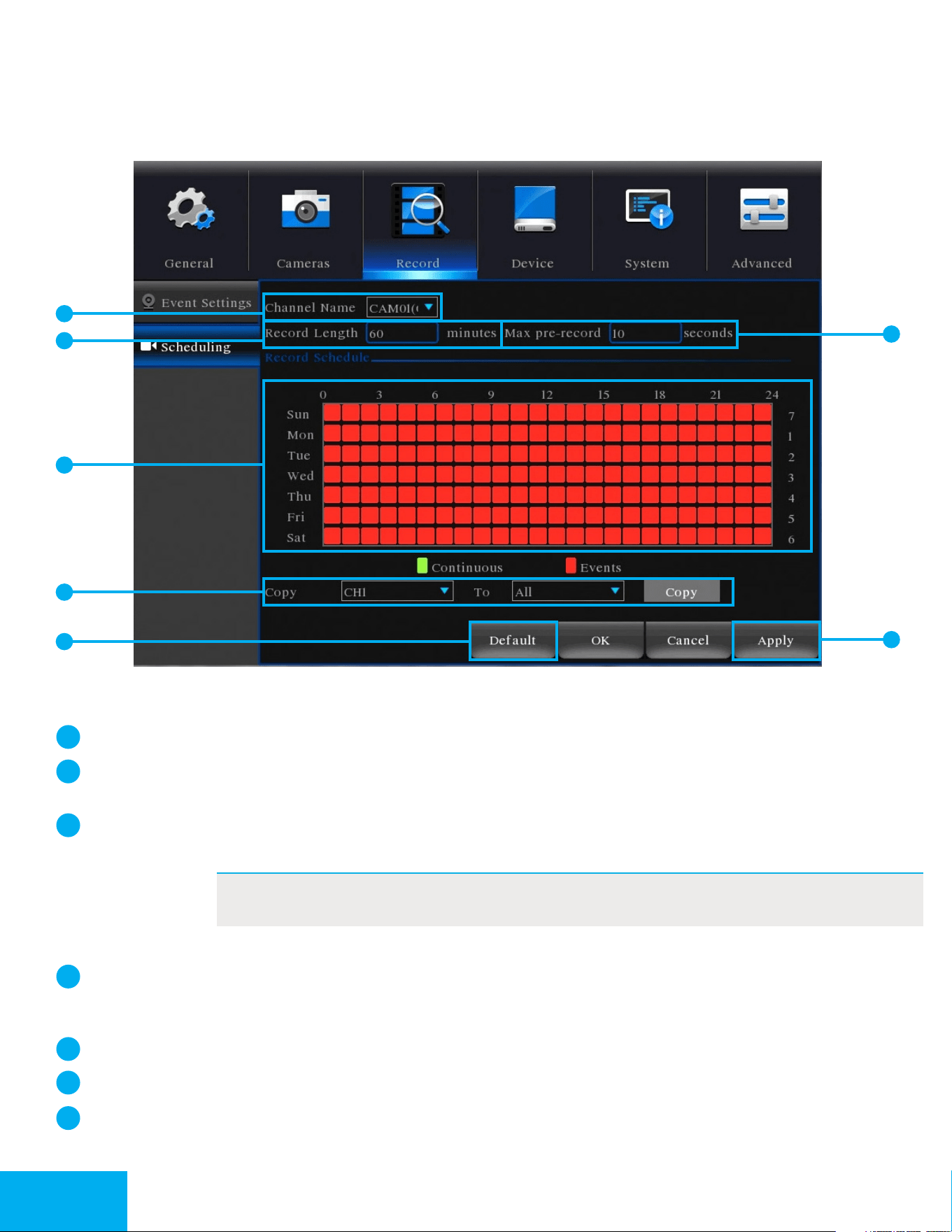
Channel Name: Select the channel to edit recording settings.
Record Length: Enter the duration of time to record when motion is detected, between 1 and 120
minutes. When using Continuous Recording, the video length will be the time scheduled.
Max Pre-Record: Input the amount of time you would like the DVR to pre-record once an alarm has
triggered a recording.
Record Schedule: Click and drag to select the scheduled times of Continuous and Motion/Alarm
recording. Each square represents one hour of time within that day. Red squares indicate the DVR is
set to Motion Record. Yellow squares represent the time which the DVR continuously records.
Copy: Copy record settings to multiple channels.
Default: Revert to factory settings.
Apply: You must select “Apply” once a change is made. If you do not select “Apply,” the changes will
not be saved.
A
E
F
B
D
C
G
Scheduling
From the Scheduling screen, you can choose how and when you want each of your cameras to record
events. You can choose from Motion record or Continuous record, for example, and select blocks
throughout the day and week when you want the selected camera (channel) to record a certain way.
NOTE: You may choose between 0 and 30 seconds of pre-record. Keep in mind that
this is an approximation.
38
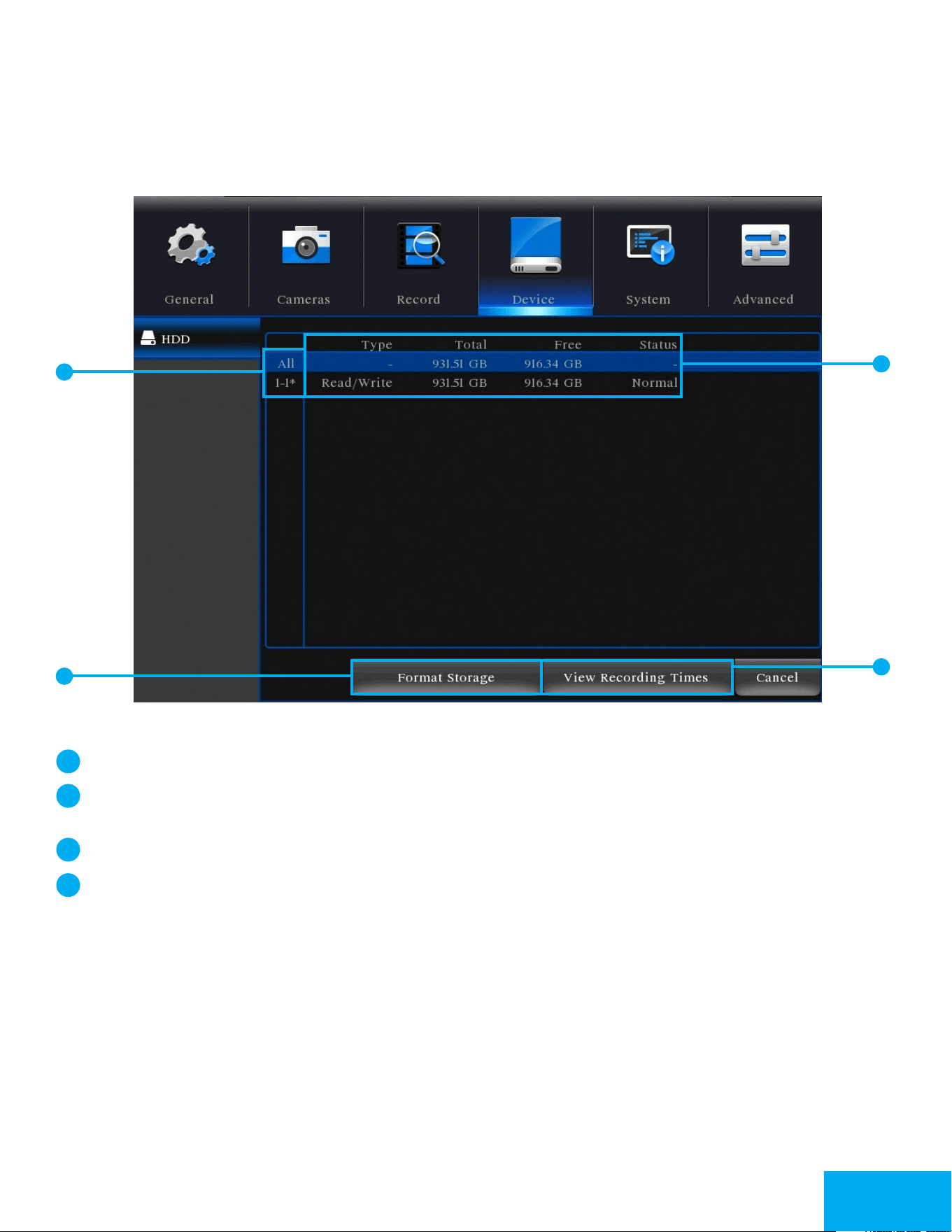
In the Device menu, you can see how much available space you have on your Hard Disk Drive
(HDD), deselect automatic overwrite and reformat the HDD, which is how you manually delete
recordings and free up space.
A
B
C
D
Select: If multiple drives are installed, choose the HDD you would like to customize.
Format Storage: Select to create free space on the Hard Disk Drive by permanently deleting the
existing data.
View Recording Times: Shows recordings that are on your HDD.
View Type and Capacity: Shows total storage being used and available space on your HDD, the type
and status of a recording, and the type and status of the DVR’s HDD. If the status does not say
Normal, restart the DVR. If the status does not return to Normal after restarting, you may need to
replace the HDD.
A
B
C
D
HDD
Device Menu
39
A
B
C
D
E
F
G
H
I
J
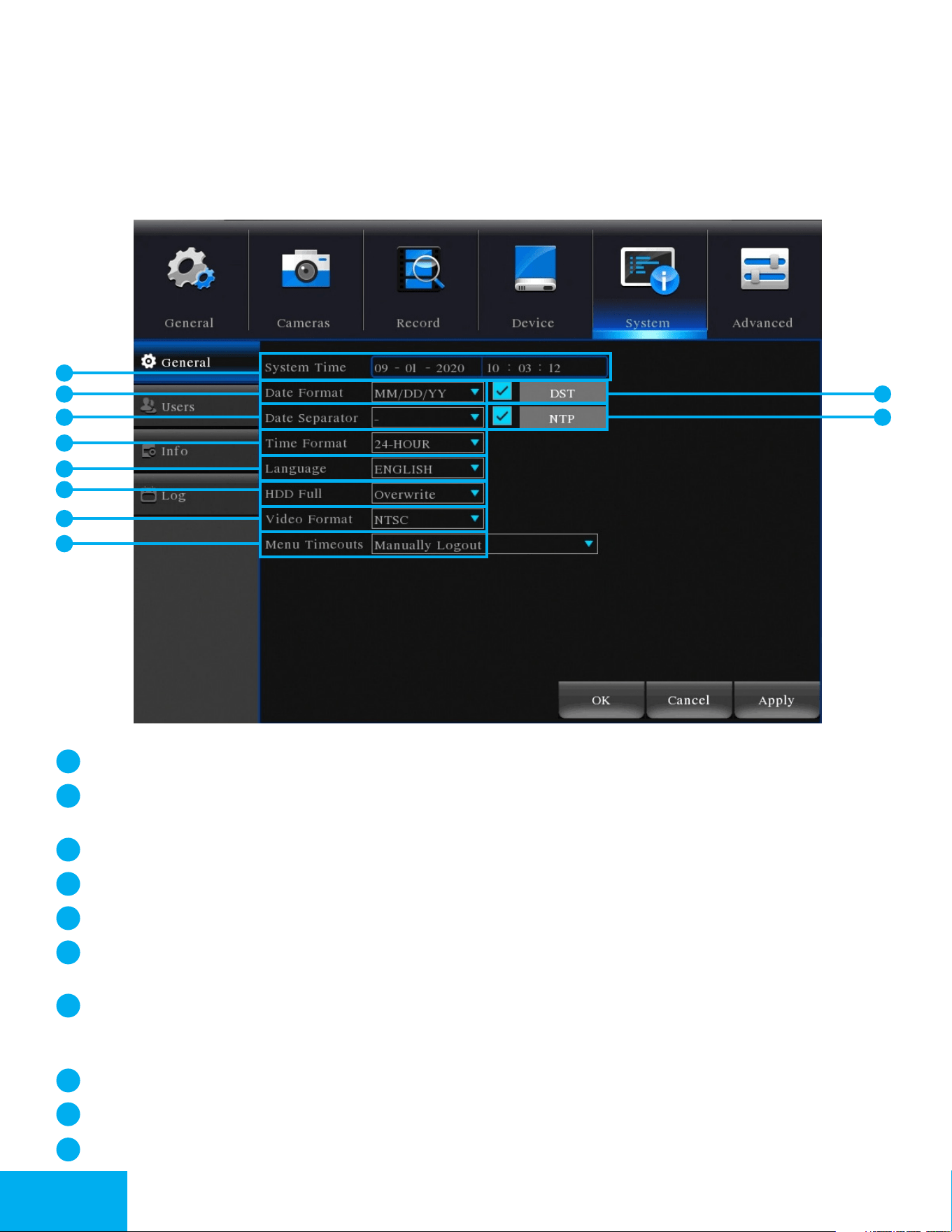
System Time: Manually set the date and time of your DVR.
Date Format: Choose the display format for the date. You can select Month/Day/Year, Year/Month/Day
or Day/Month/Year.
Date Separator: Choose the format of the date display.
Time Format: Select between a 12 Hour or 24 Hour display.
Language: Pick between ENGLISH, SPANISH or FRENCH language preferences.
HDD Full: Choose Overwrite if you would like your DVR to write over old recordings when the HDD is
full. Choose Stop Record if you would like your DVR to stop recording when the HDD is full.
Video Format: NTSC or PAL formats are available to choose from. NTSC is the standard for video in
North America and is the DVR’s default setting. Prior to changing the video format, make sure that
your TV/Monitor is PAL compatible.
Menu Timeouts: Select the duration of time for an inactive menu to be displayed on-screen.
DST: Enable or Disable the Daylight Savings Time feature.
NTP: Select to change the NTP server.
A
B
C J
I
D
E
F
G
H
This menu allows you to access many basic system settings, such as the language, menu tim-
eouts, time format, Daylight Savings Time and logs. Additionally, you can see your system’s
model number, software and hardware versions, UID (Unique Identifier) and QR Code for re-
mote connectivity. If you have not already done so, you can also log in to your Night Owl Protect
account for easy remote viewing and added features and benefits.
General
System Menu
40
A
A
B
C
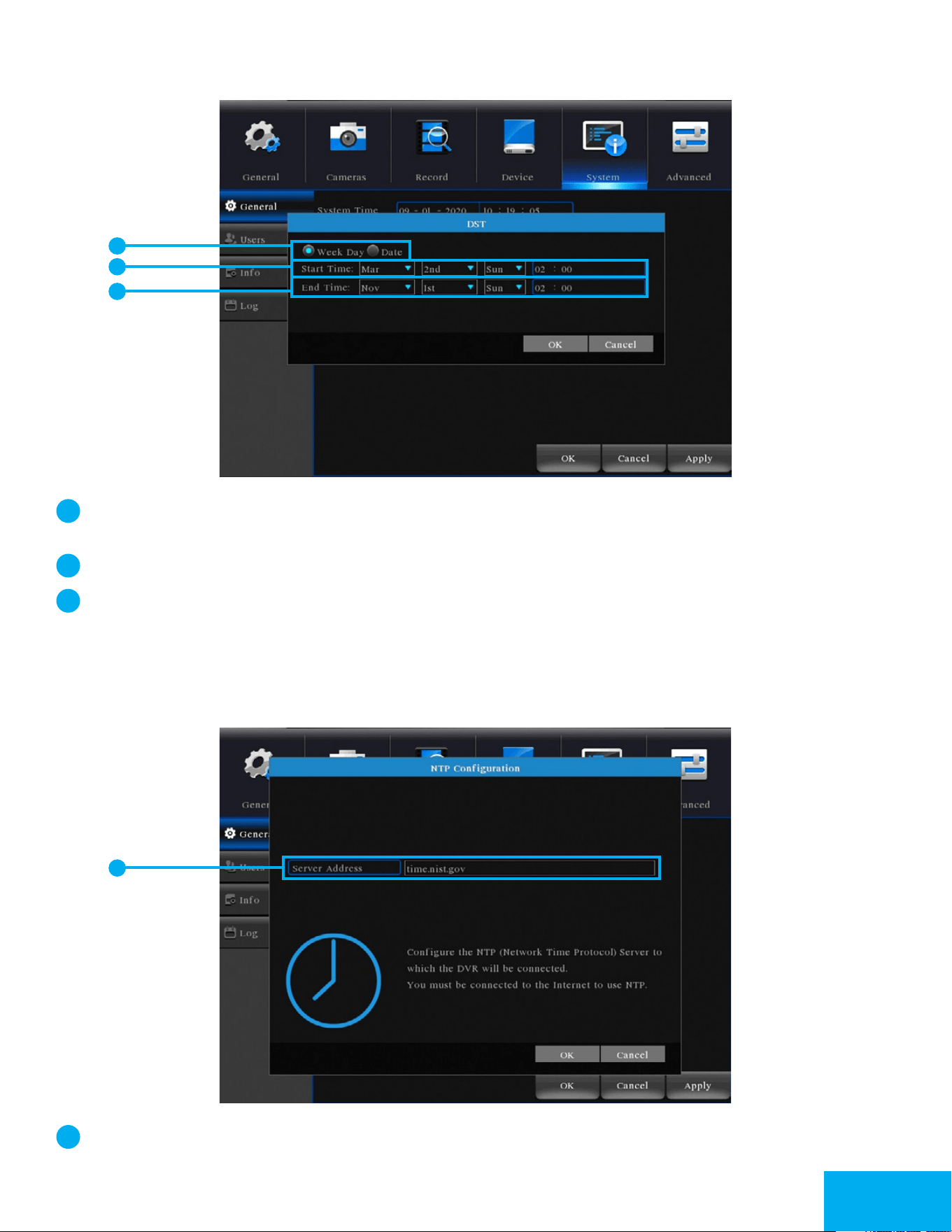
Week Day - Date: Indicate whether you would like this feature to be applied the week of or an
exact date.
Start Time: Select the date and time to apply the DST offset.
End Time: Select the date and time to remove the DST offset.
Server Address: Select the server that the DVR will use.
A
A
B
C
Configure your system to account for Daylight Savings Time.
DST
From this menu, you can enter which server you want the DVR to reference for time and date
syncing.
NTP
41
A
B
C
D
E
F
G
H
I
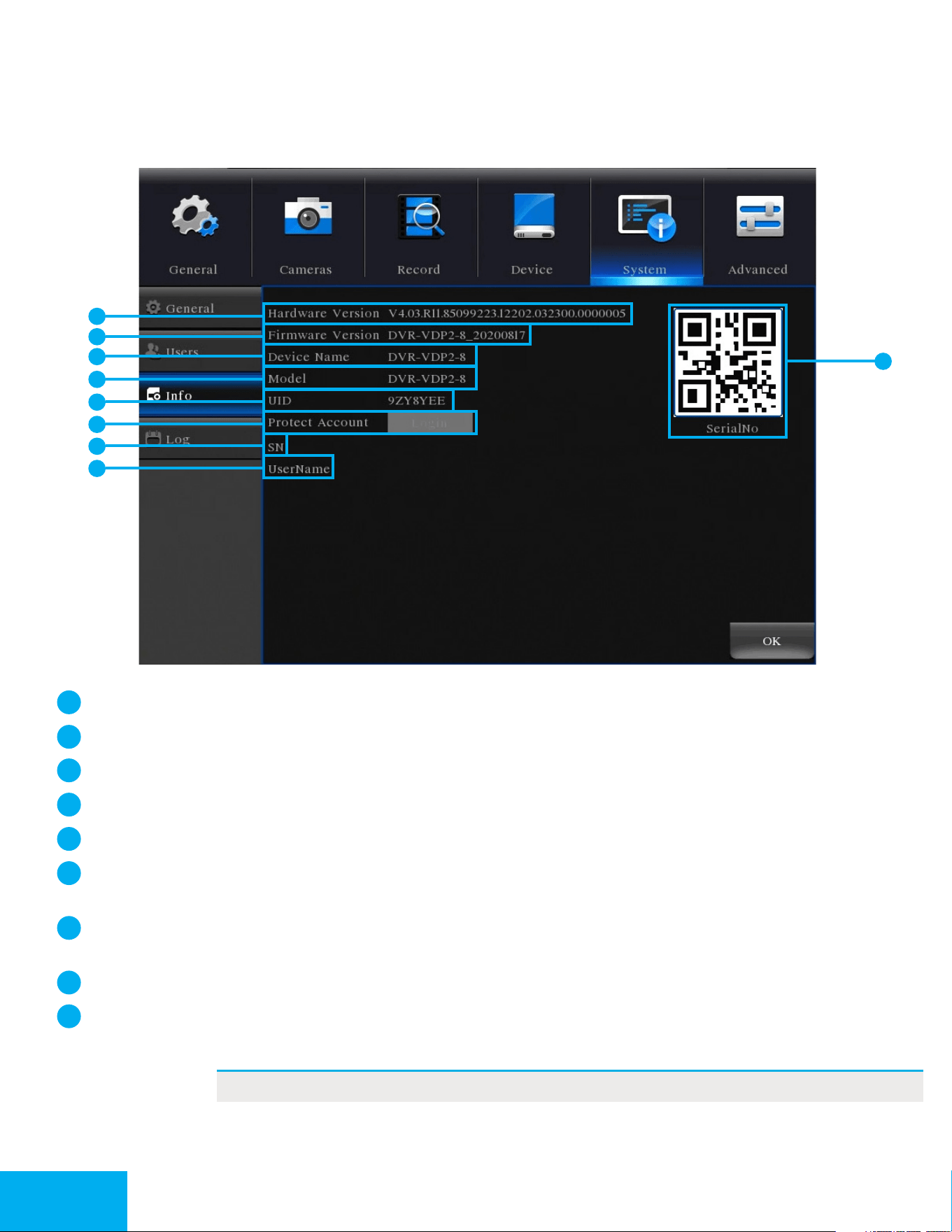
Hardware Version: The DVR’s hardware version.
Firmware Version: The DVR’s current software version.
Device Name: The DVR’s name.
Model: The DVR’s model number.
UID: The DVR’s unique identifier.
Protect Account: Allows the user to login with their Night Owl Protect credentials. Enter the local
admin password to confirm ownership.
QR Code: QR code that represents the UID number of the DVR. Scan the code on this screen when
performing a QR code setup to add the DVR to the Night Owl Protect App.
SN: The DVR’s serial number.
UserName: If the user is already logged into the DVR with their Night Owl Protect account, the DVR
displays the username.
A
B
C
D
E
F
H
I
G
This menu lets you see your system’s model number, software and hardware versions, UID
(Unique Identifier) and QR Code for remote connectivity. If you have not already done so, you
can also log in to your Night Owl Protect account for easy remote viewing and added features
and benefits
Info
NOTE: Please scan the QR Code directly from your TV / Monitor, NOT from this page.
42
A
B
C
D
E
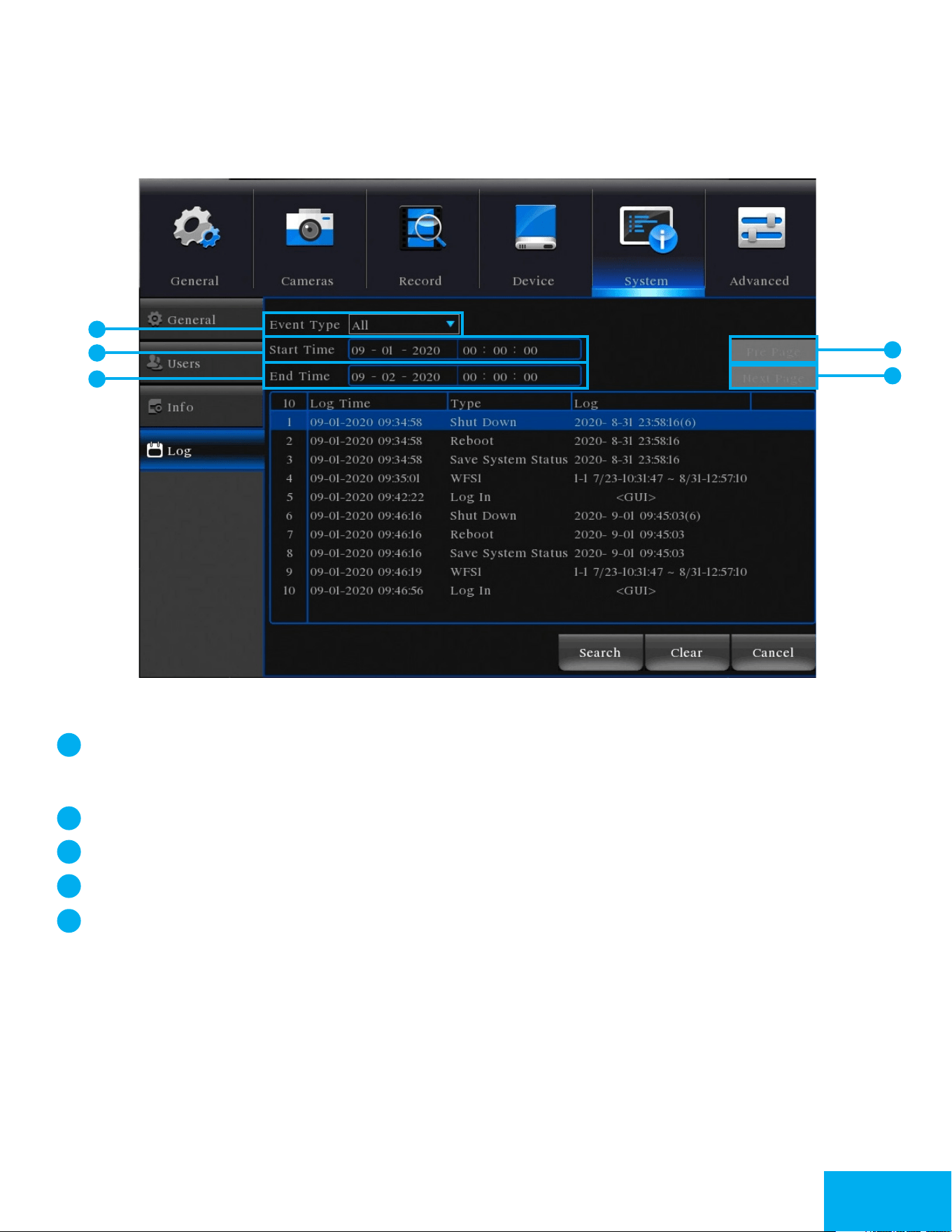
Event Type: Select the type of event log that you would like to Search. Each choice corresponds to
an action or event that was triggered and noted within the system. For example, System Logs are
recorded when the DVR time is synced with NTP (if enabled) or if the system is turned on or off.
Start Time: Choose the initial date of your log search period.
End Time: Choose the end date of your log search period.
Previous Page: Select to move backward through the search log.
Next Page: Select to move forward through the search log.
A
B
D
E
C
Event logs are a record of all actions taken on the DVR. Event logs show things like each time
someone logs into the DVR, each time the DVR is powered on, if a camera has experienced
video loss, and so forth. Event logs are simply a written record that can be viewed and cleared
at your discretion.
Log
43
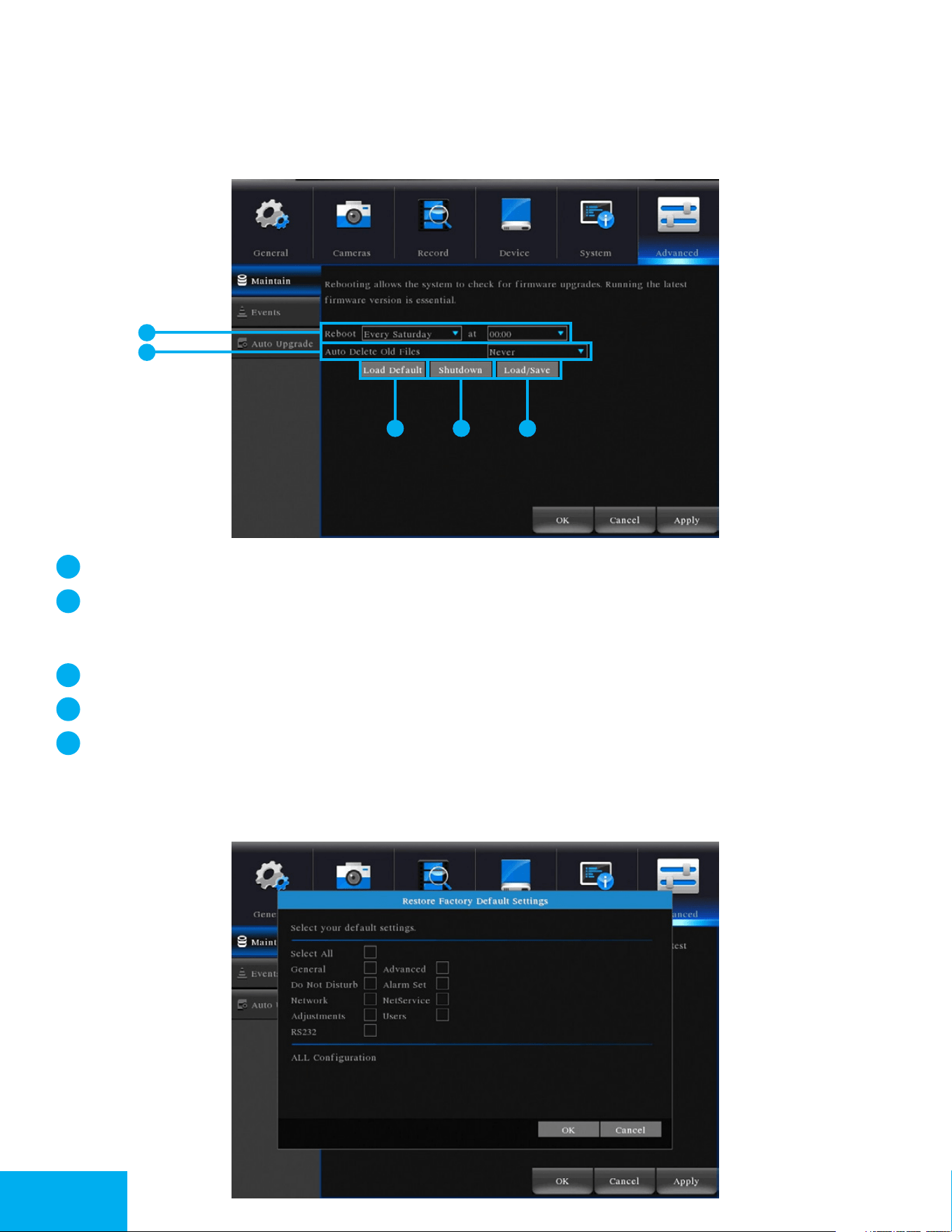
The Load Default menu allows you to select the settings you would like to restore to default.
A
B
C
D
E
Reboot: Set the frequency of reboots.
Auto Delete Old Files: Set whether you would like the DVR to automatically delete old files.
This option is like the Overwrite option, however this allows you to customize the time period in
which the HDD automatically deletes old recordings.
Load Default: Revert to the standard reboot schedule.
Shutdown: Display the power menu (Shutdown, Reboot, or Cancel).
Load/Save: Load previously saved settings from a USB flash drive. Export logs and DVR
configuration settings to a USB flash drive for future use.
A
B
C D E
Configure additional settings related to maintenance, hard drive space, and upgrades.
Advanced Menu
The Maintain menu lets you choose how often the DVR will reboot (for system health).
Maintain
44
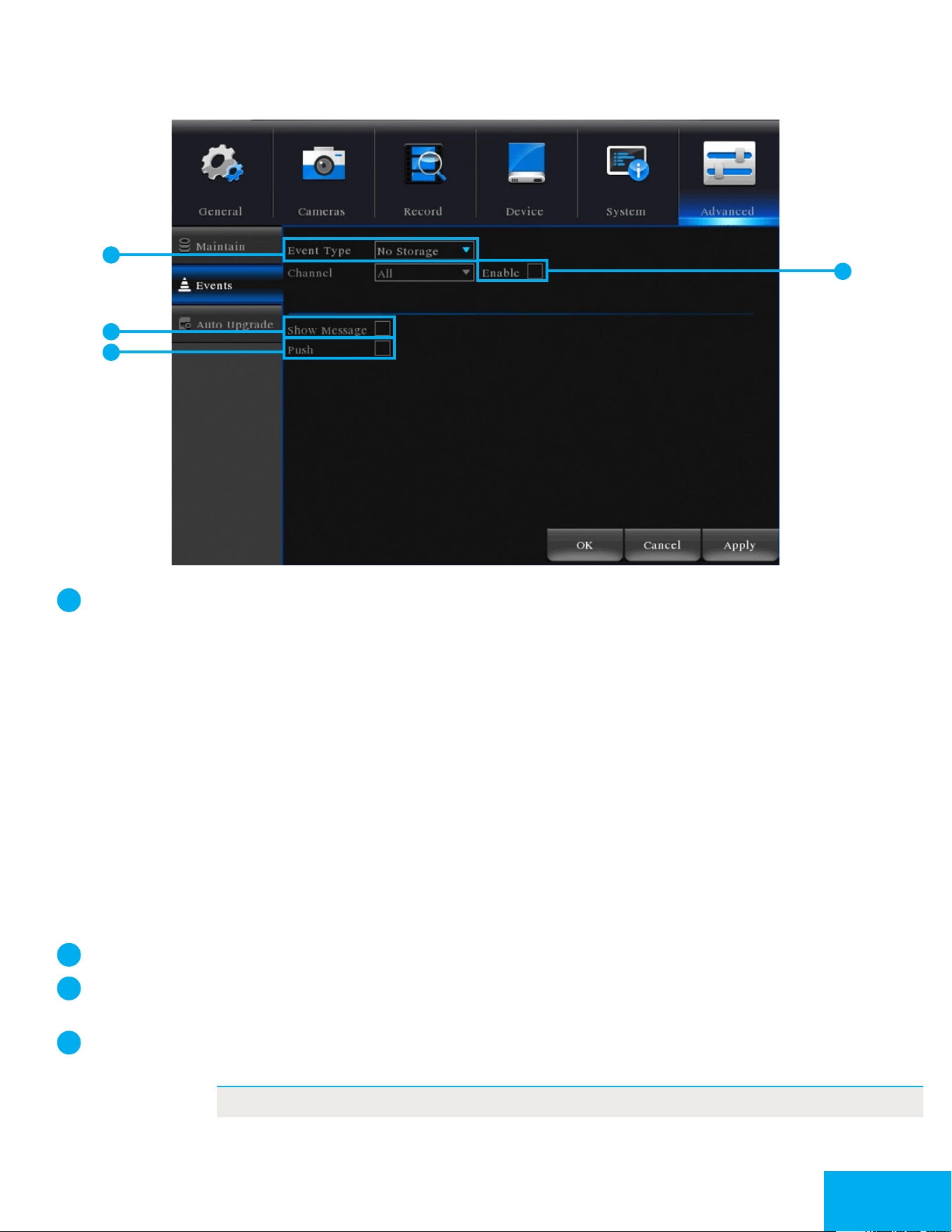
Configure notification settings for other triggered events not related to motion detection such as
disk error, disk full, and/or video loss. These events will be added to the Alarm Status window.
A
B
C
D
Event Type: Choose the type of event notification that you would like to appear on the Alarm
Status window.
• No Storage: The HDD is full.
• Storage Device Error: Refers to the status of the HDD and notifies you if it crashes or
becomes corrupted.
• Storage: No Space: Allows you to set a percentage of available HDD space alarm so that when
the available storage space is less than the percentage it is set to, the notification appears on
the Alarm Status window.
• Net Disconnection: The DVR lost Internet connectivity.
• IP Conflict: Another device is attempting to use the same IP Address of your DVR.
• Illegal Login: Unauthorized access was attempted on your DVR.
• Video Loss: The absence of video due to power loss or disconnection.
Enable: Select a channel, then turn notifications on or off for the selected Event type.
Show Message: Enable an icon to be displayed in Live View when the selected Event Type is
triggered.
Push: Select this option to send a notification to your Night Owl Protect App when this Event Type
happens.
A
C
D
B
Events
NOTE:
45
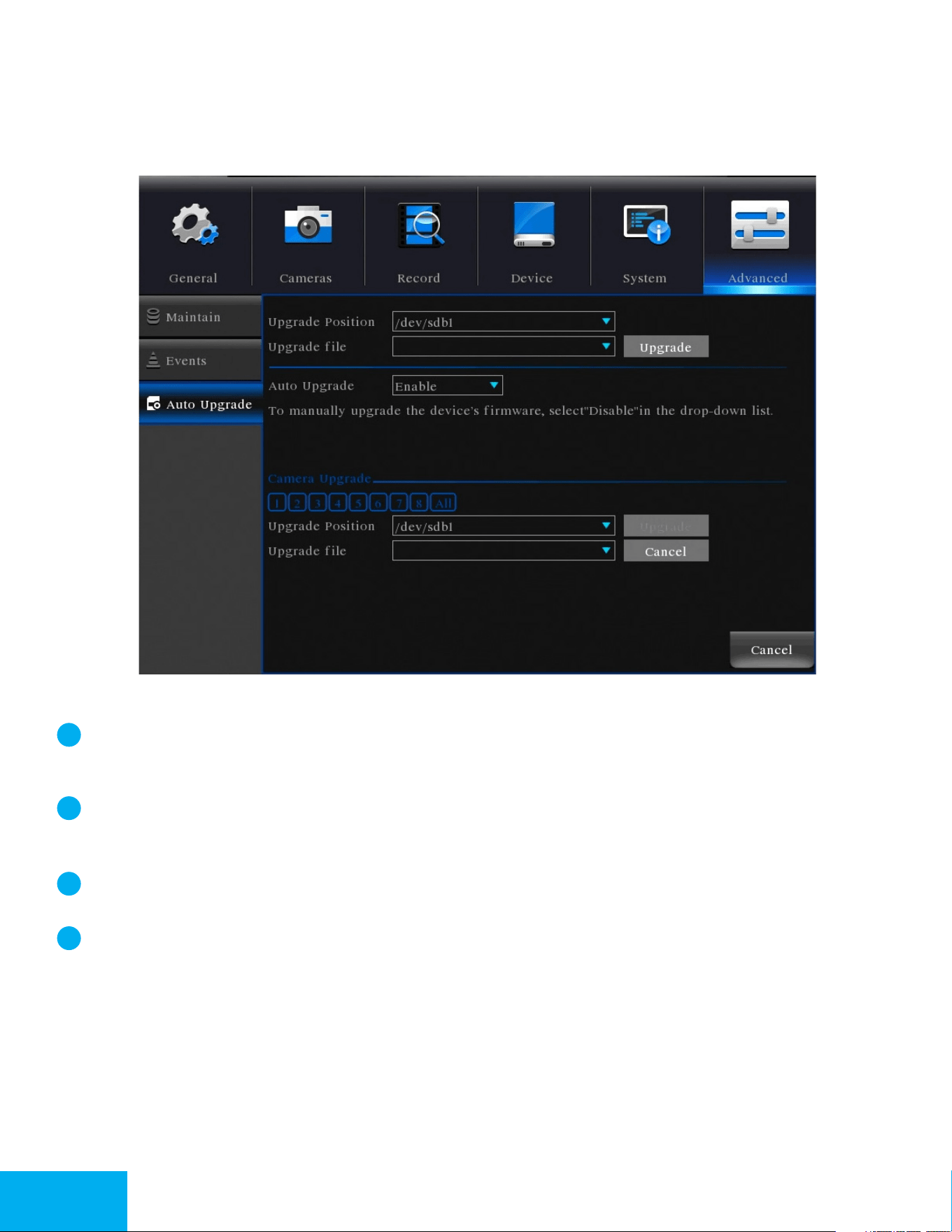
1
2
3
4
Upgrade from USB: Upgrade the DVR firmware from a USB flash drive. To upgrade DVR firmware,
insert a USB flash drive containing the DVR upgrade file into the USB port on the back of your DVR.
Then select the correct file from the “Upgrade File” drop-down menu and select “Upgrade.”
Auto Upgrade: Enable or Disable the auto upgrade feature. Firmware updates are detected
automatically when this feature is enabled. The default selection for the auto upgrade feature is
“Enable.”
Check for Updates: Click on the “Check” button to manually check for updated firmware versions. If
an upgrade is detected, click “OK” on the pop-up window to download and install the new version.
Camera Upgrade: To upgrade camera firmware, insert a USB flash drive containing the camera
upgrade file into a USB port on the back of the DVR. Select the correct file from the “Upgrade File”
drop-down menu and select “Upgrade.”
From this menu you can check for firmware updates and perform an Online Upgrade (if your
DVR is networked) or a Local Upgrade via USB (if you are not connected to the Internet). Firm-
ware updates ensure your system stays healthy and that you are receiving the latest and greatest
benefits and features for your product.
Auto Upgrade
46

DDNS: Dynamic Domain Naming System. Method for automatically updating hostnames, addresses, URL’s or other
information on a given name server.
DHCP: Dynamic Host Configuration Protocol. A network protocol that allows a server to automatically assign a
device and IP address.
Facial Capture and Recognition: Technology that captures a person’s face from up to 10 ft. from the camera, scans
the system’s database for a match, and sends a Familiar or Unfamiliar Face alert to your Smart Device.
Familiar Face Alert: An alert with a captured image of a face that matches your system’s database of stored profiles.
Human Detection: Technology that uses advanced algorithms to detect human motion, reducing false alerts to your
Smart Device.
IP: Internet Protocol. Protocol for standard communications across the Internet.
ISP: Internet Service Provider. An organization that provides services for accessing or using the Internet.
PIR: Passive Infrared. Heat-based sensors eliminate most false alarms and only delivers alerts when people, animals
or vehicles are detected.
SMTP: Simple Mail Transfer Protocol. Standards used for email transmission.
UPS: Uninterrupted Power Supply. Device used to keep the DVR and cameras powered when the main power
supply is lost or disconnected.
VDP2: 1080p (2MP) HD Analog System with Human Detection Technology and Facial Recognition.
Glossary
47

NIGHT OWL, LLC (“Night Owl”) provides the following warranty to the original retail purchaser only (the
“Purchaser”) with respect to this product (the “Product”):
For a period of one (1) year after the date of sale, the Product shall be free from manufacturing defects in
material and workmanship. Product registration may be required to submit a warranty claim. In the event
that the Product is defective, the Purchaser must i) contact Night Owl’s Technical Support Team,
ii) provide Night Owl with the proof of purchase showing the product is still under warranty and was
purchased from Night Owl directly or an Authorized Reseller and iii) return the Product to Night Owl. In its
sole discretion, Night Owl will either repair or replace the Product at no additional cost to the Purchaser.
Any replacement Product (or parts) will be covered by the same warranty as the original Product through
the expiration date of the original warranty period.
Except as otherwise prohibited by law, this warranty is in lieu of other warranties, express or implied and Night
Owl neither assumes no authorizes any person to assume for it any other obligation or liability in connection
with the sale or service of the Product.
In no event shall Night Owl be liable for any special or consequential damages arising from the use of
the Product or arising from the malfunctioning or non-functioning of the Product or for any delay in the
performance of this warranty due to any cause beyond its control. This warranty shall not apply to installation
or the removal and re-installation of products after repair.
Night Owl does not make any claims or warranties of any kind whatsoever regarding the Product’s potential,
ability or effectiveness to prevent, minimize or in any way affect personal or property damage or injury. Night
Owl is not responsible for any personal damage, loss or theft related to the Product or to its use for any harm,
whether physical or mental related thereto. Any and all claims or statements, whether written or verbal, by
salespeople, retailers, dealers or distributors to the contrary are not authorized by Night Owl and do not affect
this provision of this warranty.
Exclusions
This warranty does not apply to the following parts or upon the following events:
1. Bulbs, LEDS and batteries;
2. The Product was not used or installed in the manner described in the installation instructions;
3. Negligent use of the Product or misuse or abuse of the Product;
4. Electrical short circuits or power surges;
5. Use of replacement parts not supplied by Night Owl;
6. Product is either tampered with, modified or repaired by another service provider;
7. Product has not been maintained in accordance;
8. Accident, fire, flood or other acts of God;
9. Failure to use Night Owl approved accessories;
10. Defects or damages arising by use of the Product in other than normal conditions (including
normal atmospheric, moisture and humidity conditions).
Warranty
48

Disclaimer
Certain uses, publication and/or distribution of video/audio recordings from security cameras and/or audio
devices are prohibited or restricted by federal, state and local laws. When enabling and/or using audio
recording features with your hidden security camera, be sure to comply with the laws in your country, state
and locality.
Mac and Mac OS X are registered trademarks of Apple Inc. Windows, Windows XP, Windows Vista, Windows
7, Windows 8 and Windows 10 are registered trademarks of Microsoft Corporation in the United States
and/or other countries.
49
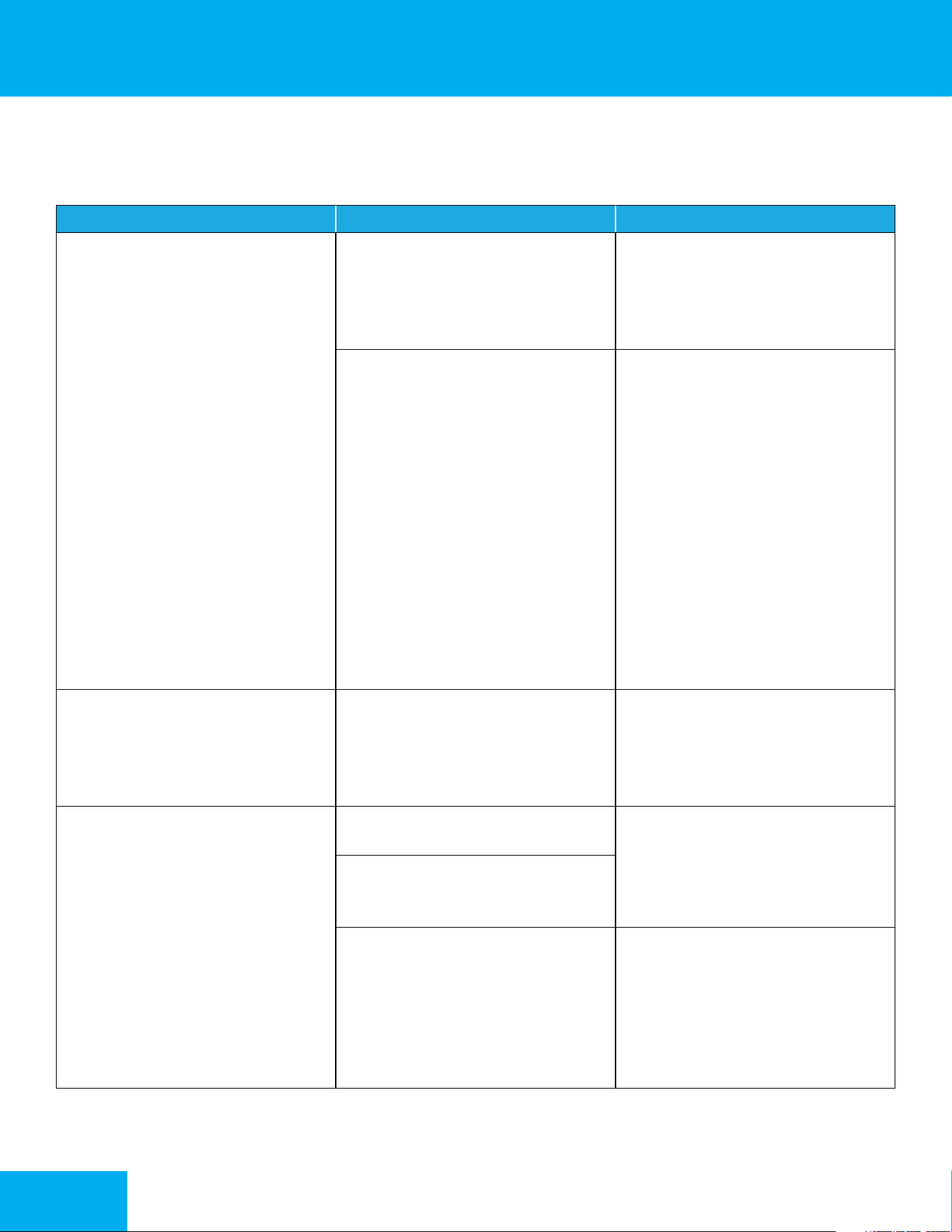
Error Possible Causes Solutions
System is not receiving power or
is not powering up.
Cable from power adapter is
loose or is unplugged.
1. Confirm that all cables are
connected correctly.
2. Confirm that the power
adapter is securely connected
to the back of the unit.
Cables are connected, but
system is not receiving sufficient
power.
1. Confirm that the system is
powered ON (LED indicators
on the front should be ON).
2. If the unit is connected
through a power bar or surge
protector, try bypassing the
bar and connecting the power
directly to the wall outlet.
3. Confirm that there is power at
the outlet.
4. Connecting the power cable
to another outlet.
5. Test the outlet with another
plugged device (such as a
phone charger).
Hard drive is full (0%) and the
unit is no longer recording.
Overwrite is not enabled.
Go to the Menu > HDD and
ensure that Overwrite is set to
Auto.
Mouse not detected by system.
Mouse cable is not firmly
connected to the system.
Firmly connect the mouse cable
to the USB Mouse port on the
front panel.
Mouse is not connected to the
system.
System needs to be reset.
Power off the system
(disconnect power cable). Firmly
connect a USB mouse to the
USB Mouse port on the front
panel of the system. Reconnect
the power cable to the DC 19V
port on the real panel.
If a problem occurs, you may be able to easily correct it yourself. The following table describes some common
issues and their most likely solutions. Please refer to the table before calling technical support.
Troubleshooting
50
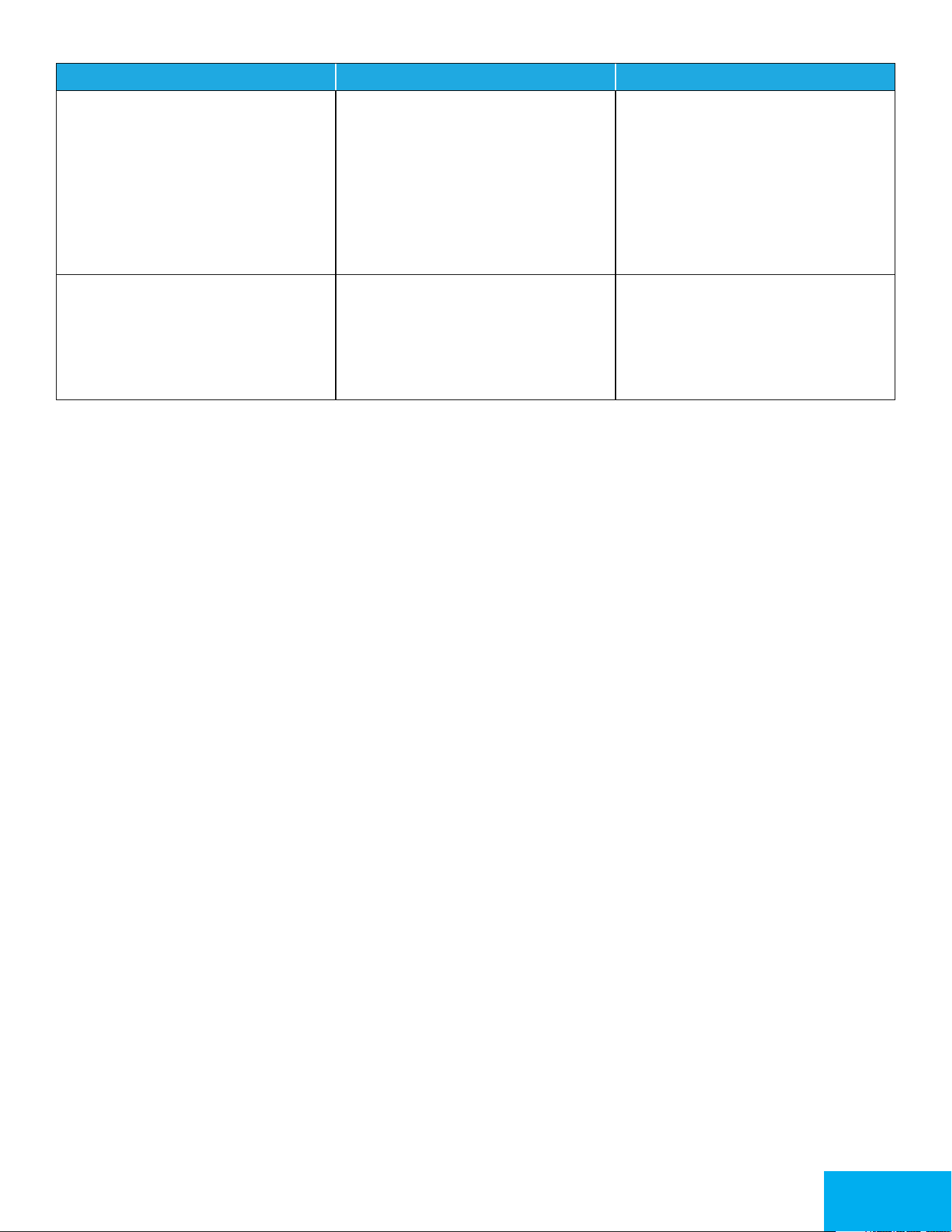
Error Possible Causes Solutions
There is no picture on selected
channels/camera picture is not
being displayed.
Camera cables are loose or have
become disconnected.
1. Check the camera video cable
and connections.
2. Disconnect and reconnect the
cable at the system and at
the camera.
3. Try moving the camera to
another channel or use
another cable.
The system beeps at startup. The beep at startup is normal.
51

User Information
Be sure to write down all the important information below and place it in a secure location.
General DVR Information
Username: _______________________________________________________________________
Password: ________________________________________________________________________
Model Number: ___________________________________________________________________
UID: _____________________________________________________________________________
NOTE: The UID is located on the support sticker on the top of your device.
52
Rev 210312
www.NightOwlSP.com
Please visit Support.NightOwlSP.com
Enter the Series listed on the Product
Support Sticker into the Search bar.
Access the support material needed.
For system manuals, troubleshooting guides, FAQs, video tutorials and more:
Why Call? Our Support Site Has it All!
NEED HELP?
1
2
3
iPhone, iPad, Mac and Mac OS X are registered trademarks of Apple Inc.
Windows, Windows XP, Windows Vista, Windows 7, Windows 8 and Windows
10 are registered trademarks of Microsoft Corporation in the
United States and/or other countries.