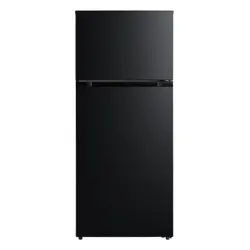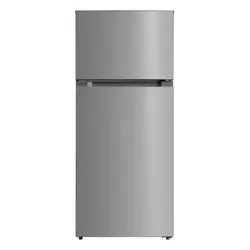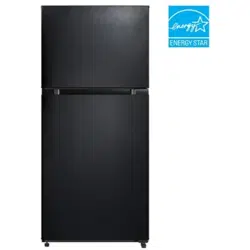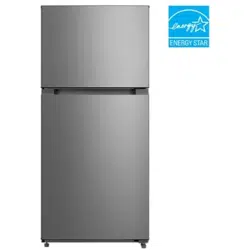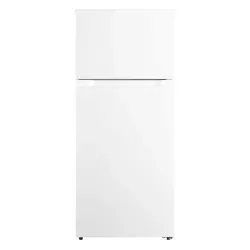
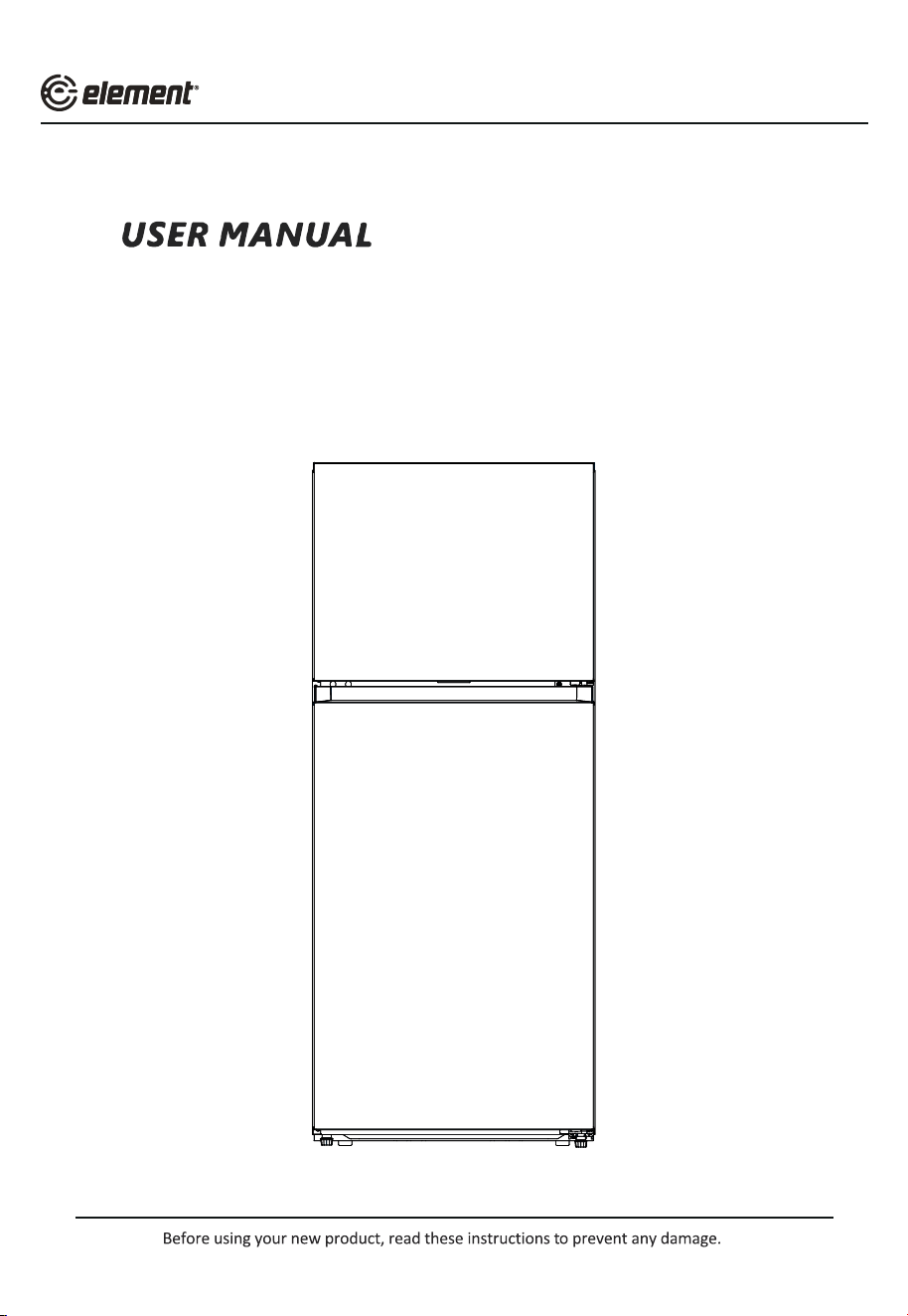
16.0 cu.ft. Top Freezer Refrigerator
ERT16CGDW
ERT16CGDS
ERT16CGDB
Product may vary. Refer to the actual product


E
CONTENTS
SAFETY INSTRUCTIONS
--------------------------------------- 04
SPECIFICATIONS
------------------------------------------------ 10
PRODUCT OVERVIEW
----------------------------------------- 11
PRODUCT INSTALLATION
------------------------------------ 12
OPERATION INSTRUCTIONS
--------------------------------- 19
CLEANING AND MAINTENANCE
---------------------------- 21
TROUBLESHOOTING
------------------------------------------- 23
WARRANTY
-------------------------------------------------------- 25
3
E
SAFETY INSTRUCTIONS
Intended Use
Before switching on the appliance for the first time read the following
safety hints!
This appliance is intended to be used in household and similar applications such
houses and by clients in hotels, motels and other residential type environments;
bed and breakfast type environments; catering and similar non-retail applications.
Explanation of symbols
Danger
This symbol indicates that there are dangers to the life and health of
Warning of electrical voltage
This symbol indicates that there is a danger to life and health of persons
due to voltage.
Warning
The signal word indicates a hazard with a medium level of risk which, if
not avoided, may result in death or serious injury.
Caution
The signal word indicates a hazard with a low degree of risk which, if not
avoided, may result in minor or moderate injury.
Attention
The signal word indicates important information (e.g. damage to
property), but not danger.
Observe instructions
This symbol indicates that a service technician should only operate and
maintain this appliance in accordance with the operating instructions.
Read these operating instructions carefully and attentively before using/
commissioning the unit and keep them in the immediate vicinity of the installation
site or unit for later use!
4
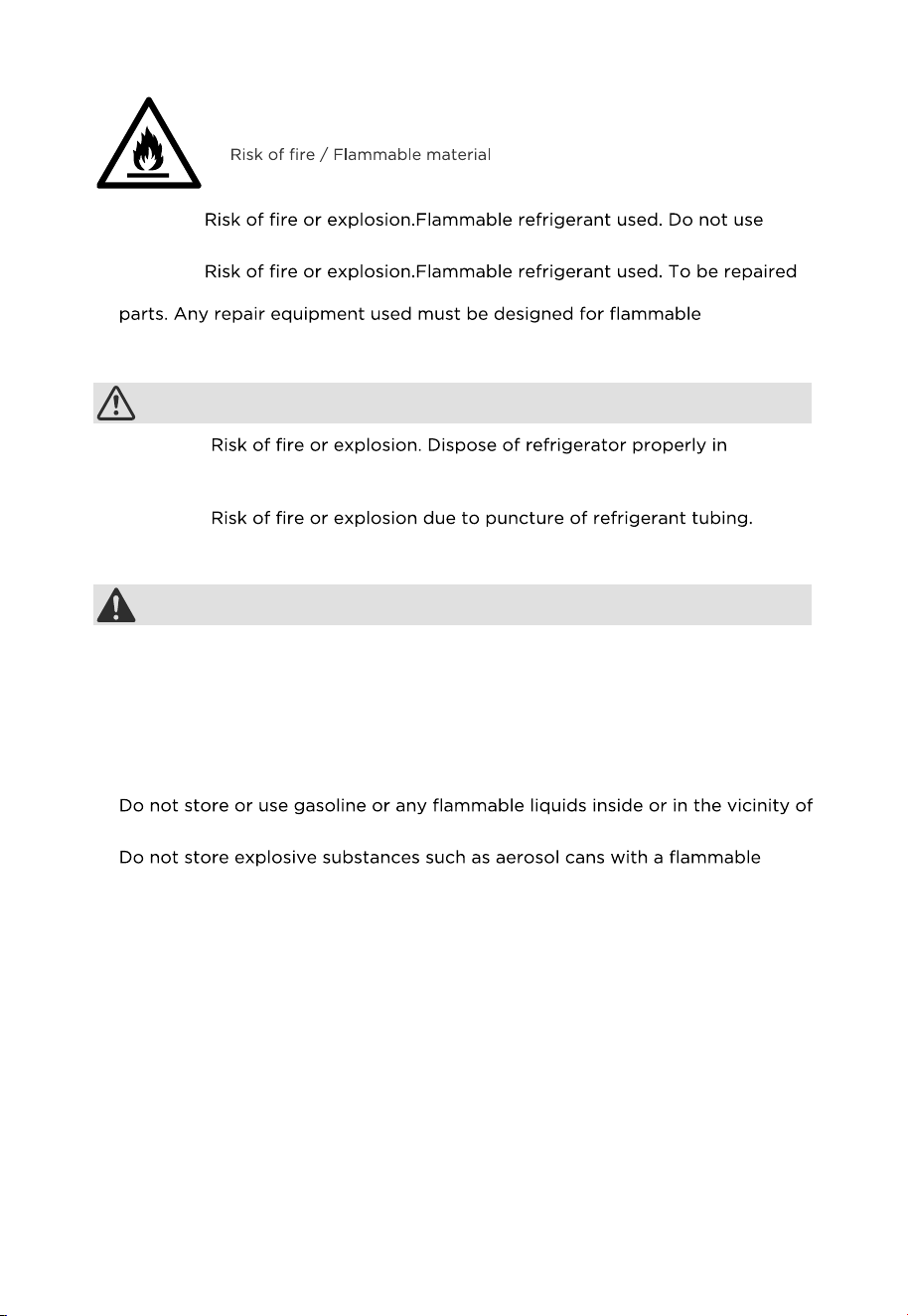
WARNING
• DANGER
mechanical devices to defrost refrigerator.Do not puncture refrigerant tubing.
• DANGER
only by trained service personnel. Use only manufacturer authorized service
refrigerants.
Follow all manufacturer repair instructions. Do not puncture refrigerant tubing.
CAUTION
• CAUTION
accordance with the applicable federal or local regulations. Flammable
refrigerant used.
• CAUTION
Follow handling instructions carefully. Flammable refrigerant used.
WARNING
General Safety
• Install in accordance with the manufacturer’s instructions.
• This product should not be recessed or built in an enclosed cabinet. It is
designed for freestanding installation only.
• WARNING - Keep ventilation openings, in the product, clear of obstruction.
• Do not install near any heat sources, such as radiators, heat registers, stoves,
other cooking appliances or in direct sunlight.
•
this refrigerator.
•
propellant in this appliance.
• Do not use electrical appliances inside the food storage compartments of the
appliance, unless they are of the type recommended by the manufacturer.
• Do not use mechanical devices or other means to accelerate the defrosting
process, other than those recommended by the manufacturer.
• This appliance is not intended for use by persons (including children) with
• Do not damage the refrigerator circuit.
reduced physical, sensory or mental capabilities, or lack of experience and
knowledge, unless they have been given supervision or instruction concerning
use of the appliance by a person responsible for their safety.
5
E
WARNING
Electrical Safety
Incorrect electrical installation or excessive mains voltage can lead to
electric shocks!
• Only connect your fridge-freezer to a properly installed earthed socket if the
label*.
• Do not use extension cords or ungrounded (two-pin) adapters.
• Make sure that all electrical cables outside the appliance are protected from
damage (e.g. by animals or sharp edges).
• Do not locate multiple portable socket outlets or portable power supplies at
the rear of the appliance.
•
• Avoid electrical overload. Disconnect the mains plug from the mains socket
before carrying out care, maintenance and repair work on the unit.
• Switch off the unit and disconnect the mains plug from the mains socket when
you are not using the unit.
• If the supply cord is damaged, it must be replaced by the manufacturer, its
• If the products are equipped with LEDs, do not remove the lighting cover and
LED yourself. Any replacement or maintenance of the LED lights is intended
This product is not recommended for use with sockets or main switch with the
A/GFCI function, otherwise it may cause false tripping.
1. It does not pose a safety risk when tripped.
2. If tripping persists, it is recommended to replace the sockets or main switch without
a/gfci function.
WARNING
Child Safety
• Children should be supervised to ensure that they do not play with the
appliance.
• Destroy carton, plastic bags, and any exterior wrapping material immediately
after the product is unpacked.
• Children should never use these items to play. Cartons covered with rugs,
bedspreads, plastic sheets or stretch wrap may become airtight chambers, and
can quickly cause suffocation.
• Remove all staples from the carton. Staples can cause severe cuts, and destroy
Risk of child entrapment. Before you throw away your old refrigerator
or freezer:
• Take off the doors.
• Leave the shelves in place so that children may not easily climb inside.
6
CAUTION
Risk of Injury and Damage!
• Never put frozen food in your mouth immediately after taking it out of the
freezer.
• Avoid prolonged skin contact with frozen food, ice and the pipes in the freezer
compartment.
•
• Do not store beer, drinks or other liquids in bottles or tightly closed containers
in the freezer compartment!
WARNING
State of California Proposition 65 Warnings:
•
CAUTION
To avoid food contamination, following the instructions below:
•
temperature in the appliance.
• Regularly clean surfaces that can come in contact with food and accessible
drainage systems.
•
connected to a water supply if water has not been drawn for 5 days. (Note1)(*)
• WARNING: Fill with potable water only.(*)
• WARNING: Connect to potable water supply only. (Suitable for ice making
machine)(*)
ATTENTION
(*): This feature varies depending on the model purchased. Plea
is applicable according to your product.
7
WARNING: This product can expose you to chemicals including styrene, which
is known to the State of California to cause cancer and Bisphenol A (BPA),
which is known to the State of California to cause birth defects or other
reproductive harm. For more information, go to www.P65Warnings.ca.gov.
E
Before the First Use
The packaging must be undamaged. Check the device for transport damage.
Do not connect a damaged device under any circumstances. In case of damage,
please contact the supplier.
Remove transport cover
The unit and parts of the interior are protected for transport. You can remove
all adhesive tapes on the right and left side of the device door as well as
any adhesive residues with cleaning solvent. Remove all adhesive tapes and
packaging parts from the interior of the device as well.
After transport, the device should stand for 12 hours to allow the coolant to
collect in the compressor. Non-observance could damage the compressor and
thus lead to failure of the device.
CAUTION
Risk of Damage!
Set up device
• The ambient temperature affects the power consumption and proper
functioning of the device. Therefore, the device should be placed in a well-
ventilated and dry room with an ambient temperature corresponding to the
climate class for which the device is designed.
• Do not place the device outdoors (e.g. balcony, terrace, garden shed, etc.).
Do not use sharp knives or pointed objects when opening the device.
Please observe the notes when setting up: “Tips for energy saving”
Remove the doors
•
unscrewed.
ATTENTION
The unscrewing of the unit doors may only be carried out by the customer service.
8
•
•
•
•
E
CAUTION
Notes for Cleaning
Disconnect the appliance from the power supply before cleaning.
•
cooling effect and energy saving.
• Check the door gasket regularly to make sure there is no debris. Clean the
door gasket with a soft cloth dampened with soapy water or diluted detergent.
• The interior of the product should be cleaned regularly to avoid odors.
• Turn the power off before cleaning the interior; remove all food, drinks,
shelves, drawers, etc.
• Use a soft cloth or sponge to clean the inside of the refrigerator, with two
tablespoons of baking soda and a quart of warm water. Then, rinse with water
and wipe clean. After cleaning, open the door and let it dry naturally before
turning on the power.
•
gaps or corners), we recommend to wipe them regularly with a soft rag, soft
brush, etc. and when necessary, with some tools (such as thin sticks) to ensure
no contaminants or bacteria accumulates in these areas.
• Do not use soap, detergent, scrub powder, spray cleaner, etc., as these may
cause odors inside the product or contaminate food.
• Clean the door tray, shelves and drawers with a soft cloth dampened with
soapy water or diluted detergent. Dry with a soft cloth or dry naturally.
• Wipe the outer surface with a soft cloth dampened with soapy water,
detergent, etc., and then wipe dry.
• Do not use hard brushes, scouring pads, wire brushes, abrasives (such as
toothpaste), organic solvents (such as alcohol, acetone, banana oil, etc.),
boiling water, acid or alkaline items, which may damage the fridge surface and
interior. Boiling water and organic solvents such as benzene may deform or
damage plastic parts.
• Do not rinse directly with water or other liquids during cleaning to avoid short
circuit or affect electrical insulation after immersion.
9

10
SPECIFICATIONS
Product model
Total Storage Volume
Rated Voltage
Rated Current
Overall Dimension (H x W x D)
ERT16CGD***
16 cu.ft.
115V~/60Hz
1.9A
64.92 in x 27.56 in x 28.78 in
11
PRODUCT OVERVIEW
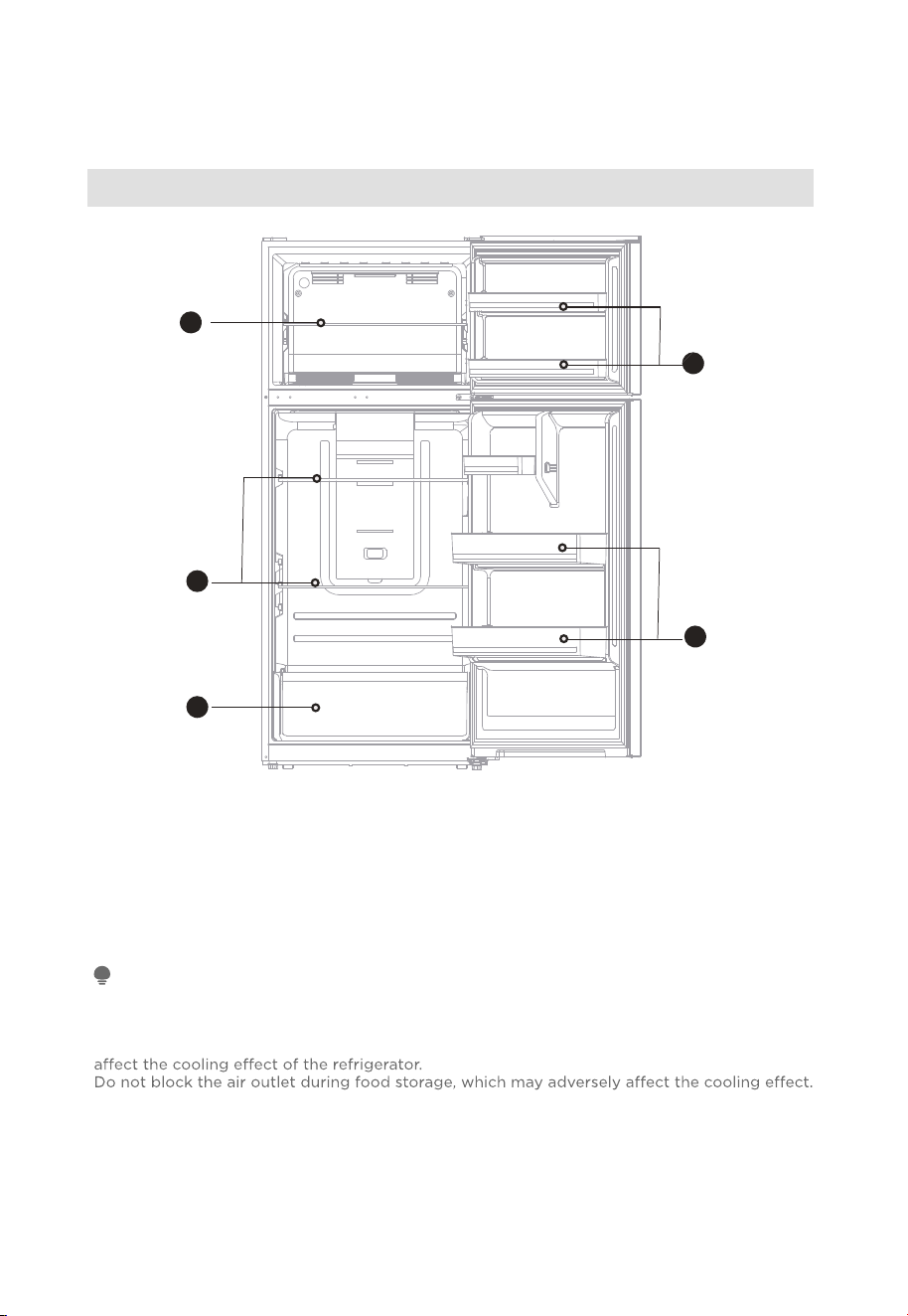
Names of Components
1
Freezer glass shelf
5
Fruit and vegetable box
2
Refrigerator glass shelf
Freezer door trays
3
Refrigerator door tray
4
ATTENTION
The picture above is only for reference. The actual configuration will depend on the physical
product or statement by the distributor.
When the refrigerator is powered on for the initial time, storing too much food may adversely
If the temperature in fridge compartment is cold, please adjust the switcher to the weaker
position. If the temperature in fridge compartment is not cold enough, please adjust the
switcher to the strong position.
1
2
3
4
5
12
PRODUCT INSTALLATION
Installation Instructions
Finding a suitable location
• This refrigerator is designed to be free standing only, and should not be
recessed or built-in.
• The refrigerator should be placed in a well-ventilated indoor place; the ground
shall be flat and sturdy.
• Keep away from heat and avoid direct sunlight. Do not place the refrigerator in
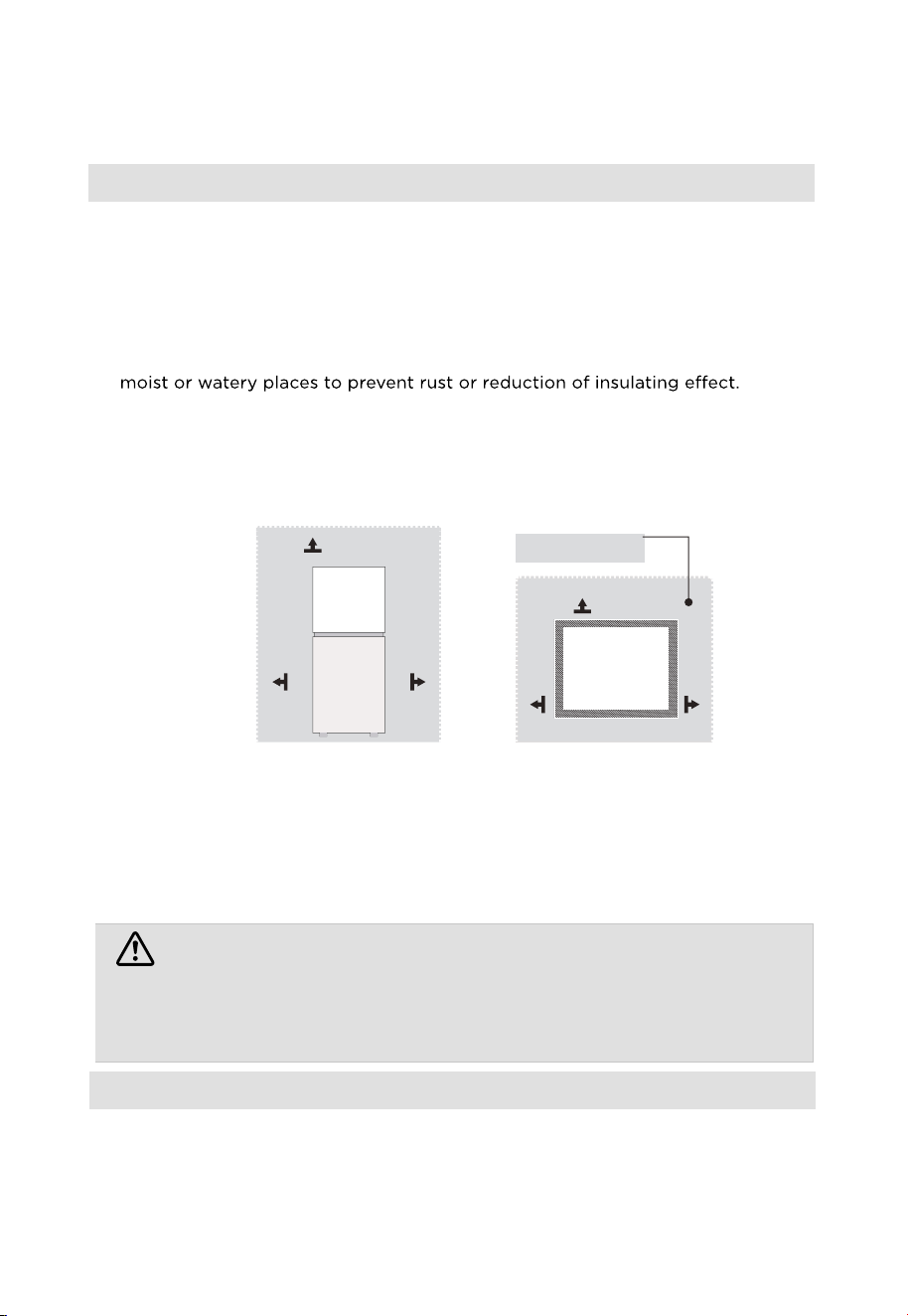
Dimensions and clearances
• Too small of a distance from adjacent items may result in the degradation of freezing
capability and increased electricity costs. Both sides of the refrigerator should be placed
against the wall with a free distance more than 100mm, and the refrigerator back against
the wall distance not more than 75 mm.
Providing a proper power supply
• Check your local power source. This refrigerator requires a AC115 V, 60 Hz
power supply.
• Use a receptacle that accepts the grounding prong. The power cord is
equipped with a 3-prong (grounding) plug which mates with a standard 3-prong
(grounding) wall outlet to minimize the possibility of electric shock hazard
from this refrigerator.
CAUTION
The refrigerator should always be plugged into its own individual electrical outlet
which has a voltage rating that matches the rating plate.
Never unplug your refrigerator by pulling on the power cord. Always grip the plug
firmly and pull straight out from the outlet.
Start to Use
• The refrigerator shall stay for 2 hours before connecting power when it is firstly
started.
• The refrigerator shall run 2 to 3 hours before loading fresh or frozen foods; the
refrigerator shall run for more than 4 hours in summer in advance considering
that the ambient temperature is high.
>100mm
>100mm
>100mm
>100mm
>100mm
≤75mmm
Top View
Required space
for air circulation
13
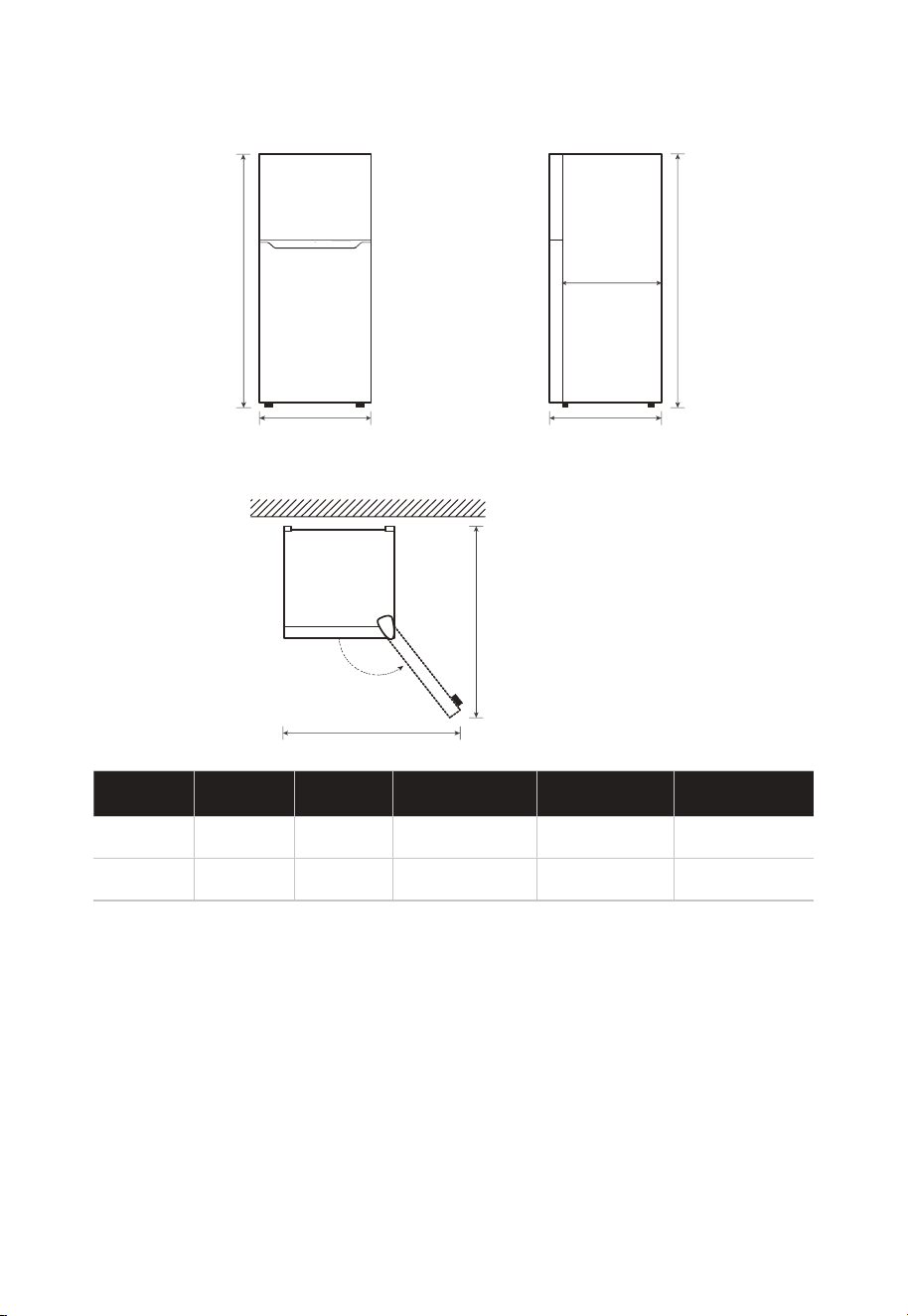
Space requirement diagram (when the door is open and when the door is closed)
B
A
C
D
E
135 °
C1
C
Width
Overall
Height
Depth
Depth Only
Cabinet
Door Open
135
o
Width
Doors Open
135
o
Depth
A B C C1 D E
700 1649 731 650 1085 1310
Notice: All dimensions in mm
B
14
Door Right-Left Change
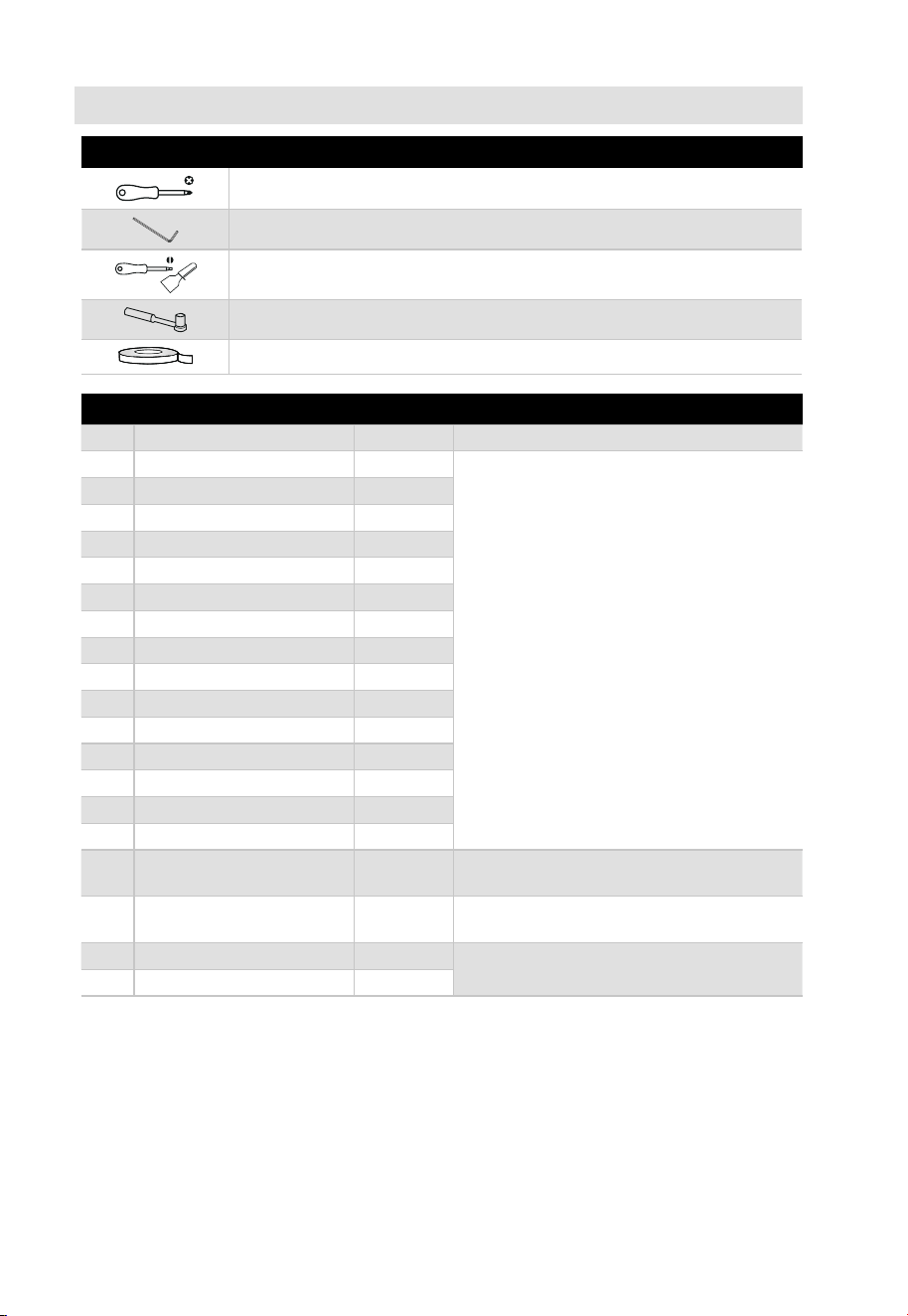
List of tools to be provided by the user
Cross screwdriver
Allen wrench
Putty knife, Thin-blade screwdriver
5/16” socket and ratchet
Masking tape
Parts to be used for door reverse
SN Parts Quantity Notes
1 Upper hinge 1
Pre-installed on the box and still needs
to be used when changing the door
2 Upper hinge cover 1
3 Upper hinge shaft 1
4 Upper hinge screw 3
5 Hole cover 1
6 Middle hinge screw 2
7 Middle hinge 1
8 Hole plug 2
9 Adjustable foot 1
10 2
11 1
12 Lower hinge screw 3
13 Lower hinge 1
14 Stopper 2
15 Stopper screw 2
16 Right door self-locking 2
Pre-installed on the door body, removed
when changing the door, and retained
17 Left door self-locking 2
Put it in the accessory bag and use it
when changing the door
18 Screw self-locking 2
Pre-installed on the door and still needs
to be used when changing the door
19 Hole plug 1
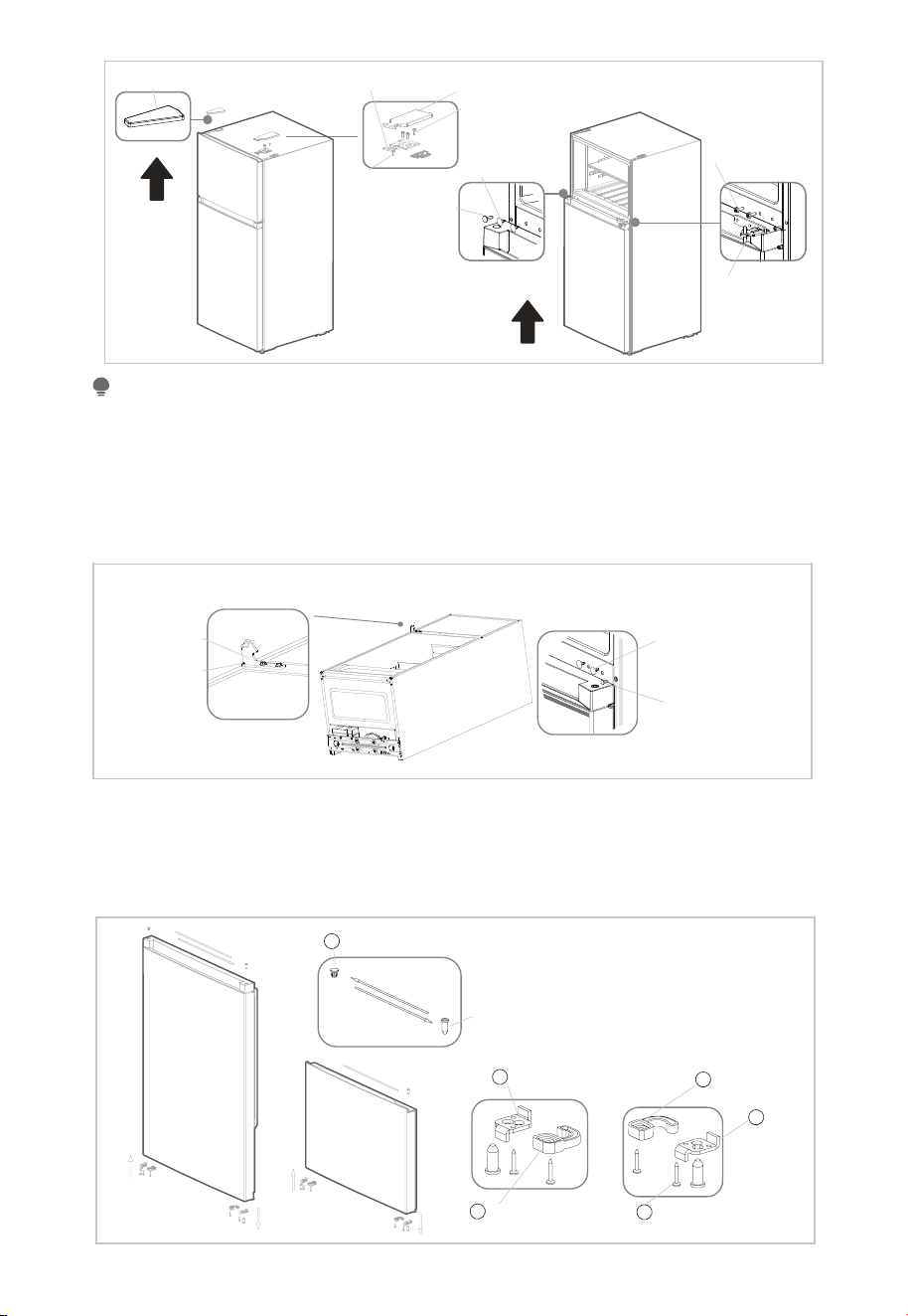
Step
1. Unplug your refrigerator and remove all food from refrigerator.
2. Remove the top hinge cover, screws and upper hinge on the top of the cabinet, and
the cover plate on the left; take out the freezer door u pwards.
3. Unscrew the hinge screws, remove the middle hinge, remove the plug pins, and take
out the refrigeration door upwards.
Center beam screw
Center beam screw cap
15
ATTENTION
Images show a refrigerator that opens on the left side. Your refrigerator may open on the
right side.
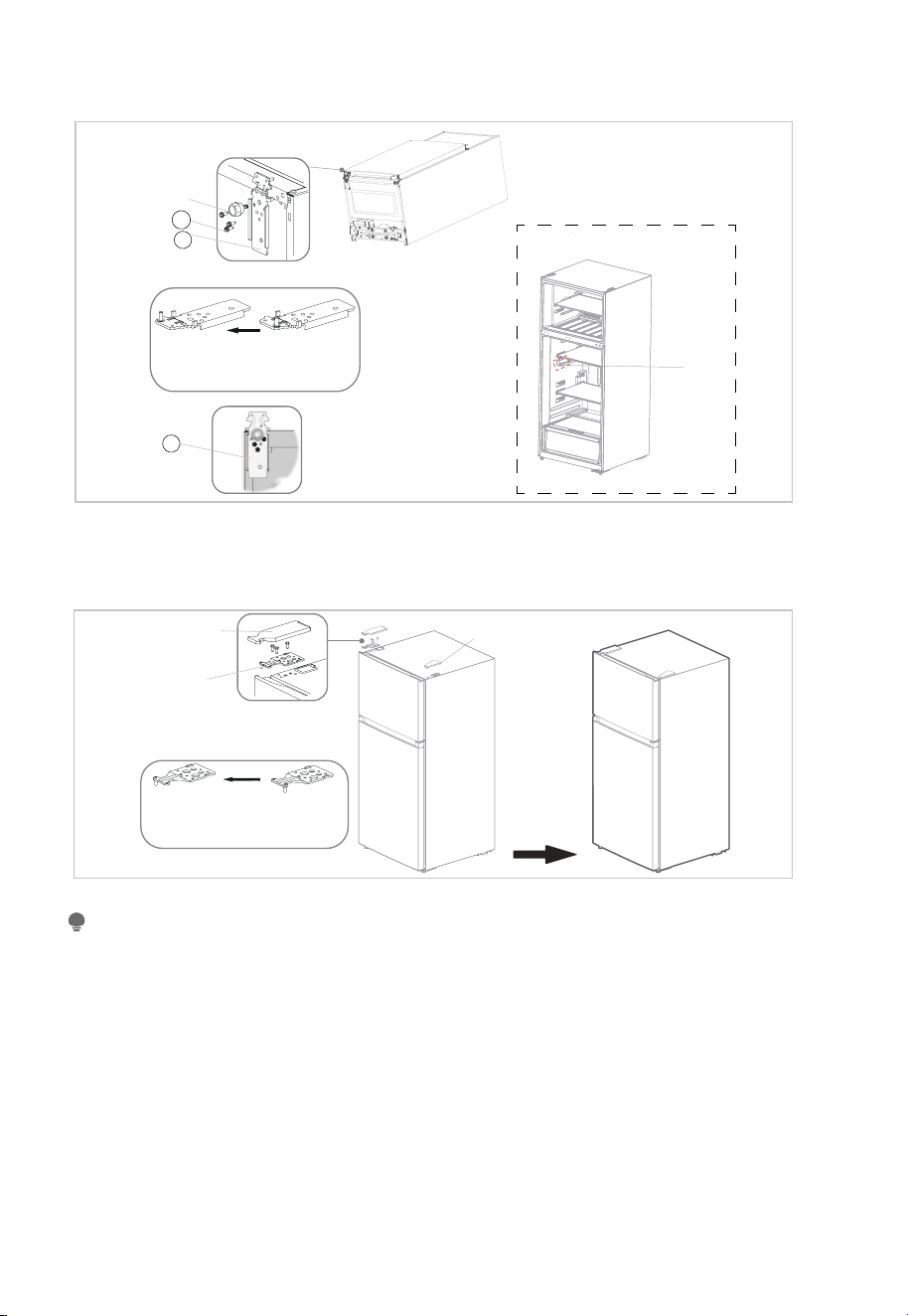
4. Put the refrigerator down, unscrew the lower hinge screw and adjusting foot, remove
the lower hinge, remove the lower hinge shaft and install it into the shaft hole on the
other side of the hinge.
5. Install the middle hinge to the left side of the middle beam and the plug pin to the right
side of the middle beam..
6. Unscrew and remove the shaft sleeves, stopper and right door self-locking screws
of the two door bodies, take out the left door self-locking from the accessory bag,
and install it to the left corner of the door body together with the stopper and shaft
sleeves. Take out the hole plug and shaft sleeve on the upper part of the refrigeration
door and adjust their positions before installing them into the door body. Take out
the shaft sleeve on the freezing door and install it on the other side.
①
②
③
④
⑤
⑥
⑦
⑧
⑩
Upper hinge
Upper hinge cover
Upper hinge
shaft
Upper hinge screw
Hole cover
Middle hinge
screw
Middle hinge
Hole plug
Center beam
screw
⑧
⑩
Center beam screw
Hole plug
⑥
Middle hinge
screw
⑦Middle hinge
Hole plug
Right door
self-locking
Left door
self-locking
Shaft sleeve
Stopper
Screw self-locking
14
15
16
17
18
19
Stopper screw
16
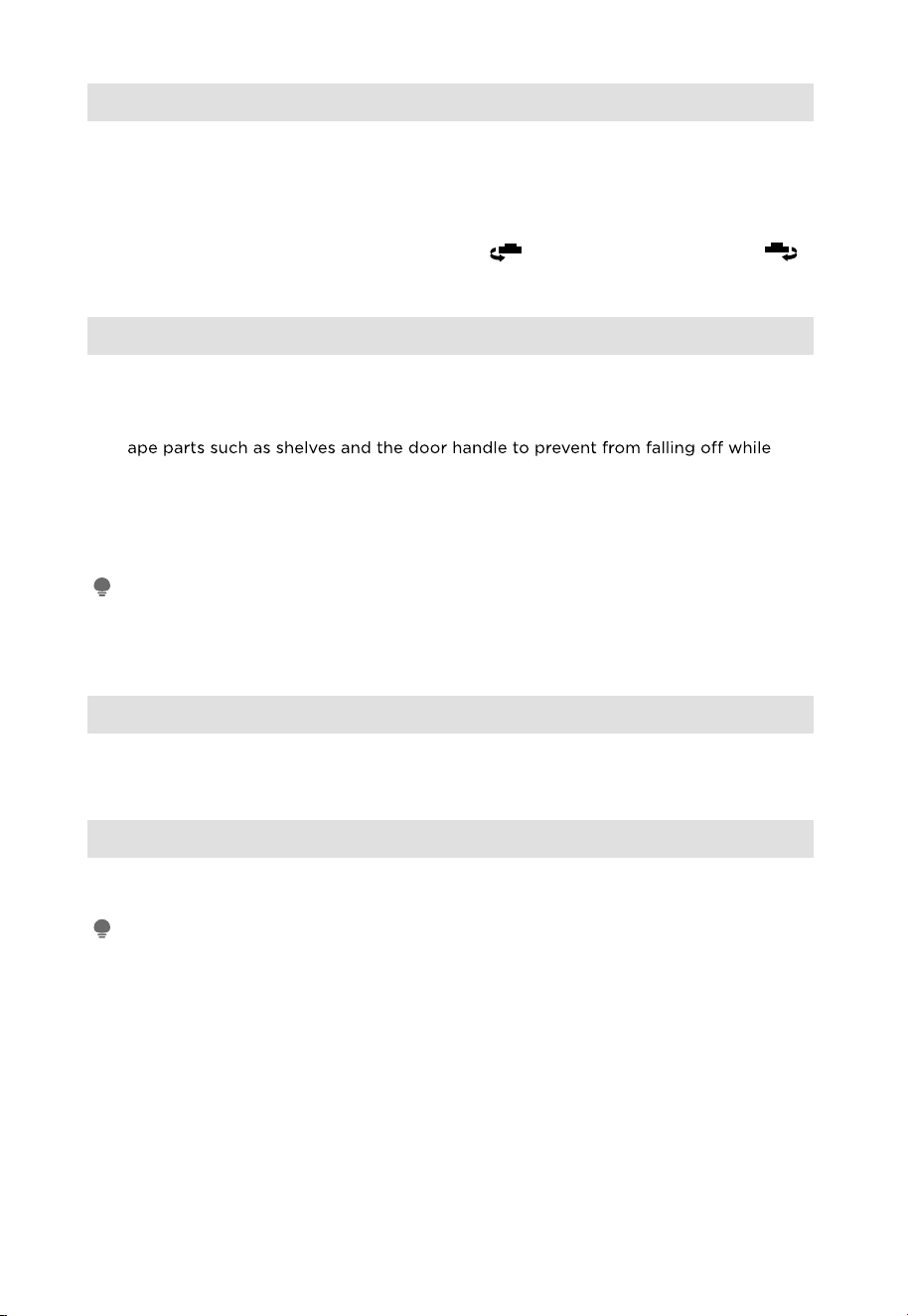
7. Install the refrigerator door on the middle hinge, install the lower hinge on the left side
of the refrigerator and tighten the screws, and install two adjusting feet to raise the
refrigerator
8. Install the freezing door on the middle hinge, remove the upper hinge shaft and
install it into the shaft hole on the other side of the hinge, install the upper hinge and
tighten the screws, and install the upper hinge cover and the right hole cover.
9. The door change is completed.
Remove the upper hinge shaft
and install it into the shaft hole
on the other side of the hinge.
ATTENTION
The picture above is only for reference. The actual configuration will depend on the physical
product or statement by the distributor.
①
Upper hinge
②
Upper hinge cover
⑤
Hole cover
Adjusting foot
Lower hinge screw
Lower hinge
Remove the lower hinge, remove
the lower hinge shaft and install it
into the shaft hole on the other side
of the hinge
⑨
12
13
Can not
place shelf
Lower hinge
13
17
Leveling Feet
To avoid vibration, the unit must be leveled.
If required, adjust the leveling screws to compensate for the uneven floor.
The front should be slightly higher than the rear to aid in door closing.
Leveling screws can be turned easily by tipping the cabinet slightly.
Turn the leveling screws counterclockwise
to raise the unit, clockwise to
lower it.
Moving the Appliance
1.
Remove all food from inside the appliance.
2. Pull the power plug out, insert and fix it into the power plug hook at the rear or on
top of the appliance.
3. T
moving the appliance.
4. Move the appliance with more than two people carefully. When transporting the
appliance over a long distance, keep the appliance upright.
5. After installing the appliance, connect the power plug into a socket outlet to switch
on the appliance.
ATTENTION
Precautions before operation:
Before making changes the refrigerator must be disconnected from power.
Precautions should be taken to prevent any personal injury.
Changing the Light
• Any replacement or maintenance of the LED lights is in tended to be made by
the manufacturer, its service agent or similar qualified person.
Connecting the Appliance
After installing the appliance, connect the power plug into a socket outlet.
ATTENTION
After connecting the power supply cord (or plug) to the outlet, wait 2 or 3 hours before you
put food into the appliance. If you add food before the appliance has cooled completely, your
food may spoil.
•
•
•
•
•
•
N
18
Tips for Energy Saving
• Do not place the appliance near cookers, radiators or other heat sources. If the
ambient temperature is high, the compressor will run more frequently and for
longer, resulting in increased energy consumption.
•
of the appliance and at the back of the appliance. Never cover ventilation openings.
• See the spacing dimensions in the chapter “Installation”.
• The arrangement of drawers, shelves and racks as shown in the illustration offers the
and shelves should remain in the appliance to keep the temperature stable
and save energy.
• To obtain a larger storage space (e.g. for large refrigerated/frozen goods), the
middle drawers can be removed. The top and bottom drawers and shelves should
be removed last if necessary.
•
use. Therefore, avoid empty or half-empty compartments.
• Allow warm food to cool before placing it in the refrigerator/freezer. Food that has
• Allow frozen food to defrost in the refrigerator. The coldness of the frozen food
reduces the energy consumption in the refrigerator compartment and thus increases
•
• The door seals of your refrigerator must be perfectly intact so that the doors close
properly and energy consumption is not increased unnecessarily.
EN
19
TEMP
ZONE
COLD
SETTING
COLDEST
3 sec - Unlock
SUPER
COOL
LED4
LED3
LED2
LED1
OPERATION INSTRUCTIONS
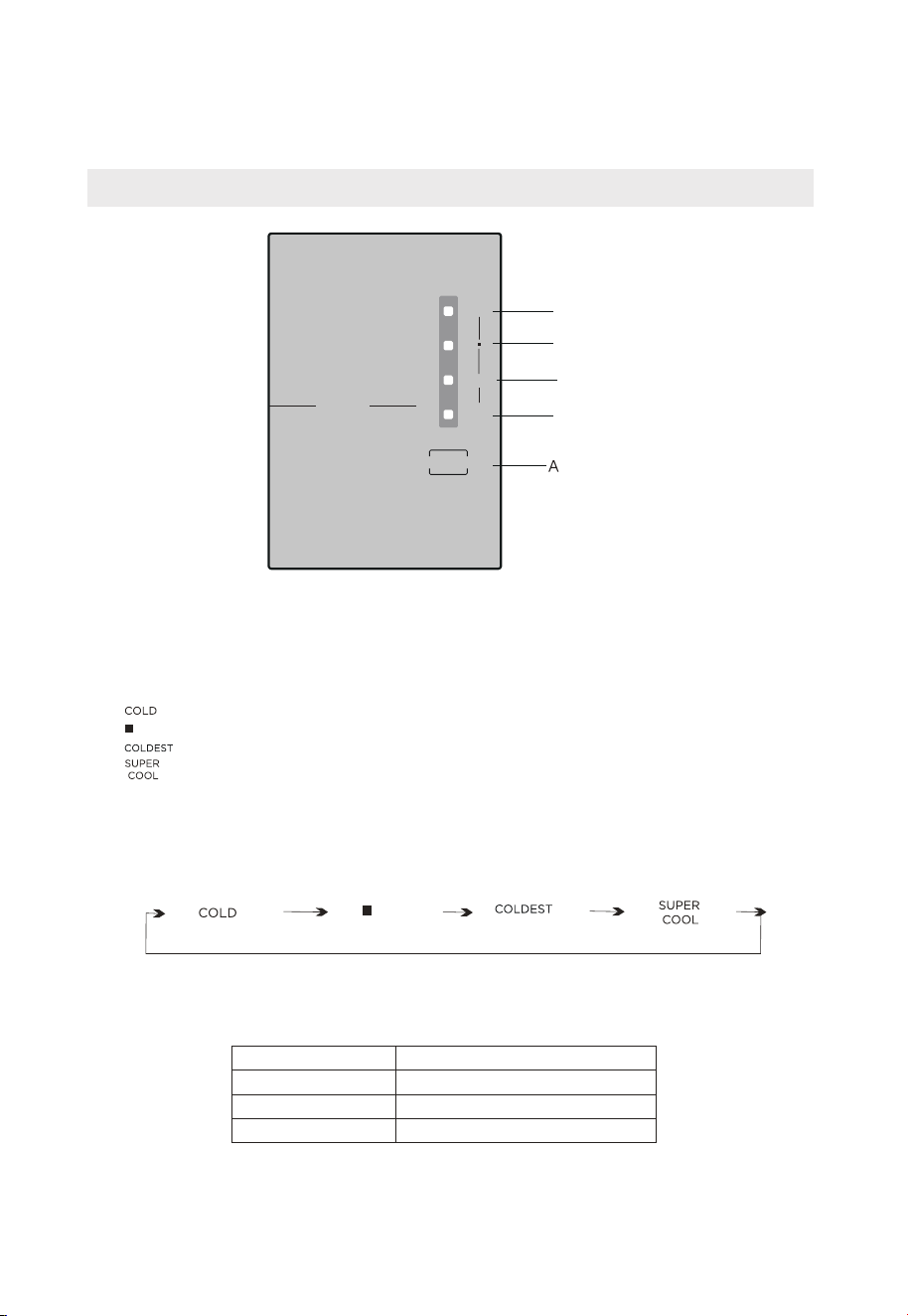
Control Panel
5)Lock/Unlock
When the temperature control panel is in lock state, press and hold the temperature setting key
for 3 seconds for unlocking the panel, all LED lights will blink for 2 seconds when the panel is unlocked.
When the temperature control panel is in unlock state, if there is no operation on control panel
within 15 seconds, it will enter into lock state automatically.
(The picture above is only for reference. The actual configuration will depend on the physical product or
statement by the distributor)
4)Display
when the refrigerator starts up for first time, the display screen will shine for 3 seconds, and then the
refrigerator runs according to coldest. In case of a failure, the corresponding LED lights blink. In case of no
failures, it shows the temperature setting of refrigerator.
Refrigerator temperature sensor fault
Freezing frost sensor faults
Ambient temperature fault
LED1 / LED2 flashing
LED1 / LED3 flashing
LED1 / LED4 flashing
Fault Code Fault Description
3)Temperature setting
Each time the temperature setting button A is pressed once,the temperature setting changes one
time. After the temperature setting has been completed, the refrigerator will run according to the
set value after 15s.
The shift regulation is:
1)Button
A.Temperature setting button of refrigerator compartment
2)Display screen
①LED4:
②LED3:
③LED2:
④LED1:
(normal)
(normal)
20
Tips on Storing Food
Freezer compartment
• The freezer is designated for the storage of food frozen at very low temperature,
long-term storage of frozen food, and for the production of ice.
• Only use the shelves in the door of the freezer to store frozen food, not for storing
hot food designated for freezing.
• Do not put fresh and frozen food next to each other. The frozen food may thaw.
• When freezing fresh food (such as meat, fish or chopped meat), cut them into parts
that can be used at the same time.
• Storing frozen food: instructions are usually stated on the packages, which must be
followed. If there is no information on the packaging, food should not be stored for
longer than three months from the date of purchase.
• When purchasing frozen food, make sure that it was frozen at a suitable temperature
and that the packaging is not damaged.
• Frozen food should be kept in suitable packages to retain the quality and should be
returned to the freezer compartment as soon as possible.
• If a package of frozen food shows moisture or abnormal bulging, it is probable that
it was stored at the wrong temperature and the content is spoiled.
• The storage period for frozen food depends on the room temperature, the
thermostat setting, the frequency of opening the door of the freezer, the type of
food and the time of transporting the product from the shop to the household.
Always foll
ow the instructions printed on the packaging and never exceed the
maximum storage time stated on the package.
Refrigerator compartment
• To reduce moisture and subsequent ice build-up, never put liquid into the
refrigerator in unsealed containers. Frost tends to concentrate in the coolest parts
of the evaporator. Storing uncovered liquids results in a more frequent need for
defrosting.
• Never put warm foods in the refrigerator. These should first cool down at room
temperature and then be placed so as to ensure adequate air circulation in the
refrigerator.
• Food or food containers should not touch the back wall of the refrigerator because
they could freeze to the wall. Do not keep regularly opening the door of the
refrigerator.
• Meat and clean fish (packed in a package or plastic foil) can be placed in the
refrigerator, which can be used in 1–2 days.
• Fruit and vegetables without packaging can be placed in the part designated for
fresh fruit and vegetables.
ATTENTION
The optimal temperature setting of each compartment depends on the ambient temperature.
Above optimal temperature is based on the ambient temperature of 77°F.
Storage of too much food during operation after the initial connection to power may
When store beverages at coldest setting, inside fruits and vegetables are at risk of freezing,
please set on towards less cooling if coldest setting is very cool.
,
21
CLEANING AND MAINTENANCE
Defrosting
• The refrigerator is made based on the air-cooling principle and thus has
automatic defrosting function. Frost formed due to change of season or
temperature may also be manually removed by disconnection of the appliance
from power supply or by wiping with a dry towel.
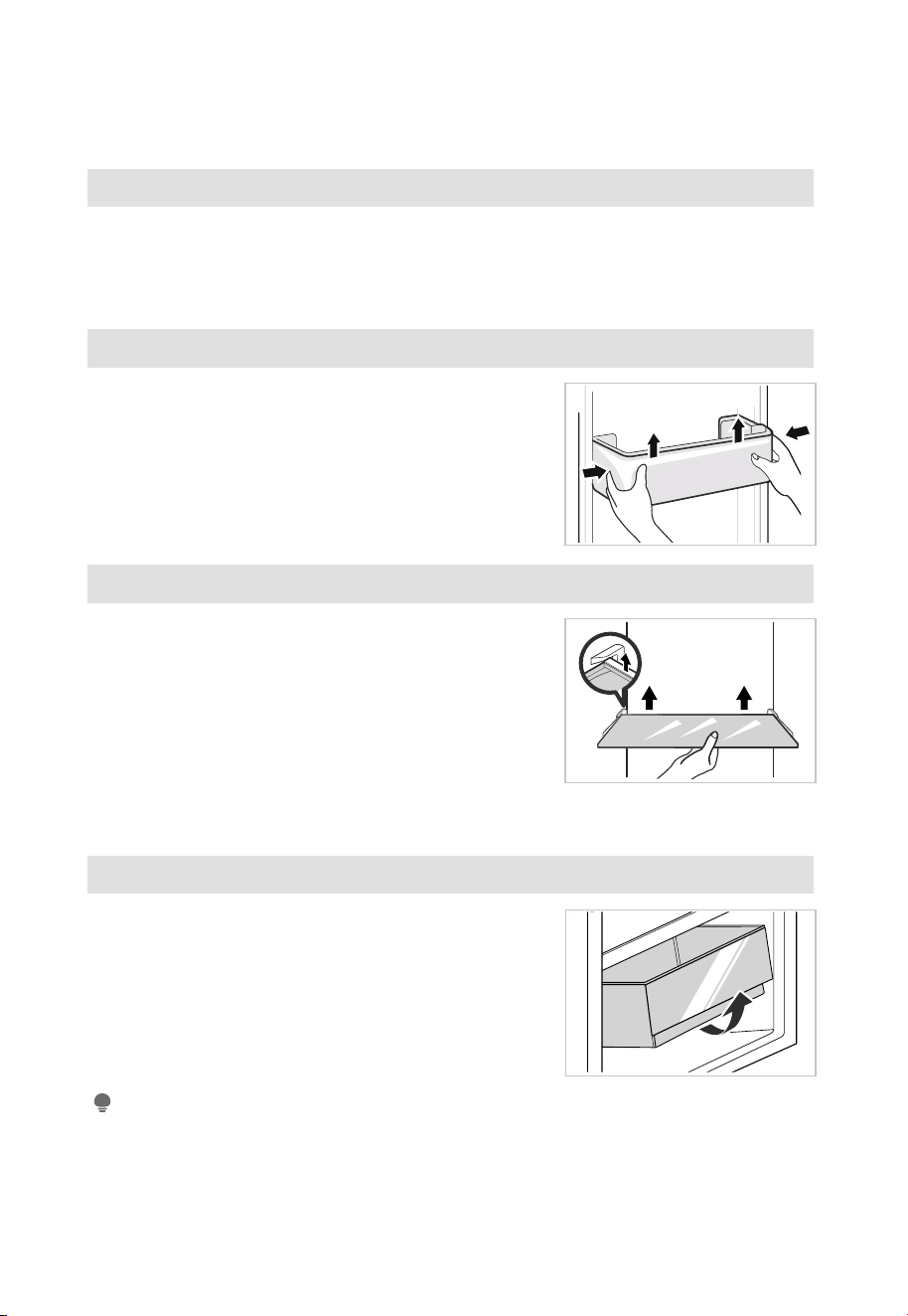
Cleaning of Door Tray
• According to the direction arrow in the figure
below, use both hands to squeeze the tray, and
push it upward, then you can take it out.
• After washing the tray having been taken
out, you can adjust its installing height in
accordance with your requirement.
Cleaning of Glass Shelf
• As the innermost part of the refrigerator liner
where contacting the shelves has a backstop,
you shall raise the shelves upward, then you can
be able to take it out.
• Adjust or clean the shelves according to your
requirement.
Cleaning the Fruit and Vegetable Box
Remove the contents of the drawer. Hold the
handle of the vegetable drawer and pull it out
completely until it stops.
Lift the vegetable drawer up and remove it by
pulling it out.
ATTENTION
Soft towels or sponge dipped in water and non-corrosive neutral detergents are suggested
for cleaning. The freezer of shall be finally cleaned with clean water and dry cloth. Open the
door for natural drying before the power is turned on. Do not use hard brushes, clean steel
balls, wire brushes, abrasives, such as toothpastes, organic solvents (such as alcohol, acetone,
banana oil, etc.), boiling water, acid or alkaline items clean refrigerator considering that this
may damage the fridge surface and interior.
•
•
22
Stop Using
Power failure:
In case of power failure, even if it is in summer, foods inside the appliance can be
kept for several hours; during the power failure, the times of door opening shall be
reduced, and no more fresh food shall be put into the appliance.
Long-time nonuse:
The appliance shall be unplugged and then cleaned; then the doors are left open
to prevent odor.
Moving:
Before the refrigerator is moved, take all objects inside out, fix the glass partitions,
vegetable holder, freezing chamber drawers and etc. with tape, and tighten
the leveling feet; close the doors and seal them with tape. During moving, the
appliance shall not be laid upside down or horizontally, or be vibrated; the
inclination during movement shall be no more than 45°.
ATTENTION
The appliance shall run continuously once it is started. Generally, the operation of the
appliance shall not be interrupted; otherwise the service life may be impaired.
Foods can be preserved for a couple of hours even in summer in case of power failure; it is
recommended to reduce the frequency of opening door.
23
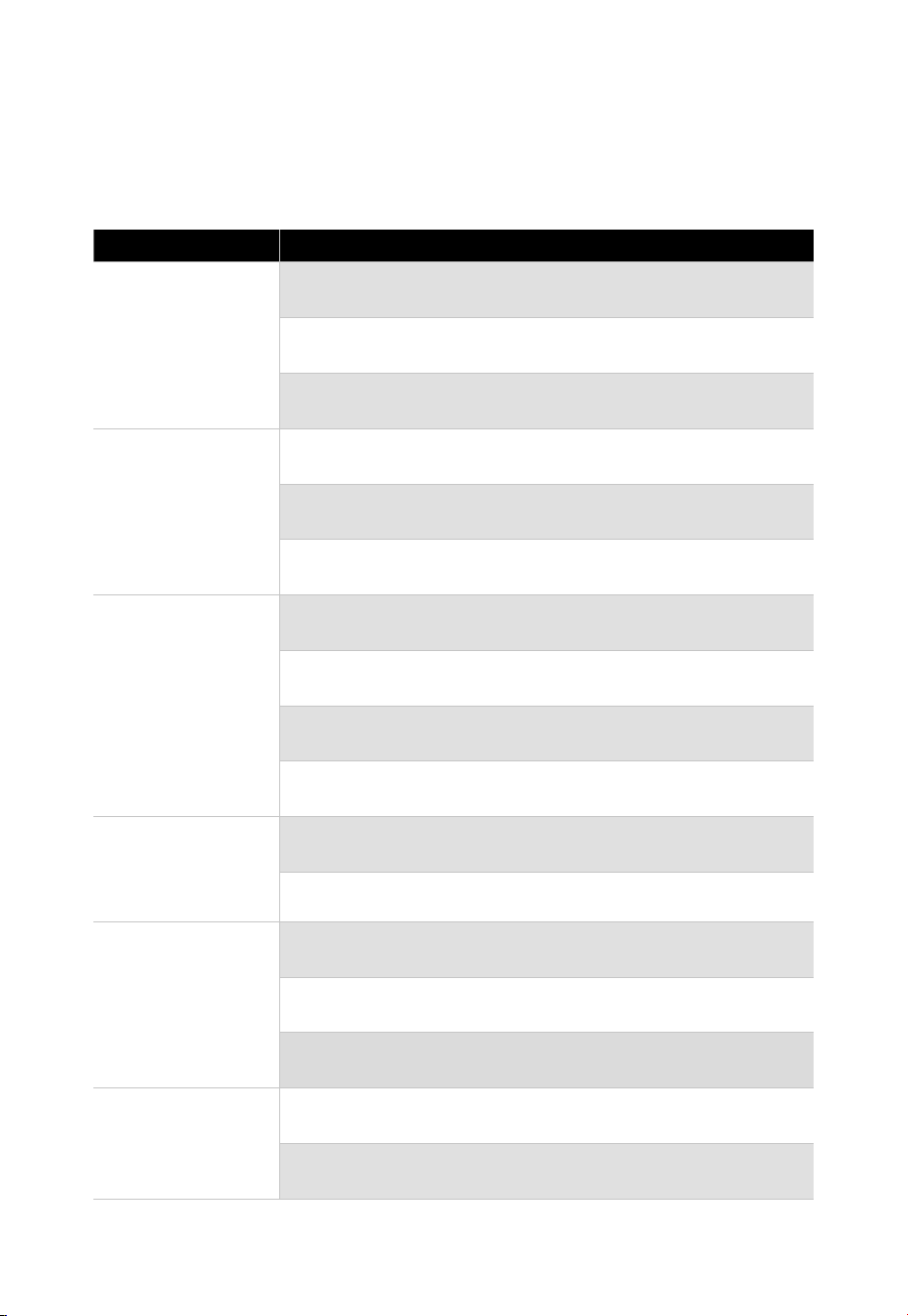
TROUBLESHOOTING
The following simple issues can be handled by the user. Please call the after-sale
service department if the issues are not solved.
Problem Possible reason
Failed operation
• Check whether the appliance is connected to power or
whether the plug is in well contact
• Check whether the voltage is too low
• Check whether there is a power failure or partial circuits have
tripped
Odor
• Odorous food shall be tightly wrapped
• Check whether there is any rotten food
• Clean the inside of the refrigerator
Long-time operation
of the compressor
• Long operation of the refrigerator is normal in summer
• When the ambient temperature is high it is not suggestible
having too much food in the appliance at the same time
• Food shall get cool before being put into the appliance
• The doors are opened too frequently
Light fails to get lit
• Check whether the refrigerator is connected to power supply
and whether the illuminating light is damaged
• Have the light replaced by a specialist
Door can not be
properly closed
• The door is stuck by food packages
• Too much food is placed in the refrigerator
• The refrigerator is tilted
Loud noises
• Check whether the floor is level and whether the refrigerator
is placed stably
• Check whether accessories are placed at proper locations
24
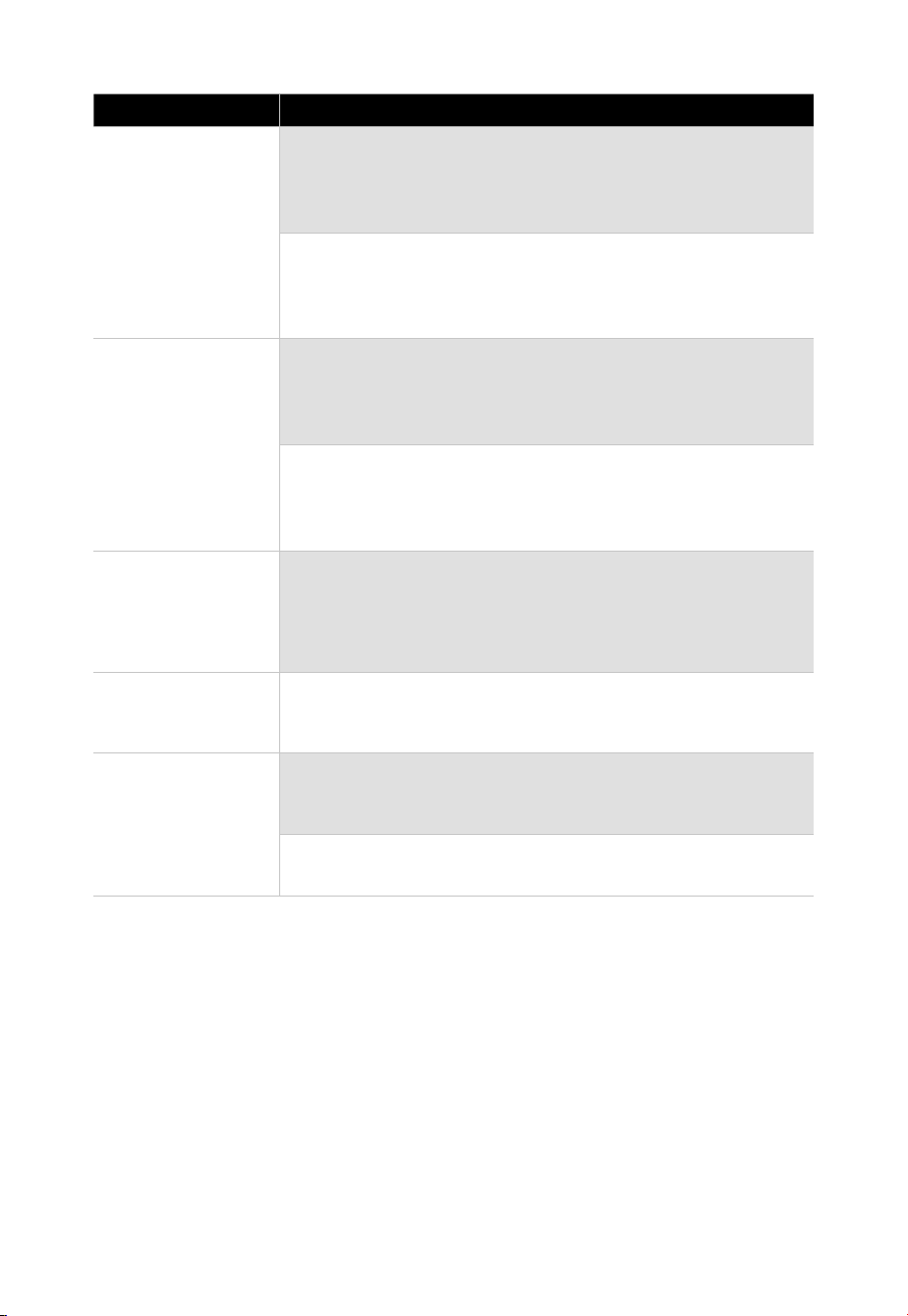
Problem Possible reason
Door seal fails to be
tight
• Remove foreign matters on the door seal
• Heat the door seal and then cool it for restoration (or blow it
with an electrical drier or use a hot towel for heating)
Water pan overflows
• There is too much food in the chamber or food stored
contains too much water, resulting in heavy defrosting
• The doors are not closed properly, resulting in frosting due to
entry of air and increased water due to defrosting
Hot housing
• Heat dissipation of the built-in condenser via the housing,
which is normal when housing becomes hot due to high
ambient temperature, storage of too much food or shutdown
of the compressor is shut down, provide sound ventilation to
facilitate heat dissipation
Surface
condensation
• Condensation on the exterior surface and door seals of the
refrigerator is normal when the ambient humidity is too high.
Just wipe the condensate with a clean towel
Abnormal noise
• Buzz: The compressor may produce buzzes during operation,
and the buzzes are loud particularly upon start or stop. This is
normal
• Creak: Refrigerant flowing inside of the appliance may
produce creak, which is normal
25
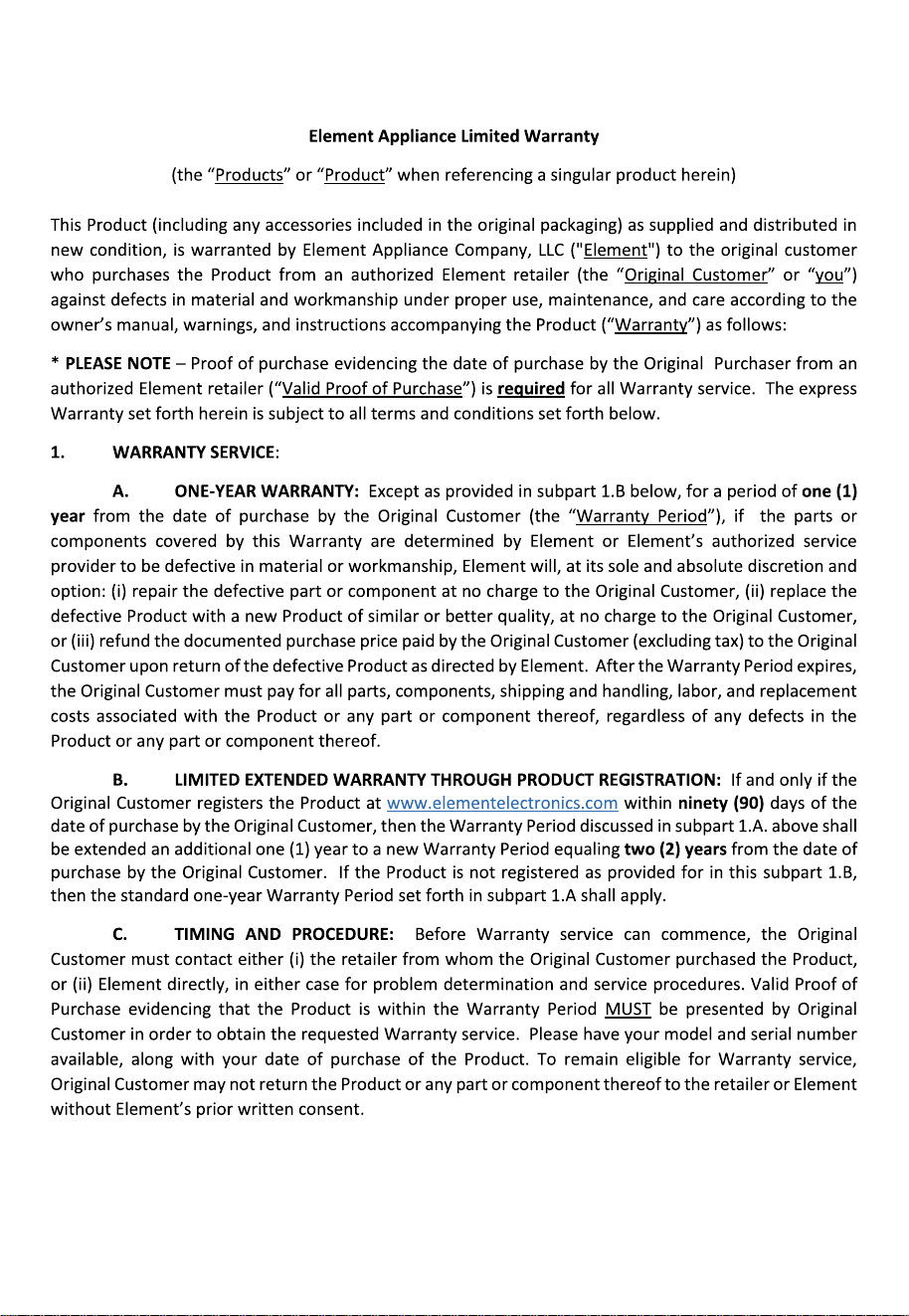
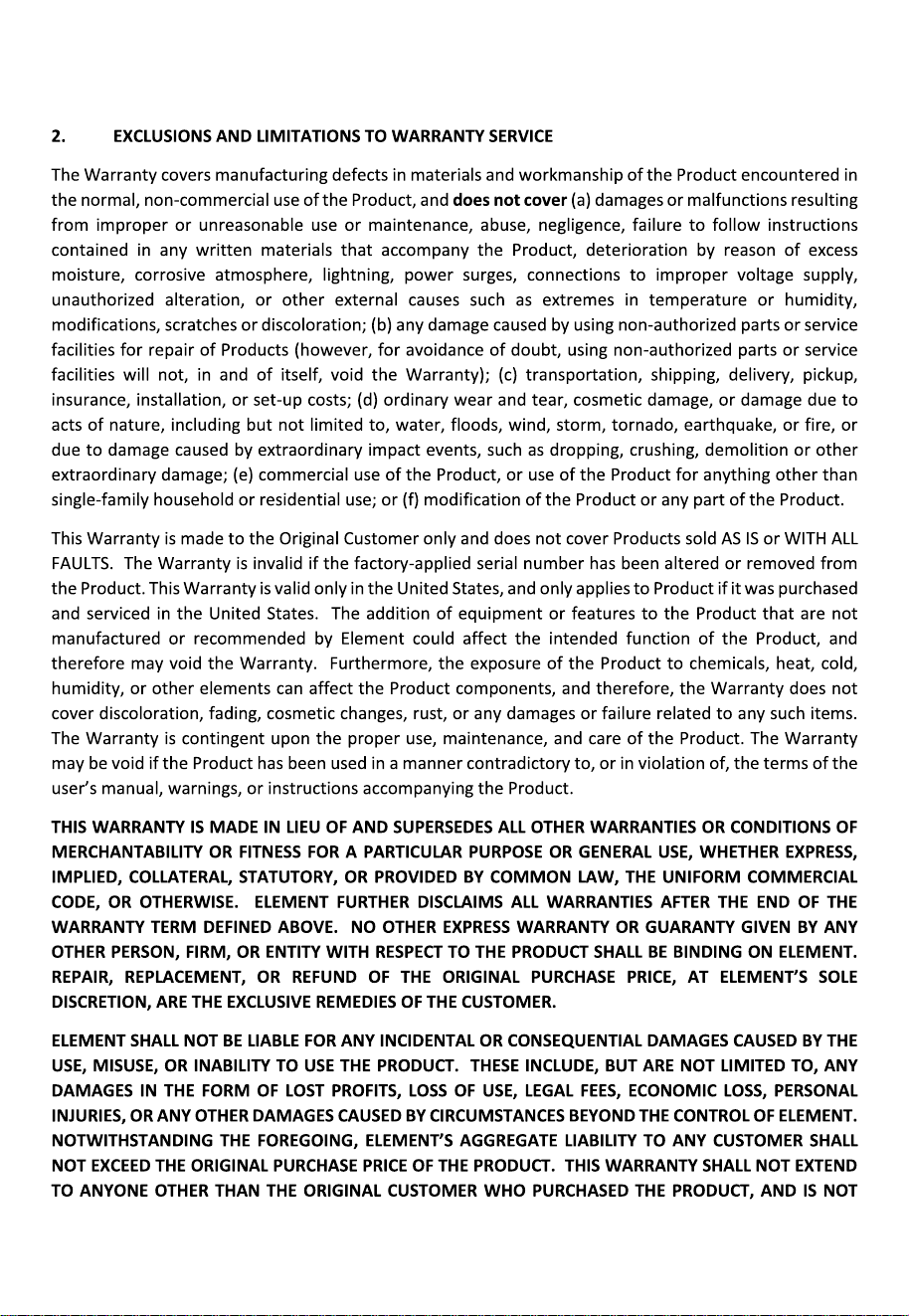
WARRANTY
26
27