
Instruction Manual
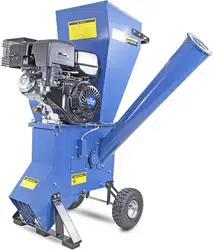
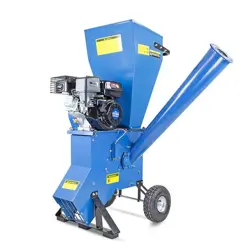
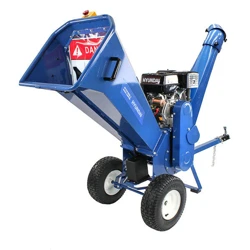
PETROL WOOD CHIPPER
HYCH1500E-2 & HYCH7070E-2
WARNING: Read the instructions carefully before use.

2
CONTENTS
PAGE NO.S
1
SAFETY
3 - 8
2
ASSEMBLY HYCH1500[E]-2
9 - 11
3
ASSEMBLY HYCH7070[E]-2
12 - 14
4
QUICK START GUIDE
15 - 16
5
STARTING PROCEDURE
17 - 20
6
STOPPING PROCEDURE
21
7
OPERATING INSTRUCTIONS
22 - 27
8
MAINTENANCE
28 - 33
9
STORAGE
34
10
TRANSPORT
34
11
TROUBLESHOOTING
35 - 36
12
SPECIFICATION
37
13
DECLARATION OF CONFORMITY
38
14
RECYCLING & PRODUCT DISPOSAL
39
15
CONTACT US / WARRANTY
40
INDEX
3
1.1 General Safety Notes.
1.2 The operator of the machine is responsible for, and has a duty of care in making sure
that the machine is operated safely and in accordance with the instructions in this user
manual. Keep the manual safe and pass it on if the machine is loaned or sold to another
user.
1.3 Please note the following safety points.
1.4 The machine should never be left it in a condition which would allow an untrained or
unauthorised person/s to operate this machine.
1.5 All due care and diligence should be taken by the operator for the safety of and with
regard to those around whilst using the machine.
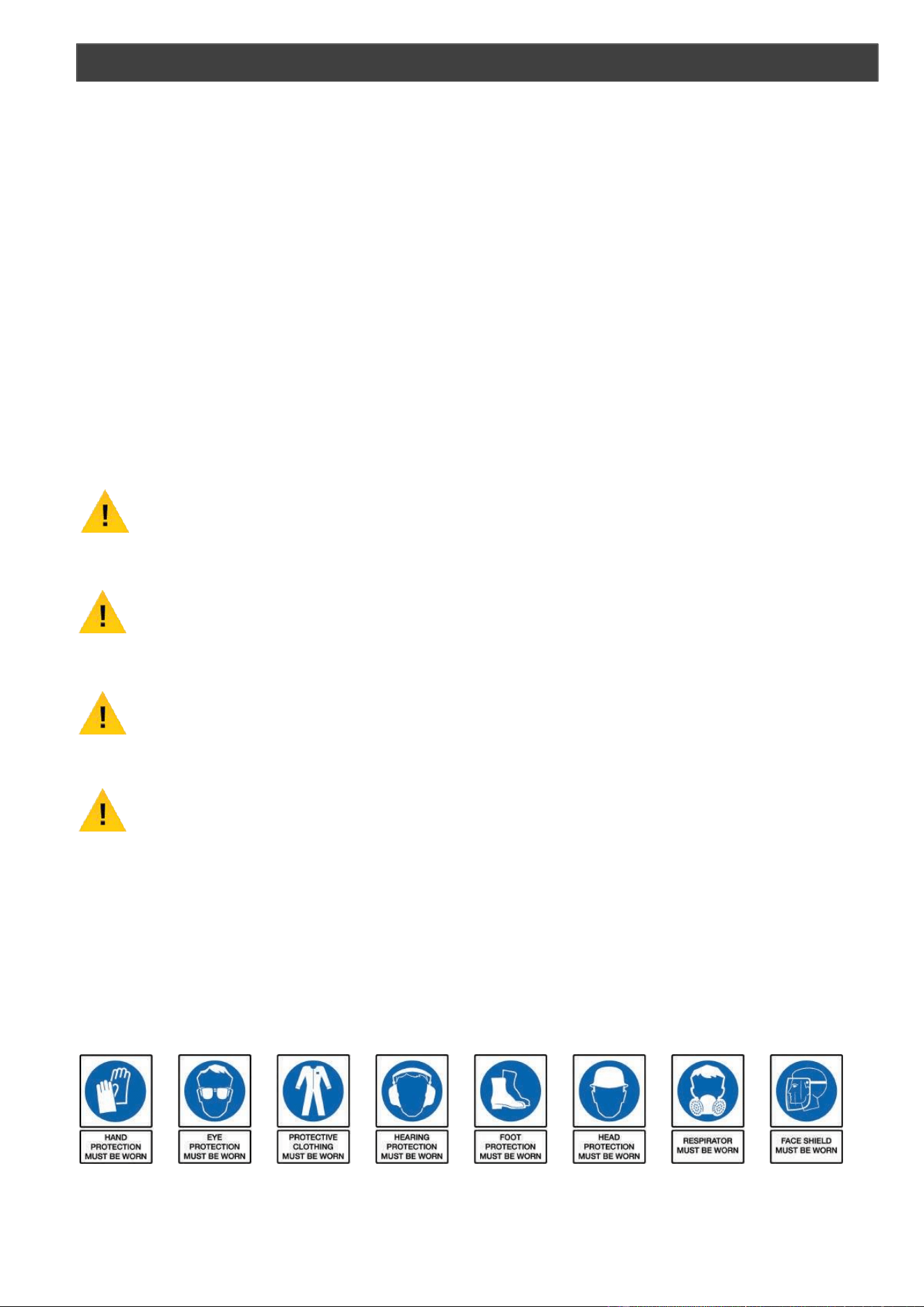
1.6 Some or all of the following - warning signs, symbols and/or PPE pictograms may ap-
pear throughout this manual. You MUST adhere to their warnings. Failure to do so
may result in personal injury to yourself or those around you.
DANGER
Indicates a hazard, which, if not avoided, could result in serious injury or death.
WARNING
Indicates a hazard, which, if not avoided, could result in serious injury.
CAUTION
Indicates a hazard which, if not avoided, might result in minor or moderate injury.
NOTE
Indicates a situation that could easily result in equipment damage.
READ and keep the manual safe and pass it on if the machine is loaned or sold to another user.
You MUST fully understand all instructions to ensure you use and operate the machine safely.
Appropriate Personal Protective Equipment (PPE), MUST be worn at all times when operating or
repairing the machine.
1. SAFETY

4
1.10 Carbon Monoxide (where applicable).
1.11 Carbon monoxide is a colourless and odourless gas. Inhaling this gas can cause
death as well as serious long term health problems such as brain damage.
1.12 The symptoms of carbon monoxide poisoning can include but are not limited to the
following;
Headaches, dizziness, nausea, breathlessness, collapsing or loss of consciousness.
1.13 Carbon monoxide poisoning symptoms are similar to flue, food poisoning, viral
infections and simply tiredness. It is quite common for people to mistake this very
dangerous poisoning for something else.
1.14 To avoid carbon monoxide poisoning DO NOT use Petrol/Diesel powered equipment
inside any of the following; Home, garage, tent, camper van, mobile home, caravan
or boat. This is not exhaustive and if you are in any doubt contact your dealer.
1.15 If you think you have or someone around you has been affected by carbon monoxide
poisoning;
1.16 Get them fresh air immediately, by leaving the affected area or by opening doors and
windows. If safe and practical to do so make sure that the machine is turned off.
DO NOT enter a room you suspect of having carbon monoxide present – instead call
the emergency services.
1.17 Contact a Doctor immediately or go to Hospital – let them know that you suspect
carbon monoxide poisoning.
1.18 DO NOT use in an enclosed area or moving vehicle.
5
1.20 General Fuel Safety (where applicable).
CAUTION
ALL FUELS ARE FLAMABLE
1.21 Fire Hazard – keep fuel away from all sources of ignition for example heaters.
Lamps, sparks from grinding or welding.
1.22
DO NOT carry out hot work on tanks that have contained fuel.
1.23 ALWAYS keep the work area tidy.
1.24 ALWAYS clean up spills promptly using absorbent granules and a lidded bin.
1.25 ALWAYS dispose of waste fuels correctly.
1.30 Fueling/De-fueling (where applicable).
CAUTION
ALL FUELS ARE FLAMABLE
1.31 ALWAYS fuel and defuel in a well ventilated area outside of buildings.
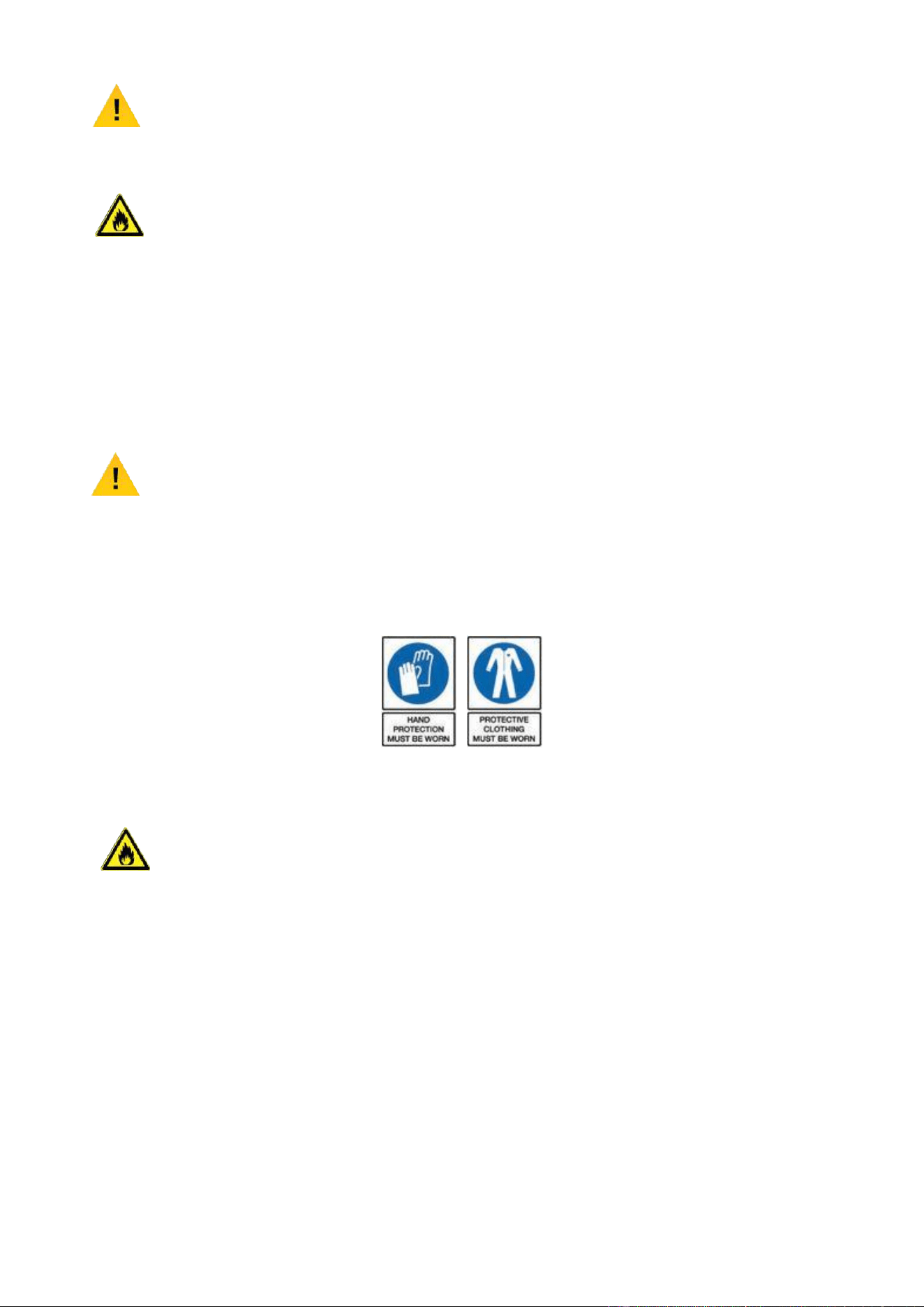
1.32 ALWAYS wear correct, suitable and fit for purpose Personal Protective Equipment
(PPE), suggested items are but not limited to safety gloves, overalls.
1.33 When fueling/de-fueling ALWAYS avoid inhaling fumes.
1.34 When de-fueling ALWAYS use a proper fuel retriever.
1.35 ALWAYS carry fuel in the correct and clearly marked container.
1.40 Electrical Safety (where applicable).
1.41 Electricity can kill – NEVER work on LIVE/ENERGISED equipment.
1.42 Prior to carrying out any maintenance work you MUST identify electrical isolation
methods and isolate all electrical supplies.
1.43 Prior to use and with all electrical supplies isolated, you MUST check all electrical
cables, plugs and connectors for the following;
1.44 Are intact and have no signs of damage, to include but not limited to bare wires,
chaffing, cuts and loose wiring.
1.45 If there are any signs of damage, the damaged item MUST be taken out of service
until the damage has been repaired by an electrically competent person.

6
1.46 All trailing cables should be routed so as not to cause any kind of trip hazard.
1.47 NEVER work on or near electricity with wet hands, wet clothing and wet gloves.
1.50 Batteries (where present).
1.51 Batteries present a risk if they become damaged by the possible leaking of
electrolyte. This electrolyte is an acid and can cause serious burn injuries. Care
should be taken when working on or near them. NOTE the electrolyte may be in
a liquid or gel form.
1.52 Should you come in to contact with electrolyte you should;
1.53 Remove all clothing contaminated with electrolyte. If you cannot remove then
saturate them in water.
1.54 Get medical assistance as soon as possible. You must advise the medical staff of
the type of acid.
1.55 Lead/acid battery = dilute sulphuric acid.
1.56 Nickel/cadmium = potassium hydroxide alkali electrolyte.
1.57 Use fresh running water to wash off excess electrolyte, continue this until medical
assistance arrives. Make sure that you do not was the electrolyte to another part of
your body or face.
1.58 If electrolyte comes in to contact with Eyes the electrolyte needs to be immediately
washed away with large amounts of water. Make sure that you do not wash the
electrolyte to another part of your face or body.
1.59 Gasses from charging batteries are highly flammable and great care should be taken
to charge in well ventilated areas.
1.59.1 There is an explosion risk if the battery terminals are short circuited, when
connecting/disconnecting ALWAYS exercise great care so that the terminals or
battery leads are NOT allowed to touch and cause a spark. ALWAYS use suitable
insulated tools.
1.60 Vibrations (where applicable).
1.61 Prolonged use of hand held (operated) machines will cause the user to feel the
effects of/from vibrations. These vibrations can lead to white finger (Raynaud’s
phenomenon) or carpal tunnel syndrome. This condition reduces the ability of the
hand to feel and regulate temperature, causing numbness and heat sensations and
may cause never damage and circulatory tissue death.
1.62 Not all factors that lead to white finger disease are known, but cold weather, smoking
and other diseases that affect blood vessels and blood circulation as well as large
and long-lasting impact of shocks are considered factors in the formation of white
finger. Note the following to reduce the risk of white finger and carpal tunnel
syndrome;
1.63 Wear gloves and keep your hands warm.
1.64 Take regular breaks.
1.65 All of the above precautions may help reduce the risk of white finger disease but not
rule out the carpal tunnel syndrome. Long-term and regular users are therefore

7
recommended to observe the condition of your hands and fingers. Seek medical
attention immediately if any of the above symptoms should occur.
1.70 Noise (where applicable).
1.71 The operating noise of the machine can damage your hearing. Wear hearing
protection such as earplugs or ear defenders to protect your hearing. Long-term
and regular users are advised to have hearing checked regularly. Be especially
vigilant and cautious when hearing ear protection because your ability to hear alarm
warnings will be reduced.
1.72 Noise emissions for this equipment is unavoidable. Carry out noisy work at approved
times and for certain periods. Limit the working time to a minimum. For your personal
protection and protection of people working nearby it is also advisable for them to
wear hearing protection.
1.73 See Certificate of Conformity section for Outdoor Noise declaration of
conformity.
1.80 General Machine Safety.
1.81 Read the owner’s manual carefully to understand how to operate this machine
properly.
1.82 You should NEVER use the machine when;
1.83 Wearing loose clothing, barefoot or sandals.
1.84 Under the influence of drink or drugs or as a result of having taken medication for
cold or flu, or any other times when a possibility exists that your judgement might be
impaired or that you might not be able to operate the machine properly and in a safe
manner.
1.85 Suffering from exhaustion or lack of sleep.
1.86 When the ground is slippery or when other conditions exist which might make it not
possible to maintain a steady posture.
1.87 At night, at times of heavy fog, or at any other times when your field of vision might
be limited and it would be difficult to gain a clear view of the area.
1.88 During rain storms, lighting storms, at times of strong or gale force winds, or at
any other times when the weather conditions might make it unsafe to use this
product.
1.89 NEVER run the engine indoors. The exhaust gasses contain harmful carbon
monoxide.
1.90 When using this machine for the first time and before actual work, you MUST learn
how to handle the machine from an experienced or skilled person.
1.91 Limit the amount of time using the machine continuously to somewhere around 10
minutes per session and take 10 to 20 minutes of rest between sessions. Also try to
keep the total amount of work in a single day limited to 2 hours or less.
MACHINE SPECIFIC SAFETY

8
1.92 NEVER allow children or anyone unable to fully understand the directions given in
this manual to operate this product.
1.93 Make sure you keep this manual handy so you may refer to it whenever questions
arise and ensure you pass this manual on if the machine is loaned or sold.
1.94 Correct Personal Protective Equipment (PPE) MUST be worn at all times when
operating or repairing this machine. This should include but is not limited to;
1.95 DO NOT use this machine inside a confined space such as but not limited to a vehicle,
house, garage, container, boat or building. Only use outside in a well ventilate area.
1.96 For air cooling a minimum of 1m is required all around the machine.
Maximum ambient temperature 40 degrees Celsius.
1.97 Fire risk- Fuel can expand and overflow in a hot environment or moving vehicle.
Explosion risk- LPG/ Petrol can leak and the vapour is heavier than air.
1.98 NEVER store in confined spaces especially in a boat where the vapour/has will
accumulate in the hull and create a high risk of explosion.
1.99 Carbon monoxide poisoning risk- Never run an engine in a confined space or poorly
ventilated area. Keep machine away from windows to prevent fumes entering the
internal space.
1.99.1 Carbon monoxide is produced by the engine and contained in the exhaust fumes. You
cannot see it or smell it and it can kill you in minutes.
NEVER use inside a confined space with an exhaust extension. If the exhaust
extension fails the escaping exhaust gases could kill you.
9
CAUTION
As this machine is heavy, it is recommended that the assembly is a two person
operation.
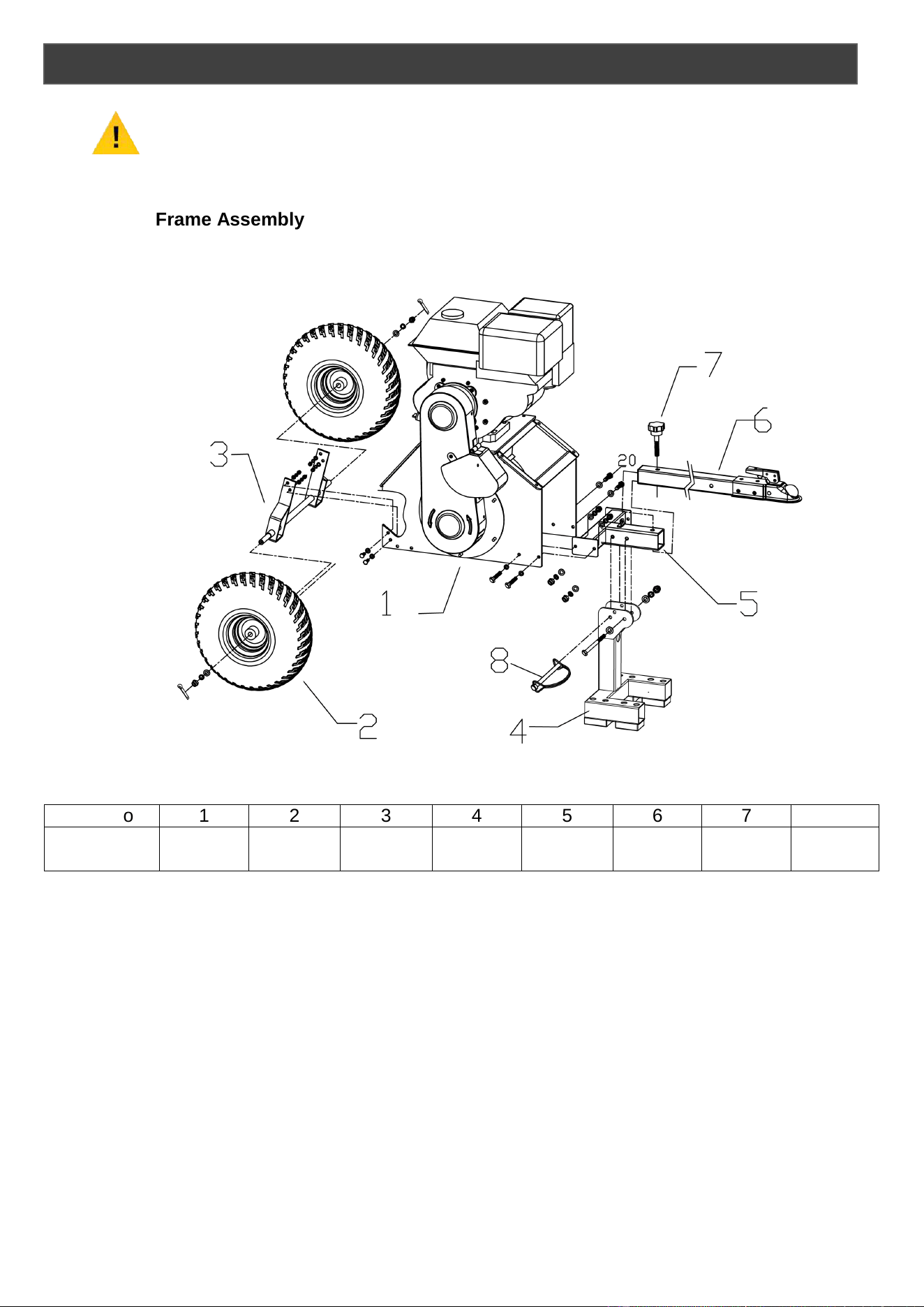
2.0 Frame Assembly
Part No
1
2
3
4
5
6
7
8
Description
Main
Body
Wheels
Axle
Bracket
Front
Leg
Tow Bar
Bracket
Tow Bar
Tow Bar
Bolt
D-Pin
2.1 Lay the main body (1) on a support or platform that is about 30cm above the ground.
Leave some space either side of the main body for the installation of the wheels (2).
2.2 Attach the wheels (2) to the axle bracket (3) and then fix the assembly to the main
body (1).
2.3 Install the tow bar bracket (5) to the main body (1). Then attach the front leg (4), tow bar
bracket (5) and D-Pin (8).
2.4 Mount the tow bar (6) and tow bar bolt (7).
2.5 Remove the support or platform.
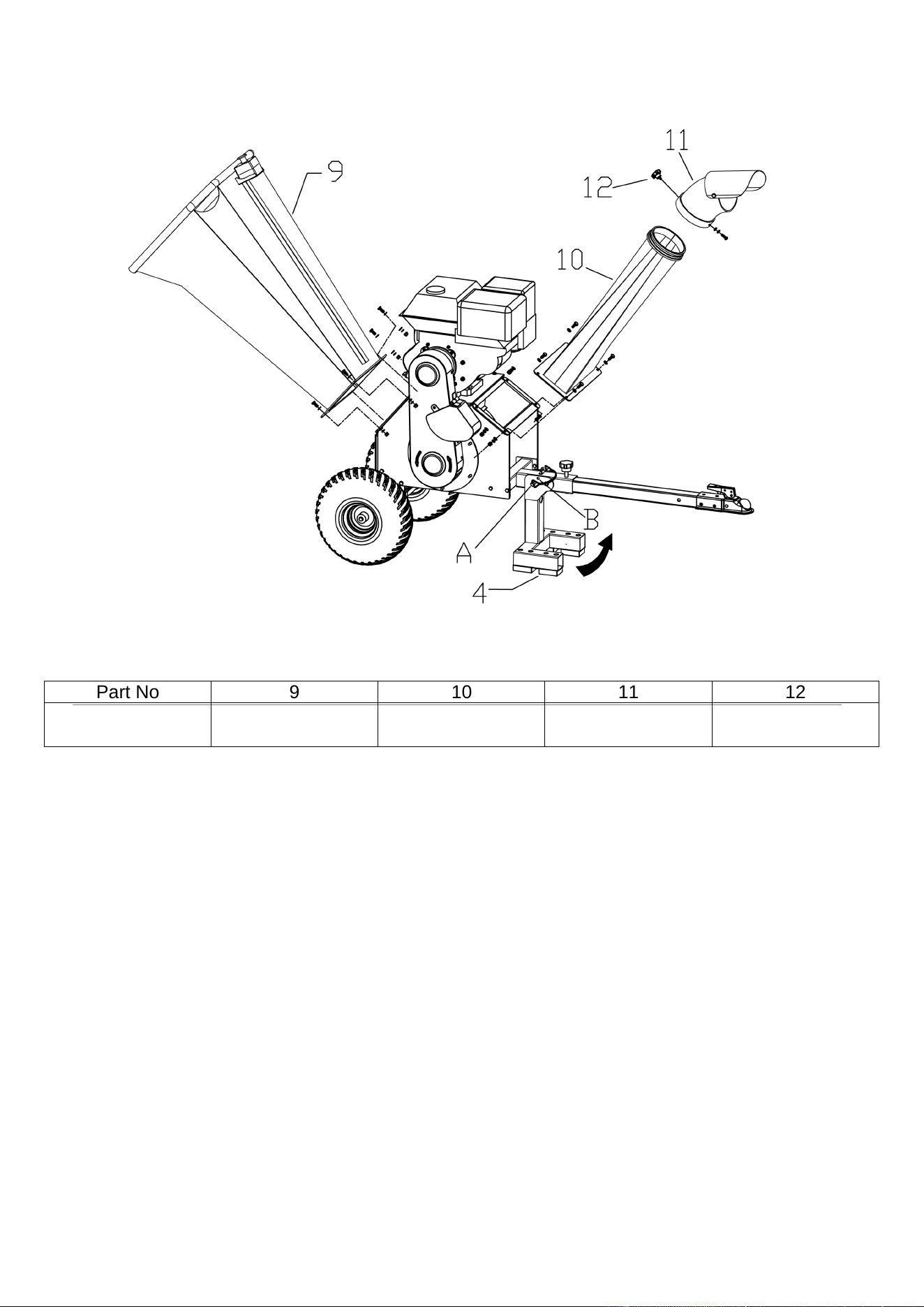
2.6 Feed Hopper & Discharge Chute Assembly
2. ASSEMBLY HYCH1500[E]-2
10
Part No
9
10
11
12
Description
Feed Hopper
Lower Discharge
Chute
Upper Discharge
Chute
Knob
2.7 Connect the feed hopper (9) to the frame and secure.
Due to the heavy weight of the components, use a lifting device or assistance of 2 or 3
people.
2.8 Attach the lower section of the discharge chute (10) to the main body and then fix the
upper part of the discharge chute (11) to the lower discharge chute (10), using the knob
provided (12).
2.9 The upper section of the discharge chute can be rotated to allow the wood chippings to
be discharged in the direction required.
2.10 For transport, remove the D-Pin from its location (A) in the front leg (4), raise the leg
and then refit the D-Pin to location (B).
11
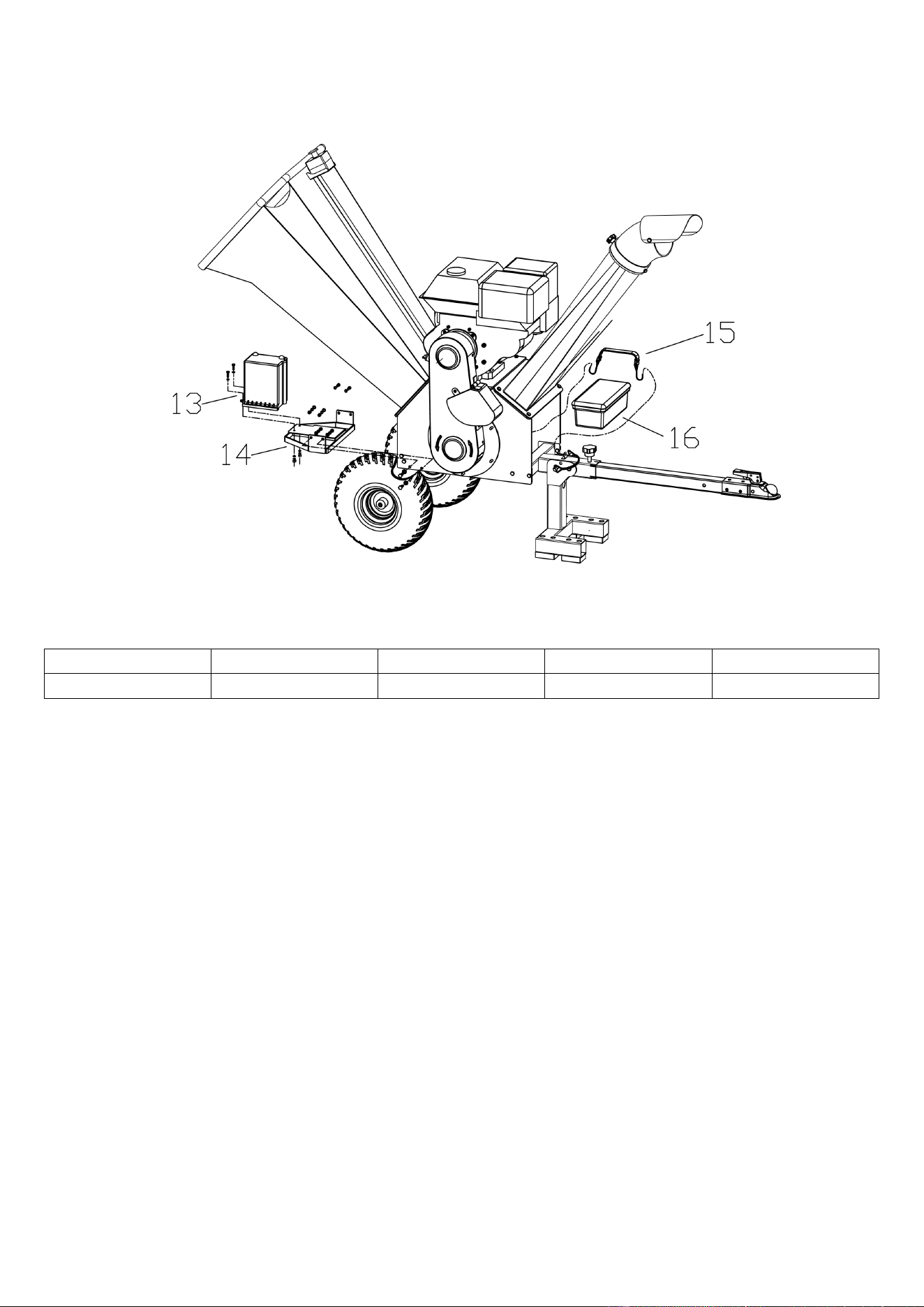
2.11 Installation of 12v Battery & Tool Kit
Part No
13
14
15
16
Description
Battery Cover
Battery Tray
Tool Kit
Tool Kit Strap
2.12 Attach the battery tray (14) to the main body (1).
2.13 Connect the battery terminals with the positive and negative cables on the starter
motor.
Take care not to short the positive to the negative.
2.14 Place the battery on to the battery tray (14), and place the battery cover over the battery
and secure in place.
2.15 Attach the tool kit (16) to the mounting bracket at the front of the main body and
connect one end of the tool kit strap (15) to the retaining ring on the main body (1).
2.16 Attach the other end of the strap (15) to the anchor point on the tow bar bracket.
12
3. ASSEMBLY HYCH7070[E]-2
CAUTION
As this machine is heavy, it is recommended that the assembly is a two person
operation.
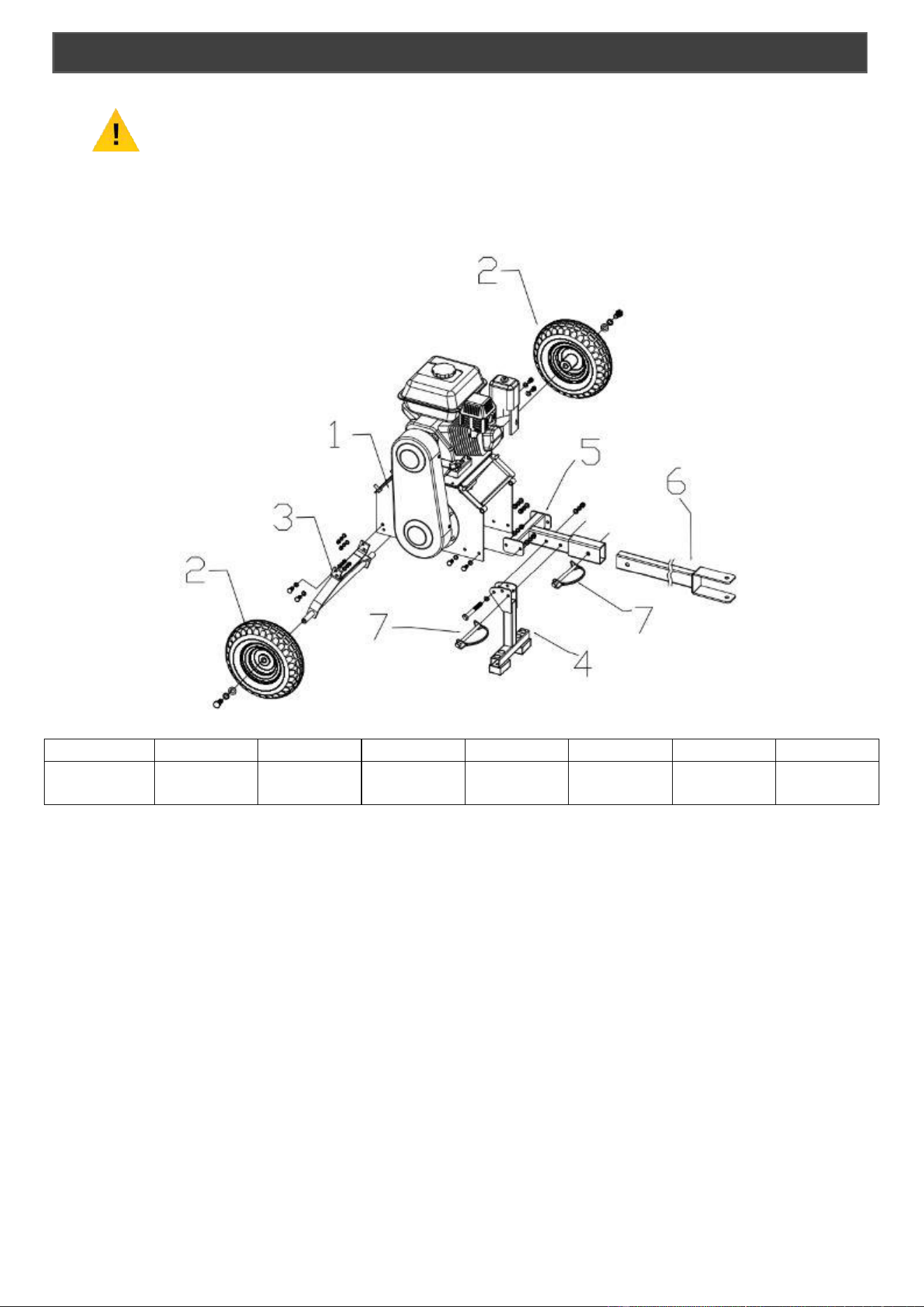
3.0 Frame Assembly
Part No
1
2
3
4
5
6
7
Description
Main
Body
Wheel
Axle
Stand
Front Leg
Tow Bar
Bracket
Tow Bar
D-Pin
3.1 Lay the main body (1) on a support or platform that is about 30cm above the ground.
Leave some space either side of the main body for the installation of the wheels (2).
3.2 Attach the wheels (2) to the axle bracket (3) and then fix the assembly to the main
body (1).
3.3 Install the front leg (4), tow bar bracket (5) and D-Pin (7) and mount the tow bar (6) and
tow bar bracket (5) with the D-Pin (7).
3.4 Remove the support or platform.
13
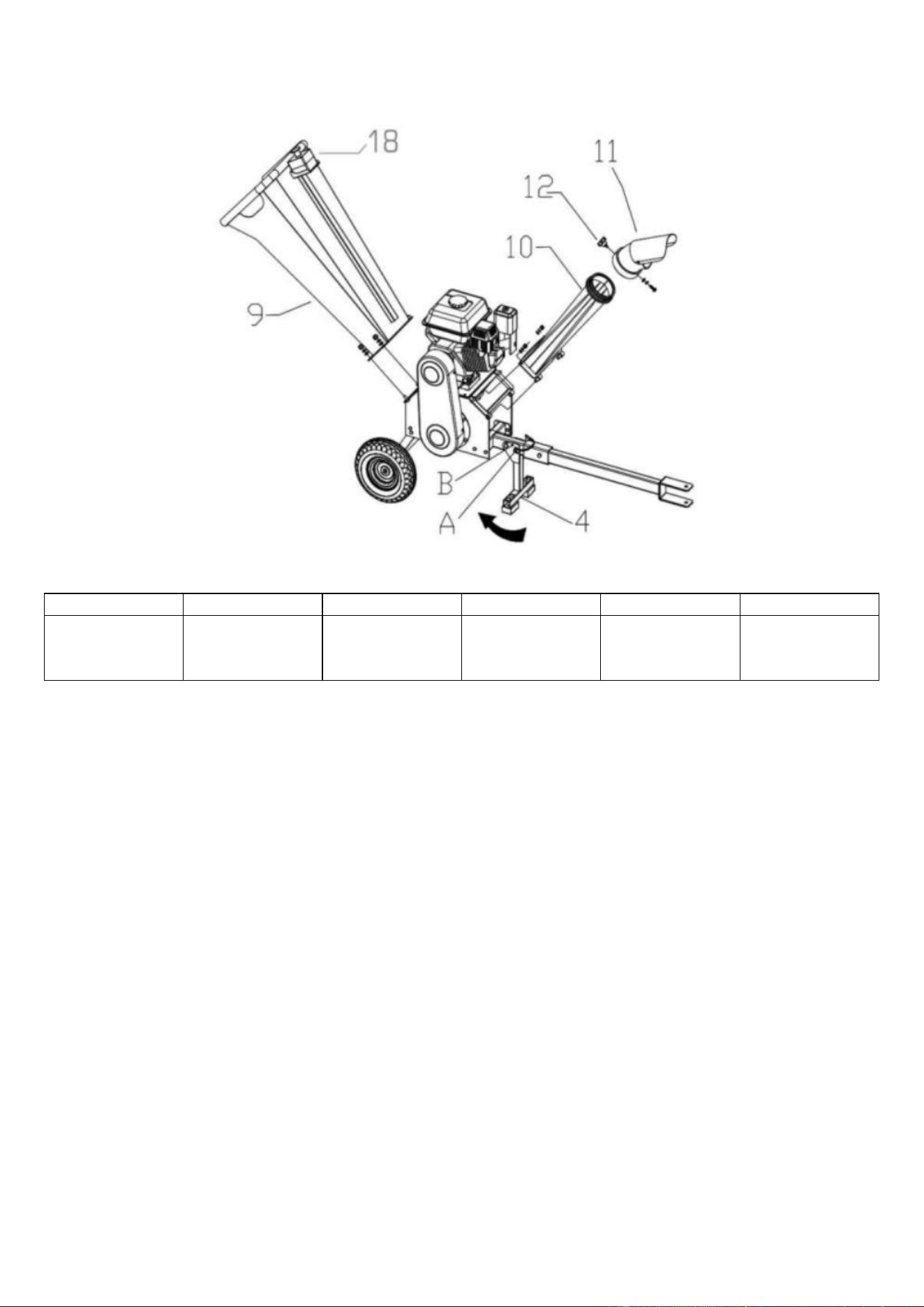
3.5 Hopper & Discharge Port
Part No
9
10
11
12
18
Description
Feed Hopper
Lower
Discharge
Chute
Upper
Discharge
Chute
Knob
Safety Cut Out
Switch
3.6 Connect the feed hopper (9) to the main body of the chipper.
NOTE: You may require assistance.
3.7 Attach the lower section of the discharge chute (10) to the main body of the chipper
and then fix the upper part of the discharge chute (11) to the lower discharge
chute (10) using the knob provided (12).
3.8 The upper section of the discharge chute can be rotated to allow the wood chippings
to be discharged in the direction required.
3.9 For transport, remove the D-Pin from its location (A) on the front leg (4), then raise
the leg and refit the D-Pin to location (B).
Connect the safety cut out button (18).
14
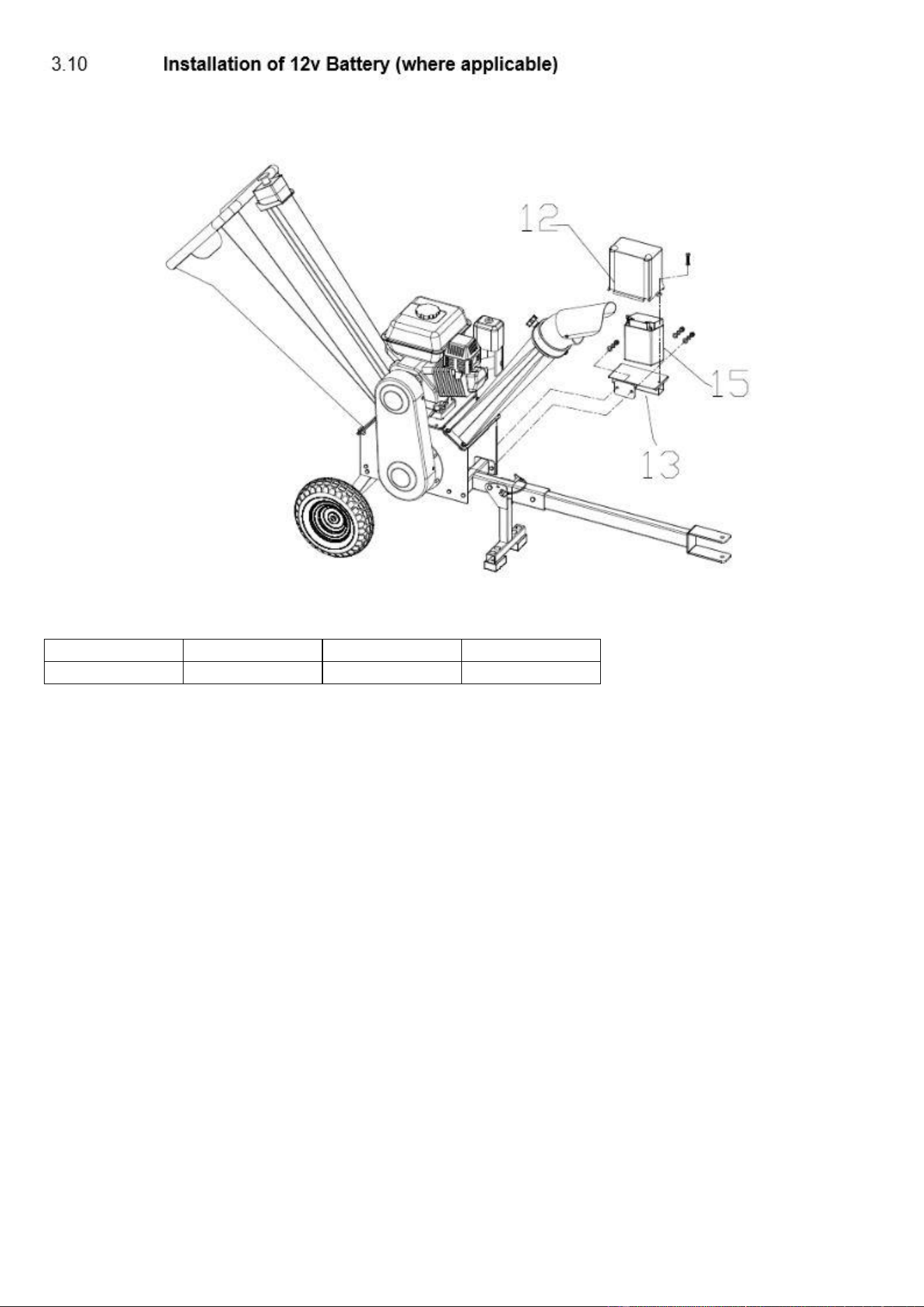
Part No
12
13
15
Description
Battery Cover
Battery Tray
Battery
3.11 Attach the battery tray (13) to the mounting points on the main body.
3.12 Connect the battery terminals with the positive and negative cables on the starter
motor.
Take care not to short the positive to the negative.
3.13 Place the battery (15) on to the battery tray (13), and place the battery cover (12) over
the battery and secure in place.
15
4.0
4.1
4.2
4.3
CAUTION
This guide is meant to serve as a quick reference only.
We advise reading the manual in full before operation.
CAUTION
This machine is shipped WITHOUT Oil and Fuel and will require filling BEFORE use.
Failure to do so will result in engine damage which will not be covered by warranty.
CAUTION
FOR OUTDOOR USE ONLY.
This machine produces carbon monoxide – a poisonous, colourless & odourless gas
that can cause death or serious injury.
Petrol is highly flammable, always handle with extreme care and in a well-ventilated
area.
Always remove the HT lead from the spark plug when checking the machine or
changing parts.
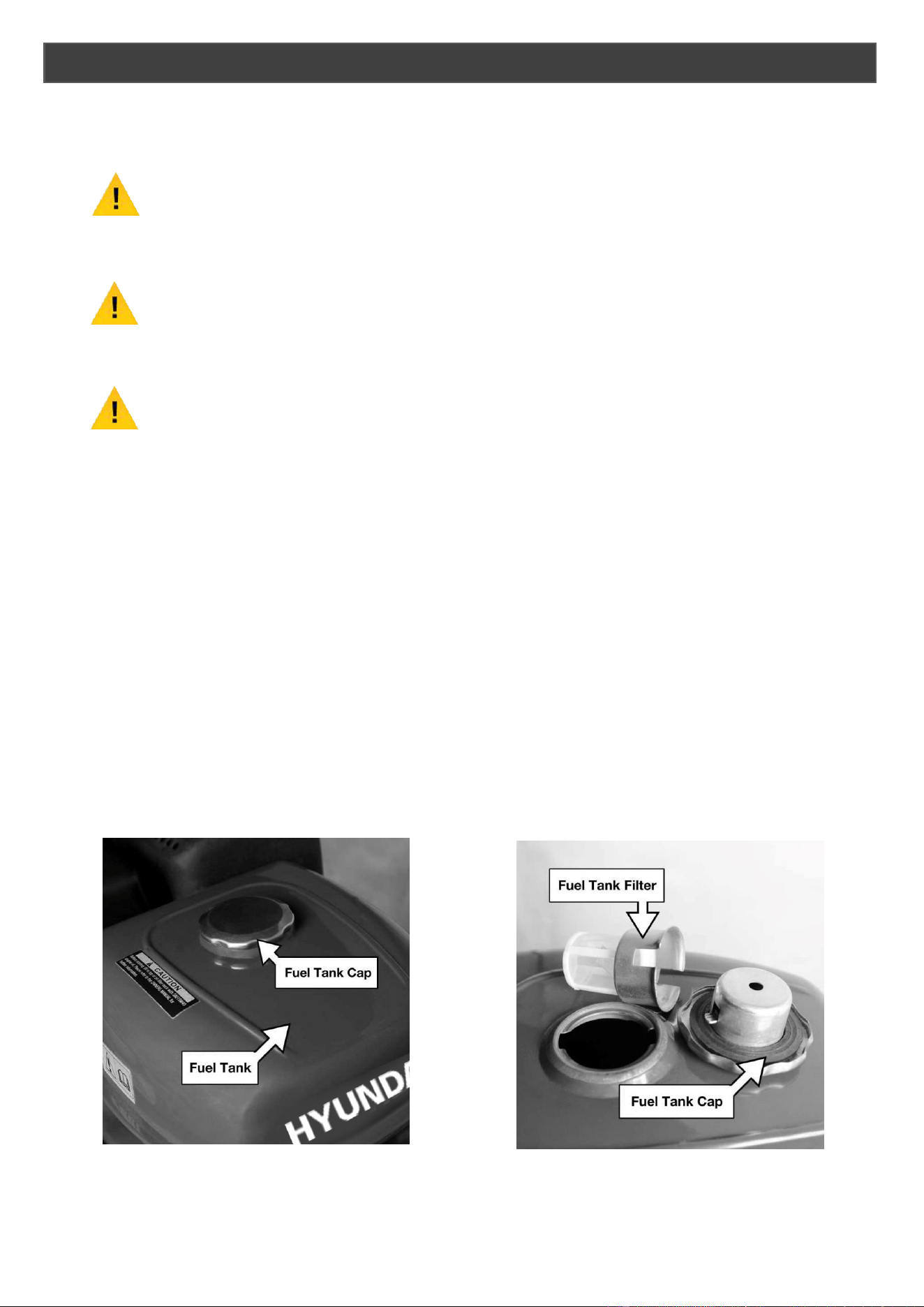
Unscrew the fuel filler cap and carefully add fresh unleaded petrol.
DO NOT overfill.
Allow a 25mm gap at the top of the fuel tank.
Fuel tank capacity is 3.6l for the 212cc engine and 6.5l for the 420cc engine.
Once full, replace and secure the fuel filler cap.
4. QUICK START GUIDE
16
4.4
4.5
4.6
4.7
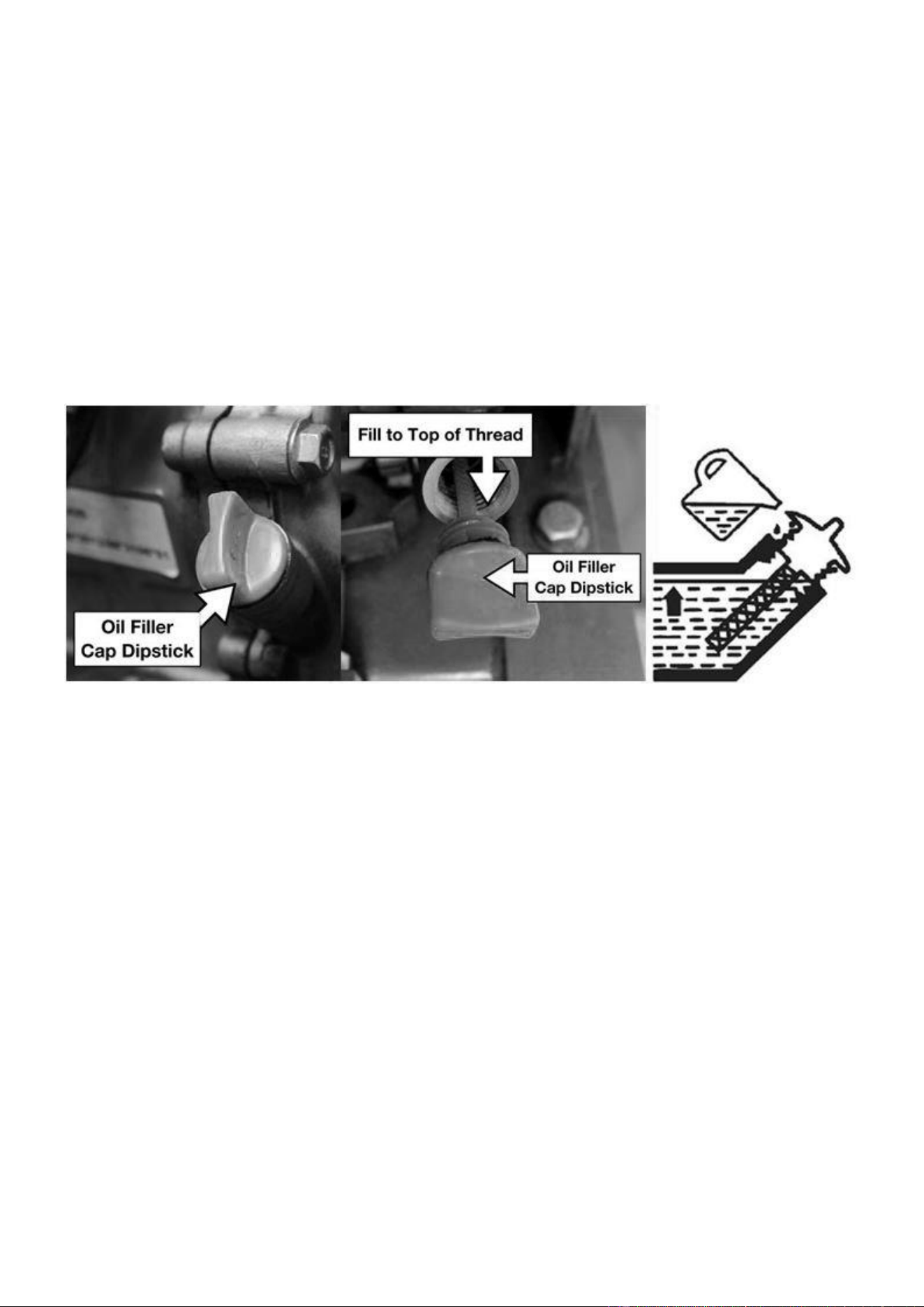
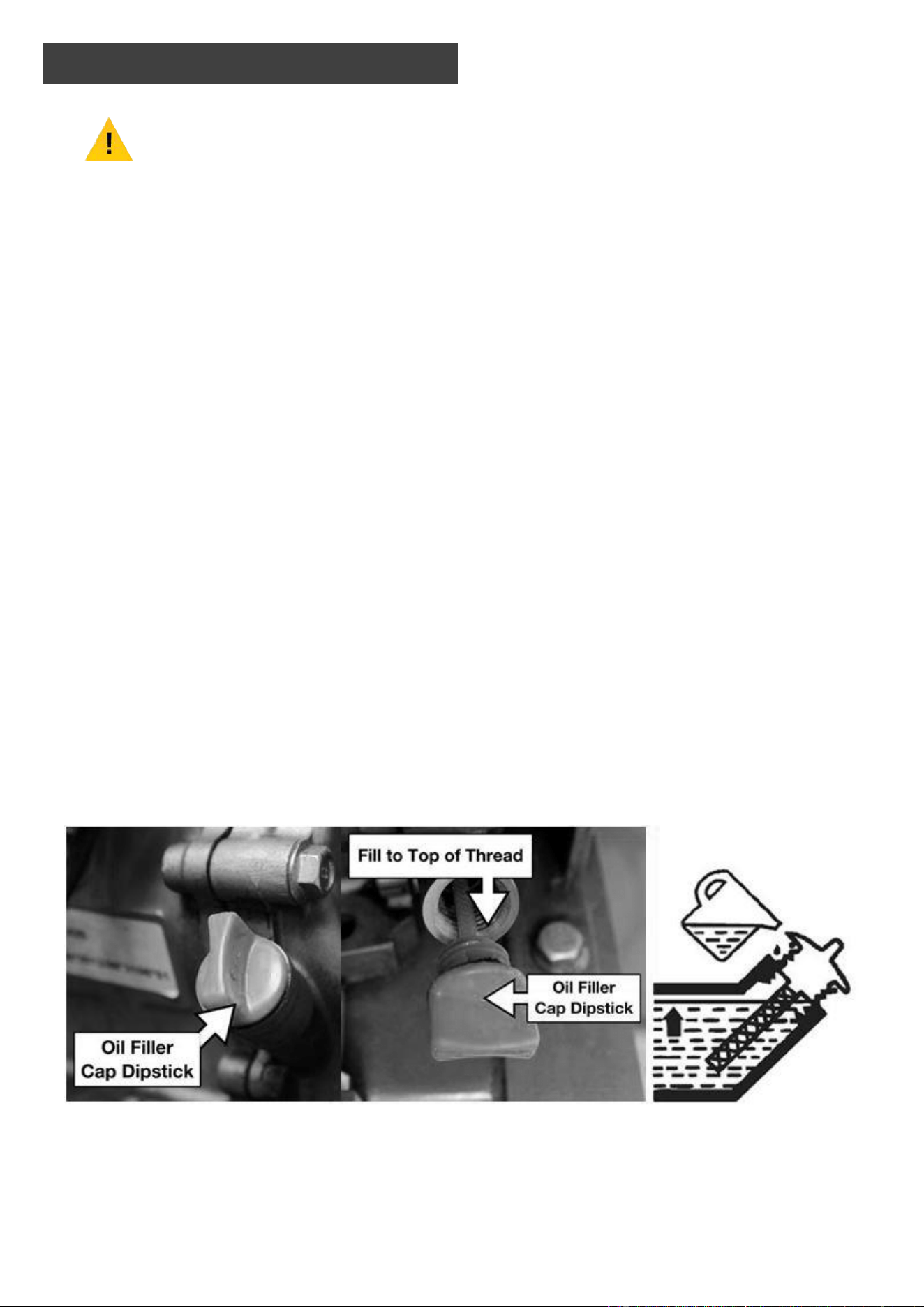
Unscrew the oil filler cap/dipstick and fill with oil.
Use SAE30 or 15W40 engine oil. The 420cc
engine holds 1100ml of oil.
The 212cc engine holds 600ml of oil.
Fill to the top of the thread on the filler neck.
Stop occasionally to check the oil level.
DO NOT overfill.
Refit the oil filler/dipstick and tighten securely.
17
CAUTION
This machine is shipped WITHOUT Oil and Fuel and will require filling BEFORE use.
Failure to do so will result in engine damage which will not be covered by warranty.
NOTE
Before starting, make sure the machine is clear of materials and all non-essential
persons.
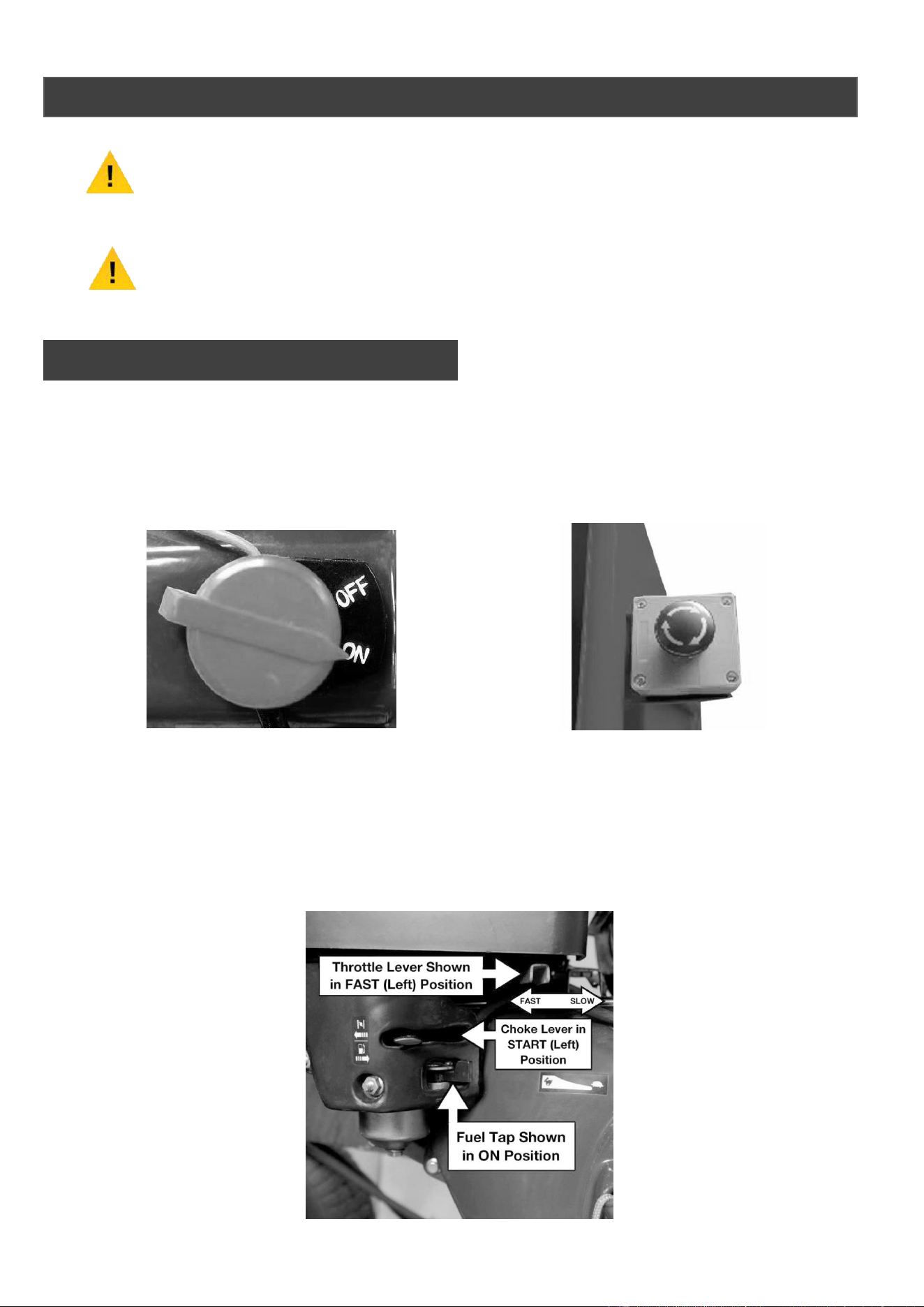
5.0 Turn the ignition switch to the ON position.
5.1 Make sure that the stop button is not in the stop (down) position on HYCH1500E-2
5.2 FOR COLD START : Move the choke lever left, to the START position.
5.3 Move the fuel tap right to the ON position.
5.4 Move the throttle lever right to the MIDDLE position.
5.5 FOR WARM START: Use half choke if warm or no choke if engine is hot.
5. STARTING PROCEDURE
RECOIL START
18
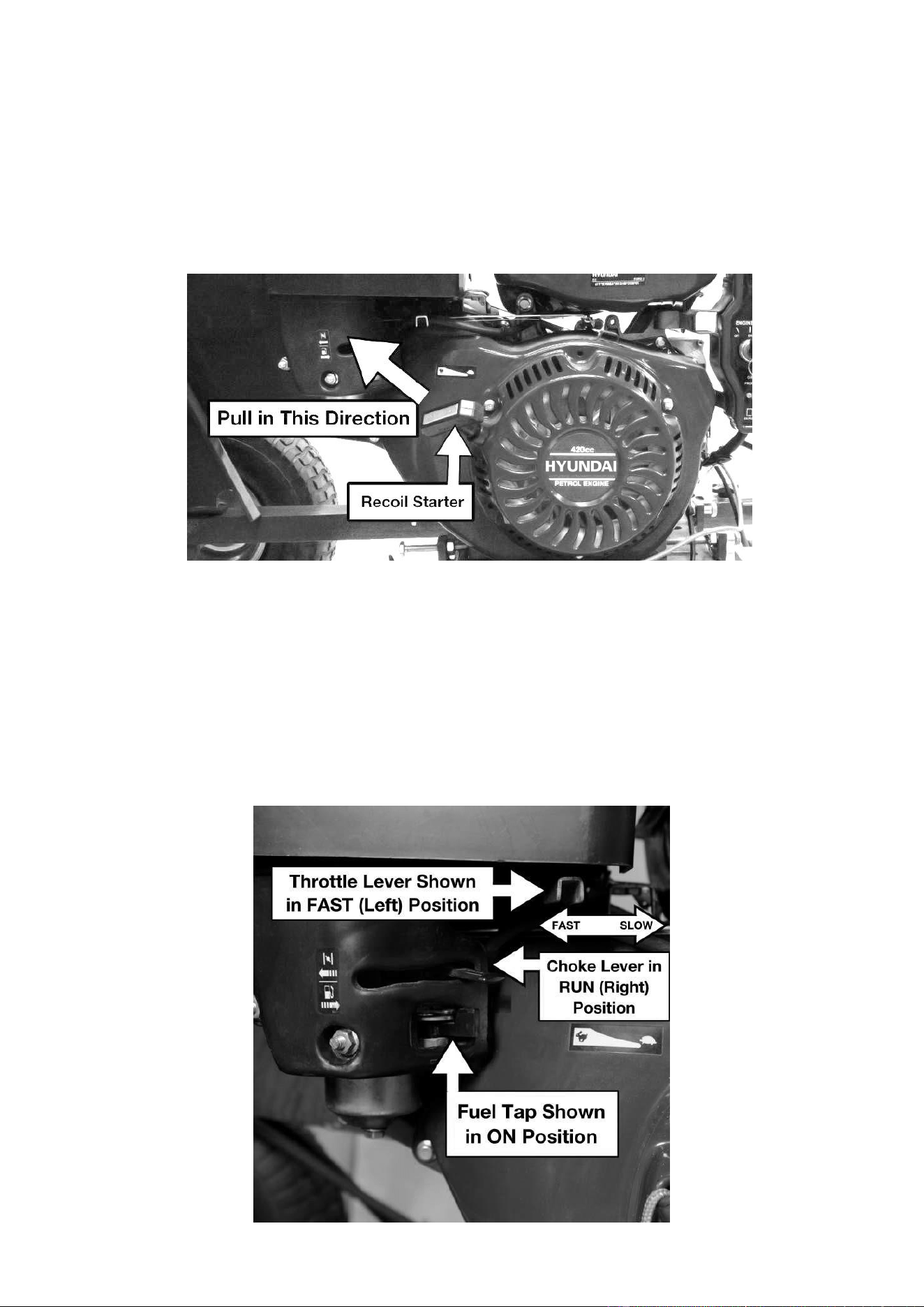
5.6 Place one hand on the machine and using your other hand pull the recoil starter handle
until you begin to feel resistance.
5.7 Once you feel resistance, pull the handle swiftly.
5.8 Repeat until the engine starts.
DO NOT let go of the recoil handle, instead return the handle slowly.
5.9 Once the engine has started, reduce the choke by slowly moving the lever right, to the
RUN position.
5.10 If the engine falters, move the choke between START/RUN and adjust until the engine
runs smoothly.
5.11 After the engine has warmed up, move the throttle lever to the left to accelerate the
engine to the desired working speed.
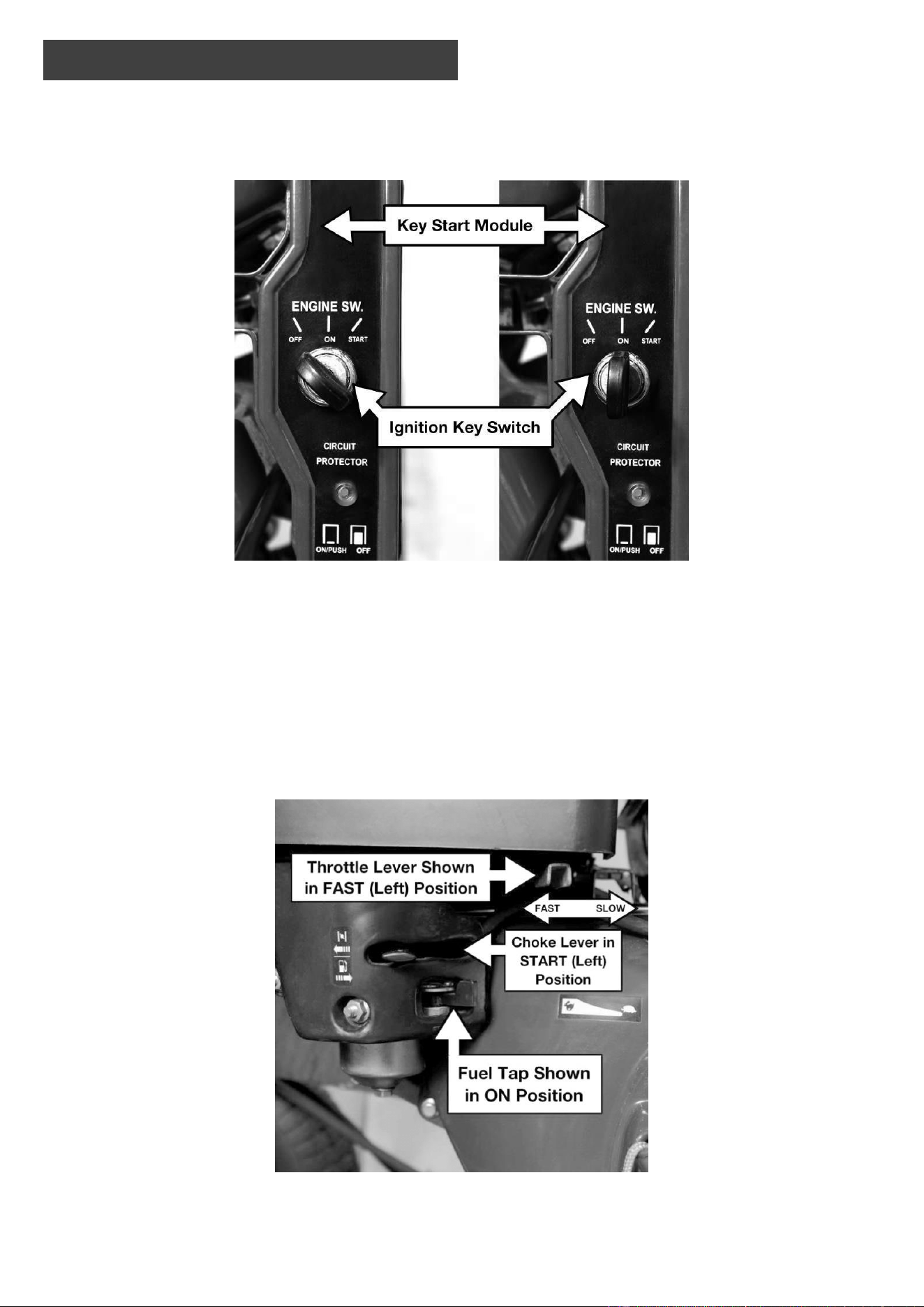
19
5.12 Turn the ignition key on the key start module to the ON position.
5.13 FOR COLD START : Move the choke lever left, to the START position.
5.14 Move the fuel tap right to the ON position.
5.15 Move the throttle lever right to the MIDDLE position.
5.16 FOR WARM START: Use half choke if warm or no choke if engine is hot.
ELECTRIC START
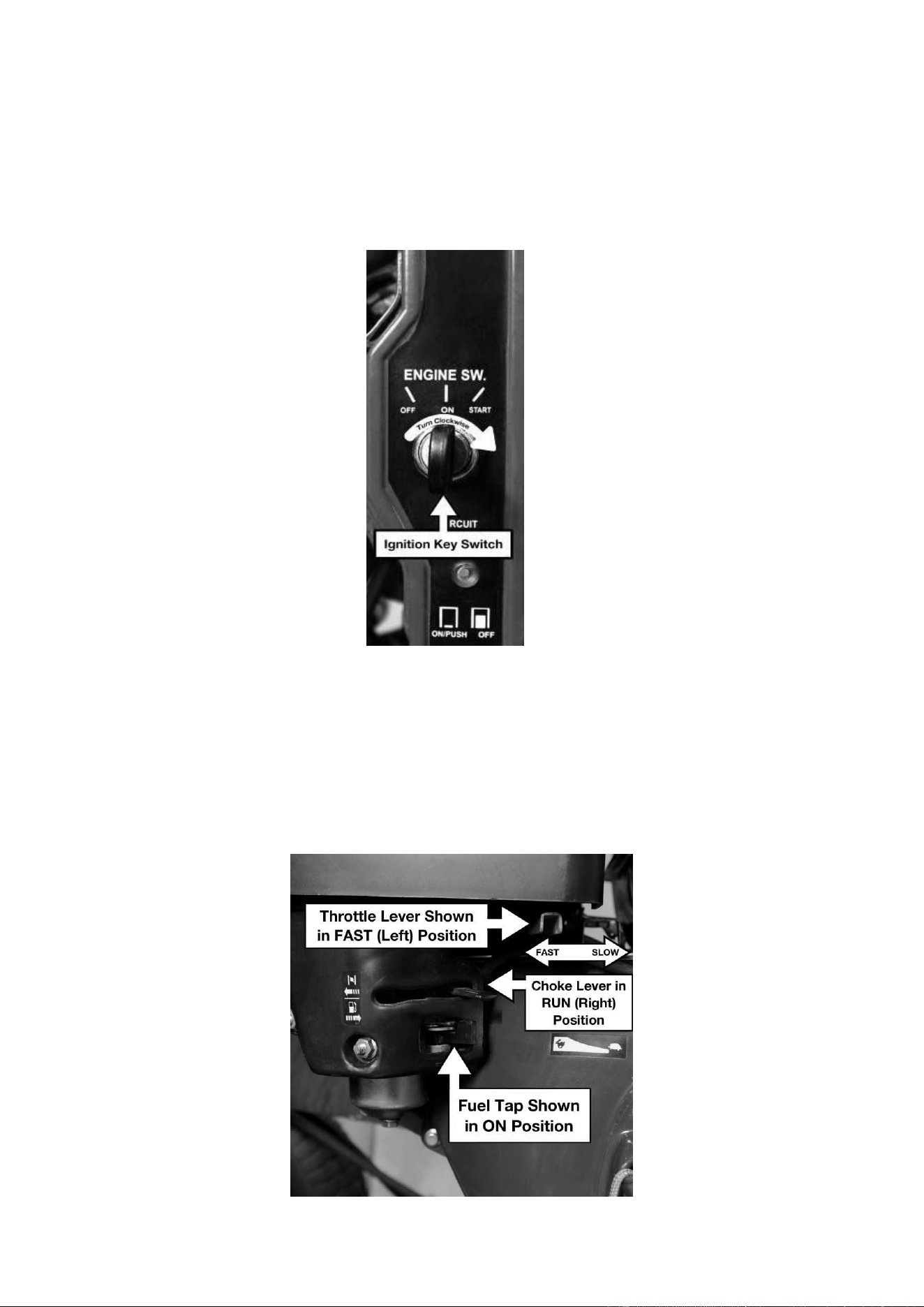
20
5.20 Turn the ignition key clockwise against the spring tension to the START position until
the engine starts.
5.21 DO NOT operate the ignition key for longer than 5 seconds between attempts.
Allow 10 seconds between each attempt.
5.22 Once the engine has fired, release the key and it will return to the RUN position.
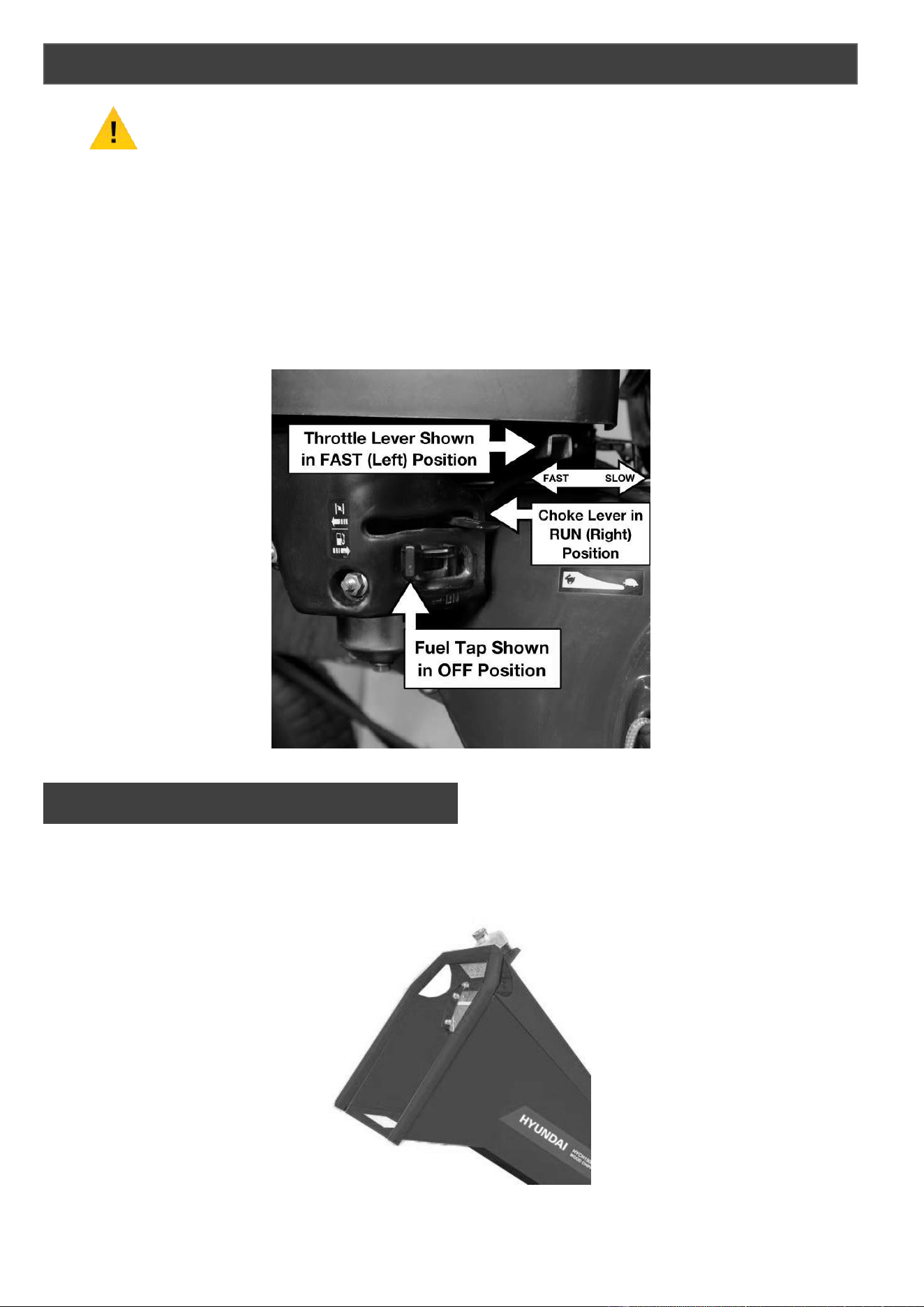
5.23 Once the engine has started, reduce the choke by slowly moving the lever right, to the
RUN position.
5.24 If the engine falters, move the choke between START/RUN and adjust until the engine
runs smoothly.
5.25 After the engine has warmed up, move the throttle lever to the left to accelerate the
engine to the desired working speed.
21
CAUTION
You MUST allow the cutting head to come to a complete stop and switch the engine
OFF before carrying out any maintenance on the machine.
6.0 Before stopping the machine, allow the engine to cool down by moving the throttle
lever to the SLOW position and allowing the engine to idle for a few minutes.
6.1 Turn the Power Switch or Ignition key to the OFF position.
6.2 Turn the fuel tap left, to the OFF position.
6.3 To STOP the machine in an emergency, press the emergency stop switch DOWN.
6. STOPPING PROCEDURE
EMERGENCY STOP

22
WARNING
You MUST STOP using the machine if any of the following occur.
The engine speed changes with no control.
In case of misfire or unusual noise.
In case of high vibration.
If belts are slipping.
In rain or stormy weather.
CAUTION
If you are not familiar with this type of machine you should seek advice and guidance
from your dealer.
DO NOT attempt to lift or move the machine while the engine is running.
CAUTION
FOR OUTDOOR USE ONLY.
This machine produces carbon monoxide – a poisonous, colourless & odourless gas
that can cause death or serious injury.
Petrol is highly flammable, always handle with extreme care and in a well ventilated
area.
Always remove the HT lead from the spark plug when checking the machine or
changing parts.
7.0 Position the machine on flat, level ground and in such a way so it cannot move during
operation.
7.1 DO NOT overload the machine.
Use the correct machine for your application.
The correct machine will do the job better and safer at a rate for which it was designed.
7.2 DO NOT change the engine governor settings or increase the maximum engine speed.
The governor controls the maximum safe operating speed of the engine.
7.3 DO NOT run the engine at a high speed when you are not using it.
7.4 DO NOT put hands or feet near rotating parts.
7.5 This machine has rotating cutting knives capable of amputating hands and feet and
throwing objects.
AT ALL TIMES you MUST keep hands and feet clear of all openings while the machine
is running.
Failure to observe these safety instructions could result in serious injury or death.
7.6 Avoid contact with fuel, oil, exhaust fumes and hot surfaces.
7.7 DO NOT touch or allow clothing or any other flammable materials to come into contact
with the engine or exhaust.
These parts get extremely hot and will remain hot for a short time after operation.
7.8 Allow the engine to cool before making any adjustments or maintenance.
7. OPERATING INSTRUCTIONS

23
7.9
7.10
7.11
7.12
7.13
7.14
7.15
7.16
7.17
7.18
7.19
7.20
7.21
7.22
7.23
7.24
If the machine should start to make unusual noises or vibrations, immediately shut off
the engine, disconnect the spark plug HT leas and check for the cause.
Usually noise or variation is generally a warning of trouble.
You MUST find the source of the problem and fix it before reusing the machine.
Use only attachments and accessories approved by the manufacturer.
Failure to do so can result in personal injury and may invalidate any warranty.
Maintain the machine and check for misalignment or binding of moving parts, broken
parts and any other condition that may affect the machines operation.
If damaged have the machine repaired before reuse.
Keep the engine, exhaust and muffler free of grass, leaves, wood chips, excessive
grease or carbon build up to reduce the risk of fire.
NEVER pour or squirt the unit with water or any other liquid.
Keep handles dry, clean and free from debris. Clean the machine after each use.
DO NOT allow persons unfamiliar with the machine or these instructions to operate it.
This machine can be extremely dangerous in the hands of untrained users.
Thoroughly inspect the area to be worked, keep the working area clean and free of
debris to prevent tripping. Operate on flat level ground.
NEVER place any part of your body where it could be in danger if movement should
occur during assembly, installation, operation, maintenance, repair or moving.
Keep all bystanders, children and pets at least 23m (75 feet) away.
If you are approached, stop the machine immediately.
The operator or user is responsible for preventing accidents or hazards occurring to
other people, their property and themselves.
Start the engine carefully according to instructions.
Before starting the wood chipper, make sure the feed hopper and cutting housing are
empty and free of all debris.
NEVER place your hands, feet, or any part of your body in the chipper hopper,
discharge opening, or near or under any moving part while the machine is running.
Keep area of discharge clear of people, animals, buildings, glass, or anything else that
will obstruct clear discharge, causing injury or damage. Wind can also change discharge
direction, so be aware. If it becomes necessary to push materials to the chipper hopper,
use a small diameter stick, not your hands.
NEVER allow an accumulation of processed material to build up in the discharge
hopper area as this will prevent proper discharge and can result in kickback from the
chipper hopper.
Keep your face and body back from the chipper hopper and discharge chute to avoid
accidental bounce back of any material.
NEVER reach with your hands, into the the feed hopper past the rubber flap while
operating the machine.

24
7.25
7.26
7.27
7.28
7.29
7.30
7.31
7.32
7.33
7.34
7.35
7.36
7.37
7.38
7.39
7.40
7.41
NEVER attempt to unclog either the feed hopper or discharge chute while the engine is
running.
Immediately shut off the engine, allow the cutting disk to come to a complete stop.
Remove the spark plug HT lead cap.
Remove the clogged material.
Inspect for damage and check for any loose parts for repair or replacement.
DO NOT tilt the machine while the engine is running.
ALWAYS stop the engine before moving the machine.
ALWAYS make sure that the engine is switched off and that the cutting disk and engine
are at a complete standstill and the spark plug HT lead cap has been removed, before
opening the cutting disk housing.
You MUST keep all combustible materials and substances away from the engine when
it is hot.
NEVER cover the machine while the exhaust is still hot.
Feed only clean materials into the machine. Foreign matter like soil, sand, grit, stones,
pieces of metal etc. will damage the sharp edge of the cutting knives.
Root balls and dead wood will also dull the blades quickly.
Avoid feeding any flax or roots into the machine, these stringy materials can wrap
themselves around the rotor shaft and work their way into the bearings.
DO NOT force branches into the machine.
Allow the machine to automatically feed through.
NEVER operate the machine on slopes. Only use on level ground - risk of tipping ove if
used on a slope.
DO NOT alter or adjust any part of the wood chipper or its engine that is sealed by the
manufacturer.
Only a qualified service technician may adjust parts that may increase or decrease
governed engine speed.
This wood chipper is for off-road use only.
NEVER attempt to tow the machine on public highways, roads or thoroughfares.
NEVER operate this machine without the feed hopper or discharge chute properly
attached to the machine.
Move the machine at least 3m away from the refuelling point before starting the engine.
ALWAYS check the oil level of the engine before use.
Inspect that all nuts and bolts are tight and well connected to ensure the safety and
reliability of this machine prior to any operation.
Inspect the air pressure in the tyres prior to use and pay attention to sharp objects
when moving the machine to prevent the tyres from being pierced.
DANGER - Do not feed wood into the exit shoot.
7.412

25
7.42 Using The Machine
7.43 The wood chipper can process a wide variety of dry or green organic materials such as
branches, pruning, stalks, vines, leaves and vegetable matter.
7.44 The maximum capacity is:
HYCH1500E-2 – 100mm Diameter
HYCH7070E-2 - 70mm Diameter
7.45 Maximum diameters depend upon the type and hardness of the wood.
7.46 Rotate the wood as you feed it into the machine as this will improve performance.
7.47 Feed limbs and branches in butt end first, leaving the bushy head on.
This helps the limb go down the feed hopper and reduces the spinning and bouncing of
small pieces back up the feed hopper.
Some branches may require pre-cutting so that the branch will ‘self-feed’ more
efficiently.
7.48 It is advisable to process freshly cut materials as wooden branched get very hard and
springy when fried out and become more awkward to handle by making the knives blunt
more quickly.
7.49 While operating the machine, keep a wooden stick handy, approximately 30mm
diameter x 600mm long.
This stick will be useful to push in short, brushy and very leafy materials and keep the
feed hopper clear.
7.50 DO NOT force material into the machine.
If it does not chip well, the chipper knives may need sharpening or replacing, or the gap
between the knives and wear plate needs adjusting.
7.51 DO NOT overload the machine by feeding too much material into the feed hopper at
one time.
7.52 If you hear the speed of the engine decreasing, immediately stop feeding material into
the machine.
DO NOT resume feeding material into the machine until the engine has returned to
normal speed.
7.53 The wood chipper can clog up with soft, wet or fibrous materials.
However, if you feed soft materials intermittently with branches, there should be no
problem as the wood chipper tends to clean out any residue left in the machine.
7.54 If any stringy material becomes wrapped around the rotor shaft.
Turn off the engine powers switch and wait until the cutting disk has come to a
complete stop.
Remove the spark plug HT lead cap.
You can then remove it before it works its way into the bearing.
Take care of the sharp blades.
7.55 Should the wood chipper stall through overloading or clogging turn the ignition switch to
the OFF position, wait until the cutting disk has completely stopped.
Remove the spark plug HY lead cap.
Open the housing cover to clear and remove all the materials from the housing.
Lock the housing cover, reinstall the spark plug HT lead cap and start the machine
again.
26
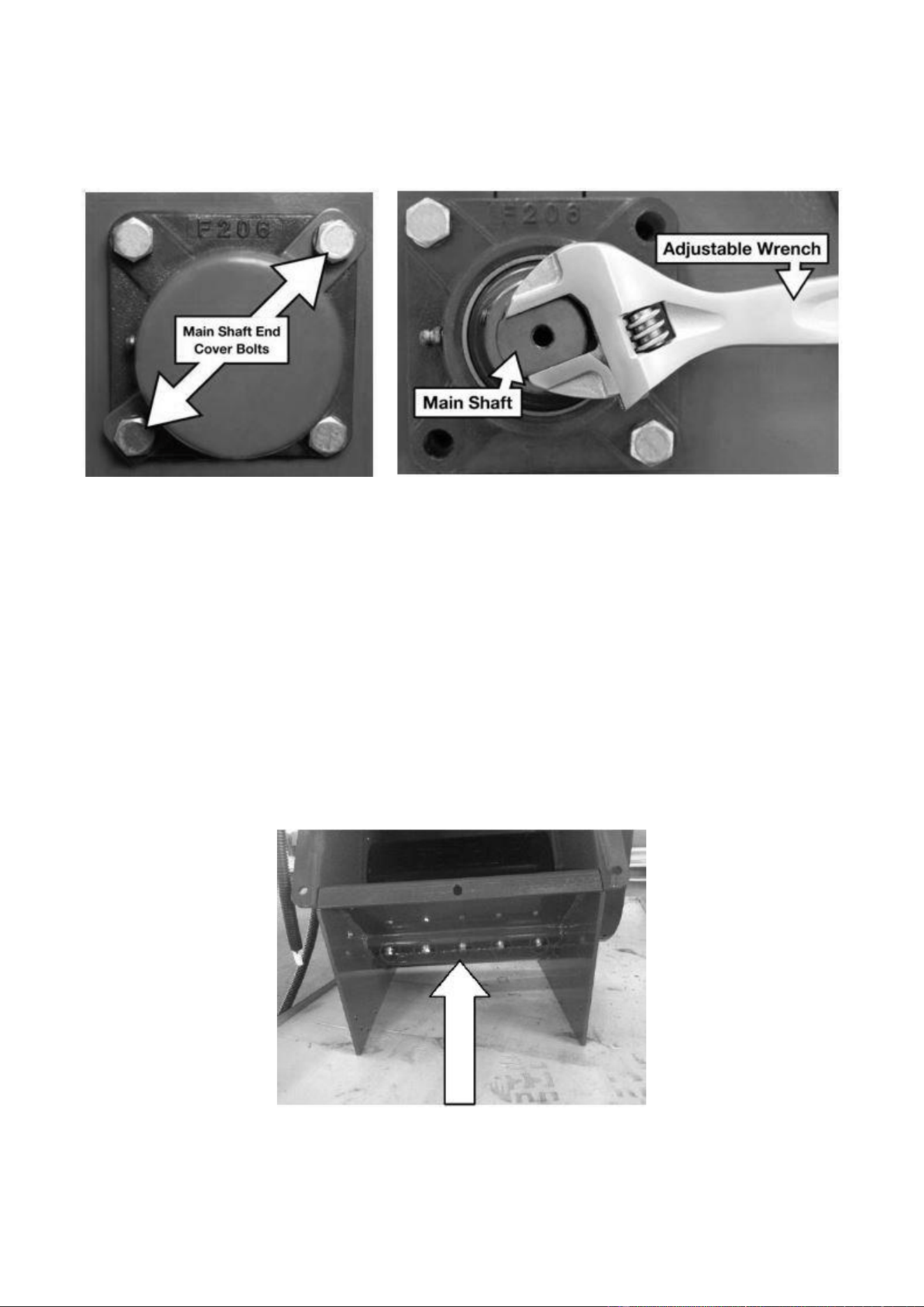
7.56 To remove blockages, DO NOT under any circumstances use your hands.
STOP and disable the machine then undo the chutes.
Remove the main shaft cover by undoing the two cover securing bolts.
Using a spanner, rotate the blades in both directions until the machine is free of
materials which have become stuck.
7.57 As the discharge materials pile up, move the chipper or the material to keep the outlet
free.
DO NOT position the deflector horizontally as it will reduce the airflow, impeding
discharge and cause a blockage.
7.58 To reduce stress on the engine when wood chipping is not being performed, set the
throttle control lever to its ‘SLOW’ position.
Lowering the engine speed to idle will help extend the life of the engine, as well as
conserve fuel and reduce the noise level of the machine.
7.59 The gap between the rotary blade and the fixed blade can be adjusted.
The Factory gap setting between the rotary and fixed blade is 2 to 3mm.
This is suitable for chipping soft wood.
For hard wood we recommend adjusting the gap to 1 to 2mm.
7.60 Unscrew the bolts as indicated below.
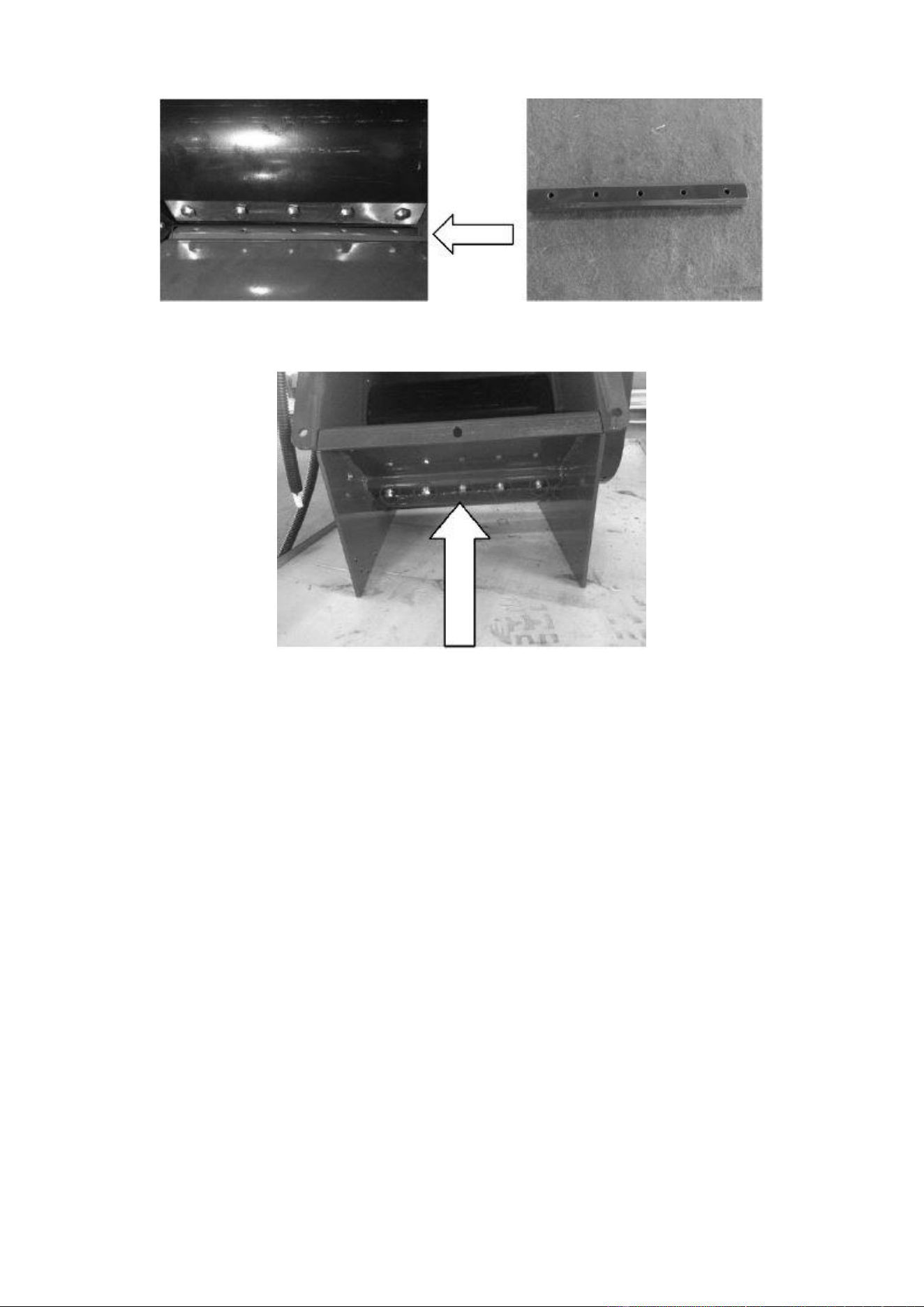
27
7.61 Move the blade adjusting plate up or down to change the size of the gap.
Ensure the blade drum will not rub between the blade adjusting plate.
7.62 Retighten the bolts.
28
WARNING
ALWAYS stop the engine and disconnect the spark plug HT lead cap BEFORE doing
any repairs or maintenance.
NEVER touch a rotating blade.
Check and maintain the oil and fuel level daily.
Frequently check the wood chipper and make sure that all deposits are removed from
the feed hopper and discharge chute.
At regular intervals, check the tightness of all nuts, bolts and screws.
If the blade hits an obstacle, check for damage and if the machine vibrates badly, STOP
the machine and take it to a service dealer.
CAUTION
ALWAYS refuel and defuel in a well-ventilated area with the engine off and cool.
Whilst carrying out any maintenance, you must wear the appropriate Personal
Protective Equipment (PPE).
CAUTION
NEVER use a pressure washer or hose to clean the wood chipper.
Water can penetrate areas of the unit and cause damage to spindles, pulleys, bearings
or the engine.
The use of pressure washers or hose pipes will result in shortened life and reduce
serviceability.
Shut down the engine, wait for all moving parts to come to a complete stop, remove the
HT lead cap and wait for the engine to cool BEFORE performing any maintenance.
8. MAINTENANCE
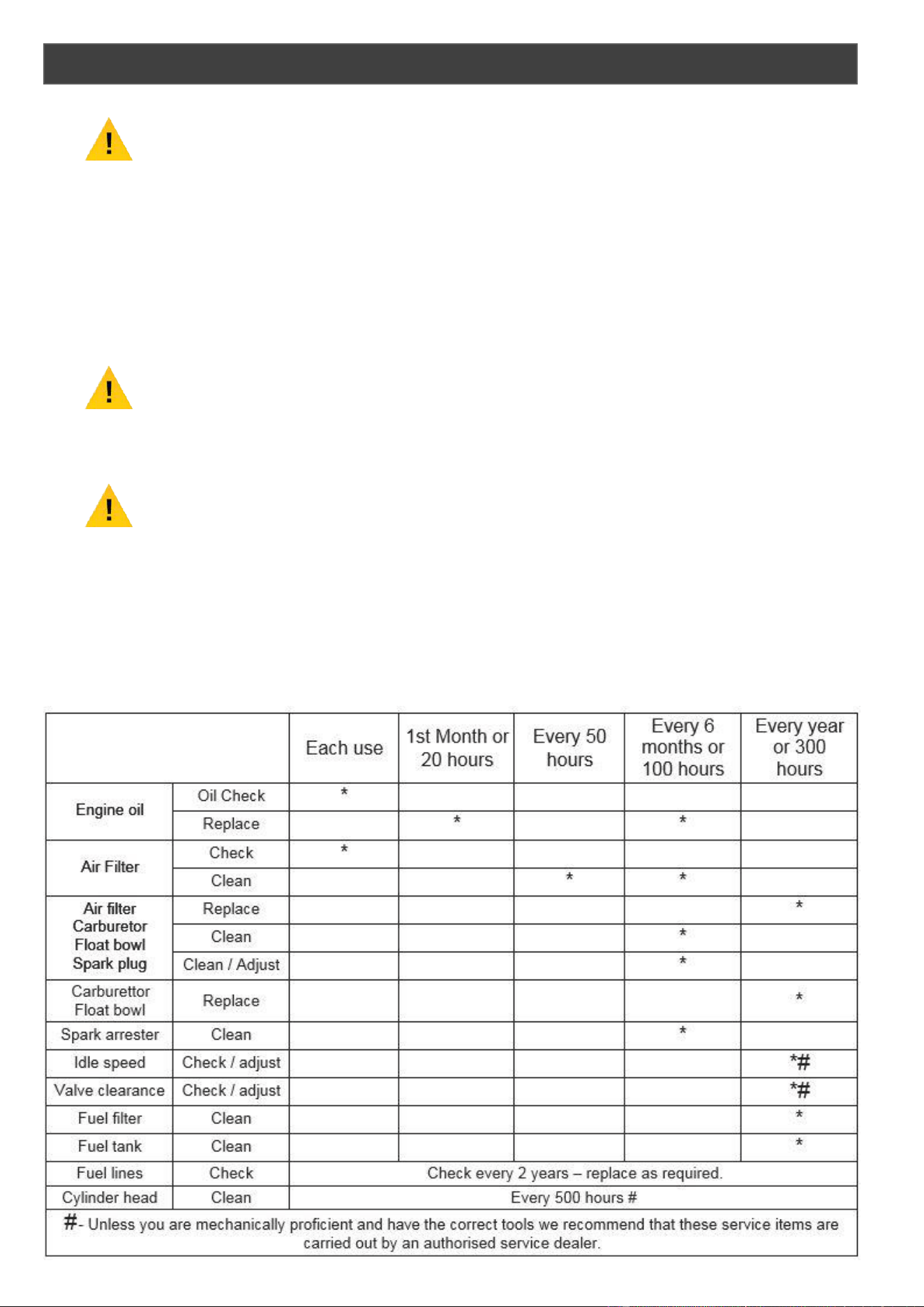
29
8.0 NEVER let the engine run without an air filter being fitted.
8.1 A dirty air filter element decreases engine performance, increases fuel consumption
and makes it difficult to start.
8.2 You MUST make sure that the housing is free of dust and debris.
DO NOT allow any dust or debris to enter the carburetor.
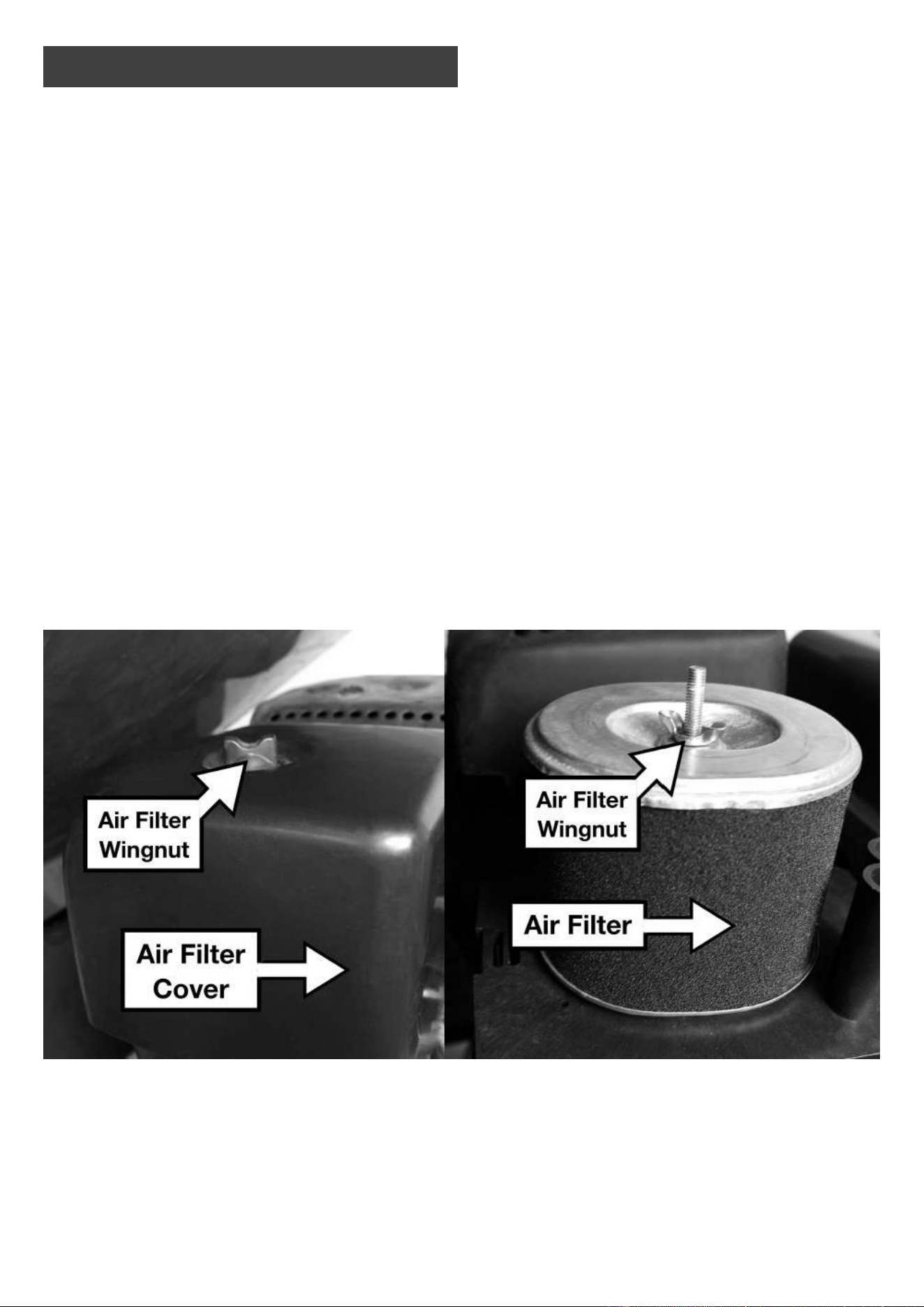
8.3 Remove the air filter housing by unscrewing the wingnut in an anticlockwise direction.
8.4 Carefully remove the cover.
8.5 Unscrew the air filter element wingnut and remove the paper/foam filter element.
8.6 Replace the filter element if it shows any signs of wear or damage.
8.7 Otherwise, remove the foam filter from the paper filter element and tap the debris for
the paper element.
Use a low pressure airline to blow the remaining dust from the paper element by
blowing from the inside to the out.
8.8 Wash the foam filter element in a mild detergent solution and allow to dry.
Once dry, soak the foam element in engine oil and remove the excess.
8.9 To reinstall, reverse the process above.
AIR FILTER
30
CAUTION
The spark plug MUST be tightened correctly otherwise the engine will overheat causing
damage.
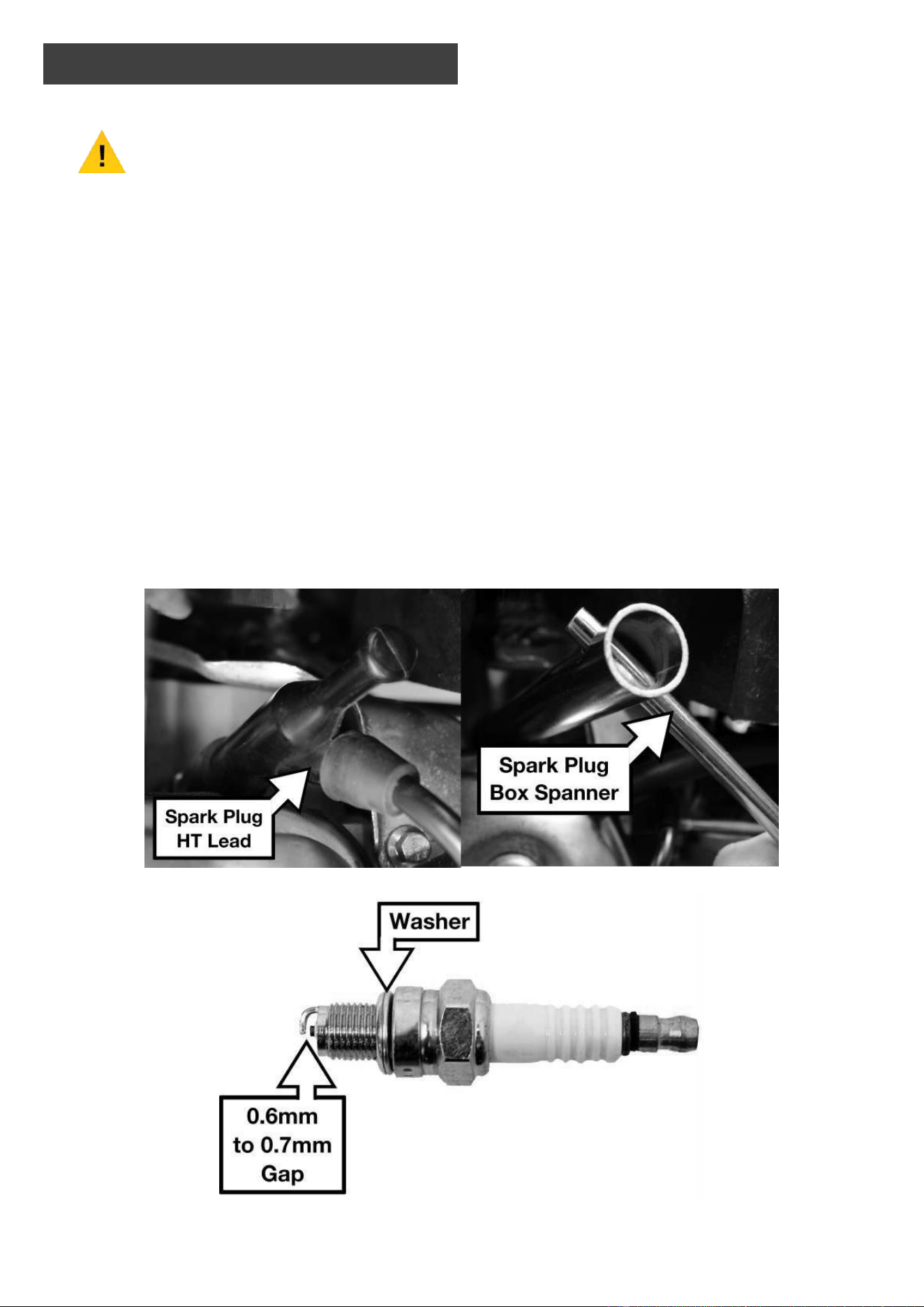
8.10 To ensure the engine runs correctly, the spark plug gap of 06 – 0.7mm must be
maintained and the spark plug must be free of carbon deposits.
8.11 To remove the spark plug, remove the HT lead cap and the undo the spark plug in
an anticlockwise direction.
8.12 Once the plug has been removed, check for visual damage, electrode wear and carbon
deposits.
Replace a damaged or badly worn spark plug.
Clean off any carbon deposits using a soft brass brush.
8.13 Check the spark plug gap with a feeler gauge and adjust the electrode to the correct
gap of 0.6 – 0.7mm.
8.14 Check the spark plug washer for damage and replace if required.
8.15 Replace the spark plug by hand to make sure it doesn’t cross thread, tighten the spark
plug to a torque of 12/15Nm.
SPARK PLUG
31
8.16
8.17
8.18
8.19
8.20
8.21
8.22
8.23
8.24
CAUTION
Risk of burn injury from HOT engine oil.
Allow the oil to cool to WARM before changing the oil.
Warm engine oil will drain more easily.
Use SAE30 or 15W40 engine oil.
The 420cc engine holds 1100ml of oil.
The 212cc engine holds 600ml of oil.
Drain the oil while the engine is warm. Warm oil drains quickly and more effectively.
Remove the oil filler/dipstick and place a suitable container under the drain plug.
Unscrew the drain plug and allow the oil to drain, tilt the machine slightly to ensure all
the oil has drained.
Once all the oil has drained, check the drain plug washer and replace if damaged.
Reinstall the drain plug by hand to avoid cross threading and then fully tighten with a
spanner.
With the lawn mower/engine on flat, level ground, fill the engine with oil to the upper
upper edge of the oil filler neck.
Fill slowly, stopping occasionally to check the oil level.
DO NOT OVERFILL.
Screw the oil filler/dipstick in securely.
Wipe up any spilt oil
ENGINE OIL

32
8.25 The battery is maintenance free and as such requires no special treatment other than
keeping it clean.
8.26 If the machine has not been used in a while, the battery may need charging.
8.27 The battery can be charged by starting the machine manually.
Once running, it will charge the battery.
8.28 You can also remove the battery and charge it with a mains battery charger.
8.29 When disconnecting the battery, you MUST observe the correct polarity.
Red wire to the Positive (+) terminal.
Black wire to the Negative (-) terminal.
DO NOT start the machine without the battery installed.
8.30 To access the battery, remove the battery cover retaining bolt and keep in a safe place.
Remove the cover and lift the battery out and place it on the floor.
8.31 Undo the BLACK wire to the (-) terminal FIRST, the undo the RED wire to the positive
(+) terminal and cover it with insulating tape.
8.32 Place the battery on charge ensuring you connect the correct charge cable to the
correct battery terminal.
8.33 Once charge reconnect the battery.
Connect the RED positive (+) cable first and then the BLACK negative (-).
BATTERY
33
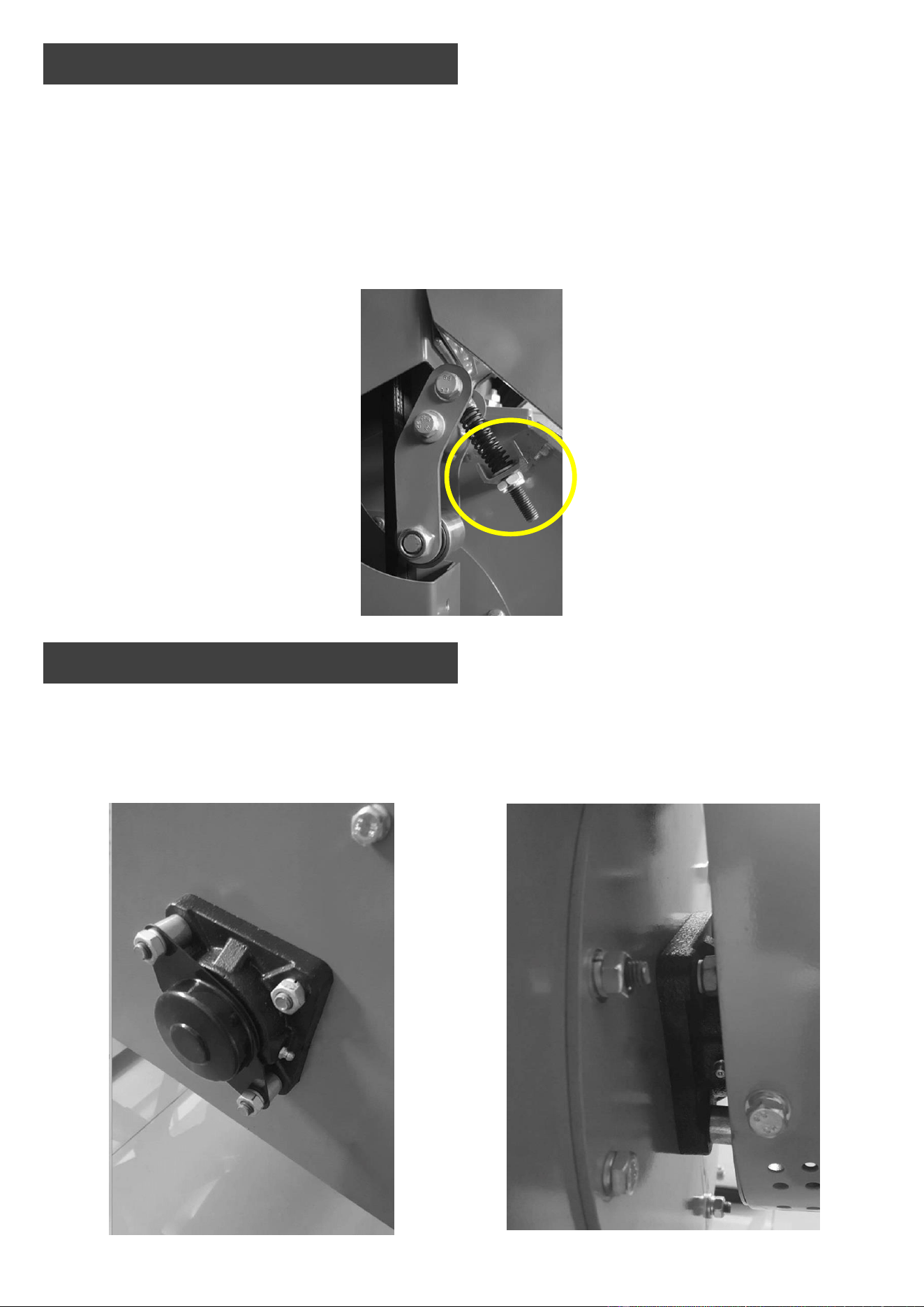
8.34 Ensure belts are kept correctly tensioned.
Tighten the adjusting nut (see image) to keep the belts tight.
8.35 DO NOT overtighten.
8.36 Belt tension should be
8.36 Grease the main bearing every 50 hours of use.
8.37 There are grease nipple on either side of the bearing.
BELT TENSIONING
MAIN BEARING

34
NOTE
Improper storage of this machine may cause starting difficulties and may cause
permanent damage and will not be covered by the warranty.
9.0 Perform all the general maintenance from the maintenance section of this manual.
9.1 Clean the exterior of the machine.
DO NOT use a pressure washer or hose pipe as this could penetrate the engine with
water and cause irreparable damage.
9.2 Remove all the fuel from the petrol tank by using either a syphon or by gently tilting the
machine to drain the tank into a suitable container.
9.3 Turn OFF the fuel tap.
9.4 After all the fuel has been removed from the engine, start the engine and allow it to run
at idle until the engine stops of its own accord.
This allows the remaining fuel in the fuel lines and carburetor to be drained.
9.5 Allow the engine to cool completely.
9.6 Remove the spark plug and pour 1 teaspoon of clean, fresh engine oil into the
combustion chamber.
9.7 Place a clean, lint free cloth over the spark plug hole and then gently pull the recoil
starter handle 4 to 5 times.
This coats the internal components with a fresh layer of oil.
9.8 Remove the cloth and replace the spark plug.
9.9 Replace the spark plug by hand to make sure it doesn’t cross thread, tighten the spark
plug to a torque of 12/15Nm.
9.10 Store the machine in a cool, dry place away from any sources of ignition such as an oil
burner, water heater etc.
9.11 Disconnect the battery and store in a cool dry place.
During storage we advise you charge the battery at least once every month.
10.0 It is always advisable to transport the machine when the fuel tank and oil has been
drained.
10.1 Ensure the machine is secured safely and not obstructing vision.
10.2 ALWAYS ask for assistance when lifting the machine in and out of vehicles.
10.3 NEVER transport the machine with the engine running.
9. STORAGE
10. TRANSPORT
35
CAUTION
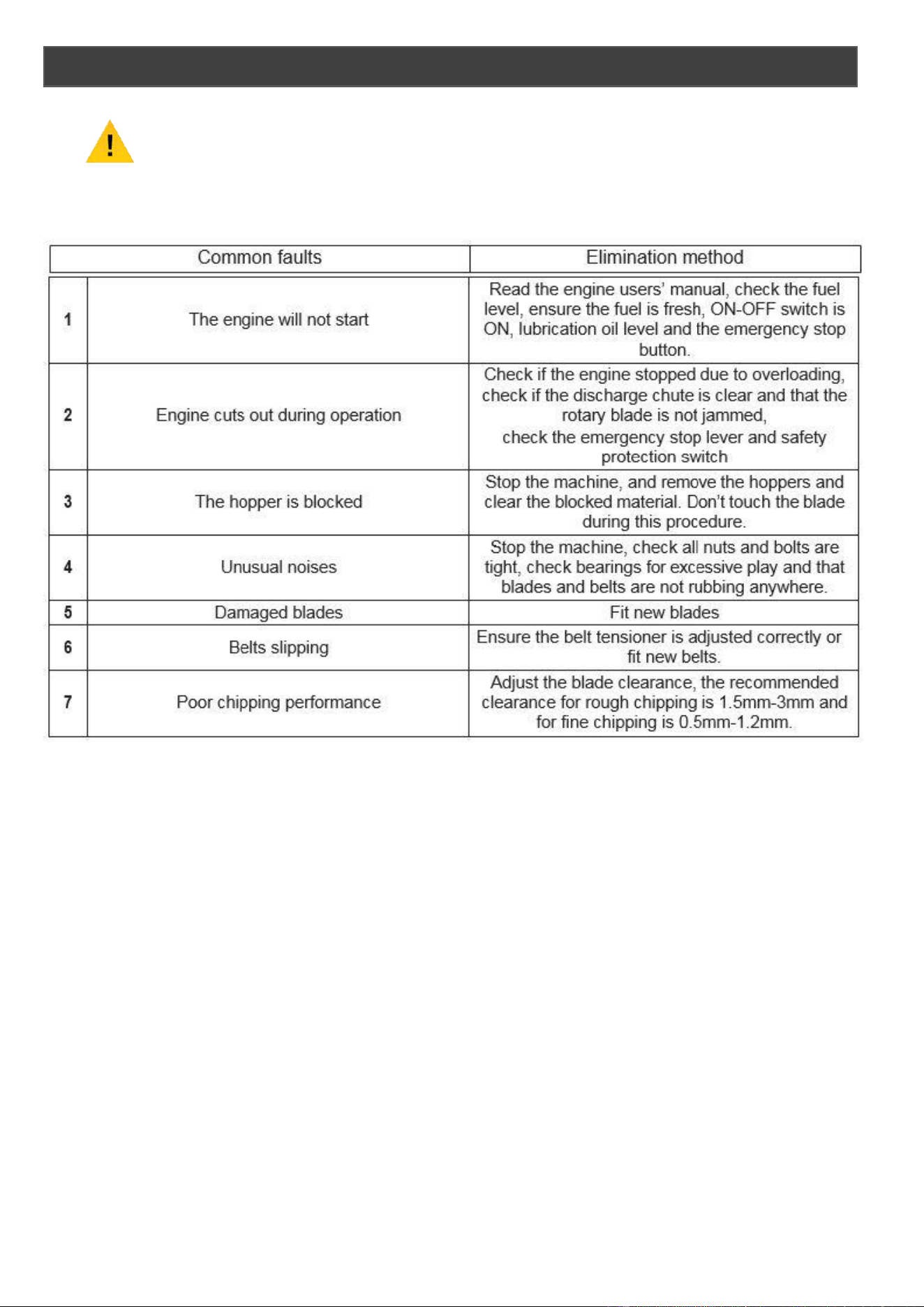
If trouble shooting does not solve the problem, contact your dealer or the manufacturer
directly.
Use ONLY original parts approved by the manufacturer, otherwise a hazard risk arises.
11. TROUBLESHOOTING

36
Issue
Possible causes
Possible corrective actions
STARTING DIFFICULTY
NORMAL SPARK
ISSUE WITH FUEL SYSTEM
Poor fuel supply.
1.
No fuel in fuel system,
fuel tap
closed.
2.
Fuel cap air vent blocked.
3.
Fuel tap blocked.
Fuel supply normal.
4.
Dirty or stale fuel.
5.
Water in fuel.
6.
Incorrect fuel.
Poor fuel supply.
1.
Fill with fuel – open fuel tap.
2.
Clear blocked air vent.
3.
Clear blockage.
Fuel supply normal.
4, 5 & 6. Clear fuel from system and
refill with fresh fuel.
STARTING DIFFICULTY
NORMAL FUEL
ISSUE HT LEAD/SPARK PLUG
Normal spark from HT lead.
1.
Carbon build up on spark plug.
2.
Electrodes badly burnt/damaged.
3.
Incorrect spark plug gap.
No spark at HT lead.
4.
HT lead damaged.
5.
Ignition coil damaged.
6.
Gap between ignition
coil and flywheel to big.
Normal spark from HT lead.
1.
Clean carbon build up.
2.
Replace spark plug.
3.
Adjust the spark plug gap.
No spark at HT lead.
4.
Replace HT lead.
5.
Replace Ignition coil.
6.
Adjust gap.
STARTING DIFFICULTY
(ELECTRIC)
Battery connection.
1.
Loose or incorrect
battery connections.
2.
Battery not charged.
Battery connection.
1.
Check polarity and
tighten connections.
2.
Remove battery from ma-
chine and recharge.
MACHINE’S WHEELS TRACK LEFT
OR RIGHT WHILE BEING TOWED
1. Low tyre pressures.
1. Inflate tyres.
THE SHREDDER DOES NOT
SHRED PROPERLY. THE WOOD IS
NOT PULLED INTO THE MACHINE
BY ITSELF.
THE CHIPS DO NOT HAVE THE
SAME SIZE.
1.
The blades are worn too
much.
2.
The diameter of the
branches inserted into the machine
are larger than 100 mm for
HYCH1500E-2 or
70mm for HYCH7070[E]-2
3.
The gap between the fixed
blade and the counter-blade is too
large, the correct gap is ½ mm
1.
Change or sharpen the
blades and
counter-blade.
Note that the blades are sharpened
on both edges so they can be re-
versed.
2.
Shut the engine off and re-
move the branch that is too thick.
3.
Adjust the gap between the blade
and the counter-blade in the slots
THE ENGINE WILL NOT START OR
TURN BECAUSE THE ROTOR IS
JAMMED.
1. The diameter of branches is too
big. There are unacceptable materials
such as stones or metal in the input
tube. A length of branch remains in
the rotor after the engine was last
stopped.
Shut off the engine, remove the spark
plug cap. NEVER under any circum-
stances use your hands to remove
stuck wood.
Reduce size of wood to 100 mm for
HYCH1500E-2 or 70mm for HY-
CH7070[E]-2 or less.
Use a piece of wood to turn the rotor
to remove the material from the rotor
and input tube. If necessary, remove
the cap of the bearing housing and
rotate the rotor axle with a spanner.
If necessary, remove the input or out-
put tube to get access to the rotor.
Check the sharpness of all blades,
have them sharpened or replace as
required.
Make sure all blade bolts are properly
tightened.

37
MODEL
HYCH7070[E]-2
HYCH1500[E]-2
Engine Type
4 Stroke OHV Single Cylinder
4 Stroke OHV Single Cylinder
Engine Size – cc
212
420
Oil Capacity – ml
600
1100
Noise Level – dB (A)
108
108
Power @ 3600rpm – hp
7.0
15.0
Starting Method
Recoil (optional electrical)
Recoil/Electric
Battery – V
12
12
Fuel Type
Unleaded Petrol
Unleaded Petrol
Fuel Tank Capacity – l
3.6
6.5
Wheel Type
Pneumatic
Pneumatic
Dry Weight – Kg
70
180
Drive Type
Twin V Belt in Parallel
Twin V Belt in Parallel
Max Chipping Size – mm
70
100
Performance – kg/hr
500 – 2000
1000 – 5500
Disc Speed – rpm
2880
2350
12. SPECIFICATION

38
11.0 Genpower Ltd confirms that these Hyundai products conform to the following
CE Directives;
2006/42/EC Machinery Directive
2004/108/EC EMC Directive
2000/14/EC, Amended by 2005/88/EC Noise Emissions Directive
97/68/EC_2010/26/EC NRMM Emissions Directive
EC DECLARATION OF CONFORMITY
The undersigned. As authorised by: Genpower Ltd
Declares that the following equipment manufactured under licensed by Hyundai Corporation, Korea
Conforms to the Directive:-
2000/14/EC (as amended)
Of the European Parliament and of the council on the approximation of the laws of the Member
States relating to the noise emission in the environment by equipment for the use outdoors.
Equipment Category: Power Equipment
Product Name/Model: HYCH7070[E]-2
HYCH1500[E]-2
Type/Serial No: Wood Chipper
Net installed power: HYCH7070[E]-2 7.0hp
HYCH1500[E]-2 15.0hp
The technical documentation is kept by: Roland Llewellin, Genpower Ltd
Isaac Way, Pembroke Dock,
Pembrokeshire, SA72 4RW.
The conformity assessment procedure followed was in accordance with annex V of the
Directive.
Notified Body: TüV SüV Product Sevice GmbH
Zertifizierstelle, Riddlerstraße, 65
80339 MüNCHEN, Germany.
Certification n° M8A 13 07 84794001
Measured Sound Power Level: HYCH7070[E]-2 108dB
HYCH7070[E]-2 108dB
Guaranteed Sound Power Level: HYCH7070[E]-2 108dB
HYCH7070[E]-2 108dB
A copy of this certificate has been submitted to the European Commission and the EU Member
State United Kingdom.
Place of Declaration: Pembroke Dock, SA73 4RW
Date: 07/03/2018
Signed by: Roland Llewellin
Position in Company: Managing Director
Name and address of manufacturer or Authorised representative:
Genpower Ltd
Isaac Way, Pembroke Dock,
Pembrokeshire, SA72 4RW
13. DECLARATION OF CONFORMITY

39
12.1 We do not offer a takeback scheme for the recovery of Waste Electrical Electronic
Equipment (WEEE) & Batteries instead the responsibility to dispose of WEEE and
or Batteries is passed onto you by us. So when it becomes necessary to dispose of
your machine you must take it to your local Civic Amenity Site. For further information
please contact your Local Authority for disposal advice.
12.2 You MUST make sure that all unused oil and fuel is disposed of correctly either be
forehand or at your local Civic Amenity Site. Under NO circumstance must any oil
and fuel be put down any drains.
12.3 Waste Electrical Electronic Equipment (WEEE) recycling.
12.4 Certain products contain WEEE waste which should not be disposed of in your
domestic waste.
12.5 You MUST recycle WEEE in accordance with your local authority or recycling centre.
12.6 Battery recycling, certain products contain batteries which should not be disposed of
in your domestic waste
12.7 You MUST recycle batteries in accordance with your local authority or recycling
centre.
12.8 Unwanted packaging materials should be sorted and taken to a recycling centre so it
can be disposed of in a manner which is compatible with the environment.
12.9 The symbol means that you should ‘Reduce – Reuse – Recycle.’
12.10 We are a Member of the VALPAK National Compliance scheme and our registration
number is RM08660.
12.11 For further information about disposal please contact your Local Authority.
12.12 You can also get more advice and guidance about recycling at the following website
http://www.recycle-more.co.uk
12.13 Should you pass this product onto another user either sold or loaned you MUST pass
on this user manual. This will make sure that all other users can use and maintain the
machine safely.
14. RECYCLING & PRODUCT DISPOSAL

40
13.0 POSTAL ADDRESS:
13.1 TELEPHONE:
13.2 E-MAIL:
13.3 WEBSITE:
Genpower Ltd
Isaac Way,
London Road,
Pembroke Dock,
Pembrokeshire,
SA72 4RW. UK.
01646 687 880
aftersales@hyundaipowerproducts.co.uk
www.hyundaipowerproducts.co.uk
14.0
14.1
14.2
15.0
15. CONTACT DETAILS
16. MANUAL UPDATES
Our manuals are constantly being reviewed and updated.
Should you find an error, omission or something you find unclear, please contact your
dealer for assistance.
Our latest manuals are placed online.
We reserve the right to make any modifications without prior notice whenever
necessary.
17. WARRANTY
18. Proof of purchase will be required before you make a warranty claim.
19. Full warranty terms and conditions can be found on the HYUNDAI POWER
20. PRODUCTS website:
21. www.hyundaipowerproducts.co.uk

41

42

43

For Inquiries, Please Contact:
GENPOWER LTD
Isaac Way, London Road,
Pembroke Dock, UK, SA72 4RW.
T: +44 (0) 1646 687 880
E: info@hyundaipowerproducts.co.uk
www.hyundaipowerproducts.co.uk
Imported / Distributed by Genpower Ltd for
the United Kingdom & Ireland
Licensed by Hyundai Corporation Holdings, Korea