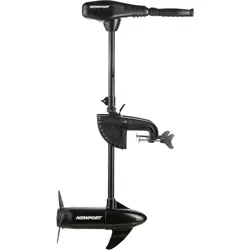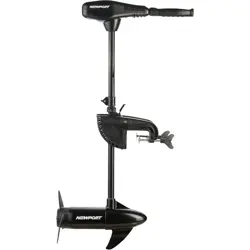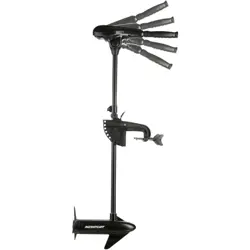
ELECTRIC OUTBOARD MOTOR
OWNER’S MANUAL
NT300 ELECTRIC OUTBOARD MOTOR OWNER’S MANUAL
(866) 721-0002
support@newportvessels.com
newportvessels.com
Newport is the leading innovator in next-
generation electric small boat systems,
providing anglers with powerful, reliable,
and hassle-free solutions for over a
decade.
From cutting-edge electric motors and
high-performance lithium batteries to
durable, purpose-built boats, Newport
delivers a complete system designed
for seamless integration and peak
performance
on the water.
Built for anglers who demand eciency
and reliability, Newport eliminates
the noise, maintenance, and hassle of
traditional setups so you can focus on
what matters.
THE WAY FORWARD IS ELECTRIC.
Visit newportvessels.com
Leading Innovator of
NEXT-GENERATION ELECTRIC
Fishing Systems

2 3
Please read and retain this manual before using this electric motor. This manual contains information that describes
the procedure for safe operation and daily maintenance of your electric motor. Safe operation will prevent personal
injury and damage to the product.
CONTENTS
1 General Information
4
1.1 Product Identification
4
2 Technical Data
4
3 Safety Information 5-6
3.1 Critical Safety Information
5-6
3.2 Before Use
5
3.3 During Use
5
3.4 After Use
6
4 Installation
6-7
4.1 Install the Motor in the Boat
6
4.2 Adjusting the Trim
6-7
4.3 Fixing the Steering
7
4.4 Connect to the Battery
7
5 Controller Display
8-10
5.1 Overview of Multi-Function Display
8
5.2 Battery Display
8
5.2.1 Estimated Percent of Remaining Battery Power
8
5.2.2 Switching Between Battery Types
9
5.3 Error Status Display
9
5.4 Error Codes and Solutions
10
6 Operation
10-12
6.1 Start the Motor
10
6.2 Travel Forward/Reverse
10
6.3 Steering the Motor
11
6.4 Emergency Stop
11
6.5 Finishing the Trip
11
6.6 Stow the Motor
12
6.7 Deploy the Motor
12
7 Care and Services
12-15
7.1 Care of Motor Components
12
7.2 Corrosion Protection
13
7.3 Care of Battery Usage
13
7.4 Replacing the Fin
13
7.5 Replacing the Propeller
14
7.6 Recalibrate the Throttle
14-15
Declaration of Conformity for Recreational Craft
15
Customer Support
15
4 5
3 SAFETY INFORMATION
3.1 CRITICAL SAFETY INFORMATION
Please read all safety information before
installing or operating your electric motor.
Severe injury, damage, or even death can occur
as a result of improper usage.
WARNING: There is a risk of death or severe injury from
electric shock- use caution and do not touch any uninsulated
wires or damaged parts.
• Do not use damaged batteries.
• If wiring is frayed or broken, do not touch it.
• If repair work is needed to the electrical
components of your product, do not attempt to do
it yourself.
• If there is any problem with the system, turn o the
power immediately and avoid touching the metal
components.
WARNING: There is a risk of explosion which could result
in death, serious injury, or property damage due to the
production of oxyhydrogen gas from the battery.
• If the battery becomes submerged in water deeper
than one meter for a short period of time, do
not attempt to recover the battery, and refer to
the safety instructions provided by the battery
manufacturer.
• If the battery has been submerged in shallow water,
less than a meter, for more than 30 minutes, do
not attempt to recover the battery, and refer to
the safety instructions provided by the battery
manufacturer.
WARNING: Electromagnetic radiation may cause death
or severe injuries to people with cardiac pacemakers. Those
with pacemakers should not get too close to the motor and
should consult their physician about the proper distance
for safety.
WARNING: There is inherent danger in using a boat -
always prepare for the unexpected. A boat which is out
of control can easily result in severe injuries or death by
drowning.
Always check weather predictions and water conditions
before a trip on the water, and also familiarize yourself with a
map of the area you’ll be traversing.
Depending on the size of your boat, make sure you bring any
proper safety equipment. Paddle(s) and a communication
device are a must for any size of boat, and if appropriate,
also bring an anchor and extra drive.
Always check your motor and system for any damage and
ensure they are running properly before leaving the dock.
WARNING: Use caution around rotating components to
avoid possible injury or even death.
• Do not wear loose clothing or jewelry near the
motor shaft or propeller and tie up long hair.
• Never attempt maintenance or cleaning of the
motor shaft or propeller without first shutting o
the system.
• Power down the motor when there are people too
near the propeller or
motor shaft.
• Do not use the propeller out of the water.
CAUTION: Batteries can cause severe physical harm or
even death in many dierent ways. Always read and follow
all safety even death in many dierent ways. Always read
and follow all safety guidelines and instructions provided by
your battery manufacturer.
• Never use third-party chargers for batteries, it could
start a fire.
• If the battery catches fire during use, use water to
cool the battery and prevent fire from spreading;
however water will not extinguish a lithium fire - if
possible, use sand to smother the fire.
CAUTION: Parts may be hot enough to cause burns. Do
not touch the components or battery immediately after use;
allow to cool suciently before handling the components.
CAUTION: Danger of crushing when tilting the motor-
keep fingers, hands, and all body parts away from the
mechanical parts and the area of the motor when tilting
the motor.
3.2 BEFORE USE
• This motor should only be operated by an
adult who has thorough understanding and
command of the motor, including steering
functions, emergency stop switch, and
throttle.
• Always operate your boat and this motor in
compliance with local safety regulations.
• Always carry a paddle on board at all times,
especially when using an electric motor as
your primary method of propulsion.
• All passengers should wear approved life
jackets at all times.
• Check the status and condition of your
motor and battery before each trip. We
recommend starting every trip with a full
battery charge.
• Do not operate the motor outside of the
water.
• Do not modify the motor with non-original
parts.
3.3 DURING USE
• Stop the motor immediately if someone is
over board.
• Propellers are dangerous- use extra caution
when operating the motor near areas where
people may swim. Always be alert and aware
of your surroundings when operating the
motor.
• Do not exceed the recommended load and
power limitations of your boat as suggested
by its manufacturer.
1 GENERAL INFORMATION
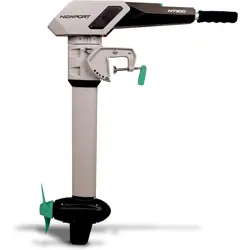
Thank you for purchasing the NT300 Electric
Outboard. We hope that you enjoy it!
The Newport NT300 Electric Outboard is
designed with direct-drive and field-oriented-
control technology to deliver the ultimate
eciency in a compact package. The propulsive
power of the NT300 is equivalent to a 3hp petrol
outboard motor but with silent and emission-
free power delivery.
The Newport NT300 Electric Outboard is
compatible with conventional 36V deep cycle
batteries, 36V LFP lithium battery, and 36V
lithium cobalt oxide.
Please read and retain this manual before
using this electric motor. This manual contains
information that describes the procedure for
safe operation and daily maintenance of your
electric motor. Safe operation will prevent
personal injury and damage to the product.
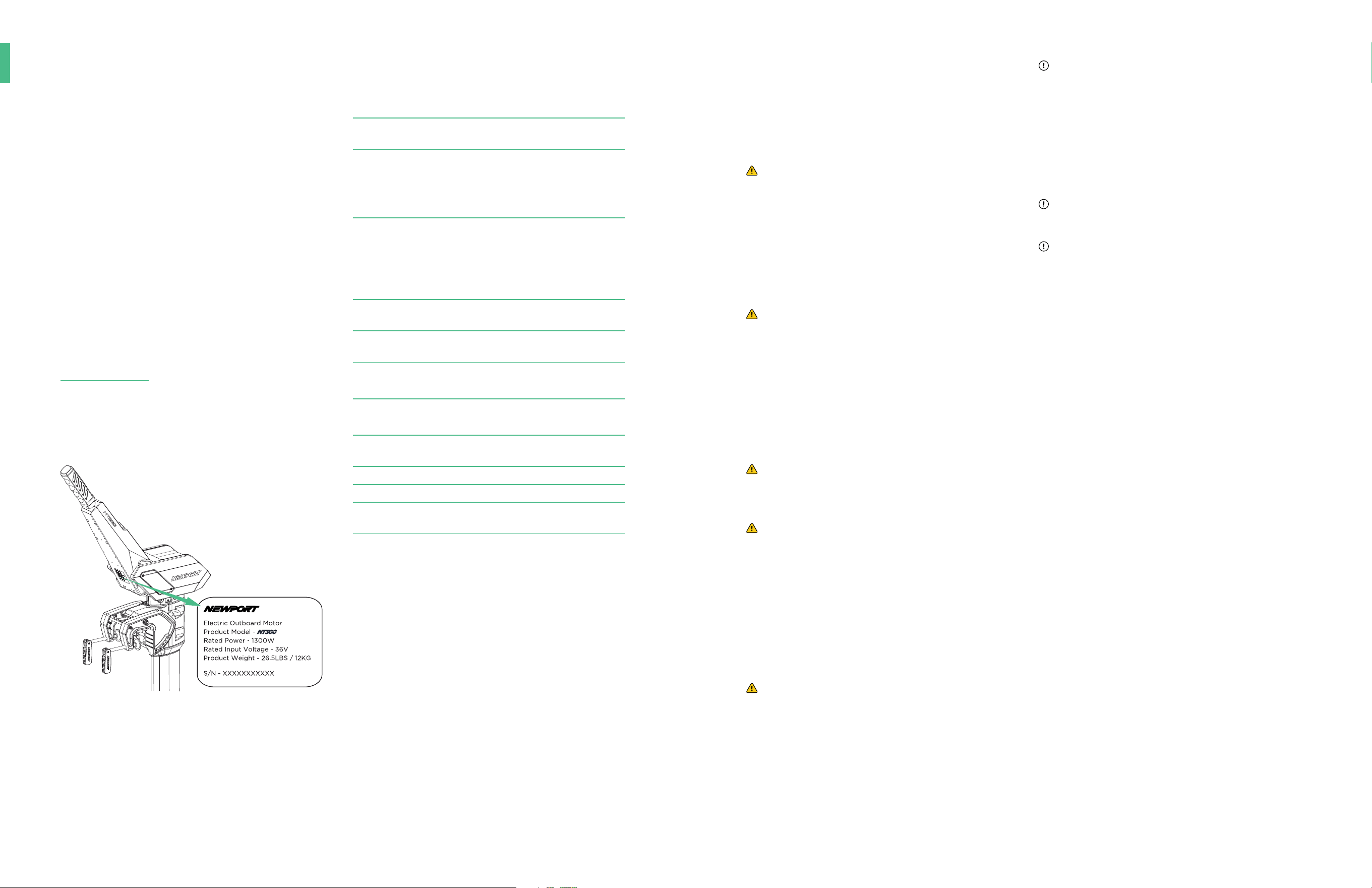
1.1 PRODUCT IDENTIFICATION
Check the figure below to find the serial number
of your product. You will need this as a reference
to access after-sale services.
2 TECHNICAL DATA
Rated Input
Power(static)
1300W
Comparable
Petrol Outboard
3HP
Battery Type
Deep Cycle Marine Battery
LFP Lithium Battery
Lithium Cobalt Oxide
Battery
Battery Input
Voltage
36V-Deep Cycle Marine
Battery
36V-LFP Lithium Battery
36V-Lithium Cobalt Oxide
Battery
Max. Overall
Eciency
50%
Rated Rotation
Speed
1500 rpm
Total Weight
Short: 23.8lbs (10.8kg)
Long: 24.3 lbs (11kg)
Shaft Length
Short: 25in (635mm)
Long: 30in (760mm)
Control System
Digital Control/Integrated
Tiller
Tilt Angle Manual, 80�
Trim Angle Manual, 0�, 7�, 14�, 21�
Propeller
Diameter
10.6 in (270mm)
6 7
3.4 AFTER USE
• Disconnect the motor from the battery after
use.
• Rinse the motor carefully with freshwater
after each usage, especially after use in
saltwater.
Do not carry the kayak/boat by lifting with the
bracket. This can cause damage to the boat and
potentially to the bracket.
4 INSTALLATION
4.1 INSTALLATION OF THE BRACKET
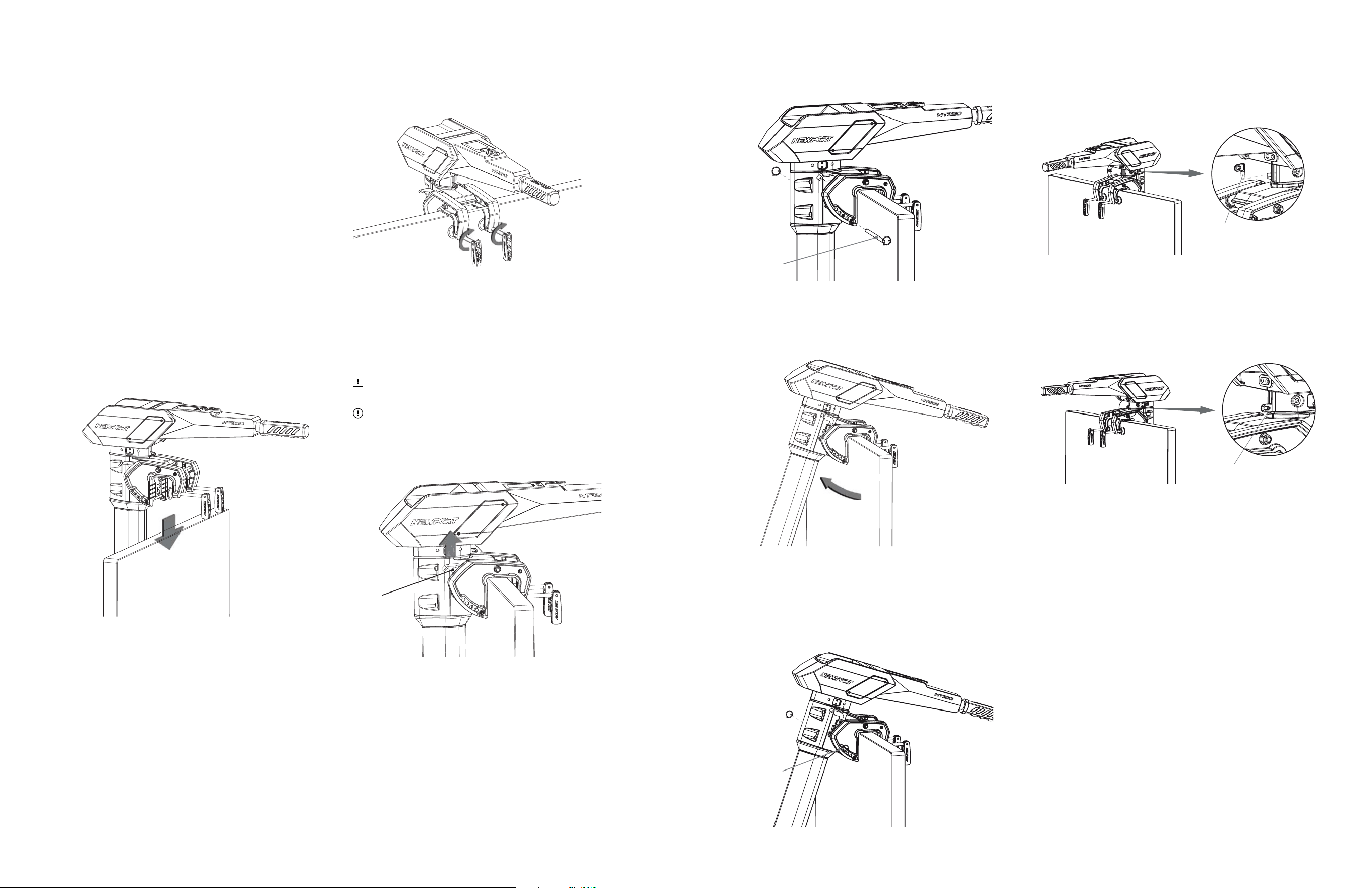
Place the motor on the transom of the boat.
Note: It’s suggested to mount the motor at
the centerline of the boat for better steering
experience.
1. Place the motor on the transom of the boat.
Note: It’s suggested to mount the motor at
the centerline of the boat for better steering
experience.
2. Tighten the clamp handles to fix the motor
on the transom of
the boat.
4.2 ADJUSTING THE TRIM
Adjust the motor’s trim according to the boat
type to get the optimal position relative to the
water surface for better running speed.
Advice: It’s recommended to try out dierent trim angles
to have the best performance and highest eciency.
CAUTION: Make sure the motor is fully stopped before
adjusting the trim angle.
1. Make sure the reverse lock is pulled up.
2. Remove the stop ring and pull out the trim
pin.
3. Lift the motor to the stow position.
Insert the trim pin to select the desired trim
angle, install the stop ring and deploy the motor
again.
4.3 FIXING THE STEERING
1. To stop the motor from steering, place the
lock pin into the hole.
2. With the lock pin inserted in the hole, now
the steering of the motor is fixed. You can
use other methods (rudder for example) to
steer the boat.
4.4 CONNECT TO THE BATTERY
The motor is adaptable with 36V (three 12V
batteries connected in series) deep cycle marine
battery package, 36V LFP lithium battery
(including three 12V LFP lithium batteries
connected in series) and 36V lithium cobalt
oxide battery package. Please follow the steps
below to complete the battery connection.
1. Find the battery cables from the motor;
there should be a red and a black cable.
2. Connect the red cable to the positive battery
terminal and the black cable to the negative
battery terminal.
3. Make sure the battery cables are connected
to the correct terminal. The motor will
not operate if battery cables are installed
incorrectly.
4. Tighten the connection of the battery cables
to the battery terminals. Make sure the
connection is solid and secure.
Reverse
Lock
Trim Pin
Trim Pin
Steering Lock Pin
Steering Lock Pin
See Our Product Quick Start Videos
for more information
8 9
WARNING: Be sure all switches are in the OFF position
before connecting to battery or batteries. Electrical arcing
near the battery could cause an explosion. The battery
produces hydrogen and oxygen gases while charging. This
potentially explosive mixture escapes through the fill vent
cell caps and may form an explosive atmosphere around the
battery for several hours after it has been charged. Electrical
arcing or flames can ignite the gas and cause an explosion,
which may shatter the battery and could cause blindness or
other serious injury.
WARNING: Deep cycle Batteries contain sulfuric acid,
which can cause severe burns. Avoid contact with skin, eyes
and clothing.
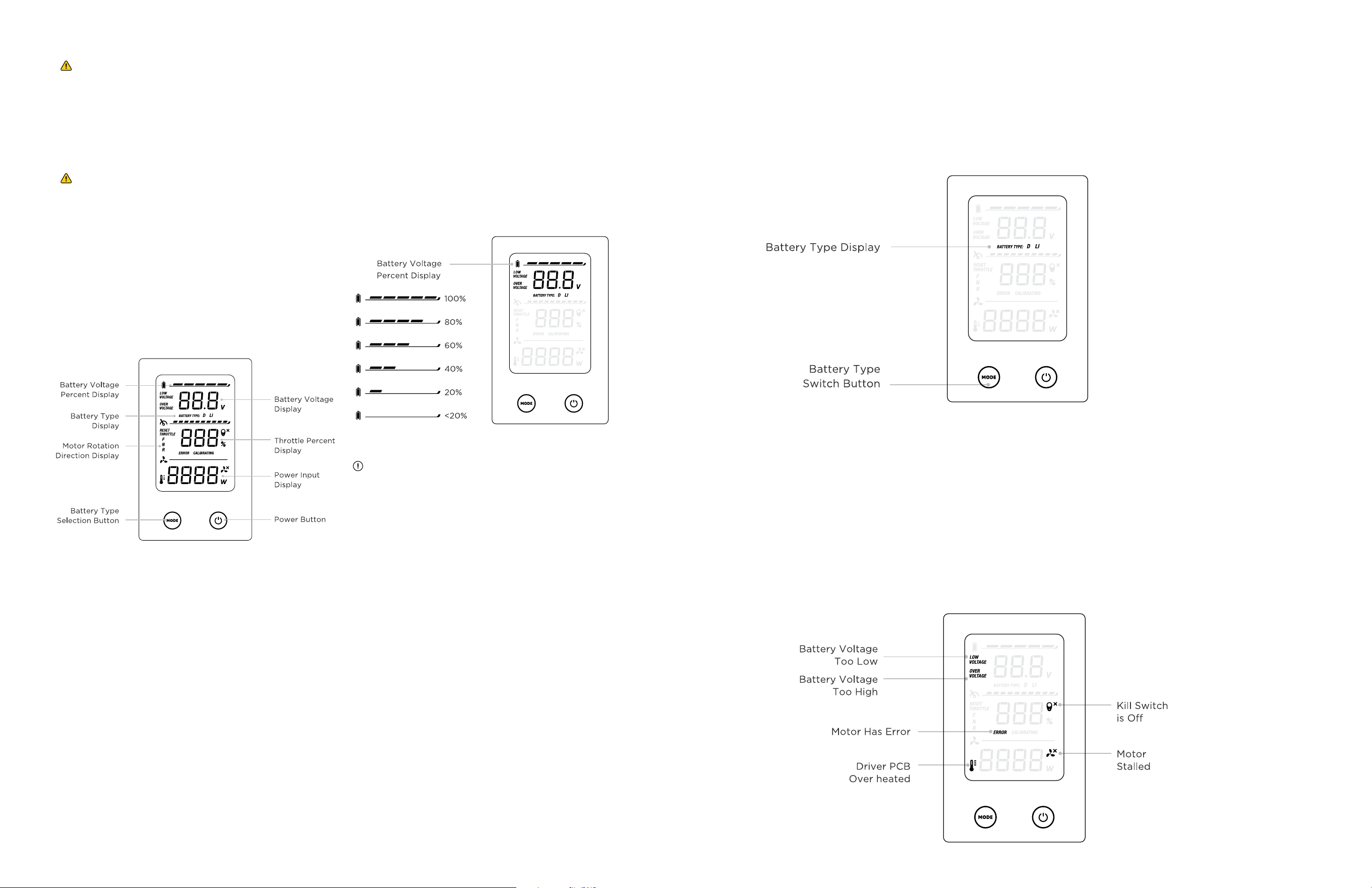
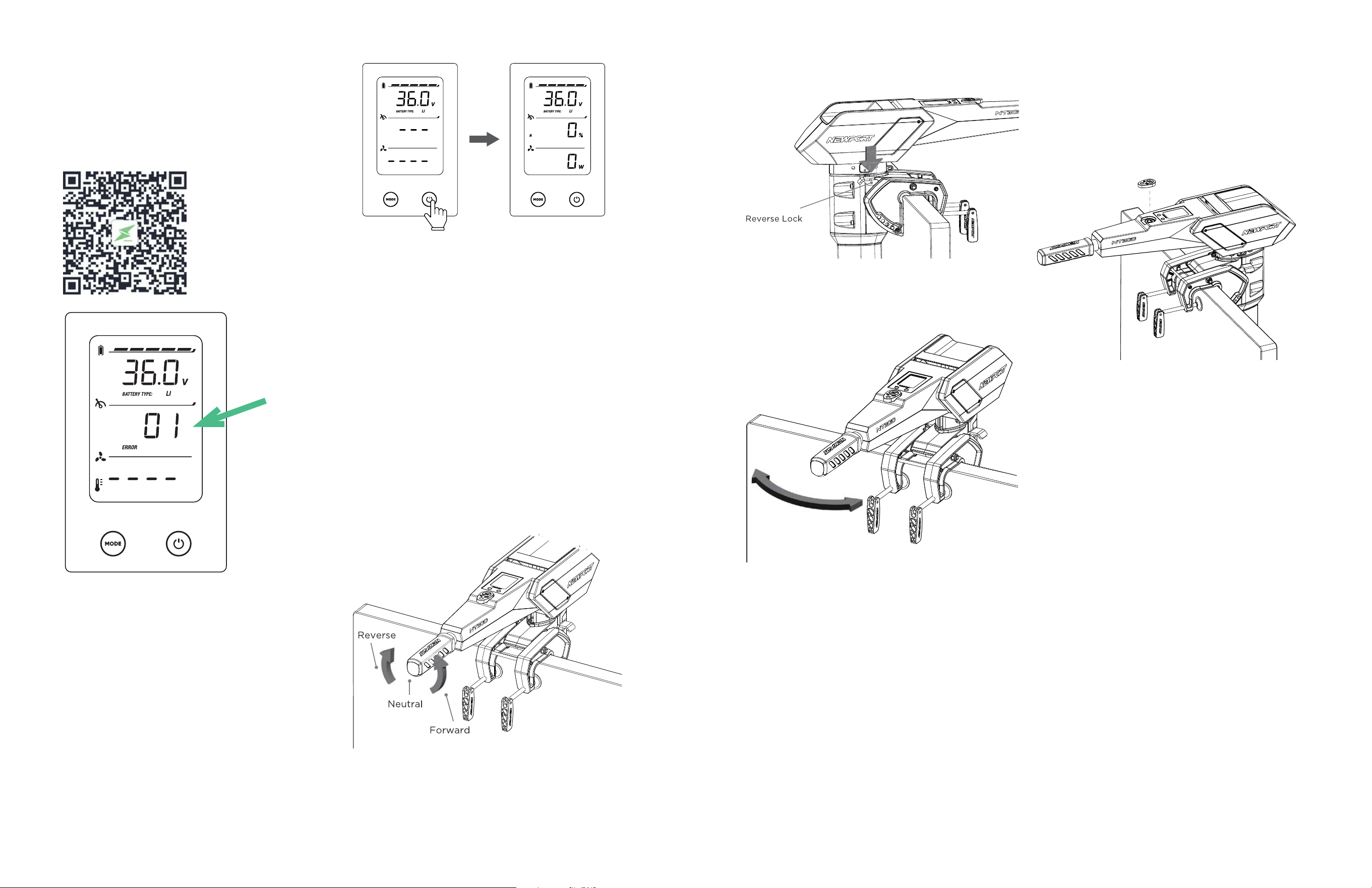
5 CONTROLLER DISPLAY
5.1 OVERVIEW OF MULTI-FUNCTION DISPLAY
The speed controller screen features motor and
battery information for the operator to monitor.
There are two buttons on the speed controller to
control the motor.
5.2 BATTERY DISPLAY
The speed controller screen features motor and
battery information for the operator to monitor.
There are two buttons on the speed controller to
control the motor.
5.2.1 ESTIMATED PERCENT OF REMAINING
BATTERY POWER
The battery bar has 6 dierent status levels
to display the estimated remaining battery
percentage.
5.2 BATTERY DISPLAY
The speed controller screen features motor and
battery information for the operator to monitor.
There are two buttons on the speed controller to
control the motor.
5.2.1 ESTIMATED PERCENT OF REMAINING
BATTERY POWER
The battery bar has 6 dierent status levels
to display the estimated remaining battery
percentage.
CAUTION: Do not overestimate the remaining battery
range; this could result in severe harm or even death.
• Before you leave the dock, know the area you are
traveling, how far you plan to go, and make sure
to have an alternate plan for safely getting back if
anything goes wrong with your motor or battery.
Always bring a paddle.
• Monitor the battery level indicator during your trip
and always leave a buer for getting back to shore.
5.2.2 SWITCHING BETWEEN BATTERY TYPES
This motor can run on a 36V deep cycle battery setup, a 36V LFP lithium battery setup, or a 36V
lithium cobalt oxide battery.
You will need to select which type of battery you are using with your motor for accurate results
on the LCD screen. When the battery is connected to the motor, press the MODE button to toggle
between the Li (LFP Lithium Battery or Lithium Cobalt Oxide Battery) or D (Deep Cycle Battery)
battery options.
5.3 ERROR STATUS DISPLAY
The icons indicated on the LCD screen above show three possible error statuses of the motor. When a
fault occurs, there will be a corresponding code on screen to help diagnose the problem. See section
5.4 Error Codes and Solutions.
Motor overvoltage: If the input voltage is too high, this icon will light up and keep flashing. Please
make sure the input voltage to the motor is correct (24V or 25.9V). Ensure the correct battery option
is selected (D or Li).
Motor overheated: If the motor driver PCB is over heated, this icon will light up.
Motor stalled: If the motor is stalled, this icon will light up. Please disconnect from the battery and
check to see if the propeller has been tangled in weeds or fishing line- these can also get wrapped
behind the propeller. Clean the propeller and resume running.
10 11
5.4 ERROR CODES AND SOLUTIONS
If there is an issue with the motor function,
the display will show and error code to help
diagnose the problem and find the solution.
Scan the QR code below to access the Error
Code Reference Guide.
6 OPERATION
6.1 START THE MOTOR
To start the motor please follow the steps below:
1. Place the magnet kill switch on the tiller.
2. Select the battery mode according to the
battery type used. Please follow 5.2.2
Switching Between Battery Types to
operate correctly.
3. Press the power button on the panel.
4. You can now begin to power your motor.
6.2 TRAVEL FORWARD/REVERSE
The motor’s forward/reverse motion is
controlled by the handle of the tiller. Please refer
to the diagram below which demonstrates how
to operate.
When switching to reverse, make sure to push
the reverse lock to lock the bracket.
6.3 STEERING THE MOTOR
While the motor is operating, steer the tiller to
control the boat’s direction.
6.4 EMERGENCY STOP
To stop immediately you can:
• Pull o the magnetic emergency stop switch
from the tiller to stop the motor.
• Move the handle of the tiller to the neutral
position to stop the motor.
If you want to restart the motor after the
emergency kill switch is pulled o, move the
handle of tiller to the neutral position, return the
kill switch, and power on.
To stop the motor, follow the steps below:
1. Move the handle of tiller to the neutral
position.
2. Press the On/O button on the speed
controller.
Remove the emergency kill switch.
6.5 FINISHING THE TRIP
When the trip is finished, disconnect the motor
from the battery and take the motor out of
water. If the motor was used in the saltwater,
thoroughly rinse the motor with fresh water. This
will help prevent corrosion and salt buildup. Only
wash the motor; do not get the speed controller
wet.
12 13
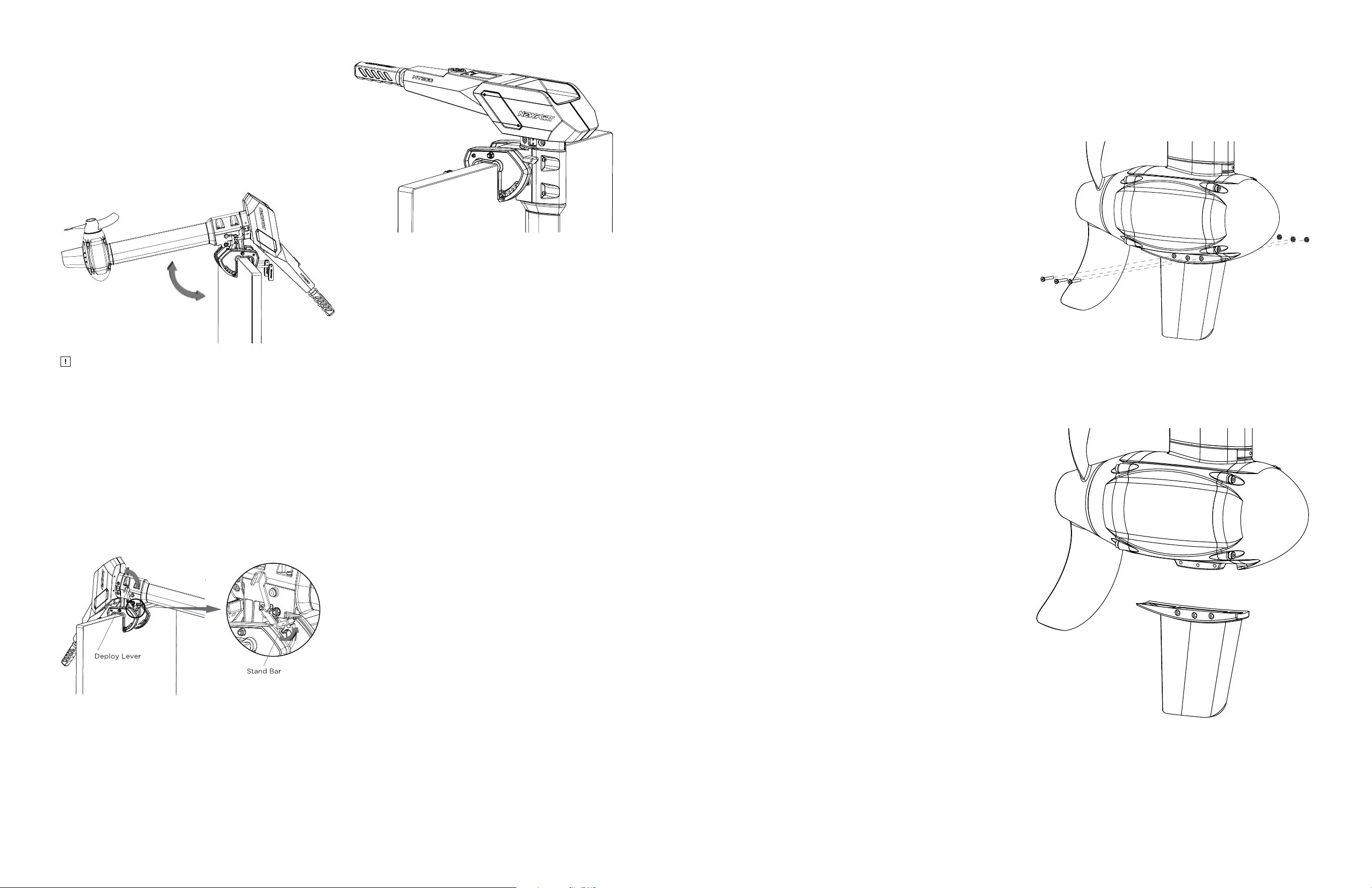
6.6 STOW THE MOTOR
When needed, the motor can be tilted
up to stow away or to avoid underwater
obstacles. Before lifting the motor up make
sure the reverse lock is lifted up. NOTE: It’s
recommended to keep the reverse lock unlocked
(lifted) when the motor drives forward since
motor will be kicked up automatically with this
setup.
Advice: The tilt support device supplied on your outboard
is not intended for towing. It is intended to support
the engine while the boat is docked, beached, etc. It is
recommended to remove the motor during transport or use
a motor support bracket/transom saver.
6.7 DEPLOY THE MOTOR
To deploy the motor again, follow the steps
below:
1. Lift the motor up.
2. Lift the deploy lever up. Make sure the stand
bar is out of the slot.
3. Tilt the motor down slowly until the trim pin
is hit again.
7 CARE AND SERVICES
7.1 CARE OF MOTOR COMPONENTS
• Please regularly follow all maintenance
tips to keep your motor in optimal working
condition.
• Do not start the motor in shallow water as it
may damage the propeller.
• After each use, check between the plastic
propeller and metal motor housing for
fishing line, weeds, or other debris. ALWAYS
DISCONNECT from power before working
near the propeller.
• Lubricate all the pivot points with a non-
aerosol lubricant. Never use an aerosol
lubricant, as many types contain harmful
propellants that can cause damage to
various parts of your electric motor.
7.2 CORROSION PROTECTION
• After the motor is used in the saltwater, rinse
the motor thoroughly with fresh water.
• Before storing the motor, make sure the
motor is completely dry and clean.
• Keep cable connectors and plugs in good
condition.
• Use a wire brush to remove corrosion when
necessary.
7.3 CARE OF BATTERY USAGE
• Check tightness of the battery lead
connections.
• Never connect the wires to the wrong
battery terminal. You must disconnect the
battery during maintenance.
• Recharge batteries after each use. Follow the
battery manufacturer’s recommendations for
battery maintenance.
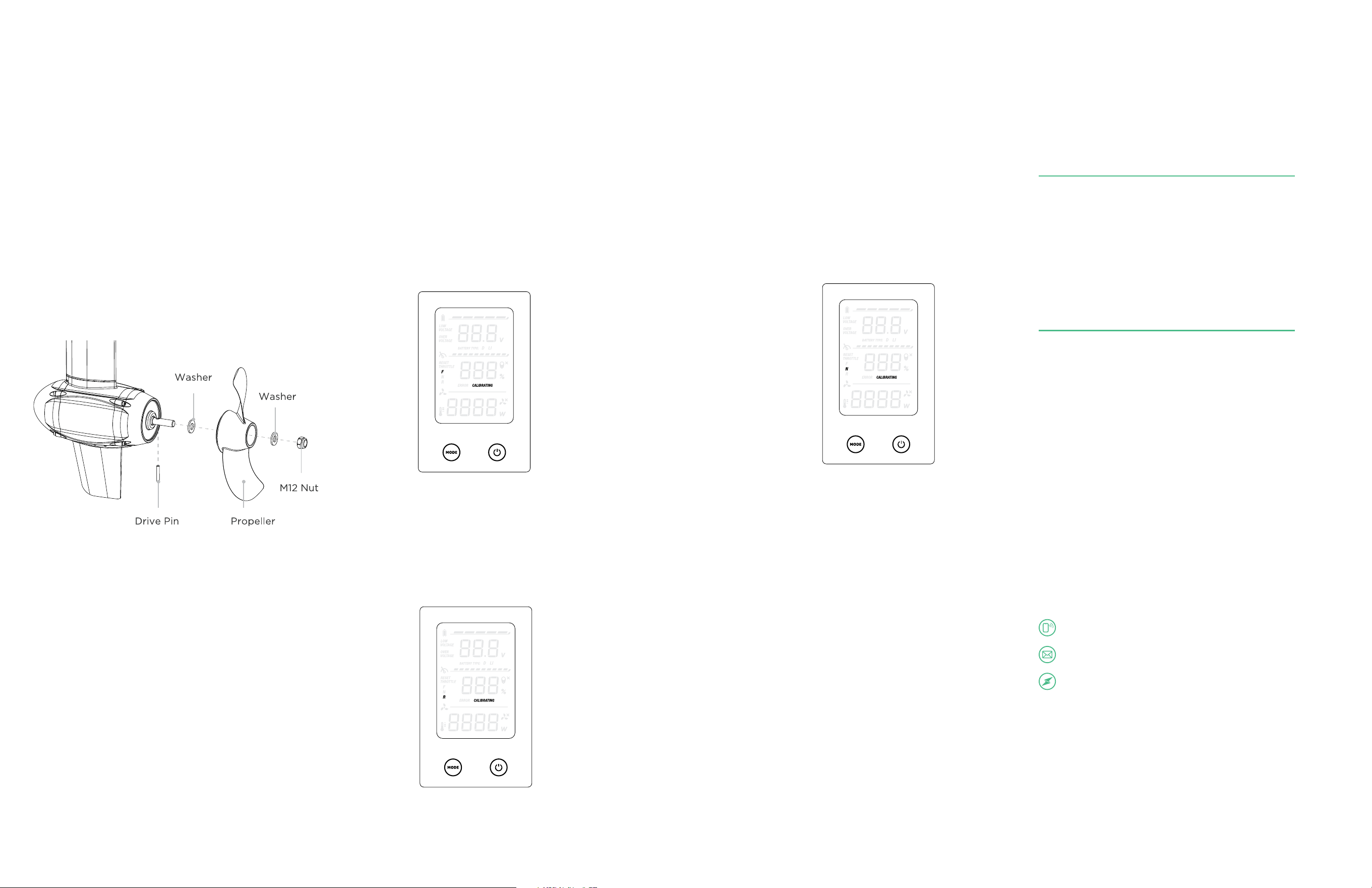
7.4 REPLACING THE FIN
You can replace the fin component if it is
damaged. To do this, follow the steps below:
1. Release the three M3 screws and nuts.
2. Remove the old fin component.
3. Insert the new fin component.
4. Insert three M3 screws and tighten them.
14 15
7.5 REPLACING THE PROPELLER
You can replace the propeller if it is damaged.
To do this, follow the steps below with the
assembly diagram:
1. Attach the washer.
2. Insert the drive pin into the hole on the
motor output shaft.
3. Rotate the propeller until the drive pin
is seated correctly in the corresponding
channel on the backside of the propeller.
4. Place the washer on the motor shaft after
the propeller.
5. Tighten the hex locknut with 17mm socket
wrench.
7.6 RECALIBRATE THE THROTTLE
You can recalibrate the throttle when the throttle
display is inaccurate. To do this, follow the steps
below:
1. Press and the MODE button for 5 seconds,
the controller will enter the throttle
recalibration mode. You will notice the
CALIBRATING sign starts to flash.
2. While the screen displays the F icon, move
the handle to the full throttle forward
position.
3. Press the MODE button again.
1. While the screen displays the R icon, move
the handle to the full throttle reverse
position.
2. Press the MODE button again
1. While the screen displays the N icon, move
the handle to the Neutral (middle) position.
2. Press the MODE button again. And the
throttle recalibration is complete. You will
notice the CALIBRATING sign stops to
flash, press the POWER button to exit the
recalibration mode.
3. When the CALIBRATING sign flashes, it
means the recalibration is not finished yet,
exiting the throttle recalibration mode will
not change the current throttle setup.
To exit the throttle recalibration mode at any
steps during the process, press the POWER
button.
DECLARATION OF CONFORMITY
FOR RECREATIONAL CRAFT
Propulsion Engine with the requirements of
Directive
89/392/EEC as amended by 89/336/EEC.
Engine type approved according to:
Directives 89/392/EEC, 89/336/EE
Description of Engine(s) and Essential
Requirements
Engine Type: Outboard Engine
Fuel Type: Electric
This declaration of conformity is issued under
the sole responsibility of the manufacturer. I
declare on behalf of the manufacturer that the
motor(s) is (are) in conformity with the type(s)
for which above mentioned EC, EMC and ROHC
type-examination or type approval certificate(s)
has (have) been issued and it will meet the
requirements of Directive 89/392/EEC, 89/336/
EEC as amended when installed in a recreational
craft, in accordance with the manufacturer’s
supplied instructions.
CUSTOMER SUPPORT
If you have questions that are not answered in
this manual or troubleshooting is not successful,
please contact Newport! Our California based
customer service team is standing by to assist
you. 8:30 AM - 7:00 PM ET
(866) 721-0002
support@newportvessels.com
newportvessels.com
16 17
Newport designs innovative accessories crafted to
elevate your time on the water, propelling you further.
THE WAY FORWARD IS
WITH ACCESSORIES
NT300 Electric
Outboard Motor
Bluetooth
Lithium Battery
LoPRO Lithium
Battery
Tiller Extension
Handle
NS130 Inflatable Ski
Complete Package
@newportvessels
SHARE YOUR
ADVENTURES
REV FX02X259