
Manual 10040-SB Rev 0 (10/22)
$21.00
DIRECT STEAM SINGLE AND TWIN
MIXER KETTLES
Manual Section CO
IMPORTANT FOR FUTURE REFERENCE
Please complete this information and retain this
manual for the life of the equipment:
Model #:
___________________________
Serial #:
___________________________
Date Purchased:
_____________________
WARNING
Improper installation, adjustment, alteration, service or maintenance can cause property damage, injury
or death. Read the installation, operating and maintenance instructions thoroughly before installing or
servicing this equipment.
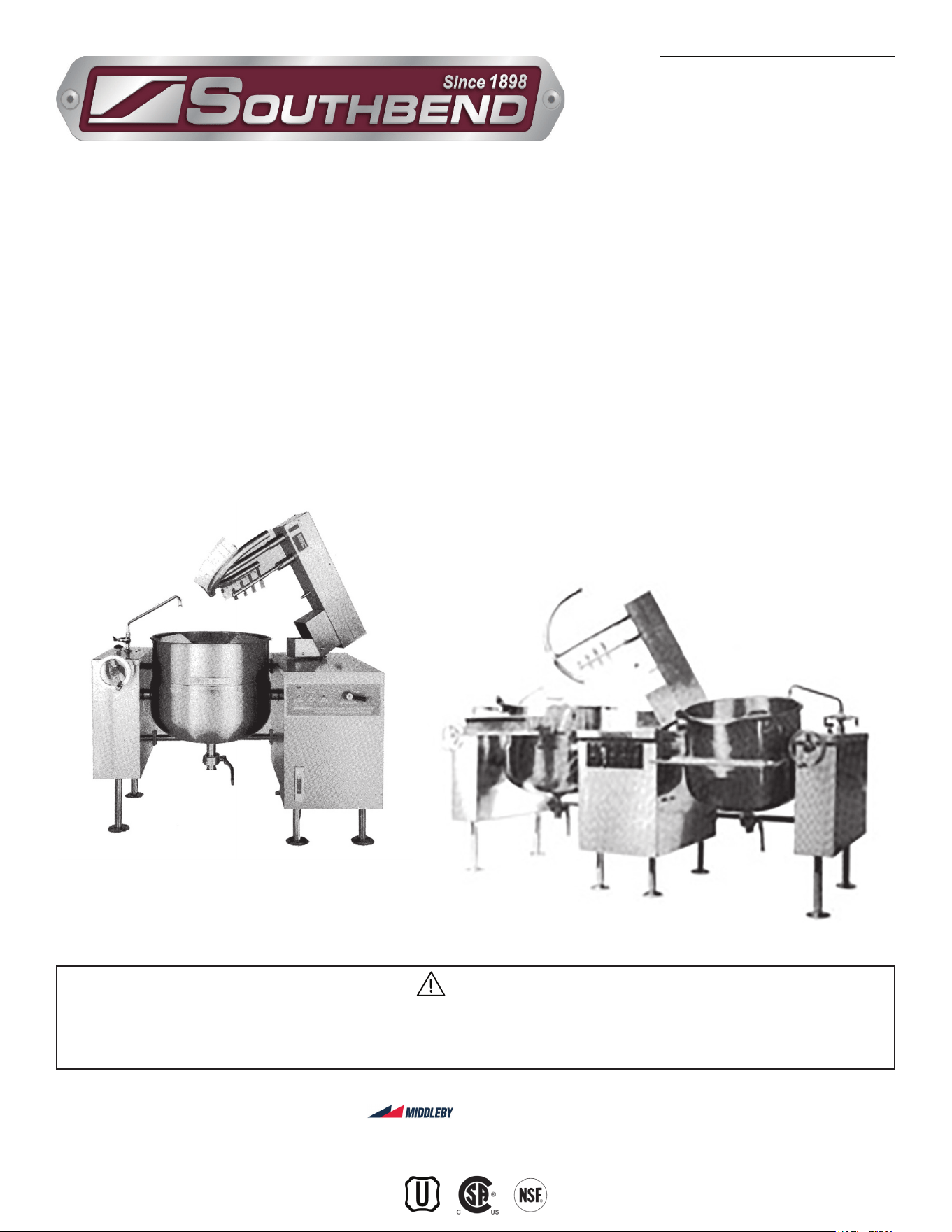
Model KDMTL-40
Direct Steam
Single & Twin Mixer Kettles
KDMTL-40, KDMTL-60, KDMTL-80,
KDMTL-100, KDMTL-40-2, KDMTL-60-2,
KDMTL-80-2 & KDMTL-100-2
Installation & Operation Manual
Model KDMTL-40-2
SOUTHBEND STEAM
A Middleby Company
1100 Old Honeycutt Road Fuquay-Varina, North Carolina 27526 USA
www.southbendnc.com
INSTALLATION & OPERATION MANUAL 10040-SB REV 0 (10/22)
PAGE
2
OF 36
Direct Steam Single and Twin Mixer Kettles
SAFETY PRECAUTIONS
Before installing and operating this equipment, be sure everyone involved in its operation is fully trained and aware of
precautions. Accidents and problems can be caused by failure to follow fundamental rules and precautions.
The following symbols, found throughout this manual, alert you to potentially dangerous conditions to the operator,
service personnel, or to the equipment.
CAUTION
WARNING
NOTICE
This symbol warns of immediate hazards that will result in severe injury or death.
This symbol refers to a potential hazard or unsafe practice that could result in injury or death.
This symbol refers to a potential hazard or unsafe practice that could result in injury, product
damage, or property damage.
This symbol refers to information that needs special attention or must be fully
understood, even though not dangerous.
DANGER
WARNING
Improper installation, operation, adjustment, alteration, service or maintenance can cause property damage, injury
or death. Read the installation, operating and maintenance instructions thoroughly before installing, operating or
servicing this equipment.
NOTICE
This manual should be retained for future reference.
NOTICE
This product is intended for commercial use only. NOT FOR HOUSEHOLD USE.
Copyright © 2022 by Crown. All rights reserved. Published in the United States of America.
Safety Precautions
IMPORTANT NOTES FOR INSTALLATION AND OPERATION
WARNING
This is the safety alert symbol. It is used to alert you to potential personal injury hazards. Obey all safety messages
that follow this symbol to avoid possible injury or death.
WARNING
FOR YOUR SAFETY:
Do not store or use gasoline or other ammable vapors or liquids in the vicinity of this or any other appliance.
NOTICE
Contact the factory, the factory representative or a local service company to perform maintenance and repairs
should the appliance malfunction. Refer to warranty terms.
NOTICE
Adequate clearances MUST be maintained for servicing and proper operation.

INSTALLATION & OPERATION MANUAL 10040-SB REV 0 (10/22)
PAGE
3
OF36
Direct Steam Single and Twin Mixer Kettles
RETAIN THIS MANUAL FOR FUTURE REFERENCE.
Table of Contents
Important Notes For Installation and Operation .................................................................... 2
Service Connections ............................................................................................................. 4
Introduction ........................................................................................................................... 6
Installation ............................................................................................................................. 7
Operation .............................................................................................................................. 8
Cleaning ................................................................................................................................ 10
Maintenance ......................................................................................................................... 12
Troubleshooting .................................................................................................................... 15
Hydraulic System Troubleshooting ....................................................................................... 16
Appendix A, Material Safety Data Sheet ............................................................................... 18
Appendix B, Material Safety Data Sheet - Hydraulic Unit ..................................................... 28
Table of Contents
INSTALLATION & OPERATION MANUAL 10040-SB REV 0 (10/22)
PAGE
4
OF 36
Direct Steam Single and Twin Mixer Kettles
Service Connections
Service Connections
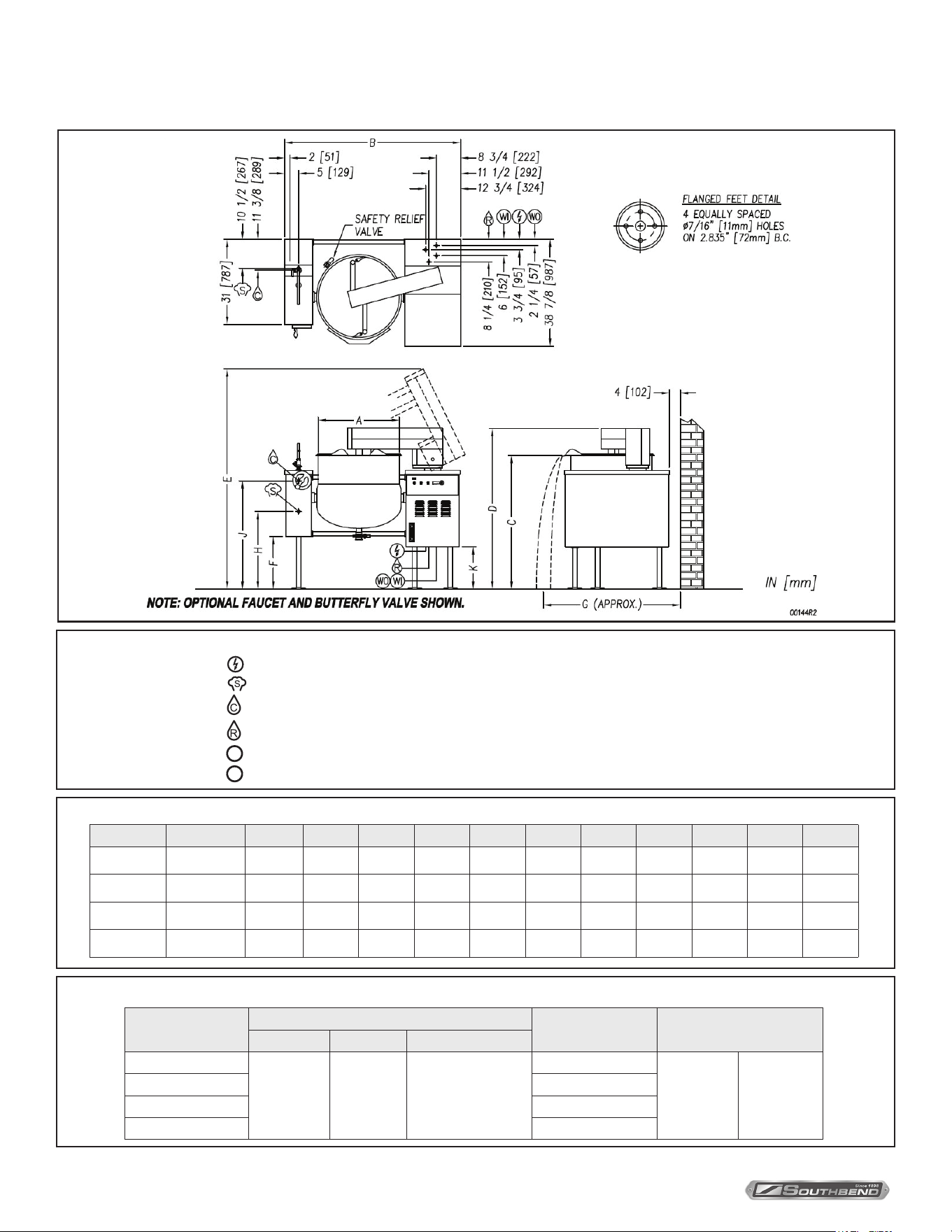
DIMENSIONS
As continued product improvement is a policy of Crown, specications are subject to change without notice.
ELECTRICAL CHARACTERISTICS AND SPECIFICATIONS
SERVICE CONNECTIONS
– ELECTRICAL CONNECTION: to be as specied on data plate.
– STEAM SUPPLY: 3/4” IPS. 5-30 PSI ( 34-207 kPA) optional 5-45 PSI (34-310 kPa).
– COLD or HOT WATER: 3/8” O.D. tubing to faucet. (OPTIONAL)
– CONDENSATE RETURN: 1/2” IPS.
WI
– OIL COOLER WATER IN: 3/8” tube bulkhead union.
WO
– OIL COOLER WATER OUT: 3/8” tube bulkhead union.
Model Capacity Units A B C D E F G H J K
KDMTL-40
40 Gallons
(152 liters)
inches
(mm)
26”
(660)
62”
(1575)
43.25”
(1099)
55”
(1397)
75.63”
(1921)
14.75”
(375)
56”
(1422)
23.75
(603)
35
(889)
11
(279)
KDMTL-60
60 Gallons
(227 liters)
inches
(mm)
29.5”
(749)
65”
(1651)
49”
(1245)
58.5”
(1486)
80”
(2032)
19”
(483)
58”
(1473)
28.13
(714)
39.38
(1000)
15.38
(391)
KDMTL-80
80 Gallons
(303 liters)
inches
(mm)
33”
(838)
67.75”
(1721)
49”
(1245)
58.5”
(1486)
80”
(2032)
19”
(483)
60”
(1524)
28.13
(714)
39.38
(1000)
15.38
(391)
KDMTL-100
100 Gallons
(380 liters)
inches
(mm)
35.5”
(902)
70”
(1778)
49”
(1245)
58.5”
(1486)
85”
(2159)
19”
(483)
63”
(1600)
28.13
(714)
39.38
(1000)
15.38
(391)
Model
Amps Per Line
Shipping Weight Minimum Clearance
208V 240V 480V
KDMTL-40
14.0 14.0 7.0
700 lbs. [318 kg]
SIDES
BACK
0
4” [102]
KDMTL-60 730 lbs. [331 kg]
KDMTL-80 840 lbs. [381 kg]
KDMTL-100 900 lbs. [410 kg]
INSTALLATION & OPERATION MANUAL 10040-SB REV 0 (10/22)
PAGE
5
OF36
Direct Steam Single and Twin Mixer Kettles
As continued product improvement is a policy of Crown, specications are subject to change without notice.
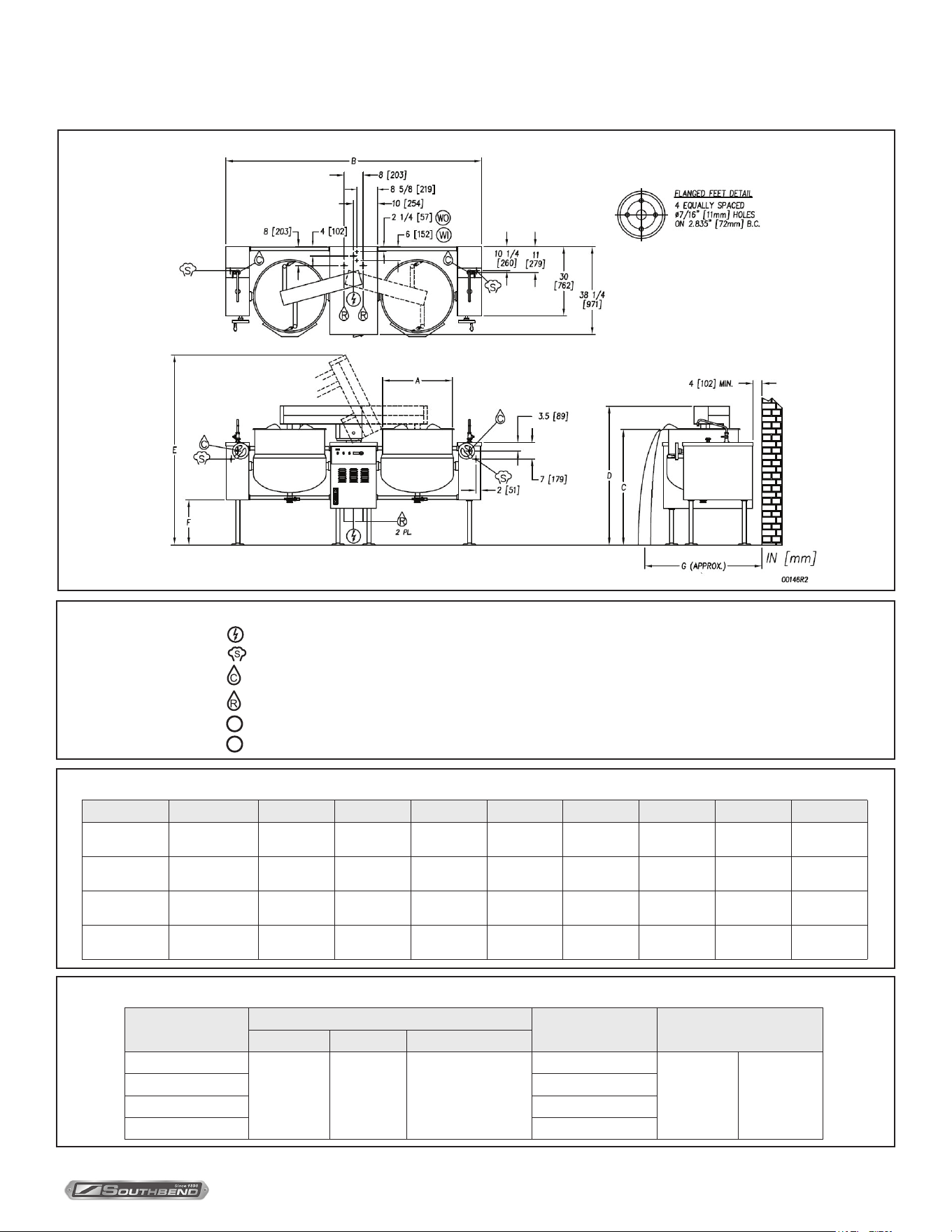
Model Capacity Units A B C D E F G
KDMTL-40-2
40 Gal Each
(151 liters)
inches
(mm)
26”
(660)
102”
(2591)
43.25”
(1099)
55”
(1397)
75.63”
(1921)
15.13”
(384)
56”
(1422)
KDMTL-60-2
60 Gal Each
(227 liters)
inches
(mm)
29.5”
(749)
108”
(2743)
49”
(1245)
58.5”
(1486)
80”
(2032)
19.5”
(495)
58”
(1473)
KDMTL-80-2
80 Gal Each
(303 liters)
inches
(mm)
33”
(838)
116”
(2946)
49”
(1245)
58.5”
(1486)
80”
(2032)
19.5”
(495)
60”
(1524)
KDMTL-100-2
100 Gal Each
(380 liters)
inches
(mm)
35.5”
(902)
121”
(3073)
49”
(1245)
58.5”
(1486)
85”
(2159)
19.5”
(495)
63”
(1600)
DIMENSIONS
ELECTRICAL CHARACTERISTICS AND SPECIFICATIONS
SERVICE CONNECTIONS
– ELECTRICAL CONNECTION: to be as specied on data plate.
– STEAM SUPPLY: 3/4” IPS. 5-30 PSI ( 34-207 kPA) optional 5-45 PSI (34-310 kPa).
– COLD or HOT WATER: 3/8” O.D. tubing to faucet. (OPTIONAL)
– CONDENSATE RETURN: 1/2” IPS.
WI
– OIL COOLER WATER IN: 3/8” tube bulkhead union.
WO
– OIL COOLER WATER OUT: 3/8” tube bulkhead union.
Model
Amps Per Line
Shipping Weight Minimum Clearance
208V 240V 480V
KDMTL-40-2
14.0 14.0 7.0
1360 lbs. [617 kg]
SIDES
BACK
0
4” [102]
KDMTL-60-2 1440 lbs. [654 kg]
KDMTL-80-2 1490 lbs. [676 kg]
KDMTL-100-2 1615 lbs. [735 kg]

INSTALLATION & OPERATION MANUAL 10040-SB REV 0 (10/22)
PAGE
6
OF 36
Direct Steam Single and Twin Mixer Kettles
Description
All Crown direct connected steam jacketed kettles pertaining to this manual are direct steam operated pressure vessels of
a double-wall stainless steel construction forming a steam chamber (jacket) enveloping the lower two thirds of the kettle
bowl surface. All kettles are tilting, oor mounted in xed positions on legs with adjustable anged feet. All kettles are
equipped with a safety relief valve and a steam control valve.
Capacities
All models are suffixed with either -40, -60, -80 or -100 to indicate the capacity of that kettle in US gallons. Thus
a KDMTL-40 is a two thirds jacketed direct steam kettle mounted on legs with a capacity of 40 gallons (US).
Functioning Mode
Crown direct connected steam jacketed kettles consist of a stainless steel bowl and a stainless steel jacket which
envelopes two thirds of the lower surface of the bowl thus forming a sealed pressure vessel (chamber) into which
steam is introduced by means of a manual control valve.
The kettle bowl is the container for the food product which ideally should be of a liquid or semi-liquid consistency
to achieve complete contact with the bowl surface and thus fully absorb the heat transmitted through that surface.
The temperatures required for the cooking process to function adequately must be greater than the boiling
point of the liquid food product. Further, the greater the steam pressure used, the higher the temperature and
consequently the quicker the cooking process. For example, steam pressurized at 30 psi attains a temperature of
274 degrees Fahrenheit (135 Celsius).
In the initial stages of the cooking process when the steam comes in contact with the cold kettle bowl surface it
condenses and forms considerable amounts of water. A thermostatic steam trap should be plumbed to the exit
end of the kettle jacket. This trap is a mechanical device that closes on high temperatures and opens when the
temperature drops thus allowing the water formed from condensate to exhaust but retain steam under pressure.
for tilting the kettles(s). Once the bridge has been lifted the agitators cannot be operated as a safety switch is
activated. Bridge may now be moved out of the way or if a twin mixer, moved to the other kettle. The speed control
is located on the front panel and may be set to the desired speed by turning. The maximum speed will not exceed
54 RPM on the smallest kettle and 40 RPM on the largest.
Introduction
Introduction

INSTALLATION & OPERATION MANUAL 10040-SB REV 0 (10/22)
PAGE
7
OF36
Direct Steam Single and Twin Mixer Kettles
UNPACKING
IMMEDIATELY INSPECT FOR SHIPPING DAMAGE
Immediately after unpacking, check for possible shipping damage. If the kettle is found to be damaged, save the
packaging material and contact the carrier within 15 days of delivery.
Before installing, verify that the electrical service agrees with the specications on the rating plate located on the right
side of the tilt console. If the supply and equipment requirements do not agree, contact your dealer or Crown Food
Service Equipment Ltd.
Installation
Installation
Installation Instructions
The kettle must be installed in accordance with State and/or local codes. In the USA, the National Electrical code, ANSI/
NFPA-70 (latest edition). In Canada, the Canadian Electrical Code, Part 1, CSA Standard C22.1 (latest edition).
1. Select a location to provide drainage for kettle pour path when tilted and for buttery valve if so equipped. Allow
sucient rear clearance from wall for access to rear service panel on hydraulic console.
2. Level unit. Mark anchoring hole locations through anged adjustable feet.
3. Remove unit and drill holes as marked and, insert expansion shields to accommodate 5/16” size lag bolts.
4. Reposition unit. Re-check level.
5. Bolt down unit and seal bolts with Silastic or equivalent sealing compound. Sealant must be applied not only to bolt
heads but also around anges making contact with the oor surface to full NSF requirements. Wipe o excess
sealant immediately.
6. Connect steam line (3/4” pipe size) to the steam inlet. Make sure there is a steam control valve strainer convenient
to the unit. If incoming steam pressure is greater than kettle maximum operating pressure, then a pressure reducing
valve must be installed in the line. If large amounts of water accumulate in the steam line it will be necessary to install
one or more ball oat traps in the line to eliminate the water. A steam line pressure gauge is also recommended to
determine the actual amount of steam coming to the kettle.
7. Connect the condensate return line to a drain or to the boiler return line. Return line must have a check valve.
8. Connect cold water supply line as indicated in bottom of hydraulic console.
9. A control box with a power supply equivalent to the electrical rating of the unit should be located nearby. A waterproof
electrical connection for the power supply to the unit must be provided.
10. Connect power supply as indicated.
11. Relief valves on the kettles must not be adjusted or closed o as they are set to relieve excess pressure in the kettles.
12. Do not make any adjustments to the hydraulic valves as they have all been adjusted at the factory.
13. Turn unit on when electrically connected, and check for proper operation.
INSTALLATION & OPERATION MANUAL 10040-SB REV 0 (10/22)
PAGE
8
OF 36
Direct Steam Single and Twin Mixer Kettles
Operation
NOTICE
Always start agitators at the slow speed and then gradually increase to the desired speed to avoid splashing or
“throwing” the product over edge of kettle.
WARNING
The kettle and its parts are hot. Use care when operating, cleaning and servicing the kettle.
Operating Instructions
Kettle Operation
1. If kettle has a buttery valve close it.
2. Fill kettle with product to desired level.
3. Slowly turn the steam control valve ON to full open position (counterclockwise).
4. The water or food should boil 3 to 4 minutes per gallon. If it does not then incoming pressure should be checked to
determine that it is adequate to operate the kettle eciently.
5. Regulate steam control valve depending on type of food being prepared.
6. When food is cooked, turn o steam, remove food and clean kettle immediately to prevent residue from drying on
kettle bowl surface.
Operation Of Mixer Unit
Power to operate the mixer unit is controlled by the “Main Power” switch located on the left side of the control panel. Place
switch in the “ON” position. Ensure that mixer “speed” control is set to the “stop” position. Set the mixer switch, located
beside the main power switch, to “ON” position. Note that the agitators should not be turning. The speed control has four
basic settings which are: stop, slow, medium and fast. Set the speed control to the slow position and observe that the
agitators turn.
Operation
WARNING
Never place hands inside kettle when agitators are in motion.
Increasing the speed setting on the control will increase the speed at which the agitators turn.
Raise Mixer Bridge
To tilt kettle for emptying or to clean agitators, the mixer bridge will tilt hydraulically upward and manually swing clear of
the kettle. To do this, rst turn speed control to “STOP” and then turn mixer switch to “OFF.”
NOTICE
Mixer agitator arms must be stopped at 90 degrees to the mixer bridge before raising the bridge. If the
agitator arms do not stop in this position when speed selector is set to stop, then “jog” the selector on and
o to achieve this position.

INSTALLATION & OPERATION MANUAL 10040-SB REV 0 (10/22)
PAGE
9
OF36
Direct Steam Single and Twin Mixer Kettles
Operation
Push and hold the “TILT” switch in the “RAISE” position. Bridge will raise to maximum height. Bridge will stop at any
position if the tilt switch is released and will remain in that position until switch is pushed to either raise or lower. When the
bridge is fully raised it can be manually turned to the side to clear kettle.
NOTICE
The bridge is equipped with a safety switch which prevents turning of the agitators, regardless of the mixer
switch, or speed control settings. Agitators will not engage unless the bridge is lowered so that the guide pin rests
fully in the guide pin bracket on the side of the kettle.
Removal Of Agitators
For ease of cleaning, the agitators are removable without tools. To remove, raise bridge as described above and
swing clear of kettle. Grasp shaft of large agitator, push up and turn to disengage lock pin. Pull straight down on
agitator. Remove the small agitator in the same manner. Soak and wash agitators in warm, soapy water. Never
use abrasive cleansers or scouring pads on the stainless steel surfaces as this will damage the finish of the
stainless steel.
If it is necessary to remove the scraper blades from the large agitator for cleaning purposes, do so by removing
the pin at the end of the mounting shaft and then slide the scraper blades off of the shaft.
To clean the exterior stainless steel panels of your unit, use a damp soft cloth or soft cloth and stainless steel
cleaner. Never use abrasive cleansers or scouring pads on the stainless steel surfaces as this will damage the
finish of the stainless steel.
INSTALLATION & OPERATION MANUAL 10040-SB REV 0 (10/22)
PAGE
10
OF 36
Direct Steam Single and Twin Mixer Kettles
Cleaning
WARNING
Disconnect the power supply to the appliance before cleaning or servicing.
Your kettle should be cleaned immediately after each use or when cooking a dierent product. Before cleaning, check that
the kettle has cooled enough to touch it.
1. Ensure that power supply is OFF.
2. Pre-rinse inside of kettle thoroughly and drain to remove any food particles.
3. Using a nylon brush, clean kettle with a mild detergent and warm water rinse. Never use steel wool or scouring
powder as it will scratch stainless steel.
4. Tilt kettle fully or open the tangent draw-o valve if one is provided to allow soap and water solution to drain. Rinse
with clean water.
5. Wipe the exterior of kettle with a clean, damp cloth.
Use of cleaning agents that contain chloride, acids or salts are corrosive and may cause pitting and corrosion when used
over a period of time; this will reduce the life of the appliance.
Should pitting or corrosion occur, this is not covered by warranty.
Use a mild detergent, warm water and rinse thoroughly.
WARNING
Never spray water into electric controls or components!
CAUTION
Do not use cleaning agents that are corrosive.
WARNING
The equipment and its parts are hot. Use care when operating, cleaning and servicing the appliance.
Cleaning

INSTALLATION & OPERATION MANUAL 10040-SB REV 0 (10/22)
PAGE
11
OF36
Direct Steam Single and Twin Mixer Kettles Cleaning
What to Do if Surface Rust Appears
Metal utensils should never be used as they will scratch the surface of the equipment and rust may begin to form. To
remove surface accumulation of rust from the inadvertent use of such utensils, the following procedure may be used.
1. Use undiluted white vinegar with a non-abrasive scouring pad (plastic) or cloth on the aected area to remove the rust
stain. The appliance should not be heated and remain at room temperature during the entire cleaning process.
2. If the stain resists removal, additional exposure time with vinegar may be required, to a maximum of one hour.
3. Thoroughly wash all of the vinegar away with fresh clear water. Dry the surface completely and allow one hour before
using the appliance to cook.
Following daily and period maintenance procedures will prolong the life of your equipment. Climatic conditions - salt air -
may require more thorough and frequent cleaning or the life of the equipment could be adversely aected.
Stainless Steel
To remove normal dirt, grease or product residue from stainless steel, use ordinary soap and water (with or without detergent)
applied with a sponge or cloth. Dry thoroughly with a clean cloth. Never use vinegar or any other corrosive cleaner.
To remove grease and food splatters or condensed vapors that have baked on the equipment, apply cleanser to a damp
cloth or sponge and rub cleanser on the metal in the direction of the polishing lines. Rubbing cleanser as gently as possible
in the direction of the polished lines will not mar the nish of the stainless steel. NEVER RUB WITH A CIRCULAR MOTION.
Soil and burn deposits which do not respond to the above procedure can usually be removed by rubbing the surface with
SCOTCH-BRITE™ scouring pads or STAINLESS scouring pads. DO NOT USE ORDINARY STEEL WOOL as any particles left
on the surface will rust and further spoil the appearance of the nish. NEVER USE A WIRE BRUSH, STEEL SCOURING PADS
(EXCEPT STAINLESS), SCRAPER, FILE OR OTHER STEEL TOOLS. Surfaces which are marred collect dirt more rapidly and
become more dicult to clean. Marring also increases the possibility of corrosive attack. Renishing may then be required.
TO REMOVE HEAT TINT: Darkened areas sometimes appear on stainless steel surfaces where the area has been subjected to
excessive heat. These darkened areas are caused by thickening of the protective surface of the stainless steel and is not harmful.
Heat tint can normally be removed by the foregoing, but tint which does not respond to this procedure calls for a vigorous scouring
in the direction of the polish lines using SCOTCH-BRITE™ scouring pads or a STAINLESS scouring pad in combination with a
powdered cleanser. Heat tint action may be lessened by not applying or by reducing heat to equipment during slack periods.
All food contact surfaces must be thoroughly drained and ushed prior to cooking in the kettle.
CONTROL PANEL: The textured control panel should be cleaned with warm water and mild soap. Never use an abrasive
cloth or steel wool. Never use cleaning solvents with a hydrocarbon base.
CAUTION
Improper use of this procedure may damage your appliance!
INSTALLATION & OPERATION MANUAL 10040-SB REV 0 (10/22)
PAGE
12
OF 36
Direct Steam Single and Twin Mixer Kettles
Maintenance
Maintenance
General Maintenance
CAUTION
Under normal operating conditions a “try lever test” should be performed every two months. Under severe service
conditions, or if corrosion and/or deposits are noticed within the valve body, testing must be performed more often.
A “try lever test” should also be performed at the end of any non-service period.
CAUTION
Hot, high pressure uid may be discharged from body drain and vent during “try lever” test. Care must be taken
to avoid any bodily contact.
CAUTION
High sound levels may be experienced during “try lever” test. Wear proper safety equipment and exercise extreme
care! Test at, or near, half of the operating pressure by holding the test lever fully open for at least two seconds to
ush the valve seat free of sediment and debris. Then release lever and permit the valve to snap shut.
If lift lever does not activate, or there is no evidence of discharge, turn o equipment immediately and contact a
licensed contractor or qualied service personnel.
NOTICE
Contact the factory, the factory representative or local service company to perform maintenance and repairs.
Safety Valve Maintenance and Testing
Trunnion block bearings, tted with a grease nipple should be lled with grease every couple of months or more frequently
if so required. They are located in each console box and support the kettle for ease of tilting. The segment gear and worm
should be greased at the same time if required. These are located in the tilt console box. No other general maintenance is
required other than adhering to the Cleaning Procedure instructions.
Butterfly Valve
WARNING
If you are cleaning a valve that is assembled to a kettle, be sure the kettle is completely empty of any product.
Disassembly and Maintenance
In the event that repairs or replacement becomes necessary, the following procedures are suggested.
1. Drain and ush the piping surrounding the valve.
2. To remove handle, remove the socket head screw found on top of the valve handle with proper size Allen wrench.
3. Remove the nut and cap screws.
4. Separate the valve body halves.
5. Set the buttery disc to the open position.
6. Squeeze the seal until oval shaped, then slide the short end of the stem from the seal.
7. Pinch the disc between the thumb and forenger and pull the long end of the stem.
8. Check for and replace a cracked or worn seal, bushing, stem and disc, or screws.
9. Reassembly is opposite of disassembly.
INSTALLATION & OPERATION MANUAL 10040-SB REV 0 (10/22)
PAGE
13
OF36
Direct Steam Single and Twin Mixer Kettles
Hydraulic System
Use “Purity FG AW32” or equivalent oil > Fluid level - 13.62 U.S. gallons.
Service
Set up regular schedule for checking the oil temperature, hydraulic hoses and keeping the equipment clean. A thick layer
of dirt acts as an insulation and prevents the hydraulic system from cooling.
The hydraulic system has been adjusted and tested at the factory and no adjustment should be needed. If the unit fails to
operate properly, all service work must be performed by a qualied service agent.
A thermostat controlled cooling system has been installed in the hydraulic system to maintain oil temperatures while in
operation. The oil is cooled by cold water owing through a heat exchanger alongside of the oil. A thermostat activates at
140° Fahrenheit oil temperature opening the valve and releasing cold water into the heat exchanger, cooling the oil.
NOTICE
At least twice a year have an authorized service person clean and service the unit for maximum performance.
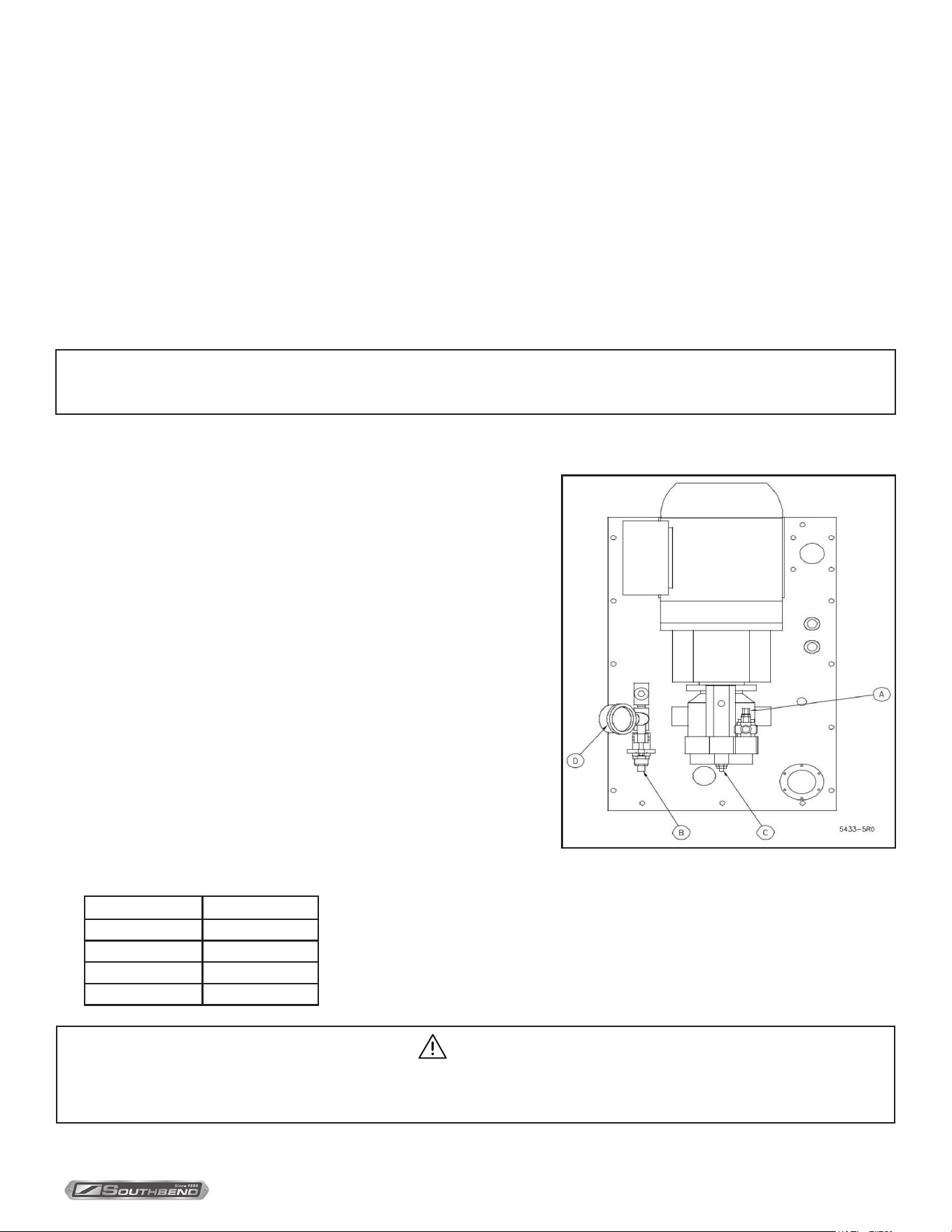
Setting Up Hydraulic System for Mixing Kettles
Setting Mixer System Pressure
1. On the operator panel, switch “POWER” to on, “MIXER” to on, and
set mixer speed to “STOP”.
2. Turn trim relief stem, item “B”, completely in.
3. Increase the pump pressure by turning “A” inwards, until gauge
“D” reads 1700 psi. The pressure must be 300 psi higher than the
pump setting.
4. Adjust trim relief “B” outwards until pressure indicated on gauge “D”
begins to drop.
5. Lock the trim relief “B”.
6. Decrease the pump pressure by turning “A” outwards, until gauge
“D” reads 1400 psi and lock in place.
Setting Mixer System Flow
1. On the operator panel, switch “POWER” to on, “MIXER” to on, and
set mixer speed to “FAST”, the maximum speed.
2. Increase or decrease ow to maximum rpm as listed, or less if
requested by customer. Turn in “C” to decrease, turn out to increase.
Kettle Size RPM
40 gallon 54
60 gallon 48
80 gallon 43
100 gallon 40
CAUTION
Do Not exceed 54 RPM!
Decreasing the ow to less than 10 rpmmay over-center the swash plate and damage the pump.
3. Use jam nut to lock adjusting screw when complete.
Maintenance

INSTALLATION & OPERATION MANUAL 10040-SB REV 0 (10/22)
PAGE
14
OF 36
Direct Steam Single and Twin Mixer Kettles
Setting the Bridge Actuator
1. On the operator panel, switch “POWER” to on, “MIXER” to on, and set mixer speed to “STOP”.
2. The pressure reducing valve and associated gauge are located at the back of the hydraulic unit. Adjust it to 800 psi.
3. The speed of the actuator is controlled by an in-line ow control valve also located at the back of the unit. There is
also a locking set screw provided on the adjusting knob.
4. Using the “RAISE/LOWER” tilt switch on the operator panel, adjust the ow control so that the stroke is completed at
a safe speed.
Maintenance

INSTALLATION & OPERATION MANUAL 10040-SB REV 0 (10/22)
PAGE
15
OF36
Direct Steam Single and Twin Mixer Kettles Troubleshooting
Troubleshooting
Extremely Slow Cooking Time
If cooking time is abnormally slow, this may be due to insufficient steam pressure and/or volume. Determine
that pressure on incoming steam line at kettle is within 5 psi of rated kettle pressure. Note that pressures
approaching the rated kettle pressure are liable to set off the safety relief valve. If required pressure is available
to kettle, then volume of steam may not be sufficient. Minimum 3/4” pipe size is required to the kettle but if the
steam generating source is at a great distance from the kettle, larger pipe will be required. Finally, the core of
the steam supply pipe may have debris or scalants that impede steam flow and will require disassembly and
inspection.
Air Venting Instructions
A steam trap assembly is plumbed to the exhaust (condensate) side of the kettle(s). The thermostatic trap is
a mechanical device that closes on high temperature and opens when the temperature drops, allowing water
which formed from the condensate to exhaust, but retain steam under pressure.
The temperatures required for the cooking process to function adequately must be greater than the boiling point
of the liquid food product. The greater the steam pressure used, the higher the temperature and the quicker the
cooking process. For example, steam pressurized at 30 psi reaches a temperature of 274 degrees Fahrenheit
(135 degrees Celsius). Since air is an unsuitable media through which heat may be transferred, it should be
exhausted from the jacket by opening the pressure relief valve until the air has been completely replaced by
pressurized steam.
In the initial stages of the cooking process, when the steam comes in contact with the cold kettle bowl surface, it
condenses and forms a large amount of water. The condensate water must be removed from the kettle jacket in
order for the kettle to function adequately. The ball valve located at the base of the kettle jacket may be opened
to remove the water. It may be necessary to repeat this procedure several times depending on the number of
batches being cooked as each batch will create condensate. If the kettle appears to be slow in heating, this
would indicate that there is water in the jacket. Open ball valve and drain. Close valve and commence operation
of kettle.

INSTALLATION & OPERATION MANUAL 10040-SB REV 0 (10/22)
PAGE
16
OF 36
Direct Steam Single and Twin Mixer Kettles
Hydraulic System Troubleshooting
Solenoid Valves Failed to Operate
1. Voltage too low will not complete the stroke of alternating current (AC) and the solenoid will burn out the coil.
2. Signal to both solenoids of a double solenoid valve simultaneously. One or both of the valves will be unable to
complete their stroke and burn out. Make certain the electrical signal is interlocked so that this condition cannot exist.
3. Incorrect voltage or frequency will prevent operation or burn out coil.
4. Foreign matter in valve.
5. Oil too hot.
Pump
1. Excessive noise caused by vacuum leak in suction line.
2. Misalignment of drive mechanism will cause high noise level in operation.
3. Relief set too high.
4. Return line above uid level.
5. Reversed rotation.
6. Filter breather plugged.
7. Viscosity of oil too high.
8. Loose or worn pump parts.
9. Air leak at pump shaft seal.
10. Oil too low, drawing in air.
11. Air bubbles in intake oil.
Excessive Wear
1. Abrasive material in oil causing wear.
2. Oil viscosity too low.
3. Pump misalignment.
4. Air being drawn in through inlet of pump.
5. System pressure exceeds pump rating.
Broken Internal Parts
1. Lack of oil.
2. Excessive torquing of housing bolts.
3. Solid matter being drawn in from reservoir.
Troubleshooting

INSTALLATION & OPERATION MANUAL 10040-SB REV 0 (10/22)
PAGE
17
OF36
Direct Steam Single and Twin Mixer Kettles
Dirty Oil
1. Components not cleaned properly after servicing.
2. Air breather left o.
3. Filter dirty or ruptured.
Foaming Oil
1. Return line not below oil level.
2. Oil contaminated.
3. Suction leak to pump.
Moisture in Oil
1. Water in oil supply.
2. Extreme temperature dierential.
Overheating of System
1. Continuous operation at relief setting.
1) Stalling under load.
2) Viscosity of oil too high.
2. Excessive slippage or internal leakage. Fluid too low.
3. System relief valve set too high.
4. Power unit ambient too high.
5. Insucient volume of water supply to oil cooler.
Troubleshooting
INSTALLATION & OPERATION MANUAL 10040-SB REV 0 (10/22)
PAGE
18
OF 36
Direct Steam Single and Twin Mixer Kettles
® ™ Trademark of The Dow Chemical Company ("Dow") or an affiliated
company of Dow
Page 1 of 10
SAFETY DATA SHEET
DOW CHEMICAL CANADA ULC
Product name: DOWFROST™ HD Heat Transfer Fluid, Dyed
Issue Date: 01/19/2017
Print Date: 01/23/2017
DOW CHEMICAL CANADA ULC encourages and expects you to read and understand the entire
(M)SDS, as there is important information throughout the document. We expect you to follow the
precautions identified in this document unless your use conditions would necessitate other appropriate
methods or actions.
1. IDENTIFICATION
Product name: DOWFROST™ HD Heat Transfer Fluid, Dyed
Recommended use of the chemical and restrictions on use
Identified uses: Intended as a heat transfer fluid for closed-loop systems. We recommend that you
use this product in a manner consistent with the listed use. If your intended use is not consistent with
the stated use, please contact your sales or technical service representative.
COMPANY IDENTIFICATION
DOW CHEMICAL CANADA ULC
#2400, 215 - 2ND STREET S.W.
CALGARY AB T2P 1M4
CANADA
Customer Information Number:
800-258-2436
SDSQuestion@dow.com
EMERGENCY TELEPHONE NUMBER
24-Hour Emergency Contact: 1-888-226-8832
Local Emergency Contact: 613-996-6666
2. HAZARDS IDENTIFICATION
Hazard classification
This product is not hazardous under the criteria of the Hazardous Products Regulation (HPR) as
implemented under the Workplace Hazardous Materials Information System (WHMIS 2015).
Other hazards
No data available
3. COMPOSITION/INFORMATION ON INGREDIENTS
This product is a mixture.
Component CASRN
Concentration
Appendix ‘A’
Material Safety Data Sheets

INSTALLATION & OPERATION MANUAL 10040-SB REV 0 (10/22)
PAGE
19
OF36
Direct Steam Single and Twin Mixer Kettles Material Safety Data Sheets
Product name: DOWFROST™ HD Heat Transfer Fluid, Dyed
Issue Date: 01/19/2017
Page 2 of 10
Propylene glycol
57-55-6
> 93.0 %
Water
7732-18-5
< 5.0 %
Dipotassium hydrogen phosphate
7758-11-4
< 5.0 %
4. FIRST AID MEASURES
Description of first aid measures
General advice: If potential for exposure exists refer to Section 8 for specific personal protective
equipment.
Inhalation: Move person to fresh air; if effects occur, consult a physician.
Skin contact: Wash off with plenty of water.
Eye contact: Flush eyes thoroughly with water for several minutes. Remove contact lenses after the
initial 1-2 minutes and continue flushing for several additional minutes. If effects occur, consult a
physician, preferably an ophthalmologist.
Ingestion: No emergency medical treatment necessary.
Most important symptoms and effects, both acute and delayed: Aside from the information found
under Description of first aid measures (above) and Indication of immediate medical attention and
special treatment needed (below), any additional important symptoms and effects are described in
Section 11: Toxicology Information.
Indication of any immediate medical attention and special treatment needed
Notes to physician: No specific antidote. Treatment of exposure should be directed at the control of
symptoms and the clinical condition of the patient.
5. FIREFIGHTING MEASURES
Suitable extinguishing media: Water fog or fine spray. Dry chemical fire extinguishers. Carbon
dioxide fire extinguishers. Foam. Alcohol resistant foams (ATC type) are preferred. General purpose
synthetic foams (including AFFF) or protein foams may function, but will be less effective.
Unsuitable extinguishing media: Do not use direct water stream. May spread fire.
Special hazards arising from the substance or mixture
Hazardous combustion products: During a fire, smoke may contain the original material in addition
to combustion products of varying composition which may be toxic and/or irritating. Combustion
products may include and are not limited to: Carbon monoxide. Carbon dioxide.
Unusual Fire and Explosion Hazards: Container may rupture from gas generation in a fire
situation. Violent steam generation or eruption may occur upon application of direct water stream to
hot liquids.

INSTALLATION & OPERATION MANUAL 10040-SB REV 0 (10/22)
PAGE
20
OF 36
Direct Steam Single and Twin Mixer Kettles Material Safety Data Sheets
Product name: DOWFROST™ HD Heat Transfer Fluid, Dyed
Issue Date: 01/19/2017
Page 3 of 10
Advice for firefighters
Fire Fighting Procedures: Keep people away. Isolate fire and deny unnecessary entry. Use water
spray to cool fire exposed containers and fire affected zone until fire is out and danger of reignition has
passed. Fight fire from protected location or safe distance. Consider the use of unmanned hose
holders or monitor nozzles. Immediately withdraw all personnel from the area in case of rising sound
from venting safety device or discoloration of the container. Burning liquids may be extinguished by
dilution with water. Do not use direct water stream. May spread fire. Move container from fire area if
this is possible without hazard. Burning liquids may be moved by flushing with water to protect
personnel and minimize property damage.
Special protective equipment for firefighters: Wear positive-pressure self-contained breathing
apparatus (SCBA) and protective fire fighting clothing (includes fire fighting helmet, coat, trousers,
boots, and gloves). If protective equipment is not available or not used, fight fire from a protected
location or safe distance.
6. ACCIDENTAL RELEASE MEASURES
Personal precautions, protective equipment and emergency procedures: Keep unnecessary and
unprotected personnel from entering the area. Use appropriate safety equipment. For additional
information, refer to Section 8, Exposure Controls and Personal Protection.
Environmental precautions: Prevent from entering into soil, ditches, sewers, waterways and/or
groundwater. See Section 12, Ecological Information.
Methods and materials for containment and cleaning up: Small spills: Absorb with materials such
as: Cat litter. Sawdust. Vermiculite. Zorb-all®. Collect in suitable and properly labeled containers.
Large spills: Dike area to contain spill. See Section 13, Disposal Considerations, for additional
information.
7. HANDLING AND STORAGE
Precautions for safe handling: Conditions for safe storage: Do not store in: Galvanized steel.
Opened or unlabeled containers. Store in the following material(s): Carbon steel. Stainless steel.
Store in original unopened container. See Section 10 for more specific information. Additional storage
and handling information on this product may be obtained by calling your sales or customer service
contact.
8. EXPOSURE CONTROLS/PERSONAL PROTECTION
Control parameters
Exposure limits are listed below, if they exist.
Component
Regulation
Type of listing
Value/Notation
Propylene glycol
US WEEL
TWA
10 mg/m3
CA ON OEL
TWAEV Total
155 mg/m3 50 ppm
CA ON OEL
TWAEV
10 mg/m3
CA ON OEL
TWA
155 mg/m3 50 ppm
CA ON OEL
TWA
10 mg/m3
CA ON OEL
TWA Vapour and
aerosols
155 mg/m3 50 ppm
CA ON OEL
TWA aerosol
10 mg/m3

INSTALLATION & OPERATION MANUAL 10040-SB REV 0 (10/22)
PAGE
21
OF36
Direct Steam Single and Twin Mixer Kettles Material Safety Data Sheets
Product name: DOWFROST™ HD Heat Transfer Fluid, Dyed
Issue Date: 01/19/2017
Page 4 of 10
Consult local authorities for recommended exposure limits.
Exposure controls
Engineering controls: Use local exhaust ventilation, or other engineering controls to maintain
airborne levels below exposure limit requirements or guidelines. If there are no applicable exposure
limit requirements or guidelines, general ventilation should be sufficient for most operations. Local
exhaust ventilation may be necessary for some operations.
Individual protection measures
Eye/face protection: Use safety glasses (with side shields).
Skin protection
Hand protection: Use gloves chemically resistant to this material when prolonged or
frequently repeated contact could occur. Examples of preferred glove barrier
materials include: Butyl rubber. Natural rubber ("latex"). Neoprene. Nitrile/butadiene
rubber ("nitrile" or "NBR"). Polyethylene. Ethyl vinyl alcohol laminate ("EVAL").
Polyvinyl alcohol ("PVA"). Polyvinyl chloride ("PVC" or "vinyl"). NOTICE: The
selection of a specific glove for a particular application and duration of use in a
workplace should also take into account all relevant workplace factors such as, but
not limited to: Other chemicals which may be handled, physical requirements
(cut/puncture protection, dexterity, thermal protection), potential body reactions to
glove materials, as well as the instructions/specifications provided by the glove
supplier.
Other protection: Wear clean, body-covering clothing.
Respiratory protection: Respiratory protection should be worn when there is a potential to
exceed the exposure limit requirements or guidelines. If there are no applicable exposure limit
requirements or guidelines, wear respiratory protection when adverse effects, such as
respiratory irritation or discomfort have been experienced, or where indicated by your risk
assessment process. In misty atmospheres, use an approved particulate respirator.
The following should be effective types of air-purifying respirators: Organic vapor cartridge
with a particulate pre-filter.
9. PHYSICAL AND CHEMICAL PROPERTIES
Appearance
Physical state
Liquid.
Color
Yellow to green
Odor
Characteristic
Odor Threshold
No test data available
pH
9.5 50% Literature
Melting point/range
Not applicable to liquids
Freezing point
supercools
Boiling point (760 mmHg)
152 °C Literature
Flash point
closed cup 104 °C Pensky-Martens Closed Cup ASTM D 93
Propylene glycol., (based on major component)
Evaporation Rate (Butyl Acetate
= 1)
< 0.5 Estimated.
Flammability (solid, gas)
Not applicable to liquids
Lower explosion limit
2.6 % vol Literature Propylene glycol.
Upper explosion limit
12.5 % vol Literature Propylene glycol.

INSTALLATION & OPERATION MANUAL 10040-SB REV 0 (10/22)
PAGE
22
OF 36
Direct Steam Single and Twin Mixer Kettles Material Safety Data Sheets
Product name: DOWFROST™ HD Heat Transfer Fluid, Dyed
Issue Date: 01/19/2017
Page 5 of 10
Vapor Pressure
2.2 mmHg Literature
Relative Vapor Density (air = 1)
>1.0 Literature
Relative Density (water = 1)
1.06 at 20 °C / 20 °C Literature
Water solubility
100 % Literature
Partition coefficient: n-
octanol/water
No data available
Auto-ignition temperature
371 °C Literature Propylene glycol.
Decomposition temperature
No test data available
Kinematic Viscosity
43.4 cSt at 20 °C Literature
Explosive properties
No data available
Oxidizing properties
No data available
Molecular weight
No data available
NOTE: The physical data presented above are typical values and should not be construed as a
specification.
10. STABILITY AND REACTIVITY
Reactivity: No data available
Chemical stability: Stable under recommended storage conditions. See Storage, Section 7.
Hygroscopic
Possibility of hazardous reactions: Polymerization will not occur.
Conditions to avoid: Exposure to elevated temperatures can cause product to decompose.
Generation of gas during decomposition can cause pressure in closed systems. Avoid direct sunlight
or ultraviolet sources.
Incompatible materials: Avoid contact with: Strong acids. Strong bases. Strong oxidizers.
Hazardous decomposition products: Decomposition products depend upon temperature, air supply
and the presence of other materials. Decomposition products can include and are not limited to:
Aldehydes. Alcohols. Ethers. Organic acids.
11. TOXICOLOGICAL INFORMATION
Toxicological information appears in this section when such data is available.
Acute toxicity
Acute oral toxicity
Very low toxicity if swallowed. Harmful effects not anticipated from swallowing small amounts.
For the major component(s): Propylene glycol.
LD50, Rat, > 20,000 mg/kg
Acute dermal toxicity
Prolonged skin contact is unlikely to result in absorption of harmful amounts.

INSTALLATION & OPERATION MANUAL 10040-SB REV 0 (10/22)
PAGE
23
OF36
Direct Steam Single and Twin Mixer Kettles Material Safety Data Sheets
Product name: DOWFROST™ HD Heat Transfer Fluid, Dyed
Issue Date: 01/19/2017
Page 6 of 10
For the major component(s): Propylene glycol.
LD50, Rabbit, > 20,000 mg/kg
Acute inhalation toxicity
At room temperature, exposure to vapor is minimal due to low volatility. Mist may cause
irritation of upper respiratory tract (nose and throat).
For the major component(s):
LC50, Rat, 4 Hour, vapour, 6.15 mg/l No deaths occurred following exposure to a saturated
atmosphere.
Skin corrosion/irritation
Prolonged contact is essentially nonirritating to skin.
Repeated contact may cause flaking and softening of skin.
Serious eye damage/eye irritation
May cause slight temporary eye irritation.
Corneal injury is unlikely.
Sensitization
For the major component(s):
Did not cause allergic skin reactions when tested in humans.
For respiratory sensitization:
No relevant data found.
Specific Target Organ Systemic Toxicity (Single Exposure)
Evaluation of available data suggests that this material is not an STOT-SE toxicant.
Specific Target Organ Systemic Toxicity (Repeated Exposure)
In rare cases, repeated excessive exposure to propylene glycol may cause central nervous system
effects.
Carcinogenicity
Similar formulations did not cause cancer in laboratory animals.
Teratogenicity
For the major component(s): Did not cause birth defects or any other fetal effects in laboratory
animals.
Reproductive toxicity
For the major component(s): In animal studies, did not interfere with reproduction. In animal studies,
did not interfere with fertility.
Mutagenicity
In vitro genetic toxicity studies were negative. For the major component(s): Animal genetic toxicity
studies were negative.
Aspiration Hazard
Based on physical properties, not likely to be an aspiration hazard.

INSTALLATION & OPERATION MANUAL 10040-SB REV 0 (10/22)
PAGE
24
OF 36
Direct Steam Single and Twin Mixer Kettles Material Safety Data Sheets
Product name: DOWFROST™ HD Heat Transfer Fluid, Dyed
Issue Date: 01/19/2017
Page 7 of 10
12. ECOLOGICAL INFORMATION
Ecotoxicological information appears in this section when such data is available.
Toxicity
Propylene glycol
Acute toxicity to fish
Material is practically non-toxic to aquatic organisms on an acute basis
(LC50/EC50/EL50/LL50 >100 mg/L in the most sensitive species tested).
LC50, Oncorhynchus mykiss (rainbow trout), static test, 96 Hour, 40,613 mg/l, OECD Test
Guideline 203
Acute toxicity to aquatic invertebrates
LC50, Ceriodaphnia dubia (water flea), static test, 48 Hour, 18,340 mg/l, OECD Test Guideline
202
Acute toxicity to algae/aquatic plants
ErC50, Pseudokirchneriella subcapitata (green algae), 96 Hour, Growth rate inhibition, 19,000
mg/l, OECD Test Guideline 201
Toxicity to bacteria
NOEC, Pseudomonas putida, 18 Hour, > 20,000 mg/l
Chronic toxicity to aquatic invertebrates
NOEC, Ceriodaphnia dubia (water flea), semi-static test, 7 d, number of offspring, 13,020 mg/l
Dipotassium hydrogen phosphate
Acute toxicity to fish
Material is practically non-toxic to aquatic organisms on an acute basis
(LC50/EC50/EL50/LL50 >100 mg/L in the most sensitive species tested).
LC50, Leuciscus idus (Golden orfe), static test, 48 Hour, > 900 mg/l, Method Not Specified.
Persistence and degradability
Propylene glycol
Biodegradability: Material is readily biodegradable. Passes OECD test(s) for ready
biodegradability. Biodegradation may occur under anaerobic conditions (in the absence of
oxygen).
10-day Window: Pass
Biodegradation: 81 %
Exposure time: 28 d
Method: OECD Test Guideline 301F or Equivalent
10-day Window: Not applicable
Biodegradation: 96 %
Exposure time: 64 d
Method: OECD Test Guideline 306 or Equivalent
Theoretical Oxygen Demand: 1.68 mg/mg
Chemical Oxygen Demand: 1.53 mg/mg
INSTALLATION & OPERATION MANUAL 10040-SB REV 0 (10/22)
PAGE
25
OF36
Direct Steam Single and Twin Mixer Kettles Material Safety Data Sheets
Product name: DOWFROST™ HD Heat Transfer Fluid, Dyed
Issue Date: 01/19/2017
Page 8 of 10
Biological oxygen demand (BOD)
Incubation
Time
BOD
5 d
69.000 %
10 d
70.000 %
20 d
86.000 %
Photodegradation
Atmospheric half-life: 10 Hour
Method: Estimated.
Dipotassium hydrogen phosphate
Biodegradability: Biodegradation is not applicable.
Bioaccumulative potential
Propylene glycol
Bioaccumulation: Bioconcentration potential is low (BCF < 100 or Log Pow < 3).
Partition coefficient: n-octanol/water(log Pow): -1.07 Measured
Bioconcentration factor (BCF): 0.09 Estimated.
Dipotassium hydrogen phosphate
Bioaccumulation: No bioconcentration is expected because of the relatively high water
solubility.
Mobility in soil
Propylene glycol
Given its very low Henry's constant, volatilization from natural bodies of water or moist soil is
not expected to be an important fate process.
Potential for mobility in soil is very high (Koc between 0 and 50).
Partition coefficient
(Koc): < 1 Estimated.
Dipotassium hydrogen phosphate
No relevant data found.
13. DISPOSAL CONSIDERATIONS
Disposal methods: DO NOT DUMP INTO ANY SEWERS, ON THE GROUND, OR INTO ANY BODY
OF WATER. All disposal practices must be in compliance with all Federal, State/Provincial and local
laws and regulations. Regulations may vary in different locations. Waste characterizations and
compliance with applicable laws are the responsibility solely of the waste generator. AS YOUR
SUPPLIER, WE HAVE NO CONTROL OVER THE MANAGEMENT PRACTICES OR
MANUFACTURING PROCESSES OF PARTIES HANDLING OR USING THIS MATERIAL. THE
INFORMATION PRESENTED HERE PERTAINS ONLY TO THE PRODUCT AS SHIPPED IN ITS
INTENDED CONDITION AS DESCRIBED IN MSDS SECTION: Composition Information. FOR
UNUSED & UNCONTAMINATED PRODUCT, the preferred options include sending to a licensed,
permitted: Recycler. Reclaimer. Incinerator or other thermal destruction device.
INSTALLATION & OPERATION MANUAL 10040-SB REV 0 (10/22)
PAGE
26
OF 36
Direct Steam Single and Twin Mixer Kettles Material Safety Data Sheets
Product name: DOWFROST™ HD Heat Transfer Fluid, Dyed
Issue Date: 01/19/2017
Page 9 of 10
14. TRANSPORT INFORMATION
TDG
Not regulated for transport
Classification for SEA transport (IMO-IMDG):
Not regulated for transport
Transport in bulk
according to Annex I or II
of MARPOL 73/78 and the
IBC or IGC Code
Consult IMO regulations before transporting ocean bulk
Classification for AIR transport (IATA/ICAO):
Not regulated for transport
This information is not intended to convey all specific regulatory or operational
requirements/information relating to this product. Transportation classifications may vary by container
volume and may be influenced by regional or country variations in regulations. Additional
transportation system information can be obtained through an authorized sales or customer service
representative. It is the responsibility of the transporting organization to follow all applicable laws,
regulations and rules relating to the transportation of the material.
15. REGULATORY INFORMATION
Canadian Domestic Substances List (DSL)
This product contains at least one substance which is not listed on the Canadian Domestic
Substances List (DSL).
16. OTHER INFORMATION
Hazard Rating System
NFPA
Health
Fire
Reactivity
0
1
0
Revision
Identification Number: 101199333 / A208 / Issue Date: 01/19/2017 / Version: 7.0
Most recent revision(s) are noted by the bold, double bars in left-hand margin throughout this
document.
Legend
CA ON OEL
Canada. Ontario OELs

INSTALLATION & OPERATION MANUAL 10040-SB REV 0 (10/22)
PAGE
27
OF36
Direct Steam Single and Twin Mixer Kettles Material Safety Data Sheets
Product name: DOWFROST™ HD Heat Transfer Fluid, Dyed
Issue Date: 01/19/2017
Page 10 of 10
TWA
8-hr Time Weighted Average
TWAEV
time-weighted average exposure value
US WEEL
USA. Workplace Environmental Exposure Levels (WEEL)
Information Source and References
This SDS is prepared by Product Regulatory Services and Hazard Communications Groups from
information supplied by internal references within our company.
DOW CHEMICAL CANADA ULC urges each customer or recipient of this (M)SDS to study it carefully
and consult appropriate expertise, as necessary or appropriate, to become aware of and understand
the data contained in this (M)SDS and any hazards associated with the product. The information
herein is provided in good faith and believed to be accurate as of the effective date shown above.
However, no warranty, express or implied, is given. Regulatory requirements are subject to change
and may differ between various locations. It is the buyer's/user's responsibility to ensure that his
activities comply with all federal, state, provincial or local laws. The information presented here
pertains only to the product as shipped. Since conditions for use of the product are not under the
control of the manufacturer, it is the buyer's/user's duty to determine the conditions necessary for the
safe use of this product. Due to the proliferation of sources for information such as manufacturer-
specific (M)SDSs, we are not and cannot be responsible for (M)SDSs obtained from any source other
than ourselves. If you have obtained an (M)SDS from another source or if you are not sure that the
(M)SDS you have is current, please contact us for the most current version.

INSTALLATION & OPERATION MANUAL 10040-SB REV 0 (10/22)
PAGE
28
OF 36
Direct Steam Single and Twin Mixer Kettles Material Safety Data Sheets
SAFETY DATA SHEET
SDS_US
1/8
1. Identification
Product name
FM HYDRAULIC OIL 32
Other means of identification
No data available.
Recommended use:
Lubricating fluid
Restrictions on use:
Industrial use only
Manufacturer/Importer/Supplier/Distributor Information
Manufacturer
Company Name:
Fuchs Lubricants Co.
Address:
17050 Lathrop Avenue
Harvey, Illinois 60426
Telephone:
708-333-8900
Fax:
708-333-9180
Contact Person:
EHS Department
E-mail:
Emergency telephone number: 708-333-8900 (Bus. hrs) 800-255-3924 (24 hrs)
2. Hazard(s) identification
Hazard Classification
Not classified as hazardous under 29CFR 1910.1200 (HazCom 2012).
Hazard Symbol:
No symbol
Signal Word:
No signal word.
Hazard Statement:
not applicable
Precautionary
Statement
not applicable
Other hazards which do not
result in GHS classification:
None.
3. Composition/information on ingredients
Label Elements
INSTALLATION & OPERATION MANUAL 10040-SB REV 0 (10/22)
PAGE
29
OF36
Direct Steam Single and Twin Mixer Kettles Material Safety Data Sheets
SAFETY DATA SHEET
SDS_US
2/8
Hazardous Component(s):
Chemical name
CAS-No.
Concentration
White mineral oil
Confidential
60 - 100%
Specific chemical identities and/or exact percentages have been withheld as trade secrets.
4. First-aid measures
Ingestion:
Rinse mouth thoroughly. Call a POISON CENTER/doctor/.../if you feel
unwell. Do NOT induce vomiting.
Inhalation:
Move to fresh air. Call a POISON CENTER/doctor/.../if you feel unwell.
Skin Contact:
Remove contaminated/saturated clothing and shoes. Wash contact areas
with soap and water. If skin irritation occurs: Get medical advice/attention.
Eye contact:
Flush thoroughly with water. If irritation occurs, get medical assistance.
Continue to rinse for at least 15 minutes.
Most important symptoms/effects, acute and delayed
Symptoms:
No data available.
Indication of immediate medical attention and special treatment needed
Treatment:
Get medical attention as appropriate or if symptoms persist.
5. Fire-fighting measures
General Fire Hazards:
No unusual fire or explosion hazards noted.
Suitable (and unsuitable) extinguishing media
Suitable extinguishing
media:
Water spray, fog, CO2, dry chemical, or regular foam. Use fire-
extinguishing media appropriate for surrounding materials.
Unsuitable extinguishing
media:
Do not use water jet as an extinguisher, as this will spread the fire.
Specific hazards arising from
the chemical:
Heat may cause the containers to explode. During fire, gases hazardous to
health may be formed.
Special protective equipment and precautions for firefighters
Special fire fighting
procedures:
No data available.
INSTALLATION & OPERATION MANUAL 10040-SB REV 0 (10/22)
PAGE
30
OF 36
Direct Steam Single and Twin Mixer Kettles Material Safety Data Sheets
SAFETY DATA SHEET
SDS_US
3/8
Special protective equipment
for fire-fighters:
Firefighters must use standard protective equipment including flame
retardant coat, helmet with face shield, gloves, rubber boots, and in
enclosed spaces, SCBA.
6. Accidental release measures
Personal precautions,
protective equipment and
emergency procedures:
See Section 8 of the SDS for Personal Protective Equipment. Do not touch
damaged containers or spilled material unless wearing appropriate
protective clothing. Keep unauthorized personnel away. Ensure adequate
ventilation.
Methods and material for
containment and cleaning
up:
Absorb with sand or other inert absorbent. Stop the flow of material, if this is
without risk.
Environmental Precautions:
Avoid release to the environment. Do not contaminate water sources or
sewer. Prevent further leakage or spillage if safe to do so.
7. Handling and storage
Precautions for safe handling:
Observe good industrial hygiene practices. Wear appropriate personal
protective equipment. Do not expose to intense heat as product may
expand and pressurize container.
Conditions for safe storage,
including any
incompatibilities:
Store in original tightly closed container. Avoid contact with oxidizing
agents. Store away from incompatible materials.
8. Exposure controls/personal protection
Exposure Limits
Chemical name
type
Exposure Limit Values
Source
White mineral oil - Inhalable fraction.
TWA
5 mg/m3
US. ACGIH Threshold Limit Values (03
2012)
White mineral oil - Mist.
PEL
5 mg/m3
US. OSHA Table Z-1 Limits for Air
Contaminants (29 CFR 1910.1000) (02
2006)
Protective Measures:
Use personal protective equipment as required.
Respiratory Protection:
In case of inadequate ventilation use suitable respirator. Seek advice from
supervisor on the company's respiratory protection standards.
Eye Protection:
Wear safety glasses with side shields (or goggles).
Skin and Body Protection:
Wear chemical-resistant gloves, footwear, and protective clothing appropriate
for the risk of exposure. Contact health and safety professional or manufacturer
for specific information.
INSTALLATION & OPERATION MANUAL 10040-SB REV 0 (10/22)
PAGE
31
OF36
Direct Steam Single and Twin Mixer Kettles Material Safety Data Sheets
SAFETY DATA SHEET
SDS_US
4/8
Hygiene measures:
Always observe good personal hygiene measures, such as washing after
handling the material and before eating, drinking, and/or smoking. Routinely
wash work clothing to remove contaminants. Contaminated work clothing
should not be allowed out of the workplace. Discard contaminated footwear that
cannot be cleaned. Avoid contact with skin, eyes, and clothing.
9. Physical and chemical properties
Appearance
Physical state:
Liquid
Form:
No data available.
Color:
Water-white
Odor:
Mild
Odor threshold:
No data available.
pH:
No data available.
Melting point/freezing point:
No data available.
Initial boiling point and boiling range:
No data available.
Flash Point:
> 100 °C (212 °F)
Evaporation rate:
No data available.
Flammability (solid, gas):
No data available.
Upper/lower limit on flammability or explosive limits
Flammability limit - upper (%):
No data available.
Flammability limit - lower (%):
No data available.
Explosive limit - upper (%):
No data available.
Explosive limit - lower (%):
No data available.
Vapor pressure:
No data available.
Vapor density:
No data available.
Relative density:
0.8607
Solubility(ies)
Solubility in water:
Insoluble
Solubility (other):
No data available.
Partition coefficient (n-octanol/water):
No data available.
Auto-ignition temperature:
No data available.
Decomposition temperature:
No data available.
Viscosity:
32 mm2/s (40 °C)
10. Stability and reactivity
Reactivity:
Not reactive during normal use.
Chemical Stability:
Material is stable under normal conditions.

INSTALLATION & OPERATION MANUAL 10040-SB REV 0 (10/22)
PAGE
32
OF 36
Direct Steam Single and Twin Mixer Kettles Material Safety Data Sheets
SAFETY DATA SHEET
SDS_US
5/8
Possibility of hazardous
reactions:
None under normal conditions.
Conditions to avoid:
Avoid heat or contamination.
Incompatible Materials:
No data available.
Hazardous Decomposition
Products:
Thermal decomposition or combustion may liberate carbon oxides and
other toxic gases or vapors.
11. Toxicological information
Information on likely routes of exposure
Ingestion:
May be ingested by accident. Ingestion may cause irritation and malaise.
Inhalation:
Inhalation is the primary route of exposure. In high concentrations, vapors,
fumes or mists may irritate nose, throat and mucus membranes.
Skin Contact:
Prolonged skin contact may cause redness and irritation.
Eye contact:
Eye contact is possible and should be avoided.
Symptoms related to the physical, chemical and toxicological characteristics
Ingestion:
No data available.
Inhalation:
No data available.
Skin Contact:
No data available.
Eye contact:
No data available.
Information on toxicological effects
Acute toxicity (list all possible routes of exposure)
Oral
Product:
Not classified for acute toxicity based on available data.
Dermal
Product:
ATEmix (): 2000 - 5000 mg/kg
Inhalation
Product:
Not classified for acute toxicity based on available data.
Repeated dose toxicity
Product:
No data available.
Skin Corrosion/Irritation
Product:
No data available.
INSTALLATION & OPERATION MANUAL 10040-SB REV 0 (10/22)
PAGE
33
OF36
Direct Steam Single and Twin Mixer Kettles Material Safety Data Sheets
SAFETY DATA SHEET
SDS_US
6/8
Serious Eye Damage/Eye Irritation
Product:
No data available.
Respiratory or Skin Sensitization
Product:
No data available.
Carcinogenicity
Product:
No data available.
IARC Monographs on the Evaluation of Carcinogenic Risks to Humans:
No carcinogenic components identified
US. National Toxicology Program (NTP) Report on Carcinogens:
No carcinogenic components identified
US. OSHA Specifically Regulated Substances (29 CFR 1910.1001-1050):
No carcinogenic components identified
Germ Cell Mutagenicity
In vitro
Product:
No data available.
In vivo
Product:
No data available.
Reproductive toxicity
Product:
No data available.
Specific Target Organ Toxicity - Single Exposure
Product:
No data available.
Specific Target Organ Toxicity - Repeated Exposure
Product:
No data available.
Aspiration Hazard
Product:
No data available.
Other effects:
No data available.
12. Ecological information
General information:
This product has not been evaluated for ecological toxicity or other
environmental effects.
13. Disposal considerations
INSTALLATION & OPERATION MANUAL 10040-SB REV 0 (10/22)
PAGE
34
OF 36
Direct Steam Single and Twin Mixer Kettles Material Safety Data Sheets
SAFETY DATA SHEET
SDS_US
7/8
Disposal instructions:
Discharge, treatment, or disposal may be subject to national, state, or local
laws. Dispose of waste at an appropriate treatment and disposal facility in
accordance with applicable laws and regulations, and product
characteristics at time of disposal. It is the responsibility of the product user
or owner to determine at the time of disposal, which waste regulations must
be applied.
Contaminated Packaging:
Empty containers should be taken to an approved waste handling site for
recycling or disposal.
14. Transport information
DOT
Not regulated.
IMDG
Not regulated.
IATA
Not regulated.
15. Regulatory information
US Federal Regulations
US. OSHA Specifically Regulated Substances (29 CFR 1910.1001-1050)
None present or none present in regulated quantities.
Superfund Amendments and Reauthorization Act of 1986 (SARA)
Hazard categories
None
SARA 313 (TRI Reporting)
None present or none present in regulated quantities.
US State Regulations
US. California Proposition 65
No component is regulated by CA Prop 65.
16.Other information, including date of preparation or last revision
Issue Date:
24.06.2016
Revision Date:
24.06.2016
Version #:
1.0

INSTALLATION & OPERATION MANUAL 10040-SB REV 0 (10/22)
PAGE
35
OF36
Direct Steam Single and Twin Mixer Kettles Material Safety Data Sheets
SAFETY DATA SHEET
SDS_US
8/8
Further Information:
No data available.
Disclaimer:
This information is provided without warranty. The information is believed to
be correct. This information should be used to make an independent
determination of the methods to safeguard workers and the environment.
INSTALLATION & OPERATION MANUAL 10040-SB REV 0 (10/22)
PAGE
36
OF 36
Direct Steam Single and Twin Mixer Kettles
KDMTL-40, KDMTL-60, KDMTL-80,
KDMTL-100, KDMTL-40-2,
KDMTL-60-2, KDMTL-80-2
& KDMTL-100-2
DIRECT STEAM
SINGLE & TWIN MIXER KETTLES
A product with the Crown name incorporates the best in durability and low maintenance. We all recognize, however,
that replacement parts and occasional professional service may be necessary to extend the useful life of this appliance.
When service is needed, contact a Crown Authorized Service Agency, or your dealer. To avoid confusion, always refer
to the model number, serial number, and type of your appliance.
SOUTHBEND STEAM
A Middleby Company
1100 Old Honeycutt Road Fuquay-Varina, North Carolina 27526 USA
www.southbendnc.com