
2
Table of Contents
Getting started
5 Device layout and functions
13 Charging the battery
18 Nano-SIM card and eSIM
21 Turning the device on and off
22 Initial setup
22 Using networks
22 Samsung account
23 Transferring data from your previous
device (Smart Switch)
24 Understanding the screen
31 Notification panel
32 Quick settings panel
34 Screen capture and screen record
36 Entering text
38 Extracting text
Apps and features
39 Installing or uninstalling apps
40 Galaxy AI
50 S Pen (Galaxy S26 Ultra)
57 Phone
61 Contacts
64 Camera
79 Gallery
84 Bixby
85 Multi window (Using multiple apps
at once)
86 Samsung Internet
87 Samsung Wallet
91 Samsung Health
91 Samsung Notes
95 Samsung Members
95 Samsung Kids
96 Samsung Global Goals
96 Samsung TV Plus
96 Samsung Find
97 Samsung Shop
97 Samsung News
98 Galaxy Store
99 Galaxy Wearable
99 PENUP (Galaxy S26 Ultra)
100 Calendar
100 Reminder
101 Voice Recorder
102 My Files (Checking and managing
the files)
102 Clock
102 Calculator
103 Weather
104 Gaming Hub
105 Game Booster (Configuring your
gaming environment)
107 SmartThings
108 Sharing content
109 Music Share

Table of Contents
3
133 Home screen
134 Lock screen and AOD
135 Extend Unlock
135 Always On Display (Displaying
information when the screen is
turned off)
136 Security and privacy
137 Face recognition
139 Fingerprint recognition
141 Secure Wi-Fi
142 Secure Folder
145 Samsung Pass
146 Location
147 Safety and emergency
148 Accounts and backup
148 Samsung Cloud
149 Google services
150 Advanced features
151 Motions and gestures
152 Video effects
152 Galaxy Avatar
153 Dual Messenger
154 Digital Wellbeing and parental
controls
154 Device care
155 Apps
156 General management
157 Accessibility
157 Software update
158 About phone
110 Smart View (Mirroring on a TV
screen)
111 Samsung DeX
113 Google apps
Settings
114 Introduction
114 Sign in to your Galaxy
114 Connections
116 Wi-Fi
117 Bluetooth
119 NFC and contactless payments
120 Data saver
120 Allowed networks for apps
120 Mobile Hotspot
121 More connection settings
123 Connected devices
124 Galaxy AI
124 Modes and Routines
124 Using modes
125 Using routines
126 Sounds and vibration
127 Sound quality and effects
127 Separate app sound
128 Notifications
128 Display
130 Motion smoothness
130 Changing the screen mode or
adjusting the display colour
131 Battery
132 Wallpaper and style
133 Themes

Table of Contents
4
Usage notices
159 Precautions for using the device
162 Notes on package contents and
accessories
163 Maintaining water and dust
resistance
164 Device overheating situations and
solutions
167 How to find the standby power
consumption information for this
product
Appendix
168 Accessibility
183 Troubleshooting
189 Removing the battery
5
Getting started
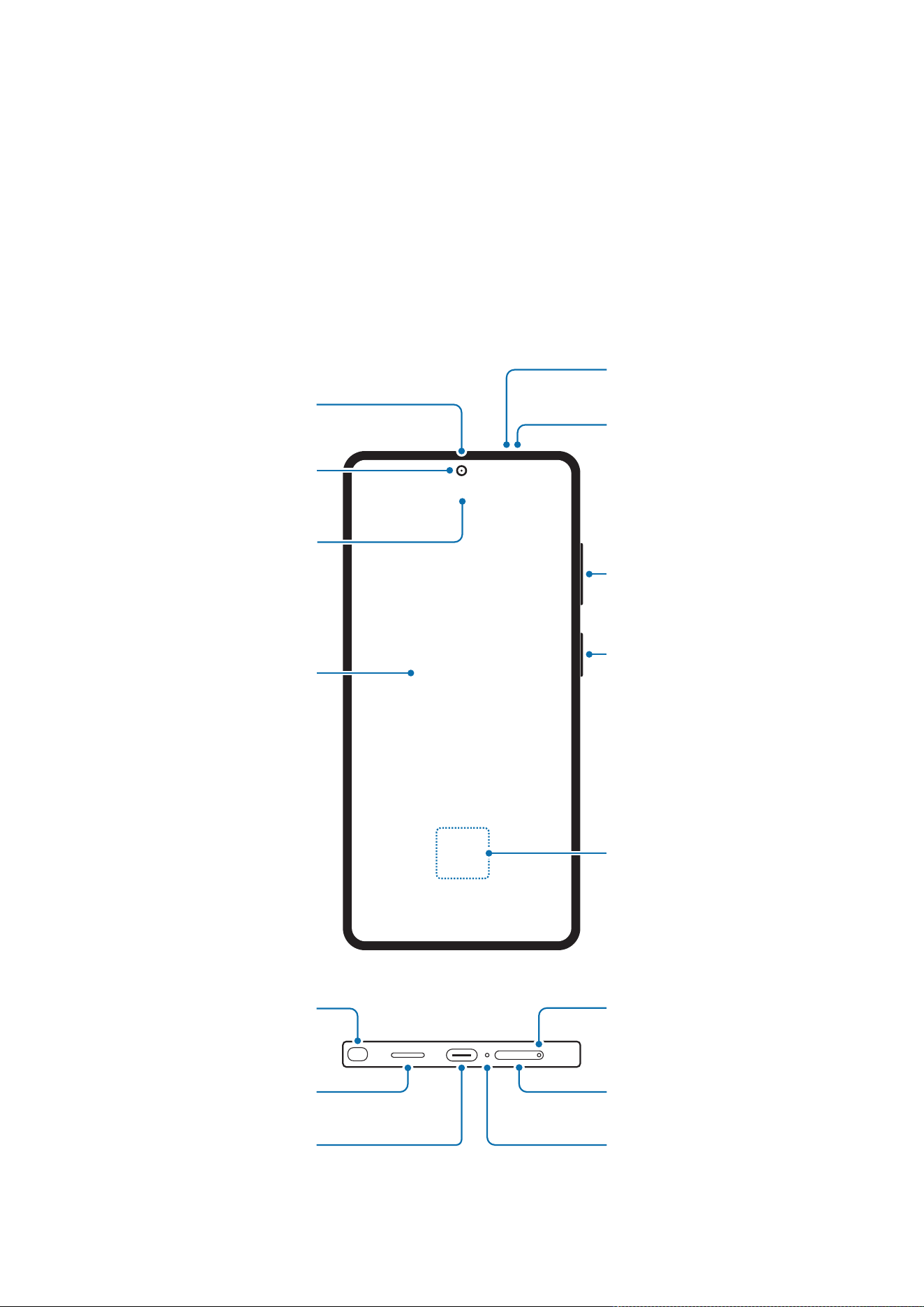
Device layout and functions
▶
Galaxy S26 Ultra:
Speaker
Front camera
Air vent hole
Microphone
Fingerprint recognition
sensor
Screen
Side button
Proximity/Light sensor
Speaker
Nano-SIM card tray
Tray hole
Microphone
S Pen
Headphone jack /
Multipurpose jack
(USB Type-C)
Volume button
Getting started
6
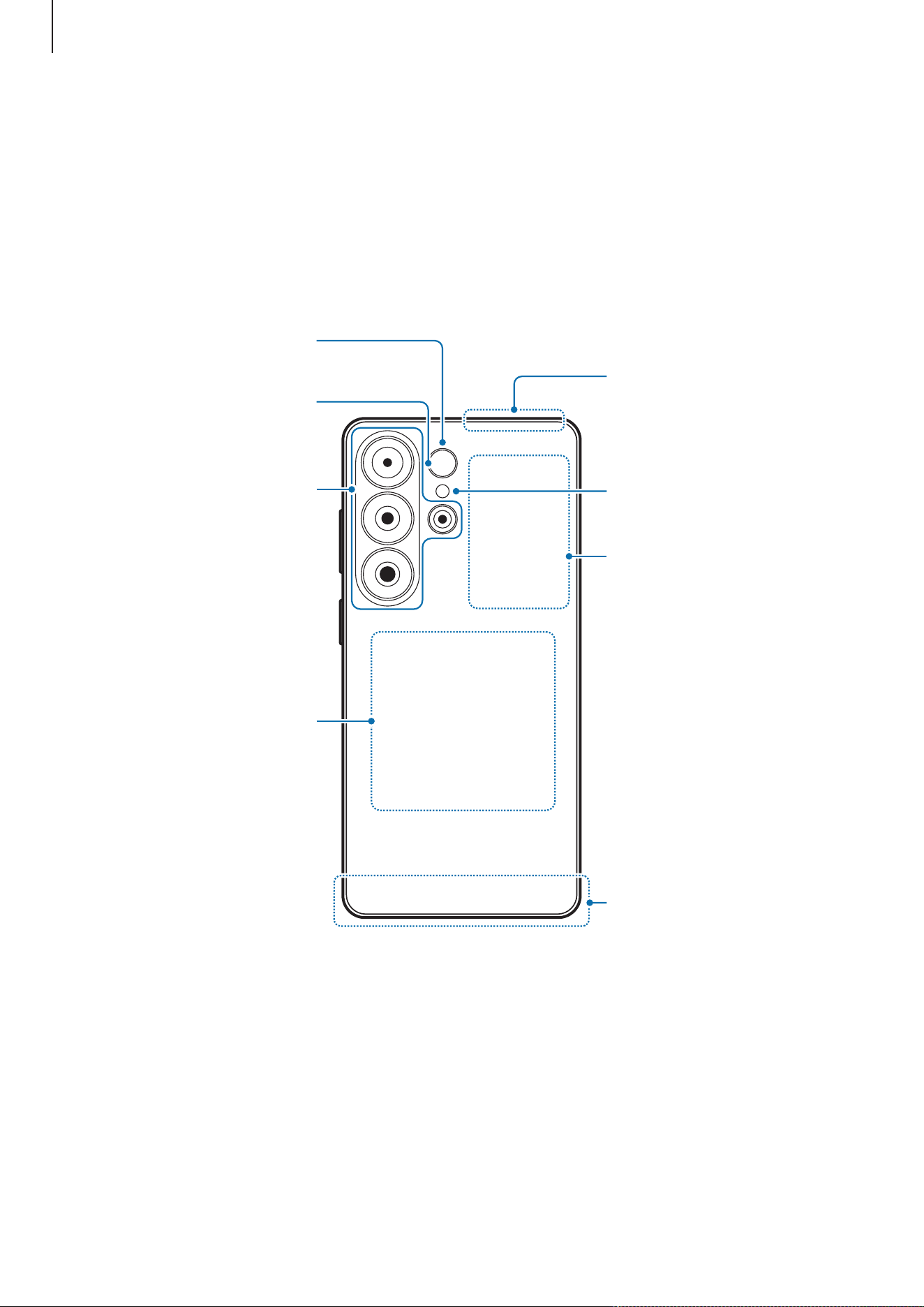
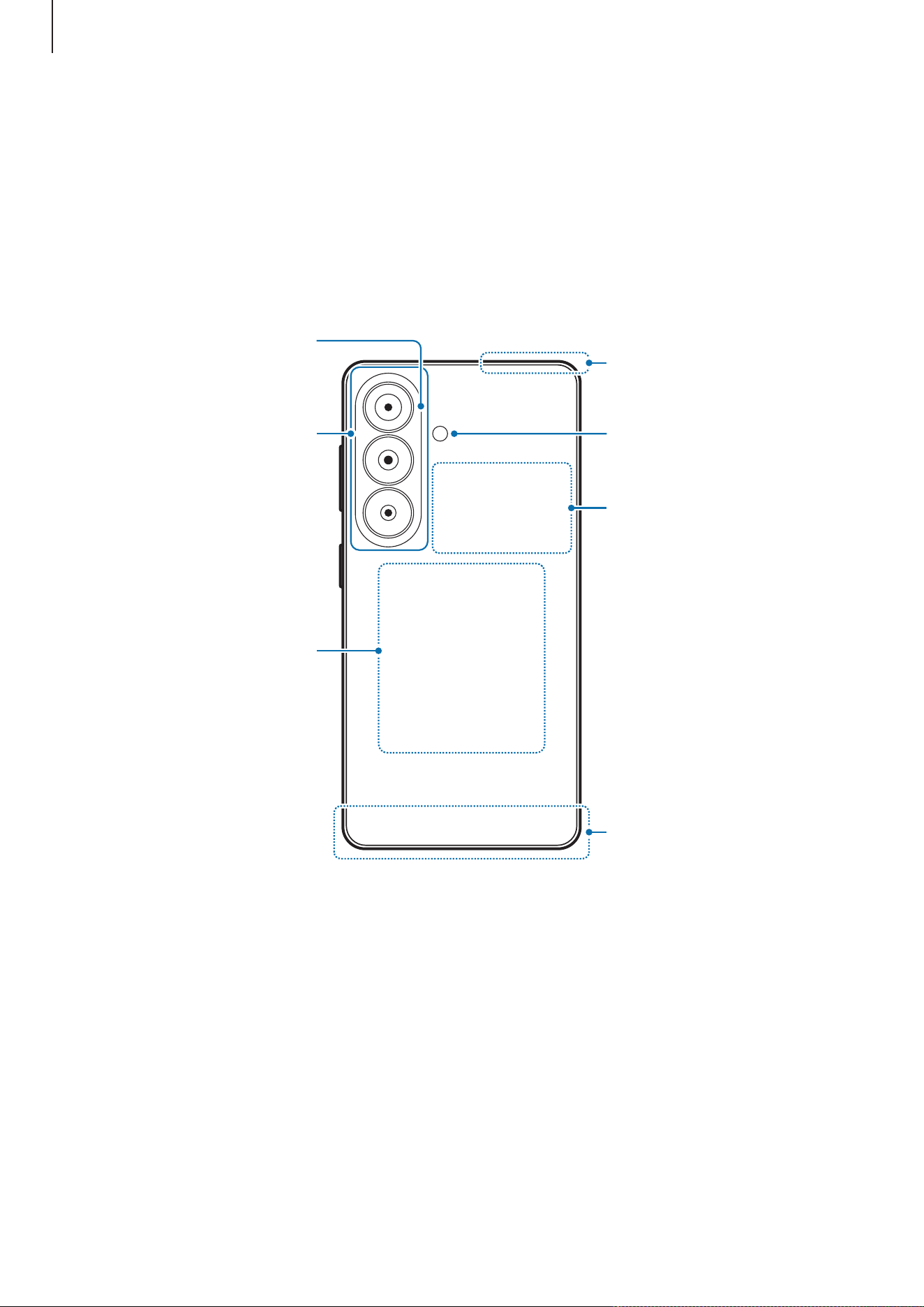
Rear camera
Flash
Microphone
Laser AF sensor
Wireless charging coil
Main antenna
GPS antenna
NFC antenna
Getting started
7
▶
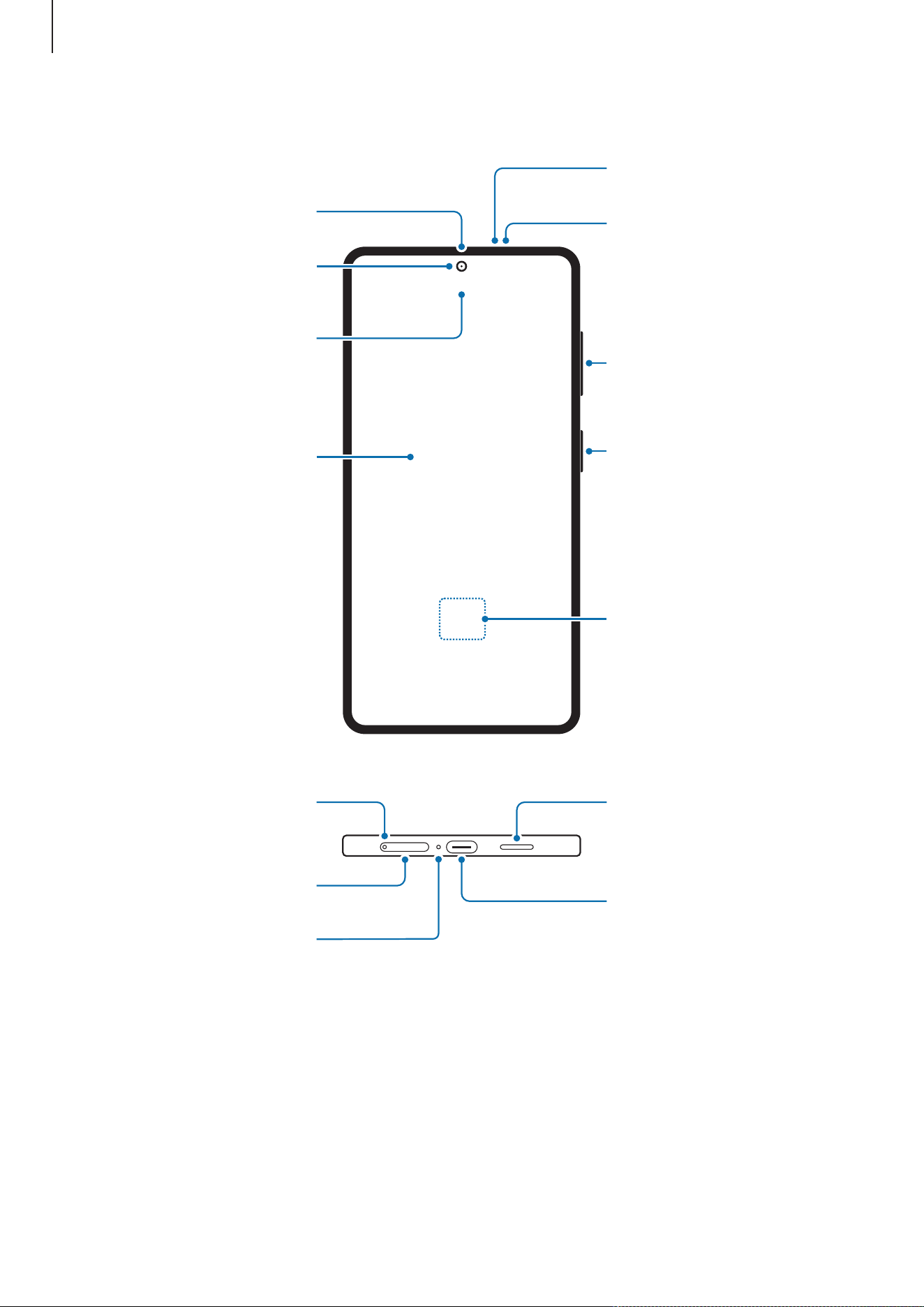
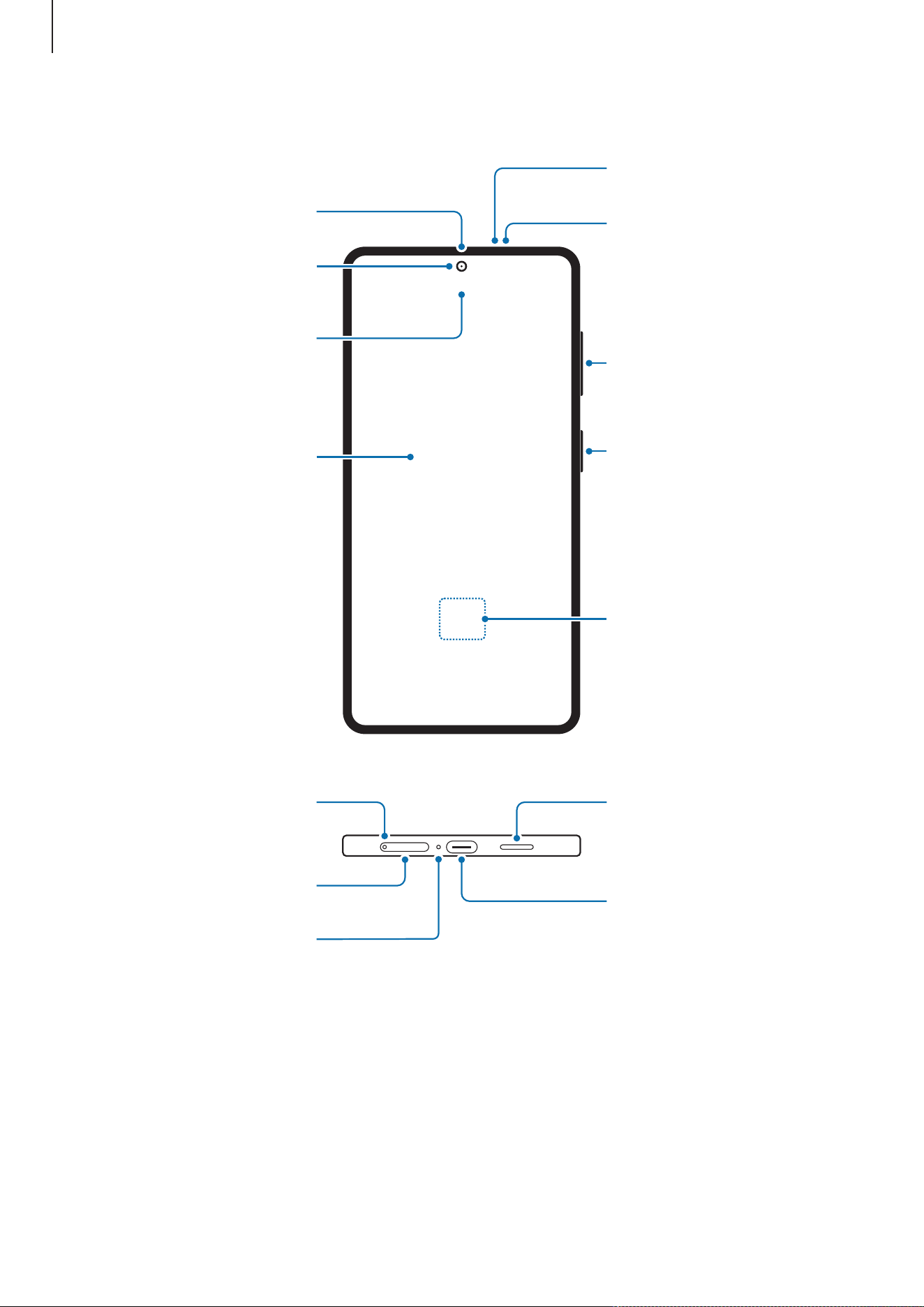
Galaxy S26+:
Air vent hole
Microphone
Fingerprint recognition
sensor
Screen
Volume button
Side button
Front camera
Speaker
Nano-SIM card tray
Tray hole
Speaker
Headphone jack /
Multipurpose jack
(USB Type-C)
Microphone
Proximity/Light sensor
Getting started
8
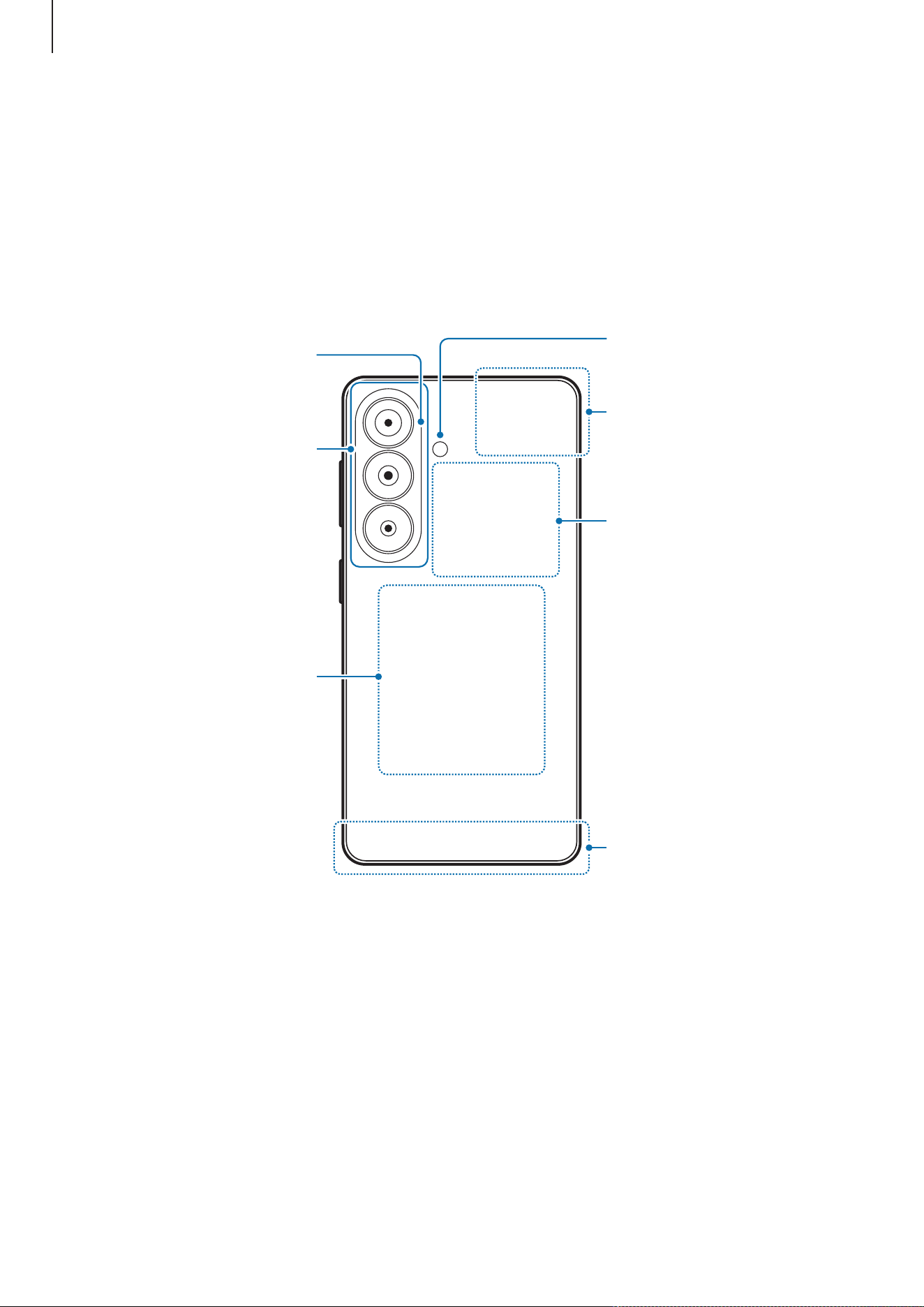
Rear camera
GPS antenna
Flash
NFC antenna
Microphone
Main antenna
Wireless charging coil
Getting started
9
▶
Galaxy S26:
Air vent hole
Microphone
Fingerprint recognition
sensor
Screen
Volume button
Side button
Front camera
Speaker
Nano-SIM card tray
Tray hole
Speaker
Headphone jack /
Multipurpose jack
(USB Type-C)
Microphone
Proximity/Light sensor
Getting started
10
Wireless charging coil
Rear camera
Main antenna
GPS antenna
Flash
NFC antenna
Microphone

Getting started
11
•
When using the speakers, such as when playing media files or using
speakerphone, do not place the device close to your ears.
•
Be careful not to expose the camera lens to a strong light source, such as direct
sunlight or a laser. If the camera lens is exposed to a strong light source, such as
direct sunlight, the camera image sensor may be damaged. A damaged image
sensor is irreparable and will cause dots or spots in pictures.
•
Do not use the device if any parts are broken or damaged, such as glass or
acrylic body, as this may result in injury. Use only after it has been repaired by a
Samsung Service Centre or an authorised service centre.
•
If dust or foreign materials enter the microphone, speaker, or receiver, or if these
parts are covered, the device’s sound may become quiet or certain features may
not work. If you attempt to remove the dust or foreign materials with a sharp
object, the device may be damaged and its appearance may be affected.
•
Connectivity problems and battery drain may occur in the following situations:
‒
If you attach metallic stickers on the antenna area of the device
‒
If you attach a device cover made with metallic material to the device
‒
If you cover the device’s antenna area with your hands or other objects while
using certain features, such as calls or the mobile data connection
•
If the air vent hole is covered by an accessory, such as a protective film or sticker,
unwanted noises may occur during calls or media playback.
•
Do not cover the proximity/light sensor area with accessories, such as stickers or
a cover. Doing so may cause the sensor to malfunction.
•
The light may flicker at the top of the device during calls because of proximity
sensor operation.

Getting started
12
Hard buttons
Button Function
Side button
•
When the device is off, press and hold to turn it on.
•
Press to turn on or lock the screen.
•
Press twice or press and hold to open the app or feature you
set.
Side button +
Volume Down
button
•
Press simultaneously to capture a screenshot.
•
Press and hold simultaneously to turn off the device.
Setting the Side button
Select an app or feature to launch by pressing the Side button twice or pressing and
holding the Side button.
Open
Settings
, tap
Advanced features
→
Side button
, and then select an option you
want.
Soft buttons
When you turn on the screen, the soft buttons will appear at the bottom of the screen.
Refer to Navigation bar (soft buttons) for more information.
Getting started
13
Charging the battery
Charge the battery before using it for the first time or when it has been unused for
extended periods.
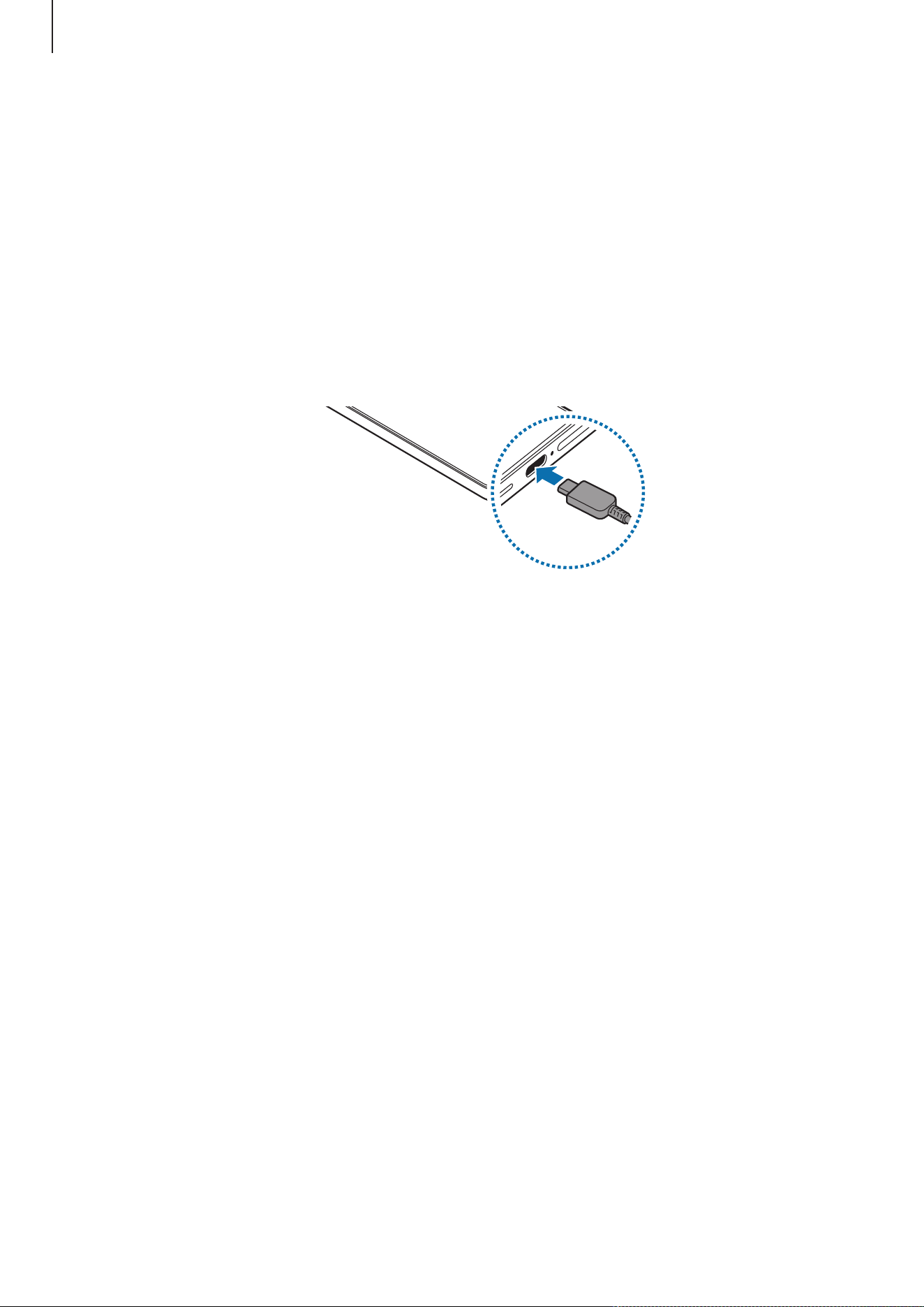
Wired charging
Connect the USB cable to the USB power adapter and plug the cable into the device’s
multipurpose jack to charge the battery. After fully charging, disconnect the charger
from the device.
Wireless charging
The device has a built-in wireless charging coil. You can charge the battery using a
wireless charger (sold separately).
Place the device’s back on the centre of the wireless charger to charge the battery. After
fully charging, disconnect the device from the wireless charger.
The estimated charging time will appear on the notification panel. The actual charging
time assumes that the device is not in use, and it may vary depending on the charging
conditions. Wireless charging may not work smoothly depending on the type of
accessory or cover. For stable wireless charging, it is recommended to separate the cover
or accessory from the device.

Getting started
14
Precautions for wireless charging
If you do not follow the precautions, the device may not charge properly or may
overheat, or the device and any cards may be damaged.
•
Do not place the device on the wireless charger with a credit card or
radio-frequency identification (RFID) card (such as a transportation card or a key
card) placed between the back of the device and the device cover.
•
Do not place the device on the wireless charger when conductive materials, such
as metal objects and magnets, are placed between the device and the wireless
charger.
•
If you use the wireless charger in areas with weak network signals, you may lose
network reception.
•
Use of Samsung-approved wireless chargers is recommended. Using other
wireless chargers may result in improper charging.
Quick charging
Use a super fast charger or fast charger. To use the fast wireless charging feature, use a
charger and components that support the feature.
You can check the connection status of the charger by opening
Settings
and tapping
Battery
.
•
If fast charging does not work, open
Settings
, tap
Battery
→
Charging settings
,
and then check if the feature you want is turned on. Also, check if the USB cable
and the USB power adapter are connected properly.
•
You can charge the battery more quickly while the device or its screen is turned
off.
•
If the wireless charger has an internal fan, the fan may produce noise during
fast wireless charging. Add a routine to set the fast wireless charging feature to
turn off automatically at the preset time using
Routines
. When the fast wireless
charging feature turns off, the charger’s fan noise and the indicator light will be
reduced.
Getting started
15
Wireless power sharing
You can charge another device with your phone’s battery. You can still charge another
device even while charging your phone. Depending on the type of accessories or
cover being used, the Wireless power sharing feature may not work properly. It is
recommended to remove any accessories and cover being used before using this feature.
1 Open
Settings
, tap
Battery
→
Wireless power sharing
, and then tap the switch to
turn it on.
2 Place the other device on your phone, with their backs facing.
3 When you are finished charging, disconnect the other device from your phone.
Do not use headphones while sharing power. Doing so may affect nearby devices.
•
The location of the wireless charging coil may differ depending on the device.
Adjust the devices so the charging coils connect properly.
•
Some features are not available while sharing power.
•
Only devices that support the wireless charging feature can be charged using
this feature. Some devices may not be charged. To check out devices that
support the Wireless power sharing feature, visit the Samsung website.
•
To charge properly, do not move or use either device while charging.
•
The power charged to the other device may be less than the amount shared to it
by your phone.
•
If you charge the other device while charging your phone, the charging speed
may decrease or the device may not charge properly depending on the charger
type.
•
The charging speed or efficiency may vary depending on the phone’s condition or
the surrounding environment.
Setting the limit for power sharing
You can set the device to stop power sharing when the remaining battery power drops
below a certain level.
Open
Settings
, tap
Battery
→
Wireless power sharing
→
Battery limit
, and then set the
limit.
Getting started
16
Reducing the battery consumption
Your device provides various options that help you conserve battery power.
•
Optimise the device using the device care feature.
•
When you are not using the device, turn off the screen by pressing the Side button.
•
Turn on power saving mode.
•
Close unnecessary apps.
•
Turn off the Bluetooth feature when not in use.
•
Turn off auto-syncing of apps that need to be synced.
•
Decrease the backlight time.
•
Decrease the screen brightness.
Battery charging tips and precautions
•
Use only Samsung-approved battery specifically designed for your device.
Incompatible batteries can cause serious injuries or damage to your device.
•
Use of Samsung-approved chargers and cables specifically designed for your
device is recommended. Use of incompatible chargers or cables may result in
injury or damage to the device.
•
Connecting the charger improperly may cause serious damage to the device. Any
damage caused by misuse is not covered by the warranty.
•
Use of the USB Type-C cable supplied with the device is recommended. Using a
Micro USB cable may cause damage to the device.
•
If you charge the device while the multipurpose jack is wet, the device may be
damaged. Thoroughly dry the multipurpose jack before charging the device.

Getting started
17
•
To save energy, unplug the charger when not in use. The charger does not have a
power switch, so you must unplug the charger from the electric socket when not
in use to avoid wasting power. The charger should remain close to the electric
socket and easily accessible while charging.
•
Use of a charger approved by Samsung that guarantees charging performance is
recommended.
•
If the battery is completely discharged, the device cannot be turned on
immediately when the charger is connected. Allow a depleted battery to charge
for a few minutes before turning on the device.
•
If you use multiple apps at once, network apps, or apps that need a connection
to another device, the battery will drain quickly. To avoid losing power during a
data transfer, always use these apps after fully charging the battery.
•
Using a power source other than the charger, such as a computer, may result in a
slower charging speed because of a lower electric current.
•
The device can be used while it is charging, but it may take longer to fully charge
the battery.
•
If the device receives an unstable power supply while charging, the screen may
not function. If this happens, unplug the charger from the device.
•
While charging, the device and the charger may heat up. This is normal and
should not affect the device’s lifespan or performance. If the battery gets hotter
than usual, the charger may stop charging.
•
If the device is not charging properly, take the device and the charger to a
Samsung Service Centre or an authorised service centre.
Getting started
18
Nano-SIM card and eSIM
Insert the nano-SIM card or download the eSIM provided by your carrier.
Differing from a physical nano-SIM card, an eSIM is an embedded digital SIM. To have
two phone numbers or carriers for a single device, insert another nano-SIM card or
download another eSIM.
•
eSIM may not be available depending on the region, carrier, or model.
•
Some services that require a network connection may not be available
depending on the carrier.
•
Using both the nano-SIM card and the eSIM, or two eSIMs may result in slower
data transfer speeds in some areas.
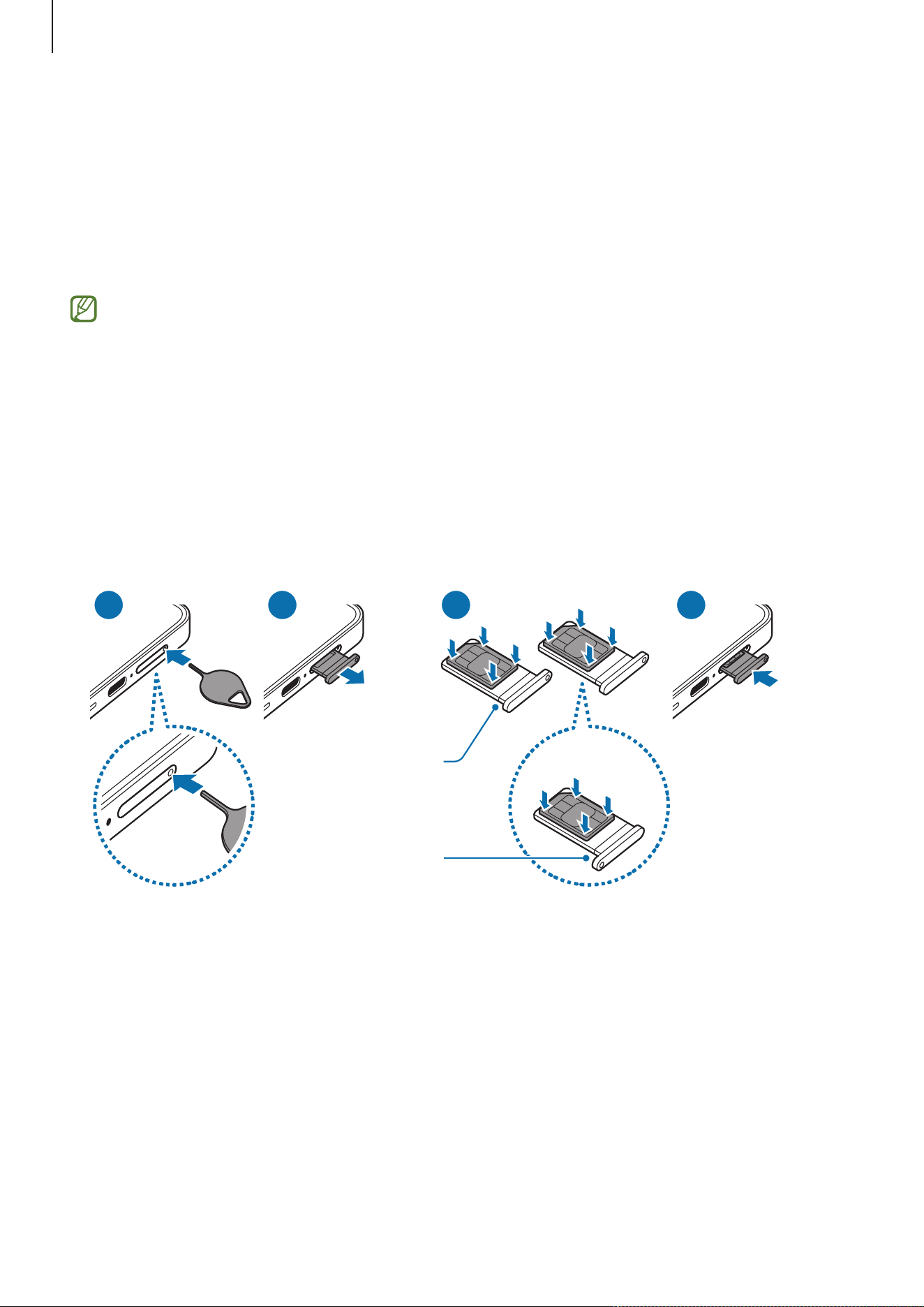
Inserting the nano-SIM card
▶
Galaxy S26 Ultra:
2
1 43
<Underside>
Single nano-SIM
card tray
Dual nano-SIM
card tray
Getting started
19
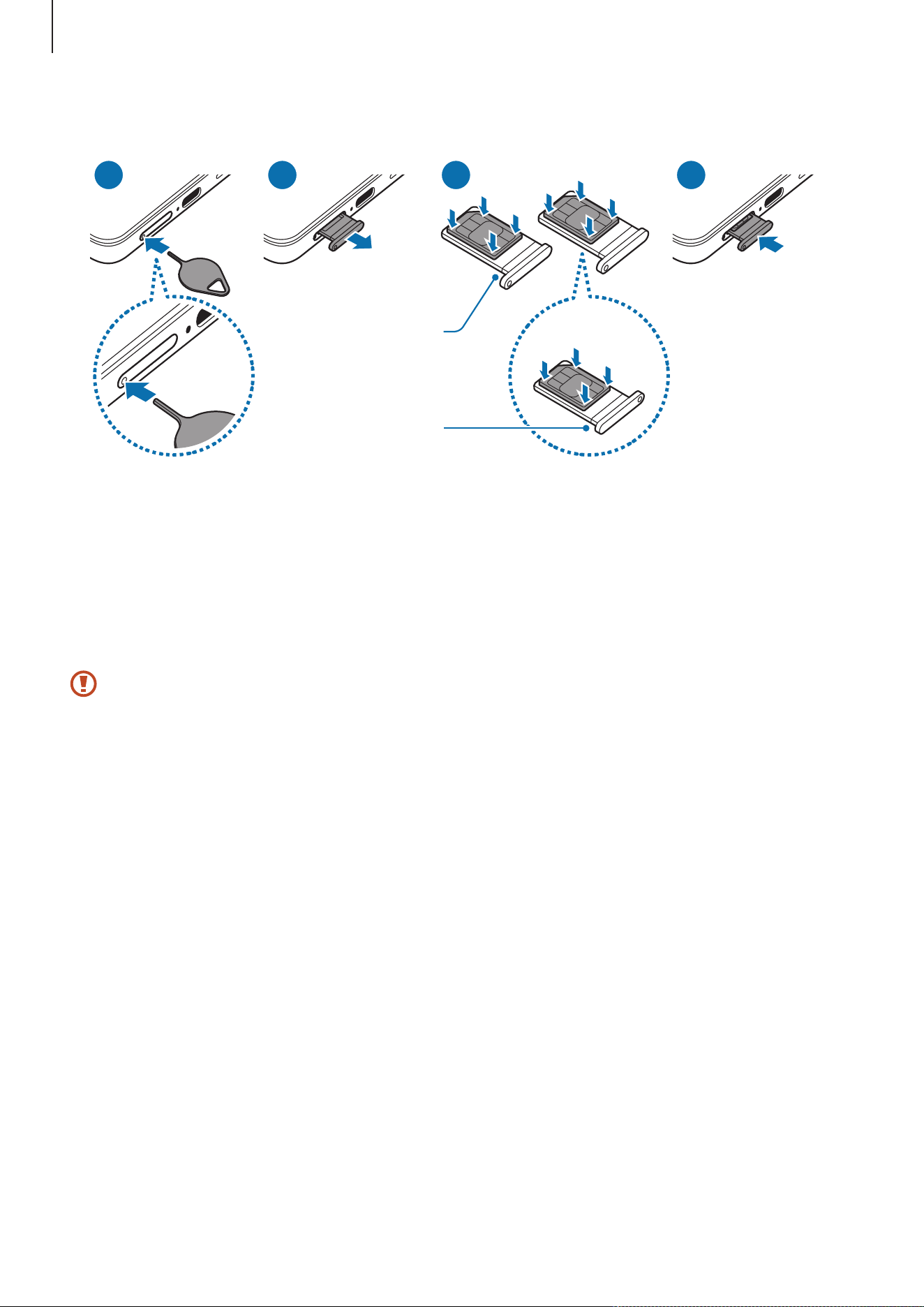
▶
Galaxy S26+, Galaxy S26:
2
1 43
Single nano-SIM
card tray
Dual nano-SIM
card tray
<Underside>
1 Insert the ejection pin into the hole on the tray to loosen the tray.
2 Pull out the tray gently from the tray slot.
3 Place the nano-SIM card on the tray with the gold-coloured contacts facing upwards
and gently press the nano-SIM card into the tray to secure it.
4 Insert the tray back into the tray slot.
•
Insert the ejection pin into the tray’s hole to remove the tray.
•
Use only a nano-SIM card.
•
Use caution not to lose or let others use the nano-SIM card. Samsung is not
responsible for any damages or inconveniences caused by lost or stolen cards.
•
Ensure that the ejection pin is perpendicular to the hole. Otherwise, the device
may be damaged.
•
If the card is not fixed firmly into the tray, the nano-SIM card may leave or fall
out of the tray.
•
If you insert the tray into your device while the tray is wet, your device may be
damaged. Always make sure the tray is dry.
•
Fully insert the tray into the tray slot to prevent liquid from entering your device.

Getting started
20
Downloading an eSIM
Open
Settings
, tap
Connections
→
SIM manager
→
Add eSIM
, and then follow the
on-screen instructions to download the eSIM.
If you have a QR code provided by your carrier, open
Settings
, tap
Connections
→
SIM
manager
→
Add eSIM
→
Scan QR code
, and then scan the QR code.
SIM manager (dual SIM models)
Open
Settings
and tap
Connections
→
SIM manager
.
•
SIM cards
: Activate the nano-SIM card to use and customise the nano-SIM card
settings.
•
eSIMs
: Download or activate the eSIM.
•
Preferred SIMs
: Select to use specific SIM cards for some features, such as voice
calls, when two cards are activated.
•
Data switching
: Set the device to use another SIM card for data services if the
preferred SIM card cannot connect to the network.
You may incur additional charges when using this feature.
•
More SIM settings
: Customise additional settings.
•
Privacy
: Access the Privacy Notice and the Terms and Conditions.

Getting started
21
Turning the device on and off
Follow all posted warnings and directions from authorised personnel in areas
where the use of wireless devices is restricted, such as aeroplanes and hospitals.
Turning the device on
Press and hold the Side button for a few seconds to turn on the device.
Turning the device off
1 To turn off the device, press and hold the Side button and the Volume Down button
simultaneously. Alternatively, open the quick settings panel and tap the Power off
icon (
).
2 Tap
Power off
→
Power off
.
To restart the device, tap
Restart
→
Restart
.
If you want to set the device to turn off when you press and hold the Side button,
tap
Side button settings
→
Long press
→
Power off menu
.
Forcing restart
If your device is frozen and unresponsive, press and hold the Side button and the Volume
Down button simultaneously for more than 7 seconds to restart it.
Emergency calls and medical information
You can make an emergency call or check the medical information you saved.
Press and hold the Side button and the Volume Down button simultaneously, and then
tap
Emergency call
or
Medical info
. Alternatively, open the quick settings panel and tap
the Power off icon (
)
→
Emergency call
or
Medical info
.
To manage your medical information and emergency contacts, open
Settings
and
tap
Safety and emergency
.

Getting started
22
Initial setup
When you turn on your device for the first time or after performing a data reset, follow
the on-screen instructions to set up your device.
If you do not connect to a Wi-Fi network, you might not be able to set up some
device features during the initial setup.
Using networks
You can use networks, such as a Wi-Fi, Bluetooth, NFC, or mobile network.
Open
Settings
, tap
Connections
, and then tap the switch of the desired network to turn
it on.
For the mobile network, tap
Data usage
and tap the
Mobile data
switch to turn it on.
When not using the network, tap the switch to turn it off.
Some features may not be available depending on the model.
Samsung account
Using the Samsung account, you can use a variety of Samsung services that are provided
through mobile devices, TVs, and the Samsung website.
To check the list of services that can be used with your Samsung account, visit
account.samsung.com.
1 Open
Settings
and tap
Sign in to your Galaxy
.
Alternatively, open
Settings
and tap
Accounts and backup
→
Manage accounts
→
Add account
→
Samsung account
.
2 Sign in to your Samsung account. If you do not have a Samsung account, tap
Forgot
password or don’t have an account?
→
Create account
.

Getting started
23
Finding your ID and resetting your password
If you forget your Samsung account ID or password, tap
Forgot password or don’t have
an account?
→
Forgot ID
or
Forgot password
on the Samsung account sign-in screen.
You can find your ID or reset your password after you enter the required information.
Signing out of your Samsung account
When you sign out of your Samsung account, your data, such as contacts or events, will
also be removed from your device.
1 Open
Settings
and tap
Accounts and backup
→
Manage accounts
.
2 Tap
Samsung account
→
My profile
and tap
Sign out
at the bottom of the screen.
3 Tap
Sign out
→
Confirm
.
4 Enter your Samsung account password and tap
OK
.
Transferring data from your previous device
(Smart Switch)
Transfer data from your previous device with the USB cable or wirelessly. You can also
transfer data from external storage or computer.
Open
Settings
, tap
Accounts and backup
→
Transfer data for device setup
, and then
follow the on-screen instructions to transfer data.
Visit www.samsung.com/smartswitch for details and limitations.
•
To transfer data using external storage, tap the External storage icon ( ).
•
To check the data that has been transferred, tap the More options icon ( )
→
Transfer
result
.
•
This feature may not be supported on some devices or computers.
•
Samsung takes copyright seriously. Only transfer content that you own or have
the right to transfer.
Getting started
24
Understanding the screen
Controlling the screen
•
Tapping: Tap the screen.
•
Touching and holding: Touch and hold the screen for approximately 2 seconds.
•
Dragging: Touch and hold an item and drag it to the target position.
•
Double tapping: Double tap the screen.
•
Swiping: Swipe upwards, downwards, to the left, or to the right.
•
Spreading and pinching: Spread two fingers apart or pinch on the screen.
•
Do not allow the screen to come into contact with other electrical devices.
Electrostatic discharges can cause the screen to malfunction.
•
To avoid damaging the screen, do not tap it with anything sharp or apply
excessive pressure to it with your fingertips or other object.
•
It is recommended not to use fixed graphics on part or all of the screen for
extended periods. Doing so may result in afterimages (screen burn-in) or
ghosting.
The device may not recognise touch inputs close to the edges of the screen, which
are outside of the touch input area.
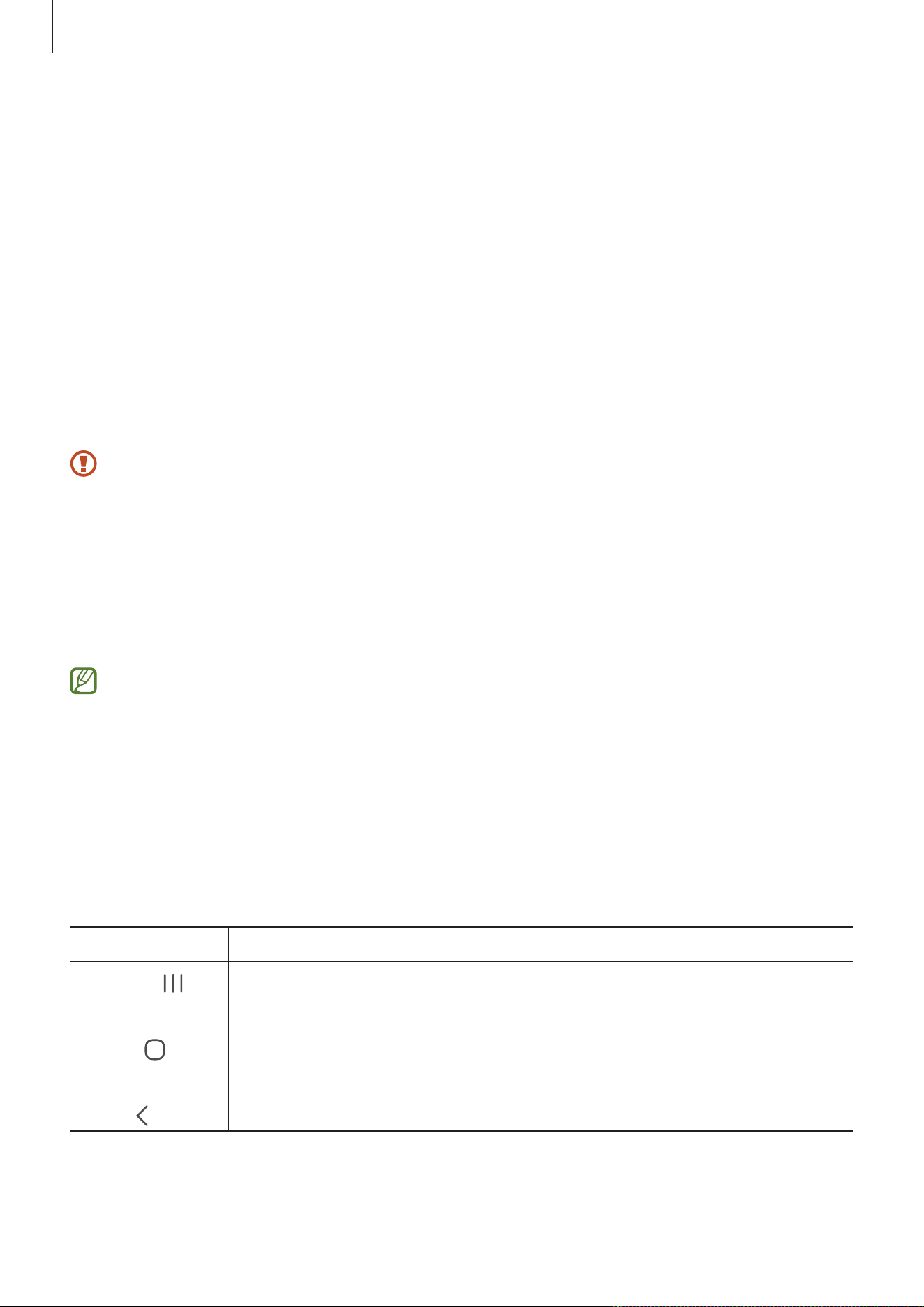
Navigation bar (soft buttons)
When you turn on the screen, the soft buttons will appear on the navigation bar at the
bottom of the screen. The soft buttons are set to the Recents button, Home button, and
Back button by default. The functions of the buttons can change according to the app
currently being used or usage environment.
Button Function
Recents (
)
Tap to open the list of recent apps.
Home (
)
•
Tap to return to the Home screen.
•
Touch and hold to launch
Circle to Search
. Tap or draw a circle
around an image or text.
Back (
)
Tap to return to the previous screen.
Getting started
25
Hiding the navigation bar
Check files or use apps on a wider screen by hiding the navigation bar.
Open
Settings
and tap
Display
→
Navigation bar
→
Swipe gestures
.
Home screen and Apps screen
The Home screen is the starting point for accessing all of the device’s features. It
displays widgets, shortcuts to apps, and more.
The Apps screen displays icons for all apps, including newly installed apps.
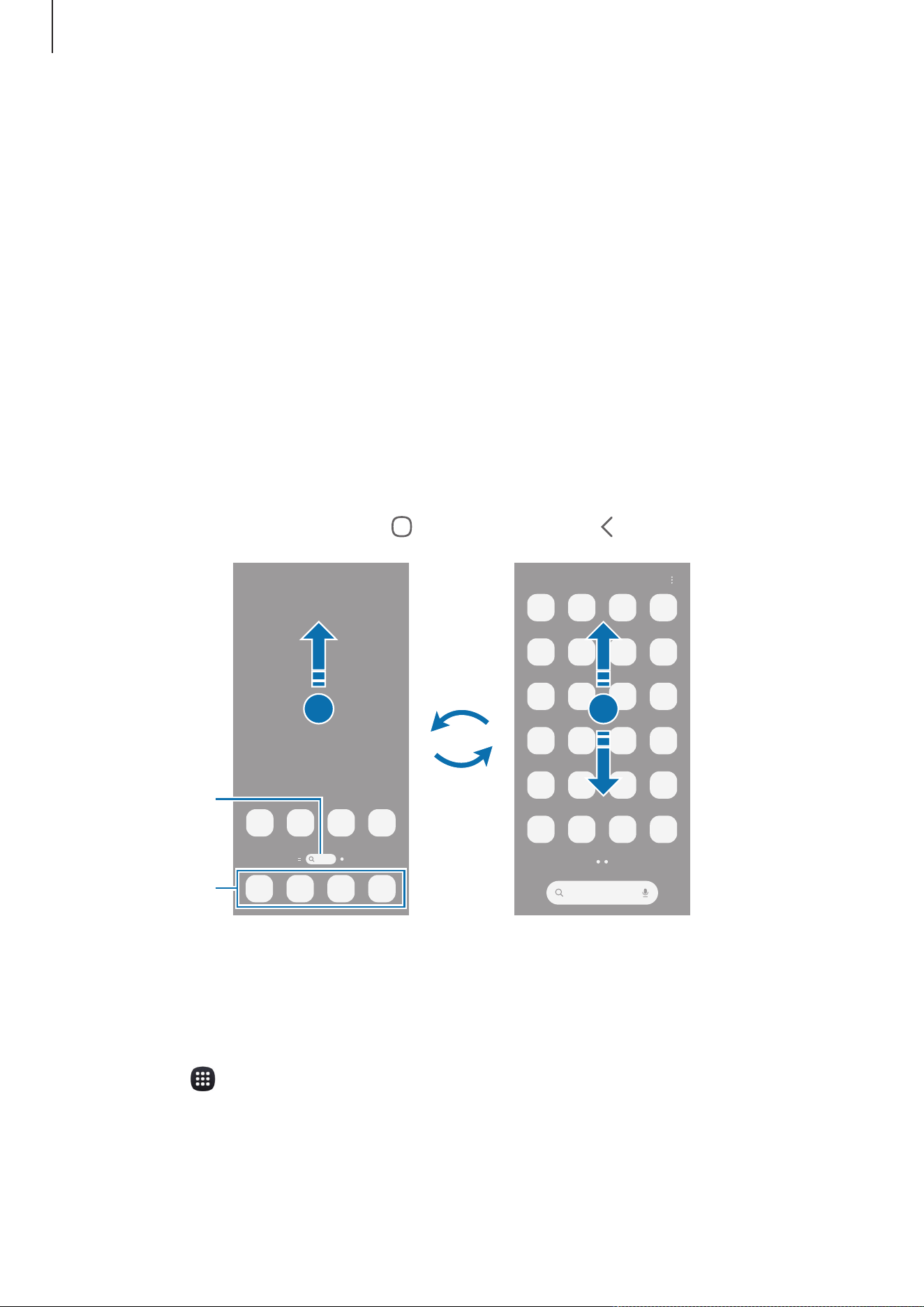
Switching between Home and Apps screens
On the Home screen, swipe upwards to open the Apps screen.
To return to the Home screen, swipe upwards or downwards on the Apps screen.
Alternatively, tap the Home button (
) or the Back button ( ).
Favourite apps
Finder
Home screen Apps screen
If you add the Apps button on the Home screen, you can open the Apps screen by
tapping the button. On the Home screen, touch and hold an empty area, tap
Settings
,
and then tap the
Show Apps screen button on Home screen
switch to turn it on. The
Apps button (
) will be added at the bottom of the Home screen.

Getting started
26
Editing the Home screen
On the Home screen, touch and hold an empty area, or pinch your fingers together to
access the editing options. You can set the wallpaper, add widgets, and more.
•
Wallpaper and style
: Change the wallpaper settings for the Home screen and the
locked screen.
•
Themes
: Change the device’s theme. Visual elements of interface, such as colours,
icons, and wallpapers, will change depending on the selected theme.
•
Widgets
: Widgets are small apps that launch specific app features to provide
information and convenient access on your Home screen. Select a widget and tap
Add
. The widget will be added on the Home screen.
•
Settings
: Configure settings for the Home screen, such as the screen layout.
You can also add, delete, or rearrange Home screen panels.
•
Adding panels: Swipe to the left, and then tap the Add page icon ( ).
•
Moving panels: Drag a panel preview to a new location.
•
Deleting panels: Tap the Remove icon ( ) on the panel.
Displaying all apps on the Home screen
Without using a separate Apps screen, you can set the device to display all apps on the
Home screen. On the Home screen, touch and hold an empty area, and then tap
Settings
→
Home screen layout
→
Home screen only
→
Apply
.
Launching Finder
Search for apps or content.
1 On the Home screen, tap
Finder
.
2 Enter a keyword.
If you tap the Search icon (
) on the keyboard, you can search for more content.
Getting started
27
Moving items
Drag an item to a new location. To move the item to another panel, drag it to the side of
the screen. If you touch and hold an item and tap
Select
, you can select more items and
move them together at once.
To add a shortcut to an app on the Home screen, touch and hold an item on the Apps
screen, and then tap
Add to Home
. A shortcut to the app will be added on the Home
screen.
You can also move frequently used apps to the shortcuts area at the bottom of the Home
screen.
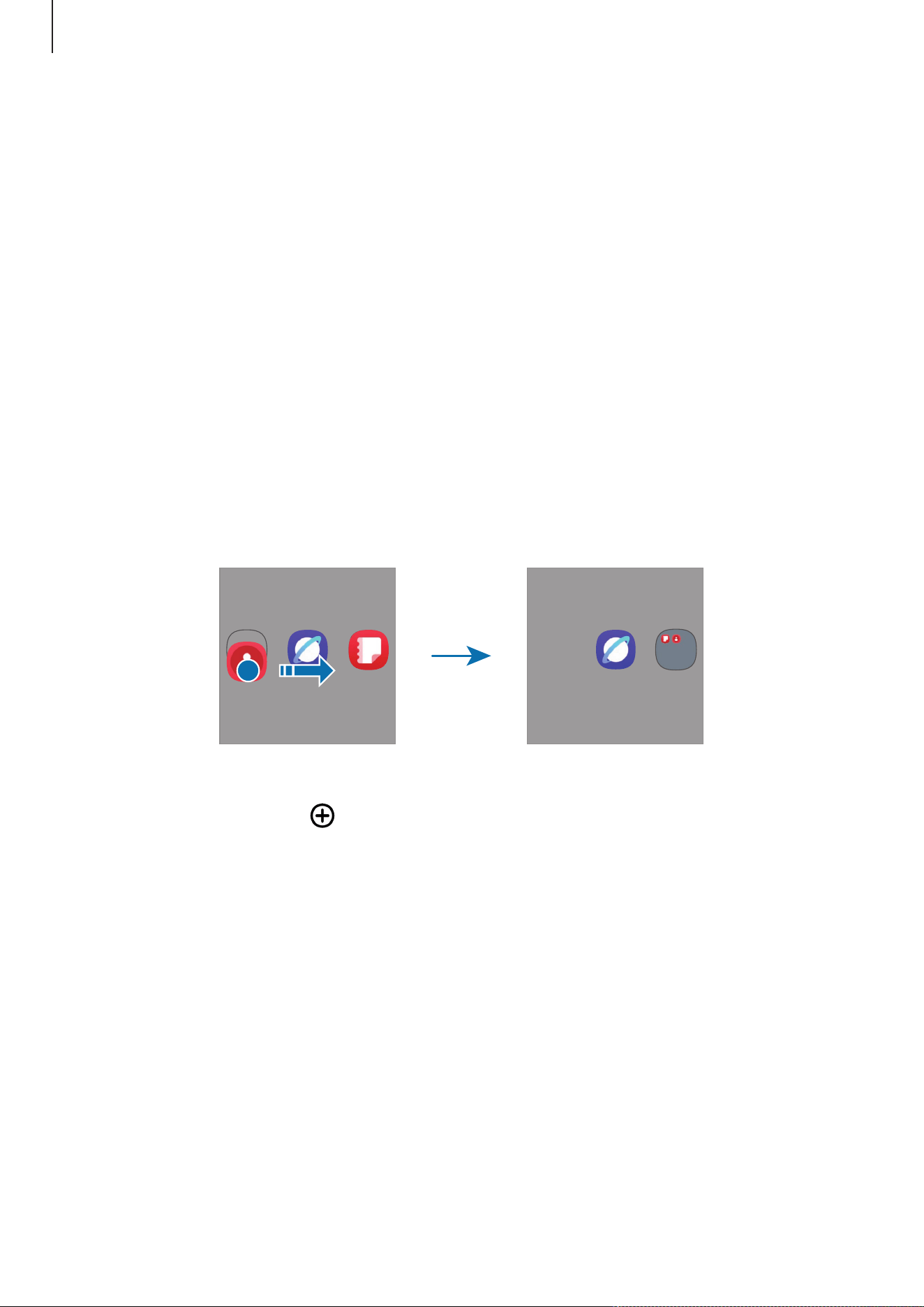
Creating folders
On the Home screen or the Apps screen, drag an app over another app.
A new folder containing the selected apps will be created. Tap
Folder name
and enter a
folder name.
•
Adding more apps
Tap the Add apps icon (
) on the folder. Tick the apps to add and tap
Done
. You can
also add an app by dragging it to the folder.
•
Moving apps from a folder
Drag an app to a new location.
•
Deleting a folder
Touch and hold a folder, and then tap
Delete
. Only the folder will be deleted. The
folder’s apps will be relocated to the Apps screen.
Getting started
28
Edge panel
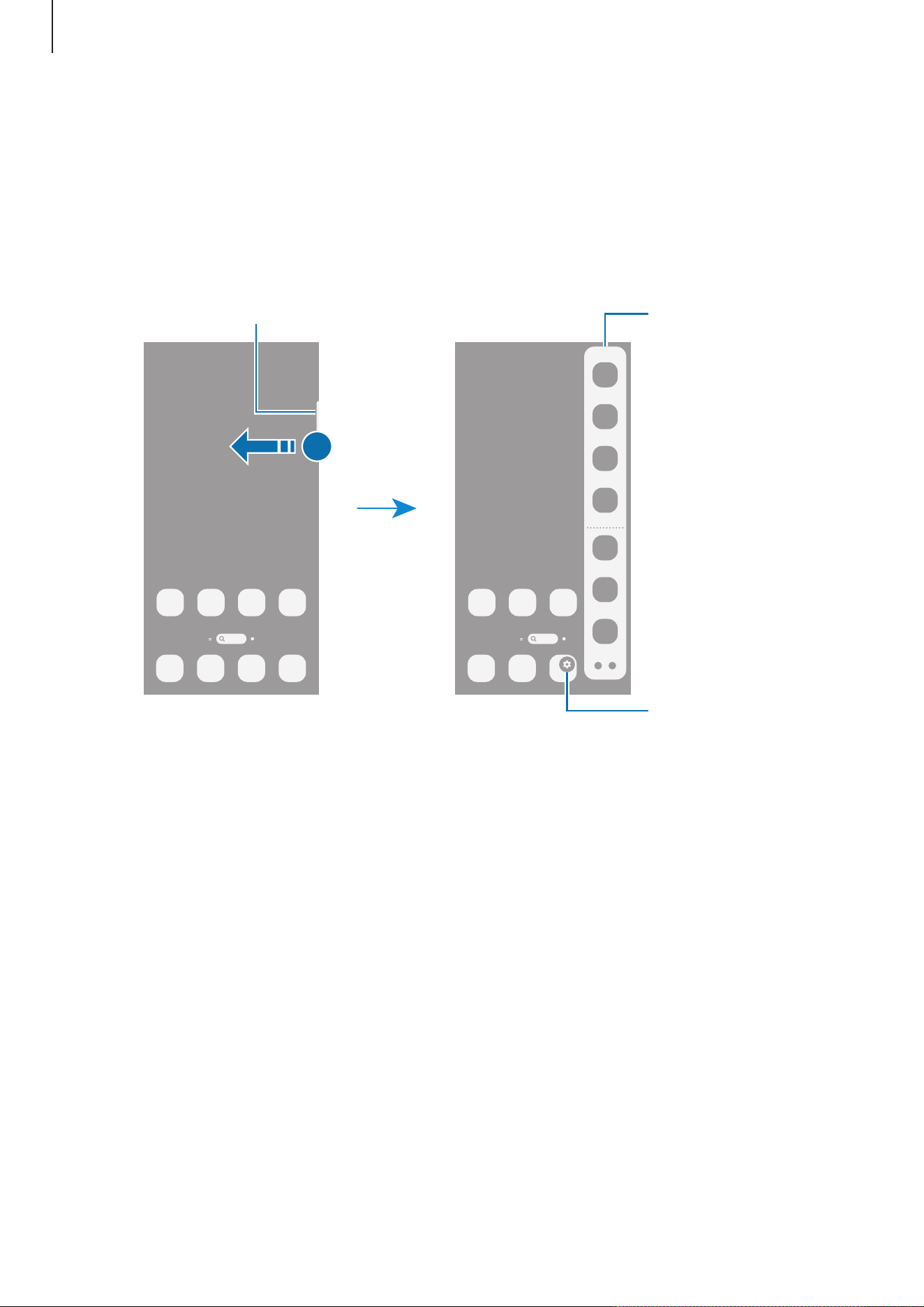
You can access your favourite apps and features from the Edge panels.
Drag the Edge panel handle towards the centre of the screen.
If the Edge panel handle is not visible, open
Settings
, tap
Display
, and then tap the
Edge
panels
switch to turn it on.
Edge panel handle
Edge panel
Edge panel settings
Lock screen
Pressing the Side button turns off the screen and locks it. Also, the screen turns off and
automatically locks if the device is not used for a specified period.
To unlock the screen, swipe in any direction except downwards when the screen turns
on.
If the screen is off or the Always On Display is on, press the Side button or double tap the
screen. For more information about the Always On Display, refer to Always On Display.
Getting started
29
Editing shortcuts
You can change the shortcuts at the bottom of the locked screen to other apps or
features you want.
Touch and hold on the locked screen, tap the shortcut icon, select an app or feature you
want, and then tap
Done
.
Changing the screen lock method
To change the screen lock method, open
Settings
, tap
Lock screen and AOD
→
Screen
lock and biometrics
, and then select a method.
When you set a pattern, PIN, password, or your biometric data for the screen lock
method, you can protect your personal information by preventing others from accessing
your device. After setting the screen lock method, the device will require an unlock code
whenever unlocking it.
You can set your device to perform a factory data reset if you enter the unlock code
incorrectly several times in a row and reach the attempt limit. Open
Settings
, tap
Lock screen and AOD
→
Secure lock settings
, unlock the screen using the preset
screen lock method, and then tap the
Auto factory reset
switch to turn it on.
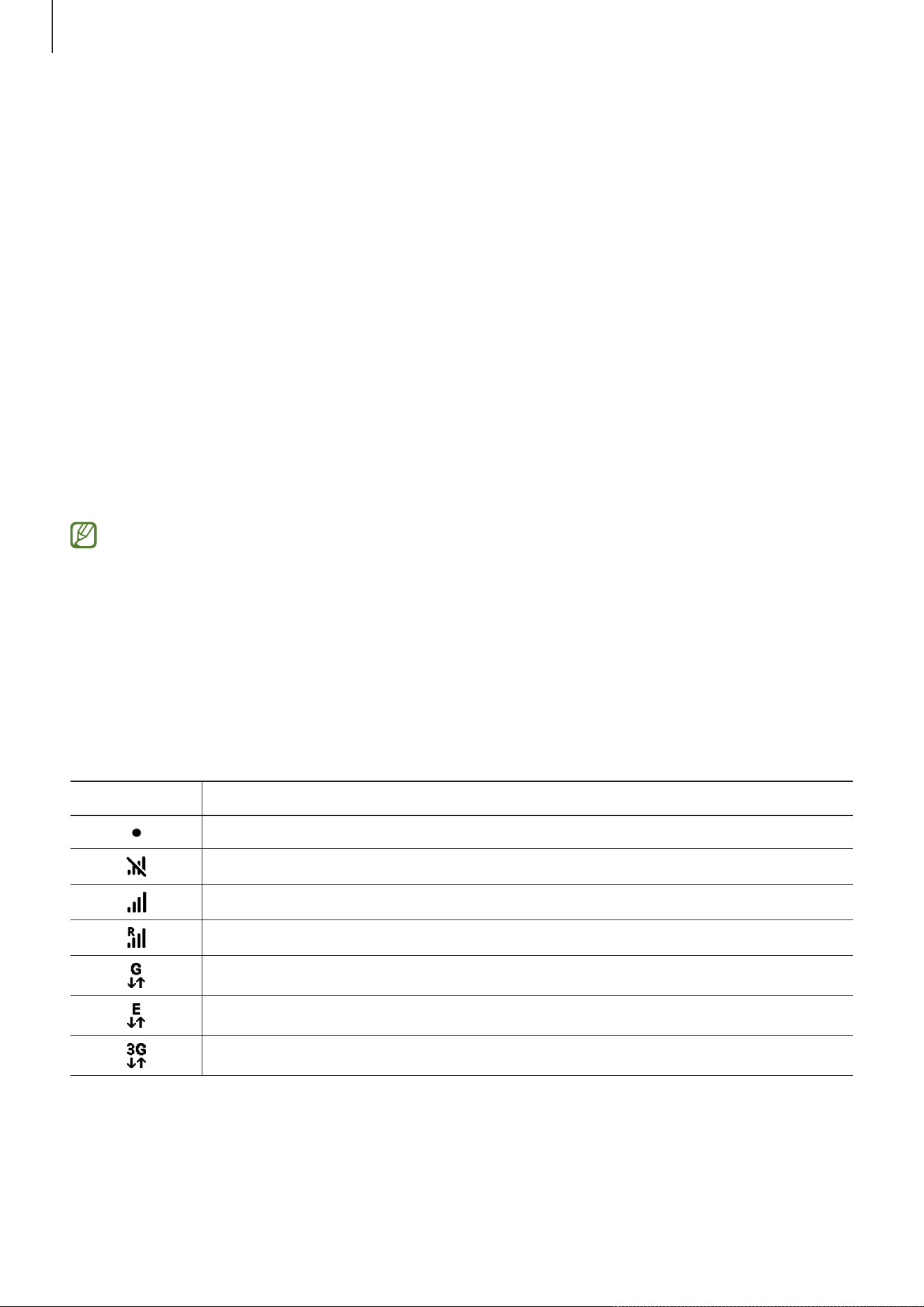
Indicator icons
Indicator icons appear on the status bar at the top of the screen. The icons listed in the
table are most common.
Icon Meaning
New notifications
No signal
Signal strength
Roaming (outside of normal service area)
GPRS network connected
EDGE network connected
UMTS network connected
Getting started
30
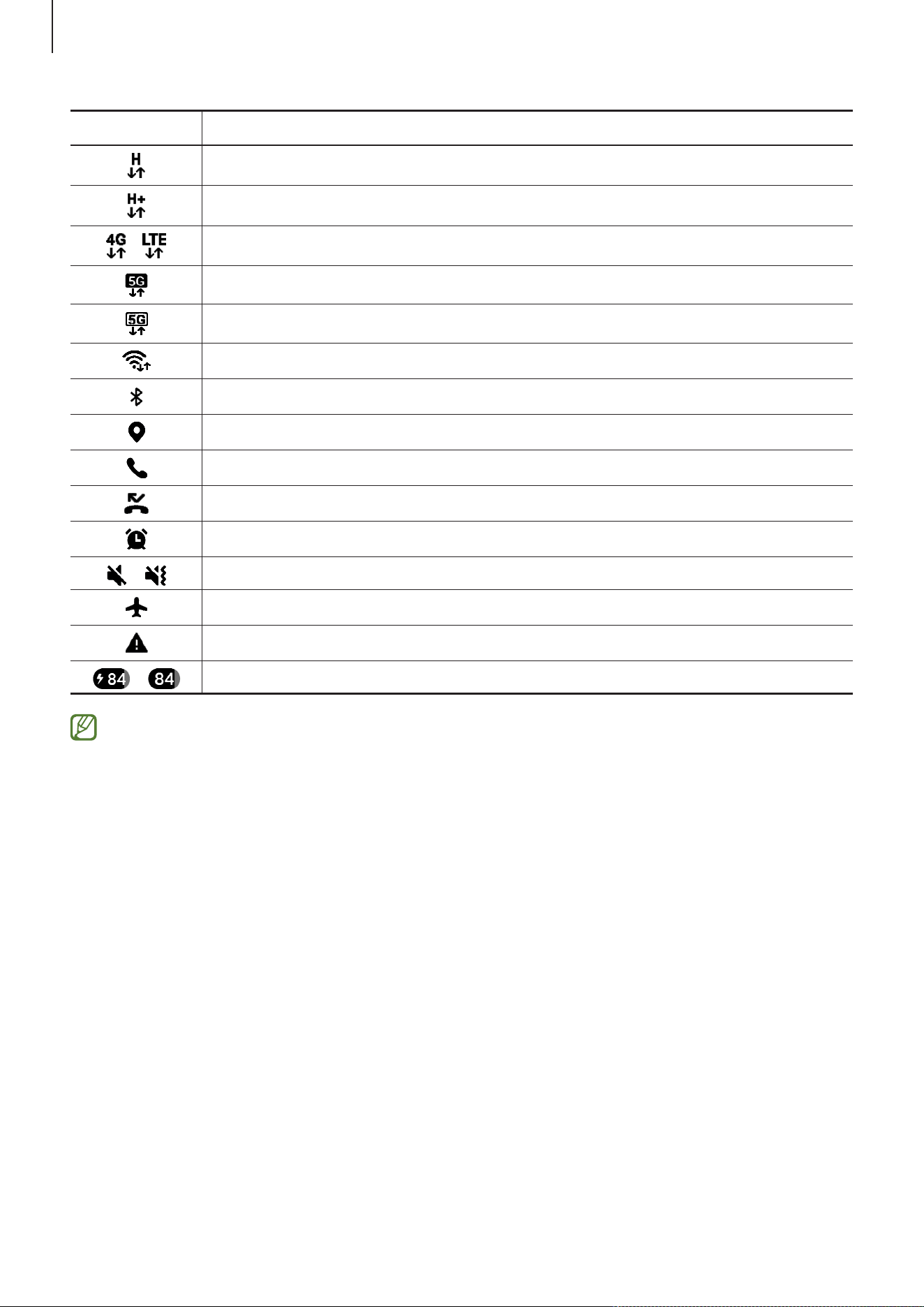
Icon Meaning
HSDPA network connected
HSPA+ network connected
/
LTE network connected
5G network connected
LTE network connected in LTE network that includes the 5G network
Wi-Fi connected
Bluetooth feature turned on
Location services being used
Call in progress
Missed call
Alarm turned on
/ Mute mode / Vibration mode
Flight mode turned on
Error occurred or caution required
/
Battery charging / Battery power level
•
The status bar may not appear at the top of the screen in some apps. To display
the status bar, drag down from the top of the screen.
•
Some indicator icons appear only when you open the notification panel.
•
Some notifications will be displayed as a dot.
•
The indicator icons may appear differently depending on the carrier or model.
Getting started
31
Notification panel
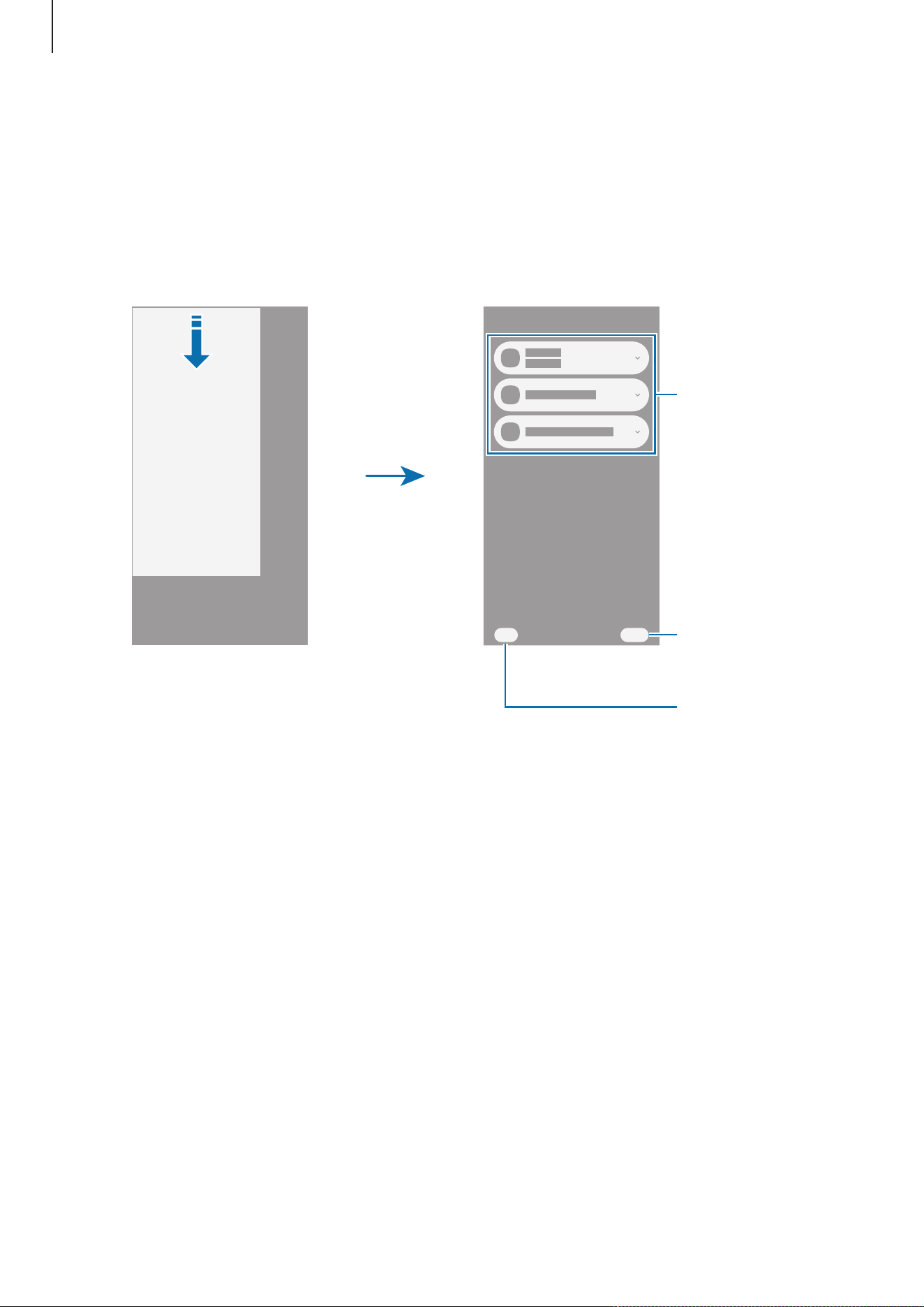
When you receive new notifications, indicator icons appear on the status bar. Open the
notification panel to check the details.
To open the notification panel, swipe downwards from the top of the screen, except for
the right side. To close the notification panel, swipe upwards on the screen.
Check the
notification
details and
perform various
actions.
Clear all
notifications.
Access the
notification
settings.
Getting started
32
Quick settings panel
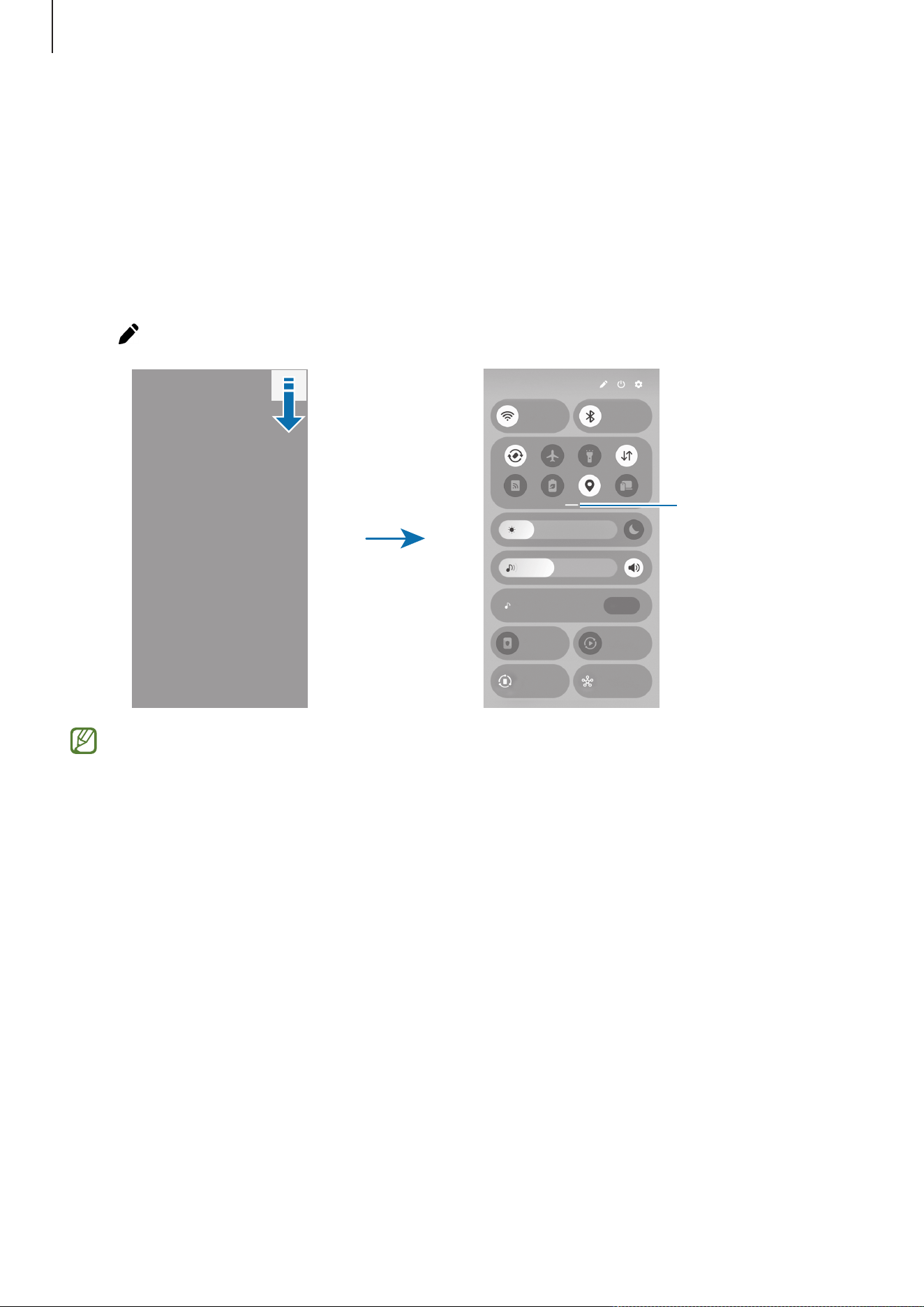
You can turn specific features on or off, such as the Wi-Fi or Bluetooth feature, by
tapping each button.
To open the quick settings panel, swipe downwards from the top right side of the screen.
To close the quick settings panel, swipe upwards on the screen.
To access more detailed settings, touch and hold a button. To edit buttons, tap the Edit
icon (
)
→
Edit
.
Check more
buttons.
This image may differ depending on the region or model.
Controlling media playback
Control media on your phone and connected nearby devices on the quick settings panel.
1 Open the quick settings panel and tap
Media output
.
2 Tap the icons on the controller to control the playback.

Getting started
33
Controlling nearby devices
Control nearby connected devices or connect other nearby devices on the quick settings
panel.
1 Open the quick settings panel and tap
Nearby devices
.
Nearby connected devices will appear with a line connecting them to the circle
around your phone.
2 Select a nearby device to control it.
•
To connect other nearby devices, drag a device from the panel at the bottom of the
screen to the circle.
•
To end the connection, drag the device to the panel at the bottom of the screen
and tap
Disconnect
.
Controlling frequently used devices
Control devices connected to device control apps, such as SmartThings, and manual
routines on the quick settings panel.
1 Open the quick settings panel and tap
SmartThings
.
2 Tap the switch next to the app you want to turn on and tap
Start
.
Connected devices and manual routines will appear.
3 Select a device to control it, or select a manual routine to launch it.

Getting started
34
Screen capture and screen record
Screen capture
Capture a screenshot while using the device and write on, draw on, crop, or share the
captured screen. You can capture the current screen and scrollable area.
How to capture a screenshot
Use the following methods to capture a screenshot. You can check the captured
screenshots in
Gallery
.
•
Button capture
Press the Side button and the Volume Down button simultaneously.
•
Swipe capture
With the edge of your hand, swipe your hand to the left or right across the screen.
If capturing a screenshot by swiping is not turned on, open
Settings
, tap
Advanced
features
→
Motions and gestures
, and then tap the
Palm swipe to capture
switch to
turn it on.
It is not possible to capture a screenshot while using some apps and features.
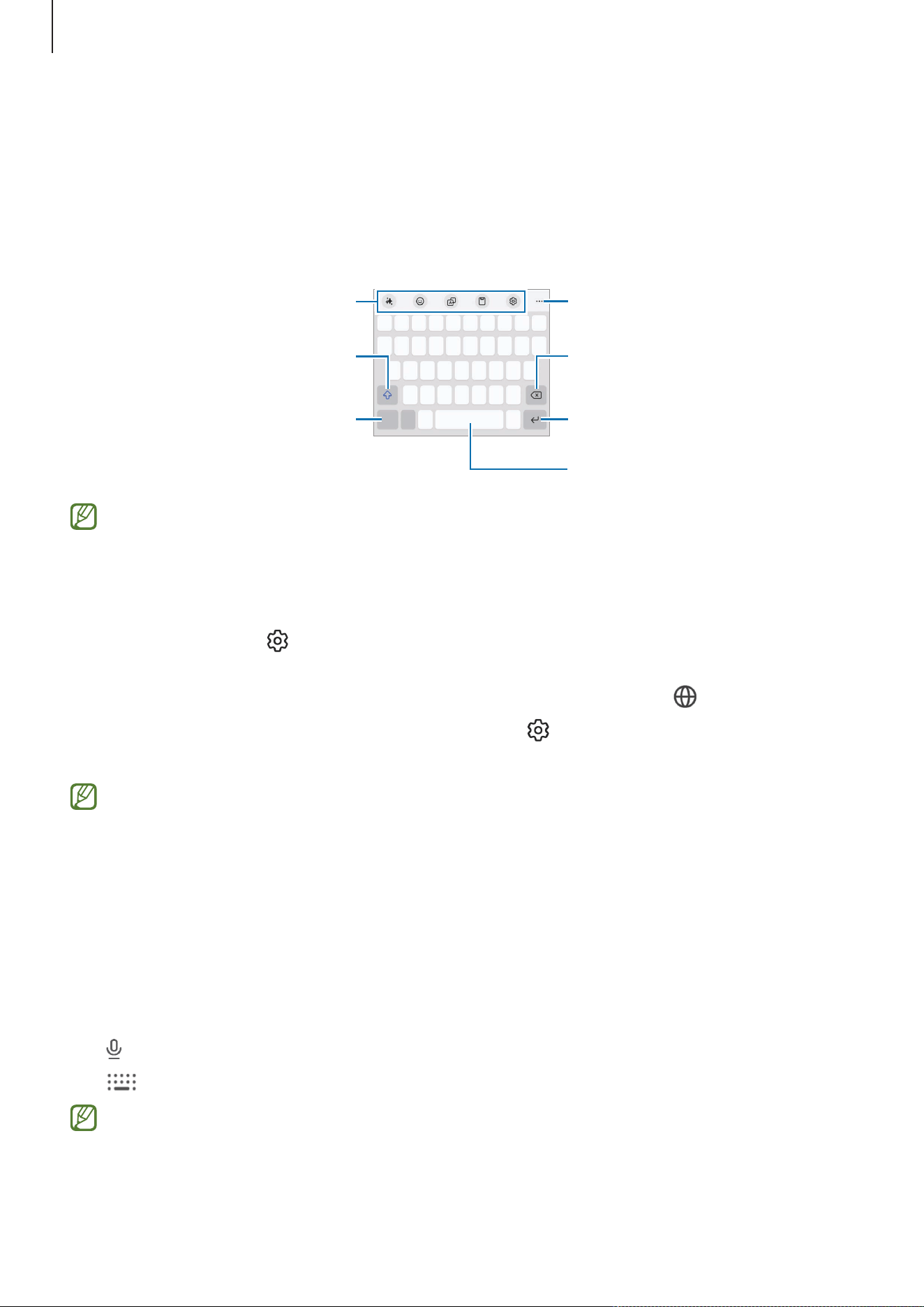
After capturing a screenshot, use the following options on the toolbar at the bottom of
the screen:
•
: Capture the current content and the hidden content on an elongated page,
such as a webpage. When you tap the Scroll capture icon (
), the screen will
automatically scroll down and more content will be captured.
•
: Write or draw on the screenshot or crop a portion from the screenshot. You can
check the cropped area in
Gallery
.
•
: Add tags to the screenshot. To search for screenshots by tag, open the
Gallery
app and tap the Search icon (
). You can access the tags list and search for the
screenshot you want.

Getting started
35
•
: Share the screenshot with others.
•
: Select an area and perform actions, such as sharing or saving. Tap or draw a
circle around the content you want to select. Then, select an option to use with the
selected area.
If the options are not visible on the captured screen, open
Settings
, tap
Advanced
features
→
Screenshots and screen recordings
, and then tap the
Show toolbar
after capturing
switch to turn it on.
Screen record
Record the screen while using your device.
1 Open the quick settings panel, tap the Expand icon ( ), and then tap
Screen
recorder
( ).
2 Customise the settings and tap
Start recording
.
After a countdown, recording will start.
•
To write or draw on the screen, tap the Draw icon ( ).
•
To show the S Pen pointer on the screen, tap the Pointer icon ( ). You can use this
feature only when the S Pen is detached from the device. (Galaxy S26 Ultra)
•
To record the screen with a video overlay of yourself, tap the Selfie video icon ( ).
3 When you are finished recording the video, tap the Stop icon ( ).
You can check the video in
Gallery
.
To change the screen recorder settings, open
Settings
and tap
Advanced features
→
Screenshots and screen recordings
.
Getting started
36
Entering text
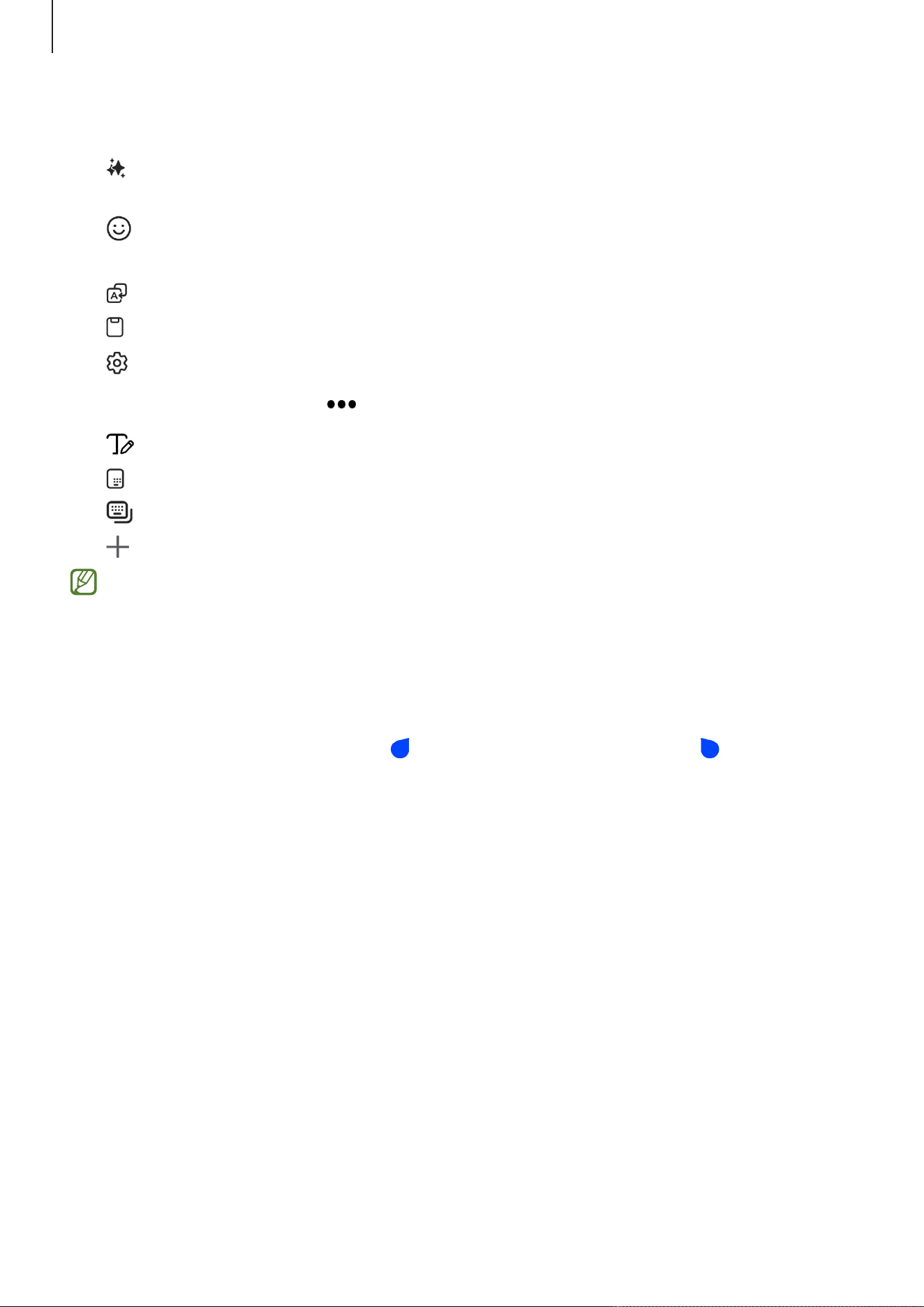
Keyboard layout
A keyboard appears automatically when you enter text.
Break to the next line.
Delete a preceding character.
Enter symbols.
Enter uppercase. For all caps, tap
it twice.
Additional keyboard functions
Enter a space.
Access more keyboard functions.
Text entry is not supported in some languages. To enter text, you must change the
input language to one of the supported languages.
Changing the input language
Tap the Settings icon ( )
→
Languages and types
→
Manage input languages
and
select the languages to use. When you select two or more languages, you can switch
between the input languages by tapping the Change language icon (
).
To change the keyboard type, tap the Settings icon (
)
→
Languages and types
, select a
language, and then select the keyboard type you want.
On a
3 x 4
keyboard, a key has three or four characters. To enter a character, tap the
corresponding key repeatedly until the desired character appears.
Using the input method button
You can change the text input method by tapping the input method button on the
navigation bar.
To change the input method button on the navigation bar, touch and hold the input
method button and select an option you want.
•
: Enter text by voice.
•
: Change the keyboard.
If the input method button does not appear on the navigation bar, open
Settings
,
tap
General management
→
Keyboard
, and then tap the
Show input method
button on navigation bar
switch to turn it on.
Getting started
37
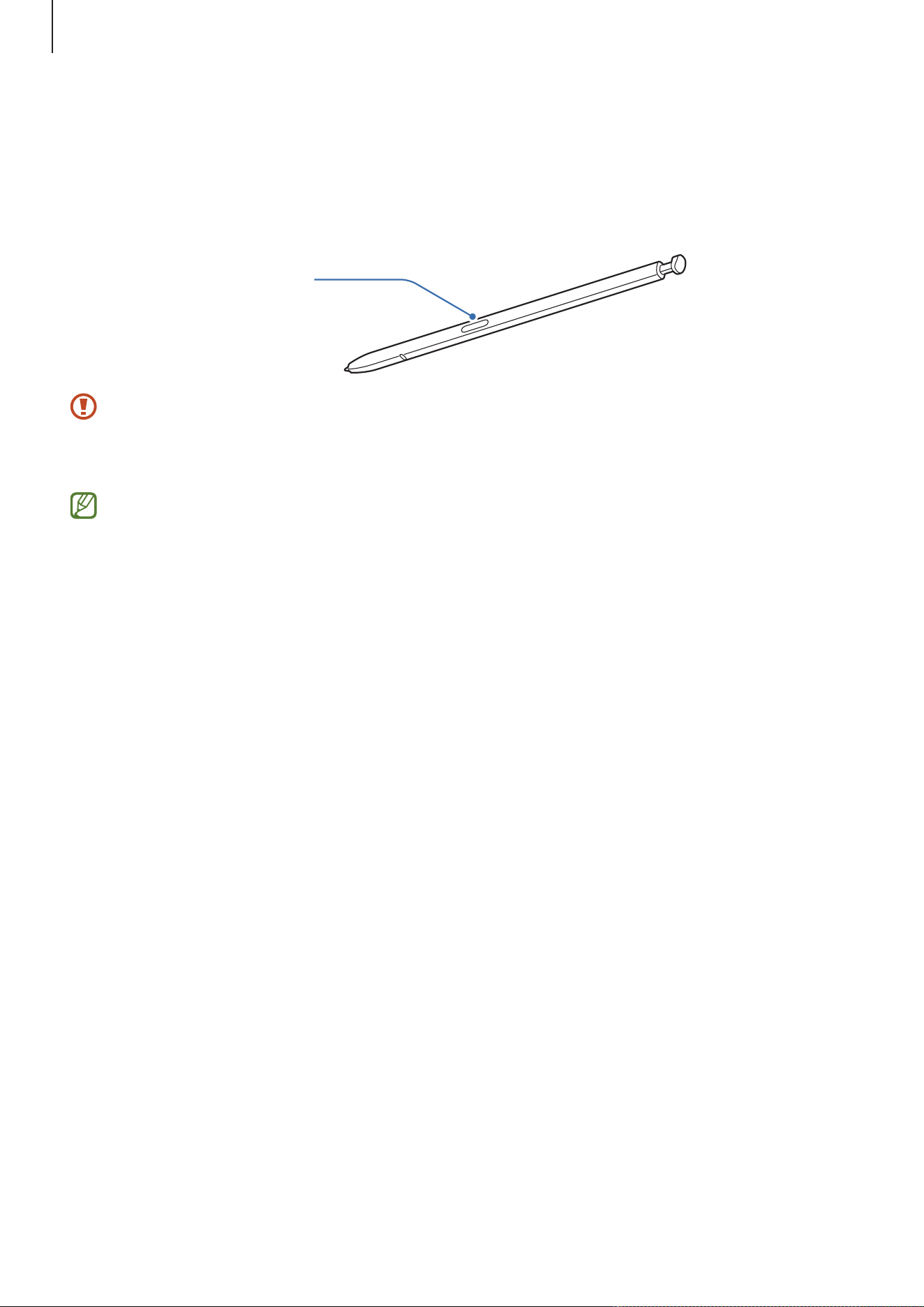
Additional keyboard functions
•
: Change the writing style, receive spelling and grammar suggestions, generate
text automatically on a topic you describe, and more.
•
: Enter avatars, stickers, and more. You can also enter your avatar stickers that
look like you. Refer to Using Galaxy Avatar stickers for more information.
•
: Translate text and enter it.
•
: Add an item from the clipboard.
•
: Change the keyboard settings.
Tap the Expand toolbar icon (
) to use more keyboard functions.
•
: Switch to handwriting mode.
•
: Switch to one-handed operation mode.
•
: Change the keyboard mode.
•
: Edit the keyboard function list.
Some features may not be available depending on the carrier or model.
Copying and pasting
1 Touch and hold over text.
2 Drag the Left text selection icon (
) or the Right text selection icon ( ) to select the
desired text, or tap
Select all
to select all text.
3 Tap
Copy
or
Cut
.
The selected text is copied to the clipboard.
4 Touch and hold where the text is to be inserted and tap
Paste
.

Getting started
38
Extracting text
While using some apps, such as the
Gallery
or
Camera
app, you can extract text from
images and use options, such as copying or sharing it. The following actions are an
example of extracting text in the
Gallery
app.
1 While checking an image in the
Gallery
app, tap the Extract text icon ( ).
The Extract text icon (
) appears only when there is text to extract.
2 Select an area to extract text.
3 Select an option you want.

39
Apps and features
Installing or uninstalling apps
Galaxy Store
Purchase and download apps. You can download apps that are specialised for Samsung
Galaxy devices.
Open the
Store
app. Browse apps by category or tap the Search icon ( ) to search for a
keyword.
•
This app may not be available depending on the carrier or model.
•
To change the auto update settings, tap
Menu
→
the Settings icon ( )
→
Auto
update apps
, and then select an option.
Play Store
Purchase and download apps.
Open the
Play Store
app. Browse apps by category or search for apps by keyword.
To change the auto update settings, tap your account icon, tap
Settings
→
Network
preferences
→
Auto-update apps
, and then select an option.
Managing apps
Uninstalling or disabling apps
Touch and hold an app and select an option.
•
Uninstall
: Uninstall downloaded apps.
•
Disable
: Disable selected default apps that cannot be uninstalled from the device.
Some apps may not support this feature.

Apps and features
40
Enabling apps
Open
Settings
, tap
Apps
→
the Sort icon ( )
→
Disabled
→
OK
, select an app, and then
tap
Enable
.
Setting app permissions
For some apps to operate properly, they may need permission to access or use
information on your device.
To access your app permission settings, open
Settings
and tap
Apps
. Select an app and
tap
Permissions
. You can check the app’s permissions list and change its permissions.
To check or change app permission settings by permission category, open
Settings
and
tap
Apps
→
the More options icon ( )
→
Permission manager
. Select an item and select
an app.
If you do not grant permissions to apps, the basic features of the apps may not
function properly.
Galaxy AI
Introduction
Use advanced intelligence features to help you use your device.
•
Some features may not be available depending on the region, carrier, or model.
•
If you want data processed only within your device to strengthen the protection
of your personal information, open
Settings
, tap
Galaxy AI
, and then tap the
Process data only on device
switch to turn it on. Some features require online
processing for better results and data processing.

Apps and features
41
Enhancing your communication
Translating phone calls in real time (Call assist)
Get real-time translation into the language you select during voice calls.
To use this feature, open the
Phone
app, tap the More options icon ( )
→
Settings
→
Live
translate
, tap the switch to turn it on, and then select the languages to use.
When making or receiving a voice call, tap the Assist icon (
) or
Call assist
→
Live
translate
. To stop translating, tap the Stop translating icon ( ).
To change additional settings, open the
Phone
app and tap the More options icon (
)
→
Settings
→
Live translate
.
Translating messages in message apps (Writing assist)
You can translate text messages in message apps.
1 While checking or composing a message, tap the Assist icon ( ) on the Samsung
Keyboard and tap
Chat translation
.
2 Select the languages on the translator panel at the top of the screen.
Translations will be displayed under each message.
Using writing tools (Writing assist)
You can change the writing style, receive spelling and grammar suggestions, generate
text automatically on a topic you describe, and more.
While composing a message, tap the Assist icon (
) on the Samsung Keyboard and
select an option you want.
•
Spelling and grammar
: Get spelling and grammar suggestions.
•
Writing style
: Change the writing style.
•
Summarise
: Summarise the text.
•
Bullet point
: Organise the content into subheadings and add bullet points.
•
Table
: Organise the text into a table.
•
Composer
: When you enter the topic you want the device to write about, the device
will compose sentences in whatever style you select.

Apps and features
42
Translating conversations (Interpreter)
Get live translation of your conversations and output it into speech or text.
1 Drag the Edge panel handle towards the centre of the screen and tap
Interpreter
.
2 Select your language and the other party’s language.
If the language you want is not on the list, tap
Add languages
and download the
language pack.
3 Tap the Microphone icon ( ) and start conversing.
Using voice interpretation (Interpreter)
Get live translation of lectures, meetings, and more.
1 Drag the Edge panel handle towards the centre of the screen and tap
Interpreter
.
2 Tap the Navigation drawer icon ( )
→
Listening mode
.
3 Select the languages on the translator panel at the top of the screen.
4 Tap the Microphone icon ( ) to start translating.
Unleashing your productivity
Using Note assist features (Samsung Notes)
Auto format or summarise notes, correct spelling errors, or translate notes. You can also
generate new art from your drawing using the Creative studio feature.
Open the
Notes
app, create a note, tap the Assist icon ( ) on the toolbar, and then select
an option you want.
Converting voice recordings to text (Samsung Notes)
You can convert voice recordings you inserted in notes on the
Samsung Notes
app to
text.
Open the
Notes
app, select a note that includes a voice recording, tap the Assist icon ( )
on the toolbar, and then tap
Transcribe
.

Apps and features
43
Summarising and translating voice recordings (Voice Recorder)
Convert voice recordings into on-screen text and check summaries. You can also
translate the converted text into other languages.
1 Open the
Voice Recorder
app.
2 Select a voice recording.
3 Tap the Assist icon ( )
→
Transcribe
.
•
To check the keywords and summary, tap the Assist icon ( )
→
Summarise
.
•
To translate the converted text, tap the Assist icon ( )
→
Translate
, select a
language, and then tap
Translate
.
•
To edit the converted text, tap the More options icon ( )
→
Edit transcript text
.
Summarising and converting call recordings into text (Transcript assist)
You can record a call and convert the recorded call into a text transcript and summarise
it.
1 Open the
Phone
app, tap the More options icon ( )
→
Settings
→
Record calls
→
Transcript assist
, and then tap the
Auto transcribe recorded calls and Direct
voicemail
switch to turn it on.
2 Tap
Transcription language
and select a language to use.
3 During a voice call, tap
More
→
Record
to record the conversation.
4 Open the
Phone
app, tap
Recents
, and then select a recorded call with a transcript.
The Call recording icon (
) will be displayed next to calls with recordings.
5 Tap the converted transcripts.
To summarise the transcripts, tap
Summarise
.
Translating or summarising webpages (Browsing assist)
Get simple summaries of text from webpages along with full translations. You can also
set the device to read the webpage’s highlights aloud.
Open the
Internet
app, tap the Assist icon ( ), and then select an option you want.

Apps and features
44
Translating text using the camera (Camera)
You can translate text using the camera.
1 Open the
Camera
app and tap
PHOTO
on the shooting modes list.
2 Point the camera towards the object and tap the Scan documents and text icon ( ).
The Scan documents and text icon (
) will only appear when a document or text is
detected.
3 Tap the Translate icon ( ).
The text will be translated into the current device language.
Circle to Search
Search for information about the desired part of the image or text on the screen.
Touch and hold the Home button (
) and tap or draw a circle around an image or text.
Creating epic images and videos
Removing people or objects from an image (Gallery)
Edit images by removing people or objects from them and then generate a new
background to fill in any missing pieces.
1 Open the
Gallery
app and select an image.
2 Tap the Assist icon ( )
→
AI eraser
.
3 Tap or draw around anything you want to remove.
4 Tap
Erase
.
5 Tap
Save copy
to save the image.
If you want to use additional Photo assist features, tap
Keep editing
.

Apps and features
45
Moving people or objects in an image (Gallery)
Edit images by moving or resizing people or objects in them and then generate a new
background to fill in any missing pieces.
1 Open the
Gallery
app and select an image.
2 Tap the Assist icon ( )
→
Move
.
3 Tap or draw around anything you want to move.
If you want to adjust the tilt, drag the tilt adjustment bar.
4 Touch and hold the selected area and drag it to where you want.
5 Tap
Generate
.
6 Tap
Save copy
to save the image.
If you want to use additional Photo assist features, tap
Keep editing
.
Adding objects to an image (Gallery)
You can add objects to images by drawing or describing what you want. You can also add
objects from other images by extracting them from the images.
1 Open the
Gallery
app and select an image.
2 Tap the Assist icon ( )
→
Create
.
3 Select an option you want.
•
Describe what to change
: Describe what you want to change in text. You can also
select the spot to add an object by drawing on the screen before describing the
object in text.
•
: Select an image you want to extract objects from. If you want to add additional
objects along with the extracted objects, tap
Describe how to blend images
and
describe what you want to add.
•
: Draw on the screen.
4 Tap
Generate
.
5 Tap
Save copy
to save the image.
If you want to use additional Photo assist features, tap
Keep editing
.

Apps and features
46
Changing the image style (Gallery)
You can change the image style.
1 Open the
Gallery
app and select an image.
2 Tap the Assist icon ( )
→
Style
.
If you are selecting an image of people or pets (cats and dogs), tap the Assist icon (
)
→
Style
→
Photo
or
Portrait
.
•
Photo
: Change the overall style of the image.
•
Portrait
: Select a person or pet from the image and change the style.
3 Select a style you want and tap
Generate
.
4 Tap
Save copy
to save the image.
If you want to use additional Photo assist features, tap
Keep editing
.
Making stereoscopic images (Gallery)
You can apply the stereoscopic effect to images.
1 Open the
Gallery
app and select an image.
2 Swipe upwards on the screen and tap
Live effect
.
3 Tap the Apply icon ( ) to apply the effect.
Using the Instant slow-mo feature (Gallery)
You can play a selected part of the video in slow motion and check more details by
touching and holding that part.
1 Open the
Gallery
app and select a video to play.
2 While playing the video, touch and hold the screen.
This feature may not be available depending on the file.

Apps and features
47
Using the Creative studio feature
Generate new art from your drawing, text descriptions, or an image you select. You can
also create stickers, invitations, and more using the Design studio.
1 Drag the Edge panel handle towards the centre of the screen and tap
Creative studio
.
Alternatively, tap
Creative studio
on the Air command panel. (Galaxy S26 Ultra)
2 Tap the Create icon ( ).
You can also make artistic creations by selecting items from
Design studio
.
3 Select an option you want.
•
: Draw on the screen.
•
: Select an image you want.
•
: Select a style you want.
•
Describe what you want to create
: Describe what you want to create in text.
4 Tap
Generate
.
5 Tap the Save icon (
)
→
Save in Gallery
to save the image.
•
To save the image as a sticker, tap
Save as sticker
. You can use the stickers on the
Samsung Keyboard.
•
To set the image as the wallpaper, tap
Set as wallpaper
.
Using the AI select feature
Select an area on the screen and use various intelligent features.
1 Touch and hold the Edge panel handle to launch
AI select
.
Alternatively, tap
AI select
on the Air command panel. (Galaxy S26 Ultra)
2 Tap or draw a circle around the content you want to select.
3 Select an option to use with the selected area.

Apps and features
48
Editing sounds in a video (Audio eraser)
Eliminate distracting noises in videos by adjusting the volume of voices, wind, and other
sounds.
1 Open the
Gallery
app and select a video to edit.
2 Tap the Edit icon ( )
→
the Audio eraser icon ( )
→
Audio eraser
.
3 Select a sound type and tap
Mute
to mute the sound or drag the adjustment bar to
adjust the volume.
4 Tap
Apply edits
→
Save copy
to save the video.
Creating your own wallpapers
Create wallpapers by selecting categories and keywords or automatically change the
locked screen wallpaper based on the time and weather. You can also create wallpapers
using the Creative studio feature.
1 Open
Settings
and tap
Wallpaper and style
.
2 Tap
Change wallpapers
→
Create with AI
and select an option you want.
•
Generative
: Generate new wallpapers with categories and keywords you select.
•
Creative studio
: Generate new wallpapers from drawings, text descriptions, or an
image you select.
•
Weather
: Change the locked screen wallpaper automatically based on the weather
and time.
Generating a new profile card (Contacts)
You can change your profile card by generating new portraits.
1 Open the
Contacts
app and tap your profile.
2 Tap your profile card and tap
Edit
→
Image
.
3 Select a portrait image you want and tap
Style
→
Photo
or
Portrait
.
4 Select a style you want and tap
Generate
.
5 Tap
Apply
→
Done
.

Apps and features
49
Getting personalised insights
Now brief
Get a briefing generated by AI based on your interests.
Drag the Edge panel handle towards the centre of the screen and tap
Now brief
.
To customise the Now brief settings, tap the Settings icon (
).
Now nudge
AI offers useful information and features based on what is on your screen. For example,
it may suggest checking the location mentioned in a message.
Open
Settings
, tap
Galaxy AI
→
Now nudge
, and then tap the switch to turn it on.
Notification highlights
You can set the device to display important notifications above other notifications
to ensure you do not miss them. You can also set it to display a short summary of
notifications from conversations.
Open
Settings
, tap
Galaxy AI
→
Notification highlights
, select an option you want, and
then tap the switch to turn it on.
Apps and features
50
S Pen (Galaxy S26 Ultra)
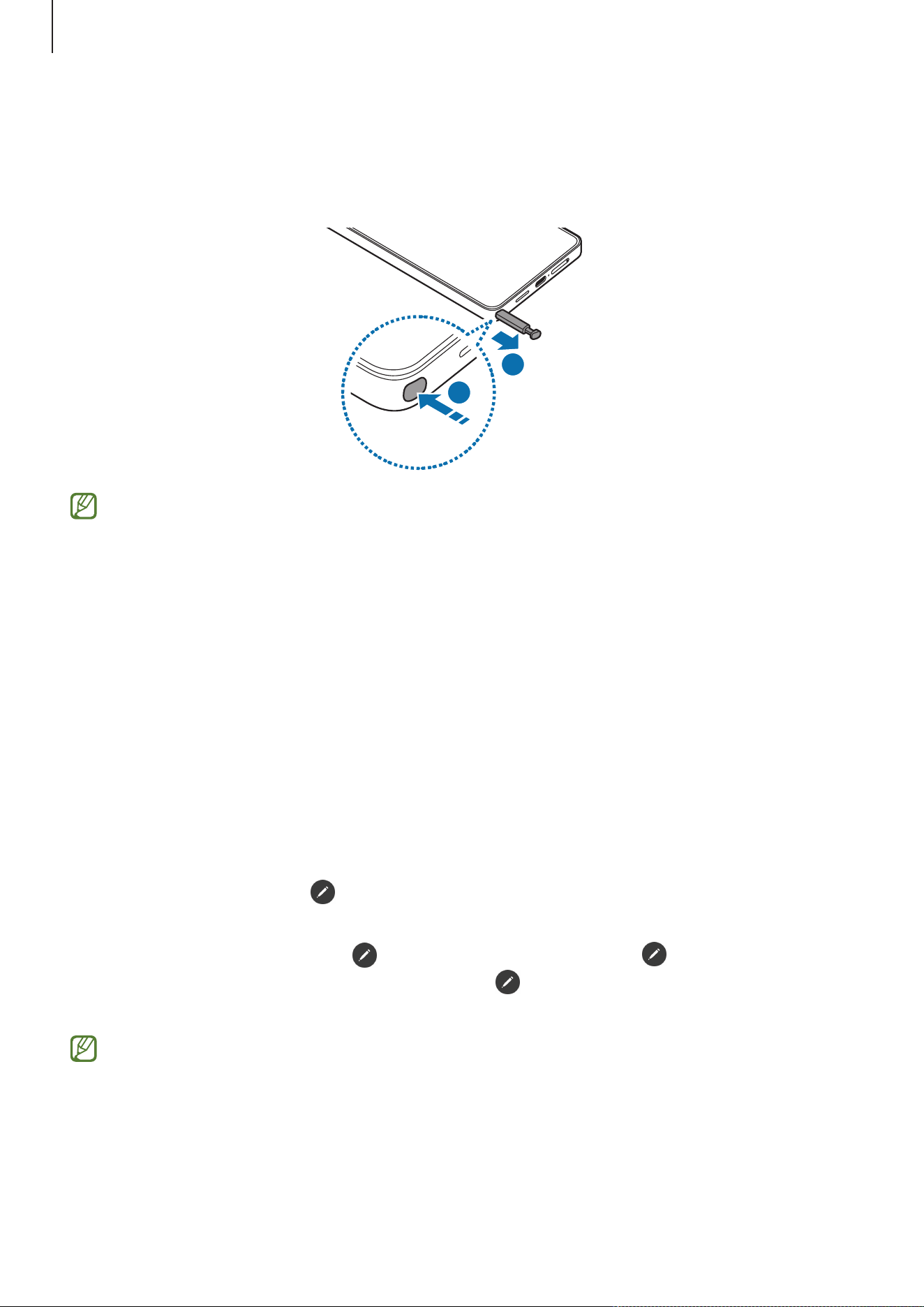
Using the S Pen
S Pen button
•
Do not bend or apply excessive pressure with the S Pen while using it. The S Pen
may be damaged or the nib may be deformed.
•
Do not hard press on the screen with the S Pen. The pen nib may be deformed.
•
If there is a magnet near the device, some S Pen actions, such as tapping the
screen, may not work.
•
If you use the S Pen at sharp angles on the screen, the device may not recognise
the S Pen actions.
•
If water enters the S Pen slot, remove the water from the slot before using it.
•
If the S Pen is not working properly, take it to a Samsung Service Centre or an
authorised service centre.
Apps and features
51
Detaching the S Pen
Press the end of the S Pen to disengage it. Then, pull the S Pen from the slot. To store
the S Pen, reinsert it into the slot and push it until it clicks into place.
2
1
If you want to set an action to perform when you detach the S Pen, open
Settings
,
tap
Advanced features
→
S Pen
→
When S Pen is removed
, and then select an
option.
Allow multiple S Pens
Open
Settings
and tap
Advanced features
→
S Pen
→
More S Pen settings
. Tap the
Allow multiple S Pens
switch to turn it on.
Air command
(Launching S Pen features and apps directly)
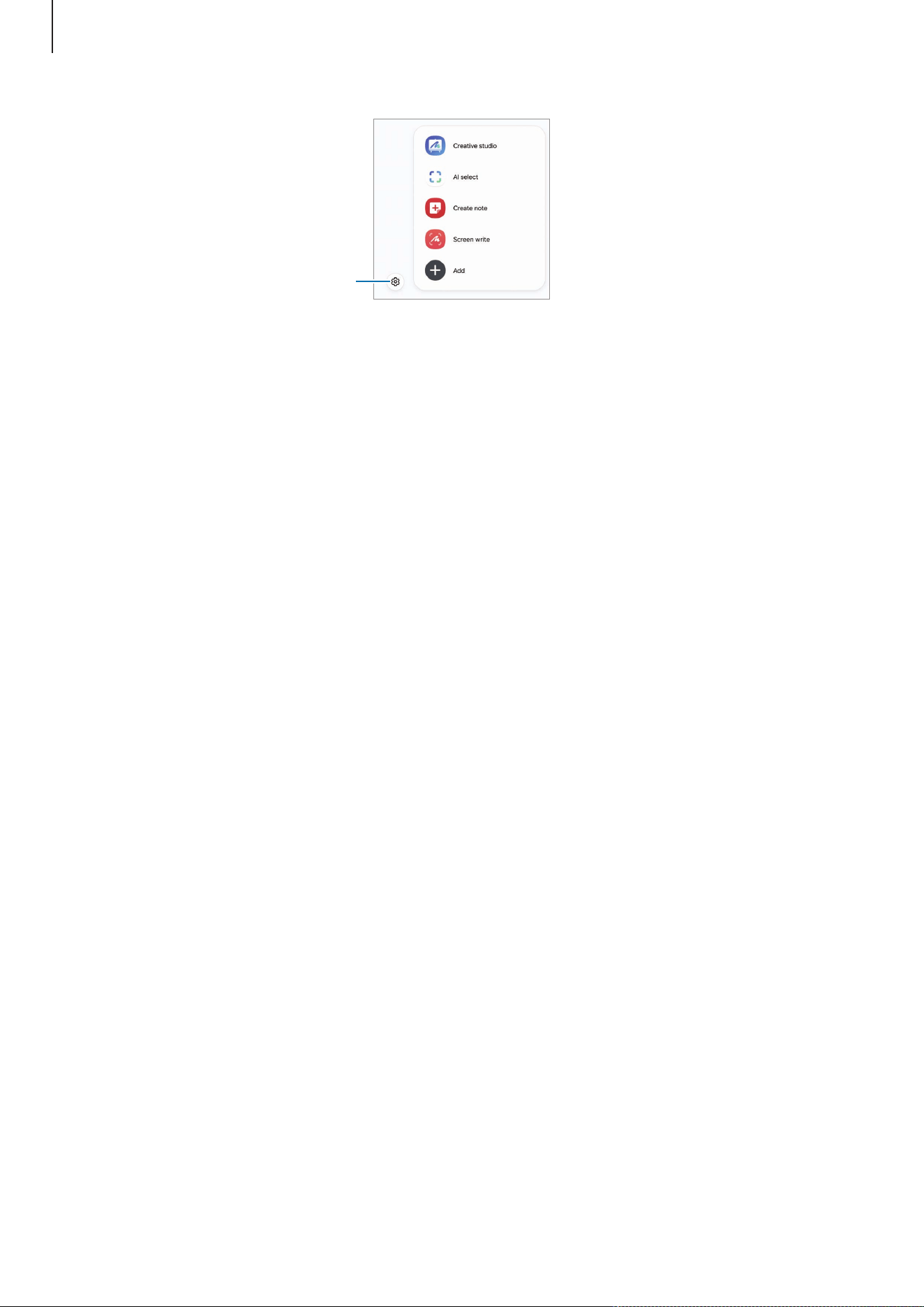
Air command is a menu that provides S Pen features and direct access to frequently used
apps.
Tap the Air command icon (
) with the S Pen to open the Air command panel and select
a function or app you want.
To move the Air command icon (
), drag the Air command icon ( ) to a new location.
To remove the icon, drag the Air command icon (
) to
Remove
at the bottom of the
screen.
If the Air command icon does not appear on the screen, open
Settings
, tap
Advanced features
→
S Pen
→
Air command
, and then tap the
Show Air command
icon
switch to turn it on. If you turn on the
Open Air command with Pen button
switch, you can open the Air command panel by hovering the S Pen over the screen
and pressing the S Pen button.
Apps and features
52
S Pen settings
•
Creative studio
: Generate new art from your drawing, text descriptions, or an image
you select. Refer to Using the Creative studio feature for more information.
•
AI select
: Select an area and perform actions, such as sharing or saving. Refer to AI
select for more information.
•
Create note
: Create notes in a pop-up window. You can also launch this feature by
double tapping the screen while pressing and holding the S Pen button. Refer to
Samsung Notes for more information.
•
Screen write
: Capture screenshots to write or draw on them or crop an area from the
captured image. You can also capture the current content and the hidden content on
an elongated page, such as a webpage. Refer to Screen write for more information.
•
View all notes
: Access all notes in the
Samsung Notes
app.
•
Translate
: Hover the S Pen over a word to translate it. Refer to Translate for more
information.
•
Magnify
: Hover the S Pen over an area of the screen to enlarge it.
•
PENUP
: Post your artwork, check out others’ artwork, and get useful drawing tips.
•
Write on calendar
: Open the
Calendar
app and write or draw on the screen. Refer to
Write on calendar for more information.
•
Add
: Add shortcuts to frequently used apps to the Air command panel.

Apps and features
53
AI select
Select an area and perform actions, such as sharing or saving.
1 When there is content you want to capture, such as a part of an image, open the Air
command panel and tap
AI select
.
2 Tap or draw a circle around the content you want to select.
3 Select an option to use with the selected area.
Screen write
Capture screenshots to write or draw on them or crop an area from the captured image.
1 When there is content you want to capture, open the Air command panel and tap
Screen write
.
The current screen is automatically captured and the editing toolbar appears.
2 Write a memo on the screenshot.
3 Share or save the screenshot.
You can check the captured screenshots in
Gallery
.
It is not possible to capture a screenshot while using some apps.
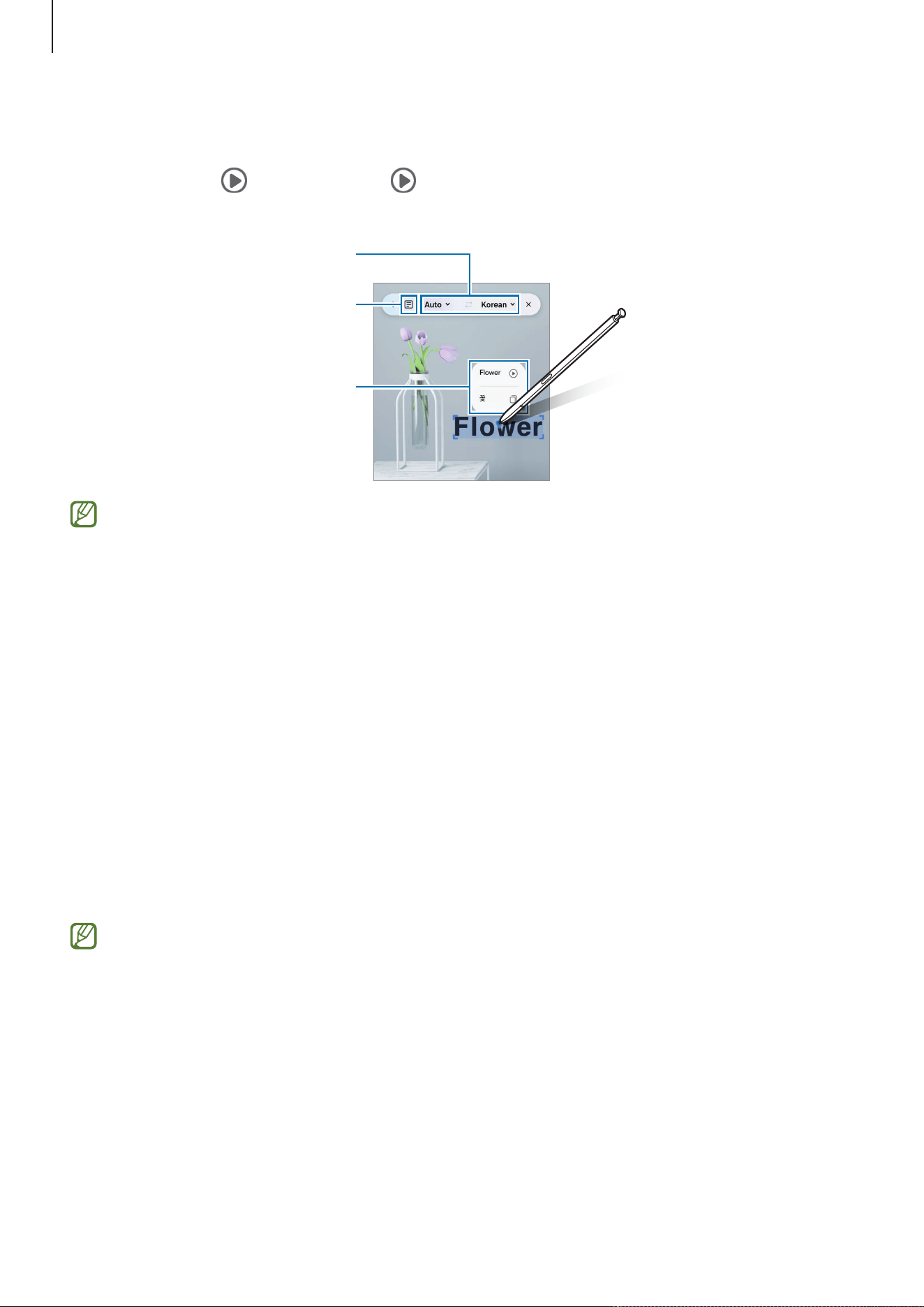
Translate
Hover the S Pen over the text you want to translate. The units included in the text will
also be converted.
1 When there is text you want to translate, open the Air command panel and tap
Translate
.
2 Select the languages on the translator panel at the top of the screen.
You can change the text between words and sentences by tapping the Sentence icon
(
) or the Word icon ( ).
Apps and features
54
3 Hover the S Pen over the text you want to translate or the unit you want to convert.
The translated text will appear. To listen to the pronunciation of the original text, tap
the Play icon (
). The Play icon ( ) may not appear depending on the language you
select.
Text selecting granularity
(word or sentence)
Select languages.
Translation result
•
This feature does not support some languages.
•
This feature is available only when detectable text is on the screen.
Write on calendar
Fill in your plans by writing or drawing on the calendar screen.
Open the Air command panel, tap
Write on calendar
, and then fill in your plans on the
calendar. When you are finished, tap
Save
.
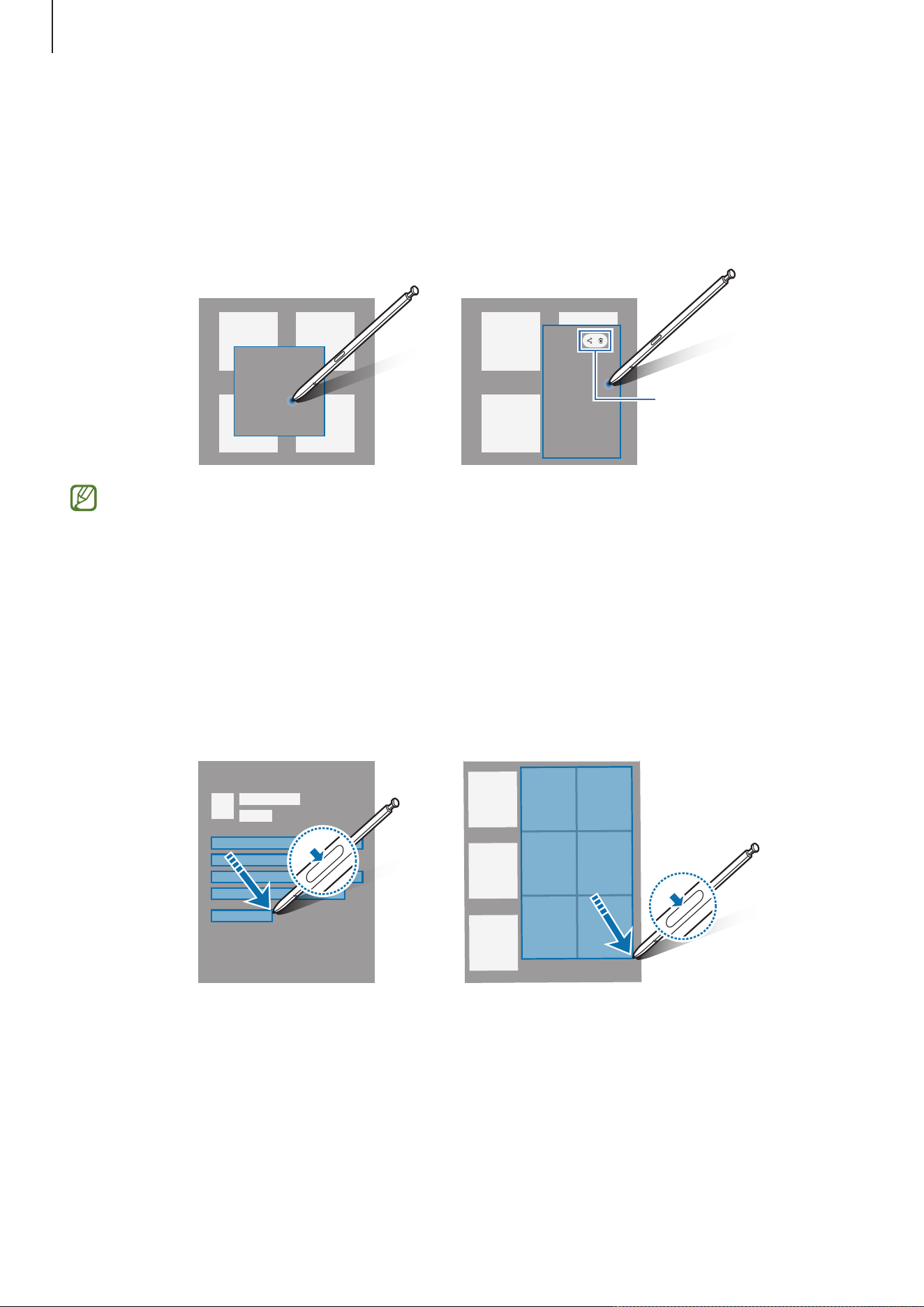
S Pen to text
You can set the device to convert anything you write with the S Pen into text.
1 Open
Settings
, tap
Advanced features
→
S Pen
→
S Pen to text
, and then tap the
switch to turn it on.
To learn about how to edit text with the S Pen, tap
How to edit
.
2 Write in a text input field, such as a search field or address bar, using the S Pen.
The handwriting will be converted to text.
Apps and features
55
Air view
Hover the S Pen over an item on the screen to preview content or access information in a
pop-up window.
In some apps, Action buttons will be displayed on the preview window.
Action buttons
If this feature is not turned on, open
Settings
, tap
Advanced features
→
S Pen
, and
then tap the
Air view
switch to turn it on.
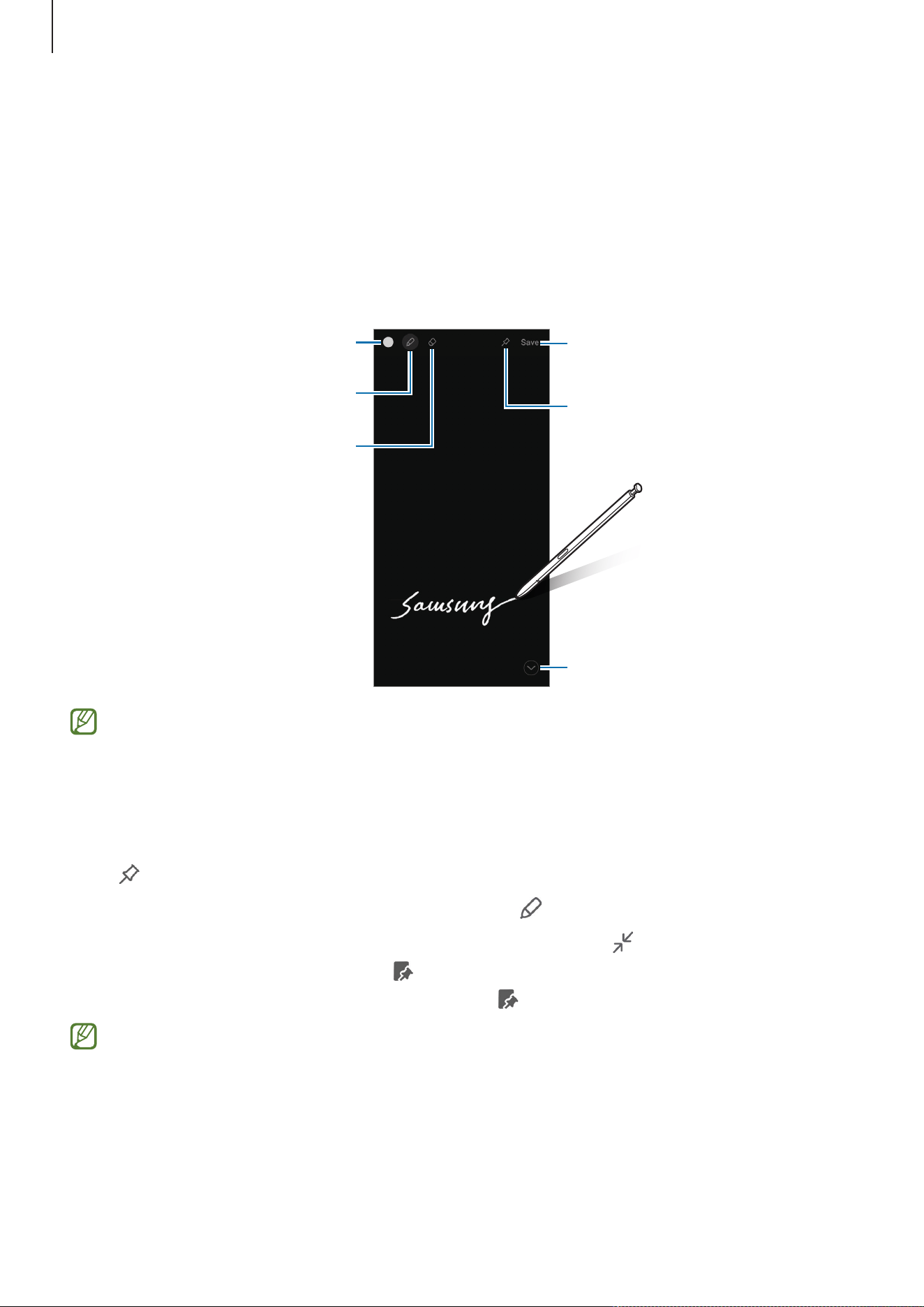
Pen Select
(Selecting items quickly with the S Pen)
While pressing and holding the S Pen button, drag the S Pen over text or item lists to
select multiple items or text. You can also copy and paste the selected items or text into
another app or share them with others.
Apps and features
56
Screen off memos
You can create memos by writing on the screen without turning on it.
When the screen is off, detach the S Pen or double tap the screen while pressing and
holding the S Pen button.
When you tap
Save
or reinsert the S Pen into the slot after writing a memo, the memo
will be saved to
Samsung Notes
.
Pin the memo on the Always On
Display.
Save the memo in Samsung
Notes.
Extend the page.
Change the line thickness.
Eraser
Change the pen colour.
If this feature is not turned on, open
Settings
, tap
Advanced features
→
S Pen
, and
then tap the
Screen off memos
switch to turn it on.
Pinning a memo on the Always On Display
To pin a screen off memo on the Always On Display, tap the Pin to Always On Display
icon (
). The pinned memo will not be saved yet.
To edit the pinned memo, double tap the Edit icon (
).
To minimise the pinned memo, double tap the Minimise icon (
). The memo will be
displayed as the Pinned memo icon (
) on the Always On Display. To check out the
memo again, double tap the Pinned memo icon (
).
If you do not perform any actions for a certain period after opening a memo, the
memo will be automatically minimised.

Apps and features
57
Phone
Introduction
Make or answer voice and video calls.
Making calls
1 Open the
Phone
app and tap
Keypad
.
2 Enter a phone number.
3 Tap the Voice call icon ( ) to make a voice call, or tap the Video call icon ( ) or the
Meet video call icon (
) to make a video call.
Making calls from call logs or contacts list
Open the
Phone
app, tap
Recents
or
Contacts
, and then swipe to the right on a contact
or a phone number to make a call.
If this feature is turned off, tap the More options icon (
)
→
Settings
→
Other call
settings
, and then tap the
Swipe to call or text
switch to turn it on.
Using speed dial
To set a number to speed dial, open the
Phone
app, tap
Keypad
→
the More options icon
(
)
→
Speed dial numbers
, select a speed dial number, and then add a phone number.
To make a call, touch and hold a speed dial number on the keypad. For speed dial
numbers 10 and up, tap the first digit(s) of the number, and then touch and hold the last
digit.
For example, if you set the number 123 as a speed dial number, tap 1, tap 2, and then
touch and hold 3.
Apps and features
58
Making an international call
1 Open the
Phone
app and tap
Keypad
.
2 Touch and hold 0 until the + sign appears.
3 Enter the country code, area code, and phone number, and then tap the Call icon ( ).
Receiving calls
Answering a call
When a call comes in, drag the Answer icon ( ) outside the large circle.
Rejecting a call
When a call comes in, drag the Decline icon ( ) outside the large circle.
To send a message when rejecting an incoming call, drag the
Send message
bar upwards
and select a message to send. If you tap the Reminder icon (
) and send the message,
you can receive a reminder one hour later.
To create various rejection messages, open the
Phone
app and tap the More options icon
(
)
→
Settings
→
Quick decline messages
. Tap the Add icon ( ), enter a message, and
then tap
Save
.
Blocking phone numbers
Block calls from specific numbers added to your block list.
Open the
Phone
app, tap the More options icon ( )
→
Settings
→
Block numbers
, and
then select contacts or phone numbers to save in the blocked numbers list.
When blocked numbers try to contact you, you will not receive notifications. The calls
will be logged in the call log.
You can also block incoming calls from people that do not show their caller ID. Tap
the
Block calls from unknown numbers
switch to turn the feature on.

Apps and features
59
Options during calls
•
: Switch to a video call.
•
→
Text call
: Communicate with the other party through text. Refer to Text call for
more information.
•
→
Live translate
: Get real-time translation into the language you select during
voice calls. To use this feature, open the
Phone
app, tap the More options icon ( )
→
Settings
→
Live translate
, and then tap the switch to turn it on. Refer to Translating
phone calls in real time (Call assist) for more information.
•
Add call
: Dial a second call. The first call will be put on hold. When you end the
second call, the first call will be resumed.
•
Mute
: Turn off the microphone so that the other party cannot hear you.
•
Bluetooth
: Switch to a Bluetooth headset if it is connected to the device.
•
Speaker
: Turn speakerphone off or on. When using the speakerphone, keep the
device away from your ears.
•
Keypad
/
Hide
: Open or close the keypad.
•
More
: Use additional features.
•
: End the current call.
•
: During a video call, switch to a voice call.
•
: Set the device to change the angle and zoom automatically by recognising and
tracking people during a video call.
•
: During a video call, lock the screen.
•
Effects
: During a video call, apply various effects.
•
: During a video call, change the screen ratio.
•
Camera
: During a video call, turn off the camera so that the other party cannot see
you.
•
Switch
: During a video call, switch between the front and rear cameras.
Some features may not be available depending on the carrier or model.

Apps and features
60
Call assist
Call screening
An AI assistant answers calls on your behalf and asks the caller who they are and what
the call is about.
To use this feature, open the
Phone
app, tap the More options icon ( )
→
Settings
→
Call screening
, and then tap the switch to turn it on. Then tap
Auto screen calls
, tap the
switch to turn it on, and then follow the on-screen instructions to complete the setup.
When a call comes in, an automated voice message is played to the caller and what the
caller says is recorded.
If you want to check the content of an ongoing call in real time, open the notification
panel and tap the notification for the call. You can also answer the call or switch to a text
call.
To check the message left by the caller after the call ends, open the
Phone
app, tap
Recents
, and then select the call. The Call screening icon ( ) will be displayed next the
calls.
Text call
Communicate with the other party through text.
To use this feature, open the
Phone
app, tap the More options icon ( )
→
Settings
→
Text
call
, and then tap the switch to turn it on. When making a voice call or during a call, tap
the Assist icon (
)
→
Text call
.
When the call is connected, a voice greeting is automatically delivered to the other party
and what the other party says is displayed as text on your screen.
If you select a response from the quick response list or enter text, it will be transmitted
through a voice to the other party.
To switch to a voice call, tap the Switch to voice call icon (
).
To change the settings, open the
Phone
app and tap the More options icon ( )
→
Settings
→
Text call
.
Live translate
Get real-time translation into the language you select during voice calls. Refer to
Translating phone calls in real time (Call assist) for more information.

Apps and features
61
Contacts
Introduction
Create new contacts or manage contacts on the device.
Adding contacts
Creating a new contact
1 Open the
Contacts
app and tap the Create icon ( ).
2 Select a storage location.
When using this feature for the first time, you can set the default storage location.
To change the default storage location, tap the More options icon (
)
→
Settings
→
Default storage location
and select the desired location.
3 Enter contact information and tap
Save
.
Importing contacts
Add contacts by importing them from other storages to your device.
1 Open the
Contacts
app and tap the More options icon ( )
→
Settings
→
Import
contacts
.
2 Follow the on-screen instructions to import contacts.
Syncing contacts with your web accounts
Sync your device contacts with online contacts saved in your web accounts, such as your
Samsung account.
1 Open
Settings
, tap
Accounts and backup
→
Manage accounts
and select the account
to sync with.
2 Tap
Sync account
and tap the
Contacts
switch to turn it on.

Apps and features
62
Searching for contacts
Open the
Contacts
app. Tap the Search icon ( ) at the top of the contacts list and enter
search criteria.
Tap the profile picture of a contact. Then take one of the following actions:
•
: Make a voice call.
•
: Compose a message.
•
/ : Make a video call.
•
: Compose an email.
Deleting contacts
1 Open the
Contacts
app and tap the More options icon ( )
→
Select
.
2 Select contacts and tap
Delete
.
To delete contacts one by one, tap the profile picture of a contact from the contacts list
and tap
More
→
Delete
.
Sharing contacts
You can share contacts with others by using various sharing options.
1 Open the
Contacts
app and tap the More options icon ( )
→
Select
.
2 Select contacts and tap
Share
.
3 Select contact information to share and tap
Done
.
4 Select a sharing method.
Creating groups
You can add groups, such as family or friends, and manage contacts by group.
1 Open the
Contacts
app and tap
Groups
→
the Create icon ( ).
2 Follow the on-screen instructions to create a group.

Apps and features
63
Merging duplicate contacts
If your contacts list includes duplicate contacts, merge them into one to streamline your
contacts list.
1 Open the
Contacts
app and tap the More options icon ( )
→
Settings
→
Merge
duplicate contacts
.
2 Tick contacts and tap
Merge
.
Setting up your profile
You can set your profile picture and profile card.
1 Open the
Contacts
app and tap your profile.
2 Tap
Create profile card
.
3 Follow the on-screen instructions to set up your profile card.
Tick
Profile card
and
Picture
and the image you select for the profile card will also be
applied as your profile picture.
4 To change your profile picture, tap the profile picture and tap
Edit
.
5 Follow the on-screen instructions to set your profile picture.
Sharing your profile
People can view your profile when you call them or when they check your contact
information.
1 Open the
Contacts
app and tap your profile.
2 Tap
Profile card and picture
and tap the
Profile card and picture sharing
switch to
turn it on.

Apps and features
64
Camera
Introduction
Take pictures and record videos using various modes and settings.
Camera etiquette
•
Do not take pictures or record videos of other people without their permission.
•
Do not take pictures or record videos where legally prohibited.
•
Do not take pictures or record videos in places where you may violate other people’s
privacy.
Taking pictures
1 Open the
Camera
app.
You can also open the app by pressing the Side button twice or dragging the Camera
icon (
) to the left on the locked screen.
•
Some camera features are not available when you open the
Camera
app from
the locked screen or when the screen is turned off while the screen lock method
is set.
•
The camera automatically shuts off when unused.
•
Some methods may not be available depending on the carrier or model.
2 Tap the image on the preview screen where the camera should focus.
To adjust the brightness of pictures, drag the adjustment bar that appears above or
below the circular frame.
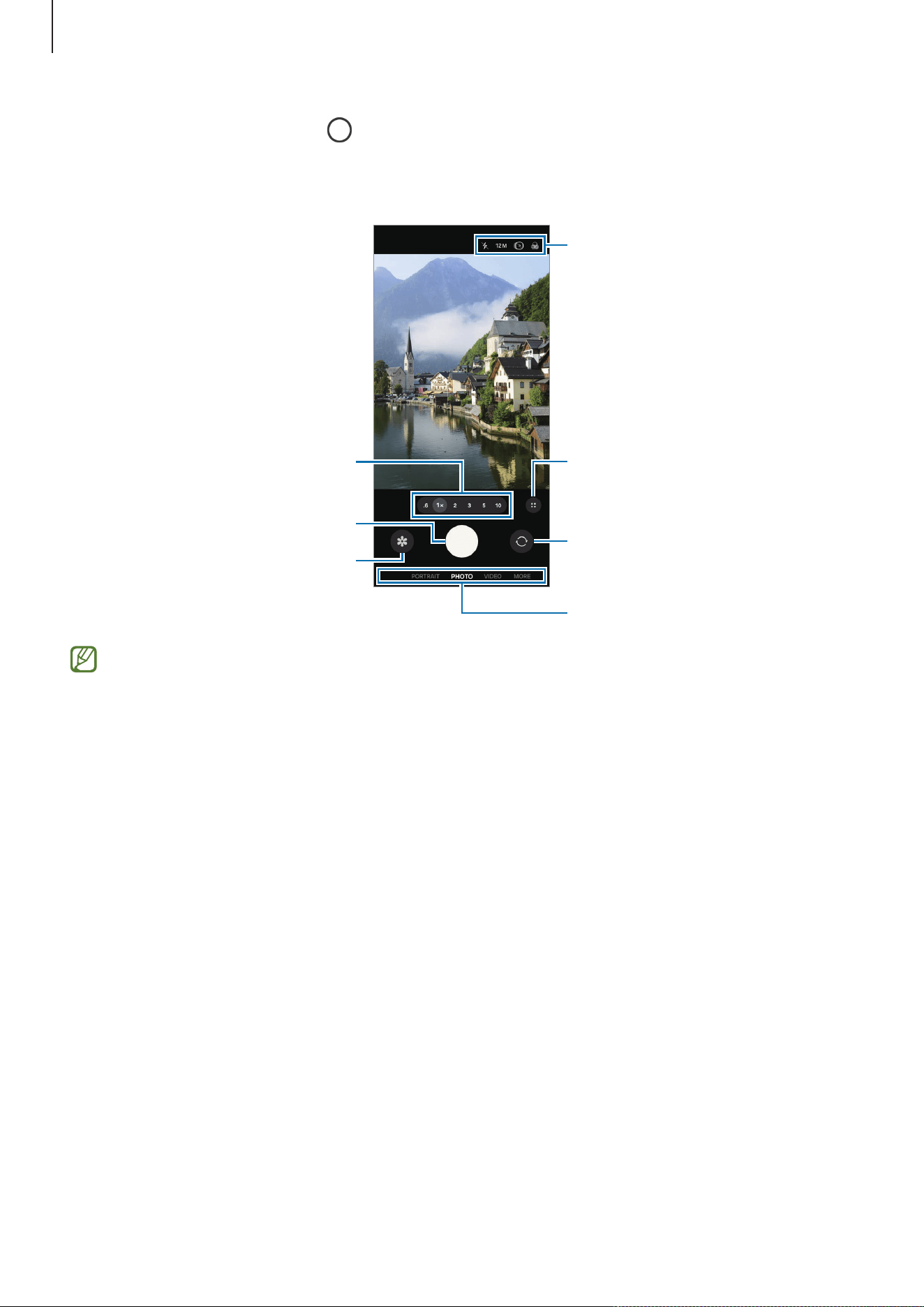
Apps and features
65
3 Tap the Take picture icon ( ) to take a picture.
To change the shooting mode, drag the shooting modes list to the left or right, or
swipe to the left or right on the preview screen.
Take a picture.
Preview thumbnail
Shooting modes list
Quick controls
Zoom
Switch between the front and
rear cameras.
Options for current shooting
mode
•
The preview screen may vary depending on the shooting mode and which
camera is being used.
•
The focus may not be clear if the subject is close. Take pictures or videos from a
good distance.
•
If pictures you take appear blurry, clean the camera lens and try again.
•
Make sure that the lens is not damaged or contaminated. Otherwise, the device
may not work properly in some modes that require high resolutions.
•
Your device’s camera features a wide-angle lens. Minor distortion may occur
in wide-angle pictures or videos and does not indicate device performance
problems.
•
The camera may fog up or form condensation if the device is exposed to sudden
changes in air temperature, because of the difference in temperature outside
and inside the camera cover. Try to avoid such conditions when planning to use
the camera. If fogging does occur, allow the camera to dry naturally at room
temperature before taking pictures or recording videos, otherwise results may
look blurry.
•
This image may differ depending on the model.
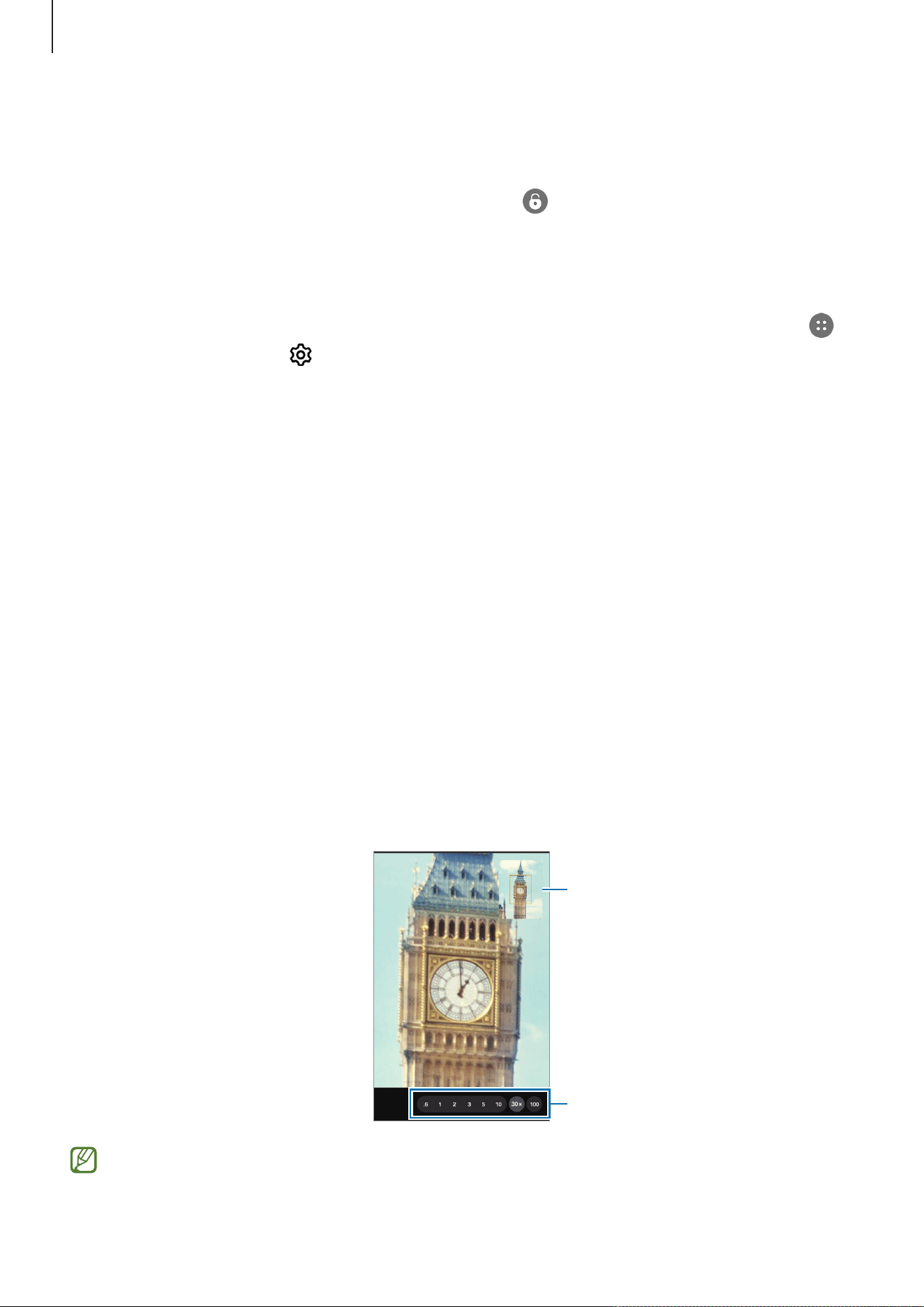
Apps and features
66
Using the camera button
•
Touch and hold the camera button to record a video.
•
If you drag the camera button to the Lock icon ( ), you can record a video without
holding the button.
•
To take burst shots, swipe the camera button to the edge of the screen and hold it.
•
If you add another camera button, you can move it anywhere on the screen and take
pictures more conveniently. On the preview screen, tap the Quick controls icon (
)
→
the Settings icon ( )
→
Shooting methods
and tap the
Floating Shutter button
switch to turn it on.
Editing the shooting modes list
To edit the shooting modes list, tap
MORE
on the list, tap
Edit
, and then drag modes to
where you want.
Using zoom features
To zoom in or out while using the rear camera, select the desired zoom icon on the
preview screen.
You can also select the desired zoom level from the zoom level list that appears when
you tap the zoom icon.
To adjust the zoom more precisely, drag the zoom icon, pinch, or spread two fingers
apart on the preview screen.
If the zoom ratio exceeds a certain amount, a zoom guide map will appear to indicate
where you are zooming in on the image.
Zoom guide map
Zoom level list
Some features may not be available depending on the model.

Apps and features
67
Locking the focus (AF) and exposure (AE)
You can lock the focus or exposure on a selected area to prevent the camera from
automatically adjusting based on changes to the subjects or light sources.
Touch and hold the area to focus, the AF/AE frame will appear on the area and the focus
and exposure setting will be locked. The setting remains locked even after you take a
picture.
This feature may not be available depending on the shooting mode.
Options for current shooting mode
On the preview screen, use the following options. To use more options, tap the Quick
controls icon (
).
•
: Turn the flash on or off.
•
12M
: Select a resolution for pictures.
•
: Turn the motion photo feature on or off. If you turn it on, a video clip will also be
taken from a few seconds before or both before and after tapping the camera button.
•
: Apply a filter effect.
•
: Turn the super steady feature on or off.
•
: In
PORTRAIT
mode, adjust the light intensity. This option may not be available
depending on the selected background effect.
•
: Select a frame rate for hyperlapse videos.
•
/ /
FHD
: Select a resolution for videos.
•
: Turn the HDR feature on or off. If you turn it on, you can record 10-bit HDR
videos with a wider range of colour and contrast.
•
: Select a metering method. This determines how light values are calculated.
Centre-weighted metering
( ) uses the light in the centre portion of the shot to
calculate the exposure of the shot.
Matrix metering
( ) averages the entire scene.
Spot metering
( ) uses the light in a concentrated centre area of the shot to
calculate the exposure of the shot.
•
: In
PRO VIDEO
mode, select which direction’s sound you want to record at a
higher level. You can also use a USB or Bluetooth microphone by connecting it to
your device.

Apps and features
68
•
: In
PRO
or
PRO VIDEO
mode, change the option for the exposure monitor.
Select an option to display overexposed or underexposed levels with a pattern or
colour on the preview screen.
•
: Turn the log video feature on or off. If you turn it on, you can record videos with
a wider dynamic range for more flexibility when editing.
•
: In
FOOD
mode, focus on a subject inside the frame and blur the image outside
the frame.
The available options may vary depending on the model or shooting mode.
Photo mode
The camera adjusts the shooting options automatically depending on the surroundings.
On the shooting modes list, tap
PHOTO
and tap the Take picture icon ( ) to take a
picture.
Changing the resolution
You can take high-resolution pictures.
In shooting options, tap
12M
to change the resolution to the one you want, and take a
picture.
The resolution may vary depending on the model.
Shot suggestions
The camera suggests the ideal composition for the picture by recognising the position
and angle of your subject.
On the preview screen, tap the Quick controls icon (
)
→
the Settings icon ( ) and tap
the
Shot suggestions
switch to turn it on.
1 On the shooting modes list, tap
PHOTO
.
A guide will appear on the preview screen.
2 Point the guide at the subject.
The camera recognises the composition, and the recommended composition appears
on the preview screen.
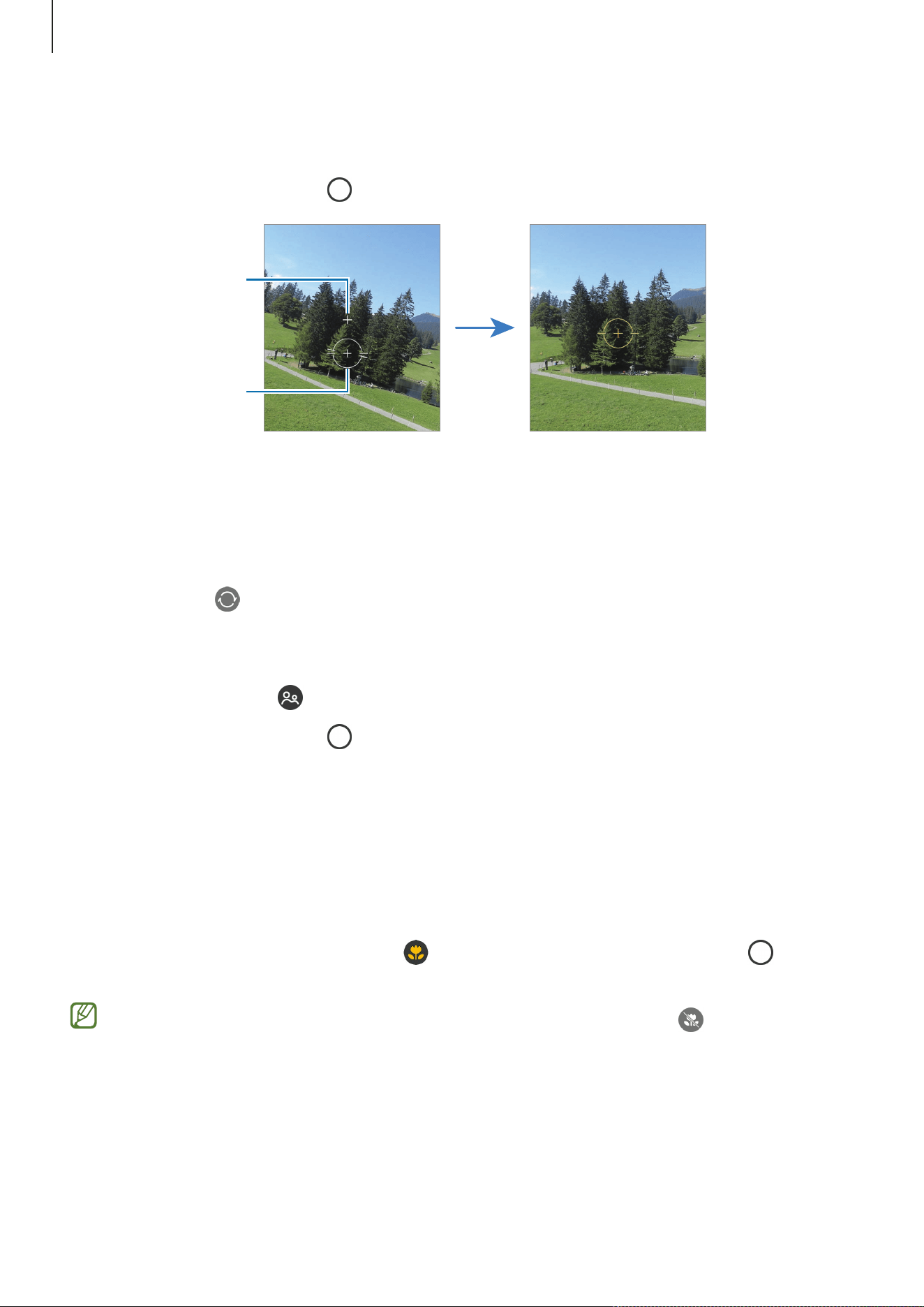
Apps and features
69
3 Move the device so the guide matches the recommended composition.
When the ideal composition is achieved, the guide will change to yellow.
4 Tap the Take picture icon ( ) to take a picture.
Guide
Ideal composition
Taking selfies
You can take self-portraits with the front camera.
1 On the preview screen, swipe upwards or downwards, or tap the Switch to the front
camera icon (
) to switch to the front camera for self-portraits.
2 Face the front camera lens.
To take self-portraits with a wide-angle shot of the landscape or people, tap the
Switch to wide icon (
).
3 Tap the Take picture icon ( ) to take a picture.
Taking clear close-up pictures (Galaxy S26 Ultra)
Take clear close-up pictures of your subject.
1 On the preview screen, tap
1x
.
2 Put the camera near to the subject.
3 When the Focus enhancer on icon ( ) appears, tap the Take picture icon ( ) to take
a picture.
If this feature is not turned on, tap the Focus enhancer off icon ( ) to turn it on.
Apps and features
70
Scanning documents or text
You can scan documents or text.
1 On the shooting modes list, tap
PHOTO
.
2 Point the camera towards the object and tap
Scan
.
Scan
will only appear when a document or text is detected.
•
To change the scan area, tap the Adjust icon ( ).
•
To change the filter effect, tap the Filter icon ( ).
•
To use the remove options, tap the Remove icon ( ).
3 Tap
Save
.
Video mode
The camera adjusts the shooting options automatically depending on the surroundings.
1 On the shooting modes list, tap
VIDEO
and tap the Start recording icon ( ) to record
a video.
•
To switch between the front and rear cameras while recording, swipe upwards or
downwards on the preview screen or tap the Switch to the front camera icon (
).
•
To capture an image from the video while recording, tap the Capture icon ( ).
•
To record the sound from a specific direction at a higher volume while recording a
video, point the camera towards that direction and adjust the zoom. If this feature
is not turned on, on the preview screen, tap the Quick controls icon (
)
→
the
Settings icon (
)
→
Audio options
, and then tap the
Zoom-in mic
switch to turn it
on.
2 Tap the Stop recording icon ( ) to stop recording the video.
The optical zoom may not work in low-light environments.
Changing the resolution
You can record high-resolution videos with a maximum resolution of 8K.
In shooting options, tap the FHD 30 fps icon (
) to change the resolution to the one you
want, and record a video.
When you finish recording a video, play it in the
Gallery
app. When you tap the Capture
icon (
) on a frame that you like, the frame will be saved as a picture.

Apps and features
71
Stabilising videos (Super steady)
If there is a lot of shaking when recording videos, use the Super steady feature for
further video stabilisation.
Tap
VIDEO
on the shooting modes list, tap the Super steady icon ( )
→
the Super steady
on icon (
) or the Super steady with horizontal lock icon ( ), and then record a video.
Using the auto framing feature
(Changing the shooting angle and zoom by tracking people)
You can set the device to change the shooting angle and zoom automatically by
recognising and tracking people while recording videos.
On the shooting modes list, tap
VIDEO
, tap the Quick controls icon ( )
→
the Auto
framing icon (
) to turn it on, and then record a video.
To track and adjust the shooting angle and zoom in on a selected person, tap the frame
that is displayed around the person. To turn off tracking, tap the frame again.
Using the Dual recordings feature
Record videos with two cameras at the same time. You can save the videos of each
camera separately and edit them. You can also play the videos in various ways, such as in
split view or picture-in-picture view.
On the shooting modes list, tap
VIDEO
→
the Quick controls icon ( )
→
the Dual
recordings icon (
). Then tap the Picture-in-picture view icon ( ) or the Split view icon
(
) and record a video.
When you select the Picture-in-picture view icon (
), you can change the size or location
of the picture-in-picture window.
If you want to save the videos of each camera separately, tap the Quick controls icon
(
)
→
the Settings icon ( )
→
Dual recordings
→
Save in separate files
.
Apps and features
72
Portrait mode / Portrait video mode
By using Portrait mode or Portrait video mode, you can capture pictures or videos where
the background is blurred and the subject stands out clearly. You can also apply a
background effect and edit it after taking a picture.
1 On the shooting modes list, tap
PORTRAIT
or tap
MORE
→
PORTRAIT VIDEO
.
2 Tap the Portrait icon ( ) and select a background effect you want or drag the
adjustment bar to adjust the intensity of the background effect.
3 When
Ready
appears on the preview screen, tap the Take picture icon ( ) to take a
picture or tap the Start recording icon (
) to record a video.
•
The available options may vary depending on the shooting mode.
•
Use this feature in a place that has sufficient light.
•
The background blur may not be applied properly in the following conditions:
‒
The device or the subject is moving.
‒
The subject is thin or transparent.
‒
The subject has a similar colour to the background.
‒
The subject or background is plain.
Pro mode / Pro video mode
Capture pictures or videos while manually adjusting various shooting options, such as
exposure value and ISO value.
On the shooting modes list, tap
MORE
→
PRO
or
PRO VIDEO
. Select options and
customise the settings, and then tap the Take picture icon (
) to take a picture or tap
the Start recording icon (
) to record a video.
If you want to check information for any option, select an option and tap the About
selected setting icon (
). To reset the options you set, tap the Reset icon ( ).

Apps and features
73
Changing the resolution
You can record high-resolution videos with a maximum resolution of 8K.
In shooting options, tap the FHD 30 fps icon (
) to change the resolution to the one you
want, and record a video.
When you finish recording a video, play it in the
Gallery
app. When you tap the Capture
icon (
) on a frame that you like, the frame will be saved as a picture.
Separating the focus area and the exposure area
You can separate the focus area and the exposure area.
Touch and hold the preview screen. The AF/AE frame will appear on the screen. Drag the
frame to the area where you want to separate the focus area and the exposure area.
Food mode
Take pictures of food with more vibrant colours.
1 On the shooting modes list, tap
MORE
→
FOOD
.
A frame will appear on the screen and the area outside the frame will be blurred.
2 To resize the frame, drag a corner of the frame.
Tap the area you want or drag the frame to move it.
3 Tap the Quick controls icon ( )
→
the Colour temperature icon ( ) and drag the
adjustment bar to adjust the colour temperature.
4 Tap the Take picture icon ( ) to take a picture.
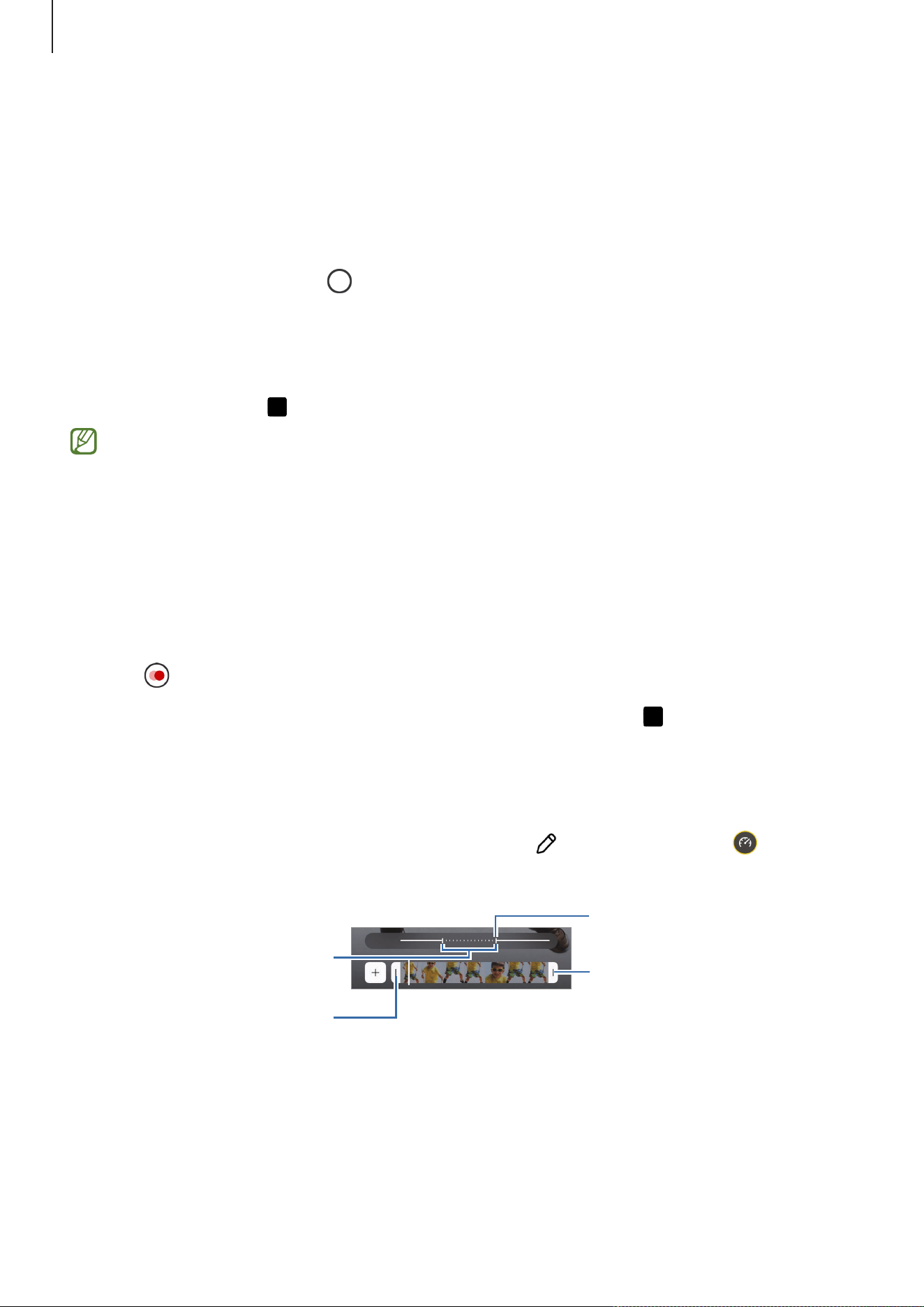
Apps and features
74
Panorama mode
Using panorama mode, take a series of pictures and then stitch them together to create
a wide scene.
1 On the shooting modes list, tap
MORE
→
PANORAMA
.
2 Tap the Take picture icon ( ) and move the device slowly in one direction.
Keep the image within the frame on the camera’s viewfinder. If the preview image is
out of the guide frame or you do not move the device, the device will automatically
stop taking pictures.
3 Tap the Done icon ( ) to stop taking pictures.
Avoid taking pictures of indistinct backgrounds, such as an empty sky or a plain
wall.
Slow motion mode
Record a video for viewing it in slow motion. You can specify sections of your videos to be
played in slow motion.
1 On the shooting modes list, tap
MORE
→
SLOW MOTION
and tap the Start recording
icon (
) to record a video.
2 When you are finished recording, tap the Stop recording icon ( ) to stop.
3 On the preview screen, tap the preview thumbnail.
The fast section of the video will be set as a slow motion section and the video will
start playing. Up to two slow motion sections will be created based on the video.
To edit the slow motion section, tap the Edit icon (
)
→
the Speed icon ( ) and drag
the section editing bar to the left or right.
Start bracket
Slow motion section
End bracket
Section editing bar
Apps and features
75
Hyperlapse mode
Record scenes, such as passing people or cars, and view them as fast-motion videos.
1 On the shooting modes list, tap
MORE
→
HYPERLAPSE
.
2 Tap the Speed icon ( ) and select a frame rate option.
•
If you set the frame rate to
AUTO
, the device will automatically adjust the frame
rate according to the changing rate of the scene.
•
If you want to record star trails, set the frame rate to the Night three hundred
times faster icon (
) and tap the Star trails icon ( ).
3 Tap the Start recording icon ( ) to start recording.
4 Tap the Stop recording icon ( ) to finish recording.
You can use the night hyperlapse feature by tapping the Speed icon ( )
→
the
Night fifteen times faster icon (
) or the Night forty five times faster icon ( )
on the shooting options. This feature is good for doing things like taking shots from
moving cars that make the light look like it is also moving.
Customising camera settings
On the preview screen, tap the Quick controls icon ( )
→
the Settings icon ( ). Some
options may not be available depending on the shooting mode.
Intelligent features
•
Scanning
: Set the device to scan documents, text, or QR codes from the preview
screen.
•
Shot suggestions
: Set the device to suggest the ideal composition for the picture by
recognising the position and angle of your subject.
•
Photo enhancer
‒
Prioritise quality
/
Balanced
/
Prioritise speed
: Select a quality option.
‒
Scene detection
: Set the device to adjust the colour settings and apply the
optimised effect automatically depending on the subject or scene.
•
Custom filters
: Create your own filter using an image with a colour tone you like
from
Gallery
.

Apps and features
76
Photos
•
Photo format
: Select how you want to save picture.
‒
High efficiency pictures
: Take pictures in the High Efficiency Image Format
(HEIF).
‒
Pro mode picture format
: Select the file format for saving pictures taken in pro
mode. JPEG files compress pictures and take up less storage. RAW files (DNG file
format) retain all of a picture’s data for the best image quality and save pictures
as uncompressed, but they take up more storage. When you select
RAW and JPEG
formats
, each picture is saved in two formats, DNG and JPG.
•
Watermark
: Add a watermark when taking pictures.
•
Motion photos
: Set to take a video clip from a few seconds before or both before and
after tapping the camera button. You can also set the audio feedback options.
Videos
•
Video format
‒
HEVC (high efficiency)
/
H.264 (most compatible)
: Select the video format.
‒
High bitrate videos
: Increase the bitrate of videos. If you use this feature, the file
size may be larger than normal videos.
‒
HDR
: Add the HDR option to the preview screen.
‒
Log
: Add the log video option to the preview screen.
‒
APV
: Add the APV option to the preview screen. When you turn on this feature,
you can record and edit cinematic-quality videos using the Advanced Professional
Video (APV) codec.
•
You might not be able to play the HEVC videos on other devices or share
them online.
•
You cannot record videos in the HEVC format in some shooting modes.
•
To play the HDR video properly, the device must support HDR.
•
Auto FPS
: Set the device to record brighter videos in low-light conditions by
automatically optimising the frame rate.
•
Video stabilisation
: Turn on anti-shake to reduce or eliminate blurry image resulting
from camera shake while recording a video.

Apps and features
77
•
Dual recordings
: Change the saving option for the dual recording.
•
Audio options
‒
Zoom-in mic
: While recording a video, you can record sound from the zoomed-in
direction at a higher volume.
‒
360 audio recording
: You can record more immersive 3D sound videos using
Bluetooth headphones that support the 360 audio recording feature.
‒
Audio playback
: You can play media without pause while recording videos. Media
will pause when the 360 audio recording feature is on.
•
Save to external storage
: Save videos in the connected external storage.
General
•
Tracking auto focus
: Set the device to track and automatically focus on a selected
subject. When you select a subject on the preview screen, the device will focus on
the subject even if the subject is moving or you change the camera’s position.
Tracking a subject may fail in the following conditions:
•
The subject is too big or too small.
•
The subject moves excessively.
•
The subject is backlit or you are shooting in a dark place.
•
Colours or patterns on the subject and the background are the same.
•
The subject includes horizontal patterns, such as blinds.
•
The camera shakes excessively.
•
The video resolution is high.
•
When zooming in or out using the optical zoom.
•
Composition guide
: Display viewfinder guides to help composition when selecting
subjects.
•
Location tags
: Attach a GPS location tag to the picture.
•
GPS signal strength may decrease in locations where the signal is
obstructed, such as between buildings or in low-lying areas, or in poor
weather conditions.
•
Your location may appear on your pictures when you upload them to the
internet. To avoid this, turn off the location tag setting.

Apps and features
78
•
Save selfies as previewed
: Set the device to save pictures or videos as they appear
on the preview screen when taken with the front camera without flipping them.
•
Swipe preview up/down to
: Select an action to perform when you swipe upwards or
downwards on the preview screen.
•
Shooting methods
‒
Press Volume buttons to
: Take pictures or record videos, zoom in or out, or control
the volume using the Volume button.
‒
Voice commands
: Take pictures or record videos using voice commands.
‒
Floating Shutter button
: Add another movable button anywhere on the screen to
take pictures.
‒
Show palm
: Show your palm to the front camera to take selfies or start recording
videos.
•
Settings to keep
: Keep the last settings you used, such as the shooting mode, when
you open the camera.
•
Vibration feedback
: Set the device to vibrate in certain situations, such as when you
tap the camera button.
•
Camera Assistant
: Download the
Camera Assistant
app and set additional camera
settings.
Privacy
•
Permissions
: Access the permissions required to use the Camera app.
•
Reset settings
: Reset the camera settings.
•
About Camera
: Check the Camera app version and legal information.
•
Contact us
: Ask questions or check out the frequently asked questions.
Some features may not be available depending on the model.
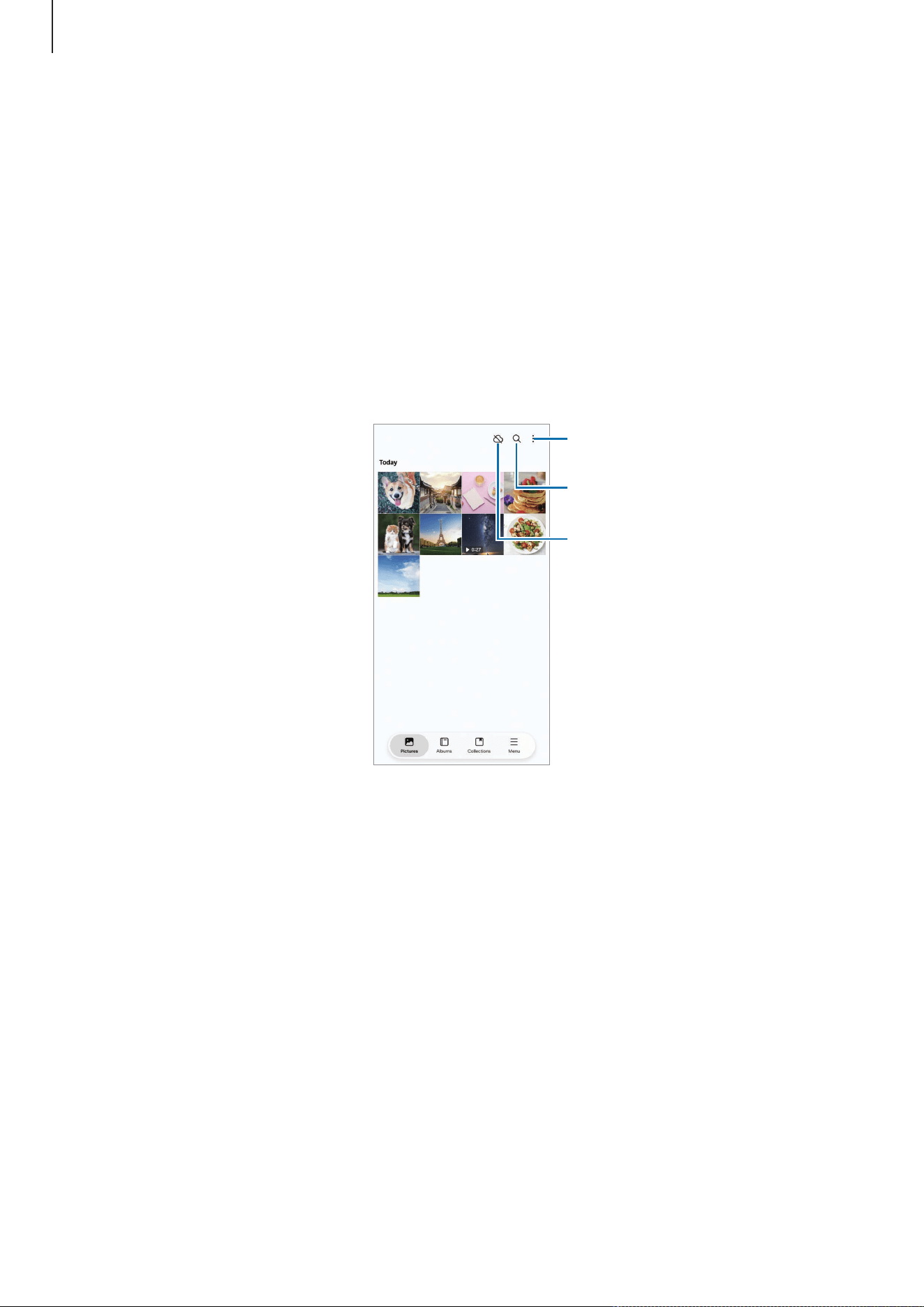
Apps and features
79
Gallery
Introduction
Access images and videos stored in your device. You can also manage images and videos
by album or create stories.
Using Gallery
Open the
Gallery
app.
Search for images and videos.
Sync images and videos.
More options
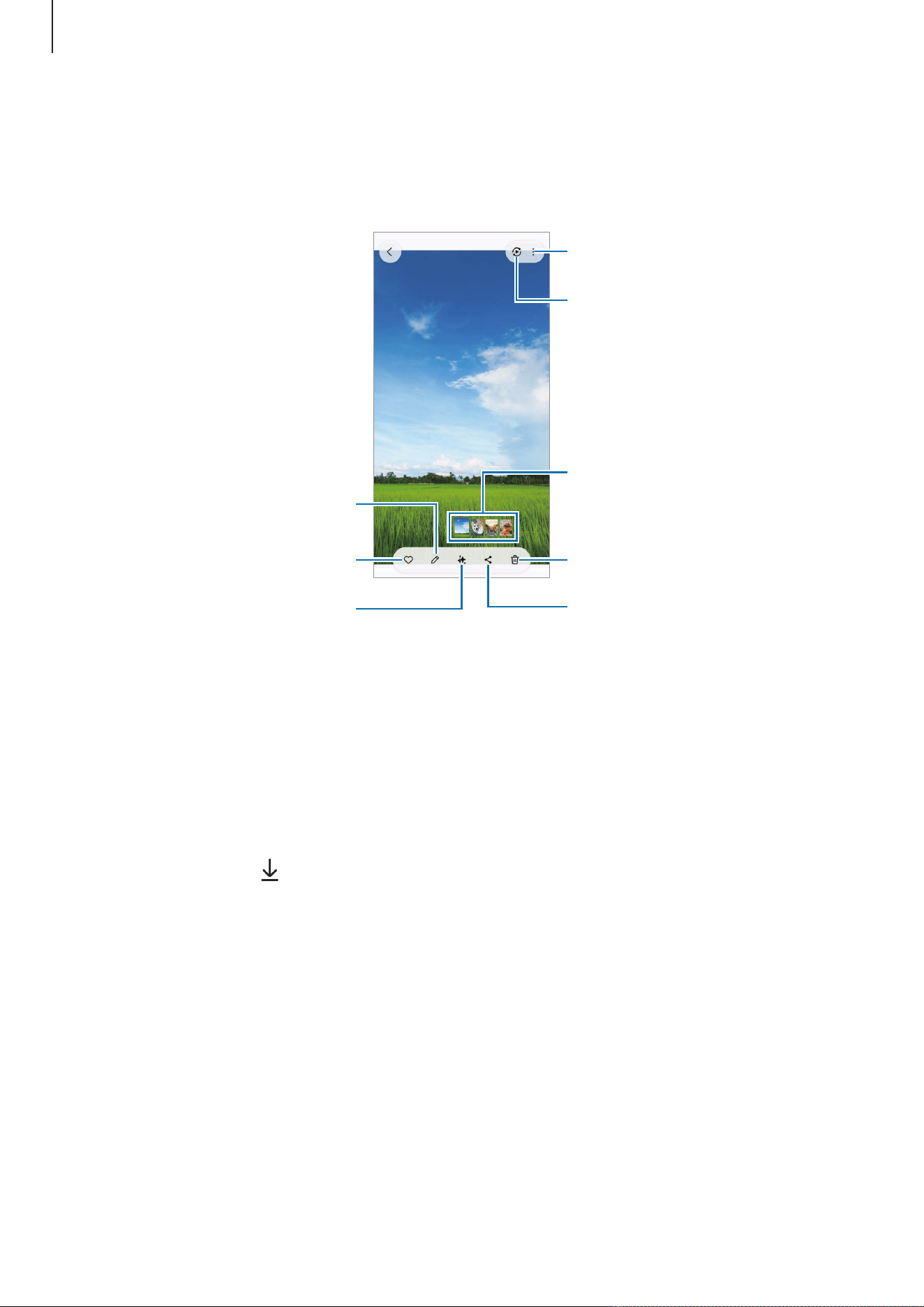
Apps and features
80
Viewing images
Open the
Gallery
app and select an image. To view other files, swipe to the left or right
on the screen.
More options
Delete the image.
Share the image with others.
Image and video thumbnail
Modify the image.
Photo assist
View the content on a large
screen using the Smart View
feature.
Add the image to favourites.
Remastering images
You can enhance the dull, blurry, and low-resolution images.
1 Open the
Gallery
app and select an image.
2 Swipe upwards on the screen and tap
Remaster
.
You can check the before and after.
3 Tap the Save icon ( ) to save the remastered image.

Apps and features
81
Extracting objects from images
Separate an object from the background and extract it. You can copy the extracted
image or use it in various ways by saving it as a sticker or an image.
1 Open the
Gallery
app and select an image or a video.
2 Touch and hold on the object you want extract and select an option.
When you select an image taken with the motion photo feature, the
Save as GIF
feature will appear. If you want to save the extracted image as a GIF, tap
Save as GIF
.
For videos, this feature is only available when they are paused.
Cropping enlarged images
1 Open the
Gallery
app and select an image.
2 Spread two fingers apart on the area you want to save and tap the Quick crop icon
(
).
The cropped area will be saved as a file.
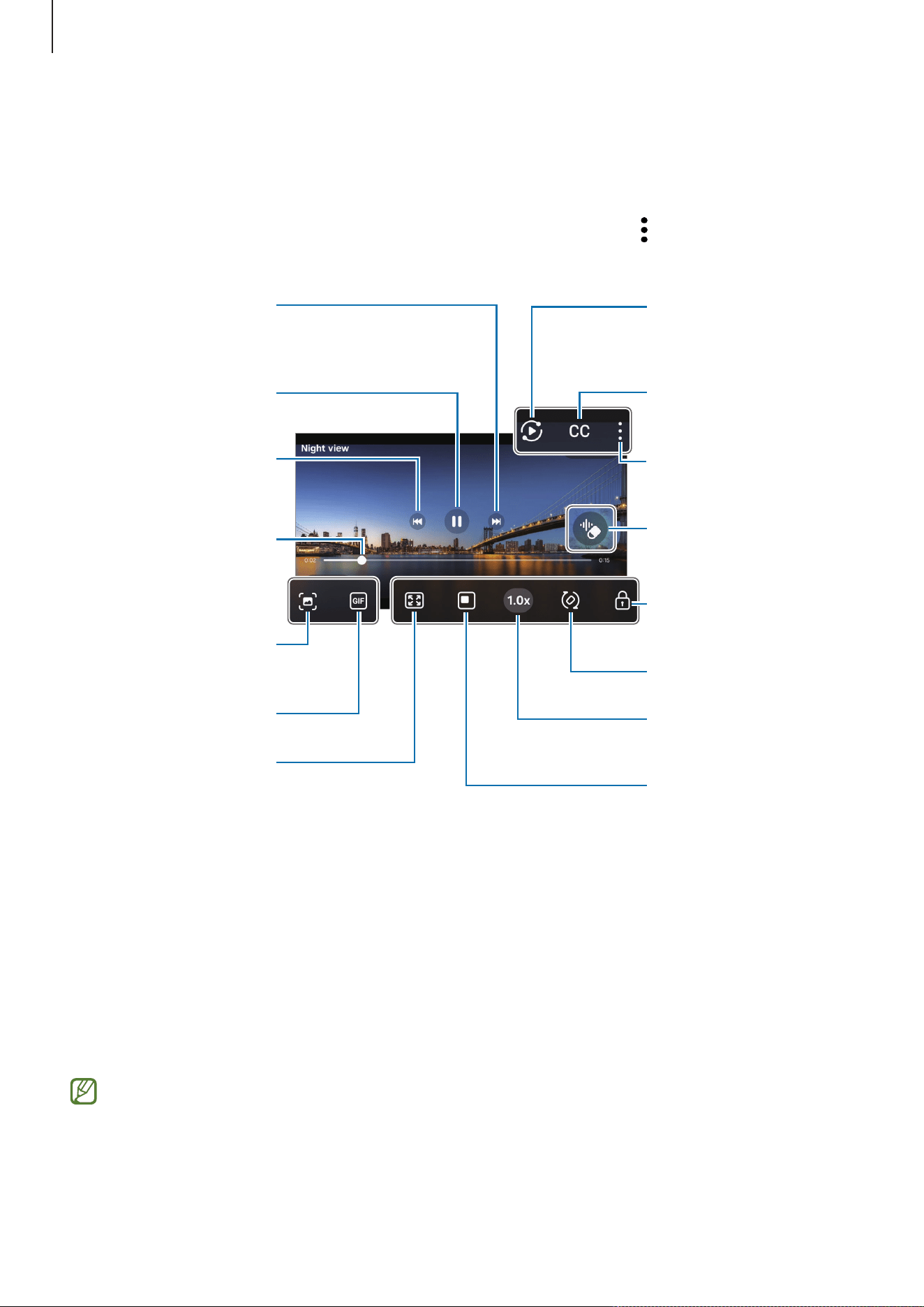
Apps and features
82
Viewing videos
Open the
Gallery
app and select a video to play. To view other files, swipe to the left or
right on the screen.
To use more options during playback, tap the More options icon (
)
→
Open in Video
player
.
Lock the playback
screen.
Skip to the previous
video. Touch and hold
to rewind.
Capture the current
screen.
Create a GIF.
Configure the caption
settings.
Rewind or fast-forward
by dragging the bar.
Switch to the pop-up
video player.
More options
Rotate the screen.
Change the playback
speed.
Skip to the next video.
Touch and hold to
fast-forward.
Audio eraser
Pause and resume
playback.
Change the screen
ratio.
View the content on a
large screen using the
Smart View feature.
Drag up or down on the left side of the playback screen to adjust the brightness, or drag
up or down on the right side of the playback screen to adjust the volume.
To rewind or fast-forward, swipe to the left or right on the playback screen.
Viewing brighter and clearer videos
Increase the screen brightness and make colours more vibrant when you play videos.
Open
Settings
and tap
Advanced features
→
Video brightness
→
Bright
.
•
This feature is only available in some apps.
•
Using this feature will increase battery consumption.

Apps and features
83
Albums
Open the
Gallery
app, tap
Albums
→
the Create icon ( ), and then select an album
type.
•
Album
: Create new albums and add images and videos manually.
•
Auto album
: Create albums that automatically collect images of people or pets you
select.
•
Group
: Create a group of related albums.
•
Shared album
: Create albums that you can share with others.
•
Shared family album
: Create albums that you can share with your family.
Some features may not be available depending on the region or the model.
Collections
Images and videos will be automatically sorted into the Stories, Screenshots, People,
Locations, and Documents categories.
Open the
Gallery
app, tap
Collections
, and then select a collection. If you want to change
the categories that are displayed on the screen or change the order of the categories,
tap
Edit collections
.
Deleting images or videos
Open the
Gallery
app, touch and hold an image, a video, or an album to delete, and then
tap
Delete
.
Using the recycle bin feature
Images and videos you delete will be temporarily stored in the recycle bin. The files will
be deleted after a certain period.
To access files in the recycle bin, open the
Gallery
app and tap
Menu
→
Recycle bin
. To
restore files, tap
Select
, select files, and then tap
Restore
.

Apps and features
84
Bixby
Bixby is a user interface that helps you use your device more conveniently. You can say
what you want to Bixby. Bixby will launch a feature you request or show the information
you want.
Visit www.samsung.com/bixby for more information.
Bixby is only available in some languages, and it may not be available depending
on the region.
Waking up Bixby
While pressing and holding the Side button, say what you want to Bixby. To use this
feature, open
Settings
and tap
Advanced features
→
Side button
→
Long press
→
Bixby
.
Alternatively, say the wake-up phrase, such as “Hi, Bixby” or “Bixby”, and then say what
you want.
Setting a wake-up phrase
1 Open
Settings
and tap
Advanced features
→
Bixby
→
Voice registration
.
2 Select the wake-up phrase you want under
Voice wake-up
.
When running this app for the first time or restarting it after performing a data
reset, follow the on-screen instructions to complete the initial setup.
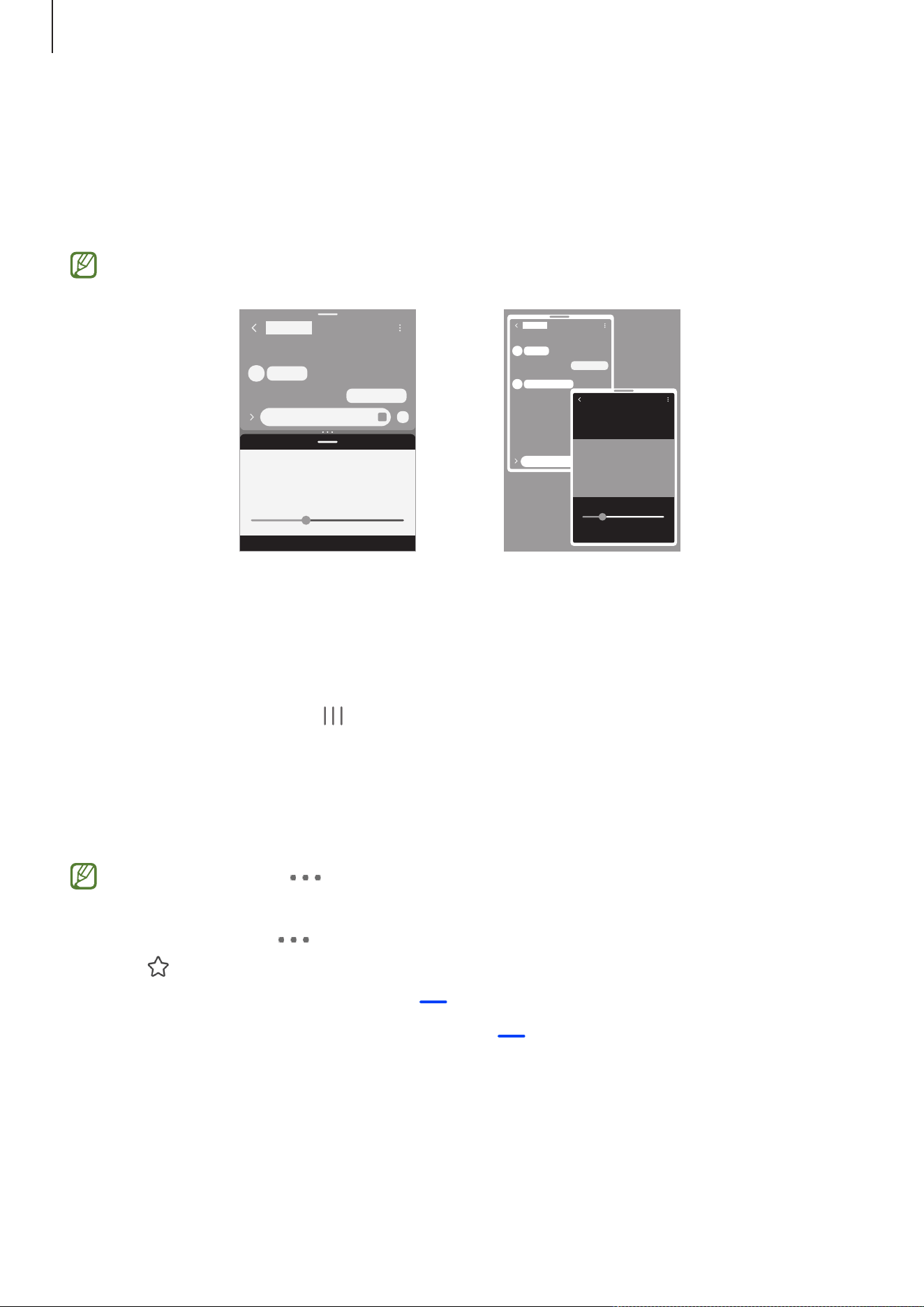
Apps and features
85
Multi window
(Using multiple apps at once)
Run apps at the same time in split screen view or multiple apps in the pop-up view.
Some apps may not support this feature.
Split screen view Pop-up view
Launching Multi window
•
Recents button
Tap the Recents button (
), tap an app’s icon, and then tap
Open in split screen
view
or
Open in pop-up view
.
•
Swipe screen
Open
Settings
, tap
Advanced features
→
Multi window
, and then tap the
Swipe for
split screen
or
Swipe for pop-up view
switch to turn it on.
•
Drag the circles ( ) between the app windows to adjust the size of the
windows.
•
Tap the circles ( ) between the app windows and tap the Add app pair icon
(
). The apps you are using in the split screen view will be saved as an app pair.
•
Drag the multi window handle ( ) to a new location to move the app window.
•
When you tap the multi window handle ( ), the available menus will appear.
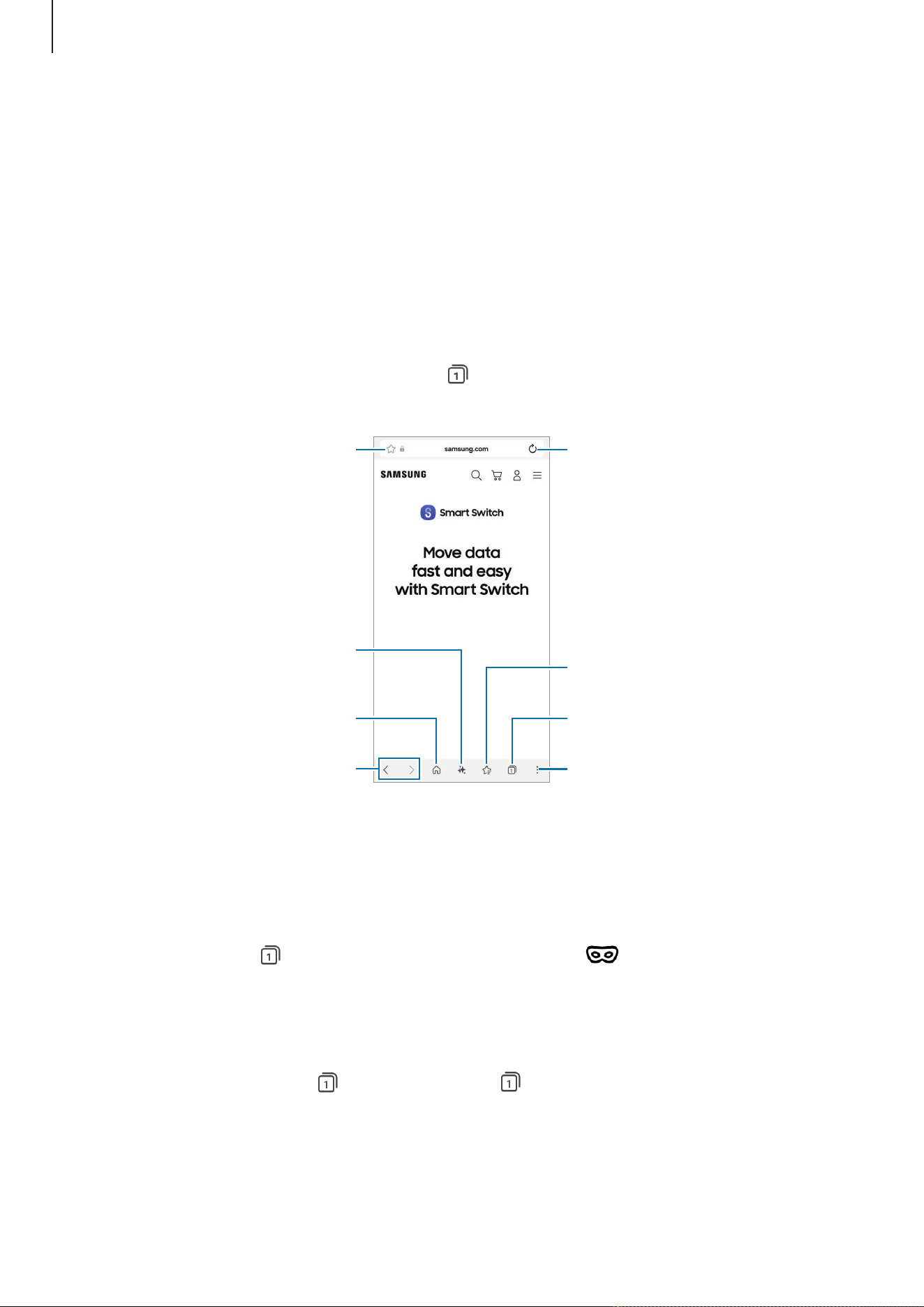
Apps and features
86
Samsung Internet
Browse the internet to search for information and bookmark your favourite webpages to
access them conveniently.
1 Open the
Internet
app.
2 Enter the web address or a keyword, and then tap
Go
.
If the toolbar does not appear, swipe downwards slightly on the screen.
To switch between tabs, tap the Tabs icon (
) or swipe to the left or right on the address
field.
Bookmark the current webpage.
Open the homepage.
Translate, summarise, or read the
webpage's highlights aloud.
Move between pages.
More options
Refresh the current webpage.
Manage tabs. / Use Secret mode.
Access your bookmarks.
Using Secret mode
If you set a password for Secret mode, you can prevent others from accessing your search
history, browsing history, bookmarks, and saved pages.
1 Tap the Tabs icon ( )
→
the Turn on Secret mode icon ( ).
2 Tap the
Lock Secret mode
switch to turn it on, tap
Start
, and then set a password for
Secret mode.
In Secret mode, the device will change the colour of the toolbars. To turn off Secret
mode, tap the Tabs icon (
)
→
the Tabs icon ( ).

Apps and features
87
Samsung Wallet
Introduction
Use various convenient features in Samsung Wallet. You can make a payment, verify your
identity through your biometric data, check tickets or boarding passes, and more.
You can check out more information, such as cards that support this feature at
www.samsung.com/samsung-wallet.
Open the
Wallet
app and select a feature you want.
•
This app may not be available depending on the region.
•
Some features may not be available depending on the region.
Setting up Samsung Wallet
When running this app for the first time or restarting it after performing a data reset,
follow the on-screen instructions to complete the initial setup.
1 Open the
Wallet
app.
2 Sign in to your Samsung account and read and agree to the terms and conditions.
3 Register your fingerprint and a PIN to use when making payments.
This PIN will be used to verify various actions in Samsung Wallet, such as making
payments and unlocking the app.
Using Samsung Pay
Register cards to Samsung Pay to make both online and offline payments.
•
To make payments with Samsung Pay, the device may be required a connection
to a Wi-Fi or mobile network depending on the region.
•
This feature may not be available depending on the carrier or model.
•
The procedures for the initial setup and card registration may vary depending on
the carrier or model.

Apps and features
88
Registering cards
Open the
Wallet
app and follow the on-screen instructions to complete your card
registration.
Making payments
1 Drag a card image at the bottom of the screen upwards. Alternatively, open the
Wallet
app. Then, on the cards list, swipe to the left or right and select a card to use.
2 Scan your fingerprint or enter the payment PIN you set.
3 Touch the back of your device to the card reader.
When the card reader recognises the card information, the payment will be
processed.
•
Payments may not be processed depending on your network connection.
•
The verification method for payments may vary depending on the card readers.
Cancelling payments
You can cancel payments by visiting the place where you made them.
On the cards list, swipe to the left or right to select the card you used. Follow the
on-screen instructions to complete payment cancellation.
Using Samsung Pass
Register your biometric data to Samsung Pass and verify your identity when using
services which require your login or personal information. Refer to Samsung Pass for
more information.
Using tickets
Add boarding passes and tickets for movies, sports, and more, to access and use them in
one place.

Apps and features
89
Using a digital key
Register your vehicle’s digital key to your phone so you can unlock or lock the vehicle’s
door and start the vehicle.
Start registering a digital key by installing your vehicle’s digital key app or using the
guide message, such as an email or text message, sent by your vehicle’s manufacturer.
Then, follow the on-screen instructions on your vehicle’s navigation screen and your
phone’s Samsung Wallet screen to complete the registration.
•
This feature may not be available depending on the region or model.
•
To use this feature, the vehicle must support the digital key feature. Check with
your vehicle’s manufacturer for digital key support.
•
The registered digital key is only saved to your phone and, if the phone is
replaced, the digital key must be registered again.
•
Some features may not be available depending on the vehicle. Check with your
vehicle’s manufacturer for more information.
Using a digital key with the NFC feature
Touch the NFC antenna area of the phone with the digital key registered to the vehicle’s
door. The door will unlock or lock.
After you place the phone on the vehicle’s wireless charging pad and the digital key is
authenticated, you can start the vehicle using the start button. If the digital key is not
authenticated, try changing the position or orientation of the phone slightly.
•
To use this feature, the phone and vehicle must support the NFC feature.
•
To turn on the NFC feature on the phone, open
Settings
, tap
Connections
→
NFC
and contactless payments
, and then tap the switch to turn it on.
•
To find out the location of the wireless charging pad and which of your vehicle’s
doors support NFC, refer to your vehicle’s user guide.

Apps and features
90
Using a digital key with the ultra-wideband (UWB) (Galaxy S26 Ultra,
Galaxy S26+)
The vehicle’s door will unlock when you get close to the vehicle with your phone, and will
lock when you move away.
After the digital key is authenticated when you get inside the vehicle, you can start the
vehicle using the start button.
•
To use this feature, the phone and vehicle must support both the Bluetooth and
UWB features. Open
Settings
, tap
Connections
, and then tap the
Bluetooth
switch and the
Ultra-wideband (UWB)
switch to turn them on.
•
If the vehicle supports both the NFC and UWB features, you can choose the
method you want. Refer to your vehicle’s user guide for more information.
•
The UWB feature may not be available depending on the region.
•
The door unlock and lock methods may differ depending on the vehicle. Check
with your vehicle’s manufacturer for more information.
•
Using this feature will increase battery consumption.
Deleting the digital key
You can delete the registered digital key from your phone.
Open the
Wallet
app, tap the registered digital key, and then tap the More options icon
(
)
→
Delete
.
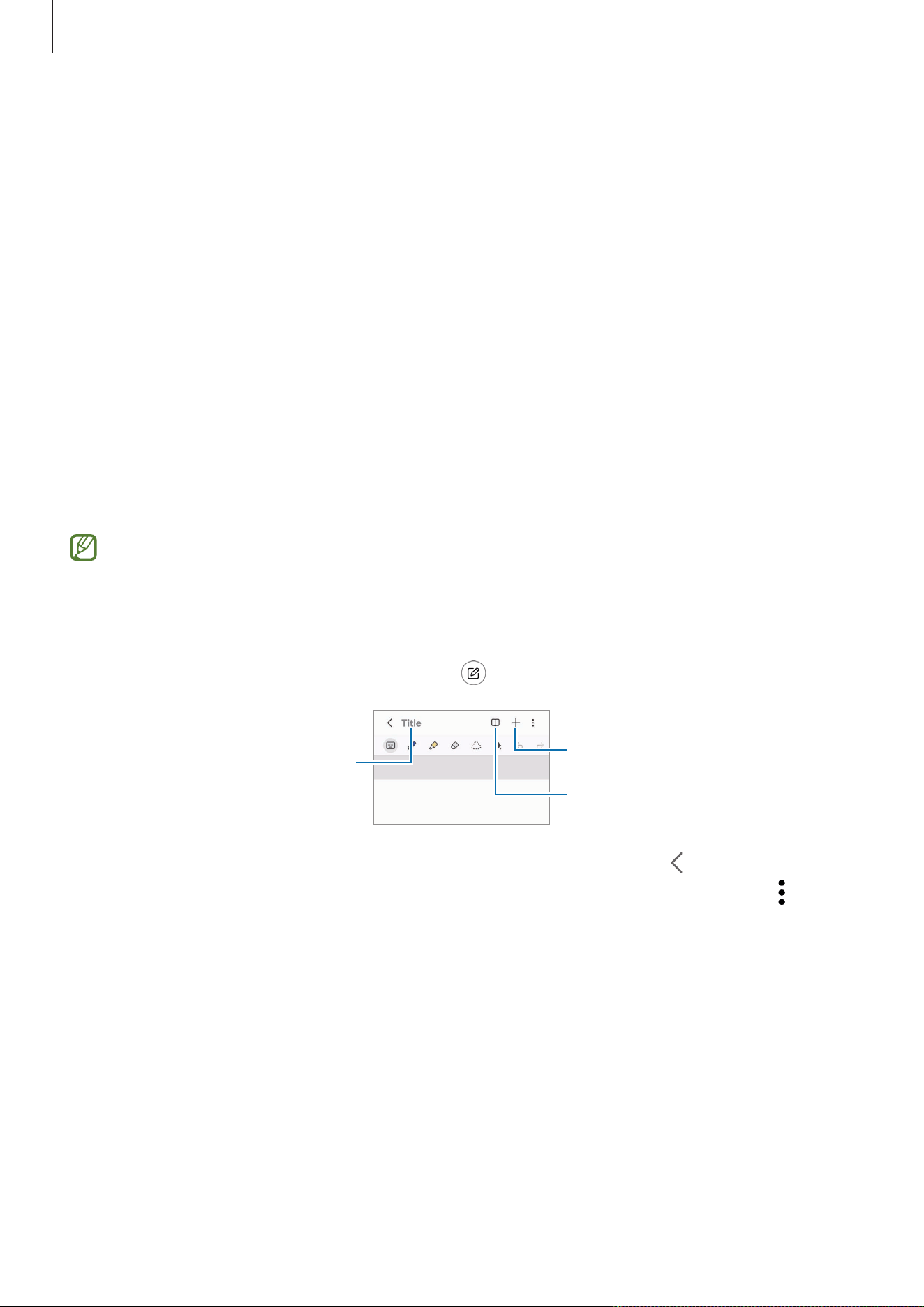
Apps and features
91
Samsung Health
Samsung Health helps you manage your wellness and fitness. Set fitness goals, check
your progress, and keep track of your overall wellness and fitness. You can also compare
your step count records with other Samsung Health users and check out health tips.
Open the
Health
app. Visit www.samsung.com/samsung-health for more information.
Samsung Notes
Introduction
Create notes by entering text from the keyboard or by handwriting or drawing on the
screen. You can also insert images or voice recordings into your notes.
Some features may not be available depending on the model.
Creating notes
1 Open the
Notes
app, tap the Create icon (
), and then create a note.
Enter a title.
Insert files.
Reading mode
2 When you are finished composing the note, tap the Back button (
) to save it.
If you want to save the note in another file format, tap the More options icon (
)
→
Save as
.
Deleting notes
Touch and hold a note to delete and tap
Delete
.
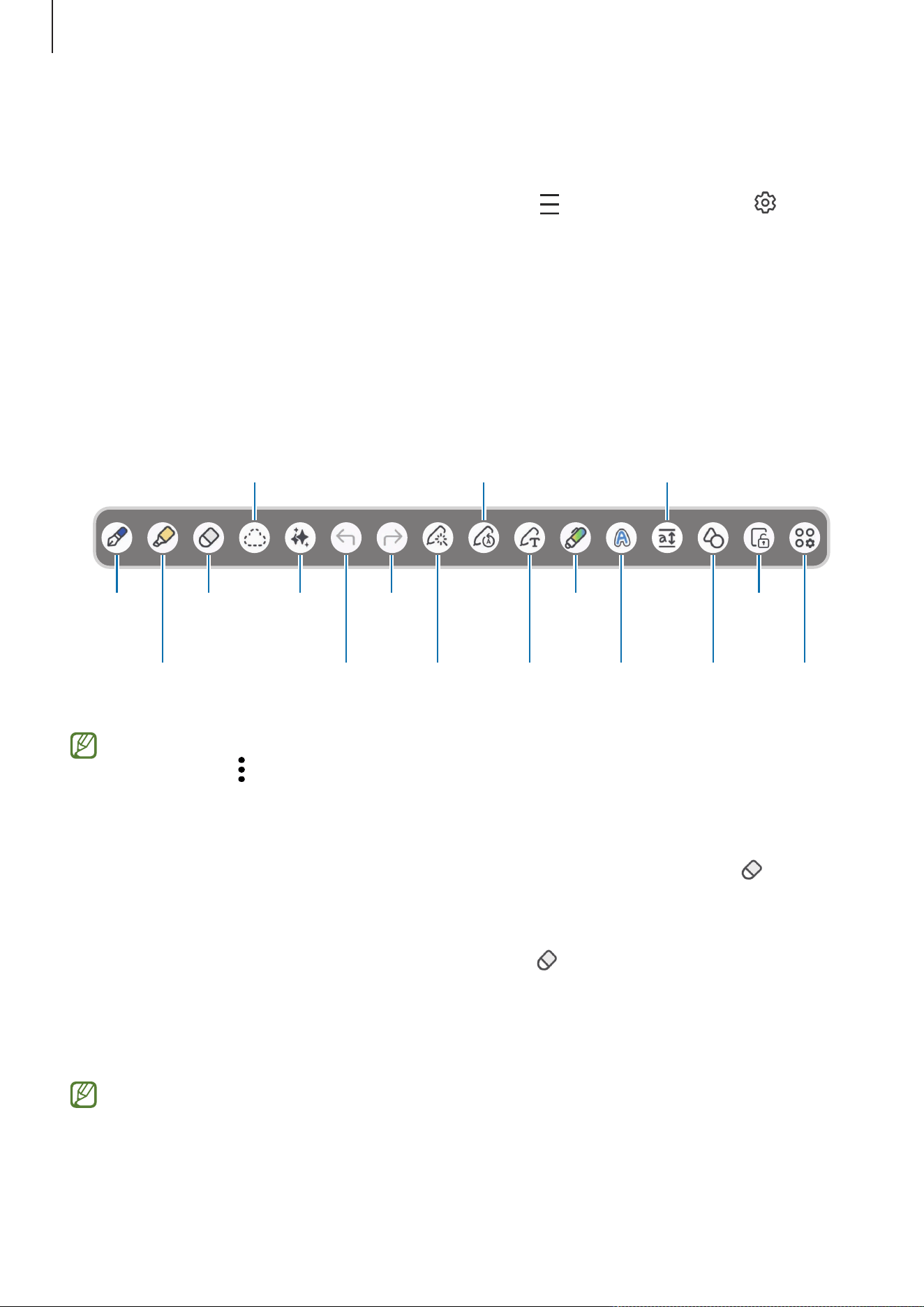
Apps and features
92
Syncing notes
You can check and edit notes on all your devices signed in to the same Samsung account.
Open the
Notes
app, tap the Navigation drawer icon ( )
→
the Settings icon ( ), and
then tap the
Sync with Samsung Cloud
switch to turn it on.
Composing notes with handwriting
On the note composer screen, draw or write in your own handwriting.
You can enter your handwriting in a larger size if you magnify the screen by spreading
two fingers on it.
Easy writing
pad
Canvas
lock
UndoHighlighter
Eraser
Clean up
handwriting
Select and
edit.
RedoNote
assist
Change
styles.
Laser
pointer
Auto-fix
shapes
Edit
toolbar
S Pen to
text
Pen
Handwriting
help
If finger input does not work on a model that supports the S Pen, tap the More
options icon (
)
→
Turn on finger drawing
.
Using the eraser
When you want to erase handwriting from a note, tap the Eraser mode icon ( ) and
select an area to erase. Alternatively, select an area while pressing and holding the
S Pen button.
To change the eraser type, tap the Eraser mode icon (
) once more.
•
Stroke eraser
: Erase the line you select.
•
Area eraser
: Erase only the area you select. You can adjust the size of the eraser by
dragging the size adjustment bar.
Even with a smaller eraser, you may still not be able to precisely erase the intended
part.

Apps and features
93
Editing handwritten notes
Edit handwritten notes using various editing options, such as cutting, moving, or
resizing.
1 When there is handwriting on the note, tap the Selection mode icon ( ).
To change the shape of the selection, tap the Selection mode icon (
) once more.
2 Tap or draw a line around the input to select.
•
To move the input to another location, select the input, and then drag it to a new
location.
•
To change the size of the selection, tap the input and drag a corner of the frame
that appears.
3 Edit the input using the available options.
Aligning handwriting or converting to text
To straighten your handwriting or drawings horizontally, tap the Clean up handwriting
icon (
)
→
Align handwriting
.
To replace your handwriting with the converted text, tap the Clean up handwriting icon
(
)
→
Convert to text
. When the preview screen appears, tap
Add to
and select an
option you want.
If you want to replace your handwriting with text right away, tap the S Pen to text icon
(
) and then write on the screen with the S Pen.
Changing styles
You can change the style of your handwriting and drawings.
After writing or drawing on the screen, tap the Change style icon (
) twice and select a
colour or line thickness you want. Then, tap where you want to change the style.
Using the easy writing pad
On the note composer screen, tap the Easy writing pad icon ( ). The input field will be
magnified and appear as the easy writing pad.
Automatically fixing shapes
Tap the Auto-fix shapes icon (
) and draw a shape. The shape will be fixed.

Apps and features
94
Recording voice to notes
Make a recording of your voice while creating a note, and then the content will be
synchronised with the recording.
On the note composer screen, tap the Insert icon (
)
→
Voice recording
and create a
note.
Select a note from the list and tap the Open Voice Recorder icon (
)
→
the Play icon ( )
to play the recording. Then the content you created while recording will be displayed on
the screen along with the recording.
Pinning a note to the Home screen
Pin a note to the Home screen to check it or open and edit it.
1 Open the
Notes
app.
2 Select a note and tap the More options icon ( )
→
Add to
→
Home screen
→
Add
.
The note will be added to the Home screen.
Clipping content
You can add content, such as a webpage link or an image, to a note.
1 When there is content you want to clip while using the
Samsung Internet
or
Gallery
app, open the
Notes
app in the split screen view or in the pop-up view. For more
information about the split screen view or the pop-up view, refer to Multi window.
Alternatively, double tap the screen while pressing and holding the S Pen button, or
open the Air command panel and tap
Create note
.
Options you can use will appear at the bottom of the note composer screen.
2 Select an option you want.

Apps and features
95
Samsung Members
Samsung Members offers support services to customers, such as device problem
diagnosis, and lets users submit questions and error reports. You can also share
information with others in the Galaxy users’ community or check the latest news and
tips. Samsung Members can help you solve any problems you might encounter while
using your device.
Open the
Members
app.
If you have questions while using other Samsung apps, access the app’s settings menu
and select the contact us option.
•
Discover
: You can get official information from Samsung, such as Galaxy product
launches and newsletters.
•
Community
: You can communicate with other Galaxy users on various topics and
share information with them.
•
Support
: You can use customer support services, such as feedback or phone
diagnostics, which can help you check if your device is functioning properly.
Available features may vary depending on the device’s software version, app
version, or model.
Samsung Kids
You can restrict children’s access to certain apps, set their usage times, and configure
settings to provide a fun and safe environment for children when they use the device.
Open
Settings
and tap
Apps
→
Samsung Kids
→
Open
. When starting Samsung Kids
for the first time or after performing a data reset, follow the on-screen instructions to
complete the setup.
On the Samsung Kids screen, select the app you want to use.
Your preset screen lock method or your created PIN will be used when turning on
the
Parental controls
feature or closing Samsung Kids.

Apps and features
96
Using parental controls features
You can configure the settings for Samsung Kids and check the usage history.
On the Samsung Kids screen, tap the More options icon (
)
→
Parental controls
and
enter your unlock code.
Closing Samsung Kids
To close Samsung Kids, tap the Back button ( ) or tap the More options icon ( )
→
Close
Samsung Kids
, and then enter your unlock code.
Samsung Global Goals
The Global Goals, which were set up by the United Nations General Assembly in 2015,
consist of goals that aim to create a sustainable society. These goals have the power to
end poverty, fight inequality, and stop climate change.
With Samsung Global Goals, learn more about the global goals and join the movement
for a better future.
Samsung TV Plus
Select the channels like you would use a TV and enjoy various video content free of
charge.
Open the
TV
app.
This app may not be available depending on the carrier or model.
Samsung Find
You can locate your device even if it is not connected to a network. You can also share
your location with other people you preset.
Open the
Find
app.

Apps and features
97
Samsung Shop
Samsung Shop
is the mobile shopping service provided by Samsung. Get offers or
information about Samsung and its partners’ products and services.
Open the
Samsung Shop
app.
This app may not be available depending on the carrier or model.
Samsung News
Get the headlines and latest news from various sources. You can select and follow
various topics and sources that interest you.
Launch Samsung News using one of these methods.
•
Open the
News
app.
•
Swipe to the right on the Home screen. If the Samsung News screen does not
appear, open
Settings
and tap
Home screen
→
Add media page to Home screen
→
Samsung News
. Alternatively, touch and hold an empty area on the Home screen,
swipe to the right, and then tap
Samsung News
.
•
Tap the News widget on the Home screen. If the widget is not on the Home screen,
on the Samsung News screen, tap the More options icon (
)
→
Settings
→
Add
widget to Home screen
→
Add
. Alternatively, touch and hold an empty area on the
Home screen, tap
Widgets
→
News
, select a widget, and then tap
Add
.
Available features may vary depending on the device’s software version, app
version, or model.

Apps and features
98
Galaxy Store
You can purchase or download various apps, games, themes, or paid services.
Open the
Store
app.
Available features may vary depending on the device’s software version, app
version, or model.
Purchasing or download content
Browse content by category or tap the Search icon (
) to search for a keyword. Then
purchase or download the content you want.
Managing your apps and content
On the Galaxy Store screen, tap
Menu
→
My apps
. You can check your purchased or
downloaded content and reinstall content that has been deleted from your device.
To check for available updates for your apps, tap
Menu
→
Updates
. If you want to update,
tap the Update icon (
) next to the apps you want or tap
Update all
to update all at
once.
By default, auto app updates are set to run only when connected to a Wi-Fi
network. To change the auto update settings, tap
Menu
→
the Settings icon ( )
→
Auto update apps
and select an option.
Adding payment methods or checking your purchase history
On the Galaxy Store screen, tap
Menu
→
Payment methods
and add a payment method,
such as a credit card. You can use the registered payment method to purchase paid
content in
Galaxy Store
.
If you want to check your purchase history, tap
Menu
→
Receipts
.

Apps and features
99
Galaxy Wearable
Using the Galaxy Wearable app, you can manage your wearable devices. When you
connect your phone to the wearable device, you can customise the wearable device’s
settings and apps.
Open the
Wearable
app.
Tap
Start
to connect your phone to the wearable device. Follow the on-screen
instructions to finish the setup. Refer to the wearable device’s user guide for more
information about how to connect and use the wearable device with your device.
PENUP (Galaxy S26 Ultra)
PENUP is a social network service for sharing artwork drawn with the S Pen. Post your
artwork, check out others’ artwork, and get useful drawing tips.
Open the
PENUP
app.

Apps and features
100
Calendar
Manage your schedule by entering upcoming events in your planner.
Open the
Calendar
app and tap the Add event icon ( ) or double tap a date. If the date
already has saved events or tasks in it, tap the date and tap the Add event icon (
).
Syncing events with your accounts
1 Open
Settings
, tap
Accounts and backup
→
Manage accounts
, and then select the
account to sync with.
2 Tap
Sync account
and tap the
Calendar
switch to turn it on.
To add accounts to sync with, open the
Calendar
app and tap the Navigation drawer icon
(
)
→
Manage calendars
→
the More options icon ( )
→
Add account
. Then, select an
account to sync with and sign in.
Reminder
Register to-do items as reminders and receive notifications according to the condition
you set.
Open
Settings
and tap
Apps
→
Reminder
→
Open
. The Reminder screen will appear and
the Reminder app icon (
) will be added to the Apps screen.
•
To receive more accurate notifications, connect to a Wi-Fi or mobile network.
•
To use location reminders, the GPS feature must be turned on. Location
reminders may not be available depending on the model.
Using Reminder
Open the
Reminder
app.
•
To create reminders, tap
Add reminder
.
•
To complete reminders, tap the Tick box icon ( ) or select a reminder and tap
Complete
.
•
To restore reminders, tap
Completed
, select a reminder to restore, and then tap
Restore
.
•
To delete a reminder, select a reminder and tap
Delete
.
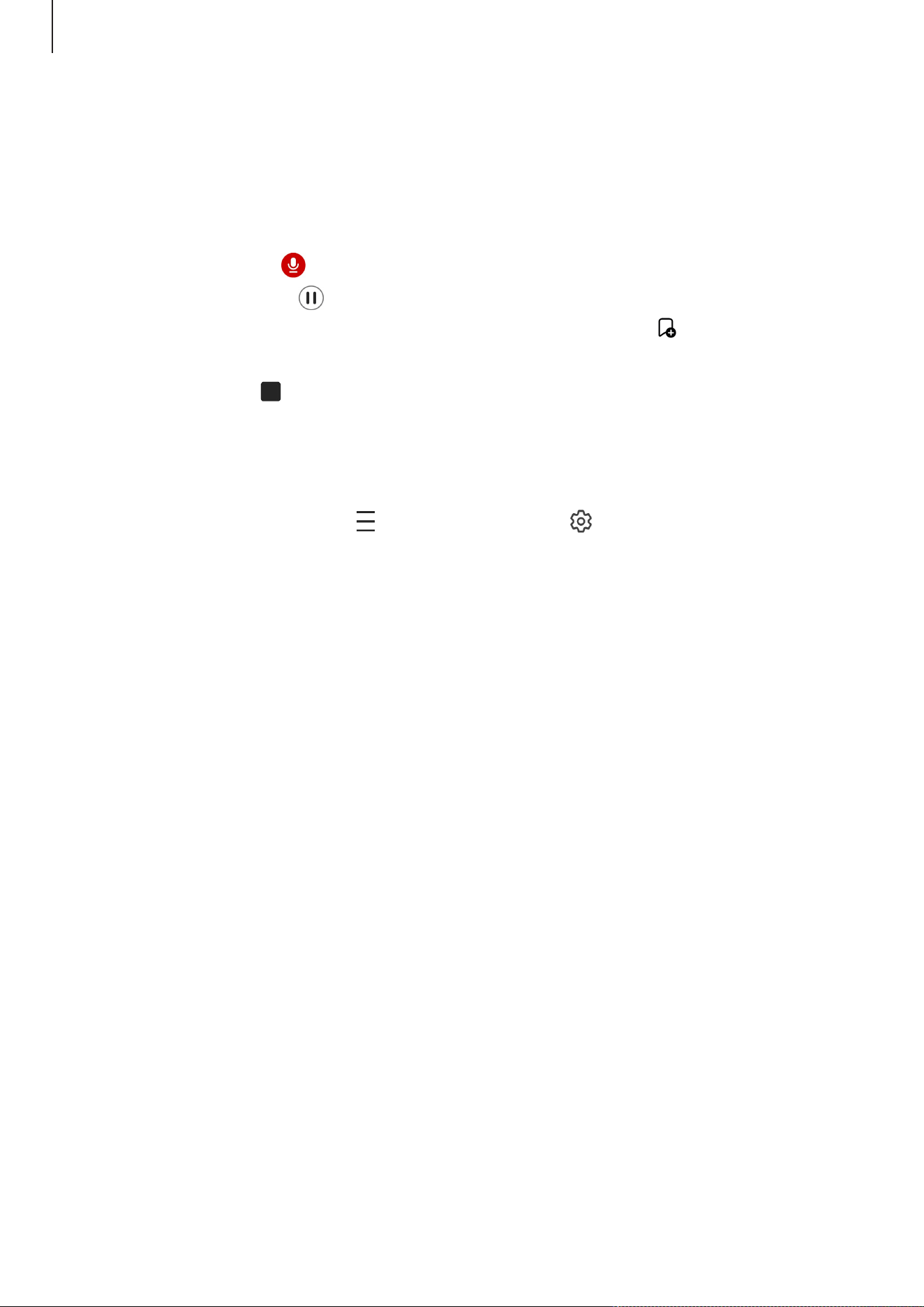
Apps and features
101
Voice Recorder
Record or play voice recordings.
1 Open the
Voice Recorder
app.
2 Tap the Record icon ( ) to start recording. Speak into the microphone.
•
Tap the Pause icon ( ) to pause recording.
•
While making a voice recording, tap the Add bookmark icon (
) to insert a
bookmark.
3 Tap the Stop icon ( ) to finish recording.
4 Enter a file name and tap
Save
.
Changing the recording mode
Tap the Navigation drawer icon ( )
→
the Settings icon ( )
→
Recording mode
and
select a mode.
•
Standard
: This is the standard recording mode.
•
Interview
: The device records sound from the top and the bottom of the device at a
high volume while reducing the volume of sound from the sides.
Playing selected voice recordings
When you review interview recordings, you can mute or unmute certain sound sources in
the recording.
1 Select a voice recording made in interview mode.
2 To mute certain sound sources, tap
ON
for the corresponding direction that sound is
to be muted.
It will change to
OFF
and the sound will be muted.

Apps and features
102
My Files
(Checking and managing the files)
Access and manage various files stored in the device.
Open the
My Files
app.
To check for unnecessary data and free up the device’s storage, tap
Manage storage
.
To search for files or folders, tap
Search
.
Clock
Set alarms, check the current time in many cities around the world, time an event, or set
a specific duration.
Open the
Clock
app.
Calculator
Perform basic arithmetic or scientific calculations.
Open the
Calculator
app.
•
: Check the calculation history. To clear the history, tap
Clear history
. To close the
calculation history panel, tap the Keypad icon (
).
•
: Use the unit conversion tool. You can convert various values, such as area,
length, or temperature, into other units.
•
: Display the scientific calculator.

Apps and features
103
Weather
You can check the weather information for your current location or specific locations you
set.
•
To get the weather information for your current location, you must turn on the
GPS feature and allow the Weather app to collect and use your current location.
•
To get precise weather information, you must allow the Weather app to access
your location.
•
Available features may vary depending on the device’s software version, app
version, or model.
Launching Weather
Launch Weather using one of these methods.
•
Tap the Weather widget on the Home screen. If the widget is not on the screen,
touch and hold an empty area on the Home screen, tap
Widgets
→
Weather
, select a
widget, and then tap
Add
.
•
Open the
Weather
app. If the app icon is not on the screen, tap
Search
on the Apps
screen, search for
Weather
, and then launch the app. If you want to add the app icon
to the Apps screen, on the Weather screen, tap the Weather menu and city list icon
(
)
→
the More options icon ( )
→
Settings
and tap the
Show Weather on Apps
screen
switch to turn it on.
Using main features
•
To add locations you want to check the weather for, on the Weather screen, tap the
Search icon (
).
•
To set a primary location to display in the widget, touch and hold the widget, then
tap
Settings
. Then tap
Change
, select the location, and then tap
Save
.
•
To get customised forecasts according to your sleep patterns, activities, and more, on
the Weather screen, tap the Weather menu and city list icon (
)
→
the More options
icon (
)
→
Settings
and tap the
Customisation Service
switch to turn it on.

Apps and features
104
Gaming Hub
Gaming Hub gathers your downloaded games in one place. You can browse popular
games from different genres and check for the latest trends. You can also play games
without installing them on your device through Instant Plays.
Open the
Gaming Hub
app.
Available features may vary depending on the device’s software version, app
version, or model.
Playing downloaded games
Games downloaded from
Play Store
and
Galaxy Store
will be automatically shown on
the Gaming Hub screen. You can also download games from Gaming Hub by tapping
games with the Download icon (
) on them.
On the Gaming Hub screen, select the game you want.
If your games are not there, tap
My games
→
the More options icon ( )
→
Add games
.
To bookmark content you use often while playing games, such as images or apps, on the
Gaming Hub screen, tap the More options icon (
)
→
Bookmarks
→
the Add bookmark
icon (
).
Playing Instant Plays
On the Gaming Hub screen, select the game with the Instant Plays icon ( ) on it.
Checking events
On the Gaming Hub screen, tap the Events icon ( ). You can check notifications about
various game-related events and exclusive benefits for Galaxy Store users.

Apps and features
105
Game Booster
(Configuring your gaming environment)
You can play games in a better environment with Game Booster. You can use Game
Booster while playing games.
To open the Game Booster panel while playing games, tap the Game Booster icon (
)
at the bottom of the screen. If the icon is hidden, drag upwards from the bottom of the
screen to show it.
Using Game Booster options
Open the Game booster panel and use the following options. You can also check the
device’s system status at the top of the Game Booster panel.
•
Performance
: Focus on giving you high performance while playing games. If you use
this mode, your device may heat up because of increased battery consumption.
•
Balanced
: Balance the performance and the battery usage time.
•
Battery saver
: Save battery power while playing games.
•
Game mode
: Turn on or off the game mode you set.
•
System monitor
: Display the system monitor on the screen.
•
Floating menu
: Display the floating menu that has shortcuts to frequently used
options on the screen. The floating menu will appear when you close the Game
Booster panel. To edit the shortcuts on the menu, touch and hold the floating menu.
•
Touch booster
: Increase the screen’s touch sensitivity for better touch recognition
while playing games.
•
Touch protection
: Lock the screen while the game is being played. To unlock the
screen, drag the lock icon in any direction.
•
Screenshot
: Capture screenshots.
•
Record
: Record your game sessions. To stop recording, tap the Stop icon (
).
•
Block navigation buttons
: Hide the buttons on the navigation bar. To display the
buttons, tap the Navigation button lock icon (
) on the navigation bar.

Apps and features
106
•
Block edge panel
: Hide the Edge panel handle while playing games.
•
Block auto brightness
: Disable automatic screen brightness adjustments while
playing games.
•
Block Bixby
: Turn off Bixby while playing games.
•
: Edit the options and the list of apps to play in pop-up windows.
•
: Configure settings for Game Booster.
•
Available options may vary depending on the game.
•
Game performance may be limited to control the device’s temperature if the
temperature rises above a certain level.
•
Battery power efficiency may vary by game.
Opening apps in pop-up windows while playing games
You can open apps in pop-up windows while playing a game.
Open the Game Booster panel and select an app from the apps list.
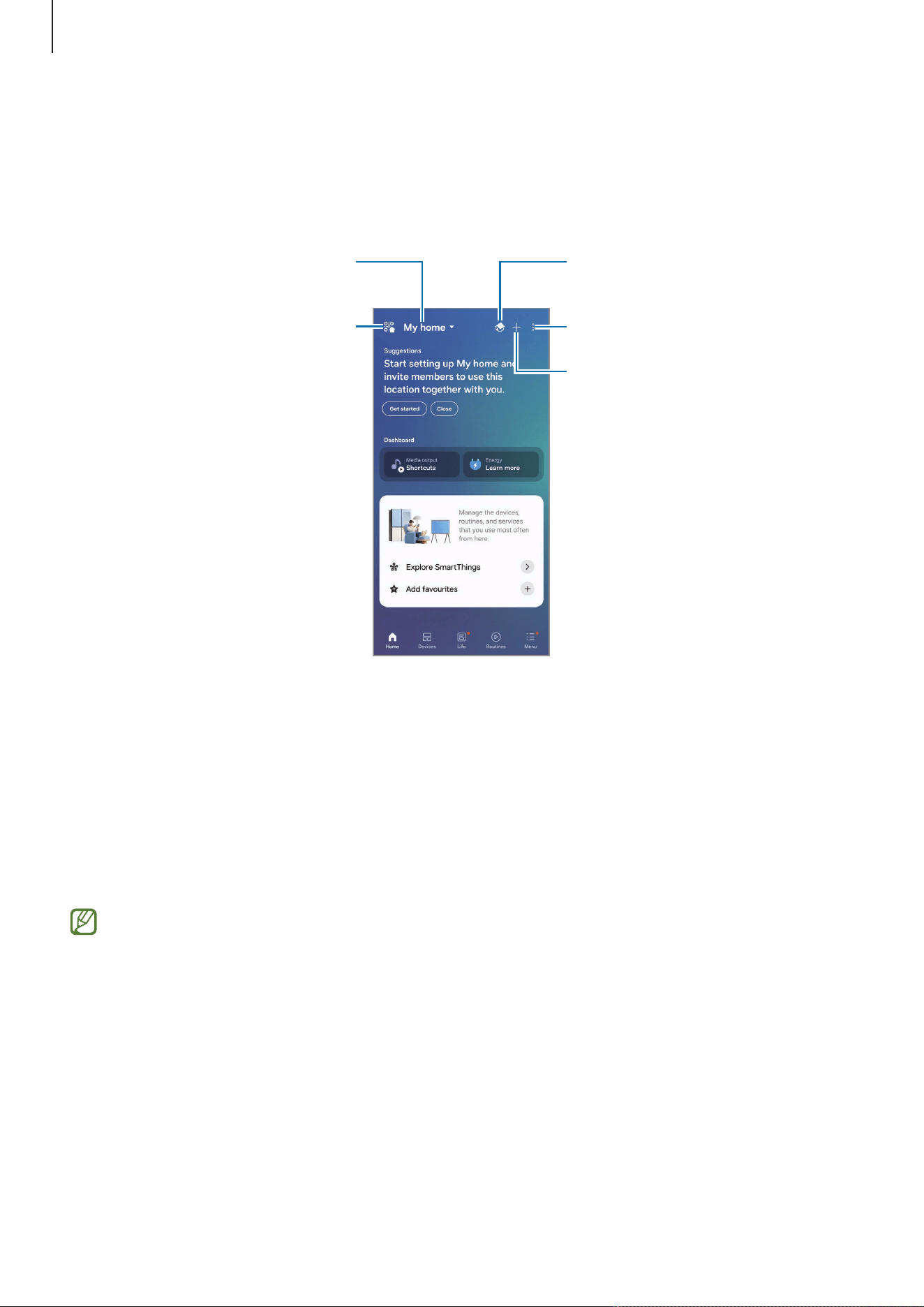
Apps and features
107
SmartThings
Control and manage smart appliances and Internet of Things (IoT) products.
Open the
SmartThings
app. For more information, tap
Menu
→
How to use
.
Invite others using a QR code.
Manage locations.
More options
Check and manage devices in
Map view.
Add devices or services, or create
routines.
•
Home
: Add and manage frequently used devices, routines, or services.
•
Devices
: Add or manage devices.
•
Life
: Use various services, such as checking the device status or energy usage, and
saving energy by using AI energy mode.
•
Routines
: Add or manage routines.
•
Menu
: Check useful information, supported devices, how to use certain features, and
more.
•
The devices you can connect may vary depending on the region. Available
features may differ depending on the connected device.
•
Connected devices’ own problems or defects are not covered by the Samsung
warranty. When problems or defects occur on the connected devices, contact the
device’s manufacturer.

Apps and features
108
Sharing content
Share content by using various sharing options. The following actions are an example of
sharing images.
1 Open the
Gallery
app and select an image.
2 Tap the Share icon ( ) and select a sharing method you want.
You may incur additional charges when sharing files through the mobile network.
Quick Share
Share content with nearby devices or people in your contacts.
1 Open the
Gallery
app and select an image.
2 On the other device, open
Settings
and tap
Connected devices
→
Quick Share
→
Who
can share with you
→
Your devices
,
Contacts
, or
Everyone
→
Done
.
3 Tap the Share icon (
)
→
Quick Share
and select a device to transfer the image to.
•
To share the link with a QR code, tap
QR code or link
and scan the QR code.
•
To share with contacts, tap
Share to contacts
.
•
To share encrypted content, tap the More options icon ( )
→
Turn on Private
sharing
. Shared content cannot be saved, copied, or resent by the recipient.
4 Accept the file transfer request on the other device.
Setting who can find your phone
Set who is allowed to find and send content to your phone.
1 Open
Settings
and tap
Connected devices
→
Quick Share
→
Who can share with you
.
2 Select an option.
•
No one
: Do not allow others to find your phone.
•
Your devices
: Other devices signed in to the same Samsung account or Google
Account can find your phone.
•
Contacts
: Share with people saved in your contacts.
•
Everyone
: Allow any nearby devices to share with your phone.

Apps and features
109
Music Share
Using the Music Share feature, you can share your Bluetooth speaker that is already
connected to your phone with another person. You can also listen to the same music on
your Galaxy Buds and another person’s Galaxy Buds.
This feature is available only on devices that support the Music Share feature.
Sharing a Bluetooth speaker
On your phone, open
Settings
, tap
Connected devices
→
Music Share
, and then tap the
switch to turn it on.
Follow the on-screen instructions to share your Bluetooth speaker.
Listening to music together with Galaxy Buds
You can listen to music on your phone together through your Buds and your friend’s
Buds.
This feature is supported only on the Galaxy Buds series.
1 Make sure that each phone and pair of Buds are connected.
Refer to Pairing with other Bluetooth devices for how to connect.
2 On your friend’s phone, open
Settings
, tap
Connected devices
, and then tap the
Music Share
switch to turn it on.
You can use additional features, such as setting who to share your device with, by
tapping
Music Share
.
3 On your phone, open the quick settings panel and tap
Media output
.
4 Select your friend’s Buds from the detected devices list.
5 On your friend’s phone, accept the connection request.
When you play music through your phone, you can listen to it together through both
Buds.

Apps and features
110
Smart View
(Mirroring on a TV screen)
View your phone’s displayed content on a large screen by connecting your phone to a
screen mirroring-enabled TV or monitor.
1 Open the quick settings panel and tap
Smart View
.
2 Select a device to mirror your phone’s screen.
When you play a video with Smart View, the resolution may vary depending on the
TV model.
Casting apps to the screen
Only display the video on the connected screen while you are checking private messages
or using other features on your phone at the same time.
Open the app to cast a video on the connected screen and tap the Smart View icon (
)
→
the App cast icon ( ).
Some apps may not support this feature.

Apps and features
111
Samsung DeX
Using Samsung DeX, you can use your mobile device like a computer by connecting the
mobile device to an external display, such as a TV or monitor. While using Samsung DeX,
you can simultaneously use your mobile device.
Visit www.samsung.com/samsung-dex for more information.
•
When starting or ending Samsung DeX, running apps may be closed.
•
Some apps or features may not be available when using Samsung DeX.
Wireless connections to external displays
On your mobile device, open
Settings
and tap
Connected devices
→
Samsung DeX
→
Connect wirelessly
. Follow the on-screen instructions to complete the connection. Some
TVs or monitors will only be detected when its screen mirroring mode is turned on.
Wired connections to external displays
You can connect your mobile device to an external display using an HDMI adapter (USB
Type-C to HDMI).
Use only official Samsung DeX supported accessories that are provided by
Samsung. Performance problems and malfunctions caused by using accessories
that are not officially supported are not covered by the warranty.
Controlling the Samsung DeX screen
Use the following methods to control the Samsung DeX screen on an external display.
•
Controlling with an external keyboard and mouse
You can use a wireless keyboard/mouse.
You can set the mouse pointer to flow from the external display to the mobile
device’s screen. Open
Settings
, select
Connected devices
→
Samsung DeX
→
Connected display
, and then select the
Flow pointer to phone
switch to turn it
on.

Apps and features
112
•
Using your mobile device as a touchpad
On your mobile device, tap the Touchpad icon (
) on the navigation bar. If you have
set the navigation bar to use
Swipe gestures
, open the notification panel and tap
Use your phone as a touchpad
.
•
Using the screen keyboard
When you enter text to send messages, create notes, or perform other tasks, a
screen keyboard will appear automatically on your mobile device’s screen without
connecting an external keyboard.

Apps and features
113
Google apps
Google provides entertainment, social network, and business apps. You may require a
Google Account to access some apps.
To check out more app information, access each app’s help menu.
•
Chrome
: Search for information and browse webpages.
•
Gmail
: Send or receive emails through the Google Mail service.
•
Maps
: Find your location on the map, search the world map, and access location
information for various places around you.
•
YT Music
: Enjoy various music and videos provided by YouTube Music. You can also
access the music collections stored on your device and play them.
•
Google TV
: Purchase or rent videos, such as movies and TV programmes, from
Play
Store
.
•
Drive
: Store your content on the cloud, access it from anywhere, and share it with
others.
•
YouTube
: Watch or create videos and share them with others.
•
Google
: Search for items on the internet or your device.
•
Meet
: Make video calls or create or join video meetings.
•
Messages
: Send and receive messages on your device or computer, and share
various content, such as images and videos.
•
Gemini
: Chat with Gemini to use various features, such as searching for information,
creating custom images, or writing content.
Some apps may not be available depending on the carrier or model.

114
Settings
Introduction
Customise device settings.
On the Apps screen, tap
Settings
. Alternatively, open the quick settings panel and tap
the Settings icon (
).
To search for settings by entering keywords, tap
Search
. You can also search for settings
by selecting a topic.
Sign in to your Galaxy
Sign in to your Samsung account and manage it.
On the Settings screen, tap
Sign in to your Galaxy
.
Connections
Options
Change settings for various connections, such as the Wi-Fi feature and Bluetooth.
On the Settings screen, tap
Connections
.
•
Wi-Fi
: Turn on the Wi-Fi feature to connect to a Wi-Fi network and access the
internet or other network devices. Refer to Wi-Fi for more information.
•
Bluetooth
: Use Bluetooth to exchange data or media files with other
Bluetooth-enabled devices. Refer to Bluetooth for more information.
•
NFC and contactless payments
: Read near field communication (NFC) tags that
contain information about products. You can also use this feature to make payments
and buy tickets for transportation or events after downloading the required apps.
Refer to NFC and contactless payments for more information.

Settings
115
•
Ultra-wideband (UWB)
: Turn on the UWB feature.
•
Flight mode
: Set the device to turn off all wireless functions on your device. You can
use only non-network services.
Follow the regulations provided by the airline and the instructions of aircraft
personnel. In cases where it is allowed to use the device, always use it in Flight
mode.
•
SIM manager
: Activate your SIM cards and customise the SIM card settings. Refer to
SIM manager (dual SIM models) for more information.
•
Mobile networks
: Configure your mobile network settings.
•
Data usage
: Keep track of your data usage amount and customise the settings for
the limitation. Set the device to automatically disable the mobile data connection
when the amount of mobile data you have used reaches your specified limit.
You can turn on the data saver feature to prevent some apps running in the
background from sending or receiving data. Refer to Data saver for more
information.
You can also set apps to use only a Wi-Fi or mobile data, or both. Refer to Allowed
networks for apps for more information.
•
Mobile Hotspot and Tethering
: Use the phone as a mobile hotspot to share the
phone’s mobile data connection with other devices. For more information about
Mobile Hotspot, refer to Mobile Hotspot.
You may incur additional charges when using this feature.
•
More connection settings
: Customise settings to control other features. Refer to
More connection settings for more information.
Some features may not be available depending on the model.

Settings
116
Wi-Fi
Turn on the Wi-Fi feature to connect to a Wi-Fi network and access the internet or other
network devices.
Connecting to a Wi-Fi network
1 On the Settings screen, tap
Connections
→
Wi-Fi
and tap the switch to turn it on.
2 Select a network from the Wi-Fi networks list.
Networks with a lock icon require a password.
•
Once the device connects to a Wi-Fi network, the device will reconnect to that
network each time it is available without requiring a password. To prevent the
device from connecting to the network automatically, tap the Settings icon (
)
next to the network and tap the
Auto reconnect
switch to turn it off.
•
If you cannot connect to a Wi-Fi network properly, restart your device’s Wi-Fi
feature or the wireless router.
Sharing Wi-Fi network passwords
If you make a request to a person who is connected to a secured Wi-Fi network to share
its password, you can connect to the network without entering the password. This
feature is available between the devices which have contacts each other and the screen
of the other device must be turned on.
1 On the Settings screen, tap
Connections
→
Wi-Fi
and tap the switch to turn it on.
2 Select a network from the Wi-Fi networks list.
3 Tap
Request password
.
4 Accept the share request on the other device.
The Wi-Fi password is entered on your device and it is connected to the network.

Settings
117
Wi-Fi Direct
Wi-Fi Direct connects devices directly through a Wi-Fi network without requiring an
access point.
1 On the Settings screen, tap
Connections
→
Wi-Fi
and tap the switch to turn it on.
2 Tap the More options icon ( )
→
Wi-Fi Direct
.
The detected devices are listed.
If the device you want to connect to is not in the list, request that the device turns on
its Wi-Fi Direct feature.
3 Select a device to connect to.
The devices will be connected when the other device accepts the Wi-Fi Direct
connection request.
To end the device connection, select the device to disconnect from the list.
Bluetooth
Use Bluetooth to exchange data or media files with other Bluetooth-enabled devices.
Precautions for using Bluetooth
•
Samsung is not responsible for the loss, interception, or misuse of data sent or
received through Bluetooth.
•
Always ensure that you share and receive data with devices that are trusted and
properly secured. If there are obstacles between the devices, the operating distance
may be reduced.
•
Some devices, especially those that are not tested or approved by the Bluetooth SIG,
may be incompatible with your device.
•
Do not use the Bluetooth feature for illegal purposes (for example, pirating copies of
files or illegally tapping communications for commercial purposes). Samsung is not
responsible for the repercussion of illegal use of the Bluetooth feature.

Settings
118
Pairing with other Bluetooth devices
1 On the Settings screen, tap
Connections
→
Bluetooth
and tap the switch to turn it
on.
The detected devices will be listed.
2 Select a device to pair with.
If the device you want to pair with is not on the list, set the device to enter Bluetooth
pairing mode. Refer to the other device’s user guides.
Your phone is visible to other devices while the Bluetooth settings screen is open.
3 Accept the Bluetooth connection request on your phone to confirm.
The devices will be connected when the other device accepts the Bluetooth
connection request.
To unpair the devices, tap the Settings icon (
) next to the device name to unpair and
tap
Unpair
.
Sending and receiving data
Many apps support data transfer through Bluetooth. You can share data, such as
contacts or media files, with other Bluetooth devices. The following actions are an
example of sending an image to another device.
1 Open the
Gallery
app and select an image.
2 Tap the Share icon ( )
→
Bluetooth
and select a device to transfer the image to.
If the device you want to pair with is not in the list, request that the device turns on its
visibility option.
3 Accept the Bluetooth connection request on the other device.

Settings
119
NFC and contactless payments
You can use your phone to read near field communications tags (NFC) that contain
information about products. You can also use this feature to make payments and buy
tickets for transportation or events after downloading the required apps.
The device contains a built-in NFC antenna. Handle the device carefully to avoid
damaging the NFC antenna.
Reading information from NFC tags
Use the NFC feature to read product information from NFC tags.
1 On the Settings screen, tap
Connections
and tap the
NFC and contactless payments
switch to turn it on.
2 Place the NFC antenna area on the back of your device near an NFC tag.
The information from the tag appears.
Ensure that the device’s screen is turned on and unlocked. Otherwise, the device
will not read NFC tags or receive data.
Making payments with the NFC feature
Before you can use the NFC feature to make payments, you must register for the mobile
payment service. To register or get more information about the service, contact your
service provider.
1 On the Settings screen, tap
Connections
and tap the
NFC and contactless payments
switch to turn it on.
2 Touch the NFC antenna area on the back of your device to the NFC card reader.
To set the default payment app, on the Settings screen, tap
Connections
→
NFC and
contactless payments
→
Default wallet app
and select an app.
•
The payment services list may not include all available payment apps.
•
If you update the payment app or install a new one, the payment services that
you used before may not work properly. If that is the case, on the Settings
screen, tap
Connections
→
NFC and contactless payments
→
Default wallet
app
or
Other NFC services
, and then select another app instead of the updated
or newly installed app. Or, deselect the selected app.

Settings
120
Data saver
Reduce your data usage by preventing some apps running in the background from
sending or receiving data.
On the Settings screen, tap
Connections
→
Data usage
→
Data saver
and tap the switch
to turn it on.
When the data saver feature is turned on, the Data saver icon (
) will appear on the
status bar.
To select apps to use data without restriction, tap
Apps that can always use data
and select apps.
Allowed networks for apps
Set apps to use only a Wi-Fi or mobile data, or both.
For example, you can set the device to use only mobile data for apps that you want to
keep secure or streaming apps that can be disconnected. Even if you do not turn off the
Wi-Fi feature, the apps will open using the mobile data.
On the Settings screen, tap
Connections
→
Data usage
→
Allowed networks for apps
.
Tap an app you want from the apps list and select a network option.
You may incur additional charges when using the mobile data.
Mobile Hotspot
Use your phone as a mobile hotspot to share your phone’s mobile data connection with
other devices.
1 On the Settings screen, tap
Connections
→
Mobile Hotspot and Tethering
→
Mobile
Hotspot
.
2 Tap the switch to turn it on.
You can change the network name, password, and more.
The Hotspot icon (
) appears on the status bar.

Settings
121
3 On the other device’s screen, search for and select your phone from the Wi-Fi
networks list.
Alternatively, tap
QR code
on the Mobile Hotspot screen and scan the QR code with
the other device.
•
If the mobile hotspot is not found, on your phone, set
Band
to
2.4 GHz
, tap
Advanced
, and then tap the
Hidden network
switch to turn it off.
•
If you turn on the
Auto Hotspot
feature, you can share your phone’s mobile data
connection with other devices signed in to your Samsung account.
More connection settings
Customise settings to control other connection features.
On the Settings screen, tap
Connections
→
More connection settings
.
•
Nearby device scanning
: Set the phone to scan for nearby devices to connect to.
•
Printing
: Configure settings for printer plug-ins installed on the device. You can
search for available printers or add one manually to print files. Refer to Printing for
more information.
•
VPN
: Set up virtual private networks (VPNs) on your device to connect to a school or
company’s private network.
•
Private DNS
: Set the device to use the security enhanced private DNS.
•
Ethernet
: When you connect an Ethernet adapter, you can use a wired network and
configure network settings.
•
Auto update system configurations
: Allow automatic configuration changes to
ensure that network connection features work as expected.

Settings
122
Printing
Configure settings for printer plug-ins installed on the device. You can connect the
device to a printer through Wi-Fi or Wi-Fi Direct, and print images or documents.
Some printers may not be compatible with the device.
Adding printer plug-ins
Add printer plug-ins for printers you want to connect the device to.
1 On the Settings screen, tap
Connections
→
More connection settings
→
Printing
→
Download plugin
.
2 Select a printer plug-in and install it.
3 Select the installed printer plug-in.
The device will automatically search for printers that are connected to the same Wi-Fi
network as your device.
4 Select a printer to add.
To add printers manually, tap the More options icon ( )
→
Add printer
.
Printing content
While accessing content, such as images or documents, access the options list, tap
Print
→
the Dropdown icon (
)
→
All printers...
, and then select a printer.
Printing methods may vary depending on the content type.

Settings
123
Connected devices
Change settings for device connections.
On the Settings screen, tap
Connected devices
.
•
Quick Share
: Change the Quick Share settings. Refer to Quick Share for more
information.
•
Music Share
: Change the Music Share settings. Refer to Music Share for more
information.
•
Audio broadcast
: Broadcast music, voice, or other audio content from your device
using the Auracast standard. When you connect Bluetooth LE Audio-compatible
devices, such as speakers, headphones, or hearing aids, you can listen to other audio
broadcasts.
•
Auto switch Buds
: Set the Galaxy Buds to switch from another device to your phone
when you make or answer a call, play media, and more. You can use this feature only
when you signed in to the same Samsung account on the other device and you are
wearing your Galaxy Buds.
•
Call & text on other devices
: Connect other devices, such as tablets, to your phone to
use calling and messaging features on those devices using your phone number. You
must sign in to the same Samsung account on connected devices and your phone.
Some calling and messaging features may not be available.
•
Continue on other devices
: Use your phone’s apps and features on other devices
signed in to your Samsung account.
•
Camera Share
: Use your phone’s camera as a webcam for a nearby tablet or Galaxy
Book. To use this feature, both devices need to be signed in to the same Samsung
account and have Wi-Fi, Bluetooth, and the Camera Share feature turned on.
•
Storage Share
: Share your phone's files with your Samsung phone, Samsung TV,
Galaxy Book, and more. To use this feature, both devices need to be signed in to the
same Samsung account and have Wi-Fi, Bluetooth, and the Storage Share feature
turned on.
•
Link to Windows
: Use apps and check notifications from your mobile device on
a Windows computer. A Microsoft account is required to use this feature. Visit
https://aka.ms/setupltw for details.
•
Multi control
: Use a mouse and keyboard connected to a Samsung computer that
supports this feature on your phone.

Settings
124
•
Samsung DeX
: Use your mobile device’s features in an interface environment similar
to a computer. Refer to Samsung DeX for more information.
•
Smart View
: View your phone’s displayed content on a large screen by connecting
your phone to a screen mirroring-enabled TV or monitor. Refer to Smart View for
more information.
•
Galaxy Wearable
: When you connect your phone to the wearable device, you can
customise the wearable device’s settings and apps. Refer to Galaxy Wearable for
more information.
•
SmartThings
: Control and manage smart appliances and Internet of Things (IoT)
products. Refer to SmartThings for more information.
•
Android Auto
: Connect your device to a vehicle and control some of your device’s
features on the vehicle’s display.
Some features may not be available depending on the model.
Galaxy AI
Use advanced intelligence features to help you use your device.
On the Settings screen, tap
Galaxy AI
. Refer to Galaxy AI for more information.
Modes and Routines
Using modes
Add a mode based on your current activity or location. Your device’s settings will change
to match your activity or situation. You can turn the mode on or off from the quick
settings panel.
Adding modes
1 On the Settings screen, tap
Modes and Routines
→
Modes
.
2 Select a mode you want or tap
Add mode
to add your own modes.

Settings
125
Running modes
Modes will run automatically when their conditions are detected. You can also run them
manually by tapping the button whenever you want.
To run modes manually, select the mode you want and tap
Turn on
.
To turn off a running mode, tap the mode and tap
Turn off
.
Alternatively, open the quick settings panel, tap
Modes
, and then select a mode to turn
it on. To turn the mode off, tap the mode button on the quick settings panel.
Using routines
Automate your repetitive daily tasks. For example, you can automatically change your
sound settings depending on where you are, optimise your device’s settings for gaming,
and more.
Adding routines
1 On the Settings screen, tap
Modes and Routines
→
Routines
.
2 Tap the Create icon ( ) and add your own routines or tap
Discover
and select a
routine you want.
If you want to set the routine’s running condition to manual, tap
Start manually
. This
option will appear only when there are no running conditions set.
Running routines
Auto routines will run automatically when their conditions are detected. For routines
which you set the running condition as
Start manually
, you can run them manually by
tapping the button whenever you want.
To run routines manually, tap the Start icon (
) next to the routine you want to run. If
you want to use a widget, tap a routine under
Manual routines
and tap
More
→
Add to
Home screen
→
Add
. The routine will be added as a widget to the Home screen and you
can run the routine by tapping the widget.
To stop running routines, tap the Routine list icon (
), tap the routine under
Running
,
and then tap
Stop
, or tap the routine’s widget on the Home screen.

Settings
126
Sounds and vibration
Options
Change settings for various sounds on the device.
On the Settings screen, tap
Sounds and vibration
.
•
Sound
/
Vibrate
/
Mute
: Set the device to use sound mode, vibration mode, or silent
mode.
•
Vibrate while ringing
: Set the device to vibrate and play a ringtone for incoming
calls.
•
Temporary mute
: Set the device to use silent mode for a certain period.
•
Ringtone
: Change the call ringtone.
•
Notification sound
: Change the notification sound.
•
System sound
: Change the sound to use for certain actions, such as charging the
device.
•
Volume
: Adjust the device’s volume level.
•
Call vibration
: Change the call vibration settings.
•
Notification vibration
: Change the notification vibration settings.
•
System vibration
: Select actions to receive vibration feedback and adjust the
vibration intensity.
•
Vibration intensity
: Adjust the force of the vibration notification.
•
Sound quality and effects
: Set the device’s sound quality and effects. Refer to Sound
quality and effects for more information.
•
Separate app sound
: Set the device to play media sound from a specific app
separately on the other audio device. Refer to Separate app sound for more
information.
Some features may not be available depending on the model.

Settings
127
Sound quality and effects
Set the device’s sound quality and effects.
On the Settings screen, tap
Sounds and vibration
→
Sound quality and effects
.
•
Dolby Atmos
: Select a surround sound mode optimised for various types of audio,
such as movies, music, and voice. With Dolby Atmos, you can experience moving
audio sounds that flow all around you.
•
Equaliser
: Change the sound profile and enjoy optimised sound.
•
Loudness normalisation
: Reduce the differences in volume between different
content. The device will automatically increase the volume of content with low
volume.
•
App sound settings
: Check and manage the optimised sound settings you saved for
each media app. To adjust sound settings for each app, open the quick settings panel
while playing content in the app, touch and hold the volume adjustment bar, and
then change the settings. The same settings will be applied the next time you run
the app.
•
Adapt sound
: Set the best sound for you.
•
UHQ upscaler
: Enhance the sound resolution of music and videos when using wired
headphones or Bluetooth headphones that support UHQ.
Depending on the model, you must connect headphones to use some features.
Separate app sound
Set the device to play media sound from a specific app on the connected Bluetooth
speaker or headset.
For example, you can listen to the Navigation app through your device’s speaker while
listening to playback from the Music app through the vehicle’s Bluetooth speaker.
1 On the Settings screen, tap
Sounds and vibration
→
Separate app sound
and tap the
switch to turn it on.
2 Select an app to play media sounds separately and tap the Back button (
).
3 Select a device for playing the selected app’s media sound.

Settings
128
Notifications
Change the notification settings.
On the Settings screen, tap
Notifications
.
•
App notifications
: Select the apps you want to receive notifications from.
•
Notification pop-up style
: Select a notification pop-up style and change the
settings.
•
Hide content while locked
: Set whether to hide the content of notifications on the
locked screen.
•
Sort and filter notifications
: Select a method for sorting or filtering notifications.
•
Notification highlights
: Use the prioritise important notifications or notification
summary feature.
•
Status bar
: Set how to display icons on the status bar.
•
Lock screen
: Set how to show notifications on the locked screen.
•
Do not disturb
: Set the device to mute all sounds except for allowed exceptions.
•
Advanced settings
: Configure advanced settings for notifications.
Display
Options
Change the display and the Home screen settings.
On the Settings screen, tap
Display
.
•
Light
/
Dark
: Turn Dark mode on or off.
•
Dark mode settings
: Reduce eye strain by applying the dark theme when using the
device at night or in a dark place. You can set a schedule for applying Dark mode.
The dark theme may not be applied in some apps.
•
Brightness
: Adjust the brightness of the display.
•
Adaptive brightness
: Set the device to keep track of your brightness adjustments
and apply them automatically in similar lighting conditions.

Settings
129
•
Extra brightness
: Set the display to be brighter than the maximum brightness. This
feature is available when you turn off the
Adaptive brightness
feature.
•
Privacy display
: Limits screen visibility from side angles to protect your privacy.
•
Motion smoothness
: Change the refresh rate of the screen. When a high refresh rate
is set, the screen will scroll more smoothly. Refer to Motion smoothness for more
information.
•
Eye comfort shield
: Reduce eye strain by limiting the amount of blue light emitted
by the screen. You can set a schedule for applying this feature.
•
Adaptive colour tone
: Adjust the colours and white balance based on the ambient
lighting conditions to make colours appear more natural in different environments.
•
Screen mode
: Change the screen mode to adjust the display’s colour and contrast.
Refer to Changing the screen mode or adjusting the display colour for more
information.
•
Font size and style
: Change the font size and style.
•
Screen zoom
: Make the items on the screen larger or smaller.
•
Screen resolution
: Change the screen resolution. Higher resolutions make the
display more vivid, however they will consume more battery power. Some currently
running apps may close when you change the resolution.
•
Camera cutout
: Set the device to hide the front camera from the screen.
•
Screen timeout
: Set the length of time the device waits before turning off the
display’s backlight.
•
Easy mode
: Switch to easy mode to display larger icons and apply a simpler layout to
the Home screen.
•
Edge panels
: Change the settings for the Edge panel.
•
Navigation bar
: Change the navigation bar settings. Refer to Navigation bar (soft
buttons) for more information.
•
Accidental touch protection
: Set the device to prevent the screen from detecting
touch input when it is in a dark place, such as a pocket or bag.
•
Touch sensitivity
: Increase the touch sensitivity of the screen for use with screen
protectors.

Settings
130
•
Show charging information
: Set the device to display the charging information, such
as the remaining battery percentage when the screen is off.
•
Screen saver
: Set the device to launch a screensaver when the device is charging.
Some features may not be available depending on the model.
Motion smoothness
The refresh rate is the number of times the screen is refreshed every second. Use a high
refresh rate to prevent the screen from flickering when switching between screens. The
screen will scroll more smoothly. When you select a standard refresh rate, you can use
the battery longer.
1 On the Settings screen, tap
Display
→
Motion smoothness
.
2 Select a refresh rate.
•
Adaptive
: Get smoother animations and scrolling by automatically adjusting your
screen refresh rate into a higher one.
•
Standard
: Use a standard refresh rate in normal situations to conserve battery
power.
Changing the screen mode or adjusting the display colour
Change the screen mode or adjust the display colour to your preference.
Changing the screen mode
On the Settings screen, tap
Display
→
Screen mode
and select a mode you want.
•
Vivid
: This optimises the colour range, saturation, and sharpness of your display. You
can also adjust the display colour balance by colour value.
•
Natural
: This adjusts the screen to a natural tone.
•
You can adjust the display colour only in
Vivid
mode.
•
Vivid
mode may not be compatible with third-party apps.

Settings
131
Optimising the full screen colour balance
Optimise the display colour by adjusting the colour tones to your preference.
On the Settings screen, tap
Display
→
Screen mode
→
Vivid
and adjust the colour
adjustment bar under
White balance
.
When you drag the colour adjustment bar towards
Cool
, the blue colour tone will
increase. When you drag the bar towards
Warm
, the red colour tone will increase.
Adjusting the screen tone by colour value
Increase or lower certain colour tones by adjusting the Red, Green, or Blue value
individually.
1 On the Settings screen, tap
Display
→
Screen mode
→
Vivid
.
2 Tap
Advanced settings
.
3 Adjust the
R
(Red),
G
(Green), or
B
(Blue) colour bar to your preference.
The screen tone will be adjusted.
To adjust the vividness level, drag the bar under
Vividness
.
Battery
Check the remaining battery power and time to use the device. For devices with low
battery levels, conserve battery power by turning on power saving features.
On the Settings screen, tap
Battery
.
•
Daily usage
: Check the battery level and usage history.
•
Power saving
: Turn on power saving mode to extend the battery’s usage time.
•
Background usage limits
: Limit battery usage for apps that you do not use often.
•
Battery protection
: Set to stop charging when the battery is fully charged or limit
the maximum charge to the preset level.

Settings
132
•
Battery information
: Check out battery information.
You can check the following battery information here. The available
information may vary depending on the region, service provider, or model.
•
Date of battery manufacturing
•
Date of first use
•
Number of full charge/discharge cycles (based on rated capacity)
•
Measured state of health
•
Charging settings
: Configure the charging settings.
•
Wireless power sharing
: Charge another device with your phone’s battery. Refer to
Wireless power sharing for more information.
•
Auto dim screen
: Dim the screen when the remaining battery power drops below a
certain level.
•
The usage time left shows the time remaining before the battery power runs
out. Usage time left may vary depending on your device settings and operating
conditions.
•
You might not receive notifications from some apps that use power saving
mode.
Wallpaper and style
Change the wallpaper settings for the Home screen and the locked screen.
On the Settings screen, tap
Wallpaper and style
.

Settings
133
Themes
Change your device’s screen to your own style by applying the theme you want.
On the Settings screen, tap
Themes
. The Galaxy Themes screen will appear.
Purchase or download themes, wallpapers, icons, or other items you want and apply
them to your device.
Applying your themes, wallpapers, or icons
If you want to restore the default style or a style you previously downloaded, on the
Galaxy Themes screen, tap
Menu
→
My stuff
and select the category you want.
Adding payment methods or checking your purchase history
On the Galaxy Themes screen, tap
Menu
→
Payment methods
and add a payment
method, such as a credit card. You can use the registered payment method to purchase
paid content in Galaxy Theme.
If you want to check your purchase history, tap
Menu
→
Receipts
.
•
Available features may vary depending on the device’s software version, app
version, or model.
•
When you change the theme, some apps will be closed and unsaved data may be
lost.
Home screen
Configure settings for the Home screen, such as the screen layout.
On the Settings screen, tap
Home screen
.

Settings
134
Lock screen and AOD
Options
Change the settings for the locked screen and the Always On Display.
On the Settings screen, tap
Lock screen and AOD
.
•
Screen lock and biometrics
: Change the screen lock method.
•
Extend Unlock
: Set the device to unlock itself when trusted locations or devices are
detected. Refer to Extend Unlock for more information.
•
Secure lock settings
: Change screen lock settings for the selected lock method.
•
Always On Display
: Set the device to display information while the screen is turned
off. Refer to Always On Display for more information.
•
Now bar
: Select items to display on the locked screen.
•
Touch and hold to edit
: Set the device to display the editing options when you touch
and hold the locked screen.
•
Roaming clock
: Change the clock to show both the local and home time zones on
the locked screen when roaming.
•
Contact information
: Set the device to show contact information, such as your email
address, on the locked screen.
•
Show unlock transition effect
: Set to display the unlock transition effect when you
unlock the screen through your biometric data.
•
About Lock screen
: Check out the Lock screen version and legal information.
•
Some features may not be available depending on the carrier or model.
•
The available options may vary depending on the screen lock method selected.

Settings
135
Extend Unlock
You can set the device to unlock itself and remain unlocked when trusted locations or
devices are detected.
For example, if you have set your home as a trusted location, when you get home your
device will detect the location and automatically unlock itself.
On the Settings screen, tap
Lock screen and AOD
→
Extend Unlock
and follow the
on-screen instructions to complete the setup.
•
This feature will be available to use after you set a screen lock method.
•
If you do not use your device for four hours or when you turn on the device, you
must unlock the screen using the pattern, PIN, or password you set.
Always On Display
(Displaying information when the screen is turned off)
You can check out information on the screen, such as the clock, when it is turned off.
You can also check notifications for new messages or missed calls.
To set the Always On Display to appear only during the preset condition, on the Settings
screen, tap
Lock screen and AOD
→
Always On Display
→
When to show
, and then
select an option you want.
The brightness of the Always On Display may change automatically depending on
the lighting conditions.
Opening notifications on the Always On Display
When you receive message, missed call, or app notifications, notification icons will
appear on the Always On Display. Double tap a notification icon to check its notification.
To use this feature, on the Settings screen, tap
Notifications
→
Lock screen
and tap
Cards
under
Notification style
.
If the screen is locked, you must unlock it to check notifications.
Turning off the Always On Display feature
On the Settings screen, tap
Lock screen and AOD
and tap the
Always On Display
switch
to turn it off.

Settings
136
Security and privacy
Options
Check the device’s security and privacy status and change the settings.
On the Settings screen, tap
Security and privacy
.
•
Lock screen
: Change the settings for the locked screen.
•
Account security
: Change the settings for your accounts.
•
Lost device protection
: Turn the Find My Mobile feature on or off. Access
smartthingsfind.samsung.com to track and control your lost or stolen phone. You
can also check the location of the wearable devices connected to this phone. To
prevent others from accessing your device’s apps and data in case your device is
stolen, set to use the
Theft protection
feature.
•
App security
: Scan apps and keep your device safe from malicious software.
•
Updates
: Check the version of your device’s software and check for updates.
•
Screen lock and biometrics
: Change the settings for the locked screen and biometric
data. Refer to Face recognition and Fingerprint recognition for more information.
•
Auto Blocker
: Keep your device safe by blocking threats and other suspicious
activity.
•
Security status of your devices
: Check the security status of your devices that are
signed in to your Samsung account.
•
More security settings
: Configure additional security settings. Refer to Secure Wi-Fi,
Secure Folder, and Samsung Pass for more information.
•
Permissions used in last 24 hours
: Check the app or feature’s permission usage
history.
•
Internet privacy protection
: Check the internet privacy protection history and
change settings. This feature will be added when you use the
Samsung Internet
app.
•
Controls and alerts
: Control access to features such as the microphone and
clipboard.
•
More privacy settings
: Configure additional privacy settings.
Some features may not be available depending on the carrier or model.

Settings
137
Face recognition
You can set the device to unlock the screen by recognising your face.
•
If you use your face as a screen lock method, your face cannot be used to unlock
the screen for the first time after turning on the device. To use the device,
you must unlock the screen using the pattern, PIN, or password you set when
registering the face. Be careful not to forget your pattern, PIN, or password.
•
If you change the screen lock method to
Swipe
or
None
, which are not secure, all
of your biometric data will be deleted.
Precautions for using face recognition
Before using the face recognition to unlock your device, keep the following precautions
in mind.
•
Your device could be unlocked by someone or something that looks like your image.
•
Face recognition is less secure than Pattern, PIN, or Password.
For better face recognition
Consider the following when using face recognition:
•
Consider the conditions when registering, such as wearing glasses, hats, masks,
beards, or heavy makeup
•
Ensure that you are in a well-lit area and that the camera lens is clean when
registering
•
Ensure your image is not blurry for better match results
Registering your face
For better face registration, register your face indoors and out of direct sunlight.
1 On the Settings screen, tap
Security and privacy
→
Screen lock and biometrics
→
Face recognition
.
2 Set a screen lock method.

Settings
138
3 Read the on-screen instructions and tap
Continue
.
4 Tap
Register
and position your face inside the frame on the screen.
The camera will scan your face.
•
If unlocking the screen with your face is not working properly, tap
Remove face
data
to remove your registered face and register your face again.
•
To enhance the face recognition, tap
Add alternative appearance to enhance
recognition
and add an alternate appearance.
Unlocking the screen with your face
You can unlock the screen with your face instead of using a pattern, PIN, or password.
1 On the Settings screen, tap
Security and privacy
→
Screen lock and biometrics
.
2 Unlock the screen using the preset screen lock method.
3 Tap
Face recognition
and tap the
Face unlock
switch to turn it on.
4 On the locked screen, look at the screen.
When your face is recognised, you can unlock the screen without using any additional
screen lock method. If your face is not recognised, use the preset screen lock method.
Deleting the registered face data
You can delete face data that you have registered.
1 On the Settings screen, tap
Security and privacy
→
Screen lock and biometrics
.
2 Unlock the screen using the preset screen lock method.
3 Tap
Face recognition
→
Remove face data
→
Remove
.
Once the registered face is deleted, all the related features will also be turned off.

Settings
139
Fingerprint recognition
In order for fingerprint recognition to function, your fingerprint information needs to be
registered and stored in your device.
•
This feature may not be available depending on the carrier or model.
•
Fingerprint recognition uses the unique characteristics of each fingerprint to
enhance the security of your device. The likelihood of the fingerprint sensor
confusing two different fingerprints is very low. However, in rare cases where
separate fingerprints are very similar the sensor may recognise them as
identical.
•
Thick protective film can affect performance. If you use a screen protector, check
to make sure it’s labelled as compatible with the on-screen fingerprint sensor.
(such as screen protectors sold by Samsung)
•
If you use your fingerprint as a screen lock method, your fingerprint cannot be
used to unlock the screen for the first time after turning on the device. To use
the device, you must unlock the screen using the pattern, PIN, or password you
set when registering the fingerprint. Be careful not to forget your pattern, PIN, or
password.
•
If your fingerprint is not recognised, unlock the device using the pattern, PIN,
or password you set when registering the fingerprint, and then re-register your
fingerprints. If your pattern, PIN, or password is forgotten, you will not be able to
use the device if you do not reset it. Samsung is not responsible for any data loss
or inconvenience caused by forgotten unlock codes.
•
If you change the screen lock method to
Swipe
or
None
, which are not secure, all
of your biometric data will be deleted.

Settings
140
For better fingerprint recognition
When you scan your fingerprints on the device, be aware of the following conditions that
may affect the feature’s performance:
•
The device may not recognise fingerprints that are affected by wrinkles or scars.
•
The device may not recognise fingerprints from small or thin fingers.
•
To improve recognition performance, register the fingerprints of the fingers used
most often to perform tasks on the device.
•
Your device has a built-in fingerprint recognition sensor at the bottom centre of the
screen. Ensure that the screen protector or the screen on the fingerprint recognition
sensor area is not scratched or damaged by objects, such as coins, keys, pens, and
necklaces.
•
Ensure that the fingerprint recognition sensor area at the bottom centre of the
screen and your fingers are clean and dry.
•
If you bend your finger or use a fingertip, the device may not recognise your
fingerprints. Press the screen so that your fingertip spreads over the wide surface of
the fingerprint recognition area.
Registering fingerprints
On the Settings screen, tap
Security and privacy
→
Screen lock and biometrics
→
Fingerprints
and follow the on-screen instructions to register your fingerprint. After
registering, you can check whether your fingerprint is registered and its name by tapping
Check added fingerprints
.
Unlocking the screen with your fingerprints
You can unlock the screen with your fingerprint instead of using a pattern, PIN, or
password.
1 On the Settings screen, tap
Security and privacy
→
Screen lock and biometrics
.
2 Unlock the screen using the preset screen lock method.
3 Tap
Fingerprints
and tap the
Fingerprint unlock
switch to turn it on.
4 On the locked screen, place your finger on the fingerprint recognition sensor and scan
your fingerprint.

Settings
141
Recognising your fingerprints with the screen turned off
1 On the Settings screen, tap
Security and privacy
→
Screen lock and biometrics
.
2 Unlock the screen using the preset screen lock method.
3 Tap
Fingerprints
and tap the
Fingerprint always on
switch to turn it on.
If you tap
Show icon when screen is off
, you can change when to show the fingerprint
recognition icon or set it to not display the icon.
Deleting registered fingerprints
You can delete registered fingerprints.
1 On the Settings screen, tap
Security and privacy
→
Screen lock and biometrics
.
2 Unlock the screen using the preset screen lock method.
3 Tap
Fingerprints
, select a fingerprint to delete, and then tap
Remove
→
Remove
.
Secure Wi-Fi
Secure Wi-Fi is a service that secures your Wi-Fi network connection. It encrypts data
using Wi-Fi networks and disables tracking apps and websites so that you can use Wi-Fi
networks safely. For example, when using an unsecure Wi-Fi network in public places,
such as cafes or airports, Secure Wi-Fi is automatically turned on so that no one can hack
your login information or monitor your activity in apps and websites.
On the Settings screen, tap
Security and privacy
→
More security settings
→
Secure
Wi-Fi
and follow the on-screen instructions to complete the setup. If you tap
Protection
activity
, you can check the history of how and when your network was protected with
Secure Wi-Fi.
When Secure Wi-Fi is turned on, the VPN icon (
) will appear on the status bar.
•
Using this feature may result in a slower Wi-Fi network speed.
•
This feature may not be available depending on the Wi-Fi network, carrier, or
model.

Settings
142
Selecting apps to protect using Secure Wi-Fi
Select apps to protect using Secure Wi-Fi so that you can safely protect data, such as
your password or your activity in apps, from being accessed by others.
On the Settings screen, tap
Security and privacy
→
More security settings
→
Secure
Wi-Fi
→
the More options icon ( )
→
Settings
→
Protected apps
and tap the switches
next to the apps you want to protect using Secure Wi-Fi.
Some apps may not support this feature.
Purchasing protection plan
You are provided with a free protection plan for Wi-Fi networks every month. You can
also purchase paid protection plans and have unlimited bandwidth protection for a
limited time.
1 On the Settings screen, tap
Security and privacy
→
More security settings
→
Secure
Wi-Fi
.
2 Tap protection plan information
→
Upgrade
and select the plan you want.
For certain protection plans, you can transfer the protection plan to another device
signed in to your Samsung account.
3 Follow the on-screen instructions to complete the purchase.
Secure Folder
Secure Folder protects your private content and apps, such as pictures and contacts,
from being accessed by others. You can keep your private content and apps secure even
when the device is unlocked.
Secure Folder is a separate, secured storage area. The data in Secure Folder cannot
be transferred to other devices through unapproved sharing methods, such as
USB or Wi-Fi Direct. Attempting to customise the operating system or modifying
software will cause Secure Folder to be automatically locked and inaccessible.
Before saving data in Secure Folder, make sure to back up a copy of the data in
another secure location.

Settings
143
Setting up Secure Folder
1 Open
Settings
and tap
Security and privacy
→
More security settings
→
Secure
Folder
.
2 Follow the on-screen instructions to complete the setup.
When a pop-up window asking whether you want to reset the Secure Folder lock type
with your Samsung account appears, tap
Allow
. If you have forgotten the lock type,
you can reset it using your Samsung account. If you do not turn on this feature, you
cannot reset the lock type when you have forgotten it.
When the setup is complete, the Secure Folder screen will appear and the Secure
Folder app icon (
) will be added to the Apps screen.
•
When the
Secure Folder
app is locked, you must unlock it using your preset lock
method.
•
To change the name or icon of Secure Folder, tap the More options icon ( )
→
Customise
.
Setting an auto lock condition for Secure Folder
1 Open the
Secure Folder
app and tap the More options icon ( )
→
Settings
→
Auto
lock Secure Folder
.
2 Select a lock option.
To manually lock your Secure Folder, tap the More options icon ( )
→
Lock and exit
.
Moving content to Secure Folder
Move content, such as pictures and videos, to Secure Folder. The following actions are an
example of moving an image from the default storage to Secure Folder.
1 Open the
Secure Folder
app and tap the More options icon ( )
→
Add files
.
2 Tap
Images
, tick images to move, and then tap
Done
.
3 Tap
Move
.
The selected items will be deleted from the original folder and moved to Secure
Folder. To copy items, tap
Copy
.
The method for moving content may vary depending on the content type.

Settings
144
Moving content from Secure Folder
Move content from Secure Folder to the corresponding app in the default storage. The
following actions are an example of moving an image from Secure Folder to the default
storage.
1 Open the
Secure Folder
app and tap
Gallery
.
2 Select an image and tap the More options icon ( )
→
Move out of Secure Folder
.
The selected items will be moved to
Gallery
in the default storage.
Adding apps
Add an app to use in Secure Folder.
1 Open the
Secure Folder
app and tap the Add apps icon ( ).
2 Tick one or more apps installed on the device and tap
Add
.
Removing apps from Secure Folder
Touch and hold an app to delete, and tap
Uninstall
.
Adding accounts
Add your Samsung and Google accounts, or other accounts, to sync with the apps in
Secure Folder.
1 Open the
Secure Folder
app and tap the More options icon ( )
→
Settings
→
Manage
accounts
→
Add account
.
2 Select an account service.
3 Follow the on-screen instructions to complete the account setup.
Hiding Secure Folder
You can encrypt Secure Folder and hide the shortcut from the Apps screen.
Open the quick settings panel and tap the Expand icon (
)
→
Secure Folder
( )
→
Hide
. Alternatively, open the
Secure Folder
app and tap the More options icon ( )
→
Hide
Secure Folder
→
Hide Secure Folder
.
If you want to show and open the Secure Folder again, open the quick settings panel, tap
the Expand icon (
)
→
Secure Folder
( ), and then unlock the Secure Folder using the
preset Secure Folder lock method.

Settings
145
Uninstalling Secure Folder
You can uninstall Secure Folder, including the content and apps in it.
Open the
Secure Folder
app and tap the More options icon ( )
→
Settings
→
More
settings
→
Uninstall
.
To back up content before uninstalling Secure Folder, tick
Move media files out of
Secure Folder
and tap
Uninstall
. To access data backed up from Secure Folder, open the
My Files
app and tap
Internal storage
→
Download
→
Secure Folder
.
Notes saved in
Samsung Notes
will not be backed up.
Samsung Pass
Verify your identity with Samsung Pass when using services which require your login or
personal information.
Registering Samsung Pass
On the Settings screen, tap
Security and privacy
→
More security settings
→
Passwords, passkeys, and autofill
→
Samsung Pass
. Follow the on-screen instructions
to complete the setup.
Saving your information to Samsung Pass
When you save apps’ or websites’ sign-in or personal information in Samsung Pass, you
can enter the information automatically.
You can save your information manually or check and manage the saved
information on Samsung Pass.
Saving your sign-in information
On the sign-in page of the app or website, enter your ID and password, and then tap the
sign-in button. When a pop-up window asking whether you want to save the sign-in
information appears, tap
Save
.
Saving your personal information
On the Samsung Pass main screen, select an option under
Private info
, enter the
information, and then tap
Save
.

Settings
146
Entering your information automatically
You can automatically enter your sign-in or personal information, such as your address or
payment card information, saved in Samsung Pass.
•
This feature may not be available in some apps or websites.
•
The website autofill feature is only available for websites that you access
through the
Samsung Internet
app.
Signing in using passkeys
In apps or websites that support sign-in with a passkey, you can sign in with a passkey
saved in Samsung Pass instead of the sign-in information.
1 On the app or website you are using, create a passkey.
The method for creating a passkey may differ depending on the app or website.
2 When a pop-up window asking whether you want to save the passkey appears, select
Samsung Pass and follow the on-screen instructions to save the passkey.
Now you can sign in with the passkey saved in Samsung Pass.
Location
Change settings for location information permissions.
On the Settings screen, tap
Location
.
•
App permissions
: Check the list of apps that have permission to access the device’s
location and edit the permission settings.
•
Location services
: Set the device to use the Wi-Fi or Bluetooth feature to increase
the accuracy of your location information, even when the features are turned off. You
can also check the location services your device is using.
•
Recent access
: Check which apps request your current location information.

Settings
147
Safety and emergency
Manage your medical information and emergency contacts. You can also change
settings for emergency features, such as wireless emergency alerts.
On the Settings screen, tap
Safety and emergency
.
•
Medical info
: Enter your medical information.
•
Emergency contacts
: Add your emergency contacts.
•
Emergency SOS
: Make an emergency call to the preset number when you press the
Side button several times as specified on the settings screen of this feature.
•
Emergency sharing
: Set the device to send information, such as your location or your
device’s lower battery notifications, to your emergency contacts for a certain period
of time.
•
Silence notifications while driving
: Turn on the Do Not Disturb feature
automatically while driving.
•
Emergency Location Service
: Turn on the Emergency Location Service (ELS) feature.
•
Wireless emergency alerts
: Change the settings for wireless emergency alerts.
•
Earthquake alerts
: Turn on the earthquake alert feature.
•
Unknown tracker alerts
: You will receive a notification if an unknown tracker has
been detected travelling with you.
Some features may not be available depending on the region or the model.

Settings
148
Accounts and backup
Options
Sync, back up, or restore your device’s data using Samsung Cloud. You can also sign in to
accounts, such as your Samsung account or Google Account, or transfer data to or from
other devices through Smart Switch.
On the Settings screen, tap
Accounts and backup
.
•
Manage accounts
: Add your Samsung and Google accounts, or other accounts, to
sync with.
•
Samsung Cloud
: Back up your data and settings, and restore the previous device’s
data and settings even when you do not have it. Refer to Samsung Cloud for more
information.
•
Google Drive
: Keep your personal information, app data, and settings safe on your
device. You can back up your sensitive information. You must sign in to your Google
Account to back up data.
•
Smart Switch
: Open Smart Switch and transfer data from your previous device. Refer
to Transferring data from your previous device (Smart Switch) for more information.
Regularly back up your data to a safe location, such as Samsung Cloud or a
computer, so that you can restore it if the data is damaged or lost because of an
unintended factory data reset.
Samsung Cloud
Back up your device’s data to Samsung Cloud and restore it later.
Backing up data
You can back up your device’s data to Samsung Cloud.
1 On the Settings screen, tap
Accounts and backup
and tap
Back up data
under
Samsung Cloud
.
2 Tap the switches next to the items you want to back up and tap
Back up now
.

Settings
149
3 Tap
Done
.
•
Some data will not be backed up. To check which data will be backed up, on the
Settings screen, tap
Accounts and backup
and tap
Back up data
under
Samsung
Cloud
.
•
To check the backup data for other devices in your Samsung Cloud, on the
Settings screen, tap
Accounts and backup
→
Restore data
, and then select a
device you want.
Restoring data
You can restore your backup data from Samsung Cloud to your device.
1 On the Settings screen, tap
Accounts and backup
.
2 Tap
Restore data
and select a device you want.
3 Tick items you want to restore and tap
Restore
.
Google services
Configure settings for some features provided by Google.
On the Settings screen, tap
Google services
.

Settings
150
Advanced features
Options
Turn on advanced features and change the settings that control them.
On the Settings screen, tap
Advanced features
.
•
Bixby
: Bixby is a user interface that helps you use your device more conveniently.
Refer to Bixby for more information.
•
Labs
: Use new features of the device.
•
S Pen
: Change the settings for using the S Pen. Refer to S Pen (Galaxy S26 Ultra) for
more information.
•
Side button
: Select an app or feature to launch using the Side button. Refer to
Setting the Side button for more information.
•
Voice wake-up
: Select which AI assistants to launch with your voice.
•
Multi window
: Set how to launch Multi window. You can also configure settings for
Multi window. Refer to Multi window for more information.
•
Motions and gestures
: Turn on or off the motion or gesture features. Refer to
Motions and gestures for more information.
•
One-handed mode
: Turn on one-handed operation mode for your convenience when
using the device with one hand.
•
Screenshots and screen recordings
: Change the settings for screenshots and screen
recorder.
•
Video effects
: Set to use various effects, such as changing the background while
using the camera in certain apps. Refer to Video effects for more information.
This feature is only available in some apps.
•
Video brightness
: Increase the screen brightness and make colours more vibrant
when you play videos.
This feature may not be available in some apps.
•
Super HDR
: Set to adjust the display to show the full range of colours and contrast in
pictures taken with Galaxy devices.

Settings
151
•
Game Booster settings
: Configure settings for Game Booster.
•
Galaxy Avatar
: Create avatars any way you want and have fun using them in various
features. Refer to Galaxy Avatar for more information.
•
Dual Messenger
: Install the second app and use two separate accounts for the same
messenger app. Refer to Dual Messenger for more information.
Some features may not be available depending on the carrier or model.
Motions and gestures
Turn on or off the motion or gesture features.
On the Settings screen, tap
Advanced features
→
Motions and gestures
.
•
Lift to wake
: Set the device to turn on the screen when you pick it up.
•
Double tap to turn on screen
: Set the device to turn on the screen by double tapping
anywhere on the screen while the screen is turned off.
•
Double tap to turn off screen
: Set the device to turn off the screen by double
tapping an empty area on the Home screen or the locked screen.
•
Alert when phone picked up
: Set the device to vibrate when you pick it up if you
have notifications, such as missed calls.
This feature may not work if the screen is turned on or the device is not on a
flat surface.
•
Mute with gestures
: Set the device to mute certain sounds by using motions or
gestures.
•
Palm swipe to capture
: Set the device to capture a screenshot when you swipe
your hand to the left or right across the screen. You can check the captured images
in
Gallery
. It is not possible to capture a screenshot while using some apps and
features.
Excessive shaking or an impact to the device may cause an unintended input for
some features using sensors.

Settings
152
Video effects
You can use various features, such as changing the background while using the camera
in certain apps.
While using the camera in apps that support this feature, open the quick settings panel
and tap
Video effects
.
•
: Reset the settings.
•
: Select or add background colours or images to use.
•
Background
: Change or blur the background.
•
Face
: Apply beauty effects to the face.
•
Colour tone
: Adjust the screen’s colour tone and brightness.
•
Auto framing
: Turn the auto framing feature on or off. When you turn on this feature,
the device changes the shooting angle and zoom automatically by recognising and
tracking people.
•
Reactions
: Turn the reaction feature on or off. For more information about using the
reaction feature, tap the Tips icon (
).
•
Show only me
: Show only your face while hiding the faces of others. You will need to
register your face the first time you use this feature. Tap
Register
and register your
face.
•
Light up
: Make people appear brighter and clearer even in dark environments.
•
Some features may not be available depending on the model.
•
Some features are available only when using the front camera.
Galaxy Avatar
Create avatars any way you want and have fun using them in various features.
On the Settings screen, tap
Advanced features
→
Galaxy Avatar
. If you added the app
icon to the Apps screen, open the
Galaxy Avatar
app.
Creating a Galaxy Avatar
Launch Galaxy Avatar, tap the Create icon ( ), and then follow the on-screen
instructions to create an avatar.

Settings
153
Using Galaxy Avatar stickers
When you create avatars, stickers with avatar expressions and actions will be created
automatically. You can use your avatar stickers when sending messages or on a social
network.
Launch Galaxy Avatar and tap
Avatar Stickers
. To create your own stickers, tap the Make
custom stickers icon (
) at the top of the stickers list.
Using the Galaxy Avatar camera
Create fun pictures or videos with avatars using various shooting modes.
Launch Galaxy Avatar and tap
Avatar Camera
. Select the avatar and the mode you want
to use, then take a picture or record a video.
Dual Messenger
Install the second app and use two separate accounts for the same messenger app.
1 On the Settings screen, tap
Advanced features
→
Dual Messenger
.
Supported apps will appear.
2 Tap the switch of an app to install the second app.
The second app will be installed. The second app’s icon will be displayed with the
Second app icon (
).
•
The Dual Messenger feature may not be available depending on the app.
•
Some features of the app may be limited for the second app.
Uninstalling a second app
1 On the Settings screen, tap
Advanced features
→
Dual Messenger
.
2 Tap the switch of the app you want to uninstall and tap
Uninstall
.
All data related to the second app will be deleted.
If you uninstall the first app, the second app will also be deleted.

Settings
154
Digital Wellbeing and parental controls
Check the history of your device usage and use features to prevent your device from
interfering with your life. You can also set up parental controls for your children and
manage their digital use.
On the Settings screen, tap
Digital Wellbeing and parental controls
.
•
App timers
: Limit the daily usage time for each app by setting a timer. When you
reach the limit, the app will be turned off and you cannot use it.
•
Screen time goal
: Set goals for how much you use your device a day.
•
Driving monitor
: Turn on the driving monitor to monitor the amount of the time you
use your device while driving.
•
Walking monitor
: Turn on the walking monitor to monitor the amount of the time
you use your device while walking.
•
Volume monitor
: Turn on the volume monitor to protect your hearing.
•
Content restrictions
: Limit the websites that can be accessed or set age restrictions
for apps and games. This feature is only available in the
Samsung Internet
app and
Galaxy Store
app.
•
Parental controls
: Manage your children’s digital use.
Device care
The device care feature provides an overview of the status of your device’s battery,
storage, memory, and system security. You can also optimise the device.
On the Settings screen, tap
Device care
.
•
Optimise now
: Close apps running in the background or using an abnormal amount
of battery and scan for crashed apps and malware to optimise your device.
•
Battery
: Check the remaining battery power and time to use the device. For devices
with low battery levels, conserve battery power by turning on power saving features.
Refer to Battery for more information.

Settings
155
•
Storage
: Check the status of used and available storage and free up storage by
deleting unnecessary files, such as the files in the recycle bin, unused files, or
duplicated files after checking them.
•
The actual available capacity of the internal storage is less than the
specified capacity because the operating system and default apps occupy
part of the storage. The available capacity may change when you update the
device.
•
You can check the available capacity of the internal storage in the
Specification section for your device on the Samsung website.
•
Memory
: Check memory usage or tap
Clean now
to free up memory by stopping
background apps.
•
App protection
: Scan your device for malware and other suspicious activity to stay
safe.
•
Performance profile
: Change the performance profile in consideration of the
device’s processing speed, battery life, and cooling efficiency.
•
Auto optimisation
: Perform auto optimisation by closing background apps or
cleaning up memory, to keep the device running in its best condition.
Tap
Auto restart
to set the device to restart automatically when performance issues
are detected or at a time you set.
•
Software update
: Update your device’s software through the firmware over-the-air
(FOTA) service. You can also schedule software updates.
•
Diagnostics
: Test your device using Samsung Members.
•
Maintenance mode
: Turn on maintenance mode to protect your privacy while
someone else is using your device, such as when you send it for repairs.
Apps
Manage the device’s apps and change their settings. You can check the apps’ usage
information, change their notification or permission settings, or uninstall or disable
unnecessary apps.
On the Settings screen, tap
Apps
.

Settings
156
General management
Customise your device’s system settings or reset the device.
On the Settings screen, tap
General management
.
•
Language
: Select device languages. Refer to Adding device languages for more
information.
•
App languages
: Select the language you want to use for each app.
•
Language packs
: Manage or download language packs for voice input, the text-to-
speech feature, and translation.
•
Date and time
: Access and alter the settings to control how the device displays the
time and date.
If the battery remains fully discharged, the time and date is reset.
•
Samsung Keyboard settings
: Change the settings for the Samsung Keyboard.
•
Keyboard
: Select a keyboard to use by default and change the keyboard settings.
•
Physical keyboard
: Change the settings for an external keyboard.
•
Mouse
: Change the settings for an external mouse.
•
Touchpad
: Change the settings for an external touchpad.
•
Reset
: Reset your device’s settings or perform a factory data reset.
•
Customisation Service
: Set to get personalised service based on your interests and
how you use your device.
•
Contact us
: Ask questions or check the frequently asked questions.

Settings
157
Adding device languages
You can add languages to use on your device.
1 On the Settings screen, tap
General management
→
Language
→
Add language
.
2 Select a language to add.
3 To set the selected language as the default language, tap
Set as default
. To keep the
current language setting, tap
Keep current
.
The selected language will be added to your languages list. If you changed the default
language, the selected language will be added to the top of the list.
To change the default language from your languages list, select the language you want
and tap
Apply
. If an app does not support the default language, the next supported
language in the list will be used.
Accessibility
Configure various settings to improve accessibility to the device. Refer to Accessibility
for more information.
On the Settings screen, tap
Accessibility
.
Software update
Update your device’s software through the firmware over-the-air (FOTA) service. You can
also change the auto download setting.
On the Settings screen, tap
Software update
. Tap
Check for updates
and check for or
install updates manually.
To change the auto download setting, tap the More options icon (
)
→
Auto download
.
If emergency software updates are released for your device’s security and to block
new types of security threats, they will be installed automatically without your
agreement.

Settings
158
Security updates information
Security updates are provided to strengthen the security of your device and
protect your personal information. For security updates for your model, visit
security.samsungmobile.com.
The website supports only some languages.
About phone
Access your device’s information.
On the Settings screen, tap
About phone
.
To change your device’s name, tap
Rename
.
•
Status information
: Check out various device information, such as the SIM card
status, Wi-Fi MAC address, and serial number.
•
Legal information
: Access legal information related to the device, such as safety
information and the open source licence.
•
Software information
: Access the device’s software information, such as its
operating system version and firmware version.
•
Battery information
: Check out battery information.
You can check the following battery information here. The available
information may vary depending on the region, service provider, or model.
•
Date of battery manufacturing
•
Date of first use
•
Number of full charge/discharge cycles (based on rated capacity)
•
Measured state of health

159
Usage notices
Precautions for using the device
Please read this guide when using the device to ensure safe and proper use.
•
Descriptions are based on the device’s default settings.
•
Some content may differ from your device depending on the region, service provider,
model specifications, or device’s software.
•
The device may require a connection to a Wi-Fi or mobile network when using some
apps or features.
•
Content (high quality content) that requires high CPU and memory usage will affect
the overall performance of the device. Apps related to the content may not work
properly depending on the device’s specifications and the environment that it is
used in.
•
Samsung is not liable for performance issues caused by apps supplied by providers
other than Samsung.
•
Samsung is not liable for performance issues or incompatibilities caused by edited
registry settings or modified operating system software. Attempting to customise
the operating system may cause the device or apps to work improperly.
•
Software, sound sources, wallpapers, images, and other media provided with
this device are licensed for limited use. Extracting and using these materials for
commercial or other purposes is an infringement of copyright laws. Users are
entirely responsible for illegal use of media.
•
You may incur additional charges for data services, such as messaging, uploading
and downloading, auto-syncing, or using location services depending on your data
plan. For large data transfers, it is recommended to use the Wi-Fi feature.
•
Default apps that come with the device are subject to updates and may no longer be
supported without prior notice.
•
Modifying the device’s operating system or installing software from unofficial
sources may result in device malfunctions and data damage or loss. These actions
are violations of your Samsung licence agreement and will void your warranty.

Usage notices
160
•
You can see the screen clearly even in strong outdoor sunlight by automatically
adjusting the contrast range based on the surrounding environment. Because of the
nature of the product, displaying fixed graphics for extended periods may result in
afterimages (screen burn-in) or ghosting.
‒
It is recommended not to use fixed graphics on part or all of the screen for
extended periods and turn off the screen when not using the device.
‒
You can set the screen to turn off automatically when you are not using it. Open
Settings
, tap
Display
→
Screen timeout
, and then select the length of time you
want the device to wait before turning off the screen.
‒
To set the screen to automatically adjust its brightness based on the surrounding
environment, open
Settings
, tap
Display
, and then tap the
Adaptive brightness
switch to turn it on.
•
Depending on the region or model, some devices are required to receive approval
from the Federal Communications Commission (FCC).
If your device is approved by the FCC, you can check out the FCC ID of the device. To
access the FCC ID, open
Settings
and tap
About phone
→
Status information
. If your
device does not have an FCC ID, it means that the device has not been authorised for
sale in the U.S. or its territories and may only be brought to the U.S. for the owner’s
personal use.
•
The use of ultra-wideband (UWB) transmitters is prohibited when aboard an
aeroplane or ship. When you turn on Flight mode, the UWB feature will be turned off.
(Galaxy S26 Ultra, Galaxy S26+)
•
The use of ultra-wideband (UWB) transmitters is prohibited when turned on within a
nominated distance of a specified Australian radio astronomy site. (Check the Radio
communications Class Licence 2015 published by the Australian Communications
and Media Authority for further details). (Galaxy S26 Ultra, Galaxy S26+)
•
Depending on the region, you can check out the regulatory information on the
device. To access the information, open
Settings
and tap
About phone
→
Regulatory
information
.
Usage notices
161
•
The bandwidths supported by the device may vary depending on the region or
carrier.
•
5G network availability may vary depending on the model, country, network
provider, and user environment.
•
Your device contains magnets. Keep it away from credit cards, implanted medical
devices, and other devices that may be affected by magnets. In the case of medical
devices, keep your device more than 15 cm apart. Stop using your device if you
suspect any interference with your medical device and consult your physician or your
medical device manufacturer.
Instructional icons
Warning: situations that could cause injury to yourself or others
Caution: situations that could cause damage to your device or other equipment
Notice: notes, usage tips, or additional information

Usage notices
162
Notes on package contents and accessories
Refer to the quick start guide for package contents.
•
The items supplied with the device and any available accessories may vary
depending on the region or carrier.
•
The supplied items are designed only for this device and may not be compatible with
other devices.
•
Appearances and specifications are subject to change without prior notice.
•
You can purchase additional accessories from your local Samsung retailer. Make sure
they are compatible with the device before purchase.
•
Use of Samsung-approved accessories is recommended. Using unapproved
accessories may result in performance issues or malfunctions, which may not be
covered by warranty.
•
Availability of all accessories is subject to change depending entirely on
manufacturing companies. For more information about available accessories, refer
to the Samsung website.
•
Headphones (USB Type-C) that support digital output can be used with the device.
However, the device may not be compatible with headphones that use a different
audio output method or were made by a different manufacturer.
•
The included USB cable supports up to 3A charging. Charger not included. For
optimal charging performance, use of an official Samsung 60W charger and a cable
compatible with your device, sold separately, is recommended. (Galaxy S26 Ultra)
•
The included USB cable supports up to 3A charging. Charger not included. For
optimal charging performance, use of an official Samsung 45W charger and a cable
compatible with your device, sold separately, is recommended. (Galaxy S26+)
•
The included USB cable supports up to 3A charging. Charger not included.
(Galaxy S26)
•
For environmental reasons, this package does not include a charger. This device can
be powered with most USB power adapters and a cable with a USB Type-C plug.
The charger may be supplied with the device depending on the region.

Usage notices
163
Maintaining water and dust resistance
Your device is water- and dust-resistant and meets the following international
standards.
•
IP68 water resistance rating certification: According to the requirements of the
IEC 60529 standard, it was tested in 15-35 °C, 86-106 kPa, 1.5 m fresh water for
30 minutes without moving.
You must follow the guidelines to maintain the water- and dust-resistance of your
device.
•
Do not expose the device to swimming pool water or sea water.
•
If the device is exposed to unclean water or other liquids, such as soapy water, oil,
perfume, sunscreen, hand cleaner, chemical products such as cosmetics, or liquids
that include the alcohol, clean the device with fresh water that does not flow, wipe
it with a soft and clean cloth, and then dry it thoroughly before use to maintain the
water resistance.
•
Do not expose the device to water moving with force. A sudden rise in the water
pressure may exceed the guaranteed level of water resistance.
•
In places, such as a sauna or steam room, the water-resistant performance may be
damaged because of sudden changes in the temperature.
•
If the device is subjected to an external shock or is damaged, its water resistance
may decrease.
If the device is exposed to water or pollutants, follow the guidelines:
•
Wipe the device with a soft and clean cloth, and then dry it thoroughly.
•
If the microphone or speaker is not completely dry, it may result in the sound not
being clear during a call.
•
The screen and other features may not work properly if the device is used in water.
•
Do not connect the charger or any accessories until the device is completely dry.
The device can be damaged if an accessory or charger is connected when the
multipurpose jack is not yet dry.
The water and dust resistance of your Samsung Galaxy device is not permanent and may
diminish over time because of normal wear and tear.

Usage notices
164
Device overheating situations and solutions
When the device heats up while charging the battery
While charging, the device and the charger may become hot. During wireless charging
or fast charging, the device may feel hotter to the touch. This does not affect the device’s
lifespan or performance and is in the device’s normal range of operation. If the battery
becomes too hot, the charging speed may decrease or the charger may stop charging.
Do the following when the device heats up:
•
Disconnect the charger from the device and close any running apps. Wait for the
device to cool down and then begin charging the device again.
•
If the lower part of the device overheats, it may be because of a damaged USB
cable. Replace the USB cable with a new one. A Samsung-approved USB cable is
recommended.
•
When using a wireless charger, do not place foreign materials, such as metal
objects, magnets, and magnetic stripe cards, between the device and the
wireless charger.
The wireless charging or fast charging feature is only available on supported
models.
When the device heats up during use
When you use features or apps that require more power or use them for extended
periods, your device may temporarily heat up because of increased battery consumption.
Close any running apps and do not use the device for a while.
Refer to the following examples of situations in which the device may overheat.
•
During the initial setup after purchase or when restoring data
•
When downloading large files

Usage notices
165
•
When using apps that require more power or using apps for extended periods
‒
When playing high-quality games for extended periods
‒
When recording videos for extended periods
‒
When streaming videos while using the maximum brightness setting
‒
When connecting to a TV
•
While multitasking (or, when running many apps in the background)
‒
When using Multi window
‒
When updating or installing apps while recording videos
‒
When downloading large files during a video call
‒
When recording videos while using a navigation app
•
When using large amount of data for syncing with the cloud, email, or other accounts
•
When using a navigation app in a car while the device is placed in direct sunlight
•
When using the Mobile Hotspot and Tethering feature
•
When using the device in areas with weak signals or no reception
•
When charging the battery with a damaged USB cable
•
When the device’s multipurpose jack is damaged or exposed to foreign materials,
such as liquid, dust, metal powder, and pencil lead
•
When you are roaming
Do the following when the device heats up:
•
Keep the device updated with the latest software.
•
Conflicts between running apps may cause the device to heat up. Restart the
device.
•
Turn off the Wi-Fi, GPS, and Bluetooth features when not using them.
•
Close apps that increase battery consumption or that run in the background
when not in use.
•
Delete unnecessary files or unused apps.
•
Decrease the screen brightness.
•
If the device overheats or feels hot for a prolonged period, do not use it for a
while. If the device continues to overheat, contact a Samsung Service Centre or
an authorised service centre.

Usage notices
166
Precautions for device overheating
If you begin to feel uncomfortable because of the device overheating, stop using the
device.
When the device heats up, the features and performance may be limited or the device
may turn off to cool down. The feature is only available on supported models.
•
If the device overheats, the screen brightness, the screen refresh rate, and the
performance speed will be limited to lower the device’s temperature. Even if the
battery charging indicator icon appears, charging may be slow. When charging stops
because of a rise in the device’s temperature, the battery indicator icon will blink.
•
If the device reaches a certain temperature, a warning message will appear to
prevent device failure, skin irritation and damage, and battery leakage. Running
apps will be closed and all calling and other features will be limited, except for
emergency calls, until the device cools down.
•
If the second message appears because of a further increase of the device’s
temperature, the device will turn off. Do not use the device until the device’s
temperature is within the recommended operating temperature range. If the
second warning message appears during an emergency call, the call will not be
disconnected by a forced termination.
Recommended operating temperature range
The device’s recommended operating temperature is between 0 °C to 35 °C. Using
the device outside of the recommended temperature range may damage the
device or reduce the battery’s lifespan.

Usage notices
167
Precautions for operating environment
Your device may heat up because of the environment in the following conditions. Use
caution to avoid shortening the battery’s lifespan, damaging the device, or causing a fire.
•
Do not store your device in very cold or very hot temperatures.
•
Do not expose your device to direct sunlight for extended periods.
•
Do not use or store your device for extended periods in very hot areas, such as inside
a car in the summertime.
•
Do not place the device in any areas that may overheat, such as on an electric
heating mat.
•
Do not store your device near or in heaters, microwaves, hot cooking equipment, or
high pressure containers.
•
Do not use a cable whose covering is peeled off or damaged, and do not use any
charger or battery that is damaged or malfunctioning.
How to find the standby power consumption
information for this product
•
Access www.samsung.com/global/ecodesign_energy.
•
Search using the product model number.
This feature may not be available depending on the region, carrier, or model.

168
Appendix
Accessibility
About Accessibility
Improve accessibility with features that make the device easier to use for users who have
impaired vision, hearing, and reduced dexterity.
Open
Settings
and tap
Accessibility
. To check recommended features and the
accessibility features you are using, tap
Recommended for you
. To turn off the features
in use, tap
Turn off
.
Vision enhancements
Display mode
Change the display mode.
Open
Settings
, tap
Accessibility
→
Vision enhancements
, and then select a mode you
want under
Display mode
.
Using the high contrast theme
Apply a clear theme that displays light-coloured content on a dark background.
Open
Settings
and tap
Accessibility
→
Vision enhancements
→
High contrast theme
.
Then select a theme you want, tap the switch to turn it on, and then tap
Download
→
Apply
.
Using the high contrast font
Adjust the colour and outline of fonts to increase the contrast between the text and the
background.
Open
Settings
, tap
Accessibility
→
Vision enhancements
, and then tap the
High
contrast fonts
switch to turn it on.

Appendix
169
Using the high contrast keyboard
Change the colours of the Samsung Keyboard to increase the contrast between the text
and the background.
Open
Settings
, tap
Accessibility
→
Vision enhancements
, and then tap the
High
contrast keyboard
switch to turn it on.
Displaying button shapes
Display button shapes with frames to make them stand out.
Open
Settings
, tap
Accessibility
→
Vision enhancements
, and then tap the
Highlight
buttons
switch to turn it on.
Making outlines clearer
Display objects in images and videos more clearly with strong outlines.
Open
Settings
, tap
Accessibility
→
Vision enhancements
→
Relumino outline
, and then
tap the switch to turn it on.
To adjust the outline thickness, drag the adjustment bar under
Outline thickness
.
Reversing the display colours
Improve screen visibility to help users recognise text on the screen.
Open
Settings
, tap
Accessibility
→
Vision enhancements
, and then tap the
Colour
inversion
switch to turn it on.
Colour correction
Adjust how colours are displayed on the screen if you have difficulty in distinguishing
colours. The device changes the colours into more recognisable colours.
Open
Settings
, tap
Accessibility
→
Vision enhancements
→
Colour correction
, and then
tap the switch to turn it on. Select an option.
Colour filter
Adjust the screen colours if you have difficulty in reading the text.
Open
Settings
, tap
Accessibility
→
Vision enhancements
→
Colour filter
, and then tap
the switch to turn it on. Select a colour you want.
To adjust the transparency level, drag the adjustment bar under
Opacity
.

Appendix
170
Reducing screen motion effects
Reduce animation effects if you are sensitive to animations or screen movement.
Open
Settings
, tap
Accessibility
→
Vision enhancements
, and then tap the
Reduce
animations
switch to turn it on.
Reducing transparency and blur effects
Reduce the transparency and blur effects to make the content on the screen more
visible.
Open
Settings
, tap
Accessibility
→
Vision enhancements
, and then tap the
Reduce
transparency and blur
switch to turn it on.
Dimming the screen
Dim the screen below the minimum brightness setting for a more comfortable viewing
experience.
Open
Settings
, tap
Accessibility
→
Vision enhancements
, and then tap the
Extra dim
switch to turn it on.
Dimming strobing effects
Reduce the intensity of strobing effects in videos when playing them.
Open
Settings
, tap
Accessibility
→
Vision enhancements
, and then tap the
Dim
strobing
switch to turn it on.
Magnifying the screen
Magnify the screen and zoom in on a specific area.
Open
Settings
, tap
Accessibility
→
Vision enhancements
→
Magnification
→
Magnification shortcut
, and then tap the switch to turn it on. Then tick the actions to
use to start using this feature directly.
•
Tap Accessibility button
: Zoom in by tapping the Magnification icon ( ).
•
Press Side and Volume up buttons
: Zoom in by pressing the Side button and the
Volume Up button simultaneously.

Appendix
171
•
Press and hold Volume up and down buttons for 3 seconds
: Zoom in by pressing
and holding the Volume Up button and the Volume Down button simultaneously for
3 seconds.
•
Triple-tap screen
: Zoom in by tapping the screen three times.
You can magnify wherever you want on the screen using the magnifier window. To move
the magnifier, drag the edge of the magnifier frame.
To explore the screen, drag two fingers across the magnified screen.
To adjust zoom ratio, pinch two fingers on the magnified screen or spread them apart.
•
When you magnify the entire screen, the keyboard and navigation bar on the
screen cannot be magnified. If you want to magnify the keyboard and navigation
bar as well, open
Settings
, tap
Accessibility
→
Vision enhancements
→
Magnification
, and then tap the
Magnify keyboard while typing
switch to turn it
on.
•
When this feature is turned on, the performance of some apps may be affected.
Using the magnifier
Use the camera as a magnifying glass to magnify objects.
Open
Settings
, tap
Accessibility
→
Vision enhancements
→
Magnifier
→
Magnifier
shortcut
, and then tap the switch to turn it on. Then tick the actions to use to start
using this feature directly. When you perform the action, the camera will work like a
magnifying glass.
Changing the cursor thickness
Open
Settings
and tap
Accessibility
→
Vision enhancements
→
Cursor thickness
.
Changing the size and colour of the pointer
Enlarge the pointer when using an external mouse or touchpad. You can also change the
colour of the pointer.
Open
Settings
and tap
Accessibility
→
Vision enhancements
→
Pointer size and colour
.
Changing font
Change the font size and style.
Open
Settings
and tap
Accessibility
→
Vision enhancements
→
Font size and style
.

Appendix
172
Changing screen zoom
Make the items on the screen larger or smaller.
Open
Settings
and tap
Accessibility
→
Vision enhancements
→
Screen zoom
.
Speak keyboard input aloud
Set the device to read aloud what you enter on the keyboard.
Open
Settings
, tap
Accessibility
→
Vision enhancements
→
Speak keyboard input
aloud
, tap the switch to turn it on, and then select an option.
Using audio description
Set the device to play the audio description when playing a video that provides audio
descriptions.
Open
Settings
, tap
Accessibility
→
Vision enhancements
, and then tap the
Audio
description
switch to turn it on.
Adding voice recordings to voice labels
You can use voice labels to distinguish objects of similar shape by attaching labels to
them. You can record and assign a voice recording to an NFC-enabled voice label. The
voice recording is played back when you place your device near the label.
Turn on the NFC feature before using this feature.
1 Open
Settings
and tap
Accessibility
→
Vision enhancements
→
Voice Label
.
The voice recorder will open.
2 Tap the Record icon ( ) to start recording. Speak into the microphone.
3 When you are finished recording, tap
Done
to stop.
4 Hold the back of your device over the voice label.
The information in the voice recording will be written to the voice label.

Appendix
173
TalkBack (Voice feedback)
Turning TalkBack on or off
When you turn on TalkBack, the device will start voice feedback. When you tap the
selected feature once, the device will read the text on the screen aloud. Tapping the
feature twice will turn on the feature.
Open
Settings
, tap
Accessibility
→
TalkBack
, and then tap the switch to turn it on.
To turn off TalkBack, tap the switch and double tap anywhere on the screen. Then, tap
Turn off
and double tap anywhere on the screen.
To check out how to use TalkBack, tap
Settings
→
TalkBack tutorial
.
Some features are not available while you are using TalkBack.
Controlling the screen with finger gestures
You can use various finger gestures to control the screen while you are using TalkBack.
To check out and customise available finger gestures, open
Settings
and tap
Accessibility
→
TalkBack
→
Settings
→
Gestures
.
Using the reading menu
While you are using TalkBack, swipe to the left or right with three fingers. The reading
menu will appear and the device will read the options aloud. Swipe to the left or right
with three fingers to scroll through the options. When you hear the option you want,
swipe upwards or downwards to use the option or adjust the settings for the option. For
example, when you hear
Speech rate
, you can adjust the speech rate by swiping upwards
or downwards.
Adding and managing image labels
You can assign labels to images on the screen. The device reads aloud the labels
when the images are selected. Add labels to unlabelled images by swiping upwards or
downwards, then to the right. Then, tap
Add label
when the TalkBack menus appear.
To manage the labels, open
Settings
and tap
Accessibility
→
TalkBack
→
Settings
→
Advanced settings
→
Custom labels
.

Appendix
174
Configuring settings for TalkBack
Configure settings for TalkBack for your convenience.
Open
Settings
and tap
Accessibility
→
TalkBack
→
Settings
.
•
New features in TalkBack
: Check for key updates and changes to TalkBack.
•
Text-to-speech
: Change the settings for text-to-speech features used when
TalkBack is turned on, such as languages, speed, and more.
•
Verbosity
: Customise the detailed settings for voice feedback.
•
Image and screen descriptions
: Configure the automatic description settings. You
can hear descriptions when you focus on an image or icon, or an image that contains
text. If you turn on the
Detailed screen and image descriptions
feature, you can
listen to detailed screen or image descriptions. While using TalkBack, swipe upwards
or downwards, then to the right. Then, tap
Describe image
or
Describe screen
when
the TalkBack menus appear.
•
Sound and vibration
: Change sound and vibration settings for TalkBack.
•
Change focus indicator
: Set the device to thicken the border of the focus indicator
that appears when you tap items. You can also change the colour of the indicator.
•
Display speech output
: Set to display voice feedback in text on the screen.
•
Gestures
: Check out various finger gestures to control the screen while you are
using TalkBack and customise the settings for gestures.
•
Edit menus
: Select which TalkBack menus and reading menus to use.
•
Keyboard shortcuts
: Customise the connected external keyboard’s shortcuts.
•
On-screen keyboard
: Customise the on-screen keyboard settings.
•
Braille keyboard
: Enter letters on the screen using a 6-dot braille keyboard.
•
Braille display
: Connect a braille display and change the settings.
•
Advanced settings
: Configure advanced settings for TalkBack.
•
TalkBack tutorial
: Learn how to use TalkBack.
•
Help
: Visit the TalkBack help webpage.
•
Contact Google Disability Support
: Visit the Google accessibility help webpage.

Appendix
175
Entering text using the keyboard
To display the keyboard, tap the text input field and double tap anywhere on the screen.
When you touch the keyboard with your finger, the device reads aloud the character keys
under your finger. When you hear the character you want, release your finger from the
screen to select it. The character is entered and the device reads the text aloud.
Entering additional characters
Touch and hold a key on the keyboard to enter additional characters available for the
key. A pop-up window appears above the key showing available characters. To select a
character, drag your finger on the pop-up window until you hear the character you want,
and release it.
Hearing enhancements
Live Transcribe
Set the device to capture speech using the device’s microphone and convert it to
on-screen text.
Open
Settings
, tap
Accessibility
→
Hearing enhancements
→
Live Transcribe
→
Live
Transcribe shortcut
, and then tap the switch to turn it on. Tick the actions to use to start
using this feature directly. Then, perform the action to transcribe speech.
Live Caption
Set the device to detect speech and automatically generate captions when you play
media content, such as videos or podcasts.
Open
Settings
, tap
Accessibility
→
Hearing enhancements
→
Live Caption
, and then
tap the
Use Live Caption
switch to turn it on.
Caption settings
Open
Settings
, tap
Accessibility
→
Hearing enhancements
→
Caption preference
, and
then tap the
Show captions
switch to turn it on.
Select an option for configuring the caption settings.

Appendix
176
Setting light notification
Set the device to blink the flash or the screen when an alarm sounds or when you have
notifications, such as incoming calls or new messages.
Open
Settings
, tap
Accessibility
→
Hearing enhancements
→
Flash notification
, and
then tap the switches next to the options you want to turn on.
Hearing aid support
Set the device to enhance the sound quality to work better with hearing aids.
Open
Settings
, tap
Accessibility
→
Hearing enhancements
→
Hearing aid support
, and
then tap the
Hearing aid compatibility
switch to turn it on.
Sound Notifications
Set the device to detect sounds, such as the beeping of smoke detectors or crying
babies. The device will vibrate when it detects sound and the alert will be saved as a log.
While this feature is turned on, the voice recognition will not operate.
Open
Settings
and tap
Accessibility
→
Hearing enhancements
→
Sound Notifications
→
Open Sound Notifications
. Follow the on-screen instructions to turn on the sound
notification feature. When sound is detected, the log will be displayed.
Amplify ambient sound
Set the device to amplify the sound around you to help you hear better when using
headphones.
1 Open
Settings
, tap
Accessibility
→
Hearing enhancements
→
Amplify ambient
sound
→
Amplify ambient sound shortcut
, and then tap the switch to turn it on.
2 Tick the actions to use to start using this feature directly.
3 Connect headphones to the device and wear them.
4 Perform the action.

Appendix
177
Adapt sound
Optimise the sound setting to find the best sound quality and use it for calls or media
playback.
Open
Settings
, tap
Accessibility
→
Hearing enhancements
→
Adapt sound
, tap the
switch to turn it on, and then optimise the sound setting.
Turning off all sounds
Set the device to mute all device sounds, such as media sounds, and the caller’s voice
during a call.
Open
Settings
, tap
Accessibility
→
Hearing enhancements
→
Mute all sounds
, and
then tap the switch to turn it on.
Mono audio
Mono output combines stereo sound into one signal that is played through all
headphone speakers. Use this if you have a hearing impairment or if a single earbud is
more convenient.
Open
Settings
, tap
Accessibility
→
Hearing enhancements
, and then tap the
Mono
audio
switch to turn it on.
Adjusting the sound balance
Set the device to adjust the sound balance.
1 Open
Settings
and tap
Accessibility
→
Hearing enhancements
.
2 Drag the adjustment bars under
Left/right sound balance
to the left or right and
adjust the sound balance.

Appendix
178
Interaction and dexterity
Universal switch
You can control the screen by connecting an external switch or by using head
movements and face gestures.
1 Open
Settings
and tap
Accessibility
→
Interaction and dexterity
→
Universal switch
.
2 Read the on-screen instructions and tap
Done
.
3 Tap the switch to turn it on.
4 If the universal switches are not registered on the device, tap
Add switch
and set
switches to control the device.
To turn on the universal switch feature, at least one switch must be registered on
the device.
To set switches to control the device, tap the switch under
Switches
.
To turn off this feature, press the Side button and the Volume Up button simultaneously.
Assistant menu
Displaying the assistive shortcut icon
Set the device to display the assistive shortcut icon for accessing apps, features, and
settings. You can control the device by tapping the assistive menus in the icon.
1 Open
Settings
and tap
Accessibility
→
Interaction and dexterity
→
Assistant menu
.
2 Tap the switch to turn it on.
The assistive shortcut icon appears at the bottom right of the screen.
To adjust the assistant shortcut icon’s transparency level, drag the adjustment bar
under
Transparency
.
Accessing assistive menus
The assistive shortcut icon appears as a floating icon for access to the assistive menus
from any screen.
When you tap the assistive shortcut icon, the icon expands slightly and the assistive
menus appear on the icon. Tap the left or right arrow, or swipe to the left or right, to
select other menus.

Appendix
179
Using enhanced assistive menus
Set the device to display enhanced assistive menus for selected apps.
Open
Settings
, tap
Accessibility
→
Interaction and dexterity
→
Assistant menu
→
Select apps to show contextual menus with
, and then tap the switches next to the apps
you want to turn on.
Voice Access
Use this feature to control your device by voice.
Open
Settings
, tap
Accessibility
→
Interaction and dexterity
→
Voice Access
, and then
tap the switch to turn it on.
Answering or ending calls
Change the method for answering or ending calls.
Open
Settings
, tap
Accessibility
→
Interaction and dexterity
→
Answering and ending
calls
, and then change the settings.
Interaction control
Turn on the interaction control mode to restrict the device’s reaction to inputs while
using apps.
1 Open
Settings
and tap
Accessibility
→
Interaction and dexterity
→
Interaction
control
.
2 Tap the
Interaction control shortcut
switch to turn it on.
3 Press the Side button and the Volume Up button simultaneously while using an app.
4 Adjust the size of the frame or draw a line around an area that you want to restrict.
5 Tap
Done
.
The device displays the restricted area. The restricted area will not react when you
touch it and the device’s buttons will be blocked. However, you can unblock functions
for the Side button, Volume button, and keyboard in interaction control mode.

Appendix
180
To turn off the interaction control mode, press the Side button and the Volume Up
button simultaneously.
To set the device to lock the screen after turning off the interaction control mode, open
Settings
, tap
Accessibility
→
Interaction and dexterity
→
Interaction control
, and then
tap the
Lock screen when deactivated
switch to turn it on.
Time to take action
Set the amount of time to display pop-up windows that ask you to take action, such as
notifications or volume controller.
Open
Settings
, tap
Accessibility
→
Interaction and dexterity
→
Time to take action
, and
then select an option.
Touch and hold delay
Set the recognition time for touching and holding the screen.
Open
Settings
, tap
Accessibility
→
Interaction and dexterity
→
Touch and hold delay
→
Set touch and hold delay
, and then select an option.
Tap duration
Set the duration you must touch the screen for the device to recognise it as a tap.
Open
Settings
, tap
Accessibility
→
Interaction and dexterity
→
Tap duration
→
Set tap
duration
, and then set the time.
Ignore repeated touches
Set the device to recognise only the first tap within a set time when you tap the screen
repeatedly.
Open
Settings
, tap
Accessibility
→
Interaction and dexterity
→
Ignore repeated
touches
→
Set time to ignore repeated touches
, and then set the time.

Appendix
181
Dwell action
Set the device to select an item automatically when you place the mouse pointer over
the item.
Open
Settings
, tap
Accessibility
→
Interaction and dexterity
→
Dwell action
, and then
tap the switch to turn it on.
You can customise the settings by selecting options.
Corner actions
Assign actions to trigger when you move the mouse pointer to a corner of the screen.
Open
Settings
, tap
Accessibility
→
Interaction and dexterity
→
Corner actions
, and
then tap the switch to turn it on. Then select an option under
Corner actions
and select
an action.
Sticky keys
Set an external keyboard’s modifier key, such as the Shift, Ctrl, or Alt keys, to stay
pressed. This helps you use keyboard shortcuts without pressing two keys at the same
time.
Open
Settings
, tap
Accessibility
→
Interaction and dexterity
, and then tap the
Sticky
keys
switch to turn it on.
Slow keys
Set the recognition time for pressing a key on the external keyboard.
Open
Settings
, tap
Accessibility
→
Interaction and dexterity
→
Slow keys
, tap the
switch to turn it on, and then set the time.
Bounce keys
Set the device to recognise only the first time you press a key within a set time when you
press the same key repeatedly.
Open
Settings
, tap
Accessibility
→
Interaction and dexterity
→
Bounce keys
, tap the
switch to turn it on, and then set the time.

Appendix
182
Mouse keys
Use the connected keyboard to function as the mouse.
Open
Settings
, tap
Accessibility
→
Interaction and dexterity
, and then tap the
Mouse
keys
switch to turn it on.
Accessibility shortcuts
Set to open the accessibility features directly.
Open
Settings
and tap
Accessibility
→
Accessibility shortcuts
. Tap
Accessibility button
→
Select actions
, or select
Quick panel buttons
,
Side and Volume up buttons
, or
Volume
up and down buttons
, and then tick the accessibility features you want to use.
Installed apps
Check out the accessibility services installed on the device.
Open
Settings
and tap
Accessibility
→
Installed apps
.

Appendix
183
Troubleshooting
Before contacting a Samsung Service Centre or an authorised service centre, please
attempt the following solutions. Some situations may not apply to your device.
You can also use Samsung Members to solve any problems you might encounter while
using your device.
When you turn on your device or while you are using the device, it
prompts you to enter one of the following codes:
•
Password: When the device lock feature is turned on, you must enter the password
you set for the device.
•
PIN: When using the device for the first time or when the PIN requirement is turned
on, you must enter the PIN supplied with the nano-SIM card. You can turn off this
feature by using the Lock SIM card menu.
•
PUK: Your nano-SIM card is blocked, usually as a result of entering your PIN
incorrectly several times. You must enter the PUK supplied by your carrier.
•
PIN2: When you access a menu requiring the PIN2, you must enter the PIN2 supplied
with the nano-SIM card. For more information, contact your carrier.
Your device displays network or service error messages
•
When you are in areas with weak signals or poor reception, you may lose reception.
Move to another area and try again. While moving, error messages may appear
repeatedly.
•
You cannot access some options without a subscription. For more information,
contact your carrier.

Appendix
184
Your device does not turn on
When the battery is completely discharged, your device will not turn on. Fully charge the
battery before turning on the device.
Touch recognition works slowly or improperly
•
Touch recognition may not work properly in the following situations:
‒
If you attach a screen protector or optional accessories to the screen
‒
If you are wearing gloves, if your hands are not clean while touching the screen, or
if you tap the screen with a sharp object or your fingertips
‒
In humid conditions or when exposed to water
•
Restart your device to clear any temporary software problems.
•
Ensure that your device software is updated to the latest version.
•
If the screen is scratched or damaged, visit a Samsung Service Centre or an
authorised service centre.
Your device freezes or encounters a fatal problem
Try the following solutions. If the problem is still not resolved, contact a Samsung
Service Centre or an authorised service centre.
Restarting the device
If your device freezes or hangs, you may need to close apps or turn off the device and
turn it on again.
Forcing restart
If your device is frozen and unresponsive, press and hold the Side button and the Volume
Down button simultaneously for more than 7 seconds to restart it.
Resetting the device
If these methods do not solve your problem, perform a factory data reset.
Open
Settings
and tap
General management
→
Reset
→
Factory data reset
→
Reset
→
Delete all
. Before performing the factory data reset, remember to make backup copies
of all important data stored in the device.

Appendix
185
Calls are not connected
•
Ensure that you have accessed the right cellular network.
•
Ensure that you have not set call barring for the phone number you are dialling.
•
Ensure that you have not set call barring for the incoming phone number.
Others cannot hear you speaking on a call
•
Ensure that you are not covering the built-in microphone.
•
Ensure that the microphone is close to your mouth.
•
If you are using headphones, ensure that they are properly connected.
Sound echoes during a call
Adjust the volume by pressing the Volume button or move to another area.
A cellular network or the internet is often disconnected or audio
quality is poor
•
Ensure that you are not blocking the device’s internal antenna.
•
When you are in areas with weak signals or poor reception, you may lose reception.
You may have connectivity problems because of issues with the carrier’s base
station. Move to another area and try again.
•
When using the device while moving, wireless network services may be disabled
because of issues with the carrier’s network.
The battery does not charge properly (For Samsung-approved
chargers)
•
Ensure that the charger is connected properly.
•
Visit a Samsung Service Centre or an authorised service centre and have the battery
replaced. Bring the charger and USB cable you are using for better service support. If
wireless charging is not working, bring the wireless charger as well.

Appendix
186
The battery depletes faster than when first purchased
•
When you expose the device or the battery to very cold or very hot temperatures, the
useful charge may be reduced.
•
Battery consumption will increase when you use certain features or apps, such as
GPS, games, or the internet.
•
The battery is consumable and the useful charge will get shorter over time.
Error messages appear when opening the camera
Your device must have sufficient available storage and battery power to operate the
camera app. If you receive error messages when opening the camera, try the following:
•
Charge the battery.
•
Free some storage by transferring files to a computer or deleting files from your
device.
•
Restart the device.
If you are still having trouble with the camera app after trying these tips, contact a
Samsung Service Centre or an authorised service centre.
Picture quality is poorer than the preview
•
The quality of your pictures may vary, depending on the surroundings and the
photography techniques you use.
•
If you take pictures in dark areas, at night, or indoors, image noise may occur or
images may be out of focus.
Error messages appear when opening multimedia files
If you receive error messages or multimedia files do not play when you open them on
your device, try the following:
•
Free some storage by transferring files to a computer or deleting files from your
device.
•
Ensure that the music file is not Digital Rights Management (DRM)-protected. If the
file is DRM-protected, ensure that you have the appropriate licence or key to play the
file.

Appendix
187
•
Ensure that the file formats are supported by the device. If a file format is not
supported, such as DivX or AC3, install an app that supports it. To check the file
formats that your device supports, visit the Samsung website.
•
Your device supports pictures and videos captured with the device. Pictures and
videos captured by other devices may not work properly.
•
Your device supports multimedia files that are authorised by your carrier or providers
of additional services. Some content circulated on the internet, such as ringtones,
videos, or wallpapers, may not work properly.
Bluetooth is not working well
If another Bluetooth device is not located or there are connection problems or
performance malfunctions, try the following:
•
Ensure that the device you wish to connect with is ready to be scanned or connected
to.
•
Ensure that your phone and the other Bluetooth device are within the maximum
Bluetooth range (10 m).
•
On your phone, open
Settings
, tap
Connections
, and then tap the
Bluetooth
switch
to turn it on again.
•
On your phone, open
Settings
, tap
General management
→
Reset
→
Reset Wi-Fi
and Bluetooth settings
→
Reset settings
to reset network settings. You may lose
registered information when performing the reset.
If these tips do not solve the problem, contact a Samsung Service Centre or an
authorised service centre.
A connection is not made when you connect the device to a
computer
•
Ensure that the USB cable you are using is compatible with your device.
•
Ensure that you have the proper driver installed and updated on your computer.
Your device cannot find your current location
GPS signals may be obstructed in some locations, such as indoors. Set the device to use
Wi-Fi or a mobile network to find your current location in these situations.

Appendix
188
Data stored in the device has been lost
Always make backup copies of all important data stored in the device. Otherwise, you
cannot restore data if it is damaged or lost. Samsung is not responsible for the loss of
data stored in the device.
A small gap appears around the outside of the device case
•
This gap is a necessary manufacturing feature and some minor rocking or vibration
of parts may occur.
•
Over time, friction between parts may cause this gap to expand slightly.
There is not enough space in the device’s storage
Delete unnecessary data, such as cache, using the device care feature or manually delete
unused apps or files to free up storage space.
The Home button does not appear
The navigation bar containing the Home button may disappear while using certain apps
or features. To access the navigation bar, drag upwards from the bottom of the screen.
You may hear a rattling sound when shaking the device
For devices with the Optical Image Stabilisation (OIS) feature or the Auto Focus (AF)
feature in their cameras, this sound may occur as related internal components come into
contact. This is a normal phenomenon because of the characteristics of the device.

Appendix
189
Removing the battery
•
To remove the battery, contact an authorised service centre. To obtain battery
removal instructions, please visit www.samsung.com/global/ecodesign_energy.
•
For your safety, you must not attempt to remove the battery. If the battery is not
properly removed, it may lead to damage to the battery and device, cause personal
injury, and result in the device being unsafe.
•
Samsung does not accept liability for any damage or loss (whether in contract or
tort, including negligence) which may arise from failure to precisely follow these
warnings and instructions, other than death or personal injury caused by Samsung’s
negligence.

Additional information
Copyright
Copyright © 2026 Samsung Electronics Co., Ltd.
This guide is protected under international copyright laws.
No part of this guide may be reproduced, distributed, translated, or transmitted in any
form or by any means, electronic or mechanical, including photocopying, recording, or
storing in any information storage and retrieval system.
Trademarks
•
Samsung and the Samsung logo are registered trademarks of Samsung Electronics
Co., Ltd.
•
Bluetooth
®
is a registered trademark of Bluetooth SIG, Inc. worldwide.
•
Wi-Fi
®
, Wi-Fi Direct
™
, Wi-Fi CERTIFIED
™
, and the Wi-Fi logo are registered
trademarks of the Wi-Fi Alliance.
•
Manufactured under license from Dolby Laboratories. Dolby, Dolby Atmos, and the
double-D symbol are trademarks of Dolby Laboratories.
•
All other trademarks and copyrights are the property of their respective owners.