Read Carefully Before Use
Keep for Future Reference
UM-DMG-0019-V2
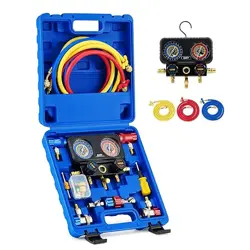
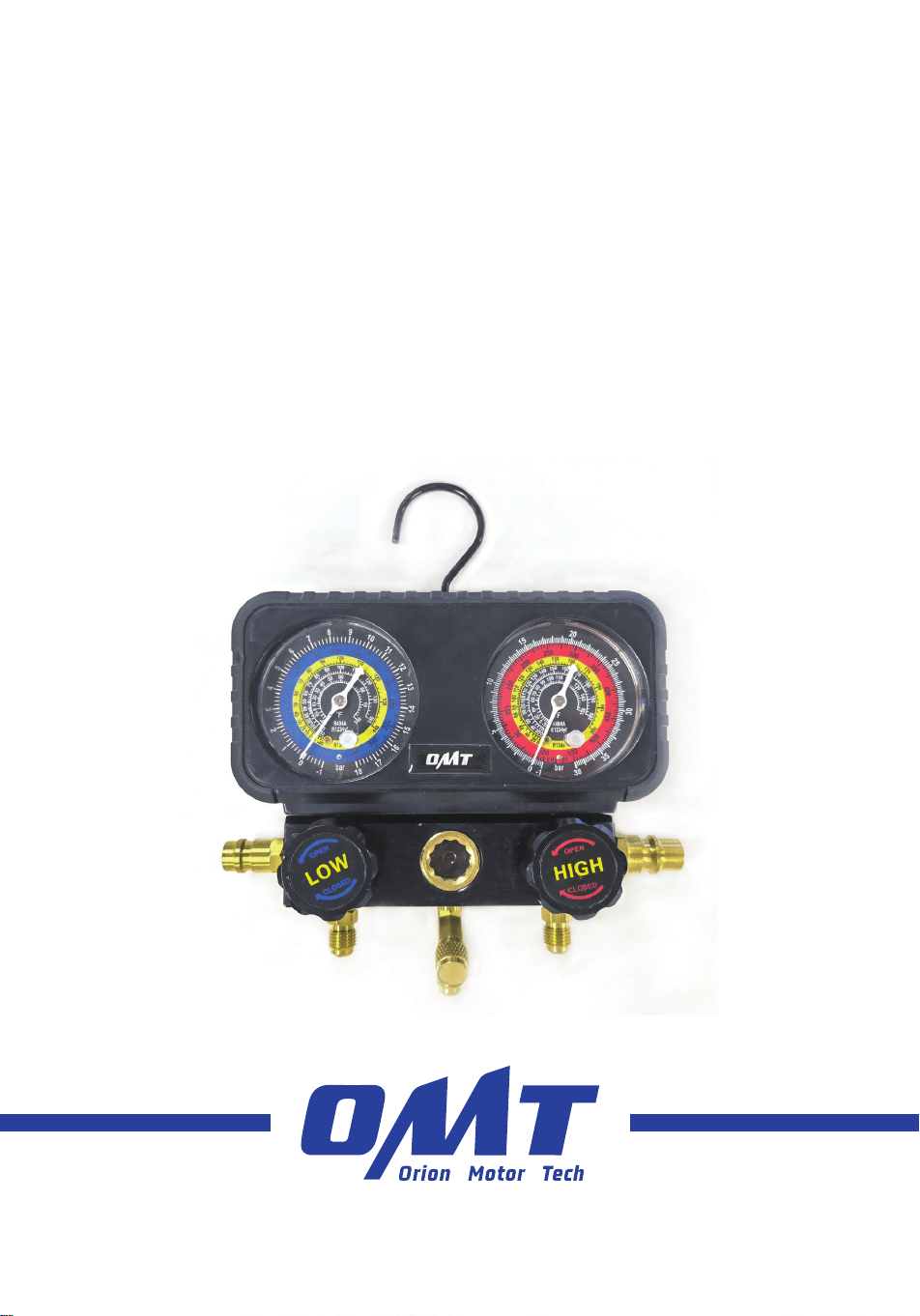
3-Valve Manifold
Gauge Set
User Manual

Contact Us
Thank you for choosing our products! If you have any questions or comments,
contact us and we'll address your issues ASAP!
https://orionmotortech.com
@OrionMotorTech
Disclaimer
Read this disclaimer completely and carefully before
proceeding with the rest of the manual content.
1. Product Modifications
Any modifications or alterations to Orion Motor Tech (OMT)
products void any warranties and may result in damage or
injury. OMT shall not be liable for any damages resulting
from such modifications or alterations.
2. Compliance with Laws
Customers shall be liable for ensuring that the use of
OMT products complies with all applicable laws and
regulations in their respective jurisdictions. OMT shall not
be responsible for any violations of laws or regulations
resulting from the use of OMT products.
3. Correct Use
Always use OMT products only as directed in the
accompanying manuals. Failure to follow instructions may
result in injury or damage.
Always ensure the assembly, installation, operation,
maintenance, or repair of OMT products is carried out by
a competent person.
Regular maintenance should be performed throughout
the lifecycle of OMT products. You are responsible for
ensuring the products operate as intended.
Always wear appropriate protective gear.
4. Third-Party Products
OMT shall not be liable for any damages or losses
resulting from the use of third-party products in
conjunction with OMT products. Customers shall refer to
the third-party's guidelines and/or warranties (if any) for
any third-party products used.
5. Limitation of Liability
OMT shall not be liable for any direct, indirect, punitive,
incidental, special, or consequential damages to property
or life, whatsoever arising out of or connected with the
use or misuse of OMT products. In no event shall OMT’s
liability exceed the value of the products sold.
6. Warranty
Refer to the sales page for warranty information.
This disclaimer states the entire obligation of OMT with
respect to OMT products. If any part of this disclaimer is
determined to be void, invalid, unenforceable, or illegal,
including but not limited to the warranty disclaimers, liability
disclaimers, and liability limitations set forth above, the invalid
or unenforceable provision will be deemed superseded by
a valid and enforceable provision that most closely matches
the intent of the original provision and the remainder of the
agreement shall remain in full force and effect.
1
• Read these instructions carefully before use and keep them for future reference. Provide them to anyone who
will use this product and provide them with this product if it is ever given or sold to a third party. Failure to
do so may result in serious property damage and severe personal injury.
• DO NOT allow use by children, individuals with mental or physical conditions that may impair safe operation,
or persons unfamiliar with this product and its compatible air conditioning, fuel, and transmission systems.
• ALWAYS use with proper personal protective equipment such as a dust mask, goggles, and work gloves
in a well-ventilated place, as these refrigerants can irritate your eyes, nose, throat, and skin or cause
frostbite, heart arrhythmia, unconsciousness, and even death. Additionally, operating your vehicle in a closed
environment may result in carbon monoxide poisoning and other problems.
• If you experience symptoms such as headache, dizziness, or nausea while using this product, turn off the
vehicle and seek fresh air IMMEDIATELY. DO NOT continue working until the vehicle has been relocated to
a well-ventilated area.
• ONLY use the coupler marked HIGH on the HIGH-PRESSURE service port. ONLY use the coupler marked
LOW on the LOW-PRESSURE port. Using those interchangeably may cause severe property damage and
serious personal injuries.
• Turn your air-conditioning (A/C) system off before evacuation.
• ONLY use with R1234yf, R134a, or R404a refrigerant and their matching vehicle A/C systems. DO NOT use
the product with other refrigerants or home A/C systems, which can damage this product and your property.
• DO NOT leave this product unattended during use.
• Maintain this product. Check for misalignment, binding, wear, or other damage before use. If any damage is
detected, repair or replace the problematic components before further use. In a large shop, mark such tools
“DO NOT USE” until they have been repaired. ON LY replace components with identical parts.
• ALWAYS perform leak tests on this product and the A/C system before charging. Address any issues
promptly and ensure the system is completely leak-free before proceeding.
• Use EXTREME caution when disconnecting the hoses after use, as they may still contain pressurized
refrigerant.
• Dress appropriately for automotive servicing. DO NOT wear loose clothing or jewelry. Keep hair, clothing,
gloves, hoses, and tools away from moving parts during use.
• In case of an accident or injury, keep a first aid kit and a communication device (e.g., a phone) readily
available. Be familiar with the location of nearby emergency medical facilities.
• Automotive repair is an inherently dangerous activity. This manual and the separate vehicle service manual
cannot cover all possible situations that may arise. ALWAYS exercise discretion and good judgement. Seek
training if needed.
Safety Information
2
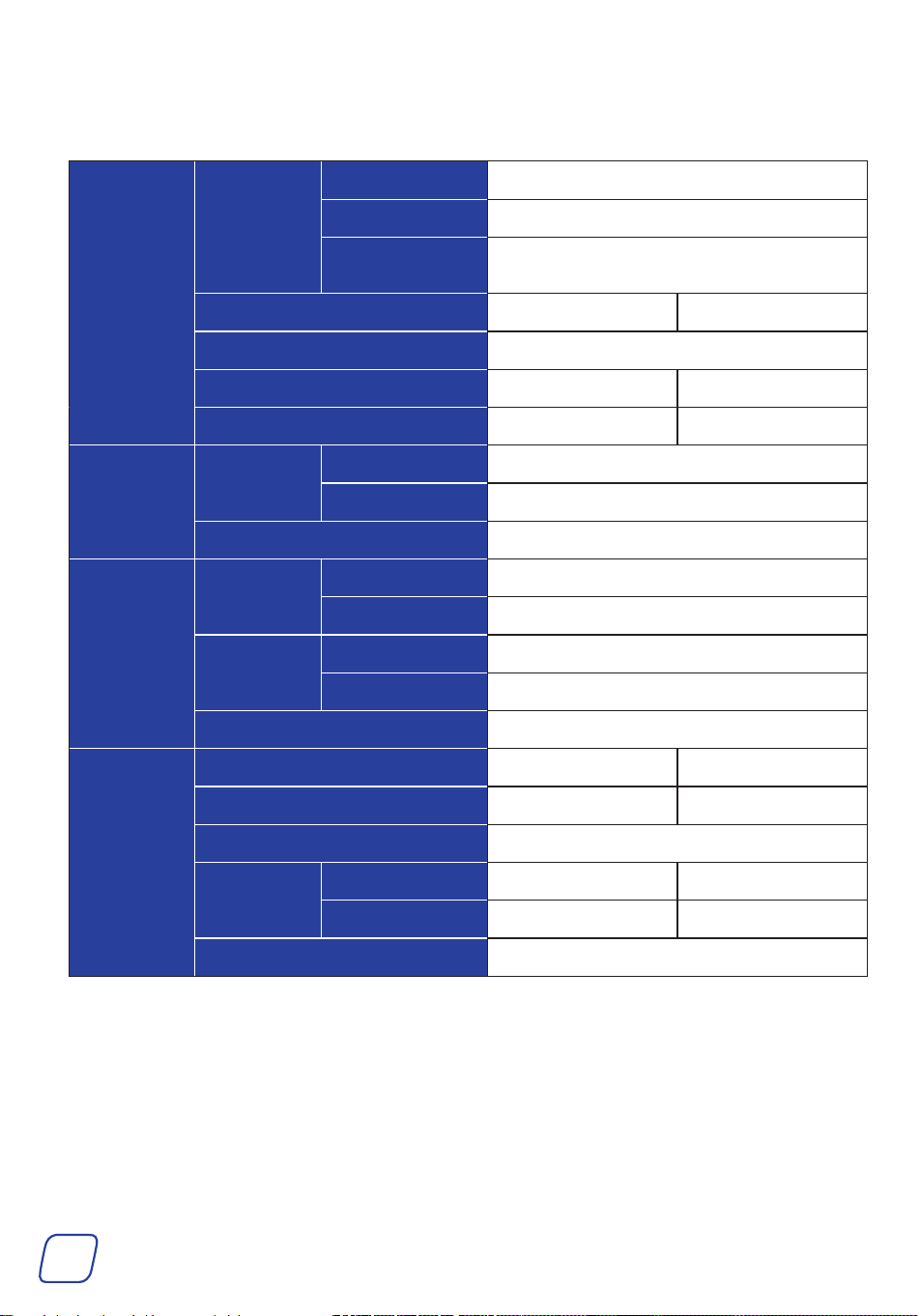
Specifications
* Note:
Negative pressure readings are typically measured in inches of mercury (inHg), which
roughly equate to half the value in pounds per square inch (psi) or 1.3% of the value in
centimeters of mercury (cmHg), kilograms per square centimeter (kg/cm²), or bars.
Hoses
Colors
Low-Pressure Blue
High-Pressure Red
Evacuation/
Charging
Yellow
Total Length 5 ft 1.5 m
Thread Dia. 1/4 in
Working Pressure 600 psi 41 bar
Burst Pressure 3000 psi 206 bar
Quick
Couplers
Colors
Low-Pressure Blue
High-Pressure Red
Thread Dia. 1/4 in
Refrigerant
Can Taps
Colors
R1234yf Blue
R134a Red
Thread Dia.
Male Outlet 1/4 in
Female Inlet 1/2 in
Compatible Can Type Self-Sealing
Gauge Set
Overall Dimensions 7.3 × 6.3 × 2.4 in 18.5 × 16 × 6 cm
Net Weight 1.9 lb 840 g
Port Thread Dia. 1/4 in
Pressure
Capacity
Low-Pressure − 15* to 260 psi − 1 to 18 bar
High-Pressure − 15* to 550 psi − 1 to 38 bar
Acceptable Refrigerants R1234yf, R134a, and R404a
3
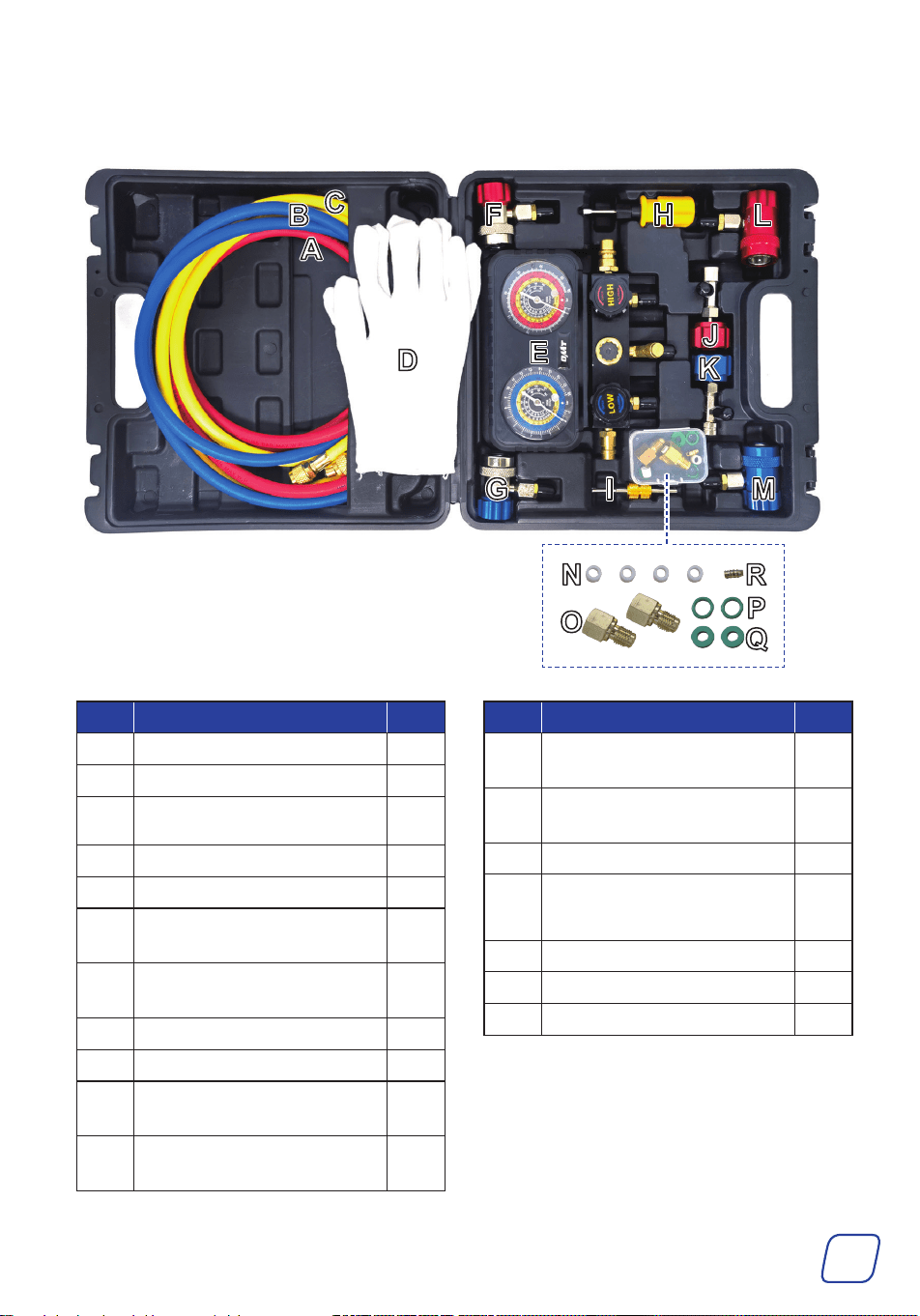
Package List
Item Name Qty.
A High-Pressure Hose (Red) 1
B Low-Pressure Hose (Blue) 1
C
Evacuation/Charging Hose
(Yellow)
1
D Work Gloves 1 Pair
E Gauge Set 1
F
High-Pressure Quick Coupler
(Red, for R134a refrigerant)
1
G
Low-Pressure Quick Coupler
(Blue, for R134a refrigerant)
1
H Dual-Purpose Screwdriver 1
I Valve Core Wrench 1
J
Self-Sealing Can Tap
(Red, for R134a refrigerant)
1
K
Self-Sealing Can Tap
(Blue, for R1234yf refrigerant)
1
Item Name Qty.
L
High-Pressure Quick Coupler
(Red, for R1234yf refrigerant)
1
M
Low-Pressure Quick Coupler
(Blue, for R1234yf refrigerant)
1
N Hose Gaskets 4
O
1/4″ Male to 1/2″ Female
Adapters (Counterclockwise
marked LH and Clockwise)
2
P O-Rings 2
Q Flat Gaskets 2
R Copper Core 1
Not Included but Helpful:
• Micron Gauge
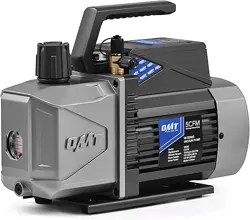
• Vacuum Pump
• Refrigerant Can
• Nitrogen Source
• Dust Masks
• Goggles
• Tape
• Leak Detector
• Soapy Water
4
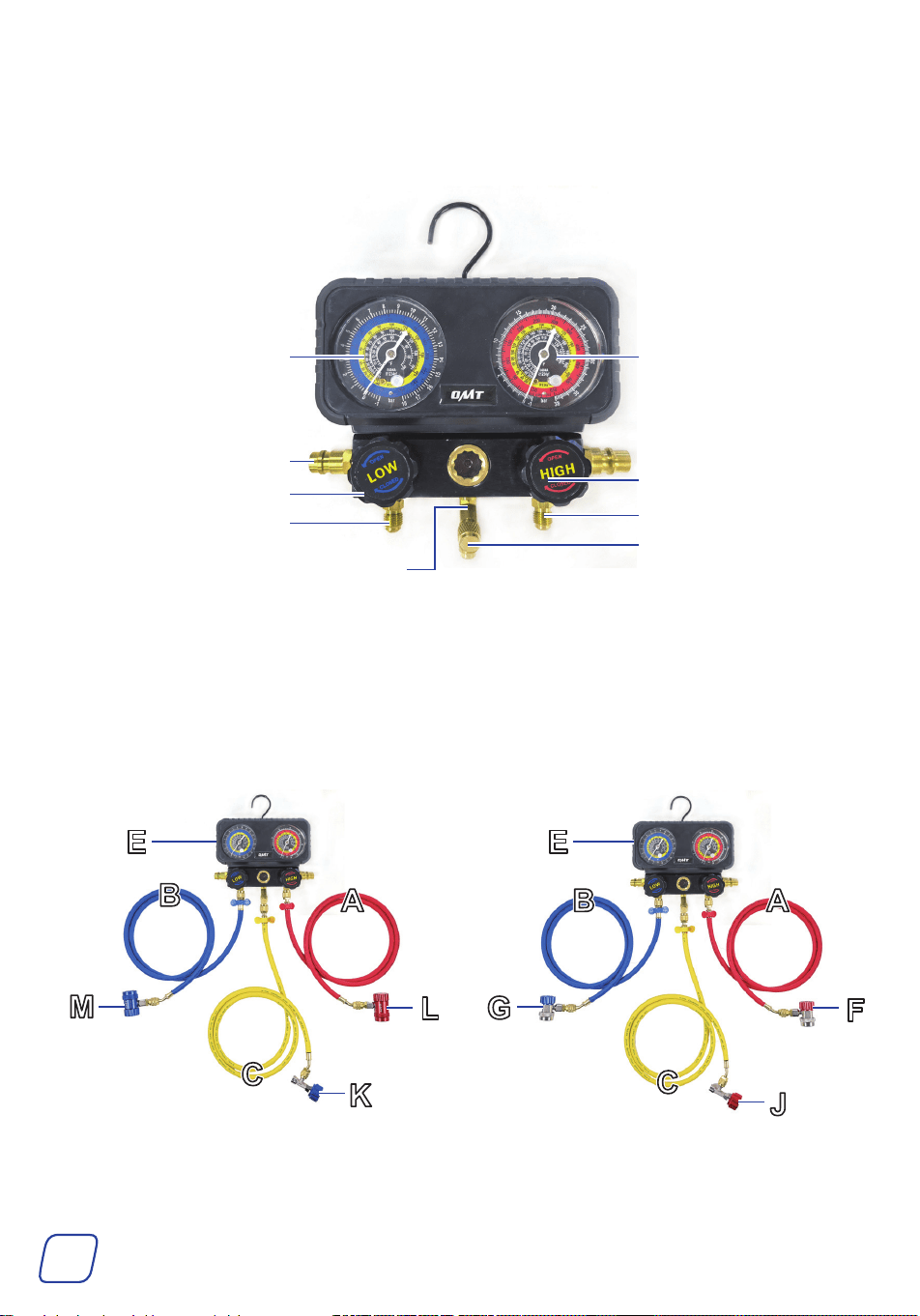
Product Diagram
High-Pressure GaugeLow-Pressure Gauge
Side Holder
Low-Pressure Valve Knob
Low-Pressure Valve Port
Evacuation/Charging Port
High-Pressure Valve Knob
High-Pressure Valve Port
Unloading Valve
For R134a SystemsFor R1234yf Systems
5
Preparation
Refrigerant can irritate your eyes, nose, throat, and skin or cause frostbite, heart arrhythmia,
unconsciousness, and EVEN death.
Using this product with missing, broken, nonidentical, or unauthorized parts WILL pose a
series of safety hazards.
Clearing Your Work Area
Make sure the work area meets the following conditions:
• No children, bystanders, or pets
• Clean and clear of any clutter or dirt that may affect operation or pose safety hazards
• Well-lit and ventilated but adequately protected from the elements
• Free of explosives and sources of heat such as firecrackers and open flames
Putting on Proper PPE
Hand, breathing, and eye protection are required and should meet the standards by ANSI (American
National Standards Institute) or OSHA (Occupational Safety and Health Administration).
The recommended ones include:
• Work Gloves (D)
• Dust Masks
• Goggles
Checking the Product
After unpacking, check that all items are included and undamaged.
If necessary, ask your local dealer or contractor for new identical replacements.
Familiarizing Yourself with Your A/C Systems
For optimal safety, be sure to know your A/C system and take sufficient training before using this
product.
Failures and accidents could happen due to a lack of training.
6
Initial Setup
Connecting the Hoses to the Gauge
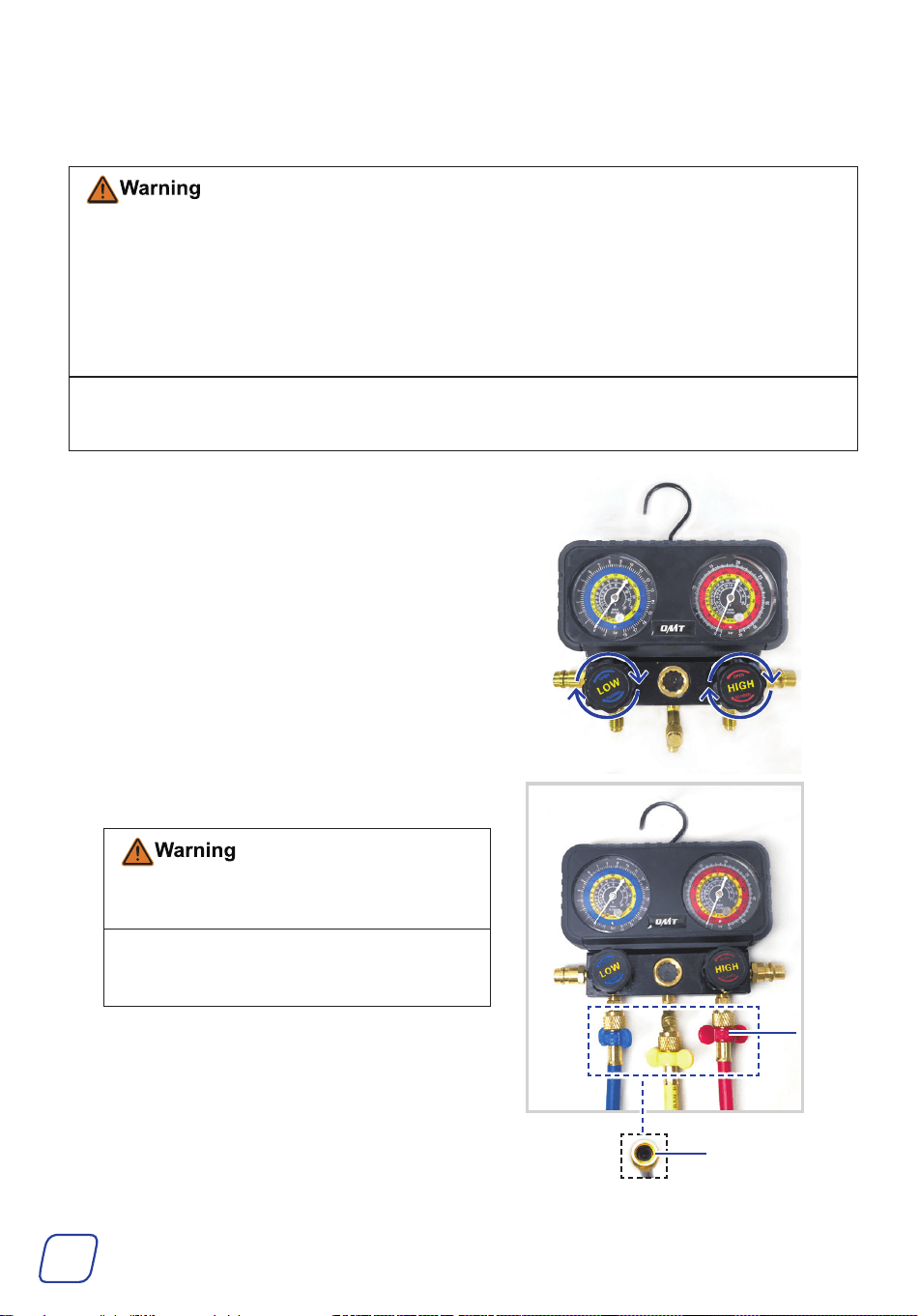
1. Turn the knobs on the gauge set (E) completely
clockwise, FULLY closing its low-pressure (LP)
and high-pressure (HP) valves.
2. Unscrew the valve port caps under the
knobs, connect the provided hoses to the
corresponding ports by hand, and tighten the
connections by hand using the hoses’ locking
nuts. The wrench through the hose helps
tighten the locking nut.
• Connect the blue LP hose (B) to the port below
the LP knob (LOW).
• Connect the red HP hose (A) to the port below
the HP knob (HIGH).
• Connect the yellow evacuation/charging (E/C)
hose (C) to the remaining port in the middle of
the gauge.
• Make sure your surroundings ARE safe for using this product.
Avoid operating in crowded, dark, or cluttered areas. Ensure NO explosives or ignition
sources nearby.
• Be sure that ALL connections ARE tightly secured.
• If working on an HVAC system, check that it has been turned off BEFORE starting work.
Note: Wrapping the threads with tape (not included) before making the connection helps
prevent leaks.
DO NOT mix up the three hoses, as they
are NOT interchangeable.
Note: Use the hose ends WITHOUT
copper cores inside.
Wrench
Locking Nut
7
Connecting the Quick Couplers to the Pressure Hoses
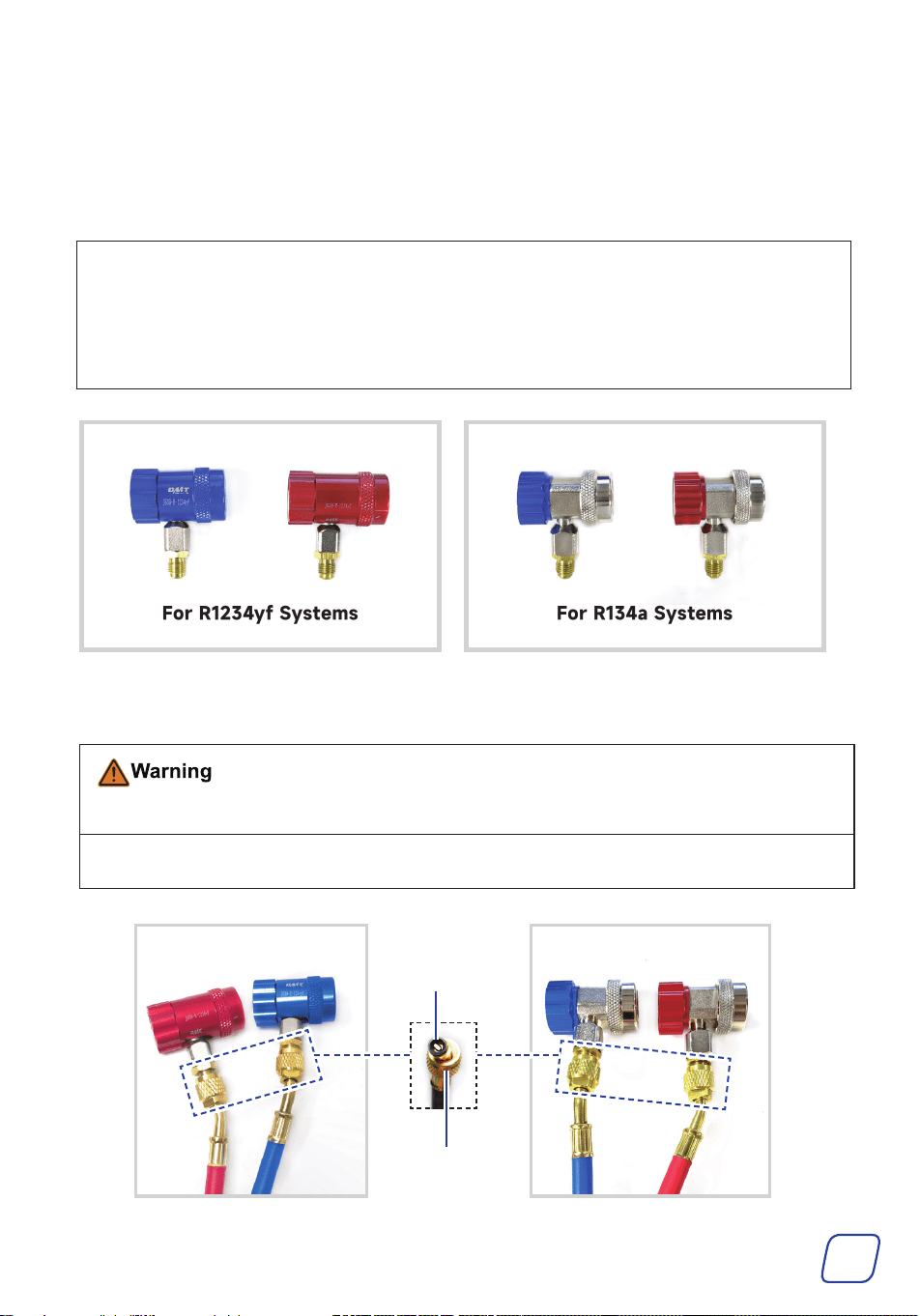
1. Select the quick couplers appropriate for your system.
• Use the couplers marked R1234yf (L and M) for R1234yf refrigerant systems.
• Use the couplers marked R134a (M and N) for R134a refrigerant systems.
2. Connect the blue and red hoses to their identically colored quick couplers, and tighten the
connections by hand using the hoses’ locking nuts.
For R134a SystemsFor R1234yf Systems
DO NOT mix up these hoses and couplers, as they are NOT interchangeable.
Note: Use the hose ends WITH copper cores inside.
Note:
• If your system uses R404a refrigerant, prepare couplers compatible with your system
and hoses.
• ONLY R1234yf, R134a, and R404a are compatible with the gauge set.
Copper Core
Locking Nut
For R134a SystemsFor R1234yf Systems
8
Connecting the Quick Couplers to Your A/C System
1. Hang up the gauge using its hook to ensure
optimal safety, stability, and accessibility during
use.
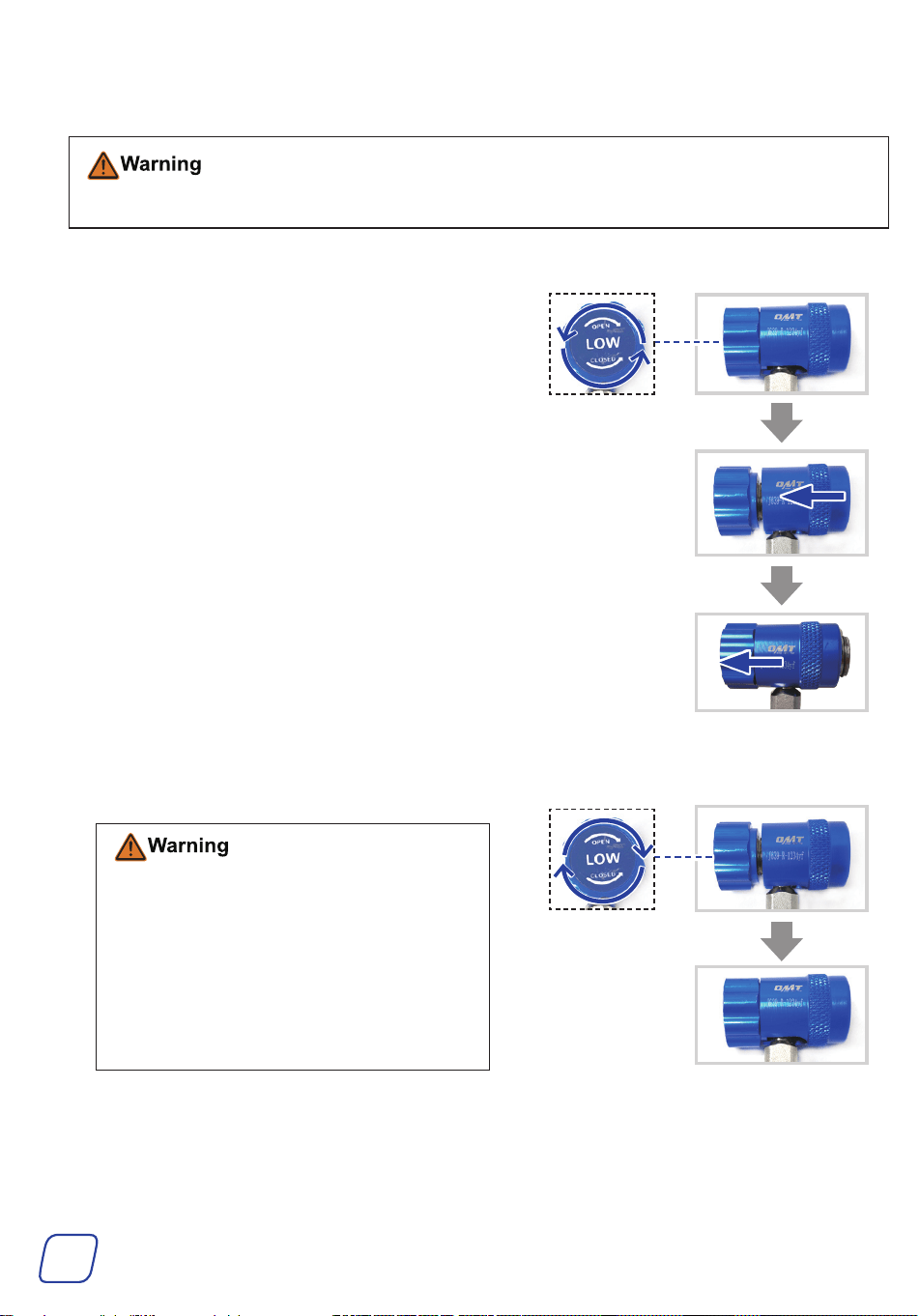
2. Turn the blue and red quick couplers’ knobs
completely counterclockwise.
3. Hold one coupler and pull back the sleeve to
the knob.
4. Push the coupler onto its matching service port
of your A/C system.
5. Release the sleeve to secure the connection.
GENTLY pull the coupler to verify the
connection’s security.
6. Repeat steps 3 − 5 for connecting the other
coupler to the A/C system.
7. Turn the blue and red quick couplers’ knobs
completely clockwise.
• DO NOT connect the two couplers
to the INCORRECT service ports to
prevent system malfunctions and safety
hazards.
• ALWAYS refer to the instructions
and guidelines provided by the
manufacturer of your A/C system for
proper installation procedures.
(Example: R1234yf LP Coupler)
(Example: R1234yf LP Coupler)
Ensure that your A/C system has been turned off.
9
Operation
You can evacuate your A/C system, and then charge it with refrigerant.
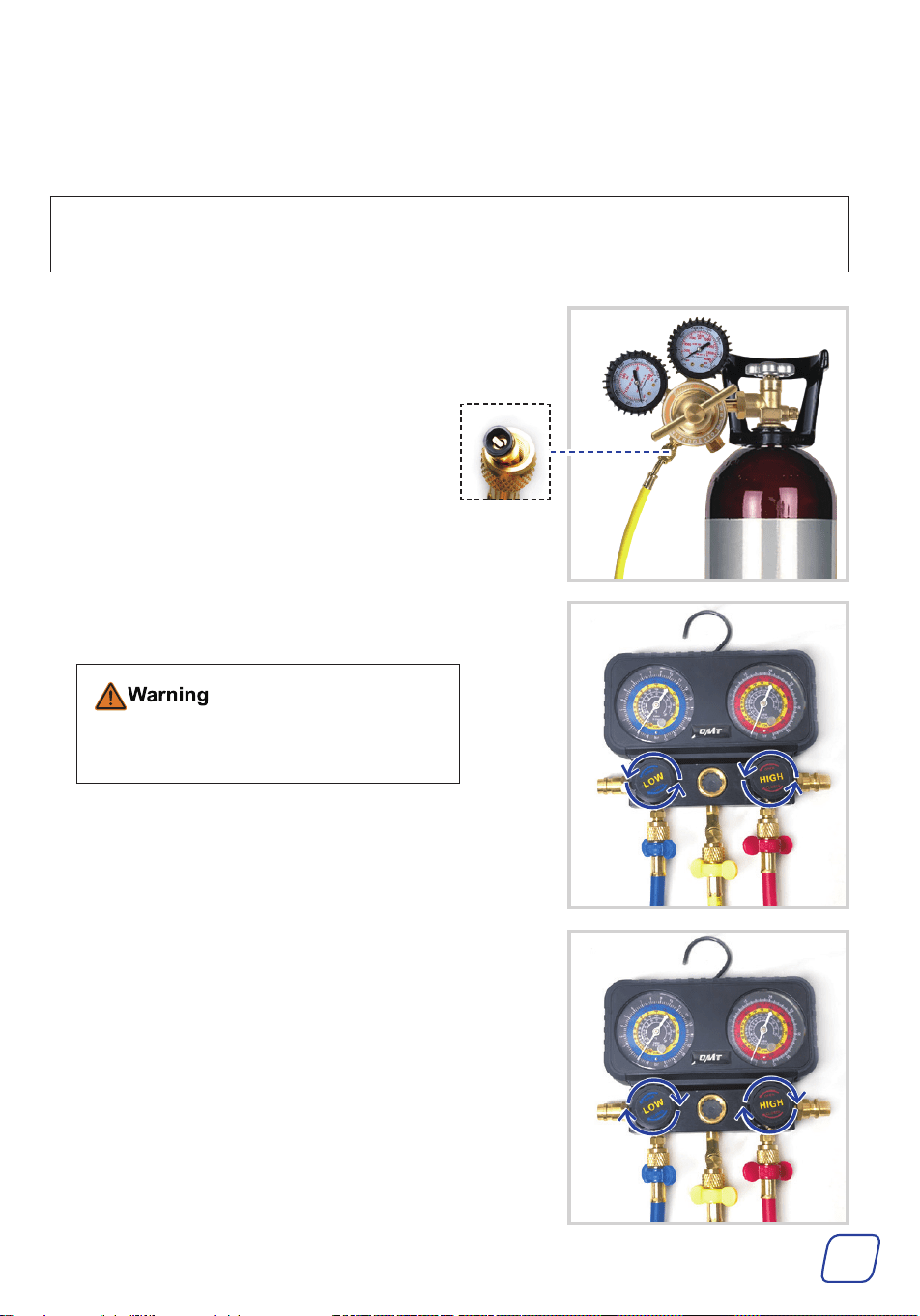
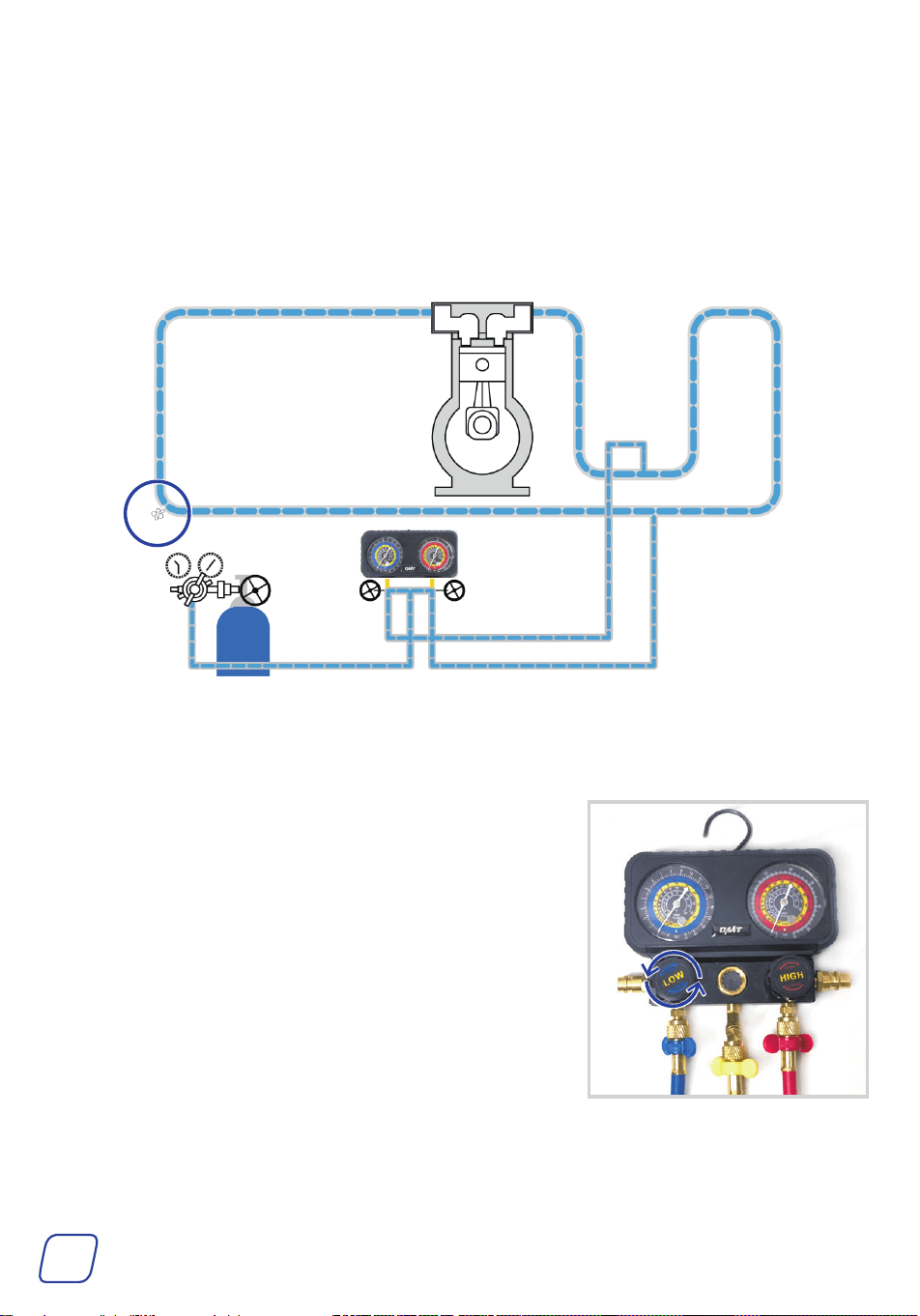
2. Turn on the nitrogen source and set the
pressure value.
3. Open the LP and HP valves by turning their
knobs SLOWLY counterclockwise.
4. Once the gauge set indicates the same
pressure values as the nitrogen source, close
the LP and HP valves by turning their knobs
COMPLETELY clockwise.
Performing Leakage Test
1. Connect the yellow hose WITH a copper core
inside to a nitrogen source (not included).
The pressure value must NOT exceed your
A/C system’s maximum pressure.
Note: Wrapping the threads with tape (not included) before making the connection helps
prevent leaks.
10
5. It is recommended to observe the gauge set for about 15 to 30 minutes to ensure that the
pressure readings remain stable.
If the readings have a significant drop, leakage may exist in the system. Use a leak detector (not
included) to detect leakage and apply soapy water (not included) to locate leakage. Repair or
replace any detected loose joints or worn parts before further use.
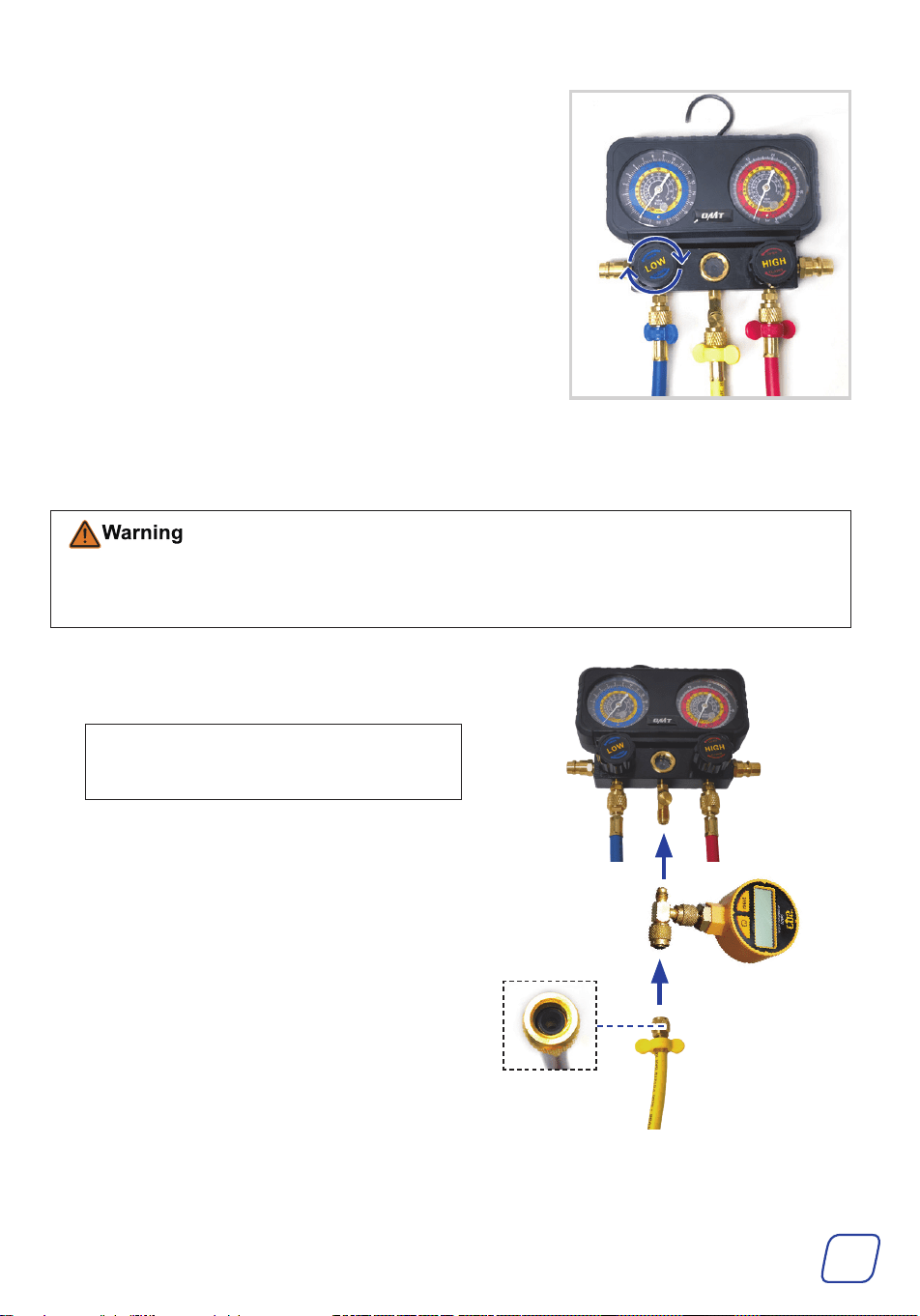
6. If the pressure readings remain stable and
there is no leakage, turn off the nitrogen
source and disconnect the yellow EC hose
from the nitrogen source.
7. Open the LP valve by turning its knob (LOW)
SLOWLY counterclockwise to release the
nitrogen gas.
11
Evacuation
• Again, check that your A/C system has been COMPLETELY turned off.
• DO NOT
vent refrigerant to the atmosphere. Use appropriate recovery equipment.
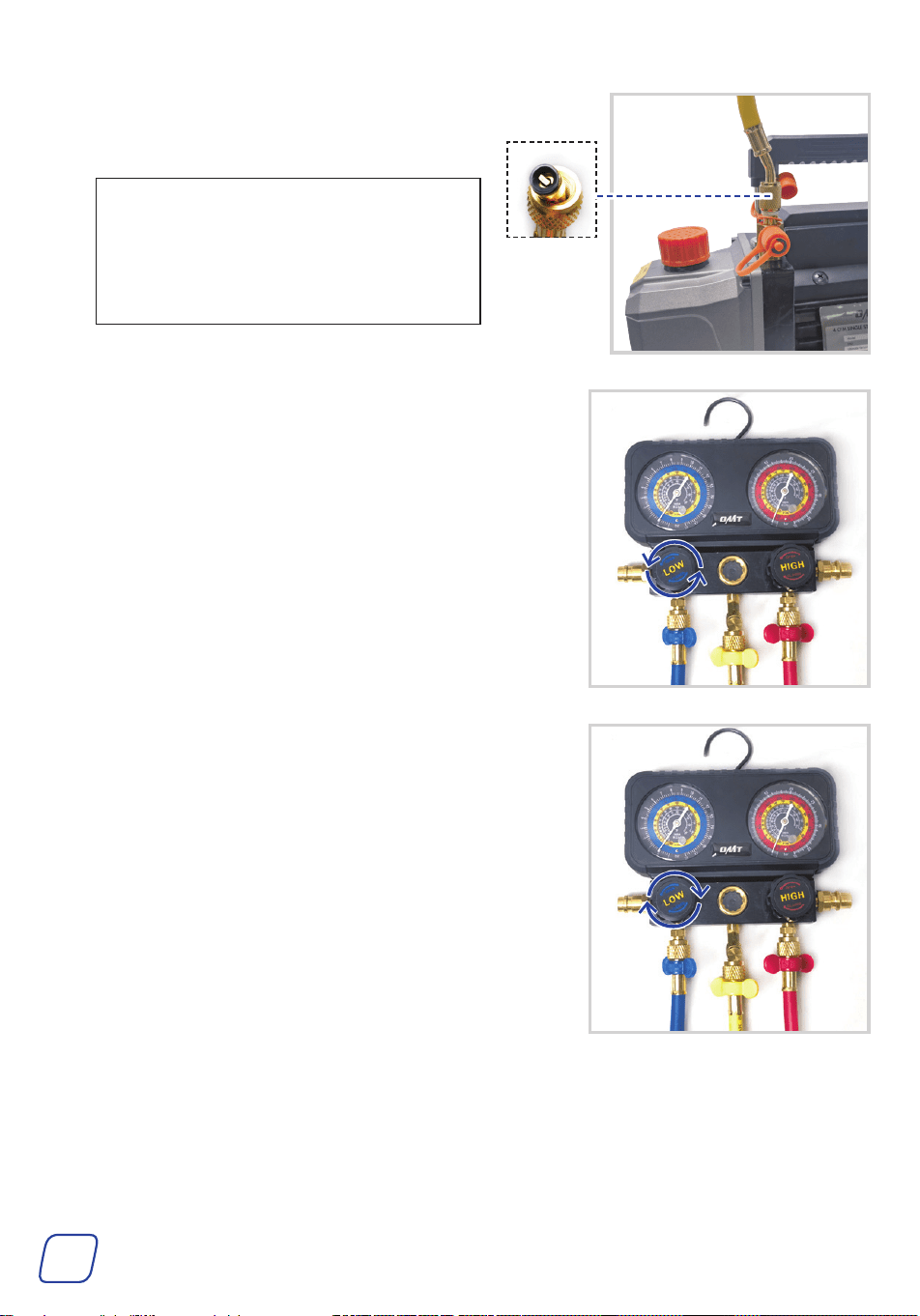
1. Connect a micron gauge (not included) to the
E/C port and the yellow hose.
8. Once the pressure readings indicate 0 psi,
close the LP valve by turning its knob (LOW)
completely clockwise.
Note: Use the hose end WITHOUT a
copper core inside.
12
3. Make sure all connections are tightly joined
and turn the micron gauge on.
4. Open the LP valve by turning its knob (LOW)
completely counterclockwise. Turn on the
pump, and the evacuation begins.
5. When the micron gauge reads less than 500
microns, your A/C system is fully cleared.
Close the LP valve by turning its knob (LOW)
COMPLETELY clockwise and turn off the
pump.
6. Disconnect the micron gauge from the gauge set and the yellow hose. Disconnect the yellow
hose from the pump.
2. Connect the other end of the yellow hose to a
vacuum pump (not included) using its copper
core end.
Note:
If the port of your pump does not fit
the hose’s 1/4 ″ threads, use the provided
1/4 ″ male to 1/2 ″ female adapter (O) or
other suitable adapter to complete the
connection.
13
Charging
• ALWAYS keep your refrigerant cans away from heat sources and direct sunlight.
• Be sure NOT to open your refrigerant cans by accident in ANY way.
• Ensure that BOTH valves on the gauge ARE completely closed BEFORE starting work.
• NEVER leave your refrigerant cans or the gauge unattended when charging A/C systems.
• ALWAYS wear proper PPE when disconnecting the couplers and hoses after charging is
complete, as they may contain some refrigerant under pressure.
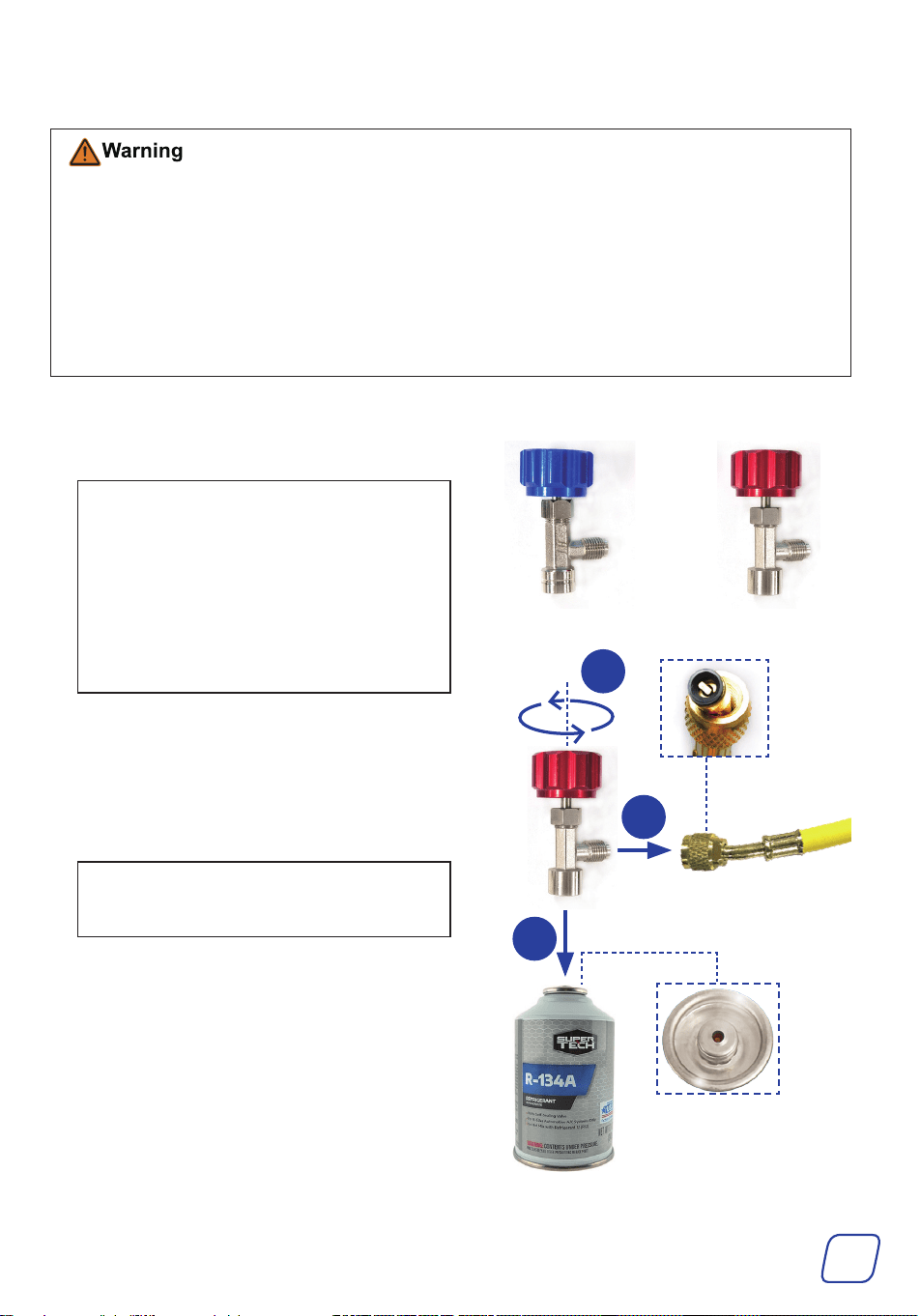
1. Choose a provided self-sealing can tap (J or
K) for your refrigerant can as you need.
2. Check that the tap has been closed
by turning its knob COMPLETELY
counterclockwise. Connect the outlet of the
tap to the yellow hose and its inlet to your
refrigerant can.
For R1234yf Refrigerant
(Example: R134a Refrigerant)
For R134a Refrigerant
Note:
Use the hose end WITH a copper
core inside.
Note:
• Use the red tap (J) for R134a
refrigerant cans. Use the blue tap (K)
for R1234yf refrigerant cans.
• Some big refrigerant cans are
equipped with taps to regulate the
flow of refrigerant.
a
b
c
14
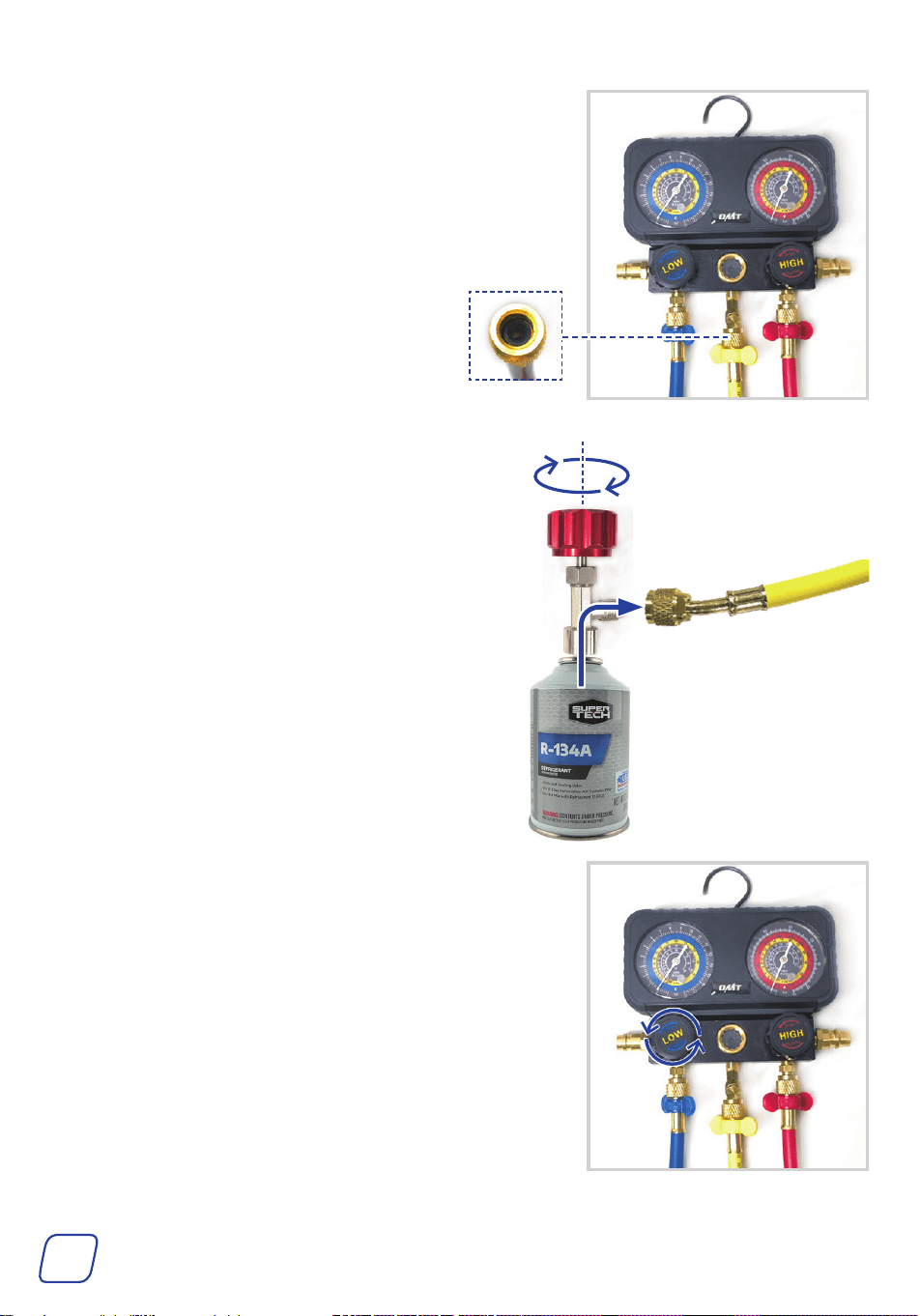
3. Connect the yellow hose to the E/C port of
the gauge set using the hose end WITHOUT
a copper core inside.
4. Turn the knob clockwise to allow the
refrigerant to flow through the hose.
5. Open the LP valve by turning its knob (LOW)
completely counterclockwise and charging
begins.
(Example: R134a Refrigerant)
15
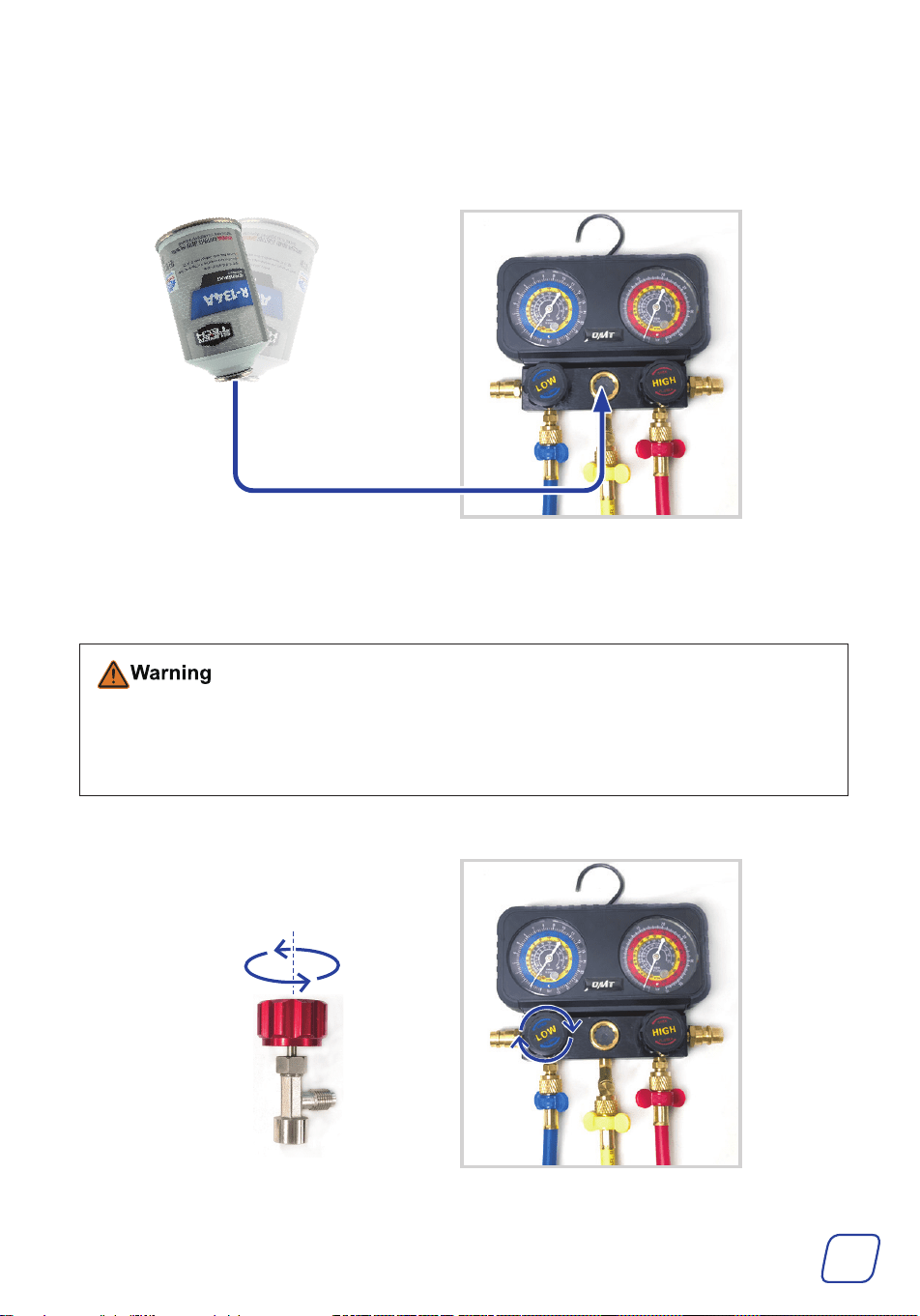
6. To check if the small refrigerant can is empty, invert the can and GENTLY shake it. If
refrigerant is visible from the glass window, there is still some refrigerant left in the can.
7. To change the small empty refrigerant can, you MUST close the LP valve by turning its
knob COMPLETELY clockwise and the tap’s knob COMPLETELY counterclockwise before
reconnecting a new refrigerant can.
(Example: R134a Refrigerant)
(Example: R134a Refrigerant)
• NEVER discard discarded refrigerant cans at will or put them in ordinary trash cans.
• Discarded refrigerant cans MUST be disposed of in accordance with local waste
disposal regulations.
16
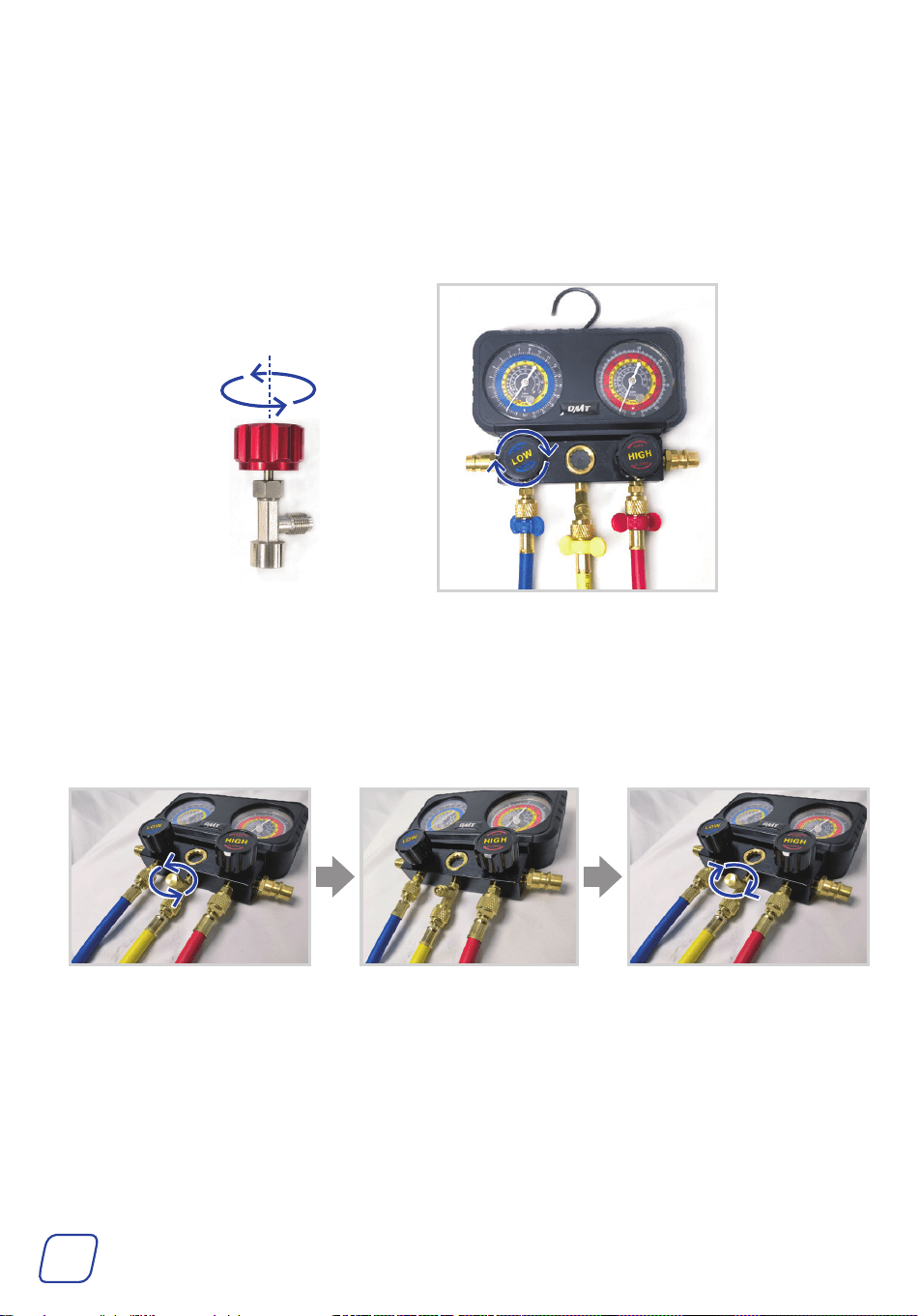
8. Consult your A/C system’s specifications to find its recommended pressure, usually between
25–80 psi (1.7–5.5 bars).
9. Once the system reaches the recommended pressure, stop charging the system by turning
the tap knob COMPLETELY counterclockwise and turning the LP valve knob (LOW)
COMPLETELY clockwise.
12. Disconnect the hoses from the quick couplers, the tap, and the gauge set.
13. Keep the tap securing on the partially used refrigerant can, or disconnect it from the empty
can or the self-sealing can.
10. Disconnect the two quick couplers from your A/C system and take down the gauge set.
11. Open the unloading valve by unscrewing its cap to clear any air or vapor remaining inside the
gauge set. Confirm that the pressure readings indicate 0 psi, and then tighten the cap into
place.
(Example: R134a Refrigerant)
17
Maintenance
Troubleshooting
• NEVER scrape the hose or drop the gauge set on hard or rough surfaces.
• Check the parts for misalignment, cracks, and any other conditions that may affect the operation
accuracy before use.
• If any gasket, O-ring, or copper core in the preinstalled refrigerant cap tap, quick coupler, or any
hose is damaged or worn, replace it with its spare part (N, P, Q, or R) using the valve core wrench
(I) and/or dual-purpose screwdriver (H). If any other part of the gauge set is damaged or worn,
have it repaired or replaced before further use.
• Clean the exterior of the gauge set and hoses with a soft damp cloth using a mild detergent or
solvent. DO NOT use harsh abrasives or caustic chemicals.
• Store the gauge set in a clean dry place inaccessible to children and away from direct sunlight
after use.
Problems Solutions
Pressure readings are unstable or
fluctuating.
Check all connections and seals for leaks. Ensure stable
ambient temperature conditions.
The gauge set displays abnormally
high or low readings.
Check if ambient temperature is affecting the readings.
Inspect for any pressure leaks.
User Manual
Rev. 27 Jun. 2025