
GT15M-IH
INSTALLATION INSTRUCTIONS
Mounting Considerations
• The transducer should be mounted over solid fiberglass hulls only, up to 16 mm (
5
/
8
in.) thickness.
• On single thickness fiberglass hulls, the transducer should be mounted in the bilge area near the keel and
transom.
• The transducer should not be mounted aft of the water pickup and other protrusions.
• The transducer should not be mounted over a strake.
• The transducer should be mounted over solid fiberglass, with no dead air space or coring in the boat hull.
• The transducer should be mounted as flat as possible in the boat hull.
• You can refer to the Transducer Placement Guide at garmin.com/manuals/gt15mih for more information
about transducer placement.
Tools Needed
• #1 Phillips screwdriver
• 220-grit sandpaper
• Marine-grade adhesive suitable for the mounting location material
• RV/marine antifreeze fluid or mineral oil
• Rubbing alcohol
Deadrise Angle
Deadrise is the angle formed between a horizontal line and a boat hull at a single point. You can measure the
deadrise angle with a smartphone application, an angle finder, a protractor, or a digital level. You can also ask
your boat manufacturer for the deadrise angle of the specific point on your boat hull.
NOTE: A boat may have several deadrise angles depending on the shape of the hull. Measure the deadrise angle
only at the location where you plan to install the transducer.
In-Hull Tank Considerations
• On a boat hull with a deadrise angle between 0 and 3 degrees, you must install the tank labeled 0°.
• On a boat hull with a deadrise angle between 4 and 8 degrees, you must install the tank labeled 5°.
• On a boat hull with a deadrise angle between 9 and 16 degrees, you must install the tank labeled 12°.
• On a boat hull with a deadrise angle between 17 and 25 degrees, you must install the tank labeled 20°.
GUID-207A1A37-3DE8-4599-8C50-1FC69CCA701F v6December 2023
Testing the Mounting Location
Before you permanently mount the transducer, you should test the transducer feedback at your mounting
location with the boat in the water. You should compare the transducer feedback at your mounting location to
the transducer feedback when the bottom of the transducer is submerged outside the boat.
1 Place the transducer inside a thin plastic bag.
2 Fill the bag with enough water to cover the bottom of the transducer, and secure the bag with a zip tie.
3 Wet the surface of the hull.
4 Place the bagged transducer on the mounting location.
5 Observe the feedback of the transducer on your chartplotter or fishfinder.
6 If the transducer does not function as expected, select a new mounting location and repeat steps 3 through
5.
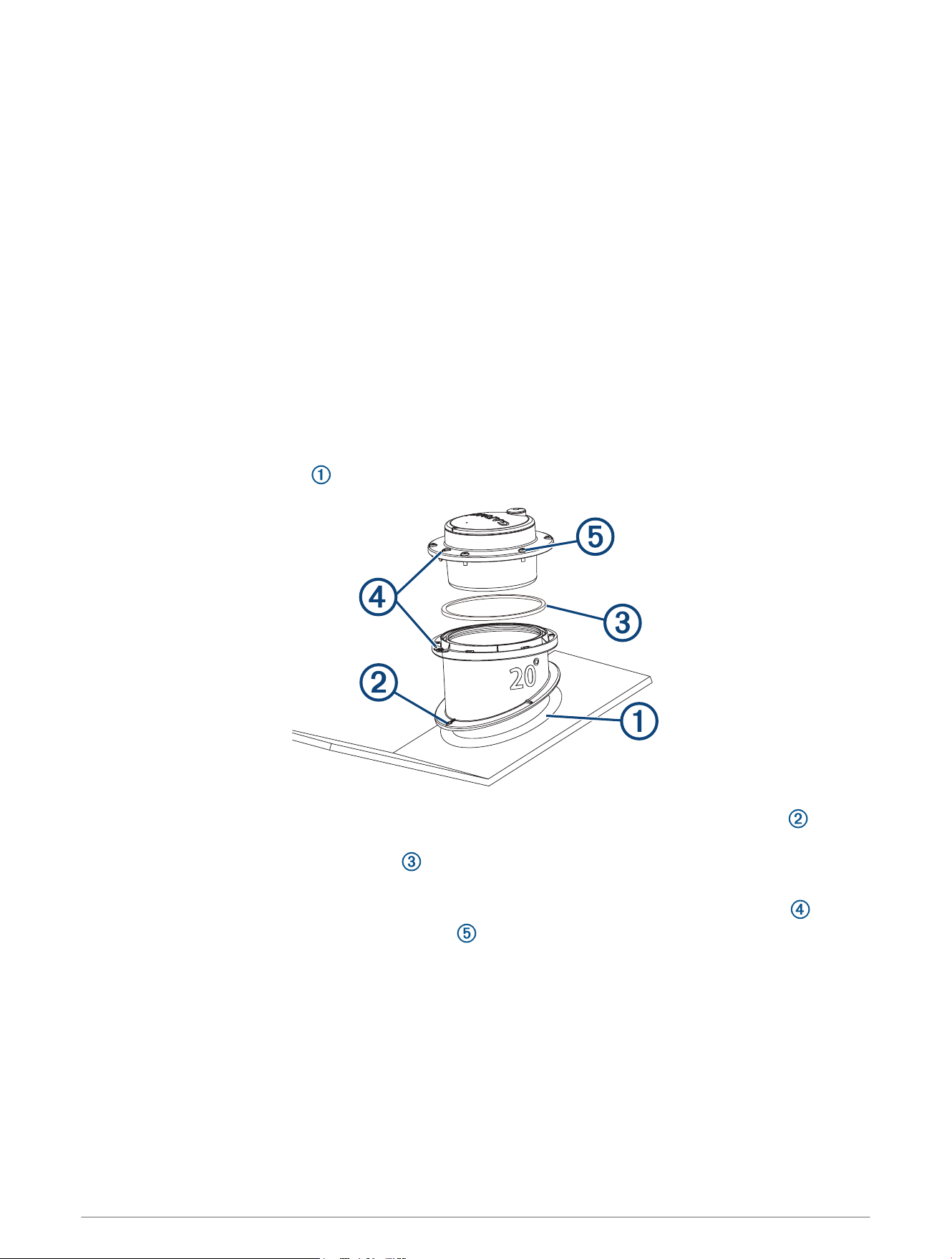
Installing the In-Hull Tank and Transducer
Before you install the in-hull tank and transducer, you must figure the deadrise angle (Deadrise Angle, page1),
and select the tank that provides the most-level installation of the transducer.
1 Sand the tested mounting location (Testing the Mounting Location, page2) with 220-grit sandpaper.
2 Clean the tested mounting location with alcohol.
3 Apply marine-grade adhesive to the bottom of the tank.
4 Place the tank in the boat hull with the top of the tank level with the water line, and with the arrow pointing
to the boat keel.
5 When the adhesive is dry, insert the O-ring in the groove of the tank.
6 Fill the tank with RV/marine antifreeze fluid or mineral oil.
7 Insert the transducer into the tank, aligning the arrow on the transducer and the notch on the tank
8 Using the enclosed screws, secure the transducer to the tank.
NOTE: Do not overtighten the screws.
9 Route the cable, and connect the transducer to your chartplotter or fishfinder.
2

Specifications
Specification Measurement
Transmit power 600W (RMS)
Maximum depth
1
549m (1800ft.)
Frequencies
2
From 85 to 165kHz
Operating temperature range From 0° to 50°C (from 32° to 122°F)
Storage temperature range From -40° to 70°C (from -40° to 158°F)
© 2015 Garmin Ltd. or its subsidiaries
Garmin
®
and the Garmin logo are trademarks of Garmin Ltd. or its subsidiaries, registered in the USA and other countries. These trademarks may not be used without the
express permission of Garmin.
1
Dependent upon the water conditions.
2
Dependent upon the chartplotter or fishfinder model.
3