Form No. 3478-1 17 Rev A
Crumber Kit
Compact T ool Carrier
Model No. 22464
Installation Instructions
W ARNING
CALIFORNIA
Proposition 65 W arning
Use of this product may cause exposure
to chemicals known to the State of
California to cause cancer , birth defects,
or other reproductive harm.
Safety
Safety and Instructional
Decals
Safety decals and instructions are
easily visible to the operator and are
located near any area of potential
danger . Replace any decal that is
damaged or missing.
decal1 15-1497
1 15-1497
1. Crushing hazard of hand; crushing hazard of foot—keep
bystanders away from the machine; keep away from
moving parts.
decal133-8061
133-8061
Installation
W ARNING
Contact with moving parts can result in
personal injury .
• Keep your ngers, hands, and clothing
away from moving parts.
• Never attempt to manipulate the attachment
while the engine is running.
Installing the Crumber
1. Park the machine on a level surface, engage
the parking brake (if equipped), and lower the
loader arms.
2. Shut of f the engine and remove the key .
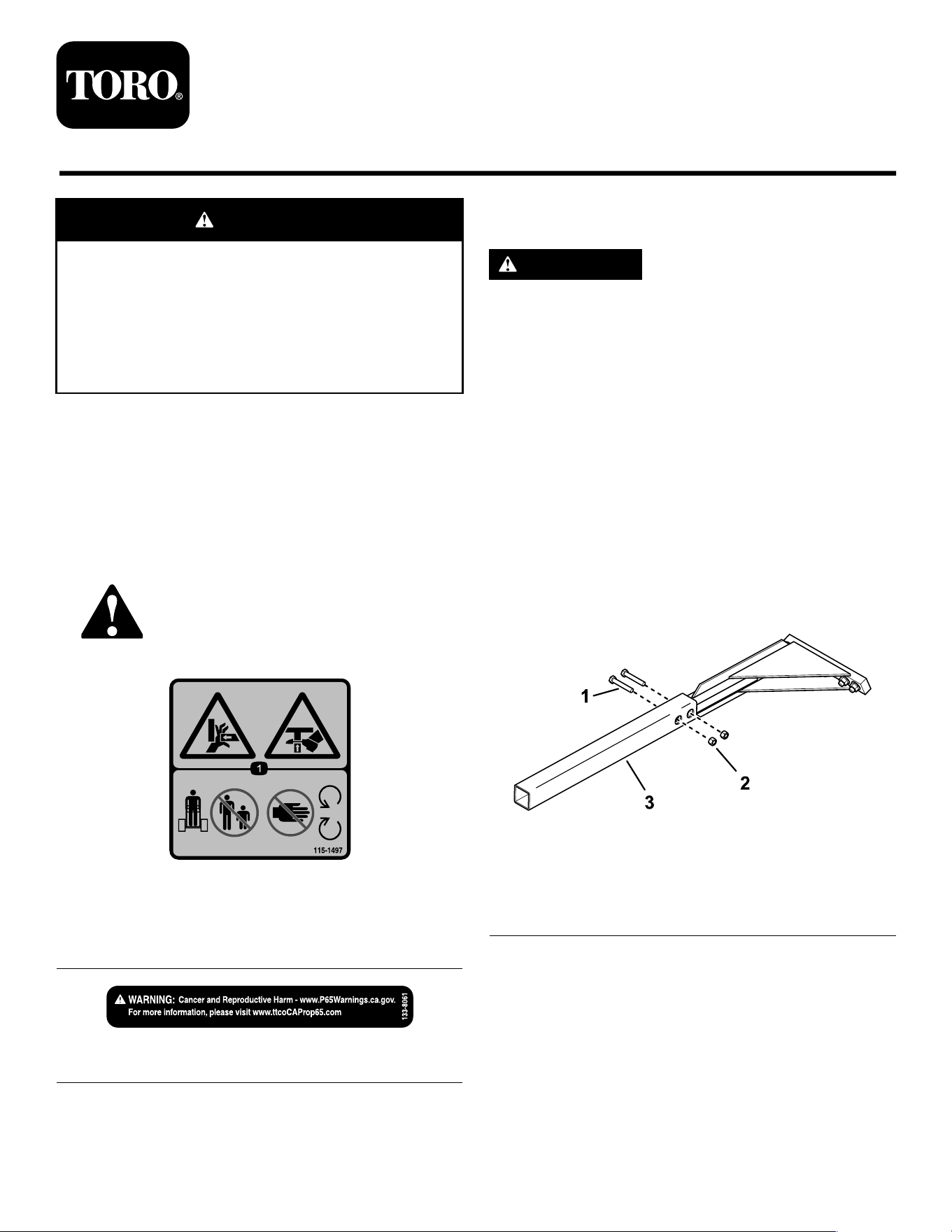
3. If a safety-bar extension is installed on the rail
assembly , remove it.
g569916
Figure 1
Safety-bar extension for 91 cm (3 ft) boom shown.
1. Bolt—1/2 x 3 inches (2) 3. Safety-bar extension
2. Nut—1/2 inch (2)
© 2025—The T oro® Company
81 1 1 L yndale A venue South
Bloomington, MN 55420 Register at www .T oro.com.
Original Instructions (EN)
Printed in the USA
All Rights Reserved
*3478-117*
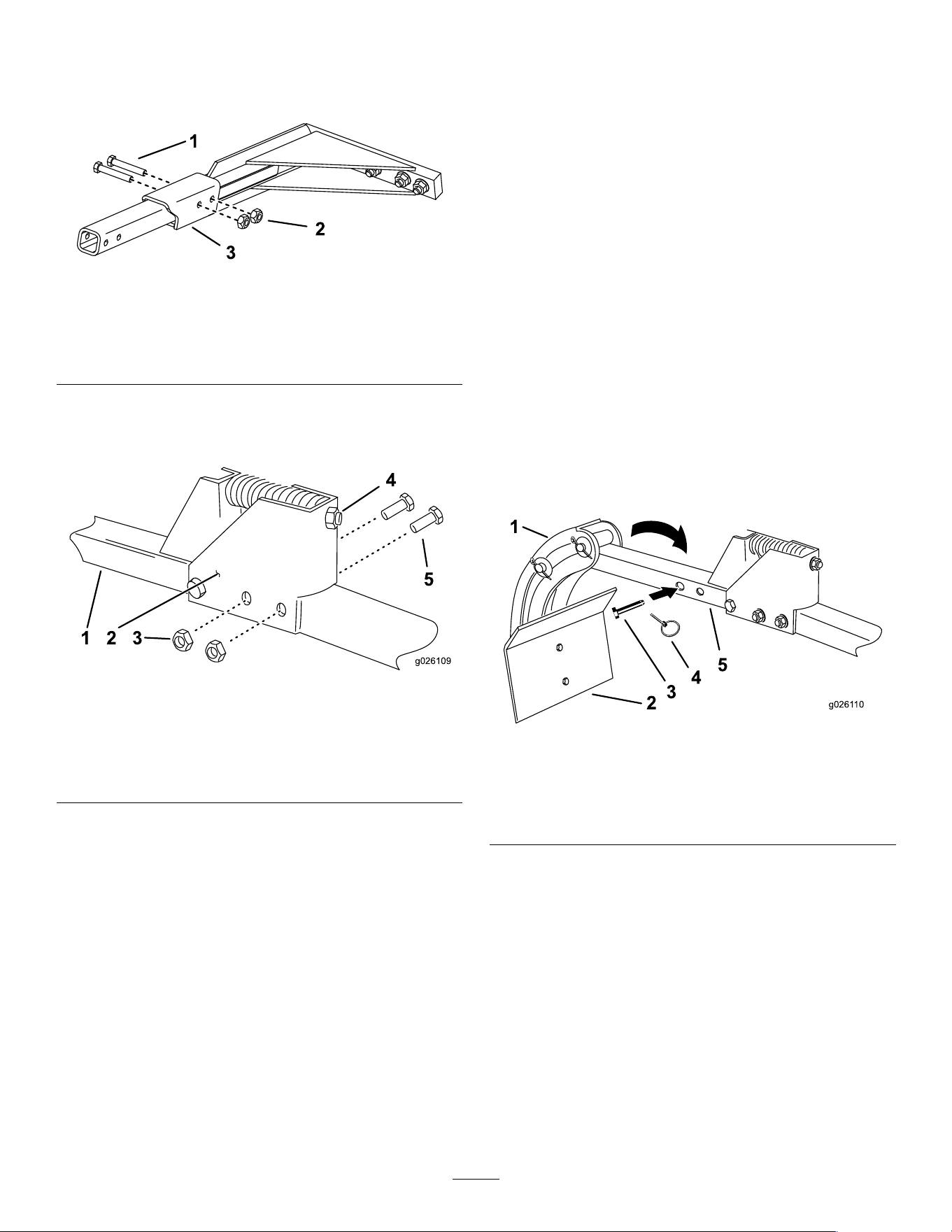
4. Install the crumber-extension bar (supplied
with the boom) over the end of the safety-rail
assembly and secure it using the 2 bolts and
locknuts.
g244620
Figure 2
Crumber-extension bar for 91 cm (3 ft) boom shown.
1. Bolt—1/2 x 3 inches (2) 3. Crumber-extension bar
2. Nut—1/2 inch (2)
5. Install the crumber-mounting bracket over the
end of the crumber-extension bar , and secure it
using 2 bolts and 2 nuts.
g026109
Figure 3
1. Crumber
4. Adjusting nut
2. Crumber-mounting
bracket
5. Bolt (2)
3. Nut (2)
Operation
Adjusting the Crumber
Adjust the crumber so that the crumber blade is
within 3.8 to 6.35 cm (1-1/2 to 2-1/2 inches) from
the trencher teeth. T o adjust the crumber , loosen or
tighten the adjustment nut as needed ( Figure 3 ).
T ransporting the Crumber
Before transporting the trencher with the crumber
attached, complete the following procedure:
1. Park the machine on a level surface, engage
the parking brake (if equipped), and lower the
loader arms.
2. Shut of f the engine and remove the key .
3. Remove the cotter pin and cotter pin stored in
the crumber bar .
4. Slide the crumber back as far as possible
( Figure 4 ).
g0261 10
Figure 4
1. Crumber slide 4. Cotter pin
2. Scraper 5. Crumber bar
3. Clevis pin
5. Install the clevis pin through the crumber slide
and bar , securing it with the cotter pin ( Figure 4 ).
2

Changing the Scraper
The scraper ( Figure 4 ) installed on the crumber must
correspond to the width of the trencher chain. T o
replace the scraper that is on the crumber , remove the
2 bolts and 2 nuts securing the scraper , then install
the new scraper in its place.
Note: The scrapers are slightly narrower than the
chains with which they should be paired. For example,
the 6-inch scraper is actually 5-1/2 inches wide but is
intended to be used with the 6-inch trencher chain.
3

California Proposition 65 W arning Information
What is this warning?
Y ou may see a product for sale that has a warning label like the following:
W ARNING: Cancer and Reproductive Harm—www .p65W arnings.ca.gov .
What is Prop 65?
Prop 65 applies to any company operating in California, selling products in California, or manufacturing products that may be sold in or brought into
California. It mandates that the Governor of California maintain and publish a list of chemicals known to cause cancer , birth defects, and/or other
reproductive harm. The list, which is updated annually , includes hundreds of chemicals found in many everyday items. The purpose of Prop 65 is to
inform the public about exposure to these chemicals.
Prop 65 does not ban the sale of products containing these chemicals but instead requires warnings on any product, product packaging, or literature with
the product. Moreover , a Prop 65 warning does not mean that a product is in violation of any product safety standards or requirements. In fact, the
California government has claried that a Prop 65 warning “is not the same as a regulatory decision that a product is ‘safe’ or ‘unsafe.’” Many of these
chemicals have been used in everyday products for years without documented harm. For more information, go to https://oag.ca.gov/prop65/faqs-view-all .
A Prop 65 warning means that a company has either (1) evaluated the exposure and has concluded that it exceeds the “no signicant risk level”; or (2)
has chosen to provide a warning based on its understanding about the presence of a listed chemical without attempting to evaluate the exposure.
Does this law apply everywhere?
Prop 65 warnings are required under California law only . These warnings are seen throughout California in a wide range of settings, including but not
limited to restaurants, grocery stores, hotels, schools, and hospitals, and on a wide variety of products. Additionally , some online and mail order
retailers provide Prop 65 warnings on their websites or in catalogs.
How do the California warnings compare to federal limits?
Prop 65 standards are often more stringent than federal and international standards. There are various substances that require a Prop 65 warning
at levels that are far lower than federal action limits. For example, the Prop 65 standard for warnings for lead is 0.5 μg/day , which is well below
the federal and international standards.
Why don’t all similar products carry the warning?
• Products sold in California require Prop 65 labelling while similar products sold elsewhere do not.
• A company involved in a Prop 65 lawsuit reaching a settlement may be required to use Prop 65 warnings for its products, but other companies
making similar products may have no such requirement.
• The enforcement of Prop 65 is inconsistent.
• Companies may elect not to provide warnings because they conclude that they are not required to do so under Prop 65; a lack of warnings for a
product does not mean that the product is free of listed chemicals at similar levels.
Why does T oro include this warning?
T oro has chosen to provide consumers with as much information as possible so that they can make informed decisions about the products they buy and
use. T oro provides warnings in certain cases based on its knowledge of the presence of one or more listed chemicals without evaluating the level of
exposure, as not all the listed chemicals provide exposure limit requirements. While the exposure from T oro products may be negligible or well within the
“no signicant risk” range, out of an abundance of caution, T oro has elected to provide the Prop 65 warnings. Moreover , if T oro does not provide these
warnings, it could be sued by the State of California or by private parties seeking to enforce Prop 65 and subject to substantial penalties.
Rev A