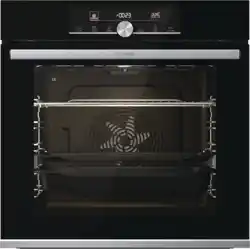
INSTRUCTIONS FOR USE
OF A BUILT-IN OVEN
We thank you for your trust and the purchase of our appliance.
This detailed instruction manual is supplied to make the use of this product easier. The
instructions should allow you to learn about your new appliance as quickly as possible.
Make sure you have received an undamaged appliance. If you do find transport damage,
please contact the seller from which you purchased the appliance, or the regional
warehouse from which it was supplied. The telephone number can be found on the
invoice or on the delivery note.
Instructions for installation and connection are supplied on a separate sheet.
Carefully read the instructions for use before connecting the appliance. Repair or any
warranty claim resulting from incorrect connection or use of the appliance shall not be
covered by the warranty.
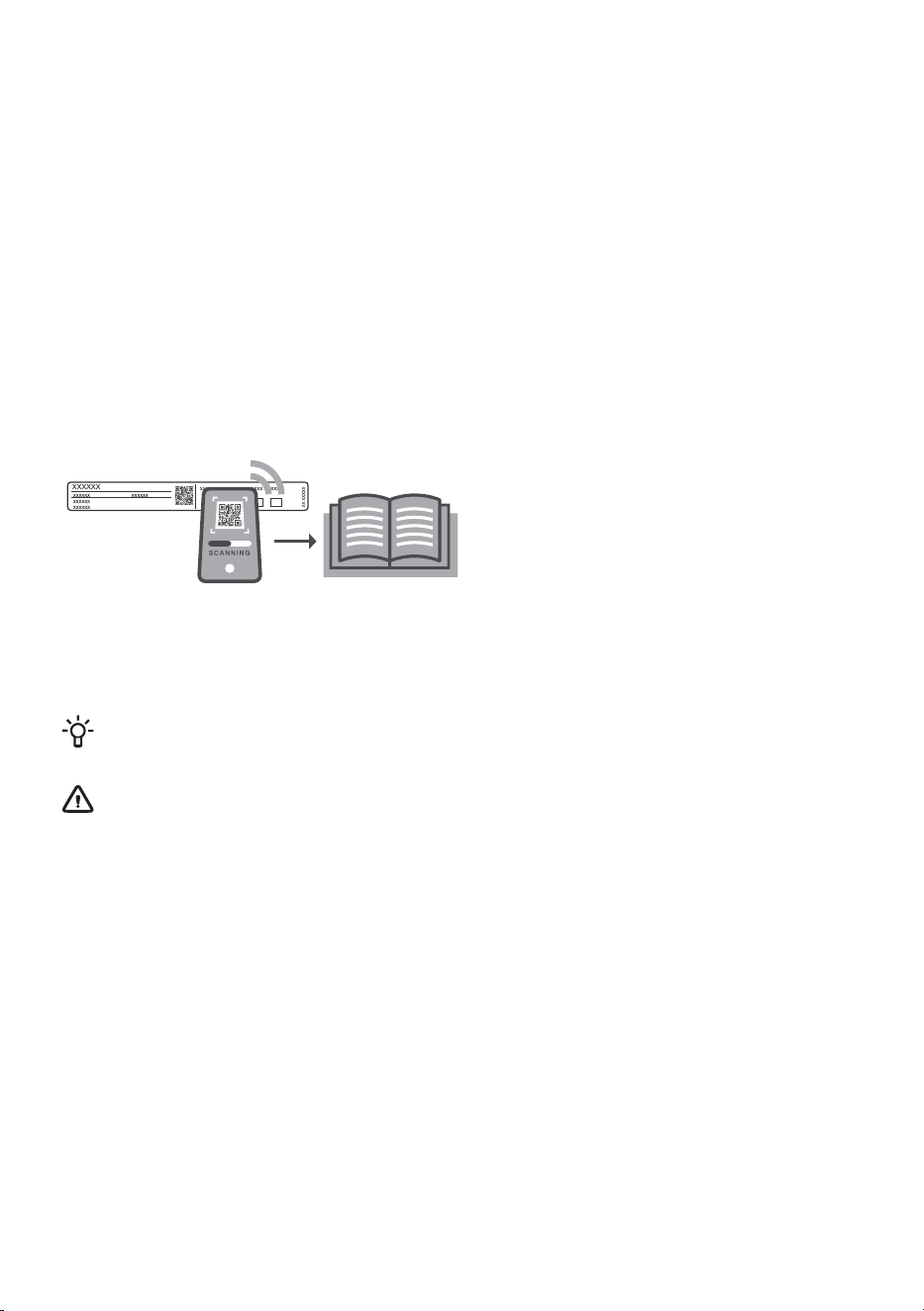
For more detailed instructions and tips, please visit http://www.gorenje.com or scan the QR code on
the rating plate.
The following symbols are used throughout the manual and they have the following meanings:
INFORMATION!
Information, advice, tip, or recommendation
WARNING!
Warning – general danger

Contents
4Safety precautions ..................................................................................................................
6Safe and correct use of the oven during pyrolytic cleaning .....................................................
6Other important safety warnings ...........................................................................................
8Appliance description .............................................................................................................
8Rating plate – product information ...........................................................................................
9Control unit ...............................................................................................................................
10Appliance equipment ..............................................................................................................
10Control lights .............................................................................................................................
10Guides .......................................................................................................................................
11Oven door switch ......................................................................................................................
11Cooling fan ................................................................................................................................
11Oven equipment and accessories ............................................................................................
13Before first use ........................................................................................................................
13Switching on for the first time ...............................................................................................
14Choosing the settings .............................................................................................................
14PROFESSIONAL MODE (pro bake) ..........................................................................................
19AUTOMATIC MODE (auto bake) ...............................................................................................
22CHOOSING EXTRA FUNCTIONS (extra bake) .........................................................................
22Locking keys .............................................................................................................................
23Starting the cooking process ................................................................................................
24End of cooking by touching ...................................................................................................
25General settings ......................................................................................................................
27General tips and advice for baking .......................................................................................
28Cooking table ..........................................................................................................................
32Cooking with a Temperature Probe .....................................................................................
34Recommended doneness levels for different types of meat ....................................................
35Cleaning and maintenance ....................................................................................................
36Automatic oven cleaning – pyrolysis ........................................................................................
38Removing wire and fixed pull-out (extendible) guides ..............................................................
39Removing and replacing the oven door and glass panes ........................................................
40Replacing the bulb ....................................................................................................................
41Troubleshooting table ............................................................................................................
41Special warnings and fault reporting ........................................................................................
42Disposal ...................................................................................................................................
43Cooking test ............................................................................................................................
3

Safety precautions
IMPORTANT SAFETY PRECAUTIONS – CAREFULLY READ
THE INSTRUCTIONS AND SAVE THEM FOR FUTURE
REFERENCE.
The appliance may only be connected to the power mains by
an authorized service technician or expert. Tampering with the
appliance or nonprofessional repair thereof may result in risk
of severe injury or damage to the product.
Appliance must be connected to fixed wiring which has
incorporated means of disconnection. Fixed wiring must be
made in accordance with the wiring rules.
The appliance must not be installed behind a decorative door
in order to avoid overheating.
If the supply cord is damaged, it must be replaced by the
manufacturer, its service agent or similarly qualified persons in
order to avoid a hazard (only for appliances supplied with
connection cord).
This appliance can be used by children aged 8 years and above,
and by persons with reduced physical, sensory or mental
capabilities or lack of experience and knowledge, if they have
been given supervision or instruction concerning the use of the
appliance in a safe way, and if they understand the hazards
involved. Children shall not play with the appliance. Cleaning
and user maintenance shall not be done by children without
supervision.
WARNING: Accessible parts may become hot during use.
Young children should be kept away.
4

For stationary appliances permanently connected to the fixed
wiring, compliance with this requirement is deemed to be met
if the disconnection instruction incorporated into the fixed wiring
complies with AS/NZS 3000 (Australia only).
WARNING: The appliance and some of its accessible parts
may become very hot during use. Care should be taken to avoid
touching heating elements. Children less than 8 years of age
shall be kept away unless continuously supervised.
The appliance is not intended to be controlled by external timers
or separate remote control system.
Only use the food probe recommended for use in this oven.
Do not use harsh abrasive cleaners or sharp metal scrapers to
clean the oven door glass/ the glass of hinged lids of the hob
(as appropriate), since they can scratch the surface, which may
result in shattering of the glass.
Do not use steam cleaners or high-pressure cleaners to clean
the appliance as this may result in an electric shock.
WARNING: Before replacing the light bulb, make sure the
appliance has been disconnected from the mains power, in
order to prevent the hazard of an electric shock.
Never pour water directly on the bottom of the oven cavity.
Temperature differences could result in damage to the enamel
coating.
5

Safe and correct use of the oven during pyrolytic cleaning
Before pyrolytic cleaning, the appliance must be suitably
prepared (see chapter "Automatic oven cleaning - pyrolysis").
Before you start the cleaning process, remove any residue of
spilt liquid and all moving parts from the oven cavity.
During the automatic cleaning process, the oven heats up to
a very high temperature and it is very hot on the outside as
well. Risk of burns! Keep children away from the oven.
Other important safety warnings
The appliance is intended for household use. Do not use it for any other purpose, such as room heating,
drying of pets or other animals, paper, fabrics, herbs etc. As this may lead to injury or fire hazard.
The appliance may only be connected to the power mains by an authorized service technician or
expert. Tampering with the appliance or nonprofessional repair thereof may result in risk of severe
injury or damage to the product.
We recommend that (due to appliance weight) at least two persons carry and install the appliance.
Do not lift the appliance by holding it by the door handle.
Oven door hinges may be damaged when under excessive load. Do not stand or sit on the open oven
door, and do not lean against it. Also, do not place any heavy objects onto the oven door.
If the power cords of other appliances placed near this appliance get entangled in the oven door, they
can be damaged, which in turn can result in a short circuit. Therefore, make sure the power cords of
other appliances are always at a safe distance.
Make sure the vents are never covered or obstructed in any other way.
Do not line the oven cavity with aluminium foil, and do not place any baking trays or other cookware
on the oven bottom. This would obstruct and reduce air circulation in the oven, slow down the baking
process, and destroy the enamel coating.
We recommend you avoid opening the oven door during baking, as this increases power consumption
and increases condensate accumulation.
At the end of the baking process, and during baking, be careful when opening the oven door, as there
is danger of scalding.
To prevent limescale accumulation, leave the oven door open after baking or using the oven, to allow
the oven cavity to cool down to room temperature.
Clean the oven when it has completely cooled down.
Eventual mismatches in colour shades between different appliances or components within a single
design line may occur due to various factors, such as different angles under which the appliances are
observed, different coloured backgrounds, materials, and room illumination.
6

Do not use the appliance if it is damaged. Unplug the appliance from the power mains and call an
authorized service centre.
The oven can be safely used with or without baking pan guides.
Do not store items in the oven, which could cause danger when the oven is switched on.
The deviation of the daily time display on the screen does not affect the functionality of the appliance
and may be due to fluctuations in the frequency of the electrical network.
Before you activate automatic cleaning, carefully read and observe all instructions in the chapter
Cleaning and Maintenance, which describes correct and safe use of this function
Do not place anything on the oven bottom during the automatic cleaning process.
Pyrolytic cleaning involves very high temperatures that may cause smoke and fumes to be released
form food residues. We recommend that you ensure thorough ventilation of the kitchen during the
pyrolytic cleaning process. Small animals, or pets, are highly sensitive to any fumes released during
pyrolytic cleaning of ovens. We recommend removing them from the kitchen during pyrolytic cleaning
and ventilating the kitchen thoroughly after the cleaning process.
Do not open the oven door during cleaning.
Make sure no foreign objects enter the opening for locking the door guide, as this could block automatic
door locking during the oven cleaning process.
Do not touch any metal surfaces or parts of the appliance during the automatic cleaning process!
In case of a power outage during the automatic cleaning process, the program will be terminated after
two minutes and the oven door will remain locked. The door will be unlocked, when the appliance
senses that the temperature has dropped to below 150 °C in the centre of the oven cavity.
After the self-cleaning process, the oven cavity and the oven accessories can discolour and lose their
sheen. This does not affect their functionality.
Attention – hot surface during pyrolytic cleaning
WARNING!
Carefully read the instructions for use before connecting the appliance. Repair or any
warranty claim resulting from incorrect connection or use of the appliance shall not be
covered by the warranty.
7
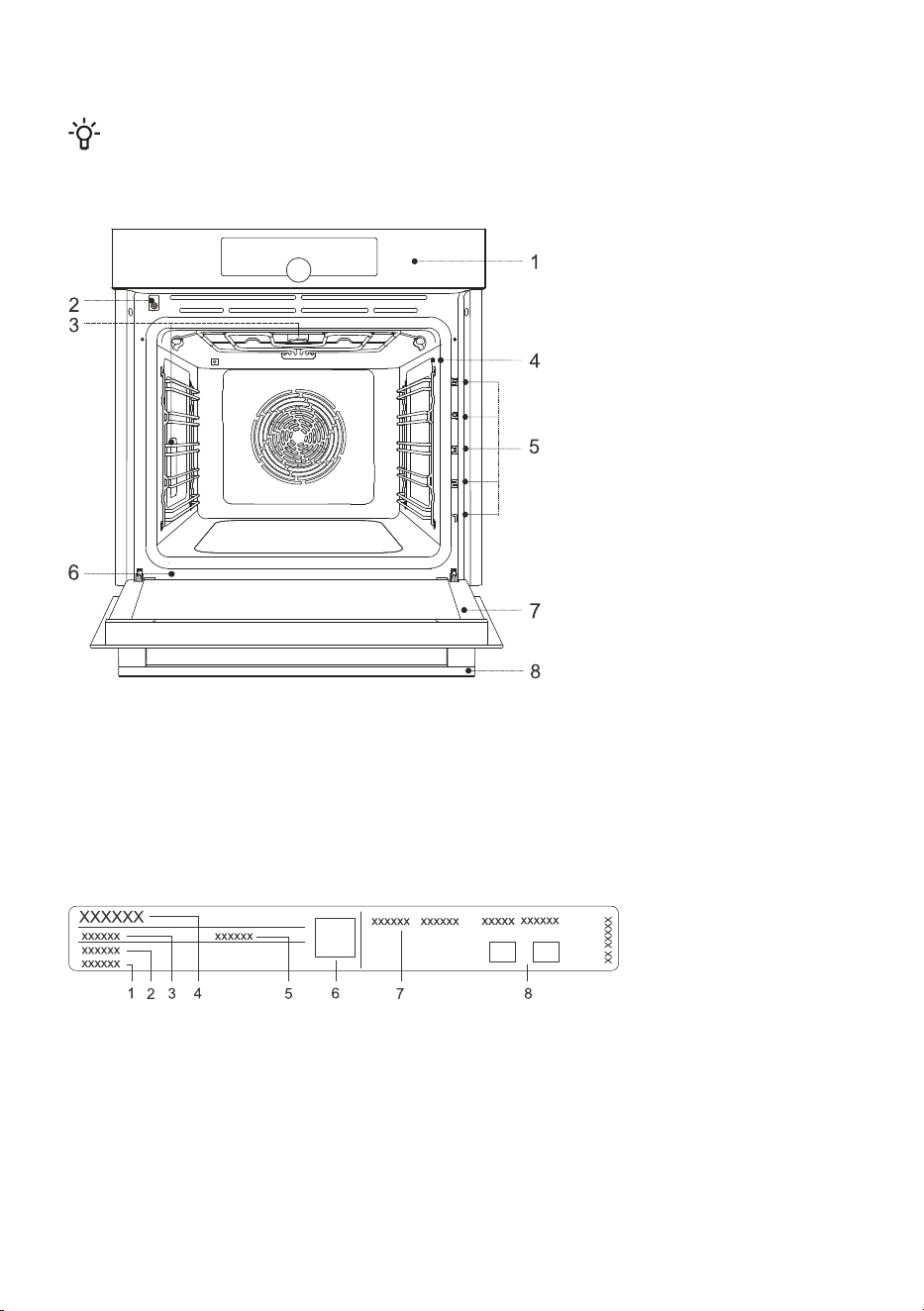
Appliance description
INFORMATION!
Appliance functions and equipment depend on the model.
Basic equipment of your appliance includes wire guides, shallow baking tray, and a wire rack.
5. Guides – cooking levels1. Control unit
6. Rating plate2. Door lock with a switch
7. Oven door3. Lighting
8. Door handle4. Temperature probe socket
Rating plate – product information
A rating plate with basic information about the appliance is attached to the edge of the oven.
5. ID/code1. Serial number
6. QR code (depending on the model)2. Model
7. Technical information3. Type
8. Compliance labels/symbols4. Brand
8
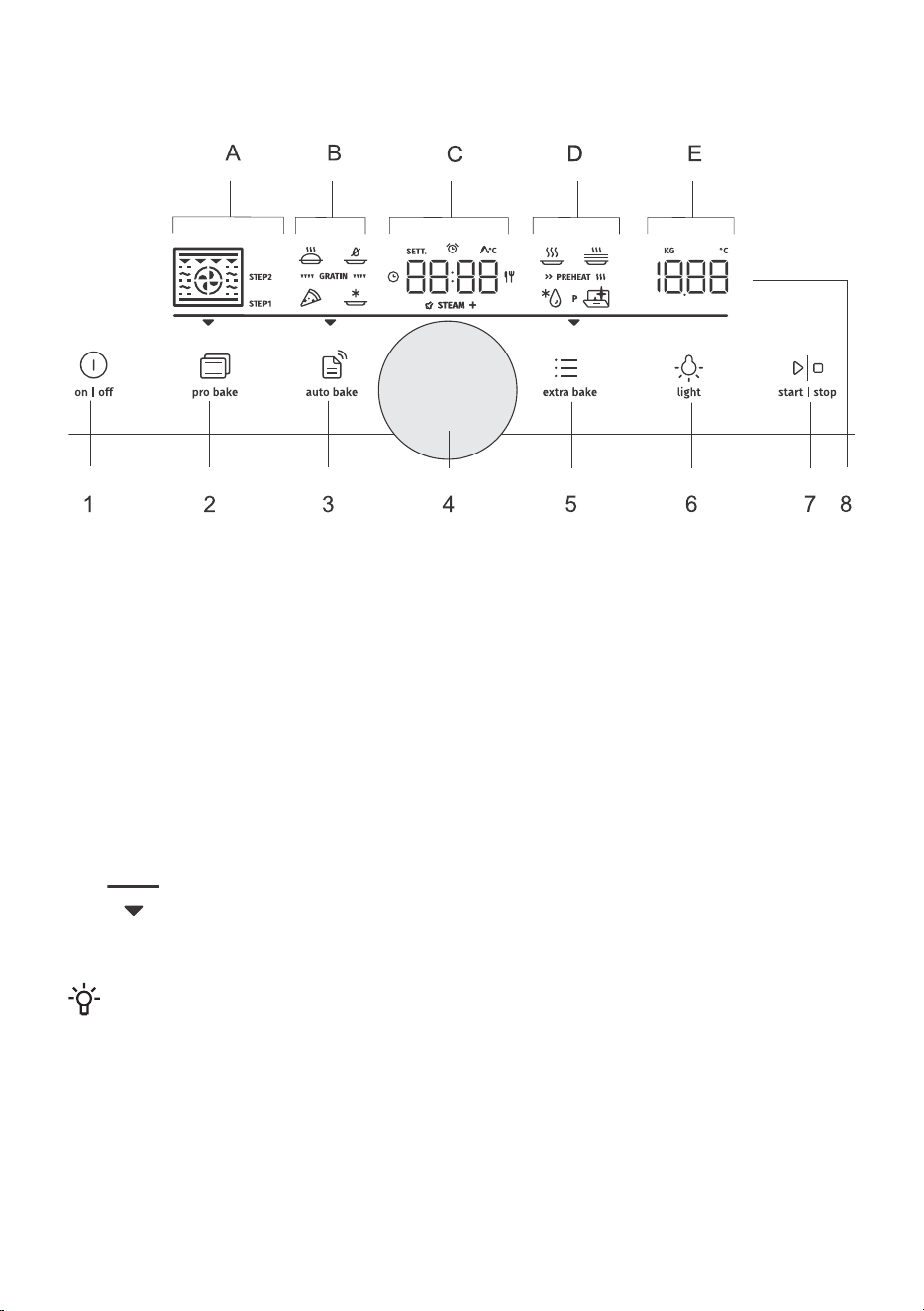
Control unit
(depending on the model)
1. on I off key
2. (pro bake) professional mode key
3. (auto bake) automatic mode key
4. Settings selection and confirmation knob
- rotate the knob to choose a setting
- press the knob to confirm the setting
5. (extra bake) key for extra functions and general appliance settings
6. (light) key for switching the oven lighting on and off
7. start I stop key for starting or pausing, and confirming settings
8. Display unit:
A. baking systems, step mode (STEP)
B. special baking systems, automatic programs, gratins
C. clock, timer functions, temperature probe, baking time
D. special programs, preheating
E. temperature, weight
Illuminated part of the line - displays the currently selected field from A to E.
Arrow - displays the selected basic setting (pro bake), (auto bake), (extra bake).
INFORMATION!
For better key response, touch the keys with a large area of your fingertip. Each time you press
a key, this will be acknowledged by a short acoustic signal (if the function is available).
9
Appliance equipment
Control lights
Oven light: oven light is switched on when you open or close the oven door, when you switch on the
oven, at the end of the baking process, and when you touch the oven light key on the control unit.
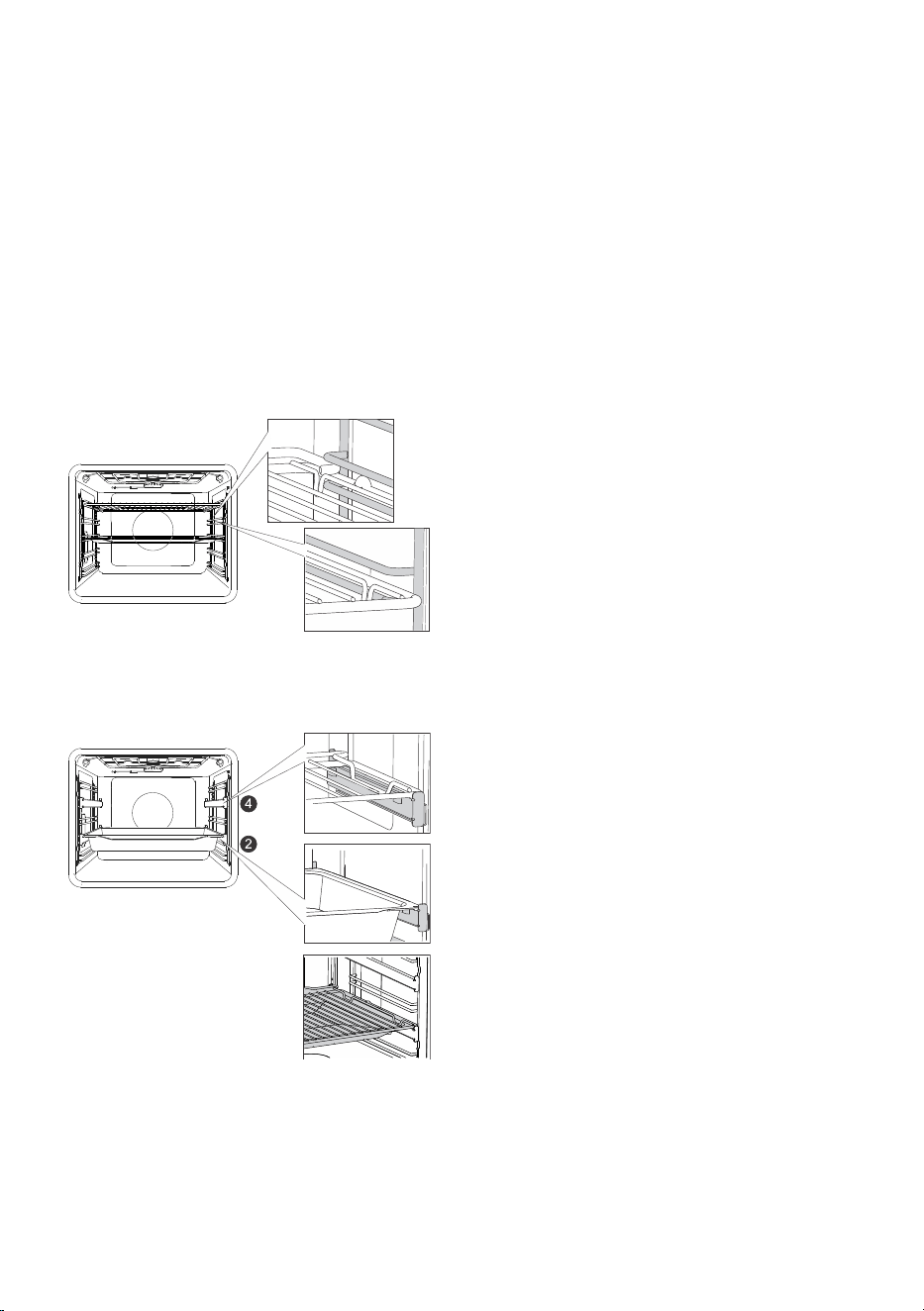
Guides
• The guides allow cooking or baking on 5 rack levels.
• The height levels of guides into which the racks can be inserted shall be counted from bottom up.
• Guide levels 4 and 5 are intended for grilling/broiling.
• When inserting equipment, it should be correctly rotated.
Wire guides
In case of wire guides, always insert the wire
rack and the baking tray into the slot between
the upper and lower part of each guide level.
Fixed pull-out guides
(depending on the model)
Pull-out guides may be fitted for the 2nd and
4th level.
In case of fixed pull-out guides, place the rack
or baking tray onto the guide. You can place
the wire rack directly onto a baking tray (shallow
or deep all-purpose baking tray) and place both
onto the same guide; in this case, the baking
tray acts as a drip tray.
10
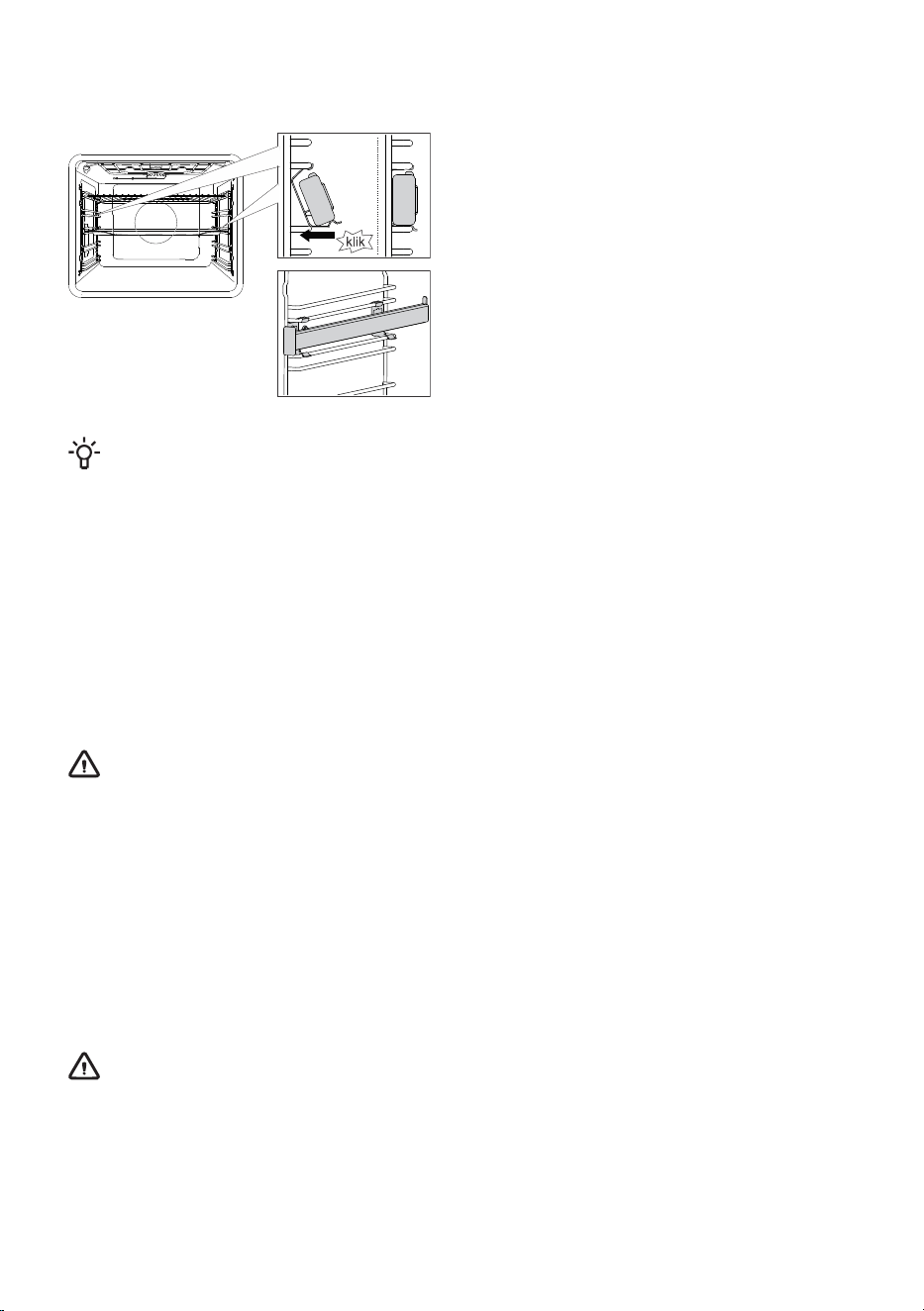
Click-on pull-out guides
(depending on the model)
The click-on pull-out guide can be inserted into
any space between two wire guides.
Place the guide symmetrically onto the wire
guides on the left and the right side of the oven
cavity. First, hook the upper clip of the guide
under the wire of the wire guide. Then, press
the lower clip into the right position until you
hear a CLICK.
NOTE: The guides can be attached to any
height between two levels of wire guides.
INFORMATION!
The click-on pull-out guides cannot be mounted onto guides with fixed double-level partial
extension. They can, however, be mounted on to single-level partially extendible guides, to levels
3–4 and 4–5.
Make sure the pull-out guide is correctly rotated and that it extends outwards, i.e. out from the
oven.
Oven door switch
(depending on the model)
If the oven door is opened during oven operation, the switch turns off the heater and fan in the oven
cavity. When the door is closed, the switch turns the appliance operation back on.
WARNING!
Using the oven with the door open and the door switch engaged (closed) is not allowed.
The oven will signal an error, and it will have to be reset.
Cooling fan
The appliance is fitted with a cooling fan that cools the housing, the door, and the appliance control
unit. After the oven is switched off, the cooling fan continues to operate for a short while in order to
cool down the oven.
Oven equipment and accessories
(depending on the model)
WARNING!
Remove all equipment from the oven, including the rack guides. Cleaning the equipment
(all-purpose deep or shallow baking trays) with pyrolysis is possible only if the oven is
equipped with additional wire guides (see chapter "Cleaning the supplied equipment with
pyrolysis").
11
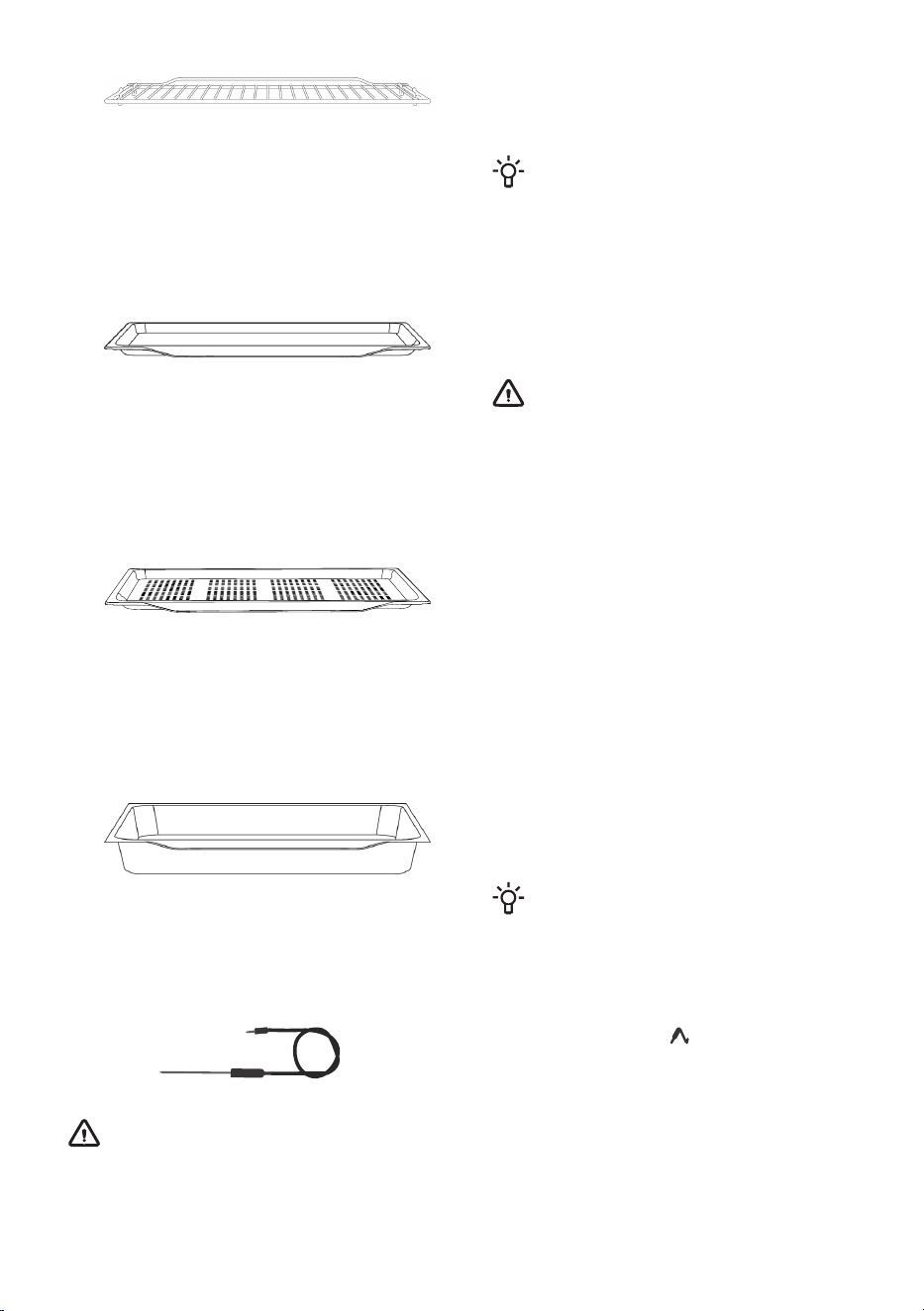
The WIRE RACK is used for grilling/broiling or
as support for a pan, baking tray or baking dish
with the food you are baking.
INFORMATION!
There is a safety latch on the wire rack.
Therefore, the wire rack has to be lifted
slightly at the front when pulling it out from
the oven.
SHALLOW BAKING TRAY is used for flat and
small pastry. It can also be used as a drip tray.
WARNING!
The shallow baking tray may deform as
it heats up in the oven. Once it cools
down, it returns to the initial shape.
Such deformation does not affect its
function.
The SHALLOW PERFORATED BAKING TRAY
is used for cooking with systems that feature
steam injection and for air frying. The
perforation improves airflow around the food
for a crispier crust.
When cooking food with high liquid content
(water, fat), place the shallow baking tray or
all-purpose deep baking tray one rack lower to
serve as drip tray.
The ALL-AROUND DEEP BAKING TRAY is
used for roasting vegetables and baking moist
pastry. It can also be used as a drip tray.
INFORMATION!
Never insert the all-purpose (or universal)
deep baking tray into the first guide during
baking.
Temperature PROBE ( BAKESENSOR).
WARNING!
The appliance and some of the accessible parts tend to heat up during cooking.
12
Before first use
• Remove oven accessories and any packaging (cardboard, polystyrene foam) from the oven.
• Wipe the oven accessories and interior with a damp cloth. Do not use abrasive or aggressive
cloths or cleaners.
• Heat an empty oven for approximately one hour with the top and bottom heater system at a
temperature of 250 °C. The characteristic "new oven scent" will be released; therefore, ventilate
the room thoroughly during this process.
Switching on for the first time
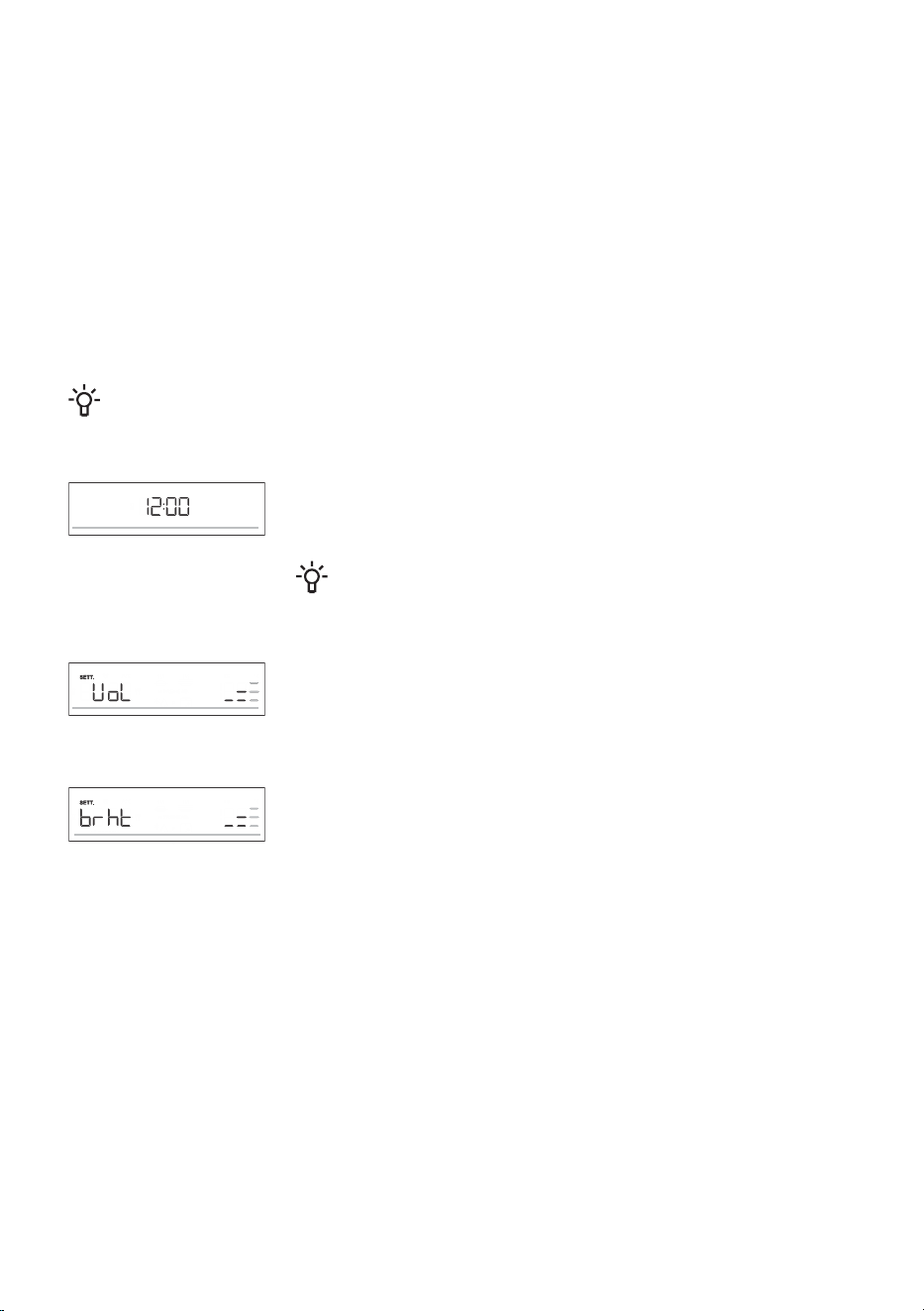
After connecting your appliance or after an extended power outage, 12:00 will flash on the display.
First, choose and confirm the following basic settings.
INFORMATION!
Change them by rotating the KNOB. To confirm the desired setting, press the KNOB or touch
the start | stop key.
1. CLOCK SETTING
Set the clock/time of day. First, set and confirm the minutes; then set
and confirm the hours.
INFORMATION!
To set or adjust the clock later on, see chapter Extra functions.
2. ACOUSTIC SIGNAL VOLUME
Medium volume is the default setting. The sign VoL and the currently set
value for the acoustic signal volume will appear on the display unit. Rotate
the KNOB to increase or decrease the key volume.
3. DISPLAY DIMMER
Medium light intensity is the default setting. The sign brht and the
currently set value for the display light intensity will appear on the display
unit. Rotate the KNOB to increase or decrease lighting intensity.
After you confirm the selected settings, the clock will appear on the display unit. The appliance is in
standby mode.
13
Choosing the settings
The interface allows choosing several operating modes:
• Professional mode (pro bake)
• Automatic mode (auto bake)
• Extra functions (extra bake)
• Step program (STEP) in the professional mode (pro bake)
• Automatic programs in automatic mode (auto bake)
INFORMATION!
• Rotate the KNOB to scroll through the settings.
• First, confirm the selected setting by pressing the KNOB; then, change the setting.
• Confirm each setting by pressing the KNOB.
• A line and an arrow indicate the location of the parameter that you are looking to set.
• Touch the start | stop key to start the program.
• Operation of the on | off key:
- brief touch: switch the oven on or off, stop the baking process or function.
– long touch: the oven switches to low power consumption (power saving) mode.
No key or KNOB are active, except for the on | off key. To switch on the oven, long-touch
this key.
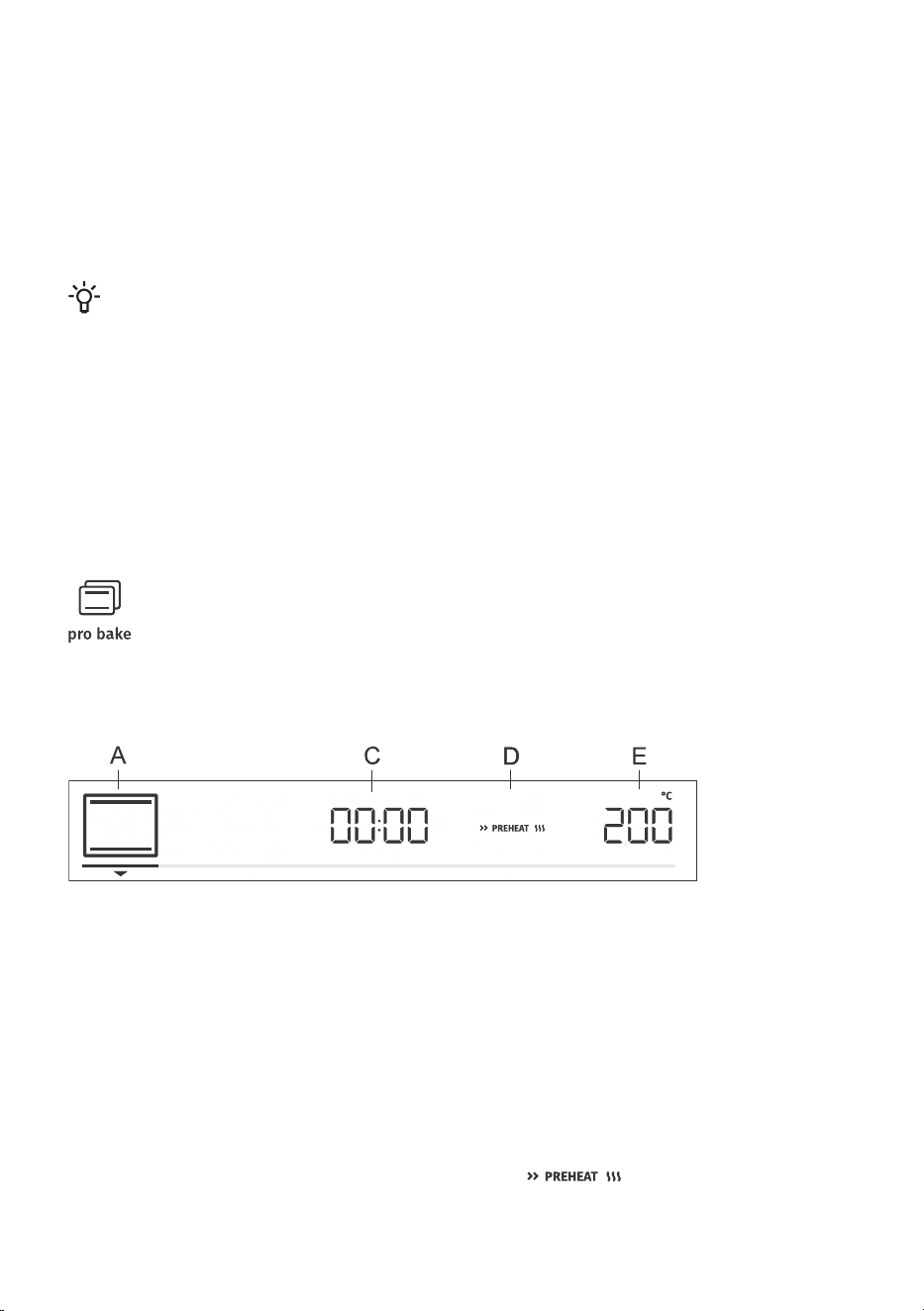
PROFESSIONAL MODE (pro bake)
This function allows setting the baking parameters – baking system, temperature, fast preheating, and
baking time – freely, at the user's discretion.
Touch the pro bake key and set the following:
A baking system
C program duration
D preheating
E temperature
Additionally, the following can be set:
- timer functions (see chapter Timer functions)
- step baking mode (STEP) (see chapter Step program)
- gratin (GRATIN) (see chapter Starting the cooking process)
Fast preheat
Use the fast preheating function if you wish to heat the oven to the desired temperature as quickly as
possible.
To activate fast preheating, rotate the KNOB to the setting (see image, label D). Confirm
the selection. Rotate the KNOB to select the fully lit sign and confirm it. The function is now activated.
14
When the selected temperature is reached, the preheating process stops and an acoustic signal is
emitted. door will appear on the display unit. Open the door and insert the food. The program will
automatically continue baking with selected settings.
INFORMATION!
When the quick preheating function is activated, delayed start function cannot be used.
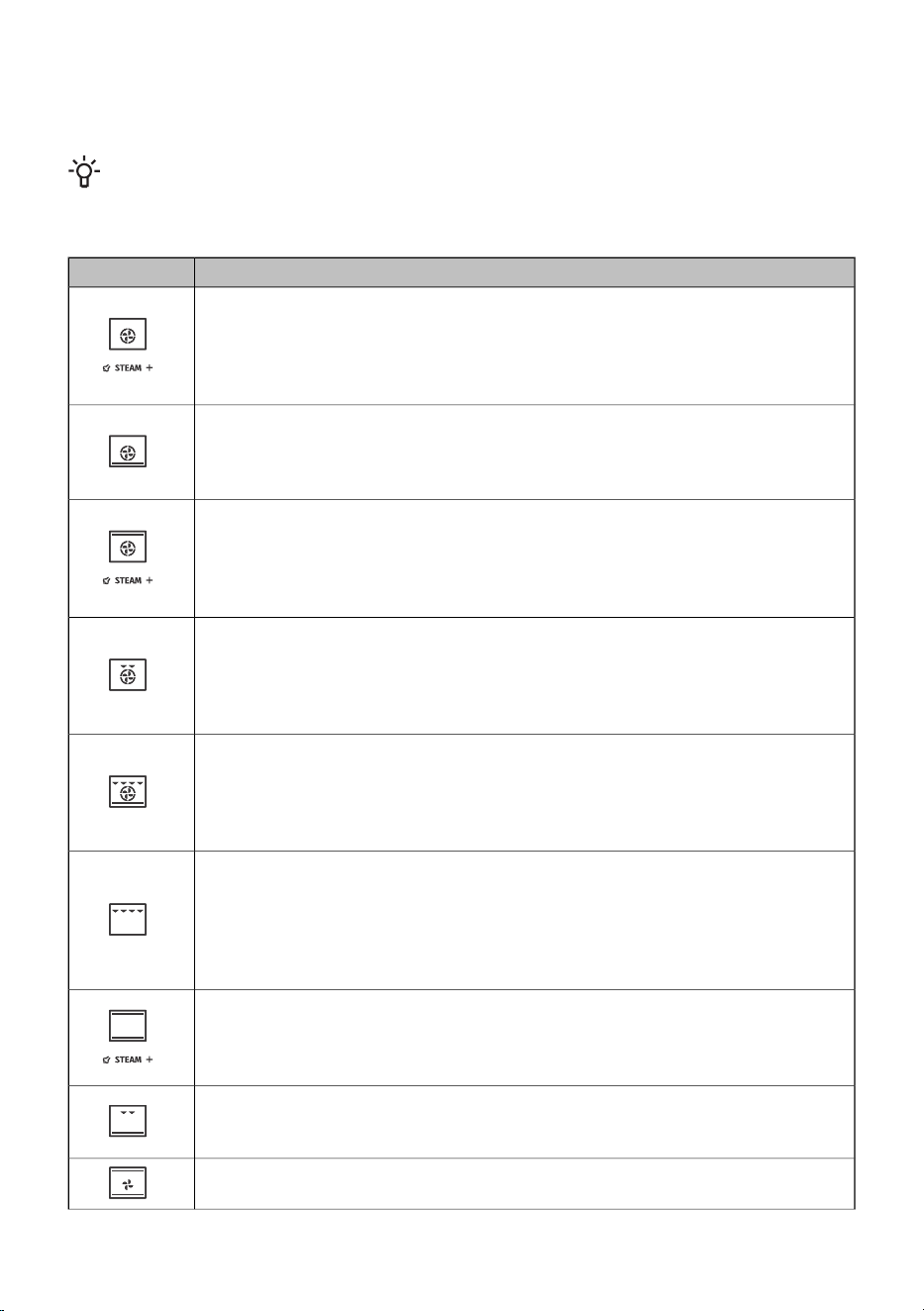
CHOOSING THE COOKING SYSTEM
UseSymbol
HOT AIR
Hot air allows better flow of hot air around the food. This way, it dries out the surface
and creates a thicker crust. Use this system to cook meat, pastry and vegetables,
and to dry food on a single rack or multiple racks simultaneously.
Steam injection results in better browning and more crunchiness of the surface.
PIZZA SYSTEM
This system is optimal for baking homemade pizza and pastry with higher water
content. Use it to bake on a single rack, when you want the food to be done faster
and to be crunchy.
INTENSIVE BAKING
1)
This cooking method gives the food a crispy crust, without added fat. It is a healthy
version of "fast food" with a lower calorie content. Suitable for small cuts of meat,
fish, vegetables and pre-cooked frozen products (fries, chicken medallions).
The addition of steam cooks the surface better and creates a crunchy crust.
GRILL WITH HOT AIR
Hot air allows better flow of hot air around the food. This will dry out the surface.
In combination with the grill heater/broiler, this will also result in a more intensive
colour.
For faster baking of meat and vegetables.
TURBO BAKE
For dishes where even crispiness from all sides is desirable. The system is also
suitable as the first step in the step baking mode, as it allows quick browning of
the surface in the first stage and slow baking in the second stage. The meat will be
juicy with a nicely browned crust.
LARGE GRILL
Use this system to grill large amounts of flat-shaped food like toast, open
sandwiches, grill sausages, steaks, fish, skewers etc., as well as for cooking au
gratin and for browning the crust. The heaters mounted on the top of the oven cavity
evenly heat the entire surface.
Maximum allowed temperature: 240 °C
TOP AND BOTTOM HEATER
1)
Use this system for conventional baking on a single rack, making soufflés, and
baking at low temperatures (slow cooking).
Steam injection results in better browning and a crunchier crust.
GENTLE BAKING
For gentle and controlled slow cooking of delicate food (soft cuts of meat) and
baking pastry with a crunchy bottom.
TOP AND BOTTOM HEATER WITH FAN
For even baking of food on a single rack, and for making soufflés.
15
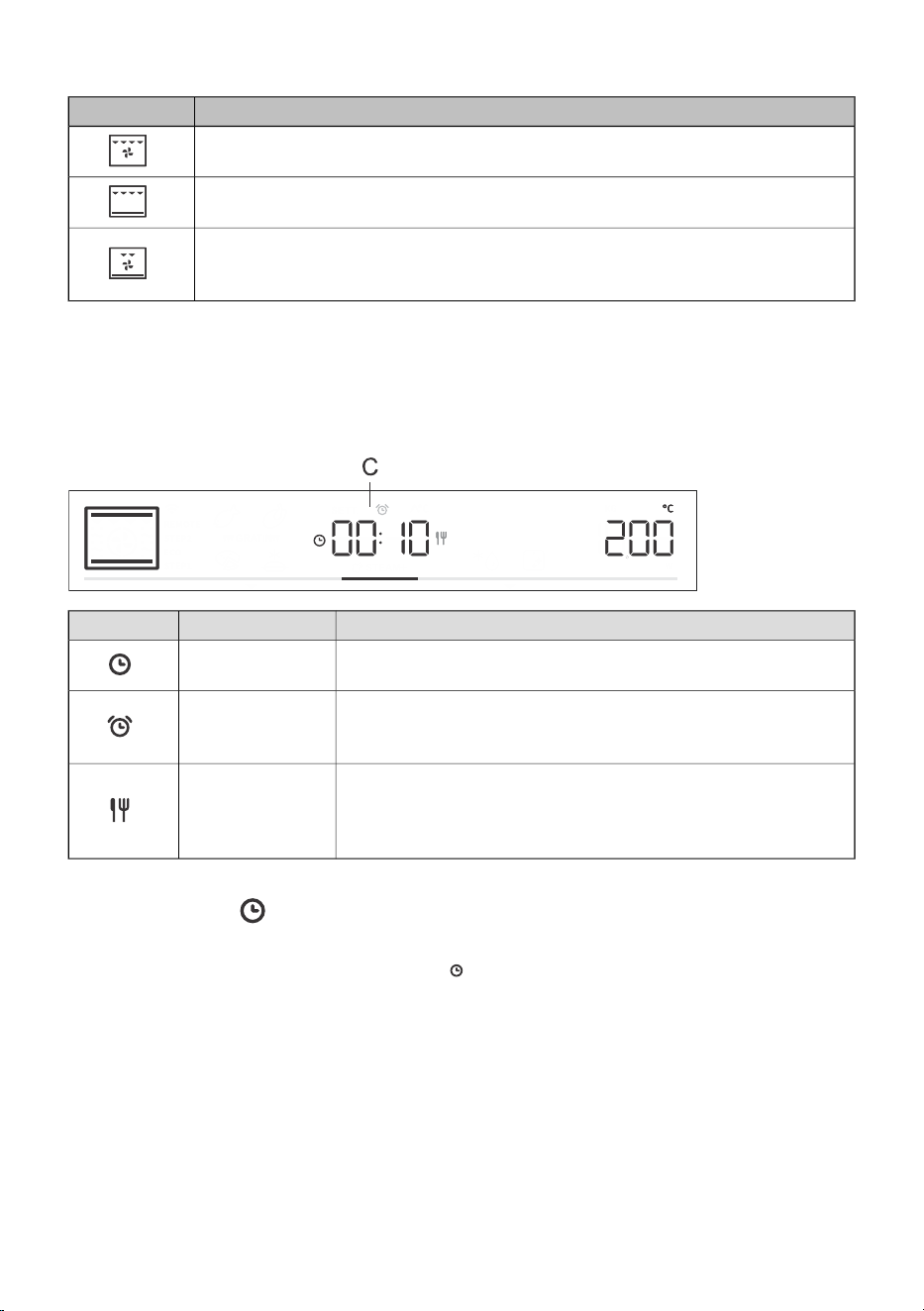
Table continued from last page
UseSymbol
LARGE GRILL WITH FAN
For roasting poultry and larger cuts of meat under a broiler.
LARGE GRILL AND BOTTOM HEATER
For faster baking on a single rack and for crisply browning the top of your pastry.
GRILL WITH BOTTOM HEATER AND FAN
For optimum baking of yeast-leavened dough, all types of bread, and for
preservation.
1)
The systems also allow steam injection during baking (see chapter Starting the cooking process).
Touch the start | stop key to start the cooking process. Selected settings will appear on display unit.
TIMER FUNCTIONS
Rotate the KNOB to select the timer functions.
UseDescriptionSymbol
In this mode, you can specify the duration of operation for the
oven.
Baking time
The independent alarm operates independently of the oven
operation. After the set time has expired, the appliance does not
turn on or off automatically.
Egg timer
Use this mode when you want the food in the oven to start
cooking with a time delay. Enter the duration and desired end
time of cooking. The appliance starts automatically and ends its
operation at the desired time.
Delayed end
Setting the cooking time
In this mode, you can specify the duration of oven operation (cooking
time).
The display shows for the duration of operation. Rotate the KNOB to
set the desired operating time. Confirm the setting by pressing the KNOB.
Touch the start | stop key to start baking.
16

Minute minder setting
The minute minder can be used independently of oven operation. The
longest possible setting is 24 hours. During the last minute, the minute
minder is displayed in seconds.
Rotate the KNOB to select the symbol and confirm your setting.
Rotate the KNOB and set the minute minder duration. Confirm the setting
by pressing on the KNOB.
Setting delayed end
INFORMATION!
Delayed start is not possible when the preheating function is
activated.
Use this function when you wish to start cooking the food in the oven
after a certain period of time. Place the food into the oven, then set the
system and temperature. Then, set the program duration and the time
when you wish your food done.
Example:
Current time: 12:00 (noon)
Cooking time: 2 hours
End of cooking: at 18:00 (6 p.m.)
The cooking duration symbol will appear on the display unit. Choose
the setting and confirm it by pressing the KNOB (in our case, 2:00). Press
the KNOB again and rotate it to select the symbol . Confirm and set
the time when you wish your food to be done (in our case, this is 18:00,
or 6 p.m.). Desired cooking end time will appear on the display unit
(18:00). Confirm the setting by pressing on the KNOB.
Touch the start | stop key to start baking.
While waiting to be activated, the oven switches to a partial stand-by
(the display unit goes dark). The oven will switch on with the selected
settings automatically (in our case at 16:00, or 4 p.m.). The oven will
switch off at the set time (in our case, this is 18:00, or 6 p.m.).
INFORMATION!
Cooking end time and the clock will alternate on the display unit.
After the set time has expired, the oven stops working automatically. The
display will show End. An acoustic signal will be heard which you may
turn off by touching any key. After one minute, the acoustic signal will
be switched off automatically.
WARNING!
This function is not suitable for food requiring fast preheating.
Perishable food should not be kept in the oven for a long time.
Before using this mode, check whether the clock on the
appliance is accurately set.
17

INFORMATION!
The select timer function can be reset to 00:00 by long-pressing the KNOB.
STEP PROGRAM
This function allows baking in two steps or stages (two consecutive baking steps are combined in a
single cooking process).
A1 first cooking step STEP1, (STEP2)
C program duration/end of program (see chapter Timer Functions)
E temperature
Step: STEP1
In the pro bake mode, set the baking system and temperature. You can also choose the fast preheating
function. Then, set the baking duration for STEP1 (see chapter Timer Functions). Confirm the setting
by pressing on the KNOB.
INFORMATION!
In STEP1, you can set the delayed start; however, if you do so, you cannot activate fast preheating.
Step: STEP2
Press and hold the pro bake key. STEP2 (second cooking step) will appear on the display unit (the
first one has already been set). Set the baking system, temperature, and duration. Confirm the setting
by pressing on the KNOB.
If you wish, you can also modify STEP1 or STEP2 before starting them.
Touch the pro bake key and select STEP1. Now you can change the settings. Then, do the same for
STEP2.
To delete the stem mode, press and hold the pro bake key.
Touch the start | stop key to start baking. The oven first starts to operate with the settings selected
for STEP1. When the STEP1 is done, STEP2 is activated.
18
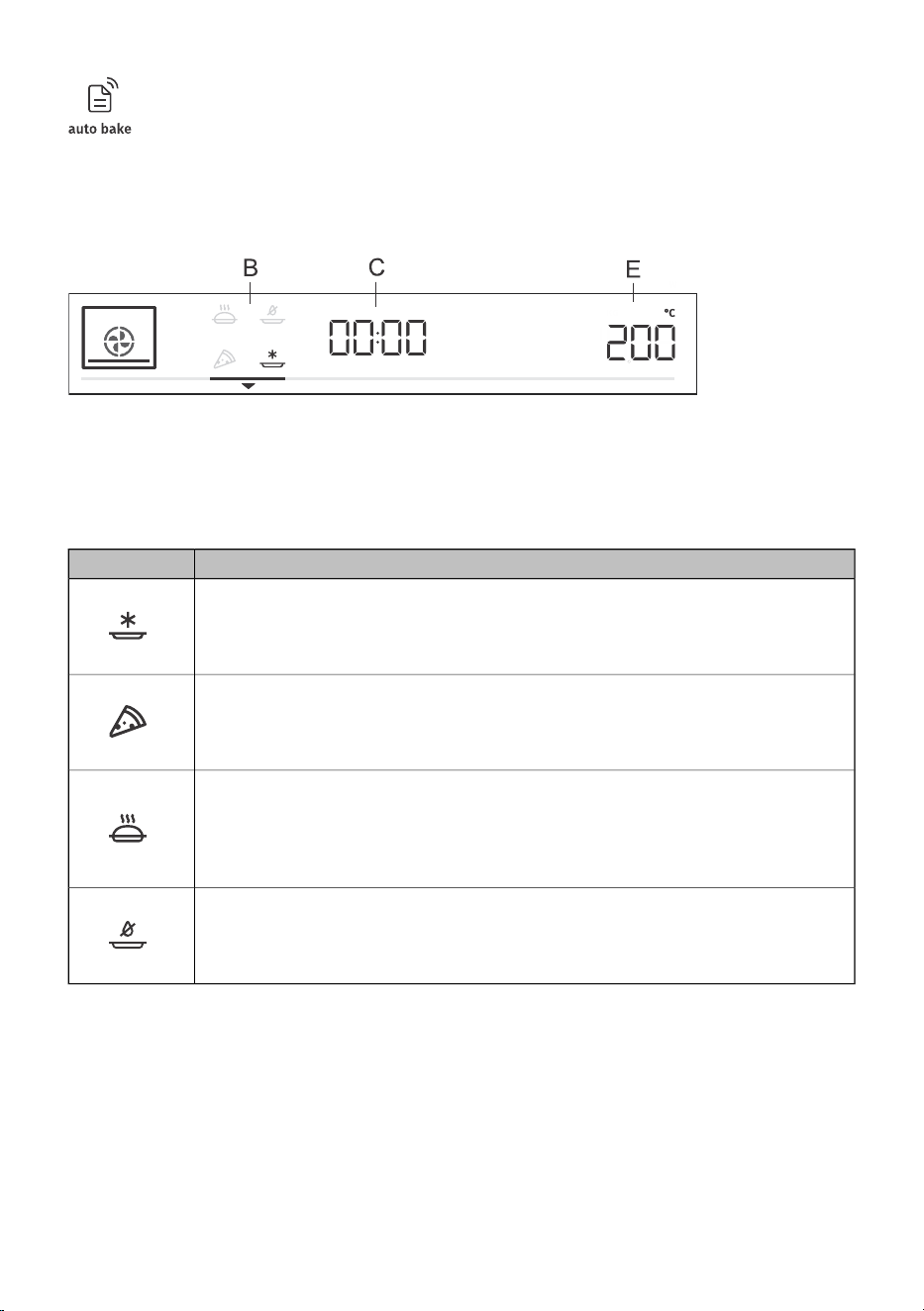
AUTOMATIC MODE (auto bake)
In this mode, you may choose between special baking systems or automatic programs (preset programs
for particular types of food).
Special baking systems
Touch the auto bake key and set the following:
B special baking systems
C program duration (see chapter Timer functions)
E temperature
Rotate the KNOB and choose your settings. Preset values will be displayed: You can change the
temperature and program duration.
UseSymbol
BAKING FROZEN FOOD
1)
This method allows baking frozen food in a shorter period of time without
pre-heating. Optimum for pre-baked frozen products (bakery products, croissants,
lasagne, French fries, chicken nuggets), meat and vegetables.
PIZZA SYSTEM
1)
This system is optimal for baking homemade pizza and pastry with higher water
content. Use it to bake on a single rack, when you want the food to be done faster
and to be crunchy.
SLOW BAKING
2)
For gentle, slow and even cooking of meat, fish and pastry on a single rack. This
cooking method will leave the meat with a higher water content, making it juicier
and more tender, while pastry will be evenly browned/baked. This system is used
in the temperature range between 140 °C and 220 °C.
AIR FRY
1)
This cooking method gives the food a crispy crust, without added fat. It is a healthy
version of "fast food" with a lower calorie content. Suitable for small cuts of meat,
fish, vegetables and pre-cooked frozen products (fries, chicken medallions).
1)
In these systems, it is possible to use the gratin function (see chapter Starting the cooking process).
2)
This function is used for determining the energy efficiency class pursuant to the EN 60350-1 standard.
Fast preheat
Cooking procedures for some dishes in the auto bake mode also include the fast preheating function.
The sign will be fully lit. When the selected temperature is reached, the preheating process stops and
an acoustic signal is emitted. door will appear on the display unit. Open the door and insert the food.
The program will automatically continue baking with selected settings.
19
INFORMATION!
When the fast preheat function is activated, delayed start function cannot be used.
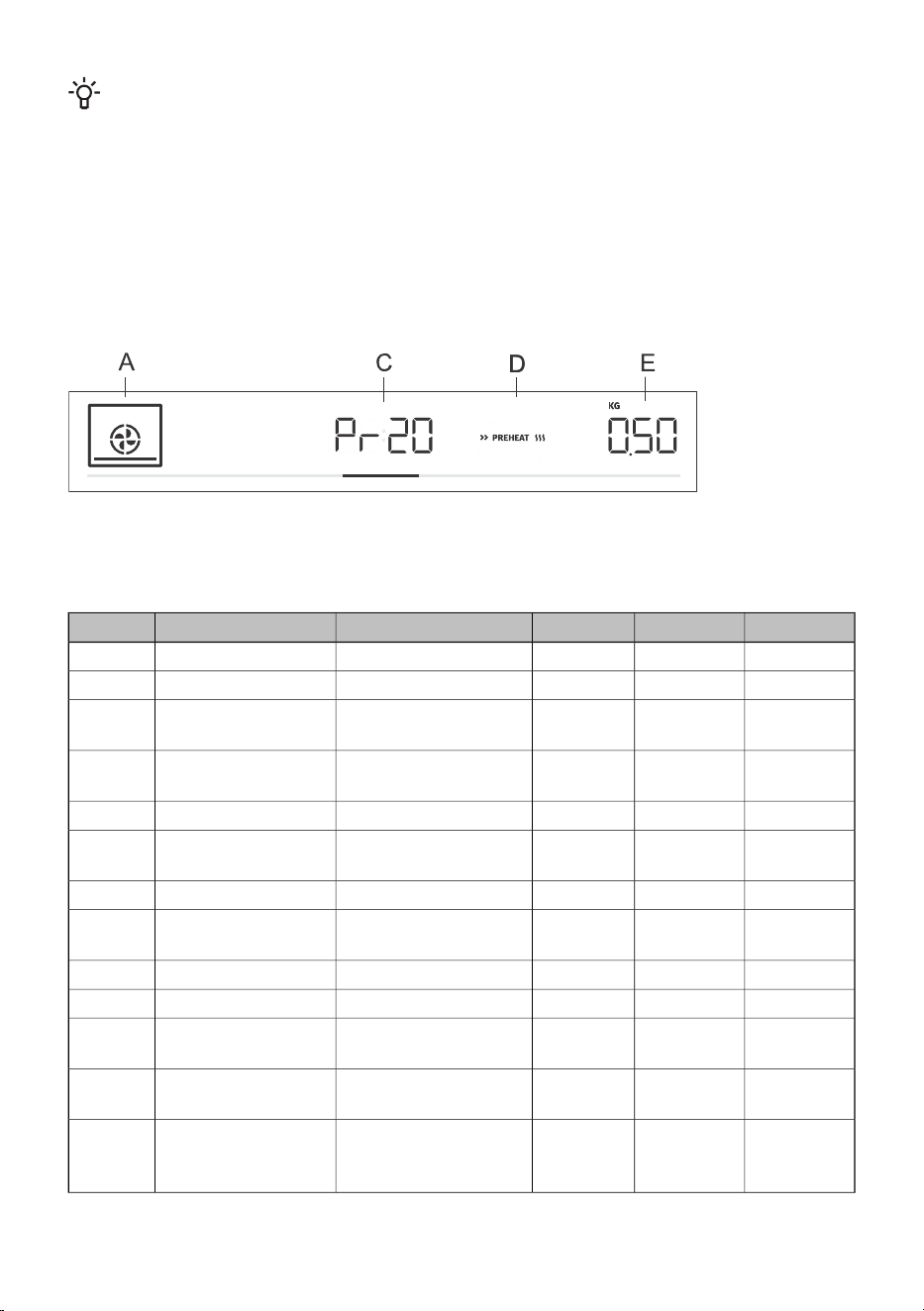
Automatic programs
In the automatic mode (auto bake), you may choose between numerous automatic programs (the
appliance will recommend the optimum cooking method, temperature, and cooking duration depending
on the type of food specified).
Press and hold the (auto bake) key to display the automatic programs on the display unit (see table).
Where possible, you can also set the weight of the food.
Confirm your setting by pressing the KNOB. Touch the start | stop key to start baking. Preset values
will appear on the display unit.
A baking system
C automatic program indication/program duration
D fast preheating
E selected amount
TurningPreheatingLevelEquipmentProgram nameIndication
noyes3shallow baking traypiped cookiesPr01
noyes3shallow baking traycupcakesPr02
noyes2baking pan/dish on
wire rack
sponge cakePr03
noyes2shallow baking trayyeast-leavened
small pastry
Pr04
noyes2shallow baking traypuff pastryPr05
nono2baking pan/dish on
wire rack
apple piePr06
nono2shallow baking trayapple strudelPr07
noyes3baking pan/dish on
wire rack
chocolate souffléPr08
nono2shallow baking trayrising and proofingPr09
nono2shallow baking traybreadPr10
nono2small baking dish on
wire rack
pork roastPr11
nono2small baking dish on
wire rack
roasted beefPr12
after 2/3 of
cooking
time
no2wire rack with a drip
tray
poultry – wholePr13
20

Table continued from last page
TurningPreheatingLevelEquipmentProgram nameIndication
after 2/3 of
cooking
time
no3wire rack with a drip
tray
poultry – smaller
pieces
Pr14
nono2baking pan/dish on
wire rack
meat loafPr15
after 2/3 of
cooking
time
no4wire rack with a drip
tray
oven-baked beef
steak
Pr16
nono2small baking dish on
wire rack
meat – slow
cooking
Pr17
after 2/3 of
cooking
time
no4wire rack with a drip
tray
baked/grilled fishPr18
nono3all-purpose deep
baking tray
baked potatoes –
wedges
Pr19
nono2baking pan/dish on
wire rack
Vegetable souffléPr20
nono2baking pan/dish on
wire rack
lasagnePr21
noyes1shallow baking trayhomemade pizzaPr22
INFORMATION!
Gratin function can be used with some automatic programs (see chapter Starting the cooking
process).
21
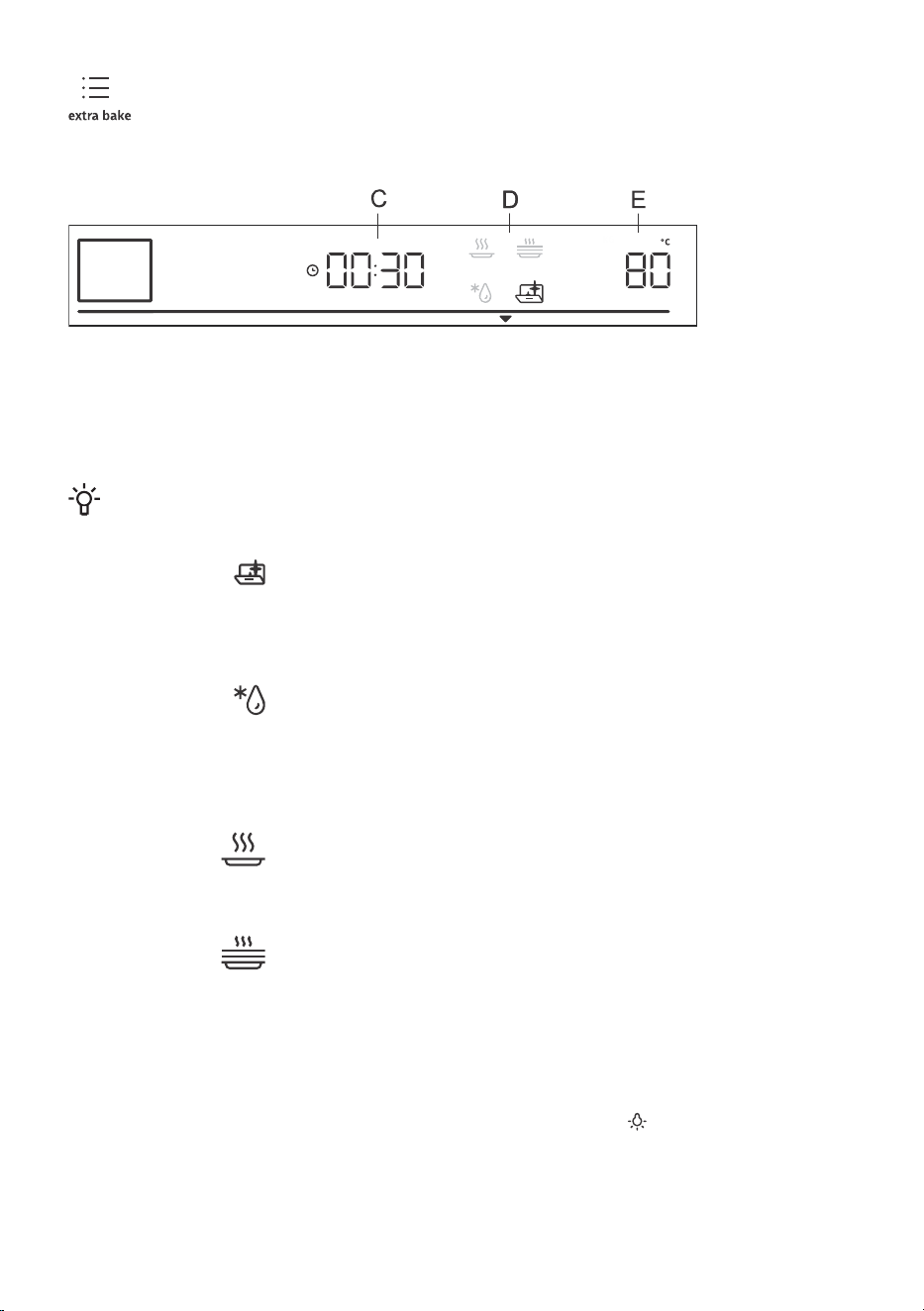
CHOOSING EXTRA FUNCTIONS (extra bake)
Touch the extra bake key to display extra functions with their respective preset values on the display
unit.
C cooking duration
D program
E preset temperature
Rotate the KNOB and select the program. Preset values will be displayed: Some programs allow
setting the temperature and cooking time.
INFORMATION!
Rotate the KNOB to scroll through the programs. Confirm each setting by pressing the KNOB.
Pyrolysis
This function allows automatic cleaning of the oven interior by high
temperature that incinerates the fat residues and other impurities to
reduce them to ashes.
P
Defrosting
Use this function to slowly defrost frozen food (cakes, pastry, bread,
rolls, and deep-frozen fruit).
Halfway through the defrost time, the pieces should be turned over,
stirred and separated if they were frozen together.
Reheating
This is used to keep warm the food that has already been cooked. You
may set the temperature and reheating start and end time.
Plate warming
Use this function to reheat your dinnerware (plates, cups) before serving
food in it to keep the food warm longer. You may set the temperature
and reheating start and end time.
Locking keys
To activate the child lock, press and hold (for 5 seconds) the light key . Loc will appear on the
display unit. When you long-press the light key again, the child lock is deactivated.
• If the lock is activated with no timer function engaged (only clock is displayed), then the oven will
not operate.
22
• If the child lock is activated after a timer function has been set, then the oven will operate normally;
however, it will not be possible to change the settings.
• When the child lock is activated, cooking or baking systems (modes) or additional functions cannot
be changed. The cooking/baking/roasting process can only be stopped or switched off.
• Child lock will remain active after the oven is switched off. To select a new system, the child lock
must first be deactivated.
Starting the cooking process
Start the cooking process by pressing the start | stop key.
Until the set temperature is reached for the first time, the current and the
set temperature will alternate on the display unit. The temperature symbol
flashes at first. When the desired temperature is reached, it goes off.
INFORMATION!
If no timer function is selected, cooking time will appear on the display unit. A short acoustic
signal is emitted when the oven reaches the selected temperature.
Extra gratin
You may only activate this function 10 minutes after the start of the
cooking process (the symbol will appear on the display
unit).
Press the KNOB to open settings. Rotate the KNOB to the sign
and confirm your selection. Rotate the KNOB again and
select the fully lit sign. Confirm your selection. The function is now
activated. Cooking time of 10 minutes (10:00) will appear on the display
unit.
To change the duration, press on the KNOB twice and rotate it to adjust
the time (max. 30 min). Confirm your selection.
The function is used in the last stage of the cooking process when you
add sauce/wet rub or dry rub onto the food, or when you wish to
additionally brown the crust. A golden-brown crust will form on the dish
during the gratin process, which protects the food from drying out, while
also imparting a more pleasant appearance and better flavour.
INFORMATION!
The function can also be switched off while it is in progress. Rotate
the KNOB to setting . Choose the dimmed sign and
confirm it by pressing on the KNOB.
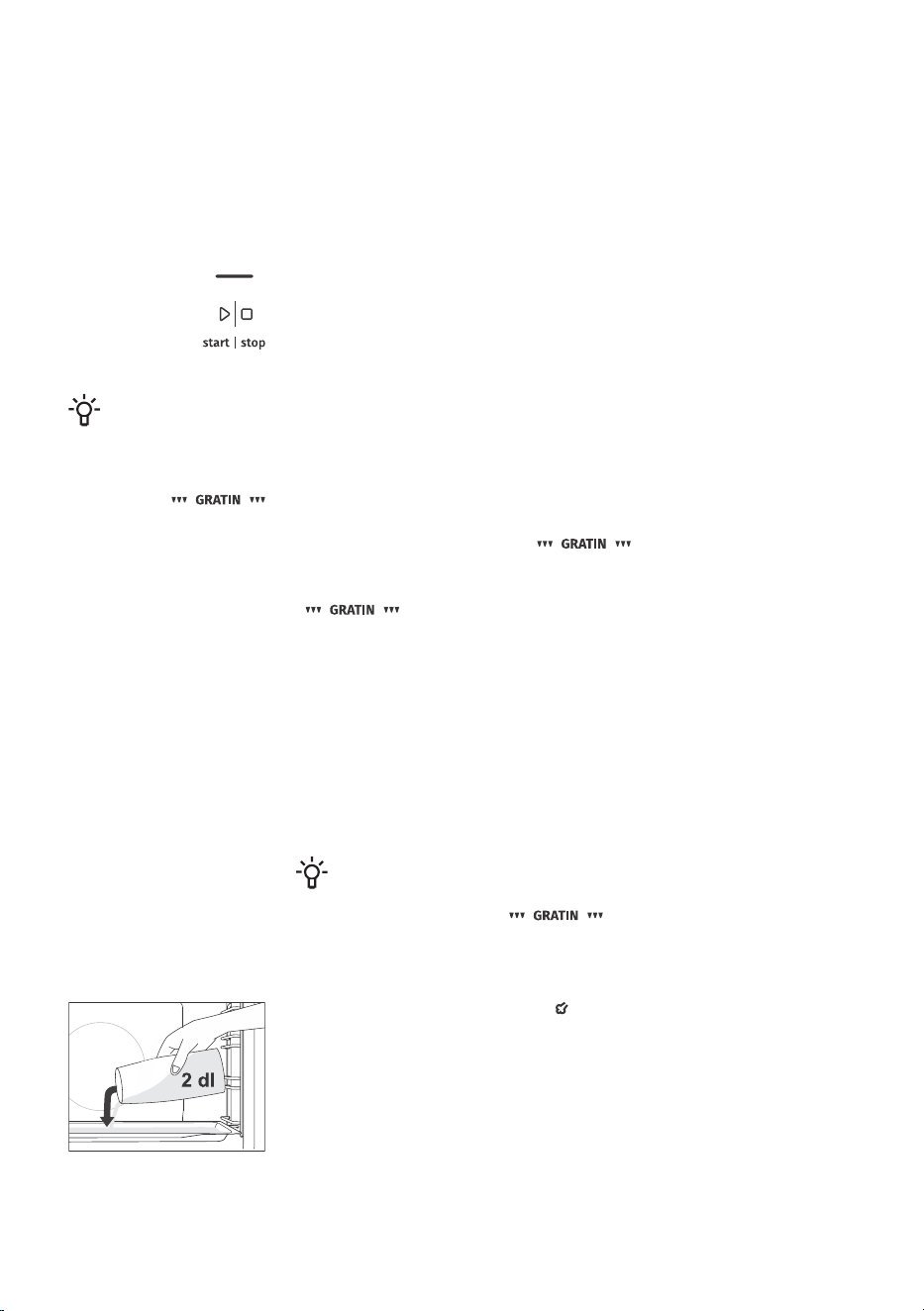
Baking with addition of steam
In systems with addition of steam, insert the shallow baking tray in the
first-level guide, while the oven is still cool. Pour a maximum of 2 dl of
water onto the baking sheet. Place the food to be cooked on the second
level and start the system.
23

INFORMATION!
If you are using a deep baking tray, insert it one level higher than
specified in the recommended settings table.
For optimum operation of the function, do not open the oven door
and do not add water during the cooking process.
End of cooking by touching
Touch the start | stop key to stop the operation. End appears on display unit and an acoustic signal
is emitted. After three minutes, the clock will appear on the display unit.
INFORMATION!
After the operation is completed, all timer settings are also stopped and deleted, except for the
egg timer. Time of day (clock) will be displayed. The cooling fan will continue to operate for a
while.
After the use of the oven, some water may be left in the condensate channel (underneath the
door). Wipe the channel with a sponge or a cloth.
24
General settings
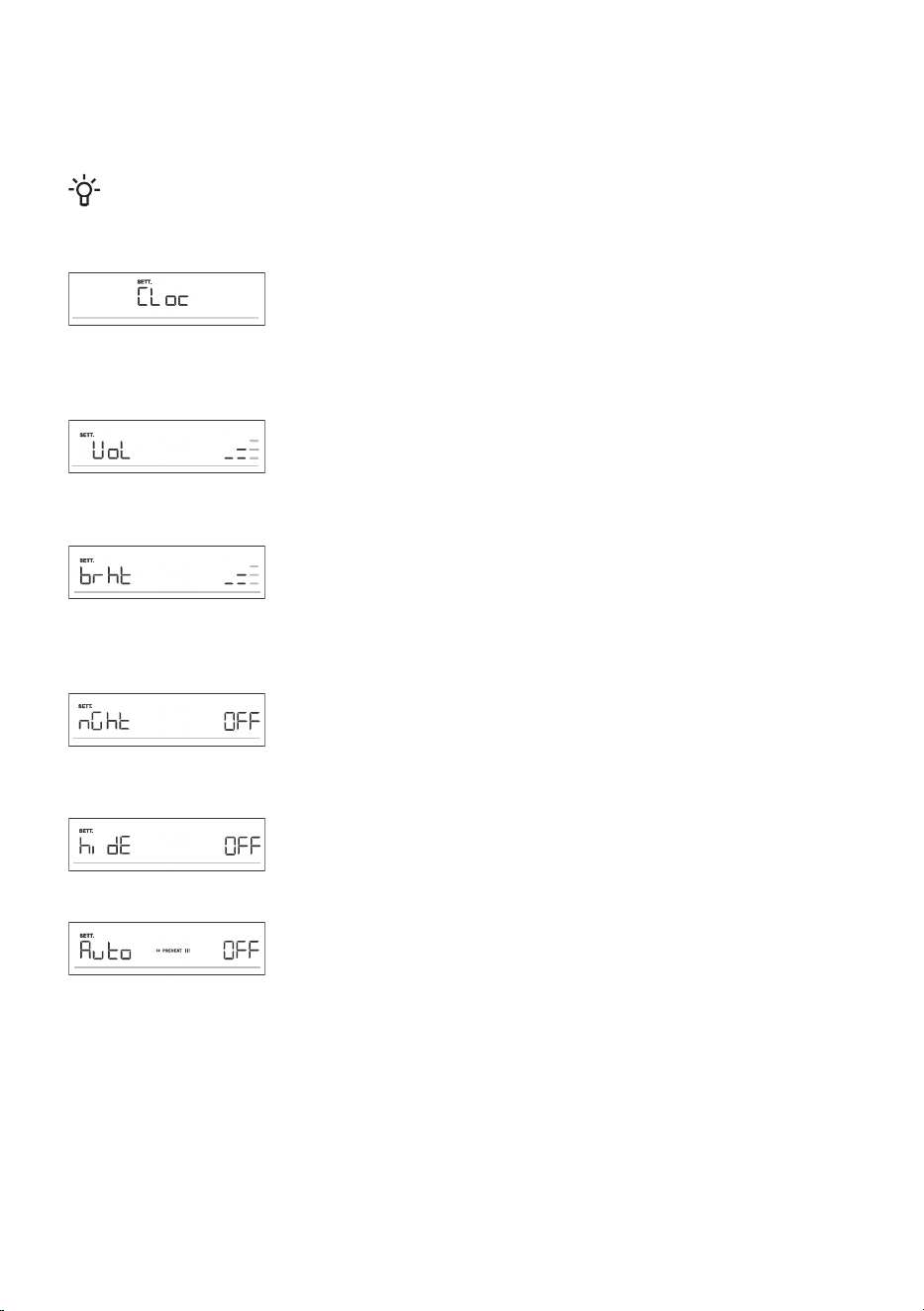
Press and hold the extra bake key. SEtt will appear on the display unit for a few seconds. Then, the
general settings menu will appear.
INFORMATION!
Rotate the KNOB to scroll through the settings. Confirm each setting by pressing the KNOB or
the start | stop key.
Clock display
Rotate the KNOB to set the clock. CLoc will appear on the display unit.
After confirming, you can choose between the 12h and 24h clock display.
Confirm, then set the clock/time of day. First, set the minutes. Confirm,
and then set the hours and confirm again.
Acoustic signal volume
Choose between three acoustic signal volume levels. Rotate the KNOB
to choose the VoL setting. Confirm the setting and set the volume. There
are four available volume levels (zero bars – OFF, one, two or three bars).
Display illumination
Choose between three levels of display light intensity. Rotate the KNOB
to select the brht setting. Confirm your selection and choose lower or
higher intensity. There are three available illumination levels (one, two or
three bars).
Display unit – night mode
This function will automatically dim the display (switch from high to low
display illumination level) during night time (8:00 p.m. to 6:00 a.m.).
Choose the nGht setting. Rotate the KNOB to switch On or OFF.
Standby
This function switches the clock display on or off. Select the hidE setting.
Rotate the KNOB to switch On or OFF.
Automatic fast preheating
This function allows automatic addition of fast preheating to the baking
systems that allow it.
Rotate the KNOB to select the Auto setting. Choose On or OFF.
25
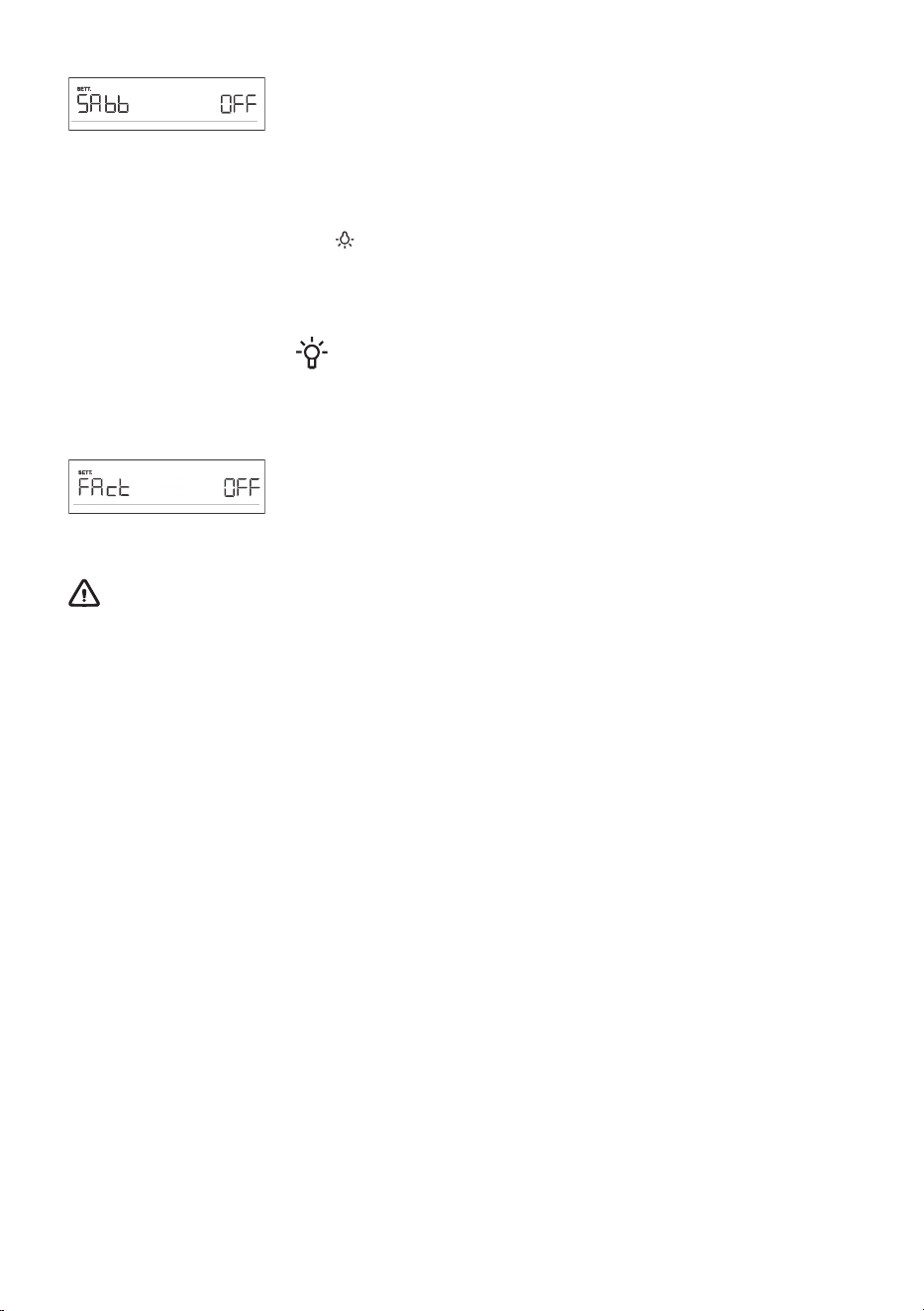
Sabbath
The Sabbath function allows keeping the food warm in the oven without
having to switch the oven on or off.
Rotate the KNOB to select SAbb. Choose On or OFF.
Set the duration (between 24 and 72 hours) and temperature. Confirm
each setting by pressing the KNOB.
If you wish the oven light to be on all the time, switch it on by touching
the symbol.
Touch the start | stop key to start the countdown. SAbb will appear on
the display unit.
All sounds and operation will be deactivated, except for the on | off key.
INFORMATION!
In case of a power outage, the Sabbath mode will be deactivated
and the oven will return to the initial state.
Factory settings
This function allows resetting the appliance to factory settings. FAct will
appear on the display unit. Rotate the KNOB to select rES. Hold the start
I stop until the end of animation to confirm.
WARNING!
After a power outage or after the appliance is switched off, additional function settings
will remain stored for no more than a few minutes. Then, all settings, except for the acoustic
signal volume and display dimmer will be reset to factory defaults.
26

General tips and advice for baking
• Remove all unnecessary equipment from the oven during baking
• Use equipment made of heat-resistant non-reflective materials (supplied baking trays and dishes,
enamel-coated cookware, tempered glass cookware). Bright-coloured materials (stainless steel
or aluminium) materials reflect heat. As a result, thermal processing of food in them is less effective.
• Always insert the baking sheets and trays to the end of the guides. When baking on the wire rack,
place the baking dishes or trays in the middle of the rack.
• For optimum food preparation, we recommend observing the guidelines specified in the cooking
table. Choose the lower specified temperature and the shortest specified cooking time. When this
time expires, check the results and then adjust the settings as necessary.
• Unless it is absolutely necessary, do not open the oven door during baking.
• Do not place the baking trays directly onto the oven cavity bottom.
• Do not use the all-purpose deep baking tray on the 1st guide level while the appliance is operating.
• Do not cover the oven cavity bottom or the wire rack with aluminium foil.
• With longer cooking programs, you can switch off the oven approximately 10 minutes before the
end of cooking time to make use of the accumulated heat.
• Always place the baking dishes onto the wire rack.
• When baking on several levels at the same time, insert the all-purpose deep baking tray into the
lower level.
• When cooking according to recipes from older cookbooks, use the bottom and top heater system
(as in conventional ovens) and set the temperature 10 °C lower than specified in the recipe.
• If you are using parchment paper, make sure it is resistant to high-temperatures. Always trim it
accordingly. Parchment paper prevents the food from sticking to the baking tray and makes it
easier to remove the food from the baking tray.
• When cooking larger cuts of meat or pastry with higher water content, a lot of steam will be
generated inside the oven, which in turn may condense on the oven door. This is a normal
phenomenon which will not affect the operation of the appliance. After the cooking process, wipe
the door and the door glass dry.
• When baking directly on the wire rack, insert the all-purpose deep tray one level lower to serve
as a drip tray.
Fast preheating of the oven: Only preheat the oven if required by the recipe of in the tables in these
instructions for use. If you are using the fast preheating function, do not insert the food into the oven
until the oven is fully heated. Temperature has a substantial effect on the final result. Fast preheating
is recommended for delicate cuts of meat (sirloin), and for yeast-leavened and sponge dough that
require a shorter baking time. Heating an empty oven consumes a lot of energy. Therefore, if possible,
we recommend cooking several dishes in succession, or making several dishes simultaneously.
GentleBake: Allows slow and controlled cooking at a low temperature. The meat juices are distributed
evenly, and the meat remains juicy and tender. The GentleBake slow cooking method is suitable for
delicate boneless meat cuts. Before slow cooking, sear the meat thoroughly from all sides in a frying
pan.
27
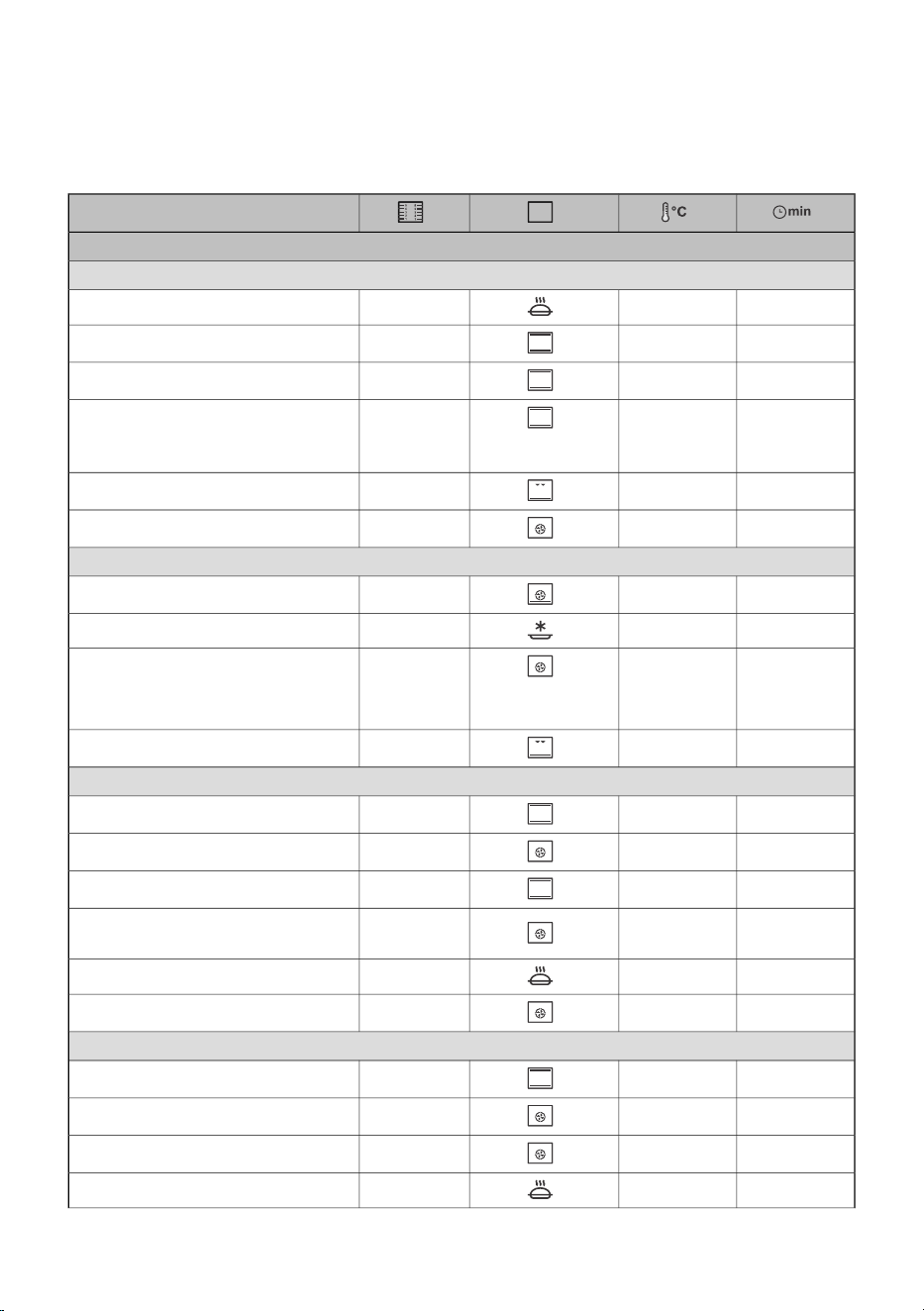
Cooking table
NOTE: Dishes requiring a fully pre-heated oven are indicated with a single asterisk * in the table.
Dishes for which a 10-minute pre-heating cycle suffices are indicated with two asterisks ** . In this
case, do not use the rapid preheat mode.
Dish
PASTRY AND BAKERY PRODUCTS
pastry/cakes in moulds
60-70200-2203
sponge cake
60-701802
pie with filling
50-60170-1802
marble cake
45-55170-1802cake with leavened dough,
Gugelhupf (Bundt cake, pound
cake)
35-45170-1803
open pie, tart
30-35170-1802
brownies
pastry on baking trays and dishes
60-70180-1902strudel
34-45200-2102strudel, frozen
13-18170-180 *
+ baking tray
with water
3sponge roll
30-40180-1902buchteln
biscuits, cookies
20-30160-170 **3cupcakes
30-45140-150 **1, 5cupcakes, 2 levels
17-22180 *2yeast-leavened small pastry
18-25160 *2, 4
yeast-leavened small pastry, 2
levels
30-45200-2203puff pastry
25-30170 *2, 4puff pastry, 2 levels
cookies/biscuits
25-401503piped cookies
25-45140 **2, 4piped cookies, 2 levels
45-601351, 4, 5piped cookies, 3 levels
40-50160-1803cookies/biscuits
28
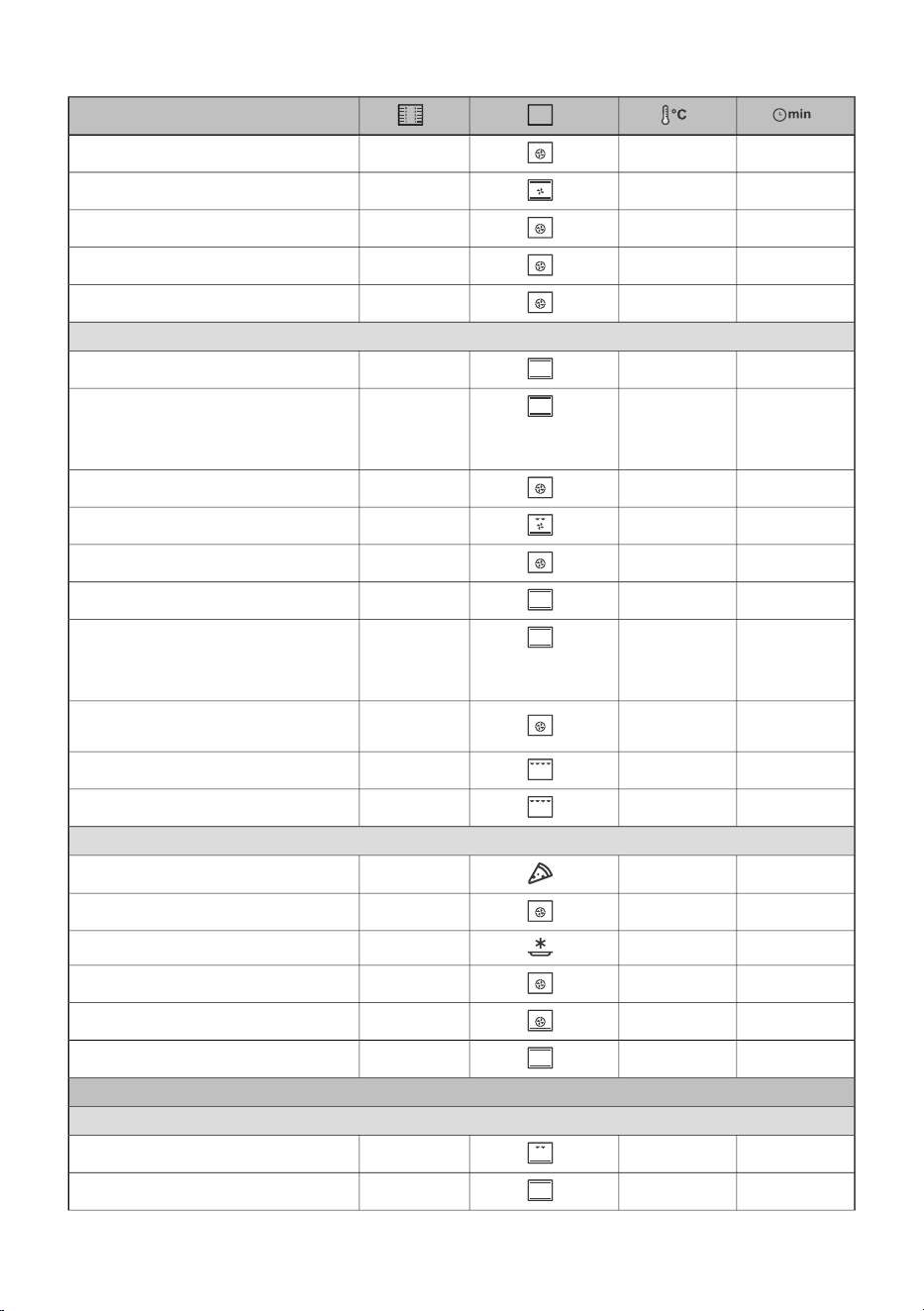
Table continued from last page
Dish
20-25150-160 *2, 4biscuits, 2 levels
120-15080-100 *3meringue
120-15080-100 *2, 4meringue, 2 levels
15-20130-140 *3macarons
15-20130-140 *2, 4macarons, 2 levels
bread
30-4540-452rising and proofing
40-55190-200
+ baking tray
with water
2bread on a baking tray
40-55190-200 *2, 4bread on a baking tray, 2 levels
30-45190-2003bread in a tin
30-45200-2102, 4bread in a tin, 2 levels
15-252702flatbread (focaccia)
20-30180-200
+ baking tray
with water
3
fresh bread rolls (Semmel/morning
rolls)
15-20200-210 *2, 4
fresh bread rolls (Semmel/morning
rolls), 2 levels
4-62405toast
3-52405open sandwiches
pizza and other dishes
4-10300 *1homemade pizza
25-30210-220 *2, 4homemade pizza, 2 rack levels
10-20200-2202frozen pizza
10-25200-2202, 4frozen pizza, 2 levels
50-60190-2002savoury pie, quiche
40-50180-1902burek
MEAT
beef and veal
130-160160-1702beef roast (loin, rump), 1.5 kg
90-120200-2102braised beef, 1.5 kg
29
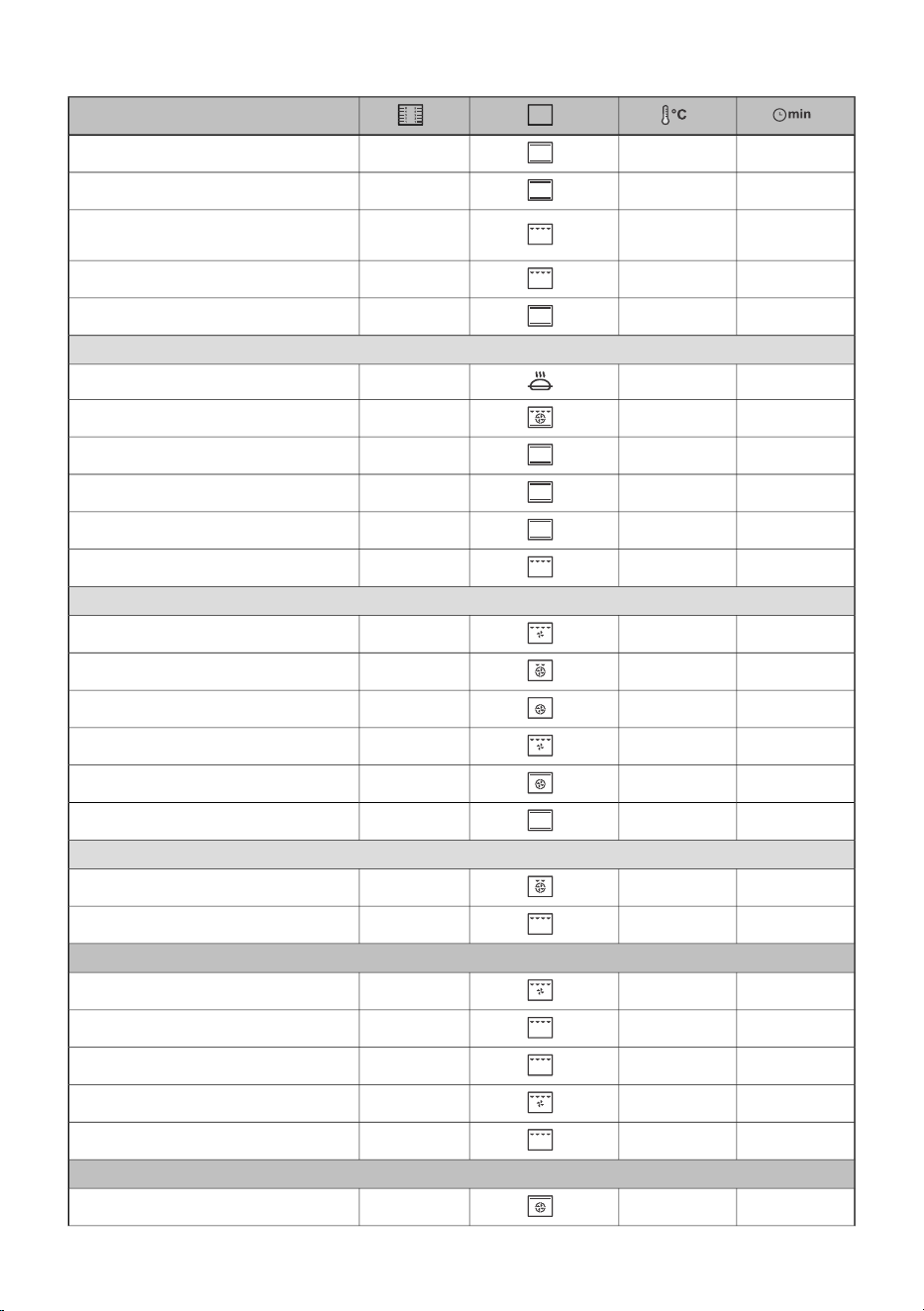
Table continued from last page
Dish
40-60170-190 *2sirloin, medium done, 1 kg
250-300120-140 *2beef roast, slow cooked
25-30220-2304
beef steaks, well done, thickness
4 cm
25-35220-2304burgers, thickness 3 cm
120-150160-1702veal roast, 1.5 kg
pork
100-220200-2203pork roast, rump, 1.5 kg
90-120180-1903pork roast, shoulder, 1.5 kg
80-10080-100 *2pork loin, 400 g
200-230100-120 *2pork roast, slow cooked
210-240120-140 *2pork ribs, slow cooked
20-25220-2304pork chops, thickness 3 cm
poultry
60-80200-2202poultry, 1.2–2.0 kg
70-90170-1802poultry with stuffing, 1.5 kg
45-60170-1802poultry, breast
25-40210-2203chicken thighs
25-40210-2204chicken wings
60-90100-120 *3poultry, breast, slow cooked
meat dishes
60-70170-1802meat loaf, 1 kg
8-15230 **4grill sausages, bratwurst
FISH AND SEAFOOD
12-20230-2404whole fish, 350 g
8-12220-2304fish fillet, thickness 1 cm
10-15220-2304fish steak, thickness 2cm
5-10230 *4scallops
3-10230 *4shrimps
VEGETABLES
30-40210-220 *3baked potatoes, wedges
30
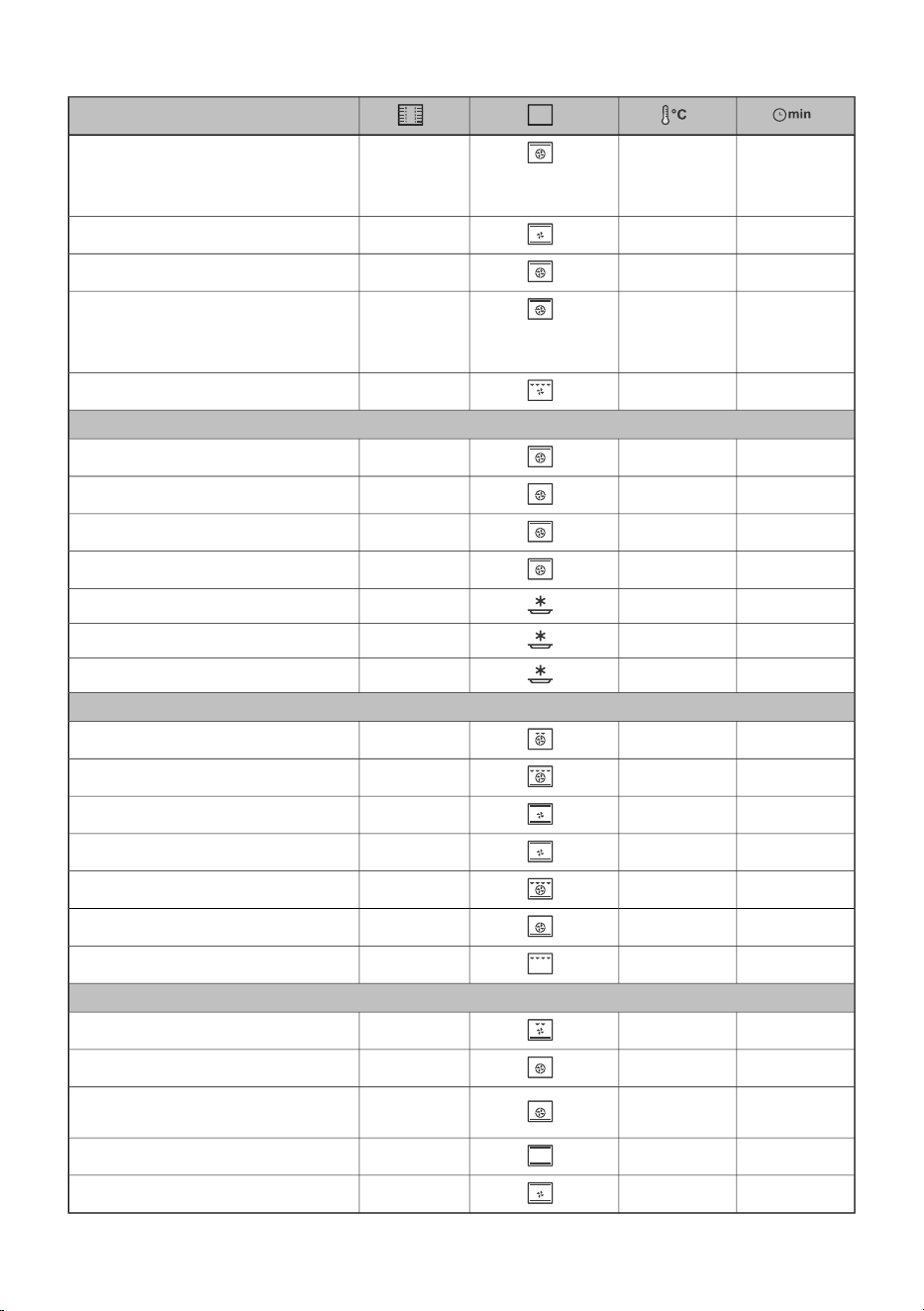
Table continued from last page
Dish
40-50200-210 *
+ baking tray
with water
3baked potatoes, halved
30-40190-2003stuffed potato (jacket potato)
20-30210-220 *4French fries, home-made
30-40190-200
+ baking tray
with water
3mixed vegetables, wedges
30-40190-2003stuffed vegetables
CONVENTIONAL PRODUCTS – FROZEN
20-25210-2203French fries
30-40190-2102, 4french fries, 2 levels
12-17210-220 *4chicken medallions
15-20210-2202fish fingers
30-40200-2102lasagne, 400 g
20-30190-2002diced vegetables
18-23170-1803croissants
BAKED PUDDINGS, SOUFFLÉS AND DISHES AU GRATIN
35-45180-1902potato moussaka
35-45180-1902lasagne
40-60160-1802sweet baked pudding
35-45160-180 *2sweet soufflé
30-45170-1903dishes au gratin
20-35180-2002stuffed tortillas, enchiladas
6-9240 **4grilling cheese
OTHER
301802preservation
301253sterilization
/150-170 *2
cooking in a bain-marie (double
boiler)
/60-953reheating
15752plate warming
31
Cooking with a Temperature Probe
( BAKESENSOR)
(depending on the model)
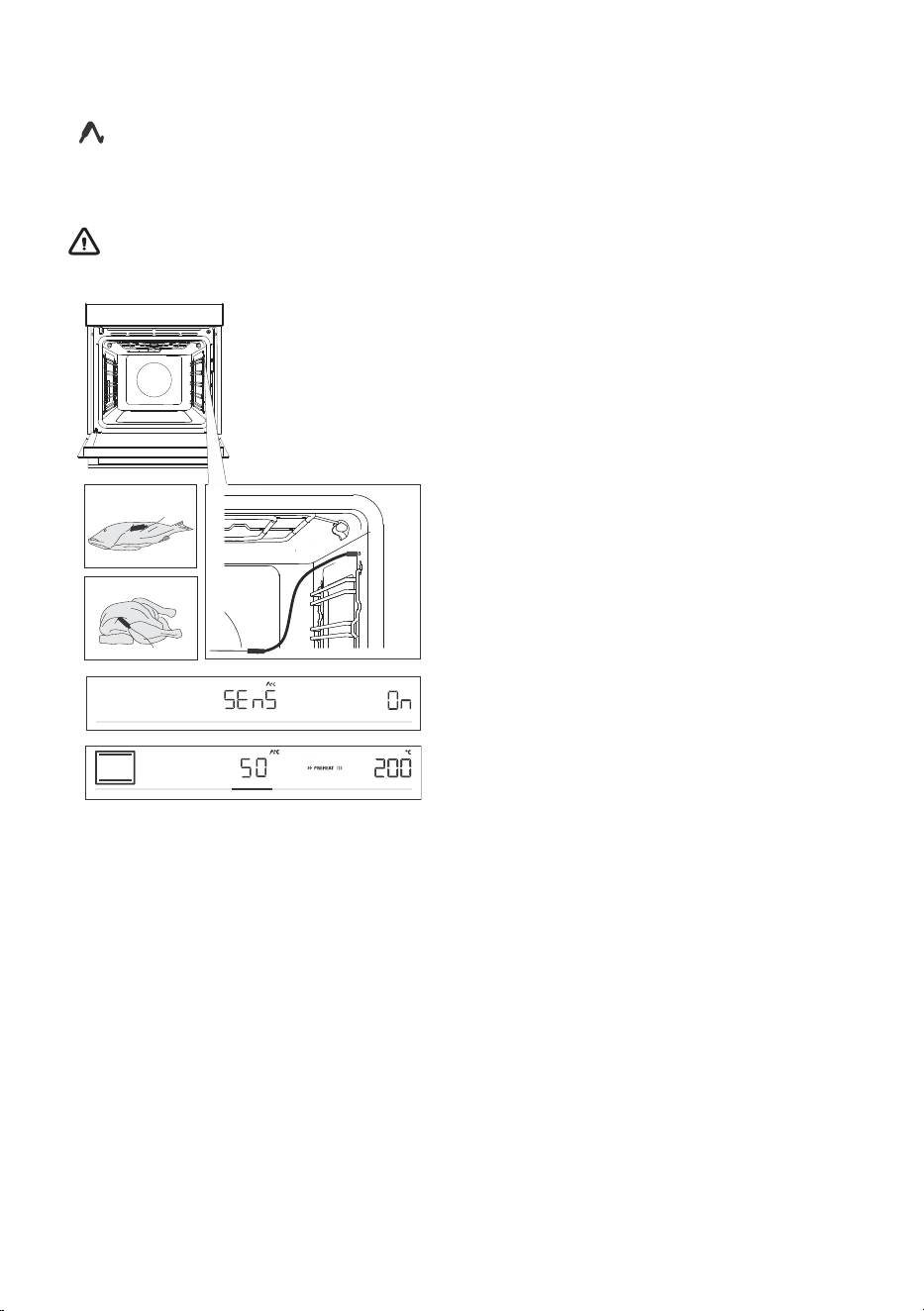
The food probe allows for accurate monitoring of the core temperature of the food during cooking.
WARNING!
The food probe should not be in direct vicinity of the heating elements.
1 Stick the metal end of the probe into the
thickest part of the food.
2 Plug the probe plug into the socket located
in the upper-right corner at the front of the oven
cavity (see figure). SEnS will appear on the
display unit. To activate the function, rotate the
KNOB to position On. Follow the same
procedure to deactivate the function. Select
OFF on the display unit.
NOTE: To enter the SEnS menu, stop the
current cooking process and connect the probe
to the socket. When you insert the probe into
the socket, the previously selected or preset
functions on the oven are deleted.
3 Select the desired system and cooking
temperature (in the temperature range up to
210 °C) The probe operation symbol and the
preset temperature will appear on the display
unit, which can be changed by turning the
KNOB. Determine the desired final core
temperature of your food (between 30 and 99
°C).
NOTE: When using the probe, setting the
cooking time is not possible.
4 Confirm the setting by touching the start |
stop key.
5 When the set core temperature is reached,
the oven will stop operating. End will appear
on the display unit. An acoustic signal will be
heard which you may turn off by touching any
key. After one minute, the acoustic signal will
be switched off automatically.
32

INFORMATION!
During the cooking process, set and current food core temperature alternate on the display unit.
You may change the cooking temperature or the target food core temperature during the cooking
process.
Correct use of the probe, by type of food:
• poultry: stick the probe in the thickest part of the breast;
• red meat: stick the probe into a lean part that is not marbled with fat;
• smaller chunks with bone: stick them into an area along the bone;
• fish: stick the probe behind the head, towards the spine.
WARNING!
After use, carefully remove the probe from the food, unplug from the socket in the oven
cavity, and clean it.
If SEnS appears on the display unit when the temperature probe is not connected, clean
the socket. Try connecting and disconnecting the temperature probe several times in a
row.
INFORMATION!
If you do not use the probe, remove it from the oven.
33

Recommended doneness levels for different types of meat
well done
[°C]
medium
well
[°C]
medium
[°C]
medium
rare
[°C]
blue
(raw)
[°C]
Type of food
BEEF
68-7359-6553-5848-5246-48beef, roast
63-6658-6254-5749-5345-48beef, sirloin
63-6658-6254-5749-5345-48roast beef/rump steak
71-7466-6860-6354-5749-52burgers
VEAL
63-6658-6254-5749-5345-48veal, sirloin
63-6658-6254-5749-5345-48veal, rump
PORK
75-8565-70///roast, neck
/60-69///pork, loin
80-85////meat loaf
LAMB
77-8072-7666-7160-65/lamb
MUTTON
77-8072-7666-7160-65/mutton
GOAT MEAT
77-8072-7666-7160-65/goat
POULTRY
82-90////poultry, whole
62-65////poultry, breast
FISH AND SEAFOOD
/62-65///trout
/55-60///tuna
/52-55///salmon
34

Cleaning and maintenance
WARNING!
Before cleaning, unplug the appliance from the power mains and wait for the appliance to
cool down.
Children should not clean the appliance or perform maintenance tasks without proper
supervision.
For easier cleaning, oven cavity and baking tray are coated with special enamel for a smooth and
resistant surface.
Regularly clean the appliance and use warm water and hand dishwashing liquid to remove larger
impurities and limescale. Use a clean soft cloth or sponge cloth.
Appliance exterior: use hot soapsuds and a soft cloth to remove impurities, then wipe the surfaces
dry.
Appliance interior: for stubborn dirt and grime, use conventional oven cleaners. When using such
cleaners, thoroughly wipe the appliance with a wet cloth to remove all cleaner residue.
Accessories and guides: clean with hot soapsuds and a damp cloth. For stubborn dirt and grime,
we recommend prior soaking and use of a brush.
If the cleaning results are not satisfactory, repeat the cleaning process.
INFORMATION!
Never use aggressive or abrasive cleaners and accessories (abrasive sponges and detergents,
stain and rust removers, scrapers for glass ceramic plates).
Oven equipment is dishwasher-safe.
Food residue (fat, sugar, protein) can ignite during the use of the appliance. Therefore, remove
larger chunks of dirt from the oven interior and accessories before each use.
35
Automatic oven cleaning – pyrolysis
Using high temperatures, the function makes it easy to clean the interior of the appliance, as well as
some of the equipment supplied with it. During cleaning, fat residues and other impurities are
incinerated.
There are three pyrolysis (cleaning intensity) levels available, with varying duration of the process:
Program durationCleaning purposeCleaning intensityLevel
2 hoursFor minor impuritiesQuick cleaning1
2 h 15 minFor noticeable major impuritiesMedium-intensity cleaning2
2hrs 30minsFor stubborn and persistent
(older) impurities
Intensive cleaning3
NOTE: The more stubborn the dirt, the higher the level that should be selected.
Preparing for pyrolytic cleaning
Based on an average oven usage rate, we recommend pyrolytic cleaning once a month.
• Remove all equipment from the oven, including the rack guides. Cleaning the equipment (all-purpose
deep or shallow baking trays) with pyrolysis is possible only if the oven is equipped with additional
wire guides (see chapter "Cleaning the supplied equipment with pyrolysis").
• Remove all visible dirt and food residue from the oven.
• Only start pyrolytic cleaning when the appliance is cooled.
• If the oven is equipped with additional wire guides, insert the equipment into the second or third
level guides - never the first level.
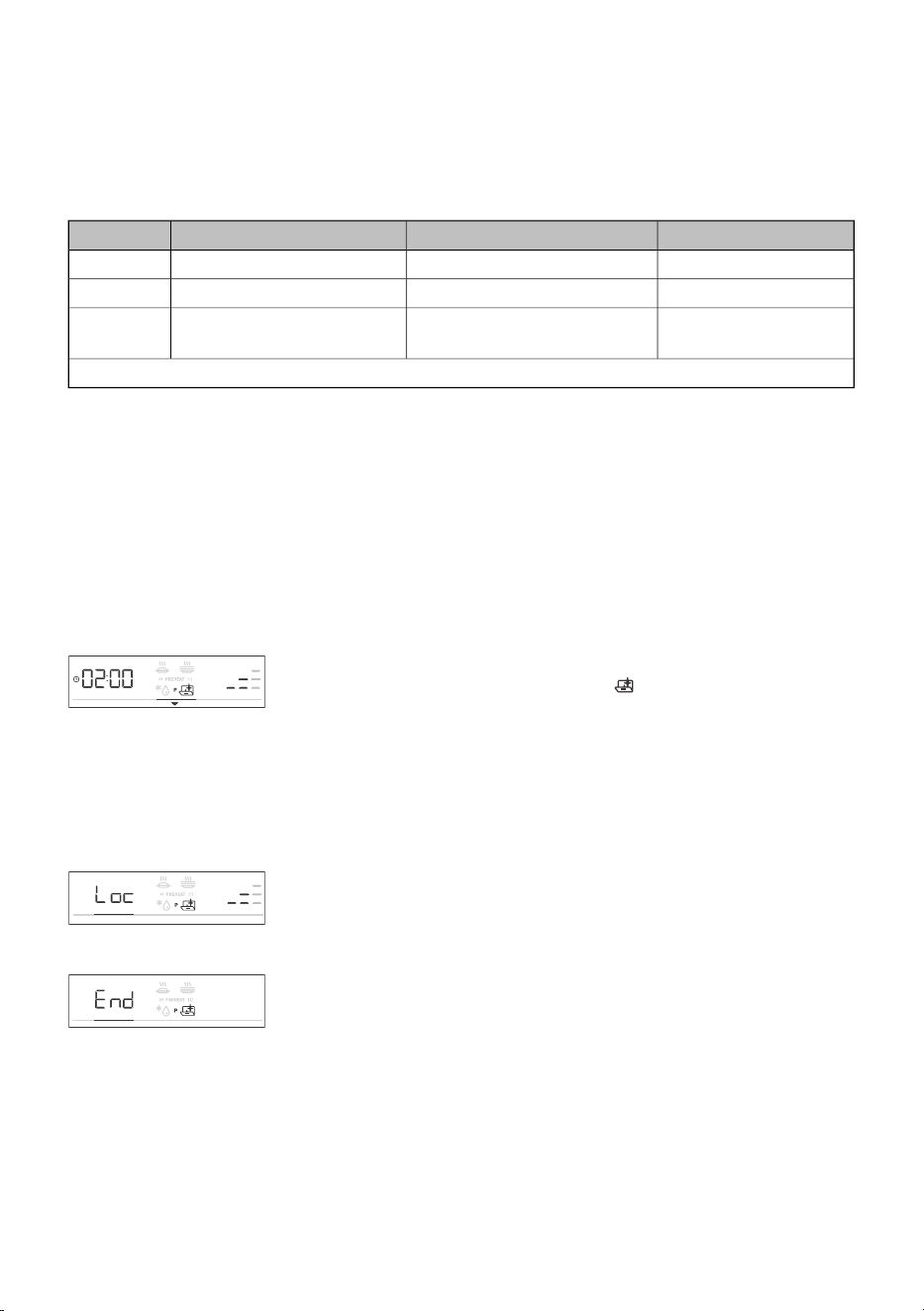
1. Touch the extra bake key to display extra functions on the display
unit. Rotate the KNOB so that the symbol and P are lit up, and confirm
your selection. Three cleaning intensity levels will appear on the display.
Rotate the KNOB to select the cleaning intensity level. The more stubborn
the dirt, the higher the level that should be selected. Medium level is
selected as the default setting.
Confirm your setting by pressing on the KNOB. Touch the start I stop
key. Time starts counting down.
2. After a certain period of time, oven door will be automatically locked
for your safety. Loc will appear on the display unit while the lock is
engaged.
3. When the program is completed, End will appear on the display unit
and an acoustic signal will be emitted.
• When the pyrolytic cleaning process is complete and the oven has cooled down, the oven door
will be unlocked automatically.
• Once the oven cavity has fully cooled down, wipe it with hot soapsuds and a soft cloth to remove
any residue (e.g. ashes).
36

WARNING!
During pyrolysis, unpleasant odours and smoke, as well as irritating vapours and gases,
may be emitted. Therefore, make sure that the room is well-ventilated during the procedure
and do not stay in that room for prolonged periods of time. Do not allow children or pets
to come close to the oven.
During the pyrolysis process, food and fat residues may ignite. Therefore, remove all
impurities from the oven interior before starting the process.
Appliance exterior will heat up to a high temperature during the pyrolytic cleaning process.
Do not touch the oven door and never hang and combustible objects, such as kitchen
cloths or towels, on the door handle.
Do not attempt to open the door while it is locked (during pyrolytic cleaning and while the
appliance is cooling down after the process)! The cleaning process may be terminated and
there is a risk of burns!
Small animals or pets can be particularly sensitive to any fumes. We recommend removing
them from the room during the pyrolytic cleaning process and ventilating the room
thoroughly once the cleaning process is complete.
Pyrolytic cleaning the supplied accessories
• The supplied accessories (all-purpose deep baking tray, shallow baking tray) may only be cleaned
with pyrolysis if the oven is fitted with extra wire rack guides.
• Insert the accessories into the groove on the second or third guide level – never use the first guide
level.
• After the pyrolytic cleaning, wait for the equipment to cool down and clean it with hot soapsuds
and a damp cloth.
WARNING!
If the oven is fitted with extendible guides, the equipment may not be cleaned with pyrolysis.
INFORMATION!
For better cleaning results, we recommend cleaning the oven and the accessories/equipment
separately. When using the pyrolytic cleaning process to clean the equipment, the oven cavity
may not be completely clean at the end of the cycle.
If you are not happy with the cleaning results, we recommend repeating the process.
As a result of the automatic pyrolytic cleaning, the oven cavity and the oven accessories may
discolour and lose their sheen. This does not affect the functionality of the oven or the
accessories/equipment.
37
Removing wire and fixed pull-out (extendible) guides
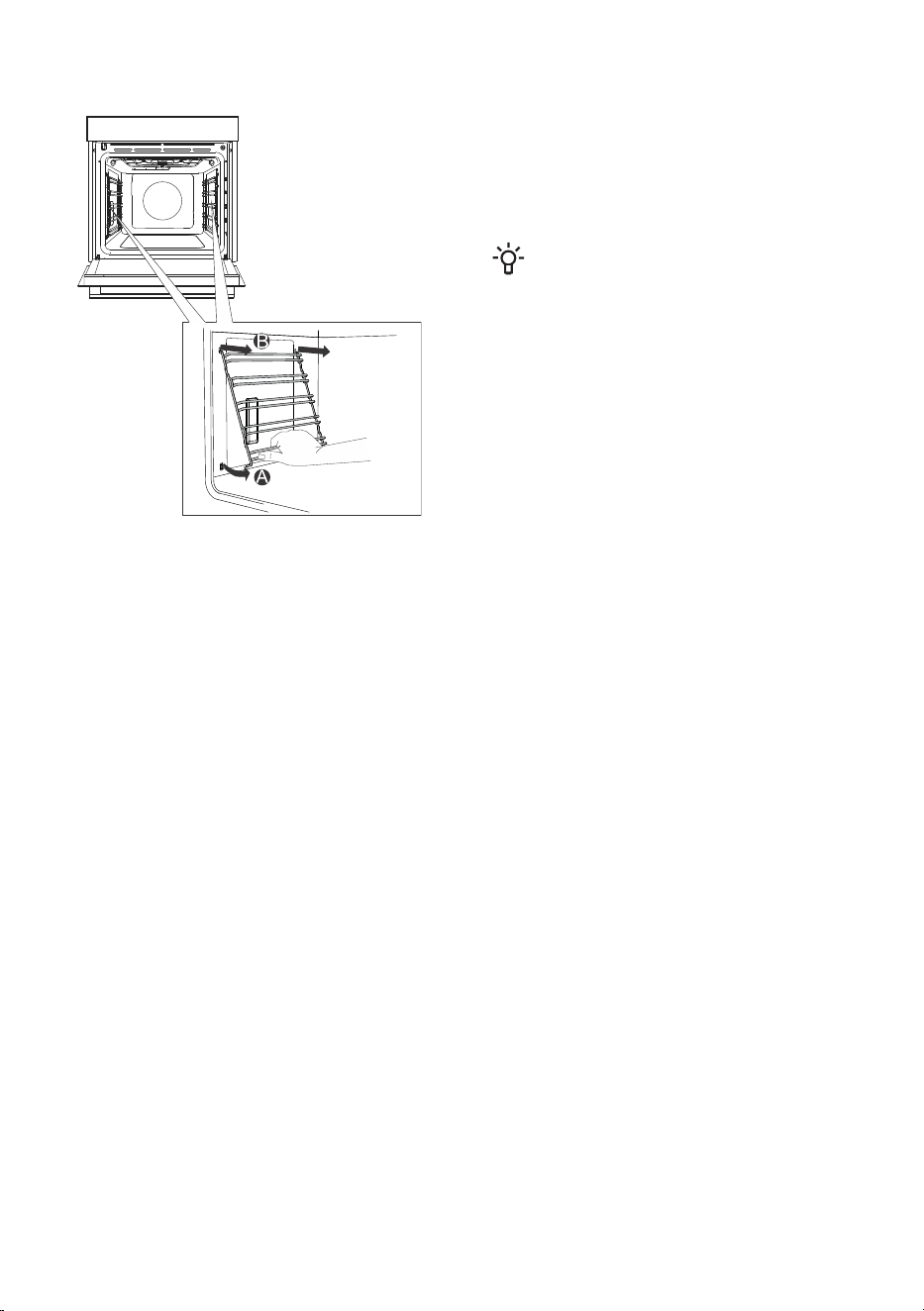
A Hold the guides by the bottom side and
pull them towards the center of the oven cavity.
B Remove them from the openings at the top.
INFORMATION!
When removing the guides, take care not
to damage the enamel coating.
38
Removing and replacing the oven door and glass panes
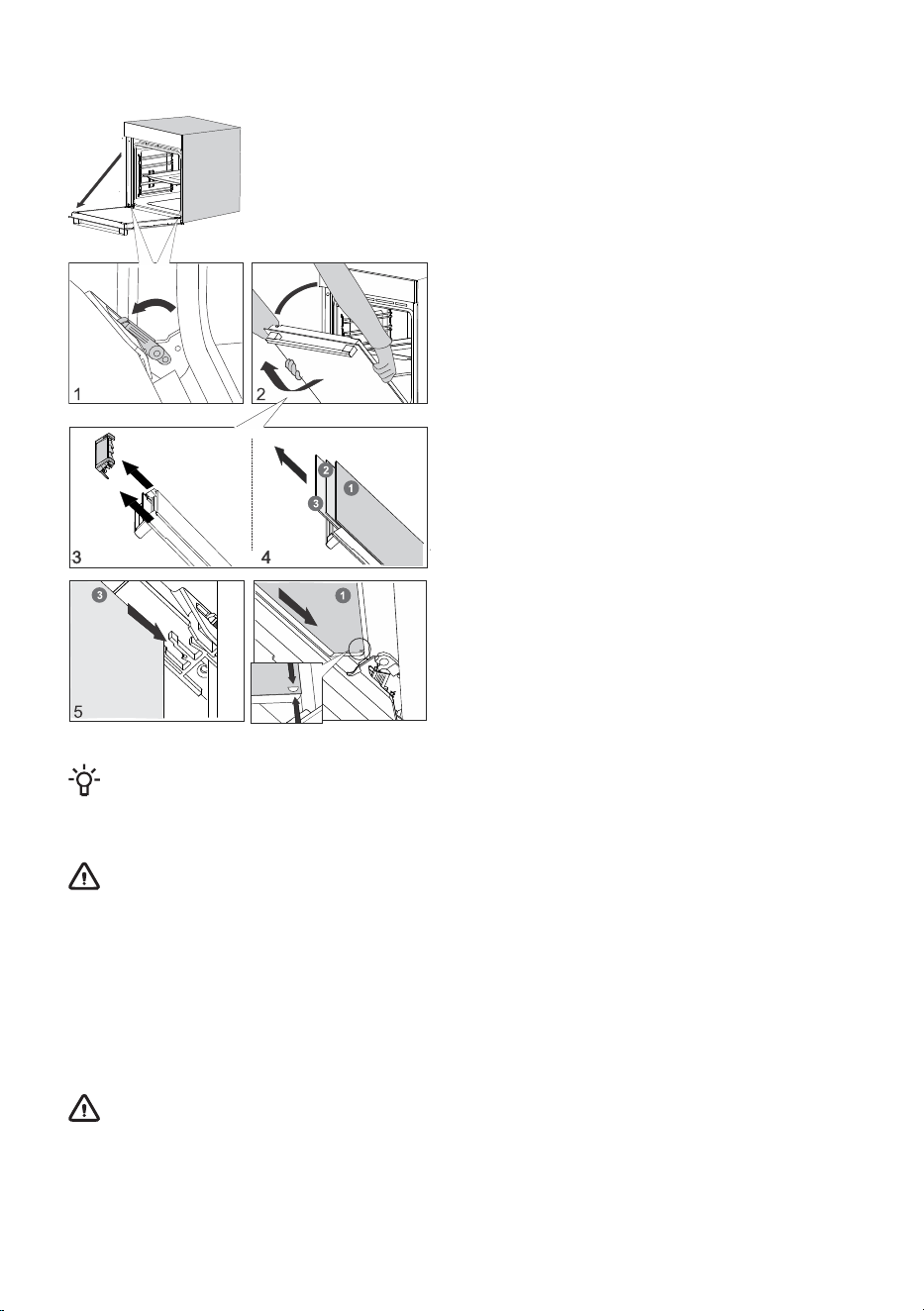
1 First, fully open the door (as far as it will go).
2 Oven door is attached to the hinges with
special supports that also include safety levers.
Rotate the safety levers towards the door by
90°. Slowly close the door to a 45° angle
(relative to the position of the fully closed door);
then, lift the door and pull it out.
Oven door glass pane can be cleaned from
the inside, but it has to be removed from the
appliance door first. First, proceed as described
under item 2, but do not remove it.
3 Remove the air guide. Hold it on the left-
and right-hand side of the door with your
hands. Remove it by slightly pulling it towards
you.
4 Hold the door glass at the upper edge and
remove it. To the same for the second and third
glass pane (depending on the model).
5 To replace the glass panes, observe the
reverse order.
INFORMATION!
To replace the door, follow the reverse order. If the door does not open or close properly, make
sure the notches on the hinges are aligned with the hinge beds.
WARNING!
The oven door hinge can close with considerable force. Therefore, always rotate both
safety levers to the support when fitting or removing the appliance door.
Soft door closing and opening
(depending on the model)
Oven door is fitted with a system that dampens the door closing force, starting at the a 75°angle. It
allows simple, quiet, and gentle opening and closing of the door. A gentle push (to a 15° angle relative
to the closed door position) is enough for the door to close automatically and softly.
WARNING!
If the force applied to close the door is too strong, the effect of the system is reduced and
the safety mechanism effect is decreased.
39
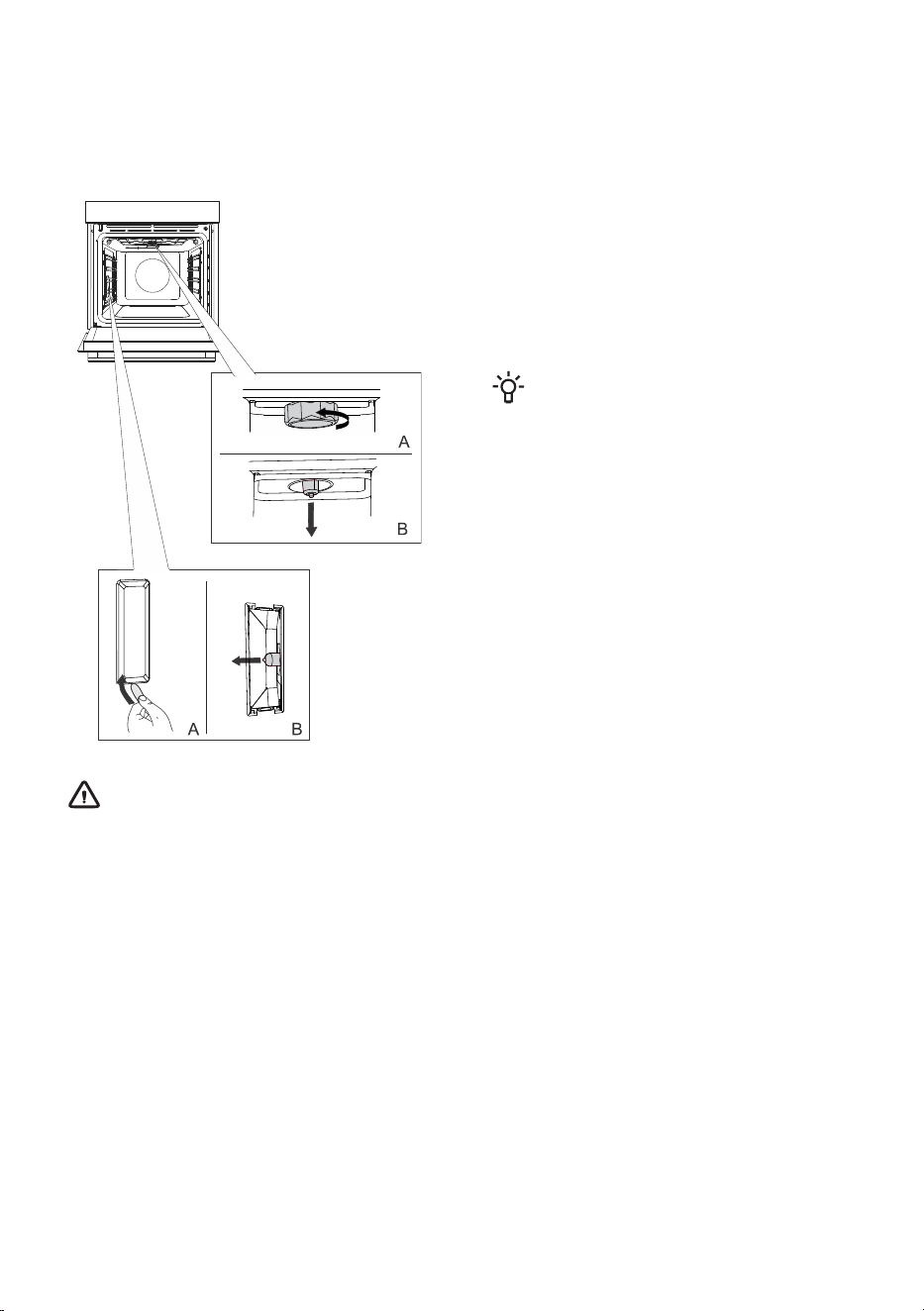
Replacing the bulb
The bulb is a consumable and therefore not covered by warranty. Before replacing the bulb, remove
all accessories from the oven.
Halogen lamp: G9, 230 V, 25 W
1 Unscrew and remove the cover (in
anti-clockwise direction). Remove the halogen
bulb.
2 Use a flat plastic tool to remove the cover.
Remove the halogen bulb.
INFORMATION!
Take care not to damage the enamel
coating.
Use protection to avoid burning yourself.
WARNING!
Only replace the light bulb when the appliance is disconnected from power supply.
40

Troubleshooting table
Special warnings and fault reporting
During the warranty period, only a service center authorized by the manufacturer may carry out
any repairs.
Before making any repairs, make sure the appliance is disconnected from the power mains either by
removing the fuse or by disconnecting the power plug from the wall outlet.
Any unauthorized repairs of the appliance may result in electric shock and short circuit hazard; therefore,
do not perform them. Leave such work to an expert or a service technician.
In case of minor problems with appliance operation, check this manual to see if you can fix the problem
yourself.
If the appliance is not operating properly or at all due to inappropriate operation or handling, a visit
from a service technician shall not be free of charge, even during the warranty period.
Save the instructions for future reference and pass them on to any subsequent owners or users of the
appliance.
Following is some advice on rectifying some common problems.
CauseProblem/error
Call a service technician.The main fuse in your home trips often.
The process of changing the light bulb in the oven is
described in the chapter Replacing the bulb.
The oven lighting does not work.
Disconnect the appliance from the power mains for a
few minutes (undo the fuse or switch off the main
switch); then, reconnect the appliance and switch it
on.
Control unit is not responding, the screen
is frozen.
There is an error in the electronic module operation.
Disconnect the appliance from the power mains for a
few minutes.
Error code ErrX is displayed.
In case of a double-digit error code, ErXX
will be displayed.
If the error is still indicated, call a service technician.
Clean the socket.
Try to connect and disconnect the food probe several
times in succession.
The display will show SEnS when the
food probe is not connected.
If the problems persist despite observing the above advice, call an authorized service technician.
Repair or any warranty claim resulting from incorrect connection or use of the appliance shall not be
covered by the warranty. In this case, the user will cover the cost of repair.
41

Disposal
Our product packaging is made of environmentally friendly materials that
can be recycled, disposed of, or destroyed without any hazard to the
environment. To this end, packaging materials are labelled appropriately.
The symbol on the product or its packaging indicates that the product
should not be treated as normal household waste. Take the product to
an authorized collection centre for waste electric and electronic
equipment processing.
Correct disposal of the product will help prevent any negative effects
on the environment and health of people, which could occur in case of
incorrect product removal. For detailed information on removal and
processing of the product, please contact the relevant municipal body
in charge of waste management, your waste disposal service, or the
store where you bought the product.
We reserve the right to any changes and errors in the instructions for use.
42
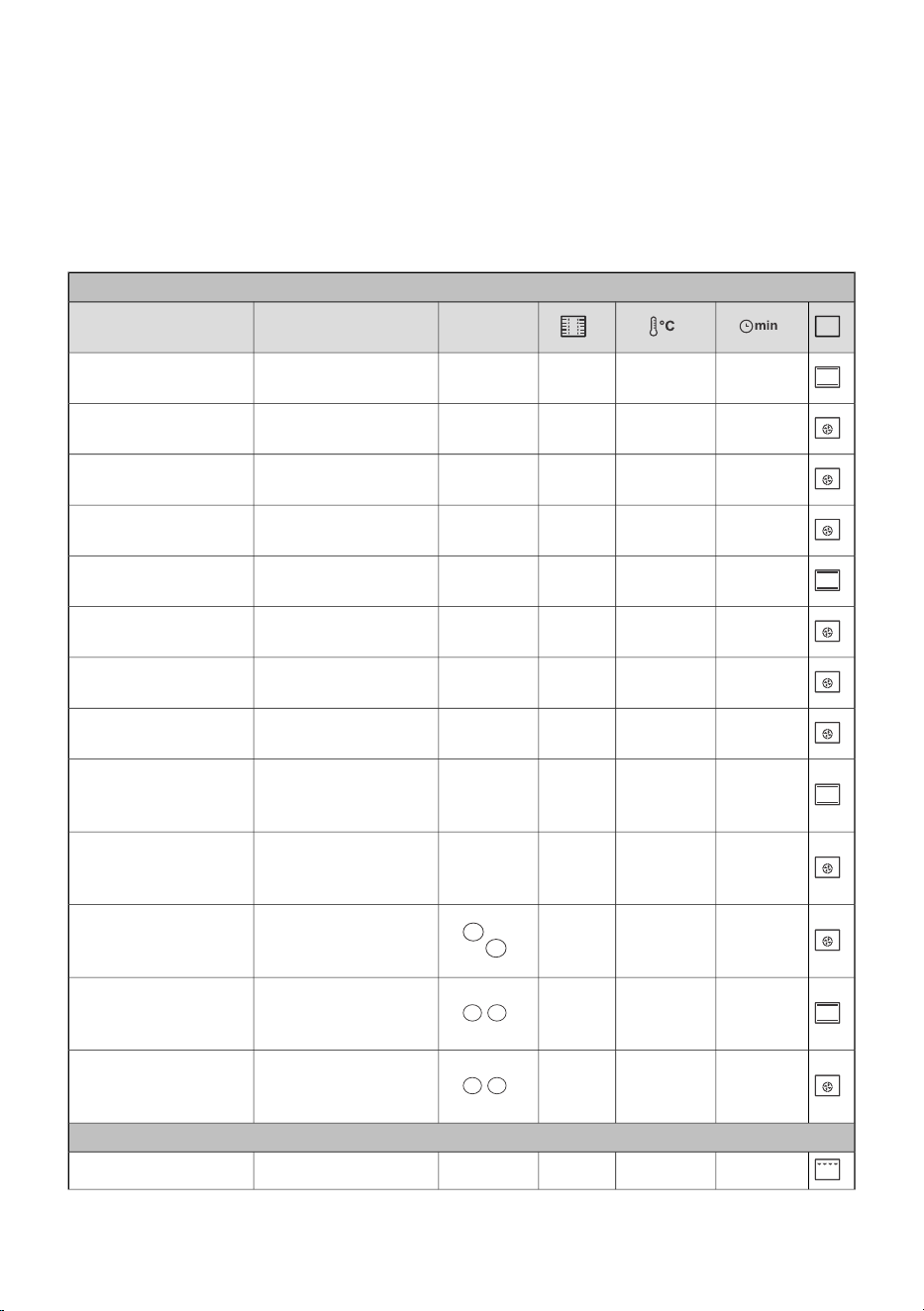
Cooking test
EN60350-1: Only use equipment supplied by the manufacturer.
Always insert the baking tray all the way to the end position on the wire guide. Place pastry or cakes
baked in moulds as shown in the image.
* Preheat the appliance to desired temperature. Do not use the rapid preheat mode.
** Preheat the appliance for 10 minutes. Do not use the rapid preheat mode.
*** Turn after 2/3 of cooking time.
BAKING
mould
placement
EquipmentDish
25-401503shallow baking tray
shortbread – single
rack
35-50135 **3shallow baking tray
shortbread – single
rack
25-40140 **2, 4shallow baking tray
shortbread – two
racks/levels
45-601351, 4, 5shallow baking tray
shortbread – three
racks/levels
20-30160-170 **3shallow baking tray
small cakes – single
rack
20-30155 **3shallow baking tray
small cakes – single
rack
30-45140 **1,5shallow baking tray
small cakes – two
racks/levels
30-50140-1501, 3, 5shallow baking tray
small cakes – three
racks/levels
45-551502
round metal mould,
diameter 26 cm/wire
rack
sponge cake
45-551602
round metal mould,
diameter 26 cm/wire
rack
sponge cake
45-55170 *2, 4
2 × round metal
mould, diameter
26cm/wire rack
sponge cake – two
racks/levels
70-120160 **2
2 × round metal
mould, diameter
20cm/wire rack
apple pie
70-1201602
2 × round metal
mould, diameter
20cm/wire rack
apple pie
BROILING
4-7max5wire racktoast
43

Table continued from last page
BAKING
25-40 ***2305
wire rack + shallow
baking sheet as drip
tray
beef burgers
44

843554-a15