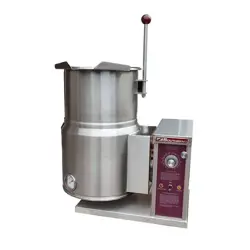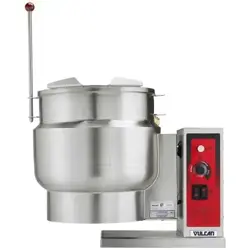
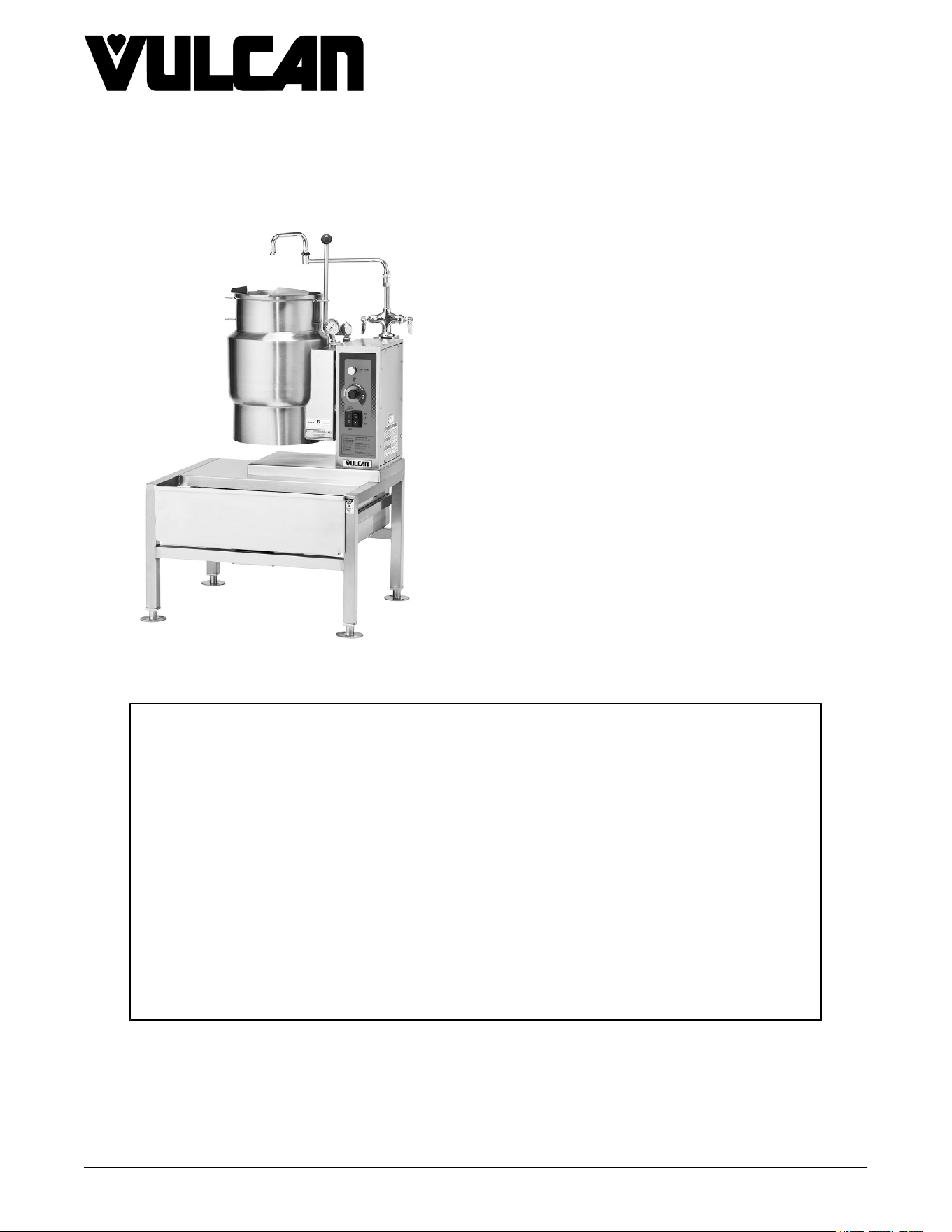
Electric Countertop Tilting
Kettles, K6ETT, K12ETT, K20ETT
K6ETT ML-136067
K12ETT ML-136068
K20ETT ML-136069
- NOTICE -
This Manual is prepared for the use of trained Hobart Service Technicians and should not
be used by those not properly qualified.
This manual is not intended to be all encompassing. If you have not attended a Hobart Service
School for this product, you should read, in its entirety, the repair procedure you wish to
perform to determine if you have the necessary tools, instruments and skills required to
perform the procedure. Procedures for which you do not have the necessary tools,
instruments and skills should be performed by a trained Hobart Service Technician.
The reproduction, transfer, sale or other use of this manual, without the express written
consent of Hobart, is prohibited.
This manual has been provided to you by ITW Food Equipment Group LLC ("ITW FEG")
without charge and remains the property of ITW FEG, and by accepting this manual you agree
that you will return it to ITW FEG promptly upon its request for such return at any time in the
future.
SERVICE MANUAL
A product of Vulcan-Hart 3600 North Point Blvd Baltimore, MD 21222
F35496 Rev. C (0124)

TABLE OF CONTENTS
SERIVE UPDATE .......................................................................................... 3
SERVICE UPDATE ..................................................................................... 3
GENERAL .................................................................................................. 4
INTRODUCTION ....................................................................................... 4
MODELS COVERED ................................................................................... 4
CONTROL PANEL ..................................................................................... 4
TOOLS ................................................................................................. 4
SPECIFICATIONS ...................................................................................... 5
REMOVAL AND REPLACEMENT OF PARTS ............................................................... 6
COVERS AND PANELS ................................................................................ 6
ELECTRICAL PANEL COMPONENTS-WATER LEVEL CONTROL, TRANSFORMER,
CONTACTORS AND TEMPERATURE CONTROL .................................................. 6
BOTTOM COMPONENTS - WATER LEVEL PROBE (LLCO), TEMP SENSOR &
PRESSURE SWITCH ............................................................................... 7
POTENTIOMETER ..................................................................................... 7
HEATING ELEMENT ................................................................................... 8
KETTLE ASSEMBLY ................................................................................... 9
BEARINGS ........................................................................................... 13
SHAFT SEAL ......................................................................................... 13
PIVOT STOP PIN ..................................................................................... 14
SERVICE PROCEDURES AND ADJUSTMENTS ........................................................... 16
TEMPERATURE CONTROLLER TEST ................................................................ 16
POTENTIOMETER TEST .............................................................................. 17
THERMOCOUPLE TEST .............................................................................. 17
HEATING ELEMENTS ................................................................................ 18
VENTING ............................................................................................. 19
FILLING THE RESERVOIR JACKET ................................................................... 20
ELECTRICAL OPERATION ................................................................................ 24
COMPONENT FUNCTION ............................................................................ 24
COMPONENT LOCATION ............................................................................. 25
WATER LEVEL CONTROL (WLC LLCO) .............................................................. 27
SEQUENCE OF OPERATION ......................................................................... 27
SCHEMATIC DIAGRAM ............................................................................... 29
WIRING DIAGRAM .................................................................................... 30
TROUBLESHOOTING ..................................................................................... 32
TROUBLESHOOTING ................................................................................. 32
Electric Countertop Tilting Kettles, K6ETT, K12ETT, K20ETT
© VULCAN 2024
F35496 Rev. C (0124) Page 2 of 32

SERIVE UPDATE
SERVICE UPDATE
January 2024
• Updated chart in FILLING THE RESERVOIR
JACKET.
December 2023
• Updated FILLING THE RESERVOIR JACKET.
• Updated TOOLS.
December 2020
• Updated HEATING ELEMENT.
November 2017
• Updated Reservoir Jacket Volume chart in
FILLING THE RESERVOIR JACKET.
Electric Countertop Tilting Kettles, K6ETT, K12ETT, K20ETT - SERIVE UPDATE
Page 3 of 32 F35496 Rev. C (0124)
GENERAL
INTRODUCTION
General
The procedures in this manual apply to all models
unless otherwise specified. The pictures and
illustrations are of a model K6ETT countertop
tilting kettle unless otherwise noted. All
information and specifications contained in this
manual are based on the latest product
information available at the time of printing.
Countertop Tilting Kettles
The electric countertop tilting kettles are self
contained two thirds jacketed kettles. The lower
two thirds of the kettle bowl is a double wall
stainless steel construction that provides a
reservoir for a solution of heat transfer fluid and
distilled water for improved heating of the kettle
contents. The kettles are used to prepare a
variety of liquid or semi-liquid food products such
as soups, stews and sauces.
MODELS COVERED
The 6 and 12 gallon kettles can be mounted to a
counter top or optional stand. The 20 gallon kettle is a
floor model mounted to its own stand.
Electric Countertop Tilting Kettles
K6ETT - 6 gallon
K12ETT - 12 gallon
K20ETT - 20 gallon
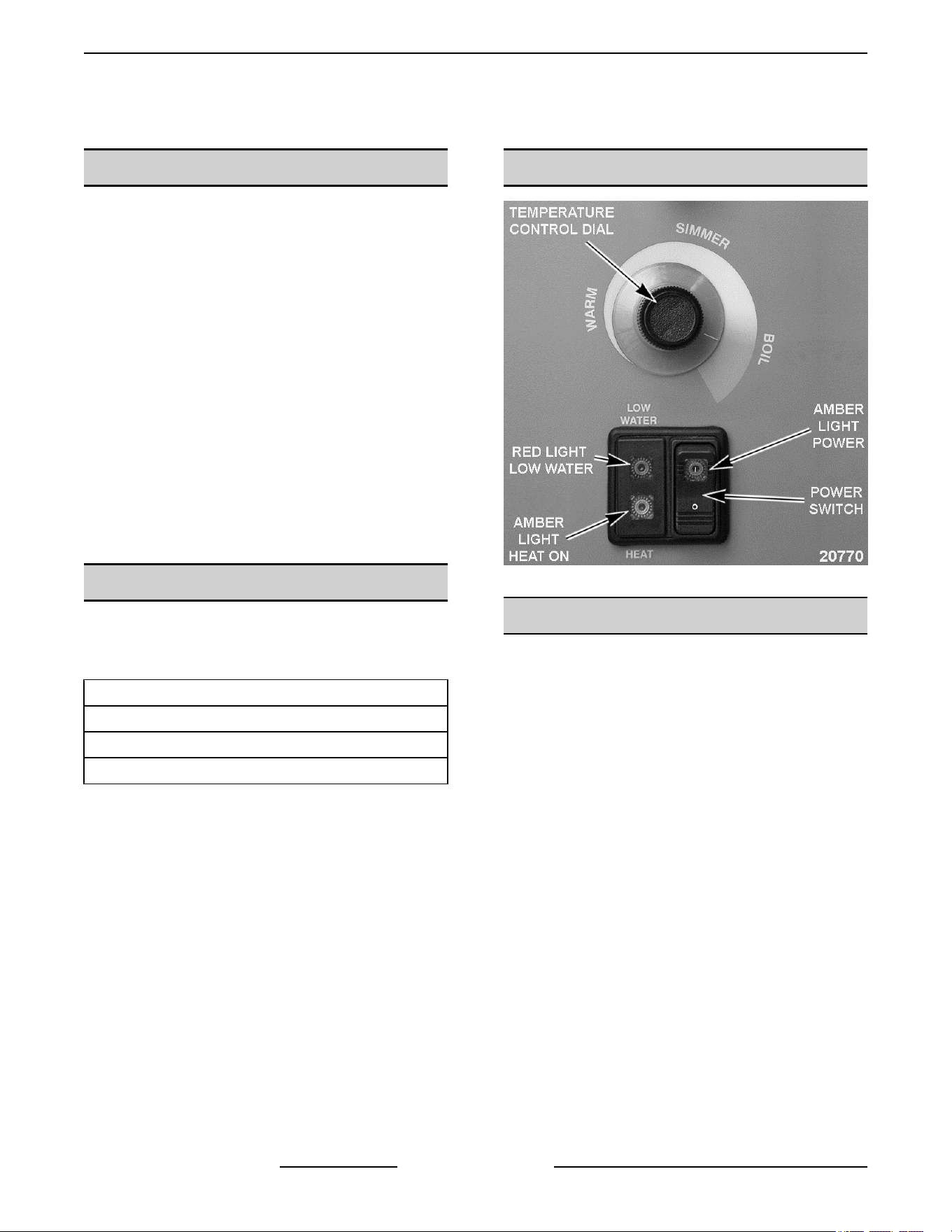
CONTROL PANEL
Fig. 1
TOOLS
Standard
• Standard set of hand tools.
• Pipe thread sealant.
• VOM with an AC current tester (meter sensitivity
should be at least 20,000 ohms per volt).
• Temperature meter (thermocouple type). Use for
checking kettle temperature.
• 2 gallon container to hold drained reservoir jacket
fluid.
Special
• Torque wrench (ft-lbs) for tightening heating
element mounting bolts.
• Lubriplate 630-AA Part No. 501687 for
lubrication of tilt lock pivot stop pin.
• Loctite® ODC-Free Cleaner & Degreaser
(McMaster-Carr Part No. 66415A21) or
equivalent fast drying, no residue cleaner.
• Loctite® 7471™ Primer N™ Part No. 544434-2.
• Loctite® 242™ Part No. 520228.
Electric Countertop Tilting Kettles, K6ETT, K12ETT, K20ETT - GENERAL
F35496 Rev. C (0124) Page 4 of 32
• Thermodyne 90395 GLYCOL, HEAT
TRANSFER FLUID, 1 GALLON, available at
Parts Town or DOWFROST™ Propylene Glycol
at ChemWorld. Refer to FILLING THE
RESERVOIR JACKETfor volumes.
• Distilled water only for re-filling of the jacket
(purchase locally). Refer to FILLING THE
RESERVOIR JACKET for volumes.
SPECIFICATIONS
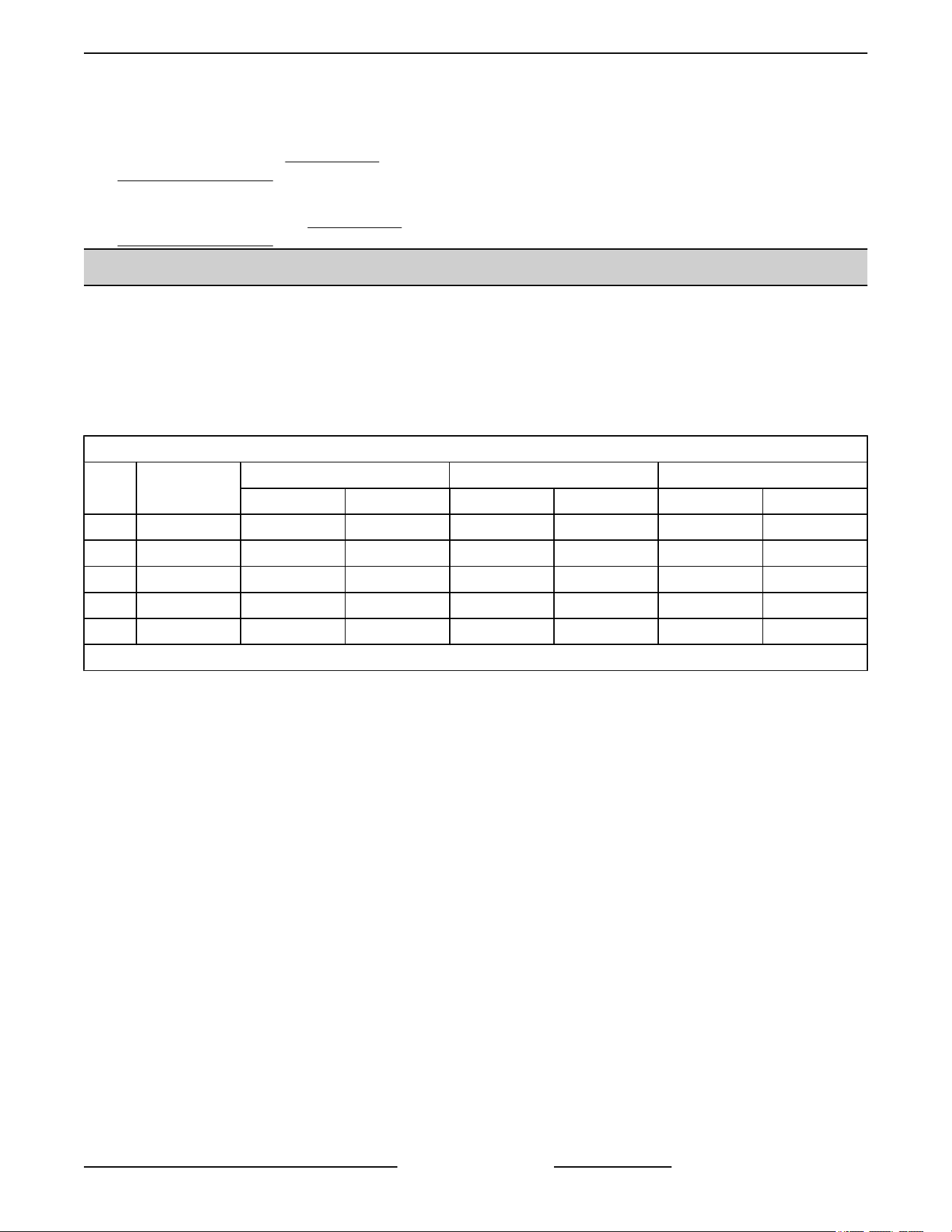
Reservoir Jacket Fluid
• Water - Use only distilled water for partial re-filling of the jacket (purchase locally).
• Dowfrost heat transfer fluid Part No. 558038 (5 gallon). Use during a complete re-fill of the jacket with new
fluid. Refer to service procedures for volumes.
ELECTRICAL SPECIFICATIONS
Volts Phase
K6ETT* K12ETT K20ETT
Total KW Amps Total KW Amps Total KW Amps
208 1 7.50 36 12 58 12 58
240 1 10.0 42 16 67 16 67
208 3 7.50 22 12 33 12 33
240 3 10.0 26 16 39 16 39
480 3 7.50 9 12 14 12 14
*K6ETT only - Heating elements on 208/240VAC three phase machines are not wired as a balanced load.
Electric Countertop Tilting Kettles, K6ETT, K12ETT, K20ETT - GENERAL
Page 5 of 32 F35496 Rev. C (0124)
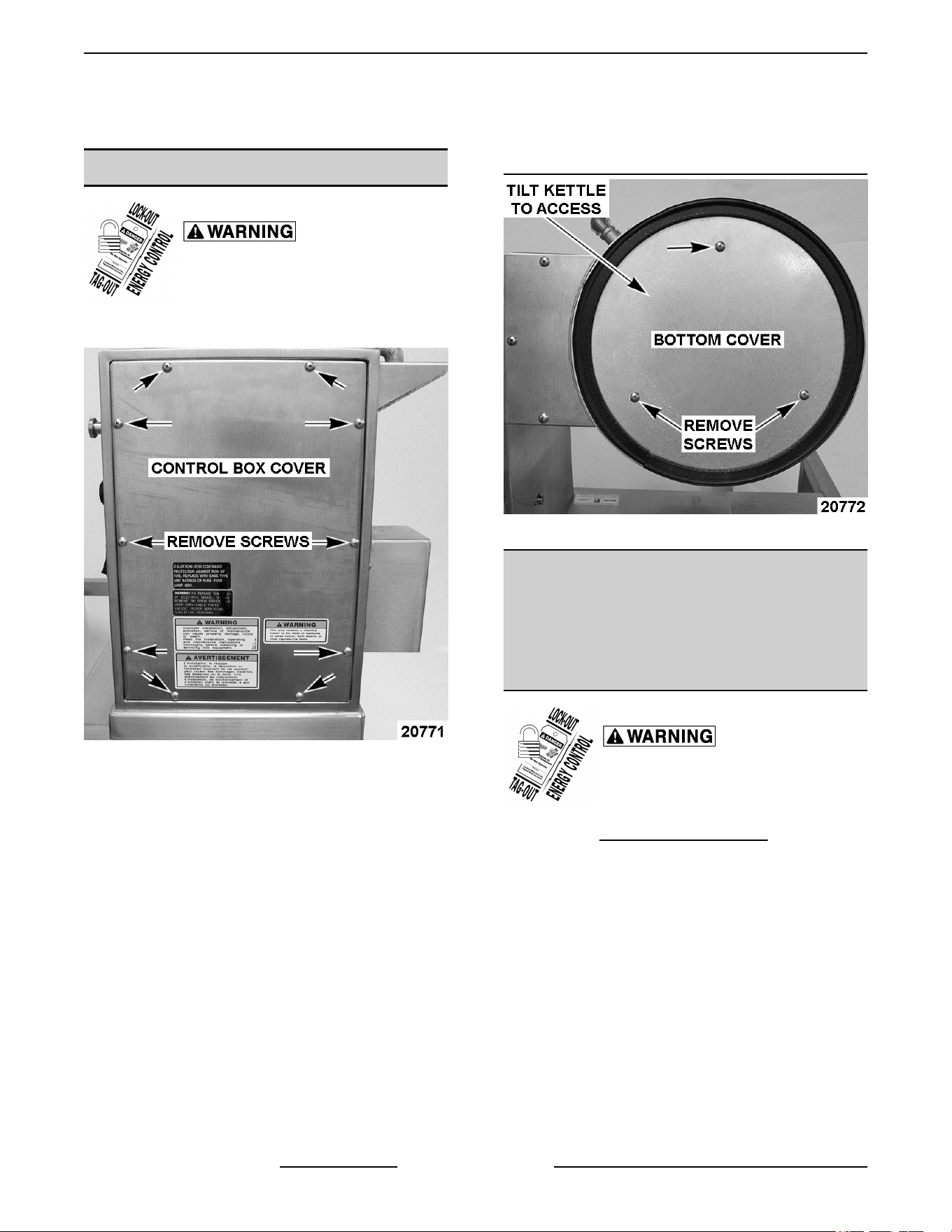
REMOVAL AND REPLACEMENT OF PARTS
COVERS AND PANELS
Disconnect the electrical power to
the machine and follow lockout /
tagout procedures.
Control Box Cover
Fig. 2
Bottom Cover
Fig. 3
ELECTRICAL PANEL
COMPONENTS-WATER LEVEL
CONTROL, TRANSFORMER,
CONTACTORS AND
TEMPERATURE CONTROL
Disconnect the electrical power to
the machine and follow lockout /
tagout procedures.
1. Remove COVERS AND PANELS.
2. Disconnect lead wires from component being
replaced.
3. Remove screws securing the component to
panel.
4. Reverse procedure to install and check for proper
operation.
Electric Countertop Tilting Kettles, K6ETT, K12ETT, K20ETT - REMOVAL AND REPLACEMENT OF PARTS
F35496 Rev. C (0124) Page 6 of 32
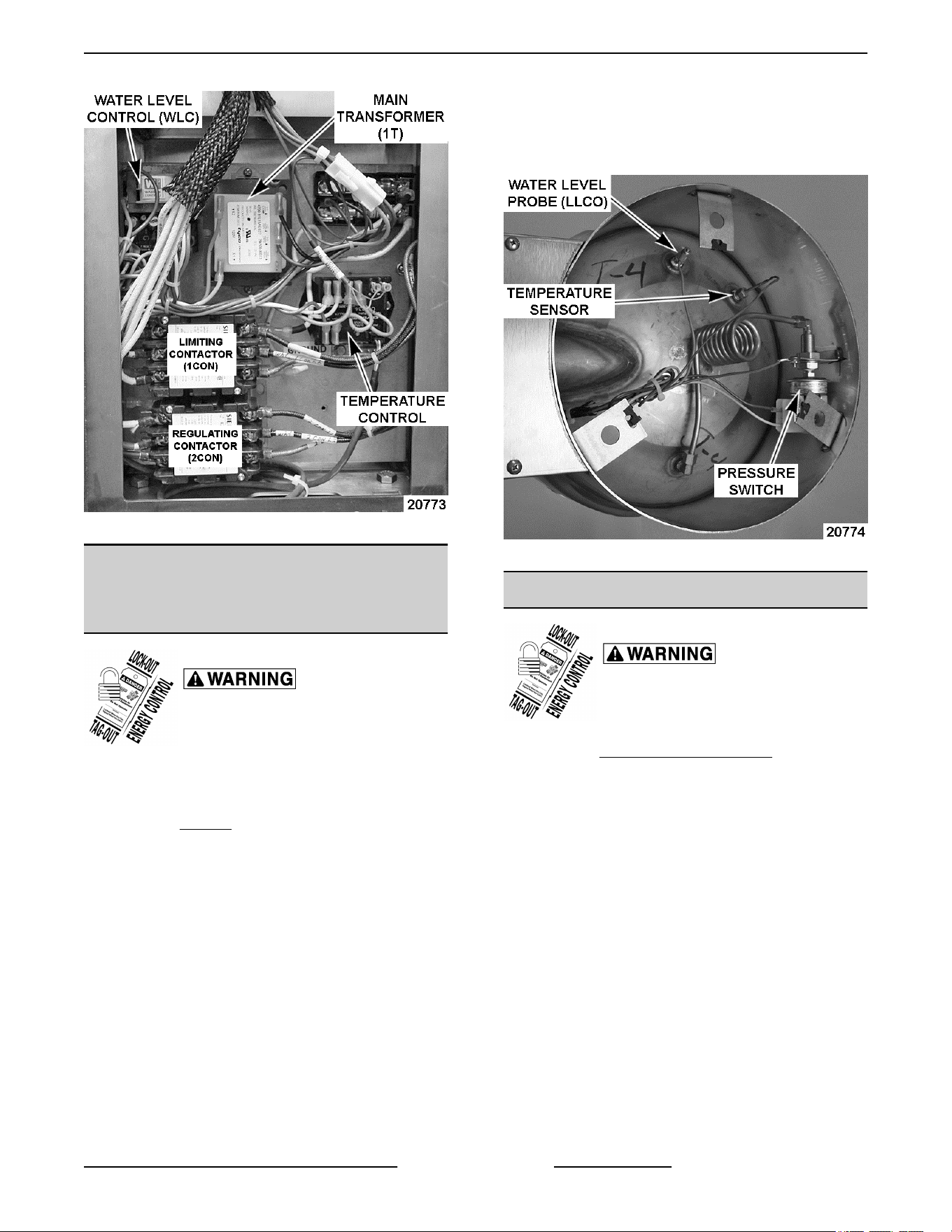
Fig. 4
BOTTOM COMPONENTS - WATER
LEVEL PROBE (LLCO), TEMP
SENSOR & PRESSURE SWITCH
Disconnect the electrical power to
the machine and follow lockout /
tagout procedures.
1. Open pressure relief valve until reservoir jacket
is completely vented.
2. Remove Table 4.
3. Disconnect lead wires from component being
replaced.
4. If removing pressure switch:
A. . Disconnect compression fitting from elbow
near the pressure switch.
B. Remove top nut on brass fitting to remove
pressure switch from mounting bracket.
5. Remove component from bottom of kettle.
6. Reverse procedure to install.
7. Remove air from reservoir jacket as outlined
under VENTING procedure.
8. Check for proper operation. NOTE:
NOTE: Pressure switch setting is fixed and should not
be adjusted. Clean threads and apply pipe thread
sealant when replacing pressure switch, water level
probe or temperature sensor.
Fig. 5
POTENTIOMETER
Disconnect the electrical power to
the machine and follow lockout /
tagout procedures.
1. Remove CONTROL BOX COVER.
2. Disconnect potentiometer wire from temperature
control.
3. Pull temperature dial from potentiometer shaft
and remove seal nut.
Electric Countertop Tilting Kettles, K6ETT, K12ETT, K20ETT - REMOVAL AND REPLACEMENT OF PARTS
Page 7 of 32 F35496 Rev. C (0124)
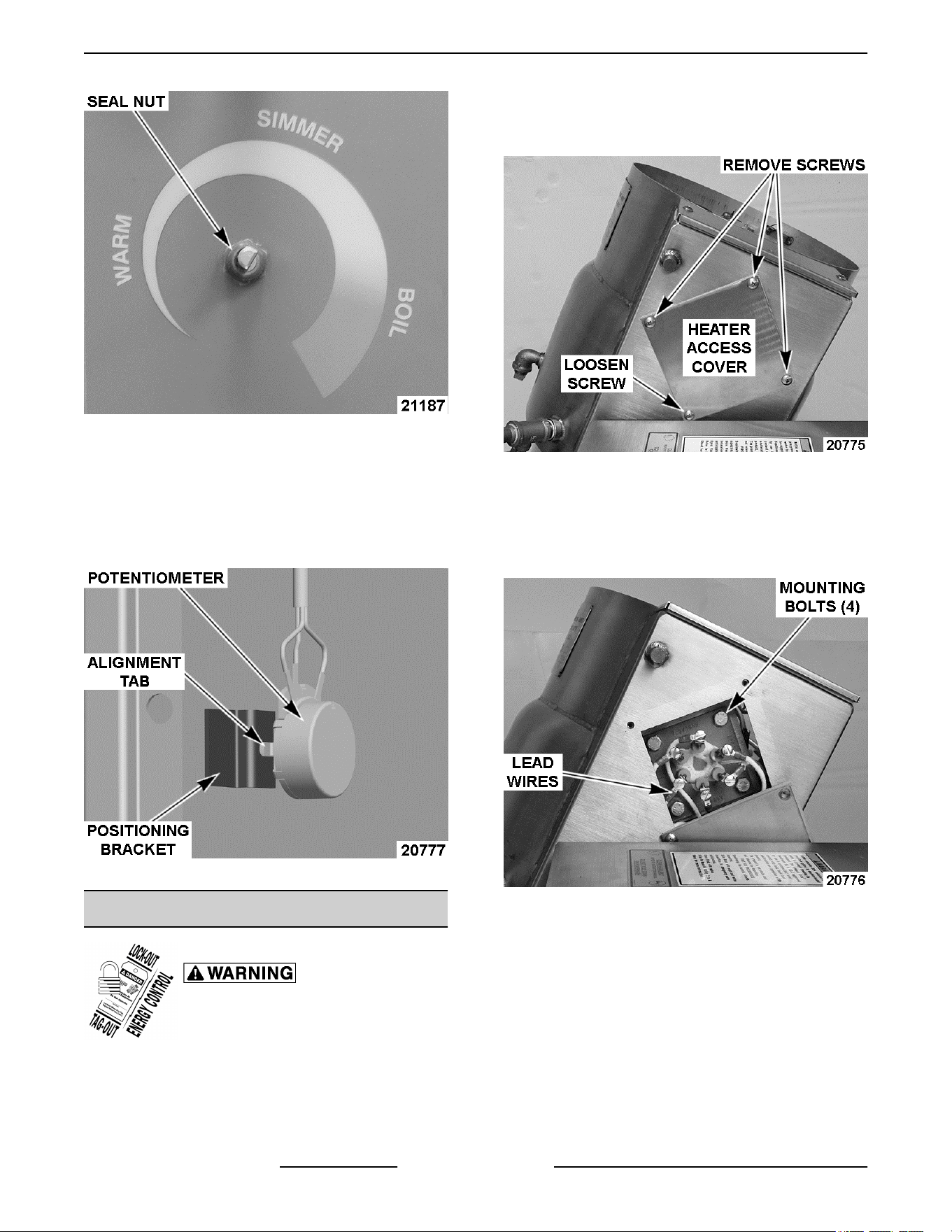
Fig. 6
4. Remove potentiometer from control panel.
5. Reverse procedure to install and check for proper
operation.
NOTE: When installing, ensure potentiometer
alignment tab is seated in positioning bracket.
Fig. 7
HEATING ELEMENT
Disconnect the electrical power to
the machine and follow lockout /
tagout procedures.
1. Open pressure relief valve until reservoir jacket
is completely vented.
2. Tilt kettle to expose the heater access cover.
3. Remove three screws where indicated. Loosen
remaining screw and allow cover to rotate out of
way.
Fig. 8
4. Note lead wire locations and disconnect wires
from heating element.
5. Remove mounting bolts securing heating
element to kettle.
Fig. 9
6. Reverse procedure to install. Use a new heating
element seal whenever installing heating
element. Torque mounting bolts to 40 ft-lbs and
tighten in an alternating pattern.
7. Remove air from reservoir jacket as outlined
under VENTING.
8. Check for proper operation and leaks around
heating element.
NOTE: On K6ETT only, element lengths are
staggered to fit the contour of the kettle bottom. Install
with the shortest element toward the bottom of kettle.
Electric Countertop Tilting Kettles, K6ETT, K12ETT, K20ETT - REMOVAL AND REPLACEMENT OF PARTS
F35496 Rev. C (0124) Page 8 of 32
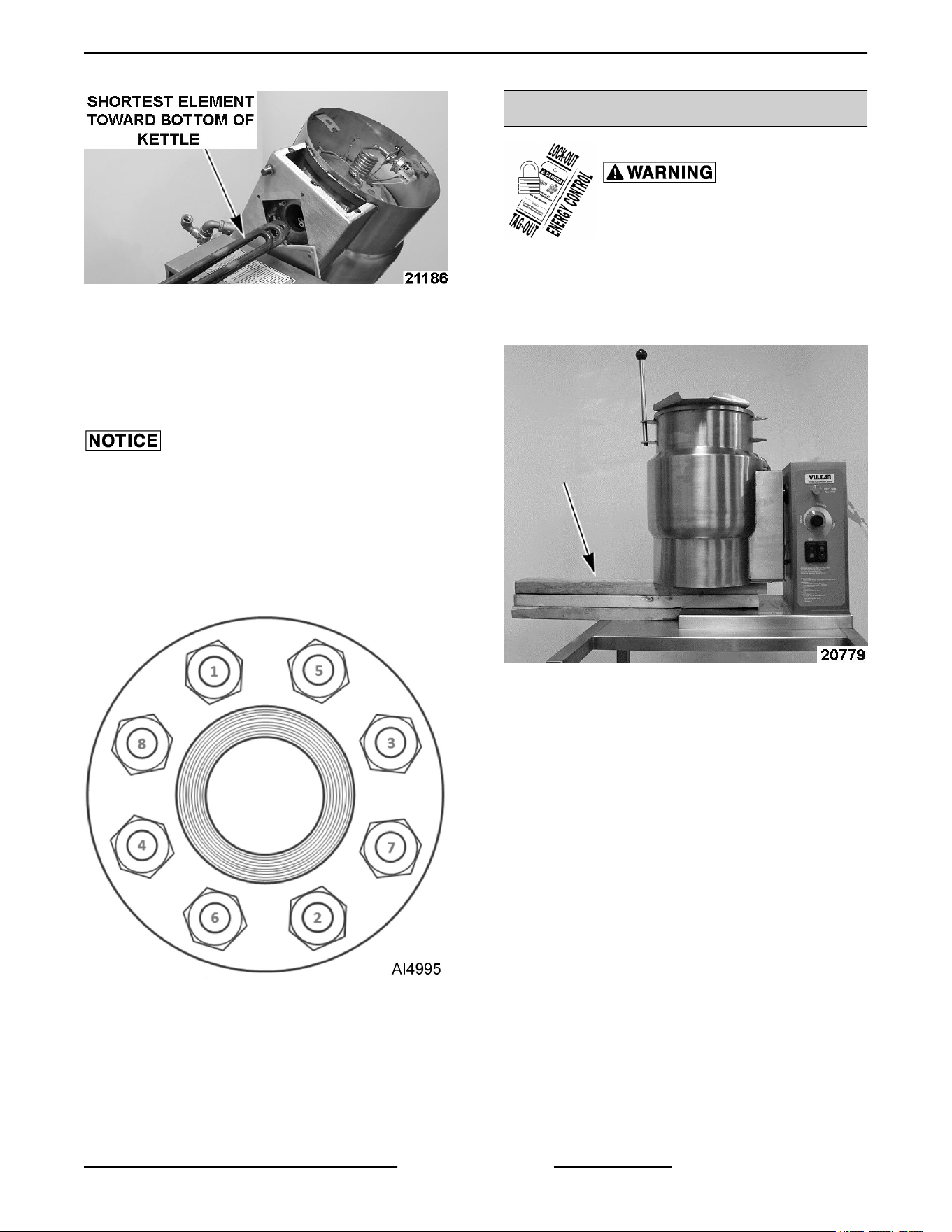
Fig. 10
NOTE: Step 9 is applicable for flange change on
production units starting with serial number break
46-3030197.
9. Torque all flange bolts to 38 Ft/Lbs. in 3 passes
as shown in Fig. 11.
It is recommended to heat kettle up to boil for one
hour. After kettle cools down to -20 to -30 HG and
recheck torque to verify 38 Ft/Lbs.
A. 1st pass 13 ft/lbs.
B. 2nd pass 26 ft/lbs.
C. 3rd pass 38 ft/lbs.
Fig. 11
10. Check for proper operation and leaks around
heating element.
KETTLE ASSEMBLY
Disconnect the electrical power to
the machine and follow lockout /
tagout procedures.
Removal
1. Place kettle in full upright position.
2. Support kettle using 2x4 blocks of wood.
Fig. 12
3. Remove Control Box Cover.
4. Disconnect thermocouple lead wires from
temperature control and the 4 pin wiring harness
connector.
5. Note lead wire locations and disconnect from
load side of contactors.
6. Remove wire tie securing lead wire bundle to
control box.
7. Remove three set screws on pivot stop collar.
Access third screw thru the slot in top of control
box.
Electric Countertop Tilting Kettles, K6ETT, K12ETT, K20ETT - REMOVAL AND REPLACEMENT OF PARTS
Page 9 of 32 F35496 Rev. C (0124)
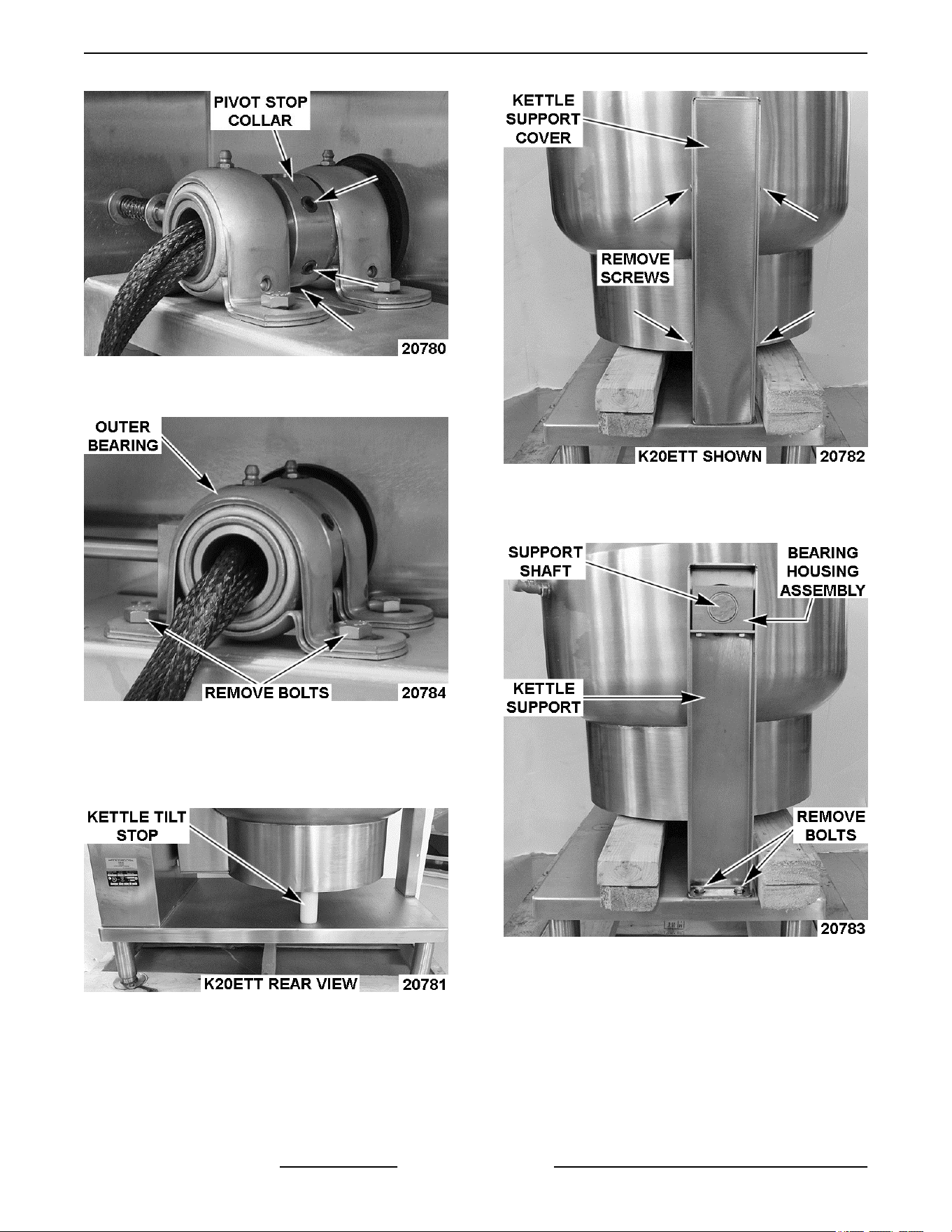
Fig. 13
8. Remove outer bearing from support shaft.
Fig. 14
9. On K20ETT only.
A. Remove two bolts securing kettle tilt stop to
base.
Fig. 15
B. Remove kettle support cover.
Fig. 16
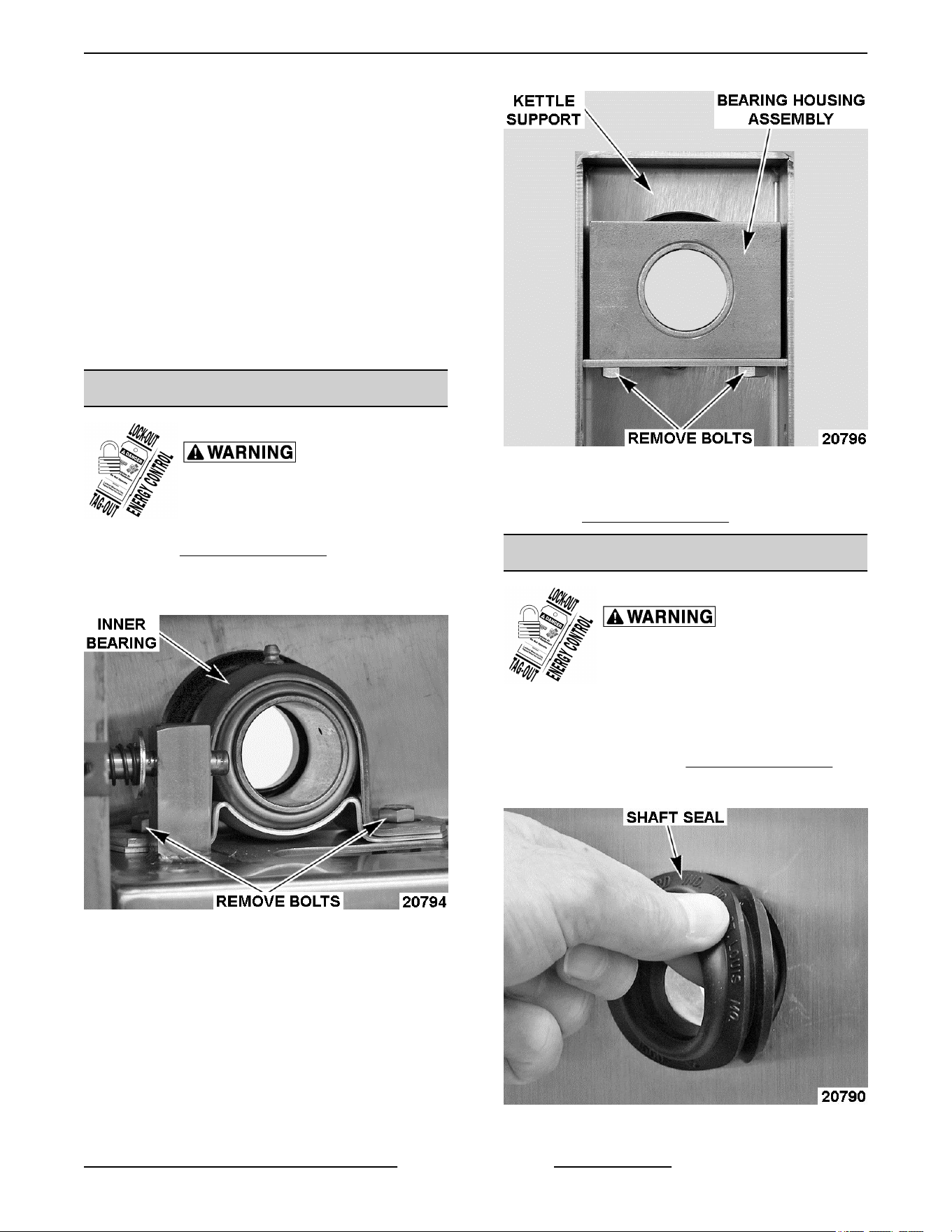
C. Remove kettle support and bearing housing
assembly from support shaft.
Fig. 17
10. Pull kettle assembly away from control box to
disengage support shaft from inner bearing and
pivot stop collar. Slide kettle onto the 2x4 blocks.
A. Pull lead wire bundle thru inner bearing and
pivot stop collar during removal.
NOTE: If support shaft of kettle assembly does not
easily disengage, apply force between control box
housing and kettle assembly to release pivot stop
Electric Countertop Tilting Kettles, K6ETT, K12ETT, K20ETT - REMOVAL AND REPLACEMENT OF PARTS
F35496 Rev. C (0124) Page 10 of 32
collar. The support shaft should slide out of inner
bearing easily.
11. If re-installing kettle assembly, proceed to
Installation in this section. If installing a
replacement kettle assembly, remove
components as outlined below from old kettle
assembly for re-use.
A. Open pressure relief valve until reservoir
jacket is completely vented.
B. Place kettle on floor with the pressure relief
valve and reservoir jacket fill elbow facing
up.
C. Remove Table 4.
D. Remove Water Level Probe.
E. Position kettle assembly to drain fluid into
container. Remove 1/2" pipe plug from the
reservoir jacket fill elbow to facilitate
draining.
F. Remove Temperature Sensor & Pressure
Switch including condensate coil.
G. Remove pressure relief valve assembly
plumbing and reservoir jacket fill elbow.
H. Remove HEATING ELEMENT.
I. Install all removed components onto
replacement kettle. Clean threads and apply
sealant before re-installing pipe fittings.
Installation
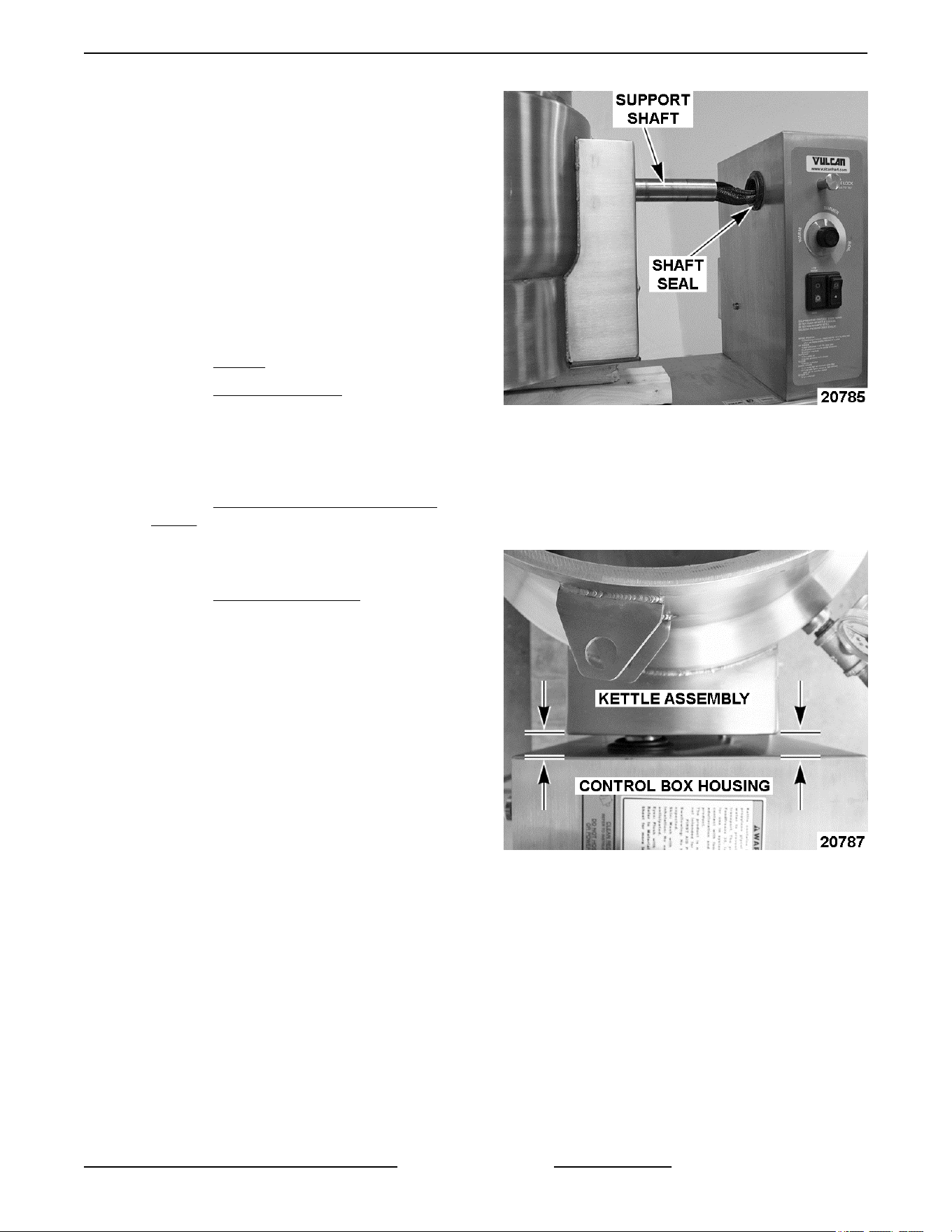
1. Place kettle assembly on 2x4 blocks and align
support shaft to shaft seal. Pull lead wire bundle
thru shaft seal and inner bearing.
NOTE: Bearings and shaft seal are self aligning for
easy installation. Bearings do not require lubrication.
Fig. 18
2. Push kettle assembly support shaft thru shaft
seal and inner bearing.
3. Square the kettle assembly to control box
housing. Maintain squareness during
adjustments.
Fig. 19
4. On K6ETT and K12ETT only.
A. Ensure the pour stop pin on kettle assembly
engages with tilt stop on control box
housing. Approximately 3/16" spacing
should be maintained between the pour
stop pin and control box housing. Adjust
kettle assembly position as necessary.
NOTE: The kettle assembly may drop slightly after
2x4 blocks are removed and when fully loaded. The
spacing of pour stop pin will prevent it from rubbing
the control box during tilt.
Electric Countertop Tilting Kettles, K6ETT, K12ETT, K20ETT - REMOVAL AND REPLACEMENT OF PARTS
Page 11 of 32 F35496 Rev. C (0124)
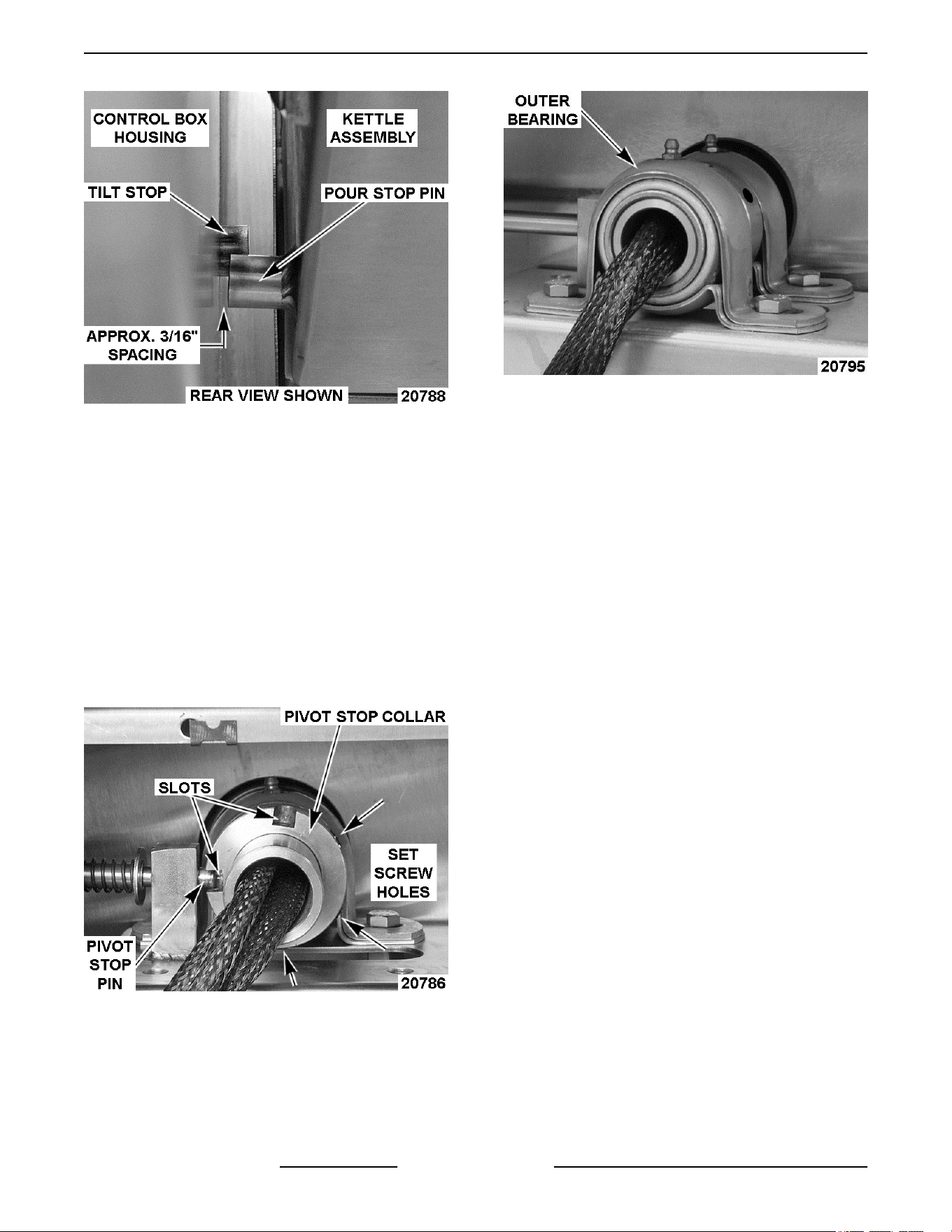
Fig. 20
5. Insert lead wire bundle thru pivot stop collar.
Position pivot stop collar as shown in the picture
below. Set screws should remain out of collar.
A. Slide pivot stop collar onto support shaft.
Operate tilt lock then slide collar against
inner bearing. Hold the collar in position and
release tilt lock. Verify pivot stop pin fully
engages with the slot in pivot stop collar for
the tilt lock as shown. Adjust kettle assembly
position as necessary.
NOTE: The pin location shown will lock the kettle fully
upright. When the kettle is tilted, the pin engages with
the slot near the top to lock the kettle in position.
Fig. 21
6. Insert lead wire bundle thru the outer bearing.
Slide bearing onto support shaft and position it
against pivot stop collar. Install bolts and tighten
to secure the bearing.
Fig. 22
7. Apply Lubriplate 630-AA to mating surfaces on
pivot stop pin. Ensure pivot stop pin fully engages
with the slot in pivot stop collar and does not
catch or bind when tilt lock is operated.
8. Clean threads (screw & hole) with cleaner &
degreaser. Apply Loctite 7471 Primer N and
Threadlocker 242 to set screws and threaded
holes on pivot stop collar.
NOTE: Allow cleaner to fully evaporate before
applying primer. Spay primer on the threads and allow
to dry for 60 seconds. Shake Loctite 242 bottle
thoroughly to mix then apply several drops of the
threadlocker to threads. Do not allow the tip of bottle
to touch a primed surface as it will activate the Loctite
242 in the bottle.
9. Install set screws on pivot stop collar. Hold the
collar against inner bearing and tighten set
screws to secure.
10. On K20ETT only. A. Install kettle support to shaft
and base. B. Install kettle support cover and tilt
stop to base.
11. Remove 2x4 blocks from underneath kettle
assembly.
A. With kettle in full vertical position, verify tilt
lock operation. The pivot stop pin should
engage with the slot in pivot stop collar and
not catch or bind when operated.
B. Tilt kettle to horizontal position and verify
pivot stop pin engages with the next slot in
pivot stop collar.
C. Return kettle to full vertical position. Verify
the kettle pour stop pin engages properly to
prevent backwards tilt.
D. Tilt kettle and verify pour stop pin does not
rub against control box housing.
Electric Countertop Tilting Kettles, K6ETT, K12ETT, K20ETT - REMOVAL AND REPLACEMENT OF PARTS
F35496 Rev. C (0124) Page 12 of 32
12. Connect lead wires to contactors and
temperature control then connect 4 pin wiring
harness.
13. Secure lead wire bundle to control box with wire
tie then install cover.
14. If re-installing kettle assembly, verify the
reservoir jacket is maintaining a vacuum as
outlined under VENTING. If a replacement kettle
assembly was installed, fill the reservoir jacket as
outlined under FILLING THE RESERVOIR
JACKET.
15. Connect power to machine and check for proper
operation.
BEARINGS
Disconnect the electrical power to
the machine and follow lockout /
tagout procedures.
1. Remove KETTLE ASSEMBLY (procedure
includes outer bearing removal).
2. Remove inner bearing from control box housing.
Fig. 23
3. On K20ETT Only.
A. Remove bearing housing assembly from
kettle support.
Fig. 24
4. Install replacement bearing.
5. Install KETTLE ASSEMBLY.
SHAFT SEAL
Disconnect the electrical power to
the machine and follow lockout /
tagout procedures.
All Models
1. To access shaft seal between kettle and control
box housing, remove KETTLE ASSEMBLY.
2. Remove shaft seal from control box housing.
Fig. 25
Electric Countertop Tilting Kettles, K6ETT, K12ETT, K20ETT - REMOVAL AND REPLACEMENT OF PARTS
Page 13 of 32 F35496 Rev. C (0124)
3. Clean mounting surface on control box housing
then install replacement shaft seal.
4. Install KETTLE ASSEMBLY.
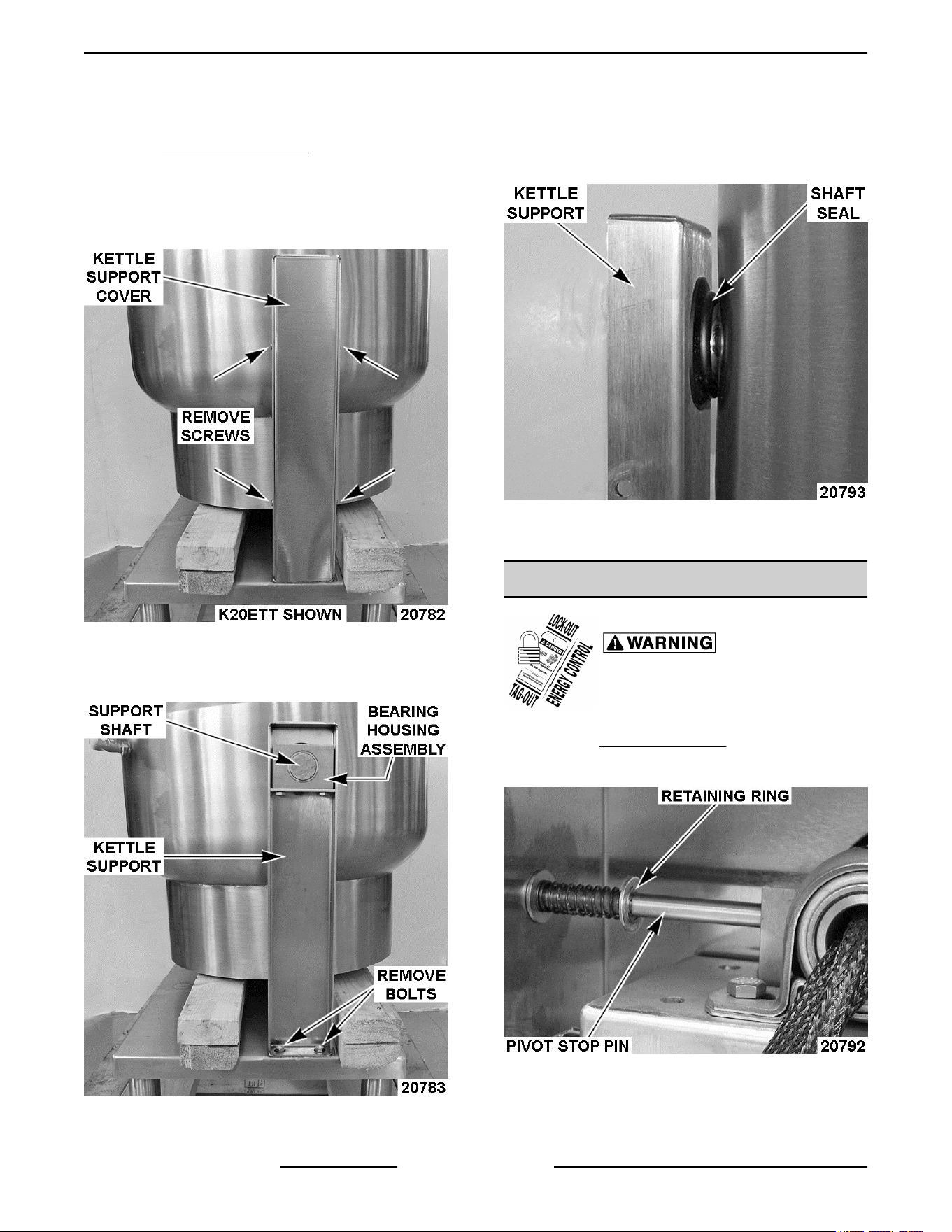
K20ETT Only
1. Support kettle using 2x4 blocks of wood.
2. Remove kettle support cover.
Fig. 26
3. Remove kettle support and bearing housing
assembly from support shaft.
Fig. 27
4. Remove shaft seal from kettle support.
5. Clean mounting surface on kettle support then
install replacement shaft seal.
6. Reverse procedure to complete the installation
and check for proper operation.
Fig. 28
K20ETT WITH SHAFT SEAL INSTALLED
PIVOT STOP PIN
Disconnect the electrical power to
the machine and follow lockout /
tagout procedures.
1. Remove Control Box Cover.
2. Remove retaining ring from pivot stop pin.
Fig. 29
3. Reverse procedure to install.
NOTE: When installing, apply Lubriplate 630-AA to
mating surfaces on pivot stop pin. Ensure pivot stop
Electric Countertop Tilting Kettles, K6ETT, K12ETT, K20ETT - REMOVAL AND REPLACEMENT OF PARTS
F35496 Rev. C (0124) Page 14 of 32
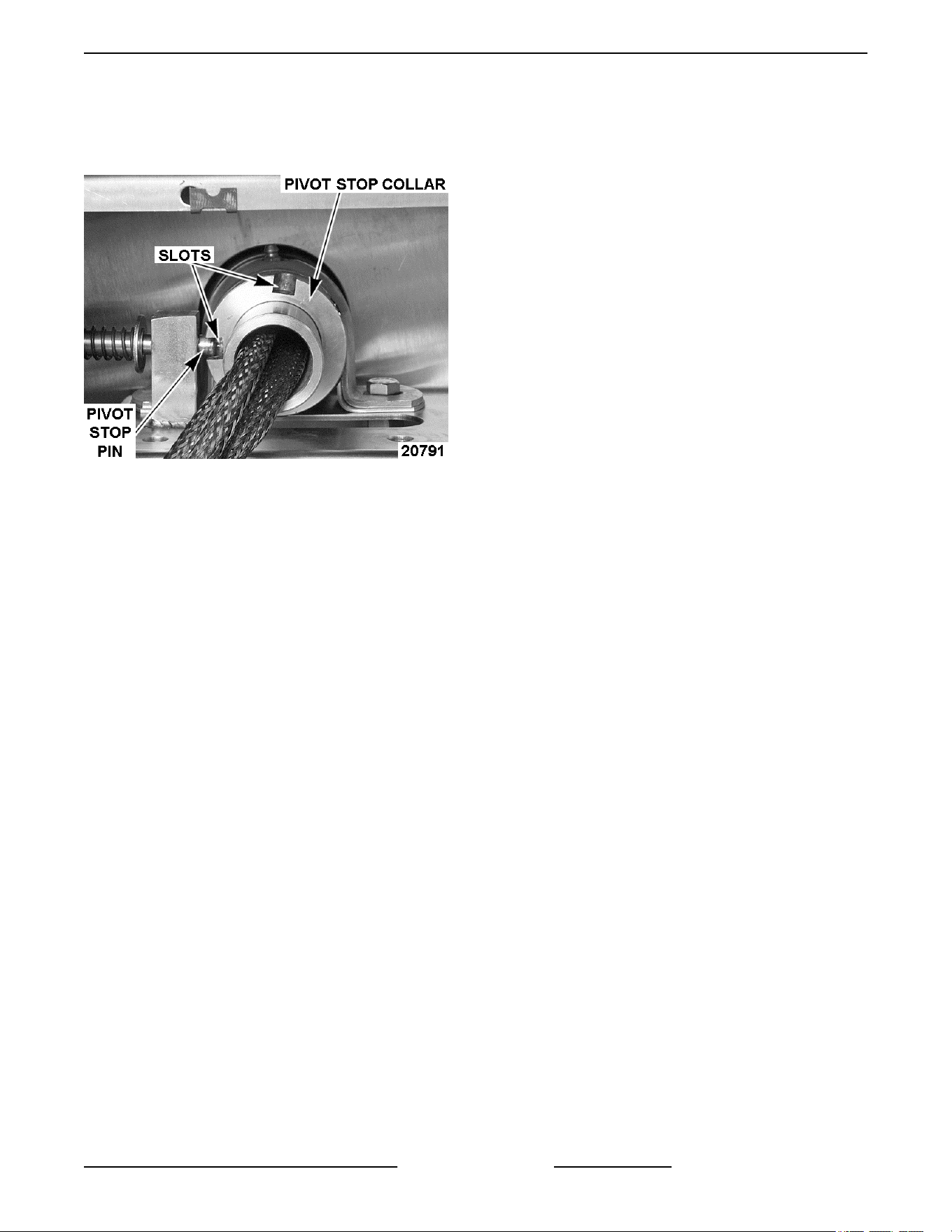
pin fully engages with the slot in pivot stop collar and
does not catch or bind when tilt lock is operated. The
picture below is shown with outer bearing removed for
clarity.
Fig. 30
Electric Countertop Tilting Kettles, K6ETT, K12ETT, K20ETT - REMOVAL AND REPLACEMENT OF PARTS
Page 15 of 32 F35496 Rev. C (0124)
SERVICE PROCEDURES AND ADJUSTMENTS
TEMPERATURE CONTROLLER
TEST
Certain procedures in this section
require electrical test or
measurements while power is
applied to the machine. Exercise
extreme caution at all times and
follow Arc Flash procedures. If test
points are not easily accessible,
disconnect power and follow
Lockout/Tagout procedures, attach
test equipment and reapply power to
test.
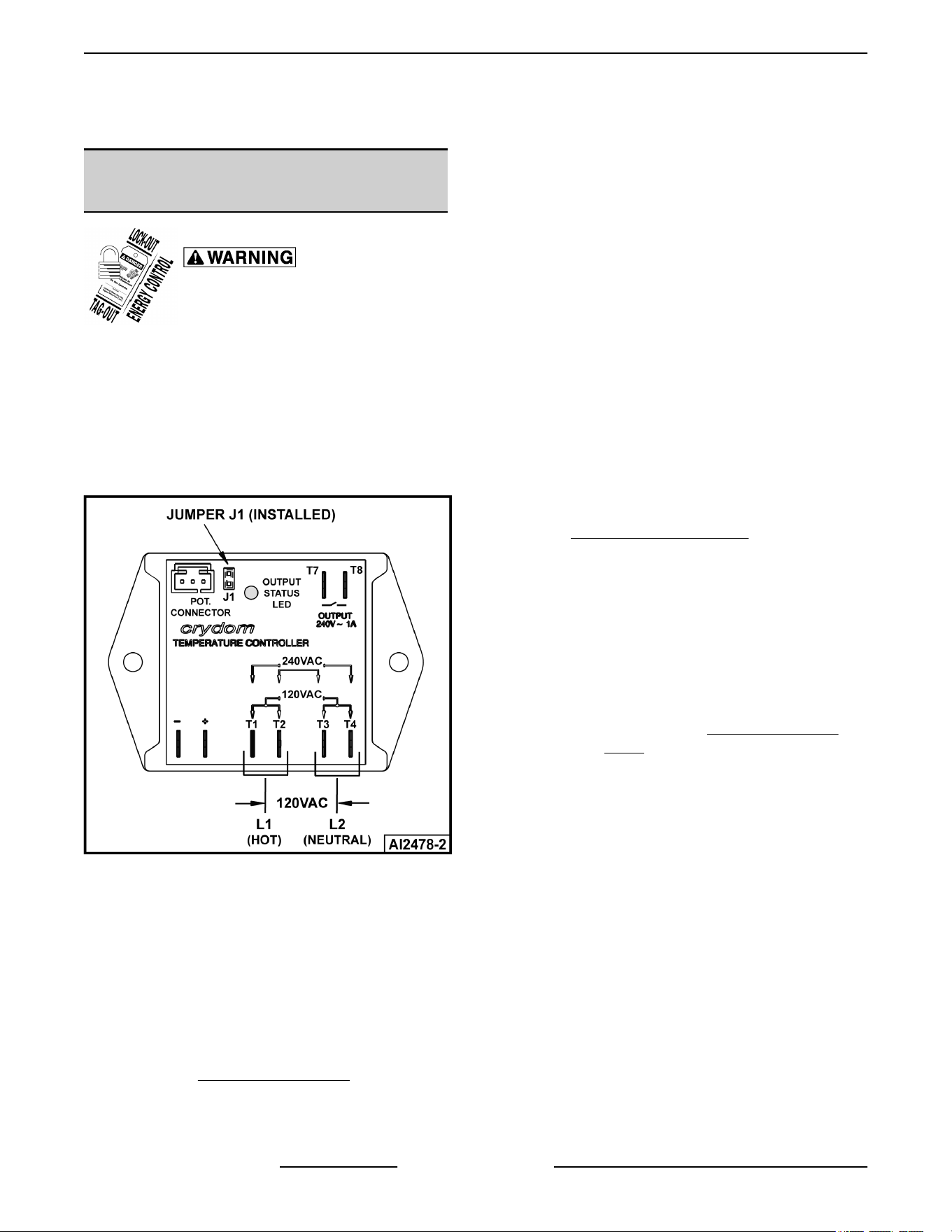
Fig. 31
1. Place kettle in full upright position.
2. Set temperature dial to lowest setting. Kettle
must be below 110°F before verifying the
potentiometer output to the controller is good
over the full range of temperature dial travel.
3. Access the temperature controller as outlined in
REMOVAL AND REPLACEMENT OF PARTS.
4. Check all lead wires for secure connections to the
controller terminals. Wiring harness lead wires
must be connected to T1-T2 and T3-T4 for proper
input to controller.
5. Re-connect power to the machine.
6. Turn power switch on.
7. Verify temperature controller is receiving
120VAC at terminals T1-T2 and T3-T4 and
machine is properly grounded.
8. Slowly turn temperature dial to the highest setting
and monitor heat light over the full range of travel.
A. Verify heat light (amber) comes on and
heating element is energized.
B. If heat light does not remain on or flashes
momentarily as temperature setting is
slowly increased, verify condition of
potentiometer as outlined under
POTENTIOMETER TEST.
NOTE: Temperature controller will de-energize
internal relay and turn off the output status LED if the
circuitry detects an open thermocouple. LED will begin
to flash 3 times, pause, then repeat the flash sequence
to indicate the open thermocouple condition.
C. If heat light and heating element do not turn
on.
1) Verify condition of thermocouple as
outlined under THERMOCOUPLE
TEST.
2) Verify output from terminal T8 on
controller as outlined in the steps
below.
9. Disconnect lead wire from terminal T7 on the
controller.
A. Verify 120VAC between lead wire from T7
and X1 on the output of main transformer. If
correct, re-connect lead wire to terminal T7
and continue with procedure.
B. If incorrect, check pressure switch (1PS)
and water level controller (WLC LLCO).
10. Verify 120VAC between T8 and X1 on the output
of main transformer. If correct, output from
controller is functioning properly.
A. If incorrect, install a replacement
temperature controller and check for proper
operation.
Electric Countertop Tilting Kettles, K6ETT, K12ETT, K20ETT - SERVICE PROCEDURES AND ADJUSTMENTS
F35496 Rev. C (0124) Page 16 of 32
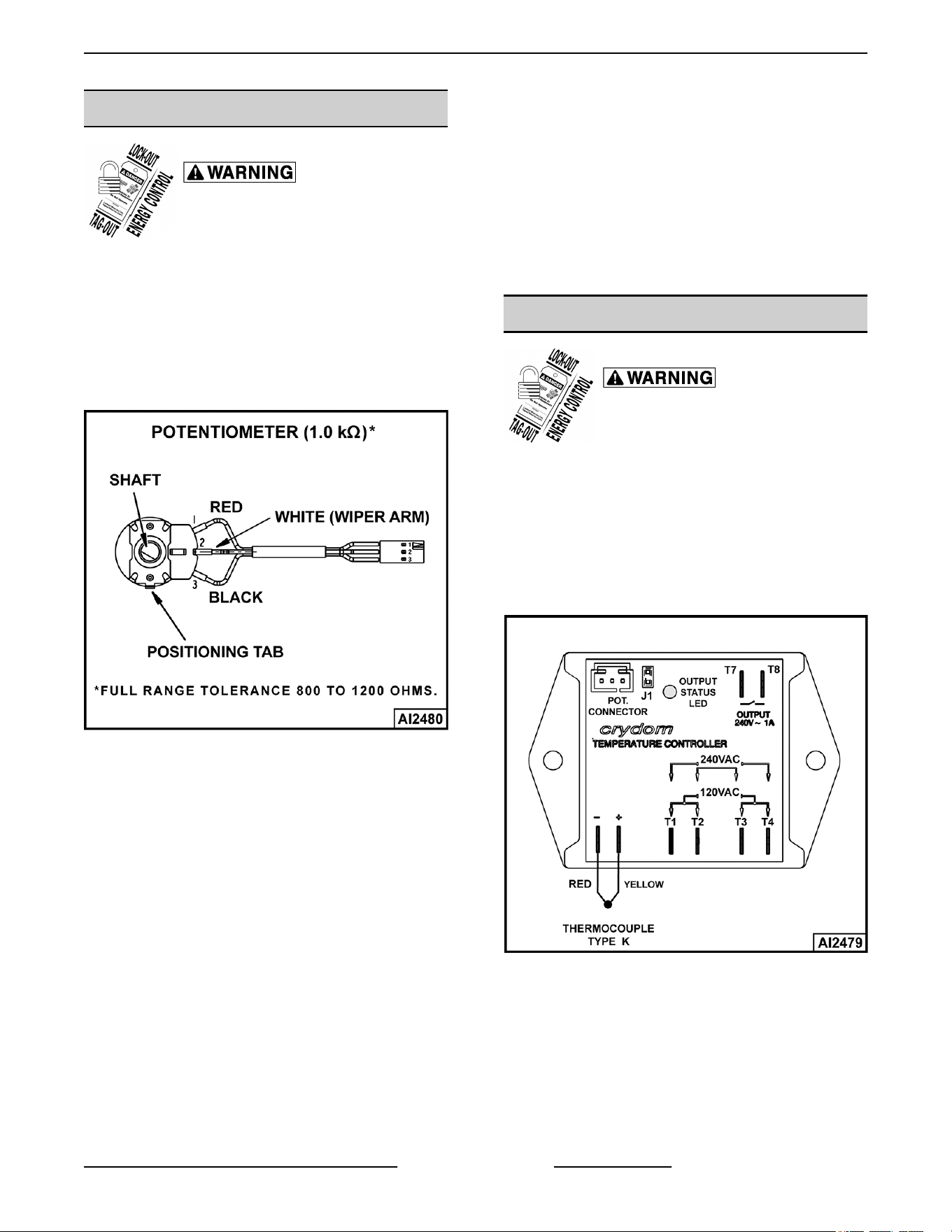
POTENTIOMETER TEST
Certain procedures in this section
require electrical test or
measurements while power is
applied to the machine. Exercise
extreme caution at all times and
follow Arc Flash procedures. If test
points are not easily accessible,
disconnect power and follow
Lockout/Tagout procedures, attach
test equipment and reapply power to
test.
Fig. 32
1. Remove potentiometer from control panel as
outlined in REMOVAL AND REPLACEMENT OF
PARTS.
2. Turn potentiometer shaft fully counterclockwise
to the lowest setting.
3. Set VOM to measure resistance.
4. Connect meter leads to the white and black lead
wires on potentiometer terminals.
A. Resistance should measure approximately
zero ohms.
5. Slowly turn potentiometer shaft clockwise over
the full range of travel and monitor resistance
change on the meter.
A. Resistance should measure 800 to 1200
ohms with shaft turned fully clockwise.
B. If the resistance value increased smoothly
without sudden drops or spikes and the full
travel resistance value is within tolerance
then potentiometer is functioning properly.
C. If the resistance value did not increase
smoothly but had drops or spikes over the
full travel range then potentiometer is not
functioning properly. Install a replacement
potentiometer and check for proper
operation.
THERMOCOUPLE TEST
Certain procedures in this section
require electrical test or
measurements while power is
applied to the machine. Exercise
extreme caution at all times and
follow Arc Flash procedures. If test
points are not easily accessible,
disconnect power and follow
Lockout/Tagout procedures, attach
test equipment and reapply power to
test.
Fig. 33
1. Access the temperature controller as outlined in
REMOVAL AND REPLACEMENT OF PARTS.
2. Remove thermocouple lead wires from
temperature controller.
Electric Countertop Tilting Kettles, K6ETT, K12ETT, K20ETT - SERVICE PROCEDURES AND ADJUSTMENTS
Page 17 of 32 F35496 Rev. C (0124)
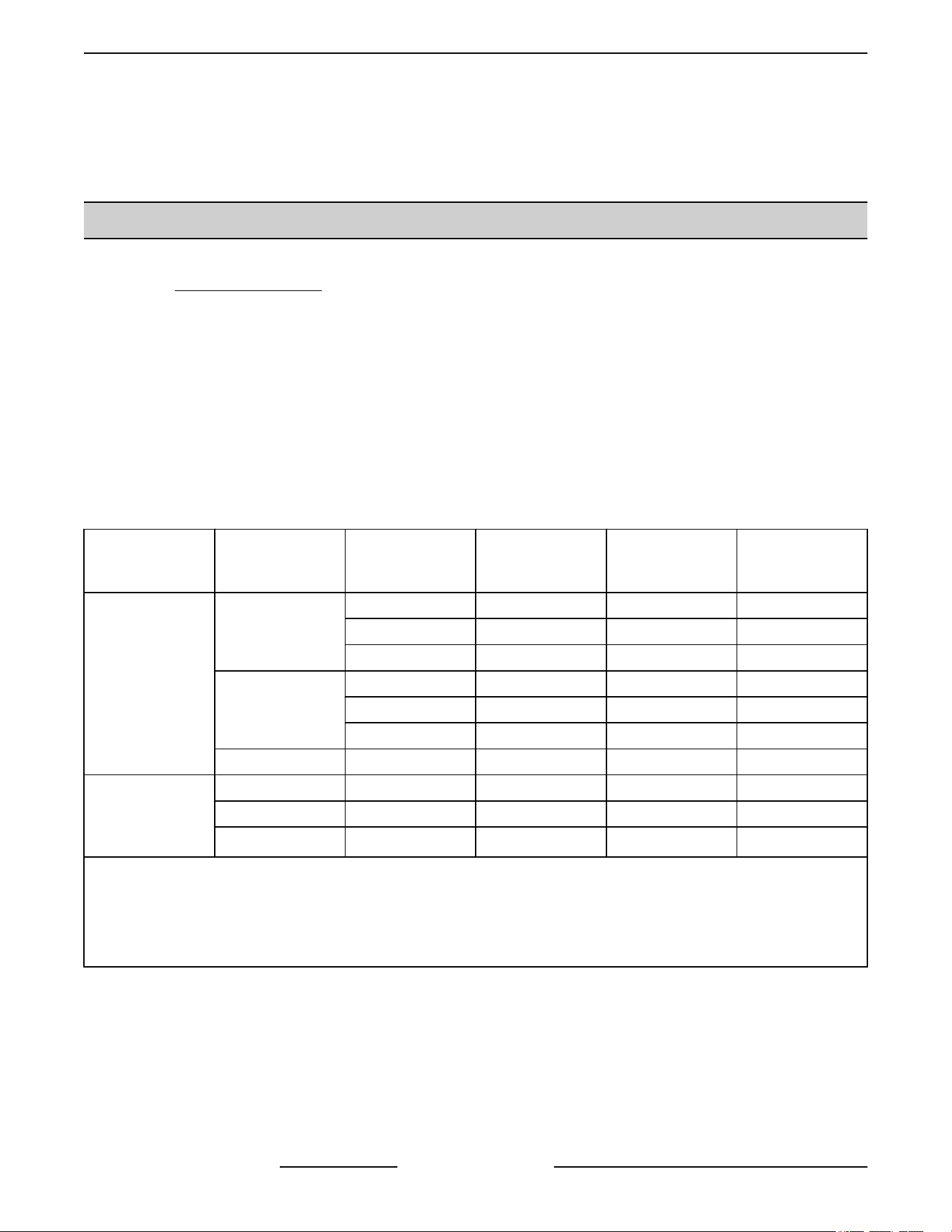
3. Check the thermocouple for a measurable
resistance (approximately 5 to 10 ohms at room
temperature). If meter reads an overload (OL)
condition (open), or zero ohms (short) replace
the thermocouple and check temperature
controller for proper operation.
HEATING ELEMENTS
1. Access HEATING ELEMENT as outlined in REMOVAL AND REPLACEMENT OF PARTS.
2. Measure voltage at heating element terminals and verify it against the data plate voltage.
A. If voltage is incorrect, find the source of the problem.
3. If voltage is correct, check current draw (amps) through the heating element lead wires. If current draw is
correct then heating element is ok. See table below for proper values.
NOTE: Checking current draw is the preferred method over a resistance check when an amp clamp meter is
available.
A. If current draw is not correct then, replace heating element.
4. Check for proper operation.
MODEL VOLTAGE ELEMENT NO.
KW PER
ELEMENT
CURRENT PER
ELEMENT
RESISTANCE
PER ELEMENT
(OHMS)
K6ETT
208 (1, 2)
1 2.2 10.5 19.8
2 2.6 12.3 17.0
3 2.8 13.3 15.6
240 (1,2)
1 2.9 12.1 19.8
2 3.4 14.1 17.0
3 3.7 15.3 15.6
408 (3) - 2.5 9.0 30.7
K12ETT
and
K20ETT
208 (1) - 4.0 19.2 10.8
240 (1) - 5.3 22.2 10.8
480 (2) - 4.0 14.4 19.2
1. Dual voltage elements.
2. Element lengths are staggered to fit the contour of the kettle bottom. Element number 1 is the shortest.
3. 480V elements are connected in Wye configuration for 277V across each element.
NOTE: Values in table are nominal. Tolerance is ±10 %.
Electric Countertop Tilting Kettles, K6ETT, K12ETT, K20ETT - SERVICE PROCEDURES AND ADJUSTMENTS
F35496 Rev. C (0124) Page 18 of 32
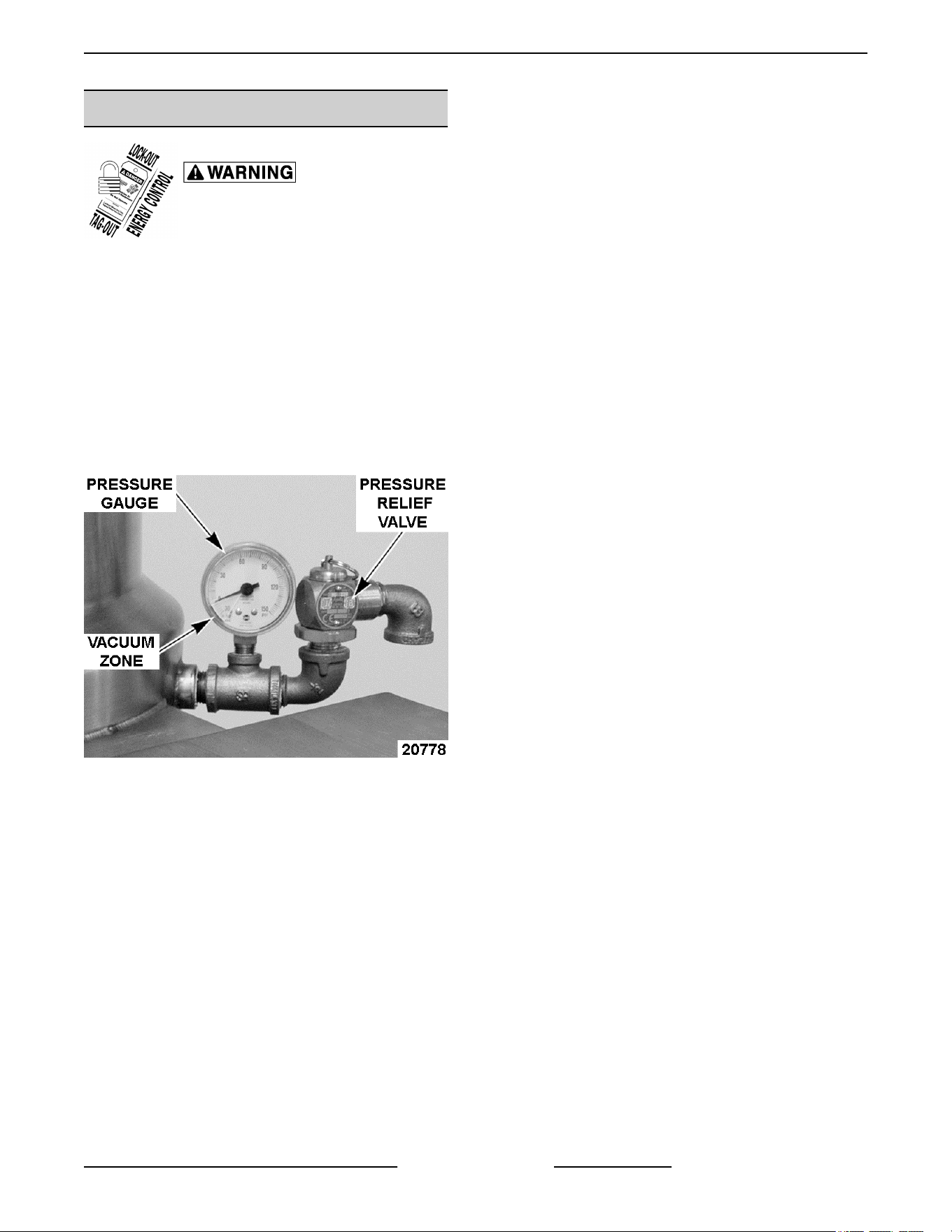
VENTING
Certain procedures in this section
require electrical test or
measurements while power is
applied to the machine. Exercise
extreme caution at all times and
follow Arc Flash procedures. If test
points are not easily accessible,
disconnect power and follow
Lockout/Tagout procedures, attach
test equipment and reapply power to
test.
NOTE: This procedure outlines venting the reservoir
jacket to remove air for proper heat transfer to the
kettle contents.
Fig. 34
1. With the kettle at room temperature, verify
pressure gauge is in the vacuum zone and
reading 25 to 30 in. Hg.
A. If vacuum is below minimum listed, air must
be removed from reservoir jacket. Continue
with procedure to vent as necessary.
2. Place kettle in full upright position.
3. Turn power switch on.
4. Set temperature dial to highest setting. Allow
kettle to heat until the heat indicator light turns off.
5. Open pressure relief valve for approximately 10
seconds.
6. Turn power switch off and allow kettle to cool
(room temperature).
7. Verify pressure gauge reading is within the
correct vacuum range.
A. If reading is below minimum listed or will not
maintain proper vacuum, check all threaded
fittings extending from the kettle couplings
(right and rear) for leaks and tightness.
1) Check pressure relief valve for leaks
from poor valve seating or built up
debris. Manually operate the valve
several times to reseat. Repeat venting
procedure.
2) If pressure relief valve is
malfunctioning, install a replacement
and check for proper operation.
Electric Countertop Tilting Kettles, K6ETT, K12ETT, K20ETT - SERVICE PROCEDURES AND ADJUSTMENTS
Page 19 of 32 F35496 Rev. C (0124)
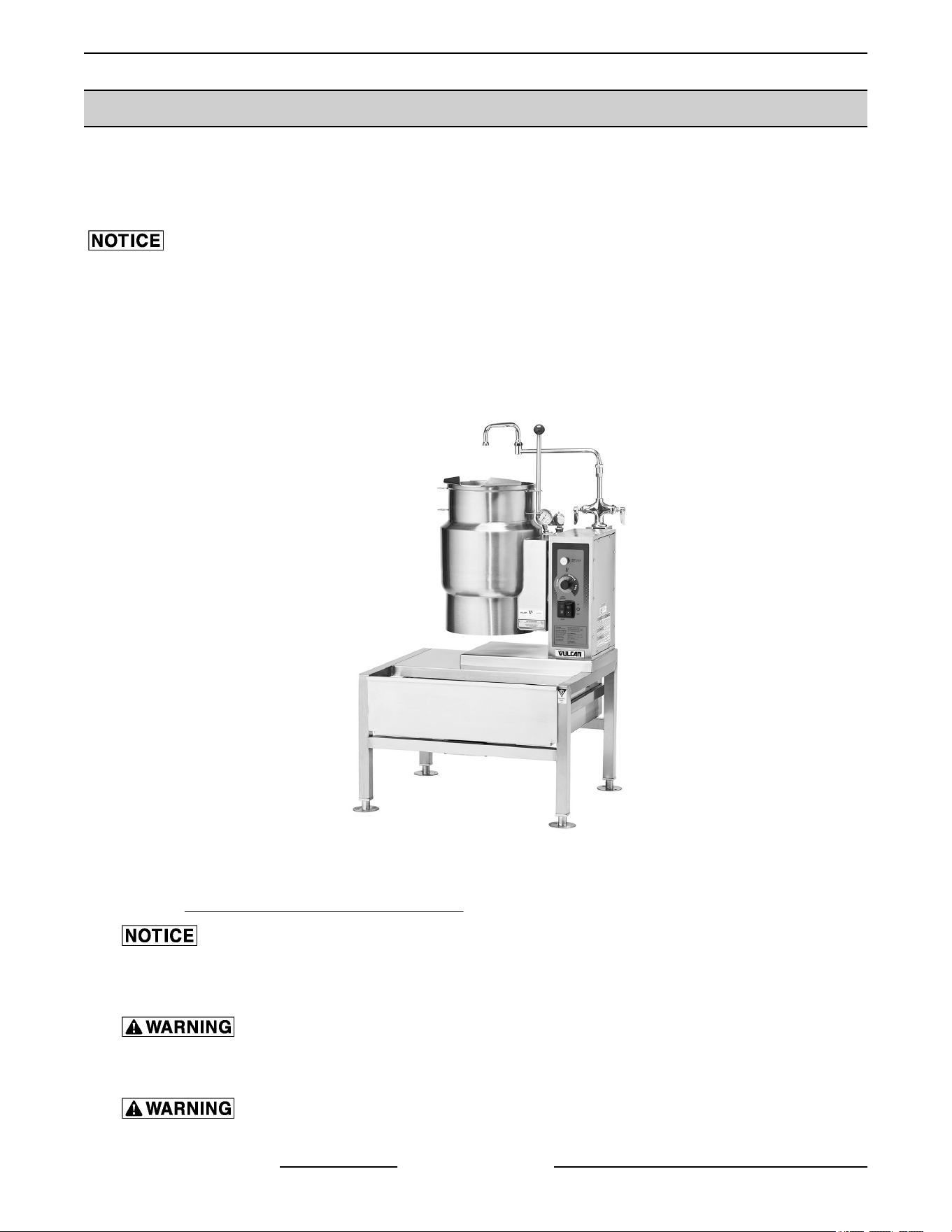
FILLING THE RESERVOIR JACKET
NOTE: The reservoir water level must be maintained high enough to keep contact with the water level probe
(LLCO). If low water light comes on during use, the visible level may be below the water level probe and must be
replenished before heating can continue. The low water light will come on when kettle is tilted (tilting models only).
When filling reservoir jacket, use only distilled water and heat transfer fluid. The ratio is 2:1, 2 parts distilled water,
1 part Heat Transfer Fluid.
NOTE: Jacket fill port plumbing: A pipe elbow and pipe plug are installed on current construction kettles to open
the fill port. A manual valve with knob was installed on previous construction kettles to open the fill port.
Partial Refill
1. Place kettle in full upright position (tilting models only).
Fig. 35
2. Turn power switch on.
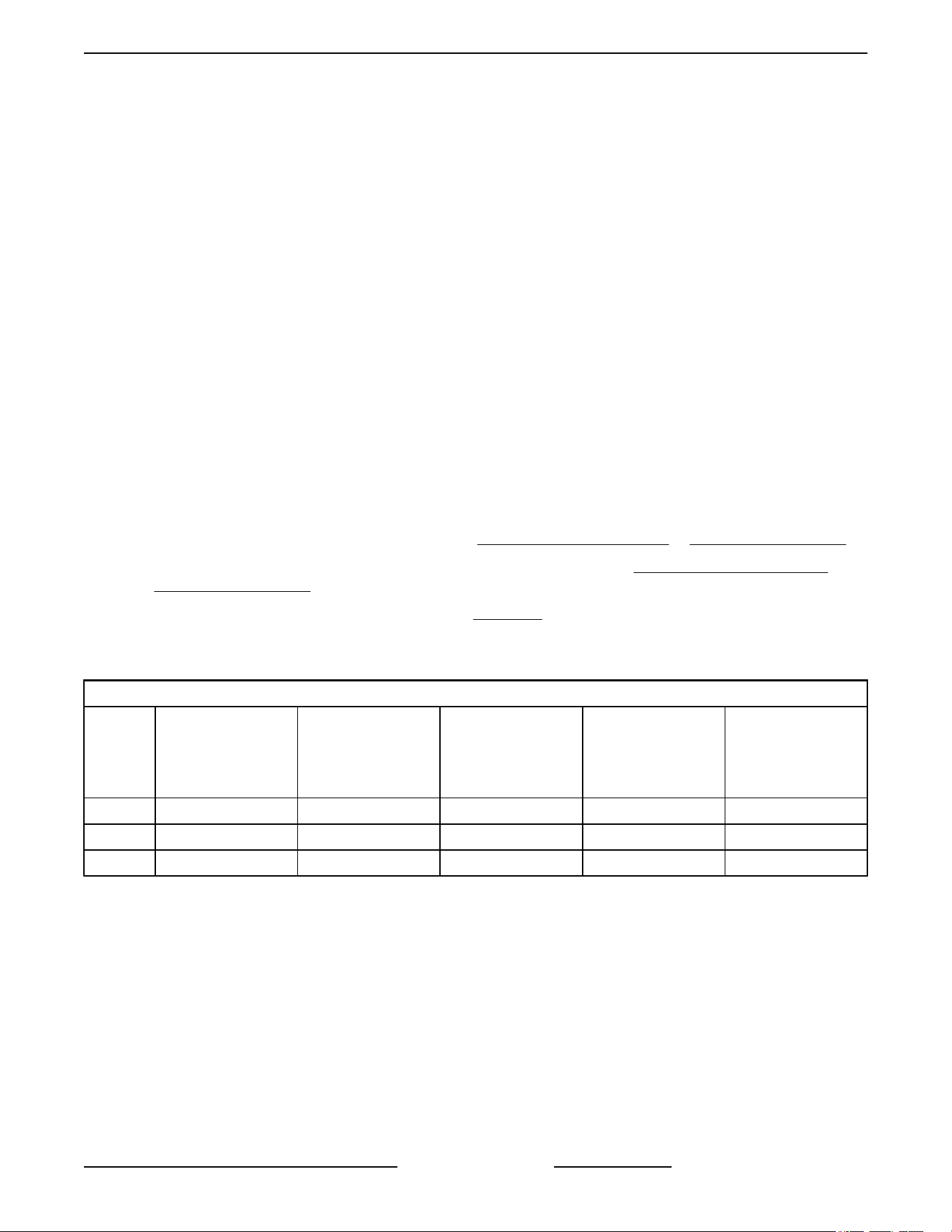
Refer to: RESERVOIR JACKET VOLUME TABLE.
If Low water light is lit on control panel, continue with procedure to refill.
3. Set temperature dial to lowest setting.
Pressure Relief Valve Exhaust. DO NOT connect to building water, gas, or steam supply. DO NOT block
or restrict.
Hot steam. The kettle and its parts are hot. Use care when operating, cleaning or servicing the kettle.
Electric Countertop Tilting Kettles, K6ETT, K12ETT, K20ETT - SERVICE PROCEDURES AND ADJUSTMENTS
F35496 Rev. C (0124) Page 20 of 32
4. Open pressure relief valve until reservoir jacket is completely vented. Allow valve to snap shut to seal.
5. If installed, open the manual valve on the fill port for the reservoir jacket at back of kettle.
A. Remove pipe plug from the valve/pipe elbow to open the fill port.
B. Insert funnel into the fill port and slowly add water until the level in the sight glass is 1/3 full. Low water
light should be off (LLCO probe is satisfied). As necessary, vent the air from the jacket as outlined below:
1) If pressure relief valve is installed at a separate location from the fill port (two different openings in
the jacket), open the pressure relief valve to provide a vent for the jacket air to escape and aid in
filling. Allow valve to snap shut to seal.
2) If pressure relief valve and fill port are installed on the same plumbing assembly (single opening to
the jacket), access the Pressure Switch (1PS), remove the compression nut from fitting near the tee
and pull the tubing from the fitting.
C. Turn power switch off.
NOTE: Heat Transfer Fluid: Thermodyne 90395 GLYCOL, Heat Transfer fluid, 1 gallon, available at Parts
Town or DOWFROST™ Propylene Glycol at ChemWorld.
6. Close manual valve (if installed) to prevent leaks. Hand tighten only.
7. Clean pipe plug threads and apply thread sealant. Install pipe plug into valve/pipe elbow opening to close the
fill port. Tighten to prevent leaks.
8. Turn power switch on and verify low water light is not lit.
A. If low water light is lit, see Possible Causes for LOW WATER LIGHT IS LIT in TROUBLESHOOTING.
B. If low water light problem is still not resolved see Possible Causes for KETTLE DOES NOT HEAT in
TROUBLESHOOTING.
9. Remove air from reservoir jacket as outlined under VENTING.
10. Check kettle for proper operation.
RESERVOIR JACKET VOLUME
Model Water (Qt)
Heat Transfer
Fluid
(Food Grade
Antifreeze) (Qt)
Total (Qt)
Low Level
Light OFF
Low Level
To Fill
K6ETT 4 2 6 4 quarts 2 quarts
K12ETT 6 3 9 6 quarts 3 quarts
K20ETT 8 4 12 8 quarts 4 quarts
Electric Countertop Tilting Kettles, K6ETT, K12ETT, K20ETT - SERVICE PROCEDURES AND ADJUSTMENTS
Page 21 of 32 F35496 Rev. C (0124)
Complete Draining and Refill
Disconnect the electrical power to the machine and follow lockout / tagout procedures.
Pressure Relief Valve Exhaust. DO NOT connect to building water, gas, or steam supply. DO NOT block or
restrict.
Hot steam. The kettle and its parts are hot. Use care when operating, cleaning or servicing the kettle.
NOTE: Appearance of fluid will no longer be clear after usage in kettle.
1. Set temperature dial to lowest setting.
2. Open pressure relief valve until reservoir jacket is completely vented. Allow valve to snap shut to seal.
3. Remove pressure relief valve from kettle to vent the jacket and facilitate draining. Retain for reuse.
4. Remove draw-off valve or plug valve from kettle (stationary models only).
5. Place container under kettle to catch fluid and position it below the sight glass.
6. Remove sight glass using 36mm socket.
A. Stationary Models - It is recommended to use a drill pump to drain.
B. Tilting Models - Turn crank handle clockwise to tilt the kettle forward.
7. After draining is complete, place kettle in full upright position.
A. Install sight glass and tighten it to seal the internal O-ring to prevent leaks.
8. To Refill.
A. With kettle in full upright position.
B. If installed, open the manual valve on the fill port for the reservoir jacket at back of kettle.
C. Remove pipe plug from valve/pipe elbow to open the fill port.
D. Insert funnel into the fill port and slowly add mixture of water and heat transfer fluid to the reservoir jacket.
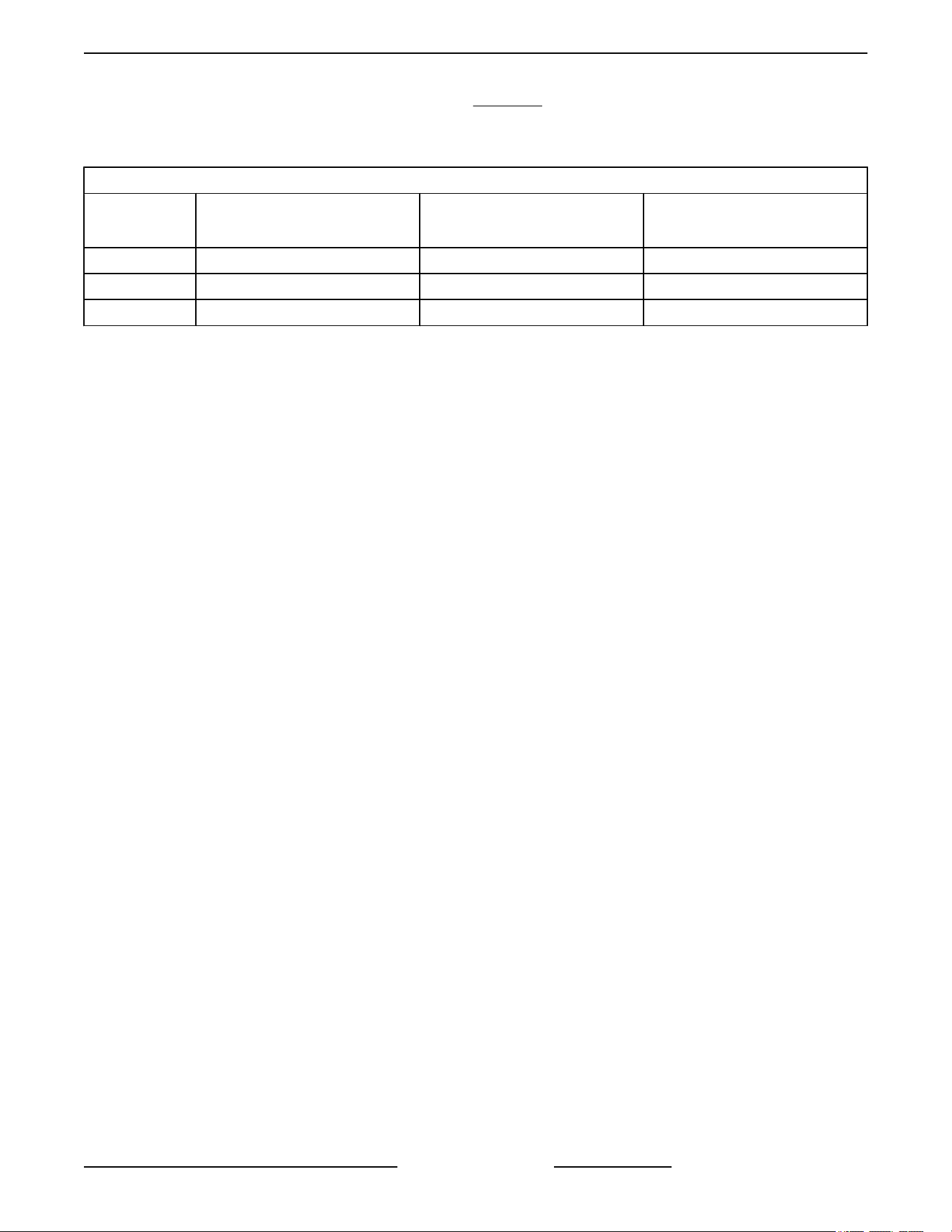
Fill the jacket according to the volumes listed in the table below. The level in the sight glass should be
1/3 full. Refer to: RESERVOIR JACKET VOLUME
9. Close manual valve (if installed) to prevent leaks. Hand tighten only.
10. Clean pipe plug threads and apply thread sealant. Install pipe plug into valve/pipe elbow opening to close the
fill port. Tighten to prevent leaks.
11. Install pressure relief valve to kettle.
12. Install draw-off valve or plug valve to kettle (stationary models only).
13. Re-connect power.
14. Turn power switch on and verify low water light is not lit.
A. If low water light is lit, see Possible Causes for LOW WATER LIGHT IS LIT in TROUBLESHOOTING.
B. If low water light problem is still not resolved see Possible Causes for KETTLE DOES NOT HEAT in
TROUBLESHOOTING.
Electric Countertop Tilting Kettles, K6ETT, K12ETT, K20ETT - SERVICE PROCEDURES AND ADJUSTMENTS
F35496 Rev. C (0124) Page 22 of 32
15. Remove air from reservoir jacket as outlined under VENTING.
16. Check kettle for proper operation and leaks.
RESERVOIR JACKET VOLUME
Model Water (Qt)
Heat Transfer Fluid
(Food Grade Antifreeze) (Qt)
Total (Qt)
K6ETT 4 2 6
K12ETT 6 3 9
K20ETT 8 4 12
Electric Countertop Tilting Kettles, K6ETT, K12ETT, K20ETT - SERVICE PROCEDURES AND ADJUSTMENTS
Page 23 of 32 F35496 Rev. C (0124)

ELECTRICAL OPERATION
COMPONENT FUNCTION
Water Level Control
(WLC LLCO) ..........
Low water level control. Monitors condition of the WLC LLCO water level probe. Protects
kettle from a low water condition in the reservoir jacket and removes power from heating
circuit when kettle is tilted.
Probe, Water Level
(LLCO) ................
Low Level Cut-Off (LLCO) probe connected to WLC (LLCO). Controls power to heating
circuit.
Contactor (1CON)
Limiting ...............
Connects one side of heating element to power. Energized whenever WLC (LLCO) coil
is energized.
Contactor (2CON)
Regulating ............
Connects heating element to power. On constantly when temperature controller is calling
for heat.
Element, Heating ..... Heats reservoir jacket fluid. The heat in the fluid is then transferred to kettle.
Fuse, (1FU & 2FU) .... Slow blow 3A fuse. Located on primary side of main transformer (1T). Protects control
circuitry from over-currents.
Switch (1PAS),
Pressure ..............
Pressure cut-out protection for the reservoir jacket. Range is between 38 to 42 PSI.
Removes power from control circuit if pressure in the jacket rises above switch setting.
Transformer (1T),
Main ..................
Step down transformer from line voltage to 120VAC control circuit voltage.
Switch (1S), Power ... Controls 120VAC to kettle control circuit.
Temperature
Controller .............
Cycles power to regulating contactor (2CON) to maintain the set point temperature. An
external set point potentiometer is used for temperature adjustments.
Lamp (1LT), Power ... Amber (AM) colored lamp. On when power switch is on.
Lamp (2LT), Low
Water .................
Red (RD) colored lamp. On when water level in the reservoir jacket drops below water
level (LLCO) probe.
Lamp (3LT), Heat ..... Amber (AM) colored lamp. On when temperature controller is calling for heat.
Electric Countertop Tilting Kettles, K6ETT, K12ETT, K20ETT - ELECTRICAL OPERATION
F35496 Rev. C (0124) Page 24 of 32
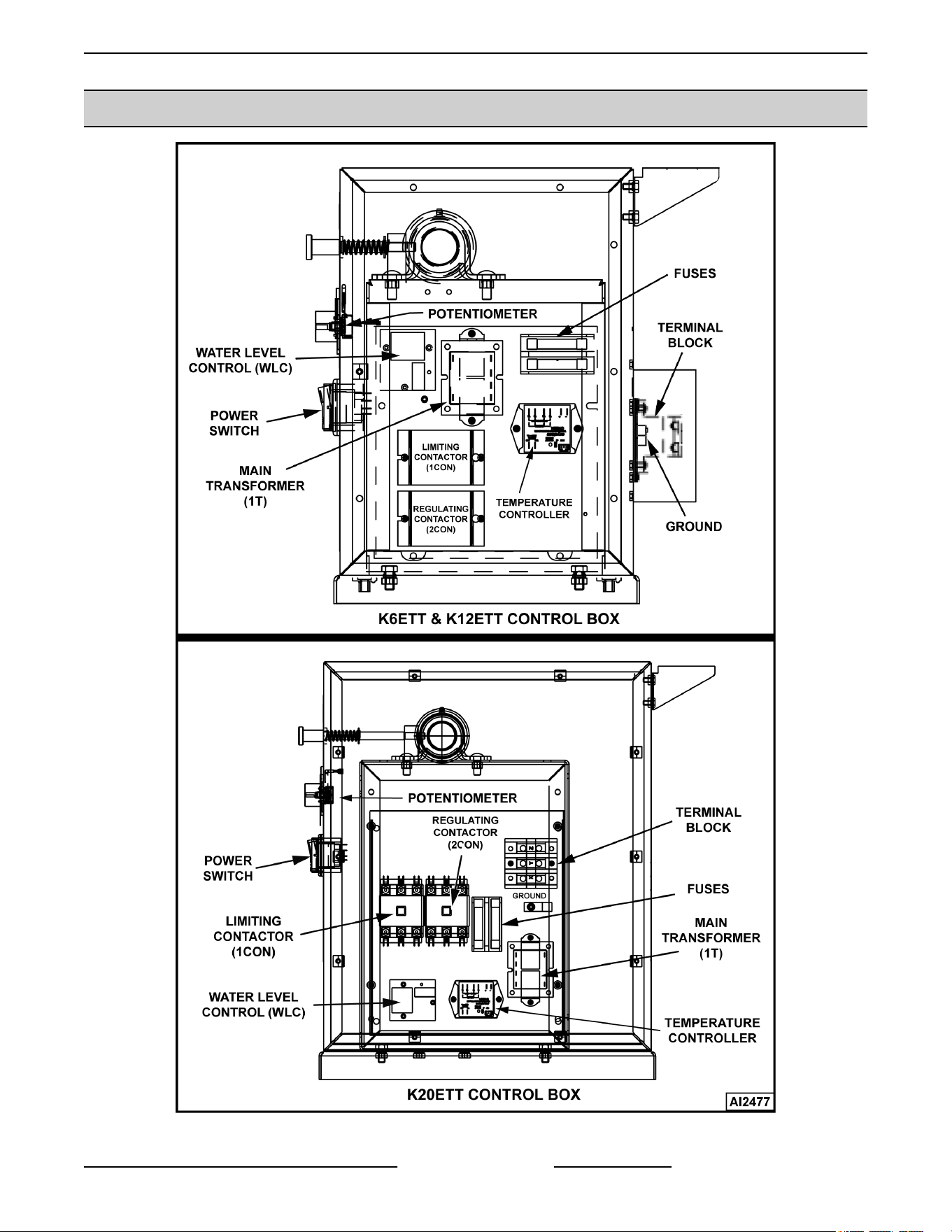
COMPONENT LOCATION
Fig. 36
Electric Countertop Tilting Kettles, K6ETT, K12ETT, K20ETT - ELECTRICAL OPERATION
Page 25 of 32 F35496 Rev. C (0124)
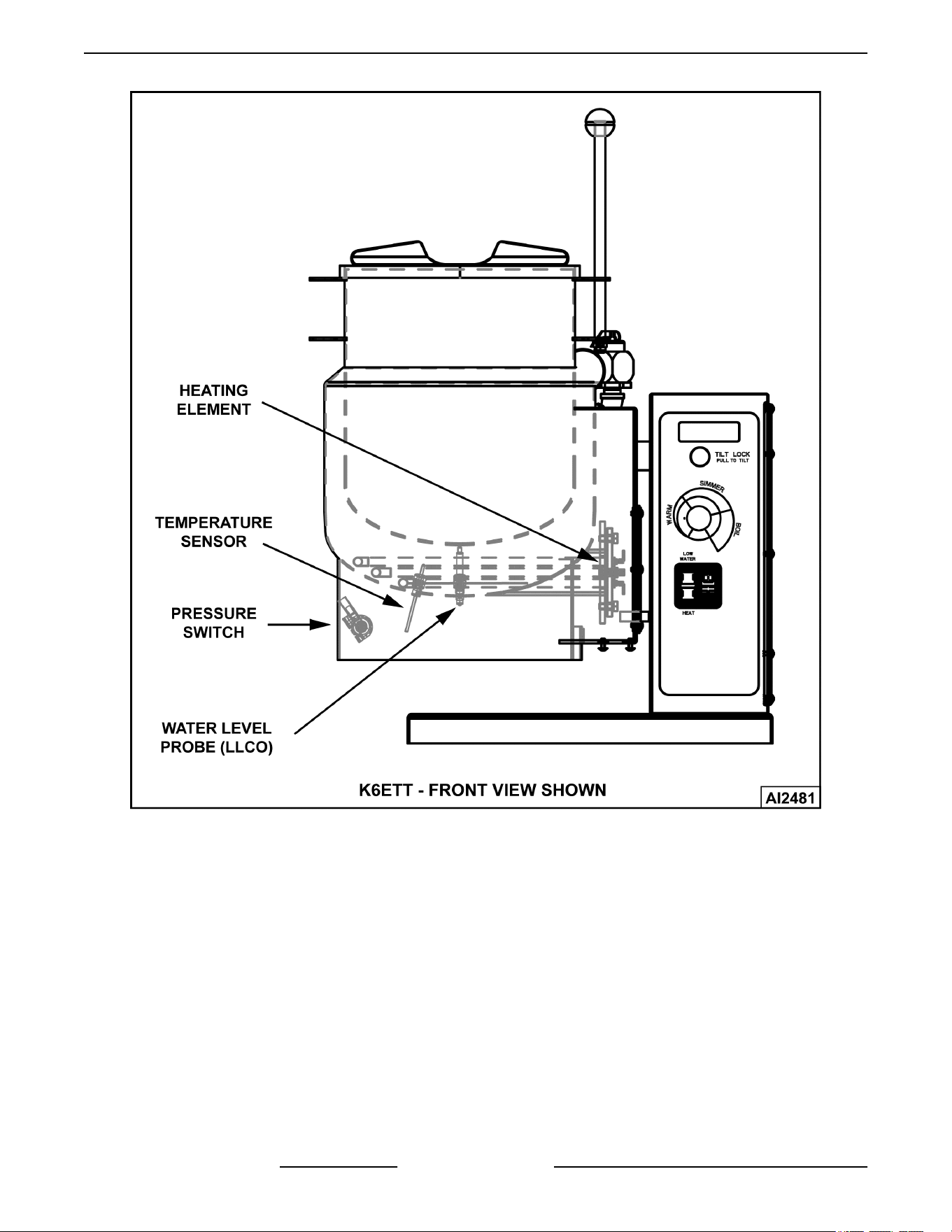
Fig. 37
Electric Countertop Tilting Kettles, K6ETT, K12ETT, K20ETT - ELECTRICAL OPERATION
F35496 Rev. C (0124) Page 26 of 32
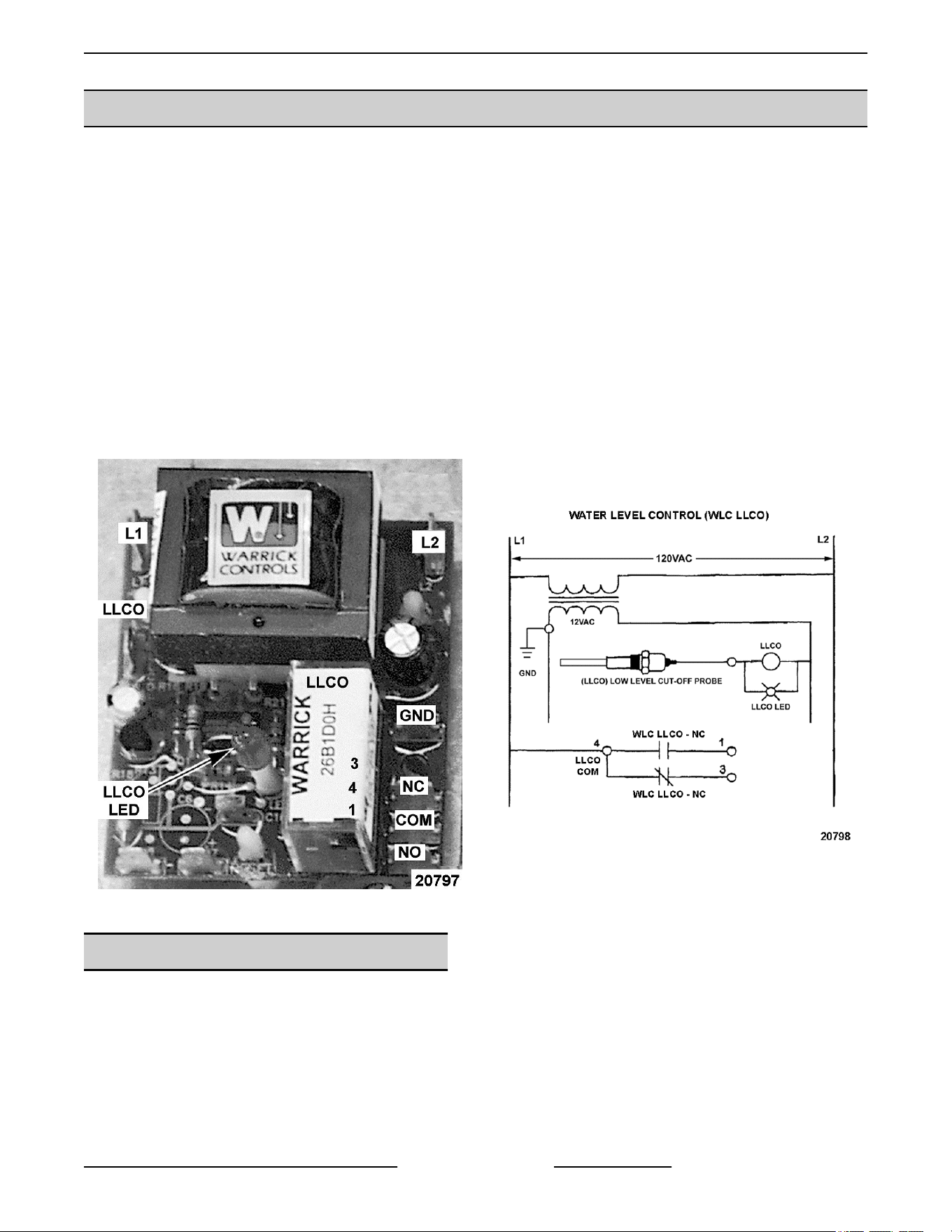
WATER LEVEL CONTROL (WLC LLCO)
The water level control provides low level cut-off protection to shut off the heat source in case the fluid level in the
kettle reservoir jacket drops below the WLC LLCO probe. A single low level cut-off probe (LLCO) is connected to
the control.
The water level control has input voltage of 120VAC across terminals L1 and L2 which powers the primary side of
the transformer on the board. One side of the transformer secondary is powered through a series path to chassis
ground. The other side of the transformer secondary (12VAC) is connected to the LLCO probe that supplies power
to the LLCO relay coil on the board. When the kettle is in the full upright position and the reservoir jacket fluid is at
the proper level, the fluid is in constant contact with the LLCO probe and the circuit is completed.
When the power switch is turned ON, power is supplied to the water level control. With the kettle in the full upright
position and the fluid level in the reservoir jacket in contact with the LLCO probe, the LLCO relay coil is energized.
The LLCO relay contacts WLC LLCO-NC open, WLC LLCO-NO close and the LLCO LED turns on. When the kettle
is tilted to empty the contents, the fluid is no longer in contact with the LLCO probe and the circuit is open. The
LLCO relay coil is de-energized and LLCO LED turns off.
Fig. 38
Fig. 39
SEQUENCE OF OPERATION
1. Conditions.
A. Kettle connected to correct voltage supply
and is properly grounded.
1) 120VAC potential across X2 and X1 on
secondary of main transformer.
B. Power switch and light (1LT) (amber) are
off.
C. Low water light (2LT) (red) is off.
D. Pressure switch (1PAS) contacts closed.
E. Temperature dial at lowest setting
(potentiometer fully CCW). 1) Internal relay
contacts N.O. are open.
F. Kettle at room temperature and in the full
upright position.
2. Power switch turned ON.
A. Power light (1LT) (amber) comes on.
Electric Countertop Tilting Kettles, K6ETT, K12ETT, K20ETT - ELECTRICAL OPERATION
Page 27 of 32 F35496 Rev. C (0124)

B. Power from secondary of main transformer
to control circuit thru pressure switch
(1PAS) N.C. contacts.
3. Water level control (WLC) energized.
A. WLC LLCO probe satisfied (fluid in kettle
reservoir jacket at proper level).
1) LLCO LED comes on.
B. WLC LLCO N.C. contacts open. Low water
light (2LT) (red) remains off.
C. WLC LLCO N.O. contacts close.
1) Limiting contactor (1CON) energized
(power to one side of heating
elements).
2) Power to temperature controller.
4. Set the temperature dial to call for heat (warm/
simmer/boil).
A. 120VAC output from T8 on temperature
controller.
1) Heat light (3LT) (amber) comes on.
2) Regulating contactor (2CON)
energized and heating elements are
powered.
5. Kettle reaches set point temperature.
A. Voltage output removed from T8 on
temperature controller.
1) Heat light (3LT) (amber) goes out.
2) Regulating contactor (2CON) de-
energized and powered is removed
from heating elements.
6. Kettle heat cycles with the temperature
controller.
7. Kettle tilted to empty contents.
A. WLC LLCO probe no longer satisfied (fluid
in kettle reservoir jacket not in contact with
probe). Water level control (WLC) LLCO
relay de-energized.
1) LLCO LED turns off.
B. WLC (LLCO) N.C. contacts close and low
water light (2LT) (red) comes on.
C. WLC (LLCO) N.O. contacts open and power
is removed from heating circuit.
8. Kettle returned to upright position. Water level
control (WLC) circuit returns to normal operation
and heating cycle resumes. Kettle heating will
continue to cycle with the temperature controller
until the temperature dial is turned fully CCW or
power switch is turned OFF.
Electric Countertop Tilting Kettles, K6ETT, K12ETT, K20ETT - ELECTRICAL OPERATION
F35496 Rev. C (0124) Page 28 of 32
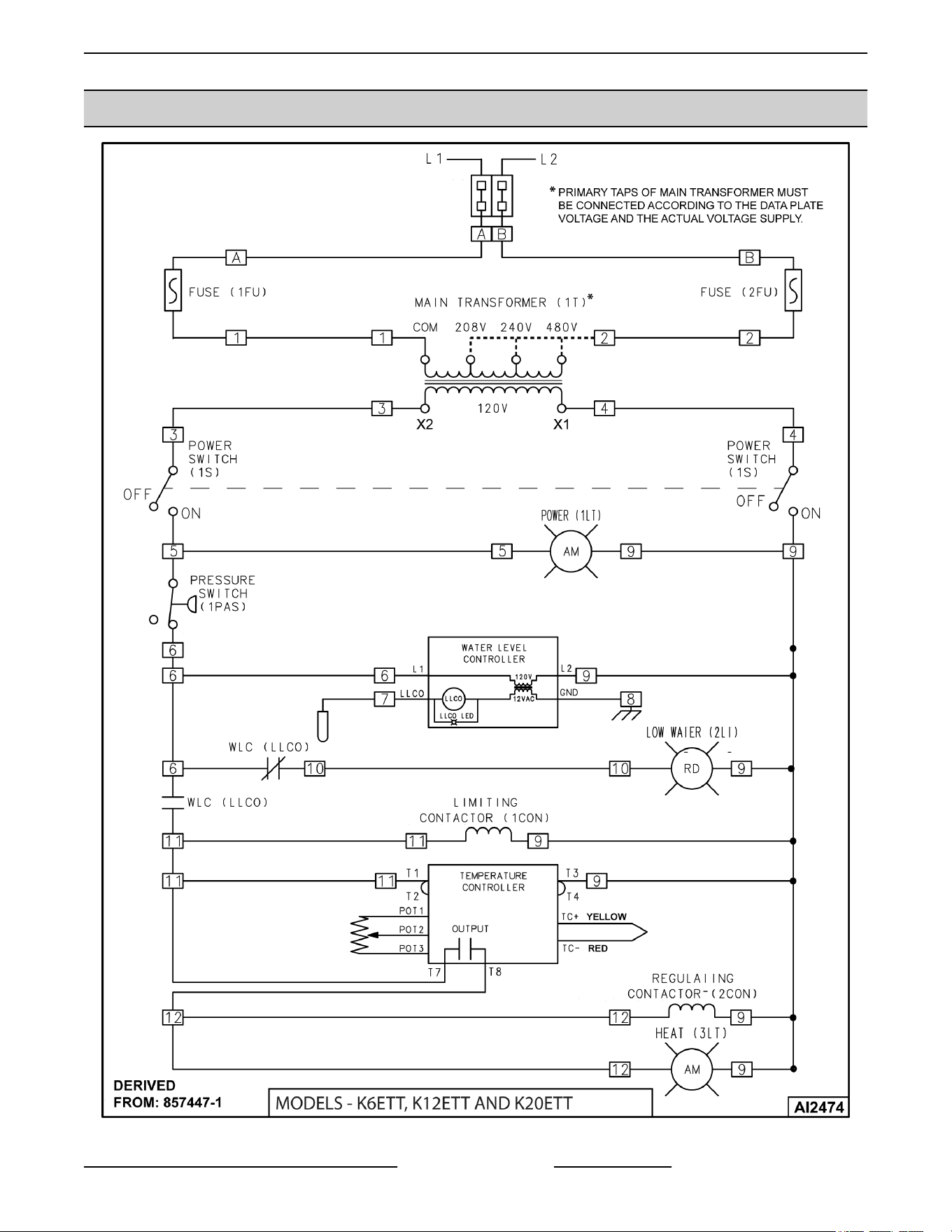
SCHEMATIC DIAGRAM
Fig. 40
Electric Countertop Tilting Kettles, K6ETT, K12ETT, K20ETT - ELECTRICAL OPERATION
Page 29 of 32 F35496 Rev. C (0124)
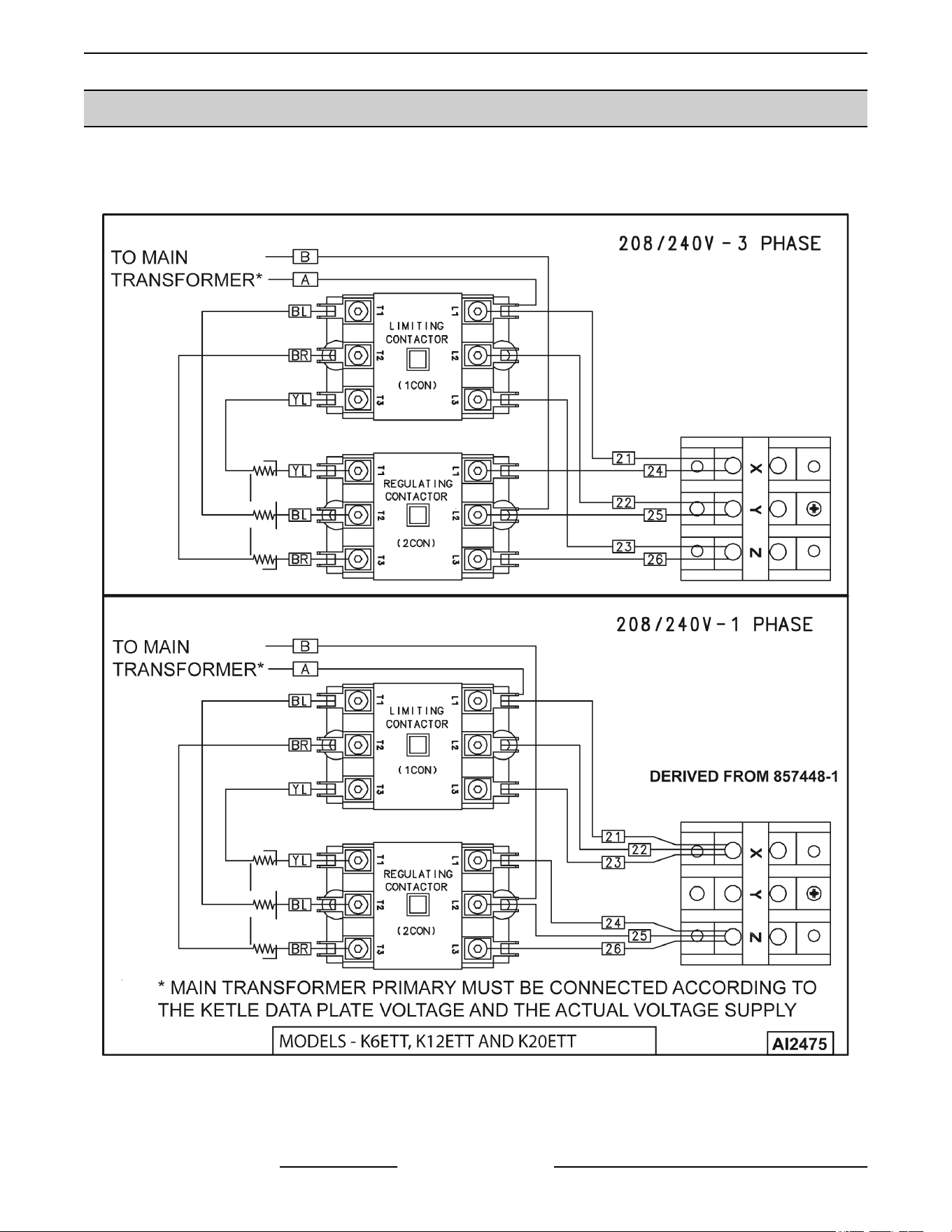
WIRING DIAGRAM
Heating Element Wiring
Fig. 41
Electric Countertop Tilting Kettles, K6ETT, K12ETT, K20ETT - ELECTRICAL OPERATION
F35496 Rev. C (0124) Page 30 of 32
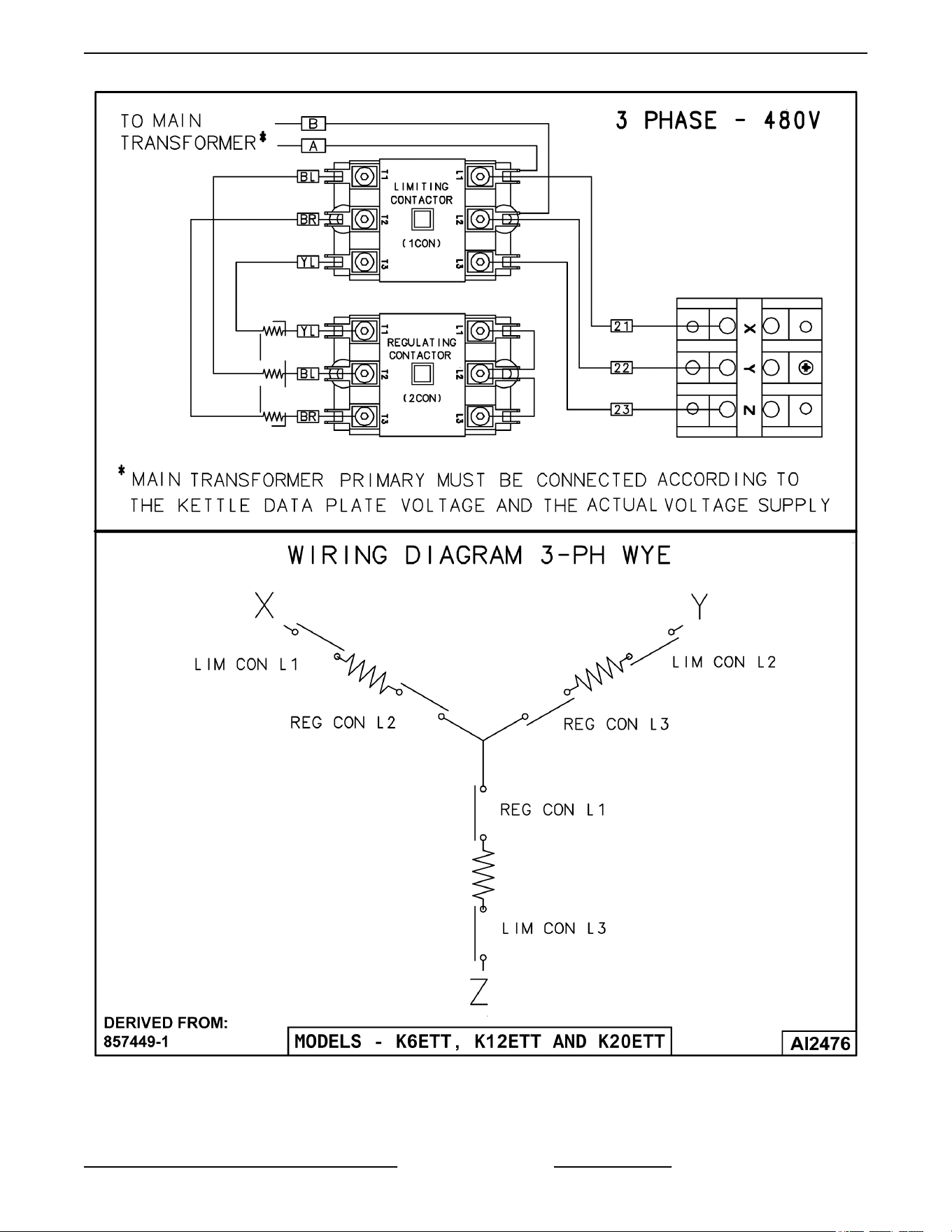
Fig. 42
Electric Countertop Tilting Kettles, K6ETT, K12ETT, K20ETT - ELECTRICAL OPERATION
Page 31 of 32 F35496 Rev. C (0124)

TROUBLESHOOTING
TROUBLESHOOTING
SYMPTOM POSSIBLE CAUSES
Kettle does not heat, power light is lit,
heat light is lit, low water light is not lit.
1. Limiting contactor (1CON) malfunction.
2. Regulating contactor (2CON) malfunction.
3. Heating element malfunction.
Kettle does not heat, power light is lit,
low water light is lit, heat light is not lit.
1. Fluid level in reservoir jacket below water level probe (LLCO).
2. Water level probe (LLCO) wiring connection malfunction; or probe
coated (not sensing fluid); or probe malfunction.
3. Water level control malfunction.
Kettle does not heat, power light is lit,
low water light is not lit, heat light is
not lit.
1. Pressure switch (1PAS) malfunction.
2. Temperature sensor malfunction; potentiometer malfunction or
temperature controller malfunction.
3. Interconnecting wiring malfunction.
Kettle does not heat, power light is not
lit.
1. Main circuit breaker off; or control circuit fuse F1 or F2 open.
2. Supply voltage incorrect.
3. Main transformer (1T) malfunction.
4. Power switch off or malfunction.
5. Interconnecting wiring malfunction.
Kettle heats up slow or will not boil
product.
1. No vacuum in reservoir jacket when kettle is cold.
2. Supply voltage incorrect.
3. Heating element malfunction.
4. Temperature sensor malfunction; or potentiometer malfunction; or
temperature controller malfunction.
Electric Countertop Tilting Kettles, K6ETT, K12ETT, K20ETT - TROUBLESHOOTING
F35496 Rev. C (0124) Page 32 of 32