EN
ROBOTIC VACUUM CLEANER
Translation of the original manual
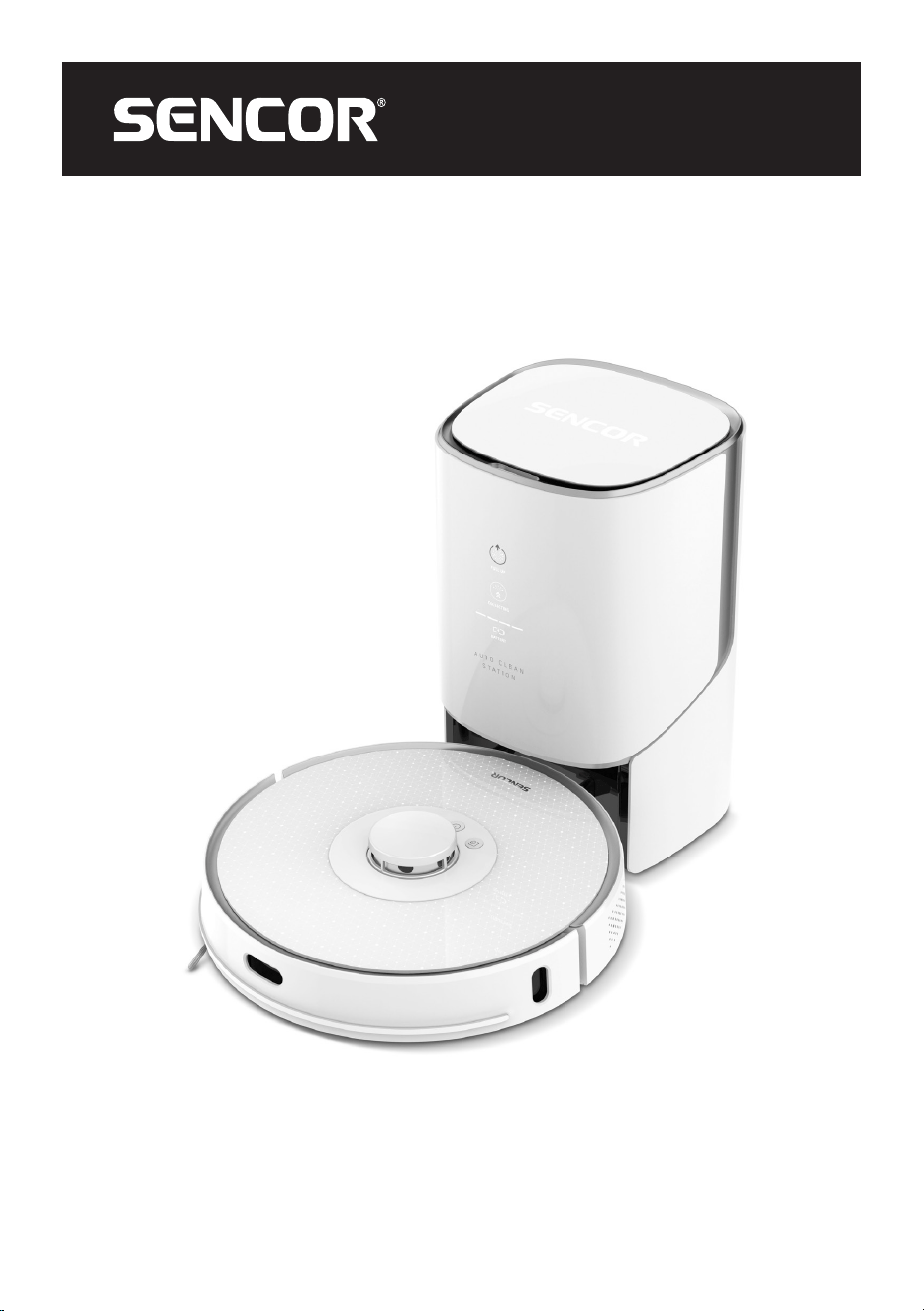
SRV 9385WH
SRV 9385WH
A
1
2
3
4
5
6
7
8
9
10
13
14
15
16
17
18
19
11
12
)
A
20
21
24
25
26
27
28
29
22
23
32
33
34
37 383635
30
31
B
COLLECTING
FULL UP
BATTERY
1
2
3
4
5
6
C
1
2
3
4
5
6
7
8
D1
E
D2
D4D3
F1
F2
F3
G1
H1
G2
H2
I1
J
2
1
2
4
2
3
3
I2
K1
CO
LLECTING
FULL UP
BATTERY
COLLECTING
FUL
L UP
BATTERY
C
OLLECTING
FU
L
L
UP
BATTERY
L
K2 K3
M
- 1 -
12/2023
2023, .
EN Robotic vacuum cleaner
Important safety instructions
READ CAREFULLY AND STORE FOR FUTURE USE.
• This appliance may be used by children 8 years of age
and older and by persons with physical sensory or mental
impairments or by inexperienced persons, if they are
properly supervised or have been informed about how
to use the product in asafe manner and understand the
potential dangers.
• Children must not play with the appliance. Cleaning
and maintenance performed by the user must not be
performed by unsupervised children.
WARNING:
This appliance contains aUV-C light. Do not look
into the light of the UV-C lamp and do not point the
UV-C lamp at eyes.
• In the event that the power cable of the dust collection
station is damaged, have it repaired at aprofessional
service centre to prevent causing adangerous situation. It
is forbidden to use the appliance if it has adamaged power
cord or dust collection station.
• Prior to cleaning or maintenance, always disconnect the
appliance from the power socket and turn it off using the
power switch.
- 2 -
12/2023
2023, .
• The appliance must only be used with the dust collection
container that is supplied with the appliance.
WARNING:
Do not use the dust collection container for charging
batteries or appliances that are not intended for it.
The dust collection station is connected only to
apower socket with aprotective contact.
Electrical safety
• Before connecting the dust collection station to apower socket, check that the technical details on the rating label match the electrical voltage in the
socket.
• Connect the dust collection station only to aproperly grounded power socket. Do not use an extension cord.
• Do not disconnect the dust collection station from the power socket by pulling on the power cord. This could damage the plug or the socket.
Disconnect the power cord from the power socket by pulling on the plug.
• Do not place the power cord over sharp objects. Make sure that the power cord does not hang over the edge of atable and that it is not touching
aheated or hot surface.
• Keep the power cord dry.
• Do not connect and disconnect the power cord to and from the power socket with wet hands.
• Do not uncover the electronic parts of the robotic vacuum cleaner or its battery. They do not contain any components repairable by the user. Have
the appliance serviced by qualified persons.
• To avoid any injury by electrical shock, do not spray the robotic vacuum cleaner, the power unit or the power adapter with water and do not
submerge these in water or any other liquid.
• Do not use the robotic vacuum cleaner when it is not working correctly, if it has been damaged or has been submerged in water.
• To avoid the danger of injury by electrical shock, do not repair the robotic vacuum cleaner yourself or make any adjustments to it. Have all repairs
performed at an authorised service centre. Tampering with the robotic vacuum cleaner during the warranty period may void the warranty.
• Prior to cleaning or maintenance, always disconnect the robotic vacuum cleaner from the power socket and turn it off using the power switch.
Safety during use
• This robotic vacuum cleaner is designed for use in households, offices and similar types of areas. Do not use it in industrial surroundings or outdoors.
• The robotic vacuum cleaner is not intended for vacuuming water and, therefore, must not be used in damp or wet areas, for example in laundries,
bathrooms or around swimming pools. If it were to come into contact with water, the internal electronics of the vacuum cleaner would be destroyed.
• Do not use the robotic vacuum cleaner to vacuum the following items:
- smouldering cigarettes, burning or flammable items, matches or ash;
- water and other liquids;
- sharp items, e.g. splinters, needles, pins, etc.;
- flour, wall plaster and other building materials;
- larger pieces of paper or plastic bags, which can easily block the suction hole.
• Do not expose the robotic vacuum cleaner to direct sunlight and do not place it near an open fire or appliances that are asource of heat.
• Do not use the robotic vacuum cleaner on narrow raised surfaces such as tables, wardrobes, etc. If the vacuum cleaner does not have sufficient
space for manoeuvring, it may fall and be damaged.
• Only use the robotic vacuum cleaner with the original accessories from the manufacturer.
• Ensure that the robotic vacuum cleaner has adust filter correctly installed in the dust container before use.
• Before putting the robotic vacuum cleaner into operation, check that the entry door into your apartment or house is closed. From the floor surfaces,
remove clothing, paper, toys, power or extension cords and other items that the vacuum cleaner could suck in or catch. Lift curtains and drapes that
reach to the floor so that they do not get caught in the vacuum cleaner.
• Do not place any items on to the robotic vacuum cleaner and do not step or sit on it.
• If the robotic vacuum cleaner is running, watch out for children and household pets.
• When the robotic vacuum cleaner is running, ensure that the air vents are not covered and that the suction hole is not blocked. Otherwise, the robotic
vacuum cleaner may be damaged.
• Adhere to the instructions contained in this user'smanual when performing cleaning and maintenance tasks.
• Do not push on the laser navigation module or attempt to lift its cover. This could damage the module.
- 3 -
12/2023
2023, .
Laser
• The laser sensor meets the laser safety class according to standard EN 60825-1.
• When using, handling or performing maintenance tasks on the robotic vacuum cleaner with alaser sensor, always adhere to the following
instructions:
- Prior to any handling, turn off the robotic vacuum cleaner using the power switch.
- Do not point the laser beam at people.
- Do not look into the direct or reflected beam of the laser.
- Modifications or repairs of the laser sensor that are not performed by an authorised service centre are forbidden.
Warning:
Not following the instructions contained in this user'smanual may result in dangerous irradiation!

- 4 -
12/2023
2023, .
• Thank you for purchasing aSENCOR brand product and we hope that
you will be happy with it.
• Prior to using this appliance, please read the user'smanual
thoroughly, even in cases, when one has already familiarised
themselves with previous use of similar types of appliances. Only use
the appliance in the manner described in this user’smanual. Keep
this user'smanual in asafe place where it can be easily retrieved for
future use.
• We recommend saving the original cardboard box, packaging
material, purchase receipt and responsibility statement of the vendor
or warranty card for at least the duration of the legal liability for
unsatisfactory performance or quality. In the event of transportation,
we recommend that you pack the appliance in the original box from
the manufacturer.
. . . . . . . . . . . . . . . . . . . . . . . . . . . . . . . . . . . . . . . . . . . . . . . . . . . . . . . . . . . . . . . . . . . .
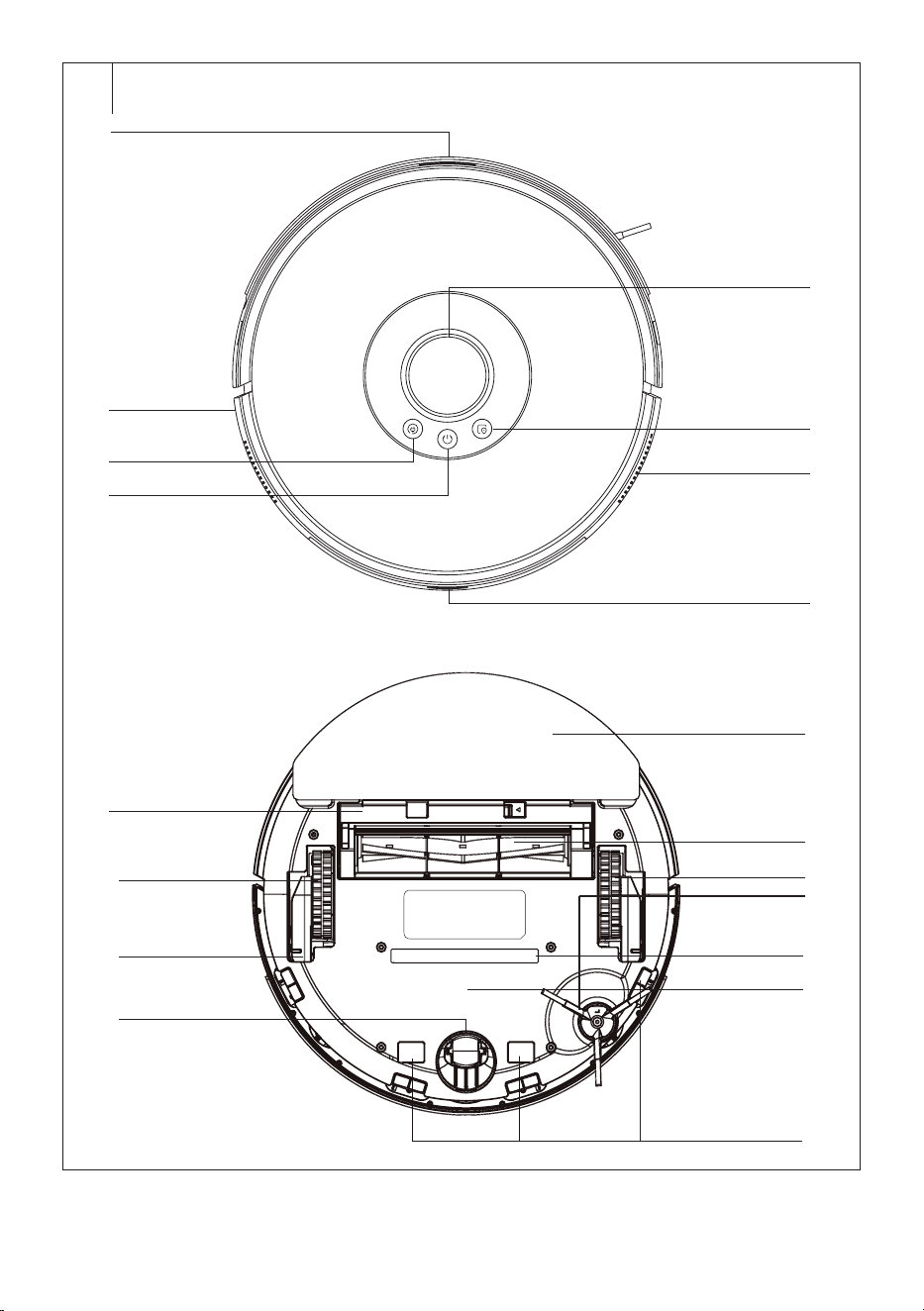
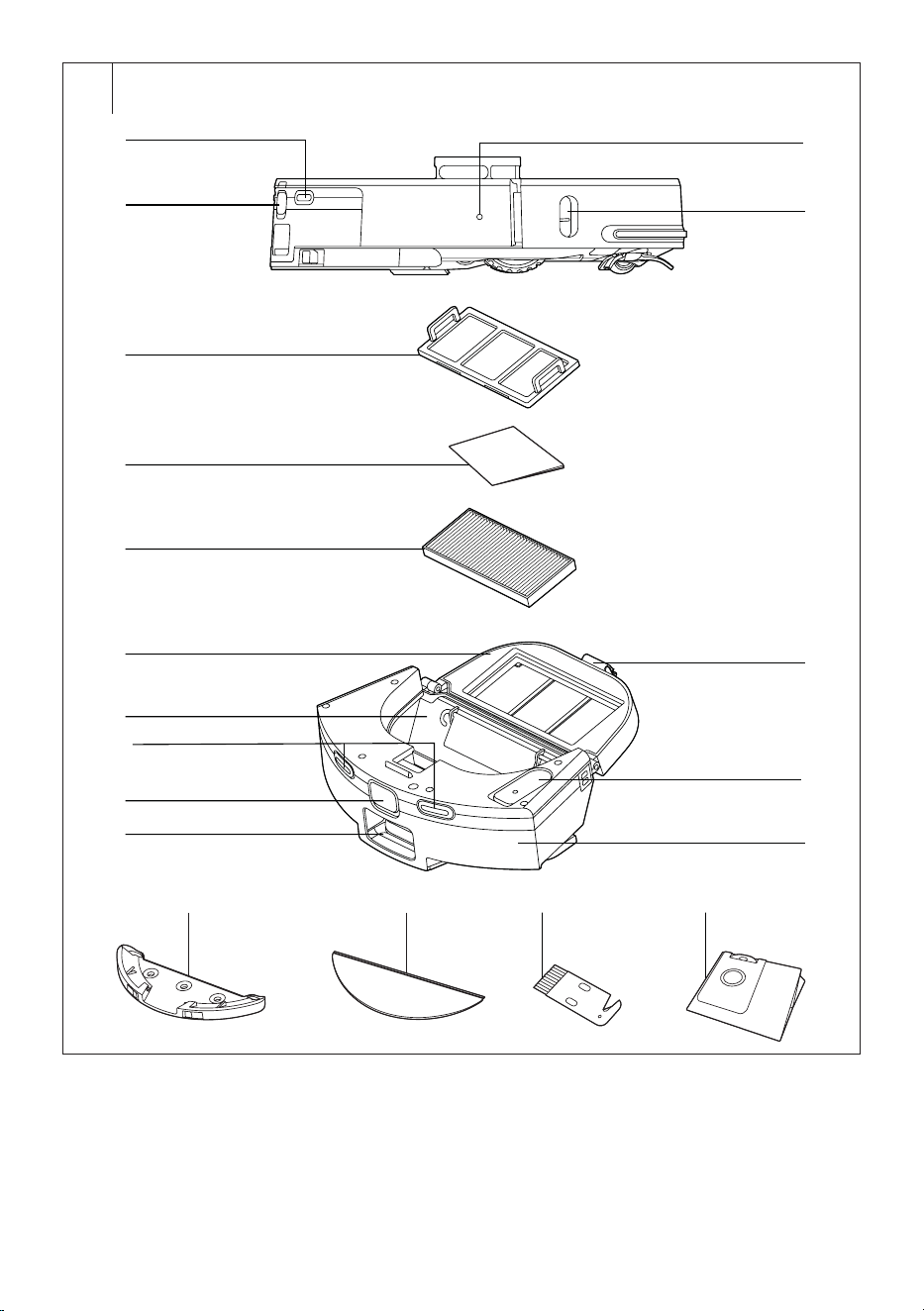
DESCRIPTION OF THE ROBOTIC VACUUM CLEANER
A1 Front infrared sensor
A2 Bumper bar
A3 Charging button
A4 Button (for turning on/off/
start the automatic cleaning)
A5 Laser navigation module
A6 Start local cleaning button
A7 Anti-collision strip
A8 Rear infrared sensor
A9 Rotary brush cover
A10 Left travel wheel
A11 Anti-fall sensor
A12 Front swivel wheel
A13 Combination 2-in-1 dust
container with water tank
A14 Rotary brush
A15 Right travel wheel
A16 Side rotary brush
A17 UV light
A18 Battery (located under the
cover)
A19 Anti-fall sensors
A20 Charging contacts
A21 Dust container release button
A22 Reset button
A23 Side infrared sensors
A24 Coarse filter
A25 Foam filter
A26 HEPA filter
A27 Dust container lid
A28 Dust container
A29 Charging contacts
A30 Dust container release button
2-in-1
A31 Dust container outlet
A32 Dust container lid lock
A33 Water tank opening cover
A34 Water tank
A35 Mop sleeve holder
A36 Mop sleeve
A37 Cleaning brush
A38 Replacement dust bag
. . . . . . . . . . . . . . . . . . . . . . . . . . . . . . . . . . . . . . . . . . . . . . . . . . . . . . . . . . . . . . . . . . . .
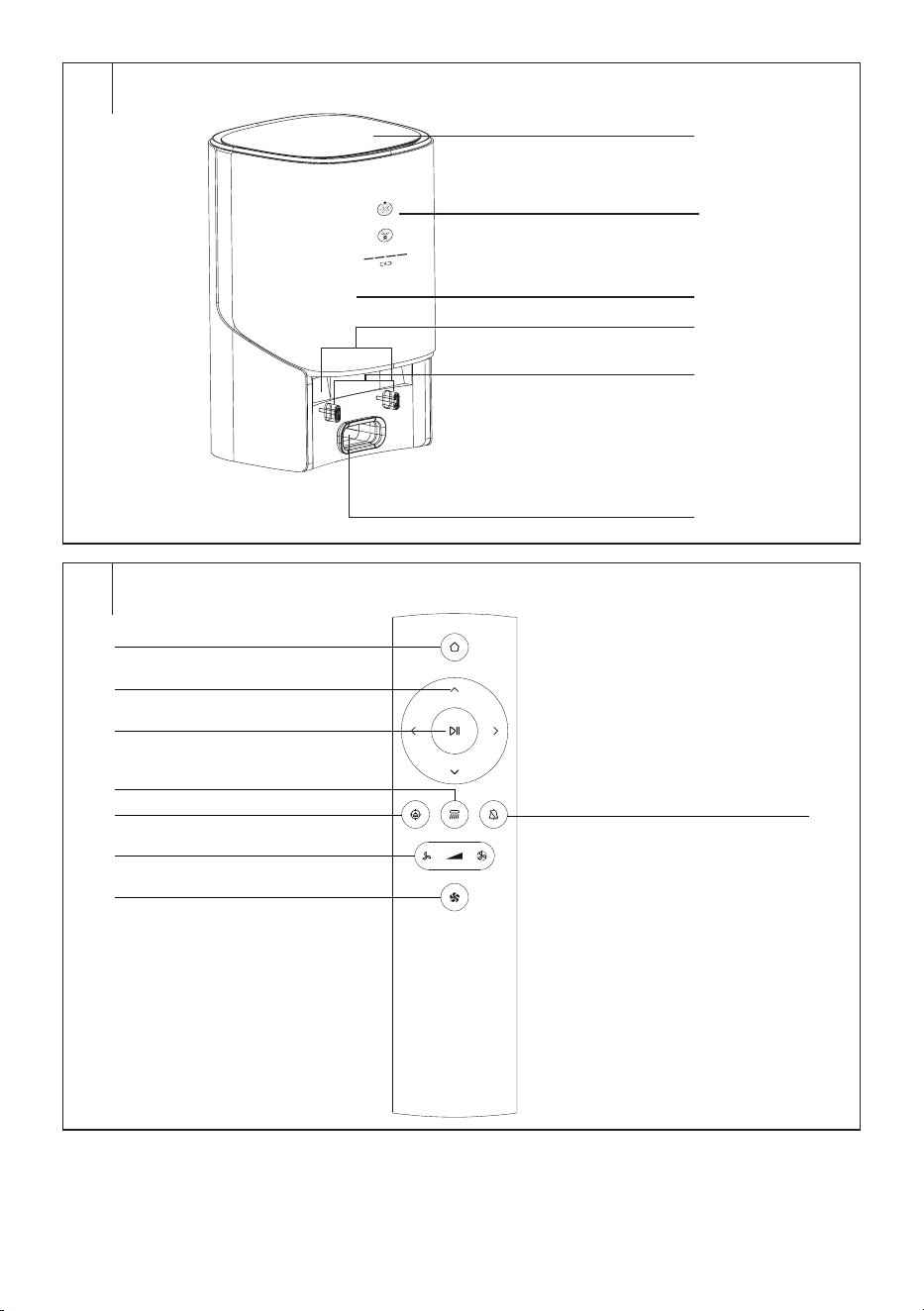
DESCRIPTION OF THE DUST COLLECTION STATION
B1 Lid of the dust collection
station
B2 Display
B3 Dust bag installation
compartment
B4 Infrared sensors
B5 Charging contacts
B6 Suction hole
. . . . . . . . . . . . . . . . . . . . . . . . . . . . . . . . . . . . . . . . . . . . . . . . . . . . . . . . . . . . . . . . . . . .
DESCRIPTION OF THE REMOTE CONTROL
C1 Button Return to the dust
collection station
C2 Direction buttons for
movement of the vacuum
cleaner forward/back/left/
right
C3 Button Start/stop cleaning
C4 Button Start mopping
mode
C5 Button Intensive local
cleaning
C6 Suction power setting buttons
C7 Button Maximum suction
power
C8 Button Mute voice
messages
. . . . . . . . . . . . . . . . . . . . . . . . . . . . . . . . . . . . . . . . . . . . . . . . . . . . . . . . . . . . . . . . . . . .
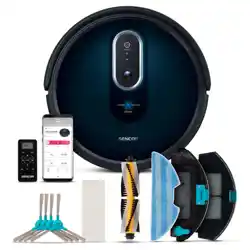
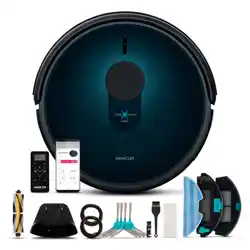
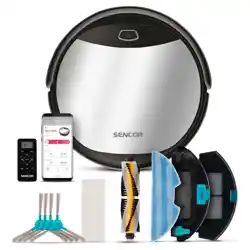
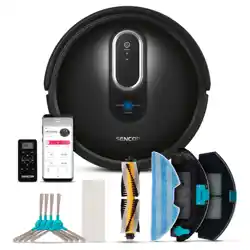
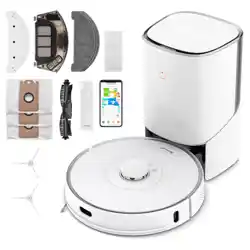
INCLUDED CONTENTS
• Robotic vacuum cleaner
• Dust collection station
• Remote control
• Mop sleeve holder
• Mop sleeve (3 pcs)
• HEPA filter (2 pcs: 1 pc installed on the vacuum cleaner; 1 pc spare
HEPA filter)
• Side rotary brush (2 pcs: 1 pc installed on the vacuum cleaner; 1 pc
spare side rotary brush)
• Dust bag (3 pcs)
• Cleaning brush
• Type AAA battery for remote control (2 pcs)
. . . . . . . . . . . . . . . . . . . . . . . . . . . . . . . . . . . . . . . . . . . . . . . . . . . . . . . . . . . . . . . . . . . .
PURPOSE OF USE AND FEATURES OF THE ROBOTIC VACUUM
CLEANER
• The robotic vacuum cleaner is intended for cleaning various types
of hard floors such as wooden or laminate floating floors, tiles, vinyl,
etc. and carpets with alow pile height. While vacuuming, it effectively
combines various routes to optimally clean the entire floor area.
• The suction hole effectively removes hair, animal fur, etc. The side
rotary brush brushes dirt out of hard-to-reach places along walls and
furniture and out of corners. The motorised rubber wheels protect
sensitive floors against scratching and can travel over threshold strips
up to aheight of 2 cm and ride on to a2 cm high carpet.
• The suspended bumper enables the vacuum cleaner to dampen the
approach to an obstacle and to efficiently clean around it. The infrared
sensors in the front bumper prevent the robotic vacuum cleaner from
colliding with obstacles. Safe operation in rooms with stairs is made
possible by the bottom anti-stair-fall sensors.
• The remote control facilitates convenient control, enabling the vacuum
cleaner to be turned on and off, to be set to the automatic cleaning
mode, to select an operating mode or to send the robotic vacuum
cleaner to the dust collection station.
• The vacuum cleaner is equipped with GYRO MAPPING function
(orientation in space), which can identify the space geometry of ,
aroom in which it is cleaning, thereby the vacuum cleaner is able to
better clean the floor. The vacuum cleaner is also equipped with laser
navigation by means of which it maps out each room and then starts
to clean it systematically. Both functions are built-in and cannot be
affected in any way.
. . . . . . . . . . . . . . . . . . . . . . . . . . . . . . . . . . . . . . . . . . . . . . . . . . . . . . . . . . . . . . . . . . . .
ROBOTIC VACUUM CLEANER CLEANING MODES
Automatic cleaning mode
• The robotic vacuum cleaner will effectively clean the maximum
room area and when it has finished cleaning, it will return to the dust
collection station.
Local cleaning mode
• The robotic vacuum cleaner will effectively clean an area
of1.6x1.6m,
Other cleaning modes (e.g. cleaning aselected room, selected zone, etc.)
can be set in the application.
Note:
Prior to starting the robotic vacuum cleaner, always check
that it is fully charged and that all obstacles, foreign objects,
cables, etc. have been removed from the area.
. . . . . . . . . . . . . . . . . . . . . . . . . . . . . . . . . . . . . . . . . . . . . . . . . . . . . . . . . . . . . . . . . . . .
PREPARING THE ROBOTIC VACUUM CLEANER
• Take the robotic vacuum cleaner and all its accessories out of the
packaging. Check that you have taken out all the parts.
• Check the robotic vacuum cleaner and its accessories for damage.
• Remove the protective film and advertising labels from the robotic
vacuum cleaner and all the accessories.
EN
Robotic vacuum cleaner
User'smanual
- 5 -
12/2023
2023, .
Installing the side rotary brush
• The side rotary brush is intended for smooth floor surfaces and
ensures effective cleaning in corners, along walls and furniture.
• Turn the vacuum cleaner upside down. Put the rotary brush on to
the pin that is intended for it and secure it in place with ascrew using
ascrewdriver. Turn the vacuum cleaner back over.
• When using the vacuum cleaner to clean rooms with carpets, remove
the rotary brush. To remove it, proceed in the reverse sequence.
. . . . . . . . . . . . . . . . . . . . . . . . . . . . . . . . . . . . . . . . . . . . . . . . . . . . . . . . . . . . . . . . . . . .
COMBINATION 2-IN-1 DUST CONTAINER WITH WATER TANK
• The combination dust container with water tank enables the floor to be
vacuumed and wiped at the same time. The robotic vacuum cleaner
vacuums dirt and dust from the floor and then wipes it. Depending on
the intended use of the robotic vacuum cleaner, it is necessary to pour
water into the water tank and to attach the holder with the mop sleeve.
Using the robotic vacuum cleaner only for vacuuming
1. When using the robotic vacuum cleaner only for vacuuming, before
using it, ensure that the dust container is inserted in the vacuum
cleaner and that it is empty.
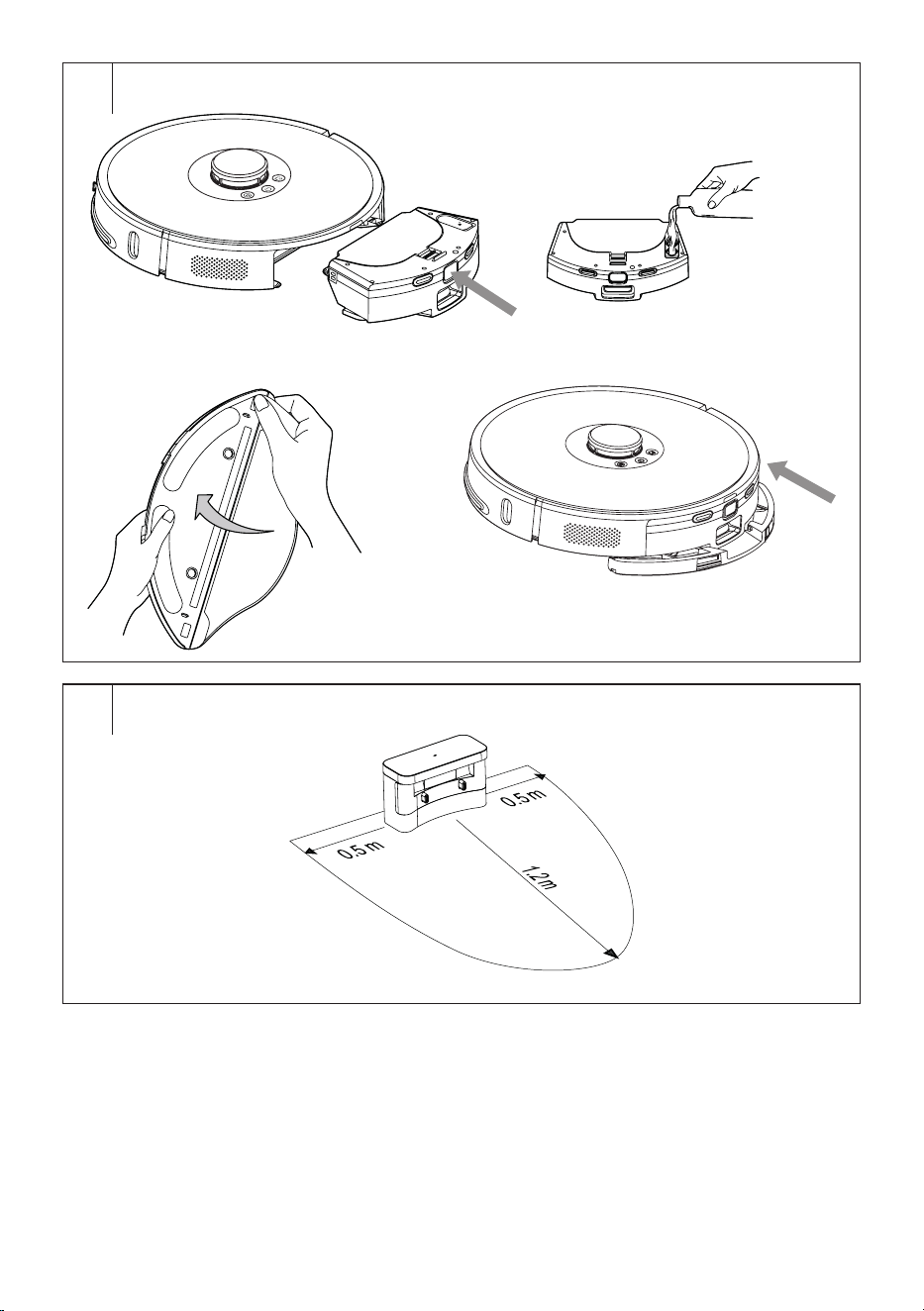
2. In order to be able to remove the dust container, press the dust
container release button and pull the dust container out of the
vacuum cleaner – see figure D1.
3. Insert the dust container into the robotic vacuum cleaner so that
the dust container lid is pointing upwards and the outlet is point
outwards – see figure D1. Gently push down on the dust container
from behind until you hear aclick. This indicates that the dust
container is correctly secured in the vacuum cleaner.
Using the robotic vacuum cleaner for vacuuming and wiping the floor
• In order to use the robotic vacuum cleaner for vacuuming and wiping
the floor at the same time, it is necessary to put water into the water
tank and to attach the holder with the mop sleeve on to the bottom
side of the container.
1. Remove the dust container from the robotic vacuum cleaner
by pressing the dust container release button and pull the dust
container out of the vacuum cleaner – see figure D1.
2. Release the water tank cover and pour water into the water tank
through the opening – see figure D2.
Note:
For wiping, we recommend using clean water. If you use ,
acleaning agent, it may foam up and thereby worsen the
dripping of the water on to the sleeve, or potentially cause
smudges on the floor after it dries.
3. Firmly close the lid and insert it into the robotic vacuum cleaner
so that the dust container lid is pointing upwards and the outlet is
pointing outwards – see figure D1. Gently push down on the dust
container from behind until you hear aclick. This indicates that the
dust container is correctly secured in the vacuum cleaner.
4. Put the mop sleeve on to the holder – see figure D3. We recommend
soaking and rinsing out the sleeve slightly before putting it on. This
speeds up the soaking process and subsequent wiping of the floor.
5. Insert the holder with the mop sleeve under the container so that the
cut-out in the holder slides in underneath the container – see figure
D4. Gently push down on the holder towards the rear until you hear
aclick. This indicates that the holder with the mop sleeve is correctly
secured in the vacuum cleaner.
Warning:
Do not use the robotic vacuum cleaner to vacuum
and wipe door mats, runners, etc. Before vacuuming
carpets, it is necessary to remove the holder with the
mop sleeve.
. . . . . . . . . . . . . . . . . . . . . . . . . . . . . . . . . . . . . . . . . . . . . . . . . . . . . . . . . . . . . . . . . . . .
LOCATION OF THE DUST COLLECTION STATION
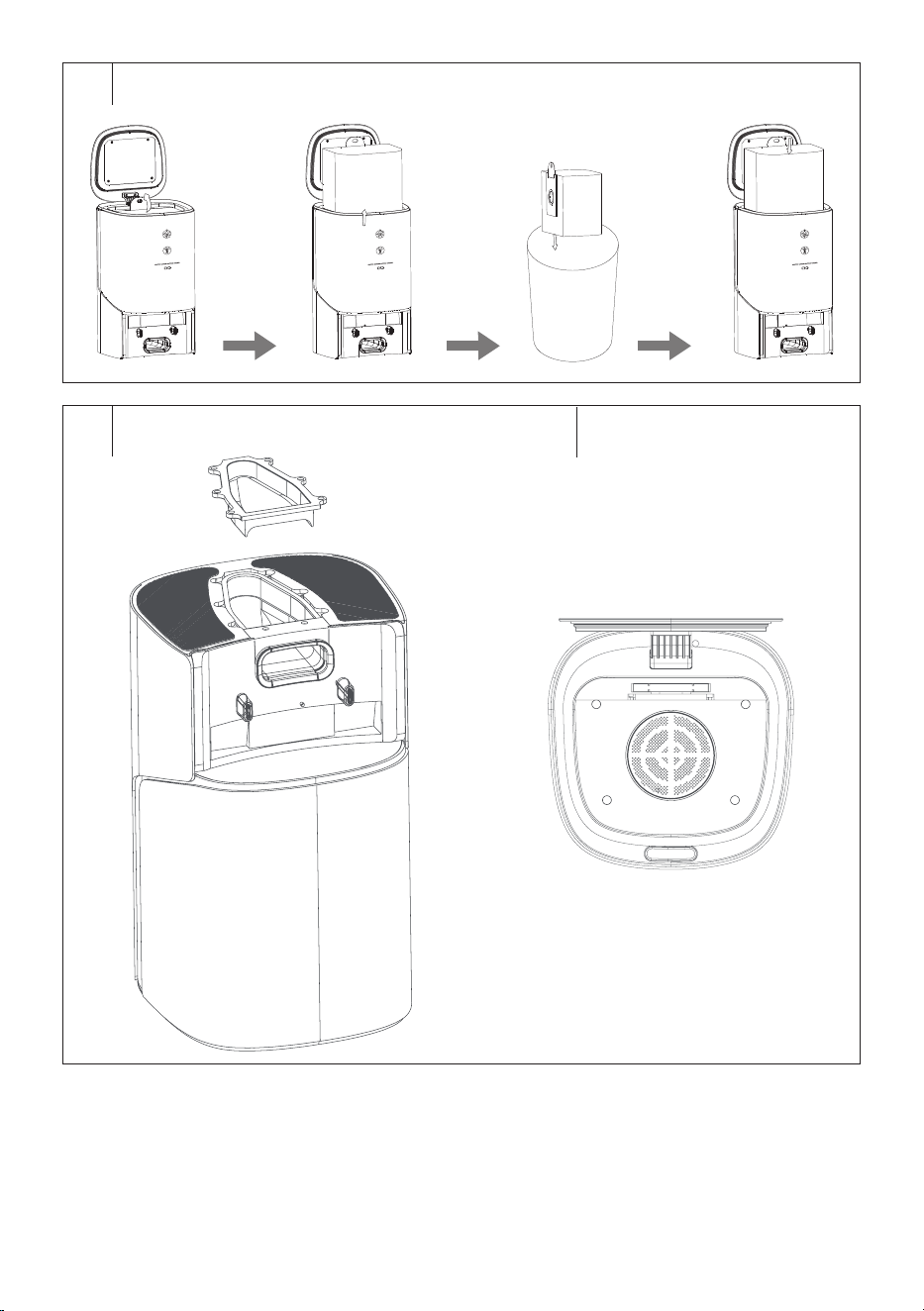
• The dust collection station serves to automatically recharge the
battery and the vacuum cleaner must have good access to it.
• Locate the dust collection station against awall on ahard, horizontal
and dry surface within reach of apower socket – see figure E. Make
sure that there are no stairs or obstacles within adistance of 0.5m
on the left and right of the charging station and within adistance of
1.2 m in front of the dust collection station, that would prevent the
vacuum cleaner from finding the dust collection station and docking
successfully.
• Connect the power cord of the dust collection station to apower
socket. Locate it in such away that it does not tangle into the rotary
brushes of the vacuum cleaner.
• In the event that the vacuum cleaner is not used for an extended
period of time, disconnect the dust collection station from the power
socket and store it in adry, clean and cool place.
. . . . . . . . . . . . . . . . . . . . . . . . . . . . . . . . . . . . . . . . . . . . . . . . . . . . . . . . . . . . . . . . . . . .
CHARGING THE ROBOTIC VACUUM CLEANER
• The vacuum cleaner can be charged in the dust collection station,
which the vacuum cleaner automatically seeks out when it has
finished cleaning.
• Always check that the vacuum cleaner is turned on with the
button.
Charging the vacuum cleaner for the first time
• Before first use, it is necessary to fully charge the robotic vacuum
cleaner. Allow the robotic vacuum cleaner to charge for up to 12 hours.
• Grasp the vacuum cleaner and manually place it into the dust
collection station so that the charging contacts on the underside of
the vacuum cleaner and the charging contacts on the dust collection
station are connected. When the contacts are connected, the charging
process will start.
Automatic charging
• The robotic vacuum cleaner utilises the automatic charging function
whenever it finishes cleaning and in cases, where during operation,
it detects low power on the battery. Therefore, the robotic vacuum
cleaner will start to actively seek out the dust collection station. It is
thus important that it is always connected to apower source and is
freely accessible for the vacuum cleaner so that it can dock in it.
• The robotic vacuum cleaner can be sent to be charged also by
pressing the charging button directly on the vacuum cleaner, in the
application or on the remote control. In such acase, the operation
of the robotic vacuum cleaner will stop and it will seek out the dust
collection station.
• After docking in the dust collection station, the charging cycle will
commence. Acomplete charge takes approximately 4 to 6 hours. The
actual charging time depends on the power level of the battery at the
start of the charging process.
• Afull charge will provide up to 200 minutes of operation (with the low
suction power set).
• In the event that the charging contacts are disconnected during the
charging cycle, the vacuum cleaner will move away from the dust
collection station and then re-dock itself to resume the charging
process, unless it is prevented from doing so by an obstacle.
• In the event of apower outage, the charging cycle will be interrupted
and will continue after the power supply is renewed.
• In the event that the maximum charging current is exceeded, the
charging process will be automatically interrupted.
• In the event that the robotic vacuum cleaner is discharged completely,
e.g. because the vacuum cleaner failed to seek out or dock in the dust
collection station, it is necessary to put it there manually.
. . . . . . . . . . . . . . . . . . . . . . . . . . . . . . . . . . . . . . . . . . . . . . . . . . . . . . . . . . . . . . . . . . . .
CONTROLLING THE VACUUM CLEANER USING ITS BUTTONS
• The buttons on the vacuum cleaner are used for basic controls. For
more advanced controls, use the remote control or control your
robotic vacuum cleaner via the mobile application. You will find more
information further in the user'smanual.
Turning the robotic vacuum cleaner on/off
• Press and hold down the button for 3 seconds to turn on the
robotic vacuum cleaner. The button will start flashing white. The
robotic vacuum cleaner will switch to the stand-by mode.
• Press and hold down the button for 3 seconds to turn off the
robotic vacuum cleaner. The button will start flashing white for
- 6 -
12/2023
2023, .
awhile and then it will turn off. The robotic vacuum cleaner is turned
off.
Note:
It is not possible to turn off the robotic vacuum cleaner
during the charging process.
Pausing the cleaning process
• If the button is pressed during the operation of the robotic vacuum
cleaner then the operation of the robotic vacuum cleaner will be
paused. Pressing the button again will resume its operation.
Sleep mode
• After 60 seconds of inactivity, the robotic vacuum cleaner will switch
to sleep mode. Pressing any button will switch the robotic vacuum
cleaner to stand-by mode.
Selecting the cleaning mode
• While the robotic vacuum cleaner is in stand-by mode, press the
button and the robotic vacuum cleaner will start automatic cleaning.
• While the robotic vacuum cleaner is in stand-by mode, press and hold
down the charging button and the robotic vacuum cleaner will start
local cleaning.
Charging
• Press the charging button if you need to send the robotic vacuum
cleaner for charging. This will end the currently running cleaning
process and the vacuum cleaner will start seeking out the dust
collection station, where it will dock.
. . . . . . . . . . . . . . . . . . . . . . . . . . . . . . . . . . . . . . . . . . . . . . . . . . . . . . . . . . . . . . . . . . . .
CONTROLLING THE VACUUM CLEANER USING THE REMOTE
CONTROL
• Push down the latch of the cover on the rear side of the remote control
to release it and remove the cover.
• Insert two type AAA (1.5 V) batteries into the remote control. When
inserting the batteries ensure the correct polarity as shown inside the
battery compartment. Put the cover back on and click it into place.
• In the event that the batteries are flat, replace them with new ones. Do
not combine various types of batteries or new and old batteries.
• The signal range of the remote control is approximately 6 m.
• When replacing batteries, first remove the flat batteries and then insert
the new ones.
Note:
Never combine flat and new batteries nor various types of
batteries.
Starting cleaning
• Press the button to start automatic cleaning. The robotic vacuum
cleaner will start.
• Press the button to start local cleaning.
• While the vacuum cleaner is running, pressing the button will stop
its operation. Resume operation by pressing the button again.
• If you need to end the cleaning, press the button, the robotic
vacuum cleaner will stop, end the cleaning process, seek out the dust
collection station and dock in it.
Starting mopping
• Ensure that the holder with the mop sleeve is attached to the vacuum
cleaner and that there is water in the water tank.
• Press the button to activate the mopping mode. In this mode, the
suction power is automatically reduced to minimum.
• Pressing the button again will cancel the mopping mode.
Setting the suction power
• Set the suction power based on the type of floor covering and the
degree of soiling.
• Repeatedly pressing the button will reduce the suction power,
repeatedly pressing the will increase the suction power.
• If you need to set the maximum suction power, press the button.
Movement of the robotic vacuum cleaner
• The direction buttons serve to manually control the movement of
the robotic vacuum cleaner. However, it is necessary that the robotic
vacuum cleaner is in operation.
• The button is used to move it forward.
• The button is used to turn the robotic vacuum cleaner around by
180°.
• The button is used to turn the robotic vacuum cleaner 90° to the left
and for movement to the left.
• The button is used to turn the robotic vacuum cleaner 90° to the
right and for movement to the right.
Muting the voice messages
• Press the button to immediately mute the voice messages.
Pressing the button again will resume the voice messages.
. . . . . . . . . . . . . . . . . . . . . . . . . . . . . . . . . . . . . . . . . . . . . . . . . . . . . . . . . . . . . . . . . . . .
Controlling the vacuum cleaner using the mobile application
• The robotic vacuum cleaner can be controlled via the Sencor HOME
application.
• Download the application to your smart phone, register yourself and
control the robotic vacuum cleaner via the application.
• If you already have the application installed, add the robotic vacuum
cleaner to your devices.
Adding the robotic vacuum cleaner to the device list via aQR code
• The robotic vacuum cleaner can also be added to the Sencor HOME
application using the QR code provided below. On the home screen
of the application, click on the "+" icon and on the Add device screen,
click on the [–] icon in the top right hand corner.
• After scanning the QR code, you will be asked to select aWi-Fi
network. Select anetwork, enter the password and click on "Next".
• You will be asked to reset the device. Press and hold down the
and buttons for 3 seconds. The vacuum cleaner will beep and the
white backlight will start flashing. This means that the robotic vacuum
cleaner is ready for pairing. You will also find instructions on the screen
of the application.
• In the application, confirm that the (Wi-Fi) indicator is flashing and
click on "Next".
• Click on "Connect". Then in the Wi-Fi settings on your mobile device
connect the Wi-Fi to the robotic vacuum cleaner. Then return to the
application and wait until the pairing of the robotic vacuum cleaner is
complete.
• In the device list on the main screen, click on the icon of the robotic
vacuum cleaner to enter control interface.
QR code for adding the control panel of the robotic vacuum cleaner to the
application Sencor HOME
- 7 -
12/2023
2023, .
Manually adding the robotic vacuum cleaner to the device list
• On the main screen, click on "Add device" or on the "+" in the top right
hand corner and here click on "Add device".
• Ascreen with appliance categories will appear together with alist of
appliances.
• Click on "Robotic vacuum cleaners" and from the list, select the robotic
vacuum cleaner model.
• On the next screen, you will be asked to select aWi-Fi network. Select
anetwork, enter the password and click on "Next".
• You will be asked to reset the device. Press and hold down the
and buttons for 3 seconds. The vacuum cleaner will beep and the
white backlight will start flashing. This means that the robotic vacuum
cleaner is ready for pairing. You will also find instructions on the screen
of the application.
• In the application, confirm that the (Wi-Fi) indicator is flashing and
click on "Next".
• Click on "Connect". Then in the Wi-Fi settings on your mobile device
connect the Wi-Fi to the robotic vacuum cleaner. Then return to the
application and wait until the pairing of the robotic vacuum cleaner is
complete.
• In the device list on the main screen, click on the icon of the robotic
vacuum cleaner to enter control interface.
Wi-Fi reset
• Press and hold down the and buttons for 3 seconds. The
vacuum cleaner will beep and the white backlight will start flashing
slowly.
Note:
We recommend that you turn off mobile data in your
mobile telephone'ssettings during the Wi-Fi connection.
. . . . . . . . . . . . . . . . . . . . . . . . . . . . . . . . . . . . . . . . . . . . . . . . . . . . . . . . . . . . . . . . . . . .
DUST COLLECTION STATION
• The dust collection station is equipped with adust bag, into which
the robotic vacuum cleaner dumps the contents of its dust container
after it has finished cleaning or if it registers that the dust container is
full. When this happens, the robotic vacuum cleaner will seek out the
dust collection station and reverse towards it so that the opening in
the dust container aligns with the suction hole on the underside of the
dust collection station. Upon contact, both openings will open and the
contents of the dust container will be, by means of pressure, sucked
into the dust bag. Then the openings will close and the robotic vacuum
cleaner will start to recharge or it will continue in the cleaning process.
• To ensure the correct operation of the dust collection station, make
sure that it is connected to the power socket.
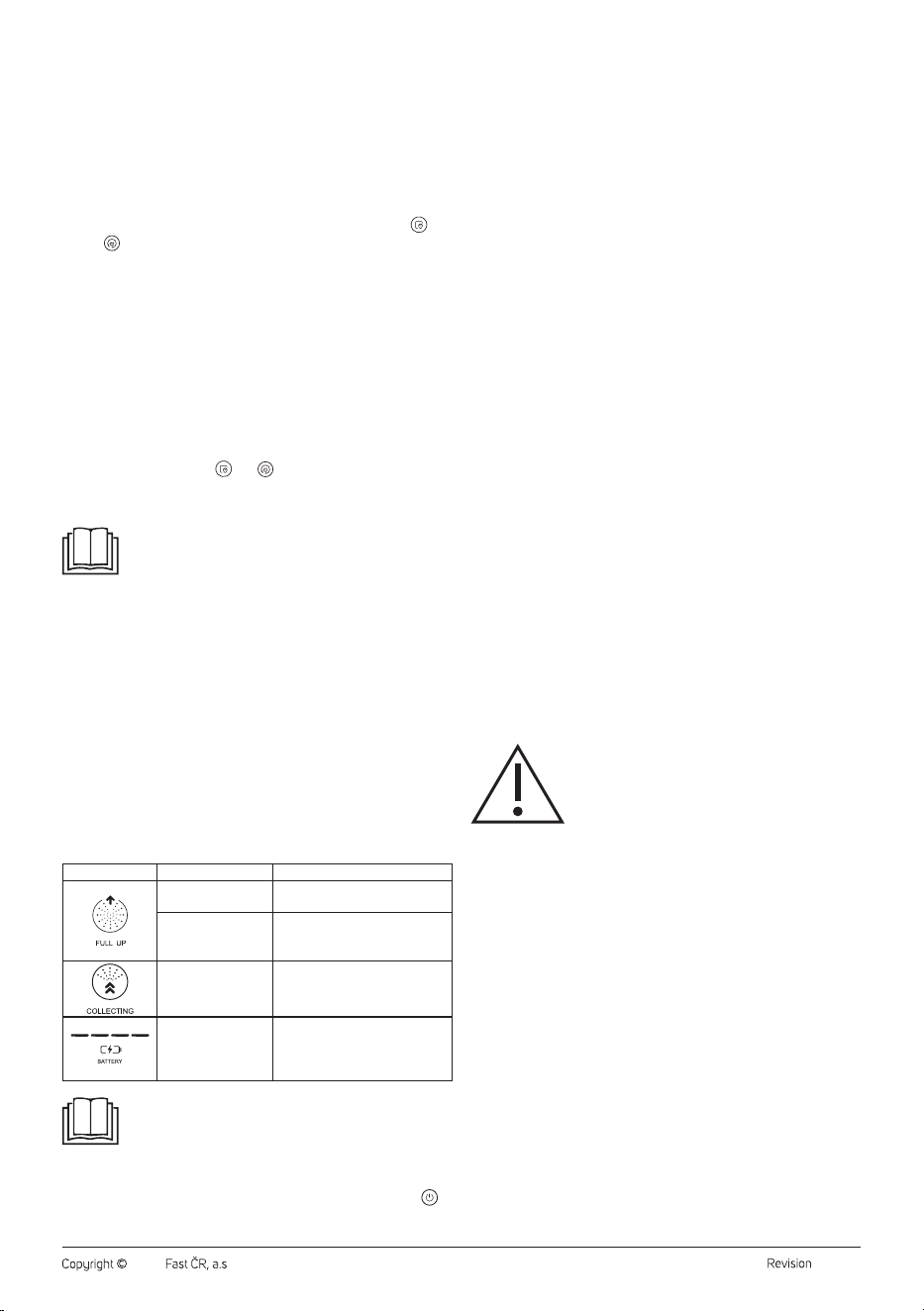
Icons on the display of the dust collection station and their meanings
Icon Status Meaning
Lit.
The dust bag is full. It is
necessary to replace it.
Flashing.
The dust bag is not inserted or
not inserted correctly. Insert the
dust bag correctly.
Icon is flashing
white.
The contents of the dust
container are being sucked out.
Charging indicators
are flashing.
After the vacuum cleaner returns
to the dust collection station,
the charging indicators flash for
afew seconds.
Note:
If all the icons on the display are lit and flashing, then this
indicates afault on the motor fan. Contact an authorised
service centre.
CLEANING AND MAINTENANCE
• Prior to cleaning it, always turn off the vacuum cleaner using the
button.
• For cleaning, never use abrasive cleaning products, solvents, etc.
• Neglecting cleaning and maintenance may negatively affect
the working order of the vacuum cleaner and lead to its reduced
performance.
. . . . . . . . . . . . . . . . . . . . . . . . . . . . . . . . . . . . . . . . . . . . . . . . . . . . . . . . . . . . . . . . . . . .
ROBOTIC VACUUM CLEANER
Emptying the dust container
• On the SRV 9385WH model, the container is automatically emptied
into the dust collection container both after every use and also during
the cleaning process when the vacuum cleaner detects the maximum
amount of dirt and dust in the container. It is possible to set how
frequently the dust container will be emptied out.
Cleaning the dust container
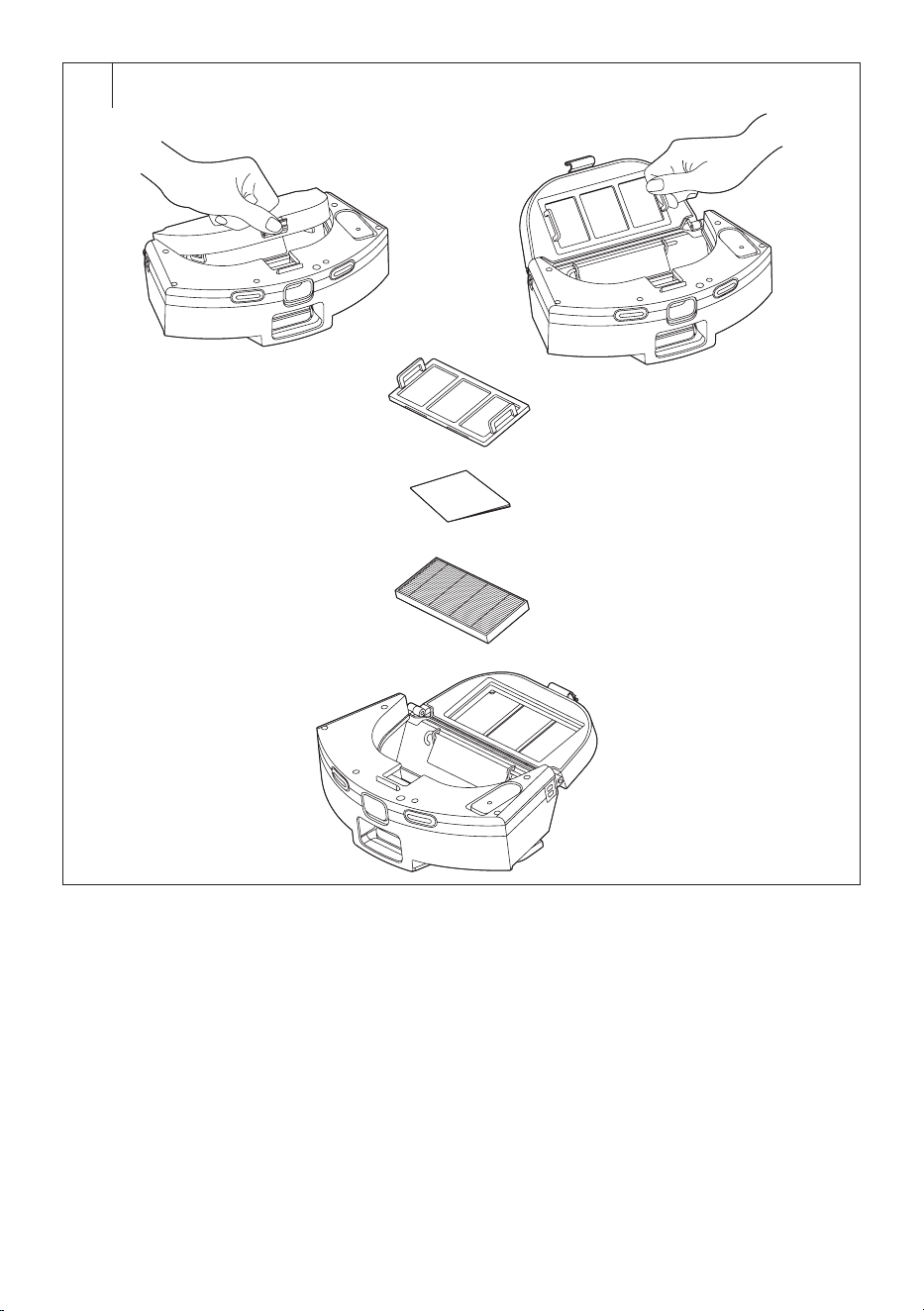
1. In order to be able to remove the dust container, press the dust
container release button and pull the dust container out of the
vacuum cleaner – see figures D1.
2. Press the dust container lid lock and tilt open the dust container lid –
see figure F1.
3. Press the coarse filter clip – see figure F2. Take the coarse filter,
foam filter and the HEPA filter out of the lid – see figure F3.
4. Tap out the HEPA filter and the foam filter and remove the dirt and
dust from them using afine brush or soft wiping cloth. In the event of
heavy soiling, you can vacuum them out using adifferent vacuum
cleaner with an attached brush nozzle. Do not wash the HEPA filter
in water. This could damage it. In the event that the HEPA filter is
already heavily soiled or deformed, replace it with anew one. We
recommend replacing the HEPA filter based on the frequency of use
at least once every six months.
4. Rinse the coarse filter under running water and wipe dry with aclean
wiping cloth.
5. Wipe the dust container out using alightly dampened sponge and
wipe dry using aclean wiping cloth. If necessary, you can pour
asmall amount of water into the dust container and wipe it out with
asponge. Then thoroughly wipe it dry using aclean wiping cloth.
6. Insert the HEPA filter, the foam filter and then the coarse filter into
the area in the lid. Gently push down on the coarse filter until you
hear aclick. This indicates that the coarse filter is properly secured in
place.
7. Close the dust container lid. Gently push down on the lid until you
hear aclick. This indicates that the lid is properly closed.
Warning:
Prior to inserting the filter into the dust container and
closing the lid, always ensure that all the parts are
clean and completely dry. Otherwise, there is arisk of
damaging the robotic vacuum cleaner.
Cleaning the water tank and mop sleeve
• To prevent the formation of moulds and damaging microorganisms
that may cause unpleasant odours and be damaging to health, it is
necessary to clean the water tank, mop sleeve holder and the mop
sleeve after every use.
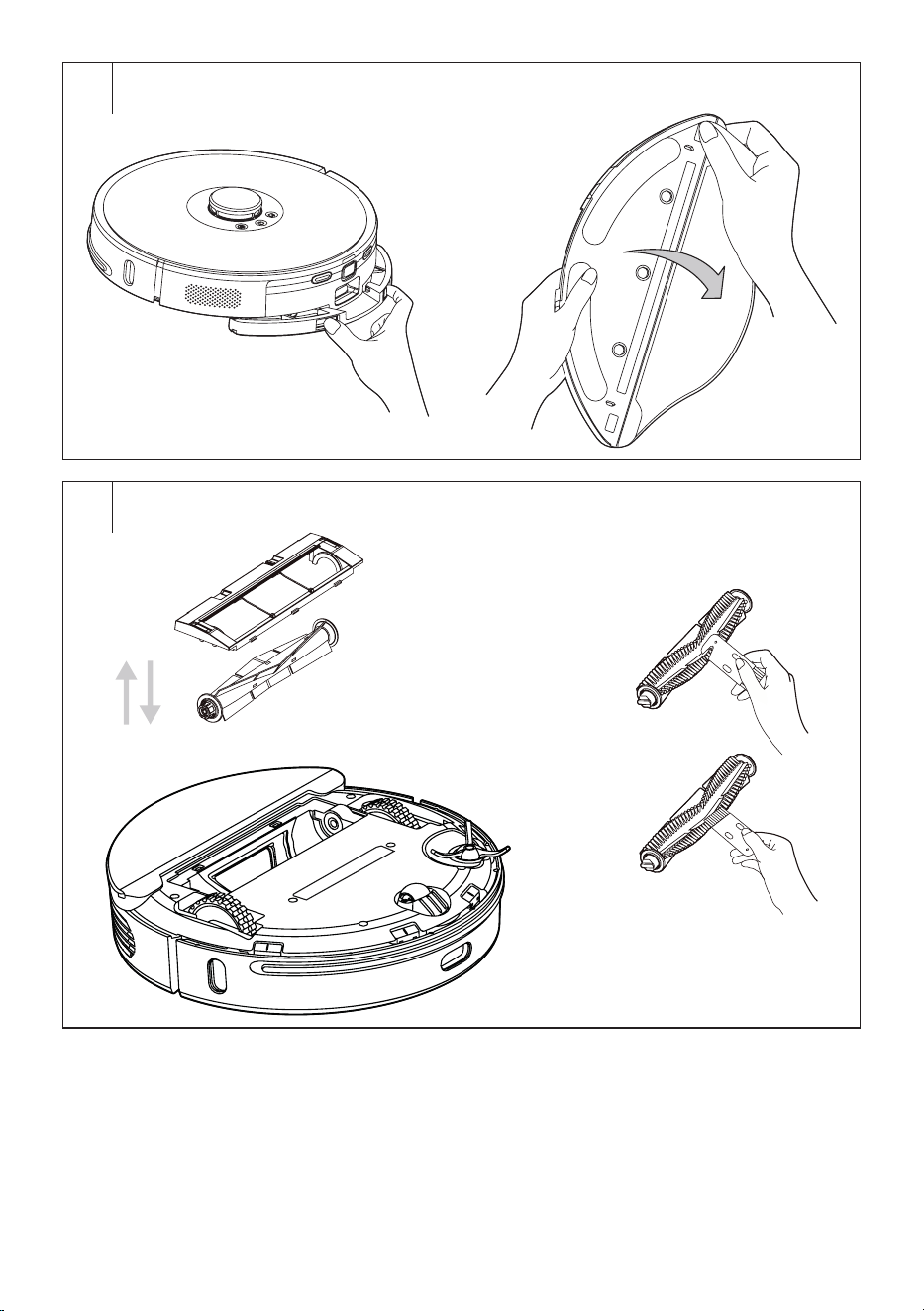
1. Press the clip on the mop sleeve holder and pull it out of the bottom
part of the robotic vacuum cleaner – see figure G1.
2. Carefully remove the mop sleeve from the holder – see figure G2.
3. In order to be able to remove the dust container, press the dust
container release button and pull the dust container out of the
vacuum cleaner – see figure D1.
4. Take the dust container over awash basin or sink and release the
water tank cover. Turn the container upside down and allow the
water remaining in the water tank to flow out. If necessary, gently
shake the water tank to ensure that all the water has flowed out.
5. Leave the water tank cover open and allow the water tank to dry out
in adry and well ventilated location.
6. Wipe the mop sleeve holder using alightly dampened sponge and
wipe dry using aclean wiping cloth.
7. Hand wash the mop sleeve in lukewarm water with asmall amount
of fine washing powder, wring it out by hand and allow it to dry
naturally. Do not wash the mop sleeve in awashing machine or dry
it in aclothes dryer.

- 8 -
12/2023
2023, .
Cleaning the central rotary brush
• We recommend that you regularly clean the central rotary brush,
at least once per week, to ensure the constant suction power of the
robotic vacuum cleaner. Hair and fur that is wound on to the brush
may reduce the output power output of the robotic vacuum cleaner
and also its effectiveness.
1. Turn the robotic vacuum cleaner upside down.
2. Press the clip of the central rotary brush cover and take the cover off
the vacuum cleaner and then take out the rotary brush – see figure
H1.
3. Use adry wiping cloth to clean out the area in which the rotary
brush is housed. Check and clean out the suction hole. Dirt and dust
that accumulates around the suction hole may reduce the suction
power of the vacuum cleaner.
4. Remove any dirt and material (dust, wound on hair, animal fur, etc.)
from the rotary brush – see picture H2.
5. Insert the rotary brush back into the vacuum cleaner and put on the
cover. Gently push down on the cover until you hear aclick. This
indicates that the cover is properly secured in place.
Cleaning the side rotary brush
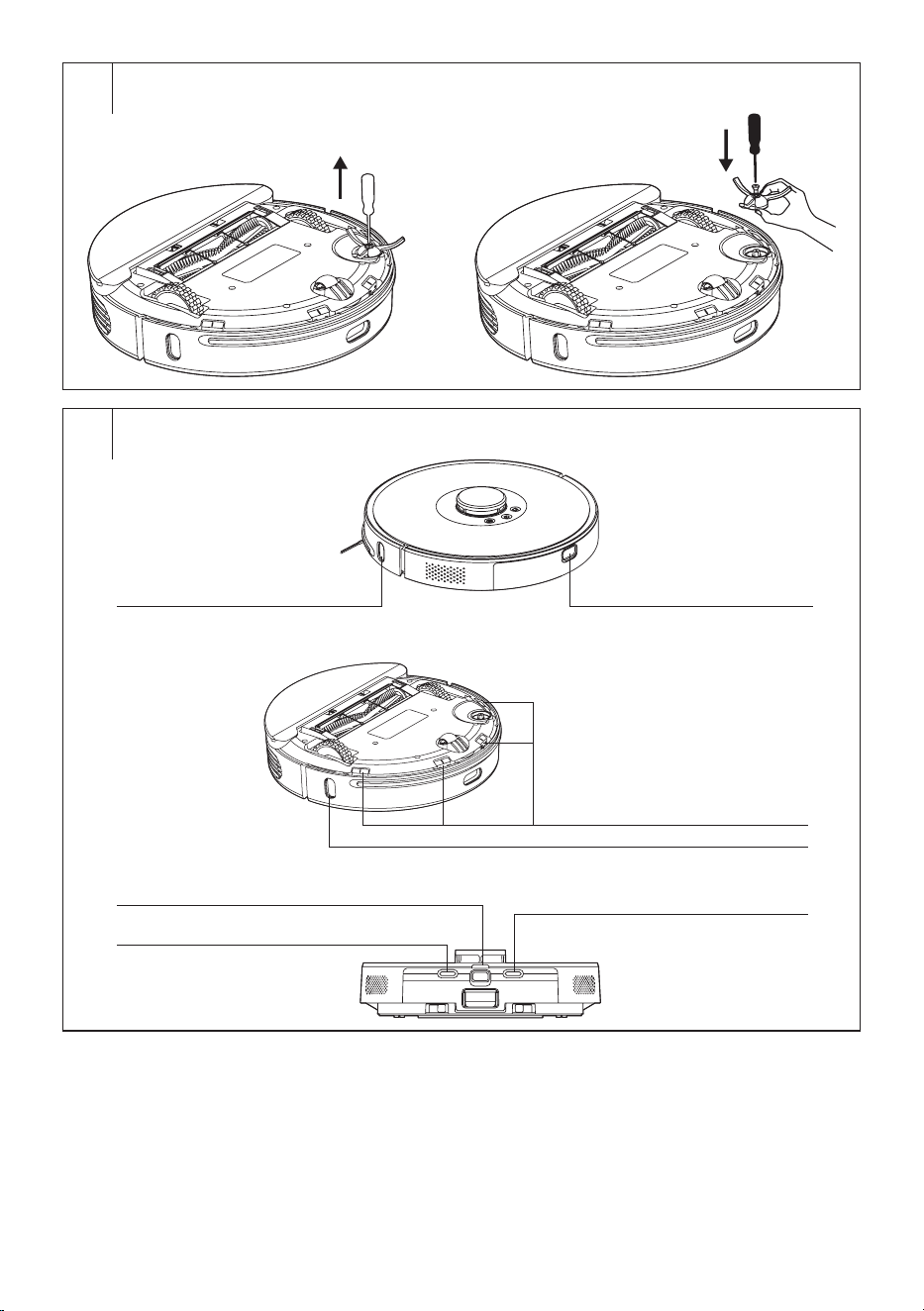
1. Loosen the screw of the side rotary brush using ascrewdriver – see
figure I1.
2. Take the side rotary brush out of the vacuum cleaner by pulling it
upwards.
3. Remove any dust and dirt from the location where the brush was
mounted.
4. Remove all dust and dirt from the brush. If necessary you may wash
the brush under running water. If the bristles were deformed while
the vacuum cleaner was running, dip them in warm water to allow
them to return to their original shape. Allow the brushes to dry before
reattaching to the vacuum cleaner.
5. Insert the side rotary brush into the robotic vacuum cleaner and
secure it in place using the screw – see figure I2.
Cleaning the sensors
• The sensors on the robotic vacuum cleaner are important for its proper
control and safe operation. It is, therefore, important that you regularly
clean them and maintain them in good condition.
• The robotic vacuum cleaner includes atotal of (see figure J):
1. 4 anti-fall sensors (on the underside of the robotic vacuum cleaner)
2. 3 infrared sensors
3. 2 charging contacts
4. infrared side sensors
• Wipe the sensors using asoft dry wiping cloth or cotton bud.
Cleaning the outer surface of the robotic vacuum cleaner
• Regularly wipe the surface of the vacuum cleaner using asoft dry
wiping cloth.
• Clean the front swivel wheel, motorised wheels, suction hole, rotary
brush and the bottom sensors at least once per week or more
frequently.
• First remove any coarser dirt from the front swivel wheel and the
motorised wheels. Then clean them around their entire perimeter
using alightly dampened cloth and wipe them dry. Do not forget to
also clean the area around the wheels.
Replacing the HEPA and foam filter
1. Take out the dust container and open the dust container lid. Take out
the coarse filter, old foam filter and old HEPA filter.
2. Insert anew HEPA filter, anew foam filter and then the coarse filter
into the area in the lid. Gently push down on the coarse filter until
you hear aclick. This indicates that the coarse filter is properly
secured in place.
3. Close the dust container lid. Gently push down on the lid until you
hear aclick. This indicates that the lid is properly closed.
Note:
The wear and tear status of the HEPA filter can be
monitored in the mobile application.
Note:
The HEPA and foam filters are always replaced at the
same time.
Replacing the side brush
• The rotary brushes become worn out when used. After acertain time
it is necessary to replace the used brushes with new ones. To order
anew brush, please contact your vendor or an authorised service
centre. The wear and tear status can be monitored in the mobile
application.
1. Loosen the screw of the side rotary brush using ascrewdriver.
2. Take the old side rotary brush out of the vacuum cleaner by pulling it
upwards.
3. Insert anew side rotary brush into the robotic vacuum cleaner and
secure it in place using the screw.
. . . . . . . . . . . . . . . . . . . . . . . . . . . . . . . . . . . . . . . . . . . . . . . . . . . . . . . . . . . . . . . . . . . .
DUST COLLECTION STATION
Cleaning the dust collection station
• Wipe the outer surface of the dust collection station using asoft, dry
wiping cloth.
Replacing the dust bag
• If the dust bag is full, the icon will appear on the display of the dust
collection station. It is necessary to replace the dust bag. To replace it,
proceed as follows:
1. Disconnect the dust collection station from the power socket.
2. Open the lid of the dust collection station – see figure K1.
3. Grasp the dust bag holder and carefully pull it upwards– see figure
K2. This will close the inlet hole to the dust bag, ensuring that dust
and dirt remains safely enclosed in the dust bag.
4. Throw the used dust bag out with standard communal waste.
5. Insert anew dust bag into the dust collection container – see figure
K3. It is important that the inlet hole in the bag is aligned with the
outlet hole in the internal area of the collection container.
6. Close the lid.
Cleaning the inlet suction hole of the dust collection station
• In the event that, after replacing the dust bag, all the icons on the
display start to flash, it is necessary to check whether the inlet suction
hole of the dust collection station is clogged.
1. Make sure that the dust collection station is disconnected from the
power socket.
2. Turn the dust collection station upside down.
3. Remove the cover of the inlet suction hole – see figure L.
4. Eliminate the cause of the blockage, dirt and dust.
5. Put on the cover and turn the dust collection station back over to the
operating position.
Cleaning the sensors
• The sensors on the dust collection station are important for its
operation. It is, therefore, important that you regularly clean them and
maintain them in good condition.
• Wipe the infrared sensors and the charging contacts using asoft dry
wiping cloth or cotton bud.
Cleaning the fan filter
• The fan filter is located inside the dust collection station underneath
the dust bag – see figure M. When replacing the dust bag, check the
condition of the filter and if necessary remove any dirt and dust using
asoft, dry sponge. We recommend cleaning the fan filter once per
month.
. . . . . . . . . . . . . . . . . . . . . . . . . . . . . . . . . . . . . . . . . . . . . . . . . . . . . . . . . . . . . . . . . . . .
REPLACING THE BATTERY
• Model number of areplacement battery: SRX 9301
• In the event that you need to replace the battery, proceed as follows:
1. Make sure that the vacuum cleaner is turned off using the button.
Turn the vacuum cleaner upside down.
2. Using ascrewdriver, loosen the screws (8 in total) of the bottom
cover, remove them and carefully remove the bottom cover.
3. Disconnect the connector of the battery and take the battery out of
the internal area of the vacuum cleaner.
4. Connect the new battery and insert it into the internal area. The
battery can only be connected in one way. The connector is coded
and cannot be turned around.
- 9 -
12/2023
2023, .
5. Put on the bottom cover and secure it in place using the screws. Turn
the vacuum cleaner back to the operating position.
6. Place the vacuum cleaner into the dust collection station and allow
the battery to charge to full capacity.
Note:
The robotic vacuum cleaner is supplied with the battery
already inserted.
. . . . . . . . . . . . . . . . . . . . . . . . . . . . . . . . . . . . . . . . . . . . . . . . . . . . . . . . . . . . . . . . . . . .
LONG TERM STORAGE
• When not using the vacuum cleaner for an extended period of time,
do the following:
• Clean the vacuum cleaner as described in chapter CLEANING AND
MAINTENANCE.
• Disconnect the dust collection station from the power socket. Store the
vacuum cleaner with all its accessories in adry, clean and cool place.
• It is recommended to charge the vacuum cleaner every 3 months as
this will extend the lifetime of the built-in battery.
• Remove the batteries from the remote control.
. . . . . . . . . . . . . . . . . . . . . . . . . . . . . . . . . . . . . . . . . . . . . . . . . . . . . . . . . . . . . . . . . . . .
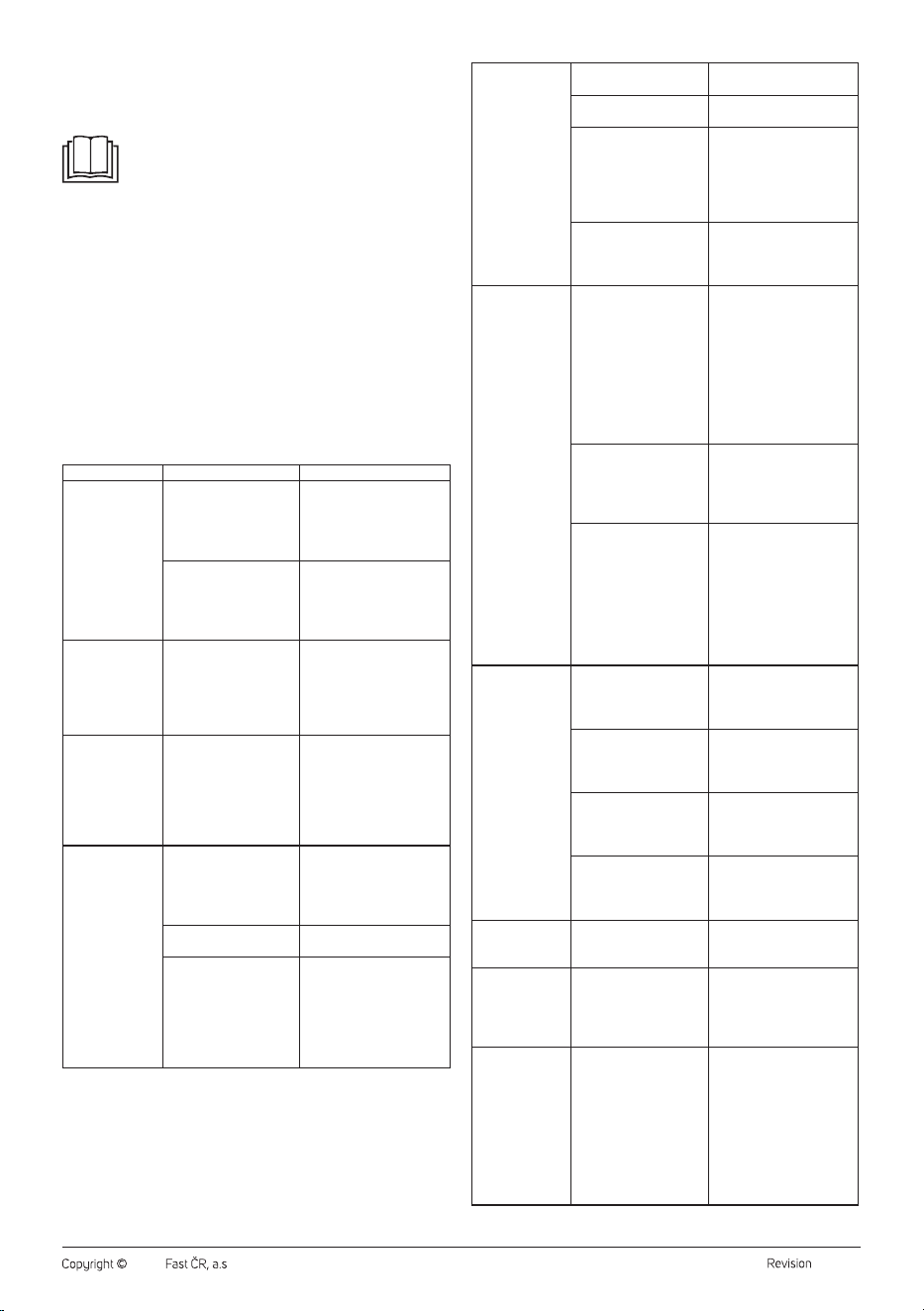
TROUBLESHOOTING
Problem Cause Solution
The vacuum
cleaner is not
charging itself.
The charging contacts
are not touching.
Check that the contacts
are touching when
inserting the vacuum
cleaner into the dust
collection station.
The dust collection
station is disconnected
from the power source.
Connect the power cord
to the power socket and
leave the dust collection
station permanently
connected.
The vacuum
cleaner is stuck
in asingle
location.
The vacuum cleaner
has become entangled
in wires/cables lying on
the ground, in curtains or
other foreign objects on
the carpet.
The vacuum cleaner will
always attempt to free
itself on its own, however,
we recommend to remove
it by hand from the stuck
location.
The vacuum
cleaner has
returned to the
dust collection
station without
completing the
cleaning process.
The vacuum cleaner
detected alow battery
charge level and
automatically returned
to the station to
recharge.
This is normal. Allow
the vacuum cleaner to
recharge.
The vacuum
cleaner does
not perform the
cleaning process
automatically as
scheduled.
The vacuum cleaner
is not switched on and
cannot perform the
cleaning process as
scheduled.
Turn on the vacuum
cleaner.
The vacuum cleaner
battery is almost flat.
Allow the vacuum cleaner
to recharge.
The vacuum cleaner
has become stuck or
is blocked by aforeign
object.
Turn off the vacuum
cleaner, empty out the
dust container. Turn the
vacuum cleaner upside
down and remove dust
and dirt from the wheels
and brushes.
The remote
control doesn't
work.
(Recommended
distance is 5 m.)
Batteries are flat. Replace the batteries in the
remote control.
The vacuum cleaner
battery is almost flat.
Allow the vacuum cleaner
to recharge.
The remote signal
receiver on the vacuum
cleaner or the signal
transmitter on the
remote control is
blocked or soiled.
Wipe the signal receiver
and transmitter using
aclean wiping cloth.
The remote control
signal is being interfered
with by another device
in its vicinity.
Do not use the remote
control in the vicinity of
devices with an infrared
signal.
Whilst the
vacuum cleaner
is running,
vacuuming
locations are
being left out,
its travel path
is chaotic, it
is travelling in
the opposite
direction, the
map in the
application
is showing
inaccuracies or is
not defined.
The floor is too smooth,
the central wheel slides
on the floor and the
vacuum cleaner travels
over low obstacles,
thresholds and strips,
and this affects its
decision making process
regarding the cleaning
area in the entire home.
We recommend closing
the doors of individual
rooms and ato allow them
to be cleaned individually.
The vacuum cleaner is
equipped with afunction
for the identification of
asingle room. It will return
to its starting location.
The floor is washed and
polished or too smooth,
which reduces friction
between the wheels and
the floor.
We recommend cleaning
the floor after it has been
waxed.
Cables, foreign objects
on the floor affect the
operation of the vacuum
cleaner.
Prior to starting the
vacuum cleaner, it is
important to remove
from the floor any cables,
slippers, toys and other
foreign objects to reduce
the number of obstacles,
which the vacuum cleaner
will need to drive around.
Dirt remains on
the floor after
cleaning is
finished.
The central rotary brush
is blocked.
Clean out the central
rotary brush and move the
robotic vacuum cleaner
into an open area.
The side rotary brush is
blocked.
Clean out the side rotary
brush and move the
robotic vacuum cleaner
into an open area.
The 2-in-1 combination
dust container is not
correctly inserted in the
robotic vacuum cleaner.
Insert the 2-in-1
combination dust container
into the robotic vacuum
cleaner.
The dust container is
full, the HEPA filter is
clogged or the central
rotary brush is dirty.
Empty out the dust
container, clean the HEPA
filter and the central rotary
brush.
It is not possible
to turn on the
vacuum cleaner.
The battery is flat. Allow the battery to fully
recharge.
The vacuum
cleaner has
problems with
movement on the
floor.
Front swivel wheel is
blocked.
Clean out the front swivel
wheel and move the
robotic vacuum cleaner
into an open area.
The vacuum
cleaner will seek
out the dust
collection station
but does not
dock in it.
The dust collection
station is blocked or is
too far away, it is not
connected to apower
source; foreign objects
are caught on the mop
sleeve holder or the mop
sleeve is rolled up.
Place the dust collection
station into an open area
and place the robotic
vacuum cleaner into its
vicinity and turn it on;
insert the plug into apower
socket; clean out the
mop sleeve holder and
straighten out the mop
sleeve.
- 10 -
12/2023
2023, .
The vacuum
cleaner is
not behaving
normally.
Internal fault. Turn off the robotic
vacuum cleaner and then
turn it on again and start it.
If the problem persists, turn
off the vacuum cleaner
and contact an authorised
service centre.
Abnormal sounds
are made during
the cleaning
process.
Aforeign object has
become stuck to the
central rotary brush, side
rotary brush or on the
central swivel wheel.
Turn off the robotic
vacuum cleaner and
remove the foreign object.
The water tank
does not release
water into the
sleeve or is only
releasing asmall
amount of water.
There is an insufficient
amount of water in the
water tank; the sleeve is
excessively soiled; the
holder is not inserted.
Refill the water tank with
water; clean the sleeve;
correctly insert the mop
sleeve holder.
The water tank
is releasing too
much water.
The water tank is
not in its place; the
water outlet is set to
maximum.
Check that the water tank
is properly inserted; adjust
the water outlet using the
application.
It is not possible
to connect to the
application.
Abnormal Wi-Fi
network, incorrect Wi-Fi
password or abnormal
behaviour of the
application.
Check whether the
robotic vacuum cleaner is
within range of the Wi-Fi
network; enter the correct
password or reset the Wi-
Fi; download and install
the latest version of the
application.
The vacuum
cleaner is not
able to return
to the dust
collection station
after intensive
cleaning or after
movement.
The robotic vacuum
cleaner is creating anew
map for itself or the
distance is too great.
After intensive cleaning
or movement of greater
distances, the robotic
vacuum cleaner will
generate anew map for
itself. If the dust collection
station is too far away, it
is possible that the robotic
vacuum cleaner will not
be able to find it. Put the
robotic vacuum cleaner
into the dust collection
station manually.
Note:
In the event that the problem is not listed in the table or
continues to persist, stop using the appliance and contact
an authorised service centre.
. . . . . . . . . . . . . . . . . . . . . . . . . . . . . . . . . . . . . . . . . . . . . . . . . . . . . . . . . . . . . . . . . . . .
TECHNICAL SPECIFICATIONS
Robotic vacuum cleaner
Power input of the robotic vacuum cleaner ................................. 24 V 1.2 A
Rated power ............................................................................................................50 W
Battery ............................................................................. Li-ion / 24 V/ 5 000 mAh
Dimensions (diameter × height) ........................................349 × 100 × 353 mm
Weight ..................................................................................................................... 7.8 kg
Operating time per single charge ...............................................................200 min
Dust container capacity ................................................................................ 350 ml
Water tank capacity ........................................................................................ 250 ml
Laser sensor class ..........................................................................................................I
Dust collection station
Input voltage ...........................................................................................220–240 V~
Input frequency............................................................................................50–60 Hz
Output voltage ..........................................................................................................24 V
Output current .......................................................................................................... 1.2 A
Rated power .........................................................................................................950 W
Average efficiency in the active mode ........................................................... 90 %
Dimensions ............................................................................. 250 x 210 x 350 mm
Changes to text and technical parameters reserved.
Original consumable accessories
SRX 9304 HEPA filter
SRX 9305 Side rotary brush
SRX 9302 Mop sleeve
SRX 9309 Dust bag
. . . . . . . . . . . . . . . . . . . . . . . . . . . . . . . . . . . . . . . . . . . . . . . . . . . . . . . . . . . . . . . . . . . .
BATTERY DISPOSAL
Prior to disposing of the product or handing it over at
aspecialised collection facility, it is necessary to ensure
that the battery is removed. Before removing the battery, it
is necessary to start the vacuum cleaner and wait until it is
completely flat. The battery contains environmentally
damaging substances and therefore does not belong in
standard household waste. Their correct disposal will be performed by the
respective collection facility.
DISPOSAL OF USED BATTERIES
Batteries contain environmentally damaging compounds
and, therefore, do not belong in standard communal waste.
Hand over used batteries for proper disposal at locations
intended for their collection.
. . . . . . . . . . . . . . . . . . . . . . . . . . . . . . . . . . . . . . . . . . . . . . . . . . . . . . . . . . . . . . . . . . . .
INSTRUCTIONS AND INFORMATION REGARDING THE DISPOSAL OF
USED PACKAGING MATERIALS
Dispose of used packaging material at asite designated for waste in your
municipality.
DISPOSAL OF USED ELECTRICAL AND ELECTRONIC EQUIPMENT
This symbol on products or original documents means that
used electric or electronic products must not be added to
ordinary municipal waste. For proper disposal, renewal and
recycling, hand these products over to determined
collection points. Alternatively, in some European Union
states or other European countries you may return your
products to the local retailer when buying an equivalent
new product. Correct disposal of this product helps save
valuable natural resources and prevents potential negative effects on the
environment and human health, which could result from improper waste
disposal. Ask your local authorities or collection facility for more details. In
accordance with national regulations penalties may be imposed for the
incorrect disposal of this type of waste.
For business entities in European Union states
If you want to dispose of electrical or electronic equipment, ask your
retailer or supplier for the necessary information.
Disposal in other countries outside the European Union.
This symbol is valid in the European Union. If you wish to dispose of this
product, request the necessary information about the correct disposal
method from the local council or from your retailer.
This product meets all the basic requirements of EU
directives related to it.
SENCOR hereby declares that radio device model number SRV 9385WH
is in compliance with directive 2014/53/EU. The full wording of the EU
Declaration of Conformity is available at the website: www.sencor.eu.

FAST ČR, a.s.
U Sanitasu 1621
CZ-251 01 Říčany
www.sencor.eu