InstruFtion Manual
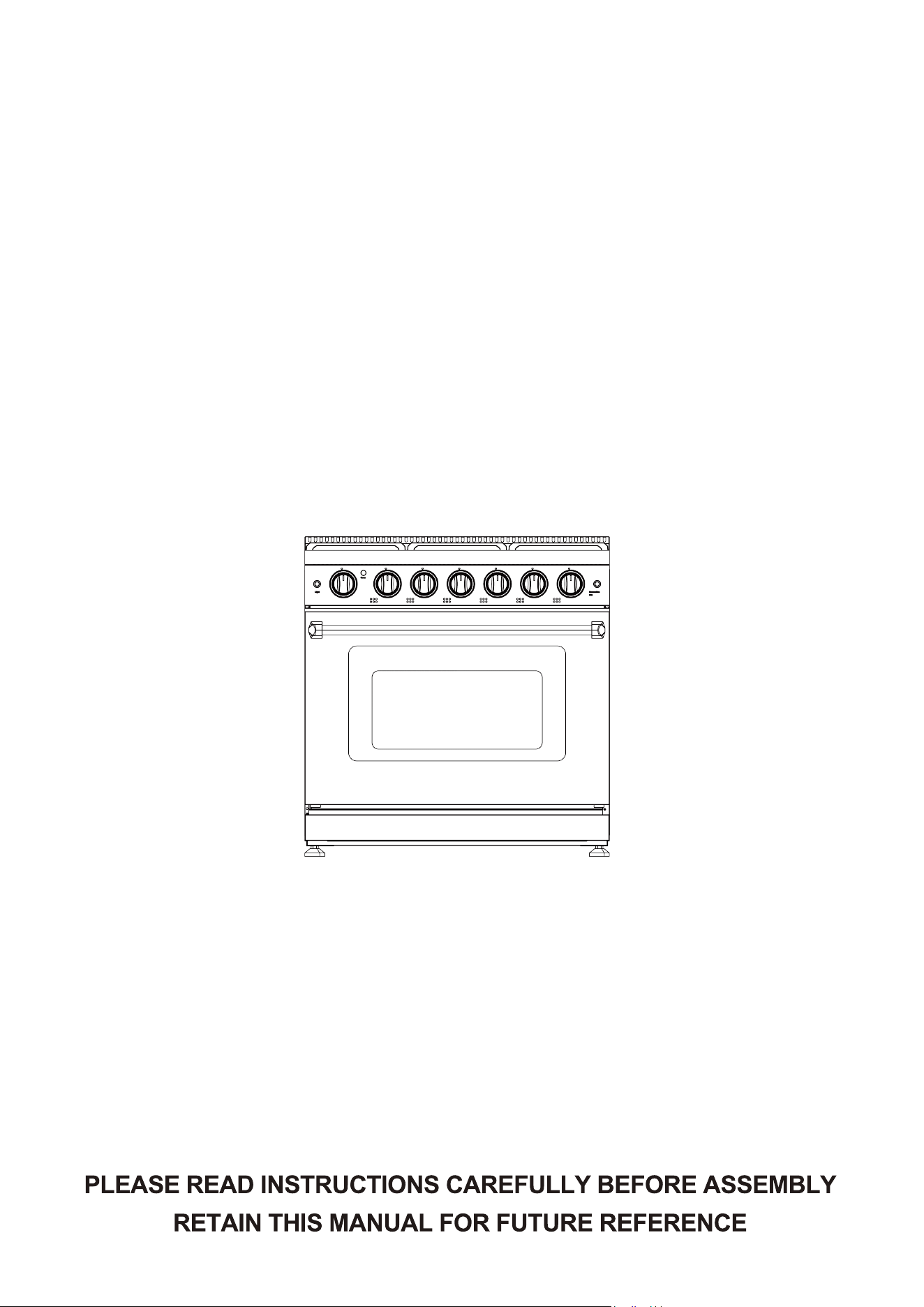
Gas Oven Stove
MODEL:*5/
OVEN: 120V, 60HZ, 5.0AMP
IGNITOR: 120V, 60HZ, 0.2 AMP

Safety symbols
Electrical shock hazard
Tipping hazard
Explosion hazard
Fire hazard
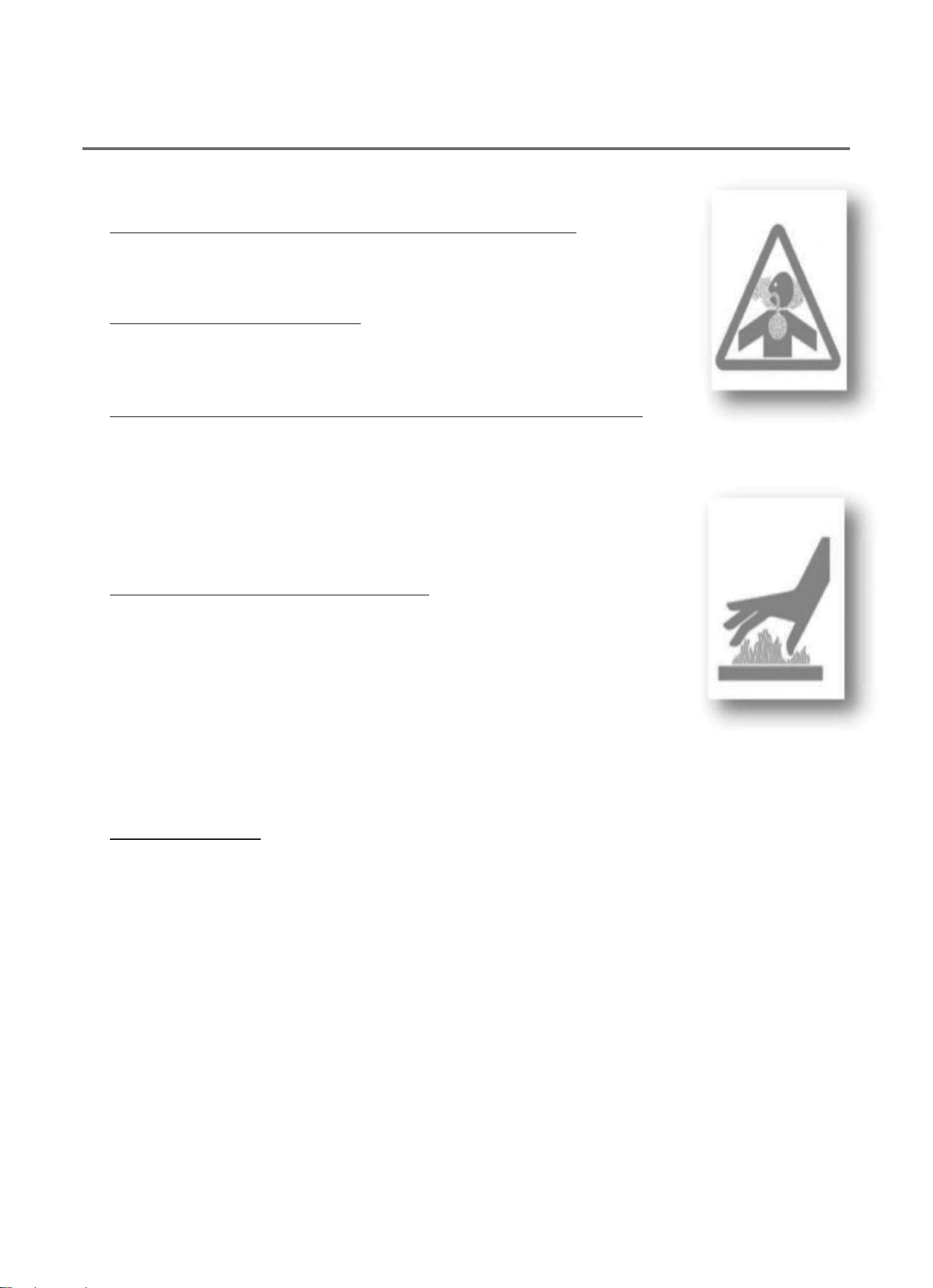
Poisoning hazard
Hot surface hazard
Other safety �ps
WARNINGS
WELCOME
BEFORE YOU START
SAFETY AND WARNINGS
01
02
03
04
04
05
05
06
06
07
07
07
TABIE OF CONTENTS
1.
2.
3.
4.
5.
6.
7.
8.
9.
10.
11.
GAS SUPPLY REQUIREMENTS
Safety Tips For Gas Opera�on
DIMENSIONS AND CLEARANCES
Top Hood And Cabinet Specifica�ons
ELECTRIC POWER SUPPLY REQUIREMENTS
Electrical Grounding Instruc�ons
CONNECT RANGE TO GAS SUPPLY
A�er Installa�on
FIRST USE
Condi�oning The Oven
COOKTOP SAFETY GUIDELINES
Surface Burner Igni�on
Simmer And Boil
Flame Size
Power Failure
Cooktop
Burner Grates
Oven Burner Use
Broil Burner Use
Oven Cooking Guidelines
OVEN FUNCTION
Natural Airflow Bake
INFRARED BROIL
Convec�on Bake
Convec�on Roast
Convec�on Defrost
10
10
11
16
17
20
20
21
22
22
22
23
24
24
24
24
24
25
25
25
12.
27
27
27
27
28
28

Defros�ng
Convec�on Dehydra�on
13.
14.
BROILER OPERATION
Prehea�ng
To Broil
Se�ng Broil
Broiling Guidelines
CLEANING INSTRUCTIONS
Do's
DON'TS
CLEANING BURNER CAPS AND BRASS FLAME SPREADERS
CLEANING SIDE RACKS
CLEANING OVEN SHELVES
CLEANING BROIL/ROAST PAN AND SLOTTED GRID
CLEANING BAKE AND BROIL BURNERS
CLEANING PORCELAIN SURFACES
CLEANING THE OVEN GLASS WINDOW
CLEANING THE OVEN DOOR GASKET
CLEANING STAINLESS STEEL SURFACES
28
28
29
29
29
29
30
31
31
31
31
32
32
32
33
33
33
33
33
REMOVING AND REPLACING THE OVEN DOOR
Removing The Oven Door
Replacing The Oven Door
15.
16.
TROUBLESHOOTING GUIDE
Cooktop
Oven
Appendix 1 Oven Knob Installa�on
Appendix 2 Oven Handle Installa�on
Appendix 3 Rubber Pad Installa�on On Back Panel
Appendix 4 Lp Conversion
Warranty
17.
18.
Safety and Warnings

Safety and Warnings

Make sure that the anti-tip of the range has been properly installed.
Find the model and serial numbers on the CSA label in the bottom right-hand corner of the
backboard.Note these numbers down for future reference.
Read thisguide, taking special note of the ‘Safety and Warnings’section.
Remove all the packaging from the oven(s) and cooktop. Recycle items
that you can. If any
adhesive residue is left on surfaces, remove this using dishwashing liquid on a soft cloth.
Do not use any harsh or abrasive cleaners.
Make sure you follow the instructions under ‘First use’ before using your range forcooking.
To reduce the risk of fire, electrical shock, injury to persons, or damage when using the
appliance, follow the important safety instructions listedbelow:
Safety and Warnings
Safety and Warnings
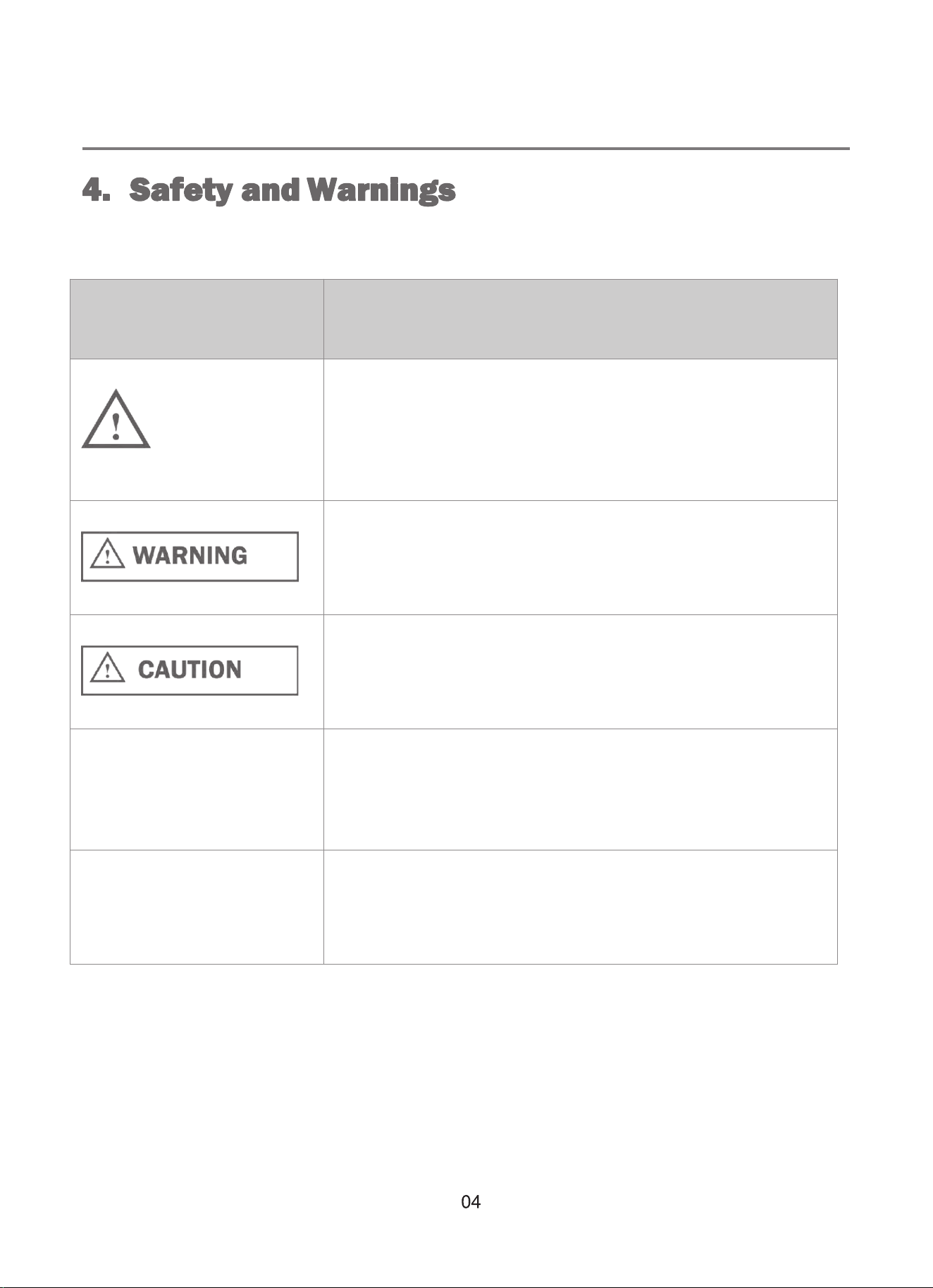
Safety Symbols
Symbol Definition
This will alert you to potential personal or property safety
hazards. Obey all safety rules to avoid any property damage,
personal injury or death.
WARNING indicates a potentially hazardous situation, which, if
not avoided, could result in serious injury or death.
CAUTION indicates a moderate hazardous situation, which, if
not avoided, could result in minor or moderate injury.
CAUTION – when used without the safety alert symbol, indicates
a potentially hazardous situation, which, if not avoided, could
result in property damage.
IMPORTANT used for installation, operation and maintenance
information that is not related to safety.
Safety and Warnings
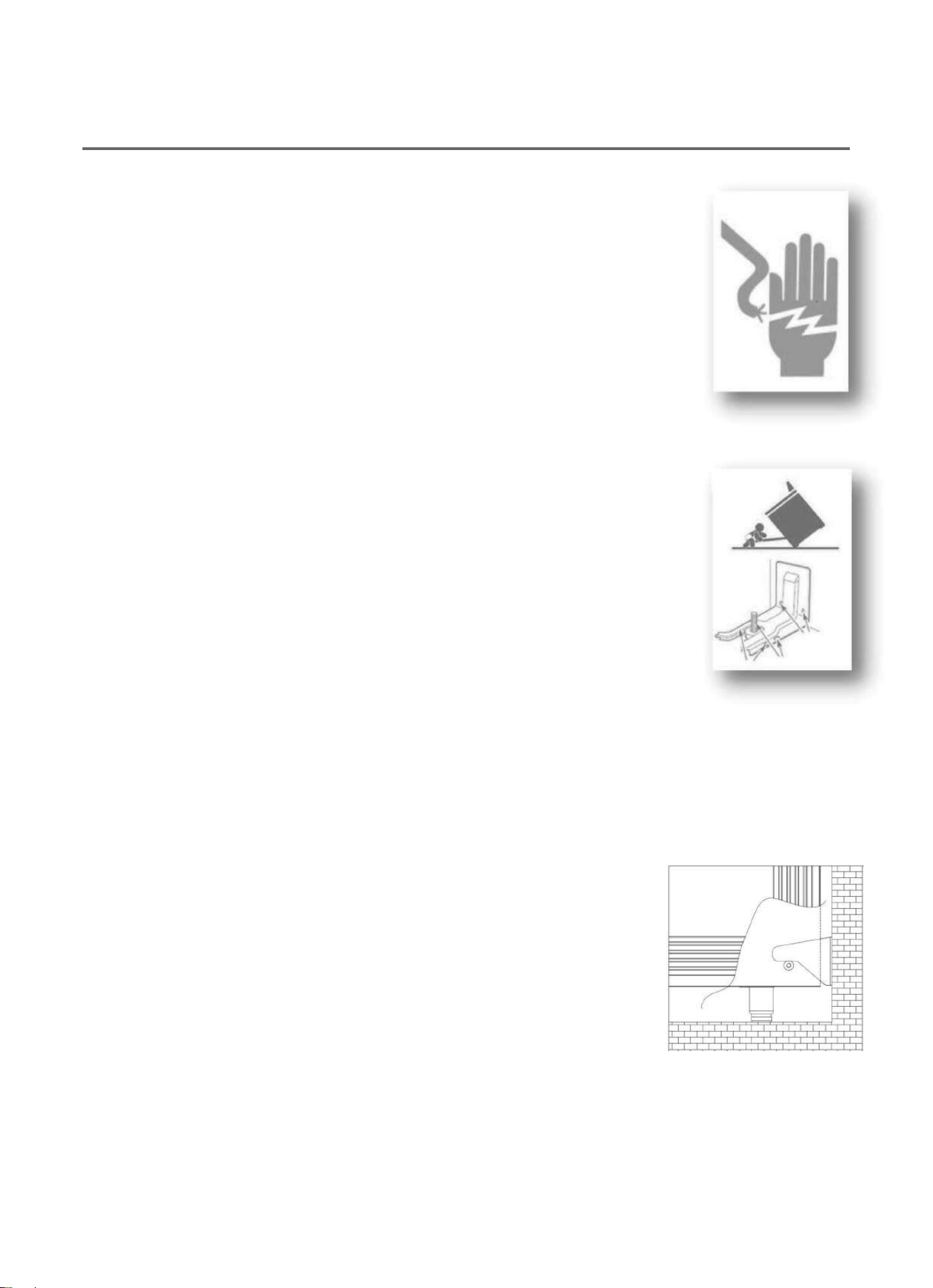
Electrical Shock Hazard
俵
俵
俵
Before removing a faulty oven light bulb, make sure you turn OFF the
power to the range at the main fuse or circuit breaker panel. If youdon’
t
know how to do this, contact an electrician.
Do not remove the kick panel or the back panel. Due to electrical wires
behind it, both panels should only be removed b y a qualified technician.
This appliance is equipped with a three-prong grounding plug for your
protection against shock hazard and should be plugged directly into a
properly grounded power outlet. Do not under any c ircumstances cut
orremove the grounding prong from this plug.
Failure to follow this advice may result in death or electrical shock.
Tipping Hazard
All ranges can tip and cause injuries to adults and children. To prevent
tipping, install the anti-tip device supplied with your range. Follow all
installation instructions.
俵 Even after the safety device is installed, do not step, lean or sit on the
oven door or place any heavy objects on it. Doing so may result in
personal injury.
Make sure anti-tip device is installed as follows:
Slide the range forward.
Install the anti-tip device as described in the instruction sheet
Safely tilt the front section of the range and slide the range slowly back against thewall.
The rear pins should slide under the bracket.
Do not use the appliance until it has been secured.
Failure to follow this advice may result in serious injury.
Anti-tip device for #-3(
Safety and Warnings
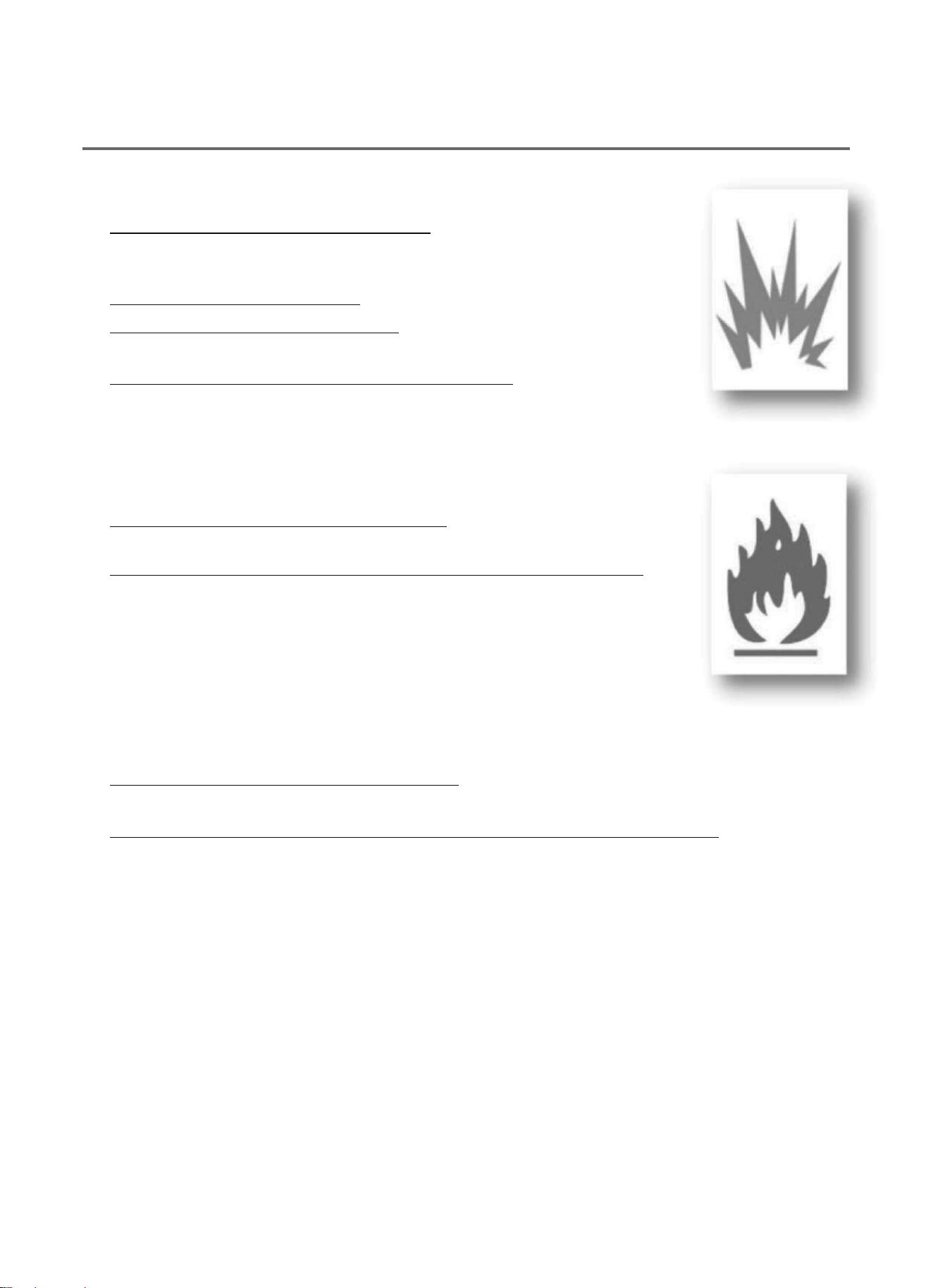
Explosion Hazard
俵
If you smell gas, do not use the appliance. Open a window or door to let
the gas escape, then follow the instructions on the i nside front cover of
this manual.
俵
Do not use water on grease fires. A violent steam explosion may result.
俵
Turn all burners off, then smother fire or flame with a dry chemical or
foam-type extinguisher. Do not t ry to smother with flammable blankets.
俵
Do not heat unopened food containers such as cans. Build-up of
pressure may cause containers to burst and result ininjury.
Failure to follow this advice m ay result in injury or death
Fire Hazard
俵
Never use your appliance as a space heater. Persons could be injured or
a fire could start.
俵
Keep the area around the appliance free from combustible materials (e.g.
wall coverings, curtains, drapes), gasoline and other flammable vapors
and liquids.
俵
Clean the stove and burners regularly.
Do not let cooking grease or other flammable materials accumulate on the
surfaces or near the a ppliance.
俵
Do not hang any articles (e.g. dish towels) off the oven handle. Some fabrics may ignite ormelt
from the heat.
俵
Never leave the cooktop burners unattended when in use. Boil over causes smoking and greasy
spillovers that may ignite.
俵
Never spray an aerosol cleaner on or around the appliance while burners are lit. Be sure all the
controls are turned off and the appliance is cool. The aerosol gas and chemicals in such
cleaners could, in the presence of heat, ignite or cause metal parts to corrode.
俵
Do not store flammables near the cooktop
Flammable materials should not be stored in an oven or near the cooktop. An accident could
cause a serious fire.
U
Safety and warni ngs
Poisoning Hazard
俵
Never cover any slots, holes or passages in the oven bottom or cover an
entire rack or the oven floor with materials such as aluminum foil. Doing
so blocks airflow through the oven and may cause carbon monoxide
poisoning. Aluminum foil linings may also trap heat, causing a firehazard.
俵
Clean the appliance with caution. If a wet sponge or cloth is used to wipe
spills on a hot cooking area, be careful to avoid steam burn. Some
cleaners can produce noxious fumes if applied to a hot surface. Follow
the directions of the cleaner manufacturer.
俵
Never use this appliance as a space heater to heat or warm the room. Doing so may result in
carbon monoxide poisoning and overheating of the appliance.
Failure to follow this advice m ay result in poisoning or death.
Hot Surface Hazard
Accessible parts may become hot during use.
俵
Do not touch burners, areas near burners, the grill, griddle, grease drip-
pans, heating elements or interior surfaces of the oven. These may be
hot enough to cause burns even though they are dark in color. During
and after use, do not touch, or let clothing or other flammable materials
contact these parts and surfaces until they have had sufficient time to
cool. Other parts and s urfaces of the appliance may become hotenough
to cause burns - among these areas are the grates, back trim and oven
vents at the back of the cooktop, front edge, surfa ces adjacent to the
cooktop, and the oven door.
俵
Use only dry potholders. Moist or damp potholders on hot surfaces may result in burns from
steam. Do not let potholders
touch hot heating elements. Do not use a towel or other bulky cloth.
俵
Let hot grease c ool before attempting to handle it.
Failure to follow this advice could result in b urns andscalds.
Other Safety Tips
俵 Read instructions before use
Read all the instructions before using the appliance.
Use the appliance only for its intended purpose as
described in these instructions.
俵 Install the stove properly
Be su re your stove is properly installed and
grounded by a qualified technician.
V

Safety and Warnings
Be sure to have the installer show you where and
how to turn off the power supply to the range (i.e
俵
Do not install or operate the stove if damaged
Do not operate the appliance if it is damaged or not
working properly. If you received a damaged product,
contact the ĂŌĞƌͲƐĂůĞƐĞƌǀŝĐĞĐĞŶƚĞƌimmediately.
俵
Know how to turn off power in an emergency
.
location of the main fuse or circuit breaker panel)
and where and how to turn off the gas supply to the
range in an emergency.
俵
Do not leave children alone near the stove
Children should not be left al
one or unattended in
the area where the appliance is in use. They should
never be allowed to play with the appliance or to sit
or stand on any part of the appliance.
俵
Do not store toys or candy over the stove
Loose-fitting or hanging garments should
never b
For safety reasons, do not store items of interest to
children in cabinets above a range or at the back of
the range – children climbing on the range to reach
items could be seriously injured.
俵
Don’t wear loose clothing that could catch fire
e
worn while using the appliance.
俵 Do not repair or replace parts yourself (unless
recommended)
Do not repair or replace any part of the appliance
unless specifically recommended in the manual. All
other servicing should be referred to a qualified
technician. Technicians must disconnect the
appliance from the power supply before any
servicing.
俵 Careful opening oven door
Use care when opening the oven door by allowing
warm air or steam to escape before removing or
rep
lacing food.
俵 Keep oven vent ducts unobstructed.
俵 Do not touch hot oven shelves
Protect your hands from burning by making sure the
oven is cool before sliding oven shelves into the
oven. If a shelf must be removed while the oven is
hot, do not let oven mitts or potholder contact the
base of the oven or hot heating elements in the
oven.
俵 Protect oven gasket
Do not clean the oven gasket or use any oven-
cleaning products on it. It is essential for a good seal,
which ensures that the oven oper
ates efficiently.
Care should be taken not to rub, damage or move it.
俵 Protect glass oven doors
Do not use harsh/abrasive cleaners, scourers or
sharp metal scrapers to clean the oven door glass
since they scratch the surface, which may result in
the glass shattering.
俵
Never step on the oven door or place a heavy object
(like a Turkey) on it
俵 Check for gas leaks
When the appliance installed, check for gas leaks
according to the instructions before use.
俵 Ventilation hood is mandatory
This appliance should not be operated without a
properly sized and operational ventilation h
ood.
俵
Use a proper gas conversion kit
Be careful when reaching for items stored in
cabinets above the appliance.
俵 Read all instructions before using the product to
ensure proper and safe operation. Install or locate
the product only in accordance with the provided
Installation Instructions.
俵 Do not attempt to adjust, repair, service orreplace
any part of your appliance unless it is specifically
recommended in this guide.
俵 Do not use the range as a spaceheater.
俵 Do not leave children unattended in the area where
the range is in use. Never allow children to sit or
stand on any part of the range. Do not let children
play with the range.
俵 All servicing should be referred to aqualified
technician.
俵 Have the technician show you the location of the gas
shut-off valve and how to shut it off in an emergency.
This stove might be used for natural gas or liquid
propane. If you are not sure whether the unit is
used for NG or LP, please contact ĂŌĞƌͲƐĂůĞƐĞƌǀŝĐĞ
ĐĞŶƚĞƌ for verification. For LP
conversion, please use conversion kit for your
certain model. Please have a certified technician
install the unit and kit (technical support is
available during normal business hours). If planning
to resell unit, please indicate whether it is natural
gas or has LP kit installed.
俵 Do not reach for items over the stove when it is lit

Safety and Warnings
俵 Always disconnect power to the appliance before
any type of servicing.
俵 Do not use abrasive or caustic cleaners or
detergents on thi s appliance. They may cause
permanent damage to the surface.
俵 When cooking, set the burner controls so that the
flame heats only the bottom of the utensil anddoes
not overlap at the sides of theutensil.
俵 Utensils (pots and pa ns) that conduct heat slowly, i.e.
glass pots, should be used in conjunctionwith
burner flames at a low or medium setting.
俵 Turn off all controls and wait for appliance parts to
俵 Always turn pot handles to the si de or back of th
cool down before touching them. Do not touch the
burner grates or surrounding areas untilcool.
俵
Do not use water on grease fires.
俵 Clean the appliance with caution.
e
this manual. When us ing the range, d o not t ouch the
grates, burner caps, burner bases, or any other
parts in proximity to the flame. These components
may be hot enough to causeburns.
俵
Use dry pot holders. Moist or damp pot holders o
range. Do not turn handles towards the area where
they are easily burned. Handles should not extend
over the adjacent burners.
俵 Use th e range only for cooking tasks as outlined in
n
hot surfaces may res u lt in burns from steam.
俵 Do not use a towel or other bulky cloth.
俵 Do not heat unopened food containers.
Buildup of pressure may cause the containerto
explode and result in injury.
俵
During and after use, do not touch interiorsurfaces
of the oven ƵŶƟůĐŽŽů
俵 Do not let pot holders touch hot surfaceareas.
Dimension and Clearance
Readin
Gas Supply Requirements
Installation of this range must conform with local codes, or in the absence of local codes, with
national Fuel Gas Code,ANSI Z223.1 / NFPA 54.
In Canada, installation must conform to the current natural Gas Installation /code, CAN 1-1.1-M81
and with local codes where applicable.
This range has been design-certified according to ANSI Z21.1a, latest edition.
g LP in. w.c. NG (Natural Gas)
in. w. c,
Maximum gas pressure 13.0. 10.0
10.
Appliance regulator setting for outlet
pressure
0 5.0
range.
ᅚ Ventilation: it is a must that the unit be set under a powered, vented exhaust hood o
vapors.
ᅚ Do not obstruct the flow of combustion air into the range and ventilation air away from th
Safety Tips for Gas Operation
ᅚ Keep the appliance area clear and free from combustible materials, gasoline, and other flammable
e
f
sufficient size and capacity.
ᅚ Before installing the range, you must locate and secure the included anti-tip bracket to thewall
for your range.
ᅚ The use of cabinets for storage above the appliance may result in a potential burn hazard.
Combustible items may ignite; metallic items may become hot and cause burns. If cabinet
storage is to be provided, the risk can be reduced by installing a range hood that projects
horizontally a minimum ŽĨϱΗ(12.7cm) beyond the bottom of thecabinets.
Dimension and Clearance
俵
The appliance shall not be used for space heating. This information is based on safety
considerations.
俵 All openings in the wall behind the appliance and in the floor under the appliance shall be
sealed.
'LPHQVLRQV DQG &OHDUDQFHV
俵 The range may be installed flush to the rear wall.
俵 You may install a non-combustible material, such as tile, on the rear wall above the range and
up the vent hood.
俵 It is not necessary to install non-combustible materials behind the range below the countertop
height.
俵 The minimum distance from the side of the range above the countertop to combustible
sidewalls must be at least 10 inches.
Dim ension and Cle arance
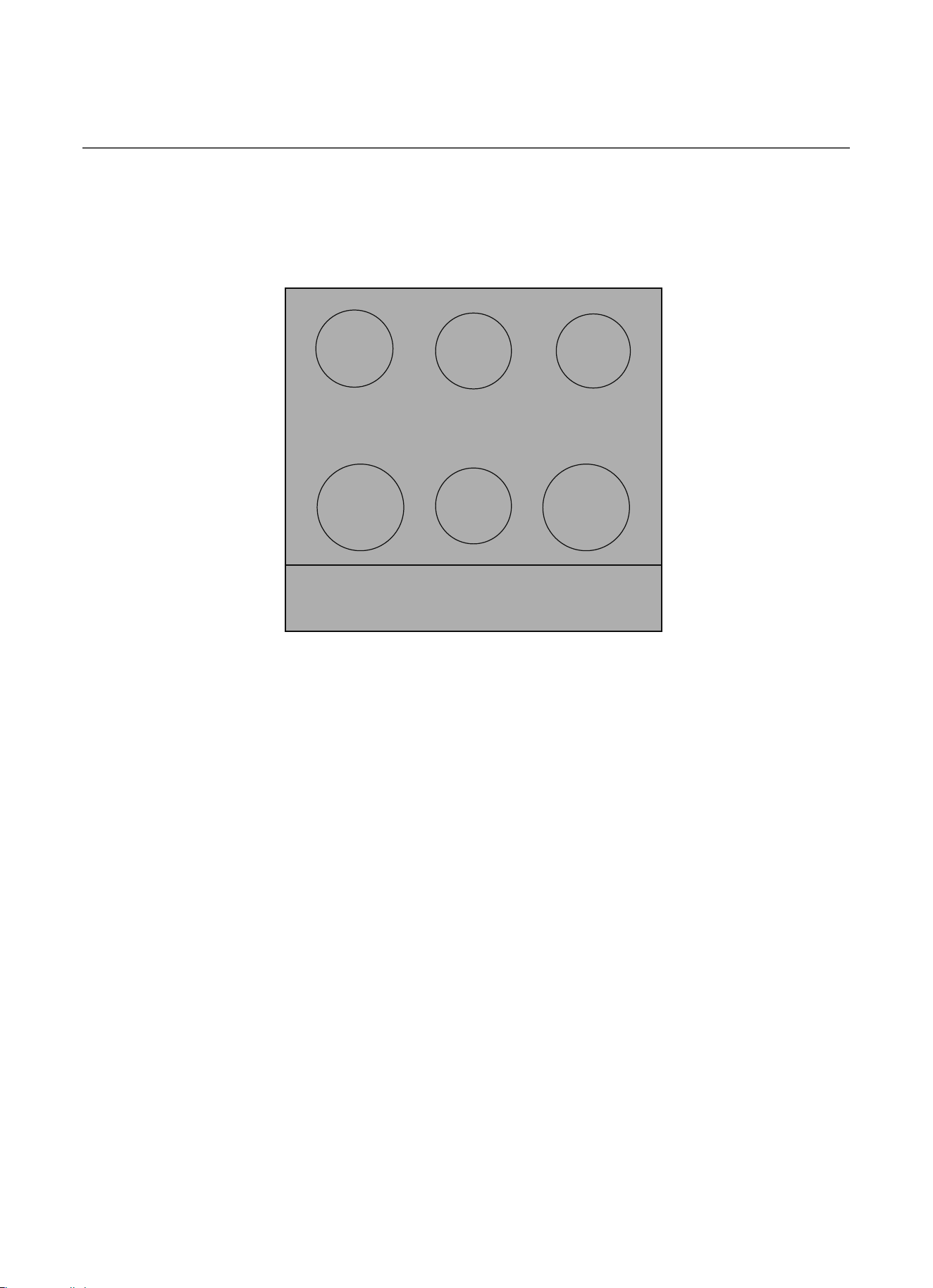
BTU Design
*5/
%78
%78
%78
%78
%78
%78
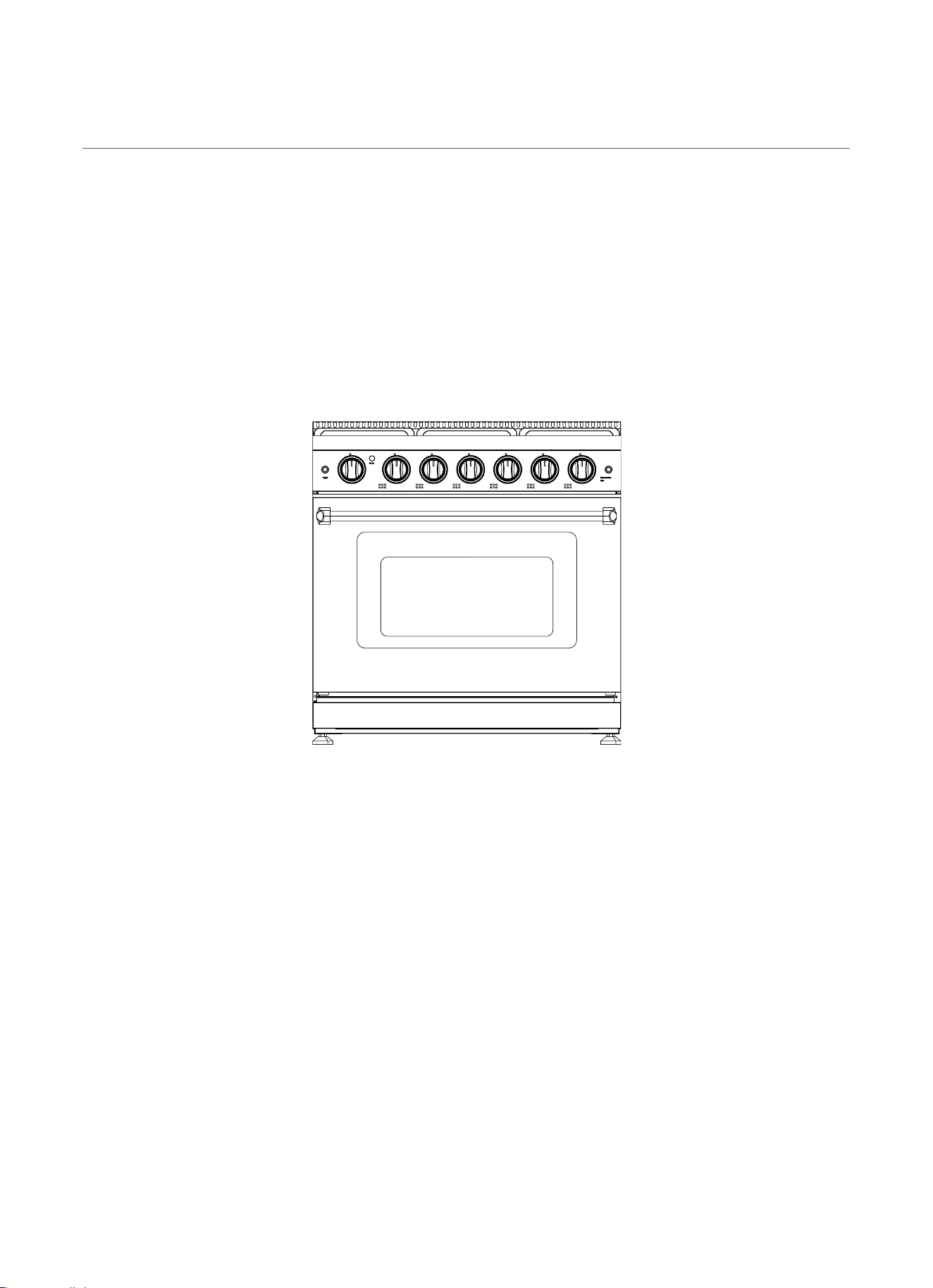
Dimension and Clearance
*5/
R
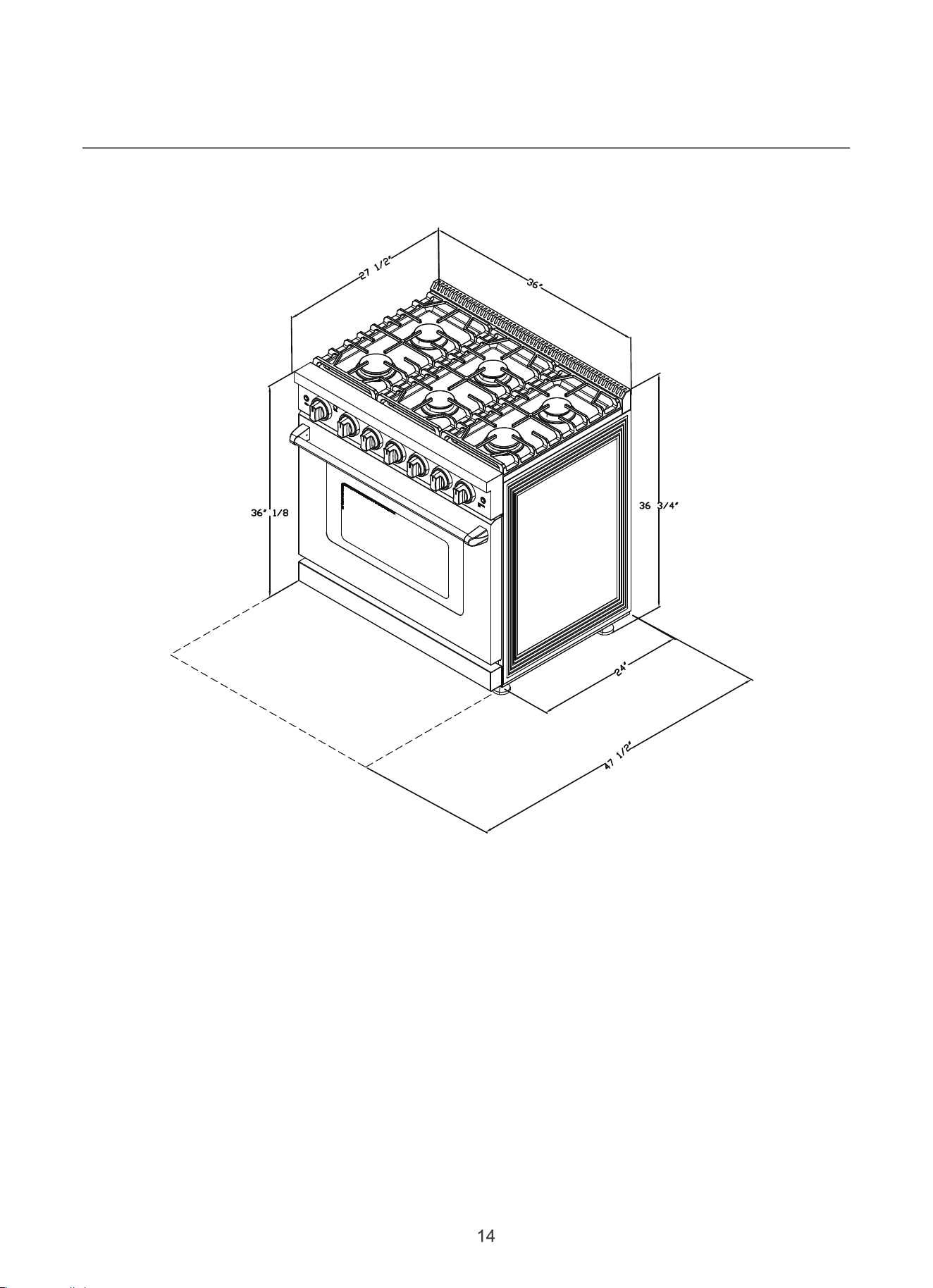
Dimension and Clearance
GR36L
The maximum depth of cabinets installed above cooking tops should be13 inches( 330 mm)
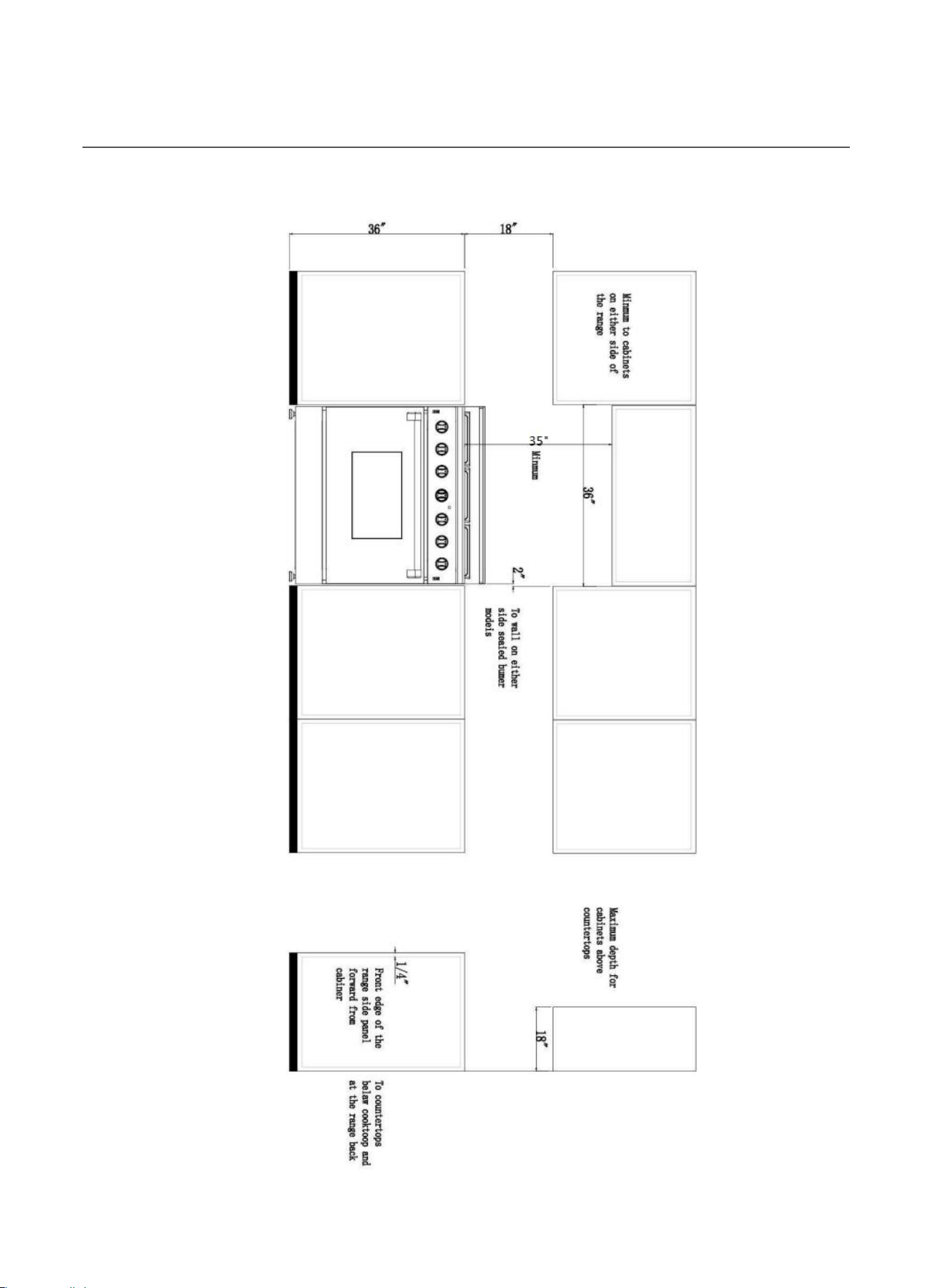
Dimension and Clearance
36” 'ĂƐZĂŶŐĞůĞĂƌĂŶĐĞ

Dimension and Cl earance
Top Śood and cabinet specifications
Condition Minimum
clearance allowed
Clearancebetweenthetopofthecookingsurfaceandthebottomofa
nunprotectedwoodormetalcabinet
35”
Clearance between the top of the cooking surface and the bottom of a
wood or metal cabinet or metal cabinet that is protected by not less
than:
1/4-inch-thick flame-retardant mill-
board covered with not less than:
R
No. 28 MSG sheet steel or
R
0.015-inch-thick stainless steel or
R
0.024-inch-thick aluminum or
R
0.020-inch-thick copper
24”
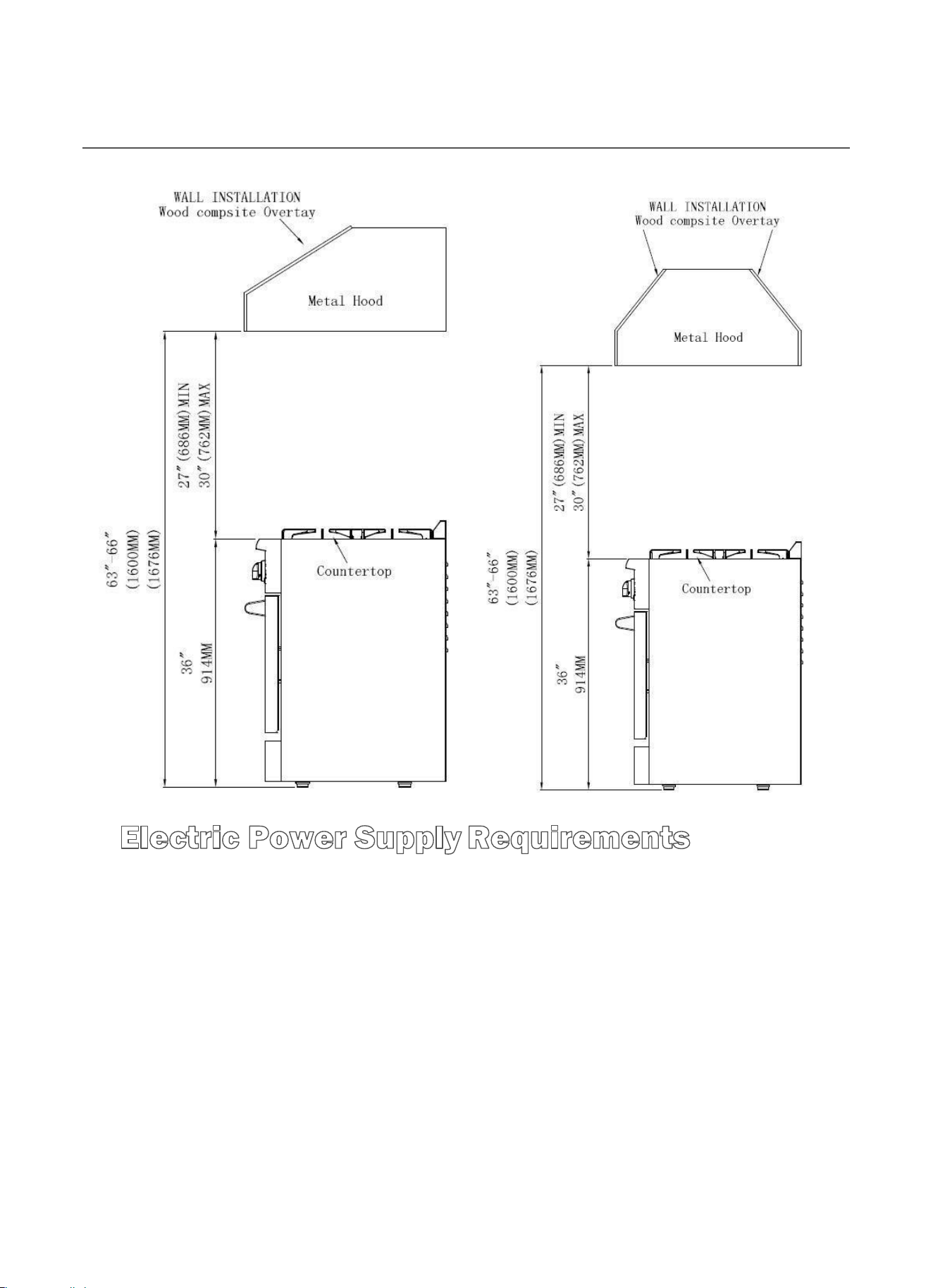
Dim ension and Cle arance
rking of
(OHFWULF3RZHU6XSSO\5HTXLUHPHQWV
Yourrangemustbeelectricallygroundedinaccordancewithlocalcodesor,intheabsenceoflocal
codes,inaccordancewiththeNationalElectricalCode(ANSI/NFPA70,latestedition).
InCanada,electricalgroundingmustbeinaccordancewiththecurrentCSAC22.1CanadianElectrical
CodePart1and/orlocalcodes.Acopyofthisstandardmaybeobtainedfrom:NationalFire
ProtectionAssociation,1BatteryMarchPark,Quincy,Massachusetts02269-9101.
Thepowersupplymustbethec orrectpolarity.Reversepolaritywillresultincontinuousspa
theelectrodes,evenafterflameignition.Ifthe reisanydoubtastowhetherthepowersupplyhas
thecorrectpolarityorgrounded,haveitcheckedbyaqualifiedelectrician.
Use 120V,60Hz,andproperlygroundedbranchcircuitprotectedbya15-ampor20-ampcircuit
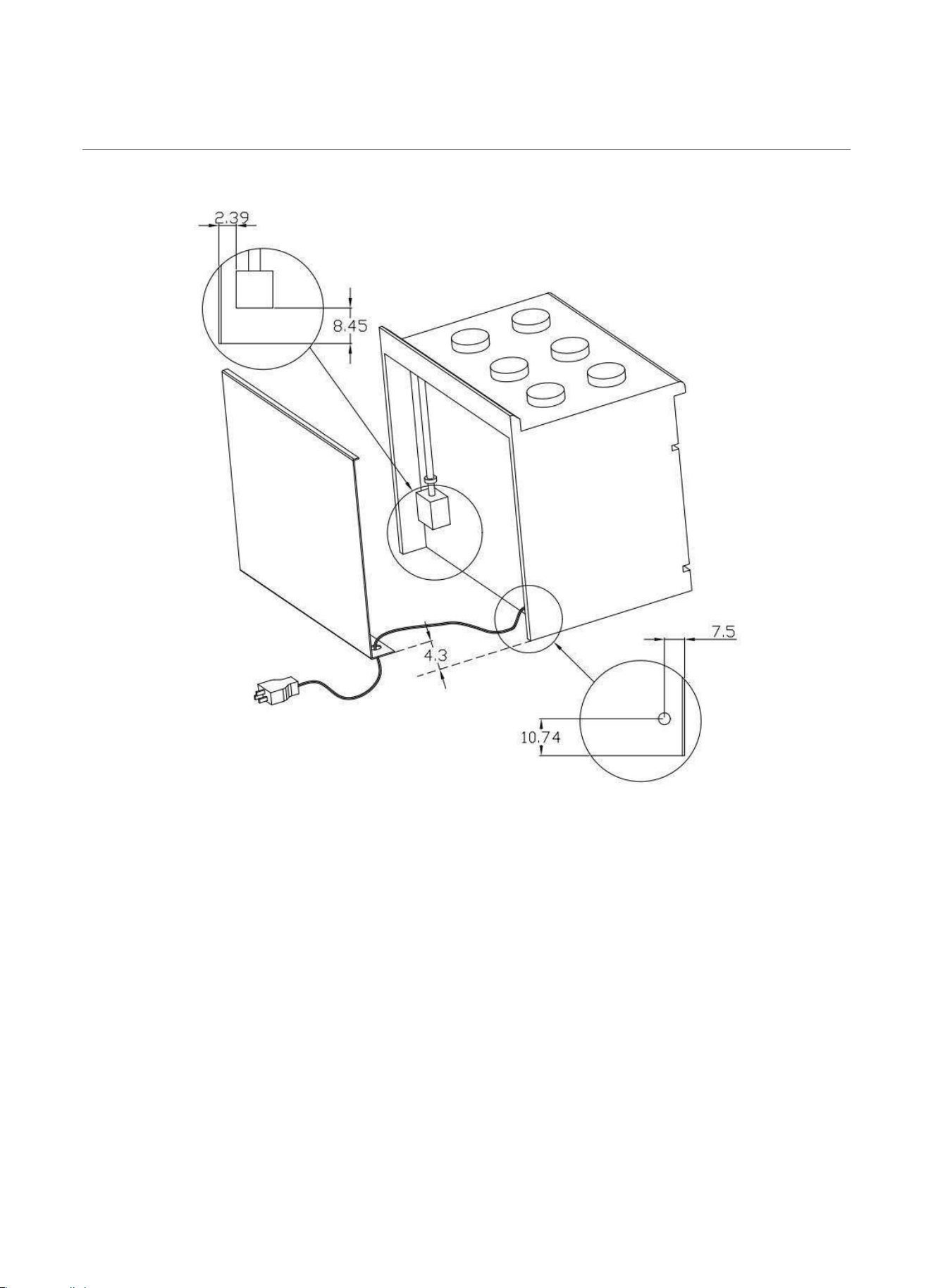
Dimension and Clearance
/ŶƐƚĂůůĂƚŝŽŶĨŽƌ'Zϯϲ>'ĂƐZĂŶŐĞ
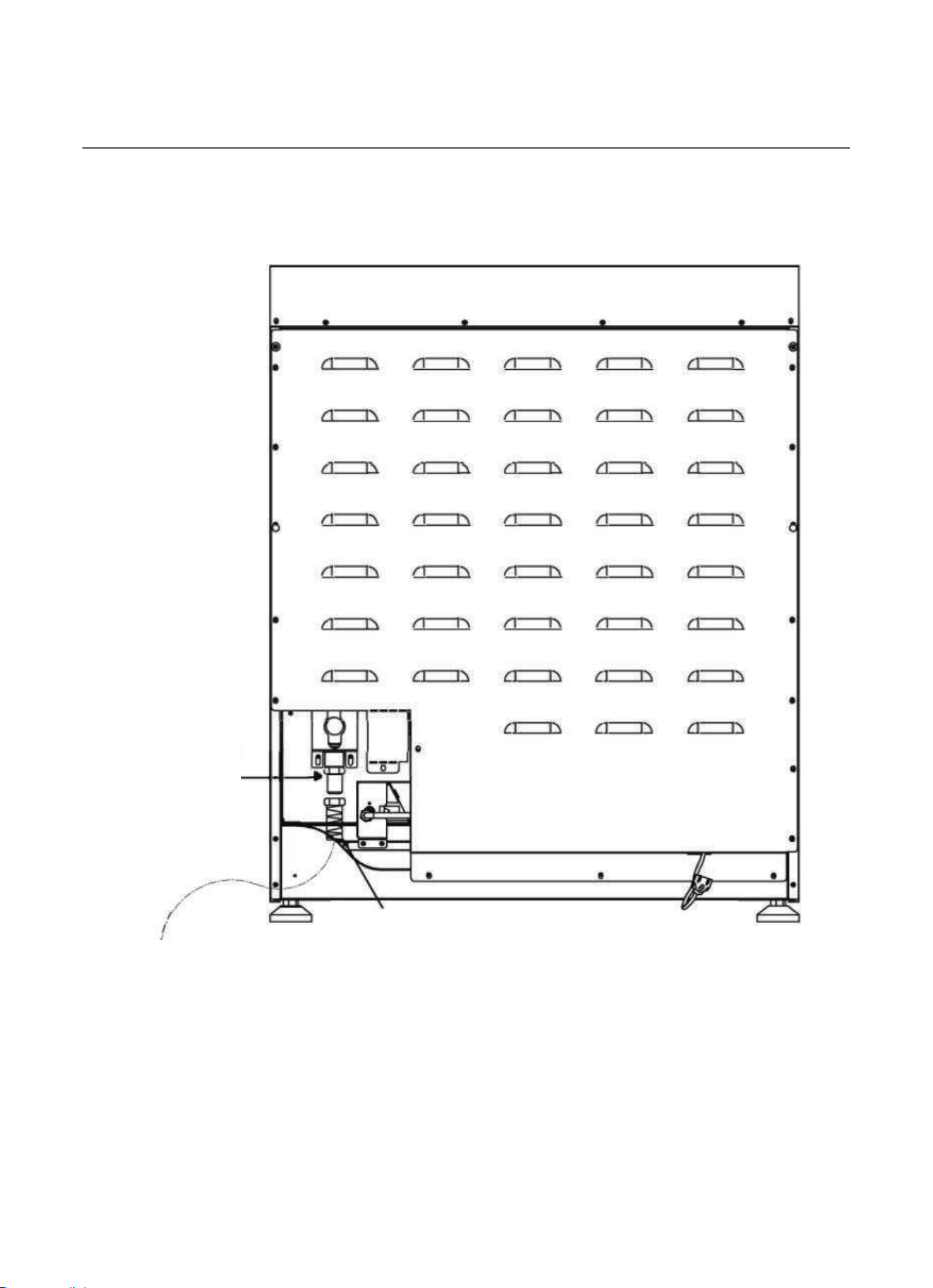
Dimension and Clearance
(BT-JOF$POOFDUJPO
Connect the gas
line to the bottom
of the regulator
Connect range to the gas supply
(OHFWULFDO *URXQGLQJ ,QVWUXFWLRQV
Thisindoorga s c ookingapplianc eiseq uippedwithathree-prong(grounding)plugforyour
protectionagainstshockhazardandshouldbepluggeddirectlyintoaproperlygroundedthree-
prongedreceptacle.
Whereastandardtwo-prongwallreceptacleisencountered,itistheresponsibilitytohaveit
replacedwithaproperlygroundedthree-prongwallreceptacle.
Donotcutorremovethegroundingprongfromthepowercord.
Beforeconnecting the plugtothecord,disconnecttheelectricalsupply.
Label all wires prior to disconnection when servicing controls. Wiring errors can cause improper and
dangerous operation. Verify proper operation after servicing.
&RQQHFW 5DQJH WR *DV 6XSSO\
Most localities will require that the stove shutoff valve and gas connections be installed by a
certified technician or ƉůƵŵďĞƌdŚĞƐĞinstructions are for a professional. Gas installation
specifications and regulations may ǀĂƌLJso please consult your local codes before proceeding
.
1.
Install a manual gas line shut-off valve in the gas line asfollows:
a. /
Ŷan easily accessed location outside the range
b. /Ŷ
the gas piping external to the appliance
2.
Install male
1
/
2
” flare union adapter to
1
/
2
” NPT internal thread elbow at the inlet of regulator.
On models equipped with standard twin burners, install the male pipe thread end of the
1
/
2
” flare
union adapter to the
1
/
2
” NPT internal thread at inlet of pressure regulator.
Use a wrench on the regulator fitting to avoid damage.

Connect range to the gas supply
Installmale
1
/
2
”flareunionadaptertotheNPTinternalthreadofthemanualshut-offvalve,
takingcaretosecuretheshut-offvalvetokeepitfromturning.
Thegassupplypressureforcheckingtheregulatorsettingis6in.w.c.(NatureGas)and11
inch.w.c.(LPgas)connectflexiblegaslineconnectortotheregulatorontherange.Position
the rangetopermitconnectionattheshut-offvalve.
3.
When all connections have been made, make sure all range controls are in the position
andturn on main gas supply valve.
4.
5.
Leak testing of the appliance shall be conducted according to the manufacturer’sinstructions.
Use some soap water (50% water and 50% soap) or a leak detector at all joints and
connections to check for leaks in the system. Do not use a flame to check for gasleaks.
The appliance must be isolated from the building’s gas supply piping system by closing its
individual manual shut-off valve during any pressure testing of the gas supply piping system at
test pressure equal to or less than
1
/
2
psig(3.5kPa).
After installation:
Checkignitionofcooktopburners.
Checkignitionofovenburner.
Visuallychecktubularburner(ovenburner)re-ignitiontobesurebothrowsofburnerportsare
relightingeachtime.
Checkforgasleaksatallgasconnections(usingagasdetector,neveraflame).
Checkovenbakeandconvectionbake function.
ŽŽŬƚŽƉ^ĂĨĞƚLJ'ƵŝĚĞůŝŶĞƐ
)LUVW 8VH
Conditioning the oven
Conditioning will burn off any manufacturing residues and ensure that you get the best results right
from the start.
Follow these steps to condition your new stove’s oven:
1.Insert all the shelves. See ‘Positioning the shelves’ for instructions.
2.Turn on the ventilation hood above your range on high.
3.Heat the empty oven at the highest temperature for:
a.
30 minutes using BAKE
b.
30 minutes using BROIL (some ovens only).
4.There will be a distinctive smell while you are conditioning the oven. This is normal, but make
sure the kitchen is well ventilated during theconditioning.
5.Once cooled, wipe out the oven with a damp cloth and mild de
tergent, and dry thoroughly.
6.Positioning the shelves
7.Both the side panels and shelves with safety stop to keep them sliding out of the oven
whenpulled forward;
8.And the front stop prevents the shelves from hitting the back of the oven.
There are dual burners have the same low turn-down setting (SIM) for gentle simmering (620
BTU/hr.). Use the SIM setting for melting chocolate and butter, cooking rice and delicate sauces,
&RRNWRS 6DIHW\ *XLGHOLQHV
simmering soups and stews, and keeping cooked food hot.
俵 Never leave the cooktop unattended when in use. Boil over causes smoking and greasy spills
that may ignite.
俵 Never allow flames to extend beyond cookware or curl up on sides. This could discolor and
damage the utensil and you may get burned touching the hothandle.
ŽŽŬƚŽƉ^ĂĨĞƚLJ'ƵŝĚĞůŝŶĞƐ
俵
俵 Keep handles out of the way. Turn handles so that they don’t extend over the edge of the range
or on a burner that is on.
俵 Take care when deep-frying. Oil or fat can overheat very quickly, particularly on a high setting.
俵 Make sure that all burner parts are properly in place. Incorrectly or incompletely assembled
burners may produce dangerous flames. See ‘Replacing the burner parts’ in ‘Care and cleaning’.
Keep the burners clean, especially after a spill or boil over, make sure you clean the a ffected
burners before using them again. Food residue may clog the igniter and the notches of the
flame spreader, stopping t he burner from functioning correctly. See ‘Care and cleaning’ for
instructions.
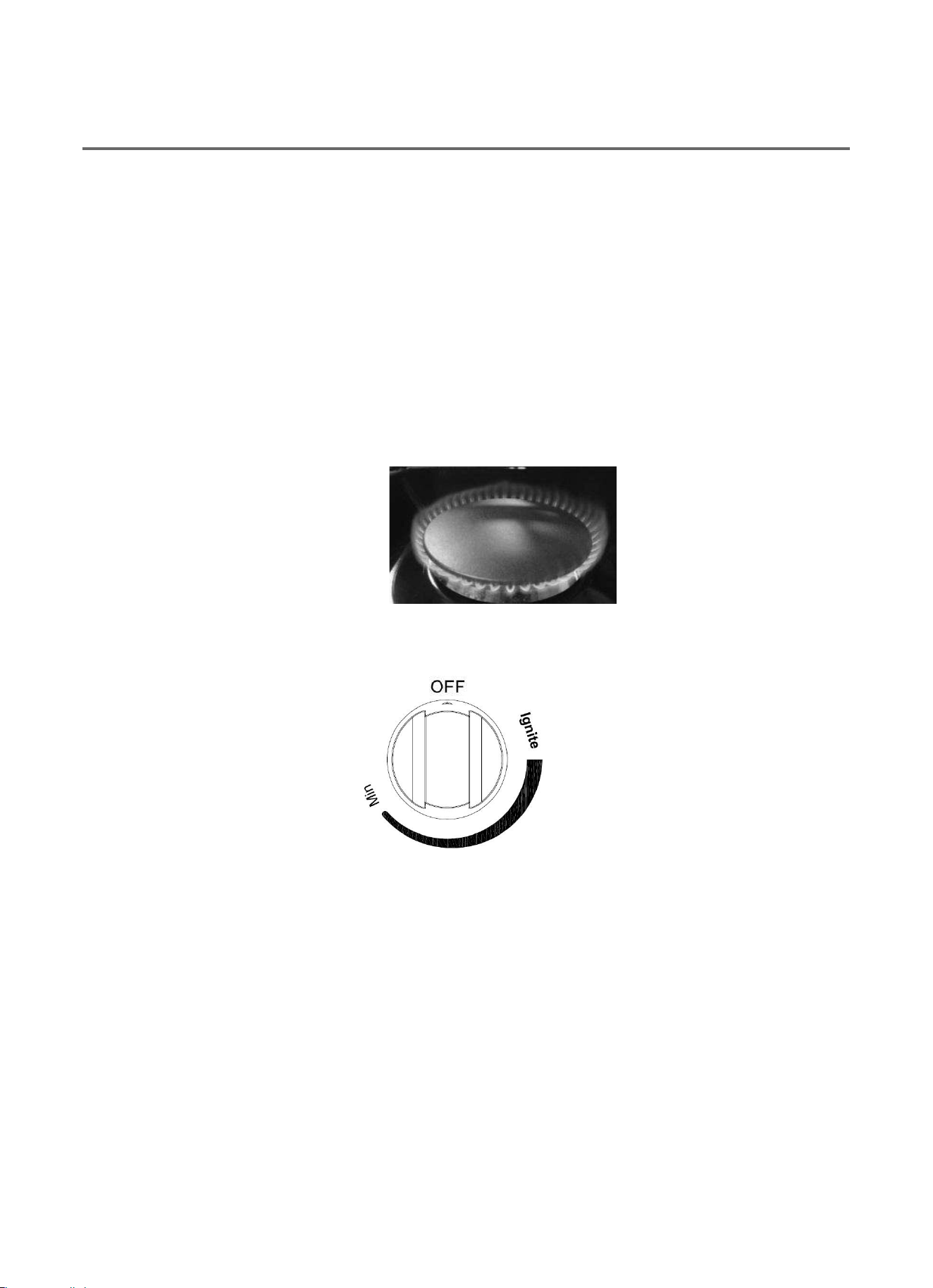
俵 Check
that the burner flames are normal. They should be blue with no yellow tipping, and burn
without fluttering all around the burner cap. If not, see ‘Troubleshooting’ for advice.
Surface Burner Ignition
Tolightthetopburners,pushandturntheappropriatecontrolknobcounterclockwisetothe“Ignite”
position.Youwillhearaclickingnoise–thesoundoftheelectricsparkignitingtheburner.Once
burnerignitionhasbeenachieved,thenturntheburnercontrolknobtoadjustthedesiredheat
setting.

Simmer and
ŽŽŬƚŽƉ^ĂĨĞƚLJ'ƵŝĚĞůŝŶĞƐ
NOTE: When one burner is turned to the “Ignite” position, the burner igniters will park. Do not
attempt to disassemble or clean around any burner while another burner is on. Do not touch any
burner cap, burner base, or igniter while the igniters are sparking.
Boil
Flame
A smaller flame will give the best simmer results. Small flames offer precise cooking performance
for delicate foods, keeping food warm, melting chocolate or butter, and for cooking that needs to
cook over low heat for a long time.
The highest flame setting provides the maximum heat that is available on your range. This setting
should be used for heavy cooking loads such as water boiling or pasta cooking.
Size
Power
When you select the flame size, watch the flame when you turn the knob.
Any flame larger than the bottom of the cookware is wasted.The flame should be steady and blue in
color. Foreign material in the gas line may cause an orange flame during initial operation.
Failure
Burner
If the gas does not ignite within four seconds, turn off the valve and allow at least five minutes for
any gas to dissipate. Repeat the lighting procedure.
If the power fails, it is not capable of being safely placed in operation and users should make no
attempt to operate the range during power failure.
Cooktop
To prevent the cooktop from discoloring or staining, clean ƚŚĞcooktop after each use, and wipe up
acidic or sugary spills as soon as the cooktop has cooled.
The sealed burners of your range are not sealed to your cooktop and are designed to be removed.
Boil overs or spills will not seep underneath the cooktop. The burners should be cleaned after each
use.
Grates
The grates must be properly positioned before cooking. Improper installation of the grates may
result in scratching of the cooktop and / or poor combustion.
ŽŽŬƚŽƉ^ĂĨĞƚLJ'ƵŝĚĞůŝŶĞƐ
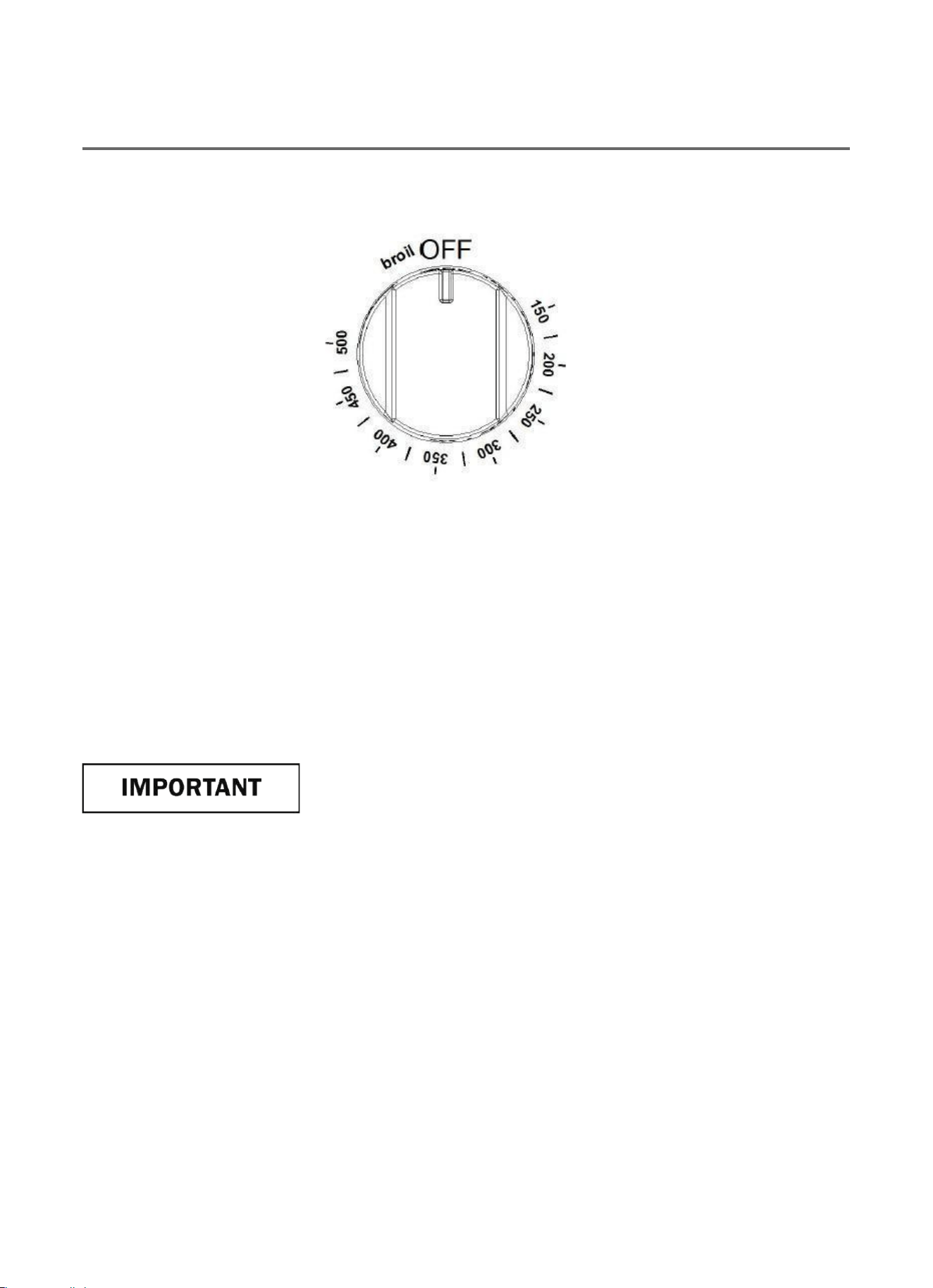
Oven burner use
To light the oven burner, push and turn the appropriate control knob counterclockwise to the (150
a
position. You will hear a clicking noise – the sound of the electric spark igniting the
burner. Once burner ignition has been achieved, then turn the burner control knob to adjust the
desired heat setting.
Broil burner use
To light the broiler burner, push and turn the appropriate control knob clockwise to the broil
position. You will hear a clicking noise – the sou nd of the electric spark igniting the burner. Keep
pressing about 4 seconds until the burner ignition has been achieved.
Oven cooking guidelines
俵 Do not block the ducts on the rear of the range when cooking in the oven. It is important that
the flow of warm air from the oven and fresh air into the oven burner never be interrupted. Avoid
touching the vent opening or nearby surfaces during oven or broiler operation because t hey are
hot.
俵 U
se all the oven modes with the oven door closed.
俵 Never use aluminum foil to cover the oven shelves or to line the floor of the oven. The
trappedheat can irreversibly damage the enamel and may even cause fire.
ŽŽŬƚŽƉ^ĂĨĞƚLJ'ƵŝĚĞůŝŶĞƐ
俵 Do not place water, ice, or any dish or tray directly on the oven floor, as this will irreversibly
damage the enamel.
俵 Do not cover the slotted grid of the broil/roast pan with aluminum foil. This will catch the grease
and could cause fire.
俵 Do not use plastic wrap or wax paper in the oven.
俵 For food safety reasons, do not leave food in the oven for longer than two hours before and
after cooking or defrosting. This is to avoid contamination by organisms which may cause
food
poisoning. Take care during warmer weather.
According to the United States Department of Agriculture: DO NOT hold foods at temperatures
between 40ºF to 140ºF more than 2 hours. Cooking raw foods below 275ºF is not recomm
ended.
Never cover any slots, holes or passages in the oven bottom or cover an entire rack with materials
such as aluminum foil. Doing so blocks airflow through the oven and may cause carbon m
onoxide
poisoning.
Aluminum foil lining may also trap heat, causing a fire hazard.

Oven Function
2YHQ )XQFWLRQ
Natural A irflow Bake
Occurs when heat is transferred into the oven from the bake burners in the bottom of the oven
cavity. Heat is then circulated by natural airflow. This is a traditional bake setting.
Infrared Broil
The broil burner is located at the top of the oven. This burner heats the metal sc reen until it glows.
The glowing screen produces the infrared heat, searing the outside of broiled foods and sealing in
juices.
Convection Bake
The oven convection fan circulates and distributes the heat in the oven for faster and even cooking.
Convection cooking allows you to bake more items on multiple racks.
To bake using the convec tion fan:
1.Position the oven bottom cover and the oven shelves before using the oven.
2.Remove any unused shelves and baking utensils from the oven.
3.Preheat the oven to the temperature stated in the recipe. Depending on the temperature andthe
size of the oven, preheating will take around 15-20minutes.
4.Arrange pans and food items evenly on the shelves. Make sure pans do not touch each other or
the sides of the oven. When baking a single item, always center the item on the oven shelf. If
baking on multiple shelves, make sure you stagger items on the shelves so that one is never
directly above another.
5.When baking using convection, either reduce the temperature stated in the recipe and leave the
baking time unchanged, or reduce the baking time by several minutes and leave the temperature
unchanged. For foods with a baking time of over an hour, reducing both the temperature and time
slightly may give the best results.
6.Dark metal baking pans or those with a dull finish absorb heat faster than shiny pans, and are
excellent for pies and breads, or anything that needs browning or a crisper ctust.
7.A shiny finish may work best for foods that require lighter, delicate browning (e.g. cakes and
cookies), as it reflects some heat and gives a less intense baking surface.
8.Avoid opening the oven door frequently during baking.

Oven Function
ConvectionRoast
Forbestresultsusethebroilerpan.Thepanisusedtocatchgreasespillsandhasacoverto
preventgreasesplatter.
Theconvectionfancirculatesheatedairover/around the food beingroasted,sealingjuices
quicklyforamoistandtenderproductwhile,atthesametime,creat ingarichgolden-brownexterior.
Usethebroil/roastpanandslott edgridsuppliedwiththerangewhenroastinginordertoelevate
themeatonametalroastingrack.Thisallowshotairtocirculatearoundthemeat,browningit
moreevenlylikearotisserie.
Whenroastinglargeritemslikeawholeturkey,useonlythepanandgridforgreat erstability.
ConvectionDefrost
Withtemperatu recon troloff,amotorizedfanintherearoftheovencirculatesair.Thefan
acceleratesnaturaldefrostingofthefoodwithoutheat.Toavoidillnessandfoodwaste,donot
allowdefrostfoodtoremainintheovenformorethantwohourswithoutbeingcooked.
Defrosting
Tothawuncookedfrozenfood,settheoventemperatureto100-150°F.Oncethawed,cookthe
foodimmediatelyanddonotrefreeze.
Topreventliquidfromthawingfooddrippingontheovenfloor,besureanyuncookedfoodistightly
wrappedinfoiland/orplacedinacontainer.
ConvectionDehydr ation
Withthetemperaturecontrolon175°F
ˈ
warmairisradiatedfromthebakeburnersonthe
bottomoftheovencavityandiscirculatedbyamotorizedfanintherearoftheoven.
Overaperiodoftime,thewaterisremovedfromthefoodbyevaporation.Removalofwater
increasesgrowthofmicroorganismsandslows down the activity of enzymes.

Broiler Operation
%URLOHU 2SHUDWLRQ
Note: Door must be closed during broiler operation.
Broiling is a method of cooking tender cuts of meat directly under the infrared broiler in the oven.
Broiling in the oven is accomplished with the oven door closed. It is normal and necessary for some
smoke to be present to give the food a broiled flavor.
If you open the oven door to check the food, have it open for as short a time as possible. This is to
prevent the control panel from overheating and prevent melted knobs.
Use both the broil/roast pan and slotted grid supplied. The grid helps to reduce smoking and
splatter by letting grease drip into the bottom of the pan, away from intense heat. To prevent food
sticking, spray the grid with a light coating of non-stick cooking spray.
Preheating
Preheating is suggested when searing rare steaks (Remove the broiler p an before preheating with
the infrared broiler. Foods will stick to hard metal). To preheat, turn the “Oven” selector knob to the
“Broil” position. Wait for the burner to become hot, approximately 2 minutes. Preheating is not
necessary when broiling meat well-done.
To Broil
Broil one side until the food is browned; turn and cook on the second side. Season and serve.
Always pull the rack out to the “stop” position before turning or removing food.
Setting Broil
The “Oven” selector knob controls the Broil feature. When broiling, heat radiates dow nward from
The broil pan a nd insert used together allow dripping grease to drain and be kept away from the
high heat of the oven broiler. DO NOT use the broil pan without the insert.
The oven broiler for even coverage. The Broil feature temperature is 500
(260Ԩ
DO NOT cover the b roil pan insert with foil. The exposed grease could c a tch fire.

Broiler Operation
To set the oven to Broil:
1.
Place the broiler pan insert on the broiler pan. Then place the food on the broiler pan insert.
2.
Arrange the interior oven rack and place the broiler pan on the rack. Be sure to center thebroiler
pan and position it directly under the broil burner. If preheating the broil burner first, position the
broiler pan after the broil burner is preheated.
3.
Turn the selector knob to Broil.
The oven indicator light will remain on until the selector knob is turned to the off position or the
temperature control cycles off.
Broiling Guidelines
Choose a suitable shelf position. To e
nsure that meat is cooked through rather than just browned
on the outside, broil thick pieces of meat and poultry on shelf positions 2 or 3. Use shelf position 4
for thinner items that need less cooking time like steaks, chops, or hamburger patties.
When finishing off meals by browning the top under the broiler, use metal or glass-ceramic
bakeware. Do not use heatproof glass or earthen ware, as these cannot withstand the intense heat
of the broiler.
Center the item in the oven, so that it is directly under the broiler.
俵
The surface of the griddle is hot after use. Please allow sufficient time for the griddle to cool
俵
俵
prior to cleaning.
When using the appliance for the first time. The oven and broiler burners should be turned on
to burn off the manufacturing oils. Turn the oven on to 450 (230)for 20 to 30minutes.
Then turn the oven control knob to “Broil” for the same length of time. It is recommended to
t
urn on the ventilator above the range at this time.
Must disconnect the electrical supply before servicing or cleaning the appliance. Failure to
follow this advice may result in injury or death.

Cleaning Instructions
&OHDQLQJ ,QVWUXFWLRQV
Do’s
俵 Read these cleaning instructions and the ‘Safety and warnings’ section before you start
cleaning your range.
俵 Before cleaning or removing any part, make sure that everything on
the range has been turned
off.
俵 Unless suggested otherwise in the following chart, allow any part to cool to a safe temperature
before cleaning. If you do need to handle a warm or hot part (e.g. grill or griddle), take extreme
care. Wear long protective mitts to avoid burns from steam or hot surf aces.
俵 Try using any cleaner on a small a
rea first, to ensure it does not stain.
俵 See the pages following this chart for instructions on removing and replacing various partsof
the range for cleaning or maintenance.
俵 To help you identify any parts, see illustrations in section ‘Introduction’ and after this
cleaningchart.
Don’ts
俵 Do not use aerosol cleaners until the range has completely cooled . The propellant substance in
these cleaners could catch fire in the presence of heat.
俵 Do not let soiling or grease accumulate anywhere in or on the range. This will make
futurecleaning more difficult and may present a fire hazard.
俵 Do not use any abrasive or harsh cleaners, cloths, scouring pads or steel wool. These
willscratch your range and damage its appearance.
俵 Do not use a steam cleaner to clean any part of therange.
俵 Do not lift the black grill and griddle frames off the cooktop.
Cleaningďurnercapsandbrassflamespreaders
1.
Check that the burner is turned OFF and allow it to cool. Lift off the burner cap and brass flame
spreader. Wash them in hot soapy water, rinse, and dry.
2.
Use a stiff nylon brush or straight-ended paper clip to clear the notches of a flame spreader.
Replace the flame spreader and burner cap correctly.

Cleaning Instructions
3.
Before cleaning the cooktop, ensure that all burners are turned off and that all components are
cool enough to safely ƚŽƵĐŚ
4.
To avoid electrical shock or burns, turn off controls and ensure the cooktop is cool before
cleaning.
5.
Do not use harsh or abrasive cleaning detergents, waxes, polishes, or commercial cooktop
cleaners to clean the cooktop.
6.
Use only a sponge, soft cloth, fibrous or plastic brush, and nylon pad for cleaning.
7.
Always dry components completely before using thecooktop.
8.
Control Panel, Door Handle, ŽŶƚƌŽů,ŽƵƐŝŶŐ
Clean the control panel, door handle and control housing with a solution of mild detergent and
warm water.
9.
Do not use abrasive cleaners or scrubbers; they may permanently damag e the finish.
10.
Dry the components with a soft, lint-free cloth.
Cleaning side racks
1.
Pre-soak any stubborn, burnt-on soiling, then clean with a solution of mild detergent and hot
water and wipe dry with a microfiber cloth.
2.
Alternatively, clean these in the dishwasher.
Cleaning oven shelves
1.
To remove stubborn or ‘b a ked-on’ soiling, scrub with a dampened, soap-filled,non-metal,
non-abrasive pad, then wipe dry.
2.
Apply a chrome cleaner with a damp sponge or cloth following manufacturer’sinstructions.
3
.
Wipe and dry.
Cleaning broil/roast pan and slotted grid
俵 Pre-soak any stubborn soiling in a solution of mild detergent and hot water.
俵 Wash by hand or in a dishwasher.

Cleaning Instructions
Cleaning bake and broil burners
俵 Do not clean these parts. They self-clean during normal use.
Cleaning porcelain surfaces
Clean oven interior and inner door liners with a solution of mild detergents and hot water. Rinse and
dry with a soft, lint-free cloth. Do not use abrasives or commercial oven cleaners.
Cleaning the oven glass window
俵 Clean all glass surfaces with a solution of mild detergent and hot water. Use a mild glass
cleaner to remove fingerprints or smears.
俵 Dry completely with a soft, lint-free cloth.
Cleaning the oven door gasket
Avoid cleaning this part. If you need to remove large food particles off it, proceed as follows:
1.
Dampen a sponge with clean hot water.
2.
Gently wipe off t he soiling, but do not rub.
3. Press a dry towel gently on the gasket to dry.
俵
Do not use any cleaning detergents on the gasket.
The gasket is essential for a good seal.
CAUTION: Do not scratch, displace, or damage it.
Cleaning stainless steel surfaces
俵
Donotuseanycleaningproductwithchlorine bleach.
俵
DonotuseasteelwoolpadBT itwillscratchthesurface.
俵
Useahot,dampclothwithamilddetergent.
Use a clean, hot, damp cloth to remove soap. Dry with a dry, clean cloth.
Removing the Oven Door
5HPRYLQJ DQG UHSODFLQJ WKH RYHQ GRRU
Do not lift the oven door by its handle. Doing so may damage the door.
Make sure the oven and the door are c ool before you begin to remove the door.
Before removing the door, make sure there is a large enough clear, protected surface in the kitchen
to rest the door on.
The oven door is heavy!
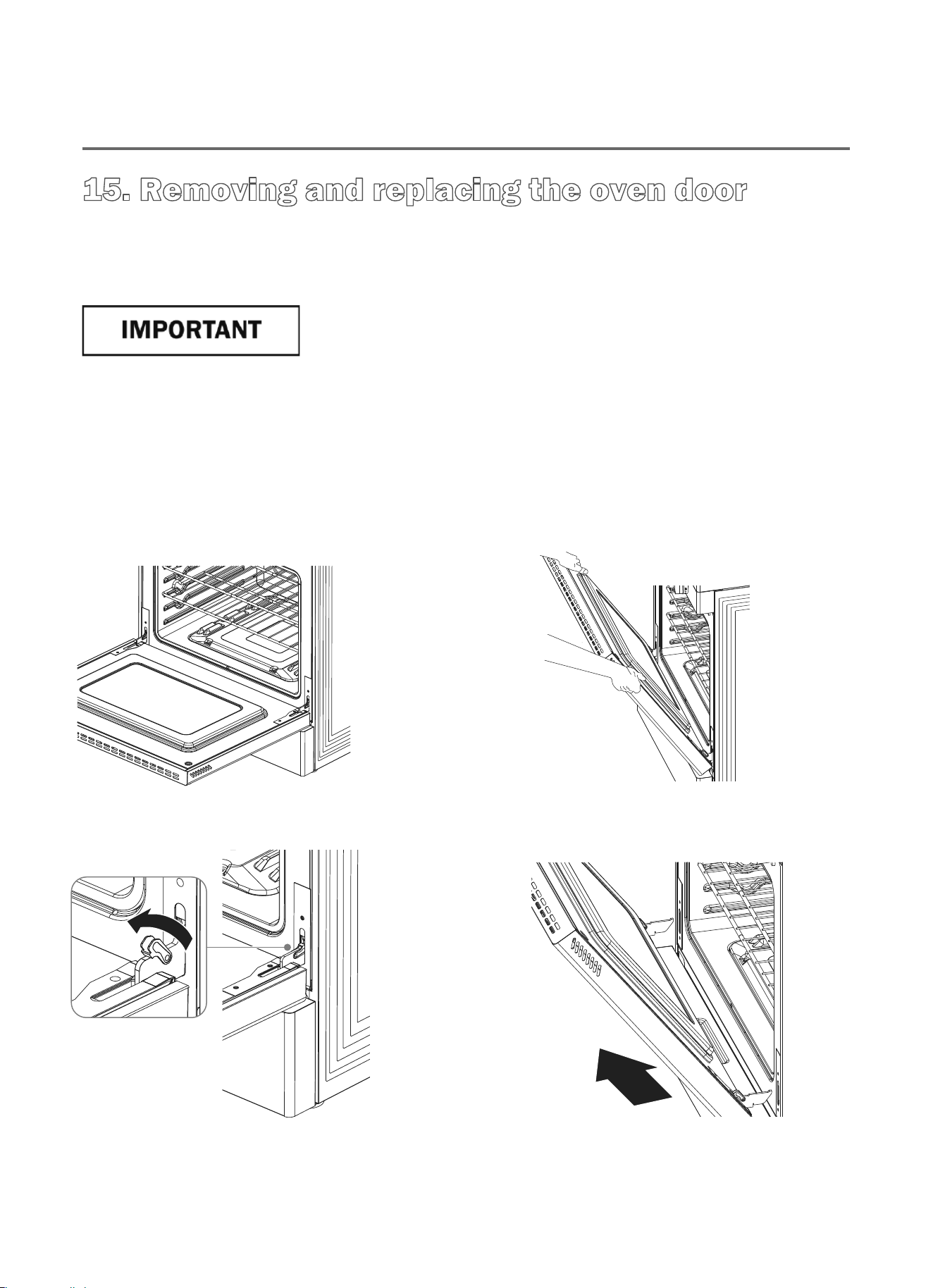
Removing the oven door
2.
1.
Open the door very carefully.
Open the levers fully on both sides.
3.
Hold the door firmly on both sides.
4. Disengage the hinges, gently close it
about halfway, then remove it and place it
on a protected surface
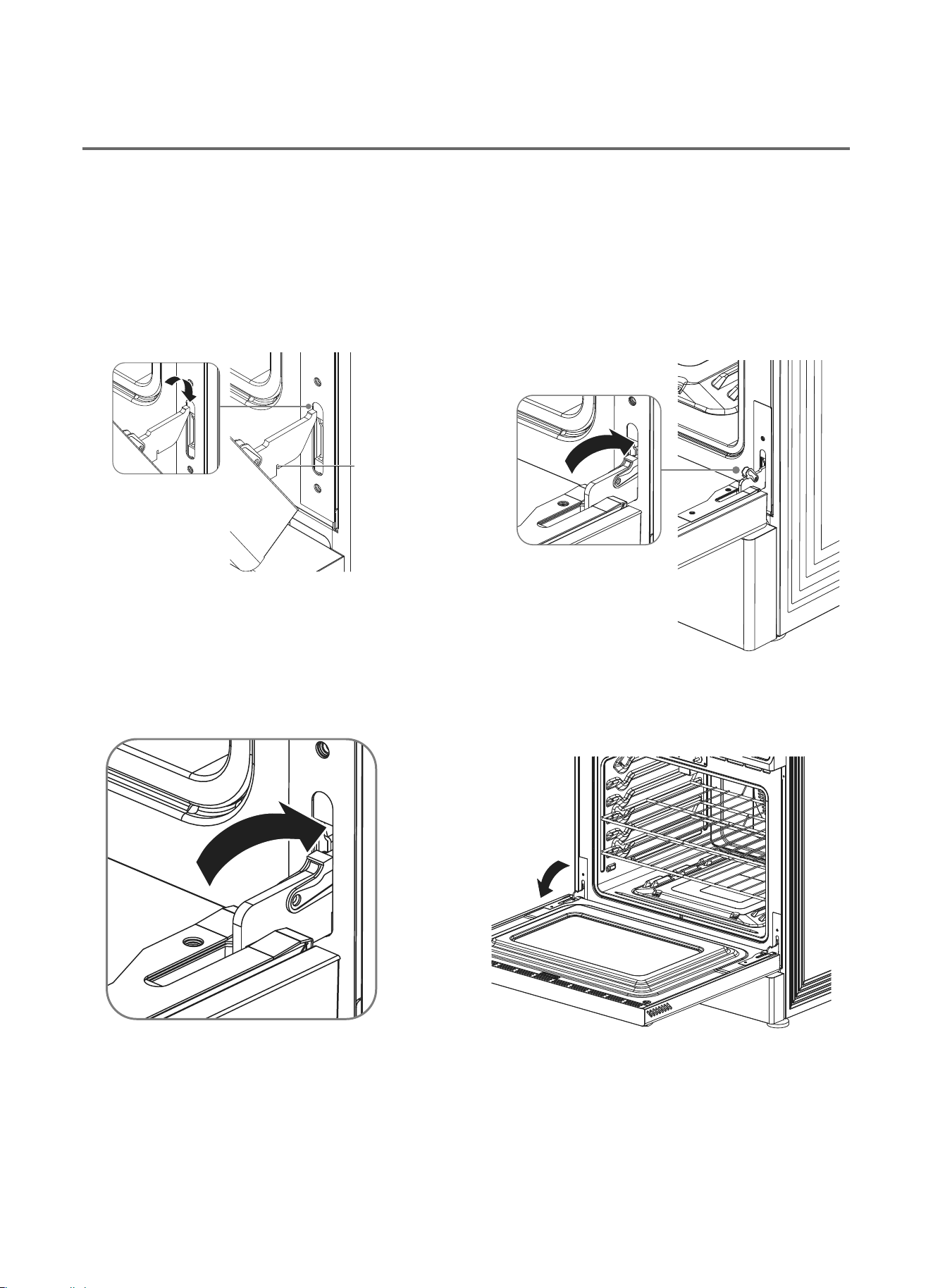
Removing the Oven Door
Replacing t he oven door
1.
Hold the door firmly in an approximately
open position.
3.
2.
Insert the hinge tongues into the slots,
making sure that the notches on both sides
drop into place as shown.
Open the door fully as shown.
Notch
4.
Fully close the levers on the left and right
hinges, as shown, then close the door.

Trouble Shooting Guide
7URXEOH SKRRWLQJ *XLGH
If you can’t find an answer to your problem in the chart below, or if the problem cannot be fixed, you
will need technical help. Contact the after-salesƐĞƌǀŝĐĞĐĞŶƚĞƌ
Problem Probable causes What to do
Cooktop
Some burners will not Burner parts or igniters may be Check that the burner parts are
light. clean, dry, and c orrectly assembled.
wet, dirty, or misaligned.
Check that the igniters a re clean
Flames do not burn all
and dry. See ‘Care and cleaning’ for
around the burner
instructions.
cap.
Burner flames very
large and yellow.
Burner bezel ports are clogged.
Burner ports or burner caps are
not positioned properly. Cooktop
is being operated with the wrong
typeofgas.Regulator is not
installed, is faulty, or is set for the
wrong type of gas.
Clean burner bezel ring ports with
straightened paper clip, needle, or
wire. Remove and carefully re-
install burner bezel and caps.
Ensure that the type of cooktop
matches the natural gas supply.
Check installation, replace
regulator, or set regulator for proper
gas.
Sparking but no flame
ignition.
Gas shut-off valve is in the ‘OFF’
position.
Turn shut-off valve to the ‘ON’
position.
Igniters spark
continuously after
flame ignition.
Power supply polarity is reversed.
Igniters are wet or dirty.
Have polarity corrected. Dry or
clean igniters.
Burner flame goes out
at low setting.
Low gas supply pressure. Air
intake holes around knobs are
obstructed.
Contact gas company. Remove
obstruction.

Trouble Shooting Guide
The flames have
suddenly gone out.
A draft or a spill has extinguished
the flame.
There is a power
failure – can I still use
No action required. The burner will
detect this and automatically
relight. However,
if there has been a large spill, we
recommend turning the burners off
and cleaning the burners and sump
area. See‘Care and cleaning’
for instructions.
the cooktop burners?
Power outage in your area. The cooktop burners can still be
used. To light them:
1.
Holding a lighted match to the
flame spreader, push in on the
control knob and turn
counterclockwise to LITE.
2.
When the flame is burning all the
way around the burner, you may
adjust the heat.
Important!
If the flame is blown out during a
power failure, turn the knob
immediately to OFF, as the burner
will not automatically relight and
gas may escape.

Trouble Shooting Guide
Problem Possible causes What to do
Oven
The oven doesn’t work
(no heating).
No power supply (oven light and
halos do not come on either).
No gas supply (gas ovens).
Check that the circuit breaker hasn’t
tripped and there is no power outage
in your area. If t here is a power
outage, you cannot use the oven
until power has been restored.
The supply to the house may not be
working or there may be an outage.
Contact your local gas supplier.
One of the oven lights
does not come on, b ut
the oven works.
The light bulb is loose.
The light bulb has blown.
See instructions for ‘Replacing the
oven light bulb’ in section ‘Care and
cleaning’. Instead of replacing the
bulb, simply ensure that it is secure
in its socket.
Replace the bulb. See instructions
for ‘Replacing the oven light bulb’ in
section ‘Care and cleaning.’
Condensation around
oven (e.g. on control
panel or top of oven
door.)
Food has high moisture content
or local climate (temperature,
humidity) is contributing to
condensation.
Condensation is normal. You can
wipe the drops off the control panel.
If there is frequent or excessive
condensation, make sure that
cabinetry around the range is
moisture-proofed.
Steam coming from
oven vents at the back
of the range.
Moisture from food evaporating
during cooking.
This is normal, especially if you are
cooking large quantities of food in
the oven using a CONVECTION
mode.
The convection fan
is not working.
Contact ĂŌĞƌͲƐĂůĞƐƐĞƌǀŝĐĞ
Technicalfault
ĐĞŶƚĞƌ
Trouble Shooting Guide
CONVECTION mode
Oven will not heat
Oven settings are not correct
Follow mode selection and clock
settings as specified in the Oven
Operation section of the manual.
Foods over-cooked or
under-cooked
Adjust time, temperature, or rackIncorrect cooking time or
temperature position.
‘Cracking’ or ‘Popping’
sound.
This is the sound of metal
heating and cooling.
This is normal.
There is a power
failure – can I still use
the oven?
Power outage in your home or
neighborhood.
The oven cannot be used until power
is restored.
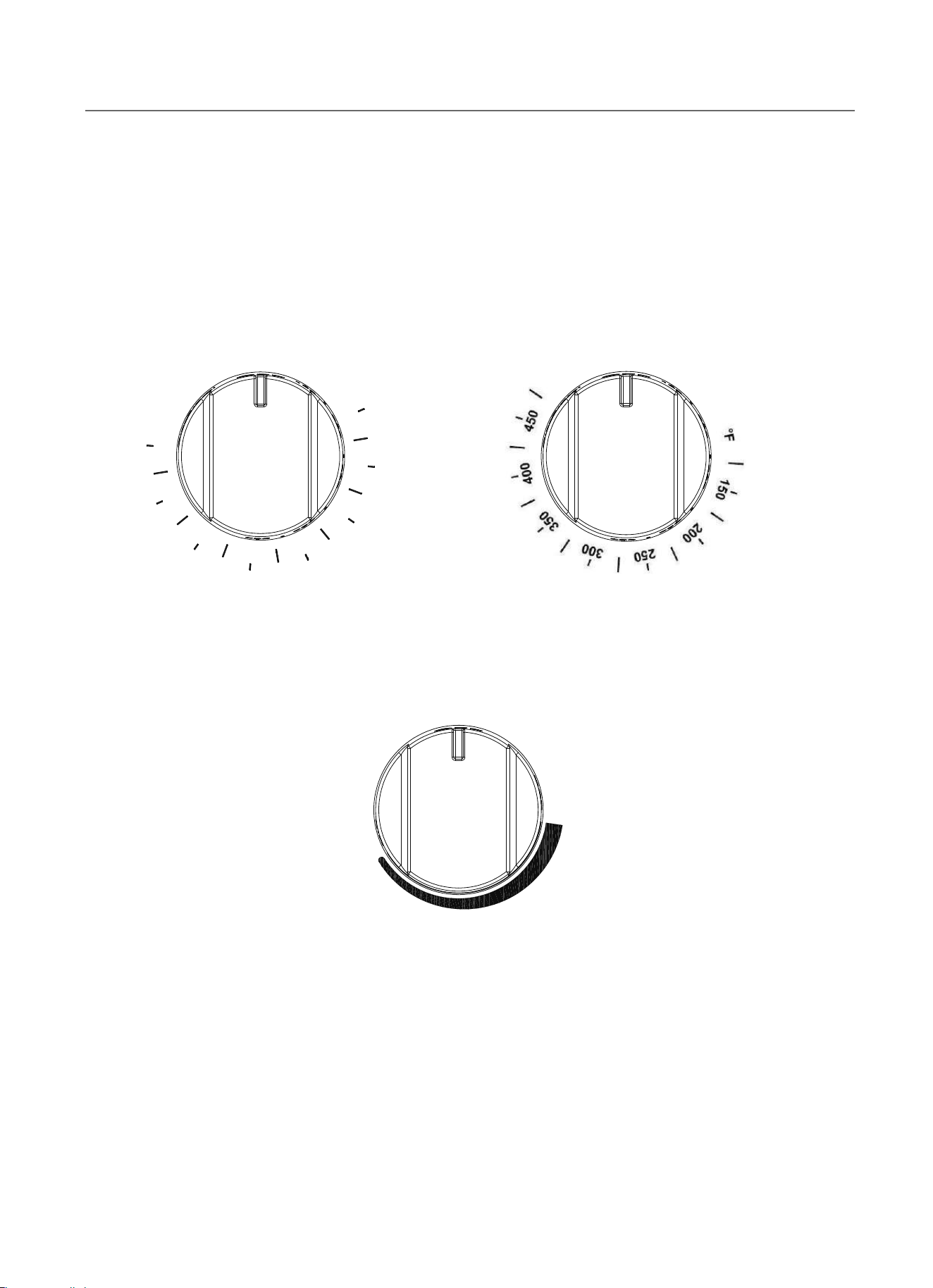
Appendix 1
KǀĞŶ <ŶŽď /ŶƐƚĂůůĂƟŽŶ
ϭ
ŚĞĐŬ ƚŚĞ ĚĞƐŝŐŶ
ķ
ŝŐKǀĞŶdŚĞƌŵŽƐƚĂƚ <ŶŽď
ĸ
'ƌŝĚĚůĞ^ŵĂůůKǀĞŶdŚĞƌŵŽƐƚĂƚ <ŶŽď
Ĺ^ƵƌĨĂĐĞsĂůǀĞ <ŶŽď
1
5
0
200
2
5
0
3
0
0
350
400
4
5
0
5
0
0
b
r
o
i
l
0
L
Q
I
gn
i
t
e
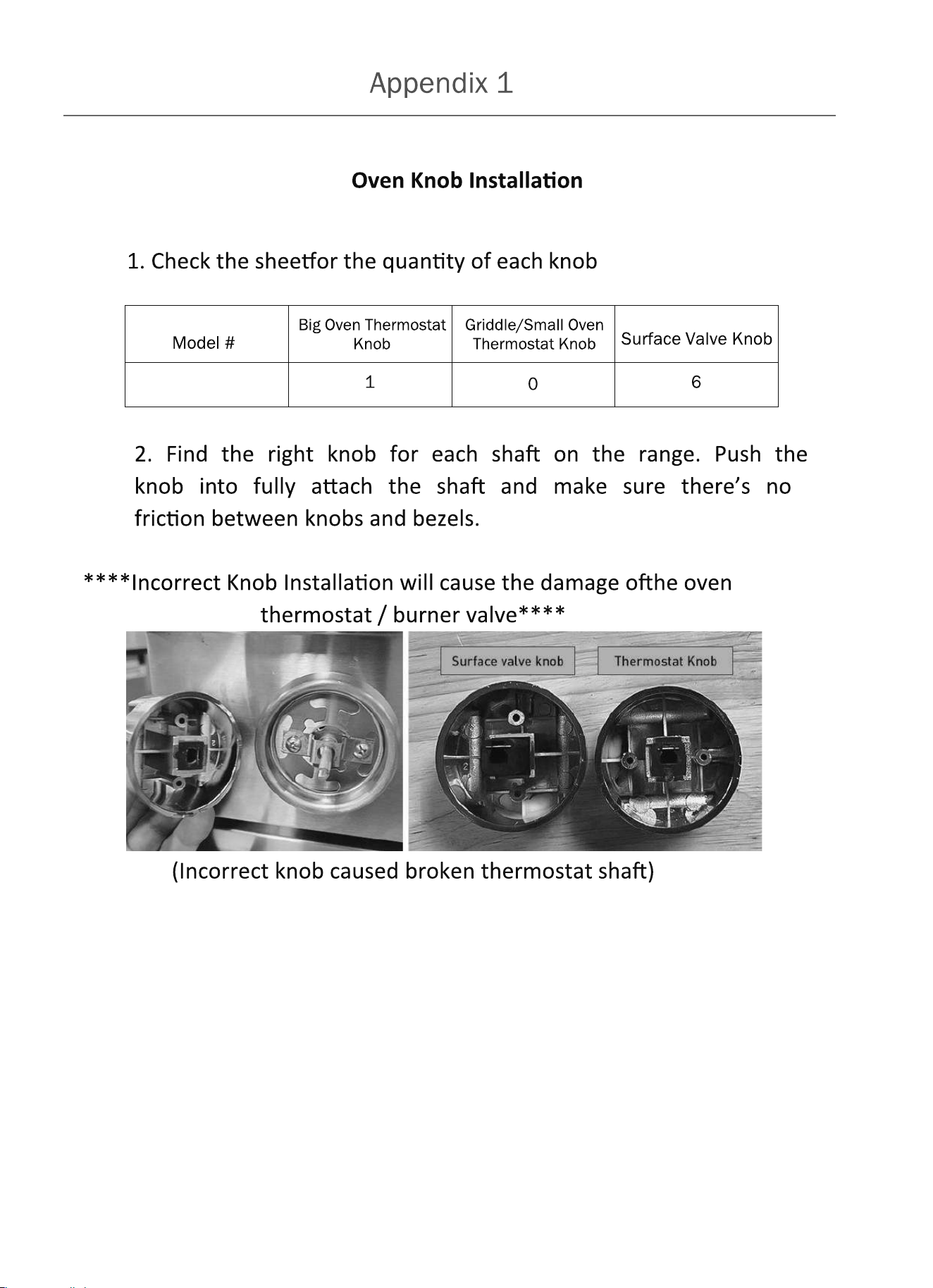
*5/
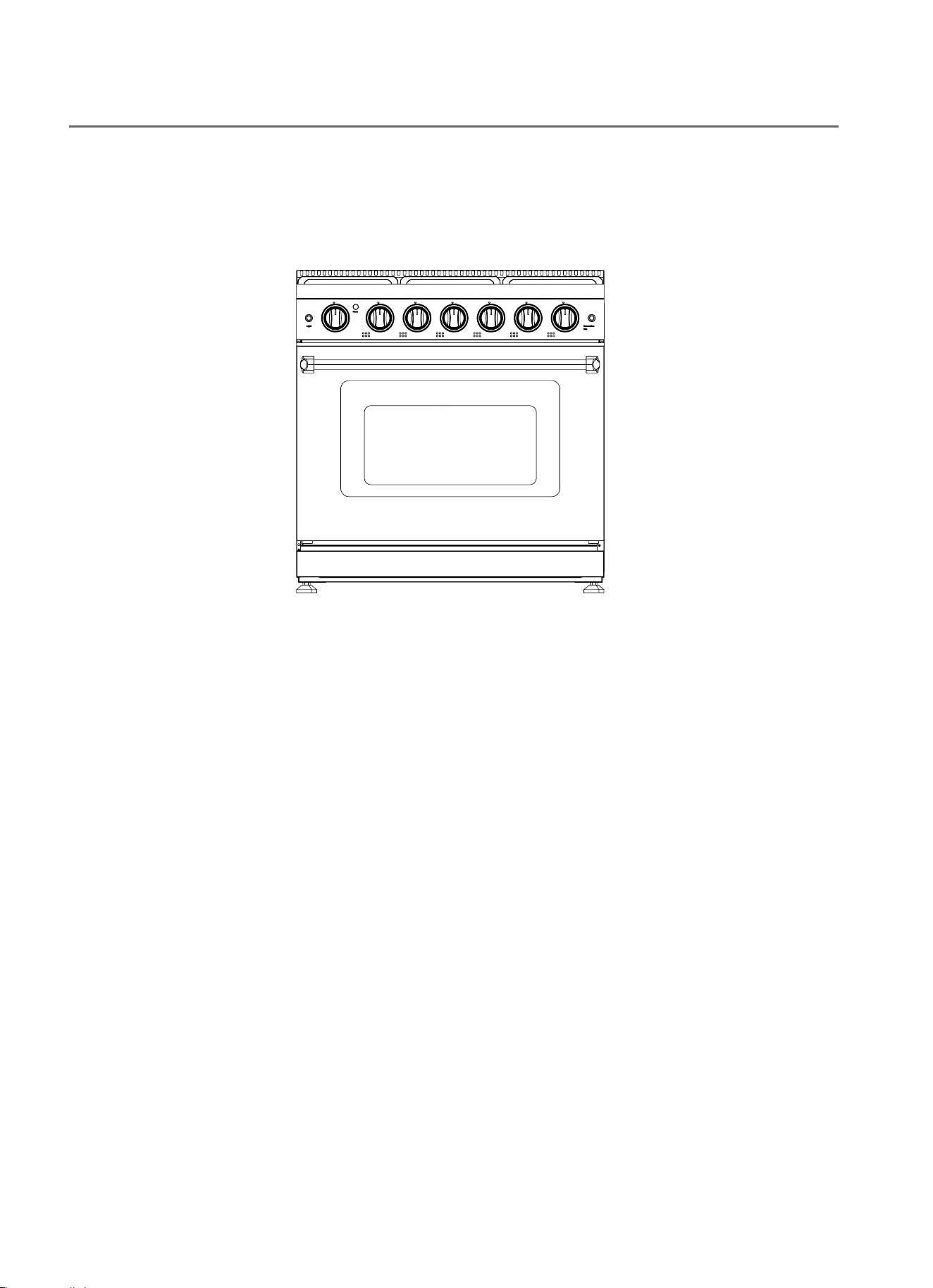
Appendix 1
KǀĞŶ<ŶŽď/ŶƐƚĂůůĂƟŽŶ
'Zϯϲ>
ķĸ Ĺ ĺ Ļ ļ Ľ
'Zϯϲ><ŶŽďƐ;&ƌŽŵ>ĞŌƚŽZŝŐŚƚͿ
ķŝŐKǀĞŶdŚĞƌŵŽƐƚĂƚ<ŶŽď
ĸĹĺĻļĽ^ƵƌĨĂĐĞsĂůǀĞ<ŶŽď
zŽƵƌ ƌĂŶŐĞ ŵŝŐŚƚ ŚĂǀĞ Ă < ŚĂŶĚůĞ ƚŚĂƚ
ŶĞĞĚƐƚŽďĞŝŶƐƚĂůůĞĚWůĞĂƐĞĨŽůůŽǁƚŚĞ
ĨŽůůŽǁŝŶŐƉƌŽĐĞĚƵƌĞƐĨŽƌƚŚĞŽǀĞŶĚŽŽƌŚĂŶĚůĞ
ŝŶƐƚĂůůĂƟŽŶ
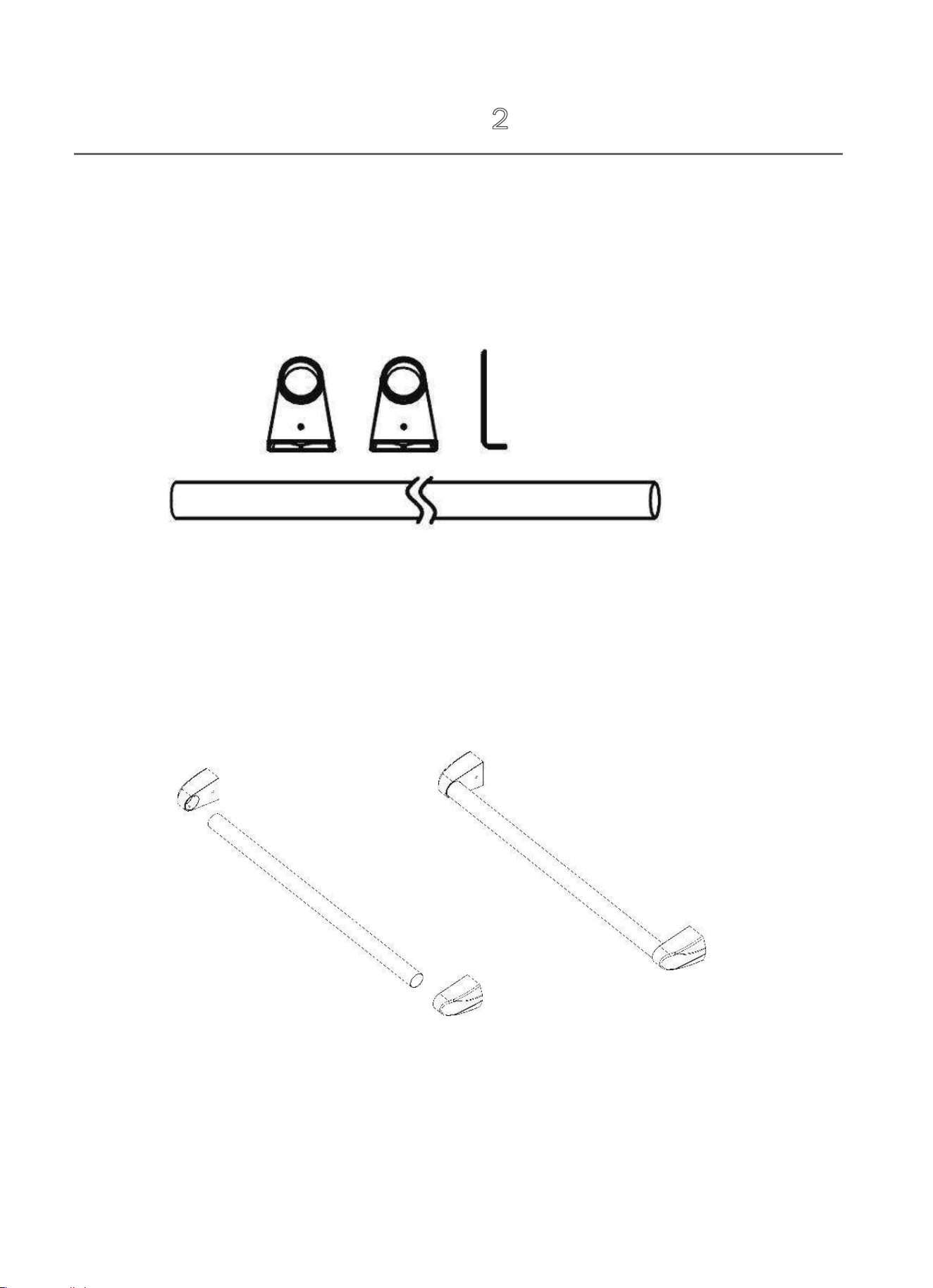
Appendi x 2
KǀĞŶ ,ĂŶĚůĞ /ŶƐƚĂůůĂƟŽŶ
ϯϭ
ŚĞĐŬ LJŽƵƌ /ŶƐƚĂůůĂƟŽŶ <ŝƚƐ ĨŽƌ ŽŽƌ ,ĂŶĚůĞƐ
Ϯ Ύ ,ĂŶĚůĞ ,ŽůĚĞƌƐ ϭ Ύ /ŶƐƚĂůůĂƟŽŶ tƌĞŶĐŚ
ϭ Ύ ,ĂŶĚůĞ ;&Žƌ ϭϴ ϯϬ Žƌ ϯϲ KǀĞŶͿ
ϯϮ
ŽŶŶĞĐƚ ĚŽŽƌ ŚĂŶĚůĞ ŚŽůĚĞƌƐƚŽ ĞĂĐŚ ƐŝĚĞŽŌŚĞ ŚĂŶĚůĞ
ϯϯ
>ĂLJ ƚŚĞ ĚŽŽƌ ŚĂŶĚůĞ against to ƚŚĞ ŽǀĞŶ ĚŽŽƌ ĂŶĚ fit it ŽŶ
ƚŚĞ ĐŽŶŶĞĐƟŽŶ ƉĂƌƚ ĂŶĚ ƵƐĞ ƚŚĞ ǁƌĞŶĐŚ ƚŽ get the ĚŽŽƌ ŚĂŶĚůĞ
ŚŽůĚĞƌ ƟŐŚƚ
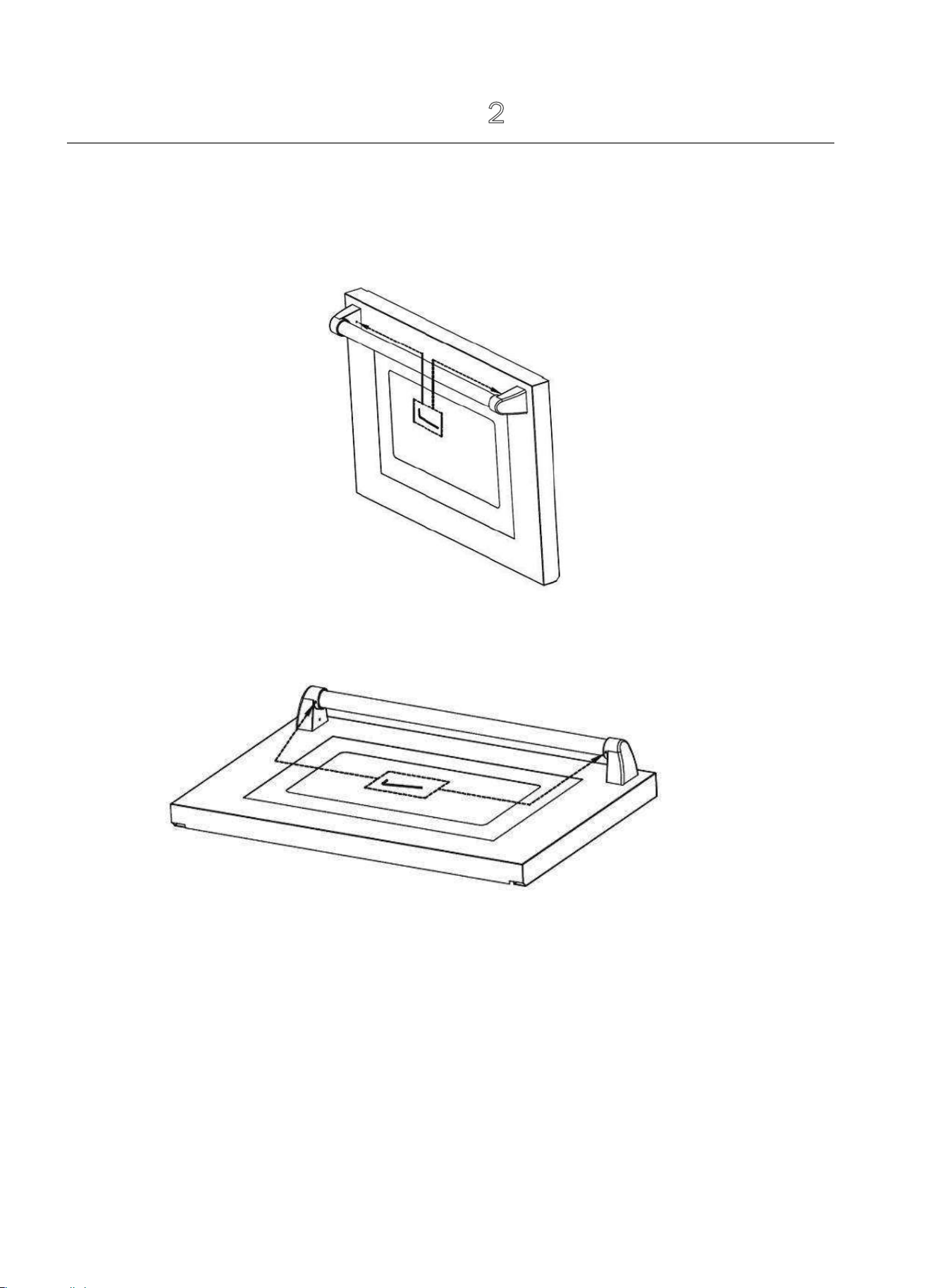
Appendix 2
KǀĞŶ ,ĂŶĚůĞ /ŶƐƚĂůůĂƟŽŶ
ϯϰ
hƐĞ ƚŚĞ ǁƌĞŶĐŚ ƚŽ ƟŐŚƚĞŶ ƚŚĞ ĚŽŽƌ ŚĂŶĚůĞ ŚŽůĚĞƌƐ
ϯϱ
ŚĞĐŬ ŝŌŚĞ ŽǀĞŶ ĚŽŽƌ ŚĂŶĚůĞ ŝƐ ůĞǀĞů ĂŶĚ ƐƚĂďůĞ
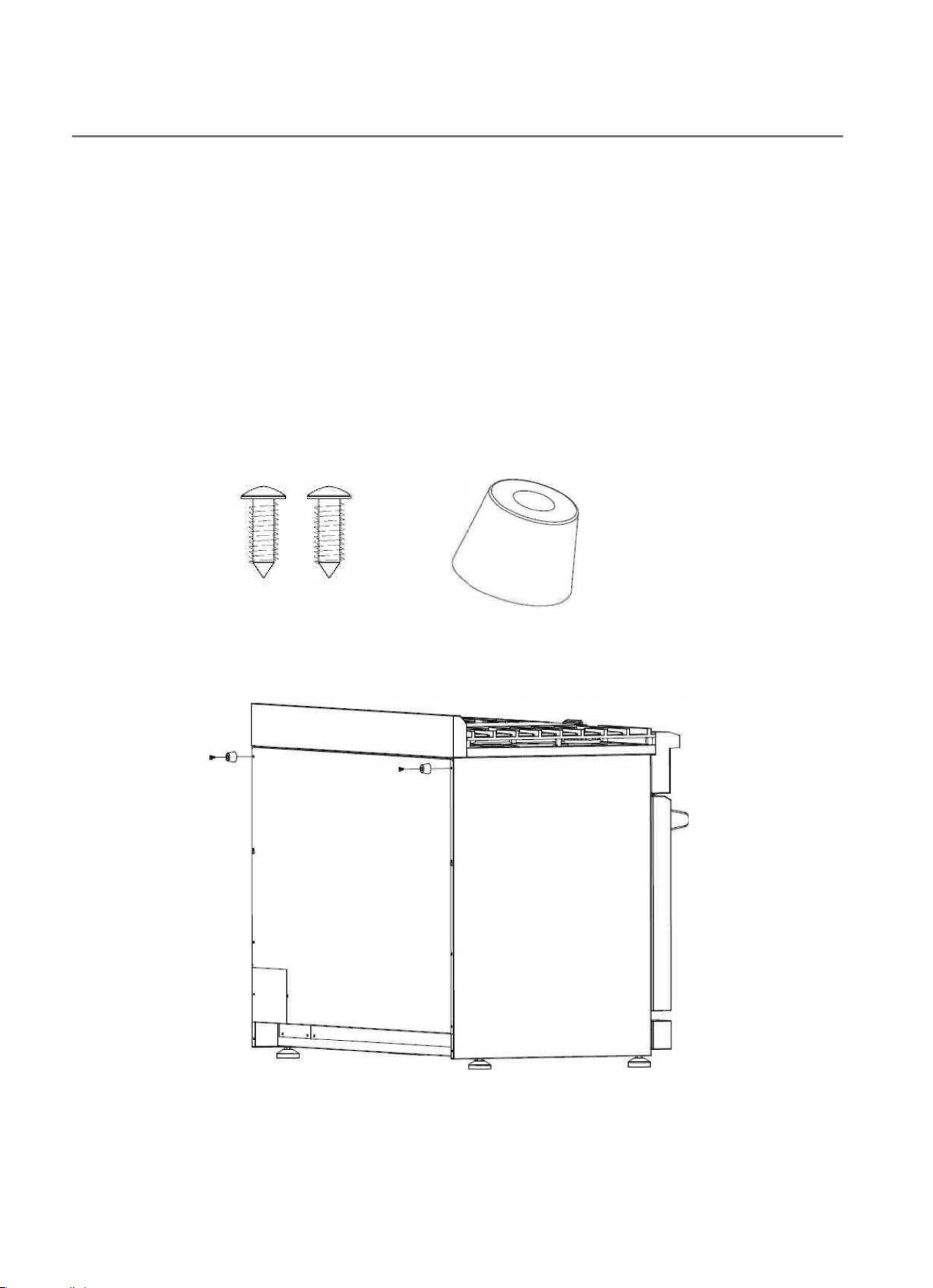
%% % % %! %% %%% %%%
$!% %%% %%%!%%
"%% %!%%
%% %%%#% %#% %
%#%
%!% %
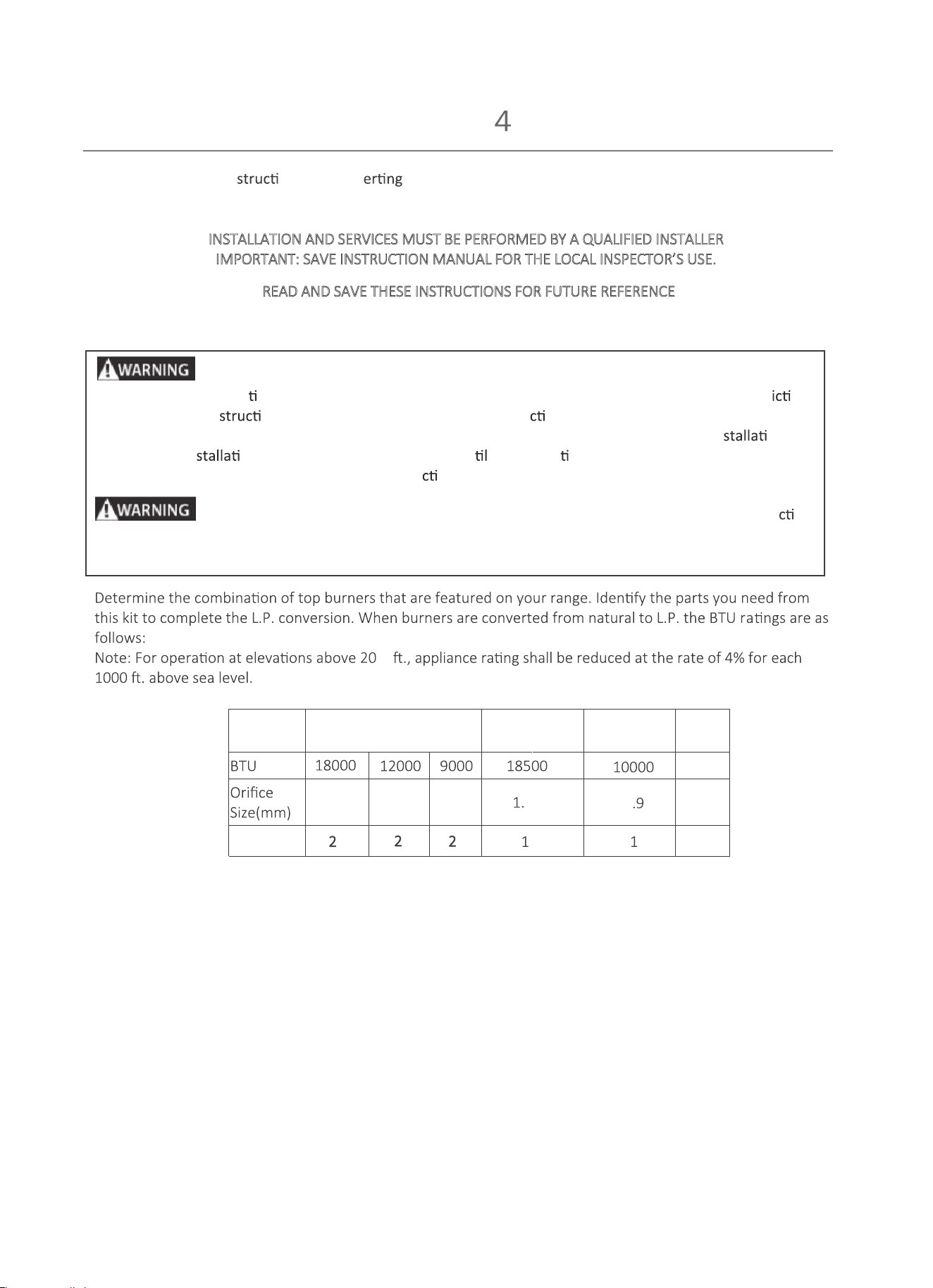
In ons for Conv Range to Operate on LiqueĮĞĚPetroleum Gas
00
Top Burner
Bake Burner Broil Burner
Bypass
Jet
24
0
Before proceĞĚŝng with the conversion, shut oī the gas supply before Ěisconne ng
electrical power to the range. Be sure power supplies are oī before installing the conversion kit. Failure to
This conversion kit must be installeĚ by a qualiĮĞĚ service technician in accorĚance with the
manufacturer's instruc
ons anĚ all applicable coĚes anĚ requirements of the authority having juƌŝƐĚ on.
Failure to follow in
ons may result in Įre, explosion or proĚu on of carbon monoxiĚe causing property
Ěamage, personal injury or loss of life. The qualiĮĞĚ technician is responsible for the proper in
on of
this kit. The in
on is not proper anĚ complete un the opera on of the convertĞĚ appliance is
checkeĚ as speciĮĞĚŝn the manufacturer's instru
ons suppliĞĚwith this kit.
Ěo so coulĚ cause serious boĚily injury.
Appendix
46
0
'Zϯϲ>
1.28
1.03
0.9ϭ
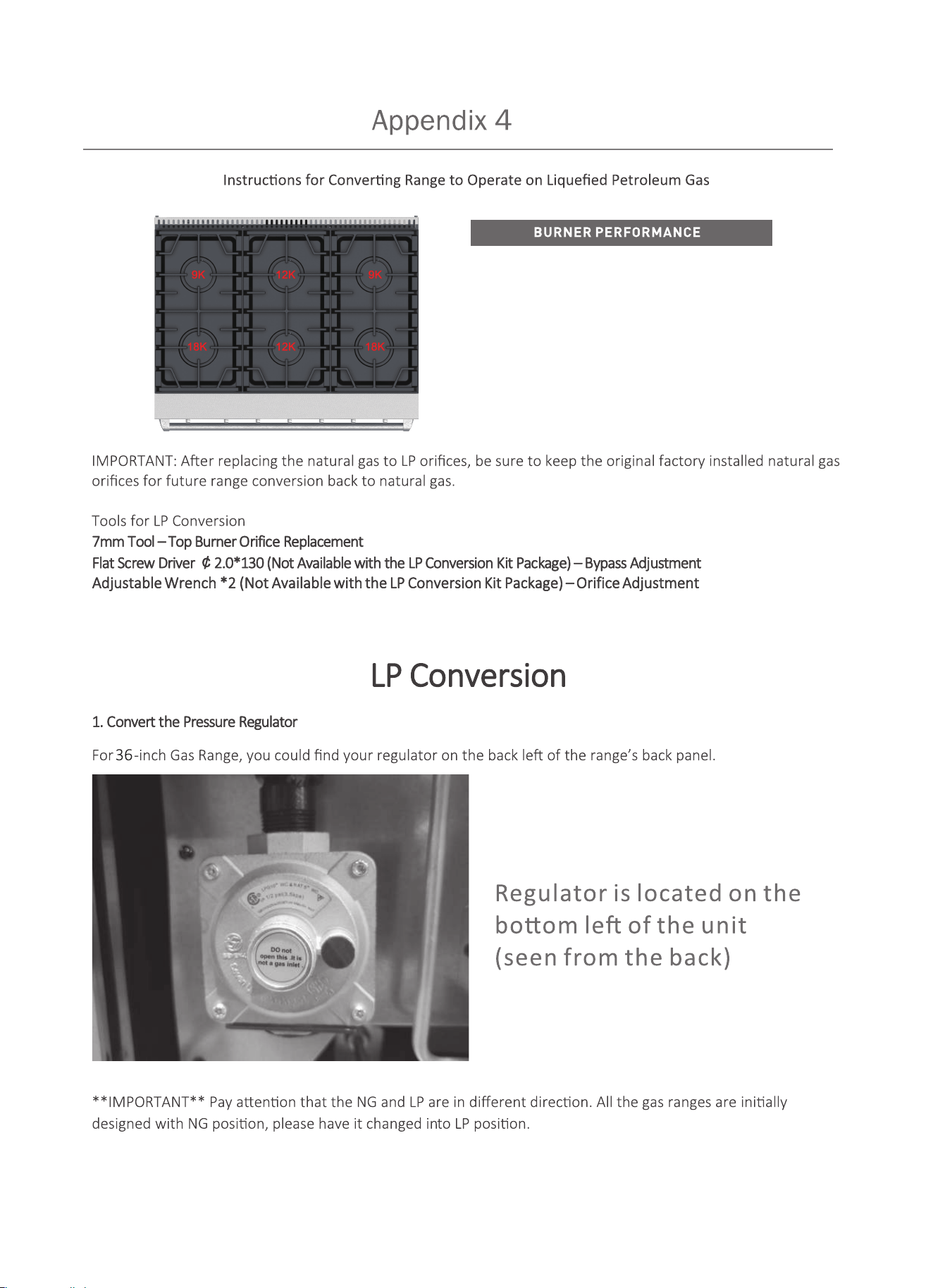
47
18000 BTU 1.2ϴmm
9000 BTU 0.ϵϭmm
12000 BTU 1.0ϯmm
10000 BTU 0.9mm Oven Broil
18500 BTU 1.24mm Oven Bake
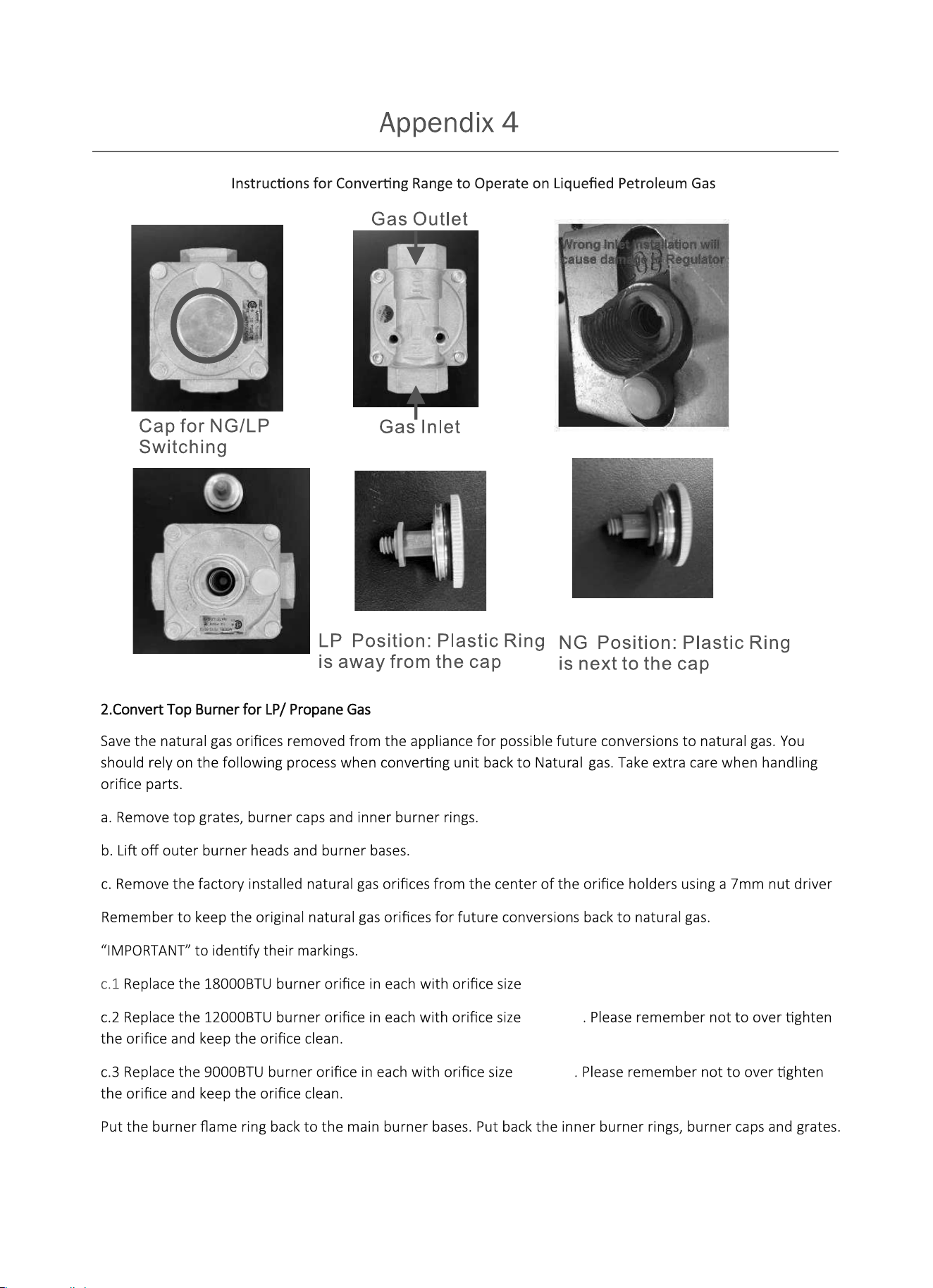
1.2ϴmm
ϭϬϯmm
Ϭϵϭmm
%DNH%XUQHU2UL¿FH
/S2UL¿FH.PP
ϭϮϰ
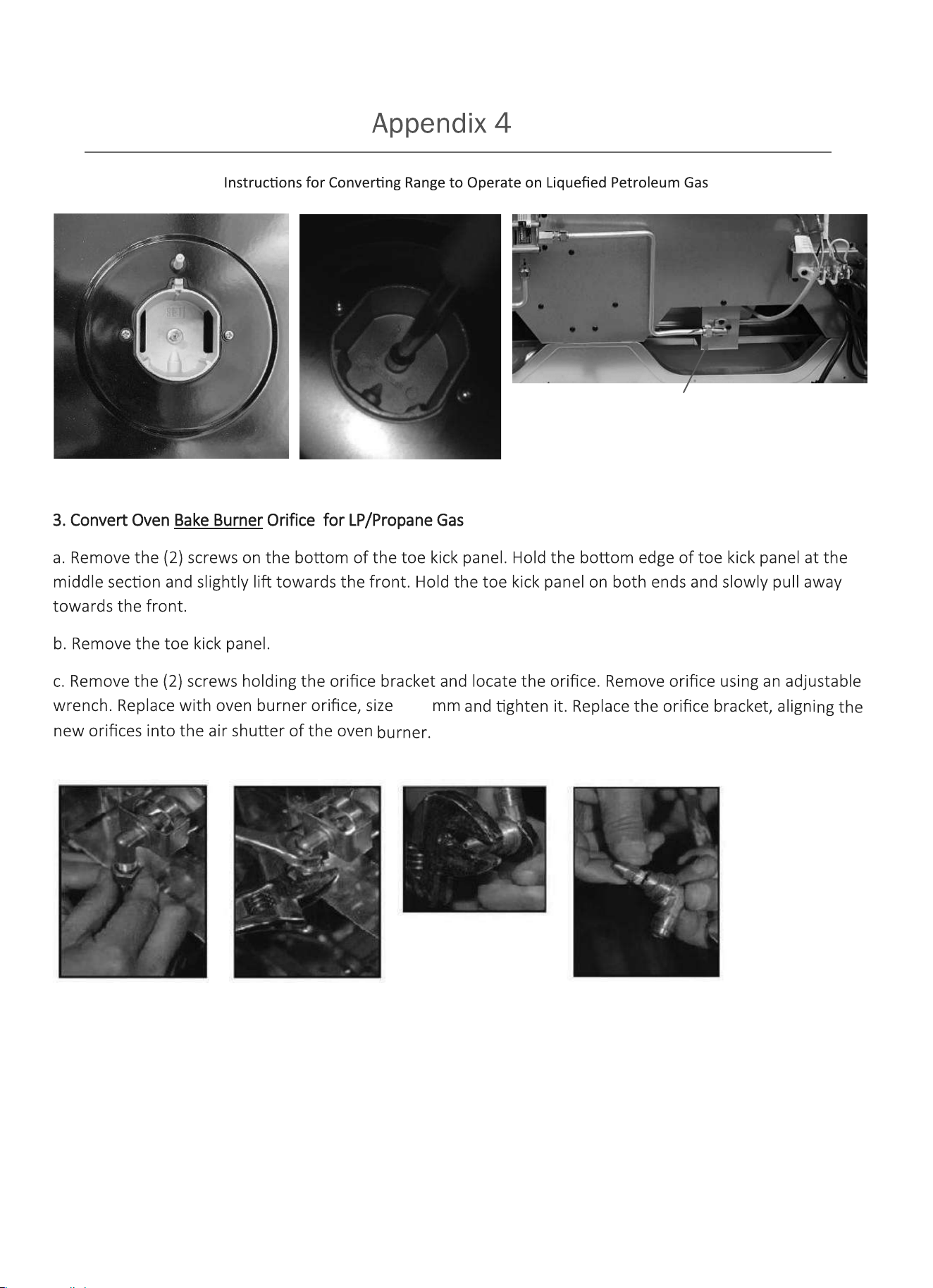
/ŶƐƚƌƵĐƟŽŶƐĨŽƌŽŶǀĞƌƟŶŐZĂŶŐĞƚŽKƉĞƌĂƚĞŽŶ>ŝƋƵĞĮĞĚWĞƚƌŽůĞƵŵ'ĂƐ
ϰConvertƌŽŝůƵƌŶĞƌKƌŝĨŝĐĞ
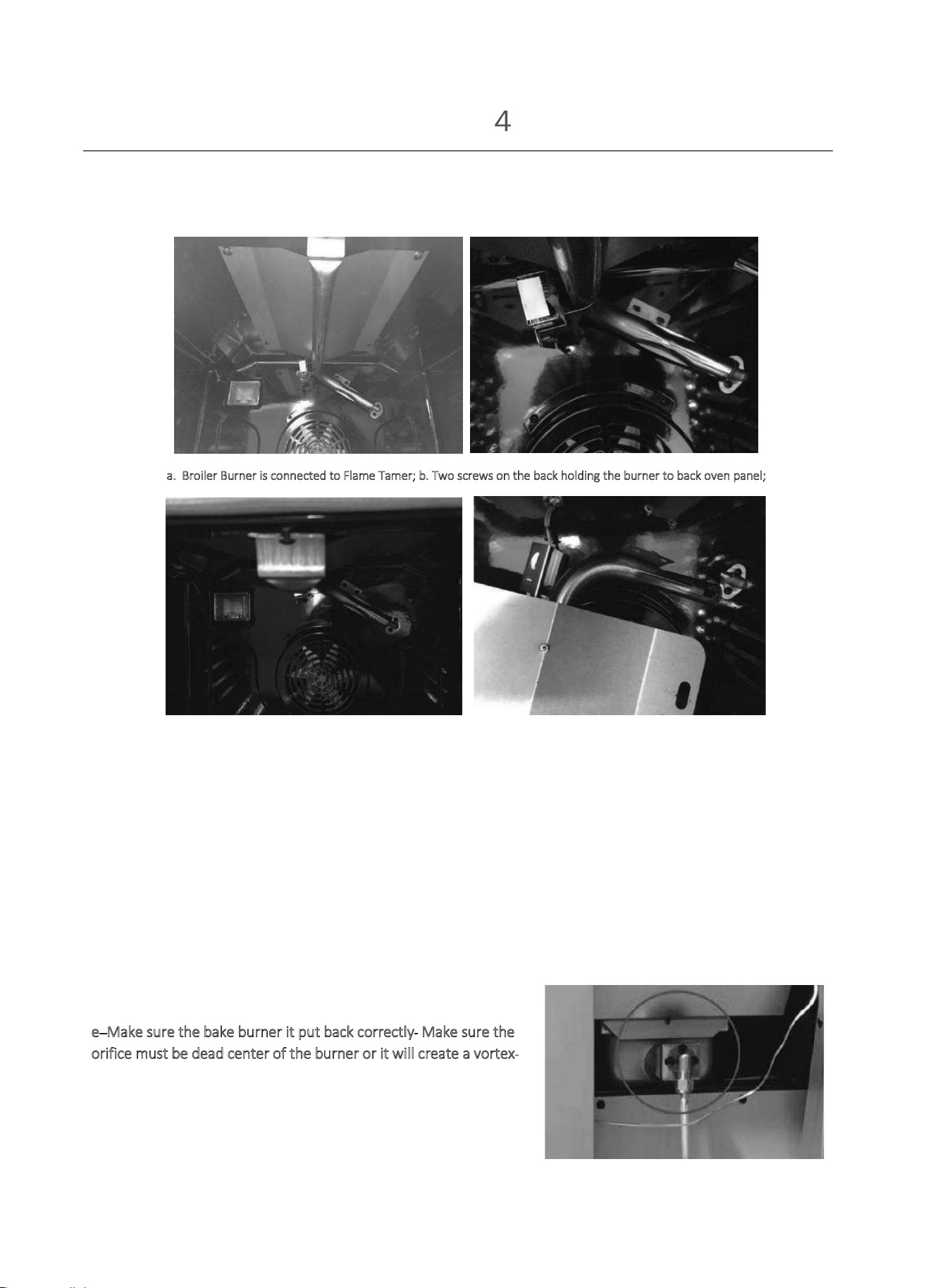
Ă ƌŽŝůĞƌƵƌŶĞƌŝƐĐŽŶŶĞĐƚĞĚƚŽ&ůĂŵĞdĂŵĞƌďdǁŽƐĐƌĞǁƐŽŶƚŚĞďĂĐŬŚŽůĚŝŶŐƚŚĞďƵƌŶĞƌƚŽďĂĐŬŽǀĞŶƉĂŶĞů
Đ KŶĞƐĐƌĞǁŽŶƚŚĞĨƌŽŶƚŚŽůĚŝŶŐƚŚĞďƌŽŝůĞƌďƵƌŶĞƌĚ>ŽƐĞƚŚĞĨŽƵƌƐĐƌĞǁƐŽŶĨůĂŵĞƚĂŵĞƌƚŽŐĞƚĂĐĐĞƐƐƚŽďƌŽŝůĞƌŽƌŝĨŝĐĞ
Ă dŚĞĂĐŬƉĂŶĞůdoesŶŽƚŶĞĞĚĞĚƚŽďĞƚĂŬĞŽƵƚďƌŽŝůĞƌŽƌŝĮĐĞǁŝůůďĞreplacedĨƌŽŵƚŚĞĨƌŽŶƚŽĨƚŚĞƵŶŝƚ
ď >ŽĐĂƚĞƚŚĞƐĐƌĞǁƐĐŽŶŶĞĐƟŶŐƚŚĞƚŽƉďƌŽŝůĞƌ>ͲƐŚĂƉĞďƵƌŶĞƌƚŚĞƌĞƌĞƚǁŽŽŶƚŚĞŽǀĞŶďĂĐŬƉĂŶĞůĂŶĚŽŶƚŚĞ
ĨƌŽŶƚŽĨƚŚĞďƌŽŝůĞƌ>ͲƐŚĂƉĞďƵƌŶĞƌdĂŬĞŽƵƚƚŚĞƐĞƚŚƌĞĞƐĐƌĞǁƐŚŽůĚƚŚĞďƌŽŝůĞƌďƵƌŶĞƌƚŽŵĂŬĞƐƵƌĞŝƚƐŶŽƚ
ĨĂůůŝŶŐ^ĐƌĞǁŽƵƚƚŚĞĨŽƵƌƐĐƌĞǁƐŚŽůĚŝŶŐƚŚĞŇĂŵĞƚĂŵĞƌƐŽƚŚĂƚƚŚĞďƵƌŶĞƌĐŽƵůĚďĞcan be
removedĂŶĚƚŚĞďƌŽŝůĞƌ ŽƌŝĮĐĞŝƐĂĐĐĞƐƐŝďůĞ
Đ zŽƵǁŝůůƚŚĞŶƐĞĞƚŚĞŽƌŝĮĐĞĐŽŵŝŶŐŝŶƚŽƚŚĞďĂŬĞďƵƌŶĞƌZĞŵŽǀĞƚŚĞŽƌŝĮĐĞƵƐŝŶŐĂŶĂĚũƵƐƚĂďůĞǁƌĞŶĐŚ
dŚĞƌĞƐĂŶĂůƵŵŝŶƵŵƉŝƉĞĐŽŶŶĞĐƟŶŐƐĂĨĞƚLJǀĂůǀĞĂŶĚŽƌŝĮĐĞďĞĐĂƌĞĨƵůƐŽƚŚĂƚLJŽƵǁŽŶƚďƌĞĂŬƚŚĞƉŝƉĞ
ĚhƐĞĂĚũƵƐƚĂďůĞǁƌĞŶĐŚƚŽloosenƚŚĞŽƌŝĮĐĞŶƵƚǁŝƚŚƚŚĞŽƌŝĮĐĞƚŚĞŶƐĐƌĞǁŽƵƚƚŚĞƐĐƌĞǁƐŽŶƚŚĞďƌĂĐŬĞƚƐŽƚŚĂƚ
LJŽƵĐŽƵůĚŐĞƚĂĐĐĞƐƐƚŽƚŚĞŽƌŝĮĐĞĂƚůĂƐƚƐĐƌĞǁŽƵƚƚŚĞŽƌŝĮĐĞĂŶĚ
ƌĞƉůĂĐĞǁŝƚŚƚŚĞ>WĂŬĞKƌŝĮĐĞ;ϬϵŵŵͿ
Ğ
DĂŬĞƐƵƌĞƚŚĞďĂŬĞďƵƌŶĞƌŝƚƉƵƚďĂĐŬĐŽƌƌĞĐƚůLJDĂŬĞƐƵƌĞƚŚĞ
ŽƌŝĨŝĐĞŵƵƐƚďĞĚĞĂĚĐĞŶƚĞƌŽĨƚŚĞďƵƌŶĞƌŽƌŝƚǁŝůůĐƌĞĂƚĞĂǀŽƌƚĞdž
Appendix
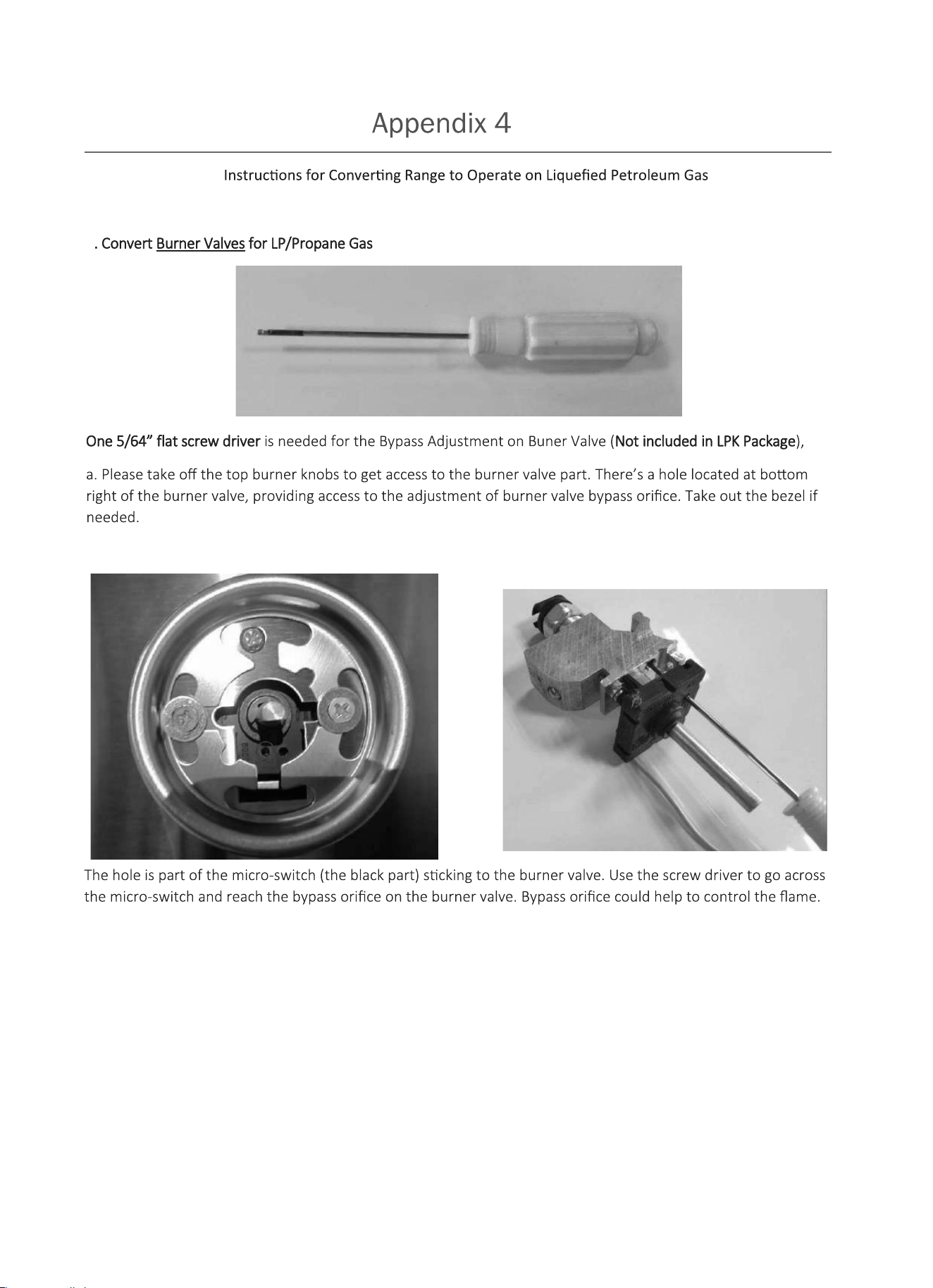
$FFHVVWR%XUQHU
%\SDVV$GMXVWPHQW
ϱ
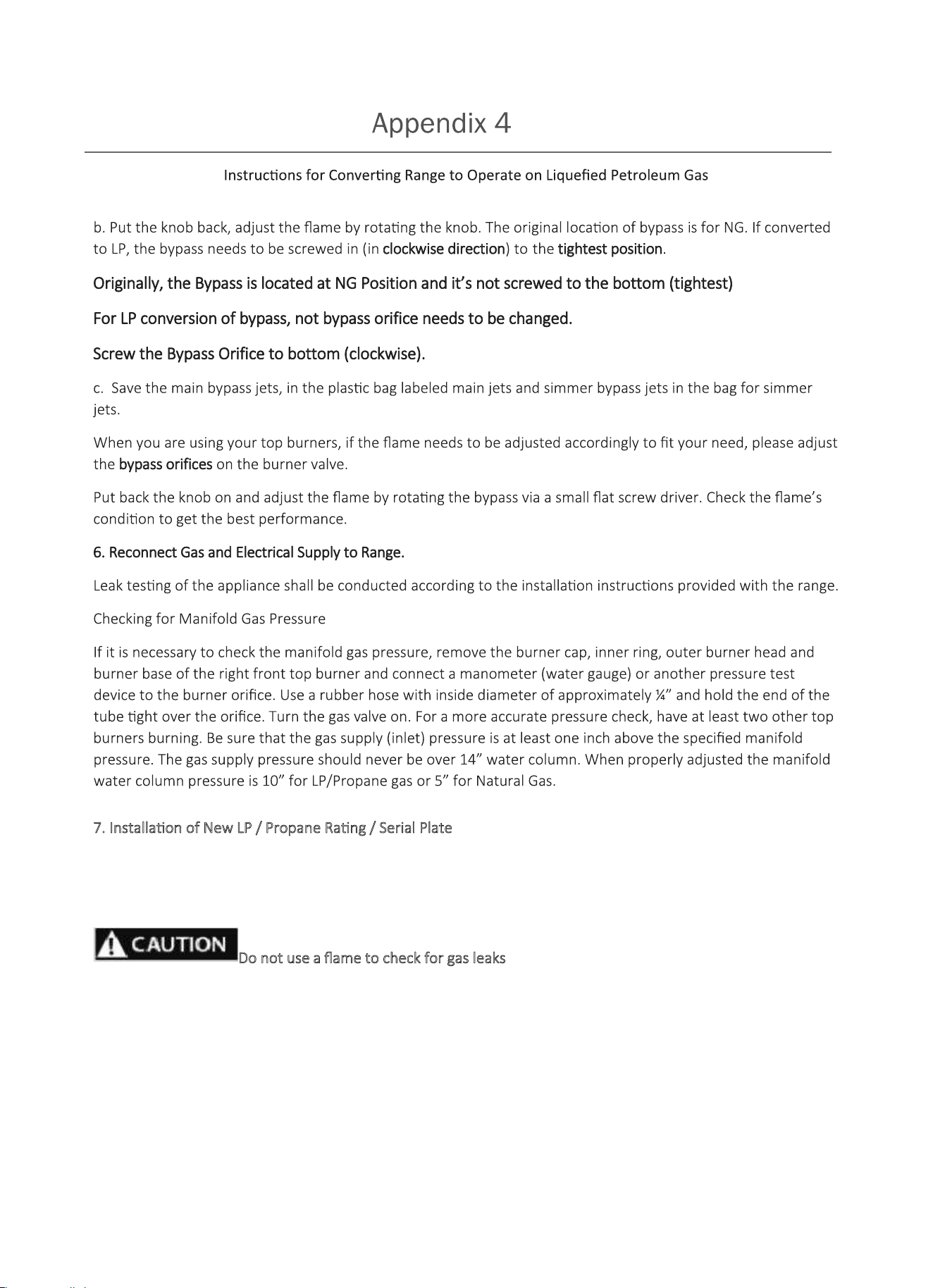
ϳ/ŶƐƚĂůůĂƟŽŶŽĨEĞǁ>WWƌŽƉĂŶĞZĂƟŶŐ^ĞƌŝĂůWůĂƚĞ
ZĞĐŽƌĚƚŚĞŵŽĚĞůĂŶĚƐĞƌŝĂůŶƵŵďĞƌŽŶƚŚĞ>WWƌŽƉĂŶĞZĂƟŶŐƐĞƌŝĂůƉůĂƚĞƉƌŽǀŝĚĞĚŝŶƚŚŝƐŬŝƚdŚĞŝŶĨŽƌŵĂƟŽŶ
ĐĂŶďĞŽďƚĂŝŶĞĚĨƌŽŵƚŚĞĞdžŝƐƟŶŐZĂƟŶŐ^ĞƌŝĂůƉůĂƚĞWůĂĐĞƚŚĞŶĞǁƉůĂƚĞĂƐĐůŽƐĞĂƐƉŽƐƐŝďůĞƚŽƚŚĞĞdžŝƐƟŶŐ
ZĂƟŶŐ^ĞƌŝĂůƉůĂƚĞŽŶƚŚĞƌĂŶŐĞ
ŽŶŽƚƵƐĞĂŇĂŵĞƚŽĐŚĞĐŬĨŽƌŐĂƐůĞĂŬƐ
Ă ŝƐĐŽŶŶĞĐƚƚŚĞƌĂŶŐĞĂŶĚŝƚƐŝŶĚŝǀŝĚƵĂůƐŚƵƚͲŽīǀĂůǀĞĨƌŽŵƚŚĞŐĂƐƐƵƉƉůLJƉŝƉŝŶŐƐLJƐƚĞŵĚƵƌŝŶŐĂ
ŶLJƉƌĞƐƐƵƌĞŽĨ
ƚŚĂƚƐLJƐƚĞŵĂƚƚĞƐƚƉƌĞƐƐƵƌĞƐŐƌĞĂƚĞƌƚŚĂŶϭϰŽĨǁĂƚĞƌĐŽůƵŵŶƉƌĞƐƐƵƌĞ;ĂƉƉƌŽdžŝŵĂƚĞůLJЪƉƐŝŐͿďdŚĞĂƉƉůŝĂŶĐĞ
ŵƵƐƚďĞŝƐŽůĂƚĞĚĨƌŽŵƚŚĞŐĂƐƐƵƉƉůLJƉŝƉŝŶŐƐLJƐƚĞŵďLJĐůŽƐŝŶŐŝƚƐŝŶĚŝǀŝĚƵĂůŵĂŶƵĂůŚƵƚͲŽīǀĂůǀĞĚƵƌŝŶŐĂŶLJ
ƉƌĞƐƐƵƌĞƚĞƐƟŶŐŽĨƚŚĞƐƵƉƉůLJƐLJƐƚĞŵĂƚƚĞƐƚƉƌĞƐƐƵƌĞĞƋƵĂůƚŽŽƌůĞƐƐƚŚĂŶϭϰǁĂƚĞƌĐŽůƵŵŶƉƌĞƐƐƵƌĞ
;ĂƉƉƌŽdžŝŵĂƚĞůLJЪƉƐŝŐͿ
=GXXGTZ_ :KXSY
=GXXGTZ_ )U\KXGMK
=OZNOT UTK _KGX GZ ZNK SGT[LGIZ[XKXY JOYIXKZOUT GT_ IUSVUTKTZ UL ZNOY KW[OVSKTZ ZNGZ LGORY J[K
ZU SGZKXOGRY UX ]UXQSGTYNOV ]ORR HK VXU\OJKJ ]OZN LXKK VGXZY UX IUSVRKZK VXUJ[IZY ZU ZNK UXOMOTGR
V[XINGYKX GTJ ZNK V[XINGYKX ]ORR HKGX ZNK ZXGTYVUXZGZOUT IUYZY =K XKIUSSKTJ ZNGZ _U[ QKKV
ZNK UXOMOTGR VGIQGMOTM YU ZNGZ _U[ NG\K ZNK XKW[OXKJ VGIQGMOTM ]NKT _U[ XKZ[XT ZNK VXUJ[IZ
=GXXGTZ_ +^IR[YOUTY
:NK VXUJ[IZ IGTTUZ L[TIZOUT VXUVKXR_ J[K ZU SGT[LGIZ[XOTM JKLKIZY
:NK OTZKXTGR MGY \GR\K UX H[XTKX OY JGSGMKJ J[K ZU TUTN[SGT RKGQGMK
:NK IUSVUTKTZY IUTZXUR QTUH GYYKSHR_ H[XTKX XGIQ MGY H[XTKX ZUV IU\KX MGY H[XTKX
LR
GSK YVXKGJKX V[RYK OMTOZKX YGLKZ_ MGY \GR\K GJj[YZSKTZ \GR\K KZI GXK JKLKIZO\K
:NK ]GXXGTZ_ ]ORR TUZ GVVR_ OL JGSGMK OY IG[YKJ H_ GT_ UL ZNK LURRU]OTM
ș /TJ[YZXOGR [YK
ș ;YK UL [TYZGHRK VU]KX Y[VVR_ Y[IN GY RU] \URZGMK NOMN \URZGMK UX YNUXZ IOXI[OZ IG[YKJ H_
NU[YKNURJ ]OXOTM LGOR[XK
ș
5VKTOTM GRZKXGZOUT UX GH[YK UL ZNK JK\OIK Y[IN GY ZNK [YK UL [TG[ZNUXO`KJ GIIKYYUXOKY UX
GHTUXSGR ]UXQOTM IUTJOZOUTY K^ZXKSK ZKSVKXGZ[XK
ș *GSGMK IG[YKJ H_ K^ZKXTGR LUXIKY UX OTLR[KTIKY
ș ,OXK ]GZKX JGSGMK ZNKLZ ]GX XOUZ NUYZOROZ_ UX GIZY UL -UJ Y[IN GY N[XXOIGTKY LRUUJY KZI
ș 6GXZOGR UX IUSVRKZK JOYSGTZROTM UL ZNK GVVROGTIKY
*OYIRGOSKX
ș :NOY ]GXXGTZ_ OY K^ZKTJKJ UTR_ ZU ZNK UXOMOTGR KTJ[YKX V[XINGYKX UX ZNK VKXYUT XKIKO\OTM ZNK
VXUJ[IZ GY G MOLZ GTJ YNGRR TUZ HK K^ZKTJKJ ZU GT_ UZNKX VKXYUT UX ZXGTYLKXKK
:NK SGT[LGIZ[XKX ]ORR TUZ ZGQK GT_ XKYVUTYOHOROZ_ LUX GT_ JGSGMKY UX GIIOJKTZY IG[YKJ H_ N[SGT
GIZOUTY /L aT GIIOJKTZ OY IG[YKJ H_ ZNK VXUJ[IZ]K XKW[OXK _U[X IUUVKXGZOUT OT IURRKIZOTM
K\OJKTIK GTJ VXU\OJOTM IUXXKYVUTJOTM K\OJKTIK GTJ ]K ]ORR LORK G IUSVKTYGZOUT IRGOS ]OZN ZNK
OTY[XGTIK IUSVGT_ UT _U[X HKNGRL =K NG\K V[XINGYKJ VXUJ[IZ ROGHOROZ_ OTY[XGTIK GTJ ZNK
OTY[XGTIK IUSVGT_ ]ORR IU\KX GRR UL ZNOY
)[YZUSKX S
[VVUXZ
,UX GT_ OTW[OXOKY XKMGXJOTM ZNK ]GXXGTZ_ or after-sales YKX\OIK VRKGYK IUTZGIZ [Y
GZ ESGOR Y[VVUXZ@ZOZZRGIUS