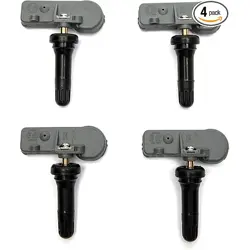

The overview of tire pressure sensor learning methods. The types of learning methods are
divided into A, S, O, A/O, S/O, A/S/O, and C.
Introduction to learning methods:
1. “A” stands for self-learning mode
Learning steps:
1-1. Install the tire pressure sensor correctly
1-2. Adjust the tire pressure of all tires to the standard value (the manufacturer's nominal value
mark is located at the lower position of the door frame of the driver's seat)
1-3. The vehicle remains in a completely stationary state for more than 20 minutes (ignition and
power off)
1-4. Drive at a speed of 30-100 km/h for more than 15 minutes
1-5. The vehicle will automatically learn the new sensor information, and the tire pressure
warning will disappear after the learning is successful (if the tire pressure data can be showed on
the vehicle, the real-time tire pressure data will be displayed). If learning fails, please repeat steps
2-5
2. “S” stands for static learning mode
Learning steps:
2-1. Install the tire pressure sensor correctly
2-2. Pull up the parking brake
2-3. Turn the ignition switch to the energized position (engine off)
2-4. Enter the tire pressure learning mode through the vehicle dashboard. There will be
corresponding prompts on the dashboard (the method of entering the tire pressure learning
mode for each brand model will be different, please refer to the vehicle manual or consult a
professional)
2-5. Starting from the left front wheel (some models will have the corresponding position turn
signal flashing), use the activation tool (Daotong, Yuanzheng, etc.) to activate the tire pressure
sensor. If the activation is successful, the vehicle will have a whistle or a steering corresponding
to the sensor position being learned The light flashes.
! Note: The first sensor should be learned within 2 minutes, otherwise please repeat step 4
2-6. After learning the left front wheel sensor successfully. For the remaining positions, please
activate the remaining tire pressure sensors in the order of front right, rear right, and rear left.
The activation prompt and activation success status are the same as step 5.
! Note: The remaining sensor learning needs to be completed within 3 minutes, otherwise please
skip back to step 4 and repeat the sequence operation
2-7. Transfer the vehicle to the flame-out and power-off state. Adjust the tire pressure of all tires
according to the standard value of tire pressure (the manufacturer's nominal value mark is
located at the lower position of the door frame in the driving position)
2-8. After the learning is successful, the tire pressure warning will disappear (if the tire pressure
value is supported, the real-time tire pressure data will be displayed). If learning fails, please
repeat steps 4-7
3. “O” stands for OBD learning mode
Learning steps:
3-1. Need a tire pressure activation device (Dutong Yuanzheng, etc.)
3-2. Correctly install tire pressure sensor

3-3. Adjust the tire pressure of all tires to the standard value (the manufacturer's nominal value
mark is located at the lower position of the door frame in the driving position)
3-4. Activate the tire pressure sensor in the order of left front, right front, right rear, and left rear
3-5. Connect the tire pressure sensor activation device to the OBD II interface of the vehicle, and
use the OBD learning function in the tire pressure activation device to write the sensor ID
3-6. Turn the ignition switch to the energized position, and reactivate the sensor in the order of
front left, front right, rear right, and rear left
3-7. The vehicle remains powered off and stalled for more than 25 minutes
3-8. Drive at a speed of 30-100 km/h for more than 15 minutes. If the learning is successful, the
tire pressure alarm light will go out. Otherwise, please skip back to step 4 and repeat the
sequence operation
4. A/O means that the vehicle supports both A and O learning modes. Which learning mode
can be selected according to the actual situation
5. S/O means that the vehicle supports both A and O learning modes. Which learning mode
can be selected according to the actual situation
6. A/S/O means that the vehicle supports the learning modes of A, S, and O at the same time,
and which learning mode can be selected according to the actual situation.
7. “C” stands for clone ID learning
Note: The vehicle with this learning method can only use the following three methods to copy
the ID to the new sensor to replace the original sensor. If the new sensor cannot change its ID,
the sensor can only be replaced by the equipment provided by the original vehicle manufacturer
Method 1--steps:
1-1.Use the tire pressure activation device (Daotong Yuanzheng, etc.) to activate the original
sensor and copy the ID to the tire pressure activation device
1-2.Then program the copied ID into the new sensor through the tire pressure activation device.
(Note that the ID format carry method should be the same as the original sensor)
1-3.Remove the tire that has just copied the sensor ID, remove the original sensor, install the new
sensor that has just been programmed, and replace the tire
Method 2--steps:
2-1. Use tire pressure activation device (Daotong Yuanzheng, etc.) to connect to the vehicle OBD
II interface, enter the vehicle operating system, and copy the ID of the sensor to be replaced from
the vehicle system
2-2. Program the ID copied to the tire pressure activation device into the new sensor. (Note that
the ID format carry method should be the same as the original sensor)
2-3. Remove the tire that just copied the sensor ID, remove the original sensor, install the newly
programmed sensor, and install the tire back
Method 3--stpes:
3-1. Remove the tire to replace the sensor, remove the original sensor
3-2. Use the tire pressure activation device to program the original sensor ID into the new sensor
by "manual creation". (Note that the ID format carry method should be the same as the original
sensor)
3-3. Correctly install the new sensor to the tire, adjust the tire pressure to the standard value (the
manufacturer's nominal value mark is located at the lower position of the door frame in the
driving position), and install the tire back to the vehicle