
STORAGE CONDITION
● Avoid storing capacitors in locations where temperatures exceed the specified
limits. Prevent capacitor condensation and maintain the average relative humidity
below 75%, with a maximum of 95% throughout the year.
● Do not store capacitors in corrosive environments, especially in the presence of
substances like hydrochloric gas, hydrogen sulfide, acids, or organic solvents.
● Clean capacitors stored in dusty environments, particularly near the terminals, to
ensure proper electrical insulation between phases and enclosure before
installation.
● For capacitors stored for over two years, conduct a visual inspection to check for
enclosure integrity, such as corrosion, leaks, or deformations. Measure
capacitance values; if they fall within the specified limits on the nameplate and
the enclosure is intact, the capacitor can be used.
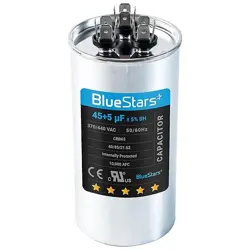
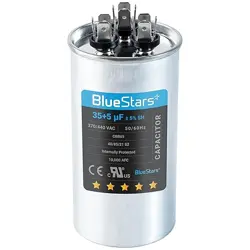
For example, a 35 uf + 5 uf with a tolerance of +/- 5% means it can be minus or
plus 5% out of range of the rated capacitance so that the capacitor still functions
normally. So,
35 mfd +/- 5% = Range Min 33.25 mfd & Max 36.75 mfd
5 mfd +/- 5% = Range Min 4.75 mfd & Max 5.23 mfd
If not, dispose of the capacitor and replace it with a new BlueStars capacitor with
the same specification (microfarad rating, tolerance, voltage, etc.)
PREVENTIVE MAINTENANCE
Monthly
● Conduct a visual examination of the capacitors, ensuring the safety device
(housing expansion) is activated. If activated, investigate the cause before
considering replacement.
● Inspect the capacitors' integrity, examining the tightness of connections and
verifying proper temperature and cooling functionality.

● Measure the operating voltage, current, and insulation between terminals and
ground.
● Perform a thermographic analysis of connections.
Every Six Months
● Repeat all the monthly procedures, including inspecting the capacitors and
checking safety device activation, connection tightness, temperature, and
cooling.
● Evaluate the operation of controller outputs and confirm adherence to the
discharge time of capacitors.
● Examine supply line harmonics with the capacitor bank activated.
● Clean the panel or the installation site of the capacitors.
● When your AC unit is not in use, consider buying a BlueStars cover to protect
your unit under harsh weather conditions, along with dust and debris.