
INSTRUCTION MANUAL
MANUAL DE INSTRUCCIONES
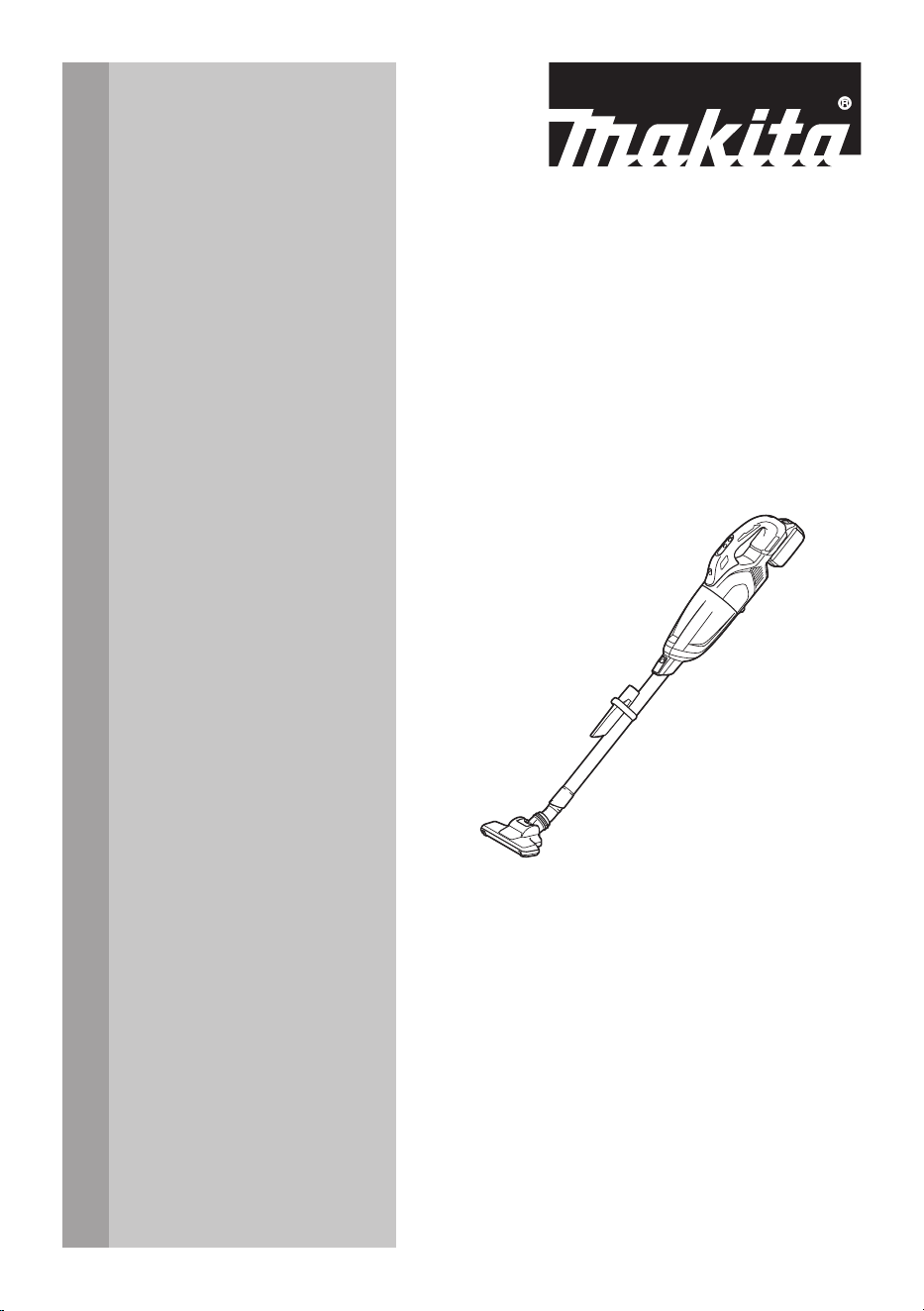
Cordless Cleaner
Aspiradora Inalámbrica
XLC09
IMPORTANT: Read Before Using.
IMPORTANTE: Lea antes de usar.
2 ENGLISH
ENGLISH (Original instructions)
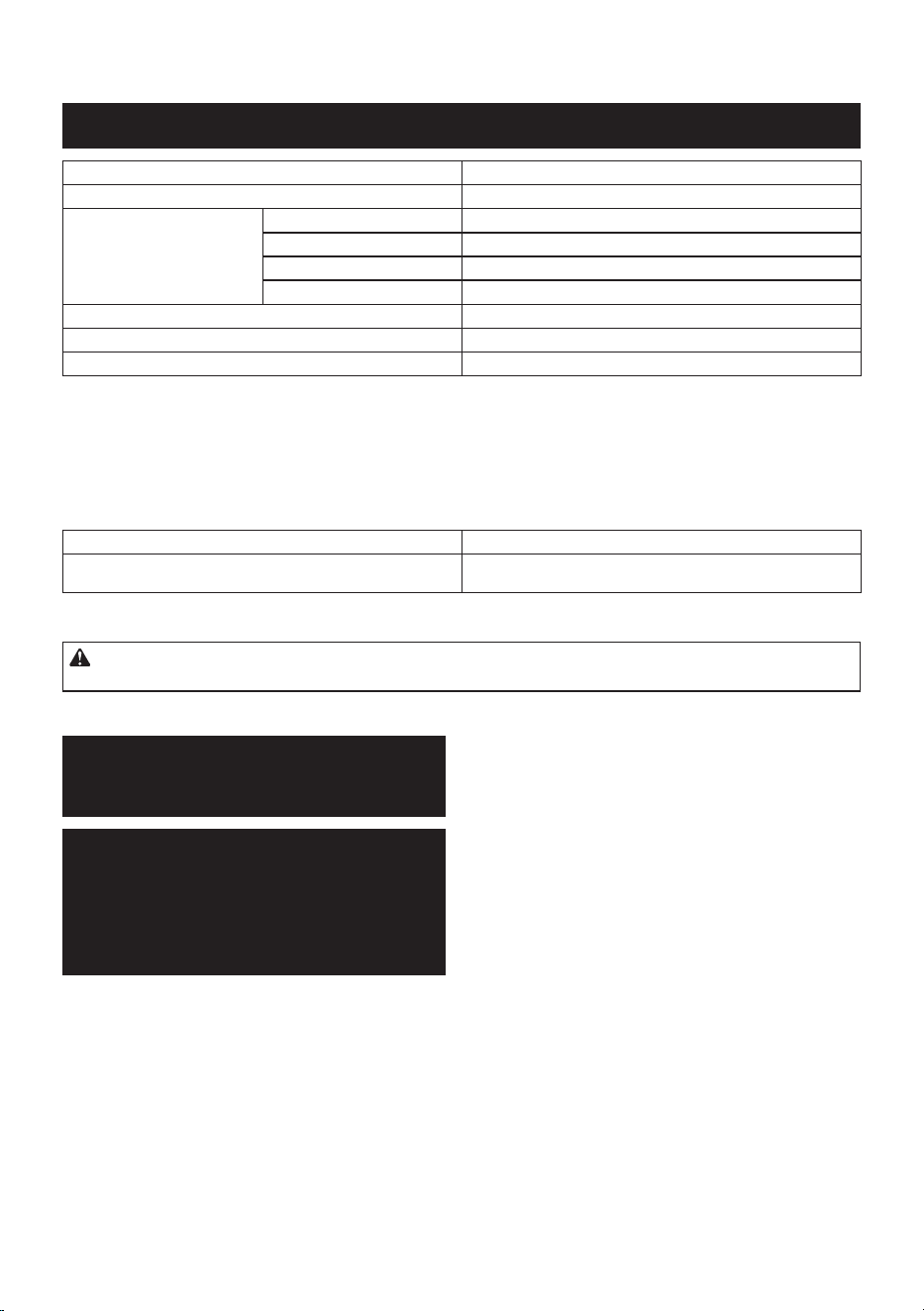
SPECIFICATIONS
Model: XLC09
Capacity 730 mL
Continuous use
(with battery BL1830B)
1 (Quiet mode) Approx. 38 min
2 (Normal speed mode) Approx. 21 min
3 (High speed mode) Approx. 15 min
4 (Max speed mode) Approx. 8 min
Overall length (with pipe, nozzle, and battery BL1830B) 1,066 mm (42")
Rated voltage D.C. 18 V
Net weight 1.3 - 1.7 kg (2.9 - 3.7 lbs)
• Duetoourcontinuingprogramofresearchanddevelopment,thespecicationshereinaresubjecttochange
without notice.
• Specicationsmaydierfromcountrytocountry.
• The weight does not include accessories but battery cartridge(s). The lightest and heaviest combination weight
of the appliance and battery cartridge(s) are shown in the table.
Applicable battery cartridge and charger
Battery cartridge BL1815N / BL1820B / BL1830B / BL1840B / BL1850B / BL1860B
Charger DC18RC / DC18RD / DC18RE / DC18SD / DC18SE / DC18SF /
DC18SH / DC18WC
• Some of the battery cartridges and chargers listed above may not be available depending on your region of
residence.
WARNING: Only use the battery cartridges and chargers listed above. Use of any other battery cartridges
andchargersmaycauseinjuryand/orre.
SAFETY WARNINGS
IMPORTANT
SAFETY
INSTRUCTIONS
When using an electrical appliance,
basic precautions should always be fol-
lowed, including the following:
READ ALL
INSTRUCTIONS
BEFORE USING
THIS APPLIANCE.
WARNING
To reduce the risk of re, electric shock
or injury:
1. Do not leave appliance when battery
tted. Remove battery from appli-
ance when not in use and before
servicing.
2. Do not use on wet surfaces. Do not
expose to rain. Store indoors.
3. Do not allow to be used as a toy.
Close attention is necessary when
used by or near children.
4. Use only as described in this man-
ual. Use only manufacturer's recom-
mended attachments.
5. Do not use with damaged battery.
If appliance is not working as it
should, has been dropped, dam-
aged, left outdoors, or dropped into
water, return it to a service center.

3 ENGLISH
6.
Do not handle appliance with wet hands.
7.
Do not put any object into openings.
Do not use with any opening blocked;
keep free of dust, lint, hair, and any-
thing that may reduce air ow.
8. Keep hair, loose clothing, ngers,
and all parts of body away from
openings and moving parts.
9. Turn o all controls before removing
the battery cartridge.
10.
Use extra care when cleaning on stairs.
11. Do not use to pick up ammable or
combustible liquids, such as gaso-
line, or use in areas where they may
be present.
12. Do not pick up anything that is burn-
ing or smoking, such as cigarettes,
matches, or hot ashes.
13. Do not use without dust bag and/or
lters in place.
14. Do not charge the battery outdoors.
15.
Prevent unintentional starting. Ensure
the switch is in the o-position before
connecting to battery pack, picking
up or carrying the appliance. Carrying
theappliancewithyourngeronthe
switch or energizing appliance that have
the switch on invites accidents.
16. Disconnect the battery pack from
the appliance before making any
adjustments, changing accessories,
or storing appliance. Such preventive
safety measures reduce the risk of
starting the appliance accidentally.
17. Recharge only with the charger
specied by the manufacturer. A
charger that is suitable for one type of
batterypackmaycreateariskofre
when used with another battery pack.
18. Use appliances only with speci-
cally designated battery packs. Use
of any other battery packs may create
ariskofinjuryandre.
19. When battery pack is not in use,
keep it away from other metal
objects, like paper clips, coins,
keys, nails, screws or other small
metal objects, that can make a
connection from one terminal to
another. Shorting the battery terminals
togethermaycauseburnsorare.
20. Under abusive conditions, liquid
may be ejected from the battery;
avoid contact. If contact acciden-
tally occurs, ush with water. If liq-
uid contacts eyes, additionally seek
medical help. Liquidejectedfromthe
battery may cause irritation or burns.
21. Do not use a battery pack or appli-
ance that is damaged or modied.
Damaged or modied batteries may
exhibit unpredictable behaviour
resulting in re, explosion or risk of
injury.
22. Do not expose a battery pack or
appliance to re or excessive tem-
perature. Exposure to re or tem-
perature above 130 °C may cause
explosion.
23. Follow all charging instructions
and do not charge the battery
pack or appliance outside of the
temperature range specied in the
instructions. Charging improperly or
at temperatures outside of the speci-
edrangemaydamagethebatteryand
increasetheriskofre.
24. Have servicing performed by a
qualied repair person using only
identical replacement parts. This will
ensure that the safety of the product is
maintained.
25. Do not modify or attempt to repair
the appliance or the battery pack
except as indicated in the instruc-
tions for use and care.
SAVE THESE
INSTRUCTIONS.
ADDITIONAL
SAFETY RULES
This appliance is intended for commer-
cial use.
1. Read this instruction manual and
the charger instruction manual care-
fully before use.
4 ENGLISH
2.
Do not pick up the following materials:
— Hot substances that are burn-
ing or smoking (cigarettes,
matches, incense sticks, can-
dles, hot ashes), sparks and
metal dust generated by cutting
or grinding metal, etc.
— Flammable liquid (kerosene,
gasoline, solvents such as ben-
zine, thinner, etc.)
— Flammable material (toner,
paint, spray, etc.)
— Explosive or pyrophoric sub-
stances (nitroglycerin, alumi-
num, magnesium, titanium, zinc,
red phosphorus, yellow phos-
phorus, celluloid, etc. and their
dust, gas or steam)
—
Liquid, oil, wet dirt or damp gar-
bage, including vomit and excreta
—
Hard pieces with sharp edges (wood
chips, metals, stones, glasses,
nails, pins, razors or cutlery)
—
Solidifying and conductive ne
powder (metal or carbon powder)
— Foam like carpet cleaning agent,
etc. (they may cause explosion
or re)
— Large amount of powder (our,
re extinguisher powder, etc.)
— Substances that cause toxic
symptoms
— Aggressive chemicals (acid,
alkali, etc.)
— Fine binding powder such as
cement
— Fine particle like concrete dust
— Desiccants
— Asbestos
— Pesticides
Suchactionmaycausere,injuryand/
or property damage.
To reduce your exposure to these chem-
icals, always wear approved respiratory
protection such as dust masks that are
speciallydesignedtolteroutmicro-
scopic particles. Direct the exhaust air
away from your face and body.
3. Stop operation immediately if you
notice anything abnormal.
4. If you drop or strike the cleaner,
check it carefully for cracks or dam-
age before operation.
5. Do not bring close to stoves or other
heat sources.
6.
Do not block the intake hole or vent holes.
SAVE THESE
INSTRUCTIONS.
Symbols
The followings show the symbols used for
tool.
volts
direct current
Important safety
instructions for
battery cartridge
1.
Before using battery cartridge, read
all instructions and cautionary mark-
ings on (1) battery charger, (2) bat-
tery, and (3) product using battery.
2. Do not disassemble or tamper with
the battery cartridge. It may result in
are,excessiveheat,orexplosion.
3. If operating time has become
excessively shorter, stop operating
immediately. It may result in a risk
of overheating, possible burns and
even an explosion.
4. If electrolyte gets into your eyes,
rinse them out with clear water and
seek medical attention right away. It
may result in loss of your eyesight.
5. Do not short the battery cartridge:
(1) Do not touch the terminals with
any conductive material.
(2) Avoid storing battery cartridge
in a container with other metal
objects such as nails, coins, etc.
(3) Do not expose battery cartridge
to water or rain.
5 ENGLISH
A battery short can cause a large
current ow, overheating, possible
burns and even a breakdown.
6. Do not store and use the tool and
battery cartridge in locations where
the temperature may reach or
exceed 50 °C (122 °F).
7. Do not incinerate the battery car-
tridge even if it is severely damaged
or is completely worn out. The bat-
tery cartridge can explode in a re.
8. Do not nail, cut, crush, throw, drop
the battery cartridge, or hit against a
hard object to the battery cartridge.
Suchconductmayresultinare,
excessive heat, or explosion.
9. Do not use a damaged battery.
10. The contained lithium-ion batteries
are subject to the Dangerous Goods
Legislation requirements.
For commercial transports e.g. by
third parties, forwarding agents,
special requirement on packaging
and labeling must be observed.
For preparation of the item being
shipped, consulting an expert for
hazardous material is required.
Please also observe possibly more
detailed national regulations.
Tape or mask o open contacts and
pack up the battery in such a man-
ner that it cannot move around in
the packaging.
11. When disposing the battery car-
tridge, remove it from the tool and
dispose of it in a safe place. Follow
your local regulations relating to
disposal of battery.
12. Use the batteries only with the prod-
ucts specied by Makita. Installing
the batteries to non-compliant products
mayresultinare,excessiveheat,
explosion, or leak of electrolyte.
13. If the tool is not used for a long
period of time, the battery must be
removed from the tool.
14. During and after use, the battery
cartridge may take on heat which
can cause burns or low temperature
burns. Pay attention to the handling
of hot battery cartridges.
15. Do not touch the terminal of the tool
immediately after use as it may get
hot enough to cause burns.
16. Do not allow chips, dust, or soil
stuck into the terminals, holes, and
grooves of the battery cartridge. It
maycauseheating,catchingre,burst
and malfunction of the tool or battery
cartridge, resulting in burns or personal
injury.
17. Unless the tool supports the use
near high-voltage electrical power
lines, do not use the battery car-
tridge near a high-voltage electrical
power lines. It may result in a mal-
function or breakdown of the tool or
battery cartridge.
18. Keep the battery away from
children.
SAVE THESE
INSTRUCTIONS.
CAUTION: Only use genuine Makita batteries.
Use of non-genuine Makita batteries, or batteries that
have been altered, may result in the battery bursting
causingres,personalinjuryanddamage.Itwill
also void the Makita warranty for the Makita tool and
charger.
Tips for maintaining maximum
battery life
1. Charge the battery cartridge before completely
discharged. Always stop tool operation and
charge the battery cartridge when you notice
less tool power.
2. Never recharge a fully charged battery car-
tridge. Overcharging shortens the battery
service life.
3. Charge the battery cartridge with room tem-
perature at 10 °C - 40 °C (50 °F - 104 °F). Let
a hot battery cartridge cool down before
charging it.
4. When not using the battery cartridge, remove
it from the tool or the charger.
5. Charge the battery cartridge if you do not use
it for a long period (more than six months).
6 ENGLISH
FUNCTIONAL
DESCRIPTION
CAUTION: Always be sure that the tool is
switched o and the battery cartridge is removed
before adjusting or checking function on the tool.
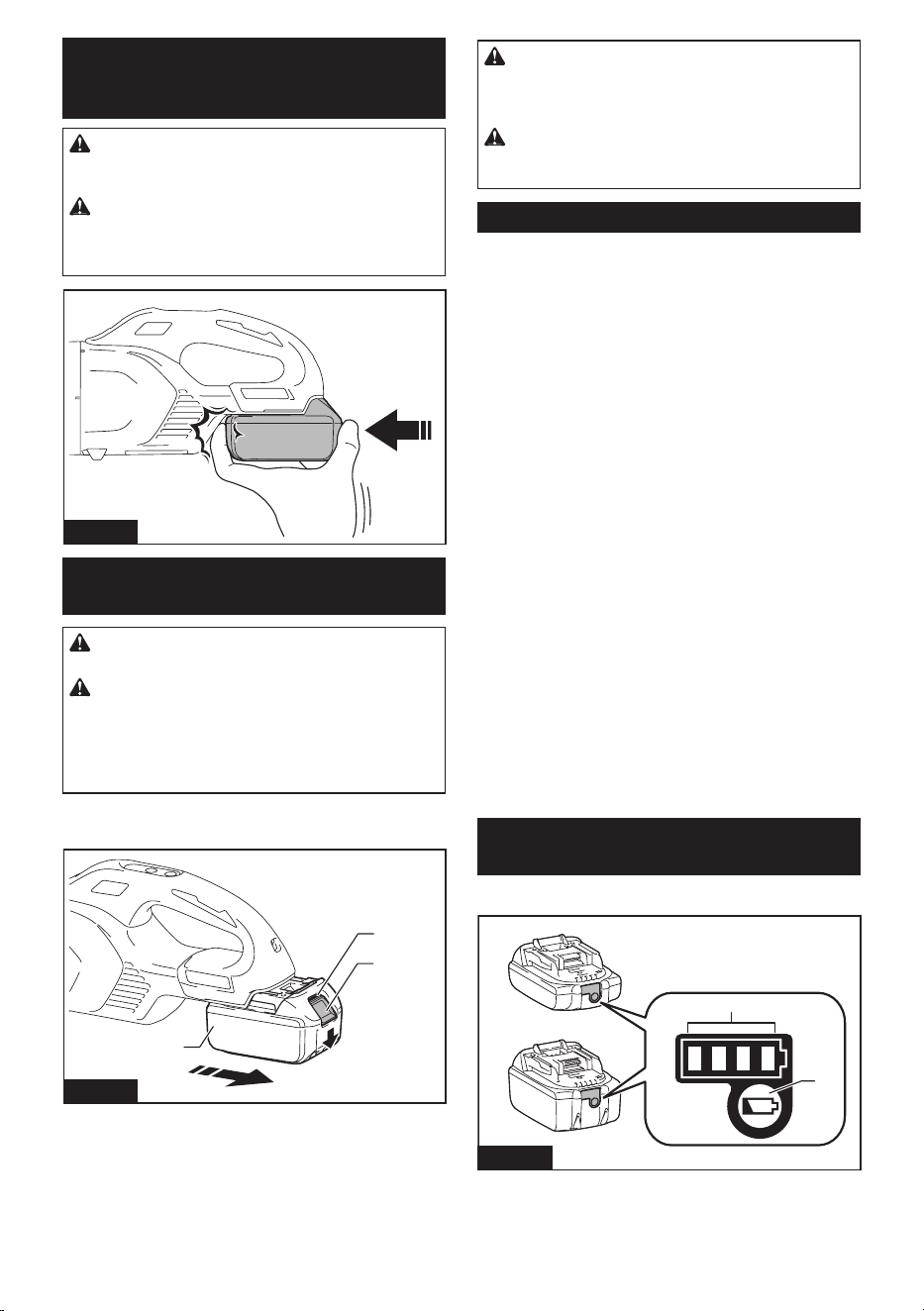
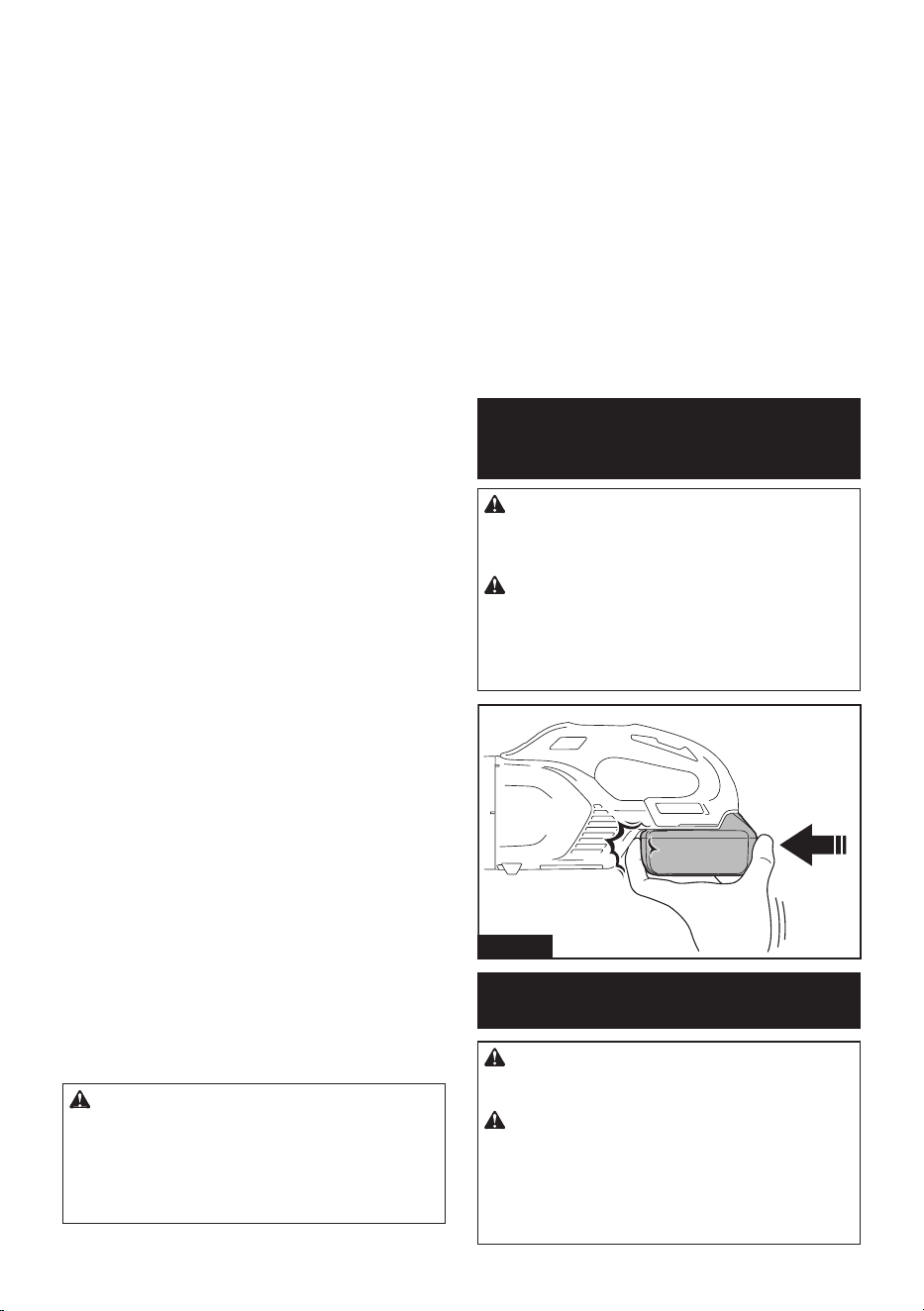
CAUTION: Take care not to trap nger(s)
between cleaner and battery as shown in diagram
when loading battery. Trappingnger(s)maycause
injury.
Fig.1
Installing or removing battery
cartridge
CAUTION: Always switch o the tool before
installing or removing of the battery cartridge.
CAUTION: Hold the tool and the battery car-
tridge rmly when installing or removing battery
cartridge. Failure to hold the tool and the battery
cartridgermlymaycausethemtoslipoyourhands
and result in damage to the tool and battery cartridge
andapersonalinjury.
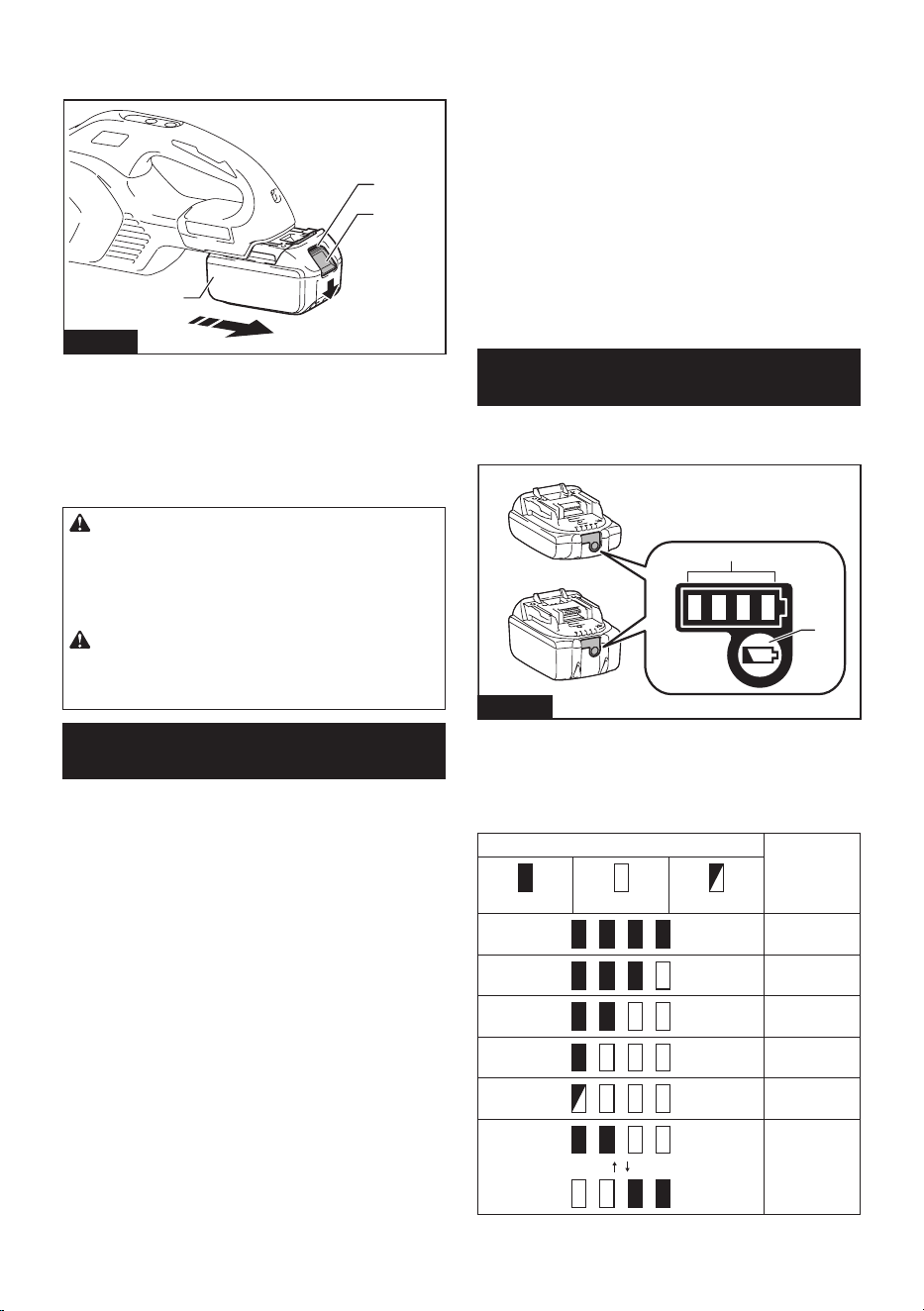
To remove the battery cartridge, slide it from the tool
while sliding the button on the front of the cartridge.
1
2
3
Fig.2
►1. Red indicator 2. Button 3. Battery cartridge
To install the battery cartridge, align the tongue on the
battery cartridge with the groove in the housing and slip
it into place. Insert it all the way until it locks in place
with a little click. If you can see the red indicator as
showninthegure,itisnotlockedcompletely.
CAUTION: Always install the battery cartridge
fully until the red indicator cannot be seen. If not,
itmayaccidentallyfalloutofthetool,causinginjuryto
you or someone around you.
CAUTION: Do not install the battery cartridge
forcibly. If the cartridge does not slide in easily, it is
not being inserted correctly.
Tool / battery protection system
The tool is equipped with tool/battery protection system.
Thissystemautomaticallycutsopowertothemotorto
extend tool and battery life. The tool will automatically
stop during operation if the tool or battery is placed
under one of the following conditions.
Overloaded:
The tool/battery is operated in a manner that causes it
to draw an abnormally high current.
Inthissituation,turnthetooloandstoptheapplication
that caused the tool to become overloaded. Then turn
the tool on to restart.
Overheated:
The tool/battery is overheated. In this situation, let the
tool/battery cool before turning the tool on again.
Low battery voltage:
The remaining battery capacity is too low and the tool will not
operate. In this situation, remove and recharge the battery.
Protections against other causes:
Protection system is also designed for other causes
that could damage the tool and allows the tool to stop
automatically. Take all the following steps to clear the
causes, when the tool has been brought to a temporary
halt or stop in operation.
1.
Turnthetoolo,andthenturnitonagaintorestart.
2. Charge the battery(ies) or replace it/them with
recharged battery(ies).
3. Let the tool and battery(ies) cool down.
If no improvement can be found by restoring protection
system, then contact your local Makita Service Center.
Indicating the remaining battery
capacity
Only for battery cartridges with the indicator
1
2
Fig.3
►1. Indicator lamps 2. Check button
Press the check button on the battery cartridge to indi-
cate the remaining battery capacity. The indicator lamps
light up for a few seconds.
7 ENGLISH
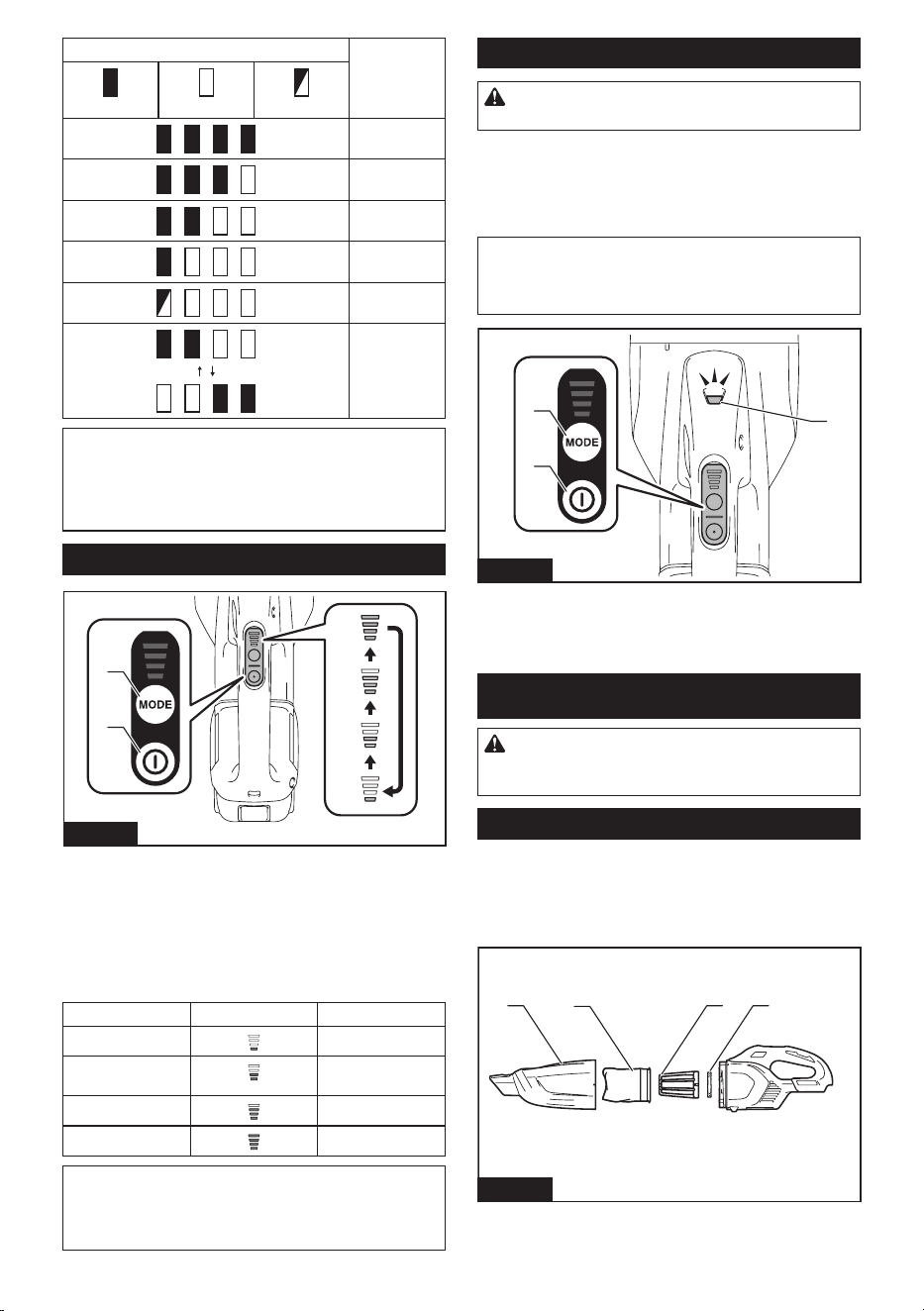
Indicator lamps Remaining
capacity
Lighted O Blinking
75% to 100%
50% to 75%
25% to 50%
0% to 25%
Charge the
battery.
The battery
may have
malfunctioned.
NOTE: Depending on the conditions of use and the
ambienttemperature,theindicationmaydierslightly
from the actual capacity.
NOTE:Therst(farleft)indicatorlampwillblinkwhen
the battery protection system works.
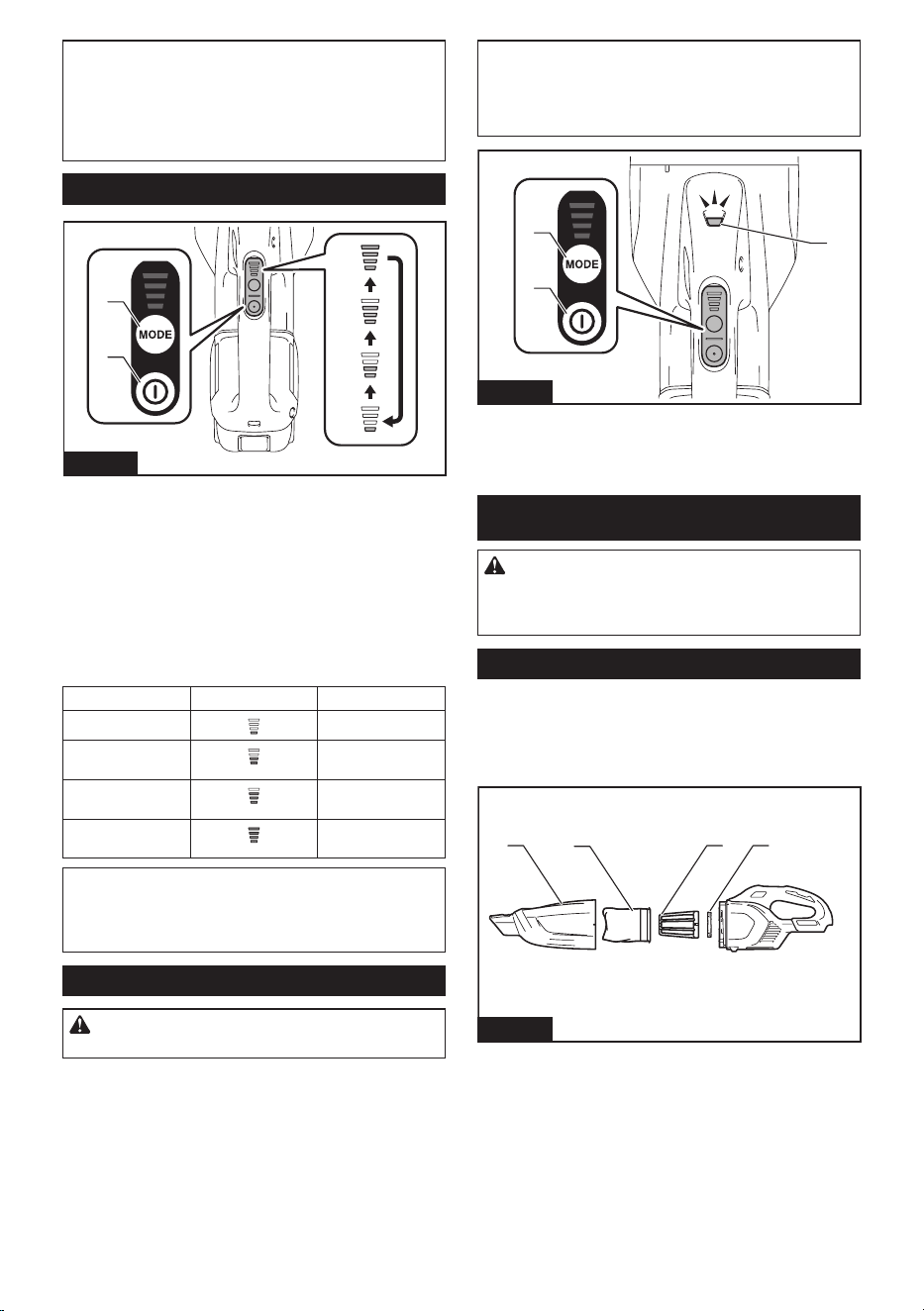
Switch action
1
2
Fig.4
►1. Suction power change button 2. ON/OFF button
To start the cleaner, simply push the ON/OFF button. To
switcho,pushtheON/OFFbuttonagain.
You can change the suction power of the cleaner in
four steps by pushing the suction power change button.
Each push on this button repeats the Quiet/Normal/
High/Max mode in a cycle.
Level Indication Mode
1
Quiet mode
2
Normal speed
mode
3
High speed mode
4
Max speed mode
NOTE: You can change the suction power before
turning on the cleaner.
NOTE: The cleaner starts the operation with the
same suction power as the last operation.
Lighting up the lamp
CAUTION: Do not look in the light or see the
source of light directly.
To turn on the lamp, push the suction power change
button.Thelampgoesoinapproximately10seconds.
While the cleaner is running, the lamp turns on.
The lamp goes out approximately 10 seconds after
stopping operation.
NOTE: When the remaining battery capacity gets low,
the lamp starts blinking. The timing, at which the lamp
starts blinking depends on the temperature at work
place and the battery cartridge conditions.
1
2
3
Fig.5
►1. Suction power change button 2. ON/OFF button
3. Lamp
ASSEMBLY
CAUTION: Always be sure that the tool is
switched o and the battery cartridge is removed
before carrying out any work on the tool.
Parts description
Optional accessory
High performance lter and stay and
sponge lter
1
34
2
Fig.6
►1. Capsule 2.Highperformancelter3. Stay
4.Spongelter
8 ENGLISH
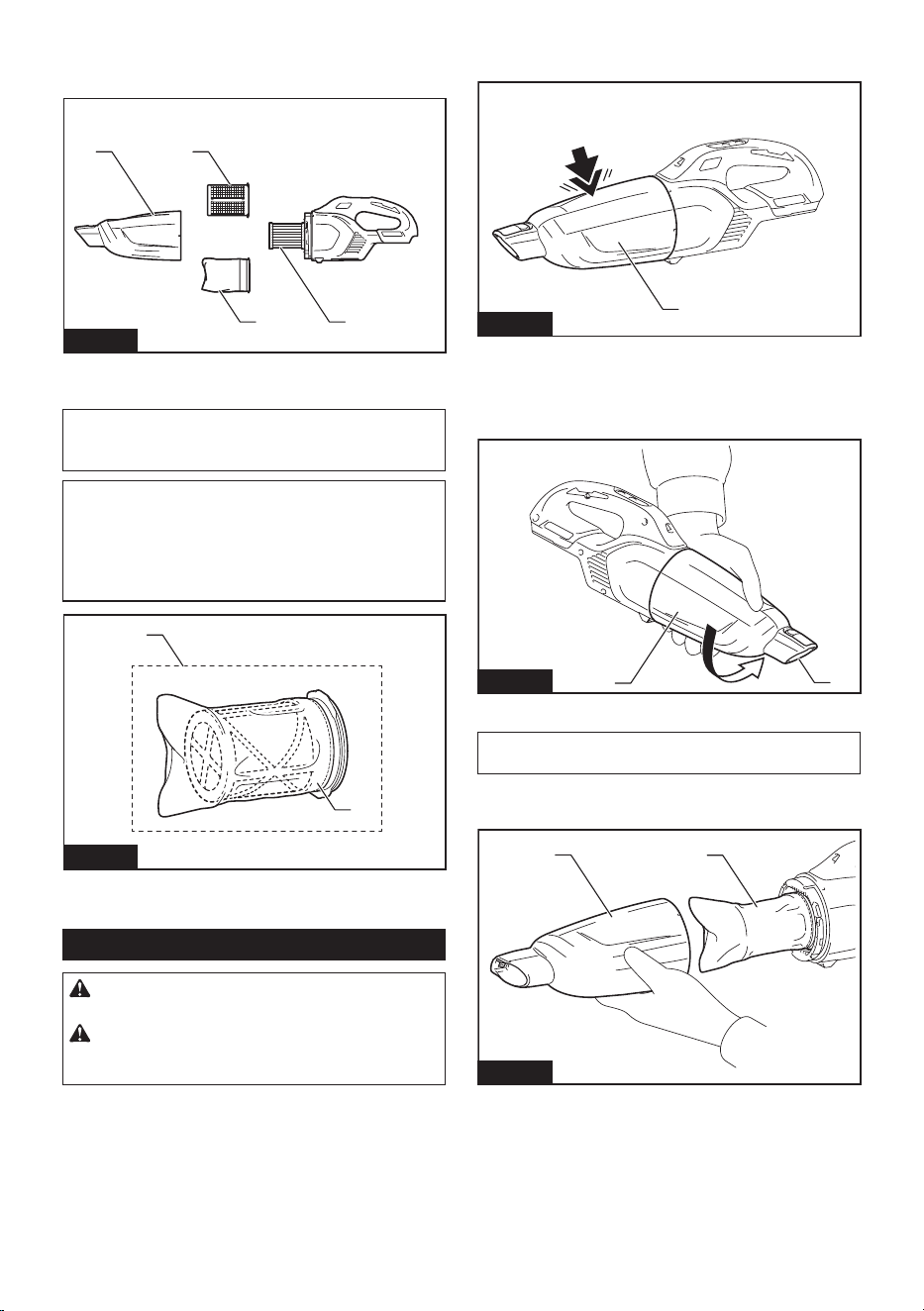
Prelter or high performance lter
and HEPA lter
12
3
4
Fig.7
►1. Capsule 2.Prelter3.Highperformancelter
4.HEPAlter
NOTICE: Do not underlay the high performance
lter with an optional lter (non-woven cloth). The
lterscouldnotberemovedfromthecleaner.
NOTE:Donotinstallanoptionallter(non-woven
cloth)betweentheHEPAlterandprelter.Thesuc-
tion power may be reduced.
NOTE:Alwaysusethehighperformancelterthatis
framed with an originally-designed stay when overlay-
ingitontheHEPAlter.
2
1
Fig.8
►1.Highperformancelter2. Stay (designed for high
performancelter)
Disposing of dust
CAUTION: Empty the cleaner before it
becomes too full, or the suction force weakens.
CAUTION: Be sure to empty the inside of the
cleaner itself of dust. Failure to do so may cause the
ltertobecloggedorthemotortobedamaged.
Inordertodropduststickingonthelterinthecapsule,
tap the capsule 4 or 5 times with your hand.
1
Fig.9
►1. Capsule
Point suction inlet downwards, turn capsule in direction
of arrow in diagram, and disconnect capsule slowly and
straight.
1
2
Fig.10
►1. Capsule 2. Suction inlet
NOTE: Dust may spill out when capsule is opened, so
be sure to set a garbage bag beneath capsule.
Remove accumulated dust from the inside of capsule
andhighperformancelter.
1
2
Fig.11
►1. Capsule 2.Highperformancelter
9 ENGLISH
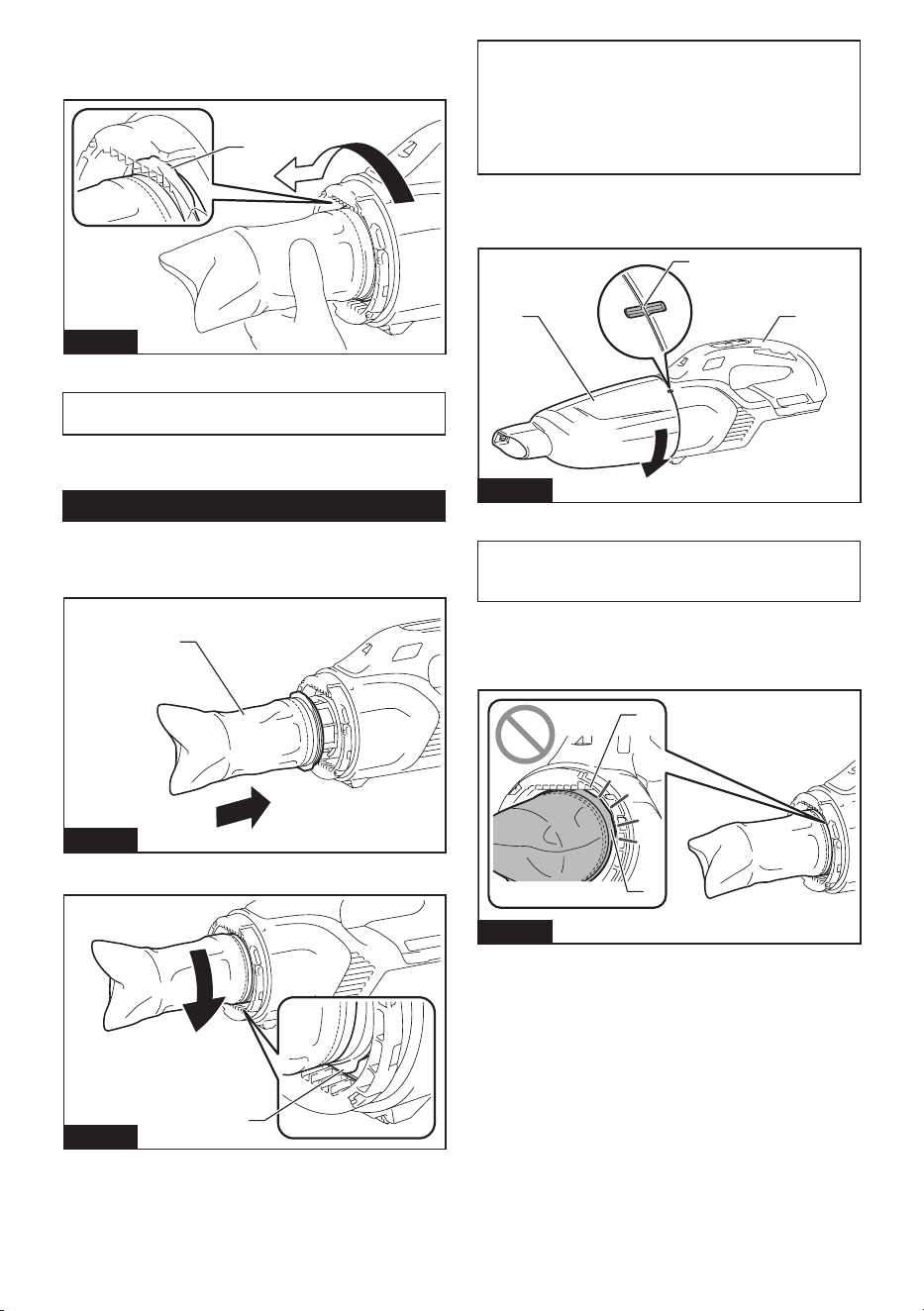
Twisthighperformancelterindirectionofarrowto
unfastensecuringlipfromcleanerunitandthenpullo
thelter.
1
Fig.12
►1. Securing lip
NOTE:Whenusingtheprelter,alsofollowthepro-
cedure above.
Cleanoutthenedustandlightlytaptodislodgedust
fromhighperformancelter.
Reassembly
Connecthighperformancelter.Atthistime,makesure
totwisthighperformanceltersothatsecuringlipis
rmlylockedintothecleanerunit.
1
Fig.13
►1.Highperformancelter
1
Fig.14
►1. Securing lip
NOTICE: Always be sure to check that high per-
formance lter is loaded correctly prior to using
cleaner. If it is not loaded correctly, dust will get into
the motor housing, and cause motor failure.
If the problem as described later occurs, high perfor-
mancelterisnotloadedcorrectly.Reloaditcorrectly
to rectify problem.
Attach the capsule. Align the mark on capsule with the
markonthehandleandthenrmlytwistcapsuleinthe
direction of arrow until it is secured.
1
2
3
Fig.15
►1. Mark 2. Handle 3. Capsule
NOTE: Always remove dust ahead of time, as suction
power will be reduced if there is too much dust in
cleaner.
Problem Example
Thesecuringlipofhighperformancelterisnotrmly
locked into groove of cleaner housing.
1
2
Fig.16
►1. Securing lip 2. Groove of cleaner housing
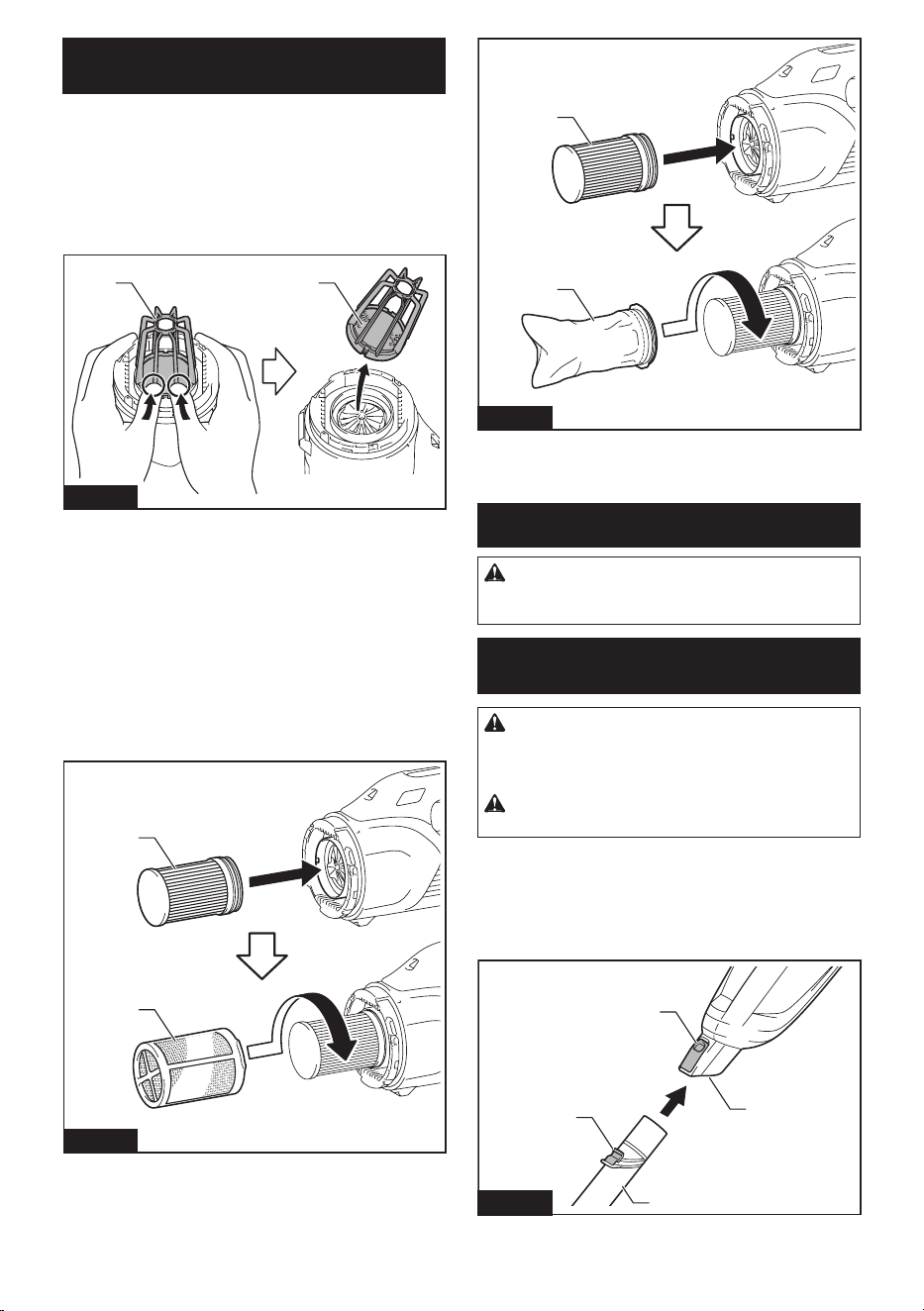
10 ENGLISH
Installing or removing stay / HEPA
lter
Optional accessory
For the stay and sponge lter
To remove the stay, push up the bottom part of pillars
ofthestaywithyourngersandreleaseitsgroovefrom
the protrusion on the cleaner. After that, remove the
spongelter.
1
2
Fig.17
►1. Stay 2.Spongelter
To install, align the grooves on the stay with the protru-
sion on the cleaner and push until it clicks.
Insertthespongelterbetweenthepillarsandsetitin
the original position.
For the HEPA lter
WheninstallingtheHEPAlter,tthegrooveofthe
HEPAlterwiththeprotrusiononthecleaner.Then,put
theprelterorthehighperformancelterontheHEPA
lterandtwistittosecure.Toremove,followtheinstal-
lation procedure in reverse.
1
2
Fig.18
►1.HEPAlter2.Prelter
1
2
Fig.19
►1.HEPAlter2.Highperformancelter
OPERATION
CAUTION:
Do not move your face close to the
air vent when operating the cleaner.Ifforeignobjects
areblownintoeyes,itmayresultinpersonalinjury.
Installing and removing cleaner
attachments
CAUTION: After installing attachments, check
if they are securely installed. If the attachments are
installedimperfectly,theymaycomeoandcause
personalinjury.
CAUTION: Be careful not to hit your hand on
the wall etc. when removing the attachments.
When using attachment with lock
function
To install attachment, insert it to the suction inlet of the cleaner
until it clicks. Make sure that the attachment is locked.
1
2
3
4
Fig.20
►1. Suction inlet 2. Attachment with lock function
3. Hook 4. Release button
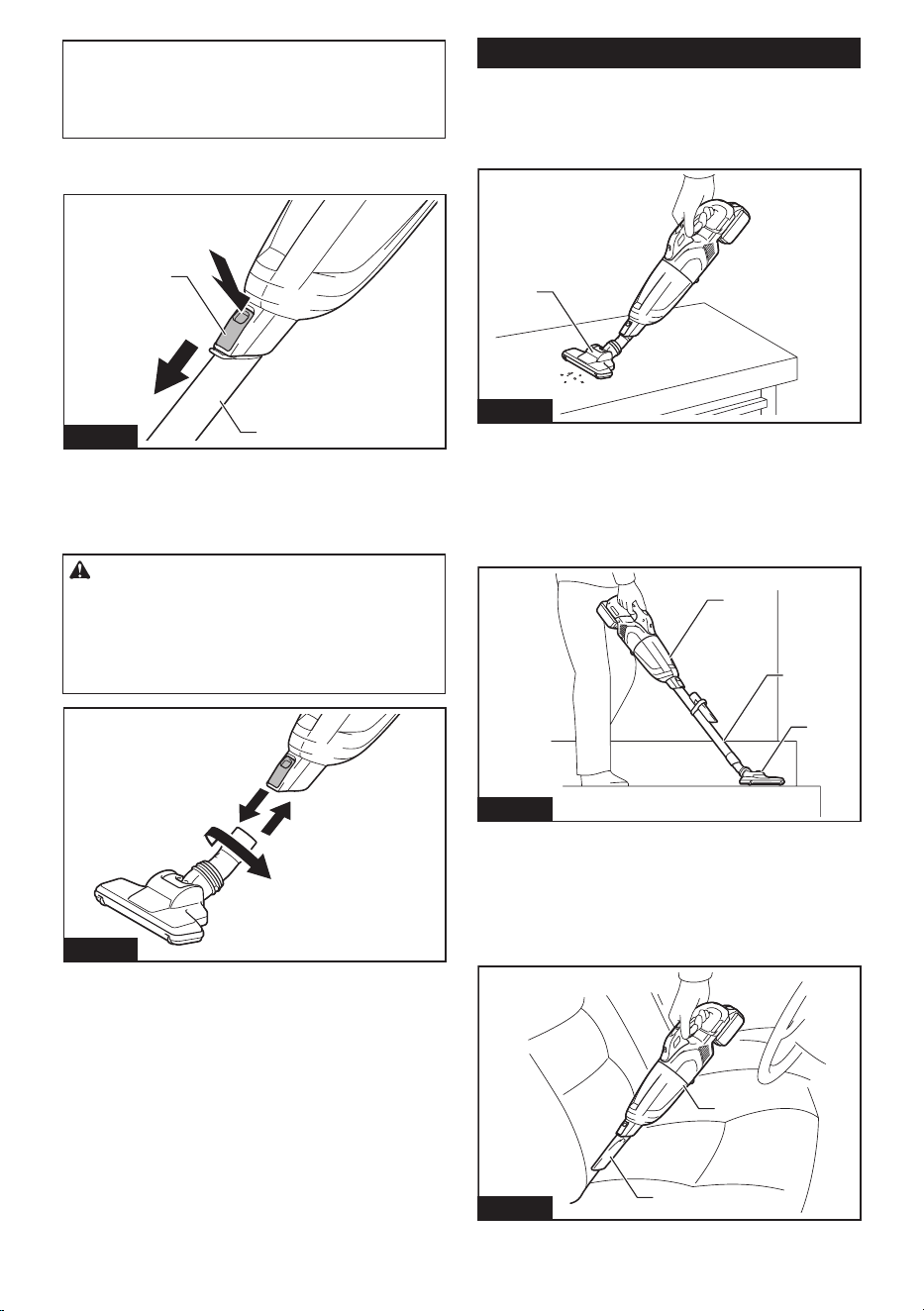
11 ENGLISH
NOTICE: When installing the attachment with
lock function, be sure to align the release button
on the cleaner with the hook on the attachment. If
they are not aligned, the attachment will not be locked
andmaycomeofromthecleaner.
To remove, pull the attachment while pushing the
release button.
1
2
Fig.21
►1. Release button 2. Attachment with lock function
When using attachment without lock
function
CAUTION: To connect attachment without
lock function, twist and insert it in direction of
the arrow to secure the connection during use.
To disconnect the attachment, twist and extract
it also in direction of the arrow. If the attachment
is twisted in the opposite direction, the capsule may
become loose.
Fig.22
Cleaning (Suction)
Nozzle
Attachthenozzletocleanotables,desks,furniture,
etc. The nozzle slips on easily.
1
Fig.23
►1. Nozzle
Nozzle + Extension wand (Straight pipe)
Theextensionwandtsinbetweenthenozzleandthe
cleaner itself. This arrangement is convenient for clean-
ingaoorinastandingposition.
1
2
3
Fig.24
►1. Cleaner body 2. Extension wand (Straight pipe)
3. Nozzle
Sash nozzle
Fit on the sash nozzle for cleaning corners and crevices
of a car or furniture.
1
2
Fig.25
►1. Sash nozzle 2. Cleaner body
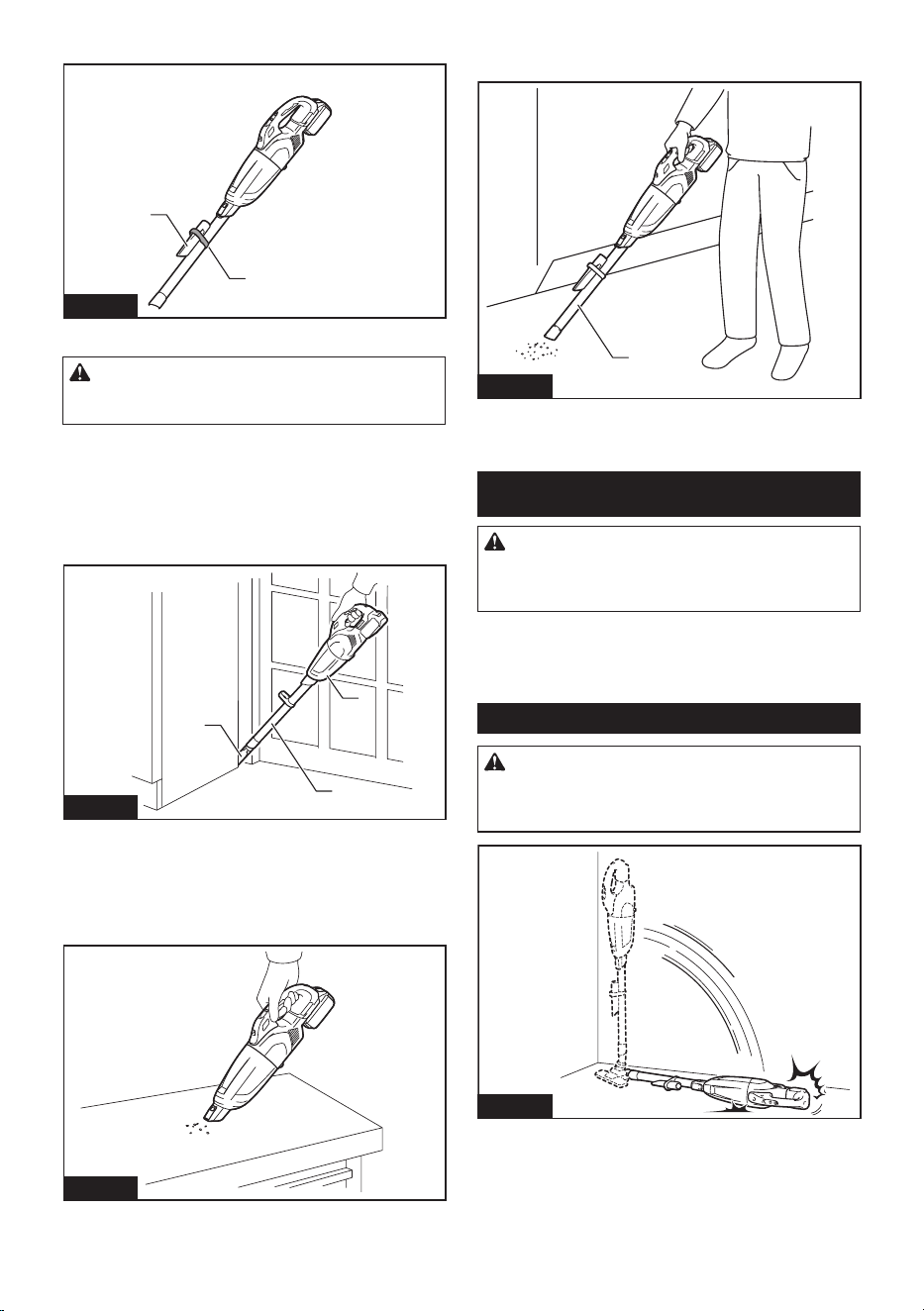
12 ENGLISH
You can store the sash nozzle in the nozzle holder.
1
2
Fig.26
►1. Nozzle holder 2. Sash nozzle
CAUTION: Be careful not to trap nger(s)
between the sash nozzle and the nozzle holder.
Trappingnger(s)maycauseinjury.
Sash nozzle + Extension wand
(Straight pipe)
In tight quarters where the cleaner itself cannot
squeeze in, or in high places hard to reach, use this
arrangement.
1
2
3
Fig.27
►1. Sash nozzle 2. Extension wand (Straight pipe)
3. Cleaner body
Cleaning without nozzle
You can pick up powder and dust without nozzle.
Fig.28
Forpickingupdustonaoorinastandingposition,itis
convenient to attach the extension wand to the cleaner.
1
Fig.29
►1. Extension wand (Straight pipe)
MAINTENANCE
CAUTION: Always be sure that the tool is
switched o and the battery cartridge is removed
before attempting to perform inspection or
maintenance.
To maintain product SAFETY and RELIABILITY,
repairs,anyothermaintenanceoradjustmentshould
be performed by Makita Authorized or Factory Service
Centers, always using Makita replacement parts.
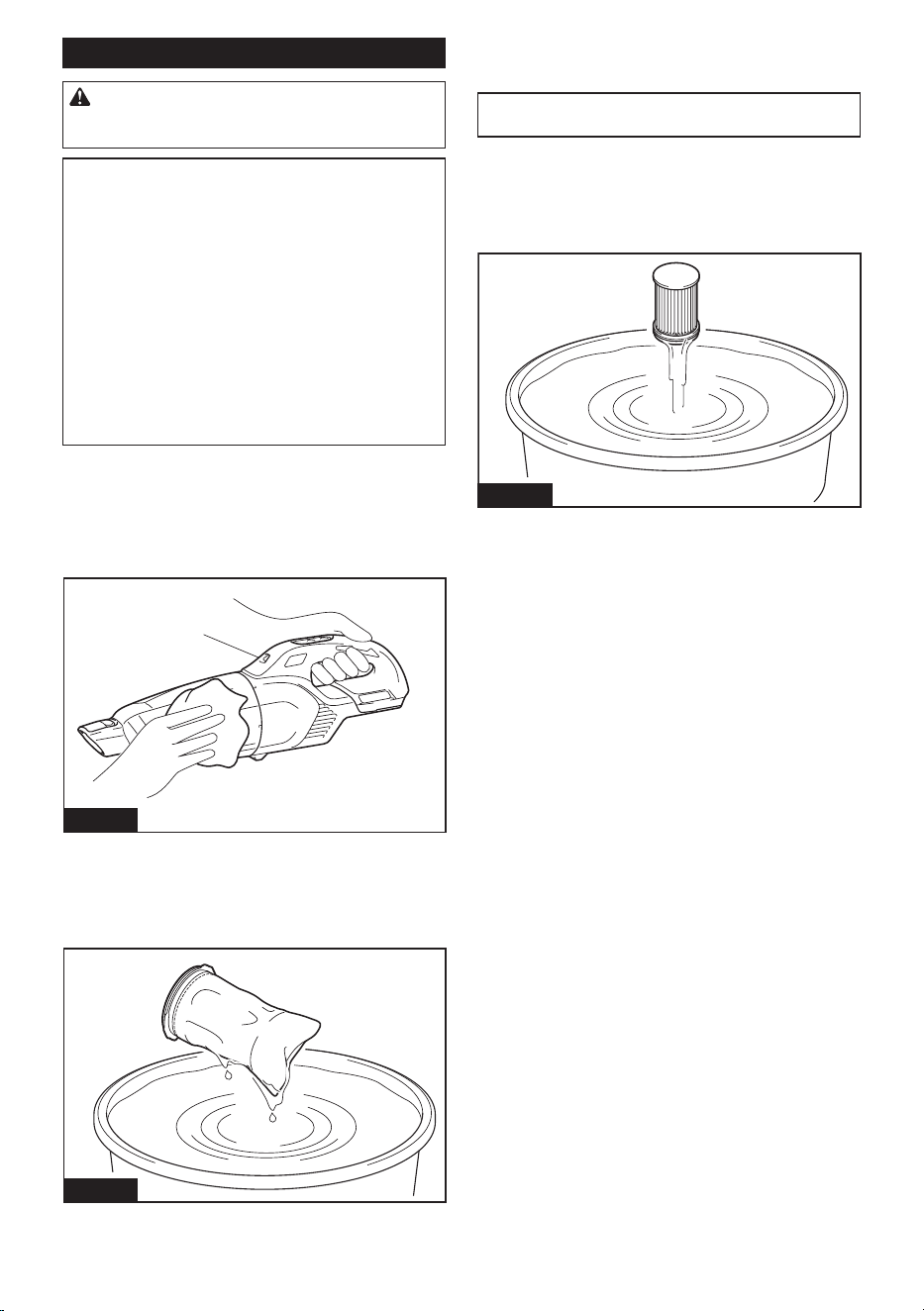
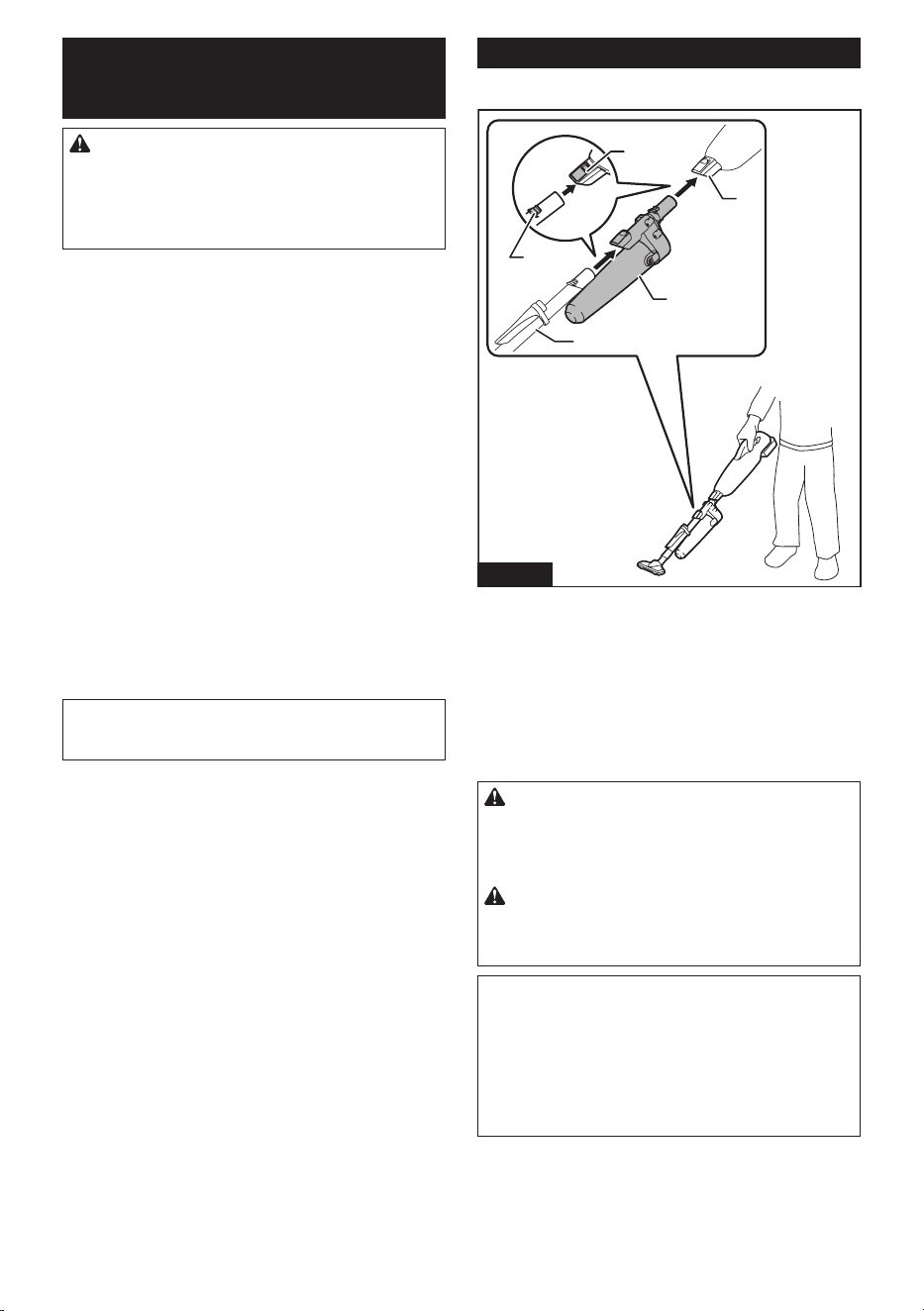
After use
CAUTION: Putting the cleaner against the
wall without any other support may cause the
cleaner to fall down, resulting in personal injury
or damage to the cleaner.
Fig.30
13 ENGLISH
Cleaning
CAUTION: Clean lters when they become
clogged. Continuing use in the clogged condition
mayresultinheatingorre.
NOTICE: Never use gasoline, benzine, thinner,
alcohol or the like. Discoloration, deformation or
cracks may result.
NOTICE: Do not blow dust sticking on the
cleaner and lters by air duster. It brings dust into
the housing and causes failure.
NOTICE: After washing lters, dry them thor-
oughly before use.Insucientlydriedltersmay
cause poor suction and shorten the service life of the
motor.
NOTICE: After cleaning lters and sponge lter,
be sure to re-install them before use. If you use the
cleanerwithoutltersandspongelter,dustcomes
into the motor housing and cause malfunction.
Cleaner body
Fromtimetotimewipeotheoutside(cleanerbody)of
the cleaner using a cloth dampened in soapy water.
Cleanoutalsothesuctionopeningandltermounting
area.
Fig.31
High performance lter
Washthelterinsoapywaterwhenitiscloggedwith
dust and the cleaner power becomes weak. Dry it out
thoroughly before use.
Fig.32
HEPA lter
Optional accessory
NOTICE: Do not rub or scratch the HEPA lter
with hard objects such as a brush and a paddle.
CloggedHEPAltercausespoorsuctionperformance.
Cleanoutthelterfromtimetotime.
OccasionallywashtheHEPAlterinwater,rinseand
dry thoroughly in the shade before use. Never wash the
lterinawashingmachine.
Fig.33
Sponge lter
Whenthespongelterbecomesdirty,cleanitas
follows.
1. Removeltersthatcoverthestay.
2. Pulloutthespongelterfrombetweenthepillars.
3. Cleanthespongelterbytappingorwashing.If
you wash it, dry it out thoroughly before use.
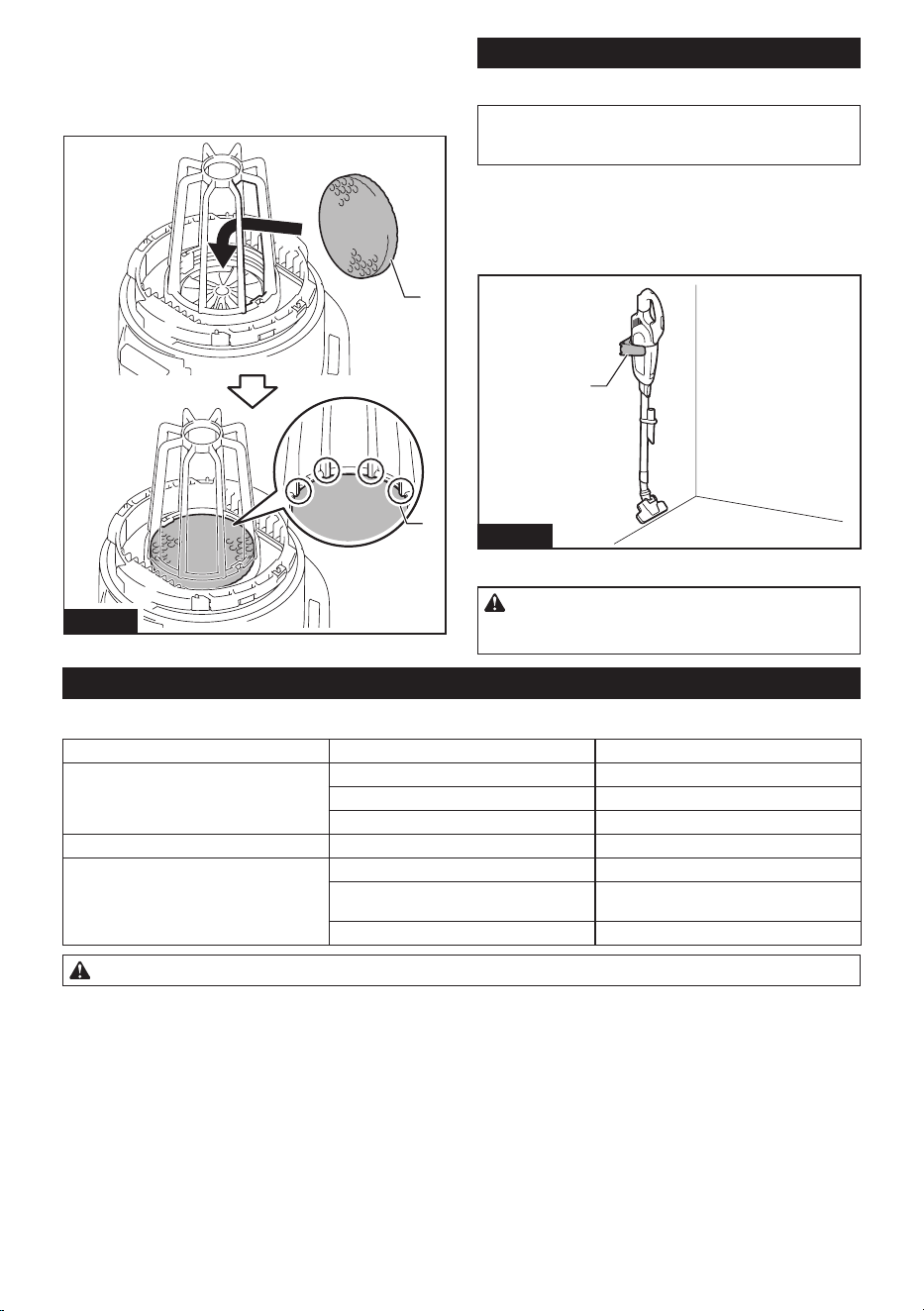
14 ENGLISH
4. Insertthespongelterbetweenthepillarsandset
it in the original position. Make sure that each bottom
edgeofthepillarholdsdownthespongelter,and
thereisnogapbetweenthespongelterandsuction
opening.
1
2
Fig.34
►1.Spongelter2. Bottom edge of pillar
Wall mount for cordless cleaner
Optional accessory
NOTE: The screw to mount the holder is not included.
Prepareascrewwhichtswiththematerialtoscrew
into.
Attach the wall mount for cordless cleaner to a hard
wooden wall, beam or column, where the wall mount
forcordlesscleanercanbermlysecured.Alwaysbe
sure that the wall mount for cordless cleaner is securely
attached before hanging the cleaner.
1
Fig.35
►1. Wall mount for cordless cleaner
CAUTION: Do not hang the cleaner to the wall
mount violently or hang other appliances than the
cleaner.
Troubleshooting
Before asking for repairs, check the following points.
Symptom Area to be investigated Fixing method
Weak suction power Is the capsule full of dust? Empty the capsule of dust.
Isthelterclogged? Cleanorwashthelter.
Is the battery cartridge discharged? Charge the battery cartridge.
Not working Is the battery cartridge discharged? Charge the battery cartridge.
Noise and vibration Isthelterclogged? Cleanorwashthelter.
Is the nozzle, pipe or suction inlet of the
appliance is clogged?
Removethecloggedobjectsinthenozzle,
pipe or suction inlet of the appliance.
Is the nozzle/pipe inlet blocked? Do not block the nozzle/pipe inlet.
CAUTION: Do not attempt to repair the cleaner by yourself.
15 ENGLISH
OPTIONAL
ACCESSORIES
CAUTION: These accessories or attachments
are recommended for use with your Makita tool
specied in this manual. The use of any other
accessories or attachments might present a risk of
injurytopersons.Onlyuseaccessoryorattachment
for its stated purpose.
If you need any assistance for more details regard-
ing these accessories, ask your local Makita Service
Center.
• Extension wand (Straight pipe)
• Nozzle
• Nozzle for carpet
• Shelf brush
• Sash nozzle
• Round brush
• Flexible hose
• Filter (non-woven cloth)
• Prelter
• Highperformancelter
• HEPAlter
• Seat nozzle
• Crevice nozzle
• Wall mount for cordless cleaner
• Cyclone unit
• Cyclone attachment
• Tool bag
• Makita genuine battery and charger
NOTE: Some items in the list may be included in the
tool package as standard accessories. They may
dierfromcountrytocountry.
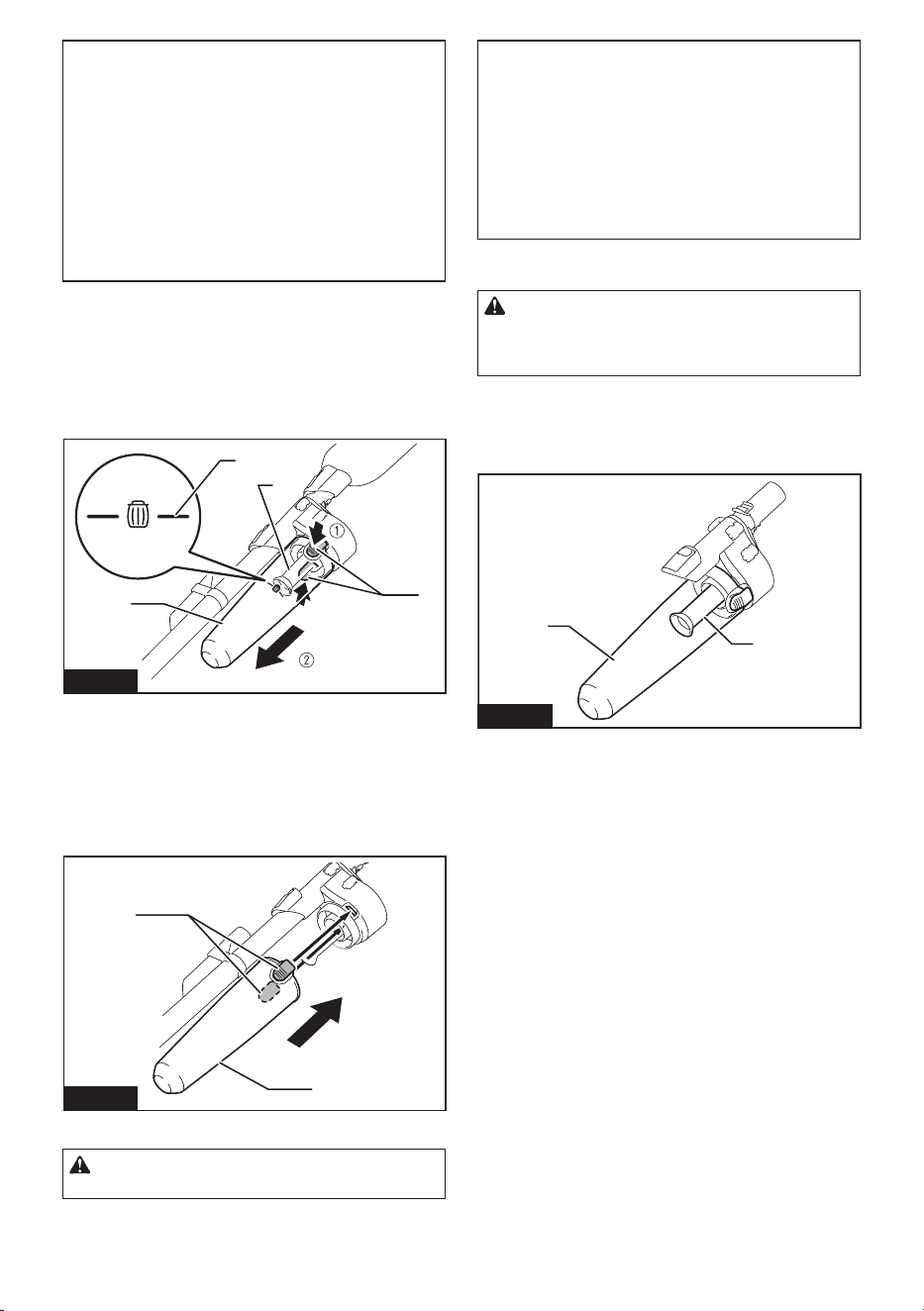
Cyclone attachment
Optional accessory
3
4
1
2
5
Fig.36
►1. Release button 2. Hook 3. Extension wand
(Straight pipe) 4. Cyclone attachment 5. Suction
inlet
About the cyclone attachment
Using the cleaner with the cyclone attachment installed
reduces the amount of dust that enters the capsule,
which helps to prevent the suction force from weaken-
ing. In addition, cleaning after use is also simple.
CAUTION: Always be sure that the tool is
switched o and the battery cartridge is removed
before carrying out any work on the tool. If the
battery cartridge is left inserted, the cleaner may start
unexpectedlyandresultininjury.
CAUTION: Clean the mesh lter of the
cyclone attachment and the lters of the cleaner
unit when they become clogged. Continuing use in
the clogged condition may result in heating or smoke.
NOTICE: When the cyclone attachment is
attached, do not use the cleaner in a horizontal
or upward facing position. Doing so may cause the
meshltertobecomeclogged.
NOTICE: Always use the cleaner with the lters
installed, even when using the cyclone attach-
ment.Usingthecleanerwithouttheltersinstalled
may result in a motor malfunction.
16 ENGLISH
NOTE: Check that the cyclone attachment, cleaner,
and extension wand (straight pipe) are locked prop-
erly before use.
NOTE: Empty the dust case of the cyclone attach-
ment and the capsule of the cleaner when dust has
accumulated. Continuing use will result in weakened
suction force.
NOTE: You can also use the cyclone attachment with-
out lock function.
NOTE: To install or remove the cyclone attachment,
refer to the section "Installing and removing cleaner
attachments".
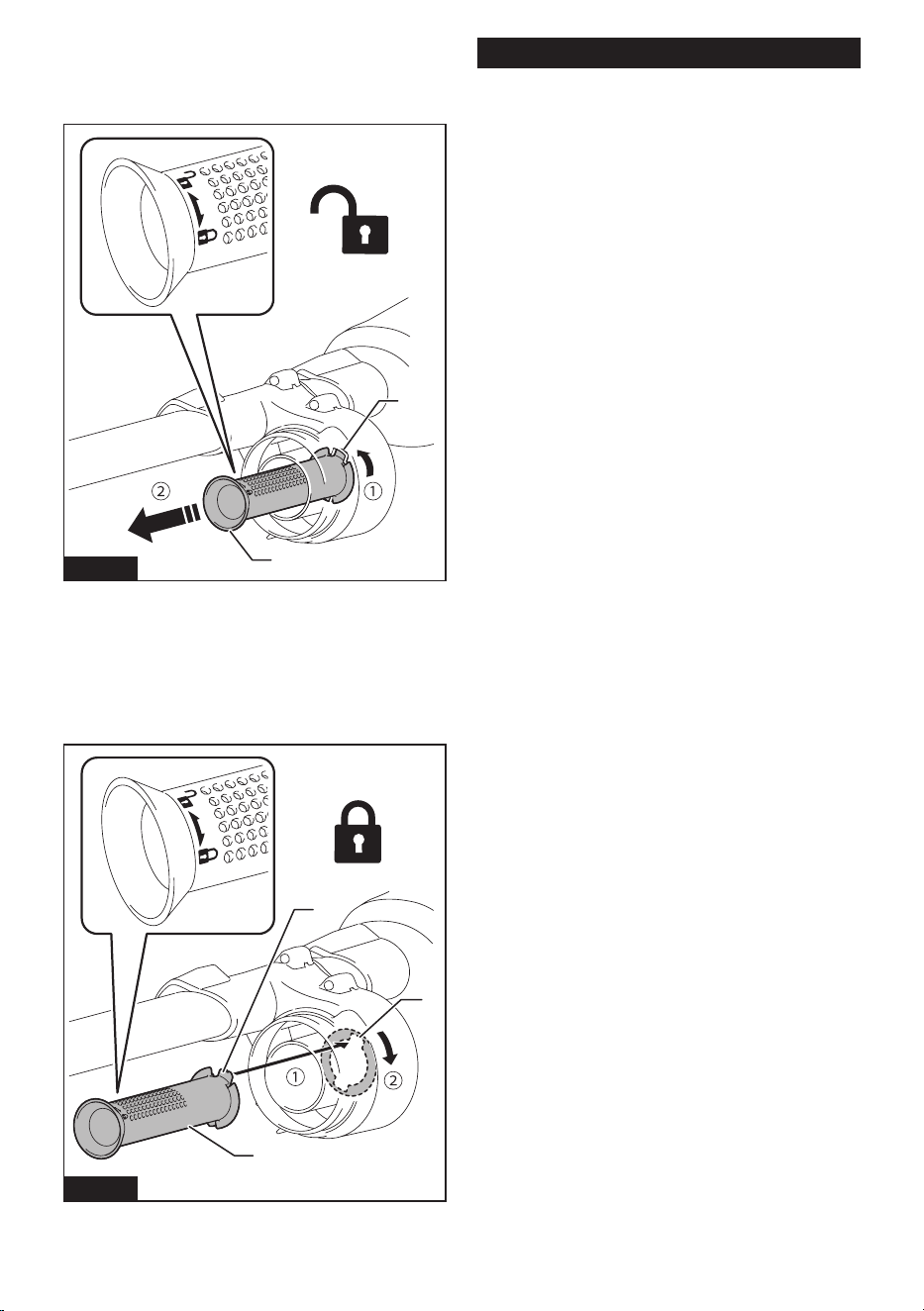
Disposing of dust
When dust has accumulated up to the full line of the
dust case, follow the procedure below and dispose of
the dust.
1. Holdthedustcasermly,pressandholdthetwo
buttons, and remove the dust case.
2
3
1
4
Fig.37
►1. Full line 2. Dust case 3. Button (two locations)
4.Meshlter
2. Dispose of the dust inside the dust case and
remove any dust and powder adhered to the surface of
themeshlter.
3. Insert the dust case all the way until the two but-
tons lock with a click.
2
1
Fig.38
►1. Dust case 2. Button (two locations)
CAUTION: When reassembling the dust case,
be careful not to pinch your ngers.
NOTE: Check that the cyclone attachment, cleaner,
and extension wand (straight pipe) are locked prop-
erly before restarting operation.
NOTE: If the suction force does not recover even
after disposing of the dust and cleaning the mesh
lter,checkwhetherdusthasaccumulatedinthe
capsule of the cleaner or clogging has occurred.
NOTE:Thedustmayyupwhendisposingfromthe
cyclone attachment. Be careful not to let dust get into
your eyes.
Cleaning
CAUTION: After washing the cyclone attach-
ment, dry it thoroughly before use.Insuciently
dried components may cause an electrical shock or
damage to the appliance.
Whenthedustcasebecomesdirtyorthemeshlteris
clogged, remove and wash them with water. (Refer to
“Disposing of dust” for the removal procedure.)
Dry the parts thoroughly before reinstallation and use.
2
1
Fig.39
►1. Dust case 2.Meshlter
17 ENGLISH
Whenthemeshltergetsdirtybadly,cleanitinthe
following procedures.
1. Turnthemeshlterinthedirectionofthearrow
and remove it while the hooks are unlocked.
1
2
Fig.40
►1.Meshlter2. Hook
2. Removethedustonthemeshlterandthenwash
it with water. After that, dry it thoroughly.
3. Insertthemeshlterintothebasewhilethehooks
arealignedwiththeport.Turnthemeshlterinthe
direction of the arrow until the hooks are locked with a
click.Makesurethatthemeshlterisinstalledsecurely.
1
2
3
Fig.41
►1.Meshlter2. Hook 3. Port
MAKITA LIMITED WARRANTY
Please refer to the annexed warranty sheet for the
most current warranty terms applicable to this product.
If annexed warranty sheet is not available, refer to the
warranty details set forth at below website for your
respective country.
United States of America: www.makitatools.com
Canada: www.makita.ca
Other countries: www.makita.com
18 ESPAÑOL
ESPAÑOL (Instrucciones originales)
ESPECIFICACIONES
Modelo: XLC09
Capacidad 730 ml
Uso continuo
(con batería BL1830B)
1 (Modo silencioso) Aprox. 38 min
2 (Modo velocidad normal) Aprox. 21 min
3 (Modo velocidad alta) Aprox. 15 min
4 (Modo velocidad máxima) Aprox. 8 min
Longitud total (con tubo, boquilla y batería BL1830B) 1 066 mm (42")
Tensión nominal 18 V c.c.
Peso neto 1,3 kg - 1,7 kg (2,9 lbs - 3,7 lbs)
• Debidoanuestrocontinuoprogramadeinvestigaciónydesarrollo,lasespecicacionesaquíincluidasestán
sujetasacambiosinprevioaviso.
• Lasespecicacionespuedenvariardepaísapaís.
• El peso incluye el o los cartuchos de batería, pero no los accesorios. La combinación de menor y mayor peso
del aparato y del o los cartuchos de batería se muestra en la tabla.
Cartucho de batería y cargador aplicables
Cartucho de batería BL1815N / BL1820B / BL1830B / BL1840B / BL1850B / BL1860B
Cargador DC18RC / DC18RD / DC18RE / DC18SD / DC18SE / DC18SF /
DC18SH / DC18WC
• Algunos de los cartuchos de batería y cargadores enumerados arriba podrían no estar disponibles depen-
diendo de su área de residencia.
ADVERTENCIA: Use únicamente los cartuchos de batería y los cargadores indicados arriba. El uso de
cualquier otro cartucho de batería y cargador podría ocasionar una lesión y/o un incendio.
ADVERTENCIAS DE
SEGURIDAD
INSTRUCCIONES
IMPORTANTES DE
SEGURIDAD
Al usar cualquier aparato eléctrico,
siempre deben seguirse las precaucio-
nes básicas, incluyendo las siguientes:
GUARDE ESTAS
INSTRUCCIONES.
ADVERTENCIA
Para reducir el riesgo de incendio, des-
carga eléctrica o lesión:
1. No deje el aparato con la batería
puesta. Retire la batería del aparato
cuando no lo vaya a utilizar y antes
de dar servicio de mantenimiento.
2. No lo utilice sobre supercies
húmedas. No lo exponga a la lluvia.
Almacénelo en interiores.
3. No permita que sea utilizado como
un juguete. Supervise de cerca
cuando lo utilicen niños o se utilice
cerca de ellos.
4. Utilícelo solamente como se des-
cribe en este manual. Sólo use
aditamentos recomendados por el
fabricante.

19 ESPAÑOL
5.
No lo utilice con una batería dañada.
Si el aparato no está funcionando
como debiera, se ha dejado caer, se
ha dañado, se ha dejado a la intem-
perie o ha caído sobre agua, llévelo
a un centro de servicio.
6. No manipule el aparato con las
manos mojadas.
7.
No introduzca ningún objeto en las aber-
turas. No lo utilice con ninguna abertura
bloqueada; manténgalo libre de polvo,
pelusa, cabello y cualquier objeto que
pueda reducir el ujo de aire.
8.
Mantenga el cabello, la ropa holgada,
los dedos y todas las partes del cuerpo
lejos de las aberturas y piezas móviles.
9. Apague todos los controles antes
de retirar el cartucho de batería.
10. Tenga especial cuidado cuando lim-
pie en escaleras.
11. No lo utilice para recoger líquidos
inamables o combustibles, tal
como gasolina, ni en áreas donde
puedan estar presentes.
12.
No recoja nada que se esté que-
mando o desprenda humo, tal como
cigarros, fósforos o cenizas calientes.
13.
No lo utilice sin la bolsa recolectora de
polvo y/o los ltros colocados en su lugar.
14. No cargue la batería en exteriores.
15. Evite una puesta en marcha acci-
dental. Asegúrese de que el inte-
rruptor esté en la posición apagada
antes de conectar el paquete de
baterías, levantar el aparato o car-
garlo. Cargar el aparato con su dedo
en el interruptor o pasar energía al
aparato con el interruptor encendido
puedo propiciar accidentes.
16.
Desconecte el paquete de baterías
del aparato antes de hacer cualquier
ajuste, cambiar accesorios o almacenar
el aparato. Estas medidas de seguridad
preventivas reducen el riesgo de poner en
marcha el aparato accidentalmente.
17. Recargue sólo con el cargador
especicado por el fabricante. Un
cargador que es adecuado para un
solo tipo de paquete de baterías puede
generar riesgo de incendio al ser utili-
zado con otro paquete de baterías.
18.
Use los aparatos únicamente con
los paquetes de baterías designados
especícamente para ellos. El uso
de otros paquetes de baterías puede
generar riesgo de lesiones e incendio.
19.
Cuando no se esté usando el paquete
de baterías, guárdelo lejos de otros
objetos metálicos tales como suje-
tapapeles (clips), monedas, llaves,
clavos, tornillos u otros objetos metá-
licos pequeños que puedan crear
una conexión entre una terminal y
otra. Ocasionar un cortocircuito en las
terminales de la batería puede provocar
quemaduras o incendios.
20. En condiciones de mal uso, podría
escapar líquido de la batería; evite
tocarlo. Si lo toca accidentalmente,
enjuague con agua. Si el líquido
entra en contacto con los ojos,
solicite adicionalmente atención
médica. El líquido expulsado de la
batería puede causar irritación o
quemaduras.
21. No utilice un paquete de baterías
o aparato que esté dañado o haya
sido modicado. Las baterías daña-
das o modicadas podrían com-
portarse de manera impredecible
causando un incendio, explosión o
riesgo de lesión.
22. No exponga un paquete de baterías
o aparato al fuego o a una tempe-
ratura excesiva. La exposición al
fuego a una temperatura superior a
130 °C podría causar una explosión.
23. Siga todas las instrucciones rela-
tivas a la carga y no cargue el
paquete de baterías o el aparato
fuera del rango de temperatura
especicado en las instrucciones.
Cargar de manera inapropiada o a
temperaturas fuera del rango especi-
cadopodríadañarlabateríaeincre-
mentar el riesgo de incendio.
24. Pida que el servicio lo realice un
técnico en reparaciones calicado
y que utilice únicamente piezas de
repuesto idénticas a las originales.
Esto garantizará que se mantenga la
seguridad del producto.

20 ESPAÑOL
25.
No modique ni intente reparar el
aparato ni el paquete de baterías
salvo como se indique en las ins-
trucciones para el uso y cuidado.
GUARDE ESTAS
INSTRUCCIONES.
REGLAS DE
SEGURIDAD
ADICIONALES
Este aparato está diseñado para uso
comercial.
1. Lea cuidadosamente este manual
de instrucciones y el manual de
instrucciones del cargador antes de
usar el aparato.
2. No recoja los siguientes materiales:
— Sustancias calientes que están
ardiendo o echando humo
(cigarrillos, cerillas, palitos de
incienso, velas, cenizas calien-
tes), chispas y polvo metálico
generados por el corte o el
lijado de metales, etc.
— Líquidos inamables (quero-
seno, gasolina, disolventes
como bencina, diluyentes, etc.)
— Materiales inamables (tóner,
pinturas, aerosoles, etc.)
— Sustancias explosivas o pirofó-
ricas (nitroglicerina, aluminio,
magnesio, titanio, zinc, fósforo
rojo, fósforo amarillo, celu-
loide, etc., y su polvo, gases o
vapores)
— Líquido, aceite, suciedad
mojada o basura húmeda, inclu-
yendo vómitos y heces
— Piezas duras con bordes losos
(astillas de madera, metales,
piedras, vidrios, clavos, alle-
res, navajas o cuchillería)
— Polvo no conductor y solidi-
cante (polvo metálico o de
carbono)
— Espumas, como limpiadores de
alfombras, etc. (pueden causar
explosiones o incendios)
— Grandes cantidades de polvo
(harina, polvo de extintor de
incendios, etc.)
— Sustancias que causan sínto-
mas tóxicos
— Productos químicos agresivos
(ácidos, alcalinos, etc.)
— Polvo aglutinante no, como el
cemento
— Partículas diminutas como las
del polvo de concreto
— Desecantes
— Asbesto
— Pesticidas
Tal acción podría ocasionar un incen-
dio,lesionesodañosmateriales.
Para reducir la exposición a estas sus-
tancias químicas, siempre utilice un
equipo de protección respiratoria apro-
bado, tal como las máscaras contra
polvo que están especialmente dise-
ñadasparaltrarpartículasmicroscó-
picas. No apunte la salida de aire a la
cara y al cuerpo.
3. Detenga la operación de inmediato
si nota algo anormal.
4. Si deja caer o golpea la aspira-
dora, verique cuidadosamente
si hay grietas o daños antes de la
operación.
5. No la acerque a estufas ni a otras
fuentes de calor.
6. No obstruya el oricio de ujo
de entrada ni los oricios de
ventilación.
7. Este aparato no se destina para
utilizarse por personas (incluyendo
niños) cuyas capacidades físicas,
sensoriales o mentales sean dife-
rentes o estén reducidas o carezcan
de experiencia o de conocimiento,
a menos que dichas personas reci-
ban una supervisión o capacitación
para el funcionamiento del aparato
por una persona responsable de su
seguridad.

21 ESPAÑOL
8.
Los niños deben supervisarse para
asegurar que ellos no empleen los
aparatos como juguete.
GUARDE ESTAS
INSTRUCCIONES.
Símbolos
A continuación se muestran los símbolos
utilizados para la herramienta.
volts o voltios
corriente directa o continua
Instrucciones
importantes de
seguridad para
el cartucho de
batería
1. Antes de utilizar el cartucho de bate-
ría, lea todas las instrucciones e
indicaciones de precaución en el (1)
el cargador de batería, (2) la batería,
y (3) el producto con el que se utiliza
la batería.
2. No desarme ni modique el car-
tucho de batería. Podría ocurrir
un incendio, calor excesivo o una
explosión.
3. Si el tiempo de operación se ha
acortado en exceso, deje de ope-
rar de inmediato. Podría correrse
el riesgo de sobrecalentamiento,
posibles quemaduras e incluso
explosión.
4. En caso de que ingresen electrolitos
en sus ojos, enjuáguelos bien con
agua limpia y consulte de inmediato
a un médico. Esto podría ocasionar
pérdida de visión.
5.
Evite cortocircuitar el cartucho de batería:
(1) No toque las terminales con nin-
gún material conductor.
(2) Evite guardar el cartucho de
batería en un cajón junto con
otros objetos metálicos, tales
como clavos, monedas, etc.
(3) No exponga el cartucho de bate-
ría al agua o la lluvia.
Un cortocircuito en la batería puede
causar un ujo grande de corriente,
sobrecalentamiento, posibles quema-
duras e incluso una descompostura.
6. No guarde ni utilice la herramienta
y el cartucho de batería en lugares
donde la temperatura pueda alcan-
zar o exceder los 50 °C (122 °F).
7. Nunca incinere el cartucho de bate-
ría incluso en el caso de que esté
dañado seriamente o ya no sirva
en absoluto. El cartucho de batería
puede explotar si se tira al fuego.
8.
No clave, corte, aplaste, lance o deje
caer el cartucho de batería, ni golpee
un objeto sólido contra el cartucho de
batería. Dicha acción podría resultar en un
incendio, calor excesivo o en una explosión.
9. No use una batería dañada.
10.
Las baterías de ión de litio están
sujetas a los requisitos reglamenta-
rios en materia de bienes peligrosos.
Para el trasporte comercial, por
ej., mediante terceros o agentes
de transporte, se deben tomar en
cuenta los requisitos especiales
relativos al empaque y el etiquetado.
Para efectuar los preparativos
del artículo que se va a enviar, se
requiere consultar a un experto en
materiales peligrosos. Si es posible,
consulte además otras regulaciones
nacionales más detalladas.
Pegue o cubra con cinta adhesiva
los contactos abiertos y empaque
la batería de manera que ésta no
pueda moverse dentro del paquete.
11. Para deshacerse del cartucho de
batería, sáquelo de la herramienta y
deséchelo en un lugar seguro. Siga
las regulaciones locales relaciona-
das al desecho de las baterías.
22 ESPAÑOL
12.
Utilice las baterías únicamente con
los productos especicados por
Makita. Instalar las baterías en pro-
ductos que no cumplen con los requi-
sitos podría ocasionar un incendio, un
calentamiento excesivo, una explosión
o una fuga de electrolito.
13. Siga las regulaciones locales rela-
cionadas al desecho de las baterías.
14. El cartucho de batería podría absor-
ber calor durante y después de su
uso, lo que ocasionaría quemaduras
o quemaduras a baja temperatura.
Tenga cuidado con la manipulación
de los cartuchos de batería que
estén calientes.
15. No toque el terminal de la herra-
mienta inmediatamente después
de su uso, ya que el mismo podría
estar lo sucientemente caliente
como para provocarle quemaduras.
16. No permita que las rebabas, el polvo
o la tierra queden atrapados en los
terminales, oricios y ranuras del
cartucho de batería. Podría provocar
calentamiento, incendio, explosión y
mal funcionamiento de la herramienta
o del cartucho de batería, lo que
resultaría en quemaduras o lesiones
personales.
17. No utilice el cartucho de batería
cerca de cables eléctricos de alto
voltaje, a menos que la herramienta
sea compatible con el uso cercano a
estos cables eléctricos de alto vol-
taje. Esto podría ocasionar una avería
o descompostura de la herramienta o
del cartucho de batería.
18. Mantenga la batería alejada de los
niños.
GUARDE ESTAS
INSTRUCCIONES.
PRECAUCIÓN: Utilice únicamente baterías
originales de Makita. El uso de baterías no origina-
les de Makita, o de baterías alteradas, puede ocasio-
nar que las baterías exploten causando un incendio,
lesionespersonalesydaños.Asimismo,estoinva-
lidará la garantía de Makita para la herramienta y el
cargador Makita.
Consejos para alargar al máximo
la vida útil de la batería
1.
Cargue el cartucho de batería antes de que
se descargue completamente. Pare siempre
la operación y cargue el cartucho de batería
cuando note menos potencia en la herramienta.
2. No cargue nunca un cartucho de batería que
esté completamente cargado. La sobrecarga
acortará la vida de servicio de la batería.
3.
Cargue el cartucho de batería a una temperatura
ambiente de 10 °C - 40 °C (50 °F - 104 °F). Si un cartucho
de batería está caliente, déjelo enfriar antes de cargarlo.
4. Cuando no utilice el cartucho de batería,
sáquelo de la herramienta o del cargador.
5.
Cargue el cartucho de batería si no va a utilizarlo
durante un período prolongado (más de seis meses).
DESCRIPCIÓN DEL
FUNCIONAMIENTO
PRECAUCIÓN: Asegúrese siempre de que la
herramienta esté apagada y el cartucho de batería
haya sido extraído antes de realizar cualquier
ajuste o comprobación en la herramienta.
PRECAUCIÓN: Tenga cuidado de que su(s)
dedo(s) no quede(n) atrapado(s) entre la aspi-
radora y la batería, tal como se ilustra en el dia-
grama, al momento de colocar la batería. Si su(s)
dedo(s) quedara(n) atrapado(s) podría(n) resultar
lesionado(s).
Fig.1
Instalación o extracción del
cartucho de batería
PRECAUCIÓN: Apague siempre la herra-
mienta antes de colocar o quitar el cartucho de
batería.
PRECAUCIÓN: Sujete la herramienta y el car-
tucho de la batería con rmeza al colocar o quitar
el cartucho de batería.Sinosesujetaconrmezala
herramienta y el cartucho de batería, puede ocasio-
narqueseresbalendesusmanoscausandodaños
a la herramienta y al cartucho de batería, así como
lesiones a la persona.
23 ESPAÑOL
Para quitar el cartucho de batería, deslícelo de la herra-
mienta mientras desliza el botón sobre la parte delan-
tera del cartucho.
1
2
3
Fig.2
►1.Indicadorrojo2. Botón 3. Cartucho de batería
Para instalar el cartucho de batería, alinee la lengüeta
sobre el cartucho de batería con la ranura en la carcasa
y deslícela hasta su lugar. Insértelo por completo hasta
quesejeensulugarconunpequeñoclic.Sipuede
verelindicadorrojocomosemuestraenlailustración,
este no ha quedado asegurado por completo.
PRECAUCIÓN: Introduzca siempre com-
pletamente el cartucho de batería hasta que
el indicador rojo no pueda verse. Si no, podría
accidentalmente salirse de la herramienta y caer al
suelo causando una lesión a usted o alguien a su
alrededor.
PRECAUCIÓN: No instale el cartucho de
batería a la fuerza. Si el cartucho no se desliza al
interior fácilmente, se debe a que no está siendo
insertado correctamente.
Sistema de protección para la
herramienta/batería
La herramienta está equipada con un sistema de
protección para la herramienta/batería. Este sistema
corta automáticamente la alimentación al motor para
prolongar la vida de la herramienta y la batería. La
herramienta se detendrá automáticamente durante la
operación si la herramienta o la batería se someten a
una de las siguientes condiciones.
Sobrecarga:
La herramienta/batería se utilizan de una manera
que causa que se consuma una cantidad de corriente
inusualmente alta.
En este caso, apague la herramienta y detenga la apli-
cación que causó que la herramienta se sobrecargara.
Luego encienda la herramienta para reiniciarla.
Sobrecalentada:
La herramienta/batería se sobrecalientan. En este
caso, permita que la herramienta/batería se enfríen
antes de volver a encender la herramienta.
Bajo voltaje de la batería:
Lacapacidadrestantedelabateríaesdemasiadobaja
y la herramienta no funcionará. En este caso, extraiga
la batería y vuelva a cargarla.
Protección contra otras causas:
Elsistemadeproteccióntambiénestádiseñadopara
otrascausasquepodríandañarlaherramienta,yper-
mite que la herramienta se detenga automáticamente.
Siga todos los pasos a continuación para eliminar las
causas cuando la herramienta se haya detenido tempo-
ralmente o se haya detenido durante el funcionamiento.
1. Apague la herramienta, y luego enciéndala nueva-
mente para reiniciarla.
2. Cargue la(s) batería(s) o reemplácela(s) con
batería(s) recargada(s).
3. Dejequelaherramientayla(s)batería(s)se
enfríen.
Sinohayningunamejoraalrestaurarelsistemade
protección, comuníquese con su centro local de servi-
cio Makita.
Indicación de la capacidad restante
de la batería
Únicamente para cartuchos de batería con el
indicador
1
2
Fig.3
►1. Luces indicadoras 2.Botóndevericación
Oprimaelbotóndevericaciónenelcartuchodela
batería para que indique la capacidad restante de la
batería. Las luces indicadoras se iluminarán por algu-
nos segundos.
Luces indicadoras Capacidad
restante
Iluminadas Apagadas Parpadeando
75% a 100%
50% a 75%
25% a 50%
0% a 25%
Cargar la
batería.
La batería
pudo haber
funcionado
mal.
24 ESPAÑOL
NOTA: Dependiendo de las condiciones de uso y
la temperatura ambiente, la indicación podrá diferir
ligeramente de la capacidad real.
NOTA: La primera luz indicadora (extrema izquierda)
parpadeará cuando el sistema de protección de
batería esté en funcionamiento.
Accionamiento del interruptor
1
2
Fig.4
►1. Botón de cambio de potencia de succión 2. Botón
de encendido/apagado
Para poner en marcha la aspiradora, simplemente
oprima el botón de encendido/apagado. Para apagarla,
oprima el botón de encendido/apagado nuevamente.
Usted puede cambiar la potencia de succión de la
aspiradora en cuatro pasos presionando el botón de
cambio de potencia de succión. Cada pulsación de este
botón repite el modo Silencioso / Vel. normal / Vel. alta/
Vel. máxima en un ciclo.
Nivel Indicación Modo
1
Modo silencioso
2
Modo velocidad
normal
3
Modo velocidad
alta
4
Modo velocidad
máxima
NOTA: Puede cambiar la potencia de succión antes
de encender la aspiradora.
NOTA: La aspiradora inicia la operación con la
misma potencia de succión que la última operación.
Encendido de la lámpara
PRECAUCIÓN: No mire a la luz ni vea a la
fuente de luz directamente.
Para encender la lámpara, oprima el botón de cambio
de potencia de succión. La lámpara se apaga en apro-
ximadamente 10 segundos.
Mientras la aspiradora está funcionando, la lámpara
estará encendida.
La lámpara se apagará aproximadamente 10 segundos
después de detener la operación.
NOTA: Cuando la capacidad restante de la batería
estébaja,lalámparacomenzaráaparpadear.El
momento en el que la lámpara comenzará a par-
padear dependerá de la temperatura en el lugar de
trabajoydelascondicionesdelcartuchodebatería.
1
2
3
Fig.5
►1. Botón de cambio de potencia de succión 2. Botón
de encendido/apagado 3. Luz
MONTAJE
PRECAUCIÓN: Asegúrese siempre de que la
herramienta esté apagada y el cartucho de batería
haya sido extraído antes de realizar cualquier
trabajo en la misma.
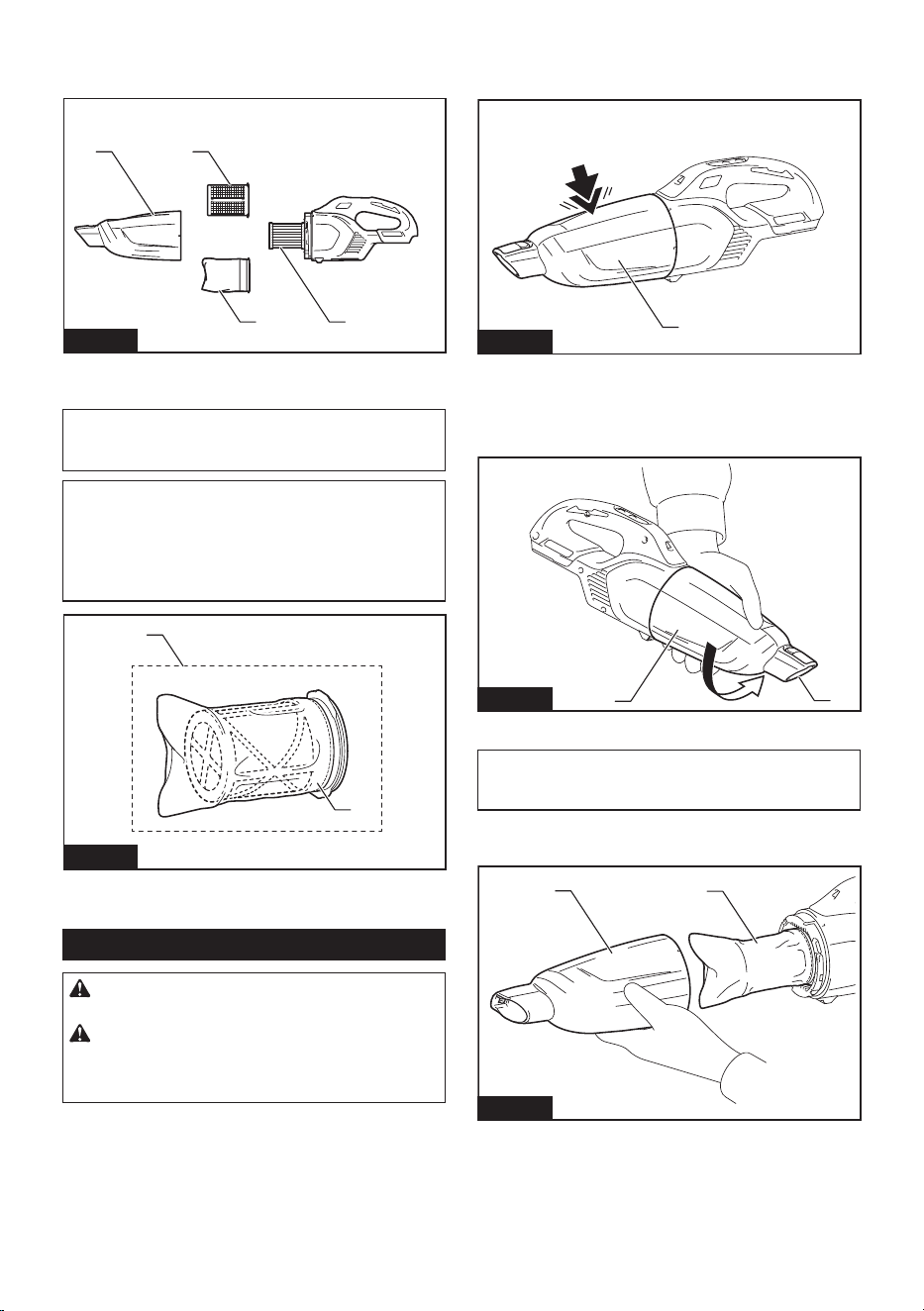
Descripción de las piezas
Accesorio opcional
Filtro de alto rendimiento y retenedor
y ltro de esponja
1
34
2
Fig.6
►1. Cápsula 2. Filtro de alto rendimiento
3. Retenedor 4.Filtrodeesponja
25 ESPAÑOL
Preltro o ltro de alto rendimiento y
ltro HEPA
12
3
4
Fig.7
►1. Cápsula 2.Preltro3. Filtro de alto rendimiento
4. Filtro HEPA
AVISO: No cubra el ltro de alto rendimiento
con un ltro opcional (tela no tejida).Losltrosno
pudieron quitarse de la aspiradora.
NOTA:Noinstaleunltroopcional(telanotejida)
entreelltroHEPAyelpreltro.Lapotenciadesuc-
ción podría verse reducida.
NOTA:Utilicesiempreelltrodealtorendimientoque
estáajustadoaunretenedordiseñadooriginalmente
cuandoselosuperpongaalltroHEPA.
2
1
Fig.8
►1. Filtro de alto rendimiento 2.Retenedor(diseñado
paraltrodealtorendimiento)
Eliminación del polvo
PRECAUCIÓN: Vacíe la aspiradora antes de
que se llene, o la fuerza de succión se debilitará.
PRECAUCIÓN: Asegúrese de vaciar el polvo
que haya dentro de la misma aspiradora. El no
hacerlopodríacausarqueelltrosetapeoqueel
motorsedañe.
Paraeliminarelpolvoquequedepegadosobreelltro
en la cápsula, dé un golpe ligero a la cápsula unas 4 o
5 veces con su mano.
1
Fig.9
►1. Cápsula
Dirijalaentradadesucciónhaciaabajo,girelacápsula
enladireccióndelaechaeneldiagramaydesconecte
la cápsula lentamente y en línea recta.
1
2
Fig.10
►1. Cápsula 2. Entrada de succión
NOTA: Es posible que se derrame polvo al abrir la
cápsula, por lo que deberá asegurarse de colocar
unabolsadebasurapordebajodelacápsula.
Elimine el polvo acumulado en el interior de la cápsula
ydelltrodealtorendimiento.
1
2
Fig.11
►1. Cápsula 2. Filtro de alto rendimiento
26 ESPAÑOL
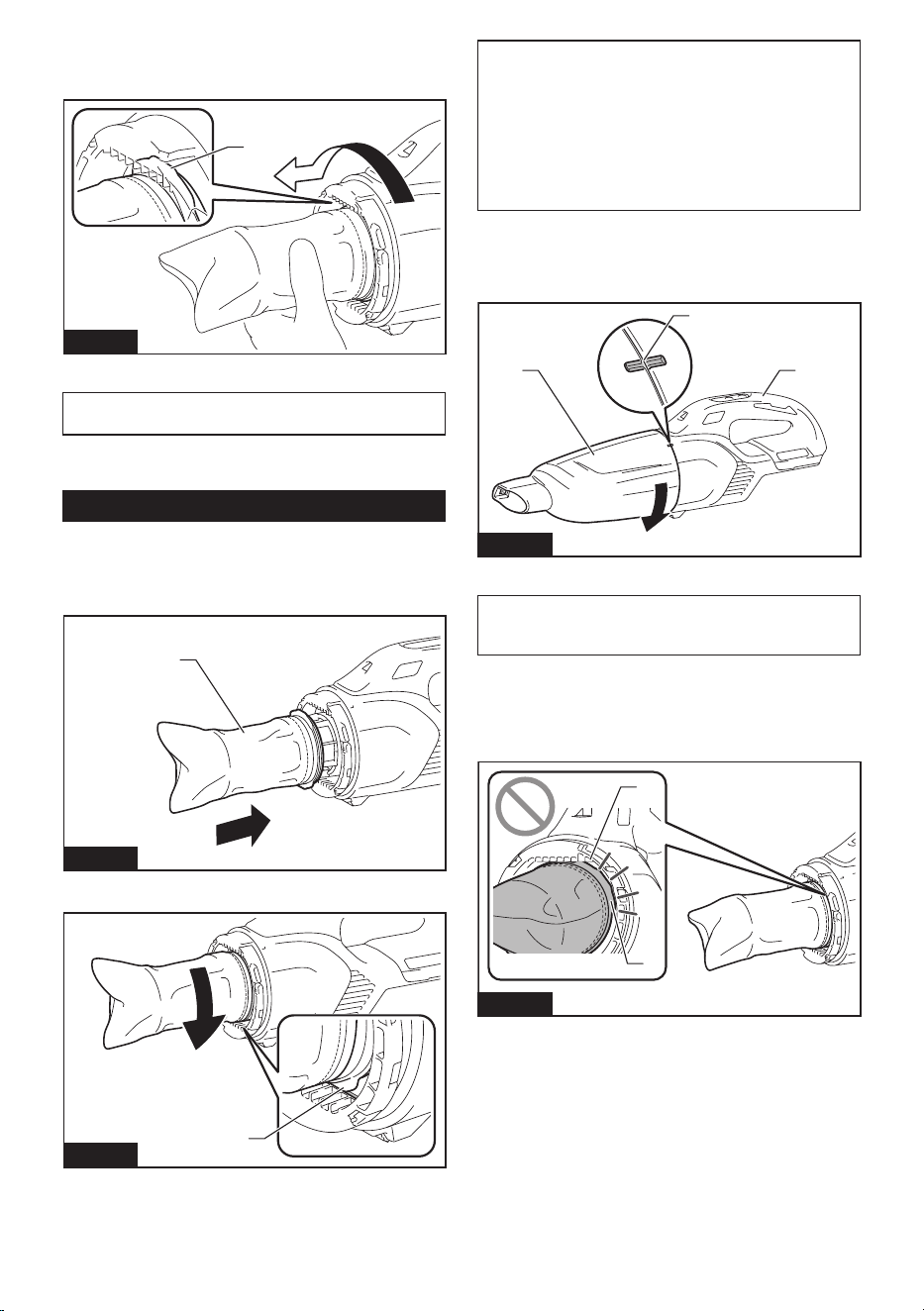
Enrosqueelltrodealtorendimientoenladirecciónde
laechaparadesabrocharelrebordedejacióndela
unidaddelaaspiradorayluegosaqueelltro.
1
Fig.12
►1.Rebordedejación
NOTA:Cuandoutiliceelpreltro,sigatambiénel
procedimiento anterior.
Limpieelpolvonoygolpeeligeramenteparadespren-
derelpolvodelltrodealtorendimiento.
Reensamble
Conecteelltrodealtorendimiento.Enestemomento,
asegúresedeenroscarelltrodealtorendimientode
talmaneraqueelrebordedejaciónquedermemente
bloqueado en la unidad de la aspiradora.
1
Fig.13
►1. Filtro de alto rendimiento
1
Fig.14
►1.Rebordedejación
AVISO: Asegúrese siempre de vericar que el
ltro de alto rendimiento esté cargado correc-
tamente antes de usar la aspiradora. Si no está
correctamente puesto, el polvo se introducirá a la
carcasadelmotorcausandodañosenelmismo.
Si se presenta el problema como se describe más
adelante,elltrodealtorendimientonosepondrá
correctamente. Vuélvalo a colocar correctamente
para corregir el problema.
Conecte la cápsula. Alinee la marca en la cápsula
conlamarcaenelmangoyluegogirermementela
cápsulaenladireccióndelaechahastaquequede
asegurada.
1
2
3
Fig.15
►1. Marca 2. Mango 3. Cápsula
NOTA: Siempre elimine el polvo con antelación, ya
que el poder de succión será menor si hay dema-
siado polvo en la aspiradora.
Ejemplos de problemas
Elrebordedejacióndelltrodealtorendimientono
estármementebloqueadoenlaranuradelacarcasa
de la aspiradora.
1
2
Fig.16
►1.Rebordedejación2. Ranura de la carcasa de
la aspiradora
27 ESPAÑOL
Instalación o extracción del
retenedor/ltro HEPA
Accesorio opcional
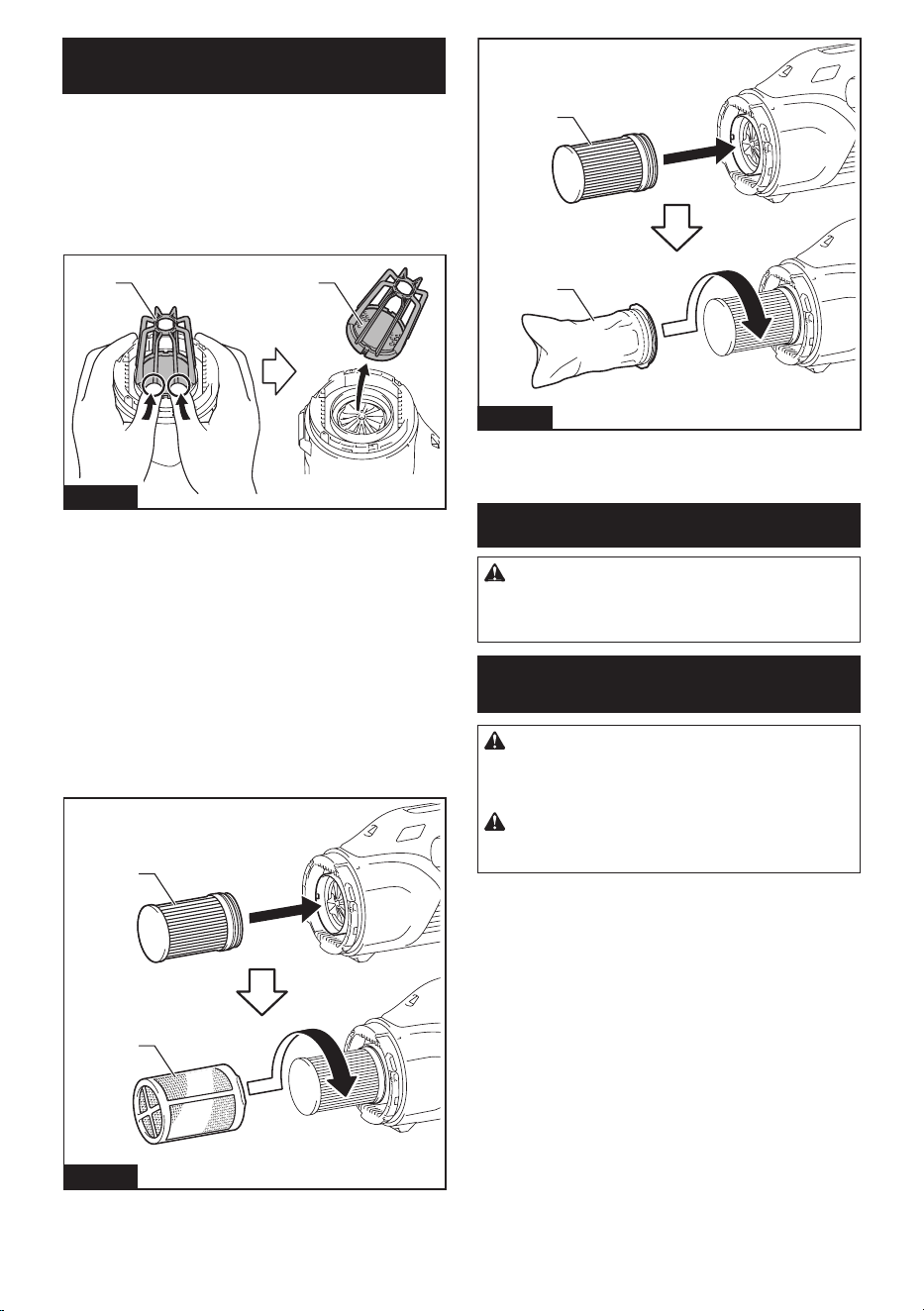
Para el retenedor y ltro de esponja
Paraextraerelretenedor,empujehaciaarribalaparte
inferior de los pilares del retenedor con sus dedos y
libere su ranura de la parte saliente de la aspiradora.
Despuésdeesto,extraigaelltrodeesponja.
1
2
Fig.17
►1. Retenedor 2.Filtrodeesponja
Para instalar, alinee las ranuras sobre el retenedor con
lapartesalienteenlaaspiradora,luegoempujehasta
que haga clic.
Inserteelltrodeesponjaentrelospilaresycolóquelo
en la posición original.
Para el ltro HEPA
CuandoinstaleelltroHEPA,acomodelaranuradel
ltroHEPAconlapartesalientesobrelaaspiradora.
Luego,coloqueelpreltrooelltrodealtorendi-
mientoenelltroHEPAygíreloparaasegurarlo.Para
extraerlo, siga el procedimiento de instalación en orden
inverso.
1
2
Fig.18
►1. Filtro HEPA 2.Preltro
1
2
Fig.19
►1. Filtro HEPA 2. Filtro de alto rendimiento
OPERACIÓN
PRECAUCIÓN: No ponga la cara cerca de la
abertura de ventilación cuando utilice la aspira-
dora. Si las partículas sopladas se introducen en los
ojos,podríancausarlesiones.
Instalación y desinstalación de los
aditamentos para aspiradora
PRECAUCIÓN: Después de instalar los adi-
tamentos, verique si están bien instalados. Si los
aditamentos no están instalados perfectamente bien,
estos podrían salirse y ocasionar una lesión.
PRECAUCIÓN: Cuando extraiga los adita-
mentos, tenga cuidado de no golpear su mano
contra el muro, etc.
28 ESPAÑOL
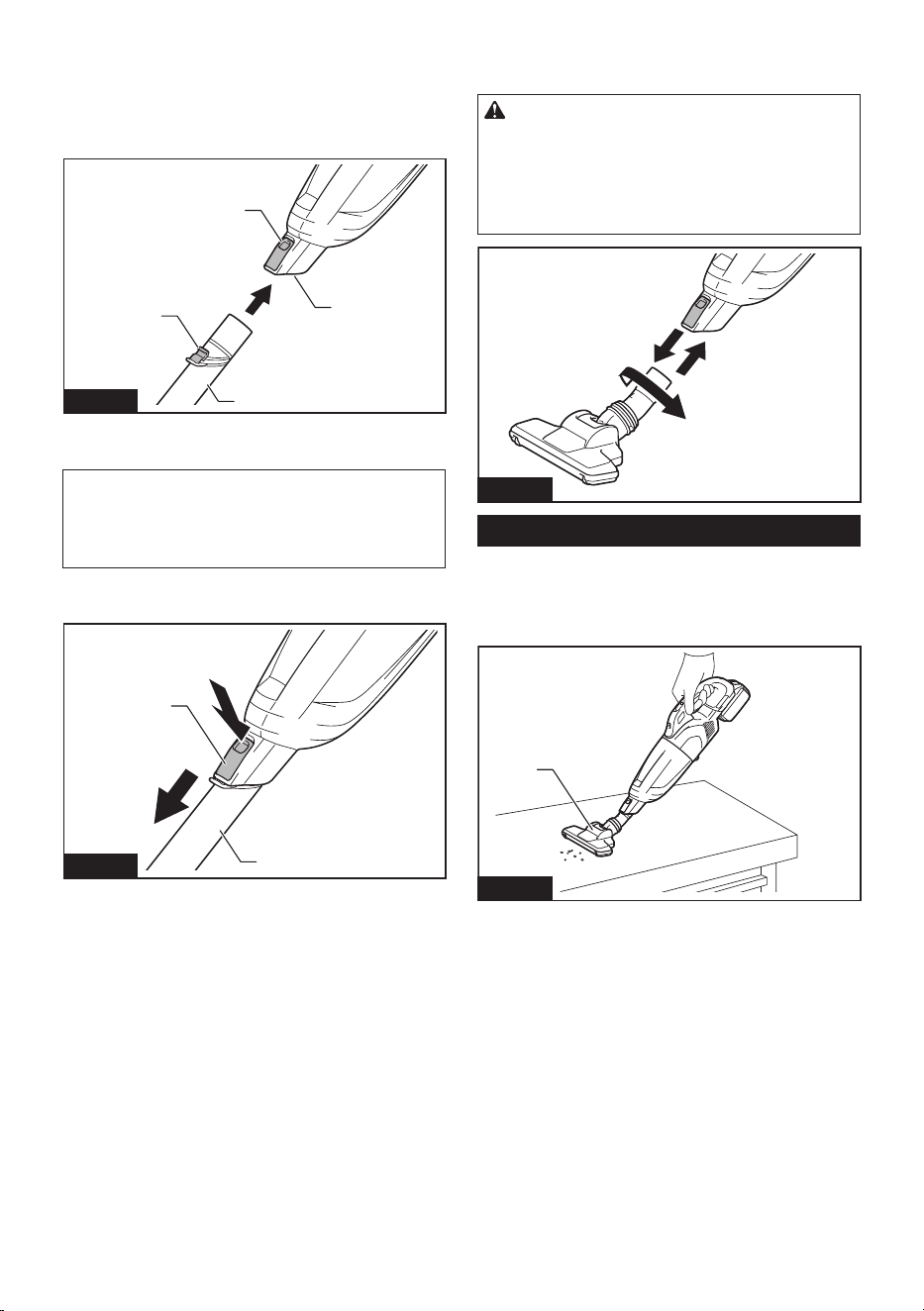
Cuando se utiliza el aditamento con
la función de bloqueo
Para instalar el aditamento, insértelo en la entrada
de succión de la aspiradora hasta que haga clic.
Asegúrese de que el aditamento quede asegurado.
1
2
3
4
Fig.20
►1. Entrada de succión 2. Aditamento con la función
de bloqueo 3. Gancho 4. Botón de liberación
AVISO: Cuando instale el aditamento con fun-
ción de bloqueo, asegúrese de alinear el botón
de liberación de la aspiradora con el gancho del
aditamento. Si no están alineados, el aditamento no
se bloqueará y podría salirse de la aspiradora.
Paraextraerlo,jaleeladitamentooprimiendosimultá-
neamente el botón de liberación.
1
2
Fig.21
►1. Botón de liberación 2. Aditamento con la función
de bloqueo
Cuando se utiliza el aditamento sin la
función de bloqueo
PRECAUCIÓN: Para conectar el aditamento
sin la función de bloqueo, enrosque e insértelo
en la dirección de la echa para asegurar la cone-
xión durante el uso. Para desconectar el adita-
mento, gírelo y extráigalo también en la dirección
de la echa. Si el aditamento se enrosca en la direc-
ción opuesta, la cápsula podría quedar suelta.
Fig.22
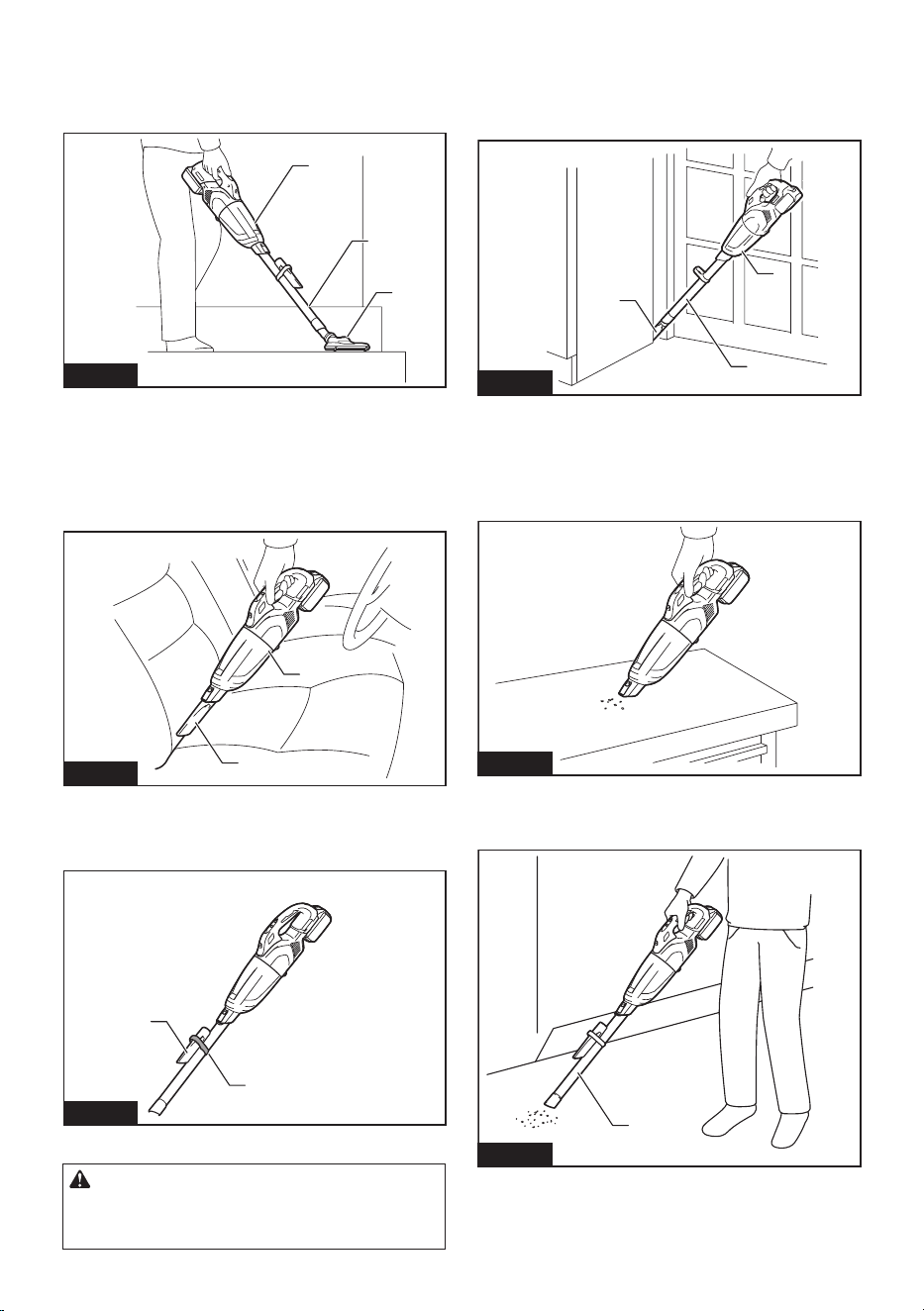
Aspirado (succión)
Boquilla
Coloque la boquilla para aspirar mesas, escritorios,
muebles, etc. La boquilla se pone fácilmente.
1
Fig.23
►1. Boquilla
29 ESPAÑOL
Boquilla + Tubo de extensión (tubo recto)
El tubo de extensión se coloca entre la boquilla y la
aspiradora misma. Esta modalidad resulta conveniente
para aspirar un piso estando de pie.
1
2
3
Fig.24
►1. Cuerpo de la aspiradora 2. Tubo de extensión
(tubo recto) 3. Boquilla
Boquilla para bastidores
Coloque la boquilla para bastidores para aspirar esqui-
nas y huecos en autos y muebles.
1
2
Fig.25
►
1. Boquilla para bastidores 2. Cuerpo de la aspiradora
Usted puede guardar la boquilla para bastidores en el
sujetaboquillas.
1
2
Fig.26
►1.Sujetaboquillas2. Boquilla para bastidores
PRECAUCIÓN:
Tenga cuidado de que su(s)
dedo(s) no quede(n) atrapado(s) entre la boquilla
para bastidores y el sujetaboquillas. Si su(s) dedo(s)
quedara(n) atrapado(s) podría(n) resultar lesionado(s).
Boquilla para bastidores + tubo de
extensión (tubo recto)
Utilice esta modalidad para espacios estrechos donde la misma
aspiradora no quepa, o en lugares elevados difíciles de alcanzar.
1
2
3
Fig.27
►1. Boquilla para bastidores 2. Tubo de extensión
(tubo recto) 3. Cuerpo de la aspiradora
Aspirado sin boquilla
Puede aspirar el polvo sin el uso de la boquilla.
Fig.28
Para recoger polvo en un piso en posición de pie,
es conveniente colocar el tubo de extensión en la
aspiradora.
1
Fig.29
►1. Tubo de extensión (tubo recto)
30 ESPAÑOL
MANTENIMIENTO
PRECAUCIÓN: Asegúrese siempre de que la
herramienta esté apagada y el cartucho de batería
extraído antes de intentar realizar una inspección
o mantenimiento.
Para mantener la SEGURIDAD y CONFIABILIDAD del
producto, las reparaciones y cualquier otro manteni-
mientooajustedebenserrealizadosporloscentrosde
servicio autorizados por Makita o de fábrica, utilizando
siempre repuestos Makita.
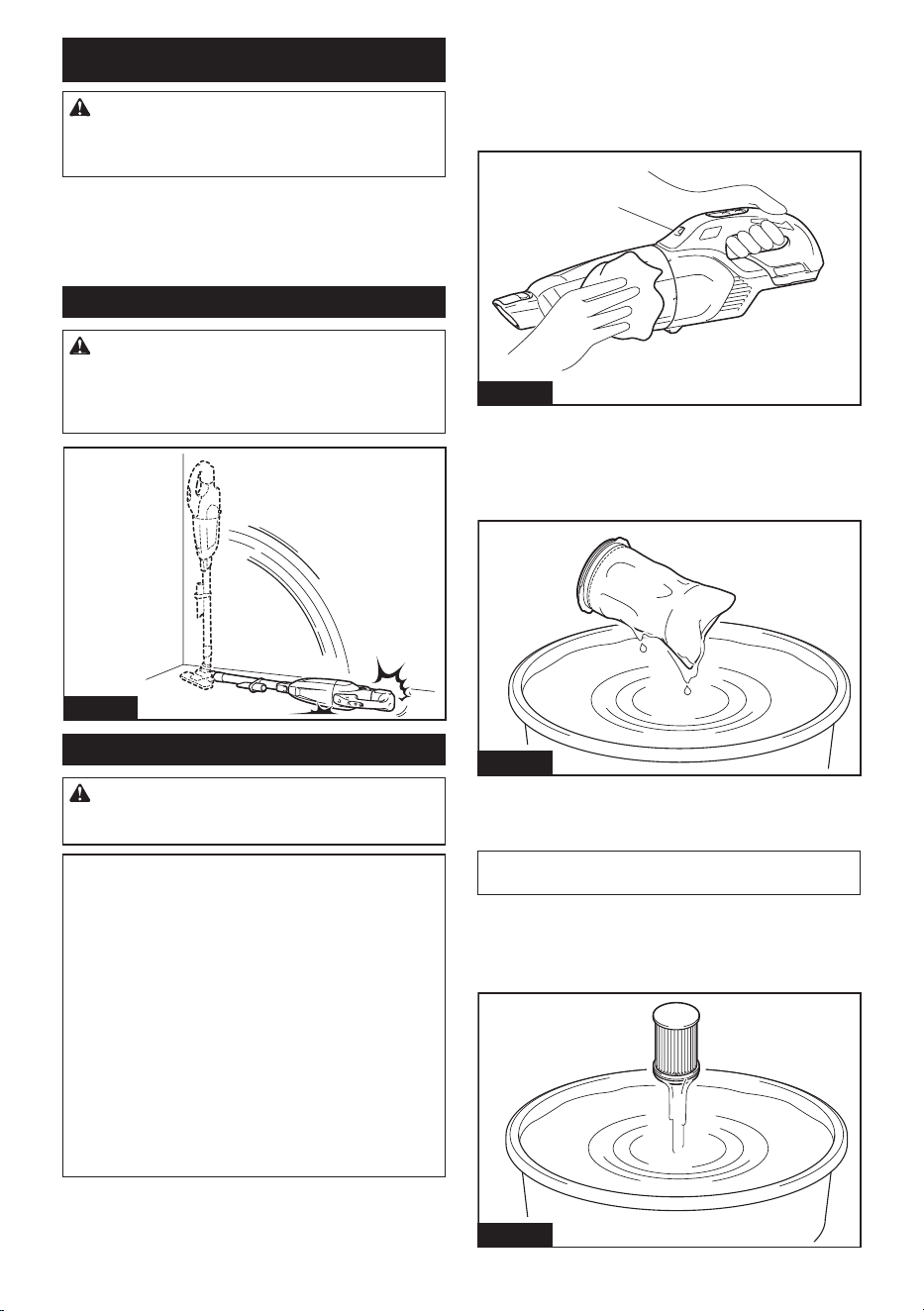
Después del uso
PRECAUCIÓN: El colocar la aspiradora
contra la pared sin que haya ningún otro soporte
podría ocasionar que la aspiradora se cayera,
lo que resultaría en una lesión personal o en un
daño a la aspiradora.
Fig.30
Limpieza
PRECAUCIÓN: Limpie los ltros cuando
estos se obstruyan. El uso continuo en la condición
obstruida podría provocar su calentamiento o fuego.
AVISO: Nunca use gasolina, bencina, diluyente
(tíner), alcohol o sustancias similares. Puede que
esto ocasione grietas o descoloramiento.
AVISO: No use un soplador de aire con el n
de eliminar el polvo adherido en la aspiradora y
en los ltros. Esto introduciría polvo en la carcasa
pudiendocausardaños.
AVISO: Después de lavar los ltros, séquelos
completamente antes de usarlos.Silosltrosno
están completamente secos la succión podría ser
decienteylavidaútildelmotorpodríareducirse.
AVISO: Después de limpiar los ltros y el ltro
de esponja, asegúrese de volverlos a instalar
antes del uso.Siutilizalaaspiradorasinlosltrosy
elltrodeesponja,elpolvoentraráalacarcasadel
motorcausandodañosenelmismo.
Cuerpo de la aspiradora
De vez en cuando, limpie el exterior (cuerpo) de la aspi-
radorausandounpañohúmedoyaguaenjabonada.
Asimismo, limpie la abertura de succión y el área donde
vainstaladoelltro.
Fig.31
Filtro de alto rendimiento
Laveelltroenaguaenjabonadacuandoéstesehaya
tapado con el polvo y disminuya la potencia de la aspi-
radora.Déjelosecarporcompletoantesdeusarlo.
Fig.32
Filtro HEPA
Accesorio opcional
AVISO: No frote ni raye el ltro HEPA con objetos
duros tales como un cepillo o una pala.
LaobstruccióndelltroHEPAhacequeeldesempeñode
lasucciónseadeciente.Limpieelltrodevezencuando.
Devezencuando,laveelltroHEPAconagua,enjuágueloyséquelo
bienalasombraantesdeusarlo.Nuncalaveelltroenlalavadora.
Fig.33
31 ESPAÑOL
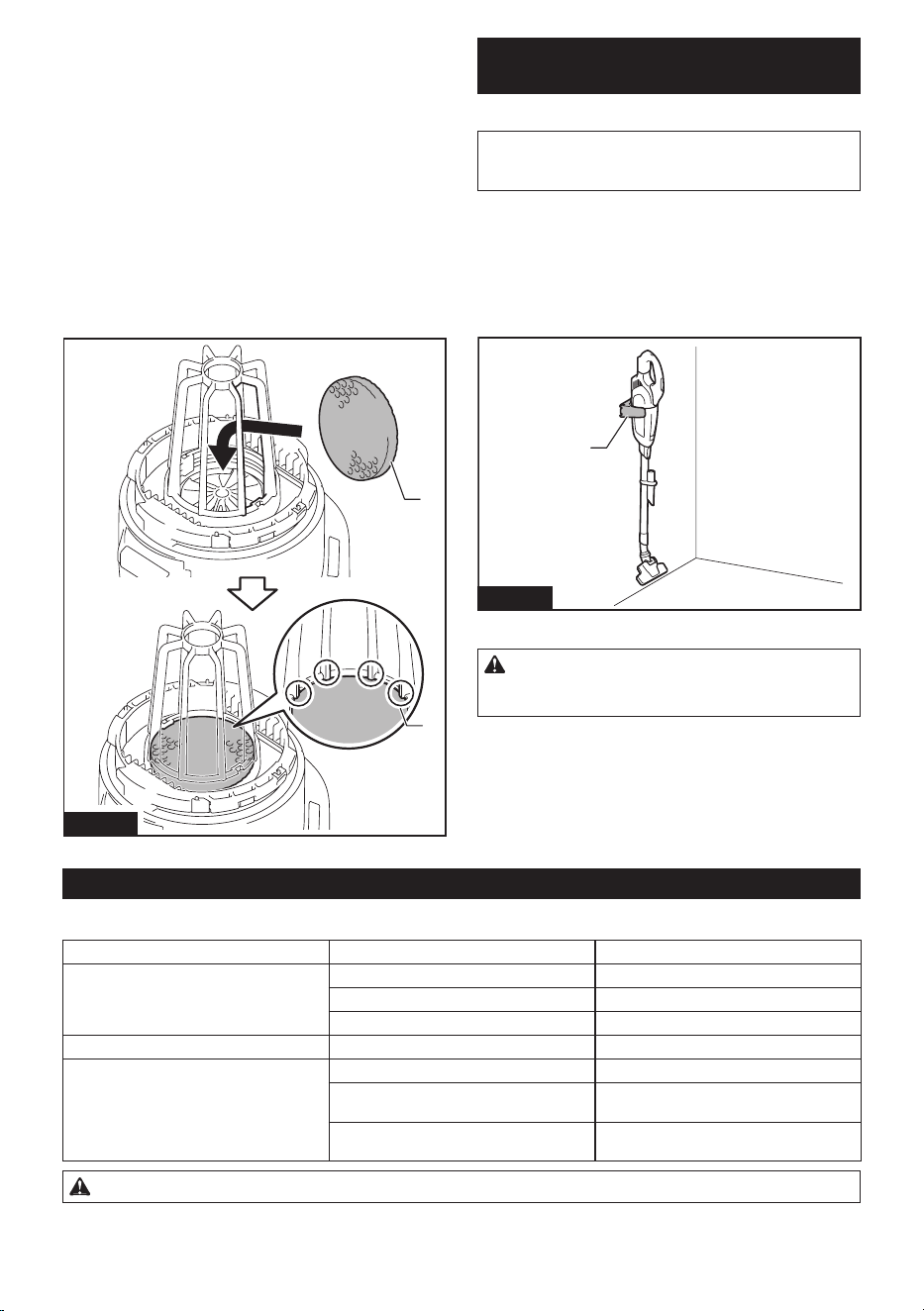
Filtro de esponja
Cuandoelltrodeesponjaseensucie,límpielocomo
se indica a continuación.
1. Retirelosltrosquecubrenelretenedor.
2. Jalehaciaafueraelltrodeesponjadeentrelos
pilares.
3. Limpieelltrodeesponjamediantegolpecitoso
lavándolo.Silolava,déjelosecarporcompletoantes
de usarlo.
4. Inserteelltrodeesponjaentrelospilaresycoló-
quelo en la posición original. Asegúrese de que el borde
inferiordecadapilarmantengasujetadoelltrode
esponjayquenohayaningúnespacioentreelltrode
esponjaylaaberturadesucción.
1
2
Fig.34
►1.Filtrodeesponja2. Borde inferior del pilar
Montaje de pared para la aspiradora
inalámbrica
Accesorio opcional
NOTA: El tornillo para instalar el soporte no está
incluido. Prepare un tornillo que sea apto para el
material donde va a atornillarse.
Fijeelmontajedeparedparalaaspiradorainalámbrica
enunapared,travesañoocolumnademaderaresis-
tentedondeelmontajedeparedparalaaspiradora
inalámbricaquedermementeasegurado.Asegúrese
siempredequeelmontajedeparedparalaaspiradora
inalámbricaestérmementeaseguradoantesdecolgar
la aspiradora.
1
Fig.35
►1.Montajedeparedparalaaspiradorainalámbrica
PRECAUCIÓN: No cuelgue la aspiradora
en el montaje de pared forzadamente ni cuelgue
otros aparatos que no sean la aspiradora.
Detección y solución de problemas
Antesdesolicitarunareparación,veriquelossiguientespuntos.
Síntoma Área a ser investigada Método de solución
Potenciadesuccióndeciente ¿La cápsula está llena de polvo? Vacíe el polvo de la cápsula.
¿Elltroestátapado? Limpieolaveelltro.
¿El cartucho de batería se ha descargado? Cargue el cartucho de batería.
No funciona ¿El cartucho de batería se ha descargado? Cargue el cartucho de batería.
Ruido y vibración ¿Elltroestátapado? Limpieolaveelltro.
¿Está tapada la boquilla, tubo o entrada de
succión del aparato?
Retirelosobjetosqueobstruyenlaboqui-
lla, tubo o entrada de succión del aparato.
¿La entrada de la boquilla/tubo está
bloqueada?
No bloquee la entrada de la boquilla/tubo.
PRECAUCIÓN: No intente reparar la aspiradora por su cuenta.
32 ESPAÑOL
ACCESORIOS
OPCIONALES
PRECAUCIÓN: Estos accesorios o aditamen-
tos están recomendados para utilizarse con su
herramienta Makita especicada en este manual.
El empleo de cualquier otro accesorio o aditamento
puede conllevar el riesgo de lesiones personales.
Utilice los accesorios o aditamentos solamente para
sunestablecido.
Si necesita cualquier ayuda para más detalles en
relación con estos accesorios, pregunte a su centro de
servicio local Makita.
• Tubo de extensión (tubo recto)
• Boquilla
• Boquilla para alfombra
• Cepillo para estantes
• Boquilla para bastidores
• Cepillo redondo
• Mangueraexible
• Filtro(telanotejida)
• Preltro
• Filtro de alto rendimiento
• Filtro HEPA
• Boquilla para asientos
• Boquilla para huecos
• Montajedeparedparalaaspiradorainalámbrica
• Unidad ciclónica
• Colector ciclónico
• Bolsa de herramientas
• Batería y cargador originales de Makita
NOTA: Algunos de los artículos en la lista pueden
incluirse en el paquete de la herramienta como acce-
sorios estándar. Éstos pueden variar de país a país.
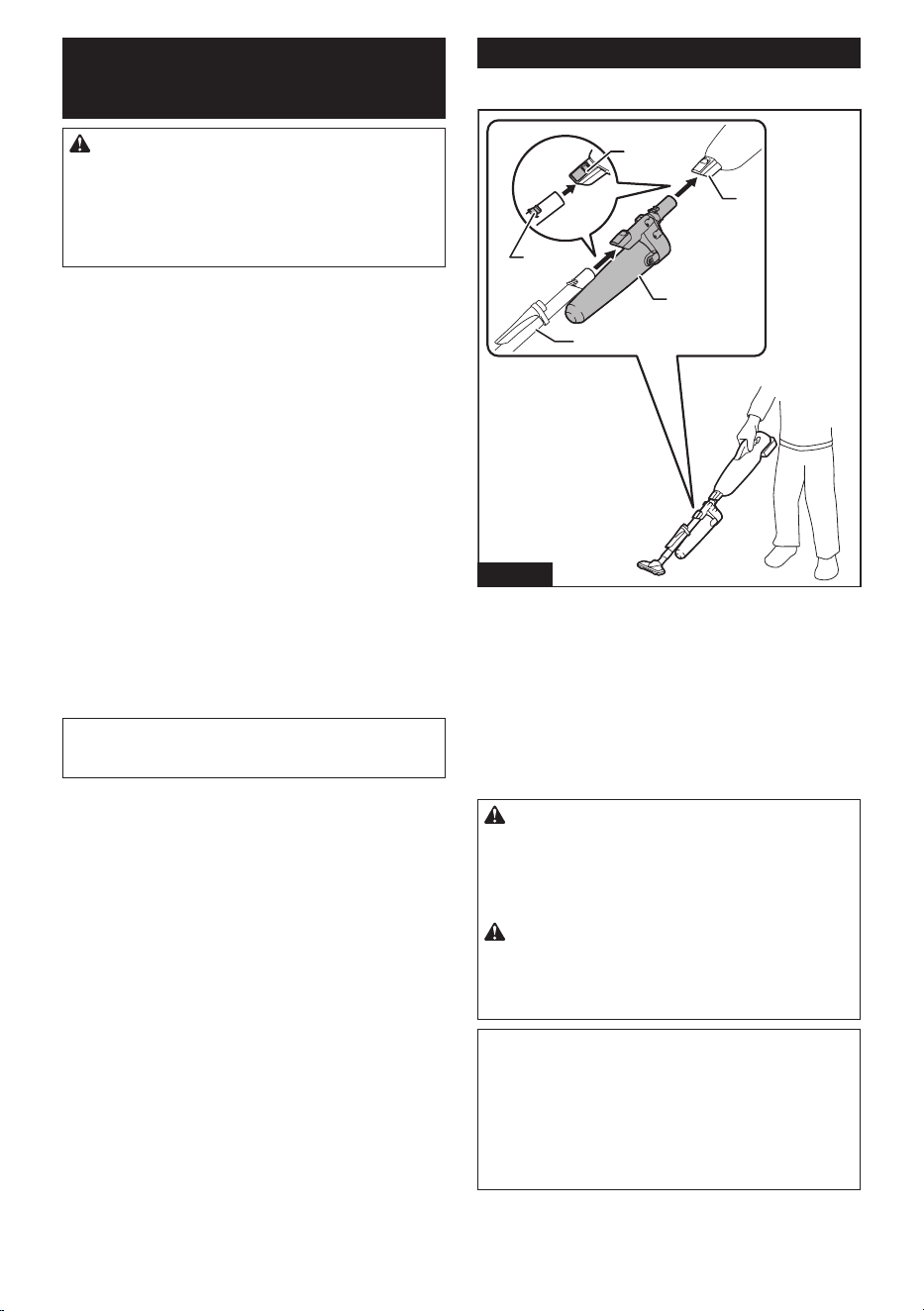
Colector ciclónico
Accesorio opcional
3
4
1
2
5
Fig.36
►1. Botón de liberación 2. Gancho 3. Tubo de exten-
sión (tubo recto) 4. Colector ciclónico 5. Entrada de
succión
Acerca del colector ciclónico
El uso de la aspiradora con el colector ciclónico ins-
talado reduce la cantidad de polvo que ingresa a la
cápsula, lo que ayuda a evitar que la fuerza de succión
se debilite. Además, limpiarla después de su uso es
algo sencillo.
PRECAUCIÓN: Asegúrese siempre de que la
herramienta esté apagada y el cartucho de batería
haya sido extraído antes de realizar cualquier
trabajo en la misma.Sisedejainsertadoelcartucho
de batería, la aspiradora podría arrancar de forma
inesperada y ocasionar una lesión.
PRECAUCIÓN: Limpie el ltro de malla del
colector ciclónico y los ltros de la unidad de la
aspiradora cuando se obstruyan. El uso continuo
en la condición obstruida podría provocar su calenta-
miento o humo.
AVISO: Cuando se coloca el colector ciclónico,
no use la aspiradora cuando esté en una posición
horizontal u orientada hacia arriba. El hacerlo
podríaocasionarqueelltrodemallaseobstruya.
AVISO: Siempre utilice la aspiradora con los
ltros instalados, incluso cuando utiliza el colec-
tor ciclónico.Siseutilizalaaspiradorasinlosltros
instalados se podría ocasionar una avería del motor.
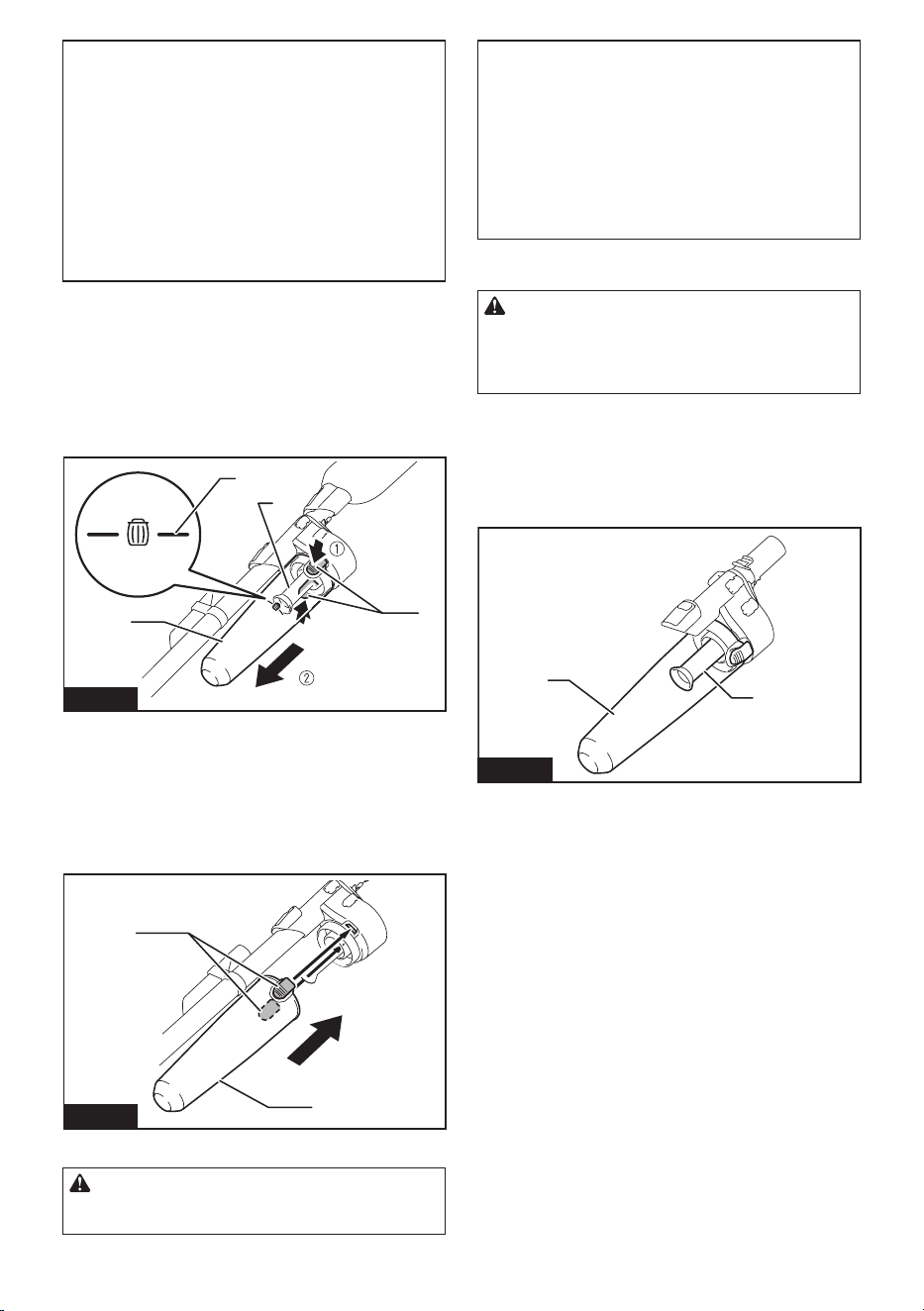
33 ESPAÑOL
NOTA:Veriquequeelcolectorciclónico,laaspira-
dora y el tubo de extensión (tubo recto) estén asegu-
rados correctamente antes de su uso.
NOTA:Vacíelacajaparapolvodelcolectorciclónico
y la cápsula de la aspiradora cuando se haya acumu-
lado el polvo. El uso continuo en esas circunstancias
debilitará la fuerza de succión.
NOTA: También puede usar el colector ciclónico sin
la función de bloqueo.
NOTA: Para instalar o desinstalar el colector cicló-
nico, consulte la sección “Instalación y desinstalación
de los aditamentos para aspiradora”.
Eliminación del polvo
Cuando se haya acumulado el polvo hasta la línea de
llenadocompletodelacajaparapolvo,sigaelprocedi-
miento a continuación y deseche el polvo.
1. Sujetelacajaparapolvormemente,oprimay
mantengaapretadoslosdosbotonesyextraigalacaja
para polvo.
2
3
1
4
Fig.37
►1. Línea de llenado completo 2.Cajaparapolvo
3. Botón (dos ubicaciones) 4. Filtro de malla
2. Desecheelpolvodentrodelacajaparapolvo
y extraiga cualquier polvo y partículas adheridas a la
superciedelltrodemalla.
3. Insertelacajaparapolvohastaelfondohastaque
los dos botones queden asegurados con un clic.
2
1
Fig.38
►1.Cajaparapolvo2. Botón (dos ubicaciones)
PRECAUCIÓN: Cuando reensamble la caja
para polvo, tenga cuidado de no pellizcar sus
dedos.
NOTA:Veriquequeelcolectorciclónico,laaspira-
dora y el tubo de extensión (tubo recto) estén asegu-
rados correctamente antes de reiniciar la operación.
NOTA: Si la fuerza de succión no se recupera incluso
despuésdedesecharelpolvoydelimpiarelltrode
malla,veriquesisehaacumuladopolvoenlacáp-
sula de la aspiradora o si hay obstrucción.
NOTA:Elpolvopodríaotarhaciaarribacuandose
deseche del colector ciclónico. Tenga cuidado de que
elpolvonoalcancesusojos.
Limpieza
PRECAUCIÓN: Después de lavar el colector
ciclónico, séquelo por completo antes de usarlo.
Loscomponentesquenoesténlosucientemente
secospodríancausarunadescargaeléctricaodaños
al aparato.
Cuandolacajaparapolvoseensuciaoelltrodemalla
se obstruye, quítelos y lávelos con agua. (Consulte la
sección “Eliminación del polvo” para el procedimiento
de eliminación).
Seque las piezas por completo antes de reinstalarlas
y usarlas.
2
1
Fig.39
►1.Cajaparapolvo2. Filtro de malla
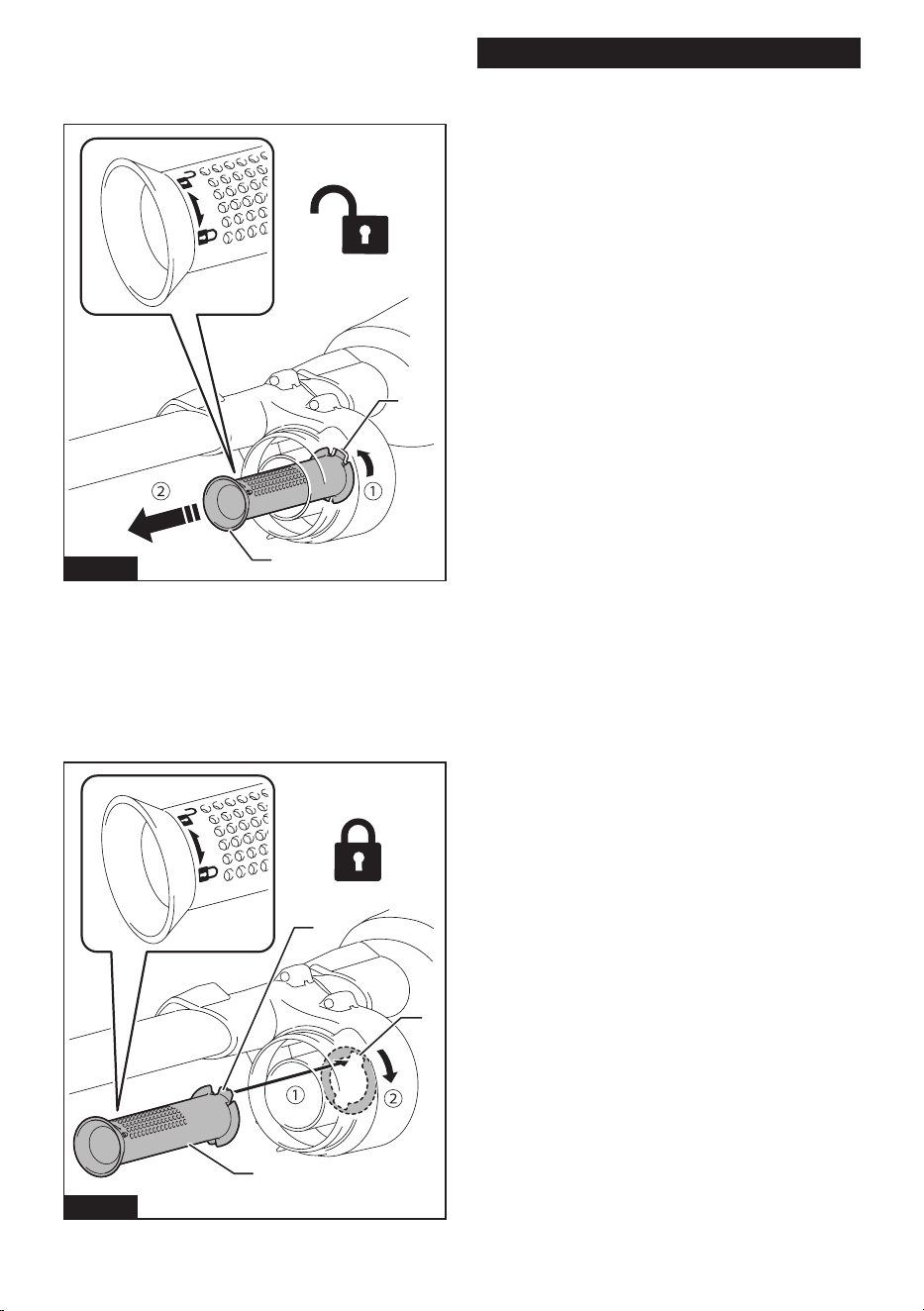
34 ESPAÑOL
Cuandoelltrodemallaseensucieenexceso,límpielo
con los siguientes procedimientos.
1. Gireelltrodemallaenladireccióndelaecha,y
retírelo mientras los ganchos no están asegurados.
1
2
Fig.40
►1. Filtro de malla 2. Gancho
2.
Retireelpolvoenelltrodemallayposteriormente
lávelo con agua. Después de esto, séquelo por completo.
3. Inserteelltrodemalladentrodelabasemien-
tras los ganchos están alineados con el puerto. Gire el
ltrodemallaenladireccióndelaechahastaquelos
ganchos estén asegurados con un clic. Asegúrese de
queelltrodemallaseinstalermemente.
1
2
3
Fig.41
►1. Filtro de malla 2. Gancho 3. Puerto
GARANTÍA LIMITADA DE MAKITA
Ésta Garantía no aplica para México
Consultelahojadelagarantíaanexaparaverlos
términos más vigentes de la garantía aplicable a este
producto.Encasodenodisponerdeestahojade
garantía anexa, consulte los detalles sobre la garantía
descritos en el sitio web de su país respectivo indicado
a continuación.
Estados Unidos de América: www.makitatools.com
Canadá: www.makita.ca
Otros países: www.makita.com

35

Some dust created by power sanding, sawing, grinding, drilling, and other
construction activities contains chemicals known to the State of California
to cause cancer, birth defects or other reproductive harm. Some examples
of these chemicals are:
• lead from lead-based paints,
• crystalline silica from bricks and cement and other masonry products, and
• arsenic and chromium from chemically-treated lumber.
Your risk from these exposures varies, depending on how often you do this
type of work. To reduce your exposure to these chemicals: work in a well
ventilated area, and work with approved safety equipment, such as those
dust masks that are specially designed to filter out microscopic particles.
WARNING
< USA only >
ADVERTENCIA
Algunos polvos creados por el lijado, aserrado, esmerilado, taladrado y
otras actividades de la construcción contienen sustancias químicas
reconocidas por el Estado de California como causantes de cáncer, defectos
de nacimiento y otros peligros de reproducción. Algunos ejemplos de estos
productos químicos son:
• plomo de pinturas a base de plomo,
• sílice cristalino de ladrillos y cemento y otros productos de albañilería, y
• arsénico y cromo de maderas tratadas químicamente.
El riesgo al que se expone varía, dependiendo de la frecuencia con la que
realice este tipo de trabajo. Para reducir la exposición a estos productos
químicos: trabaje en un área bien ventilada y póngase el equipo de seguridad
indicado, tal como las máscaras contra polvo que están especialmente
diseñadas para filtrar partículas microscópicas.
< Sólo en los Estados Unidos >
Makita Corporation
3-11-8, Sumiyoshi-cho,
Anjo, Aichi 446-8502 Japan
www.makita.com
885A25-946
XLC09-1
EN, ESMX
20221114
