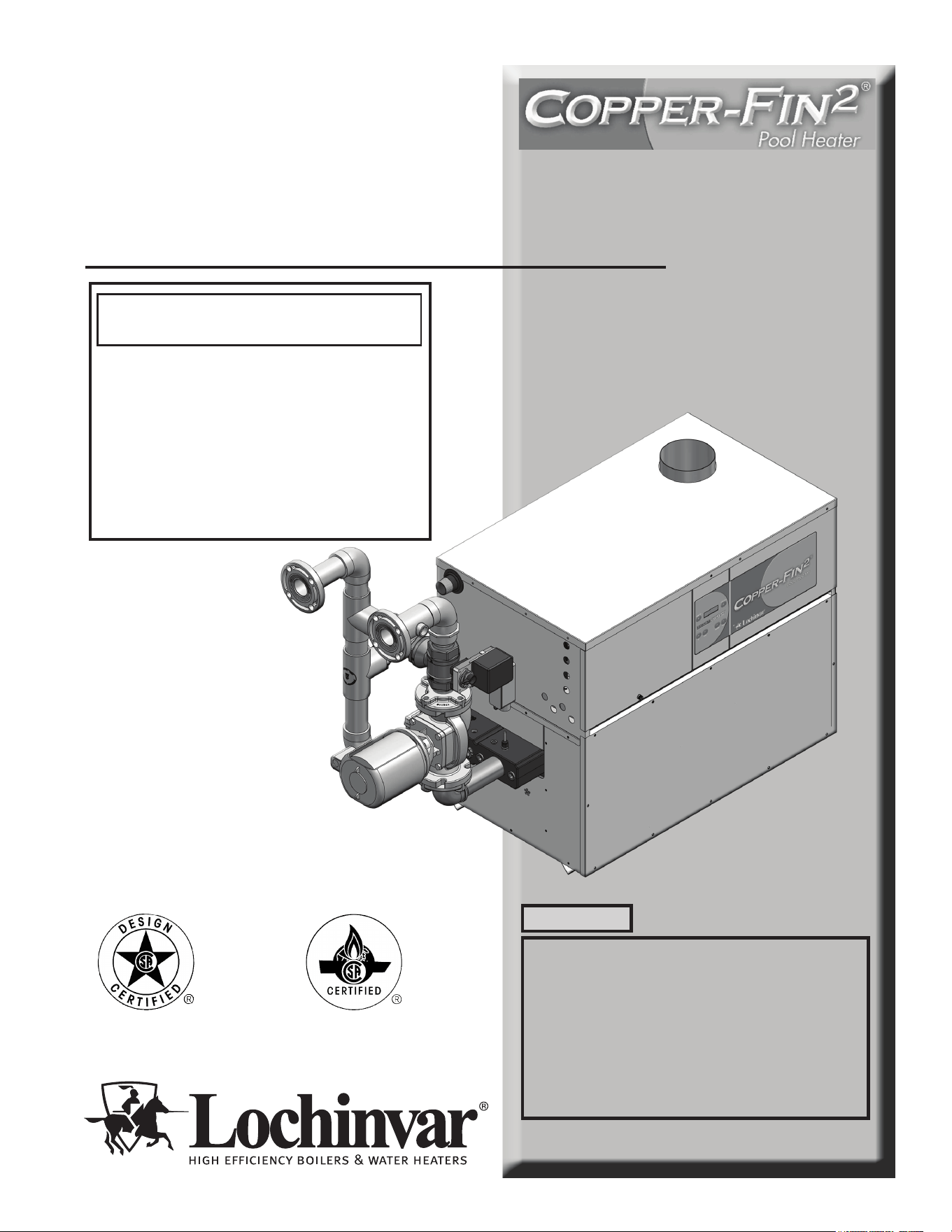
Installation & Operation
Manual
Models: 502 - 2072
This manual supplies information for the
installation, operation, and servicing of the
appliance. It is strongly recommended that this
manual and the Copper-fin
2
Pool Heater Service
Manual be reviewed completely before proceeding
with an installation. Perform steps in the order
given. Failure to comply could result in severe
personal injury, death, or substantial property
damage.
⚠WARNING
Save this manual for future reference.
CPX-I-O_100160928_2000001946_Rev AE
-- Do not store or use gasoline or other flammable vapors and
liquids in the vicinity of this or any other appliance.
-- WHAT TO DO IF YOU SMELL GAS
• Do not try to light any appliance.
• Do not touch any electrical switch; do not use any phone in your
building.
• Immediately call your gas supplier from a neighbor's phone.
Follow the gas supplier’s instructions.
• If you cannot reach your gas supplier, call the fire department.
-- Installation and service must be performed by a qualified
installer, service agency, or the gas supplier.
WARNING: If the information in these instructions is
not followed exactly, a fire or explosion may result causing
property damage, personal injury or death.
Contents
Hazard definitions
The following defined terms are used throughout this manual to bring attention to the presence of hazards of various risk levels
or to important information concerning the life of the product.
⚠ DANGER
⚠WARNING
⚠ CAUTION
CAUTION
NOTICE
DANGER indicates an imminently hazardous situation which, if not avoided, will result in death or serious
injury.
WARNING indicates a potentially hazardous situation which, if not avoided, could result in death or serious
injury.
CAUTION indicates a potentially hazardous situation which, if not avoided, may result in minor or moderate
injury.
CAUTION used without the safety alert symbol indicates a potentially hazardous situation which, if not
avoided, may result in property damage.
NOTICE indicates special instructions on installation, operation, or maintenance that are important but not
related to personal injury or property damage.
2
HAZARD DEFINITIONS ................................................... 2
PLEASE READ BEFORE PROCEEDING ...................... 3
SAFETY INFORMATION ................................................. 4
THE COPPER-FIN
2
-- HOW IT WORKS ..................... 5-7
RATINGS........................................................................... 8
1. DETERMINE UNIT LOCATION
Location of Unit .................................................................. 9
Indoor Clearances from Combustible Construction .......... 9
Non-Combustible / Combustible Flooring .......................... 9
Freeze Protection ............................................................... 9
Location ............................................................................ 10
Hydronic Systems Anti-freeze ........................................... 10
Outdoor Pool Heater Installation ...................................... 10
Combustion and Ventilation Air ........................................ 10
Combustion Options .................................................. 10 - 12
2. VENTING
Before You Begin ............................................................. 13
Vent System Options ....................................................... 14
General Venting Information ............................................ 15
Conventional Negative Draft Venting .......................... 16-18
Vertical DirectAire Venting .......................................... 19-21
Sidewall Venting .......................................................... 22-24
Horizontal DirectAire Venting ........................................... 25
Direct Venting .............................................................. 26-32
Outdoor Installation .......................................................... 33
3. GAS CONNECTIONS
Connecting to Gas Supply ............................................... 34
Gas Pressure Test ........................................................... 34
Checking Manifold Gas Pressure .................................... 34
Gas Piping ........................................................................ 34
Gas Connection .......................................................... 34-35
Combination Gas Valves ................................................... 35
Checking Gas Supply Pressure ....................................... 36
4. WATER CONNECTIONS
Circulating Pump .............................................................. 37
Minimum Pump Performance ........................................... 38
Heat Exchanger ............................................................... 38
Auxiliary Mixed Water Limit Control ................................. 38
Piping Diagrams .......................................................... 39-41
Pumped Automatic Bypass .............................................. 42
Outdoor Operation: 3-Way Valve Cover ......................... 42
Automatic Bypass Valve Cover Installation ..................... 42
Manual Operation of the 3-Way Automatic Bypass ......... 42
Relief Valve ...................................................................... 43
Automatic Chlorinator and Chemical Feeders ................. 43
Water Flow Switch ............................................................ 43
Pump Purge Delay ........................................................... 43
Service Indicator Option ................................................... 43
5. ELECTRICAL CONNECTIONS
General Information ......................................................... 44
3-Way Automatic Bypass Valve Wiring .......................... 44
Pool Heater Operating Control Module ....................... 45-47
Wiring of the Cascade ...................................................... 47
6. STARTUP
Pre-Start Checklist ........................................................... 48
Starting the Filter System ................................................. 48
Check for Gas Leaks ....................................................... 48
Check/Control Water Chemistry ....................................... 48
Freeze Protection ........................................................ 48-49
Check Thermostat Circuit(s) ............................................ 49
Placing the Pool Heater in Operation ..........................49-51
7. OPERATING INFORMATION
General ............................................................................. 52
How the Control Module Operates .............................. 52-54
Sequence of Operation .................................................... 55
Copper-fin
2
Control Module ......................................... 56-57
Status Display Screens ............................................... 58-59
8. MAINTENANCE ..................................................... 60-64
9. CONNECTION DIAGRAM ...................................... 65-66
10. LADDER DIAGRAM .............................................. 67-68
Revision Notes .................................................. Back Cover
33
Please read before proceeding
NOTICE
This is a gas appliance and should be installed
by a licensed electrician and/or certified gas
supplier. Service must be performed by a
qualified service installer, service agency or
the gas supplier.
⚠WARNING
If the information in these instructions is
not followed exactly, a fire or explosion may
result causing property damage, personal
injury, or death.
This appliance MUST NOT be installed in
any location where gasoline or flammable
vapors are likely to be present, unless the
installation is such to eliminate the probable
ignition of gasoline or flammable vapors.
Warranty –
Factory warranty (shipped with unit) does not apply to units
improperly installed or improperly operated.
Experience has shown that improper installation or system
design, rather than faulty equipment, is the cause of most
operating problems.
1. Excessive water hardness causing a lime/scale build-up in
the copper tube is not the fault of the equipment and is
not covered under the manufacturer’s warranty (see
Water Treatment and Water Chemistry).
2. Excessive pitting and erosion on the inside of the copper
tube may be caused by too much water velocity through
the tubes and is not covered by the manufacturer’s
warranty (see Pool heater Flow Rates for flow requirements).
Checking equipment –
Upon receiving equipment, check for signs of shipping damage.
Pay particular attention to parts accompanying the appliances
which may show signs of being hit or otherwise being
mishandled. Verify total number of pieces shown on packing
slip with those actually received. In case there is damage or a
shortage, immediately notify the carrier.
Do not use this appliance if any part has been under water.
The possible damage to a flooded appliance can be extensive
and present numerous safety hazards. Any appliance that
has been under water must be replaced.
⚠WARNING
Improper installation, adjustment,
alteration, service or maintenance can
cause injury or property damage. Refer
to this manual for assistance or additional
information, consult a qualified installer,
service agency or the gas supplier.
Special instructions
REMOVAL OF COMBUSTION CHAMBER LINING OR
BASE PANELS:
¢ Avoid breathing dust and contact with skin and eyes.
• Use NIOSH certified dust respirator (N95). This type of
respirator is based on the OSHA requirements for
cristobalite at the time this document was written. Other
types of respirators may be needed depending on the
job site conditions. Current NIOSH recommendations
can be found on the NIOSH website at
http://www.cdc.gov/niosh/homepage.html .
NIOSH approved respirators, manufacturers, and phone
numbers are also listed on this website.
• Wear long-sleeved, loose fitting clothing, gloves, and eye
protection.
The ceramic fiber material used in this
appliance is an irritant; when handling or
replacing the ceramic materials it is advisable
that the installer follow these safety guides.
NOTICE
⚠WARNING
The combustion chamber insulation in this
appliance contains ceramic fiber material.
Ceramic fibers can be converted to cristobalite
in very high temperature applications.
The International Agency for Research on
Cancer (IARC) has concluded, “Crystalline
silica in the form of quartz or cristobalite
from occupational sources is carcinogenic
to humans (Group 1).” Normal operating
temperatures in this appliance are below the
level to convert ceramic fibers to cristobalite.
Abnormal operating conditions would have
to be created to convert the ceramic fibers in
this appliance to cristobalite.
The ceramic fiber material used in this
appliance is an irritant; when handling
or replacing the ceramic materials it is
advisable that the installer follow these safety
guidelines.
¢Apply enough water to the combustion chamber
lining to prevent airborne dust.
¢ Remove the combustion chamber lining from the
appliance and place it in a plastic bag for disposal.
• NIOSH stated First Aid:
Eye: Irrigate immediately.
Breathing: Fresh air.
Installation & Operation Manual
⚠ Owner warning –
The information contained in this manual is intended for use
by qualified professional installers, service technicians, or gas
suppliers.
NOTICE
Consult and follow all local Building and
Fire Regulations and other Safety Codes that
apply to this installation. Consult local gas
utility company to authorize and inspect all
gas and flue connections.
Safety information
4
Please read before proceeding
A gas appliance that draws combustion air from the equipment
room where it is installed must have a supply of fresh air
circulating around it during burner operation for proper gas
combustion and proper venting.
⚠WARNING
Should overheating occur or the gas supply
fail to shut off, do not turn off or disconnect
the electrical supply to the pump. Instead,
shut off the gas supply at a location external
to the appliance.
Prevention of freezing –
Heat exchangers and headers damaged by freezing are not
covered by warranty.
See Section 7, Operating Information - Freeze Protection for
more information.
Safety information (cont'd)
⚠WARNING
To minimize the possibility of serious
personal injury, fire or damage to your
unit, never violate the following safety
rules.
Installation & Operation Manual
1. Pool heaters are heat producing appliances. To avoid
damage or injury, do not store materials against the pool
heater or the vent-air intake system. Use proper care to
avoid unnecessary contact (especially children) with the
pool heater and vent-air intake components.
2. Never cover your pool heater, lean anything against it, store
trash or debris near it, stand on it, or in any way block the
flow of fresh air to your pool heater.
3. UNDER NO CIRCUMSTANCES must flammable materials
such as gasoline or paint thinner be used or stored in the
vicinity of this pool heater, vent-air intake system or any
location from which fumes could reach the pool heater or
vent-air intake system.
4. This pool heater is only for use with the type of gas indicated
on the rating plate.
5. If you smell gas, shut off the gas supply:
• Do not try to light any appliance;
• Do not touch any electrical switch; do not use any
telephone in your building;
• Immediately call your gas supplier from a neighbor’s
telephone. Follow the gas supplier’s instructions;
• If you cannot reach your gas supplier, call the fire
department.
6. This appliance is a high efficiency pool heater which has
been designed to operate scale-free and trouble free for
many years. Particular attention should be directed to the
following items:
• Correct piping to the pool filter system with specified pipe
materials and size;
• Electrical interconnection of the pool heater controls,
bypass pump and filter pump to ensure continuous
circulation;
• Proper venting;
• Water chemistry.
7. Follow all clearances from combustibles contained in this
manual.
8. Appliance surfaces become hot during operation. Be careful
not to touch hot surfaces. Keep all adults, children, and
animals away from an operating pool heater. Severe burns
can occur.
9. This pool heater must have an adequate supply of fresh air
during operation for proper gas combustion and venting.
10. Make sure all exhaust venting is properly installed and
maintained. Improper venting of this pool heater could lead
to increased levels of carbon monoxide.
11. Do not use this pool heater if any part has been under water.
Immediately call a qualified service technician to replace the
pool heater. The possible damage to a flooded pool heater
can be extensive and present numerous safety hazards. Any
appliance that has been under water must be replaced.
12. Do not alter this pool heater in any way. Any change to this
pool heater or its controls can be dangerous.
Codes
The equipment shall be installed in accordance with those
installation regulations in force in the local area where the
installation is to be made. These shall be carefully followed in all
cases. Authorities having jurisdiction shall be consulted before
installations are made. In the absence of such requirements, the
installation shall conform to the latest edition of the National
Fuel Gas Code, ANSI Z223.1/NFPA 54 and/or Natural Gas and
Propane Installation Code, CSA B149.1. All pool heater heat
exchanger construction conforms to the latest edition of the
ASME Boiler and Pressure Vessel Code, Section IV.
Spa and hot tub safety –
The following safety rules must be observed while operating spa
or hot tub.
1. Spa or hot tub water temperatures should never exceed
104°F (40°C). A temperature of 100°F (38°C) is considered
safe for a healthy adult. Special caution is suggested for
young children.
2. Drinking of alcoholic beverages before or during spa
or hot tub use can cause drowsiness which could lead to
unconsciousness and subsequently result in drowning.
3. Pregnant women beware! Soaking in water above 102°F
(39°C) can cause fetal damage during the first three
months of pregnancy (resulting in birth of a brain-damaged
or deformed child). Pregnant women should observe the
100°F (38°C) maximum rule.
4. Before entering the spa or hot tub, users should check the
water temperature with an accurate thermometer; spa or
hot tub thermostats may err in regulating water
temperatures by as much as 4°F (2°C).
5. Persons with a medical history of heart disease, circulatory
problems, diabetes or blood pressure problems should
obtain their physician’s advice before using spas or hot
tubs.
6. Persons taking medications which induce drowsiness, such
as tranquilizers, antihistamine or anticoagulants, should
not use spas or hot tubs.

5
The Copper-fin
2
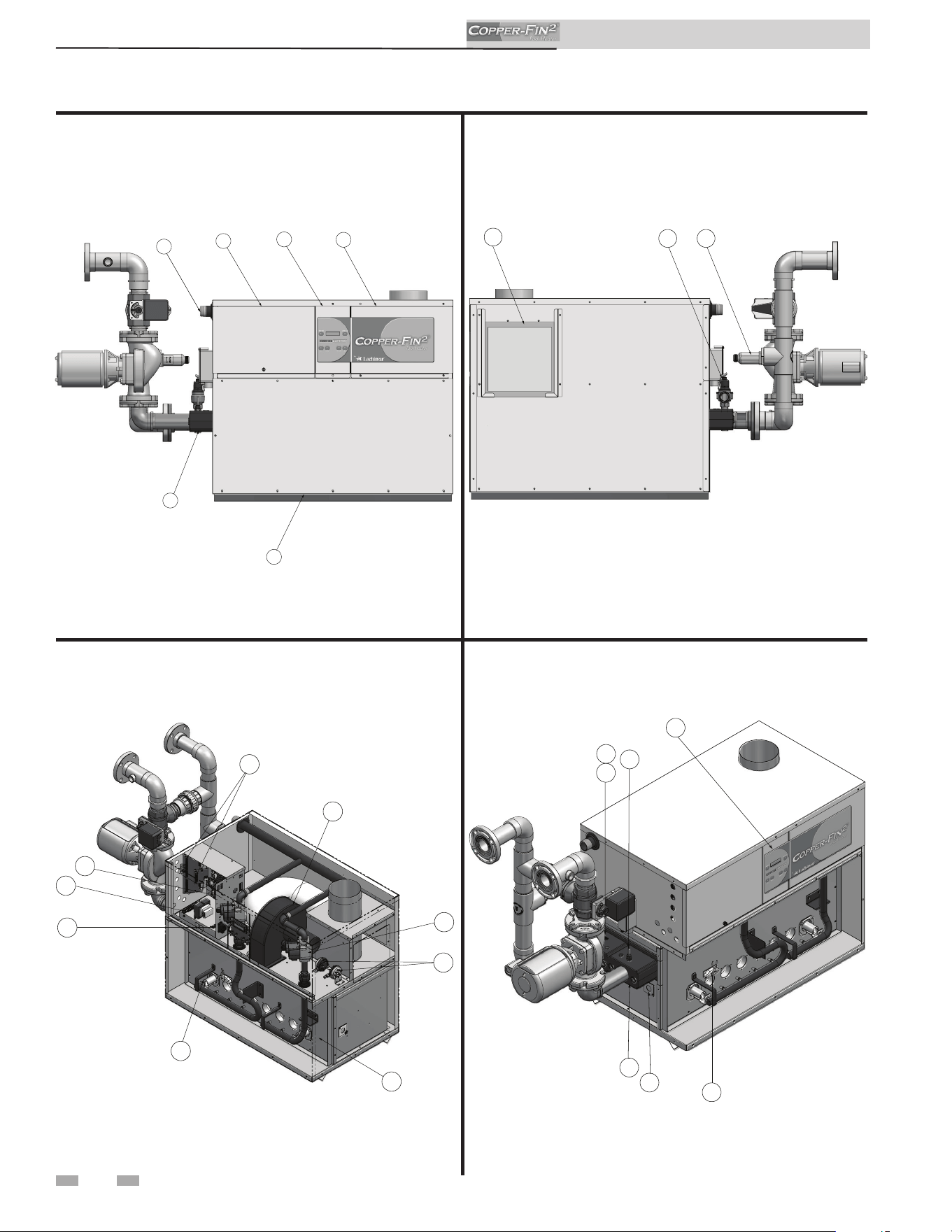
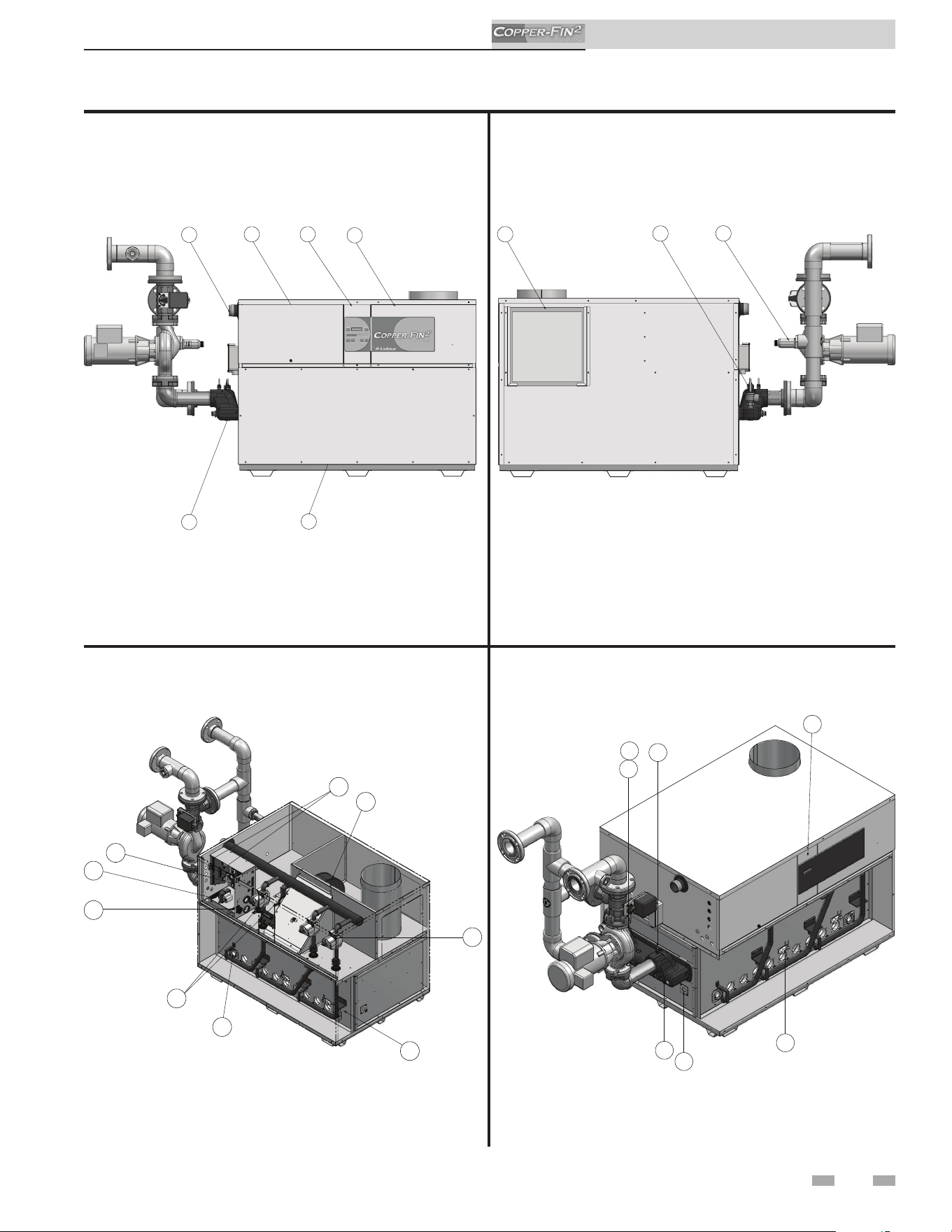
- How it works...
1. Heat exchanger
The heat exchanger allows system water to flow through specially
designed tubes for maximum heat transfer. The glass lined
headers and copper fined tubing are encased in a jacket that
contains the combustion process.
2. Heat exchanger access cover
The heat exchanger access cover is a galvanized steel door which
allows access for service, maintenance, and removal of the
heat exchanger from inside the combustion chamber.
3. Blower
The blower pulls in and injects air into the individual burners
along with gas from the gas manifold where the mix is burned inside
the combustion chamber.
4. Gas valve
The referenced gas valves have a dual purpose; changing the gas
supply pressure to manifold pressure, and the reference side of
the gas valve is designed to allow chamber pressure to change the
volume of gas through the valve. This is not a design to
compensate for gas supply pressure issues.
5. Outlet/limit temperature sensor
This 4-wire limit rated sensor monitors the outlet temperature
to ensure safe operation. The appliance will adjust its firing rate
to maintain water temperatures below the maximum allowable
outlet temperature.
6. Inlet temperature sensor
This 2-wire sensor monitors the inlet temperature. The appliance
will adjust the position of the 3-way valve to maintain the inlet
water temperature above the minimum allowable inlet
temperature.
7. Electronic display
The electronic display consists of 6 buttons and a two-line
16-character liquid crystal display used to monitor the
operation of the heater as well as enter and view the
programming of the main control board.
8. Burner
The burner is a ported stainless steel construction which uses a gas
air mix to operate at a fixed input. Banks of burners turn on
or off to vary the firing rate.
9. Pool supply/limit sensor (not shown)
This 4-wire limit rated sensor monitors the temperature of
the water being supplied to the pool to ensure safe operation.
The appliance will shut down if the maximum allowable pool
supply temperature is exceeded.
10. Pool return sensor (not shown)
This 2-wire sensor is the controlling sensor and it monitors the
temperature of the pool water. The appliance will stage to
maintain pool temperature set point and turn off when set point
is met.
11. Gas supply pipe
The gas supply pipe on this appliance is 1 1/4 or 2" (depending on
model) diameter NPT. Please reference the National Fuel Gas
Code charts for connection details.
12. SMART SYSTEM Control Module
The SMART System Control Module is the main control for the
appliance. This module contains the programming that
operates the blower, gas valve, and pumps in addition to other
programmable features.
13. Air intake
Fresh air for combustion is drawn through a filter provided at the
air intake, located at either the rear or right side of the appliance.
14. Line voltage terminal strip
The line voltage terminal strip provides a location to connect
all of the line voltage (120 VAC) contact points to the unit.
15. Low voltage connection board
The low voltage connection board provides a location to connect
all of the low voltage devices to the appliance. This is where most
of the external safety controls are connected.
16. Front doors - upper and lower
The front doors provide access to the gas train as well as the
blower, burners and other key components for service and
maintenance.
17. Hot surface igniter (HSI)
The hot surface igniter is a device that is used to ignite the
air/gas mixture as well as monitor the performance of the flame
during operation. This device acts as a flame sense electrode.
18. Flame inspection window (sight glass)
The flame inspection windows, located on either side of the
appliance, allow for visual inspection of the burners and flame
during operation.
19. Manual reset high limit sensor
This device monitors the outlet water temperature to ensure
safe operation. If the temperature exceeds its setting (field
adjustable), it will break the control circuit, shutting the
appliance down. Manual reset is performed through the display.
20. Relief valve
The relief valve is a safety device that ensures the maximum
pressure of the appliance is not exceeded. Pool heaters operate
on temperature and pressure and are shipped standard as 150 PSI
and 210°F (98.9°C).
21. Power switch
The power switch is used to engage and disengage power to the
appliance on the 120 VAC circuit.
22. Air pressure switch
The air pressure switch is a safety device which ensures proper
blower operation. The air pressure switch is wired in series with
the low voltage control circuit in such a way that if the fan does not
engage or shuts down prematurely the device will break the
control circuit and the unit will shut down.
23. Flow switch
The flow switch is a safety device that ensures flow through the
heat exchanger during operation. This appliance is low mass and
should never be operated without flow. The flow switch makes
contact when flow is detected and allows the unit to operate. If
flow is discontinued during operation for any reason the flow
switch will break the control circuit and the unit will shut down.
24. Drain port(s)
Location from which the heat exchanger can be drained. The
drain ports are located underneath the front header.
25. Manual shutoff valve (not shown)
Manual valve used to isolate the unit from the gas supply.
Installation & Operation Manual
6
The Copper-fin
2
- How it works...
16
11
16
16
16
24
Models 502 - 752 Front View
Models 502 - 752 Left Side (inside unit)
Models 502 - 752 Right Side (inside unit)
Models 502 - 752 Rear View
13
20 23
2
22
4
3
15
21
14
8
12
19
5
6
1
18
17
7
Installation & Operation Manual
7
The Copper-fin
2
- How it works... (continued)
Models 992 - 2072 Left Side (inside unit)
Models 992 - 2072 Right Side (inside unit)
Models 992 - 2072 Rear View
Models 992 - 2072 Front View
16 16
16
11
16
24
13
20
23
15
3
4
2
22
8
21
14
12
6
19
5
1
18
17
7
Installation & Operation Manual
8
Ratings
Notes:
1. Copper-fin
2
pool heaters require special gas venting. Use only the vent materials and methods specified in the Copper-Fin
2
Pool Heater Installation and Operation Manual.
2. The Copper-fin
2
is orificed for operation up to 2000 feet altitude, and including up to 4,500 feet, with no field adjustments.
The appliance will de-rate by 4% for each 1000 feet above sea level up to 4,500 feet. Consult the factory for installations above
4,500 feet elevation.
Maximum allowed working pressure is located on the rating plate.
NOTICE
Model Number
Note: Change “N” to
“L” for L.P. gas models.
Specifications
Appliance Water
Content Gallons
Water Connections Gas Connections
Air / Vent
Sizes
(Note 1)
CPN0502 1.7 2" 1-1/4" 6"
CPN0652 2.0 2" 1-1/4" 8"
CPN0752 2.1 2" 1-1/4" 8"
CPN0992 2.2 2-1/2" 2" 10"
CPN1262 2.6 2-1/2" 2" 12"
CPN1442 2.9 2-1/2" 2" 12"
CPN1802 3.3 2-1/2" 2" 12"/14"
CPN2072 3.6 2-1/2" 2" 12"/14"
Installation & Operation Manual
9
1 Determine unit location
Installation & Operation Manual
NOTICE
Clearances from combustible construction
are noted on the appliance rating plate.
Location of unit
This unit meets the safe lighting performance criteria with the
gas manifold and control assembly provided, as specified in
the ANSI standards for gas-fired units and CSA/ANSI Z21.56
CSA 4.7-2019 - latest edition.
1. Maintain all clearances from combustible construction
when locating appliance. See Clearances from Combustible
Construction, this page.
2. Locate the appliance so that if water connections should
leak, water damage will not occur. When such locations
cannot be avoided, it is recommended that a suitable
drain pan, adequately drained, be installed under the unit.
The pan must not restrict combustion airflow. Under no
circumstances is the manufacturer to be held responsible
for water damage in connection with this unit, or any of its
components.
3. The appliance must be installed so that the ignition
system components are protected from water (dripping,
spraying, rain, etc.,) during appliance operation and service
(circulator replacement, control replacement, etc.,).
4. Appliances located in a residential garage and in adjacent
spaces that open to the garage and are not part of the living
space of a dwelling unit must be installed so that all burners
and burner ignition devices have a minimum clearance of
not less than 18" (46 cm) above the floor. The appliance
must be located or protected so that it is not subject to
physical damage by a moving vehicle.
5. DO NOT install this appliance in any location where
gasoline or flammable vapors are likely to be present.
6. The appliance must be installed on a level floor.
7. Combustible floor installation:
a. Models 502 - 752 require an approved floor kit for
installation on combustible flooring (reference Table
1A).
b. Models 992 - 2072 are approved for installation
on combustible flooring without a floor kit. Note:
Concrete block over wood flooring is not considered
non-combustible.
8. DO NOT install this appliance directly on carpeting or
other combustible material.
9. Maintain required clearances from combustible surfaces,
reference the Indoor Clearances from Combustible
Construction Section, this page.
10. For outdoor models, you must install an optional vent
cap. Instructions for mounting the vent cap are included
in the venting section of this manual. Do not install
outdoor models directly on the ground. You must install
the outdoor unit on a concrete, brick, block, or other
non-combustible pad. Outdoor models have additional
special location and clearance requirements. See Outdoor
Installation Venting, page 33. A wind proof cabinet
protects the unit from weather.
TABLE - 1A
COMBUSTIBLE FLOOR KITS
Model Kit Number
502 100136977
652 100136978
752 100136979
Indoor clearances from combustible
construction
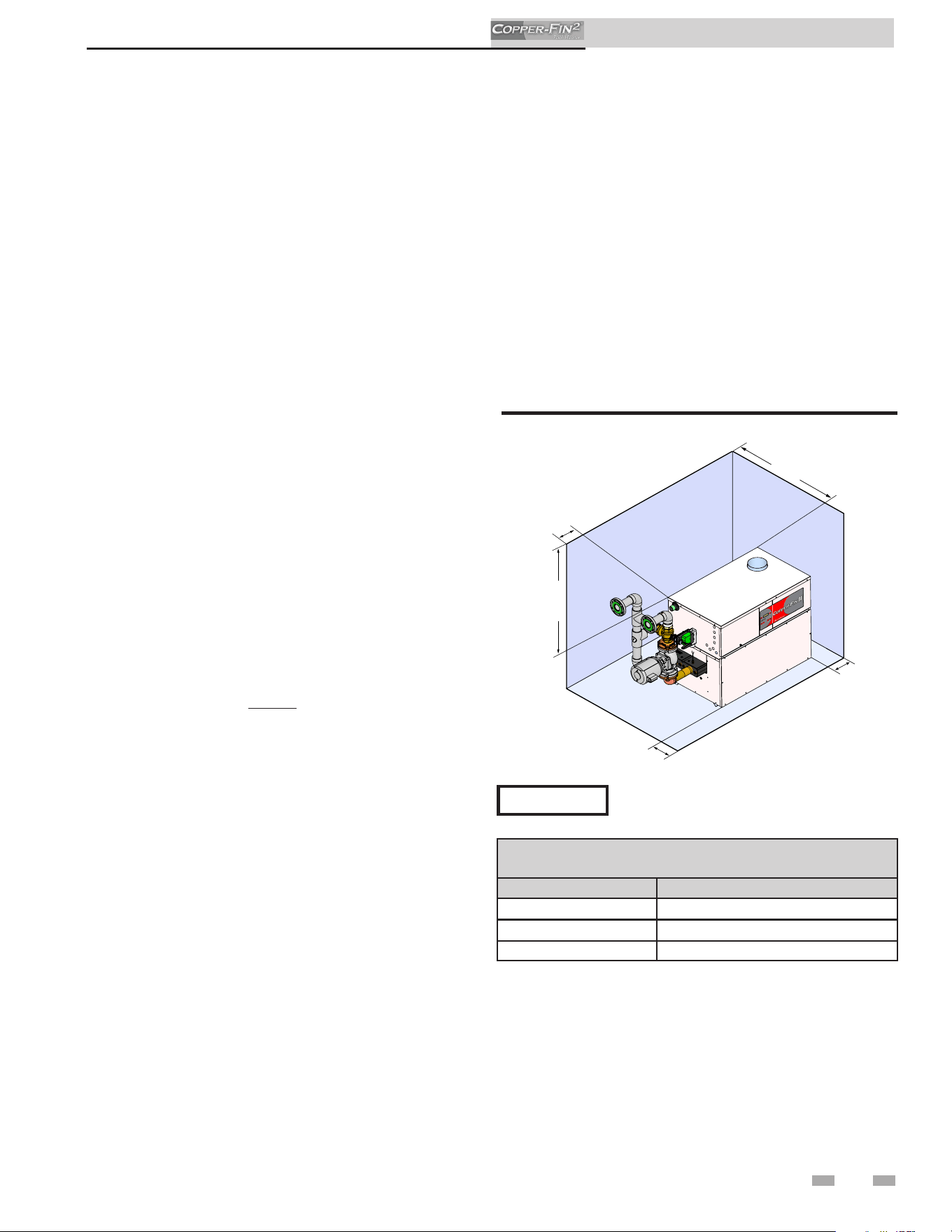
Right Side 3" (7.5 cm)
Rear 3" (7.5 cm) (3" min. from any surface)*
Left Side 6" (15 cm) (24" (0.61 m) suggested for
service)
Front Alcove* (30" (0.76 m) suggested for service)
Top 3" (7.5 cm)
Flue 1" (25.4 mm)
Hot Water Pipes 1" (25.4 mm)
*An Alcove is a closet without a door. Thirty-six inches (36")
to rear required for outdoor installation.
Note: No additional clearance is needed on the right side of the
unit for the observation port. An observation port is located on
both the right and left side of the unit.
Maintain minimum specified clearances for adequate
operation. Allow sufficient space for servicing pipe
connections, pump and other auxiliary equipment, as well
as the unit. See rating plate for specific service clearance
requirements.
Figure 1-1_Indoor clearances from combustible construction
Although these units are CSA International design-certied for
outdoor installations, such installations are not recommended
in areas where the danger of freezing exists. You must provide
proper freeze protection for outdoor installations, units installed
in unheated mechanical rooms or where temperatures may
drop to the freezing point or lower. If freeze protection is not
provided for the system, a low ambient temperature alarm is
recommended for the mechanical room. Damage to the unit by
freezing is non-warrantable.
Freeze protection
2000618449 00
3" MIN
RIGHT
SIDE
3"
MIN
REAR
6"
MIN LEFT
SIDE
3"
MIN
TOP
30" MIN
FRONT
10
1 Determine unit location
Installation & Operation Manual
2. Outside Combustion Air, Using Ducts
You can direct outside combustion air to this unit using two air
ducts to deliver the air to the mechanical room (see FIG. 1-5).
Each of the two openings must have a minimum free area of one
square inch per 2000 Btu input (11cm
2
per kW).
3. Combustion Air from Interior Space
You can direct combustion air to this unit using air from an
adjoining interior space. You must provide two openings from
the mechanical room to the adjoining room (see FIG. 1-4).
Each of the two openings must have a net free area of one square
inch per 1000 Btu input (22cm
2
per kW), but not less than 100
square inches (645cm
2
).
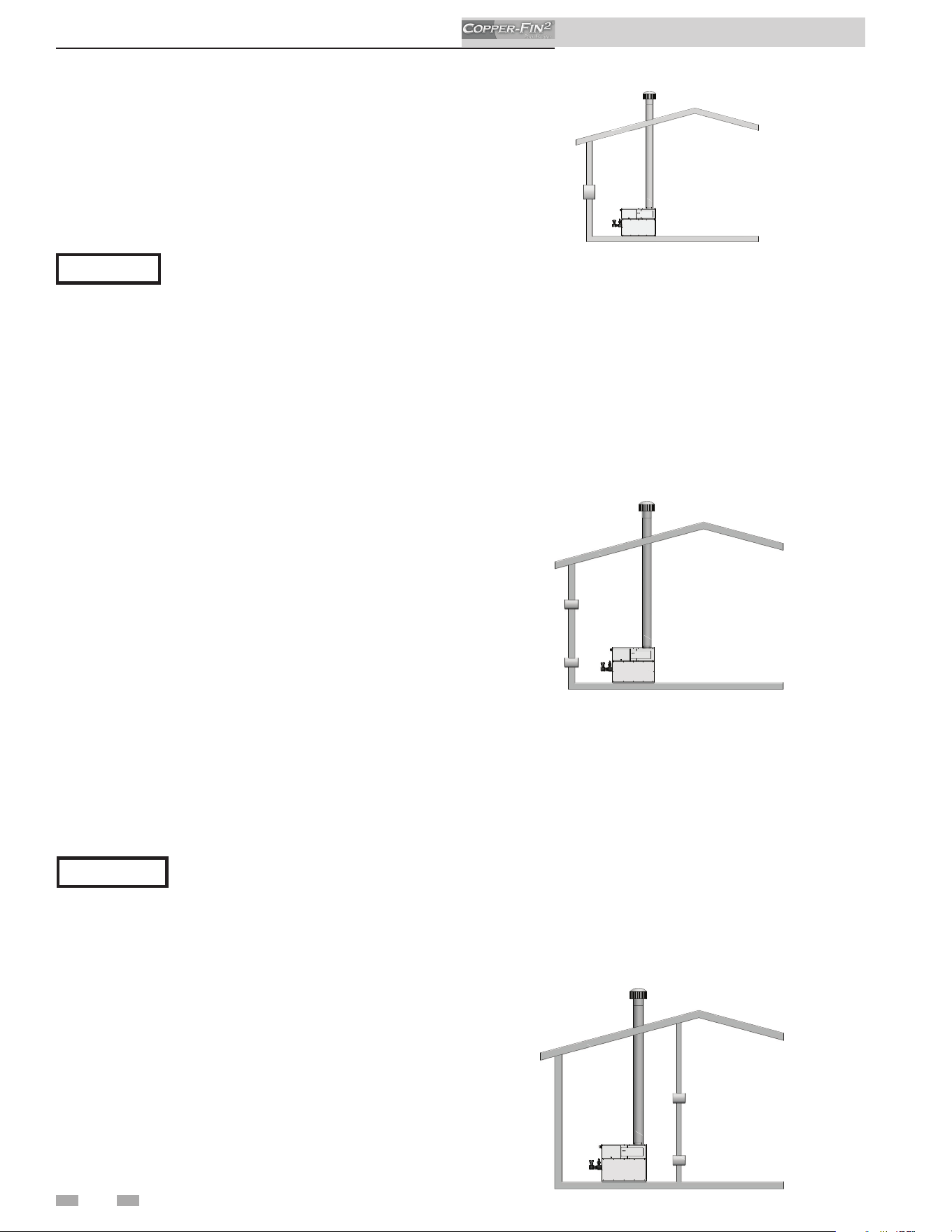
Figure 1-3_Outside Combustion Air - Two Openings
Combustion and ventilation air
Provisions for combustion and ventilation air must be in
accordance with Air for Combustion and Ventilation, of the
latest edition of the National Fuel Gas Code, ANSI Z223.1, in
Canada, the latest edition of CAN/CGA-B149 Installation Code
for Gas Burning Appliances and Equipment, or applicable
provisions of the local building codes.
Provide properly-sized openings to the equipment room to
assure adequate combustion air and proper ventilation when
the unit is installed with conventional venting or sidewall
venting.
Combustion air options
⚠ CAUTION
Under no circumstances should
the equipment room ever be under
a negative pressure. Particular care
should be taken where exhaust fans, attic
fans, clothes dryers, compressors, air
handling units, etc., may take away air
from the unit.
This unit has four combustion air options.
1. Outside Combustion Air, No Ducts
You can direct outside combustion air to this unit using either
one or two permanent openings.
One Opening
The opening must have a minimum free area of one square
inch per 3000 Btu input (7 cm
2
per kW). You must locate this
opening within 12" (30 cm) of the top of the enclosure (see FIG.
1-2).
Figure 1-2_Outside Combustion Air - Single Opening
Two Openings
The combustion air opening must have a minimum free area of
one square inch per 4000 Btu/hr input (5.5 cm
2
per kW). You
must locate this opening within 12" (30 cm) of the bottom of the
enclosure (see FIG. 1-3).
The ventilation air opening must have a minimum free area of
one square inch per 4000 Btu/hr input (5.5 cm
2
per kW). You
must locate this opening within 12" (30 cm) of the top of the
enclosure.
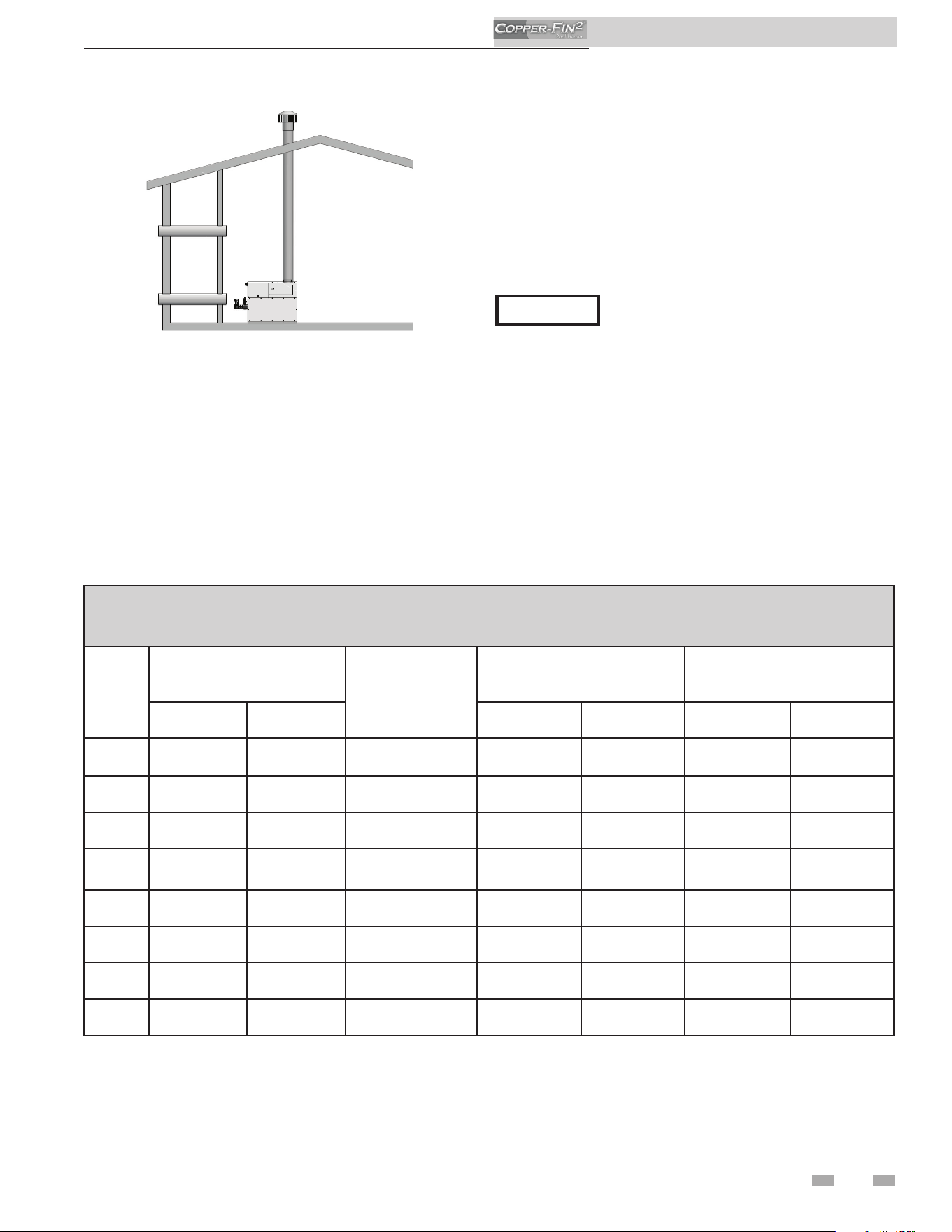
Figure 1-4_Combustion Air from Interior Space
Anytime the inlet temperature drops below 45°F, the
control turns on the pump contact. If the inlet temperature is
below 37°F, and the unit is in the ON Mode, the rst stage will
re.
⚠CAUTION
Locate indoor pool heaters in a room having a temperature
safely above freezing [32°F (0°C)].
Location
A mechanical room operating under a negative
draft pressure may experience a down draft in
the flue of a pool heater when it is not firing.
The cold outside air pulled down the flue
may freeze a heat exchanger. This condition
must be corrected to provide adequate freeze
protection.
Freeze protection for a pool heater using an indirect coil can
be provided by using hydronic system antifreeze. Follow the
appliance manufacturers instructions. Do not use undiluted or
automotive type antifreeze (see page 43).
Hydronic systems anti-freeze
A snow screen should be installed to prevent snow and ice
accumulation around the unit or its venting system.
Outdoor pool heater installation
1 Determine unit location (continued)
11
Installation & Operation Manual
Figure 1-5_Outside Combustion Air Through Ducts
4. Outside Combustion Air - Using Direct Venting
With this option, you can connect combustion air vent piping
directly to the unit. See the information under Direct Venting
starting on page 26 for specific information regarding this
option.
All dimensions are based on net free area in square inches.
Metal louvers or screens reduce the free area of a combustion air
opening a minimum of approximately 25%. Check with louver
manufacturers for exact net free area of louvers. Where two
openings are provided, one must be within 12" (30 cm) of the
ceiling and one must be within 12" (30 cm) of the floor of the
equipment room. Each opening must have a minimum net free
area as specified in TABLE 1C, this page. Single openings shall
be installed within 12" (30 cm) of the ceiling.
⚠CAUTION
The combustion air supply must be
completely free of any flammable vapors
that may ignite or chemical fumes which
may be corrosive to the appliance. Common
corrosive chemical fumes which must be
avoided are fluorocarbons and other
halogenated compounds, most commonly
present as refrigerants or solvents, such as
Freon, trichlorethylene, perchlorethylene,
chlorine, etc. These chemicals, when
burned, form acids which quickly attack
the heat exchanger finned tubes, headers,
flue collectors, and the vent system. The
result is improper combustion and a non-
warrantable, premature unit failure.
TABLE - 1C
MINIMUM RECOMMENDED COMBUSTION
AIR SUPPLY TO EQUIPMENT ROOM
Model
Number
*Outside Air from
2 Openings Directly from
Outdoors
*Outside Air from
1 Opening Directly
from Outdoors, in
2
Inside Air from
2 Ducts Delivered from
Outdoors
Inside Air from
2 Ducts Delivered from
Interior Space
Top
Opening, in
2
Bottom
Opening, in
2
Top
Opening, in
2
Bottom
Opening, in
2
Top
Opening, in
2
Bottom
Opening, in
2
502
125
(806 cm
2
)
125
(806 cm
2
)
167
(1077 cm
2
)
250
(1613 cm
2
)
250
(1613 cm
2
)
500
(3226 cm
2
)
500
(3226 cm
2
)
652
163
(1052 cm
2
)
163
(1052 cm
2
)
217
(1400 cm
2
)
325
(2097 cm
2
)
325
(2097 cm
2
)
650
(4194 cm
2
)
650
(4194 cm
2
)
752
188
(1213 cm
2
)
188
(1213 cm
2
)
250
(1613 cm
2
)
375
(2420 cm
2
)
375
(2420 cm
2
)
750
(4839 cm
2
)
750
(4839 cm
2
)
992
248
(1600 cm
2
)
248
(1600 cm
2
)
330
(2129 cm
2
)
495
(3194 cm
2
)
495
(3194 cm
2
)
990
(6388 cm
2
)
990
(6388 cm
2
)
1262
315
(2032cm
2
)
315
(2032cm
2
)
420
(2710 cm
2
)
630
(4065 cm
2
)
630
(4065 cm
2
)
1260
(8130 cm
2
)
1260
(8130 cm
2
)
1442
360
(2323cm
2
)
360
(2323cm
2
)
480
(3097 cm
2
)
720
(4646 cm
2
)
720
(4646 cm
2
)
1440
(9291 cm
2
)
1440
(9291 cm
2
)
1802
450
(2903cm
2
)
450
(2903cm
2
)
600
(3871 cm
2
)
900
(5807 cm
2
)
900
(5807 cm
2
)
1800
(11614 cm
2
)
1800
(11614 cm
2
)
2072
518
(3342cm
2
)
518
(3342cm
2
)
690
(4452 cm
2
)
1035
(6678 cm
2
)
1035
(6678 cm
2
)
2070
(13356 cm
2
)
2070
(13356 cm
2
)
*Outside air openings shall directly communicate with the outdoors. When combustion air is drawn from the outside through a
duct, the net free area of each of the two openings must have twice (2 times) the free area required for Outside Air/2 Openings. The
above requirements are for the pool heater only; additional gas fired appliances in the equipment room will require an increase in
the net free area to supply adequate combustion air for all appliances.
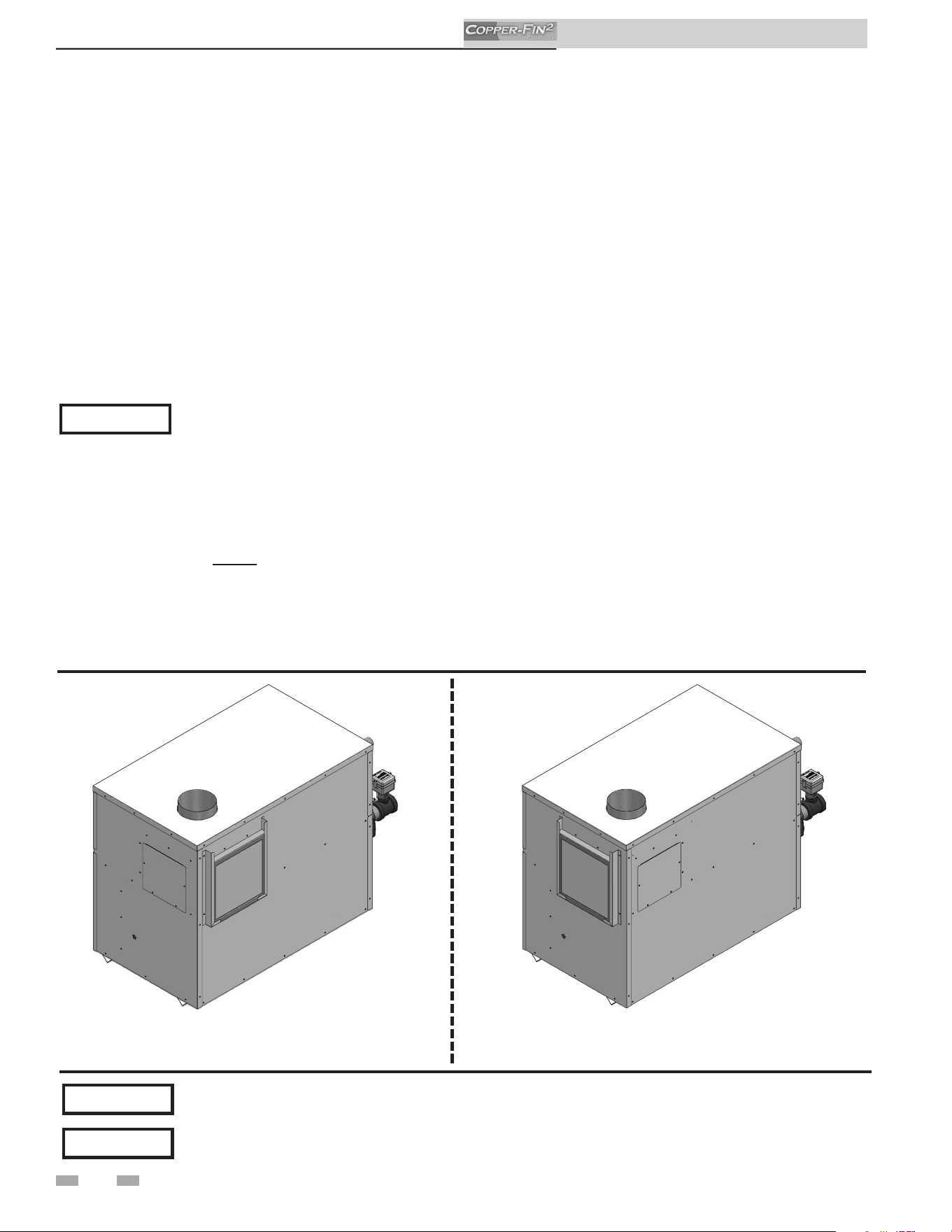
12
1 Determine unit location
Installation & Operation Manual
Exhaust fans
Any fan or equipment which exhausts air from the mechanical
room may deplete the combustion air supply and/or cause a
down draft in the venting system. Spillage of flue products from
the venting system into an occupied living space can cause a
very hazardous condition that must be immediately corrected.
If a fan is used to supply combustion air to the mechanical
room, the installer must make sure that it does not cause drafts
which could lead to nuisance operational problems with the
pool heater.
Vertical DirectAire™, Horizontal DirectAire™, and Direct Vent
venting systems have specific requirements for combustion air
ducts from the outside which are directly connected to the unit.
See the requirements for combustion air duct in the venting
section.
Combustion air filter
This unit has a standard air filter located at the combustion
air inlet. This filter helps ensure clean air is used for the
combustion process. Check this filter every month and replace
when it becomes dirty. The filter size on Models 502 - 752 is 12"
x 12" x 1" (30.5 cm x 30.5 cm x 2.5 cm) and 16" x 16" x 1"
(40.6 cm x 40.6 cm x 2.5 cm) on Models 992 - 2072. You can
find these commercially available filters at any home center or
HVAC supply store.
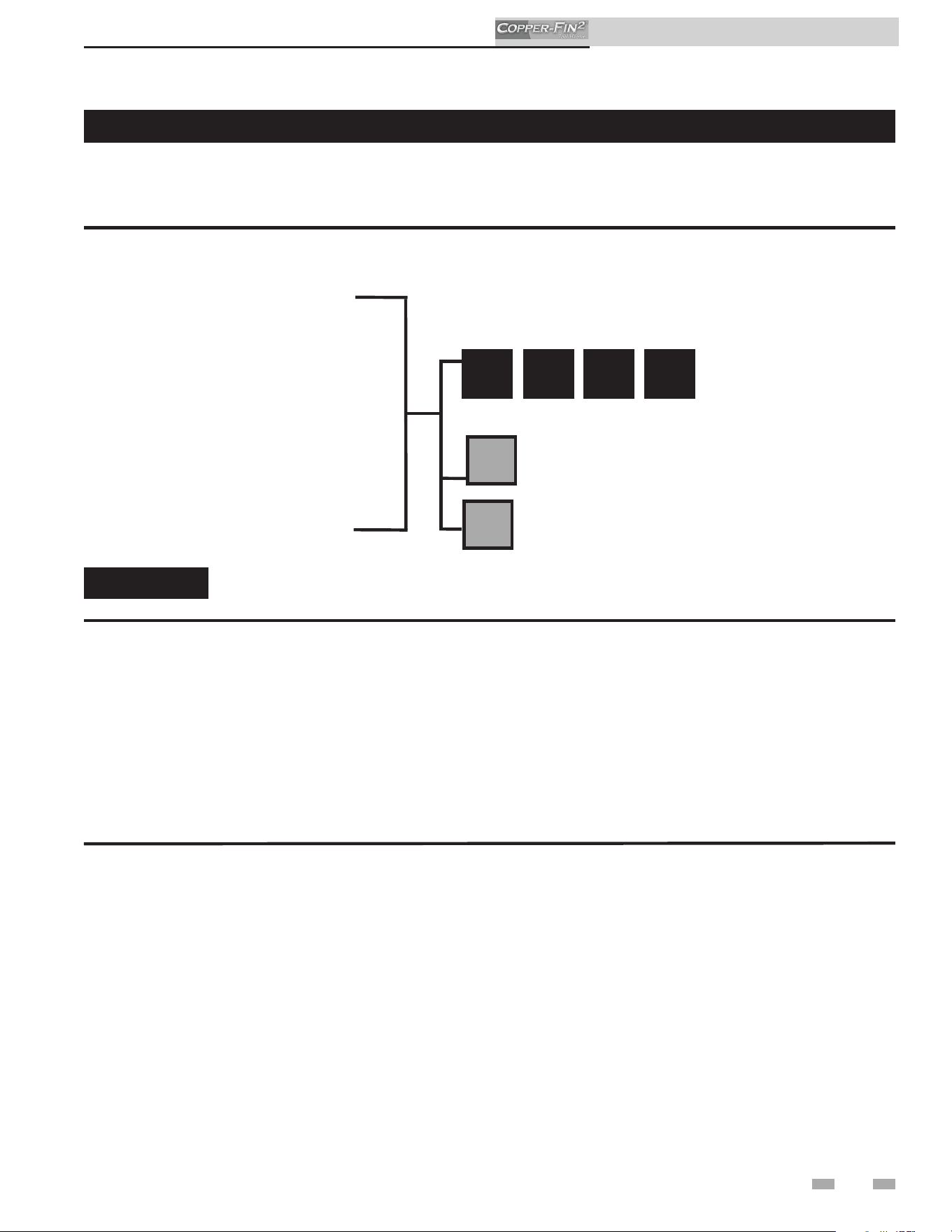
For convenience and flexibility, you can direct the combustion
air inlet from either the back or right side of the unit. To arrange
the combustion air inlet for side entry, follow the steps below:
1. Remove the metal panel from the unit’s side wall (see
FIG. 1-6).
2. Remove screws from the air filter/bracket assembly.
3. Move the filter/bracket assembly from the rear of unit to the
side opening (see FIG. 1-7).
4. Attach filter/bracket assembly to the unit’s side using the
pre-drilled screw holes.
5. Attach the metal panel to the rear combustion air opening
to seal it off.
Figure 1-6_Metal Panel Covering Side Combustion
Air Inlet
Figure 1-7_Moving Air Filter / Bracket Assembly from
Rear of Unit to Side
CAUTION
During construction the air filter should be checked more frequently to ensure it does not become clogged with
combustion dirt and debris.
NOTICE
Sustained operation of an appliance with a clogged filter may result in nuisance operational problems, bad
combustion, and non-warrantable component failures.
Use of filters having MERV (Minimum
Efficiency Reporting Value) ratings higher
than 4 is not recommended. Higher efficiency
low-micron filters can limit combustion
air leading to either nuisance problems or
potential component damage if used over
prolonged periods of time. Filters having
a MERV rating of 5 to 6 may be used
on a limited basis during the construction
phase of a project provided they are replaced
once filter loading becomes apparent. After
the construction phase is completed, it is
recommended that the filter be changed to a
4 or lower MERV disposable type filter.
NOTICE
13
2 Venting
BEFORE YOU BEGIN
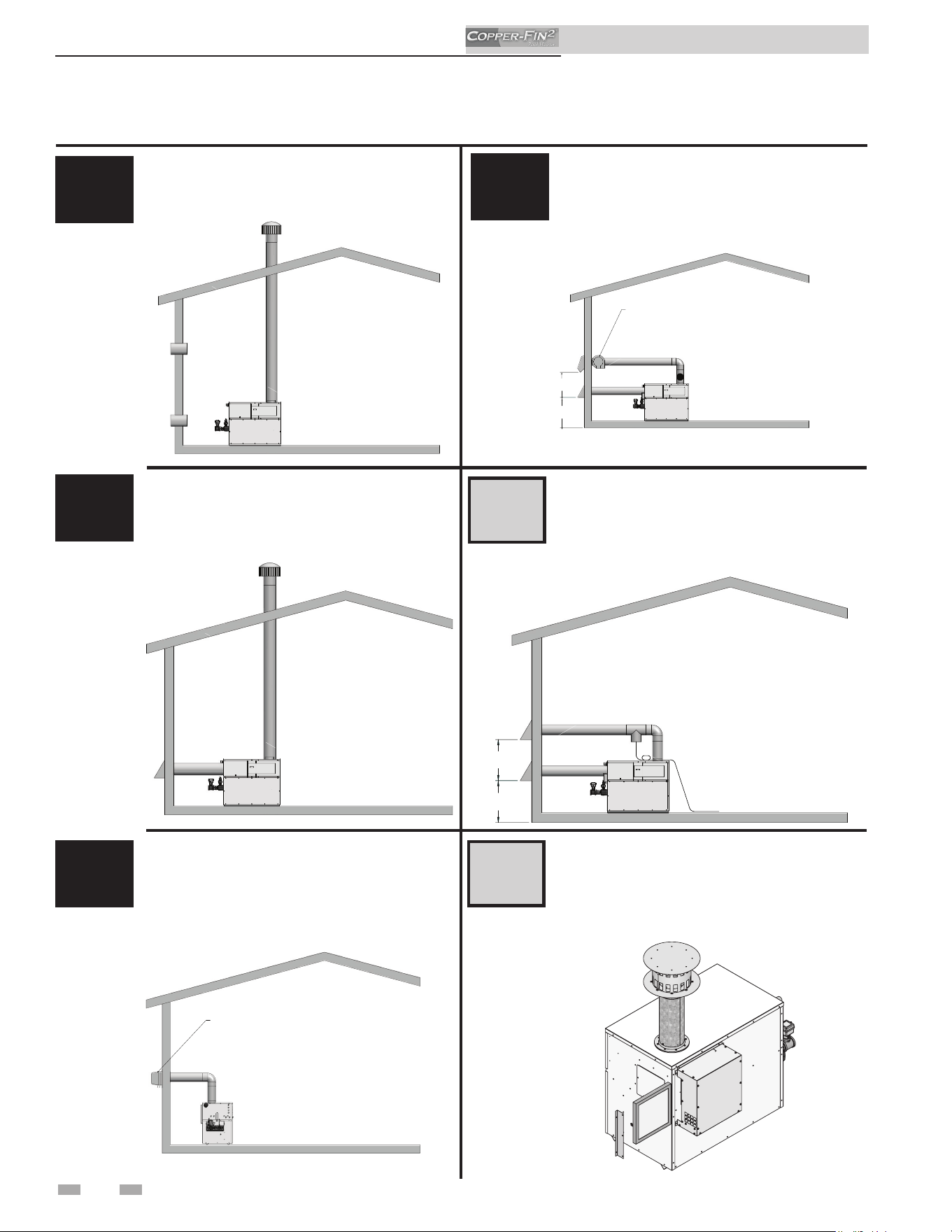
Identify your appliance’s vent system:
This manual covers venting requirements for CAT I models and CAT IV vent materials. Be sure to correctly identify the type of
vent system your appliance requires before proceeding.
CP (N,L) 0502
CP (N,L) 0652
CP (N,L) 0752
CP (N,L) 0992
CP (N,L) 1262
CP (N,L) 1442
CP (N,L) 1802
CP (N,L) 2072
⚠ DANGER
Failure to use correct venting materials can result in loss of life from flue gas spillage into working or living
space.
Venting Category Definitions: (Reference National Fuel Gas Code ANSI Z223.1)
CAT I: Negative pressure non-condensing
An appliance that operates with a non-positive vent static pressure with a vent gas temperature that avoids excessive condensate
production in the vent.
CAT IV: Positive pressure condensing
An appliance that operates with a positive vent static pressure with a vent gas temperature that may cause excessive condensate
production in the vent.
CAT IV Flue pipe materials
The following manufacturers supply flue materials suitable for these models when installed as CAT IV. All materials are made
with AL29-4C stainless steel.
Heat-Fab Inc., Saf-T CI Vent with AL29-4C stainless steel
Protech Systems Inc., Fas N Seal Vent with AL29-4C stainless steel
Metal-Fab Inc., Corr/Guard Vent with AL29-4C stainless steel
Or other listed Category IV vent systems suitable for a condensing, positive pressure, gas fired appliance.
A Category IV flue MUST have all vent joints and seams sealed gastight and have provisions for a drain to properly collect and
dispose of condensate that may occur in the venting system.
Installation & Operation Manual
A B C
E
Venting options:
F
= B-Vent Material
CAT I
= Direct Vent Options
CAT IV
= Outdoor Vent Option
D
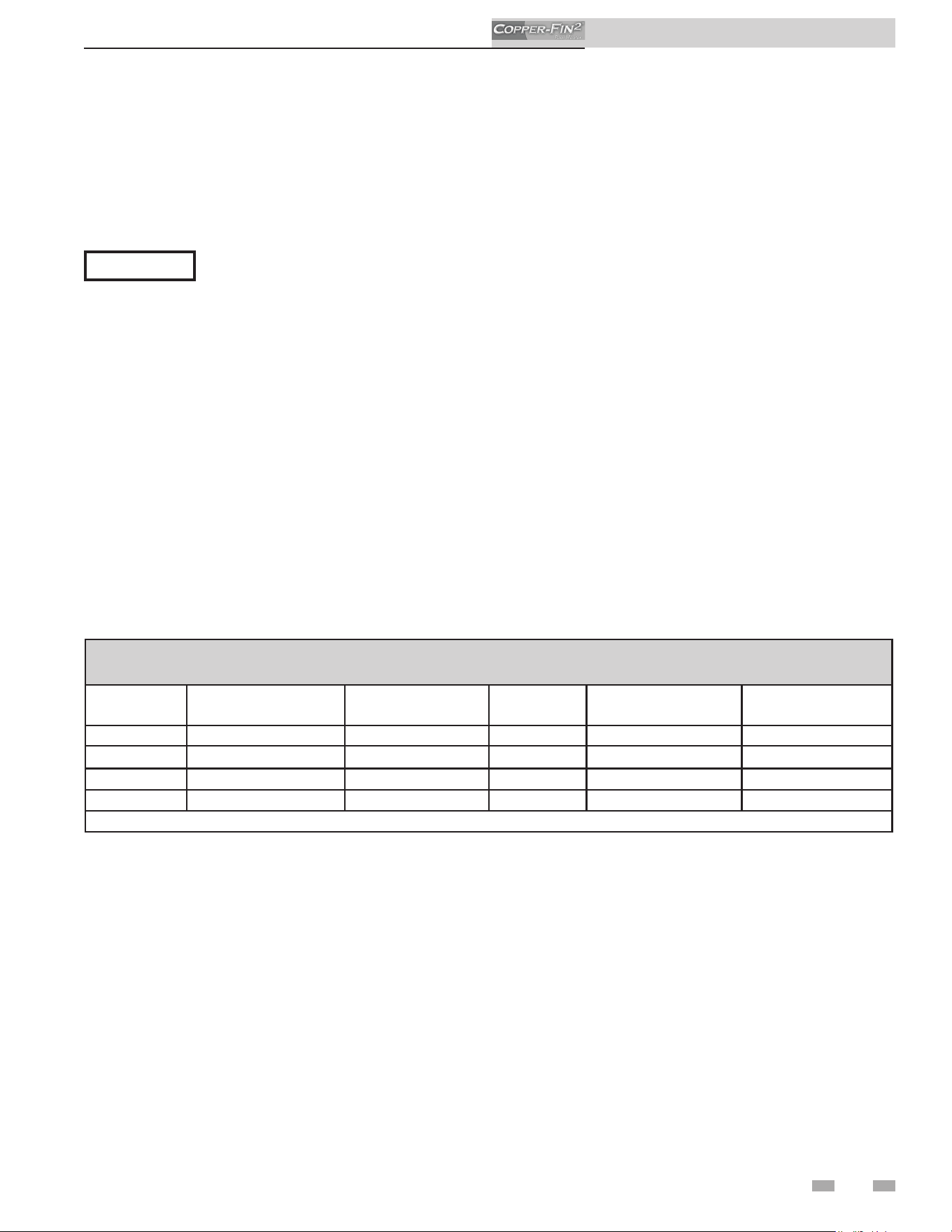
Vent system options: (Note: Installations shown below are representative, actual installations may vary from those shown.)
Installation & Operation Manual
14
2 Venting
A
This option uses a vertical rooftop flue termination
with air supplied from the equipment room - see
page 16.
This option uses a powered vent assembly to
exhaust the flue products out a sidewall with air
supplied by a pipe from the sidewall - see page 25.
B
This option uses a vertical conventional vent for
flue products with air supplied by a pipe from the
sidewall or rooftop - see page 19.
E
This option uses a sealed AL29-4C flue and a
separate combustion air pipe to the outdoors.
This system terminates both the flue and
combustion air inlet in the same pressure zone
- see page 26.
C
This option uses a powered vent assembly to
exhaust the flue products out a sidewall vent
termination with air supplied from the equipment
room - see page 22.
This option uses the installation of a special air
inlet cap on rear of the unit and vent pipe and
cap - see page 33.
NOTE: CAT I B-VENT MATERIALS MAY BE USED WHEN THE
POWERED VENT IS CONNECTED DIRECTLY TO THE OUTSIDE
VENT CAP. IF THE POWERED VENT IS NOT CONNECTED
DIRECTLY TO THE OUTSIDE VENT CAP, THEN CAT IV - AL29-4
C
VENT MATERIALS MUST BE USED FROM THE POWERED VENT
TO THE OUTSIDE VENT CAP.
12"
MI
N
3'
MI
N
NOTE: CAT I B-VENT MATERIALS MAY BE USED WHEN THE
POWERED VENT IS CONNECTED DIRECTLY TO THE OUTSIDE
VENT CAP. IF THE POWERED VENT IS NOT CONNECTED
DIRECTLY TO THE OUTSIDE VENTCAP, THEN CAT IV - AL29-4
C
VENT MATERIALS MUST BE USED FROM THE POWERED VENT
TO THE OUTSIDE VENT CAP.
1
1
2
2
"
"
M
M
I
I
N
N
3'
3'
M
M
I
I
N
N
F
CONVENTIONAL NEGATIVE
DRAFT VENTING
VERTICAL DIRECTAIRE VENT-
ING
SIDEWALL VENTING
HORIZONTAL DIRECTAIRE
VENTING
D
DIR #2000597298 00
OUTDOOR VENTING
2 Venting (continued)
15
Installation & Operation Manual
TABLE - 2A
FLUE AND AIR INLET PIPE SIZES
MODEL FLUE SIZE AIR INLET SIZE MODEL FLUE SIZE AIR INLET SIZE*
502 6" 6" 1262 12" 12"
652 8" 8" 1442 12" 12"
752 8" 8" 1802 14" 12"
992 10" 10" 2072 14" 12"
*Minimum diameter for air inlet pipe. Installer may increase diameter one pipe size for ease of installation, if needed.
General information
You must supply adequate combustion and ventilation air to this unit. You must provide minimum clearances for the vent
terminal from adjacent buildings, windows that open, and building openings. Follow all requirements set forth in the latest edition
of the National Fuel Gas Code, ANSI Z223.1, in Canada, the latest edition of CAN/CGA Standard B149 Installation Code for Gas
Burning Appliances and Equipment or applicable local building codes. Vent installations for connection to gas vents or chimneys
must be in accordance with “Venting of Equipment” of the above-mentioned standards.
NOTICE
Examine the venting system at least once each year. Check all joints and vent pipe connections for tightness.
Also check for corrosion or deterioration. If you find any problems, correct them at once.
Venting support
Support horizontal portions of the venting system to prevent sagging. Provide an upward slope of at least 1/4 inch per foot
(21mm/m) on all horizontal runs from the unit to the vertical flue run or to the vent terminal on sidewall venting installations.
Do not use an existing chimney as a raceway if another appliance or fireplace is vented through the chimney. The weight of the
venting system must not rest on the unit. Provide adequate support of the venting system. Follow all local and applicable codes.
Secure and seal all vent connections. Follow the installation instructions from the vent material manufacturer.
Barometric damper location
Any venting system option that requires a barometric damper must adhere to the following directions for optimum performance.
The preferred location for the barometric damper is in a tee or collar installed in the vertical pipe rising from the unit’s flue outlet.
The barometric damper MUST NOT be installed in a bull head tee installed on the unit’s flue outlet. The tee or collar containing
the barometric damper should be approximately three feet vertically above the connection to the unit’s flue outlet. This location
ensures that any positive velocity pressure from the unit’s internal combustion fan is dissipated and the flue products are rising
due to buoyancy generated from the temperature of the flue products. Adjust the weights on the damper to ensure that draft is
maintained within the specified range.
Installation & Operation Manual
16
2 Venting
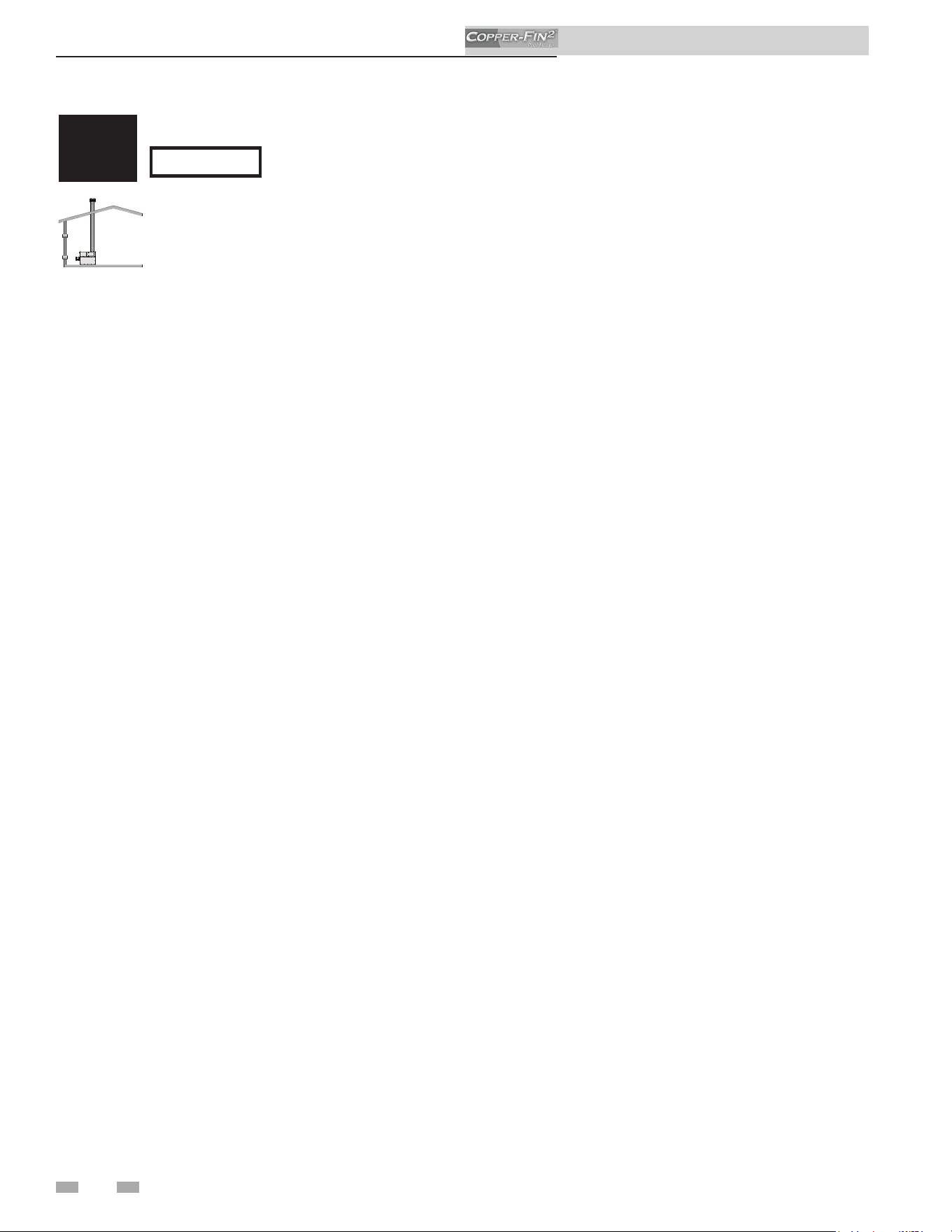
A
Conventional negative draft venting - see page 14.
NOTICE
Before installing a venting system, follow requirements found in the General Venting section.
This option uses Type-B double-wall flue outlet piping. The blower brings in combustion air. The buoyancy of the
heated flue products cause them to rise up through the flue pipe. The flue outlet terminates at the rooftop.
Negative draft
The negative draft in a conventional vent installation must be within the range of 0.02 to 0.08 inches w.c. to ensure
proper operation. Make all draft readings while the unit is in stable operation (approximately 2 to 5 minutes).
Connect the flue vent directly to the flue outlet opening on the top of the unit. No additional draft diverter or
barometric damper is needed on single unit installations with a dedicated stack and a negative draft within the
specified range of 0.02 to 0.08 inches w.c. If the draft in a dedicated stack for a single unit installation exceeds the
maximum specified draft, you must install a barometric damper to control draft. Multiple unit installations with
combined venting or common venting with other Category I negative draft appliances require each pool heater to
have a barometric damper installed to regulate draft within the proper range.
Do not connect vent connectors serving appliances vented by natural draft (negative draft) to any portion of a
mechanical draft system operating under positive pressure. Connecting to a positive pressure stack may cause flue
products to be discharged into the living space causing serious health injury.
Flue outlet piping
With this venting option, you must use Type-B double-wall vent materials. Vent materials must be listed by a
nationally-recognized test agency for use as vent materials. Make the connections from the unit vent to the outside
stack as direct as possible with no reduction in diameter. Use the National Fuel Gas Code venting tables for
double-wall vent to properly size all vent connectors and stacks. Follow the vent manufacturer’s instructions when
installing Type-B vents and accessories, such as firestop spacers, vent connectors, thimbles, caps, etc.
Provide adequate clearance to combustibles for the vent connector and firestop.
When planning the venting system, avoid possible contact with plumbing or electrical wiring inside walls, ceilings,
and floors. Locate the unit as close as possible to a chimney or gas vent.
Avoid long horizontal runs of the vent pipe, 90° elbows, reductions and restrictions.
No additional draft diverter or barometric damper is required on single unit installations with a dedicated stack and
a negative draft maintained between 0.02 to 0.08 inches w.c.
Common Venting Systems
You can combine the flue with the vent from any other negative draft, Category I appliance. Using common venting
for multiple negative draft appliances requires you to install a barometric damper with each unit. This will regulate
draft within the proper range. You must size the common vent and connectors from multiple units per the venting
tables for Type-B double-wall vents in the latest edition of the National Fuel Gas Code, ANSI Z223.1 and/or CAN/
CGA-B149 Installation Code.
Common venting systems may be too large when an existing unit is removed.
At the time of removal of an existing appliance, the following steps shall be followed with each appliance remaining
connected to the common venting system placed in operation, while other appliances remaining connected to the
common venting system are not in operation.
1. Seal any unused opening in the common venting system.
2. Visually inspect the venting system for proper size and horizontal pitch. Make sure there is no blockage or
restriction, leakage, corrosion and other unsafe conditions.
3. If possible, close all building doors and windows. Close all doors between the space in which the appliances
remaining connected to the common venting system are located and other building spaces.
Installation & Operation Manual
17
2 Venting (continued)
4. Turn on clothes dryers and any other appliances not connected to the common venting system. Turn on any exhaust fans, such
as range hoods and bathroom exhausts, so they will operate at maximum speed. Do not operate a summer exhaust fan.
5. Close fireplace dampers.
6. Place in operation the unit being inspected. Follow the lighting instructions. Adjust thermostat so unit will operate continuously.
7. Test for spillage at the draft hood/relief opening after 5 minutes of main burner operation. Use the flame of a match or candle,
or smoke from a cigarette, cigar or pipe.
8. After making sure that each appliance remaining connected to the common venting system properly vents when tested as
above, return doors, windows, exhaust fans, fireplace dampers and other gas burning appliances to their previous conditions
of use.
9. Correct any improper operation of the common venting system so that the installation conforms to the latest edition of the
National Fuel Gas Code, ANSI Z223.1, in Canada, the latest edition of CAN/CGA-B149 Installation Code for Gas Burning
Appliances and Equipment. When resizing any portion of the common venting system, resize to approach the minimum size
as determined using the appropriate tables of the latest edition of the National Fuel Gas Code, ANSI Z223.1, in Canada, the
latest edition of CAN/CGA-B149 Installation Code for Gas Burning Appliances and Equipment.
Masonry chimney installations
A masonry chimney must be properly sized for the installation of a high efficiency gas-fired appliance. Venting of a high efficiency
appliance into a cold or oversized masonry chimney can result in operational and safety problems. Exterior masonry chimneys,
with one or more sides exposed to cold outdoor temperatures, are more likely to have venting problems. The temperature of the
flue products from a high efficiency appliance may not be able to sufficiently heat the masonry structure of the chimney to generate
proper draft. This will result in condensing of flue products, damage to the masonry flue/tile, insufficient draft and possible spillage
of flue products into an occupied living space. Carefully inspect all chimney systems before installation.
⚠WARNING
Do not vent this unit into a masonry chimney without a sealed stainless steel liner system. Any breaks, leaks,
or damage to the masonry flue/tile will allow the flue products to leak from the chimney and into occupied
living spaces. This could cause serious injury or death due to carbon monoxide poisoning and other harmful
flue products.
NOTICE
Check with local code officials to determine code requirements or the advisability of using a masonry chimney
with a sealed corrosion-resistant liner system.
Inspection of a masonry chimney
A masonry chimney must be carefully inspected to determine its suitability for the venting of flue products. A clay-tile-lined
chimney must be structurally sound, straight and free of misaligned tile, gaps between liner sections, missing sections of liner or any
signs of condensate drainage at the breaching or clean out. If there is any doubt about the condition of a masonry chimney, it must
be relined with a properly-sized and approved chimney liner system. An unlined masonry chimney must not be used to vent flue
products from this high-efficiency unit. An unlined chimney must be relined with an approved chimney liner system when a new
appliance is being attached to it. Metallic liner systems (Type-B double-wall or flexible or rigid metallic liners) are recommended.
Consult with local code officials to determine code requirements or the advisability of using or relining a masonry chimney.
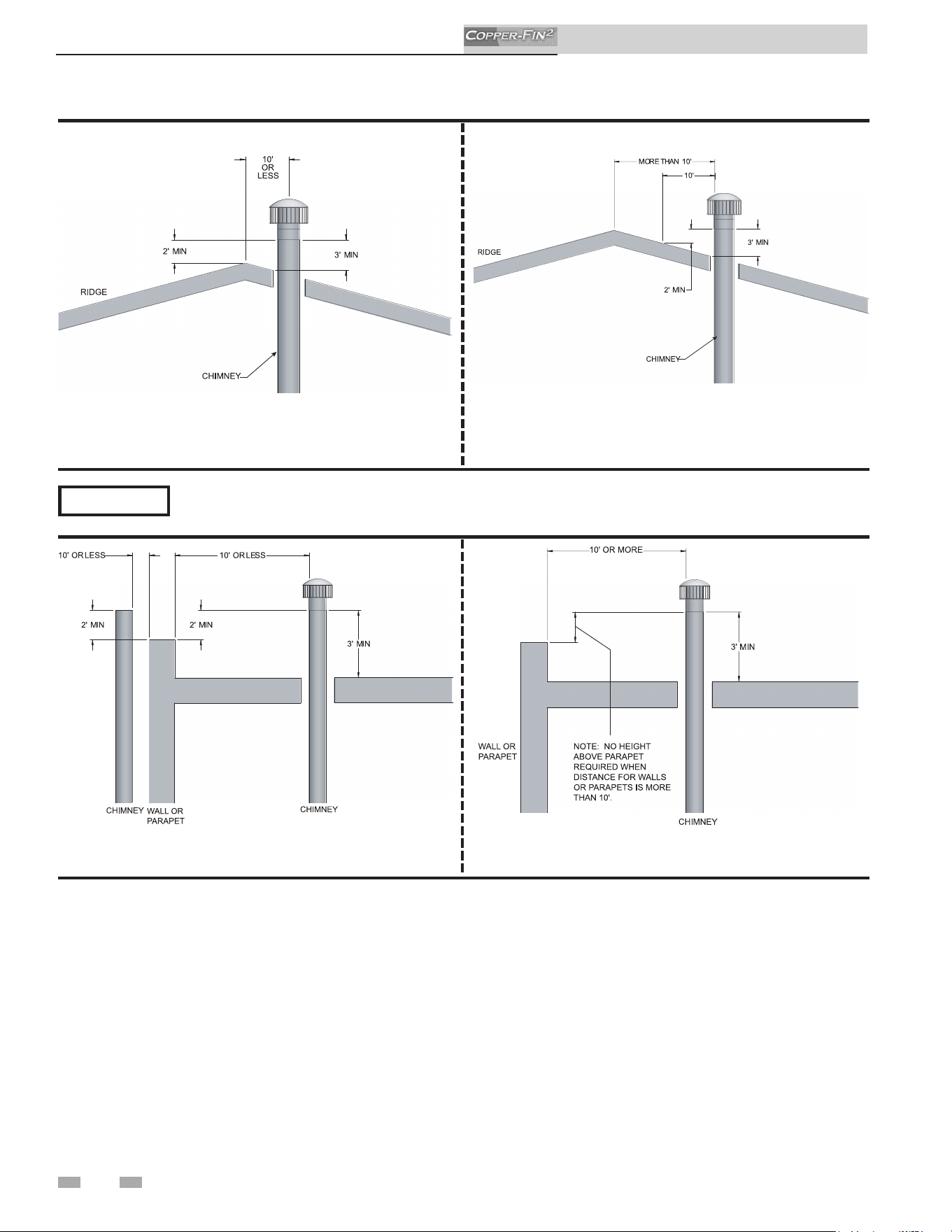
Vertical vent termination clearances and location
The vent terminal should be vertical and exhaust outside the building at least 2 feet (0.61 m) above the highest point of the roof
within a 10 foot (3.05 m) radius of the termination.
The vertical termination must be a minimum of 3 feet (0.91 m) above the point of exit.
A vertical termination less than 10 feet (3.05 m) from a parapet wall must be a minimum of 2 feet (0.61 m) higher than the parapet
wall.
Keep the vent cap clear of snow, ice, leaves, and debris to avoid blocking the flue.
Installation & Operation Manual
18
2 Venting
Figure 2-1_Vent Termination from Peaked Roof - 10 ft.
or Less From Ridge
NOTICE
Vent terminations are not shown in FIG.’s 2-1 thru 2-4. Make sure all vertical vents are installed with vent
terminations recommended by the vent manufacturer.
Figure 2-2_Vent Termination from Peaked Roof - 10 ft.
or More From Ridge
Figure 2-4_Vent Termination from Flat Roof - 10 ft. or
More From Parapet Wall
Figure 2-3_Vent Termination from Flat Roof - 10 ft.
or Less From Parapet Wall
2 Venting (continued)
19
Installation & Operation Manual
The sidewall or vertical rooftop DirectAire™ combustion air supply system has specific material and installation requirements. The
air inlet pipe connects directly to the unit to supply combustion air. In most installations, the combustion air inlet pipe will be a
dedicated system with one air inlet pipe per unit. You can combine multiple air inlets if the guidelines in Combined Air Inlet Points,
page 20 are followed. The air inlet pipe will be connected to a combustion air inlet cap as specified in this section.
For normal installations, this system uses a single-wall pipe to supply combustion air from outdoors directly to the unit.
In cold climates, use a Type-B double-wall vent pipe or an insulated single-wall pipe for combustion air. This will help prevent
moisture in the cool incoming air from condensing and leaking from the inlet pipe.
Length of air inlet pipe
The installed length of air inlet pipe from the unit to the outside air inlet cap must not exceed 50 equivalent feet (15.2 m). Subtract
5 feet (1.5 m) of equivalent length for each 90° elbow. Subtract 2.5 feet (0.7 m) of equivalent length for each 45° elbow.
Do not exceed the limits for the combustion air inlet piping lengths.
Sidewall air inlet
The sidewall air inlet cap is supplied in the Sidewall Air Inlet Kit. Order the kit from the appliance manufacturer. This sidewall
cap supplies combustion air for a single unit only. See Table 2B, page 21, for kit numbers.
Locate the unit as close as possible to the sidewall where you will install the combustion air supply system.
⚠WARNING
Locate and install the combustion air inlet cap correctly. Failure to do so can allow the discharge of flue products
to be drawn into the combustion process. This can result in incomplete combustion and potentially hazardous
levels of carbon monoxide in the flue products. This will cause operational problems and the spillage of flue
products. Spillage of flue products can cause personal injury or death due to carbon monoxide poisoning.
Combustion air inlet piping
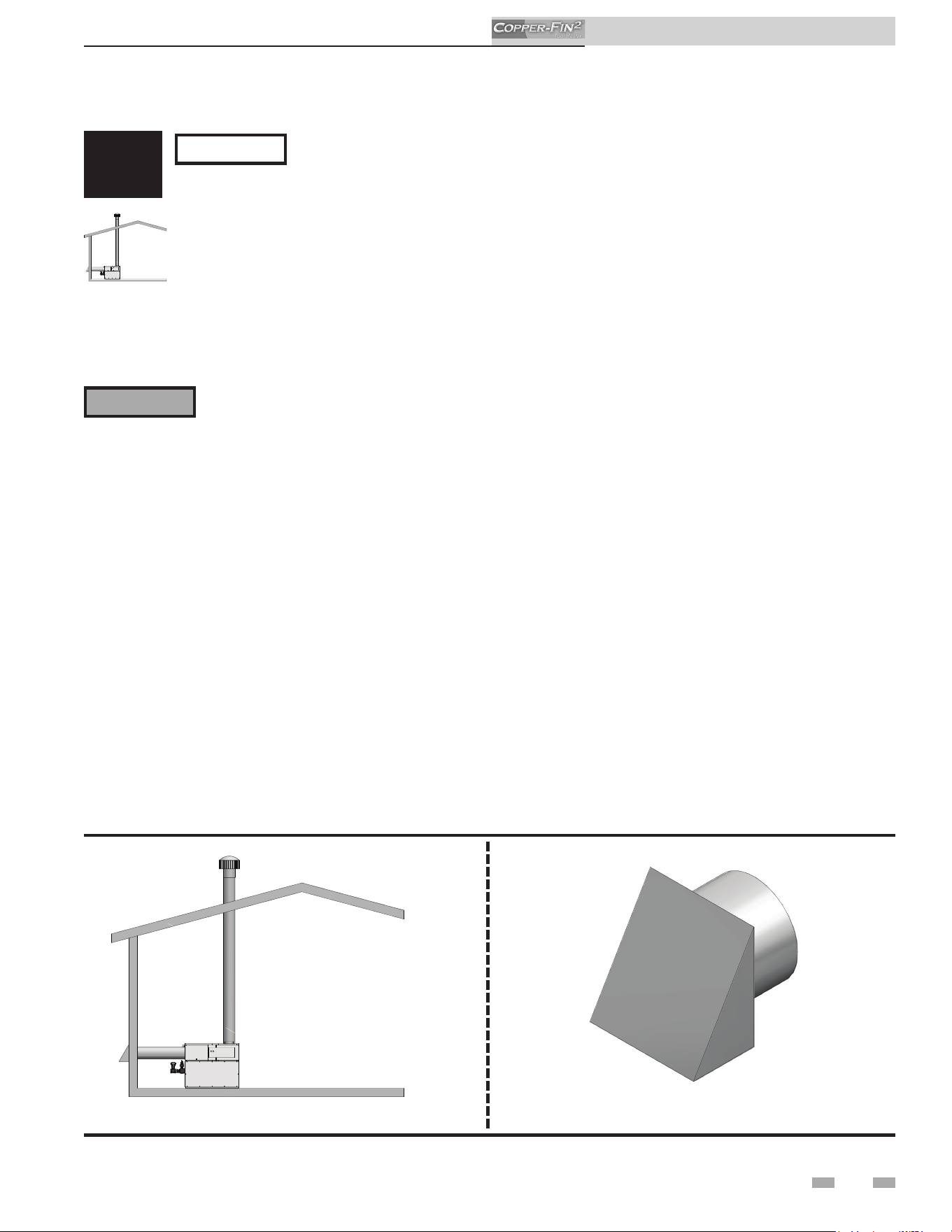
Figure 2-6_Air Inlet Cap for Sidewall Termination
Figure 2-5_Sidewall Combustion Air Inlet
Vertical DirectAire ™ venting - see page 14.
The Vertical DirectAire™ vent system is the same as the Conventional Negative Draft vent system, except it pulls
combustion air from the outdoors through a separate air inlet pipe. Follow all requirements in the Conventional
Negative Draft Venting section on page 16.
The Vertical DirectAire™ vent system requires you to install two pipes directly to the unit; one vertical pipe with
a rooftop termination for the flue products and one pipe for combustion air. For this venting option, you must
purchase the DV box adapter from the appliance manufacturer. The DV box attaches to the air inlet of the unit. The
pipe for combustion air attaches to the DV box (see FIG. 2-11 on page 28). Reference page 28 for a list of approved
air intake materials.
B
NOTICE
Before installing a venting system, follow requirements found in the General Venting section.
20
2 Venting
Installation & Operation Manual
To prevent recirculation of flue products from an adjacent vent cap into the combustion air inlet, follow all applicable clearance
requirements in the latest edition of the National Fuel Gas Code and/or CAN/CGA-B149 Installation Code and instructions in the
Installation and Operation Manual.
Clearances
You must install the combustion air inlet cap at least one foot (0.30 m) above ground level and above normal snow levels.
The point of termination for the combustion air inlet cap must be at least 3 feet (0.91 m) below the point of flue gas termination if
it is located within 10 feet (3.05 m) of the flue outlet. Make sure to properly install the air inlet cap assembly on the air inlet pipe.
Do not install the combustion air inlet cap closer than 10 feet (3.05 m) from an inside corner of an L-shaped structure.
You can terminate the combustion air pipe either horizontally with a sidewall air inlet or vertically with a rooftop air inlet. The
installed length of air inlet pipe from the unit to the outside air inlet cap must not exceed 50 equivalent feet (15.2 m).
Vertical Rooftop Air Inlet
Use the vertical air inlet terminations available from the appliance manufacturer, recommended and/or supplied by the vent
manufacturer, or use two 90° elbows as described on page 29.
12"
MIN
3'
MIN
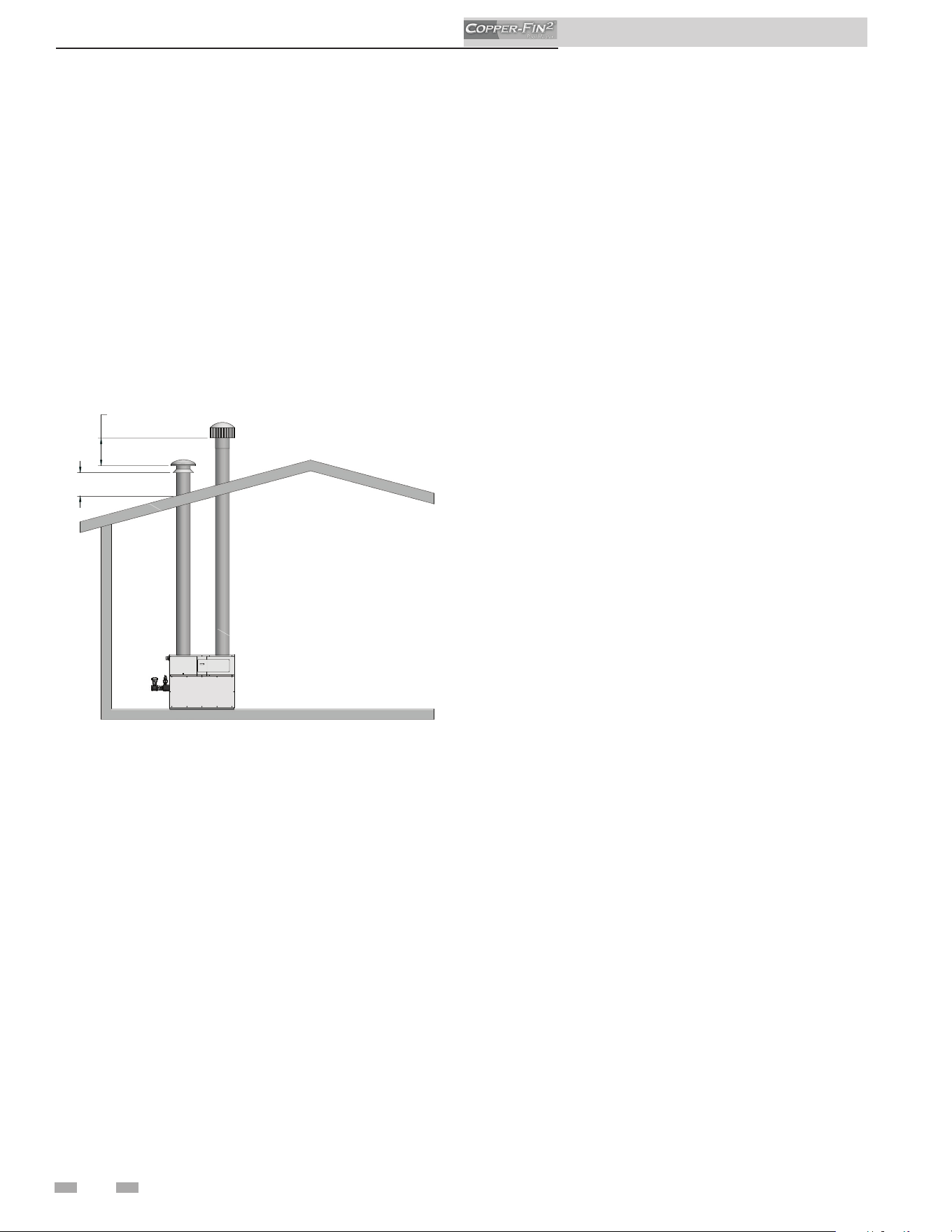
You must locate the air inlet termination elbow at least 12"
(30 cm) above the roof or above normal snow levels.
If the air inlet cap is within a 10-foot (3.05 m) radius of the flue
outlet, the point of termination for the combustion air inlet
cap must be at least 3 feet (0.91 m) below the point of flue gas
termination (vent cap).
Do not install the combustion air inlet cap closer than 10 feet
(3.05 m) from an inside corner of an L-shaped structure.
The air inlet point for multiple pool heater air inlets must be provided with an exterior opening which has a free area equal to
or greater than the total area of all air inlet pipes connected to the common air inlet. This exterior opening for combustion air
must connect directly to the outdoors. The total length of the combined air inlet pipe must not exceed a maximum of 50 (15.2 m)
equivalent feet. Subtract 5 feet (1.5 m) for each 90° elbow in the air inlet pipe. You must deduct the restriction in area provided by
any screens, grills or louvers installed in the common air inlet point. These are common on the sidewall air inlet openings. Screens,
grills or louvers installed in the common air inlet can reduce the free area of the opening from 25% to 75% based on the materials
used.
Combined air inlet points
The air inlet pipes from multiple pool heaters can be combined
to a single common connection if the common air inlet pipe has
a cross sectional area equal to or larger than the total area of all
air inlet pipes connected to the common air inlet pipe.
Example: Two 10" air inlet pipes (78.5 in
2
area each) have a total
area of 157 in
2
and will require a 15" (176.7 in
2
area) common
air inlet pipe.
Figure 2-7_Rooftop Combustion Air Inlet
2 Venting (continued)
21
Installation & Operation Manual
TABLE - 2B
DIRECTAIRE KITS
MODEL HORIZONTAL KIT* VERTICAL KIT*
502 100169225 100172048
652 100169226 100172049
752 100169226 100172049
992 100169219 100172046
1262 100169220 100172047
1442 100169220 100172047
1802 100169220 100172047
2072 100169220 100172047
*The SVK kits include a DV box adapter and sidewall air inlet cap. The VDK kits include a DV box adapter and a rooftop air inlet cap.
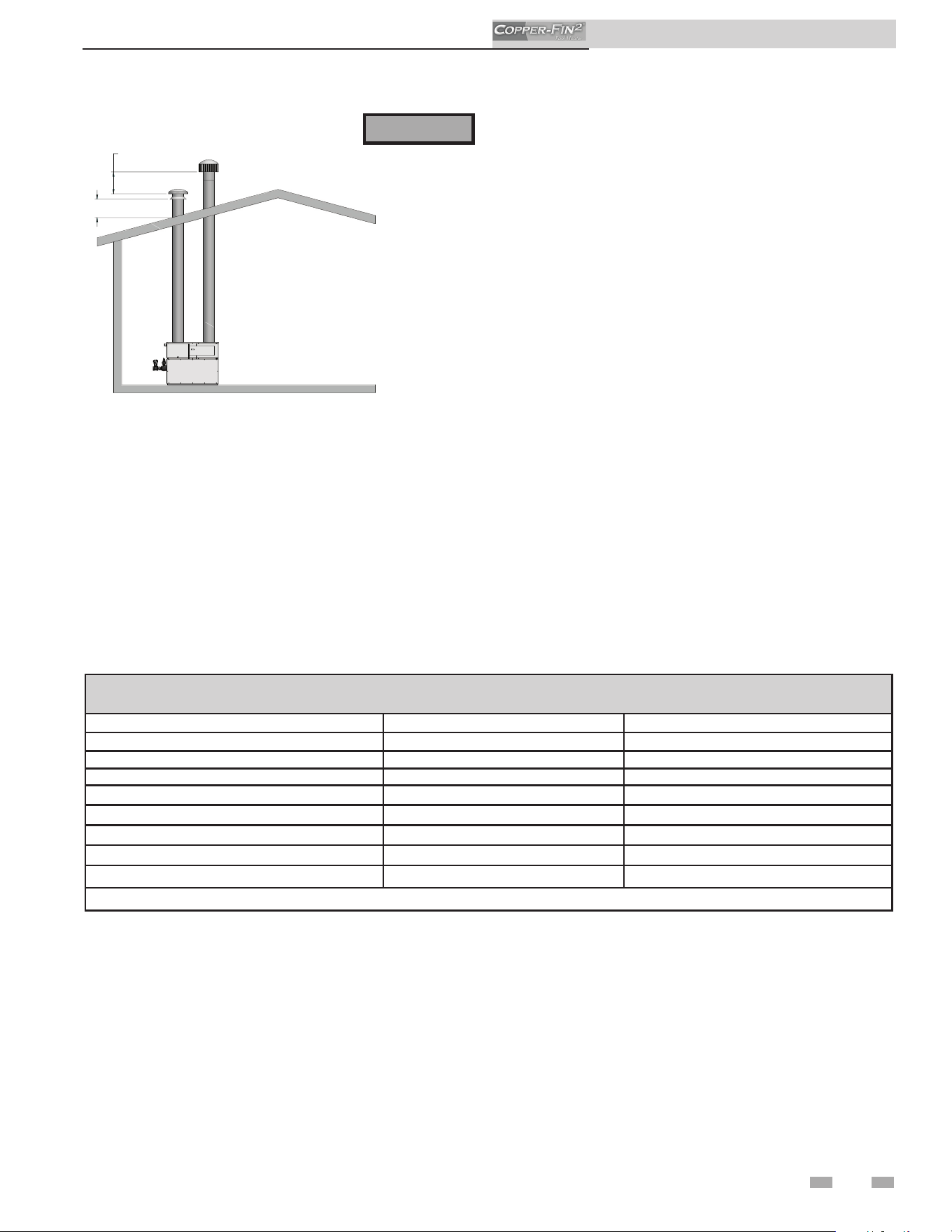
12"
MIN
3'
MIN
Figure 2-8_Vertical DirectAire™ Installation
w/Rooftop Combustion Air Inlet
⚠WARNING
Only use a sidewall air inlet cap supplied by the appliance
manufacturer or a rooftop air inlet cap supplied by either the vent
or appliance manufacturer. Using any other air inlet cap for single
unit installations or using a common air inlet cap for multiple
units with insufficient free area and/or protections from wind and
weather may result in operational problems and the spillage of
flue products. Spillage of flue products can cause personal injury
or death due to carbon monoxide poisoning.
For single unit installations with sidewall air inlet you must order the sidewall
air inlet kit from the appliance manufacturer. The part number for each SVK kit
is listed by unit size in Table 2B.
For single unit installations with rooftop air inlet (see FIG. 2-8), you must order
the rooftop air inlet kit from the appliance manufacturer. The part number for
each VDK kit is listed by unit size in Table 2B. Purchase the flue pipe, rooftop
flue termination, and air inlet pipe locally.
There is no vent kit for combined air supply systems for multiple units. Make
sure the air inlet cap is properly sized. You must purchase this cap locally.
Venting of flue products
For venting flue products vertically to the outdoors, follow all requirements in
the installation instructions for conventional venting in this manual.
Follow all clearance requirements in Vertical Vent Termination Clearances and
Location on page 17.
A barometric damper is not required in the flue on Vertical DirectAire™
installations if the draft is within the negative 0.02 to 0.08 inches w.c. required
for proper operation. If the draft exceeds this range, install a barometric damper.
2 Venting
22
Installation & Operation Manual
Sidewall venting - see page 14.
NOTICE
Before installing a venting system, follow all requirements found in the General Venting
section.
C
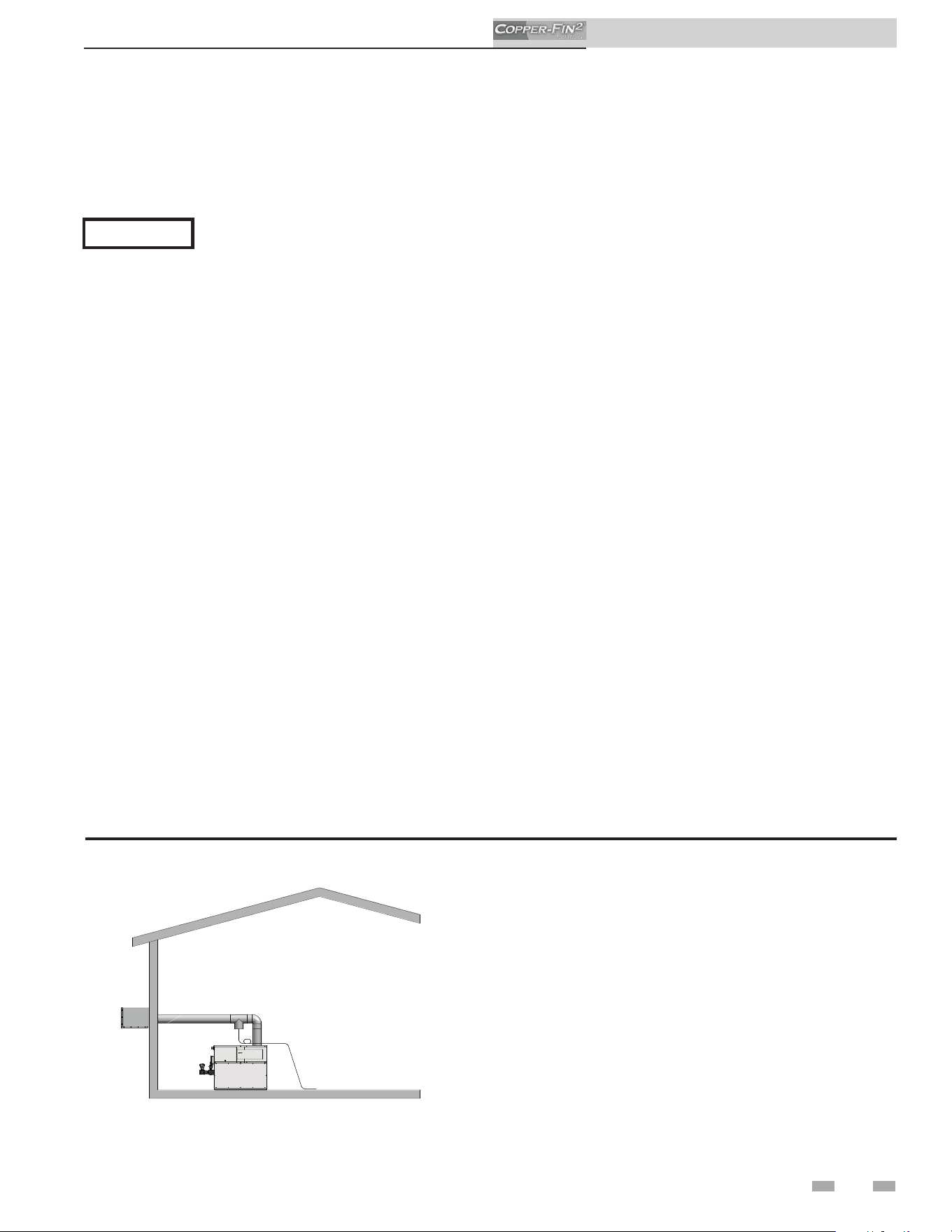
This option uses a powered vent assembly which pulls the flue products out of the stack. This fan generates a negative
draft at the unit. Combustion air is drawn from the equipment room (see Combustion and Ventilation Air on 10).
Sidewall with fan
The sidewall fan can be mounted on the inside/outside (depending upon model) with a sidewall vent hood installed
on the exterior wall. The sidewall fan and accessories are included in a venting kit provided by the appliance
manufacturer. See Table 2C on page 24 for kit numbers.
The venting kit includes the sidewall fan, vent hood, tapered vent adapter, barometric damper (992 - 2072 Models),
proving switch and all necessary relays to interlock with the heaters control system. The tapered vent adapter
reduces the vent size at the inlet to the fan. There should be no reduction in vent diameter from the unit’s flue outlet
to the sidewall fan. The barometric damper must be installed on the flue and adjusted to supply a negative draft
within the range of 0.02 to 0.08 inches w.c. while unit is operating.
Flue outlet piping
With this venting option, you must use Type-B double-wall (or equivalent) vent materials. Vent materials must be
listed by a nationally-recognized test agency for use as vent materials. Make the connections from the unit vent to
the sidewall fan/cap as direct as possible with no reduction in diameter. Follow the vent manufacturer’s instructions
when installing Type-B vents and accessories, such as firestop spacers, vent connectors, thimbles, caps, etc.
When planning the venting system, avoid possible contact with plumbing or electrical wiring inside walls.
The maximum installed length of sidewall vent pipe with an induced draft fan must not exceed 100 feet (30.5 m).
Subtract 5 feet (1.5 m) for each 90° elbow. Subtract 2.5 feet (0.7 m) for each 45° elbow.
Sidewall venting termination
The sidewall vent cap must be installed on an exterior sidewall. The sidewall fan/powered sidewall vent cap and
accessories are included in a venting kit which is furnished by the appliance manufacturer in accordance with CSA
International requirements. This venting kit includes the powered sidewall fan/cap, proving switch and all necessary
relays to interlock with the heaters control system.
The sidewall fan/powered vent cap must be interlocked with the units control system to start the fan on a call for
heat and prove fan operation before the pool heater fires. Plug-in and terminal strip connections are provided on
the unit for easy connection of the factory supplied vent kit and control package for the sidewall vent fan. See the
installation instructions provided with the vent kit.
Sidewall vent termination clearances and location
Locate the bottom of the vent terminal at least 12 inches (30 cm) above grade and above normal snow levels. Locate
the bottom of the vent terminal at least 7 feet (2.13 m) above grade when located adjacent to public walkways. Do
not terminate directly above a public walkway.
Do not terminate the venting system in a window well, stairwell, alcove, courtyard, or other recessed area. Do not
terminate the venting system below grade.
Locate vent termination at least 3 feet (0.91 m) from an inside corner of an L-shaped structure.
Provide a minimum clearance of 4 feet (1.2 m) horizontally from electric meters, gas meters, regulators, and relief
equipment. Never locate vent cap above or below electric meters, gas meters, regulators, and relief equipment unless
a 4 foot (1.2 m) horizontal clearance is maintained.
23
2 Venting (continued)
Installation & Operation Manual
Sidewall venting without fan
For Models 502 - 752 which are approved for sidewall venting without an external power vent fan, you must install specific vent
kits and venting materials (reference Table 2C on page 24 for kit numbers).
The following is a detailed explanation of Sidewall Venting Without an External Power Vent Fan installation requirements.
Flue outlet piping
Venting Guidelines
If using this venting option, a sealed AL29-4C venting system for flue products is required on all models of this appliance. This
venting system operates with a positive pressure in the vent. The internal combustion air blower generates this positive pressure
which operates the combustion process and also exhausts the flue products from the building.
⚠ CAUTION
Units which are shut down or will not operate may experience freezing due to convective air flow in the flue
pipe, through the air inlet, or from negative pressure in the equipment room. In cold climates, operate the
pump continuously to help prevent freezing of pool heater water. Provide proper freeze protection. See Freeze
Protection, page 48.
Terminate the venting system at least 3 feet (0.9 m) above any forced air inlet within 10 feet (3.05 m).
Terminate the venting system at least 4 feet (1.2 m) below, 4 feet (1.2 m) beside, or 1 foot (30cm) above any door, window, or
gravity air inlet into any building.
Locate vent termination at least 8 feet (2.4 m) horizontally from any combustion air intake located above the sidewall termination
cap.
This vent system has specific vent material and installation requirements. Only use listed sealed AL29-4C vent system materials.
Follow all installation requirements. See Table 2A for proper pipe size for your unit. A list of sealed AL29-4C flue pipe
manufacturers is located on page 15.
Seal all vent joints and seams gas-tight.
Drain tee installation
A drain tee must be installed in the vent pipe to collect and dispose of any condensate that may occur in the vent system. The drain
tee must be installed as the first fitting after the horizontal ell on the top of the unit (see FIG. 2-9). Plastic drain tubing, sized per
the vent manufacturer’s instructions, shall be provided as a drain line from the tee. The drain tubing must have a trap provided by
a 3" (7.6 cm) diameter circular trap loop in the drain tubing. Prime the trap loop by pouring a small quantity of water into the drain
hose before assembly to the vent. Secure the trap loop in position with nylon wire ties. Use caution not to collapse or restrict the
condensate drain line with the nylon wire ties. The condensate drain must be routed to a suitable drain for disposal of condensate
that may occur in the direct vent system. Refer to the condensate drain installation instructions as supplied by the manufacturer
of the vent material.
Figure 2-9_Sidewall Vent - Models 502 - 752 (Only)
24
2 Venting
Installation & Operation Manual
⚠WARNING
Do not combine the flue from this unit with the vent from any other appliance. Do not combine flues from
multiple appliances into a common vent. The flue from this unit must be a dedicated stack.
Connect the flue vent directly to the flue outlet opening on the top of the unit. Make the connections from the unit vent to
the outside stack as direct as possible with no reduction in diameter. Provide adequate clearance to combustibles for the vent
connector and firestop. Follow the vent manufacturer’s instructions when installing sealed AL29-4C vents and accessories, such as
firestop spacers, vent connectors, thimbles, caps, etc.
Provide adequate clearance to combustibles for the vent connector and firestop.
When planning the venting system, avoid possible contact with plumbing or electrical wiring inside walls, ceilings, and floors.
Locate the unit as close as possible to chimney or gas vent. When a vent system is disconnected for any reason, the flue must be
reassembled and resealed according to the vent manufacturer’s instructions.
The installed length of flue from the unit to the outside point of termination must not exceed 50 equivalent feet (15.2 m). Subtract
5 feet (1.5 m) of equivalent length for each 90° elbow. Subtract 2.5 feet (0.7 m) of equivalent length for each 45° elbow.
Sidewall vent termination clearances and location
Follow all sidewall venting termination information for clearances and location under Sidewall Vent Termination Clearances and
Location on page 22.
TABLE - 2C
SIDEWALL VENT KITS
MODEL
KIT
(W/POWER FAN ASSY.)
MAX. VENT
LENGTH
VENT TERMINATION
ONLY
(MODELS 502 - 752)
MAX. VENT
LENGTH
502 100169191 100 ft. 100169221 50 ft.
652 100169192 100 ft. 100169222 50 ft.
752 100169192 100 ft. 100169222 50 ft.
992 100169193* 100 ft. N/A N/A
1262 100169194* 100 ft. N/A N/A
1442 100169194* 100 ft. N/A N/A
1802 100169195* 100 ft. N/A N/A
2072 100169195* 100 ft. N/A N/A
*These kits include a barometric damper.
2 Venting (continued)
25
Installation & Operation Manual
Horizontal DirectAire™ venting (Powered Venting) - see page 14.
The Horizontal DirectAire™ vent system is the same as the Sidewall Venting system, except it pulls combustion
air from the outdoors through a sidewall air inlet. Follow all requirements in Sidewall Venting section on page 22.
The Horizontal DirectAire™ vent system requires you to install two pipes directly to the unit; one pipe for flue
products and one for combustion air. Install both pipes horizontally with a sidewall termination point. For this
venting option, you must purchase the DV box accessory from the appliance manufacturer. The DV box attaches to
the air inlet of the unit. The pipe for combustion air attaches to the DV box (see FIG. 2-11 on page 28). Reference
page 28 for a list of approved air intake materials.
Make vent connection directly to the top of the unit. No additional draft diverter or barometric damper is required
on single unit installations with a dedicated stack and a negative draft maintained between 0.02 to 0.08 inches w.c.
The Horizontal DirectAire™ combustion air supply system has specific vent material and installation requirements.
The air inlet pipe connects directly to the pool heater to supply combustion air. The combustion air inlet pipe is a
dedicated system with one air inlet pipe per pool heater. You must connect the air inlet pipe to a combustion air
inlet cap as specified in this section.
Combustion air supplied from outdoors must be free of contaminants (see the Combustion and Ventilation Air
section on page 10).
NOTICE
Before installing a venting system, follow all requirements found in the General Venting
section.
You must order the Horizontal DirectAire™ Vent Kit for sidewall installation from the appliance manufacturer. See Table 2D for
kit numbers. Each kit includes a sidewall powered vent cap fan, proving switch, controls, combustion air inlet cap to supply air to
a single unit, the transition adapter to attach the field supplied single wall air inlet pipe to the unit and installation instructions.
Purchase flue pipe and air inlet pipe locally.
The sidewall air inlet cap supplied in the Horizontal DirectAire™ Vent Kit is used to supply combustion air to a single pool heater.
Combustion air supply pipes from multiple units can not be combined into a single air inlet pipe and inlet point.
⚠WARNING
Only use the sidewall air inlet cap recommended by the appliance manufacturer. Using another sidewall air
inlet cap may result in operational problems and the spillage of flue products. Spillage of flue products can
cause personal injury or death due to carbon monoxide poisoning.
Venting of flue products
For venting flue products horizontally, follow all requirements in the installation instructions for sidewall venting.
Termination point for the flue products must follow the clearance requirements in the Sidewall Venting Termination section on
page 22.
For proper operation, a barometric damper is provided for Horizontal DirectAire™ installations. The damper will help to ensure a
draft between negative 0.02 to 0.08 inches w.c.
TABLE - 2D
HORIZONTAL DIRECTAIRE™ KITS
MODEL KIT MODEL KIT
502 100147152 1262 100147159*
652 100147153 1442 100147159*
752 100147153 1802 100147160*
992 100147158* 2072 100147160*
*These kits include a barometric damper.
1
1
2
2
"
"
M
M
I
I
N
N
3
3
'
'
M
M
I
I
N
N
D
26
2 Venting
Installation & Operation Manual
E
This option uses sealed AL29-4C vent materials for the flue outlet piping and separate combustion air inlet piping.
This system terminates both the flue and combustion air inlet in the same pressure zone. The flue outlet and
combustion air intake may terminate at either a sidewall or the rooftop.
To use the optional Direct Vent system, you must install specific vent kits and venting materials. The following is
a detailed explanation of Direct Vent installation requirements, including the components used and vent kit part
numbers (reference Table 2E on page 27 for kit numbers).
Flue outlet piping
Venting Guidelines
If using this venting option, a sealed AL29-4C venting system for flue products is required on all models of this
appliance. This venting system operates with a positive pressure in the vent. The internal combustion air blower
generates this positive pressure which operates the combustion process and also exhausts the flue products from the
building.
This vent system has specific vent material and installation requirements. Only use listed sealed AL29-4C vent system
materials. Follow all installation requirements. See Table 2A, page 15 for proper pipe size for your unit.
Seal all vent joints and seams gas-tight.
NOTICE
Before installing a venting system, follow all requirements found in the General Venting section.
Direct venting - see page 14.
Drain tee installation
A drain tee must be installed in the vent pipe to collect and dispose of any condensate that may occur in the vent system. The drain
tee must be installed as the first fitting after the horizontal ell on the top of the unit (see FIG. 2-9 on page 23). Plastic drain tubing,
sized per the vent manufacturer’s instructions, shall be provided as a drain line from the tee. The drain tubing must have a trap
provided by a 3" (7.6 cm) diameter circular trap loop in the drain tubing. Prime the trap loop by pouring a small quantity of water
into the drain hose before assembly to the vent. Secure the trap loop in position with nylon wire ties. Use caution not to collapse
or restrict the condensate drain line with the nylon wire ties. The condensate drain must be routed to a suitable drain for disposal
of condensate that may occur in the direct vent system. Refer to the condensate drain installation instructions as supplied by the
manufacturer of the vent material.
⚠WARNING
Do not combine the flue from this unit with the vent from any other appliance. Do not combine flues from
multiple appliances into a common vent. The flue from this unit must be a dedicated stack.
Connect the flue vent directly to the flue outlet opening on the top of the unit. Make the connections from the unit vent to the
outside stack as direct as possible with no reduction in diameter. Provide adequate clearance to combustibles for the vent connector
and firestop. Follow the vent manufacturer’s instructions when installing sealed AL29-4C vents and accessories, such as firestop
spacers, vent connectors, thimbles, caps, etc.
Provide adequate clearance to combustibles for the vent connector and firestop.
When planning the venting system, avoid possible contact with plumbing or electrical wiring inside walls, ceilings, and floors.
Locate the unit as close as possible to chimney or gas vent.
When a vent system is disconnected for any reason, the flue must be reassembled and resealed according to the vent manufacturer’s
instructions.
The installed length of flue from the unit to the outside point of termination must not exceed 50 equivalent feet (15.2 m). Subtract
5 feet (1.5 m) of equivalent length for each 90° elbow. Subtract 2.5 feet (0.7 m) of equivalent length for each 45° elbow.
Vertical DV venting termination
Vertical venting uses the unit’s internal combustion air blower to force the flue products out of the vertically-terminated flue. You
must purchase a vertical direct vent kit from the appliance manufacturer to ensure proper operation.
You must use the vent termination recommended by the vent manufacturer for vertical direct vent terminations. Follow all vertical
venting termination information for clearances and location under the Vertical Vent Termination Clearances and Location section
on pages 17 - 18.
1
1
2
2
"
"
M
M
I
I
N
N
3'
3'
M
M
I
I
N
N
2 Venting (continued)
27
Installation & Operation Manual
Masonry chimney installation
Do not use a standard masonry chimney to directly vent the combustion products from this unit.
To use a masonry chimney, the chimney must use a sealed, corrosion-resistant liner system. Sealed, corrosion-resistant liner
systems (single-wall, double-wall, flexible, or rigid) must be rated for use with a high efficiency, positive pressure vent system.
Corrosion-resistant chimney liner systems are typically made from a high grade stainless steel such as AL29-4C. The liner must be
properly sized and fully sealed throughout the entire length. Both the top and bottom of the masonry chimney must be capped
and sealed to provide a dead air space around the liner.
⚠WARNING
Do not vent this unit into a masonry chimney without a sealed stainless steel liner system. Any breaks, leaks,
or damage to the masonry flue/tile will allow the positive-pressure flue products to leak from the chimney and
into occupied living spaces. This could cause serious injury or death due to carbon monoxide poisoning and
other harmful flue products.
NOTICE
Check with local code officials to determine code requirements or the advisability of using a masonry chimney
with a sealed corrosion-resistant liner system.
Horizontal DV venting termination
Horizontal venting uses the unit’s internal combustion air blower to force the flue products out of the horizontally-terminated flue.
You must purchase a horizontal direct vent kit from the appliance manufacturer to ensure proper operation. When installing
the vent cap, the wall opening must provide an air space clearance of 2 inches (5.1 cm) around the flue pipe. The diameter of the
opening for installation of the sidewall cap will be 4 inches (10.2 cm) larger (minimum) than the nominal diameter of the installed
vent pipe to the horizontal vent cap.
Install the horizontal vent cap from the outside. Mount the vent cap to the wall using four screws or wall anchors. Seal under the
screw heads with caulking. Install the Category IV vent pipe from the unit to the vent cap. See detailed instructions packed with
the horizontal direct vent kit.
Horizontal Vent Termination Clearances and Location
Follow all sidewall venting termination information for clearances and location under Sidewall Vent Termination Clearances and
Location, page 22.
TABLE - 2E
DIRECT VENT KITS
MODEL
HORIZONTAL
KIT*
VERTICAL
KIT*
MODEL
HORIZONTAL
KIT*
VERTICAL
KIT*
502 100141702 100172048 1262 100141699 100172047
652 100141703 100172049 1442 100141699 100172047
752 100141703 100172049 1802 100141698 100172047
992 100141697 100172046 2072 100141698 100172047
*These kits include a DV box adapter, air inlet cap, and a sidewall vent termination. The VDK kits include a DV box adapter and an air inlet cap.
Combustion air inlet piping
The Direct Vent system requires the installation of a pipe to supply combustion air from the outdoors directly to the unit. Make
sure the combustion air inlet is in the same pressure zone as the vent terminal.
In cold climates, use a Type-B double-wall vent pipe or an insulated single wall pipe for combustion air. This will help prevent
moisture in the cool incoming air from condensing and leaking from the inlet pipe.
⚠ CAUTION
Units that are shut down or will not operate may experience freezing due to convective airflow in the air inlet
pipe.
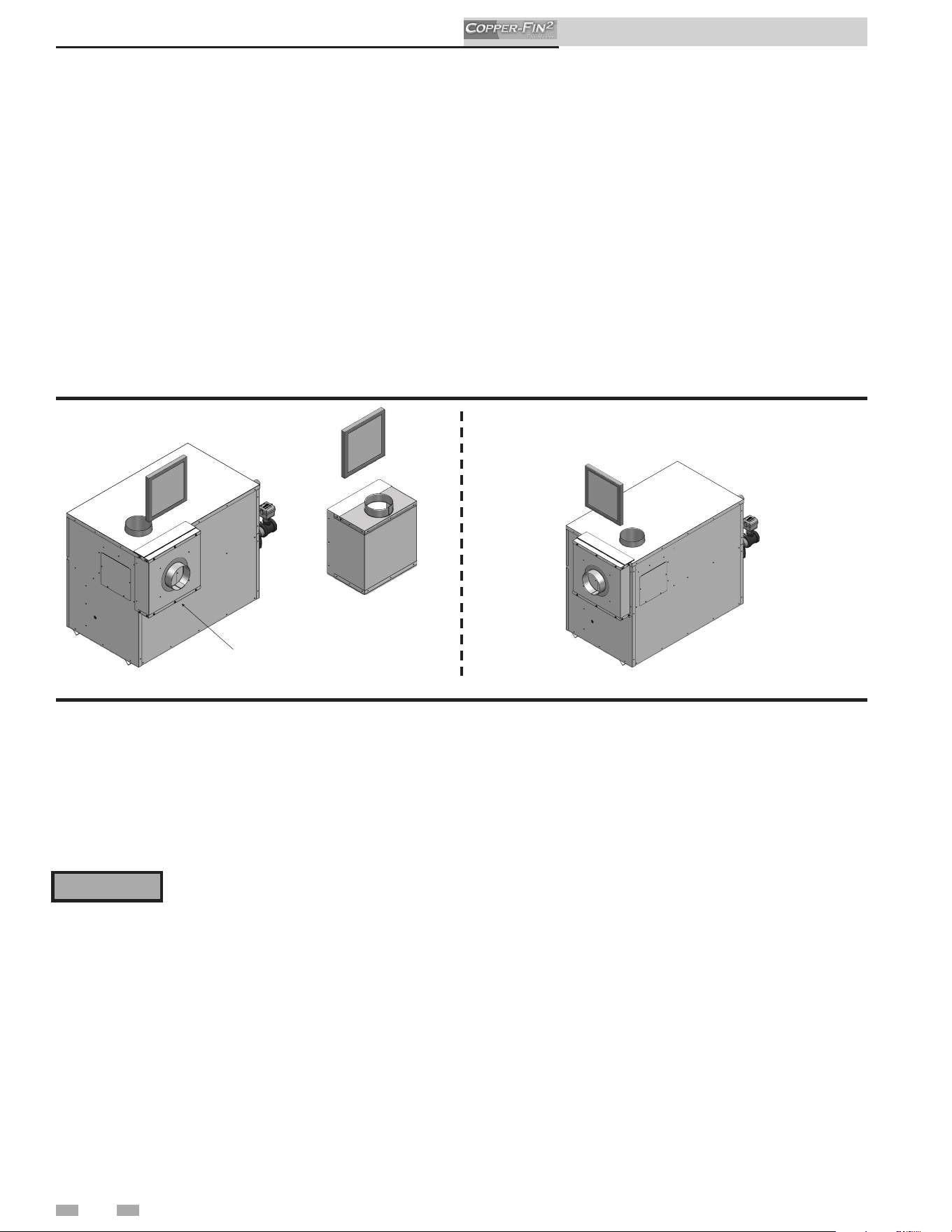
28
2 Venting
Installation & Operation Manual
Length of air inlet pipe
The installed length of air inlet pipe from the unit to the outside air inlet cap must not exceed 50 equivalent feet (15.2 m). Subtract
5 feet (1.5 m) of equivalent length for each 90° elbow. Subtract 2.5 feet (0.7 m) of equivalent length for each 45° elbow.
Do not exceed the limits for the combustion air inlet piping lengths.
Connecting the air inlet pipe to the unit
Connect the air inlet piping directly to the unit by attaching it to the DV box adapter. The DV box adapter is included in the direct
vent kits. The combustion air inlet area of the unit is located at the right rear corner of the unit. This unit uses a simple air filter
to ensure clean air is used for the combustion process. Attach the DV box adapter over the air filter (see FIG. 2-11). Align screw
holes on the DV box adapter with the screw holes surrounding the air filter hanger. Insert sheet metal screws and tighten firmly.
For venting versatility, you can move the air filter assembly and DV box adapter to the right side of the unit. Remove the metal
panel on the unit’s right side (see FIG. 2-12). Remove the filter/bracket assembly from the rear of the unit. Attach the filter/bracket
assembly and DV box adapter to the right side opening using the pre-drilled screw holes. Make sure you attach the metal panel to
the rear combustion air opening of the unit.
The DV box adapter has an air inlet pipe mounting ring. Connect combustion air inlet piping to the direct vent box mounting ring.
Figure 2-11_Attaching DV Box Adapter to Unit
Figure 2-12_Moving Air Filter Assembly & DV Box Adapter
VERTICAL DV BOX ADAPTER
HORIZONTAL DV BOX ADAPTER
Air inlet piping materials
The air inlet pipe(s) must be sealed. Select air inlet pipe material from the following specified materials.
• PVC, CPVC, or ABS*
• Dryer vent or sealed flexible duct (not recommended for rooftop air inlet)
• Galvanized steel vent pipe with joints and seams sealed as specified below
• Type-B double-wall vent with joints and seams sealed as specified below.
* Plastic pipe may require an adapter (not provided) to transition between the air inlet connection on the unit and the plastic air
inlet pipe.
⚠WARNING
Use only vent or air intake materials specified in this manual. Follow vent pipe manufacturer’s instructions.
Failure to do so can result in property damage, personal injury, or death. Mixing of venting materials will void
the warranty and certification of this unit.
Sealing Type-B double-wall vent pipe or galvanized vent pipe
Follow the steps below to properly seal Type-B double-wall vent pipe or galvanized vent pipe.
1. Seal all joints and seams of the air inlet pipe using either aluminum foil duct tape meeting UL Standard 723 or 181 A-P or a
high quality UL Listed silicon sealant such as those manufactured by Dow Corning or General Electric.
2. On horizontal runs, do not install vent pipe with seams pointing down. Position vent pipe so that the seams are on the top side
of the vent pipe.
3. Secure all joints with a minimum of three sheet metal screws or pop rivets. Apply aluminum foil duct tape or silicone sealant
to all screws or rivets installed in the vent pipe.
4. Ensure that the air inlet pipes are properly supported.
Sealing PVC, CPVC, ABS, dryer vent, and flex duct vent pipe
1. Clean the PVC, CPVC, or ABS air inlet pipe using the pipe manufacturer’s recommended solvents. Seal the pipe joints using
standard commercial pipe cement.
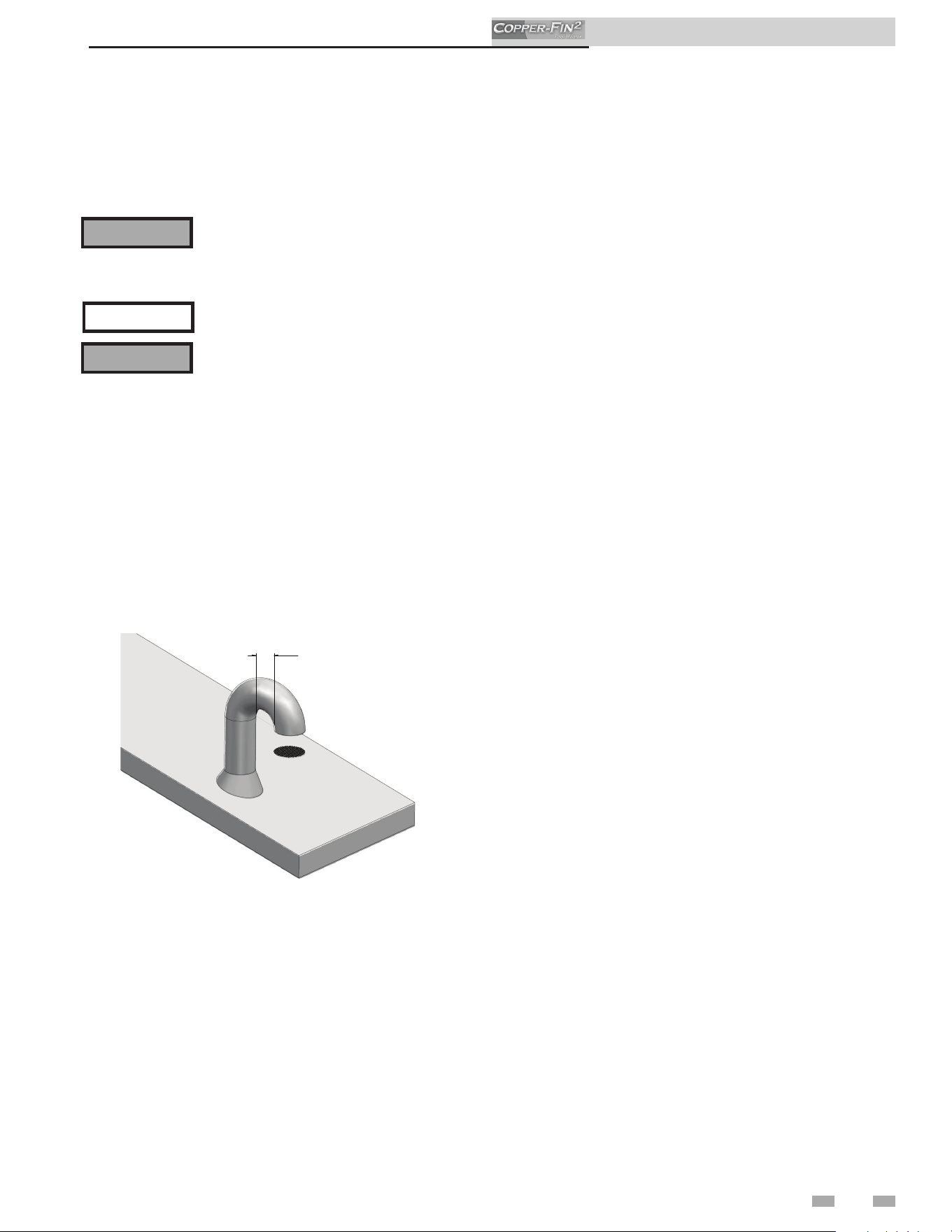
2 Venting (continued)
29
Installation & Operation Manual
2. For PVC, CPVC, ABS, dryer vent, or flex duct air inlet piping, use a silicone sealant to ensure a proper seal at the unit inlet and
the air inlet cap.
3. For Dryer vent or flex duct, also use a screw-type clamp to attach the inlet vent material to the unit inlet and the air inlet cap.
Properly sealing the air inlet pipe ensures that combustion air will be free of contaminates and supplied in proper volume.
4. Ensure that the air inlet pipes are properly supported.
⚠WARNING
Properly seal all joints and seams in the inlet vent piping system. Failure to do so may result in flue gas
recirculation, spillage of flue products, and carbon monoxide emissions. Carbon monoxide poisoning can
cause severe personal injury or death.
Vertical and sidewall combustion air inlet
NOTICE
To prevent recirculation of flue products into the combustion air inlet, follow all instructions in this section.
⚠WARNING
Locate and install the combustion air inlet termination correctly. Failure to do so can allow the discharge
of flue products to be drawn into the combustion process. This can result in incomplete combustion and
potentially hazardous levels of carbon monoxide in the flue products. This will cause operational problems
and the spillage of flue products. Spillage of flue products can cause personal injury or death due to carbon
monoxide poisoning.
You must locate the combustion air cap and the flue gas outlet on the same rooftop surface (vertical direct vent system) or sidewall
surface (horizontal direct vent system) and in the same pressure zone as the vent termination. Follow all clearance requirements
listed on this page.
Purchase and assemble the combustion air inlet cap to protect the air inlet from wind and weather.
Alternatively, assemble the combustion air inlet cap for vertical rooftop air inlet from items purchased locally. The air inlet cap
consists of two 90° elbows installed to the air inlet pipe (see FIG. 2-13). Install the first 90° elbow on the rooftop at the highest
vertical point of the air inlet pipe. Install the second 90° elbow on the horizontal outlet of the first elbow. The outlet of the second
90° elbow will be pointing down. You may use a 90° elbow and a 90° straight elbow to make this assembly. If you use a straight
piece of pipe between the two 90° elbows, it should not exceed 6" (51 mm) in length.
Figure 2-13_Vertical Rooftop Air Inlet
6"
MAX
For horizontal direct vent termination of combustion air, you
must use the termination cap from the appliance manufacturer.
The sidewall air inlet cap is available as part of a direct vent kit.
See Table 2E, page 27 for Horizontal Direct Vent Kits.
Vertical Combustion Air Inlet Clearances
You must locate the air inlet termination elbow at least 12"
(30 cm) above the roof or above normal snow levels.
If the air inlet cap is within a 10-foot (3.05 m) radius of the flue
outlet, the point of termination for the combustion air inlet
cap must be at least 3 feet (0.91 m) below the point of flue gas
termination (vent cap).
Do not install the combustion air inlet cap closer than 10 feet
(3.05 m) from an inside corner of an L-shaped structure.
Horizontal combustion air inlet clearances
You must locate the horizontal air inlet termination point at least 12" (30 cm) above grade and above normal snow levels.
If the air inlet cap is within a 10-foot (3.05 m) radius of the flue outlet, the point of termination for the combustion air inlet cap
must be at least 3 feet (0.91 m) below the point of flue gas termination (vent cap). Do not install the horizontal combustion air
inlet cap above the flue outlet.
Do not install the combustion air inlet cap closer than 10 feet (3.05 m) from an inside corner of an L-shaped structure.
Multiple sidewall direct vent installations
You must locate the horizontal air inlet termination points at least 12" (30 cm) above grade and above normal snow levels. The
combustion air inlet caps for multiple appliance installations must maintain the same minimum clearance from the closest flue vent
cap as specified in single appliance installations. You may install multiple flue outlet caps side-by-side and multiple combustion
air inlet caps side-by-side, but the air inlet must always be at least 3 feet (0.91 m) horizontally and 3 feet (0.91 m) below the closest
flue outlet. Do not install combustion air inlet caps above the flue outlets.
Maintain all clearances and installation requirements for multiple appliance installations.
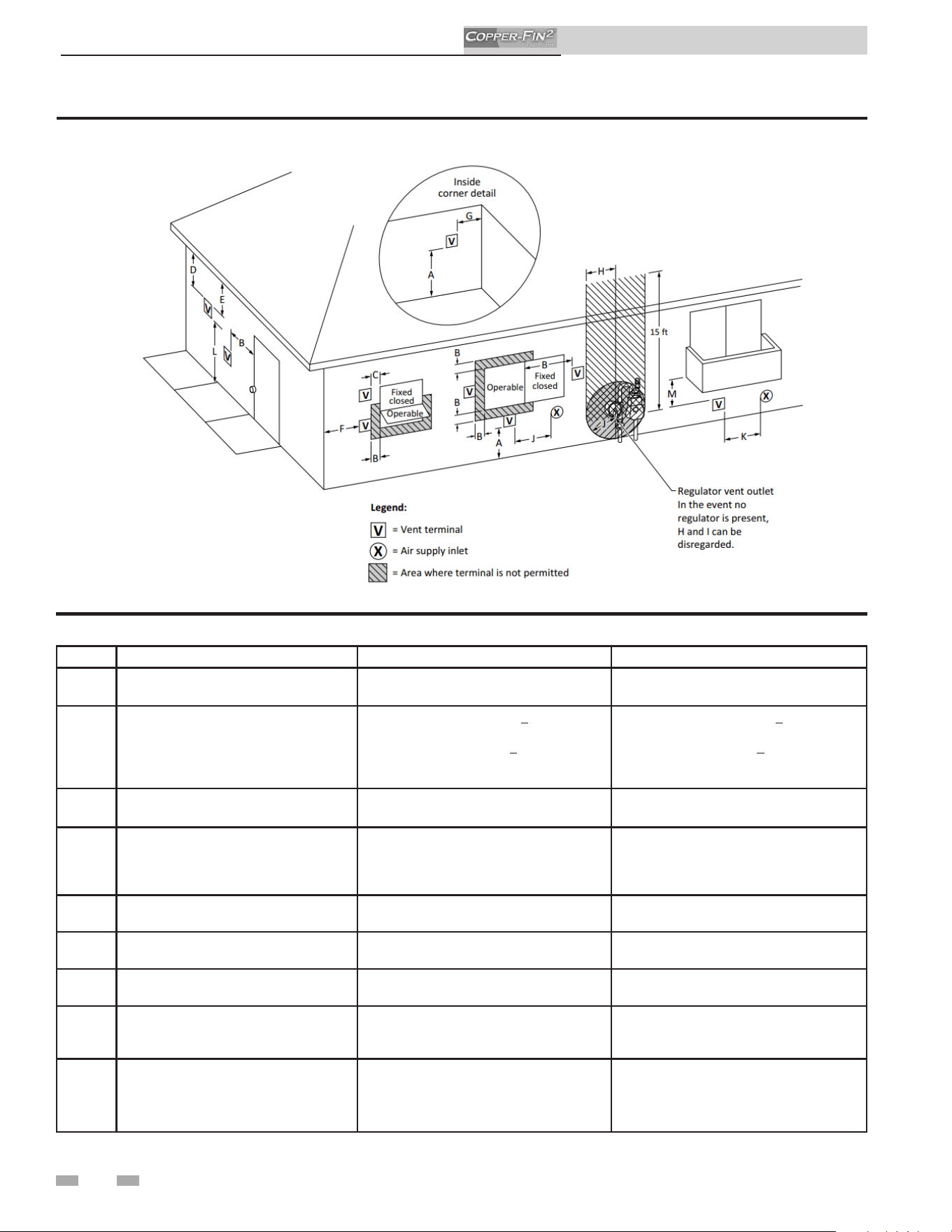
2 Venting
Installation & Operation Manual
30
Figure 2-14A Direct Vent Terminal Clearances
Canadian Installations¹ US Installations²
A =
Clearance above grade, veranda, porch,
deck, or balcony
12 in (30 cm) 12 in (30 cm)
B =
Clearance to window or door that may
be opened
6 in (15 cm) for appliances < 10,000 Btuh
(3 kW), 12 in (30 cm) for appliances >
10,000 Btuh (3 kW) and < 100,000 Btuh
(30 kW), 36 in (91 cm) for appliances >
100,000 Btuh (30 kW)
6 in (15 cm) for appliances < 10,000 Btuh
(3 kW), 9 in (23 cm) for appliances >
10,000 Btuh (3 kW) and < 50,000 Btuh (15
kW), 12 in (30 cm) for appliances > 50,000
Btuh (15 kW)
C =
Clearance to permanently closed
window
*
*
D =
Vertical clearance to ventilated soffit
located above the terminal within a
horizontal distance of 2 ft (61 cm) from
the center line of the terminal.
*
*
E = Clearance to unventilated soffit
*
*
F = Clearance to outside corner
*
*
G = Clearance to inside corner
*
*
H =
Clearance to each side of center line
extended above meter / regulator
assembly
3 ft (91 cm) within a height of 15 ft (4.6 m)
*
I =
Clearance to service regulator vent
outlet
3 ft (91 cm)
*
Table 2F Direct Vent Terminal Clearances
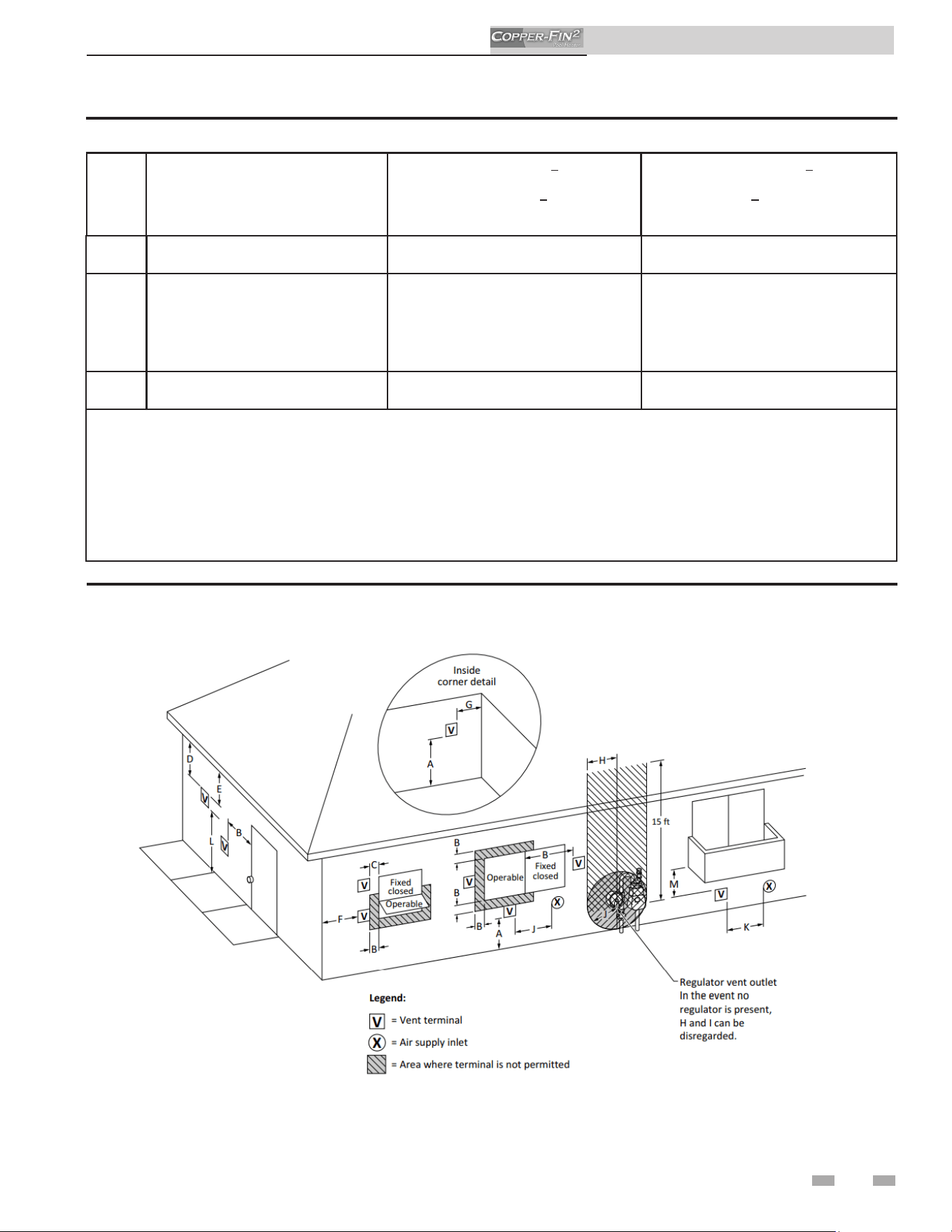
2 Venting (continued)
Installation & Operation Manual
31
Table 2F Direct Vent Terminal Clearances (continued)
Figure 2-14B Other than Direct Vent Terminal Clearances
K =
Clearance to a mechanical air supply
inlet
6 ft (1.83 m)
3 ft (91 cm) above if within 10 ft (3 m)
horizontally
L =
Clearance above paved sidewalk or
paved driveway located on public
property
7 ft (2.13 m)†
7 ft (2.13 m) for mechanical draft systems
(Category I appliances). Vents for
Category II and IV appliances cannot be
located above public walkways or other
areas where condensate or vapor can
cause a nuisance or hazard*
M =
Clearance under veranda, porch, deck,
or balcony
12 in (30 cm)‡ *
* Clearance in accordance with local installation codes and the requirements of the gas supplier.
† A vent shall not terminate directly above a sidewalk or paved driveway that is located between two single family dwellings
and serves both dwellings.
‡ Permitted only if veranda, porch, deck, or balcony is fully open on a minimum of two sides beneath he oor.
NOTES:
1) In accordance with the current CSA B149.1, Natural Gas and Propane Installation Code
2) In accordance with the current ANSI Z223.1/NFPA 54, National Fuel Gas Code
J =
Clearance to nonmechanical air supply
inlet to building or the combustion air
inlet to any other appliance
6 in (15 cm) for appliances < 10,000 Btuh
(3kW), 12 in (30 cm) for appliances >
10,000 Btuh (3 kW) and < 100,000 Btuh
(30 kW), 36 in (91 cm) for appliances >
100,000 Btuh (30 kW)
6 in (15 cm) for appliances < 10,000 Btuh
(3kW), 9 in (23 cm) for appliances > 10,000
Btuh (3 kW) and < 50,000 Btuh (15 kW),
12 in (30 cm) for appliances > 50,000 Btuh
(15 kW)
2 Venting
Installation & Operation Manual
32
Canadian Installations¹ US Installations²
A =
Clearance above grade, veranda, porch,
deck, or balcony
12 in (30 cm) 12 in (30 cm)
B =
Clearance to window or door that may
be opened
6 in (15 cm) for appliances < 10,000 Btuh
(3 kW), 12 in (30 cm) for appliances >
10,000 Btuh (3 kW) and < 100,000 Btuh
(30 kW), 36 in (91 cm) for appliances >
100,000 Btuh (30 kW)
4 ft (1.2 m) below or to side of opening; 1 ft
(300 mm) above opening
C =
Clearance to permanently closed
window
* *
D =
Vertical clearance to ventilated soffit
located above the terminal within a
horizontal distance of 2 ft (61 cm) from
the center line of the terminal.
* *
E = Clearance to unventilated soffit
* *
F = Clearance to outside corner
* *
G = Clearance to inside corner
* *
H =
Clearance to each side of center line
extended above meter / regulator
assembly
3 ft (91 cm) within a height 15 ft (4.6 m)
*
I =
Clearance to service regulator vent
outlet
3 ft (91 cm)
*
J =
Clearance to nonmechanical air supply
inlet to building or the combustion air
inlet to any other appliance
6 in (15 cm) for appliances < 10,000 Btuh
(3kW), 12 in (30 cm) for appliances >
10,000 Btuh (3 kW) and < 100,000 Btuh
(30 kW), 36 in (91 cm) for appliances >
100,000 Btuh (30 kW)
4 ft (1.2 m) below or to side of opening; 1 ft
(300 mm) above opening
K =
Clearance to a mechanical air supply
inlet
6 ft (1.83 m) 3 ft (91 cm) above if within 10 ft (3 m)
horizontally
L =
Clearance above paved sidewalk or
paved driveway located on public
property
7 ft (2.13 m)† 7 ft (2.13 m) for mechanical draft systems
(Category I appliances). Vents for
Category II and IV appliances cannot be
located above public walkways or other
areas where condensate or vapor can
cause a nuisance or hazard
M =
Clearance under veranda, porch, deck,
or balcony
12 in (30 cm)‡ *
* Clearance in accordance with local installation codes and the requirements of the gas supplier.
† A vent shall not terminate directly above a sidewalk or paved driveway that is located between two single family dwellings
and serves both dwellings.
‡ Permitted only if veranda, porch, deck, or balcony is fully open on a minimum of two sides beneath he oor.
NOTES:
1) In accordance with the current CSA B149.1, Natural Gas and Propane Installation Code
2) In accordance with the current ANSI Z223.1/NFPA 54, National Fuel Gas Code
Table 2G Other than Direct Vent Terminal Clearances
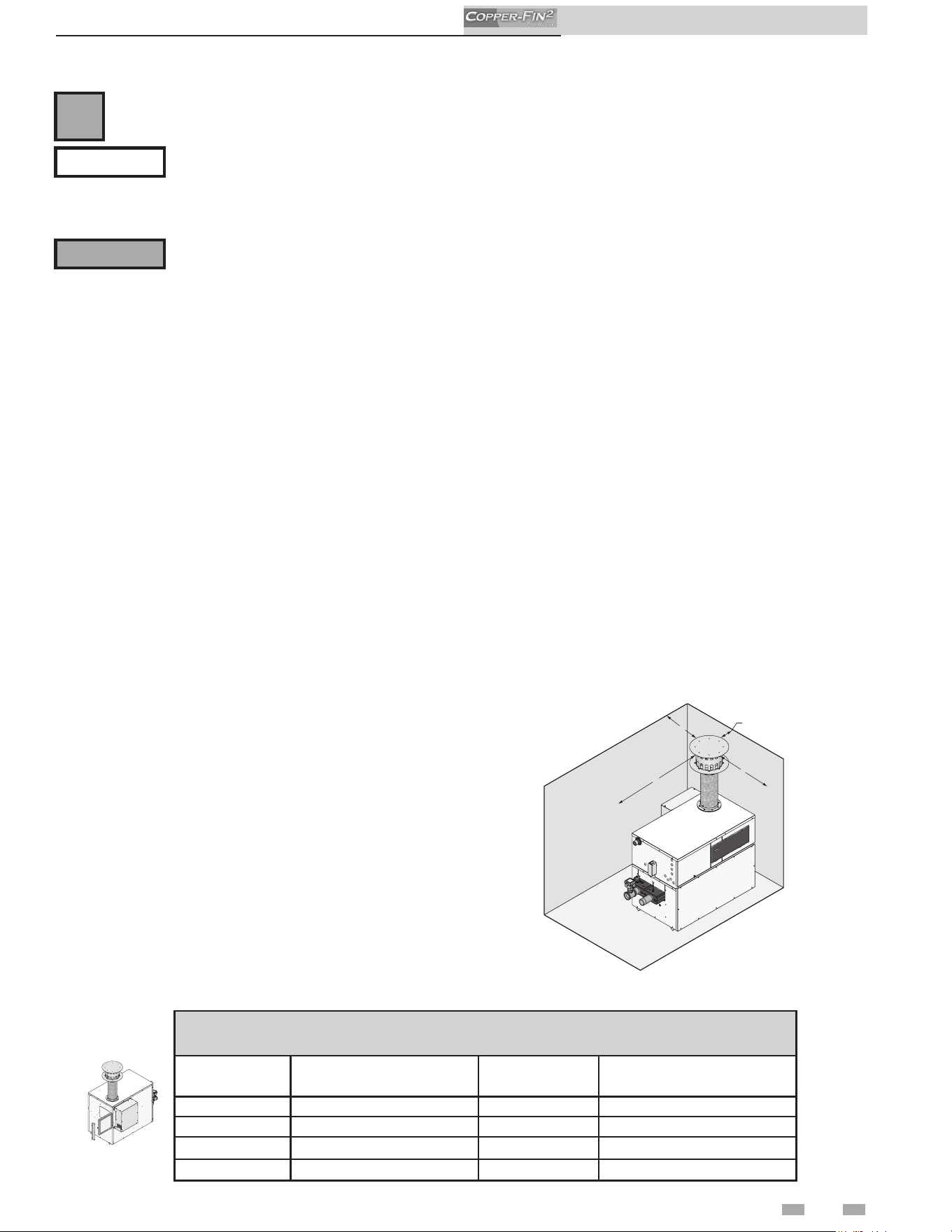
2 Venting (continued)
33
TABLE - 2H
OUTDOOR VENT STACK KITS
MODEL
KIT* WITH VALVE
COVER
MODEL
KIT* WITH VALVE
COVER
502 100337597 1262 100337600
652 100337598 1442 100337600
752 100337598 1802 100337603
992 100337599 2072 100337603
Installation & Operation Manual
Outdoor installation - see page 14.
NOTICE
Before installing a venting system, follow all requirements found in the General Venting section.
Units are self-venting and can be used outdoors when installed with the optional outdoor system. The air inlet cap mounts directly
to the unit and covers the combustion air opening. Gasketing is supplied to seal the unit vent pipe to prevent water leakage. The
flue requires a 36" vent pipe and cap installed to the heater outlet.
⚠WARNING
Only install outdoor models outdoors and only use the vent system supplied by the appliance manufacturer.
Personal injury or product damage may result if any other cap is used or if an outdoor model is used indoors.
Properly install all covers, doors and jacket panels to ensure proper operation and prevent a hazardous
condition.
Combustion air supply must be free of contaminants (see Combustion and Ventilation Air, page 10). To prevent recirculation of
the flue products into the combustion air inlet, follow all instructions in this section.
Outdoor vent/air inlet location
Keep venting areas free of obstructions. Keep area clean and free of combustible and flammable materials. Maintain a minimum
clearance of 3" (76 mm) to combustible surfaces and a minimum of 36" (915 mm) clearance to the air inlet. To avoid a blocked
air inlet or blocked flue condition, keep the outdoor cap air inlet, flue outlet and drain slot clear of snow, ice, leaves, debris, etc.
Do not install outdoor models directly on the ground. You must install the outdoor unit on a concrete, brick, block, or other non-
combustible pad.
Do not locate unit so that high winds can deflect off of adjacent walls, buildings or shrubbery causing recirculation. Recirculation
of flue products may cause operational problems, bad combustion or damage to controls. Locate unit at least 3 feet (0.91 m) from
any wall or vertical surface to prevent wind conditions from affecting performance.
Multiple unit outdoor installations require 48" (1.22 m) clearance between each vent cap. Locate outdoor cap at least 48" (1.22m)
below and 48" (1.22 m) horizontally from any window, door, walkway or gravity air intake.
Locate unit at least 10 feet (3.05 m) away from any forced air inlet.
Locate unit at least 3 feet (0.91 m) outside any overhang.
Clearances around outdoor installations can change with time. Do not allow the growth of trees, shrubs or other plants to obstruct
the proper operation of the outdoor vent system.
Do not install in locations where rain from building runoff drains will spill onto the unit.
Do not install outdoor units on stack frames.
Flue gas condensate can freeze on exterior walls or on the vent
cap. Frozen condensate on the vent cap can result in a blocked
flue condition. Some discoloration to exterior building or unit
surfaces can be expected. Adjacent brick or masonry surfaces
should be protected with a rust resistant sheet metal plate.
The outdoor vent system kit
The optional outdoor vent system kit is available from the
appliance manufacturer. The outdoor system part numbers are
listed by model number. See Table 2H for kit numbers.
Complete installation instructions are included with the
outdoor vent cap kit. is kit requires a 36" vent pipe and cap
(eld supplied).
Figure 2-15_Outdoor Vent Stack Installed
F
* ese kits include an outdoor air cap and ue gasket. A 36" vent pipe and cap
(eld supplied) are required.
DIR #2000597298 00
3'
3'
3'
3'
DIR #2000597298 00
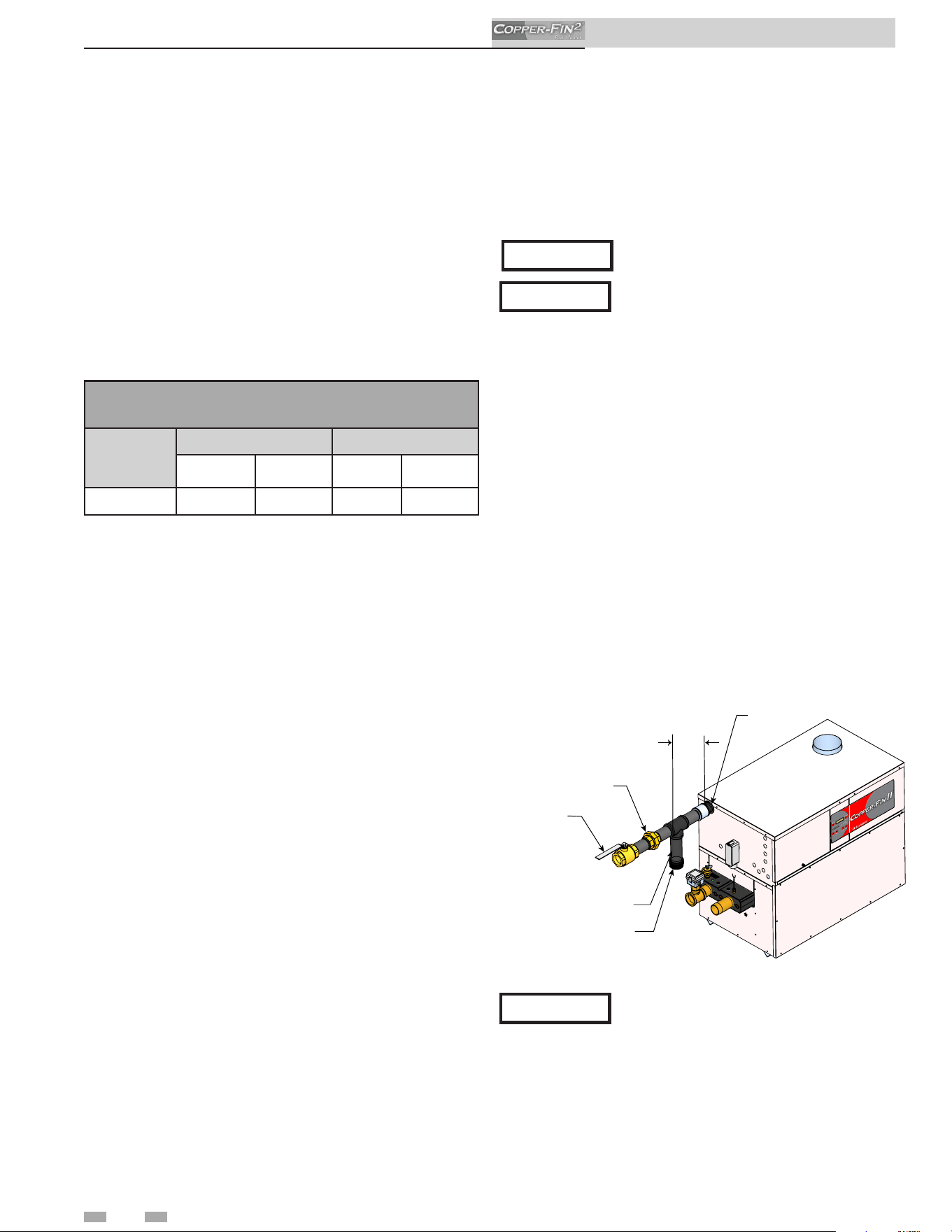
34
3 Gas connections
Connecting to gas supply
Verify that the appliance is supplied with the type of gas
specified on the rating plate. This appliance is configured
for operation up to 4,500 feet altitude. Consult factory for
installations above 4,500 feet elevation.
Inlet gas pressure: Measured at the inlet pressure tap on the
appliance gas manifold. The pressure tap is located upstream of
the combination gas valve(s).
See Table 3A for maximum and minimum inlet pressures. Do
not exceed the maximum. Minimum inlet pressure is for the
purpose of input adjustment.
TABLE 3A
INLET GAS PRESSURE
MODEL
NATURAL LP
Max.
w.c.
Min.
w.c.
Max.
w.c.
Min.
w.c.
502 - 2072 14" 4.5" 14" 8.0"
Gas pressure test
1. The appliance must be disconnected from the gas
supply piping system during any pressure testing of that
system at a test pressure in excess of 1/2 PSIG (3.5 kPa).
2. The appliance must be isolated from the gas supply
piping system by closing a manual shutoff valve during
any pressure testing of the gas supply piping system at
test pressures equal to or less than 1/2 PSIG (3.5 kPa).
3. The appliance and its gas connection must be leak
tested before placing it in operation.
Checking manifold gas pressure
Reference the Copper-fin
2
Pool Heater Service Manual for
information regarding manifold gas pressure.
Install a manual main gas shutoff valve, outside of the unit gas
connection within six feet of the unit in accordance with the
requirements of the National Fuel Gas Code, ANSI Z223.1.
You must provide a sediment trap (drip leg) in the inlet of the
gas connection to the unit.
Manifold pressure: The gas regulator on the unit’s
combination gas valve is adjustable to supply proper manifold
pressure for normal operation. See the Copper-Fin
2
Pool Heater
Service Manual for net manifold pressure settings.
If you must adjust regulator pressure, follow the instructions
under Gas Manifold Pressure Adjustment in the Copper-Fin
2
Pool Heater Service Manual. Do not increase regulator pressure
beyond specified pressure setting.
Gas connection
All gas connections must be made with pipe joint compound
resistant to the action of liquefied petroleum (L.P.) and natural
gases. All piping must comply with local codes and ordinances.
Piping installations must comply with approved standards and
practices.
1. Make sure gas line is a separate line direct from the meter
unless the existing gas line is of sufficient capacity. Verify
pipe size with your gas supplier.
NOTICE
It is the installer’s responsibility to supply
the sediment trap (drip leg).
CAUTION
Do not block access to the electrical cover
plate when installing the sediment trap.
The sediment trap must be a minimum of
12 inches from the appliance.
The combination gas valves have an integral vent limiting
device and do not require venting to atmosphere, outside the
building. The unit will not operate properly if the reference hose
is removed or a vent to atmosphere is installed.
Optional gas controls may require routing of bleeds and vents
to the atmosphere, outside the building when required by local
codes.
Figure 3-1_Gas Line Connection
Installation & Operation Manual
Gas piping
To safely operate this pool heater, you must properly size the
gas supply piping. See Tables 3B through 3D for piping and
fitting requirements. Gas pipe size may be larger than pool
heater connection.
On Models 502 - 752, the gas connection to the pool heaters are
1 1/4" NPT and on Models 992 - 2072, the gas connections to
the pool heaters are 2" NPT.
For ease of service, install a union.
NOTICE
If an inline high gas pressure regulator is
used, it MUST BE of the lockup type and
be located a minimum of 10 feet from the
appliance. Failure to do so may result in
insufficient gas volume supplied to the
appliance.
2000618449 00
NIPPLE
CAP
MANUAL
MAIN SHUT
OFF VALVE
UNION
12"
MIN
USE WRENCH
TO HOLD
SUPPLY PIPE
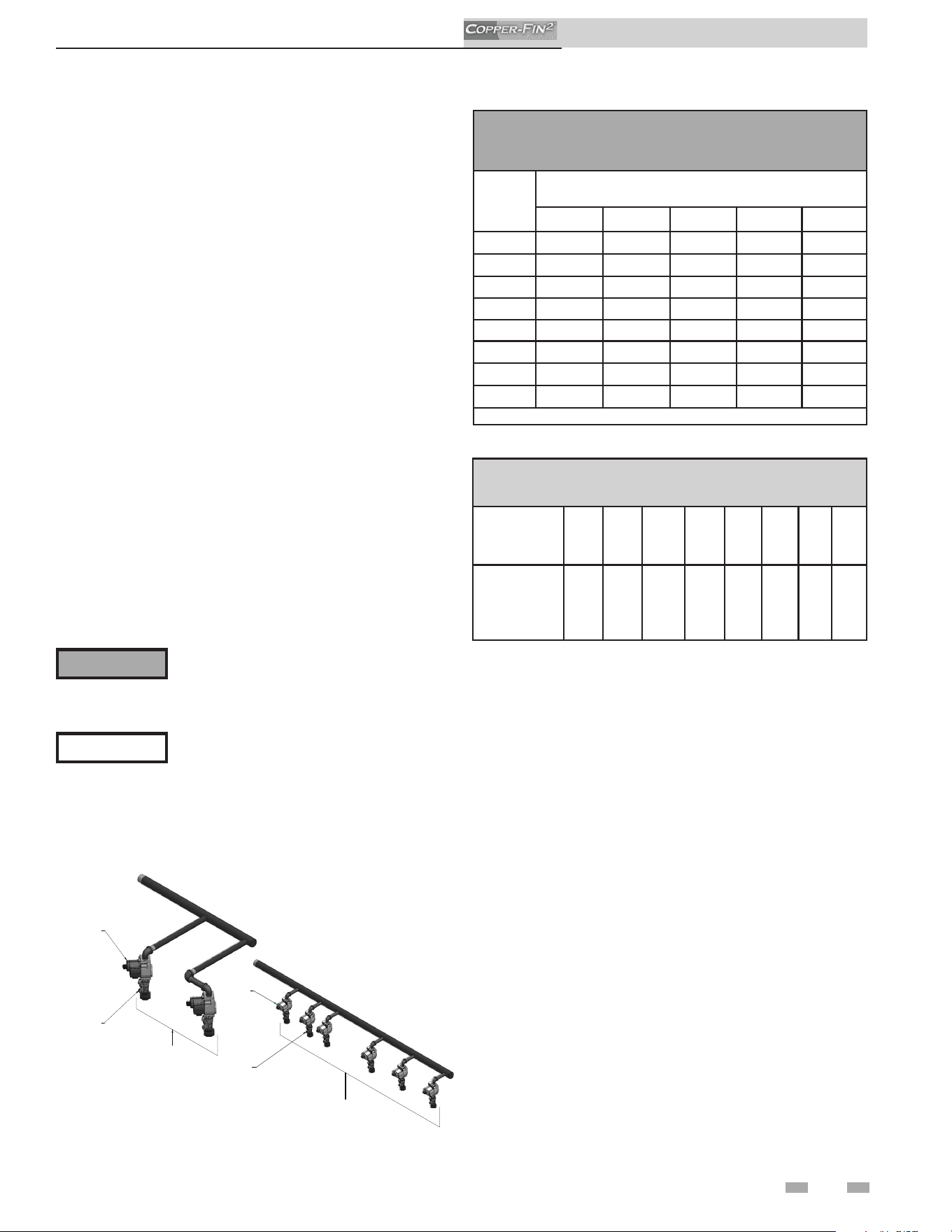
35
3 Gas connections (continued)
Installation & Operation Manual
2. Use new, properly threaded black iron pipe free from
chips. If you use tubing, make sure the ends are cut
square, deburred and clean. Make all tubing bends smooth
and without deformation. Avoid flexible gas connections.
Internal diameter of flexible lines may not provide unit with
proper volume of gas.
3. Install a manual main gas shutoff valve at the unit’s gas inlet,
outside of the unit.
4. Run pipe or tubing to the unit’s gas inlet. If you use tubing,
obtain a tube to pipe coupling to connect the tubing to the
unit’s gas inlet.
5. Install a sediment trap in the supply line to the unit’s gas
inlet (see FIG. 3-1).
6. Apply a moderate amount of good quality pipe compound
(do not use Teflon tape) to pipe only, leaving two end
threads bare.
7. Remove seal over gas inlet to unit.
8. Connect gas pipe to inlet of unit. Use wrench to support gas
manifold on the unit.
9. For L.P. gas, consult your L.P. gas supplier for expert
installation.
10. Ensure that all air is completely bled from the gas line before
starting the ignition sequence. Start up without properly
bleeding air from the gas line may require multiple reset
functions of the ignition control module to achieve proper
ignition.
TABLE - 3C
FITTINGS TO EQUIVALENT STRAIGHT PIPE
Diameter
Pipe
(inches)
3/4 1 1 1/4 1 1/2 2 3 4 5
Equivalent
length of
Straight Pipe
(feet)
2 2 3 4 5 10 14 20
⚠WARNING
Do not have any open flame in proximity to
the gas line when bleeding air from the gas
line. Gas may be present.
TABLE 3B
SUGGESTED GAS PIPE SIZE FOR
SINGLE UNIT INSTALLATIONS
MODEL
Distance from Meter (in feet)
0 - 50 51 - 100 101 - 200 201 - 300 301 - 500
502 1 1/4" 1 1/2" 2" 2" 2 1/2"
652 1 1/2" 2" 2" 2 1/2" 2 1/2"
752 1 1/2" 2" 2" 2 1/2" 3"
992 2" 2" 2 1/2" 2 1/2" 3"
1262 2" 2 1/2" 2 1/2" 3" 3"
1442 2 1/2" 2 1/2" 3" 3" 3 1/2"
1802 2 1/2" 3" 3" 3 1/2" 3 1/2"
2072 2 1/2" 3" 3" 3 1/2" 4"
For each elbow or tee, add equivalent straight pipe to total length from Table 3C.
Gas train and controls
NOTICE
The gas train and controls assembly
provided on this unit have been tested under
the applicable American National Standard
to meet minimum safety and performance
criteria such as safe lighting, combustion
and safety shutdown operation.
COMBINATION
VALVE
DO
WNSTREAM
TEST VALV
E
TO BURNERS
502 MODEL
COMBINATION
VALVE
DOWNSTREAM
TEST VALVE
TO BURNERS
2072 MODEL
Figure 3-2_Typical Pool Heater Gas Train Drawing
Combination gas valves
These units fire in multiple stages of burner input. Each stage
of burner operation has a combination gas valve(s) to cycle
the gas supply on and off and regulate gas to the burners. Each
combination valve consists of a gas regulator and two valve seats
to meet the requirements for redundant gas valves. The valve
has a gas control knob that must remain in the open position
at all times when the unit is in service. The gas control valve
has pressure taps located on the inlet and discharge sides of the
valve. Manifold pressure is adjusted using the regulator located
on the valve. A manifold gas pressure tap for each burner stick
is located on the discharge side of the valve.
The manifold pressure is preset at the factory and adjustment
is not usually required. If you must adjust regulator pressure,
follow the instructions in the Copper-fin
2
Service Manual.
Venting of combination gas valves
The combination gas valve/regulator used on all units is
equipped with an integral vent limiting orifice per ANSI Z21.78.
The vent limiter ensures that the volume of gas emitted from
the valve in the event of a failed gas diaphragm does not exceed
the maximum safe leakage rate allowed by agency requirements.
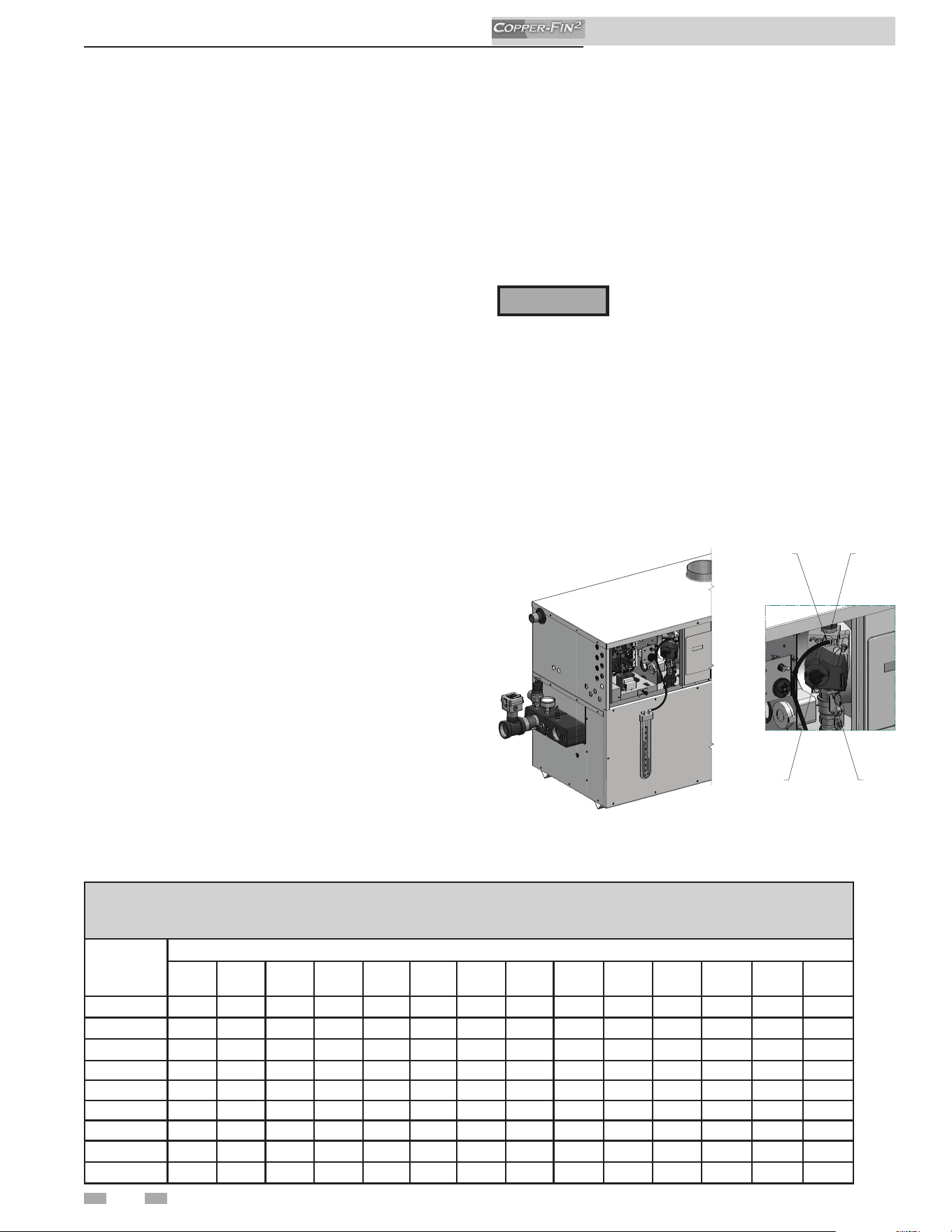
36
3 Gas connections
SUPPLY
INLET
PRESSURE
TAP
INLET
GAS
VALVE
CONTROL
KNOB
OUTLET
Installation & Operation Manual
Figure 3-3_Measuring Gas Supply Pressure at
Combination Gas Valve
13. Remove the manometer and related fitting from the “inlet”
side of the gas valve, replace 1/8" hex plug in gas valve and
tighten.
14. Turn on gas supply at the manual valve, turn on L.P. gas at
the tank if required.
15. Turn the power switch to the “ON” position.
16. Turn the gas valve knob to the “ON” position.
17. Set the electronic temperature control or thermostat to call
for heat.
Combination gas valve/regulators equipped with integral vent
limiters are not required to have vent or relief lines piped to
the outdoors. The termination of the vent limited opening on
the combination gas valve/regulator complies with the safety
code requirements of CSD-1, CF-190(a) as shipped from the
appliance manufacturer without the installation of additional
vent lines.
Checking gas supply pressure
Use the following procedure to check gas supply pressure.
1. Turn the main power switch to the “OFF” position.
2. Turn gas valve knobs to the “OFF” position.
3. Shut off gas supply at the field-installed manual gas cock in
the gas piping to the unit. If fuel supply is L.P. gas, shut off
gas supply at the tank.
4. Remove the 1/8" hex plug, located on the “inlet” side of the
gas valve. You may also use a tapping on the field-installed
main manual gas cock or gas piping. Install a fitting in the
inlet pressure tapping suitable to connect to a manometer
or magnehelic gauge. Range of scale should be 14" w.c. or
greater to check inlet pressure.
5. Turn on gas supply at the manual gas cock, turn on L.P. gas
at the tank if required.
6. Turn the power switch to the “ON” position.
7. Turn the gas valve knobs to the “ON” position. Set the
electronic temperature control or thermostat to call for
heat.
8. Observe the gas supply pressure as all burners are firing.
Ensure that inlet pressure is within the specified range.
See Connecting To Gas Supply, page 34 for minimum and
maximum gas supply pressures.
9. If gas pressure is out of range, contact gas utility, gas
supplier, qualified installer or service agency to determine
necessary steps to provide proper gas pressure to the
control.
10. If gas supply pressure is within normal range, turn the
power switch to the “OFF” position.
11. Turn gas valve knobs to the “OFF” position.
12. Shut off gas supply at the manual gas cock in the gas piping
to the unit. If fuel supply is L.P. gas, shut off gas supply at
the tank.
⚠WARNING
After completing any testing on the gas
system, leak test all gas connections. Apply
a soap/water solution to all gas connections
while main burners are operating. Bubbles
forming indicate a leak. Repair all leaks at
once. Do not operate this unit with a leak in
the gas train, valves or related piping.
Check burner performance by cycling the system while you
observe burner response. Burners should ignite promptly.
Flame pattern should be stable, see Burner Flames in the
Copper-fin
2
Service Manual. Turn system off and allow burners
to cool, then cycle burners again to ensure proper ignition and
flame characteristics.
TABLE - 3D
Capacity of Schedule 40 Metallic Pipe in Cubic Feet of Natural Gas Per Hour
(based on .60 specific gravity, 0.30" w.c. pressure drop)
Pipe
Size
(Inches)
Length of Pipe in Straight Feet
10 20 30 40 50 60 70 80 90 100 125 150 175 200
1/2 131 90 72 62 55 N/A N/A N/A N/A N/A N/A N/A N/A N/A
3/4 273 188 151 129 114 104 95 89 83 79 70 63 58 N/A
1 514 353 284 243 215 195 179 167 157 148 131 119 109 102
1 1/4 1,060 726 583 499 442 400 368 343 322 304 269 244 224 209
1 1/2 1,580 1,090 873 747 662 600 552 514 482 455 403 366 336 313
2 3,050 2,090 1,680 1,440 1,280 1,160 1,060 989 928 877 777 704 648 602
2 1/2 4,860 3,340 2,680 2,290 2,030 1,840 1,690 1,580 1,480 1,400 1,240 1,120 1,030 960
3 8,580 5,900 4,740 4,050 3,590 3,260 3,000 2,790 2,610 2,470 2,190 1,980 1,820 1,700
4 17,500 12,000 9,660 8,270 7,330 6,640 6,110 5,680 5,330 5,040 4,460 4,050 3,720 3,460
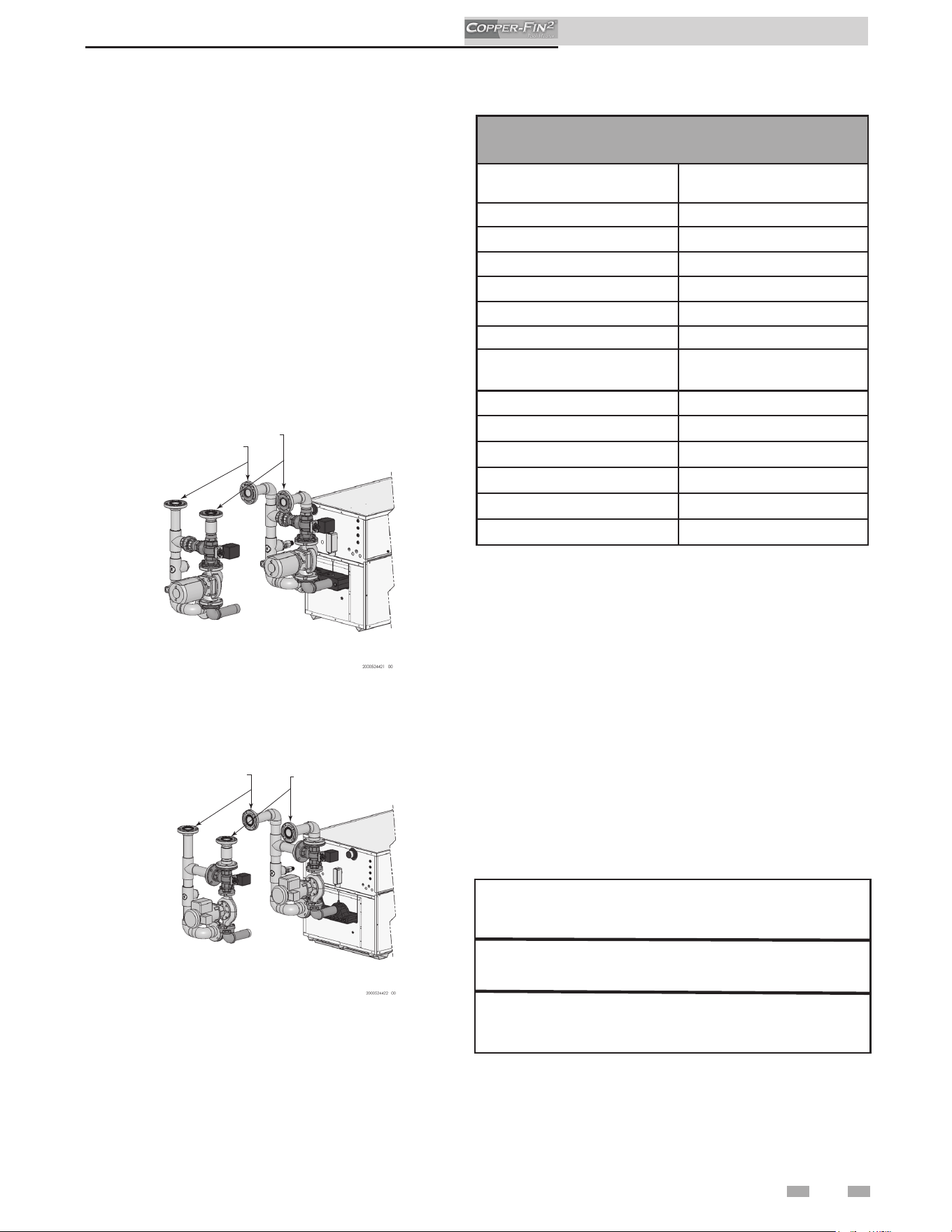
37
4 Water connections
Figure 4-1_Water Connections - Models 502 - 752
2” NPT
WATER
INLET
2” NPT
WATER
OUTLET
Figure 4-2_Water Connections - Models 992 - 2072
2-1/2” NPT
WATER
INLET
2-1/2” NPT
WATER
OUTLET
Installation & Operation Manual
Circulating pump
1. This pool heater is factory supplied with a properly sized
pump that circulates water between the pool heater and
system.
2. The pump is sized to pool heater input and water
hardness. See Water Chemistry on page 48.
3. The pump is maintenance free and does not require any
lubricant.
4. Standard pool heaters are furnished with the following
circulating pump mounted in the factory supplied pool
loop.
5. The pump is provided with an external grounding lug to
provide equipotential bonding per UL1081.
502 - 752 Models
1/4 HP, 120 VAC, 5.0 Amp
992 - 1442 Models
1/2 HP, 120 VAC, 7.8 Amp
1802 - 2072 Models
3/4 HP, 120 VAC, 10.6 Amp
This pump is sized based on installation of a single pool heater in
close proximity with the system. The piping can be changed to a
sub-loop. Check pump for correct pump rotation.
The standard pump selection is based on the following pipe and
fittings from the pool heater to the system:
TABLE - 4A
Pipe Sizing Chart
502 - 752 Models
Number of units
Common Pipe Size
(Min.)
1
2"
2 3"
3 4"
4 4"
5 6"
6 6"
992 - 2072 Models
Number of units
Common Pipe Size
(Min.)
1 2 1/2"
2 4"
3 4"
4 6"
5 6"
6 6"
Install piping from the filter system to the pool heater as
shown in the pool heater piping diagrams. See Figures 34 - 38.
Minimum pipe diameter to and from the installed pool heater
to the filter system piping on models 502 - 752 is 2" and on
models 992 - 2072 Btu/hr the minimum is 2-1/2". The piping
from the filter system to the pool heater may be PVC, CPVC
or Copper Pipe. The piping from the pool heater back to the
filter system will carry water with temperatures in excess of
110°F and must be CPVC or Copper Pipe. The temperature
of the heated water from the pool heater will be substantially
cooled as it is mixed back into the pool water from the filter
system and returned to the pool. The mix of heated water and
pool water from the filtration system should only be slightly
warmer than the pool water before the connections from the
pool heater.
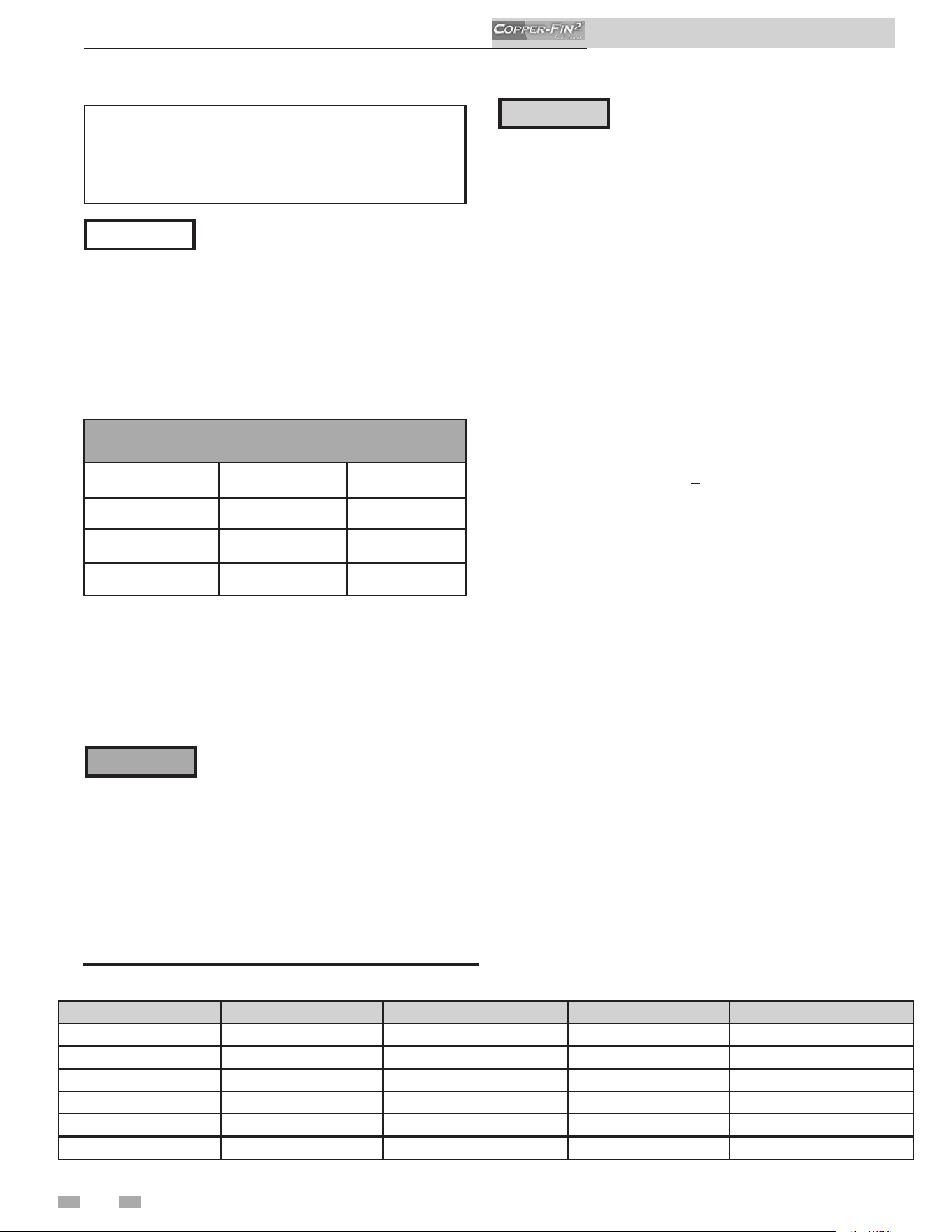
Heat exchanger
A Cupro-Nickel heat exchanger is standard on 1802 - 2072
models. On all models, header inspection plugs can be
removed for field inspection and cleaning of copper tubes.
The entire heat exchanger may be easily removed from the
pool heater.
⚠ CAUTION
An appliance allowed to operate at return
temperatures below the specified minimum
setting may experience problems with
the operating controls, safety switches,
obstruction of the flue gas passages on the
heat exchanger, incomplete combustion
and possible flue gas spillage. Sustained
operation at lower than specified water
temperatures (140°F) may cause hazardous
conditions that may result in personal injury
or non-warrantable damage to the appliance.
38
4 Water connections
Initial set-up of maximum water flow
On initial start-up of the Copper-Fin
2
pool heater, the maximum
water flow to the heat exchanger must be checked and manually
limited with a valve or bypass before normal operation begins.
Installation & Operation Manual
TABLE-4B
Minimum Pump Performance
Models GPM Ft.Hd.
502 - 752 55 10
992 - 1442 90 15
1802 - 2072 115 18
Minimum Pump Performance
Pump performance is based on providing adequate flow to
prevent scale accumulation in the heat exchanger. See Water
Chemistry on page 48.
⚠WARNING
Should overheating occur or the gas supply
fail to shut off, do not turn off or disconnect
the electrical supply to the pump. Instead,
shut off the gas supply at a location external
to the pool heater.
Auxiliary Mixed Water Limit Control
Pool return and pool supply (mixed water limit)
sensors (reference FIG. 4-3, page 39):
Ensure pool return and pool supply (mixed water limit) sensors
are both installed in the system piping. The return sensor should
be installed in the upstream of the feed water to the pool heater.
The supply sensor limits the temperature of the water going back
to the pool (factory adjusted to < 110°F). The supply sensor may
be installed in the filtration system piping, be sure to keep it at
least three (3) feet downstream from the point where the heated
water from the pool heater is being added to the filtration system.
Note: In order to accurately sense water temperatures, both
sensors need to be in the actual water flow.
Installation of return and supply sensors:
Both pool sensors are immersion type sensors with 1/4" NPT
threads and may be installed directly into the system piping
by drilling 7/16" pilot holes and tapping them with a 1/4" NPT
tapered tap. Apply a small amount of high quality RTV silicone
sealant to the threads to prevent leaks and install the sensors
into the threaded openings in the PVC pipe. Over-tightening
can damage the parts and/or strip the threads cut into the plastic
pipe.
Sensor connections:
The sensors are connected to the pool heater from the factory.
The return sensor is a two-wire sensor and the supply sensor is
a four-wire sensor. Disconnects are provided for each sensor.
If disconnected to facilitate installation, re-connection is
necessary after installation. If sensors must be located further
than allowed by the cables provided, any extension cabling must
be of equivalent type and wire gauge (see Table 5B on page 44 of
this manual for recommended gauges). IMPORTANT: If the
unit is to be installed outdoors, weatherproof connections must
be provided over all sensor connections.
The water connections / sub-loop shall not be
smaller than what is called out in Table 4A. The
total length of the sub-loop shall not total more
than 45 equivalent feet of linear pipe.
NOTICE
For every elbow and tee in excess
of those shown above, deduct 5 feet
from the maximum allowable straight
pipe in the pool heater to the system
circulating loop.
CONFIGURATION PIPE SIZE PRESSURE LOSS (PSI) HEAD LOSS (FT) WHERE USED
VERTICAL 2" 1.67 3.9 CP502, CP652, CP752
HORIZONTAL 2" 1.88 4.4 CP502, CP652, CP752
VERTICAL 2.5" 2.14 4.9 CP992, CP1292, CP1442
VERTICAL 2.5" 3.37 7.8 CP1802, CP2072
HORIZONTAL 2.5" 2.37 5.5 CP992, CP1292, CP1442
HORIZONTAL 2.5" 3.72 8.6 CP1802, CP2072
Table 4C_Pressure Loss Table
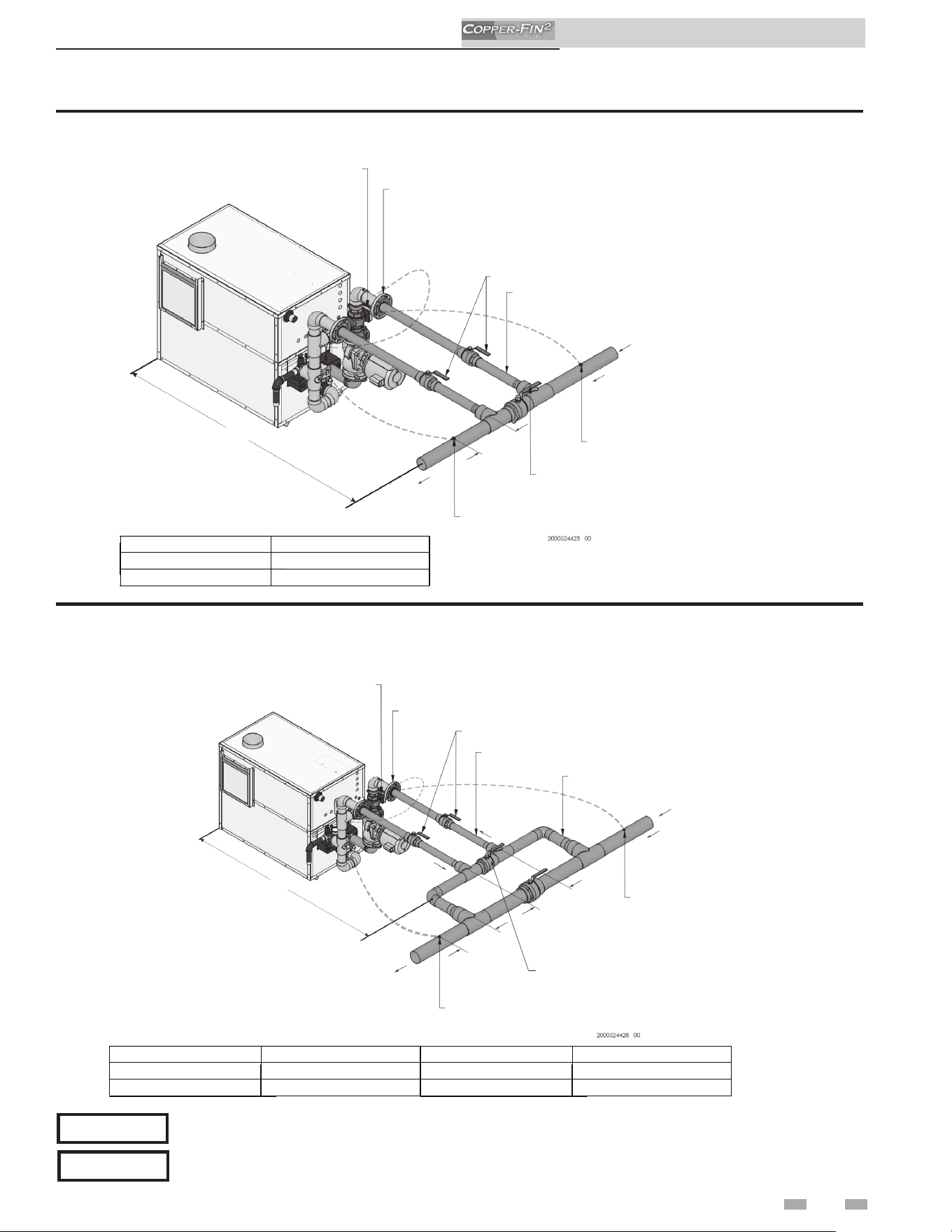
39
4 Water connections (continued)
Figure 4-3_Heater Within 15 feet of Pool Piping
Installation & Operation Manual
Figure 4-4_Heater Beyond 15 feet of Pool Piping
MODEL NO CONNECTION SIZE
CP (N,L) 502-752 2" MIN
CP (N,L) 992-2072 2-1/2" MIN
AUTOMATIC
BYPASS VALVE
POOL RETURN SENSOR *
SECONDARY LOCATION
COPPER OR CPVC
(SEE TABLE)
RECOMMENDED
ISOLATION VALVE
FROM
POOL
TO
POOL
POOL RETURN SENSOR
PRIMARY LOCATION
REQUIRED POOL
RETURN SENSOR
LOCATION
BALL VALVE
20'
MAX
3'
MIN
110
°
LIMIT
* NOTE: IF THE RETURN SYSTEM SENSOR IS
LOCATED IN THE SECONDARY
LOCATION SHOWN ON THE PIPING
DIAGRAM, THE UNIT PUMP MUST
RUN CONTINUOUSLY TO ENSURE
THE WATER FLOW PAST THE
SENSOR IS MAINTAINED.
AUTOMATIC
BYPASS VALVE
POOL RETURN SENSOR *
SECONDARY LOCATION
COPPER OR CPVC
(SEE TABLE)
RECOMMENDED
ISOLATION VALVE
* NOTE: IF THE RETURN SYSTEM SENSOR IS
LOCATED IN THE SECONDARY
LOCATION SHOWN ON THE PIPING
DIAGRAM, THE UNIT PUMP MUST
RUN CONTINUOUSLY TO ENSURE
THE WATER FLOW PAST THE
SENSOR IS MAINTAINED.
FROM
POOL
POOL RETURN SENSOR
PRIMARY LOCATION
VALVE
12"
MAX
OR
4X PIPE
DIAMETERS
3'
MIN
REQUIRED POOL
RETURN SENSOR
LOCA
TION
TO
POOL
110
°
LIMIT
20'
MAX
SUBLOOP
MODEL NO CONNECTION SIZE
CP (N,L) 502-752 2" MIN
CP (N,L) 992-2072 2-1/2" MIN
SUBLOOP SIZE SUBLOOP GPM
2-1/2” MIN 100 GPM MIN
3” MIN 160 GPM MIN
BALL VALVE
Please note that these illustrations are meant to show system piping concept only, the installer is responsible for
all equipment and detailing required by local codes.
NOTICE
NOTICE
System flow should always remain higher than the required flow for the pool heater(s) when the pool heater(s)
is in operation to prevent short cycling and high limit issues.
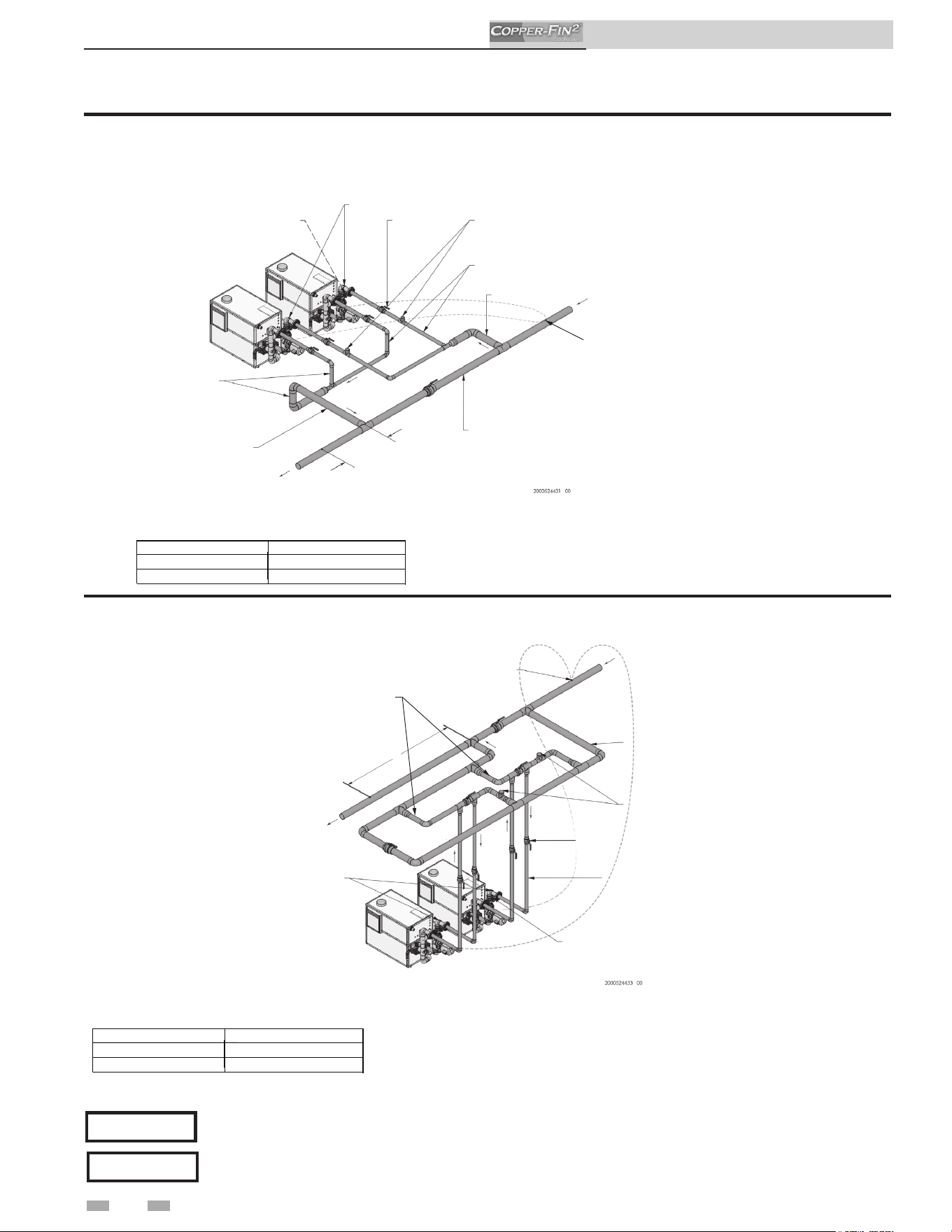
40
4 Water connections
Installation & Operation Manual
Figure 4-5_Cascaded heaters Within 15 feet of Perpendicular Pool Piping
Figure 4-6_Cascaded Heaters Beyond 15 feet of Pool Piping
MODEL NO CONNECTION SIZE
CP (N,L) 502-752 2" MIN
CP (N,L) 992-2072 2-1/2" MIN
* NOTE: IF THE RETURN SYSTEM SENSOR IS
LOCATED IN THE SECONDARY
LOCATION SHOWN ON THE PIPING
DIAGRAM, THE UNIT PUMP MUST
RUN CONTINUOUSLY TO ENSURE
THE WATER FLOW PAST THE
SENSOR IS MAINTAINED.
COPPER
OR CPVC
(SEE TABLE)
CPVC
TO
POOL
110
°
LIMIT
VALVE
CPVC
3'
MIN
FLOWMETER
COPPER
OR CPVC
(SEE TABLE)
CPVC
FROM
POOL
POOL RETURN SENSOR
PRIMARY LOCATION
AUTOMATIC
BYPASS VALVE
* POOL
RETURN
SENSOR
SECONDARY
LOCATION
RECOMMENDED
ISOLATION
VALVE
COPPER
OR CPVC
(SEE TABLE)
110
°
LIMIT
TO
POOL
MODEL NO CONNECTION SIZE
CP (N,L) 502-752 2" MIN
CP (N,L) 992-2072 2-1/2" MIN
* NOTE: IF THE RETURN SYSTEM SENSOR IS
LOCATED IN THE SECONDARY
LOCATION SHOWN ON THE PIPING
DIAGRAM, THE UNIT PUMP MUST
RUN CONTINUOUSLY TO ENSURE
THE WATER FLOW PAST THE
SENSOR IS MAINTAINED.
*POOL RETURN
SENSOR SECONDARY
LOCATION
RECOMMENDED
ISOLATION
VALVE
CPVC
FLOWMETER
CPVC
POOL
RETURN
SENSOR
PRIMARY
LOCATION
FROM
POOL
AUTOMATIC
BYPASS VALVE
3'
MIN
Please note that these illustrations are meant to show system piping concept only, the installer is responsible for
all equipment and detailing required by local codes.
NOTICE
NOTICE
System flow should always remain higher than the required flow for the pool heater(s) when the pool heater(s)
is in operation to prevent short cycling and high limit issues.
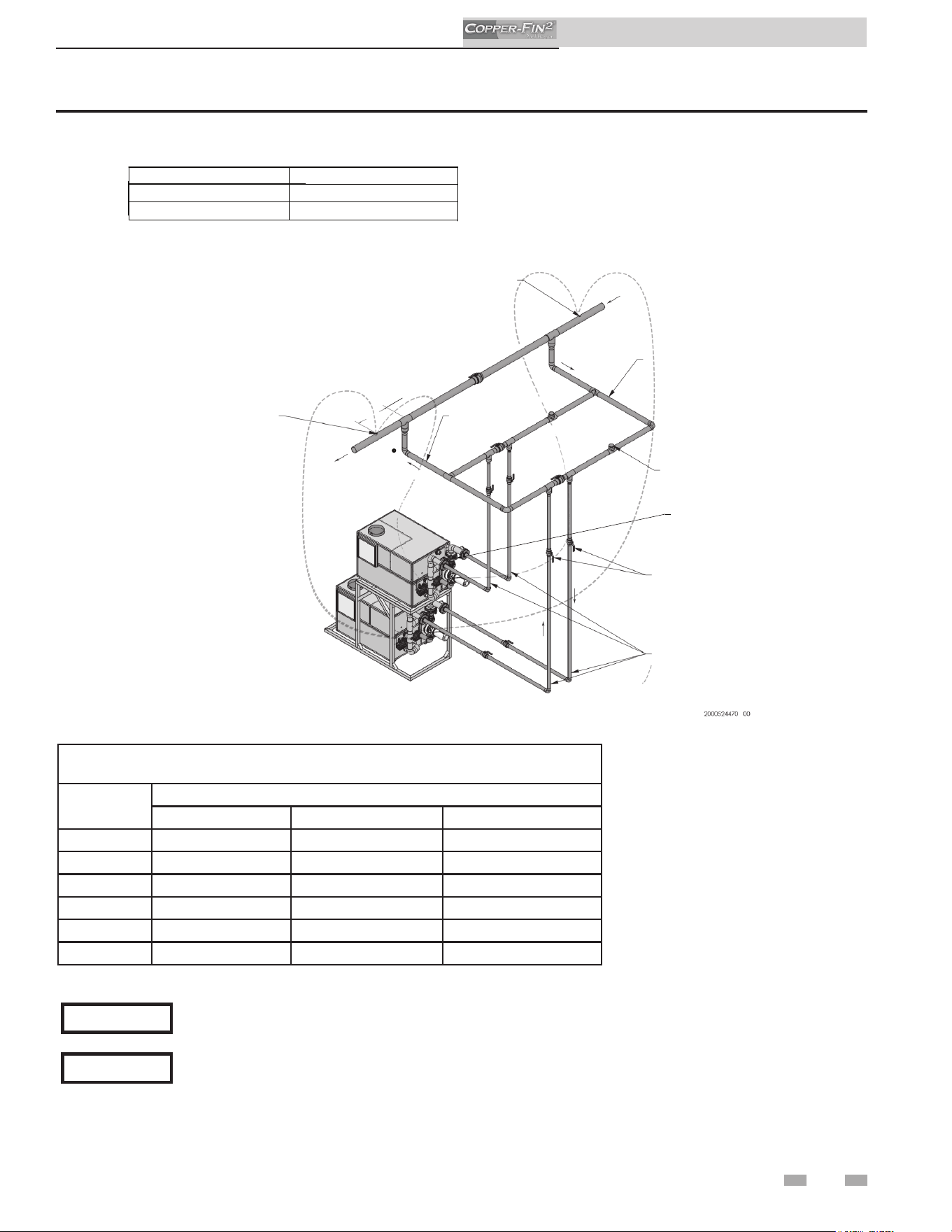
41
4 Water connections (continued)
Figure 4-7_Multi-stack frame - Cascaded heaters beyond 15 feet of pool piping
Installation & Operation Manual
PRIMARY
LOCATION
POOL
SUPPLY
SENSOR
CPVC
3'
MIN
110
LIMIT
TO
POOL
MEMBER
LEADER
COPPER
OR CPVC
(SEE TABLE)
RECOMMENDED
ISOLATION
VALVE
FLOWMETER
CPVC
FROM
POOL
POOL
RETURN
SENSOR
LOCATION
AUTOMATIC
BYPASS VALVE
MODEL NO CONNECTION SIZE
CP (N,L) 502-752 2" MIN
CP (N,L) 992-2072 2-1/2" MIN
Please note that these illustrations are meant to show system piping concept only, the installer is responsible for
all equipment and detailing required by local codes.
NOTICE
NOTICE
System flow should always remain higher than the required flow for the pool heater(s) when the pool heater(s)
is in operation to prevent short cycling and high limit issues.
TABLE 4A
PIPE SIZING CHART
NUMBER
OF UNITS
COMMON PIPE SIZE (MIN)
MODELS 502-752 MODELS 992-1442 MODELS 1892-2072
1 2" 2-1/2" 3"
2 3" 4" 4"
3 3-1/2" 5" 5"
4 4" 5" 6"
5 5" 6" 6"
6 5" 6" 8"
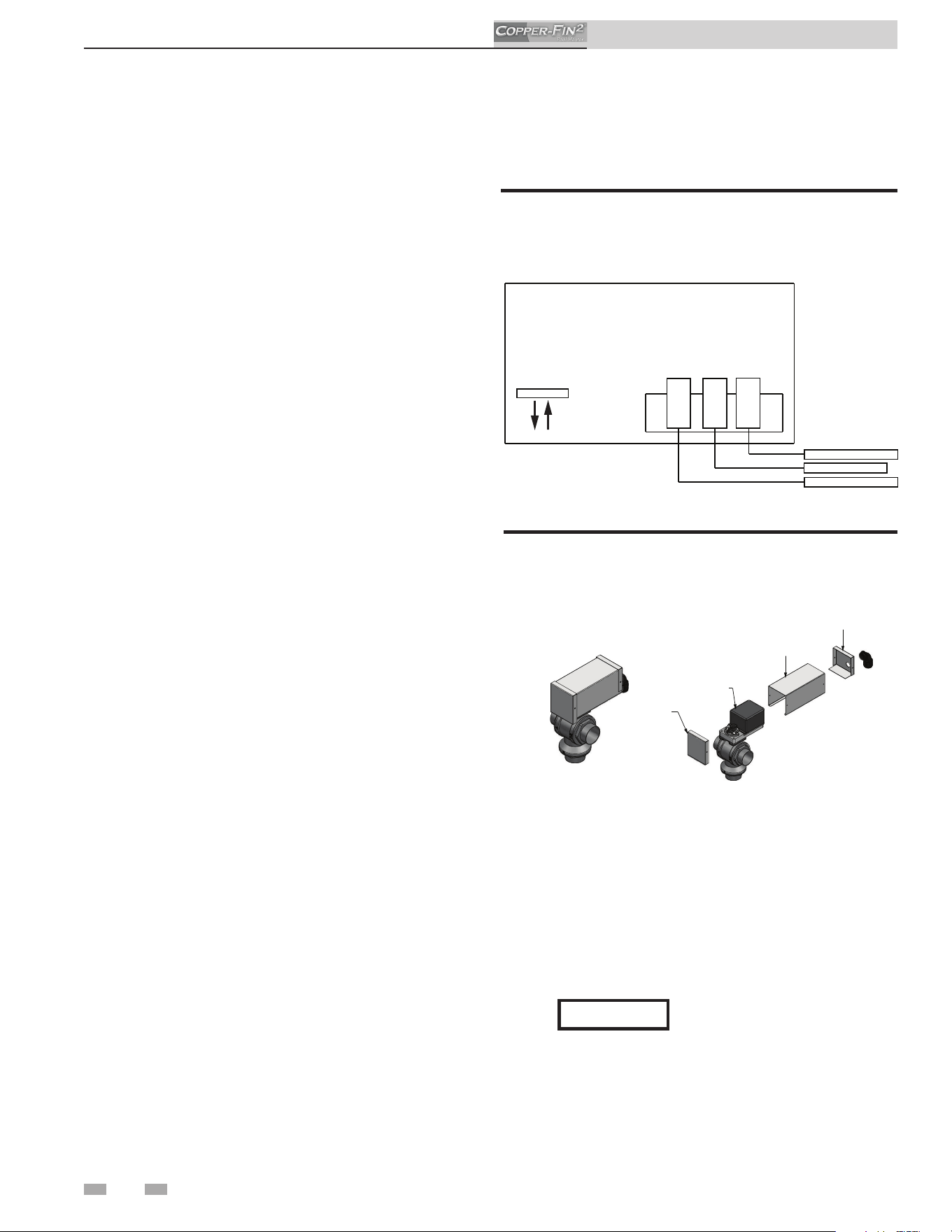
42
4 Water connections
Installation & Operation Manual
INSTALLED VIEW
END CAP
(100152049)
PLASTIC
ACTUATOR
COVER
VALVE COVER
(100152048)
END CAP
(100152050)
EXPLODED VIEW
Manual operation of the 3-way automatic
bypass valve actuator
To manually operate the 3-way automatic bypass valve actuator:
1. Power must be removed from the unit.
2. Once power is removed, the de-clutch button located
on the side of the valve actuator body can be pressed.
Failure to remove power from
the actuator prior to attempting
to manually operate the valve can
result in irreparable damage to the
actuator mechanism.
Figure 4-9_3 Way Valve Cover
Figure 4-8_3 Way Valve Connection Diagram
Note: The actuator handle is not used when the outdoor cover is
installed. The handle is attached to the underside of the actuator
for storage.
CAUTION
Outdoor operation: 3-way valve cover
If the pool heater is to be installed outdoors, the 3-way valve must
be protected from the elements. A cover for the 3-way valve is
included with the outdoor vent kits for all models (see Table 2H
on page 33).
Automatic bypass valve cover installation:
The pump supplied on the pool heater bypass has a sealed motor
suitable for outdoor installations. When installing the 3-way
automatic bypass valve outdoors, an outdoor valve cover is
required. An outdoor valve cover is supplied with an optional
outdoor vent kit (see Table-2D, page 25 of this manual).
To install the outdoor valve cover, follow the steps below:
1. Turn off power to the unit.
2. Remove the plastic actuator cover from the 3-way
automatic bypass valve by loosening the screw above the
conduit fitting (FIG. 4-9).
3. Grasp the cover on the screw side and lift the cover up and
away from the valve.
4. Disconnect the wires at the terminal block (if
connected).
5. Unscrew the plastic conduit cap from the conduit fitting
(FIG. 4-9) and pull the plastic conduit hose and wires
from the valve.
6. Feed the plastic conduit hose through the opening of the
valve cover end cap (100152050) (see FIG. 4-9) and slide
the end cap approximately one foot up the conduit.
7. Reconnect the wires to the 3-way valve circuit board as
shown in FIG. 4-8.
8. Feed the conduit hose into the conduit fitting and
reinstall the conduit cap.
Note: If the wing nut underneath the valve actuator body is
loose, retighten.
9. Reinstall the plastic actuator cover and secure with the
screw loosened in Step 2.
10. Place the valve cover (100152048) over the 3-way
automatic bypass valve. Install the end caps (100152049
and 100152050) using the four screws provided in the kit
(100134916) as shown in FIG. 4-9.
11. Turn the power on to the unit and resume operation.
Pumped Automatic Bypass
This is a high efficiency pool heater which requires a special
pumped bypass for proper operation. The bypass assembly
supplied with the pool heater includes a pump and a 3-way
mixing valve. All piping to connect the filter system to the pool
heater is made directly to the bypass piping on the pool heater.
DIR #2000556239 00
FLOATING ACTUATOR
FLOATING ACTUATOR
*WHITE (TO TERMINAL #7)
*WHITE (TO TERMINAL #7)
CW
CW
CCW
CCW
COM
COM
BLACK (TO TERMINAL #6)
BLACK (TO TERMINAL #6)
RED (TO TERMINAL #5)
RED (TO TERMINAL #5)
DIP SWITCHES
DIP SWITCHES
3-WAY AUTOMATIC BYPASS VA LVE WIRING
FIELD CONNECTIONS
*Note: White may be Blue
43
4 Water connections (continued)
Installation & Operation Manual
Relief valve
This pool heater is supplied with a relief valve(s) sized in
accordance with ASME Boiler and Pressure Vessel Code,
Section IV. The relief valve(s) is installed in the vertical position
and mounted in the hot water outlet. Place no other valve
between the relief valve and the pool heater. To prevent water
damage, pipe the discharge from the relief valve to a suitable
floor drain for disposal when relief occurs. Do not install any
reducing couplings or other restrictions in the discharge line.
The discharge line will allow complete drainage of the valve and
line. Manually operate the relief valves at least once a year.
Automatic chlorinator and chemical
feeders
All chemicals must be diluted into the pool water being circulated
through the pool heater. Any concentration of chlorine in the
pool heater can cause damage to the pool heater.
Do not place chlorine tablets or bromine sticks in the skimmer.
High chemical concentrations will result when the pump is not
running.
Chlorinator must feed downstream of the pool heater and have
an anti-siphoning device to prevent chemical back-up in the pool
heater when the pump is shut off.
Water flow switch
A water flow switch is standard equipment. The wiring
connection installs the flow switch in the 24 VAC safety circuit
to prove water flow before main burner ignition. The standard
flow switch is installed in the outlet side of the piping loop when
shipped from the factory. These pool heaters require a sufficient
flow of 26 GPM to make the flow switch and start burner
operation.
⚠ CAUTION
Avoid contact with hot discharge water.
NOTICE
High chemical concentrations from
improperly adjusted feeders and Chlorinator
can cause rapid corrosion to the heat
exchanger. This damage is non-warrantable.
Ensure that the pump installed on the pool heater will supply
adequate flow to make the flow switch contacts and operate the
pool heater. A water flow switch meets most code requirements
for a low-water cut off device on appliances requiring forced
circulation for operation.
Pump purge delay
Pump purge (pre-running) delay:
The controller provides a pump purge or pre-running feature.
This feature is used whenever the pump has been off for
extended periods of time to conserve energy, causing air to
become entrapped in the pool system piping. The pump purge/
pre-running feature delays pool heater operation until the pump
has been on for a sufficient amount of time to remove air from
the piping. Both the inactivity time and pump purging/pre-
running time are adjustable.
PH-Pump Off:
Inactivity timer is adjustable from 0 to 99 hours. Selection of
time between 4 to 8 hours is recommended.
PH-Pump Purge:
Purge or pre-running timer is adjustable from 0 to 60 minutes.
Selection of a time between 10 to 30 minutes is recommended.
Note: To override the purge/pre-running feature, press the
PREV and NEXT buttons. To disable the feature, the purge/
pre-running timer should be set to zero.
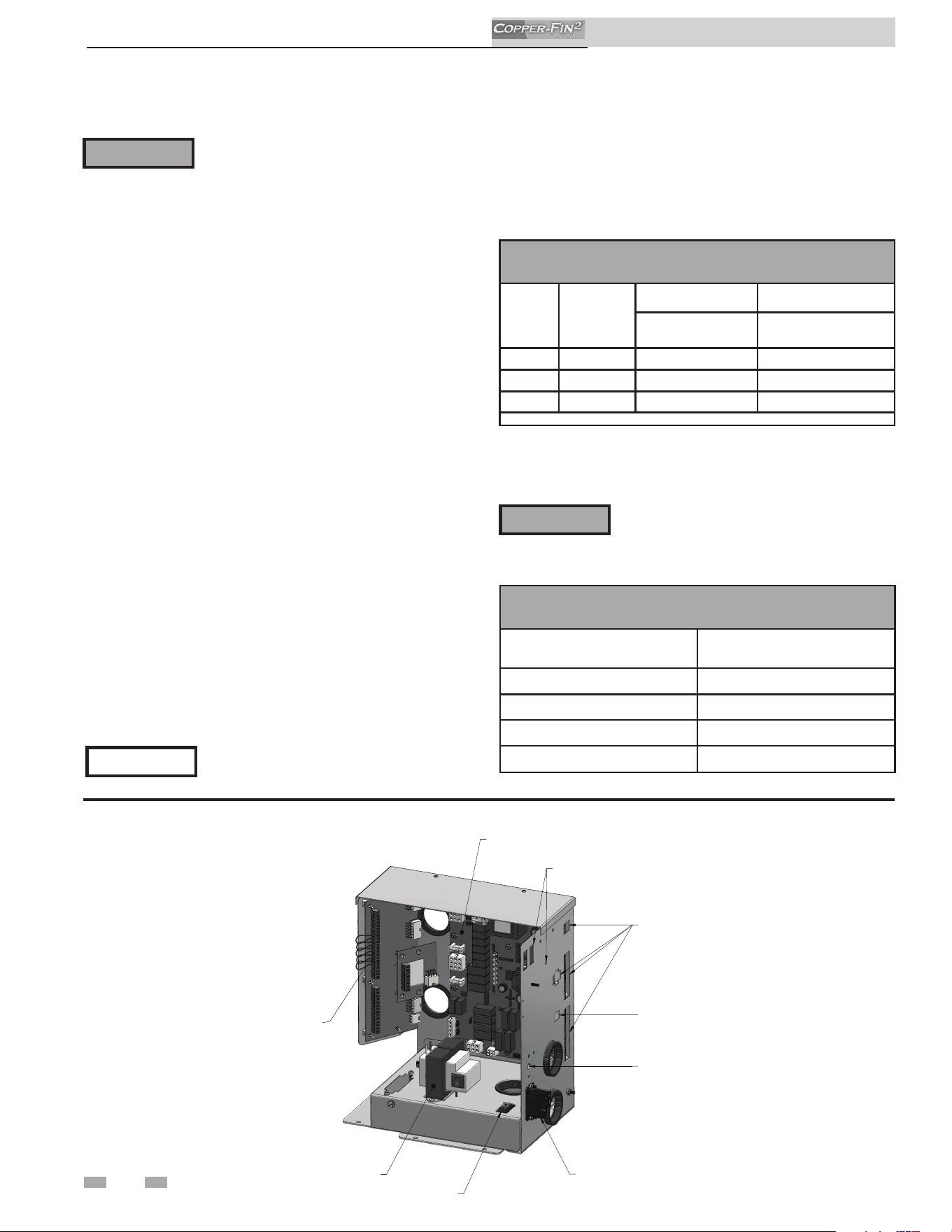
44
5 Electrical connections
Installation & Operation Manual
3-way automatic bypass valve wiring
If the piping loop was disassembled for shipping or needs to be
fitted with an outdoor enclosure, connection or disconnection
of the 3-way automatic bypass valve will be required. Wiring
connections should be made to the appropriately numbered
terminals on the 3-way automatic bypass valve as follows:
Note: Orientation of the valve connections may vary from what
is shown. Care should be taken to ensure wires are connected to
the appropriate terminals, see FIG. 4-8 on page 42 of this manual.
NOTICE
DO NOT block access to the electrical cover
plate when installing electrical conduit.
⚠WARNING
Power must be removed and the clutch
button must be depressed before attempting
to manually operate the valve, or damage to
the 3-way valve may occur.
TABLE-5B
Remote Wire Connection
Wire
Gauge
Maximum
Allowable Length
12 GA 100 ft.
14 GA 75 ft.
16 GA 50 ft.
18 GA 30 ft.
Figure 5-1_Control Panel Component Location
TRANSFORMER RELAY
MAIN CONTROL
BOARD
WIRE HARNESS
CONNECTIONS
BREAKER
LOCATION
OPTIONAL
AUXILIARY
HIGH LIMIT
LOCATION
LWCO/SWITCH
LOCATION
ON/OFF
SWITCH
LOW VOLTAGE
BOARD
ELECTRICAL SHOCK HAZARD – For your
safety, turn off electrical power supply before
making any electrical connections to avoid
possible electric shock hazard. Failure to do
so can cause severe personal injury or death.
⚠WARNING
General information
A 120 VAC, 15 Amp, 1 ph, 60 Hz circuit is required for
operation of the appliance controls.
The appliance, when installed, must be electrically grounded and
bonded in accordance with the requirements of the authority
having jurisdiction or in the absence of such requirements, with
the latest edition of the National Electrical Code ANSI/NFPA
No. 70. When the unit is installed in Canada, it must conform
to the CAE C22.1, Canadian Electrical Code, Part I and/or local
Electrical Codes. Multiple units connected in a Cascade must
be grounded to the same ground connection.
1. All wiring between the appliance and field installed
devices shall be made with type T wire [63°F (35°C)
rise].
2. All line voltage wire exterior to the appliance must be
enclosed in approved conduit or approved metal clad
cable.
3. The circulating pump must run continuously when
the appliance is being fired.
4. To avoid serious damage, DO NOT energize the
appliance until the system is full of water. Ensure that
all air is removed from the heat exchanger and piping
before beginning initial operation. Serious damage
may result if the appliance is operated without proper
flow.
5. Provide the appliance with proper overload protection.
TABLE-5A
3-Way Automatic Bypass Valve Wiring
Wire Color
FIELD FACTORY
3-Way Valve
Low Voltage
Board
1 *White COM Terminal #7
3 Black CW Terminal #6
4 Red CCW Terminal #5
*Note: White may be Blue
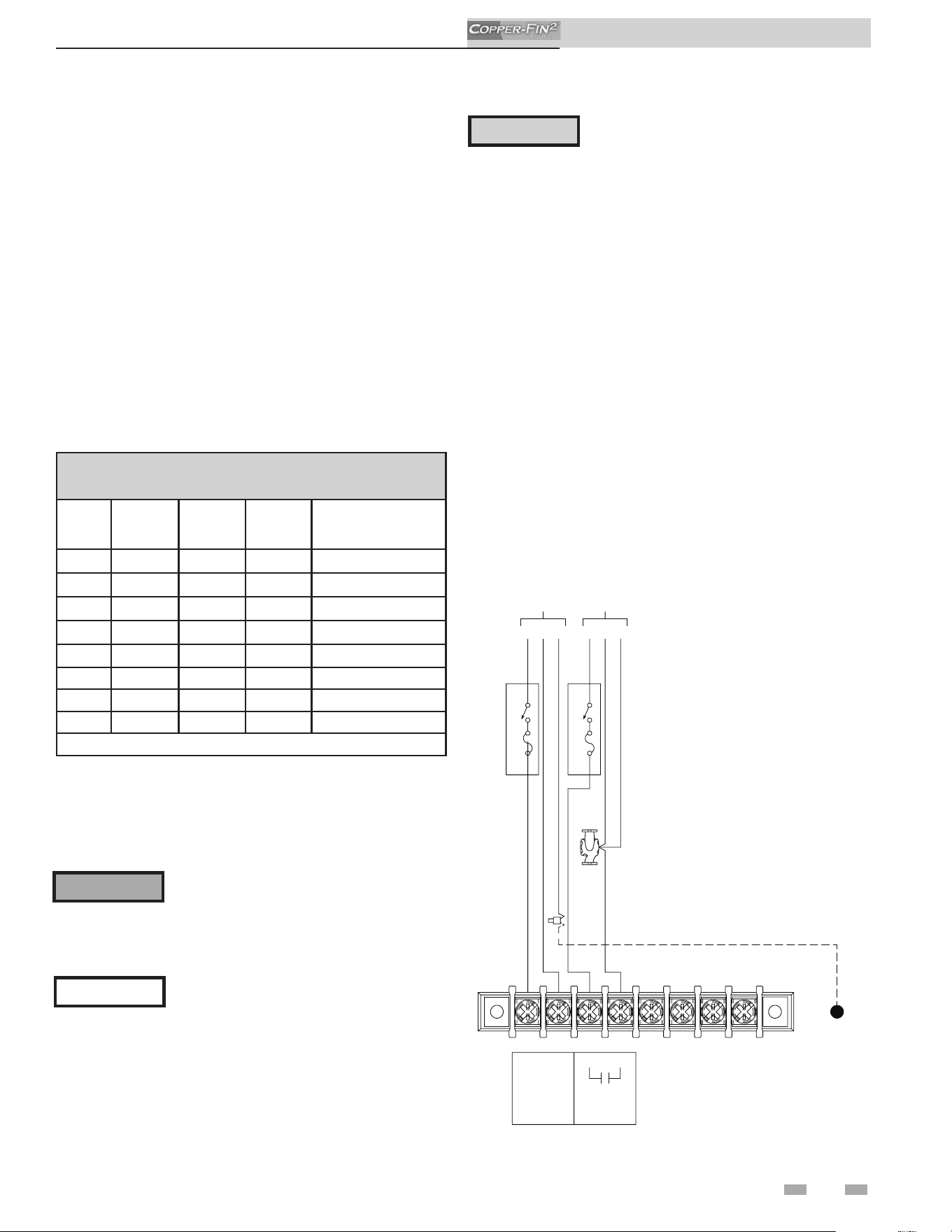
45
5 Electrical connections (continued)
Installation & Operation Manual
Installation must comply with:
1. National Electrical Code and any other national, state,
provincial, local codes, or regulations.
2. In Canada, CSA C22.1 Canadian Electrical Code Part 1, and
any local codes.
Pool heater operating control module
The operating control for the appliance is the SMART
SYSTEM control module. It is located on the inside of the
control panel, behind the front access door. Access to adjust
the temperature set point and other user adjustable points
is made through the Operator Interface located on the front
access door.
The exact temperature set point is based on the system’s
requirements. Set the control set point(s) to the desired
operating water temperature.
The maximum temperature set point that can be programmed
into the control module from the Operator Interface on a
pool heater is 105°F (40.5°C). The manual reset high limit
control for a pool heater is adjustable up to a fixed maximum
setting of 200°F (93°C).
TABLE - 5C
AMP DRAW DATA
Model Controls Blower
Pump
FLA*
Approximate Total
Amps @ 120 VAC
502 3.6 2.7 5.0 11.3
652 5.4 3.4 5.0 13.8
752 5.4 3.4 5.0 13.8
992 7.3 3.2 7.8 18.3
1262 7.3 3.2 7.8 18.3
1442 7.3 6.7 7.8 21.8
1802 7.3 6.7 10.6 24.6
2072 7.3 6.7 10.6 24.6
*With standard factory supplied pump.
ELECTRICAL SHOCK HAZARD – For your
safety, turn off electrical power supply before
making any electrical connections to avoid
possible electric shock hazard. Failure to do
so can cause severe personal injury or death.
Wiring must be N.E.C. Class 1.
If original wiring as supplied with the pool
heater must be replaced, use only type 105°C
wire or equivalent.
Pool heater must be electrically grounded as
required by National Electrical Code ANSI/
NFPA 70 – latest edition.
Label all wires prior to disconnection when
servicing controls. Wiring errors can cause
improper and dangerous operation.
Verify proper operation after servicing.
⚠WARNING
NOTICE
⚠ CAUTION
Line voltage connections
1. Connect 120 VAC power wiring to the line voltage
terminal strip in the junction box, as shown in FIG. 5-2.
2. Provide and install a fused disconnect or service switch
(15 AMP recommended) as required by the code (see
FIG. 5-2).
3. To activate the unit, wire as shown in FIG. 5-2. If the
motor is larger than 1 HP, you must install a contactor.
4. When connecting power to units which are to be
cascaded, each unit must be connected to the same ground
connection.
LN
120V
SUPPLY
UNIT
PUMP
1 HP MAX
LNGLNG
UNIT
SUPPLY
UNIT PUMP
SUPPLY
UNIT
PUMP
CHASSIS
GROUND
GROU ND
SPLICE
D
I
S
C
O
N
N
E
C
T
D
I
S
C
O
N
N
E
C
T
Figure 5-2_Line Voltage Field Wiring Connections
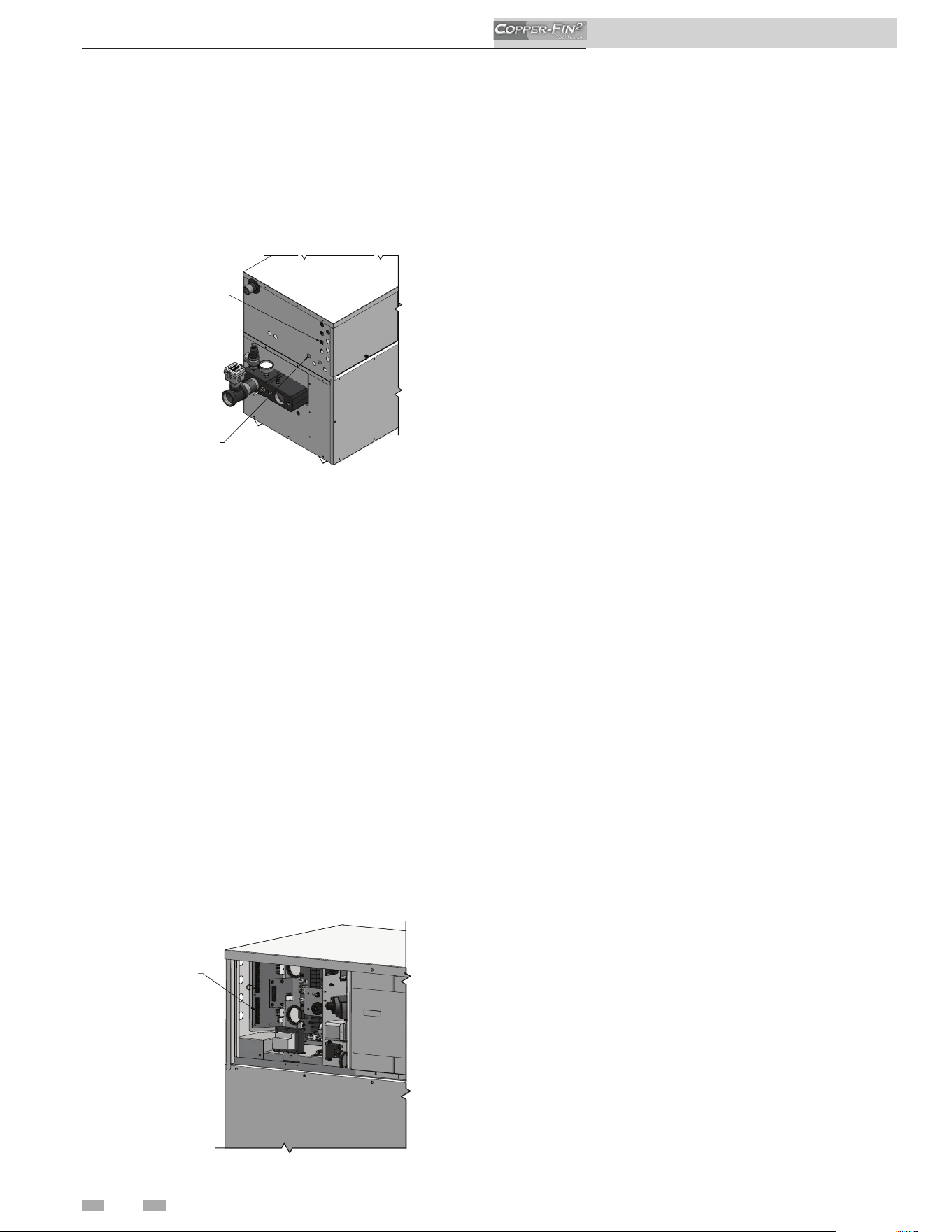
46
Installation & Operation Manual
EMS or remote thermostat connection
An EMS, remote thermostat or other remote temperature
control may be connected to the pool heater (see FIG. 5-4).
Follow the manufacturer’s instructions supplied with the
remote temperature control for proper installation and
adjustment. Connection of a set of dry switching contacts
or a remote on/off thermostat to the low voltage connection
board will allow the unit to be switched on and off by making
or breaking a 24 VAC control circuit. Remove the factory
jumper between the Staging S1 terminals on the low voltage
connection board and connect the remote temperature control
in its place, see FIG. 5-5 on page 47. Terminals S2, S3, and S4
are not used.
REMOTE
ON/OFF
CONNECTION
Figure 5-4_Remote ON/OFF Wire Connection
Ensure that all wiring used to connect the switching contacts
of the remote temperature controller to the connection board
are a minimum of 18 gauge and have a maximum installed
length of 300 feet (91.4m). Set the SMART SYSTEM control
to a set point temperature slightly higher than the setting of the
remote temperature control. This will ensure that the remote
temperature controller functions as the operating control for
the heater.
5 Electrical connections
Low voltage connections
1. Route all low voltage wires through the knockouts on the
left side of the heater, as shown in FIG. 5-3.
2. Connect low voltage wiring to the low voltage connection
board as shown in FIG. 5-5 on page 47 of this manual and
the heater wiring diagram.
LOW
VOLTAGE
KNOCKOUTS
LINE
VOLTAGE
KNOCKOUTS
Figure 5-3_Routing Field Wiring
Louver relay
When the heater is to control combustion air louvers, a field
provided 24VAC louver relay must be installed. Connect the
Louver Relay Coil terminals to the louver relay coil.
Louver proving switch
The operation of a louver proving switch needs to be verified
before the pool heater fires. Remove the jumper wire from these
terminals and connect them to the normally open contacts on
its proving switch (FIG. 5-5).
Pool return sensor - 2-wire
The pool return sensor should be installed into the return of
the primary loop, making sure it is immersed in the water flow.
The SMART SYSTEM control regulates the pool heater firing
rate to maintain the system return temperature to the desired
set point for the pool.
Pool supply/limit sensor - 4-wire
The pool supply/limit sensor should be installed into the supply
of the primary loop, making sure it is immersed in the water
flow. The SMART SYSTEM control limits the pool heater
firing rate to maintain the system supply temperature. Factory
default for the limit temperature is 110°F (43°C).
Runtime contacts
The SMART SYSTEM control closes a set of dry contacts
whenever the burner is running. This is typically used by
Building Management Systems to verify that the pool heater is
responding to a call for heat.
3-way valve out
An electric 3-way mixing valve is used to maintain 130° (55°C)
temperature to the heater. Connect the Open output to the
Open terminal on the 3-way valve. Connect the Close output
to the Close terminal on the valve and the COM output to the
24VAC terminal on the valve. Reference the wiring diagram on
page 42 of this manual.
0 - 10V rate out
A 0 - 10VDC signal is available to allow a Building Management
System (BMS) to monitor the firing rate of the heater. Make
sure the (-) terminal is connected to the (-) or common terminal
of the external control, and the (+) terminal is connected to the
(+) or Vdc terminal of the external control.
Building Management System (BMS)
1. An external control may be connected to control either the
firing rate or the set point of the pool heater. Connect the
0 - 10 VDC terminals to the 0 - 10 VDC output of the external
control. The SMART SYSTEM control can be programmed
to use the enable output of the BMS, or use the voltage signal
to enable the heater. A BMS or a remote thermostat can be
connected to the S1 terminals to enable or disable the unit in
place of the factory provided jumper wire.
2. Make sure the ground terminal is connected to the ground
output terminal of the external control, and the 0 - 10 V
BMS IN terminal is connected to the 0 - 10 VDC terminal of
the external control.
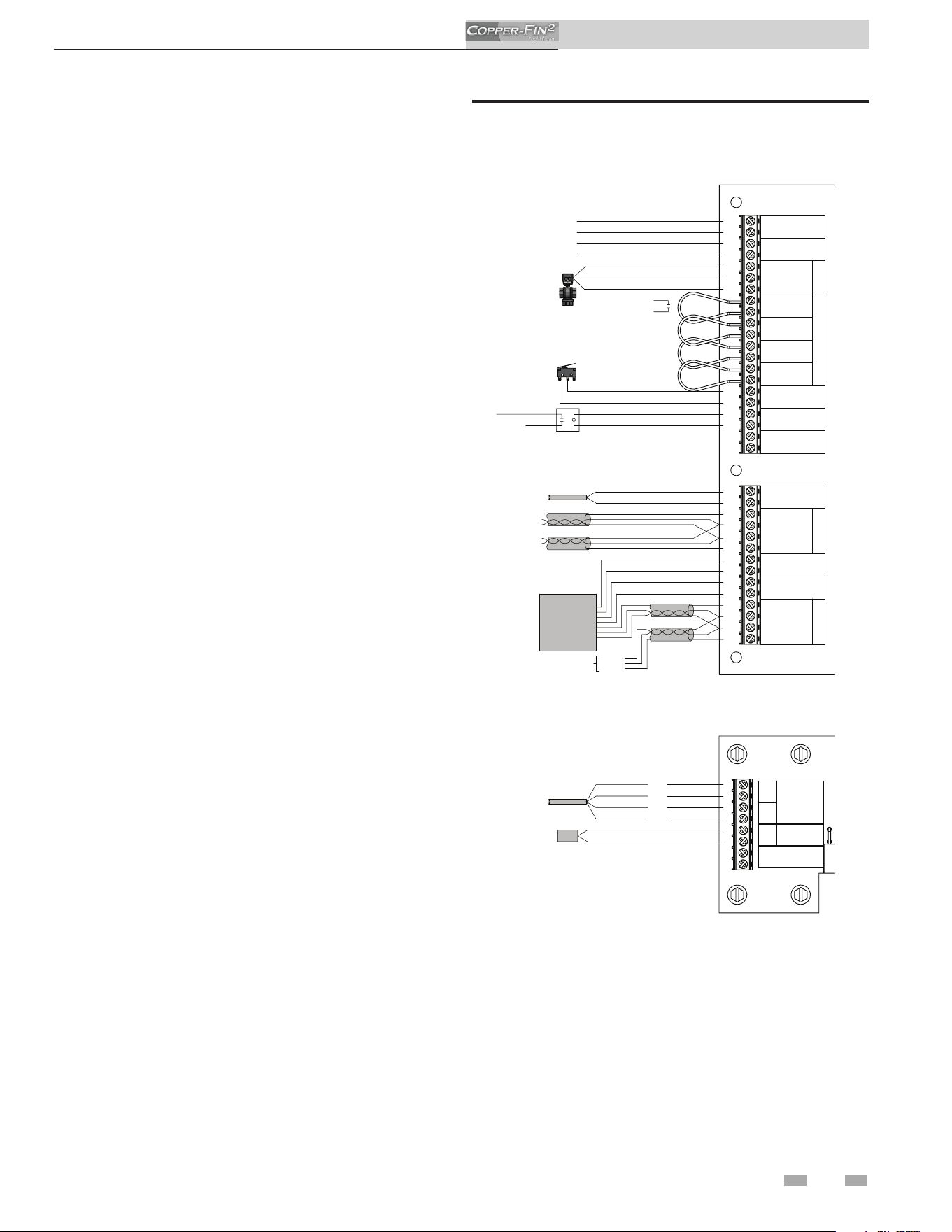
Alarm contacts
The SMART SYSTEM control closes another set of contacts
whenever the heater is locked out or the power is turned off.
This can be used to turn on an alarm, or signal a Building
Management System that the pool heater is down.
Wiring of the cascade
When wiring the heaters for Cascade operation, select one
heater as the Leader. The remaining heaters will be designated
as Members. See page 51, Configuration of the Cascade for a
detailed explanation of this procedure.
The return sensor of the Leader heater should be placed in the
main system piping loop, upstream of the water being supplied
to all the heaters (see FIG.’s 4-5, 4-6, and 4-7). The return
sensors on the remaining Member heaters may also be placed
in the same location as the Leader or they can be placed in each
Member’s PVC piping loop in the Alternate sensor location,
using the tapped sensor hole (FIG. 4-3). Should the Leader
heater ever need to be replaced with one of the Member heaters
in the Cascade, that Member’s sensor should be relocated to
the previous lead heater’s supply sensor location for optimum
operation of the cascaded units.
The supply/limit sensors of all cascaded heaters MUST be
placed downstream, in the main system piping loop in the
blended water, going out to the pool (FIG.’s 4-5, 4-6, and 4-7).
The supply/limit sensor also serves as a high temperature limit
for pool supply water and failure to locate all sensors in the
blended water going out to the pool could result in higher
temperature water than desired being discharged to the pool.
If an external thermostat or BMS is being used to enable or
disable the cascaded heaters, the external thermostat or BMS
should be connected to the Leader heater’s S1 input, located on
the low voltage terminal board (see FIG. 5-5). Jumpers on all
Member heaters should be left in place.
Communication between the Leader and the Member
heaters is accomplished by using shielded, 2-wire twisted pair
communication cable. Connect one of the twisted pair wires
to terminal A on each of the low voltage connection boards,
and the other wire of the twisted pair to terminal B on each of
the low voltage connection boards. Connect the shield wire to
the shield ground terminal on all of the heaters. If more than
two heaters are on the Cascade, daisy chain the wiring from
the Cascade terminals on the second heater to the Cascade
terminals on the third heater, then from the third to the
forth, and so on. The connections can be made in any order,
regardless of the addresses of the heaters. Try to keep each cable
as short as possible.
47
Installation & Operation Manual
5 Electrical connections (continued)
ALARM
S
T
A
G
IN
G
C
A
S
C
A
D
E
M
O
D
B
U
S
CN3
CN2
RUN-TIME
CONTACTS
OPEN
CLOSE
COM
S1
S2
S2
S3
S3
S4
S4
LOUVER
RELAY COIL
LOUVER
PROVING SW
CONTACTS
S1
AQUASTAT
TANK
TANK
SENSOR
SHIELD
A
B
SHIELD
+ 0-10V
- BMS IN
+ 0-10V
- RATE OUT
SHIELD
A
B
SHIELD
35
34
33
32
31
30
29
28
27
26
25
24
23
22
21
20
19
18
17
16
15
14
13
12
11
10
9
8
7
6
5
4
3
2
1
3
-
W
A
Y
V
A
L
V
E
B
TO MONITORING DEVICE
CN2
8
7
6
5
4
3
2
1
20K
POOL
RETURN
SENSOR
LBL20186 REV A
10K
10K
POOL
SUPPLY
SENSOR
NOT
USED
TO MONITORING DEVICE
THREE WAY
VALVE
LOUVER
PROVING
SWITCH
LINE
TO LOUVER
10K-TANK
SENSOR
A
B
A
FROM
PREVIOUS
HEATER
TO NEXT
HEATER
EXTERNAL
SEQUENCER/
BUILDING
AUTOMATIC
CONTROL
POOL/BOILER
REMOTE
THERMOSTAT
/EMS
POOL SAFETY
SUPPLY
10K/20K
BK
G
R
W
10K
N/A
N/A
LOUVER RELAY
24VAC COIL
FIELD PROVIDED
OPTIONAL MODBUS
OPTIONAL MODBUS
A
SHIELD
B
A
SHIELD
B
TO NEXT BOILER
N/A
IMG01158
Figure 5-5_Low Voltage Field Wiring Connections
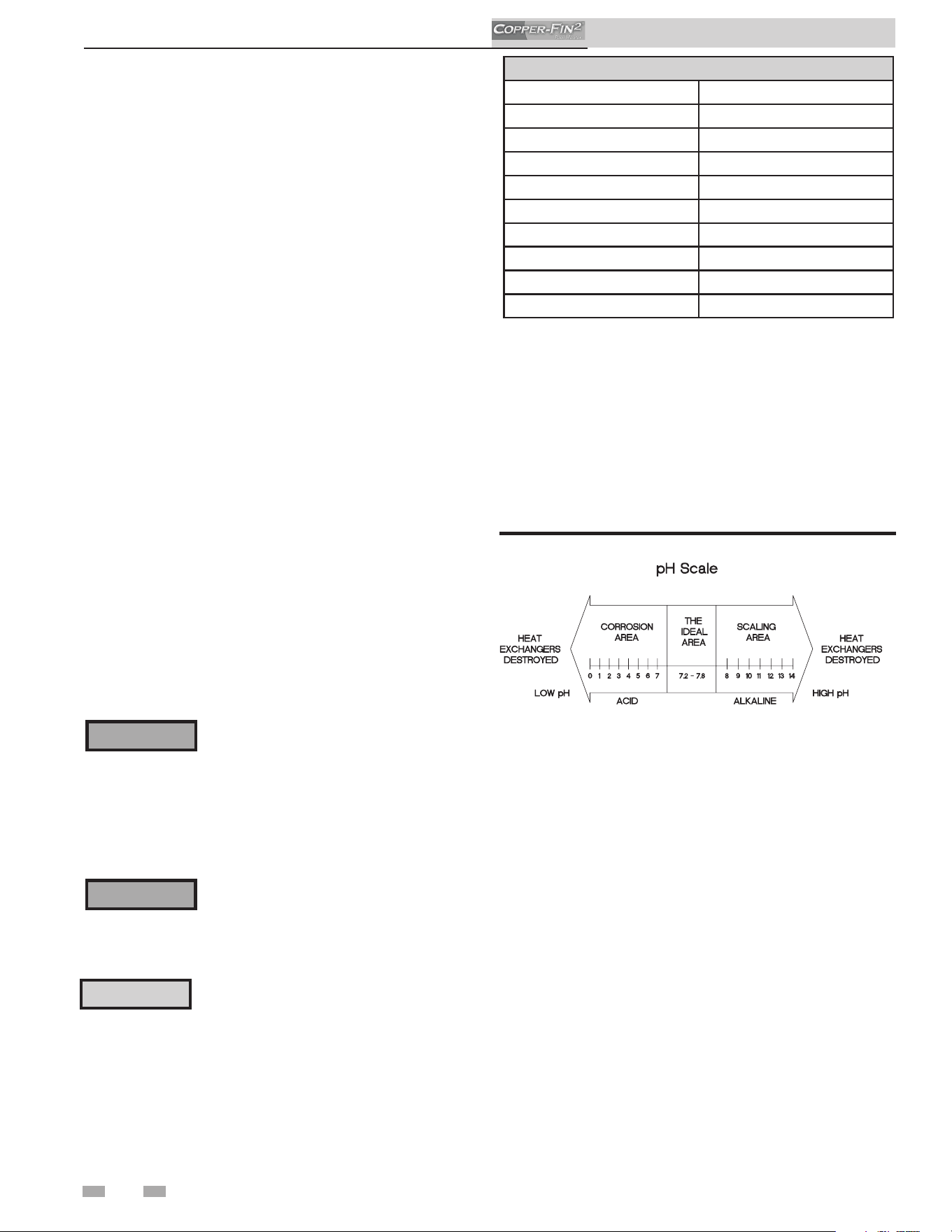
48
6 Startup
Installation & Operation Manual
Check/control water chemistry
Salt levels above 5000 ppm can cause
corrosion damage to heat exchangers.
⚠ CAUTION
The water chemistry of your pool changes daily due to natural
evaporation of the water and the addition of chemicals.
Chemicals are used to sanitize and control algae growth in
the pool. Their addition must be carefully monitored. The
accumulation of minerals or scale in the pool heater due to a
chemical imbalance will cause a non-warrantable failure of the
heat exchanger and its components. pH is an important factor
in maintaining proper balance in your pool water. pH is the
measurement of the acidity or alkalinity of water. The following
chart shows the recommended pH range and what can happen
when the pH increases or decreases from the ideal of 7.2 to 7.8.
Figure 6-1_ pH Scale
If the pH becomes too high, it lowers the ability of chlorine
to destroy bacteria and algae, water can become cloudy, filter
elements may become blocked, and scale formation will occur
in the pool and heat exchanger. If the pH becomes too low
the water becomes acidic. You can have eye burn and skin
irritation, etching of the plaster, corrosion of metal fixtures and
the resulting stains on the plaster, degradation of sand and gravel
filters and corrosion of the copper tubes in the heat exchanger.
Factors which affect pool water and, more importantly, the
efficiency of your new pool heater are:
1. Proper Filtration
2. Proper Circulation
Before starting the unit, and during initial
operation, smell near the floor and around
the unit for gas odorant or any unusual odor.
Remove the front access panel and smell the
interior of the pool heater enclosure. Do not
proceed with startup if there is any indication
of a gas leak. Use an approved leak detection
solution. Repair any leaks at once.
⚠WARNING
Check for gas leaks
Pre-start checklist
Before attempting to start the pool heater verify that the following
items have been checked:
1. Verify proper location and installation of the pool heater.
2. Check gas piping and ensure the gas line is purged of all air.
3. Ensure that the pool is properly filled.
4. DO NOT operate pool heater if improperly filled.
5. Check to ensure that all water connections are tight.
6. Relief valve has been piped to a suitable floor drain.
7. Combustion air openings are not obstructed in any way.
8. Ensure all air is purged from the water piping.
Starting the filter system
Verify proper installation of the pool heater temperature controls
and the installation of the 110°F auxiliary limit and pool supply
sensor in the mixed discharge water from the filter piping to the
pool. Clean the filter. Start the filter pump. Be sure all air is
out of all the lines including the pressure connection. Ensure
that the pool heater is not “air bound” by manually opening the
temperature and pressure relief valve. Leave the valve open until
a steady flow of water is observed at the discharge from the valve.
Close the valve and complete filling the system.
Note: Backwash the filter when the G.P.M. filtration rates are
too low to meet local codes or state code. A high temperature
rise across the pool heater is also an indication of low flow in the
filter system. Sustained low flow to the pool heater will result in
cycling of the heater on the limit controls and possible opening
of the relief valve.
Damage to the pool heater, including the pumped bypass, due
to improper chemical water balance is non-warrantable. Proper
chemical water balance, as indicated by use of the calcium
saturation and Ryznar indexes, is required to maintain warranty
status of the pool heater and its components. These indexes are
designed to help prevent scaling and corrosive damage to the
pool and all associated equipment. We recommend the use of a
commercial or professional grade test kit to maintain chemical
water balance. See your local pool professional for assistance.
The venting system must be installed so that
it will prevent flue gas spillage and carbon
monoxide emissions, which will result in
severe personal injury or death.
⚠WARNING
3. Disinfection and Oxidation
4. pH Control and Total Alkalinity
5. Algae Control
6. Water Balance
Although this pool heater is CSA design certified for outdoor
installations - such installations are not recommended in areas
where the pool heater will be operated in the winter months
and the danger of freezing exists. Proper freeze protection must
be provided for outdoor installations; pool heaters installed in
unheated equipment rooms or where temperatures may drop to
the freezing point or lower.
Freeze protection
RECOMMENDED POOL CHEMISTRY LEVELS
Tes t Recommended Level
Bromine 2.0-4.0 ppm
Calcium Hardness 200-400 ppm
Cyanuric Acid 50-75 ppm
Free Chlorine 1.0-3.0 ppm
pH 7.4-7.6
Salt (residential pool) 3000 ppm
Salt (commercial pool) 5000 ppm
TDS 300-1500 ppm
Total Alkalinity 80-120 ppm

49
6 Startup (continued)
Installation & Operation Manual
If freeze protection is not provided for the system, a low ambient
temperature alarm is recommended for the equipment room.
Damage to the pool heater by freezing is non-warrantable.
1. Pump Operation - MOST IMPORTANT - This pool heater
is designed for continuous operation of the filter system
pump when the burners are firing. If the system pump does
not run continuously, an interlock mechanism should be
provided to disable when/if the system pump turns off. The
constant flow of warm pool water can help prevent freezing.
2. Anytime the temperature measured at the sensor drops
below 45°F, the temperature control turns on the pump to
circulate the water, if the pump option is installed.
3. Location - Indoor pool heaters must be located in a room
having a temperature safely above freezing [32°F(0°C)].
4. Outdoor Pool Heater Installation - Use extreme caution
to prevent freezing. A snow screen should be installed to
prevent snow and ice accumulation around the pool heater
or its venting system.
5. Shut-Down and Draining - If for any reason, the pool heater
is to be shut off, the following precautionary measures must
be taken:
a. Shut off gas supply;
b. Shut off water supply;
c. Shut off electrical supply;
d. Drain the pool heater completely. Remove the
threaded drain plugs from the inlet and outlet sides
of the front header on the heat exchanger (see FIG.’s
4-1 and 4-2). Blow all water out of the heat
exchanger. Leave drains open until Spring.
e. Drain pump and piping.
Check thermostat circuit(s)
1. Disconnect the two external wires connected to the enable
terminals on the connection board.
2. Connect a voltmeter across these two incoming wires.
Close each thermostat, and relay in the external circuit
one at a time and check the voltmeter reading across the
incoming wires.
3. There should NEVER be a voltage reading.
4. If a voltage does occur under any condition, check and
correct the external wiring.
5. Once the external thermostat circuit wiring is checked and
corrected if necessary, reconnect the external thermostat
circuit wires to the connection board. Allow the pool
heater to cycle.
Check vent and air piping
Inspect vent piping and air piping for signs of deterioration
from corrosion, physical damage or sagging. Verify air piping
and vent piping are intact and correctly installed per this
manual.
Placing the pool heater in operation
Pool heater operational checks
1. Turn the pool heater main power switch to the “ON”
position.
2. Verify operation of the SMART SYSTEM control
module and Operator Interface.
3. Program the adjustable points from the Operator
Interface.
4. Push the reset for the low water cutoff (if equipped).
5. Ensure that flow requirements shown in Table 4B on page
38 are met.
6. Install a manometer on the gas supply to the pool heater and
verify minimum gas supply pressure as the burner fires at
100% of rated input.
7. Verify operation of safeties as necessary (low water
cutoff, high limit, gas pressure, etc.,).
8. Verify that all adjustable points in the Operator
Interface are set as required.
9. Once the pool heater analysis is complete, test the safety
shutoff device by turning the manual shutoff valve to the OFF
position and ensuring that the pool heater shuts down and
registers an alarm. Open the manual shutoff valve and reset
the control.
10. Place the pool heater back into normal operation.
Pool heater operation
11. The pool heater should begin the start-up process for the
sequence of operation.
12. The pool heater will ignite at the proper ignition speed and
will stage to meet the system demand.
13. Ensure that inlet water temperature does not fall below
the specified minimum for the pool heater.
14. Based on system demand, pool heaters may run for an
extended period of time at a reduced rate of input to
maximize efficiency.
15. As system demand is satisfied, the burner will cycle off
and the combustion air blower will run for a post
purge operation before the pool heater shuts down.
Start the pool heater
Read and follow the Lighting Instructions in FIG. 6-2, on page
50.
If pool heater does not start correctly
1. Check for loose connections, blown fuse or service switch
off?
2. Is the unit in lockout? Is the pool heater outlet temperature
exceeding 200°F (93.3°C)?
3. Is the thermostat set below pool water temperature?
4. Is gas turned on at meter or pool heater?
5. Is incoming gas pressure less than 4.5" water column?
If none of the above corrects the problem, refer to the
Troubleshooting Section of the Copper-fin
2
Service Manual.
The venting system must be installed so that
it will prevent flue gas spillage and carbon
monoxide emissions, which will result in
severe personal injury or death.
⚠WARNING
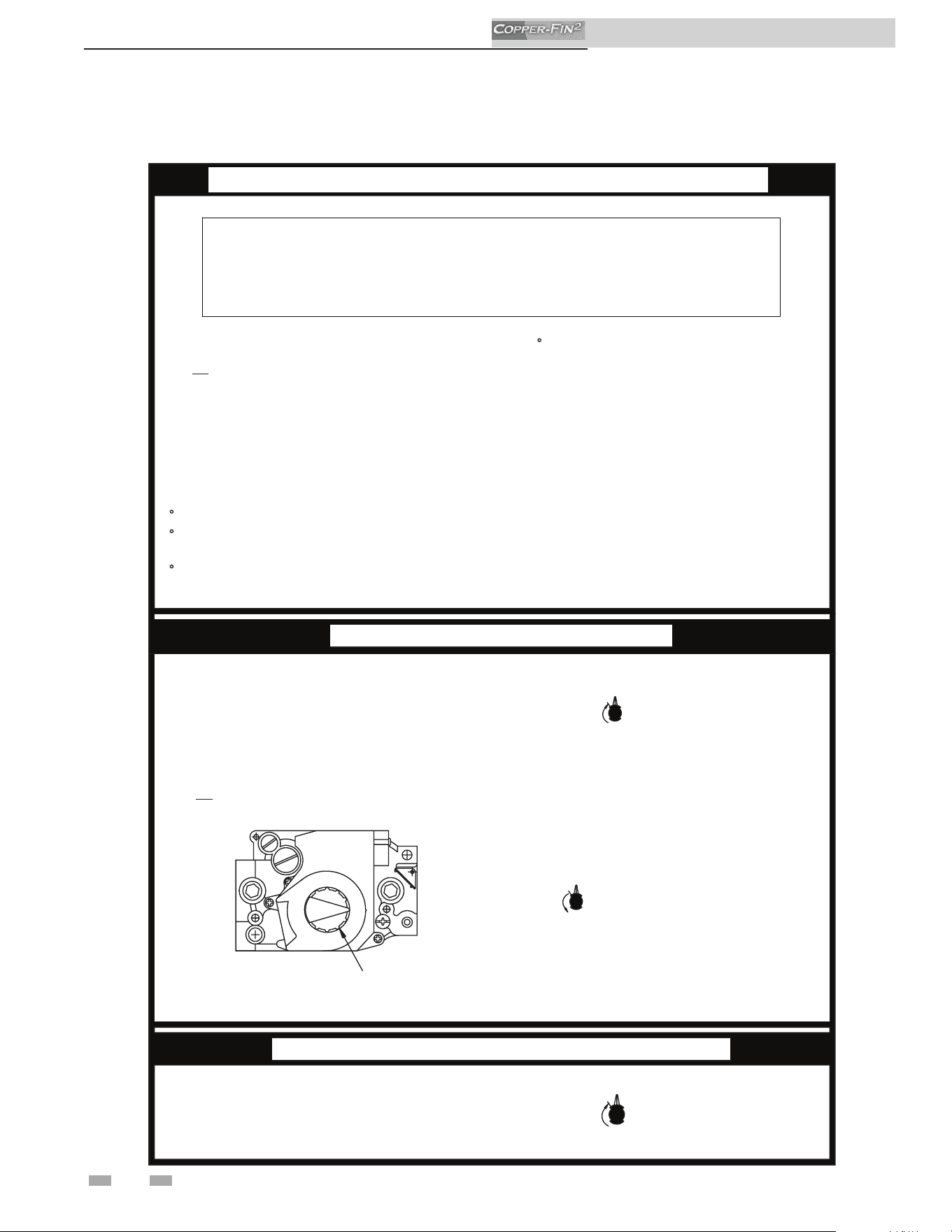
50
Installation & Operation Manual
Figure 6-2_Operating Instructions
FOR YOUR SAFETY READ BEFORE OPERATING
A. This appliance is equipped with an ignition
device which automatically lights the burner.
Do not
try to light the burner by hand.
B. BEFORE OPERATING smell all around the
appliance area for gas. Be sure to smell next
to the floor because some gas is heavier
than air and will settle on the floor.
FOR YOUR SAFETY
"WHAT TO DO IF YOU SMELL GAS"
Do not try to light any appliance.
Do not touch any electrical switch; do not use
any phone in your building.
Immediately call your gas supplier from a
neighbor's phone. Follow the gas supplier's
instructions.
If you cannot reach your gas supplier,
call the fire department.
C. Use only your hand to turn the gas
control knob. Never use tools. If the
knob will not turn by hand, don't try to
repair it, call a qualified service tech-
nician. Force or attempted repair may
result in a fire or explosion.
D. Do not use this appliance if any part
has been under water. Immediately call
a qualified service technician to inspect
the appliance and to replace any part
of the control system and any gas con-
trol which has been under water.
OPERATING INSTRUCTIONS
1. STOP! Read the safety information above on
this label.
2. Turn off all electric power to the appliance.
3. Open control access panel.
4. This appliance is equipped with an ignition
device which automatically lights the burner.
Do not
try to light the burner by hand.
5. Push in gas control knob slightly and
turn clockwise to "OFF."
NOTE: On the 36C valve, knob cannot be
turned to "OFF" unless knob is pushed in
slightly. Do not force.
7. Turn gas control knob counterclockwise
to "ON."
8. Replace control access panel.
9. Turn on all electric power to the appliance.
10. If the appliance will not operate, follow
the instructions "To Turn Off Gas To
Appliance" and call your service tech-
nician or gas supplier.
TO TURN OFF GAS TO APPLIANCE
1. Turn off all electric power to the appliance
if service is to be performed.
2. Open control access panel.
3. Push in gas control knob slightly and
turn clockwise to "OFF". Do not
force.
4. Replace control access panel.
ON
OFF
OFF
ON
LBL2084 REV D
OFF
ON
OFF
ON
PSI
IN
GAS CONTROL KNOB
SHOWN IN THE "ON" POSITION
6. Wait five (5) minutes to clear out any gas.
Then smell for gas, including near the floor. If
you smell gas, STOP! Follow "B" in the safety
information above on this label. If you don't
smell gas, go to the next step".
WARNING:
If you do not follow these instructions
exactly, a fire or explosion may result causing
property damage, personal injury or loss of life.
6 Startup
51
Installation & Operation Manual
6 Startup (continued)
Set clock
The SMART SYSTEM control has a built-in clock that it uses
for its night setback feature and for logging events. This clock
must be set when the appliance is installed, and anytime the
appliance has been powered off for more than one month. Use
the following procedure to set the clock:
1. Press and hold the MENU key (FIG. 7-1) for at least 5
seconds.
2. The display changes to ready “ENTER MENU CODE”,
with four (4) zeros below it.
3. Change the zeros to match the user code (factory set at
“0704”). Use the UP and DOWN keys to increment or
decrement the flashing digit, and the NEXT and
PREVIOUS keys to select which digit flashes.
4. Press the ENTER key.
5. The display changes to read USER CODE for a few
seconds, then displays a menu.
6. Press the ENTER key.
7. Press the UP key twice to display “A3 DATE AND
TIME”.
8. Press the ENTER key once.
9. The date and time are displayed as “YY:MM:DD W
hh:mm”, where:
mm: minutes
hh: hour (24 hour time; e.g., 2:00 PM = 14:00)
W: day of the week (1 = Sunday, 2 = Monday,
3 = Tuesday, etc.,)
YY: year
MM: month
DD: date
NOTICE
The internal clock does not adjust for
Daylight Savings Time and therefore, will
require a manual adjustment.
Use the UP and DOWN keys to increment or decrement the
flashing number, and the NEXT and PREVIOUS keys to select
which number flashes.
10. Press the ENTER key to save the setting.
11. Press the MENU key twice to exit the Programming
Mode.
Configuration of the cascade
When installed in a Cascade system, the individual controls must
be programmed for cascade operation. This is accomplished by
accessing the control parameters.
Input the Installer code as described in the Copper-fin
2
Service
Manual. Once the control parameters have been accessed, use
the DOWN arrow key to select the H Control Mode parameters.
Press the ENTER key to access these parameters. Use the UP
arrow key to access parameter H4 Cascade. Press the ENTER
key to access this parameter. Use the DOWN arrow key to select
Enable. Press the ENTER key to program this into the control.
Press the EXIT key, then press the DOWN key until I Cascade
is selected.
Press the ENTER key to select the parameter I1 BLR Address.
Press the ENTER key to access this parameter. Each unit in the
Cascade system must be programmed with its own address.
The unit designated as the Leader will have an address of 0.
The remaining units in the Cascade will be Members and have
addresses from 1 - 7. Use the UP and DOWN arrow keys to
select the appropriate address. Press the ENTER key to program
this into the control.
Press the MENU key twice to exit the control parameters. Repeat
this procedure for all appliances in the Cascade, designating the
Leader control and the Member controls.
7 Operating information
52
Installation & Operation Manual
General
How the appliance operates
The Copper-fin
2
uses a copper finned tube heat exchanger to
transfer heat from the flue products to the water. An electronic
control module monitors various inputs to initiate a call for
heat. The blower provides both primary and secondary air to
the burner and forces the flue products out of the combustion
chamber and into the vent system. The control module
regulates the blower speed and firing stages, based upon the
heat demand. Gas valves regulate the amount of gas supplied
for the firing stages, which is then mixed with the combustion
air supplied to the burner.
NOTICE
If an inline high gas pressure regulator is
used, it MUST BE of the lockup type and
be located a minimum of 10 feet from the
appliance. Failure to do so may result
in insufficient gas volume supplied to the
appliance.
NOTICE
If a pressure drop of more than 2" water
column occurs between Standby (static)
Mode and Operating (dynamic) Mode, a
gas volume problem exists. Contact the gas
utility, gas supplier, qualified installer, or
service agency to determine the necessary
steps to provide the proper gas volume to
the appliance.
How the control module operates
The SMART SYSTEM control module receives input from
appliance sensors and external devices. The control module
activates and controls the blower and gas valves to regulate heat
input and switches the pool heater and system pumps on and
off as needed. The user programs the module to meet system
needs by adjusting control parameters. These parameters set
operating temperatures and appliance operating modes. Pool
heater operation is based on pool heater return temperature.
Control inputs and outputs
Staging S1 - S4
The S1 input tells the pool heater to provide water for space
heating. The S2 - S4 inputs are not used.
Remote Aquastat/EMS
This input can be used to remotely enable/disable the pool
heater.
Pool heater pump operation
The pool heater’s unit pump will turn on whenever there is a
call for heat based on the set point of the pool return water and
it will remain on as long as the unit is firing. Once set point is
achieved, the pump will complete a purge cycle to remove any
residual heat from the heat exchanger and will then turn off.
Note: If the pump’s pre-running feature is active, the pump
will run for several minutes prior to the unit firing in order
to purge any air from the pool system that may have become
entrapped during extended periods of inactivity.
Pool return programmed as controlling sensor
The pool heater controller is programmed from the factory to
utilize the pool return sensor as the controlling sensor. The
pool return sensor is required to be the controlling sensor and
CANNOT be changed by either the installer or the end user.
Anti-cycling
After the set point has been satisfied, the control will delay the
next burner cycle for a set time period (time is adjustable by the
installer). The time delay will be bypassed if the system return
temperature drops too far during the delay.
Firing rate
Depending upon the model, the Copper-fin
2
is capable of
staging its firing rate from a minimum of 25% to a maximum
of 100%. The firing rate is dictated by the call for heat (i.e.,
pool return temperature), the heating load, and various other
temperature limitations.
Gradient limiting
If during operation of the heater the outlet water temperature
is rising too quickly, the control will reduce the firing rate to
its lowest setting.
Night setback
The controller may be programmed to reduce the set point
during a certain time each day. A start and stop time can be
programmed for each day of the week.
Protection features
Outlet temperature, and temperature rise limiting
The outlet temperature is monitored by the pool heater outlet
temperature sensor. When the outlet temperature exceeds
180°F (82°C), the unit will reduce the firing rate. If the outlet
water temperature exceeds 200° (93°C) the control will shut
the unit down until it cools off.
53
7 Operating information (continued)
Installation & Operation Manual
Freeze protection
DO NOT install the appliance in a room likely to freeze.
The following integral feature of the SMART SYSTEM control
module provides some protection for the appliance only -- not
for the system.
• The SMART SYSTEM control module provides
freeze-up protection as follows when the appliance
water temperature drops below 45°F (7.2°C):
• Below 45°F (7.2°C), the appliance and system pumps
operate constantly.
• Below 37°F (2.7°C), the appliance turns on.
• Appliance and pumps turn off if appliance water
temperature rises above 45°F (7.2°C).
This feature of the SMART SYSTEM
control module does not eliminate the
possibility of freezing. The installer must
still use recognized design, installation and
maintenance practice to prevent freeze
potential for the appliance and system.
⚠ CAUTION
High limit operations
When outlet temperature exceeds 210°F (99°C), high limit
action occurs. The appliance shuts down until the outlet water
cools down and the RESET button on the Operator Interface is
pressed.
Monitor external limits
Connections are provided on the connection board for external
limits such as a louver proving switch. The SMART SYSTEM
will shut off the burner and inhibit relighting whenever any of
these external limits open.
Low water cutoff protection
1. The SMART SYSTEM control module uses temperature
sensing of both inlet and outlet areas of the heat exchanger.
If the flow rate is too low or the outlet temperature too
high, the control module modulates and shuts the appliance
down. This along with the flow switch, ensures appliance
shutdown in the event of low water or low flow conditions.
2. Some codes and jurisdiction may accept these integral
features of the control in lieu of requiring an additional
limit control or low water cutoff. Consult local jurisdiction
to determine. Contact manufacturer for low water cutoff kit
availability.
Run-time and cycle counting
The control uses two timers to monitor the total hours of
burner operation. One timer monitors the time the appliance
is firing under 50% of rate. The other timer monitors the time
the appliance is firing over 50% rate.
The control uses four (4) ignition counters to monitor the
amount of appliance cycles. The first counter counts all
ignitions of the control. The second counter counts only
ignition attempts that have failed. The third and fourth
counters are the same as the first and second respectively, but
can be reset by the installer.
Service reminder
The control can be programmed for service reminder
notification. This notification will become active when either a
set time frame has expired, or a set amount of running hours or
cycles has expired (all adjustable by the installer). The display
will alternate the standard text on the display screen with
Service Due every 5 seconds. The service reminder notification
can be reset by the installer.
Error logging
The control will hold in memory the last 10 error codes as
well as the last 10 turn-off functions. The date and time of the
occurrence will be recorded as well. Only the 10 most current
occurrences will be held in memory.
Pool heater temperature regulation
Operating temperature (target)
The SMART SYSTEM control module senses water
temperature and regulates appliance firing rate to achieve a
target temperature. The target temperature can be set between
40°F (4.5°C) and 105°F (40.5°C).
Run-time and alarm outputs
The appliance provides dry contacts for indicating when the
appliance is running, and when it is unable to operate.
The control monitors the temperature difference between
the inlet and the outlet sensor. If this difference exceeds the
first limit the control will turn off stages. If the temperature
difference exceeds a second limit the control will shut the unit
down. The unit will restart automatically once the temperature
difference has dropped 10°F (6°C) and the minimum off time
has expired.
RISE LIMITING
Outlet Temperature Firing Rate
Up to 180°F (82°C) Full Fire
180°F (82°C) to 185°F (85°C) Low Fire
Above 185°F (85°C) Off
54
7 Operating information
Installation & Operation Manual
Cascade
When multiple appliances are installed, they can be wired
together in a cascade sequence. A maximum of eight
appliances can be controlled from a single control. In
this application one appliance would be designated as
the Leader control and all others would be designated
as Member controls. The set point or firing rate can be
controlled by the 0 - 10V input as well.
Once the Leader appliance receives a call for heat from a
BMS, or external thermostat, the control will determine
what the set point will be. A fixed temperature set point can
be programmed into the control. See Copper-fin
2
Service
Manual to program the set point.
If the pool water temperature is less than the set point - the
off differential, then the control will initiate a call for heat
on the Cascade.
The appliance will fire and will then stage its firing rate to
maintain the set point. If the first appliance reaches 100%
of its firing rate, the Leader will calculate at what point the
second appliance could fire at its minimum firing rate. At
this point, the Leader will fire the second appliance on the
Cascade. For a new startup, this would be the first Member
appliance. The appliance will fire and will then stage its
firing rate to maintain the set point.
If the set point still cannot be met, the Leader will continue
firing more Members until either the heat demand is met or
all appliances on the Cascade are firing. As the heat demand
decreases, the last appliance on will stage down to its
minimum firing rate. Once the demand for that appliance is
0% it will shut down. As the heat demand decreases further,
the second to last appliance will stage down and shut off.
This will continue until the demand is satisfied and all
appliances are shut off.
Night Setback operation of the pool heater within the Cascade is
available. Programming of the Space Heating (SH) Night Setback
will be done through the Leader heater. Refer to the Copper-fin
2
Service Manual for information regarding Night Setback.
Ramp Delay operation of the pool heaters as described in the
Copper-fin
2
Service Manual is available when the pool heaters
are part of a Cascade system.
Night setback
The controller may be programmed to reduce the pool water
heating during a certain time each day. A start and stop time can
be programmed for each day of the week.
Sequence of the cascade
To equalize the run time of all appliances on the Cascade, the
firing sequence will automatically be changed at set intervals.
For the first 24 hours after initializing the Cascade, the sequence
will be changed every hour. After that the sequence will be
changed once every 24 hours.
DAY SWITCHING ON SEQUENCE
Start L-M1-M2-M3-M4-M5-M6-M7
+ 1 hour M1-M2-M3-M4-M5-M6-M7-L
+ 2 hour M2-M3-M4-M5-M6-M7-L-M1
55
7 Operating information (continued)
Installation & Operation Manual
Sequence of operation
OPERATION DISPLAY
1. The high limit may require reset through the display before
any action will take place.
HTR: Standby
OUT: 123.8F( 78)
2. Upon a call for heat the control turns on the unit pump. The
flow switch and low water cutoff (if equipped) must close.
HTR: Standby
OUT: 123.8F( 78)
3. • If the unit is equipped with a proof of closure valve, the
proof of closure switch must be closed. The proof of
closure valve is then energized. The gas pressure
switch(es) (if equipped) must close.
• If the contact for the louvers is closed, the louver proving
inputs must close.
• If the air pressure switch is open, the prepurge cycle then
begins by starting the combustion blower. Once started,
the air pressure switch must close.
HTR: Standby
OUT: 123.8F( 78)
4. After the 15 second prepurge, the blower slows down and
the hot surface igniter (HSI) is energized. The HSI is heated
for at least 20 seconds.
HTR: PREPURGE
OUT: 123.9F( 78)
5. Once the HSI is hot, the trial for ignition begins with the
opening of the gas valve.
HTR: IGNITION
OUT: 123.9F( 78)
6. If the SMART SYSTEM control does not sense flame, then
it will lock out.
HTR: POSTPURGE, LOCKOUT
OUT: 123.9F( 78)
7. If the SMART SYSTEM control senses flame, it will fire the
burner to maintain the set point. The firing rate will stage as
required to hold the actual temperature at the set point. If the
pool heater lights due to a space heating call for heat, and the
ramp delay function is active (default is disabled), the staging
will be held to a series of increasing limits after the burner
has lit.
HTR: RUN STG: 1
OUT: 124.8F( 78)
8. Once a call for heat is satisfied, the control will turn
off the burner. The blower will remain on for the 30 second
postpurge cycle. The pump will continue to run for the
respective pump delay times, then turn off.
HTR: POSTPURGE
OUT: 127.4F( 78)
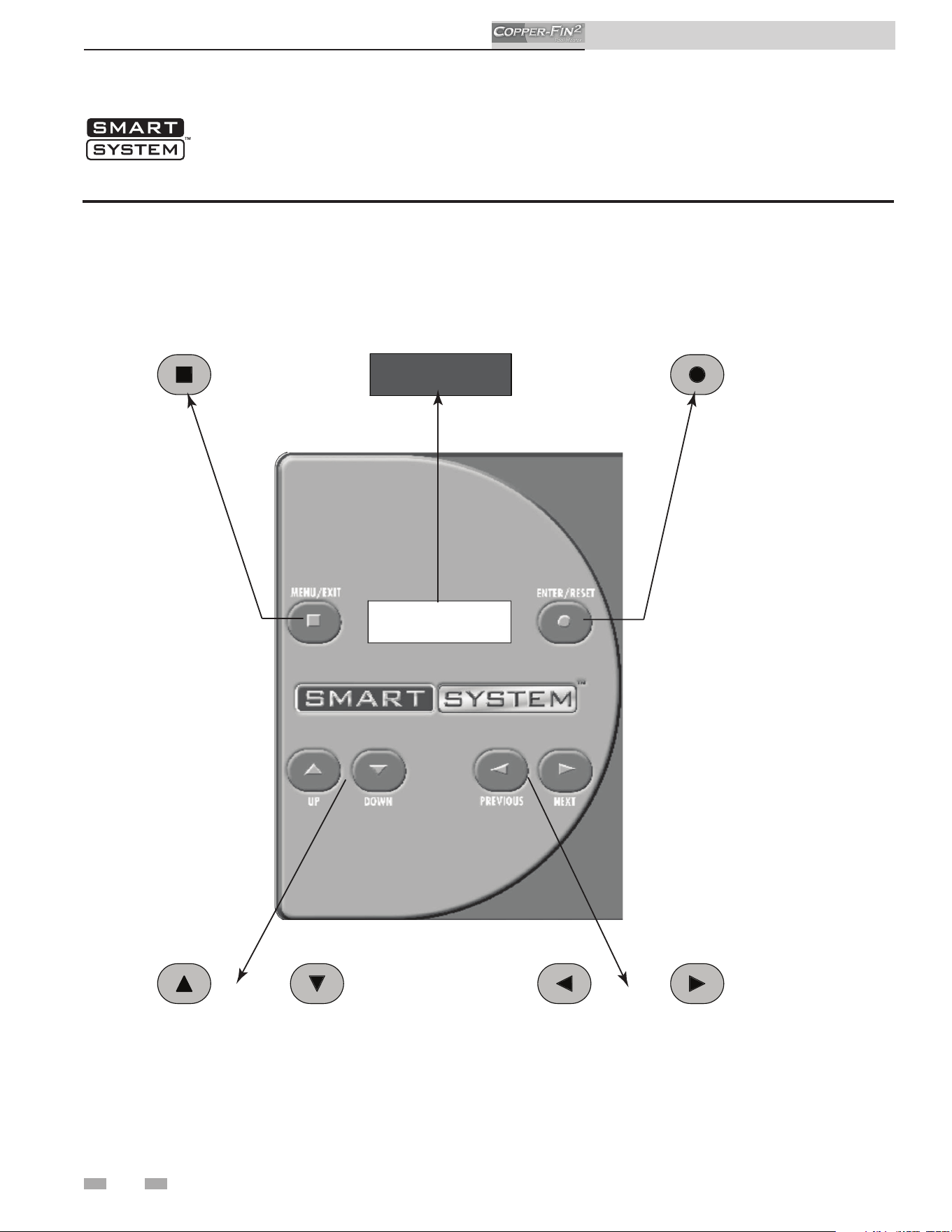
56
7 Operating information
Installation & Operation Manual
Copper-fin
2
control module
MENU/EXIT
DISPLAY SCREEN
ENTER/RESET
TXENSUOIVERPNWODPU
• Press to turn heater off or back on
• Press to select a menu item
• Press after parameter programming
to store parameter data
• Press to exit Service Mode
• Hold 5 seconds to enter code
Input Mode (Menu Mode)
• Press to move up one level
in Menu Mode or to exit
Menu Mode
• Press to change boiler water
temperature and/or tank water
temperature set point during
normal operation
• Press to change displayed data
values in Menu Mode
• Press to navigate through menu
listing in Menu Mode
• Press to toggle display during normal
operation to show outlet and return
temperatures, fan speed, flame signal, etc.
• Press to toggle between digits when
entering access code or between hour,
minutes, etc., when entering date and time
• Press and hold both to enter Service Mode
Figure 7-1_Control Panel - Operator Interface
Use the control panel (FIG. 7-1) to set temperatures, operating conditions, and monitor appliance operation.

57
Installation & Operation Manual
7 Operating information (continued)
Access modes
User
The user can adjust the space heating target temperature and the tank target temperature (if
a tank sensor is used) by using the UP and DOWN buttons (FIG. 7-1) at any time during
normal operation. By entering the USER code (0704), the user can also change temperature
units, time and date, and night setback settings. In User Mode, the following parameters can
be viewed but not changed:
• Pool water target temperature
• Appliance model number
• Software version
• Total operating hours
• Total cycles
Installer
Most parameters are available only to the installer, accessible only by entering the installer
access code, see the Copper-fin
2
Service Manual.
Saving parameters (reference the Parameter Table in the Copper-fin
2
Service
Manual)
To save parameters and exit programming:
Press the ENTER/RESET button, then the MENU/EXIT button 3 times.
To keep parameter settings only for a current operating cycle:
Press the MENU/EXIT button 3 times after making all desired parameter changes.
To enter a parameter and continue programming:
Press the MENU/EXIT button 1 time to return to the parameter listings; press again to
return to the menu listings. Remember to press the ENTER/RESET button when finished
programming in order to save the changes made.
See the Copper-fin
2
Service Manual for a detailed description of parameters and access
modes.
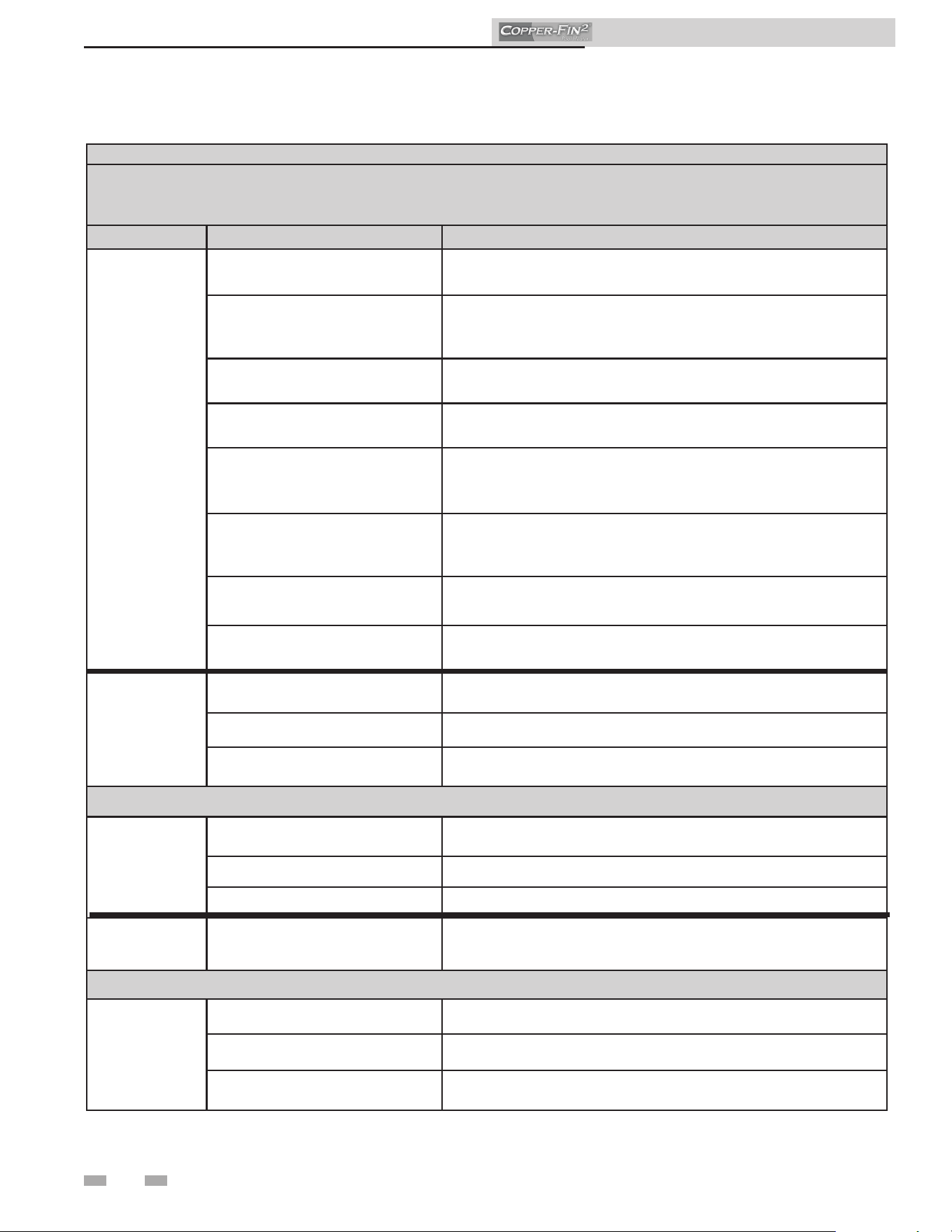
58
Installation & Operation Manual
7 Operating information
Status Display Screens
By using the Previous/Next (t, u) arrow keys on the SMART SYSTEM display panel, you can navigate through the 11 display
screens. Each screen will contain two (2) viewable items. The following is a description of the individual items and what they
can display:
Screen # Display Shows Description
Screen #1
Line 1
HTR: OFF
The unit has been turned OFF by the Enter/Reset button on the
SMART SYSTEM display panel.
HTR: STAND-BY
The unit’s water temperature set point has been met and there is
no call for heat demand being received from either the external
thermostat or the BMS.
HTR: SETPOINT MET
The unit’s water temperature set point has been met, but is still
receiving a call for heat from either a remote thermostat or a BMS.
HTR: PRE-PURGE
The unit has initiated the combustion air purge cycle upon a call for
heat.
HTR: IGNITER * ON
The unit has begun the igniter heatup cycle prior to the trial for
ignition. Display will show IGNITER A or IGNITER B depending on
which stage has priority.
HTR: RUN STG ****
The unit has fired and is running at the displayed number of stages
(1,2,3,4).
HTR: POST-PURGE
The call for heat has been satisfied and the unit runs the fan to clear
the combustion chamber and vent system of residual flue products.
HTR: SERVICE MODE
The unit has been placed in a temporary mode that will allow the unit
to fire for the purpose of combustion analysis.
Screen #1
Line 2
OUT: ***F The outlet temperature is displayed by the control.
OUT: OPEN The control does not detect the outlet sensor.
OUT: SHORTED The outlet sensor wires or the sensor itself has become shorted.
Press the Next u arrow key on the SMART SYSTEM display to access Screen #2.
Screen #2
Line 1
INLET: ***F The inlet temperature is displayed by the control.
INLET: OPEN The control does not detect the inlet sensor.
INLET: SHORTED The inlet sensor wires or the sensor itself has become shorted.
Screen #2
Line 2
RISE: ***F
The difference between the inlet temperature and the outlet
temperature is displayed.
Press the Next u arrow key on the SMART SYSTEM display to access Screen #3.
Screen #3
Line 1
SYSSUP: ***F The system supply temperature is displayed by the control.
SYSSUP: OPEN The control does not detect the system supply sensor.
SYSSUP: SHORTED The system supply sensor wires or the sensor itself has become shorted.
Status display screens
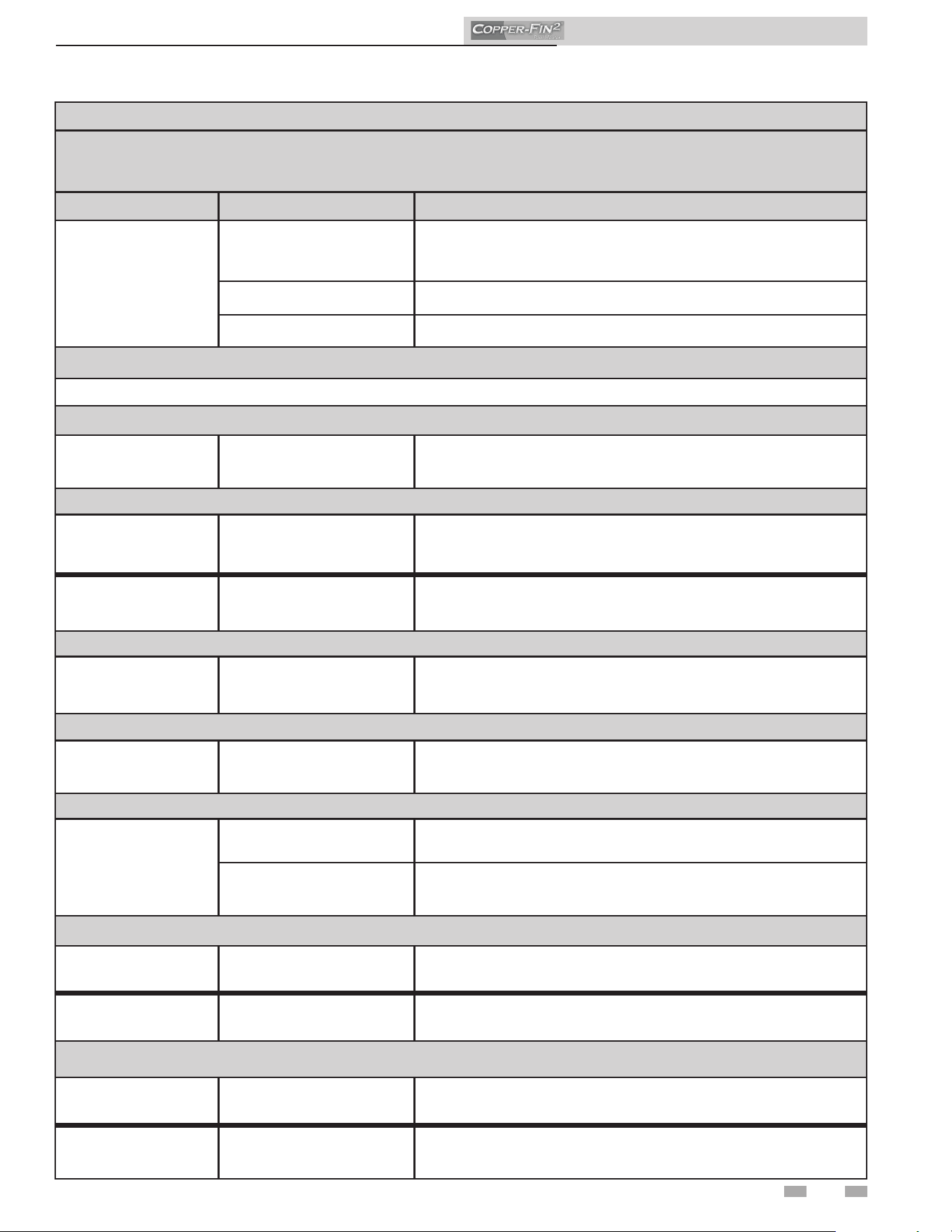
59
Installation & Operation Manual
7 Operating information (continued)
Status Display Screens (cont’d)
By using the Previous/Next (t, u) arrow keys on the SMART SYSTEM display panel, you can navigate through the 11 display
screens. Each screen will contain two (2) viewable items. The following is a description of the individual items and what they
can display:
Screen # Display shows: Description
Screen #3
Line 2
SYSRTN: ***F (***)
The system return sensor acts as the control sensor. The control
will display the system return temperature as well as the set point in
parenthesis.
SYSRTN: OPEN The control does not detect the system return sensor.
SYSRTN: SHORTED The system return sensor wires or the sensor itself has become shorted.
Press the Next u arrow key on the SMART SYSTEM display to access Screen #4.
N/A
Press the Next u arrow key on the SMART SYSTEM display to access Screen #5.
Screen #5
Line 2
STG DEMAND: **** The control displays the number of stages firing, based upon demand.
Press the Next u arrow key on the SMART SYSTEM display to access Screen #6.
Screen #6
Line 1
FAN SPEED: ***
The control will display either OFF, LOW, or HIGH depending upon
fan speed requirements of number of stages firing.
Screen #6
Line 2
0 – 10V RATE: **.*V
The control will display 0 to 10 volts based upon fan speed and unit
capacity.
Press the Next u arrow key on the SMART SYSTEM display to access Screen #7.
Screen #7
Line 1
PH CFH: ***
The control will display either ON or OFF based upon a demand (call
for heat) for heat.
Press the Next u arrow key on the SMART SYSTEM display to access Screen #8.
Screen #8
Line 1
SYS PUMP: ***
The control will display either ON or OFF based upon system pump
requirements upon demand.
Press the Next u arrow key on the SMART SYSTEM display to access Screen #9.
Screen #9
Line 1
UNIT PUMP: ***
The control will display either ON or OFF based upon unit pump
requirements upon demand.
UNIT PUMP: DELAY
The control will display delay in unit pump operation after the heat
requirements have been satisfied.
Press the Next u arrow key on the SMART SYSTEM display to access Screen #10.
Screen #10
Line 1
FLM SIG – A: **.* µA The control displays the igniter flame signal of igniter A in microamps.
Screen #10
Line 2
FLM SIG – B: **.* µA The control displays the igniter flame signal of igniter B in microamps.
Press the Next u arrow key on the SMART SYSTEM display to access Screen #11.
Screen #11
Line 1
IGN * AMPS: *.* A The control displays the current of either igniter A or B.
Screen #11
Line 2
MIX VAL POS: ** % The control displays the mixing valve percentage open to the system.
60
8 Maintenance
Installation & Operation Manual
Maintenance and annual startup
Table 8A_Service and Maintenance Schedules
Service technician
(see the following pages for instructions)
General:
• Address reported problems
• Inspect interior; clean and vacuum if
necessary;
• Check for leaks (water, gas, flue,
condensate)
• Examine venting system
• Check system water pressure/system
piping/expansion tank
• Check control settings
• Check igniter
• Check wiring and connections
• Check flue gas passageways
• Flame inspection (stable, uniform)
• Inspect and clean the burner
• Check manifold gas pressure
• Perform start-up checkout and
performance verification per Section 6 in
the Copper-fin
2
Installation and Operation
Manual.
If combustion or performance
indicate need:
• Clean heat exchanger with a stiff bristle
brush
• Remove and clean burners using
water. Dry before re-assembling.
• Clean the blower wheel with a brush and
vacuum. Do not let dirt from cleaning get
pulled into the blower.
ANNUAL START-UP
Owner maintenance
Daily
• Check appliance area
• Check pressure/temperature
gauge
Monthly
• Check vent piping
• Check air piping
• Check relief valve
• Replace combustion air filter
Note: More frequent replacement may
be necessary in dirty environments.
Periodically
• Test low water cutoff (if used)
• Reset button (low water cutoff)
Every
6 months
• Check appliance piping (gas and
water) for leaks
• Operate relief valve
End
of season
months
• Shut appliance down
Installation & Operation Manual
8 Maintenance (continued)
61
Follow the service and maintenance procedures given throughout this manual and in component literature
shipped with the appliance. Failure to perform the service and maintenance could result in damage to the
appliance or system. Failure to follow the directions in this manual and component literature could result in
severe personal injury, death, or substantial property damage.
The appliance should be inspected annually only by a qualified service technician. In addition, the maintenance
and care of the appliance designated in Table 8A and explained on the following pages must be performed to
assure maximum appliance efficiency and reliability. Failure to service and maintain the appliance and system
could result in equipment failure.
Electrical shock hazard – Turn off power to the appliance before any service operation on the appliance except
as noted otherwise in this instruction manual. Failure to turn off electrical power could result in electrical
shock, causing severe personal injury or death.
Address reported problems
1. Inspect any problems reported by the owner and correct
before proceeding.
Inspect appliance area
1. Verify that appliance area is free of any combustible
materials, gasoline and other flammable vapors and liquids.
Inspect appliance interior
1. Remove the outer access panels and inspect the interior of
the appliance.
2. Vacuum any sediment from inside the appliance and
components. Remove any obstructions.
Eliminate all system or appliance leaks.
Continual fresh makeup water will reduce
appliance life. Minerals can build up in
sections, reducing heat transfer, overheating
heat exchanger, and causing heat exchanger
failure. Leaking water may also cause severe
property damage.
1. Inspect all water and gas piping and verify to be leak free.
2. Look for signs of leaking lines and correct any problems
found.
3. Check gas line using the procedure found in Section 3 - Gas
Connections of the Copper-fin
2
Installation and Operation
Manual.
Check all piping for leaks
⚠WARNING
⚠WARNING
⚠WARNING
⚠WARNING
Flue vent system and air piping
1. Check for gastight seal at every connection, seam of
air piping, and vent piping periodically inspected by a
qualified service agency.
Venting system must be sealed gastight
to prevent flue gas spillage and carbon
monoxide emissions, which will result in
severe personal injury or death.
⚠WARNING
Installation & Operation Manual
8 Maintenance
62
Check relief valve
1. Inspect the relief valve and lift the lever to verify flow.
Before operating any relief valve, ensure that it is piped with
its discharge in a safe area to avoid severe scald potential.
Read Section 4 - Water Connections of the Copper-fin
2
Installation and Operation Manual before proceeding
further.
Safety relief valves should be re-inspected
AT LEAST ONCE EVERY THREE YEARS,
by a licensed plumbing contractor or
authorized inspection agency, to ensure
that the product has not been affected by
corrosive water conditions and to ensure
that the valve and discharge line have not
been altered or tampered with illegally.
Certain naturally occurring conditions may
corrode the valve or its components over
time, rendering the valve inoperative. Such
conditions are not detectable unless the
valve and its components are physically
removed and inspected. This inspection
must only be conducted by a plumbing
contractor or authorized inspection agency
– not by the owner. Failure to re-inspect
the pool heater relief valve as directed could
result in unsafe pressure buildup, which can
result in severe personal injury, death, or
substantial property damage.
Following installation, the valve lever must
be operated AT LEAST ONCE A YEAR to
ensure that waterways are clear. Certain
naturally occurring mineral deposits may
adhere to the valve, rendering it inoperative.
When manually operating the lever, water
will discharge and precautions must be taken
to avoid contact with hot water and to avoid
water damage. Before operating lever, check
to see that a discharge line is connected to
this valve directing the flow of hot water
from the valve to a proper place of disposal.
Otherwise severe personal injury may result.
If no water flows, valve is inoperative. Shut
down the appliance until a new relief valve
has been installed.
2. After following the above warning directions, if the relief
valve weeps or will not seat properly, replace the relief valve.
Ensure that the reason for relief valve weeping is the valve
and not over-pressurization of the system due to expansion
tank waterlogging or undersizing.
⚠WARNING
⚠WARNING
Inspect/replace hot surface igniter
This unit uses a proven SMART SYSTEM control module and
a hot surface igniter. The SMART SYSTEM control module is
not repairable. Any modification or repairs will invalidate the
warranty.
Check all wiring
1. Inspect all wiring, making sure wires are in good condition
and securely attached.
Check control settings
1. Set the SMART SYSTEM control module display to
Parameter Mode and check all settings. Reference the
Copper-fin
2
Service Manual for how to adjust settings and
parameters. Adjust settings if necessary.
2. Check settings of external limit controls (if any) and adjust
if necessary.
Do not attempt to repair a faulty hot surface
igniter or control module. Any modification
or repairs may create hazardous conditions
that result in property damage, personal
injury, fire, explosion and/or toxic gases.
⚠WARNING
A faulty hot surface igniter or control module must be replaced
with an identical part. A specification igniter and control
module for this specific unit is available from your local
distributor. Do not use general purpose field replacement
control modules or igniters.
Ignition system checkout
1. Turn off gas supply to unit.
2. Turn electric power on.
3. Adjust the set point on the temperature control to a
setting above water temperature or to the highest safe
setting.
4. The igniter will cycle on trial for ignition.
5. The control module will lock out and turn the alarm
light on.
6. Adjust the Set Point Differential and High-Fire Offset to
the desired settings.
7. Turn on gas supply.
8. Press the RESET button at the electronic display panel to
reset the control module.
9. If ignition system fails to operate properly, repair work
must be performed by a qualified service person or
installer.
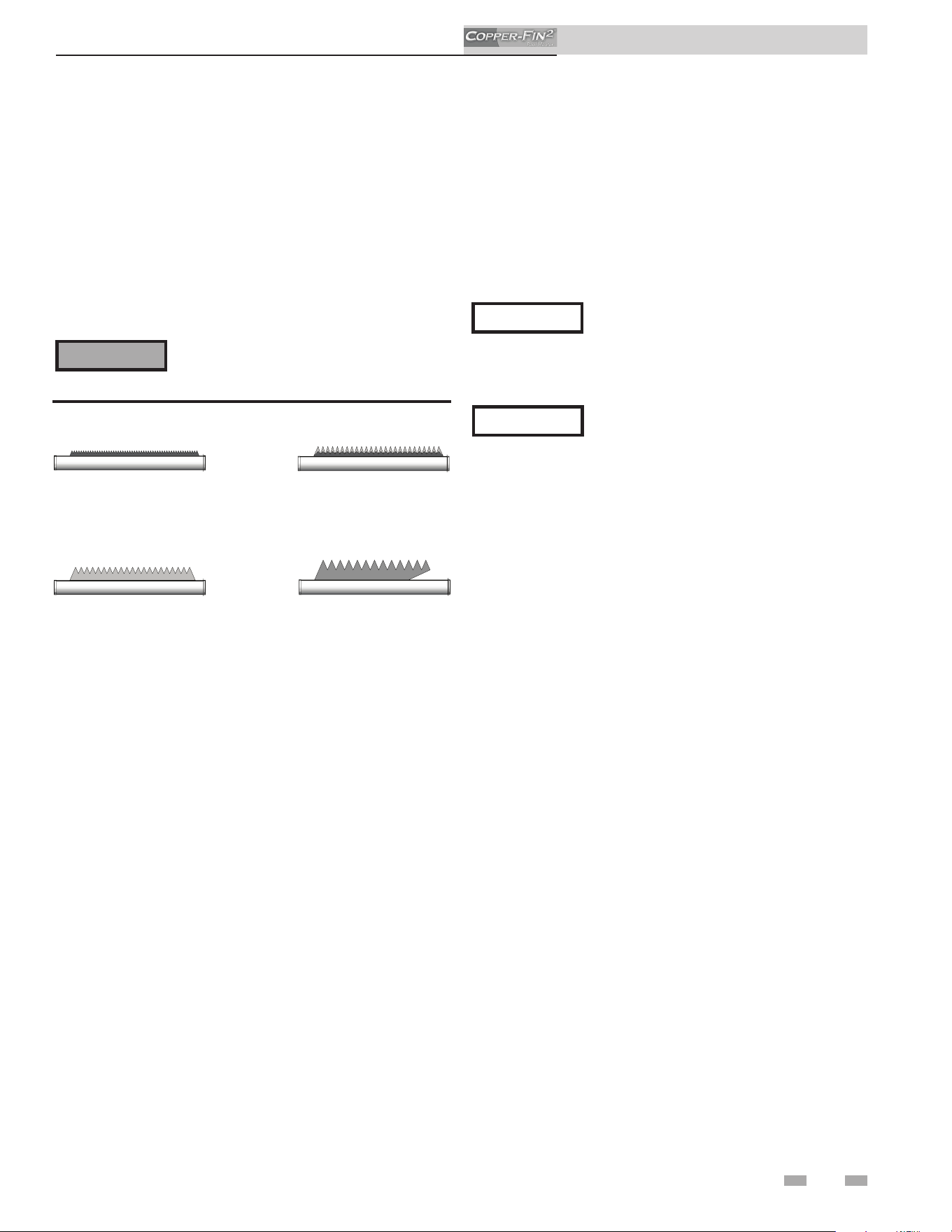
Installation & Operation Manual
8 Maintenance (continued)
63
Check burner flame
Visually check main burner flames at each start-up after long
shutdown periods or at least every six months. A burner
viewport is located on the burner mounting flange.
Perform start-up and checks
Start appliance and perform checks and tests specified in Section
6 - Start-up of the Copper-fin
2
Installation and Operation
Manual.
The area around the burner viewport is hot
and direct contact could result in burns.
⚠WARNING
Figure 8-1_Flame Pattern Illustration
Normal Flame: A normal flame at 100% of burner input is blue,
with slight yellow tips, a well defined flame and no flame lifting.
Yellow Tip: Yellow tipping can be caused by blockage or partial
obstruction of air flow to the burner.
Yellow Flames: Yellow flames can be caused by blockage of
primary air flow to the burner or excessive gas input. This
condition MUST be corrected immediately.
Lifting Flames: Lifting flames can be caused by over firing the
burner, excessive primary air or high draft.
If improper flame is observed, examine the venting system,
ensure proper gas supply and adequate supply of combustion
and ventilation air.
Check flue gas passageways
Any sign of soot around the inner jacket, outer jacket, flue
pipe connections, burner or in the areas between the fins on
the copper heat exchanger indicates a need for cleaning. The
following cleaning procedure must only be performed by a
qualified serviceman or installer. Proper service is required to
maintain safe operation. Properly installed and adjusted units
seldom need flue cleaning.
All gaskets/sealants on disassembled
components or jacket panels must be
replaced with new gaskets/sealants on
reassembly. Gasket and sealant kits are
available from your distributor.
NOTICE
⚠ CAUTION
When a Category IV vent system is
disconnected for any reason, the flue must
be reassembled and resealed according to the
vent manufacturer’s instructions.
Inspect and clean burner
1. Turn off main power to unit.
2. Turn off main manual gas shutoff to unit.
3. Remove the front outer jacket panels.
4. Disconnect manifold from gas train using union(s) just
below each gas valve(s).
5. Remove mounting screws from manifold mounting
brackets. Pull the manifold/orifice assembly away from
burners. Repeat for each manifold assembly.
6. Remove two mounting screws from burner and slide
burner out toward front of unit. Use caution to prevent
damage to burners, refractory, hot surface igniter or wiring.
7. Remove soot from burners with a stiff bristle brush.
Dirt may be removed from burner ports by rinsing the
burner thoroughly with water. Drain and dry burners
before re-installing. Damaged burners must be replaced.
NORMAL
YELLOW FLAME
FLAME LIFT
YELLOW TIP
When installed in a dusty and dirty location, the burners may
require cleaning on a 3 to 6 month schedule or as needed,
based on severity of contamination. Contaminants can be
drawn in with the combustion air. Non combustible particulate
matter such as dust, dirt, concrete dust or dry wall dust can
block burner ports and cause non-warrantable failure. The
standard inlet air filter will help eliminate dust and dirt from
entering the unit. Use extreme care when operating a unit for
temporary heat during new construction. The burners could
require a thorough cleaning before the unit is placed in service.
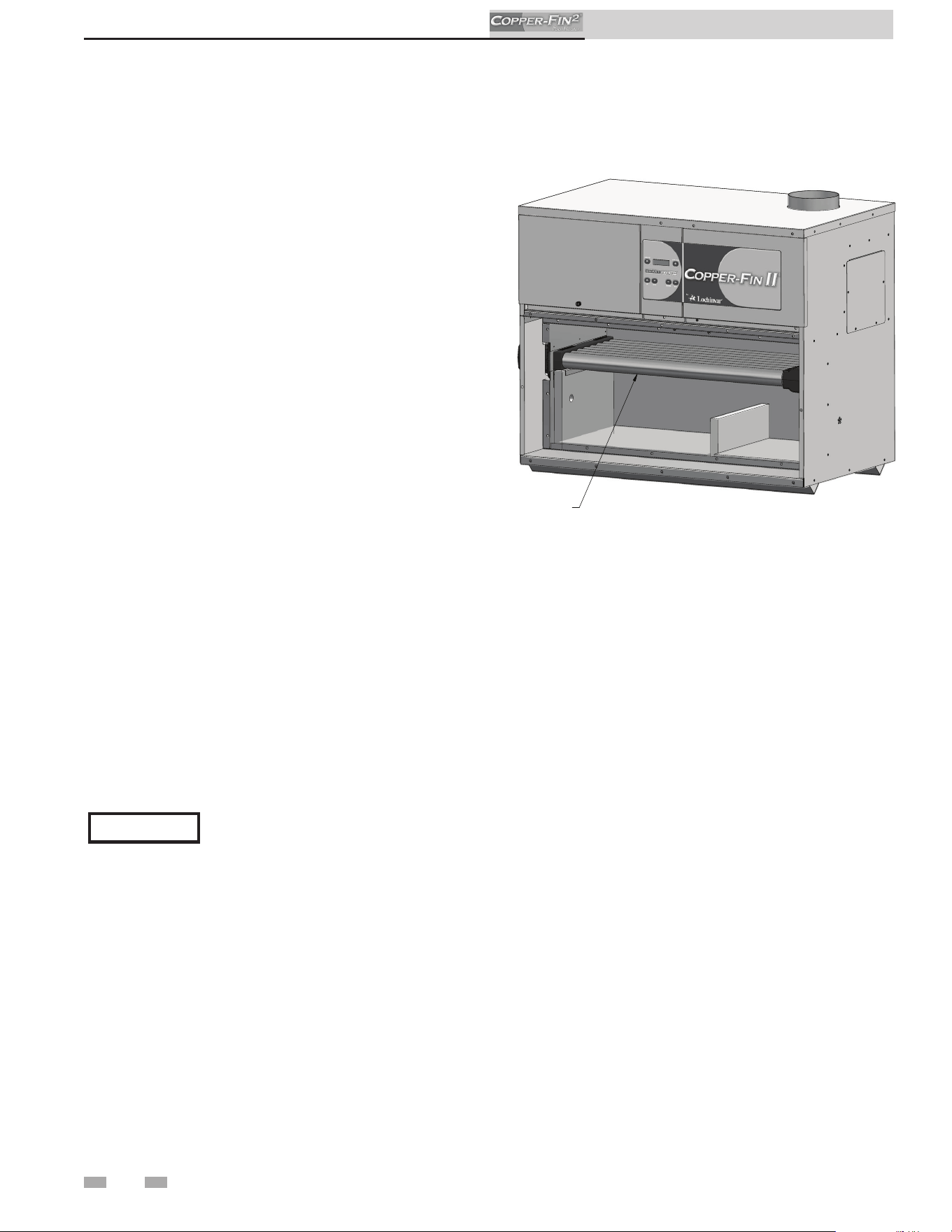
Installation & Operation Manual
8 Maintenance
64
Inspect and clean the heat exchanger
1. While burners are removed, check the heat exchanger
surface for sooting. If present, heat exchanger must be
cleaned and problem corrected. Proceed as follows.
2. Remove gas manifold(s)/orifice assemblies as described
in steps 1 through 5 in Burner Removal and Cleaning,
page 63.
3. Disconnect wiring from the hot surface igniter and
remove igniter from the door panel to prevent damage to
the igniter.
4. Remove inner jacket panel mounting screws and slide
door assembly out toward front of the unit. Use
caution to prevent damage to the refractory.
5. Check “V” baffles and frame runners along front
and back edges of heat exchanger. Remove and clean if
necessary.
6. Remove soot from heat exchanger with a stiff bristle
brush. Use a vacuum to remove loose soot from
surfaces and inner chamber.
7. If necessary, the heat exchanger can be removed. Once the
heat exchanger is removed from the unit, a garden hose
can be used to wash the tubes to ensure that all soot is removed
from the heat exchanger surfaces. Note: Do not wet the unit’s
refractory.
8. Ensure that all burner ports are cleaned to remove any
soot. See Burner Removal and Cleaning, page 63.
9. Carefully reinstall the heat exchanger, “V” baffles, and
frame runners if removed from the unit. Note: Make
sure frame runners seal securely where they contact the
front and rear compartment refractory.
10. Carefully reinstall inner jacket panels, burners,
manifolds, wires and hoses. Use new gasket material to
ensure a proper air seal.
11. Reassemble all gas and water piping. Test for gas leaks.
Upon completion of any testing on the gas
system, leak test all gas connections with a
NOTICE
HEAT
EXCHANGER
Figure 8-2_Location of the Heat Exchanger Inside Jacket
Review with owner
1. Review the Copper-fin
2
Installation and Operation Manual
with the owner.
2. Emphasize the need to perform the maintenance schedule
specified in this manual.
3. Remind the owner of the need to call a licensed contractor
should the appliance or system exhibit any unusual behavior.
4. Remind the owner to follow the proper shutdown procedure
and to schedule an annual start-up at the beginning of the
next heating season.
Oiled bearing circulators
Inspect the pump every six (6) months and oil as necessary. Use
SAE 30 non-detergent oil or lubricant specified by the pump
manufacturer.
12. Reassemble outer jacket panels.
13. Cycle unit and check for proper operation.
soap and water solution while main burners are operating. Do
not spray soap and water solution on the SMART SYSTEM
control module housing. The use of an excessive amount of
soap and water solution can damage the control. Immediately
repair any leak found in the gas train or related components.
Do not operate an appliance with a leak in the gas train, valves,
or related piping.
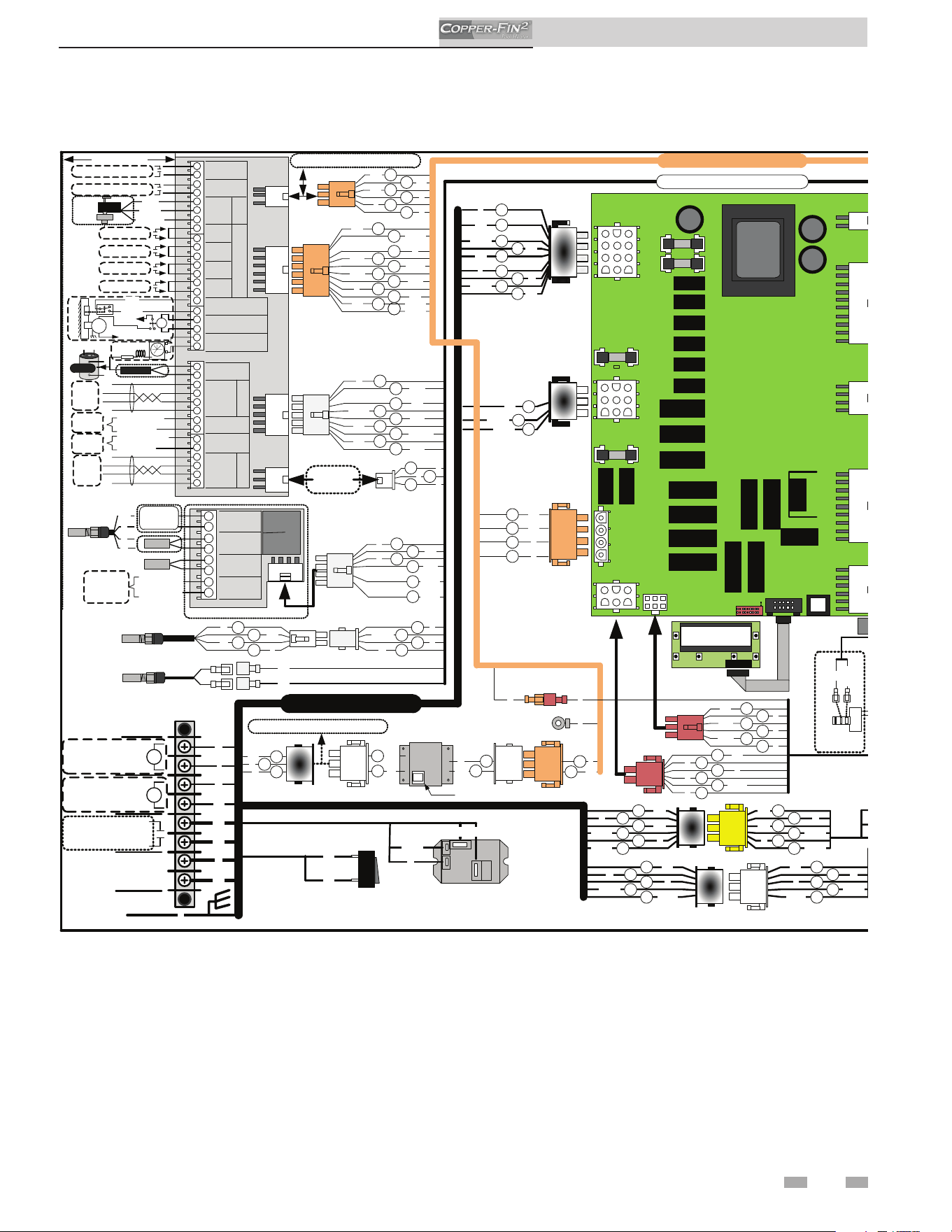
65
Installation & Operation Manual
9 Connection diagram
NOTE: Not all connections/features apply to pool heaters.
NO
C
NC
NOTE: NUMBER OF GAS VALVES VARIES BY MODEL
GROUND
+
+
+
+
+
+
+
+
OUTDOOR
SENSOR
SYS RETURN
SENSOR
SYS SU PPLY
SENSOR
0-10V SYS
-PUMP IN
CN2
1
2
3
4
5
6
7
8
FIELD
SUPPLIED
WIRING
+
+
+
+
+
+
+
+
+
+
+
+
+
+
+
+
+
+
+
+
+
+
+
+
+
+
+
+
+
+
+
+
+
+
+
ALARM
CONTACTS
OPEN
CLOSE
COM
RUNTIME
CONTACTS
3- WAY
VALVE
STAGING
S1
S1
S2
S2
S3
S3
S4
S4
LOUVER PROVING
SWITCH
LOUVER RELAY
COIL
TANK
AQUASTAT
2
3
4
5
6
7
8
9
10
11
12
13
14
15
16
17
18
19
20
21
22
23
24
25
26
27
28
29
30
31
32
33
34
35
CN3
CN2
CN1
CN6
CN4
CN5
TANK
SENSOR
+0-10V
-BMS IN
+0-10V
-RATE OUT
SHIELD
A
B
SHIELD
SHIELD
A
B
SHIELD
CA SCADEMO DBUS
X1
X2
X10
X12
X11
X4
X9
X5
X6
X7
X8
X13
F2
F4
F5
F6
1
8
3
4
5
6
7
9
10
Y
R/W
BR
BR/W
Y/G
BL
BL/BK
PR
O/R
MAIN UNIT
1
1
6
2
3
4
5
PR
PR
BL
P
Y
P
GY/W
BK
1
6
3
7
2
4
8
PR
BR/W
W
P
BK
GY
BK/W
10GY
12G
1
9
3
4
5
6
7
8
10
11
12
12
BR
BR/W
R
R/O
R/BK
T/W
R/ W
Y
GY
BL
W/BK
1
18
2
3
5
6
20
19
17
16
12
7
15
14
Y
T
W
W
BL
Y/G
BR/W
BL
BK/R
R/BK
BL/BK
BR
BK
1
R/BK
4
8
O/R
PR
1
12
2
3
4
5
6
10
11
13
14
12
7
15
16
BL
Y
R
W/BK
O/BK
T
R
GY
O/R
T/W
R/O
R/ W
BR
BR/W
COMMON
0-10V DC IN
COMMON
0- 10V DC OUT
COMMON
0- 10V DC IN
FROM
BMS
TO
BMS
FROM
PUMP
OUTPUT
LOUVERS
UNITS
MOD
BUS
BMS
1
6
2
3
4
5
BL
R/O
R/W
6
1
5
4
3
2
Y
Y
Y
NEUTRAL
UNIT
PUMP
SYSTEM PUMP
RELAY COIL
IND-DHW PUMP
RELAY COIL
LINE
GROUND
1
3
5
2
4
BK
W
G
BK/W
BK/R
1
3
5
2
4
BK
W
G
BK/W
BK/R
CONTROLLER
DISPLAY
IDENTIFICATION PLUG
MODEL SPECIFIC
CONSULT
FACTORY
T= TAN
Y=YELLOW
BR=BROWN
G=GREEN
GY=GRAY
W = WHITE
BK = BLACK
PR=PURPLE
BL=BLUE
P=PINK
O=ORANGE
FACTORY
OPTIONS
Y/G = YELLOW WITH GREEN STRIPE
R= RED
INLET
SENSOR
BR
BR
SAFETY
OUTLET
SENSOR
ON/OFF
SWITCH
BK
BK
BR
BR
CHASSIS
GROUND
W
P
W
PR
X3
1
2
3
4
P
P
PR
PR
8
12
13
12
W/BK
W/R
R/ W
10
11
R
GY
1
2
3
4
R
W
BK
G
1
2
3
4
W
Y
W/BK
Y
1
7
2
5
6
8
Y
BK
P
W/R
R/BK
BK/R
FIELD WIRING
W
BK
G
3
1
BK
W
2
G
3
2
Y
BL
60VA
3
1
BK
W
3
2
Y
BL
CONTROLLER
XFMR
DIGITAL HARNESS
PUMP RELAY
120VAC COIL
BR/W
W
BR
BR
GAS VALVE XFMR
FLOW
SWITCH
R
BK
1
2
3
4
BL
Y
1
2
4
BL
Y
O
1
2
1
2
O
O/BK
IGNITER
Y
Y
Y
R/BK
R
BL
S1
1
2
1
3
R
Y
R
S2
3
21 3
R/BK
Y R/BK
S3
5
21 3
R/O Y R/O
S4
6
2
1 3
R/W
Y
R/W
S3
4
2
1 3
R/O
Y R/O
S1
2
21 3
R
Y
R
4
1
3
5
2
6
GY
G
GY
GY/W
G
GY/W
4
1
3
5
2
6
GY
G
GY
GY/W
G
GY/W
FLOW SWITCH
LWCO
BK
W
BL
Y
LOW GAS
SWITCH
O
O/
BK
BL
Y
BK
W
LO -GAS
BL
AUXILLIARY
HI-LIMIT
C NO
NC
C 21
GROUND
HSI
G
STAGE #1 STAGE #2STAGE #1 STAGE #3 STAGE #4STAGE #3
S1/S2
S3/S4
GY
GY
#1
GY/W
GY/W
CHASSIS
GROUND
1
2
3
PR
5
2
4
1
6
3
LWCO
24VAC
RESET
PR
~~~~
~~~~
LWCO
PROBE
TEST
~~~~
T
T
AIR PROVE
SWTICH
BLOCK
FLUE
SWITCH
BLOWER RELAY
120VAC COIL
BK/
W
BK
BK/
W
HI/LO SPEED RELAY
120VAC COIL
W
BK/
R
BK/
W
R
BK
NO
COM
NC
COM
O/BK
2# ISH
GY/W
W
Y
24V
GROUND
G
24V COM
BL
R
BL
1
3
Y
R
HI
O
O/BK
BL
BL
BL
CIRCUIT
BREAKER
LO
MAIN UNIT HARNESS
OPT. ALARM HARNESS
Notes:
1. All wiring must be installed in accordance with : local, state, provincial and national code requirements per either
N.E.C. in USA or C. S.A. in Canada.
2. If any original equipment wire as supplied with the appliance must be replaced , it must be replaced with wire
having same wire gauge (AWG) and rated for a minimumof 105°C
3. Actual connector block locations may vary from those shown on diagrams . Refer to actual components for
proper connector block locations when using diagrams to trouble shoot unit .
TO PREVENT ELECTRICAL SHOCK
THIS HEATER MAY BE CONNECTED TO MORE THAN ONE BRANCH
CIRCUIT. MORE THAN ONE DISCONNECT SWITCH MAY BE
REQUIRED TO DE-ENERGIZE THE EQUIPMENT FOR SERVICING.
DANGER
!
LBL20082 REV E
R
R
1HP
MAX
120V
120V
120V/60Hz
SUPPLY
G
BURNER
BURNER
R
OPEN
COMMON
CLOSE
24V
TO MONITORING DEVICE
TO MONITORING DEVICE
NEU
LINE
STAGE #1
STAGE #2
STAGE #3
STAGE #4
TANK
SENSOR
AQUASTAT
M
COM
PROVE
4
3
2
1
G
W
R
BK
2-SPD BLOWER
50VA
60VA
75VA
100VA
HI
LO
NEU
GND
HI-GAS
++
3
2
1
3
W
BK
1
3
1
G
BK
SILENCING
SWITCH
ALARM
BELL
1
6
4
5
PR
Y
1
6
23
45
BLBLY
ALARM RELAY
120VAC COIL
R
P
P
OPT. ALARM
LOW
VOLTAGE
HARNESS
CONNECTION
BOARD
LOW VOLT HARNESS
MAIN POWER HARNESS
OPT. MODBUS HARNESS
CKT. BREAKER
FUSE AMPS
F2 =
F4 =
F5 =
F6 =
LOW VOLT HARNESS
2
4
1
4
3
2
1
G
W
R
BK
HI
LO
NEU
GND
BOILER/POOL HEATER
2
T
GROUNDING
OPTION
JUMPER
DIGITAL
HARNESS
R
BL
G
3 1
2
TO
CONNECTION
BOARD
TO
PWR
TO
XFMR
MODBUS ADAPTER
G
120V
120V
120V
120V
24V
120V
12 0V
24 V
T
P
BL
R
R
BL
PR
2
W
OUT
DOOR
AIR
POOL/BOILER
BK
G
R
W
CN1
10K
10K
10K
10K
POOL
SAFETY
SUPPLY
10K
10K
10K/20K
10K
10K/20K
FIELD
OPTIONS
WIRE COLOR REFERENCE
1
2
BL
O/R
O
O/BK
1
2
1
2
1
2
O
1
2
O
O/BK
O/BK
Y
O/BK
O
1
2
O
1
2
O/BK
1
2
MODBUS
MODULE
CONNECTIONS
G
O
GY
3
1
2
20K
10K
POOL SUP
SENSOR
3-WAY
VALVE
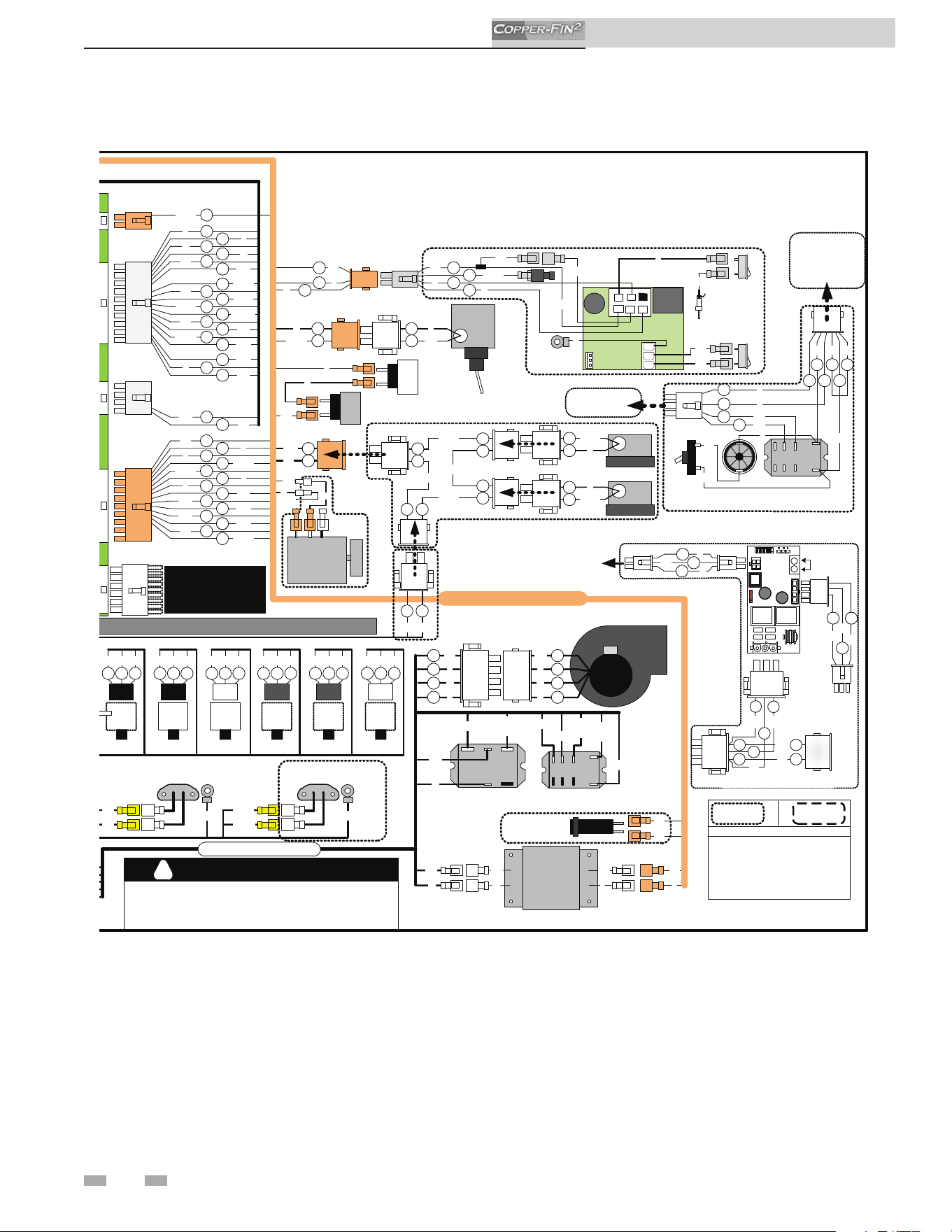
Installation & Operation Manual
66
9 Connection diagram
NO
C
NC
NOTE: NUMBER OF GAS VALVES VARIES BY MODEL
GROUND
+
+
+
+
+
+
+
+
OUTDOOR
SENSOR
SYS RETURN
SENSOR
SYS SU PPLY
SENSOR
0-10V SYS
-PUMP IN
CN2
1
2
3
4
5
6
7
8
FIELD
SUPPLIED
WIRING
+
+
+
+
+
+
+
+
+
+
+
+
+
+
+
+
+
+
+
+
+
+
+
+
+
+
+
+
+
+
+
+
+
+
+
ALARM
CONTACTS
OPEN
CLOSE
COM
RUNTIME
CONTACTS
3- WAY
VALVE
STAGING
S1
S1
S2
S2
S3
S3
S4
S4
LOUVER PROVING
SWITCH
LOUVER RELAY
COIL
TANK
AQUASTAT
2
3
4
5
6
7
8
9
10
11
12
13
14
15
16
17
18
19
20
21
22
23
24
25
26
27
28
29
30
31
32
33
34
35
CN3
CN2
CN1
CN6
CN4
CN5
TANK
SENSOR
+0-10V
-BMS IN
+0-10V
-RATE OUT
SHIELD
A
B
SHIELD
SHIELD
A
B
SHIELD
CA SCADEMO DBUS
X1
X2
X10
X12
X11
X4
X9
X5
X6
X7
X8
X13
F2
F4
F5
F6
1
8
3
4
5
6
7
9
10
Y
R/W
BR
BR/W
Y/G
BL
BL/BK
PR
O/R
MAIN UNIT
1
1
6
2
3
4
5
PR
PR
BL
P
Y
P
GY/W
BK
1
6
3
7
2
4
8
PR
BR/W
W
P
BK
GY
BK/W
10GY
12G
1
9
3
4
5
6
7
8
10
11
12
12
BR
BR/W
R
R/O
R/BK
T/W
R/ W
Y
GY
BL
W/BK
1
18
2
3
5
6
20
19
17
16
12
7
15
14
Y
T
W
W
BL
Y/G
BR/W
BL
BK/R
R/BK
BL/BK
BR
BK
1
R/BK
4
8
O/R
PR
1
12
2
3
4
5
6
10
11
13
14
12
7
15
16
BL
Y
R
W/BK
O/BK
T
R
GY
O/R
T/W
R/O
R/ W
BR
BR/W
COMMON
0-10V DC IN
COMMON
0- 10V DC OUT
COMMON
0- 10V DC IN
FROM
BMS
TO
BMS
FROM
PUMP
OUTPUT
LOUVERS
UNITS
MOD
BUS
BMS
1
6
2
3
4
5
BL
R/O
R/W
6
1
5
4
3
2
Y
Y
Y
NEUTRAL
UNIT
PUMP
SYSTEM PUMP
RELAY COIL
IND-DHW PUMP
RELAY COIL
LINE
GROUND
1
3
5
2
4
BK
W
G
BK/W
BK/R
1
3
5
2
4
BK
W
G
BK/W
BK/R
CONTROLLER
DISPLAY
IDENTIFICATION PLUG
MODEL SPECIFIC
CONSULT
FACTORY
T= TAN
Y=YELLOW
BR=BROWN
G=GREEN
GY=GRAY
W = WHITE
BK = BLACK
PR=PURPLE
BL=BLUE
P=PINK
O=ORANGE
FACTORY
OPTIONS
Y/G = YELLOW WITH GREEN STRIPE
R= RED
INLET
SENSOR
BR
BR
SAFETY
OUTLET
SENSOR
ON/OFF
SWITCH
BK
BK
BR
BR
CHASSIS
GROUND
W
P
W
PR
X3
1
2
3
4
P
P
PR
PR
8
12
13
12
W/BK
W/R
R/ W
10
11
R
GY
1
2
3
4
R
W
BK
G
1
2
3
4
W
Y
W/BK
Y
1
7
2
5
6
8
Y
BK
P
W/R
R/BK
BK/R
FIELD WIRING
W
BK
G
3
1
BK
W
2
G
3
2
Y
BL
60VA
3
1
BK
W
3
2
Y
BL
CONTROLLER
XFMR
DIGITAL HARNESS
PUMP RELAY
120VAC COIL
BR/W
W
BR
BR
GAS VALVE XFMR
FLOW
SWITCH
R
BK
1
2
3
4
BL
Y
1
2
4
BL
Y
O
1
2
1
2
O
O/BK
IGNITER
Y
Y
Y
R/BK
R
BL
S1
1
2
1
3
R
Y
R
S2
3
21 3
R/BK
Y R/BK
S3
5
21 3
R/O Y R/O
S4
6
2
1 3
R/W
Y
R/W
S3
4
2
1 3
R/O
Y R/O
S1
2
21 3
R
Y
R
4
1
3
5
2
6
GY
G
GY
GY/W
G
GY/W
4
1
3
5
2
6
GY
G
GY
GY/W
G
GY/W
FLOW SWITCH
LWCO
BK
W
BL
Y
LOW GAS
SWITCH
O
O/
BK
BL
Y
BK
W
LO -GAS
BL
AUXILLIARY
HI-LIMIT
C NO
NC
C 21
GROUND
HSI
G
STAGE #1 STAGE #2STAGE #1 STAGE #3 STAGE #4STAGE #3
S1/S2
S3/S4
GY
GY
#1
GY/W
GY/W
CHASSIS
GROUND
1
2
3
PR
5
2
4
1
6
3
LWCO
24VAC
RESET
PR
~~~~
~~~~
LWCO
PROBE
TEST
~~~~
T
T
AIR PROVE
SWTICH
BLOCK
FLUE
SWITCH
BLOWER RELAY
120VAC COIL
BK/
W
BK
BK/
W
HI/LO SPEED RELAY
120VAC COIL
W
BK/
R
BK/
W
R
BK
NO
COM
NC
COM
O/BK
2# ISH
GY/W
W
Y
24V
GROUND
G
24V COM
BL
R
BL
1
3
Y
R
HI
O
O/BK
BL
BL
BL
CIRCUIT
BREAKER
LO
MAIN UNIT HARNESS
OPT. ALARM HARNESS
Notes:
1. All wiring must be installed in accordance with : local, state, provincial and national code requirements per either
N.E.C. in USA or C. S.A. in Canada.
2. If any original equipment wire as supplied with the appliance must be replaced , it must be replaced with wire
having same wire gauge (AWG) and rated for a minimumof 105°C
3. Actual connector block locations may vary from those shown on diagrams . Refer to actual components for
proper connector block locations when using diagrams to trouble shoot unit .
TO PREVENT ELECTRICAL SHOCK
THIS HEATER MAY BE CONNECTED TO MORE THAN ONE BRANCH
CIRCUIT. MORE THAN ONE DISCONNECT SWITCH MAY BE
REQUIRED TO DE-ENERGIZE THE EQUIPMENT FOR SERVICING.
DANGER
!
LBL20082 REV E
R
R
1HP
MAX
120V
120V
120V/60Hz
SUPPLY
G
BURNER
BURNER
R
OPEN
COMMON
CLOSE
24V
TO MONITORING DEVICE
TO MONITORING DEVICE
NEU
LINE
STAGE #1
STAGE #2
STAGE #3
STAGE #4
TANK
SENSOR
AQUASTAT
M
COM
PROVE
4
3
2
1
G
W
R
BK
2-SPD BLOWER
50VA
60VA
75VA
100VA
HI
LO
NEU
GND
HI-GAS
++
3
2
1
3
W
BK
1
3
1
G
BK
SILENCING
SWITCH
ALARM
BELL
1
6
4
5
PR
Y
1
6
23
45
BLBLY
ALARM RELAY
120VAC COIL
R
P
P
OPT. ALARM
LOW
VOLTAGE
HARNESS
CONNECTION
BOARD
LOW VOLT HARNESS
MAIN POWER HARNESS
OPT. MODBUS HARNESS
CKT. BREAKER
FUSE AMPS
F2 =
F4 =
F5 =
F6 =
LOW VOLT HARNESS
2
4
1
4
3
2
1
G
W
R
BK
HI
LO
NEU
GND
BOILER/POOL HEATER
2
T
GROUNDING
OPTION
JUMPER
DIGITAL
HARNESS
R
BL
G
3 1
2
TO
CONNECTION
BOARD
TO
PWR
TO
XFMR
MODBUS ADAPTER
G
120V
120V
120V
120V
24V
120V
12 0V
24 V
T
P
BL
R
R
BL
PR
2
W
OUT
DOOR
AIR
POOL/BOILER
BK
G
R
W
CN1
10K
10K
10K
10K
POOL
SAFETY
SUPPLY
10K
10K
10K/20K
10K
10K/20K
FIELD
OPTIONS
WIRE COLOR REFERENCE
1
2
BL
O/R
O
O/BK
1
2
1
2
1
2
O
1
2
O
O/BK
O/BK
Y
O/BK
O
1
2
O
1
2
O/BK
1
2
MODBUS
MODULE
CONNECTIONS
G
O
GY
3
1
2
20K
10K
POOL SUP
SENSOR
3-WAY
VALVE
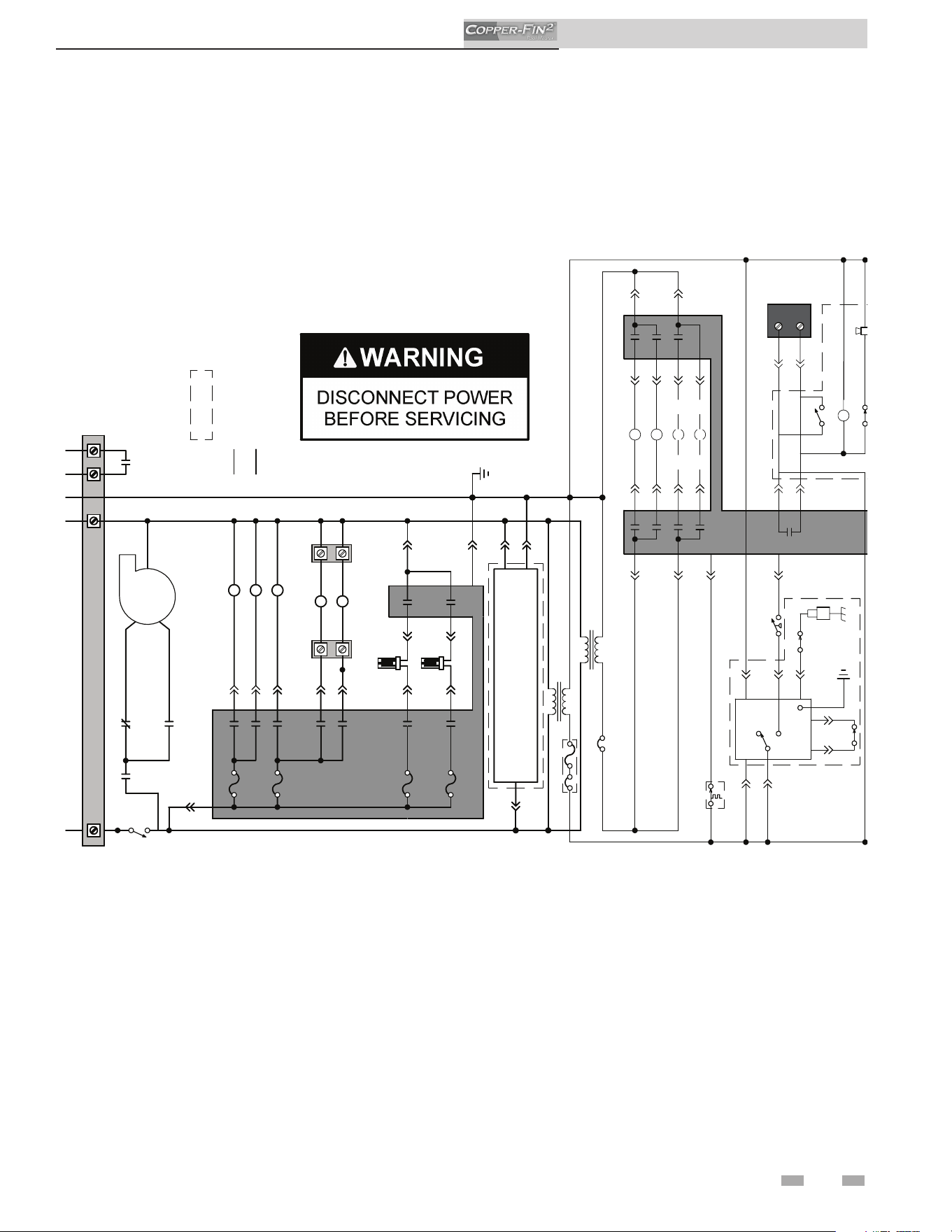
67
Installation & Operation Manual
10 Ladder diagram
NOTE: Not all connections/features apply to pool heaters.
LBL20083 REV B
WHERE POSSIBLE, SWITCHES ARE SHOWN WITHOUT UTILITIES (GAS,
WATER OR ELECTRICITY) CONNECTED TO THE UNIT. AS SUCH, ACTUAL
SWITCH STATES MAY VARY FROM THOSE SHOWN ON DIAGRAMS
DEPENDING UPON WHETHER UTILITIES ARE CONNECTED OR A FAULT
CONDITION IS PRESENT. SEE WIRING DIAGRAM FOR ADDITIONAL NOTES.
BLOWER
N
ON/OFF
SWITCH
F2
3.15A
BOX DEPICTS
OPTIONAL ITEMS
120 VAC
LOW VOLTAGE
TERMINAL
STRIP
BLOWER
RELAY
HI/LO SPEED
RELAY
HI/LO SPEED
RELAY
HIGH
SPEED
LOW
SPEED
GL
N
UNIT PUMP
RELAY
X1
-6
F4
5A
BLOWER RELAY
8-1X8-1X8-1X
HI/LO SPEED RELAY
X2-4
X1-2
UNIT PUMP RELAY
X1-1
X1-4
TERMINAL
STRIP
TERMINAL
STRIP
SYSTEM /
RECIRC
PUMP RELAY
DHW PUMP
RELAY
(BOILER)
CHASSIS
X1-7
X2-1
X1-10
X2-2
X1-3
F5
5A
F6
5A
STAGE 1 HSI
STAGE 3 HSI
X1-12
X1-2
X1-3
X1-1
MODBUS INTERFACE BOARD
CIRCUIT BREAKER OR FUSE
CN5-11X6-1 X6-13 CN5-5
LOUVER RELAY
CN4-5X3-1
CN4-6X3-2
CONNECTION BOARD 1
X6-7CN5-1
RUNTIME
CONTACTS
X6-16CN5-7
X6-2CN5-8
X13-1CN5-9
X6-6CN5-3
X6-15CN5-10
X6-11CN5-12
X6-14CN5-4
X8-5CN6-4
X6-10
X8-15CN6-9
X7-8CN6-5
X7-4CN6-10
X8-7CN6-7
X8-17CN6-3
X8-6CN1-7
3 WAY VALVE
CONNECTION BOARD 1
STAGE 1 / ENABLE
STAGE 2
STAGE 3
STAGE 4
TANK TSTAT
LOUVER PROVING
OPEN
24V COM
CLOSE
+
-
+
-
A
B
0-10V
RATE
OUTPUT
CASCADE
0-10V
BMS
INPUT
CN5-6
X8-19
CN1-5X8-14
CN1-6X8-13
CN1-2
OUTDOOR
SENSOR S5
2ND POOL
SUPPLY
SENSOR S8
SYSTEM / POOL
SUPPLY
SENSOR S6
SYSTEM / POOL
RETURN
SENSOR S7
CONNECTION BOARD 2
X8-3
X4-3
X4-1X8-10
X4-2X8-20
CN1-1X6-3
CN1-3X6-1
CN1-2X6-2
X8-11
BOILER
POOL
A
B
SHIELD
MODBUS
RTU
MODBUS
INTERFACE
BOARD
DISPLAY BOARD
COMPUTER
X4
X11
CN4-1
CN4-4
CONNECTION
BOARD 1
1
2
TRANSFORMER
INTERGRATED CONTROL BOARD
X10-1
X12-1
X10-2
X10-3
X12-2
X12-3
STAGE 1 GAS VALVE
STAGE 2 GAS VALVE
STAGE 3 GAS VALVE
STAGE 4 GAS VALVE
X10-5
X10-6
X12-5
X10-4
X12-4
MANUAL RESET
HIGH LIMIT
X6-4
X12-6
CIRCUIT BREAKER
INTERGRATED
CONTROL
BOARD
TRANSFORMER
PROBE
(
(
(
(
(
J3-6
J3-5
TEST
RESET
J2
-1
J2
-2
LOW WATER
CUTOFF
AIR PRESSURE
LOW GAS PRESS
HIGH GAS
PRESS SWITCH
J3-2
J3-4
J3-3
X6-3
X6-12
X6-5
X3-3
X3-4
SILENCE
ALARM
ALARM RELAY
INLET SENSOR S2
X8-2
OUTLET SENSOR S1
X8-8
2ND OUTLET SENSOR S9
X8-1
X8-16CN1-8
+
-
SYSTEM PUMP
SPEED INPUT
CN1
-1
TANK
SENSOR S4
X8-12 CN6-6
CASCADE
SHIELD
CN6
-1
CONNECTION BOARD 1
CONNECTION BOARD 2
ALARM
CONTACTS
BLOCKED FLUE
FLOW SWITCH
X8-18 CN6-8
J2-3
10K
20K
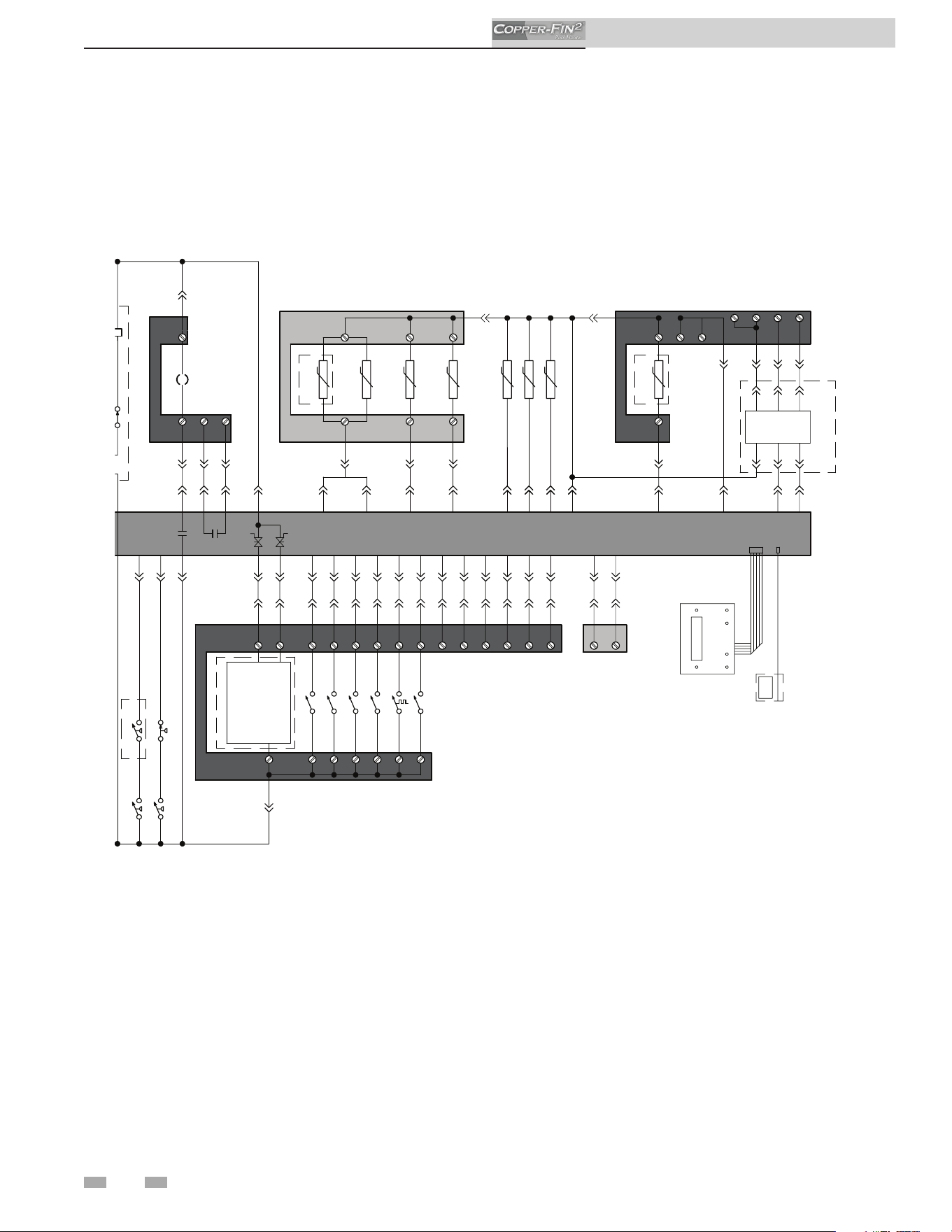
68
Installation & Operation Manual
10 Ladder diagram
LBL20083 REV B
WHERE POSSIBLE, SWITCHES ARE SHOWN WITHOUT UTILITIES (GAS,
WATER OR ELECTRICITY) CONNECTED TO THE UNIT. AS SUCH, ACTUAL
SWITCH STATES MAY VARY FROM THOSE SHOWN ON DIAGRAMS
DEPENDING UPON WHETHER UTILITIES ARE CONNECTED OR A FAULT
CONDITION IS PRESENT. SEE WIRING DIAGRAM FOR ADDITIONAL NOTES.
BLOWER
N
ON/OFF
SWITCH
F2
3.15A
BOX DEPICTS
OPTIONAL ITEMS
120 VAC
LOW VOLTAGE
TERMINAL
STRIP
BLOWER
RELAY
HI/LO SPEED
RELAY
HI/LO SPEED
RELAY
HIGH
SPEED
LOW
SPEED
GL
N
UNIT PUMP
RELAY
X1
-6
F4
5A
BLOWER RELAY
8-1X8-1X8-1X
HI/LO SPEED RELAY
X2-4
X1-2
UNIT PUMP RELAY
X1-1
X1-4
TERMINAL
STRIP
TERMINAL
STRIP
SYSTEM /
RECIRC
PUMP RELAY
DHW PUMP
RELAY
(BOILER)
CHASSIS
X1-7
X2-1
X1-10
X2-2
X1-3
F5
5A
F6
5A
STAGE 1 HSI
STAGE 3 HSI
X1-12
X1-2
X1-3
X1-1
MODBUS INTERFACE BOARD
CIRCUIT BREAKER OR FUSE
CN5-11X6-1 X6-13 CN5-5
LOUVER RELAY
CN4-5X3-1
CN4-6X3-2
CONNECTION BOARD 1
X6-7CN5-1
RUNTIME
CONTACTS
X6-16CN5-7
X6-2CN5-8
X13-1CN5-9
X6-6CN5-3
X6-15CN5-10
X6-11CN5-12
X6-14CN5-4
X8-5CN6-4
X6-10
X8-15CN6-9
X7-8CN6-5
X7-4CN6-10
X8-7CN6-7
X8-17CN6-3
X8-6CN1-7
3 WAY VALVE
CONNECTION BOARD 1
STAGE 1 / ENABLE
STAGE 2
STAGE 3
STAGE 4
TANK TSTAT
LOUVER PROVING
OPEN
24V COM
CLOSE
+
-
+
-
A
B
0-10V
RATE
OUTPUT
CASCADE
0-10V
BMS
INPUT
CN5-6
X8-19
CN1-5X8-14
CN1-6X8-13
CN1-2
OUTDOOR
SENSOR S5
2ND POOL
SUPPLY
SENSOR S8
SYSTEM / POOL
SUPPLY
SENSOR S6
SYSTEM / POOL
RETURN
SENSOR S7
CONNECTION BOARD 2
X8-3
X4-3
X4-1X8-10
X4-2
X8-20
CN1-1X6-3
CN1-3X6-1
CN1-2X6-2
X8-11
BOILER
POOL
A
B
SHIELD
MODBUS
RTU
MODBUS
INTERFACE
BOARD
DISPLAY BOARD
COMPUTER
X4
X11
CN4-1
CN4-4
CONNECTION
BOARD 1
1
2
TRANSFORMER
INTERGRATED CONTROL BOARD
X10-1
X12-1
X10-2
X10-3
X12-2
X12-3
STAGE 1 GAS VALVE
STAGE 2 GAS VALVE
STAGE 3 GAS VALVE
STAGE 4 GAS VALVE
X10-5
X10-6
X12-5
X10-4
X12-4
MANUAL RESET
HIGH LIMIT
X6-4
X12-6
CIRCUIT BREAKER
INTERGRATED
CONTROL
BOARD
TRANSFORMER
PROBE
(
(
(
(
(
J3-6
J3-5
TEST
RESET
J2
-1
J2
-2
LOW WATER
CUTOFF
AIR PRESSURE
LOW GAS PRESS
HIGH GAS
PRESS SWITCH
J3-2
J3-4
J3-3
X6-3
X6-12
X6-5
X3-3
X3-4
SILENCE
ALARM
ALARM RELAY
INLET SENSOR S2
X8-2
OUTLET SENSOR S1
X8-8
2ND OUTLET SENSOR S9
X8-1
X8-16CN1-8
+
-
SYSTEM PUMP
SPEED INPUT
CN1
-1
TANK
SENSOR S4
X8-12 CN6-6
CASCADE
SHIELD
CN6
-1
CONNECTION BOARD 1
CONNECTION BOARD 2
ALARM
CONTACTS
BLOCKED FLUE
FLOW SWITCH
X8-18 CN6-8
J2-3
10K
20K

69
Notes

70
Notes

71
Notes

Revision Notes: Revision A (ECO #C08226) initial release.
Revision B (ECO #C08423) reflects updates made to images and text
as a result of questions/requests from the field.
Revision C (ECO C08857) reflects the update of FIG.'s 4-3 through 4-7
on pages 36 - 38 to encourage the use of Copper or CPVC piping in
illustrated concepts.
Revision D (ECO C09601) reflects the update of Table 4B on page 35.
Revision E (ECO C12077) reflects the update of heat exchanger text
on page 35 and the addition of a notice regarding flow requirements to
piping diagrams on pages 36 - 38.
Revision F (ECO C12515) reflects updates made to FIG. 4-5 and 4-6 on
page 37 per ECR R06020.
Revision G (ECO C13155) reflects updates made to FIG. 4-8 on page
39 and Table 5A on page 41 per ECR R06361.
Revision H (ECO C14497) reflects changes made to Table 3D - Gas
Piping Chart on page 33 (R06621), the update of kit numbers in Table
2D on page 25 (R06853) and the removal of pump sizing information
from page 34 (R06514).
Revision I (ECO C16994) reflects a change in 3-way valve information
on pages 39, 41, 44 and an update of wiring diagrams on pages 62 - 65.
Revision K (CN# 500000696) reflects the update of FIG. 4-8 on page
39.
Revision L (PCP# 3000000249 / CN# 500000347) reflects an update
to the piping diagrams as well as the addition of Table 4C on page 35.
SAP part numbers have been updated.
Revision M (PCP# 3000003954 / CN# 500004068) reflects an update to
the common pipe diameters in Table 4A on page 34.
Revision N (PCP# 3000005238 / CN# 500005983) reflects a correction
to Figure 4-8 on page 39.
Revision P (PCP# 3000007653 / CN# 500007558) reflects the addition
of new venting category information on pages 30 through 32.
Revision R (PCP #3000024417 / CN #500014344) reflects an update to
Table 4A on page 41.
Revision T (PCP #3000031557 / CN #500020650) reflects an update
to Figure 4-8.
Revision U (PCP #3000039246 / CN #500027333) reflects an update
to table 2B.
Revision V (PCP #3000042140 / CN #500030042) reflects an update to
the optional outdoor kit information on pages 14 and 33.
Revision W (PCP #3000043822 / CN #500031533) reflects the addition
of the vertical Directaire kits for the 1802 and 2072 models.
Revision X (PCP #3000044690 / CN #500032479) reflects a general
update to 2021 water heater standards.
Revision Y (PCP #3000047058 / CN #500034438) reflects updates to
the CSA/ANSI standards on page 9.
Revision AA (PCP #3000049821 / #500036880) reflects the addition of
the Recommended Pool Chemistry Levels table on page 48.
Revision AB (PCP #3000051769 / CN #500038677) reflects changes to
table 2H on page 33.
Revision AC (PCP #3000053032 / CN#500039781) reflects updates to
Figure 1-1 and Figure 3-1.
Revision AD (PCP #3000053364 / CN #500039997) reflects updates to
pages 37 and 45.
Revision AE (PCP #3000055221 / CN #500041673) reflects an update
to the automatic bypass wiring colors.
100160928_2000001946_Rev AE
03/23