1
American Dish Service
INSTALLATION INSTRUCTIONS
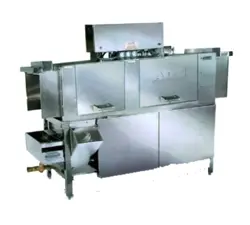
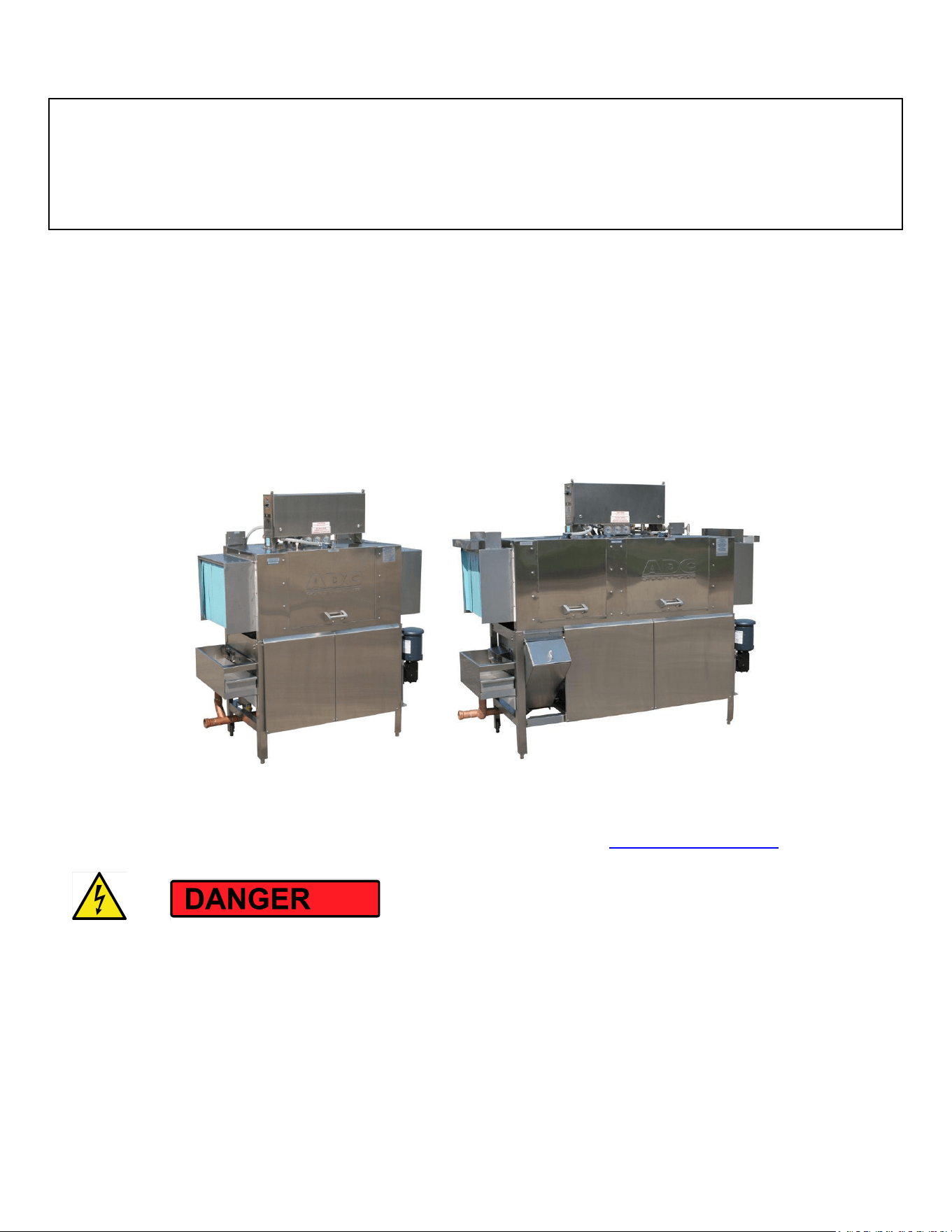
Model ADC-44 or ADC-66
208/240v, 3-ph, 60a or 90a for 66
High Temp or Chemical Sanitizer Conveyor Dishmachines
Listed by UL #E68594, NSF/ANSI 3, ASSE 1004 #301, LA Test Labs File M-780089, Mass. License P3-0111-306
If you have questions, call 800-922-2178 or visit our website at www.AmericanDish.com
The electrical power supplied to this machine is an imminent hazard that could result in severe bodily injury
or death if not properly installed or hooked up correctly. When working in the control box or on electrical
parts, always disconnect power and tag-out before servicing. Replace cover to control box and other
protective covers when finished servicing this equipment.
Copyright ADS Install Manual, ADC-44/66, 3-ph, Rev 4.0, 4/28/2021

2
READ Manufacturer’s Manual before Using this Product. For your safety read and observe all cautions
shown throughout these instructions. While performing installations described in this booklet, wear
approved Personal Protective Equipment, including Safety Eye-Wear.
There are potentially hazardous situations when working with industrial cleaning chemicals for
dishmachines. See chemical manufacturer’s MSDS sheets and safe practices for handling and installing
chemical feeders and supply containers.
WARNING: Cancer and Reproductive Harm – www.P65Warnings.ca.gov
#1 BEFORE YOU BEGIN— American Dish Service provides this information as a service to our customers.
Keep all instructions for future reference. ADS reserves the right to alter or update this information at any
time. Should you desire to make sure that you have the most up-to-date information, we would direct you
to the appropriate document on our web site: www.americandish.com. Set out below are the specifications
and requirements that you must use and follow to properly install the type or types of equipment listed
above. It is your obligation as the customer to ensure that the machine is installed safely and properly, and
when completed, the machine is left in proper and safe working order. Electrical, Plumbing, and Chemical
hookup should be performed by a qualified professional who will ensure that the equipment is installed in
accordance with all applicable Codes, Ordinances, and Safety requirements. Failure to follow the
installation instructions could void the warranty. ADS assumes no liability or control over the installation of
the equipment. Product failure due to improper installation is not covered under the ADS Warranty.
#2 HEAVY USE ITEM— A conveyor dishmachine is often run at full capacity. The machine is not rated for
outdoor use.
#3 FLUSH OUT INITIAL FILL WATER— Do not install spray arms until machine is flushed with water. When this
machine is connected to power, it will normally fill with water . Do this without installing the spray arms.
Place a rack inside the machine so all the pumps will run. Afterward, drain all the water from the tanks,
install all spray arms, and refill the machine. To drain, pull the pump filter out of the sump and the stand
tube from the rinse tank (for the 66, also pull the large scrap basket from the power scrapper tank).
#4 CLEARANCES—Dishmachines must be installed to allow for servicing of motors and conveyor systems.
Do not install chemical dispensers on the top of the control box, machine, or booster.
Copyright ADS Install Manual, ADC-44/66, 3-ph, Rev 4.0, 4/28/2021

3
#5 WATER HEATERS—or boilers must provide the minimum temperature of 120F degrees required by the
machines listed above, which have a minimum hourly demand of 120 gallons per hour. For HOT WATER
SANITIZING, a booster heater must be installed to achieve the 180F minimum for the final rinse. This
booster will require a rise of 70-degrees. These specifications are for the dishmachine only, which typically
accounts for 70% of a restaurant’s hot water demand.
#6 INSPECT FOR DAMAGE—If you receive a damaged dishmachine, do not sign “Clear” but write
“Damaged” on the documents.
#7 TABLES— are critical to proper dishmachine operation. No table drains (quick drains) or sinks within 20”
of the dishmachine on soil table. No sinks or drains on clean tables. Slant tables toward the machine and
anchor to the machine lip with the four ¼” bolts supplied. Table lip must not rub on the conveyor bar. If
needed, cut out a half-round in the table lip for clearance of the conveyor bar. Tray tracks are not adjustable
up or down because of the switch activators. Fasten tables to the machine so they are level with the tray
track. Curves or “bands” on clean table seldom work correctly, we recommend using ADS table limit switch
(kit 288-1044) for short exit tables.
#8 REQUIRED by NSF — This machine must be operated with an automatic detergent feeder and, if
applicable, an automatic chemical sanitizer feeder, including a visual means to verify that detergents and
sanitizers are delivered or a visual or audible alarm to signal if detergents and sanitizers are not available for
delivery to the respective washing and sanitizing systems. Please see instruction for electrical and plumbing
connections located in this manual and in the feeder equipment manual.
ELECTRICAL SECTION
The electrical power supplied to this machine is an imminent hazard that could result in severe bodily
injury or death if not properly installed or hooked up correctly
#1 Before powering up the machine, CHECK ALL ELECTRICAL SCREW TERMINALS in the control box on top of
the machine, power box, and both heater boxes located under the tanks. Screws can loosen in transit.
Loose connections on high amp load terminals will cause wire burning and component damage during
operation and will not be covered under ADS warranty. The term “Clean Circuit” means the electrical circuit
breaker supplies no other devices, motors, machines, or lights.
#2 ADS Conveyor models DO NOT INCLUDE an internal booster heater. Boosters must be installed
separately, ADS recommends a 27 kW for 155 GPH at a 70-degree rise.
Copyright ADS Install Manual, ADC-44/66, 3-ph, Rev 4.0, 4/28/2021
4
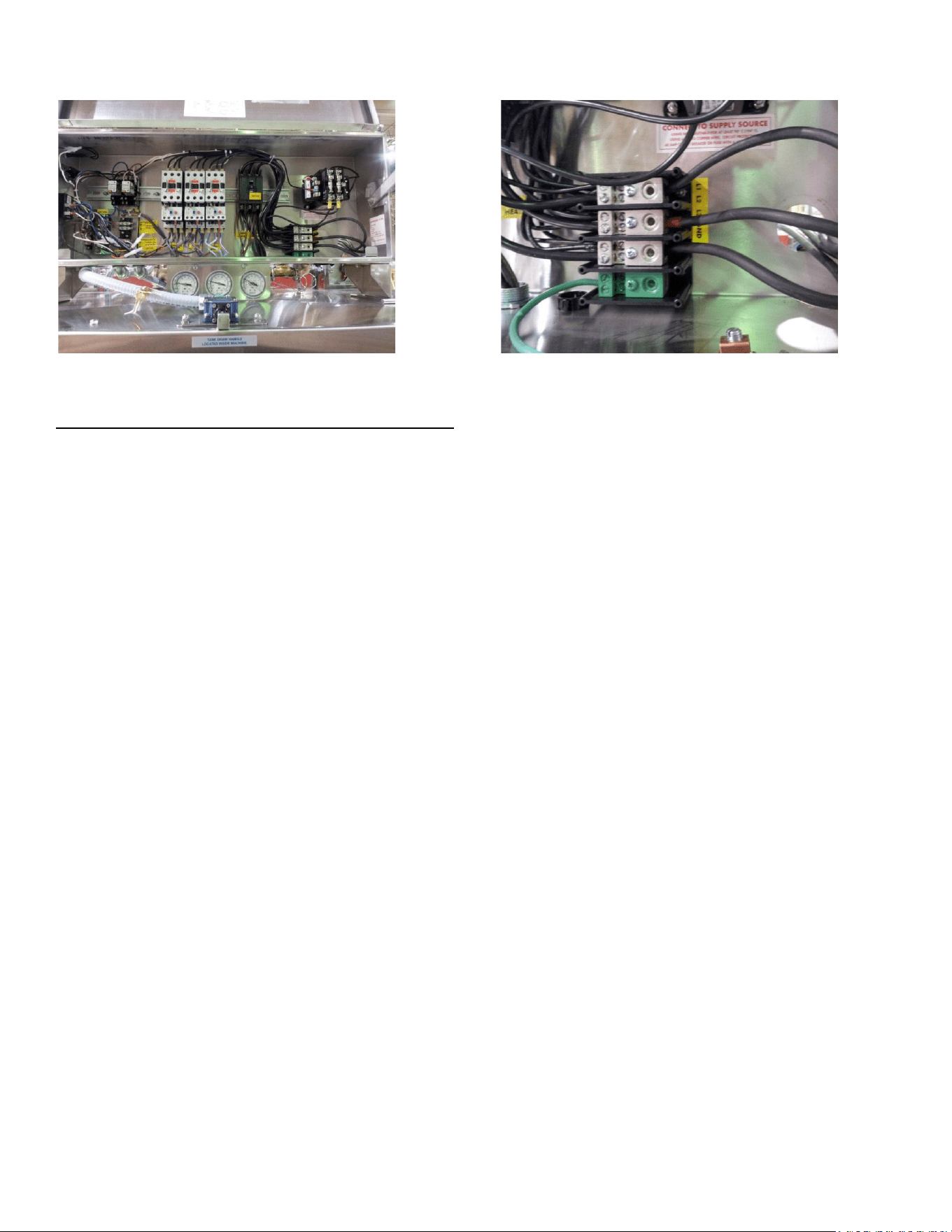
ADC-44 conveyor control box for 3-phase power Main distribution block for 44’s incoming 3-phase
Electrical ADC-44, 208v/240v, 3-ph, 60a
ORDERING INSTRUCTIONS—Machines with heaters are voltage specific, order according to actual voltage at
the installation (see kW chart in appendix)
The power supply of 208 volts, 60 amps must consist of three 6-gauge wires and a suitable ground. The 60
amp breaker or fuses must be on a clean circuit to the machine. ADS has provided a conduit hole (1 3/8”actual
size) for 1” conduit for the electrical service into the back of the control box. Attach the 6-gauge wires to the
main distribution block in the control box to terminals marked L1, L2, & L3. Attach a building ground wire to
the main distribution block marked GND and tighten all wires.
FOR 240 VOLT OR DELTA SYSTEMS—attach the high leg (200 volt line) to L3. Attach your 120 volt lines to L1
and L2. If power is 240v, see kW rating chart at the back of the manual for correct heater sizing and available
ADS heater elements.
3-Phase MOTOR ROTATION—Remove front panels and check rotation of motors. A rotational arrow is placed
on the wash pump motor. If this motor is running in reverse of the arrow, turn off main power and switch the
incoming power wires on L1 & L2. This step will correct the rotation of the other motors at the same time.
Verify proper rotation and tighten all wires.
Copyright ADS Install Manual, ADC-44/66, 3-ph, Rev 4.0, 4/28/2021
5
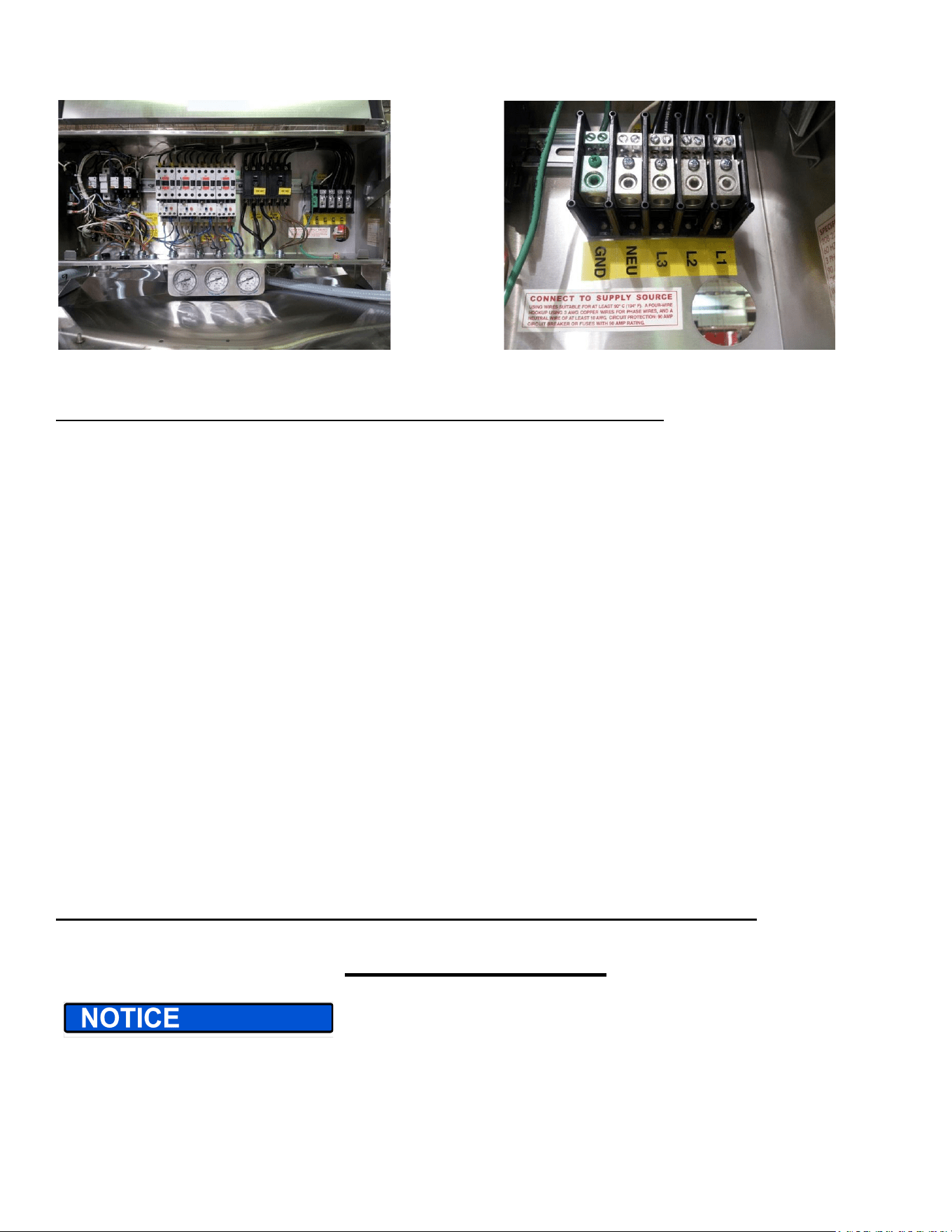
ADC-66 conveyor control box for 3-phase power Main distribution block for 66’s incoming 3-ph, note Neutral
Electrical ADC-66, 208v/240v, 3-ph, 90a, w/10-gauge neutral
ORDERING INSTRUCTIONS—Machines with heaters are voltage specific, order according to actual voltage at
the installation (see kW chart in appendix)
The power supply (208 volt, 90 amps) must consist of three 3-gauge wires, a 10-gauge neutral, and a suitable
ground. The 90 amp breaker or fuses must be on a clean circuit to the machine. ADS has provided a conduit
hole (1 3/4”actual size) for 1 1/4” conduit for electrical service in the back of the control box. Attach the
3-gauge wires to the main distribution block in the control box, to terminals marked L1, L2, & L3. Attach
10-gauge neutral and ground wire to their proper locations on the main distribution block and tighten all
wires.
FOR 240 VOLT OR DELTA SYSTEMS— attach the high leg (200 volt line) to L3. Attach your 120 volt lines to L1
and L2. If power is 240v, see kW rating chart at the back of the manual for correct heater sizing and available
ADS heater elements.
3-Phase MOTOR ROTATION—Remove front panels and check rotation of motors. A rotational arrow is placed
on the wash pump motor. If this motor is running in reverse of the arrow, turn off main power and switch the
incoming power wires on L1 & L2. This step will correct the rotation of the other motors at the same time.
Verify proper rotation and tighten all wires.
IT IS RECOMMENDED THAT THIS EQUIPMENT BE INSTALLED USING A NEW CIRCUIT BREAKER.
PLUMBING SECTION
#1 TANKLESS WATER HEATERS can be problematic for commercial dishmachines. The ADS models ADC-44/66
dishmachines require heated water 120 gallons per hour at 20 psi as measured at the final rinse manifold,
with a minimum temperature of 120F. It has been the experience of ADS that tankless supply systems
Copyright ADS Install Manual, ADC-44/66, 3-ph, Rev 4.0, 4/28/2021
6
require multiple units plumbed in sequence with a recirculation loop to achieve proper pressure and
temperature.
Check with the tankless water heater manufacturer, they may recommend a storage tank to guarantee
proper flow and line pressure to the machine. Failure to provide adequate water quantity, pressure and
temperature to the machine will cause the machine to function improperly and is not the responsibility of
ADS. Improperly installing ADS equipment in this manner could void the warranty. All costs associated with
providing an adequate water supply to the machine is the sole responsibility of the user.
#2 DRAIN SIZE—Gravity drain lines are 2” pipe size. Do not use reducing adapters for drain lines, always use
same diameter pipe or larger. Close pump petcocks if equipped.
#3 A PRESSURE REDUCING valve with by-pass should be installed before the booster heater if the line
pressure is 50 psi or above. This is according to booster manufacturer’s instructions.
#4 BURN HAZARD from hot water from pump sprays or plumbing leaks.
#5 ELECTRICAL SHOCK HAZARD on bare electrical terminals in the thermostat boxes, power box, float
switch boxes, and control box.
#6 HOODS—Follow all local plumbing and mechanical codes. IMC 2012, section 507.2.2 requires Type II hoods for all
commercial dishwashers except where the heat and moisture loads are incorporated into the building’s HVAC systems or
dishwashing equipment designed with separate heat and moisture removal systems. A conveyor-type, hot-water sanitizing
dishwasher is rated at 21,720 Btu/h by table 5E, ASHRAE Research Project #1362, 8/5/2008.
ADS DOES NOT SPECIFY BUILDING HVAC VALUES
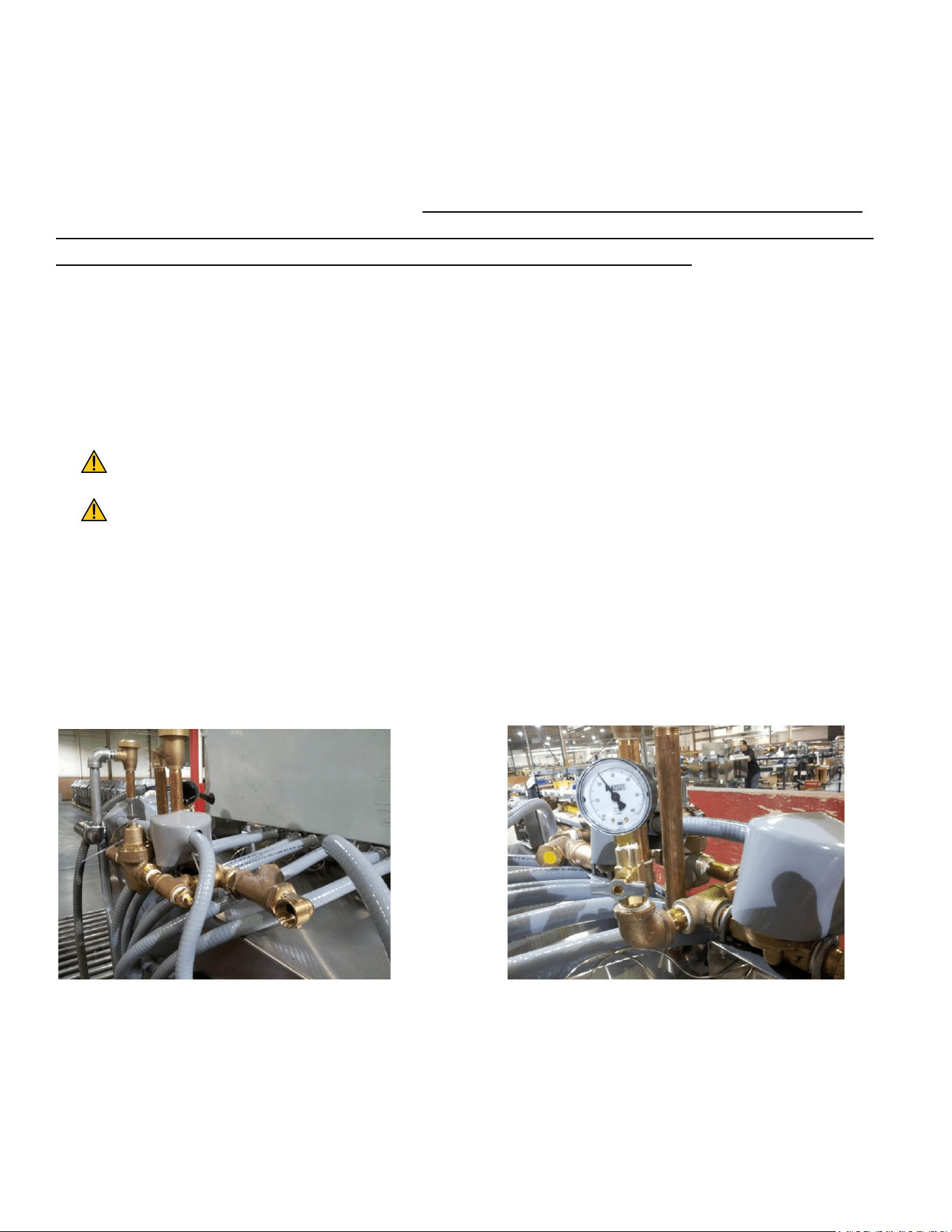
Hot water inlet manifold, single point ¾” pipe, PR valve Final rinse manifold with pressure gauge, 20 psi flow req.
Flush building’s water lines before connecting to dishmachine.
Copyright ADS Install Manual, ADC-44/66, 3-ph, Rev 4.0, 4/28/2021
7
DUAL SANITIZING MODE
Hot Water Sanitizer Connection
For high temp sanitizing this line will come from a stand-alone booster heater. Connect ¾” MPT water supply
line to the 90-degree elbow of the dishmachine’s inlet manifold. The requirement at the dishmachine is 180 F
minimum at 20 PSI during final rinse flow, 120 GPH. This is measured at the pressure gauge mounted next to
the pressure reducing valve in the inlet plumbing on top of the machine’s hood. To adjust pressure, turn
adjustment screw atop the valve counter-clockwise to decrease pressure.
Chemical Sanitizer Connection
For chemical sanitizing this line will come directly from the building’s water heater. Connect ¾” MPT water
supply line to the 90-degree elbow of the dishmachine’s inlet manifold. The requirement at the dishmachine is
120 F minimum at 20 PSI during final rinse flow, 120 GPH. This is measured at the pressure gauge mounted
next to the pressure reducing valve in the inlet plumbing on top of the machine’s hood. To adjust pressure,
turn adjustment screw atop the valve counter-clockwise to decrease pressure. A dispenser with three product
pumps is required for chemical sanitizing (chlorine pump)
Drain Requirements
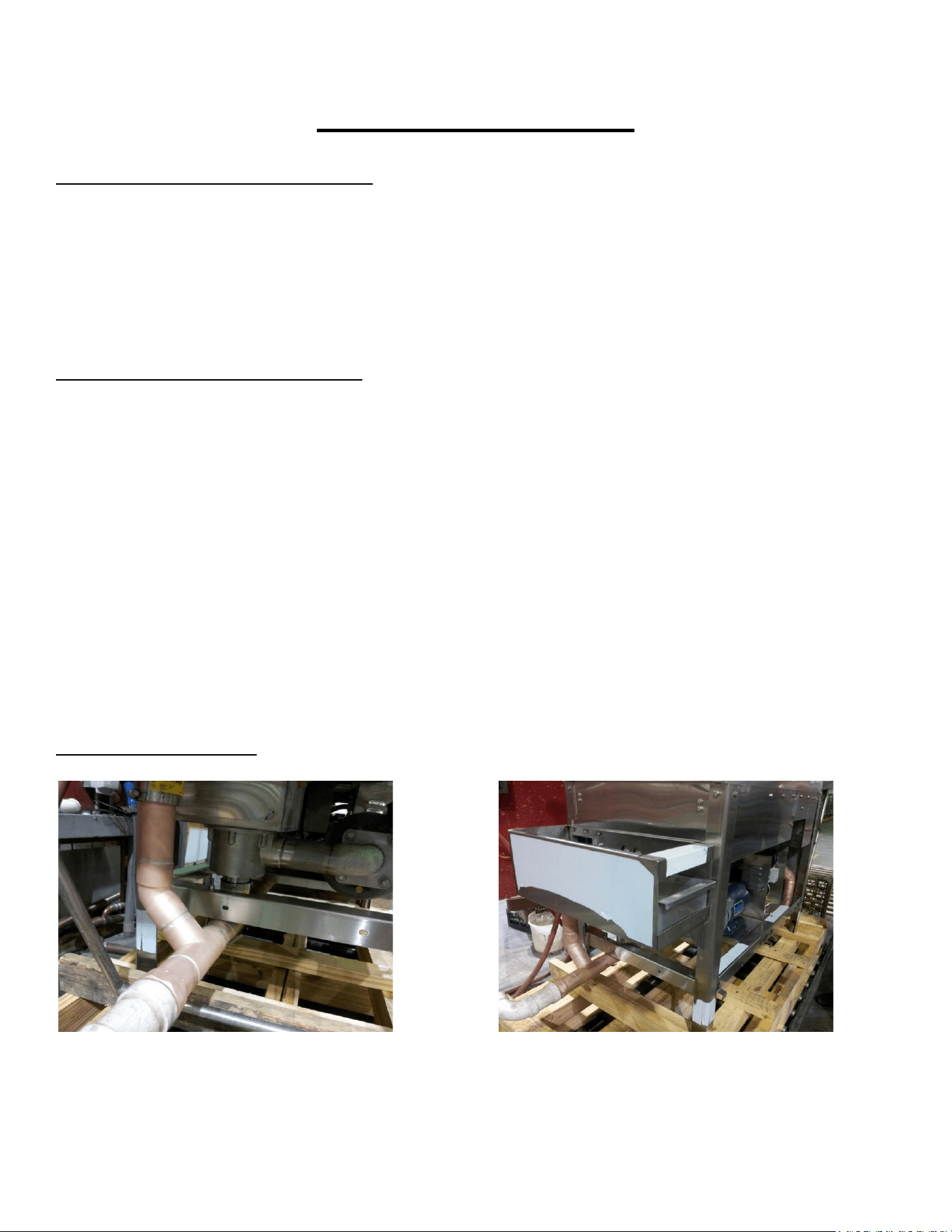
Showing 2” drain manifold exiting sump & scrap box Scrap box and tray
ADS provides a 2” copper common drain that exits on the soil side of the dishmachine under the scrap box
(ADC-66 drain exits both sides). To prevent clogging, run drain lines as straight as possible. Do not plumb with
Copyright ADS Install Manual, ADC-44/66, 3-ph, Rev 4.0, 4/28/2021
8
tight radius elbows or 180-degree bends. Use of floor sinks for drains can cause flooding. Do not use reducing
adapters for drain lines, always use 2” diameter pipe or larger. Always run gravity drain lines downhill.
DISPENSER HOOK-UP SECTION
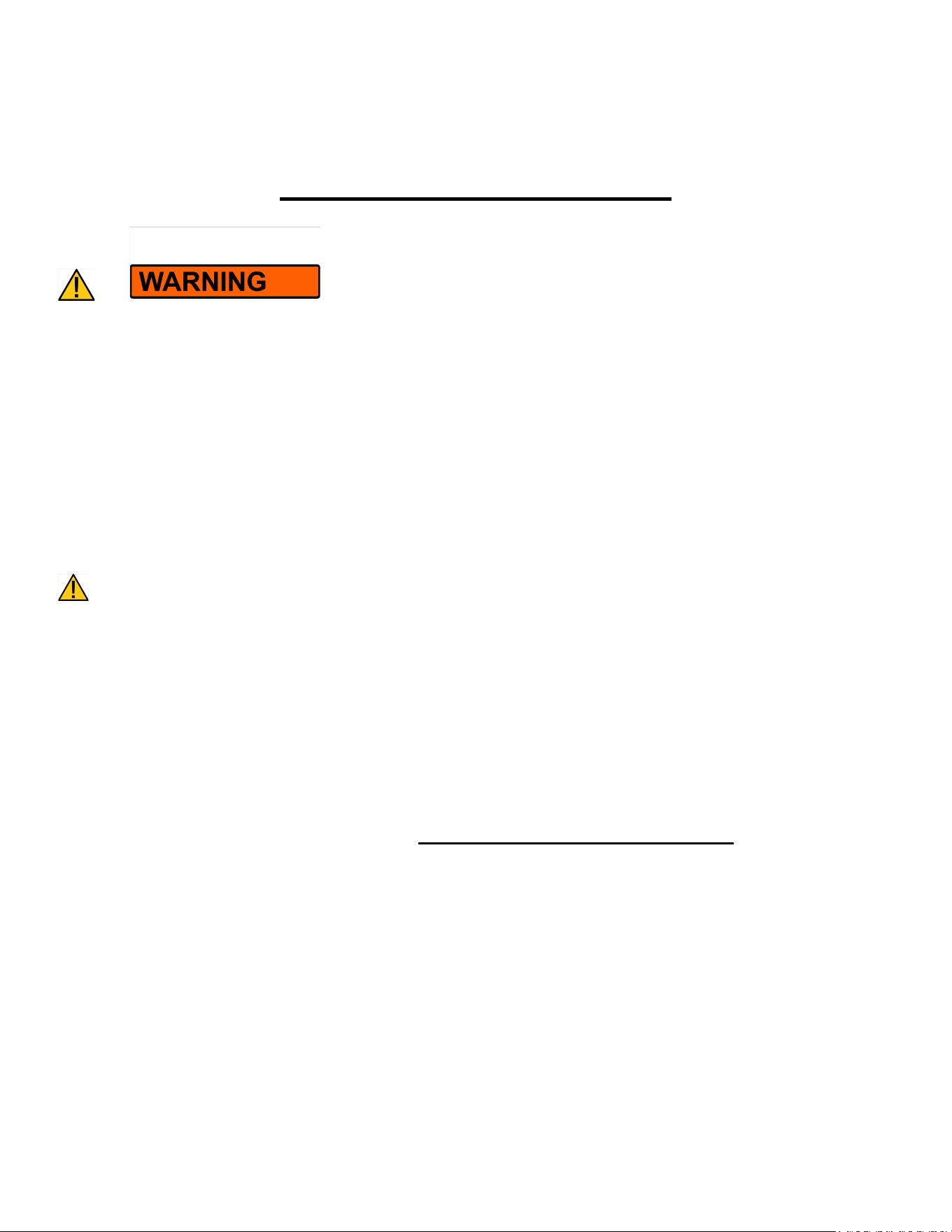
You must wear approved safety eye-wear before connecting chemical equipment. Commercial cleaning
chemicals are harmful and can cause damage to the plumbing and stainless steel of the dishmachine. Do
not mount dispensers on the control box or run chemical lines over controls or plumbing. Always secure
chemical lines and check regularly for leaks. If not properly handled, chemicals can cause serious bodily
injury. In the event of chemical contact to skin or eyes; wash immediately with fresh water and seek
medical attention.
There is NO CHEMICAL DISPENSER included with this model. Chemical dispensers must be provided and
installed prior to operation. The installation of the dispenser is typically provided by the chemical supplier.
CONTAINERS: When a chemical delivery system is connected to the ADS conveyor dishmachine using 5-gallon
pails for industrial ware-washing chemical products these must be equipped with Closed Loop containers.
Always use chemical resistant safety gloves and safety goggles (indirect- vented or non-vented) when changing
chemical buckets. Immediately report spills and refer to your chemical suppliers SDS safety data sheet or
MSDS material safety data sheet for information if chemical come in contact with skin or eyes.
Any modifications to the chemical delivery system for smaller containers must include Closed Loop Chemical
Containers (spill proof bottles) in a secured racking system. It is the responsibility of the user of the machine
to purchase chemicals in spill proof containers. FAILURE CAN RESULT IN SERIOUS INJURY. Never place
chemicals in open containers or containers that can be easily tipped over when moving or changing product.
Failure to do so is a safety hazard and will also void the ADS warranty.
Copyright ADS Install Manual, ADC-44/66, 3-ph, Rev 4.0, 4/28/2021
9
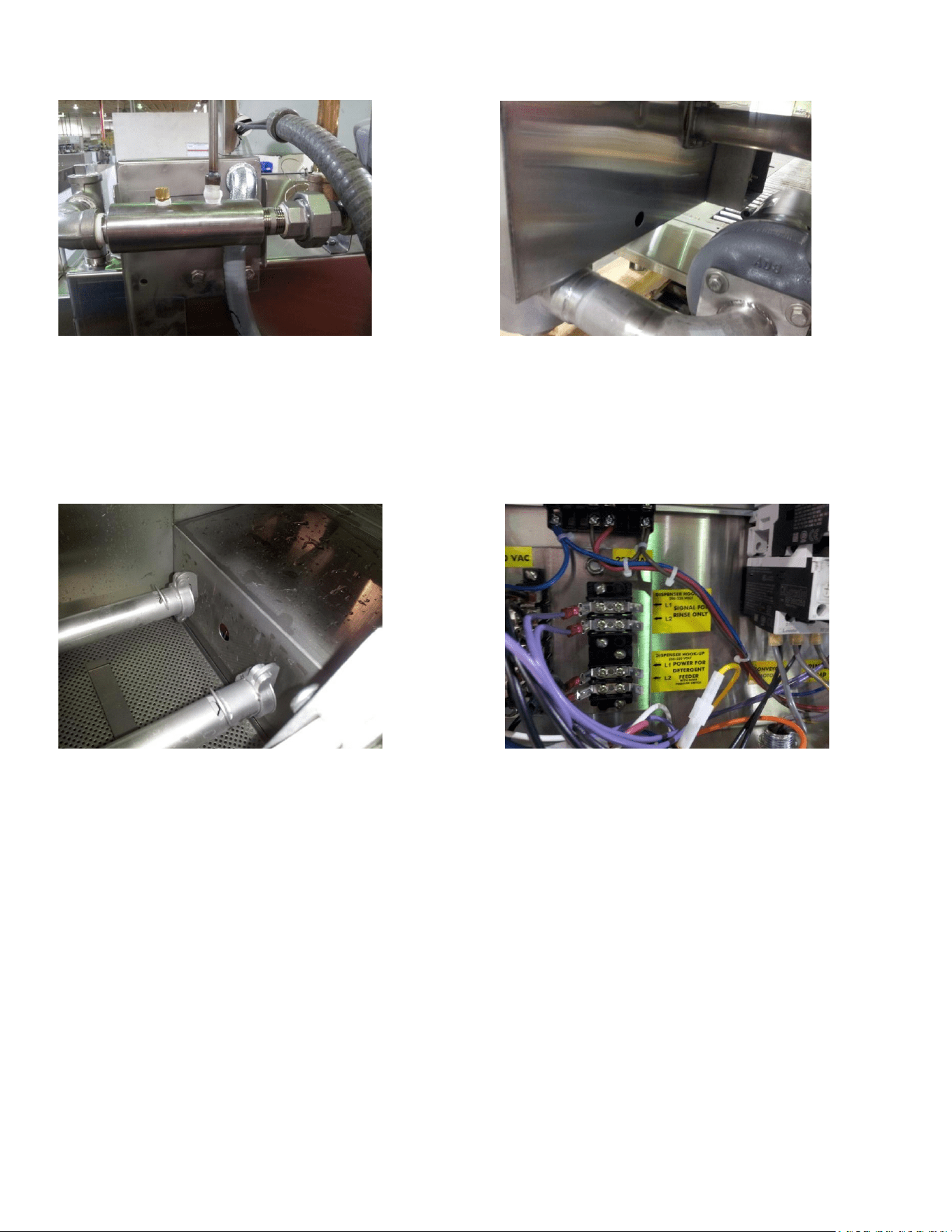
Mixing chamber with two 1/8” pipe threaded ports Showing 7/8” detergent probe hole behind pump motor
Hi-temp mixing chamber is SS, Chemical is a polymer
ADS provides two (2) ports, 1/8” IPS female threads in the final rinse mixing chamber for dispenser check
valves. Probe hole (7/8”) is provided in the wash tank for probe installations (install probe before operating
the machine). Detergent hole (7/8”) is provided for bulk-head fitting (install fitting before operating machine).
Showing hole at the side of tank, 7/8” detergent fitting Dispenser signal connection terminals in control box
NOTE: Before turning on the water, if the chemical dispenser has not been installed, plug the probe and
chemical delivery holes in the wash tank and plug the mixing chamber injection ports.
ADC-44, 3-phase provides 240v dispenser signals (transformer control voltage).
ADC-66, 3-phase provides 120v dispenser signals.
Connect to chemical dispenser terminal blocks located on the left-hand side of the control box, look for yellow
decal labeled detergent and rinse
TESTING FOR TEMPERATURE—For high temp sanitizing, the measurement is taken at the manifold for a
minimum of 180F, NOT in or at the sprays. If color changing tapes are used to verify temperature, then only
160-165F labels should be used, this is the highest temperature required on the surface of the plates--NOT
180F. This is according to the NSF/ANSI Standard 3 test protocol.
TYPE OF CHEMICALS—Use only commercial grade low-energy or high temp chemicals. For proper operation,
use non-foaming detergents and buffered sanitizer. Do not wash gold, pewter, silver, or silver-plate with
Copyright ADS Install Manual, ADC-44/66, 3-ph, Rev 4.0, 4/28/2021
10
chlorine based sanitizers. High concentrations of chlorine sanitizers and caustic detergents will cause damage
to metals and welds. Do not exceed 50 parts-per-million (PPM) “free” or available chlorine, using higher than
50 ppm will be dependent on local health requirements, however, the increased chlorine will result in higher
corrosion of metal parts. Purpose-built ware-washing dispensers are needed to properly meter chemicals for
wash and rinse. These dispensers are not included with this model but must be installed by the company that
provides the ware-washing chemicals. Manually adding industrial chemicals to the dishmachine is unsafe and
not approved.
HARD WATER—Water softeners should be used to correct hard water conditions. Treating hard water
conditions with highly acidic solutions in the machine is discouraged. Hard water conditions are often treated
with more expensive dishmachine chemicals, but it is more effective and less destructive to the metal when
the water is softened before it is used by the dishmachine.
CHECK LIST PRIOR TO INITIAL START UP
Open doors and remove all packaging, including cardboard supports under the wash tank heater. Do not
dispose of packing material until you remove spray arms and curtains. Packing materials contain the conveyor
installation manual, QC check sheets, curtains; upper and lower wash arms, pumped rinse arms, and power
scrapper arms for the ADC-66.
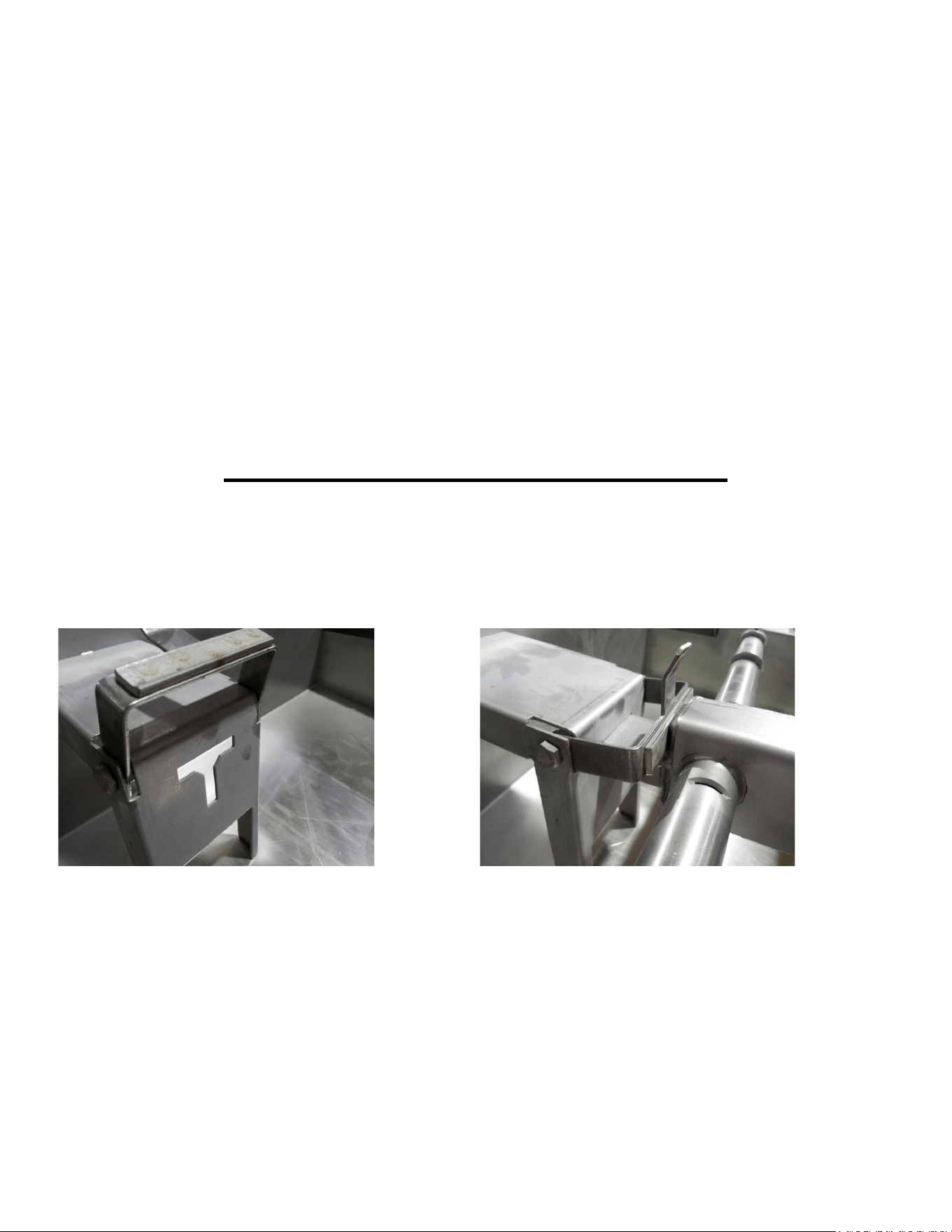
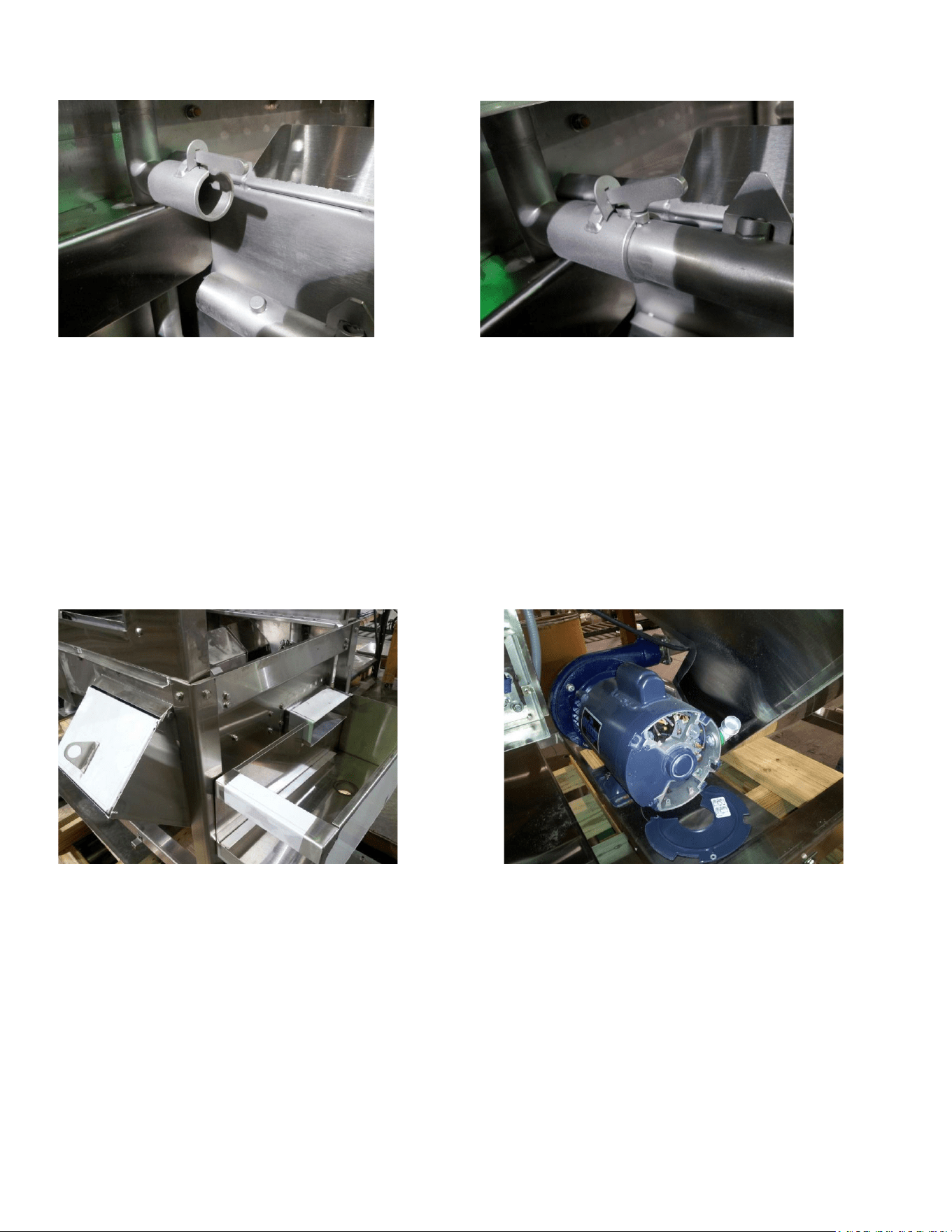
Showing wash arm T index for lower arm Arm resting in “T” index with latch down
Copyright ADS Install Manual, ADC-44/66, 3-ph, Rev 4.0, 4/28/2021
11
Showing pumped rinse manifold locking tab Rinse arm index notch, latch will drop as arm is pushed in
Install wash and pumped rinse spray arms. Lower wash arm has eight spray tubes and upper wash arm has
four. Install each by inserting indexed “T” end into bracket at front of tank, and then push the arm back until
the round socket is fully inserted on the wash manifold near the back wall. Position the “T” bracket latch to
secure wash arms in place by pulling down. Install power scrapper arms (ADC-66 only) and pumped rinse
spray arms. Each arm has a locking tab. Lower arm locking tabs are located on the same side as the spray jets.
Upper arm locking tabs are opposite the spray jets side. Insert the tab into the index slot of each manifold
socket until socket catch locks in place. Note: make sure that spray jets on the bottom arms spray up, and top
arms spray down.
ADC-66 power scrapper, overflow to scrap box 66 power scrapper motor, 1.5 HP, 208v, single-phase
Inspect all dish racks for broken ladders. Dispose of any broken dish racks.
IMPORTANT TABLE INSTRUCTIONS— Allow for one rack (20”) length as a minimum distance
between the edge of the pre-rinse sink and the entrance of the machine on the soil dish table. Failure to do
this will result in excessive chemical consumption and low machine temperatures. Do not use tables with
quick drains or scrap troughs. Observe that the dish table lip does not rub on the conveyor bar; if the lip is
longer than ¾” a notch will have to be made for clearance. Make certain that both dish tables slant into the
machine so water will return to the tanks. To avoid service calls and motor damage, bolt clean and soil tables
level to the machine’s tank lip and seal. New drill bits and ¼-20” bolts are included with each machine.
Copyright ADS Install Manual, ADC-44/66, 3-ph, Rev 4.0, 4/28/2021
12
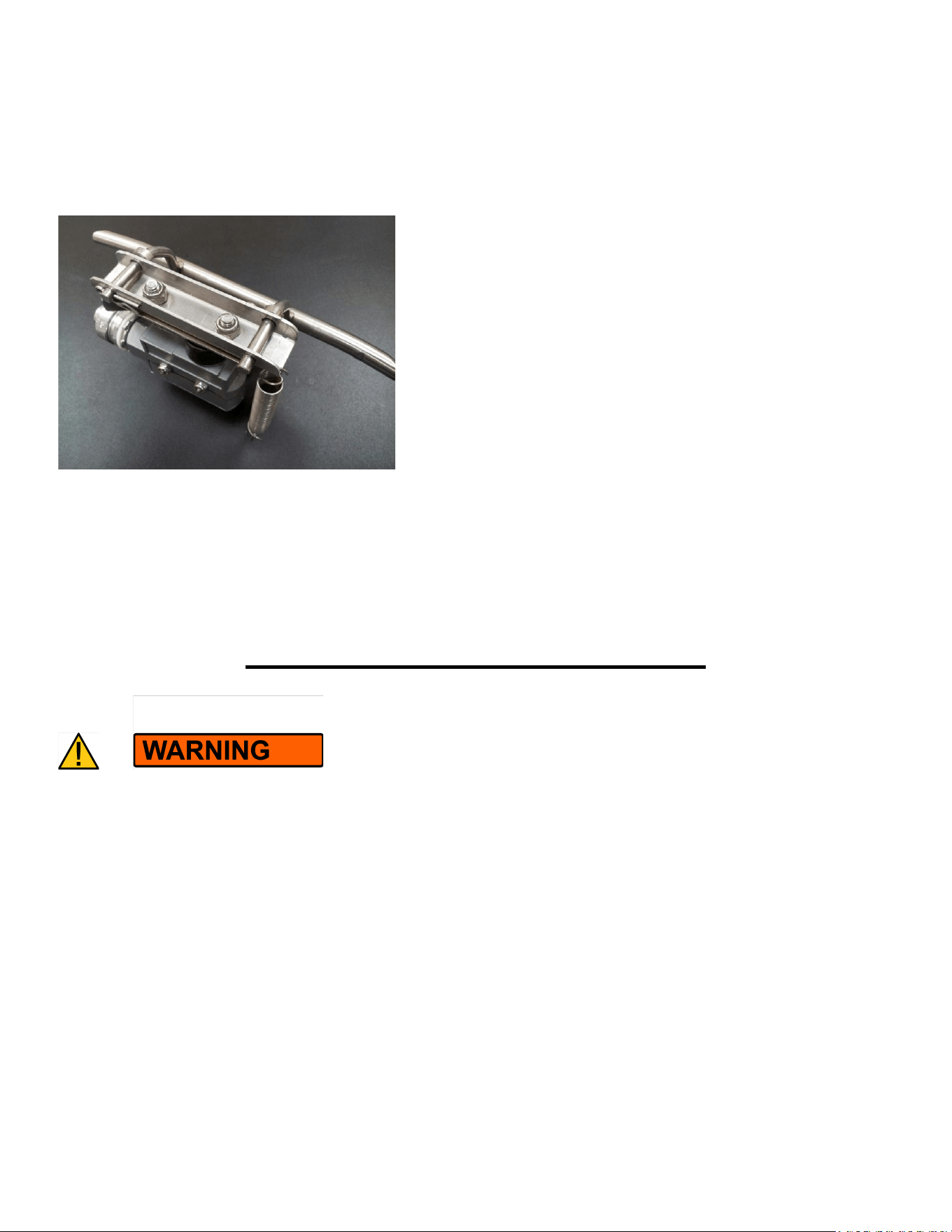
TABLE LIMIT SWITCH—Check clean dish table, if it holds less than four (4) dish racks, install an ADS table limit
switch (#288-1044). The switch holder attaches to the back side of the table end. The bumper bar will extend through
the table and pin to the rocker plate. When racks strike the bar, the switch will break the power connection in the
machine’s door cut-off switch, which stops all motors.
ADS table limit, and table bumper bar (#288-1044)
Tighten all wire connections looking for those that loosened during shipping or moving. Turn on the water
supply. Check and correct any leaks throughout the machine. Verify incoming water temperatures and final
rinse pressure (20 psi during spraying). Remove any of the white protective film from stainless surfaces such as
doors or panels.
DISHMACHINE OPERATIONAL TESTS
BURN HAZARD FROM HOT WATER. Do not open doors while machine
is in cycle. Doing so could result in serious bodily injury from spraying hot water and chemicals.
To operate, turn on the breaker for main power and turn the dishmachine master switch to the “ON” position.
Copyright ADS Install Manual, ADC-44/66, 3-ph, Rev 4.0, 4/28/2021
13
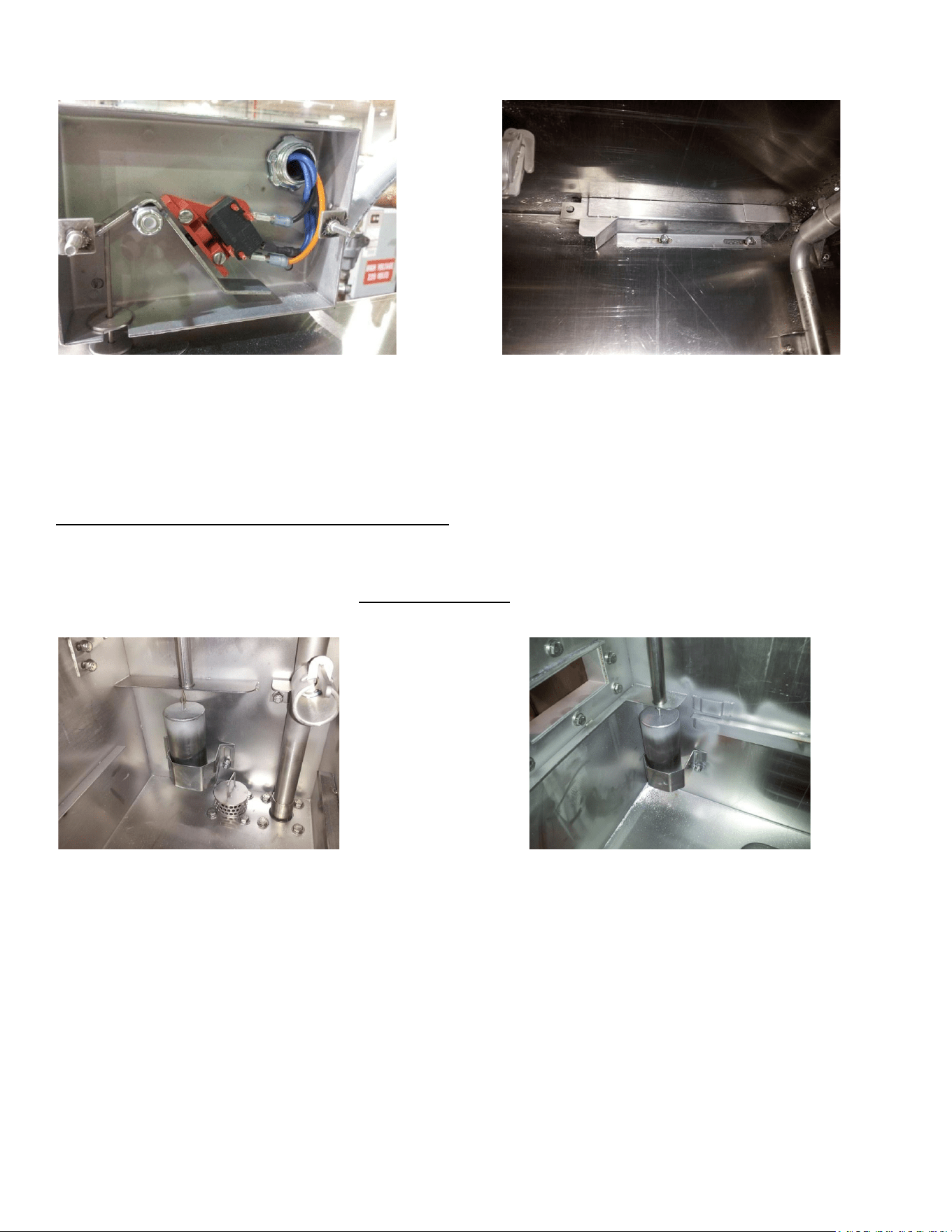
Showing “float” switch that controls fill water & heater Diverter plate separates fill stream for wash and rinse tank
FILLING THE MACHINE— When the machine is first turned on, water will automatically fill to an initial working
level. During operation the water level will normally increase with each rack until water begins to exit the
overflow into the scrap box. Open the access door and verify that the filling water is adjusted so the wash tank
fills first and rinse tank fills last. For the ADC-66 the wash tank must overflow to fill the power scrapper tank.
The last tank to fill should be the pumped rinse tank. If the fill sequence does not follow this order, adjust the
diverter plate inside the hood, it is located upward near the water inlet (see photo above). Slotted holes allow
the diverter plate to move side to side adjusting the flow to the rinse tank. The water stream going into the
pumped rinse tank should be about the diameter of a pencil. It is normal for the machine to add more water
when the pump turns on if the level has not yet reached the overflow.
Rinse tank float, pump filter, pumped rinse manifold Wash tank float and tank overflow
“FLOAT” AND SWITCH—the float will not actually float. It is heavier than water but it weighs less in water than
in air. This difference allows the return spring in the float switch to push out against the lever, which raises the
float in the water. In air the float’s weight will overcome the switch’s spring tension and drop down. The float
switch (#291-3014) is specifically made with this spring tension so the water control system will operate
correctly. Do not replace with a timer switch even though they look similar.
Copyright ADS Install Manual, ADC-44/66, 3-ph, Rev 4.0, 4/28/2021
14
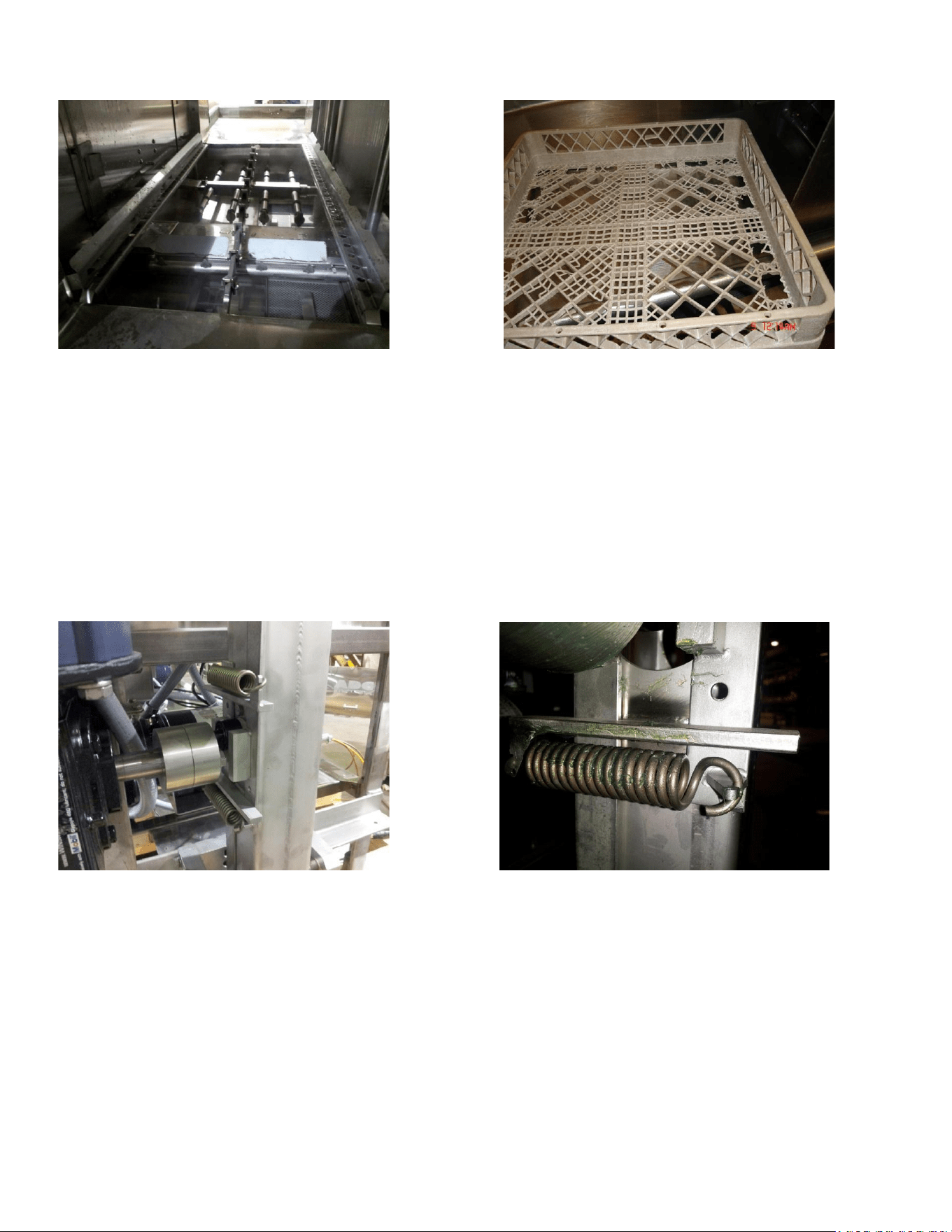
Travel through conveyor tray rails, center pull bar w/dogs Damaged and broken rack that will jam or skip conveyor
TEST DISH RACK CONVEYOR MOVEMENT by placing a rack into the soil side opening until it catches on a
conveyor dog. The rack should enter and exit smoothly without jamming. The dishmachine tray track will not
adjust up or down, it is fixed. Tables must sit on the tank lip. Verify that tables are bolted to the machine, and
once bolted, sealed with silicone caulking at all four corners and under the lip. Check that all varieties and
brands of dishrack can fit between the dishmachine’s tray track rails without binding. If binding occurs, adjust
the REAR tray track at all (3) anchor points until the rack binding is eliminated. You must adjust evenly at all
three points to maintain proper alignment. Never adjust the front tray track, they contain switching
alignments.
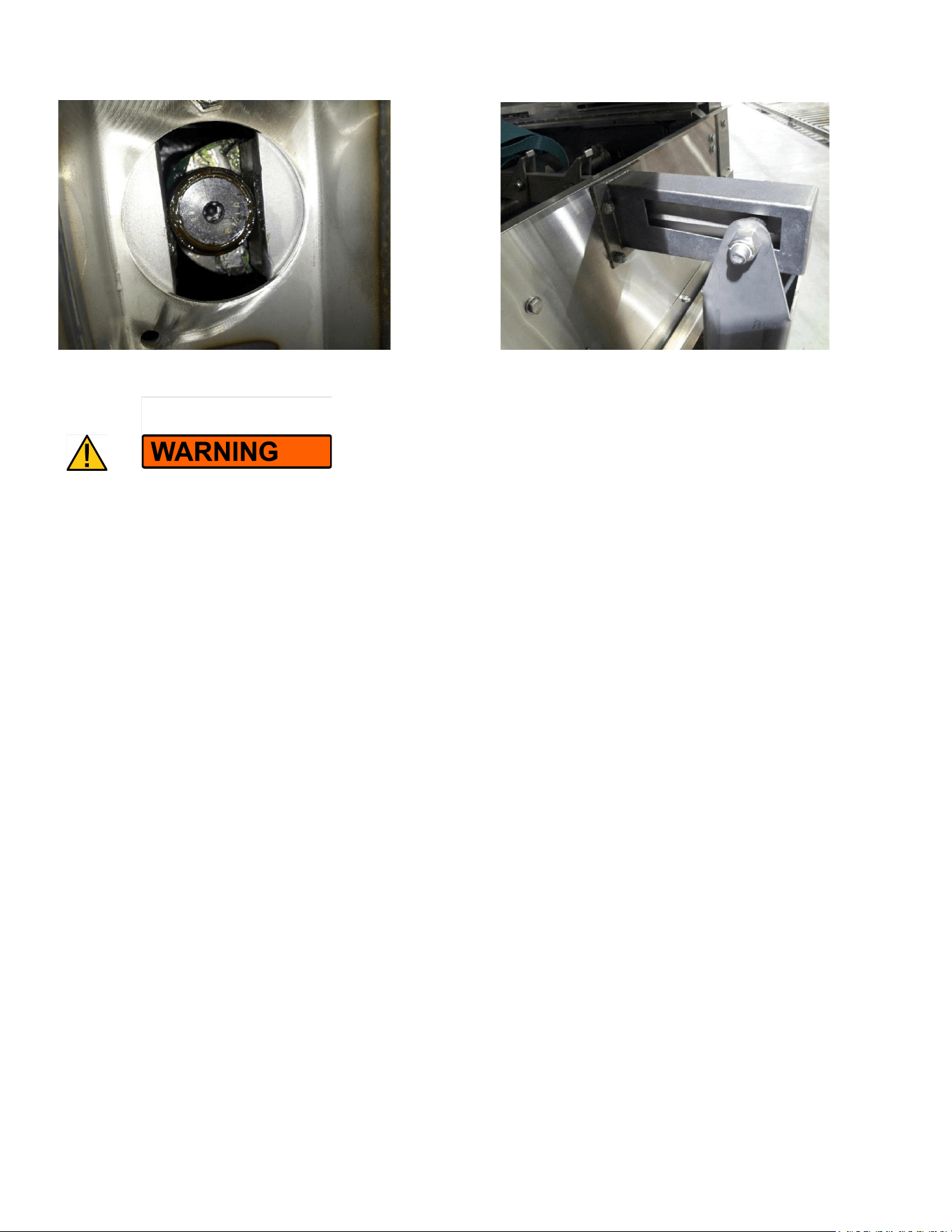
Conveyor cam blocks A & B Rocker arm slip clutch spring, hook to bar weldment
Copyright ADS Install Manual, ADC-44/66, 3-ph, Rev 4.0, 4/28/2021
15
Cam bearing screws into cam block B Rocker arm attached to conveyor bar, drip chute
Keep away from conveyor rocker arm movement to avoid severe bodily injury from pinch or crush danger
THE FRONT TRAY TRACK has sequence bars that turn on the pumps at each station of the dishmachine’s
operation. There is a sequence bar for the power scrapper (on the ADC-66 only), wash, and final rinse
sections. To confirm proper operation, push a dishrack into the soil side opening and see that it is conveyed
through each section without binding or stoppages.
POWER SCRAPPER (ADC-66 only) – Run one dishrack through the machine. Following initial fill, if there is an
air lock in the scrapper pump, this is normal. The pump will equalize after being operated once. The power
scrapper pump motor is the standard ADS single-phase 1.5HP motor wired for 208v instead of 115v. Make
certain replacement motors are first wired for high voltage (see diagram on motor).
WASH SECTION – Verify that the wash sequence bar starts the wash pump when the dishrack contacts the bar,
and the pump stops when the dishrack moves out of that section of the dishmachine.
FINAL RINSE SECTION – The last sequence bar will control the final rinse and pumped rinse. The pumped rinse,
which is called the water curtain, should begin when a dishrack contacts the bar. This is a low pressure spray
and the lower spray should only rise 4-6” from the arm. After a six second delay, the final rinse will begin to
spray. All functions should stop when the dishrack exits the machine unless there is another rack still inside.
Copyright ADS Install Manual, ADC-44/66, 3-ph, Rev 4.0, 4/28/2021
16
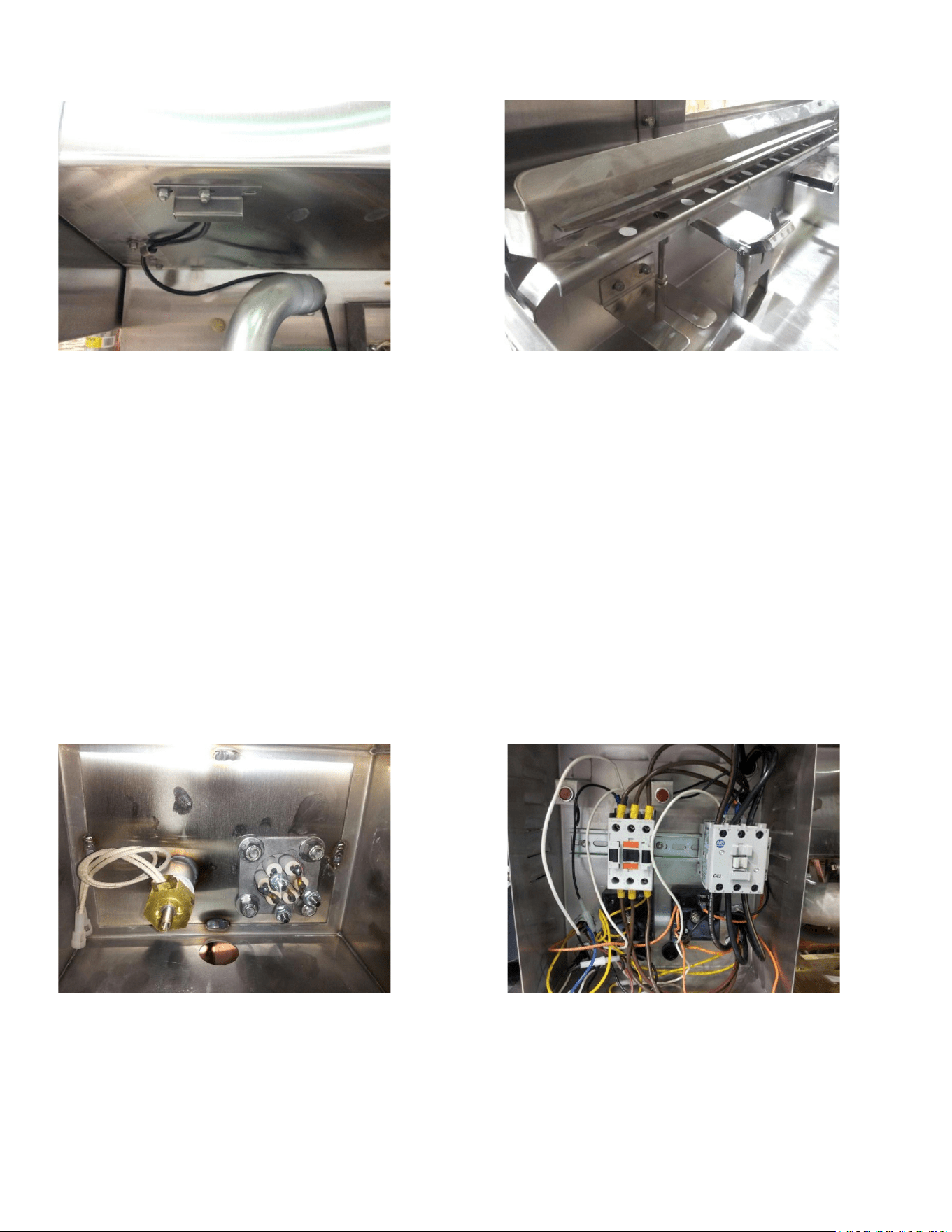
Sequence reed switch for wash tank Wash tank sequence bar, pendulum with magnet
SEQUENCE BAR MAGNETS— The magnets located on the pendulum sequence bars inside the tank activate the
reed switches, which are manufactured in the normally closed position (always on). The reed switch is
mounted to the outside of the tank and turns off when a magnet comes within ½” of the switch. To test, hold
a strong hand-held magnet next to the reed switch. If the magnet turns off the reed switch but the sequence
bar magnet does not, adjust the sequence bar magnet for that section. The sequence bar magnet should be
within a 1/8” of the bottom of the tank when it is at rest (hanging down at the 6:00 position).
TANK TEMPERATURE—The wash and pumped rinse tank temperatures are maintained by sustainer heaters.
Record tank temperatures during the initial tests. There are three (3) gauges mounted under the control box.
Gauges are marked Wash/Rinse/Final Rinse. Wash tank temperature should be 140F-degrees for chemical
sanitizing and 150F-degrees for hot water sanitizing in multi-tank conveyors. The pumped rinse tank
temperature should be 120F-degrees for chemical and 160F-degrees for hot water sanitizing. If tank
temperatures are low, increase by adjusting the heater thermostats located behind the front panels.
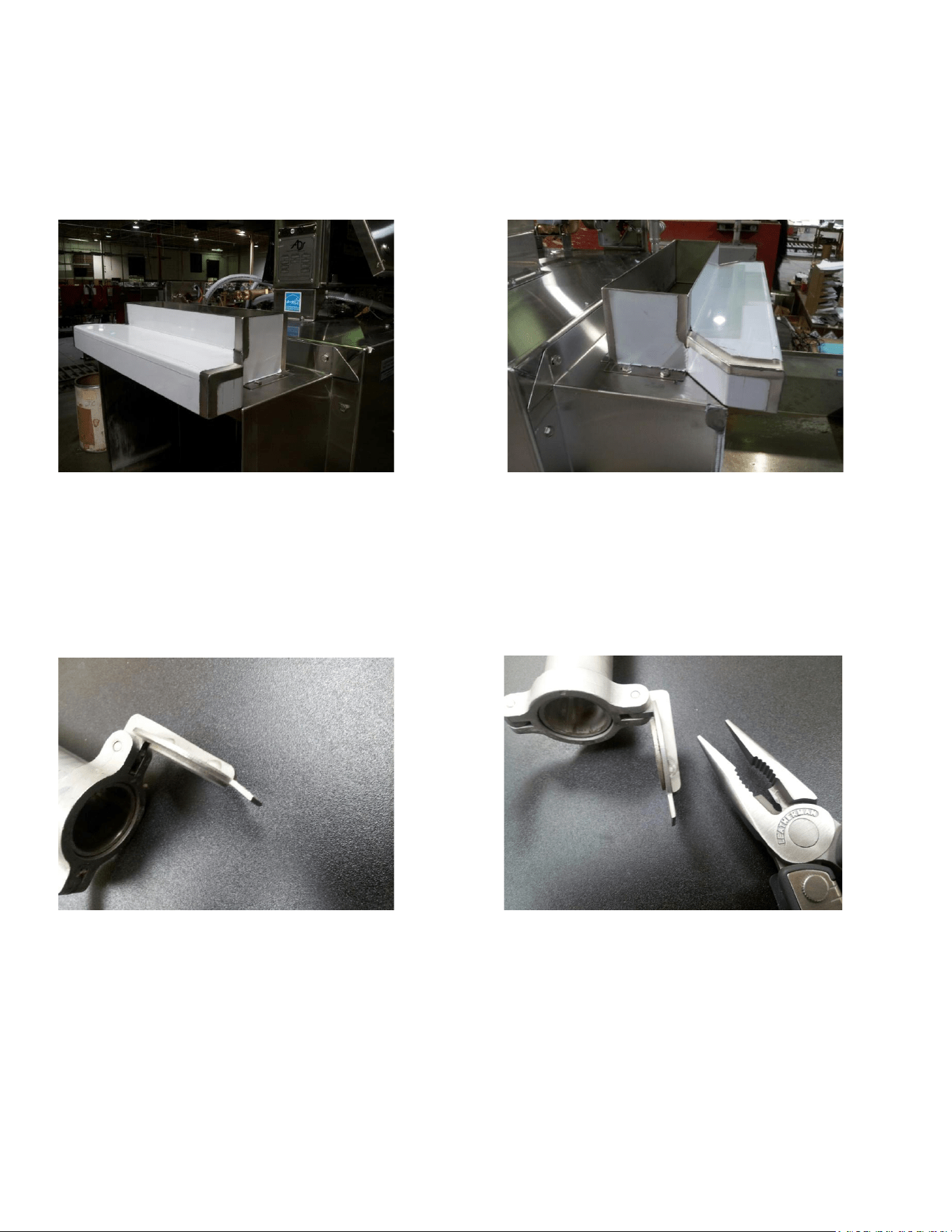
Wash tank thermostat, rotate center rod Left to increase T-stat signal goes to term #6 on heater relay under contactor
THERMOSTATS—There are two thermostats, one for each tank. Increase temp by turning center rod of the
thermostat counter clock-wise or turn to the left. Adjust thermostats in small increments (1/4 turn). Heaters
are switched off when water levels are low and the fill has been activated. Final rinse temperatures are 120F
Copyright ADS Install Manual, ADC-44/66, 3-ph, Rev 4.0, 4/28/2021
17
for chemical sanitizers, and 180F for hot water sanitizing. To increase the final rinse temperatures turn up the
thermostat on the booster heater or water heater respectively. Do not set a booster heater above 195F.
INSTALL CURTAINS— There are two short and two long curtains. Longer curtains are mounted at each end of
the dishmachine. Curtains are there to keep heat in the water.
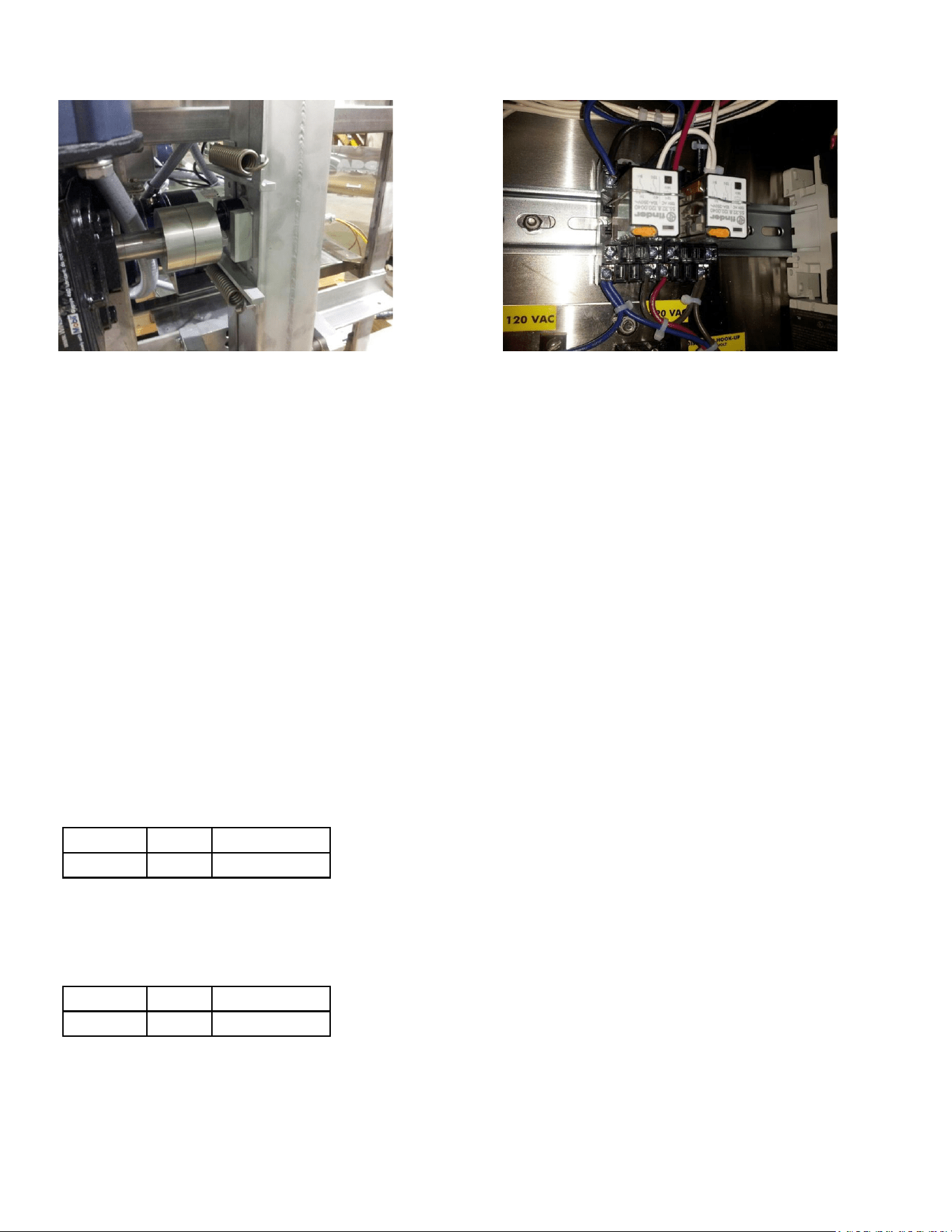
Vent attachments to end shield, 4” x 16” opening 200 to 400 CFM draw per side
VENTING—If exhaust vents (pant-leg vents) are attached to the dishmachine, do not exceed 400 CFM per
individual pant leg. ADS does not specify building HVAC values and only offers this limit as a point of reference.
Showing repair of loose end cap when tab on the cap has been forced close or bent on material such as seeds
or tooth picks.
Tab on endcap bent inward, causing loose fit Straighten tab in line with the coin edge to tighten latch
Copyright ADS Install Manual, ADC-44/66, 3-ph, Rev 4.0, 4/28/2021
18
Conveyor drive, cam blocks, bearing, clutch springs (use caution) Conveyor motor control relays
APPENDIX
089-9342---44” Conveyor Parts Manual
089-9421---44” Spec sheet
089-9346---44” Service Manual
089-9437---44” Brochure
089-9365---44” & 66” Conveyor Wall Chart
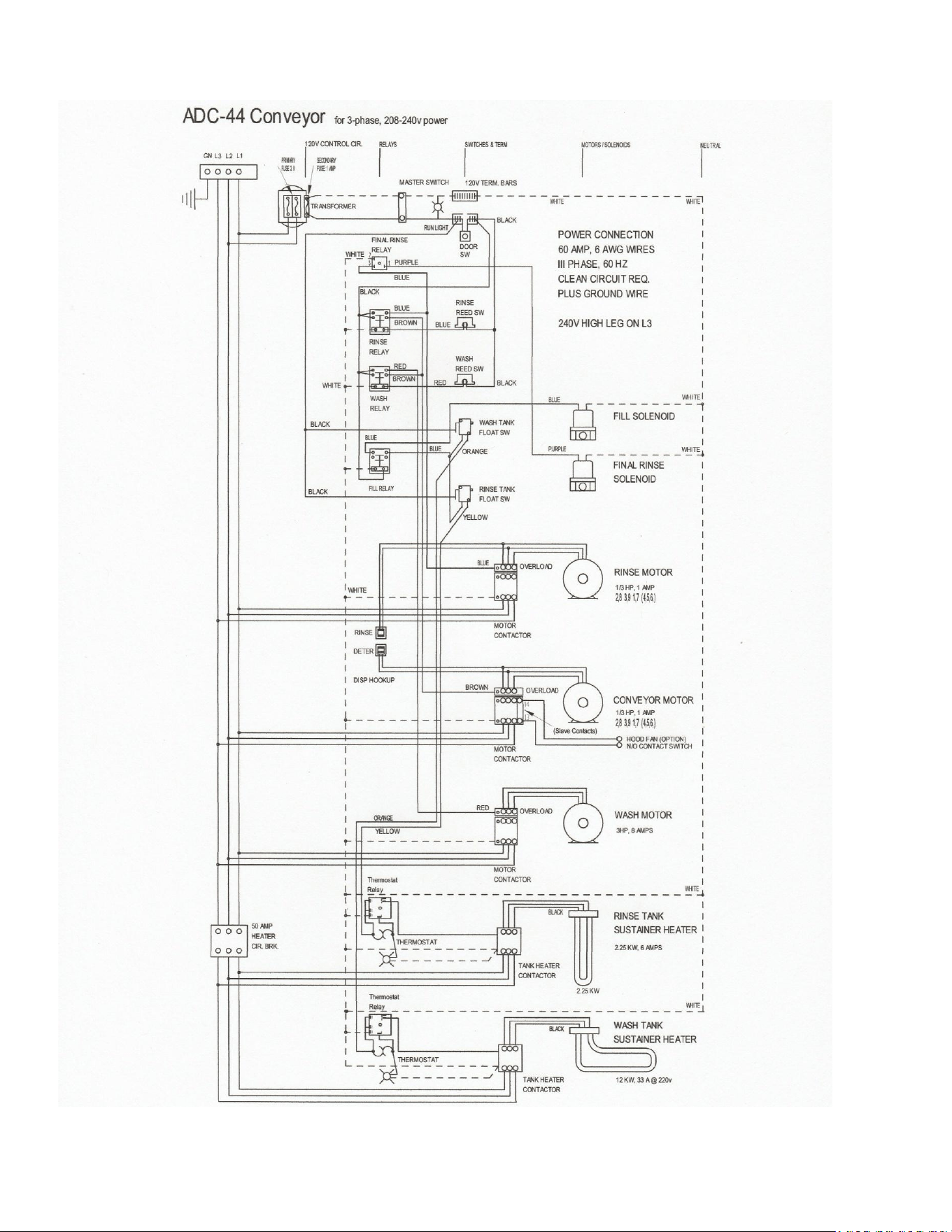
089-9454---44” Wire diagram
089-9388---Installation Manual ADC-44/ADC-66 3 Phase
089-9343---66” Conveyor Parts Manual
089-9423---66” Spec Sheet
089-3408---66” Service Manual
089-9439---66” Brochure
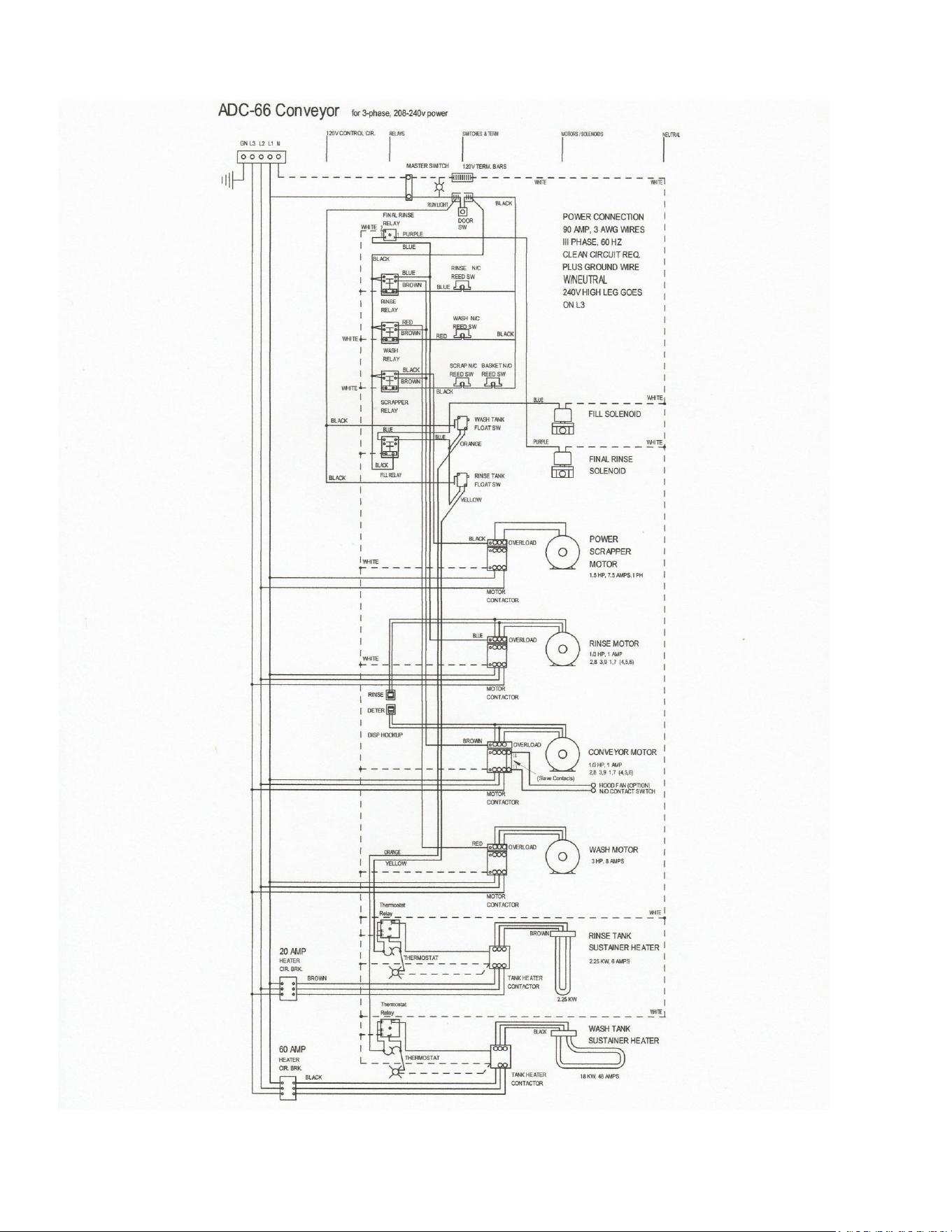
089-9456---66” Wire Diagram
ADC-44 Conveyor
Voltage
Phase
Full Load
Amps
208v
3
50a
240v
3
52a
ADC-66 Conveyor
Voltage
Phase
Full Load
Amps
208v
3
68.8
240v
3
76.6
Copyright ADS Install Manual, ADC-44/66, 3-ph, Rev 4.0, 4/28/2021
19
Heaters are voltage specific, meaning voltage makes a difference in the wattage output of the heater. The
following chart will list the wattage (kW) output for various available 3-phase voltages. Also listed are the ADS
tank heaters available to match those voltages.
Heater Rated
Supplied
Volts
Actual
Output
Amp Draw
Phase
12kW 208v *
200 volts
11.1 kW
32.0a
3-ph
(291-9009)
208 volts
12.0 kW
33.4a
3-ph
220 volts
13.42 kW
35.3a
3-ph
240 volts
15.9 kW
38.4a
3-ph
12kW 220v
200 volts
9.9 kW
28.6a
3-ph
(291-9001)
208 volts
10.7 kW
29.7a
3-ph
220 volts
12.0 kW
33.4a
3-ph
240 volts
14.3 kW
34.4a
3-ph
14kW 208v
200 volts
12.9 kW
37.4a
3-ph
(291-9008)
208 volts
14.0 kW
38.9a
3-ph
220 volts
15.66 kW
41.1a
3-ph
240 volts
18.6 kW
44.8a
3-ph
18kW 220v **
200 volts
14.8kW
42.9a
3-ph
(291-9007)
208 volts
16.1kW
44.7a
3-ph
220 volts
18.0kW
47.3a
3-ph
240 volts
21.4kW
51.5a
3-ph
8kW 208v
200 volts
7.4 kW
21.4a
3-ph
(391-9001)
208 volts
8.0 kW
22.2a
3-ph
220 volts
8.9 kW
23.4a
3-ph
240 volts
10.6 kW
25.5a
3-ph
2.25kW 208v
200 volts
2.079 kW
6.0a
3-ph
(291-9003)
208 volts
2.250 kW
6.2a
3-ph
220 volts
2.515 kW
6.6a
3-ph
240 volts
2.993 kW
7.2 a
3-ph
*Normal tank heater ADC-44, 3-phase is 208v, 12kW,
--240v, 12kW is special order
**Normal tank heater for ADC-66
Copyright ADS Install Manual, ADC-44/66, 3-ph, Rev 4.0, 4/28/2021
20
Copyright ADS Install Manual, ADC-44/66, 3-ph, Rev 4.0, 4/28/2021
21
Copyright ADS Install Manual, ADC-44/66, 3-ph, Rev 4.0, 4/28/2021

22
WARNING!
This product is manufactured solely
for commercial use. It is not to be
used in residential installations of
any kind. Doing so will immediately
void all warranties. American Dish
Service assumes no liability for such
unintended uses.
FOR PARTS & SERVICE MANUALS
GO TO
www.americandish.com
Copyright ADS Install Manual, ADC-44/66, 3-ph, Rev 4.0, 4/28/2021

23
c. Pressure test: Washpump 6 psi lower, 9 psi upper
Rinsepump 2-3 psi all
Final rinse 20 psi (adjust at pressure reg.)
Power-scrapper (66) 6psi lower, 9 psi upper
d. Check for leaks with machine running
e. Overloads will operate in test mode
14. Control box cover fits square and straight
a. Door will latch open and slide closed easily
b. Front skirts of machine: straight and fit interchangeably
15. No leaks from inlet plumbing or drain manifold
a. Calibrate thermometers with thermocouple tester
16. Water control Weights are free moving, no contact with retaining bracket
a. Micro switch mounted flush to flipper lever
b. Micro switch tested and marked: 6.5 oz
c. Weights: 238 grams test
d. Water cut off level is 3/8" from weight's top
e. Weight's retaining bracket is installed and tightened
(no contact to weight)
17. Name plate with correct serial number
18. Decals: electrical source, NSF data plate, wire diagram, temperatures, controls, safety, rotation, labels in control box. (all
decals put on straight)
19. General appearance and cleanliness (free of scratches or marks)
20. CHECK ALL WIRE CONNECTIONS : clean and tight, no crimps on insulation
21. Check door cut off switch adjustment
22. End caps welded correctly
a. 4-point welds on casting
b. All pins flash welded on one side only
23. Pumped rinse arm sockets clearance at spray arm
a. Pumped rinse jets welded full across bottom of fin
b. Locking latch on pumped rinse manifold welded full on pivot pin
c. Alignment pin on pumped rinse spray arm welded secure
d. Spray pattern must be from (straight up and down) at 12:00 to 6:00
no sprays into wash area
24. Final rinse arms alignment sprays straight up and straight down, fan pattern
25. High Potential test: 1700 volts @ 60 seconds
Notes:
Make sure door moves up and down smoothly and latches at the top
Rinse jets are set to correct fan pattern, End caps close and open securely
MODEL:__________________
MACHINE SERIAL NUMBER:______________
INSPECTORS NAME:____________________________________DATE:_________
3/6/2020
Copyright ADS Install Manual, ADC-44/66, 3-ph, Rev 4.0, 4/28/2021

24
PRODUCTION FINAL INSPECTION
AMERICAN DISH SERVICE
MODEL: ADC-44/ -66
1. Connect power source, leave heaters and motors off
2. Attach tables
3. Fill both tanks by turning on master switch
4. Check rack travel (no binding or jumping)
a. Travel time: from table lip to table lip, ref. point is rear side of rack (29 sec)
b. Final rinse: clear jets, check for leaks at manifold
5. Sequence switch movement (free moving, 1/16" clearance at bolts)
a. Check binding on tray rail
b. No contact with tank bottom, use gauge for magnets (1/16")
c. Lock down tube lock nut
d. Check for complete shut down after last rack exits machine (end dogs)
6. Check all studs (should not deform metal by drawing down on torque)
7. Slip Clutch, lateral movement should not exceed 1/8"
a. Strap should not be bent or warped.
b. Check for broken/bent spring or spring ears
c. Alignment of holes for straps
d. No contact of Drip Chute by Rocker Arm
e. No contact of tank or frame by Rocker Arm
f. Alignment of rocker arm to center of travel
g. Tighten (1/2" bolt) drive bar and rocker arm bolt 20 ft/lb then back off one 1/4" turn
8. Check door for leaking when wash pump is operated, adjust angle of jets
9. Easy movement of spray arm as they are installed or removed for cleaning
10. Scrap trays fit without binding or gaps over .25"
11. Dogs move without sticking (no sides rubbing on drive bar)
12. Turn on heater circuit breaker
a. Check amp draw on each leg: 12kW wash 31.6a—34.9a, 208v, 3PH
12kW wash 27.5a—30.3a, 240v, 3PH
___________ Amps wash 11.5kW wash 45.5a—50.2a, 240v, 1PH
___________ Amps rinse 2.25kW rinse 5.8a—6.5a, 208v, 3PH
2.25kW rinse 5.1a—5.6a, 240v, 3PH
2.25kW rinse 10.2a—11.3a, 208v, 1PH
2.25kW rinse 8.9a—9.8a, 240v, 1PH
___________ Amps wash (66) 17 kW, wash 44.8a—49.5a, 208v, 3PH
18 kW, wash 40.8a—45.1a, 240v, 3PH
Amp draw can vary 10% of rated draw at rated voltage, current imbalance of 5% is acceptable
b. Adjust thermostats to 120F rinse, 140F wash for Chemical Sanitizing
160F rinse, 150F wash for Hot Temp
13. Connect motors on contactor test window and operate
(pin motor, set screws bottomed)
a. Check rotation
b. Check for seal leaks
________Amps wash Wash 3hp mtr, 8.5a—9.4a (208v 3PH), 13.3a—14.7a, (208v 1PH)]
________Amps rinse Rinse or conveyor mtr, 0.47a—1.0a (208v 3PH), 0.95a—2.5a, (208v 1PH)
________Amps Power-scrapper 1.5hp mtr (66), 7.12a—8.0a, 208-240v Wired I-PH
Copyright ADS Install Manual, ADC-44/66, 3-ph, Rev 4.0, 4/28/2021