Service Handbook
PRINTED 1219 100324832 2000580440 (Rev. A)
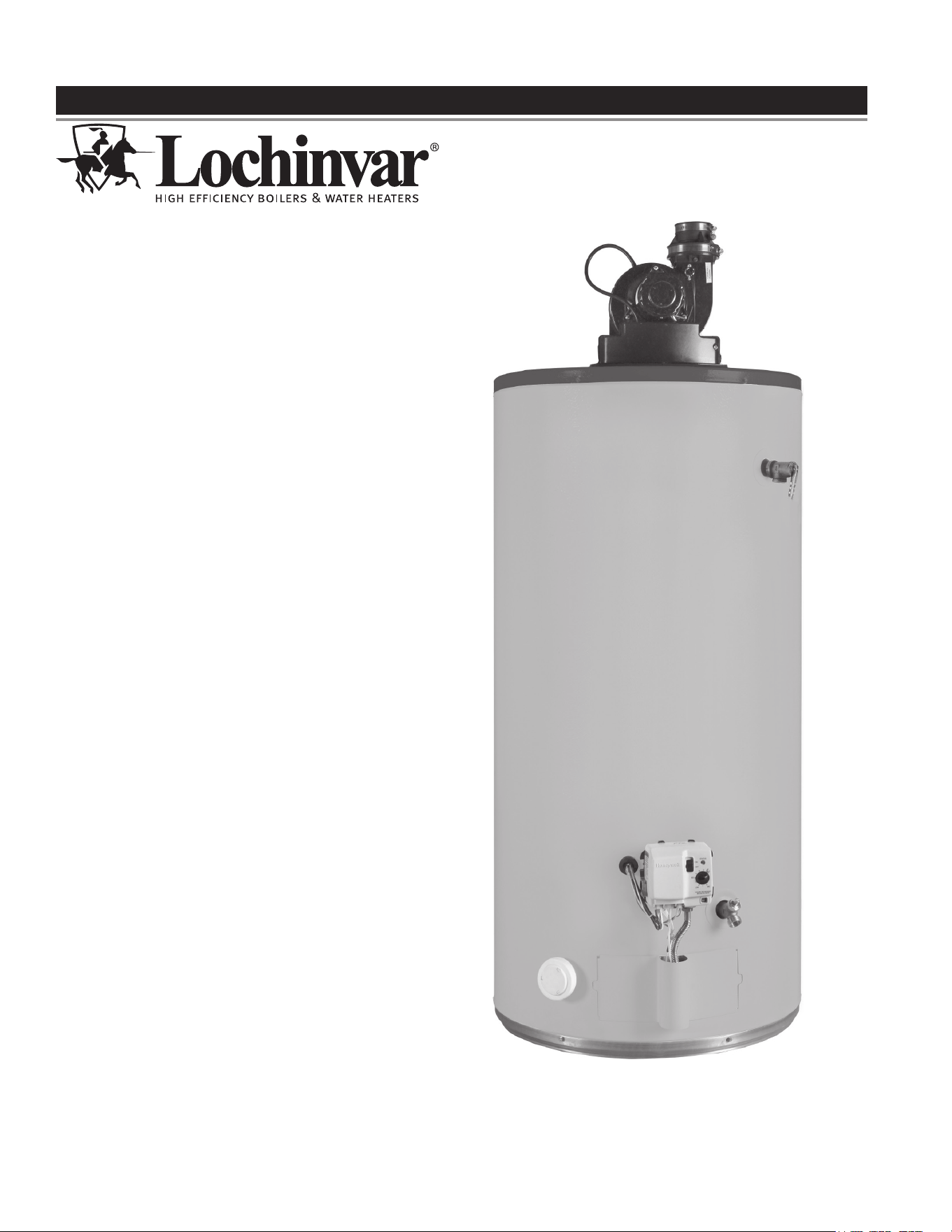
POWER VENTED GAS MODELS
WITH HOT SURFACE IGNITION
NOT FOR USE IN MANUFACTURED (MOBILE) HOMES
RESIDENTIAL GAS WATER HEATERS
Note: References to the Manual refer to the “Installation and
Operating Manual.”

CONTENTS
GENERAL INFORMATION ....................................................... 3
Terminology ........................................................................ 3
Formulas and Conversions ................................................ 3
CHECKING THE GAS SUPPLY PRESSURE........................... 4
LEAKAGE CHECKPOINTS ...................................................... 5
TEMPERATURE ADJUSTMENT .............................................. 6
Safety ................................................................................. 6
Settings .............................................................................. 6
ANODE ROD REMOVAL/REPLACEMENT ............................. 7
Anode Rod ......................................................................... 7
Removing Anode Rod: ....................................................... 7
Installing Anode Rod: ......................................................... 7
DIP TUBE REMOVAL/REPLACEMENT ................................... 8
Dip Tube ............................................................................. 8
Removing Dip Tube: ........................................................... 8
Installing Dip Tube: ............................................................. 8
DOOR-BURNER ASSEMBLY REMOVAL/REPLACEMENT .... 9
Inner Door/Manifold/Burner Assembly................................ 9
Removing Inner Door/Manifold/Burner Assembly .............. 9
Re-installing Inner Door/Manifold/Burner Assembly ........... 9
FLAME SENSOR AND IGNITER REMOVAL/REPLACEMENT .
11
Flame Sensor and/or Hot Surface Igniter ......................... 11
Removing Inner Door/Manifold/Burner Assembly ............ 11
Removing Flame Sensor And/Or Hot Surface Igniter....... 11
Re-installing Inner Door/Manifold/Burner Assembly ......... 11
BURNER AND ORIFICE REMOVAL/REPLACEMENT .......... 13
BURNER .......................................................................... 13
Removing Inner Door/Manifold/Burner Assembly ............ 13
Removing Burner ............................................................. 13
Installing Burner: .............................................................. 13
Reinstalling Inner Door/Manifold/Burner Assembly .......... 13
BURNER ORIFICE .................................................................. 15
Removing Inner Door/Manifold/Burner Assembly ............ 15
Removing Burner Orice .................................................. 15
Installing Burner Orice .................................................... 15
Reinstalling Inner Door/Manifold/Burner Assembly .......... 16
DOOR GASKET REPLACEMENT ......................................... 16
Door Gasket ..................................................................... 16
Removing Inner Door/Manifold/Burner Assembly ............ 16
Removing The Door Gasket. ............................................ 17
Replacing The Door Gasket. ............................................ 17
Re-installing Inner Door/Manifold/Burner Assembly ......... 17
CONTROL MODULE REMOVAL/REPLACEMENT ............... 18
Electronic Control Module ................................................ 18
Removing Electronic Control Module ............................... 18
VALVE MODULE REMOVAL/REPLACEMENT ..................... 20
Valve Module .................................................................... 20
Removing Valve Module ................................................... 20
TEMPERATURE SENSOR AND
CABLE REMOVAL/REPLACEMENT ..................................... 21
Temperature Sensor and Cable ....................................... 21
Removing Temperature Sensor and Cable ...................... 21
GAS VALVE REMOVAL/REPLACEMENT ............................. 22
Removing Gas Control Valve ........................................... 22
Installing Gas Control Valve ............................................. 22
BLOWER REMOVAL/REPLACEMENT ................................. 23
BLOWER .......................................................................... 23
Removing Blower ............................................................. 23
Installing Blower ............................................................... 23
ROTATING THE BLOWER ..................................................... 24
BLOWER EXHAUST DIRECTION ................................... 24
PRESSURE SWITCH REMOVAL/REPLACEMENT .............. 25
PRESSURE SWITCH ...................................................... 25
Removing Pressure Switch .............................................. 25
Installing Pressure Switch ................................................ 25
FV SENSOR ............................................................................ 26
FLAMMABLE VAPOR SENSOR ...................................... 26
CLEANING THE COMBUSTION CHAMBER ......................... 26
CLEANING THE BLOWER ..................................................... 27
BLOWER .......................................................................... 27
TECHNICAL BULLETINS ....................................................... 28
TROUBLESHOOTING CHART .............................................. 34
GAS CONTROL LED STATUS CODES ................................. 36
IGNITION STATE AND TIMING .............................................. 37

3
GENERAL INFORMATION
TERMINOLOGY
Draw efficiency is the quantity of hot water available to the
consumer before the outlet water temperature decreases by
25F° (14C°). A 40 gallon water heater will typically provide 70%
(28 gallons) of this “usable” hot water (60% is the minimum).
The burner or elements are allowed to operate during this test.
Incoming, cold water mixes the remaining stored water below
this 25F° (14C°) limitation.
Energy Factor is an indicator of the combined thermal efficiency
and standby efficiency of a water heater. The higher the energy
factor, the more efficient the water heater will be.
Minerals and gases will separate from water as temperature
increases.
“R” Value is a measure of the resistance of a substance to heat
flow.
Recovery rate is the amount of water that is heated to a set
temperature, per hour.
Standby efficiency is the water heater’s ability to contain
heat in the tank. A minimum of tank water heat loss per hour
is desired. For example: temperature change/“R” value = Btu/h
loss/square foot of tank surface
Temperature rise is the increase in the temperature from its
coldest “inlet” water temperature to the desired hot (outlet)
setting. Typically it is assumed that the entering water be 40°F
(5°C), stored water desired to be 120°F (49°C) resulting in a
“temperature rise” of 80F° (44C°).
Thermal efficiency is approximately the amount of generated
BTU (British Thermal Units), which enters the water. A percentage
of the total BTU passes out through the vent piping.
Water cannot (for all practical purposes) be compressed.
Water expands when it is heated.
FORMULAS AND CONVERSIONS
• BTU (British Thermal Unit) is the heat required
to raise one pound of water 1F°
• 1 BTU = 252 cal = 0.252 kcal
• 1 cal = 4.187 Joules
• BTU X 1.055 = Kilo Joules
• BTU divided by 3,413 = Kilowatts
• To convert from Fahrenheit to Centigrade: (°F –
32) times 5/9, or .556, equals degrees C.
• One gallon of (120°F, 49°C) water weighs
approximately 8.25 pounds.
• Pounds X .45359 = Kilogram
• Gallons X 3.7854 = Liters
• % of Hot = (Mixed Temp. – Cold)
divided by (Hot Temp. – Cold)
• % Thermal Efficiency = (GPH X 8.25 X Temp.
Rise X 1.0) divided by BTU/H Input
• BTU Output = GPH X 8.25 X Temp. Rise X 1.0
• GPH = (BTU/H Input X % Eff.) divided
by (Temp. Rise X 8.25)
• One cubic foot of Natural Gas contains
about 1000 BTU of heat.
• One “therm” is equal to 100,000 BTU
• One cubic foot of Propane Gas contains
about 2500 BTU of heat.
• One gallon of Propane gas contains
about 91,250 BTU of heat.
• One pound of Propane gas contains
about 21,600 BTU of heat.
• One pound of gas pressure is equal to
27.7 inches water column pressure
• Inches of Water Column X .036091 = PSI
• Inches of Water Column X .073483
= Inches of Mercury (Hg.)
• Centimeters = Inches X 2.54
• mm (millimeters) = Inches X 25.4
• Meters = Inches X .0254
• Doubling the diameter of a pipe will increase its
flow capacity (approximately) 5.3 times.
Construction: Tank is constructed of steel. The inside of the
tank is constructed of a glass lining bonded to the steel. This
prevents water to metal contact and rusting of the tank. An anode
rod will be installed within the tank. The hex-head plug end of the
anode is visible on the top of the water heater. This metal rod
offers secondary protection of the tank against corrosion where
the application of glass is not possible (threaded tank openings).
These areas will have small areas of water to metal contact.
All water heaters will contain at least one thermostat (to
operate the heater) and one high limit (to prevent water from
overheating).
4
CHECKING THE GAS SUPPLY PRESSURE
Gas pressure checks are done with flowing gas using a gas
pressure manometer capable of reading pressure in inches of
water column.
Supply gas pressure checks are measured before the gas
control valve and as close to the water heater as possible.
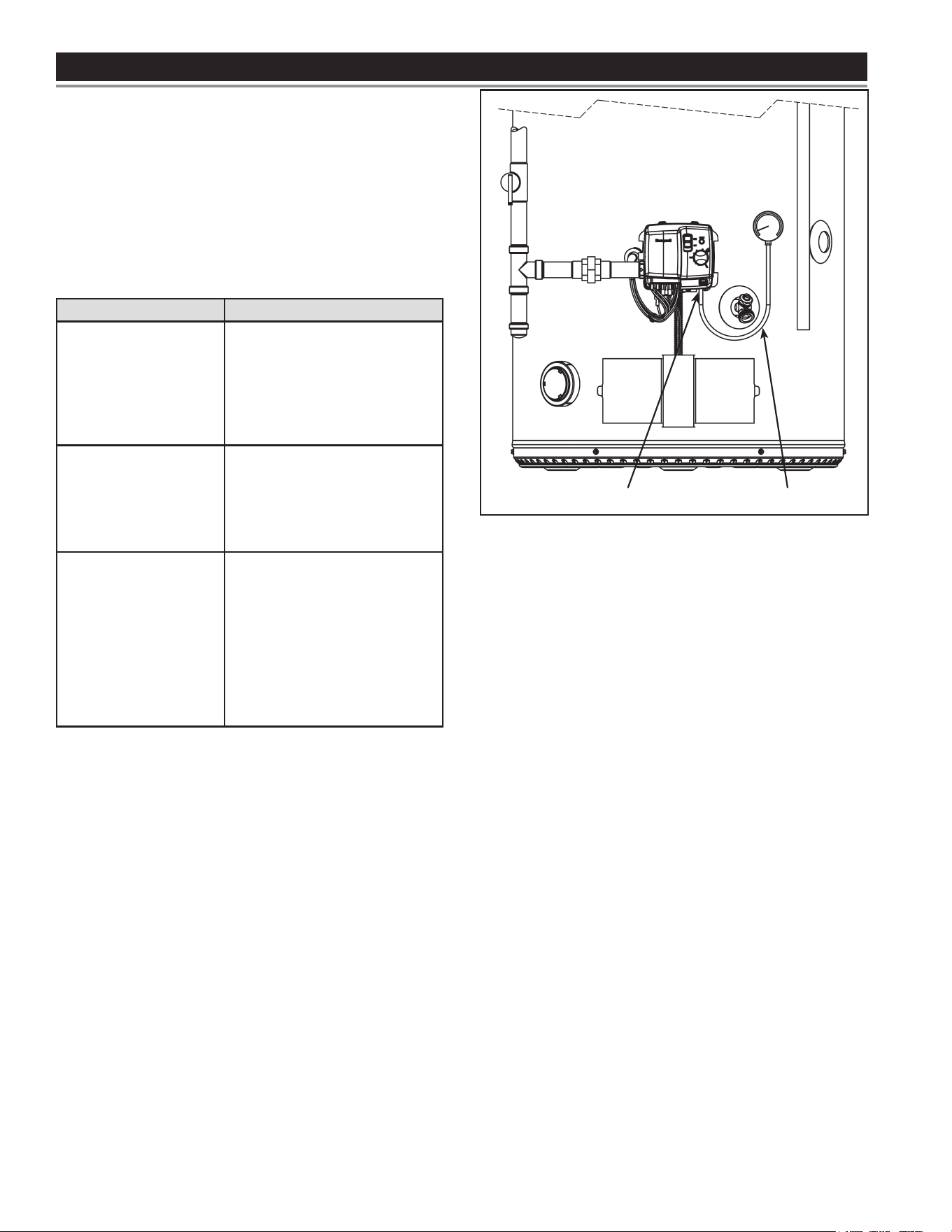
Manifold (main burner) gas pressure is measured at the
pressure tap on the bottom of the gas control valve. See Figure
1. Use an Allen wrench to remove the plug, then attach the gas
gauge.
Note: Desired gas pressures will be noted on the gas valve
label located on the gas control valve and rating plate.
IF THEN
Supply gas pressure
is under desired
pressure requirement
• Increase supply gas
pressure regulator setting.
• Call the gas utility company
to readjust gas pressure on
main supply. Technicians
can not adjust main
gas supply pressure.
Supply gas pressure is
over desired pressure
• Add gas pressure regulator.
• Call the gas utility company
to readjust gas pressure on
main supply. Technicians
can not adjust main
gas supply pressure.
Manifold gas pressure
is more than +/- .4
inch W.C. from values
indicated on gas
valve or rating plate
• Ensure there is adequate
supply gas pressure.
• Ensure the main burner
orifice is the correct size
for the water heater
model being tested.
• If the above tests have
been performed and the
results were correct replace
the gas control valve.
Important: After checking the manifold gas pressure, detach
the gas gauge, reinstall the plug using insulation
tape and tighten with Allen wrench. Check for
leaks and repair as required.
PRESSURE
MANOMETER
MANIFOLD (MAIN BURNER GAS PRESSURE
TAP). RE-INSTALL PLUG AFTER USE.
Figure 1. Pressure Tap and Manometer
5
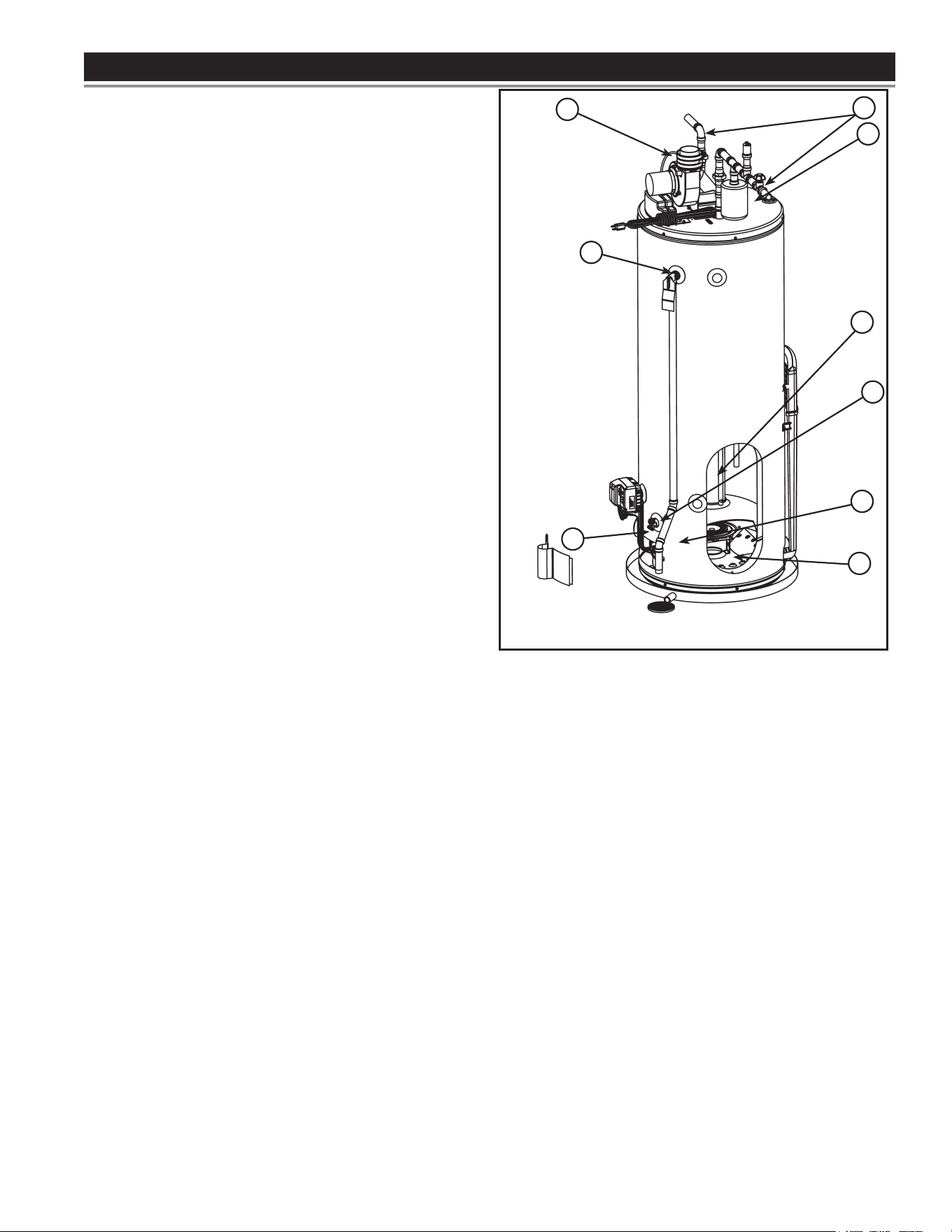
LEAKAGE CHECKPOINTS
A. Water at the blower assembly is water vapor which has
condensed out of the combustion products. This is caused
by a problem in the vent or blockage in the drain coupling.
B. Condensation may be seen on pipes in humid weather or
pipe connections may be leaking.
C. The anode rod fitting may be leaking.
D. Small amounts of water from temperature-pressure relief
valve may be due to thermal expansion or high water
pressure in your area.
E. *The temperature-pressure relief valve may be leaking the
tank fitting.
F. Water from a drain valve may be due to the valve being
slightly opened.
G. The drain valve may be leaking at the tank fitting.
H. Combustion products contain water vapor which can
condense on the cooler surfaces of the tank. Droplets form
and drip onto the burner. This is common at the time of start-
up after installation and when incoming water is cold.
I. Water in the water heater bottom or on the floor may be
from condensation. DO NOT replace the water heater until
a full inspection of all possible water sources is made and
necessary corrective steps taken.
J. Leakage from other appliances, water lines, or ground
seepage should also be checked.
* To check where threaded portion enters tank, insert cotton
swab between jacket opening and fitting. If cotton is wet,
follow draining instructions in Draining and Flushing in the
Manual and then remove fitting. Put pipe dope or Teflon
®
tape
on the threads and replace. When you are finished, follow the
steps in Filling the Water Heater in the Manual.
A
C
B
D
E
F
G
I
H
Figure 2. Leakage Test Points
6
TEMPERATURE ADJUSTMENT
SAFETY
Due to the nature of the typical gas water heater, the water
temperature in certain situations may vary up to 30F° (16C°)
higher or lower at the point of use such as bathtubs, showers,
sink, etc.
HOT WATER CAN SCALD: Water heaters are intended to
produce hot water. Water heated to a temperature which will
satisfy space heating, clothes washing, dish washing, and
other sanitizing needs can scald and permanently injure you
upon contact. Some people are more likely to be permanently
injured by hot water than others. These include the elderly,
children, the infirm, or physically/mentally handicapped. If
anyone using hot water in your home fits into one of these
groups or if there is a local code or state law requiring certain
temperature water at the hot water tap, then you must take
special precautions.
In addition of using the lowest possible temperature setting
that satisfies your hot water needs, a means such as a mixing
valve should be used at the hot water taps used by these
people or at the water heater. Mixing valves are available at
plumbing supply or hardware stores. Follow manufacturer’s
instructions for installation of the valves. Using the lowest hot
water temperature that meets your needs will also provide the
most energy efficient operation of the water heater.
Never allow small children to use a hot water tap, or to draw
their own bath water. Never leave a child or handicapped
person unattended in a bathtub or shower.
Note: A water temperature range of 120°F-140°F (49°C-60°C)
is recommended by most dishwasher manufacturers.
SETTINGS
Temperature range on residential gas water heater is from
110°F ±10° to 155°F ±10° and a 70°F vacation setting. The
T&P valve will open at 195°F ± 10°.
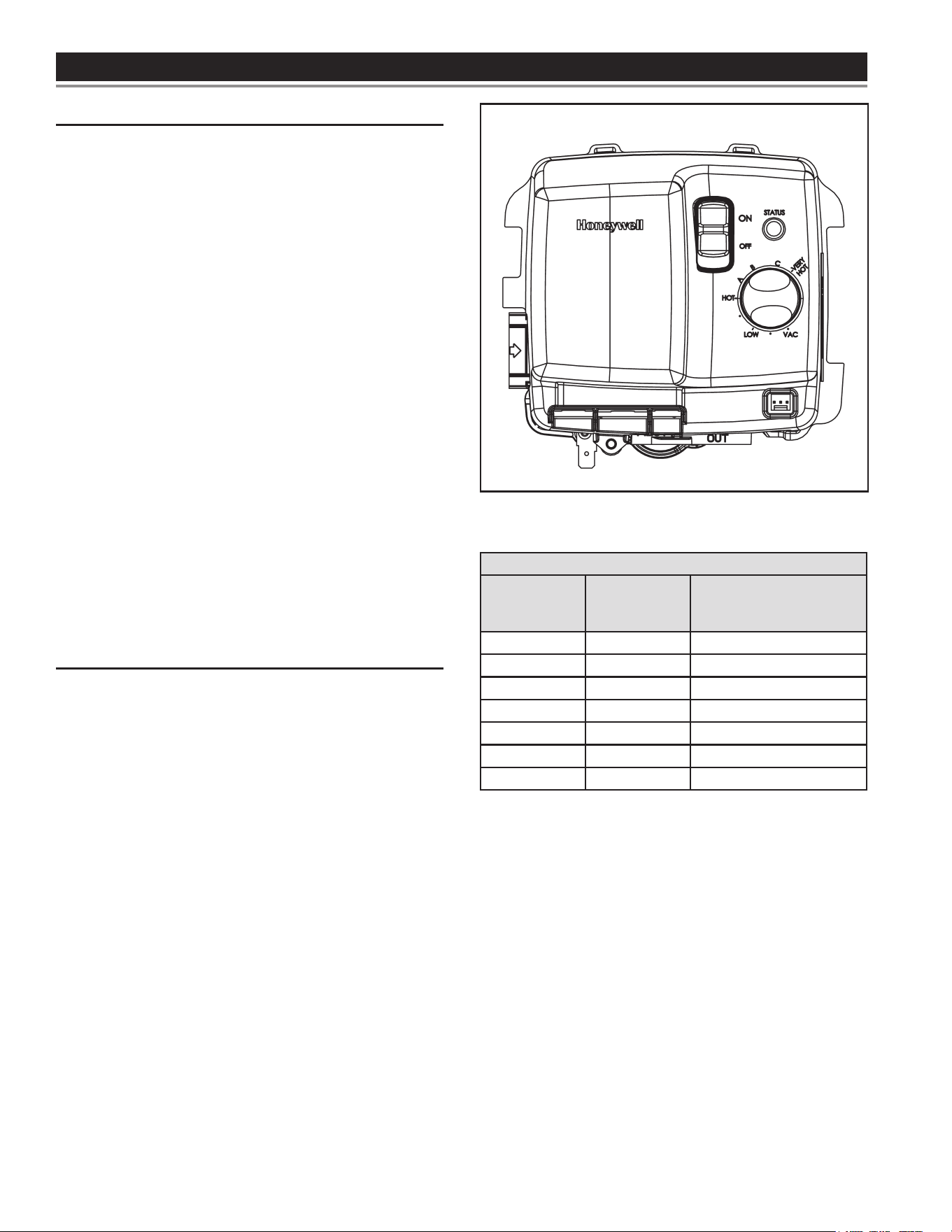
The water heater temperature adjusting dial is factory set at
the lowest temperature, all the way counter-clockwise to the
mechanical stop, unless specified differently by provincial or
state regulations. See Figure 3. It is adjustable and must be
reset to the desired temperature setting to reduce the risk
of scald injury. Turning the dial clockwise will increase the
temperature and counter-clockwise will reduce the temperature.
The HOT marking on the Honeywell gas valve is indicative of
approximately 120°F (49°C) and is the preferred starting point.
Some states have a requirement for a lower setting. Should
overheating occur or the gas supply fails to shut off, turn “OFF”
the manual gas control valve to the water heater.
The following table lists the approximate water temperatures
produced by various dial settings. Short repeated heating
cycles caused by small hot water uses can cause temperatures
at the point of use to exceed the thermostat setting by up to
30F° (16C°). If you experience this type of use, you should
consider using lower temperature settings to reduce scald
hazards. Listed below is time-to-burn relationship for normal
adult skin.
Figure 3. Temperature Adjusting Dial
Table 1. Time to Burn at Various Temperatures
Temperature
Setting
Approximate
Temperature
°F (°C)
Time to reduce a
2nd and 3rd Degree
burn to adult skin
VERY HOT 155 (68) Less than 1 second
C 150 (65) About 1.5 seconds
B 140 (60) Less than 5 seconds
A 130 (54) More than 30 seconds
HOT 120 (49) More than 5 minutes
LOW 110 (43) Normal shower temp
VAC 70 (21) N/A
7
ANODE ROD REMOVAL/REPLACEMENT
ANODE ROD
Important: Use only factory authorized replacement parts. If
you lack the necessary skills to properly perform
the installation, you should not proceed, but get
help from a qualified service technician.
Tools Required
• Ratchet with 1-1/16” Socket
• Pliers
• Teflon
®
Tape or an approved pipe sealant
REMOVING ANODE ROD:
1. Set the gas control valve/thermostat to its lowest setting by
turning the knob counter-clockwise to the VAC point. See
Figure 3 (page 6).
2. Turn gas control switch to the “OFF” position and turn “OFF”
the gas supply to the unit. See Figure 3 (page 6).
3. Disconnect the electrical power to the water heater from the
wall outlet.
4. Shut off the incoming water supply to the water heater and
open a nearby hot-water faucet to depressurize the water
tank.
5. Connect a hose to the drain valve and terminate it to adequate
drain or to the exterior of the building. Open the drain valve
and allow at least 5 gallons of water to drain from the tank.
Close drain and remove hose.
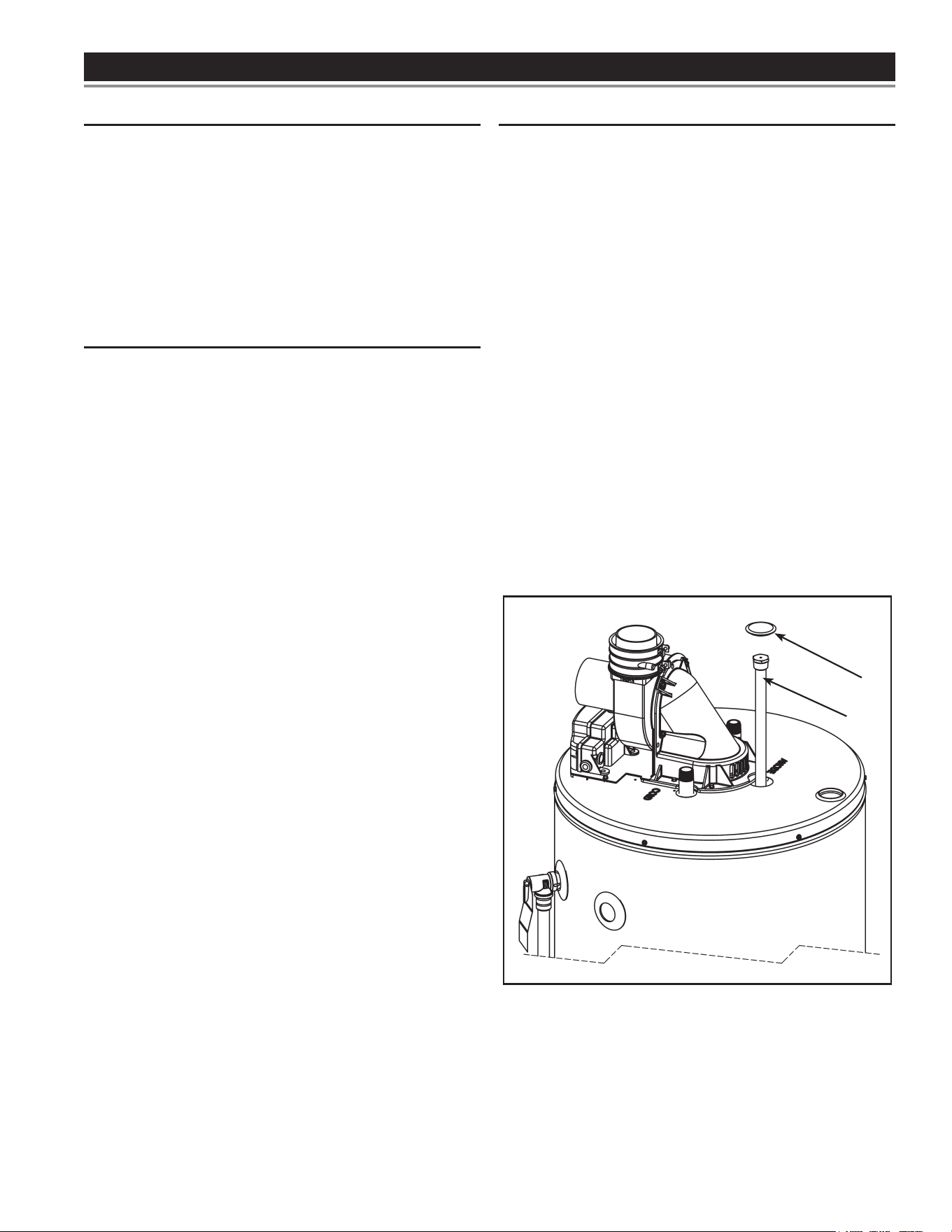
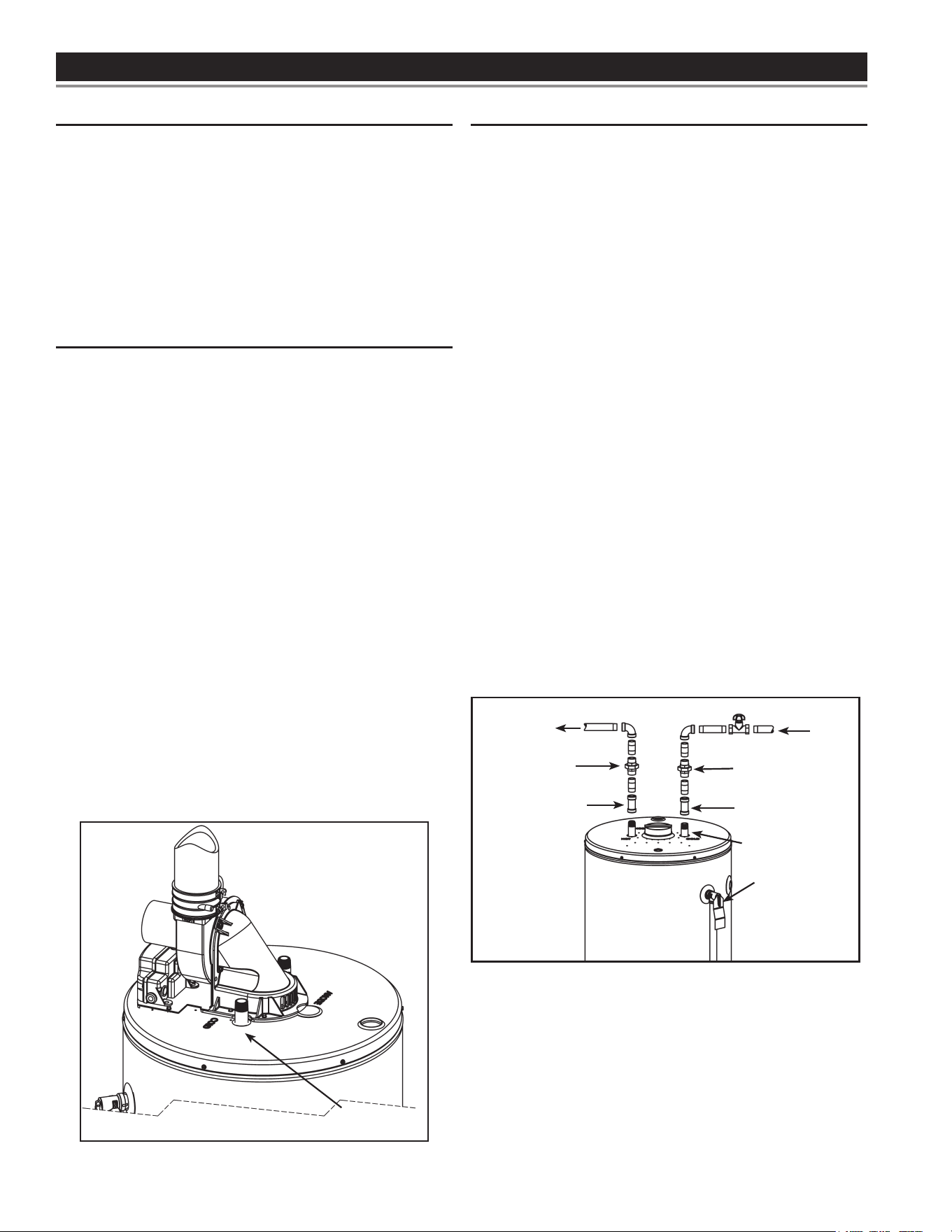
6. Remove and retain the anode cap on top of the heater and
remove and retain just enough insulation so you can access
to the anode head. See Figure 4. Keep in a safe place for
reinstallation later.
7. Remove the anode rod by using a ratchet and a 1-1/16”
socket turning counter-clockwise. See Figure 4.
INSTALLING ANODE ROD:
1. Use Teflon
®
tape or an approved pipe sealant on threads of
the new anode rod.
2. Place the anode rod in the spud (top of the tank) and turn
clockwise until the threads are hand tight. Using a ratchet
and 1-1/16” socket tighten down water tight.
3. Turn the main water supply back on.
4. Open a nearby hot-water faucet to purge air from the water
line. Fill water heater tank completely
Note: To assure the water heater tank is full, keep
the hot-water faucet open for 3 minutes
after a constant flow of water is obtained).
5. After turning off the hot-water faucet, check for water leaks
around anode rod and immediately correct any if found.
6. Reinstall the insulation and anode cap which were removed
in step 6 above.
7. Reconnect the electrical power to the water heater in the wall
outlet and turn the main gas supply back “ON” to the gas
control valve/thermostat.
8. Turn the gas control switch to the “ON” position. See Figure
3 (page 6).
9. To restart the water heater, follow the directions on the Lighting
and Operating Instructions label located on the front of the water
heater near the gas control valve/thermostat.
CAP
ANODE ROD *
* THE ANODE ROD IS COVERED
BY URETHANE FOAM LOCATED
UNDER THE CAP. CHIP AWAY
THE FOAM TO EXPOSE THE
TOP OF THE ANODE ROD
Figure 4. Removing the Anode Cap and Anode Rod
8
DIP TUBE REMOVAL/REPLACEMENT
DIP TUBE
Important: Use only factory authorized replacement parts. If
you lack the necessary skills to properly perform
the installation, you should not proceed, but get
help from a qualified service technician.
Tools Required
• 18” Pipe wrench
• Piping and soldering equipment
• Teflon
®
Tape or an approved pipe sealant
REMOVING DIP TUBE
1. Set the gas control valve/thermostat to its lowest setting by
turning the knob counter-clockwise to the VAC point. See
Figure 3 (page 6).
2. Turn gas control switch to the “OFF” position and turn “OFF”
the gas supply to the unit. See Figure 3 (page 6).
3. Disconnect the electrical power to the water heater from the
wall outlet.
4. Shut off the incoming water supply to the water heater and
open a nearby hot-water faucet to depressurize the water
tank. Remove pipe insulation from cold inlet piping.
5. Connect a hose to the drain valve and terminate it to adequate
drain or to the exterior of the building. Open the drain valve
and allow at least 5 gallons of water to drain from the tank.
Close drain and remove hose.
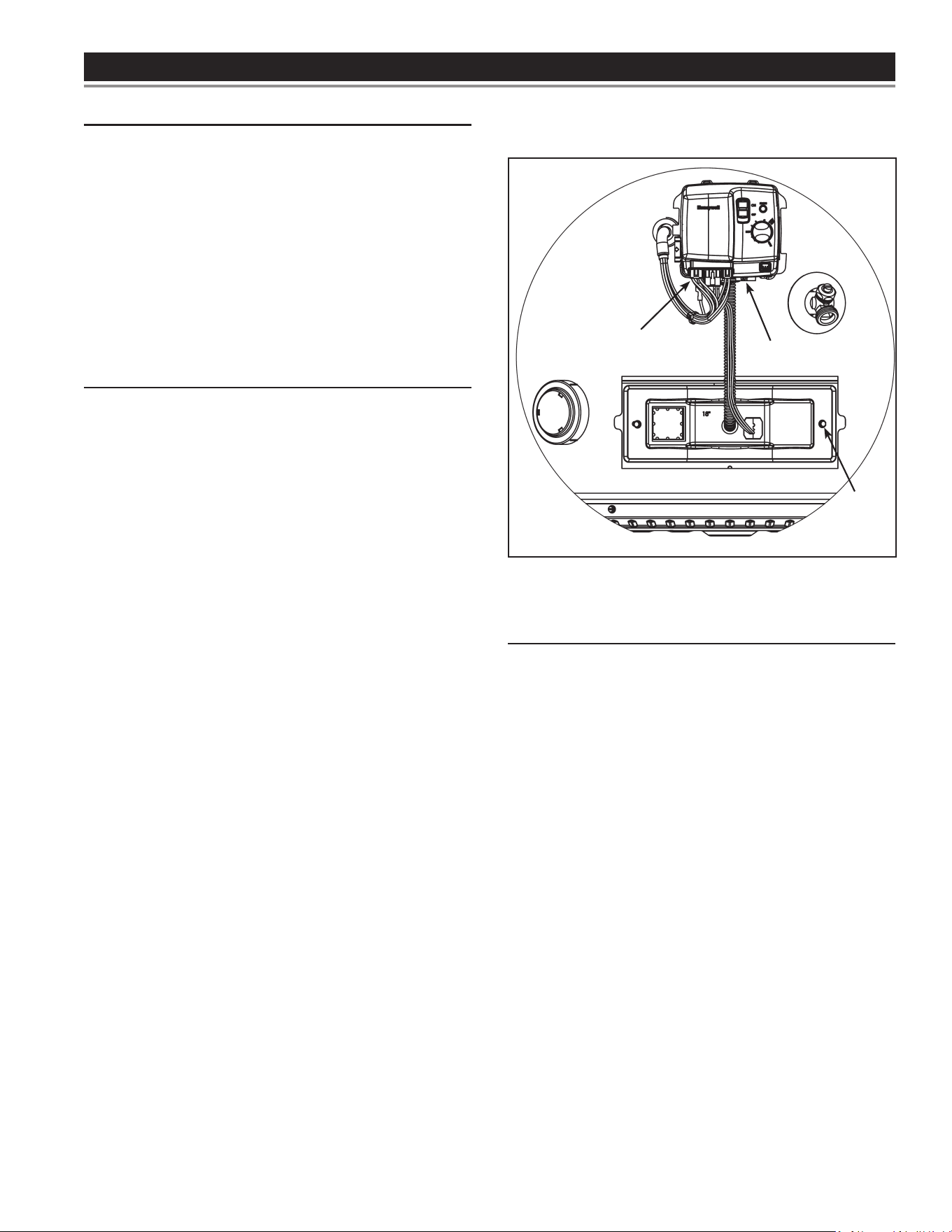
6. Remove the inlet water piping connected to the cold inlet of
the water heater. See Figure 5 & Figure 6. Some installations
will have a union connection, others will have the supply
piping soldered to an adapter that connects to the nipple on
the water heater. Using the pipe wrench remove the piping
from the top of the tank.
7. With the piping removed, use the pipe wrench on the exposed
nipple directly to remove it from the heater.
Note: Sometimes the dip tube will come out with the
piping in one piece. Separate accordingly.
NIPPLE/DIP
TUBE
Figure 5. DIP Tube (Inlet Piping)
INSTALLING DIP TUBE
1. Use Teflon
®
tape or an approved pipe sealant on threads of
the new dip tube.
2. Place the dip tube into the spud on top of the tank and turn
clockwise until tight. Using the pipe wrench continue to tighten
until the joint is water tight.
Note: Do not clamp the pipe wrench jaws on the
threaded portion of the nipple and do not
over tighten. This can cause the threads
to distort and can result in a leak.
3. Apply Teflon
®
tape or pipe sealant on the top threads and
reconnect the water piping. See Figure 6.
4. Turn the main water supply back on.
5. Open a nearby hot-water faucet to purge air from the water
line. Fill water heater tank completely
Note: To assure the water heater tank is full, keep
the hot-water faucet open for 3 minutes
after a constant flow of water is obtained.
6. After turning off the hot-water faucet, check for water leaks
around dip tube and immediately correct any if found.
7. Reinstall the pipe insulation removed in step 4 removal
process.
8. Reconnect the electrical power to the water heater in the wall
outlet and turn the gas supply back “ON” to the gas control
valve/thermostat.
9. Turn the gas control switch to the “ON” position. See Figure
3 (page 6).
10. To restart the water heater, follow the directions on the Lighting
and Operating Instructions label located on the front of the water
heater near the gas control valve/thermostat.
HOT-WATER
OUTLET
COLD-
WATER
INLET
UNION
UNION
3/4” SWEAT
FITTING
3/4” SWEAT FITTING
TEMPERATURE-
PRESSURE
RELIEF VALVE
SHUT-OFF VALVE
BLOWER ASSEMBLY
COMPONENTS NOT
SHOWN FOR CLARITY.
NIPPLE/DIP TUBE
Figure 6. Inlet Piping with Union Connectors
9
DOOR-BURNER ASSEMBLY REMOVAL/REPLACEMENT
INNER DOOR/MANIFOLD/BURNER ASSEMBLY
Important: Use only factory authorized replacement parts. If
you lack the necessary skills to properly perform
the installation, you should not proceed, but get
help from a qualified service technician.
Tools required:
• 3/4” Open-End Wrench
• Phillips Head Screwdriver
• Ratchet with 1/4” socket or 1/4” nut-driver
• Flashlight
REMOVING INNER DOOR/MANIFOLD/
BURNER ASSEMBLY
1. Set the gas control valve/thermostat to its lowest setting by
turning the knob counter-clockwise to the VAC point. See
Figure 3 (page 6).
2. Turn gas control switch to the “OFF” position and turn “OFF”
the gas supply to the unit. See Figure 3 (page 6).
3. Disconnect the electrical power to the water heater from
the wall outlet.
4. Remove the outer door from the unit.
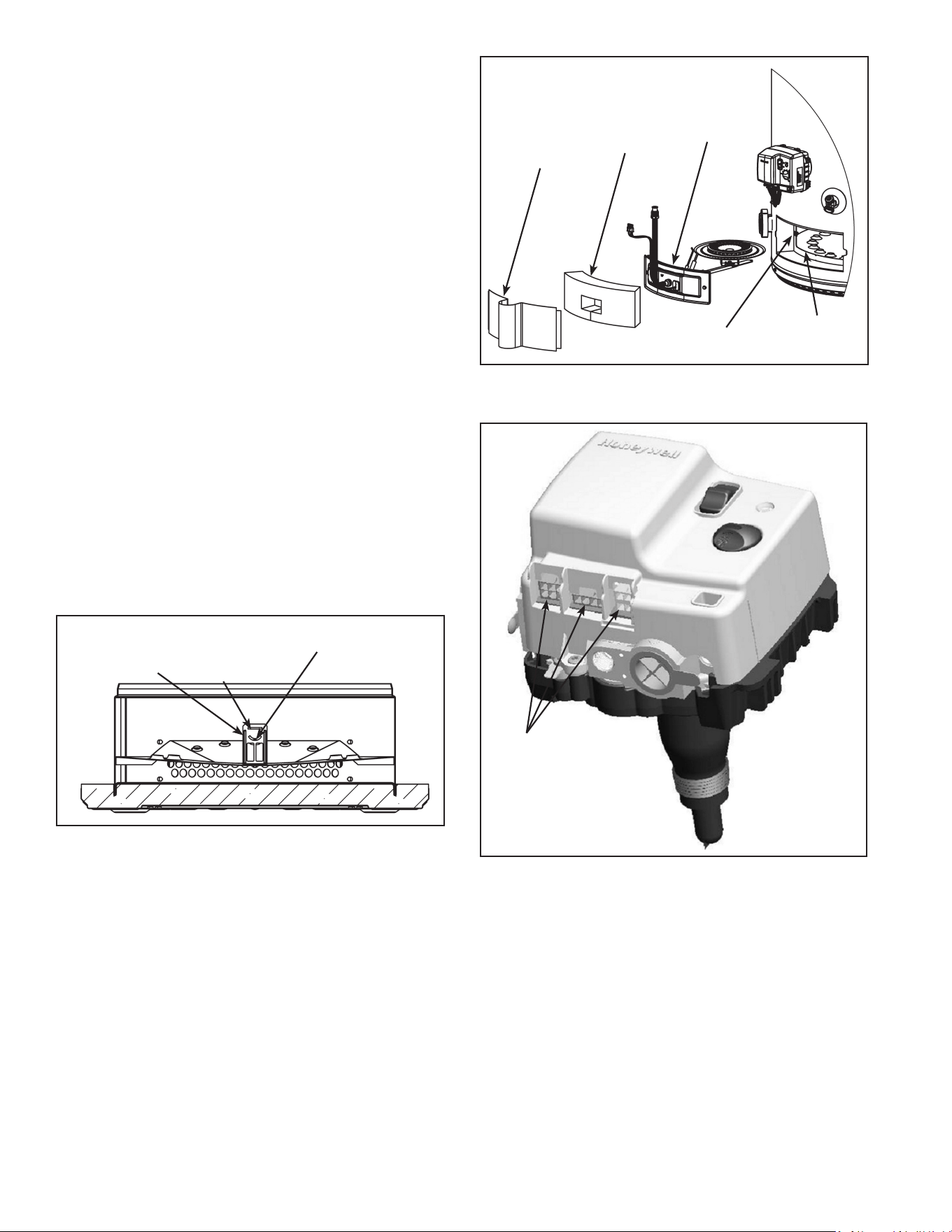
5. Unplug all the electrical connections from the bottom of the
gas control valve/thermostat. See Figure 7.
6. Using a 3/4” open end wrench remove the manifold tube from
the gas control valve/thermostat (turning counter-clockwise
for natural gas, clockwise for LP). Grasp the manifold tube
and push down slightly to free the manifold tube from the
gas control valve/thermostat. See Figure 7.
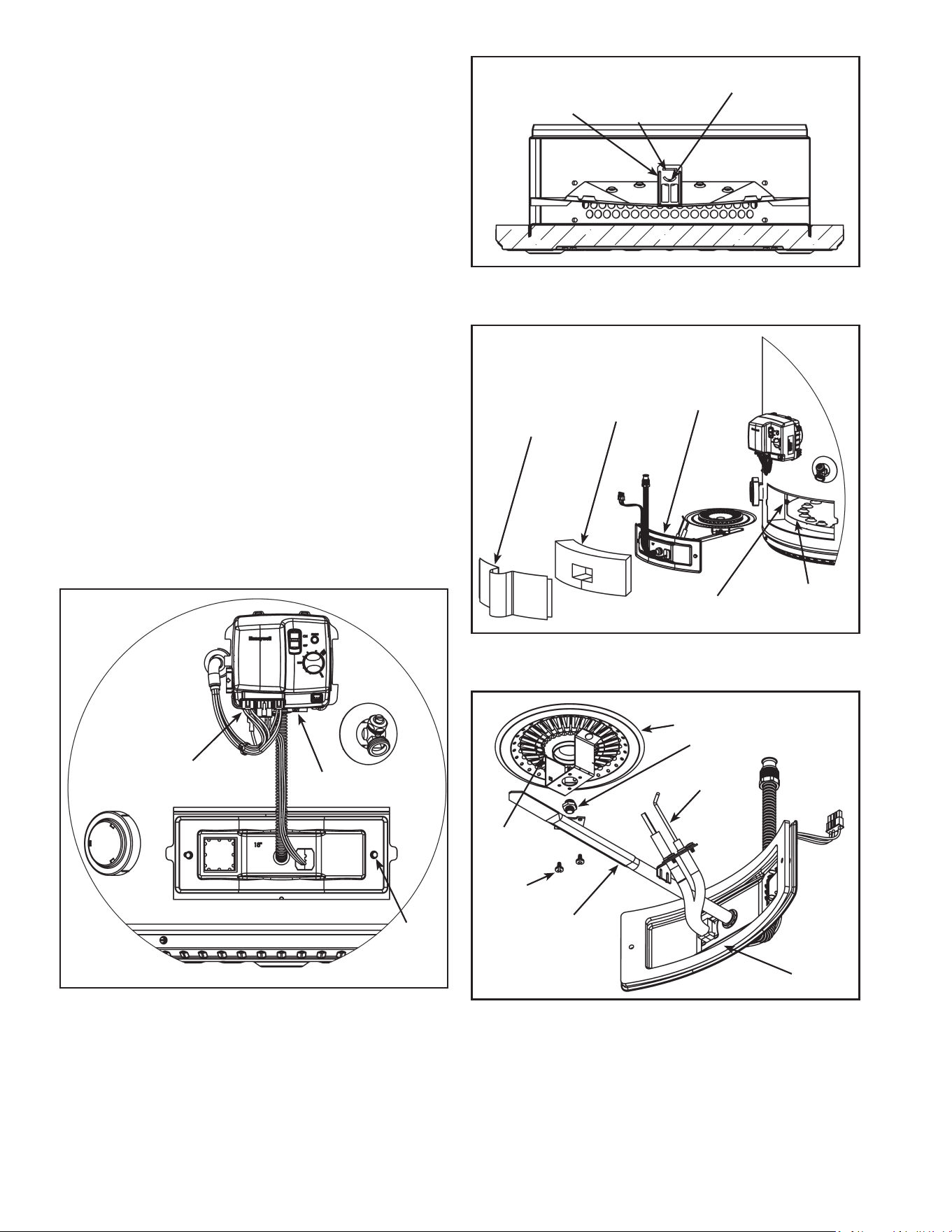
7. Remove the insulation pad on the inner door by cutting it if
necessary. Keep the insulation in a safe place for reusing
it later.
8. Use a 1/4” nut-driver or 1/4” socket & ratchet to loosen the
2 hex head screws on the inner door so the inner door/
manifold/burner assembly can be removed. See Figure 7.
9. Remove inner door/manifold/burner assembly by grasping
the manifold and pull back slowly. Rotating it to the left to
clear the igniter and flame sensor. Care should be taken
when inner door and burner assembly passes through jacket
opening that it does not damage any of the electrical wiring.
See Figure 9 (page 10).
Caution Must Be Taken
Prior to installing the new inner door/manifold/burner, look
inside the burner chamber to fully understand the correct
positioning of the burner assembly and burner manifold tab. It
is necessary to use a flashlight to ensure correct placement.
Care must be taken so as to not damage any electrical wiring
or components as you are installing the new inner door/
manifold/burner assembly.
Extra caution should be taken to ensure that electrical wiring,
fiberglass insulation or any other object is not between door
gasket and combustion chamber shield.
Note: If the burner door gasket is worn or damaged it needs to
be replaced. See Replacing The Door Gasket. (page 3).
See Figure 9 (page 10).
ELECTRICAL
CONNECTIONS
MANIFOLD
TUBE NUT
HEX HEAD
SCREWS
NOTE: OUTER DOOR AND INSULATION NOT SHOWN FOR CLARITY.
Figure 7. Electrical Connections at the Bottom of the Gas Valve
RE-INSTALLING INNER DOOR/
MANIFOLD/BURNER ASSEMBLY
1. Insert the manifold/burner assembly in the burner chamber
compartment, making sure that the tip of burner manifold
tab engages in the proper slot of the bracket. See Figure
8 (page 10).
Important:
• The tip end of the burner manifold MUST be placed in
the upper slotted portion for models with input rate of
40,000 to 50,000 Btu/hr to obtain proper installation.
• The tip end of the burner manifold MUST be placed in
the lower slotted portion for models with input rate of
60,000 to 75,000 Btu/hr to obtain proper installation.
2. After confirming no materials of any type are between door
gasket and combustion chamber shield, align the screws
on the inner door with the screw holes on the combustion
chamber and tighten with 1/4” nut-driver or 1/4” socket &
ratchet. See Figure 7.
After tightening the inner door screws, visually inspect
area around door gasket and skirt for spaces or
gaps. The door gasket MUST be sealed completely
in order for the water heater to perform properly.
DO NOT OPERATE THE WATER HEATER IF THE DOOR GASKET
DOES NOT CREATE A SEAL BETWEEN MANIFOLD DOOR AND
COMBUSTION CHAMBER.
10
3. Reconnect the manifold tube to the gas control valve/
thermostat.
Note: Do Not apply any thread sealant at this
connection). To prevent any cross threading
the manifold tube should be started by hand
(turn clockwise for natural gas, counter-
clockwise for LP). Upon tightening with
the fingers and confirming it has not been
cross threaded, tighten nut with a 3/4” open
end wrench. See Figure 7 (page 8).
4. Reinstall the insulation pad which was removed in step 7
above.
5. Reconnect all the electrical connections to the bottom of the
gas control valve/thermostat, gently pushing each connector
up until it snaps into place. See Figure 7 and Figure 10.
6. Reconnect the electrical power to the water heater in the
wall outlet and turn the main gas supply back “ON” to the
gas control valve/thermostat.
7. Restart the water heater by following the directions on the
Lighting and Operating Instructions label located on the front
of the water heater. Test gas connections by brushing on
an approved non-corrosive leak detection solution.
Note: Do not splash the solution on control. If
a leak is detected, shut the water heater
down by following the directions on the
Lighting and Operating Instructions. Repair
the leak(s) and repeat this step.
8. Upon verifying proper operation of the water heater, replace
the insulation and outer door.
BURNER SUPPORT
BRACKET -
LOCATED IN THE
CENTRE OF THE
CHAMBER.
STRAIGHT SLOT
FOR 40-50K
BURNERS WITH
STRAIGHT
MANIFOLD TUBES
CURVED SLOT FOR
60-75K BURNERS
WITH OFFSET
MANIFOLD TUBES
Figure 8. Manifold/Burner Assembly
GASKET ON
REAR OF DOOR
INSULATION
PAD
OUTER DOOR
COMBUSTION
CHAMBER
OPENING
MOUNTING CLIP
(1 EACH SIDE)
Figure 9. Burner Chamber Compartment Doors
ELECTRICAL
CONNECTIONS
Figure 10. Electrical Connections on the Gas Valve

11
FLAME SENSOR AND IGNITER REMOVAL/REPLACEMENT
FLAME SENSOR AND/OR HOT SURFACE IGNITER
Important: Use only factory authorized replacement parts. If
you lack the necessary skills to properly perform
the installation, you should not proceed, but get
help from a qualified service technician.
Tools Required
• 3/4” Open-End Wrench
• Phillips Head Screwdriver
• Ratchet with 1/4” socket or 1/4” nut-driver
• Flashlight
• Flat Blade screwdriver
REMOVING INNER DOOR/MANIFOLD/BURNER ASSEMBLY
1. Set the gas control valve/thermostat to its lowest setting by
turning the knob counter-clockwise to the VAC point. See
Figure 3 (page 6).
2. Turn gas control switch to the “OFF” position and turn “OFF”
the gas supply to the unit. See Figure 3 (page 6).
3. Disconnect the electrical power to the water heater from the
wall outlet.
4. Remove the outer door from the unit.
5. Unplug all the electrical connections from the bottom of the
gas control valve/thermostat. See Figure 11 (page 12).
6. Using a 3/4” open end wrench remove the manifold tube from
the gas control valve/thermostat (turning counter-clockwise
for natural gas, clockwise for LP). Grasp the manifold tube
and push down slightly to free the manifold tube from the gas
control valve/thermostat. See Figure 11 (page 12).
7. Remove the insulation pad on the inner door by cutting it if
necessary. Keep the insulation in a safe place for reusing
it later.
8. Use a 1/4” nut-driver or 1/4” socket & ratchet to loosen the 2
hex head screws on the inner door so the inner door/manifold/
burner assembly can be removed. See Figure 11 (page 12).
9. Remove inner door/manifold/burner assembly by grasping the
manifold, rotating it to the left to clear the igniter and flame
sensor and pulling back. Care should be taken when inner
door and burner assembly passes through jacket opening
that it does not damage any of the electrical wiring. See
Figure 13 (page 8).
REMOVING FLAME SENSOR AND/
OR HOT SURFACE IGNITER
Note: The configuration of the flame sensor and igniter allows
you to replace them separately. It is recommended to
clean the flame sensor when you replace the igniter.
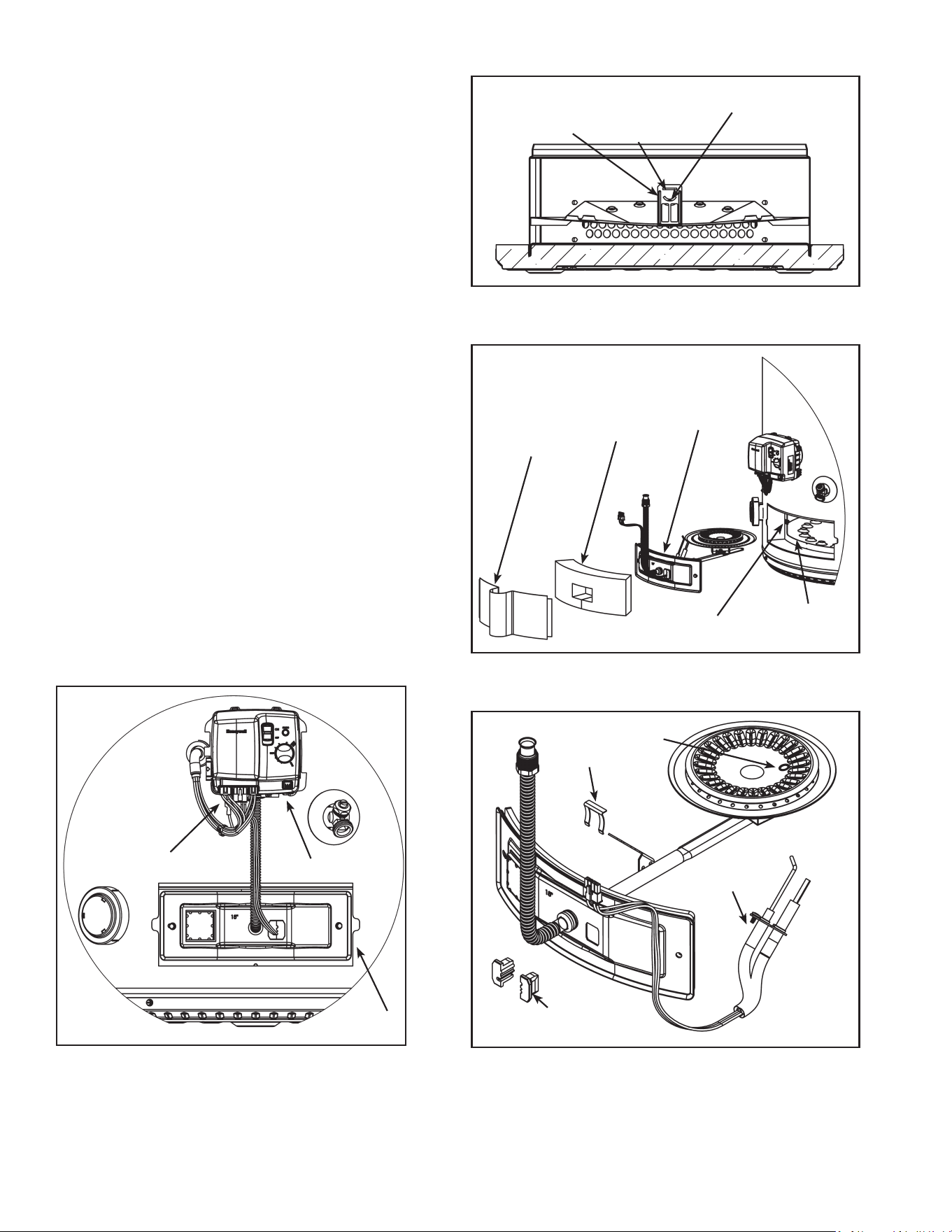
1. Lift the retainer clip straight up from the back of the manifold
component block (using a flat-blade screwdriver), then remove
the manifold component block from the manifold door. See
Figure 14 (page 12).
2. Disconnect the wiring connection between the flame sensor/
igniter and valve.
3. Remove and retain the screw(s) securing the flame sensor
and/or hot surface igniter assembly. See Figure 14 (page 12).
4. Remove and discard the old flame sensor and/or hot surface
igniter assembly.
5. Install the new Flame Sensor and/or Hot Surface Igniter.
6. Route the new flame sensor and/or hot surface igniter
connector wire through manifold/burner door opening. Secure
the assembly to the bracket using screw(s) removed in step
3 above.
7. Reconnect the wiring connection between the flame sensor/
igniter and the valve.
8. Reposition the manifold component block in the manifold
door opening and secure it with the retainer clip.
Caution Must Be Taken
Prior to installing the new inner door/manifold/ burner assembly,
look inside the burner chamber to fully understand the correct
positioning of the burner assembly and burner manifold tab.
It may be necessary to use a flashlight to ensure correct
placement. Care must be taken so as to not damage any
electrical wiring or components as you are installing the new
inner door/manifold/burner assembly.
Extra caution should be taken to ensure that electrical wiring,
fiberglass insulation or any other object is not caught between
door gasket and combustion chamber shield.
Note: If the burner door gasket is worn or damaged it needs to
be replaced. See Replacing The Door Gasket. (page 3).
See also Figure 9 (page 8).
RE-INSTALLING INNER DOOR/
MANIFOLD/BURNER ASSEMBLY
1. Insert the manifold/burner assembly in the burner chamber
compartment, making sure that the tip of burner manifold
tab engages in the proper slot of the bracket. See Figure 12
(page 12). The tip end of the burner manifold MUST be
placed in the slotted portion under the condensation pan to
obtain proper installation.
Important:
• The tip end of the burner manifold MUST be placed in
the upper slotted portion for models with input rate of
40,000 to 50,000 Btu/hr to obtain proper installation.
• The tip end of the burner manifold MUST be placed in the
lower slotted portion for models with input rate of 60,000
to 75,000 Btu/hr to obtain proper installation.
2. After confirming no materials of any type are between door
gasket and combustion chamber shield, align the screws
on the inner door with the screw holes on the combustion
chamber and tighten with 1/4” nut-driver or 1/4” socket &
ratchet. See Figure 11 (page 12).
After tightening the inner door screws, visually inspect area
around door gasket and skirt for spaces or gaps. The door
gasket MUST be sealed completely in order for the water
heater to perform properly.
DO NOT OPERATE THE WATER HEATER IF THE DOOR GASKET
DOES NOT CREATE A SEAL BETWEEN MANIFOLD DOOR AND
COMBUSTION CHAMBER.
12
3. Reconnect the manifold tube to the gas control valve/
thermostat.
Note: Do Not apply any thread sealant at this
connection). To prevent any cross threading
the manifold tube should be started by hand
(turn clockwise for natural gas, counter-
clockwise for LP). Upon tightening with the
fingers and confirming it has not been cross
threaded, tighten nut with an 3/4” open
end wrench. See Figure 11 (page 12).
4. Reconnect all the electrical connections to the bottom of the
gas control valve/thermostat, gently pushing each connector
up until it snaps into place. See Figure 10 and Figure 11 (page
12).
5. Reconnect the electrical power to the water heater in the wall
outlet and turn the main gas supply back “ON” to the gas
control valve/thermostat.
6. Restart the water heater by following the directions on the
Lighting and Operating Instructions label located on the front of
the water heater.
7. As the burner is heating (view flames through view-port),
test the manifold tube connection at the gas control valve/
thermostat by brushing on an approved noncorrosive leak
detection solution.
Important: Do Not splash the solution onto any electrical
connections. If a leak is detected, shut the water
heater down by following the directions on the
Lighting and Operating Instructions. Repair the leak(s)
and repeat step 6 above).
8. Upon verifying proper operation of the water heater, reinstall
the insulation and the outer door.
Note: The structure of flame sensor/hot
surface igniter allows you to remove
and replace them separately.
ELECTRICAL
CONNECTIONS
MANIFOLD
TUBE NUT
HEX HEAD
SCREWS
Note: Outer door and insulation not shown for clarity.
Figure 11. Electrical Connections at the Bottom of the Gas Valve
BURNER SUPPORT
BRACKET -
LOCATED IN THE
CENTRE OF THE
CHAMBER.
STRAIGHT SLOT
FOR 40-50K
BURNERS WITH
STRAIGHT
MANIFOLD TUBES
CURVED SLOT FOR
60-75K BURNERS
WITH OFFSET
MANIFOLD TUBES
Figure 12. Manifold/Burner Assembly
GASKET ON
REAR OF DOOR
INSULATION
PAD
OUTER DOOR
COMBUSTION
CHAMBER
OPENING
MOUNTING CLIP
(1 EACH SIDE)
Figure 13. Burner Chamber Compartment Doors
RETAINER
CLIP
IGNITER/
SENSOR
ASSEMBLY
COMPONENT
BLOCK
DRAIN
HOLE
Figure 14. Burner and Igniter Sensor Assemblies

13
BURNER AND ORIFICE REMOVAL/REPLACEMENT
BURNER
Important: Use only factory authorized replacement parts. If
you lack the necessary skills to properly perform
the installation, you should not proceed, but get
help from a qualified service technician.
Tools Required
• 3/4” Open-End Wrench
• Phillips Head Screwdriver
• Ratchet with 1/4” socket or 1/4” nut-driver.
REMOVING INNER DOOR/MANIFOLD/
BURNER ASSEMBLY
1. Set the gas control valve/thermostat to its lowest setting by
turning the knob counter-clockwise to the VAC point. See
Figure 3 (page 6).
2. Turn gas control switch to the “OFF” position and turn “OFF”
the gas supply to the unit. See Figure 3 (page 6).
3. Disconnect the electrical power to the water heater from
the wall outlet.
4. Remove the outer door from the unit.
5. Unplug all the electrical connections from the bottom of the
gas control valve/thermostat. See Figure 15 (page 14).
6. Using a 3/4” open end wrench remove the manifold tube from
the gas control valve/thermostat (turning counter-clockwise
for natural gas, clockwise for LP). Grasp the manifold tube
and push down slightly to free the manifold tube from the
gas control valve/thermostat. See Figure 15 (page 14).
7. Remove the insulation pad on the inner door by cutting it if
necessary. Keep the insulation in a safe place for reusing
it later.
8. Use a 1/4” nut-driver or 1/4” socket & ratchet to loosen the
2 hex head screws on the inner door so the inner door/
manifold/burner assembly can be removed. See Figure 15
(page 14).
9. Remove inner door/manifold/burner assembly by grasping
the manifold, rotating it to the left to clear the igniter and
flame sensor and pulling back. Care should be taken when
inner door and burner assembly passes through jacket
opening that it does not damage any of the electrical wiring.
See Figure 17 (page 14).
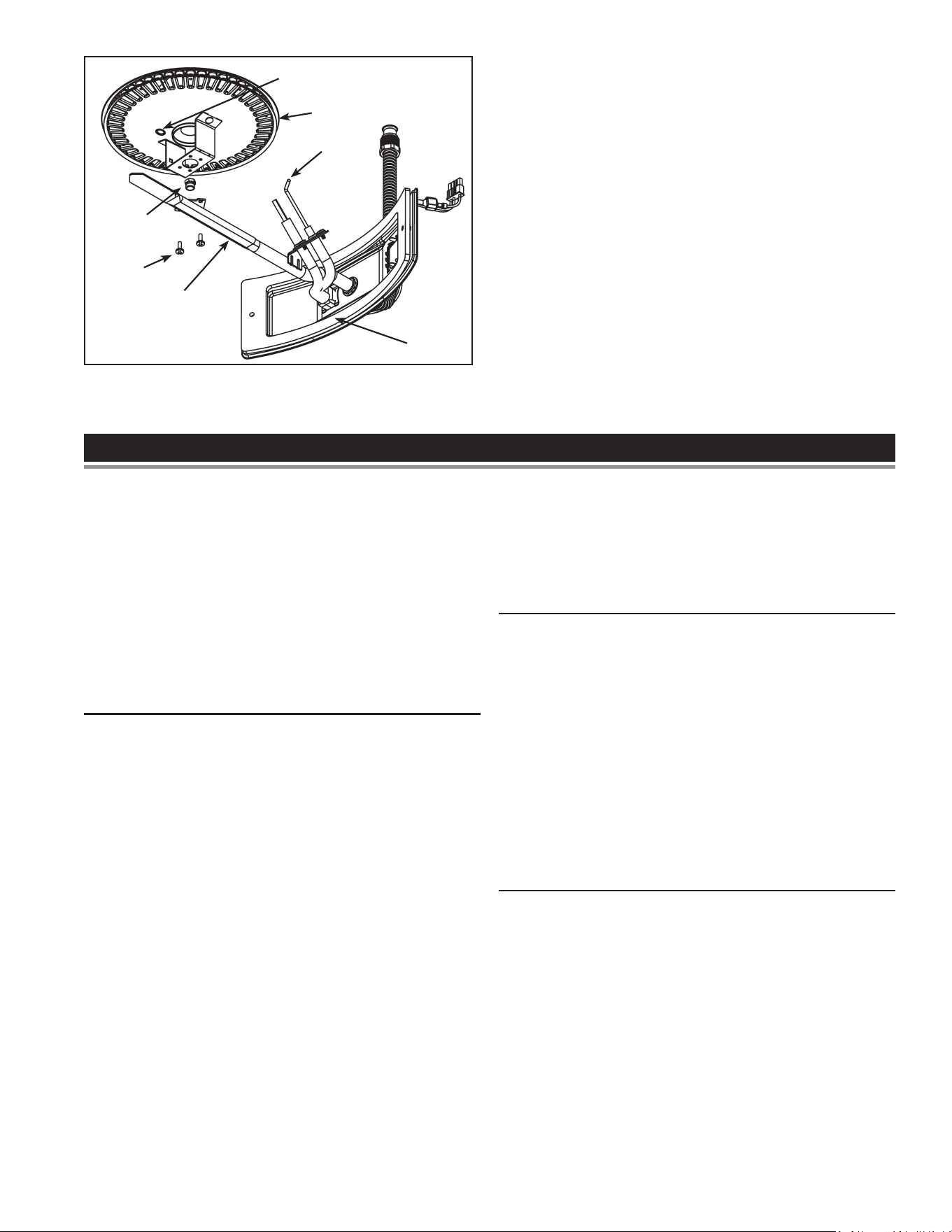
REMOVING BURNER
1. Burner may be hot. Wait until burner has cooled off. After
noting the position of the condensation drain hole on the top
of the burner, turn the inner door/manifold/burner assembly
upside down. Using a Phillips head screwdriver, remove
and retain the 2 screws attaching the burner to the manifold
pipe. See Figure 18 (page 8) and Figure 19 (page 15).
INSTALLING BURNER:
Care MUST be taken to ensure the burner is installed correctly
on the inner door/manifold assembly. Position the new burner
upside down with the orientation of the burner’s condensation
drain as shown in illustration. See Figure 18 (page 8) and
Figure 19 (page 15).
1. Align the screw holes on the inner door/manifold assembly.
Using the two screws removed in step 1 of Removing
Burner, install the new burner to the inner door/ manifold
assembly (rotate the assembly to visually check the top
portion of the burner assembly and confirm the orientation
of the condensation drain hole. See Figure 18 (page 8)
and the note that follows it.
Caution Must Be Taken
Prior to installing the new inner door/manifold/burner assembly,
look inside the burner chamber to fully understand the correct
positioning of the burner assembly and burner manifold tab.
It may be necessary to use a flashlight to ensure correct
placement. Care must be taken so as to not damage any
electrical wiring, or components as you are installing the new
inner door/manifold/burner assembly. Extra caution should be
taken to ensure that electrical wiring, fiberglass insulation or
any other object is not between door gasket and combustion
chamber shield.
Note: If the burner door gasket is worn or damaged it needs
to be replaced. See Figure 9 (page 10). See also
Replacing The Door Gasket. (page 3).
REINSTALLING INNER DOOR/
MANIFOLD/BURNER ASSEMBLY
1. Insert the manifold/burner assembly in the burner chamber
compartment, making sure that the tip of burner manifold
tab engages in the proper slot of the bracket. The tip end of
the burner manifold MUST be placed in the slotted portion
under the condensation pan to obtain proper installation.
See Figure 16 (page 14).
Important:
• The tip end of the burner manifold MUST be placed in
the upper slotted portion for models with input rate of
40,000 to 50,000 Btu/hr to obtain proper installation.
• The tip end of the burner manifold MUST be placed in
the lower slotted portion for models with input rate of
60,000 to 75,000 Btu/hr to obtain proper installation.
2. After confirming no materials of any type are between door
gasket and combustion chamber shield, align the screws
on the inner door with the screw holes on the combustion
chamber and tighten with 1/4” nut-driver or 1/4” socket &
ratchet. See Figure 15 (page 14).
After tightening the inner door screws, visually inspect
area around door gasket and skirt for spaces or gaps. The
door gasket MUST be sealed completely in order for the
water heater to perform properly.
DO NOT OPERATE THE WATER HEATER IF THE DOOR GASKET
DOES NOT CREATE A SEAL BETWEEN MANIFOLD DOOR AND
COMBUSTION CHAMBER.
14
3. Reconnect the manifold tube to the gas control valve/
thermostat.
Note: Do Not apply any thread sealant at this
connection). To prevent any cross threading
the manifold tube should be started by hand
(turn clockwise for natural gas, counter-
clockwise for LP). Upon tightening with
the fingers and confirming it has not been
cross threaded, tighten nut with a 3/4” open
end wrench. See Figure 15 (page 14).
4. Reconnect all the electrical connections to the bottom of the
gas control valve/thermostat, gently pushing each connector
up until it snaps into place. See Figure 10 (page 10) and
Figure 15 (page 14).
5. Reconnect the electrical power to the water heater in the wall
outlet and turn the gas supply back “ON” to the gas control
valve/thermostat.
6. Restart the water heater by following the directions on the
Lighting and Operating Instructions label located on the front of
the water heater.
7. As the burner is heating (view flames through view-port),
test the manifold tube connection at the gas control valve/
thermostat by brushing on an approved noncorrosive leak
detection solution.
Important: Do Not splash any solution onto any electrical
connections.
8. Upon verifying proper operation of the water heater, replace
the outer door.
ELECTRICAL
CONNECTIONS
MANIFOLD
TUBE NUT
HEX HEAD
SCREWS
NOTE: OUTER DOOR AND INSULATION NOT SHOWN FOR CLARITY.
Figure 15. Electrical Connections at the Bottom of the Gas Valve
BURNER SUPPORT
BRACKET -
LOCATED IN THE
CENTRE OF THE
CHAMBER.
STRAIGHT SLOT
FOR 40-50K
BURNERS WITH
STRAIGHT
MANIFOLD TUBES
CURVED SLOT FOR
60-75K BURNERS
WITH OFFSET
MANIFOLD TUBES
Figure 16. Manifold/Burner Assembly
GASKET ON
REAR OF DOOR
INSULATION
PAD
OUTER DOOR
COMBUSTION
CHAMBER
OPENING
MOUNTING CLIP
(1 EACH SIDE)
Figure 17. Burner Chamber Compartment Doors
For 40,000 to 50,000
Btu/hr models
SCREWS
MANIFOLD
BURNER
ORIFICE
DRAIN HOLE
(AT 2 O’CLOCK
POSITION)
DOOR
GASKET
IGNITER
AND FLAME
ROD*
Figure 18. Burner/Igniter Assemblies for 40,000 to 50,000 Btu Models
15
For 60,000 to 75,000 Btu/hr
models
DRAIN HOLE
(AT 2 O’CLOCK
POSITION)*
ORIFICE
SCREWS
MANIFOLD
BURNER
DOOR
GASKET
IGNITER
AND FLAME
ROD
Figure 19. Burner and Igniter Assemblies for 60,000 to 75,000 Btu
Models
Note: The drain hole must be at the 2 o’clock position, directly
opposite the igniter and flame rod.
BURNER ORIFICE
Important: Use only factory authorized replacement parts. If
you lack the necessary skills to properly perform
the installation, you should not proceed, but get
help from a qualified service technician.
Tools Required
• 3/4” Open-End Wrench
• Phillips Head Screwdriver
• Ratchet with 1/4” socket or 1/4” nut-driver
• Ratchet with 1/2” socket.
REMOVING INNER DOOR/MANIFOLD/BURNER ASSEMBLY
1. Set the gas control valve/thermostat to its lowest setting by
turning the knob counter-clockwise to the VAC point. See
Figure 3 (page 6).
2. Turn gas control switch to the “OFF” position and turn “OFF”
the gas supply to the unit. See Figure 3 (page 6).
3. Disconnect the electrical power to the water heater from the
wall outlet.
4. Remove the outer door from the unit.
5. Unplug all the electrical connections from the bottom of the
gas control valve/thermostat. See Figure 15 (page 14).
6. Using a 3/4” open end wrench remove the manifold tube from
the gas control valve/thermostat (turning counter-clockwise
for natural gas, clockwise for LP). Grasp the manifold tube
and push down slightly to free the manifold tube from the gas
control valve/thermostat. See Figure 15 (page 14).
7. Remove the insulation pad on the inner door by cutting it if
necessary. Keep the insulation in a safe place for reusing
it later.
8. Use a 1/4” nut-driver or 1/4” socket & ratchet to loosen the 2
hex head screws on the inner door so the inner door/manifold/
burner assembly can be removed. See Figure 15 (page 14).
9. Remove inner door/manifold/burner assembly by grasping the
manifold, rotating it to the left to clear the igniter and flame
sensor and pulling back. Care should be taken when inner
door and burner assembly passes through jacket opening
that it does not damage any of the electrical wiring. See
Figure 17 (page 14).
REMOVING BURNER ORIFICE
1. Burner may be hot. Wait until burner has cooled off. After
noting the position of the condensation drain hole on the top
of the burner, turn the inner door/manifold/burner assembly
upside-down. Using a Phillips head screwdriver, remove and
retain the 2 screws attaching the burner to the manifold pipe.
See Figure 18 (page 8) and Figure 19 (page 15).
2. Using a ratchet with 1/2” socket, remove the burner’s old
orifice.
Note: The burner orifices have different threads
dependent upon the gas type. Orifices for
natural gas have right-hand threads, orifices
for LP have left-hand threads. See Figure 18
(page 8) and Figure 19 (page 15).
INSTALLING BURNER ORIFICE
1. Using a ratchet with 1/2” socket, install the new burner orifice.
Note: The burner orifices have different threads
dependent upon the gas type. right-handed
threads for natural gas (turn clockwise to
install) and left-handed threads for propane gas
(turn counter-clockwise to install). See Figure
18 (page 8) and Figure 19 (page 15).
Note: Determine whether the orifice is tall or short
and DO NOT replace them with each other.
2. Care MUST be taken to ensure the burner is installed correctly
on the inner door/manifold assembly. Position the new burner
upside down with the orientation of the burner’s condensation
drain as noted in Removing Burner Orifice step 1.

16
3. Align the screw holes on the inner door/manifold assembly.
Using the two screws removed in step 1 above, installed
the new burner to the inner door/ manifold assembly (rotate
the assembly to visually check the top portion of the burner
assembly and confirm the orientation of the condensation
drain hole as shown in the illustration. See Figure 18 (page
8) and Figure 19 (page 15).
Caution Must Be Taken
Prior to installing the new inner door/manifold/burner assembly,
look inside the burner chamber to fully understand the correct
positioning of the burner assembly and burner manifold tab.
It may be necessary to use a flashlight to ensure correct
placement. Care must be taken so as to not damage any
electrical wiring or components as you are installing the new
inner door/manifold/burner assembly.
Extra caution should be taken to ensure that electrical wiring,
fiberglass insulation or any other object is not between door
gasket and combustion chamber shield.
Note: If the burner door gasket is worn or damaged it needs
to be replaced. See Figure 9 (page 10). See also
Replacing The Door Gasket. (page 3).
REINSTALLING INNER DOOR/
MANIFOLD/BURNER ASSEMBLY
1. Insert the manifold/burner assembly in the burner chamber
compartment, making sure that the tip of burner manifold
tab engages in the proper slot of the bracket. See Figure
16 (page 14).
Important:
• The tip end of the burner manifold MUST be placed in
the upper slotted portion for models with input rate of
40,000 to 50,000 Btu/hr to obtain proper installation.
• The tip end of the burner manifold MUST be placed in
the lower slotted portion for models with input rate of
60,000 to 75,000 Btu/hr to obtain proper installation.
2. After confirming no materials of any type are between door
gasket and combustion chamber shield, align the screws
on the inner door with the screw holes on the combustion
chamber and tighten with 1/4” nut-driver or 1/4” socket &
ratchet. See Figure 15 (page 14).
After tightening the inner door screws, visually inspect
area around door gasket and skirt for spaces or gaps. The
door gasket MUST be sealed completely in order for the
water heater to perform properly.
DO NOT OPERATE THE WATER HEATER IF THE DOOR GASKET
DOES NOT CREATE A SEAL BETWEEN MANIFOLD DOOR AND
COMBUSTION CHAMBER.
3. Reconnect the manifold tube to the gas control valve/
thermostat.
Note: Do Not apply any thread sealant at this
connection). To prevent any cross threading
the manifold tube should be started by hand.
(Turn clockwise for natural gas, counter-
clockwise for LP.) Upon tightening with the
fingers and confirming it has not been cross
threaded, tighten nut with an 3/4” open
end wrench. See Figure 15 (page 14).
4. Reconnect all the electrical connections to the bottom of the
gas control valve/thermostat, gently pushing each connector
up until it snaps into place. See Figure 10 and Figure 15).
5. Reconnect the electrical power to the water heater in the
wall outlet and turn the gas supply back “ON” to the gas
control valve/thermostat.
6. Restart the water heater by following the directions on the
Lighting and Operating Instructions label located on the front
of the water heater.
7. As the burner is heating (view flames through view-port),
test the manifold tube connection at the gas control valve/
thermostat by brushing on an approved noncorrosive leak
detection solution.
Important: Do Not splash any solution onto any electrical
connections.
8. Upon verifying proper operation of the water heater, replace
the outer door.
DOOR GASKET REPLACEMENT
DOOR GASKET
Important: Use only factory authorized replacement parts. If
you lack the necessary skills to properly perform
the installation, you should not proceed, but get
help from a qualified service technician.
Tools Required
• 3/4” Open-End Wrench
• 3/4” Scraper
• Ratchet with 1/4” socket or 1/4” nut-driver
• Flashlight
REMOVING INNER DOOR/MANIFOLD/
BURNER ASSEMBLY
1. Set the gas control valve/thermostat to its lowest setting by
turning the knob counter-clockwise to the VAC point. See
Figure 3 (page 6).
2. Turn gas control switch to the “OFF” position and turn “OFF”
the gas supply to the unit. See Figure 3 (page 6).
3. Disconnect the electrical power to the water heater from
the wall outlet.
4. Remove the outer door from the unit.
5. Unplug all the electrical connections from the bottom of
the gas control valve/thermostat. See Figure 7 (page 8).

17
6. Using a 3/4” open end wrench remove the manifold tube from
the gas control valve/thermostat (turning counter-clockwise
for natural gas, clockwise for LP). Grasp the manifold tube
and push down slightly to free the manifold tube from the gas
control valve/thermostat. See Figure 7 (page 9).
7. Remove the insulation pad on the inner door by cutting it if
necessary. Keep the insulation in a safe place for reusing
it later.
8. Use a 1/4” nut-driver or 1/4” socket & ratchet to loosen the 2
hex head screws on the inner door so the inner door/manifold/
burner assembly can be removed. See Figure 7 (page 9).
9. Remove inner door/manifold/burner assembly by grasping
the manifold and pull back slowly. Rotating it to the left to
clear the igniter and flame sensor. Care should be taken
when inner door and burner assembly passes through jacket
opening that it does not damage any of the electrical wiring.
See Figure 9 (page 10).
REMOVING THE DOOR GASKET
1. Locate the gasket that is on the rear of the burner door
assembly. See Figure 17 (page 14), Figure 18 (page 8),
and Figure 19 (page 15).
2. Pull off this gasket and using the 3/4” scraper, scrape away
and gasket stuck to the door.
3. Using the 3/4” scraper, clean around the combustion chamber
opening to ensure no old gasket material is stuck on the
combustion chamber. See Figure 17 (page 14). Use the
flashlight to clearly illuminate this area. Take care not to
damage the mounting clips located on each side of the
opening.
REPLACING THE DOOR GASKET.
1. Remove the paper cover on the new door gasket. This will
expose the gasket adhesive.
2. Position the gasket on the freshly cleaned door surface so
that the adhesive firmly holds the gasket to the door.
3. Smooth the gasket to avoid creases.
RE-INSTALLING INNER DOOR/
MANIFOLD/BURNER ASSEMBLY
1. Insert the manifold/burner assembly in the burner chamber
compartment, making sure that the tip of burner manifold
tab engages in the proper slot of the bracket. See Figure 8
(page 10).
Important:
• The tip end of the burner manifold MUST be placed in
the upper slotted portion for models with input rate of
40,000 to 50,000 Btu/hr to obtain proper installation.
• The tip end of the burner manifold MUST be placed in
the lower slotted portion for models with input rate of
60,000 to 75,000 Btu/hr to obtain proper installation.
2. After confirming no materials of any type are between door
gasket and combustion chamber shield, align the screws
on the inner door with the screw holes on the combustion
chamber and tighten with 1/4” nut-driver or 1/4” socket &
ratchet. See Figure 7 (page 9).
After tightening the inner door screws, visually inspect area
around door gasket and skirt for spaces or gaps. The door
gasket MUST be sealed completely in order for the water
heater to perform properly.
DO NOT OPERATE THE WATER HEATER IF THE DOOR GASKET
DOES NOT CREATE A SEAL BETWEEN MANIFOLD DOOR AND
COMBUSTION CHAMBER.
3. Reconnect the manifold tube to the gas control valve/
thermostat
Note: Do Not apply any thread sealant at this
connection). To prevent any cross threading
the manifold tube should be started by hand
(turn clockwise for natural gas, counter-
clockwise for LP). Upon tightening with
the fingers and confirming it has not been
cross threaded, tighten nut with a 3/4” open
end wrench. See Figure 7 (page 9).
4. Reinstall the insulation pad which was removed in step 7
above.
5. Reconnect all the electrical connections to the bottom of the
gas control valve/thermostat, gently pushing each connector
up until it snaps into place. See Figure 10 (page 10) and
Figure 15 (page 14).
6. Reconnect the electrical power to the water heater in the wall
outlet and turn the main gas supply back “ON” to the gas
control valve/thermostat.
7. Restart the water heater by following the directions on the
Lighting and Operating Instructions label located on the front of
the water heater. Test gas connections by brushing on an
approved non-corrosive leak detection solution.
Note: Do not splash the solution on control. If
a leak is detected, shut the water heater
down by following the directions on the
Lighting and Operating Instructions. Repair
the leak(s) and repeat this step.
8. Upon verifying proper operation of the water heater, replace
the insulation and outer door.
18
CONTROL MODULE REMOVAL/REPLACEMENT
ELECTRONIC CONTROL MODULE
Important: Do not remove the entire gas control assembly
from the water heater.
Important: Use only factory authorized replacement parts. If
you lack the necessary skills to properly perform
the installation, you should not proceed, but get
help from a qualified service technician.
Tools required
• T15 Torx screwdriver
• Flat-blade screwdriver
REMOVING ELECTRONIC CONTROL MODULE
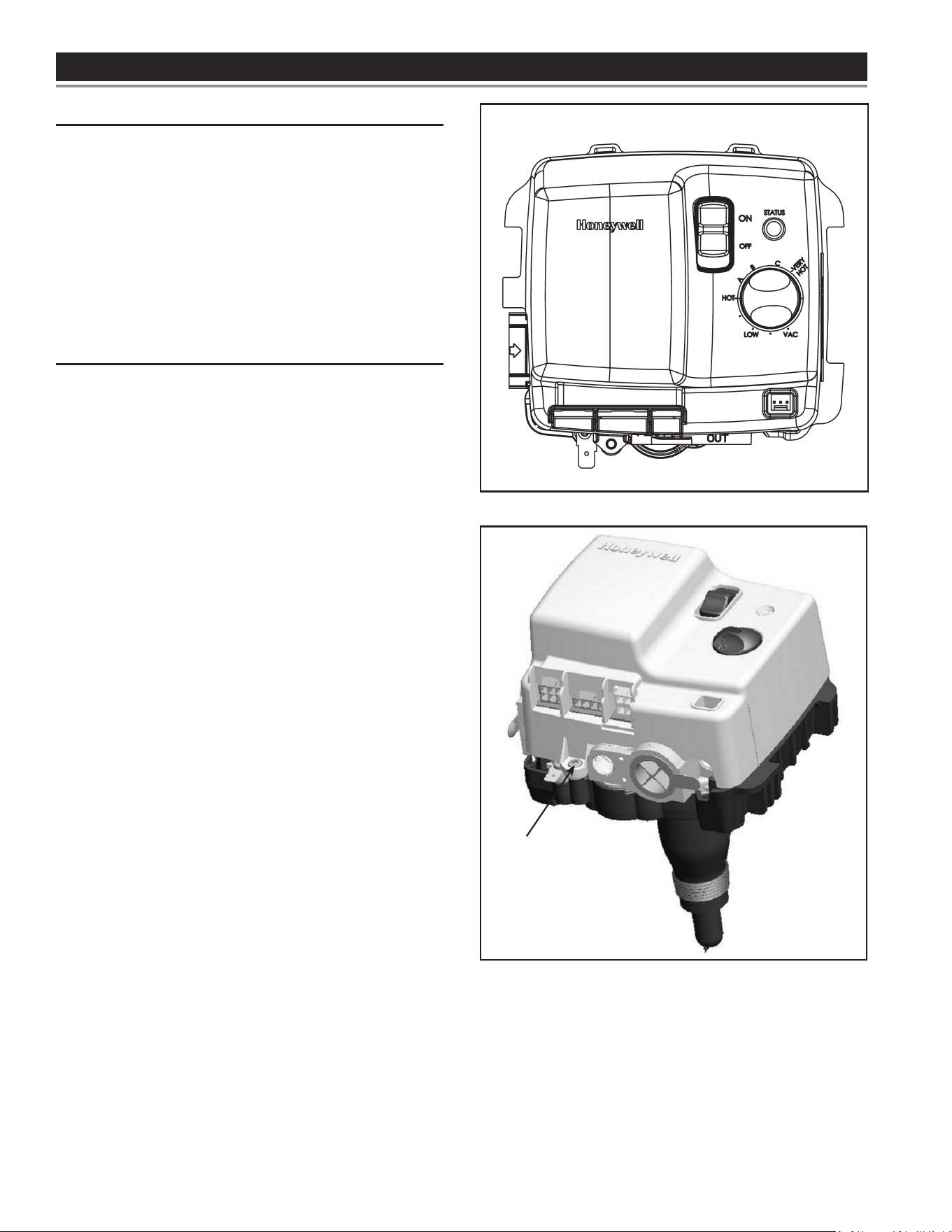
1. Set the gas control valve/thermostat to its lowest setting by
turning the knob counter-clockwise to the VAC point. See
Figure 20 (page 18).
2. Turn gas control switch to the “OFF” position and turn off
the gas supply to the unit. See Figure 20 (page 18).
3. Disconnect the electrical power to the water heater from
the wall outlet.
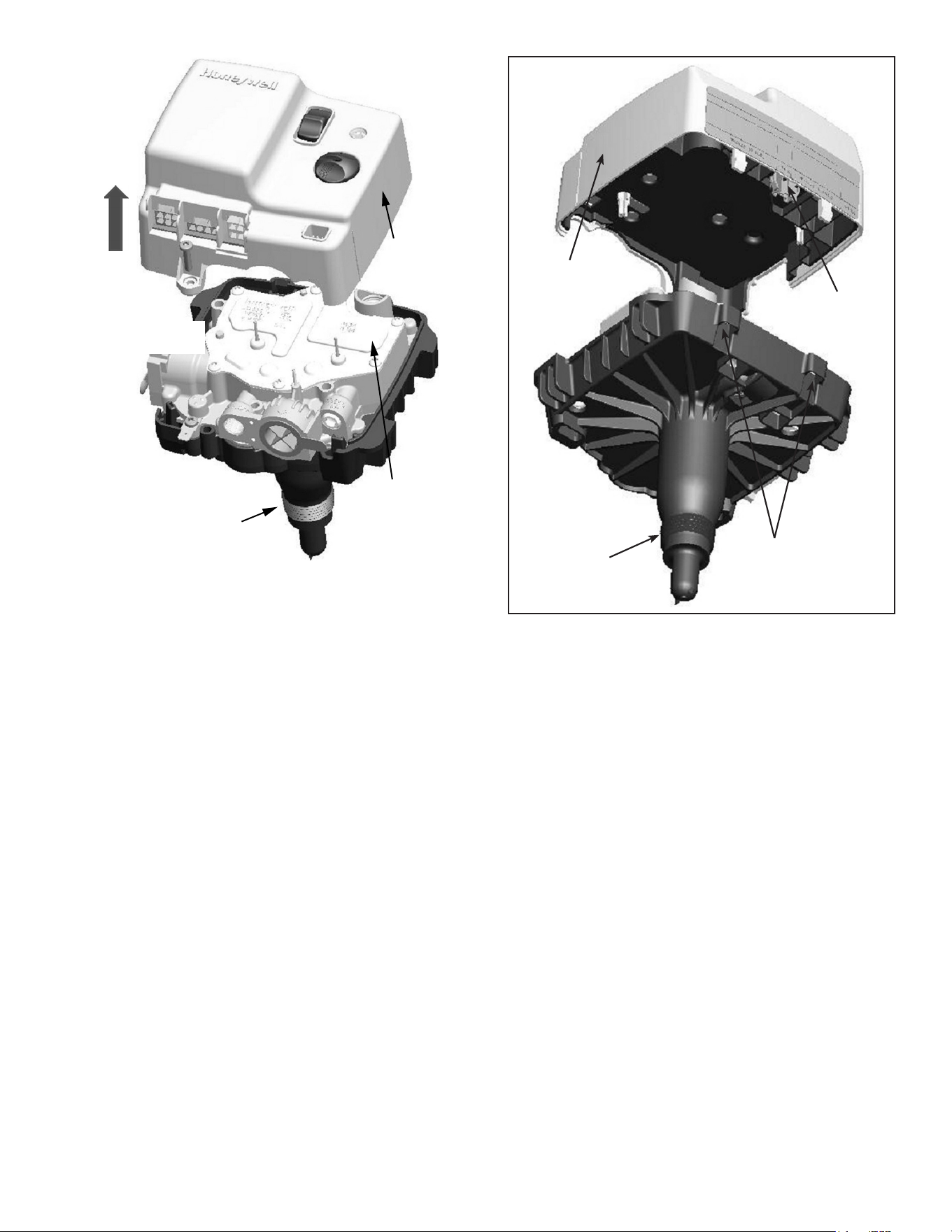
4. Remove the front Torx screw at the bottom of the gas control
valve/thermostat as illustrated in Figure 21 (page 18).
5. Use a flat-blade screwdriver to release the two tabs at the
top of the gas control valve/thermostat and lift the electronic
control straight up. See Figure 22 (page 19) and Figure 23
(page 19).
6. Disconnect the temperature sensor cable.
Note: When removing the control module from the
gas control assembly, disengage the pins on
the valve module without causing damage.
7. Re-assemble in the reverse order.
Note: During re-assembly, align the pins on the
valve module to their proper location in the
control module without causing damage.
Figure 20. Temperature Adjusting Dial
FRONT TORX
SCREW
Figure 21. Gas Valve Side View Showing Torx Screw
19
ELECTRONIC
CONTROL
MODULE
LIFT THE
ELECTRONIC
CONTROL
STRAIGHT UP
VALVE
MODULE
THREADED CONTROL
FITTING (DO NOT
REMOVE FROM
WATER HEATER)
Figure 22. Gas Valve Top View - Exploded
TABS
DISCONNECT
TEMPERATURE
SENSOR CABLE
HERE
ELECTRONIC
CONTROL
MODULE
THREADED CONTROL
FITTING
(DO NOT REMOVE
FROM WATER HEATER)
Figure 23. Gas Valve Bottom View - Exploded
20
VALVE MODULE REMOVAL/REPLACEMENT
VALVE MODULE
Important: Do not remove the entire gas control assembly
from the water heater.
Important: Use only factory authorized replacement parts. If
you lack the necessary skills to properly perform
the installation, you should not proceed, but get
help from a qualified service technician.
Tools Required
• T15 Torx screwdriver
• Flat-blade screwdriver
REMOVING VALVE MODULE
1. Set the gas control valve/thermostat to its lowest setting by
turning the knob counter-clockwise to the VAC point. See
Figure 20 (page 18).
2. Turn gas control switch to the “OFF” position and turn off the
gas supply to the unit. See Figure 20 (page 18).
3. Disconnect the electrical power to the water heater from the
wall outlet.
4. Remove the Electronic Control Module as outlined in Removing
Electronic Control Module (page 18).
Note: When removing the control module from the
gas control assembly, disengage the pins on
the valve module without causing damage.
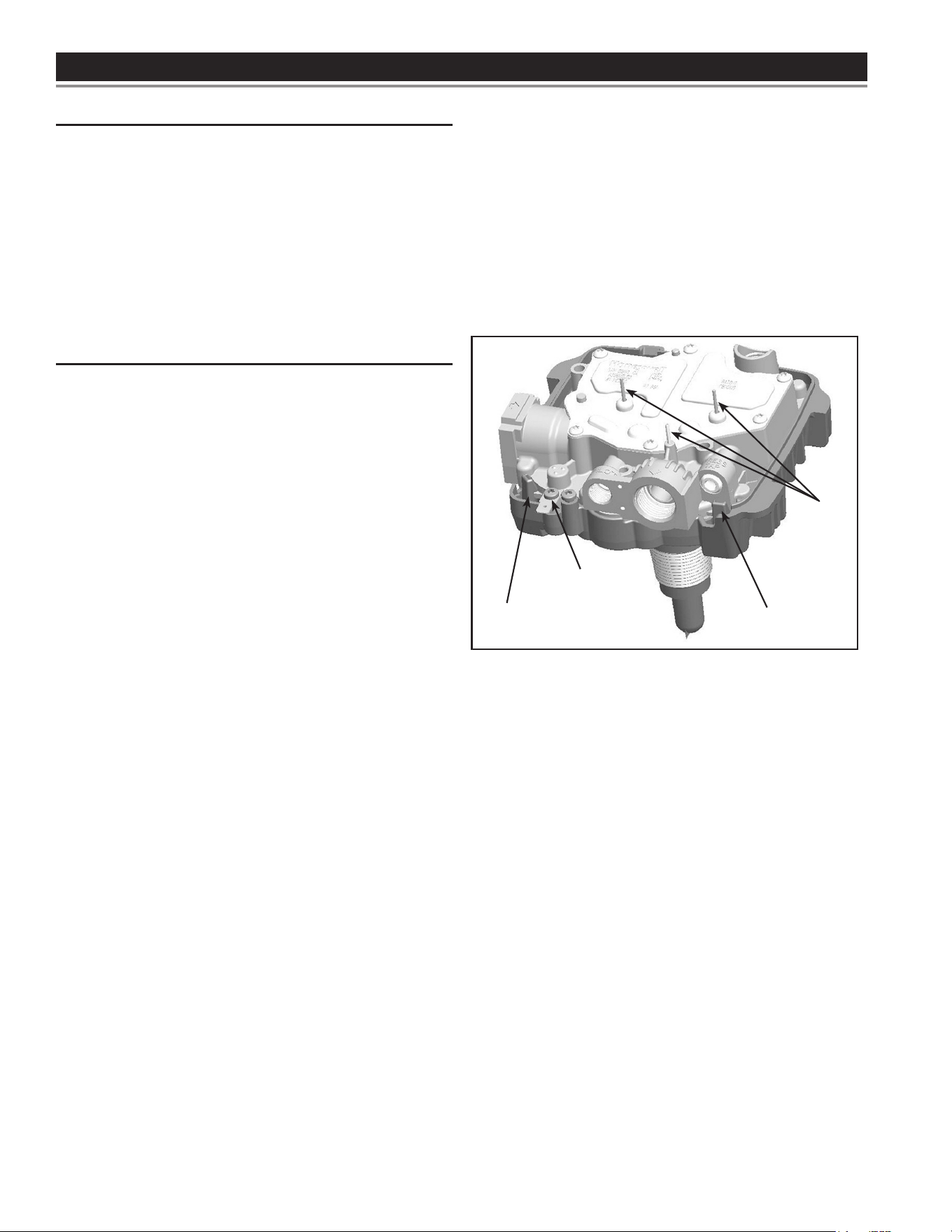
5. Remove the screw and the ground tab with a Torx screwdriver.
See Figure 24.
6. Insert a flat-blade screwdriver between the casting and the
locking tabs at the bottom of the valve.
7. Carefully pry against the casting until it barely slides past
the locking tab edge.
8. Repeat on the opposite side.
9. Replace the valve.
Note: When replacing the valve, do not apply
pressure with the hand on the valve pins.
10. Re-assemble in the reverse order.
Note: During re-assembly, align the pins on the
valve module to their proper location in the
control module without causing damage.
CASTING AND
LOCKING TAB
SCREW AND
GROUND TAB
VALVE
PINS
CASTING AND
LOCKING TAB
Figure 24. Gas Valve Showing Torx Screw and Ground Tab
21
TEMPERATURE SENSOR AND
CABLE REMOVAL/REPLACEMENT
TEMPERATURE SENSOR AND CABLE
Important: Do not remove the entire gas control assembly
from the water heater.
Important: Use only factory authorized replacement parts. If
you lack the necessary skills to properly perform
the installation, you should not proceed, but get
help from a qualified service technician.
Tools required:
• T15 Torx screwdriver
• Flat-blade screwdriver
REMOVING TEMPERATURE SENSOR AND CABLE
1. Set the gas control valve/thermostat to its lowest setting by
turning the knob counter-clockwise to the VAC point. See
Figure 20 (page 18).
2. Turn gas control switch to the “OFF” position and turn off the
gas supply to the unit. See Figure 20 (page 18).
3. Disconnect the electrical power to the water heater from the
wall outlet.
4. Remove the Electronic Control Module as outlined in Removing
Electronic Control Module (page 18).
Note: When removing the control module from the
gas control assembly, disengage the pins on
the valve module without causing damage.
5. Remove the Valve Module as outlined in Removing Valve
Module (page 20).
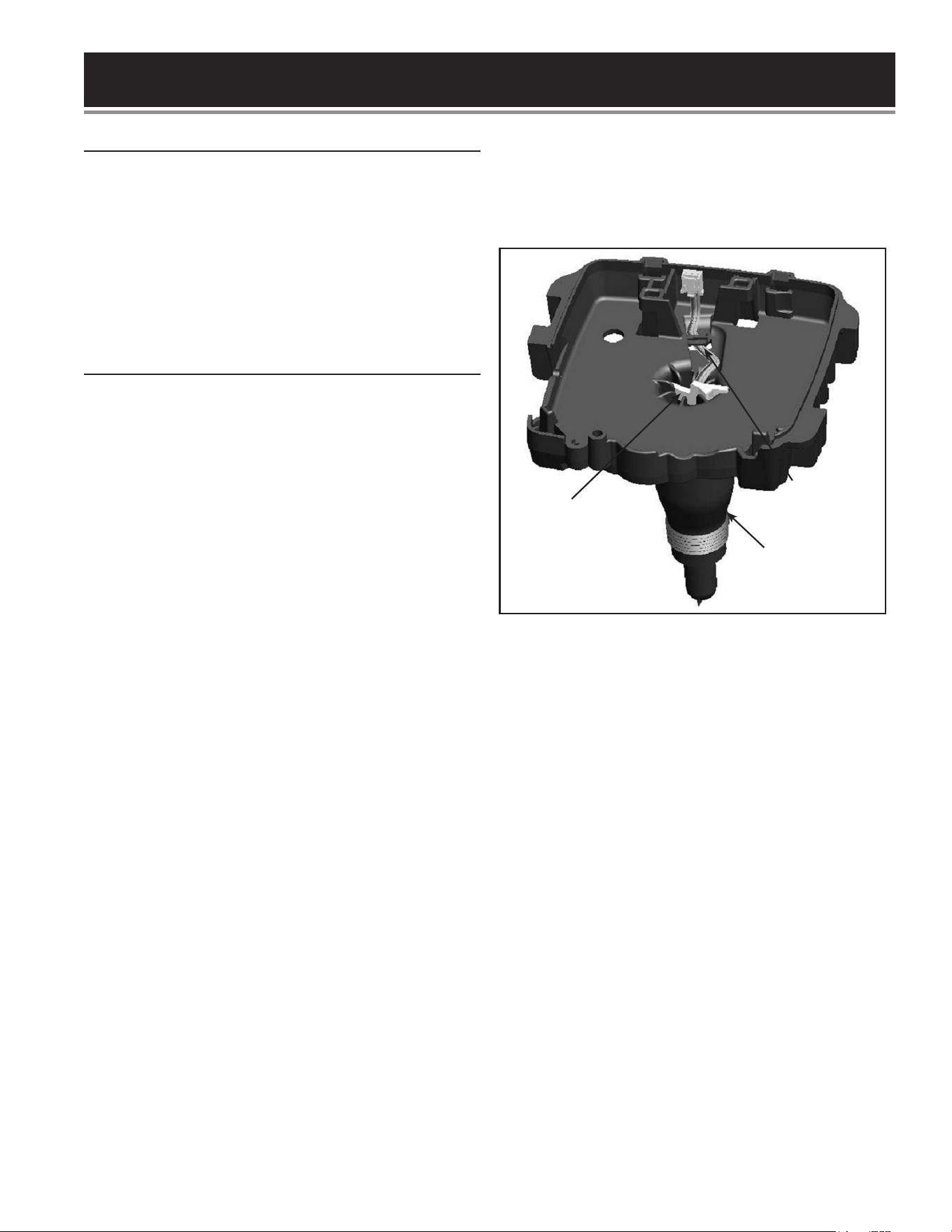
6. Use a screwdriver to pry under the sensor retainer finger to
remove the temperature sensor and cable. See Figure 25.
7. Re-assemble in the reverse order.
Note: When replacing the valve, do not apply
pressure with the hand on the valve pins.
Note: During re-assembly, align the pins on the
valve module to their proper location in the
control module without causing damage.
TEMPERATURE
SENSOR
CABLE UNDER
THE RETAINING
TAB
NOTE: USE CAUTION
WHEN REPLACING
THE VALVE TO NOT
APPLY PRESSURE
ON THE VALVE PINS.
SENSOR
RETAINER "FINGER"
THREADED CONTROL
FITTING
(DO NOT REMOVE
FROM WATER HEATER)
Figure 25. Temperature Sensor Retaining Finger

22
GAS VALVE REMOVAL/REPLACEMENT
Important: Use only factory authorized replacement parts. If
you lack the necessary skills to properly perform
the installation, you should not proceed, but get
help from a qualified service technician.
Tools Required
• 3/4” Open-End Wrench
• Short length of 1/2” threaded pipe
• Pipe Wrench
REMOVING GAS CONTROL VALVE
1. Set the gas control valve/thermostat to its lowest setting by
turning the knob counter-clockwise to the VAC point. See
Figure 3 (page 6).
2. Turn gas control switch to the “OFF” position and turn off the
gas supply to the unit. See Figure 3 (page 6).
3. Disconnect the electrical power to the water heater from the
wall outlet.
4. Release water pressure by opening a nearby hot water faucet,
let run until water is cool to touch. Turn off water supply to
the water heater.
5. Remove the outer door from the unit.
6. Connect a drain hose to the drain valve and run it to an
adequate drain or to the exterior of the building. Open the
water heater drain valve and allow the water to drain from
the tank.
7. Unplug all the electrical connections from the bottom of the
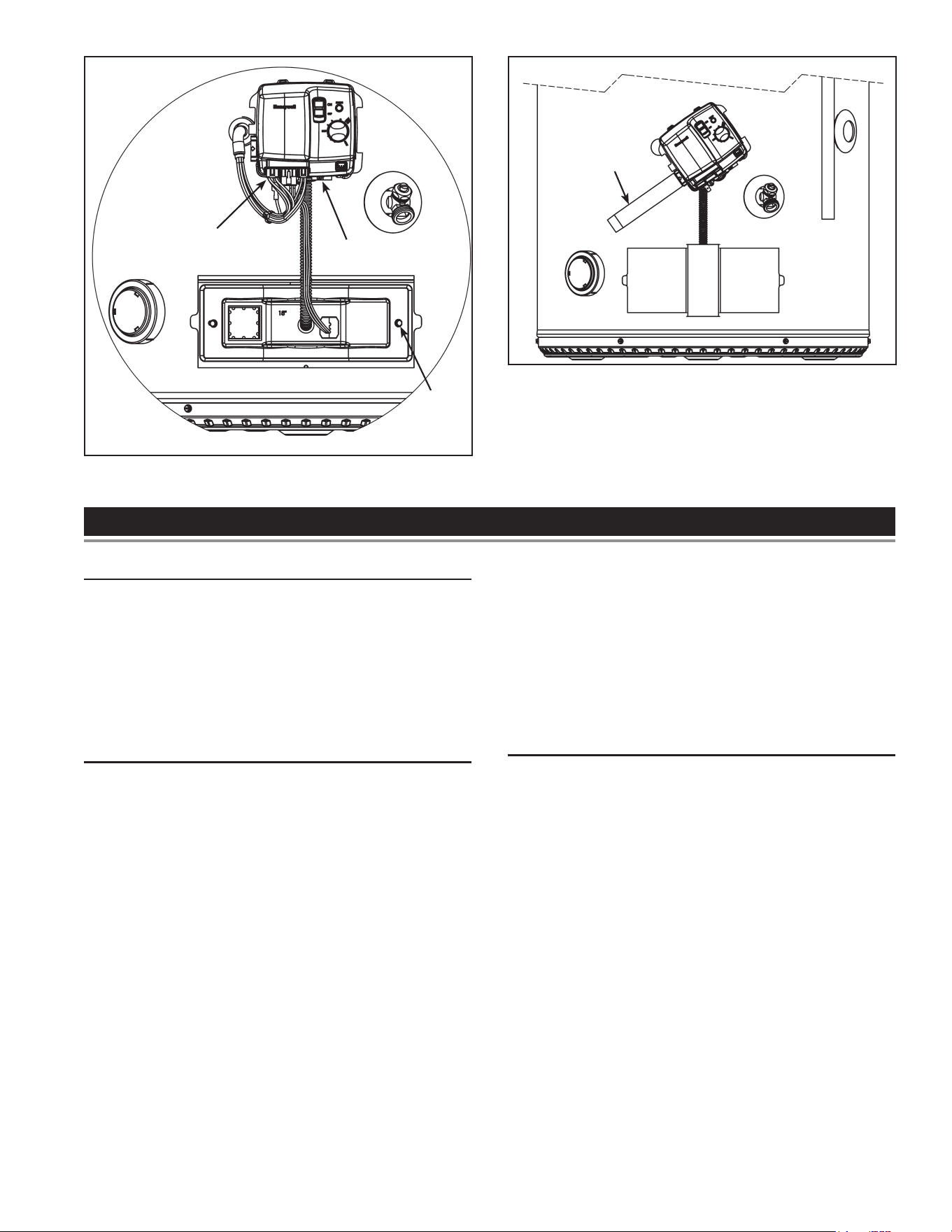
gas control valve/thermostat. See Figure 26 (page 23).
8. Using a 3/4” open end wrench remove the manifold tube from
the gas control valve/thermostat (turning counter-clockwise
for natural gas, clockwise for LP). Grasp the manifold tube
and push down slightly to free the manifold tube from the gas
control valve/thermostat. See Figure 26 (page 23).
9. Ensuring that the gas supply line is turned off, disconnect
the gas piping at the ground joint union, then remove the gas
piping from the gas control valve/thermostat.
10. Remove any other fittings that may be installed on the
threaded pipe to the gas control valve/thermostat.
11. After ensuring the water heater is completely drained, thread
a short length of 1/2” threaded pipe into the inlet connection
of the gas control valve/thermostat and use it to turn the gas
control valve/thermostat counter-clockwise to remove. See
Figure 27 (page 23). Do not use any type of wrench on the
valve body as it may cause damage to the gas control valve/
thermostat assembly.
INSTALLING GAS CONTROL VALVE
1. Do not apply any sealant tape to the gas control/thermostat
threads that screw into the tank. The threads have a pre-
applied white sealing material.
2. Thread a short length of 1/2” threaded pipe into the inlet
connection of the new gas control valve/thermostat and
use it to turn the gas control valve/thermostat clockwise to
tighten into place.
Note: Do Not over tighten or damage may
result, but it needs to be water tight.
See Figure 27 (page 23).
3. Remove the 1/2” threaded pipe from the gas control valve/
thermostat.
4. Reconnect the gas piping to the gas control valve/thermostat,
use Teflon
®
tape or an approved pipe sealant on threads of
the piping.
5. Close the drain valve and turn on the cold water supply line
filling the tank completely with water. Purge the water lines
of any excess air by opening a hot water faucet allowing the
water to flow for a minimum of 3 minutes, allowing the tank
to fill completely.
6. Reconnect the manifold tube to the gas control valve/
thermostat
Note: Do Not apply any thread sealant at this
connection). To prevent any cross threading
the manifold tube should be started by hand
(turn clockwise for natural gas, counter-
clockwise for LP). Upon tightening with the
fingers and confirming it has not been cross
threaded, tighten nut with an 3/4” open
end wrench. See Figure 26 (page 23).
7. Reconnect all the electrical connections to the bottom of the
gas control valve/thermostat, gently pushing each connector
up snapping into place. See Figure 10 (page 10) and Figure
26 (page 23).
8. Turn on the gas supply to the unit and test the gas supply
line and union connections by brushing on an approved
noncorrosive leak detection solution.
Note: Do not splash the solution on control. If
a leak is detected, shut the water heater
down by following the directions on the
Lighting and Operating Instructions. Repair
the leak(s) and repeat leak test).
9. Reconnect the electrical power to the water heater in the
wall outlet and turn the gas supply back on to the gas control
valve/thermostat.
10. Restart the water heater by following the directions on the
label located on the front of the water heater.
11. As the burner is heating (view flames through view-port),
test the manifold tube connection at the gas control valve/
thermostat by brushing on an approved noncorrosive leak
detection solution.
Important: Do Not splash any solution onto any electrical
connections.
12. Upon verifying proper operation of the water heater, replace
the outer door.
23
ELECTRICAL
CONNECTIONS
MANIFOLD
TUBE NUT
HEX HEAD
SCREWS
NOTE: OUTER DOOR AND INSULATION NOT SHOWN FOR CLARITY.
Figure 26. Electrical Connections at the Bottom of the Gas Valve
THREADED
PIPE
“HANDLE”
Figure 27. Using a Threaded Pipe as a Handle to Turn the Gas
Control Valve/Thermostat
BLOWER REMOVAL/REPLACEMENT
BLOWER
Important: Use only factory authorized replacement parts. If
you lack the necessary skills to properly perform
the installation, you should not proceed, but get
help from a qualified service technician.
Tools required:
• Ratchet with 5/16” socket or 5/16” nut-driver
• Ratchet with 1/4” socket or 1/4” nut-driver
REMOVING BLOWER
1. Set the gas control valve/thermostat to its lowest setting by
turning the knob counter-clockwise to the VAC point. See
Figure 3 (page 6).
2. Turn gas control switch to the “OFF” position and turn “OFF”
the gas supply to the unit. See Figure 3 (page 6)
3. Disconnect the electrical power to the water heater from
the wall outlet.
4. Use a 5/16” nut-driver to loosen the screw on the upper
gear clamp of the rubber coupling adapter connecting the
venting to the blower. Slowly pull the vent from the adapter.
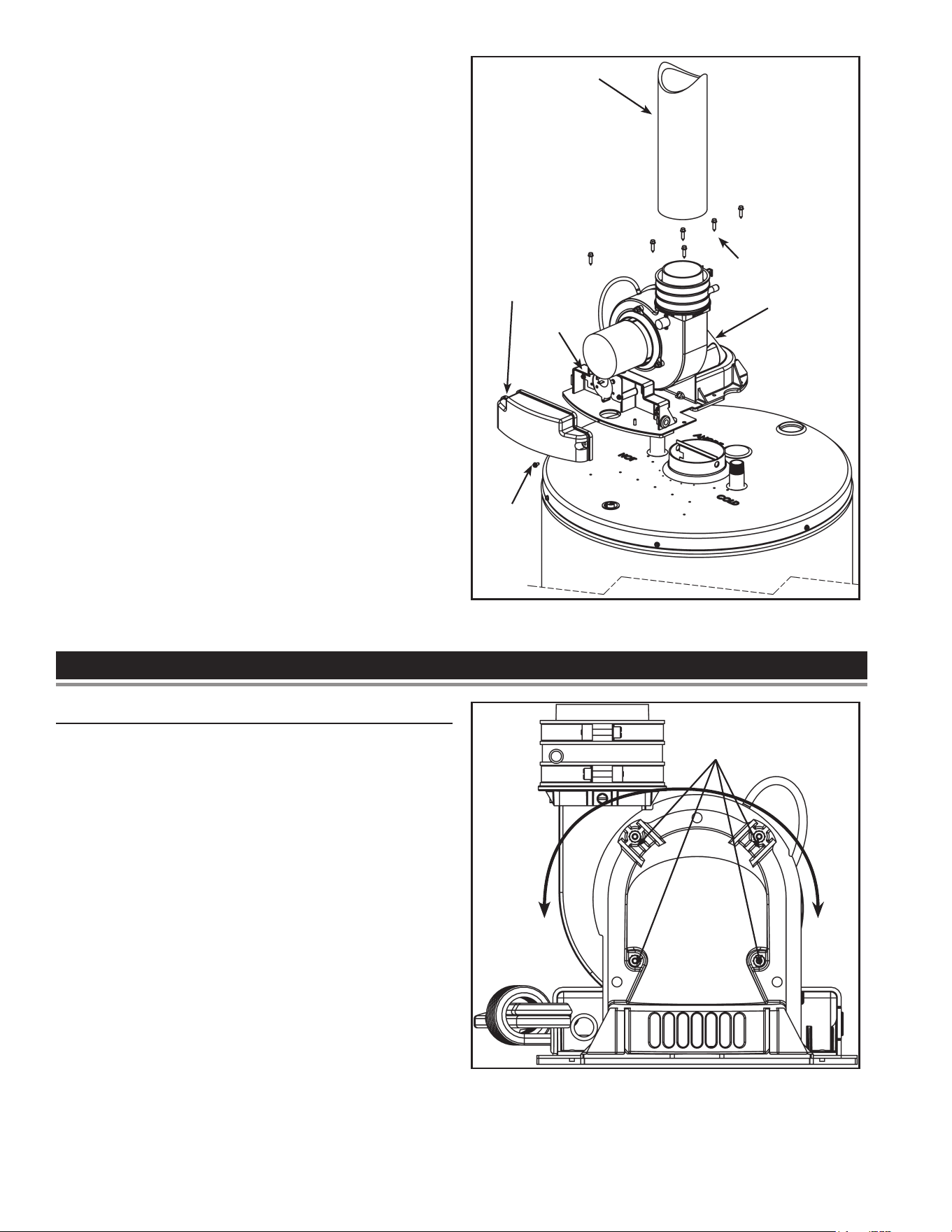
See Figure 28 (page 24).
Note: The rubber coupling adapter will be different
based on the venting size (2” or 3” vent pipe).
5. Use a 1/4” nut-driver or 1/4” socket & ratchet to loosen the
screw on the junction box. Remove and retain the screw
and junction box cover. Disconnect the power and ground
connectors. See Figure 28 (page 24).
6. Use a 1/4” nut-driver or 1/4” socket & ratchet to loosen,
remove and retain the 6 hex head screws so the blower
assembly can be removed. Remove the blower while
carefully passing the power and ground connectors through
the junction box opening. See Figure 28 (page 24).
Important: When removing the blower, care must be taken to
pass the power and ground connectors through
the junction box opening so the wires and blower
do not get damaged.
INSTALLING BLOWER
1. Pass the power and ground connectors through the junction
box opening and place the blower on top of the water heater.
2. Reconnect the power connector and the ground connector.
Reinstall the junction box cover and screw removed in step
5 above. Tighten with 1/4” nut-driver or 1/4” socket & ratchet.
3. Align the screw holes on the blower assembly with those on
the top of the heater. Using the six screws removed in step
6 above, install the blower assembly and tighten with 1/4”
nut-driver or 1/4” socket & ratchet. See Figure 28 (page 24).
4. Reinstall the vent by pushing it into the adapter. After
confirming the vent is properly seated in the adapt, use a
5/16” nut-driver to tighten the screw on the gear clamp of
the adapter connecting the venting to the blower
Important: This connection must be properly sealed to
prevent the leakage of the products of combustion
into the living area.
5. Reconnect the electrical power to the water heater in the
wall outlet and turn the gas supply back “ON” to the gas
control valve/thermostat.
24
6. Restart the water heater by following the directions on the
label located on the front of the water heater.
Note: This power vent heater will accept a 2” or 3”
rubber outlet coupling, depending on the size
of the water heater. This coupling, mounted in
the vertical position, accepts the vent piping
and is attached as shown in Figure 28. See
the Manual to determine vent pipe sizing for
your application. The blower assembly may
be rotated 90 degrees clockwise or counter-
clockwise to allow horizontal venting in areas
having restricted space above the water
heater. See Rotating The Blower (page 24).
BLOWER
ASSEMBLY
VENTING
SCREW
JUNCTION
BOX COVER
SCREWS
JUNCTION
BOX
Figure 28. Removing the Blower
ROTATING THE BLOWER
BLOWER EXHAUST DIRECTION
Important: Use only factory authorized replacement parts. If
you lack the necessary skills to properly perform
the installation, you should not proceed, but get
help from a qualified service technician.
Tools required:
• Ratchet with 11/32” socket or 11/32” nut-driver
The blower assembly may be rotated 90 degree clockwise or
counterclockwise to allow horizontal venting in areas having
restricted space above the water heater. To rotate the blower
outlet, remove the four nuts with 11/32” nut driver, securing the
flue collector to the blower housing. See Figure 29
Pull the blower assembly forward to free it from the mounting
studs. Rotate the blower housing clockwise or counter-clockwise
and align the four holes and screws together. Reattach the
blower housing to the flue collector.
11/32” nut
Figure 29. Rotating the Blower Outlet
This power vent heater can accept 2” or 3” rubber outlet
coupling, depending on the capacity of the water heater. This
coupling, mounted in the vertical position, accepts the vent
piping and is attached as shown in Figure 28.
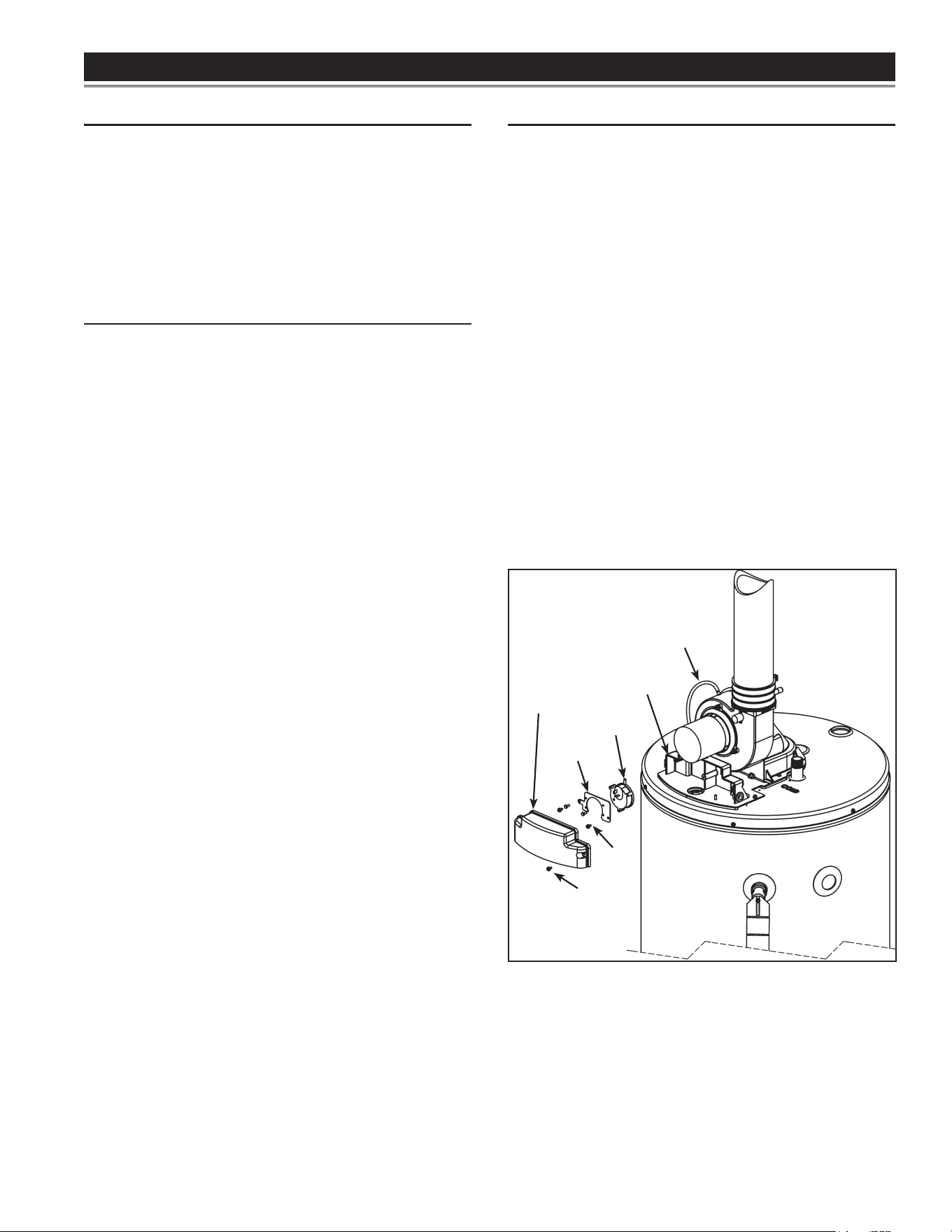
25
PRESSURE SWITCH REMOVAL/REPLACEMENT
PRESSURE SWITCH
Important: Use only factory authorized replacement parts. If
you lack the necessary skills to properly perform
the installation, you should not proceed, but get
help from a qualified service technician.
Tools Required
• Phillips Head Screwdriver
• Ratchet with 1/4” socket or 1/4” nut-driver
REMOVING PRESSURE SWITCH
1. Set the gas control valve/thermostat to its lowest setting by
turning the knob counter-clockwise to the VAC point. See
Figure 3 (page 6).
2. Turn gas control switch to the “OFF” position and turn “OFF”
the gas supply to the unit. See Figure 3 (page 6).
3. Disconnect the electrical power to the water heater from
the wall outlet.
4. Use a 1/4” nut-driver or 1/4” socket & ratchet to loosen the
screw on the junction box. Remove and retain the screw
and junction box cover. See Figure 3 (page 6).
5. Remove the air pressure tubing from the air pressure switch
by pulling upward on the tubing at the connection to the air
pressure switch.
6. After noting the position of each electrical flag terminals,
remove the two (2) electrical flag terminals from the switch
by pulling outward and off the switch.
7. Using a hex head screwdriver, remove and retain the 2
screws securing the bracket to the junction box. See Figure
30.
8. Using a hex head screwdriver, remove and retain the 2
screws securing the pressure switch to the bracket. See
Figure 30.
INSTALLING PRESSURE SWITCH
1. Using a hex head screwdriver, secure the new pressure
switch to the bracket with the screws removed in step
8 above. Care should be taken to ensure the proper
orientation of the bracket and pressure switch. See Figure
30 (page 25).
2. Using a hex head hex screwdriver, secure the bracket to
the junction box with the screws removed in step 7 above.
See Figure 30 (page 25).
3. Reattach the two (2) electrical flag terminals by pushing
the flag terminals onto the switch. Care MUST be taken
to ensure that each of the electrical flag terminals is in its
original position.
4. Reattach the air pressure tubing to the air pressure switch
by pushing the tubing onto the connector until the end of
the tubing reaches the shoulder of the connector.
5. Replace the blower’s junction box door by reusing the screw
removed in step 4 above.
6. Reconnect the electrical power to the water heater in the
wall outlet and turn the gas supply back “ON” to the gas
control valve/thermostat.
7. Restart the water heater by following the directions on the
label located on the front of the water heater.
SCREW
JUNCTION
BOX
COVER
AIR
PRESSURE
TUBING
AIR
PRESSURE
SWITCH
BRACKET
SCREWS
JUNCTION
BOX
Figure 30. Removing the Pressure Switch
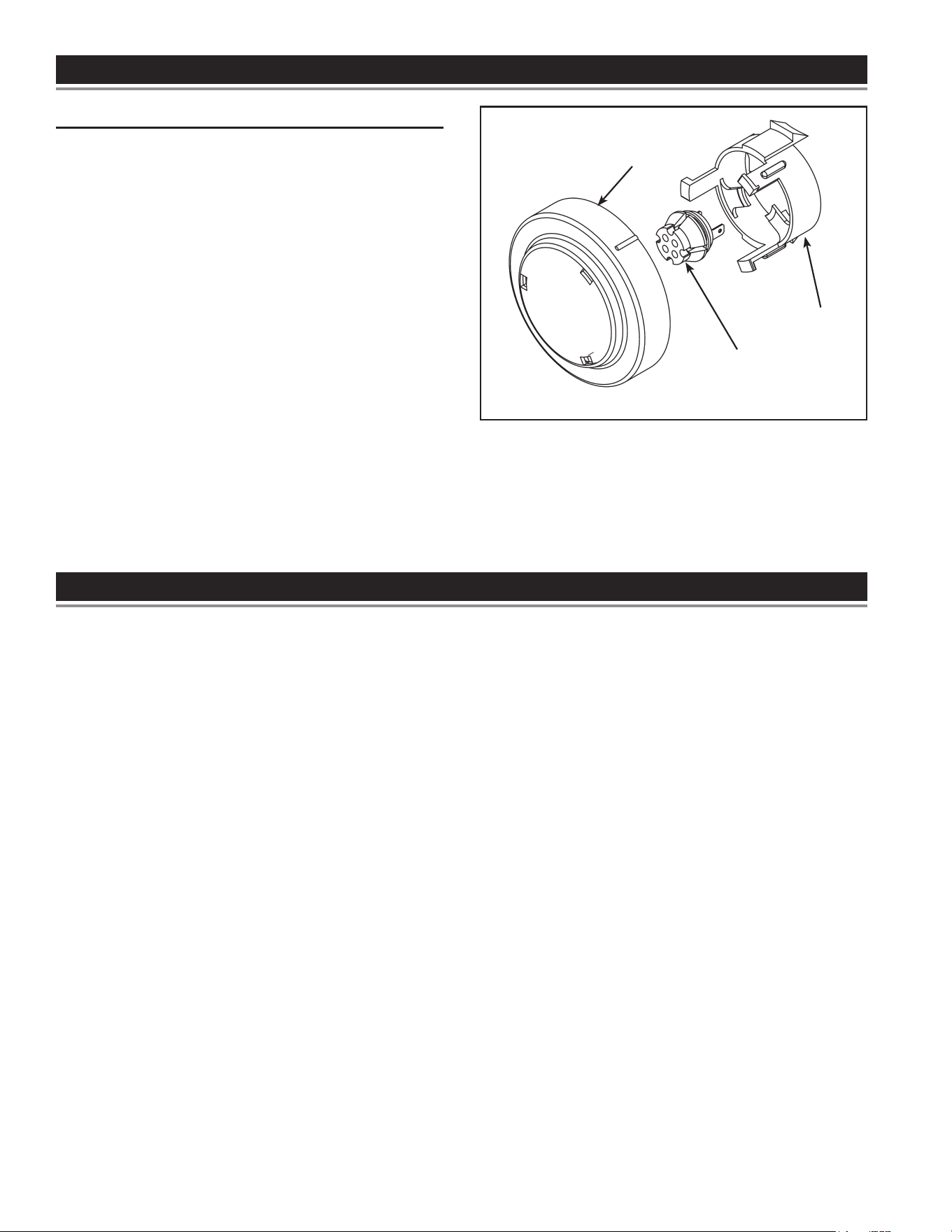
26
FV SENSOR
FLAMMABLE VAPOR SENSOR
When using a gas fired water heater there is a risk of flammable
vapors entering the combustion chamber, being ignited by
the burner flame and causing a flashback. In order to detect
such flammable vapors before they enter the combustion
chamber, this water heater is equipped with a flammable vapor
sensor (FVS). It is a chemical-absorption based sensor that is
connected to the gas control/thermostat. See Figure 31. When
exposed to flammable vapors it will trigger the control to stop
the flow of gas and enter the FVS lockout state. While in the
FVS lockout state the LED on the control will flash the gas
lockout code. See Gas Control Led Status Codes (page 36) for
an explanation of the codes applicable to the control installed
on your water heater. If an FVS lockout occurs, check around
the water heater for sources of chemical contamination such
as flammable vapors including gas vapors, solvents, paint and
thinners as well as sources of water and detergents.
Note: Resetting the heater will reset the FVIR circuit if all
sources of contamination have been removed and the
sensor clears. If all sources of contamination have been
removed and the system will not reset, the sensor will
need to be replaced.
If there is a problem with the wiring of the flammable vapor
sensor or the flammable vapor interface the LED will flash the
failure status code. See Troubleshooting Chart (page 34).
MOUNTING
BRACKET
FLAMMABLE
VAPOR SENSOR
(PULL TO REMOVE)
COVER*
* ROTATE LEFT (CCW)
TO REMOVE
Figure 31. Flammable Vapor Sensor
CLEANING THE COMBUSTION CHAMBER
1. Follow procedure outlined in Removing Inner Door/Manifold/
Burner Assembly (page 9).
2. Use a vacuum cleaner/shop vac to remove all loose debris
in the combustion chamber.
3. Reassemble following the procedure under Re-installing Inner
Door/Manifold/Burner Assembly (page 9).
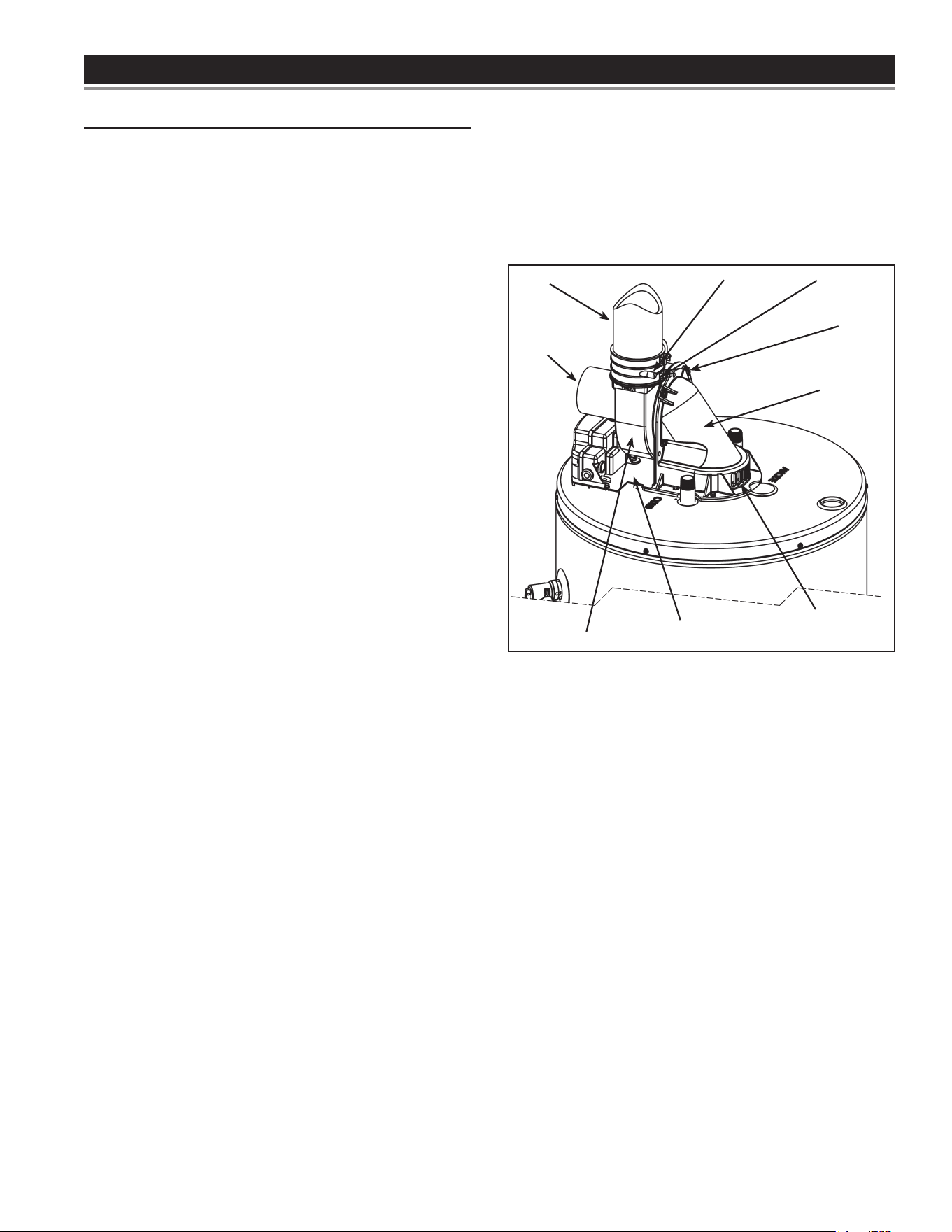
27
CLEANING THE BLOWER
BLOWER
In dusty and contaminated air conditions, the interior of the
blower and the blower wheel may require periodic cleaning.
This is often indicated by nuisance failures of the air pressure
switch or the high limit temperature control. A collection of
dust or debris on the rear blower air intakes can also indicate
reduced blower capacity. To clean the inside of the blower
assembly and the blower wheel requires the removal of the
blower/motor from the mounting plate located on the top of the
heater. Tools required include an 11/32” nut driver, small (1”)
paintbrush, toothbrush and vacuum cleaner.
1. Set the gas control valve/thermostat to its lowest setting by
turning the knob counter-clockwise to the VAC point. See
Figure 3 (page 6).
2. Turn gas control switch to the “OFF” position and turn “OFF”
the gas supply to the unit. See Figure 3 (page 6).
3. Disconnect the electrical power to the water heater from
the wall outlet.
4. Disconnect the vent piping from the top of the blower.
Loosen the lower gear clamp that holds the rubber coupling
to the blower.
5. Remove and retain the (4) 11/32” nuts located on the back
of the blower with the nut-driver. See Figure 32.
6. Holding the blower motor and the blower housing, pull the
assembly forward to disengage it from the mounting plate.
The blower will still be connected to the junction box so
exercise care not to stress the wiring.
7. Accessing the blower wheel through the outlet, use the paint
brush to brush off the outer edge of the blower wheel to
dislodge the dirt stuck on the blades and the inside of the
housing. Rotate the wheel until all blades are clear.
Note: The wheel is a balanced component. Do not
bend, dent or distort the blades as this can
upset the wheel balance and affect the blower
operation. Vacuum out the loosened dirt.
8. Accessing the inside of the blower wheel through the rear
of the housing, gently brush off the inside of the blades
using the toothbrush. Again, take care not to distort the
blades. Rotate the wheel until all blades are cleaned and
vacuum the debris.
9. Inspect the flue collector hood (still attached to the heater)
and vacuum out the dust and debris that may have
accumulated.
10. With all parts cleaned and the blower wheel turning freely,
reinstall the blower to the mounting plate aligning the (4)
studs and pushing tight against the mounting plate.
11. Reinstall the (4) 11/32” nuts and tighten securely. All (4) nuts
must be in place and secure to safely operate the blower.
12. Reattach the vent piping and coupling to the top of the
blower, tighten the bottom gear clamp and ensure the
piping is secure.
13. With all components clean and secure, reconnect the
electrical power to the heater.
14. Reset the thermostat to the desired temperature setting
and turn the gas control switch back to the “ON” position.
Note: If the water in the heater is hot, the
unit will wait to operate until there
is a need for more hot water.
REAR
BLOWER AIR
INTAKES
COUPLING
BLOWER
FLUE
COLLECTOR
HOOD
11/32”
NUTS
MOUNTING
PLATE
GEAR
CLAMP
VENT
PIPE
MOTOR
Figure 32. DIP Tube (Inlet Piping)
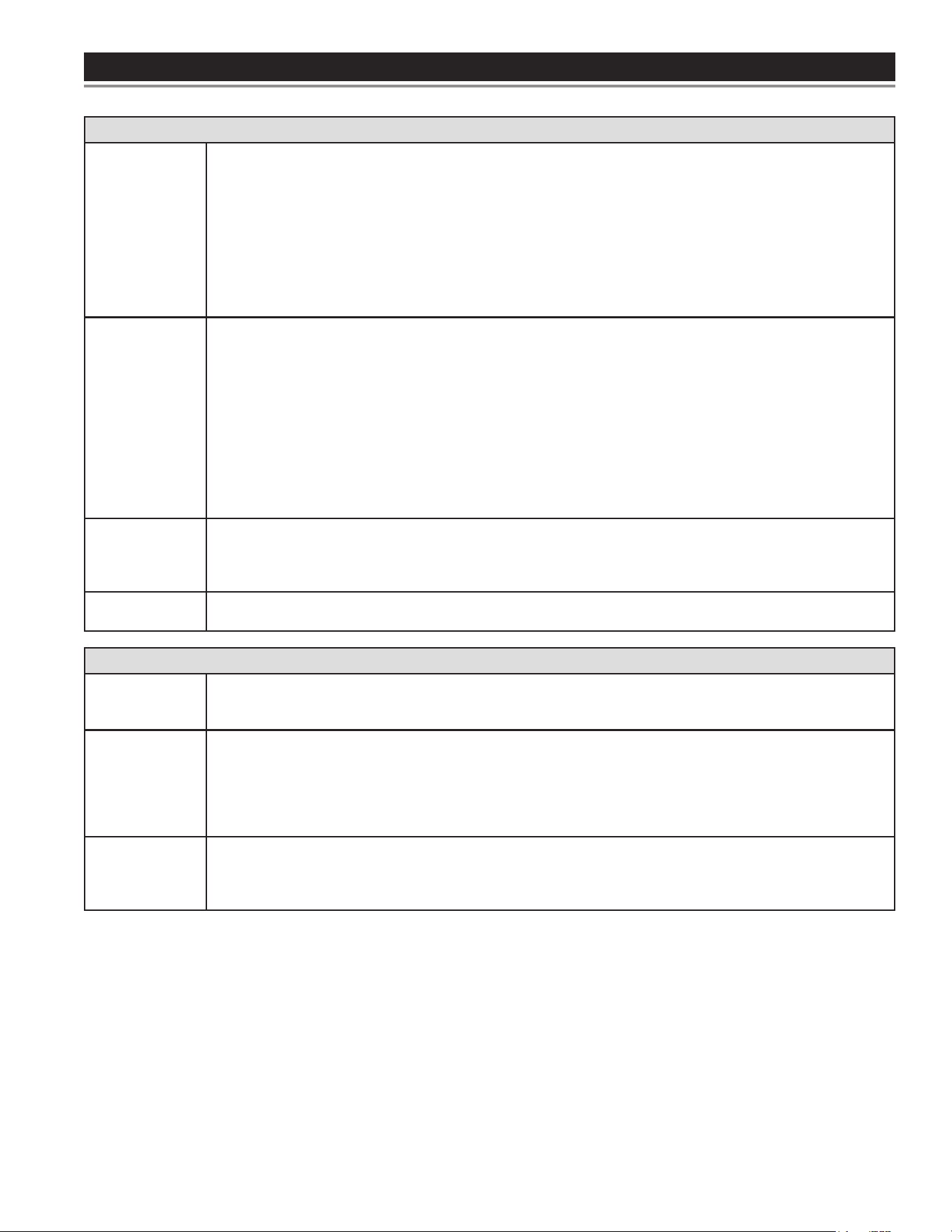
28
TECHNICAL BULLETINS
WATER HAMMER
GENERAL Water hammer is the destructive force, pounding noise and vibration in a piping system when water flowing
through a pipeline is stopped abruptly. When water hammer occurs, a high intensity pressure wave travels
back through the piping system until it reaches a point of some relief. The shock wave will then surge back
and forth between the point of relief and the point of stoppage until the destructive energy is dissipated in
the piping system. The violent action accounts for “banging”, “thumping”, and/or intense vibration in the
pipe line. Although noise is generally associated with the occurrence of water hammer, it can occur without
audible sound or noise. Quick closure of valves always causes some degree of shock with or without noise.
The common cause of water hammer is single lever faucets (sinks/lavatories) or automatic solenoid valves
dishwashers, washing machines, etc.). The speed of the valve closure time is directly related to the intensity
of the surge pressure.
EFFECTS The damage from water hammer can manifest itself in a number of ways. The most common are:
• Expanded Tank Shell - This can be demonstrated by measuring the circumference at various locations
along the shell. Pressures in excess of the maximum design working pressure can cause permanent
deformation of the shell.
Note: The continuous expansion of the tank shell may cause the tank to rupture at a welded seam.
• Collapsed Flue Tube - This will choke off the ability to vent the products of combustion causing the flame
and/or combustion to spill out from the combustion chamber. Often this will occur where thinning of the flue
tube walls has occurred due to contamination of the combustion air or because of excessive condensation.
• Inverted or Deformed Tank Heads - Often this accompanies collapsed flues, but one or both heads can
be deformed.
THE FIX The only effective means of control is to install water hammer arrestors. These devices have diaphragms
which separate an air chamber from the water in the piping system. As the shock wave reaches this device,
the air chamber absorbs the shock. Arrestors should be located as close as possible to the source of the
shock wave.
NOTES Since water hammer exposes the equipment to pressures in excess of its design limits, failures caused by
water hammer are not eligible for warranty consideration.
MINERAL BUILD-UP
SYMPTOMS • Rumbling
• Crackling
• Popping
CAUSE With the increase in fuel costs and hot water consumption, deliming has become a necessity of modern
maintenance. Lime (CaCO
3
), is the most notable factor when discussing water hardness. Lime is present in
every water system to some degree. Since lime is inversely soluble (the more you heat, the more lime comes
out), higher usage, excessive hardness, and increased heating surface can lead to a high incidence of “limed-
up” heaters. Symptoms often include a popping of water trapped under lime deposits or the sizzling of water
trapped next to elements, boiling it to steam.
THE FIX Treatment of a “limed-up“ heater is relatively simple. Since CaCO
3
is a base, the easiest way to dissolve it so
it can be flushed from the heater is with an acid. The most commonly used is phosphoric acid at a food-grade
level. Two available treatments are Mag-Erad
®
and Un-Lime
®
. Any well stocked plumbing supply house should
have a deliming solution available. The directions on the product should be followed explicitly.
29
CONDENSATION
SYMPTOMS The water heater appears to be releasing water while the main burner is on or water is found surrounding the
heater shortly after the water heater has been used. This section explains why flue gases condense and how
you can differentiate between condensation and leaking.
CAUSES Condensate is the result of air borne water vapor being chilled below the dew point. The dew point is the
temperature at which water vapor turns into liquid. Low incoming water temperatures cool the piping and
the heat transfer surfaces of the water heater. When the main burner comes on, the hot flue gases turn into
condensate upon contact with these surfaces. The typical home water heater will produce about one-half
gallon of water vapor during every hour of operation. Condensate is often mistaken for leaking. Newer heaters
will condensate more than older heaters because modern water heaters are much more efficient than their
predecessors. The newer heaters utilize as much of the energy out of the main burner flame as possible. This
lowers the flue gas and tank storage temperature and closer to the dew point temperature.
THE FIX To distinguish between a condensing water heater and a leaking water heater:
1. Wipe up any water under the heater,
2. Turn gas control switch to the “OFF” position,
3. Wait 8 hours, check for water accumulation under the heater.
4. Condensation should stop when the entire tank water is heated above approximately 115°F.
a. If no water is under the heater, the water heater was condensing.
b. If water is under the heater, check further for a loose fitting. If all fittings are tight and the tank is
leaking, replace the water heater. Leaking heaters cannot be “repaired”.
DISCOLORED WATER
SYMPTOMS Rusty, brown, black, or yellow water appearing in the hot water.
CAUSES Complaints of discolored water are commonly blamed on water heaters and storage tanks, but in fact, it is a rare
occurrence for today’s high quality glass lined tanks to have a lining failure significant enough to allow water to
contact enough bare metal to discolor the contents of even a small tank. The most common cause of “rusty”
water is a non-toxic iron reducing bacteria, scientifically termed Crenothrix, Leptothrix, and Gallionella. Iron
bacteria is commonly found in soil, water wells, water treatment plants and water distribution piping systems
where soluble iron exceeds 0.2 ppm, higher levels make conditions even more favorable. Soluble iron in the
water provides food for the bacteria. Rusty discolored water is the end result of the bacteria feeding process.
Water heaters and storage tanks usually require new anode rods as presence of iron bacteria contributes to
premature anode failure.
The requirements for the bacteria to thrive are:
• Elevated levels of iron and manganese in the water.
• Water with little or no dissolved oxygen.
• Temperatures below 138°F.
Items that can increase the potential for this bacteria are:
• Water softeners.
• Well water.
• Long periods of no water movement.
TREATMENT The simplest treatment available is shock-chlorination of the system. This is a surface treatment, and often
requires repeated trials in heavily infected systems. The chlorination of a system requires that you follow
each step explicitly to avoid an untreated portion of the piping system from re-infecting another part. See the
Chlorination Procedure (page 31).
NOTES Since rusty water is caused by a bacteria presence and is not caused by the water heater, any treatment would
not be considered warranty related.
30
SMELLY WATER
SYMPTOMS Rusty, brown, black, or yellow water appearing in the hot water.
CAUSES The most common cause of “smelly water” is a non-toxic sulfate reducing bacteria, scientifically termed Divibrio
Sulfurcans. This bacteria often enters the water system through construction or a break in ground piping. The
bacteria create the energy it needs to survive by converting sulfate (SO
4
) to hydrogen sulfide (H
2
S) gas you
smell in the water. Hydrogen sulfide gas is distinctive because of its rotten egg-like stench. Its presence can
severely affect the taste as well as the odor of the water. Occasionally this bacteria can be accompanied by
black deposits, the result of pipe and fitting corrosion. In extremely high concentrations, hydrogen sulfide gas
can be toxic though the gas is detectable long before harmful levels are reached.
The requirements for the bacteria to thrive are:
• Elevated levels of iron and manganese in the water.
• Water with little or no dissolved oxygen.
• Temperatures below 138°F.
Items that can increase the potential for this bacteria are:
• Water softeners.
• Well water.
• Long periods of no water movement.
Other factors that may contribute to smelly water:
• Chlorides of Magnesium and Calcium leave a bitter taste.
• Chloride of Sodium produces a salty taste.
• Sulfates (50 ppm) gives a medicinal taste.
• Carbon Dioxide in low pH water gives fizzy water.
• Iron and tannic waters also give a bad taste and odor.
TREATMENT The simplest treatment available is the shock-chlorination of the system. This is a surface treatment, and
often requires repeated trials in heavily infected systems. The chlorination of a system requires that you follow
each step explicitly to avoid an untreated portion of the piping system from re-infecting another part. See the
Chlorination Procedure (page 31). Longer lasting solutions include chlorination or aeration of the water supply.
NOTES Since rusty water is caused by a bacteria presence and is not caused by the water heater, any treatment would
not be considered warranty related.
31
CHLORINATION PROCEDURE
CAUSES The chlorination procedure is used to eliminate various bacteria that accumulate and grow in water heaters.
These bacteria often cause odorous or discolored water conditions.
TREATMENT The simplest treatment available is the shock-chlorination of the system. This is a surface treatment, and often
requires repeated trials in heavily infected systems. The chlorination of a system requires that you follow each
step explicitly to avoid an untreated portion of the piping system from re-infecting another part. Longer lasting
solutions include chlorination or aeration of the water supply.
PROCEDURE Please read the steps of the chlorination procedure prior to beginning. If you feel uncomfortable performing
any of these steps, contact a service person to perform this procedure for you.
STEP 1 Turn off the gas and electric supply to the tank.
STEP 2 Turn off the cold water supply valve to the tank.
STEP 3 Open a nearby hot water faucet to relieve the vacuum.
STEP 4 Drain all the water from the tank (a water-hose may be needed).
STEP 5 Remove the anode rod(s), and close the drain valve.
STEP 6 Using a funnel in the anode opening add one gallon of household chlorine bleach for every 25 gallons of tank
capacity.
STEP 7 Reinstall anode rod(s) after inspecting and replacing as needed.
STEP 8 Open cold water supply valve and refill the system. Then draw the water to every hot water fixture, until the
smell of chlorine is detected. Operate dish and clothes washers until a noticeable amount of the chlorine is
detected as well. All hot water lines must receive treatment.
STEP 9 Leave the chlorine solution undisturbed for one hour or more.
STEP 10 After the contact time has elapsed, drain the tank according to steps 2, 3, & 4.
STEP 11 Close the drain valve and refill the tank. Allow the tank to sit for 15 minutes. Repeat steps 2, 3, and 4. Continue
to flush the tank if the water is discolored or contains a chlorine odor.
STEP 12 Close the drain valve and refill the tank. Flush all chlorine from the piping by opening every hot water outlet/
appliance.
STEP 13 Return hot water heating system to service by following the recommended start-up procedure posted on the
unit or in the Manual.
NOT ENOUGH HOT WATER
CAUSES • The heating capacity of the water heater has been exceeded: complaints regarding an insufficient supply
of hot water are typically the result of a water heater that cannot meet the demands of the residence (both
people and appliances). The demand for sufficient hot water may also be exceeded if additional people
and/or appliances are added to the residence.
• Operating Set Point is too low.
• Mineral build-up.
• Hot water supply valve(s) to fixtures not fully open.
• Inlet/outlet water piping connections to water heater reversed.
• Dip tube inside water inlet connection missing.
THE FIX Compare hot water requirements with the capacity of the water heater. If necessary, install a water heater with
greater capacity.
• Turn temperature knob to desired temperature as described in the Manual.
• Drain the tank. (See Draining and Flushing in the Manual). Determine if water treatment is needed.
• Check to see if hot water supply valve is fully open, check inlet/outlet piping connections to water heater
are not reversed, check to see if the dip tube inside water inlet connection is not missing.
32
THERMAL EXPANSION
SYMPTOMS • Effects are only noticeable after hot water use followed by periods of no water use.
• Relief valve drips during any recovery cycle when no hot or cold water is used.
• Hot water pipes creak while water heater is recovering and all valves are closed.
• Tanks or other components of the water supply system fail prematurely.
• A metallic creaking noise might actually be heard in the location of the heater as the pressure is relieved
and the stretched tank returns to a natural shape.
• Faucet drips during any recovery cycle when no hot or cold water is used.
• Water surges when a faucet is first opened and then pressure drops.
CAUSE The water in a water heating system expands when it is heated and increases in volume. Since water will not
compress (like air), system designers must include provisions for thermal expansion. (Water in a closed tank at
50 psi, when heated just 10 degrees, will reach a pressure of 250 psi). Many water supply systems have check
valves or back flow preventers at the water meter to prevent any possible contamination of the public water
supply by the accidental back-flow of contaminated water into the supply mains. These check valves are often
required by code, and some cities are even installing the check valves. They serve a useful purpose. Do not
remove them! The use of pressure reducing valves (PRV) is another cause. PRVs are designed to conserve
water and prolong fixture life. Many PRVs also act as very effective check valves. Again, do not remove them!
Water softeners in the system may also act as back-flow preventers.
TEST Follow these easy steps to diagnose thermal expansion:
• Turn gas control switch to the “OFF” position, and install a water pressure gauge with dead hand on the
drain valve. Open the drain valve, so the gauge reads system pressure.
• Open a hot water tap and allow 15% to 20% of the tanks volume to run out. Shut off the drain valve and
make sure that no other fixture in the system, hot or cold, is open. Make sure that outside fixtures, if they
are on the same system, are turned off too. Any water leaks or use will make the test meaningless.
• Check the water pressure gauge, and turn the pointer so it lines up with the pressure indicating needle.
Turn the gas control switch “ON”, so the heater cycles on. Watch the pressure gauge.
• If the system is closed, the pressure will start to climb steadily and rapidly. A small amount of thermal
expansion control may be built into the system because of trapped air pockets or a water hammer arrestor.
In that case the pressure will increase slightly, hold steady for a short time and then rapidly increase. The
temperature and pressure relief valve (T&P) or PRV should open and release water once the pressure
reaches the maximum setting on the valve. The valve will close once the pressure falls below the pressure
setting of the valve.
THE FIX The ideal fix involves the use of a pressure reducing valve if supply pressures are above 60 to 70 psi, and a
properly sized expansion tank. The PRV reduces supply pressures to 40 to 60 psi allowing an economically
priced and sized expansion tank to be used. The PRV also offers the benefit of saving water and prolonging
the life of water flow valves. The PRV is not required if the system already has one or if high supply pressures
are desired. A supply water pressure of 80 PSI is a maximum set by many codes. The PRV is installed
between the check valve and the water heating system. The expansion tank is installed between the PRV
and the water heating system. Follow the manufacturers instructions for installing the expansion tank. Run the
thermal expansion check again. The pressure should increase only slightly then hold steady throughout the
recovery cycle. The expanded water is flowing back from the heater and into the pressurized storage bladder
of the expansion tank. Air pressure will force this water out of the expansion tank into the supply once usage
resumes. DO NOT DEPEND ON THE TEMPERATURE & PRESSURE VALVE (T&P VALVE) TO HANDLE
THERMAL EXPANSION! The T&P valve manufacturers designed the valve to be an emergency relief device
only. The T&P Valve could be subject to reduced effectiveness or failure.
WARNING Thermal expansion of water, if not compensated for in system design, will lead to the early failure of
components. These failures are not covered by the manufacturer’s warranty, so it is extremely important that
everyone be aware of the causes, symptoms and solutions to thermal expansion in a closed water heating
system.
33
LEAKING TEMPERATURE AND PRESSURE RELIEF VALVE
SYMPTOMS • Water seeping around the relief valve tank connection.
• Leakage at the threaded portion of the relief valve connection.
• Intermittent weeping and/or dribbling from the relief valve.
• Large volume of hot water sporadically discharged from the relief valve.
CAUSE The temperature and pressure relief valve (T&P) is a safety device limiting temperature and pressure levels
in a water heater. Each T&P has both a temperature and pressure rating. Normally, the temperature and
pressure relief valve will have a temperature rating of 210°F. A probe (part of the relief valve) extends into the
tank measuring the stored water temperature. This probe must be within the top six inches of the water heater.
If the water heater’s thermostat malfunctions, higher than normal water temperatures could be produced.
Once the probe senses a temperature approaching its temperature rating, the relief valve will open to full
capacity releasing “very hot” water until the temperature is below its reset temperature. The pressure rating on
the relief valve should be the same or less than the certified working pressure of the tank (generally 150 psi)
and be below the lowest maximum working pressure rating of any system components. Once the pressure in
the tank reaches the valve’s pressure rating, it will slightly open relieving the pressure. Relieving of pressure
can be noted as “dribbling” or “weeping” water from the relief valve. If an incorrectly sized temperature and
pressure relief valve is installed, the warranty will be void.
THE FIX Follow these easy steps to diagnose thermal expansion:
• Intermittent weeping and/or dribbling at the relief valve - The relief valve relieves water slowly when
actuating on pressure. A closed system can cause pressure to increase in the system. This condition
is called thermal expansion. For additional information regarding thermal expansion please see Thermal
Expansion the Manual.
• Leaking at the spud of the water heater - Spuds are welded to the tank and are not repairable. The heater
should be replaced.
• Leakage at the threaded relief valve connection - Remove relief valve and reseal connection.
• Large volume of hot water sporadically discharged from the relief valve – The relief valve relieves water
quickly when actuating on temperature. The only cause of this problem is a malfunctioning thermostat.
INSULATION BLANKETS
GENERAL The purpose of an insulation blanket is to reduce the standby heat loss encountered with storage tank heaters.
Most modern water heaters have adequate factory installed insulation, the use of an after market insulation
blanket is no longer recommended by most experts. While the use of an external insulation blanket will not
void the warranty, the water heater manufacturer explicitly disclaims any liability for problems associated with
the use of insulation blankets.
Note: New local energy codes may still require the use of insulation blankets on waters heaters. Be sure
to follow all installation instructions, cautions, and warnings for the insulation blanket as well as the
cautions and warning of the water heaters owners Manual.
NOTES Should you choose to apply an insulation blanket to this heater, you should follow these instructions. Failure to
follow these instructions can restrict the air flow required for proper combustion, resulting in fire, asphyxiation,
serious personal injury or death.
• Do not cover the outer door, thermostat or temperature & pressure relief valve.
• When installed the insulation blanket will cover important safety and operation labels. Obtain new warning
and instruction labels from the Technical Information Center listed in the owners’ Manual. The replacement
labels must be placed on the blanket in the location of the original labels on the water heater jacket.
• Do not cover the instruction Manual. Keep it on the side of the water heater or nearby for future reference.
• Do not apply insulation to the top of the water heater, as this will interfere with safe operation of the draft
hood.
• Do not allow insulation to come within 2” of the rear air duct of the water heater to prevent blockage of
combustion air flow to the burner. The combustion air openings in the rear air duct of the water heater
must NOT be obstructed.
• Inspect the insulation blanket frequently to make certain it does not sag, thereby obstructing combustion
air flow.
34
TROUBLESHOOTING CHART
PROBLEM POSSIBLE CAUSE(S) CORRECTIVE ACTION
BURNER FLAME
TOO HIGH
1. Insufficient secondary air
2. Orifice too large
1. Provide ventilation to water heater.
2. Replace with correct orifice.
FLAME BURNS AT ORIFICE
1. Low gas pressure
2. Defective gas control (thermostat)
1. Check with gas utility company.
2. Replace gas control (thermostat).
INSUFFICIENT HOT WATER
1. Low gas pressure
2. Orifice too small
3. Thermostat set too low
4. Gas control error codes
5. Sediment or lime in tank
6. Water heater too small
7. Wrong piping connections
8. Leaking faucets
9. Wasted hot water
10. Long runs of exposed piping
11. Hot water piping in outside wall
1. Check with gas utility company.
2. Replace with correct orifice.
3. Turn temperature knob to higher setting.
4. See the gas control error code in the Manual.
5. Drain/flush-provide water treatment if needed.
6. Install adequate heater.
7. Correct piping: dip tube must be in cold inlet.
8. Repair faucets.
9. Advise customer.
10. Insulate piping.
11. Insulate piping.
WATER IS TOO HOT
1. Thermostat is too high
2. Defective gas control (thermostat)
1. Turn temperature knob to lower setting.
2. Replace the gas control (thermostat).
SLOW HOT WATER
RECOVERY
1. Insufficient secondary air
2. Low gas pressure
3. Orifice too small
4. Thermostat set too low
5. Heater too small
6. Wrong piping connection
7. Wasted hot water
8. Flue clogged
1. Provide ventilation to water heater. Check flue way,
flue baffle and burner.
2. Check with gas utility company.
3. Replace with correct orifice.
4. Turn temperature knob to higher setting.
5. Install adequate heater.
6. Correct piping-dip tube must be in cold inlet.
7. Advise customer.
8. Clean flue, locate source and correct.
DRIP FROM RELIEF VALVE
1. Pressure build-up
2. Heater stacking
3. Closed water system
4. Improperly seated valve
1. Use a pressure reducing valve and relief valve.
2. Lower the thermostat setting.
3. See Thermal Expansion in the Manual.
4. Check Relief valve for proper operation. (Do Not plug
T&P valve.)
GAS CONTROL/
THERMOSTAT FAILS
TO SHUT OFF
1. Defective gas control (thermostat) 1. Replace gas control (thermostat).
SMELLY WATER
1. Sulfides in water supply
2. Bacteria in water supply
1. See Smelly Water in the Manual.
2. See Smelly Water in the Manual.
CONDENSATION
1. Filling the new water heater for the
first time
2. Moisture from the products of
combustion
3. Water dripping from blower
assembly
4. Undersized water heater
1. Normal operation: the condensation should disappear
after heater warms up.
2. Normal operation: the condensation should disappear
in time.
3. Provide drip “TEE” to the horizontal section of exhaust
vent close to blower assembly.
4. Install adequate heater.
COMBUSTION ODORS
1. Insufficient secondary air
2. Flue clogged
3. Heater installed in a confined area
4. House too tight
1. Provide fresh air ventilation to the water heater.
2. Clean, locate source and correct.
3. Provide fresh air ventilation to the water heater.
4. Provide fresh air ventilation to the water heater.
35
PROBLEM POSSIBLE CAUSE(S) CORRECTIVE ACTION
SMOKING AND CARBON
FORMATION
1. Insufficient secondary air
2. Low gas pressure
3. Orifice too large
4. Flue clogged
5. Defective gas control (thermostat)
6. Heater installed in a confined area
1. Provide ventilation to water heater. Check flue way,
flue baffle and burner.
2. Check with gas utility company.
3. Replace with correct orifice.
4. Clean, locate source and correct.
5. Replace gas control (thermostat).
6. Provide fresh air ventilation.
UNABLE TO LIGHT
THE BURNER
1. Air in gas line
2. Pressure switch
3. Blocked exhaust
4. Wire connection
5. Defective gas control (thermostat)
1. Purge the air from gas line.
2. Check the pressure switch, make sure the pressure
switch hose is not kinked.
3. Check vent pipe for blockage.
4. Check wire connections.
5. Replace the gas control (thermostat).
SIZZLING, RUMBLING
NOISE
1. Scale and sediment
2. Condensation dripping on burner
1. Drain/flush-provide water treatment if needed.
2. See Strange Sounds in the Manual.
WATER LEAKAGE
1. Condensation
2. Dripping Temperature & Pressure
Relief Valve
3. Thermostat does not shut-off
4. Drain valve dripping/leaking
5. Tank Leak
1. See Condensate in the Manual.
2. See Temperature & Pressure Relief Valve in the Manual.
3. Check the Thermostat.
4. Back flush to clean out sediment, replace if necessary.
5. See Leakage Checkpoints (page 5).
BLOWER WILL NOT START
1. No power to unit
2. Thermostat set too low
3. Defective air pressure switch
4. Defective blower
5. Disconnected or loose wire
6. Control locked out
1. Plug in power cord, check fuses and/or supply voltage.
2. Turn temperature knob to higher setting.
3. Replace air pressure switch.
4. Replace blower.
5. Repair and reconnect wires.
6. Reset – determine cause of lockout.
BLOWER RUNS
CONTINUOUSLY
1. Air pressure switch not closing due
to insufficient draft – check for:
a. Vent piping blocked
b. Piping length too long
c. Clogged/dirty blower
2. Disconnected, torn or blocked
pressure switch hose from air
pressure switch to blower housing
3. Defective pressure switch
4. High limit switch open due to
excessive vent temperature or
defective switch
1. Determine cause of insufficient draft. Check draft
with manometer at pressure switch (See Table 1 in
the Manual for minimum acceptable draft setting).
a. Remove blockage.
b. Reduce vent length/increase vent size.
c. Clean blower wheel.
2. Reconnect or replace pressure switch hose
3. Replace defective pressure switch.
4. Determine cause of overheating check for: over-firing,
insufficient air supply, high ambient air temperature
(once high limit switch activated, must be replaced)
HOT SURFACE IGNITER
NOT GLOWING
FOLLOWING WARM-
UP PERIOD
1. Defective hot surface igniter
2. Defective gas control (thermostat)
1. Replace igniter
2. Replace gas control (thermostat)
VENT PIPE TOO HOT
(ABOVE 170°F)
1. Blower does not run when heater
fired
2. Not enough dilution air to mix with
flue gases
3. Air in room too hot for mixing with
flue gases
4. Wrong burner orifice
1. See “BLOWER WILL NOT START” problem
2. Proper air circulation must be provided for combustion
and dilution of flue temp
3. Room air to be used for dilution with combustion
products in flue should be less than 90°F
4. Install correct orifice
36
GAS CONTROL LED STATUS CODES
LED Flash Sequence Control Status
Short flash
once every four seconds
IDLE (no call for heat,
no fault conditions)
“Heartbeat”,
alternates bright/dim
Call For Heat
(no fault conditions)
One Flash,
three second pause
Low Flame Signal
(control continues to operate)
Two Flash,
three second pause
Pressure Switch Failed Closed
Three Flash,
three second pause
Pressure Switch Failed Open
Four Flash,
three second pause
TCO Limit Lockout
Five Flash,
three second pause
Flame Out Of Sequence
Six-One Flash,
three second pause
Soft Lockout
– Retry Limit
- Failed TFI
Six-Two Flash,
three second pause
Soft Lockout
- Recycle Limit
- PS/Limit opened
Six-Three Flash,
three second pause
Soft Lockout
- Recycle Limit
- Flame Lost
Six-Four Flash, three second pause
Soft Lockout
- Flame out of Sequence Sensed
Seven Flash,
three second pause
Flammable Vapor Sensor Lockout
Eight-One Flash,
three second pause
FVS Fault Detected
Eight-Two Flash,
three second pause
Temperature Sensor Fault Detected
Eight-Three Flash,
three second pause
Electronics Fault Detected
Eight-Four Flash,
three second pause
Valve Fault Detected
37
IGNITION STATE AND TIMING
IGNITION STATE TIMING
Pre-purge
5 seconds (NG models)
15 seconds (LP models)
HSI Warmup 10 seconds
Ignition Activation Period (IAP) 3.5 seconds maximum
Flame Recognition Period (FRP) 0.5 second
Trial For Ignition IAP + FRP
Flame Stabilization Period Not Applicable
Inter-purge 30 seconds
Flame Failure Response Time
2 seconds max
(@ 1uA flame current)
Post-purge 30 seconds
PS Prove Period 2 minutes
PS Fault Delay
(failed open/closed)
2 minutes
Soft Lockout 20 minutes
TCO Limit Lockout Indefinite (follow defined procedure to restart)
Flammable Vapor Sensor Lockout Indefinite (follow defined procedure to restart)
Hardware Fault Lockout Indefinite (clear fault to restart in 15 seconds or less)

38
NOTES

39
NOTES
40
300 Maddox Simpson Parkway
Lebanon, TN 37090
Phone: 1-800-722-2101 • Fax: 615-547-1000
Technical Service email: 2tech@lochinvar.com
www.Lochinvar.com
Copyright © 2019 Lochinvar, LLC. All rights reserved.