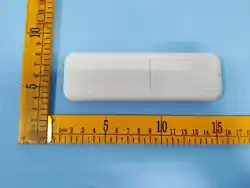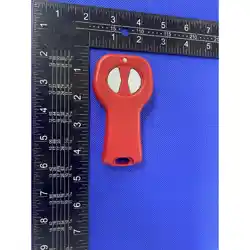

Remote Control User Manual
The remote control manufactured by our company is suitable for electric
winches of 2000Lb and above, and can replace the handle to control the
winch. Press the IN key on the remote control to retract the cable; release
the button to stop the winch from rotating. Press the OUT key on the remote
control to extend the cable; release the button to stop the winch from
rotating.
Installation of the Remote Control Receiver
Wiring Definition for the Remote Control Receiver (See Figure 1):
No. 1: Output Wire (White) - OUT
No. 2: Output Wire (Yellow) - IN
No. 3: Power Wire (Red) - B+
No. 4: Ground Wire (Black) - B-
No. 5: Remote Control Antenna
(Fig.1)
5
4
3
2
1

Installation of the Remote Control Receiver:
(Fig. 2) (Fig. 3)
After the assembly of the remote control and the main unit of the control box is
completed:
Connection between the Control Box and the Winch: Connect the output wires from the
control box to the corresponding F1, F2, and A positions on the winch motor as shown
in the figure above.
Introduction to Remote Control Transmitter Functions (See Figure 1):

POWER: Transmitter power switch
OUT: Press to extend cable (release to stop)
IN: Press to retract cable (release to stop)
LIGHT: Indicator stays on after power-up; flashes
during operation
BATTERY: 23A 12V Battery
Pairing Instructions
Press and hold the "IN" and "OUT" keys on the transmitter simultaneously; the
indicator light will flash slowly.
While the transmitter indicator is flashing, power on the receiver to initiate the
B-

pairing process. If the receiver actuates briefly, it indicates that pairing is
successful.
Power cycle the receiver (turn off and on again) and use the transmitter to control
it to verify the pairing. If operation fails, repeat the pairing process.
Remote Control Performance Specifications:
Mode Amplitude Modulation
Frequency
CodingGrou
433.92MHz
p 10 Billion Coding Combinations (Global Unique Code)
OperatingDelay 50ms
ReceivingDis
tance
>30m(
Line-of-Sight Distance
)
Operating
Voltage
8V-30V
Operating
Temperature
-40℃~85℃ (Battery-20℃~60℃)
Operating
Environment
Relative Humidity :≤95%
Altitude :≤2000M
Safety and Precautions for Remote Control Operation
The remote control is compatible with DC12V/DC24V power supplies; please select the
appropriate power source for use.
During winch installation, adjustment, and especially when arranging steel wire
ropes, ensure the remote control is turned off.
When operating, ensure that the remote control buttons are pressed or released
reliably.
The remote control handle (signal transmitter) and receiver are paired for use.
The remote control handle uses a small battery (23A). Long-term use or prolonged
storage will reduce battery capacity, affecting the remote control's operating
distance; in severe cases, it may cause the remote control to fail. Replace the
battery at this time. Remove the battery if the remote control is not used for a
long period, and regular battery replacement is recommended.
Note:
As the winch remote control is a wireless product, keep the receiver antenna away
from metal and other interference sources during use to improve the remote control's
operating distance.

FCCWARNING
This device complies with part 15 of the FCC Rules.
Operation is subject to the following two conditions:
(1) This device may not cause harmful interference;
(2) This device must accept any interference received,including
interference that may cause undesired operation.
Changes or modifications not expressly approved by the party
responsible for compliance could void the user's authority to
operate the equipment.
This equipment has been tested and found to comply with the limits for a
Class B digital device,pursuant to part 15 of the FCC Rules.These limits
are designed to provide reasonable protection against harmful
interference in a residential installation.This equipment generates,uses
and can radiate radio frequency energy and,if not installed and used in
accordance with the instructions,may cause harmful interference to radio
communications. However,there is no guarantee that interference will not
occur in a particlar installation.If this equipment does cause harmful
interference to radio or television reception,which can be determined by
turning the equipment off and on,the user is encouraged to try to correct
the interference by one or more of the following measures:
-Reorient or relocate the receiving antenna.
-Increase the separation between the equipment and receiver.
-Connect the equipment into an outlet on a circuit different from that to
which the receiver is connected.
-Consult the dealer or an experienced radio/TV technician for help.