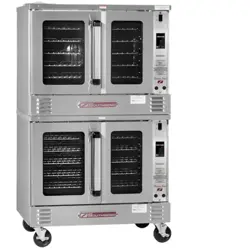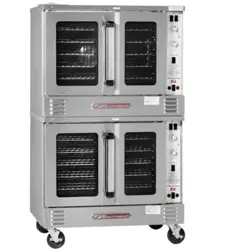
MANUAL 1409004 REV 1 (09/25) FULL SIZE PLATINUM SERIES
ELECTRIC CONVECTION OVENS
MANUAL
IMPORTANT FOR FUTURE REFERENCE
Please complete this information and retain this
manual for the life of the equipment:
Model #:
___________________________
Serial #:
___________________________
Date Purchased:
_____________________
PLATINUM SERIES
ELECTRIC CONVECTION OVENS
WARNING
Improper installation, adjustment, alteration, service or maintenance can cause property damage, injury
or death. Read the installation, operating and maintenance instructions thoroughly before installing or
servicing this equipment.
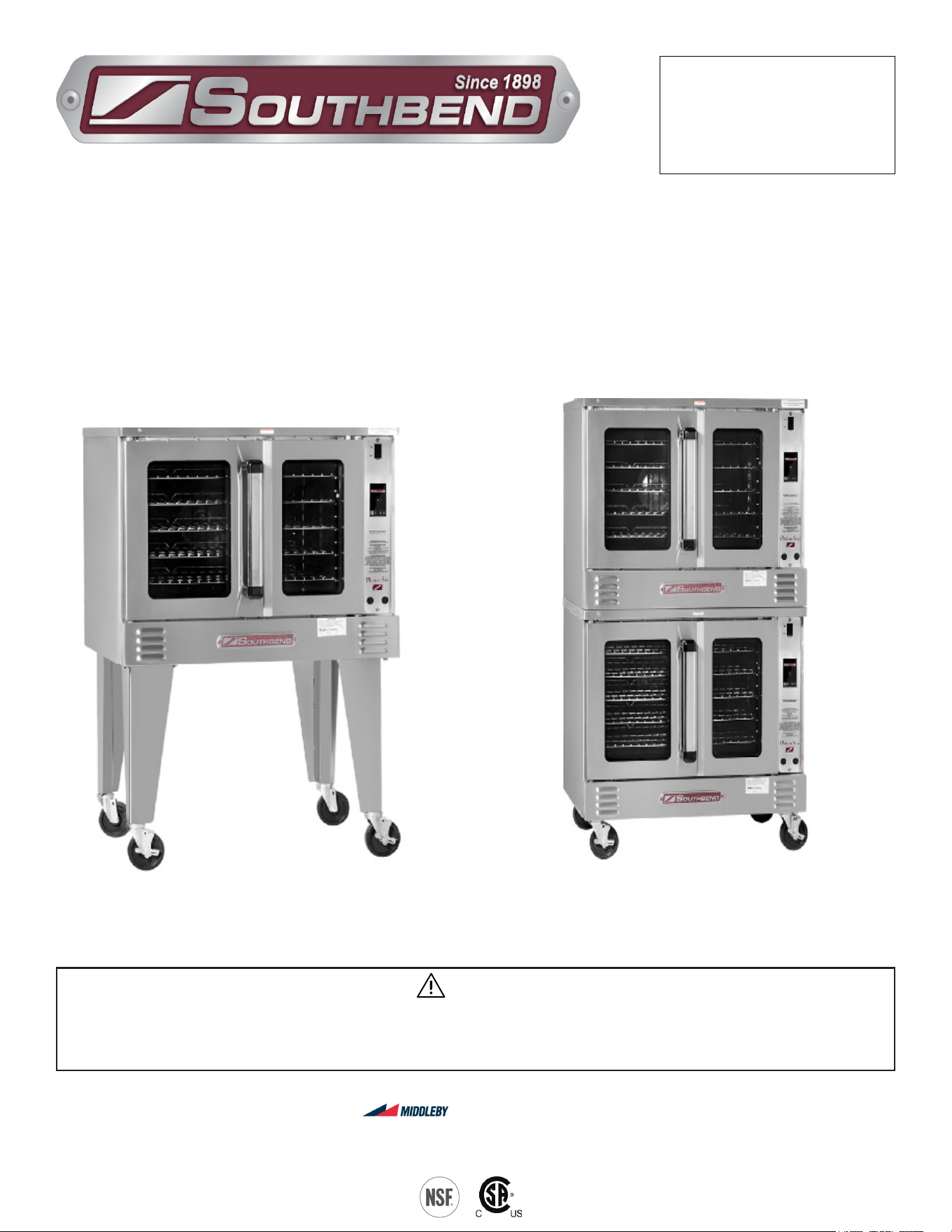
Model PCE75S/T Model PCE15S/T
SOUTHBEND
A Middleby Company
1100 Old Honeycutt Road Fuquay-Varina, North Carolina 27526 USA
www.southbendnc.com
Installation & Operation Manual
PLATINUM SERIES ELECTRIC CONVECTION OVENS
INSTALLATION AND OPERATION MANUAL 1409004 REV 1 (09/25)
PAGE
2
OF 56
SAFETY PRECAUTIONS
Before installing and operating this equipment, be sure everyone involved in its operation is fully trained and aware of
precautions. Accidents and problems can be caused by failure to follow fundamental rules and precautions.
The following symbols, found throughout this manual, alert you to potentially dangerous conditions for the operator,
service personnel, or the equipment.
CAUTION
WARNING
NOTICE
This symbol warns of immediate hazards that will result in severe injury or death.
This symbol refers to a potential hazard or unsafe practice that could result in injury or death.
This symbol refers to a potential hazard or unsafe practice that could result in injury, product
damage, or property damage.
This symbol refers to information that needs special attention or must be fully
understood, even though not dangerous.
DANGER
WARNING
FIRE HAZARD
FOR YOUR SAFETY
Do not store or use gasoline or other ammable vapors and liquids in the vicinity of this or any other appliance.
Keep the area around cooking appliances free and clear of combustibles.
Purchaser of equipment must post in a prominent location detailed instructions to be followed in the event the
operator smells gas. Obtain the instructions from the local gas supplier.
NOTICE
Be sure this Operator’s Manual and important papers are given to the proper authority to retain for future reference.
NOTICE
This product is intended for commercial use only. NOT FOR HOUSEHOLD USE.
Safety Precautions
WARNING
SHOCK HAZARD
FOR YOUR SAFETY
Do not open panels that require the use of tools.
Unit must be cleaned daily and properly maintained to reduce chances of unsafe operating conditions.
WARNING
Asphyxiation can result from improper ventilation. Do not obstruct the ow of combustion and ventilation air to and
from your cooking equipment.
Copyright © 2024 by Southbend. All rights reserved. Published in the United States of America.
PLATINUM SERIES ELECTRIC CONVECTION OVENS
INSTALLATION AND OPERATION MANUAL 1409004 REV 1 (09/25)
PAGE
3
OF 56
Congratulations! You have purchased one of the nest pieces of heavy-duty commercial cooking equipment on the
market.
You will nd that your new equipment, like all Southbend equipment, has been designed and manufactured to meet
the toughest standards in the industry. Each piece of Southbend equipment is carefully engineered and designs are
veried through laboratory tests and eld installations. With proper care and eld maintenance, you will experience
years of reliable, trouble-free operation. For best results, read this manual carefully.
RETAIN THIS MANUAL FOR FUTURE REFERENCE.
Table of Contents
Specications ............................................................................................................................................... 4
Installation .................................................................................................................................................... 9
Operation ...................................................................................................................................................20
Operation for Touchscreen Models Only ....................................................................................................24
Cooking Hints.............................................................................................................................................34
Cleaning ..................................................................................................................................................... 37
Adjustments ...............................................................................................................................................39
Troubleshooting .........................................................................................................................................43
Table of Contents
Read these instructions carefully before attempting installation. Installation and initial startup should be performed by
a qualied installer. Unless the installation instructions for this product are followed by a qualied service technician
(a person experienced in and knowledgeable with the installation of commercial gas and/or electric cooking
equipment) then the terms and conditions on the Manufacturer’s Limited Warranty will be rendered void and no
warranty of any kind shall apply.
In the event you have questions concerning the installation, use, care, or service of the product, contact:
Southbend Technical Service
1100 Old Honeycutt Road
Fuquay-Varina, North Carolina 27526 USA
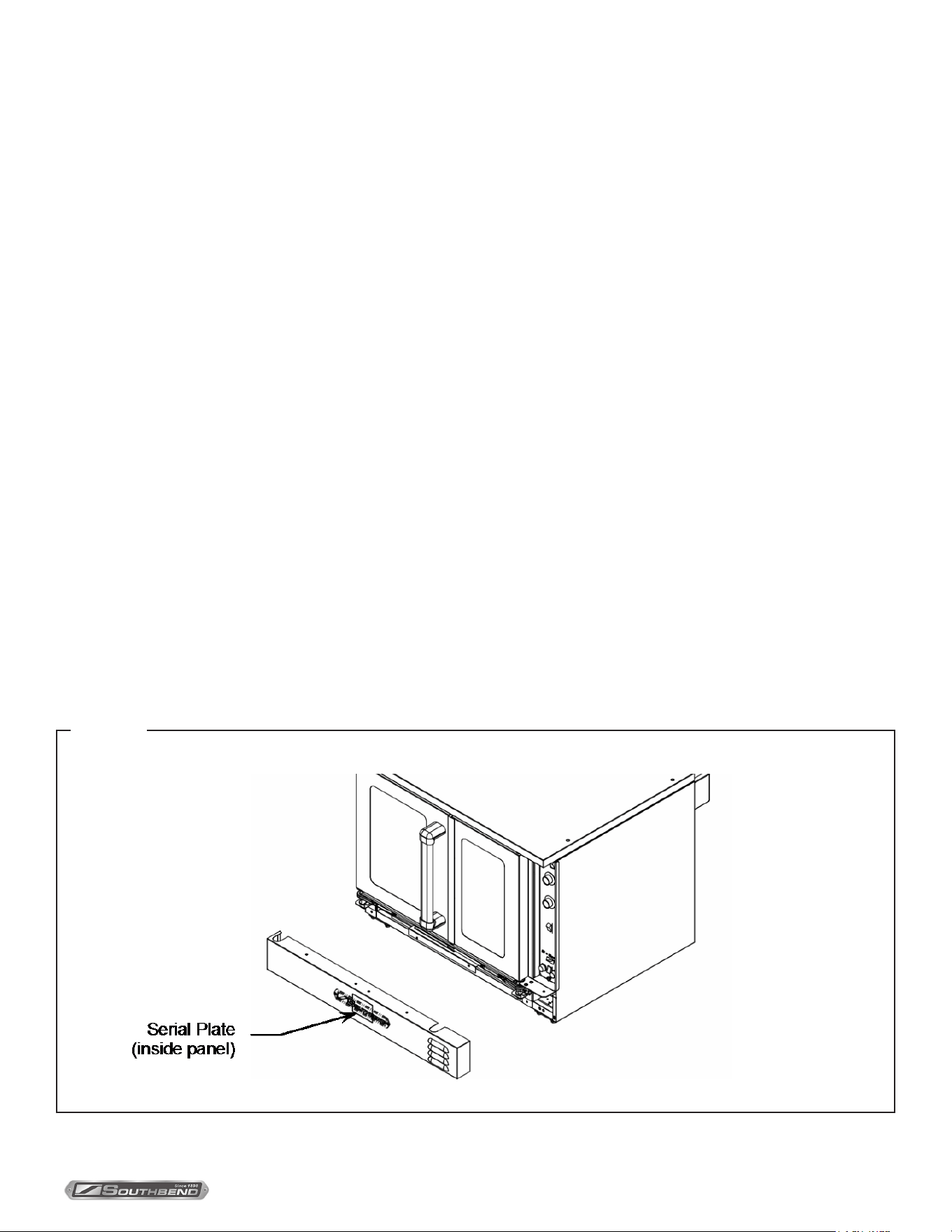
The serial plate is located on the interior side of the lower front panel, as shown below.
Figure 1
PLATINUM SERIES ELECTRIC CONVECTION OVENS
INSTALLATION AND OPERATION MANUAL 1409004 REV 1 (09/25)
PAGE
4
OF 56
SPECIFICATIONS
NOTICE
The appliance, when installed, must be electrically grounded and comply with local codes, or in the absence of local
codes, with the National Electrical Code, ANSI/NFPA 70, or the Canadian Electrical Code, CSA C22.2, as applicable.
Southbend reserves the right to change specications and product design without notice. Such revisions do not entitle
the buyer to corresponding changes, additions, or replacements for previously purchased equipment.
This product is intended for commercial use only, not for household use.
Specifications
MINIMUM CLEARANCES
WARNING
There must be adequate clearance between the left side of the ovens and the combustible construction..
Minimum Clearance from
Combustible Construction
Minimum Clearance from
Non-Combustible Construction
Minimum Clearance from
heat- producing appliance
Back 2” 2” 6”
Right Side 0” 0” 6”
Left Side 2” 0” 6”
Floor 0” 0” 6”
Adequate clearance must be provided in the aisle to allow the doors to open suciently to permit the removal of the
racks and for serviceability.
Care must be taken to provide adequate air circulation to prevent the motor from overheating.
Do not locate the oven adjacent to any high heat or grease-producing piece of equipment, such as a range top,
griddle, fryer, etc., that could allow radiant heat to raise the exterior temperature of the oven above 130°F (54°C).
DO NOT MOUNT ABOVE OTHER COOKING EQUIPMENT.
PLATINUM SERIES ELECTRIC CONVECTION OVENS
INSTALLATION AND OPERATION MANUAL 1409004 REV 1 (09/25)
PAGE
5
OF 56
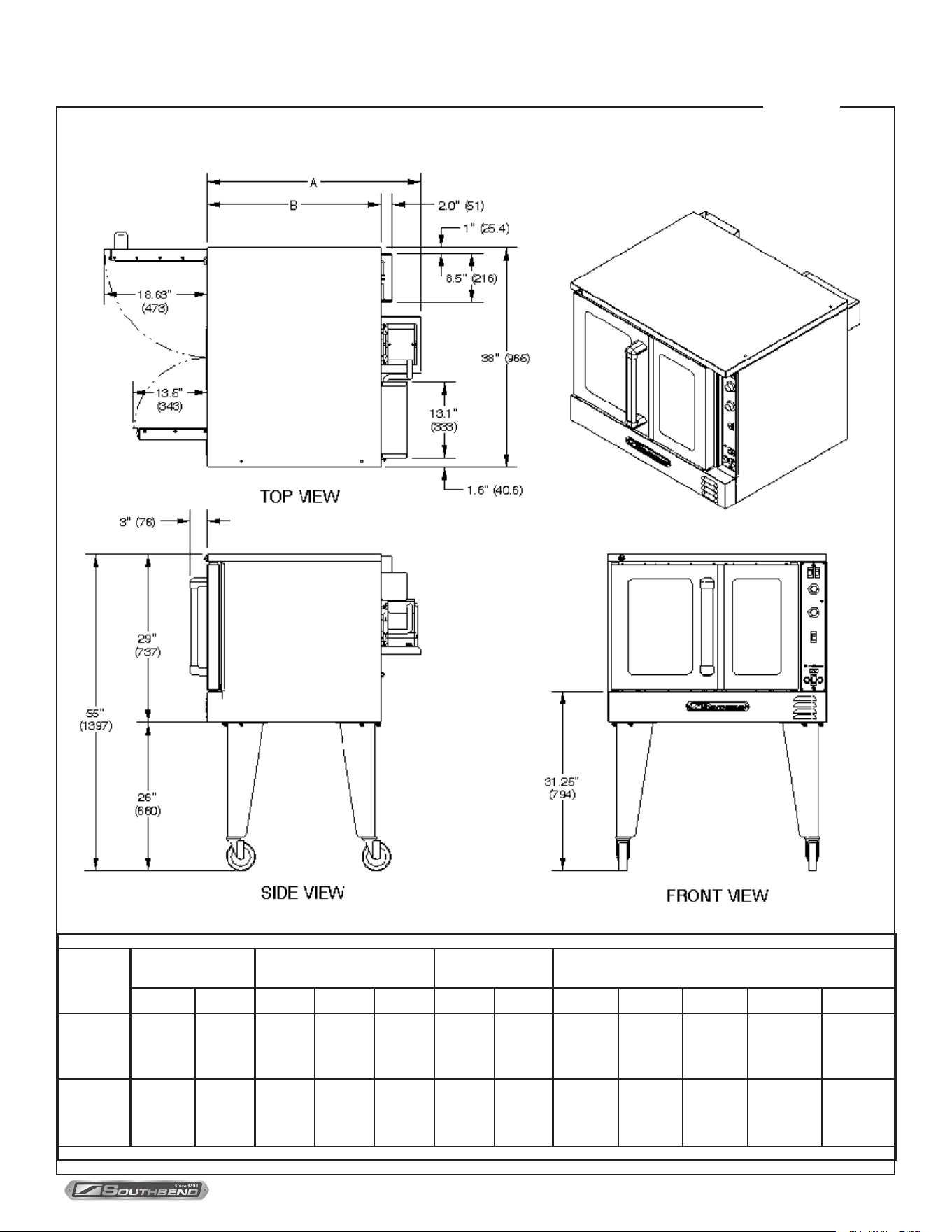
EXTERIOR DIMENSIONS
Single-Deck Ovens
Specifications
Figure 2
Model
Number
Depth Dimen-
sions
Oven Interior Rack Clearance Shipping Crate
A B
width depth height width depth width depth height volume weight
PCE75S/..
PCE11S/..
37.25”
(947mm)
30.25”
(769mm)
29”
(737mm)
21.5”
(546mm)
20”
(508mm)
28.25”
(718mm)
21”
(533mm)
57.50”
(1461mm)
45.5”
(1156)mm
45”
(1143mm)
68.1 cu. ft.
1.93 cu. m
620 lbs.
(281.2kg
PCE75B/...
PCE11B/...
43.50”
(1105mm)
36.50”
(928mm)
29”
(737mm)
27.5”
(699mm)
20”
(508mm)
28.25”
(718mm)
27.25”
(692mm)
57.50”
(1461mm)
45.5”
(1156mm)
45”
(1143mm)
68.1 cu. ft.
1.93 cu. m
680 lbs.
313.0kg
PLATINUM SERIES ELECTRIC CONVECTION OVENS
INSTALLATION AND OPERATION MANUAL 1409004 REV 1 (09/25)
PAGE
6
OF 56
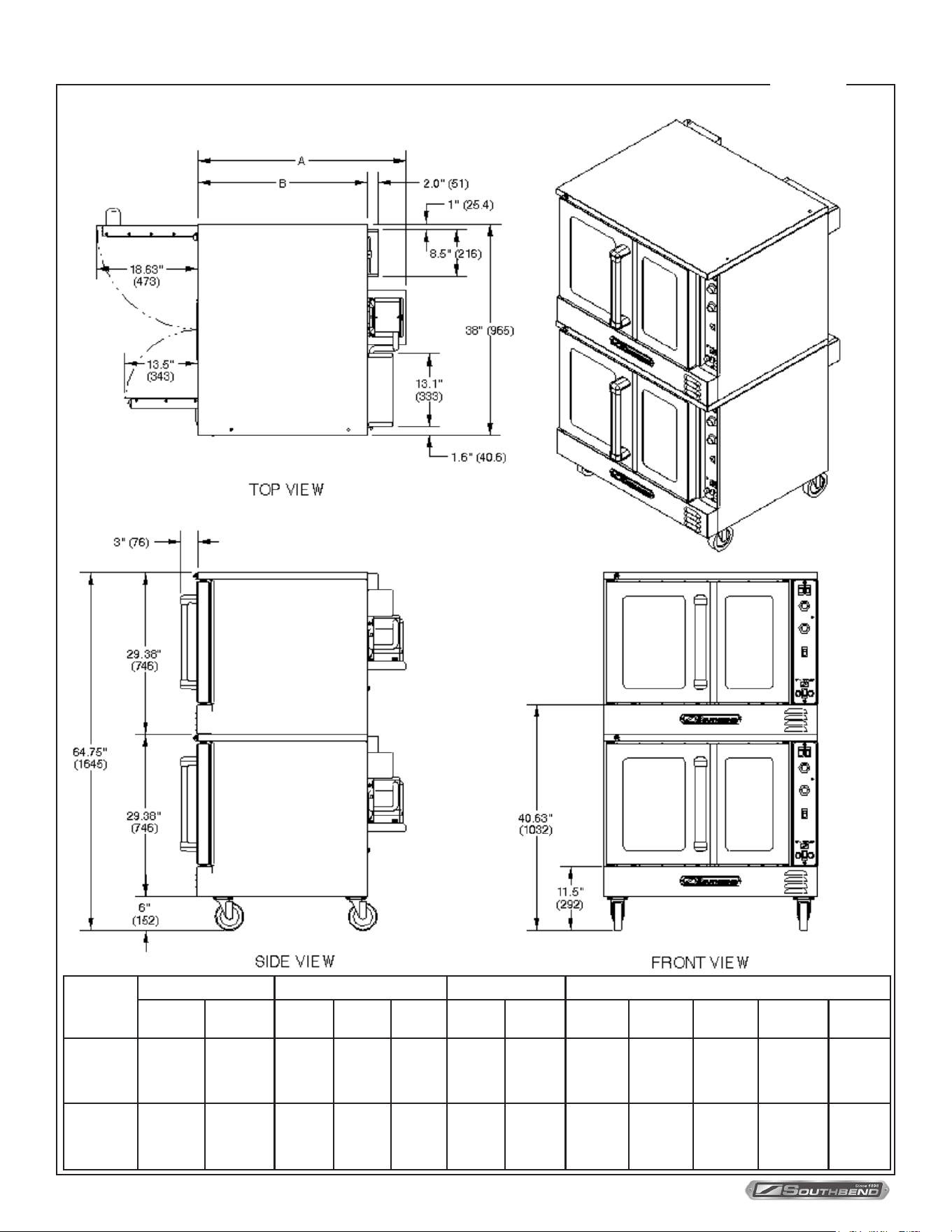
Double-Deck Ovens
Specifications
Figure 3
EXTERIOR DIMENSIONS
Model
Number
Depth Dimensions Oven Interior Rack Clearance Shipping Crate
A B
width depth height width depth width depth height volume weight
PCE15S/..
PCE22S/..
37.25”
(947mm)
30.25”
(769mm)
29”
(737mm)
21.50”
(546mm)
20”
(508mm)
28.25”
(718mm)
21”
(533mm)
57.5”
(1461mm)
45.5”
(1156mm)
81.5”
(2070mm)
123.4 cu. ft.
3.49 cu. m
1040 lbs
(471.7kg)
PCE15B/..
PCE22B/..
43.50”
(1105mm)
36.50”
(928mm)
29”
(737mm)
27.50”
(699mm)
20”
(508mm)
28.25”
(718mm)
27.25”
(692mm)
57.50”
(1461mm)
45.5”
(1156mm)
81.5”
(2070mm)
123.4 cu. ft.
3.49 cu. m
1180 lbs
(535.2 kg)
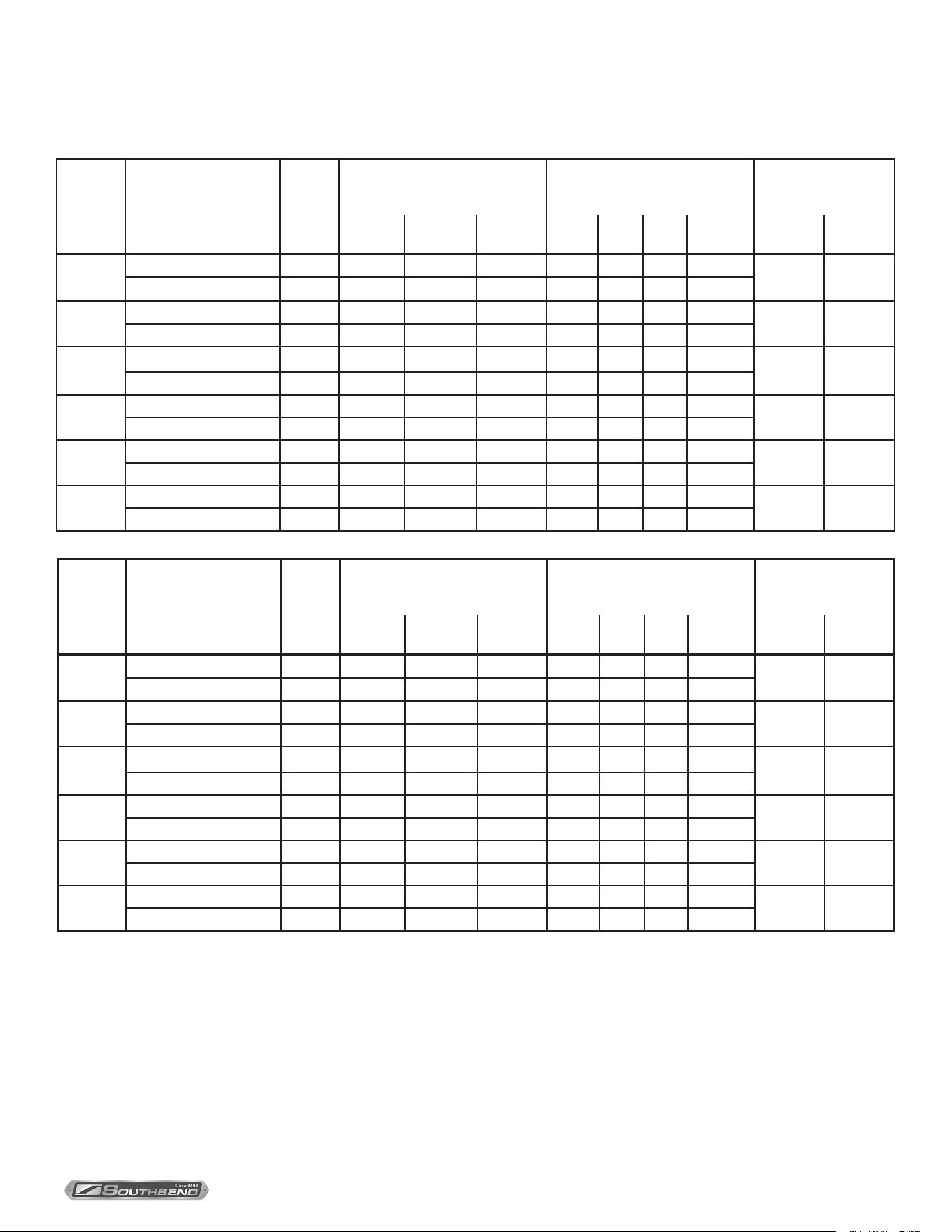
PLATINUM SERIES ELECTRIC CONVECTION OVENS
INSTALLATION AND OPERATION MANUAL 1409004 REV 1 (09/25)
PAGE
7
OF 56
Supply
Voltage
Oven Component
Total
kW
3-Phase Loading (kW/phase)
Nominal Amperes per Line-
Wire
3-Phase
Minimum Supply
Wire (AWG) Size
L1-L2 L2-L3 L1-L3 L1 L2 L3
1-Phase
Total
3-Phase 1-Phase
480
Heating Elements 11.00 3.67 3.67 3.67 13.3 13.3 13.3 23
12 10
Motor & Controls 0.90 0.00 0.00 0.90 2.2 0.0 2.2 2.2
415
Heating Elements 11.00 3.67 3.67 3.67 15.4 15.4 15.4 45.9
12 6
Motor & Controls 0.90 0.00 L3-N 0.90 0.0 0.0 3.8 3.8
380
Heating Elements 11.00 3.67 3.67 3.67 16.8 16.8 16.8 29
12 8
Motor & Controls 0.90 0.00 L3-N 0.90 0.0 0.0 4.1 4.1
240
Heating Elements 11.00 3.67 3.67 3.67 26.5 26.5 26.5 45.9
8 6
Motor & Controls 0.90 0.00 0.00 0.90 3.8 0.0 3.8 3.8
220
Heating Elements 9.25 3.10 3.10 3.10 24.3 24.3 24.3 42.1
8 6
Motor & Controls 0.90 0.00 0.00 0.90 4.1 0.0 4.1 4.1
208
Heating Elements 11.00 3.67 3.67 3.67 30.6 30.6 30.6 52.9
8 4
Motor & Controls 0.90 0.00 0.00 0.90 4.3 0.0 4.3 4.3
ELECTRICITY SUPPLY
The following tables lists the electricity supply requirements PER OVEN deck (double for dual-oven models).
An electrical diagram is located on the side of the control panel assembly (see drawing on page 44). Electrical
diagrams can also be found in this manual beginning on page 46.
The electrical connections are made directly to the terminals of the heating-element contactor, which is located
inside the control panel compartment on the right side of the oven. A circular opening sized for a strain-relief
tting is located on the back of the oven near the right side. Models with two stacked ovens have a separate
electrical connection for each oven.
Use 167°F (75°C) wire for all supply lines.
Ovens are shipped wired for either single-phase or three-phase operation, depending on which was specied
on the factory order. If necessary, an oven can be eld-converted to use either single-phase or three-phase
power (see page 41).
Supply
Voltage
Oven Component
Total
kW
3-Phase Loading (kW/phase)
Nominal Amperes per Line-
Wire
3-Phase
Minimum Supply
Wire (AWG) Size
L1-L2 L2-L3 L1-L3 L1 L2 L3
1-Phase
Total
3-Phase 1-Phase
480
Heating Elements 7.5 2.50 2.50 2.50 9.10 9.10 9.10 15.70
12 10
Motor & Controls 0.90 0.00 0.00 0.90 2.20 0.00 2.20 2.20
415
Heating Elements 7.5 2.50 2.50 2.50 10.50 10.50 10.50 31.30
12 8
Motor & Controls 0.90 0.00 L3-N 0.90 0.00 0.00 3.80 3.80
380
Heating Elements 7.5 2.50 2.50 2.50 11.40 11.40 11.40 19.80
12 10
Motor & Controls 0.90 0.00 L3-N 0.90 0.00 0.00 4.10 4.10
240
Heating Elements 7.5 2.50 2.50 2.50 18.10 18.10 18.10 31.30
10 8
Motor & Controls 0.90 0.00 0.00 0.90 3.80 0.00 3.80 3.80
220
Heating Elements 6.3 2.10 2.10 2.10 16.60 16.60 16.60 27.30
10 8
Motor & Controls 0.90 0.00 0.00 0.90 4.10 0.00 4.10 4.10
208
Heating Elements 7.5 2.50 2.50 2.50 20.90 20.90 20.90 36.10
8 8
Motor & Controls 0.90 0.00 0.00 0.90 4.30 0.00 4.30 4.30
Specifications

PLATINUM SERIES ELECTRIC CONVECTION OVENS
INSTALLATION AND OPERATION MANUAL 1409004 REV 1 (09/25)
PAGE
8
OF 56
NOTICE
Proper ventilation is the owner’s responsibility. Any problem due to improper ventilation will not be covered by the
warranty.
If a ventilation canopy is used, it is recommended that a canopy extend 6” past the appliance and that the bottom edge be
located 6’6” from the oor. Filters should be installed at an angle of 45° or more from the horizontal. This position prevents
dripping grease and facilitates collecting the run-o grease in a drip pan, unusually installed with a lter.
If an exhaust fan is used, it should be installed at least 2” above the ue opening at the top of the unit. A strong exhaust
fan tends to create a vacuum in the room. Fresh air openings approximately equal to the fan area will relieve such a
vacuum. In case of unsatisfactory performance on any appliance, check the appliance with the exhaust fan in the “OFF”
position. Do this only long enough to check equipment performance. Then turn the exhaust fan back on and let it run to
remove any exhaust that may have accumulated during the test.
VENTILATION
Specifications

PLATINUM SERIES ELECTRIC CONVECTION OVENS
INSTALLATION AND OPERATION MANUAL 1409004 REV 1 (09/25)
PAGE
9
OF 56
NOTICE
These installation procedures must be followed by qualied personnel or warranty will be void.
Local codes regarding installation vary greatly from one area to another. The National Fire Protection Association, Inc.
states in its NFPA 96 latest edition that local codes are the “authority having jurisdiction” when it comes to installation
requirements for equipment. Therefore, installations should comply with all local codes.
This appliance, when installed, must be electrically grounded in accordance with local codes, or in the absence
of local codes, with the National Electrical Code, ANSI/NFPA 70 or the Canadian Electrical Code, CSA C22.2, as
applicable.
IMMEDIATELY INSPECT FOR SHIPPING DAMAGE
All containers should be examined for damage before and during unloading. The freight carrier has assumed
responsibility for its safe transit and delivery. If damaged equipment is received, either apparent or concealed, a claim
must be made with the delivering carrier.
Apparent damage or loss must be noted on the freight bill at the time of delivery. The freight bill must then be signed
by the carrier representative (Driver). If the bill is not signed, the carrier may refuse the claim. The carrier can supply
the necessary forms.
A request for inspection must be made to the carrier within 15 days if there is concealed damage or loss that is not
apparent until after the equipment is uncrated. The carrier should arrange an inspection. Be certain to hold all contents
plus all packing material.
1. Cut the banding straps and remove packing material.
2. Remove the lag bolts that secure the oven to wooden skid..
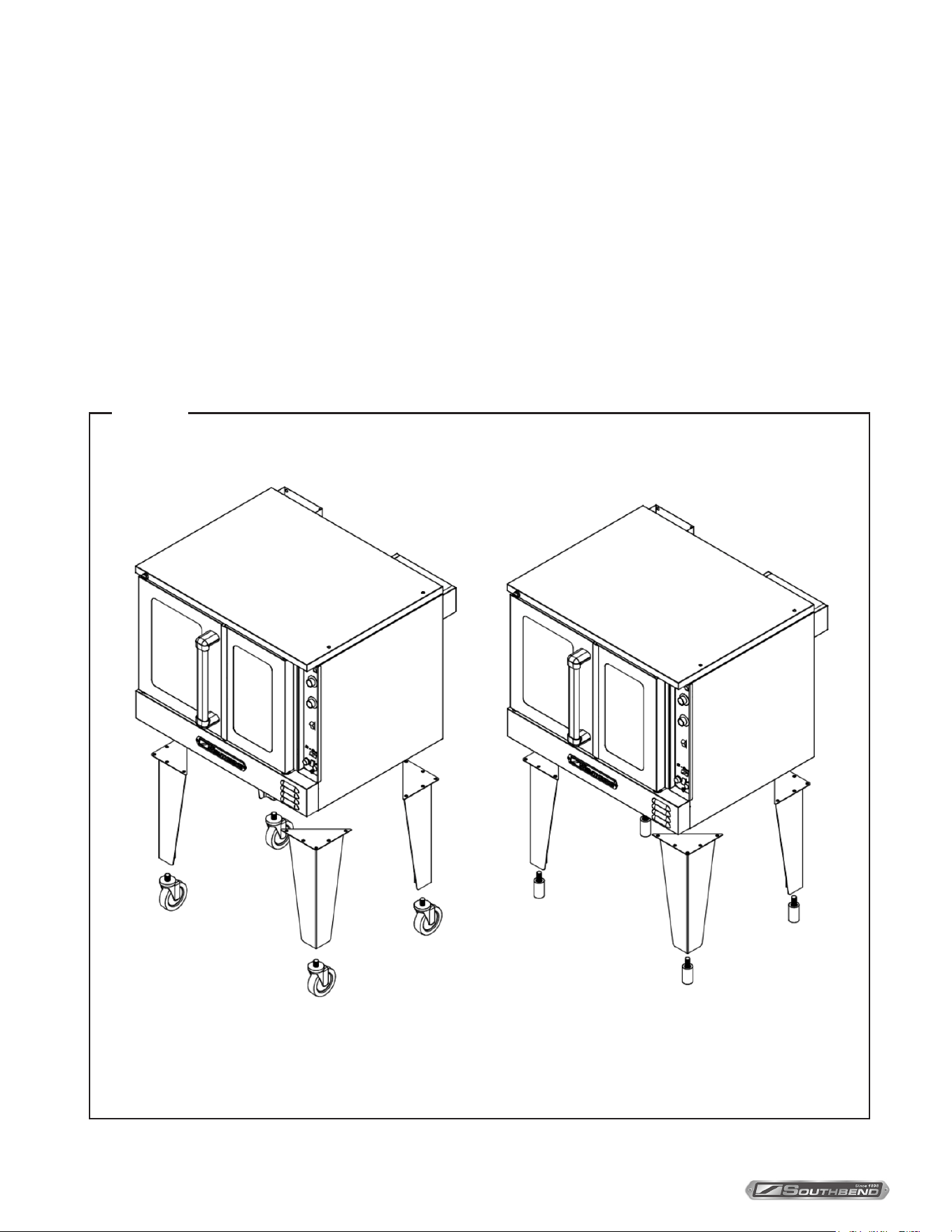
3. If you are installing a single-deck oven, go to Step 2a.
If you are installing a double-deck oven, go to Step 2b.
Step 1: UNPACKING
INSTALLATION
Installation
PLATINUM SERIES ELECTRIC CONVECTION OVENS
INSTALLATION AND OPERATION MANUAL 1409004 REV 1 (09/25)
PAGE
10
OF 56
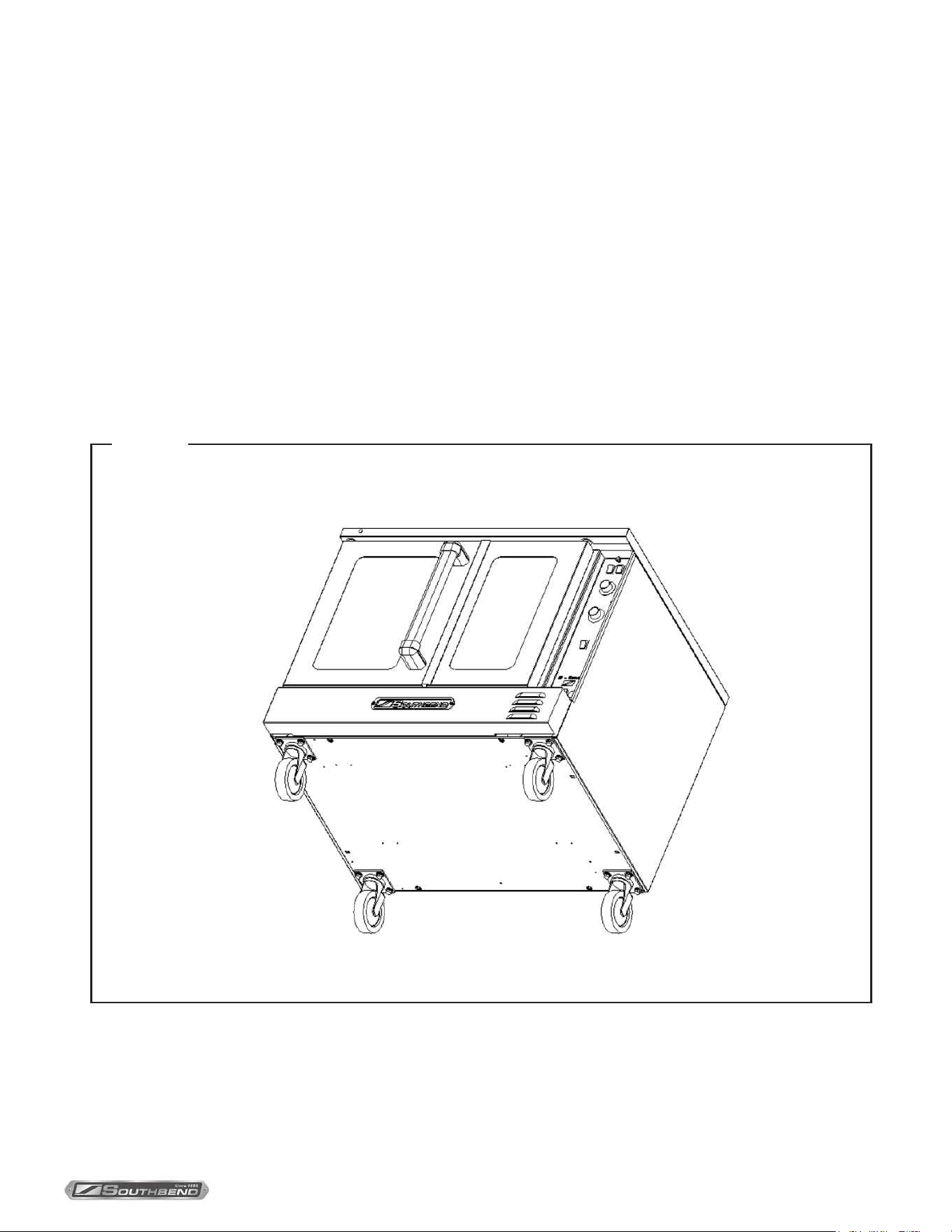
1. Raise the oven suciently to allow clearance for the legs to be attached. Use of a lift truck or other mechanical lifting
means is recommended. For safety, “shore up” and support the oven with an adequate blocking arrangement strong
enough to support the load. (If it is necessary to rest the oven on its side, rest it on its left side or back side.
Take care to protect the nish on the left side, and to prevent the weight from resting on the motor on the back.)
2. Attach the legs to the bottom corners of the oven using the provided machine screws, at washers, and lock washers.
Each leg is secured by ve screws. The mounting holes are pre-drilled and threaded.
3. Screw into the bottom of each leg either an adjustable foot or a caster (depending on which option was ordered). If
attaching casters, the two casters with brakes should be attached to the front legs.
4. Lower the oven gently onto a level surface. Never drop or allow the oven to fall.
5. Use a level to make sure that the oven is level. The adjustable feet can be screwed in or out to lower or raise each
corner of the oven.
6. If casters were installed, go to Installation Step 3 on page 12, otherwise go to Step 4 on page 14.
Step 2a: Installation of Legs on Single-Deck Ovens
Installation
Figure 4
PLATINUM SERIES ELECTRIC CONVECTION OVENS
INSTALLATION AND OPERATION MANUAL 1409004 REV 1 (09/25)
PAGE
11
OF 56
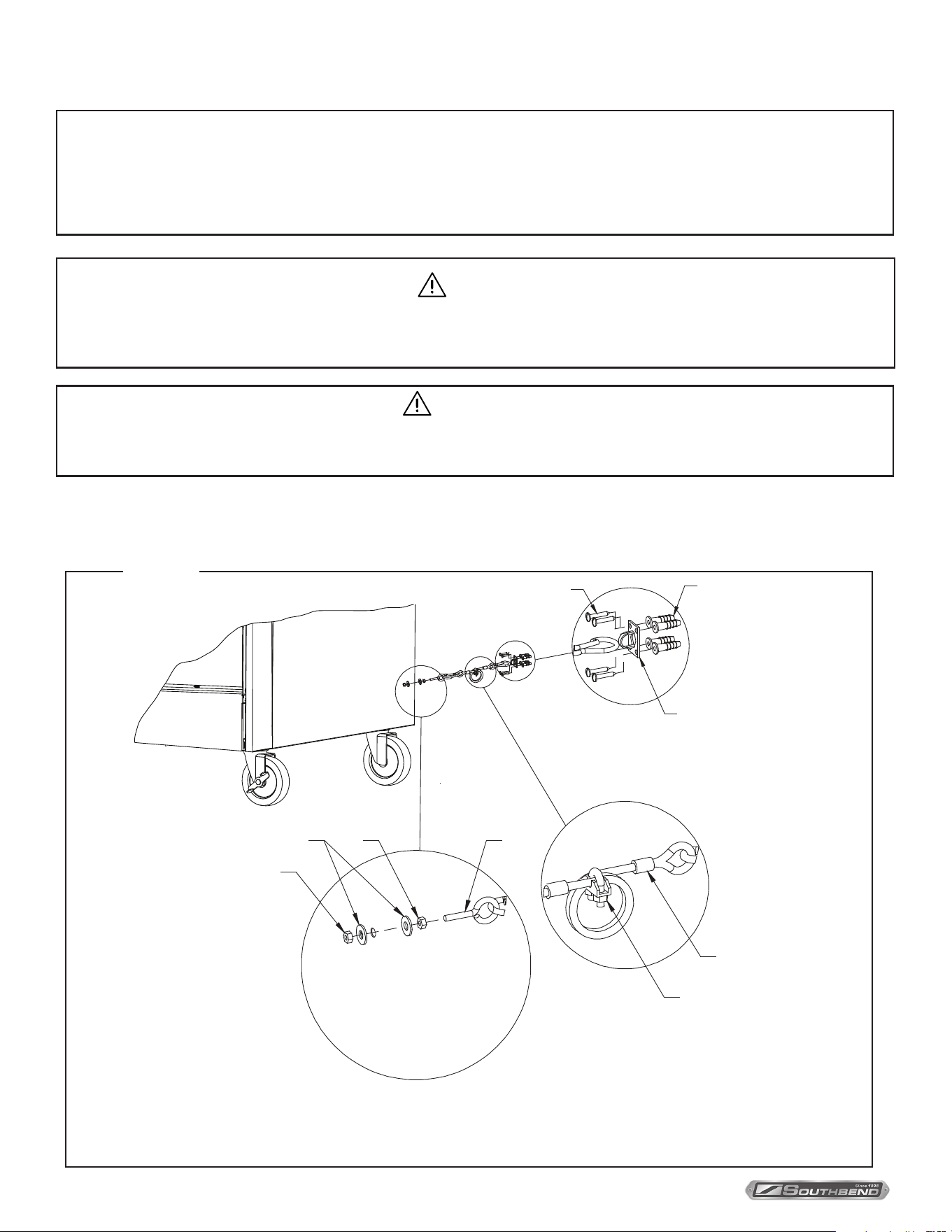
Double-deck oven can be shipped either already bolted together, or as two separate ovens to be bolted together after
delivery. In either case, the oven that is (or will be) the lower oven will have leg pads already bolted to the bottom
corners of the oven. Do the following:
1. Raise oven suciently to allow clearance for the legs to be attached. Use of a lift truck or other mechanical lifting
means is recommended. For safety, “shore up” and support the oven with an adequate blocking arrangement strong
enough to support the load. (If it is necessary to rest the oven on its side, rest it on its left side or back
side. Take care to protect the nish on the left side, and to prevent the weight from resting on the motor on the back.)
2. Screw into the center of each leg pad either an adjustable leg or a caster (depending on which option was ordered). If
attaching casters, the two casters with brakes should be attached to the front leg pads.
3. Lower the oven gently onto a level surface. Never drop or allow the oven to fall.
4. Use a level to make sure that the oven is level. The adjustable legs can be screwed in or out to lower or raise each
corner of the oven.
5. If casters were installed, go to Installation Step 3 on page 12, otherwise go to Step 4 on page 14.
Step 2b: Installation of Legs on Double-Deck Ovens
Installation
Figure 5
PLATINUM SERIES ELECTRIC CONVECTION OVENS
INSTALLATION AND OPERATION MANUAL 1409004 REV 1 (09/25)
PAGE
12
OF 56
NOTICE
For an appliance equipped with casters, (1) the installation shall be made with a connector that complies with the
Standard for Connectors for Movable Appliances, (2) adequate means must be provided to limit the movement of
the appliance without depending on the connector and the quick-disconnect device or its associated piping to limit
the appliance movement and (3) the restraining means should be attached to a frame member on the back of the
unit.
Step 3: Installation of Restraint (Only for Ovens with Casters)
WARNING
If disconnection of this restraint is necessary to move the appliance for cleaning, etc., reconnect it when the
appliance is moved to its originally installed position.
1. Secure the restraining device bracket (item “B” in the following illustration) to a wall stud located as close as possible
to the appliance connector inlet and outlet connections. Use four #12 screws (items “C”) and plastic anchors (items
“A”) if necessary.
F
G
H
I
B
C
E
D
A
Note: Kit can be purchased from Southbend
Installation
Figure 6
WARNING
To avoid the risk of accidental electric shock, disconnect the unit from the power supply before moving the unit.

PLATINUM SERIES ELECTRIC CONVECTION OVENS
INSTALLATION AND OPERATION MANUAL 1409004 REV 1 (09/25)
PAGE
13
OF 56
2. Install an eye-bolt (item “F”) to a frame member on the rear of the equipment. After checking carefully behind the
frame member for adequate clearance, drill a 1/4” hole through the frame member.
3. Thread the hex nut (item “G”) and slide the washer (item “H”) onto the eye-bolt. Insert the eye-bolt through the 1/4”
drilled hole and secure with a washer (item “H”) and nylon lock nut (item “I”).
4. Using the spring-loaded snap hooks, attach the restraining device to the bracket and the eye bolt.
5. Using the cable clamp (item “D”), adjust the restraining device’s extended length to prevent over-bending or kinking of
the appliance connector.
For units not equipped with ame safety devices, be sure all valves are turned o before disconnecting. After
reconnecting, be sure that the oven is switched OFF.
Installation
PLATINUM SERIES ELECTRIC CONVECTION OVENS
INSTALLATION AND OPERATION MANUAL 1409004 REV 1 (09/25)
PAGE
14
OF 56
Step 4: Stack Double-Deck Oven (if necessary)
Ovens that were originally ordered as single ovens can be stacked in the eld (additional parts are required). This
installation step describes the procedure for stacking two single-deck ovens to form a double-deck oven.
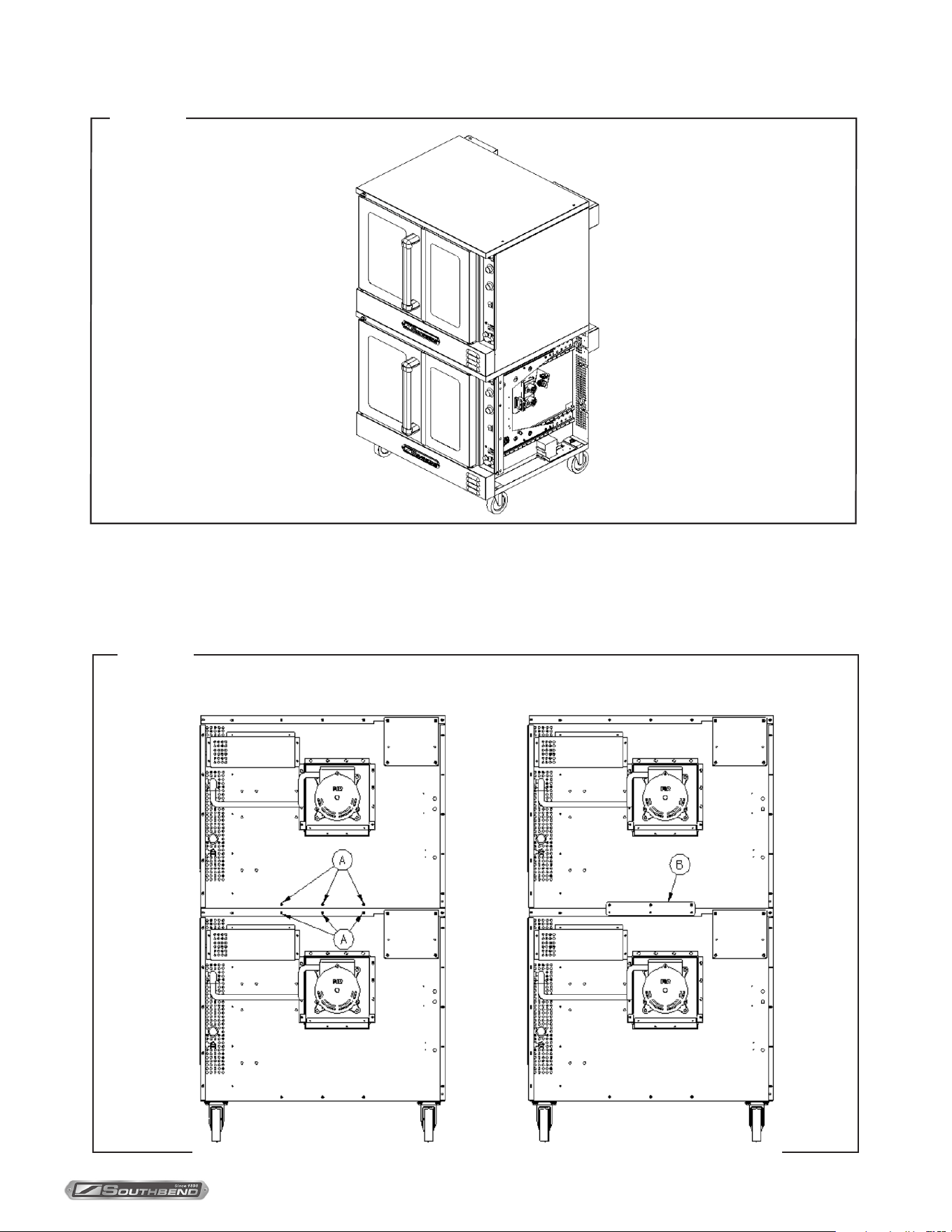
1. Uncrate the two ovens. Identify the oven that will be the lower oven (it will be the oven with leg pads attached to the
bottom corners). Attach the legs (or casters) to the lower oven as described in Step 2b on page 11.
2. If the oven that will be the top oven was NOT ordered as part of a double-deck oven, remove the four leg pads from
the bottom of the top oven.
3. Locate and remove the four screws that secure the lower front panel (items “A” in the drawing below). Lift the
panel and pull it forward to remove it, then set it aside.
4. Locate and remove the front screw (item “B” in the drawing below), that secures the lower front corner of the side
panel.
5. Locate and remove the ve screws that secure the right side panel to the oven (items “B” in the drawing below).
Remove the right side panel and insulation and set them aside.
Figure 7
Installation
PLATINUM SERIES ELECTRIC CONVECTION OVENS
INSTALLATION AND OPERATION MANUAL 1409004 REV 1 (09/25)
PAGE
15
OF 56
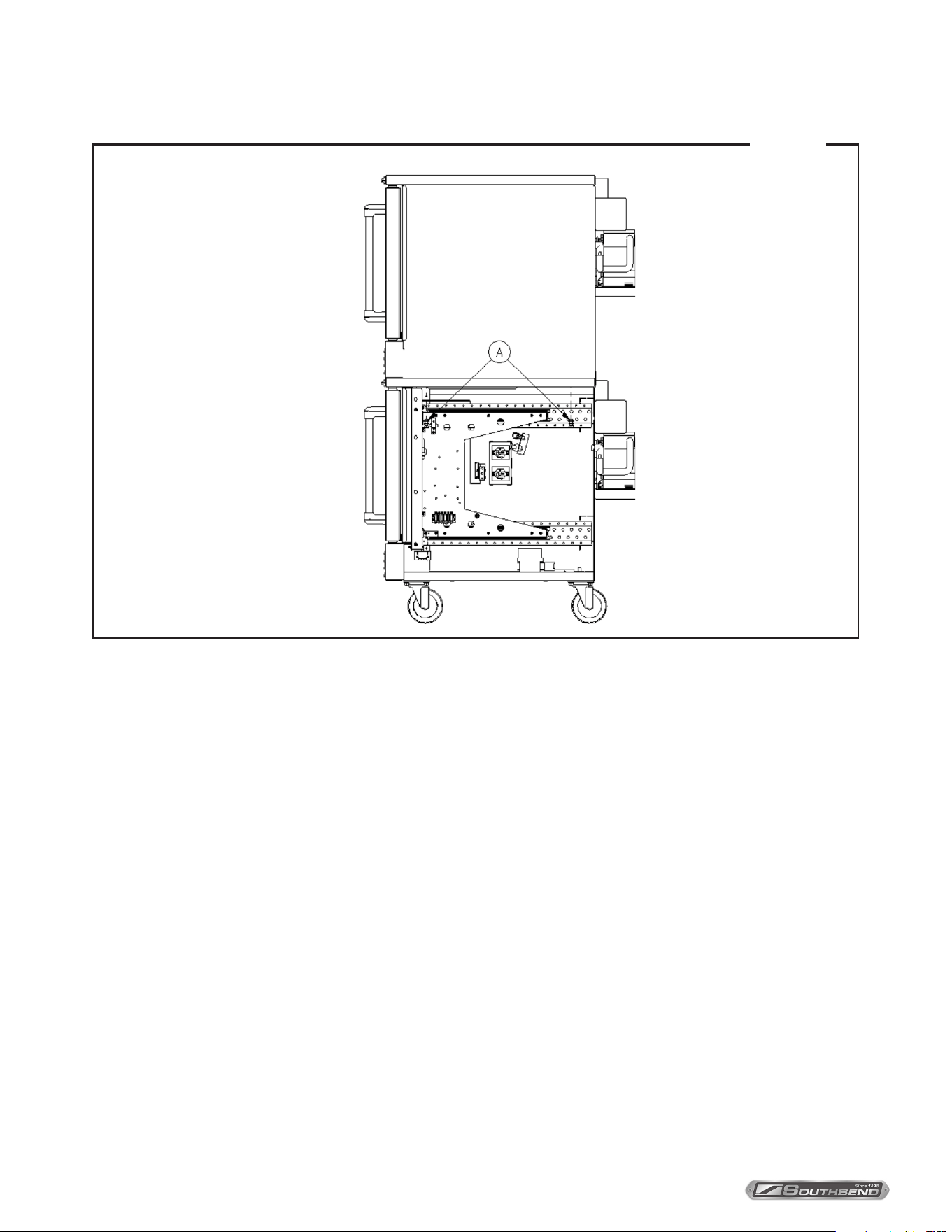
6. Lift the top oven and position it on top of the lower oven, as shown in the drawing below.
7. Move to the rear of the ovens and remove the six screws shown as items “A” in the left-hand drawing below.
Position the tie bracket (item “B”) as shown in the right-hand drawing below. Re-insert the screws that
you just removed through the holes in the tie bracket, but do not tighten them yet.
Installation
Figure 8
Figure 9
PLATINUM SERIES ELECTRIC CONVECTION OVENS
INSTALLATION AND OPERATION MANUAL 1409004 REV 1 (09/25)
PAGE
16
OF 56
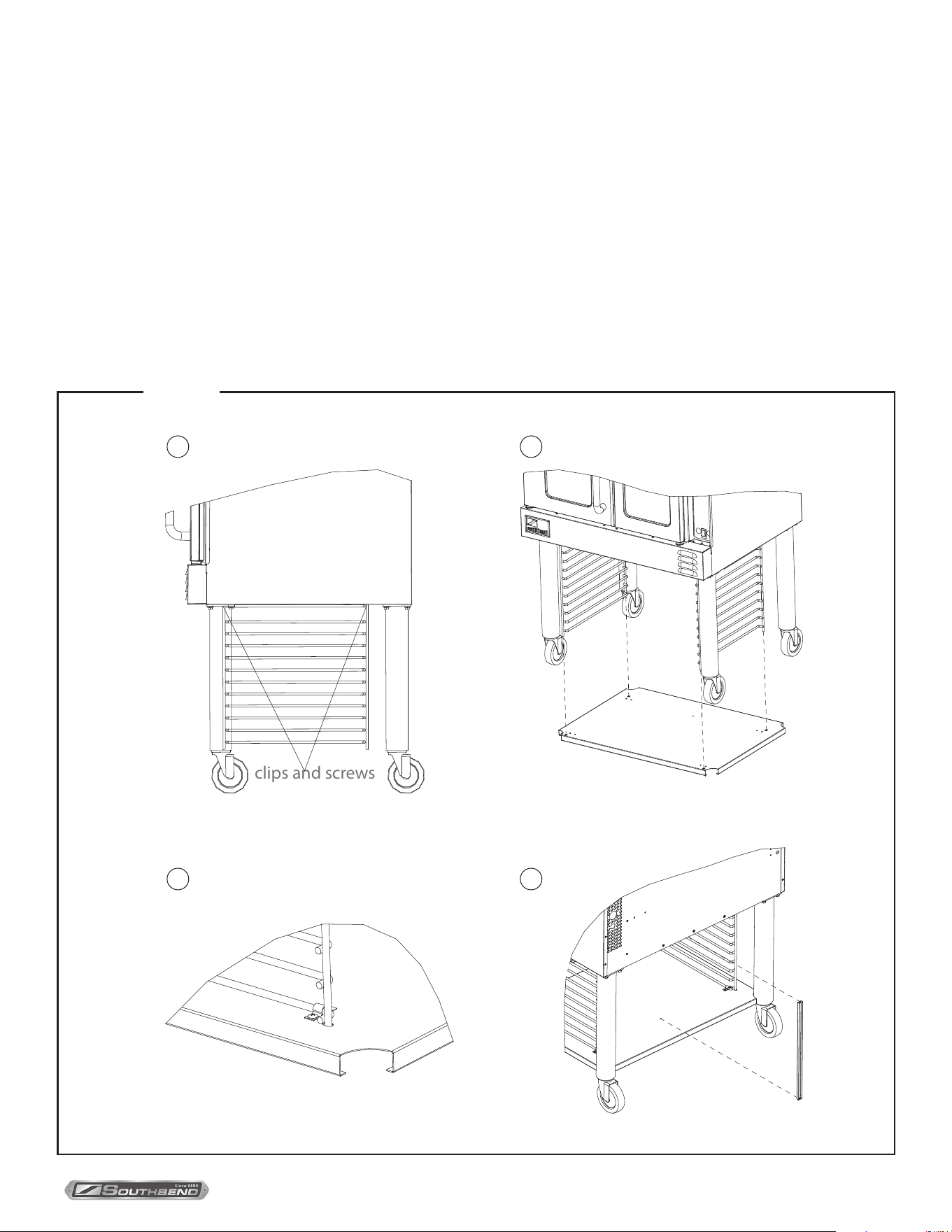
8. Insert two bolts (items “A” in the following diagram) up through the top of the lower oven and screw them into the
threaded holes in the bottom of the top oven. Tighten these bolts and the screws that you did not tighten in
the previous step.
9. Replace the right side insulation, exterior panel, and lower front panel that you removed in steps 4, 5, and
6 of this procedure.
Installation
Figure 10
PLATINUM SERIES ELECTRIC CONVECTION OVENS
INSTALLATION AND OPERATION MANUAL 1409004 REV 1 (09/25)
PAGE
17
OF 56
Step 5: Installation of Optional Open Pan Storage on Platinum Series Ovens
Installation
The following describes how to assemble the optional open storage. All holes are pre-drilled for the provided screws.
1. Attach the legs to the oven as described in installation Step 2a on page 10.
2. Attach the two rack guides to the bottom of the oven using two clips and four screws for each rack (see gure “A”
below).
3. Position the shelf below the rack guides and lift it so that the bottom ends of the rack guides pass through the holes in
the shelf (see gure “B” below)
4. Secure the shelf to the rack guides with four clips, each secured by two screws that thread into the threaded holes on
the shelf (see gure “C” below).
5. Attach the rack-stop using two screws. Attach the top of the rack stop to the bottom of the oven, and the bottom of the
rack stop to the shelf (see gure “D” below).
A B
C D
clips and screws
Figure 10
PLATINUM SERIES ELECTRIC CONVECTION OVENS
INSTALLATION AND OPERATION MANUAL 1409004 REV 1 (09/25)
PAGE
18
OF 56
WARNING
ELECTRIC GROUNDING INSTRUCTIONS
This appliance, when installed, must be electrically grounded per local codes, or in the absence of local codes, with the
National Electrical Code, ANSI/NFPA 70 or the Canadian Electrical Code, CSA C22.2, as applicable.
Step 6: Connect Electricity Supply
Ovens are shipped wired for either single-phase or three-phase power according to the original factory order. Wiring
diagrams are located on the side of the control panel assembly, as well as in this manual (beginning on page 46). Be sure
that the input voltage and phase match the requirements shown on the serial plate, which is located inside the lower front
panel.
Conversion between single-phase and three-phase power can be performed in the eld (see page 41).
The oven must be adequately grounded.
Use 167°F (75°C) wire for all supply lines.
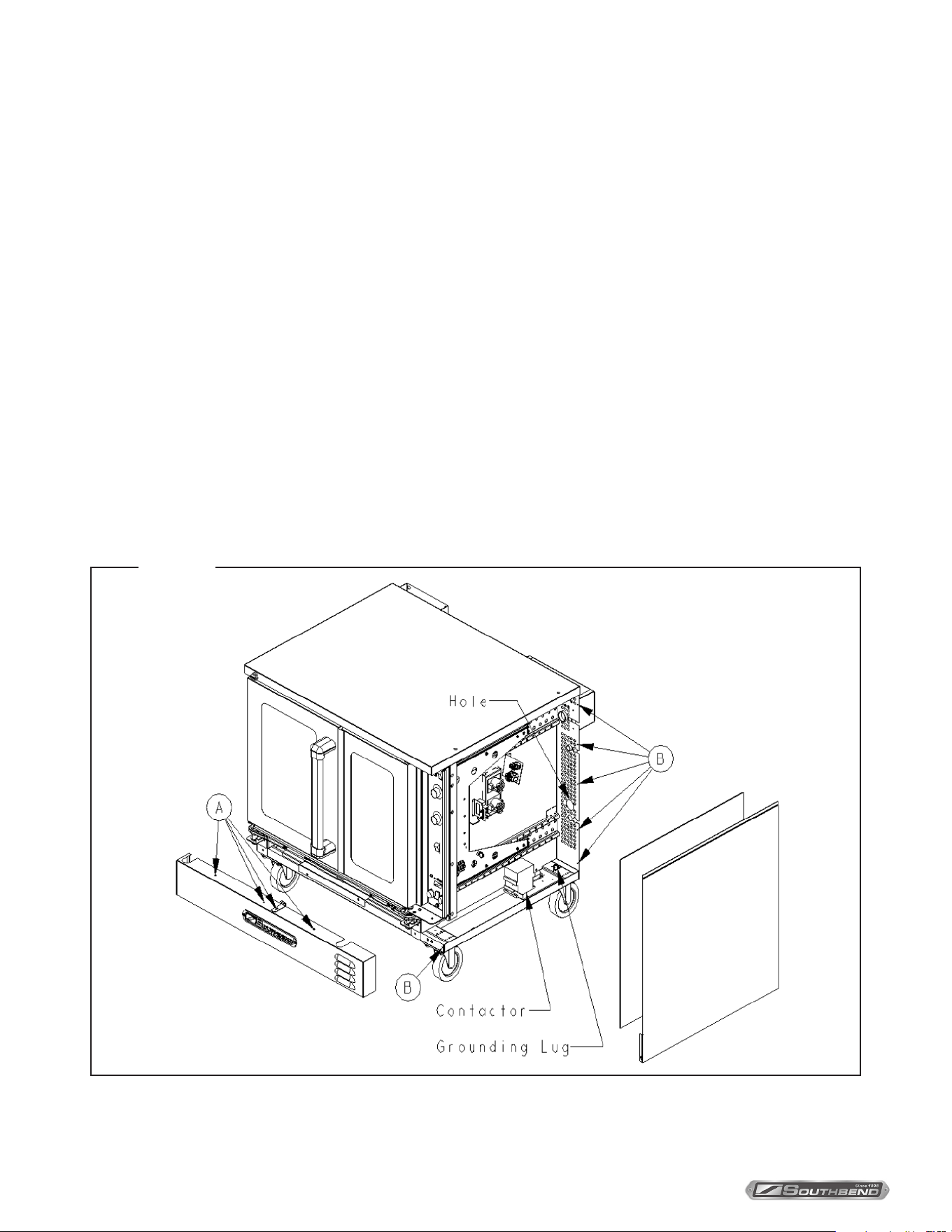
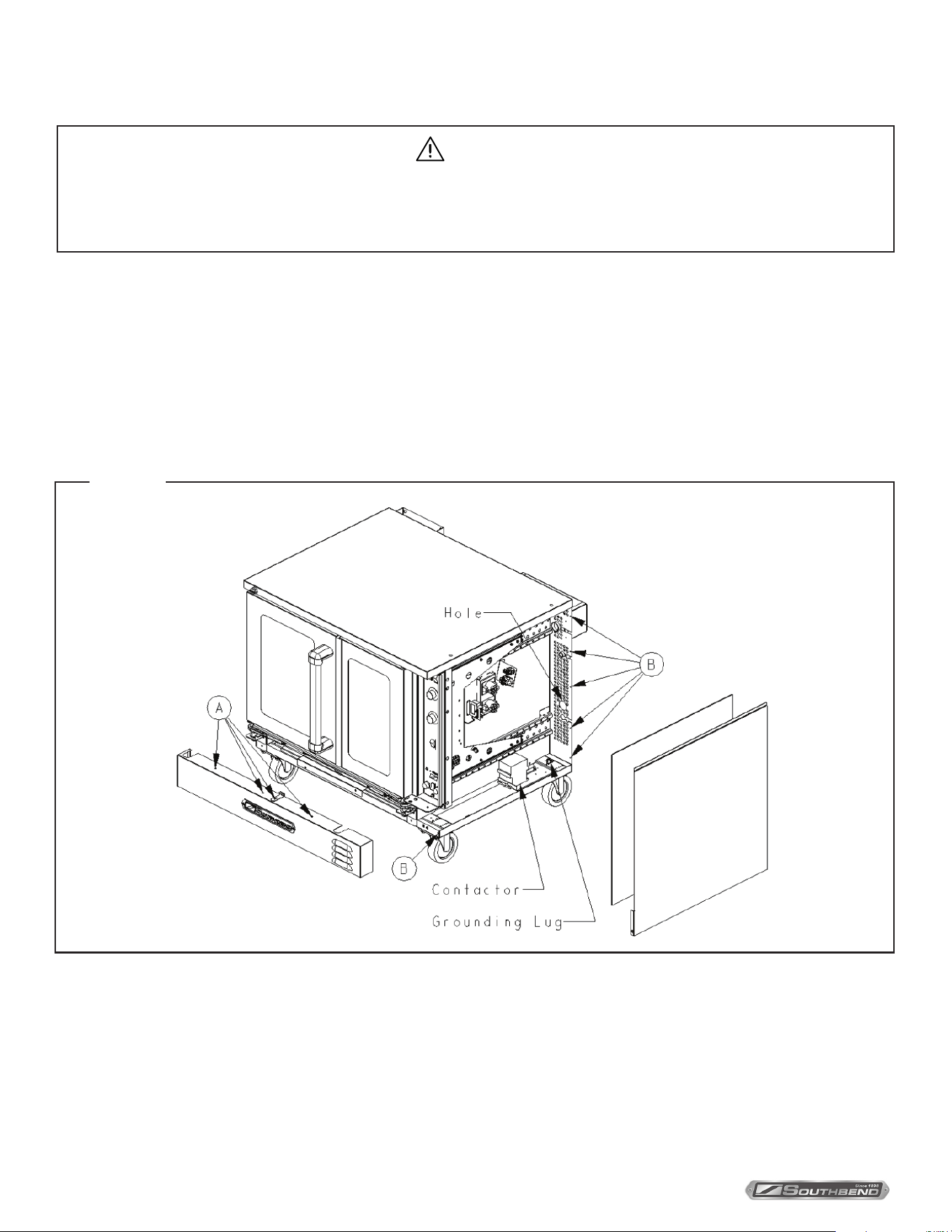
The following drawing shows the locations of items referred to in the following procedure.
1. CHECK THAT THE POWER SUPPLY CIRCUIT BREAKER IS OPEN.
2. Locate and remove the four screws that secure the lower front panel (items “A” in the drawing above). Lift the panel
and pull it forward to remove it, then set it aside.
3. Locate and remove the front screw (item “B” in the drawing above), that secures the lower front corner of the side
panel.
4. Locate and remove the ve rear screws that secure the back edge of the side panel to the oven (items “B” in the
drawing above). Remove the side panel and insulation and set them aside.
Installation
Figure 15

PLATINUM SERIES ELECTRIC CONVECTION OVENS
INSTALLATION AND OPERATION MANUAL 1409004 REV 1 (09/25)
PAGE
19
OF 56
5. Route the supply wires and the grounding wire through the hole in the back of the oven. Use a strain-relief tting.
6. Attach each supply wire to the appropriate terminal of the contactor (according to the wiring diagram).
7. Insert the ground wire into the grounding lug and tighten the screw.
8. Check that all connections match the wiring diagram and are tight.
9. Reattach the right-side panel and insulation; and the lower-front panel.
Step 7: Check the Installation
1. Check that all screws and bolts are tightened.
2. Move the oven into the position at which it will be operated.
3. Check that the oven is level. If not, adjust the legs.
4. Check that the appropriate clearances are satised (see page 4).
5. Turn on supply power and check the oven for proper operation.
Installation
PLATINUM SERIES ELECTRIC CONVECTION OVENS
INSTALLATION AND OPERATION MANUAL 1409004 REV 1 (09/25)
PAGE
20
OF 56
OPERATION
OPERATING THE CONTROLS
A convection oven is a dierent type of oven that oers many features and advantages to the food service operation. The
additional capabilities and features of the oven require some learning. However, the operation of the oven is not dicult to
understand or control once you have some practice.
Each oven will have one of the two types of control panels:
• Models with Standard Controls are the most similar to a standard (non-convection) oven. Instructions for operating
this type of oven begin on page 21.
• Models with Touch Controls are the most versatile option allowing for manual cooking with cook and hold, as well as
programming recipes and cooking groups. Instructions for operating this type of oven begin on page 23.
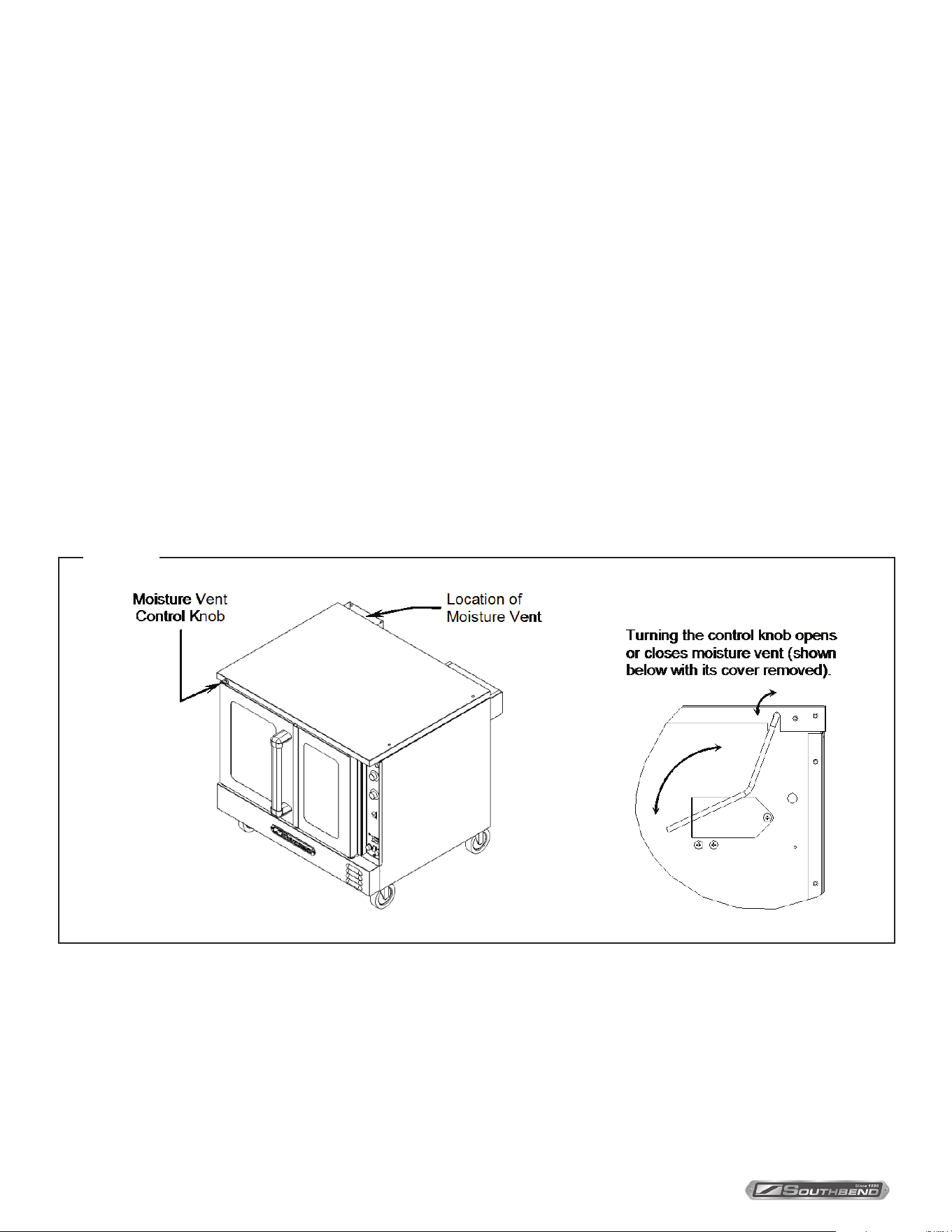
MOISTURE VENT
Each oven has a moisture vent that is opened and closed using the small knob located near the top left corner of the front
panel of the oven (see illustration below). Usually, the vent is kept open to allow moisture to escape. Close the vent (turn
the knob clockwise) when doing ne baking.
Operation
Figure 16
PLATINUM SERIES ELECTRIC CONVECTION OVENS
INSTALLATION AND OPERATION MANUAL 1409004 REV 1 (09/25)
PAGE
21
OF 56
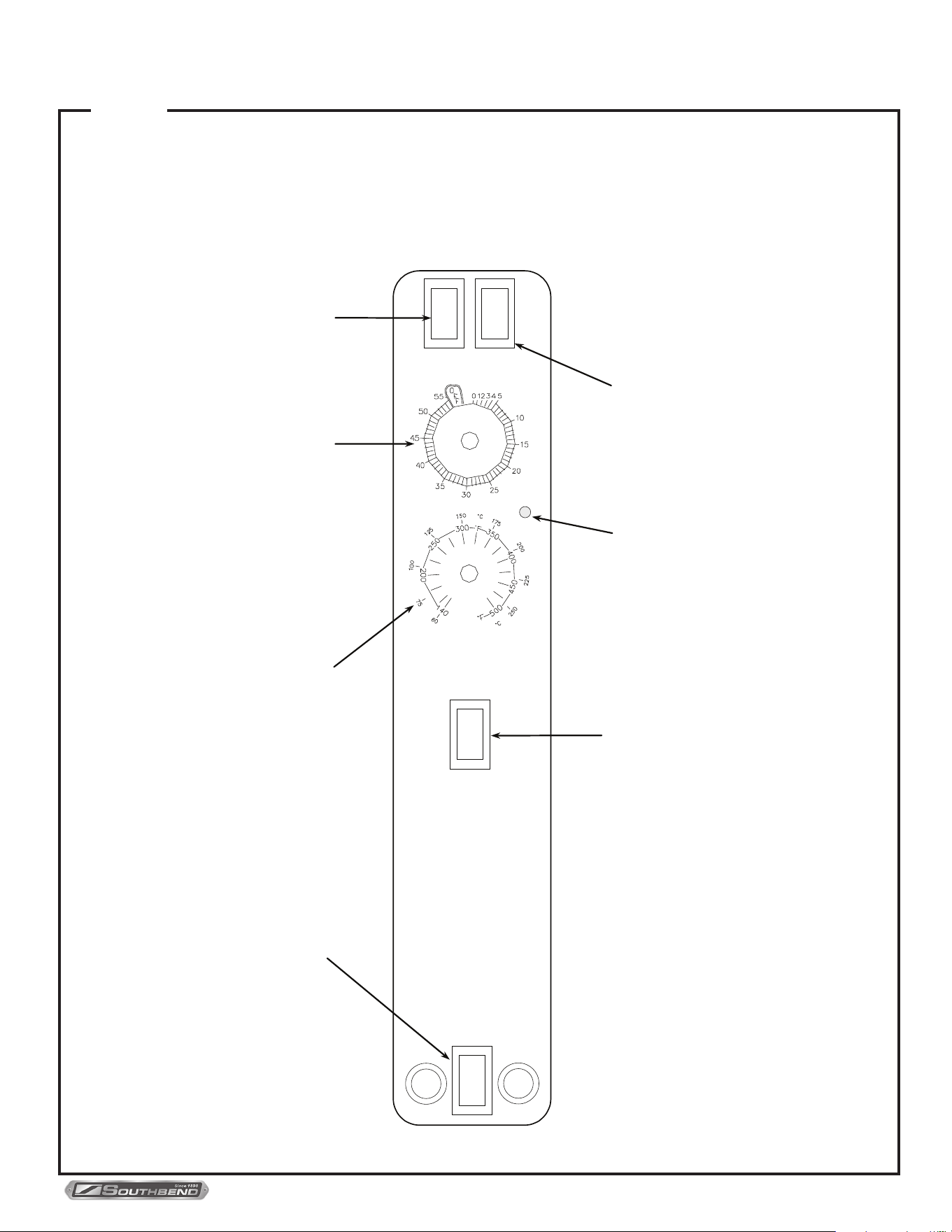
Control Panel of STANDARD Models
Operation
Figure 17
POWER
ON
OFF
FAN MODE
COOK
COOL
Power Switch
S
witch ON to use the oven, switch
O
FF when done using the oven.
Fan Mode
I
n COOK mode, the fan runs
c
ontinuously except when the doors
a
re open. The fan does NOT cycle
with the operation of the elements.
In
COOL mode, the fan runs
Lorem ipsum
c
ontinuously even if the doors are
o
pen. Since the elements will not
o
perate if the oven doors are open,
t
o rapidly cool the oven after
c
ooking is completed, open the
d
oors and switch the fan mode to
COOL.
Cook Timer
T
urn knob to set a time duration. An
a
larm will sound when the timer
r
uns out. The timer is a reminder to
t
he user; the timer does not
c
ontrol the oven.
COOK TIMER (MIN.)
Cook Temperature Control
T
urn knob to select desired cooking
t
emperature. The Heat On indicator
w
ill go out when the oven reaches
t
he set temperature, and will cycle
o
n and off as the elements operate
to
maintain the set cooking
t
emperature.
Heat-On Indicator
I
ndicator is lit when the elements
are operating.
Fan Speed
U
se to select fan speed (HI or
L
OW). The appropriate speed is
d
etermined by the type of food
b
eing cooked.
COOK TEMPERATURE
HI
LOW
FAN SPEED
LIGHTS
Oven Interior Light Switch
O
n ovens equipped with an oven
i
nterior light, press to turn on the
l
ight. The light remains on for as
l
ong as the switch is held.
HEAT ON

PLATINUM SERIES ELECTRIC CONVECTION OVENS
INSTALLATION AND OPERATION MANUAL 1409004 REV 1 (09/25)
PAGE
22
OF 56
Operation of STANDARD Models
Models with Standard Controls operate much like a standard oven: you turn the oven ON and select a cooking
temperature. Two additional controls are used to control the fan (as described below).
The timer is a reminder to you of when to remove food from the oven. The timer does NOT control the temperature of
the oven.
To cook, do the following:
1. Turn the oven ON using the Power Switch at the top of the control panel.
2. Select the desired fan speed using the Fan Speed switch. The appropriate fan speed (HI or LOW) depends on the type
of food being cooked.
3. Switch the Fan Mode switch to COOK. The fan will run continuously when the oven doors are closed (the fan does not
cycle on and o with the elements). (If this switch is set to COOL the only dierence is that the fan will continue to run
when the oven doors are open.)
4. Set the cooking temperature by turning the Cook Temperature Control until the indicator mark on the knob is pointed
to the desired cooking temperature. The Heat On indicator will light when the elements are on and will remain on while
the oven preheats.
5. Wait until the Heat On indicator has come on and gone out three times. At that time the oven will have reached the set
cooking temperature.
6. Open the oven doors, load the product into the oven, and close the doors.
7. You can use the Cook Timer as a reminder of when the remove the load from the oven. If so desired, turn the Cook
Timer knob until the indicator mark points to the desired cooking time (up to 55 minutes). The timer knob will rotate
counterclockwise as the timer runs down, indicating how much time remains. You can turn the knob while cooking to
increase or decrease the remaining time. When the timer runs out, a buzzer will sound for a short time, then turn itself
o. (To immediately silence the buzzer, turn the Cook Timer knob to the OFF position.) The timer is a reminder to you;
the timer does not control the oven.
If you open the oven doors, the elements and fan will shut o until the doors are closed.
For ovens that are equipped with an oven interior light, to turn on the light press and hold the switch located at the
bottom of the control panel.
8. When the load has nished cooking, you can rapidly cool the load by opening the oven doors (which will shut o the
elements) and switching the Fan Mode to COOL (which will cause the fan to run even though the doors are open). For
the most rapid cooling, also switch the Fan Speed switch to HI.
9. When you are done cooking, turn the Cook Temperature control to the lowest setting (fully counterclockwise) and
switch the Power Switch to OFF.
Operation
PLATINUM SERIES ELECTRIC CONVECTION OVENS
INSTALLATION AND OPERATION MANUAL 1409004 REV 1 (09/25)
PAGE
23
OF 56
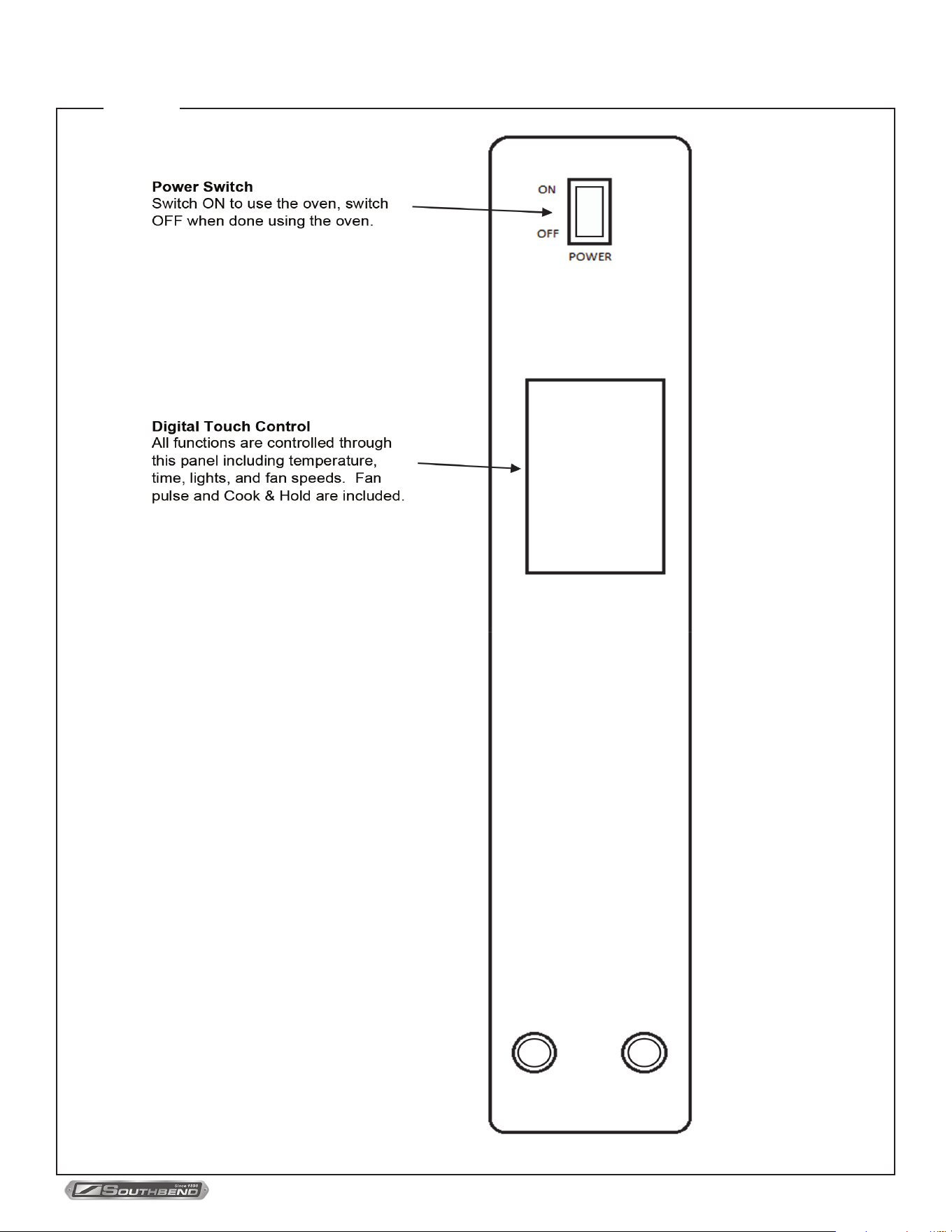
Control Panel of Standard Touchscreen Models
Operation
Figure 18
PLATINUM SERIES ELECTRIC CONVECTION OVENS
INSTALLATION AND OPERATION MANUAL 1409004 REV 1 (09/25)
PAGE
24
OF 56
Operation for Touchscreen Models Only
Main Screen
1. Turn the Power Switch ON.
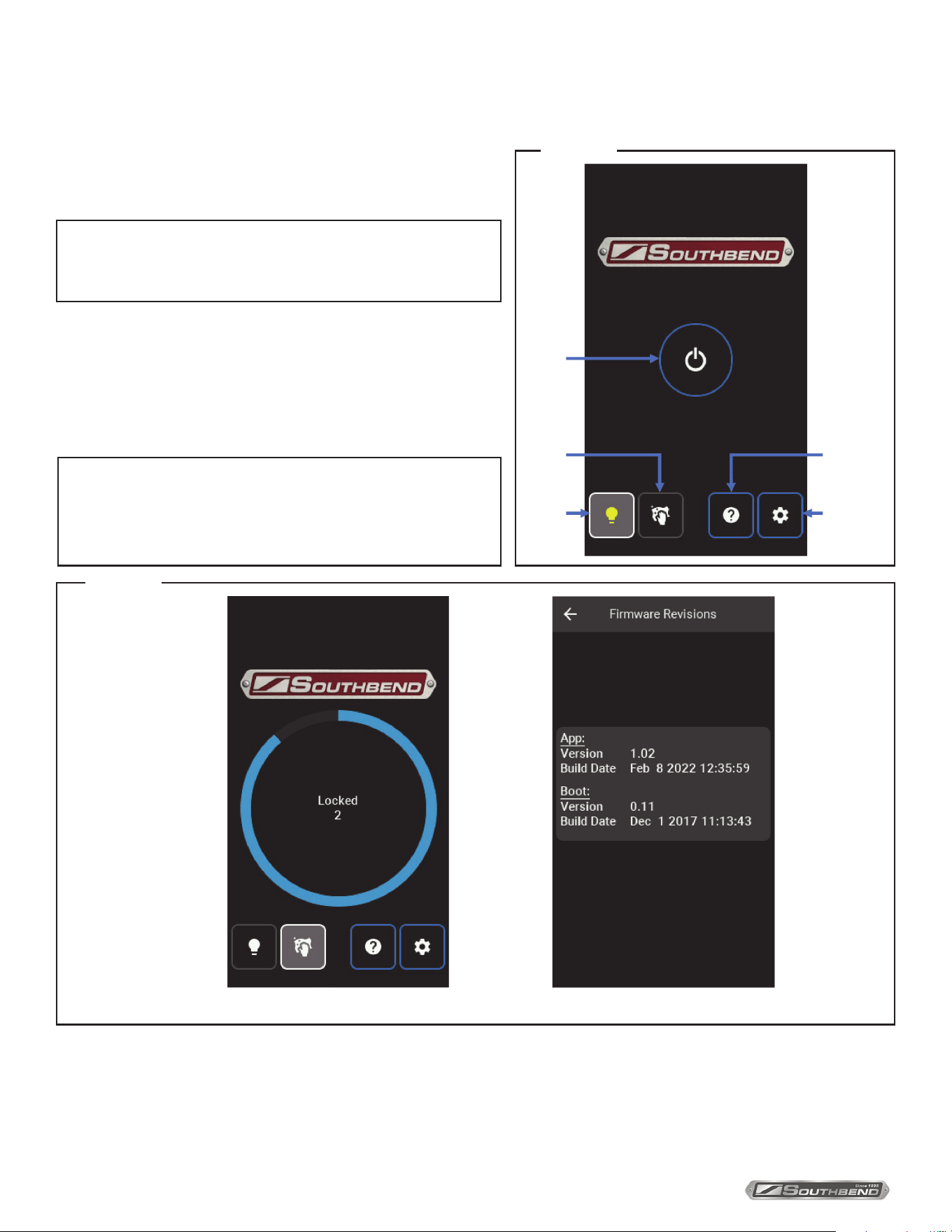
2. Power Button – Located in the center of the screen below
the Southbend logo, pressing this button leads to the
Cooking Mode Page.
3. Lights – Turns oven light ON/OFF. The button will illuminate
and the bulb will glow yellow when ON and can be turned
OFF on any other page.
NOTICE
All button pushes will cause the buzzer to make a chirp
(see Settings in Conguration section to adjust volume).
4. Clean Screen – Press and hold until the countdown wheel appears with countdown timer in the center of the screen.
the screen will be locked for cleaning for 20 seconds. After blue wheel has completed circuit and countdown has
reached 0, the screen will be accessible again.
5. Information – Firmware information displays the App version with the build date and the Boot version with the build
date.
6. Settings – Opens Settings Page (see Settings in Conguration section).
NOTICE
Not all units have lights installed. The button will still be
present.
Turning thelight ON with one page will continue to keep light
on through the dierent pages.
Power
Button
Clean
Screen
Information
Settings
Lights
Clean Screen Information
Operation
Figure 19
Figure 20
PLATINUM SERIES ELECTRIC CONVECTION OVENS
INSTALLATION AND OPERATION MANUAL 1409004 REV 1 (09/25)
PAGE
25
OF 56
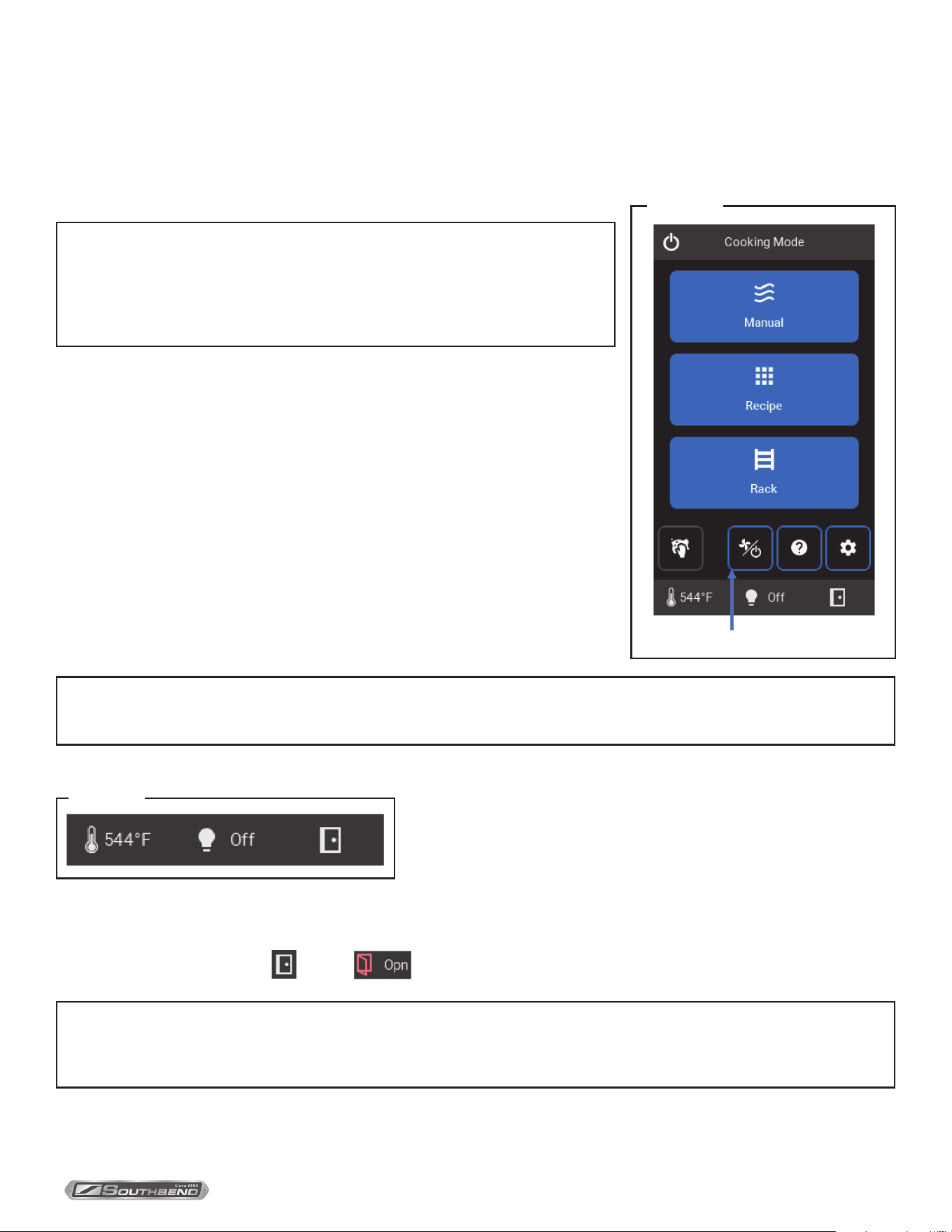
2. Manual – Operate cooking controls manually.
3. Recipe – User-created recipes, either manually entered or imported by
service USB, to cook with the press of a button.
4. Rack – Recipe groupings cooking together based on a number of congured
racks, cook time, and cooking temperature.
5. Clean Panel – See Main Screen.
6. Cool Down – Turns on Fast blower speed, pauses heat sources, and returns
to Main Screen. Cool Down mode terminates when internal temperature falls
below 130°F/55°C, the Power Button on Cooking Mode page is selected, or
when a cooking mode is activated.
7. Information – See Main Screen.
8. Settings – See Settings in the Conguration section.
Cooking Mode
Disclaimer: All recipes provided in this manual are for reference only and do not reect real cook times and temperatures.
For suggested times and temperatures for recipes, see the Cooking Hints section.
1. Power Button – Sends user back to Main Screen. Resets all cooking modes by ending current cooking options and
terminates blower and heat source.
NOTICE
Once a cooking mode/selection has been previewed, the blower will turn on
automatically and the Cooking ribbon will relay its status. With the door closed,
the heat source will remain on indenitely while the internal temperature is
below cook temperature until the oven preheats or the Power Button is pressed.
NOTICE
At the end of a cooking cycle, the buzzer will chime on and o until the mode is canceled or reset.
Bottom Ribbon (seen at the bottom of each cooking mode page, but not on the cooking mode selection page)
9. Internal Temperature
10. Lights – See Main Screen.
11. Door Indicator – Closed Open
Cool Down
NOTICE
The door must be closed to run fans, and subsequently heat source. The blower will still run with the door open only in
Cool Down mode. Any cook timer that is active when the door opens will pause and resume when the door is closed.
Operation
Figure 21
Figure 22
PLATINUM SERIES ELECTRIC CONVECTION OVENS
INSTALLATION AND OPERATION MANUAL 1409004 REV 1 (09/25)
PAGE
26
OF 56
MANUAL COOKING
Manual Cooking Setup
NOTICE
All selections are remembered after a cooking cycle has begun and will be recalled upon return to the page until
power is cycled. If selections were made but Cook was not pressed or the power was cycled, the selections will
return to the previous default settings.
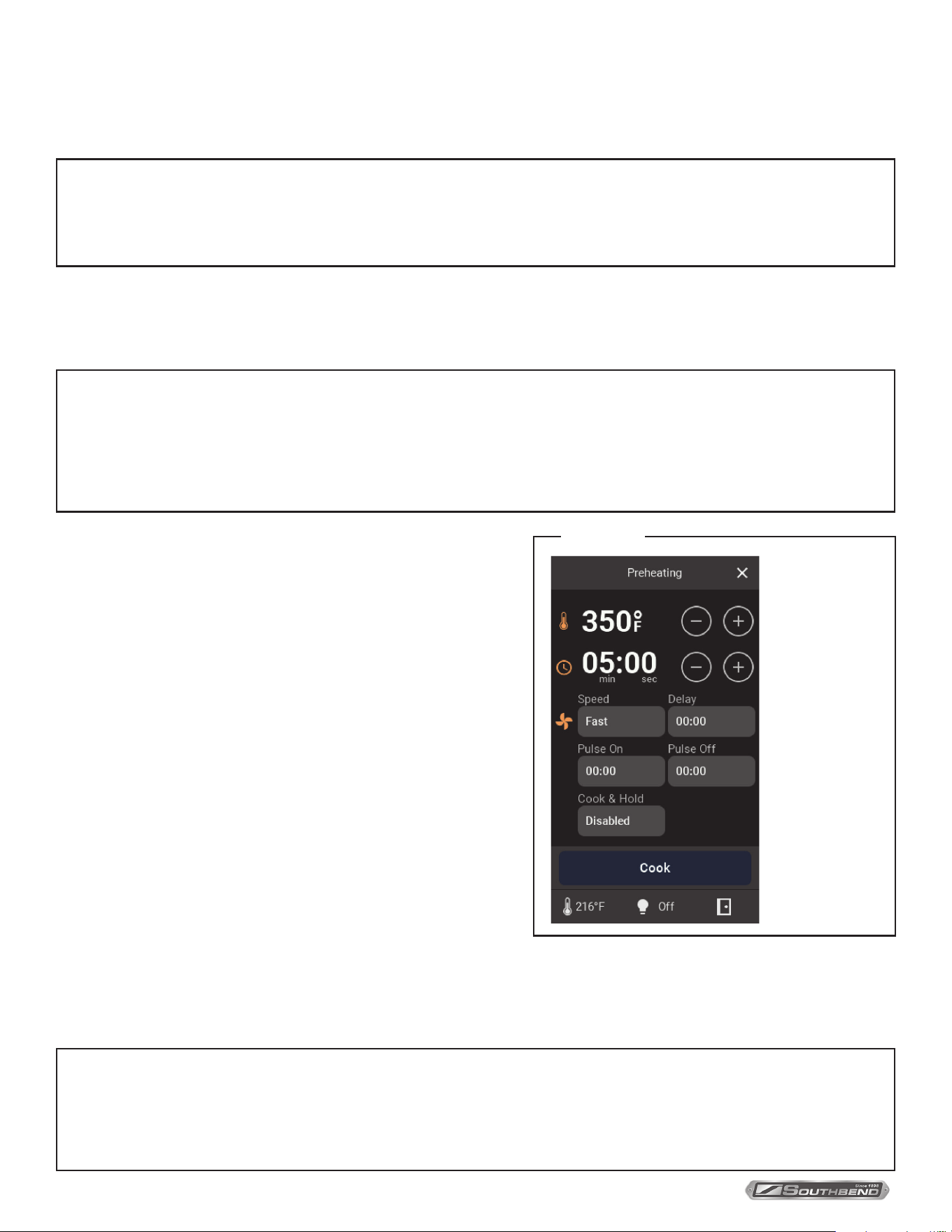
1. Set the cooking temperature (140 °F – 550 °F/60 °C – 288 °C) either by using the add/subtract buttons or by selecting
the temperature itself. Using the add/subtract buttons changes the temperature by ±10 °F/5 °C. Selecting the
temperature will lead to a number pad (see Number Pad in the Conguration section for how to use). Temperatures
keyed above or below the range will not be accepted and will output the closest min or max.
NOTICE
If the internal temperature is below the set temperature minus Ready Oset Temperature, the top ribbon will appear
with a preheating message and Cook will not be accessible. When the cooking temperature is achieved, the ribbon
will read Ready and cooking may begin. If the temperature of the oven starts above the cooking temperature the
ribbon will read Too Hot until it cools to the desired temperature. The top ribbon will read Cooling when Cool Down
is active (see Cooking Mode).
2. Set Time either by using the add/subtract buttons or by
selecting the time itself. Using the add/subtract buttons steps
the time by ±10 seconds. Upon reaching an hour the format
will change from MM:SS to HH:MM. Selecting the time will
lead to a number pad. MM:SS or HH:MM can be selected
before keying in time. Keying in a time above 59:59 in MM:SS
will change the format to HH:MM. Max time is 24 hours.
3. Press the Blower Speed button (Blower Logo) to toggle the
blower speed between Fast and Slow.
4. A delay time can be set to temporarily shut o the blower and
heat source before the cook starts. Delay time is included in
the total cook time. Max delay time is one hour.
5. Pulse ON/OFF is used to cycle the blower. The maximum
set time is 1 hour for each, and the minimum set time is 10
seconds. If Pulse ON is set to 0 seconds and Pulse OFF has a
value, the time for both will be set to 0 seconds when the cook
cycle begins.
6. Enable Cook & Hold to keep the cabinet warm once cook time
is nished. Enabling this mode will require a hold temperature
within cook temperature limits (generally low to hold food
before serving without overcooking). A timer shows how long Cook & Hold has been active. Hold temperature is not
immediately reached and should be factored in. During Cook & Hold, temperature, blower speed, delay, and pulse
times can all be changed.
NOTICE
All cooking parameters can be altered during the cycle by pressing the desired value or icon. Pressing and
holding on the screen will highlight the parameter logo in yellow that will be selected after release. Each
parameter, besides Blower Speed, will open the associated number pad to make numerical changes. Any
changes made on the Cycle page will not be saved upon return to the Setup page.
Cook Temperature
Cook Time
Blower Speed
Delay Time
Pulse On/O Time
Cook & Hold
Operation
Figure 23
PLATINUM SERIES ELECTRIC CONVECTION OVENS
INSTALLATION AND OPERATION MANUAL 1409004 REV 1 (09/25)
PAGE
27
OF 56
Manual Cooking Cycle
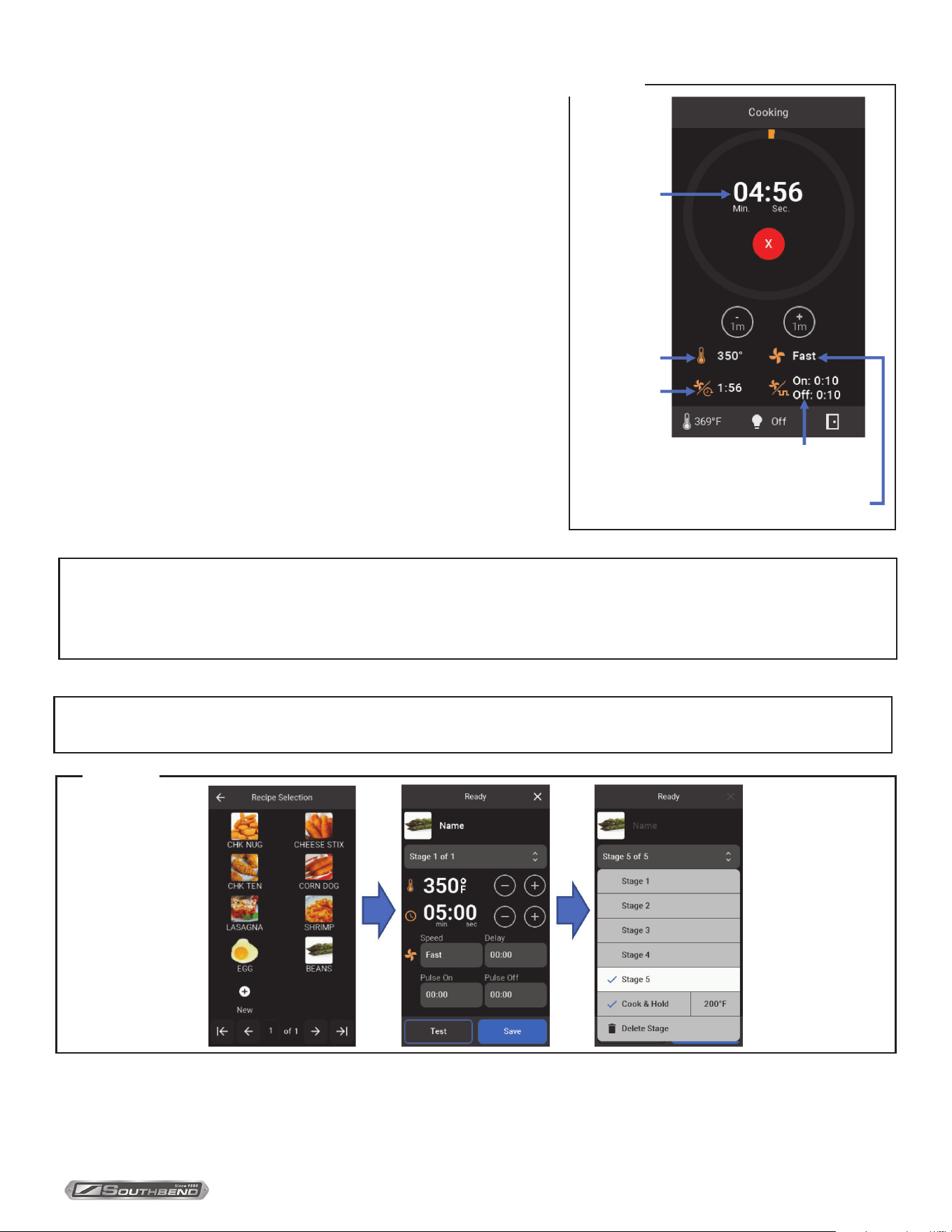
1. Cook Time – Displays cook time in either MM:SS or HH:MM with
a circular bar that grows as time progresses. Time can be altered
at any point by either using the add/subtract 1m buttons to add or
subtract 1 minute from the time, or else clicking on the time itself.
The red X will cancel the cooking operation and send the user back
to the Manual Cooking Setup page. At the end of the timer and alarm
will sound.
2. Cook Temperature (°F/°C setup in conguration)
3. Blower Speed (Fast/Slow)
4. Delay time before cook
5. Blower Pulse (intermittent fan and heat source ON/OFF)
Recipe Cooking
Recipes can be imported ahead of time using the service USB input (see
Recipes in Conguration section) or can be manually created by pressing
the New button. Recipes allow users to perform complex cooking
operations with up to 5 dierent stages of cooking temperatures, blower
speeds, delays, and/or pulses. This section will cover how to create a
new recipe from the page and how to operate the recipe.
Cook Temp
Cook Time
Delay Time
Pulse On/O
Blower Speed
NOTICE
If editing has been locked, recipe creation and recipe manipulation is not possible from this screen. Manual Cooking
is not aected by editing lockout.
NOTICE
While in Setup the unit blower and heat source will turn o.
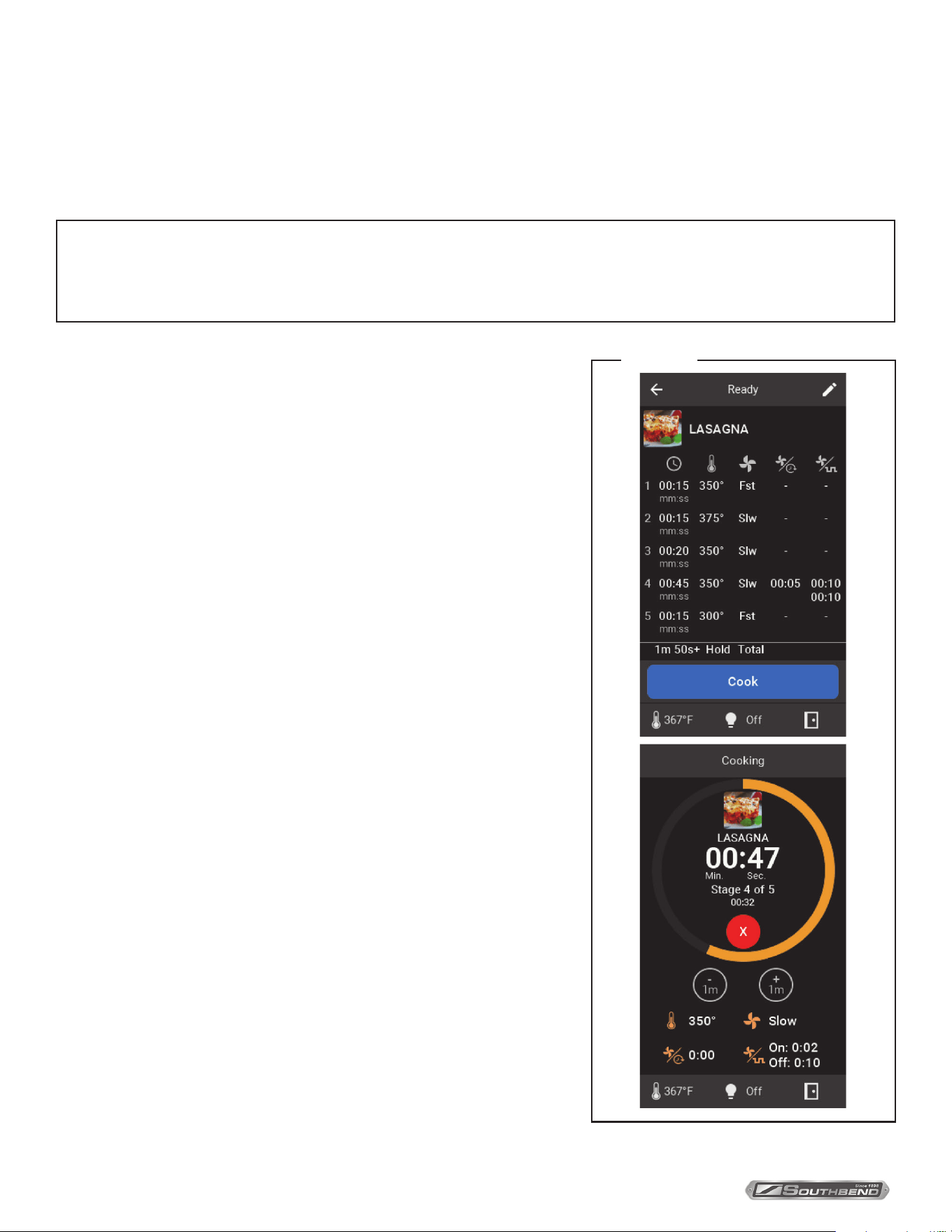
New Recipe Setup
1. Click on New icon to create a new recipe. If New icon is not present, select the next page until it appears.
2. Click on the picture icon in the top left and choose from the list of icons to represent the new recipe item. Click the
back button and write the name of the recipe in Name. Hit enter when done.
Operation
Figure 24
Figure 25
PLATINUM SERIES ELECTRIC CONVECTION OVENS
INSTALLATION AND OPERATION MANUAL 1409004 REV 1 (09/25)
PAGE
28
OF 56
3. Choose the parameters for Stage 1 just as in Manual Cooking Setup.
4. Press Test to run the recipe to ensure the recipe is accurate if necessary.
5. If nished, press the Save button. Otherwise, press the Stage drop-down menu to add more stages. If the Save button
is not pressed a prompt will pop up asking to save changes when exiting the setup page.
6. Press Add Stage to add another stage for setup.
NOTICE
After the recipe has been created, returning to the recipe from the selection menu allows the user to edit the recipe
unless this option has been locked. Clicking on the Stage drop-down menu while editing will reveal the Delete
Recipe button.
7. Repeat steps 2-5 for up to 5 stages. A cook and hold can be added at
the end of the recipe without it counting as one of the stages.
Recipe Run
1. Select Recipe from the Cooking Mode page.
2. Select the desired recipe from the list in the selection menu.
3. All stages will be previewed showing the time of each stage,
temperature, blower speed, any delays, any pulse times, and the total
cook time.
4. If the temperature is too low the top ribbon will read Preheating
and Cook button will not be available until reaching the cooking
temperature. If the temperature is too hot the top ribbon will read
Too Hot and the Cook button will not be available until the internal
temperature cools to the cook temperature.
5. After pressing Cook, the run page appears like Manual Cooking Cycle
and can be altered in the same way unless locked. The cook time will
show the total time while the stage number and time remaining for
that stage will appear below.
Operation
Figure 26
PLATINUM SERIES ELECTRIC CONVECTION OVENS
INSTALLATION AND OPERATION MANUAL 1409004 REV 1 (09/25)
PAGE
29
OF 56
Rack Cooking
Rack Cooking is used to cook recipes of similar cooking temperature and fan speed (Rack Group) simultaneously.
Recipes need to be created ahead of time to make Rack Groups. Similar recipe cooking temperature is dened within
the limits of the Group Temp Allowance temperature added to the cook temperature of the rst item in the group (see
example). Recipes that have multiple stages cannot be included in Rack Groups. See Settings in Conguration to
change the Group Temp Allowance.
Example: With a Group Temp Allowance of 10 °F, a recipe that cooks at 350 °F can be grouped with a recipe that
cooks at 340 °F and/or a recipe that cooks at 360 °F. If the rst recipe chosen though is 340 °F cook temperature,
then the 360 °F recipe will not appear during group creation.
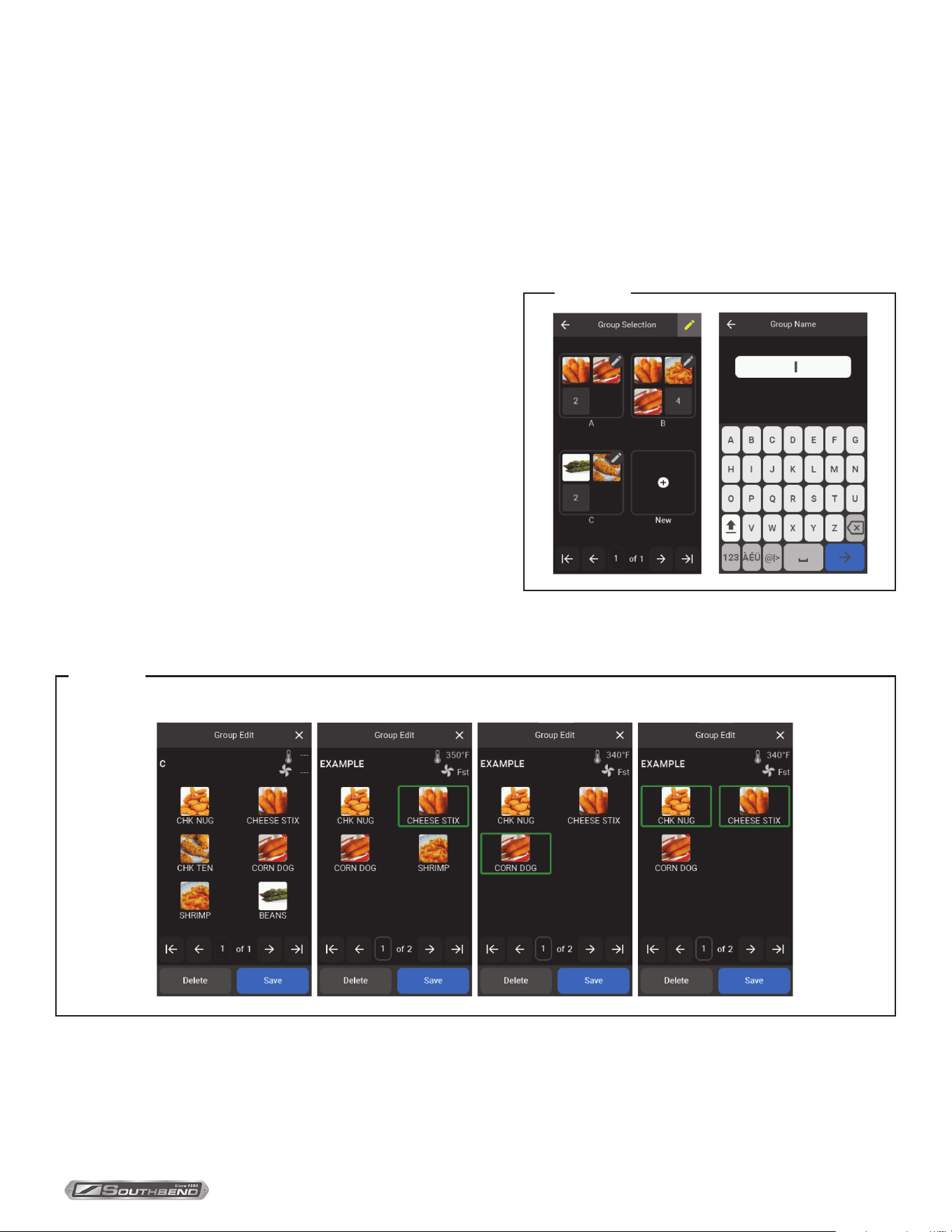
Rack Setup
1. Choose the edit button in the top right corner.
2. A New square will appear on the screen in the next available
space on the nal Group Selection page. Once identied
press the square.
3. Enter desired group name and press the blue arrow button to
accept.
4. Selecting a recipe from the next page will show the cook
temperature and fan speed as well as all other similar recipes
(Figure A). Pressing each dierent recipe will highlight them
with a green box. If only one recipe is selected, pressing the
highlighted box will return all available recipes. If two items
are selected, deselecting the rst recipe chosen will change
the group parameters to the new “rst” selection and may reveal more similar recipes (see written example above and
Figure B). When more than two selections are made, deselecting the rst recipe selection does not change the group
similarity parameters (Figure C).
Group Selection A B C
5. Once all desired recipes are chosen, press the save button.
6. The rack can be deleted at any time during creation or editing.
7. The group image will show the rst three recipe icons with the total number of group recipes available numerically
represented in the last space.
Operation
Figure 27
Figure 28
PLATINUM SERIES ELECTRIC CONVECTION OVENS
INSTALLATION AND OPERATION MANUAL 1409004 REV 1 (09/25)
PAGE
30
OF 56
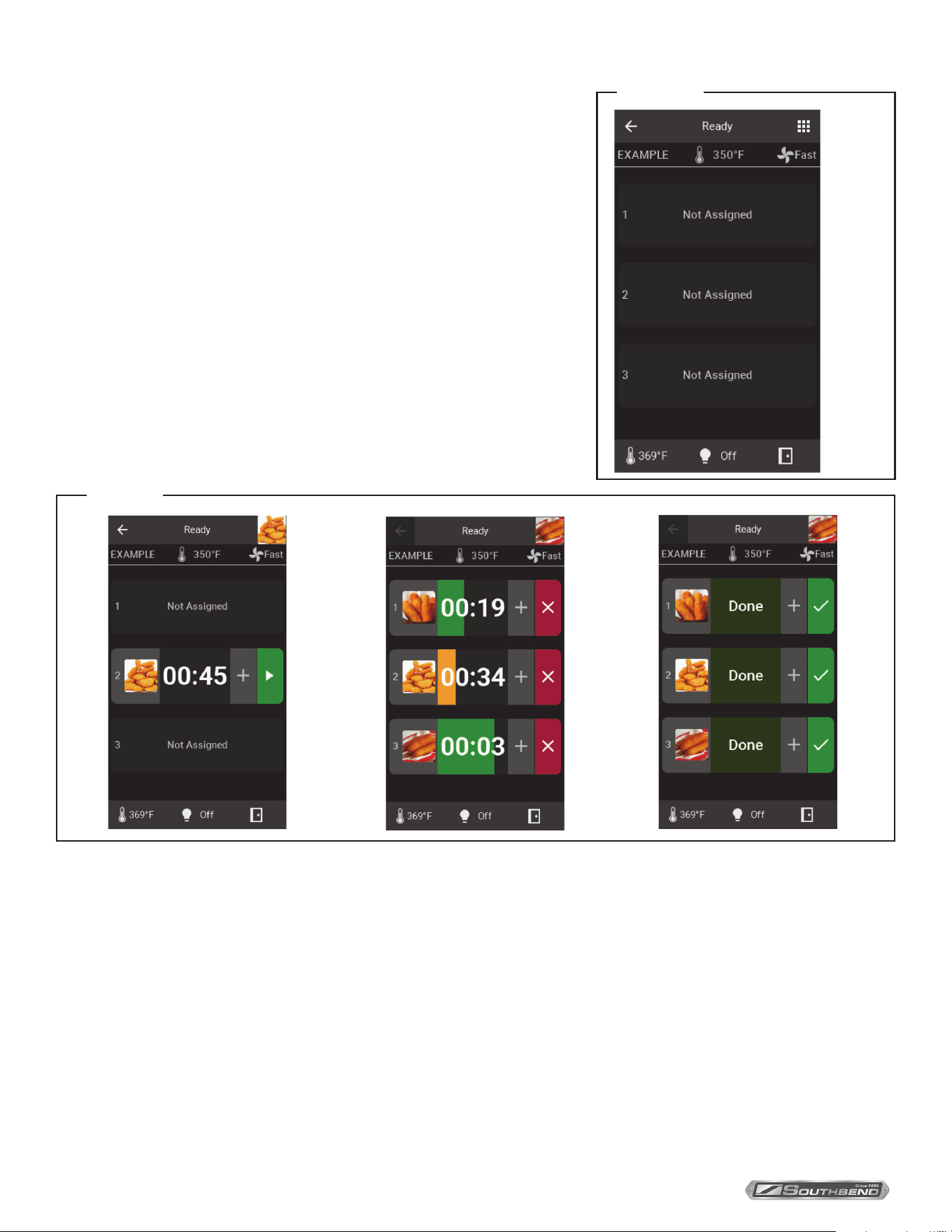
Rack Run
1. Select Rack from the Cooking Mode page.
2. Select the recipe group from the Group Selection page.
3. If internal temperature is lower than the group temperature the top
ribbon will read Preheating and if above, it will read Too Hot.
4. After reaching the correct internal temperature, the blower speed will be
adjusted to the group speed.
5. The group will show Not Assigned spaces initially. To add recipes,
choose the top right 9 square button. This will show all available recipes
for this group as dened during creation in the selection menu or
imported prior.
6. Choose a recipe and it will return to the previous page.
7. By pressing on a rack space, the icon will be attached to that space and
show a timer, additional time button, and start button. Empty racks will
remain empty until a recipe is placed in that space.
9 Square
8. Choosing the start button will start the recipe and time can be added in one-minute increments. A progress bar depicts
the time left. The bar starts as an amber indicator and changes to green at 20 seconds.
9. When nished, the progress bar will blink alternatively a lighter and darker green and say DONE. Press the green
check mark to stop and reset the recipe. Pressing the check mark will also allow access to exit Rack Group which is
not accessible with running and/or completed recipes.
10. Pressing the red X during the run will also stop the recipe and reset the time back to the programmed cook time.
11. Repeat steps 5-7 to ll racks with dierent recipes. The recipe icon in the top right shows which recipe is in the queue
to add to racks. Pressing it allows the selection of the other recipes. Recipes are overwritten when the rack is chosen
with a dierent recipe. Racks that are currently cooking or completed cannot be overwritten until reset.
12. Returning to the Rack Group Selection page will clear all racks.
Operation
Figure 29
Figure 30
PLATINUM SERIES ELECTRIC CONVECTION OVENS
INSTALLATION AND OPERATION MANUAL 1409004 REV 1 (09/25)
PAGE
31
OF 56
Number Pad
• Entering a new value will start from the right and move left.
• Continuing to enter new numbers will shift the furthest left characters out.
• Press the bottom right arrow button to enter the value
• Clear all values back to 0000 with the bottom left clear button
CONFIGURATION
Service Only USB Access
The access to the USB port to import/export recipes, update the software versions and add Icons is located on the back of
the control panel. Remove the two screws securing the control panel and pull out. Underneath the digital display you will
nd the USB port. If importing les, make sure that the unit is o before inserting the USB drive, and then turn on. There
will be a slight delay compared to normal operation and the le(s) will automatically load. Created Icons must be bitmap
le type. Recipes will need to be created on the touchscreen before export.
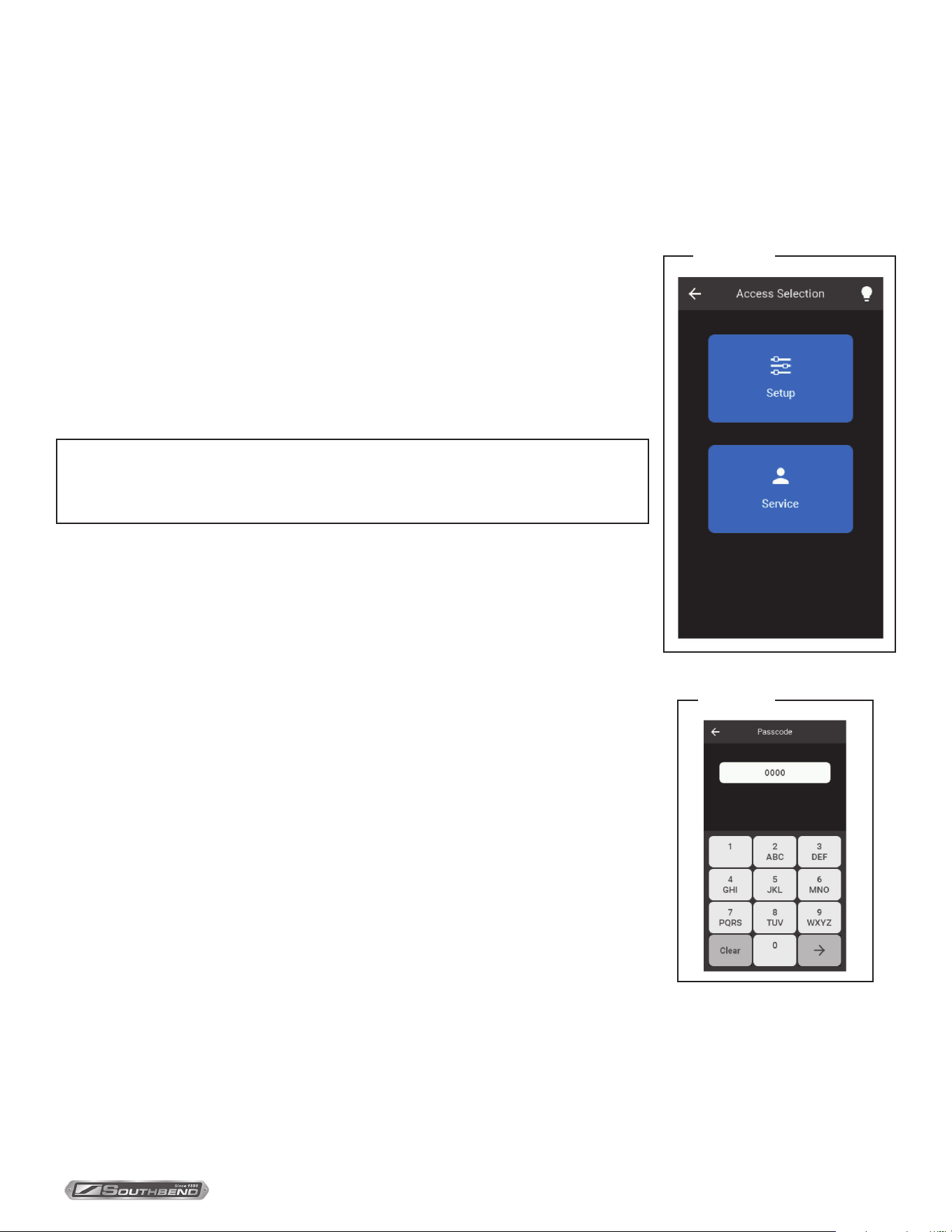
Settings
1. Back Button – Returns to the previous screen.
2. Setup – Passcode-protected parameter congurator. Manager passcode allows
owners to change limited unit variables.
3. Service – Passcode protected unit health and I/O test panel with current input
readings.
NOTICE
As in normal operation, the blower speed must be activated before turning on
the heat. The door may be open or closed to function.
Operation
Figure 31
Figure 32
PLATINUM SERIES ELECTRIC CONVECTION OVENS
INSTALLATION AND OPERATION MANUAL 1409004 REV 1 (09/25)
PAGE
32
OF 56
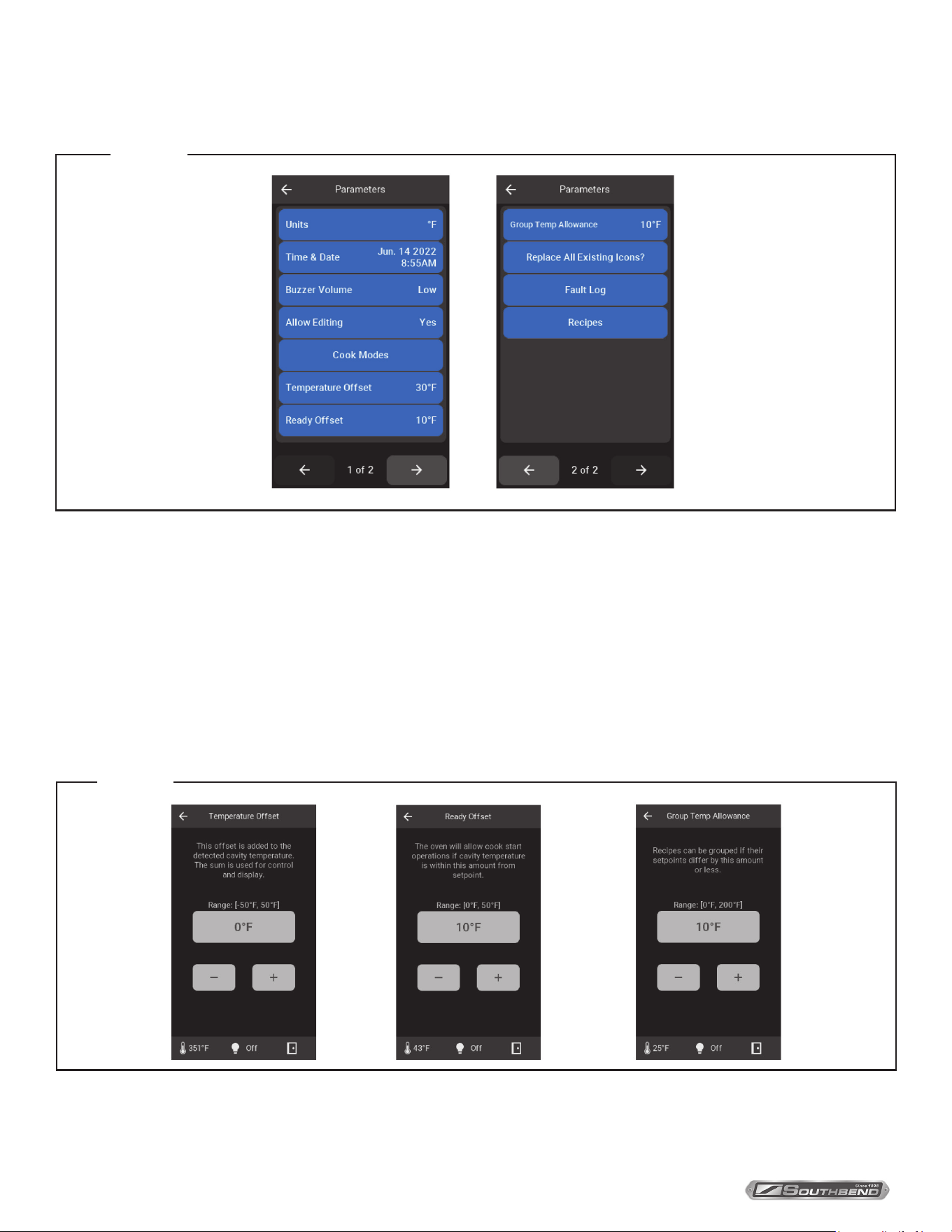
Setup
Enter manager provided code to enter the Setup Parameters page.
8. Replace All Existing Icons? – Deletes current icons for recipes and uploads new ones if USB is inserted into USB
slot.
1. Units – Toggles between °F and °C
2. Time & Date – Used to record faults
3. Buzzer Volume – Toggle between High, Medium, and Low
4. Allow Editing – Toggle between Yes, Passcode, and No. This setting allows editing recipes and groups. Selecting
Passcode will require manager code to edit while selecting No will remove the edit button from pages.
5. Cook Modes – Chooses which cooking modes will be active on the Cooking Mode page.
6. Ready Oset – The oven will allow cook start operations if cavity temperature is within the oset value from the
cook setpoint.
7. Group Temp Allowance – Recipes can be grouped if their setpoints dier by allowance value or less.
Operation
Figure 33
Figure 34
PLATINUM SERIES ELECTRIC CONVECTION OVENS
INSTALLATION AND OPERATION MANUAL 1409004 REV 1 (09/25)
PAGE
33
OF 56
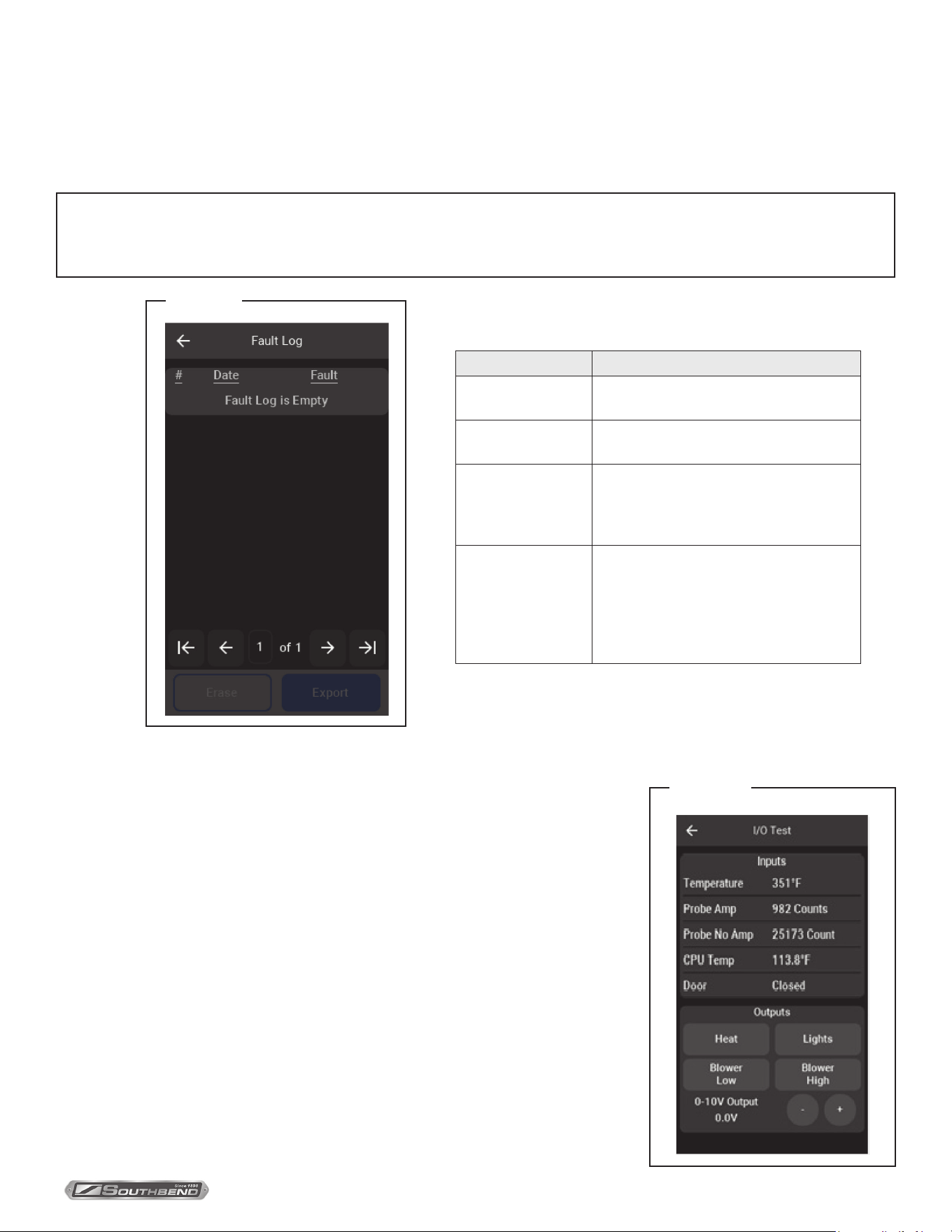
9. Fault Log – Displays all faults that have occurred along with the date and time they occurred until cleared. When a
temperature warning is active the only options are to Turn O the unit or go into Cool Down mode. The warning is
only available if the blower or heat source is already on, otherwise, a ribbon with Cavity/Controls Too Hot is visible and
does not allow activation of any cooking modes. The message will go away when the Temperature falls below 630°F.
Probe warnings activate related message ribbon and do not allow cooking modes until the problem is xed.
NOTICE
If the Turn O option from pop up is selected but the main power switch is still engaged the unit will simply reset
and return to the main screen.
Message Description
Open Probe Averaged ADC readings indicate that
the RTD is open
Shorted Probe Averaged ADC readings indicate that
the RTD is shorted
Cavity Too Hot Averaged cavity temperature reading
is 650 °F or higher. Temperature
must fall below 630 °F to clear the
fault.
Controls Too Hot Averaged control cavity temperature
reading is 176 °F or higher. The
Temperature must fall below 166 °F
to clear the fault. This measurement
is measured internally on the
microcontroller.
10. Recipes – Allows Import and Export from USB to keep and manage recipes. Another option is to delete all recipes
from unit. Deleting all recipes will also delete them from Rack Groups.
Service
Service Screen supplies current input values and allows service agents to test
outputs.
1. Temperature – RTD measured cavity temperature
2. Probe Amp – Used to determine open or shorted temperature probes
3. Probe No Amp – Used to determine open or shorted temperature probes
4. CPU Temp – Temperature of the display circuit board
5. Door – Open or closed
6. Heat source, blower and lights can all be toggled (the fan must be on for the
heat to be active).
7. 0-10V Output – Not in use.
Operation
Figure 35
Figure 36

PLATINUM SERIES ELECTRIC CONVECTION OVENS
INSTALLATION AND OPERATION MANUAL 1409004 REV 1 (09/25)
PAGE
34
OF 56
COOKING HINTS
In a standard (non-convection) oven, the air is relatively still and an insulating layer of moisture surrounds the cooking
food product. In a convection oven, the fan-blown circulating air strips away this insulating layer allowing the heat to
penetrate faster for quicker baking and roasting. Hence, in a convection oven cooking procedures and techniques may
require some modication for successful results. As a general rule, the cooking time will be shorter and the cooking
temperature will be 25 °F to 75 °F lower than those called for in recipes for a standard oven.
TIME & TEMPERATURE
Time and temperature are important. The “Guide to Times and Temperatures” later in this section is a starting point. The
actual best cooking time and temperature will depend on such factors as the size of the load and mixture of the recipe
(particularly moisture). Once an appropriate time and temperature has been established for a particular product and load,
you will nd the result of succeeding loads to be similar.
OVERLOADING
Do NOT overload the oven. The size of the load that can be cooked satisfactorily depends largely on the particular
product. As a rule, ve racks can be successfully used for shallow cakes, cookies, pies, etc. For deeper cakes (such as
angel food), use only three racks because of the size of the pan and the space required for rising. For hamburger patties,
sh sticks, cheese sandwiches, etc., a full complement of racks and pans is usually satisfactory.
HELPFUL SUGGESTIONS
Here are some suggestions that will assist in getting the best possible performance from a convection oven:
• Pre-heat the oven thoroughly before use.
• When re-thermalizing frozen products, pre-heat the oven to 50 °F higher than the planned cooking temperature. After
loading, reduce the temperature setting to the appropriate cooking temperature.
• Space the racks and pans as evenly as possible to allow air circulation.
• Center the load on the racks to allow for proper air circulation around the sides. Do not cover the racks
completely with pans.
• Do not use a deep pan for shallow cakes or cookies, etc. Air circulation across the surface of the product is essential.
WARNING
THE USE OF ALUMINUM FOIL CAN CAUSE HEAT DISTRIBUTION PROBLEMS IN OVENS. EXTREME CARE
MUST BE USED WHEN PLACING ALUMINUM FOIL IN THE OVEN TO ENSURE THAT IT DOES NOT BLOCK OR
CHANGE THE AIR FLOW. THE USE OF ALUMINUM FOIL MAY VOID THE PRODUCT WARRANTY IF ITS USE IS
ASCERTAINED TO BE A PROBLEM.
HOLDING FOOD BEFORE SERVING
Any food item prepared in steam table pans can be held until being served by setting the Hold thermostat to 160°F.
Examples include stued pork chops, oysters Rockefeller, and any vegetable entree.
Cooking Hints

PLATINUM SERIES ELECTRIC CONVECTION OVENS
INSTALLATION AND OPERATION MANUAL 1409004 REV 1 (09/25)
PAGE
35
OF 56
If the...... then...
Cakes are dark on the sides and not done in the center… lower oven temperature
Cake edges are too brown… reduce number of pans or lower oven temperature.
Cakes have a light outer color… raise temperature.
Cakes settle slightly in the center…
bake longer or raise oven temperature slightly. Do not open doors except
to load or unload product..
Cakes ripple… do not overload pans or use batter that is too thin.
Cakes are too coarse… lower oven temperature.
Pies have uneven color… reduce number of pies per rack or eliminate use of baking pans
Brown sugar topping or meringue blows off…
after oven is preheated, turn off oven and put product in oven until
topping sets, then turn oven back on..
Rolls have uneven color… reduce number or size of pans.
Meats are browned and not done in center… lower oven temperature and roast longer..
Meats are well done and not browned… raise temperature. Limit amount of moisture.
Meats develop hard crust… reduce temperature or place pan of water in oven.
Excessive meat shrinkage occurs… lower oven temperature..
GUIDE TO TIMES AND TEMPERATURES
As a guide, set oven temperatures 25°F to 75°F lower than called for in recipes for non-convection ovens, (i.e., range or
deck ovens).
Time and temperature will vary depending on load, mix, size, portion, initial temperature of food, and other factors. Use
the following chart as a starting point to develop your cooking techniques. Rack loading and position may aect results.
Experimentation may be necessary to suit individual requirements.
Cooking Time Temperature Number of Racks
Meat and Fish
Top Round, 18-20 lbs. (medium) 5 hours 225 °F 1
Prime Ribs (rare) 4 hours 225 °F 1
Burger Patties, 4 oz. 10 hours 350 °F 5
Fish Cakes 10-12 min. 350 °F 5
Turkey, 10-12 lbs. 3 hr. 20 min. 225 °F 1
COOKING PROBLEMS AND SOLUTIONS
Cooking Hints

PLATINUM SERIES ELECTRIC CONVECTION OVENS
INSTALLATION AND OPERATION MANUAL 1409004 REV 1 (09/25)
PAGE
36
OF 56
Cooking Time Temperature Number of Racks
Baked Goods
Bread, 2 lb. loaf 35 min. 375 °F 3
Biscuits 5-10 min. 350 °F 5
Cornbread. 18 min. 400 °F 5
French Bread 10 min. 375 °F 5
Sheet Cake 18-20 min. 300 °F 5
Cream Puffs 20 min. 325 °F 5
Brown & Serve Rolls 6 min. 400 °F 5
Ginger Bread 18 min. 300 °F 5
Yeast Rolls, sheet pan 16-18 min. 325 °F 5
Pineapple Upside Down Cake 25-30 min. 300 °F 5
Apple Turnovers 15-18 min. 325 °F 5
Fruit Cobbler 22-25 min. 350 °F 5
Brownies 15 min. 350 °F 5
Danish Pastry 12 min. 325 °F 5
Pie Shells 12 min. 350 °F 5
Fresh Fruit Pies 25-30 min. 350 °F 5
Pumpkin Pies 25-30 min. 275 °F 5
Fresh Apple Pies 35 min. 375 °F 5
Frozen Berry Pies 40 min. 375 °F 5
Frozen Fruit Pies 45 min. 375 °F 5
Potatoes
5
Baked Potatoes, 10 oz. 50-55 min. 450 °F 5
Baked Potatoes, 6-8 oz. 40-45 min. 450 °F 5
Scalloped Potatoes 35 min. 325 °F 5
Miscellaneous
Macaroni and Cheese 30 min. 350 °F 5
Stuffed Peppers 18 min. 350 °F 5
Toasted Cheese Sandwiches 8 min. 375 °F 5
Cooking Hints
PLATINUM SERIES ELECTRIC CONVECTION OVENS
INSTALLATION AND OPERATION MANUAL 1409004 REV 1 (09/25)
PAGE
37
OF 56
CLEANING
Southbend equipment is sturdily constructed of the best materials and is designed to provide durable service when
treated with ordinary care. To expect the best performance, your equipment must be maintained in good condition and
cleaned daily. Naturally, the periods for this care and cleaning depend on the amount and degree of usage.
Following daily and periodic maintenance procedures will enhance the long life of your equipment. Climatic conditions
(such as salt air) may require more thorough and frequent cleaning or the life of the equipment could be adversely
aected.
The oven interior is nished with a porcelain enamel coating unless stainless steel option is selected. “Spillovers” should
be cleaned from the interior bottom surface as soon as possible to prevent carbonizing and a burnt-on condition. Grease
or any residue should be cleaned from interior surfaces as soon as it accumulates.
WARNING
FOR YOUR SAFETY, DISCONNECT THE POWER SUPPLY TO THE APPLIANCE BEFORE CLEANING.
WHEN CLEANING THE BLOWER WHEEL, BE SURE TO HAVE THE POWER SWITCH IN THE “OFF” POSITION.
DAILY CLEANING
1. Turn the power switch to OFF and allow the oven to cool.
2. Remove the oven-interior racks and rack guide frames. (The rack guide frames are readily removable by merely
raising to disengage them from their sockets.) Wash the racks and rack guides in a sink with mild detergent and
warm water. Dry them thoroughly with a clean cloth.
3. Look to see if any foreign matter has accumulated on the blades of the blower wheel (which will reduce air
circulation). If necessary, remove the right-side lining of the oven, which is secured by thumbscrews near each corner.
Use a sti brush to remove accumulations from the blower blades, then wash with soap and water.
4. Wash the interior surfaces with mild detergent and warm water. Rinse with clean water, and dry thoroughly with a
clean cloth. For stubborn accumulations of grease and carbon buildup, use a commercial Non-Caustic Oven and Grill
Cleaner. Use of cleaners not specied as Non-Caustic may damage the unit.
5. Clean the control panel with warm water and mild soap. Never use cleaning solvents with a hydrocarbon base.
6. Wipe the other exterior surfaces with a clean damp cloth. If the exterior surfaces require more thorough cleaning, see
“Cleaning Stainless Steel Surfaces” on the next page.
7. Return the rack guides and racks to their appropriate locations inside the oven.
8. LEAVE THE DOOR OPEN AT NIGHT AFTER CLEANING. This allows the oven to dry thoroughly after cleaning and
also prolongs the life of the door gasket.
MONTHLY CLEANING
Cleaning
CAUTION
ONLY USE A COMMERCIAL NON CAUSTIC CLEANER ON THE INTERIOR TO PREVENT POTENTIAL DAMAGE
PLATINUM SERIES ELECTRIC CONVECTION OVENS
INSTALLATION AND OPERATION MANUAL 1409004 REV 1 (09/25)
PAGE
38
OF 56
SEMI-ANNUAL CLEANING
At least twice a year have your Southbend Authorized Service Agency or another qualied service technician clean and
adjust the unit for maximum performance.
At least twice a year the oven’s venting system should be examined and cleaned.
CLEANING STAINLESS STEEL SURFACES
To remove normal dirt, grease and the product residue from stainless steel that operates at LOW temperature, use
ordinary soap and water (with or without detergent) applied with a sponge or cloth. Dry thoroughly with a clean cloth.
To remove grease and food splatter, or condensed vapors, that have BAKED on the equipment, apply cleanser to a
damp cloth or sponge and rub cleanser on the metal in the direction of the polishing lines. Rubbing cleanser, as gently
as possible, in the direction of the polished lines will not mar the nish of the stainless steel. NEVER RUB WITH A
CIRCULAR MOTION. Soil and burnt deposits that do not respond to the above procedure can usually be removed by
rubbing the surface with SCOTCH-BRITE scouring pads or STAINLESS scouring pads. DO NOT USE ORDINARY STEEL
WOOL, as any particles left on the surface will rust and further spoil the appearance of the nish. NEVER USE A WIRE
BRUSH, STEEL SCOURING PADS (EXCEPT STAINLESS), SCRAPER, FILE OR OTHER STEEL TOOLS. Surfaces that
are marred collect dirt more rapidly and become more dicult to clean. Marring also increases the possibility of corrosive
attack. Renishing may then be required.
To remove heat tint – Darkened areas sometimes appear on stainless steel surfaces where the area has been subjected
to excessive heat. These darkened areas are caused by the thickening of the protective surface of the stainless steel and
are not harmful. Heat tint can normally be removed by the foregoing, but tint that does not respond to this procedure calls
for a vigorous scouring in the direction of the polish lines, using SCOTCH-BRITE scouring pads or a STAINLESS scouring
pad in combination with a powered cleanser. Heat tint action may be lessened by not applying, or by reducing heat to
equipment during slack periods.
Cleaning
WARNING
If disconnection of the restraint (page 12) is necessary to move the appliance for cleaning, etc., reconnect it when the
appliance is moved to its originally installed position.
CAUTION
DO NOT USE ordinary steel wool as any particles left on the surface will rust.
NEVER USE a wire brush, steel or abrasive scouring pad (except stainless), scraper, le or other steel tools. Surfaces
which are marred collect dirt more rapidly and become more dicult to clean. Marring also increases the possibility of
corrosive attack.
DO NOT clean door gasket with a high chlorine solution or bleach.
NEVER use any corrosive cleaner. Use only cleaners approved for stainless steel.
WARNING
Improper cleaning can result in expensive repairs or electrical shock. Do not get water on electrical controls or motors.
WARNING
To avoid the risk of accidental electric shock, disconnect the unit from the power supply before moving the unit.
PLATINUM SERIES ELECTRIC CONVECTION OVENS
INSTALLATION AND OPERATION MANUAL 1409004 REV 1 (09/25)
PAGE
39
OF 56
ADJUSTMENTS
WARNING
ADJUSTMENTS AND SERVICE WORK MAY BE PERFORMED ONLY BY A QUALIFIED TECHNICIAN WHO IS
EXPERIENCED IN, AND KNOWLEDGEABLE WITH, THE OPERATION OF COMMERCIAL COOKING EQUIPMENT.
HOWEVER, TO ASSURE YOUR CONFIDENCE, CONTACT YOUR AUTHORIZED SERVICE AGENCY FOR RELIABLE
SERVICE, DEPENDABLE ADVICE, GENUINE FACTORY PARTS AND ANY OTHER ASSISTANCE.
NOTICE
Warranty will be void and the manufacturer is relieved of all liability if service work is performed by other than a qualied
technician, or if other than genuine Southbend replacement parts are installed.
LUBRICATION
The door chains and sprockets have been lubricated at the factory with high temperature “Never Seeze” lubricant. After
each six months of usage, lubricate the door chains and sprockets with the same type of lubricant.
Motor lubrication information can be found on permanent label located on motor.
Casters are provided with a Zerk tting for proper lubrication when required
Adjustments
TEMPERATURE CONTROLLER (Standard-Control Models Only)
The calibration of the temperature controller should not be changed until sucient experience with cooking results has
denitely proved that the temperature controller is not maintaining proper oven temperatures. Before any recalibration is
attempted, the oven temperature should be checked by the following procedure:
1. Remove all trays and pans from the oven.
2. Place a thermocouple or a reliable mercury oven-type thermometer at the center of the middle rack.
3. Turn the oven ON and set the temperature control knob to 400°F.
4. The amber “heat on” light will go out when the oven temperature is reached.
5. Allow three cycles for the temperature to stabilize.
6. Read the thermocouple or thermometer immediately after the light goes out for the third time, and again immediately
after it comes on the next time.
7. If the average of these readings varies by more than 10°F from the dial setting, recalibrate by the following procedure.
Recalibration should be attempted only by a competent service technician.
Use the following procedure to recalibrate the oven:
1. Loosen the two set screws that secure the temperature-control knob to the temperature-control shaft.
2. Remove the knob from the shaft, being careful not to rotate the knob or shaft.
3. Replace the knob on the shaft so that the indicator mark on the knob points directly at the temperature that was
measured at the center of the oven.
4. Re-check the oven calibration.
PLATINUM SERIES ELECTRIC CONVECTION OVENS
INSTALLATION AND OPERATION MANUAL 1409004 REV 1 (09/25)
PAGE
40
OF 56
front panel
A
B
Door Chain Adjustment
Adjustments
Figure 37
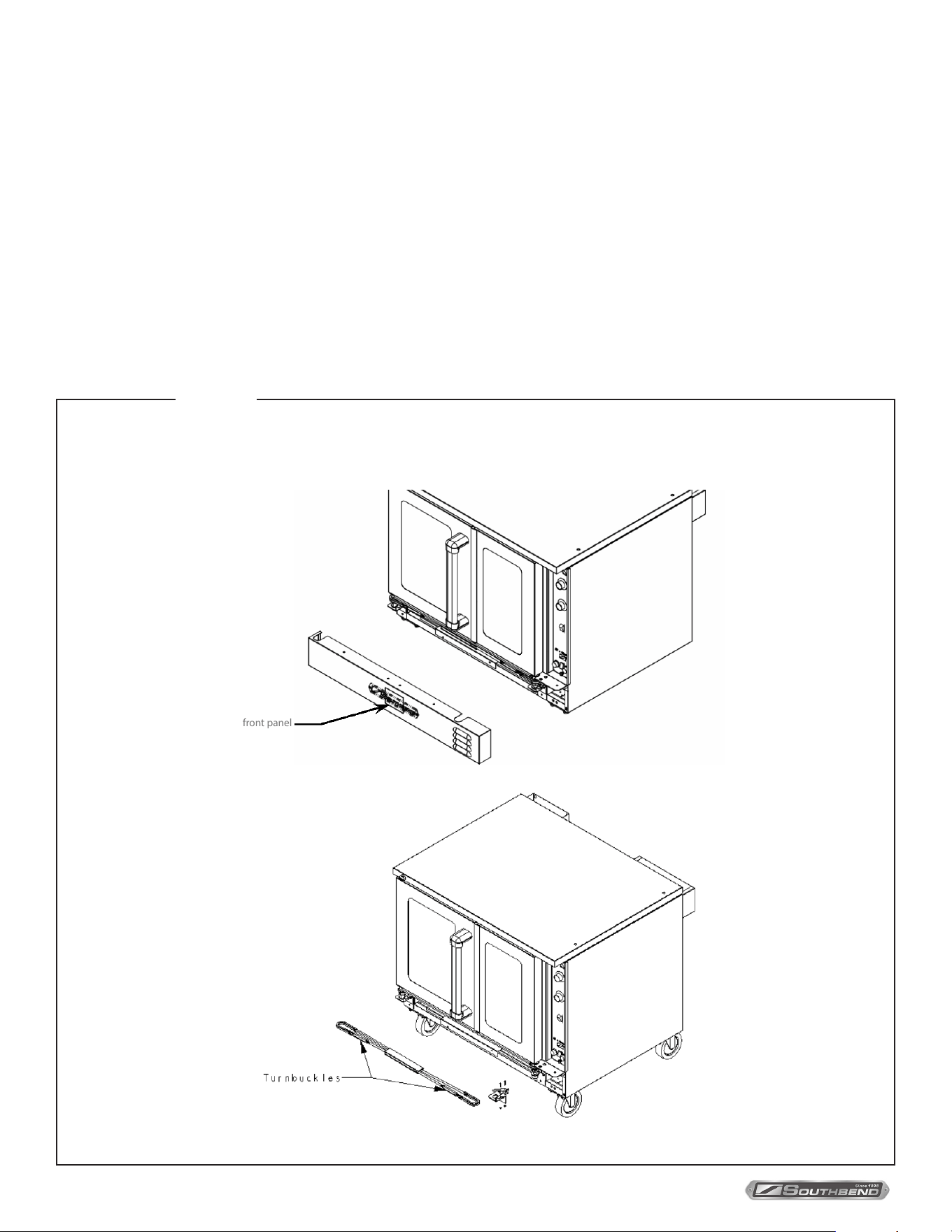
ADJUSTING DOOR CHAIN MECHANISM
The door chain mechanism causes the left and right doors to open and close together. To adjust the door chain
mechanism, do the following:
1. Remove lower front panel that covers the door chain mechanism (shown below on A).
2. Close both doors.
3. Check the positioning of the chain on the sprockets. There should be ve regular links and one master link visible on
the front side of each chain. If not, open the turnbuckles and reposition the chain over the sprockets.
4. Adjust the turnbuckles so that the right door closes about 1/4” to 1/2” inch ahead of the left door. The left door should be
pushed tight over the friction catch so both doors are completely closed against the frame.
5. Secure the turnbuckles by tightening their locknuts.
PLATINUM SERIES ELECTRIC CONVECTION OVENS
INSTALLATION AND OPERATION MANUAL 1409004 REV 1 (09/25)
PAGE
41
OF 56
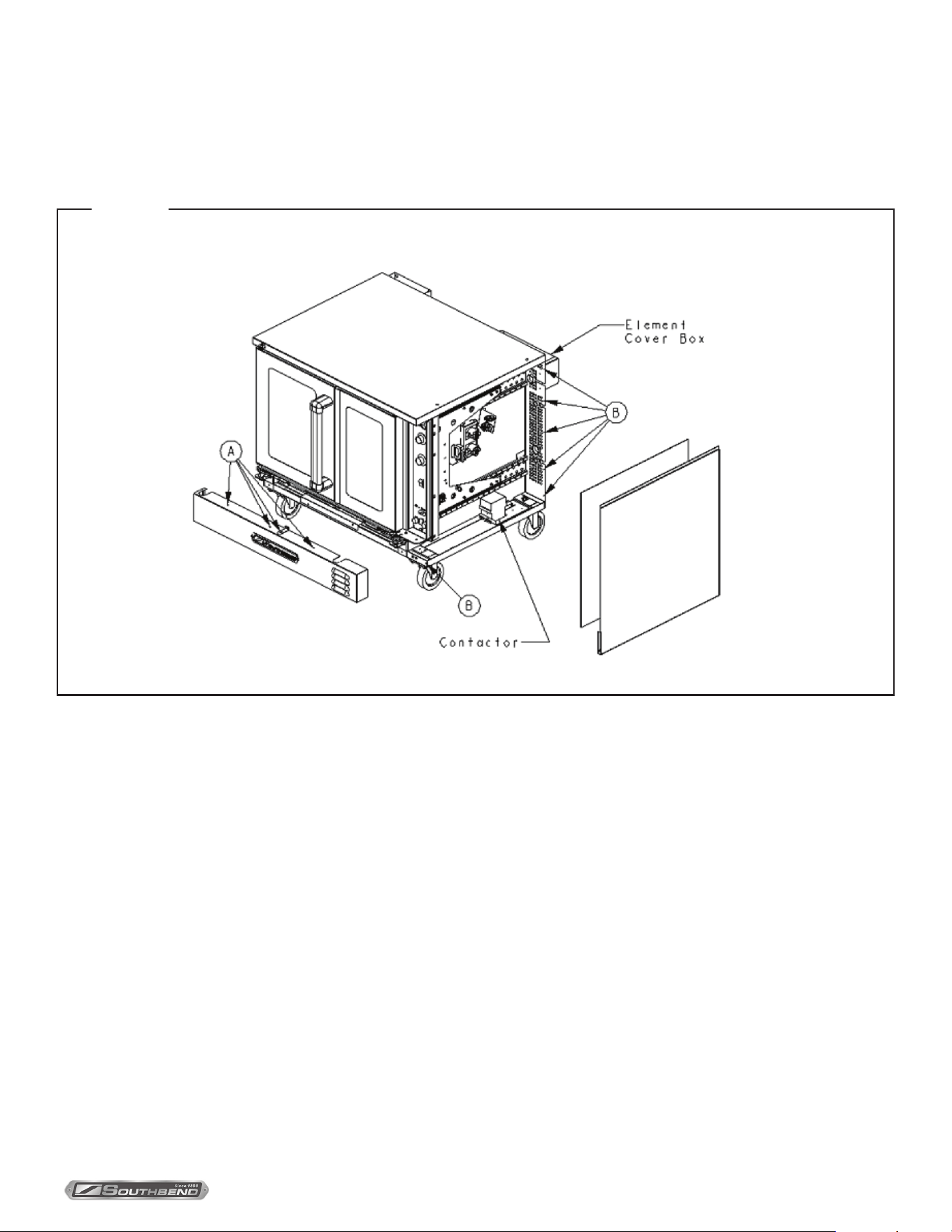
CONVERSION FROM SINGLE-PHASE TO THREE-PHASE POWER (OR VICE VERSA)
Ovens are shipped wired for either single-phase or three-phase power according to the original factory order. If the oven
installation requires changing the type of power used by the oven, follow the procedure below. The following drawing
shows the locations of items referred to in the procedure.
1. If the oven is connected to a power supply, DISCONNECT OVEN FROM POWER SUPPLY.
2. Remove the element-cover box from the back of the oven.
3. Locate and remove the four screws that secure the lower front panel (items “A” in the drawing above). Lift the panel
and pull it forward to remove it, then set it aside.
4. Locate and remove the now-accessible screw that secures the lower front corner of the side panel.
5. Locate and remove the ve screws that secure the back edge of the side panel to the oven (items “B” in the drawing
above). Remove the side panel and insulation and set them aside.
Adjustments
Figure 38
Locate the wires going from the contactor to the elements. Tied to those wires will be an extra short or long wire that isn’t
currently in use. The size of this wire depends on how the unit was originally set up at the factory. (If you’re changing the
wiring for a 415V oven, check the wiring diagram for guidance during the conversion.)
6.
PLATINUM SERIES ELECTRIC CONVECTION OVENS
INSTALLATION AND OPERATION MANUAL 1409004 REV 1 (09/25)
PAGE
42
OF 56
L3
L1
Element Connections
Contactor
Supply-Power
Wiring for Single-
Phase Power
L2
L3
L1
Element Connections
Contactor
Supply-Power
Wiring for Three-
Phase Power
Phase B
Phase C
Phase A
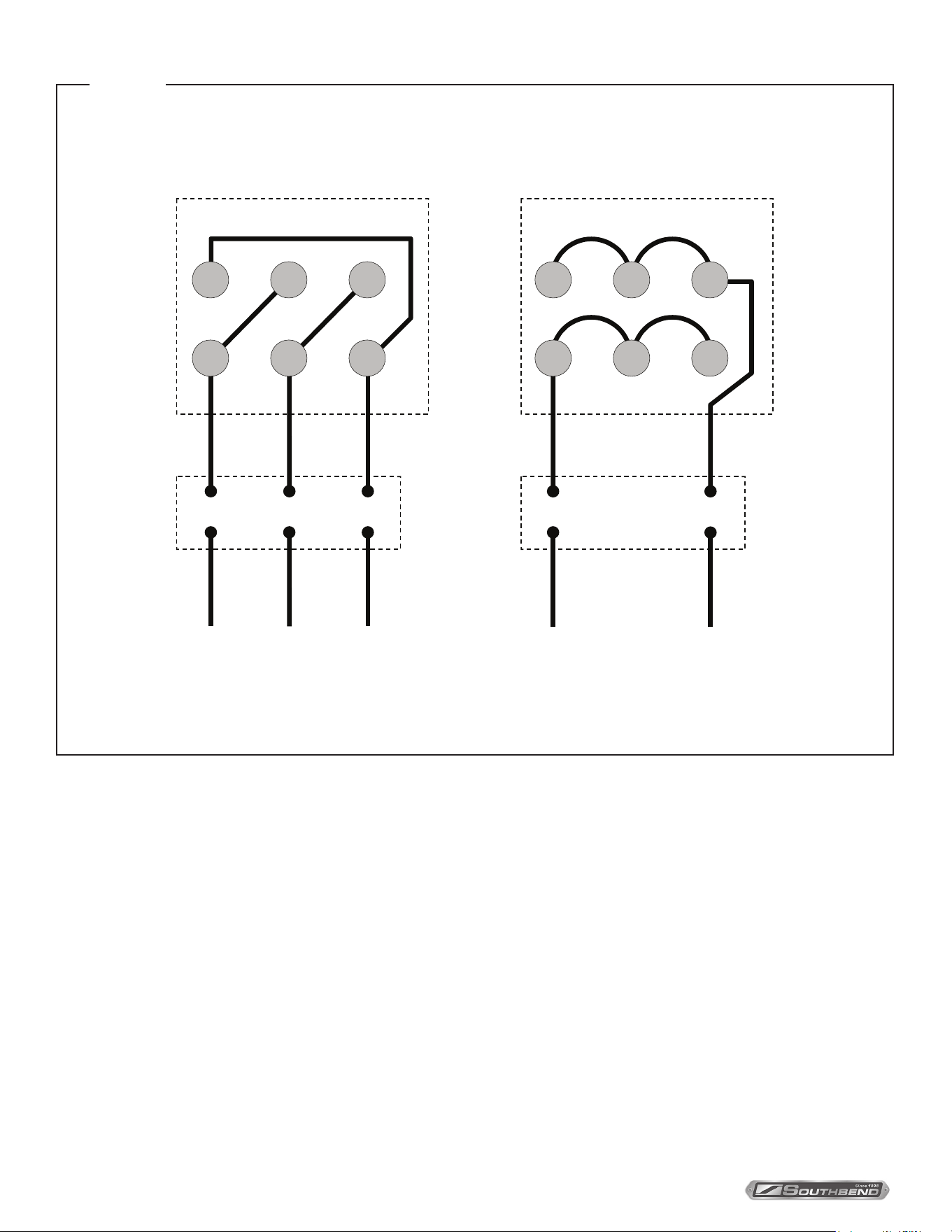
7. Locate the wires running from the contactor to the elements. If converting from three-phase to single-phase power,
remove the wire L2 (as shown in the above drawing) and go on to the next step. If converting from single-phase to
three-phase power, use the longer wire found in the previous step to make the additional connection (L2) shown in the
above drawing. (Again, if you are changing the phase-wiring of a 415V oven, refer to the corresponding wiring diagram
for conversion.)
8. Rewire the connections to the elements (located on the back of the oven) according to the diagram at the top of
this page. If converting from three-phase to single-phase, use the wire that you saved in Step 2 to make one of the
Connections. (Once more, if you are changing the phase-wiring of a 415V oven, refer to the corresponding wiring
diagram for conversion.)
9. Carefully compare the new wiring connections at the elements, contactor, and supply-power terminal block to the
wiring diagram for the oven. (See page 44 for the location of the wiring diagram on the oven, or page 46 for wiring
diagrams printed in this manual). Verify that all connections are tight.
10. Reattach the element-cover box, right-side panel, and lower-front panel.
11. Connect the oven to the power supply according to the procedure. Note that the supply-power connections depend on
whether the supply power is three-phase or single-phase, and so will be dierent than they were before the conversion.
Wiring is dierent for 415V ovens; refer to corresponding wiring diagram (beginning page 46).
Adjustments
Figure 39
PLATINUM SERIES ELECTRIC CONVECTION OVENS
INSTALLATION AND OPERATION MANUAL 1409004 REV 1 (09/25)
PAGE
43
OF 56
TROUBLESHOOTING
WARNING
ADJUSTMENTS AND SERVICE WORK MAY BE PERFORMED ONLY BY A QUALIFIED TECHNICIAN WHO IS
EXPERIENCED IN, AND KNOWLEDGEABLE WITH, THE OPERATION OF COMMERCIAL COOKING EQUIPMENT.
HOWEVER, TO ASSURE YOUR CONFIDENCE, CONTACT YOUR AUTHORIZED SERVICE AGENCY FOR RELIABLE
SERVICE, DEPENDABLE ADVICE, GENUINE FACTORY PARTS AND ANY OTHER ASSISTANCE.
NOTICE
The warranty will be void and the manufacturer is relieved of all liability if service work is performed by other than a
qualied technician, or if other than genuine Southbend replacement parts are installed.
When any diculty arises it is always a good idea to check that the oven has been connected to the type of voltage for
which it was manufactured. The serial plate is located on the inside of the lower front panel. It will list the type of voltage
for which the unit was manufactured. In addition, a wiring diagram is attached to the side of the fold-down control panel,
as well as reproduced in this manual beginning on page 46.
PERFORMANCE STANDARD
The typical time for the oven to heat from 75°F to 350°F is 7 to 8 minutes depending with the model. The heating elements
should come on when the actual oven temperature drops to 10°F below the temperature setting.
TROUBLESHOOTING GUIDE
The left column of the following table lists symptoms that indicate a problem, while the center and right columns list the
possible causes and appropriate corrective action. Note that the recommendations of this table assume that the wiring
connections are good. When checking a component, always check the wiring attached to the component as well.
Troubleshooting
Symptom Possible Cause Check or Replace
Oven will not hold cor-
rect temperature.
Temperature probe not working. Resistance across temperature probe leads at room temperature (70°F)
should be approximately 1096 ohms.
Temperature control not calling for
heat.
When heat is required, there should be continuity between terminals 6 and 7
on temperature control. (standard control only)
Inadequate or improper ventilation. Check ventilation hood. Verify draw and make up air adjustment.
Out of calibration. Recalibrate temperature.
Blower motor will not
come on.
No incoming electric power. Check incoming power.
Loose wire connections. Check wire connections.
Bad contactors. Contactor pull in and supply power to motor. Verify contactor pulling in.
Motor bad. If power is being supplied but motor will not turn, replace motor.
Shut down switch.
All power to the unit that comes through shut down switch. Check for continuity.
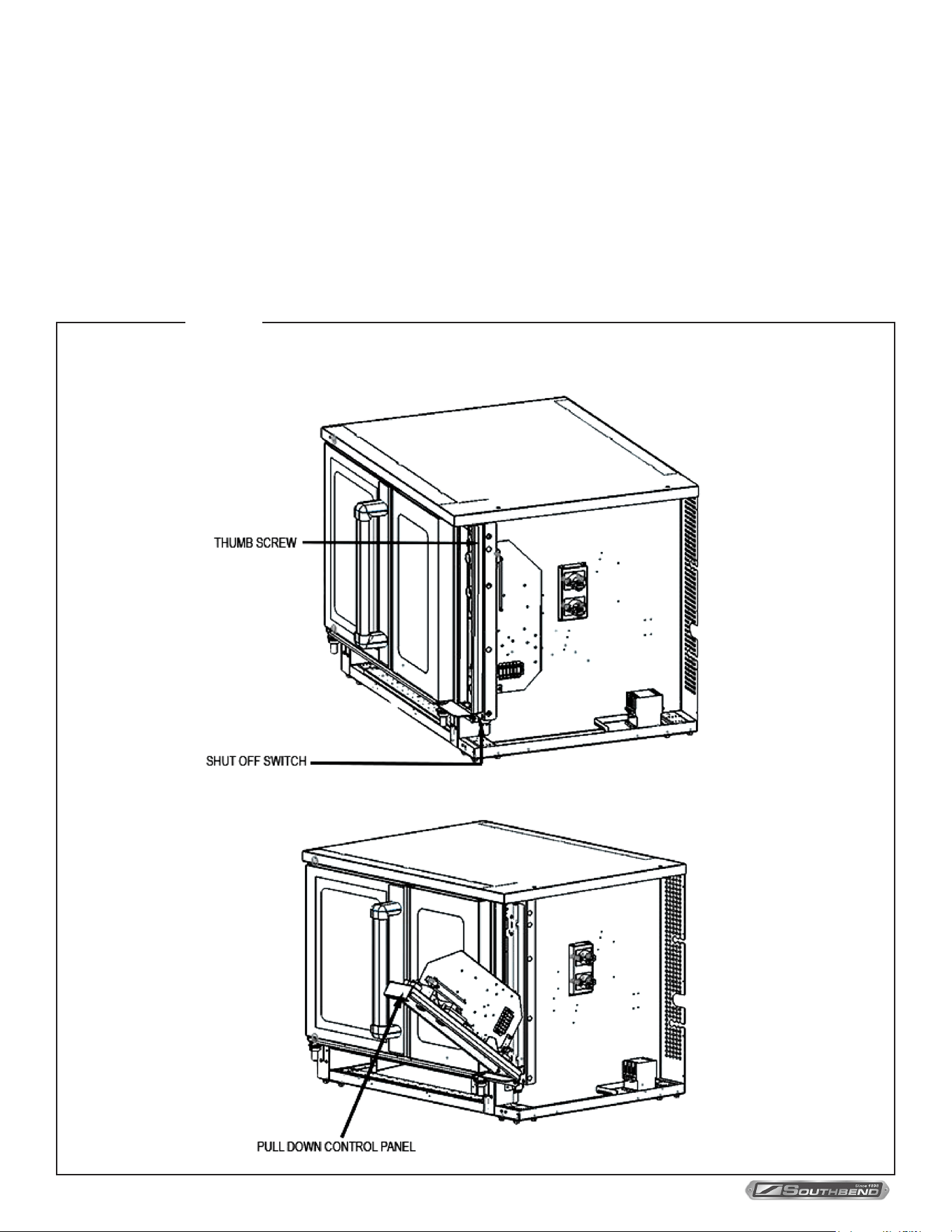
PLATINUM SERIES ELECTRIC CONVECTION OVENS
INSTALLATION AND OPERATION MANUAL 1409004 REV 1 (09/25)
PAGE
44
OF 56
CONTROL PANEL ACCESS AND SHUT-OFF SWITCH
To access the control panel components, remove the thumbscrew located at the top of the control panel. Once removed,
pull the control panel downward. A wiring diagram for the oven can be found on the side of the control panel assembly.
When the control panel is lowered, power to the panel is automatically shut o by a safety switch located just inside the
opening, beneath the control panel. To re-energize the controls for troubleshooting purposes, lift the white plunger on the
shut-o switch.
To fully remove the control panel, disconnect the temperature probe wires and harness connectors before sliding the
panel out sideways.
Troubleshooting
Accessing Control Panel
Components
Figure 40

PLATINUM SERIES ELECTRIC CONVECTION OVENS
INSTALLATION AND OPERATION MANUAL 1409004 REV 1 (09/25)
PAGE
45
OF 56
WIRING DIAGRAMS
A wiring diagram is located on the side of the control panel assembly (as shown on page 44). Wiring diagrams also
appear on the following pages of this manual. Which wiring diagram is appropriate depends on the voltage and type of
controls.
Index of Wiring Diagrams
Page Number Voltage and Type of Controls
46 208-240 Volt Models with Standard Controls
47 480 Volt Models with Standard Controls
48 415/240 Volt Models with Standard Controls
49 380/220 Volt Models with Standard Controls
50 208/240 Volt Electric Touchscreen Models
51 480 Volt Electric Touchscreen Models
52 415 Volt WYE Electric Touchscreen Models
53 380 Volt Electric Touchscreen Models
BLOWER WHEEL REPLACEMENT
To replace the blower wheel, do the following:
1. Remove racks and rack guides.
2. Remove the rear air bae in front of the blower wheel.
3. Loosen the two square heads on the blower wheel hub.
4. Pull the blower wheel from motor shaft. If the blower wheel is dicult to pull o, use the puller disk (available from
Southbend Technical Service Department as part number 1179100).
5. Install the blower wheel and torque it at 140inch/lbs.
6. Install the rear air bael in the font of the blower wheel
7. Replace the rack and rack guides.
Troubleshooting
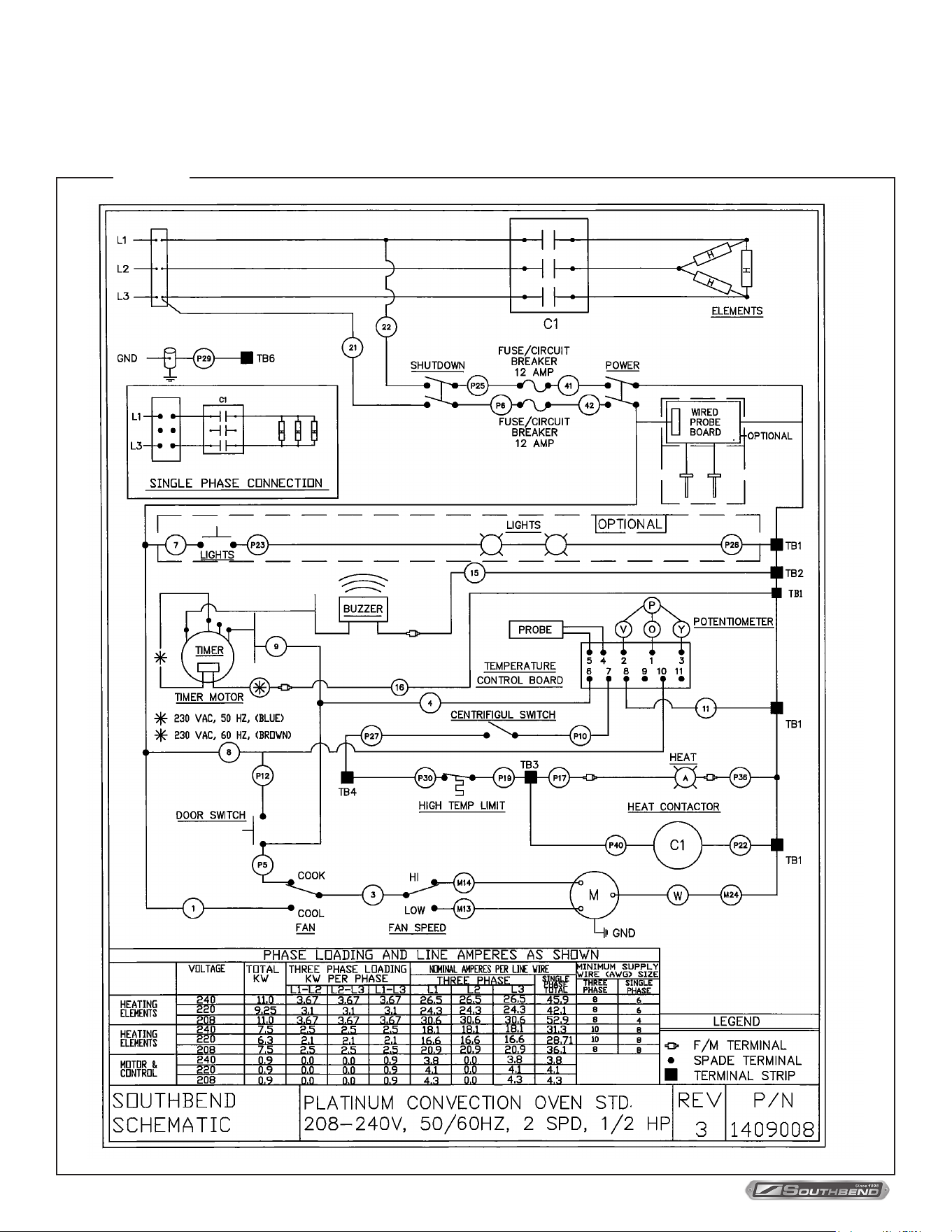
PLATINUM SERIES ELECTRIC CONVECTION OVENS
INSTALLATION AND OPERATION MANUAL 1409004 REV 1 (09/25)
PAGE
46
OF 56
Wiring Diagram for 208-240 Volt Models with Standard Controls
Troubleshooting
Figure 41
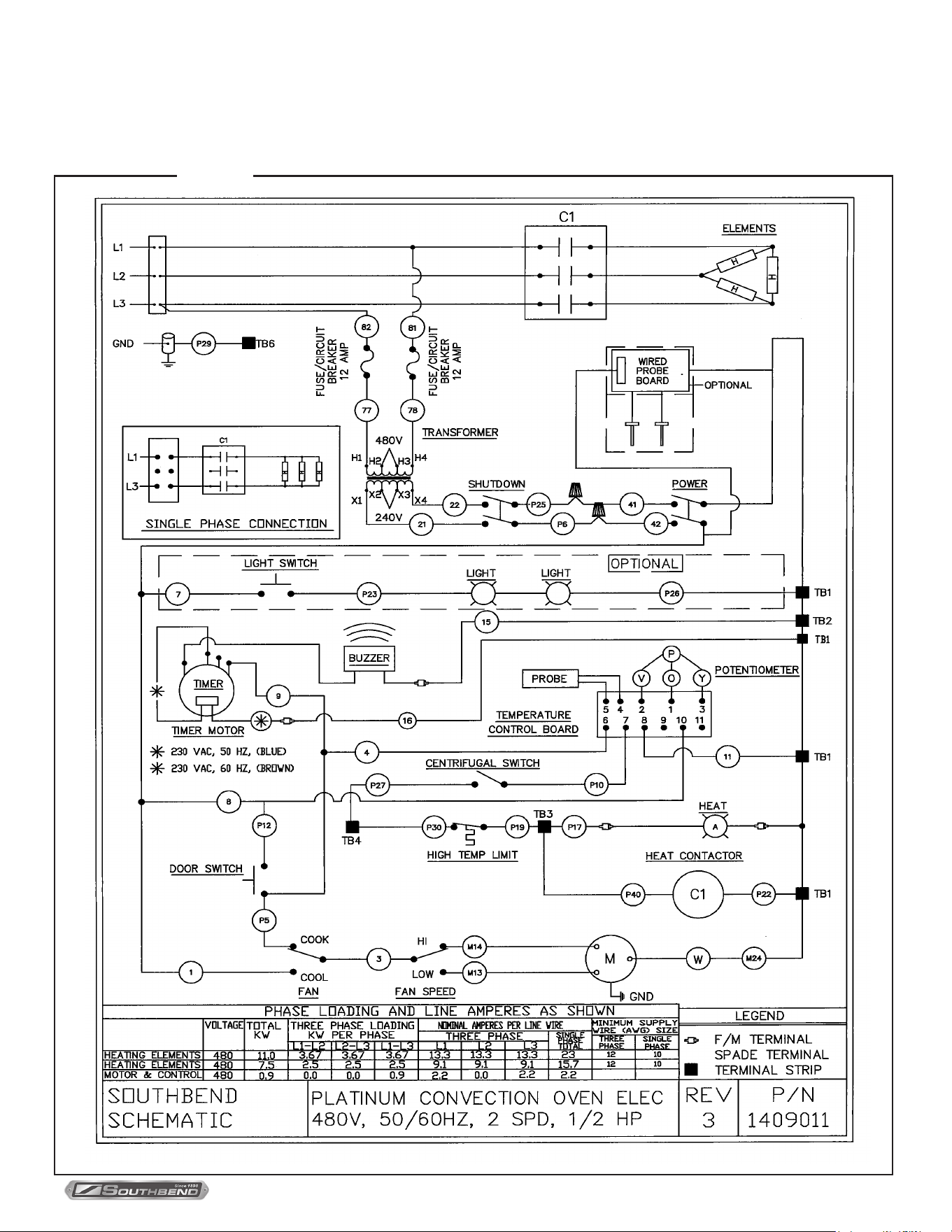
PLATINUM SERIES ELECTRIC CONVECTION OVENS
INSTALLATION AND OPERATION MANUAL 1409004 REV 1 (09/25)
PAGE
47
OF 56
Wiring Diagram for 480 Volt Models with Standard Controls
Troubleshooting
Figure 42
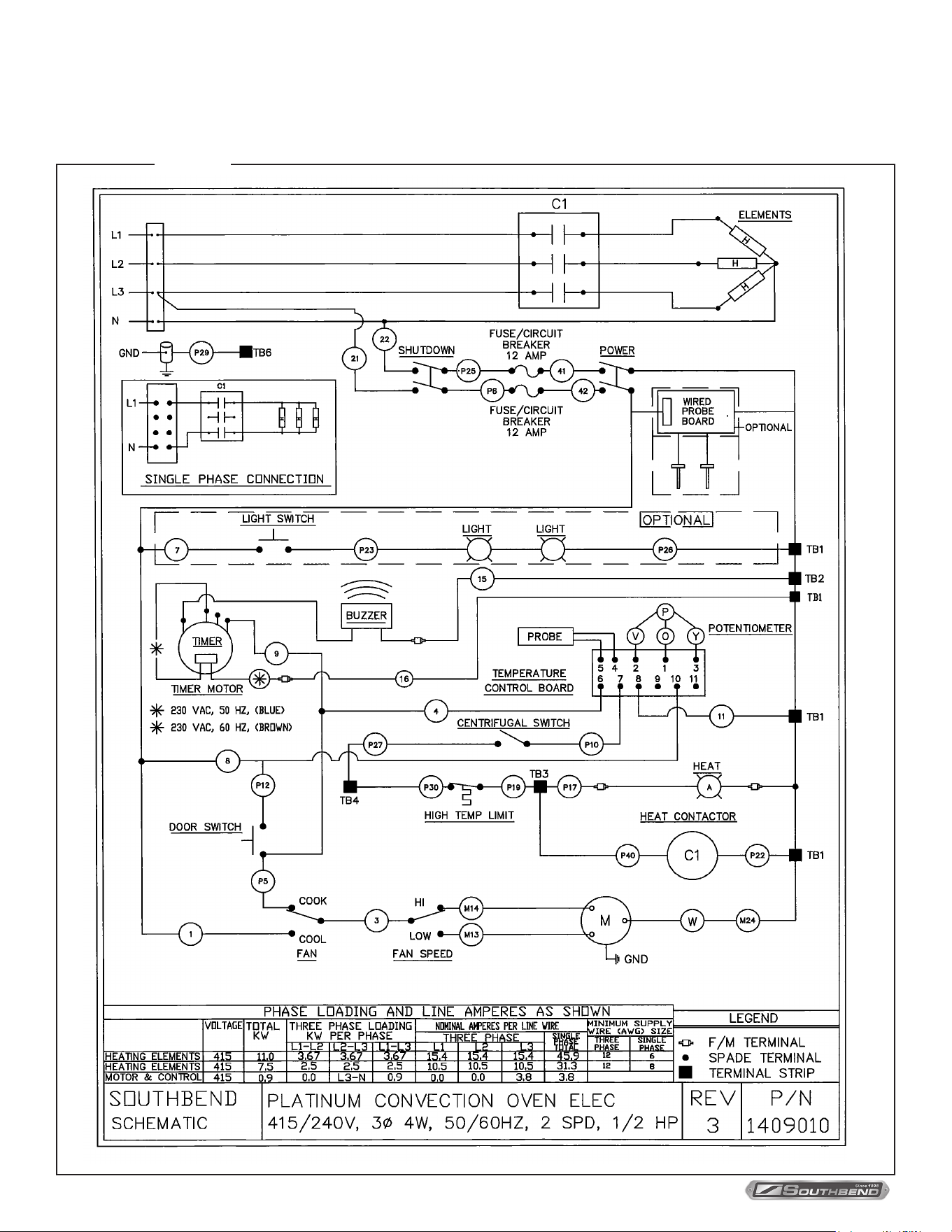
PLATINUM SERIES ELECTRIC CONVECTION OVENS
INSTALLATION AND OPERATION MANUAL 1409004 REV 1 (09/25)
PAGE
48
OF 56
Wiring Diagram for 415/240 Volt Models with Standard Controls
Troubleshooting
Figure 43
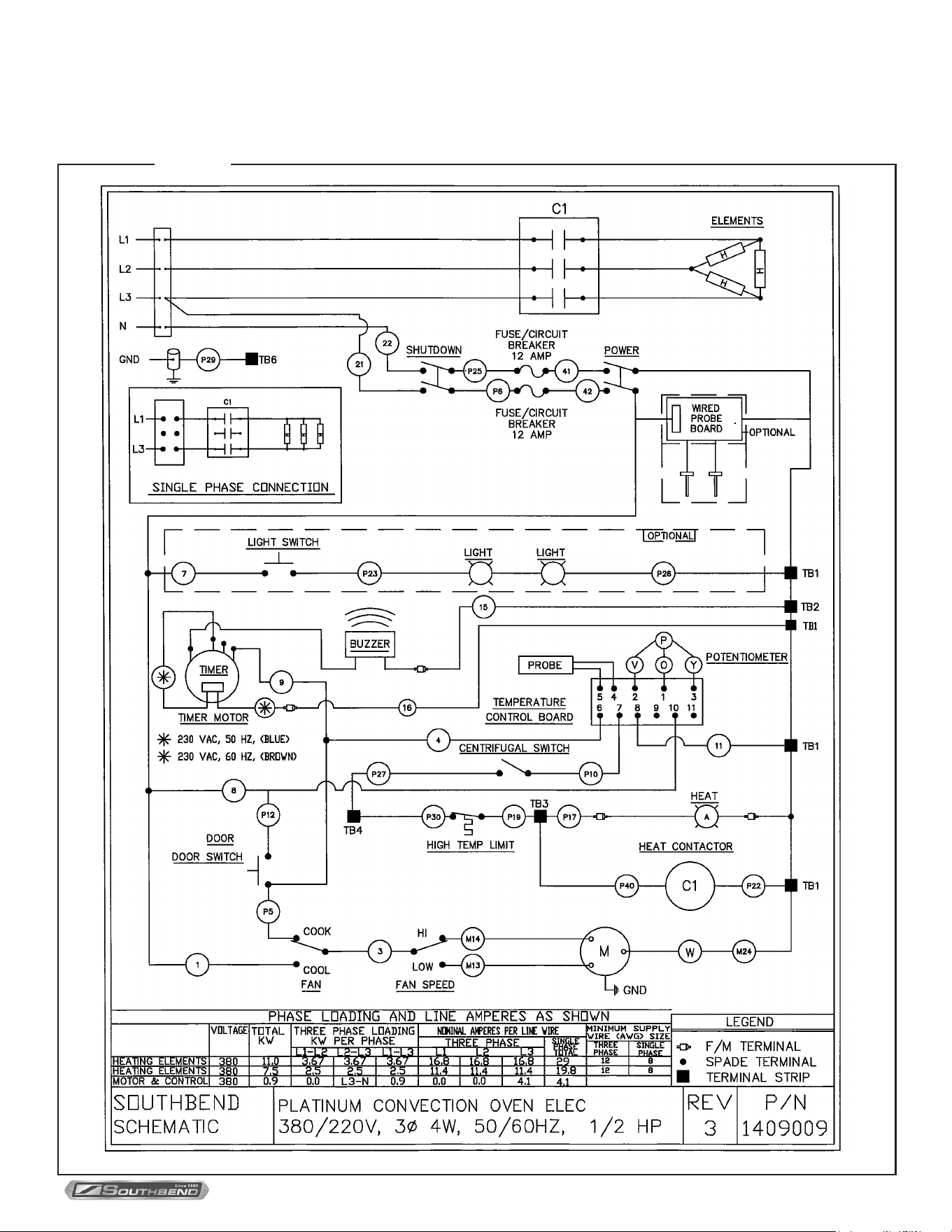
PLATINUM SERIES ELECTRIC CONVECTION OVENS
INSTALLATION AND OPERATION MANUAL 1409004 REV 1 (09/25)
PAGE
49
OF 56
Wiring Diagram for 380/220 Volt Models with Standard Controls
Troubleshooting
Figure 44
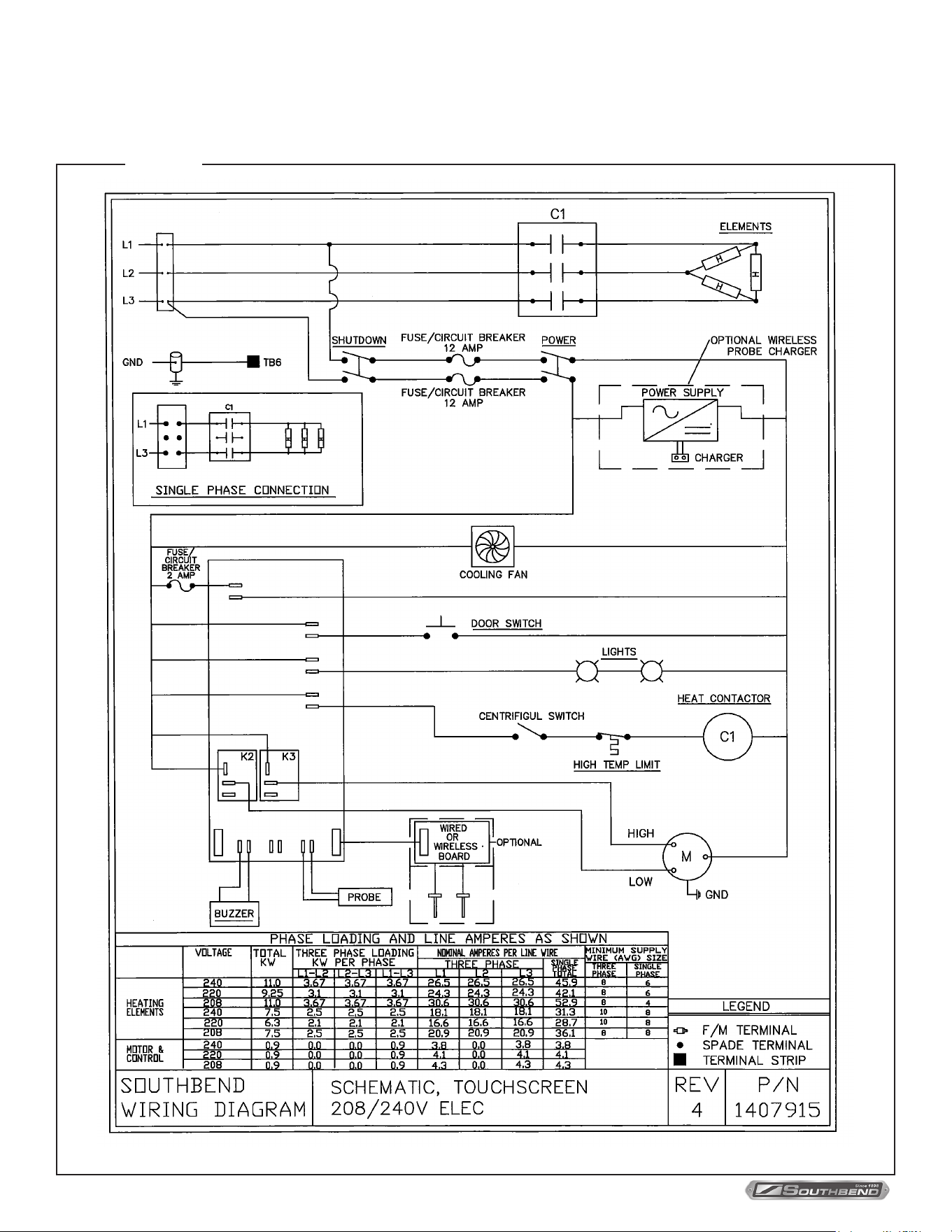
PLATINUM SERIES ELECTRIC CONVECTION OVENS
INSTALLATION AND OPERATION MANUAL 1409004 REV 1 (09/25)
PAGE
50
OF 56
Wiring Diagram for 208/240 Volt Electric Touchscreen Models
Troubleshooting
Figure 45
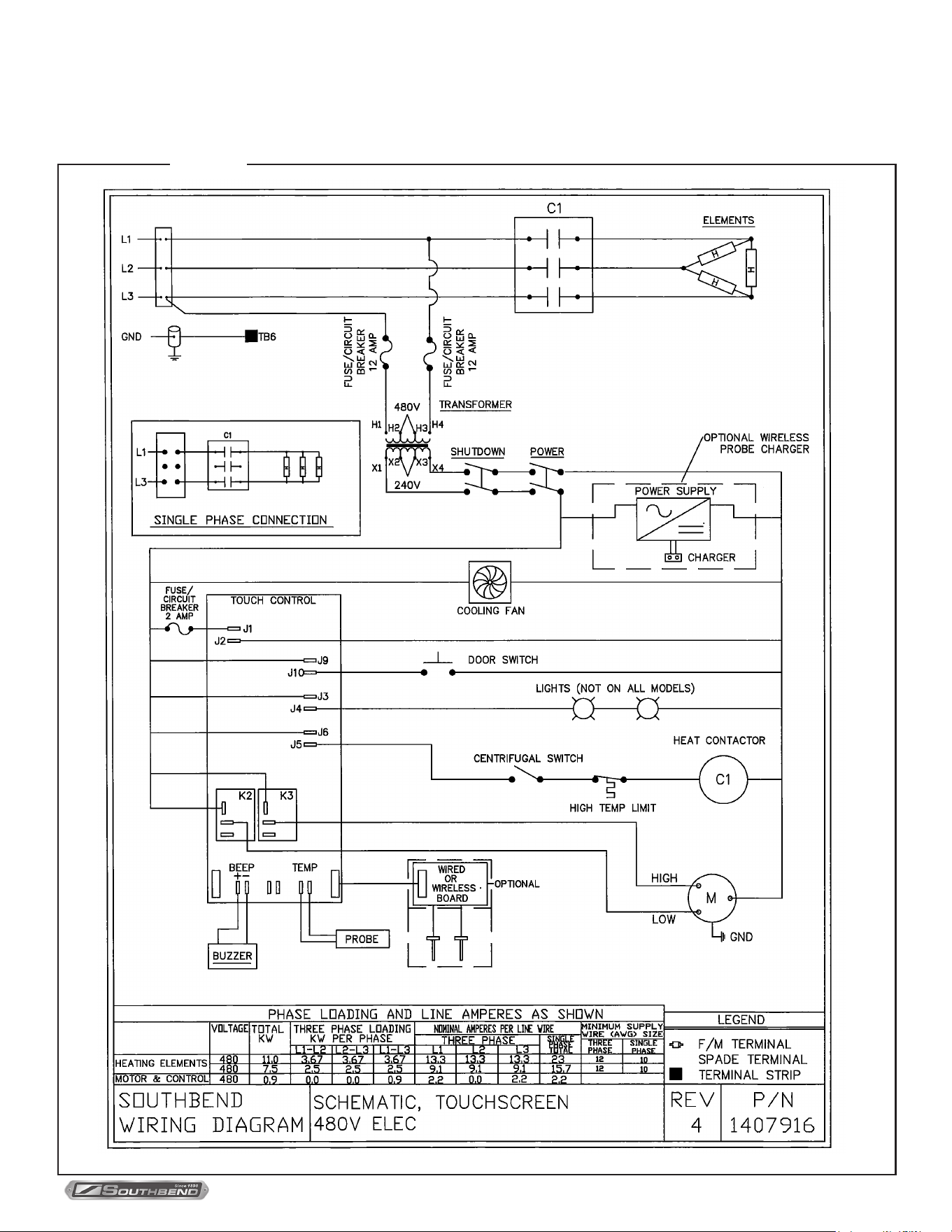
PLATINUM SERIES ELECTRIC CONVECTION OVENS
INSTALLATION AND OPERATION MANUAL 1409004 REV 1 (09/25)
PAGE
51
OF 56
Wiring Diagram for 480 Volt Electric Touchscreen Models
Troubleshooting
Figure 46
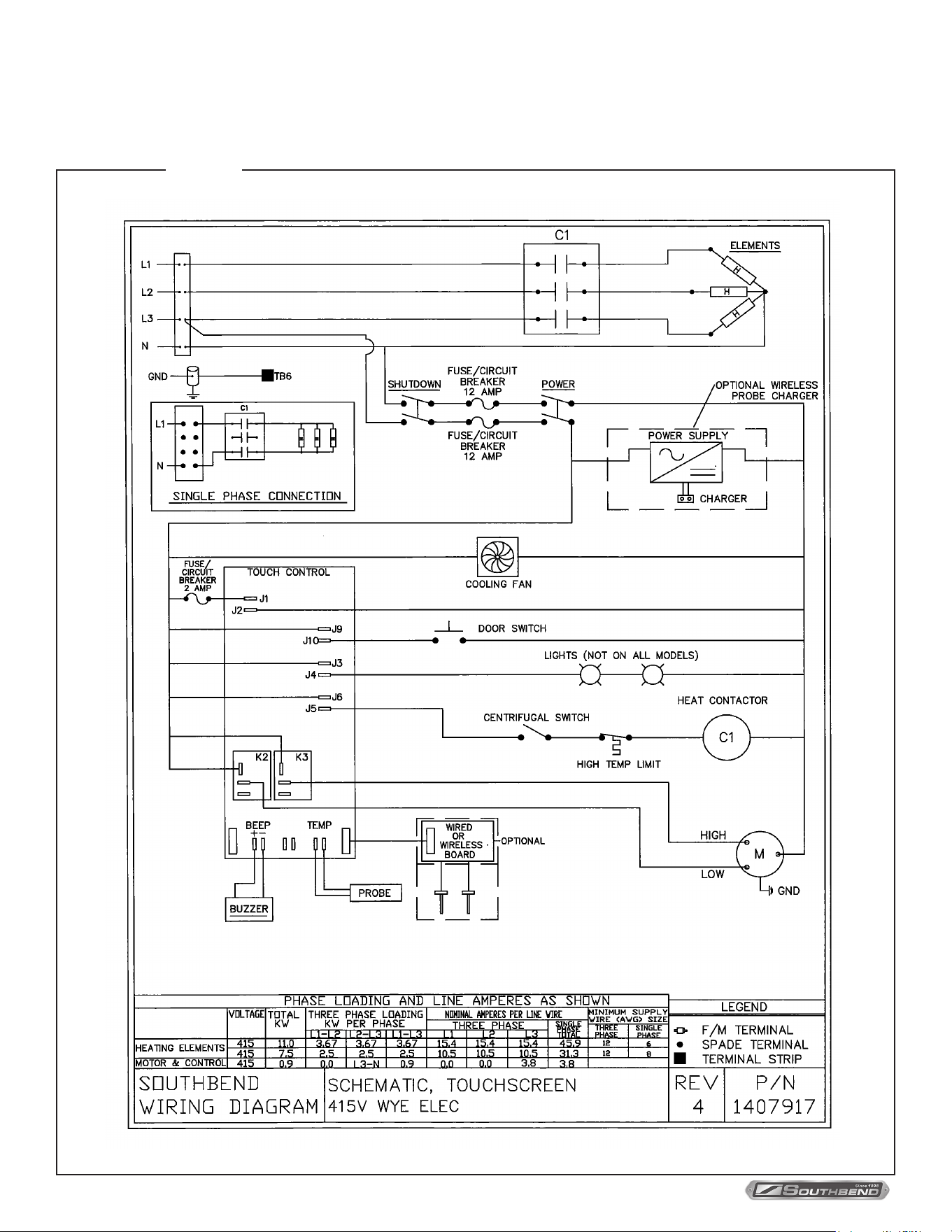
PLATINUM SERIES ELECTRIC CONVECTION OVENS
INSTALLATION AND OPERATION MANUAL 1409004 REV 1 (09/25)
PAGE
52
OF 56
Wiring Diagram for 415 Volt WYE Electric Touchscreen Models
Troubleshooting
Figure 47
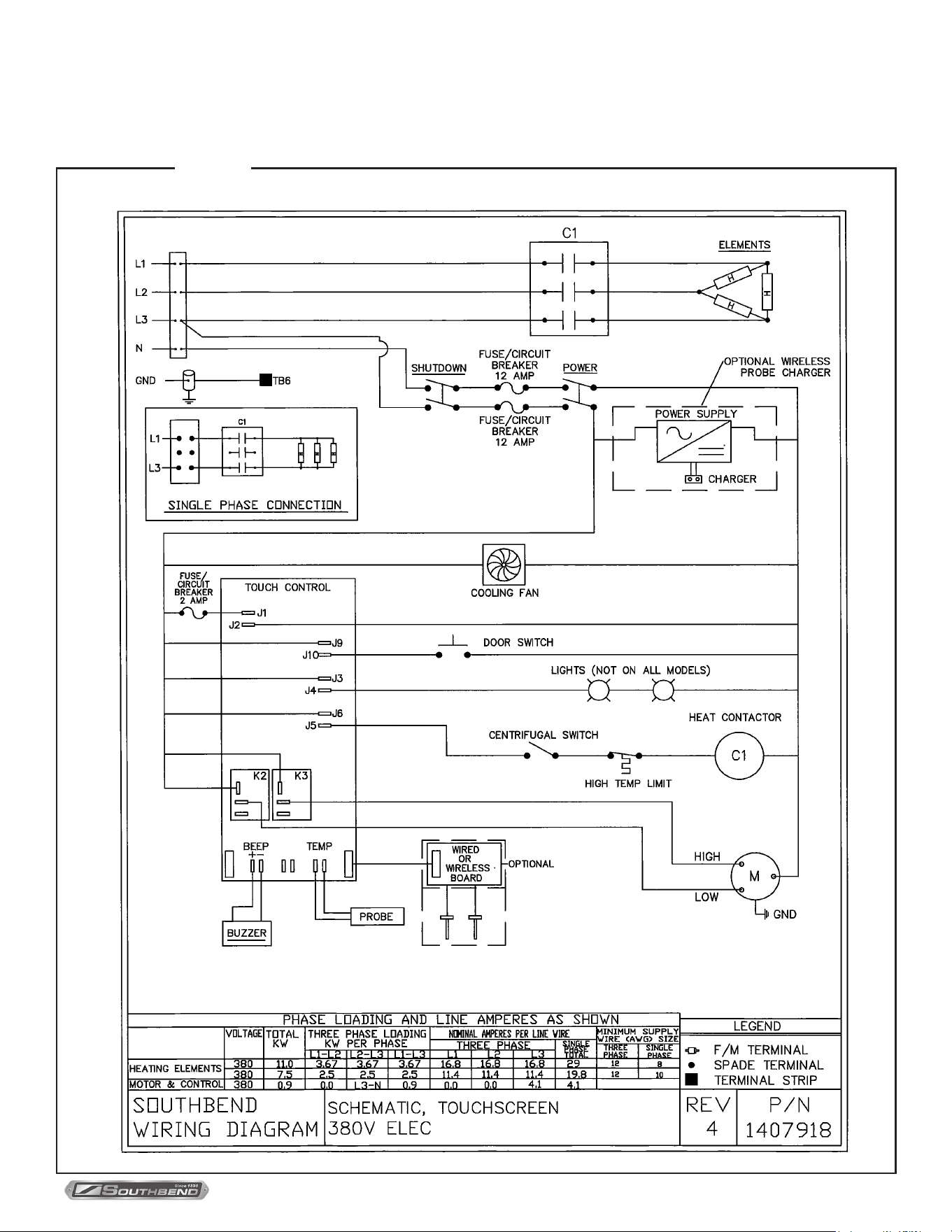
PLATINUM SERIES ELECTRIC CONVECTION OVENS
INSTALLATION AND OPERATION MANUAL 1409004 REV 1 (09/25)
PAGE
53
OF 56
Wiring Diagram for 380 Volt Electric Touchscreen Models
Troubleshooting
Figure 48

PLATINUM SERIES ELECTRIC CONVECTION OVENS
INSTALLATION AND OPERATION MANUAL 1409004 REV 1 (09/25)
PAGE
54
OF 56
Notes:

PLATINUM SERIES ELECTRIC CONVECTION OVENS
INSTALLATION AND OPERATION MANUAL 1409004 REV 1 (09/25)
PAGE
55
OF 56
Notes:
PLATINUM SERIES ELECTRIC CONVECTION OVENS
INSTALLATION AND OPERATION MANUAL 1409004 REV 1 (09/25)
PAGE
56
OF 56
A product with the Southbend name incorporates the best in durability and low maintenance. We all recognize, however,
that replacement parts and occasional professional service may be necessary to extend the useful life of this appliance.
When service is needed, contact a Southbend Authorized Service Agency, or your dealer. To avoid confusion, always
refer to the model number, serial number, and type of your appliance.
PLATINUM SERIES
ELECTRIC CONVECTION OVENS
SOUTHBEND
A Middleby Company
1100 Old Honeycutt Road Fuquay-Varina, North Carolina 27526 USA
www.southbendnc.com