User Guide
Refrigerator
20230118
7088045 - 00
SK(ef) 4260
Contents
1 Appliance at a glance............................................ 2
1.1 Description of appliance and equipment................. 2
1.2 Appliance range of use............................................... 2
1.3 Conformity..................................................................... 3
1.4 External dimensions of the appliance...................... 3
1.5 Saving energy............................................................... 3
1.6 Example of food arrangement................................... 4
2 General safety instructions.................................. 4
3 Controls and displays............................................ 5
4 Putting into operation........................................... 5
4.1 Transporting the appliance........................................ 5
4.2 Installing the appliance.............................................. 5
4.3 Disposing of packaging............................................... 7
5 Control................................................................... 7
5.1 Door alarm..................................................................... 7
5.2 SuperCool...................................................................... 7
5.3 Switching on the fan................................................... 7
5.4 To switch off the fan................................................... 7
5.5 Door racks..................................................................... 7
5.6 Vegetable bins.............................................................. 7
6 Maintenance.......................................................... 8
7 Malfunctions......................................................... 8
8 Decommissioning.................................................. 9
8.1 Taking the appliance out of service.......................... 9
9 Disposal................................................................. 10
9.1 Preparing appliance for disposal.............................. 10
9.2 Disposing of the appliance in an environmentally
friendly manner............................................................ 10
The manufacturer works constantly on the further develop‐
ment of all the types and models. Therefore please under‐
stand that we have to reserve the right to make design,
equipment and technical modifications.
To get to know all the benefits of your new appliance,
please read the information contained in these instructions
carefully.
The instructions apply to several models. Differences may
occur. Text relating only to specific appliances is marked
with an asterisk (*).
Instructions are marked with a , and results are marked
with a .
1 Appliance at a glance
1.1 Description of appliance and equip‐
ment
Note
u
Place food inside the appliance as shown in the diagram.
This allows the appliance to save energy during opera‐
tion.
u
Shelves, drawers and baskets are arranged for optimum
energy efficiency on delivery.
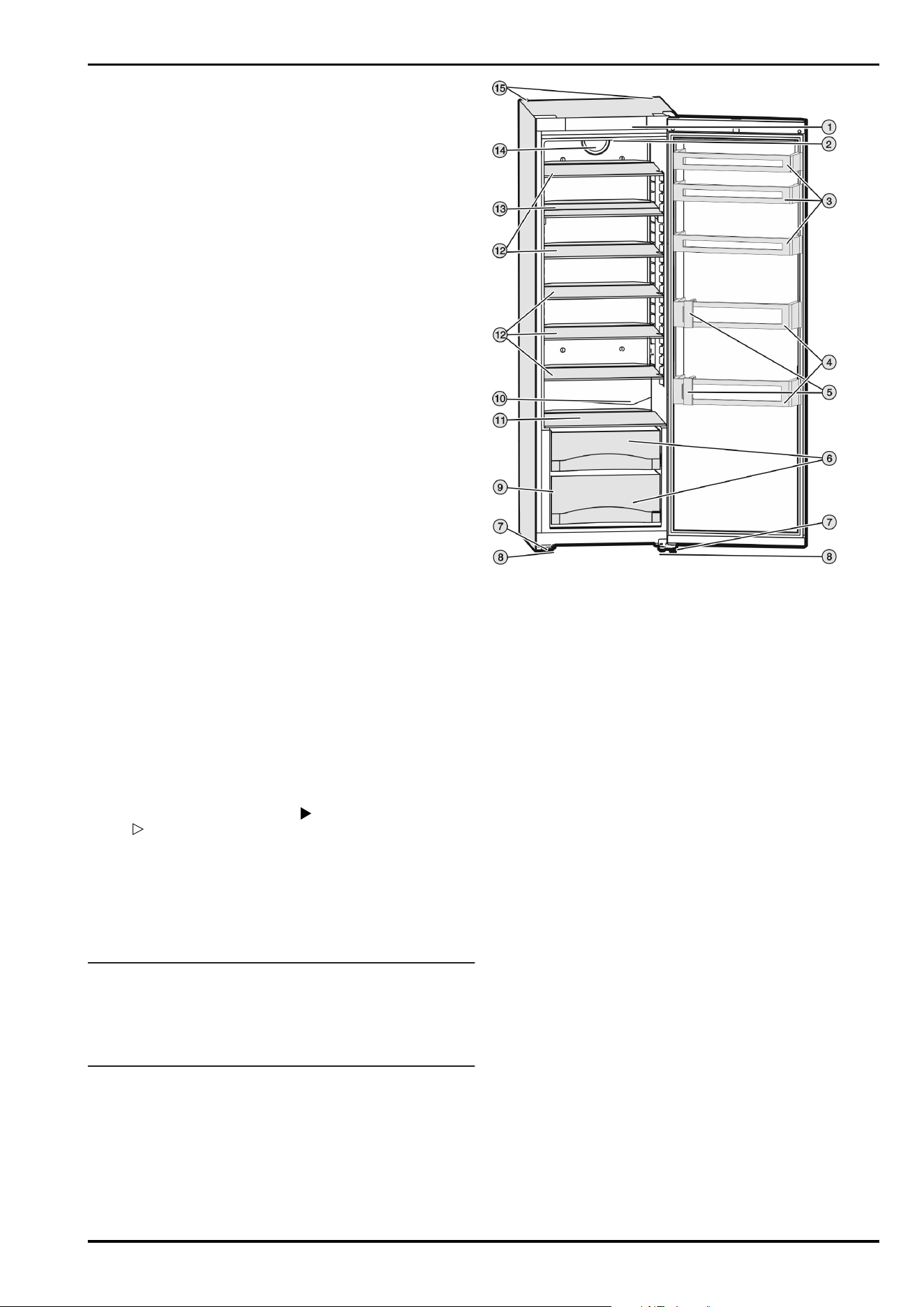
Fig. 1
(1)
Operating and control
elements
(9) Type plate
(2) Internal lighting (10) Defrost water channel
(3) Can rack (11) Coldest zone
(4) Bottle shelf (12) Shelf
(5) Bottle rack (13) Shelf, can be split
(6) Vegetable compart‐
ment
(14) Fan
(7) Adjusting feet (15) Rear transport handles
(8) Front transport
handles, rear transport
castors
1.2 Appliance range of use
Intended use
The appliance is only suitable for cooling
food products in a domestic or household-like
environment. This includes, for example, use:
-
in staff kitchens, bed and breakfast estab‐
lishments,
-
by guests in country houses, hotels, motels
and other accommodation,
-
for catering and similar services in the
wholesale trade.
The appliance is not suitable for freezing
food;
The appliance is not suitable as a built-in
unit.
All other types of use are not permitted.
Foreseeable misuse
The following applications are expressly
forbidden:
Appliance at a glance
2 * Depending on model and options
-
Storing and refrigerating medicines, blood
plasma, laboratory preparations or similar
substances and products based on the
Medical Device Directive 2007/47/EC
-
Use in areas at risk of explosions
Misusing the appliance may lead to damage
to the goods stored or they may spoil.
Climate classifications
Depending on the climate classification the
appliance is designed to operate in restricted
ambient temperatures. The climate classifica‐
tion applying to your appliance is printed on
the rating plate.
Note
u
Keep to the specified ambient tempera‐
tures in order to guarantee that the appli‐
ance works properly.
Climate clas‐
sification
for ambient temperatures of
SN 10 °C to 32 °C
N 16 °C to 32 °C
ST 16 °C to 38 °C
T 16 °C to 43 °C
SN-ST 10 °C to 38 °C
SN-T 10 °C to 43 °C
1.3 Conformity
The refrigerant circuit has been tested for leaks. The appli‐
ance complies with the applicable safety regulations and
with the corresponding directives.
For the EU
market:
The appliance complies with directive
2014/53/EU.
For the GB
market:
The appliance complies with Radio
Equipment Regulations 2017 SI 2017 No.
1206.
The full text of the EU Declaration of Conformity is available
on the following website: www.Liebherr.com
1.4 External dimensions of the appli‐
ance
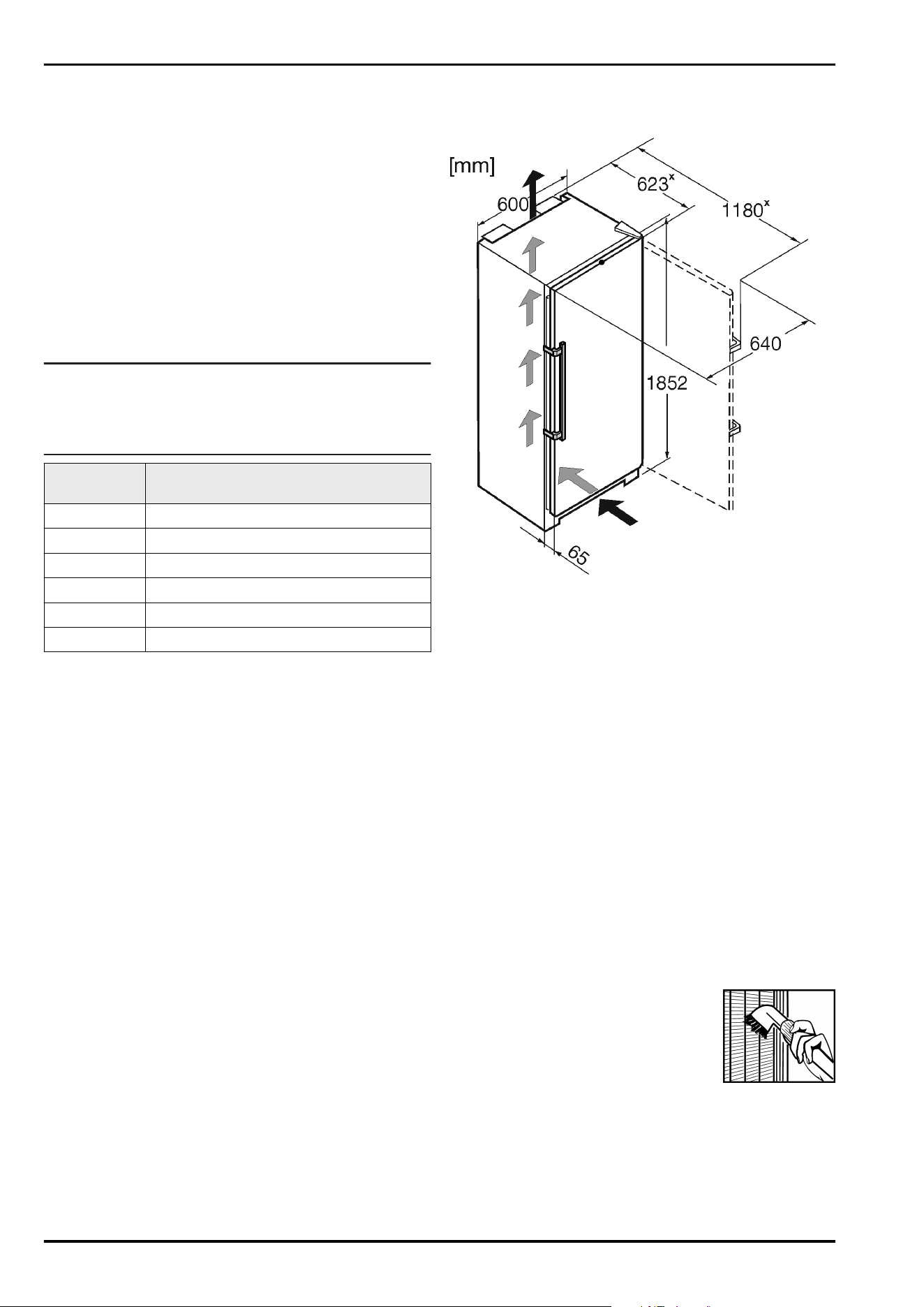
Fig. 2
x
For appliances supplied with wall spacers, the measure‐
ment increases by 35 mm (see 4.2 Installing the appliance) .
1.5 Saving energy
-
Pay attention to good ventilation. Do not cover ventilation
holes or grids.
-
Always keep the fan air slits clear.
-
Do not install the appliance in direct sunlight, next to an
oven, radiator or similar.
-
Energy consumption depends on the installation condi‐
tions, e.g. the ambient temperature (see 1.2 Appliance
range of use) . A warmer ambient temperature can
increase the energy consumption.
-
Open the appliance for as short a time as possible.
-
The lower the temperature is set the higher the energy
consumption.
-
Sort your food: home.liebherr.com/food.
-
Keep all food properly packed and covered. This prevents
frost from forming.
-
Only take food out for as long as necessary so that it
doesn’t warm up too much.
-
Inserting warm food: allow to cool down to room temper‐
ature first.
Dust deposits increase energy consump‐
tion:
-
For refrigerators with heat exchangers
dust the metal grid on the back of the
appliance once a year.
Appliance at a glance
* Depending on model and options 3
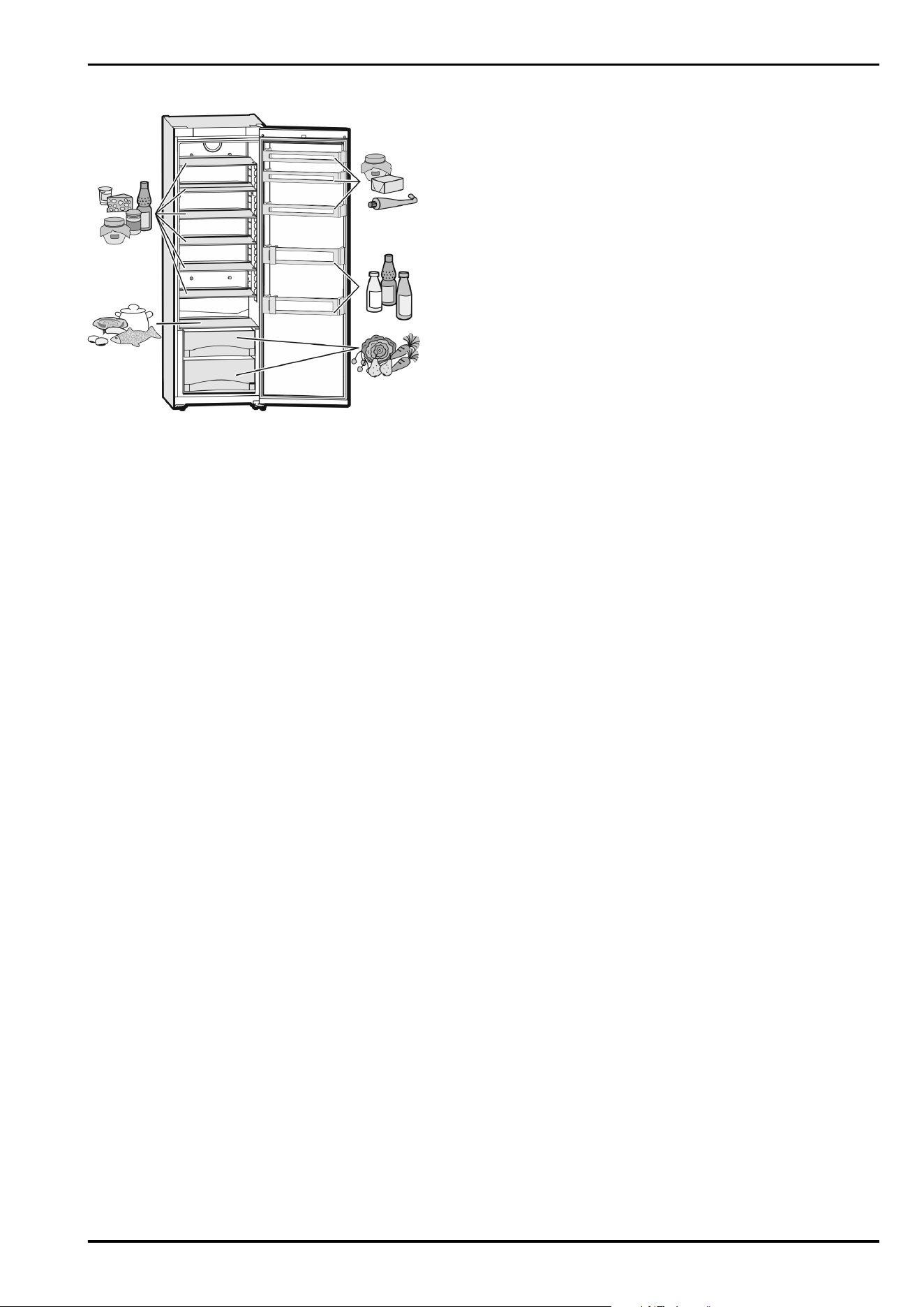
1.6 Example of food arrangement
Fig. 3
2 General safety instructions
Please keep these instructions in a safe place
and pass them on to any subsequent owners.
Read these operating instructions carefully
before use to ensure safe and correct use of
the appliance. Follow the instructions, safety
instructions and warning messages included
at all times. They are important for ensuring
you can operate and install the appliance
safely and without any problems.
Danger for the user:
-
This device can be used by children and
people with impaired physical, sensory or
mental abilities or with a lack of experi‐
ence and knowledge provided that they
are supervised or have received instruction
in the safe use of this device, and about
the resulting hazards. Children must not
play with this appliance. Cleaning and user
maintenance work must not be carried out
by children without adult supervision. Chil‐
dren aged between 3 and 8 are allowed
to load and unload the appliance. Children
below the age of 3 must be kept away from
the appliance unless they are under contin‐
uous adult supervision.
-
The socket must be easily accessible so
that the appliance can be disconnected
quickly from the electricity in an emer‐
gency. It must not be located in the area
behind the appliance.
-
When disconnecting the appliance from the
supply, always take hold of the plug. Do not
pull the cable.
-
In the event of a fault pull out the mains
plug or deactivate the fuse.
-
Do not damage the mains power cable. Do
not operate the appliance with a defective
mains power cable.
-
If the supply cord is damaged, it must be
replaced by the manufacturer, its service
agent or similarly qualified persons in order
to avoid a hazard.
-
Repairs, interventions on the appliance and
the replacement of mains connection line
may only be carried out by AfterSales
Service or other suitably trained specialist
personnel.
-
Only assemble, connect and dispose of the
appliance according to the instructions.
-
Special lights, such as LED lights on the
appliance, are used to illuminate the inte‐
rior of the appliance and are not suitable
for room lighting.
Fire hazard:
-
This appliance contains a refrigerant
which is environmentally friendly, but flam‐
mable. Leaking refrigerant may ignite. It
is hazardous for anyone other than an
Authorised Service Person to service this
appliance. In Queensland, the authorised
Service Person MUST hold a Gas Work
Authorisation for hydrocarbon refrigerants,
to carry out Servicing or repairs where the
gas system is being opened or charged.
-
The coolant used (information on the model
plate) is ecofriendly but also flammable.
Any leaking coolant may ignite.
•
Do not damage the refrigerant circuit
pipes.
•
Do not handle ignition sources inside the
appliance.
•
Do not use electrical appliances inside
the appliance (e.g. steam cleaners,
heaters, ice cream makers, etc.).
•
If the refrigerant leaks: remove any naked
flames or ignition sources from the
vicinity of the leakage point. Properly air
the room. Inform customer services.
-
Do not store explosives or sprays using
combustible propellants such as butane,
propane, pentane, etc. in the appliance. To
identify these spray cans, look for the list
of contents printed on the can, or a flame
symbol. Gases possibly escaping may ignite
due to electrical components.
-
Keep burning candles, lamps and other
items with naked flames away from the
appliance so that they do not set the appli‐
ance on fire.
General safety instructions
4 * Depending on model and options
-
WARNING: Keep ventilation openings, in
the appliance enclosure or in the built-in
structure, clear of obstruction.
-
WARNING: Do not use mechanical devices
or other means to accelerate the defrosting
process, other than those recommended by
the manufacturer.
-
WARNING: Do not damage the refrigerant
circuit.
-
Please be sure to store alcoholic drinks
or other packaging containing alcohol in
tightly closed containers. Any alcohol that
leaks out may be ignited by electrical
components.
Danger of tipping and falling:
-
Do not misuse the plinth, drawers, doors
etc. as a step or for support. This applies
particularly to children.
Danger of food poisoning:
-
Do not consume food which has been
stored too long.
Danger of frostbite, numbness and pain:
-
Avoid prolonged skin contact with cold
surfaces or refrigerated/frozen goods or
take protective measures, e.g wear gloves.
-
Do not consume ice cream, water ice or
ice cubes immediately and do not consume
them too cold.
Danger of injury and damage:
-
Hot steam can lead to injury. Do not use
electrical heating or steam cleaning equip‐
ment, open flames or defrosting sprays to
defrost.
-
Do not use sharp implements to remove the
ice.
Risk of crushing:
-
Do not hold the hinge when opening and
closing the door. Fingers may get caught.
Symbols on the appliance:
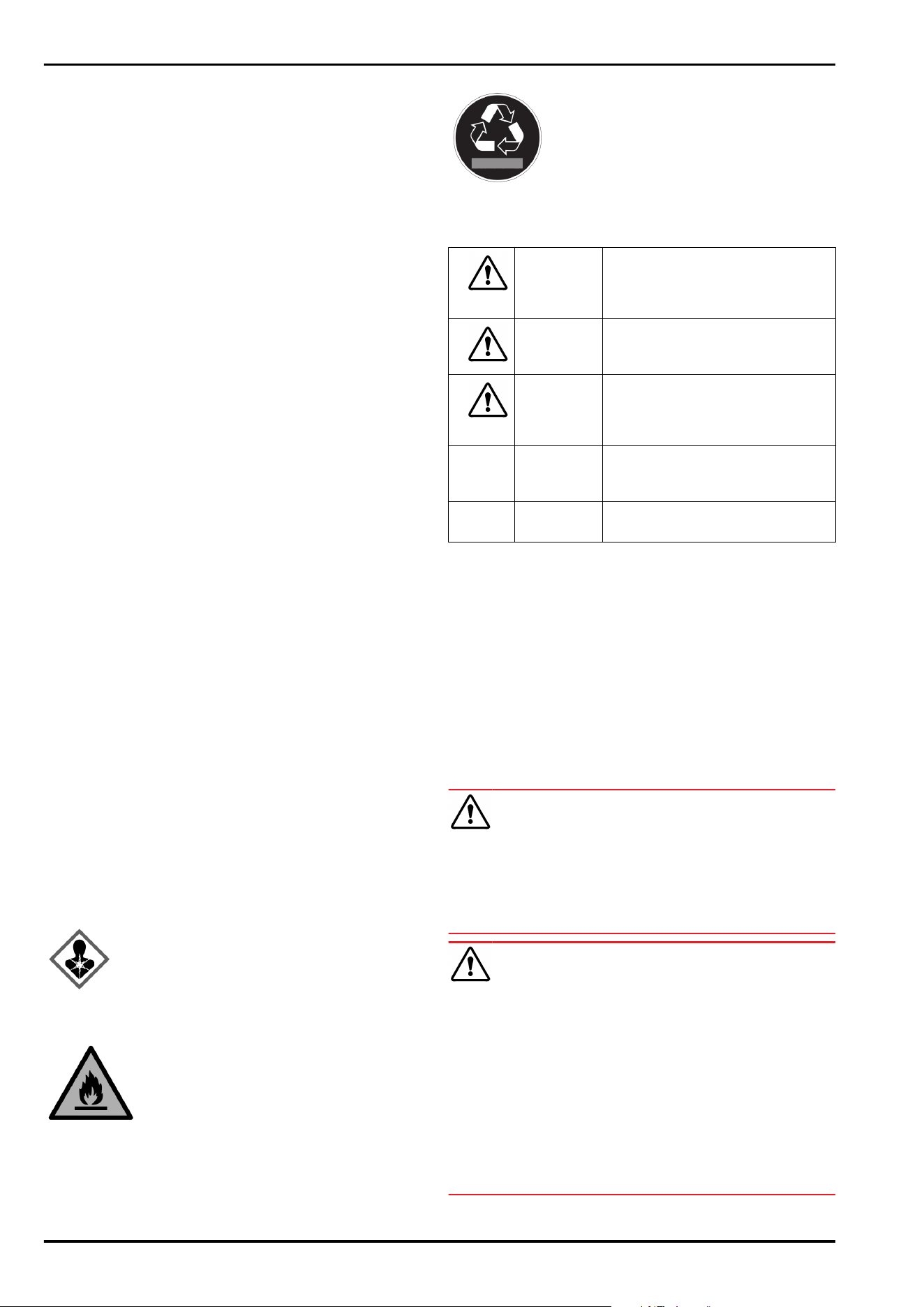
This symbol may be located on the
compressor. It relates to the oil in the
compressor and makes reference to the
risk that: Swallowing or inhaling can be
fatal. This advice is only relevant to recy‐
cling. There is no danger in normal opera‐
tion.
This symbol is located on the compressor
and indicates the danger of flammable
materials. Do not remove the sticker.
This or a similar sticker may be located
on the rear of the appliance. It refers to
the foam-padded panels in the door and/or
the housing. This advice is only relevant to
recycling. Do not remove the sticker.
Please note the warning messages and other
specific advice in the other chapters:
DANGER indicates an immediately
hazardous situation which will
lead to death or serious injuries if
it is not avoided.
WARNING indicates a hazardous situation
which may lead to death or serious
injuries if it is not avoided.
CAUTION indicates a hazardous situation
which may lead to minor or
moderate injuries if it is not
avoided.
NOTICE indicates a hazardous situation
which may lead to damage to
property if it is not avoided.
Note indicates useful instructions and
tips.
3 Controls and displays
4 Putting into operation
4.1 Transporting the appliance
u
Transport the appliance only in suitable packaging.
u
Transport the appliance upright.
u
Do not transport the appliance on your own.
4.2 Installing the appliance
WARNING
Fire hazard due to dampness!
If live parts or the mains lead become damp this may cause
short circuits.
u
The appliance is designed for use in enclosed areas. Do
not operate the appliance outdoors or in areas where it is
exposed to splash water or damp conditions.
WARNING
Danger of fire due to incorrect positioning!
If the mains cable or plug touches the back of the appli‐
ance, the vibration can damage the mains cable or the plug
resulting in a short circuit.
u
Make sure the mains cable is not trapped under the appli‐
ance when you position the appliance.
u
Stand the appliance so that it is not touched by connec‐
tors or main cables.
u
Do not connect any appliances to sockets in the area of
the back of the appliance.
u
Do not place and operate multi-sockets/power distribu‐
tors and other electronic devices (such as halogen trans‐
formers) at the back of the appliances.
Controls and displays
* Depending on model and options 5
WARNING
Leaking coolant and oil!
Fire. The coolant contained in the appliance is eco-friendly,
but also flammable. The oil contained in the appliance
is flammable. Escaping coolant and oil can ignite if the
concentration is high enough and in contact with an
external heat source.
u
Do not damage the pipelines of the coolant circuit and
the compressor.
WARNING
Fire hazard and danger of damage!
u
Do not place appliances emitting heat e.g. microwaves,
toasters etc. on the appliance!
NOTICE
Covered vents!
Damage. Appliance can overheat, which can reduce the
service life of various parts of the appliance and lead to
operational impairments.
u
Always make sure there is good ventilation.
u
Always keep vents or ventilation grids in the appliance
housing and in the kitchen furniture (fully integrated
appliance) unobstructed.
u
Always keep the fan air vents unobstructed.
If your appliance is not a side-by-side (SBS) appliance:*
NOTICE
Risk of damage due to condensate!*
u
Do not install the appliance directly alongside a further
refrigerator/freezer.
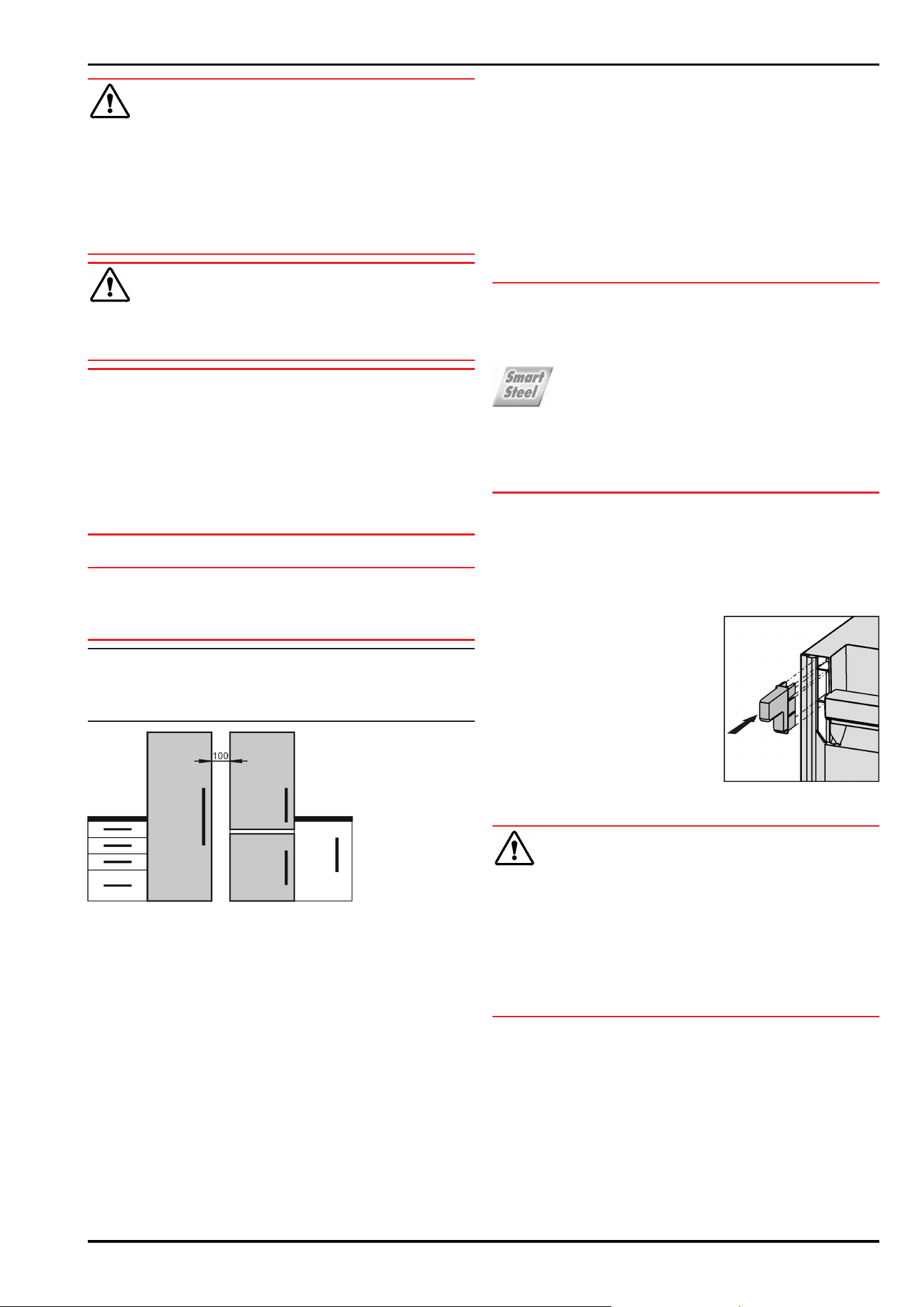
Note
If you have several appliances next to one another, leave a
gap of 100mm between appliances. Otherwise condensation
will build up between the units.*
Fig. 4 *
q
Before you connect the appliance, report any damage
immediately to the delivery company.
q
The floor of the installation site must be horizontal and
even.
q
Do not install the appliance in direct sunlight, next to an
oven, radiator or similar.
q
Install the appliance with the rear panel up against the
wall and always use the supplied wall spacers (see
below).
q
Only ever move the appliance when it is empty.
q
The surface supporting the appliance must be at the
same level as the surrounding floor.
q
Do not install the appliance on your own.
q
The more coolant there is in the appliance, the larger
the room in which the appliance is installed must be. If
the room is too small, any leak may create a flammable
mixture of gas and air. For each 8 g of coolant the instal‐
lation space must be at least 1 m
3
. Information on the
coolant is on the model plate inside the appliance.
u
Detach the connecting cable from the rear of the appli‐
ance, removing the cable holder at the same time
because otherwise there will be vibratory noise!
u
Remove the protective film from the outside of the appli‐
ance.
NOTICE
Risk of damage from stainless steel care products!
The stainless steel doors and stainless steel side panels
are treated with a premium surface finish.
Stainless steel care products attack these surfaces.
u
Only use a soft, clean cloth to wipe down finished door
and side panel surfaces and painted door and side panel
surfaces. To remove heavy dirt, use a little water or
neutral detergent. Alternatively, you can use a micro-fibre
cloth.
u
Remove the protective film from the decorative trims.
u
Remove all transit supports.
The spacers supplied with some appliances must be used to
achieve the stated energy consumption. These will extend
the depth of the appliance by approx. 35 mm. The appliance
is fully functional if the spacers are not used, but does have
a slightly higher energy consumption.
u
In the case of an appliance with
enclosed wall spacers, mount
the wall spacers on the back
of the appliance at the top left
and right.
u
Dispose of packaging material (see 4.3 Disposing of
packaging) .
CAUTION
Risk of injury or damage from the appliance tipping or the
door falling open!
If the additional adjustable foot on the base support is not
correctly positioned on the floor, there is a risk of the door
falling open or the appliance tipping. This can lead to injury
or property damage.
u
Unscrew the additional adjustable foot on the support
until it reaches the floor.
u
Then turn it another 90°.
Putting into operation
6 * Depending on model and options
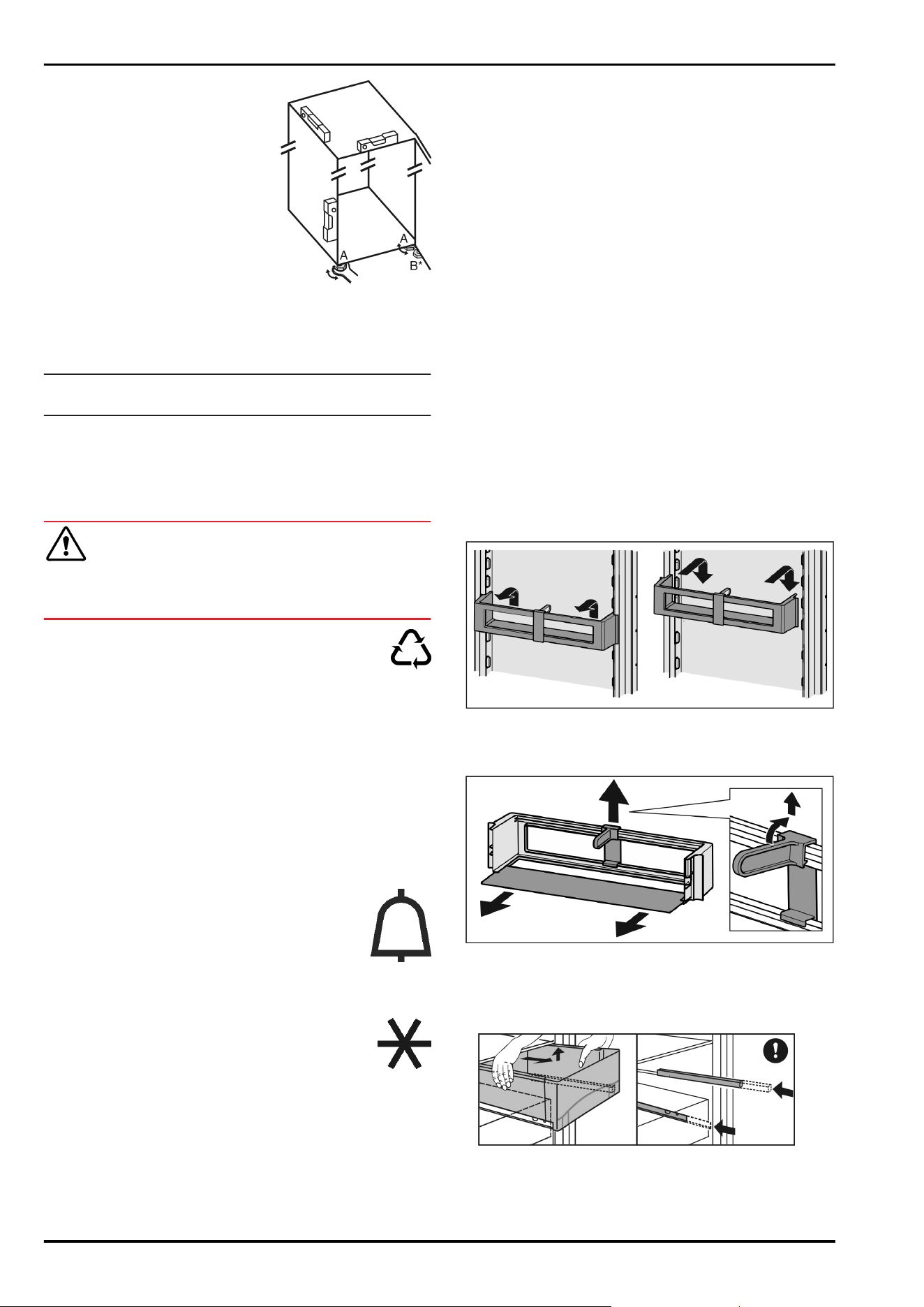
u
Align the appliance so that it
stands firmly and on a level
by applying the accompa‐
nying spanner to the adjust‐
able-height feet (A) and
using a spirit level.
u
Then support the door:
Extend the adjustable foot
at the turn hinge (B) until it
rests on the floor and then
make a further 90° turn.
When a Side-by-Side appliance (S…) is fitted together
with a second appliance (as a SBS combination):*
u
Proceed according to the Side-by-Side combined fridge-
freezer installation instructions. (Accessories bag of the
SBS freezer/appliance with freezer compartment)*
Note
u
Clean the appliance .
If the appliance is installed in a very damp environment,
condensate may form on the outside of the appliance.
u
Always see to good ventilation at the installation site.
4.3 Disposing of packaging
WARNING
Danger of suffocation due to packing material and plastic
film!
u
Do not allow children to play with packing material.
The packaging is made of recyclable materials:
-
corrugated board/cardboard
-
expanded polystyrene parts
-
polythene bags and sheets
-
polypropylene straps
-
nailed wooden frame with polyethylene panel*
u
Take the packaging material to an official collecting
point.
5 Control
5.1 Door alarm
For the fridge compartment
An audible warning sounds if the door is open for
longer than 60 seconds.
The audible warning stops automatically when
the door is closed.
5.2 SuperCool
With
SuperCool you switch to the highest cooling
performance to reach lower cooling temperatures.
Use SuperCool, to rapidly cool large amounts of
food.
When SuperCool is activated, the fan* may run. The appli‐
ance operates with maximum cooling performance, which
means that the noise of the refrigeration unit may be
temporarily louder.
The SuperCool function uses slightly more energy.
5.2.1 Switching onSuperCool
u
Briefly press SuperCool button ().
w
The SuperCool () symbol lights up in the display.
w
The cooling temperature drops to the lowest setting.
w
SuperCool is on.
w
SuperCool turns off automatically. The appliance
continues in energy-saving Normal mode.
5.2.2 To prematurely deactivate SuperCool
u
Briefly press SuperCool button ().
w
The SuperCool symbol () goes out in the display.
w
SuperCool is deactivated.
5.3 Switching on the fan
u
Briefly press the fan button ().
w
The fan symbol () shines.
w
The fan is active. In some appliances, the fan is only
activated when the compressor is running.
5.4 To switch off the fan
u
Briefly press the fan button ().
w
The fan symbol () goes out.
w
The fan is switched off.
5.5 Door racks
5.5.1 Moving the storage rack
Fig. 5
5.5.2 Dismantling door racks
Fig. 6
u
The door racks can be dismantled for cleaning.
5.6 Vegetable bins
Fig. 7
To remove the vegetable bins:
u
pull the vegetable bin all the way out and tilt it forwards
a little.
Control
* Depending on model and options 7
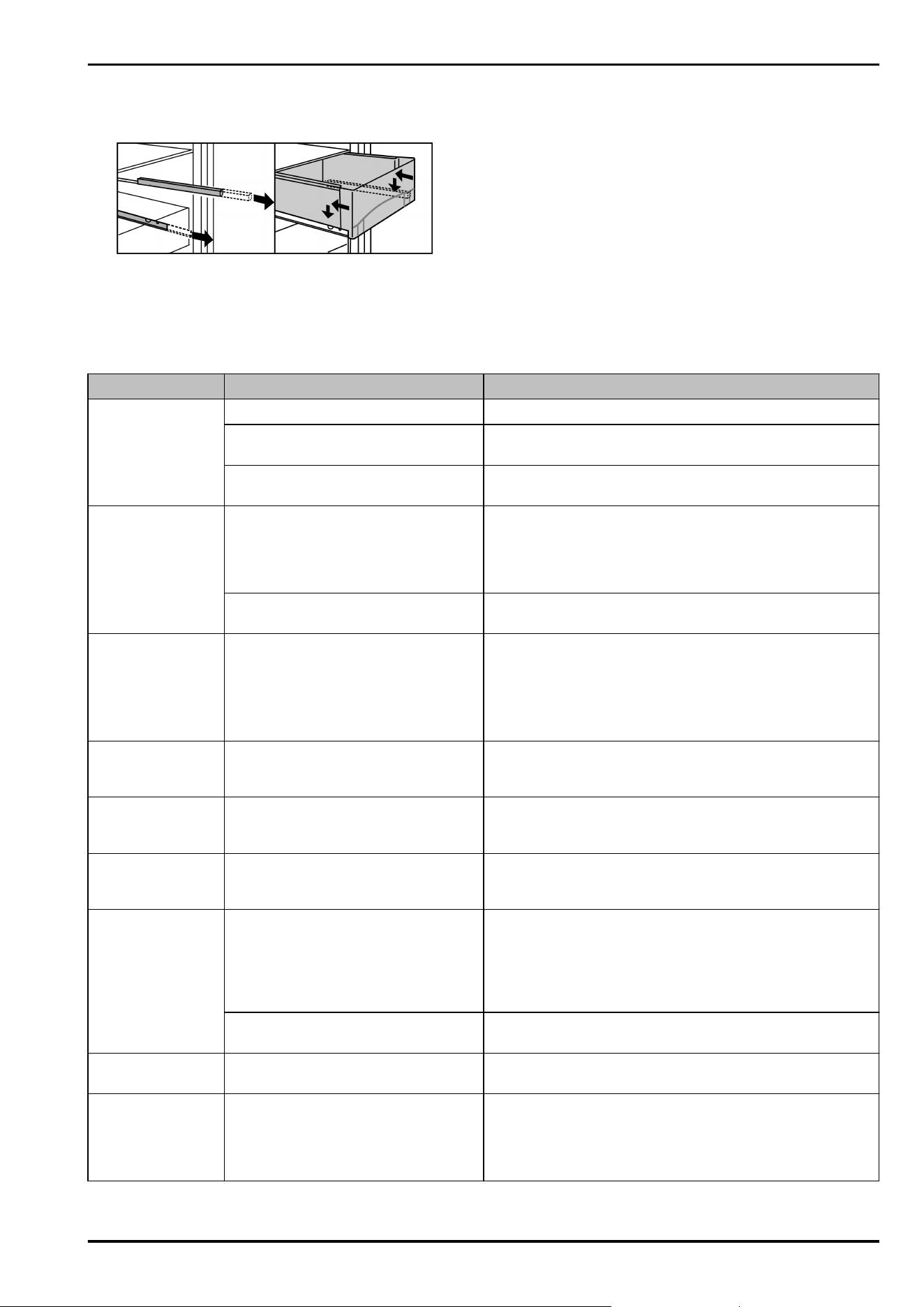
w
In the case of the bottom drawer, the drawer locking
device is additionally released and the vegetable bin can
be removed.
u
Push the projecting telescopic slides back in.
Fig. 8
To insert the vegetable bins:
u
place the vegetable bin on the telescopic slides and push
to the rear, exerting slight pressure.
w
In the case of the bottom drawer, the drawer locking
device additionally engages and the vegetable drawer
sits firmly on the telescopic slides.
6 Maintenance
7 Malfunctions
Your appliance is designed and manufactured for a long
life span and reliable operation. If a malfunction nonethe‐
less occurs during operation, check whether it is due to a
handling error. In this case you will have to be charged for
the costs incurred, even during the warranty period. You
may be able to rectify the following faults yourself:
Defect Cause Remedy
Appliance does not
work.
→ The appliance is not switched on.
u
Switching on the appliance.
→ The power plug is not properly
inserted in the wall socket.
u
Check power plug.
→ The fuse of the wall socket is not in
order.
u
Check fuse.
The compressor
runs for a long
time.
→ The compressor switches to a
low speed when little cold is
needed. Although the running time
is increased as a result, energy is
saved.
u
This is normal in energy-saving models.
→ SuperCool is activated.
u
The compressor runs for longer in order to rapidly cool
the food. This is normal.
A LED on the
bottom rear of
the appliance (at
the compressor)
flashes regularly
every 15 seconds*.*
→ The inverter is equipped with a
diagnostic LED.
u
The flashing is normal.
Excessive noise.
→ Due to the various speed steps,
speed-regulated* compressors can
generate different running noises.
u
The sound is normal.
A bubbling and
gurgling noise.
→ This noise comes from the refrig‐
erant flowing in the refrigeration
circuit.
u
The sound is normal.
A quiet clicking
noise.
→ The noise is produced whenever
the refrigeration unit (motor) auto‐
matically switches on or off.
u
The sound is normal.
A hum. It is briefly
a little louder
when the refrig‐
eration unit (the
motor) switches
on.
→ The refrigeration increases auto‐
matically when the SuperCool
function is activated, fresh food
has just been placed in the appli‐
ance or the door has been left open
for a while.
u
The sound is normal.
→ The ambient temperature is too
high.
u
Solution: (see 1.2 Appliance range of use)
A low hum.
→ The sound is produced by air flow
noise of the fan.
u
The sound is normal.
Vibration noises
→ The appliance is not standing
firmly on the floor. As a result
objects and adjacent units start
to vibrate when the refrigerator is
running.
u
Align the appliance using the adjustable feet.
u
Keep bottles and jars apart.
Maintenance
8 * Depending on model and options
Defect Cause Remedy
The temperature
display indicates:
F0 to F9
→ There is a fault.
u
Please contact the after-sales service (see 6 Mainte‐
nance) .
DEMO shines in
the temperature
display.
→ The demo mode is activated.
u
Please contact the after-sales service (see 6 Mainte‐
nance) .
The outer surfaces
of the appliance
are warm*.
→ The heat of the refrigeration circuit
is used to prevent condensate from
forming.
u
This is normal.
The temperature is
not cold enough.
→ The door of the appliance is not
properly closed.
u
Close the door of the appliance.
→ Insufficient ventilation.
u
Keep ventilation grille clear, and clean it.
→ The ambient temperature is too
high.
u
Solution: (see 1.2 Appliance range of use) .
→ The appliance was opened too
frequently or for too long.
u
Wait to see whether the appliance reaches the required
temperature by itself. If not, please contact the after
sales service (see 6 Maintenance) .
→ The temperature is incorrectly set.
u
Set the temperature to a colder setting and check after
24 hours.
→ The appliance is too close to a
source of heat (stove, heater etc).
u
Change the position of the appliance or the source of
heat.
The internal light
does not come on.
→ The appliance is not switched on.
u
Switch the appliance on.
→ The door was open for longer than
15 minutes.
u
The internal light switches itself off automatically after
about 15 minutes if the door is open.
→ The LED illumination is faulty or the
cover is damaged:
WARNING
Risk of injury due to electric shock!
There are live electrical parts under the cover.
u
Only ever have the inside LED light replaced or repaired
by customer service or trained personnel.
WARNING
Risk of injury from LED bulb!
The light intensity of the LED light corresponds to hazard
group RG 2.
If the cover is defective:
u
Do not look directly into the light from close range. It
cause injury to the eyes.
The door gasket is
defective or should
be replaced for
other reasons.
→ In some units, the seal around the
door can be replaced. You will not
need any special tools to do this.
u
Please contact the after-sales service (see 6 Mainte‐
nance) .
The unit has iced
up or condensation
has formed.
→ The door seal may have also
slipped out of its groove.
u
Check to ensure that the door seal is seated properly in
the groove.
8 Decommissioning
8.1 Taking the appliance out of service
u
Empty the appliance.
u
Switch off the appliance (see 8 Decommissioning) .
u
Remove mains connector.
u
Clean the appliance .
u
Leave the door open to prevent odour.
Decommissioning
* Depending on model and options 9
9 Disposal
9.1 Preparing appliance for disposal
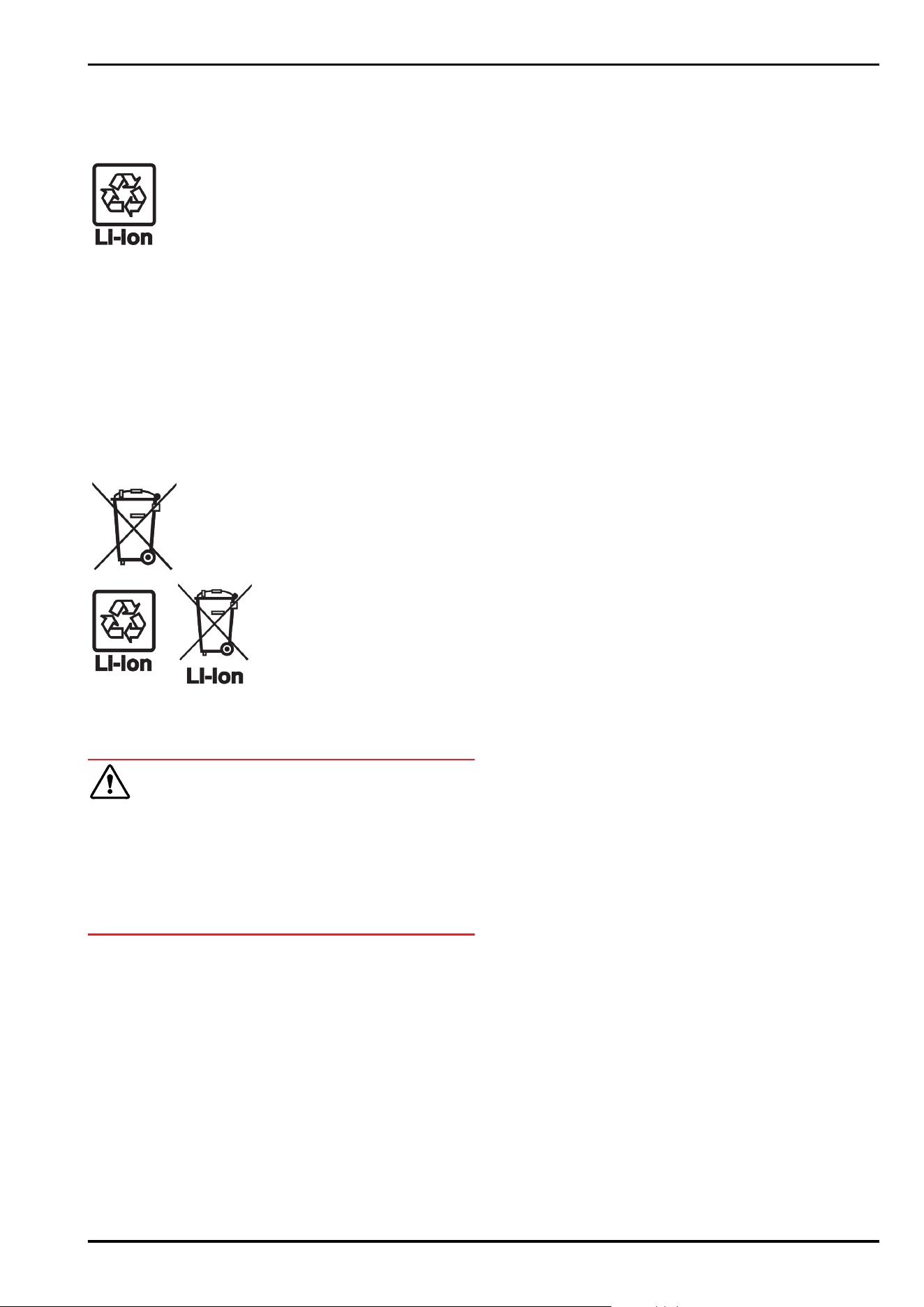
Liebherr uses batteries in some of its appli‐
ances. In the EU, for environmental reasons,
legislation obliges the end user to remove
these batteries before disposing of old appli‐
ances. If your appliance contains batteries, a
corresponding notice is attached.
Lamps If you can remove the lamps yourself without
destroying them, also remove these before
disposal.
u
Take the appliance out of operation. (see 8.1 Taking the
appliance out of service)
u
Appliances with batteries: remove the batteries. For
description, see Maintenance chapter.
u
If possible: remove lamps without destroying them.
9.2 Disposing of the appliance in an
environmentally friendly manner
The appliance still contains
valuable materials and must
be disposed of separately from
unsorted municipal waste.
Dispose of batteries separately
from the old appliance. To do
this, you can return the batteries
free of charge to retailers as
well as recycling centres and
collection centres for recyclable
materials.
Lamps Dispose of removed lamps
via the respective collection
systems.
WARNING
Leaking coolant and oil!
Fire. The coolant contained in the appliance is eco-friendly,
but also flammable. The oil contained in the appliance
is flammable. Escaping coolant and oil can ignite if the
concentration is high enough and in contact with an
external heat source.
u
Do not damage the pipelines of the coolant circuit and
the compressor.
u
Transport the appliance without damaging it.
u
Dispose of batteries, lamps and the appliance according
to the above specifications.
Disposal
10 * Depending on model and options

Disposal
* Depending on model and options 11
Liebherr-Hausgeräte Marica EOOD
4202 Radinovo
Bezirk Plovdiv
Bulgarien
home.liebherr.com