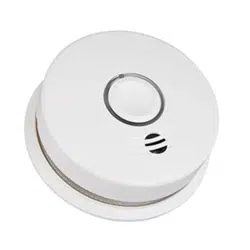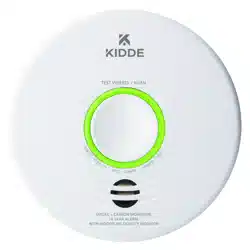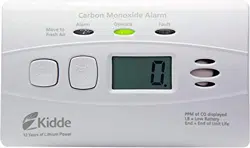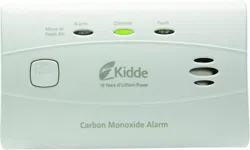
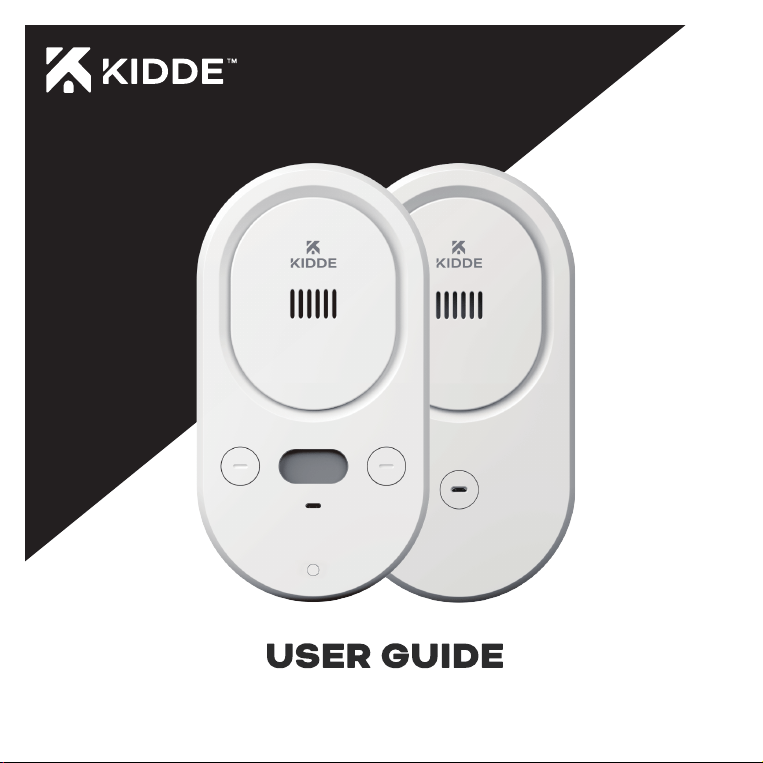
AC Plug-In Carbon Monoxide Alarms
P/N: G-000068-00 EN Rev. A
2
Model: _________________
Date Code (on back): _________________
Date of Purchase: _________________
Where Purchased: _________________
Date to Replace: _________________
Product Support: 1-800-880-6788
Please write down the below information
and have this at hand when you call.
Thank You for Purchasing this Alarm
These models utilize standard 120V AC power, as well as either AA replaceable backup batteries or a
10 yr sealed battery backup. They also contain HUSH
TM
to temporarily silence nuisance alarms.
Teach children how to respond to the alarm and that they should never play with the unit. This alarm
is designed to detect carbon monoxide from any source of combustion in a residential environment.
Model COPDLG will also detect Natural Gas or Propane in a residential environment. These models are
not designed for use in a recreational vehicle (RV) or boat.
NOTE: Please thoroughly read this user guide and save the document for future reference and to
pass on to any subsequent owner. Images are representative only. Actual product may vary slightly.
The National Fire Protection Association (NFPA) and the manufacturer recommend replacing this alarm
after ten years.
Scan here to register your device
with Kidde for customer support
and warranty information.
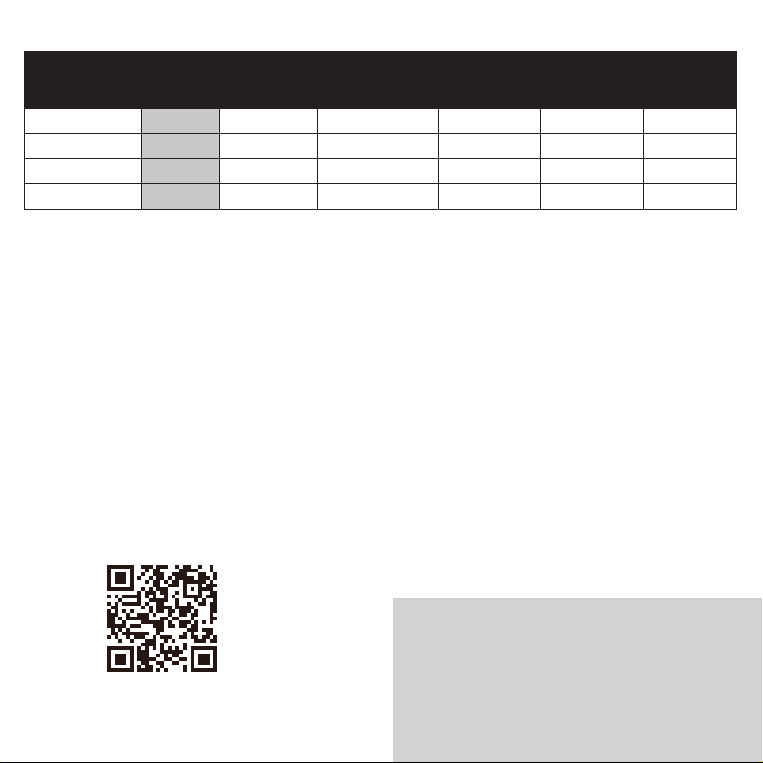
Kidde Model Display
AA Backup
Batteries
10 Yr Sealed
Backup Battery
Low Level
CO Alert
Gas
Detection
No Chirps
At Night
COP
No
Yes
No No No No
COPD
Yes Yes
No No No
Yes
COPDL10
Yes
No
Yes Yes
No
Yes
COPDLG
Yes Yes
No
Yes Yes Yes
Models included in this User Guide:

3
Contents
1. Carbon Monoxide Alarm: What To Do When The Alarm Sounds . . . . .4
2. Gas Alarm: What To Do When The Alarm Sounds . . . . . . . . . .6
3. Other Alarm Visual And Audible Indicators . . . . . . . . . . . .7
4. Troubleshooting Guide . . . . . . . . . . . . . . . . . . .8
5. Introduction, Product Features And Specifications . . . . . . . . . 10
6. Limitations Of Carbon Monoxide And Gas Alarms . . . . . . . . .12
7. Recommended Locations And Locations To Avoid. . . . . . . . . .14
8. Alarm Installation . . . . . . . . . . . . . . . . . . . . .15
9. Operation, Testing, And Nuisance . . . . . . . . . . . . . . .18
10. Battery Information . . . . . . . . . . . . . . . . . . . .20
11.
Permanently Disable Alarm / Discharge Battery (10 yr sealed battery models only)
.22
12. General Carbon Monoxide (CO) and Explosive Gas Information . . . .23
13. Cleaning Your Alarm . . . . . . . . . . . . . . . . . . . .26
14. Service And Warranty . . . . . . . . . . . . . . . . . . .27
Kidde Model Display
AA Backup
Batteries
10 Yr Sealed
Backup Battery
Low Level
CO Alert
Gas
Detection
No Chirps
At Night
COP
No
Yes
No No No No
COPD
Yes Yes
No No No
Yes
COPDL10
Yes
No
Yes Yes
No
Yes
COPDLG
Yes Yes
No
Yes Yes Yes

4
1.
Carbon Monoxide Alarm: What To Do When The Alarm Sounds
The carbon monoxide (CO) alarm pattern is four quick beeps repeating every 5 seconds. The red LED blinks in time
with the alarm pattern, and the display (if applicable) will alternate between the number of PPM of CO detected, and
the message “CO.” On DC power only, after 4 minutes in CO alarm, the alarm pattern will only occur every 60s.
WARNING:
CARBON MONOXIDE (CO) IS A COLORLESS,
ODORLESS, POISONOUS GAS. YOU CAN’T TASTE, SEE, OR SMELL
CO, BUT IT CAN KILL IN JUST MINUTES. THIS ALARM WILL SOUND
IN A 4-BEEP PATTERN IF LIFE THREATENING LEVELS OF CO ARE
DETECTED. IF THE ALARM SOUNDS:
1
)
Immediately evacuate all occupants from the space and go outdoors
to fresh air.
2) Call emergency responders (911 or fire department) for help; notify the
building or vehicle owner, as necessary.
EMERGENCY PHONE #: _______________________
Always consider a CO alarm to be dangerous. After emergency services responders have arrived, the premises has
been aired out, and your alarm remains in its normal condition, it is important to call a qualified appliance technician
to investigate for sources of CO from fuel burning equipment and appliances and inspect for proper operation of this
equipment. If problems are identified during this inspection, have the equipment serviced immediately. Note any
combustion equipment not inspected by the technician and consult the manufacturer’s instructions or contact the
manufacturer directly for more information about CO safety and this equipment. Make sure that motor vehicles are not
or have not been operating in an attached garage or adjacent to the residence.
NOTE: See Section Operation, Testing, And Nuisance, for nuisance alarm situations.

5
Low Level CO Alert Procedure (if applicable)
The Low Level CO Alert is two quick beeps and two red LED blinks every 10 seconds, repeating. The display (if
applicable) will show the CO level (PPM) detected. On DC power only, after 4 minutes the alert pattern will only occur
every 60s.
WARNING:
An early carbon monoxide (CO) alert is a
signal indicating the presence of low levels of CO. It’s designed to
prompt early awareness and action—allowing you to address the
issue before it escalates into a full alarm.
Even low levels of CO can pose health risks, particularly for individuals
with certain pre-existing medical conditions. Children, seniors, and
pets are also more susceptible and may begin experiencing symptoms
sooner.
Recommended actions:
1) Open windows to improve ventilation.
2) Attempt to identify and resolve the source of CO before an alarm is
triggered.
3) If you or a household member has a medical condition that could be
affected by the exposure of low CO levels (between 30 and 70 PPM),
consult your healthcare provider to understand any potential risks.
4) If the unit goes into full alarm, follow the Carbon Monoxide Alarm
Procedure outlined at the beginning of Section 1 for emergency
response and evacuation.
6
2.
Gas Alarm: What To Do When The Alarm Sounds
The Gas Alarm is a 1.5 second beep with a red LED blink, a half-second pause, repeating. The display
will show “GAS”. On DC power only, after 4 minutes the alert pattern will only occur every 60s.
NOTE:
See Section Operation, Testing, And Nuisance, for nuisance alarm situations.
Always consider a Gas alarm to be dangerous. After emergency services responders have arrived,
the premises has been aired out, and your alarm remains in its normal condition, it is important to call
a qualified appliance technician to investigate for sources of Gas from fuel burning equipment and
appliances and inspect for proper operation of this equipment. If problems are identified during this
inspection, have the equipment serviced immediately. Note any combustion equipment not inspected
by the technician and consult the manufacturer’s instructions or contact the manufacturer directly for
more information about Gas safety and this equipment.
WARNING:
Activation of the Gas Alarm indicates the
presence of an explosive gas which can cause an explosion and/or
fire.
Know how to respond to a CO or gas emergency.
If the unit alarms for gas:
1) Immediately evacuate the premises without doing anything that might
cause a spark or flame:
• Do not activate (turn on or off) any electrical switch, phone, or appliance.
• Do not start a car.
2) Contact your fire department from outside, away from the premises.
PHONE NUMBER.
7
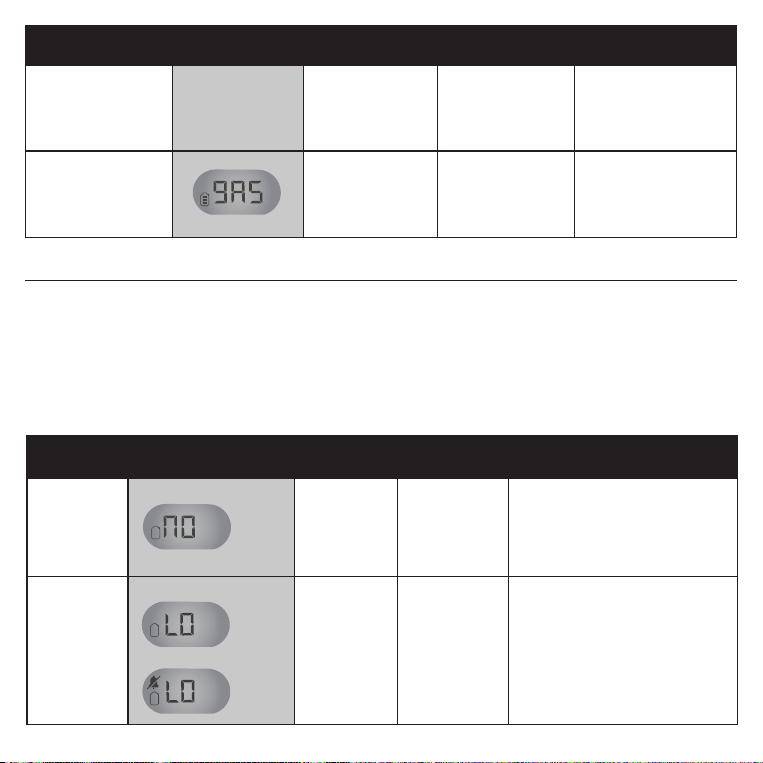
3. Other Alarm Visual And Audible Indicators
Operational Mode
Display
(if applicable)
Visual Indications Audible Indications Action / Note
Normal (standby)
AC power: Green LED on
continuously. DC power:
Green LED blinks approx
every 60 sec.
Test (Test/Hush button
press when no alarm
condition is present)
(Note: Test is very loud,
stand a few feet away.)
All models: Red LED
blinks in time with alarm
pattern.
All models:
• Single beep
• 4 quick beeps, pause,
4 quick beeps.
CO/gas model will also
emit the gas alarm pattern
twice: 1.5 sec beep,
half-sec pause.
Perform Test/Hush button
press once a week to verify
proper alarm operation.
CO Alarm Memory
(unit has experienced
a CO alarm event, or a
low level CO alert has
been detected (model
specific.))
Alternating 2 red LED blinks every
15 sec.
None NOTE: Alarm memory is
retained for 7 days.
Push Test/Hush button to
clear Alarm Memory.
CO Peak Level Memory
(Display models only.
Unit has detected 100
ppm or greater, or a
low level CO alert has
been detected (model
specific.))
Alternating (after Peak
Level button press)
2 red LED blinks every
15 sec.
None * Push Peak Level button
to see highest level of CO
detected on the display
from 31 to 999. If no CO has
been detected, the display
will alternate between
“PCO” and “CLr”.
* Clear Peak Level Memory
by cycling power (remove/
replace batteries), or by
pushing the Peak Level and
Test/Hush buttons at the
same time until the display
shows “CLr”.
Low Level CO Alert
(if applicable)
2 red LED blinks every
10 sec.
On DC power only, after
4 mins, alert occurs only
once every 60 sec.
2 chirps every 10 sec.
On DC power only, after
4 mins, alert occurs only
once every 60 sec.
Refer to Section 1:
“Low Level CO Alert
Procedure”
Gas Alarm
if applicable)
1 red LED blink every
2 sec.
On DC power only, after
4 mins, alert occurs only
once every 60 sec.
1 gas alarm pattern every
2 sec, repeating.
On DC power only, aft
er 4 mins, alert occurs
only once every 60 sec.
Refer to Section 1: “Gas Alarm
Procedure”
PPM
PPM
PPM
Trouble Condition
Display
(if applicable)
Visual Indications Audible Indications Action / Note
No Battery
Amber LED blinks
every 6 sec.
Chirp Every 60 Sec.
* For AA replaceable battery models,
remove the battery pull tab, or install
batteries.
* For 10 yr sealed battery models, activate
the sealed battery backup.
Low Battery Before button push:
After button push:
Amber LED blinks
every 6 sec.
Chirp every 60 sec. * Push Test/Hush button once to silence for
24 hrs. (Push Test/Hush button again to
clear Hush and perform a test.)
Note: 7 days after Low Battery begins,
the notifications cannot be silenced.
* For AA replaceable battery models,
replace batteries as soon as possible.
* For 10 yr sealed battery models, remove
alarm, discharge, dispose unit, and replace
as soon as possible.
8
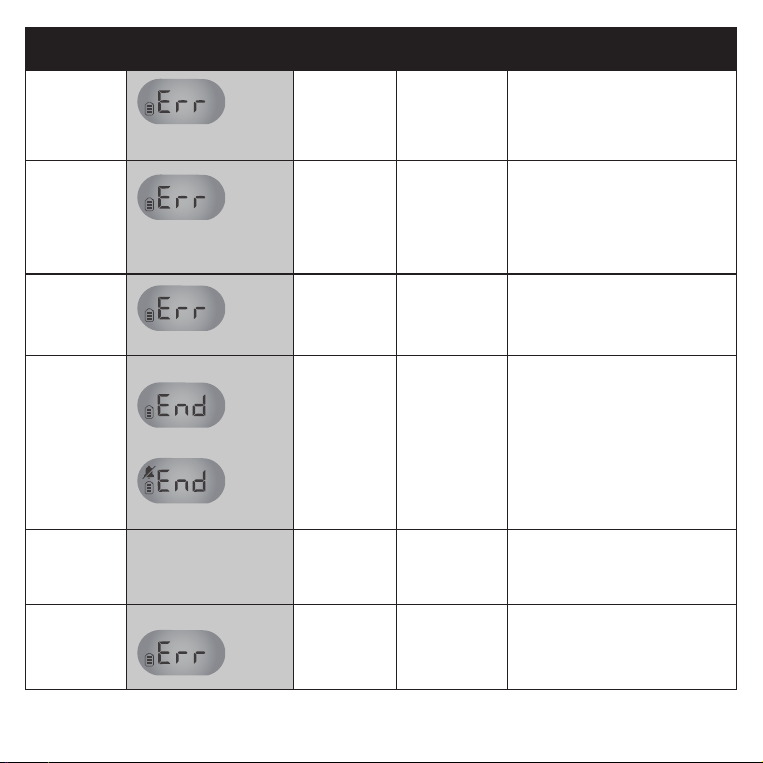
4. Troubleshooting Guide
If you are experiencing a problem with your alarm, or a fault, and are unsure of the next action, please contact product
support at 1-800-880-6788 before discharging the battery (10 yr sealed battery models) or disposing of your alarm. You
may also write us at: Kidde, 1016 Corporate Park Drive, Mebane, NC 27302, or visit our internet address at www.kidde.com.
Operational Mode
Display
(if applicable)
Visual Indications Audible Indications Action / Note
CO Alarm
HUSH
TM
/Reset
None After Test/Hush button
push: CO alarm pattern
stops.
Unit is confirming if CO is
present or if it experienced a
nuisance situation. Re-alarm
means danger. Move to fresh
air and call 911.
Gas Alarm Memory
(if applicable)
2 red LED blinks every
15 sec.
None NOTE: Alarm memory is only
retained for 24 hrs. Push Test/
Hush button to clear Alarm
Memory.
Trouble Condition
Display
(if applicable)
Visual Indications Audible Indications Action / Note
CO Fault
Amber LED blinks 2
times every 60 sec.
3 chirps every
60 sec.
*
Push Test/Hush button once to start a
self-test.
*
If error continues, remove alarm, dispose
unit, and replace as soon as possible.
(Remove AA batteries or discharge 10 yr
sealed battery before disposal)
Gas Fault (if
applicable)
Amber LED blinks 5
times every 60 sec.
3 chirps every
60 sec.
* Push Test/Hush button once to start a
self-test.
*
If error continues, remove alarm, dispose
unit, and replace as soon as possible.
(Remove AA batteries or discharge 10 yr
sealed battery before disposal)
Fatal Fault
Amber LED blinks
3 times every 60 sec.
3 chirps every 60 sec.
*
Remove alarm, dispose unit, and replace
as soon as possible. (Remove AA batteries
or discharge 10 yr sealed battery before
disposal)
End of Unit Life Before button push:
After button push:
Amber LED blinks 2
times every 60 sec.
2 chirps every 60 sec.
*
Push Test/Hush button once to silence
for 24 hrs. (Push Test/Hush button again
to clear Hush and perform a test.) Note:
7 days after End of Unit Life begins, the
notifications cannot be silenced.
*
Remove alarm, dispose unit, and replace
as soon as possible. (Remove AA batteries
or discharge 10 yr sealed battery before
disposal)
MCU Failure
Blank Screen None Constant Tone
*
Remove alarm, dispose unit, and replace
as soon as possible. (Remove AA batteries
or discharge 10 yr sealed battery before
disposal)
Stuck Test/
Hush or Peak
Level Button
Amber LED blinks
4 times every 60 sec.
3 chirps every 60 sec.
*
Push button to dislodge it from being stuck.
If button cannot be unstuck, remove alarm,
dispose unit, and replace as soon as possi-
ble. (Remove AA batteries or discharge 10 yr
sealed battery before disposal)
9
4. Troubleshooting Guide

10
5. Introduction, Product Features And Specifications
Introduction
This alarm detects carbon monoxide using an electrochemical cell. Many times throughout this User
Guide, we will refer to Carbon Monoxide as “CO.” When describing a model that detects gas, the words
“Gas” or “Explosive Gas” will refer to Natural Gas or Propane.
Ten (10) years after a CO alarm, or seven (7) years after a CO/gas alarm was installed, powered up, and
tested, the unit will automatically alert you that it is time to replace the unit. This is called “End of Unit
Life” mode. See Troubleshooting Guide. To help identify the date to replace the unit, a label has been
affixed to the side of the alarm. Write the “Replace by” date (10 years for CO, or 7 years for CO/gas, from
initial power up) in an oil based permanent marker on the label prior to installing the unit. Two labels
have been provided that have important information on what to do in case of a CO alarm. Place one
label at eye level on a wall near the alarm after it is mounted, and one near a fresh air source such as a
door or window, where you plan to gather after the alarm indicates the presence of carbon monoxide.
This Kidde carbon monoxide (CO) or CO/gas alarm is an important part of your family’s home safety plan. As
an owner of a CO or CO/gas alarm, there are some basic facts you should know about for your protection.
Many people think that CO or CO/gas alarms operate like smoke alarms. Like smoke alarms, CO and
CO/gas alarms monitor the air in your home and sound a loud alarm to warn you of trouble. The way you
respond to a CO or gas alarm is quite different than a smoke alarm. That’s because a house fire and
a CO or gas problem are distinctly different situations. If your smoke alarm were to alarm, you would
quickly be able to judge the level of danger you were in with your senses. You can see and smell the
smoke, feel the heat, see, and possibly hear the fire burning. You can also readily see if your smoke
alarm is alarming in a non-emergency situation. Because your sense of sight, smell, hearing and touch
give you information, you can almost instantly judge what action to take if you hear your smoke alarm.
CO is an invisible, odorless, tasteless and non-irritating gas – completely undetectable to your senses.
That’s why it is important to your safety that you have a CO alarm.
Product Features and Specifications (see list of models on page 2):
• Low Level CO Alert (model specific)
• 120VAC (60Hz, 30mA max) powered with either 10 yr sealed battery or 2 AA battery backup
• Digital Backlit Display (model specific)
• No Chirps At Night (model specific)
• Easy installation
• CO Sensor: Electrochemical
• Gas Sensor: Metal Oxide (model specific)
• Temperature Operating Range: 40 °F (4.4 °C) to 100 °F (37.8 °C)
• Humidity Operating Range: 10 to 95% RH, non-condensing
• Audible Alarm: 85+ dB at 10 ft, 3.0 to 3.5 KHz pulsing
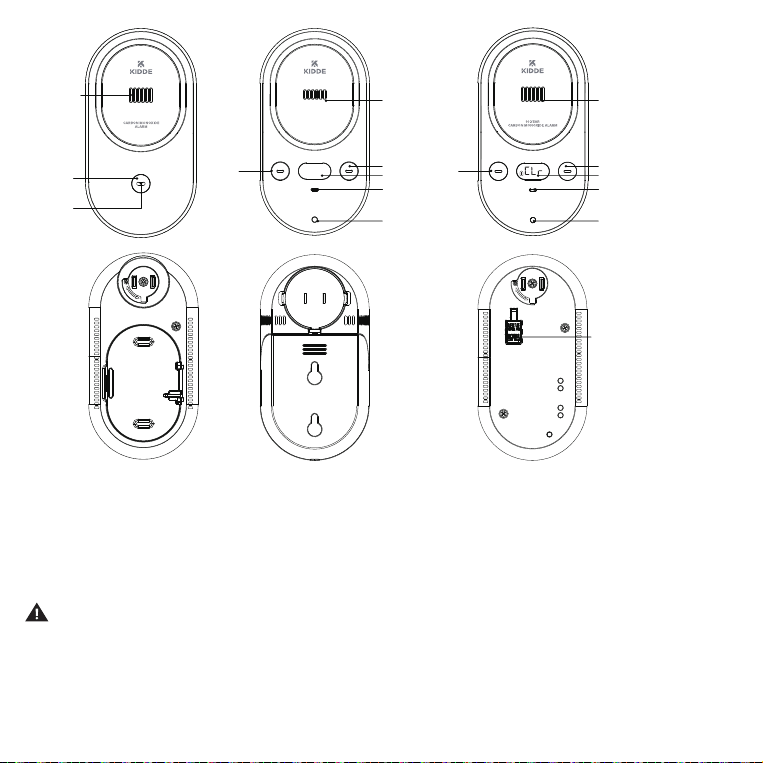
11
Sounder
Button
Status LED
Sounder
Display
Button
Button
Button
Light Sensor
Activation & Discharge Switch
Models with AA Replaceable Batteries Models with 10 Year Sealed BatteryCO/Gas Model COPDLG
Status LED
Sounder
Display
Button
Light Sensor
Status LED
EXPLOSIVE GAS AND
CARBON MONOXIDE ALARM
FCC
This device complies with part 15 of the FCC Rules. Operation is subject to the following two conditions:
(1) This device may not cause harmful interference, and (2) this device must accept any interference
received, including interference that may cause undesired operation.
CAUTION: The user is cautioned that changes or modifications not expressly approved by the
party responsible for compliance could void the user’s authority to operate the equipment.
NOTE: This equipment has been tested and found to comply with the limits for a Class B digital device,
pursuant to part 15 of the FCC Rules. These limits are designed to provide reasonable protection
against harmful interference in a residential installation. This equipment generates, uses, and can
radiate radio frequency energy and, if not installed and used in accordance with the instructions, may

12
6. Limitations Of Carbon Monoxide And Gas Alarms
WARNING: PLEASE READ CAREFULLY AND THOROUGHLY
• A battery powered alarm must have a battery of the specified type, in good condition and installed
properly.
• Alarms must be tested regularly to make sure the battery and the alarm circuits are in good operating
condition.
• If the alarm is located outside the bedroom or on a different floor, it may not wake up a sound sleeper.
• The use of alcohol or drugs may also impair one’s ability to hear the alarm.
This alarm is not intended to alert hearing impaired individuals.
WARNING: PLEASE READ CAREFULLY AND THOROUGHLY
IMPORTANT: CO alarms are designed to detect carbon monoxide gas from ANY source of combustion.
They are NOT designed to detect smoke or fire. CO/gas alarms will also detect the presence of natural
gas or propane, but will not detect smoke or fire.
WARNING: Carbon monoxide alarms are not smoke alarms. This carbon monoxide alarm is not a
substitute for installing and maintaining an appropriate number of smoke alarms in your home.
This carbon monoxide or CO/gas alarm will not sense smoke or fire even though carbon monoxide can be
generated by fire. For this reason you must install smoke alarms to provide early warning of fire and to protect
you and your family from fire and its related hazards.
cause harmful interference to radio communications. However, there is no guarantee that interference
will not occur in a particular installation. If this equipment does cause harmful interference to radio
or television reception, which can be determined by turning the equipment off and on, the user is
encouraged to try to correct the interference by one or more of the following measures:
-Reorient or relocate the receiving antenna.
-Increase the separation between the equipment and receiver.
-
Connect the equipment into an outlet on a circuit different from that to which the receiver is connected.
-Consult the dealer or an experienced radio/TV technician for help.

13
CAUTION: CO alarms will only indicate the presence of carbon monoxide gas at the sensor. CO/
gas alarms will only indicate the presence of carbon monoxide, natural gas, or propane at the sensor.
Carbon monoxide, natural gas, or propane gas may be present in other areas. Never restart the source
of a CO or gas problem until it has been fixed. NEVER IGNORE THE ALARM!
WARNING: CO AND CO/GAS ALARMS ARE INTENDED FOR USE IN ORDINARY INDOOR
LOCATIONS OF FAMILY LIVING UNITS. THEY ARE NOT DESIGNED TO MEASURE COMPLIANCE WITH
OCCUPATIONAL SAFETY AND HEALTH ADMINISTRATION (OSHA) COMMERCIAL OR INDUSTRIAL
STANDARDS. THEY ARE NOT SUITABLE FOR INSTALLATION IN HAZARDOUS LOCATIONS
AS DEFINED IN THE NATIONAL ELECTRIC CODE. THEY ARE NOT DESIGNED FOR USE IN A
RECREATIONAL VEHICLE (RV) OR BOAT.
• The installation of CO or CO/gas alarms should not be used as a substitute for proper installation, use,
and maintenance of fuel burning appliances, including appropriate ventilation and exhaust systems.
• CO or CO/gas alarms do not prevent CO, natural gas, or propane from occurring, nor can they solve any
existing CO, natural gas, or propane problem.
WARNING: CO ALARMS ARE DESIGNED TO HELP PROTECT INDIVIDUALS FROM ACUTE
EFFECTS OF CARBON MONOXIDE EXPOSURE. THEY WILL NOT FULLY SAFEGUARD INDIVIDUALS
WITH SPECIFIC MEDICAL CONDITIONS. IF IN DOUBT, CONSULT A MEDICAL PRACTITIONER.
INDIVIDUALS WITH MEDICAL PROBLEMS MAY CONSIDER USING WARNING DEVICES WHICH
PROVIDE AUDIBLE AND VISUAL SIGNALS FOR CARBON MONOXIDE CONCENTRATIONS UNDER
30 PPM. *
• These models have not been investigated for carbon monoxide alarm below 70 ppm.
• This device requires a continuous supply of electrical power from a healthy battery or AC
connection, depending on the model. It will not work without power.
• CO/gas alarms will detect carbon monoxide primarily and explosive gas secondarily. CO events
will take priority over explosive gas events.
* Reference Underwriters Laboratories (UL) standard 2034
14
7. Recommended Locations & Locations to Avoid
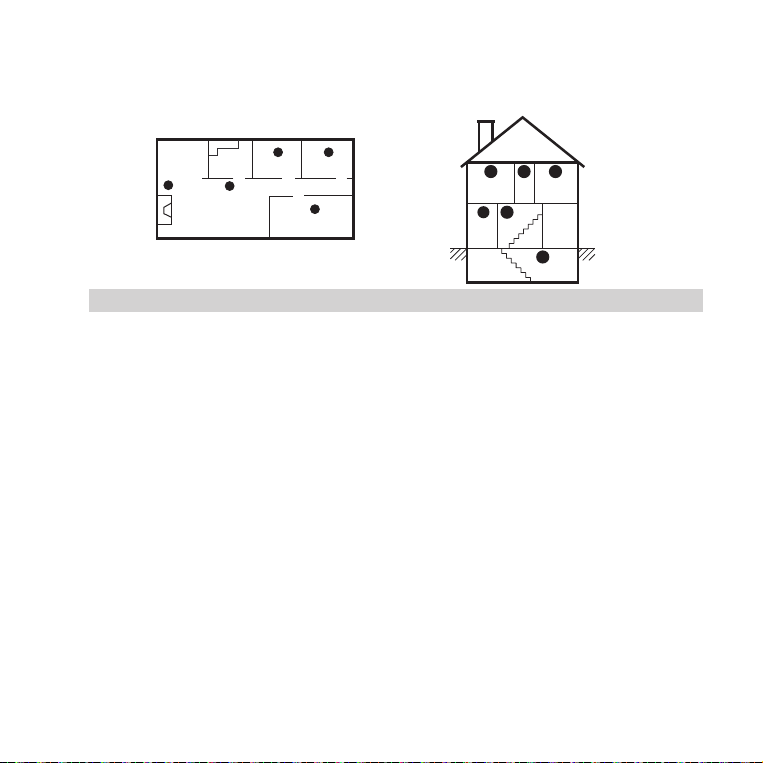
• Industry experts recommend a CO alarm be installed on each level of the home -- ideally on any
level with fuel burning appliances and outside of sleeping areas.
• Install an explosive gas alarm where fuel-burning appliances are located such as kitchens,
basements, laundry rooms and near gas fireplaces.
Mounting a CO/gas alarm should depend on the type of explosive gas you intend to detect:
• If you are a user of natural gas, mount your CO/gas alarm high on the wall (no closer than six inches
from the ceiling) to ensure the earliest opportunity to detect a natural gas leak, because natural
gas rises.
• If you are a user of propane, mount your CO/gas alarm near the floor to ensure the earliest
opportunity to detect a propane leak, because propane sinks.
Locations To Avoid
• In the garage. Products of combustion are present when you start your automobile.
• Do not install within 6 ft of heating or cooking appliances.
• Do not install in dead air spaces, such as peaks of vaulted ceilings or gabled roofs, where CO may
not reach the sensor in time to provide early warning.
• In an area where the temperature may fall below 40 °F (4.4 °C) or rise above 100 °F (37.8 °C), such
as crawl spaces, unfinished attics, porches, and garages.
• In dusty areas. Dust particles may cause nuisance alarms or a failure to alarm.
Figure 7
BEDROOM
LIVING
ROOM
BASEMENT
BEDROOM
HALL
KITCHEN
MULTIPLE
FLOOR PLAN
Recommended Locations
DINING
LIVING ROOM
BEDROOM
KITCHEN
BEDROOM
BEDROOM
15
• In very humid areas (above 95% RH, non-condensing) as moisture or steam can cause nuisance alarms.
• In insect-infested areas.
• Alarms should not be installed within 3 ft (0.9m) of the door to a bathroom containing a tub or
shower, forced air supply ducts used for heating or cooling, ceiling or whole house ventilating fans,
or other high air flow areas.
• Near lights. Electronic “noise” generated by the lights may cause nuisance alarms.
• Do not install near vents, flues, or chimneys.
• Do not install near fans, doors, windows or areas directly exposed to the weather.
• Near deep-cell large batteries. Large batteries have emissions that can cause the alarm to perform
at less than optimum performance.
• Do not obstruct the vents located on the alarm. Do not place the alarm where drapes, furniture or
other objects block the flow of air to the vents.
• Do not install on a switched or dimmer-controlled outlet.
8. Alarm Installation
STEP 1: ACTIVATE BATTERY
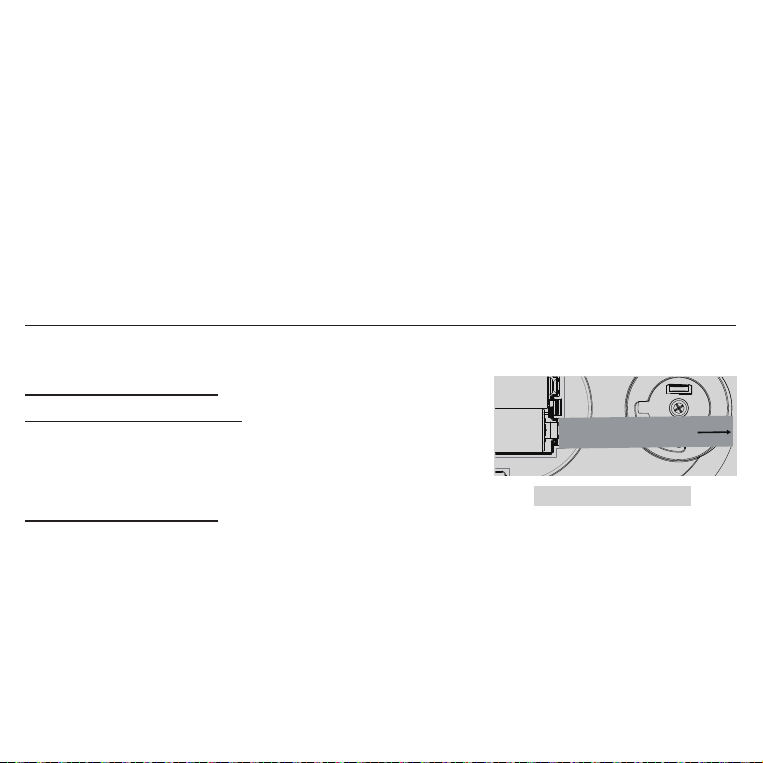
AA replaceable battery models:
Pull out the battery pull tab first to activate the batteries (see
Figure 8-A). Battery activation is confirmed with a beep. If the beep
does not occur when the battery pull tab is removed, remove the
batteries and reinstall them. Confirm the battery activation beep.
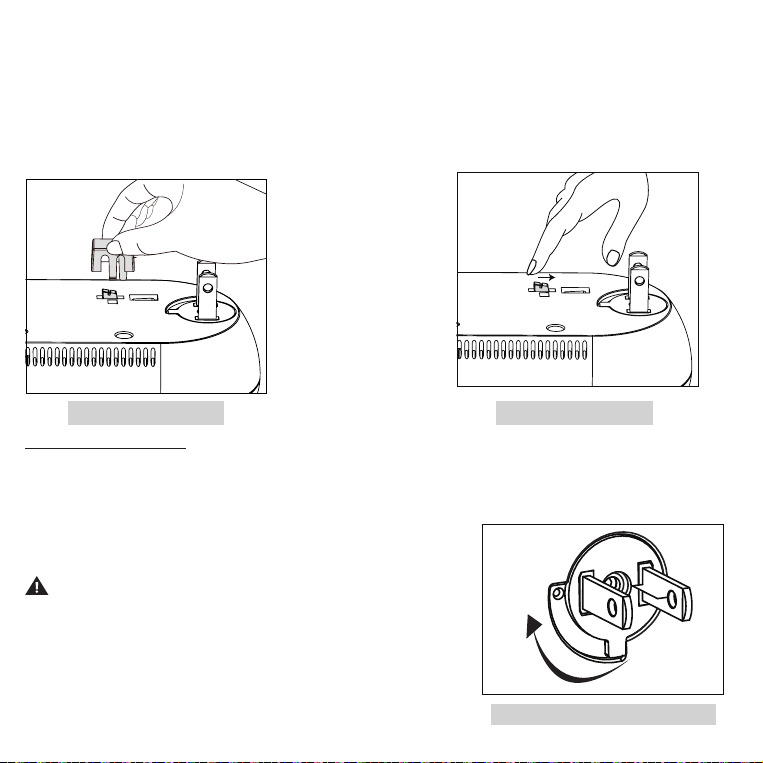
10 yr sealed battery models:
The following step must be taken to ensure activation: Battery activation is confirmed with a beep. Confirm
the battery activation beep.
Activate the alarm battery by removing the protective cap on the back of the unit and pressing the
activation switch. (reference Figures 8-B and 8-C)
NOTE: Activation of the 10 year sealed battery is a one-time operation. After activation, the battery cannot
be turned off, and can only be discharged if needed, i.e., due to fault or end of life condition.
Figure 8-A
16
NOTE: Connecting AC power first, without removing the battery pull tab, or without installing all batteries
in the correct orientation, or activating the 10 year sealed battery, will result in a false low battery trouble
condition chirp (see Troubleshooting Guide). You need to activate or install the batteries, or activate the 10
year sealed battery, to eliminate the false low battery trouble condition chirps. Remove the battery pull tab
(see Figure 8-A) or install all batteries in the correct orientation (see Figure 10), or activate the 10 year sealed
battery (Figures 8-B and 8-C) to avoid false low battery notification. Battery activation is confirmed with
a beep. If the beep does not occur when the battery pull tab is removed, or when batteries are replaced,
remove the batteries and reinstall them in correct orientation. Confirm the battery activation beep.
Figure 8-B Figure 8-C
STEP 2: INSTALLATION
NOTE: See section “Recommended Locations & Locations to Avoid” for installation locations, including
locations for propane and/or natural gas detection.
These alarms are designed to plug directly into a standard, non-
switched wall outlet.
NOTE: Do not use an extension cord to power these units.
WARNING: AC ALARMS CANNOT BE OPERATED FROM
POWER DERIVED FROM A SQUARE WAVE, MODIFIED
SQUARE WAVE OR MODIFIED SINE WAVE, INVERTER.
THESE TYPES OF INVERTERS ARE SOMETIMES USED
TO SUPPLY POWER TO THE STRUCTURE IN OFF GRID
INSTALLATIONS, SUCH AS SOLAR OR WIND DERIVED
POWER SOURCES. THESE POWER SOURCES PRODUCE
HIGH PEAK VOLTAGES THAT WILL DAMAGE THE ALARM.
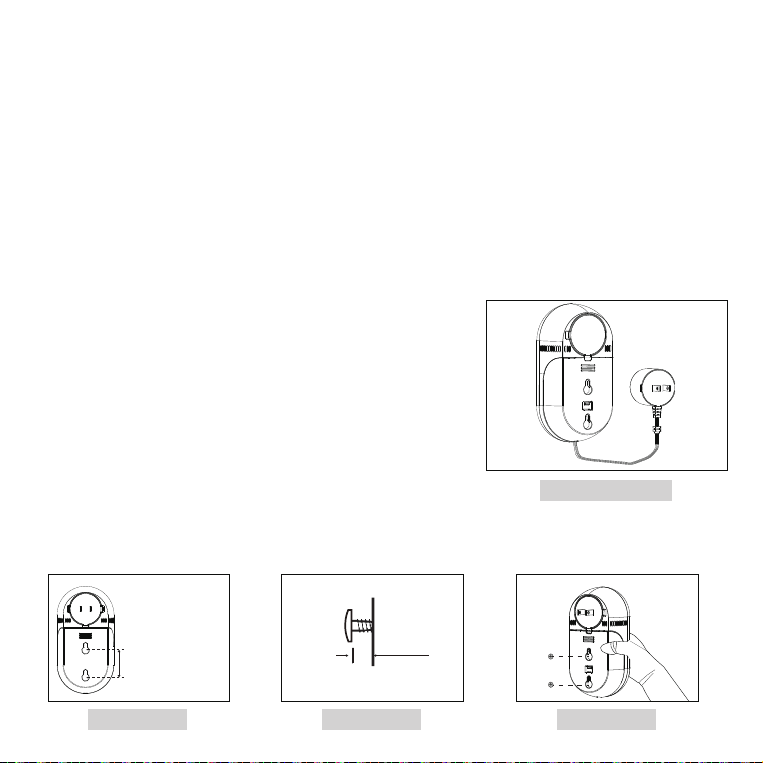
90°
Figure 8-D (excludes model COPDLG)
17
To install:
• Choose a standard 120V non-switched outlet to plug the alarm into.
• Plug the alarm into the outlet. Note: If the outlet is mounted horizontally (sideways), you will need to
rotate the adapter 90°. (Figure 8-D) (excludes model COPDLG)
Note: Model COPDLG includes a removable AC plug and power cord, allowing flexible wall mounting
placement for optimal propane and/or natural gas detection. See Recommended Locations section.
For wall mounting, follow these steps:
1. Refer to Figure 8-F distance between holes. Mark the location of two holes on the wall as shown.
2. Insert the two screws provided until the screw heads are protruding approximately 1/8” from the wall. (If
mounting in a plasterboard or drywall, drill a 3/16” hole in the wall and use the plastic anchors provided.)
(Figure 8-G)
3. Open the battery door, remove the AC plug and extend the cord.
4. Route the cord through the slot (Figure 8-E) and close the battery
door.
5. Hook the alarm over the screws and onto the keyholes in the back
of the alarm. (Figure 8-H)
6. Plug the AC plug into a non-switched outlet.
NOTE: If either battery is missing (AA battery models), the battery
door cannot close.
The alarm is now activated! After installation / activation, test your
alarm as described in Operation and Testing section.
Figure 8-H
1/8″ / 3.2 mm
Screw Head Distance From Wall
WALL
Figure 8-G
1.42
/ 36mm
Drill hole spacing
Figure 8-F
Figure 8-E
18
Gas Alarm Response Times:
Before 10% of low explosion limit (LEL) for natural gas or propane is detected.
TESTING
NOTE: When pushing the Test/Hush button, use only your finger or thumb. Using any other
instrument(s) (such as a broom handle) is strictly prohibited, as it may damage the alarm.
Test your alarm weekly by pressing and releasing the Test/Hush button for more than one second.
A quick beep will confirm the Test/Hush button has been pushed followed by the test sequence. See
WARNING: Failure to plug in this device into a non-switched 120V outlet and properly install
batteries in the correct orientation, or activate the 10 yr sealed battery will prevent proper operation of
this alarm and will prevent its response to CO or CO/gas hazards.
IMPORTANT: These alarms are not hardwire interconnected. They do not communicate with other
AC hardwire or AC plug-in alarms.
9. Operation, Testing, And Nuisance
OPERATION
The alarm is operating once it is activated and testing is complete (see “TESTING” below). When CO is
sensed, the unit sounds a loud alarm. See Section 1 for alarm signal descriptions. In high levels of CO,
the unit will go into alarm in a shorter period of time than at low levels of CO.
CO Concentration CO Alarm (Mins.)
70 PPM
60-240
150 PPM
10-50
400 PPM
4-15
CO Concentration CO Alert* (Mins.)
70 PPM
≤21
150 PPM
≤ 9
400 PPM
≤ 4
* NOTE:
These are not the same as CO alarm. See Section 1 for CO alarm and Low Level CO Alert descriptions.

19
Other Alarm Visual and Audible Indicators table. The alarm will sound if the electronic circuitry, horn,
and batteries are working. If the alarm does not sound, or gives erratic or low volume sound, the unit
must be replaced.
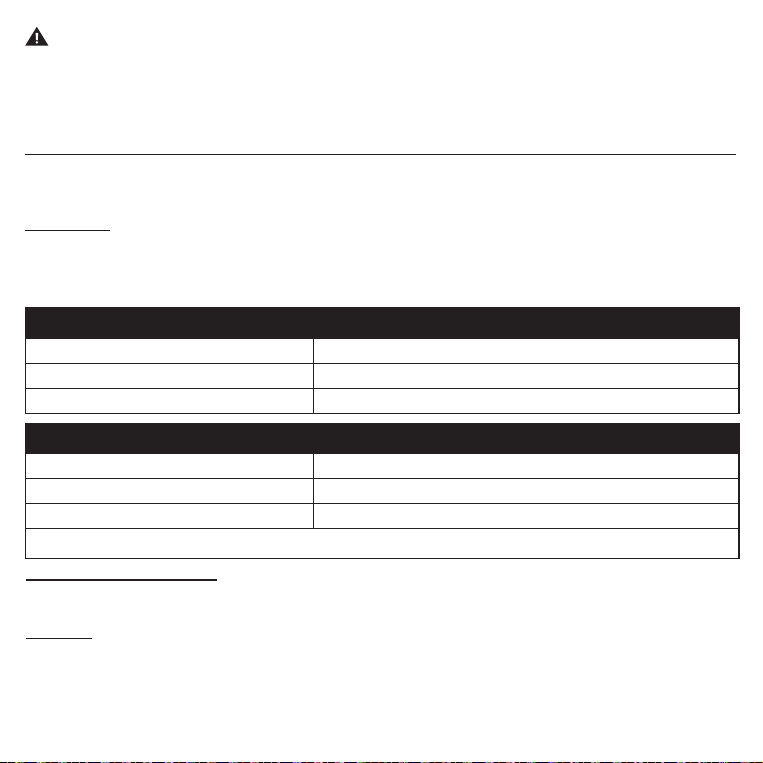
WARNING: Due to the loudness of the alarm, always stand about 2.5 ft (0.8 m) away from the unit
or use ear protection when testing.
No Chirps At Night (if applicable)
Certain models will sample the ambient light conditions of the alarm’s location and, if possible,
determine a Night / Day cycle (see list of models on page 2). A valid Night / Day cycle will delay unit
chirps during the night until the next Day cycle begins.
Chirping
When End of Unit Life or Low Battery chirping begins, you can temporarily silence these chirps by
pressing the Test/Hush button. Other fault /error chirps cannot be silenced. Take appropriate action as
described in the Troubleshooting Guide.
WARNING: REPLACE UNIT AS SOON AS POSSIBLE WHEN IN END OF UNIT LIFE (or IF A 1O YR
SEALED BATTERY MODEL GIVES LOW BATTERY NOTIFICATION). SEVEN (7) DAYS AFTER END OF UNIT
LIFE BEGINS (or 10 YR SEALED MODEL GIVES LOW BATTERY NOTIFICATION), THE NOTIFICATIONS
CANNOT BE SILENCED, AND CO OR CO/GAS DETECTION CANNOT BE GUARANTEED. REPLACE
IMMEDIATELY!
NUISANCE ALARMS
HUSH
TM
/ RESET:
Pushing the Test/Hush button during CO alarm allows the unit to reset calculations and double check for
the presence of CO. If the unit re-alarms within 6 minutes, it is sensing high levels of CO which can quickly
become a dangerous situation. Exit to fresh air and call 911.
WARNING: ALTHOUGH THE HUSH/RESET FEATURE CAN BE USED FOR CO ALARM EVENTS,
IT IS IMPOSSIBLE TO DETERMINE THE SOURCE OF A CO ALARM USING SIGHT OR SMELL. ALWAYS
CONSIDER A CO ALARM EVENT AS DANGEROUS.
20
10. Battery Information
AA Replaceable Battery Models:
These models contain two replaceable AA backup batteries. Under normal conditions, fresh batteries
will last at least one year. NOTE: Constant exposure to high or low humidity or temperatures may
reduce battery life.
WARNING: THE ALARM IS SEALED AND THE COVER IS NOT REMOVABLE.
NOTE: Display models will give two early notifications of battery status to help plan for timely battery
replacement.
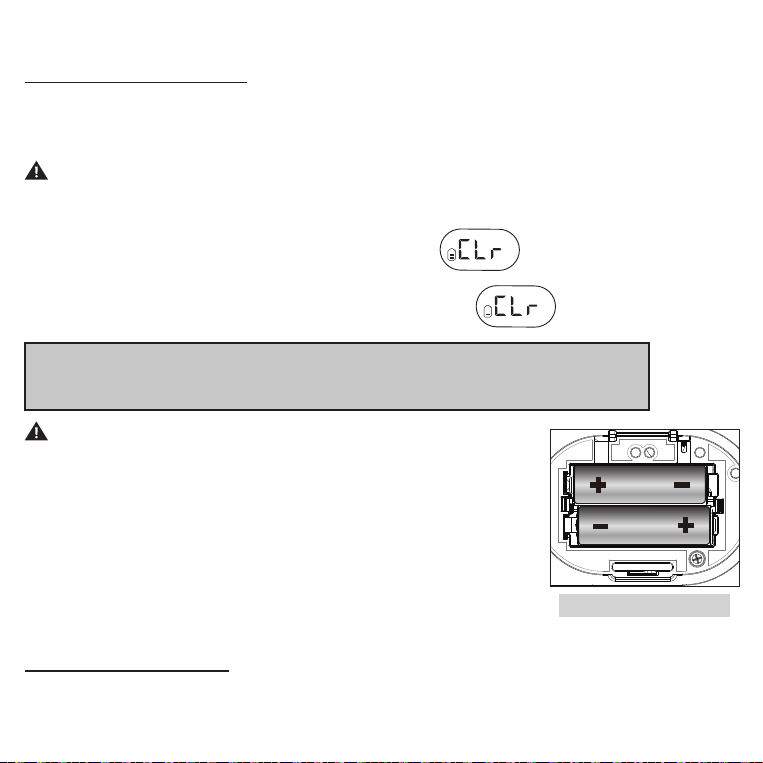
1. When the batteries are at approximately half capacity:
2. When the batteries are approaching low battery condition:
Replace batteries with one of the following approved brands,
taking note of the battery polarity shown in Figure 10: Energizer E91, Gold Peak 15A,
or Golden Power GLR6A. These batteries can be purchased at your local retailer.
WARNING: Use only the batteries specified. Use of different
batteries may have a detrimental effect on the alarm. Do not mix old and
new batteries. Do not mix alkaline, standard, or rechargeable batteries.
batteries.
NOTE: If either battery is missing (AA battery models), the battery door
cannot close.
NOTE: Do not use lithium batteries in this unit. A good safety measure
is to replace the batteries at least once a year, or at the same time you
change your clocks for daylight saving time. A missing or improperly
installed battery will render the unit inoperable.
10 yr Sealed Battery Models:
These models contain a sealed lithium battery backup system. No battery installation or
Figure 10

21
replacement is necessary for the life of the alarm.
NOTE: Constant exposure to high or low humidity or temperatures may reduce battery life.
WARNING: NO SERVICEABLE PARTS INCLUDED. DO NOT ATTEMPT TO OPEN THE ALARM
FOR ANY REASON! DO NOT TRY TO REPAIR THE ALARM YOURSELF.
CAUTION: THE BATTERY USED IN THIS DEVICE MAY PRESENT A FIRE OR CHEMICAL
BURN HAZARD IF MISTREATED. DO NOT RECHARGE, DISASSEMBLE, HEAT ABOVE 100°C
(212°F) OR DISPOSE OF IN FIRE.
WARNING:
Failure to plug in this device into a non-switched 120V outlet and properly install
batteries in the correct orientation, or activate the 10 yr battery backup, will prevent proper operation
of this alarm and will prevent its response to CO or CO/gas hazards.
LOW BATTERY
These alarms are equipped with a low battery monitor circuit. If the battery capacity is nearing the
point where it can no longer provide adequate power for all alarm functions, the low battery condition
will occur. See Troubleshooting Guide. The batteries must be replaced (replaceable battery models)
or the unit must be replaced (10 year sealed battery models) within 7 days of the first occurrence of
the “Low Battery Warning” to provide continuous alarm detection.
22
11. Permanently Disable Alarm / Discharge Battery
(10 yr sealed battery models only)
WARNING: FAILURE TO DISCHARGE ALARM BATTERY AS INSTRUCTED PRIOR TO
DISPOSAL MAY CREATE POTENTIAL FOR LITHIUM BATTERY RELATED FIRE OR HAZARD.
WARNING: DISCHARGING THE ALARM BATTERY IS PERMANENT.
• Once the alarm battery has been discharged, it cannot be reactivated!
• Once discharged, the alarm will NO LONGER DETECT CO.
• Once the alarm battery is discharged, the battery is depleted and the alarm will no longer function.
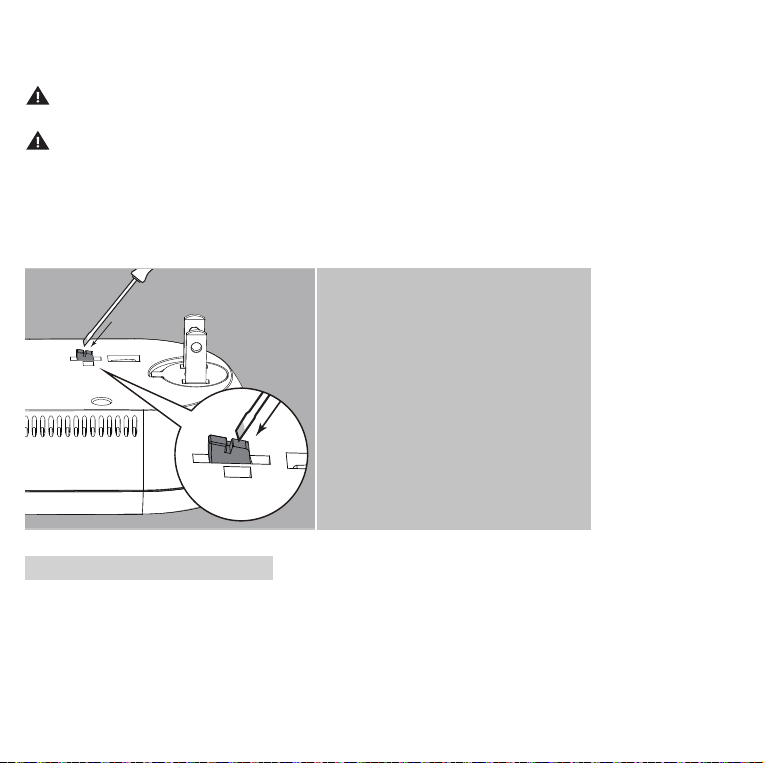
To Permanently Disable
Alarm / Discharge Battery:
• Press the discharge
switch until it clicks into
the discharge position.
Figure 11

23
12.
General Carbon Monoxide (CO) and Explosive Gas Information
Carbon monoxide (CO) is a colorless, odorless, and tasteless poison gas that can be fatal when
inhaled. CO inhibits the blood’s capacity to carry oxygen.
Possible Sources of CO
Inside your home, appliances used for heating and cooking are the most likely sources of CO. Vehicles
and other combustion engines running in an attached garage and using a charcoal/gas grill or hibachi
in an enclosed area are all possible sources of CO. Generators running in enclosed areas, such as
garages or living spaces, will create CO. CO can be produced when burning any fossil fuel: gasoline,
diesel, propane, natural gas, oil and wood. It can be produced by any fuel-burning appliance that
is malfunctioning, improperly installed, or not ventilated correctly, such as: Furnaces/boilers, gas
ranges/stoves, gas clothes dryers, water heaters, portable fuel burning space heaters, fireplaces,
wood-burning stoves and certain swimming pool heaters. Blocked chimneys or flues, back drafting
and changes in air pressure, corroded or disconnected vent pipes, or a loose or cracked furnace heat
exchanger can also release CO into your building.
The following conditions can result in transient CO situations:
Excessive spillage or reverse venting of fuel-burning appliances caused by outdoor ambient
conditions such as: Wind direction and/or velocity, including high gusts of wind, heavy air in the
vent pipes (cold/humid air with extended periods between cycles), negative pressure differential
resulting from the use of exhaust fans, simultaneous operation of several fuel-burning appliances
competing for limited internal air, vent pipe connections vibrating loose from clothes dryers, furnaces/
boilers, or water heaters, obstructions in, or unconventional, vent pipe designs which can amplify the
above situations, extended operation of unvented fuel-burning devices (range, oven, fireplace, etc.),
temperature inversions which can trap exhaust gases near the ground, car idling in an open or closed
attached garage, or near a home.
Carbon Monoxide PPM Levels
Display models are equipped with a digital display that shows levels of CO (displayed in PPM – parts
per million). Learn the difference between dangerous, high, mid and low levels.

24
Dangerous Levels:
When someone is experiencing symptoms of CO poisoning and CO readings are
generally above 100 PPM. Anytime someone is experiencing the symptoms of CO
poisoning this should be treated as an emergency. See “Section 1.”
High Levels:
Generally above 100 PPM, with no one experiencing symptoms. This should be treated
as an urgent situation. See “Section 1.”
Mid Levels:
Generally between 50 PPM to 100 PPM. This should be cause for concern and should not
be ignored or dismissed. See “Section 1.”
Low Levels:
Generally between 31 and 50 PPM. Kidde recommends you take action to eliminate the
source of CO and consult with your healthcare provider to determine the impact of long
term exposure to these concentrations on your health. See “Section 1.”
CO Safety Tips
Every year, have the heating system, vents, chimney and flue inspected and cleaned by a qualified
technician. Always install appliances according to manufacturer’s instructions and adhere to
local building codes. Most appliances should be installed by professionals and inspected after
installation. Regularly examine vents and chimneys for improper connections, visible rust, or
stains, and check for cracks in furnace heat exchangers. Verify that the color of flame is blue on
pilot lights and burners. An amber or orange flame is a sign that the fuel is not burning completely
and may be releasing CO. Teach all household members what the alarm sounds like and how
to respond. Fire Departments, most utility companies and HVAC contractors will perform CO
inspections. Some contractors may charge for this service. It’s advisable to inquire about any
applicable fees prior to having the service performed. Kidde will not pay for, or reimburse the
owner or user of this product, for any repair or dispatch calls related to the alarm sounding.
Symptoms of CO Poisoning
Initial carbon monoxide poisoning symptoms are similar to the flu with no fever and can include
dizziness, severe headaches, nausea, vomiting and disorientation. Everyone is susceptible but experts
agree that unborn babies, pregnant women, senior citizens and people with heart or respiratory
problems are especially vulnerable. If symptoms of carbon monoxide poisoning are experienced seek

25
medical attention immediately. CO poisoning can be determined by a carboxyhemoglobin test.
The following symptoms are related to CARBON MONOXIDE POISONING and should be
discussed with ALL members of the household:
1. MILD EXPOSURE: Slight headache, nausea, vomiting, fatigue (often described as “Flu-like”
symptoms).
2. MEDIUM EXPOSURE: Severe throbbing headache, drowsiness, confusion, fast heart rate.
3. EXTREME EXPOSURE: Unconsciousness, convulsions, cardio respiratory failure and death.
The above levels of exposure relate to healthy adults. Levels differ for those at high risk. Exposure
to high levels of carbon monoxide can be fatal or cause permanent damage and disabilities. Many
cases of reported carbon monoxide poisoning indicate that while victims are aware they are not
feeling well, they become so disoriented they are unable to save themselves by either exiting the
building, or calling for assistance. Also, young children and household pets may be the first affected.
Familiarization with the effects of each level is important.
Explosive Gas:
Natural Gas is typically supplied through a main utility line connected to your home. If you do not live
in a rural area you are likely to be a user of natural gas. Natural gas is much lighter than air and will
rise rapidly. If you are a user of natural gas, mount your CO/gas alarm no closer than 6 inches from the
ceiling to ensure the earliest opportunity to detect a leak.
Propane is typically supplied to homes via delivery truck in liquid form and stored near the home in
propane tanks. Propane and LP-gas (liquefied petroleum) are often used synonymously. Propane is
much heavier than air and will collect at lower levels. If you are a user of propane, mount your CO/gas
alarm near the floor to ensure the earliest opportunity to detect a leak.
Both propane and natural gas are colorless and odorless. For safety reasons, an odorant (Mercaptan)
is added so that any leak can be detected by smell. The common detection threshold for smelling
the gases is around 20% of the lower explosion limit (LEL). This can vary greatly depending on the
individuals’ sense of smell and how long they have been exposed to either gas. The LEL of each of
these gases defines the bottom range of flammability for the gas. Your CO/gas alarm is calibrated to
alarm before 10% of the LEL of either gas detected. Therefore, it is possible that you may smell gas
before the alarm activates.

26
13. Cleaning Your Alarm
Your Alarm Should be Cleaned at Least Once a Year
You can clean the interior of your alarm by using compressed air or a vacuum cleaner hose and
blowing or vacuuming through the openings around the perimeter of the alarm. The outside of the
alarm can be wiped with a clean, dry cloth. Do not use water, detergents or cleaners as they may
damage the alarm.
• Never use detergent or other solvents to clean the unit.
• Avoid spraying air freshener, hair spray, or other aerosols near the alarm.
• Do not use a hair dryer to clean the alarm, as it may damage the alarm and impact performance.
• Do not paint the unit. Paint will seal the vents and interfere with the sensor’s ability to detect CO or
CO/gas.
• Never attempt to disassemble the unit to clean inside. This action will void your warranty.
The following substances can affect the CO sensor and may cause false readings and damage to the
sensor: Methane, propane, isobutane, iso-propanol, ethyl acetate, hydrogen sulfide, sulfide dioxides,
alcohol based products, paints, thinner, solvents, adhesives, hair spray, aftershave, perfume, and some
cleaning agents. Move the alarm and place in another location prior to performing any of the following
in the near vicinity of the alarm:
Staining or stripping wood floors or furniture
Painting
Wall papering
Using adhesives
In addition, for models with gas detection:
1. Avoid Exposure to Silicone Vapors
Prolonged exposure to silicone vapors can irreversibly affect sensor performance. If silicone com-
pounds adsorb onto the sensor surface, they may form a coating that permanently reduces sensitivity.
To prevent this, avoid using the sensor in environments where silicone-based adhesives, hair care
products, or silicone rubber/putty are present.
2. Prevent Water Contact and Condensation
Extended contact with water or water condensation on the sensor surface may cause performance
drift or degradation. Ensure the sensor is not exposed to high humidity or environments where con-
densation may occur, especially during storage or operation.
Storing the unit in a plastic bag during any of the above projects will protect the sensors from damage.
When household cleaning supplies or similar contaminates are used, the area must be well ventilated.
WARNING: REINSTALL THE ALARM AS SOON AS POSSIBLE TO ENSURE CONTINUOUS
DETECTION.

27
14. Service And Warranty
Ten-Year (CO) or Seven-Year (CO/gas) Limited Warranty
Kidde warrants that the enclosed alarm (but not the AA replaceable batteries on AA battery models)
will be free from defects in material and workmanship or design under normal use and service for
a period of ten years (CO alarms), or seven years (CO/gas alarm) from the date of purchase. The
obligation of Kidde under this warranty is limited to repairing or replacing the alarm or any part which
we find to be defective in material, workmanship or design (part replacement only, no installation),
free of charge, upon receiving the alarm with proof of date of purchase, postage and return postage
prepaid, to Warranty Service Department, Kidde, 1016 Corporate Park Drive, Mebane, NC 27302.
Before shipping the product, please remove the batteries from the battery compartment, or follow the
steps in Permanently Disable Alarm / Discharge Battery section, depending your model type.
This warranty shall not apply to the alarm if it has been damaged, modified, abused or altered after the
date of purchase or if it fails to operate due to improper maintenance or inadequate power. Any implied
warranties arising out of this sale, including but not limited to the implied warranties of description,
merchantability and fitness for a particular purpose, are limited in duration to the above warranty period.
In no event shall the Manufacturer be liable for loss of use of this product or for any indirect, special,
incidental or consequential damages, or costs, or expenses incurred by the consumer or any other user
of this product, whether due to a breach of contract, negligence, strict liability in tort or otherwise.
The above warranty may not be altered except in writing signed by both parties hereto. Your Kidde
Alarm is not a substitute for property, fire, disability, life or other insurance of any kind. Appropriate
insurance coverage is your responsibility. Consult your insurance agent. Opening the unit will void the
warranty. If there are any differences between this printed warranty and the online limited warranty,
then the terms of the online warranty supersede those in this user guide or other printed materials.
Visit www.kidde.com for the latest warranty statement.

QUESTIONS OR FOR MORE INFORMATION
Call Kidde Product Support line at 1-800-880-6788
or contact us at www.kidde.com
Kidde
1016 Corporate Park Drive, Mebane, NC 27302
©2025 Kidde. All Rights Reserved.
Products conform to UL 2034. Model COPDLG also conforms to UL 1484.