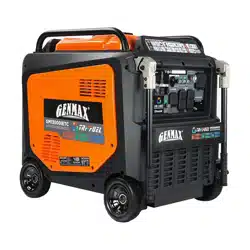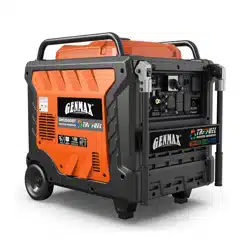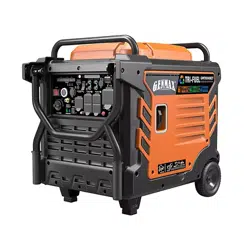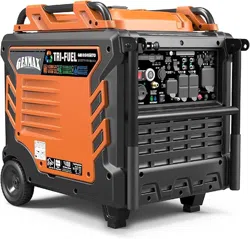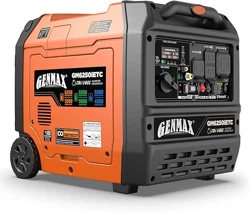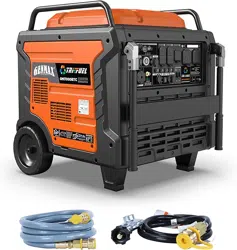
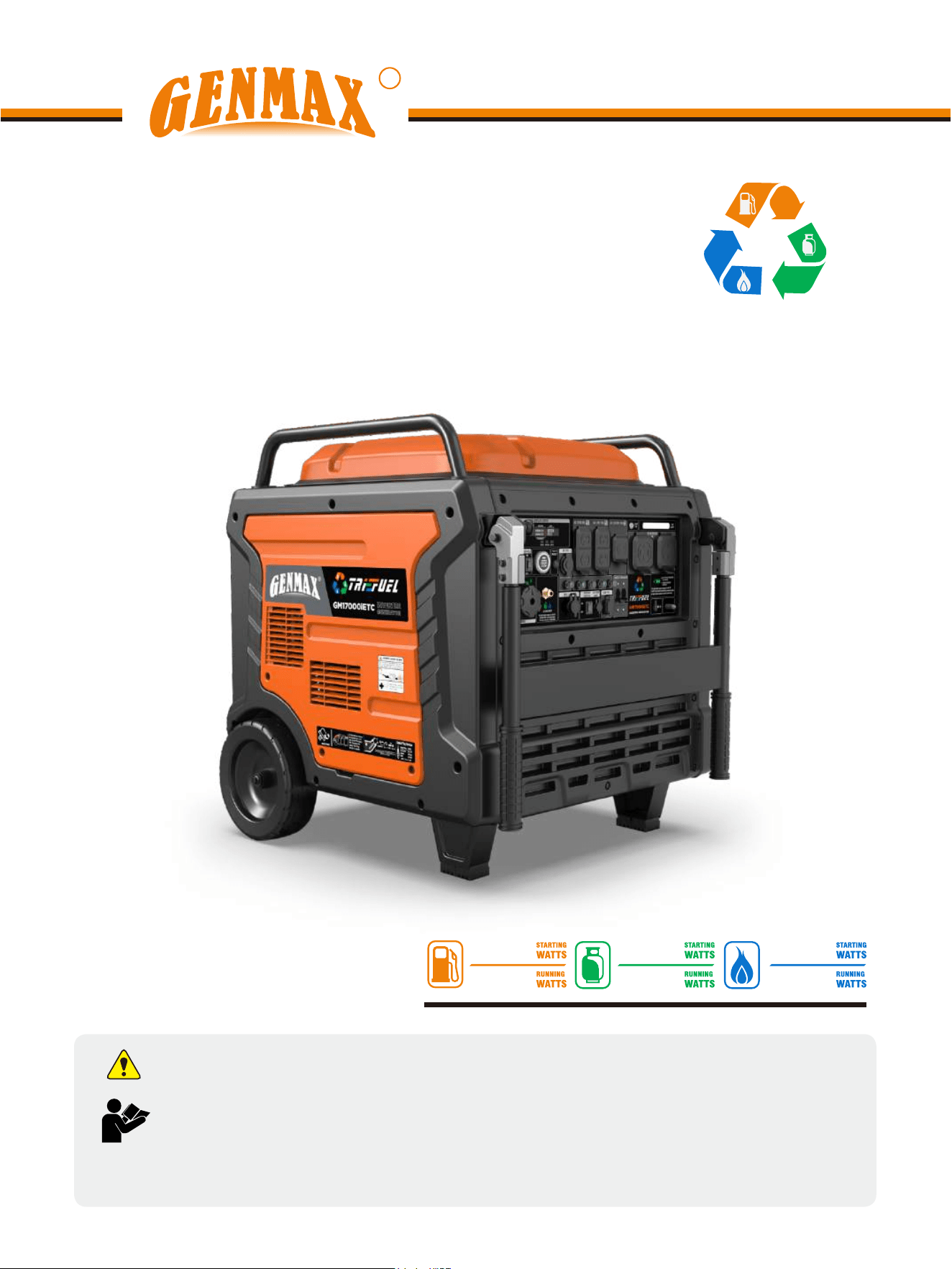
INVERTER GENERATOR
USER'S MANUAL
R
GENMAX GENERATOR
This manual contains important information regarding safety. Operation,
maintenance and storage of this product. Before use, read carefully and
understand all cautions, warnings, instructions and product labels. Failure to do
so could result in serious personal injury and/or property damage.
WARNING: SAVE THIS MANUAL FOR FUTURE REFERENCE
GM17000iETC
GASOLINE INVERTER GENERATOR
TRI-FUEL
17000
13500
15000
12500
13500
10800
1
UNPACKING
Always have assistance when lifting
the generator. The generator is heavy;
lifting it could cause bodily harm.
Avoid cutting on or near staples to
prevent personal injury.
Tools required - box cutter or similar device.
1. Carefully cut the packing tape on top of the carton.
2. Remove socket wrench, and oil funnel and save for
later.
3. Carefully cut two sides of the carton to remove the
generator.
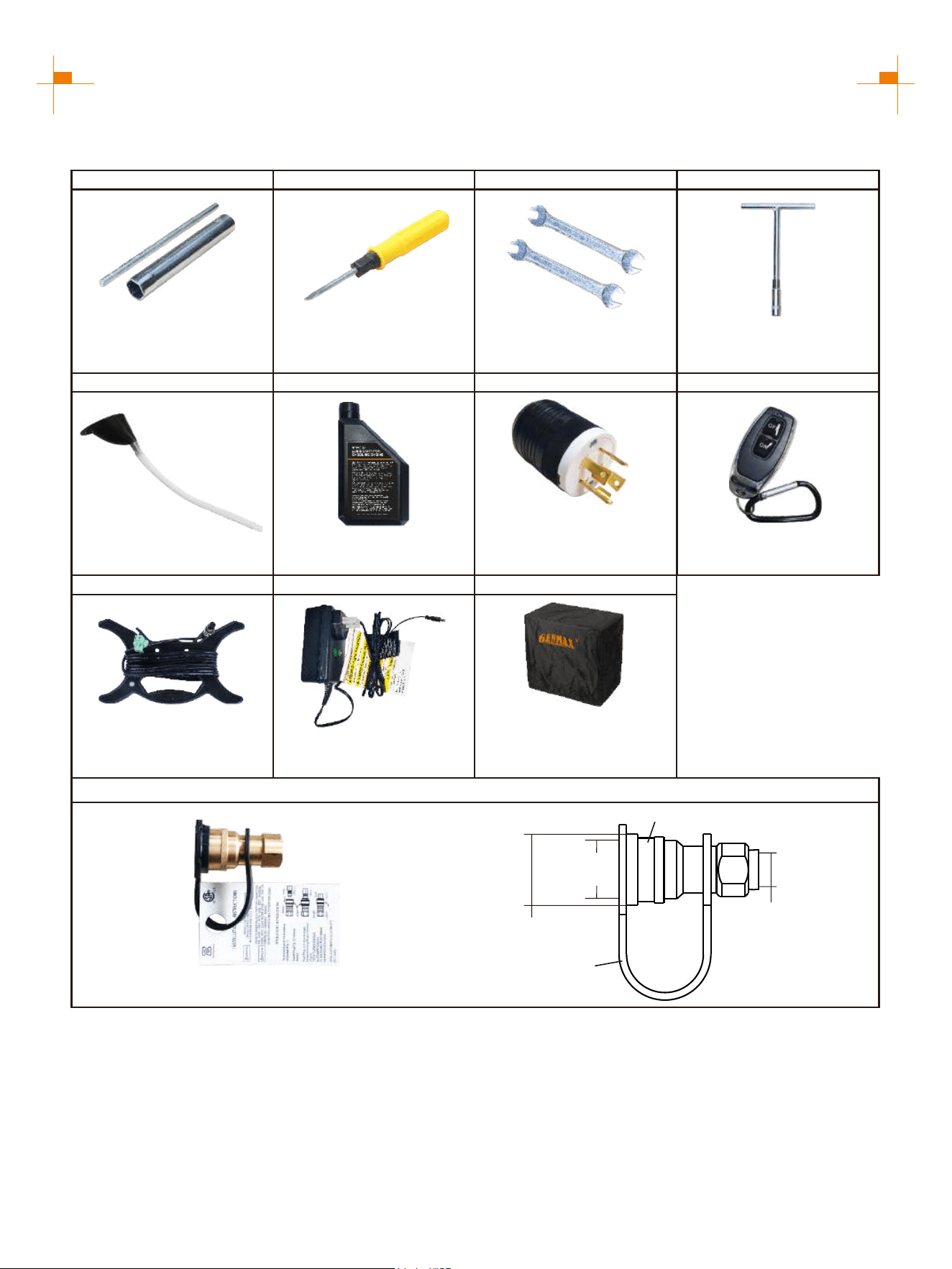
WHAT COMES IN THE BOX
Spark Plug Socket Wrench (1)
Dual-Purpose Screwdriver (1)
Remote Control Key (1)
Funnel (1)
Engine Oil (1)
NEMA L14-30P Bonding Plug (1)
Battery Charger (1)
Automatic Start/Stop Cable (1)
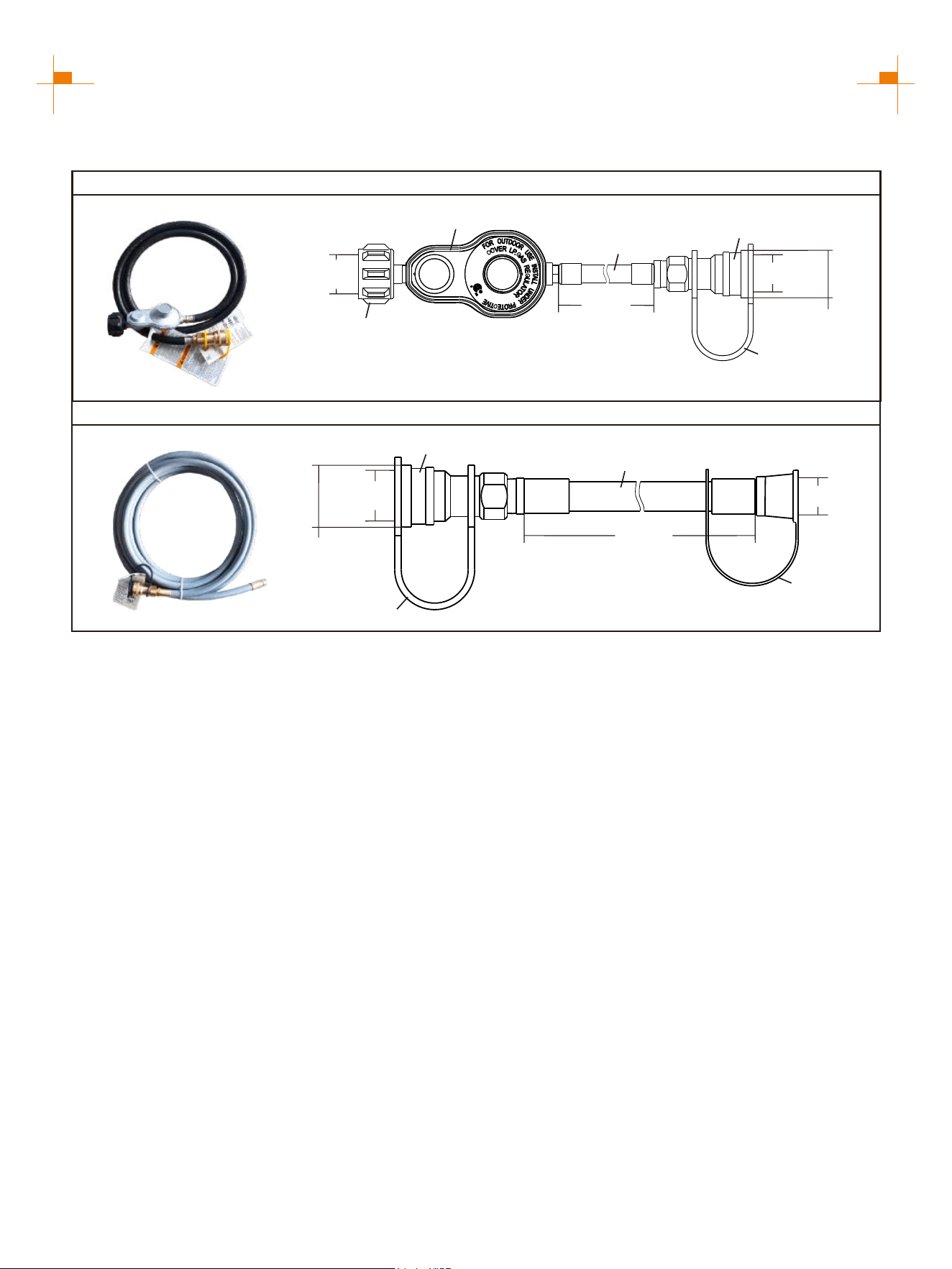
LPG Hose (1)
NG Hose (1)
NG Quick Connector (1)
8/10mm Wrench (1)
12/14mm Wrench (1)
T-type Wrench (1)
Rain Cover (1)
DISCLAIMERS:
All information, illustrations and specifications in this manual are based on the latest information available at the
time of publishing. The illustrations used in this manual are intended as representative reference views only.
Moreover, because of our continuous product improvement policy, we may modify information, illustrations and/or
specifications to explain and/or exemplify a product, service or maintenance improvement. We reserve the right to
make any change at any time without notice. Some images may vary depending upon which model is shown.
ALL RIGHTS RESERVED:
No part of this publication may be reproduced or used in any form by any means - graphic, electronic or
mechanical, including photocopying, recording, taping or information storage and retrieval systems - without the
written permission of CHONGQING DINKING POWER MACHINERY CO., LTD
This manual contains important instructions for operating this inverter generator. For your
safety and the safety of others, be sure to read this manual thoroughly before operating the
generator. Failure to properly follow all instructions and precautions can cause you and others
to be seriously hurt or killed.
2
DESCRIPTION OF FITTINGS
Spark Plug Socket Wrench
Used in spark plug maintenance,
inspection, and installation.
Phillips and slot blade
screwdriver used for generator
maintenance.
Dual-Purpose Screwdriver
It's used to oil the generator.
Engine Oil
Be sure to add oil before starting
the generator.
Note: Actual tools may differ in appearance or design from image shown.
NEMA L14-30P Bonding Plug
Insert the Bonding Plug into the
output socket of the generator to
change the neutral floating to
neutral bonded status.
Remote Control Key
Used to remotely start and stop
the generator.
Automatic Start/Stop Cable
Used to connect automatic
start/stop equipment.
(8/10mm)(12/14mm)Wrench
Assorted wrenches used in
generator maintenance and
assembly.
Rain Cover
Give the generator better
protection, water resistance,
scratch resistance.
T-type Wrench
Assorted wrenches used in
generator maintenance and
assembly.
Funnel
Battery Charger
Used to charge the battery when
in storage.
NG Quick Connector
Protective Cover
∅20.2
Inside Diameter
∅35
Outside Diameter
Quick Plug Joint
NPT 1/2
Inside Diameter
Used to change a natural gas pipeline interface.
3
DESCRIPTION OF FITTINGS
LPG Hose
1500 mm
Hose length
1.312"-5ACME
Inside Diameter
∅20.2
Inside Diameter
∅35
Outside Diameter
Quick Plug Joint
LPG Hose
Pressure 1psi
First Stage Reducing Valve
Gas Cylinder Joint
Protective Cover
Connect the LPG tank to transmit LPG fuel to the
generator.
NG Hose
4500 mm
Hose length
Protective Cover
Protective Cover
NG Hose
Pressure 0.5psi
∅19
Inside Diameter
∅20.2
Inside Diameter
∅35
Outside Diameter
Quick Plug Joint
Connect the natural gas
pipeline to transmit NG fuel to
the generator.
Note: Actual tools may differ in appearance or design from image shown.
4
LIMITED WARRANTY
1. DURATION : Three (3) year from the date of purchase by the original purchaser ( retail customer ).
2. WHO GIVES THIS WARRANTY (WARRANTOR):
CHONGQING DINKING POWER MACHINERY CO., LTD
3. WHO RECEIVES THIS WARRANTY(PURCHASER):The original purchaser (other than for purposes of resale) of
the Genmax's inverter.
4. WHAT PRODUCTS ARE COVERED BY THIS WARRANTY: Any portable generator supplied or manufactured by
Warrantor.
5. WHAT IS COVERED UNDER THIS WARRANTY: Substantial defects on material and workmanship which occur
within the duration of the warranty period.
6. WHAT IS NOT COVERED UNDER THIS WARRANTY:
A. Transportation changes for sending the product to Warrantor or its authorized service representative for warranty
service, or for shipping repaired or replacement products back to the customer; these charges must be borne by the
customer.
B. Damages caused by abuse, accident, shipping, misuse, overloading, modification, and the effects of corrosion,
erosion and normal wear and tear.
C. Warranty is voided if the customer fails to install, maintain and operate the product in accordance with the
instructions and recommendations set forth in the owner's manual(s), or if the product is used as rental equipment.
D. Pre-delivery service, i.e. assembly, oil or lubricants, and adjustment.
E. Items or service that are normally required to maintain the product, i.e. lubricants and filters.
F. Warrantor will not pay for repairs or adjustments to the product, or for any costs or labour, performed without
Warrantor's prior authorization.
EXCLUSIONS AND LIMITATIONS : Warrantor makes no other warranty of any kind, express or implied. Implied
warranties, including warranties of merchantability and of fitness for a particular purpose, are hereby disclaimed. This
warranty service described above is the exclusive remedy under this warranty; liability for incidental and consequential
damages is excluded to the extent permitted by law.
7. RESPONSIBILITIES OF PURCHASER UNDER THIS WARRANTY:
A. The purchaser must provide dated proof of purchase and must notify Warrantor within the warranty period.
B. Deliver or ship the serviced generator or component to the nearest Warrantor's authorized service representative.
Freight costs, if any, must be borne by the purchaser.
8. HAVE QUESTIONS?
Email: service@genmaxpower.com Phone: 866-960-2920
Model Number: _____________________________________
Name: ___________________________________________
Serial Number: ______________________________________
Street Address: ___________________________________
Date Purchased: ____________________________________
Purchased From: ____________________________________
City, State, ZIP: ____________________________________
Country: __________________________________________
Phone Number: ___________________________________
E-Mail: ___________________________________________
WARRANTY CARD
R

5
TABLE OF CONTENTS
LIMITED WARRANTY
SAFETY
NAMES OF COMPONENTS
CONTROL FUNCTIONS
PREPARATIONS
Adding Engine Oil........................................................................................................................14
Adding Gasoline..........................................................................................................................14
Connecting the Battery.................................................................................................15
OPERATION
USING THE GENERATOR
Service Environment of the Generator.......................................................................................21
Generator Wiring........................................................................................................................21
Generator Grounding.................................................................................................................22
Changing the Neutral Point........................................................................................................23
Battery Charging........................................................................................................................23
Connecting Automatic Start/Stop Devices...................................................................................24
SERVICE AND MAINTENANCE
Checking and Filling Fuel...........................................................................................................26
Cleaning the generator.................................................................................................26
Spark Plug Inspection..................................................................................................................26
Engine Oil Change......................................................................................................................27
Cleaning/Replacing the air filter...................................................................................................28
Clean the Fuel Filter...................................................................................................................29
STORAGE AND TRANSPORT
Generator Storage.....................................................................................................................30
Generator Transport..................................................................................................................30
Preparation for Use After Storage..............................................................................................30
TROUBLESHOOTING
TECHNICAL PARAMETERS
Generator Location.....................................................................................................................16
Starting the Generator................................................................................................................16
Shutting Down the Generator.............................................................................................19
CHOOSING A GENERATOR
3
5
10
11
14
16
21
25
30
31
33
34
6
SAFETY
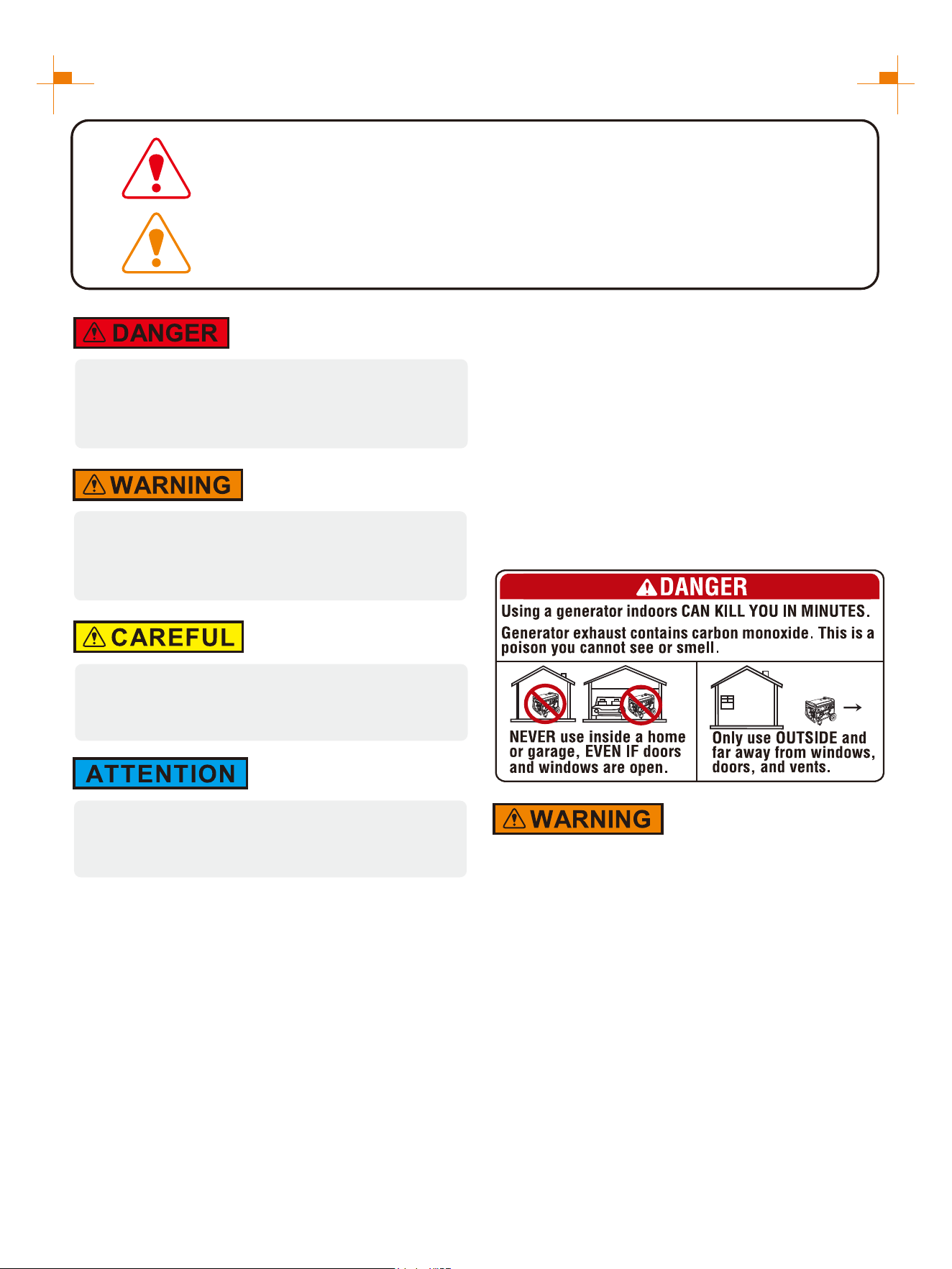
Personal and property safeties of you and others are very vital. Please read the Safety
Warning in the User's Manual and the decals of the generator set carefully.The Safety
Warning can alert you to those potential hazards that could harm you and others. In front
of each Safety Warning, there is one of four words "DANGER" "WARNING",
"ATTENTION", and "CAREFUL". Details are as follows:
Failure to follow the instruction will result in being
in peril of your life or extremely serious injury.
Indicates a hazardous situation which, if not
avoided, could result in death or serious injury.
Failure to follow the instruction will result in minor
injury.
Failure to follow the instruction will result in the
damage to your generator set and other properties.
For portable generators where the neutral is floating,
the operator's manual shall include the following
wording or equivalent:
The portable generator stator winding is isolated from
the frame and from the AC receptacle ground pin; and
Electrical devices that require a connection between
one conductor pin and the grounded receptacle pin
may not function properly.
NEUTRAL FLOATING
CO DETECT technology monitors the accumulation of
carbon monoxide (CO), a poisonous gas produced by
engine exhaust when the generator is running. If CO
Sensor detects unsafe elevated levels of CO gas, it
automatically shuts off the engine. CO Sensor is not
a substitute for an indoor carbon monoxide alarm or
for safe operation. DO NOT allow engine exhaust
fumes to enter a confined area through windows,
doors, vents or other openings. Generators must
ALWAYS be used outdoors, far away from occupied
buildings with engine exhaust pointed away from
people and buildings. Meets the requirements of
ANSI/PGMA G300-2023.
CO TECHNICAL WARNING
SAFETY PRECAUTIONS
Engine exhaust contains carbon monoxide, a
poisonous gas that could kill you in minutes. You
CANNOT smell it, see it, or taste it. Even if you do not
smell exhaust fumes, you could still be exposed to
carbon monoxide gas.
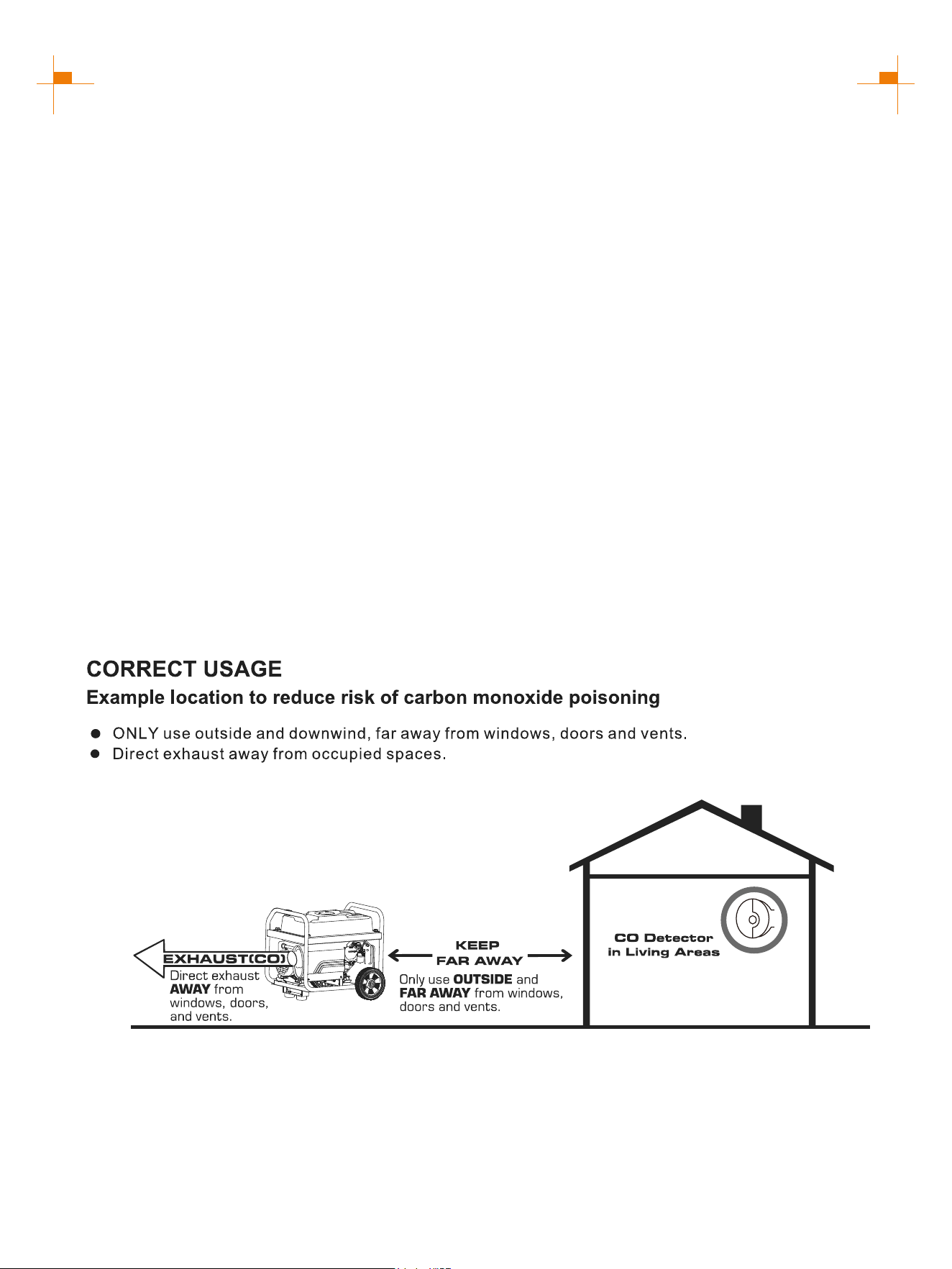
● Operate this product ONLY outside far away from
windows, doors and vents to reduce the risk of
carbon monoxide gas from accumulating and
potentially being drawn towards occupied spaces.
● Install battery-operated carbon monoxide alarms or
plug-in carbon monoxide alarms with battery back-up
according to the manufacturer's instructions. Smoke
alarms cannot detect carbon monoxide gas.
POISONOUS GAS HAZARD
7
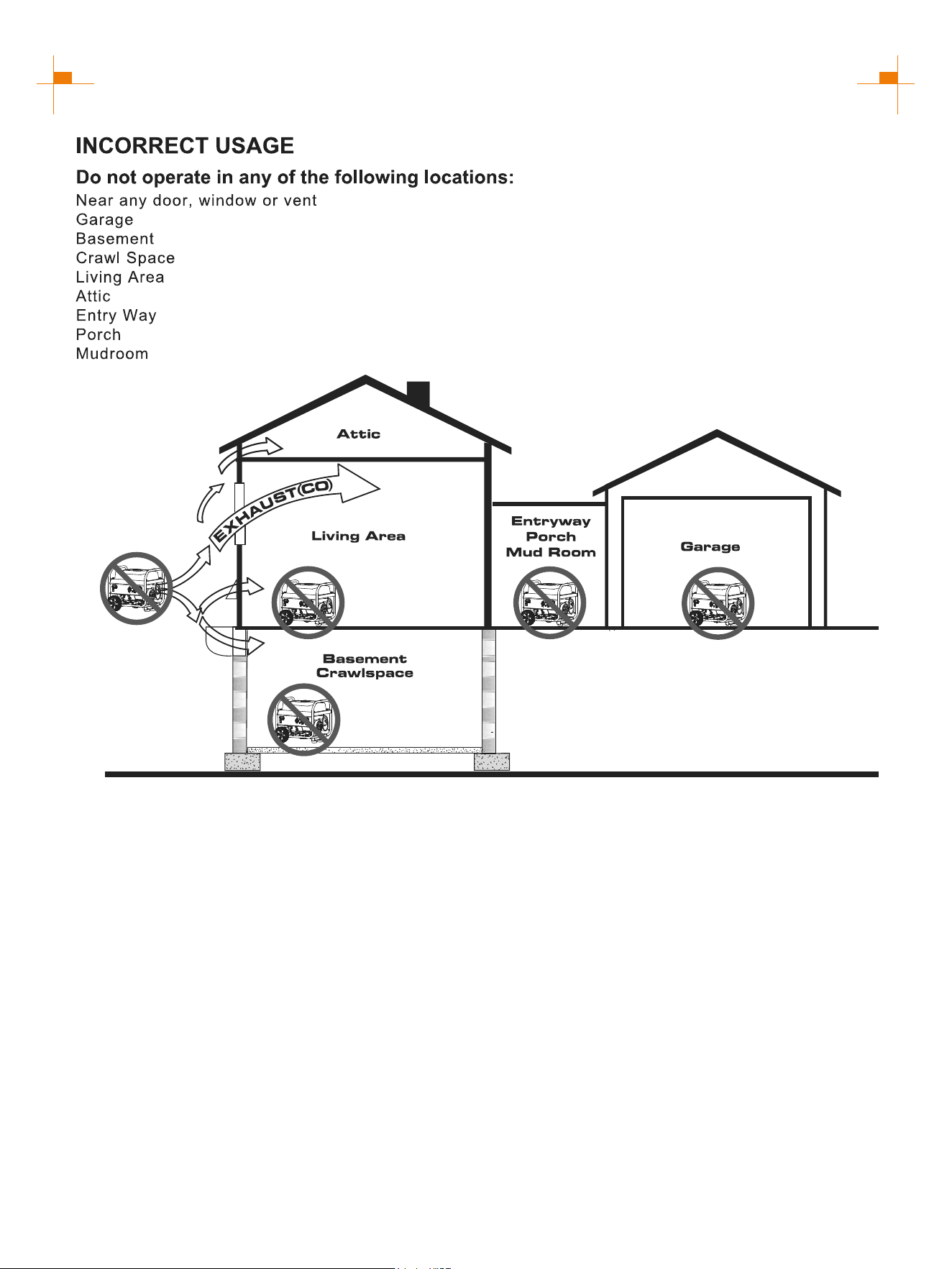
● DO NOT run this product inside homes, garages,
basements, crawlspaces, sheds, or other partially-
enclosed spaces even if using fans or opening doors
and windows for ventilation. Carbon monoxide can
quickly build up in these spaces and can linger for
hours, even after this product has shut off.
● ALWAYS place this product downwind and point the
engine exhaust away from occupied spaces. If you
start to feel sick, dizzy, or weak while using this
product, shut it off and get to fresh air RIGHT AWAY.
See a doctor. You may have carbon monoxide
poisoning.
● If you start to feel sick, dizzy or weak while using the
portable generator, you may have carbon monoxide
poisoning. Get out side to fresh air immediately and
emergency medical assistance.. Very high levels of
CO can rapidly cause victims to lose consciousness
before they can rescue themselves. DO NOT
attempt to shut off the generator before moving to
fresh air. Entering an enclosed space where a
generator is or has been running may put you at
greater risk of CO poisoning.
CO Sentry Indicator Lights
Red
Carbon monoxide has accumulated around the
generator. After shut-off, the RED indicator light in
the CO Sentry area of the control panel will flash to
provide notification that the generator was shutoff due
to an accumulating CO hazard. The RED light will
flash for at least five minutes after a CO shut-off.
Move the generator to an open, outdoor area far away
from occupied spaces with exhaust pointed away.
Once relocated to a safe area, the generator can be
restarted. Introduce fresh air and ventilate the area
where the generator had shut down.
Yellow
A CO Sentry system fault occurred. When a system
fault occurs, the generator is automatically shut down
and the YELLOW indicator light in the CO auto-shutoff
area of the control panel will flash to provide
notification that a fault has occurred. The YELLOW
light will flash for at least five minutes after a fault.
The generator can be re-started, but may continue to
shutoff.
SAFETY
8
SAFETY
BEFORE USING THE GENERATOR
● In order to operate the generator correctly, be familiar
with the operation of the various components and
master the method of shutting down the generator
quickly.
● Never use the generator to power medical support
equipment.
● Please never modify the generator.
● Please do not use in rain or in areas with water. There
is a risk of electric shock when using generators and
connected appliances that have been soaked in rain
or water, or when operating with wet hands.
● Please never connect wires from the power company.
It can cause malfunctions in the machine and
connected electrical equipment, becoming the cause
of fire or personal accidents.
● The use of generators has laws and regulations,
please comply with labor safety and health
regulations, fire protection laws, electrical industry
laws, etc.
● Please do not connect parallel operation terminals
except for dedicated wires. There is a risk of electric
shock.
WHEN ADDING OR DRAINING GASOLINE
Turn the generator engine OFF and let it cool for at
least 2 minutes before removing the fuel cap. Loosen
the cap slowly to relieve pressure in the tank.
● Fill or drain fuel tank outdoors.
● DO NOT overfill the tank. Allow space for fuel
expansion.
● If fuel spills, wipe it up and let the area dry before
starting the engine.

9
SAFETY
● Keep fuel away from sparks, open flames, heat, and
other ignition sources.
● Check fuel lines, tank, cap, and fittings frequently for
cracks or leaks; replace if necessary.
● DO NOT light a cigarette or smoke anything.
WHEN STARTING EQUIPMENT
● Ensure spark plug, muffler, fuel cap, and air cleaner
are in place.
● DO NOT crank engine with spark plug removed.
WHEN OPERATING EQUIPMENT
● DO NOT operate this product inside any building,
carport, porch, mobile enclosure, marine
applications, or shed.
● DO NOT tip engine or equipment at an angle that
causes fuel to spill.
● DO NOT stop the engine by moving the choke
control the to "Start" position.
● DO NOT exceed the generator's wattage capacity.
● Start the generator and the let engine stabilize
before connecting electrical loads.
● Connect electrical loads in the OFF position, then
turn ON for operation.
● Turn electrical loads OFF and disconnect from the
generator before stopping the generator.
Improper treatment of the generator could damage it
and shorten its life.
● Use generator only for intended applications.
● If you have questions about intended use, ask a
dealer.
● Operate generator only on solid, level surfaces.
● DO NOT expose the generator to excessive
moisture, dust, dirt, or corrosive vapors.
● DO NOT insert any objects through cooling slots.
● If connected devices overheat, turn them off and
disconnect them from the generator.
PARALLEL KIT PRECAUTIONS
To prevent serious injury, death and damage to
generators and/or equipment due to electric shock
and fire:
● Follow Parallel Kit instructions provided with Kit for
connection and use of a Parallel Kit.
● Only connect two identical Inverter Generators
together using a Parallel Kit.
● Connect Parallel Kit only to terminals marked
"Parallel Outlets" on the front of the Generator.
● Do not remove or connect a Parallel Kit while the
Generator is running.
● Do not use a Parallel Kit that is attached to only one
Generator.
SAFETY PRECAUTIONS FOR GASOLINE
AND GASOLINE VAPOR
● Fire and explosion hazard. Gasoline is highly
explosive and flammable and can cause severe
burns or death.
● Fire and Burn Hazard. NEVER loosen or remove the
fuel cap while the generator is running. Turn the unit
off and allow it to cool for at least five minutes before
adding gasoline. Loosen the fuel cap slowly.
● In case of a gasoline fire, do not attempt to
extinguish the flame unless the engine/fuel control
switch is in the OFF position. Introducing an
extinguisher to a generator with an open fuel valve
could create an explosion hazard.
LIQUID PETROLEUM GAS (LPG/PROPANE)
Fire and explosion hazard. Never use a gas container,
LPG/propane hose, propane cylinder or any other fuel
item that appears to be damaged. If there is a strong
smell of propane while operating the generator, fully
close the propane cylinder valve immediately. Once the
propane is off, use soapy water to check for leaks on
the hose and connections on the tank valve and the
generator. Do not smoke or light a cigarette or check
for leaks using any open flame source such as a match
or lighter. If a leak is found, contact a qualified
technician to inspect and repair the LPG/ propane
system before using the generator.
NATURAL GAS (NG)
Fire and explosion hazard. Never use a natural gas
supply line, natural gas hose, or any other fuel item that
appears to be damaged. If there is a strong smell of
natural gas while operating the generator, close off all
gas sources immediately. Once the natural gas is off,
use soapy water to check for leaks on the hose and
connections on the branch supply and the generator.
Do not smoke or light a cigarette or check for leaks
using any open flame source such as a match or lighter.
If a leak is found, contact a qualified plumber to inspect
and repair the natural gas system before using the
generator.
10
SAFETY
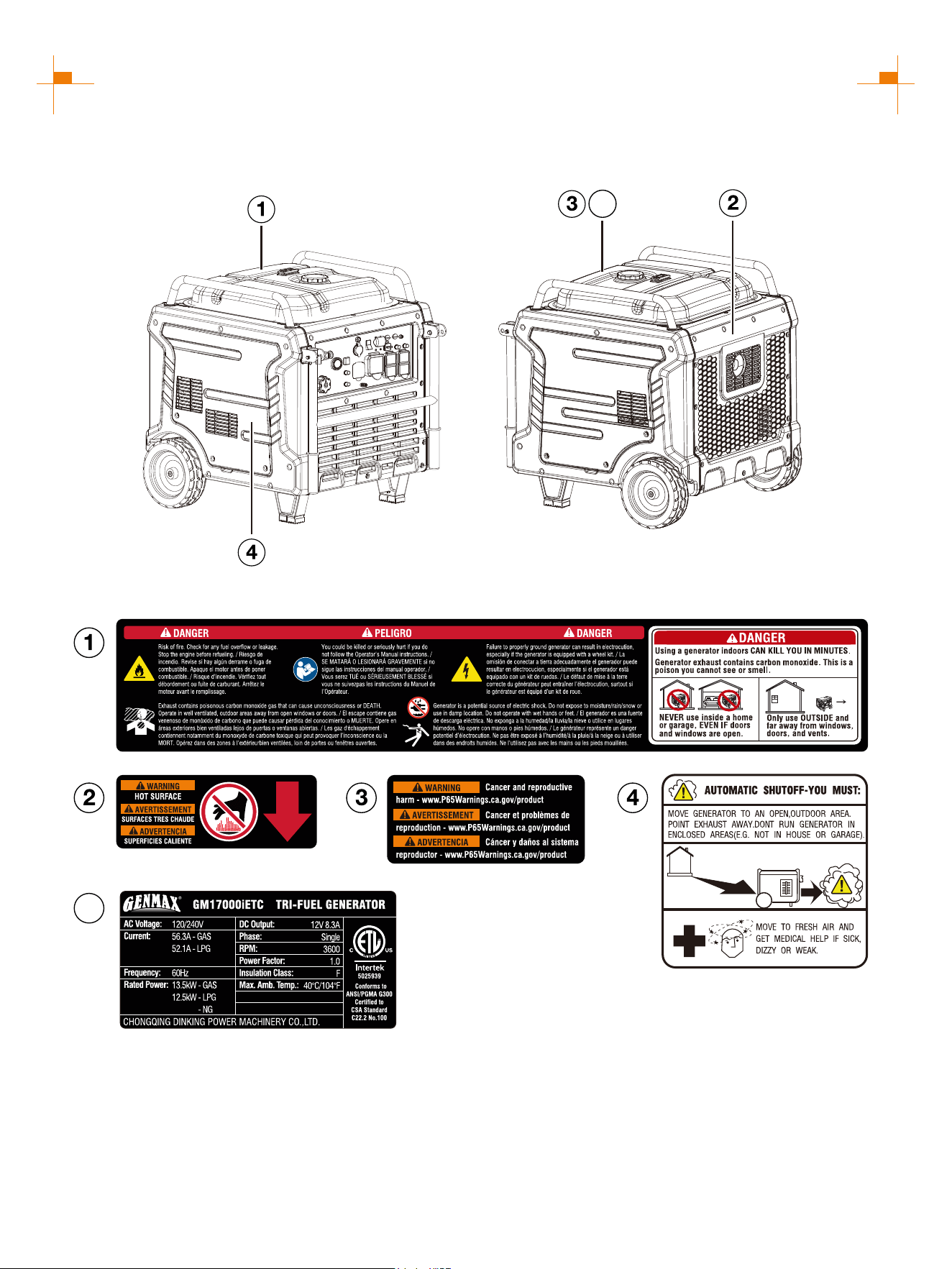
SAFETY LABELS AND DECALS
5
5
10.8kW
45A - NG
11
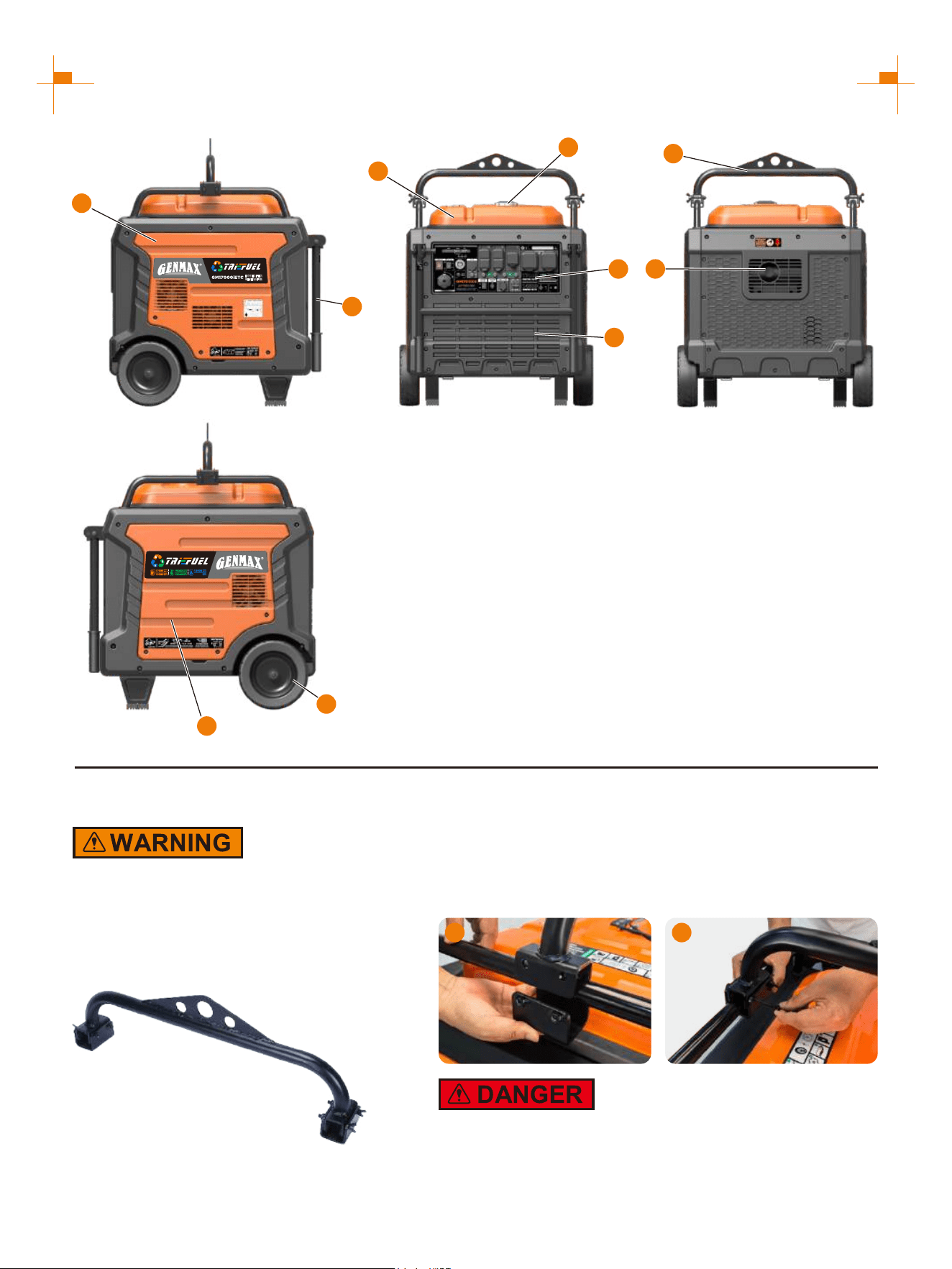
NAMES OF COMPONENTS
① Fuel Tank Cap: Open the fuel tank
cap and fill with proper amount of
gasoline.
② Transport Crossbeam Used for :
transportation and handling.
③ Fuel Tank: Store the added
gasoline.
④ Left Side Cover: Unscrew the bolt,
remove the outer cover, connect the
battery wire, add or change the oil
and replace the spark plug.
⑤ Control Panel: Contains the reset
breaker, outlets and warning lights.
⑥ Engine Cooling Vents: Helps move
airflow in unit to regulate engine
temperatures.
⑦ Right Side Cover: Unscrew the
bolts, remove the outer cover,
maintain the air filter, replace the
spark plug, and check the engine oil
level.
⑧ Muffler: Avoid contact until the
engine is cooled down. The spark
arrestor prevents sparks from exiting
the muffler. It must be removed for
servicing.
⑨ Wheel
⑩ Handlebar
1
6
5
8
9
2
3
4
7
10
Assemble
Weight hazard. Always have assistance when
lifting the generator. Never attempt to lift the
unit by the handle. Hold the unit by the frame
and use proper lifting techniques to reduce
the risk of back injury.
Lifting Rod
1. Place the lifting rod in the proper position of the left and
right cross rods of the generator, and align the fixing plate
with the bolt holes of the lifting rod from bottom to top.
2. Thread the bolts through the bolt holes of the fixed plate
and lifting rod, and tighten them.
Before lifting, be sure to check whether the parts are
firm or broken.
1 2
10800
12
CONTROL FUNCTIONS
CONTROL PANEL FEATURES
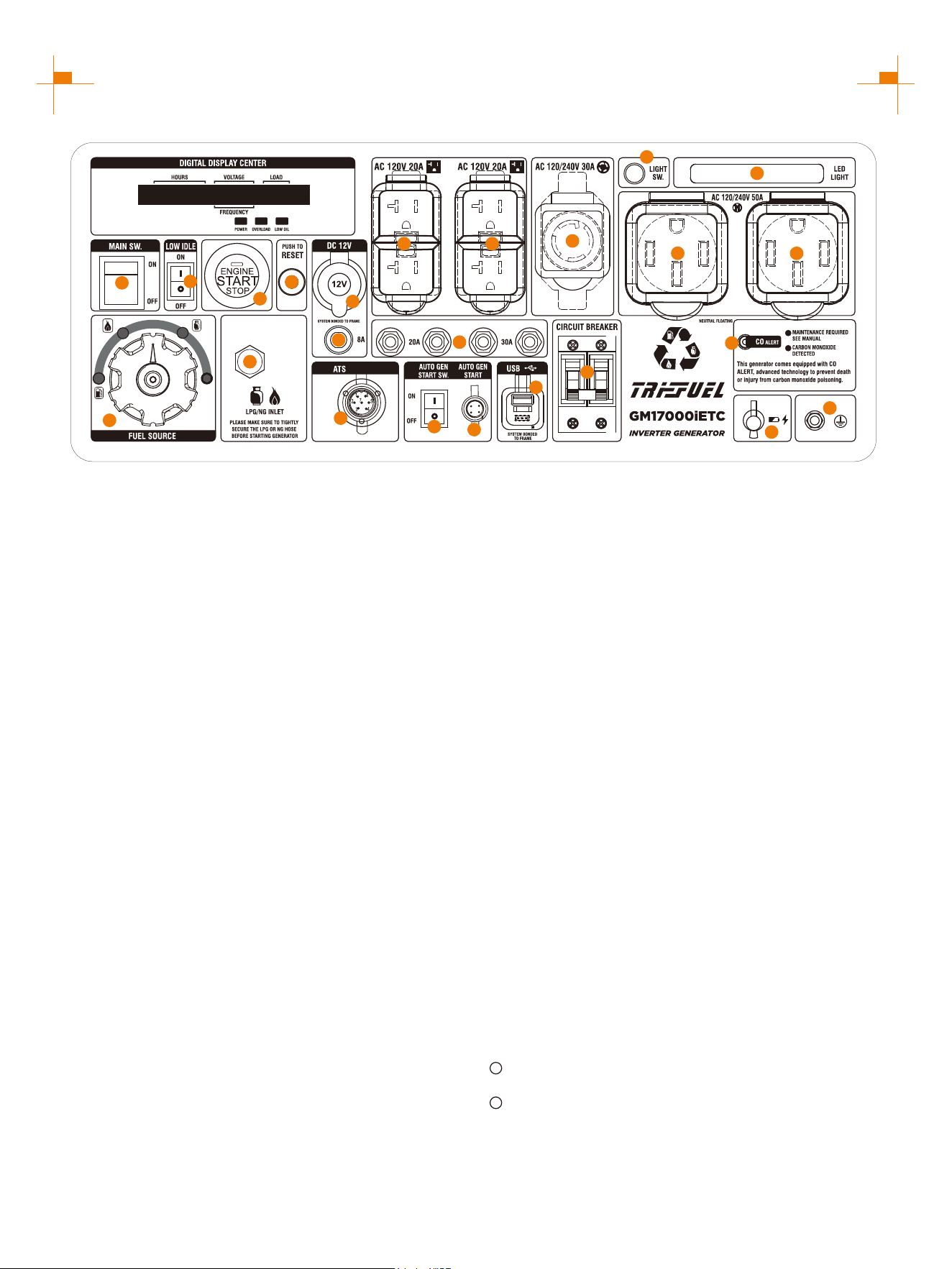
① Main Switch: Manage battery power and shutdown.
Tip: If you do not use the generator for more than 7 days
(168 hours), please press the main switch to the "OFF"
position, which can prevent the battery from running out.
② Low Idle: When turned to the ON position, the engine will
sense the load needed and run at a slower RPM to save
fuel.
③ Start/Stop Button: Press this button, the engine can start
and stop.
④ Fuel Source Switch: Choice of fuel source.
⑤ Reset: If the generator is overloaded, the reset breaker
will trip. The engine will continue to run, but there will be
no output from the generator. Unplug the devices and
reduce the load. Push in the reset breaker to reset it.
⑥ DC Cigarette Lighter Outlet: 12V DC 8.3A.
⑦ DC Protector: If the generator is overload, the DC
protector will trip to block current.
⑧ 120V AC 20A 5-20R Outlet: The outlet is capable of
carrying a maximum of 20 amps.
⑨ 120/240V AC 30A L14-30R Outlet: The outlet is capable
of carrying a maximum of 30 amps.
⑩ 120/240V AC 50A 14-50R Outlet: Receptacle can supply
a maximum of 50 Amps.
⑪ Circuit Breakers: The circuit breakers protect individual
circuits from electrical overload.
⑫ AUTO GEN START SW.: Connect the automatic start/stop
device to the communication interface through the ⑬
automatic start/stop connection line, and press this switch
to the ON position. The generator will be controlled by an
external device with automatic start/stop function. After
enabling this feature, the start button and remote
start/stop button will be disabled.
⑬ The communication AUTO GEN START/SERIES:
interface for automatically starting and stopping the
generator. Used to connect equipment with automatic start
stop function.
⑭ USB Duplex: 5V DC, type-A and type-C connectors.
⑮ Main Circuit Breaker: The main circuit breaker controls
total output of all outlets to protect the generator from
overload or short circuit.
⑯ CO Alarm: Flashing red light: dangerous levels of carbon
monoxide gas have built up leave immediately until area
has aired out. Move generator to well-ventilated area
before operation. Flashing yellow light: carbon monoxide
sensor malfunction. Sensor needs service.
⑰ Battery Charging Port: Charge the generator battery.
⑱ Ground Terminal: The ground terminal is used to
externally ground the generator.
⑲ Light Switch: Press the first time to turn on the LED light
and press the second time to turn off the LED light.
⑳ LED Light:
1. The LED light can be used normally when the generator is
running, and the LED light cannot be used when the
generator shuts down.
2. If the LED light is not turned off, press the one-key start
button (or remote control key) to stop the generator while
the main switch is not turned off, the LED light will
automatically turn off after 30 seconds.
3. Press the one-key start button (or remote control key) to
stop the generator and also turned off the main switch, the
LED light will go out immediately.
NG/LPG Inlet: Connect LPG (propane) or NG (methane)
as fuel.
ATS Interface: For connecting to ATS control box.
1
2
3
5
6
7
8 8
9
10
10
19
20
11
12
13
14
15
16
17
18
4
21
22
21
22
13
CONTROL FUNCTIONS
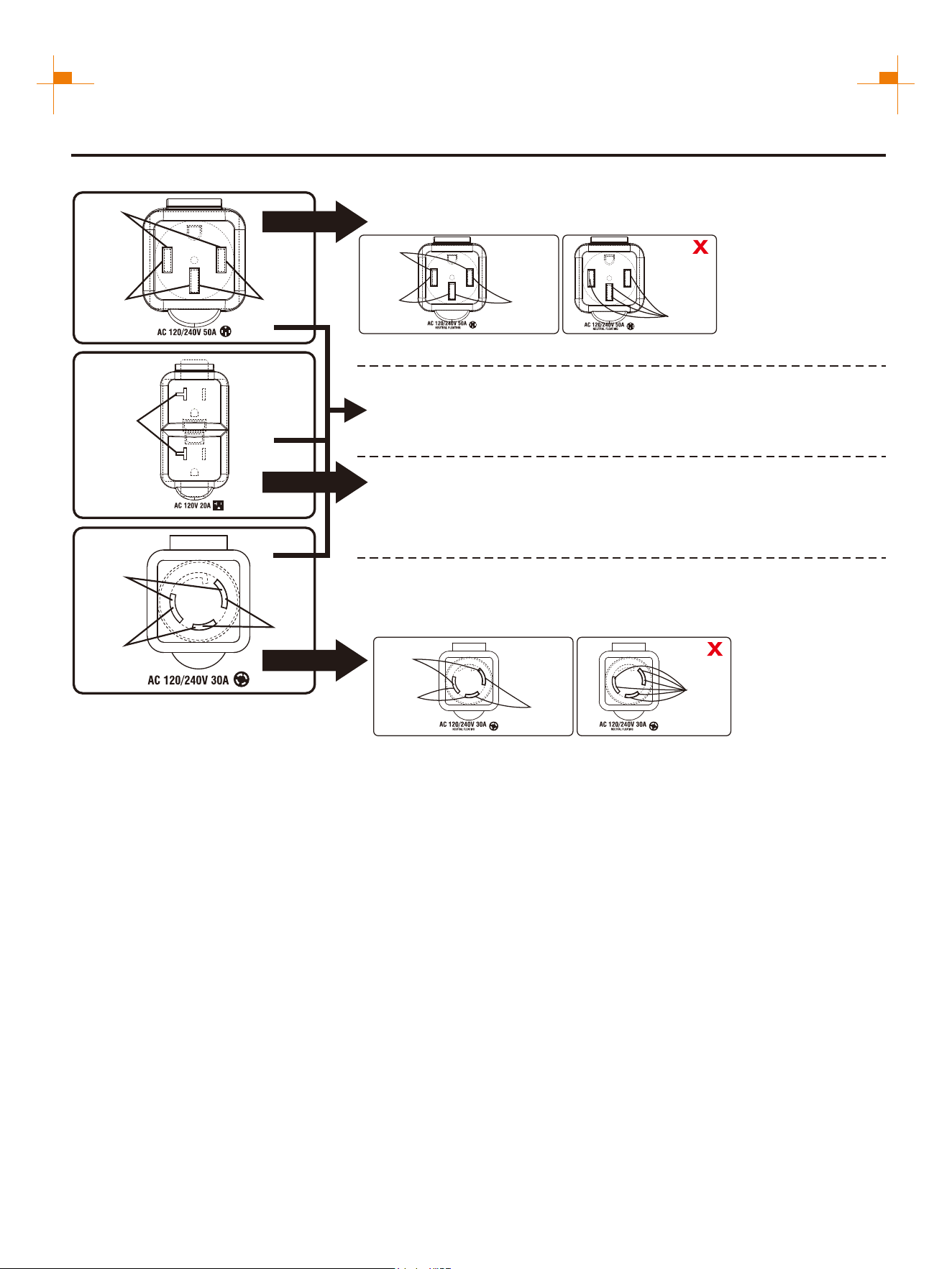
OUTPUT DESCRIPTION OF THE AC SOCKET
240V(Voltage)×50A(Current)=12000W(Output Power)
Single socket output
Single socket output
Output voltage 120V current 20A.
120V(Voltage)×20A(Current)=2400W(Output Power)
A
Bx2
120V
120V
240V
120V
C load
B load
A load
OK
①
②
③
ATTENTION: ①②③ can
output at the same time, but
the total power output of the
socket can not exceed the
rated power of the generator,
can not be connected to the
same load.
A load
Single socket output
C
ATTENTION: The total power output of the socket must not exceed the
rated power of the generator.
120V
120V
240V
①
②
③
Output voltage 120V current 30A.
120V socket hole: 120V(Voltage)×30A(Current)=3600W(Output Power)
240V socket hole: 240V(Voltage)×30A(Current)=7200W(Output Power)
ATTENTION: ①②③ can output at the same time, but the total power
output of the socket can not exceed the rated power of the generator, can
not be connected to the same load.
B load
A load
OK
③
①&②
A load
C load
14
CONTROL FUNCTIONS
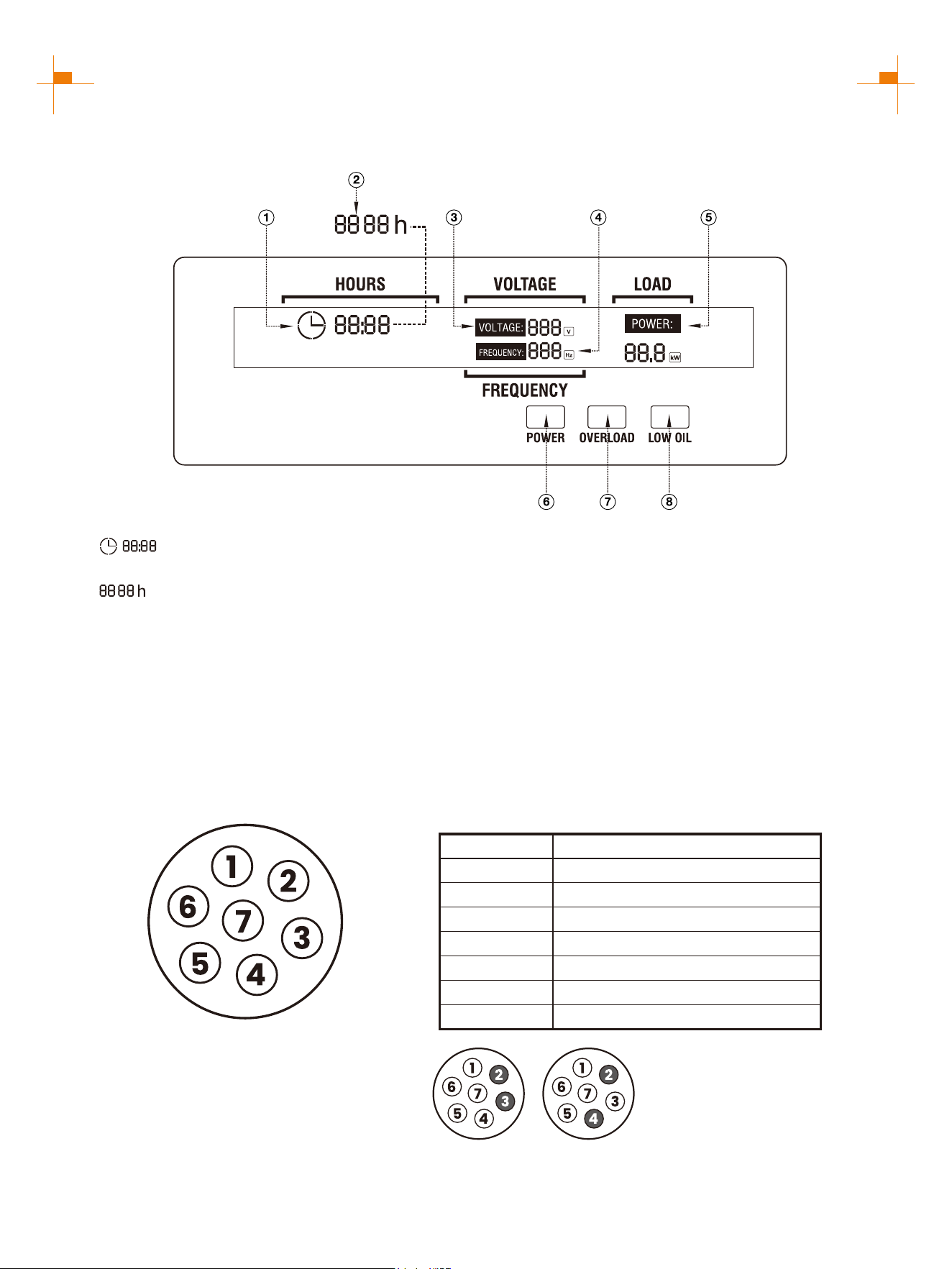
DIGITAL DISPLAY CENTER
① : Represents single run time, goes from 0
at each startup.
② : Represents total operation time of the
generator. (Tip: The total operation time shall start
to accumulate after the generator runs for one
hour. It will not be displayed when the generator
runs for less than one hour. The total operation
time shall be accumulated by hours.) The two
factors ① and ② are displayed alternately every 8
seconds.
③ VOLTAGE: Voltage display.
④ FREQUENCY: Frequency display.
⑤ LOAD: Load power display.
⑥ POWER: Green light means normal operation.
⑦ OVERLOAD: Red light means the machine
overload.
⑧ LOW OIL: Red light means the amount of oil is too
low.
WORKING MODE OF THE ATS SOCKET
Number
Connection Function
1
2
3
4
5
6
7
Battery Charge +12V
Ground
Engine Start
Emergency Stop
Not Connected
Engine Running
Not Connected
2/3 are for start and stop the
generator 2/4 are for
emergency shutdown the
generator.
ATS SOCKET
15
PREPARATIONS
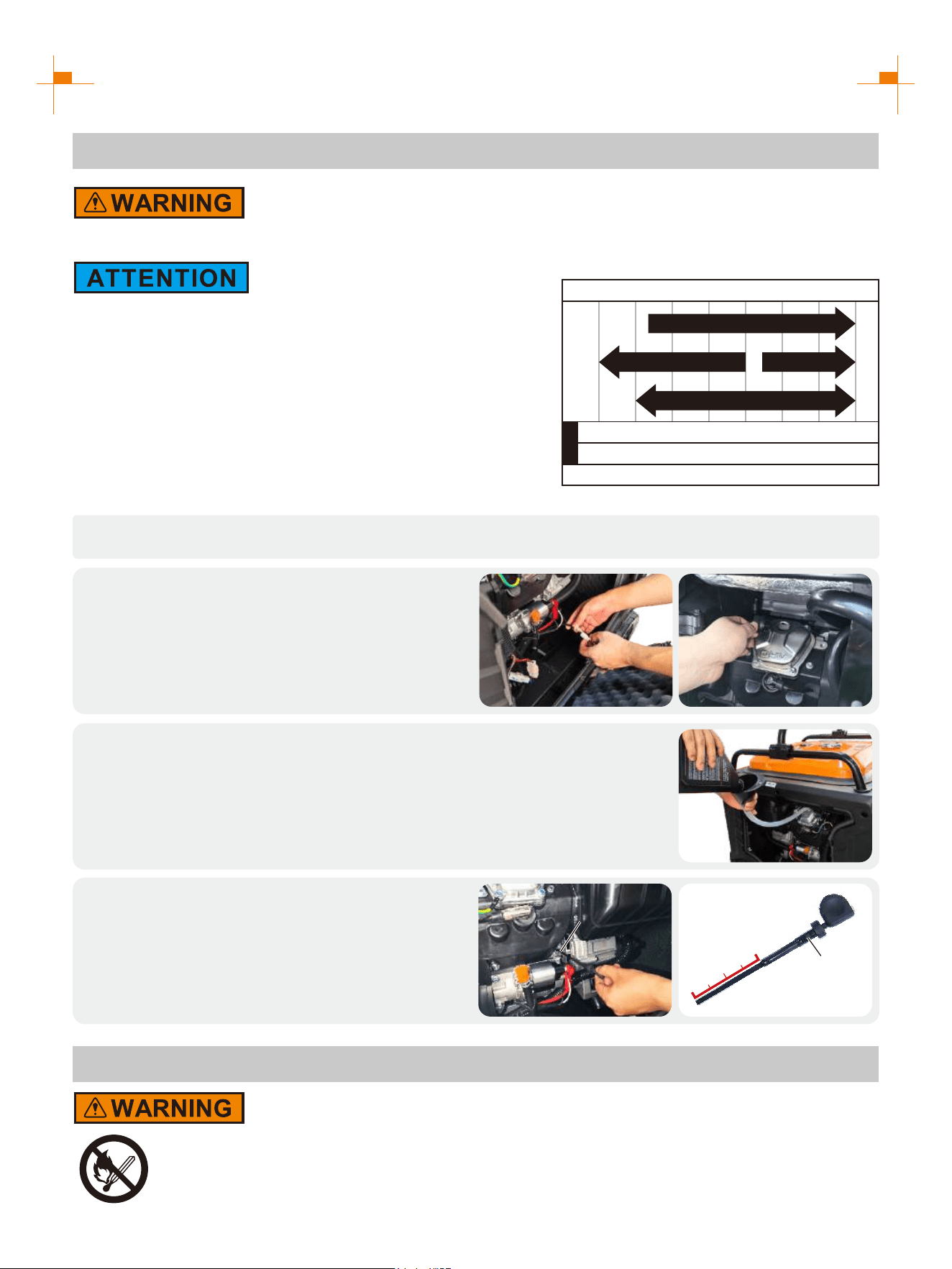
No oil is filled into this generator when being delivered. Do not start up the generator without filing sufficient oil.
Your generator was functionally tested in the factory and may
contain minimum residual oil. Additional oil is required to operate
the unit. Do not overfill.
The recommended oil type for typical use is 10W-30 automotive
oil. However, using the listed conventional oils shown in the
"Recommended Engine Oil Type" chart may be used for typical
use including the first 5 hours of the break-in run time period of
the engine. If running generator in extreme temperatures, refer to
the "Recommended Engine Oil Type" chart.
Recommended Engine Oil Type
-20 0 20 40 60 80 100 120
-28.9 -17.8 -6.7 4.4 15.6 26.7 37.8 48.9
℃
℉
Ambient Temperature
10W-30
10W-405W-30
5W-30 Full Synthetic
ADDING ENGINE OIL
1. Please place the generator onto a horizontal plane surface.
2. Open the left side cover, remove oil fill cap.
NOTE: There is a cable on the left and right side
covers that supplies power to the fan. Do not
remove the side covers forcibly. Disconnect
cables during maintenance.
3. Using a funnel, as needed, add the appropriate type of oil until the oil
level is at the proper level.
SAE 10W-30 oil is recommended for general use. DO NOT OVERFILL.
Replace oil fill cap.
5. Put back the oil dipstick, wipe off the
surrounding oil, and reassemble the exterior
cover plate.
4. Check engine oil level daily and add as needed.
Pull out the oil dipstick and check the oil level. (The
oil dipstick is on the right side of the generator.)
TO PREVENT SERIOUS INJURY FROM FIRE:
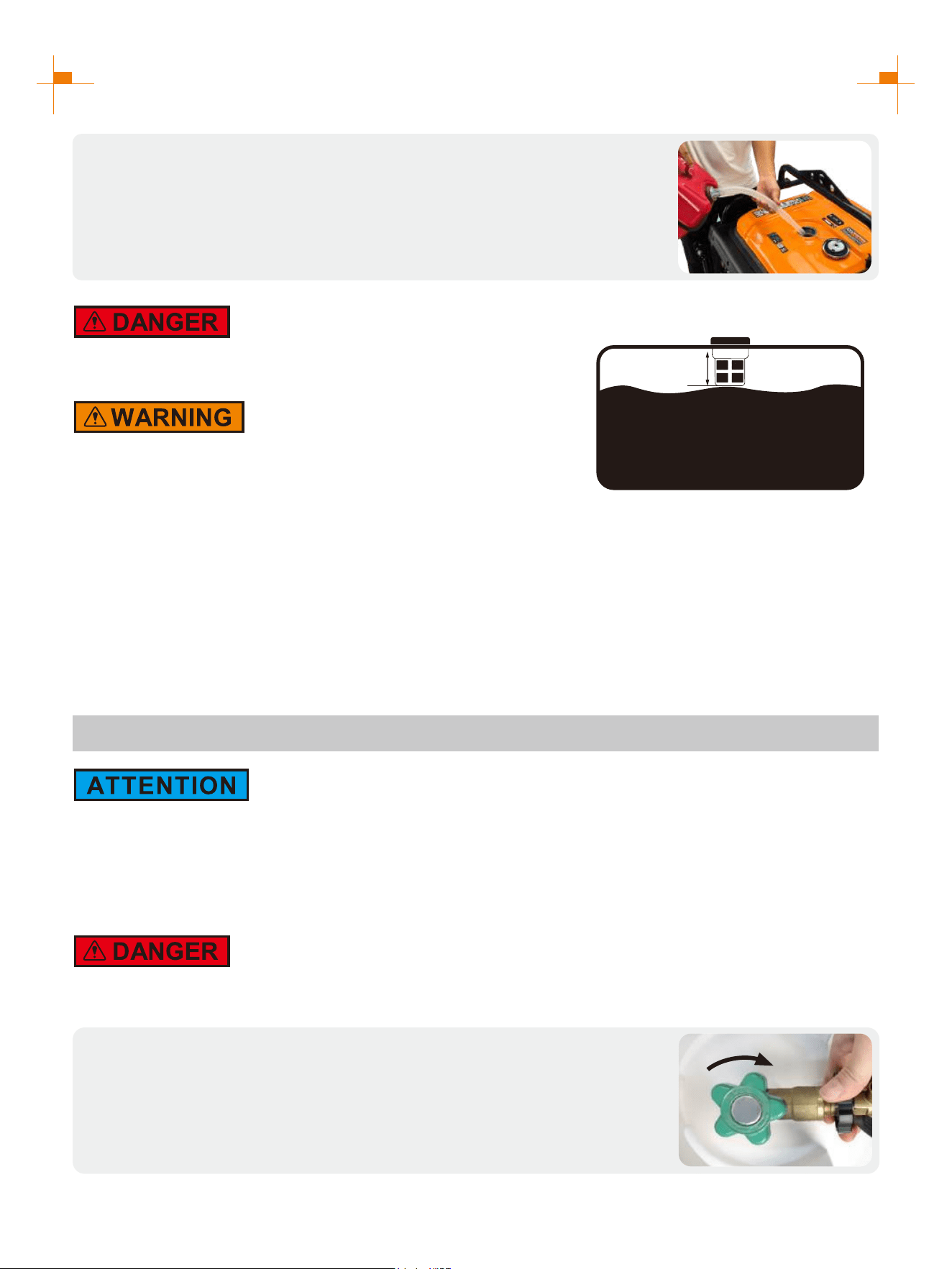
Fill the gasoline tank in a well-ventilated area away from ignition sources. If the engine is hot
from use, shut the engine off and wait for it to cool before adding gasoline. Do not smoke.
ADDING GASOLINE
Oil Dipstick
Oil Dipstick
MAX
16
PREPARATIONS
1. Make sure the generator is on a solid, flat, level surface.
2. Unscrew the fuel cap and set it aside.
3. Slowly add gasoline to the fuel tank. Be careful not to overfill.
4. Replace the fuel cap and wipe up any spilled gasoline with a dry cloth then
remove the cloth from the area.
Do not overfill the gasoline the tank. Overfilling can result in a fire,
explosion, or death.
Gasoline can expand. Do not fill the gasoline tank to the top. Leave a
minimum of 1.5 inches open space. Gasoline fumes are highly
flammable. Do not fill the tank near an open flame. Always check for
gasoline spills.
● ALWAYS use CLEAN, FRESH, unleaded gasoline (87–93 octane) in this unit. NEVER use OLD, STALE, or
CONTAMINATED gasoline.
● Never use an oil/gasoline mixture.
● Avoid getting dirt or water in the gasoline tank.
● Gasoline can age in the tank and make it hard to start the generator in the future.
● Never store generator for extended periods of time with gasoline in the tank.
● Wipe up any spilled fuel and allow excess to evaporate before starting the engine. To prevent FIRE, do not start
the engine while the smell of fuel hangs in the air.
1.5"
DO NOT OVERFILL
THE GAS TANK
CONNECTING AN LPG TANK
● Confirm that the re-qualification date on the tank has not expired.
● All new propane tanks must be purged of air and moisture prior to filling. Used propane tanks that have not
been plugged or kept closed must also be purged. The purging process should be done by a propane tank
supplier (propane tanks from an exchange supplier should have been purged and filled properly).
● ALWAYS position the propane tank so the connection between the valve and the gas inlet will not cause sharp
bends or kinks in the hose.
Explosion hazard. DO NOT start generator if you smell propane. ALWAYS fully close the propane tank valve and
disconnect the LPG hose from the generator when not in use.
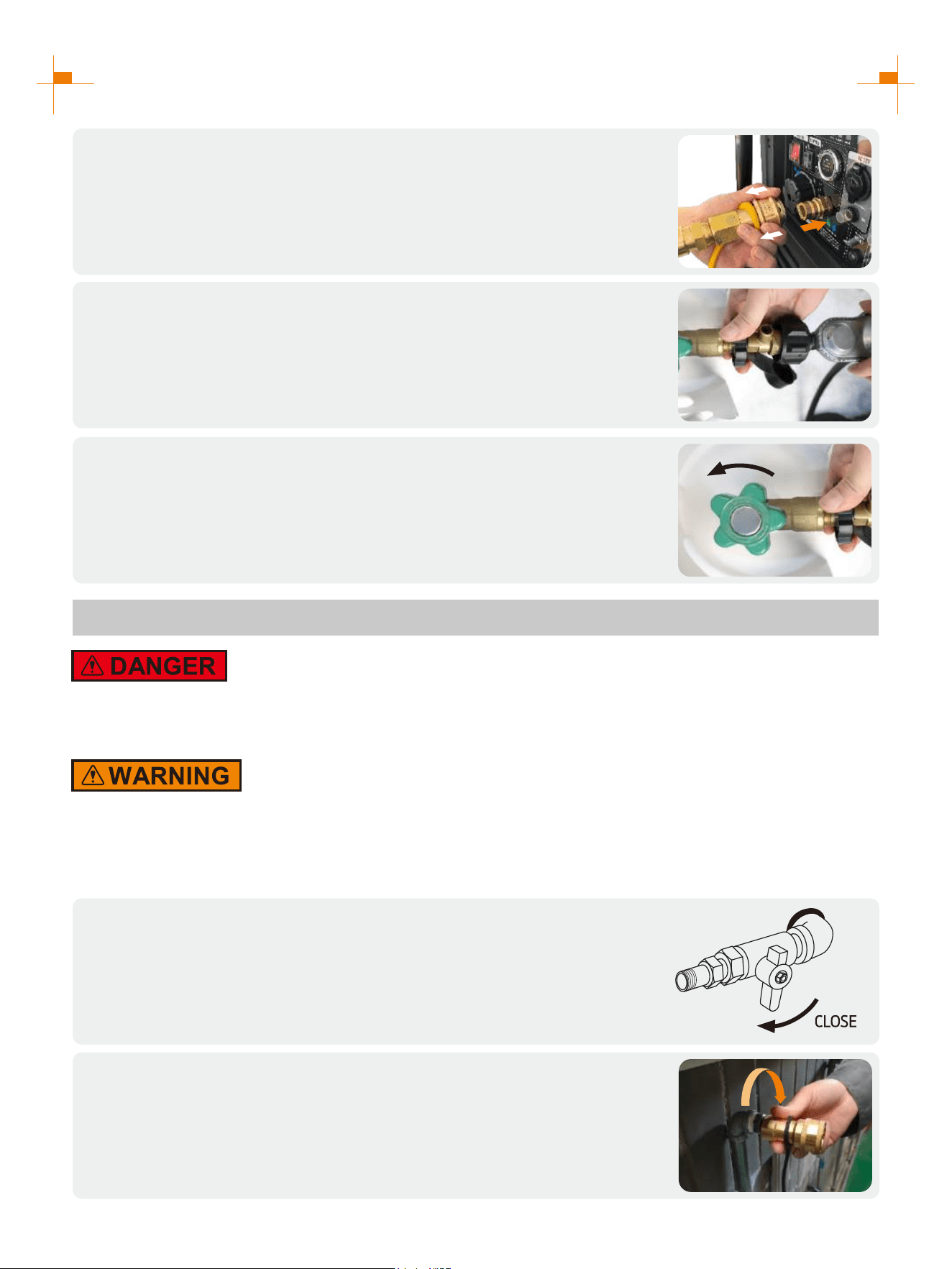
1. Turn the generator OFF and place on a flat surface in a well
ventilated area.
2. Verify that the LPG tank valve is in the fully closed position.
3. Remove the cover on the generator propane inlet.
Close
17
PREPARATIONS
4. Tighten the LPG hose to the LPG/NG inlet of the generator.
IMPORTANT: DO NOT use thread seal tape or any other type of sealant to
seal the LPG hose connection.
Push back the quick connector collet of the LPG hose, insert it into the
generator LPG/NG inlet, loosen the quick connector sleeve, and make the
sleeve clamp the propane/methane inlet.
5. Remove the safety plug or cap from the LPG tank valve and attach
the other end of the hose to the LPG connector on the tank. Hand-
tighten.
6. Turn the LPG tank valve to the fully open position.
Check all connections for leaks by wetting the fittings with a solution of
soap and water. Bubbles which appear or bubbles which grow indicate
that a leak exists. If a leak exists at a fitting, turn the LPG tank valve to
the fully closed position and tighten the fitting. Open the LPG tank valve
and recheck the fitting with the soap and water solution.
CONNECT THE NATURAL GAS (NG) SUPPLY LINE
Fire and explosion hazard. Never connect or disconnect the natural gas hose while the engine is running. Do not
smoke or create sparks while handling natural gas. Always turn the engine off and allow the generator to cool for
at least five minutes before connecting to natural gas.
● Never use a natural gas supply line, natural gas hose, or any other fuel item that appears to be damaged.
● To reduce the risk of injury, perform a leak test any time the natural gas hose is disconnected and reconnected.
● Explosion hazard. If you smell methane, do not start the generator. Always completely close natural gas supply
line valve and disconnect natural gas (NG) hose from generator when not in use.
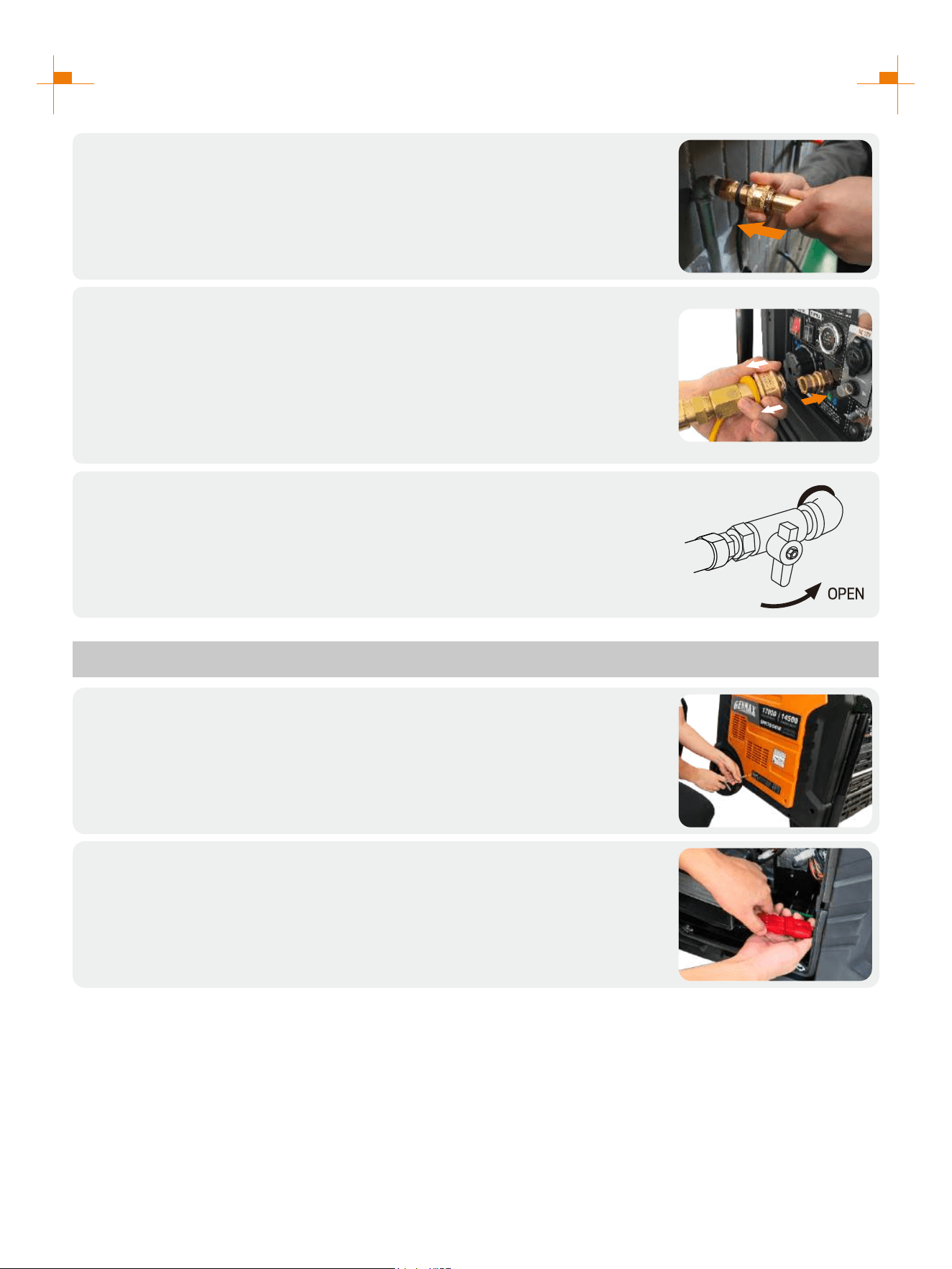
1. Turn the generator off and allow the engine to cool for at least five
minutes.
2. Verify that the gas is turned off at the natural gas supply line.
Open
3. Screw the Natural Gas Adapter onto the natural gas supply line.
Contact your local gas company for guidance on accessory connection to
a natural gas line. You qualified contractor must minimally ensure the pipe
supply line threads are clean and in good condition. Pipe connections
must be made using a gas rated 'dope' or PTFE tape.
18
PREPARATIONS
4. Connect the natural gas hose to the natural gas supply line.
Pull the quick connect collet rearward, insert the natural gas hose nipple,
then release the collet; ensure a solid connection is made.
5. Tighten the other end of the natural gas hose to the LPG/NG inlet of
the generator.
Push back the quick connector collet of the natural gas hose, insert it into
the generator LPG/NG inlet, loosen the quick connector sleeve, and make
the sleeve clamp the propane/methane inlet.
IMPORTANT: DO NOT use thread seal tape or any other type of sealant to
seal the natural gas hose connection.
6. Turn the natural gas (NG) supply line valve to the fully open position.
Check all connections for leaks by wetting the fittings with a solution of soap
and water. Bubbles which appear or bubbles which grow indicate that a leak
exists. If a leak exists at a fitting, turn the natural gas (NG) supply line valve to
the fully closed position and tighten the fitting. Open the natural gas (NG)
supply line valve and recheck the fitting with the soap and water solution.
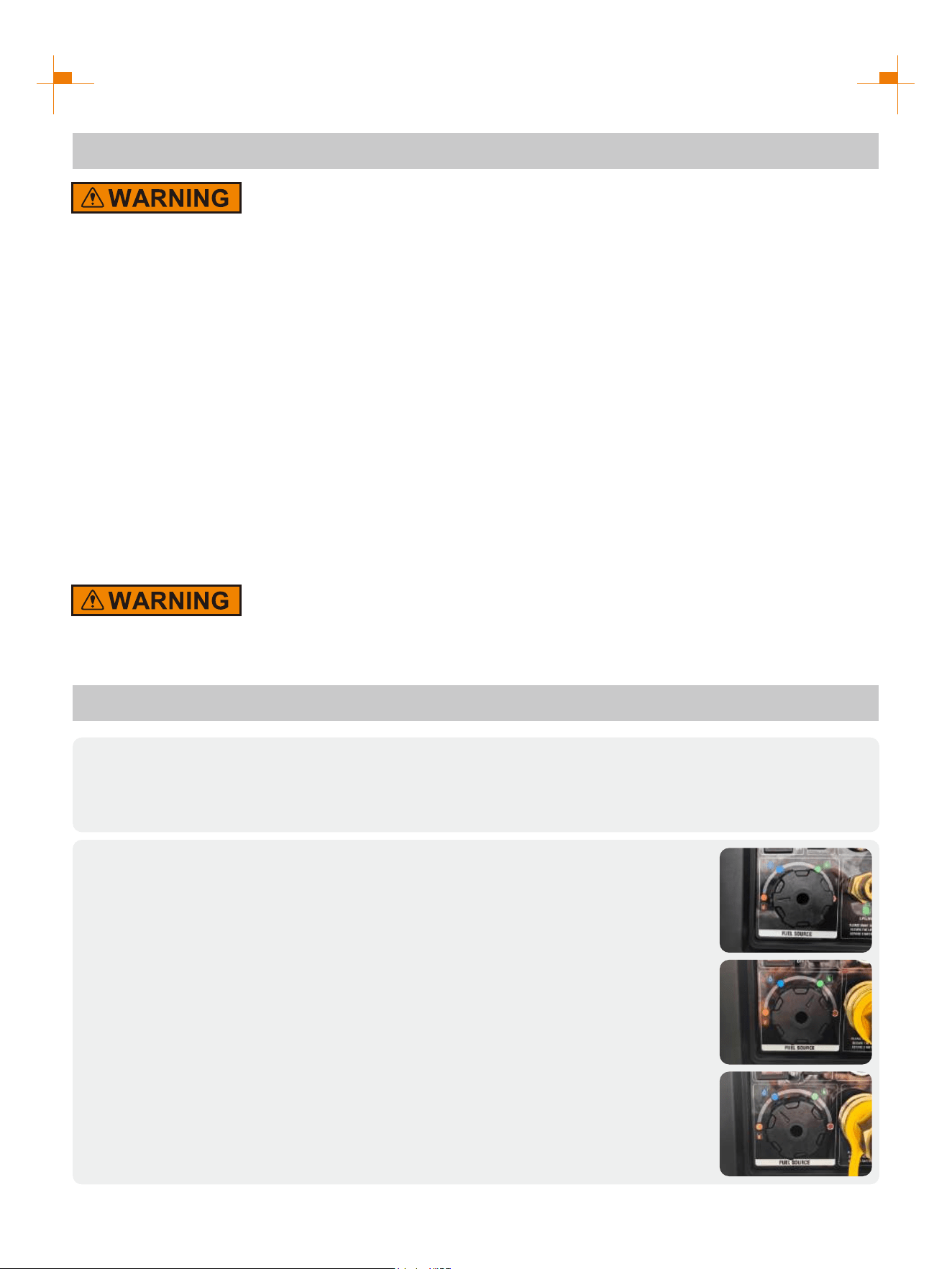
CONNECTING THE BATTERY
1. On the left side of the generator, loosen the screws and remove the
cover.
NOTE: There is a cable on the left and right side covers that supplies power to
the fan. Do not remove the side covers forcibly. Disconnect cables during
maintenance.
2. Connect the positive and negative electrodes of the battery.
A quick-connect battery plug is pre-installed on the battery. Remove the
cable tie securing the plugs, align colors, then push firmly to connect them.
Note: The generator is equipped with a battery charging feature. Once the engine is running, a small current will
slowly recharge the battery.
19
1. Make sure the generator is on a solid, flat, level surface.
2. Disconnect all electrical loads from the generator. Never start or stop the generator with electrical
devices plugged in or turned on.
OPERATION
GENERATOR LOCATION
● NEVER operate the generator inside any building, garage, basement, crawlspace, shed, or enclosure, including
the generator compartment of a recreational vehicle.
● NEVER operate or start the generator in the back of an SUV, camper, trailer, truck bed (regular sides, flat or
other configuration), under staircases, stairwells, next to walls or buildings, or any other location that could limit
airflow or trap exhaust.
● DO NOT operate or store the generator in wet weather conditions such as rain or snow. Using a generator in
wet conditions could result in serious injury or death due to electrocution.
● Generators must have a minimum of 5 feet (1.5 m) of clearance from all combustible material.
● Generators must also have a minimum of 5 feet (1.5 m) of airflow clearance on all sides to allow for adequate
cooling, maintenance, and service.
● Always place the generator in a well-ventilated area. NEVER place the generator near air intake vents or where
exhaust fumes could be drawn into occupied or confined spaces.
● Always carefully consider wind and air currents when positioning the generator.
● Always allow generators to properly cool before transport or for storage purposes.
● Failure to follow proper safety precautions may result in personal injury, damage to the generator, and void your
warranty.
During operation, the muffler and exhaust fumes will become hot. If there is inadequate cooling space or if the
generator is blocked or enclosed, temperatures can rise quickly and may lead to a fire.
STARTING THE GENERATOR
3. Turn the Fuel Switch to desired fuel source.
To switch to gasoline
● Add gasoline.
● Turn off the flow of natural or propane gas.
● Turn the Fuel Source Switch to the Gasoline position.
To switch to propane
● Open the cylinder valve on the LPG cylinder to start the flow of propane.
● Turn off the flow of natural gas and gasoline.
● Turn the Fuel Source Switch to the Propane(LPG) position.
To switch to natural gas
● Open the valve on the natural gas supply line to start the flow of natural gas.
● Turn off the flow of propane and gasoline.
● Turn the Fuel Source Switch to the Natural Gas(NG) position.
20
OPERATION
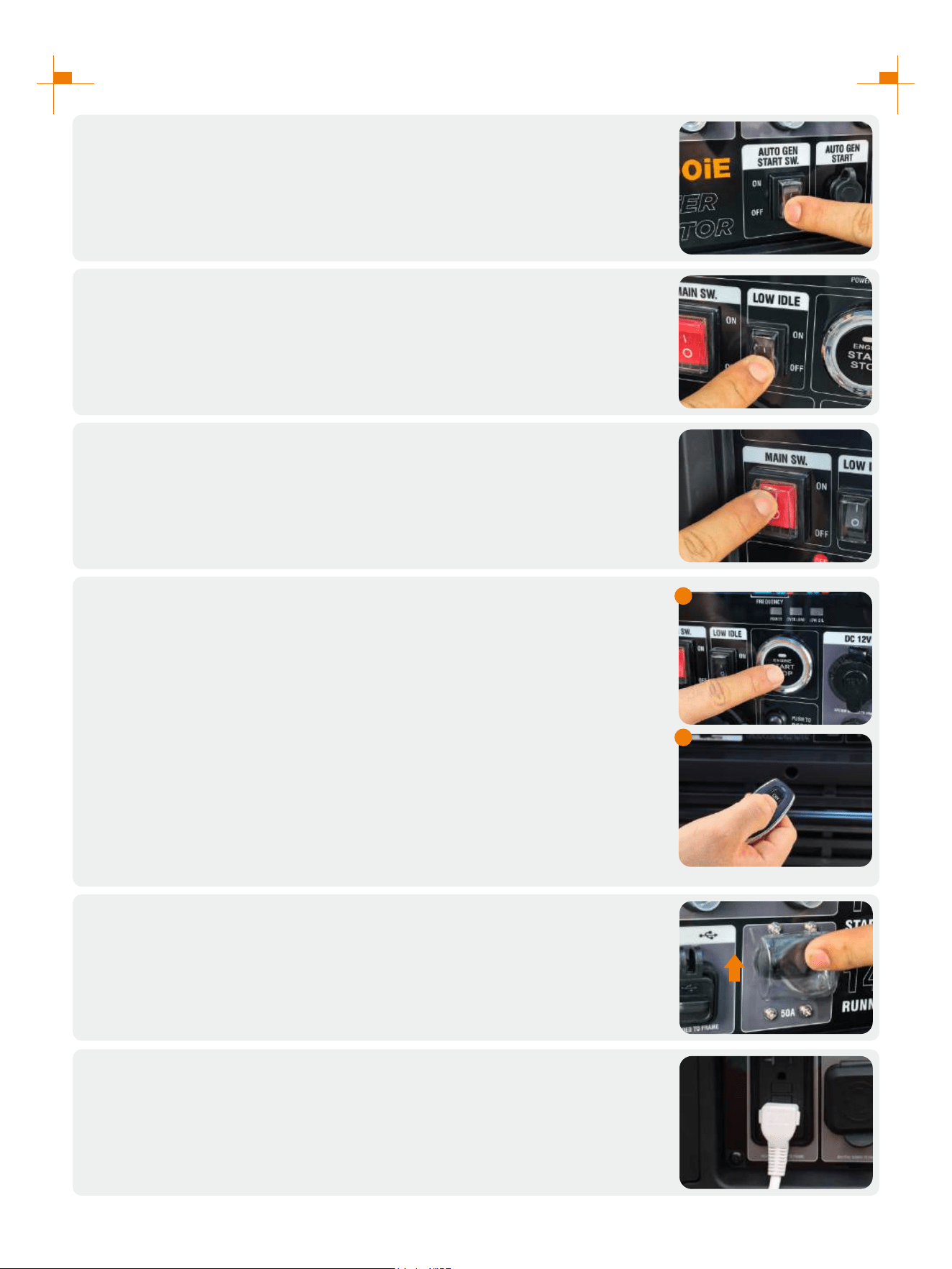
5. Press the LOW IDLE Switch to "OFF".
6. Press the Main Switch to "ON".
7. Choose the Starting Method
a. Push Button Start
Press the start button for 1-3 seconds, then release, to start the
generator.
b. Remote Start
Push and hold the ON button on the remote start key fob for one second.
NOTE: If the generator is not successfully started using buttons/electric
start and remote start, the battery of the generator may need to be
charged. Use recoil to start the generator. The battery of the generator will
be charged during the operation of the unit. Or use a power adapter to
connect to the battery charging port on the panel to charge the battery.
a
b
8. Place the Circuit Breaker Switch in the "ON" position.
9. After 1-2 minutes of normal operation of the generator, connect the
required equipment.
4. Check whether the AUTO GEN START Switch is in the “OFF” position.
If this switch is in the ON position, the start button and remote start/stop
button will be disabled.
21
OPERATION
2. Check whether the circuit breaker switch is set to “ON”.
If the circuit breaker switch is set to ON and there is no output, press the heat
protection corresponding to the socket and use a multimeter to test whether the
socket has voltage.
ON
COMMON PROBLEMS WITH STARTING THE GENERATOR:
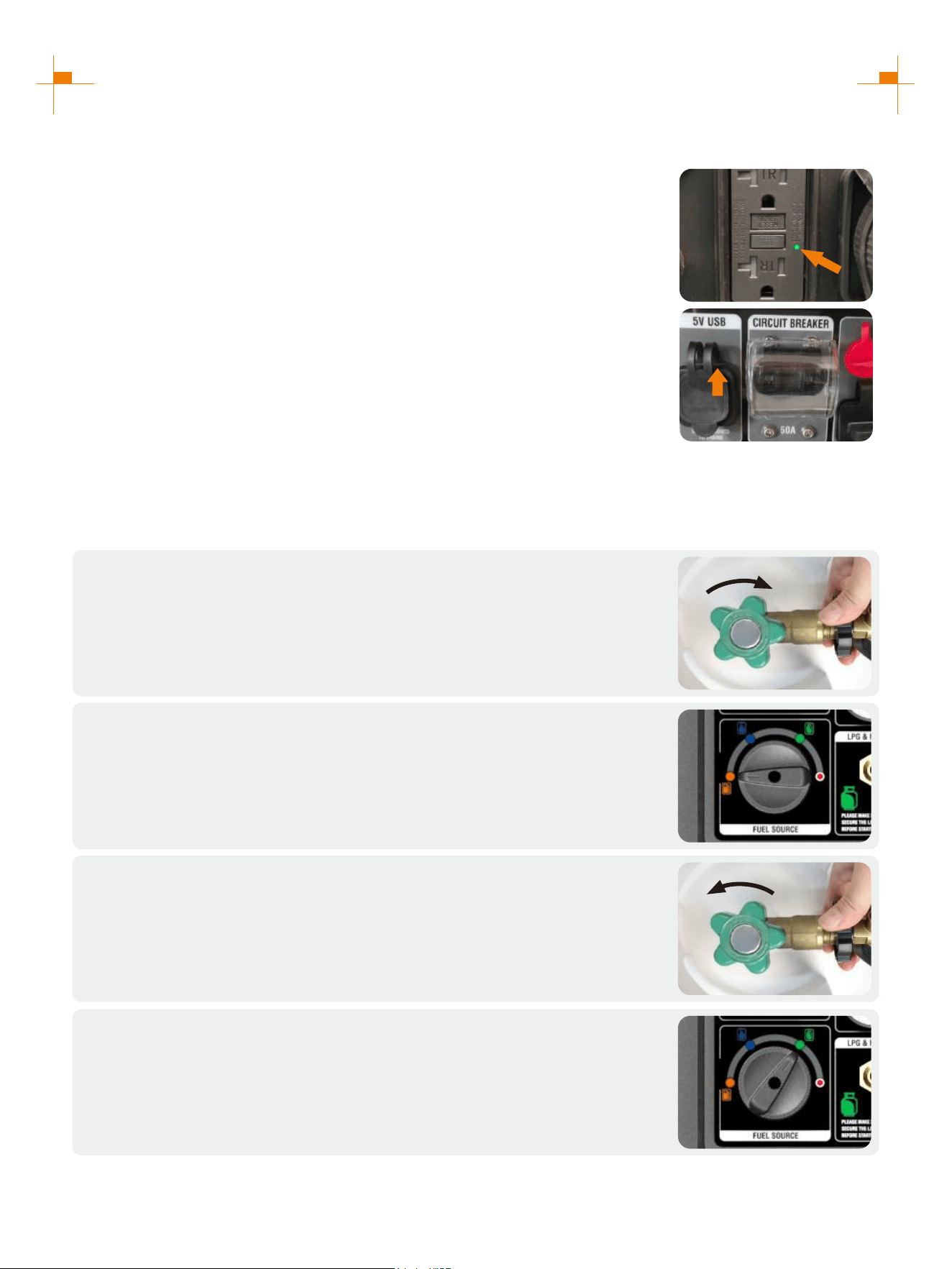
Start the generator to run normally without output ?
1. Check whether the green light of the GFCI socket is on.
If the green light is not on, press the RESET button after the generator is started to
make the green light on.
Tip: When the generator is not started, the GFCI socket is in the protected state
and the "RESET" button cannot be pressed.
4. Open the LPG (or NG) valve completely.
2. Fuel source rocker switch to “GASOLINE”.
3. Follow the startup steps to start the generator.
5. Fuel source switch to “LPG (or NG)”.
LPG/NG start up is difficult ?
When both gasoline and LPG/NG are present in the generator it is recommended to start the generator on
gasoline first, allow the engine to stabilize then switch to LPG(or NG).
1. Ensure the LPG (or NG) supply hose is securely attached and Close the
LPG (or NG) valve completely.
Close
Open
22
1.The total combined load through the outlets on the generator must not exceed the running power of the unit.
2. If the OVERLOAD light turns on and the generator stops producing power, it has been overloaded.
3. Turn off and disconnect all electrical devices and stop the engine. Compare device requirements to generator
rating and reduce the total wattage of connected devices if necessary. Move anything that may be limiting
generator ventilation away.
4. Check if any circuit breakers have tripped and make sure that ALL circuit breakers are reset before starting the
generator again.
5. Restart the engine and reconnect devices while being careful to not overload the generator.
OPERATION
Low Oil Indicator
1. If the engine oil level is too low, the LOW OIL light turns on and the engine will automatically shut off.
2. The engine cannot be restarted until the proper amount of oil has been added. Add the appropriate type of oil
until the oil level is at the proper level. SAE 10w-30 oil is recommended for general use.
Overload Indicator
Note: The OVERLOAD light may turn on for a few seconds as a large device starts. This is normal for loads
approaching the capacity of this generator.
Electric start and remote start no response ?
1. Check whether the positive and negative electrodes of the battery are correctly connected.
2. Check whether the battery is charged.
3. Check whether the remote control is powered on.
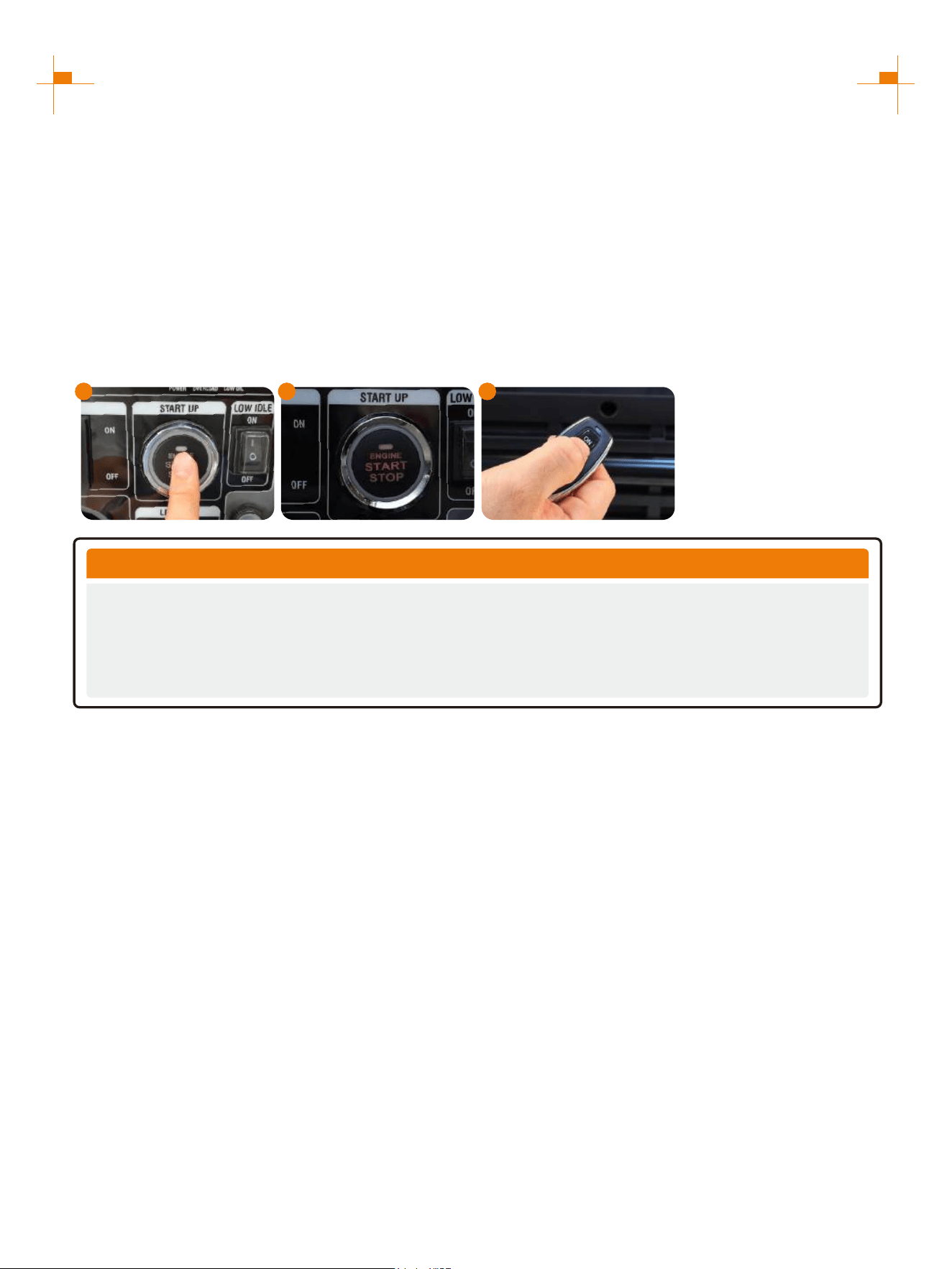
Remote Control Pairing
1. Long press the start button for more than 5 seconds until the button red indicator is on;
2. Press any key on the remote control;
3. The red indicator of the start button will blink two or three times and then turns off, Remote start pairing is
successful.
Tip: The remote control delivered with the generator has been paired successfully.
1 2 3
TIP
Remote Control Key Dormancy
When generator stops running for 5 days (120hours), while the main switch is not turned off, the remote
control key cannot be used to start the generator again. At this time, you need to turn off the main switch
and turn it on again, or press the one-key start button (or hand start) to start the generator, and the remote
control key will be reactivated.
Parallel Operation
The parallel connection ports allow you to connect two generators to increase the total available electrical power.
Follow the instructions included with your parallel connection kit for proper installation and operation.
23
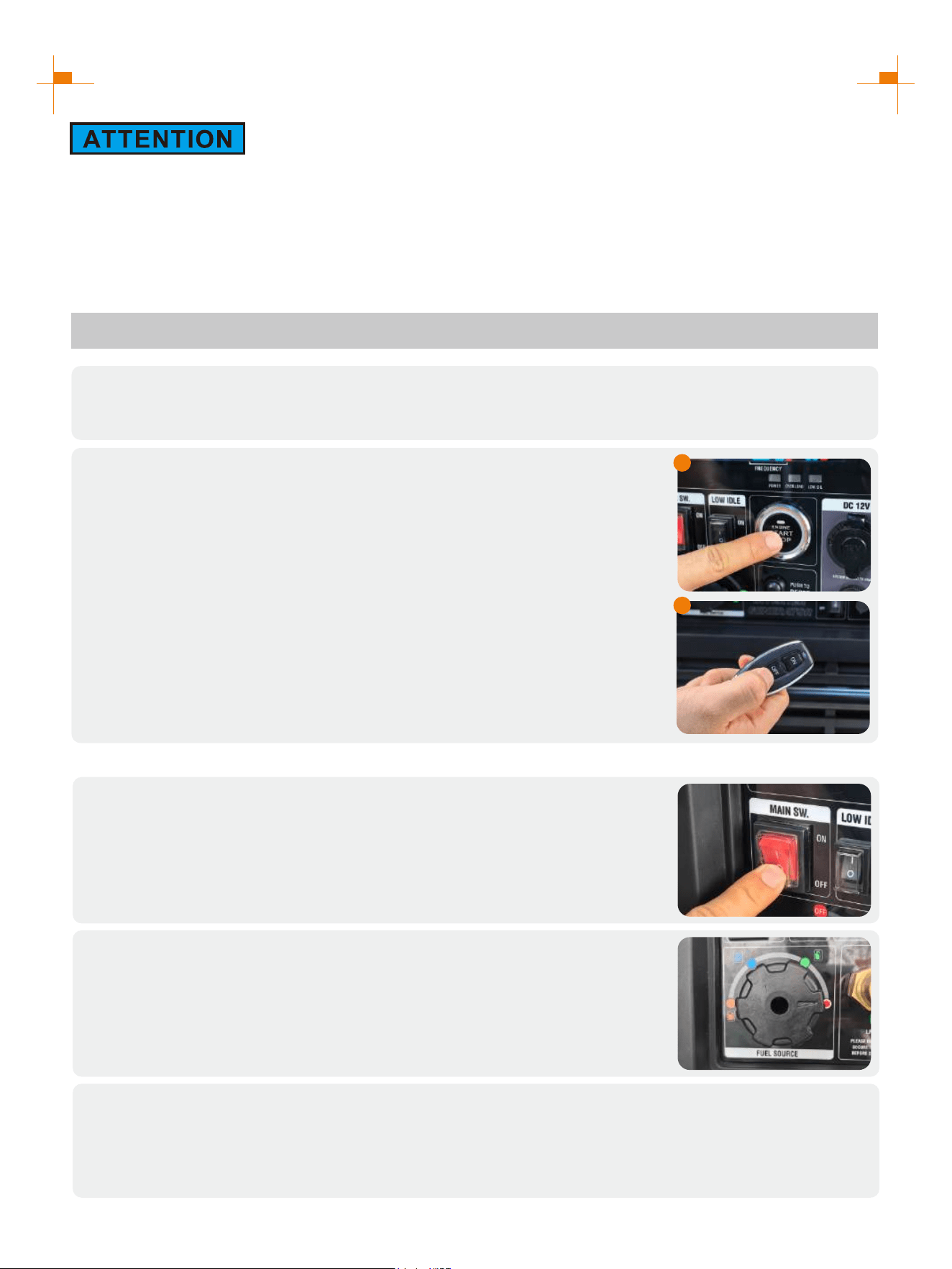
If not used for a long time, please perform the following operations
3. Press the Main Switch to "OFF".
Tip: If you do not use the generator for more than 7 days (168 hours),
please press the main switch to the "OFF" position, which can prevent the
battery from running out.
OPERATION
Do not run the engine with too little oil. Engine will shut off if engine oil level is too low.
Low Idle
1. Turn on a low idle mode to limit noise and fuel consumption with a light generator load.
2. Turn off the low idle mode to run the engine at full speed under the following conditions:
● Starting the generator.
● If the load exceeds 50%, it is recommended to turn off the low idle mode.
SHUTTING DOWN THE GENERATOR
1. Turn off and unplug all connected electrical loads. Never start or stop the generator with electrical
devices plugged in or turned on.
2. Select the Stopping Mode
a. Button Stop
Press the button to turn off the generator.
b. Remote Stop
Press the "OFF" button on the remote control for 1-3 seconds.
a
b
4. Turn the Fuel Source Switch to the "OFF" position.
5. Stop the flow of fuel.
● For propane, close the cylinder valve on the LPG cylinder.
● For natural gas, close the valve on the natural gas supply line.
● For gasoline, turn off the fuel switch.
6. After the generator has completely cooled down, remove propane(or methane) hose if applicable
and store the generator in a cool, dry, sheltered storage area.
7. Remove or consume all untreated gasoline if you plan to store the generator longer than 3
months.
24
USING THE GENERATOR
• Applicable temperature: 23℉/-5℃ ~ 104℉/40℃;
• Applicable humidity: below 95%;
• Applicable altitude: regions below 1,500 m (It shall be used by reducing power in regions above 1,000 m).
Standard atmospheric condition
• Ambient temperature Tr: 298k (77℉/25°C)
• Relative air humidity Фr: 30%
• Absolute atmospheric pressure Pr: 100kPa
When actual environmental condition is inconsistent with the condition of output power of the generator
set:
• Every 5°C of increase in ambient temperature will reduce the power of generator by about 2%.
• Every 30% of increase in relative humidity of air will reduce the power of generator by about 1.5%.
• Every 300 m rising of ASL will reduce the power the generator by about 4.5%.
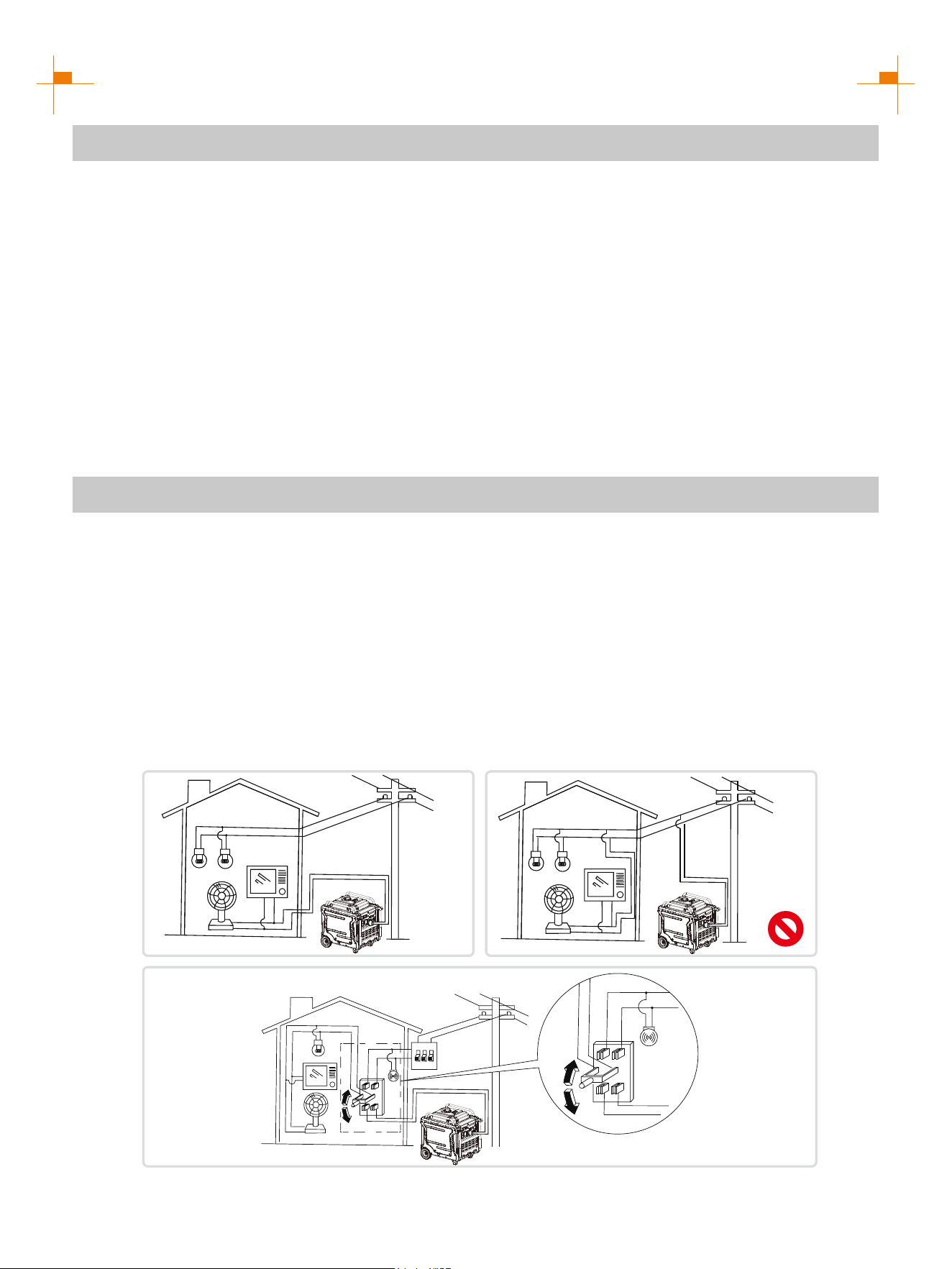
• When the generator is connected to household power source as a backup power supply, the connection shall be
carried out by a professional electrician or a person familiar with electricity.
• After connecting the load to the generator, check carefully whether electrical connection is safe and reliable.
Improper electrical connection may cause generator damage, burning or fire.
• Avoid connecting this generator to commercial power outlet.
• When extending the cable, be sure not to exceed its length.
① 60m cross-section area is 1.5mm²
② 100m cross-section area is 2.5mm²
• The appearance of extension cable shall be protected by a layer of tough and elastic rubber cover (IEC25) or
other substitutes.
OK
OK
SERVICE ENVIRONMENT OF THE GENERATOR
GENERATOR WIRING
25
USING THE GENERATOR
Connection of AC power
All electrical equipment shall be disconnected before inserting the plug.
• Make sure that all electrical equipment, including wires and plugs, are in good condition before
connecting to the generator;
• Make sure that all loads driven by the generator are within rated load range;
• Make sure that load current is within rated current range of rated socket.
Tip: Make sure that the generator set is grounded, and if electrical equipment requires
grounding, the generator set must be grounded.
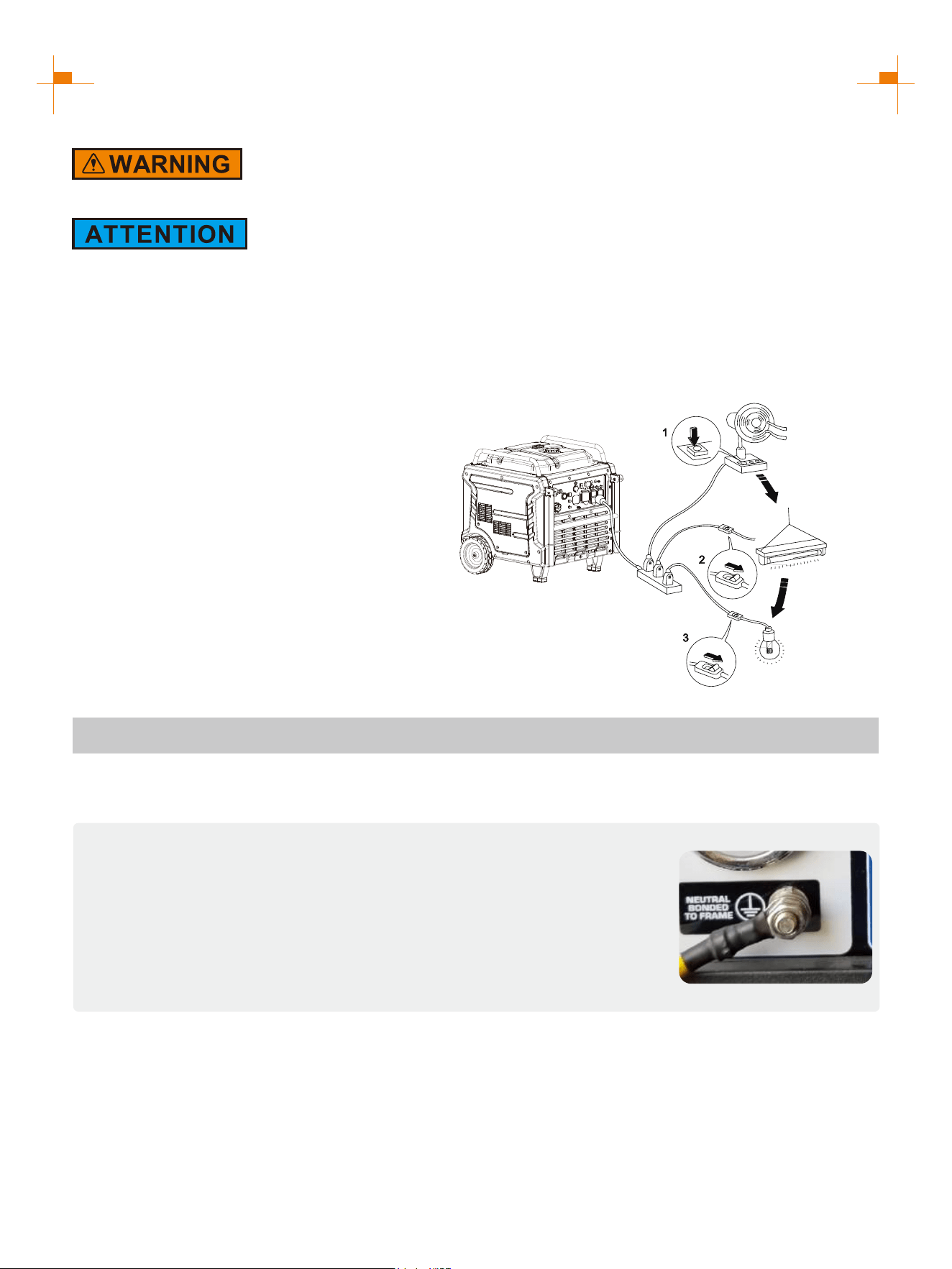
① Start up the engine;
② Turn energy-saving switch to "ON";
③ Insert the plug into AC outlet;
④ Make sure that AC indicator is lit up;
⑤ Switch on electrical equipment.
Tip: Before increasing engine speed, energy-
saving switch must be switched to "OFF". If the
generator set supplies power to multi loads or
electrical equipment, start from large to small
according to the size of each electrical
equipment.
① Please use grounding wire with sufficient electrical energy capacity;
② Connect one end of grounding wire reliable to grounding bolt on control panel
of the generator set;
③ Insert grounding body (iron rod with a diameter of 5 ~ 10mm) 200mm below
into the earth and lead it out with conductor;
④ Connect the other end of the grounding wire reliable to the led wire of
grounding body.
In order to prevent any damage to the generator caused by electric shock or improper electrical application, it is
recommended that the generator is grounded with good conductor with insulating sheath.
Tip: How to change the grounding method please refer to the website: https://www.genmaxpower.com/page/faq
GENERATOR GROUNDING
26
USING THE GENERATOR
Connect the battery charger to the battery charging
port on the generator panel and connect the mains
to charge the battery.
The battery storage time is generally about 6 months. If the generator is not used for a long time, the battery will
run out of power. At this time, the battery should be charged. Replace the battery if it is damaged or fails to
charge.
Hand start charging: Start the generator by hand, and the battery will be charged automatically when the
generator runs.
Use an external power source for charging:
Do not start the generator while charging with an external power supply. Keep batteries away from fire sources.
Keep the battery in a cool and dry place, away from direct sunlight. Keep batteries away from children.
1. Charge properly
Keeping battery properly charged and discharged can prolong battery life. Maintaining a power level of 10%-90%
in battery is beneficial for battery protection.
2. Choose the appropriate charging temperature
Battery charging temperature range: 32-113℉/0-45℃.
3. Avoid overcharging
Overcharging of battery must be avoided during the charging process. Overcharging of battery in any form will
lead to serious damage to battery performance and even explosion.
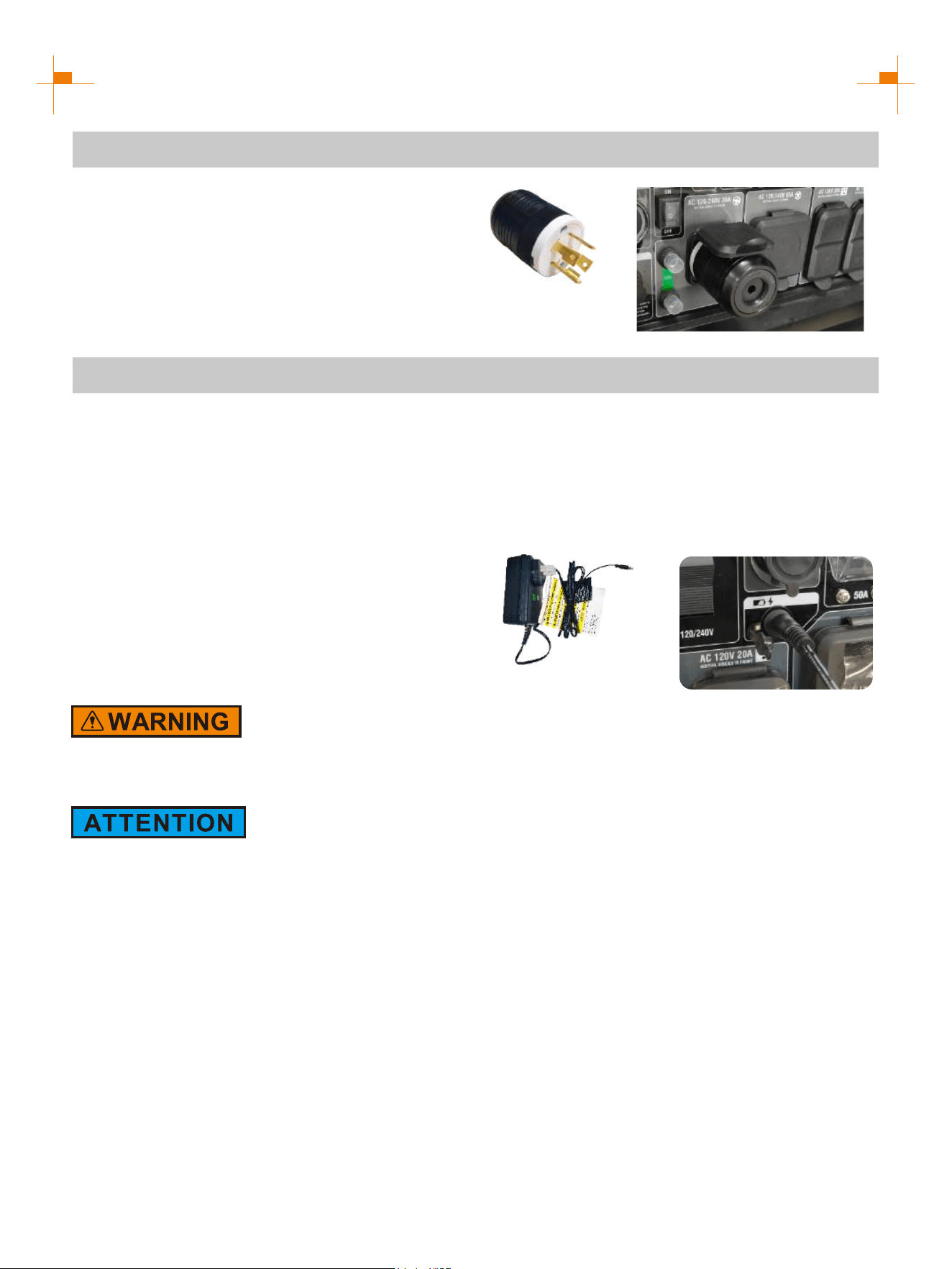
This generator is "neutral floating" state, if you want to
change to a "neutral bonded" state, insert the Bonding
Plug into the output socket of the generator to change
the neutral floating to neutral bonded status.
NEMA L14-30P
Bonding Plug
CHANGING THE NEUTRAL POINT
BATTERY CHARGING
Battery Charger
27
USING THE GENERATOR
This generator can be controlled to start and stop through an external intelligent control system.
CONNECTING AUTOMATIC START/STOP DEVICES
When using other external intelligent control systems to control the generator, please carefully read the manual
provided with the equipment.
• After this function is enabled, the push start button and remote start start/stop button and remote start are
disabled.
• Before connecting GM1600WH or other automatic start/stop equipment, please carefully read the accompanying
manual.
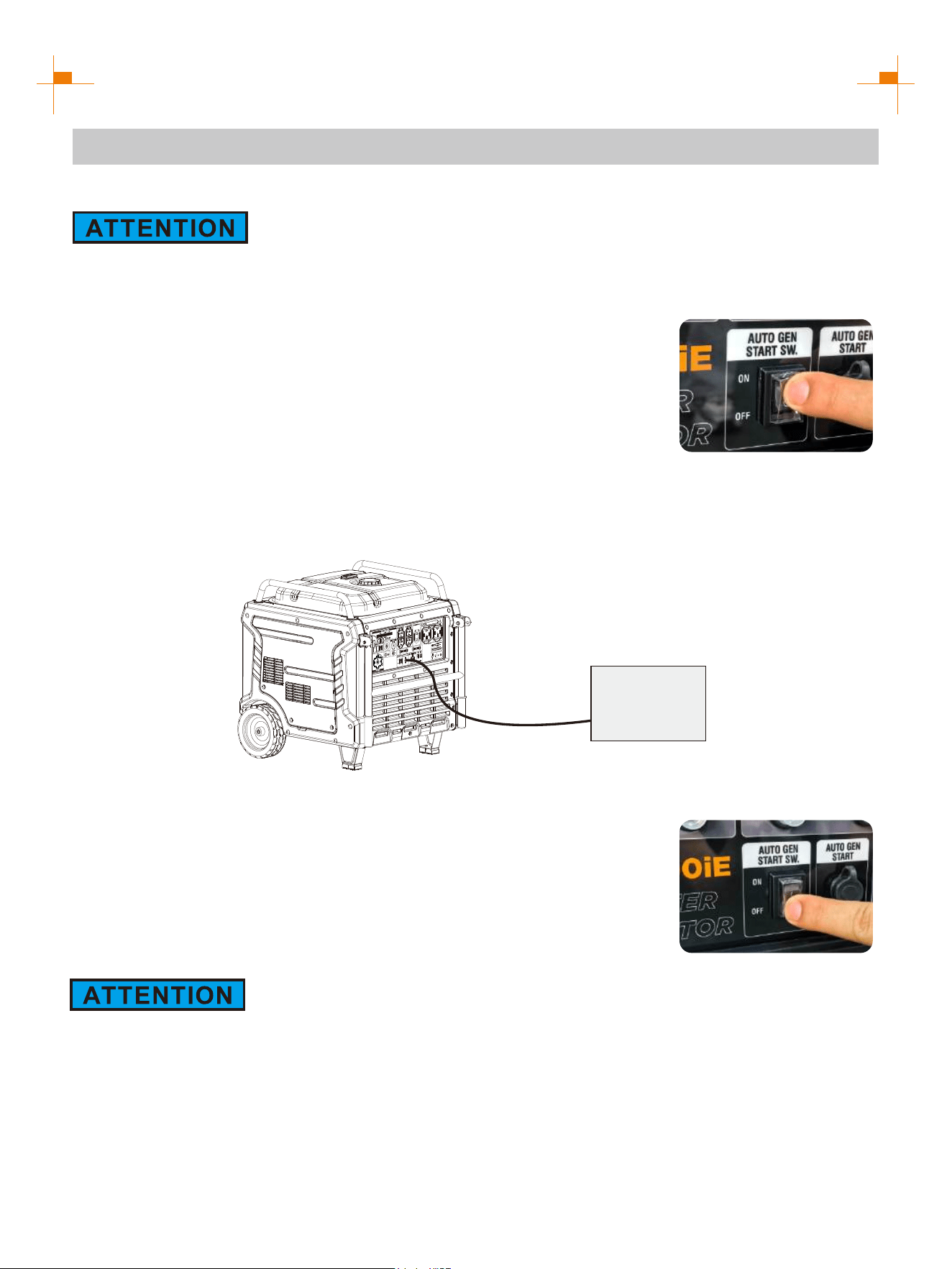
AUTO GEN START
1. Select the fuel source according to the startup steps, connect the
battery cable, and press the main switch to the "ON" position.
2. Turn the AUTO GEN START SWITCH to ON.
(One -key start, and remote control cannot control the start of the
generator. Only the AUTO GEN START can control the generator.)
3. When the AUTO GEN START connected, the external intelligent control system controls the start and
stop of the generator (it will start and run if the two wires are Short-circuited, and shut down if they are
disconnected).
CONTROL
SYSTEM
(Control system sold separately)
AUTO GEN STOP
1.Turn the AUTO GEN START SWITCH to OFF.
(one -key start, the remote control can control the start of the generator, AUTO
GEN START can not control the generator.)
28
SERVICE AND MAINTENANCE
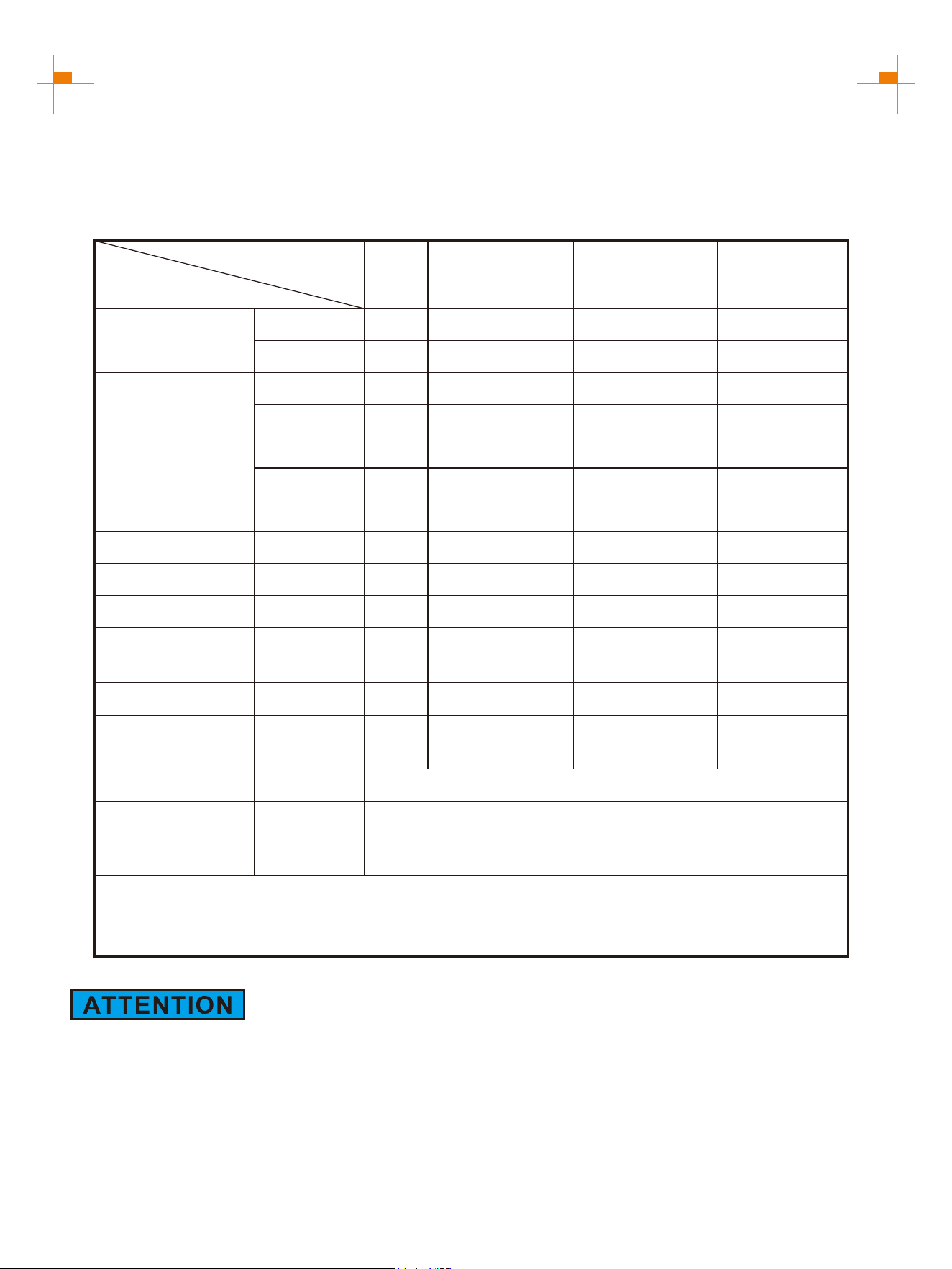
Good maintenance and service is the best guarantee for safe, economical and zero-failure operation. It also
contributes to environmental protection.
In order to keep the generator in good condition, you must inspect and maintain it regularly. The maintenance
schedule is as follows:
Maintenance cycle
Item
Each
First in 1 month
or 20 hours
Then every three
months or every
50 hours
100 hours per
year or use
Engine oil
Gearbox gear
Oil (if any)
Air cleaner
element
Settling cup (if any)
Spark plug
Spark eliminator
Idle speed
(if any)**
Valve clearance**
Fuel tank and
fuel filter***
Fuel line
Cylinder head,
piston
Displacement < 225cc, every 125 hours; displacement
capacity ≥ 225cc, every 250 hours.
Check-fill
Replace
Replace
Check oil
Inspection
Clean
Replace
Clean
Clean-adjust
Clean
Check-adjust
Check-adjust
Clean
Inspection
Remove
carbon
deposit**
Every two years (Please replace if necessary)
√
√ √
√
√ √
√
√
√
√
√*
√
√
√
√
* heseT items shall be replaced if necessary;
** heT se items shall be maintained by the dealer authorized by the Company, unless the
user has proper tools and maintenance ability.
• If it often works under high temperature or high load, oil shall be changed every 25 hours;
• If it often works in dusty or harsh environment, air cleaner element shall be cleaned every 10 hours. If
necessary, the air cleaner element shall be replaced every 25 hours;
• It shall be maintained on spot-inspection cycle and time, whichever is earlier;
• If maintenance cycle time has elapsed, perform the maintenance as soon as possible as per the table above.
29
SERVICE AND MAINTENANCE
Please shut down the engine first before performing any maintenance. The engine shall be placed in a horizontal
position. In order to prevent the engine from starting up, separate spark plug cap shall be separated from spark
plug.
Do not use it indoors or use it in a tunnel, cave or other places ventilated poorly. Make sure that work area is well
ventilated. Exhaust gas from the engine contains toxic gases, carbon oxides, and the inhalation can cause shock,
loss of consciousness, and even death.
CLEANING THE GENERATOR
Do not store or operate your generator in dirty, dusty, or corrosive environments. Do not allow foreign materials
and debris to clog the vents on the unit.
NEVER clean the generator with a garden hose. Water can damage the generator's fuel system and electrical
components. If the unit needs to be cleaned, use a soft brush and damp cloth to clean the exterior and use low
pressure air (no greater than 25 psi) to clean the vents.
Never use gasoline as a cleaning agent.
CHECKING AND FILLING FUEL
TO PREVENT SERIOUS INJURY FROM FIRE:
Fill the fuel tank in a well-ventilated area away from ignition sources. If the engine is hot from use, shut the engine
off and wait for it to cool before adding fuel. Do not smoke.
1. Clean the Fuel Cap and the area around it.
2. Unscrew and remove the Fuel Cap.
3. Remove the strainer and remove any dirt and debris. Then replace the strainer.
Note: Do not use gasoline containing more than 10% ethanol (E10). Do not use E85 ethanol.
Note: Do not use gasoline that has been stored in a metal fuel container or a dirty fuel container. It can cause
particles to enter the carburetor, affecting engine performance and/or causing damage.
4. If needed, fill the Fuel Tank to about 1.5 inch under the fill neck with 87 octane unleaded gasoline that has been
treated with a fuel stabilizer additive. Follow fuel stabilizer manufacturer's recommendations for use.
5. Replace the Fuel Cap.
6. Wipe up any spilled fuel and allow excess to evaporate before starting the engine. To prevent FIRE, do not start
the engine while the smell of fuel hangs in the air.
SPARK PLUG INSPECTION
The spark plug is important for proper engine operation. A good spark plug should be intact, free of
deposits, and properly gapped.
Improper maintenance may cause reduced fuel economy, misfires, trouble starting, or damage to the
spark plug threads.
This product is a dual cylinder engine, so there are two spark plugs. Please check the spark plugs on both
sides during maintenance.
30
SERVICE AND MAINTENANCE
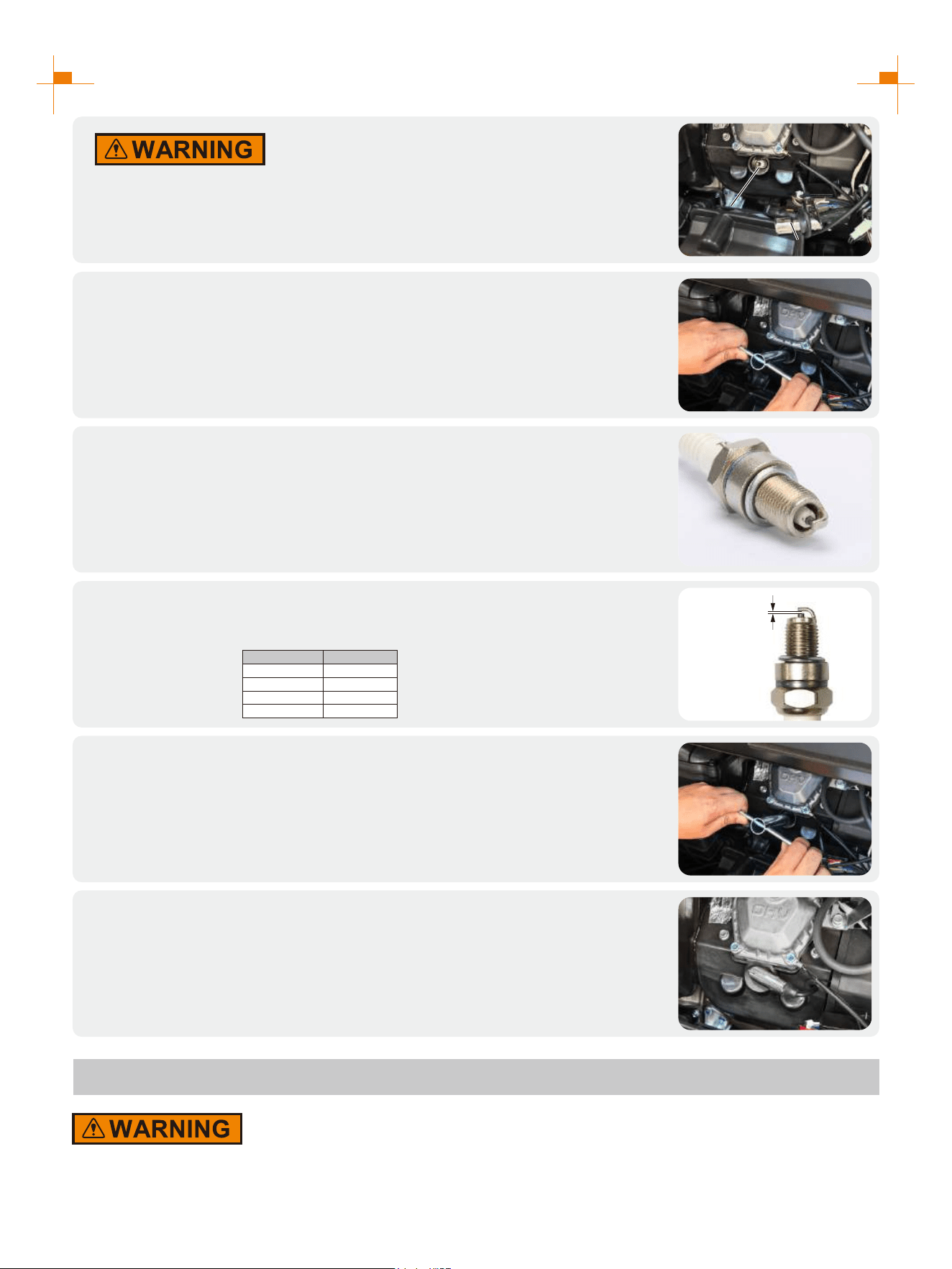
1. There is a spark plug on each of the left and right sides of the
generator. Pull out the spark plug cap.
Turn off the generator and wait for the generator to completely cool down.
2. Unscrew the spark plug from the generator using the spark plug
wrench included with this product.
3. Inspect the Spark Plug
If the electrode is oily, clean it using a clean, dry rag. If the electrode has
deposits on it, clean it with a brass wire brush. If the white insulator is
cracked or chipped, replace the spark plug.
4. Check the model of spark plug and clearance.
Spark Plug Gap: 0.7-0.8mm
Standard Spark:
5. Reinstall the spark plug.
Spark Plug Torque: 22N.m(195in-lb)
0.7~0.8mm
Tip: If there is no torque wrench when installing the spark plug, a better
estimation method is to screw it 1/4-1/2 turns by force after screwing it in place,
but the spark plug shall be screwed to specified torque as soon as possible.
6. Replace Spark Plug Cap.
STOCK PLUG F7RTC
NGK BPR6ES
TORCH F6RTC
CHAMPION RN11YC
BOSCH WR6DS
ENGINE OIL CHANGE
Do not drain the oil immediately after turning off the generator. Oil temperature is very high, when operating, take
care to avoid scalding.
Spark Plug
Spark Plug Cap
31
SERVICE AND MAINTENANCE
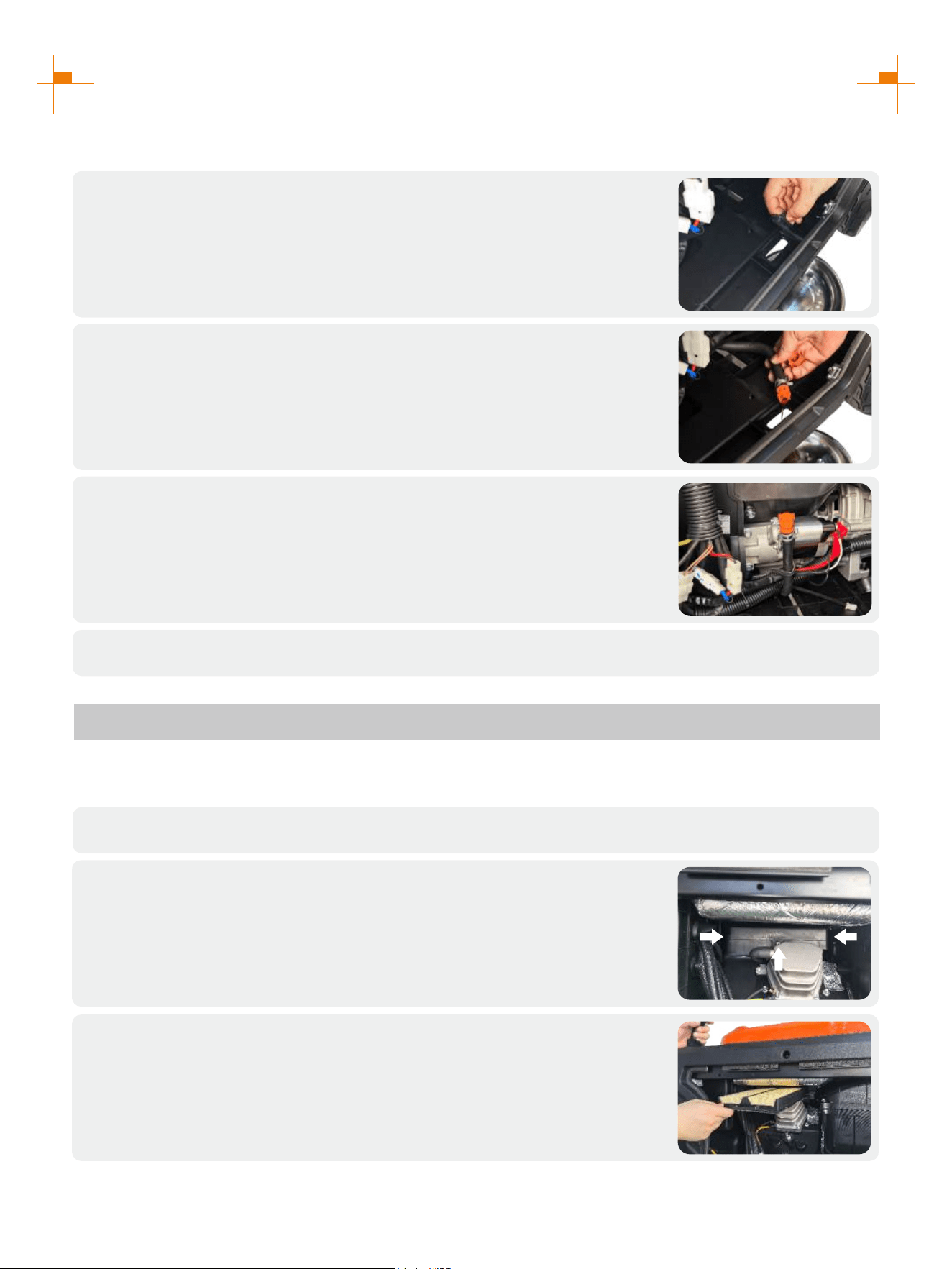
NOTE: Change the oil while the engine is warm but not hot. Warm engine oil drains more quickly and thoroughly
than cool lubricant. Contact with hot lubricant will cause serious burns.
1. The oil drain pipe is on the left side of the generator.
2. Remove the rubber sealing plug from the generator base plate.
4. Tighten the cover of the oil drain pipe and place it back in place.
After the oil is completely drained, tighten the cover of the oil drain pipe and
place it back in its original position. Follow the procedure of "Adding Engine
Oil" to add new engine oil and check the oil level.
5. Clean the engine oil on the generator base plate and reinstall the rubber sealing plug.
3. Drain engine oil.
Open the fixing clip, unscrew the drain pipe cover, and drain the oil.
Drain oil into an approved oil disposal container. Contact your local auto parts
store for information on oil disposal.
CLEANING/REPLACING THE AIR FILTER
Dirty air cleaner may prevent air from flowing into the carburetor. In order to prevent failure of the carburetor,
please maintain air cleaner regularly. If being used in a dusty environment, it shall be maintained frequently.
2. Remove the air filter cover.
Open the right side cover. Loosen the three bolts
on both sides and in the middle of the filter cover
and remove the filter cover.
1. Turn off the generator and let the engine cool down.
2. Remove the air filter element.
32
SERVICE AND MAINTENANCE
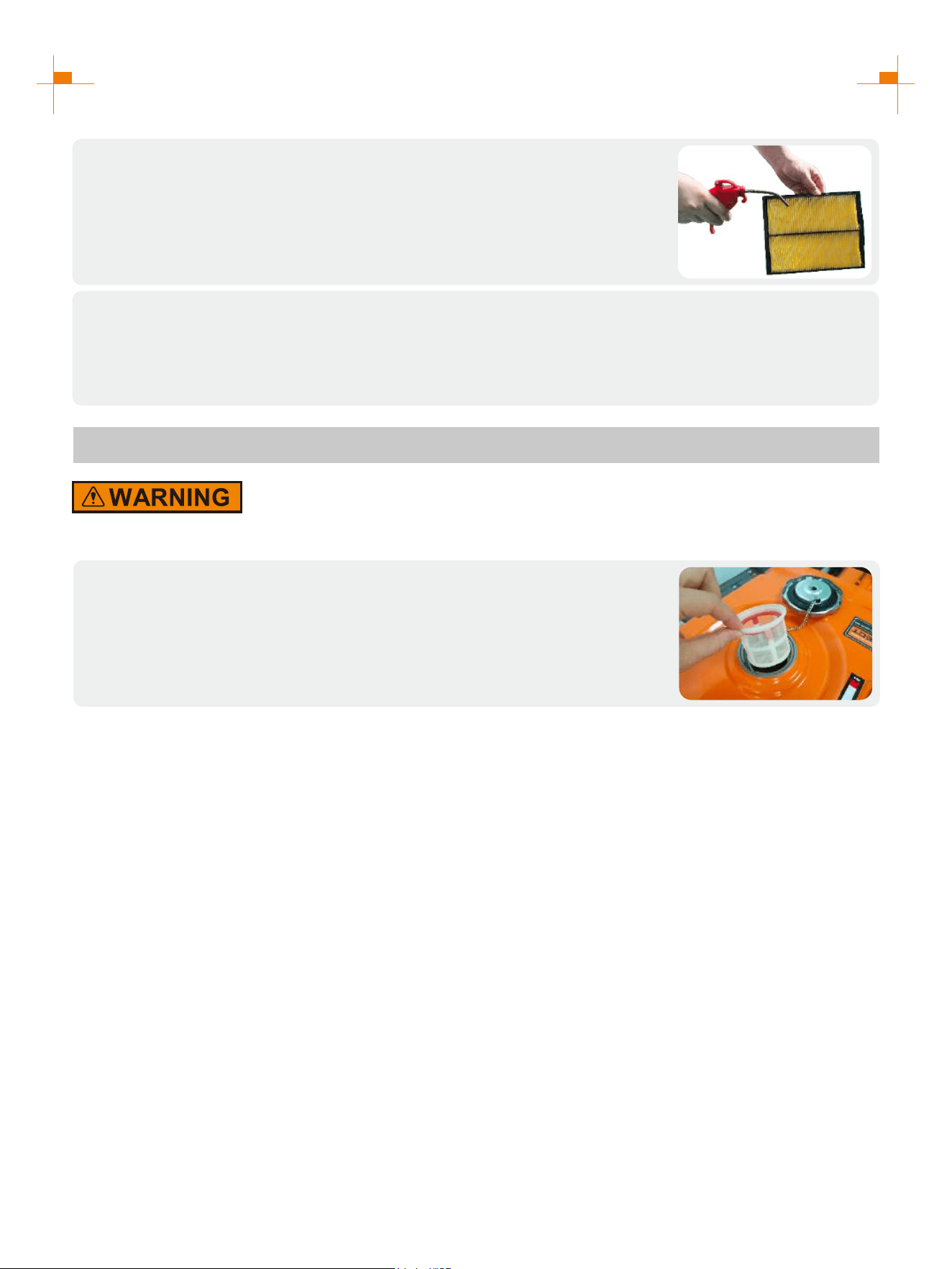
3. Use a soft bristled brush (brush along its folds) or compressed
air to remove dust and dirt adhering to the surface of the paper
filter element.
4. Return the air filter element to its original position. Reinstall the air filter cover.
NOTE: During maintenance, the paper filter cannot be cleaned in water,
otherwise the paper filter will fail.
NOTE: Make sure that the surface of air filter element is in close contact with air cleaner, and there shall
be no gap leaking air. Be sure not to start the engine before air cleaner is assembled, because it will
generate excessive toxic gas and wear the cylinder.
CLEAN THE FUEL FILTER
Be sure not to open fuel tank of the generator in a place where smoking or with flame.
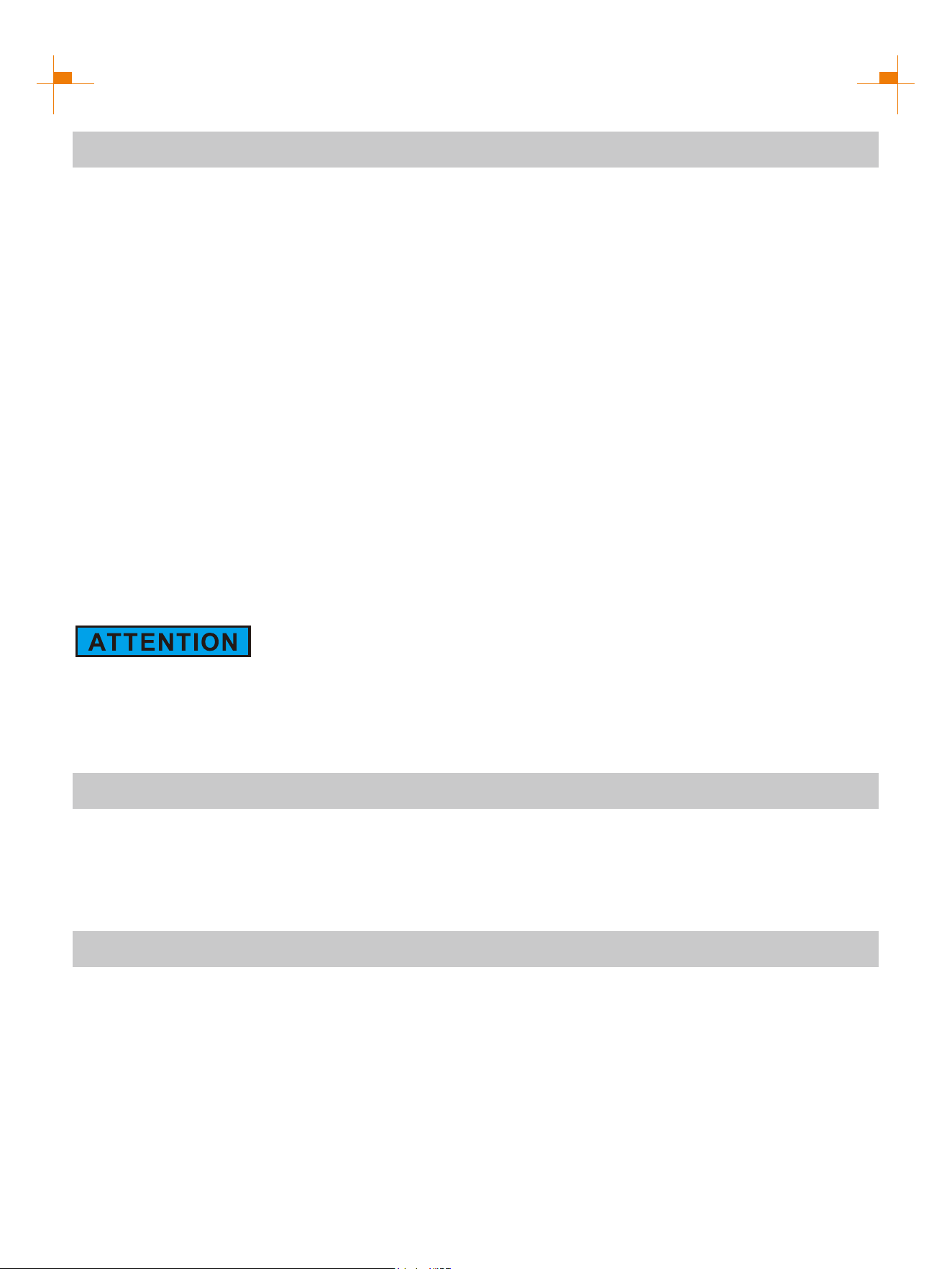
1. Remove fuel tank cap and fuel tank filter screen.
2. Clean fuel tank filter screen with gasoline.
3. Wipe filter screen dry, and put it back into fuel tank.
4. Reassemble fuel tank cap.
33
STORAGE AND TRANSPORT
GENERATOR STORAGE
If it is stored long-term, in order to prevent aging, you shall take some storage measures.
1. Turn off the generator and let it cool completely.
2. Open fuel tank cap, to take out fuel filter screen. Pump all fuel in fuel tank into special fuel tank, and
then reassemble fuel tank cap back.
3. Start up the engine to burn off fuel in the carburetor, and then shut it down.
NOTE: Do not connect any electrical equipment. Running time of the engine depends on remaining fuel in the
fuel tank.
5. Unscrew oil dipstick, and drain oil in the crankcase off. Fill new oil to upper oil limit, and then
assemble oil dipstick.
6. Remove the spark plug and pour 5-10ml of clean oil into the combustion chamber. Turn the crankshaft
a few times to distribute the oil, then reassemble the spark plug.
7. Disconnect the battery cable.
9. Clean the generator.
NOTE: Please do not rinse the generator with water. There is a possibility of causing malfunctions and short
circuits in electrical components.
10. Place the generator set in a clean and dry area.
Placing the Generator
● After the generator cools down, place it upright and cover it with a layer of dust cloth. The generator should be
placed in a well ventilated and dry place.
● Do not pile up debris on the generator.
8. Gently pull startup handle until you feel resistance, allowing both inlet valve and exhaust valve to be
closed.
GENERATOR TRANSPORT
● When the generator set is transported, it shall be ensured that there is no fuel spilling.
● Do not fill excessive fuel Into fuel tank.
● Do not run the generator, and avoid direct sunlight.
● Do not transport the generator set on rough road for long time.
PREPARATION FOR USE AFTER STORAGE
● Slowly pull the starter cord a few times to clean oil from the cylinder or to eject any pump protector from the
pump which may have been added prior to storage.
● Remove the spark plug from the cylinder. Wipe oil from the spark plug and return it to the cylinder and re-
tighten.
● Reconnect the spark plug wire.
● Refuel engine per earlier instructions in this manual.
34
TROUBLESHOOTING
35
TROUBLESHOOTING
36
TECHNICAL PARAMETERS
Item
Engine Model
Engine Type
Displacement (cc)
Gas Distribution Mode
Cooling Mode
Rated Speed (RPM)
Starting Method
Fuel Tank Volume (gal)
Fuel Type and Grade
Lubricating Oil Capacity (gal)
Lubricating Oil Model
Forced Cooling Wind
Vehicle-use unleaded gasoline
Noise dB (at 7m)(25% load)
Rated Power (kW)
Max. Power (kW)
Rated Voltage (V)
Rated Frequency (Hz)
Rated Power Factor
Phase Number
Run Time @ 25% (h)
Overall Dimension (in.)
Net Weight (lb.)
GM17000iETC
OHV
3600
10.5(40L)
SAE 10W/30
0.4(1.6L)
63
120/240
60
1
Single phase
Stroke × Bore (mm)
14
4-stroke
313(142kg)
Electrical Start / Remote Start
760
92×69
2V82F
33.1×31.3×33.5(842×795×850mm)
Fuel Consumption Rate
(25% load)(L/h)
THD
Fuel Consumption Rate
(100% load)(L/h)
2.8
7.5
≤3%
Valve Clearance
Input valve:0.10~0.15 mm, Output valve:0.15~0.20 mm
13.5(GAS.)/12.5(LPG)/10.8(NG)
17.0(GAS.)/15.0(LPG)/13.5(NG)
LPG Consumption Rate
(25% load)(kg/h)
LPG Consumption Rate
(100% load)(kg/h)
1.33
2.45
NG Consumption Rate
(25% load)(m³/h)
NG Consumption Rate
(100% load)(m³/h)
1.62
2.72
37
R
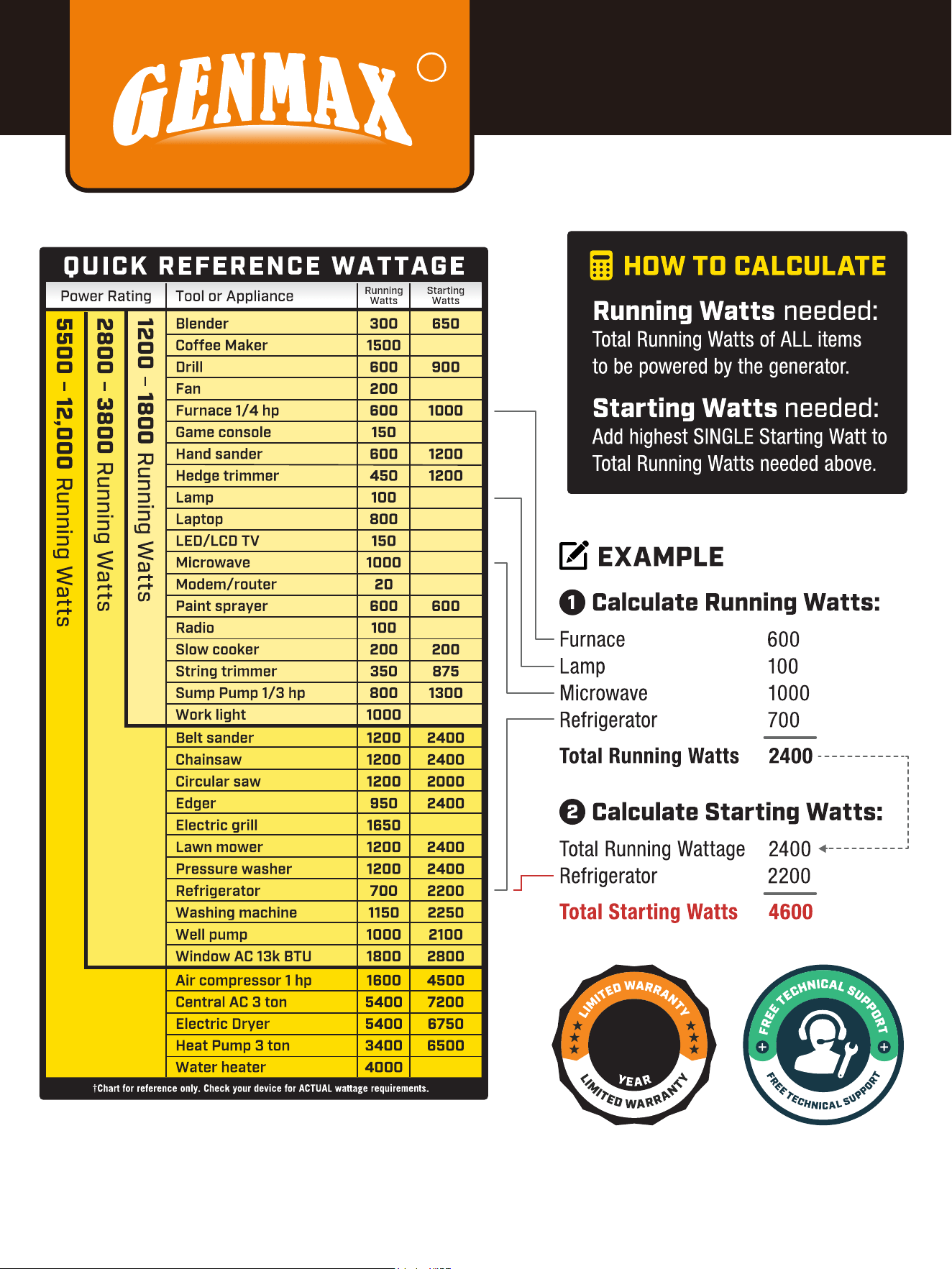
CHOOSING
A GENERATOR
3

38
In production management, based on orderly, efficient, scientific principles. trying to do as
better as possible in product design, development, production, inspection, etc. to make our
production can keep orderly. And will continue to make improvement to make sure that
keep the competitiveness.
Welcome friends at home and abroad to visit and guide, work together to create
brilliant.
Phone
866-960-2920
service@genmaxpower.com
Http://www.genmaxpower.com
E-mail
You
Tube
f
+
R
Facebook Linkedin YouTube
ADD: 301 Doubleday Ave Ontario CA 91761