1
IMPORTANT SAFETY INSTRUCTIONS
1)
SAVE THESE INSTRUCTIONS
– This manual contains
important safety and operating instructions for battery charger model P/N 022-0337.
2) Do not expose charger to rain or snow.
3) Use of an attachment not recommended or sold by the battery charger manufacturer may
result in a risk of fire, electric shock, or injury to persons.
4) To reduce risk of damage to electric plug and cord, pull by plug rather than cord when
disconnecting charger.
5) An extension cord should not be used unless absolutely necessary. Use of improper
extension cord could result in a risk of fire and electric shock. If an extension cord must
be used, make sure:
a) That pins on plug of extension cord are the same number, size, and shape as those of
plug on charger;
b) That extension cord is properly wired and in good electrical condition; and
c) That wire size is large enough for ac ampere rating of charger as specified in Table 1
6) Do not operate charger with damaged cord or plug – replace the cord or plug
immediately.
7) Do not operate charger if it has received a sharp blow, been dropped, or otherwise
damaged in any way; take it to a qualified serviceman.
8) Do not disassemble charger; take it to a qualified serviceman when service or repair is
required. Incorrect reassembly may result in a risk of electric shock or fire.
9) To reduce risk of electric shock, unplug charger from outlet before attempting any
maintenance or cleaning. Turning off controls will not reduce this risk.
10) WARNING – RISK OF EXPLOSIVE GASES.
a) WORKING IN VICINITY OF A LEAD-ACID BATTERY IS DANGEROUS.
BATTERIES GENERATE EXPLOSIVE GASES DURING NORMAL BATTERY
OPERATION. FOR THIS REASON, IT IS OF UTMOST IMPORTANCE THAT YOU
FOLLOW THE INSTRUCTIONS EACH TIME YOU USE THE CHARGER.
b) To reduce risk of battery explosion, follow these instructions and those published by
battery manufacturer and manufacturer of any equipment you intend to use in
vicinity of battery. Review cautionary marking on these products and on engine.
Deltran Battery Tender
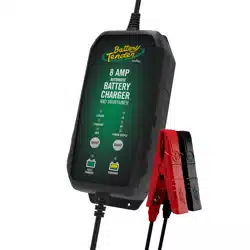
2Amp/8Amp 12Volt Selectable
Battery Charger & Maintainer
Designed for Six-Cell Lead-Acid/AGM/ Batteries
and
Four-Cell Lithium-Iron-Phosphate (LiFeP04)
Batteries
TABLE 1
Length of Cord, Feet /Meters 25/7.6 50/15.2 100/30.5 150/45.6
AWG Size of Cord 18 18 18 16
P/N 392-0700-R0
2
11) PERSONAL PRECAUTIONS
a) Consider having someone close enough by to come to your aid when you work near
a lead-acid battery.
b) Have plenty of fresh water and soap nearby in case battery acid contacts skin,
clothing, or eyes.
c) Wear complete eye protection and clothing protection. Avoid touching eyes while
working near battery.
d) If battery acid contacts skin or clothing, wash immediately with soap and water. If
acid enters eye, immediately flood eye with running cold water for at least 10
minutes and get medical attention immediately.
e) NEVER smoke or allow a spark or flame in vicinity of battery or engine.
f) Be extra cautious to reduce risk of dropping a metal tool onto battery. It might spark
or short-circuit battery or other electrical part that may cause explosion.
g) Remove personal metal items such as rings, bracelets, necklaces, and watches
when working with a lead-acid battery. A lead-acid battery can produce a short-
circuit current high enough to weld a ring or the like to metal, causing a severe burn.
h) Use charger for charging a LEAD-ACID battery only. It is not intended to supply
power to a low voltage electrical system other than in a starter-motor application. Do
not use battery charger for charging dry-cell batteries that are commonly used with
home appliances. These batteries may burst and cause injury to persons and
damage to property.
i) NEVER charge a frozen battery.
12) PREPARING TO CHARGE
a) If necessary to remove battery from vehicle to charge, always remove grounded
terminal from battery first. Make sure all accessories in the vehicle are off, so as not
to cause an arc.
b) Be sure area around battery is well ventilated while battery is being charged.
c) Clean battery terminals. Be careful to keep corrosion from coming in contact with
eyes.
d) Add distilled water in each cell until battery acid reaches level specified by battery
manufacturer. Do not overfill. For a battery without removable cell caps, such as
valve regulated lead acid batteries, carefully follow manufacturer’s recharging
instructions.
e) Study all battery manufacturers specific precautions such as removing or not
removing cell caps while charging and recommended rates of charge.
f) Determine voltage of battery by referring to car owner’s manual and make sure that
output voltage selector switch is set at correct voltage. Do not use the battery
charger unless battery voltage matches the output voltage rating of the charger.
13) CHARGER LOCATION
a) Locate charger as far away from battery as dc cables permit.
b) Never place charger directly above battery being charged; gases from battery will
corrode and damage charger.
c) Never allow battery acid to drip on charger when reading electrolyte specific gravity
or filling battery.
d) Do not operate charger in a closed-in area or restrict ventilation in any way.
e) Do not set a battery on top of charger.
14) DC CONNECTION PRECAUTIONS
a) Connect and disconnect dc output clips only after setting any charger switches to
offposition and removing ac cord from electric outlet. Never allow clips to touch
each other.
b) Attach clips to battery and chassis as indicated in 15(e), 15(f), and 16(b) through
16(d).
3
15) FOLLOW THESE STEPS WHEN BATTERY IS INSTALLED IN VEHICLE. A SPARK
NEAR BATTERY MAY CAUSE BATTERY EXPLOSION. TO REDUCE RISK OF A
SPARK NEAR BATTERY:
a) Position ac and dc cords to reduce risk of damage by hood, door, or moving engine
part.
b) Stay clear of fan blades, belts, pulleys, and other parts that can cause injury to
persons.
c) Check polarity of battery posts. POSITIVE (POS, P, +) battery post usually has
larger diameter than NEGATIVE (NEG, N,–) post.
d) Determine which post of battery is grounded (connected) to the chassis. If negative
post is grounded to chassis (as in most vehicles), see (e). If positive post is
grounded to the chassis, see (f).
e) For negative-grounded vehicle, connect POSITIVE (RED) clip from battery charger
to POSITIVE (POS, P, +) ungrounded post of battery first. Then connect NEGATIVE
(BLACK) clip to vehicle chassis or engine block away from battery. Do not connect
clip to carburetor, fuel lines, or sheet-metal body parts. Connect to a heavy gage
metal part of the frame or engine block.
f) For positive-grounded vehicle, connect NEGATIVE (BLACK) clip from battery
charger to NEGATIVE (NEG, N, –) ungrounded post of battery. Connect POSITIVE
(RED) clip to vehicle chassis or engine block away from battery. Do not connect clip
to carburetor, fuel lines, or sheet-metal body parts. Connect to a heavy gage metal
part of the frame or engine block.
g) Connect charger AC cord to electrical outlet.
h) When disconnecting charger, turn switches to off, disconnect AC cord, remove clip
from vehicle chassis, and then remove clip from battery terminal.
i) See operating instructions for length of charge information.
16) FOLLOW THESE STEPS WHEN BATTERY IS OUTSIDE VEHICLE. A SPARK NEAR
THE BATTERY MAY CAUSE BATTERY EXPLOSION. TO REDUCE RISK OF A
SPARK NEAR BATTERY:
a) Check polarity of battery posts. POSITIVE (POS, P, +) battery post usually has a
larger diameter than NEGATIVE (NEG, N, –) post.
b) Attach at least a 60cm (24-inch) long 6-gauge (AWG) insulated battery cable to
NEGATIVE (NEG, N, –) battery post.
c) Connect POSITIVE (RED) charger clip to POSITIVE (POS, P, +) post of battery.
d) Position yourself and free end of cable as far away from battery as possible – then
connect NEGATIVE (BLACK) charger clip to free end of cable.
e) Do not face battery when making final connection.
f) Connect charger AC cord to electrical outlet.
g) When disconnecting charger, always do so in reverse sequence of connecting
procedure and break first connection while as far away from battery as practical.
h) A marine (boat) battery must be removed and charged on shore. To charge it on
board requires equipment specially designed for marine use.
The supply cord cannot be replaced. If the cord is damaged the appliance
should be scrapped.
Examine the battery charger regularly for damage, especially the cord,
plug and enclosure; if the battery charger is damaged, it must not be used
until it has been repaired.
This symbol indicates separate collection for electrical and electronic
equipment
4
USER INSTRUCTIONS

5
AUTOMATIC CHARGING AND BATTERY STATUS MONITORING:
Battery Tender® battery chargers are completely automatic and may be left
connected to both AC power and to the battery that it is charging for long
periods of time. The charger output power, voltage, and current depends on
the condition of the battery it is charging. Battery Tender
®
battery chargers
have several status LED indicators that provide a visual means to determine
the operating mode of the charger and hence the condition of the battery
connected to the charger.
When AC power is first applied to the charger all LEDs will illuminate for
two to three seconds.
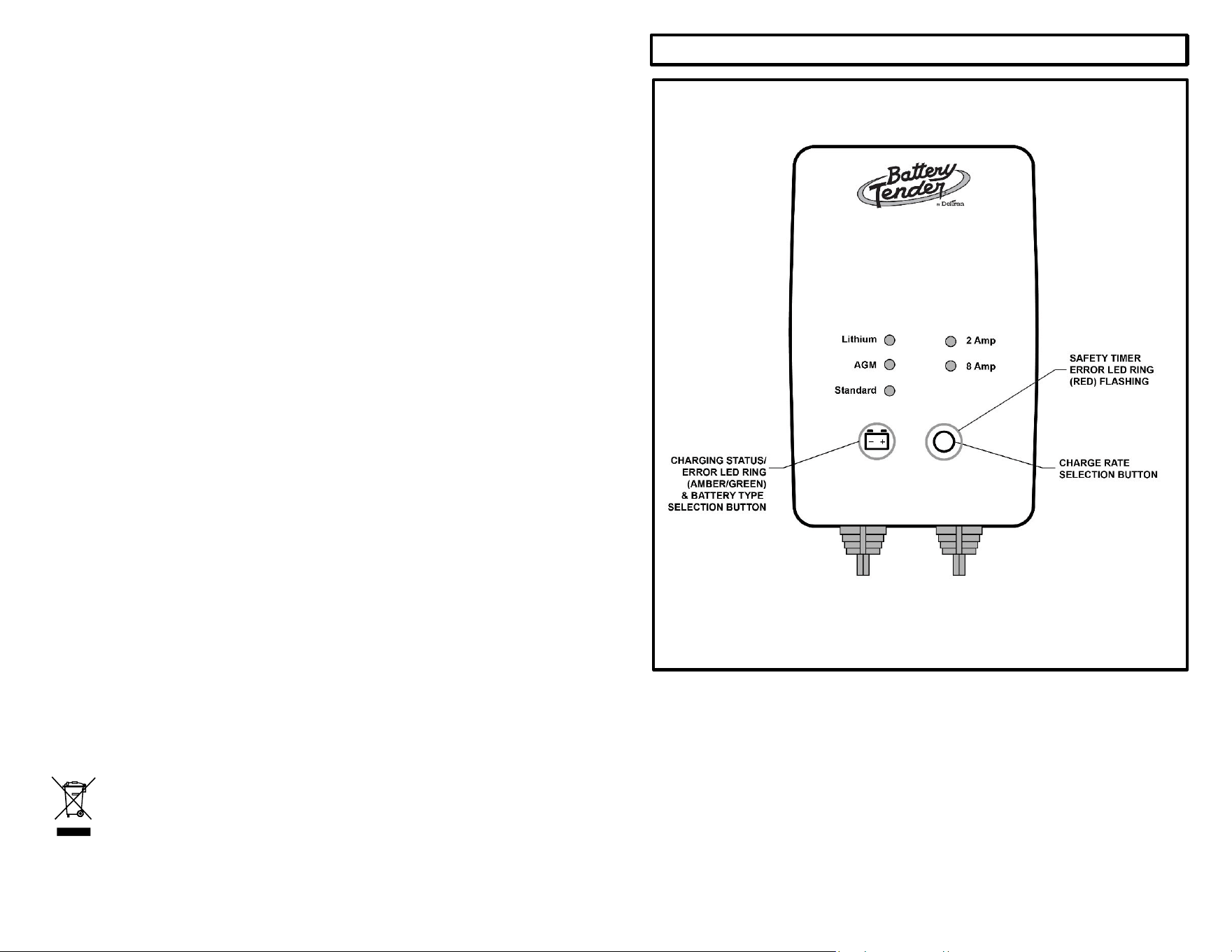
The Charging Status/Error Light Ring shows whether the charger is
operating in one of the four primary charge modes:
1) Qualification/Initialization mode: The Monitor Circuit verifies
appropriate battery voltage levels and good electrical continuity
between the battery and the charger DC output.
2) Bulk mode (full charge, constant current, battery is 0% to 80%
charged)
3) Absorption mode (high constant voltage, battery is 80% to 100%
charged).
4) Storage/float maintenance mode (low constant voltage, battery is
100% to 103% charged).
When the battery is fully charged, the Charger Status Light Ring will turn
solid green and the charger will switch to a storage/float maintenance
charge mode. The Battery Tender
®
battery charger will automatically
monitor and maintain the battery at full charge.
CHARGE RATE SELECTION BUTTON
The Battery Tender
®
battery charger has a “Charge Rate” selection button
which allows you to switch between charging at a rate of 2 Amps or
8 Amps.
The LED next to selected Amperage rate will illuminate green.
The charge rate can be selected once the charger has AC power applied
and before the charger is connected to the battery.
Once the charger has AC power and is also connected to the battery the
charge rate selection cannot be changed. To change the mode, disconnect
the battery from the charger.
If the AC power is interrupted the charger will resume charging at the last
charge rate setting used.
6
BATTERY TYPE SELECTION BUTTON
The Battery Tender
®
battery charger has a “Battery Type selection button
which allows you to switch between charging a 12 Volt Standard (Lead
Acid) battery, a 12Volt AGM (Sealed) battery and a 12Volt Lithium Iron
Phosphate (LiFePO4) battery. DO NOT USE THIS CHARGER TO
CHARGE ANY OTHER TYPE OF BATTERY.
The battery type can be selected once the charger has AC power applied
and before the charger is connected to the battery.
Once the charger has AC power and is also connected to the battery the
battery type cannot be changed. To change the battery type, disconnect
the battery from the charger.
If the AC power is interrupted the charger will resume charging using the
last setting.
ATTENTION: The Battery Tender
®
CHARGER HAS A SPARK FREE
CIRCUITRY. The output alligator clips or ring terminals will not spark when
they are touched together. The Battery Tender
®
battery charger will not
produce an output voltage until it senses at least 3 volts from the battery. It
must be connected to a battery with the correct polarity before it will start
charging a battery. Therefore, if you plug the AC power cord into an AC
power outlet, and if the output alligator clips or ring terminals are not
connected to a battery, and if you touch the alligator clips or ring terminals
together, there will be no electrical spark.
NOTE:
THE OUTPUT CLIPS OR RING TERMINALS MUST BE CONNECTED TO
A BATTERY BEFORE THE CHARGER CAN PRODUCE AN OUTPUT
VOLTAGE.
TIME REQUIRED TO CHARGE A BATTERY:
The Battery Tender
®
battery charger charges at a rate of 2.0 Amps or 2.0
Amp-hours per hour. Therefore, a fully discharged 15 Amp-Hour battery will
take approximately 6 hours to recharge to 80% capacity.
The Battery Tender
®
battery charger charges at a rate of 8.0 Amps or 8.0
Amp-hours per hour. Therefore, a fully discharged 15 Amp-Hour battery will
take approximately 1.5 hours to recharge to 80% capacity.

7
WORKING WITH A DEAD BATTERY OR A BATTERY WITH A VERY
LOW VOLTAGE:
If you try to charge a dead battery having a voltage below 3 volts, the
Battery Tender
®
charger will not start. An internal safety circuit prevents the
charger from generating any output voltage unless it senses at least 3 volts
at the charger output. In this situation, the Charging Status/Error Light
Ring FLASHING Amber, indicating that a charge has not been initiated.
NOTE:
If a 12-volt, lead-Acid battery has an output voltage of less than 9 volts
when it is at rest, when it is neither being charged nor supplying electrical
current to an external load, there is a good chance that the battery is
defective. As a frame of reference, a fully charged 12-volt, lead-Acid
battery will have a rest-state, no-load voltage of approximately 12.9 volts.
A fully discharged 12-volt, lead-acid battery will have a rest-state, no-load
voltage of approximately 11.4 volts. That means that a voltage change of
only 1.5 volts represents the full range of charge 0% to 100% on a 12-Volt,
lead-acid battery. Depending on the manufacturer, and the age of the
battery, the specific voltages will vary by a few tenths of a volt, but the 1.5-
volt range will still be a good indicator of the battery charge %.
CHARGING STATUS LED RING: If the lights are not lit, then the
battery is not properly connected and/or the charger is not plugged
into AC power. The following describes LED’s and LIGHT RING
operation:
< Charging Status/Error LED Ring ALTERNATING Amber/Green
Indicates the connection to the battery is reversed, meaning the
positive (RED) clamp is connected to the negative (BLACK) post
on the battery and the negative (BLACK) clamp is connected to the
positive (RED) post on the battery. Remove clamps and connect
correctly.
< Safety Timer Error LED Ring Flashing RED
Indicates the battery you are charging as not reached its optimal
voltage in a set amount of time. This means the battery is probably
defective, or there is an excessive load on the battery. To start a
new charge cycle, unplug the charger from the AC and start again.
< Charging Status/Error LED Ring FLASHING Amber – This
indicates that the battery charger has AC power available and that
the microprocessor is functioning properly. If the Light Ring
continues to flash, then either the battery voltage is too low (less
than 3 volts) or the output alligator clips, or ring terminals are not
connected correctly.
Charging Status/Error LED Ring SOLID Amber – Whenever the
Light Ring is on steady Amber, a battery is connected properly, and
the charger is charging the battery. The Light Ring will remain on
Solid Amber until the charger completes this charging stage.
8
Charging Status/Error LED Ring FLASHING Green – When the
Light Ring is Flashing green the battery is greater than 80%
charged and may be removed from the charger and used if
necessary. Whenever possible, leave the battery on charge until
the green light is solid.
Charging Status/Error LED Ring SOLID Green – When the Light
Ring is Solid green the charge is complete, and the battery can be
returned to service if necessary. It can also stay connected to
maintain the battery for an indefinite period of time.
TROUBLESHOOTING
1) If the charger does not turn on and none of the LEDs illuminate.
a. Check to make sure the AC outlet is supplying power by plugging
in a lamp, an appliance, or a voltage meter.
2) The green Solid Charging Status/Error Ring comes on immediately
when charging a discharged battery.
a. The battery is probably defective, take the battery to the dealer to
be tested.
3) When charging a battery, the Solid green Charging Status/Error Ring
never comes on.
a. The battery may be defective, take the battery to the dealer to be
tested.
b. The battery has an excessive current draw, remove or disconnect
the battery from the equipment.
4) Charging Status/Error Light Ring continues to flash Amber even with a
connection to the battery:
a. Check the fuse in the accessory cable.
5) Safety Timer Error LED Ring Flashing RED. To clear this error and
start a new charge cycle, disconnect from the AC and remove the
connection to the battery.
a. The battery is damaged.
b. The chargers safety timer has activated due to the battery not
reaching its optimal voltage. The battery may be defective, take
the battery to the dealer to be tested.
6) Charging Status/Error Light Ring is toggling Amber and Green.
a. Reverse polarity connection to the battery.

9
FCC Warning
Title 47 Subpart, 15.105(b)
Note: This equipment has been tested and found to comply with the limits for a
class B digital device, pursuant to part 15 of the FCC Rules. These limits are
designed to provide reasonable protection against harmful interference in
residential installation. This equipment generates, uses and can radiate radio
frequency energy and, if not installed and used in accordance with the instructions,
may cause harmful interference to radio television reception, which can be
determined by tuning the equipment off and on, the user is encouraged to try to
correct the interference by one or more of the following measures:
- Reorient or relocate the receiving antenna.
- Increase the separation between the equipment and receiver.
- Connect the equipment into an outlet on a circuit different from that
to which the receiver is connected.
- Consult the dealer or an experienced radio/TV technician for help.