
HP company notices
Copyright and License
THE INFORMATION CONTAINED HEREIN IS
SUBJECT TO CHANGE WITHOUT NOTICE.
ALL RIGHTS RESERVED. REPRODUCTION,
ADAPTATION, OR TRANSLATION OF THIS
MATERIAL IS PROHIBITED WITHOUT PRIOR
WRITTEN PERMISSION OF HP, EXCEPT AS
ALLOWED UNDER THE COPYRIGHT LAWS. THE
ONLY WARRANTIES FOR HP PRODUCTS AND
SERVICES ARE SET FORTH IN THE EXPRESS
WARRANTY STATEMENTS ACCOMPANYING SUCH
PRODUCTS AND SERVICES. NOTHING HEREIN
SHOULD BE CONSTRUED AS CONSTITUTING AN
ADDITIONAL WARRANTY. HP SHALL NOT BE
LIABLE FOR TECHNICAL OR EDITORIAL ERRORS
OR OMISSIONS CONTAINED HEREIN.
© Copyright 2025 HP Development Company,
L.P.
Trademark Credits
Microsoft and Windows are either registered
trademarks or trademarks of Microsoft
Corporation in the United States and/or other
countries/regions.
Mac, OS X, macOS, and AirPrint are trademarks
of Apple Inc., registered in the U.S. and other
countries/regions.
ENERGY STAR and the ENERGY STAR mark
are registered trademarks owned by the U.S.
Environmental Protection Agency.
Android and Chromebook are trademarks of
Google LLC.
iOS is a trademark or registered trademark of
Cisco in the U.S. and other countries/regions and
is used under license.
Safety Information
Always follow basic safety precautions when
using this product to reduce risk of injury from
re or electric shock.
- Read and understand all instructions in the
documentation that comes with the printer.
- Observe all warnings and instructions marked
on the product.
- Unplug this product from wall outlets before
cleaning.
- Do not install or use this product near water, or
when you are wet.
- Install the product securely on a stable surface.
- Install the product in a protected location
where no one can step on or trip over the line
cord, and the line cord cannot be damaged.
- If the product does not operate normally, see
Solve a problem in this guide.
- There are no user-serviceable parts inside.
Refer servicing to qualied service personnel.

Table of contents
1Get started ...................................................................................................................................................................................................1
Printer views ...........................................................................................................................................................................................1
Printer front view ..........................................................................................................................................................................1
Printing supplies area...................................................................................................................................................................2
Printer back view...........................................................................................................................................................................2
Control panel features...........................................................................................................................................................................3
Tilt the control panel ....................................................................................................................................................................3
Overview of buttons and lights...................................................................................................................................................3
Function buttons...........................................................................................................................................................................4
Dashboard icons.....................................................................................................................................................................................4
Change printer settings.........................................................................................................................................................................5
To change settings for a function...............................................................................................................................................5
To change the printer settings....................................................................................................................................................6
Use the HP app (iOS, Android, Windows, and macOS) ............................................................................................................6
Turn the printer o ................................................................................................................................................................................6
2Connect your printer...................................................................................................................................................................................7
Before you begin ....................................................................................................................................................................................7
Connect to a Wi-Fi network using the HP app..........................................................................................................................7
Connect your printer to a Wi-Fi network using the printer control panel ............................................................................7
To connect your printer to a Wi-Fi network using the printer control panel ..............................................................8
Connect using a USB cable ...................................................................................................................................................................8
Change wireless settings ......................................................................................................................................................................8
Wireless status of the printer......................................................................................................................................................8
Turn on or o the wireless capability of the printer ................................................................................................................9
To restore the printer to the original network settings...........................................................................................................9
Change the connection type.................................................................................................................................................................9
USB to Wi-Fi ...................................................................................................................................................................................9
Wi-Fi to USB ...................................................................................................................................................................................9
3Load media and paper basics ................................................................................................................................................................ 11
Load paper ........................................................................................................................................................................................... 11
To load standard paper ............................................................................................................................................................. 11
To load legal paper (some models only) ................................................................................................................................ 13
To load an envelope................................................................................................................................................................... 15
To load cards and photo paper ................................................................................................................................................ 17
Load an original on the scanner glass............................................................................................................................................. 18
To load an original on the scanner glass................................................................................................................................ 19
Load an original in the document feeder (some models only).................................................................................................... 20
To load an original in the document feeder........................................................................................................................... 20
iii

Paper basics......................................................................................................................................................................................... 20
Tips for selecting and using paper ................................................................................................................................................... 21
4Congure your printer ............................................................................................................................................................................. 22
Congure the printer using EWS....................................................................................................................................................... 22
To access and use EWS ............................................................................................................................................................. 22
Things to note when accessing EWS.............................................................................................................................. 22
The HP app (iOS, Android, Windows, and macOS) ....................................................................................................... 23
To open EWS using an IP address (Wi-Fi connection) ................................................................................................. 23
To open EWS using an IP address (Wi-Fi Direct connection)...................................................................................... 23
Congure IP network settings......................................................................................................................................... 24
View or change network settings.......................................................................................................................... 24
Rename the printer on a network ......................................................................................................................... 24
Manually congure IPv4 TCP/IP parameters........................................................................................................ 24
Assign or change the system password using EWS.................................................................................................... 24
Change energy-conservation settings ................................................................................................................................... 25
Set the Sleep/Auto O After Inactivity setting.............................................................................................................. 25
Set the Shut Down After Inactivity delay and congure the printer to use 1 watt or less of power ................... 25
Set the Delay Shut Down setting.................................................................................................................................... 25
Use Web Services....................................................................................................................................................................... 25
Set up Web Services ......................................................................................................................................................... 26
To set up Web Services ........................................................................................................................................... 26
Remove Web Services...................................................................................................................................................... 26
Dynamic security enabled printers.......................................................................................................................................... 26
5Print............................................................................................................................................................................................................ 28
Print from a Windows computer....................................................................................................................................................... 28
Print from a Mac computer................................................................................................................................................................ 28
Print from mobile devices.................................................................................................................................................................. 29
Print while connected to same Wi-Fi network................................................................................................................................ 29
Print without connecting to same Wi-Fi network (Wi-Fi Direct) .................................................................................................. 29
To turn on Wi-Fi Direct............................................................................................................................................................... 30
Tips for successful printing................................................................................................................................................................ 30
Ink tips.......................................................................................................................................................................................... 30
Paper loading tips ...................................................................................................................................................................... 31
6Copy, Scan, and Mobile Fax .................................................................................................................................................................... 32
Copy from the printer ......................................................................................................................................................................... 32
Copy or scan from a mobile device .................................................................................................................................................. 32
Scan using HP printer software (Windows)..................................................................................................................................... 33
Scan using Webscan........................................................................................................................................................................... 33
To enable Webscan .................................................................................................................................................................... 33
To scan using Webscan ............................................................................................................................................................. 34
Tips for copy and scan success......................................................................................................................................................... 34
Mobile Fax............................................................................................................................................................................................. 34
iv

7Manage cartridges................................................................................................................................................................................... 36
Dynamic security enabled printers................................................................................................................................................... 36
Tips for handling cartridges and printhead..................................................................................................................................... 36
Some color ink is used even when printing with black cartridge only........................................................................................ 37
Check the estimated ink levels.......................................................................................................................................................... 37
To check the estimated ink levels from the printer control panel...................................................................................... 37
Order cartridges .................................................................................................................................................................................. 37
Replace the cartridges........................................................................................................................................................................ 38
Remove and replace an ink cartridge ..................................................................................................................................... 38
Use single cartridge mode................................................................................................................................................................. 41
Ink cartridge issues.................................................................................................................................................................... 41
To clean cartridge contacts.............................................................................................................................................. 41
Store printing supplies ....................................................................................................................................................................... 43
Cartridge warranty information........................................................................................................................................................ 43
8Solve a problem ....................................................................................................................................................................................... 44
Update the printer............................................................................................................................................................................... 44
To update the printer using the printer control panel.......................................................................................................... 44
To enable the printer to automatically check for updates................................................................................................... 44
To update the printer using the embedded web server (EWS)........................................................................................... 45
Jams and paper-feed issues.............................................................................................................................................................. 45
Remove jammed paper............................................................................................................................................................. 45
Possible jam locations...................................................................................................................................................... 45
Clear a paper jam from the main tray............................................................................................................................ 46
Clear a paper jam from the print zone........................................................................................................................... 48
Clear a paper jam from the document feeder (some models only) ......................................................................... 51
Clear a print carriage jam.......................................................................................................................................................... 54
Learn how to avoid paper jams................................................................................................................................................ 54
Solve paper-feed problems ...................................................................................................................................................... 55
Printer is unable to print ........................................................................................................................................................... 55
Check printer connection to the Internet ...................................................................................................................... 55
Make sure to use Original HP cartridges ....................................................................................................................... 55
Check the printer settings and status............................................................................................................................ 56
To print a printer report........................................................................................................................................... 56
Printer status report................................................................................................................................................ 56
Printing issues ..................................................................................................................................................................................... 56
Fix problems with page not printing (unable to print).......................................................................................................... 56
To resolve print issues ..................................................................................................................................................... 56
To check the power connection and reset the printer................................................................................................. 57
Fix print quality issues............................................................................................................................................................... 57
To improve print quality from the printer control panel ............................................................................................. 58
Copy and scan issues.......................................................................................................................................................................... 58
Network and connection issues........................................................................................................................................................ 58
Fix wireless connection ............................................................................................................................................................. 58
Fix Wi-Fi Direct connection ....................................................................................................................................................... 59
v

Printer hardware issues ..................................................................................................................................................................... 59
Understand printer reports ............................................................................................................................................................... 60
Printer status report.................................................................................................................................................................. 60
Network conguration page..................................................................................................................................................... 60
Print quality report..................................................................................................................................................................... 60
Wireless test report.................................................................................................................................................................... 61
Web access test report.............................................................................................................................................................. 61
Solve Web Services problems ........................................................................................................................................................... 61
Printer maintenance........................................................................................................................................................................... 61
Clean the scanner glass ............................................................................................................................................................ 61
Clean the exterior ...................................................................................................................................................................... 63
Clean the document feeder (some models only) ................................................................................................................. 63
Maintain the printhead and cartridges ................................................................................................................................... 64
Restore original factory defaults and settings............................................................................................................................... 65
To restore the selected printer functions to the original factory settings ........................................................................ 65
To restore the printer to the original factory defaults.......................................................................................................... 65
To restore the printer to the original network settings........................................................................................................ 66
To use Cold Reset to restore settings ..................................................................................................................................... 66
HP support ........................................................................................................................................................................................... 66
Contact HP................................................................................................................................................................................... 67
Register printer........................................................................................................................................................................... 67
Additional warranty options..................................................................................................................................................... 68
9HP EcoSolutions (HP and the Environment)........................................................................................................................................ 69
Power Management ........................................................................................................................................................................... 69
Sleep mode ................................................................................................................................................................................. 69
Auto-o ....................................................................................................................................................................................... 69
Schedule On and O .................................................................................................................................................................. 69
Quiet Mode ........................................................................................................................................................................................... 70
To turn Quiet Mode on or o from the printer control panel .............................................................................................. 70
To create a schedule for Quiet Mode from the printer control panel................................................................................. 70
To turn Quiet Mode on or o from EWS.................................................................................................................................. 70
Optimize Printing Supplies ................................................................................................................................................................ 71
Appendix ATechnical information............................................................................................................................................................ 72
Specications....................................................................................................................................................................................... 72
Regulatory notices.............................................................................................................................................................................. 74
Regulatory Model Number ....................................................................................................................................................... 74
FCC statement ............................................................................................................................................................................ 74
Notice to users in Korea ............................................................................................................................................................ 74
VCCI (Class B) compliance statement for users in Japan ..................................................................................................... 75
Power cord instructions ............................................................................................................................................................ 75
Notice to users in Japan about the power cord..................................................................................................................... 75
Noise emission statement for Germany ................................................................................................................................ 75
European Union and United Kingdom Regulatory Notice.................................................................................................... 75
Products with wireless functionality....................................................................................................................................... 75
EMF...................................................................................................................................................................................... 76
vi

Wireless functionality in Europe ..................................................................................................................................... 76
Visual display workplaces statement for Germany.............................................................................................................. 76
Notice to users of the U.S. telephone network: FCC requirements.................................................................................... 76
Notice to users of the Canadian telephone network............................................................................................................ 77
Notice to users of the German telephone network.............................................................................................................. 78
Australia wired fax statement.................................................................................................................................................. 78
Regulatory information for wireless products ...................................................................................................................... 78
Exposure to radio frequency radiation .......................................................................................................................... 78
Notice to users in Canada (5GHz) .................................................................................................................................. 79
Notice to users in Taiwan (5 GHz)................................................................................................................................... 79
Notice to users in Serbia (5 GHz) .................................................................................................................................... 79
Notice to users in Thailand (5GHz)................................................................................................................................ 79
Notice to users in Brazil.................................................................................................................................................... 79
Notice to users in Canada ................................................................................................................................................ 79
Notice to Users in China/中国用户须知....................................................................................................................... 80
Notice to users in Taiwan ................................................................................................................................................. 80
Notice to users in Mexico ................................................................................................................................................. 81
Notice to users in Japan ................................................................................................................................................... 81
Dynamic security enabled printers.......................................................................................................................................... 81
Accessibility.......................................................................................................................................................................................... 81
Environmental product stewardship program ............................................................................................................................... 81
HP tips for reducing environmental impact........................................................................................................................... 81
Eco-Tips ....................................................................................................................................................................................... 82
Paper ........................................................................................................................................................................................... 82
Plastics......................................................................................................................................................................................... 82
European Union Commission Regulation 1275/2008......................................................................................................... 82
Safety data sheets..................................................................................................................................................................... 82
Chemical substances................................................................................................................................................................. 82
EPEAT ........................................................................................................................................................................................... 82
SEPA Ecolabel User Information (China)................................................................................................................................. 83
Recycling program..................................................................................................................................................................... 83
HPinkjet supplies recycling program ..................................................................................................................................... 83
Battery disposal in Taiwan........................................................................................................................................................ 83
California Perchlorate Material Notice..................................................................................................................................... 83
European Union Battery Directive ........................................................................................................................................... 83
Battery notice for Brazil ............................................................................................................................................................ 84
Power consumption................................................................................................................................................................... 84
China Energy Label for Printer, Fax and Copier...................................................................................................................... 84
Disposal of waste equipment by users .................................................................................................................................. 85
Waste disposal for Brazil .......................................................................................................................................................... 85
The Table of Hazardous Substances/Elements and their Content (China) ....................................................................... 86
Regulation on the Control of Waste Electrical and Electronic Equipment (Turkey)......................................................... 86
Restriction of hazardous substance (India) ........................................................................................................................... 86
Declaration of the Presence Condition of the Restricted Substances Marking (Taiwan Region)................................... 87
vii
Get started1
Learn about printer parts, control panel features, and other printer functionalities.
Printer views
This topic describes the printer front views, printing supplies area, and printer back view.
Printer front view
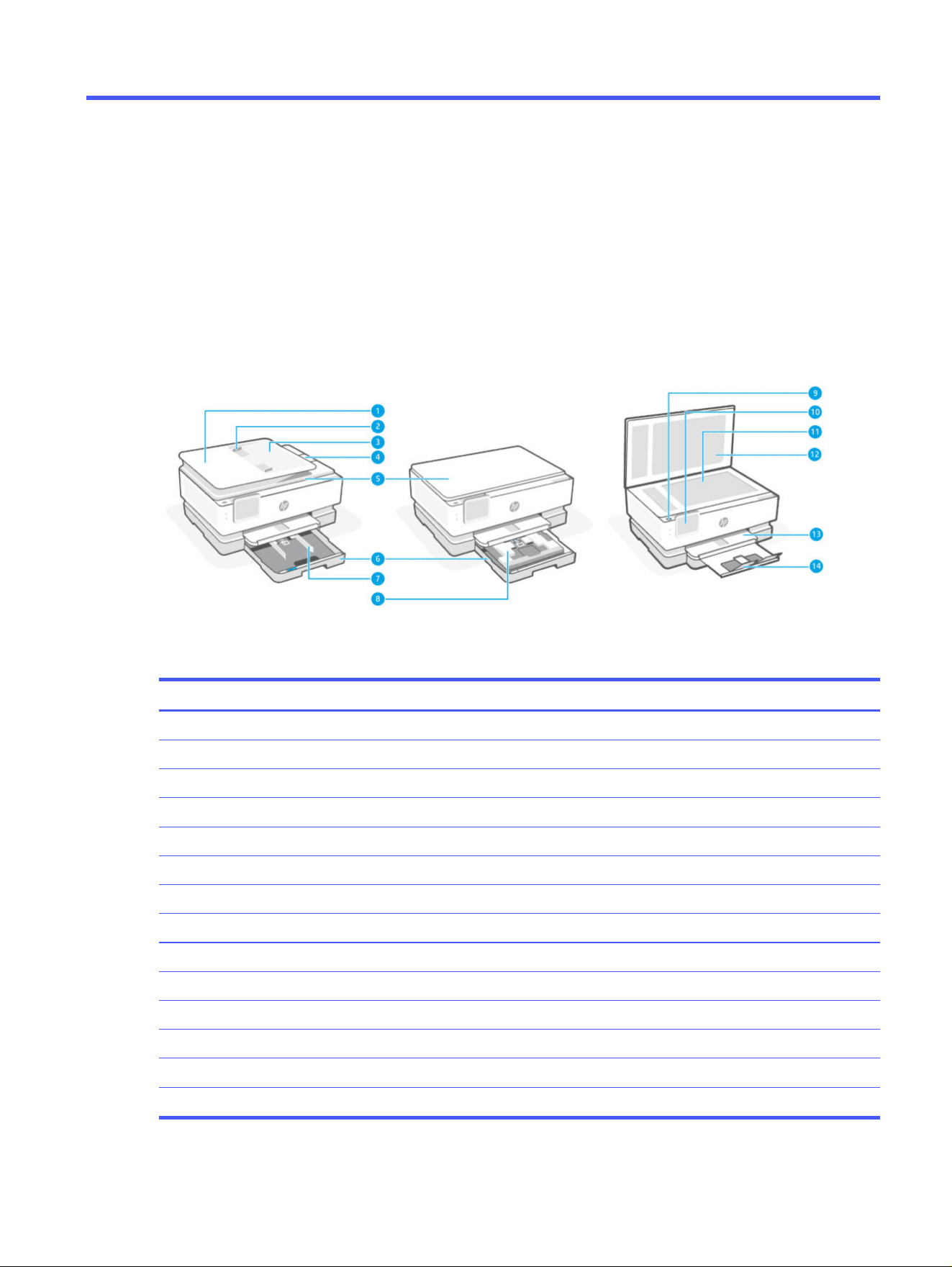
Printer front view
Feature Description
1 Document feeder
2 Document feeder paper-width guides
3 Document feeder tray
4 Document feeder output extension
5 Scanner lid
6 Main tray
7 Paper-width guides
8 Photo tray
9 Power button
10 Control panel display
11 Scanner glass
12 Scanner lid backing
13 Output tray
14 Output tray extension
Get started 1
Printing supplies area
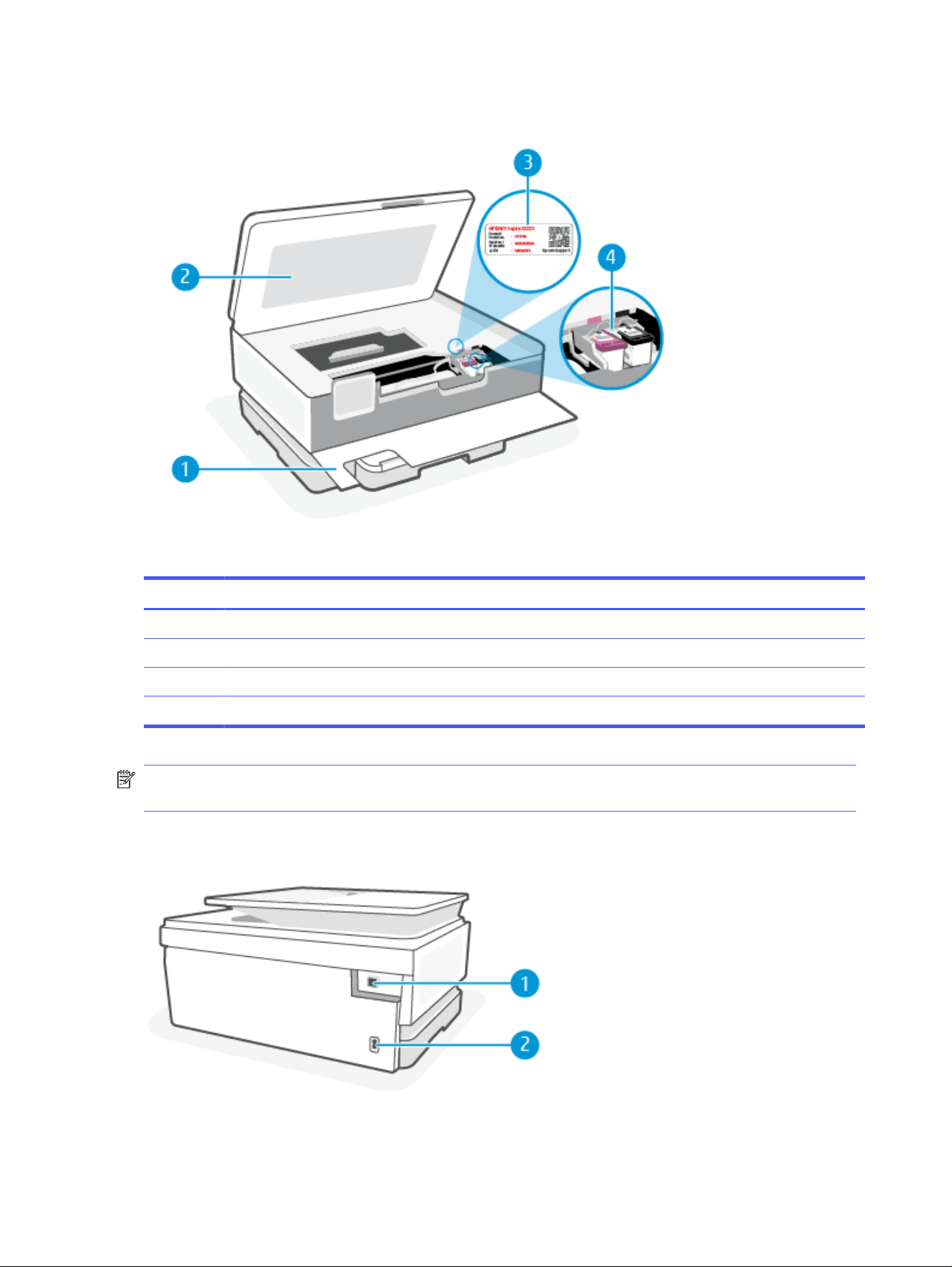
Printing supplies area
Feature Description
1 Front door
2 Cartridge access door
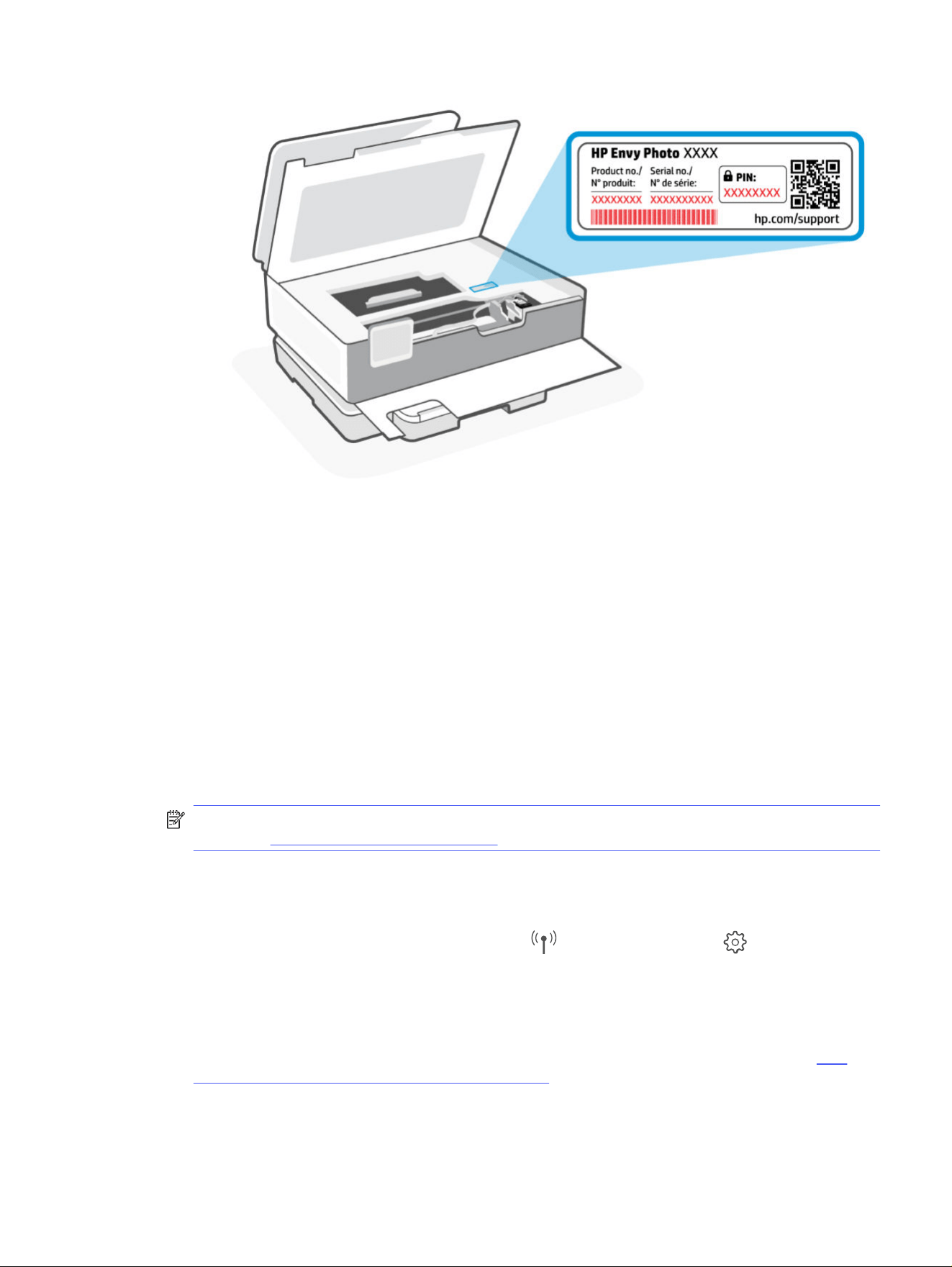
3 PIN code label
4 Cartridges
NOTE: Cartridges should be kept in the printer to prevent possible print quality issues or printhead damage.
Avoid removing supplies for extended periods of time. Do not turn the printer o when a cartridge is missing.
Printer back view
2 Chapter 1Get started
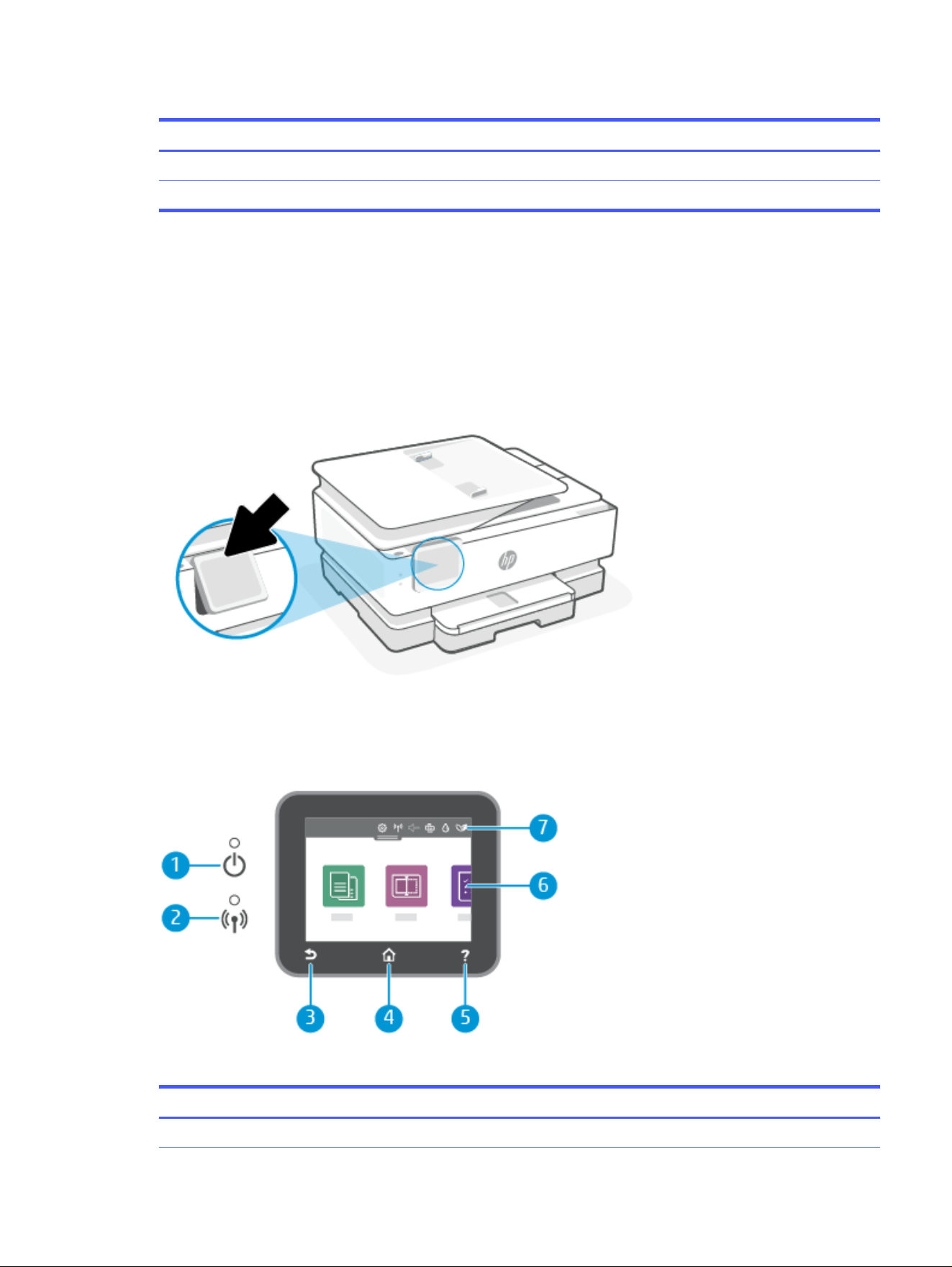
Printer back view
Feature Description
1 Rear USB port
2 Power connection
Control panel features
This topic describes the printer control panel features.
Tilt the control panel
Tilt the control panel for easier viewing. Push the upper part of the control panel to tilt it upwards and push the
lower part to tilt it downwards.
Overview of buttons and lights
Check printer status, perform printer tasks, and change printer settings.
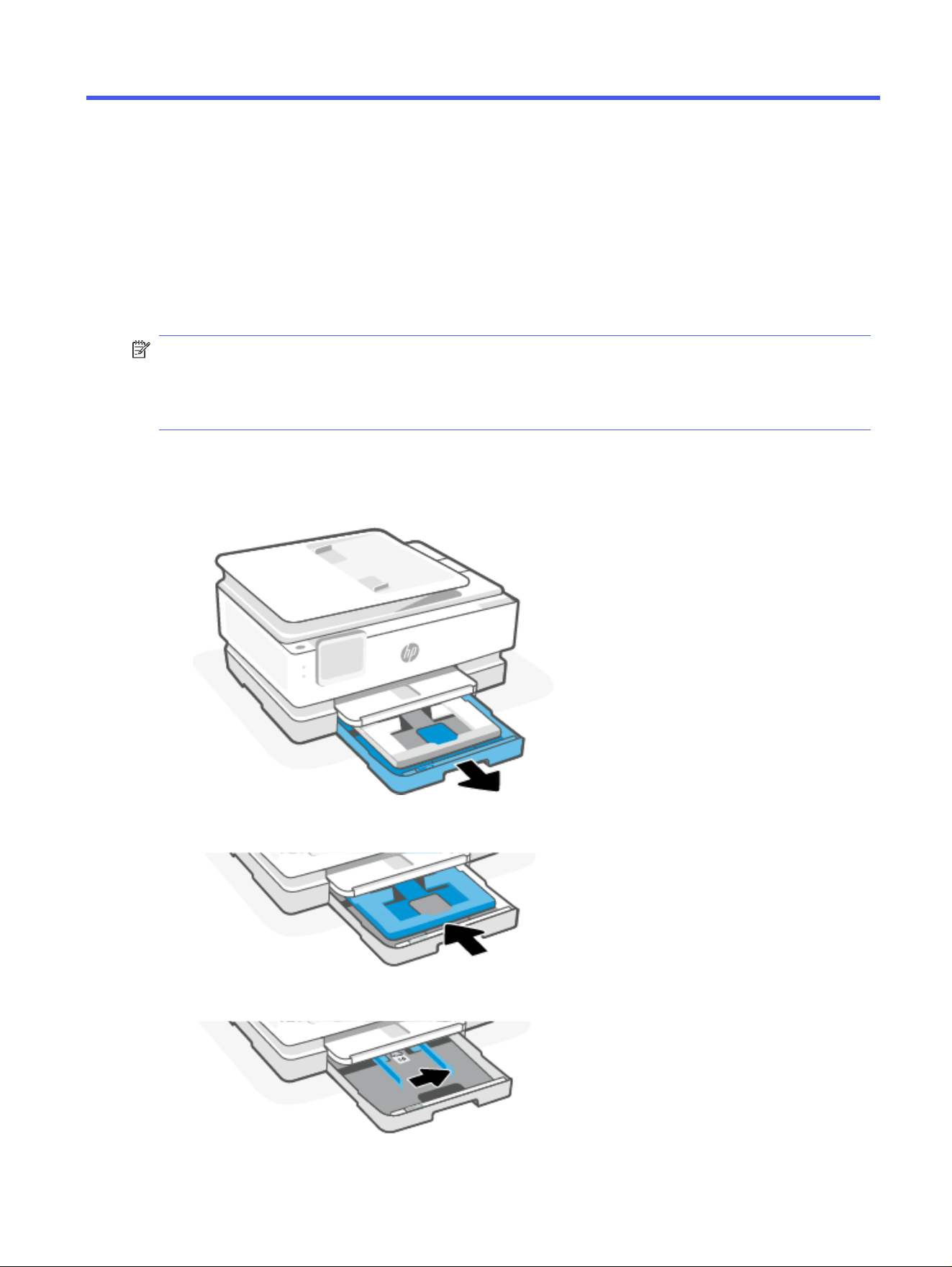
Control panel overview
Feature Description
1 Power light: Indicates whether the printer is turned on.
Control panel features 3

Control panel overview (continued)
Feature Description
2 Wireless light: Indicates the status of the printer's wireless connection.
● Solid blue light indicates that wireless connection has been established and you can print.
● Slow blinking light with clear pause indicates that wireless is on, but not congured.
To connect your printer, see Connect your printer.
● Slow blinking light indicates that wireless is on, but the printer is not connected to a network. Make sure your printer is
within the range of wireless signal.
● Fast blinking light indicates wireless error. Refer to the message on the printer display.
● If the wireless light is o, wireless is turned o.
3 Back button: Returns to the previous menu.
4 Home button: Returns to the home screen from any other screen.
5 Help button: Opens the Help menu when on the Home screen, or shows contextual help content if it is available for the
current operation when on other screens.
6 Function buttons: Touch to perform common tasks.
For more information, see Function buttons.
7 Dashboard: Swipe down for additional printer management options.
For more information, see Dashboard icons.
Function buttons
The control panel display provides large icons to easily access the primary features of your printer.
Function buttons
Feature Description
Copy Copy document, ID card, or photo.
Scan Scan document.
Dashboard icons
The Dashboard on the printer control panel lets you access the icons on the display, check the status of the
printer, or monitor and manage current and scheduled printer tasks.
To open the Dashboard, touch or swipe down the tab at the top of a screen on the control panel.
4
Chapter 1Get started

Dashboard icons
Feature Description
Setup Setup displays the setup screen for changing preferences, network setup, Wi-Fi Direct, and other maintenance settings
and generating reports.
Wireless Wireless displays wireless status and menu options.
For more information, see To connect your printer to a Wi-Fi network using the printer control panel.
Quiet mode (if supported) Quiet Mode slows down printing to reduce overall noise without aecting print quality. Quiet Mode only works when
printing on plain paper. To reduce printing noise, turn on Quiet Mode. To print at normal speed, turn Quiet Mode o. Quiet
Mode is o by default.
Wi-Fi Direct Wi-Fi Direct displays the status, name, and password for Wi-Fi Direct, and the number of devices connected. You can also
change settings and print a guide.
Ink Status Ink Status displays the estimated ink levels.
NOTE: Ink level alerts and indicators provide estimates for planning purposes only. When you receive a low-ink alert,
consider having a replacement cartridge available to avoid possible printing delays. You do not have to replace the
cartridges until prompted to do so.
HP EcoSolutions HP EcoSolutions displays a screen where you can congure some of the printer's environmental features.
Change printer settings
Use the control panel to change the printer functions and settings, print reports, or get help for the printer.
TIP: You can also change the printer settings using the printer software. For more information, see Print.
To change settings for a function
The Home screen of the control panel display shows the available functions for the printer. Some features of the
functions allows you to change settings.
1. Select Copy or Scan and then select the desired option.
2. After selecting a function, touch Settings , scroll through the available settings, and then touch the
setting you want to change.
3. Follow the prompts on the control panel display to change the settings.
TIP: Touch the Home to return to the Home screen.
Change printer settings
5

To change the printer settings
To change the printer settings or print reports, use the options available on the Setup menu.
1. From the printer control panel, touch or swipe down the tab at the top of the screen to open the Dashboard,
and then touch Setup .
2. Touch and scroll through the screens.
3. Touch the screen items to select screens or options.
TIP: Touch Home to return to the Home screen.
Use the HP app (iOS, Android, Windows, and macOS)
This HP software can help you perform dierent printer tasks from mobile devices and computers.
● Set up and connect your printer.
● Print and scan documents and photos.
● Share documents through email and other applications.
● Manage printer settings, check printer status, print reports, and order supplies.
NOTE:
● This software is supported on mobile devices and computers running on some versions of iOS, Android,
Windows, and macOS.
● It is only available in some languages and only supports some le formats. Some features are only
available on certain printers or models.
● You can download from the respective app stores for the device.
● Visit the HP support website at hp.com/support for more information.
Follow these steps to install the software.
1. Visit hp.com/start/install to download and install the software on your device.
2. Open the software.
3. If prompted, create or sign in to an HP account and register the printer.
4. Connect the printer.
See Connect your printer.
Turn the printer
o
Press the Power button to turn o the printer. Wait until the power light turns o before unplugging the
power cord or turning o a power strip.
CAUTION: If you incorrectly turn the printer o, the print carriage might not return to the correct position,
causing problems with the cartridges and print quality issues.
6
Chapter 1Get started

Connect your printer2
Learn about dierent ways to connect your printer.
Before you begin
Ensure the following before you begin setting up the printer for wireless communication:
● The wireless network is set up and working properly.
● The printer and the computers that use the printer are on the same network (subnet).
NOTE: While connecting the printer, you might be prompted to enter the wireless network name (SSID) and a
wireless password.
● The wireless network name is the name of your wireless network.
● The wireless password prevents other people from connecting to your wireless network without your
permission. Depending on the level of security required, your wireless network might use either a WPA
passphrase or WEP key.
If you have not changed the network name or the security passkey since setting up your wireless network, you
can sometimes nd them on the back or side of the wireless router.
If you cannot nd the network name or the security password or cannot remember this information, see the
documentation provided with your computer or with the wireless router. If you still cannot nd this information,
contact your network administrator or the person who set up the wireless network.
Connect to a Wi-Fi network using the HP app
Use the HP app on your computer or mobile device to set up or connect the printer to your Wi-Fi network.
See Use the HP app (iOS, Android, Windows, and macOS).
NOTE:
● HP app uses Bluetooth for printer setup. It does not support printing using Bluetooth.
● Turn on Bluetooth and location services on your mobile device.
● Make sure your printer Wi-Fi is turned on and the printer is in Wi-Fi setup mode.
● Make sure your computer or mobile device is connected to the same Wi-Fi network as the printer.
1. Open the HP app on your device.
If prompted, create or sign in to an HP account and register the printer.
2. In the app, follow the on-screen instructions to add or connect the printer.
Connect your printer to a Wi-Fi network using the printer control panel
Learn how to connect your printer to a Wi-Fi network using the printer control panel.
Connect your printer
7

To connect your printer to a Wi-Fi network using the printer control panel
Use the Wireless Setup Wizard or Wi-Fi Protected Setup from the printer control panel display to set up wireless
communication.
NOTE: Before you proceed, go through the list at Before you begin.
1. From the printer control panel, touch or swipe down the tab at the top of the screen to open the Dashboard,
and then touch Wireless .
2. Touch Settings .
3. Touch Wireless Settings.
4. Touch Wireless Setup Wizard or Wi-Fi Protected Setup.
5. Follow the display instructions to complete the setup.
If you are already using the printer with a dierent type of connection, such as a USB connection, follow the
instructions in Change the connection type to set up the printer on your wireless network.
Connect using a USB cable
You can connect your printer using a USB cable.
NOTE: While you are setting up the printer for the rst time and to use all the available features of this printer,
complete setup using HP software and an Internet connection. After setup, you can print using a USB cable if
needed.
1. Connect the printer and computer using a USB cable.
2. Open the HP software on your computer.
If prompted, create or sign in to an HP account and register the printer.
3. In HP software, add the printer, and then follow the on-screen instructions to add or connect the printer.
Change wireless settings
You can set up and manage the wireless connection for your printer. This includes printing information about
network settings, turning the wireless function on or o, and restoring wireless settings.
Wireless status of the printer
Print the wireless test report for information about the printer wireless connection. The wireless test report
provides information about the printer status, hardware (MAC) address, and IP address. If there is a problem
with the wireless connection or if a wireless connection attempt failed, the wireless test report also provides
diagnostic information. If the printer is connected to a network, the test report displays details about the network
settings.
1. From the printer control panel, touch or swipe down the tab at the top of the screen to open the Dashboard,
touch Wireless , and then touch Settings .
2. Touch Print Details or Print Network Conguration.
8
Chapter 2Connect your printer

Turn on or o the wireless capability of the printer
The blue Wireless light on the printer control panel is lit when the wireless capability of the printer is on.
1. From the printer control panel, touch or swipe down the tab at the top of the screen to open the Dashboard,
touch Wireless , and then touch Settings .
2. Touch Wireless Settings.
3. Touch the toggle button next to Wireless to switch it on or o.
NOTE: If the printer has never been congured to connect to a wireless network before, turning on the
wireless capability will automatically start the Wireless Setup Wizard.
To restore the printer to the original network settings
1. From the printer control panel, touch or swipe down the tab at the top of the screen to open the Dashboard,
and then touch Setup .
2. Touch Network Setup.
3. Touch Restore Network Settings.
A message appears stating that the network defaults will be restored.
4. Touch Yes.
5. Print the network conguration page and verify that the network settings have been reset.
NOTE: In order to get the list of detected wireless networks in the area, the wireless radio on the printer
should be turned on. If it is o, the list is not displayed.
TIP: You can visit the HP online support website at hp.com/support for information and utilities that can help
you correct many common printer problems.
Change the connection type
This topic describes how to change the way to connect your printer.
USB to Wi-Fi
Unplug the USB cable from the printer and connect the printer to your network.
See Connect your printer to a Wi-Fi network using the printer control panel.
Wi-Fi to USB
Change the printer connection from Wi-Fi to USB.
1. Connect the printer and computer using a USB cable.
2. Open the HP software on your computer.
If prompted, create or sign in to an HP account and register the printer.
Turn on or
o the wireless capability of the printer 9

3. In HP software, add the printer, and then follow the on-screen instructions to add or connect the printer.
10 Chapter 2Connect your printer
Load media and paper basics3
This section describes how to change paper settings and to load dierent media into the printer.
Load paper
This topic describes how to load paper, envelope, cards and photos.
NOTE:
● Do not load paper while the printer is printing.
● If there is other paper in the printer tray, remove the paper before loading a dierent paper type or size.
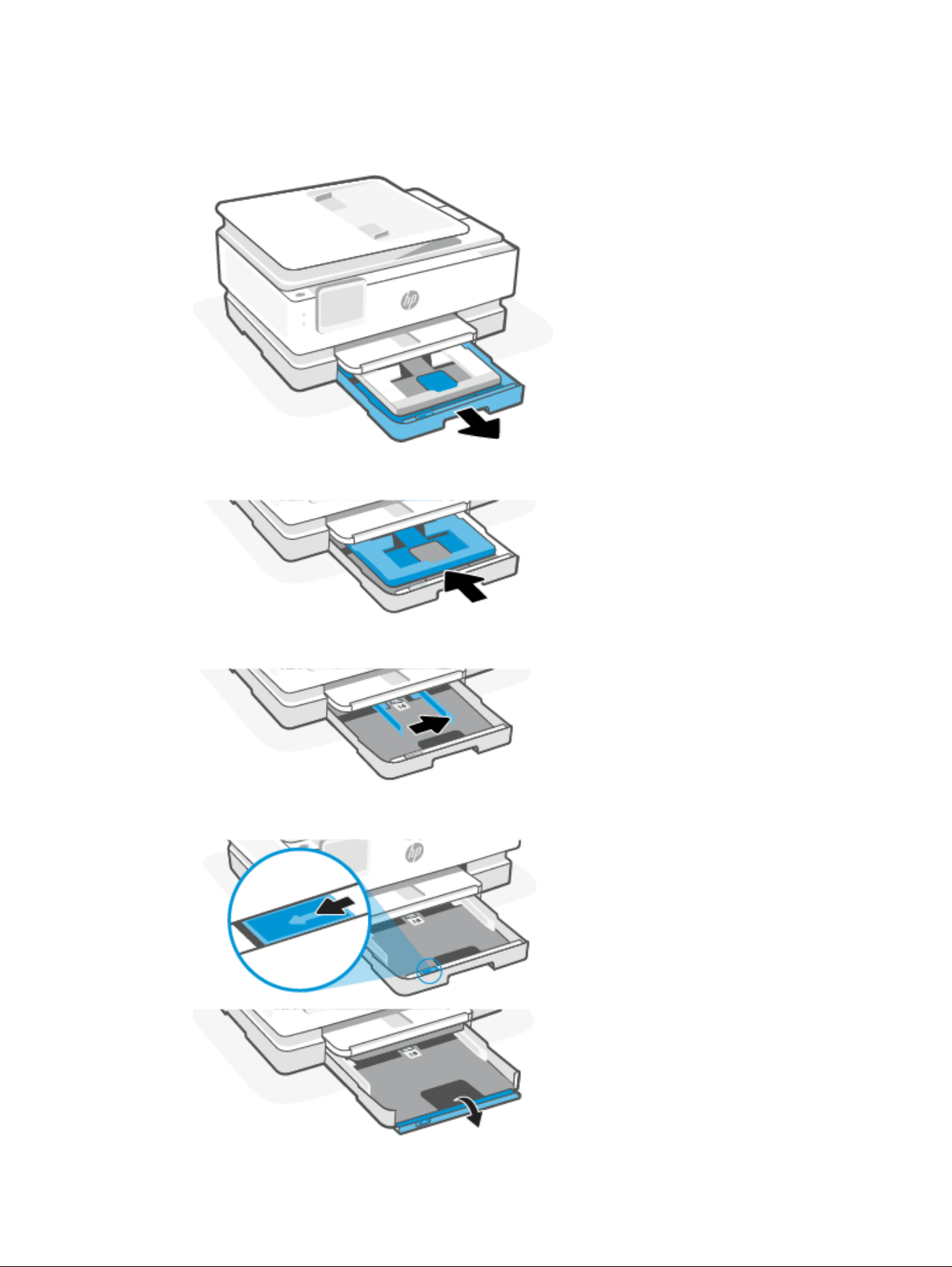
To load standard paper
1. Open the main tray.
2. Push in the photo tray.
3. Slide the paper-width guides to the edges of the main tray.
Load media and paper basics
11
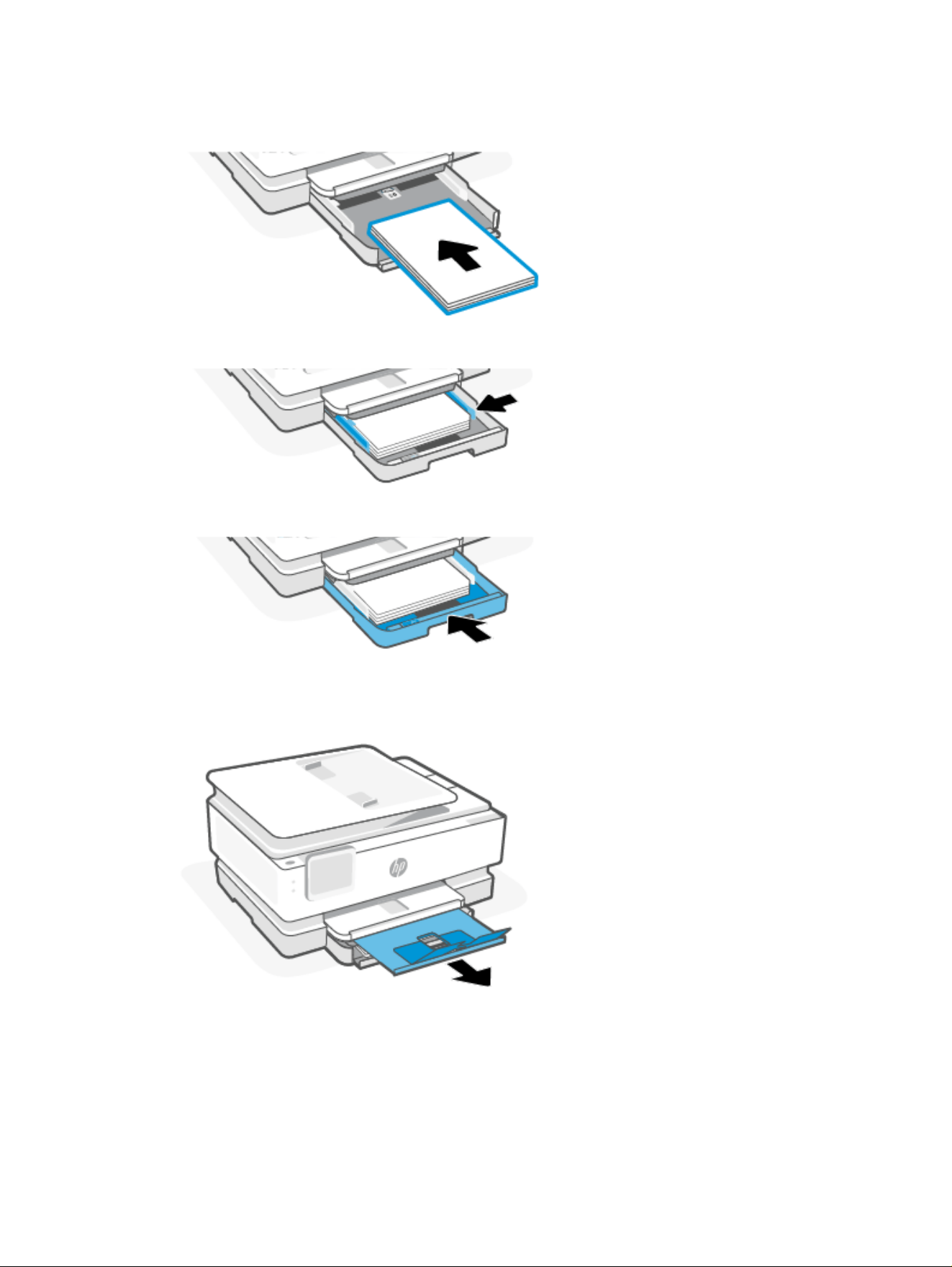
4. Insert the paper in portrait orientation with the side to be printed facing down. Make sure the stack of paper
is aligned with the appropriate paper size lines on the front of the tray.
5. Adjust the paper-width guides until they touch the left and right edges of the stack of paper.
6. Close the main tray.
7. Change or retain the paper settings on the printer display.
8. Pull out the output tray extension.
12 Chapter 3Load media and paper basics
To load legal paper (some models only)
1. Open the main tray.
2. Push in the photo tray.
3. Slide the paper-width guides to the edges of the main tray.
4. Unlock and then open the front side of the paper tray.
To load legal paper (some models only) 13
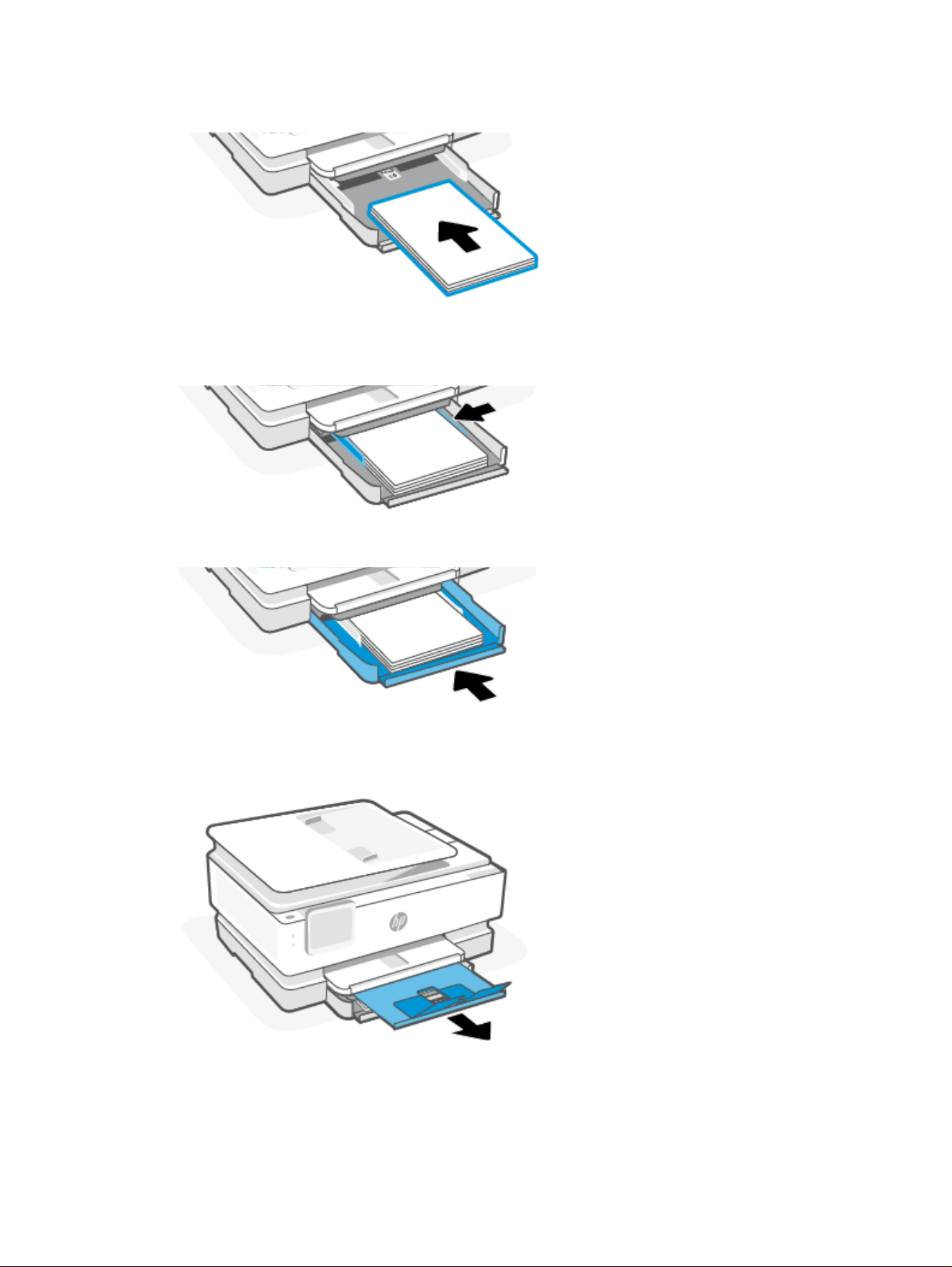
5. Insert the paper in portrait orientation with the side to be printed facing down.
Make sure the stack of paper is aligned with the appropriate paper size lines on the front of the tray.
6. Adjust the paper-width guides until they touch the left and right edges of the stack of paper.
7. Close the main tray.
8. Change or retain the paper settings on the printer display.
9. Pull out the output tray extension.
14 Chapter 3Load media and paper basics
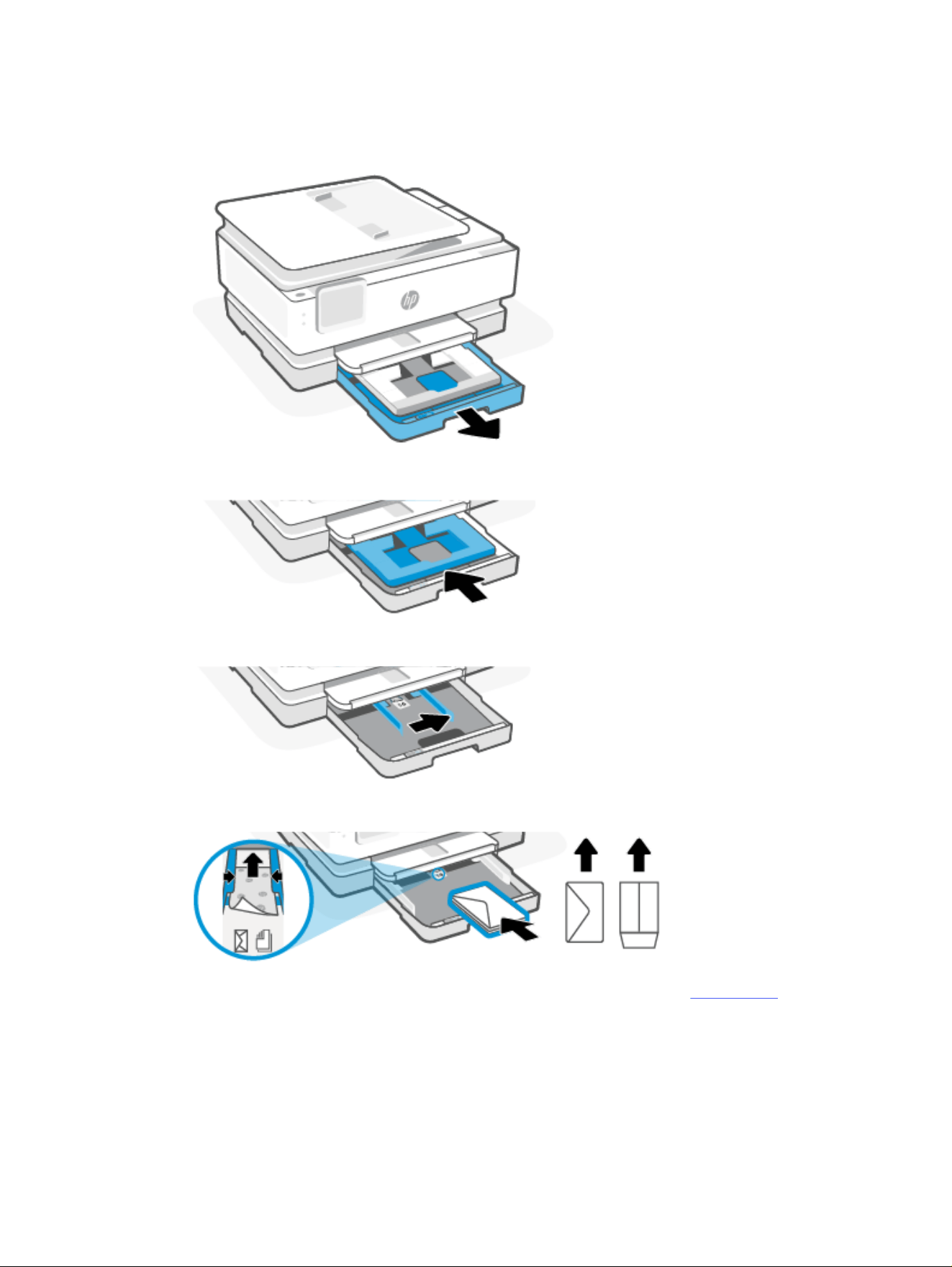
To load an envelope
1. Open the main tray.
2. Push in the photo tray.
3. Slide the paper-width guides to the edges of the main tray.
4. Insert the envelope in portrait orientation and with the side to be printed facing down.
For information on the maximum number of envelope allowed in the tray, see Specications.
To load an envelope
15
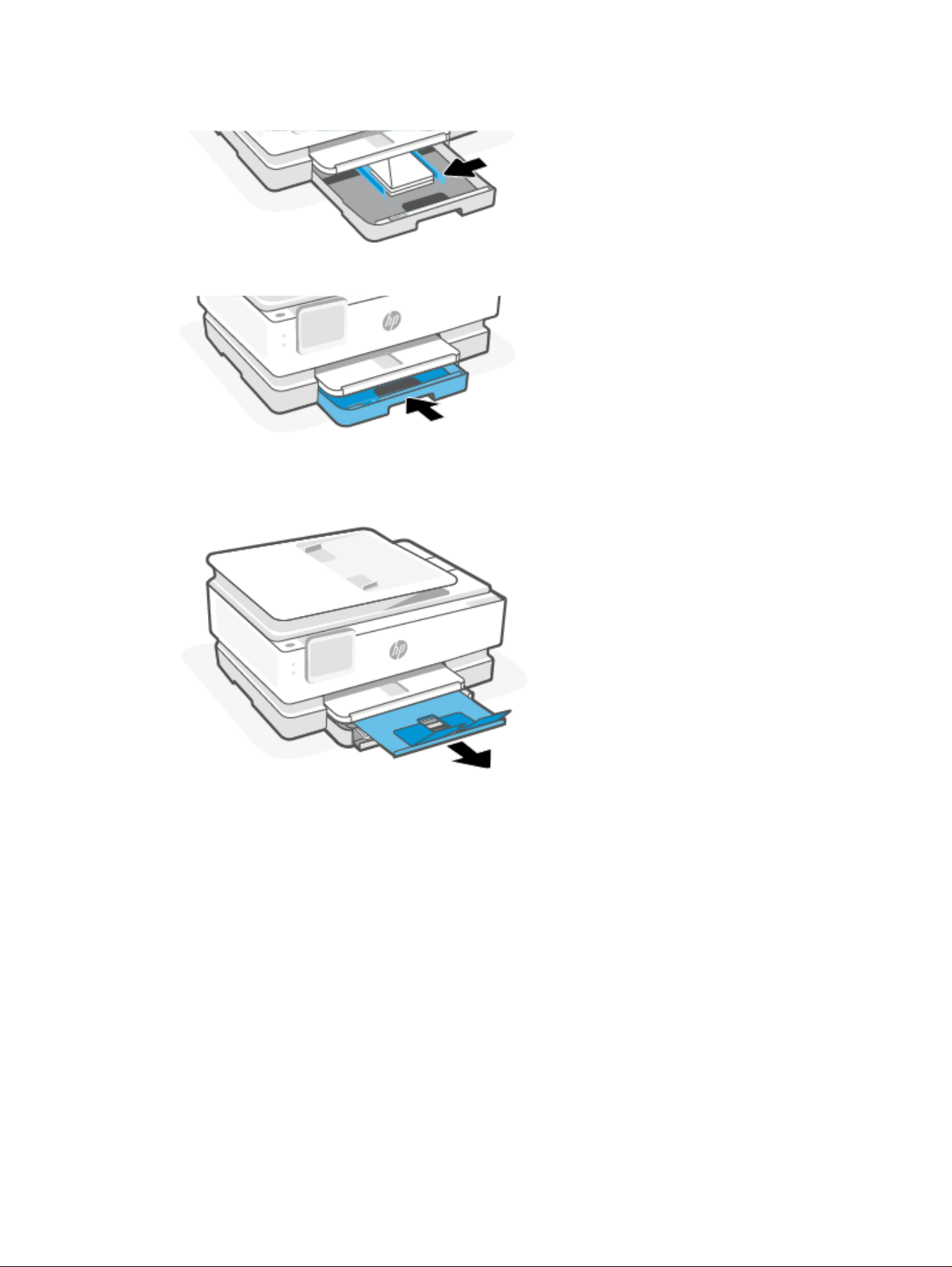
5. Adjust the paper-width guides until they touch the left and right edges of the stack of envelope.
6. Close the main tray.
7. Change or retain the paper settings on the printer display.
8. Pull out the output tray extension.
16 Chapter 3Load media and paper basics
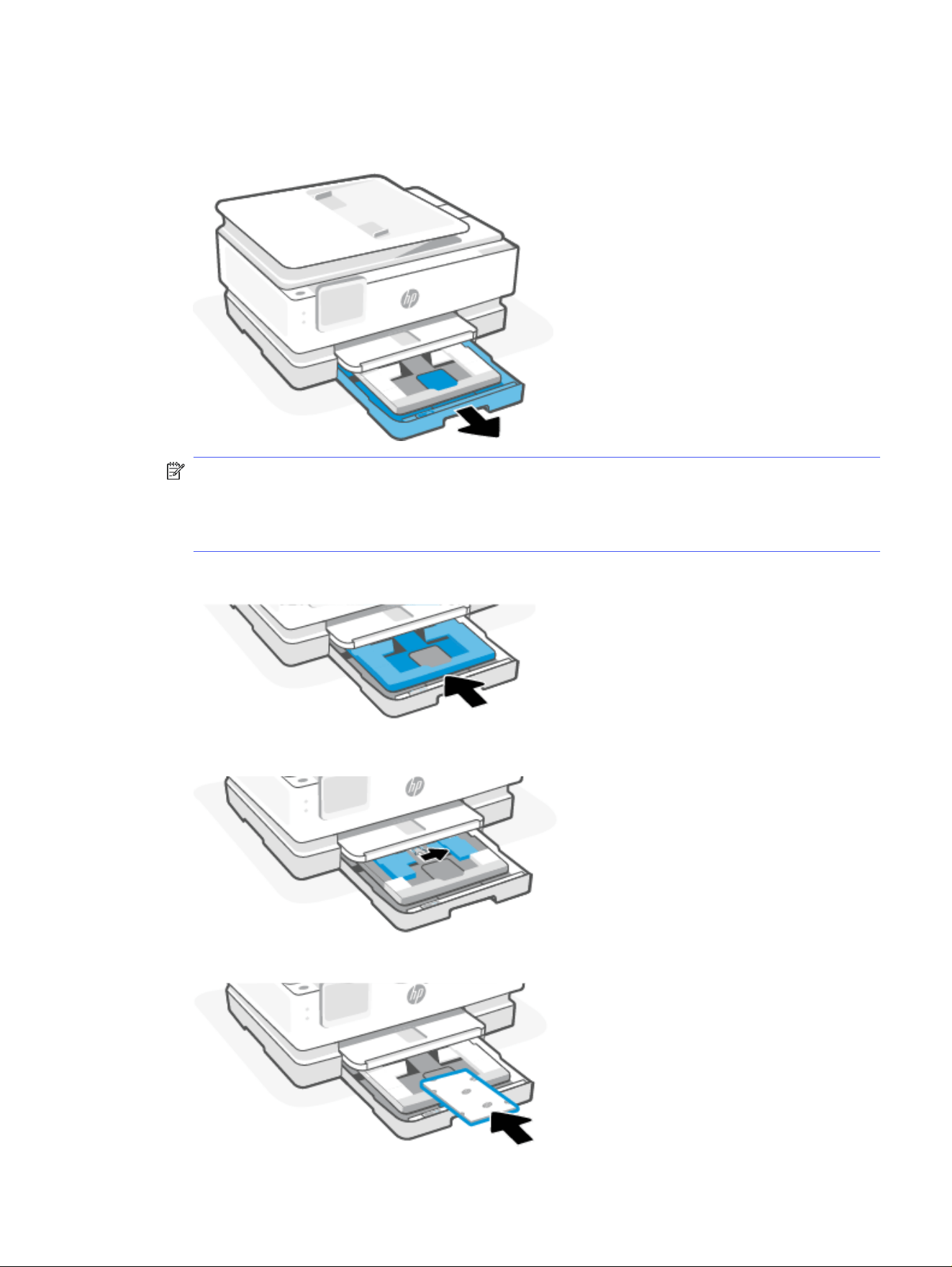
To load cards and photo paper
1. Open the main tray.
NOTE:
● Remove the paper before loading a dierent paper type or size.
● For printing on panoramic photo paper (4 x 12 inches), load photo paper in the main tray.
2. Pull out the photo tray, if necessary.
3. Slide the paper-width guides to the edges of the photo tray.
4. Insert the cards or photo paper in portrait orientation and with the side to be printed facing down.
To load cards and photo paper
17
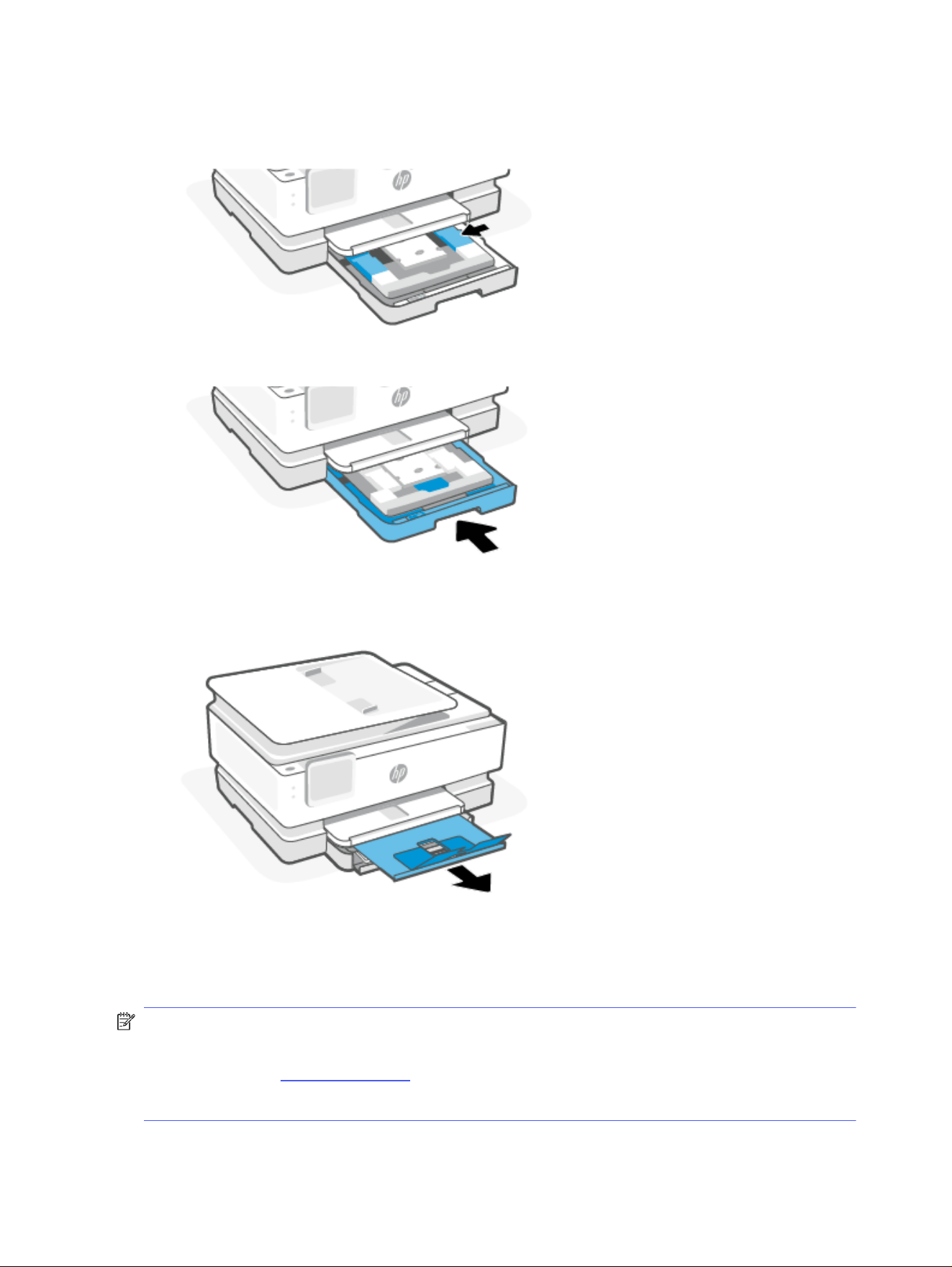
Make sure the stack of card or photo is aligned with the appropriate paper size lines on the front of the tray.
5. Adjust the paper-width guides until they touch the left and right edges of the stack of paper.
6. Close the main tray.
7. Change or retain the paper settings on the printer display.
8. Pull out the output tray extension.
Load an original on the scanner glass
This topic describes how to load an original into the printer.
NOTE:
● The scanner might not work correctly if the scanner glass and lid backing are not clean. For more
information, see Printer maintenance.
● Remove all originals from the document feeder tray (some models only) before lifting the lid on the printer.
18
Chapter 3Load media and paper basics
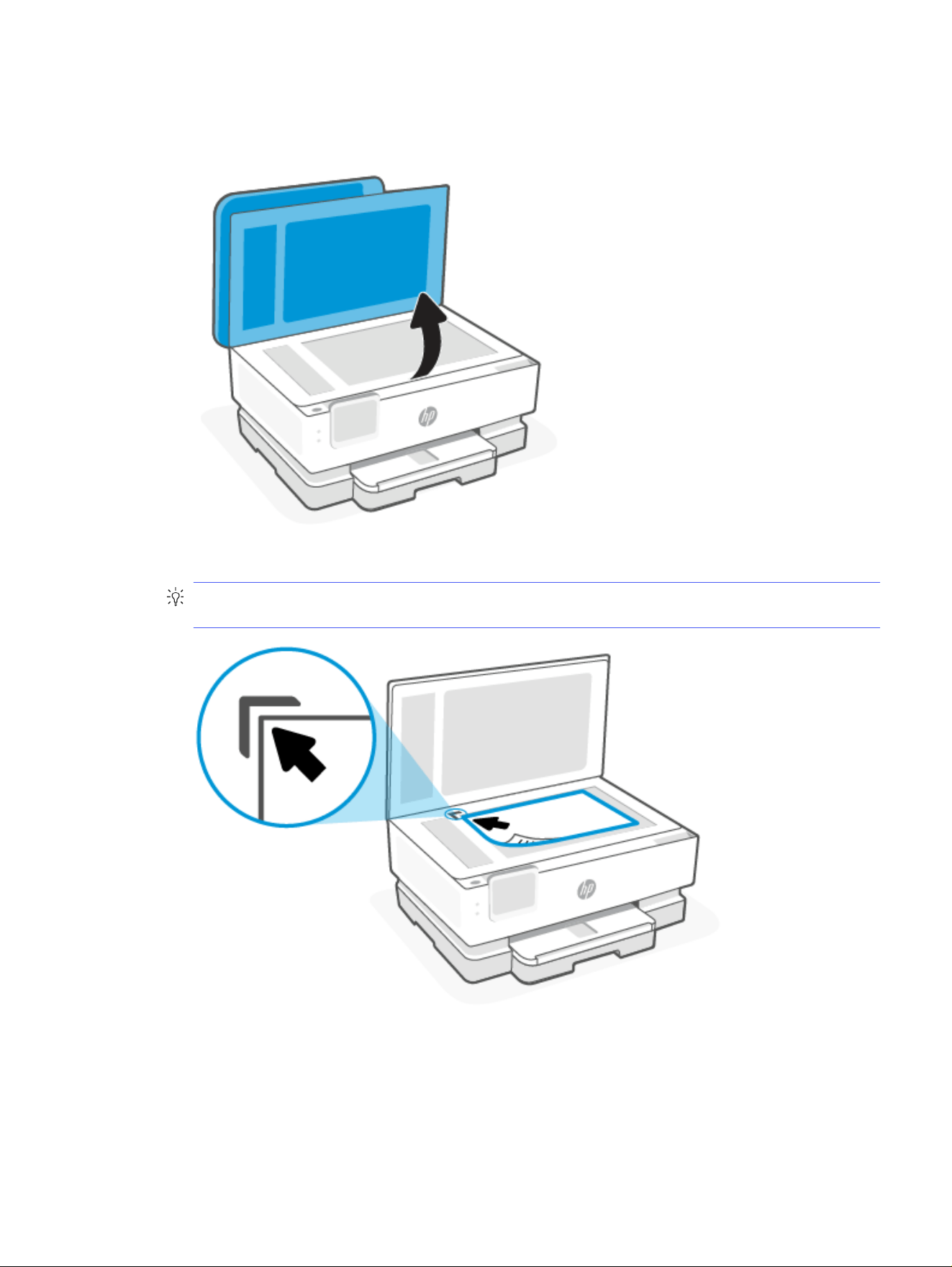
To load an original on the scanner glass
1. Lift the scanner lid.
2. Load your original print-side down and align it with the marking on the rear left corner of the glass.
TIP: For more help on loading an original, refer to the engraved guides along the edge of the scanner
glass.
3. Close the lid.
To load an original on the scanner glass
19
Load an original in the document feeder (some models only)
You can copy or scan a document by placing it in the document feeder.
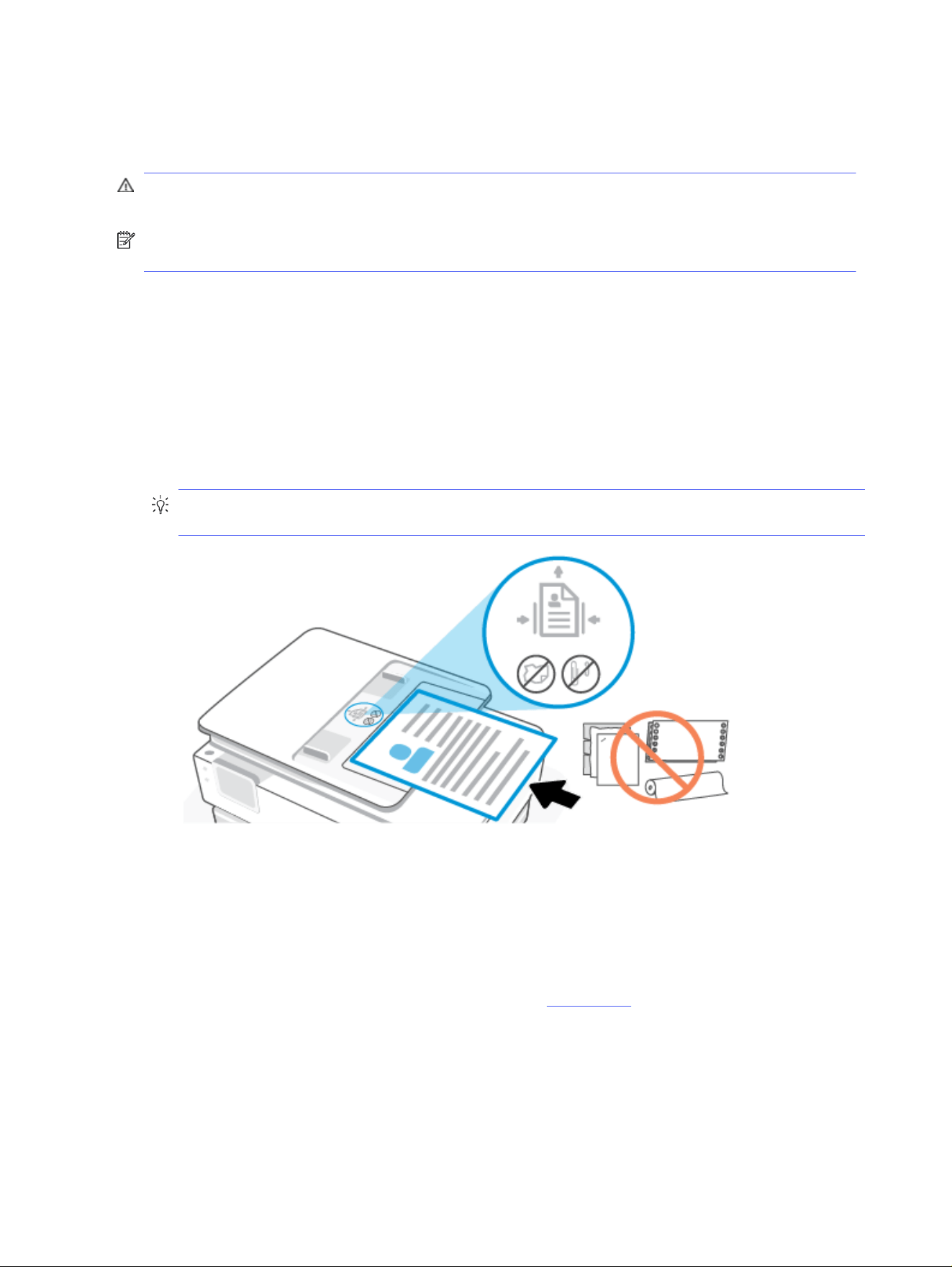
CAUTION: Do not load photos in the document feeder, this might cause damage to your photos. Use only
paper that is supported by the document feeder.
NOTE: Some features, such as the Fit to Page copy feature, do not work when you load your originals in the
document feeder. For those features to work, load your originals on the scanner glass.
To load an original in the document feeder
1. Load your original print-side up into the document feeder.
a. If you are loading an original printed in portrait orientation, place the pages so that the top edge of the
document goes in rst. If you are loading an original printed in landscape orientation, place the pages
so that the left edge of the document goes in rst.
b. Slide the paper into the document feeder until you hear a tone or see a message on the printer control
panel display indicating that the loaded pages were detected.
TIP: For more help on loading originals in the document feeder, refer to the diagram on the document
feeder tray.
2. Slide the paper-width guides inward until they stop at the left and right edges of the paper.
Paper basics
The printer is designed to work well with most types of oice paper. It is best to test avariety of print paper types
before buying large quantities.
Use HP paper for optimum print quality. Visit the HP website at www.hp.com for more information about HP
paper.
20
Chapter 3Load media and paper basics

HP recommends plain papers with the ColorLok logo for printing everyday
documents. All papers with the ColorLok logo are independently tested to meet high
standards of reliability and print quality, and produce documents with crisp, vivid color,
bolder blacks, and that dry faster than ordinary plain papers. Look for papers with the
ColorLok logo in avariety of weights and sizes from major paper manufacturers.
Tips for selecting and using paper
For the best results, observe the following guidelines.
● Load only one type and one size of paper at a time into a tray or document feeder.
● Make sure the paper is loaded correctly when loading from the main tray or document feeder.
● Do not overload the tray or document feeder.
● To prevent jams, poor print quality, and other printing problems, avoid loading the following paper in the tray
or document feeder:
– Multipart forms
– Media that is damaged, curled, or wrinkled
– Media with cutouts or perforations
– Media that is heavily textured, embossed, or does not accept ink well
– Media that is too lightweight or stretches easily
– Media that contains staples or clips
Tips for selecting and using paper 21

Congure your printer4
This section describes how to congure your printer.
Congure the printer using EWS
Use EWS to manage printing functions from your computer.
● View printer status information
● Check the information and status of the printing supplies
● Receive notication of printer and supplies events
● View and change the network and the printer settings
To access and use EWS
You can open EWS using one of the following:
● The HP app
● HP printer software
● Web browser using IP address
● Web browser using Wi-Fi Direct connection
Things to note when accessing EWS
● If the web browser displays a message indicating that the website is unsafe, select the option to continue.
Accessing the website will not harm your device.
● If prompted, enter the password of the printer.
– Password: Open the cartridge access door, see the label inside the printer.
22 Chapter 4Congure your printer
● Depending on how the printer is connected, some features in EWS might not be available.
● EWS is not accessible beyond the network rewall.
The HP app (iOS, Android, Windows, and macOS)
Follow these steps:
1. Open the software on your computer or mobile device. If prompted, create or sign in to an HP account.
2. Click or tap your printer image to access the printer settings.
3. Select Advanced Settings.
This opens the printer home page or embedded web server (EWS).
NOTE: If prompted for the printer password, enter the default PIN available from the PIN label on the
printer. See Things to note when accessing EWS.
To open EWS using an IP address (Wi-Fi connection)
1. Find out the IP address of the printer. From the printer control panel, touch or swipe down the tab at the top
of the screen to open the Dashboard, touch Wireless , and then touch Settings .
2. Open a web browser, type the IP address or hostname in the address bar, and then click or tap Enter.
To open EWS using an IP address (Wi-Fi Direct connection)
1. Make sure your device and the printer are connected using Wi-Fi Direct. For more information, see Print
without connecting to same Wi-Fi network (Wi-Fi Direct).
The HP app (iOS, Android, Windows, and macOS)
23

2. Open a web browser, type the following IP address or hostname of the printer in the address bar, and then
click or tap Enter.
IP Address: 192.168.223.1
Congure IP network settings
Use the following sections to congure the printer network settings.
View or change network settings
Use EWS to view or change IP conguration settings.
1. Open EWS. For more information, see To access and use EWS.
2. Click the Networking tab to obtain network information. Change settings as needed.
Rename the printer on a network
To rename the printer on a network so that it can be uniquely identied, use the Embedded Web Server.
1. Open EWS. For more information, see To access and use EWS.
2. Open the System tab.
3. On the Device Information page, the default printer name is in the Device Description eld. You can change
this name to uniquely identify this printer.
NOTE: Completing the other elds on this page is optional.
4. Click the Apply button to save the changes.
Manually congure IPv4 TCP/IP parameters
Use EWS to manually set an IPv4 address, subnet mask, and default gateway.
1. Open EWS. For more information, see To access and use EWS.
2. On the Networking tab, click IPv4 Conguration in the left navigation pane.
3. From the IP Preferred Address Method drop-down, select Manual, and then edit the IPv4 conguration
settings.
4. Click the Apply button.
Assign or change the system password using EWS
Assign an administrator password for access to the printer and EWS so that unauthorized users cannot change
the printer settings.
1. Open EWS. For more information, see To access and use EWS.
2. On the System tab, click the Administration link in the left navigation pane.
3. In the area labeled Product Security, enter the password in the Password eld.
4. Re-enter the password in the Conrm Password eld.
24
Chapter 4Congure your printer

5. Click the Apply button.
NOTE: Make note of the password and store it in a safe place.
Change energy-conservation settings
The printer includes several economy features to conserve energy and supplies.
Set the Sleep/Auto O After Inactivity setting
Use EWS to set the amount of idle time before the printer enters sleep mode.
Complete the following procedure to change the Sleep/Auto O After Inactivity setting:
1. Open EWS. For more information, see To access and use EWS.
2. Click the System tab, and then select Energy Settings.
3. From the Sleep/Auto O After Inactivity drop-down, select the time for the delay.
4. Click the Apply button.
Set the Shut Down After Inactivity delay and
congure the printer to use 1 watt or less of power
Use EWS to set the amount of time before the printer shuts down.
NOTE: After the printer shuts down, the power consumption is 1 watt or less.
Complete the following procedure to change the Shut Down After Inactivity setting:
1. Open EWS. For more information, see To access and use EWS.
2. Click the System tab, and then select Energy Settings.
3. From the Shut Down After Inactivity drop-down, select the time for the delay.
NOTE: The default value is 4 hours.
4. Click the Apply button.
Set the Delay Shut Down setting
Use the EWS to select whether or not the printer delays shutting down after the Power button is pressed.
Complete the following procedure to change the Delay Shut Down setting:
1. Open EWS. For more information, see To access and use EWS.
2. Click the System tab, and then select Energy Settings.
3. Select or clear the Delay when ports are active option.
NOTE: When this option is selected the printer will not shut down unless all ports are inactive. An active
network link will prevent the printer from shutting down.
Use Web Services
The printer oers innovative, cloud-based solutions, such as print anywhere, scan-and-save to cloud, and other
services (including supplies auto replenishment).
Change energy-conservation settings
25

For more information, visit hp.com/start/install.
NOTE: To use these cloud-based solutions, the printer must be connected to the Internet. Unless otherwise
agreed, HP can modify or cancel these cloud-based solution oerings at its discretion.
Set up Web Services
Before you set up Web Services, make sure your printer is connected to the Internet using a wireless connection.
To set up Web Services
1. Before you set up Web Services, make sure your printer is connected to the Internet.
2. Open the printer home page (the embedded web server or EWS). For more information, see To access and
use EWS.
3. Click the HP Web Services tab.
4. In Web Services Settings, click Enable, and follow the on-screen instructions to accept the terms of use.
5. If prompted, choose to allow the printer to check for and install printer updates.
NOTE:
● If prompted for a password, enter the PIN from the label on your printer. For more information, see
Things to note when accessing EWS.
● If prompted for proxy settings and if your network uses proxy settings, follow the on-screen
instructions to set up a proxy server. If you do not have the details, contact your network administrator
or the person who set up the network.
● If a printer update is available, the printer downloads and installs the update and then restarts
automatically. Repeat the instructions above to set up HP Web Services.
6. After the printer is connected to the HP server, the printer prints an information sheet. Follow the
instructions on the information sheet to nish setting up Web Services.
Remove Web Services
1. Open the printer home page (the embedded web server or EWS). See To access and use EWS.
2. Click the HP Web Services tab.
3. In Web Services Settings, click Disable Web Services.
Dynamic security enabled printers
This printer is intended to work only with cartridges that have new or reused HP electronic circuitry. Reused HP
electronic circuitry enables the use of reused, remanufactured, and relled cartridges.
The printer uses dynamic security measures to block cartridges using modied or non-HP circuitry. Periodic
rmware updates delivered over the internet will maintain the eectiveness of the dynamic security measures
and block cartridges that previously worked.
Updates can improve, enhance, or extend the printer’s functionality and features, protect against security threats,
and serve other purposes, but these updates can also block cartridges using modied or non-HP electronic
circuitry from working in the printer, including cartridges that work today. Unless you are enrolled in certain HP
programs such as Instant Ink or use other services that require automatic online rmware updates, most HP
26
Chapter 4Congure your printer


Print5
Learn how to print from your computer or mobile device.
Install HP software on smartphone, laptop, desktop computer, or other devices to print, scan, and manage your
printer.
Print from a Windows computer
You can print from the le menu of most apps.
Make sure you have installed the HP software. See Use the HP app (iOS, Android, Windows, and macOS).
1. Open the document you wish to print.
2. From the File menu in your software program, select the Print option.
NOTE: Make sure your printer is selected from the list of available printers.
3. Click the button that opens the Properties dialog box.
Depending on your software application, this button might be called Properties, Options, Setup, or
Preferences.
4. Change any print settings if needed, and click OK.
5. Click Print or OK to print.
Print from a Mac computer
Use the Print command from any open le.
1. If you are printing for the rst time, complete the following steps.
a. Open System Preference, and select Printers & Scanners.
b. Click the Add button/icon , select the printer from the printer list, and then click Add.
2. Open the document you want to print and use the Print command.
Make sure your printer is selected from the list of available printers.
3. Change any print settings if needed.
4. Click Print to print.
28
Chapter 5Print

Print from mobile devices
You can print using the HP app or AirPrint/HP Print Service Plugin when the mobile device is on the same network
as the printer or a dierent network (using Wi-Fi Direct).
● iOS: Devices running iOS 4.2 or later have AirPrint preinstalled.
● Android: Download the HP Print Service Plugin (supported by most Android devices) from the Google Play
Store and enable it on your device.
● Visit hp.com/go/mobileprinting for more information on mobile printing.
To print using Wi-Fi Direct, connect the printer using Wi-Fi Direct (see Print without connecting to same Wi-Fi
network (Wi-Fi Direct)). Once the printer is connected, you can send your print job.
Print while connected to same Wi-Fi network
You can print documents and photos from your mobile device when the device is on the same Wi-Fi network as
the printer.
Visit hp.com/go/mobileprinting for more information on mobile printing.
NOTE: Make sure your mobile device and printer are connected to the same Wi-Fi network. For more
information, see Connect to a Wi-Fi network using the HP app.
Print without connecting to same Wi-Fi network (Wi-Fi Direct)
With Wi-Fi Direct, you can directly connect your computer or mobile device to the printer and print wirelessly—
without connecting your computer or mobile device to an existing wireless network.
Visit hp.com/go/widirectprinting for more information on Wi-Fi Direct.
NOTE:
● Make sure Wi-Fi Direct on your printer is turned on. If Wi-Fi Direct is turned on, then Wi-Fi Direct
appears on the Dashboard control panel display.
● Up to 5 computers and mobile devices can connect to the printer using Wi-Fi Direct connection.
To turn Wi-Fi Direct on or o from the control panel:
1. From the printer control panel, touch or swipe down the tab at the top of the screen to open the Dashboard,
and then touch Wi-Fi Direct .
2. Touch Setttings .
3. If the display shows that Wi-Fi Direct is O, touch Wi-Fi Direct and then switch it on.
TIP: You can also turn on Wi-Fi Direct from the EWS. For more information about using the EWS, see To access
and use EWS.
Print from mobile devices
29

To turn on Wi-Fi Direct
1. From the printer control panel, touch or swipe down the tab at the top of the screen to open the Dashboard,
and then touch Wi-Fi Direct .
2. Touch Settings .
3. If the display shows that Wi-Fi Direct is O, touch Wi-Fi Direct and then switch it on.
TIP: You can also turn on Wi-Fi Direct from the EWS. For more information about using the EWS, see To access
and use EWS.
Tips for successful printing
To print successfully, make sure you have appropriate printer settings, suicient ink in the HP cartridges, and
paper loaded correctly in the trays.
You can check the printer settings in the HP software, the embedded web server (EWS), and your software
applications.
Ink tips
Following are the ink tips for successful printing:
● If the print quality is not acceptable, see Printing issues for more information.
● Use Original HP cartridges.
Original HP cartridges are designed and tested with HP printers and papers to help you easily produce great
results, time after time.
NOTE: HP cannot guarantee the quality or reliability of non-Original HP supplies. Product service or
repairs required as a result of using a non-Original HP supply will not be covered under warranty.
If you believe you purchased Original HP cartridges, go to hp.com/go/anticounterfeit.
NOTE: If you have an HP+ printer, you must use Original HP cartridges. If non-Original HP or relled
cartridges are installed, the printer will not be able to print.
● Install both the black and color cartridges correctly.
For more information, see Remove and replace an ink cartridge.
● Check the estimated ink levels in the cartridges to make sure there is suicient ink.
For more information, see Check the estimated ink levels.
NOTE: Ink level warnings and indicators provide estimates for planning purposes only. When an indicator
shows low ink levels, consider having a replacement cartridge available to avoid possible printing delays.
You do not need to replace cartridges until you are prompted to.
● Always turn o the printer with the Power button to allow the printer to protect the nozzles.
30
Chapter 5Print

Paper loading tips
For more information, also see Load paper.
● Ensure the paper is loaded in the main tray properly, and set the correct media size and media type. Upon
loading paper in main tray, you will be prompted to set the media size and media type from the control
panel.
● Load a stack of paper (not just one page). All the paper in the stack should be of the same size and type to
avoid a paper jam.
●
Load paper with the print-side down.
● Ensure that paper loaded in the main tray lays at and the edges are not bent or torn.
● Adjust the paper-width guides in the main tray to t snugly against all paper. Make sure the guides do not
bend the paper in the tray.
Paper loading tips 31

Copy, Scan, and Mobile Fax6
You can scan documents, photos, and other paper types, and send them to a variety of destinations, such as a
computer or an email recipient.
When scanning documents with the HP printer software, you can scan to a format that can be searched and
edited.
When scanning a borderless original, use the scanner glass and not the document feeder.
NOTE: Some scan functions are only available after you have installed the HP printer software.
TIP: If you have problems scanning documents, see Copy and scan issues.
Copy from the printer
1. Make sure you have paper loaded in the input tray. For more information, see Load paper.
2. Place your original print-side down on the scanner glass or print-side up in the document feeder.
3. From the printer control panel display, touch Copy.
4. Select the desired option.
5. Enter the number of copies by using the keypad or make changes to other settings.
TIP: To save your settings as defaults for future jobs, touch Copy Settings , and then touch Save
Current Settings.
6. Touch Copy .
TIP:
● By default, the printer is set to copy in color. If you want to copy in black-and-white, touch Copy
Settings to change the default color.
● If your device has a camera, you can use the HP app to scan a printed document or photo with the
device camera. You can then use HP to edit, save, print, or share the image.
Copy or scan from a mobile device
If your device has a camera, you can use the HP software to scan a printed document or photo with the device
camera. You can then use the software to edit, save, print or share the image.
1. Open the HP software on your mobile device. If prompted, create or sign in to an HP account.
2. Make sure your printer is selected.
3. Select one of the scan or copy options or tiles.
32
Chapter 6Copy, Scan, and Mobile Fax

4. Change any settings.
5. Aim the camera at your subject, and then tap the round button at the bottom of the screen to take a picture.
6. Make other necessary changes, and then follow the on-screen instructions to complete the task.
Scan using HP printer software (Windows)
Make sure you have the software installed on your computer.
1. Place the original print-side down on the scanner glass or print-side up in the document feeder (some
printer models).
2. Open the software. See Use the HP app (iOS, Android, Windows, and macOS).
3. Click Scan, and then click Scan a Document or Photo.
4. Select the type of scan you want, and then click Scan.
If you are scanning to a le, choose the le format to save the document (or photo).
NOTE:
● Click the More link at the top right corner of the Scan dialog to review and modify settings for any scan.
● If Show Viewer After Scan is selected, you can make adjustments to the scanned image in the preview
screen.
Scan using Webscan
Webscan is a feature of EWS that lets you scan photos and documents from your printer to your computer using
a web browser.
This feature is available even if you did not install the printer software on your computer.
For more information, see To access and use EWS.
NOTE: By default, Webscan is o. You can enable this feature from the EWS.
If you are unable to open Webscan in the EWS, your network administrator might have turned it o. For more
information, contact your network administrator or the person who set up your network.
To enable Webscan
1. Open the embedded web server. For more information, see To access and use EWS.
2. Click the Settings tab.
3. In the Security section, click Administrator Settings.
4. Select Webscan from EWS to enable Webscan.
5. Click Apply.
Scan using HP printer software (Windows)
33

To scan using Webscan
Scanning using Webscan oers basic scan options. For additional scan options or functionality, scan from the HP
printer software.
1. Load the original into the document feeder or on the scanner glass. For information about how to load
paper, see Load paper.
2. Open the embedded web server. For more information, see To access and use EWS.
3. Click the Scan tab.
4. Click Webscan in the left pane, change any settings, and then click Start Scan.
Tips for copy and scan success
Use the following tips to copy and scan successfully:
● Keep the glass and the back of the lid clean. The scanner interprets anything it detects on the glass as part
of the image.
● Load your original print-side down on the scanner glass and align it with the marking on the rear left corner
of the glass.
● To make a large copy of a small original, scan the original into the computer, resize the image in the scanning
software, and then print a copy of the enlarged image.
● If you want to adjust scan size, output type, scan resolution, or le type, and so on, start scan from the
printer software.
● To avoid incorrect or missing scanned text, make sure the brightness is set appropriately in the software.
● If you want to scan a document with several pages into one le instead of multiple les, start the scan with
the printer software instead of selecting Scan from the printer display, or use document feeder to scan.
● If you scan from a mobile camera, make sure to scan in a well-lit area so that the original has good contrast
with the surface it is lying on.
Mobile Fax
Use this feature in HP software to quickly scan and fax multiple pages from your mobile device or computer.
NOTE: Make sure your mobile device or computer are connected to a network.
1. Open HP software on your mobile device or computer.
If prompted, create or sign in to an HP account and register the printer.
2. Select the Mobile Fax tile.
If the tile is missing, tap or click Personalize Tiles to add it to your home screen.
NOTE: If you cannot nd this feature in the HP software, it might not be available in your country/region.
3. Fill out the necessary information and enable a cover page if required.
4. Attach an existing le to fax or scan a new le using your printer or mobile device.
34
Chapter 6Copy, Scan, and Mobile Fax

5. Review the details and send the fax when ready.
Mobile Fax 35

Manage cartridges7
Manage and order print supplies.
Dynamic security enabled printers
This printer is intended to work only with cartridges that have new or reused HP electronic circuitry. Reused HP
electronic circuitry enables the use of reused, remanufactured, and relled cartridges.
The printer uses dynamic security measures to block cartridges using modied or non-HP circuitry. Periodic
rmware updates delivered over the internet will maintain the eectiveness of the dynamic security measures
and block cartridges that previously worked.
Updates can improve, enhance, or extend the printer’s functionality and features, protect against security threats,
and serve other purposes, but these updates can also block cartridges using modied or non-HP electronic
circuitry from working in the printer, including cartridges that work today. Unless you are enrolled in certain HP
programs such as Instant Ink or use other services that require automatic online rmware updates, most HP
printers can be congured to receive updates either automatically or with a notication that allows you to choose
whether to update or not. For more information on dynamic security and how to congure online rmware
updates, please go to www.hp.com/learn/ds.
Tips for handling cartridges and printhead
The following tips help maintain HP cartridges and ensure consistent print quality.
Visit hp.com/supplies for more information.
● Cartridges can be left in the printer for extended periods of time. However, to assure optimal cartridge
health, be sure to turn o the printer properly when the printer is not in use.
● Make sure you leave the cartridges installed.
● Make sure you turn o the printer properly to avoid damage to the cartridges.
● Keep all cartridges in the original sealed packages until they are needed.
● Store cartridges at room temperature (15-35° C or 59-95° F).
● Dropping, jarring, or rough handling during installation can cause temporary printing problems.
● Do not clean the printhead unnecessarily. This wastes ink and shortens the life of the cartridges.
● Some color ink is used even when printing with black cartridge only
– Ink is used in a number of ways throughout the inkjet printing process.
– Ink from the cartridges is used in the printing process in a number of dierent ways, including in the
initialization process, which prepares the printer and cartridges for printing, and in printhead servicing,
which keeps print nozzles clear and ink owing smoothly. In addition, some residual ink is left in the
cartridge after it is used, and some ink evaporates.
● If you are transporting the printer, follow these tips to prevent ink leaks or printer damage.
36
Chapter 7Manage cartridges

– Make sure you turn o the printer by pressing . Wait until all sounds of internal motion stop before
unplugging the printer.
– The printer must be transported sitting at, it must not be placed on its side, back, front, or top.
Some color ink is used even when printing with black cartridge only
Ink is used in a number of ways throughout the inkjet printing process.
In general, ink in a cartridge is used for printing documents, photographs and other such materials. Some ink,
however, must be used to maintain the health of the printhead; some ink is residual; and some ink evaporates.
For more information on ink usage, visit
hp.com/go/learnaboutsupplies and click HP Ink. (You might need to
select your country/region using the Select Country button on the page.)
Check the estimated ink levels
You can check the estimated ink levels from the printer software or from the printer control panel.
To check the estimated ink levels from the printer control panel
●
From the printer control panel, touch or swipe down the tab at the top of the screen to open the Dashboard,
and then touch Ink to check the estimated ink levels.
NOTE:
● Ink level alerts and indicators provide estimates for planning purposes only. When you receive a low-ink
alert, consider having a replacement cartridge available to avoid possible printing delays. You do not have
to replace the cartridges until prompted to do so.
● If you have installed a relled or remanufactured cartridge, or a cartridge that has been used in another
printer, the ink level indicator might be inaccurate or unavailable.
● Ink from the cartridges is used in the printing process in a number of dierent ways, including in the
initialization process, which prepares the printer and cartridges for printing, and in printhead servicing,
which keeps print nozzles clear and ink owing smoothly. In addition, some residual ink is left in the
cartridge after it is used. For more information, see hp.com/go/inkusage.
Order cartridges
This topic describes how to order cartridges.
To order cartridges, go to www.hp.com. (At this time, some portions of the HP website are available in English
only.) Ordering cartridges online is not supported in all countries/regions. However, many countries have
information on ordering by telephone, locating alocal store and printing ashopping list. In addition, you can
visit the hp.com/buy/supplies page to obtain information about purchasing HP products in your country.
Use only the replacement cartridges that have the same cartridge number as the cartridge you are replacing. You
can nd the cartridge number in the following places:
● Open the HP app. Click or tap the printer image, and then click or tap Supported Supplies.
● In the embedded web server, click the Tools tab, and then click Supply Status under Product Information. For
more information, see To access and use EWS.
● On the printer status report (see Understand printer reports).
Some color ink is used even when printing with black cartridge only
37
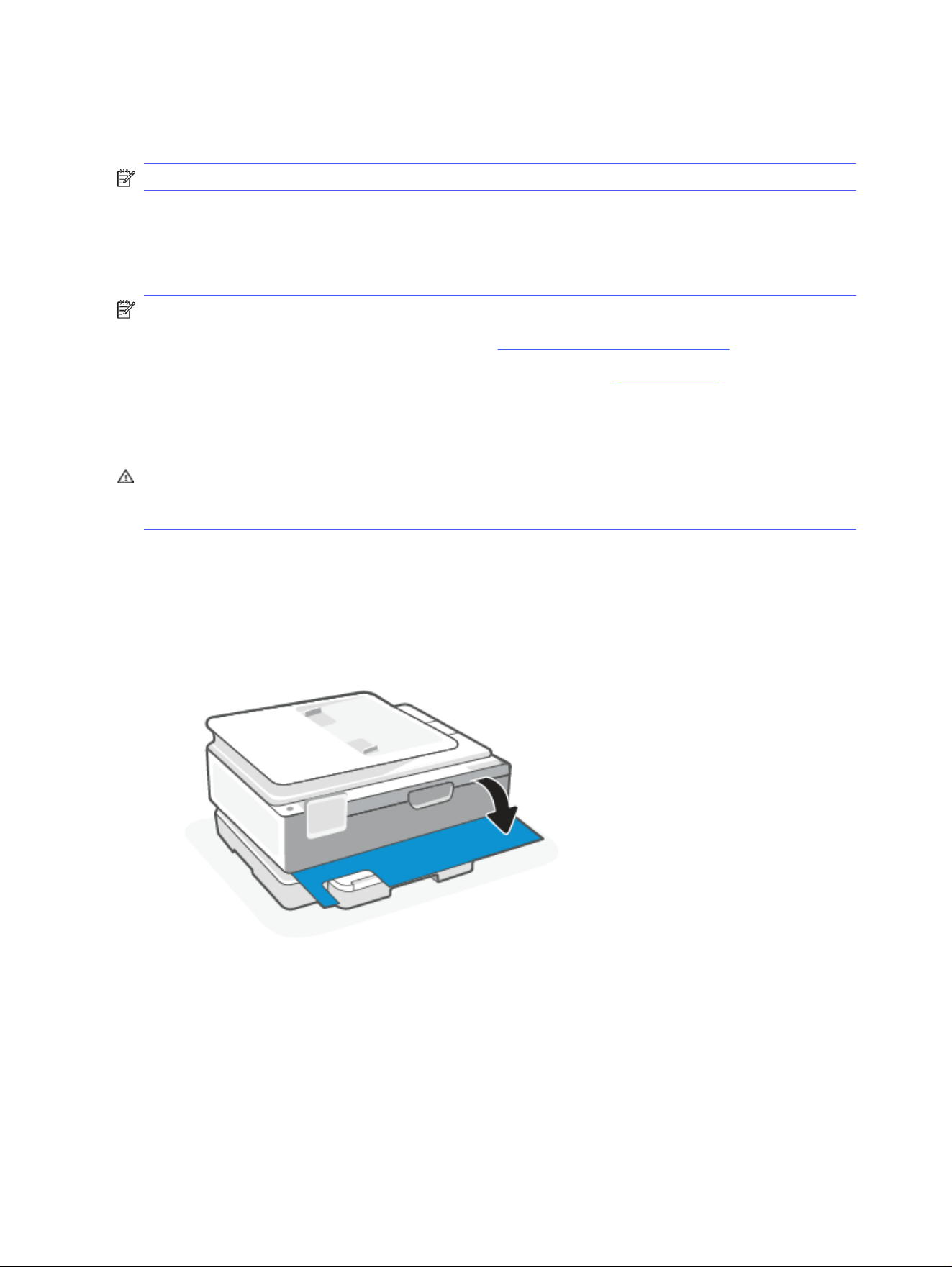
● On the label of the cartridge you are replacing.
● On a sticker inside the printer. Open the cartridge access door to locate the sticker.
NOTE: The Setup cartridge that comes with the printer is not available for separate purchase.
Replace the cartridges
Learn how to replace the cartridges.
NOTE:
● For information on recycling used ink supplies, see HPinkjet supplies recycling program
If you do not already have replacement cartridges for the printer, see Order cartridges.
● At this time, some portions of the HP web site are available in English only.
● Not all cartridges are available in all countries/regions.
CAUTION: HP recommends that you replace any missing cartridges as soon as possible to avoid print quality
issues and possible extra ink usage or damage to the ink system. Never turn o the printer when cartridges are
missing.
Remove and replace an ink cartridge
Replace the ink cartridge with a new, genuine HP ink cartridge.
1. Make sure the printer is turned on.
2. Open the front door.
38 Chapter 7Manage cartridges
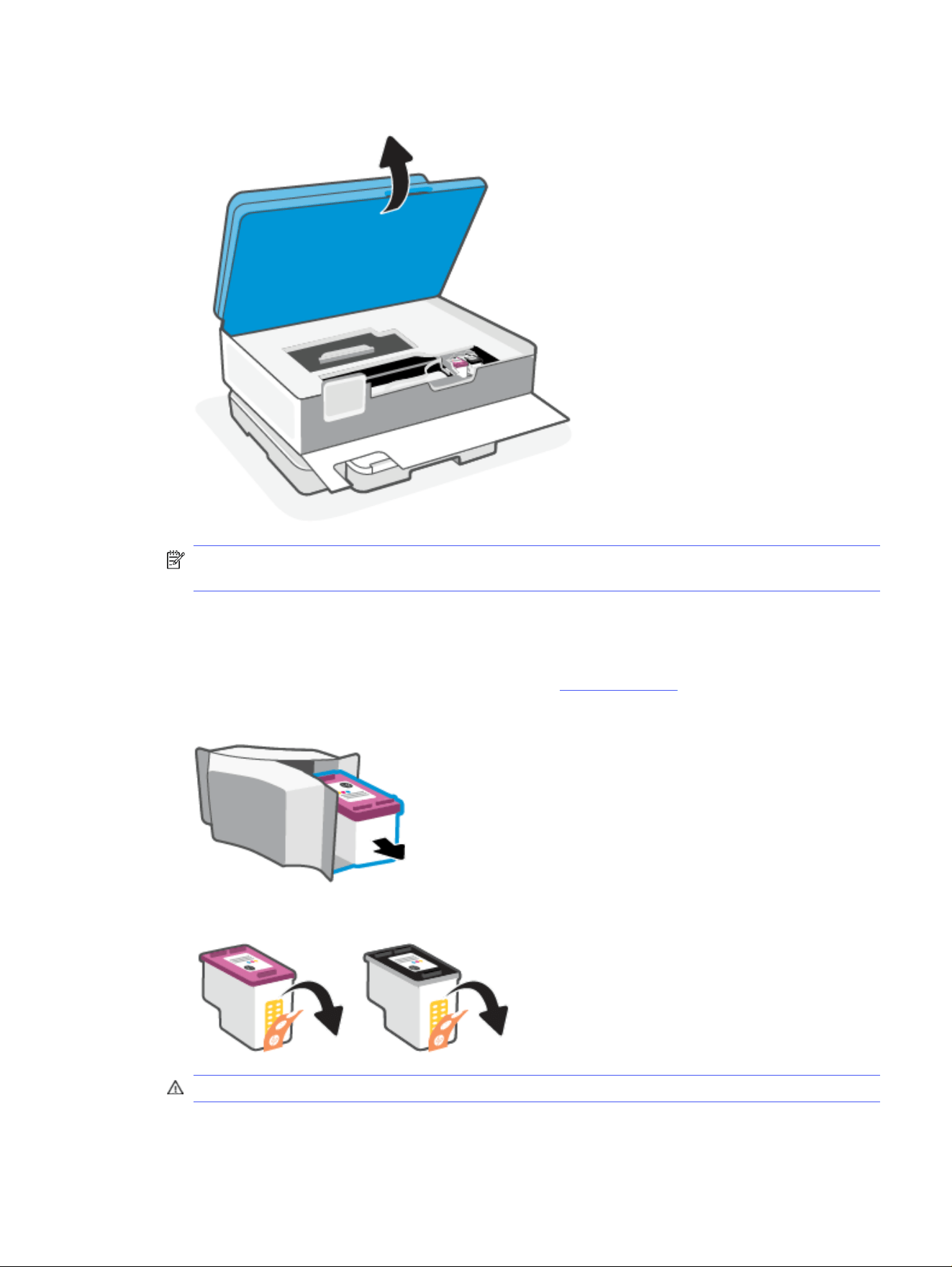
3. Open the cartridge access door.
NOTE: If the printer has a document feeder, do not grab or squeeze the document feeder when lifting the
scanner.
4. Wait until the print carriage stops moving before proceeding.
5. Remove the cartridge from the slot.
6. Recycle the cartridge. To recycle the used cartridge, go to hp.com/go/recycle.
7. Remove the new cartridge from its packaging.
8. Remove plastic tape using the pull tab.
CAUTION: Do not touch the electrical contacts or print nozzles on the cartridges to prevent damage.
Remove and replace an ink cartridge
39
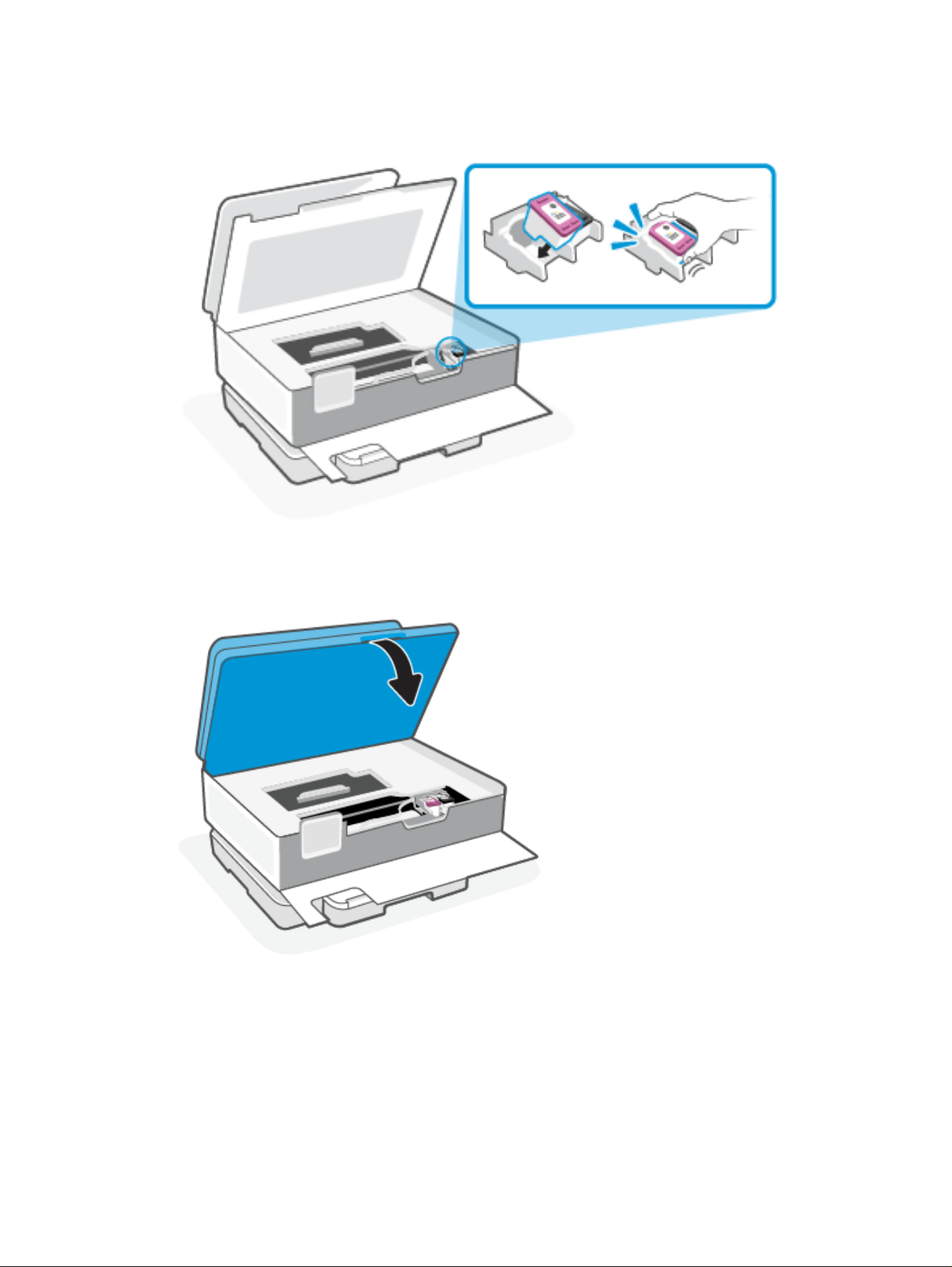
9. Slide the new cartridge and push it in the slot until it clicks.
10. Repeat these steps to replace the other ink cartridge, if necessary.
11. Close the cartridge access door.
40 Chapter 7Manage cartridges
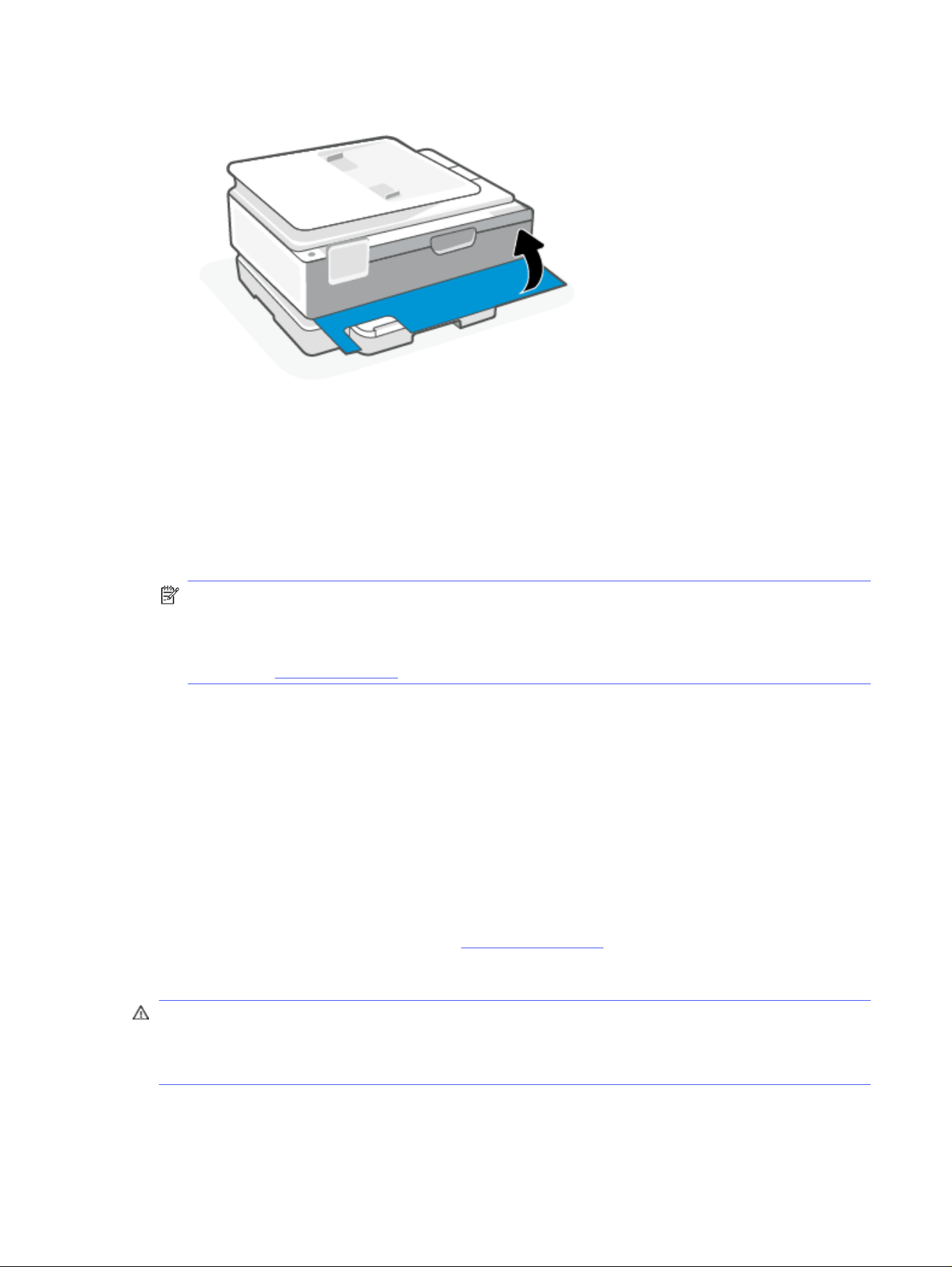
12. Close the front door.
Use single cartridge mode
Use the single cartridge mode to operate the printer with only one cartridge. The single cartridge mode is
initiated when one of the following occurs.
● There is only one cartridge installed in the carriage.
● A cartridge is removed from the carriage if there are two cartridges installed previously.
NOTE: If the printer enters the single cartridge mode when two cartridges are installed in the printer,
verify that the protective piece of plastic tape has been removed from each cartridge. When the plastic tape
covers the cartridge contacts, the printer cannot detect that the cartridge is installed. If there is no plastic
tape on the cartridges, try cleaning the cartridge contacts. For information about cleaning cartridge
contacts, see Ink cartridge issues.
To exit the single cartridge mode
● Install both the black and tri-color cartridges in the printer.
Ink cartridge issues
If a cartridge has a problem, you might get a cartridge problem message.
If an error occurs after a cartridge is installed, or if a message indicates a cartridge problem, try removing
the cartridges, verifying the protective piece of plastic tape has been removed from each cartridge, and then
reinserting the cartridges. If this does not work, clean the cartridge contacts. If the problem is still not resolved,
replace the cartridges.
For information about replacing cartridges, see Replace the cartridges.
To clean cartridge contacts
CAUTION: The cleaning procedure should take only a few minutes. Make sure that the cartridges are
reinstalled in the printer as soon as possible. It is not recommended to leave the cartridges outside the printer
longer than 30 minutes. If cartridges are left unprotected outside the printer, their nozzles might dry out and
clog up.
1. Check that power is on.
Use single cartridge mode
41
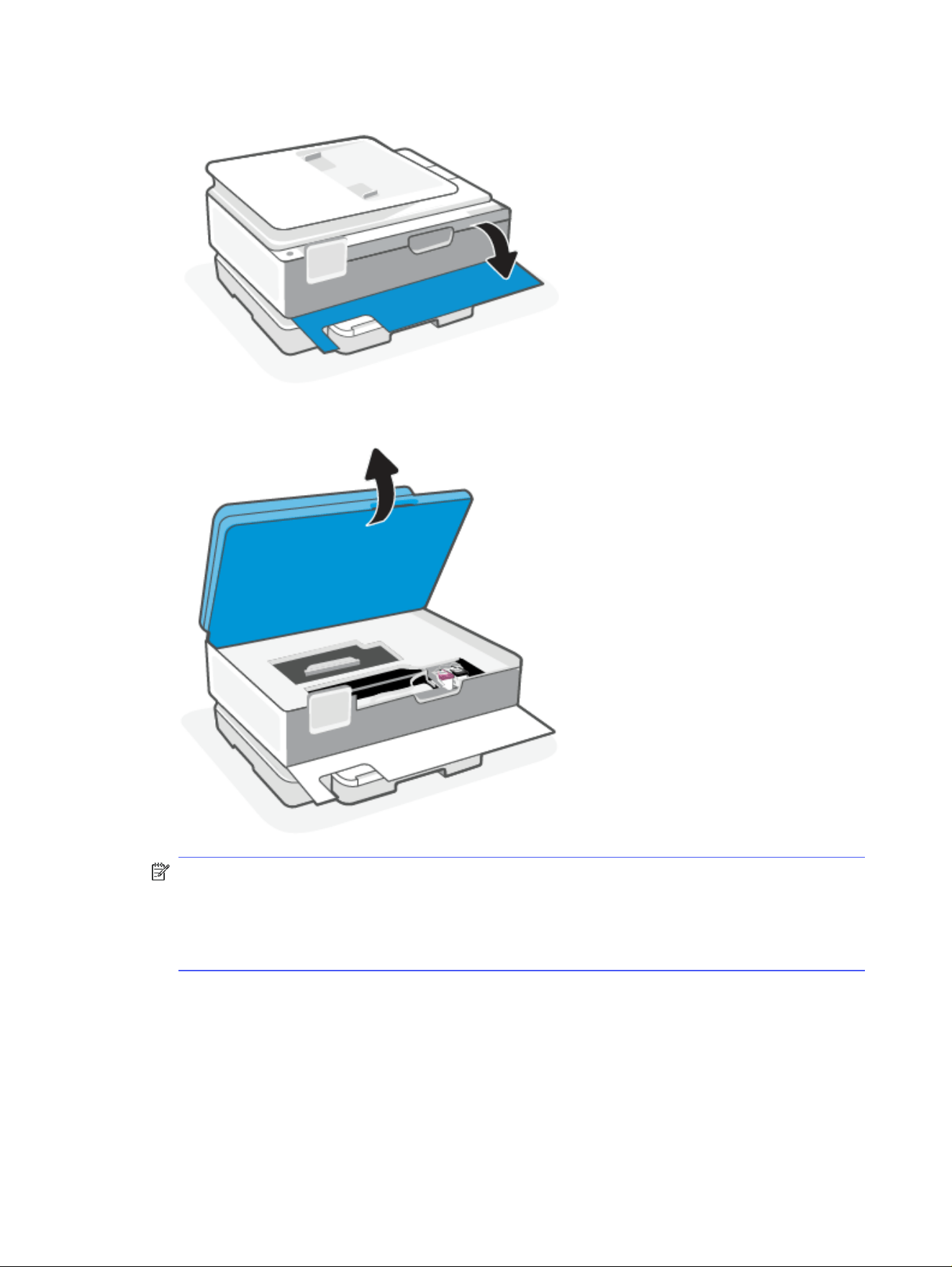
2. Open the front door.
3. Open the cartridge access door.
NOTE:
● Wait until the print carriage stops moving before proceeding.
● If the printer has a document feeder, do not grab or squeeze the document feeder when lifting the
scanner.
4. Wait until the carriage stops moving.
5. Remove the cartridge indicated in the error message.
6. Clean the cartridge contacts and printer contacts.
42
Chapter 7Manage cartridges

a. Hold the cartridge by its sides with the bottom pointing up and locate the electrical contacts on the
cartridge.
The electrical contacts are the small gold-colored dots on the cartridge.
b. Wipe only the contacts with a dry swab or lint-free cloth.
CAUTION: Be careful to wipe only the contacts, and do not smear any of the ink or other debris
elsewhere on the cartridge.
c. On the inside of the printer, locate the contacts for the cartridge.
The printer contacts are the set of gold-colored bumps positioned to meet the contacts on the
cartridge.
d. Use a dry swab or lint-free cloth to wipe the contacts.
7. Reinstall the cartridge.
8. Close the cartridge access door.
9. Check if the error message has gone away. If you still receive the error message, turn the printer o, and
then on.
NOTE: If one cartridge is causing problems, you can remove it and use the single cartridge mode to operate
the printer with only one cartridge.
Store printing supplies
Cartridges can be left in the printer for extended periods of time. However, to assure optimal cartridge health, be
sure to turn o the printer properly when the printer is not in use.
For more information, see Turn the printer o .
Cartridge warranty information
The HP cartridge warranty is applicable when the cartridge is used in its designated HP printing device. This
warranty does not cover HP cartridges that have been relled, remanufactured, refurbished, misused, or
tampered with.
During the warranty period, the cartridge is covered as long as the HP ink is not depleted and the end of warranty
date has not been reached. The end of warranty date, in YYYY/MM/DD format, may be found on the cartridge as
indicated:
For a copy of the HPLimited Warranty Statement, visit hp.com/go/orderdocuments.
Store printing supplies
43

Solve a problem8
Solve common printer problems.
You can get help from the HP app and the printer control panel.
● The HP app: Provides alerts for printer issues (jams and other problems), links to help content, and options
to contact support for additional assistance.
See Use the HP app (iOS, Android, Windows, and macOS) for more information.
● Printer control panel: Touch the Help button to access the Help menu, contextual help, and also
animations for some tasks.
If the suggestions do not solve the problems, try getting help using one of the support services, contact HP
support.
Visit hp.com/support for more information.
Update the printer
HP periodically releases rmware updates to enhance product functionality and x issues. By default, if the
printer is connected to the Internet, the printer automatically checks for updates at regular intervals. You can
change the default setting for automatic updates or manually check for updates immediately.
To update the printer using the printer control panel
1. From the top of the screen, touch or swipe down the tab to open the Dashboard, touch Setup .
2. Touch Printer Maintenance.
3. Touch Update the Printer.
4. Touch Check for Printer Updates Now.
To enable the printer to automatically check for updates
NOTE: The default setting of Auto Update is On.
1. From the printer control panel, touch or swipe down the tab at the top of the screen to open the Dashboard,
and then touch Setup .
2. Touch Printer Maintenance.
3. Touch Update the Printer.
4. Touch Printer Update Options.
5. Select Install Automatically (Recommended), Alert When Available or Do Not Check.
44
Chapter 8Solve a problem
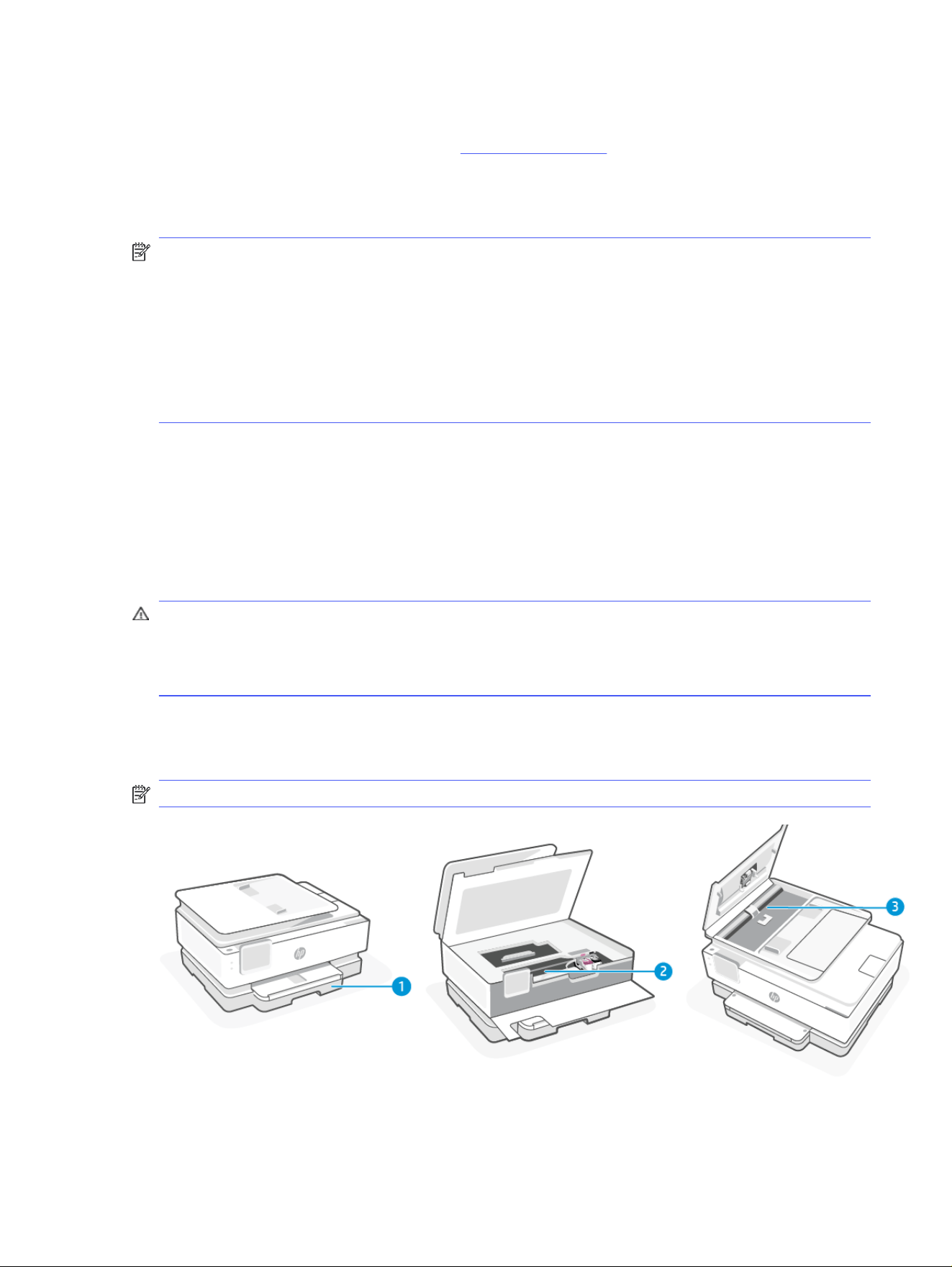
To update the printer using the embedded web server (EWS)
1. Open the EWS. For more information, see To access and use EWS.
2. Click the Tools tab.
3. In the Printer Updates section, click Firmware Updates, and then follow the onscreen instructions.
NOTE:
● If prompted for a password, enter the PIN from the label on your printer. The PIN label can be found inside
the cartridge access area.
● If prompted for proxy settings and if your network uses proxy settings, follow the onscreen instructions to
set up a proxy server. If you do not have the details, contact your network administrator or the person who
set up the network.
● If a printer update is available, the printer downloads and installs the update, and then restarts.
Jams and paper-feed issues
Learn how to troubleshoot jams and paper-feed issues.
Remove jammed paper
Look in all areas where jams can occur and remove any jammed paper or foreign objects found.
CAUTION:
● Do not use sharp objects, such as tweezers or needle-nose pliers, to remove jammed objects.
● When removing jammed paper, use both hands to pull the paper straight out from the printer.
Possible jam locations
Paper jams can occur in the following areas of the printer.
NOTE: The printer images and details may vary depending on your printer model.
To update the printer using the embedded web server (EWS) 45
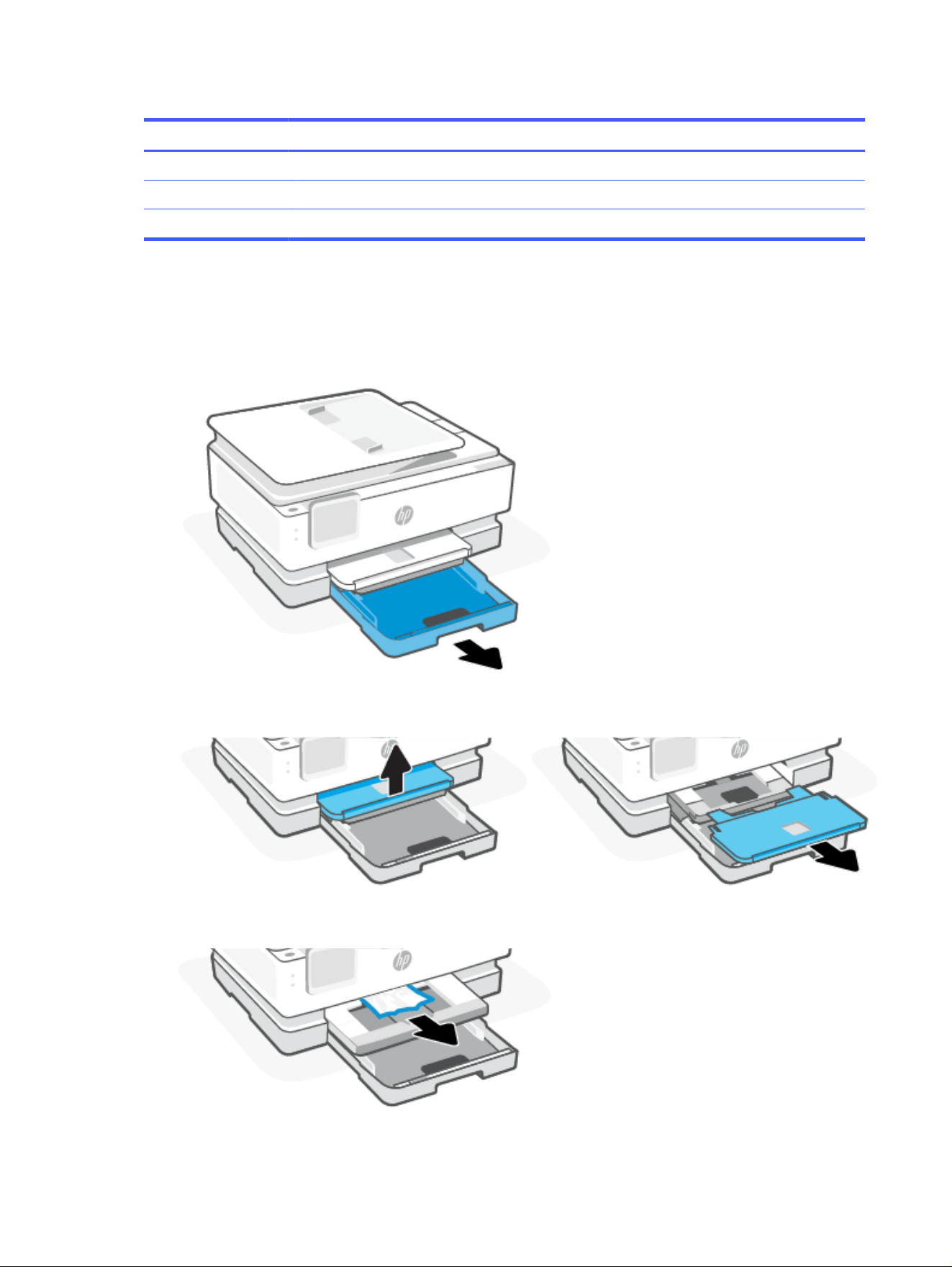
Jam locations
Feature Description
1 Main tray
2 Print zone area
3 Document feeder (some printer models)
Clear a paper jam from the main tray
Remove any jammed paper accessible from the main tray.
1. Open the main tray.
2. Lift up the output tray and then remove from the printer.
3. Remove any jammed paper in the photo tray.
46 Chapter 8Solve a problem
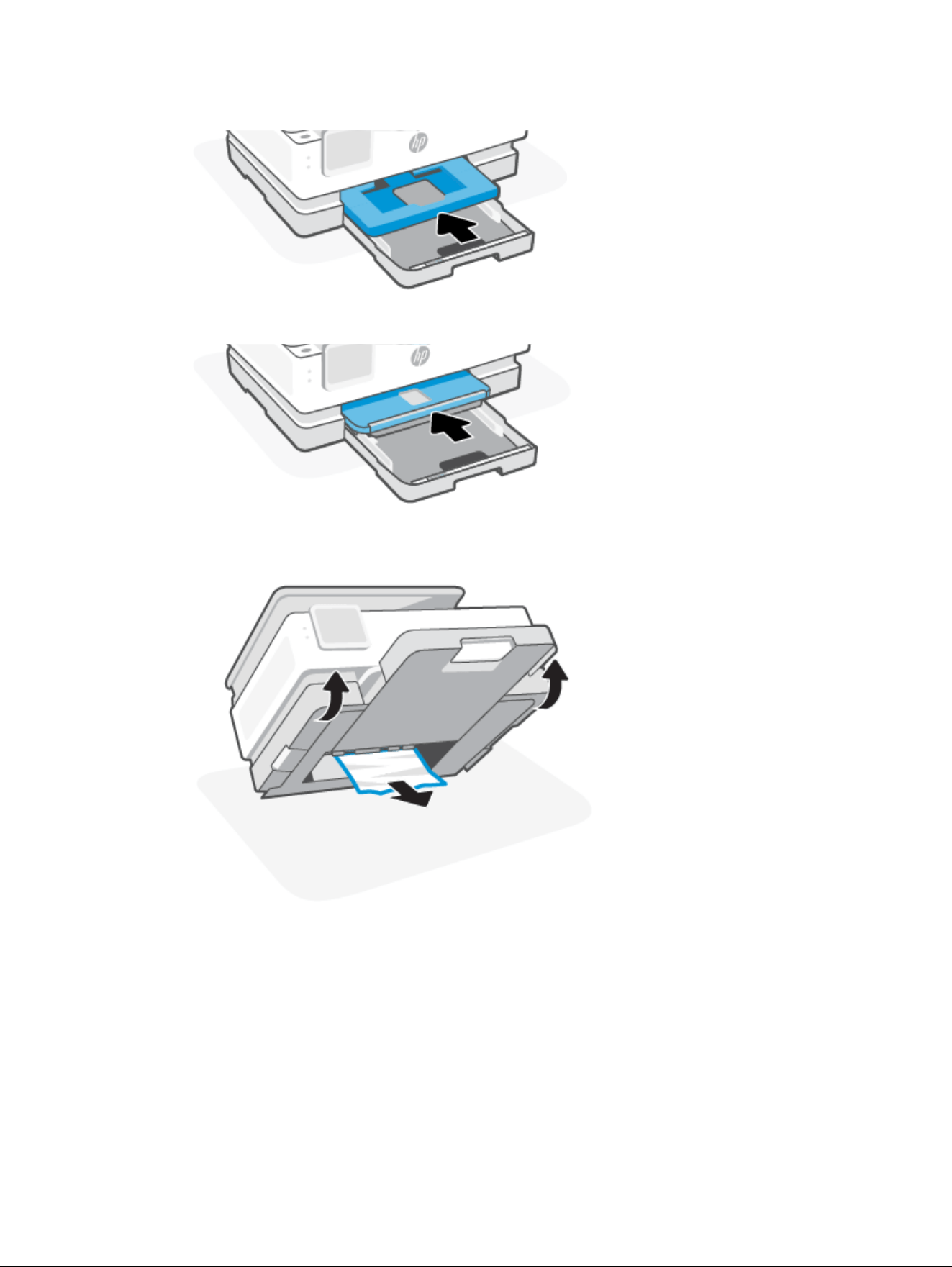
4. Push in the photo tray and then remove any jammed paper in the main tray.
5. Insert the output tray back into the printer.
6. If the printer is still showing clear jam message, with the main tray extended, gently tilt the printer from the
front (about 60 degrees) to remove the paper from the base of the printer.
Clear a paper jam from the main tray 47
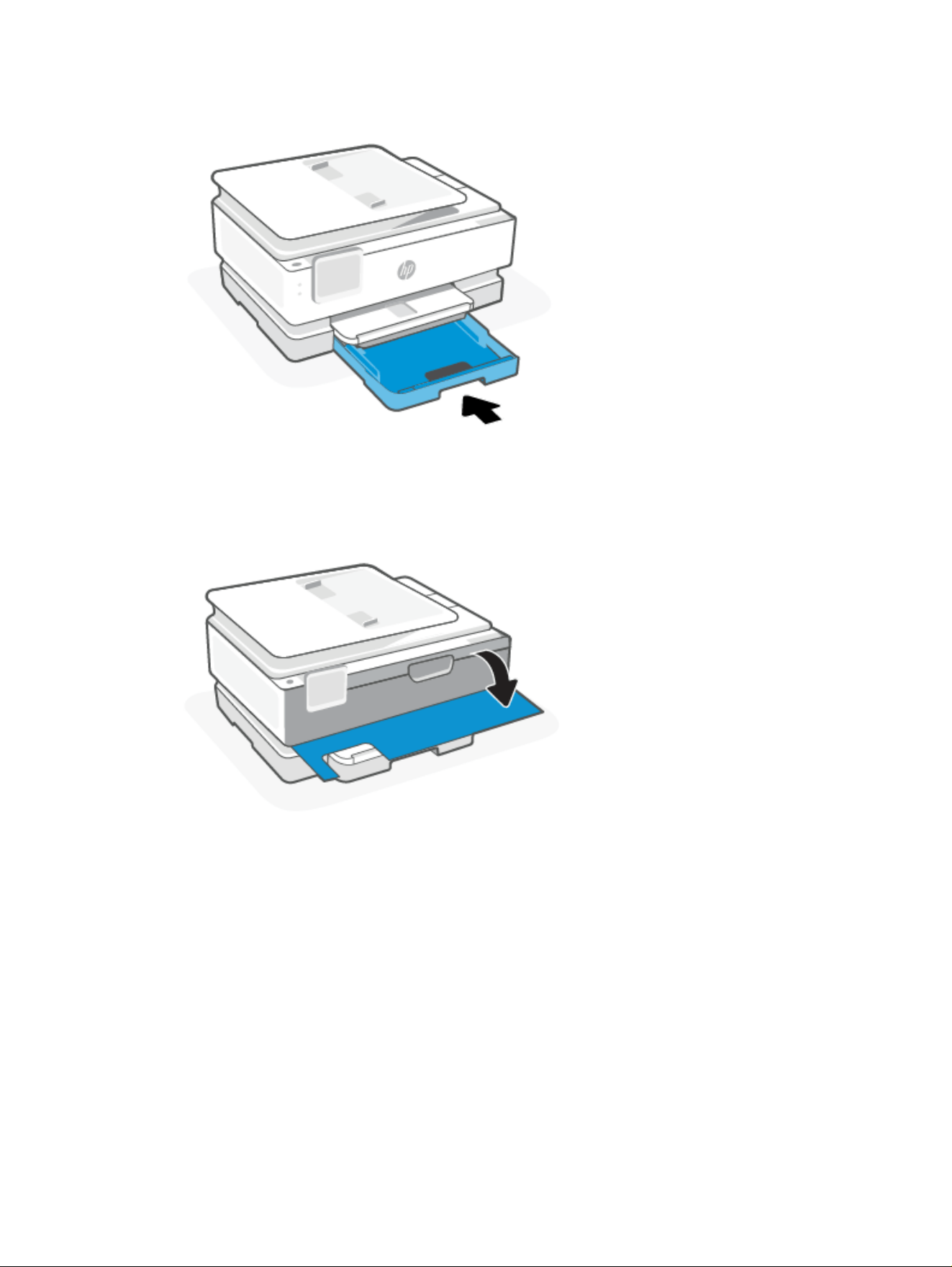
7. Close the main tray.
Clear a paper jam from the print zone
Remove any jammed paper accessible from the print zone.
1. Open the front door.
48 Chapter 8Solve a problem
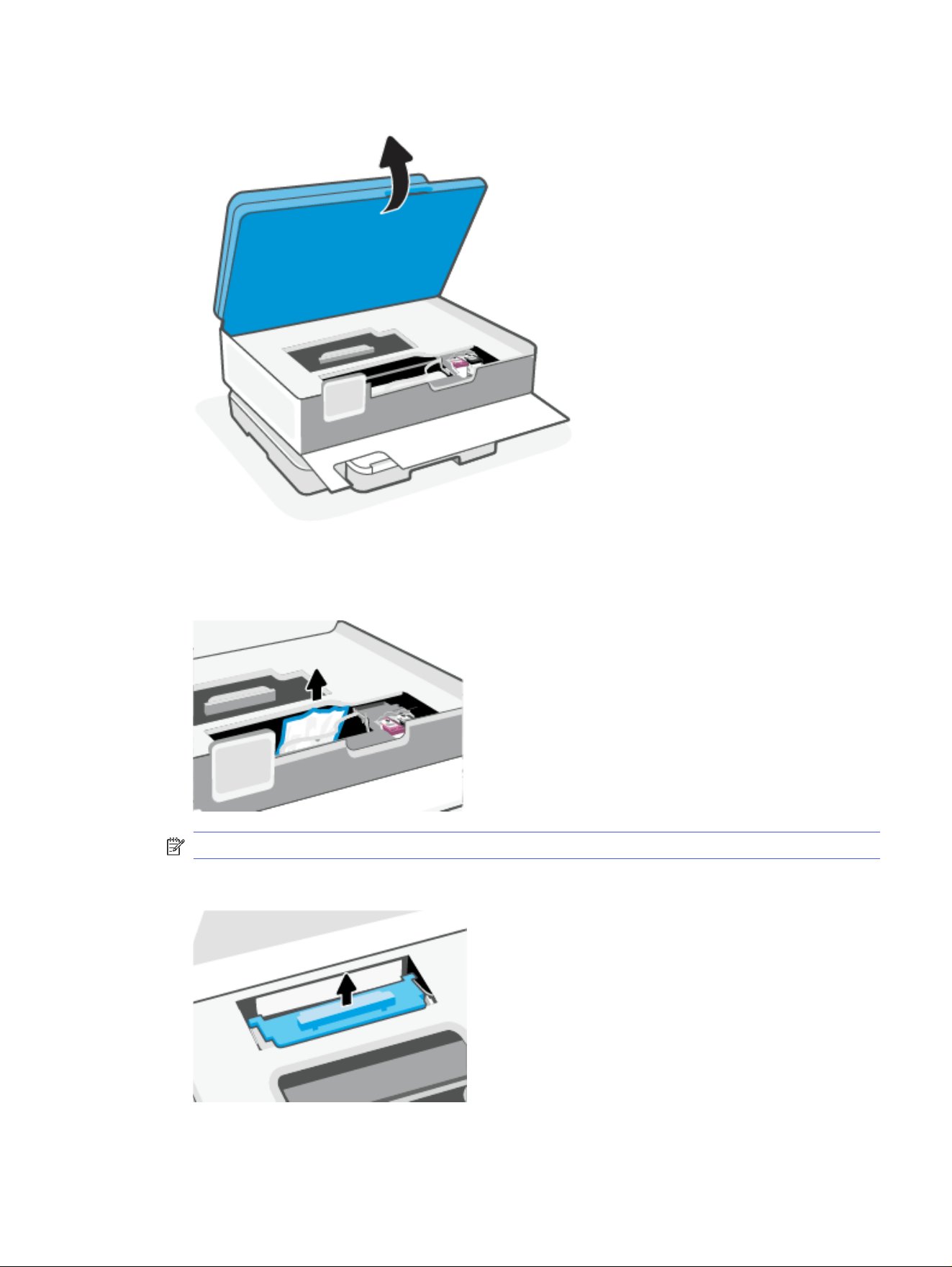
2. Open the cartridge access door.
3. If the print carriage is not obstructed, gently move the print carriage to the left of the printer and then
remove the jammed paper. If needed, repeat the same by gently moving the print carriage to the right of
the printer.
NOTE: Do not move the print carriage too far to the left or the right side of the printer.
4. Lift the handle of the paper path cover and remove the cover.
Clear a paper jam from the print zone 49
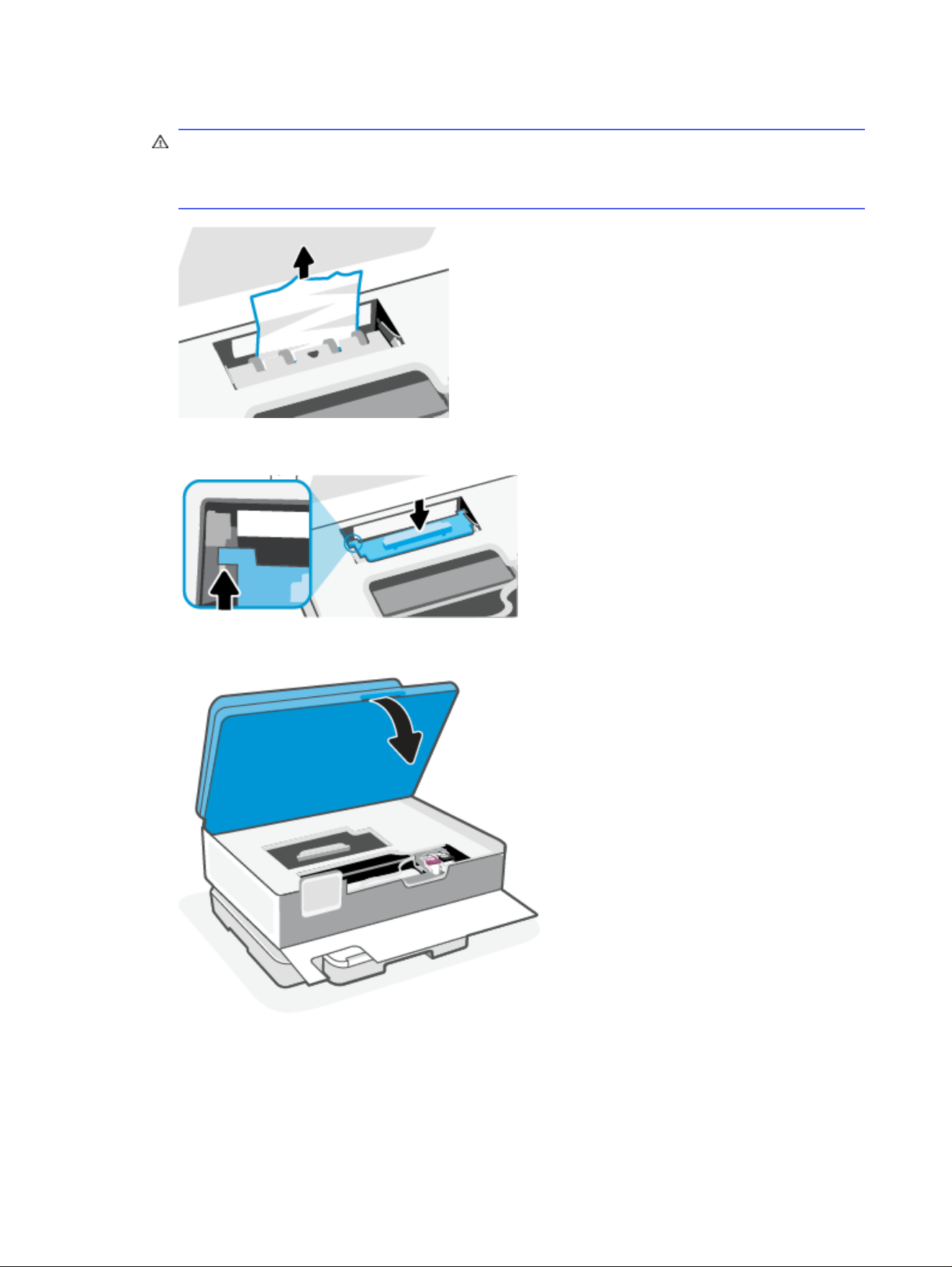
5. Locate any jammed paper inside the printer, grasp it with both hands and pull it towards you.
CAUTION: If the paper tears when you are removing it from the rollers, check the rollers and wheels for
torn pieces of paper that might be remaining inside the printer.
If you do not remove all the pieces of paper from the printer, more paper jams are likely to occur.
6. Reinsert the paper path cover until it snaps into place.
7. Close the cartridge access door.
50 Chapter 8Solve a problem
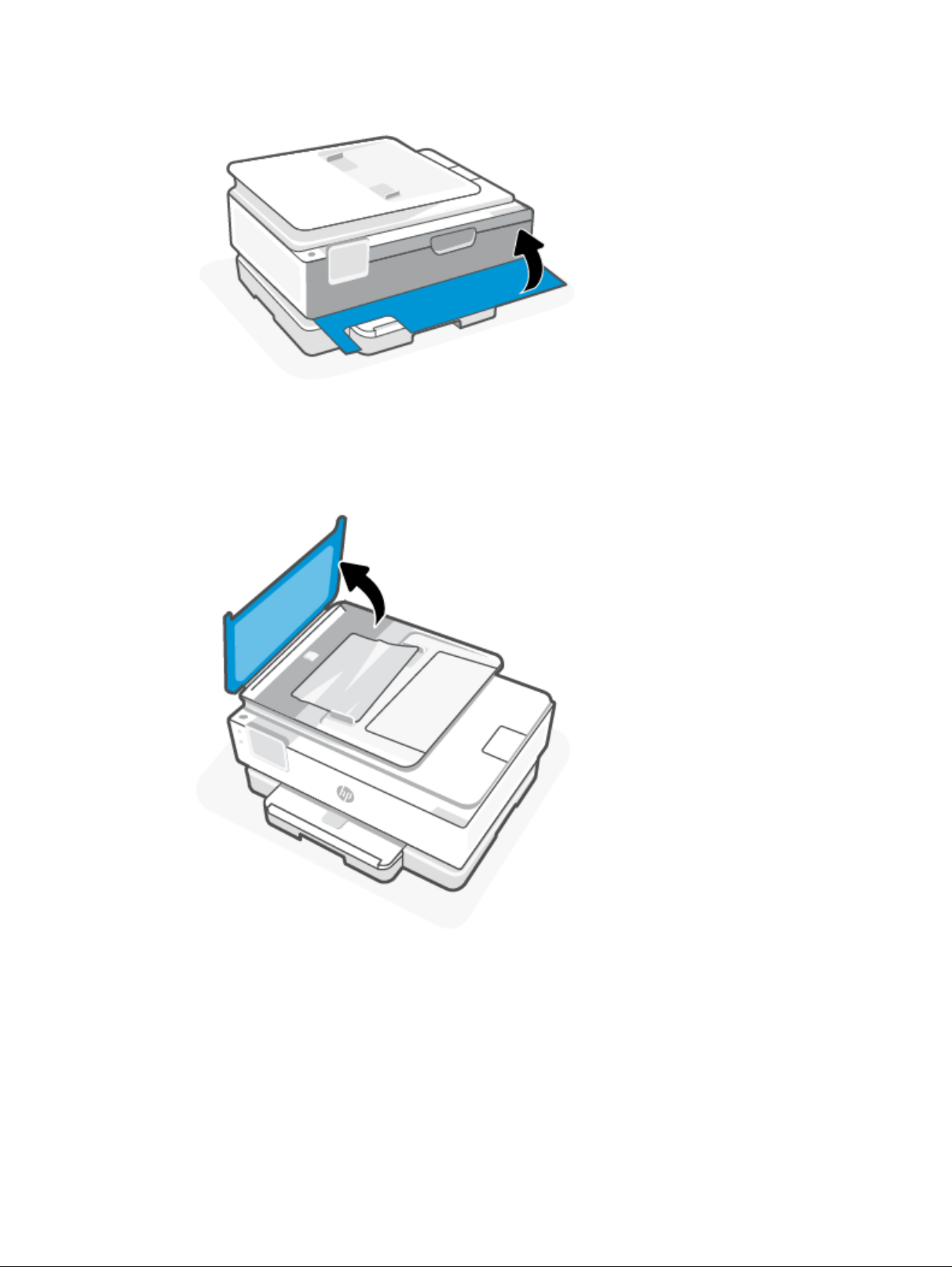
8. Close the front door.
Clear a paper jam from the document feeder (some models only)
Remove any jammed paper from the document feeder.
1. Lift the cover of the document feeder.
Clear a paper jam from the document feeder (some models only) 51
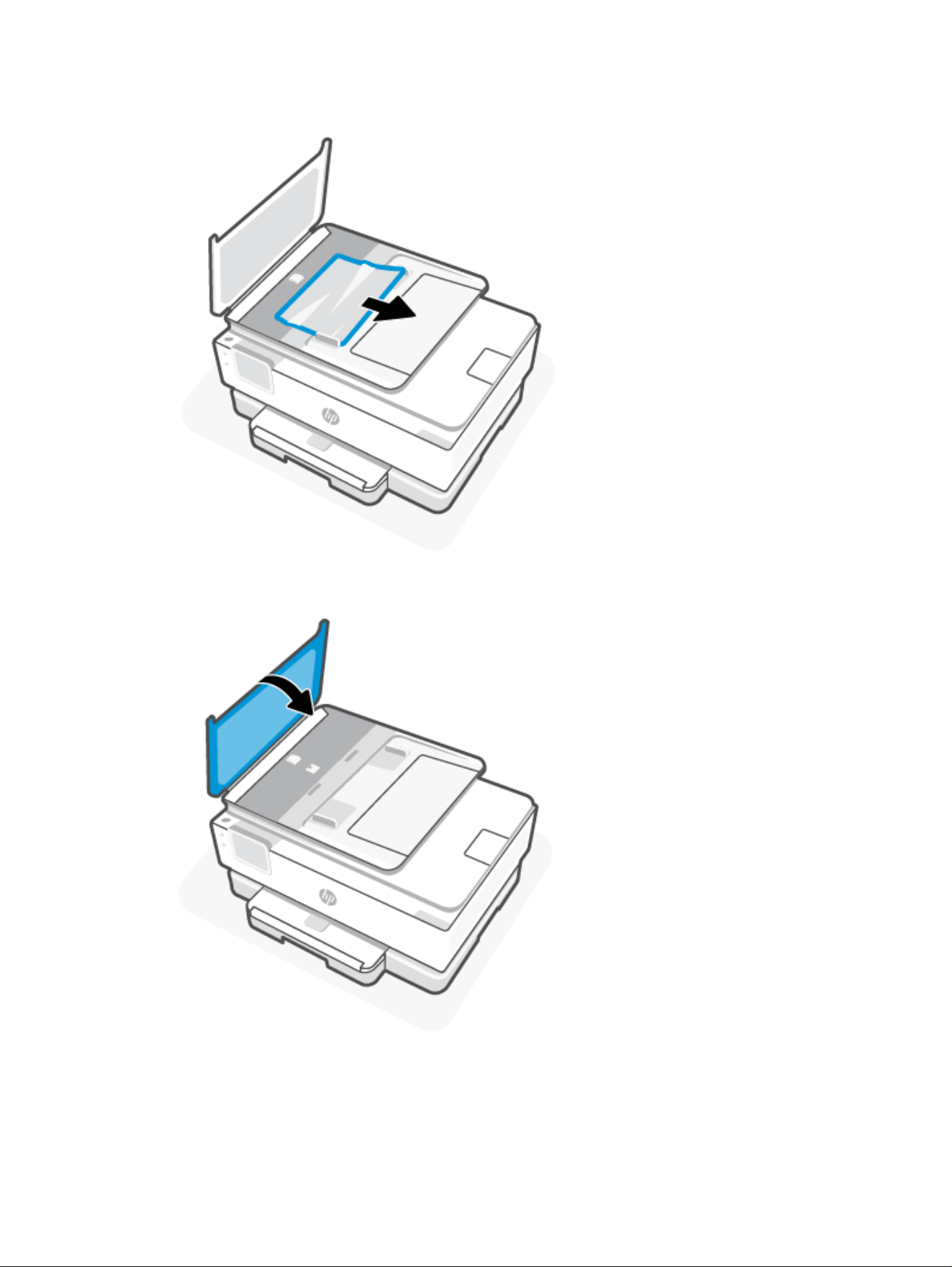
2. Pull any jammed paper out of the rollers.
3. Close the cover of the document feeder until it snaps into space.
52 Chapter 8Solve a problem
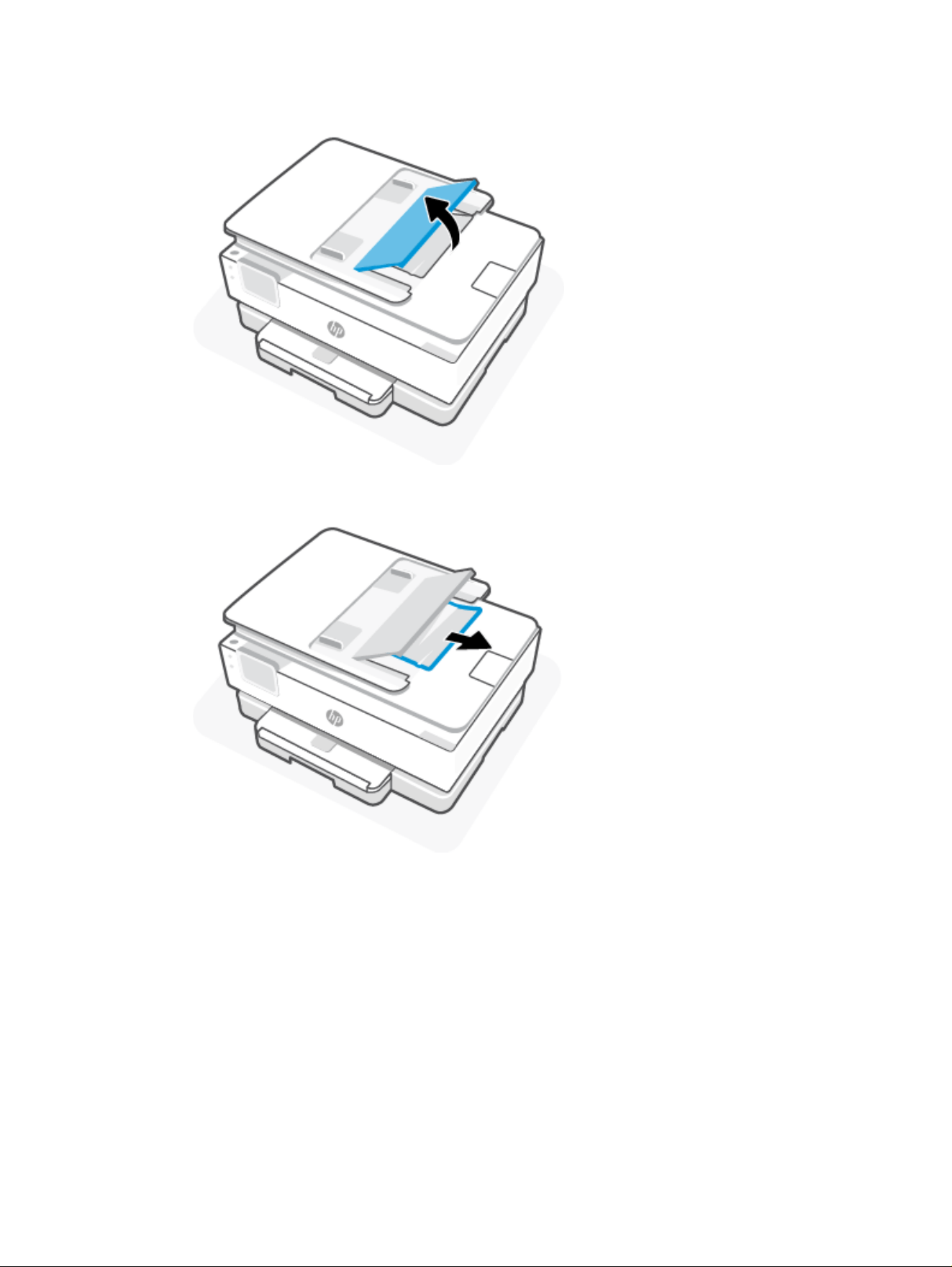
4. Lift up the document feeder tray.
5. Remove any jammed paper under the tray.
Clear a paper jam from the document feeder (some models only) 53
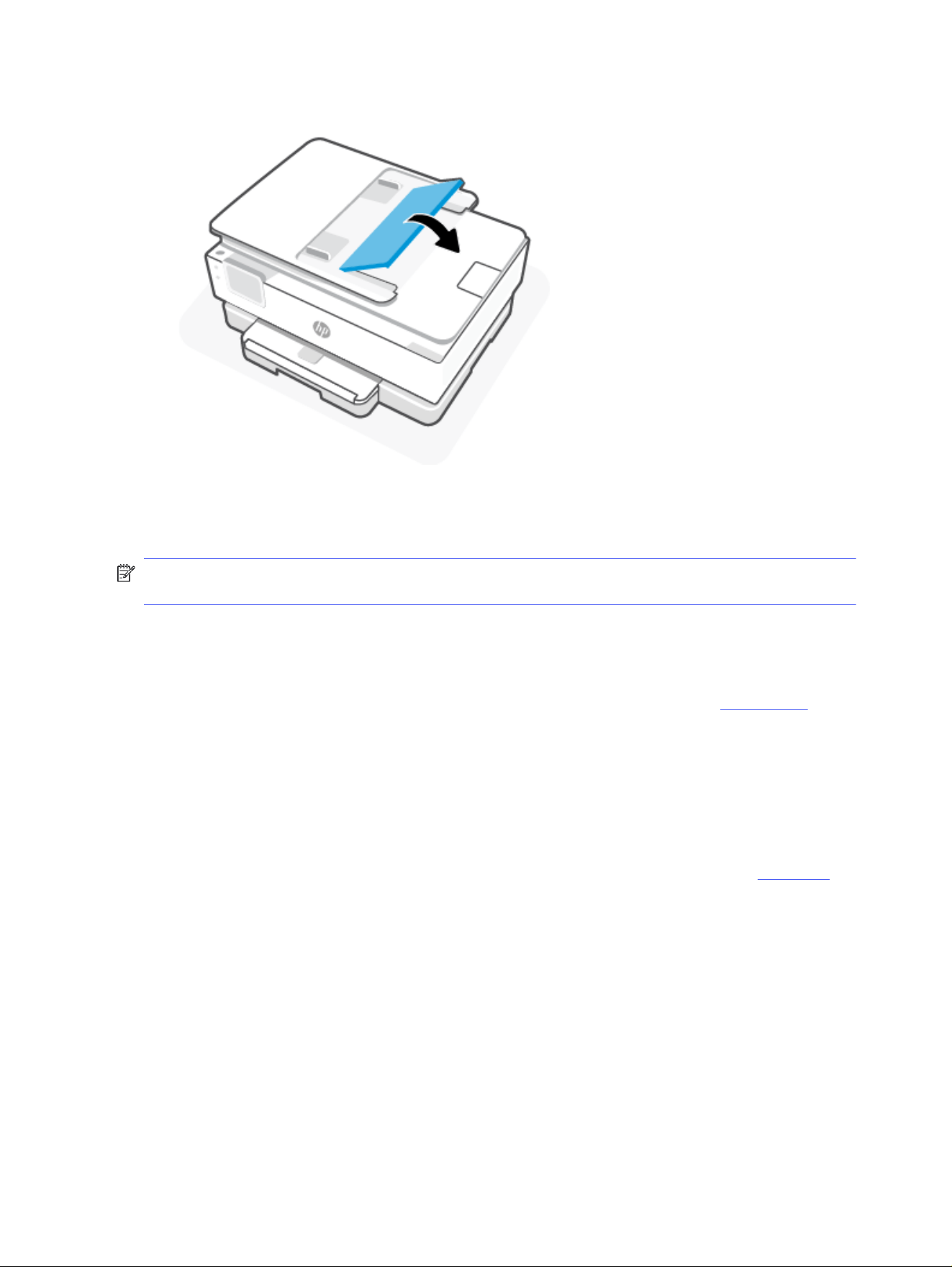
6. Put down the document feeder tray.
Clear a print carriage jam
Remove any objects, such as paper, that are blocking the print carriage.
NOTE: Do not use any tools or other devices to remove jammed paper. Always use caution when removing
jammed paper from inside the printer.
Learn how to avoid paper jams
To help avoid paper jams, follow these guidelines.
● Do not place too much paper in the printer trays. For information on tray capacity, see Specications.
● Remove printed papers from the output tray frequently.
● Make sure that you are printing with paper that is not wrinkled, folded, or damaged.
● Prevent curled or wrinkled paper by storing all unused paper at in aresealable bag.
● Do not use paper that is too thick or too thin for the printer.
● Make sure that the trays are loaded correctly and are not too full. For more information, see Load paper.
● Ensure that paper loaded in the main tray lays at and the edges are not bent or torn.
● Do not mix dierent paper types and paper sizes in the main tray; the entire stack of paper in the main tray
must be the same size and type.
● Do not force paper too far inside the main tray.
● If you are printing on both sides of a page, do not print highly saturated images on light weight paper.
● Use paper types that are recommended for the printer.
● If the printer is about to run out of paper, allow the printer to run out of paper rst, and then add paper. Do
not load paper when the printer is printing.
54
Chapter 8Solve a problem

Solve paper-feed problems
The following lists the common paper-feed problems.
● Paper is not picked up from atray
– Make sure paper is loaded in the tray. For more information, see Load paper. Fan the paper before
loading.
– Make sure the paper-width guides are set to the correct markings in the tray for the paper size you are
loading. Also make sure the paper guides are snug, but not tight, against the stack.
– Ensure that the stack of paper is aligned with the appropriate paper size lines on the bottom of the main
tray, and does not exceed the stack height indicated by one or more label on the side or paper-width
guide of the main tray.
– Make sure paper in the tray is not curled. Uncurl paper by bending it in the opposite direction of the curl.
● Pages are skewing
– Make sure the paper loaded in the main tray is aligned to the paper-width guides. If needed, open the
main tray from the printer and reload the paper correctly, making sure that the paper guides are aligned
correctly.
– Load paper into the printer only when it is not printing.
– Make sure the rear access door is securely shut.
● Multiple pages are being picked up
– Make sure the paper-width guides are set to the correct markings in the tray for the paper size you are
loading. Also make sure the paper-width guides are snug, but not tight, against the stack.
– Ensure that the stack of paper is aligned with the appropriate paper size lines on the bottom of the main
tray, and does not exceed the stack height indicated by one or more label on the side or paper-width
guide of the main tray.
– Make sure the tray is not overloaded with paper.
– Use HP paper for optimum performance and eiciency.
Printer is unable to print
Learn how to troubleshoot when the printer is unable to print.
Check printer connection to the Internet
Your printer might be occasionally disconnected from the Internet (for example. power outage, network or router
issues or turning o the printer when not in use). You might be able to print a limited number of pages while the
printer is disconnected, but it is critical to reconnect the printer to continue printing.
Make sure to use Original HP cartridges
Check that you are using Original HP cartridges. Original HP cartridges are manufactured and sold by HP in oicial
HP packaging.
Solve paper-feed problems
55

Check the printer settings and status
To check the printer settings and status, print a printer report and printer status report. Check this page for
information about printer errors.
TIP: To set up the printer wirelessly, see Connect to a Wi-Fi network using the HP app.
If you are still unable to print, visit the HP Support website at hp.com/support.
To print a printer report
1. From the printer control panel, touch or swipe down the tab at the top of the screen to open the Dashboard,
touch Setup .
2. Touch Reports.
3. Select a printer report to print.
Printer status report
Use the printer status report to view current printer information and cartridge status. Also use the printer status
report to help you troubleshoot problems with the printer.
The printer status report also contains alog of recent events.
If you need to call HP, it is often useful to print the printer status report before calling.
Printing issues
Learn how to troubleshoot printing issues.
Fix problems with page not printing (unable to print)
Learn how to troubleshoot printing issues.
To resolve print issues
Make sure that the printer is turned on and that there is paper in the tray. If you are still unable to print, try the
following in order:
1. Check for error messages and resolve them by following the on-screen instructions.
2. If your computer is connected to the printer with a USB cable, disconnect and reconnect the USB cable.
If your computer is connected to the printer with a wireless connection, conrm that the connection is
working.
56 Chapter 8Solve a problem
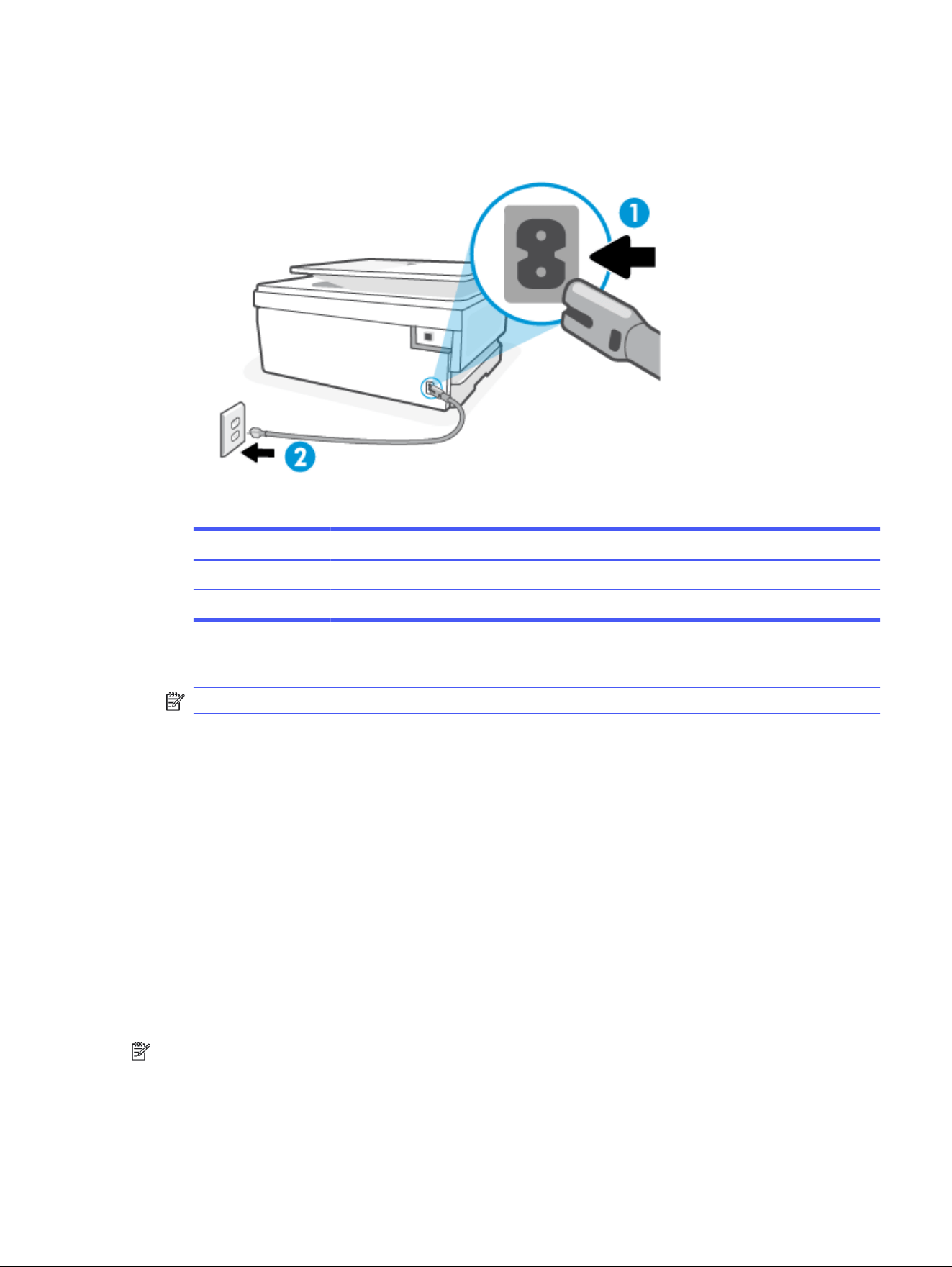
To check the power connection and reset the printer
1. Make sure the power cord is rmly connected to the printer.
Printer ports
Port Description
1 Power connection to the printer
2 Connection to a power outlet
2. Look at the Power button located on the printer. If it is not lit, the printer is turned o. Press the Power
button to turn on the printer.
NOTE: If the printer is not receiving electrical power, connect it to another power outlet.
3. With the printer turned on, disconnect the power cord from the back of the printer.
4. Unplug the power cord from the wall outlet.
5. Wait at least 15 seconds.
6. Plug the power cord back into the wall outlet.
7. Reconnect the power cord to the back of the printer.
8. If the printer does not turn on by itself, press the Power button to turn on the printer.
9. Try using the printer again.
Fix print quality issues
Learn how to troubleshoot print quality issues.
NOTE: To avoid print quality problems, always turn the printer o using the Power button, and wait until the
Power button light goes out before you pull the plug or turn o a power strip. This allows the printer to move
the cartridges to a capped position, where they are protected from drying out.
To check the power connection and reset the printer
57

To improve print quality from the printer control panel
1. Clean the printhead from the printer control panel.
a. Load Letter, A4, or Legal unused plain white paper into the main tray.
b. From the printer control panel, touch or swipe down the tab at the top of the screen to open the
Dashboard, and then touch Setup .
c. Touch Printer Maintenance, select Clean Cartridges, and then follow the onscreen instructions.
2. Make sure you are using original HP cartridges.
3. Make sure you have selected the appropriate paper type and print quality.
4. Check the estimated ink levels to determine if the cartridges are low on ink. For more information, see
Check the estimated ink levels. If the cartridges are low on ink, consider replacing them.
5. Print a diagnostics page if the cartridges are not low on ink.
a. Load Letter, A4, or Legal unused plain white paper into the main tray.
b. From the printer control panel, touch or swipe down the tab at the top of the screen to open the
Dashboard, and then touch Setup .
c. Touch Reports.
d. Touch Print Quality Report.
6. Review the blue, magenta, yellow, and black boxes on the diagnostics page. If you are seeing streaks in the
color and black boxes, or no ink in portions of the boxes, then automatically clean the printhead.
7. If cleaning the printhead does not solve the problem, contact HP support. Go to hp.com/support. This
website provides information and utilities that can help you correct many common printer problems. If
prompted, select your country/region, and then click All HP Contacts for information on calling for technical
support.
Copy and scan issues
Use an HP online troubleshooting tool to solve your copy and scan.
For more information, see Tips for copy and scan success.
Network and connection issues
Learn how to troubleshoot network and connection issues.
Fix wireless connection
Choose one of the following troubleshooting options.
● Restore network settings and reconnect the printer. For more information, see Restore original factory
defaults and settings.
● Check the network conguration or print the wireless test report to assist in diagnosing network connection
issues.
58
Chapter 8Solve a problem

1. From the Home screen, touch Wireless and then touch Settings .
2. Touch Print Reports, and then touch Network Conguration Page or Wireless Test Report.
Check the top of the wireless network test report to see if something failed during the test.
– See the DIAGNOSTICS RESULTS section for all tests that were performed, to determine whether or
not your printer passed.
– From the CURRENT CONFIGURATION section, nd out the Network Name (SSID) to which your
printer is currently connected. Make sure that the printer is connected to the same network as your
computer or mobile devices.
● Use an HP online troubleshooting tool to solve your printer issues.
Fix Wi-Fi Direct connection
1. Check the printer to conrm that the Wi-Fi Direct is turned on:
From the printer control panel, touch or swipe down the tab at the top of the screen to open the Dashboard,
and then touch
Wi-Fi Direct .
2. From your wireless computer or mobile device, turn on the Wi-Fi connection, and then search for and
connect to the Wi-Fi Direct name of your printer.
3. Enter the Wi-Fi Direct password when prompted.
4. If you are using a mobile device, make sure you have installed a compatible printing app. For more
information about mobile printing, visit hp.com/go/mobileprinting.
Printer hardware issues
Complete the following steps to resolve printer failure problems:
The printer shuts down unexpectedly
● Check the power and power connections.
● Make sure the printer's power cord is connected rmly to afunctioning power outlet.
Printhead alignment fails
●
If the alignment process fails, make sure you have loaded unused, plain white paper into the main tray. If you
have colored paper loaded in the main tray when you align the printhead, the alignment fails.
● If the alignment process fails repeatedly, you may need to clean the printhead, or you might have a defective
sensor. To clean the printhead, see Maintain the printhead and cartridges.
● If cleaning the printhead does not solve the problem, contact HP support. Go to hp.com/support. This
website provides information and utilities that can help you correct many common printer problems. If
prompted, select your country/region, and then click All HP Contacts for information on calling for technical
support.
Fix Wi-Fi Direct connection
59

The printer shuts down unexpectedly
● Check the power and power connections.
● Make sure the printer's power cord is connected rmly to afunctioning power outlet.
Resolve printer failure
1. Press the Power button to turn o the printer.
2. Unplug the power cord, and then plug in the power cord again.
3. Press the Power button to turn on the printer.
If this problem persists, write down the error code provided in the message, and then contact HP support. For
more information about contacting HP support, see HP support.
Understand printer reports
You can print the following reports to help troubleshoot problems with the printer.
Printer status report
Use the printer status report to view current printer information and cartridge status. Also use the printer status
report to help you troubleshoot problems with the printer.
The printer status report also contains alog of recent events.
If you need to call HP, it is often useful to print the printer status report before calling.
Network
conguration page
If the printer is connected to anetwork, you can print anetwork conguration page to view the network settings
for the printer and a list of networks detected by your printer. The last page of the report includes a list of all
detectable wireless networks in the area, along with signal strength and the channels being used. This might help
you select a channel for your network which is not heavily used by other networks (which will improve network
performance).
The IP address is set back to the Automatic mode.
NOTE: In order to get the list of detected wireless networks in the area, the wireless radio on the printer
should be turned on. If it is o, the list is not displayed.
You can use the network conguration page to help troubleshoot network connectivity problems. If you need to
call HP, it is often useful to print this page before calling.
Print quality report
Print quality problems can have many causes-software settings, a poor image le, or the printing system itself. If
you are unhappy with the quality of your prints, a Print Quality Report page can help you determine if the printing
system is working correctly.
60
Chapter 8Solve a problem

Wireless test report
When you print the Wireless Test Report, a number of tests are run to check various conditions of the printer
wireless connection. The report shows the results of the tests. If an issue is discovered, the issue along with
a message how to x it is provided on the report. Some key wireless conguration details are provided at the
bottom section of the report.
Web access test report
Print the web access report to help identify internet connectivity issues which can aect Web Services.
Solve Web Services problems
If you are having problems using Web Services, check the following:
● Make sure the printer is connected to the Internet using a supported network connection.
NOTE: You cannot use these web features if the printer is connected using a USB cable.
● Make sure the latest product updates have been installed on the printer.
● Make sure Web Services is enabled on the printer. For more information, see To set up Web Services.
● Make sure the network hub, switch, or router is turned on and working correctly.
● If you are connecting the printer using a wireless connection, make sure the wireless network is functioning
properly. For more information, see Network and connection issues.
● If your network uses proxy settings when connecting to the Internet, make sure the proxy settings you are
entering are valid:
– Check the settings being used by the web browser you are using (such as Internet Explorer, Firefox, or
Safari).
– Check with the IT administrator or person who set up your rewall.
If the proxy settings used by your rewall have changed, you must update these settings in either the
printer control panel or the embedded web server. If these settings are not updated, you will not be able
to use Web Services.
For more information, see To set up Web Services.
Printer maintenance
Clean dierent printer parts.
Clean the scanner glass
Dust or dirt on the scanner glass, scanner lid backing, or scanner frame can slow down performance, degrade the
quality of scans, and aect the accuracy of special features such as tting copies to acertain page size.
WARNING! Before cleaning the printer, turn the printer o by pressing the Power button and unplug the
power cord from the electrical socket.
Wireless test report
61
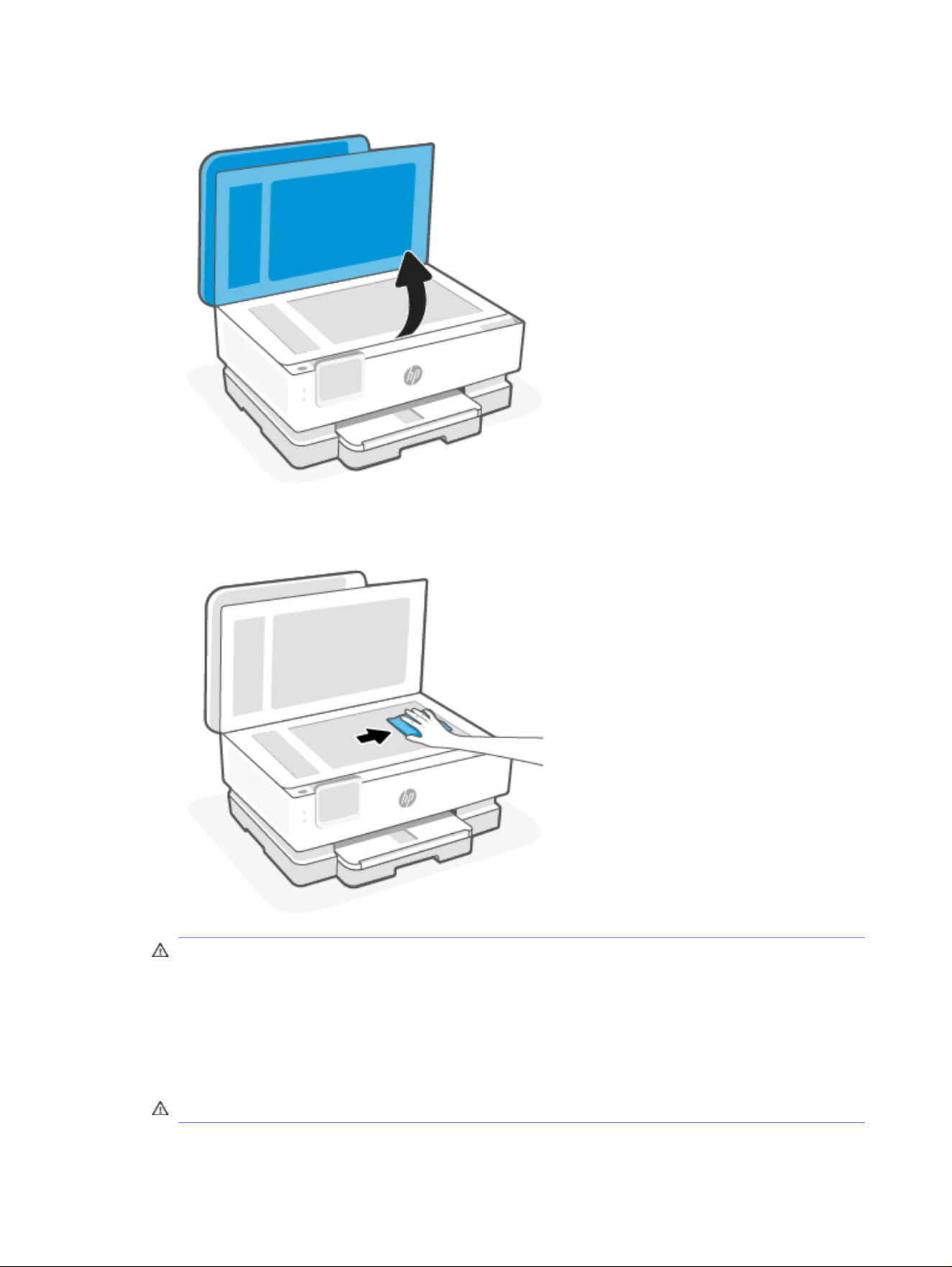
1. Lift the scanner lid.
2. Clean the scanner glass and lid backing by using asoft, lint-free cloth that has been sprayed with amild
glass cleaner.
CAUTION:
● Use only glass cleaner to clean the scanner glass. Avoid cleaners that contain abrasives, acetone,
benzene, and carbon tetrachloride, all of which can damage the scanner glass. Avoid isopropyl alcohol
because it can leave streaks on the scanner glass.
● Do not spray the glass cleaner directly on the scanner glass. If too much glass cleaner is applied, the
cleaner could leak under the scanner glass and damage the scanner.
CAUTION:
62
Chapter 8Solve a problem
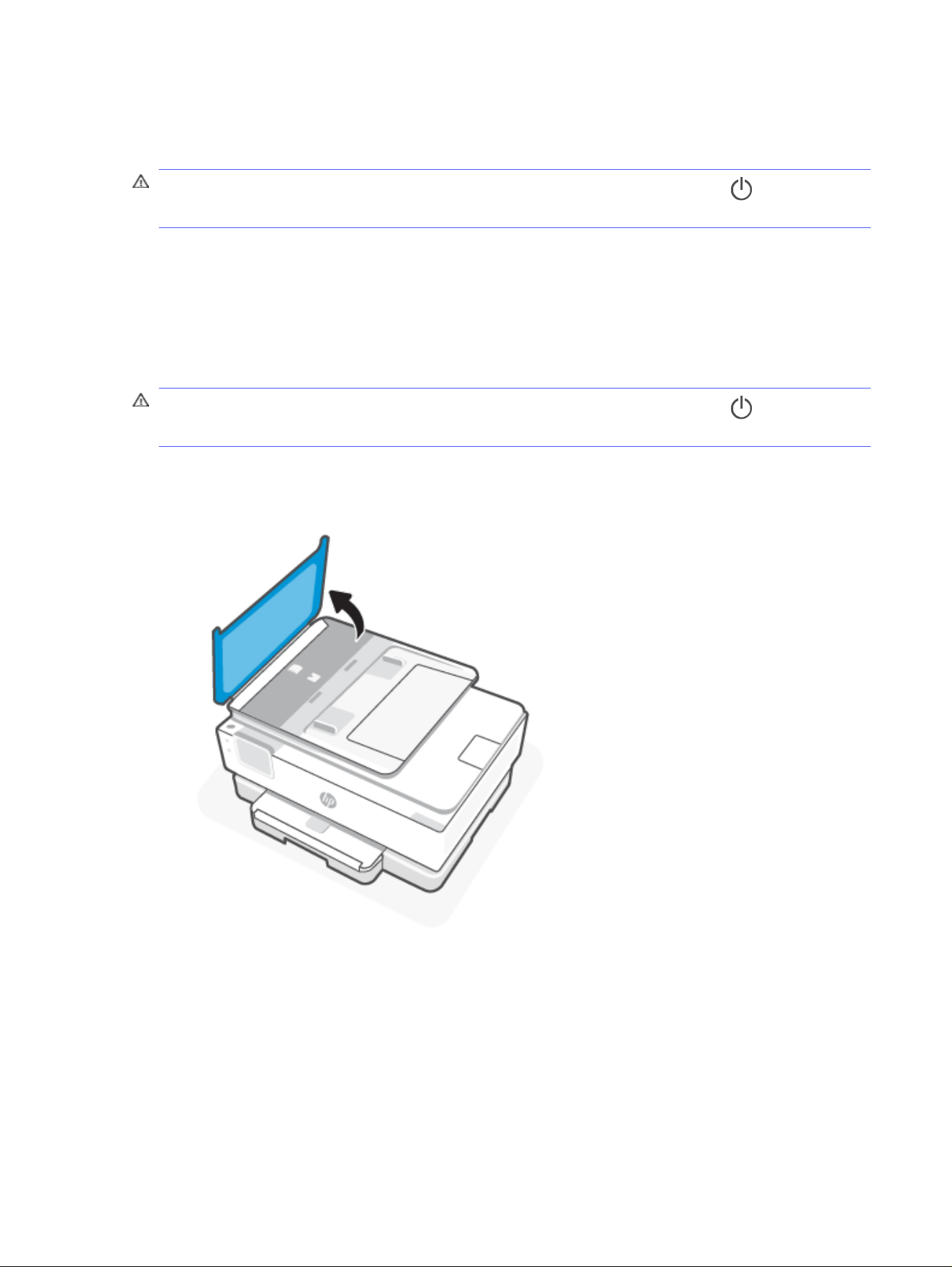
3. Close the scanner lid, and turn on the printer.
Clean the exterior
WARNING! Before cleaning the printer, turn the printer o by pressing the Power button and unplugging
the power cord from the electrical socket.
Use asoft, damp, lint-free cloth to wipe dust, smudges, and stains o of the case. Keep uids away from the
interior of the printer, as well as from the printer control panel.
Clean the document feeder (some models only)
If the document feeder picks up multiple pages or if it does not pick up plain paper, you can clean the rollers and
separator pad.
WARNING! Before cleaning the printer, turn the printer o by pressing the Power button and unplug the
power cord from the electrical socket.
1. Remove all originals from the document feeder tray.
2. Lift the document feeder cover.
This provides easy access to the rollers (1) and separator pad (2).
Clean the exterior
63
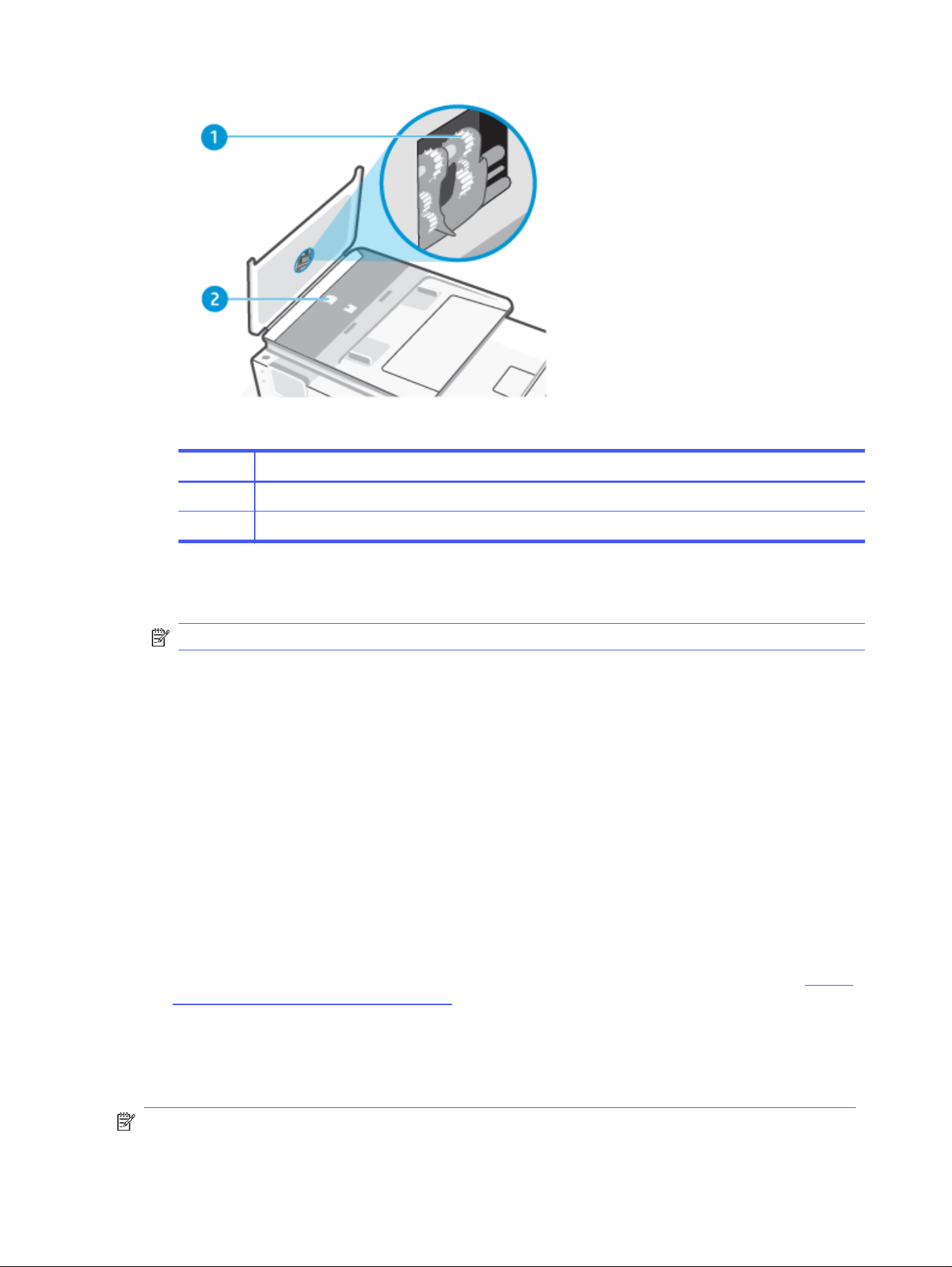
Clean the document feeder
Feature Description
1 Rollers
2 Separator pad
3. Lightly dampen aclean lint-free cloth with distilled water, then squeeze any excess liquid from the cloth.
4. Use the damp cloth to wipe any residue o the rollers or separator pad.
NOTE: If the residue does not come o using distilled water, try using isopropyl (rubbing) alcohol.
5. Close the cover of the document feeder.
Maintain the printhead and cartridges
If you are experiencing problems with printing, you might have a problem with the printhead. You should perform
the procedures in the following sections only when directed to do so for resolving print quality issues.
Performing the aligning and cleaning procedures unnecessarily can waste ink and shorten the life of the
cartridges.
● Clean the printhead if your printed output is streaked or has any incorrect or missing colors.
There are three stages of cleaning. Each stage lasts about two minutes, uses one sheet of paper, and uses
an increasing amount of ink. After each stage, review the quality of the printed page. You should only initiate
the next phase of cleaning if the print quality is poor.
If print quality still seems poor after you complete all stages of cleaning, try aligning the printhead. If print
quality problems persist after cleaning and aligning, contact HP support. For more information, see Use the
HP app (iOS, Android, Windows, and macOS).
● Align the printhead when the printer status page shows streaking or white lines through any of the blocks of
color, or if you are having print quality issues with your printouts.
The printer automatically aligns the printhead during the initial setup.
NOTE: Cleaning uses ink, so clean the printhead only when necessary. The cleaning process takes a few
minutes. Some noise might be generated in the process.
64
Chapter 8Solve a problem

Always use the Power button to turn o the printer. Turning the printer o improperly can cause print quality
problems.
1. Load Letter or A4 unused plain white paper into the main tray. For more information, see Load paper.
2. From the printer control panel, touch or swipe down the tab at the top of the screen to open the Dashboard,
and then touch Setup .
3. Touch Printer Maintenance, select the desired option, and then follow the onscreen instructions.
NOTE: You can also do the same from the HP printer software or EWS. To access the software or EWS, see
Use the HP app (iOS, Android, Windows, and macOS) or To access and use EWS.
Restore original factory defaults and settings
Learn how to restore original factory defaults and settings.
If you disable some functions or change some settings and want to change them back, you can restore the
printer to the original factory settings or network settings.
To restore the selected printer functions to the original factory settings
1.
From the printer control panel, touch or swipe down the tab at the top of the screen to open the Dashboard,
and then touch Setup .
2. Touch Printer Maintenance.
3. Touch Restore.
4. Touch Restore Settings.
5. Select one of the following functions to restore to the original factory settings:
● Copy
● Scan
● Network
Touch Restore.
A message appears stating that the settings will be restored.
6. Touch Restore.
To restore the printer to the original factory defaults
1. From the printer control panel, touch or swipe down the tab at the top of the screen to open the Dashboard,
and then touch Setup .
2. Touch Printer Maintenance.
3. Touch Restore.
Restore original factory defaults and settings
65

4. Touch Restore Factory Defaults.
A message appears stating that the factory defaults will be restored.
5. Touch Continue.
To restore the printer to the original network settings
1. From the printer control panel, touch or swipe down the tab at the top of the screen to open the Dashboard,
and then touch Setup .
2. Touch Network Setup.
3. Touch Restore Network Settings.
A message appears stating that the network defaults will be restored.
4. Touch Yes.
5. Print the network conguration page and verify that the network settings have been reset.
NOTE: When you reset the printer network settings, previously congured network-related settings (such as
the link speed or IP address) are removed. The IP address is set back to the Automatic mode.
TIP: You can visit the HP online support website at HP support for information and utilities that can help you
correct many common printer problems.
To use Cold Reset to restore settings
Cold Reset removes all user congured settings, including saved administrator passwords, network
congurations, selected country/region and language, Address Book entries, and Web Services account
information.
NOTE: For HP+ printers, after restoring the printer, register the printer again using the HP account you used
when you rst set up the printer.
You can use this feature if you are selling the printer or giving it to someone else and want to be sure that all
personal information has been removed.
1. From the printer control panel, touch or swipe down the tab at the top of the screen to open the Dashboard,
and then touch Setup .
2. Touch Printer Maintenance.
3. Touch Restore.
4. Touch Cold Reset.
A message appears, stating what settings will be restored.
5. Touch Continue.
HP support
HP online support provides information and utilities that can help you solve common printer problems.
66
Chapter 8Solve a problem
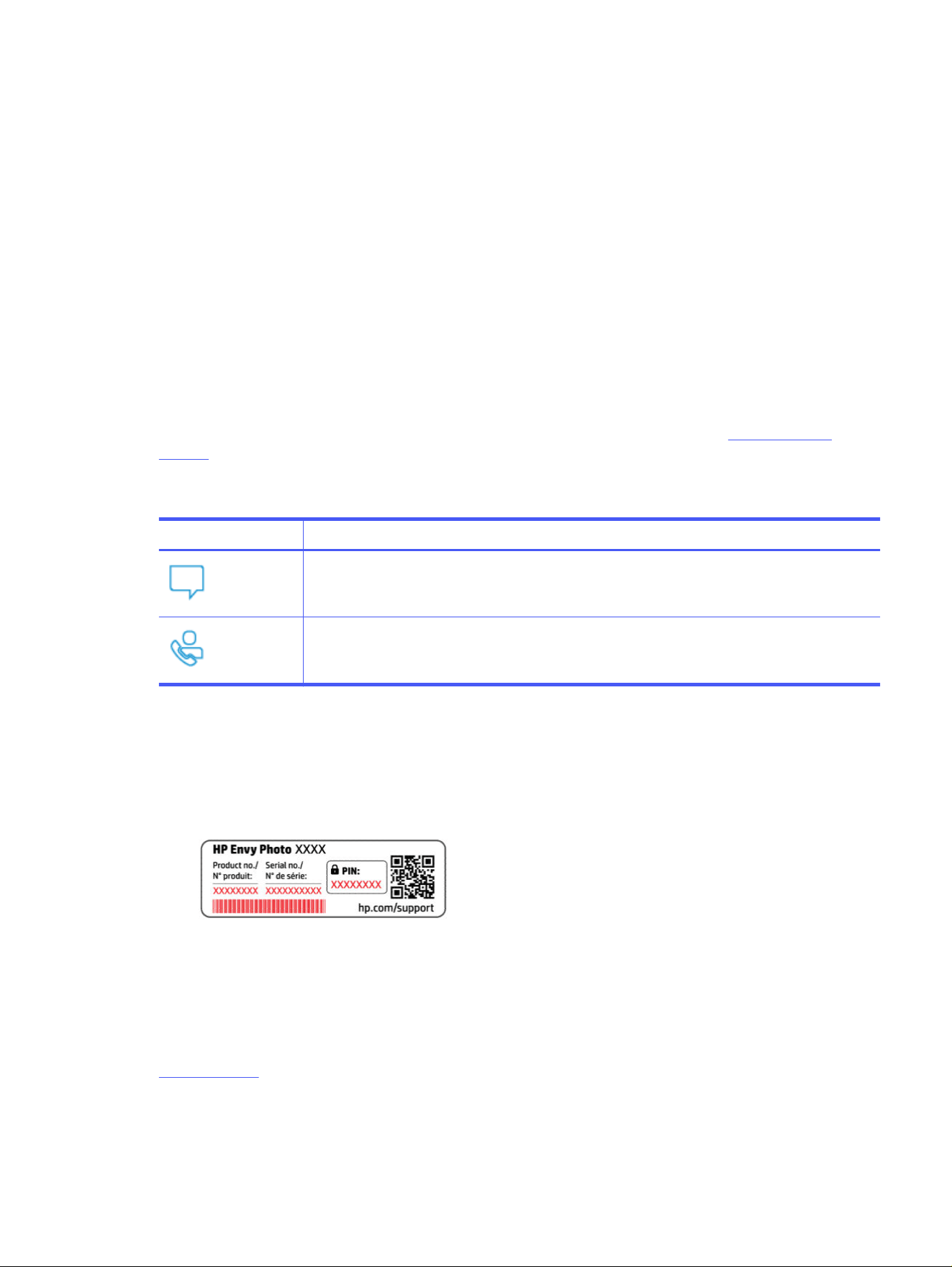
● View video tutorials
Learn how to set up printer and perform common tasks.
● Get troubleshooting assistance
Find information for resolving paper jams, network connection issues, print quality issues, printer errors, and
more.
● Get software and drivers
Download software, drivers, and rmware you need for the printer.
● Ask the community
Join the community forums to nd solutions, ask questions, and share tips.
Contact HP
If you need help from an HP technical support representative to solve a problem, visit the Contact Support
website. The following contact options are available at no cost for in-warranty customers (HP agent-assisted
support for out-of-warranty customers may require a fee).
Contact HP
Feature Description
Chat with an HP support agent or the HP Virtual Agent online.
Call an HP support agent.
When contacting HP support, be prepared to provide the following information:
● Product name (Located on the printer)
● Product number and serial number (located near the cartridge access area)
Register printer
By taking just a few quick minutes to register, you can enjoy quicker service, more
eicient support, and product
support alerts.
If you did not register your printer while installing the printer software, you can register anytime on the
register.hp.com website.
Contact HP
67


HP EcoSolutions (HP and the Environment)9
HP is committed to helping you optimize your environmental footprint and empowering you to print responsibly
—at home or in the oice.
For more detailed information about environmental guidelines that HP follows during the manufacturing process,
see Environmental product stewardship program.
Power Management
Use Sleep Mode, Auto-O, and Schedule On/O to conserve electricity.
NOTE: Conguring longer times for these settings or turning o these features will increase energy
consumption.
Sleep mode
Power usage is reduced while in Sleep mode. After initial setup of printer, the printer will enter Sleep mode after
ve minutes of inactivity. Use Sleep Mode, Auto-O and Schedule On/O to conserve electricity. Use the following
instructions to change the period of inactivity before the printer sleeps.
1. From the printer control panel, touch or swipe down the tab at the top of the screen to open the Dashboard,
touch the HP EcoSolutions .
2. Touch Sleep Mode, and then touch the desired option.
Auto-o
This feature turns the printer o after 8 hours of inactivity to help reduce energy use. Auto-O turns the printer
o completely, so you must use the Power button to turn on the printer again.
If your printer supports this energy saving feature, Auto-O is automatically enabled or disabled depending on
printer capabilities and connection options. Even when Auto-O is disabled, the printer enters Sleep mode after 5
minutes of inactivity to help reduce energy use.
● Auto-O is enabled when the printer is turned on, if the printer does not have network, fax or Wi-Fi Direct
capability, or is not using these capabilities.
● Auto-O is disabled when a printer’s wireless or Wi-Fi Direct capability is turned on or when a printer with
fax, USB, or Ethernet network capability establishes a fax, USB, or Ethernet network connection.
Schedule On and
O
Use this feature to automatically turn the printer on or o on selected days. For example, you can schedule the
printer to turn on at 8 a.m. and turn o at 8 p.m. from Monday to Friday. In this way, you save energy during the
night and weekends.
Use the following instructions to schedule the day and time for On and O.
1. From the printer control panel, touch or swipe down the tab at the top of the screen to open the Dashboard,
touch HP EcoSolutions .
HP EcoSolutions (HP and the Environment)
69

2. Touch Schedule On/O.
3. Touch the toggle button next to Schedule On or Schedule O to turn it on.
4. Touch the time option, and then follow the onscreen messages to set the day and time to turn the printer
o and on.
CAUTION: Always turn the printer o properly, using either Schedule O or the Power button located on
the front left side of the printer.
If you improperly turn the printer o, the print carriage might not return to the correct position, causing
problems with the cartridges and print quality issues.
Never turn o the printer when cartridges are missing. HPrecommends that you replace any missing cartridges
as soon as possible to avoid print quality issues, possible extra ink usage from the remaining cartridges, or
damage to the ink system.
Quiet Mode
Quiet Mode slows down printing to reduce overall noise without aecting print quality. It only works when
printing on plain paper. Additionally, Quiet Mode is disabled if you are printing using the best or presentation print
quality. To reduce printing noise, turn on Quiet Mode. To print at normal speed, turn Quiet Mode
o. Quiet Mode is
o by default.
NOTE: Quiet Mode does not work if you print photos or envelopes.
You can create a schedule by selecting the time when the printer prints in Quiet Mode. For example, you can
schedule the printer to be in Quiet Mode from 10 p.m. to 8 a.m. everyday.
To turn Quiet Mode on or
o from the printer control panel
1. From the printer control panel, touch or swipe down the tab at the top of the screen to open the Dashboard,
and then touch Quiet Mode .
2. Touch the toggle button next to Quiet Mode to turn the feature on or o.
TIP: While the printer is printing or while making a copy, you can turn on or turn o Quiet Mode by
selecting Quiet Mode on the control panel screen. The new settings will take eect after the current page
has printed and will only be used for the current job.
To create a schedule for Quiet Mode from the printer control panel
1. From the printer control panel, touch or swipe down the tab at the top of the screen to open the Dashboard,
and then touch Quiet Mode .
2. Turn on Quiet Mode.
3. Touch the toggle button next to Schedule to turn it on, and then change the start time and end time of the
schedule.
To turn Quiet Mode on or
o from EWS
1. Open EWS. For more information, see To access and use EWS.
70
Chapter 9HP EcoSolutions (HP and the Environment)

2. Click the Settings tab.
3. In the Preferences section, select Quiet Mode, and then select On or O.
4. Click Apply.
Optimize Printing Supplies
To optimize printing supplies such as ink and paper, try the following:
● Recycle used original HP ink cartridges through HP Planet Partners. For more information, visit hp.com/
recycle.
● Optimize paper usage by printing on both sides of the paper.
● Change the print quality in the printer driver to a draft setting. The draft setting uses less ink.
● Do not clean the printhead unnecessarily. Doing so wastes ink and shortens the life of the cartridges.
Optimize Printing Supplies 71

Technical informationA
This section contains the following topics:
● Specications
● Regulatory notices
● Accessibility
● Environmental product stewardship program
Specications
This topic describes information about printer specications.
For more information, visit hp.com/support. Select your country or region. Click Product Support &
Troubleshooting. Enter the name shown on the front of the printer, and then select Search. Click Product
information, and then click Product specications.
System requirements
● For information about software and system requirements or future operating system releases and support,
visit the HP online support website at hp.com/support.
Environmental specications
● Operating temperature: 5° to 40° C (41° to 104° F)
● Operating humidity: 15 to 80% RH non-condensing
● Recommended operating conditions: 15° to 32° C (59° to 90° F)
● Recommended relative humidity: 20 to 80% noncondensing
Main tray capacity
● Plain paper sheets (60 to 105 g/m
2
[16 to 28 lb]): Up to 125 (100 on specic models)
● Envelopes: Up to 5
● Index cards: Up to 30
● Photo paper sheets: Up to 30
Photo tray capacity
● Photo paper sheets: Up to 15
72
Appendix ATechnical information

Output tray capacity
● Plain paper sheets (60 to 105 g/m
2
[16 to 28 lb]): Up to 60 (text printing)
Paper size and weights
For the list of supported paper sizes, see the HP printer software.
● Plain paper: 60 to 105 g/m
2
(16 to 28 lb)
● Envelopes: 75 to 90 g/m
2
(20 to 24 lb)
● Cards: 163 to 200 g/m
2
(90 to 110 lb)
● Photo paper: Up to 280 g/m
2
(75 lb)
Print specications
● Print speeds vary according to the complexity of the document and printer model
● Method: drop-on-demand thermal inkjet
● Language: PCL3 GUI, URF, and PCLm
● Print resolution:
For a list of supported print resolutions, visit the printer support website at support.hp.com.
● Print margins:
For margin settings of dierent media, visit the printer support website at support.hp.com.
Power specications
● Input voltage: 100-240 Vac (+/- 10%)
● Input frequency: 50/60 Hz (+/- 3 Hz)
Copy specications
● Digital image processing
● Copy speeds vary according to the complexity of the document and printer model
Scan specications
● Resolution: Up to 1200 x 1200 ppi optical
For more information about scan resolution, see the HP printer software.
● Color: 24-bit color, 8-bit grayscale (256 levels of gray)
● Maximum scan size:
– Scanner glass: 216 x 297 mm (8.5 x 11.7 inches)
Specications
73

– Document feeder: 216 x 356 mm (8.5 x 14 inches)
Cartridge yield
● Visit hp.com/go/learnaboutsupplies for more information on estimated cartridge yields.
Regulatory notices
The printer meets product requirements from regulatory agencies in your country/region.
Regulatory Model Number
For regulatory identication purposes, your product is assigned with a Regulatory Model Number. The regulatory
model number should not be confused with the marketing names or product numbers.
FCC statement
The United States Federal Communications Commission (in 47 CFR 15.105) has specied that the following
notice be brought to the attention of users of this product.
This equipment has been tested and found to comply with the limits for a Class B digital device, pursuant to
Part 15 of the FCC Rules. These limits are designed to provide reasonable protection against harmful interference
in a residential installation. This equipment generates, uses and can radiate radio frequency energy and, if not
installed and used in accordance with the instructions, may cause harmful interference to radio communications.
However, there is no guarantee that interference will not occur in a particular installation. If this equipment does
cause harmful interference to radio or television reception, which can be determined by turning the equipment
o and on, the user is encouraged to try to correct the interference by one or more of the following measures:
● Reorient or relocate the receiving antenna.
● Increase the separation between the equipment and the receiver.
● Connect the equipment into an outlet on a circuit dierent from that to which the receiver is connected.
● Consult the dealer or an experienced radio/TV technician for help.
NOTE: If the product has an Ethernet / LAN port with metallic casing then use of a shielded interface cable is
required to comply with the Class B limits of Part 15 of FCC rules.
Modications (part 15.21)
Any changes or modications made to this device that are not expressly approved by HP may void the user’s
authority to operate the equipment.
For further information, contact: Manager of Corporate Product Regulations, HP Inc. 1501 Page Mill Road, Palo
Alto, CA 94304, U.S.A.
This device complies with Part 15 of the FCC Rules. Operation is subject to the following two conditions: (1) this
device may not cause harmful interference, and (2) this device must accept any interference received, including
interference that may cause undesired operation.
Notice to users in Korea
해당 무선설비는 운용 중 전파혼신 가능성이 있음으로 인명안전과 관련된 서비스는 할 수 없음.
74
Appendix ATechnical information

B급 기기
(가정용 방송통신기자재)
이 기기는 가정용(B급) 전자파적합기기로서 주로 가정에
서 사용하는 것을 목적으로 하며, 모든 지역에서 사용할
수 있습니다.
VCCI (Class B) compliance statement for users in Japan
Power cord instructions
Make sure your power source is adequate for the product voltage rating. The voltage rating is on the product
label. The product uses either 100-240 Vac or 200-240 Vac and 50/60 Hz.
CAUTION: To prevent damage to the product, use only the power cord that is provided with the product.
Notice to users in Japan about the power cord
製品には、同梱された電源コードをお使い下さい。
同梱された電源コードは、他の製品では使用出来ません。
Noise emission statement for Germany
Geräuschemission
LpA < 70 dB am Arbeitsplatz im Normalbetrieb nach DIN 45635 T. 19
European Union and United Kingdom Regulatory Notice
Products bearing the CE marking and UK marking comply to applicable EU Directives and the equivalent UK
Statutory Instruments and can operate in at least one EU Member State and in United Kingdom. The full EU and
UK Declaration of Conformity can be found at the following website: hp.eu/certicates (Search with the product
model name or its Regulatory Model Number (RMN), which may be found on the regulatory label.)
The point of contact for regulatory matters:
For EU: HP REG 23010, 08028 Barcelona, Spain
For UK: HP Inc UK Ltd, Regulatory Enquiries, Earley West, 300 Thames Valley Park Drive, Reading, RG6 1PT
Email: [email protected]om
Products with wireless functionality
VCCI (Class B) compliance statement for users in Japan 75
EMF
This product meets international guidelines (ICNIRP) for exposure to radio frequency radiation.
If it incorporates a radio transmitting and receiving device that in normal use, a separation distance of 20 cm
ensures that radio frequency exposure levels comply with EU requirements.
Wireless functionality in Europe
For products with 802.11 b/g/n or Bluetooth radio:
●
Radio frequency band: 2400-2483.5 MHz, with transmit power of 20 dBm (100 mW) or less.
For products with 802.11 a/b/g/n/ac radio:
● Radio frequency band: 2400-2483.5 MHz, with transmit power of 20 dBm (100 mW) or less.
● Radio frequency band: 5170-5330 MHz, with transmit power of 23 dBm (200 mW) or less.
● Radio frequency band: 5490-5730 MHz, with transmit power of 23 dBm (200 mW) or less.
● Radio frequency band: 5735-5835 MHz, with transmit power of 13.98 dBm (25 mW) or less.
IMPORTANT: IEEE 802.11x wireless LAN with 5.17-5.33 GHz frequency band is restricted for indoor use only in
all countries reected in the matrix. Using this WLAN application outdoor might lead to interference issues with
existing radio services.
Visual display workplaces statement for Germany
GS-Erklärung (Deutschland)
Das Gerät ist nicht für die Benutzung im unmittelbaren Gesichtsfeld am Bildschirmarbeitsplatz vorgesehen.
Um störende Reexionen am Bildschirmarbeitsplatz zu vermeiden, darf dieses Produkt nicht im unmittelbaren
Gesichtsfeld platziert werden.
Notice to users of the U.S. telephone network: FCC requirements
This equipment complies with Part 68 of the FCC rules and the requirements adopted by the ACTA. On the rear
(or bottom) of this equipment is a label that contains, among other information, a product identier in the format
US:AAAEQ##TXXXX. If requested, this number must be provided to the telephone company.
Applicable connector jack Universal Service Order Codes ("USOC") for the Equipment is: RJ-11C.
A telephone cord, plug and jack used to connect this equipment to the premises wiring and telephone network
must comply with the applicable FCC Part 68 rules and requirements adopted by the ACTA. HP recommends a
76
Appendix ATechnical information

compliant plug, jack and 2-wire telephone cord to connect this product to the premises wiring and telephone
network. See installation instructions for details.
The REN is used to determine the quantity of devices, which may be connected to the telephone line. Excessive
RENs on the telephone line may result in the devices not ringing in response to an incoming call. In most, but
not all, areas, the sum of the RENs should not exceed ve (5.0). To be certain of the number of devices that
may be connected to the line, as determined by the total RENs, contact the telephone company to determine the
maximum REN for the calling area. For products approved after July 23, 2001, the REN for this product is part of
the product identier that has the format US-AAAEQ##TXXXX. The digits represented by ##are the REN without
a decimal point (e.g., 01 is a REN of 0.1).
If this equipment causes harm to the telephone network, the telephone company will notify you in advance that
temporary discontinuance of service may be required. If advance notice is not practical, the telephone company
will notify the customer as soon as possible. Also, you will be advised of your right to le a complaint with the FCC
if you believe it is necessary.
The telephone company may make changes in its facilities, equipment, operations, or procedures that could
aect the operation of the equipment. If this happens, the telephone company will provide advance notice in
order for you to make the necessary modications in order to maintain uninterrupted service.
If trouble is experienced with this equipment, please contact the manufacturer, or look elsewhere in this manual,
for repair and (or) warranty information. If the equipment is causing harm to the telephone network, the
telephone company may request that you disconnect the equipment from the network until the problem is
resolved.
Connection to Party Line Service is subject to state taris. Contact the state public utility commission, public
service commission, or corporation commission for information.
CAUTION: If your home has specially wired alarm equipment connected to the telephone line, ensure the
installation of this equipment does not disable your alarm equipment. If you have questions about what will
disable alarm equipment, consult your telephone company or a qualied installer.
WHEN PROGRAMMING EMERGENCY NUMBERS AND (OR) MAKING TEST CALLS TO EMERGENCY NUMBERS:
1. Remain on the line and briey explain to the dispatcher the reason for the call.
2. Perform such activities in the o-peak hours, such as early morning or late evening.
NOTE: The FCC hearing aid compatibility rules for telephones are not applicable to this equipment.
The Telephone Consumer Protection Act of 1991 makes it unlawful for any person to use a computer or other
electronic devices, including FAX machines, to send any message unless such message clearly contains in a
margin at the top or bottom of each transmitted page or on the rst page of the transmission, the date and
time it is sent and an identication of the business or other entity, or other individual sending the message
and the telephone number of the sending machine or such business, other entity, or individual. (The telephone
number provided may not be a 900 number or any other number for which charges exceed local or long-distance
transmission charges.)
In order to program this information into your FAX machine, you should complete the steps described in the
software.
Notice to users of the Canadian telephone network
Cet appareil est conforme aux spécications techniques des équipements terminaux d’Innovation, Science
et Développement Economique Canada. Le numéro d’enregistrement atteste de la conformité de l’appareil.
L’abréviation ISED qui précède le numéro d’enregistrement indique que l’enregistrement a été eectué dans
le cadre d’une Déclaration de conformité stipulant que les spécications techniques d’Innovation, Science et
Notice to users of the Canadian telephone network
77

Développement Economique Canada ont été respectées. Néanmoins, cette abréviation ne signie en aucun cas
que l’appareil a été validé par Innovation, Science et Développement Economique Canada.
Pour leur propre sécurité, les utilisateurs doivent s’assurer que les prises électriques reliées à la terre de la source
d’alimentation, des lignes téléphoniques et du circuit métallique d’alimentation en eau sont, le cas échéant,
branchées les unes aux autres. Cette précaution est particulièrement importante dans les zones rurales.
REMARQUE: Le numéro REN (Ringer Equivalence Number) attribué à chaque appareil terminal fournit une
indication sur le nombre maximal de terminaux qui peuvent être connectés à une interface téléphonique. La
terminaison d’une interface peut se composer de n’importe quelle combinaison d’appareils, à condition que le
total des numéros REN ne dépasse pas 5.
Basé sur les résultats de tests FCC Partie 68, le numéro REN de ce produit est 0.1.
This equipment meets the applicable Innovation, Science and Economic Development Canada Terminal
Equipment Technical Specications. This is conrmed by the registration number. The abbreviation ISED before
the registration number signies that registration was performed based on a Declaration of Conformity indicating
that Innovation, Science and Economic Development Canada technical specications were met. It does not imply
that Innovation, Science and Economic Development Canada approved the equipment.
Users should ensure for their own protection that the electrical ground connections of the power utility,
telephone lines and internal metallic water pipe system, if present, are connected together. This precaution
might be particularly important in rural areas.
NOTE: The Ringer Equivalence Number (REN) assigned to each terminal device provides an indication of
the maximum number of terminals allowed to be connected to a telephone interface. The termination on an
interface might consist of any combination of devices subject only to the requirement that the sum of the Ringer
Equivalence Numbers of all the devices does not exceed 5.
The REN for this product is 0.1, based on FCC Part 68 test results.
Notice to users of the German telephone network
Hinweis für Benutzer des deutschen Telefonnetzwerks
Dieses HP-Fax ist nur für den Anschluss eines analogen Public Switched Telephone Network (PSTN) gedacht.
Schließen Sie den TAE N-Telefonstecker, der im Lieferumfang des HP All-in-One enthalten ist, an die
Wandsteckdose (TAE 6) Code N an. Dieses HP-Fax kann als einzelnes Gerät und/oder in Verbindung (mit seriellem
Anschluss) mit anderen zugelassenen Endgeräten verwendet werden.
Australia wired fax statement
In Australia, the HP device must be connected to Telecommunication Network through a line cord which meets
the requirements of the Technical Standard AS/ACIF S008.
Regulatory information for wireless products
This section contains the following regulatory information pertaining to wireless products:
Exposure to radio frequency radiation
CAUTION: The radiated output power of this device is far below the FCC radio frequency exposure limits.
Nevertheless, the device shall be used in such a manner that the potential for human contact during normal
operation is minimized. This product and any attached external antenna, if supported, shall be placed in such a
manner to minimize the potential for human contact during normal operation. In order to avoid the possibility of
exceeding the FCC radio frequency exposure limits, human proximity to the antenna shall not be less than 20 cm
(8 inches) during normal operation.
78
Appendix ATechnical information

Notice to users in Canada (5GHz)
CAUTION: When using IEEE 802.11a wireless LAN, this product is restricted to indoor use, due to its operation
in the 5.15- to 5.25-GHz frequency range. The Innovation, Science and Economic Development Canada requires
this product to be used indoors for the frequency range of 5.15 GHz to 5.25 GHz to reduce the potential for
harmful interference to co-channel mobile satellite systems. High-power radar is allocated as the primary user
of the 5.25- to 5.35-GHz and 5.65- to 5.85-GHz bands. These radar stations can cause interference with and/or
damage to this device.
ATTENTION: Lors de l'utilisation du réseau local sans l IEEE 802.11a, ce produit se limite à une utilisation
en intérieur à cause de son fonctionnement sur la plage de fréquences de 5,15 à 5,25 GHz. Innovation, Science
et Développement Economique Canada stipule que ce produit doit être utilisé en intérieur dans la plage de
fréquences de 5,15 à 5,25 GHz an de réduire le risque d'interférences éventuellement dangereuses avec les
systèmes mobiles par satellite via un canal adjacent. Le radar à haute puissance est alloué pour une utilisation
principale dans une plage de fréquences de 5,25 à 5,35 GHz et de 5,65 à 5,85 GHz. Ces stations radar peuvent
provoquer des interférences avec cet appareil et l'endommager.
Notice to users in Taiwan (5 GHz)
應避免影響附近雷達系統之操作。
高增益指向性天線只得應用於固定式點對點系統。
Notice to users in Serbia (5 GHz)
Upotreba ovog uredjaja je ogranicna na zatvorene prostore u slucajevima koriscenja na frekvencijama od
5150-5350 MHz.
Notice to users in Thailand (5GHz)
เครื่องวิทยุคมนาคมนี้มีระดับการแผ่คลื่นแม่เหล็กไฟฟ้ าสอดคล้องตามมาตรฐานความปลอดภัยต่อสุขภาพของมนุษย์จากการ
ใช้เครื่องวิทยุคมนาคมที่คณะกรรมการกิจการโทรคมนาคมแห่งชาติประกาศกําหน
This radio communication equipment has the electromagnetic eld strength in compliance with the Safety
Standard for the Use of Radio Communication Equipment on Human Health announced by the National
Telecommunications Commission.
Notice to users in Brazil
Este equipamento opera em caráter secundário, isto é, não tem direito à proteção contra interferência prejudicial,
mesmo de estações do mesmo tipo, e não pode causar interferência em sistemas operando em caráter primário.
Este equipamento não tem direito à proteção contra interferência prejudicial e não pode causar interferência em
sistemas devidamente autorizados.
Para obter mais informações, verique o site da ANATEL anatel.gov.br.
Notice to users in Canada
Under Innovation, Science and Economic Development Canada regulations, this radio transmitter may only
operate using an antenna of a type and maximum (or lesser) gain approved for the transmitter by Innovation,
Science and Economic Development Canada. To reduce potential radio interference to other users, the antenna
type and its gain should be so chosen that the equivalent isotropically radiated power (e.i.r.p.) is not more than
that necessary for successful communication.
This device complies with Innovation, Science and Economic Development Canada licence-exempt RSS
standard(s). Operation is subject to the following two conditions: (1) this device may not cause interference,
and (2) this device must accept any interference, including interference that may cause undesired operation of
the device.
Notice to users in Canada (5GHz)
79

WARNING! Exposure to Radio Frequency Radiation. The radiated output power of this device is below the
Innovation, Science and Economic Development Canada radio frequency exposure limits. Nevertheless, the
device should be used in such a manner that the potential for human contact is minimized during normal
operation.
To avoid the possibility of exceeding the Innovation, Science and Economic Development Canada radio frequency
exposure limits, human proximity to the antennas should not be less than 20 cm (8 inches).
Conformément au Règlement d'Innovation, Science et Développement Economique Canada, cet émetteur
radioélectrique ne peut fonctionner qu'avec une antenne d'un type et d'un gain maximum (ou moindre) approuvé
par Innovation, Science et Développement Economique Canada. An de réduire le brouillage radioélectrique
potentiel pour d'autres utilisateurs, le type d'antenne et son gain doivent être choisis de manière à ce que la
puissance isotrope rayonnée équivalente (p.i.r.e.) ne dépasse pas celle nécessaire à une communication réussie.
Cet appareil est conforme aux normes RSS exemptes de licence d'Innovation, Science et Développement
Economique Canada. Son fonctionnement dépend des deux conditions suivantes : (1) cet appareil ne doit
pas provoquer d'interférences nuisibles et (2) doit accepter toutes les interférences reçues, y compris des
interférences pouvant provoquer un fonctionnement non souhaité de l'appareil.
AVERTISSEMENT relatif à l'exposition aux radiofréquences. La puissance de rayonnement de cet appareil se
trouve sous les limites d'exposition de radiofréquences d'Innovation, Science et Développement Economique
Canada. Néanmoins, cet appareil doit être utilisé de telle sorte qu'il doive être mis en contact le moins possible
avec le corps humain.
An d'éviter le dépassement éventuel des limites d'exposition aux radiofréquences d'Innovation, Science et
Développement Economique Canada, il est recommandé de maintenir une distance de plus de 20 cm entre les
antennes et l'utilisateur.
Notice to Users in China/中国用户须知
如果适用,使用微功率短距离无线电设备应符合国家无线电管理有关规定。
(一)本产品符合《微功率短距离无线电发射设备目录和技术要求》的具体条款和使用场景。天线类型为
PCB 天线和/或外置天线,控制、调整及开关等使用方法详见本手册或产品说明书, 使用时温度和电压的环
境条件详见本手册或产品说明书。
(二)不得擅自改变使用场景或使用条件、扩大发射频率范围、加大发射功率(包括额外加装射频功率放大
器),不得擅自更改发射天线;
(三)不得对其他合法的无线电台(站)产生有害干扰,也不得提出免受有害干扰保护;
(四)应当承受辐射射频能量的工业、科学及医疗(ISM)应用设备的干扰或其他合法的无线电台(站)干扰;
(五)如对其他合法的无线电台(站)产生有害干扰时,应立即停止使用,并采取措施消除干扰后方可继续
使用;
(六)在航空器内和依据法律法规、国家有关规定、标准划设的射电天文台、气象雷达站、卫星地球站(含
测控、测距、接收、导航站)等军民用无线电台(站)、机场等的电磁环境保护区域内使用微功率设备,应当
遵守电磁环境保护及相关行业主管部门的规定;
(七)禁止在以机场跑道中心点为圆心、半径 5000 米的区域内使用各类模型遥控器。
Notice to users in Taiwan
取得審驗證明之低功率射頻器材,非經核准,公司、商號或使用者均不得擅自變 更頻率、加大功率或變更
原設計之特性及功能。低功率射頻器材之使用不得影響 飛航安全及干擾合法通信;經發現有干擾現象時,
應立即停用,並改善至無干擾 時方得繼續使用。前述合法通信,指依電信管理法規定作業之無線電通信。
低功 率射頻器材須忍受合法通信或工業、科學及醫療用電波輻射性電機設備之干擾。
80
Appendix ATechnical information

Notice to users in Mexico
La operación de este equipo está sujeta a las siguientes dos condiciones: (1) es posible que este equipo o
dispositivo no cause interferencia perjudicial y (2) este equipo o dispositivo debe aceptar cualquier interferencia,
incluyendo la que pueda causar su operación no deseada.
Para saber el modelo de la tarjeta inalámbrica utilizada, revise la etiqueta regulatoria de la impresora.
Notice to users in Japan
この機器は技術基準適合証明又は工事設計認証を受けた無線設備を搭載しています。
Dynamic security enabled printers
This printer is intended to work only with cartridges that have new or reused HP electronic circuitry. Reused HP
electronic circuitry enables the use of reused, remanufactured, and relled cartridges.
The printer uses dynamic security measures to block cartridges using modied or non-HP circuitry. Periodic
rmware updates delivered over the internet will maintain the eectiveness of the dynamic security measures
and block cartridges that previously worked.
Updates can improve, enhance, or extend the printer’s functionality and features, protect against security threats,
and serve other purposes, but these updates can also block cartridges using modied or non-HP electronic
circuitry from working in the printer, including cartridges that work today. Unless you are enrolled in certain HP
programs such as Instant Ink or use other services that require automatic online
rmware updates, most HP
printers can be congured to receive updates either automatically or with a notication that allows you to choose
whether to update or not. For more information on dynamic security and how to congure online rmware
updates, please go to www.hp.com/learn/ds.
Accessibility
Learn more about our eorts to create accessible products, share your story, or connect with customer support
for accessibility help—all at hp.com/accessibility.
For more information about the accessibility of your printer, please visit Accessibility for HP inkjet printers.
Environmental product stewardship program
HP is committed to providing quality products in an environmentally sound manner. Design for recycling has
been incorporated into this product. The number of materials has been kept to a minimum while ensuring
proper functionality and reliability. Dissimilar materials have been designed to separate easily. Fasteners and
other connections are easy to locate, access, and remove using common tools. High priority parts have been
designed to access quickly for eicient disassembly and repair. For more information, visit HP'sCommitment to
the Environment website at:
hp.com/sustainableimpact
HP tips for reducing environmental impact
● Choose from a wide variety of HP papers with FSC
®
or PEFC
TM
certication, which indicates that the paper
pulp came from a reputable and well-managed source.
1
● Conserve resources-look for paper made with recycled content.
Notice to users in Mexico
81

● Recycle your Original HP cartridges-it's easy and free with the HP Planet Partners program, available in 47
countries and territories worldwide.
2
● Save paper by printing on both sides of the page.
● Conserve energy by choosing ENERGY STAR
®
certied HP products.
● Lower your carbon footprint-all HP printers include power management settings that help you control
energy use.
● Discover more ways HP and our customers are reducing environmental impact at HP EcoSolutions.
1
HP papers certied under FSC®C017543 or PEFC™TMPEFC/29-13-198.
2
Program availability varies. Original HP cartridge return and recycling is currently available in more than
50 countries, territories, and regions in Asia, Europe, and North and South America through the HP Planet
Partners program. For more information, visit:
hp.com/recycle.
Eco-Tips
HP is committed to helping customers reduce their environmental footprint. Please visit the HP Eco Solutions
website for more information on HP’s environmental initiatives.
hp.com/sustainableimpact
Paper
This product is suited for the use of recycled paper according to DIN 19309 and EN 12281:2002.
Plastics
Plastic parts over 25 grams are marked according to international standards that enhance the ability to identify
plastics for recycling purposes at the end of product life.
European Union Commission Regulation 1275/2008
For product power data, including the power consumption of the product in networked standby if all wired
network ports are connected and all wireless network ports are activated, please refer to section P15 ‘Additional
Information’ of the product IT ECO Declaration at hp.com/us-en/hp-information/sustainable-impact/document-
reports.html.
Safety data sheets
Safety Data Sheets, product safety and environmental information are available at hp.com/go/ecodata or on
request.
Chemical substances
HP is committed to providing our customers with information about the chemical substances in our products
as needed to comply with legal requirements such as REACH (Regulation EC No 1907/2006 of the European
Parliament and the Council). A chemical information report for this product can be found at: hp.com/go/reach.
EPEAT
EPEAT is an Electronic Product Environmental Assessment Tool used to evaluate the eects of a product on
the environment. HP products are designed to meet EPEAT criteria. Click here for information on HP's EPEAT
registered products.
82
Appendix ATechnical information

For more information on EPEAT, go to EPEAT.net.
SEPA Ecolabel User Information (China)
中国环境标识认证产品用户说明
噪声大于 63.0 dB(A) 的办公设备不宜放置于办公室内,请在独立的隔离区域使用。
如需长时间使用本产品或打印大量文件,请确保在通风良好的房间内使用。
如您需要确认本产品处于零能耗状态,请按下电源关闭按钮,并将插头从电源插座断开。
您可以使用再生纸,以减少资源耗费。
Recycling program
HP oers an increasing number of product return and recycling programs in many countries/regions, and
partners with some of the largest electronic recycling centers throughout the world. HP conserves resources by
reselling some of its most popular products. For more information regarding recycling of HP products, please
visit: hp.com/recycle
HPinkjet supplies recycling program
HP is committed to protecting the environment. The HPInkjet Supplies Recycling Program is available in
many countries/regions, and lets you recycle used print cartridges and ink cartridges free of charge. For more
information, go to the following website: hp.com/recycle
Battery disposal in Taiwan
California Perchlorate Material Notice
Perchlorate material - special handling may apply. See: dtsc.ca.gov/hazardouswaste/perchlorate
This product's real-time clock battery or coin cell battery may contain perchlorate and may require special
handling when recycled or disposed of in California.
European Union Battery Directive
SEPA Ecolabel User Information (China) 83

This product contains a battery that is used to maintain data integrity of real time clock or product settings and is
designed to last the life of the product. Any attempt to service or replace this battery should be performed by a
qualied service technician.
Battery notice for Brazil
A bateria deste equipamento nao foi projetada para ser removida pelo cliente.
Power consumption
HP printing and imaging equipment marked with the ENERGY STAR® logo is certied by the U.S. Environmental
Protection Agency. The following mark will appear on ENERGY STAR certied imaging products:
Additional ENERGY STAR certied imaging product model information is listed at: hp.com/go/energystar
China Energy Label for Printer, Fax and Copier
复印机、打印机和
传真机能源效率标识实施规则
依据“复印机、打印机和传真机能源效率标识实施规则”,该打印机具有中国能效标识。标识上显示的能效
等级和操作模式值根据“复印机、打印机和传真机能效限定值及能效等级”标准(“GB 21521”)来确定和计
算。
1. 能效等级
产品能效等级分 3 级,其中 1 级能效最高。能效限定值根据产品类型和打印速度由标准确定。能效等
级则根据基本功耗水平以及网络接口和内存等附加组件和功能的功率因子之和来计算。
2. 能效信息
喷墨打印机
● 操作模式功率
睡眠状态的能耗按照 GB 21521 的标准来衡量和计算。该数据以瓦特 (W) 表示。
● 待机功率
待机状态是产品连接到电网电源上功率最低的状态。该状态可以延续无限长时间,且使用者无法
改变此状态下产品的功率。对于“成像设备”产品,“待机”状态通常相当于“关闭”状态,但也可能相
当于“准备”状态或者“睡眠”状态。该数据以瓦特 (W) 表示。
● 睡眠状态预设延迟时间
出厂前由制造商设置的时间决定了该产品在完成主功能后进入低耗模式(例如睡眠、自动关机)
的时间。该数据以分钟表示。
● 附加功能功率因子之和
网络接口和内存等附加功能的功率因子之和。该数据以瓦特 (W) 表示。
84
Appendix ATechnical information
标识上显示的能耗数据是根据典型配置测量得出的数据,此类配置包含登记备案的打印机依据复印机、
打印机和传真机能源效率标识实施规则所选的所有配置。因此,该特定产品型号的实际能耗可能与标识
上显示的数据有所不同。
要了解规范的更多详情,请参考最新版的 GB 21521 标准。
Disposal of waste equipment by users
This symbol means do not dispose of your product with your other household waste. Instead, you should protect
human health and the environment by handing over your waste equipment to a designated collection point for
the recycling of waste electrical and electronic equipment. For more information, please contact your household
waste disposal service, or go to hp.com/recycle.
Waste disposal for Brazil
Este produto eletrônico e seus componentes não devem ser descartados no lixo comum, pois embora estejam
em conformidade com padrões mundiais de restrição a substâncias nocivas, podem conter, ainda que em
quantidades mínimas, substâncias impactantes ao meio ambiente. Ao nal da vida útil deste produto, o usuário
deverá entregá-lo à HP. A não observância dessa orientação sujeitará o infrator às sanções previstas em lei.
Após o uso, as pilhas e/ou baterias dos produtos HP deverão ser entregues ao estabelecimento comercial ou
rede de assistência técnica autorizada pela HP.
Para maiores informações, inclusive sobre os pontos de recebimento, acesse: hp.com.br/reciclar
Disposal of waste equipment by users 85
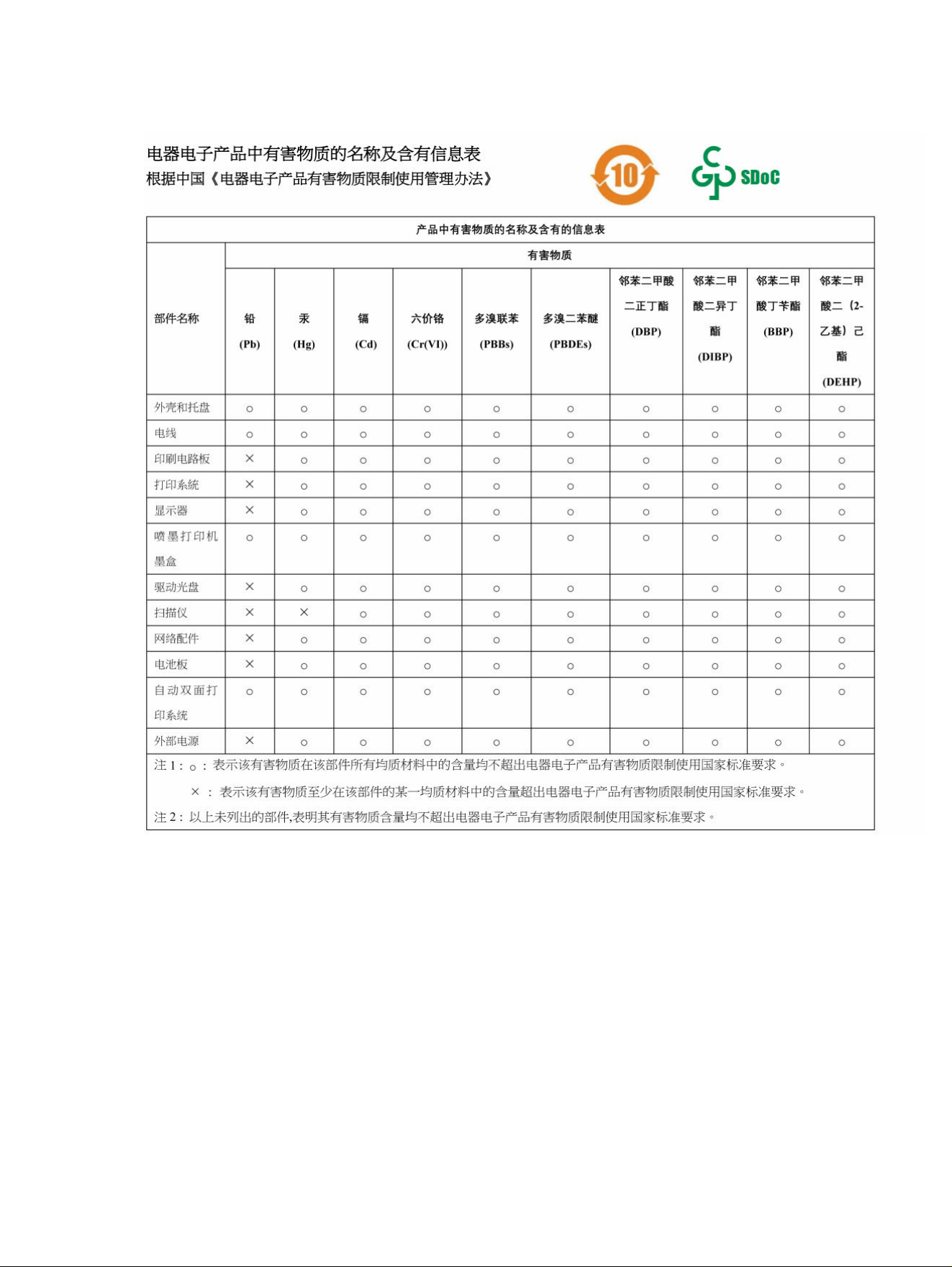
The Table of Hazardous Substances/Elements and their Content (China)
Regulation on the Control of Waste Electrical and Electronic Equipment (Turkey)
Türkiye Cumhuriyeti: AEEE Yönetmeliğine uygundur
Restriction of hazardous substance (India)
This product, as well as its related consumables and spares, complies with the reduction in hazardous substances
provisions of the "India E-waste (Management and Handling) Rule 2016." It does not contain lead, mercury,
hexavalent chromium, polybrominated biphenyls or polybrominated diphenyl ethers in concentrations exceeding
0.1 weight % and 0.01 weight % for cadmium, except for where allowed pursuant to the exemptions set in
Schedule 2 of the Rule.
86
Appendix ATechnical information
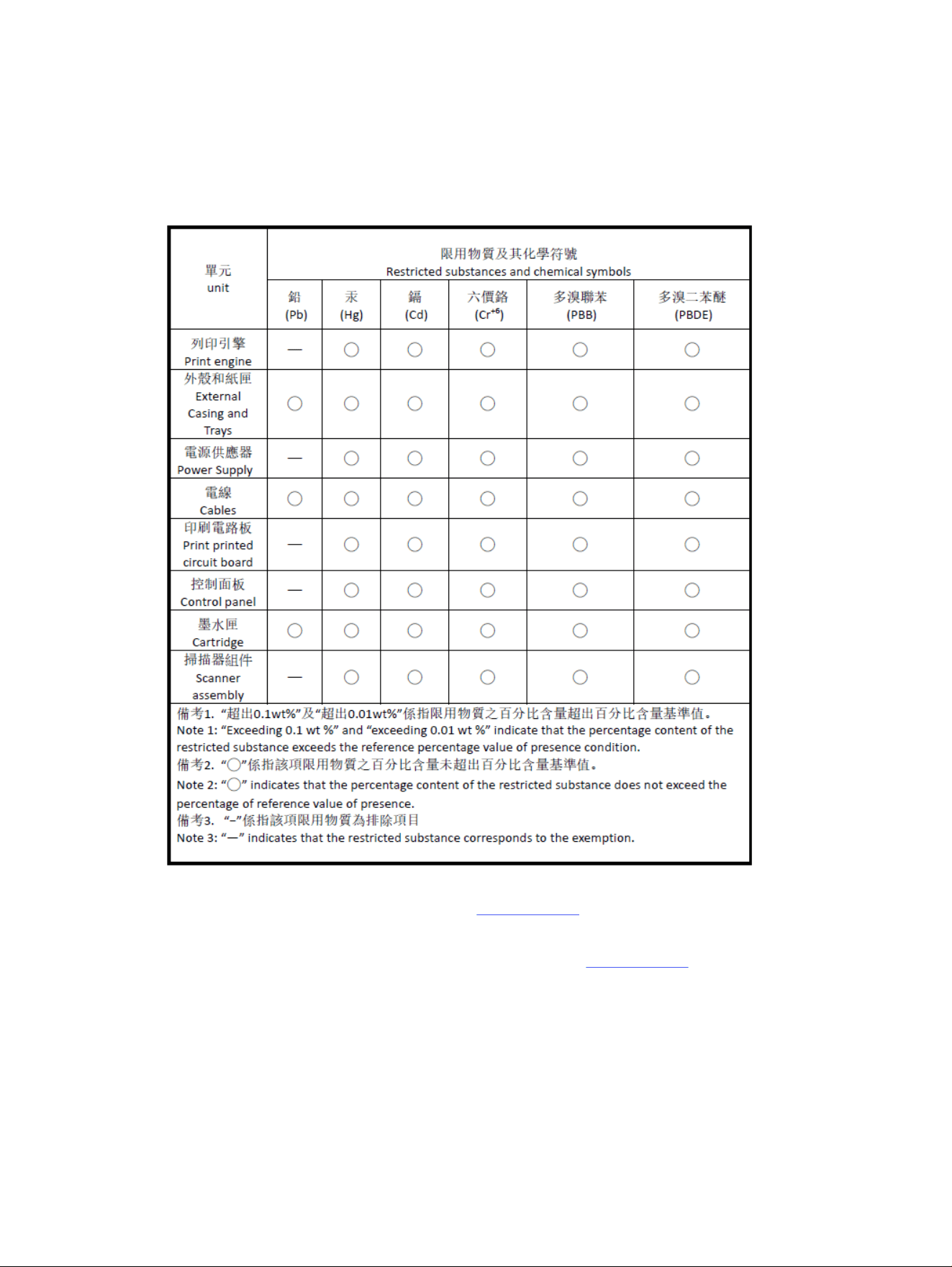
Declaration of the Presence Condition of the Restricted Substances Marking (Taiwan
Region)
限用物質含有情況標示聲明書
Taiwan Declaration of the Presence Condition of the Restricted Substances Marking
若要存取產品的最新使用指南或手冊,請前往 hp.com/support。選取搜尋您的產品,然後依照 畫 面上的指
示繼續執行。
To access the latest user guides or manuals for your product, go to hp.com/support. Select Find your product,
and then follow the on-screen instructions.
Declaration of the Presence Condition of the Restricted Substances Marking (Taiwan Region)
87