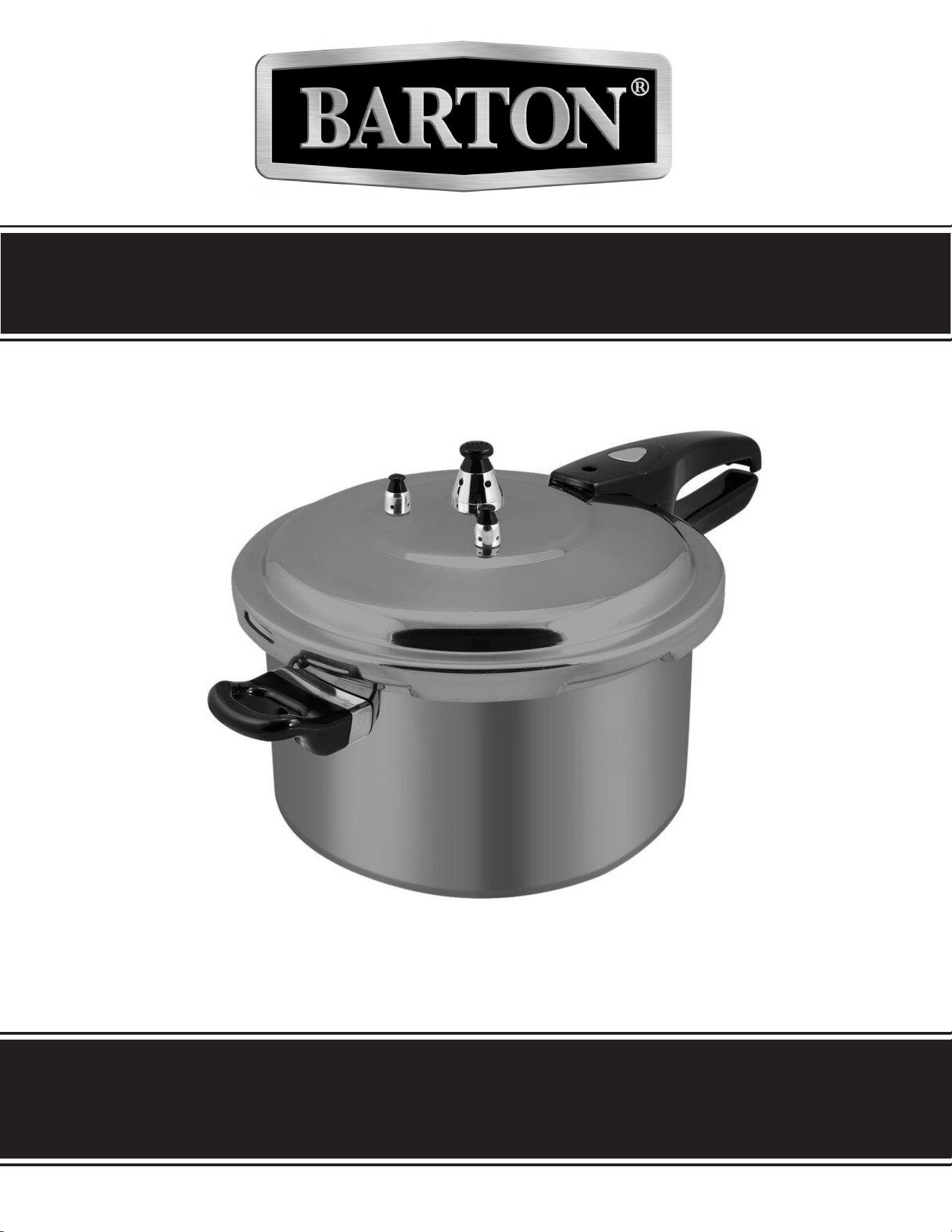
OWNER’S MANUAL AND SAFETY INSTRUCTIONS
7.4 QT PRESSURE COOKER
SAVE THIS MANUAL. KEEP THIS MANUAL FOR SAFETY WARNINGS, PRECAUTIONS, ASSEMBLY,
OPERATION, INSPECTION, MAINTENANCE AND CLEANING PROCEDURES. WRITE THE PRODUCT’S
SERIAL NUMBER ON THE BACK OF THE MANUAL, OR THE MONTH AND YEAR OF PURCHASE IF
PRODUCT HAS NO SERIAL NUMBER
FOR QUESTIONS, PLEASE CALL CUSTOMER SERVICE: 909.628.4900
ITEM # 99908
SAFETY WARNINGS
Read all safety warnings and instructions. Failure to follow the warnings and instructions may result in
injury and/or property damage. Save all warnings and instructions for future reference.
The warning and safety instructions in this manual are not meant to cover all possible conditions and
situations that may occur. Common sense, caution and care must be exercised when operating or
cleaning tools and equipment. Always contact your dealer, distributor, service agent or manufacturer
about problems or conditions you do not understand before operating the product.
SAVE THESE WARNINGS.
1
Do not allow children or pets near the pressure cooker while in use.
Do not put the pressure cooker into a hot oven.
Move the pressure cook with care. Do not touch the hot surfaces of the pressure cooker. Use gloves when moving the
pressure cooker.
Never use your pressure cooker without adding water, this would seriously damage it.
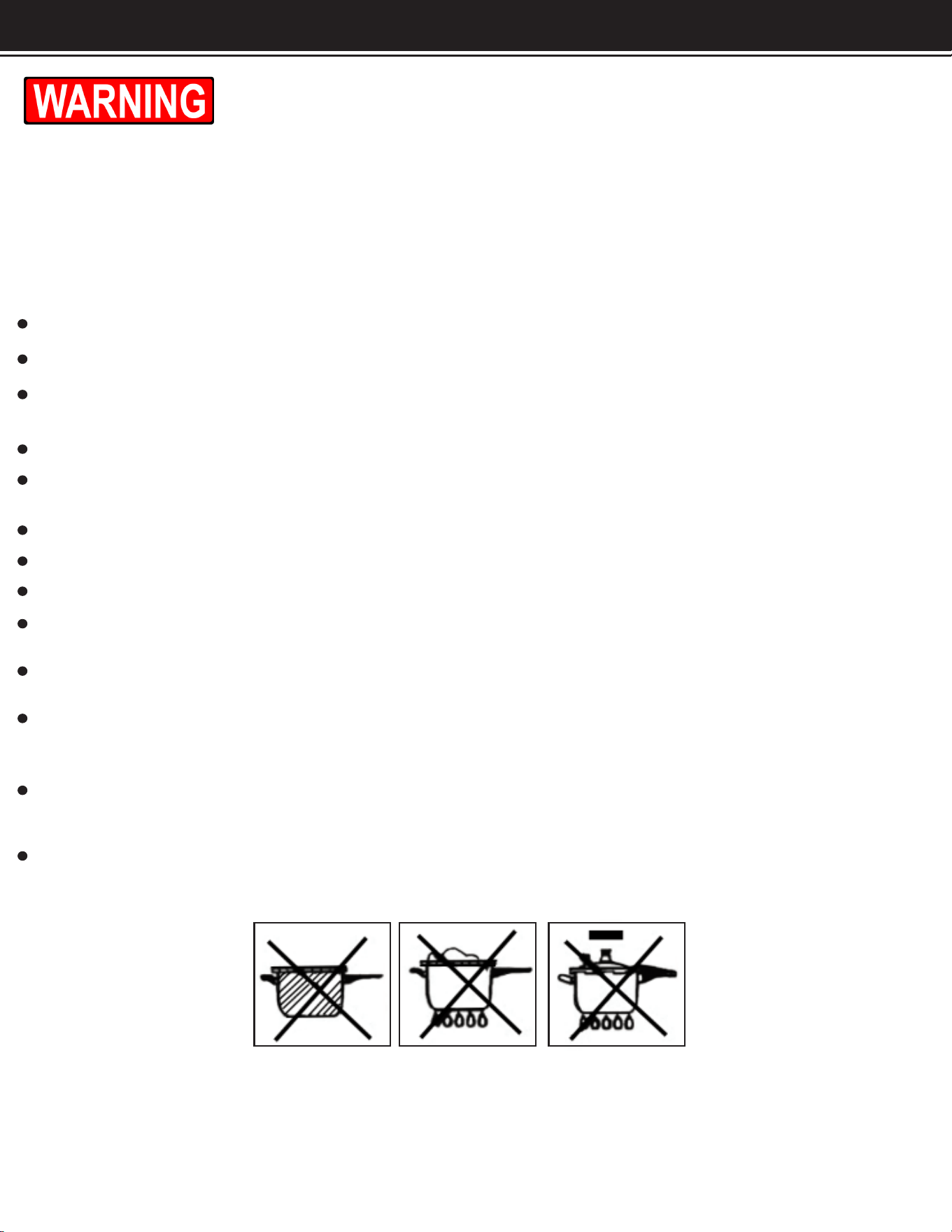
Do not ll the cooker beyond 2/3 of its capacity. When cooking foodstus which expand during cooking, such as rice or
dehydrated vegetables, do not ll the cooker to more than half of its capacity.
Use the appropriate heat source(s) according to the instrucons for use.
Before each use, check that the valves are not obstructed.
Only use manufacturer’s spare parts in accordance with the relevant model.
Never cover pressure valves on the pressure cooker. An explosion can occur causing burns. Replacement of the pressure
regulator is not recommended.
Place the pressure regulator only when steam releasing from the vent pipe. Close supervision is necessary unl the
steam releases regularly from the pressure regulator.
The safety valve emits excessive steam shows that the inside pressure rises over the safety pressure. Turn heat o
immediately if this happens and let the pressure cooker cool down then check and clean the vent pipe and block-proof
cover.
This appliance is not intended for use by persons, including children with reduced physical, sensory and/or mental
capabilies, or lack of experience and knowledge, unless they have been given supervision or instrucon concerning
use or supervision concerning use of the pressure cooker.
Do not use the pressure cooker if it is damaged or deformed in any way. Return the pressure cooker to nearest authorized
dealer or manufacturer. Contact customer service with any quesons or concerns.
SAFETY WARNINGS PRODUCT INFORMATION
SAVE THESE WARNINGS.
1
2
HOW PRESSURE COOKER WORKS
TECHNICAL PARAMETERS
In the process of heang, the cooker is sealed by a silicon sealing ring, pressure in the cooker is increasing gradually, and
boiling point of water is increasing accordingly. When pressure in the cooker exceeds the specied limit, the pressure
regulator is pushing up, allowing steam to escape from the vent pipe keeping temperature and pressure inside the cooker
at a certain level. If the escaping hole is blocked by food, one of the two safety valves will exhaust steam automacally for
safety assurance. To ensure safe operaon once lid is properly closed it will lock in this posion when pressure reaches a
certain point.
Working pressure: 80 Kpa ±8kpa
Safety pressure: 110 ~160 Kpa
Pressure inside the cooker under condion that the lid has not closed to full posion: < 4 Kpa
Pressure in the cover when the oang valve locked: >4 Kpa
Compable heang sources:
*On gas burner (or stove), the ame should not go beyond the base of the cooker pot, it can be added
burner ring to control re.
*On inducon cooker, use a hotplate of a diameter equal to the diameter of the base of the pressure
cooker. Take care that the boom of the cooker is perfectly clean.
CAUTION: Prevent erce re burning the handle when using.
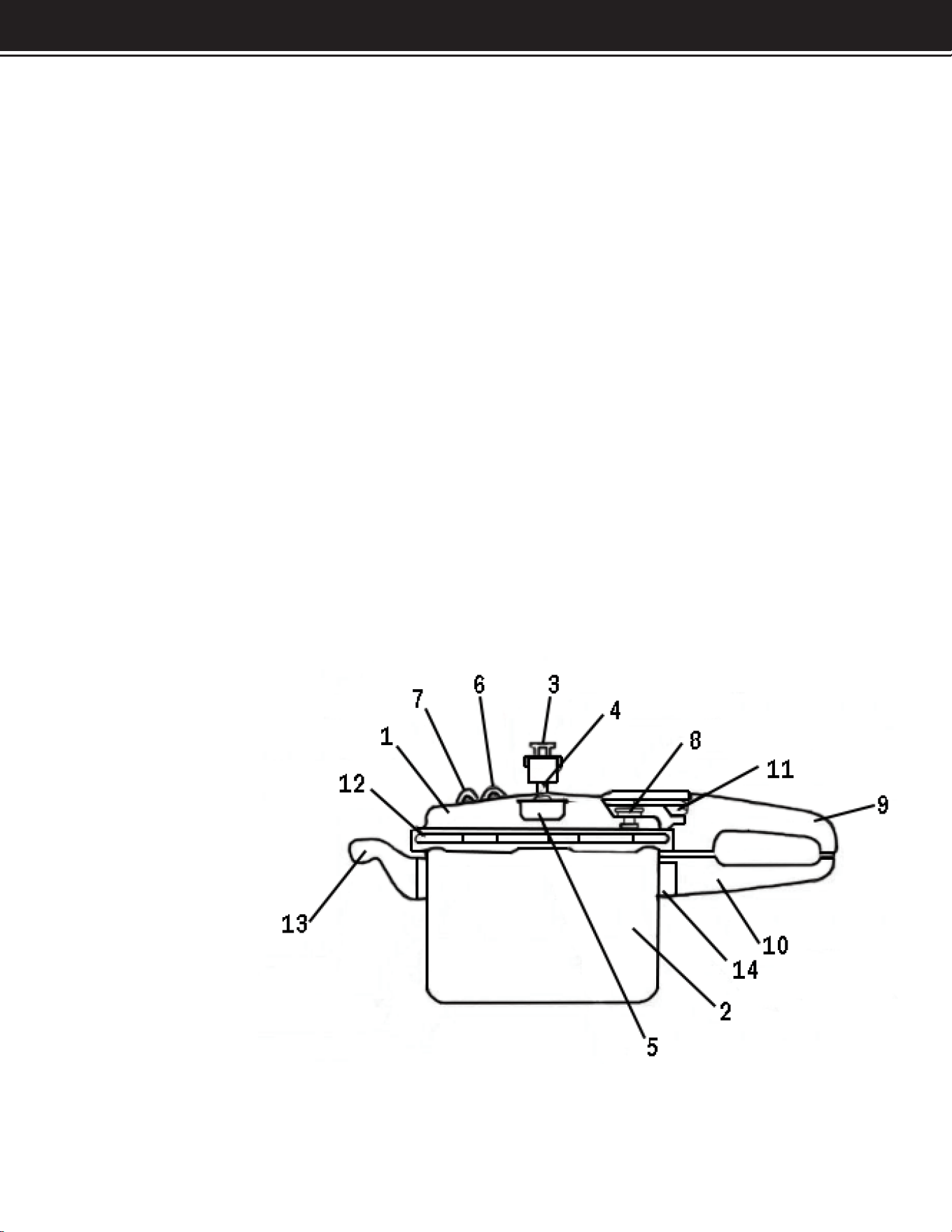
1 Lid
2 Body
3 Pressure regulator
4 Vent pipe
5 Block-proof cover
6 Safety valve 1#
7 Safety valve 2#
8 Floating valve
9 Lid handle
10 body handle 11
Push rod
12 Sealing ring
13 Auxiliary handle
14 Handle seat

OPERATION
3
FEATURES OF PRESSURE COOKING:
1. Save me, preserves food up to 30%~70% faster than ordinary cooking methods.
2. Using less energy and saving more money. Keep kitchens cool and lower fuel bills. During the modern busy day, you can
prepare a complete homemade gourmet meal in minutes.
3. Pressure cooking helps to retain your food essenal nutrients. Cooking in an almost airless cooking environment with
just a lile liquid, Flavor is enhanced and food valuable vitamins and minerals are retained.
INSTALLATION INSTRUCTIONS:
1. Installaon of lid handle: Let the lid handle cling to the lid, make the head of lid handle aim at oang valve to insert
the screw, and run 2pcs M4 screws through the holes in the lid, then ghten the locknut.
2. Installaon of body handle. Let the body handle with jacket cling to the handle seat, and run M6 screw through the
hole in the body handle, then ghten the locknut.
CAUTION:
• Servicing or repair should only be completed by a qualied technician.
• Don’t tamper with the pressure cooker, you may damage the safety systems and prevent their operaon.
• Don’t dismantle any part of the pressure cooker unless directed to do so in instrucons.
• Using aachments not recommended or sold by the manufacturer may cause hazards. Only use original spare parts.
OPERATING INSTRUCTIONS
Only under correct operaonal condions, can take full advantages of your pressure cooker and long life be showed.
Please read operang instrucons carefully and familiarize yourself with your new pressure cooker before using for the
rst me.
(A) Descripon & Operaon of operang and safety devices:
a) Pressure Regulator: In down posion when cooking under pressure, up posion when steaming.
b) Safety Valve: Allows excess pressure to escape in case that the vent pipe is blocked, so that not too much pressure is
building up inside of cooker. There’re 2 sets safety valves on the lid.
c) Floang Valve: It will rise against pressure built up and keep the lid in the locking posion unl pressure is released.
When the pressure is over 4 KPa in the cooker, the oang valve going up so that prevent handles to be rotated and the lid
cannot be opened. This device ensures the safety of opening and closing which avoids the dangerous possibility of wrong
handlings.
d) Sealing Ring: Silicon ring without poison or odor, creates an air ght seal that is needed for the Pressure Cooker to
operate. Also makes the lid easy to open and close.
e) Block-proof cover: which under the vent pipe prevents the vent pipe from being blocked and improves the cooker’s
safety.
With such above components, Pressure cookers eliminate all dangerous possibilies.
(B) Instrucon for use and method of operaon:
Before Use: Before cooking, please put some cooking oil on the edge of cooker body and sealing ring, for easy inial
opening and closing the lid. Then pour the water into 1/2 of the cooker, keep ten minutes to close the lid and heat unl
pressure regulator exhausng to get rid of new pot smell. When the pressure released and body cooling down, clean the
pot to backup.
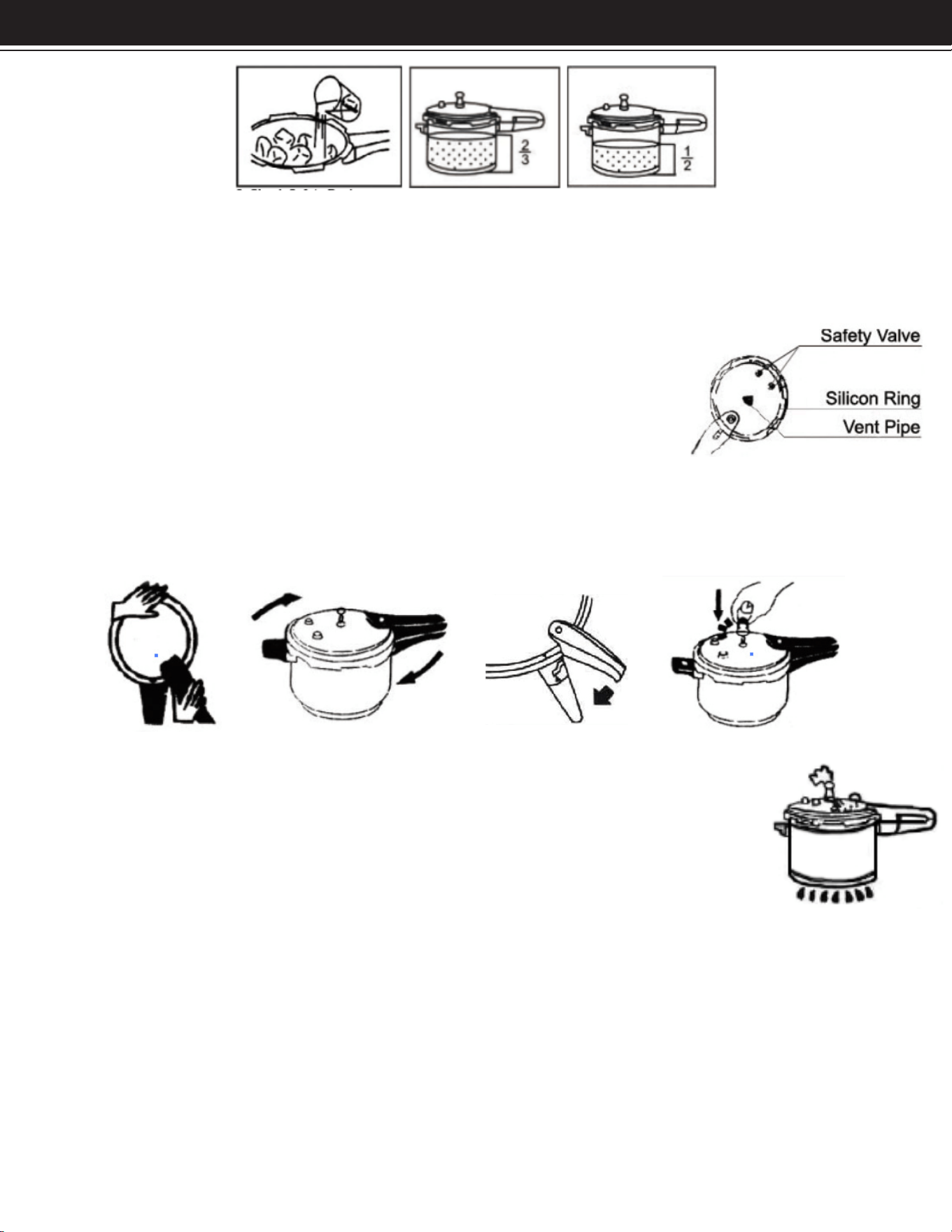
Use Capacity
Do not ll up the pressure cooker over 2/3 of its full capacity. When cooking foods that expand during cooking such as rice
or dried vegetables, do not ll the unit over 1/2 full. Over lling may cause a risk of clogging the vent pipe and developing
excess pressure.
OPERATION
4
Check Safety Devices
Make sure safety valve, vent pipe, and oang valve are normal and clean before using every me, open the block-
proof cover on the lid and check carefully in the light to ensure that there are no blockages of the vent pipe. If found any
blockages, clear it immediately. The silicon sealing ring is securely posioned and not aged.
Close and Open the Lid
Aim at the body tooth and rotate the lid handle clockwise unl the arrowhead on the
lid fully aligns with the arrowhead on the lid handle. For the new pressure cooker,
press the lid with le hand, rotate the handles strongly a few mes with right hand to
ensure use properly. Rotate the lid handle counter-clockwise unl the arrowhead on
the lid aligns with the arrowhead on the lid handle, and then open the lid.
Place the Pressure Regulator
When regular steam escapes from the vent pipe aer heang, make sure the vent pipe unimpeded, then put the pressure
regulator onto the vent pipe.
Heang
Aer the lid has been closed properly, cooking can be started with heat. It is normal for some
steam to escape from the oang valve at beginning. Later in the cooking process the oang
valve will rise up and remain in the up posion, seal automacally during the pressure generaon.
Reduce the heat immediately once the pressure regulator is exhausng, and keep the steam
exhaust steadily unl the cooking completed. “Refer to the table of Recommended Cooking
Times.”
End of Heang
Remove the pressure cooker from the source of heat, reduce pressure before opening the lid. Set the cooker aside to a
cool area and wait the cooker body cool down or for quicker reducon of pressure, place cooker under cold running water
or li the pressure regulator to release steam. Pressure is completely reduced when the oang valve has dropped. If the
oang valve remains in its raised posion, there may sll be pressure inside the pressure cooker. Connue to cool unl
the oang valve drops. (If the oang valve is sll not fell down, may be scked by food, it can be used chopscks to press
it down.) Aer pressure has been completely reduced, remove the pressure regulator to conrm all steam drained, rotate
the lid handle count-clockwise to open the lid. Always remove the pressure regulator before opening the lid.
WARNING: Do not hold the pressure regulator to release pressure. (Risk of injuries! Hot steam/liquid will be ejected.) Keep
hands and face away from steam vent pipe, use cooker handles when removing the cooker or touching any hot items, and
never force the lid open. The lid will only open once the pressure is released. Remove the lid by liing it away from you to
avoid being burned by the steam.
MAINTENANCE
5
VI. CLEANING/MAINTENANCE
1. Cleaning
Once cook has nished, take the food out of the cooker. Aer the unit has cooled, remove the lid, clean the cooker in case
that the food, especially acidic food, erodes in the cooker. Do not use hard things to clean the body.
2. Vent pipe and Block-proof cover:
Aer each use, turn the lid over and place on a table top, then pull out the block-proof cover and clean it with water, if
necessary, use a pin or something similar to clean the hole to ensure that there are not any food or foreign parcles that
may be lodged in the vent pipe and block-proof cover.
3. Safety valve:
Every pressure cooker is equipped with safety valve, make sure both are workable before use cooker each me. Clean the
base of the safety valve inside of the lid, check that it is working correctly by pressing lightly on the valve, which should
give way easily. If not, replace with spare parts.
4. Change the Sealing ring
Make sure that you buy the correct gasket for your model. Aer the pressure cooker is used, the sealing ring should be
washed with hot water or detergent. Soak it in soapy water for a few seconds, then put it in posion. Be careful not to
fold or deform the sealing ring. Never shorten the gasket. If there are aws on the sealing ring, or the sealing ring become
old, please replace a new ring.
5. Floang valve
Push down the rod with one hand; push the oang valve upward with the forenger of the other hand to see if the
oang valve works freely. If not, wash the oang valve assembly with water directly or dismantle the lid handle and
then wash it. Replace it with oang valve assembly if necessary.
6. How to replace the components in the lid handle If replacement is necessary, please insert spring rst into the end of
the push rod. Then put them both in the sliding groove of the lid handle. Finally screw the lid handle and the lid together.
7. Storage of your Pressure Cooker
Aer use, clean and dry the cooker to keep. Turn the lid upside down on the body to ensure that pressure cooker lasts as
long as possible.
WARNING:
Do not use your pressure cooker to store acidic or salty food before and aer cooking. Repair or other servicing should
be performed only by a qualied technician or authorized service representave.
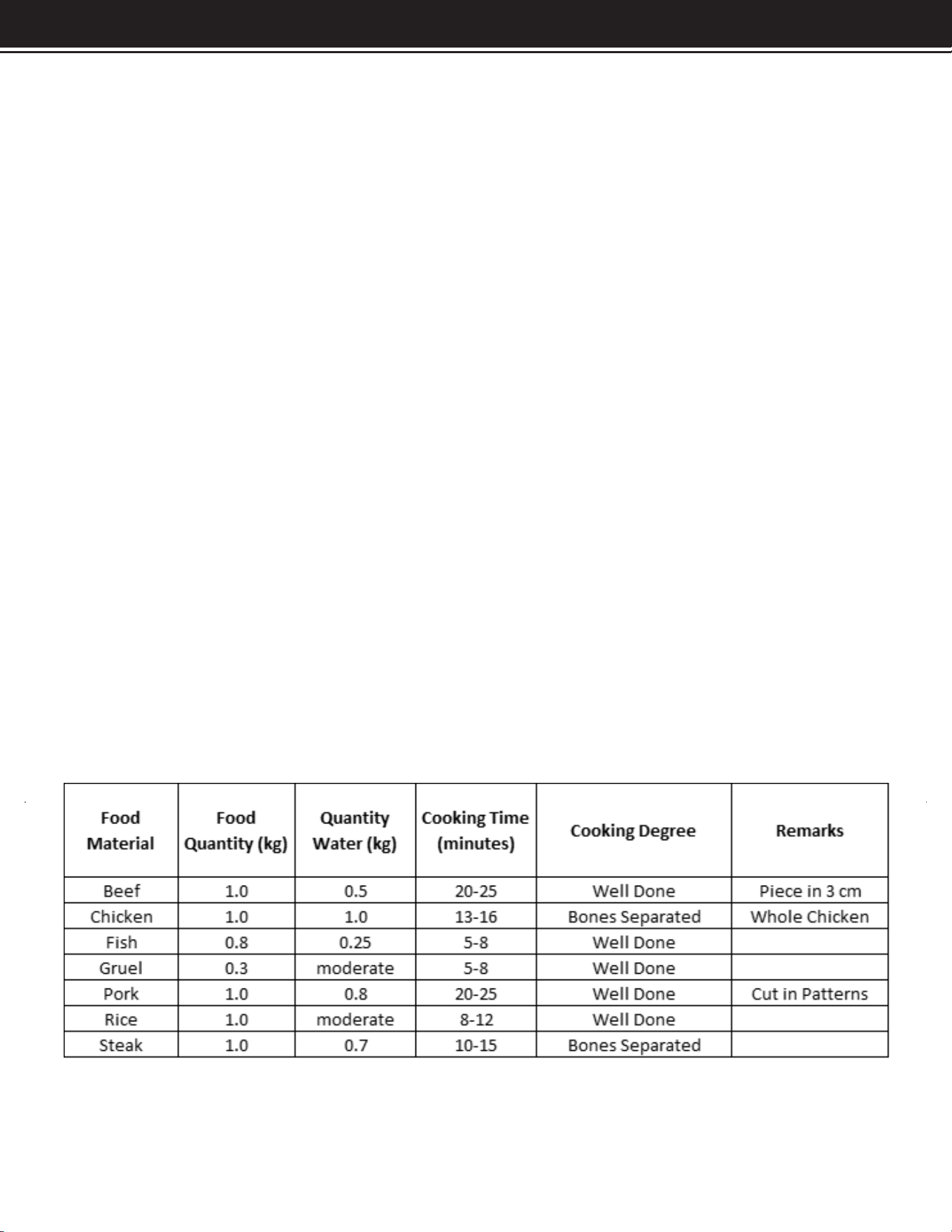
Note: *The working pressure is 80Kpa.
*It’s the Cooking me aer the rst pressure release from the pressure regulator.
RECOMMENDED COOKING TIME:
Cooking mes are approximate mes. Use these as general guidelines. Size and variety will alter cooking mes.
TROUBLESHOOTING
5
6
VI. CLEANING/MAINTENANCE
1. Cleaning
Once cook has nished, take the food out of the cooker. Aer the unit has cooled, remove the lid, clean the cooker in case
that the food, especially acidic food, erodes in the cooker. Do not use hard things to clean the body.
2. Vent pipe and Block-proof cover:
Aer each use, turn the lid over and place on a table top, then pull out the block-proof cover and clean it with water, if
necessary, use a pin or something similar to clean the hole to ensure that there are not any food or foreign parcles that
may be lodged in the vent pipe and block-proof cover.
3. Safety valve:
Every pressure cooker is equipped with safety valve, make sure both are workable before use cooker each me. Clean the
base of the safety valve inside of the lid, check that it is working correctly by pressing lightly on the valve, which should
give way easily. If not, replace with spare parts.
4. Change the Sealing ring
Make sure that you buy the correct gasket for your model. Aer the pressure cooker is used, the sealing ring should be
washed with hot water or detergent. Soak it in soapy water for a few seconds, then put it in posion. Be careful not to
fold or deform the sealing ring. Never shorten the gasket. If there are aws on the sealing ring, or the sealing ring become
old, please replace a new ring.
5. Sealing ring ages or breaks----replace with a new sealing ring.
6. The sealing ring is not clean or with food remains----wash the sealing ring and replace properly.
7. Lid or body is seriously damaged----send the pressure cooker to Authorized Service Center to repair.
8. Safety valve, Vent pipe, Floang valve or Handles are loose----reghten them.
The lid cannot open, probable causes and correcve acon:
1. The cooker cannot be open because there is sll too mush pressure in it----the pressure regulator must be taken o
aer pressure released.
2. The oang valve does not lower down to its posion----push down the oang valve with something like pin. Open
the cooker lid and wash the oang valve.
3. The push rod is deformed or broken----replace it with a new one. Dismantle the cooker handle, rotate and open the
lid aer pressure is completely reduced.
4. The cooker is not closed properly---- a) Pry the lid with a screw knife and rotate the lid. (Do not exert your strength)
b) Place the cooker upside down, apply some cooking oil to the sealing ring, push the sealing ring inward and then open
the lid.
Liquid or soup escapes from the vent pipe under the pressure regulator, probable causes and correcve acon:
1. Heat is too high----reduce the heat
2. Cooker has been overlled with food----see and follow as “Operang instrucons”, secon 2.
3. The pressure regulator has been placed on when there is sll cold air in the cooker----place the pressure regulator
when there is no cold air inside.
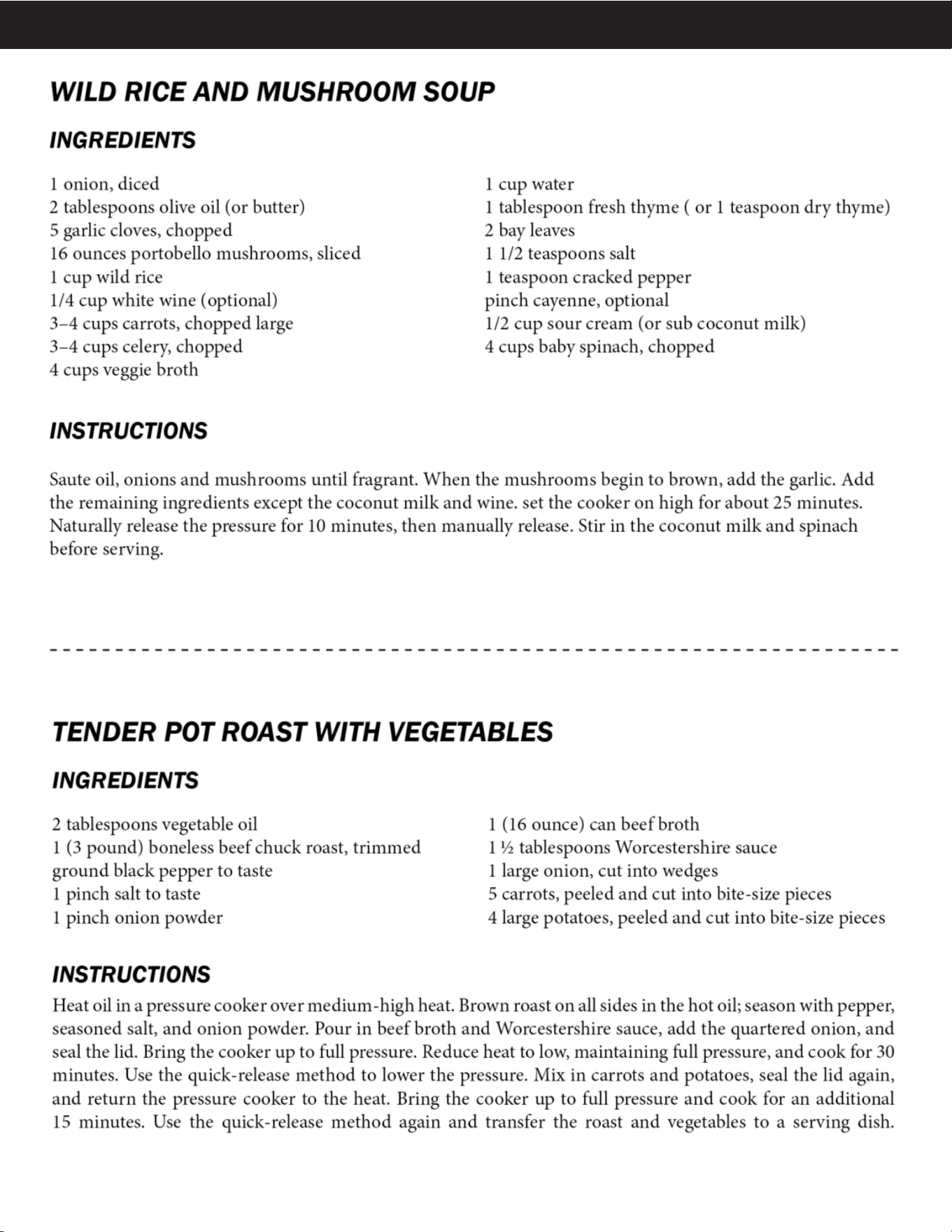
RECIPES
7
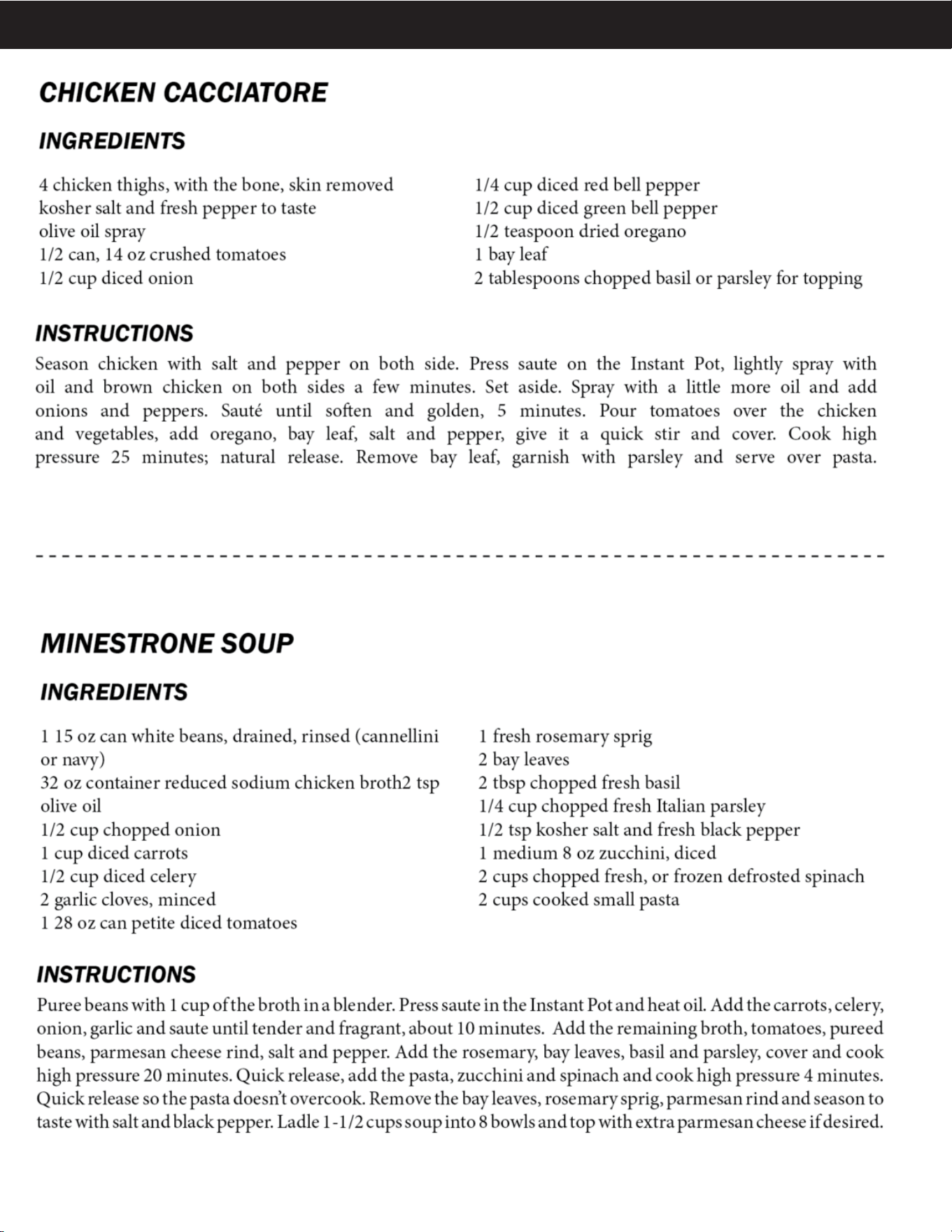
RECIPES
8
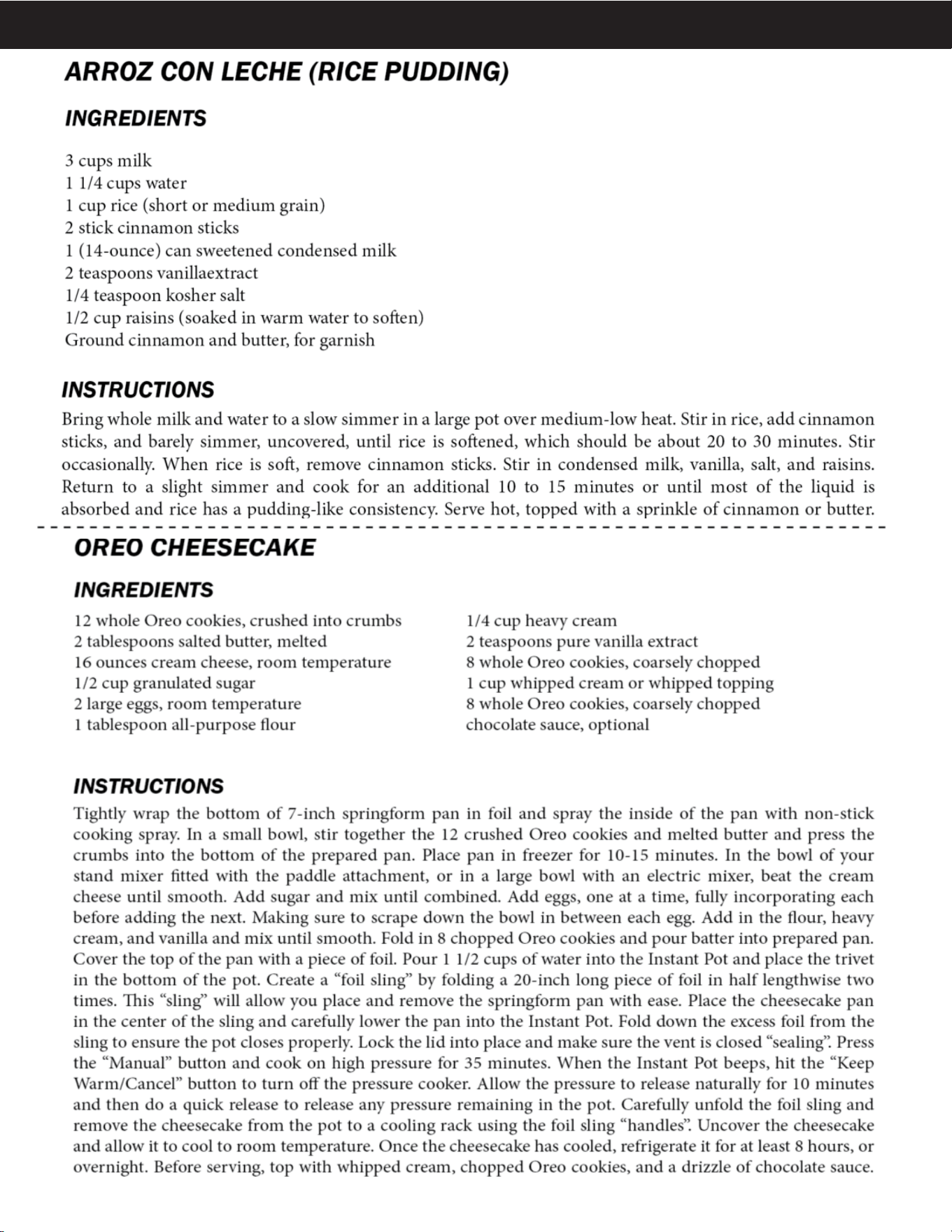
RECIPES
9
10
PLEASE READ THE FOLLOWING CAREFULLY
THE MANUFACTURER AND/OR DISTRIBUTOR HAS PROVIDED THE PARTS LIST AND
ASSEMBLY DIAGRAM IN THIS MANUAL AS A REFERENCE TOOL ONLY. NEITHER THE
MANUFACTURER
OR DISTRIBUTOR MAKES ANY REPRESENTATION OR WARRANTY OF ANY KIND
TO THE BUYER THAT HE OR SHE IS QUALIFIED TO MAKE ANY REPAIRS TO THE PRODUCT, OR
THAT HE OR SHE IS QUALIFIED TO REPLACE ANY PARTS OF THE PRODUCT. IN FACT, THE
MANUFACTURER AND/OR DISTRIBUTOR EXPRESSLY STATES THAT ALL REPAIRS AND PARTS
REPLACEMENTS SHOULD BE UNDERTAKEN BY CERTIFIED AND LICENSED TECHNICIANS,
AND NOT BY THE BUYER. THE BUYER ASSUMES ALL RISK AND LIABILITY ARISING OUT OF
HIS OR HER REPAIRS TO THE ORIGINAL PRODUCT OR REPLACEMENT PARTS THERETO, OR
ARISING OUT OF HIS OR HER INSTALLATION OF REPLACEMENT PARTS THERETO.
Record Product’s Serial Number Here:
Note: If product has no serial number, record month and year of purchase instead.
Note: Some parts are listed and shown for illustration purposes only and are not
available individually as replacement parts.
MADE IN CHINA
DISCLAIMER