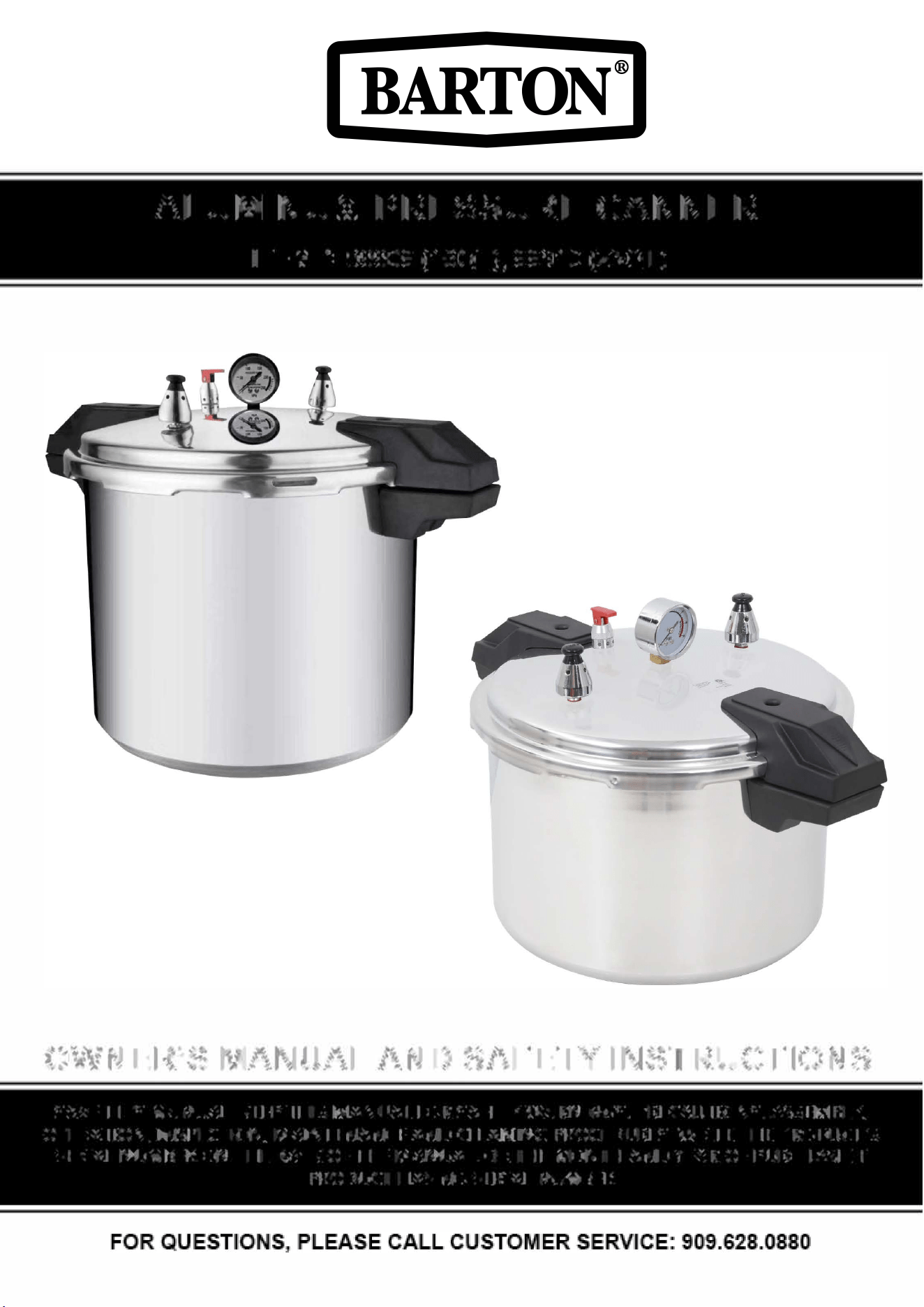
ALUM
l
[NUM PRES,SURE CANNER
ITEM # 999091 (16,
1
QT), 91919,1 D
,
(23QT)1
O
1
WNER'S,
!
MANUAL AND SA.FETY INST'RCTl
1
ONS
SAV TH[S MANUAL KEEP THIS MUAL R SAFElY WARNINGS, PRECAUONS. ASSEMBLY,
OPEON, ]NSPEON, MA]NTENANCE D CNING PROCEDURES. WRITE THE PRODUCT'S
SERIAl NUMBER ON THE BAG< OF TH MANU OR THE MO AND YR OF PUR(HASE IF
PRODUCT H NO SEAl NUMBER

8. Do not fill the unit over 2/3 full. When cooking foods that expand during cooking such as rice or dried vegetables, do
not fill the unit over 1/2 full. Over filling may cause a risk of clogging the vent pipe and developing excess pressure.
See Food Preparation Instructions.
9. Be aware that certain foods, such as applesauce, cranberries, pearl barley, oatmeal or other cereals, split peas, noodles,
macaroni, rhubarb, or spaghetti can foam, froth, and sputter, and clog the pressure release device (steam vent). These
foods should not be cooked in a pressure cooker.
10. Always check the pressure release devices for clogging before use.
11. Do not open the pressure cooker until the unit has cooled and all internal pressure has been released. If the handles
are difficult to push apart, this indicates that the cooker is still pressurized – do not force it open. Any pressure in the cooker
can be hazardous. See Operating Instructions.
12. Do not use this pressure cooker
for pressure frying with oil.
13. When the normal operating pressure is reached, turn the heat down so all the liquid, which creates the steam, does
not evaporate.
This appliance cooks under pressure. To prevent personal injury or property damage when using pressure cookers,
basic
safety precautions should always be followed:
1. Read all the instructions.
2. Do not let children near the pressure cooker when in use.
3. Do not put the pressure cooker into a heated oven.
4. Move the pressure cooker under pressure with the greatest care. Do not touch hot surfaces. Use the handles and knobs. If
necessary, use protection.
5. Do not use the pressure cooker for a purpose other than the one for which it is intended.
6. This appliance cooks under pressure. Scalds may result from inappropriate use of the pressure cooker. Make sure that
the cooker is properly closed before applying heat. see "Instructions for u
se".
7. Never force open the pressure cooker. Do not open before making sure that its internal pressure has completely dropped.
see the "Instructions for use".
8. Never use your pressure cooker without adding water, this would seriously damage it.
9. Do not fill the cooker beyond 2/3 of its capacity. When cooking foodstuffs which expand during cooking, such as rice or
dehydrated vegetables, do not fill the cooker to more than half of its capacity.
10. Use the appropriate heat source(s) according to the instructions for use.
11. After cooking meat with a skin (e.g. ox tongue) which may swell under the effect of pressure, do not prick the meat while
the skin is swollen; you might be scalded.
12. When cooking doughy food, gently shake the cooker before opening the lid to avoid food ejection.
13. Before each use, check that the valves are not obstructed. See the Instructions for use.
14. Do not tamper with any of the safety systems beyond the maintenance instructions specified in the
"Instructions for use".
15. Only use manufacturer's spare parts in accordance with the relevant model. In particular, use a body and a lid from the
same manufacturer indicated as being compatible.
16. Do not cover the pressure valves with anything, an explosion may occur. Any other replacement of the pressure regulator
is not recommended.
17. Place the pressure regulator only when steam releasing from the vent pipe. Close supervision is necessary until
steam releases regularly from the pressure regulator.
18. The fact of the safety valve emits excessive steam shows that the inside pressure rises over the safety pressure. Turn
off heat immediately if such event happens, make the cooker cool down, then check and clean the vent pipe and block-
proof cover. Otherwise it could not be used.
19. This appliance is not intended for use by person(including Children) with reduced physical, sensory or mental
capabilities, or lack of experience and knowledge, unless they have been given supervision or instruction concerning
use of the appliance by a person responsible for their safety.
20. If the pressure cooker has been deformed or damaged in any manner, return the pressure cooker to the nearest
Authorized Service Station -young- for examination, reparation or adjustment.
IMPORTANT PRECAUTIONS
1. Rea
d all instructions.
2. Do not touch hot surfaces. Use handles or knobs.
3. Close supervision is necessary when the pressure cooker is used near children.
4. Do not place the pressure cooker in a heated oven.
5. Extreme caution must be used when moving a pressure cooker containing hot liquids.
6. Do not use pressure cooker for other than intended use.
7. This appliance cooks under pressure. Improper use may result in scalding injury. Make certain unit is properly
closed before operating. See Operating Instructions.
SAFETY INFORMATION
1
In the process of heating, the cooker is sealed by a
silicon sealing ring, pressure in the cooker is increasing
gradually, and boiling point of water is increasing accordingly. When pressure in the cooker exceeds the
specified limit, the pressure regula
tor is pushing up, allowing steam to escape from the vent pipe keeping
temperature and pressure inside the cooker at a certain level. If the escaping hole is blocked by food, one of the two
safety valves will exhaust steam aut
omatically for safety assurance. To ensure safe operation once lid is properly closed
it will lock in this position when pressure reaches a certain point.
Model: 2A-OC085 2A-OC086 2A-OC087
Capacity 16 Qt. 23 Qt. 32 Qt.
Working pressure: 10 PSI ± 1PSI
Safety pressure: 13~23 PSI
CAUTION: Prevent fierce fire burning the handle when using.
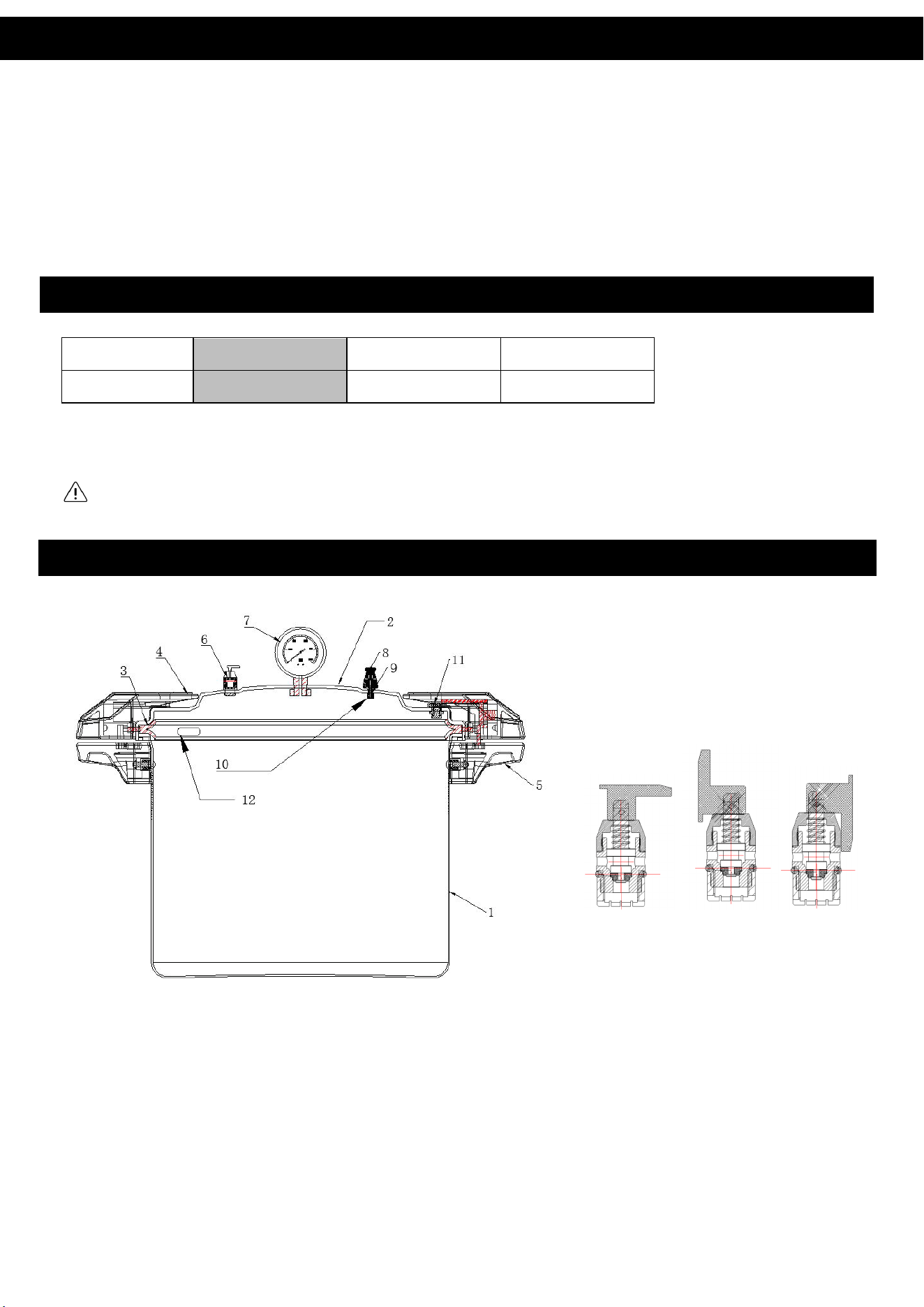
1 Body
2 Lid
3 Sealing Ring
4 Lid Handle
5 Body Handle
6 Safety Valve
7 Pressure Gager
8 Pressure Regulator
9 Vent Pipe
10 Anti-block Cover
11 Floating Valve
12 Gasket Released Window
Sealed Open Open
Safety Valve working status
TECHNICAL PARAMETER
STRUCTURE & COMPONENTS
HOW PR
ESSURE COOKER WORKS
2
PARTS INFORMATION

CA
UTION:
Servicing or repair should only be completed by a qualified technician(young).
Don’t tamper with the pressure cooker, you may damage the safety systems and prevent their operation.
Don’t dismantle any part of the pressure cooker unless directed to do so in instructions.
Using attachments not recommended or sold by the manufacturer may ca
use hazards. Only use original spare
parts.
Only under correct operational conditions, can take full advantages of your pressure cooker and long life be
showed. Please read operating instructions carefully and fa
miliarize yourself with your new pressure cooker before
using for the first time.
Description & Operation of operating and safety devices:
a
) Pressure Regulator: In down position when cooking under pressure, up position when steaming.
b) Safety Valve: Allows excess pressure to escape in case that the vent pipe is blocked, so that not too much
pressure is building up inside of cooker. It will be open automatically when the pressure value over 90kPa.
Pls replace it by hand to close status after pressure released every time.
c) Floating Valve: It will rise against pressure built up and keep the lid in the locking position until pressure is
released. When the pressure is over 4 KPa in the cooker, t
he floating valve going up so that prevent handles
to be rotated and the lid cannot be opened.
d) Sealing Ring: Silicon ring without poison or odor, creates an air tight seal that is needed for the Pressure
Cooker to operate.
e) Pressure Gager: Read the pressure value inside of cooker clearly, it’s working normal between 0~80kPa,
t
he pressure beyond normal when value between 80~160kPa, must stop heating immediately if the
value over 160kPa to avoid damage risk and do trouble-shooting.
With such above components, Pressure cookers elimina
te all dangerous possibilities.
(B) Instruction for use and method of operation:
1. Using for the first time
Before cooking, please put some cooking oil on the edge of cooker body and sealing ring, for easy initial
opening and closing the lid. Then pour the water into 1/2 of the cooker, keep ten minutes to close the lid and heat
until pressure regulator exhausting to get rid of new pot smell. When the pressure released and body cooling
down, clean the pot to backup.
2. Using Capacity
Do not fill up the pressure cooker over 2/3 of its full capacity. When cooking foods that expand during cooking such as
rice or dried vegetables, do not fill the unit over 1/2 full. Over filling may cause a risk of clogging the vent pipe and
developing excess pressure.
3. Check Safety Devices
Make sure safety valve, vent pipe, and floating valve are normal and clean before using every time, open the block-
proof cover on the lid and check carefully in the light to ensure that there are no blockages of the vent pipe. If
found any blockages, clear it immediately. The silicon sealing ring is securely positioned and not aged.
4. Close and Open the Lid
Aimed at the body tooth and rotate the lid handle clockwise until the arrowhead on the lid fully aligns with the
arrowhead on the lid handle. For the new pressure cooker, press the lid with left hand, rotate the handles strongly a
few times with right hand to ensure use properly. Rotate the lid handle counter-clockwise until the arrowhead on
the lid aligns with the arrowhead on the lid handle, and then open the lid.
OPERATING THE PRESSURE COOKER
3

5. Place the Pressure Regulator
When regular steam escapes from the vent pipe after heating, m
ake sure the vent pipe unimpeded, then put the
pressure regulator onto the vent pipe.
6. Heating
After the lid has been closed properly, cooking can be started with heat. It is normal for some steam to escape
from the floating valve at beginning. Later in the cooking process the floating valve will rise up and remain in the
up position, seal automatically during the pressure generation. Reduce the heat immediately once the pressure
regulator is exhausting, and keep the steam exhaust steadily until the cooking completed. “Refer to the table of
Recommended Cooking Times.”
7. End of Heating
Remove the pressure cooker from the source of heat, reduce pressure before opening the lid. Set the cooker
aside to a cool area and wait the cooker body cool down or for quicker reduction of pressure, place cooker
under cold running water or lift the pressure regulator to release steam. Pressure is completely reduced
when the floating valve has dropped. If the floating valve remains in its raised position, there may still be
pressure inside the pressure cooker. Continue to cool until the floating valve drops.
WARNING: Do
not hold the pressure regulator to release pressure. (Risk of injuries! Hot steam/liquid will be
ejected.) Keep hands and face away from steam vent pipe, use cooker handles when removing the cooker or touching
any hot items, and never force the lid open. The lid will only open once the pressure is released. Remove the lid by
lifting it away from you to avoid being burned by the steam.
Always check the lid, body, pressure regulator, sealing ring, and safety valve are in good working order before each
u
se.
1. Cleaning
Once cook has finished, take the food out of the cooker. After the unit has cooled, remove the lid, clean the
c
ooker in case that the food, especially acidic food, erodes in the cooker. Do not use hard things to clean the
body.
2. Vent pipe and Block-proof cover:
After each use, turn the lid over and place on a table top, then pull out the block-proof cover and clean it with
water, if necessary, use a pin or something similar to clean the hole to ensure that there are not any food or
foreign particles that may be lodged in the vent pipe and block-proof cover.
3. Safety Valve:
Every pressure cooker is equipped with safety valve, make sure it workable before use cooker each time. Clean
the base of the safety valve inside of the lid, check that it is working correctly by pressing lightly on the valve,
which should give way easily. If not, replace with spare parts.
4. Change the Sealing Ring
Make sure that you buy the correct gasket for your model. After the pressure cooker is used, the sealing ring
should be washed with hot water or detergent. Soak it in soapy water for a
few seconds, then put it in
position. Be careful not to fold or deform the sealing ring. Never shorten the gasket. If there are flaws on
the
sealing ring, or the sealing ring become old, please replace a new ring.
5. Floating Valve
Push down the rod with one hand; push the floating valve upward with the forefinger of the other hand to see
if the floating valve works freely. If not, wash the floating valve assembly with water directly or dismantle the
lid handle and then wash it. Replace it with floating valve assembly if necessary.
6. Storage of your Pressure Cooker
After use, clean a
nd dry the cooker to keep. Turn the lid upside down on the body to ensure that pressure
cooker la
sts as long as possible.
Do not use your pressure
cooker to store acidic or salty food before and after cooking.
Repair or other servicing should be performed only by a qualified technician (young) or authorized
service representative.
CLEANING/MAINTENANCE
OPERATING THE PRESSURE COOKER
4
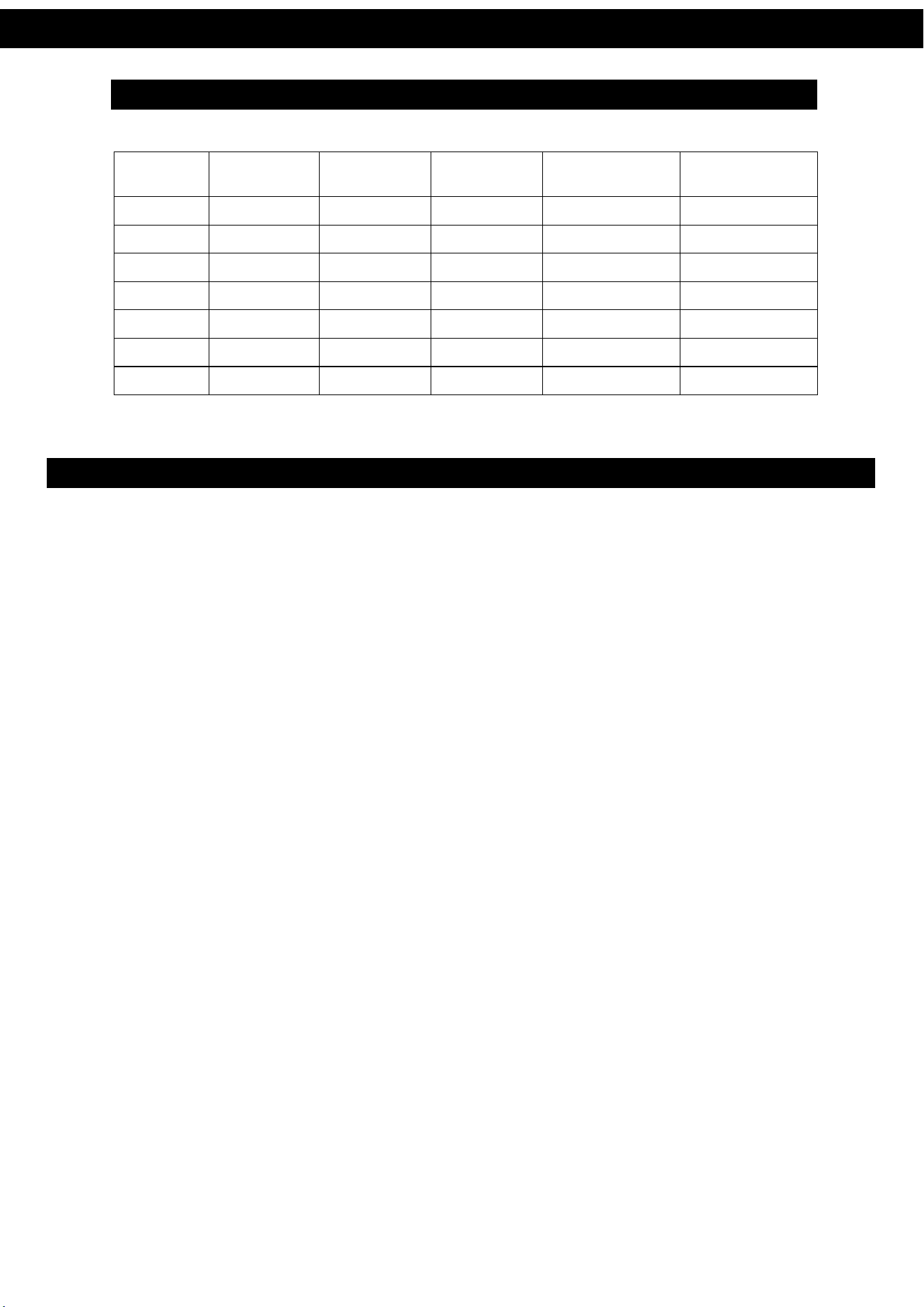
Cooking times are approximate times. Use these as general guidelines. Size and variety will alter cooking
times.
Food
Material
Food
Quantity (kg)
Quantity
Water(kg)
Cooking Time
(minutes)
Cooking Degree Remarks
Pork 1.0 0.8 20-25 Well done Cut in patterns
Chicken 1.0 1.0 13-16 Bones separated Whole chicken
Fish 0.8 0.25 5-8 Well done
Steak 1.0 0.7 10-15 Bones separated
Beef 1.0 0.5 20-25 Well done Piece in 3 cm
Rice 1.0 moderate 8-12 Well done
Gruel 0.25 moderate 5-8 Well done
Note: It’s the Cooking time after
the first pressure release from the pressure regulator.
F
requently Asked Questions and Solutions:
1. Steam is not built up inside the pressure cook
er or steam leaks, probable causes and corrective action:
1) The heat source is not hot enough----turn up the heat.
2) Moisture content in the cooker is not enough----add enough water.
3) The floating valve is not in proper position or it is dirty----clean the floating valve, reassemble or replace
it.
4) Body handle and lid handle are not properly aligned----close the lid properly as instructions guided.
5) Sealing ring ages or breaks----replace with a new sealing ring.
6) The sealing ring is not clean or with food remains----wash the sealing ring and replace properly.
7) Lid or body is seriously damaged----send the pressure cooker to Authorized Service Center to repair.
8) Safety valve, Vent pipe, Floating valve or Handles are loose----retighten them.
2. The lid cannot open, probable causes and corrective action:
1) The cooker cannot be open because there is still too mush pressure in it----the pressure regulator must be
taken off after pressure released.
2) The floating valve does not lower down to its position----push down the floating valve with
something like pin. Open the cooker lid and wash the floating valve.
3) The push rod is deformed or broken----replace it with a new one. Dismantle the cooker handle, rotate
and open the lid after pressure is completely reduced.
4) The cooker is not closed properly----
5) Pry the lid with a screw knife and rotate the lid.
6) Place the cooker upside down, apply some cooking oil to the sealing ring, push the sealing ring inward
and then open the lid.
3. Liquid or soup escapes from the vent pipe under the pressure regulator, probable causes and
corrective action:
1) Heat is too high----reduce the heat
2) Cooker has been overfilled with food----see and follow as “Operating instructions”, section 2.
3) The pressure regulator has been placed on when there is still cold air in the cooker----place the
pressure regulator when there is no cold air inside.
4. The pressure cooker cannot be closed, probable causes and corrective action:
1) The pressure cooker is used for the first time----take out the sealing ring, close the lid and rotate, put on
the sealing ring again if there is no problem. Apply some cooking oil to the sealing ring and close the lid. If
the lid cannot be put on without a sealing ring, that means the pressure cooker has been deformed, send
the pressure cooker to Authorized Service Center for reparation.
2) The arrowhead on the lid does not line with the arrowhead on the lower handle---- see and follow as
“Operating instructions”.
RECOMMENDED COOKING TIME
TROUBLESHOOTING
TROUBLESHOOTING THE PRESSURE COOKER
5

3) Cooker may be damaged or deformed---send to Authorized Service Center(young) for reparation or
repl
acement.
5. Safety valve emits excessive steam, probable causes and corrective actions:
1) There
is
a blockage in the vent pipe or the pressure regulator close too tightly around the vent pipe,
which causes the pressure in the cooker to rise over safety pressure----first let the heat cool down. After
the steam in the cooker has emitted, open the lid, check the cause of blockage, and clean the vent pipe,
block-proof cover and safety valve; check if the pressure regulator placed on the vent pipe properly,
replace it if necessary.
2) Pressure regulator has been put on with additional weight or has been replaced by other
accessories. Warning: these actions are strictly prohibited.
3) Safety valve has perished through age----replace the safety valve.
6. The bottom protrudes after the pressure cooker has been used for some time. Probable causes and
corrective action:
1) The user instructions have not been followed----follow the user instruction.
2) The protruding is due to the high pressure caused by the blockage in the safety valve----replace the
safety valve.
3) The pressure regulator fits too tightly into the vent pipe or rust exist in the pressure
regulator----replace the pressure regulator and /or the vent pipe.
4) The pressure cooker has been used without water in it or the water inside the pressure cooker has been
burned away----the pressure cooker should not be reused or check all components of the pressure
cooker before each use.
TROUBLESHOOTING THE PRESSURE COOKER
6
7
DISCLAIMER