Operator’s Manual
www. mechmaxx.com
WARRANTY


TABLE OF CONTENTS
TABLE OF CONTENTS
SPECIFICATIONS
SAFETY SIGNS
SAFETY
1
2
PREVENTIVE MAINTENANCE
14
ADJUSTING CLUTCH
14
REPLACING DRIVE BELT
15
ADJUSTING STEERING
14
GENERAL LUBRICATION
15
GEARBOX LUBRICATION
15
TIGHTENING TRACKS
16
REPLACING TRACKS
17
ENGINE MAINTENANCE
18
UNDERSTAND YOUR MACHINE
PERSONAL SAFETY
INSPECT YOUR MACHINE
4
4
4
ENGINE SAFETY
4
FUEL SAFETY
5
SPECIFIC SAFETY RULES
5
ADD OIL TO ENGINE
ADD GASOLINE TO ENGINE
STARTING ENGINE
3
4
7
8
9
12
12
12
12
OPERATING
IDLE SPEED
STOP ENGINE
13
13
13
UNPACHING THE CONTAINER
CONTENTS SUPPLIED
KNOW YOUR MACHINE
OPERATION
14
MAINTENANCE
19
STORAGE
20TROUBLESHOOTING
1
www. mechmaxx.com
TABLE OF CONTENTS
SPECIFICATIONS
2
www. mechmaxx.com
SPECIFICATIONS
Engine
Model
Rato
D50MA
Engine Type Single cylinder,4 stroke, air-cooled,OHV
Engine Displacement
212cc
Horsepower
7hp
Working Pressure
Transmission
Power
16.5Mpa
Transaxle 3 forward/1 reverse speed
4.1kw/3600rpm
Driven Type Track
Track Roller 4 pcs
Track Tensioning Yes
Bucket Capacity 1100 lbs
Box Size
38*27*19 in
3
www. mechmaxx.com
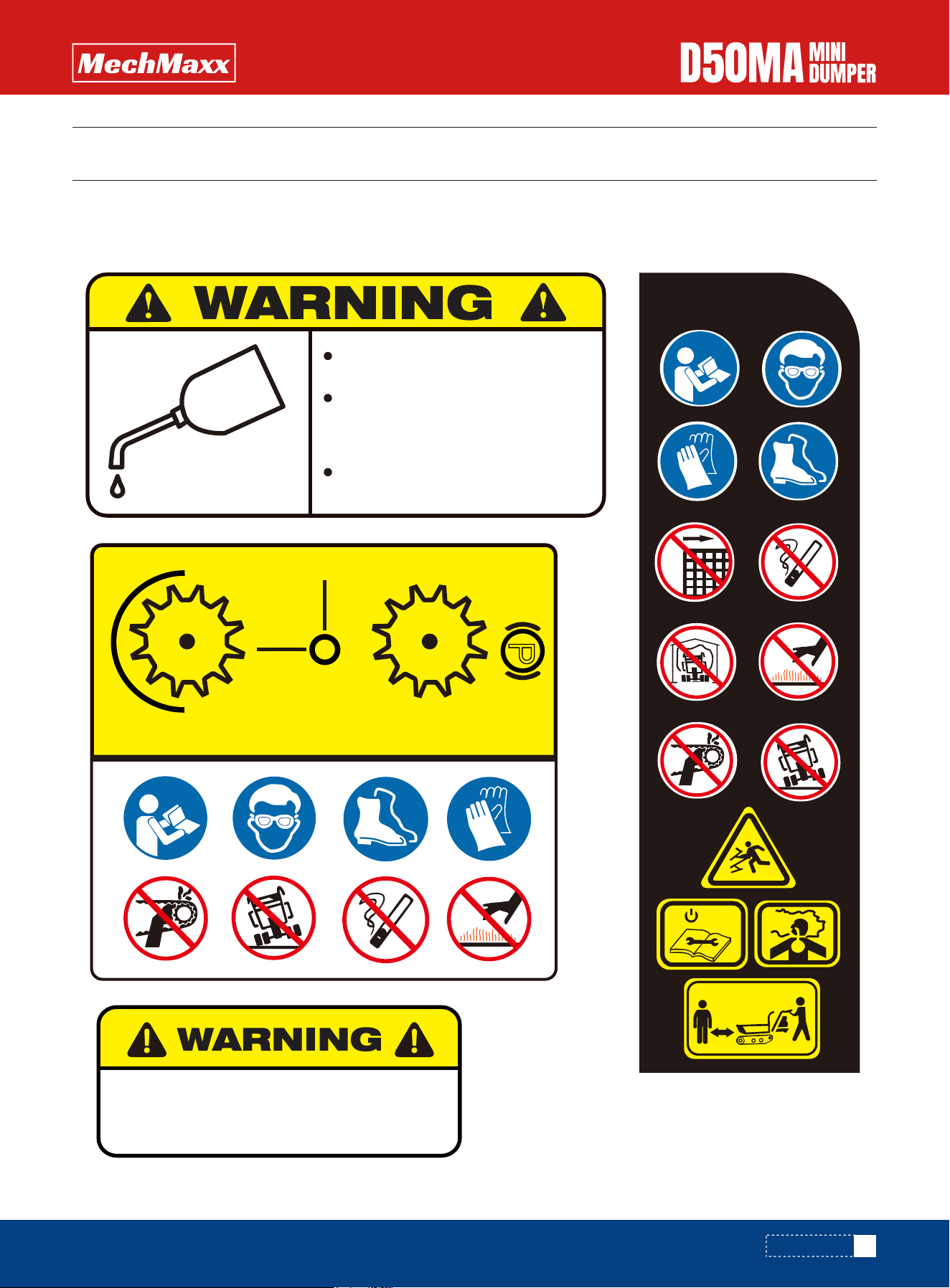
SAFETY SIGNS
The rating plate on your machine may show symbols. These represent important information about the product or instruc-
tions on its use.
SAFETY SIGNS
After first 30 hours use, change all the
gear oil. Capacity is 1.5L.
For future use, check the oil level after
every 30 hours of use. If you remove the
oil level plug and no oil flows out, please
add oil and then screw the oil level plug.
Gear oil GL-5 or GL-6, SAE80W-90 is
recommended. Do not use synthetic oil.
(X)
WARNING:OPERATE THE STEERING
LEVERS ONLY AT A REDUCED SPEED
P
RUN
STOP
OFF
OPERATE THE STEERING
LEVERS ONLY AT A LOW SPEED.

4
www. mechmaxx.com
UNDERSTAND YOUR MACHINE
PERSONAL SAFETY
INSPECT YOUR MACHINE
ENGINE SAFETY
SAFETY
SAFETY
Read this manual and labels affixed to the machine to
understand its limitations and potential hazards.
Be thoroughly familiar with the controls and their proper
operation. Know how to stop the machine and disengage
the controls quickly.
Make sure to read and understand all the instructions and
safety precautions as outlined in the Engine Manufactur-
er's manual packed separately with your unit. Do not
attempt to operate the machine until you fully understand
how to properly operate and maintain the engine and know
how to avoid accidental injuries and/or property damage.
If the unit is to be used by someone other than original
purchaser, or is to be loaned, rented, or sold, always
provide this manual and any needed safety training before
operation. The user can prevent and is responsible for
accidents or injuries that may occur to themselves, to
other people, or to property.
Do not force the machine beyond its limits. Use the
correct machine for your application.
This machine is equipped with an internal combustion
engine. Do not use on, or near, forest-covered or
brush-covered land unless the exhaust system is
equipped with a spark arrester meeting applicable local,
state, or federal laws.
Do not permit children to operate this machine at any
time.
Keep children, pets, and other people not using the unit
away from the work area. Be alert and shut off the unit if
anyone enters work area. Keep children under the watch-
ful care of a responsible adult.
Do not operate the machine while under the influence of
drugs, alcohol, or any medication that could affect your
ability to use it properly.
Dress properly: Wear long, heavy pants, work boots, and
work gloves. Do not wear loose clothing, short pants, or
jewelry of any kind. Secure long hair so it is above shoul-
der level. Keep your hair, clothing, and gloves away from
moving parts. Loose clothes, jewelry, or long hair can be
caught in moving parts.
Protect eyes, face, and head from objects that may be
thrown from the unit. Always wear safety goggles or
safety glasses with side shields when operating.
Wear appropriate hearing protection.
Always keep hands and feet away from all moving parts
during operation. Moving parts can cut or crush body
parts.
Always keep hands and feet away from all pinch points.
Do not touch parts that might be hot from operation. Allow
parts to cool before attempting to maintain, adjust, or
service.
Stay alert, watch what you are doing, and use common
sense when operating the machine.
Do not overreach. Do not operate the machine while
barefoot or when wearing sandals or similar lightweight
footwear. Wear protective footwear that will protect your
feet and improve your footing on slippery surfaces. Keep
proper footing and balance at all times. This enables
better control of the machine in unexpected situations.
Check your machine before starting it. Keep guards in
place and in working order. Make sure all nuts, bolts, etc.,
are securely tightened.
Never operate the machine when it is in need of repair or
is in poor mechanical condition. Replace damaged, miss-
ing, or failed parts before using it. Check for fuel leaks.
Keep the machine in safe working condition.
Do not use the machine if the engine's switch does not
turn off the engine when running. Any gasoline powered
machine that can't be controlled with the engine switch is
dangerous and must be replaced.
Regularly check to see that keys and adjusting wrenches
are removed from the machine area before starting it. A
wrench or a key that is left attached to a rotating part of
the machine may result in personal injury.
Avoid accidental starting. Be sure the engine's switch is
off before transporting the machine or performing any
maintenance or service on the unit. Transporting or
performing maintenance or service on a machine with its
switch on invites accidents.
If the machine should start to vibrate abnormally, stop the
engine (motor) and check immediately for the cause.
Vibration is generally a warning sign of trouble.

5
www. mechmaxx.com
FUEL SAFETY
SPECIFIC SAFETY RULES
SAFETY
In the state of California, a spark arrester is required by
law. Other states have similar laws. A spark arrester, if
used, must be maintained in effective working order by
the operator.
Never start or run the engine inside a closed area. The
exhaust fumes are dangerous, containing carbon monox-
ide, an odorless and deadly gas. Operate this unit only in a
well ventilated outdoor area.
Do not tamper with the engine in an effort to get it to run
at higher speeds. The maximum engine speed is preset by
the manufacturer and is within safety limits. See engine
manual.
Keep a Class B fire extinguisher on hand when operating
this machine in dry areas as a precautionary measure.
Fuel is highly flammable, and its vapors can explode if
ignited. Take precautions when using to reduce the
chance of serious personal injury.
When refilling or draining the fuel tank, use an approved
fuel storage container while in a clean, well-ventilated
outdoor area. While adding fuel or operating the unit, do
not smoke, and stay away from sparks, open flames, or
other sources of ignition near the area of operation. Never
fill the fuel tank indoors.
To avoid sparking or arcing, keep grounded conductive
objects - such as tools - away from exposed, live electri-
cal parts and connections. These events could ignite
fumes or vapors.
Always stop the engine and allow it to cool before filling
the fuel tank. Never remove the cap of the fuel tank or add
fuel while the engine is running or when the engine is hot.
Do not operate the machine with known leaks in the fuel
system.
Loosen the fuel tank cap slowly to relieve any pressure in
the tank.
Never overfill the fuel tank. Because engine heat can
cause fuel to expand, never fill the tank to more than 1/2"
below the bottom of the filler neck. This will provide space
for fuel expansion.
Replace all fuel tank and container caps securely and
wipe up spilled fuel. Never operate the unit without the
fuel cap securely in place.
Avoid creating a source of ignition for spilled fuel. If fuel is
spilled, do not attempt to start the engine. Instead, move
the machine away from the area of spillage and avoid
creating any source of ignition until fuel vapors have dissi-
pated.
When fuel is spilled on yourself or your clothes, wash your
skin and change clothes immediately.
Store fuel in containers specifically designed and
approved for fuel storage.
Store fuel in a cool, well-ventilated area, safely away from
sparks, open flames, or other sources of ignition.
Never store fuel - or a machine with fuel in the tank -
inside a building where fumes may reach a spark, open
flame, or any other source of ignition (such as a water
heater, furnace, or clothes dryer). Allow the engine to cool
before storing in any enclosure.
Thoroughly inspect the area to be worked. Keep the work-
ing area clean and free of debris to prevent tripping.
Operate on flat, level ground.
Never place any part of your body where it would be in
danger if movement should occur during assembly, instal-
lation, operation, maintenance, repair, or relocation.
Keep all bystanders, children, and pets at least 23m
away. If you are approached, stop the unit immediately.
Do not mount anything on the hopper and never carry
passengers.
Never park the machine in a place with unstable ground
that could give way, particularly when it is full.
Disengage clutch lever before starting the engine.
Start the engine carefully according to instructions and
with feet away from the moving parts.
Never leave the operating position when the engine is
running.
Always hold the unit with both hands when operating.
Keep a firm grip on the handlebars. Be aware that the
machine may unexpectedly bounce upward or jump
forward if the machine should strike buried obstacles
such as large rocks or roots.
Walk, never run with the machine.
Do not overload the machine capacity. Always drive at a
safe speed, and adjust the speed to the slope of the land,
the surface conditions of the road, and the weight of the
load.
Use extreme caution when in reverse or pulling the
machine towards you.
Exercise extreme caution when operating on or crossing
gravel drives, walks, or roads. Stay alert for hidden
hazards or traffic.

6
www. mechmaxx.com
SAFETY
On soft ground, drive at the first forward/ reverse gear. Do
not rapidly accelerate, turn sharply or stop.
Pay the utmost attention when working on frozen ground,
as the machine may tend to skid.
Do not operate the machine in confined areas where there
may be a risk of crushing the operator between the
machine and another object.
Never operate the machine on slopes where angle is over
20°.
When operating on a slope, whether moving forward or in
reverse, always make certain that the weight is evenly
balanced. Always operate the machine straight up or
down slopes, never drive sideways or across the slope. Do
not shift gears on slopes.
When dumping the contents of the hopper, the center of
gravity will change continuously and the ground condi-
tions will be essential for the stability of the machine.
Use extra caution and control when dumping the hopper
on unstable ground, such as wet clay or soil.
7
www. mechmaxx.com
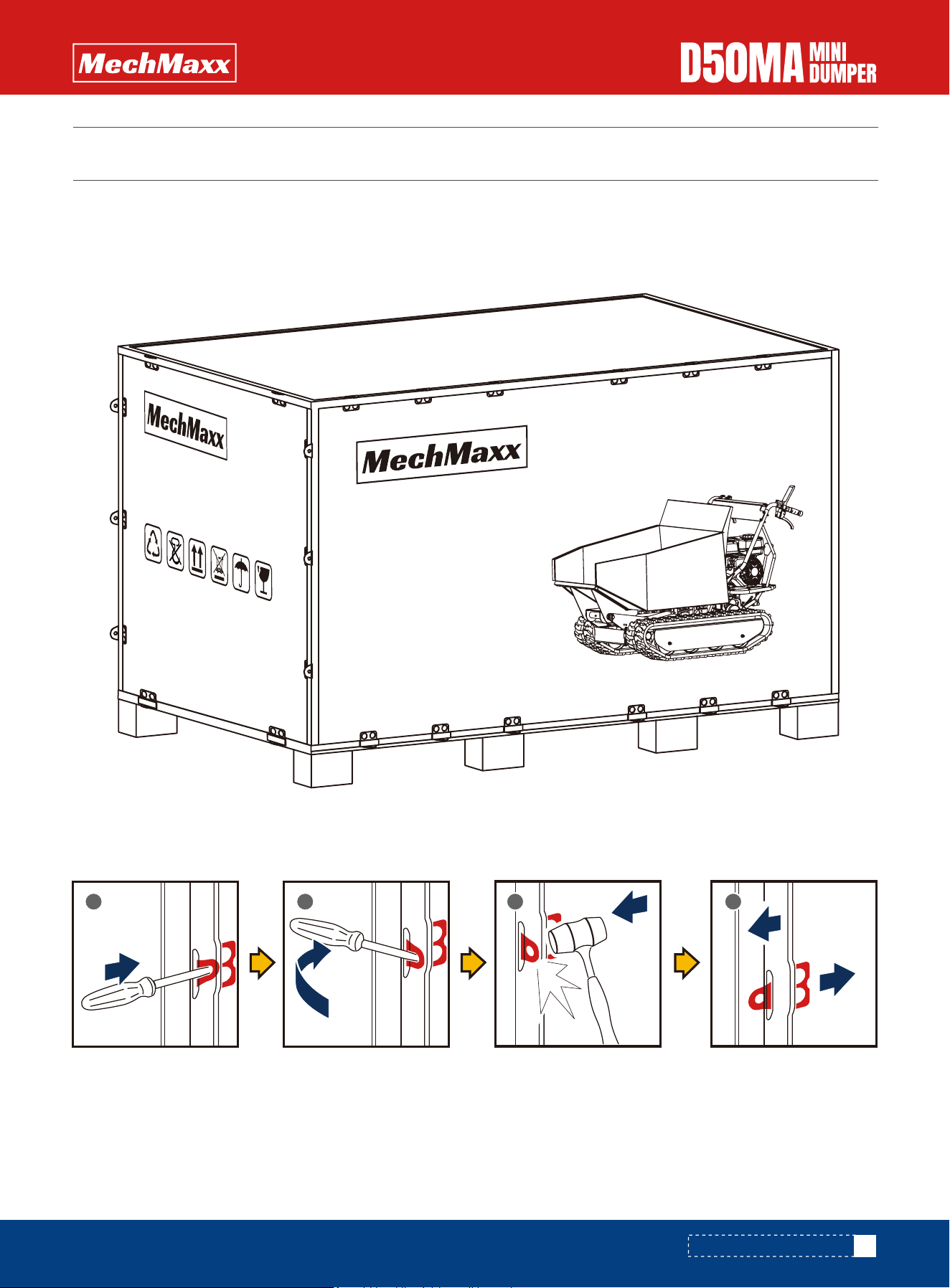
UNPACHING THE CONTAINER
Use the screwdriver and hammer to open all the side locks.
UNPACHING THE CONTAINER
1 2 3 4
www.mechmaxx.com
GASOLINE POWERED
WHEELBARROW
Model Number:
Package size:
www.mechmaxx.com
Gross weight:
GASOLINE POWERED
WHEELBARROW
Operator’s Manual
www. mechmaxx.com
WARRANTY
8
www. mechmaxx.com
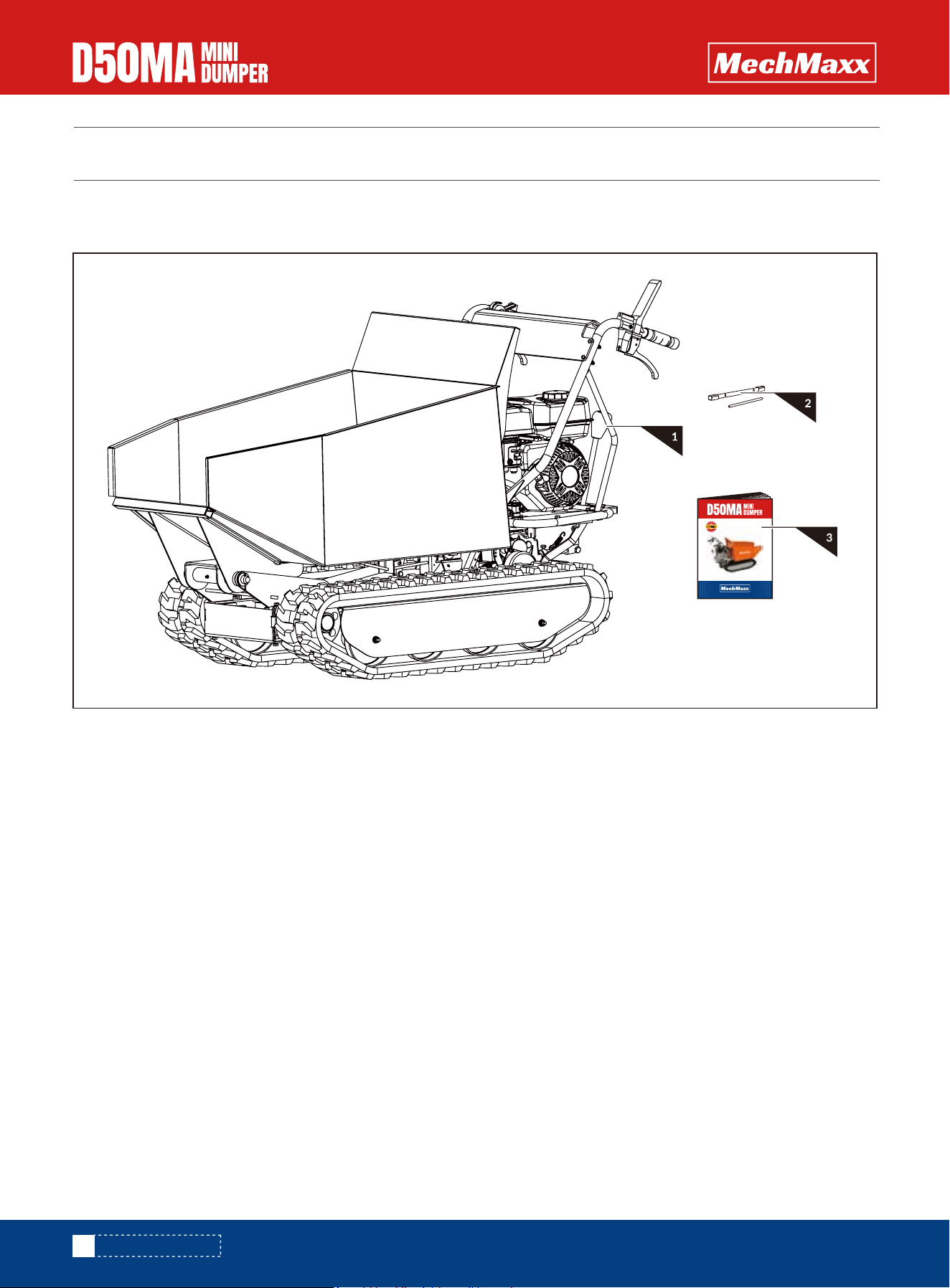
The mini tracked dumper comes partially assembled and is shipped in carefully packed package. After all the parts have
been removed from the package, you should have:
1.Machine
2.Operator's Manual & Engine Manual
3. Tools for Spark Plug Assembly
CONTENTS SUPPLIED
CONTENTS SUPPLIED
9
www. mechmaxx.com
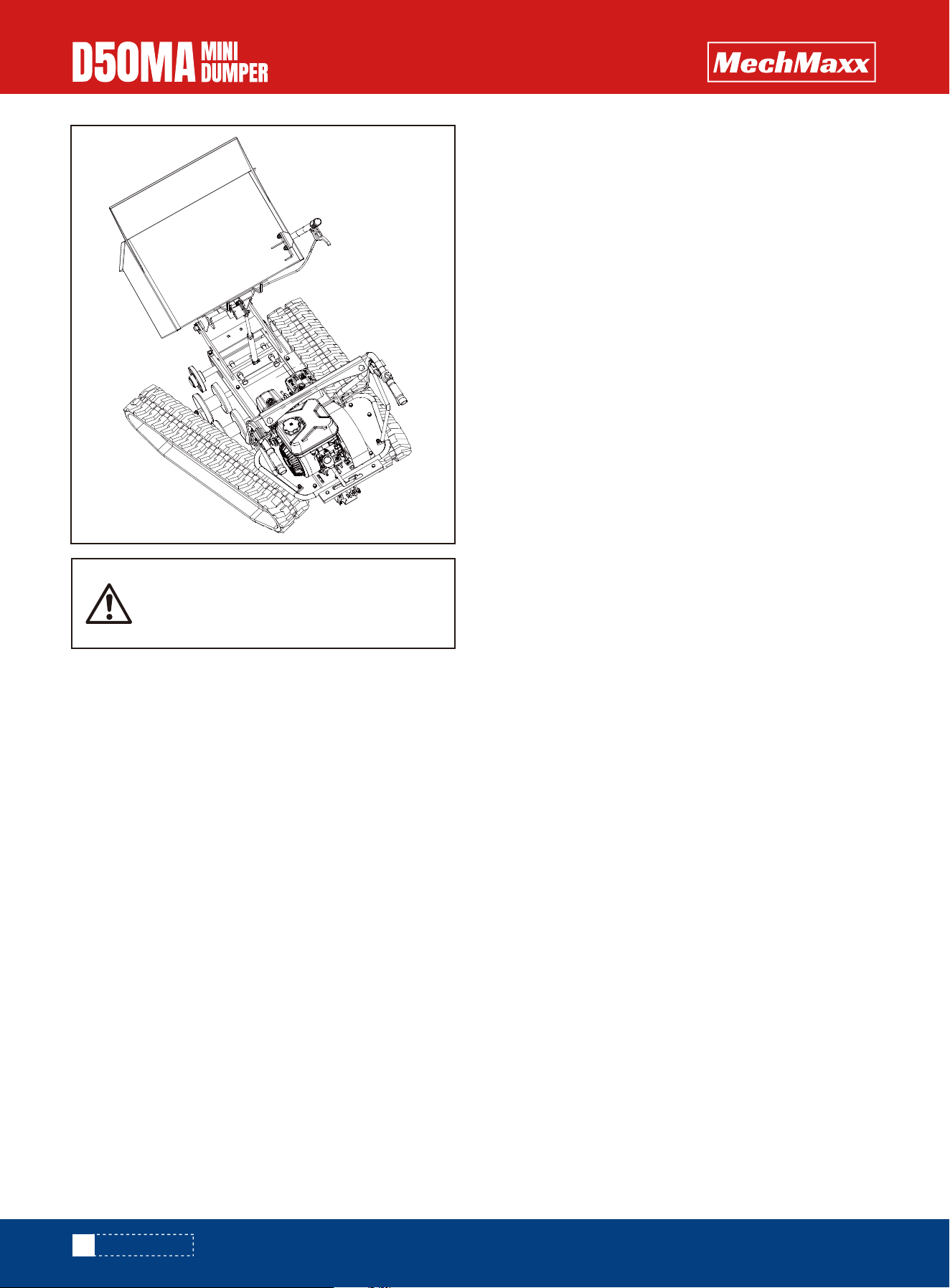
KNOW YOUR MACHINE
KNOW YOUR MACHINE
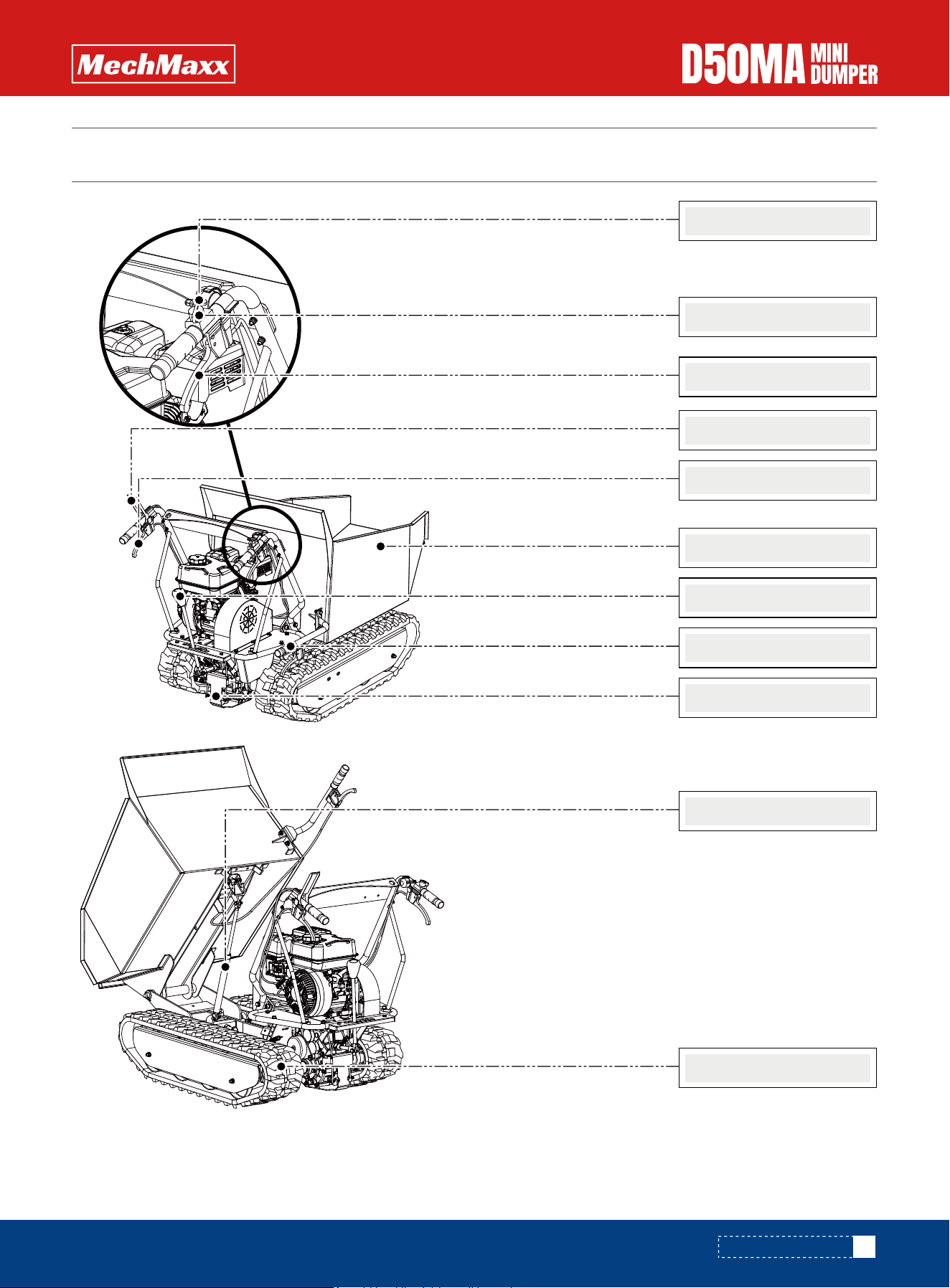
Throttle Control
Gas Spring Assistance
Engine Switch
Right Steering Lever
Dump Box
Gear Selection Lever
Tipping Handle
Gearbox
Track
Clutch Control Lever
Left Steering Lever
Always release the clutch control lever
before changing speeds. Failure to do so
will result in damage to the power track-
barrow.
Operate the steering levers only at a
reduced speed.
10
www. mechmaxx.com
KNOW YOUR MACHINE
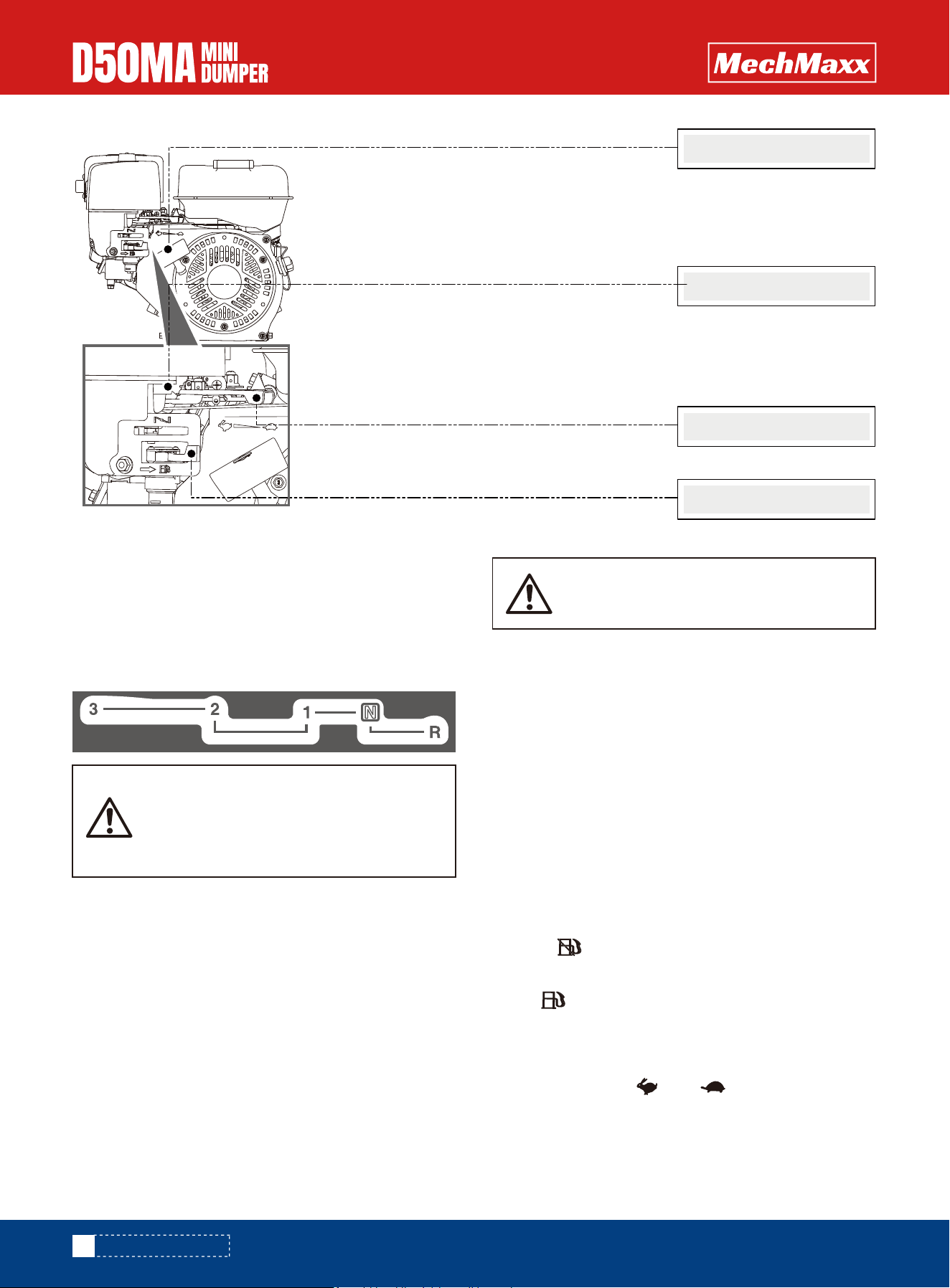
GEAR SELECTION LEVER
LEFT/RIGHT STEERING LEVER
The gear selection lever has 4 positions: 3 forward speeds
and 1 reverse. To change speeds, move the speed shift
lever to the desired position. The lever locks in a notch at
each speed selection.
GAS SPRING ASSISTANCE
The gas spring assistance provides support when lifting
and lowering the hopper.
ENGINE ON/OFF SWITCH
The engine switch has two positions. OFF engine will not
start or run. ON - engine will start and run.
The throttle control regulates the speed of the engine, and
moves between FAST SLOW and STOP positions.
The throttle control will shut off the engine when it is
moved to the STOP position.
The fuel shut-off has two positions:
CLOSED ( ) - Use this position to service, transport, or
to store the unit.
OPEN ( ) - Use this position to run the unit.
ENGINE ON/OFF SWITCH
FUEL SHUT-OFF VALVE
THROTTLE CONTROL
The recoil starter handle is used to start the engine.
Operate the lever to turn left/right.
Slower speeds are for heavier loads, while faster speeds
are for transporting light loads or an empty hopper. It is
recommended that you use a slower speed until you are
familiar with the operation of the power trackbarrow.
If the engine slows down under a load or the tracks slip,
shift the machine into a lower gear.
If the front of the machine rides up, shift the machine into
a lower gear. If the front continues to ride up, lift up on the
handles.
Recoil Starter Handle
Choke Control
Fuel Shut-Off Valve
Throttle Control

Never use choke to stop engine.
11
www. mechmaxx.com
The choke control is used to choke the carburetor and
assist in starting the engine. The choke control slides
between the CHOKE CLOSED and CHOKE OPEN posi-
tions.
Squeeze the control lever, clutch engaged. Release the
lever, clutch disengaged.
CHOKE CONTROL
CLUTCH CONTROL LEVER
KNOW YOUR MACHINE
12
www. mechmaxx.com
OPERATION
OPERATION
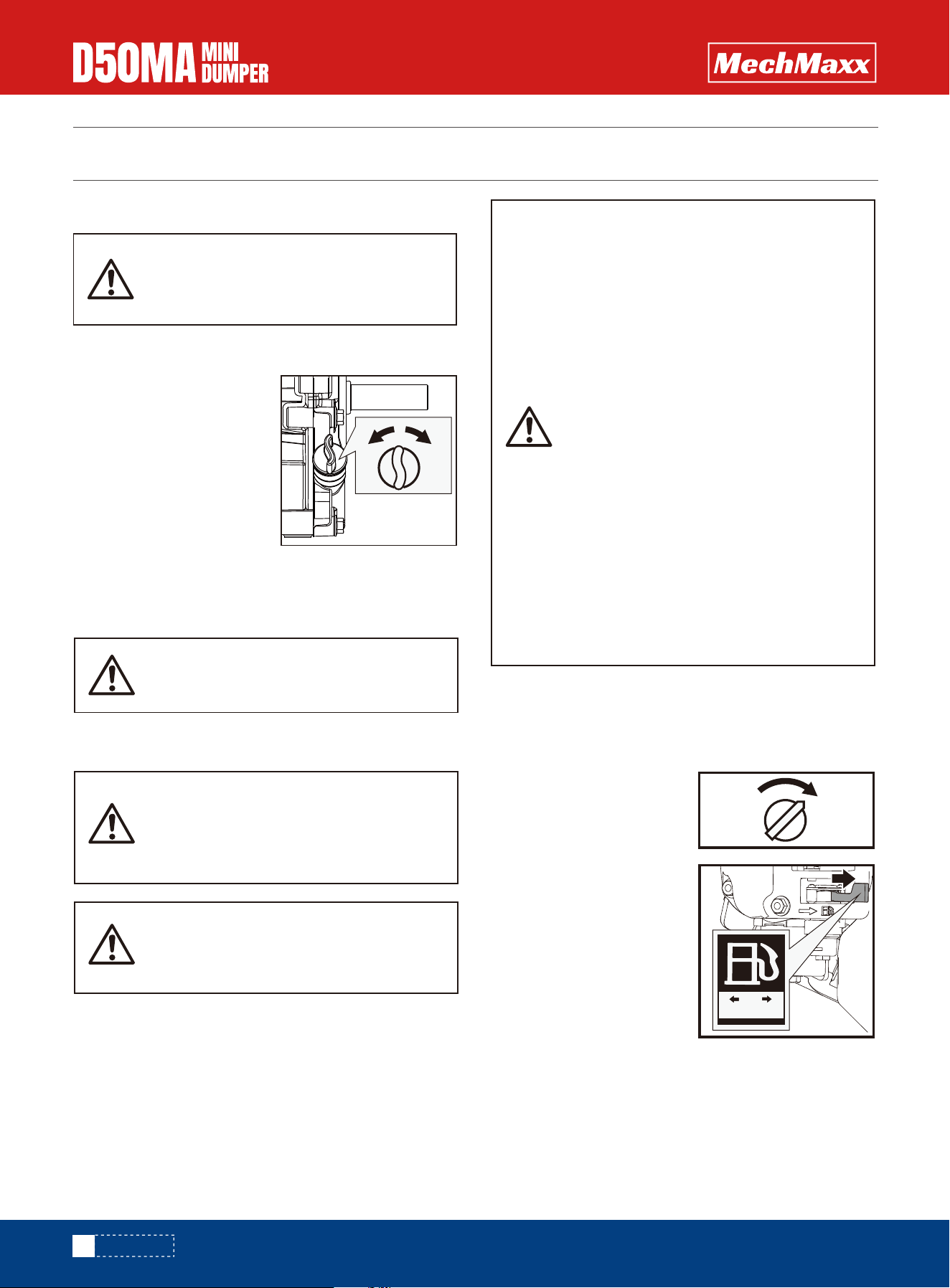
3. Using a funnel, add oil up to the FULL mark on the
dipstick. (See engine manual for oil capacity, oil recom-
mendation, and location of fill cap.).
1. The engine must be off and allowed to cool at least two
minutes before adding fuel.
2. Remove the fuel filler cap and fill the tank. (See engine
manual for fuel capacity, fuel recommendation, and
location of fuel cap.)
No oil in the engine originally, but a bottle
of engine oil is in scope of delivery. Don't
start the engine before adding oil.
DO NOT OVERFILL. Check engine oil level
daily and add as needed.
This equipment and/or its engine may
include evaporative emissions control
system components, required to meet
EPA and/or CARB regulations, that will
only function properly when the fuel tank
has been filled to the recommended level.
Overfilling may cause permanent damage
to evaporative emissions control system
components. Filling to the recommended
level ensures a vapor gap required to
allow for fuel expansion. Pay close atten-
tion while filling the fuel tank to ensure
that the recommended fuel level inside
the tank is not exceeded. Use a portable
gasoline container with an appropriately
sized dispensing spout when filling the
tank. Do not use a funnel or other device
that obstructs the view of the tank filling
process.
Gasoline is highly flammable and explo-
sive. You can be burned or seriously
injured when handling fuel. Use extreme
care when handling gasoline.
Fill the fuel tank outdoors, never indoors.
Gasoline vapors can ignite if they collect
inside an enclosure. Explosion can result.
ADD OIL TO ENGINE
ADD GASOLINE TO ENGINE
1. Make sure the power trackbarrow is on a flat, level surface.
2. Remove the oil fill cap/
dipstick to add oil.
CLOSEDOPEN
3. Reinstall the fuel cap and tighten. Always clean up
spilled fuel.
IMPORTANT:DO NOT OVERFILL!
2.Open the fuel shut-off valve.
1. Move the engine switch to
the ON position.
STARTING ENGINE
ONOFF
ONOFF
13
www. mechmaxx.com
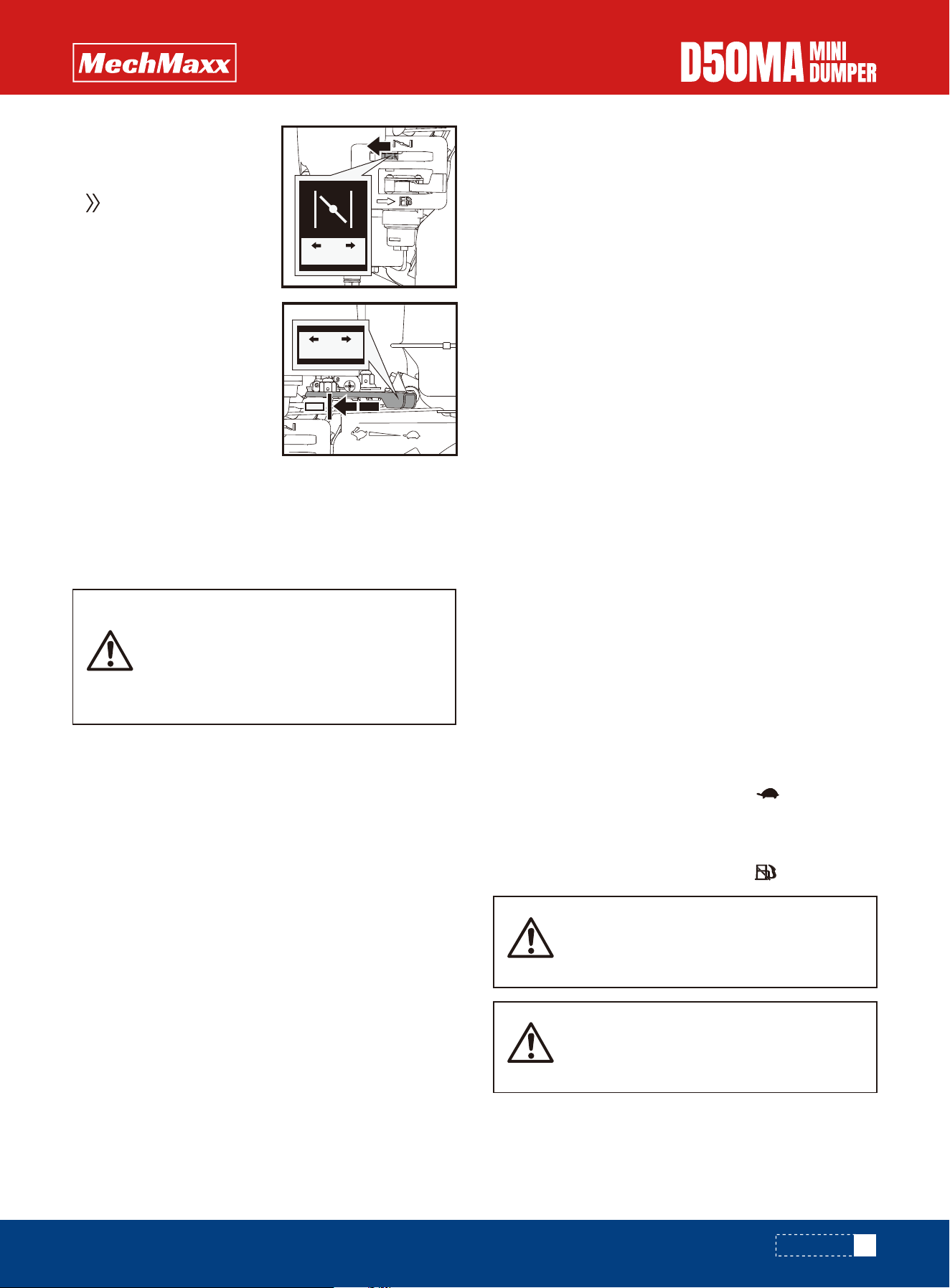
5. Pull the recoil starter until engine compression has
become difficult to pull. Let the recoil return to the home
position, then pull quickly to start the engine. Repeat
steps as needed. Fully open the choke and set the throt-
tle to the FAST position, before operating the unit.
Set the throttle control lever to the SLOW position to
reduce stress on the engine when work is not being
performed. Lowering the engine speed will help extend the
life of the engine, as well as conserve fuel and reduce
noise level.
To stop the engine in an emergency, simply turn the
engine switch to the OFF position. Under normal condi-
tions, use the following procedure:
1. Move the throttle lever to the SLOW( )position.
2. Let the engine idle for one or two minutes.
3. Turn the engine switch to the OFF position.
4. Turn the fuel valve lever to the OFF ( ) position.
After the engine warms up, move the throttle lever to
accelerate engine speed.
Engage the required gear and slowly squeeze the clutch
control lever. If the gear does not engage immediately,
slowly release the clutch lever and try again. In this way
the power trackbarrow will start moving.
The power trackbarrow has the steering levers on the
handlebars, which makes steering very easy. To turn right
or left, simply pull the corresponding right or left steering
lever.
The sensitivity of the steering increases in proportion to
the speed of the machine and the load. With an empty
machine, a light pressure on the lever is all that is needed
toturn. When the machine is fully loaded, more pressure
is required.
The power trackbarrow has a maximum capacity of 660
LBS. However, it is advisable to assess the load and
adjust it according to the ground on which the machine
will be used.
It is therefore advisable to cover such stretches using
low gear and taking extra care. In such situations, the
machine should be kept in low gear for the whole stretch.
Avoid sharp turns and frequent changes of direction while
driving on rough, hard terrains full of sharp, uneven points
with a high degree of friction.
Even though the unit has rubber tracks, remember to be
careful when working in adverse weather conditions (ice,
heavy rain and snow) or on types of ground that could
make the power trackbarrow unstable.
Please note that as this is a tracked vehicle, it is subject
to a considerable pitching movement when passing over
bumps, holes and steps.
When the clutch control lever is released, the machine
will stop and brake automatically.
If the machine is stopped on a steep slope, a wedge
should be placed against one of the tracks.
Rapid retraction of the starter cord (kick-
back) will pull your handand arm toward
the engine faster than you can let go.
Broken bones, fractures, bruises, or
sprains could result.
Sudden stopping at a high speed under a
heavy load is not recommended. Engine
damage may result.
Do not move the choke control to CLOSE
to stop the engine. Backfire or engine
damage may occur.
3.Move the choke lever to the
CLOSED position.
If the engine is hot,
closing the choke is not
necessary.
SLOWFAST
OPENCLOSED
4. Move the throttle lever
slightly to the FAST speed.
OPERATING
IDLE SPEED
STOP ENGINE
SLOWFAST
OPERATION
MAINTENANCE
14
www. mechmaxx.com
1. Turn off the engine and disengage all command levers.
The engine must be cool.
2. Keep the engine's throttle lever in its SLOW position
and remove the spark plug wire from the spark plug and
secure.
3. Inspect the general condition of the power trackbarrow.
Check for loose screws, misalignment or binding of
moving parts, cracked or broken parts, and any other
condition that may affect its safe operation.
4. Use a soft brush, vacuum or compressed air to remove
all contaminants from the machine. Then use high quality
light oil to lubricate all moving parts.
5. Check the spark plug wire regularly for signs of wear,
and replace when needed.
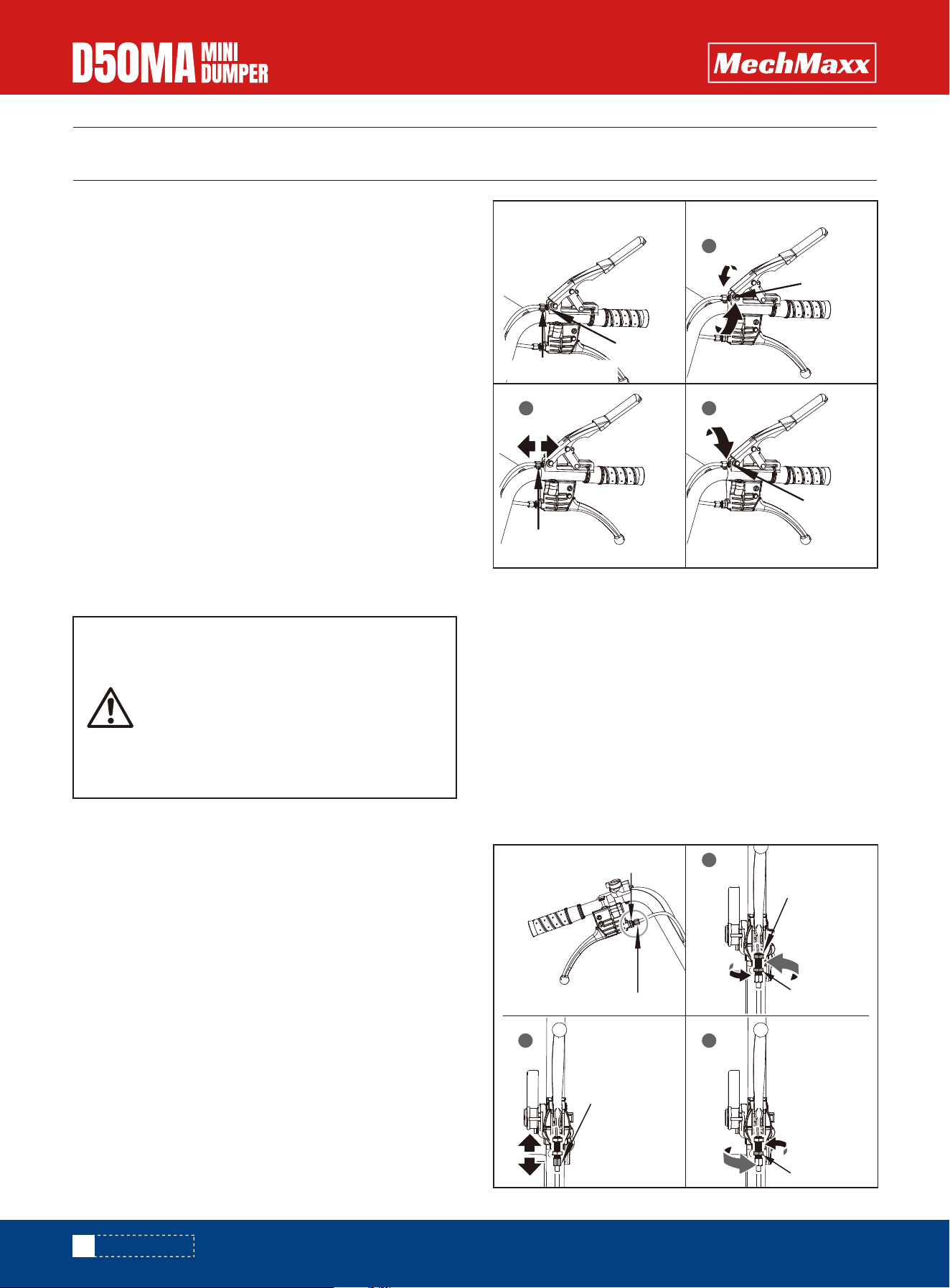
When the clutch begins to show wear, the handle reach
will become wider, making it more difficult to reach.
Follow these steps to return the clutch lever back to its
original position.
1. Loosen the jam nut by turning it counter clockwise with
10mm wrench.
2. Tighten or loosen the cable by turning the cable adjust-
ment nut clockwise or counter clockwise with 10mm
wrench until you have reached your required tightness.
3. Once tightness is set, return the jam nut against the
handle to hold the cable in place.
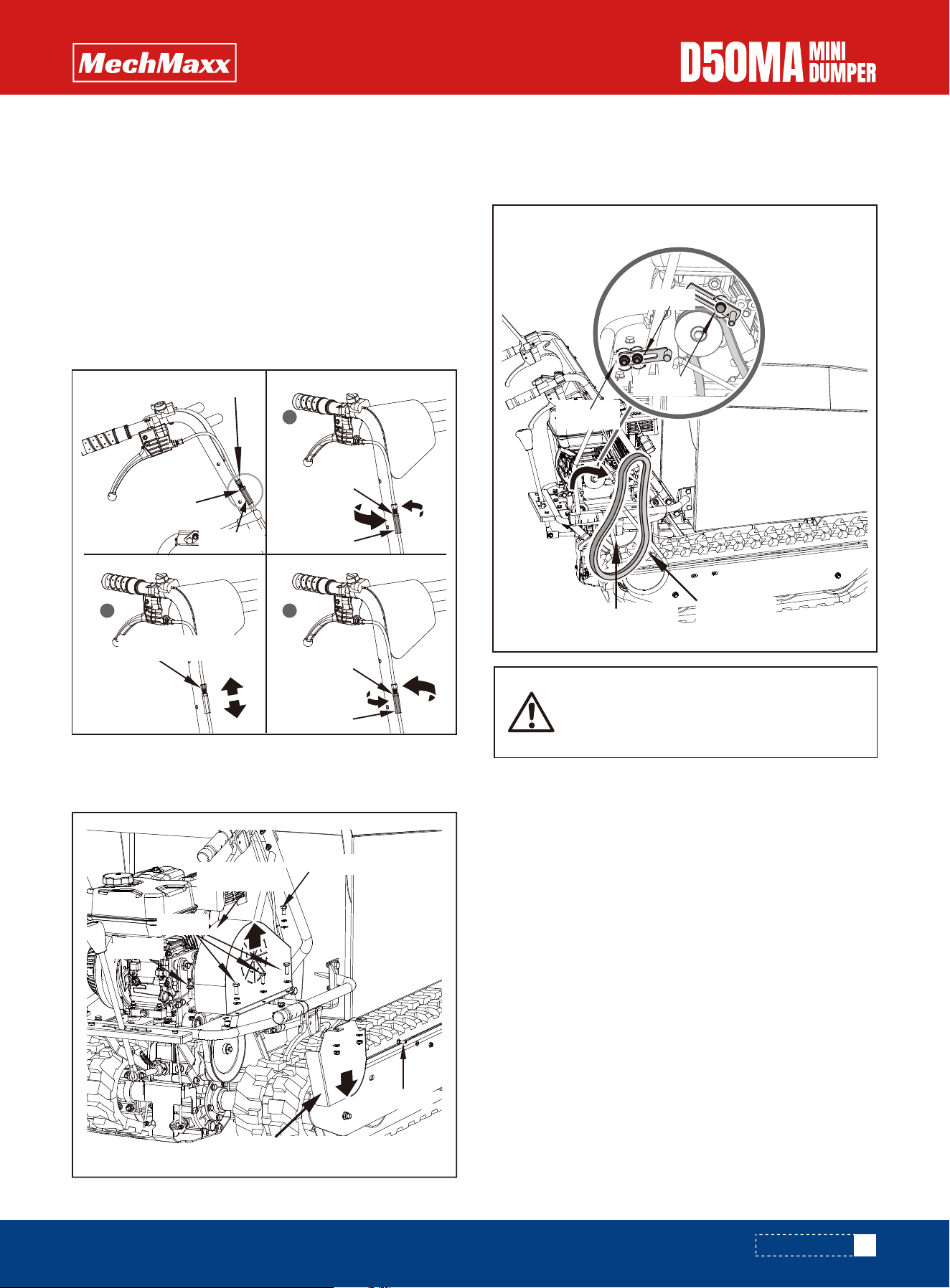
If steering becomes difficult to engage follow these steps
to adjust the cable tension.
1. Loosen the jam nut by turning it counter clockwise
with 10mm wrench.
2. Tighten or loosen the cable by turning the cable adjust-
ment nut clockwise or counter clockwise with 10mm
wrench until you have reached your required tightness.
3. Once tightness is set, return the jam nut against the
handle to hold the cable in place.
Never use a "pressure washer" to clean
your unit. Water can penetrate tight areas
of the machine and its transmission case
and cause damage to spindles, gears,
bearings, or the engine. The use of pres-
sure washers will result in shortened life
and reduce serviceability.
Maintaining your mini tracked dumper will ensure long life
to the machine and its components.
MAINTENANCE
PREVENTIVE MAINTENANCE
ADJUSTING CLUTCH
ADJUSTING STEERING
Jam Nut
Adjustment Nut
Adjustment Nut
Jam Nut
Jam Nut
1
2 3
1
Jam Nut
Lock Nut
2 3
Jam Nut
Adjustment Nut
Adjustment Nut
Jam Nut
15
www. mechmaxx.com
MAINTENANCE
If the above adjustment does not create enough cable
tension, follow the steps below:
1. Loosen the jam nut by turning it counter clockwise
with 12mm wrench.
2. Tighten or loosen the cable by turning the cable
adjustment nut clockwise or counter clockwise with
10mm wrench until you have reached your required tight-
ness.
3. Once tightness is set, return the jam nut against the
handle to hold the cable in place.
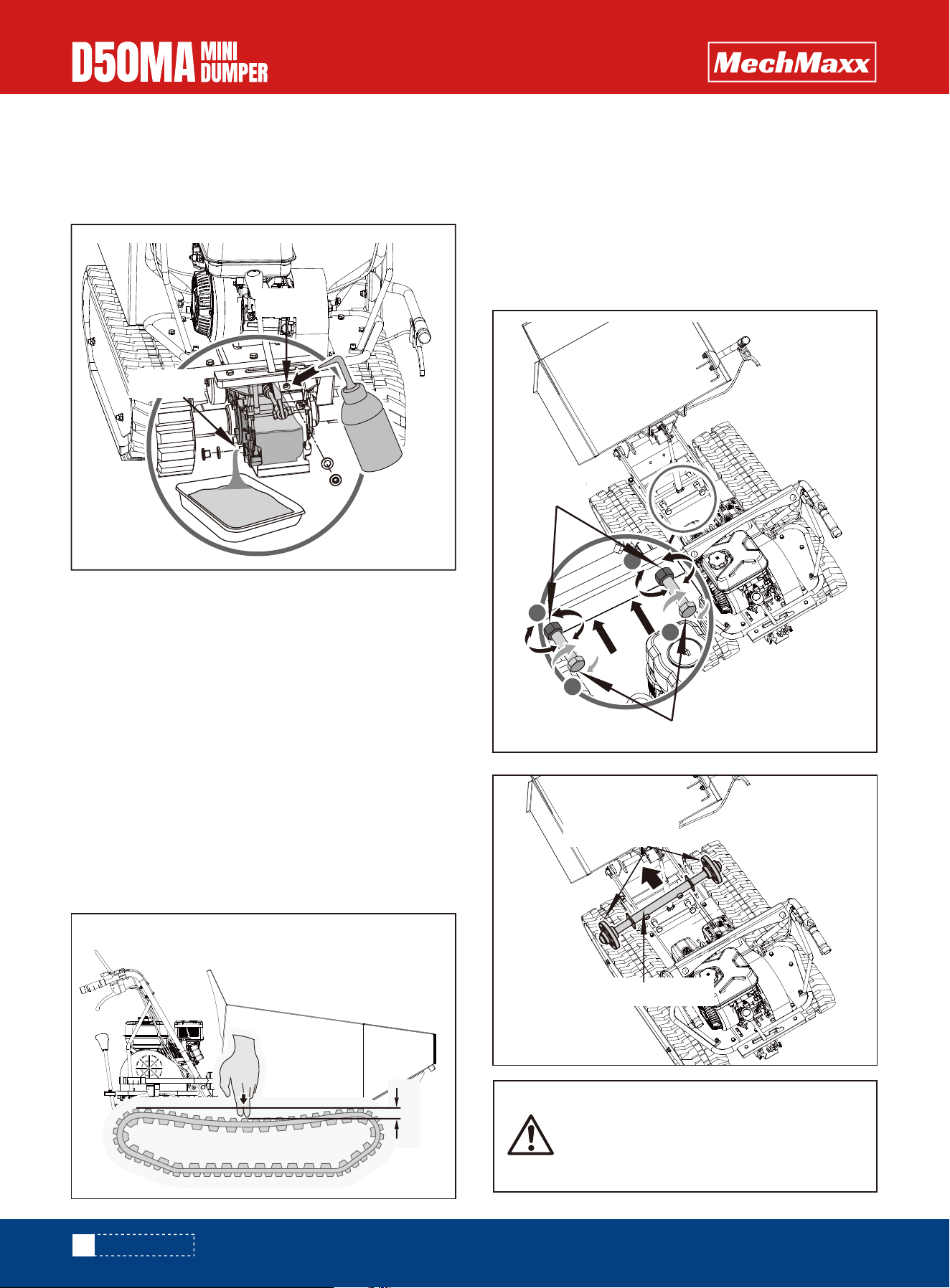
You may need to loosen the belt guide
bracket and slide back before removing
belt.
Remove the belt cover for gearbox pulley.
Loosen the two bolts M8X25 and one bolt M8×30 that fix
the two belt blockers, no need to remove them. Pull out
the belt.
REPLACING DRIVE BELT
Lightly lubricate all moving parts of the machine at end of
the season or every 25 operating hours.
GENERAL LUBRICATION
The gearbox is pre-lubricated and sealed at the factory.
Unless there is evidence of leakage or service has been
performed on the gearbox, no additional lubricate should
be required until 50 hours use.
After first 50 hours use, change all the gear oil. Capacity
is 1.5L.
For future use, check the oil level after every 50 hours of
use. If you remove the oil level plug and no oil flows out,
please add oil and then screw the oil level plug.
Gear oil GL-5 or GL-6, SAE80W-90 is recommended. Do
not use synthetic oil.
GEARBOX LUBRICATION
1
Jam Nut
Jam Nut
Lock Nut
Lock Nut
2
Adjustment Nut
3
Jam Nut
Adjustment Nut
Lock Nut
M6×20
M8×16
Belt Cover
Belt Cover for Gearbox Pulley
M8×20
M8×25
M8 × 25
M8 × 25
M8 × 30
Drive Belt
Gearbox Pulley
16
www. mechmaxx.com
MAINTENANCE
Do not over-tighten your track. The
adjustment of the track and the brakes are
linked. The braking power will lessen the
more the track is tightened.
TIGHTENING TRACKS
With use, tracks tend to loosen. When operating with
loose tracks, they tend to slip over the driving wheel
causing it to jump its housing, thus damaging wear to the
housing.
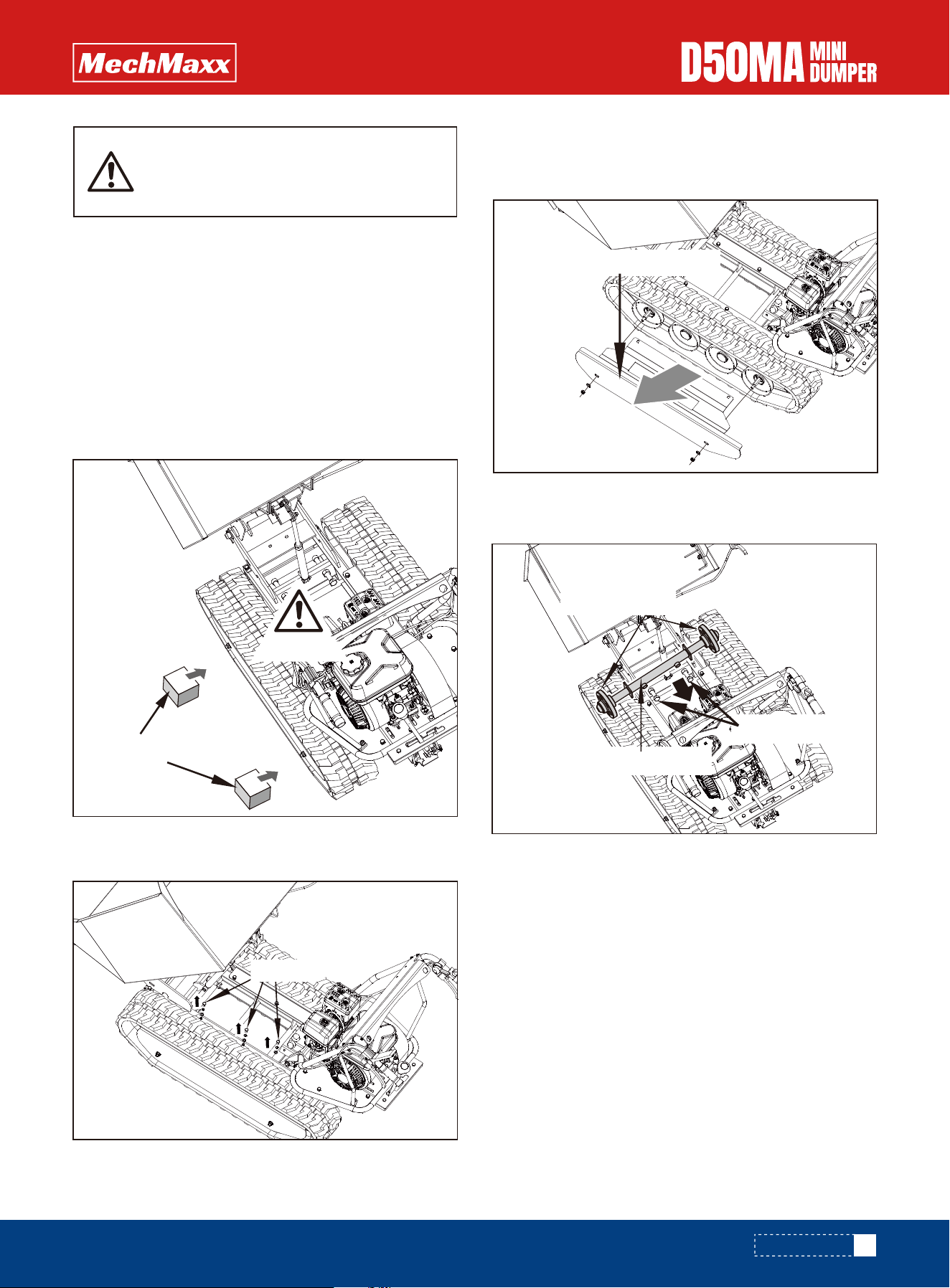
To check track tightness, proceed as follows.
1. Set the machine on a flat surface with compact
ground, or on asphalt or pavement.
2. Lift the machine and set it on blocks or supports rated
for the weight of the machine so that the tracks are
approximately 4" off the ground.
3. Measure the track midline vs. the horizontal line. The
reading must not be more than 10cm-15cm
When replacing gear oil, the engine must be stopped and
still warm. Unscrew the filter cap and the drain plug.
When oil is drained, replace the drain plug, fill up with
fresh oil, and then replace the filter cap.
If the distance is greater, proceed as follows.
1. Use the tipping handle to tip the hopper and set it on
blocks or supports rated for the weight of the box.
2. Loosen lock nut A.
3. Tighten bolt B until the correct tightness is restored.
4. Secure bolt B by tightening lock nut A thoroughly.
5. Return the hopper to its original position.
Oil Filler
Oil Outlet
10cm ~ 15cm
Adjusting Bolt
A
B
A
B
Jam Nut
Steering Wheel Axle
Steering Wheel
17
www. mechmaxx.com
If the adjustment bolt has no more adjust-
ment left, the tracks may have to be
replaced.
REPLACING TRACKS
Check the condition of the tracks periodically. lf any track
is cracked or frayed, it should be replaced as soon as
convenient.
1. Lift up the hopper and insert a support rod for safety
purposes.
2. Lift the machine and set it on blocks or supports rated
for the weight of the machine so that the tracks are
approximately 10 cm off the ground.
3. Remove the three M8×16 bolts and washers that fix
the track protection guard.
4. Remove the two M1O nuts and washers from the side
of track protection guard and take off the track protection
guard.
5. Loosen the adjusting bolts and pull the steering wheel
axle toward the engine, then track will be loosen.
6. Remove the M10×60 bolt, washers and nut from the
driving wheel.
7. Pull out the whole track with driving wheel.
Support Object
Danger Area
M8 × 16
Track Protection Guard
Steering Wheel Axle
Steering Wheel
Adjusting Bolt
MAINTENANCE
18
www. mechmaxx.com
When removing or installing the tracks, be
careful not to get your fingers caught
between the track and pulley.
ENGINE MAINTENANCE
Refer to the Engine Manual included in your unit for the
information on engine maintenance. Your engine manual
provides detailed information and a maintenance sched-
ule for performing the tasks.
MAINTENANCE
STORAGE
19
www. mechmaxx.com
STORAGE
Do not use strong detergents or petroleum
based cleaners when cleaning plastic
parts. Chemicals can damage plastics.
Do not store the machine with fuel in a
non-ventilated area where fuel fumes may
reach flame, sparks, pilot lights or any
ignition sources.
If the mini tracked dumper will not be used for a period
longer than 30 days, follow the steps below to prepare
your unit for storage.
1. Drain the fuel tank completely. Stored fuel containing
ethanol or MTBE can start to go stale in 30 days. Stale
fuel has high gum content and can clog the carburetor and
restrict fuel flow.
2. Start the engine and allow it to run until it stops. This
ensures no fuel is left in the carburetor. Run the engine
until it stops. This helps prevent gum deposits from
forming inside the carburetor and possible engine
damage.
3. While the engine is still warm, drain the oil from the
engine. Refill with fresh oil of the grade recommended in
the Engine Manual.
4. Use clean cloths to clean off the outside of the
machine and to keep the air vents free of obstructions.
5. Inspect for any loose or damaged parts. Repair or
replace damaged parts and tighten loose screws, nuts or
bolts.
6. Store your unit on flat ground in a clean, dry building
that has good ventilation.

Engine fails to start.
Engine runs erratically.
Engine over heats.
Machine does not move
while engine is running
One of the two tracks is
blocked.
1. Attach spark plug wire securely to spark
plug.
2. Fill with clean, fresh gasoline.
3. Throttle must be positioned at choke for a
cold start.
4. Clean the fuel line.
5. Clean, adjust gap, or replace.
6. Wait a few minutes to restart, but do not
prime.
1. Connect and tighten spark plug wire.
2. Move choke lever to OFF.
3. Clean fuel line. Fill tank with clean, fresh
gasoline.
4. Clear vent.
5. Drain fuel tank. Refill with fresh fuel.
6. Clean or replace air cleaner.
7. Refer to Engine Manual.
1. Fill crankcase with proper oil.
2. Clean air cleaner.
3. Remove housing and clean.
4. Refer to Engine Manual.
1. Ensure gear lever is not in between two
different gears.
2. Tighten drive belt.
Remove the foreign body.
TROUBLESHOOTING
Remedy
Problem
Cause
1. Spark plug wire disconnected.
2. Out of fuel or stale fuel.
3. Choke not in open position.
4. Blocked fuel line.
5. Fouled spark plug.
6. Engine flooding.
1. Spark plug wire loose.
2. Unit running on CHOKE.
3. Blocked fuel line or stale fuel.
4. Vent plugged.
5. Water or dirt in fuel system.
6. Dirty air cleaner.
7.Improper carburetor adjustment.
1. Engine oil level low.
2. Dirty air cleaner.
3. Air flow restricted.
4. Carburetor not adjusted properly
1. Gear is not properly selected.
2. Drive belt not tight enough.
Foreign bodies have worked their
way between the track and the
frame.
20
www. mechmaxx.com
TROUBLESHOOTING