SAC ST0180C
EN
SPOT AIR CONDITIONER
Translation of the original manual
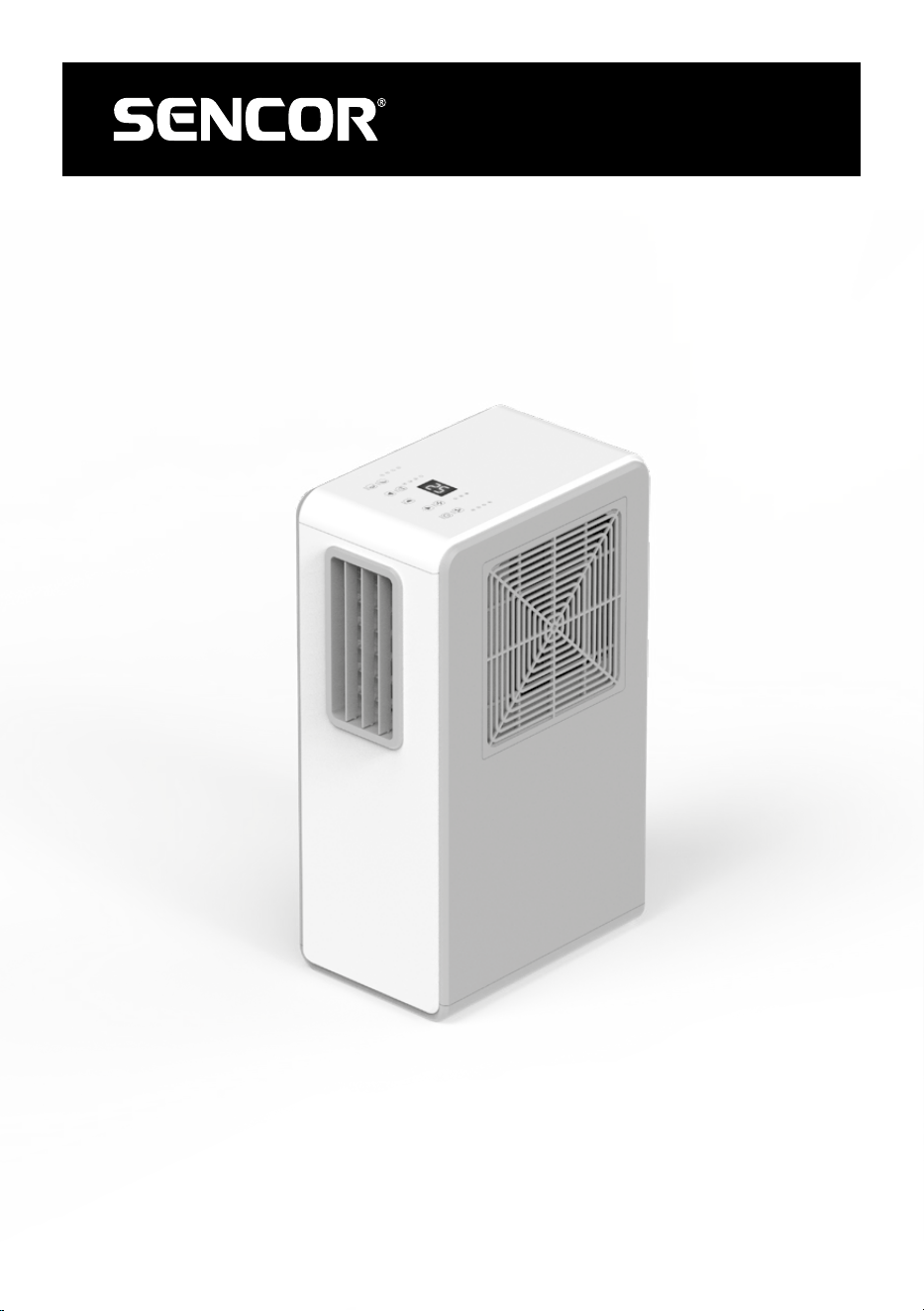
SAC ST0180C
A
1
2
3
4
5
6
7
8
9
B
1 2 3 4
C
SILENT
SWING – +POWER
TIMER SPEED MODE
10
1 2
6
3
4
5
7
8 9
D
1
2
3
4
7
6
5
E
F
G1
G2
G3 H
I

- 1 -
01/2026
2026, .
EN
Spot Air Conditioner
User Manual
IMPORTANT SAFETY INSTRUCTIONS
READ CAREFULLY AND STORE FOR FUTURE USE.
• This appliance may be only used by children aged
8years and older and by persons with physical, sensory
or mental impairments or lack of experience and
knowledge, if they are supervised or have been instructed
on the safe use of the appliance and understand the
potential hazards.
• Cleaning and maintenance must not be performed by
unsupervised children. Children must not play with the
appliance.
• If the power cord is damaged, it must be replaced by an
authorised service centre or by another similarly qualified
person, this will prevent the creation of adangerous
situation. It is forbidden to use the appliance if it has
adamaged power cord.
• The appliance must be installed in accordance with
national installation codes.
• The appliance must be stored in amanner that prevents its
mechanical damage.
• The appliance must be stored in awell ventilated location,
where the dimensions of the room must correspond to the
dimensions specified for its operation.
• The appliance must be stored in aroom where an
open flame is not continuously in use (e.g. running gas

- 2 -
01/2026
2026, .
appliance) or where there are sources of ignition (e.g.
running electrical heating element).
. . . . . . . . . . . . . . . . . . . . . . . . . . . . . . . . . . . . . . . . . . . . . . . . . . . . . . . . . . . . . . . . . . . . . . . . . . . . . . . . . . . . . . . . . . . . . . . . . . . . . . . . . . . . . . . . . . . . . . . . . . . . . . . . . . . . . . . . . . . .
• Before connecting the appliance to apower socket, check that the rated voltage on its rating label matches the electrical voltage in the power socket.
• Connect the appliance only to a properly earthed socket.
• The power socket must be freely accessible so that it is possible to quickly disconnect the power cord from the power source if necessary.
• The appliance is designed for use in household, offices and similar types of areas. Do not use it in rooms where it could be exposed to dripping or
spraying water, where it could be exposed to direct sunlight, in areas where chemical or explosive substances are stored, in industrial surroundings
or outdoors. Do not use it in the vicinity of abath, shower, swimming pool, etc.
• Keep the appliance away from open flames or heat sources.
• Do not place the appliance on unstable surfaces such as carpets with very long and thick fibres.
• The appliance may only be used on adry, stable, smooth and horizontal surface.
• The appliance is equipped with travel wheels so pay extra attention when handling it so that it does not fall down stairs or travel down from sloped
areas. If necessary secure the wheels using the stoppers.
• Only use original parts to assemble the appliance. Before starting to assemble the appliance, make sure that it is turned off and disconnected from
the power socket.
• Prior to connecting the appliance to apower socket, make sure that the appliance is correctly assembled according to the instructions in this
user'smanual.
• Do not touch the appliance with wet or damp hands. This applies especially when it is connected to apower socket.
• Do not submerge the appliance in water or in any other liquid.
• Do not cover or insert anything into the air inlet or air outlet openings. This could damage the appliance.
• During operation, there must be sufficient space for air circulation with at least 30 cm of free space on all sides.
• Do not expose yourself to a cold air current for a long time. This could have a negative effect on your health.
• To turn the appliance on or off, always use the appropriate buttons on the control panel. Do not turn off the appliance by disconnecting the power
cord from the power socket.
• Always turn off the appliance and disconnect it from the power socket when leaving it without supervision, when not using it and before moving,
disassembling or cleaning it.
• Do not attempt to remove the outer case of the appliance.
• Unplug the appliance from the power socket by pulling the plug, not the power cord. Otherwise, damage to the power cable or socket could occur.
• Do not use the appliance if damaged in any way, or with a damaged mains cable or plug.
• Store the appliance in a vertical position. It may only be transported in the vertical position. If you have already used the appliance, check that all the
condensate has been drained. After transporting it, wait at least 1 hour before using the appliance.
• Do not use the appliance if it is not working correctly, if it has been damaged or has been submerged in water. To avoid ahazardous situation arising,
do not repair the device yourself or modify it in any way. All repairs should be carried out by an authorised service centre. Tampering with the
appliance may result in the loss of your legal rights regarding faulty performance or warranty for quality.
• This appliance is intended for use by experts or trained personnel in stores, light industry and in agriculture, or for commercial use by ordinary
people.
Special safety instructions regarding batteries
• The remote control uses a type of battery topower it: 1× CR2032.
• The batteries are not a toy. Ensure that children do not play with the batteries. Keep new and old batteries out of the reach of children. Batteries pose
a serious health risk in the event of ingestion (chemical burns withserious consequences or suffocation) within a very short time. If the battery is
suspected to be ingested, seek medical help immediately.
• Use only the battery types recommended by the manufacturer.
• Do not combine new and old batteries, various brands or types of batteries (alkaline or rechargeable).
• The batteries must be correctly inserted according to the polarity. Improperly inserted batteries can damage the product, causing the battery to
short-circuit or leak.
• Before inserting, check that the batteries are not damaged, deformed or inflated. Using damaged batteries in any way poses a risk of fire, explosion
or serious injury.
• After inserting or replacing the batteries, check that the battery compartment cover is not damaged, that it is properly closed to prevent the batteries
from falling out. If the battery compartment cover is damaged, cracked or missing, do not use the product andhave it repaired.
• Do not use the product withdischarged batteries. Replace discharged batteries with new ones. This will prevent possible damage to the product or
leakage of the batteries.
• Wash your hands before andafter replacing the batteries. You will prevent the transfer of dirt.
• If you do not use the product for an extended period of time, remove the batteries to prevent them from leaking and damaging the product.
• Store the batteries and the product with the batteries in a dry, cool andwell ventilated place. The recommended storage temperature is 5 to 45 °C.
Do not store batteries or the product withbatteries in wet or dusty environments, inextreme temperatures, or inenvironments where toxic, chemical,
or explosive substances are stored or used.
• Do not expose the battery or product with the batteries to direct sunlight.
• Do not throw batteries into a fire or use open flames near them, e.g. candles. The battery may explode when exposed to high temperatures.
• Do not submerge the batteries in water or in any other liquid. Do not place any containers filled with water, e.g. a vase on the batteries.
• Do not expose batteries to mechanical damage, disassemble or deform them. There is a risk of electrolyte leakage, explosion andserious injury
dueto chemical burns.
- 3 -
01/2026
2026, .
• Do not short-circuit the battery. Do not leave the batteries loose, e.g. in a drawer, withmetal items (paper clips, coins, keys, etc.). There is a risk of
short-circuiting.
• Do not attempt to recharge batteries that are not intended to be rechargeable. There is a risk of explosion andserious injury dueto chemical burns.
• Batteries contain environmentally damaging compounds and therefore do not belong in standard municipal waste. Take used batteries for proper
disposal at a designated battery collection point.
• In theevent of a battery leak, do not touch the leaked electrolyte with your bare hands. Use protective aids (protective gloves, goggles or a
respirator). We recommend opening windows or doors to ensure adequate ventilation of the space. When skin is affected, rinse the affected area
with clean cold water; rinse the affected eyes with plenty of clean water andseek medical help; when swallowed, immediately contact emergency
medical help, rinse mouth, but do not induce vomiting.
. . . . . . . . . . . . . . . . . . . . . . . . . . . . . . . . . . . . . . . . . . . . . . . . . . . . . . . . . . . . . . . . . . . . . . . . . . . . . . . . . . . . . . . . . . . . . . . . . . . . . . . . . . . . . . . . . . . . . . . . . . . . . . . . . . . . . . . . . . . .
Read this user'smanual carefully prior to installing or operating your new appliance. Make sure to keep it for future reference.
Read the technical documentation.
Read the user's manual.
Fire hazard
The appliance contains aflammable refrigerant. It is necessary to adhere to safety instructions.
. . . . . . . . . . . . . . . . . . . . . . . . . . . . . . . . . . . . . . . . . . . . . . . . . . . . . . . . . . . . . . . . . . . . . . . . . . . . . . . . . . . . . . . . . . . . . . . . . . . . . . . . . . . . . . . . . . . . . . . . . . . . . . . . . . . . . . . . . . . .
SERVICE MANUAL
• The service manual is intended only for a qualified person who is authorized to handleflammable refrigerants.
1.1 Checking the area
Before starting work on a system containing flammable refrigerants, safety checks are necessary to ensure that the risk of ignition is minimized.
Whenrepairing the cooling system, the following precautions must be taken before carrying out work on it.
1.2 Working procedure
The work must be carried out in a controlled manner so as to minimize the risk of flammable gases or vapours being present when the work is carried
out.
1.3 Overall working space
All maintenance personnel andother on-site workers must be instructed about thenature ofthe work being done. Work in confined spaces must be
avoided. The area around the workplace must be divided into sections. It must be ensured that the conditions inside the space are safe by carrying out a
check of flammable materials.
1.4 Checking the presence of refrigerant
The space must be inspected by an appropriate refrigerant detector before andduring operation to ensure technicians are aware ofpotentially
flammable atmospheres. It must be ensured that the leakage detection equipment used is suitable for use on flammable refrigerants, i.e. non-sparking,
adequately sealed or intrinsically safe.
1.5 Presence of fire extinguisher
If any hot work is to be carried out on the refrigeration equipment or associated parts, suitable fire extinguishing equipment must be at hand. The fire
extinguisher must be powder or CO
2
in the vicinity of the filling area.
1.6 No ignition sources
No person carrying out work on a refrigeration system involving the stripping of any pipework containing or having contained flammable refrigerant
shall use any sources of ignition in such a way as to result in a risk of fire or explosion. All possible ignition sources, including cigarette smoking, should
be kept sufficiently away from the installation, repair, removal anddisposal sites during which the flammable refrigerant may eventually be discharged
into the surrounding area. Before work is carried out, the area around the equipment must be inspected to ensure that there are no burning or ignition
hazards. “No smoking” signs must be displayed.
- 4 -
01/2026
2026, .
1.7 Ventilated Space
It must be ensured that the space is open or adequately ventilated before the system is disrupted or hot work is carried out. The ventilation intensity
must last for the duration of the work. Ventilation should safely disperse any discharged refrigerant andpreferentially take it out into the atmosphere.
1.8 Checks of refrigerating equipment
Where electrical components are changed, the components shall be suitable for this purpose andcomply with the correct specification. Always
follow the manufacturer's instructions for maintenance andservice. If doubts arise, the technical department of the manufacturer must be consulted
forassistance.
Forinstallations containing flammable refrigerants, the following checks must be carried out:
• the size of the refill is consistent with the size of the room in which the refrigerant-containing parts are installed;
• ventilation units andoutlets work at full capacity andare not clogged;
• if an indirect refrigerant circuit is used, the second circuit must be checked for the presence of refrigerant;
• the marking of the device must always be visible andlegible; markings andmarks that are not legible must be repaired;
• cooling pipes or components are installed inplaces where they are unlikely to be exposed to any substances that may corrode the components
containing the refrigerant, unless these components are constructed ofmaterials that are internally resistant to corrosion or are suitably protected
against corrosion.
1.9 Electrical Instrument Inspection
Repairs andmaintenance of electrical components must include safety checks andinspection of components.
If a fault occurs that could compromise safety, then no electrical power must be connected to the circuit until the fault is satisfactorily resolved.
If the malfunction cannot be corrected immediately but work must be continued, an appropriate temporary solution must be used. This must be
communicated to the owner of the device so that all parties are aware of it.
Initial security checks must ensure:
• that the capacitors are discharged: this must be done in a safe manner to avoid the possibility of sparks;
• that no electrical components andlines are exposed during filling, refreshing andcleaning of the system;
• that the grounding is not broken.
2. Servicing of sealed components
During repairs of sealed components, all electrical power must be disconnected from the equipment being worked on before the sealed lids are
removed, etc. If it is absolutely necessary to have electrical power at the equipment during service, then a permanently operating leak detection device
must be placed at the most critical point to warn of a potentially hazardous situation.
Particular care must be taken to ensure that work on electrical components has not altered the enclosure to such an extent as to affect the level of
protection. This must include damage to cables, excessive number of connections andterminals not made according to the original specification,
damage to seals, improper implementation of seals, etc.
It must be ensured that the appliance is mounted securely.
It must be ensured that the gaskets or sealing materials are not deteriorated so that they no longer serve the purpose of preventing the ingress of
flammable environments. Replacement parts must be inaccordance with the manufacturer's specifications.
Note:
The use of a silicone seal may inhibit the effectiveness of some types of leak detection devices. Internally safe components do not need
to be disconnected before they can be worked on.
3. Service of intrinsically safe components
No permanent inductive or capacitive load shall be applied to the circuit without ensuring that the permissible voltage andcurrent permitted for the
equipment in use are not exceeded.
Internally safe components are the only types that can be worked on in a flammable environment, evenif they are alive. The test apparatus must be
correctly dimensioned.
Parts are replaced only by parts specified by the manufacturer. Other parts may result in ignition of the refrigerant during leakage into the environment.
4. Cabling
It shall be checked that the wiring is not exposed to wear, corrosion, excessive pressure, vibration, sharp edges or any other adverse effects of the
environment. The check must also take intoaccount the effects of ageing or permanent vibrations from sources such as compressors or fans.
5. Use of flammable coolant
Under no circumstances should potential sources of ignition be used to search for or detect refrigerant leaks.
The halogen burner (or any other detector using an open flame) shall not be used.
6. Leak detection methods
The following leak detection methods are considered acceptable for systems containing flammable refrigerants.
Electronic leak detectors must be used to detect flammable refrigerants, but their sensitivity may not be adequate or may require recalibration. (The
detection device must be calibrated in a refrigerant-free compartment.) It must be ensured that the detector acquires a potential source of ignition
andthat it is suitable for the refrigerant used. The leak detection device must be set to a percentage of refrigerant LFL andmust be calibrated to the
refrigerant used and the appropriate percentage of gas confirmed (maximum 25%).
Leak detection fluids are suitable for use withmost refrigerants, but the use of chlorine-containing detergents must be excluded as chlorine may react
with the refrigerant andcorrode copper piping.
If leakage is suspected, all open fires must be removed/extinguished.
If a refrigerant leakage is found, which requires brazing, all refrigerant must be removed from the system or separated (by closing the valves) in the part
of the system away from the leakage. The system must then be purified with oxygen-free nitrogen (OFN), both before and after the brazing process.
7. Removal anddraining
Conventional procedures must be used when the cooling circuit is disrupted for repairs – or for any other reason. However, it is important to stick to the
best method because of the flammability. The following procedure must be followed:
• remove refrigerant;

- 5 -
01/2026
2026, .
• clean the circuit with inert gas;
• drain;
• clean again with inert gas;
• open the circuit by cutting or brazing.
The circuit filling must be removed to the correct sampling cylinders. The system must be “flooded” with OFN (oxygen-free nitrogen) to make the unit
safe. The procedure may need to be repeated several times. Compressed air or oxygen must not be used for this task.
Flooding can be achieved by disrupting the vacuum in the system with using OFN andcontinuing filling until the operating pressure is reached, then
venting into the air andfinally reducing to a vacuum. This process must be repeated as long as the refrigerant is in thesystem. When the last refill of
OFN is used, the system must be vented to atmospheric pressure to allow the work to be carried out. This operation is absolutely necessary if brazing is
to be carried out on the pipeline.
It must be ensured that the outlets for the pump are not close to any source of ignition andthat ventilation is provided.
8. Filling procedure
In addition to conventional filling procedures, the following requirements must be observed.
• It must be ensured that there is no contamination by various refrigerants when using the filling device. Hoses or pipes must be as short as possible to
minimize the amount of refrigerant contained inthem.
• The cylinders must be held vertically.
• Ensure that the cooling system is earthed before filling the system with refrigerant.
• When filling is complete, the system must be labelled (if it is not already).
• Extreme care must be taken not to overfill the cooling system.
Before refilling the system, it must be pressure tested with OFN. The system must be tested forleakage after filling but before commissioning. A
verification test must be carried out before leaving the assembly site.
9. Decommissioning
Before performing this procedure, it is essential that the technician is fully acquainted with the equipment andall its details. Sufficient practice is
recommended to remove all refrigerant safely. Oil andrefrigerant samples must be taken if analysis is required before the regenerated refrigerant can be
reused. It is essential that electricity is available before starting this activity.
a) Familiarization with the equipment andits operation.
b) Electrical disconnection of the system.
c) Before starting the procedure, ensure that:
– a mechanical device for handling the refrigerant cylinders is available, if required;
– all personal protective equipment was available and used correctly;
– the decommissioning procedure was constantly supervised by a competent person;
– the sampling device andthe cylinders comply with the relevant standards.
d) Drain the cooling system if possible.
e) If it is not possible to achieve a vacuum, a collection pipe is made so that the refrigerant can be taken from thedifferent parts of the system.
f) Ensure that the cylinder is placed on the scales before the sampling takes place.
g) The sampling device is switched on and the work is carried out according to the manufacturer's instructions.
h) The cylinders will not overfill. (No more than 80% of the liquid content of the cartridge.)
i) The maximum working pressure of the cylinder shall not be exceeded, even temporarily.
j) When the cylinders are properly filled and the procedure is completed, ensure that the cylinders andequipment are immediately removed from the
installation site andall isolation valves on the equipment are closed.
k) The removed refrigerant must not be filled into another refrigeration system until it has been cleaned andinspected.
10. Label precautions
• The device must be provided with a label stating that it has been decommissioned andis free of refrigerant. The label must be dated andsigned.
Ensure that the equipment bears labels indicating that the equipment contains a flammable refrigerant.
11. Removing
• When the refrigerant is removed from the system, either for service or for decommissioning, correct practice is recommended that all refrigerants are
removed safely.
• When transferring the refrigerant to the cylinders, it must be ensured that only appropriate cylinders are used to remove the refrigerant.
• It must be ensured that the correct number of cylinders is available to accommodate the total system load. All cylinders to be used must be designed
for the refrigerant to be removed andmarked with a label for this refrigerant (i.e. special cylinders for refrigerant removal). The cylinders must be
complete withsafety valve andassociated shut-off valves ingood operating condition. Empty sampling cylinders are drained and cooled down if
possible prior to collection.
• Sampling devices must be ingood working order with a set of instructions related to the devices that are at hand andmust be suitable for
removing flammable refrigerants. In addition, a set of calibrated scales ingood operating condition must be available. The hose must be complete
withdetachable couplings without leakage andingood condition. Before using the sampling device, it shall be checked that it is insatisfactory
operating condition, has been properly maintained andthat all associated electrical components are sealed to prevent ignition in the event of
refrigerant discharge. If inany doubt, the manufacturer shall be consulted.
• The collected refrigerant must be returned to the refrigerant supplier in the correct collection cylinder andwith the appropriate agreed waste transfer
letter. Refrigerants are not mixed in the sampling units, andespecially not in the cylinders.
• If compressors or compressor oils are to be removed, ensure that they have been drained to an acceptable level to ensure that no flammable
refrigerant remains in thelubricant. The draining procedure must be carried out before the compressor is returned to the supplier. Only electric
heating of the compressor body must be used to speed up this process. When oil is drained from the system, it must be safely removed.
- 6 -
01/2026
2026, .
. . . . . . . . . . . . . . . . . . . . . . . . . . . . . . . . . . . . . . . . . . . . . . . . . . . . . . . . . . . . . . . . . . . . . . . . . . . . . . . . . . . . . . . . . . . . . . . . . . . . . . . . . . . . . . . . . . . . . . . . . . . . . . . . . . . . . . . . . . . .
SPECIFIC INFORMATION FOR APPLIANCES USING REFRIGERANT GAS R290
• Carefully study all the warnings.
• For defrosting and cleaning, do not use any other tools than those recommended by the manufacturer.
• The appliance must be stored in aroom where there are no sources of ignition (e.g. open flame, gas appliance in operation, electrical heating
equipment in operation) in continuous operation.
• Do not puncture or burn the cooling circuit.
• It is necessary to take into consideration that refrigerants may be odourless.
• The appliance must be installed, operated and stored in aroom with afloor area greater than 3 m
2
.
• This appliance contains 56 g of refrigerant gas R290.
• R290 is arefrigerant gas that meets European environmental protection directives. Do not drill into or damage any part of the cooling circuit.
• Sufficient ventilation must be provided in the room where this appliance is installed operated or stored. Otherwise, there is arisk of an explosion or
fire in the event that leaked refrigerant ignites, e.g. when agas cooker is turned on, etc.
• The appliance must be stored in such amanner that its mechanical damage is prevented.
• Persons working with or repairing cooling circuits must have appropriate authorisation issued by an authorised institution that certifies this
person'scompetence to work with refrigerants in accordance with the specific assessment of the association for this sector.
• Maintenance tasks must be performed solely on the basis of the recommendations of this appliance'smanufacturer. Maintenance and repair
tasks that required the contribution of other qualified expert personnel may only be performed under the supervision of specialised experts in the
flammable refrigerants sector.
• Check the rating label for the type of refrigerant gas used in your appliance.
• Do not cover the vents.
• Adhere to national codes relating to gas.
. . . . . . . . . . . . . . . . . . . . . . . . . . . . . . . . . . . . . . . . . . . . . . . . . . . . . . . . . . . . . . . . . . . . . . . . . . . . . . . . . . . . . . . . . . . . . . . . . . . . . . . . . . . . . . . . . . . . . . . . . . . . . . . . . . . . . . . . . . . .
EXPLANATION OF SYMBOLS PLACED ON THE PRODUCT OR INTHE ACCOMPANYING
DOCUMENTATION
The product meets all the basic requirements of the applicable EU directives.
This symbol on products or accompanying documents means that used electric or electronic products must not be added to ordinary
municipal waste.
This symbol on the accumulator or battery means that the used battery must not be added to normal municipal waste.
. . . . . . . . . . . . . . . . . . . . . . . . . . . . . . . . . . . . . . . . . . . . . . . . . . . . . . . . . . . . . . . . . . . . . . . . . . . . . . . . . . . . . . . . . . . . . . . . . . . . . . . . . . . . . . . . . . . . . . . . . . . . . . . . . . . . . . . . . . . .
- 7 -
01/2026
2026, .
• Thank you for purchasing our SENCOR product; we hope it will serve
to your satisfaction.
• Prior to using this appliance, please read the user manual thoroughly,
even in cases when you are already familiar with the use of similar
types of appliances. Use the appliance only as described in this
user manual. Keep the manual for future reference. If you pass the
appliance on to another person, ensure that this user manual is
included.
• Carefully unpack the appliance and make sure not to discard any part
of the packaging material until you have removed all its components.
It is recommended that you keep the original packaging, packing
material, receipt and confirmation of the extent of the seller'sliability
or warranty certificate at least for the duration of the legal right to
file adefect claim or the quality warranty. When transporting the
appliance, we recommend repackaging it in the original box provided
by the manufacturer.
. . . . . . . . . . . . . . . . . . . . . . . . . . . . . . . . . . . . . . . . . . . . . . . . . . . . . . . . . . . . . . . . . . . .
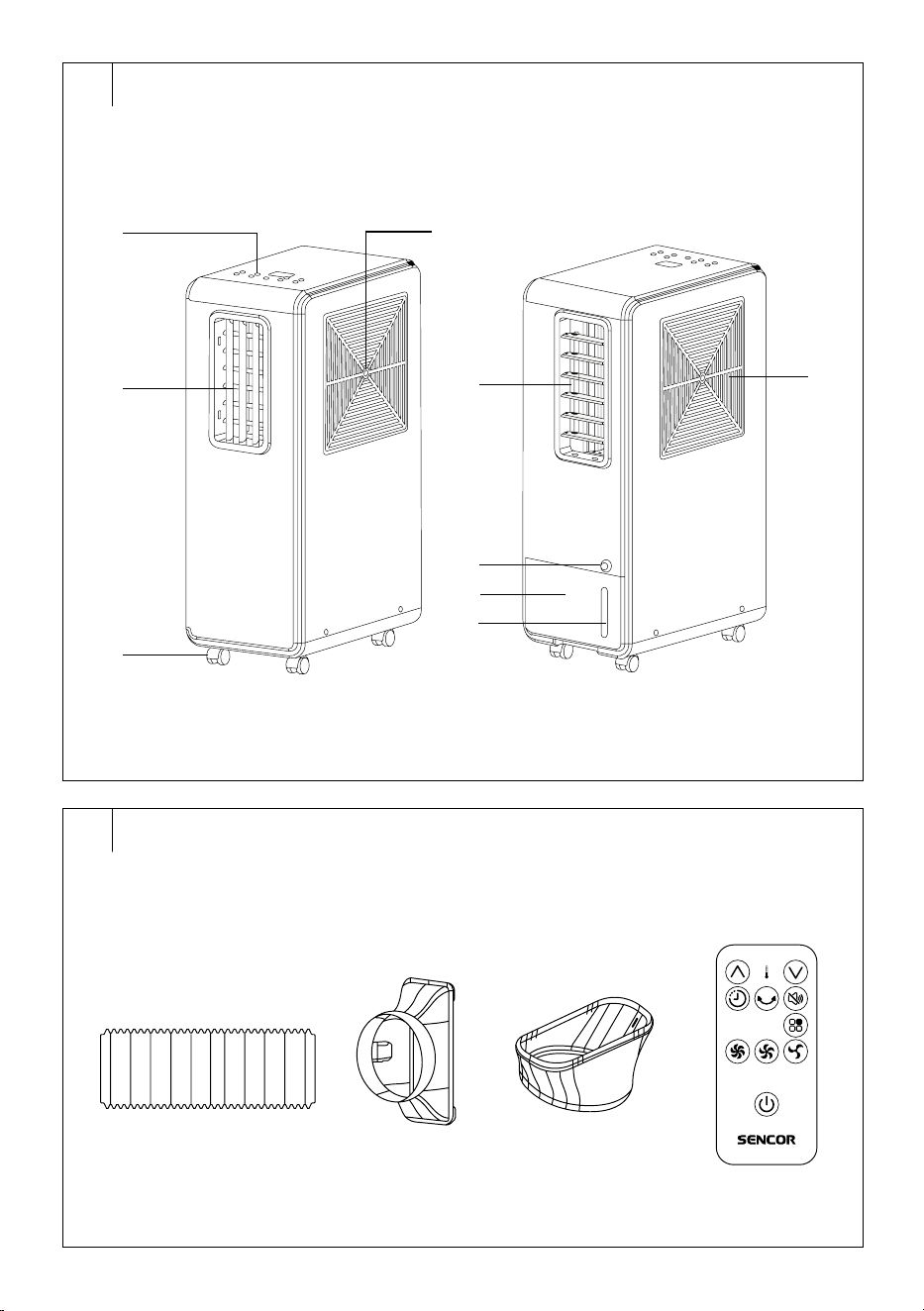
DESCRIPTION OF THE APPLIANCE
A1 Control panel
A2 Cold air outflow
A3 Castors
A4 Side warm air inlet protective
grille
A5 Warm air outflow
A6 Power cable
A7 Water tank
A8 Water level indicator
A9 Side cold air inlet protective
grille
. . . . . . . . . . . . . . . . . . . . . . . . . . . . . . . . . . . . . . . . . . . . . . . . . . . . . . . . . . . . . . . . . . . .
DESCRIPTION OF ACCESSORIES
B1 Flexible air exhaust hose
B2 Adapter for connection to the
air outlet
B3 Adapter for window
connection
B4 Remote control
. . . . . . . . . . . . . . . . . . . . . . . . . . . . . . . . . . . . . . . . . . . . . . . . . . . . . . . . . . . . . . . . . . . .
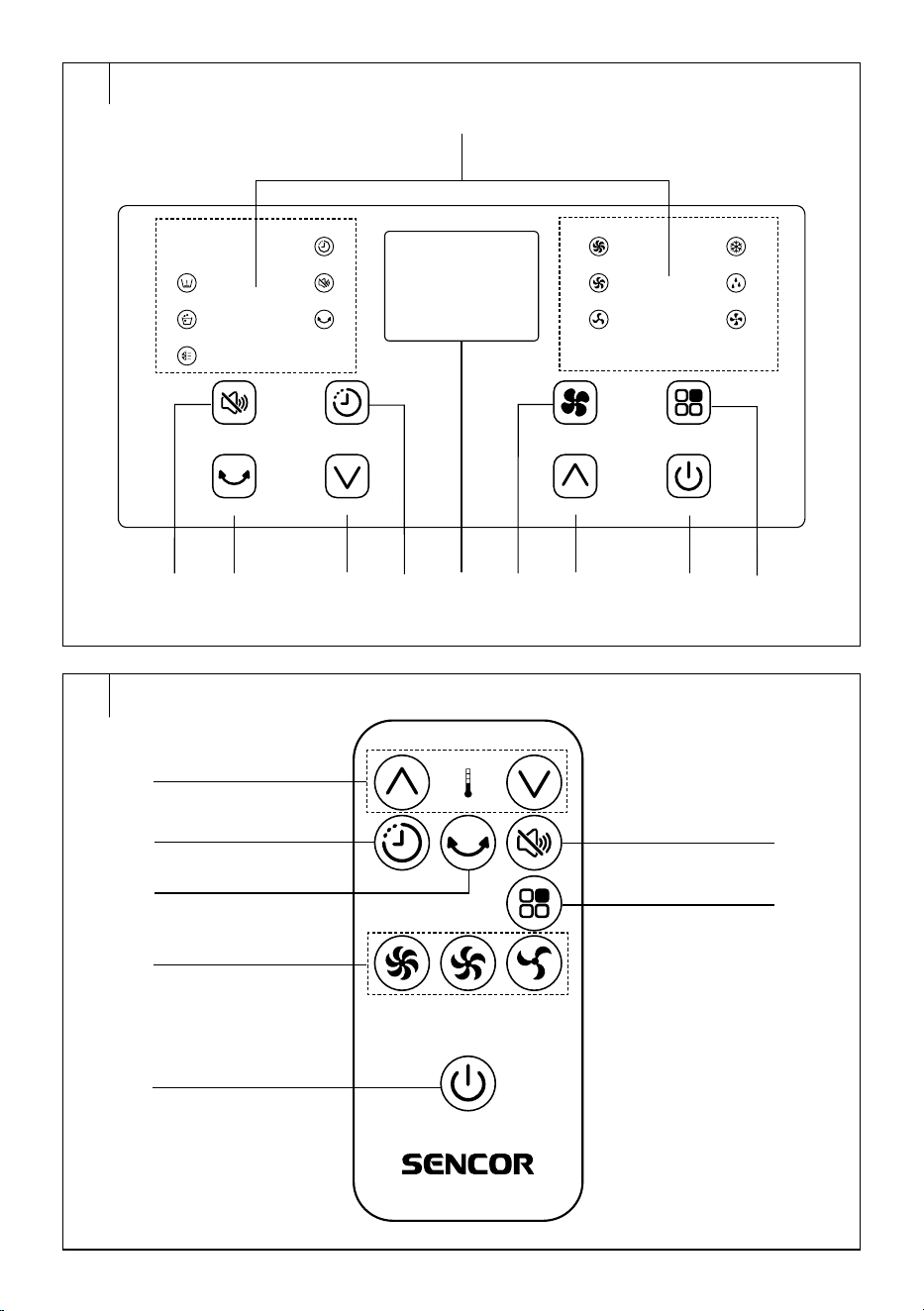
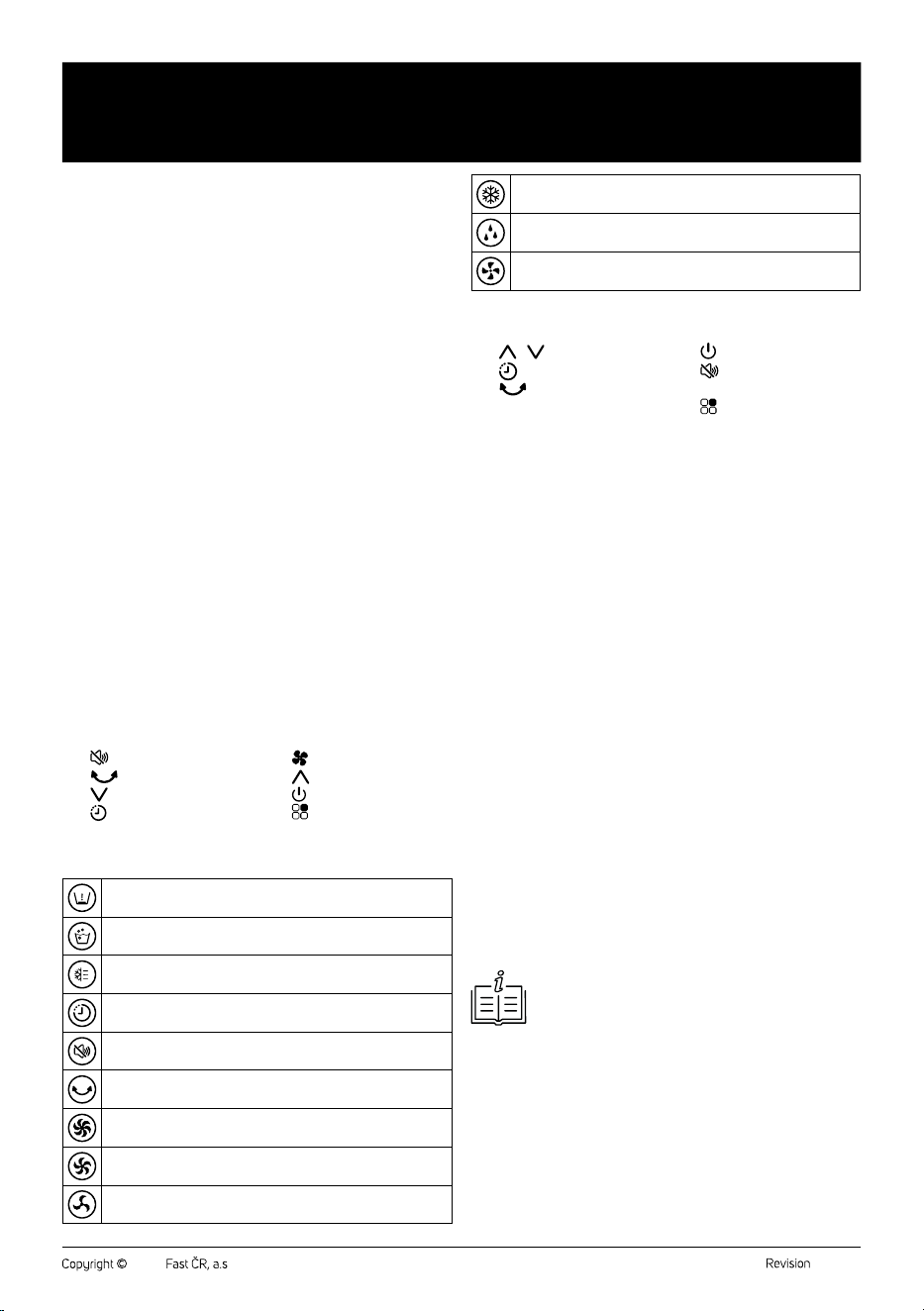
DESCRIPTION OF THE CONTROL PANEL
C1 button
C2
button
C3
button
C4
button
C5 Display
C6
button
C7 button
C8
button
C9
button
C10 Operation indicators
Operation indicators
Empty water tank indicator light
Full water tank indicator light
Automatic defrost indicator light
Timer on indicator light
Sleep mode indicator light
Indicator light for oscillation function on
High fan speed indicator light
Medium fan speed indicator light
Low fan speed indicator light
Cooling mode indicator light
Humidification mode indicator light
Fan mode indicator light
. . . . . . . . . . . . . . . . . . . . . . . . . . . . . . . . . . . . . . . . . . . . . . . . . . . . . . . . . . . . . . . . . . . .
REMOTE CONTROL
D1 / button
D2
button to set the timer
D3
button to switch
oscillation on/off
D4 Buttons to set the fan speed
D5
button for switching on/off
D6
button to switch the sleep
mode on/off
D7
button to select the
operating mode
Purpose of Use
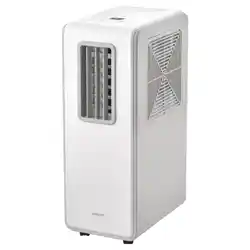
• The Sencor SAC ST0180C spot air conditioner is designed tocool the
air in the place where the spot air conditioner is located. The spot air
conditioner can be used both without the need to connect aflexible air
exhaust hose andwith aconnected flexible hose (which is included
in the delivery).
• Spot air conditioner is not designed tocool the entire room.
. . . . . . . . . . . . . . . . . . . . . . . . . . . . . . . . . . . . . . . . . . . . . . . . . . . . . . . . . . . . . . . . . . . .
INSTALLATION
Installation Location for the Spot Air Conditioner
• Remove the spot air conditioner from the packaging andmake sure
that you have removed all parts andaccessories.
• Locate the spot air conditioner on an even, dry and stable surface
and within reach of agrounded power socket. Do not place it on an
unstable or inclined surface from which the spot air conditioner could
slide, fall, become damaged or lead to injury.
• The spot air conditioner must be located in such away that it is not
exposed to direct sunlight.
• Check that there are no heat sources (e.g. heating, mobile heaters,
stoves, etc.) in the vicinity of the place where the spot air conditioner
will be located.
• The spot air conditioner is equipped with castors that facilitate
handling. Do not use the castors if you need to move the air
conditioner on acarpet or similar surface. Avoid running over objects.
• For optimum efficiency, maintain aminimum distance of 50 cm from
walls or other obstacles.
• Place the spot air conditioner at asufficient distance from curtains,
drapes or blinds.
• Make sure that the drain hose does not touch any objects.
Note:
Do not use the spot air conditioner to cool aroom
with computer servers, etc. Installation, adjustment,
maintenance and repair must only be carried out by
aqualified person.
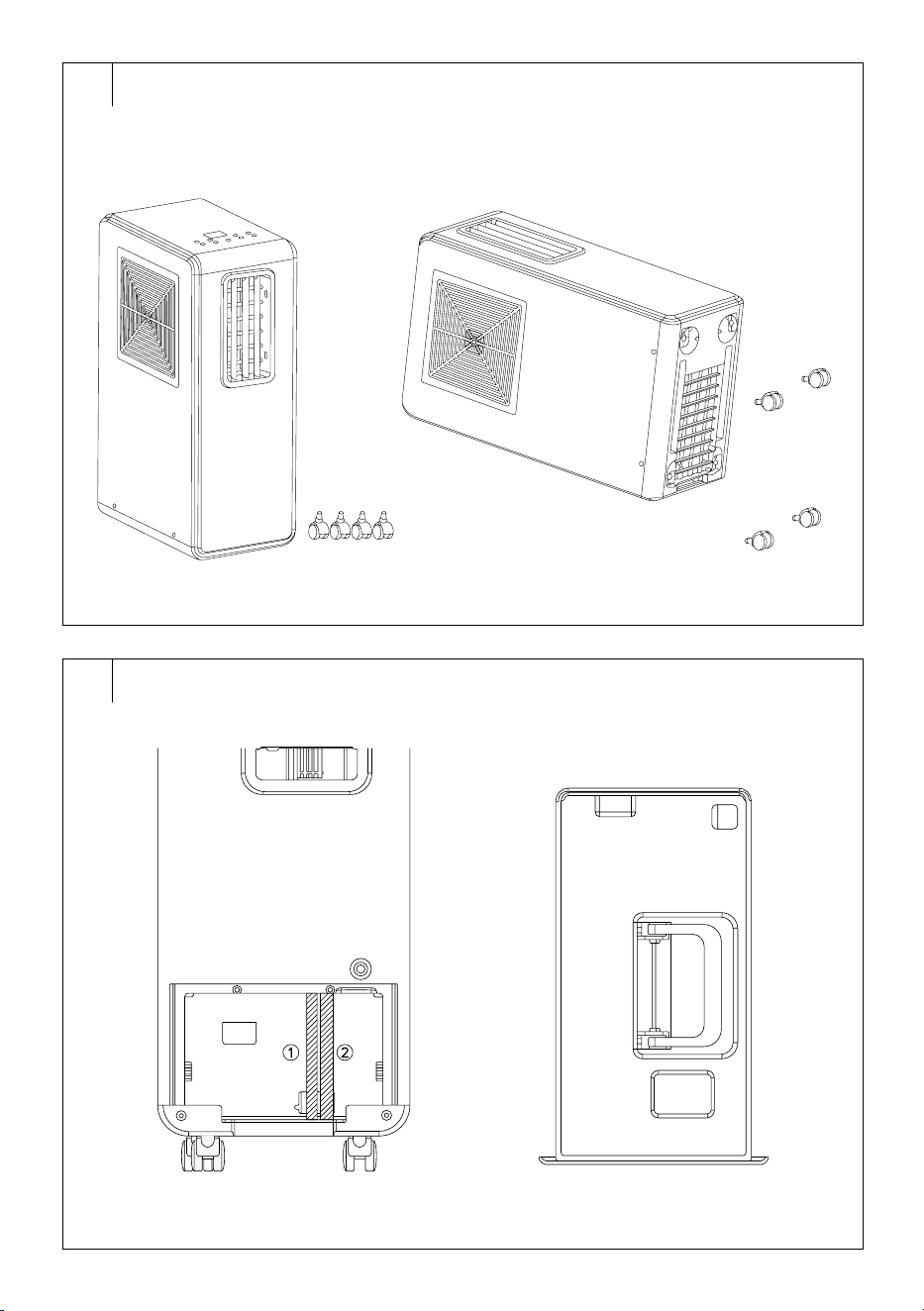
Installation of Castors
• The spot air conditioner can be used both without and with the castors.
If you need to install the castors, do the following:
1. Carefully tilt the spot air conditioner.
2. Insert the castors into the holes at the bottom of the spot air
conditioner – see Figure E.
• If you need to remove the castors, remove them from the bottom of
the spot air conditioner.
EN
Spot Air Conditioner
User Manual
- 8 -
01/2026
2026, .
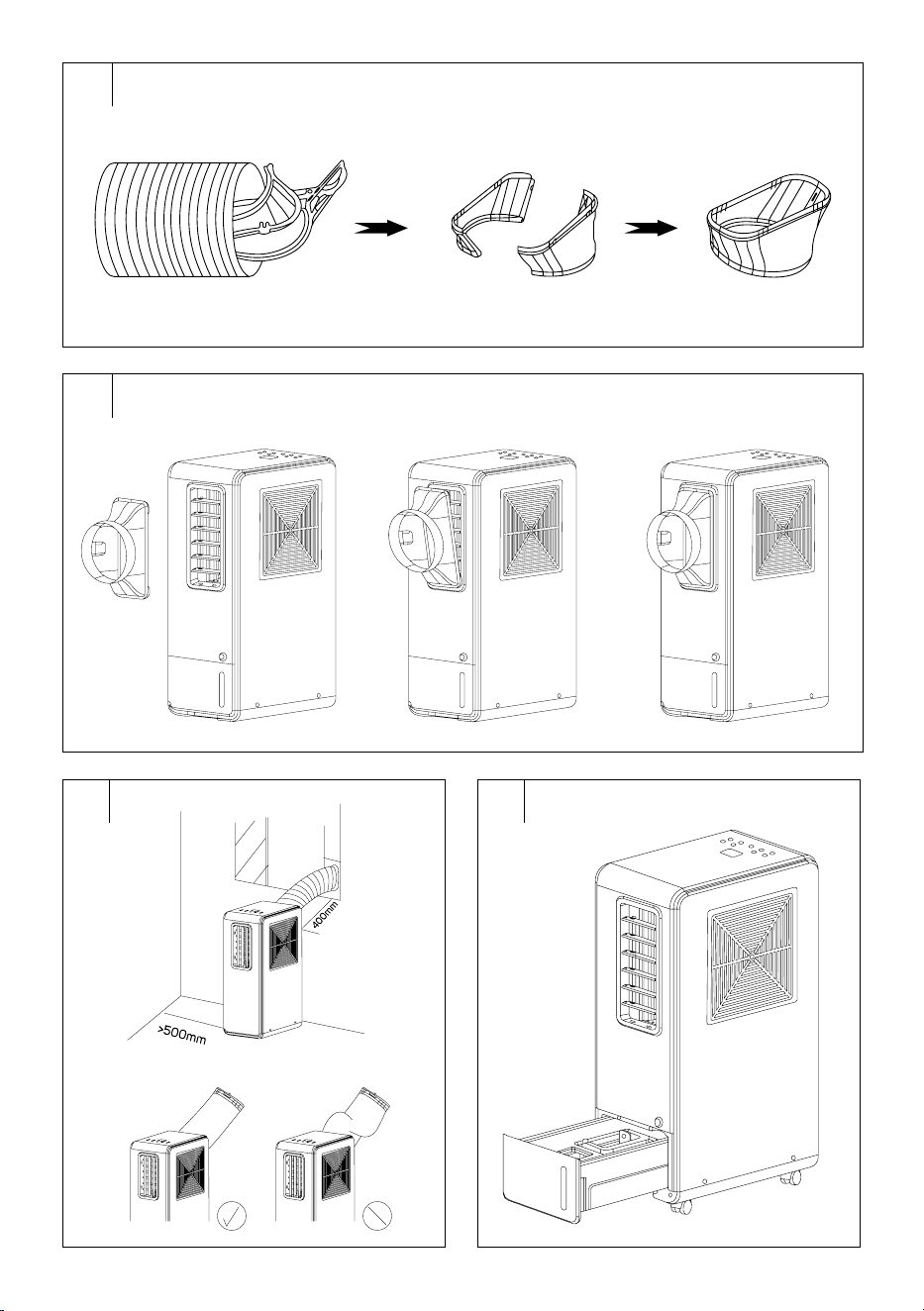
Pump Hose
• Before assembling the water tank, insert the water hose into the
designated hole in the water tank cover (see arrow in Figure F).
Make sure that the water tank does not clamp or push the hose, then
release it and gently insert the water tank into the body of the spot air
conditioner.
Water tank
• Inthe cooling mode, the water tank must be filled with clean, cold
water. On the contrary, in the dehumidification mode, it is necessary
for the water tank to be empty.
• Filling the water tank: while the spot air conditioner is off, pull out the
water tank andpour clean cold water into it up to the maximum level.
Insert the tank back into the spot air conditioner body.
• If the
indicator light comes on during the operation of the
spot air conditioner and the operation of the spot air conditioner is
interrupted after awhile, it will be necessary to replenish the water.
We recommend waiting approximately 3 minutes before ejecting the
reservoir andreplenishing the water, otherwise residual water could
drip on the floor. After inserting the tank into the body of the spot air
conditioner, its operation will be restored.
• Emptying the tank: fully pull the tank out of the spot air conditioner
body. Pour out the remaining water from the tank and put it back into
the spot air conditioning body.
• If the
indicator light comes on during operation and the operation
of the spot air conditioner is interrupted after awhile, it will be
necessary to pour out the water. Pull out the tank completely and
dispose of the water in the waste. Then, reinsert it. After inserting
the tank into the body of the spot air conditioner, its operation will be
restored.
Installation of the Flexible Hose for the Spot Air Conditioner
(optional)
• If you decide to use aspot air conditioner with aflexible hose, proceed
as follows for installation:
1. Remove the window adapter from theflexible hose andassemble
the parts aaand b together – see Figure G1. This will assemble the
adapter for connection to the window.
2. Install the adapter (B2) for the air outlet opening by first inserting the
lower part of the adapter, andthen press the upper part until you hear
aclick – see figure G2.
3. Stretch the flexible hose to the required length.
4. Attach the adapter for connection to the outlet to one end of the
flexible hose.
5. Attach the free end of the flexible hose to the adapter (B2) andscrew it
in counter-clockwise.
6. Attach the adapter to the window as shown in Figure G3 so that you
can use the spot air conditioner.
. . . . . . . . . . . . . . . . . . . . . . . . . . . . . . . . . . . . . . . . . . . . . . . . . . . . . . . . . . . . . . . . . . . .
COMMISSIONING
• Make sure it is assembled correctly.
• Make sure that the spot air conditioner is located in asuitable place
atsufficient distance from the mains socket.
• Insert the power plug into aproperly grounded power socket.
• The spot air conditioner will switch to the stand-by mode.
. . . . . . . . . . . . . . . . . . . . . . . . . . . . . . . . . . . . . . . . . . . . . . . . . . . . . . . . . . . . . . . . . . . .
CONTROLS OF THE SPOT AIR CONDITIONER
A. CONTROL PANEL
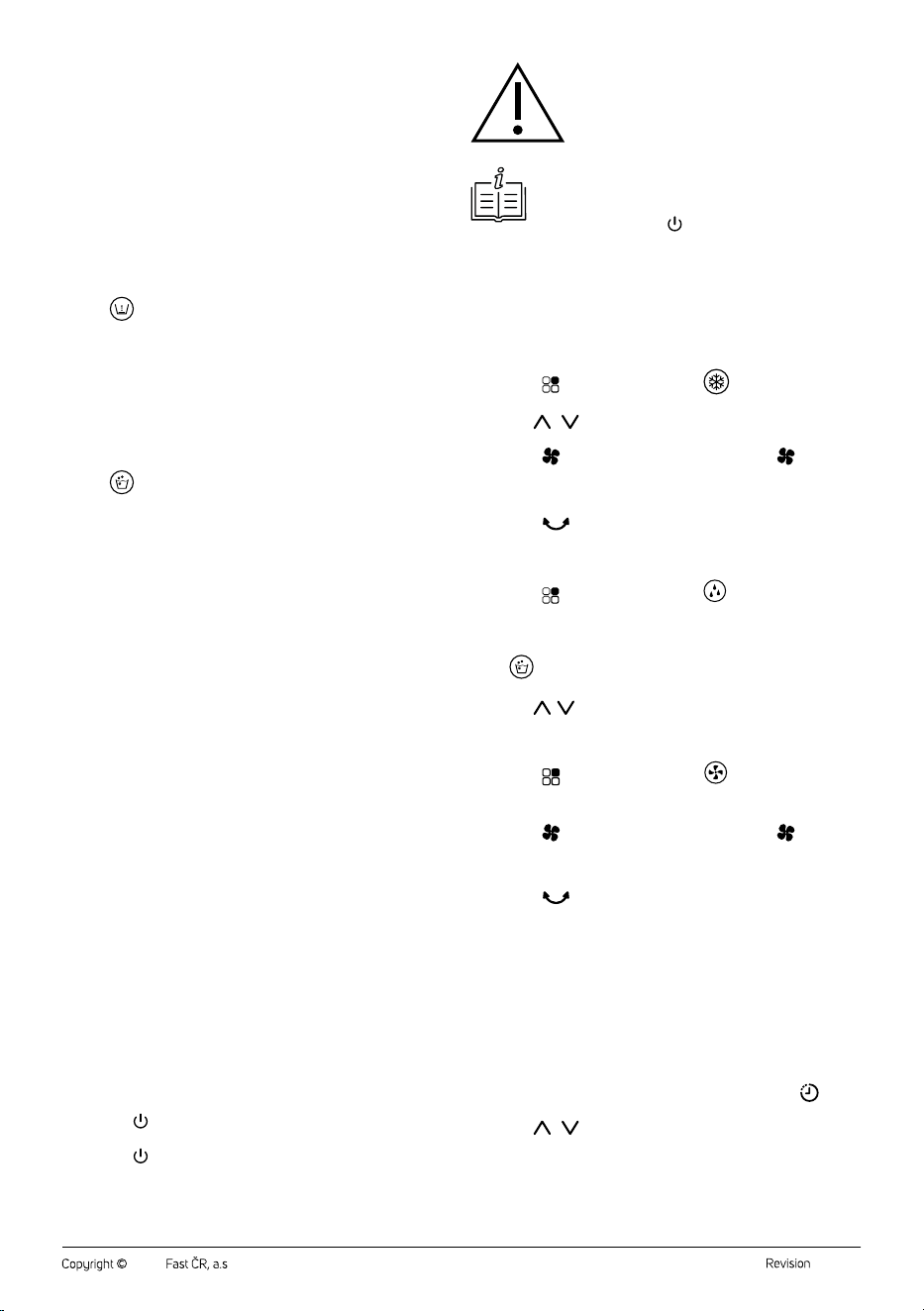
Switching the Spot Air Conditioner On/Off
• Press the button briefly and the spot air conditioner will switch on
and start by default.
• Press the
button again to switch the spot air conditioner off and into
standby mode. To switch off completely, disconnect the plug from the
power socket.
Warning:
Do not turn on the spot air conditioner immediately
after it is turned off. Wait afew minutes before
switching on again. Otherwise, the compressor could
be damaged.
Note:
Never switch off the spot air conditioner by unplugging
the power cord from the mains socket. Turn off the spot
air conditioner with the
button, wait several minutes
andthen disconnect the power cord.
. . . . . . . . . . . . . . . . . . . . . . . . . . . . . . . . . . . . . . . . . . . . . . . . . . . . . . . . . . . . . . . . . . . .
OPERATING MODES
1. Cooling Mode
• Refill the water tank. Follow the instructions in the WATER TANK
section.
• Press the
button repeatedly until the indicator lights up on
the display.
• Use the
/ buttons to set the desired temperature. You can set
the temperature in the range from 16 to 30 °C.
• Press the
button to adjust the fan speed. Press the button
repeatedly to switch the speed inthe following order: high speed
– medium speed – low speed. Each time the button is pressed, the
respective indicator will also be lit on the control panel.
• Press the
button to switch on the oscillation of the air outlet
lamellae.
2. Dehumidifier Mode
• Press the button repeatedly until the indicator lights up on the
control panel.
• The humidity in the room is reduced in this mode. Condensed
moisture accumulates in the reservoir. As soon as the tank is full,
the
indicator light will turn on. Empty the tank according to the
instructions in the section WATER TANK.
• Use the
/ buttons to set the target humidity. You can set the
humidity in the range from 30 to 90 %.
3. Fan Mode
• Press the button repeatedly until the indicator lights up on
the control panel.
• Inthis mode, the fan will circulate the air in theroom, but will not cool it.
• Press the button to adjust the fan speed. Press the button
repeatedly to switch the speed inthe following order: high speed
– medium speed – low speed. Each time the button is pressed, the
respective indicator will also be lit on the control panel.
• Press the
button to switch on the air outlet lamellae.
. . . . . . . . . . . . . . . . . . . . . . . . . . . . . . . . . . . . . . . . . . . . . . . . . . . . . . . . . . . . . . . . . . . .
SPOT AIR CONDITIONER FUNCTION
1. Timer Functions
• The spot air conditioner allows you to set two different timers – the on
timer and the off timer of the spot air conditioner.
a) Timer for Turning On the Spot Air Conditioner
• The timer for turning on the spot air conditioner allows you to activate
it after aset period.
• While the spot air conditioner is in standby mode, press the button.
The numeric display will start blinking, and the timer indicator lights up.
• Use the / buttons to set the time after which the air conditioner
should turn on. The time can be set in arange from 1 to 24 hours, in
1-hour increments.
• Wait approximately 5 seconds for the time to be saved in memory.
The countdown for the set time will then begin automatically.
• Once the set time has elapsed, the air conditioner will start in the last
operating mode.
- 9 -
01/2026
2026, .
b) Timer for Turning Off the Spot Air Conditioner
• The timer for turning off the spot air conditioner allows you to turn it off
after aset period.
• While the spot air conditioner is running, press the
button. The
numeric display will start blinking, and the timer indicator lights up.
• Use the
/ buttons to set the time after which the air conditioner
should turn off. The time can be set in arange from 1 to 24 hours, in
1-hour increments.
• Wait approximately 5 seconds for the time to be saved in memory.
The countdown for the set time will then begin automatically.
• Once the set time has elapsed, the air conditioner will turn off and
switch to standby mode.
2. Sleep Timer
• The sleep timer is used to reduce energy consumption during the
night when aconstant temperature is not required. The function also
ensures comfort during sleep, as the operation of the air conditioner is
muted and the display light is dimmed.
• Select the cooling mode andset the default temperature. Then press
the
button to turn on the sleep function.
• The fan speed is automatically set to low.
Switching the lamellae movement on/off
• Press the button to activate / deactivate the lamellae movement.
. . . . . . . . . . . . . . . . . . . . . . . . . . . . . . . . . . . . . . . . . . . . . . . . . . . . . . . . . . . . . . . . . . . .
B. REMOTE CONTROL
Inserting and Replacing Batteries
• Slide out the battery compartment cover, which is located on the
bottom side of the remote control. Insert the 1× CR2032 button cell
battery into the compartment and slide the cover into place.
• When inserting the batteries ensure the correct polarity as shown in
the battery compartment.
Note:
Taking the batteries out of the remote control will delete
all the settings. After new batteries are inserted the default
remote control setting as programmed by the manufacturer
will be renewed.
• If you will not be using the remote control for longer than 2 months,
remove the batteries.
Using the remote control
• For the remote control to work properly, make sure that the maximum
distance between the control and the spot air conditioner does not
exceed 8 m and that there is no obstacle between the control and the
spot air conditioner that could prevent signal transmission.
• Point the remote control directly at the spot air conditioner. The signal
transmission is confirmed by ashort sound signal.
• Do not expose the remote control to direct sunlight or high
temperatures. Otherwise the signal may not be transmitted.
Switching the Spot Air Conditioner On/Off
• Press the button briefly and the spot air conditioner will switch on
and start by default.
• Press the
button again to switch the portable air conditioner off and
into standby mode. To switch off completely, disconnect the plug from
the power socket.
Warning:
Do not turn on the spot air conditioner immediately
after it is turned off. Wait afew minutes before
switching on again. Otherwise, the compressor could
be damaged.
Note:
Never switch off the spot air conditioner by unplugging
the power cord from the mains socket. Turn off the spot
air conditioner with the
button, wait several minutes
andthen disconnect the power cord.
1. Cooling Mode
• Refill the water tank. Follow the instructions in the WATER TANK
section.
• Press the
button repeatedly until the
indicator lights up on
the display.
• Use the
/ buttons to set the desired temperature. You can set
the temperature in the range from 16 to 30 °C.
• Press the buttons to adjust the fan speed. The speed is switched inthe
following order: high speed – medium speed – low speed. Each time
the button is pressed, the respective indicator will also be lit on the
control panel.
• Press the
button to switch on the air outlet lamellae.
2. Dehumidifier Mode
• Press the button repeatedly until the indicator lights up on the
control panel.
• The humidity in the room is reduced in this mode. Condensed
moisture accumulates in the reservoir. As soon as the tank is full,
the
indicator light will turn on. Empty the tank according to the
instructions in the section WATER TANK.
• Use the
/ buttons to set the target humidity. You can set the
humidity in the range from 30 to 90 %.
• Inthis mode it is not possible to set the temperature or the speed of the
fan. The fan speed is automatically set to low speed.
3. Fan Mode
• Press the button repeatedly until the indicator lights up on
the control panel.
• Inthis mode, the fan will circulate the air in theroom, but will not cool
it.
• Press the buttons to adjust the fan speed. The speed is switched inthe
following order: high speed – medium speed – low speed. Each time
the button is pressed, the respective indicator will also be lit on the
control panel.
. . . . . . . . . . . . . . . . . . . . . . . . . . . . . . . . . . . . . . . . . . . . . . . . . . . . . . . . . . . . . . . . . . . .
SPOT AIR CONDITIONER FUNCTION
1. Timer Functions
• The spot air conditioner allows you to set two different timers – the on
timer and the off timer of the spot air conditioner.
a) Timer for Turning On the Spot Air Conditioner
• The timer for turning on the spot air conditioner allows you to activate
it after aset period.
• While the spot air conditioner is in standby mode, press the
button. The numeric display will start blinking, and the timer indicator
lights up.
• Use the
/ buttons to set the time after which the air conditioner
should turn on. The time can be set in arange from 1 to 24 hours, in
1-hour increments.
• Wait approximately 5 seconds for the time to be saved in memory.
The countdown for the set time will then begin automatically.
• Once the set time has elapsed, the air conditioner will start in the last
operating mode.
b) Timer for Turning Off the Spot Air Conditioner
• The timer for turning off the spot air conditioner allows you to turn it off
after aset period.
• While the spot air conditioner is running, press the
button. The
numeric display will start blinking, and the timer indicator lights up.
• Use the
/ buttons to set the time after which the air conditioner
should turn off. The time can be set in arange from 1 to 24 hours, in
1-hour increments.
• Wait approximately 5 seconds for the time to be saved in memory.
The countdown for the set time will then begin automatically.
• Once the set time has elapsed, the air conditioner will turn off and
switch to standby mode.
- 10 -
01/2026
2026, .
• If you need to cancel the timer, press the
button and use the /
buttons to set the timer value to “00”.
c) Sleep function
• The sleep timer is used to reduce energy consumption during the
night when aconstant temperature is not required. The function also
ensures comfort during sleep, as the operation of the air conditioner is
muted and the display light is dimmed.
• Select the cooling mode andset the default temperature. Then press
the
button to turn on the sleep function.
• The fan speed is automatically set to low.
Automatic defrosting
• At low room temperature, frost may accumulate on the evaporator
during operation. Inthis case, the spot air conditioner will automatically
start defrosting and the
indicator will start flashing.
• The operation of the compressor stops, however, the fan will continue
to run.
• After approximately 10 minutes of operation in defrost mode, the
indicator light goes out and compressor operation resumes.
Note:
We recommend letting the spot air conditioner complete
the automatic defrosting andnot turning it off during this
time.
Protection of the Compressor
• The compressor is equipped with atime protection against damage
when switching on again for aperiod of 3 minutes. If the spot air
conditioner is switched on shortly after it is switched off, the operation
of the compressor will start only after 3 minutes.
. . . . . . . . . . . . . . . . . . . . . . . . . . . . . . . . . . . . . . . . . . . . . . . . . . . . . . . . . . . . . . . . . . . .
TIPS FOR PROPER USE
• To ensure that the spot air conditioner works correctly, we recommend
that you stick to the following:
– Close all windows anddoors of the room where the spot air
conditioner is used. If you have installed the spot air conditioner
in aroom only temporarily, you can leave the door slightly ajar
(about 1 cm) to ensure proper ventilation.
– Prevent direct sunlight from entering the room. Close the curtains
or blinds to ensure economical operation of the air conditioner.
– Do not block the air outlet andinlet openings.
– Check that there is no heat source turned on in the room.
– Never use the spot air conditioner in an excessively humid
environment, such as in laundries.
– Never use the spot air conditioner outdoors.
– Check that the spot air conditioner is located on aflat surface. If
necessary, install special brakes on the castors.
. . . . . . . . . . . . . . . . . . . . . . . . . . . . . . . . . . . . . . . . . . . . . . . . . . . . . . . . . . . . . . . . . . . .
MAINTENANCE AND CLEANING
• Before cleaning, turn off the spot air conditioner, wait several minutes
andthen disconnect the power cord from the mains socket.
Warning:
Do not use abrasive cleaning agents, solvents, etc.
to clean any parts of the appliance, as these could
damage the surface.
Warning:
To prevent the risk of electric shock, do not immerse
the appliance, power cable, or plug into water or any
other liquid.
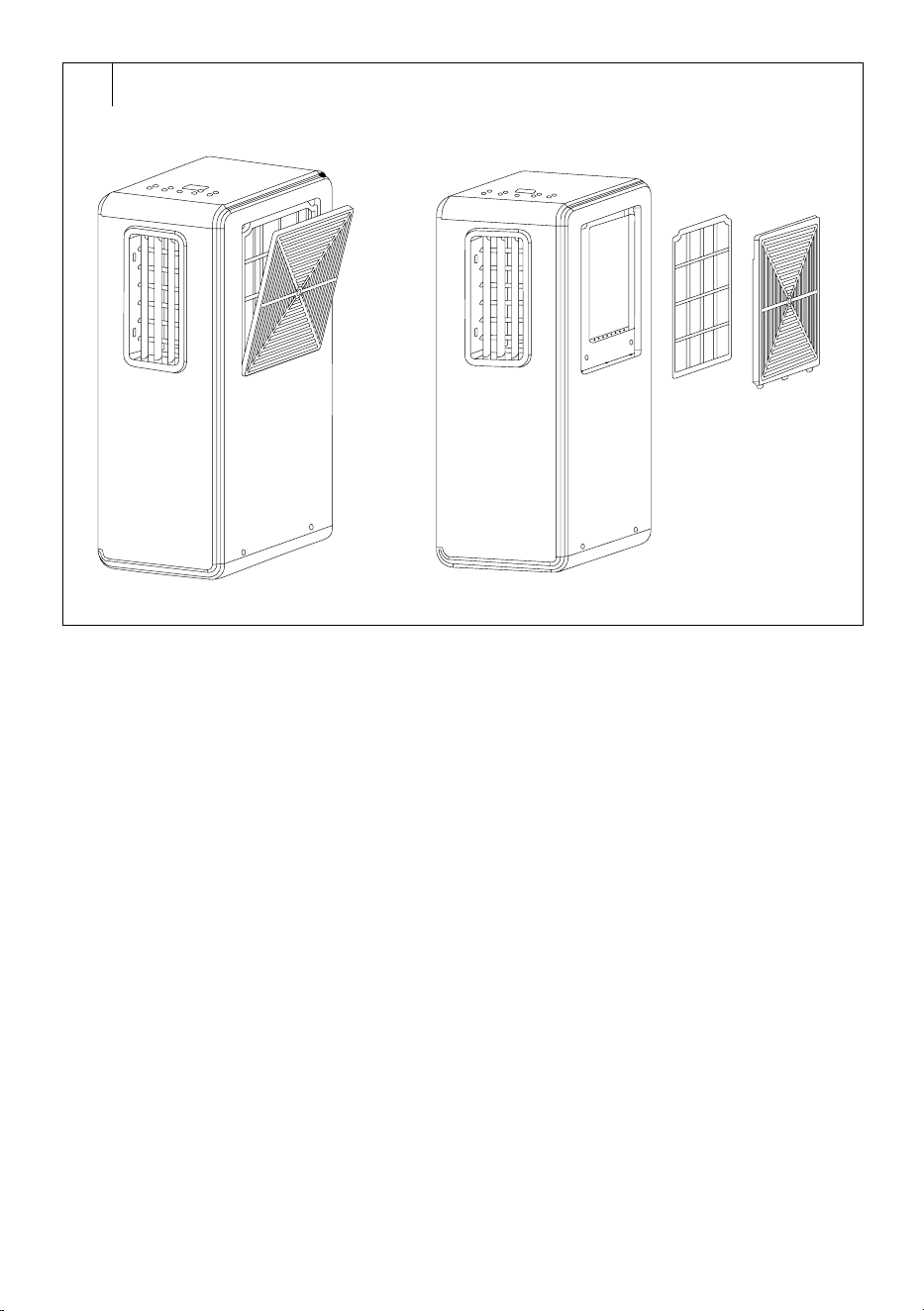
Cleaning the Protective Grilles and Air Filters
• When using the spot air conditioner regularly, clean the protective
grilles and air filters at least once every two weeks to prevent dust
from clogging the fan.
• Carefully remove the protective grilles andremove the filters – see
Figure I. Use avacuum cleaner to remove dust from the grilles
andfilters.
• In case of heavy soiling, wash the filter by hand in asolution of
lukewarm water (max. 40°C) andneutral detergent. Then thoroughly
rinse under flowing water and allow to dry naturally. Do not dry it in
aclothes dryer or in direct sunlight. Once the filters are dry, you can
install them back in their place.
• In case of heavier soiling, you can wipe the protective grilles with
aslightly damp cloth and then wipe them dry with aclean cloth.
Note:
Do not use spot air conditioning without properly installed
air filters and protective grilles. Never install wet or damp air
filters and protective grilles in spot air conditioners.
Cleaning the water tank
• Remove the water tank completely from the spot air conditioner body.
• Pour out the remaining water and dry the inside of the container with
adry cloth, or allow it to dry freely.
• Place the dry tank back into the spot air conditioner body.
Note:
If you use the spot air conditioner irregularly, we
recommend emptying the container after each use or at
least every third day to prevent the formation of unwanted
microorganisms andunpleasant odours.
Cleaning the outer casing
• To clean the outer case, use asoft wiping cloth dipped in asolution of
lukewarm water and neutral detergent. Then wipe the surface dry.
• When cleaning, do not spray water or any other liquid on the spot
air conditioner, do not water it or submerge it in water or in any other
liquid.
• Do not use abrasive cleaning products, solvents, petrol, etc. for
cleaning.
Spot Air Conditioner Storage
• Keep the spot air conditioner running in aheated room in fan mode for
about 12 hours to dry it out andprevent mould.
• Disconnect the flexible hose (if it was installed) and store it in asafe
place out of the reach of children.
• Empty andclean the water tank according to the above instructions.
• Clean the air filters and reattach them. Wipe the outer case of the spot
air conditioner. Remove the batteries from the remote control.
• Store the air conditioner in acold, dry anddark location.
Recommissioning
• Make sure that the power cord andplug are not damaged and the
air filters are clean. Insert new batteries in the remote control. Follow
the instructions in the “Inserting and Replacing Batteries” section.
Install the spot air conditioner according to the guidelines provided in
theprevious section of the manual, “Installation”.
- 11 -
01/2026
2026, .
. . . . . . . . . . . . . . . . . . . . . . . . . . . . . . . . . . . . . . . . . . . . . . . . . . . . . . . . . . . . . . . . . . . .
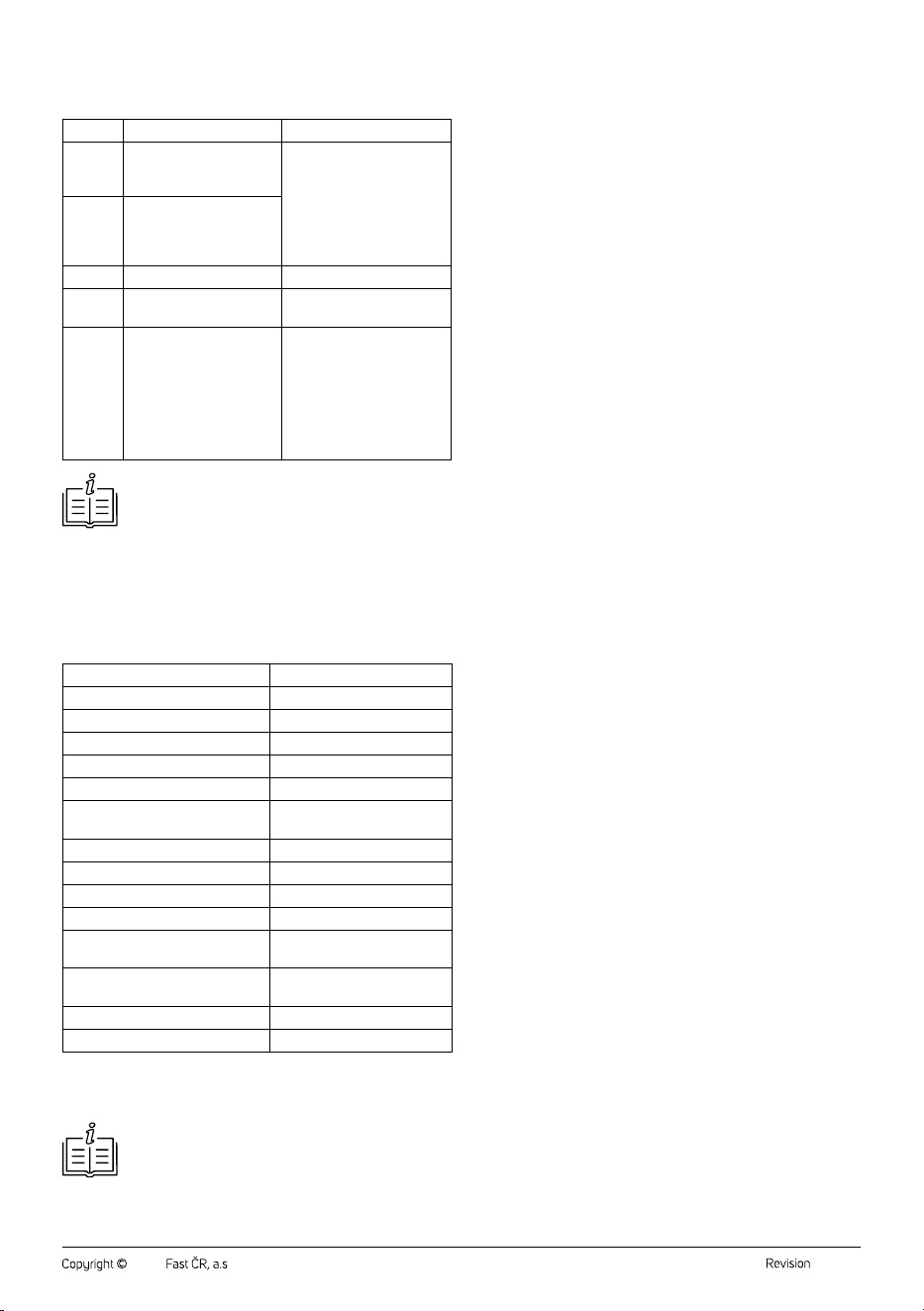
ERROR MESSAGES
Display Meaning Solution
E1 Electrical short circuit both
on the temperature sensor
and on the base plate.
Contact an authorised service
centre.
E2 Temperature sensor copper
tube and printed circuit
board wiring (coil) electrical
short circuit
E4 Condensate reservoir is full. Empty the water tank.
E8 The spot air conditioner
is bent.
Place the spot air conditioner
in an upright position.
H1 Inthe dehumidification
mode, the ambient
humidity is higher than
90%.
This is normal. In very high
ambient humidity (above
90%), the spot air conditioner
will not work. Wait until the
humidity drops naturally, or
move the spot air conditioner
to another place withlower
humidity.
Note:
If any of the above malfunctions occur, turn off the spot air
conditioner andcheck the cause of the malfunction. Turn it
on again, andif this fault occurs again, turn it off, disconnect
the power cord from the power socket andcontact the
manufacturer, an authorised service centre or aperson
withappropriate qualifications andentrust them with the
repair of the fault.
. . . . . . . . . . . . . . . . . . . . . . . . . . . . . . . . . . . . . . . . . . . . . . . . . . . . . . . . . . . . . . . . . . . .
TECHNICAL SPECIFICATIONS
Power supply 220–240 V~ / 50 Hz
Cooling power output 1800 BTU/hour
Cooling power consumption 200 W
Current consumption 0.9 A
EER cooling factor 2.6
Dehumidification capacity 15 l/day
Capacity of the built-in condensate
reservoir
3 l
Coolant type and weight R290 / 56 g
Air flow volume 120 m
3
/hour
Sound pressure level 45–58 dB (A) (high-low)
Sound power level 38–44 dB (A) (high-low)
Maximum permissible value of
operating pressure
4.0 MPa
Dimensions of the spot air
conditioner (W× D × H)
215 × 343 × 590 mm
Weight 12.8 kg
Operating temperature (cooling) 16 to 30 °C
The declared noise emission value of the appliance is 45–58 dB (A),
which is the Asound pressure level relative to areference sound power
of 1 pW.
Note:
The efficiency of the spot air conditioner may be reduced
if it is used outside the range of operating temperatures
listed above.
DISPOSAL OF USED BATTERIES
Batteries contain environmentally damaging compounds and therefore
do not belong in standard municipal waste. Take used batteries for proper
disposal at adesignated battery collection point.
. . . . . . . . . . . . . . . . . . . . . . . . . . . . . . . . . . . . . . . . . . . . . . . . . . . . . . . . . . . . . . . . . . . .
INSTRUCTIONS AND INFORMATION ON
DISPOSAL OF USED PACKAGING MATERIAL
Dispose of used packaging material at the designated municipal waste
disposal site.
. . . . . . . . . . . . . . . . . . . . . . . . . . . . . . . . . . . . . . . . . . . . . . . . . . . . . . . . . . . . . . . . . . . .
DISPOSAL OF USED ELECTRICAL AND
ELECTRONIC EQUIPMENT
Used electrical andelectronic products must not be disposed of in
ordinary municipal waste. To enable the proper disposal, renewal and
recycling of these products, deliver them to the designated collection
points. Alternatively, in some European Union states or other European
countries the products can be returned to the local retailer when buying
an equivalent new product. By disposing of this product correctly, you
help to conserve valuable natural resources and prevent any potential
adverse impact on the environment and human health that could result
from improper waste disposal. For more details, contact your local
authority or nearest collection point. Fines may be imposed for the
improper disposal of this type of waste as per national regulations.
For business entities in European Union States
If you wish to dispose of electrical and electronic equipment, please
request the necessary information from your retailer or supplier.
Disposal in other countries outside the European Union
To dispose of this product elsewhere, request the necessary information
on the correct disposal method from local authorities or your retailer.
. . . . . . . . . . . . . . . . . . . . . . . . . . . . . . . . . . . . . . . . . . . . . . . . . . . . . . . . . . . . . . . . . . . .
Changes to text and technical parameters are reserved.

- 12 -
01/2026
2026, .

FAST ČR, a.s.
U Sanitasu 1621
CZ-251 01 Říčany
www.sencor.com
info@sencor.cz